
CS422 - Programming Language Design
|
|
|
- Francis Holmes
- 10 years ago
- Views:
Transcription
1 1 CS422 - Programming Language Design General Information and Introduction Grigore Roşu Department of Computer Science University of Illinois at Urbana-Champaign

2 2 General Information Class Webpage and Newsgroup: (go to Classes ) news://class.cs422 Lectures: Tuesdays/Thursdays 3:30-4:45, 1302 Siebel Center Office hours: Mondays 10:00-12:00, 2110 Siebel Center Instructor: Grigore Roşu Office: 2110 Siebel Center [email protected] WWW: Secretary: Andrea Whitesell (2106 SC, [email protected], ) Prerequisites: CS421 or equivalent, or instructor s approval

3 3 Textbooks No textbook required! Self contained lecture notes will be posted on class webpage. The following may be useful: 1) Friedman, Wand and Haynes, Essentials of Programming Languages, MIT Press, Second Edition, ) Winskel. The Formal Semantics of Programming Languages: An Introduction, MIT Press, 1993 Other sources The Maude Language: Proceedings of Conferences on Programming Languages POPL (ACM Symp. on Principles of Prog. Lang.) PLDI (ACM Symposium on Programming Language Design and Implementation) OOPSLA (ACM Conference on Object Oriented Programming Systems, Languages and Applications)

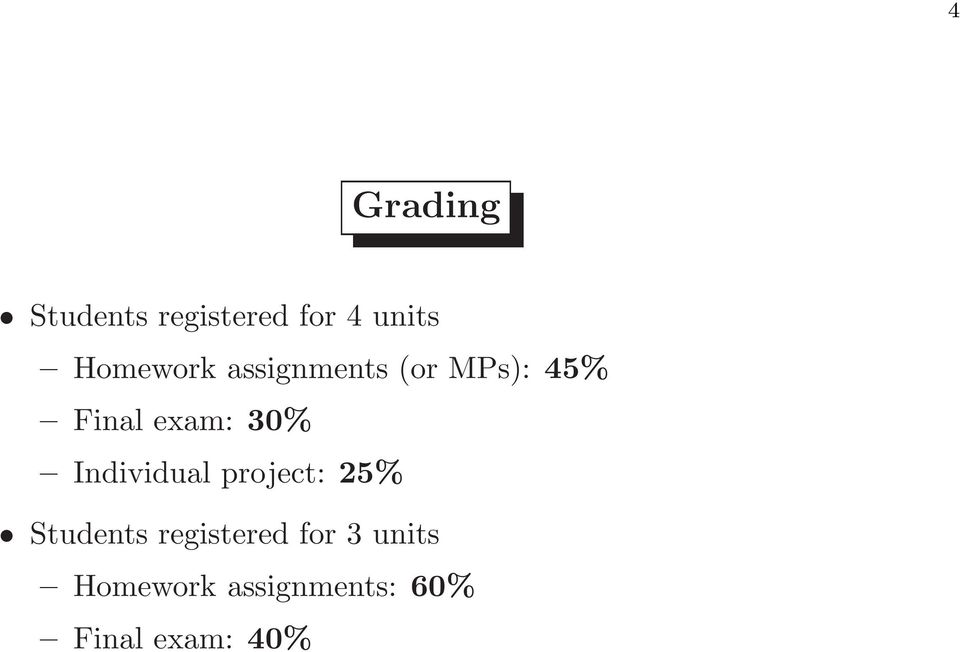
4 4 Grading Students registered for 4 units Homework assignments (or MPs): 45% Final exam: 30% Individual project: 25% Students registered for 3 units Homework assignments: 60% Final exam: 40%
5 5 The Homework Assignments This is a labor intensive class. The notions presented in class will be often backed by machine supported formalizations which you are supposed to modify or redo entirely as part of your assignments and as part of your project Assignments will be complete approximately every 4 lectures, on Tuesdays, and are due the next Tuesday. The exercises in the lecture notes are of two types: regular exercises and homework exercises: Exercise. The regular exercises are intended to warm you up and to help you better understand other deeper notions. Homework Exercise. The homework exercises are those which you have to solve as part of your homework. Therefore, you have between 1 and 3 weeks for each exercise.
6 6 The Unit Project The unit project will consist of designing a new programming language with specified features. This language will most likely be an extended version of an existing language. The design will be formalized and an interpreter will be provided, which we will test against many carefully selected programs. The Final Exam The final exam will test your overall understanding of the concepts discussed in class, and it is expected to be consistent with your homework assignments scores.

7 7 Collaboration and Other Policies You are free to discuss the homework assignments with other students (and are encouraged to do so!). The focus of any such discussion should be limited to figuring the problem specification, not coming up with a solution. You may not jointly write or code any assignment. Todosowillbe considered cheating! All cheating will be penalized by automatically assigning a failing grade for the course and instigating further disciplinary action with the appropriate university disciplinary body. You should retain copies of your assignments until you receive your final grade. In the event of a discrepancy between your scores on assignments and those on the exams, you may be asked to explain any work you performed. Your grade may be adversely affected by an inability to explain your work or by

8 8 failure to retain copies of it. All students are required to take the exam in order to receive a grade in the course. The course has a newsgroup. You are encouraged to use this group to ask questions, answer mundane system questions for other students, discuss homeworks, etc. In consideration for your peers, please don t use it to post flames, irrelevant messages, ads, etc.

9 9 Course Description Advanced course on principles of programming language design Major language design paradigms will be investigated and mathematically defined (or specified), including: Static versus dynamic binding Call-by-value, reference, name, need Type checking and type inference Objects and classes, concurrency Since the rigorous definitional framework will be executable, interpreters for the designed languages will be obtained for free Software analysis tools reasoning about programs in these languages will arise naturally Major theoretical models will be discussed
10 10 Tentative Subjects Covered in CS422 Operational semantics, equational semantics, Maude, inductive language definitions, several styles of defining and/or designing a simple programming language, defining a functional programming language, defining static and dynamic type checkers, type inference, defining typed and untyped object oriented languages, continuation-based definitions, continuation-passing style transformations, exceptions, concurrency, logic programming, denotational semantics, lambda-calculus, defining program analysers, etc.

11 11 Course Objectives Present and define rigorously the major features and design concepts in programming languages Show how elegantly and easily one can design a programming language if one uses the right tools and framework Understand the significant theory of programming languages The practical objective of this course is not to implement programming languages, but rather to specify or define them formally and modularly, on a feature by feature basis Interpreters will, however, be obtained for free, because in the discussed framework one can execute specifications For that reason, we take the freedom to interchangeably use the words define and implement in this course

12 12 Specification versus Implementation What is the difference between specification and implementation? An intuitive way to think of them is to associate the first to the question WHAT and the second to the question HOW A specification says what properties a system should have, while an implementation says how those properties are achieved A specification declares the interface of a system as well as the operations that it can perform, together with properties that these must fulfill; e.g., addition is commutative. An implementation gives concrete implementations of these operations; it may require quite tricky algorithms. A specification can have many correct implementations. Such an implementation is said to satisfy the specification, and this is formally written Impl = Spec

13 13 An Example: Integer Numbers Integer numbers are part of any programming language that is worth its salt. What is the difference between specifying and implementing integer numbers? A specification of integer numbers may say There are some entities called integers There is some special integer called zero and written 0 There are two unary operations succ and pred There is some binary operation + These operators have lots of properties, including: succ and pred are inverse to each other + is associative, commutative and has 0 as identity ( X, Y : integer) succ(x)+y = succ(x + Y ) etc.

14 14 Atypicalimplementation of integer numbers may be based on a hardware binary representation. Let us consider for example one over k + 1 bits, known as one s complement: themost significant bit (the leftmost one) stays for the sign, 0 for positive and 1 for negative, and the remaining k bits stay for the absolute value of the integer number. Here, let s assume that overflows may lead to unpredictable results. Exercise 1 The one s complement binary implementation of integer numbers is not a correct implementation of integer numbers as specified above. Which properties are not satisfied? In this course we will consider an idealistic implementation of integers, in which they can have any finite number of digits. The Maude 2.0 language that we will use in this class provides such an idealistic built-in representation of integer numbers

15 15 Specifying Programming Languages In this course the emphasis will be on specifications of programming languages. For a desired programming language, say PL, the focus will be on devising a specification Spec(PL), defining all the important aspects of PL. Ideally, one would want to specify PL on a feature by feature basis, in a modular way. Supposing that F 1, F 2,...,F n are desired features of PL, such as static binding, call-by-reference, etc., with specifications Spec(F 1 ), Spec(F 2 ),..., Spec(F n ),then a major goal in this class is to define, or rather design, Spec(PL) as Compose(Spec(F 1 ), Spec(F 2 ),..., Spec(F n )), where Compose is some appropriate module, or specification, composition operator.

16 16 Important Notes and Advice The lecture notes for this class will be all posted on the web and will be as detailed as needed. The other textbooks may be useful as auxiliary material in order to have a better understanding of the discussed concepts. We will not use Scheme, ML or OCAML in this class as implementation languages! These are quite advanced programming languages; using them to implement interpreters hides some of the real important and interesting issues in specifying a programming language.

07/15/10 Math E-10 Precalculus Fall 2010. Course Requirements
 07/15/10 Math E-10 Precalculus Fall 2010 Course Requirements Instructor: David Arias, Ed.D. E-mail: [email protected] Web page: You need your Harvard PIN to log in. http://isites.harvard.edu/course/ext-12572/2010/fall
Fundamentals of Programming Languages
 A puzzle and a dilemma Suppose I want to capture/catch/slay crashing programs before they have a chance to run (=static type safety). Do I let this one go? let c = ref (fun x -> x) in c := (fun x -> x
Program Analysis: Theory and Practice
 Introductions Program Analysis: Theory and Practice Who am I? About you? What do you want to get out of this class? Evan Chang Meeting 1: Welcome CSCI 7135, Fall 2010 http://www.cs.colorado.edu/~bec/courses/csci7135-f10/
CSE 307: Principles of Programming Languages
 Course Organization Introduction CSE 307: Principles of Programming Languages Spring 2015 R. Sekar Course Organization Introduction 1 / 34 Topics 1. Course Organization Info and Support Course Description
CS 341: Foundations of Computer Science II elearning Section Syllabus, Spring 2015
 CS 341: Foundations of Computer Science II elearning Section Syllabus, Spring 2015 Course Info Instructor: Prof. Marvin K. Nakayama Office: GITC 4312 Phone: 973-596-3398 E-mail: [email protected] (Be sure
Today. Binary addition Representing negative numbers. Andrew H. Fagg: Embedded Real- Time Systems: Binary Arithmetic
 Today Binary addition Representing negative numbers 2 Binary Addition Consider the following binary numbers: 0 0 1 0 0 1 1 0 0 0 1 0 1 0 1 1 How do we add these numbers? 3 Binary Addition 0 0 1 0 0 1 1
COURSE SYLLABUS. Office Hours: MWF 08:30am-09:55am or by appointment, DAV 238
 USF, St. Petersburg MAC 1105 College Algebra (ref #20214 ) COURSE SYLLABUS Term: Spring 2011 Section: 602 Department: MTH College: AP Credit hours: 3 Instructor: Olena Maymeskul Email: [email protected]
Functional Programming. Functional Programming Languages. Chapter 14. Introduction
 Functional Programming Languages Chapter 14 Introduction Functional programming paradigm History Features and concepts Examples: Lisp ML 1 2 Functional Programming Functional Programming Languages The
MAC 1140 Reference # 640688 MWF 9:00 AM 9:50 AM Fall 2011 Rm. 3321
 MAC 1140 Reference # 640688 MWF 9:00 AM 9:50 AM Fall 2011 Rm. 3321 Instructor: Mr. Douglas Scheib Email: [email protected] Web Address: http://www.math.miami.edu/~dscheib/teaching/fall11/mac1140.htm Office
Prerequisite Math 115 with a grade of C or better, or appropriate skill level demonstrated through the Math assessment process, or by permit.
 Summer 2016 Math 125 Intermediate Algebra Section 0179, 5 units Online Course Syllabus Instructor Information Instructor: Yoon Yun Email: [email protected] Phone: (818)364-7691 MyMathLab: MyMathLab.com
Monfort College of Business Semester Course Syllabus (2015-2016)
 Monfort College of Business Semester Course Syllabus (2015-2016) COURSE PREFIX/TITLE: BACS 387 Object Oriented System Development Sem. Hrs. 3 Ed. Cap: 40 CATALOG DESCRIPTION: Prerequisites: BACS 287. Business
STUDENT INFORMATION PLAN AND SYLLABUS INCLUDING COURSE OUTLINE ACCOUNTING 2301, FINANCIAL ACCOUNTING FALL SEMESTER, 2015
 STUDENT INFORMATION PLAN AND SYLLABUS INCLUDING COURSE OUTLINE ACCOUNTING 2301, FINANCIAL ACCOUNTING FALL SEMESTER, 2015 INSTRUCTOR: Dr. Tom Branton CPA OFFICE: B-231 TELEPHONE: (281) 756-3659 E-MAIL:
Verifying Specifications with Proof Scores in CafeOBJ
 Verifying Specifications with Proof Scores in CafeOBJ FUTATSUGI, Kokichi 二 木 厚 吉 Chair of Language Design Graduate School of Information Science Japan Advanced Institute of Science and Technology (JAIST)
Computer Science 281 Binary and Hexadecimal Review
 Computer Science 281 Binary and Hexadecimal Review 1 The Binary Number System Computers store everything, both instructions and data, by using many, many transistors, each of which can be in one of two
Object-Oriented Software Specification in Programming Language Design and Implementation
 Object-Oriented Software Specification in Programming Language Design and Implementation Barrett R. Bryant and Viswanathan Vaidyanathan Department of Computer and Information Sciences University of Alabama
CS 425 Software Engineering
 Department of Computer Science and Engineering College of Engineering, University of Nevada, Reno Fall 2009 CS 425 Software Engineering Lectures: Instructors: Office hours: Catalog description: Course
Programming Languages
 CS 345 Programming Languages Vitaly Shmatikov http://www.cs.utexas.edu/~shmat/courses/cs345/ slide 1 Course Personnel Instructor: Vitaly Shmatikov Office: CSA 1.114 Office hours: Tuesday, 3:30-4:30pm (after
Automata and Formal Languages
 Automata and Formal Languages Winter 2009-2010 Yacov Hel-Or 1 What this course is all about This course is about mathematical models of computation We ll study different machine models (finite automata,
CS 6371: Advanced Programming Languages
 CS 6371: Advanced Programming Languages Dr. Kevin Hamlen Spring 2014 Fill out, sign, and return prereq forms: Course number: CS 6371 Section: 1 Prerequisites: CS 5343: Algorithm Analysis & Data Structures
SPC Common Course Syllabus for PSYC 2316 Psychology of Personality
 SPC Common Course Syllabus for PSYC 2316 Psychology of Personality Department: Behavioral Sciences Discipline: Psychology Course Number: PSYC 2301 Course Title: Psychology of Personality Credit: 3 Lecture,
CS135 Computer Science I Spring 2015
 CS135 Computer Science I Spring 2015 Instructor: Laura Pike Email: [email protected] Phone: 775-753-2288 Office: HTC 131 Office Hours: Monday 9:00 11:30 am Thursday 1:00-3:30 pm Textbooks: ISBN: 978-0470927137,
Computer Science 1015F ~ 2010 ~ Notes to Students
 Computer Science 1015F ~ 2010 ~ Notes to Students Course Description Computer Science 1015/8F and 1016S together constitute a complete Computer Science curriculum for first year students, offering an introduction
CIS490 Design in Software Engineering. Course Syllabus for the Virtual Class
 CIS490 Design in Software Engineering Course Syllabus for the Virtual Class 1. Opening Note This section of CS490 is offered via "WebCt", an online conferencing system. The material covered will be the
EE360: Digital Design I Course Syllabus
 : Course Syllabus Dr. Mohammad H. Awedh Fall 2008 Course Description This course introduces students to the basic concepts of digital systems, including analysis and design. Both combinational and sequential
Office: D-116-9. Instructor: Vanessa Jones. Phone: (714) 628-4948. Office Hours: Monday & Wednesday 1:30pm-2:30pm. Email: Jones Vanessa@sccollege.
 Fall Semester 2015 Santiago Canyon College: Mathematics & Sciences Division (Room SC-210) MATH 80: Intermediate Algebra (Section Number 10247) Tuesday & Thursday 10:30 am-1:00pm (Room SC-110) Instructor:
MATH 241: DISCRETE MATHEMATICS FOR COMPUTER SCIENCE, Winter 2010-2011. CLASSROOM: Alumni Hall 112 Tuesdays and Thursdays, 6:00-8:15 pm
 MATH 241: DISCRETE MATHEMATICS FOR COMPUTER SCIENCE, Winter 2010-2011 PROFESSOR: Melody Rashidian CLASSROOM: Alumni Hall 112 TIME: Tuesdays and Thursdays, 6:00-8:15 pm CONTACT INFORMATION: WEB PAGE: [email protected]
Programming Languages
 Programming Languages Qing Yi Course web site: www.cs.utsa.edu/~qingyi/cs3723 cs3723 1 A little about myself Qing Yi Ph.D. Rice University, USA. Assistant Professor, Department of Computer Science Office:
Multimedia 320 Syllabus
 Course information Web Design I Multimedia 320 Section Number 1538 Fall 2013 FA 304 Instructor / Contact Information Brian Olson FA 304 Office Please email me for in person appointments [email protected]
Computer Engineering ECSE-322B
 Computer Engineering ECSE-322B Winter 2008 COURSE INFORMATION: Lectures: MWF in ENGTR 0100, 11:35-12:25 Tutorials: Monday ENGTR 1080, 1635-1825 Thursday ENGTR 0060, 1805-1955 Friday ENGTR 0060, 0835-1025
CS 425 Software Engineering. Course Syllabus
 Department of Computer Science and Engineering College of Engineering, University of Nevada, Reno Fall 2013 CS 425 Software Engineering Course Syllabus Lectures: Instructor: Office hours: Catalog description:
College of Southern Maryland Fundamentals of Accounting Practice(ACC 1015) Course Syllabus Spring 2015
 INSTRUCTOR: College of Southern Maryland Fundamentals of Accounting Practice(ACC 1015) Course Syllabus Spring 2015 Bonnie Harrison Office - Room #228 (PFA) Office Hours: Tuesdays: 9:00am 10:00am Wednesday:
Study Program Handbook Computer Science
 Study Program Handbook Computer Science Bachelor of Science Jacobs University Undergraduate Handbook CS - Matriculation Fall 2015 Page: ii Contents 1 The Computer Science (CS) Study Program 1 1.1 Concept......................................
CS 425 Software Engineering. Course Syllabus
 Department of Computer Science and Engineering College of Engineering, University of Nevada, Reno Fall 2015 CS 425 Software Engineering Course Syllabus Lectures: TR, 9:30 10:45 am, LEG-212 Instructor:
COURSE TITLE COURSE DESCRIPTION
 COURSE TITLE COURSE DESCRIPTION CS-00X COMPUTING EXIT INTERVIEW All graduating students are required to meet with their department chairperson/program director to finalize requirements for degree completion.
Fall 2012 Q530. Programming for Cognitive Science
 Fall 2012 Q530 Programming for Cognitive Science Aimed at little or no programming experience. Improve your confidence and skills at: Writing code. Reading code. Understand the abilities and limitations
ECE 156A - Syllabus. Lecture 0 ECE 156A 1
 ECE 156A - Syllabus Lecture 0 ECE 156A 1 Description Introduction to HDL basic elements, HDL simulation concepts, HDL concurrent statements with examples and applications, writing HDL for synthesis, and
MAC 2233, STA 2023, and junior standing
 I. QMB 3600: Quantitative Methods in Business (3 credits) II. Prerequisite Courses & Standing: MAC 2233, STA 2023, and junior standing III. Course Logistics: Fall 2011, Section 002 CRN 82290 M W 12:30
COURSE SYLLABUS PHILOSOPHY 001 CRITICAL THINKING AND WRITING SPRING 2012
 1 COURSE SYLLABUS PHILOSOPHY 001 CRITICAL THINKING AND WRITING SPRING 2012 All students are required to read and have a thorough understanding of the syllabus. Any questions or concerns need to be addressed
MATH 245 COLLEGE ALGEBRA Section 0251 10:55 1:30
 MATH 245 COLLEGE ALGEBRA Section 0251 10:55 1:30 Instructor: Ms. L. K. Deutsch Office Hours: MW 1:30 3:50 PM Office & Office Phone: C2.123-2 323-780-6735 Textbook: College Algebra Lial, Hornsby and Schneider
GRADUATE STUDENT SATISFACTION WITH AN ONLINE DISCRETE MATHEMATICS COURSE *
 GRADUATE STUDENT SATISFACTION WITH AN ONLINE DISCRETE MATHEMATICS COURSE * Amber Settle DePaul University 243 S. Wabash Avenue Chicago, IL 60604 (312) 362-5324 [email protected] Chad Settle University
Advanced Database Management MISM Course F14-95704 A Fall 2014
 Advanced Database Management MISM Course F14-95704 A Fall 2014 Carnegie Mellon University Instructor: Randy Trzeciak Office: Software Engineering Institute / CERT CIC Office hours: By Appointment Phone:
Psychology 314L (52510): Research Methods
 Psychology 314L (52510): Research Methods Spring 2012 Lecture Location: Kaprielian Hall, Room 145 Days and Time: Tuesday & Thursday, 11:00 a.m. to 12:20 p.m. Lab Location: King Hall, Room 208 Lab Times:
SYLLABUS CIS 3660: OBJECT-ORIENTED SYSTEM ANALYSIS AND DESIGN SPRING 2010
 SYLLABUS CIS 3660: OBJECT-ORIENTED SYSTEM ANALYSIS AND DESIGN SPRING 2010 Instructor: Dr. Silvana Faja Office: WDE 2400 Office Hours: 9:30 10:45 and 1:30 3:00, Tuesday and Thursday and by appointment Office
F l o r i d a G u l f C o a s t U n i v e r s i t y S t a t i s t i c a l M e t h o d s F a l l 2 0 1 2 - C R N 8 1 1 2 6
 F l o r i d a G u l f C o a s t U n i v e r s i t y S t a t i s t i c a l M e t h o d s F a l l 2 0 1 2 - C R N 8 1 1 2 6 Instructor: Larry L. Southard, M.A. Email: [email protected] Telephone: (239) 590-7420
Course Syllabus. COSC 1437 Programming Fundamentals II. Revision Date: August 21, 2013
 Course Syllabus COSC 1437 Programming Fundamentals II Revision Date: August 21, 2013 Catalog Description: This course contains further applications of programming techniques in the C++ programming language.
67 204 Mathematics for Business Analysis I Fall 2007
 67 204 Mathematics for Business Analysis I Fall 2007 Instructor Asõkā Rāmanāyake Office: Swart 223 Office Hours: Monday 12:40 1:40 Wednesday 8:00 9:00 Thursday 9:10 11:20 If you cannot make my office hours,
CS 300 Data Structures Syllabus - Fall 2014
 CS 300 Data Structures Syllabus - Fall 2014 Catalog Description Data structures are fundamental to advanced, efficient programming. Topics including asymptotic analysis, stacks, queues, linked lists, trees,
PHILOSOPHY OF THE MATHEMATICS DEPARTMENT
 PHILOSOPHY OF THE MATHEMATICS DEPARTMENT The Lemont High School Mathematics Department believes that students should develop the following characteristics: Understanding of concepts and procedures Building
Math 143: College Algebra Spring 2016 - - 8- Week Session
 Math 143: College Algebra Spring 2016 - - 8- Week Session Course Description and Foundational Studies Program Objectives Boise State's Foundational Studies Program provides undergraduates with a broad-
MATHEMATICAL TOOLS FOR ECONOMICS ECON 1078-002 FALL 2011
 MATHEMATICAL TOOLS FOR ECONOMICS ECON 1078-002 FALL 2011 Instructor: Hakon Skjenstad Class Time: M, W, F, 2:00-2:50pm Classroom: HUMN 1B80 Email: [email protected] Course Website: CULearn Office:
Phone: (773) 481-8488 Spring 2015. Office hours: MW 7:30-8:20 and 11:00-12:20, T 7:30-7:50 and 9:55-12:15
 Math 140 BDYR Prof. Hellen Colman Email: [email protected] Office: L309 College Algebra Hybrid Class Tuesdays 8:00AM 9:45AM Phone: (773) 481-8488 Spring 2015 Office hours: MW 7:30-8:20 and 11:00-12:20, T
Preliminary Syllabus for the course of Data Science for Business Analytics
 Preliminary Syllabus for the course of Data Science for Business Analytics Miguel Godinho de Matos 1,2 and Pedro Ferreira 2,3 1 Cato_lica-Lisbon, School of Business and Economics 2 Heinz College, Carnegie
CS 649 Database Management Systems. Fall 2011
 SCHOOL OF BUSINESS, PUBLIC ADMINISTRATION AND INFORMATION SCIENCES LONG ISLAND UNIVERSITY, BROOKLYN CAMPUS DEPARTMENT OF COMPUTER SCIENCE CS 649 Database Management Systems Fall 2011 Course Schedule: Thursday
COURSE SYLLABUS ACCT 212 PRINCIPLES OF ACCOUNTING II
 Note: Course content may be changed, term to term, without notice. The information below is provided as a guide for course selection and is not binding in any form, and should not be used to purchase course
INSTRUCTOR INFORMATION Instructor: Adrienne Petersen Email: [email protected] Office: DMS 233 Office Hours: TuTh 11am-1pm by appointment
 Math 120: Fundamentals of College Math Mathematics and Statistics Department, University of Nevada, Reno Section 1001, TuTh 2:30-3:45pm, FH 106 Section 1002, TuTh 1:00-2:15pm, FH 207 Fall 2014 INSTRUCTOR
Tennessee Wesleyan College Math 131 C Syllabus Spring 2016
 Tennessee Wesleyan College Math 131 C Syllabus Spring 2016 I. Course: College Algebra, M131 C Location: Durham 303 Days/Time: MWF 1100-1150 Credit hours: 3 II. III. IV. Instructor: Dr. David J. Ashe Office:
MATHEMATICS 152, FALL 2004 METHODS OF DISCRETE MATHEMATICS
 MATHEMATICS 152, FALL 2004 METHODS OF DISCRETE MATHEMATICS Last revised: September 14, 2004 Instructor: Paul Bamberg Offices: SC 423, 495-1748 and Quincy House 102, 493-3100. Quincy 102 opens off the Quincy
Florida Gulf Coast University Finite Math M GF 1106 Spring 2014 CRN 11072
 Florida Gulf Coast University Finite Math M GF 1106 Spring 2014 CRN 11072 Instructor: Jaffar Ali Shahul-Hameed Ph.D. Associate Professor Email: [email protected] Telephone: (239) 590-1470 Office: AB7 206
Lecture 8: Binary Multiplication & Division
 Lecture 8: Binary Multiplication & Division Today s topics: Addition/Subtraction Multiplication Division Reminder: get started early on assignment 3 1 2 s Complement Signed Numbers two = 0 ten 0001 two
Math 103, College Algebra Spring 2016 Syllabus MWF Day Classes MWTh Day Classes
 SECTION #: Lecture Time: Lecture Location: Lecture Instructor: Office Hours: Office Location: Phone: E-mail: Recitation Location: Recitation Instructor: Office Hours: Office Location: Phone: E-mail: Class
Finance 471: DERIVATIVE SECURITIES Fall 2015 Prof. Liang Ma University of South Carolina, Moore School of Business
 Finance 471: DERIVATIVE SECURITIES Fall 2015 Prof. Liang Ma University of South Carolina, Moore School of Business General information Class meetings Lecture 1: TR 8:30-9:45 pm, DMSB 120 Lecture 2: TR
Syllabus for Accounting 300 Applied Managerial Accounting California State University Channel Islands Fall 2004
 Syllabus for Accounting 300 Applied Managerial Accounting California State University Channel Islands Fall 2004 Professor: Dr. M. Cathy Claiborne Office Hours: TTH 2:30 4:00 or Office: Professional Bldg
Management Science 250: Mathematical Methods for Business Analysis Three Semester Hours
 Management Science 250: Mathematical Methods for Business Analysis Three Semester Hours Dr. Laura Swanson Office: FH, Rm. 3121 Homepage: http://www.siue.edu/~lswanso Office telephone: (618) 650-2710 e-mail:
Math 35 Section 43376 Spring 2014. Class meetings: 6 Saturdays 9:00AM-11:30AM (on the following dates: 2/22, 3/8, 3/29, 5/3, 5/24, 6/7)
 Math 35 Section 43376 Spring 2014 Class meetings: 6 Saturdays 9:00AM-11:30AM (on the following dates: 2/22, 3/8, 3/29, 5/3, 5/24, 6/7) Instructor: Kathy Nabours Office: MTSC 133 Email: [email protected]
MATH 115 Mathematics for Liberal Arts (3 credits) Professor s notes* As of June 27, 2007
 MATH 115 Mathematics for Liberal Arts (3 credits) Professor s notes* As of June 27, 27 *Note: All content is based on the professor s opinion and may vary from professor to professor & student to student.
Eastern Washington University Department of Computer Science. Questionnaire for Prospective Masters in Computer Science Students
 Eastern Washington University Department of Computer Science Questionnaire for Prospective Masters in Computer Science Students I. Personal Information Name: Last First M.I. Mailing Address: Permanent
Sequence of Mathematics Courses
 Sequence of ematics Courses Where do I begin? Associates Degree and Non-transferable Courses (For math course below pre-algebra, see the Learning Skills section of the catalog) MATH M09 PRE-ALGEBRA 3 UNITS
ADVANCED SCHOOL OF SYSTEMS AND DATA STUDIES (ASSDAS) PROGRAM: CTech in Computer Science
 ADVANCED SCHOOL OF SYSTEMS AND DATA STUDIES (ASSDAS) PROGRAM: CTech in Computer Science Program Schedule CTech Computer Science Credits CS101 Computer Science I 3 MATH100 Foundations of Mathematics and
School of Computer Science
 School of Computer Science Computer Science - Honours Level - 2014/15 October 2014 General degree students wishing to enter 3000- level modules and non- graduating students wishing to enter 3000- level
Computer Science. General Education Students must complete the requirements shown in the General Education Requirements section of this catalog.
 Computer Science Dr. Ilhyun Lee Professor Dr. Ilhyun Lee is a Professor of Computer Science. He received his Ph.D. degree from Illinois Institute of Technology, Chicago, Illinois (1996). He was selected
University Of California, Berkeley Department of Mechanical Engineering. ME 204: Advanced Manufacturing Systems Analysis, AMS (3 units)
 University Of California, Berkeley Department of Mechanical Engineering ME 204: Advanced Manufacturing Systems Analysis, AMS (3 units) CATALOG DESCRIPTION Graduate Course Syllabus This course is designed
CSE373: Data Structures and Algorithms Lecture 3: Math Review; Algorithm Analysis. Linda Shapiro Winter 2015
 CSE373: Data Structures and Algorithms Lecture 3: Math Review; Algorithm Analysis Linda Shapiro Today Registration should be done. Homework 1 due 11:59 pm next Wednesday, January 14 Review math essential
GRADUATION REQUIREMENTS FOR THE COLLEGE OF ARTS AND SCIENCES, EFFECTIVE FALL 2013
 GRADUATION REQUIREMENTS FOR THE COLLEGE OF ARTS AND SCIENCES, EFFECTIVE FALL 2013 Students are responsible for compliance with the institutional graduation requirements stated in the Oberlin College Course
How To Get A Computer Science Degree At Appalachian State
 118 Master of Science in Computer Science Department of Computer Science College of Arts and Sciences James T. Wilkes, Chair and Professor Ph.D., Duke University [email protected] http://www.cs.appstate.edu/
College Chemistry II CHM 111 Online
 College Chemistry II CHM 111 Online http://de.nr.edu INSTRUCTOR INFORMATION Name: Wes Adcock Phone: (540)674-3600 x 4461 Email: [email protected] Office: Godbey Hall, Room 39 Office Hours: Posted in Blackboard
Department of Electrical and Computer Engineering. EEL 4730 Programming Embedded Systems Spring 2015
 Department of Electrical and Computer Engineering EEL 4730 Programming Embedded Systems Spring 2015 Instructor : Dr. Herman Watson Office Hours : by appointment Monday 9:30-11:00 am Tuesday & Thursday
https://sites.google.com/a/asu.edu/cse-522-spring-12/ sensors and actuators? How do we handle the errors introduced due to noise, quantization etc?
 CSE 522 Spring 12 https://sites.google.com/a/asu.edu/cse-522-spring-12/ 1 of 3 5/29/2012 16:56 CSE 522 Spring 12 Navigation CSE522: Real-Time Embedded Systems The Schedule Sitemap CSE522: Real-Time Embedded
ORGANIZATIONAL COMMUNICATION SYLLABUS SUMMER 2012
 ORGANIZATIONAL COMMUNICATION SYLLABUS SUMMER 2012 Instructor Ms. Shari V. N. Hodgson, Ph.D., ABD Location Virtual/Office Hours Hamilton Holt Communication Building 107 W. Fairbanks Ave., Tuesday and Thursday,
SYLLABUS MAC 1105 COLLEGE ALGEBRA Spring 2011 Tuesday & Thursday 12:30 p.m. 1:45 p.m.
 SYLLABUS MAC 1105 COLLEGE ALGEBRA Spring 2011 Tuesday & Thursday 12:30 p.m. 1:45 p.m. Instructor: Val Mohanakumar Office Location: Office Phone #: 253 7351 Email: [email protected] Webpage: http://www.hccfl.edu/faculty-info/vmohanakumar.aspx.
Datavetenskapligt Program (kandidat) Computer Science Programme (master)
 Datavetenskapligt Program (kandidat) Computer Science Programme (master) Wolfgang Ahrendt Director Datavetenskap (BSc), Computer Science (MSc) D&IT Göteborg University, 30/01/2009 Part I D&IT: Computer
Master of Science in Information Technology (MS-IT)
 Master of Science in Information Technology (MS-IT) Program Objectives The primary aim of the program is to allow IT professionals an opportunity for professional upgrading or an extension of their qualifications
Please consult the Department of Engineering about the Computer Engineering Emphasis.
 COMPUTER SCIENCE Computer science is a dynamically growing discipline. ABOUT THE PROGRAM The Department of Computer Science is committed to providing students with a program that includes the basic fundamentals
LANGARA COLLEGE Course Outline
 Course Format: Four hours per week in a mix of instruction and tutorial work on problems as required. Course Prerequisites: None. LANGARA COLLEGE Course Outline Course: Philosophy 1102: Introduction to
Course Syllabus. All Semester-based courses follow a 16 week calendar as detailed in the Course Schedule.
 Instructor Information MATH 106 COLLEGE ALGEBRA Course Syllabus Instructor: Jessica Hernández Guzman, Ph.D. Email: [email protected] Course Delivery Online, Semester-based Credit Hours 3 Semester Hours
Guide to the MSCS Program Sheet
 Guide to the MSCS Program Sheet Eric Roberts and Mehran Sahami (revisions by Claire Stager) September 2012 Welcome to the Stanford Computer Science Department! This guide is designed to help you understand
CSE532 Theory of Database Systems Course Information. CSE 532, Theory of Database Systems Stony Brook University http://www.cs.stonybrook.
 CSE532 Theory of Database Systems Course Information CSE 532, Theory of Database Systems Stony Brook University http://www.cs.stonybrook.edu/~cse532 Course Description The 3 credits course will cover advanced
MTH 110: Elementary Statistics (Online Course) Course Syllabus Fall 2012 Chatham University
 MTH 110: Elementary Statistics (Online Course) Course Syllabus Fall 2012 Chatham University Meeting Times: Online course Instructor: Mr. John Wenskovitch Email: [email protected] Office: Buhl 218
COMMUN 101: INTRODUCTION TO INTERPERSONAL COMMUNICATION
 COMMUN 101: INTRODUCTION TO INTERPERSONAL COMMUNICATION Course Instructor: Andy Cuneo Course Meets On-line Office: Holton Hall 157 Office Phone: (414) 229-2787 COURSE DESCRIPTION Basic concepts for understanding
CS 3719 (Theory of Computation and Algorithms) Lecture 4
 CS 3719 (Theory of Computation and Algorithms) Lecture 4 Antonina Kolokolova January 18, 2012 1 Undecidable languages 1.1 Church-Turing thesis Let s recap how it all started. In 1990, Hilbert stated a
Brazosport College Syllabus for PSYC 2301 General Psychology
 Brazosport College Syllabus for PSYC 2301 General Psychology Instructor: Cassandra D. Gonzalez Office Hours: Monday-Thursday 1:00-2:00 pm Office Phone: 979.230.3667 Other times by appointment Office Location:
NEW YORK UNIVERSITY STERN SCHOOL OF BUSINESS Department of Accounting Principles of Financial Accounting (ACCT-UB.
 NEW YORK UNIVERSITY STERN SCHOOL OF BUSINESS Department of Accounting Principles of Financial Accounting (ACCT-UB.0001) Spring 2014 Instructor: Course e mail: Course website: Professor Pepa Kraft KMC 10th