
TCP for Wireless Networks
|
|
|
- Kelly Shaw
- 10 years ago
- Views:
Transcription
1 TCP for Wireless Networks

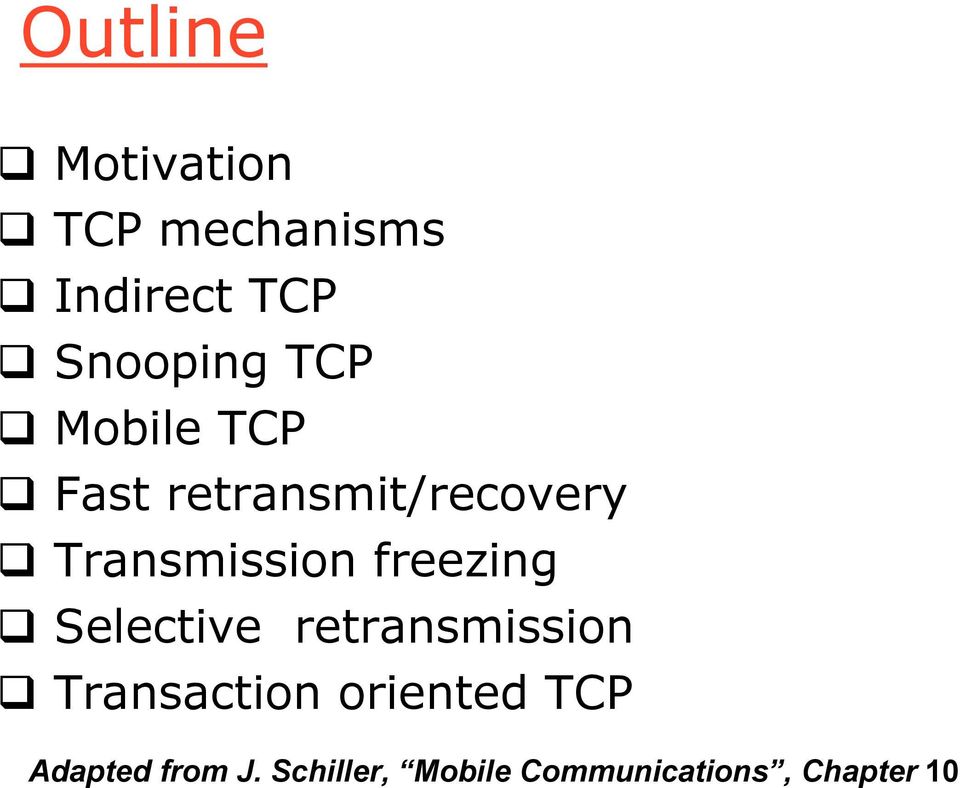
2 Outline Motivation TCP mechanisms Indirect TCP Snooping TCP Mobile TCP Fast retransmit/recovery Transmission freezing Selective retransmission Transaction oriented TCP Adapted from J. Schiller, Mobile Communications, Chapter 10
3 Motivation Transport protocols typically designed for o Fixed end-systems o Fixed, wired networks TCP congestion control o Packet loss in fixed networks typically due to (temporary) overload situations o Routers discard packets as soon as the buffers are full o TCP recognizes congestion only indirectly via missing acknowledgements o Retransmissions unwise, they would only contribute to the congestion and make it even worse o Slow-start algorithm as reaction

4 TCP Slow Start Sender calculates a congestion window for a receiver Start with a congestion window size equal to one segment Exponential increase of the congestion window up to the congestion threshold, then linear increase Missing acknowledgement causes the reduction of the congestion threshold to one half of the current congestion window Congestion window starts again with one segment

5 TCP Fast Retransmit/Recovery TCP sends an acknowledgement only after receiving a packet If a sender receives several acknowledgements for the same packet, this is due to a gap in received packets at the receiver However, the receiver got all packets up to the gap and is actually receiving packets Therefore, packet loss is not due to congestion, continue with current congestion window (do not use slow-start)

6 Influences of mobility on TCP TCP assumes congestion if packets are dropped o typically wrong in wireless networks, here we often have packet loss due to transmission errors o furthermore, mobility itself can cause packet loss, if e.g. a mobile node roams from one access point (e.g. foreign agent in Mobile IP) to another while there are still packets in transit to the wrong access point and forwarding is not possible The performance of an unchanged TCP degrades severely o however, TCP cannot be changed fundamentally due to the large base of installation in the fixed network, TCP for mobility has to remain compatible o the basic TCP mechanisms keep the whole Internet together

7 Indirect TCP I Indirect TCP or I-TCP segments the connection o no changes to the TCP protocol for hosts connected to the wired Internet, millions of computers use (variants of) this protocol o optimized TCP protocol for mobile hosts o splitting of the TCP connection at, e.g., the foreign agent into 2 TCP connections, no real end-to-end connection any longer o hosts in the fixed part of the net do not notice the characteristics of the wireless part mobile host access point (foreign agent) wired Internet wireless TCP standard TCP

8 I-TCP socket and state migration access point 1 socket migration and state transfer Internet mobile host access point 2

9 Indirect TCP II Advantages o no changes in the fixed network necessary, no changes for the hosts (TCP protocol) necessary, all current optimizations to TCP still work o transmission errors on the wireless link do not propagate into the fixed network o simple to control, mobile TCP is used only for one hop between, e.g., a foreign agent and mobile host o therefore, a very fast retransmission of packets is possible, the short delay on the mobile hop is known Disadvantages o loss of end-to-end semantics, an acknowledgement to a sender does not any longer mean that a receiver really got a packet, foreign agents might crash o higher latency possible due to buffering of data within the foreign agent and forwarding to a new foreign agent

10 Snooping TCP I Transparent extension of TCP within the foreign agent buffering of packets sent to the mobile host lost packets on the wireless link (both directions!) will be retransmitted immediately by the mobile host or foreign agent, respectively (so called local retransmission) the foreign agent therefore snoops the packet flow and recognizes acknowledgements in both directions, it also filters ACKs changes of TCP only within the foreign agent (+min. MH change) local retransmission foreign agent wired Internet correspondent host mobile host snooping of ACKs buffering of data end-to-end TCP connection

11 Snooping TCP II Data transfer to the mobile host o FA buffers data until it receives ACK of the MH, FA detects packet loss via duplicated ACKs or time-out o fast retransmission possible, transparent for the fixed network Data transfer from the mobile host o FA detects packet loss on the wireless link via sequence numbers, FA answers directly with a NACK to the MH o MH can now retransmit data with only a very short delay Advantages: o Maintain end-to-end semantics o No change to correspondent node o No major state transfer during handover Problems o Snooping TCP does not isolate the wireless link well o May need change to MH to handle NACKs o Snooping might be useless depending on encryption schemes

12 Mobile TCP Special handling of lengthy and/or frequent disconnections M-TCP splits as I-TCP does o unmodified TCP fixed network to supervisory host (SH) o optimized TCP SH to MH Supervisory host o no caching, no retransmission o monitors all packets, if disconnection detected set sender window size to 0 sender automatically goes into persistent mode o old or new SH reopen the window Advantages o maintains semantics, supports disconnection, no buffer forwarding Disadvantages o loss on wireless link propagated into fixed network o adapted TCP on wireless link

13 Fast retransmit/fast recovery Change of foreign agent often results in packet loss o TCP reacts with slow-start although there is no congestion Forced fast retransmit o as soon as the mobile host has registered with a new foreign agent, the MH sends duplicated acknowledgements on purpose o this forces the fast retransmit mode at the communication partners o additionally, the TCP on the MH is forced to continue sending with the actual window size and not to go into slow-start after registration Advantage o simple changes result in significant higher performance Disadvantage o further mix of IP and TCP (to know when there is a new registration), no transparent approach

14 Transmission/time-out freezing Mobile hosts can be disconnected for a longer time o no packet exchange possible, e.g., in a tunnel, disconnection due to overloaded cells or mux. with higher priority traffic o TCP disconnects after time-out completely TCP freezing o MAC layer is often able to detect interruption in advance o MAC can inform TCP layer of upcoming loss of connection o TCP stops sending, but does not assume a congested link o MAC layer signals again if reconnected Advantage o scheme is independent of data and TCP mechanisms (Ack,SN) => works even with IPsec Disadvantage o TCP on mobile host has to be changed, mechanism depends on MAC layer

15 Selective retransmission TCP acknowledgements are often cumulative o ACK n acknowledges correct and in-sequence receipt of packets up to n o if single packets are missing quite often a whole packet sequence beginning at the gap has to be retransmitted (go-back-n), thus wasting bandwidth Selective retransmission as one solution o RFC2018 allows for acknowledgements of single packets, not only acknowledgements of in-sequence packet streams without gaps o sender can now retransmit only the missing packets Advantage: much higher efficiency Disadvantage o more complex software in a receiver, more buffer needed at the receiver

16 Transaction oriented TCP TCP phases o connection setup, data transmission, connection release o using 3-way-handshake needs 3 packets for setup and release, respectively o thus, even short messages need a minimum of 7 packets! Transaction oriented TCP o RFC1644, T-TCP, describes a TCP version to avoid this overhead o connection setup, data transfer and connection release can be combined o thus, only 2 or 3 packets are needed Advantage o efficiency Disadvantage o requires changed TCP o mobility no longer transparent

Mobile Communications Chapter 9: Mobile Transport Layer
 Mobile Communications Chapter 9: Mobile Transport Layer Motivation TCP-mechanisms Classical approaches Indirect TCP Snooping TCP Mobile TCP PEPs in general Additional optimizations Fast retransmit/recovery
TCP and Wireless Networks Classical Approaches Optimizations TCP for 2.5G/3G Systems. Lehrstuhl für Informatik 4 Kommunikation und verteilte Systeme
 Chapter 2 Technical Basics: Layer 1 Methods for Medium Access: Layer 2 Chapter 3 Wireless Networks: Bluetooth, WLAN, WirelessMAN, WirelessWAN Mobile Networks: GSM, GPRS, UMTS Chapter 4 Mobility on the
TCP in Wireless Mobile Networks
 TCP in Wireless Mobile Networks 1 Outline Introduction to transport layer Introduction to TCP (Internet) congestion control Congestion control in wireless networks 2 Transport Layer v.s. Network Layer
Mobile Computing/ Mobile Networks
 Mobile Computing/ Mobile Networks TCP in Mobile Networks Prof. Chansu Yu Contents Physical layer issues Communication frequency Signal propagation Modulation and Demodulation Channel access issues Multiple
Lecture Objectives. Lecture 07 Mobile Networks: TCP in Wireless Networks. Agenda. TCP Flow Control. Flow Control Can Limit Throughput (1)
 Lecture Objectives Wireless and Mobile Systems Design Lecture 07 Mobile Networks: TCP in Wireless Networks Describe TCP s flow control mechanism Describe operation of TCP Reno and TCP Vegas, including
TCP/IP Networking for Wireless Systems. Integrated Communication Systems Group Ilmenau University of Technology
 TCP/IP Networking for Wireless Systems Integrated Communication Systems Group Ilmenau University of Technology Content Internet Protocol Suite Link Layer: Ethernet, PPP, ARP, MAC Addressing Network Layer:
TCP over Multi-hop Wireless Networks * Overview of Transmission Control Protocol / Internet Protocol (TCP/IP) Internet Protocol (IP)
 TCP over Multi-hop Wireless Networks * Overview of Transmission Control Protocol / Internet Protocol (TCP/IP) *Slides adapted from a talk given by Nitin Vaidya. Wireless Computing and Network Systems Page
Transport layer issues in ad hoc wireless networks Dmitrij Lagutin, [email protected]
 Transport layer issues in ad hoc wireless networks Dmitrij Lagutin, [email protected] 1. Introduction Ad hoc wireless networks pose a big challenge for transport layer protocol and transport layer protocols
TCP over Wireless Networks
 TCP over Wireless Networks Raj Jain Professor of Computer Science and Engineering Washington University in Saint Louis Saint Louis, MO 63130 Audio/Video recordings of this lecture are available at: http://www.cse.wustl.edu/~jain/cse574-10/
Congestions and Control Mechanisms n Wired and Wireless Networks
 International OPEN ACCESS Journal ISSN: 2249-6645 Of Modern Engineering Research (IJMER) Congestions and Control Mechanisms n Wired and Wireless Networks MD Gulzar 1, B Mahender 2, Mr.B.Buchibabu 3 1 (Asst
TCP in Wireless Networks
 Outline Lecture 10 TCP Performance and QoS in Wireless s TCP Performance in wireless networks TCP performance in asymmetric networks WAP Kurose-Ross: Chapter 3, 6.8 On-line: TCP over Wireless Systems Problems
AN IMPROVED SNOOP FOR TCP RENO AND TCP SACK IN WIRED-CUM- WIRELESS NETWORKS
 AN IMPROVED SNOOP FOR TCP RENO AND TCP SACK IN WIRED-CUM- WIRELESS NETWORKS Srikanth Tiyyagura Department of Computer Science and Engineering JNTUA College of Engg., pulivendula, Andhra Pradesh, India.
A Survey on Congestion Control Mechanisms for Performance Improvement of TCP
 A Survey on Congestion Control Mechanisms for Performance Improvement of TCP Shital N. Karande Department of Computer Science Engineering, VIT, Pune, Maharashtra, India Sanjesh S. Pawale Department of
1. The subnet must prevent additional packets from entering the congested region until those already present can be processed.
 Congestion Control When one part of the subnet (e.g. one or more routers in an area) becomes overloaded, congestion results. Because routers are receiving packets faster than they can forward them, one
Computer Networks. Chapter 5 Transport Protocols
 Computer Networks Chapter 5 Transport Protocols Transport Protocol Provides end-to-end transport Hides the network details Transport protocol or service (TS) offers: Different types of services QoS Data
How To Write A Transport Layer Protocol For Wireless Networks
 Chapter 9: Transport Layer and Security Protocols for Ad Hoc Wireless Networks Introduction Issues Design Goals Classifications TCP Over Ad Hoc Wireless Networks Other Transport Layer Protocols Security
TCP/IP In Cellular Networks
 TCP/IP In Cellular Networks Two Techniques To Improve TCP Performance In Cellular Networks UNC Wireless Networks 790-088 November, 29 2010 John DeArmon M-TCP: TCP for Cellular Networks Improving TCP Performance
Lecture 15: Congestion Control. CSE 123: Computer Networks Stefan Savage
 Lecture 15: Congestion Control CSE 123: Computer Networks Stefan Savage Overview Yesterday: TCP & UDP overview Connection setup Flow control: resource exhaustion at end node Today: Congestion control Resource
An enhanced TCP mechanism Fast-TCP in IP networks with wireless links
 Wireless Networks 6 (2000) 375 379 375 An enhanced TCP mechanism Fast-TCP in IP networks with wireless links Jian Ma a, Jussi Ruutu b and Jing Wu c a Nokia China R&D Center, No. 10, He Ping Li Dong Jie,
Outline. TCP connection setup/data transfer. 15-441 Computer Networking. TCP Reliability. Congestion sources and collapse. Congestion control basics
 Outline 15-441 Computer Networking Lecture 8 TCP & Congestion Control TCP connection setup/data transfer TCP Reliability Congestion sources and collapse Congestion control basics Lecture 8: 09-23-2002
CS268 Exam Solutions. 1) End-to-End (20 pts)
 CS268 Exam Solutions General comments: ) If you would like a re-grade, submit in email a complete explanation of why your solution should be re-graded. Quote parts of your solution if necessary. In person
Improving the Performance of TCP Using Window Adjustment Procedure and Bandwidth Estimation
 Improving the Performance of TCP Using Window Adjustment Procedure and Bandwidth Estimation R.Navaneethakrishnan Assistant Professor (SG) Bharathiyar College of Engineering and Technology, Karaikal, India.
Simulation-Based Comparisons of Solutions for TCP Packet Reordering in Wireless Network
 Simulation-Based Comparisons of Solutions for TCP Packet Reordering in Wireless Network 作 者 :Daiqin Yang, Ka-Cheong Leung, and Victor O. K. Li 出 處 :Wireless Communications and Networking Conference, 2007.WCNC
Access Control: Firewalls (1)
 Access Control: Firewalls (1) World is divided in good and bad guys ---> access control (security checks) at a single point of entry/exit: in medieval castles: drawbridge in corporate buildings: security/reception
ECSE-6600: Internet Protocols Exam 2
 ECSE-6600: Internet Protocols Exam 2 Time: 75 min (strictly enforced) Points: 50 YOUR NAME: Be brief, but DO NOT omit necessary detail {Note: Simply copying text directly from the slides or notes will
A Seamless Handover Mechanism for IEEE 802.16e Broadband Wireless Access
 A Seamless Handover Mechanism for IEEE 802.16e Broadband Wireless Access Kyung-ah Kim 1, Chong-Kwon Kim 2, and Tongsok Kim 1 1 Marketing & Technology Lab., KT, Seoul, Republic of Korea, {kka1,tongsok}@kt.co.kr
Names & Addresses. Names & Addresses. Hop-by-Hop Packet Forwarding. Longest-Prefix-Match Forwarding. Longest-Prefix-Match Forwarding
 Names & Addresses EE 122: IP Forwarding and Transport Protocols Scott Shenker http://inst.eecs.berkeley.edu/~ee122/ (Materials with thanks to Vern Paxson, Jennifer Rexford, and colleagues at UC Berkeley)
Stop And Wait. ACK received; transmit frame 2 CS 455 3
 Data Link Layer, Part 5 Sliding Window Protocols These slides are created by Dr. Yih Huang of George Mason University. Students registered in Dr. Huang's courses at GMU can make a single machine-readable
ICOM 5026-090: Computer Networks Chapter 6: The Transport Layer. By Dr Yi Qian Department of Electronic and Computer Engineering Fall 2006 UPRM
 ICOM 5026-090: Computer Networks Chapter 6: The Transport Layer By Dr Yi Qian Department of Electronic and Computer Engineering Fall 2006 Outline The transport service Elements of transport protocols A
SJBIT, Bangalore, KARNATAKA
 A Comparison of the TCP Variants Performance over different Routing Protocols on Mobile Ad Hoc Networks S. R. Biradar 1, Subir Kumar Sarkar 2, Puttamadappa C 3 1 Sikkim Manipal Institute of Technology,
TCP Over Wireless Network. Jinhua Zhu Jie Xu
 TCP Over Wireless Network Jinhua Zhu Jie Xu Overview 1. TCP congestion control scheme 2. ECN scheme 3. Problems with TCP over wireless network 4. ATCP:TCP for mobile ad hoc networks 5. ptcp: a transport
Transport Layer Protocols
 Transport Layer Protocols Version. Transport layer performs two main tasks for the application layer by using the network layer. It provides end to end communication between two applications, and implements
17: Queue Management. Queuing. Mark Handley
 17: Queue Management Mark Handley Queuing The primary purpose of a queue in an IP router is to smooth out bursty arrivals, so that the network utilization can be high. But queues add delay and cause jitter.
Research of TCP ssthresh Dynamical Adjustment Algorithm Based on Available Bandwidth in Mixed Networks
 Research of TCP ssthresh Dynamical Adjustment Algorithm Based on Available Bandwidth in Mixed Networks 1 Wang Zhanjie, 2 Zhang Yunyang 1, First Author Department of Computer Science,Dalian University of
TCP/IP Over Lossy Links - TCP SACK without Congestion Control
 Wireless Random Packet Networking, Part II: TCP/IP Over Lossy Links - TCP SACK without Congestion Control Roland Kempter The University of Alberta, June 17 th, 2004 Department of Electrical And Computer
TCP Westwood for Wireless
 TCP Westwood for Wireless מבוא רקע טכני בקרת עומס ב- TCP TCP על קשר אלחוטי שיפור תפוקה עם פרוטוקול TCP Westwood סיכום.1.2.3.4.5 Seminar in Computer Networks and Distributed Systems Hadassah College Spring
EINDHOVEN UNIVERSITY OF TECHNOLOGY Department of Mathematics and Computer Science
 EINDHOVEN UNIVERSITY OF TECHNOLOGY Department of Mathematics and Computer Science Examination Computer Networks (2IC15) on Monday, June 22 nd 2009, 9.00h-12.00h. First read the entire examination. There
Final for ECE374 05/06/13 Solution!!
 1 Final for ECE374 05/06/13 Solution!! Instructions: Put your name and student number on each sheet of paper! The exam is closed book. You have 90 minutes to complete the exam. Be a smart exam taker -
Why SSL is better than IPsec for Fully Transparent Mobile Network Access
 Why SSL is better than IPsec for Fully Transparent Mobile Network Access SESSION ID: SP01-R03 Aidan Gogarty HOB Inc. [email protected] What are we all trying to achieve? Fully transparent network access
COMP 361 Computer Communications Networks. Fall Semester 2003. Midterm Examination
 COMP 361 Computer Communications Networks Fall Semester 2003 Midterm Examination Date: October 23, 2003, Time 18:30pm --19:50pm Name: Student ID: Email: Instructions: 1. This is a closed book exam 2. This
Tomás P. de Miguel DIT-UPM. dit UPM
 Tomás P. de Miguel DIT- 15 12 Internet Mobile Market Phone.com 15 12 in Millions 9 6 3 9 6 3 0 1996 1997 1998 1999 2000 2001 0 Wireless Internet E-mail subscribers 2 (January 2001) Mobility The ability
High Performance VPN Solutions Over Satellite Networks
 High Performance VPN Solutions Over Satellite Networks Enhanced Packet Handling Both Accelerates And Encrypts High-Delay Satellite Circuits Characteristics of Satellite Networks? Satellite Networks have
The Quality of Internet Service: AT&T s Global IP Network Performance Measurements
 The Quality of Internet Service: AT&T s Global IP Network Performance Measurements In today's economy, corporations need to make the most of opportunities made possible by the Internet, while managing
TCP PACKET CONTROL FOR WIRELESS NETWORKS
 TCP PACKET CONTROL FOR WIRELESS NETWORKS by Wan Gang Zeng B. Sc. in Computer Science, University of Ottawa, 2000 THESIS SUBMITTED IN PARTIAL FULFILMENT OF THE REQUIREMENTS FOR THE DEGREE OF MASTER OF SCIENCE
CSE 473 Introduction to Computer Networks. Exam 2 Solutions. Your name: 10/31/2013
 CSE 473 Introduction to Computer Networks Jon Turner Exam Solutions Your name: 0/3/03. (0 points). Consider a circular DHT with 7 nodes numbered 0,,...,6, where the nodes cache key-values pairs for 60
MOBILITY AND MOBILE NETWORK OPTIMIZATION
 MOBILITY AND MOBILE NETWORK OPTIMIZATION netmotionwireless.com Executive Summary Wireless networks exhibit uneven and unpredictable performance characteristics which, if not correctly managed, can turn
A Study on TCP Performance over Mobile Ad Hoc Networks
 215 A Study on TCP Performance over Mobile Ad Hoc Networks Shweta Sharma 1, Anshika Garg 2 1 School of Computing Science and Engineering, Galgotias University, Greater Noida 2 School of Computing Science
An Improved TCP Congestion Control Algorithm for Wireless Networks
 An Improved TCP Congestion Control Algorithm for Wireless Networks Ahmed Khurshid Department of Computer Science University of Illinois at Urbana-Champaign Illinois, USA [email protected] Md. Humayun
[Prof. Rupesh G Vaishnav] Page 1
![[Prof. Rupesh G Vaishnav] Page 1](/thumbs/26/7709048.jpg "[Prof. Rupesh G Vaishnav] Page 1") Basics The function of transport layer is to provide a reliable end-to-end communications service. It also provides data transfer service for the user layers above and shield the upper layers from the
Basics The function of transport layer is to provide a reliable end-to-end communications service. It also provides data transfer service for the user layers above and shield the upper layers from the
Protagonist International Journal of Management And Technology (PIJMT) Online ISSN- 2394-3742. Vol 2 No 3 (May-2015) Active Queue Management
 Protagonist International Journal of Management And Technology (PIJMT) Online ISSN- 2394-3742 Vol 2 No 3 (May-2015) Active Queue Management For Transmission Congestion control Manu Yadav M.Tech Student
A Survey: High Speed TCP Variants in Wireless Networks
 ISSN: 2321-7782 (Online) Volume 1, Issue 7, December 2013 International Journal of Advance Research in Computer Science and Management Studies Research Paper Available online at: www.ijarcsms.com A Survey:
Transport layer protocols for ad hoc networks
 Transport layer protocols for ad hoc networks Lecturer: Dmitri A. Moltchanov E-mail: [email protected] http://www.cs.tut.fi/kurssit/tlt-2616/ Which transport layer protocol? Classification of transport
Computer Network. Interconnected collection of autonomous computers that are able to exchange information
 Introduction Computer Network. Interconnected collection of autonomous computers that are able to exchange information No master/slave relationship between the computers in the network Data Communications.
TRANSPORT LAYER AND SECURITY PROTOCOLS FOR AD HOC WIRELESS NETWORKS
 Chapter 9 TRANSPORT LAYER AND SECURITY PROTOCOLS FOR AD HOC WIRELESS NETWORKS 9.1 INTRODUCTION The objectives of a transport layer protocol include the setting up of an end-to-end connection, end-to-end
Improved Digital Media Delivery with Telestream HyperLaunch
 WHITE PAPER Improved Digital Media Delivery with Telestream THE CHALLENGE Increasingly, Internet Protocol (IP) based networks are being used to deliver digital media. Applications include delivery of news
Student, Haryana Engineering College, Haryana, India 2 H.O.D (CSE), Haryana Engineering College, Haryana, India
 Volume 5, Issue 6, June 2015 ISSN: 2277 128X International Journal of Advanced Research in Computer Science and Software Engineering Research Paper Available online at: www.ijarcsse.com A New Protocol
Performance Analysis of AQM Schemes in Wired and Wireless Networks based on TCP flow
 International Journal of Soft Computing and Engineering (IJSCE) Performance Analysis of AQM Schemes in Wired and Wireless Networks based on TCP flow Abdullah Al Masud, Hossain Md. Shamim, Amina Akhter
SELECTIVE-TCP FOR WIRED/WIRELESS NETWORKS
 SELECTIVE-TCP FOR WIRED/WIRELESS NETWORKS by Rajashree Paul Bachelor of Technology, University of Kalyani, 2002 PROJECT SUBMITTED IN PARTIAL FULFILLMENT OF THE REQUIREMENTS FOR THE DEGREE OF MASTER OF
2 TCP-like Design. Answer
 Homework 3 1 DNS Suppose you have a Host C, a local name server L, and authoritative name servers A root, A com, and A google.com, where the naming convention A x means that the name server knows about
A Transport Protocol for Multimedia Wireless Sensor Networks
 A Transport Protocol for Multimedia Wireless Sensor Networks Duarte Meneses, António Grilo, Paulo Rogério Pereira 1 NGI'2011: A Transport Protocol for Multimedia Wireless Sensor Networks Introduction Wireless
A Proxy Mobile IP based Layer-3 Handover Scheme for Mobile WiMAX based Wireless Mesh Networks
 A Proxy Mobile IP based Layer-3 Handover Scheme for Mobile WiMAX based Wireless Mesh Networks Min-Kim, Jong-min Kim, Hwa-sung Kim Dept. of Electronics and Communications Engineering Kwangwoon University
Active Queue Management (AQM) based Internet Congestion Control
 Active Queue Management (AQM) based Internet Congestion Control October 1 2002 Seungwan Ryu ([email protected]) PhD Student of IE Department University at Buffalo Contents Internet Congestion Control
Per-Flow Queuing Allot's Approach to Bandwidth Management
 White Paper Per-Flow Queuing Allot's Approach to Bandwidth Management Allot Communications, July 2006. All Rights Reserved. Table of Contents Executive Overview... 3 Understanding TCP/IP... 4 What is Bandwidth
Dynamic Source Routing in Ad Hoc Wireless Networks
 Dynamic Source Routing in Ad Hoc Wireless Networks David B. Johnson David A. Maltz Computer Science Department Carnegie Mellon University 5000 Forbes Avenue Pittsburgh, PA 15213-3891 [email protected] Abstract
Improving Effective WAN Throughput for Large Data Flows By Peter Sevcik and Rebecca Wetzel November 2008
 Improving Effective WAN Throughput for Large Data Flows By Peter Sevcik and Rebecca Wetzel November 2008 When you buy a broadband Wide Area Network (WAN) you want to put the entire bandwidth capacity to
Comparing Mobile VPN Technologies WHITE PAPER
 Comparing Mobile VPN Technologies WHITE PAPER Executive Summary Traditional approaches for encrypting data in transit such as IPSec and SSL are intended for wired networks with high speed, highly reliable
International Journal of Scientific & Engineering Research, Volume 6, Issue 7, July-2015 1169 ISSN 2229-5518
 International Journal of Scientific & Engineering Research, Volume 6, Issue 7, July-2015 1169 Comparison of TCP I-Vegas with TCP Vegas in Wired-cum-Wireless Network Nitin Jain & Dr. Neelam Srivastava Abstract
How To Provide Qos Based Routing In The Internet
 CHAPTER 2 QoS ROUTING AND ITS ROLE IN QOS PARADIGM 22 QoS ROUTING AND ITS ROLE IN QOS PARADIGM 2.1 INTRODUCTION As the main emphasis of the present research work is on achieving QoS in routing, hence this
Routing in packet-switching networks
 Routing in packet-switching networks Circuit switching vs. Packet switching Most of WANs based on circuit or packet switching Circuit switching designed for voice Resources dedicated to a particular call
Optimization of Communication Systems Lecture 6: Internet TCP Congestion Control
 Optimization of Communication Systems Lecture 6: Internet TCP Congestion Control Professor M. Chiang Electrical Engineering Department, Princeton University ELE539A February 21, 2007 Lecture Outline TCP
Application Level Congestion Control Enhancements in High BDP Networks. Anupama Sundaresan
 Application Level Congestion Control Enhancements in High BDP Networks Anupama Sundaresan Organization Introduction Motivation Implementation Experiments and Results Conclusions 2 Developing a Grid service
Based on Computer Networking, 4 th Edition by Kurose and Ross
 Computer Networks Ethernet Hubs and Switches Based on Computer Networking, 4 th Edition by Kurose and Ross Ethernet dominant wired LAN technology: cheap $20 for NIC first widely used LAN technology Simpler,
Reliable Multicast Protocol with Packet Forwarding in Wireless Internet
 Reliable Multicast Protocol with Packet Forwarding in Wireless Internet Taku NOGUCHI, Toru YOSHIKAWA and Miki YAMAMOTO College of Information Science and Engineering, Ritsumeikan University 1-1-1, Nojihigashi,
VPN over Satellite A comparison of approaches by Richard McKinney and Russell Lambert
 Sales & Engineering 3500 Virginia Beach Blvd Virginia Beach, VA 23452 800.853.0434 Ground Operations 1520 S. Arlington Road Akron, OH 44306 800.268.8653 VPN over Satellite A comparison of approaches by
Network Friendliness of Mobility Management Protocols
 Network Friendliness of Mobility Management Protocols Md Sazzadur Rahman, Mohammed Atiquzzaman Telecommunications and Networks Research Lab School of Computer Science, University of Oklahoma, Norman, OK
Ad hoc and Sensor Networks Chapter 13: Transport Layer and Quality of Service
 Ad hoc and Sensor Networks Chapter 13: Transport Layer and Quality of Service António Grilo Courtesy: Holger Karl, UPB Overview Dependability requirements Delivering single packets Delivering blocks of
Random Access Protocols
 Lecture Today slotted vs unslotted ALOHA Carrier sensing multiple access Ethernet DataLink Layer 1 Random Access Protocols When node has packet to send transmit at full channel data rate R. no a priori
A Survey on Improving TCP Performance over Wireless Networks
 A Survey on Improving TCP Performance over Wireless Networks Xiang Chen, Hongqiang Zhai, Jianfeng Wang and Yuguang Fang Dept. of Electrical and Computer Engineering University of Florida, Gainesville,
Performance Issues of TCP and MPEG-4 4 over UMTS
 Performance Issues of TCP and MPEG-4 4 over UMTS Anthony Lo [email protected] 1 Wiskunde end Informatica Outline UMTS Overview TCP and MPEG-4 Performance Summary 2 1 Universal Mobile Telecommunications
Definition. A Historical Example
 Overlay Networks This lecture contains slides created by Ion Stoica (UC Berkeley). Slides used with permission from author. All rights remain with author. Definition Network defines addressing, routing,
DDoS attacks on electronic payment systems. Sean Rijs and Joris Claassen Supervisor: Stefan Dusée
 DDoS attacks on electronic payment systems Sean Rijs and Joris Claassen Supervisor: Stefan Dusée Scope High volume DDoS attacks Electronic payment systems Low bandwidth requirements: 5 from account X to
TCP Congestion Control Scheme for Wireless Networks based on TCP Reserved Field and SNR Ratio
 TCP Congestion Control Scheme for Wireless Networks based on TCP Reserved Field and SNR Ratio Youssef Bassil LACSC Lebanese Association for Computational Sciences, Registered under No. 957, 2011, Beirut,
La couche transport dans l'internet (la suite TCP/IP)
 La couche transport dans l'internet (la suite TCP/IP) C. Pham Université de Pau et des Pays de l Adour Département Informatique http://www.univ-pau.fr/~cpham [email protected] Cours de C. Pham,
Ethernet. Ethernet. Network Devices
 Ethernet Babak Kia Adjunct Professor Boston University College of Engineering ENG SC757 - Advanced Microprocessor Design Ethernet Ethernet is a term used to refer to a diverse set of frame based networking
Using Application Layer Technology to Overcome the Impact of Satellite Circuit Latency on VPN Performance
 Using Application Layer Technology to Overcome the Impact of Satellite Circuit Latency on VPN Performance Ground Control February 2003 Abstract This paper explains the source of severe throughput degradation
Analysis of QoS parameters of VOIP calls over Wireless Local Area Networks
 Analysis of QoS parameters of VOIP calls over Wireless Local Area Networks Ayman Wazwaz, Computer Engineering Department, Palestine Polytechnic University, Hebron, Palestine, [email protected] Duaa sweity
QoS issues in Voice over IP
 COMP9333 Advance Computer Networks Mini Conference QoS issues in Voice over IP Student ID: 3058224 Student ID: 3043237 Student ID: 3036281 Student ID: 3025715 QoS issues in Voice over IP Abstract: This
First Midterm for ECE374 03/24/11 Solution!!
 1 First Midterm for ECE374 03/24/11 Solution!! Note: In all written assignments, please show as much of your work as you can. Even if you get a wrong answer, you can get partial credit if you show your
Mobile Routing. When a host moves, its point of attachment in the network changes. This is called a handoff.
 Mobile Routing Basic Notions of Mobility When a host moves, its point of attachment in the changes. This is called a handoff. The point of attachment is a base station (BS) for cellular, or an access point
Note! The problem set consists of two parts: Part I: The problem specifications pages Part II: The answer pages
 Part I: The problem specifications NTNU The Norwegian University of Science and Technology Department of Telematics Note! The problem set consists of two parts: Part I: The problem specifications pages
TCP/IP Optimization for Wide Area Storage Networks. Dr. Joseph L White Juniper Networks
 TCP/IP Optimization for Wide Area Storage Networks Dr. Joseph L White Juniper Networks SNIA Legal Notice The material contained in this tutorial is copyrighted by the SNIA. Member companies and individuals
A packet-reordering solution to wireless losses in transmission control protocol
 Wireless Netw () 9:577 59 DOI.7/s76--55-6 A packet-reordering solution to wireless losses in transmission control protocol Ka-Cheong Leung Chengdi Lai Victor O. K. Li Daiqin Yang Published online: 6 February
Wireless Encryption Protection
 Wireless Encryption Protection We re going to jump around a little here and go to something that I really find interesting, how do you secure yourself when you connect to a router. Now first and foremost
Note! The problem set consists of two parts: Part I: The problem specifications pages Part II: The answer pages
 Part I: The problem specifications NTNU The Norwegian University of Science and Technology Department of Telematics Note! The problem set consists of two parts: Part I: The problem specifications pages
A study of Skype over IEEE 802.16 networks: voice quality and bandwidth usage
 Iowa State University Digital Repository @ Iowa State University Graduate Theses and Dissertations Graduate College 2011 A study of Skype over IEEE 802.16 networks: voice quality and bandwidth usage Kuan-yu
Introduction to LAN/WAN. Network Layer
 Introduction to LAN/WAN Network Layer Topics Introduction (5-5.1) Routing (5.2) (The core) Internetworking (5.5) Congestion Control (5.3) Network Layer Design Isues Store-and-Forward Packet Switching Services