
Trademark Credits. How to Contact Us. Warranty. How to Get Support
|
|
|
- Audra Glenn
- 10 years ago
- Views:
Transcription
1

2 Copyright All rights reserved. Intraplex SCM-1 Shelf Control Module Installation and Operation Manual Reproduction, adaptation or translation without prior written permission is prohibited, except as allowed under the copyright laws. Warranty The information contained in this document is subject to change without notice. Harris makes no warranty of any kind with regard to this material. This includes but is not limited to, the implied warranties of merchantability and fitness for a particular purpose. Harris shall not be liable for errors contained herein or for incidental or consequential damage in connection with the furnishing, performance or use of this material. Trademark Credits IntraGuide is a trademark of. Other trademarks are the property of their respective owners. How to Contact Us 59 Porter Road Littleton, Massachusetts USA Phone: Fax: [email protected] Web: How to Get Support If you have a technical question or issue with your Intraplex equipment, us at: [email protected] or call (978) For product documentation visit our Website:

3 Table of Contents 1.0 Introduction Overview SCM-1 Features MA-440 Features SCM-1 Functional Description Monitoring the System Installation Installation Procedures Installing the SCM Installing the MA MA-440 Connectors Interconnecting the SCM-1 and MA Network Manager to Shelf Interconnection Addressing Physical Configuration Physically Configuring the SCM Setting Up ISiCL addresses ISiCL Configuration Setting Up the Sub-Network A Typical Network of Equipment Setting Up RS-485 Communication Parameters Interconnecting RS-485 Remote Control Ports

4 Table of Contents iv 4.0 Basic Setup and Configuration Introduction Web Server Start-Up Starting the SCM-1 Web Server Web Server Operation The Main Configuration Menu Home Menu Configuring ISiCL Configuring Auto-Detection of Modules Configuring Common Modules and Channel Modules Shelf Configuration Configuring TCP/IP Configuring SNMP and Event Notification Configuring Security Restart Using SNMP Introduction SNMP Basics SNMP Architecture Network Managers SNMP Environment HP OpenView Event Notification HP OpenView Event Notification Setup SNMPc Event Notifications Events defined by SNMPc SNMPc Manager Events Processing Authentication Failure Notifications with SNMPc ISiCL Comm. Failure Event Notification with SNMPc Common Module Status Change Event Notification with SNMPc NetBoss Event Notification The NetBoss SNMP Manager NetBoss and SNMP Traps Management Information Base (MIB) RFC MIB Documented Events SCM-1 MIB Files

5 v Table of Contents 6.0 Using Telnet Introduction Telnet Configuration Using Telnet Telnet Command synopsis Testing Overview Equipment for SCM-1 Testing Testing Assumptions Test Procedures Setup Procedure LED Testing Verify LAN Port Verify Connectivity Verify SCM-1 and Connectivity and Interoperation Verify Network Manager System Connectivity Verify Network Manager System Interoperation Specifications Specifications Appendix A Setting and Finding the SCM-1 s IP Address A-1 A.1 Setting and Finding the SCM-1 s IP Address A-2 Introduction A-2 Procedure 1: Setting a fixed IP address A-2 Procedure 2: Determining a dynamic IP address A-4 Index I-1

6 Table of Contents vi

7 Section 1 Introduction What is in this section? 1.1 Overview SCM-1 Features MA-440 Features SCM-1 Functional Description Monitoring the System

8 1-2 Introduction Overview 1.1 Overview The Shelf Control Module (SCM-1) provides Simple Network Management Protocol (SNMP) agent support for the Intraplex family of products. The SCM-1 processes commands from a network manager (a personal computer or workstation equipped with network management software), and translates the SNMP into the Intraplex Simple Command Language (ISiCL) commands that are recognized by Intraplex products. The SCM-1 provides an interface between an SNMP network manager and the Intraplex suite of common and channel cards that support voice, data, audio and various network interfaces. The SCM-1 maintains a database of control, alarm and status information for the installed modules in a subnetwork of Intraplex equipment. The SCM-1 is used in conjunction with an MA-440 Module Adapter. 1.2 SCM-1 Features Key SCM-1 features include: Automatic detection of common and channel modules Web-server configuration with password protection TELNET password protection Two SNMP community names (read only or read/write) for additional security Proxy/translator, between SNMP and ISiCL DHCP client Shelf status information automatically updated in an internal database Hot swappable 1.3 MA-440 Features Key MA-440 features include: Three RS-485 ports for local shelf connections One 10BASE-T Ethernet port for LAN 1.4 SCM-1 Functional Description This section provides a functional description of the SCM-1 module starting from when the module is powered up. Refer below to Figure 1-1 for a system illustration. The SCM-1 can be installed in any Access Server, STL PLUS or AudioLink PLUS shelf to provide SNMP control to that shelf or group of connected shelves. The SCM-1 processes network management commands and

9 Introduction SCM-1 Functional Description 1-3 translates those SNMP commands into the Intraplex Simple Command Language (ISiCL). It also translates the ISiCL responses back into SNMP messages. Figure 1-1 SCM-1 system description Monitoring the System Figure 1-2 presents a block diagram of the internal design of the SCM-1 that illustrates how the SCM-1 monitors equipment. The SCM-1 is connected to a LAN or WAN with a 10BASE-T Network Interface. The Intraplex Products equipment is connected to the RS-485 Interface, shown on the far right of the diagram. Block A, incorporating DHCP, DNS and BOOTP, provides automatic configuration for the 10BASE-T Network Interface. This information is written to the Database Server via DHCP or BOOTP. Refer to Chapter 4 Basic Setup and Configuration, to learn more about this monitoring method. Block B represents the SNMP Network Manager, an application that communicates with the SCM-1 through the 10BASE-T interface. The Network Manager provides a means to use the Management Information Base (MIB) files in conjunction with Simple Network Management Protocols to monitor Intraplex Products shelves. Refer to Chapter 5 Using SNMP, to learn more about this monitoring method. The SCM-1 Web Server, represented by block C, also allows monitoring of equipment via the Database Server. This method of monitoring gives you HTTP access to the equipment anywhere an internet connection exists. Refer to Chapter 4 Basic Setup and Configuration, to learn more about this method of monitoring.

10 1-4 Introduction SCM-1 Functional Description Figure 1-2 SCM-1 Functional Block Diagram 10BASE-T Network Interface A B C D DHCP DNS BOOTP SNMP Network manager SNMP Engine Get/Set Traps Server Client Web Server Utilities Telnet Shell ISiCL Client MIB E R S Database Server ISiCL Poller Auto- Detect ISiCL Server ISiCL I n t e r f a c e FLASH File System Block D shows the connection between the ISiCL interface and the Telnet resource. Telnet is a TCP/IP terminal emulation proram that allows remote access to the SCM-1 module. Refer to Chapter 6 Using Telnet, to learn more about this monitoring method. Block E represents the the Intraplex Simple Command Language (ISiCL) components, which act as a communication liason (or the Proxy) between the equipment and the SNMP agent (the SCM-1 module). The ISiCL server is responsible for monitoring external shelves via the RS-485 connection. A watchdog timer pings each server at 15 second intervals to ensure that the servers are alive. Provided that all servers remain alive the watchdog timer continues its pinging of the servers indefinitely. However, should one of the servers fail to respond to its ping, the watchdog timer times out and resets the SCM-1. The watchdog timer feature is always active.

11 Section 2 Installation What is in this section? 2.1 Installation Procedures SCM-1 Installation Steps Checking your Shipping Contents Choosing a Card slot Adjusting DIP Switches SCM-1 Installion Steps LED Indicators Installing the MA Choosing a Shelf Location Setting the DIP Switches and Jumpers MA-440 Installation steps LED Indicators MA-440 Connectors Interconnecting the SCM-1 and MA Network Manager to Shelf Interconnection Addressing

12 2-2 Installation Installation Procedures 2.1 Installation Procedures This section describes the Installation procedures that must be followed to ensure proper installation of both the SCM-1 and MA-440 modules. A brief description of the shelf mid-plane is also included Installing the SCM-1 The SCM-1 module, shown in Figure 2-1, is installed from the front of the shelf, in any unoccupied card slot. It must be aligned with its corresponding MA-440 Module Adapter. Figure 2-1 SCM-1 Module Layout Card Edge LEDs Mid-Plane Connector DIP Switch (SW2) Front MAC ADDRESS Label Rear General SCM-1 installation procedures: 1. Check the contents of your shipping container to ensure that you received everything. See Section , Checking your Shipping Contents, on page Select a card slot and record the slot number for future reference. See Section , Choosing a Card Slot, on page Adjust the DIP switch positions as required. See Section , Setting DIP Switches, on page Physically install the SCM-1 into the shelf. See Section , SCM-1 Installion Steps, on page Power the unit up and check the module status using the LEDs. See Section , LED Indicators, on page Checking your Shipping Contents The SCM-1 and MA-440 modules are shipped together in one container. These modules are protected by anti-static packaging.

13 Installation Installation Procedures 2-3 When you receive your SCM-1/MA-440 modules, inspect the modules to ensure the integrity of the cards themselves and all connectors. Report any damage Choosing a Card Slot The SCM-1 can be installed in any available card slot. However, the SCM-1 must be installed in a slot that aligns with its corresponding MA-440 module Setting DIP Switches The SCM-1 module is equipped with a four-position DIP switch. This is located adjacent to the two LEDs facing the front of the module, as shown in Figure 2-2. Figure 2-2 SCM-1 DIP Switch Location DIP Switch (SW2) Front Rear

14 2-4 Installation Installation Procedures Table 2-1 identifies the functionality invoked by various DIP switch positions. Note that SCM-1 DIP Switch Settings factory default is all off. Table 2-1 Switch 2 Function Description SCM-1 DIP Switch Settings Position 1 reserved Off This switch position must be set in the Off position (factory default). Position 2 use default password Switch 2, position 2 is active at all times. If this switch position is On, Telnet and the Web server use their factory default user names and passwords (SNMP community names not affected). The default Telnet user name is scm and the Telnet and Web default password is intraplex. The stored passwords are not changed when the switch position is changed to On, although they may be changed and stored while in this position. Refer to section Configuring Security. The function of the Password switch is to temporarily set the Telnet and Web passwords to their defaults. This function is only active while the switch is in the On position. The switch is intended to be used when the password is forgotten. On Off When this switch is in the On position, both Telnet and the Web Server will accept the default password (SNMP community names not affected.). When this switch is in the Off position you must enter the correct password to gain access to the SCM-1 module. This switch is set in the Off position as a factory default.

15 Installation Installation Procedures 2-5 Table 2-1 SCM-1 DIP Switch Settings Switch 2 Function Description (continued) Position 3 use default IP Address This switch position enables or disables the use of the default IP address, and is only checked during power-up. This is useful for testing especially in the case where a module isn't communicating, it allows elimination of the uncertainty of whether it s a fault with the board or the DHCP/BOOTP server. This switch position is set in the Off position as a factory default. Refer to Section for more information. On Off When this switch is in the On position the factory default IP address ( ) is used regardless of the BOOTP or DHCP settings (that is, regardless of how DHCP or a static IP address in the WEB server have been configured). If you have an SCM-1 module that is not communicating with the network, set this switch to the On position and reboot or power cycle to determine if the problem rests with the SCM-1 or the BOOTP/DHCP server. When in the Off position, this switch allows addressing assignment by BOOTP/DHCP or by a fixed IP address assigned via the TCP/IP Configuration Web page. This switch is set in the Off position as a factory default. Position 4 reserved Off This switch position must be set in the Off position (factory default). Note: Note that SCM-1 DIP Switch Settings factory default is all off SCM-1 Installion Steps To install the SCM-1, follow these steps: 1. Examine the SCM-1 for any obvious signs of damage. 2. Notice that a label identifying the MAC address is attached to the SCM-1. This label will be located on the component side as shown in Figure Record the Media Access Control (MAC) address in a prominent location, for use in configuring your network. 4. Select a module slot in the shelf and record the slot number for future reference.

16 2-6 Installation Installation Procedures 5. Insert the SCM-1 module into the desired shelf slot. Note: The SCM-1 is hot-swappable and can be replaced while power is applied to the module. 6. Press the module into the slot until secure and the card ejector clicks into place. 7. With power applied to the shelf, verify the activity of the LEDs LED Indicators The SCM-1 has two LEDs, mounted at the front edge of the board, that identify module status. These are listed in Table 2-2. Table 2-2 SCM-1 Front Panel Indicators LED Color Indicator Description ACT Green Flashing Indicates that there is activity on the module (polling). FLT Red Lit Indicates Fault on the SCM-1. Note: The Shelf Mid-Plane The shelf mid-plane provides the interface between the SCM-1 and MA-440 modules. The SCM-1 has a 56-pin edge connector that plugs into a mating receptacle on the mid-plane. The MA-440 has a 40-pin edge connector. Note: The MA-440 is not hot-swappable. Before applying power to the shelf, make sure the MA-440 is installed. Section Installing the MA-440 follows.

17 Installation Installation Procedures Installing the MA-440 The MA-440 module, as shown in Figure 2-3, is installed from the rear of the shelf and must be installed such that it aligns with the SCM-1 module. Figure 2-3 Top and Faceplate Views of the MA-440 General MA-440 installation procedures: 1. Choose a shelf location. See Section , Choosing a Shelf Location, on page Set the DIP switch positions and jumpers, as required. See Section , Setting the DIP Switches, on page Physically install the MA-440 into the desired shelf. See Section , MA-440 Installation steps, on page Cable the MA-440, as required. See Section 2.1.3, MA-440 Connectors, on page 2-9. The following sections provide detailed instructions on these installation procedures Choosing a Shelf Location The MA-440 must be installed from the rear of the shelf in a slot aligned with the SCM-1, which is installed in the front of the shelf Setting the DIP Switches The MA-440 module is equipped with a six-position DIP switch. This is located immediately behind the middle RS-485 connector, as shown in Figure 2-4.

18 2-8 Installation Installation Procedures Figure 2-4 MA-440 DIP Switch Location Table 3-3 on page 3-6 identifies the functionality invoked by setting the DIP switches in various positions. Refer to section for more information. Table 2-3 RS-485 remote control ports Port Top RS-485 Connection Switch 1 (SW1) Position Settings S1, S2 and S3 = ON Location in Daisy-Chain End (TERM) Middle RS-485 Connection S1, S2 and S3 = OFF S1, S2 and S3 = ON Not TERM End (TERM) Bottom RS-485 Connection S1, S2 and S3 = OFF S4, S5 and S6 = ON Not TERM End (TERM) S4, S5 and S6 = OFF Not TERM MA-440 Installation steps 1. Power down the shelf. Warning: Do not attempt to install the MA-440 while power is applied to the shelf. 2. Examine the MA-440 for any obvious signs of damage. 3. Install the MA-440 module in the shelf slot opposite the SCM-1 module. 4. Fasten the MA-440 to the shelf slot using the two screws provided. 5. Apply all necessary cables. Refer to the section Section 3.2.3, Interconnecting RS-485 Remote Control Ports, on page 3-6, for additional information on cabling. 6. Power up the shelf. 7. Verify that the Ethernet network connection is operating correctly by observing the Tx/Rx indicator on the MA-440 module face. If the Yellow LED does not light, or remains lit all of the time, a network error has occurred

19 Installation Installation Procedures LED Indicators Table 2-4 Two LEDs, located next to the 10BASE-T Ethernet connector, indicate the status of that Ethernet network link. Refer to Table 2-4. MA-440 LED Indicators LED Color Indicator Indicates Tx/Rx Yellow Flashing Indicates that data is being transmitted or received over the Ethernet port. Link Green Lit Indicates that a link has been established between this Ethernet port and the network MA-440 Connectors The MA-440 module is equipped with four connectors: Three RJ-11s for RS-485s (operating protocol is ISiCL for each port) One RJ-45 for 10BASE-T Table 2-5 MA-440 RS-485 Connectors Pinout Port Description Pin # Signal RS-485 Half-duplex Asynchronous No hardware handshaking Neg GND Pos Half-duplex Asynchronous No hardware handshaking Neg GND Pos Half-duplex Asynchronous No hardware handshaking Neg GND Pos

20 2-10 Installation Interconnecting the SCM-1 and MA-440 Table 2-6 MA BASE-T Connector Port Connector Type Operating Protocol Description Pinout Pin # Signal Max. Data Rate 10BASE-T 8-pin RJ45 Ethernet Half-duplex IEEE compatible Tx + Tx - Rx + Rx - 10 MB/sec 2.2 Interconnecting the SCM-1 and MA-440 Physically the MA-440 and SCM-1 interconnect in a single shelf slot through a pair of connectors located on either side of the mid-plane. This is illustrated in Figure 2-5 and the process for doing so is described earlier in this section of the manual. Figure 2-5 SCM-1 and MA-440 Interconnection The combination SCM-1/MA-440 can be directly connected to as many as three CM-5s/CM-7s. The Common Modules can be co-located in the same shelf as the SCM-1/MA-440, physically located in another shelf or even in a different rack of shelves. Each of the Common Modules can be further connected to other Common Modules using the daisy-chaining technique described in Section 3.2.3, Interconnecting RS-485 Remote Control Ports, on page 3-6. Refer to that section for additional information on interconnecting the SCM-1/MA-440 combination with Common Modules.

21 Installation Interconnecting the SCM-1 and MA Network Manager to Shelf Interconnection Figure 2-6 illustrates how a Network Manager connects to an SCM-1 module through an Ethernet hub. Figure 2-6 PC/Workstation to Shelf Connections Shelf 1 SNMP, UDP, IP, MAC Protocols on 10BASE-T Shelf 2 SCM-1/MA-440 Network Manager PC or Workstation Shelf 3 SCM-1/MA-440 SCM-1/MA-440 Ethernet Hub The SNMP Network Manager (which is running on a PC or Workstation) typically connects to the SCM-1 device via an Ethernet LAN connection. Harris Corporation s NetBoss, CastleRock s SNMPc or HP s OpenView are examples of "SNMP Network Managers" and the SCM-1 is an example of an "SNMP agent." You can connect a Network Manager directly to the SCM-1 providing a crossover cable is used. However, this is not necessary if the NIC in the PC or workstation has a crossover switch for the 10BASE-T connection. The Network Manager s web browser is required to make this direct connection. Either Internet Explorer or Netscape Navigator can be used by typing the SCM-1 s IP address in the browser s Universal Resource Locator field. To configure the SCM-1 web server, you must know the IP address and the web browser user name and password assigned to the SCM-1. A default user name and password are set at the factory. Refer to Chapter 4: Basic Setup and Configuation, for further information.
22 2-12 Installation Interconnecting the SCM-1 and MA Addressing At startup time (i.e. a restart or a power-up reset), the SCM-1 Database Archive is validated. The SCM-1 module then looks for a valid IP address. If the IP Address DIP switch (refer to section ) is set to the on position, the SCM-1 uses the factory default IP Address. This default IP address is There are several means to reset or reboot the SCM-1. When you unseat/reseat the SCM-1 module from/to the equipment shelf, the SCM-1 will perform a power-up reset. Also, if you remove the power and re-apply the power, it does a power-up reset. If you select the "Restart SCM-1" from the Restart web page, the SCM-1 will perform a restart. Selecting the web browser restart option will cause the SCM-1 to restart, which is effectively the same as a power-up restart. This web browser feature forces an SCM-1 "warm-start;" whereas removing and reseating the card will force an SCM-1 "cold-start." Refer to section Restart, for more information about the Restart web page. If the IP Address DIP switch is set to the Off position, the TCP/IP configuration is read from Flash memory. The Flash memory factory default settings are used: Use DHCP Static IP address: (if DHCP fails) Subnet Mask: No Gateway No DNS servers If the SCM-1 is configured to use DHCP, it attempts to acquire a lease offer from a DHCP server. If an IP address lease is received within 30 seconds, the IP address, Subnet Mask, Gateway, and DNS servers are set up. Once a valid IP address is assigned these components are started: Telnet SNMP The ISiCL server The Auto-Detect server The Database server Note: After bringing up the database server there is a 10 second delay before ISiCL polling begins. For further information refer to Section 4.3.7: Configuring TCP/IP.
23 Section 3 Physical Configuration What is in this section? 3.1 Physically Configuring the SCM Setting Up ISiCL addresses ISiCL Configuration Setting Up the Sub-Network A Typical Network of Equipment Setting Up RS-485 Communication Parameters Interconnecting RS-485 Remote Control Ports
24 3-2 Physical Configuration Physically Configuring the SCM Physically Configuring the SCM-1 This section describes the physical configuration of the SCM-1 module after it has been installed into a shelf. This section deals with setting up the SCM-1 up in a network containing a series of. It defines and illustrates the concepts of a subnetwork and explains some important aspects of ISiCL configuration as it applies to the SCM-1. ISiCL is the acronym for the Intraplex Simple Command Language. modules have a distinct ISiCL address code that is used to distiguish one module from another. ISiCL is used to interpret a module s configuration and status (including shelf location), based upon the logic built in the circuitry. This digital logic has two user interfaces: P and S codes. P codes are used to communicate configuration Parameters and S codes communicate Status. Note: For more information about ISiCL configuration, please refer to the Intraplex T1 or E1 Access Server Installation and Operations Manuals. These manuals can be found online at or in printed form from your Harris representative Setting Up ISiCL addresses It is essential that the ISiCL addresses of all Common Modules be set up correctly. The general ISiCL command format consists of four fields (address, subaddress, command, and parameter), each separated by a colon, and ending with a semicolon. This is followed by an optional comment field, and a carriage return (a press of the ENTER key on a standard keyboard): <ADDRESS>:<SUBADDRESS>:<COMMAND>:<PARAMETER=VALUE>; (COMMENT, IF DESIRED) <CR> Filling in the comment field is always optional, and the other four fields may sometimes be left blank, as explained below. However, the three colons, the semicolon, and the carriage return must be present for the command to be recognized. Common Module addresses are also used for the associated Channel Modules under control of each CM-5 or CM-7. As shown in Figure 5-1 the SCM-1 acts as an interpretive agent between the MIB/ISiCL proxy and the SNMP Network Management System (NMS) by translating the software commands sent from the MIB/ISiCL proxy to SNMP commands that are sent out by the NMS. for further information, refer to section 5 Using SNMP. ISiCL addresses for CM-5 & CM-7 Common Modules are configured via each module s front panel switches. Refer to the Intraplex T1 Access Server Installation and Operations Manual or the Intraplex E1 Access Server Installation and Operations Manual for additional information on these Common Modules. Further information about ISiCL addressing is also available in section 7.3 of these manuals, as noted above. The ISiCL address range is from 1 to However, the auto-detection function, used to detect all common and channel modules, runs significantly faster if you
25 Physical Configuration Setting Up the Sub-Network 3-3 Table 3-1 limit the address range. The following table identifies the rules you should adhere to when setting up Common Module ISiCL addresses: Rules for Setting Up ISiCL Addresses Rule Description 1 Assign a unique ISiCL address to each CM-5 or CM-7 module. 2 Use the same ISiCL address for each Common Module (CM-5 or CM-7) when a pair are configured as a drop-insert (DI-A/DI-B) multiplexer. However, this address must be different from any other ISiCL address used in the network. 3 Redundant Common Modules use the same address ISiCL Configuration The RS-485 remote control ports found on all Common Modules Module Adapters can be connected in a daisy chain configuration to the MA-440 Module Adapter. In this case, communication parameters such as baud rate, data bits, and parity must be configured identically on all Common Modules and the SCM-1. ISiCL addresses of all Common Modules must be assigned such that they do not conflict with each other. Refer to Section 3.2.3, Interconnecting RS-485 Remote Control Ports, for additional information on daisy-chaining these modules. 3.2 Setting Up the Sub-Network This section explains how to set up a sub-network of shelves and wire them together, set baud rates, etc A Typical Network of Equipment Figure 3-1 illustrates a typical network of equipment containing eight different shelves, each with its own combination of Common Modules. Table 3-2 identifies the network elements and how they are interconnected. Note: Shelves 1, 2 and 3, shown in Figure 3-1, are collocated in the same equipment rack.
26 3-4 Physical Configuration Setting Up the Sub-Network Figure 3-1 PC or Workstation A Typical Network of Equipment LAN 10BASE-T CM-5 Shelf #1 SCM-1 T1 T1 Shelf #4 CM-5 CM-5 T1 T1 CM-5 Shelf #7 Terminal MUX Drop & Insert MUX Terminal MUX RS-485 CM-5 Shelf #2 Shelf #5 T1 T1 CM-5 CM-5 T1 CM-5 Shelf #8 Terminal MUX Dual Terminal MUX Terminal MUX RS-485 CM-5 Shelf #3 CM-5 Shelf #6 T1 T1 Terminal MUX Terminal MUX rack KEY: 10BASE-T LAN T1 Link RS-485
27 Physical Configuration Setting Up the Sub-Network 3-5 Table 3-2 Shelf Typical Network Elements Configuration Management Traffic Payload Traffic 1 An ACS-163 Terminal MUX with an SCM-1 module 2 An ACS-163 Terminal MUX 3 An ACS-163 Terminal MUX 4 An ACS-165 Drop & Insert MUX (with two CM-5 Common Modules) 5 An ACS-166 Dual Terminal MUX (with two CM-5 Common Modules) 6 An ACS-163 Terminal MUX 7 An ACS-163 Terminal MUX 8 An ACS-163 Terminal MUX Management Traffic from shelves 4 and 7 via DS0 communications Management Traffic from shelves 2 and 3 via RS-485 End of RS-485 daisy-chain Management Traffic from shelves 5 and 8 via DS0 communications Management Traffic from SCM-1 via RS-485 Not term of RS-485 daisy-chain Management Traffic from shelf 6 via DS0 communications Management Traffic from SCM-1 via RS-485 End of RS-485 daisy-chain Terminates its own DS0 Management Traffic, passes remainder to shelf 7 Terminates its own DS0 Management Traffic, passes remainder to shelf 8 Terminates its own DS0 Management Traffic Terminates its own DS0 Management Traffic Terminates its own DS0 Management Traffic Terminates T1 from shelf 4 and 7 Terminates T1 from shelf 5 and 8 Terminates T1 from shelf 6 T1 from shelf 1 and shelf 7 Terminates T1 traffic from shelf 2 and shelf 8 Terminates T1 traffic from shelf 3 Terminates T1 traffic from shelf 4 Terminates T1 traffic from shelf 5 Note: The CM-5s in Figure 3-1 are for T1 networks. The CM-7 is available to support E1 networks.
28 3-6 Physical Configuration Setting Up the Sub-Network Setting Up RS-485 Communication Parameters This section contains the configuration instructions for the RS-485 ports located on the SCM-1. Note: The factory default setting for the SCM-1 RS-485 port is 9600 baud, seven data bits, one stop bit and odd parity. Use the default settings to simplify systems that contain CM-5 or CM-7 Common Modules. Refer to the Intraplex T1 Access Server or Intraplex E1 Access Server Installation and Operations Manuals when configuring the communications options for a CM-5 or a CM-7 module. Caution: Using the front panel switches on the Common Modules, ensure that all communication parameters are set correctly Interconnecting RS-485 Remote Control Ports The MA-440 Module Adapter has three RS-485 connectors; the top two connectors (Top and Middle) are physically tied together and wired into one transceiver; the Bottom connector is wired to its own transceiver. Connection of multiple SCM-1 modules is possible using a daisy-chain configuration. When the RS-485 remote control ports on the MA-440 Module Adapters are connected in a daisy chain configuration, communication parameters such as baud rate, data bits and parity must be identically configured on all Common Modules and the SCM-1. Table 3-3 RS-485 remote control ports Port Top RS-485 Connection Switch 1 (SW1) Position Settings S1, S2 and S3 = ON Location in Daisy-Chain End (TERM) Middle RS-485 Connection S1, S2 and S3 = OFF S1, S2 and S3 = ON Not TERM End (TERM) Bottom RS-485 Connection S1, S2 and S3 = OFF S4, S5 and S6 = ON Not TERM End (TERM) S4, S5 and S6 = OFF Not TERM Table 3-3 presents DIP switch position settings for the three RS-485 ports on the MA-440. Refer to Figure 2-2 and 2-4 for the location of Switch 1. To use the Top and Middle connectors as Terminal, set Position 1, 2 and 3 to ON. To use the Bottom connector as Terminal, set Position 4, 5 and 6 to ON.
29 Physical Configuration Setting Up the Sub-Network 3-7 Figure 3-2 Daisy Chained MA-215 to MA-440 RS-485 Ports to MA-215 CM-5 #1 Top Daisy-Chain Top RS-485 Connection CM-5 #2 Middle RS-485 Connection Bottom RS-485 Connection 10BASE-T Network Connection Bottom Daisy-Chain The farthest remote control port in each daisy-chain (top and bottom) should be configured as an RS-485 termination point. No other port in either daisy-chain should be configured as a terminator. Standard RJ-11 interconnect (straight through) cables can be used to daisy chain Common Module remote control ports. Figure 3-3 presents a typical configuration of the SCM-1 to a single CM-5 within a Terminal Multiplexer. The T1 signal is brought to the MA-215 (or E1 signal to an MA-217A or MA217B) in the T1NTWK RJ-45 connector.
30 3-8 Physical Configuration General Rules of Configuration 3.3 General Rules of Configuration Figure 3-3 SCM-1 to CM-5 connection example The connection from the remote port of the MA-215 is connected to an RS-485 connector on the SCM-1, as shown. The 10BASE-T connection from the SCM-1 joins it to the Network.
31 Section 4 Basic Setup and Configuration What is in this section? 4.1 Introduction Web Server Start-Up Starting the SCM-1 Web Server Web Server Operation The Main Configuration Menu Home Menu Configuring ISiCL Configuring Auto-Detection of Modules Configuring Common Modules and Channel Modules Shelf Configuration Configuring TCP/IP Configuring SNMP and Event Notification Configuring Security Restart
32 4-2 Basic Setup and Configuration Introduction 4.1 Introduction This section describes initial basic configuration of the SCM-1 module using its built-in web server. 4.2 Web Server Start-Up The SCM-1 module contains a web server that is used to configure the module itself and the sub-network. You can install and configure the SCM-1 as part of an existing network. Note: If you connect the SCM-1/MA-440 directly to a computer, you must use a 10BASE-T crossover cable for this connection. When connecting the SCM-1/MA-440 to an existing network, you must use a Category 5 or better 10BASE-T cable Starting the SCM-1 Web Server The SCM-1 web server application provides a web browser interface from which you can configure the SCM-1 module. The SCM-1 has an internal database that stores the information about discovered Common Modules and channels cards. This database is updated when an Auto-Detect operation is selected (via the web browser) and the user selects "Submit" after the results are displayed. You can also use the SCM-1 database to reflect the structure of the controlled Intraplex Products sub-network. The "Common/Channel Modules" and "Shelves" Web pages display the devices stored in this internal database of the SCM-1. On these Web pages, there are a number of description fields that can be filled in by the user and are visible when performing MIB queries of the SCM-1 via an SNMP Manager. Refer to Chapter 5: Using SNMP, for further information concerning SNMP Managment. To configure the SCM-1 web server, you must know the IP address and the web browser user name and password assigned to the SCM-1. A default user name and password are set at the factory (scm/intraplex). If the IP Address DIP Switch (Switch 2/Position 3) is in OFF position, then there are two possible paths that can be followed, depending upon whether the SCM-1 system is configured to use a Fixed IP Address or request an IP Address from the DHCP Server. The SCM-1 recognizes the DHCP protocol. When powered up, the SCM-1 tries to acquire the assigned IP address. The default IP address is If the SCM-1 user has selected the option "Obtain IP address using DHCP" in the TCP/IP Web page, then the following will occur upon system powerup: a) The SCM-1 will request an I/P address from the DHCP Server. b) If the request for an IP address (from the DHCP Server) fails, the SCM-1 will use the default IP address ( )
33 Basic Setup and Configuration Web Server Start-Up 4-3 Also, on that same TCP/IP Web page, the user has the option to select "Use this IP address and mask." In this case, the user must enter an IP address and the subnet mask associated with this address. Then, upon selecting the "submit" button, the 'fixed IP address' is programmed into the card. You must reboot the SCM-1 before you can log into the web browser or telnet using the new fixed IP address.
34 4-4 Basic Setup and Configuration Web Server Operation 4.3 Web Server Operation This section describes how to use the various functions within the Web server. Once you access the web server, a splash page will be presented and the Web server page shown in Figure 4-1 appears. There are three primary page areas: Browser Address area Specifies the IP address or host/domain name of the SCM-1 module. Main Configuration Menu area Lists all available configuration menu selections. Configuration Page area Displays all configuration pages. Figure 4-1 SCM-1 Web Server Page SCM-1 Browser Address area Main Configuration Menu area Configuration Page area The Main Configuration Menu This menu (Figure 4-2) lists all configuration functions available. They are: Home Refer to Section on page 4-5 ISiCL Refer to Section on page 4-7 Auto-Detect Refer to Section on page 4-10 Common Modules Refer to Section on page 4-15 Shelves Refer to Section on page 4-20 TCP/IP Refer to Section on page 4-21 SNMP Refer to Section on page 4-27 Security Refer to Section on page 31 Restart Refer to Section on page 4-33
35 Basic Setup and Configuration Web Server Operation 4-5 To access any of these menu items, simply click on the item and the appropriate Web server page appears in the Configuration Page area. Figure 4-2 Main Configuration Menu Home Menu When you connect to the SCM-1, a splash page will appear. This page identifies the current version of the SCM-1 software. Once the splash page has appeared, the Home Page will be presented. Click the Home option, in the Main Configuration menu, and the SCM-1 web server Home Page (shown in Figure 4-3) appears in the Configuration Page area. Additionally, it identifies: The shelf number where the SCM-1 module is located. The card slot that contains the SCM-1 module. SCM-1 software version The current system configuration including the number of configured: - Common Modules - Channel Modules - Shelves Home Menu entry fields Shelf and Card Slot: The shelf number and card slot are reported to the SNMP manager. Your SNMP manager may use these fields to display the location of the SCM-1 module. If you enter a value that is not an actual shelf location into the "SCM-1 is in shelf" entry field, the Shelves page will display a shelf that is defined by that value. SCM-1 Software Version: The Software Version appears in a read-only field that informs you of the version of the software that controls the SCM-1. Common Modules: The Common Modules field displays the number of Common Modules in your system that are currently being monitored. Should the displayed number differ from the actual number of modules, run Auto-Detect. Channel Modules: The Channel Modules field displays the number of channel modules in your system that are currently being monitored. If the displayed number differ from the actual number of modules, run Auto-Detect.
36 4-6 Basic Setup and Configuration Web Server Operation Shelves: The Shelves field displays the number of shelves containing your common and channel modules. Should the displayed number of shelves differ from the actual number of modules, run Auto-Detect. Figure 4-3 Home Menu Page
37 Basic Setup and Configuration Web Server Operation Configuring ISiCL The ISiCL configuration menu allows configuration of the communication parameters for the SCM-1 and Common Modules in the network. This section describes the configuration process. 1. Click ISiCL, in the main configuration menu, and the ISiCL Configuration Page appears in the Configuration Page area (Figure 4-4). 2. Select the desired Baud Rate from the drop-down menu. The default setting is Select the required number of Data Bits from the drop-down menu. The default setting is 7 bits. 4. Select the desired Parity from the drop-down menu. The default setting is odd Parity. 5. Select the desired Timeout value, in seconds, from the drop-down menu. The default setting is 2 seconds. 6. Select the number of Retries from the drop-down menu. This determines how many times a RS-485 port is polled before it is declared down and unusable. The default setting is 3 times. 7. Once all of the parameters have been configured properly, click Submit to make the changes. 8. The Confirmation Page (Figure 4-5) appears in the Configuration Page area. Note: You must click Submit for entries to take effect RS-485 Port Configuration Parameter entry fields The SCM-1 communicates with Common Modules using its RS-485 serial communication port. This port is connected to each Common Module's RS-485 port in a daisy-chain. The RS-485 serial port communications will support Common Modules configured to use DS0 communications. This means that the SCM-1 can communicate with Common Modules on remote shelves. Note: All ports (SCM-1 and Common Modules), must be configured with the same baud rate, data bits and parity. Configure your CM-5 and CM-7 modules to 9600 baud and odd parity. If the SCM-1 is set to 8 data bits and no parity, the Common Module must be set to space parity. The factory default settings for these modules (and for the SCM-1) is 9600 baud, 7 bits, odd parity. You can configure the SCM-1 module and the CM-5 and CM-7 multiplexers to operate at either 9600 baud or 19,200 baud. However, if there are T1 or E1 Digital CrossConnect Servers (DCS) in the network, 19,200 baud cannot be used. This is because DS0 communications in the DCS only operates at 9600 baud. The DCS acts in a pass-through mode for the DS0 communications.
38 4-8 Basic Setup and Configuration Web Server Operation Baud Rate: The Baud Rate scroll-down allows a choice of a rate of 9600 or The system default is Data Bits: Use the Data Bits radio buttons to choose either 7 or 8. If you choose 7 Data Bits, you will also have the choice of odd or even parity. The system default is 7 bits. Parity: Use the Parity radio buttons to choose either Odd or Even Parity. If you choose 7 Data Bits above, you will have either choice. The choice of 8 Data Bits automatically selects None. The system default is Odd Polling Parameter Fields The SCM-1 polls constantly with a 5 second pause at the end of the polling cycle. You may also select from a number of timeout and retry constants. Timeout: A timeout value is the duration allowed by the SCM-1 to receive a response from a Common Module. After a Timeout expires without receiving a response, the SCM-1 will wait through another Timeout period. After the duration of a second Timeout period passes, the SCM-1 will resend the request. Once a third Timeout expires without a response, a failure will be declared. The Timeout constants from which to choose are 0.25, 0.5, 1, 2, 3 or 5 seconds. The system default is 2 seconds. Retries: Retries are the number of times communication is attempted when errors or no response are received from a Common Module. You can select 1, 2 or 3 attempts. The system default is 3 times.
39 Basic Setup and Configuration Web Server Operation 4-9 Figure 4-4 ISiCL Configuration Page
40 4-10 Basic Setup and Configuration Web Server Operation Figure 4-5 ISiCL Configuration Confirmation Page Configuring Auto-Detection of Modules When during the initial setup of the SCM-1 and subsequently whenever you add or remove common or channel modules, you must perform the Auto-Detect configuration procedure. Auto-Detect scans your shelves for common and channel modules. Common Modules control associated Channel Modules with ISiCL, the Intraplex Simple Command Language. Refer to section Setting Up ISiCL addresses, for more information. The SCM-1 only monitors modules that have been previously discovered using this Auto-Detect program. 1. Click Auto-Detect in the main menu and the Auto-Detection Page appears in the Configuration Page area (Figure 4-6).
41 Basic Setup and Configuration Web Server Operation 4-11 Figure 4-6 Auto-Detection Page 2. Address Range: All Intraplex Common Modules are identified by a unique address number that must be entered into the Common Module using its front panel switches. Refer to your Common Module manuals for more information. You must configure your Common Module addresses (and communication parameters) before you run this program. Auto-Detection polls each address to determine whether a card exists at that address. Limit the address range to minimize the time that it takes to scan all addresses. 3. Enter a Start address value. In an initial configuration, enter the number of the lowest ISiCL address configured into a Common Module. 4. Enter a End address value. In an initial configuration, enter the number of the highest ISiCL address configured into a Common Module. 5. Timeout: A Timeout value is the duration allowed by the SCM-1 to receive a response from a module during an Auto-Detect. 500 milliseconds is the default. For example, if you have three SCM-1 Common Modules numbered 11 through 13, the Start Address would be 11 and the End Address would be 13. Note: To detect a new module added to a shelf or to detect the removal of a module, limit the address range between the Start and End values. This reduces the amount of time required to run the Auto-Detect sequence. Enter the desired Timeout value, in milliseconds.
42 4-12 Basic Setup and Configuration Web Server Operation This Timeout value may be increased to accomodate a large network. As a rule, the more shelves that will be polled, the greater the timeout value to set. DS0 communications are essentially transparent to the SCM-1. To increase the SCM-1 s capabilities for DS0 communications, set the Auto-Detect Timeout value to 250ms or higher, depending upon the complexity of the network topology. 6. Click Start. The Auto-Detection in Progress Page (Figure 4-7) appears in the Configuration Page area. The SCM-1 screen is periodically updated as the program progresses. You can stop and cancel the program at any time. Upon completion a summary of new, existing and removed cards is displayed. At this time, the results can be accepted or rejected. Figure 4-7 Auto-Detection In Progress Page Auto-detect reports its status every two seconds until the entire sequence is complete. This list describes the fields shown in Figure 4-7. Modules scanned so far Identifies the total number of modules scanned during the auto-detection process. Current address Identifies the address of the module currently being scanned. Last address Identifies the address of the last module scanned. Common Modules detected Identifies the number of Common Modules last scanned.
43 Basic Setup and Configuration Web Server Operation 4-13 Channel cards detected Identifies the number of channel modules detected After the Auto-Detect process is completed, a list of detected modules appears in the Configuration Page area (Figure 4-8). This list identifies each module as either new, existing or removed. Redundant Common Modules (CM-5 and CM-7) do not appear in the Detection Result Page. Note: Always run Auto-Detect when you have removed or added modules. Note: Refer to section for explanation of ISiCL addresses. Note: Auto-Detect can be run as many times as necessary. You must click Submit to complete the process or changes are not saved in the database. 7. Click Submit, if the content of this list is correct. The Auto-Detection has Completed Page, shown in Figure 4-9, appears in the Configuration Page area. Caution: All data for a module marked removed is deleted from the database when you click Submit.
44 4-14 Basic Setup and Configuration Web Server Operation Figure 4-8 Auto-Detection Results Page
45 Basic Setup and Configuration Web Server Operation 4-15 Figure 4-9 Auto-Detection Complete Page 8. Use your browser s Back button to return to previous pages or click on a link in the Main Configuration menu to access another page. Note: Always run Auto-Detect when you have removed or added modules Configuring Common Modules and Channel Modules Several Common Module and Channel Module configuration parameters cannot be determined using the auto-detect function. The configuration of these parameters is optional. Note: You can only configure Common Modules and Channel Modules after auto-detection is complete and submitted. 1. Click Common Modules in the main menu. The Common Modules Page is shown in Figure 4-10.
46 4-16 Basic Setup and Configuration Web Server Operation Figure 4-10 Common Modules Page 2. Enter the Shelf number for each Common Module. The SCM-1 uses an internal set of rules to assign shelf numbers to Common Modules. Note: You can manually overwrite assigned shelf numbers. 3. Enter the Card Slot number. This is the number of the card slot that contains the Common Module. Note: If a redundant CM-5 or CM-7 is installed, enter its card slot number in the Backup Card slot field. 4. Enter a brief module description in the Description field. 5. Enter the Module Adapter type, for example MA If channel modules were detected for the Common Module, click Config and a list (Figure 4-11) identifying the channel cards, appears in the Configuration Page area.
47 Basic Setup and Configuration Web Server Operation Common Modules entry fields Shelf: The Shelf is the 19 inch chassis containing the common and channel modules with associated Module Adapters and power supplies. You can change these assignments. The shelf number entered must be in the range If the number does not currently exist in the shelf table, an entry is created for you. Remember to configure new shelves as you create them. Card Slot: A shelf contains 18 card slots numbered 1 to 18. Enter the slot number for the installed Common Module in the Card Slot field. Backup Card Slot: The Backup Card Slot field can be used to designate the location of a redundant module. Description: Type a description in this entry field to identify the Common Module s location. Adapter: A Module Adapter, containing the connectors used by the Common Module, plugs into the corresponding slot on the back of the shelf. Some Common Modules can detect the type of Module Adapter to which they are connected and they report that information to the SCM-1. In those cases, the SCM-1 automatically populates the Adapter field with the type of adapter returned from the Common Module: MA or MA for T1 or E1 Common Modules that provide line and module redundancy, STD for T1 or E1 Common Modules connected to the MA-210/211/216/217/218 Module Adapter types, or EIBI if the Common Module is connected to one of the MA-213L/213M/213LE fiber optic Module Adapter types. Adapter values entered using SNMP or from the web page replace the STD, EIBI or MA-235 values. Enter the part number printed on the of the adapter s face plate in the Adapter field. Channel Modules: The Channel Modules field displays the channel modules that you have selected to operate with the Common Module as detected by the SCM-1. Config: The Config button selects the Channel Modules screen for the associated Common Module.
48 4-18 Basic Setup and Configuration Web Server Operation Figure 4-11 Configuring Common Modules 7. Enter the values for each card slot number, description and Module Adapter. 8. Ensure that all data is correct. 9. Click Submit to enter the changes into the database and the update page (Figure 4-12) appears in the Configuration Page area.
49 Basic Setup and Configuration Web Server Operation 4-19 Figure 4-12 Updated Channel Module Configuration Page Channel Module Configuration entry fields You can specify the following optional channel card configuration parameters. Card Slot: A shelf contains 18 card slots numbered 1 to 18. If your system contains an expansion shelf, then its card slots are number 19 to 36. Description: The Description that you type in this entry field could be used to designate the channel module's purpose or to distinguish it for similar modules detected in the shelf. Adapter: A Module Adapter, containing the connectors used by the channel card, plugs into the corresponding slot on the back of the shelf. Enter the part number printed on the top of the face plate of the Adapter.
50 4-20 Basic Setup and Configuration Web Server Operation Shelf Configuration Several shelf configuration parameters cannot be determined using the auto-detect function. The the configuration of these parameters is optional but recommended. Note: Perform shelf configuration after auto-detection is complete and submitted. 1. Click Shelves, in the main menu. The Shelf Configuration Page (Figure 4-13) appears in the Configuration Page area. Figure 4-13 Shelf Configuration Page 2. Each shelf displays the list of the Common Modules found in it. If the displayed list is incorrect, re-configure the Common Module in the channel module Configuration Page described above in section Enter a shelf description in the Description field. 4. In the Redundant Power field check the box if the shelf contains a backup power supply. If there is no backup power supply, leave this box unchecked. 5. In the Expansion Shelf field, check the box if an expansion shelf is connected. 6. Verify that the information is correct. 7. Click Submit to make the changes. Once changes have been made, a confirmation page (Figure 4-14) appears in the Configuration Page area Shelf Configuration entry fields The 19 inch chassis that contains one or two power supplies, Common Modules, channel modules and Module Adapters is called a Shelf. Shelves are added to this table when the Auto-Detect program finds new Common Modules or when you manually change the shelf number of a Common Module.
51 Basic Setup and Configuration Web Server Operation 4-21 Redundant Power: A shelf can contain a Redundant power supply. Check the Redundant Power check box if the Shelf contains a redundant power supply. Expansion Shelf: A second 19 inch chassis can be used to hold channel cards. Check the Expansion Shelf check box if the expansion shelf is present. Redundancy Capability: The redundancy capability check boxes indicate the type of redundancy supported by the Common Modules in the shelf. They reflect what is reported to the SCM-1 by the Common Modules and are not user-settable. Common Modules: The Common Modules field lists the Common Modules contained in the shelf. You cannot change a shelf's Common Modules on this page. If the assignment is incorrect, go to the Common Module configuration screen and make the corrections there. Figure 4-14 Updated Shelf Configuration Page Configuring TCP/IP This section describes BOOTP and Dynamic Host Configuration Protocol (DHCP) and explains how to complete the TCP/IP configuration Use of BOOTP If your network uses BOOTP to assign IP addresses, you need to provide your system or network administrator with the MAC Address of your SCM-1. Then your administrator can provide you with an IP address that is valid in your network. Note: The MAC Address for each SCM-1 is found on a label located on the module itself. Refer to Figure 2-1 for the label s location. To access the SCM-1 web server follow these steps:
52 4-22 Basic Setup and Configuration Web Server Operation 1. Launch your normal web browser. The SCM-1 software supports both Internet Explorer and Netscape Navigator. 2. Type where ip_address is the IP address assigned to the SCM-1 module. 3. Press Enter and the web server appears. If unable to login, contact your network administrator Use of Dynamic Host Configuration Protocol Dynamic Host Configuration Protocol (DHCP) is a network protocol that enables a DHCP server to automatically assign an IP address to an individual computer's TCP/IP stack software. It is the means whereby networked computers can obtain TCP/IP settings at boot time from a central server. DHCP assigns a number dynamically from a defined range of numbers (i.e., a scope) configured for a given network. With DHCP, a network administrator does not need to visit a networked device to configure or modify networking settings when the device moves or the network changes, saving time and expense. DHCP is the default IP address configuration. If you want your DHCP server to automatically assign an IP address to the SCM-1 s TCP/IP stack software, click to enable the Obtain IP Address Using DHCP feature. If this feature is not selected, the IP address must be entered manually. Client computers configured to use DHCP for IP assignment do not need to have a statically assigned IP address. In addition, they generally do not need to have addresses configured for DNS servers or WINS servers, as these are also set by the DHCP server. When a DHCP server sends a configuration to a requesting DHCP client, one of the DHCP options sent is lease time. The lease time tells the DHCP client how long it can use the IP address. Before the lease time expires, the DHCP client sends a lease renewal request to the DHCP server. If a DHCP server is accessible, the server sends back a renewed lease time along with any other settings that have changed (i.e., new domain name server address[es]). Defining short lease times assists networks that have a limited quantity of IP addresses at their disposal. If a DHCP client is turned off for the day, the DHCP server will "reclaim" the IP address when the lease time expires and put it back into the server's IP address pool. If a DHCP server is unreachable, the DHCP client will not be able to renew its lease. In this case, the DHCP client will cease to use the IP address and other settings when the lease time expires, immediately disabling the user from the network without any warning or notification even if a network application is currently being run on the user's workstation.
53 Basic Setup and Configuration Web Server Operation IP Address acquisition When the SCM-1 module is started, it looks for a valid IP address. If the IP Address DIP switch (Switch 2 position 3) is set to the ON position, the SCM-1 uses a factory default IP Address of If the IP Address DIP switch is set to the OFF position, the IP configuration is taken from the following Flash memory factory default settings: Use DHCP Static IP address: , Subnet Mask: No Gateway No DNS servers If the SCM-1 is configured to use DHCP, it attempts to acquire a lease offer from a DHCP server. If an IP address lease is received within 30 seconds, the IP address, Subnet Mask, Gateway and DNS servers are set up. The Dynamic Host Configuration Protocol (DHCP) provides a pool of available IP addresses from which it assigns one address to the SCM-1. An IP address is given out on the basis of the Media Access Control (MAC) address that is factory-installed in the SCM-1 and is marked on the label attached to the SCM-1 module. Refer to Figure 2-1 for the label s location. DHCP leases out an IP address that corresponds to the SCM-1 module s MAC address. If your network s DHCP service updates a domain name server (DNS), connection is possible using the SCM-1 host name and the domain name of your LAN (for example, mycompany.com). Check with your network administrator to see if you are using a DNS server. If the IP Address DIP switch is set to the OFF position, the IP configuration is taken from the manually entered IP settings or the DHCP address. To manually enter an IP address, you must acquire the address from your network administrator. To access the SCM-1 web server: 1. Launch your normal web browser. The SCM-1 software supports both Internet Explorer and Netscape Navigator. 2. Type either or In these cases ip_address is the IP address assigned to the SCM-1 module and hostname.domainname (such as mycompany.com) identify your LAN 3. Press Enter and the web server appears. If unable to login, contact your network administrator.
54 4-24 Basic Setup and Configuration Web Server Operation SCM-1 DHCP Flow chart Refer to Figure 4-15 for a process flow of the use of DHCP. 1. If Switch 2 Position 3 is set to "well known" address (i.e. ON): IP address is loaded into the IP variable in RAM 2. If Switch 2 Position 3 is not set to "well known" address (i.e. OFF): The following flow chart is followed. Figure 4-15 DHCP Flow Chart 3) DNS DHCP servers should be set up by your IS group prior to use of DHCP. SCM-1 will not automatically define a hostname.
55 Basic Setup and Configuration Web Server Operation TCP/IP Procedure Note: When connecting the SCM-1 directly to a computer, you have to reconfigure the computer s IP address and subnet mask. This is so the computer can communicate with the IP address of the SCM Open Web browser. Enter (or programmed address) to connect to the SCM-1 Web Server. Once web communication has been established, the SCM-1 IP address selection and host name can be changed. Note: If any changes are made that will alter the IP address, for example, if you specify a new IP address or turn DHCP or BOOTP on or off, the current Web connection is lost because the IP address has changed. Reboot the SCM-1 to reacquire the Web connection. 2. Click TCP/IP in the main configuration menu. The TCP/IP Configuration Page, similar to that shown in Figure 4-16, appears in the Configuration Page area. Figure 4-16 TCP/IP Configuration Page 3. In the Host Name field, enter the desired host name. 4. The MAC Address field displays the MAC address of the SCM-1.
56 4-26 Basic Setup and Configuration Web Server Operation 5. Click one of the buttons either to obtain a DHCP assigned IP address or to manually enter one. 5a. Choose Obtain IP address using DHCP if you are using DHCP to assign IP addresses. This selection configures the SCM-1 to broadcast a DHCP Request for an IP address to use on start-up. 5b. Choose Use these values, if you want to use specific addresses, and enter the IP address and subnet mask values that you want to use. 6. If you are using a domain name server (DNS), enter the name of your Default Gateway. 7. Enter the names of your DNS servers. 8. Verify that the data you have entered is correct. 9. Click Submit to make your changes. Once your changes have been made the TCP/IP updated Configuration Page (Figure 4-17) appears in the Configuration Page area TCP/IP Configuration entry fields Host Name: The Host Name field is for future use. Text may be typed in this field but it will have no effect on TCP/IP operations. MAC Address: This is the Shelf Control Module's unique Ethernet hardware address. It cannot be modified. IP Address: An IP address is a unique numeric identity assigned to a computer or other device within a TCP/IP network. The IP address and subnet mask for the SCM-1 can be setup automatically by a DHCP server or by entering explicit values. Default Gateway: The Default Gateway is an IP address of a local router. A gateway is a device that connects multiple networks and routes packets among them. You can configure SNMP to send events to specific IP addresses in the SNMP Configuration screen. In the case where a router's IP address is not within the local network, the data to be routed is forwarded to the gateway's address. DNS Servers: The Domain Name System (DNS) is the name/address resolution service that uses a distributed database containing Fully Qualified Domain Names (FQDN) and IP addresses. You can configure SNMP to send traps to a domain name (i.e. snmp.mycompany.com). If so, a domain name system server must be available to retrieve its IP address. In the DNS Server fields, you can specify the IP addresses of one or two DNS servers. DHCP Interaction: Dynamic Host Configuration Protocol (DHCP) is the TCP/IP protocol for dynamically allocating IP addresses when they are needed. If you select the "obtain IP address using DHCP" radio button, the SCM-1 will make a request for an IP address, subnet mask, gateway and DNS servers. This request occurs each time that the SCM-1 is restarted. If a response is not received within 30 seconds, the SCM-1 uses the fixed IP address. It the response contains a gateway, that gateway is used. Otherwise, the fixed gateway is used. If the
57 Basic Setup and Configuration Web Server Operation 4-27 response contains one or two DNS servers, they are used. Otherwise, the fixed DNS servers are used. Figure 4-17 Updated TCP/IP Configuration Page 10. Click your browser s Back button to return to the previous page Configuring SNMP and Event Notification There are several important SNMP parameters you need to configure in the SCM-1 module. To do this: 1. Select SNMP from the main configuration menu. The SNMP Configuration Page (Figure 4-18) appears in the Configuration Page area.
58 4-28 Basic Setup and Configuration Web Server Operation Figure 4-18 SNMP Configuration Page 1. Identify the SNMP communities that the SCM-1 belongs to. The MIB-II (RFC1213) specification contains three fields to describe this system. sysname is the name of your system. syscontact is the person responsible for your system. syslocation is the physical location of your system. Enter the appropriate text in these fields. 2. Identify the SNMP communities that the SCM-1 belongs to. You can configure the SCM-1 to recognize two different SNMP communities. Each SNMP packet contains a community name that identifies the originator of the
59 Basic Setup and Configuration Web Server Operation 4-29 packet; the SCM-1 does not respond to requests from unrecognized communities. Each community contains two setup parameters. Name This is the actual name of the community. For example, the SCM-1 uses public as its default name. Note: It is recommended that you change the Community Name for improved security. Access This identifies whether access is Read-Only, or Read-Write. A community can be restricted to read-only access (allowing SNMP Get and Get/Next operations) or for read-write unlimited access (allowing Get/Get Next/ and Set operations). 3. Select your event notification. There are two check boxes used to enable events. These are: Enable Alarm/Alert Events When checked, all events (such as: ISiCL Communication Failure, Common Module status change, and generic channel alarms/alerts) are enabled. When this box is not checked, this feature is disabled. Enable Authentication Events When checked, this enables the authentication failure event, by sending an event to your SNMP manager when an unknown community name is received.. When this box is not checked, this feature is disabled. Each received SNMP request is checked as to its origin. If the request s community name doesn t match a recognized name, a trap is sent. This is known as an authentication failure. Enable Deprecated Redundant Event When checked, this enables the generation of the cm5redundantactive and cm7redundantactive events when a switch from the primary to backup Common Module occurs in a shelf. 4. Select where to send event notifications. Event notifications can be sent to as many as two different computers or workstations. There are two different setup parameters to configure for each. These are: IP Address This is the IP address of each computer. Community Name This is the community name recognized by the computer s SNMP manager. This name is included in the SNMP packet sent to the computer. 5. Verify that all of the information is accurate. 6. Click Submit. Once the SNMP parameters have been saved in the database, the updated SNMP Configuration Page (Figure 4-19) appears in the Configuration Page area.
60 4-30 Basic Setup and Configuration Web Server Operation SNMP Configuration entry fields System Group Information: The MIB-II (RFC1213) specification contains three fields to describe this system. sysname is the name of this system. The default is set to be SCM1XXXX, where the XXXX entry corresponds to the last four digits of the MAC Address. syscontact is the person responsible for this system. syslocation is the physical location of this system. Enter the appropriate text in these fields. Communities: SNMP uses a form of security known as community names. Your SNMP manager can be configured to send a community name within each SNMP request. The SCM-1 compares this name to those that you have configured. If the name matches, the specified access (read-only or read-write) is granted. If the name doesn't match, access is denied. The default community is the name public and its access is read-write. This default is not secure and allows anyone to change your system. You should assign two communities - one read-only, the other read-write. Systems where read access is not restricted use public as the read-only name. Whatever names you choose, make sure to notify your SNMP administrator to update your SNMP management system with the chosen names. Event Notifications: The SCM-1 can send an event to your SNMP manager when a common or channel module reports an alarm/alert condition. The Enable Alarm/Alert Events field allows you to globally enable or disable these events. The Enable Authentication Events field, if checked, sends an event to your SNMP manager when an unknown community name is received. The Enable Deprecated cmredundantactiveevent field, if checked, enables the generation of the cm5redundantactive and cm7redundantactive events when a switch from the primary to backup Common Module occurs in a shelf. These events are deprecated in favor of the t1e1cmredmoduleswitchevent. If this field is checked, the SCM-1 generates both events. Otherwise, the SCM-1 generates only the t1e1cmredmoduleswitchevent. This field should remain unchecked for SNMP manager applications not relying on the cm5redundantactive or cm7redundantactive events. Send Events To... When an event occurs, it can be sent to one or two SNMP managers. For each manager, specify its IP address and a community name that it recognizes. Leave the second IP Address blank if events are only sent to one manager. If you've configured a DNS server (see TCP/IP Configuration) you can specify the domain name for the manager (i.e. snmp.mycompany.com) instead of its IP address.
61 Basic Setup and Configuration Web Server Operation 4-31 Figure 4-19 Updated SNMP Configuration Page Configuring Security You can ensure the security of your management configurations by assigning password protection to both the Web and Telnet Servers. To do this: 1. Select Security from the main configuration menu. The Security Configuration Page, shown in Figure 4-20, appears in the Configuration Page area.
62 4-32 Basic Setup and Configuration Web Server Operation Figure 4-20 Security Configuration Page 2. Enter the Web Access Login Name that you want to set for future Web access. 3. Enter the Web Access Password that you want to set. 4. Re-enter the Web Access Password to allow the Web Server to perform verification. 5. Enter the Telnet Access Login Name for future Telnet sessions. 6. Enter the desired Password. 7. Re-enter the Password to allow the Web Server to perform verification. 8. Verify that the information you have entered is correct. 9. Click Submit to enter the changes in the database. The updated Security Configuration Page (Figure 4-21) appears in the Configuration Page area Security entry fields WEB Security: Access to the SCM-1 Web pages is protected by a Login Name and Password, preventing unauthorized access via the World Wide Web to these Web pages. You can remove password protection by clearing asterisks (removing all ***) from the password and password (verify) fields. TELNET Security: The TELNET program, which is used for direct ISiCL communication with shelves, is protected by both a user login name and a password. Like the WEB password, you can remove password protection by clearing asterisks (removing all ***) from the Password and Password (verify) fields.
63 Basic Setup and Configuration Web Server Operation 4-33 SNMP Security: SNMP security is based on the community names that are created in the SNMP Configuration screen Figure 4-21 Updated Security Configuration Page Restart The Restart function provides a reboot of the the SCM-1. You can also restart the SCM-1 from its shelf location when you pull it from the chassis and place it back into the chassis while the power is on. The use of Restart does not change configuration settings made previously. If you revise settings in the TCP/IP Configuration Page, these TCP/IP configuration changes won't take effect until the SCM-1 is restarted. Restart can also be used when distruptions to communications are encountered. There are several means to reset or reboot the SCM-1. When you unseat/reseat the SCM-1 module from/to the equipment shelf, the SCM-1 will perform a power-up reset. Also, if you remove the power and re-apply the power, it does a power-up reset. If you select the "Restart SCM-1" from the Restart Web Page, the SCM-1 will perform a restart (also known as a reboot). Selecting the web browser restart option will cause the SCM-1 to restart, which is effectively the same as a power-up restart. This web browser feature forces an SCM-1 "warm-start;" whereas removing and reseating the card will force an SCM-1 "cold-start." 1. Click Restart and the Restart Page (Figure 4-22) appears in the Configuration Page area.
64 4-34 Basic Setup and Configuration Web Server Operation Figure 4-22 Restart Page 2. Select the function you want to reset to the default value. 3. Click Submit to save the selected changes to the database. 4. Note the warnings shown on the Restart Page: WARNINGS! Wait 10 seconds before submitting a restart. This ensures that any changes that you've made have been written to nonvolatile memory. After submitting a restart, your WEB connection will terminate without notice within 10 seconds.
65 Section 5 Using SNMP What is in this section? 5.1 Introduction SNMP Basics SNMP Architecture Network Managers SNMP Environment HP OpenView Event Notifications HP OpenView Event Notification Setup SNMPc Event Notifications Events Monitored by SNMPc SNMPc Manager Events Processing Authentication Failure Notifications with SNMPc ISiCL Communication Failure Event Notification with SNMPc Common Module Status Change Event Notification with SNMPc Harris NetBoss Event Notifications The NetBoss SNMP Mananager NetBoss and SNMP Traps Management Information Base (MIB) RFC MIB Documented Events SCM-1 MIB Files
66 5-2 Using SNMP Introduction 5.1 Introduction This chapter deals with the use of SNMP and Network Management Systems (NMS) to manage equipment. There are many NMS products such as, Harris NetBoss and Broadcast Manager, HP OpenView, CastleRock TM and SNMPc. Section 5.4, HP OpenView Event Notifications, discusses the presentation of SNMP events using HP OpenView. Section 5.5, SNMPc Event Notifications, discusses the presentation of SNMP events using the SNMPc application. Finally, Section 5.6 discusses Harris NetBoss Event Notifications. While this chapter discusses the several SNMP Network Management solutions, it does not contain explicit instructions for the use of each system. 5.2 SNMP Basics Simple Network Management Protocol is based on the manager/agent model. Most of the processing power and the data storage resides on the managment system, while a complementary subset of those functions resides in the managed system. SNMP enables communication between managers and agents to determine and report the status of network elements. SNMP exchanges network information through messages called protocol data units (PDUs). SNMP is a simple protocol because it provides a limited set of management commands and responses, namely: GET, GETNEXT, GET RESPONSE, SET, and TRAP. When a command is sent to the managed agent, the agent returns a Response message. It can also send an unsolicited event notification, called a Trap or Event Notification, to the network management system if a problem exists with a device. For example, to determine if a device on a network is operational, the manager can send a PDU to the device requesting the value of some variable. If the device is configured to communicate using SNMP and maintains the variable, it returns the appropriate value. If the device is not operational, you will receive a PDU indicating that the device is down, in which case a TRAP PDU may also be sent to your NMS reporting the problem SNMP Architecture The SNMP architecture includes the following key elements: SNMP protocol SNMP manager (for example, HP OpenView) SNMP agent (for example, the SCM-1) Management Information Base (MIB)
67 Using SNMP SNMP Basics Simple Network Management Protocol (SNMP) The SNMP manager and SNMP agents are linked by SNMP, the network management protocol. SNMP includes these key communication capabilities: GET operation - enables the SNMP manager to retrieve the value of variables GETNEXT - enables the SNMP manager to retrieve the value of the next variable, given a variable to use as a point of reference GET RESPONSE - enables the agent to notify the manager of the value of variables requested in a GET operation SET operation - enables the SNMP manager to change the value of variables TRAP message - enables an agent to notify the SNMP manager of significant events SNMP Manager The SNMP manager is an interface to the Network Management System (NMS). At a minimum, the SNMP manager has: an interface which allows you to monitor and control the network the full Simple Network Management Protocol the capability to translate requirements into monitoring and controlling remote elements in the network with the ability to: query agents; get responses from agents; set variables and acknowledge asynchronous events from agents. a database of information, extracted from the Management Information Bases (MIBs) about all the managed entities in the network SNMP Agent An SNMP agent is a key platform, such as the SCM-1 (or another host, bridge, router or hub), that is equipped with SNMP software allowing you to manage it from an SNMP NMS. The SNMP agent responds to requests for information from the SNMP manager and at the same time, provides the SNMP manager with important but unsolicited information. An agent typically has: the full Simple Network Management Protocol the ability to store and retrieve management data the ability to asynchronously signal an event to the manager Figure 5-1 presents the associations between the SNMP Manager and Agent. User Datagram Protocol (UDP) is a portion of IP found at the network (Internet) layer, along with the TCP. UDP sends data down to the Internet layer, as well as to the Internet Protocol (IP).
68 5-4 Using SNMP SNMP Basics Figure 5-1 SNMP Manager and Agent interrelationships Management Information Base (MIB) Each resource in a network element is represented as an object, with each object containing data that represents one aspect of the SNMP agent. A collection of variables is called a Management Information Base (MIB). An SNMP MIB functions as a collection of access points for the SNMP manager. The SNMP Manager monitors a network of SNMP Agents by conveying the value of MIB variables from the agent. The MIB is essentially a description of each product within the network. The MIB is a plain ASCII text file written in Abstract Syntax Notation One (ASN.1). Objects are accessed by unique placement on an Object Identification (OID) Tree (refer to Section for more information). The MIB associates each OID with an object s label and parameters.
69 Using SNMP Network Managers Network Managers Harris NetBoss, CastleRock s SNMPc and Hewlett Packard s OpenView are just a few of many network management tools that keep distributed computer and communications systems and networks operating as efficiently as possible. Section 5-4 presents examples of Hewlett Packard s OpenView network manager applied to the task of managing event notification. Section 5-5 describes CastleRock s SNMPc applied to the same task. In the Section 5-6, the Harris Corporation NMS - NetBoss - is described. Figure 5-2 describes the communication between an NMS and a typical Intraplex Products system. The NMS protocol is SNMP. communicate using ISiCL (Intraplex Simple Command Language). The SCM-1 proxy performs the translation between SNMP and ISiCL, and the SCM-1 agent communicates using SNMP with the manager. The system is polled and monitored through this process of ISiCL/Proxy/SNMP command interchange. Figure 5-2 Network Management process
70 5-6 Using SNMP Network Managers SNMP Environment In an SNMP environment an SNMP Manager, such as NetBoss or HP OpenView, obtains information from various SNMP Agents, such as the SCM-1. This information is obtained by sending commands to the Agent and from event notifications. The NMS monitors management data transmitted between the SNMP Manager and Agent. This data is a collection of variables known as the Management Information Base (MIB). The MIB represents each part of the network as a variable, with each object being data that represents one aspect of the SNMP agent. An SNMP agent s MIB functions as a collection of access points for the SNMP manager. The SNMP manager monitors a network of SNMP agents by conveying the value of MIB variables from the agent. The NMS collects MIB information from each managed object and logs the information into internal files. The logged information is compared against the values in the MIB and alarm conditions are generated when the compared results exceed or fall below configured thresholds Node Auto-Discovery Network Management Systems have the ability to automatically discover (auto-discover) nodes within its managed networks. HP OpenView can discover the location of the SCM-1 as long as the SCM-1 can respond to a ICMP echo (ping) request. Internet Control Message Protocol or ICMP, is used to report network errors and to determine whether a device is available in a given network. The Ping utility uses this protocol. You can choose the Remote Ping command to send ICMP Echo packets between remote nodes. The output displays the number of packets sent and lost, and the round-trip times. Once auto-discover locates and identifies the SCM-1, you can configure the sub-network Common Modules and related equipment SNMP Events, Alarms and Traps Managed objects generate events and alarms that are used to observe and manage a network. There are two distinct methods of doing so, manual and automated. Manual Activities Manual activities involve having someone notice a possible failure of network equipment to operate correctly and notifying the appropriate technical authorities. This is an inefficient process and the inefficiencies are just one reason for having automatically generated events, alarms and traps.
71 Using SNMP Network Managers 5-7 Automated Activities SNMP Agents automatically extract specific status information from the data being sent back and forth to managed objects. Based on this information, the agents will interpret the status and then generate alarms. Alarm: SNMP generates alarms whenever a threshold is crossed. For example, when the preset threshold value for the Cyclic Redundancy Check error parameter is surpassed, an alarm is generated. Within an NMS, alarms can be logged, displayed on screen, or printed. You can also configure an NMS to change the color of network elements displayed on screen when an alarm occurs or to sound an audible alarm from the NMS console. When used proactively, alarms can identify where network bottlenecks occur and where to perform network maintenance. Events: An event is any change that occurs in the status of a managed object, provided that the change meets the predefined conditions found in the MIB. While changes are endemic in any network, events are usually representative of changes that are helpful for diagnosing problems. Events are reported in Event Reports that can be output to a printer or displayed directly on screen. Event reports generally identify: an event type a status change possible causes for the change in status the effect each event has on the managed object There are three different types of event: Continuous - This event is a continuously monitored reliable message sent between NMS processes, having special meaning to other NMS software components. Once received at the node, the event is reliably broadcasted to all interested NMS processes. Solicited - This event type is an acknowledged notification sent from an agent to a manager with an explicit request from the manager. Unsolicited - An SNMP notification ("trap" in SNMPv1), is an unacknowledged notification sent from an agent to a manager without an explicit request from the manager. Agents send notifications to the manager to indicate that a particular condition, such as an error, exists on the agent system. Traps/Notifications: Although the SNMP Manager polls the managed objects, these objects can send messages to the SNMP Manager whenever events take place. Transmission of this data is unsolicited and is known as a Trap in SNMPv1 or a Notification in SNMPv2C. For example, whenever an SNMP managed port is unavailable a standard trap message Port Down is generated and sent to the manager. Once the port becomes available again, a second trap, Port Up is generated.
72 5-8 Using SNMP Network Managers Network managers can often be configured to suppress those traps that are generated very frequently. An SNMP event notification is an unacknowledged notification sent from an agent to a manager without an explicit request from the manager. Agents send notifications to the manager to indicate that a particular condition, such as an error, exists on the agent system. The information you can discover from a notification is: The name or address of the node that originated the notification, also called an agent address. The notification identification (that is, trap number or notification object ID). Notification specific variables (or data). An SNMP agent can initiate and send unsolicited messages to a manager. An event is the action that causes the agent to send a message. A trap is the message sent to the manager. An event is a cause, a trap is an effect. The SCM-1 monitors for event conditions. When one occurs, it notifies the manager by transmitting a trap. Each received SNMP request is checked to see who sent it. If the request s community name doesn t match a recognized names, a trap is sent. This is known as an authentication failure. If communication fails with a common or channel module, a trap is sent. The trap identifies the module. If the status of a Common Module changes (e.g. remote alarm turns on/off) a trap is sent. The trap identifies the module, the status item, its current value and the current alarm and alert states of the Common Module. If a channel module s alarm or alert state changes, a trap is sent. The trap identifies the module and its current alarm and alert states Event Notification Mechanism A separate event is defined for each possible alarm/alert condition. Each event returns the current value of the event variable (on/off ok/fail, etc.) as well as the module s current alarm and alert state. The indexes of these variables can be used to navigate the MIB tree to the specific module s table entry. All events use an edge triggered mechanism. Each monitored value sends one event when it reaches a certain threshold and sends another event when its value goes below the threshold. For example, loss-of-signal is a binary on/off condition. When signal is lost, one event is sent. A second event is sent when signal is recovered SNMP Agent GET and Polling Mechanism The SNMP agent within the SCM-1 card interrogates common and channel modules by sending them ISiCL commands over an RS-485 (or remote DS0) communication port. Common and channel modules cannot initiate ISiCL commands. The SCM-1 periodically polls all modules (rate is a user setup option) to determine their current status.
73 Using SNMP HP OpenView Event Notification 5-9 When the agent receives an SNMP GET operation it does not poll the Intraplex Products module. Rather, it sends back the most recent poll value SNMP Agent SET Mechanism When the SNMP agent receives a SET command it first issues an ISiCL command to insure the appropriate module has been updated. The success (or failure) of the update is sent back to the SNMP manager. 5.4 HP OpenView Event Notification There are many components in the HP OpenView family. In this manual HP OpenView refers to the Network Node Manager (NNM) product. NNM is a network management platform that also supports node discovery and mapping, SNMP MIB browsing and SNMP event/trap handling. HP OpenView also provides universal management processes that address areas of configuration, change, performance and security management. Using NNM you can configure event notification by choosing Event Configuration from the Options menu. Figure 5-3 presents the OpenView windows that are used for event configuration. The options found in HP OpenView allow you to: Customize event notification messages to make them more meaningful or to provide information that is useful to your environment. Define the type of event notification to be used for events. Define automatic actions that NNM performs when an event is received. Create new alarm categories. Modify alarm categories. Configure additional actions for the operator. Configure event correlations.
74 5-10 Using SNMP HP OpenView Event Notification Figure 5-3 Begin HP OpenView Event Notification setup HP OpenView Event Notification Setup Event Configuration Window The Event Configuration window contains two sections (refer below to Figure 5-4), the Enterprise Identification section and the Event Identification section. These identifications define which type of agent is sending the SNMP trap and lists events associated with the enterprise.
75 Using SNMP HP OpenView Event Notification 5-11 Figure 5-4 Event Configuration window Enterprise Identification The Enterprise Identification (top section) section is used to define which type of agent is sending the SNMP trap (also referred to as an "event"). If a device such as a router is generating the trap, then the event format for the trap should be placed under an enterprise identification that corresponds to a portion of the router's enterprise identification, such as Events generated by NNM processes (such as netmon or snmpcollect) will use the HP OpenView enterprise identifier. If you are configuring a threshold event created by the HP SNMP Data Collector, you should configure it under the OpenView enterprise name ( ), regardless of which node the data collector is polling. Use this section to select the enterprise associated with the events you want to configure. Each item in the list contains: Enterprise Name A convenient and meaningful representation of the Enterprise ID used by Event Configuration application. This label usually corresponds to the enterprise name as defined by the enterprise-specific MIB. If you do not know what the enterprise name of the trap is, see the vendor documentation. Most vendors who provide MIBs have a branch in their MIB tree that defines products. Enterprise ID The system object ID in dotted notation. The ID corresponds to the value supplied with the trap. If no traps are defined for an enterprise, the will generate a generic message using ENTERPRISES as a default. You can perform actions on the enterprises using the following commands:
76 5-12 Using SNMP HP OpenView Event Notification New (Edit menu, Enterprise submenu): Use to specify a new enterprise. This command brings up the Add New Enterprise dialog box in which you can specify a new enterprise. See the Add New Enterprise topic for more information on the Add New Enterprise dialog box. Delete (Edit menu, Enterprise submenu): Delete the selected enterprise. You must first have deleted all of the event identifications that pertain to it Event Identification section The Event Identification (lower) section presents a list of events associated with the enterprise selected in the top section. If no enterprise is selected the list will be blank. Selecting an event allows actions to be taken on the event using the Edit commands. Event Name The name used to reference the event. Event Identifier If you have chosen Display as Object Identifiers (Event Identifiers submenu, View menu) from the Event Configuration window, then the event identifiers are shown as object identifiers. The object identifier for an event is in dotted decimal format. For enterprise-specific events, this identifier is the concatenation of an enterprise object ID, 0, and the specific number (for example, ). For SNMP generic traps (0-5), this identifier is the concatenation of the snmptraps enterprise object ID and the generic trap number incremented by one (for example, for the SNMP_Authen_Failure generic trap). If you have selected Display as SNMP Traps (Event Identifiers submenu, View menu) from the Event Configuration window, then the event identifiers are shown as generic and specific trap numbers for the event. The generic traps 0 through 5 are defined by SNMP and assume a specific trap of 0. The generic trap 6 is the enterprise specific trap. Enterprise Default provides default trap handling for all traps for an enterprise. The specific traps are defined for this enterprise. The vendor defines what the specific trap numbers mean. From the Edit menu, and the Events submenu, the following commands are available to create and modify Event configurations: New Delete Modify Copy Describe To change how events are viewed in the Event Identification section, use the View menu found in the Event Identifiers submenu.
77 Using SNMP HP OpenView Event Notification Event Description dialog box The Describe Event Dialog Box displays the textual description for the selected event and the event parameters including the event name, event identifier, severity, potential sources, generic trap number, and specific trap number. The description dialog box is formatted such that all fields in the box are read-only. The top of this dialog box provides information on the underlying attributes that uniquely define an event. These attributes are then associated with an event name. The fields that provide the event's identifying attributes are Event Name, Severity, Sources, Event Identifier, Generic Trap Name, and Specific Trap Number. When this dialog box is brought up from the Alarm Browser window, it will show the "actual" parameters, along with the parameters for the event. These will differ in cases where the named event is a default for the actual event. The lower portion of the box provides a brief explanation of the nature or cause of the event, as well as information on the type of data that was associated with the event before it was formatted and placed in the event database on the management system. Refer below to Figure Event Description If you are creating a new event, enter the information to name and describe the event on this page of the wizard. If you are modifying an event, information in the Description tab identifies the event you chose and describes its purpose. NNM displays essentially the same dialog box for the Copy and Modify Event commands. Fields in the Copy Event dialog box display the values for the event you selected. Use the Modify Event dialog box to change the parameters for an existing event. The dialog box is formatted as follows: Event Name: specifies the name that the NNM event system will use to identify this event. Enterprise: a label is used to identify the vendor of the device which creates the event. Generic Trap: specifies the generic trap type. Specific Trap Number: specifies the specific number of the trap. Description: enter a description about the meaning of the event here.
78 5-14 Using SNMP HP OpenView Event Notification Figure 5-5 Event Description dialog box Event Sources dialog box Use the Modify Events dialog box to specify all of the attributes of and actions associated with an event. Choose the Sources tab to specify the sources from which you want event information. Sources are the potential sources for the event (such as nodes), or "ALL SOURCES" if this event is to be used regardless of the source of the event. The Event Sources dialog box is shown below in Figure 5-6. Essentially the same dialog box is displayed for Copy and Modify Event. With the Copy Event dialog box, the values are filled in with the values from the selected event. Use Modify Event to change parameters on an existing event. The dialog box is formatted as follows: Trap sources Select All Sources or Only Specified Sources. If you select the Only Specified Sources option, the Source field and list appears. Source Enter a selection name in the Source field. Add Click Add to enter the selection name you typed in the Source field to the Source list. Add From Map Click Add From Map to add sources from the map rather than typing them in the Source field. Delete Select a selection name in the Source list and click Delete to delete it. Delete All Click to delete all the sources in the Source list.
79 Using SNMP HP OpenView Event Notification 5-15 Figure 5-6 Event Sources dialog box Event Message dialog box Use the Modify Events dialog box to specify all of the attributes of and actions associated with an event. Choose the Event Message tab to specify how you want the event information logged and to select message content. Refer below to Figure 5-7. Essentially the same dialog box is displayed for Copy and Modify Event. With the Copy Event dialog box, the values are filled in with the values from the selected event. Use Modify Event to change parameters on an existing event. The fields found in the dialog box are as follows: Actions: specifies log and display choices. Severity: specifies the severity for each event. Event Log Message: specifies the message format for the log entry and the event notification entry in the Event Browser.
80 5-16 Using SNMP HP OpenView Event Notification Figure 5-7 Event Message dialog box Event Actions dialog box You can use the Modify Events dialog box to specify all of the attributes of and actions associated with an event. Choose the Actions tab to specify optional notifications you may want. The Event Actions dialog box is shown below in Figure 5-8. Essentially the same dialog box is displayed for Copy and Modify Event. With the Copy Event dialog box, the values are filled in with the values from the selected event. Use Modify Event to change parameters on an existing event. The dialog box is formatted as follows: Command for Automatic Action (Optional) Specifies a command and corresponding arguments that you want the management system to automatically perform when the trap is received. Pop-up Window Message (Optional) Specifies the message (using $ variables) that NNM displays when this event is received. This notification will not be displayed if the event category has been set to Log Only or Don't Log or Display.
81 Using SNMP HP OpenView Event Notification 5-17 Figure 5-8 Event Actions dialog box Alarm Categories dialog box This dialog box displays the different alarm classifications, called alarm categories, that are currently displayed in the Alarm Categories window (not to be confused with the Alarm Categories dialog box described here). You can add new categories, as needed for your environment. For example, you could add a category called "Link Address Events". Once added you could change all SNMP link address alarms so that new alarms of this type will be put into this category. This dialog box displays the currently configured alarm categories. You can configure new alarm categories. Category Enter a name for the new alarm category here. Add Click to add the alarm category. Delete Click to delete the alarm category you selected in the Category list. The small Alarm Categories window is normally open in the upper right hand corner of your screen. If it is not open, choosing Alarms from the Fault menu will open both the Alarm Categories window and the Alarm Browser. Then, you can close the Alarm Browser; the Alarm Categories window will remain open. Refer to Figure 5-9 below for examples of the Alarm Categories window and the Applications Alert Alarm Browser.
82 5-18 Using SNMP HP OpenView Event Notification Figure 5-9 Alarm Categories with Browser windows Configuring Alarm Categories To add a new alarm category, follow the procedure listed: 1. Choose Event Configuration from the Options menu. The Event Configuration window appears. 2. Choose Alarm Categories from the Edit menu. The Alarm Categories dialog box appears. 3. Enter a category you want to add in the Category field. 4. Click Add. 5. Click Close to close the dialog box. 6. Choose Save from the File menu to save the changes. Figure 5-10 presents an example of the configuration of an Alarm Category.
83 Using SNMP HP OpenView Event Notification 5-19 Figure 5-10 Configuration of a new alarm category The new alarm category appears in the Alarm Categories window. Click on Configuring an Event to a New Alarm Category for information on how to recategorize old and new events to use this new category Configuring an Event to a New Alarm Category The following procedure explains how to modify an event to be assigned to a different alarm category the next time that event appears in the Alarm Browser. 1. Choose Event Configuration from the Options menu. The Event Configuration window appears. 2. Select an enterprise from the Enterprise Identification area. 3. Select an event that you want to configure to a new category from the Event Identification area. 4. Double-click on the event. Alternatively, choose Event from the Edit menu, and then choose Modify. The tabbed Modify Event dialog box appears. 5. Choose a category from the Category option menu. 6. Click OK in the Modify Event dialog box. 7. Click Save from the File menu in the Event Configuration window to save the changes. You can specify all of the attributes of and actions associated with an event. Choose the Forwarding tab to select any destinations to which you want to forward the events, or for guidance in forwarding the event to other management stations.
84 5-20 Using SNMP HP OpenView Event Notification Essentially the same dialog box is displayed for Copy and Modify Event. With the Copy Event dialog box, the values are filled in with the values from the selected event. Use Modify Event to change parameters on an existing event. In the Forwarding tab, you can specify destinations to which you can forward the events. You can forward an event to remote managers, other management hosts, or a combination of these. Refer to A Guide to Scalability and Distribution for Network Node Manager for information on management stations and collection stations. You can add destinations in the following ways: Destination field: enter the selection name of an object to which you want events forwarded. Add: click Add to add the selection name to the Destination list. Remote Mgrs: click Remote Mgrs to add all remote management stations. to the Destination list. Delete: select a selection name from the Destination list and click Delete to remove it from the list. Delete Al: click Delete All to delete all the destinations from the list Configuring Event Forwarding You can configure the event system to forward events to remote managers that are using your station as a management station, other management hosts, or a combination of these. Forwarding events provides distribution of events for the SNMP data collector and for distributed Internet monitoring. Refer below to Figure 5-11 for an example of the Event Forwarding dialog box. You can modify events to have them forwarded to multiple management stations. When you create a new event, you can specify that the event be forwarded. This procedure explains how to modify an event. 1. Choose Event Configuration from the Options menu. The Event Configuration window appears. 2. Select an enterprise from the Enterprise Identification area. 3. Select an event that you want to forward from the Event Identification area. 4. Double-click on the event. Alternatively, choose Event from the Edit menu, and then choose Modify. The tabbed Modify Event dialog box appears. 5. Click the Forwarding tab to display the Destination sheet. 6. Complete the Event Forwarding sheet by specifying destinations for forwarded events.you can add destinations in the following ways: Click Remote Mgrs to add all remote management stations to the Forwarded Events Destinations list. The remote management stations are specified in a file indicated by the special string openview\databases\remotemgrs. This file is created automatically when systems are managed as collection stations by another system. Otherwise, the file does not exist, even though it can be
85 Using SNMP HP OpenView Event Notification 5-21 selected in this window. Click Add to select the destinations that are selected on the map. Type the destination in the Destination text box and click Add. The destination you specify can be a file containing a list of destinations or a specific destination. 7. Click OK in the Modify Event dialog box. 8. Click Save from the File menu in the Event Configuration window to save the changes. Figure 5-11 Modify Events window-event Forwarding dialog box Note: You can delete destinations by selecting a destination and clicking Delete to delete a specific destination, or you can click Delete All to delete all the destinations in the Forwarded Events Destinations list. Click Save from the Event Configuration window to apply and save the changes.
86 5-22 Using SNMP SNMPc Event Notifications 5.5 SNMPc Event Notifications This section discusses event notifications reported by the SNMPc Network Manager. Examples of notifications are presented Events defined by SNMPc Events are defined through the following means: Each MIB contains definitions for the events a module can report. The definition lists the OBJECTS that are sent to the manager when an event occurs. The DESCRIPTION explains the conditions that cause the event and describe the objects sent. Since the MIB is compiled into the manager, a user can quickly reference the definition when an event occurs SNMPc Manager Events Processing The SNMPc Manager allows configuration of automated procedures for each event. The top pane shown in Figure 5-12 was displayed by selecting a CM-7 s remote alarm event. It displays the event s MIB definition. The bottom pane shows what action is taken when a remote alarm occurs. Managers can automatically send pages, , run programs or forward events to other managers. Since the SCM-1 sends an event for each status variable, users can fully customize system monitoring and reporting.
87 Using SNMP SNMPc Event Notifications 5-23 Figure 5-12 SNMPc Network Manager event display Authentication Failure Notifications with SNMPc Figure 5-13 presents how an event appears on the SNMPc screen. There are five main areas to the displayed event. These are: Minor This identifies the event priority. The priority assigned to each event generated by the SCM-1 can be configured to suit the importance of that event on the entire network. Date This is the date that the event took place. Time This is the time that the event took place. IP Address This is the IP address of source of the event. In this example the event originated at IP address Description This is a short description of the event or what happened to cause the event.
88 5-24 Using SNMP SNMPc Event Notifications Figure 5-13 SNMPc Network Manager event display example ISiCL Communications Failure Event Notification with SNMPc Figure 5-14 shows four events that occur when a generic channel card and its CM-7 Common Module, are removed and replaced in a shelf. The activities surrounding this event are more complex that is at first apparent. A description of these activities follows the figure. Figure 5-14 Example ISiCl Communication Failure Event 1. Time Stamp #1-11:19:28. The channel card is removed and a generic channel ISiCL event genchisiclevent is generated. This event reported the current state of the generic channel s ISiCL communication fail indicator genchisiclcommfail. At the time this event was recorded the current value of the indicator was ON communication has failed. Three numbers (3.1.1) are appended to the indicator s variable name. This is because all generic channels are maintained in a MIB table and in this example is the index into the table. The index indicates that an ISiCL communication failure occurred on ISiCL address (3), sub-address (1), channel (1).
89 Using SNMP SNMPc Event Notifications Time Stamp #2-11:19:44 (16 seconds after Time Stamp #1) a second event takes place. This indicates an ISiCL failure with the CM-7 Common Module and has an index value of 3.1, meaning the ISiCL address is 3 and the sub-address is Time Stamp #3 and 4-11:19:46 (2 seconds after Time Stamp #2) two events are received. In this case the values of the cm7isiclcommfail and genchisiclcommfail indicators are both OFF. This indicates that the communication failure indicator status is now off and the equipment in service Common Module Status Change Event Notification with SNMPc All status change event notifications include values for the status indicator that caused the event and the module s current alarm and alert indicators. Figure 5-15 Example Common Module Status Change Event The example shown in Figure 5-15 can be difficult to read. While the actual size may differ, depending on the size of your computer monitor, SNMPc also displays events in a dialog box similar to that shown in Figure 5-16.
90 5-26 Using SNMP NetBoss Event Notification Figure 5-16 Example SNMPc Event Properties Dialog Box Figure 5-16 shows a Bit Error Alarm indication for a CM-7 Common Module, with this status: The indicator value is ON. The CM-7 Common Module is in an alarm state (cm7alarm is on). The CM-7 Common Module is not in an alert state (cm7alert is off). 5.6 NetBoss Event Notification As with the previous NMS examples, NetBoss SNMP Manager uses the simple Network Protocol (SNMP) to manage TCP/IP devices. The SNMP Manager provides access to information contained in the MIB files of each device managed by NetBoss. The SNMP Manager can support SNMP devices with up to 512 interfaces. NetBoss SNMP Manager features custom MIB capabilities (refer to section 5.7.1)
91 Using SNMP NetBoss Event Notification 5-27 MIB profiles MIB viewing in table or tree structure format SNMP traps The NetBoss SNMP Manager The SNMP Manager can manage any device that has an Internet address and is part of a TCP/IP network. If a device is running SNMP agent software, then the device is called an SNMP agent (such as the SCM-1). s Net- Boss also provides Ping monitoring through its Autodiscover Configuration features. NetBoss capabilities include: 1. association of alert thresholds, severities and messages with any of the variables on a per-device basis 2. definition of all the information necessary to manage each SNMP device using the SNMP Manager, including: the device s primary and secondary IP address the device s SNMP read and write community strings the protocol used in polling the device s SNMP agent the polling lists to which the agent belongs which MIB variables are monitored, along with their alert configurations use of the information gathered from a device to generate alerts and log statistics MIB Capabilities In addition to the standard MIB II set of variables, any other MIB variable (including private MIB variables) available on an SNMP agent can be configured for management. Private MIB capabilities expand the selection of variables that can be monitored and managed. The NetBoss SNMP Manager allows any MIB variable to be: listed selected assigned an alert threshold assigned to a polling cycle You can view any conceptual tables in an agent s MIB using the SNMP Manager.Refer below to section for more information concerning MIB Configuration with NetBoss.
92 5-28 Using SNMP NetBoss Event Notification NetBoss and SNMP Traps Traps are unsolicited alerts sent by an SNMP agent when a certain alert condition exists. Traps (trap-type alerts) enable NetBoss to receive alerts from devices as they occur, rather than after a poll. This provides timely alert reporting and reduced network traffic due to polling. Two basic trap types are generic and object-id specific enterprise. The SNMP Manager supports both generic and object ID-specific traps. The NetBoss Administrator determines which generic traps are processed, the severity level for each generic trap, and the severity level for all object ID-specific traps. Additionally, the NetBoss Administrator can define or establish parameters for both generic and object ID-specific traps. Figure 5-17 presents the logic that NetBoss follows to administer SNMP Traps Generic and Enterprise Specific Traps Generic traps are standard traps common to most SNMP devices, regardless of vendor or device type. Enterprise specific (or object-id specific) traps are vendor-specified traps specific to a vendor's device or devices. Using the Trap Configuration window, you determine which traps are to be processed (Trap Type), and the severity level of each (Severity). For example: If the Cold Start toggle button is enabled, an alert is triggered whenever the system receives a generic trap indicating a cold start. The severity level of the alert is determined by the severity level set in the Severity button. Each generic trap can have a user-determined severity level. Enterprise specific traps share a common severity. All traps, including enterprise specific traps, are accepted by the SNMP Manager. Enterprise specific traps can be translated into text messages using the Object ID Setup window, which is accessible by selecting the arrow button to the right of the Object ID text field on the Category/Type Configuration window. The Enterprise object ID (OID) is added automatically to all Enterprise specific alert messages. All generic traps have pre-defined alert message texts. If a trap (either generic or enterprise specific) is received, then the trap configuration is consulted to find a matching trap and resource ID. If a match is found, and the trap script is enabled, then the ENM script is executed for every SNMP resource associated with the device generating the trap. If multiple resources exist, and the script should only be run for one of those resources, the script must decide which resources should be affected and how.
93 Using SNMP NetBoss Event Notification 5-29 Figure 5-17 NetBoss Trap logic If the trap had no specific parsing configuration, the alert of the configured severity will be sent. If there is not a script configured for the trap, and the trap is a generic trap, then if enabled, an alert of the specified severity will be generated in response to the trap. If there is no general alert configuration, the generic trap will be ignored. All generic traps may be enabled to send an alert level 2, 3, 4, or 5 with 5 being the most severe. Severity level 0, does not send an alert, but instead sends an informational message to Text Alerts only. Like the HP OpenView Java command snmpnotify, snmptrapd process receives and processes SNMP trap messages. When a trap is received, snmptrapd checks the database for a Category/Type whose object ID matches the object ID of the trap. If a match is found, then it checks for an entry in the database which corresponds to the Object ID Specific Trap Code in the trap. If no record is found, then an attempt is made to generate an alert on the resource whose IP address corresponds to that of the trap. If a record is found, then an alert message is formatted according to the trap configuration for that entry (for additional information about snmptrapd, refer to NetBoss SNMP Manager documentation Configuring a Trap with NetBoss NetBoss provides a relatively explicit method for Trap configuration. From the SNMP Manager Main window menu bar, with a resource selected, select Edit and
94 5-30 Using SNMP NetBoss Event Notification then Trap Configuration. The NetBoss Trap Configuration window will be displayed as shown in Figure Figure 5-18 NetBoss Trap Configuration window You then toggle the buttons in the Trap Type column on for each trap that you wish to process or off for each trap type you wish not to process. Selection of the severity level for each trap can be done using the Severity pop-up menu. The Trap Parsing button allows you to create or modify the trap s parsing code. You can save the revisions when you select File and then Save. In the same menu choose Exit; the Trap Configuration window closes and returns you to the Main window. To enable alerts for a trap, select the toggle button corresponding to the desired trap. Trap Type: Use the Trap Type toggle buttons to determine which trap types are to be processed. The basic trap types are: Cold Start: The Cold Start trap indicates the agent is initializing or reinitializing itself and objects in its view may be altered (e.g. the protocol entities on the managed node are starting.). Warm Start : The Warm Start trap indicates the agent is re-initializing itself but the objects in its view will not be altered.
95 Using SNMP NetBoss Event Notification 5-31 Link Down : The Link Down trap indicates an attached interface has changed from the up to the down state. Link Up: The Link Up trap indicates an attached interface has changed from the down to the up state, and clears any previously issued Link Down traps. Authentication Failure: The Authentication Failure trap indicates an SNMP message has been received from an SNMP entity for which an attempt to get or set a value has been made with an incorrect community string. EGP Neighbor Loss: The EGP Neighbor Loss trap indicates an EGP peer has transitioned to state down. Enterprise Specific: The Enterprise Specific trap indicates that some other extraordinary event has occurred, identified in the specific-trap text field (using an object-id specific value). Severity: Use the Severity buttons to specify the severity level of the corresponding trap. The severity levels range from 2 (least severe) to 5 (most severe). An additional severity level of 0, which is the default severity level for generic and enterprise specific traps, is used to send informational messages to Text Alerts. Trap Parsing: The Trap Parsing button for each generic trap accesses the Trap Parsing window, where you can specify trap parsing scripts. The Trap Parsing button for the enterprise specific trap first accesses the Category/Type Configuration, from where you can access the Trap Parsing window. NetBoss also has the capacity to poll of an agent such as the SCM-1. Polling an agent obtains the following details: the date when the agent was last polled the agent s description from the MIB information about network interfaces on the agent Use the Agent Detail window to view the information gathered from an agent after a poll, including: additional information on MIB groups (Protocol Stats) the device routing table information (Routing Table) further information on network interfaces (Interface Info) NetBoss SNMP Manager documentation can be examined in more detail at the Harris Corporate web site:
96 5-32 Using SNMP Management Information Base (MIB) 5.7 Management Information Base (MIB) A MIB is a collection of variables that can be monitored for each device that is equipped to communicate with SNMP. The SCM-1 contains an SNMP v2 Agent that supports the RFC1213 MIB-II specification. This section describes the parts of this RFC that are supported RFC1213 Table 5-1 RFC1213 specifies a MIB to manage TCP/IP networks. RFC1213 is sub-divided into ten separate groups. The SCM-1 includes full support for eight of the groups listed in Table 5-1. Supported RFC1213 Groups Group Name Support Description system Yes The system group contains variables that describe the system being managed. interfaces Yes The interfaces group consists of a table with one entry for each TCP/IP interface. This table contains many configuration parameters including: interface type, speed, physical address and MAC address. at Yes The at group contains a table that maps network addresses (IP addresses) to physical addresses (MAC addresses). ip Yes The ip group is quite large and is used to manage the IP protocol. It consists of scalar quantities and three individual tables: IP address table, IP routing table and IP network-address-to-media table. icmp Yes The icmp group maintains statistics on the Internet Control Message Protocol. tcp Yes The tcp group manages TCP connections. It is made up of scalar statistics and a table of open TCP connections. udp Yes The udp group manages UDP connections. It is made up of scalar statistics and a table of open TCP connections. egp No The egp group is not supported because it is required for an older routing protocol that is not generally used transmission No The transmission group is not supported since the SCM-1 does not support any of its underlying media types. snmp Yes The snmp group maintains statistics on SNMP usage.
97 Using SNMP Management Information Base (MIB) MIB Documented Events A description of each event notification is contained in the MIB files. Access to the MIB definitions is available at the network manager. Refer below some MIB event definitions. The first line contains the name of the event. The second line of each definition contains the list of monitored objects whose values are returned. The third line indicates that its definition is valid and is currently used (i.e. not obsolete). The description presents the event s purpose. The last line indicates its OID placement. In the first definition below, the event s Object Identifier (OID) is the first branch under cm7eventsv2. Refer below to Figure 5-19 for an example of an MIB OID. cm7isiclevent NOTIFICATION-TYPE OBJECTS{ cm7isiclcommfail } STATUS current DESCRIPTION "RS-485 ISiCL communication fail indicator changed. cm7isiclcommfail is the new state. It's index identifies the CM-7." ::= { cm7eventsv2 1 } cm7biterroralarmevent NOTIFICATION-TYPE OBJECTS{ cm7biterroralarm, cm7alarm, cm7alert } STATUS current DESCRIPTION "The bit error alarm state changed. cm7biterroralarm is the new state. It's index identifies the CM-7." ::= { cm7eventsv2 4 } genchisiclevent NOTIFICATION-TYPE OBJECTS{ genchisiclcommfail } STATUS current DESCRIPTION "The state of RS-485 port ISiCL communication failure indicator changed. cm5isiclcommfail is the new state. It's index identifies the generic channel." ::= { gencheventsv2 1 } genchalarmalertevent NOTIFICATION-TYPE OBJECTS{ genchalarm, genchalert } STATUS current DESCRIPTION "The alarm and/or alert state of a generic channel module changed. The variables contains the new states. SNMP cannot determine the cause of a generic channel alarm/alert. Examine the channel's S registers and consult the module's manual.
98 5-34 Using SNMP Management Information Base (MIB) Either variable's index identifies the generic channel." ::= { gencheventsv2 2 } MIB OID Tree The MIB Object Identifiers (OID) tree provides a systematic means of identifying named objects, which are the components of a network, with a numeric value. The Object Identifier (or name) of an object is the sequence of non-negative Integer values traversing the tree to the node required. An object name is given by its name in the tree and all child nodes are given unique integer values within that new sub-tree. In turn, child nodes can be parents of further child sub-trees (i.e they have subordinates) where the numbering scheme is recursively applied. If a node has children then it is called an aggregate node, however children of the same parent cannot share the same integer value. Allocation of an integer value for a node in the tree is an act of registration by the delegated authority for that sub tree. This assignment process can go to an arbitrary depth. Figure 5-19 presents an example of an Object Identifier for the CM-5 MIB. The MIB format segments each affiliation down to the device to be managed by the NMS. Figure 5-19 MIB OID Tree
99 Using SNMP Management Information Base (MIB) SCM-1 MIB Files The SCM-1 is supplied with Management Information Base files. The latest MIB files can always be downloaded from File Name Table 5-2 HARRIS.MIB Typical SCM-1 MIB files supplied Contents Harris corporate MIB INTRAPLEX-SMI.MIB INTRAPLEX-TC.MIB INTRAPLEX-CM5-MIB INTRAPLEX-T1E1RED-MIB INTRAPLEX-CM7.MIB INTRAPLEX-GENCHAN.MIB INTRAPLEX-GENSHELF.MIB INTRAPLEX-SCM1.MIB Intraplex Specification of Management Intraplex Textual Conventions Intraplex CM-5 Common Module MIB Intraplex CM-5/CM-7 Common Module Redundancy MIB Intraplex CM-7 Common Module MIB Intraplex generic channel module MIB Intraplex generic shelf MIB Intraplex SCM-1 product MIB MIB Compilation Order The order of compilation of the following three MIB files is important. Load HARRIS.MIB first, the INTRAPLEX-SMI.MIB second and the INTRAPLEX-TC.MIB third. The load order of the remaining files is not important providing each is loaded after the above three files MIB Loading Procedure HP OpenView MIB loading Follow the steps listed below to load the MIB files into the HP OpenView 1.Double click on HP OpenView program 2.Click on SCM-1 Object in the Network Hierarchy 3.Click on Options on the Menu bar 4.Click on Load/Unload MIB files SNMP to open a loading MIB file window 5.Click on Load button 6.Click on Browse button
100 5-36 Using SNMP Management Information Base (MIB) 7.Select your MIBs folder with all of the MIB files shown above 8.Click each MIB to load until completed all of them SNMPc MIB loading Follow the steps listed below to load the SCM-1 MIB files into CastleRock Computing SNMPc: 1.Before starting the SNMPc Server, the user must first copy the Harris Intraplex SCM-1 MIB files into the SNMPc Mibfiles system folder (ex: C:\Program Files\SNMPc 5.0\MIBFILES) 2. Start the SNMPc Server, and login. 3. Click on (highlight) SCM-1 Object in the Discovered Objects Hierarchy. 4. Click on "Config" on the Menu bar. 5. Select "Mib Database" option. This will open the "Compile Mibs" Window. 6. Select (highlight) the private vendor MIB file that user wants the Harris MIB file to follow. 7. Click on "Add" button. This will open the "Add Mib Files" Window. 8. Locate the "Harris.mib" file, and select "OK". 9. Select (highlight) the newly added Harris.mib file. The next MIB file in sequence will then be added following the Harris.mib file. 10. Repeat steps 7 through 9, to selectively add each individual SCM-1 MIB file to the MIB Database. 11. The order the MIB files must be added is specified as follows: a) Harris.mib b) Intraplex-smi.mib c) Intraplex-tc.mib d) Intraplex-scm1.mib e) Intraplex-cm5.mib, Intraplex-cm7.mib, Intraplex-genshelf.mib, and Intraplex-genchan.mib must then be added to the MIB Database, but the order is not specific. 12. Click on the "Compile" button to begin the MIB compilation process. Upon completion, there should be no errors. 13. Click on the "Done" button s NetBoss MIB loading The NetBoss SNMP MIB Editor saves all MIB text files as.mpt files. These files are automatically synchronized with the MIB text files used by the SCM-1. So that the SNMP MIB Editor can synchronize the.mpt files
101 Using SNMP Management Information Base (MIB) 5-37 with the MIB text files, the.mpt files must always be located in the $ANM- DIR/sga/data/midbeditor/data directory. The.mpt files must also be manually copied to a $ANMDIR/Element directory so the SNMP agent can locate them. The $ANMDIR/Element directory is not automatically created when NetBoss is installed. Therefore, be sure this directory has been created before copying the.mpt files. You may save the MIB text files (with a file extension of.mib) to any other directory of your choice, but you must still keep a copy of the.mib file in the $ANM- DIR/sga/data/midbeditor/data directory to allow the.mpt file to synchronize with the.mib file. From the NetBoss menu, select SNMP MIB Editor. 1. From the main menu, select File --> New. 2. In the Properties tab, select the root for the MIB tree. 3. Select Set MIB Descriptions 4. To add new objects to the new tree, from the main menu, select Tree --> Add Object. 5. Add object identifiers, tables, and columns as needed, using the other Tree menu options: Add Object Identifier, Add Table, and Add Column. From the main menu, select Build --> Build MIB Text. The MIB file is compiled, and any also displayed in the tree. You must compile a MIB file before you may save it. 1. From the main menu, select File --> Save. The File Chooser window displays. 2. Enter the file name and select Apply. The MIB file is saved INTRAPLEX-HARRIS.MIB maintains a top level MIB used by all its division. This MIB contains a node named intraplex. All of Intraplex s private MIBs are beneath this node INTRAPLEX GENCHAN MIB
102 5-38 Using SNMP Management Information Base (MIB) This file contains a generic channel module MIB used by channel modules that do not yet have a type specific MIB. At this time, there are no type specific channel module MIBS all channel modules use this MIB. All channel modules share these characteristics: 1.Each contains 1 to 32 S registers. S registers are read-only and report status information. 2.Each contains 1 to 32 P registers. P registers are read-write and report parameter information. Since this MIB is generic rather than product specific, it is located under the generic branch of the Intraplex MIB. Like product specific MIBs, it contains branches for managed objects, events and conformance INTRAPLEX GENSHELF MIB This file contains a generic shelf MIB. Since this MIB is generic rather than product specific, it is located under the generic branch of the Intraplex MIB. Like product specific MIBs, it contains branches for managed objects, events and conformance INTRAPLEX-CM-5 MIB The INTRAPLEX-CM-5 MIB is the Management Information Base file for the Intraplex CM-5 T1 Common Module. Like the SCM-1 and all other Intraplex product MIB files, it contains branches for managed objects, events and MIB conformance objects INTRAPLEX-CM-7 MIB The INTRAPLEX-CM-7 MIB is the Management Information Base file for the Intraplex CM-7 E1 Common Module. Like the SCM-1 and all other Intraplex product MIB files, it contains branches for managed objects, events and MIB conformance objects INTRAPLEX-T1E1RED MIB The INTRAPLEX-T1E1RED MIB is the Management Information Base file for controlling and configuring the redundancy operation of redundant T1 or E1 common modules. The MIB contains two tables, one for controlling redundant common module pairs and the other table for configuring the redundant parameters for individual common modules. In addition, the INTRAPLEX-T1E1RED MIB defines events that notify the network manager when a common module switch or a line switch occurs INTRAPLEX-SCM-1 MIB The INTRAPLEX-SCM-1 MIB is the Management Information Base file for the Intraplex SCM-1 shelf controller module. The SCM-1 is the module that implements the SNMP agent and monitors all other Intraplex modules. The SCM-1 MIB is divided into three branches.
103 Using SNMP Management Information Base (MIB) managedobjects. All managed objects controlled with SET and GET operations. 2. scm1events. All events are defined here. 3. conformance MIB conformance objects are defined here cardinfo contains objects such as software revision number and the location (shelf and card slot) of the SCM-1 module. isiclport contains the current settings of the RS-485 port used to communicate with all modules in the system. shelves contains a table with a row entry describing each shelf (19 inch chassis containing common and channel cards). commonmodules contains a table with a row entry describing each Common Module. Each row entry contains only information common to all Common Modules such as address, type, alarm, alert, etc. channelmodules contains a table with a row entry describing each channel module. Each row entry contains only information common to all channel modules such as address, type, alarm, alert, etc INTRAPLEX-SMI MIB The INTRAPLEX-SMI MIB is the top level Management Information Base file that is used by all other MIB files. This MIB divides the intraplex node into the six branches described in Table 5-3 Table 5-3 intraplexproducts intraplexgeneric intraplexmibs intraplexagentcaps intraplexmgmtreqs intraplextemporary INTRAPLEX SMI MIB Categories MIBs for each product are assigned here.. MIBs for non-specific generic products are assigned here. For example, all channel modules currently use the generic channel module MIB. MIB file MODULE-IDENTITY OIDS are assigned and maintained here. MIB module AGENT-CAPABILITIES OIDS are assigned and maintained here. MIB module MODULE-COMPLIANCE ODS are assigned and maintained here.. Internal use by engineering department INTRAPLEX-TC MIB The INTRAPLEX-TC MIB is the Management Information Base file that is used to define Textual Conventions for Intraplex MIB files. This MIB defines identifiers for Common, Controller and Channel Modules. For each module, the assigned values match the TYPE number returned when an ISiCL CONFIG or STATUS command is sent to the card. Specific Common Modules are uniquely identified by ISiCL address and subaddress.
104 5-40 Using SNMP Management Information Base (MIB)
105 Section 6 Using Telnet What is in this section? 6.1 Introduction Telnet Configuration Using Telnet Telnet Security ipconfig: TCP/IP Configuration mac: Ethernet Address Programming ping: TCP/IP Communication Verification dnsaddr: Domain Name Server Verification rev: Software Revision Number Verification isicl: ISiCL over Telnet detect: Auto-Detection Telnet Command synopsis
106 6-2 Using Telnet Introduction 6.1 Introduction Telnet is the TCP/IP terminal emulation program that provides the ability to log into a remote computer using a PC or workstation. Telnet is also another method for remote access to the SCM-1 module. There are three means that enable remote access to the SCM-1: Network Management Systems; SCM-1 Web server and Telnet An alternate remote session could be used when the Network Management system is not available. Should you be unable to use the browser-based Web pages to remotely access to the SCM-1, Telnet allows login to the SCM-1 for remote access to configure or check the status of Common Modules using ISiCL. Telnet also allows a limited number of commands to detect channel cards, lookup DNS host name and address, change IP address among several others. Table 6-2, found on the last page of this section, lists the Telnet commands that are available for use. Telnet functions as if you were directly connected to the SCM-1. Telnet operates in two methods: User Telnet interacts with the local PC or workstation. Server Telnet interacts directly with the SCM-1. Traffic between the local PC or workstation and the server is carried over a standard TCP/IP session. Telnet uses a login name/password mechanism to authenticate users. After proper identification, a prompt (scm->) is diplayed and the program is ready to perform commands. Note: Use of Telnet should be restricted to TCP/IP network administrators or their equivalent. 6.2 Telnet Configuration To configure Common Modules connected to the SCM-1, using a standard Telnet session, you must log in to the IP address assigned to the SCM-1. To start to configure the SCM-1 card using Telnet: 1. Launch your Telnet application and then choose the Connect menu. 2. Select Remote System and enter the following: 2a. Host Name this is the IP address of the SCM-1 card you want to configure. 2b. Port select Telnet 2c. Term Type select vt Click OK. You are prompted to enter your username.
107 Using Telnet Telnet Configuration Enter your Telnet username and press Enter. You are prompted for a password. 5. Enter your Telnet password and press Enter. 6. At the scm-> prompt, type isicl and press Enter. This runs the ISiCL program from within the Telnet session and displays the version of ISiCL software running on the SCM-1 (Figure 6-1). Figure 6-1 Running ISiCL 7. Enter any valid ISiCL command at the isicl-> prompt, including the Common Module address of the desired Common Module. For more information about ISiCL commands, consult the Intraplex T1 or E1 Access Server Installation & Operation Manual. Any number of commands can be used with Telnet but with the SCM-1, ISiCL commands will prove to be the most useful to monitor local and remote multiplexing equipment, such as the Common Modules: CM-95, CM-95E, CM-5 or CM-7 and associated channel modules. Table 6-1 lists common ISiCL commands that could be implemented. The purpose of Telnet is to provide an ISiCL emulation program that allows initial setup of CM-95s and direct communication with all modules. Once you type isicl next to the Telnet command prompt and press Enter, further commands will be routed to the ISiCL RS-422 port and the response received will be displayed in the Telnet window. The SCM-1 firmware allows any number of program commands to simultaneously use the ISiCL port. With Telnet, any number of remote ISiCL sessions can be run using the Common Module s remote ports. Refer below to subsection isicl: ISiCL over Telnet for examples of this use of Telnet Using Telnet Since Telnet is a terminal emulation program, it runs interactive text-only programs with user interfaces similar to DOS and UNIX programs. Figure 6-3 displays a login with IP Configuration (ipconfig) and mac command examples Telnet Security Features of Telnet s security are as follows: Correct user name and password required. One user name and password can be configured in the Web server. Use of DIP switch 2, position 2, allows temporary enabling of factory default user name scm and password intraplex. Figure 2-2 will help locate Switch 2
108 6-4 Using Telnet Telnet Configuration and Table 2-1 provides a brief description of its use. Automatic disconnect if three login attempts fail prevents automated password disclosure. Establish a new Telnet session and use a correct password. Refer to Figure 6-2, for an example Telnet login. Figure 6-2 Telnet security example ipconfig: TCP/IP Configuration The ipconfig command displays the current IP configuration settings. Refer below to Figure 6-3 for an example of the use of the ipconfig command. Figure 6-3 IP Configuration (ipconfig) and mac command example mac: Ethernet Address Programming The mac command is used to display the SCM-1 s unique MAC address. Refer above to Figure 6-3 for an example of the use of the mac command. Address Resolution Protocol (ARP) is a link layer protocol in the TCP/IP suite. ARP is used to connect IP addresses with MAC addresses. Each host in a network
109 Using Telnet Telnet Configuration 6-5 maintains an ARP table with the connections, of often used hosts. To view ARP tables, type the arp command and press Enter ping: TCP/IP Communication Verification The ping command verifies TCP/IP communication. The ping command sends a common or well-known message to a user-specified host computer and reports back whether the host responded. This command can specify an IP address or host name. Specifying the host name in turn verifies the Domain Name Server (DNS). Refer to Figure 6-4. Figure 6-4 ping command example dnsaddr: Domain Name Server Verification Domain Name Server verification can be made using the dnsaddr command. This command sends a user-entered host name to the DNS server. The IP Address returned by DNS or a failure message is displayed. Refer to the three examples shown in Figure 6-5. The command can be used to verify the SNMP manager host name by entering the host name alone, as shown in the first and second example, or the complete host & domain name as shown in the third example. The dnsaddr command can also be used to verify DNS is working by requesting the address of the SCM-1 itself as shown below in the last example in Figure 6-5. Figure 6-5 dnsaddr command example rev: Software Revision Number Verification The rev command reports the current version of software running in the SCM-1. Figure 6-6 Software Revision Number Verification (rev) example
110 6-6 Using Telnet Telnet Configuration isicl: ISiCL over Telnet The isicl command opens up an interactive ISiCL session with the Intraplex Products system. User requests are multiplexed with those from the SCM-1 poller, Auto-Detect and SNMP set requests. Changes made by the user are detected by SCM-1 s poller and are correctly reported when SNMP requests occur. Several examples of ISiCL commands that would commonly be used to control Intraplex Products shelves are presented below in Table 6-1. Note: Note that when you use the ISiCL command, you must type quit to return to the scm-> prompt. Figure 6-7 ISiCL over Telnet example Table 6-1 Each ISiCL command line contains four fields, separated by colons. Each command line must be terminated by a semicolon and a carriage return (i.e. press Enter). The Status? commands check S codes and the Config? commands check P codes. For more detail, refer to to the Intraplex T1 or E1 Access Server Intsallation & Operation Manual, Chapter 7: Remote Control Operation. ISiCL over Telnet examples Example Operations ISiCL commands * ISiCL command line format check status on entire system check for status on shelf address 1 check for status of the DI-A module in a drop and insert multiplexer at shelf address 1 check overall network addressing, configuration etc. enable module located in address 2, subaddress (shown as channel) 1 disable module located in address 2, subaddress (shown as channel) 1 <address>:<subaddress>:<command>: <parameter=value>;<carriage return> ::STATUS?:; 1::STATUS?:; 1:DI-A:STATUS?:; ::WHO?:; 2:C1:SET:SRVC=ON; 2:C1:SET:SRVC=OFF;
111 Using Telnet Telnet Configuration 6-7 Table 6-1 ISiCL over Telnet examples (continued) Example Operations ISiCL commands * check for lock settings on a terminal multiplexer at shelf address 2 check for register settings on a terminal multiplexer at shelf address 2 check overall configuration (timing mode, alarms, signalling format and line code) determine current setup of the DI-A module in a drop and insert multiplexer at shelf address 2 determine current setup of the DI-B module in a drop and insert multiplexer at shelf address 2 determine current setup of the Common Module in a terminal multiplexer at shelf address 3 2:TERM:SET:LOCKCHECK=1; 2:TERM:REGISTERS?:; ::CONFIG?:; 2:DI-A:CONFIG?:; 2:DI-B:CONFIG?:; 3:TERM:CONFIG?:; * Space characters and case of characters are ignored by modules detect: Auto-Detection The detect command will run Auto-Detect and report the current setup of remote or local shelves, by card address. The command is not a means to configure the system. Auto-Detect will scan the all modules and then list those detected by address. Refer to Figure 6-8 for an example of the use of the detect command. In the example, the number 1 shown first, on the far left, is the address for the CM-7 that is one of the the Common Modules for the Terminal Multiplexer (TERM) that also includes two existing program audio cards (PT-350C and PR-350C) in subaddresses (shown as channels) 1 and 2. Also shown in the example is the next address number, shown on the far left. This number 2 represents the address for the CM-5 that is the Common Module for the Terminal Multiplexer (TERM), as well as the associated program audio card (PTR-255) in channel 1 and a newly installed voice module (VF-17) in channel 2.
112 6-8 Using Telnet Telnet Configuration Figure 6-8 Auto-Detect command example In contrast to the Telnet detect command, Figure 6-9 displays the results of an ISiCL config command. The commands typed to achieve the resulting output would be: scm-> isicl isicl-> 2:DI-B:CONFIG?:;
113 Using Telnet Telnet Configuration 6-9 Figure 6-9 ISiCL Config? command example over Telnet The ISiCL Config? command, shown in figure 6-9, displays the channel card s type, whether it is under local or remote control, whether Service is enabled (SRVC=on) and the card s P code settings.
114 6-10 Using Telnet Telnet Command synopsis 6.3 Telnet Command synopsis Table 6-2 lists those Telnet commands that are available to interact with the SCM-1. The actions that each command performs are shown as well. Table 6-2 Telnet Commands. Telnet Command arp detect dnsadd dnsaddr dnsname dnsrem help ifconfig ipconfig isicl mac mem netstat ping rev route tinfo Action show or modify Address Resolution Protocol table poll system to display current configuration add domain name server (DNS) lookup DNS host address lookup DNS host name remove DNS server list available commands show ethernet configuration display IP configuration start ISiCL communication (type quit to return to scm-> prompt) display Ethernet address display total and available system memory show network statistics see if an IP address is accessible display the SCM-1 firmware revision information show routing information show task information including task name, plus stack data
115 Section 7 Testing What is in this section? 7.1 Overview Equipment for SCM-1 Testing Test Assumptions Test Procedures Setup Procedure LED Testing Verify LAN Port Verify Connectivity Verify SCM-1 and Connectivity and Interoperation Verify Network Manager System Connectivity Verify Network Manager System Interoperation
116 Testing Overview Overview The Shelf Control Module (SCM-1) is an SNMP Agent designed to provide SNMP management to equipment. The SCM-1 processes commands from a network manager and translates SNMP into ISiCL (Intraplex Simple Command Language). The Module Adapter used with the SCM-1 is the MA-440. This chapter deliniates tests to verify the operation of the SCM-1 and MA-440. Functionality tested The SCM-1/MA-440 functions tested by these procedure are as follows: Internal SCM-1 CPU Operation Connectivity and interoperation of SCM-1 and Connectivity and interoperation of SCM-1 and NMS RS-485 Interfaces 10BASE-T Interface LED operation
117 Testing Equipment for SCM-1 Testing Equipment for SCM-1 Testing The following equipment can be used for testing: a PC with a Network interface card (NIC) and with IntraGuide installed (use of IntraGuide is optional) a connection from the PC to the SCM-1 (refer to Figure 3-3 for a typical connection between the SCM-1 and a Common Module) Figure 7-1 Test equipment schematic 7.3 Testing Assumptions It is assumed that: Testing will take place at a "central location" with a multiplexer that is deemed the "master" multiplexer in the DS0 network. Network connections exist at said central location. The network has connectivity to a network manager. An IP address can be assigned or has been assigned for the operation of the SCM-1. A PC is available that has IntraGuide installed and will operate on the LAN used for testing. Use of IntraGuide is optional. The SCM-1 Web browser will provide adequate information.
118 7-4 Testing Test Procedures 7.4 Test Procedures Setup Procedure Set up the shelf with the power off, as shown in Figure 7-1. The connection between the PC and the SCM-1 may be a cable, a LAN or WAN connector. The procedures that follow are based on such a cable connection Remote Control Connection Next ensure that the SCM-1 and the MA-440 are set up for remote control. 1. Connect your PC to the Ethernet port of the MA-440, as shown in Figure The remote control ports of the Common Module must be connected to the RS-485 port of the MA-440 (refer to Figure 3-3 for a typical connection between the SCM-1 and a Common Module) LED Testing Apply power to the chassis. Verify that the MA-440 s green LINK LED is lit and that the Tx/Rx LED is flashing yellow when communication exists on the 10BASE-T link. You will need to verify this when communicating with the SCM Verify LAN Port The SCM-1 Shelf Control Module must be connected to the PC either by cable or a LAN/WAN connector as illustrated in Figure 7-1. To verify the LAN port, attempt to launch the Web browser by typing the SCM-1 s IP address in the browser address area. If the SCM-1 Web browser functions it can be assumed that the LAN Port is functioning and communications with devices on the LAN are possible Verify Connectivity 1. Using a PC equipped with IntraGuide, verify from the central location that DS0 Communications are maintained throughout the selected T1 network. All multiplexers on line in the T1 network should respond correctly using Intraguide and DS0 Communications. 2. With Intraguide, using the auto detect function, find all systems and modules that are in the network. Use of IntraGuide is optional. The SCM-1 Web browser will provide adequate information. Record this information and store the device settings derived by Auto-Detection.
119 Testing Test Procedures 7-5 Figure 7-2 Using IntraGuide to set Baud Rate Verify SCM-1 and Connectivity and Interoperation 1. Verify that the PC is connected to the LAN. 2. Install the SCM-1 into multiplexer system and connect to the LAN. Using a Web browser with the PC connected to LAN, configure all necessary options of SCM-1 including its IP address. On the CM-5 and the SCM-1, set baud rate to 9600 kbps. Note: The MA-440 is must be installed in a shelf that has been powered down. It is not hot-swappable. 3. Use the Auto-Detect feature of the SCM-1 to detect components of the network. Compare with data recorded in step 2 of section Configurations found with IntraGuide should be equivalent to those detected using the SCM-1 s Web browser. 4. If inconsistencies exist (i.e. naming conventions) between that detected by IntraGuide versus configurations detected by the SCM-1 s Web browser, correct such inconsistencies (use of IntraGuide is optional). Note: Name changes can be made only when Auto-Detect successfully detects those modules that you wish to rename. Always run Auto-Detect when you have removed or added modules.
120 7-6 Testing Test Procedures Verify Network Manager System Connectivity To begin verification of NMS connectivity, configure the manager including compiling the MIB files for equipment. Note: HP OpenView is used here for example only. You can configure a specific node or a group of nodes to have different SNMP configuration values than the default configuration. To begin the configuration process, choose SNMP Configuration from the Options Menu. In the SNMP Configuration dialog box, configure an individual node by clicking the Specific Nodes tab, and then click the Add button (refer below to Figure 7-3). Figure 7-3 SNMP Configuration of Specific Nodes To load MIB files select the Load/Unload MIBs: SNMP feature from the Options menu (refer below to Figure 7-4). Once these files are in place, the network manager accesses the agent's MIB object instances using SNMP's get and set operations. Note: Note that older versions of HP Open View may not recognize long file names. In this case, MIB file names may be truncated, rendering these files inoperable.
121 Testing Test Procedures 7-7 Figure 7-4 HP OpenView MIB Loading window Verify Network Manager System Interoperation HP OpenView provides a MIB Browser (Tools menu), an Event Configuration window (Options menu) as well as several Network Connectivity options (Fault menu). Setup Traps or other Event Notifications using the these tools in OpenView. Refer to Section HP OpenView Event Notification Setup, for details cocerning the use of OpenView s system change/fault detection tools. 1. Generate events in the test system and observe results in OpenView. 2. From OpenView generate a change to any module in the system. Verify the change. Put module back to original configuration.
122 7-8 Testing Test Procedures
123 Section 8 Specifications What is in this section? 8.1 Specifications
124 8-2 Specifications Specifications 8.1 Specifications System Compatibility Configuration Input/Output Connectors Network Interface Indicators Failure & Alarm Indicators SNMP Standards Compatibility Environmental Power Consumption (nominal) The SCM-1 is an SNMP proxy agent for Access Server, STL PLUS and AudioLink PLUS. ISiCL communication via remote ports of Common Modules Auto-Detection of modules in shelves Automatic or manual assignment of Common & Channel Module addresses Automatic or manual assignment of Shelves TCP/IP addressing SNMP system group & event notification configuration Password control, Telnet & SNMP Security MA-440 Module Adapter provides a RJ-45 connector for 10BASE-T interfaces MA-440 Module Adapter provides three RJ-11 jacks for RS-485 interfaces RJ-45 Ethernet connection for 10BASE-T network interfaces Active LED SCM-1 fault LED Network Management Protocol: SNMPv2c per RFC Management Information Base: MIB II per RFC1213 Temperature: 0-50 o C operating Humidity: 0-95% non-condensing 3.5 watts maximum NOTICE OF FCC COMPLIANCE: This equipment has been tested and found to comply with the limits for a Class A digital device pursuant to Part 15 of FCC Rules. These limits are designed to provide reasonable protection against harmful interference when this equipment is operated in a commercial environment. This equipment generates, uses, and can radiate radio frequency energy and, if not installed and used in accordance with the instruction manual, may cause harmful interference to radio communications. Operation of this equipment in a residential area is likely to cause harmful interference in which case the user will be required to correct the interference at his/her own expense. Warning: This is a Class A product. In a domestic environment this product may cause radio interference, in which case the user may be required to take adequate measures.
125 Appendix A Setting and Finding the SCM-1 s IP Address A.1 Setting and Finding the SCM-1 s IP Address A-2 A.1.1Introduction A-2 A.1.2Procedure 1: Setting a fixed IP address A-2 A.1.3Procedure 2: Determining a dynamic IP address A-4
126 A-2 Setting and Finding the SCM-1 s IP Address A.1 Setting and Finding the SCM-1 s IP Address A.1.1 A.1.2 Introduction Before the SCM-1 can be configured using its built-in web browser, it must have an IP address that the external web browser can find. One of the following two procedures will guide you through this process. The first procedure will be used where there is no existing DHCP server on the management LAN, and will result in your setting a fixed IP address for the SCM-1. The second procedure will be used where DHCP is being used and the DHCP server assigns a dynamic IP address to the SCM-1. The initial conditions for each procedure are: the Intraplex shelves are installed and operational the RS-485 and DS-0 communications links are installed and operational a PC with Netscape or Internet Explorer is available a 10BASE-T LAN connection exists between the SCM-1 and PC the PC is properly configured for the LAN subnet/domain being used you know the fixed IP address and subnet mask that need to be assigned to the SCM-1 (not necessary for the dynamic IP procedure) Procedure 1: Setting a fixed IP address 1. Configure the PC network address within the subnet. 2. If the SCM-1 is inserted in the shelf, remove it. 3. Set DIP switch (SW2) switch 3 to the up (on) position (refer to Figure 1). This will cause the SCM-1 to boot up with the IP address: Figure 1 DIP Switch 2 location on SCM-1 component side 4. Insert the SCM-1 into the shelf. 5. Wait a minute or two for the SCM-1 to boot up.
127 Setting and Finding the SCM-1 s IP Address A-3 6. In the browser s address field, type and then Enter 7. The SCM-1 splash screen will appear, followed by the Configuration Server home page (refer to Figure 2). Figure 2 Configuration home page 8. Click on TCP/IP in the Main Configuration Menu area and the TCP/IP Configuration Page will open (refer to Figure 3). Figure 3 Configuration page 9. Click on the Use this IP address and mask: radio button.
128 A-4 Setting and Finding the SCM-1 s IP Address 10. Enter the assigned IP address in the IP Address field. 11. Enter the assigned subnet mask in the Subnet Mask field. 12. Click on the Submit button. 13. Wait 10 seconds and remove the SCM-1 from the shelf. 14. Set DIP switch 3 to the down (off) position. The SCM-1 will now boot up with the IP address assigned in step Configure the PC network address within the new subnet. 16. Confirm the IP address by entering it into the browser s address field and observing the splash screen followed by the Configuration Server home page 17. You may now initialize another SCM-1 on the same network, beginning with step 1. A.1.3 Figure 4 Procedure 2: Determining a dynamic IP address 1. Note the MAC address of the SCM-1. It is printed on a label attached to the component side of the module (refer to Figure 4). 2. Be sure that the DIP switch (SW2) switch 3 is set to the down (off) position (refer to Figure 4). MAC address label location 3. Be sure the PC s network address is configured for the same subnet as the SCM-1 is on. 4. Issue the following command from the PC: ping aaa.bbb.ccc.255 where aaa.bbb.ccc are replaced with the actual subnet values (refer to Figure 5).
129 Setting and Finding the SCM-1 s IP Address A-5 Figure 5 ping command results 4. Issue the following command from the PC: arp a (refer to Figure 6) Figure 6 arp command 5. In the table returned by the arp command you will find a line with the SCM-1 s MAC address (Physical Address) listed along with the IP address (Internet Address) assigned to it by DHCP. 6. Enter followed by the IP address found in step 5, into the address field of the browser on the PC and observe the SCM-1 splash screen followed by the Configuration Server home page.
130 A-6 Setting and Finding the SCM-1 s IP Address
131 Index Numerics 10 BASE-T connection BASE-T Ethernet connector BASE-T Ethernet port BASE-T link BASE-T Network Interface BASE-T LAN connection A-2 40-pin edge connector 2-6 A Abstract Syntax Notation One 5-4 Access 4-29 Access Server 1-2 access the SCM-1 web server 4-23 ACS-163 Terminal MUX 3-5 ACT 2-6 activity 2-6 Adapter 4-17, 4-19 Alarm 5-7 Alarm Categories dialog box 5-17 Alarm/Alert Events 4-31 arp 6-10 ASCII text file 5-4 ASN AudioLink PLUS 1-2 Authentication 5-1 authentication failure 5-8 Authentication Failure Notifications with SNMPc 5-23 Auto-Detect 4-4, 4-10, 1-5 Auto-Detect server 2-12 Auto-Detection 1-4 auto-detection 3-2 Auto-Detection Page 4-11 Automated Activities 5-7 B Backup Card Slot 4-17 Baud Rate 4-7, 4-8 baud rate 3-3, 1-5 Begin HP OpenView Event Notification setup 5-10 boot up with the IP address A-4 BOOTP 1-3, 4-21 Broadcast Manager 5-2 Browser Address area 4-4 C Card Slot 4-16, 4-17, 4-19 CastleRock 5-5 CastleRock s SNMPc 2-11 CastleRockTM 5-2 change IP address 6-2 Channel cards detected 4-13 Channel Module 3-2 Channel Module Configuration entry fields 4-19 Channel Modules 4-5, 4-17 CM-5 3-2, 3-6 CM-7 3-2, 3-6 Common 5-1 Common Module 3-2 Common Module Status Change Event Notification with SNMPc 5-25 Common Modules 4-4, 4-5, 4-21 Common modules detected 4-12 Common Modules entry fields 4-17 Common/Channel Modules 4-2 Communities 4-31 communities 4-29 Community Name 4-29 Config 4-16, 4-17 Configuration 8-2
132 Index I-2 Configuration Page 4-18 Configuration Page area 4-4 Configuration Server home page A-3 Configure the PC network address A-4 Configuring a Trap with NetBoss 5-29 Configuring Alarm Categories 5-18 Configuring an Event to a New Alarm Category 5-19 Configuring Event Forwarding 5-20 Configuring Security 4-32 Configuring SNMP and Event Notification 4-27 Configuring TCP/IP 4-21 Confirm the IP address A-4 crossover cable 2-11 Current address 4-12 D daisy chain configuration 3-3 daisy-chain 3-5 Data Bits 4-7, 4-8 data bits 3-3 Database Archive 2-12 Database Server 1-3 Database server 2-12 Default Gateway 4-26 default IP address 2-5 default user name and password 2-11 Description 4-16, 4-17, 4-19 detect 6-10 Auto-Detection 6-7 detection 1-2 DHCP 1-2, 1-3, 2-12, 4-23 DHCP Interaction 4-26 DHCP protocol 4-2 DHCP Server 4-2 DHCP server 4-22, A-2 DHCP/BOOTP server 2-5 DIP switch 2-7 DNS 1-3 DNS server 2-12 DNS Servers 4-26 DNS servers 4-23 dnsadd 6-10 dnsaddr 6-5, 6-10 Domain Name Server Verification 6-5 dnsname 6-10 dnsrem 6-10 Drop & Insert MUX 3-5 Dual Terminal MUX 3-5 Dynamic Host Configuration Protocol 4-23 dynamic IP address A-2 E Enable Alarm/Alert Events 4-29 Enable Authentication Events 4-29, 4-31 Enterprise 5-13 Enterprise ID 5-11 Enterprise Identification 5-11 Enterprise Name 5-11 environmental standards 8-2 Ethernet LAN connection 2-11 Ethernet network link 2-9 Event Continuous 5-7 notification identification 5-8 Solicited 5-7 Unsolicited 5-7 Event Actions dialog 5-16 Event Configuration Window 5-10 Event Configuration window 5-11, 1-7 Event Description 5-13 Event Description dialog box 5-13, 5-14 Event Identification section 5-12 Event Identifier 5-12 Event Message dialog box 5-15, 5-16 Event Name 5-12, 5-13 Event Notification Mechanism 5-8 Event Notifications 4-31 Event Reports 5-7 Event Sources dialog box 5-14, 5-15 event type 5-7 Events 5-1, 5-7 Events defined by SNMPc 5-22 Expansion Shelf 4-20, 4-21
133 Index I-3 F factory default setting for the SCM-1 RS-485 port 3-6 Failure & Alarm Indicators 8-2 Fault 2-6 Figure 4-15 DHCP Flow Chart 4-24 fixed IP address A-2 Flash memory 2-12 FLT 2-6 four-position DIP switch 2-3 Functionality tested 1-2 G Gateway 2-12, 4-23 Generic Trap 5-13 GET 5-2 GET operation 5-3 GET RESPONSE 5-2, 5-3 GETNEXT 5-2, 5-3 H Harris 5-1 s NetBoss MIB loading 5-36 help 6-10 Hewlett Packard 5-5 Home 4-4 Home Menu entry fields 4-5 Host Name 4-25, 4-26 Hot swappable 1-2 hot-swappable 2-6 HP Open View 1-6 HP OpenView 5-2, 1-7 HP OpenView Event Notification 5-9 HP OpenView Event Notification Setup 5-10 HP OpenView MIB loading 5-35 HTTP 1-3 http // //ip_address 4-22 // 3-2 I ICMP Echo 5-6 ifconfig 6-10 Indicators 8-2 Input/Output Connectors 8-2 Installation 2-2 installation procedures 2-2 Internet Explorer 4-22 IntraGuide 1-3, 1-4 Intraplex Simple Command Language 3-2 Introduction 4-2 IP Address 4-26, 4-29 IP address 2-12, A-2 IP Address acquisition 4-23 IP address configuration 4-22 IP Address DIP switch 2-12 IP Address field A-4 ipconfig 6-4, 6-10 TCP/IP Configuration 6-4 ISiCL 1-2, 1-3, 1-4, 4-4, 4-7, 5-1 isicl 6-10 ISiCL over Telnet 6-6 ISiCL address code 3-2 ISiCL address range 3-2 ISiCL Communications Failure Event Notification with SNMPc 5-24 ISiCL Configuration Confirmation Page 4-10 ISiCL Configuration Screen 4-9 ISiCL server 2-12 L LAN 1-3, 1-4 LAN/WAN connector 1-4 Last address 4-12 line error tolerance 8-2 LINK LED 1-4 Load/Unload MIBs 1-6 lookup DNS host name 6-2 M MA MA-217A 3-7 MA217B 3-7 MA , 2-2, 2-9 features 1-2 installation 2-7
134 I-4 Index MA-440 DIP switch positions 3-6 MA-440 is not hot-swappable 2-6 MAC 2-5 mac 6-4, 6-10 Ethernet Address Programming 6-4 MAC Address 4-21, 4-25, 4-26 MAC address of the SCM-1 A-4 Main Configuration Menu area 4-4 Management 5-1 Management Information Base 5-32 Management Information Base (MIB) 5-2, 5-4 management LAN A-2 Management Traffic 3-5 Manual Activities 5-6 Media Access Control 2-5 Media Access Control (MAC) 4-23 mem 6-10 MIB 1-3, 5-1, 5-6 MIB Browser 1-7 MIB Capabilities 5-27 MIB Compilation Order 5-35 MIB Descriptions 5-37 INTRAPLEX GENCHAN MIB 5-37 INTRAPLEX GENSHELF MIB 5-38 INTRAPLEX-CM-5 MIB 5-38 INTRAPLEX-CM-7 MIB 5-38 INTRAPLEX-HARRIS.MIB 5-37 INTRAPLEX-SCM-1 MIB 5-38 INTRAPLEX-SMI MIB 5-39 INTRAPLEX-TC MIB 5-39 MIB Documented Events 5-33 MIB files 1-6 MIB Loading Procedure 5-35 MIB OID Tree 5-34 MIB/ISiCL proxy 3-2 MIB-II (RFC1213) 4-31 Module Adapter 4-16 Modules scanned so far 4-12 monitoring 1-3 N Name 4-29 NetBoss 2-11, 5-1, 5-2, 5-5 Authentication Failure 5-31 Cold Start 5-30 EGP Neighbor Loss 5-31 Enterprise Specific 5-31 Generic and Enterprise Specific Traps 5-28 Link Down 5-31 Link Up 5-31 Severity 5-31 Trap Parsing 5-31 Trap Type 5-30 Warm Start 5-30 NetBoss and SNMP Traps 5-28 NetBoss Event Notification 5-26 NetBoss SNMP Manager 5-27 NetBoss Trap logic 5-29 Netscape Navigator 4-22 netstat 6-10 Network 5-1 Network Interface 8-2 Network interface card (NIC) 1-3 Network Management process 5-5 Network Management System (NMS) 5-3 network manager 1-2 Network Managers 5-5 Network Node Manager (NNM) 5-9 NIC 2-11 NMS 3-2, 5-6 NMS connectivity 1-6 Node Auto-Discovery 5-6 NOTICE OF FCC COMPLIANCE 8-2 Notifications Port Down 5-7 Port Up 5-7 O Object Identification (OID) Tree 5-4 Obtain IP address using DHCP 4-2, 4-26 OID 5-4 OpenView 2-11, 5-5 P P codes 3-2 Parity 4-7, 4-8 parity 3-3 ping 6-5, 6-10 TCP/IP Communication Verification 6-5
135 Index I-5 Poll Every 4-8 Polling 4-8 Port Configuration Parameter entry fields 4-7 Position power consumption 8-2 power-up restart 2-12 protocol data units 5-2 Proxy 1-4 Proxy/translator 1-2 public 4-31 Q query agents 5-3 R read-write 4-31 Redundant Common Modules 3-3 Redundant Power 4-20, 4-21 remote access 6-2 remote DS0 5-8 Restart 4-4, 4-34 Restart SCM Retries 4-7, 4-8 rev 6-5, 6-10 Software Revision Number Verification 6-5 RFC , 5-32 RJ-11 interconnect 3-7 route 6-10 RS-485 and DS-0 communications links A-2 RS-485 connector 2-7 RS-485 Interface 1-3 RS-485 ports 1-2 RS-485 remote control ports 3-3 RS-485 termination point 3-7 S S codes 3-2 SCM 5-1 SCM-1 1-2, 1-3, 2-2, 2-3 DIP switch settings 2-4 features 1-2 LED indicators 2-6 setting DIP switches 2-3 SCM-1 DHCP Flow chart 4-24 SCM-1 DIP Switch Settings 2-4 SCM-1 MIB Files 5-35 SCM-1 Software Version 4-5 SCM-1 Switch 2 Position SCM-1 Switch 2, position SCM-1 Web browser 1-3 SCM-1 web server 4-2 Security 4-4, 4-32 Security Configuration Page 4-33 Send Events To SET 5-2, 5-3 Shelf 4-16, 4-17 Shelf and Card Slot 4-5 Shelf Configuration entry fields 4-20 shelf mid-plane 2-6 Shelf status 1-2 Shelves 4-2, 4-4, 4-6 Simple Network Management Protocol (SNMP) 5-3 slot number 2-5 SNMP 1-2, 1-3, 2-12, 4-4, 4-27, 5-1 SNMP Agent 5-3 SNMP agent 1-4, 5-2 SNMP Agent GET and Polling Mechanism 5-8 SNMP Agent SET Mechanism 5-9 SNMP Architecture 5-2 SNMP Basics 5-2 SNMP communities 4-28 SNMP community names 1-2 SNMP Configuration 1-6 SNMP Configuration of Specific Nodes 1-6 SNMP Configuration Page 4-28 SNMP Data Collector 5-11 SNMP Environment 5-6 SNMP event/trap handling 5-9 SNMP Events, Alarms and Traps 5-6 SNMP Manager 4-2, 5-3 SNMP manager 5-2 SNMP Manager and Agent interrelationships 5-4 SNMP Network Management 5-2 SNMP Network Manager 1-3 SNMP Network Managers 2-11 SNMP protoco 5-2 SNMP Standards Compatibility 8-2 SNMPc 5-1, 5-2, 5-5 SNMPc Event Notifications 5-22 SNMPc Manager Events Processing 5-22 SNMPc MIB loading 5-36 SNMPc Network Manager event display 5-23
136 I-6 Index Specific Trap Number 5-13 Specifications 8-1 specifications 8-2 Static IP address 2-12, 4-23 static IP address 2-5 status change 5-7 STL PLUS 1-2 Submit 4-2, 4-7, 4-13, 4-18 Subnet Mask 2-12, 4-23 subnet mask 4-3 Subnet Mask field A-4 subnetwork 3-2 Supported RFC1213 Groups 5-32 Switch 2, position syscontact 4-28, 4-31 syslocation 4-28, 4-3 sysname 4-28, 4-31 System Compatibility 8-2 System Group Information 4-31 T T1NTWK RJ TCP/IP 1-4, 4-4 TCP/IP configuration 2-12 TCP/IP Configuration entry fields 4-26 TCP/IP Configuration Page 4-25, A-3 TCP/IP Procedure 4-25 TCP/IP terminal emulation program 6-2 TCP/IP Web page 4-3 TELNET 1-2 Telnet 1-4, 2-12, 6-2 telnet 4-3 Telnet Commands 6-10 Telnet Security 6-3 terminal emulation 1-4 Test equipment schematic 1-3 Testing Assumptions 1-3 testing equipment 1-3 The 5-1 Timeout 4-7, 4-8 tinfo 6-10 TRAP 5-2, 5-3 TRAP PDU 5-2 Traps/Notifications 5-7 Tx/Rx LED 1-4 U Updated Security Configuration Page 4-34 Updated Shelf Configuration Page 4-21 Updated SNMP Configuration Page 4-32 Updated TCP/IP Configuration Page 4-27 Use of BOOTP 4-21 Use of Dynamic Host Configuration Protocol 4-22 V Verify SCM-1 and Connectivity and Interoperation 1-5 version 4-5 W WAN 1-3 WAN connector 1-4 warm-start 2-12 watchdog timer 1-4 web browser 2-11 Web-server configuration 1-2
137
T3 Mux M13 Multiplexer
 T3 Mux M13 Multiplexer User Manual [Type the abstract of the document here. The abstract is typically a short summary of the contents of the document. Type the abstract of the document here. The abstract
ENET-710. ENET-710 - Ethernet Module ENET-710 JAN / 06 FOUNDATION
 ENET-710 ENET-710 - Ethernet Module JAN / 06 ENET-710 FOUNDATION E N E T 7 1 0 ME smar www.smar.com Specifications and information are subject to change without notice. Up-to-date address information is
BIT COMMANDER. Serial RS232 / RS485 to Ethernet Converter
 BIT COMMANDER Serial RS232 / RS485 to Ethernet Converter (Part US2000A) Copyrights U.S. Converters 1 Contents Overview and Features... 3 Functions..5 TCP Server Mode... 5 Httpd Client Mode.5 TCP Auto mode....6
ACU-1000 Manual Addendum Replacement of CPM-2 with CPM-4
 ACU-1000 Manual Addendum Replacement of CPM-2 with CPM-4 1 PURPOSE:... 1 2 CPM-4/CPM-2 COMPATIBILITY... 2 2.1 NETWORK CABLES... 2 2.2 FACTORY DEFAULT SETTINGS... 2 2.3 CHANGING THE RS-232 SERIAL PORT BAUD
User s Manual Network Management Card
 User s Manual Network Management Card RMCARD202 Intelligent Network Management Card allows a UPS system to be managed, monitored, and configured Version 1.0 E-K01-SNMP005-0 TABLE OF CONTENTS Introduction
How to Log On... 15 Main Screen... 18 Control Console Menus... 21. How to Log On... 24 Summary Page... 27 Navigation Menu... 29
 Contents Introduction--1 Product Description.................................. 1 Access Procedures.................................... 3 How to Recover From a Lost Password..................... 6 Upgrading
1 Serial RS232 to Ethernet Adapter Installation Guide
 Installation Guide 10/100 Mbps LED (amber color ) Link/Activity LED (green color ) 1. Introduction Thank you for purchasing this 1-port RS232 to Ethernet Adapter (hereinafter referred to as Adapter ).
Management Software. Web Browser User s Guide AT-S106. For the AT-GS950/48 Gigabit Ethernet Smart Switch. Version 1.0.0. 613-001339 Rev.
 Management Software AT-S106 Web Browser User s Guide For the AT-GS950/48 Gigabit Ethernet Smart Switch Version 1.0.0 613-001339 Rev. A Copyright 2010 Allied Telesis, Inc. All rights reserved. No part of
Crow Limited Warranty. Print Version 017
 Crow Limited Warranty (Crow) warrants this product to be free from defects in materials and workmanship under normal use and service for a period of one year from the last day of the week and year whose
Chapter 6 Using Network Monitoring Tools
 Chapter 6 Using Network Monitoring Tools This chapter describes how to use the maintenance features of your Wireless-G Router Model WGR614v9. You can access these features by selecting the items under
Prestige 202H Plus. Quick Start Guide. ISDN Internet Access Router. Version 3.40 12/2004
 Prestige 202H Plus ISDN Internet Access Router Quick Start Guide Version 3.40 12/2004 Table of Contents 1 Introducing the Prestige...3 2 Hardware Installation...4 2.1 Rear Panel...4 2.2 The Front Panel
3.1 RS-232/422/485 Pinout:PORT1-4(RJ-45) RJ-45 RS-232 RS-422 RS-485 PIN1 TXD PIN2 RXD PIN3 GND PIN4 PIN5 T+ 485+ PIN6 T- 485- PIN7 R+ PIN8 R-
 MODEL ATC-2004 TCP/IP TO RS-232/422/485 CONVERTER User s Manual 1.1 Introduction The ATC-2004 is a 4 Port RS232/RS485 to TCP/IP converter integrated with a robust system and network management features
3.5 EXTERNAL NETWORK HDD. User s Manual
 3.5 EXTERNAL NETWORK HDD User s Manual Table of Content Before You Use Key Features H/W Installation Illustration of Product LED Definition NETWORK HDD Assembly Setup the Network HDD Home Disk Utility
TCP/IP MODULE CA-ETHR-A INSTALLATION MANUAL
 TCP/IP MODULE CA-ETHR-A INSTALLATION MANUAL w w w. c d v g r o u p. c o m CA-ETHR-A: TCP/IP Module Installation Manual Page Table of Contents Introduction...5 Hardware Components... 6 Technical Specifications...
NetProbe Lite. Web Based 8 Channel Sensor Collector. User Manual. Version 1.2
 NetProbe Lite Web Based 8 Channel Sensor Collector User Manual Version 1.2 Copyright Information Copyright 2004-2005, Mega System Technologies, Inc. All rights reserved. Reproduction without permission
How To Set Up An Andsl Modem Router For Internet Access
 ADSL Modem Router Setup Manual NETGEAR, Inc. 4500 Great America Parkway Santa Clara, CA 95054 USA 208-10026-01 2006-2 2006 by NETGEAR, Inc. All rights reserved. Trademarks NETGEAR is a trademark of Netgear,
Powerware Environmental Rack Monitor User s Guide
 Powerware Environmental Rack Monitor User s Guide FCC Part 15 Class B EMC Statements NOTE This equipment has been tested and found to comply with the limits for a Class B digital device, pursuant to part
Ethernet. Customer Provided Equipment Configuring the Ethernet port.
 Installing the RDSP-3000A-NIST Master Clock. Ethernet Connect the RJ-45 connector to a TCP/IP network. Equipment The following equipment comes with the clock system: RDSP-3000A-NIST Master Clock Module.
Chapter 2 Connecting the FVX538 to the Internet
 Chapter 2 Connecting the FVX538 to the Internet Typically, six steps are required to complete the basic connection of your firewall. Setting up VPN tunnels are covered in Chapter 5, Virtual Private Networking.
Chapter 1 Installing the Gateway
 Chapter 1 Installing the Gateway This chapter describes how to set up the wireless voice gateway on your Local Area Network (LAN), connect to the Internet, and perform basic configuration. For information
USER MANUAL GUIMGR Graphical User Interface Manager for FRM301/FRM401 Media Racks
 USER MANUAL GUIMGR Graphical User Interface Manager for FRM301/FRM401 Media Racks CTC Union Technologies Co., Ltd. Far Eastern Vienna Technology Center (Neihu Technology Park) 8F, No. 60 Zhouzi St. Neihu,
Chapter 6 Using Network Monitoring Tools
 Chapter 6 Using Network Monitoring Tools This chapter describes how to use the maintenance features of your RangeMax Wireless-N Gigabit Router WNR3500. You can access these features by selecting the items
Digicom Remote Control for the SRT
 Digicom Remote Control for the SRT To operate the SRT remotely, use Remote Desktop; this is available free for Linux, Mac OS-X (from Microsoft), and is included with Windows XP and later. As RD uses a
Prestige 660R-6x Read Me First
 Prestige 660R-6x Read Me First Prestige Rear Panel Connections DSL PORT CONNECTION Connect the DSL port on the Prestige to the wall jack using the included DSL cable (telephone wire). Connect the micro
Honeywell Internet Connection Module
 Honeywell Internet Connection Module Setup Guide Version 1.0 - Page 1 of 18 - ICM Setup Guide Technical Support Setup - Guide Table of Contents Introduction... 3 Network Setup and Configuration... 4 Setting
OfficeConnect Internet Firewall 25 Internet Firewall DMZ. QuickStart Guide (3C16770, 3C16771)
 OfficeConnect Internet Firewall 25 Internet Firewall DMZ QuickStart Guide (3C16770, 3C16771) Checking Package Contents Getting Started Thank you for purchasing the OfficeConnect Internet Firewall. The
MODBUS TCP to RTU/ASCII Gateway. User s Manual
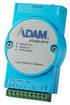 MODBUS TCP to RTU/ASCII Gateway User s Manual 1 INTRODUCTION... 1 1.1 FEATURES... 2 1.2 PRODUCT SPECIFICATIONS... 3 1.3 DEFAULT SETTINGS... 4 2 MAKING THE HARDWARE CONNECTIONS... 5 2.1 POWER CONNECTION...
SETUP GUIDE SNMP ALARM ADAPTOR COMPATIBLE WITH SIGMA, RADIAN, TPCMQ, auro-he & BLUEstreak POWER SHELVES
 SNMP ALARM ADAPTOR COMPATIBLE WITH SIGMA, RADIAN, TPCMQ, auro-he & BLUEstreak POWER SHELVES www.unipowerco.com 2014 UNIPOWER LLC All Rights Reserved NORTH AMERICA 3900 Coral Ridge Drive, Coral Springs,
User s Manual TCP/IP TO RS-232/422/485 CONVERTER. 1.1 Introduction. 1.2 Main features. Dynamic DNS
 MODEL ATC-2000 TCP/IP TO RS-232/422/485 CONVERTER User s Manual 1.1 Introduction The ATC-2000 is a RS232/RS485 to TCP/IP converter integrated with a robust system and network management features designed
TDP43ME NetPS. Network Printer Server. Control Center. for Ethernet Module
 Panduit Corp. 2010 TDP43ME NetPS PA26306A01 Rev. 01 11-2010 Network Printer Server Control Center for Ethernet Module NOTE: In the interest of higher quality and value, Panduit products are continually
How To Check If Your Router Is Working Properly
 Chapter 6 Using Network Monitoring Tools This chapter describes how to use the maintenance features of your RangeMax Dual Band Wireless-N Router WNDR3300. You can access these features by selecting the
Voice Over Internet Protocol (VoIP) Configuration
 (VoIP) Configuration ENGINEERING REPORT No: 02-003 Introduction This report describes interfacing the IPCS VoIP Gateway Model EGW-902 to an ESTeem Model 192E Wireless Ethernet radio modem in a demonstration
Prestige 650R-31/33 Read Me First
 Prestige 650R-31/33 Read Me First Prestige Rear Panel Connections PORT DSL CONSOLE LAN 10/100M POWER Connect to a telephone jack using a telephone wire. CONNECTION Connect to a serial port (COM port) on
Starting a Management Session
 Management Software AT-S63 Starting a Management Session AT-S63 Version 2.2.0 for the AT-9400 Layer 2+ Switches AT-S63 Version 3.0.0 for the AT-9400 Basic Layer 3 Switches 613-000817 Rev. A Copyright 2007
Ethernet Port Quick Start Manual
 Ethernet Port Quick Start Manual THIS MANUAL CONTAINS TECHNICAL INFORMATION FOR THE ETHERNET PORT OF EDI SIGNAL MONITORS with Ethernet Version 1.5 firmware. DETAILS OF THE ECCOM OPERATION ARE DESCRIBED
Prestige 623R-T. Quick Start Guide. ADSL Dual-link Router. Version 3.40
 Prestige 623R-T ADSL Dual-link Router Quick Start Guide Version 3.40 February 2004 Introducing the Prestige The Prestige 623R-T ADSL Dual-link Router is the ideal all-in-one device for small networks connecting
One Port Serial Server Users Manual Model ESP901, ESP901E
 One Port Serial Server Users Manual Model ESP901, ESP901E Documentation Number: ESP901-2303 International Headquarters B&B Electronics Mfg. Co. Inc. 707 Dayton Road -- P.O. Box 1040 -- Ottawa, IL 61350
User s Manual UPS SERIES. Network Interface Card UPS-IPCARD. I-00453 Rev B
 User s Manual UPS SERIES Network Interface Card UPS-IPCARD I-00453 Rev B TABLE OF CONTENTS INTRODUCTION............................................................. 3-4 INSTALLATION GUIDE.......................................................
Debugging Network Communications. 1 Check the Network Cabling
 Debugging Network Communications Situation: you have a computer and your NetBurner device on a network, but you cannot communicate between the two. This application note provides a set of debugging steps
Setup Manual and Programming Reference. RGA Ethernet Adapter. Stanford Research Systems. Revision 1.05 (11/2010)
 Setup Manual and Programming Reference Stanford Research Systems Revision 1.05 (11/2010) Certification Stanford Research Systems certifies that this product met its published specifications at the time
To perform Ethernet setup and communication verification, first perform RS232 setup and communication verification:
 PURPOSE Verify that communication is established for the following products programming option (488.2 compliant, SCPI only): DCS - M9C & DCS M130, DLM M9E & DLM-M9G & DLM M130, DHP - M9D, P series, SG,
Wireless Router Setup Manual
 Wireless Router Setup Manual NETGEAR, Inc. 4500 Great America Parkway Santa Clara, CA 95054 USA 208-10082-02 2006-04 2006 by NETGEAR, Inc. All rights reserved. Trademarks NETGEAR is a trademark of Netgear,
Starting Guide - Poseidon 3265 First steps for remote monitoring with Poseidon & GSM
 Poseidon 3265 starting guide Poseidon 3265 Starting Guide - Poseidon 3265 First steps for remote monitoring with Poseidon & GSM 1) Connecting Poseidon 3265 1.1) Check DIP switches settings. For installation
Industrial L2+ Managed Gigabit/ 10 Gigabit Ethernet Switch. IGS-5225 Series. Quick Installation Guide
 Industrial L2+ Managed Gigabit/ 10 Gigabit Ethernet Switch IGS-5225 Series Quick Installation Guide Table of Contents 1. Package Contents... 3 2. Requirements... 4 3. Wiring DC Power Inputs... 5 4. Terminal
Chapter 3 Connecting the Router to the Internet
 Chapter 3 Connecting the Router to the Internet This chapter describes how to set up the router on your Local Area Network (LAN) and connect to the Internet. It describes how to configure your DG834GT
Chapter 3 Management. Remote Management
 Chapter 3 Management This chapter describes how to use the management features of your ProSafe 802.11a/g Dual Band Wireless Access Point WAG102. To access these features, connect to the WAG102 as described
Broadband Router ESG-103. User s Guide
 Broadband Router ESG-103 User s Guide FCC Warning This equipment has been tested and found to comply with the limits for Class A & Class B digital device, pursuant to Part 15 of the FCC rules. These limits
External Storage 200 Series. User s Manual
 External Storage 200 Series User s Manual Version 1.2 00P3DS200ZSEA2 Table of Contents User s Manual 1. Overview...3 2. Key Features...3 3. Rear Connectors...4 4. Setup the External Storage 200...4 5.
USER S GUIDE Switched Rack PDU
 Contents Introduction--1 Product Description....................................... 1 Access Procedures....................................... 3 Recover From a Lost Password..............................
Network Management Card
 Network Management Card Installation manual IP= MAC=00E0D8FF855E Reset 100 10 data Card Settings 1 2 RS232 Download ETHERNET RS232 66074 34003641EN/AG - Page 1 1 2 1 2 Quick start ASI or STS U-Talk ASI
UPS Network Interface. Quick InstallationGuide
 UPS Network Interface Quick InstallationGuide Version 1.1 March 1999 COPYRIGHT Copyright 1999 RINGDALE UK Limited. All rights reserved. No part of this publication may be reproduced, transmitted, transcribed,
SIP Proxy Server. Administrator Installation and Configuration Guide. V2.31b. 09SIPXM.SY2.31b.EN3
 SIP Proxy Server Administrator Installation and Configuration Guide V2.31b 09SIPXM.SY2.31b.EN3 DSG, DSG logo, InterPBX, InterServer, Blaze Series, VG5000, VG7000, IP590, IP580, IP500, IP510, InterConsole,
PePWave Surf Series PePWave Surf Indoor Series: Surf 200, AP 200, AP 400
 PePWave Surf Series PePWave Surf Indoor Series: Surf 200, AP 200, AP 400 PePWave Surf Outdoor Series: Surf AP 200/400-X, PolePoint 400-X, Surf 400-DX User Manual Document Rev. 1.2 July 07 COPYRIGHT & TRADEMARKS
Network Management Card. Installation and Quick Start Manual
 Network Management Card Installation and Quick Start Manual Radio frequency interference Changes or modifications to this unit not expressly approved by the party responsible for compliance could void
Ethernet Radio Configuration Guide
 Ethernet Radio Configuration Guide for Gateway, Endpoint, and Repeater Radio Units April 20, 2015 Customer Service 1-866-294-5847 Baseline Inc. www.baselinesystems.com Phone 208-323-1634 FAX 208-323-1834
Welcome. Unleash Your Phone
 User Manual Welcome Unleash Your Phone For assistance with installation or troubleshooting common problems, please refer to this User Manual or Quick Installation Guide. Please visit www.vonage.com/vta
Phone Adapter. with 2 Ports for Voice-over-IP. Installation and Troubleshooting Guide. Model No. PAP2 Ver. 2. Voice
 Phone Adapter with 2 Ports for Voice-over-IP Voice Installation and Troubleshooting Guide Model No. PAP2 Ver. 2 Copyright and Trademarks Specifications are subject to change without notice. Linksys is
Management Software. User s Guide AT-S84. For the AT-9000/24 Layer 2 Gigabit Ethernet Switch. Version 1.1. 613-000368 Rev. B
 Management Software AT-S84 User s Guide For the AT-9000/24 Layer 2 Gigabit Ethernet Switch Version 1.1 613-000368 Rev. B Copyright 2006 Allied Telesyn, Inc. All rights reserved. No part of this publication
SNMP Web card. User s Manual. Management Software for Uninterruptible Power Supply Systems
 SNMP Web card User s Manual Management Software for Uninterruptible Power Supply Systems Table of Contents 1. Overview... 3 1.1 Introduction... 3 1.2 Features... 3 1.3 Overlook... 3 1.4 Installation and
Connecting the DG-102S VoIP Gateway to your network
 Contents of Package: DG-102S VoIP Station Gateway Power adapter CD-ROM, including User s Manual Quick Install Guide Requirements: RS-232 Console Cable Two RJ-45 CAT-5 Straight-Through Cables For more information
SNMP-NET UPS SNMP Card (Web-Based monitoring SNMP Card)
 UPS SNMP Card (Web-Based monitoring SNMP Card) User s Manual PN: 34000281 R1 Table of Contents Chapter 1 Introduction...3 Features...3 System Application...3 Chapter 2 Installation...4 SNMP-NET Chapter
Connecting to the Internet. LAN Hardware Requirements. Computer Requirements. LAN Configuration Requirements
 Connecting to the Internet LAN Hardware Requirements Computer Requirements LAN Configuration Requirements Installation Performed by Time Warner Cable Technician Connecting via Ethernet Connecting via USB
USER GUIDE. Ethernet Configuration Guide (Lantronix) P/N: 2900-300321 Rev 6
 KRAMER ELECTRONICS LTD. USER GUIDE Ethernet Configuration Guide (Lantronix) P/N: 2900-300321 Rev 6 Contents 1 Connecting to the Kramer Device via the Ethernet Port 1 1.1 Connecting the Ethernet Port Directly
Network Power Manager. User Manual
 Network Power Manager User Manual Table of Contents 1. Introduction... 1 2. PDU Package... 2 3. Function... 3 4. Installation... 4 5. Web Interface... 5 1. Introduction The PDU is an Internet ready device
Intraplex T1 CrossConnect System & Server Installation and Operation Manual Issue 1.1, December 2001
 Intraplex T1 CrossConnect System & Server Installation and Operation Manual Copyright 2000 by. All rights reserved. Reproduction, adaptation, or translation without prior written permission is prohibited,
SOHO 6 Wireless Installation Procedure Windows 95/98/ME with Internet Explorer 5.x & 6.0
 SOHO 6 Wireless Installation Procedure Windows 95/98/ME with Internet Explorer 5.x & 6.0 Before You Begin Before you install the SOHO 6 Wireless, you must have: A computer with a 10/100BaseT Ethernet card
Prestige 324. Prestige 324. Intelligent Broadband Sharing Gateway. Version 3.60 January 2003 Quick Start Guide
 Prestige 324 Intelligent Broadband Sharing Gateway Version 3.60 January 2003 Quick Start Guide 1 Introducing the Prestige The Prestige is a broadband sharing gateway with a built-in four-port 10/100 Mbps
Legal Disclaimers. For C-UL Listed applications, the unit shall be installed in accordance with Part 1 of the Canadian Electrical Code.
 ACS5000 Networking Admin Interface Guide 1/21/2015 Legal Disclaimers Federal Communications Commission (FCC) Compliancy This equipment has been tested and found to comply with the limits for a Class B
Link Link sys E3000 sys RE1000
 User Guide High Performance Extender Wireless-N Router Linksys Linksys RE1000 E3000Wireless-N Table of Contents Contents Chapter 1: Product Overview 1 Front 1 Top 1 Bottom 1 Back 2 Chapter 2: Advanced
Alarm Messages... 15 Clearing the Hardware Alarms... 16. How to Log On... 17 Summary Page... 21 Navigation Menu... 24
 Contents Introduction--1 Product Description.................................. 1 Access Procedures................................... 3 How to Recover from a Lost Password..................... 6 Upgrading
Chapter 4 Management. Viewing the Activity Log
 Chapter 4 Management This chapter describes how to use the management features of your NETGEAR WG102 ProSafe 802.11g Wireless Access Point. To get to these features, connect to the WG102 as described in
ISDNLink INET-800 ISDN Router User s Guide
 ISDNLink INET-800 ISDN Router User s Guide FCC Statement: This device complies with Part 15 of the FCC Rules. Operation is subject to the following two conditions: (1) This device may not cause harmful
PREFACE http://www.okiprintingsolutions.com 07108001 iss.01 -
 Network Guide PREFACE Every effort has been made to ensure that the information in this document is complete, accurate, and up-to-date. The manufacturer assumes no responsibility for the results of errors
Prestige 324 Quick Start Guide. Prestige 324. Intelligent Broadband Sharing Gateway. Version V3.61(JF.0) May 2004 Quick Start Guide
 Prestige 324 Intelligent Broadband Sharing Gateway Version V3.61(JF.0) May 2004 Quick Start Guide 1 1 Introducing the Prestige The Prestige is a broadband sharing gateway with a built-in four-port 10/100
Title Page Web/SNMP Management SmartSlot Card
 Title Page Web/SNMP Management SmartSlot Card AP9606 User s Guide Thank You! Thank you for selecting the APC Web/SNMP Management SmartSlot Card. It has been designed for many years of reliable, maintenance-free
Installation and Operation Guide
 www.aja.com Quick Start Guide Introduction This Quick Start Guide provides a basic overview of KUMO configuration. It is not meant as a substitute for the detailed information found in the KUMO Manual,
Network Management Card. User Manual
 User Manual 1 Contents Contents 2 Chapter 1 Overview 3 1.1 NMC package contents 4 1.2 NMC CD Resources 4 1.3 Features 4 1.4 NMC Applications 5 Chapter 2 NMC parameters setting via serial COM port 6 2.1
8/16-Port IP KVM Switch IKVM-8010 / IKVM-16010. Quick Installation Guide
 8/16-Port IP KVM Switch IKVM-8010 / IKVM-16010 Quick Installation Guide Table Of Contents Chapter 1 Introduction... 3 1.1 Features... 3 1.2 Package Contents... 4 1.3 Technical Specifications... 4 Chapter
P-2024. Quick Start Guide. VoIP Analog Telephone Adaptor DEFAULT LOGIN. IP Address http://192.168.5.1 Password 1234. Version 3.60 7/2007 Edition 1
 P-2024 VoIP Analog Telephone Adaptor Quick Start Guide Version 3.60 7/2007 Edition 1 DEFAULT LOGIN IP Address http://192.168.5.1 Password 1234 Copyright 2007. All rights reserved. Overview Use your P-2024
RN-XV-RD2 Evaluation Board
 RN-XV-RD2 Evaluation Board 2012 Roving Networks. All rights reserved. -1.01Version 1.0 9/28/2012 USER MANUAL OVERVIEW This document describes the hardware and software setup for Roving Networks RN-XV-RD2
How To Check If Your Router Is Working Properly On A Nr854T Router (Wnr854) On A Pc Or Mac) On Your Computer Or Ipad (Netbook) On An Ipad Or Ipa (Networking
 Chapter 7 Using Network Monitoring Tools This chapter describes how to use the maintenance features of your RangeMax NEXT Wireless Router WNR854T. These features can be found by clicking on the Maintenance
Network Management Card
 Network Management Card AP9617 AP9618 AP9619 Installation and Quick-Start Manual How to Avoid Equipment Damage Disconnect UPS power You do not need to turn off a Symmetra or a Silcon model UPS to install
EMG Ethernet Modbus Gateway User Manual
 EMG Ethernet Modbus Gateway User Manual Rev 2.2 07/2010 CONTENTS 1. Introduction 1.1. General Features 1.2 Installing the Drivers 2. Configuration 2.1 Main Device Parameters 2.1.1 RS485 Serial Communication
Nokia Siemens Networks. CPEi-lte 7212. User Manual
 Nokia Siemens Networks CPEi-lte 7212 User Manual Contents Chapter 1: CPEi-lte 7212 User Guide Overview... 1-1 Powerful Features in a Single Unit... 1-2 Front of the CPEi-lte 7212... 1-2 Back of the CPEi-lte
GV-Data Capture V3 Series User's Manual
 GV-Data Capture V3 Series User's Manual Before attempting to connect or operate this product, please read these instructions carefully and save this manual for future use. 2006 GeoVision, Inc. All rights
Unpacking the Product. Rack Installation. Then, use the screws provided with the equipment rack to mount the firewall in the rack.
 About This Guide This guide contains step-by-step instructions for setting up the D-Link DFL-260E/860E Firewall. Please note that the model you have purchased may appear slightly different from those shown
HP ProCurve Manager Plus
 HP ProCurve Manager Plus Getting Started Guide The all-in-one solution for managing HP ProCurve networks HP ProCurve Manager Plus Getting Started Guide Copyright 2003 Hewlett-Packard Development Company,
Chapter 7 Troubleshooting
 Chapter 7 Troubleshooting This chapter provides troubleshooting tips and information for your ProSafe VPN Firewall 200. After each problem description, instructions are provided to help you diagnose and
BioStar Config Guide V1.0
 BioStar Config Guide V1.0 Suprema Inc. 16F Parkview Tower 6 Jeongja, Bundang Seongnam 463-863 Korea www.supremainc.com Last edited: 27 December 2011 This document is copyright 27 December 2011 by Suprema
Dell Network Management Card. User's Guide. w w w. d e l l. c o m s u p p o r t. d e l l. c o m
 Dell Network Management Card User's Guide w w w. d e l l. c o m s u p p o r t. d e l l. c o m Notes and Warnings NOTE: A NOTE indicates important information that helps you make better use of your software.
Using Cisco UC320W with Windows Small Business Server
 Using Cisco UC320W with Windows Small Business Server This application note explains how to deploy the Cisco UC320W in a Windows Small Business Server environment. Contents This document includes the following
SecureLinx Spider Duo Quick Start Guide
 SecureLinx Spider Duo Quick Start Guide SecureLinx Spider Duo Quick Start Guide SecureLinx Spider Duo QUICK START GUIDE CONTENTS Overview... 2 What s In The Box... 3 Installation and Network Settings...
Agilent Technologies. Connectivity Guide. USB/LAN/GPIB Interfaces. Agilent Technologies
 Agilent Technologies USB/LAN/GPIB Interfaces Connectivity Guide Agilent Technologies Notices Agilent Technologies, Inc. 2003, 2004 No part of this manual may be reproduced in any form or by any means (including
Knowledge Base Article. Integrating ISONAS Access Control System with TagMaster LR-series RFID Readers
 Knowledge Base Article Integrating ISONAS Access Control System with TagMaster LR-series RFID Readers Copyright 2009-2012, ISONAS Security Systems All rights reserved Table of Contents 1: INTRODUCTION...
Product Description... 1 Internal Management Features... 3 Front Panel... 5 Watchdog Features... 7
 Contents Introduction--1 Product Description.................................. 1 Internal Management Features........................... 3 Front Panel........................................ 5 Watchdog
c. Securely insert the Ethernet cable from your cable or DSL modem into the Internet port (B) on the WGT634U. Broadband modem
 Start Here Follow these instructions to set up your router. Verify That Basic Requirements Are Met Assure that the following requirements are met: You have your broadband Internet service settings handy.
ADSL MODEM. User Manual V1.0
 ADSL MODEM User Manual V1.0 CONTENTS 1.OVERVIEW... 3 1.1 ABOUT ADSL... 3 1.2 ABOUT ADSL2/2+... 3 1.3 FEATURES... 3 2 SPECIFICATION... 4 2.1 INTERFACE INTRODUCTION... 4 2.1.1 INDICATOR AND INTERFACE...
Expert Power Control NET 4x 8212 / 8213
 2010 Gude Analog- und Digitalsysteme GmbH 2010 Gude Analog- und Digitalsysteme GmbH 23.08.2010 Content 3 Table of content Kapitel 1 Security Advise 5 Kapitel 2 Description 5 Kapitel 3 Hardware 6 3.1 Content
How To Use A Modem On A Pc Or Mac Or Ipad (For A Laptop)
 CLEAR MODEM with Wi-Fi USER GUIDE GET TO KNOW YOUR CLEAR MODEM WITH WI-FI 3 WHAT S IN THE BOX? 3 INFORMATIVE LED INDICATORS 3 USE WITH CARE 3 SET UP THE MODEM 4 PLACE THE MODEM ON A FLAT, STABLE SURFACE
Trouble Shooting SiteManager to GateManager access via a corporate Intranet
 Trouble Shooting SiteManager to GateManager access via a corporate Intranet If you are unsure if a SiteManager will be able to access the GateManager through the corporate firewall, or you experience connection