
The 2002 Development Regulations. The City of Sugar Hill, Georgia
|
|
|
- Kerry Griffin
- 10 years ago
- Views:
Transcription
1 The 2002 Development Regulations The City of Sugar Hill, Georgia

2 Table of Contents TABLE OF CONTENTS Article Page 1 AUTHORITY, TITLE, PURPOSE AND INTENT Authority and Title Purpose Intent and Application Agricultural Exemption DEFINITIONS Use of Words and Interpretation Definitions of Words and Phrases APPLICATION OF THE REGULATIONS Application Dedication of Public Lands and Facilities Transfer of Land Ownership Conditions applicable to title transfers Sale of land by reference to unapproved Final Plat prohibited Subdivision Exemptions General requirements Recombinations Minor subdivisions Estate subdivisions Nonresidential project management Amnesty lots PERMITS REQUIRED FOR DEVELOPMENT OR CONSTRUCTION Authorization Required for Land Disturbance or Development Activities Permit required: exemptions Plan review and approval Chattahoochee River Corridor Certificate Interdepartmental review and approval Activities limited to permit authorization Developer's responsibility for compliance City of Sugar Hill 1

3 Table of Contents Permit for Lots Platted Ten Years Previous to Permit Application Land Disturbance Permits Clearing Permit, Clearing and Grubbing Permit, and Grading Permit Development Permit Building Permits Applicable codes Health Department: on-site Sewage Disposal Single-family and duplex residences Swimming pools Multi-family and nonresidential structures Issuance on buildable lots of record: exceptions GENERAL REQUIREMENTS Suitability of the Land Unsuitable land may not be developed Unsuitable land must be included in buildable lots Offers of Land Dedication Incorporation of public land area into buildable lots Zoning and Other Regulations Discrepancy between minimum standards: What Applies Building setback Conformity Required Public Improvements General requirements Lots Lots to conform to the Zoning Resolution Double frontage and reverse frontage lots required along major thoroughfares Survey Monuments Lot corner monumentation Floodplain elevations City of Sugar Hill 2

4 Table of Contents 5.7 Standard Drawings Department to maintain standard drawings on file Standard drawings to illustrate standards Standard drawings incorporated as part of Development Regulations Buffers, Landscaping Tree Preservation and Tree Replacement General applicability General requirements Tree Preservation and Replacement Requirements Landscaping performance surety Recreation Areas Recreation Areas Size of Swimming Pools Open Space ACCESS AND RIGHT-OF-WAY REQUIREMENTS; AND STREET IMPROVEMENT AND CONSTRUCTION REQUIREMENTS Access Large parcels to provide future street access Landlocking of adjacent property prohibited Minimum lot frontage required Private streets to be constructed pursuant to roadway construction standards Vehicular access easements Streets Dedication of street right-of-way Street improvements Minimum Right-of-Way and Street Improvements Right-of-way and pavement widths TABLE 6-A Minimum Right-of-way and Road way Widths for New Streets and Widenings Street rights-of-way Street widenings - single family detached residential subdivisions City of Sugar Hill 3

5 Table of Contents Street widenings - single family attached multi-family, and nonresidential developments New streets Substandard streets Improvements along state highways General Layout Requirements Conformance to Comprehensive Plan Local streets and minor collectors Cul-de-sac streets Other dead end streets Service roads Half-streets Reserve strips Alleys Street jogs Traffic Control Devices Traffic control signals Street name signs Traffic signals and signs Striping requirements Payment of fees Street lights Specifications Subgrade Preparation for All Streets Subgrade in accordance with Georgia DOT and these Regulations Removal of unsuitable material Compaction Brought to line and grade Utility trenches to be compacted Roll testing required Temporary traffic surface Provisions to drain low points Project Access Improvement Standards Sections wider than 4 feet in width Sections less than 4 feet in width City of Sugar Hill 4
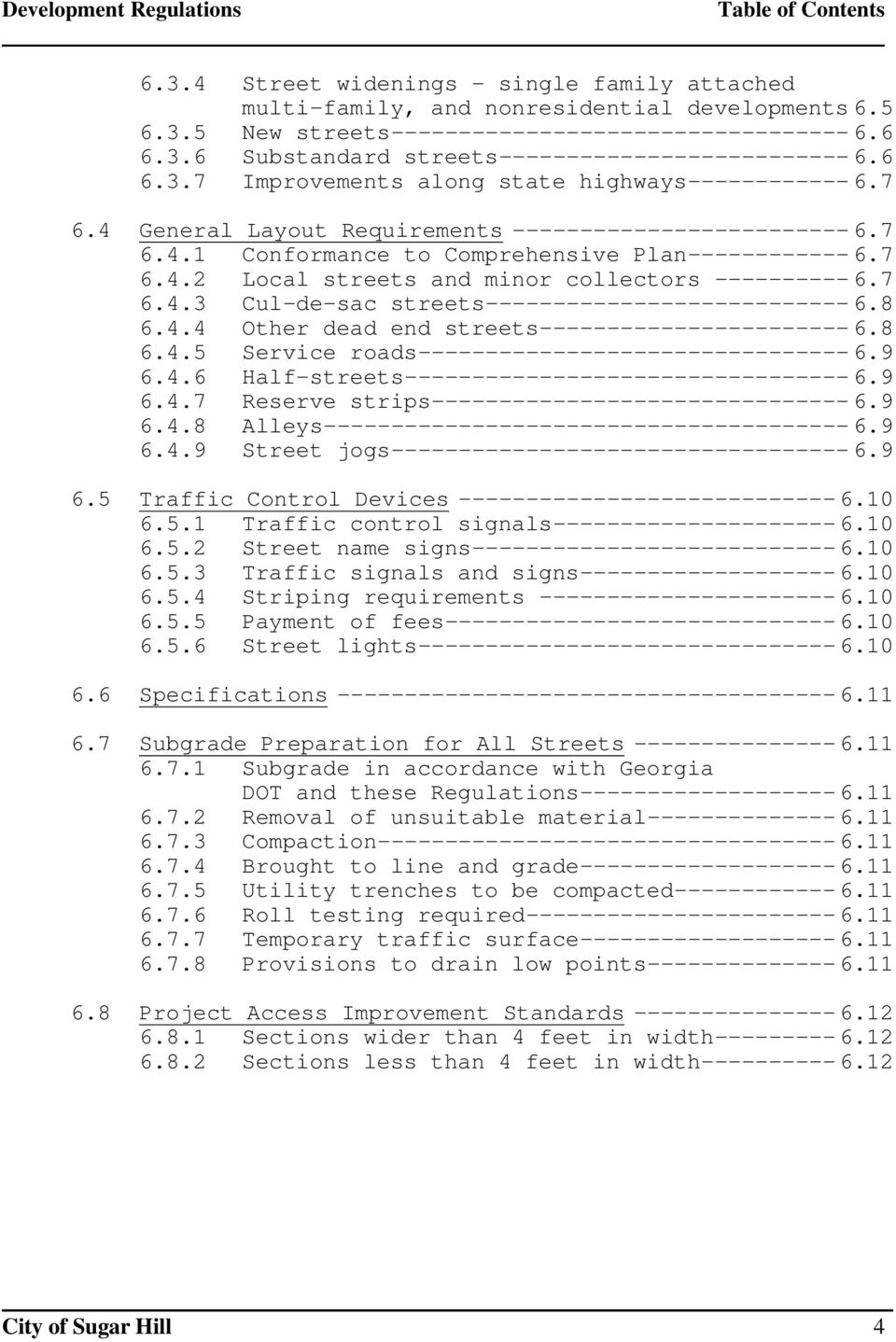
6 Table of Contents 6.9 New Local and Minor Collector Streets New local and minor streets within a residential subdivision Local residential-rural roads Nonresidential subdivision or development streets New Major Thoroughfares Construction standards: Major Thoroughfares TABLE 6-B Construction Standards - Major Thoroughfares Curb and Gutter Curb and gutter required Residential curbing Industrial or commercial curbing Principal arterial and major arterial curbing Construction methods Underground Utilities Installation and compaction required before pavement or base After base installed, utilities to be bored Manholes flush with finished grade Standard drawings apply Sidewalks When required Design Standards Installation Deadlines UTILITIES AND EASEMENTS Placement of Utilities Underground utilities to be in right-of-way or easement Private underground utilities require Department approval if in the right-of-way Water System and Fire Hydrants Connection of public water main required City of Sugar Hill 5
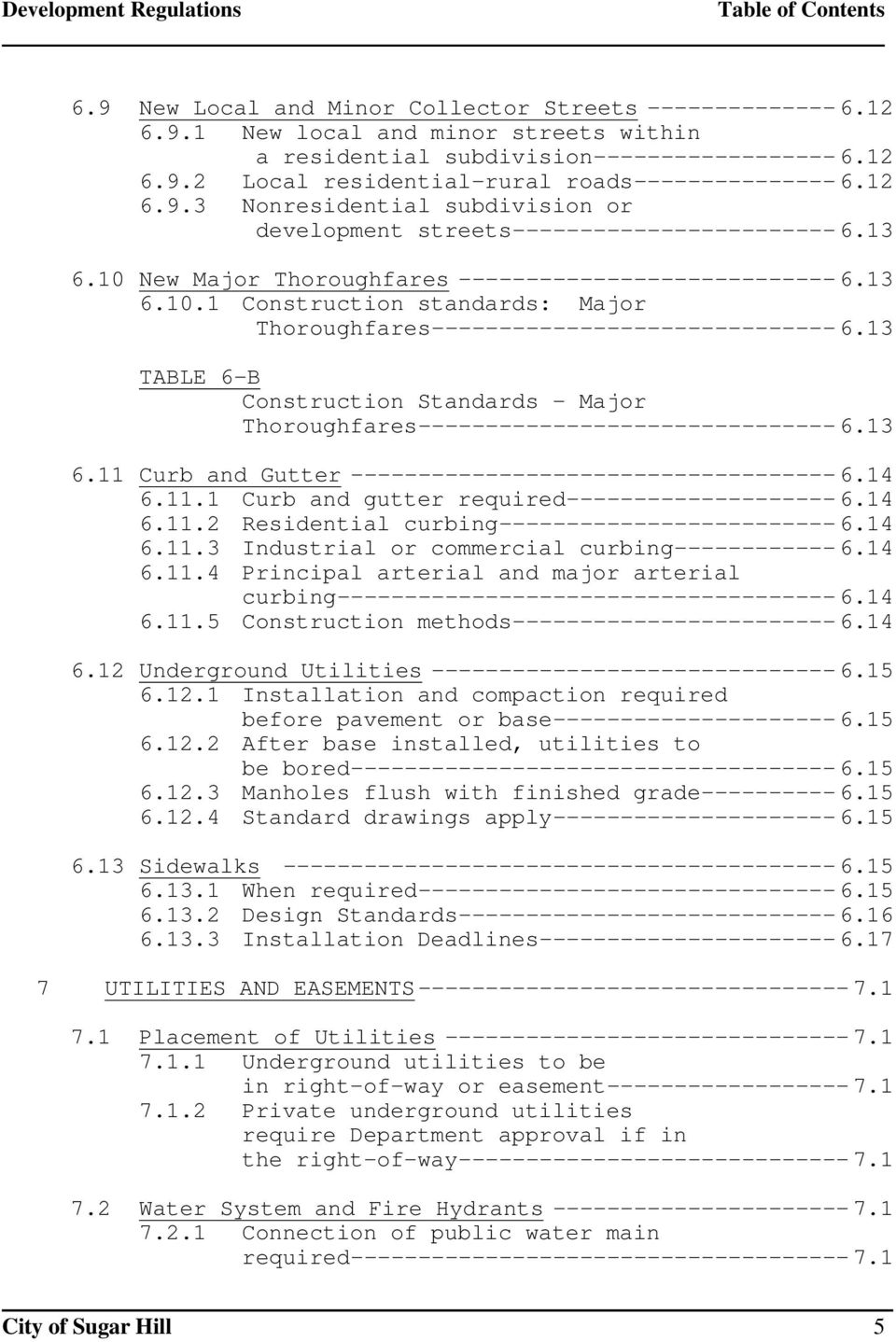
7 Table of Contents Water, fire hydrants, etc., to be designed according to applicable standards, and plans and specifications Water mains to be installed after curbs but before paving Sanitary Sewage Disposal Connection to sewage disposal system required If sewer is available, septic not allowed Septic field must be located out of the 100 year floodplain Health Department notations on plats Easements Dedication requirement Cleared, opened, and stabilized TABLE 7-A Easements for Storm Drain Pipes and Improved Ditches Width of permanent sanitary sewer easements Provision for common sanitary/drainage easement Watercourse easements Off street right-of-way easements Cleared easements to be grassed Street Cuts Review and approval by the Department Fees required Trenches to be backfilled Trenches under paving Utility extension contact information SITE GRADING, STORMWATER DETENTION, CULVERTS AND PIPED DRAINAGE SYSTEMS AND SOIL SEDIMENT CONTROL REQUIREMENTS Site Grading Compliance with line and grade required Contour interval of 2 feet required Consistent with Metropolitan River Protection Act Embankment layering City of Sugar Hill 6

8 Table of Contents Maximum slopes Special conditions for soil with low shearing resistance and cohesion Slopes greater than 4% Mass grading plans Grading for roads and improved ditches Stormwater Detention Stormwater management report required Storm detention required Detention design criteria - general Detention facility location criteria Detention facility easement requirements Detention facility maintenance Detention facility construction standards Detention facility engineer's certification and record drawings Culverts and Piped Drainage Systems Drainage improvements required Standard specifications Design criteria general Design criteria - culverts Piped collection systems Energy dissipation Minimum pipe and pipe coating Pipe length Pipe installation End finish Junction boxes and catch basins Other structures Surface Drainage Design standards Construction standards Erosion Control Design Control Construction standards Abandoned projects Dams New Dams which become subject to the Requirements of the Georgia Safe Dams Act and and Rules for Safety New Dams Subject to Sugar Hill Existing Dams Existing Category II Dams City of Sugar Hill 7
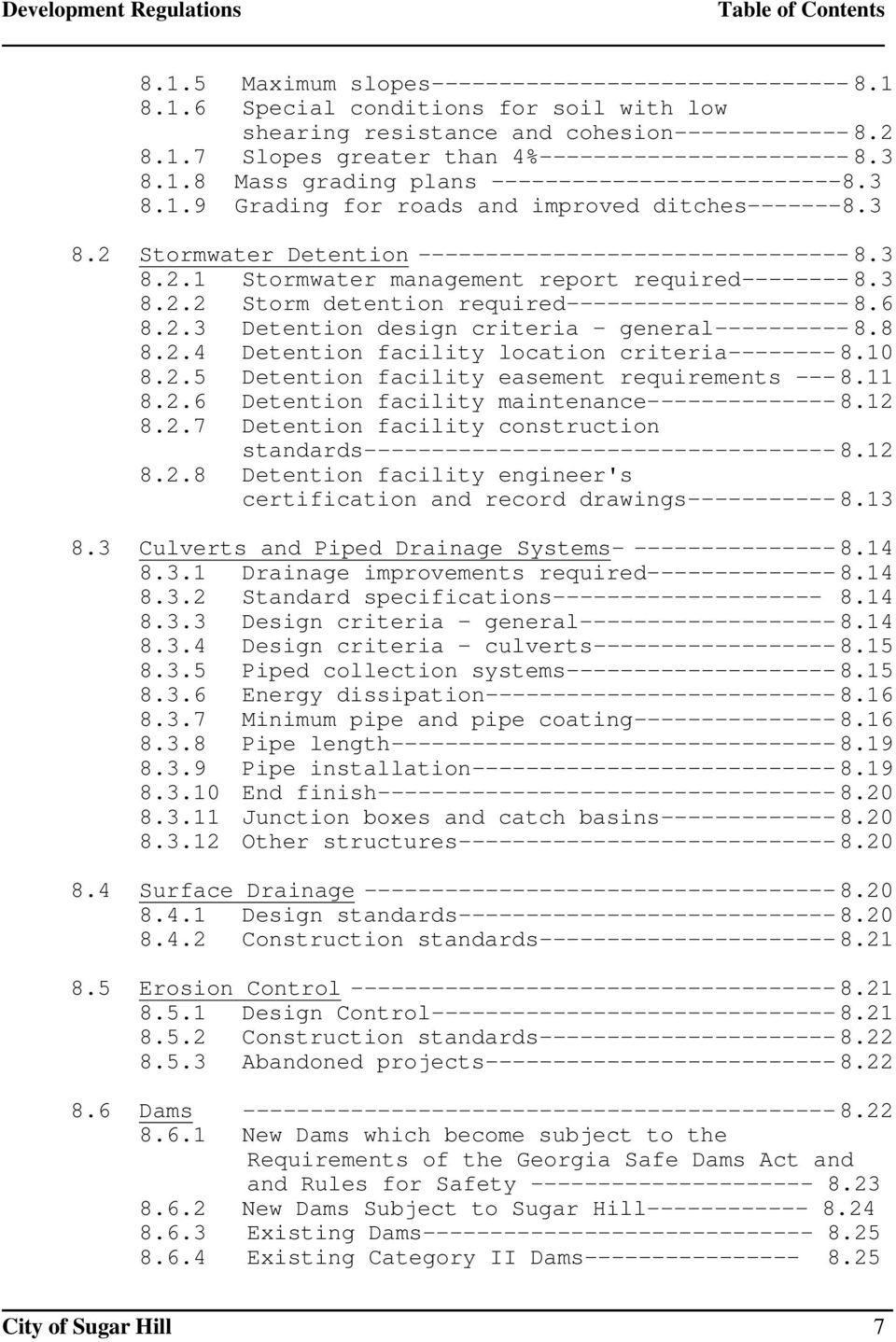
9 Table of Contents 8.7 Extended Detention Wet Extended Detention Facility Design Requirements Dry Extended Detention Facilities Stream Buffers and Impervious Surface Setbacks Wet and Extended Detention Facility Maintenance RESERVED 8.8 Water Quality Best Management Practices Treatment of Runoff Facility Location Criteria Easement Requirements Facility Maintenance Facility Certification and Record Drawings Existing Subdivisions Without Regional Water Quality Existing Subdivisions Without Regional Water Quality Facilities Retrofitting of Existing Detention Facilities for Water Quality Treatment Retrofitting of Existing Water Quality Facilities Redevelopment and Improvements PERFORMANCE GUIDELINES General Purpose Constraints Documentation required Lots Lot design, HLP, RDP, RDS Side lot lines Corner lots Blocks Length, width, and shape Pedestrian access Access Roadway Design Street grades and design speeds City of Sugar Hill 8
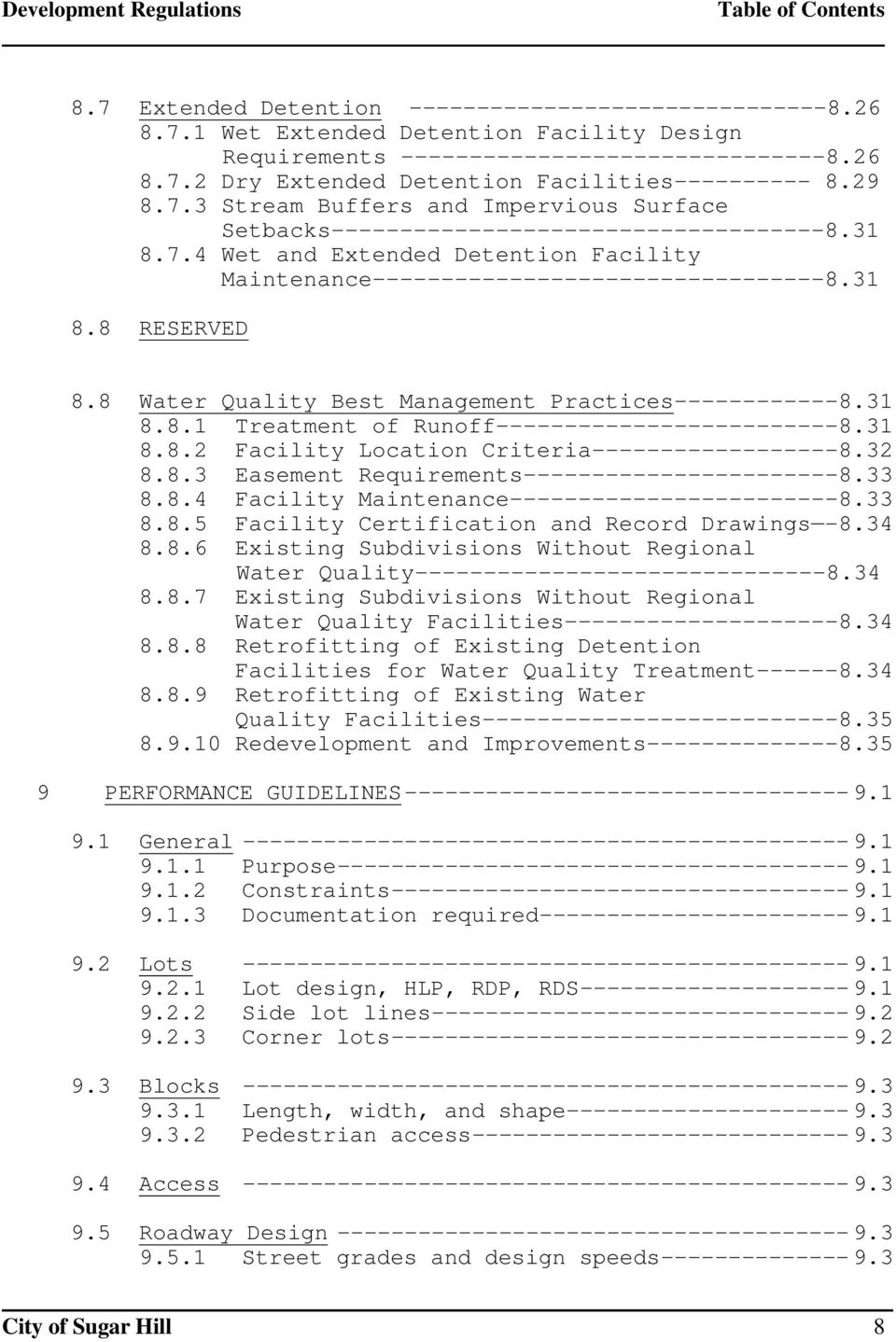
10 Table of Contents TABLE 9-A Minimum Design Speed and Maximum Grades Vertical street alignment TABLE 9-B Constant (K) values for vertical curves Horizontal street alignment TABLE 9-C Horizontal curves TABLE 9-D Tangents Horizontal and vertical clearances Street Intersections Angle of intersection Maximum grade Intersection approaches: horizontal Intersection approaches: vertical TABLE 9-E Approach distances at major intersections Intersection radii TABLE 9-F Intersection Radii Islands Intersection corner sight distances Obstructing visibility at intersections Turning lanes at intersections Driveway Intersections Angle and improvements Driveway design standards Auxiliary lanes Corner sight distance Separation and spacing Stormwater Detention Guidelines General Dam design and construction criteria City of Sugar Hill 9

11 Table of Contents Detention facility outlet devices Emergency overflow requirements Parking lot detention facility Underground and rooftop detention Sediment basins Ponds and lakes not used for detention Culverts and Pipe Collection System Guidelines Culverts Piped collection systems Outlet location - culverts and piped systems Energy dissipation Discharge of concentrated flows TABLE 9-G Maximum Flows into Streets Site Lighting Guidelines PLAN AND PLAT SPECIFICATIONS Concept Plan Specifications Size Freehand drawing (approximate scale) List of what is required to be shown Subdivision Development Plans What a Development Permit for a subdivision consists of Conformation to Concept Plan Scale Certified boundary survey List of what is required to be shown Certificate of development plans approval Other development plans to accompany Preliminary Plat Encroachments Final Plat Specifications Size Certified boundary survey Conformation to Preliminary Plat List of what is required to be shown Warranty Deed Property Owner's Association Certificates City of Sugar Hill 10

12 Table of Contents 10.4 House Location Plan (HLP) Size and description May be drawn by an individual List of what is to be shown Certificate of occupancy Residential Drainage Plan (RDP) Certified boundary survey required List of what is required to be shown Residential drainage study (RDS) Certificate of occupancy - conditions Certificate - department approval Site Development Plans What a development permit for a Site Plan consists of Conformation to Concept Plan Scale Project boundary data List of what is required to be shown Certificate of development plans approval Other development plans to accompany Site Plan Encroachments Public Notice - Drainage Tree Preservation/Replacement Plan Specifications When required In accordance with Buffer, Landscape and Tree Ordinance Buffer and Landscape Plan Specifications When required In accordance with Buffer, Landscape and Tree Ordinance PROCEDURES Subdivision Review Procedures Pre-application conference Concept plan approval Development plans approval for subdivisions Final Plat and Application Review Final Plat Approval Dedication (Acceptance) City of Sugar Hill 11

13 Table of Contents 11.2 Non-Subdivision Review Procedures Pre-application conference Concept plan approval Site development plans approval Certificate of Development Conformance approval process Assignment of Names and Addresses Subdivision or development names Street Names Street address assignments Initiation of Development Activities Initial activities required Tree protection areas Development inspections Responsibility for quality and design Stop work orders Stabilization for erosion control Approval of Development Conformance Prerequisite to Final Plat or C.O Submission requirements Approval Project Closeout and Continuing Maintenance Development Performance and Maintenance Agreement Maintenance Period, Subdivision Maintenance and Performance Surety Failure to complete or maintain Improvements FEES Fees Set by City Council Prerequisite to Issuance of Permit(s) Fees Nonrefundable Sanitary Sewer, Curb Cut, etc., Fees Traffic Control Fees Recording Fees City of Sugar Hill 12

14 Table of Contents 13 ADMINISTRATION, APPEAL, AND VIOLATIONS Administration Administered by City Manager City Manager Authorized to Suspend or Stop Work and Direct Corrections Regulations to be Published Modifications Appeal and Waiver of the Regulations Appeals Waivers Violation and Penalty Responsible party Court empowered to fine or imprison ADOPTION AND AMENDMENT Effective Date Effective on adoption Grandfather provisions: Development Permit application received prior to adoption Grandfather provisions: Development Permit issued prior to adoption Grandfather provisions: Clearing, Clearing and Grubbing, Grading Building Permits Amendments By City Council Grandfather provisions: Development Permit application received prior to adoption Grandfather provisions: Development Permit issued prior to adoption Grandfather provisions: Clearing, Clearing and Grubbing, Grading Building Permits Severability Conflicting Regulations City of Sugar Hill 13

15 Authority, Title, Purpose and Intent 1.1 AUTHORITY AND TITLE ARTICLE 1 AUTHORITY, TITLE, PURPOSE AND INTENT These rules and regulations are adopted under the authority of the Constitution of the State of Georgia and laws enacted pursuant thereto These regulations shall be known as "The 2002 Development Regulations of City of Sugar Hill, Georgia," and may be referred to generally as "The Development Regulations," or, as used herein, "these Regulations." 1.2 PURPOSE These regulations are intended to serve the following purposes: a. To protect and promote the public health, safety, and general welfare. b. To provide a system for the subdividing of lands and the accurate recording of land titles. c. To provide assurance that lots shown on recorded subdivision plats are usable by the purchasers for their intended and permitted functions. d. To encourage economically sound and orderly land development in accordance with the policies and objectives of the Comprehensive Plan of City of Sugar Hill. e. To assure the provision of required streets, utilities, and other facilities and services to new land developments in conformance with public improvement policies of the City. f. To assure adequate provision of safe and convenient traffic access and circulation, both vehicular and pedestrian, in new land developments. g. To assure the provision of needed open spaces and public facility sites in new land developments through the dedication or reservation for purchase of land for public purposes. h. To assure equitable review and approval of all subdivision and site plans by providing uniform procedures and standards for the developer. City of Sugar Hill 1.1

16 Authority, Title, Purpose and Intent 1.3 INTENT AND APPLICATION It is the intent of these regulations that they apply to and provide guidance for the development of any lands within the incorporated area of City of Sugar Hill, whether the development involves the subdivision of the land for sale to individual users or pertains only to the construction of buildings or other improvements on a single parcel. 1.4 AGRICULTURAL EXEMPTION Clearly agricultural uses, limited to the cultivation of the land, dairying or animal husbandry, are not intended to be governed by these regulations, provided that land proposed to be converted to a new agricultural use must be zoned AF to be exempt from the provisions herein. City of Sugar Hill 1.2

17 Definitions ARTICLE 2 DEFINITIONS 2.1 USE OF WORDS AND INTERPRETATION For the purposes of these Regulations, the following shall apply to the use of all words: a. When appropriate to the context, words used in the singular shall include the plural, and the plural the singular; words used in the present tense shall include the future tense, and vice versa. b. Words in the masculine gender shall include the feminine. c. The word "shall" is mandatory and not discretionary. d. The word "may" is permissive. e. Use of the word "and" is inclusive and requires that all of the component phrases so connected must be present or fulfilled for sufficiency. f. Use of the word "or" is not exclusive (as in "either... or"), and requires that at least one of the component phrases so connected must be present or fulfilled for sufficiency. The word "or" may allow more than one component phrase to be present or fulfilled, as is implied by the common term "and/or." The following shall control the interpretation of words and phrases as used in these Regulations: a. Words and phrases defined in this Article shall be interpreted as defined herein. b. Words or phrases not defined herein shall be interpreted as defined in the 1997 Zoning Ordinance of City of Sugar Hill, or as defined in the City's Soil Erosion and Sediment Control Ordinance; Buffer, Landscape, and Tree Ordinance; or Mobile Home Park Regulations, as applicable to the use of the word within the context of these Regulations. City of Sugar Hill 2.1

18 Definitions 2.2 DEFINITIONS OF WORDS AND PHRASES Certain words or phrases in these Regulations are defined for their use herein as follows: Alley or Service Drive - A minor, permanent, public service-way which is used primarily for vehicular service access to the back or the side for properties otherwise abutting on a street. Applicant - A person, either the owner or the bona fide representative of the owner of land or structures governed by these Regulations, who seeks authority to use, develop, construct upon or otherwise enjoy the use of property through any of the procedures established under these Regulations. Arterial - A Principal Arterial, Major Arterial, or Minor Arterial street as defined and designated in the Comprehensive Plan of City of Sugar Hill. "As-Built" Survey - See Record Drawing. "Base Flood" - The flood which has a one percent probability of occurring in any calendar year (i.e., the 100 year frequency flood). Base Flood Elevation - The highest water surface elevation anticipated at any given point during the base flood. Block - A piece or parcel of land entirely surrounded by public streets, other than alleys. Board of Commissioners - The Board of Commissioners of Gwinnett County, Georgia. Buildable Lot of Record - A lot or parcel of land which existed as a single parcel of ownership, recorded as such in its entirety and present boundaries with the Clerk to Superior Court prior to June 2, 1970, or which is shown in its entirety and present boundaries on a Final Plat or Exemption Plat duly approved under these or any previously applicable regulations providing for the subdivision of land in City of Sugar Hill and recorded with the Clerk to Superior Court of Gwinnett County. Building Setback Line - A line across a lot parallel to a street right-of-way or other property line establishing the minimum open space to be provided between any principal building and the street or other property line. All building setback lines shall be at least as restrictive as the corresponding minimum yard setbacks required in the Zoning Resolution. On corner lots, the minimum required front yard setback shall be provided along all abutting streets. Certificate of Development Conformance - Final approval issued by the City for completion of land development activities for a subdivision or project for which a Development Permit was issued. City of Sugar Hill 2.2

19 Definitions Certificate of Occupancy - Final approval by the Department for the use or occupancy of a structure for which a Building Permit was issued. City - City of Sugar Hill, Georgia, or the City Manager of the City or his designee to administer these regulations. City Council - The City Council of the City of Sugar Hill, Georgia. City Manager - City Manager of the City of Sugar Hill or his designee. Clearing - The removal of trees or other vegetation, but not including grubbing activities. Comprehensive Plan - A plan summarizing and illustrating the adopted goals and objectives of the City Council regarding the future location and character of anticipated land uses, transportation, and other public facilities in City of Sugar Hill. The term "Comprehensive Plan" includes component or functional plans for the City, including but not limited to a plan for land use (i.e., Land Use Plan) or a plan for transportation facilities, and includes the classification of streets and thoroughfares as shown on the adopted Long Range Road Classification Map. Concept Plan - A drawing which shows the overall concept (e.g., a concept plan) of a proposed development, and which may include lots and streets in a subdivision or the general location of buildings and improvements for a multi-family or non-residential project, and which may be drawn to approximate dimensions in a freehand style. Condominium - A form of property ownership in which the buildings or portions of the buildings, whether residential or non-residential in use, are owned by individuals separate from the lands which surround the buildings, said lands held in common ownership by the owners of the several buildings. County - Gwinnett County or the appropriate Gwinnett County Department affected. Cul-De-Sac - A street having one end open to traffic and being permanently terminated within the development by a vehicular turnaround. For the purpose of designation, a culde-sac street shall be interpreted to begin at the intersection of two or more streets nearest to the vehicular turnaround. Department - The Department of Planning and Development of City of Sugar Hill, Georgia. City of Sugar Hill 2.3
20 Definitions Department of Transportation - The Gwinnett County or State of Georgia Department of Transportation. Developer - Any person, individual, firm, partnership, association, corporation, estate, trust, or any other group or combination acting as a unit who directs the undertaking or purposes to undertake development activities as herein defined, whether the development involves the subdivision of the land for sale to individual users, the construction of buildings or other improvements on a single land ownership, or both. Development - 1. (verb) All activities associated with the conversion of land or the expansion or replacement of an existing use to any new use intended for human operation, occupancy or habitation, other than for agricultural purposes devoted strictly to the cultivation of the land, dairying or animal husbandry. Such activities include land disturbance (clearing and grubbing the land of vegetation and stumps, and grading) and the construction of improvements such as but not limited to streets, driveways or parking areas, water or sewer mains, storm water drainage facilities, sidewalks or other structures permanently placed on or in the property. 2. (noun) Where appropriate to the context, the term "development" also may be used to denote a specific subdivision or project which is a single entity or intended to be constructed as in interrelated whole, whether simultaneously or in phases. Development Agreement - A written contract between City of Sugar Hill and a property owner or developer that specifies the System Improvements to be provided by the developer for a specific project. Development Permit - An official authorization issued by the City permitting clearing, grubbing, grading, or construction of storm drainage facilities, access drives, streets, parking or other improvements exclusive of buildings. Development Plans - The detailed and professional plans showing the layout and design, site work and construction activities proposed for a project (other than architectural building plans) and including the Preliminary Plat or Site Plan (as applicable), Grading Plan, Tree Preservation/Replacement Plan, Erosion and Sediment Control Plan, Buffer and Landscape Plan, and construction drawings for streets, storm water drainage facilities, sanitary sewers, water supply facilities, and other site improvements. Diameter Breast Height (dbh) - The diameter of a tree measured at a point 4 and 1/2 feet above the ground. Director - City Manager of the City of Sugar Hill, or. his designee. Director of Planning & Development - City Manager of the City of Sugar Hill or his designee. City of Sugar Hill 2.4

21 Definitions Drainage Improvements - Those facilities and structures intended to control and direct the passage of storm waters and other surface water flows from and across a property; including, but not limited to, swales and ditches, cross drains and other piping systems, catch basins, detention ponds, and velocity dissipation devices. Dripline - A line on the ground established by a vertical plane extending from a tree's outermost branch tips down to the ground; i.e., the line enclosing the area directly beneath the tree's crown from which rainfall would drip. Driveway - A vehicular access way in private ownership, other than a Private Street, which provides access primarily to only one property, or to no more than 2 single-family detached residences. Easement - Recorded authorization for a specified purpose by a property owner for the use of any designated part of the real property by another entity. Erosion Control Regulations - The City of Sugar Hill Soil Erosion and Sediment Control Ordinance. Exemption Plat - A subdivision plat drawn to Final Plat standards, as contained herein, prepared in accordance with one of the exemptions provided under Article 3 of these Regulations. Fee Simple - A form of property ownership in which the buildings and surrounding lands are owned by the same person. Federal Emergency Management Agency (FEMA) - The Federal Agency which administers the National Flood Insurance Program. This Agency prepares, revises and distributes the maps and studies referenced in these Regulations. Final Plat - A finished drawing of a subdivision showing completely and accurately all legal and boundary information and certifications required by these Regulations. Fire Marshall's Office - A section of the City of Sugar Hill Department of Fire and Emergency Services charged with the responsibility of enforcing the City's Fire Prevention and Protection Code, the Standard Fire Prevention Code, the National Fire Prevention Code and Georgia Handicap Laws. Fire Services Division - A division of the City of Sugar Hill Department of Public Safety charged with the responsibility of enforcing the City's Fire Prevention and Life Safety Codes, and Gwinnett Handicap Ordinance. City of Sugar Hill 2.5
22 Definitions Flood or Flooding - A general and temporary condition or partial or complete inundation of normally dry land areas. Flood Boundary and Floodway Map - The official map issued by the Federal Emergency Management Agency, where the boundaries of the floodways are shown and the areas of Special Flood Hazard have been defined as Zone "A". Flood Insurance Rate Map (FIRM) - An official map on which the Federal Emergency Management Agency has delineated both the areas of Special Flood Hazard and the applicable risk premium zones. Flood Insurance Study - The official report provided by the Federal Emergency Management Agency. The report contains flood profiles, as well as the Flood Boundary and Floodway Map and the water surface elevation of the base flood. Floodway - The channel of a river or other watercourse and the adjacent areas that must be reserved in order to discharge the base flood without cumulatively increasing the water surface elevation more than one foot. Flood Prone Area - See the Floodplain Management Ordinance of City of Sugar Hill. Flood Hazard Area - See Floodplain. Floodplain - Those lands subject to flooding, which have at least a one percent probability of flooding occurrence in any calendar year; i.e., the 100-year frequency or base flood. See Flood Management Ordinance for ancillary terms. Flood Related Definitions - See the Floodplain Management Ordinance, for specific definitions of terms used in relation to flooding, alteration of floodplains, construction of structures in or adjacent to floodplains, etc., Freeboard - The distance between the base flood elevation and the top of a storm water detention structure. Georgia DOT - The Department of Transportation of the State of Georgia. Grading - The movement, removal or addition of earth on a site by the use of mechanical equipment. Grading Permit - An official authorization issued by the City permitting grading of a site, and may include installation of attendant storm water drainage facilities. City of Sugar Hill 2.6
23 Definitions Grubbing - The removal of stumps or roots from a property. Health Department - The Environmental Health Services Division of the Georgia Department of Human Resources for City of Sugar Hill and Gwinnett County. Hotspot An area where the use of the land has the potential to generate highly contaminated runoff, with concentrations of pollutants in excess of those typically found in storm water or to violate water quality standards. House Location Plan (HLP) - A drawing showing lot information and all improvements, as outlined in Article 6. Land Disturbance Permit - Any permit other than a Building Permit issued by City of Sugar Hill that authorizes clearing or grading activities on a site or portion of a site. Said permit may be a Clearing, Clearing and Grubbing, Grading, or Development Permit as defined and authorized herein. Lot - A portion of a subdivision, or any other parcel of land, intended as a unit for transfer of ownership or for development or both. In determining the area and dimensions of a lot, no part of the right-of-way of a road or crosswalk may be included. Lot, Corner - A lot abutting upon two or more streets at their intersection. Lot, Double Frontage - A lot other than a corner lot abutting upon two or more streets. Major Intersection - The intersection of two or more public streets in which at least one of the streets is an arterial or major collector as designated by the Comprehensive Plan. Major Thoroughfare - Any public street, existing or proposed, which is shown in the Comprehensive plan as an arterial or major collector. Mean Sea Level - The average height of the sea for all stages of the tide. It is used as a reference for establishing various elevations within the floodplain. For purposes of these Regulations, the term is synonymous with National Geodetic Vertical Datum (NGVD). Minor Collector - A through street having the primary function of connecting subdivisions or other areas to Major Collector streets or other major thoroughfares, or functioning as a central route within a subdivision channeling traffic from the local streets to an abutting major thoroughfare or another Minor Collector street. For the purposes of these Regulations, a central but non-through route within a subdivision or other project will be considered as a Minor Collector, if the Average Daily Traffic generated by the development on the route will exceed 2000 trips. Owner - A person having a majority fee simple interest in real property, or a majority interest through any other form of ownership. City of Sugar Hill 2.7
24 Definitions Pedestrian Way - A right-of-way within a block dedicated to public use, intended primarily for pedestrians and from which motor propelled vehicles are excluded. Person - An individual, firm, partnership, corporation, joint venture, association, social club, fraternal organization, estate, trust, business trust, receiver, syndicate, or other group or combination acting singularly or collectively for a common purpose, and the duly authorized agents thereof. Planning Commission - The Municipal-City of Sugar Hill Planning Commission. Plat - A map indicating the subdivision, resubdivision, or recombination of land. Preliminary Plat - A drawing which shows the perimeter boundary, topography, lotting arrangements, street layout, and other features of a proposed subdivision, as specified in these Regulations. Project - A principal building or structure, or group of buildings or structures, planned and designed as an interdependent unit together with all accessory uses or structures, utilities, drainage, access, and circulation facilities, whether built in whole or in phases. Examples include: a principal building on a lot, a residential subdivision, a multi-family development, a shopping center or an office park. Project Access Improvement - Any improvement or facility that is planned and designed to provide service or access for a particular project and which is necessary for the use and convenience of the occupants or users of the project and is not a System Improvement. A Project Access Improvement includes but is not limited to: pedestrian access improvements; site driveways; new streets; median cuts; right turn lanes, left turn lanes, acceleration lanes, and deceleration lanes made necessary to serve site driveways or new streets leading to or from the project; traffic control measures made necessary to serve site driveways or new streets; intersection improvements whose primary purpose at the time of construction is to provide access to the Project; and, necessary right-of-way dedications required for any Project Access Improvement. Public Utilities Department - The Gwinnett County Department of Public Utilities, which includes the Water Pollution Control Division and the Water System Division. Record Drawing - A survey or other drawing based on a field survey which shows existing features or components and horizontal or vertical information (grades or location of improvements). City of Sugar Hill 2.8
25 Definitions Redevelopment Development on a previously developed site; but excludes ordinary maintenance activities, remodeling of existing building interiors, resurfacing of paved areas, and exterior building changes or improvements which do not materially increase or concentrate storm water runoff, or cause additional nonpoint source pollution. Responsible Party - In the context of enforcement procedures, a person (as defined above) who is alleged to have committed, caused, continued or created a violation of the terms, requirements, regulations, or provisions of these Regulations whether as a direct act, through lack of action or neglect, or at the direction of or on behalf of others. A responsible party may be the owner of a premises where a violation has occurred; an occupant whether through ownership, lease or other tenancy; a contractor, builder or developer; an agent of or person otherwise acting on behalf of the aforementioned parties; or other person acting in violation of these regulations. "Road" - See "Street, Public". Roadway - The paved portion of a street from back of curb to back of curb (or edge to edge of pavement for streets not having curbs) but excluding driveway aprons, bridges, and large single and multi-cell culverts which in a hydrologic sense can be considered to function as a bridge. Sheet Flow - Diffused water running overland to a defined watercourse. Site Work - Development activity to prepare a property for construction of buildings or finished structures, including clearing, grubbing, grading, and installation of soil sedimentation and erosion control facilities. Sketch Plan - See Concept Plan. Street, Private - An access way similar to and having the same function as a public street, providing access to more than one property, but held in private ownership (as distinct from a "driveway"). Street, Public - A right-of-way dedicated to and accepted by City of Sugar Hill for vehicular traffic or over which City of Sugar Hill may hold a prescriptive easement for public access, and including designated and numbered U. S. and State Highways. For the purposes of these Regulations, the term "public street" shall be limited to those which afford or could afford a direct means of vehicular access to abutting property, and exclude limited access roadways which abut a property but from which direct access may not be allowed under any circumstances. Street, Local Nonresidential - A surface street intended primarily to provide local access to adjacent existing or planned commercial or industrial development and not for through traffic. City of Sugar Hill 2.9
26 Definitions Street, Local Residential - A surface street intended primarily to provide local access to adjacent residential development and not for through traffic. Street, Marginal Access - A local street which is parallel to and adjacent to a major thoroughfare and which provides access to adjacent properties and protection from through traffic. Structure - Anything constructed or erected on the ground or attached to something on the ground. Subdivider - Any person, individual, firm, partnership, association, corporation, estate, trust, or any other group or combination acting as a unit dividing or proposing to divide land so as to constitute a subdivision as herein defined, including an agent of the subdivider. Subdivision - 1. (verb) Any division or redivision of a lot, tract or parcel, regardless of its existing or future use, into 2 or more lots, tracts or parcels. The term, "subdivision" shall mean the act or process of dividing property. 2. (noun) Where appropriate to the context, the term "subdivision" also may be used in reference to the aggregate of all lots held in common ownership at the time of division. System Improvement - Any improvement or facility such as streets, bridges, or rights-ofway identified on the Long Range Road Classification Map (i.e."the System"), and any traffic control measures, landscaping or other features to same, that is included in the Comprehensive Plan and which is further designed to provide service to the community at large. Tie Point - The point of reference for a boundary survey. Said point of reference shall be an established, monumented position which can be identified or relocated from maps, plats, or other documents on public record. Traffic Engineer - The designated head of the Traffic and Operations Division of the Gwinnett County Department of Transportation, or his/her designee. Tree - Any self-supporting woody perennial plant, usually having a main stem or trunk and many branches, and at maturity normally attaining a trunk diameter greater than three inches at any point and a height of over ten feet. Tree Diameter - The widest cross-sectional dimension of a tree trunk measured at diameter breast height (dbh) or at any point below dbh for new trees or multi-trunked species, but in no case less than 6 inches from the ground. Tree Protection Area - Any portion of a site wherein are located existing trees which are proposed to be retained in order to comply with the buffer requirements of the Zoning Resolution or the requirements of the Buffer, Landscape, and Tree Ordinance. City of Sugar Hill 2.10
27 Definitions Tree Preservation/Replacement Plan - A plan that identifies Tree Protection Areas, existing trees to be preserved and proposed replacement trees to be planted on a property to meet minimum requirements of the Buffer, Landscape, and Tree Ordinance, as well as methods of tree protection to be undertaken on the site and other pertinent information. Water Pollution Control Division - A division of the Gwinnett County Department of Public Utilities charged with the responsibility for design, installation, inspection, approval, and maintenance of the public sanitary sewer system and wastewater treatment in unincorporated City of Sugar Hill. Water System Division - A division of the Gwinnett County Department of Public Utilities charged with the responsibility for the design, installation, and maintenance of the public water supply and distribution system in unincorporated City of Sugar Hill. Watercourse - A channel with a defined bed and banks, including lakes, ponds, and marshes. Zoning Ordinance - The adopted Zoning Ordinance of City of Sugar Hill, Georgia, as amended from time-to-time. City of Sugar Hill 2.11
28 Application of the Regulations ARTICLE 3 APPLICATION OF THE REGULATIONS 3.1 APPLICATION Any land disturbance activity or any development activity must first comply with these Regulations. 3.2 DEDICATION OF PUBLIC LANDS AND FACILITIES No land dedicated as a public street or other public purpose shall be opened or accepted as a public street or for any other public purpose, and no subdivision of land shall be made, nor subdivision plat, nor part thereof, shall be recorded before obtaining final approval from the City of Sugar Hill City Manager. Said approval shall be entered in writing on the Final Plat by the City Manager or his designee. Said City Manager is hereby authorized to accept such dedications of lands and public facilities on behalf of City of Sugar Hill and to cause such dedications to be recorded by the Clerk to Superior Court of Gwinnett County. 3.3 TRANSFER OF LAND OWNERSHIP No person, firm, partnership, association, corporation, estate, trust, developer, subdivider or any other owner or agent shall transfer title or attempt to record the title to any land in the City of Sugar Hill, and no building permit may be issued on said land, unless: a. Said land existed as a single parcel of ownership, recorded as such in its entirety and present boundaries with the Clerk to Superior Court of Gwinnett County prior to b. Said land is shown in its entirety and present boundaries on a Final Plat as approved (under these or any previous applicable regulations) and duly recorded with the Clerk to Superior Court of Gwinnett County; or, c. Said land is shown in its entirety and present boundaries on a plat authorized by the City Manager and recorded with the Clerk to Superior Court of Gwinnett County pursuant to the regulations governing Subdivision Exemptions contained herein; or, d. Said land is an aggregation of properties for land assembly purposes, and no building permit will be requested prior to the filing of an application for an issuance of a development permit, pursuant to these Regulations. City of Sugar Hill 3.1
29 Application of the Regulations No person, firm, partnership, association, corporation, estate, trust, developer, subdivider or any other owner or agent shall transfer title to any property by reference to, exhibition of, or any other use of any map of plat illustrating the subdivision of land without a Final Plat of said land showing said property first having been duly approved under the procedures of these Regulations or any previously applicable Regulations and recorded with the Clerk of the Superior Court of Gwinnett County. 3.4 SUBDIVISION EXEMPTIONS General Requirements For the purpose of these Regulations the types of activities contained in this Section shall be considered subdivisions but exempt from the "procedures" and "required public improvements" portions of these Regulations, except as noted. Each such subdivision shall be drawn as an Exemption Plat in accordance with Final Plat standards pursuant to the requirements of these Regulations and shall be submitted in an appropriate number of copies together with the appropriate fees to the City for review and approval. Upon approval, the City Manager, shall authorize the recording of the Exemption Plat with the Clerk of Superior Court of Gwinnett County and grant the issuance of building permits pursuant to the Codes and Ordinances of The City of Sugar Hill Recombinations The combination or recombination of all of two or more buildable lots of record, where the total number of lots is not increased and the resultant lots or parcels are in compliance with the Zoning Ordinance. An Exemption Plat shall not be required for aggregations of properties for land assembly purposes where no building permit will be requested prior to issuance of a development permit Minor Subdivision The division of a buildable lot of record into five (5) or fewer lots, provided: a. Each proposed lot complies with all requirements of the Zoning Ordinance and is limited to single family detached residential use. b. Each proposed lot abuts upon an existing Public Street. c. All Project related slope and utility easements as well as necessary street right-ofway as determined by the City based on the Comprehensive Plan are provided at no cost to the City. City of Sugar Hill 3.2
30 Application of the Regulations d. Each lot thus created may not be resubdivided pursuant to the provisions of this subparagraph. Such resubdivision shall be accomplished only through the procedures contained in Article 11 of these Regulations. e. Each proposed lot shall comply with the requirements of the Gwinnett County Department of Public Utilities and the Gwinnett County Environmental Health Department, as appropriate, whose certification of approval shall be required prior to approval of the Exemption Plat by the City Estate Subdivisions a. The division of land in any single family detached residential zoning district into lots having a minimum lot area of at least five acres, provided: (1) Each proposed lot abuts upon an existing Public Street which contains the necessary right-of-way width required by these Regulations as determined by the Comprehensive Plan. (2) Each proposed lot shall provide at least 100 feet of frontage upon the street, shall provide at least 200 feet of lot width measured in accordance with the requirements of the Zoning Ordinance, and shall meet or exceed all other minimum requirements of the applicable single family detached residential zoning district. (3) All Project related slope and utility easements as well as necessary street right-of way shall be provided at no cost to the City as determined by the City based upon the Comprehensive Plan. (4) No lot thus created may be resubdivided to less than 5 acres as an exemption to these Regulations. (5) Each proposed lot shall comply with the requirements of the Gwinnett County Department of Public Utilities and the Gwinnett County Environmental Health Department, as appropriate, whose certification of approval shall be required prior to approval of the Exemption Plat by the City. b. The division of land in any single family detached residential zoning district into lots having a minimum lot area of at least ten acres, provided: (1) Each proposed lot abuts upon an existing public street. (2) Each proposed lot shall provide at least 100 feet of frontage upon the street, shall provide at least 200 feet of lot width measured in accordance with the requirements of the Zoning Ordinance, and shall meet or exceed all other minimum requirements of the applicable single family detached residential zoning district. (3) No lot thus created may be resubdivided to less than 5 acres as an exemption to these Regulations. City of Sugar Hill 3.3
31 Application of the Regulations (4) A Record Survey certified by a Land Surveyor currently registered in the State of Georgia shall be submitted to and approved by the City showing all lots Nonresidential Project Management The creation of a lot for recording within an overall nonresidential development being undertaken as a single multi-phase or multi-use project under the unified control of a single developer, provided: a. The subject property is zoned for such use or development, and an overall Concept Plan for the entire project has been approved by the City Manager. b. The proposed subdivision is clearly intended to transfer title for financing or building management purposes and not for the sale of the property for future development, to the satisfaction of the City Manager. c. The proposed lot has been approved by the City to be provided permanent vehicular access by private drive. Said access shall be established by easement or acceptable covenant prior to or concurrently with recording of the Exemption Plat. d. The proposed lot must encompass a principal structure which has been granted a building permit and which is under construction or has been completed. e. The Exemption Plat shall be drawn to include the entirety of the overall development and shall clearly identify those lots to be recorded, those lots previously recorded and the remainder of the development which shall be labeled "not included." All easements, dedications, etc., shall be shown as appropriate or as required. Each lot shall be consistent with the zoning approved for the overall development and the applicable requirements of the Zoning Ordinance. f. The proposed subdivision shall provide the required public improvements. City of Sugar Hill 3.4
32 Application of the Regulations Amnesty Lots The designation of a lot as a buildable lot of record if the lot was recorded between June 2, 1970, and the effective date of these Regulations but not reviewed and approved under the provisions of the Subdivision Regulations in effect at that time, provided: a. The Exemption Plat is limited to one (1) individual lot and no property which adjoins the lot is or has been owned by the applicant in whole or in part. b. The lot meets all requirements of the Zoning Ordinance, and the applicant demonstrates to the satisfaction of the City Manager that approval of the lot will not create nonconformity to the requirements of the Zoning Ordinance on any other portion of the original property from which the lot was subdivided. c. The lot abuts upon an existing public street. d. All Project related slope and utility easements as well as necessary street right-ofway as determined by the City Manager based on the Comprehensive Plan is provided at no cost to the City. e. The lot shall comply with the requirements of the Gwinnett County Department of Public Utilities and the Gwinnett County Environmental Health Department, as appropriate, whose certification of approval shall be required prior to approval of the Exemption Plat by the City Manager. f. A Record Survey certified by a Land Surveyor currently registered in the State of Georgia shall be submitted to and approved by the City showing the lot. City of Sugar Hill 3.5
33 Permits Required for Development or Construction ARTICLE 4 PERMITS REQUIRED FOR DEVELOPMENT OR CONSTRUCTION 4.1 AUTHORIZATION REQUIRED FOR LAND DISTURBANCE OR DEVELOPMENT ACTIVITIES Permit Required; Exemptions No disturbance of the land, including clearing, grubbing, or grading activities, shall commence or proceed except in accordance with the provisions of these Development Regulations, unless the activity is exempt as an agricultural activity in the AF zoning district, or is for the construction of an individual single-family detached or duplex residence on a buildable lot of record, that has been platted for said subdivision and approved by the City of Sugar Hill or by Gwinnett County within the previous ten (10) years of the date of said permit application, and only then shall a maximum of 10,000 square feet be graded and the remainder of the lot may be landscaped. Permits for subdivision lots that are not platted within the previous ten years are addressed in Section of this Article. Clearing and grading of more than one lot in a subdivision development shall be required to be approved by the City prior to construction. Mass lot clearing and grading may require drainage systems for individual lots to be approved by the City (see Section 8.4.1) Plan Review and Approval Any developer of land within the City shall first submit to the City such plans, plats, or construction drawings as may be required by these Regulations and shall have been granted a permit consistent with these Regulations and approved by the City prior to the initiation of development activities. Approval of plans by the City officials or employees shall not imply nor transfer acceptance of responsibility for the application of the principles of engineering, architecture, landscape architecture, or any other profession, from the professional corporation or individual under whose hand or supervision the plans were prepared and sealed. Article 10 of these Regulations details the elements of the required plans Chattahoochee River Corridor Certificate If any portion of a property included within a proposed project is located within 2,000 feet of the bank of the Chattahoochee River, the project shall first obtain a Certificate authorizing the development under the provisions of the Metropolitan River Protection Act before any clearing, grading, or construction activity may be granted a permit by the City or any other agency. All permits issued by the City pursuant to such authorization shall be consistent with the requirements and provisions of the Certificate. Any violation of the provisions of the Metropolitan River Protection Act Certificate shall be considered as though a violation of these Development Regulations, and shall be subject to the enforcement and penalty provisions hereunder. City of Sugar Hill 4.1
34 Permits Required for Development or Construction Interdepartmental Review and Approval The City shall not issue a permit for any development activities until the plans, plats, or construction drawings, as applicable, have been approved by such other departments or agencies as may have authority or jurisdiction over said activities in whole or in part Activities Limited to Permit Authorization Development activities shall be limited to those as authorized by the applicable permit and as may be further restricted by conditions of approval pertaining thereto attached by the City or other department or agency as may have authority or jurisdiction over said activities in whole or in part Developer's Responsibility for Compliance No permit shall be interpreted to relieve any developer or subdivider of the responsibility of maintaining full compliance with all codes, ordinances, and other regulations of the City except as amended by an approved Waiver, Variance, or other relief granted through applicable formal appeal procedures for a specific property or application. Any permit issued in error or in contradiction to the provisions of an adopted code, ordinance, or regulation of the City shall be considered to have been null and void upon its issuance Permit for Lots Platted Ten Years Previous to Permit Application. No building permit shall be issued for any lot located in a platted subdivision if the final plat for said subdivision was approved by the City of Sugar Hill or by Gwinnett County more than ten years prior to the date of the application for the building permit until the applicant has prepared and submitted a residential drainage plan in accordance with the provisions of Section 10.5 of these development regulations. The residential drainage plan required for these lots shall be prepared by a professional engineer approved by the City, and all costs for such plan shall be paid by the applicant. In addition to requiring the submittal and removal of a residential drainage plan, the City may also condition the issuance of any building permit and any certificate of occupancy on said lot upon such conditions as the City Manager or his designee determines to be reasonable and appropriate to insure compliance with findings of the residential drainage plan and to protect the future lot owner and adjacent owners from any potential drainage problems identified from the residential drainage plan. City of Sugar Hill 4.2
35 Permits Required for Development or Construction 4.2 LAND DISTURBANCE PERMITS Clearing Permit, Clearing and Grubbing Permit, and Grading Permit. The following permits covering portions of the land development process may be issued in accordance with the requirements of these Regulations and the provisions of any Metropolitan River Protection Act Certificate, if applicable: a. Clearing Permit: (1) A permit limited to clearing only with no grubbing or other land disturbance except for such activities necessary to install and maintain erosion and sediment control practices (as defined in the Georgia Soil Erosion and Sedimentation Act) may be issued upon identification of the property, the limits of the area to be cleared and the type of activities to be undertaken, an Erosion and Sediment Control Plan unless exempt under the Soil Erosion and Sediment Control Ordinance, a hydrology study if an Erosion and Sediment Control Plan is required, and approval of a Tree Preservation and/or Replacement Plan as may be required under the Buffer, Landscape, and Tree Ordinance. All clearing activities are to be consistent with the provisions of these regulations, the Soil Erosion and Sediment Control Ordinance, the Zoning Resolution and any conditions of zoning approval. (2) A clearing permit shall expire unless activities are commenced within 60 consecutive calendar days of issuance of the permit or if activities lapse and are abandoned for a period exceeding 30 consecutive calendar days. (3) A clearing permit shall not be construed as approval of or authorization to construct any improvements, buildings, or other structures on the property. b. Clearing and Grubbing Permit: (1) A clearing and grubbing permit may be approved based on approval of a Concept Plan, Tree Preservation and/or Replacement Plan (if required) for the development, Erosion and Sediment Control Plan, and hydrology study. Appropriate soil erosion and sedimentation controls and tree protection measures shall be placed and maintained as required. (2) A permit for clearing and grubbing shall expire unless activities are commenced within 60 consecutive calendar days of issuance of the permit or if activities lapse and the project is abandoned for a period exceeding 30 consecutive calendar days. (3) A clearing and grubbing permit shall be limited to the removal of vegetation and stumps and the placement of required tree protection measures and soil erosion and sedimentation facilities, and may authorize the removal of existing structures on the property at the option of the developer. No grading or construction activities may be started under a clearing and grubbing permit except for such activities necessary to install and maintain erosion and sediment control practices. The approval of a clearing and grubbing permit shall not imply the approval of or authorization to construct any improvements, buildings, or other structures on the property. City of Sugar Hill 4.3
36 Permits Required for Development or Construction c. Grading Permit: (1) A grading permit, which may include clearing and grubbing, may be issued prior to approval of a development permit, as provided under Article 10 of these Regulations. A grading permit may also be issued for earth borrow or storage, where no development or construction is proposed or imminent, based on approval of a grading plan, Soil Erosion and Sediment Control Plan, and hydrology study, consistent with the requirements of the Buffer, Landscape and Tree Ordinance, the zoning category of the site, and the provisions of the Comprehensive Plan (as applicable). (2) A permit authorizing but limited to grading (and clearing and grubbing) shall expire unless activities are commenced within 60 consecutive calendar days of issuance of the permit or if activities lapse and the project is abandoned for a period exceeding 30 consecutive calendar days. Any site for which the grading permit expires shall immediately be stabilized to prevent erosion. (3) A grading permit shall be limited in its authorization to land grading activities along with associated tree protection, clearing and grubbing, and demolition activities, and may authorize the construction of storm drainage improvements and soil erosion and sedimentation facilities as allowed by the permit itself Development Permit a. Development Activities Authorized A Development Permit shall be issued to authorize all activities associated with the land development process, including clearing and grubbing, grading, and the construction of such improvements as streets, surface parking areas and drives, sewer systems, storm water drainage facilities, sidewalks, or other structures permanently placed on or in the property except for buildings or other structures requiring the issuance of a building permit. Water system improvements shall be authorized solely by the Gwinnett County Public Utilities Department. b. Development Permit Approval A development permit (which may include grading, clearing, and grubbing) shall be issued at the developer's request following approval of a Metropolitan River Protection Act Certificate, if applicable, and upon approval of a Preliminary Plat for a subdivision or a Site Plan for a non-subdivision project, along with approval of all other development plans and documents required to be submitted under Article 5 of these Regulations. All plans approved for a development permit shall expire after six months if no permit is issued within said time period. City of Sugar Hill 4.4
37 Permits Required for Development or Construction c. Expiration of Development Permit A development permit shall expire 12 consecutive calendar months after issuance unless development activity as authorized by the permit is initiated within the twelve-month period or if such authorized activities lapse and the project is abandoned for a period exceeding 60 consecutive calendar days. The City Manager or his/her designee may approve on extension not exceeding three consecutive calendar months within which time development activity must commence or the permit shall expire. Said extension shall be applied for within the first twelve consecutive calendar months after the permit s issuance. d. Lapse in Construction Activity For the purposes of these Regulations, a lapse in or suspension of development activity as authorized by a development permit, as a direct result of action or inaction on the part of the City completely beyond the control of the developer, shall not be considered as a lapse in activity causing the development permit to expire. The twelve months within which development activity must begin shall exclude any such time period during which the activity is prohibited or has been caused to lapse by said City action or inaction. 4.3 BUILDING PERMITS Applicable Codes Building permits for all structures or interior finishes are issued after meeting the applicable requirements of the fire prevention and life safety codes, and the various health, water, sewer, and building codes of the City, as well as the provisions of any Certificate approved under the Metropolitan River Protection Act, if applicable Health Department: On-Site Sewage Disposal For any structure for which on-site sewage disposal will be provided, a permit issued by the Gwinnett County Health Department shall be required prior to issuance of a building permit. Said permit may first require approval by the Gwinnett County Health Department of a plan showing the location of the sewage disposal system and other site improvements, in accordance with their regulations Single-Family and Duplex Residences a. A building permit for a single or two-family residence may be issued after the recording of a Final Plat or after the lot upon which the building is to be located has otherwise become a buildable lot of record. b. The approval by the City of a House Location Plan (HLP), Residential Drainage Plan (RDP), or Residential Drainage Study (RDS), may be required prior to issuance of the building permit, as noted and conditioned on the Final Plat or as may be required for compliance with the Georgia Metropolitan River Protection Act. For such lots, a City of Sugar Hill 4.5
38 Permits Required for Development or Construction Swimming Pools Certificate of Occupancy shall not be issued until conformance to the HLP, RDP, or RDS has been field verified by the City as shown on a certified foundation survey prepared by Registered Land Surveyor. (See Article 6 for plan and study specifications.) Issuance of a building permit for a swimming pool as an accessory use to a single of twofamily residence, whether to be issued at the same time as or subsequent to the permitting or construction of the house or duplex, shall first require approval of a Swimming Pool Location Plan (see example in Appendix A). The plan shall show the proposed location of the swimming pool and enclosing fence relative to the residence, the property boundaries, setback lines, septic tank and septic tank drain field (if any), and any easements on the site, and shall comply with all requirements of the Zoning Resolution and Swimming Pool Code. Based on site conditions, a Residential Drainage Study (RDS) may also be required prior to issuance of the building permit. A Certificate of Occupancy shall not be issued until conformance to the Swimming Pool Location Plan (and to provisions of the RDS, if applicable) has been field verified by the City Multi-Family and Nonresidential Structures a. Issuance of a building permit for any principal building other than a single-family detached or duplex residence (and associated accessory structure) shall first require issuance of a Development Permit for the building site, and the building permit shall be consistent with said Development Permit. b. Building plans must be reviewed and approved by the Gwinnett County Fire Services Division, Gwinnett County Public Utilities Departments, and the Planning and Development Department, prior to permitting for all structures, except for one and twofamily residences or accessory structures. Building Plan approval shall expire after one year, after which rereview and approval by the City shall be required prior to issuance of a building permit for the building or additional buildings. City of Sugar Hill 4.6
39 Permits Required for Development or Construction Issuance on Buildable Lots of Record; Exceptions Building permits shall only be issued on buildable lots of record, as defined in these Regulations, except under special circumstances limited to and as specifically described in this Section, below. a. In single-family detached and duplex residential subdivision, building permits for no more than two model home buildings, except by approval of a Modification application, on specific lots may be issued by the City on the basis of an approved Preliminary Plat after the approval of the Gwinnett County Environmental Health Department or Gwinnett County Department of Public Utilities, as appropriate, and subject to all limitations or requirements as may be established by the City Manager. A Certificate of Occupancy shall not be issued for the completed model home until the Final Plat encompassing the model home building lots has been approved and recorded. b. In nonresidential subdivisions, building permits may be issued by the City on the basis of an approved Preliminary Plat and after a Development Permit has been approved reflecting the site plan and construction drawings for specific buildings and associated site improvements. Issuance of the building permits shall be conditioned on the following: (1) A performance bond or other approved surety shall have been received in a form acceptable to the City Attorney, drawn in favor of the City and in an amount not less than 110 percent of the cost of completing all public improvements as authorized and required by the Preliminary Plat. (2) The performance bond or other approved surety shall not exceed an aggregate total for all required public improvements of $12,000 per acre for the total acreage included within the subdivision or portion of the subdivision wherein the improvements are proposed, except by approval of the City Council. (3) Gwinnett County Fire Services Division approval shall be required prior to issuance of any building permit, which may include approval of acceptable access and water under pressure for combustible construction. (4) Approval of the Gwinnett County Health Department for on-site sewage disposal or by the Gwinnett County Water Pollution Control Division for a building to be served by public sewer shall be required prior to issuance of any building permit. (5) Construction of the required public improvements shall proceed concurrently with construction of the buildings. City of Sugar Hill 4.7
40 Permits Required for Development or Construction Issuance on Buildable Lots of Record; Exceptions (Continued) (6) No Certificate of Occupancy shall be approved for any structure within the subdivision prior to recording of the Final Plat without the express approval of the City Manager. (7) The City Manager shall have found that the public interest is best served and that a public purpose is involved in the acceptance of the performance bond. c. In fee-simple townhouse subdivisions, a building permit may be issued on a buildable lot of record established for each building (containing any number of townhouse dwelling units) through recording of a Final Plat following completion of all required public improvements. Upon completion of the buildings, the Final Plat shall be rerecorded to establish individual lots for the townhouse units, based on their actual locations, prior to issuance of Certificates of Occupancy. City of Sugar Hill 4.8
41 General Requirements 5.1 SUITABILITY OF THE LAND ARTICLE 5 GENERAL REQUIREMENTS Land subject to flooding, improper drainage or erosion, and any land deemed to be unsuitable for development due to steep slope, unsuitable soils or subsurface conditions, etc., shall not be subjected to development for any uses as may continue such conditions or increase danger to health, safety, life, or property, unless steps are taken to eliminate or abate these conditions Land within a proposed subdivision or development which is unsuitable for development shall be incorporated into the buildable lots as excess land. Lots which do not comply with the requirements of the Zoning Ordinance are prohibited. 5.2 OFFERS OF LAND DEDICATION Whenever a developer proposes the dedication of land to public use, and the City Manager or the appropriate agency finds that such land is neither required nor is it suitable for public use, the City Manager shall require the rearrangement of lots to include such land in private ownership. 5.3 ZONING AND OTHER REGULATIONS Whenever there is a discrepancy between minimum standards or dimensions required herein and those contained in zoning regulations, building codes, or other official ordinances, regulations or resolutions, the most restrictive shall apply. In those instances where the required right-of-way width or roadway improvements for a specific project have been established as a condition of zoning approval, the requirements of the zoning condition shall control, whether more or less restrictive than the requirements of these Regulations Building setback lines shall at least conform to the minimum yard requirements of the Zoning Ordinance. Building setback lines along all public streets shall be no less than the front yard setback required on the property by the applicable zoning district in the Zoning Ordinance. 5.4 REQUIRED PUBLIC IMPROVEMENTS General Requirements Every developer of lands within the jurisdiction of these Regulations shall provide the Project Access improvements included in these Regulations as shall be appropriate to serve the project, in accordance with these Development Regulations and other pertinent Codes, Ordinances, and regulations of City of Sugar Hill. Said improvements and associated lands shall be provided at no cost to City of Sugar Hill, and shall be dedicated or otherwise transferred, as required, to the public in perpetuity and without covenant or reservation, except as otherwise provided herein Public Utilities City of Sugar Hill 5.1
42 General Requirements Every developer of lands within the jurisdiction of these Regulations shall provide for adequate domestic water supply and sewage disposal in accordance with pertinent Codes, Ordinances and Regulations of the City of Sugar Hill or Gwinnett County. Streetlights and underground electrical utilities shall be provided for all residential subdivisions in accordance with City of Sugar Hill requirements and approval. It shall be the responsibility of the developer to coordinate with the proper utility providers to obtain the necessary permits and approvals to install the required public utilities. 5.5 LOTS Lots shall at least conform to requirements of the City of Sugar Hill Zoning Ordinance Double frontage and reverse frontage lots shall be required for residential subdivisions along major thoroughfares where internal access can be provided. A no-access easement of at least ten feet in width, across which there shall be no right of access, shall be provided along the line of lots abutting such a traffic artery. When located along a major thoroughfare, the no-access easement shall be planted and/or screened as required by the Buffer, Landscape, and Tree Ordinance. In no-access easements along minor collectors or local streets, planting or other screening treatments shall be at the sole option of the developer. 5.6 SURVEY MONUMENTS All corners shall be marked with an iron rebar or pin, at least one-half inch in diameter and 18 inches long and driven so as to extend no less than one inch above the finished grade On subdivisions containing floodplains, flood elevation references shall be set in accordance with the requirements of the Floodplain Management Ordinance. 5.7 STANDARD DRAWINGS The City shall maintain on file for consultation and distribution a set of Standard Drawings illustrating details of construction and design of streets, storm water drainage facilities, site improvements and other elements related to the development of land in accordance with these Regulations and under the jurisdiction of the City The Standard Drawings shall illustrate minimum acceptable standards for land development activities authorized under these Regulations, but shall not supersede more restrictive prudent design requirements or good engineering practice as applied to specific situations on a case-bycase basis The Standard Drawings shall be treated as though a part of these Regulations for application to the minimum standards for design and construction of improvements required herein and subject to the modification and appeal provisions of Article 13. City of Sugar Hill 5.2
43 General Requirements 5.8 BUFFERS, LANDSCAPING, TREE PRESERVATION AND TREE REPLACEMENT General Applicability The standards and requirements contained in this Section shall apply only to tree preservation and replacement, buffers, and landscape areas specifically required by City code, ordinance or resolution, and shall not apply to general or voluntary landscaping or to open space otherwise voluntarily provided on a property General Requirements Any property required by the Buffer, Landscape, and Tree Ordinance; the Zoning Ordinance; or conditions of zoning, special use, or variance approval; to provide a buffer or other specific landscaping shall do so in compliance with the standards included in the Buffer, Landscape, and Tree Ordinance and this Section. a. For any such property, a Buffer and Landscape Plan shall be prepared by those individuals as required and authorized by the Buffer, Landscape, and Tree Ordinance, and shall be approved by the City prior to issuance of a Development Permit on the subject site. b. At the discretion and option of the applicant, a required Buffer and Landscape Plan and a required Tree Preservation/Replacement Plan may be combined into a single document, as long as the details and elements of the plans can be clearly and easily identified. c. Buffer areas or portions of buffer areas where natural vegetation provides an adequate visual screen as required by the Buffer, Landscape, and Tree Ordinance, shall remain natural and undisturbed by any clearing, grading or other construction activity except as authorized by the Development Permit. d. In buffer areas where natural vegetation is non-existent or inadequate to provide a visual screen, replanting or supplemental planting shall be required in accordance with the Buffer, Landscape, and Tree Ordinance. The City may also approve additional or alternative screening elements such as planted earthen berms or solid fences where appropriate to the intent of the requirements of the Buffer, Landscape, and Tree Ordinance. e. New plantings in buffers shall be selected for natural survival expectancy for the City of Sugar Hill environment and for their ability to meet the screening standards established in the Buffer, Landscape, and Tree Ordinance. f. Landscape areas or strips shall include trees and shrubs to the extent required by the Buffer, Landscape, and Tree Ordinance, the Zoning Ordinance or conditions of zoning, special use or variance approval. Plant materials may be grouped or arranged so as to achieve aesthetic results following professional landscaping standards, provided sight distances as required by these Regulations are preserved. City of Sugar Hill 5.3
44 General Requirements g. Tree plantings required by the Buffer, Landscape, and Tree Ordinance for parking lots may be grouped or arranged so as to achieve aesthetic results, or may be located in landscape islands within the parking lot Tree Preservation and Replacement Requirements a. Any property required to preserve and protect existing trees or to plant replacement trees under the provisions of the Buffer, Landscape, and Tree Ordinance shall do so in compliance with said Ordinance. b. Areas set aside for the preservation of existing trees or the planting of new replacement trees, in fulfillment of any portion of the tree density standard of a property other than the property upon which the areas are located, shall be established within an easement drawn in favor of the other property, and appropriately recorded Landscape Performance Surety In the event that the requirements of this Section have not been met at the time that a Certificate of Development Conformance has been submitted and approval requested, the City Manager shall require a Landscaping Performance Bond. The owner/developer or the contractor employed by the owner/developer shall post a Landscaping Performance Bond or other City approved surety in an amount equal to 110 percent of the cost of materials, labor, and other attendant costs, incidental to the installation of the required landscaping as part of the owner's Development Performance and Maintenance Agreement with the City. The surety shall: a. Be drawn in favor of City of Sugar Hill. b. Be in a form satisfactory to the City Attorney. c. Specify the time for the completion of the landscaping, which shall not be longer than 3 months following Approval of the Certificate of Development Conformance or be in accordance with such other time table for completion acceptable to the City. City of Sugar Hill 5.4
45 General Requirements 5.9 RECREATION AREAS Recreation Areas Land for use as Project open space or recreation shall be provided in single-family detached subdivisions or multi-family having a gross area of 10 acres or more a. For each development, 6 percent of the gross land areas shall be provided for the recreational use, but in no case shall the area required exceed 6 acres. Not over 60 percent of the area many be within the 100-year floodplain. (1) If recreation facilities are not proposed to be constructed, the land so provided shall be contiguous or separated only by parking areas and private drives, and of suitable shape and condition for construction of recreation facilities. (2) If the developer constructs at least a swimming pool and tennis court, or other acceptable active recreation facilities, as part of the project, then the land so provided need not be a single contiguous parcel and the total set-aside area required remains as stated in b. In subdivisions, land provided for recreational use in accordance with a (1), above, and not proposed for improvement by the developer shall be deeded to a qualified Property Owners Association upon the approval of the final plat containing said land and shall be used exclusively for recreational purposes. The qualified Property Owners Association shall provide for the membership of all the owners of property within the subdivision, and shall be established under the laws of Georgia; it shall be responsible for the perpetuation, maintenance and function of the recreation areas and all uses or facilities therein. The association shall have the authority and duty to assess its members for such maintenance and improvements as set forth in the instrument creating the association. All covenants shall be recorded simultaneously with the final subdivision plat. c. If the developer constructs recreational facilities as approved under Section a.(2), above, on the recreational land in a subdivision, the land area shall be deeded to a Homeowner's Association or other legal entity incorporated under the laws of Georgia. The lands shall be deeded to said organization with a restriction that the land shall be used exclusively for recreational purposes and shall be made available to all residents of the subdivision project on an equal basis. The deed shall be filed with the City simultaneously with the final plat, and shall be held by the City until a Certificate of Occupancy is issued for the recreational improvements, whereupon the deed shall be recorded d. In multi-family rental or condominium projects, land provided for recreational use in accordance with these requirements shall be held in the ownership of the owner of the development Size of Swimming Pools City of Sugar Hill 5.5
46 General Requirements The minimum size for a swimming pool and deck area is outlined below. The minimum deck required shall be equal in size to the pool surface area. The size of constructing new swimming pools shall be determined by Tables 5A or 5B as appropriate. Multiplying Factors of Pool Size: The factor used for pool size shall be calculated on the basis of one person for each ten (10) square feet in that portion of pool surface where the depth is less than five (5) feet, plus one person for each thirty (30) square feet of pool surface in that portion exceeding five (5) feet. Dwelling/ Living Units - Size of Pool TABLE 5A Swimming Pools with Transient Bathers (1) Number of Units Pool Size Factor/Unit TABLE 5B Swimming Pools with Non-Transient Bathers (2) Number of Units Pool Size Factor/Unit (1) Motels and Hotels Non residential. (2) Apartment Complexes, Condominiums, Subdivision Pools and Clubs. How to Calculate the Size of a Pool. Based the number of dwelling units cumulatively add the pool size factor per unit. Example: A subdivision has 252 dwelling units then add = 175. The number 175 represents the Pool size Factor. Then based on the depth of the pool and percentage of the pool greater or less than five (5) feet multiply the cooresponding percent of Pool Size Factor/unit by either 10 for a depth of less than five (5) feet or 30 for a depth of greater than five (5) feet (See Multiplying Factors of Pool Size- above). Example: A subdivision has 252 units, then add = 175. If 100 percent of the pool depth is 5 feet or less then multiple 175 X 10 = 1,750. The total pool surface area of the pool will be a minimum 1,750 feet. Note: The surrounding deck area will be a minimum of 1,750 feet. City of Sugar Hill 5.6
47 General Requirements If 70 percent of the proposed pool depth was 5 feet or less and 30 percent greater than 5 feet deep. Then based on 252 dwelling units and a pool size factor of 175, figure 30 percent of 175 which is 52.5 and multiply by 30 = 1,575 square feet. The 30 percent portion of the pool greater than a depth of 5 feet would have to be at least 1,575 square feet. To calculate the minimum remaining area less than 5 feet in depth. Figure 70 percent of 175 which is and multiply by 10 = 1,225 square feet. The 70 percent portion of the pool less than a depth of 5 feet would have to be at least 1,225 square feet. The total minimum surface area of the pool is 1,575 sq ft + 1,225 sq ft = 2,800 sq ft Open Space Open space provided in projects shall meet the following requirements: a. Open Space Shall be Natural and Undisturbed Open space shall be permanent and shall remain in its natural state, undisturbed and unoccupied by any structures or impervious surfaces to include septic tanks and septic tank drain fields and except for approved utility crossings. Pedestrian access in open space shall be subject to the review and approval of the City Manager. Buffers, floodplains, and wetlands may be utilized as open space. b. Ownership Requirements Open space provided in a development shall be owned and maintained by the property owner, or in the case of a subdivision, by a property owner s association. The association shall be established by the developer prior to or concurrent with the recording of the Final Plat of the subdivision. The association bylaws shall include the following provisions: (1) Automatic (mandatory) membership of all purchasers of lots therein and their successors: and, (2) Conditions and timing of transferring control of the association from the developer to the lot owners shall be specified which shall not exceed four (4) years from the date of recording of the Final Plat of the subdivision; and, (3) Responsibility for maintenance, insurance, and taxes; and, (4) Sharing of the costs of maintenance among the lot owners with shares defined by the association bylaws; and, (5) Authority to place liens on the real property of members who fail to pay their dues or assessments; and (6) Prohibition on the dissolution of the association without the approval of the City of Sugar Hill c. Maintenance The property owner, or the property owner s association, shall be responsible for the maintenance of open space. Open space shall be kept in reasonable order and condition and shall be maintained free from refuse, junk and debris. City of Sugar Hill 5.7
48 Access and Right-of-Way Requirements Street Improvement and Construction Requirements ARTICLE 6 ACCESS AND RIGHT-OF-WAY REQUIREMENTS; AND STREET IMPROVEMENT AND CONSTRUCTION REQUIREMENTS 6.1 ACCESS When land is subdivided into larger parcels than ordinary building lots, such parcels shall be arranged and designed so as to allow for the opening of future streets and to provide access to those areas not presently served by streets No subdivision shall be designed so as to completely eliminate street access to adjoining parcels of land. Every development shall be designed to facilitate access to adjoining properties which are developed or anticipated to be developed in a manner substantially similar to the subject property. Locations of interparcel access shall be as required by and subject to the approval of the City Any lot required to provide minimum frontage by the zoning district in which the lot is located shall provide vehicular access directly from a public street along the frontage or along any other property line which abuts a public street, except as provided in Section Private streets as may be approved under the provisions of the Zoning Ordinance and shall be constructed to the roadway construction standards of the City of Sugar Hill, as contained herein Vehicular access easements may be provided from a public street indirectly via easement in any one or more of the following circumstances: a. The property is not required to provide a minimum frontage by the applicable zoning district, provided that the easement shall be in a location and the access driveway shall have a width and alignment acceptable to the Gwinnett County Fire Services Division and the City. b. The property is a buildable lot of record, as defined herein, but does not meet the minimum frontage requirement of the applicable zoning district. The property must be served by an exclusive access easement which shall be limited to the provision of access to only one principal use or structure. c. The access easement serves a single-family residence on a lot which is otherwise a buildable lot of record, and which is sharing a common driveway with no more than one other single-family residence. City of Sugar Hill 6.1
49 Access and Right-of-Way Requirements Street Improvement and Construction Requirements d. The access easement was lawfully established as such under the code, ordinances, or regulations of the City of Sugar Hill prior to the adoption of these Development Regulations. e. The access easement coincides with a private roadway approved under the code, ordinances, or regulations of the City of Sugar Hill. All new private roadways must be constructed to the roadway standards of these Development Regulations, and their ownership and maintenance responsibility by private party(s) must be clearly established on the Final Plat of the development. f. The access easement serves a buildable lot of record which meets the minimum frontage requirements of the Zoning Ordinance, but at which point the access is not achieved. 6.2 STREETS Dedication of Street Right-of-Way Right-of-Way for all Project Public streets, existing and proposed, shall be dedicated in accordance with the street classifications as shown on the Long-Range Road Classification Map of the Comprehensive Plan Street Improvements Streets, whether existing or new, shall be constructed or improved under those circumstances and to the standards as established in these Regulations. Roadway improvements shall be in accordance with the street classifications as shown on the Long- Range Road Classification Map of the Comprehensive Plan, or the Zoning Ordinance, as applicable, or as otherwise required by the City Council. 6.3 MINIMUM RIGHT-OF-WAY AND STREET IMPROVEMENTS Right-of-Way and Pavement Widths Minimum widths for new construction (new streets or Project Access Improvements) shall be as shown on the following Table 6-A. City of Sugar Hill 6.2
50 Access and Right-of-Way Requirements Street Improvement and Construction Requirements TABLE 6-A MINIMUM RIGHT-OF-WAY AND ROADWAY WIDTHS FOR NEW STREETS AND PROJECT ACCESS IMPROVEMENTS STREET CATEGORY MINIMUM RIGHT-OF-WAY ( 1 ) MINIMUM ROADWAY ( 2 ) PRINCIPAL ARTERIAL 120' TO 150' 6 THROUGH LANES MAJOR ARTERIAL 100' TO 120' UNDIVIDED 67' 100' DIVIDED 2 X 29' 6 LANES MINOR ARTERIAL 80' TO 100' 52' TO 67' MAJOR COLLECTOR 80' 52' MINOR COLLECTOR 60 TO 80' 28' LOCAL STREET NONRESIDENTIAL 60' ( 3) 32' NONRESIDENTIAL CUL-DE-SAC 60' RADIUS 50' RADIUS LOCAL STREET RESIDENTIAL - URBAN 50' 27' RESIDENTIAL - URBAN CUL-DE-SAC 50' RADIUS 40' RADIUS LOCAL STREET RESIDENTIAL - RURAL ( 4) 60' 24' RESIDENTIAL - RURAL CUL-DE-SAC ( 4) 60' (4) RADIUS 40' RADIUS RESIDENTIAL CONSERVATION (5) 44 (5) 22 (5) RESIDENTIAL CONSERVATION CUL-DE-SAC (5) 50 RADIUS (5) 40 RADIUS (5) FOOTNOTES: (1) The greater right-of-way width shall apply under circumstances as described in Section (c.). (2) Roadway width dimensions are back-of-curb to back-of-curb except where noted. (3) Utility easement shall be provided in a location and size as required by the Gwinnett County Department of Public Utilities. (4) May be reduced to 50 feet if curb, gutter, and piped drainage system is provided. (5) Only allowed for new local streets in a single family residential subdivision under the Agricultural and Forest (AF) zoning classification. The first 300 feet upon entering from a street with a more restrictive category shall have a right-of-way width of at least 50 feet and pavement width of at least 24 feet. Sidewalk width may be reduced to four (4) feet and is only required on one side of the street as long as continuous accessibility is provided along the entire length of the street. City of Sugar Hill 6.3
51 Access and Right-of-Way Requirements Street Improvement and Construction Requirements Street Rights-of-Way a. The minimum width of street right-of-way shall be dedicated based upon the street categories as shown on the Long-Range Road Classification Map in the Comprehensive Plan and as contained in these Regulations. b. Additional street right-of-way width shall be required to be dedicated at intersections or other locations which the property abuts upon where deceleration lanes, turning lanes, storage lanes, medians, or realignments are required for traffic safety and minimum rightof-way standards would be inadequate to accommodate the improvements. c. If a new street or thoroughfare is proposed by the Comprehensive Plan, Gwinnett County. or the State of Georgia to adjoin or traverse the property, permits shall not be issued until the City Manager has submitted the project to the City Council for review in order to seek a determination if the City of Sugar Hill should acquire the right-of-way or if a study of alternate routes should be undertaken. The review period by the City of Sugar Hill shall not exceed 90 days from the date of permit application. If, after the 90 day review, the City Council is unable to reach a decision, there shall not be any further delay of a requested permit for this situation Project Access Improvements - Single Family Detached Single Family Attached, and Duplex Residential Subdivisions. a. When property that abuts upon an existing or proposed City road is to be developed or redeveloped as a single family detached or duplex subdivision and the City street will provide access to the property, Project Access Improvements to the City road (deceleration lanes, turn lanes, etc.) shall be provided by the developer as required herein. b. A deceleration lane shall be required to be provided at each subdivision street entrance that is provided street access to a Minor Collector Street or Major Thoroughfare. In the event a street has an existing or proposed median, and the developer desires to construct a median break to serve the subdivision, a left turn lane leading to the median break shall be required to be provided by the developer and shall meet the standards contained herein. c. Deceleration lanes shall have a length of 200 feet, with an additional 50 foot taper length, a pavement width of 12 feet (exclusive of curb and gutter) and shall be provided with curb and gutter. Additional right-of-way to accommodate the deceleration lane and an 11 foot shoulder shall be dedicated by the developer to the City of Sugar Hill at no cost. Associated drainage improvements as deemed necessary by the construction of the deceleration lane shall also be required. City of Sugar Hill 6.4
52 Access and Right-of-Way Requirements Street Improvement and Construction Requirements d. Other Project Access Improvements may be required by the City upon the recommendation of the Department of Transportation in order to ensure adequate site access, pedestrian access, convenience and safety to the motoring public. e. The developer shall be responsible for the relocation of public or private utilities and drainage structures, as may be occasioned by the required Project Access Improvements Project Access Improvements - Multi-Family and Nonresidential Developments a. When property that abuts upon an existing or proposed City road is to be developed or redeveloped for multi-family or nonresidential uses and the City road will provide access to the property, access improvements to the City road (deceleration lanes, turn lanes, etc.) shall be provided by the developer. b. A deceleration lane shall be required to be provided at each project driveway or subdivision street entrance, as applicable, that is provided street access to a Minor Collector Street or Major Thoroughfare. In the event a street has an existing or proposed median, and the developer desires to construct a median break to serve the project, a left turn lane leading to the median break shall be required to be provided by the developer and shall meet the standards contained herein. c. Deceleration lanes shall have a length of 200 feet, with an additional 50 foot taper length, pavement width of 12 feet (exclusive of curb and gutter) and shall be provided with curb and gutter. Additional right-of-way to accommodate the deceleration lane and an 11 foot shoulder shall be dedicated by the developer to the City of Sugar Hill at no cost. Associated drainage improvements as deemed necessary by the construction of the deceleration lane shall also be required. d. When a multi-family and non-residential property adjoining GA State Route 20, GA State Route 23 and Peachtree Industrial Boulevard is developed or redeveloped interparcel access improvements shall be required to facilitate vehicular movement to neighboring properties without accessing a public road. Required interparcel access improvements shall include a driveway designed in accordance with these Regulations, the Zoning Ordinance of the City of Sugar Hill as well as any applicable State or County Department of Transportation requirements. This driveway shall be contained entirely within an associated access easement of sufficient dimension to include all paving as well as curb and gutter necessary for construction of the driveway. e. Other Project Access Improvements may be required by the City upon the recommendation of the Department of Transportation in order to ensure adequate site access, pedestrian access, convenience and safety to the motoring public. f. The Developer shall be responsible for the relocation of public or private utilities and drainage structures as may be occasioned by the required Project Access Improvements. City of Sugar Hill 6.5
53 Access and Right-of-Way Requirements Street Improvement and Construction Requirements New Streets a. All new streets proposed to be constructed in a subdivision or other development, whether to be public or private, shall be designed and constructed at least to the standards contained in these Regulations in accordance with the category of said streets. b. In residential subdivisions, a dead end ("stub") street required under Section to provide access to an abutting property may be exempted from construction of roadway improvements and public utilities under the following circumstances: (1) No lot within the proposed subdivision will gain access from the "stub" street. (2) A Concept Plan has not been submitted or approved on the neighboring tract. (3) The "stub" street shall be fully designed as part of the Development Plans. However, the right-of-way shall only be cleared and rough graded in accordance with the approved plans, and all disturbed areas grassed. (4) Connections for future extension of all public utilities shall be constructed as part of the subdivision. Curb returns shall be constructed as part of the subdivision. Curb returns shall be provided to the future "stub" street roadway location, and curb and gutter shall be installed across the roadway stub at the right-of-way line (extended). (5) The right-of-way for the "stub" street shall be dedicated as part of the Final Plat. Slope easements or construction easements, if required by the street design, shall be shown on the Final Plat. (6) The designs for new streets shall discourage cul-de-sacs. The designs for new streets shall encourage contiguous streets, connected streets, grid pattern etc. Innovative street designs shall be encouraged to create conservation and walkable communities Substandard Streets a. In the event that a development has access to a substandard street (i.e., a dirt or gravel road), the following Project Access Improvements shall be required: (1) If the abutting substandard street provides access to the development and is dirt or gravel, the street shall be upgraded by the developer to a paved roadway from the project entrance to the nearest standard paved road along the route of access. City of Sugar Hill 6.6
54 Access and Right-of-Way Requirements Street Improvement and Construction Requirements b. Off-site Project Access Improvements required under a.(1), above, shall at a minimum, result in a full-section roadway meeting the requirements of a Local Residential Rural roadway (24 feet edge to edge of pavement, with drainage swale ditches as needed). Responsibilities shall be as follows: (1) The Developer shall design the road and provide the labor, equipment, and materials required for roadway improvements and necessary drainage improvements. (2) If the City desires the roadway to be improved to a standard greater than that for a Local Residential Rural roadway, the City shall provide or pay the cost of the additional materials and labor. (3) All right-of-way required for these off-site improvements shall be acquired by the developer at no expense to the City. If the developer is unable to acquire the right-of-way, the City Attorney shall initiate acquisition proceedings, at the expense of the developer, after authorization by the City Council Improvements Along State Highways For any development which abuts a state highway or other right-of-way controlled by the State of Georgia, improvements to the roadway and the location and design of any street or driveway providing access from the state highway shall comply with the standards and requirements of the Georgia Department of Transportation. A permit for the proposed access or improvements shall be required to have been approved by the Georgia D.O.T. and incorporated into the construction drawings for the project prior to issuance of a development permit by the City. 6.4 GENERAL LAYOUT REQUIREMENTS Conformance The arrangement, character, extent, width, grade, and location of all streets shall conform at a minimum to the Comprehensive Plan and these Regulations Local Streets and Minor Collectors Local streets shall be so laid out that their use by through traffic will be discouraged. Minor collectors shall be provided to channel through traffic movements within a development, where appropriate to the design and a major thoroughfare is not proposed by the Comprehensive Plan. Minor collectors also may be provided as central routes within large residential subdivisions, where appropriate to the design, based on project traffic demands exceeding 2000 trips per day (ADT). City of Sugar Hill 6.7
55 Access and Right-of-Way Requirements Street Improvement and Construction Requirements Cul-de-sac Streets a. Dead end streets designed to have one end permanently closed shall provide a cul-de-sac turnaround and may be no more than 2000' in length. Additional length necessitated by topography or property configuration may be approved by the City Manager. b. The length of a cul-de-sac street shall be measured from the center of the cul-de-sac to the center of the intersection with another street, whether a through street or another cul-desac or dead-end street. c. Eyebrow cul-de-sac (half cul-de-sacs) will be allowed only at "right-angled" intersections having an interior angle between 80 degrees and 100 degrees. d. Cul-de-sacs shall conform to the layout and dimensional requirements as shown in the Standard Drawings Other Dead End Streets a. A dead end street shall be provided to the boundary of a subdivision where necessary to provide access to a land-locked abutting property, for planned continuity of future circulation, for improved access for public safety vehicles, or for the extension of public water or other utilities to neighboring lands. Such dead end streets shall be designed so as to allow their reasonable extension, and shall be located so as to be reasonably incorporated into a street design for the neighboring property. The stub street requirement may be waived by the City Manager. b. Dead end streets on abutting property shall be extended into a proposed subdivision and incorporated into the street design of the development. This requirement may be modified by the City Manager in cases of serious topographical hardship or dissimilar zoning which would create unacceptable land use conflicts between the two developments. This modification may be conditioned on the provision of easements necessary for the extension of public utilities, the provision of cul-de-sac or other permanent turnaround on the dead end street, or the removal of the dead end street back to its nearest intersection. c. A dead end street may be required to provide a temporary vehicular turnaround within the right-of-way. This requirement may be waived if extension of the dead end street is approved and under construction prior to its inclusion in a Final Plat. d. Where a street dead ends at the property boundary and the street exceeds 1000' in length, a permanent cul-de-sac shall be required. In this situation, right-of-way to the property boundary shall be required, but the pavement shall not be extended to the property boundary beyond the edge of the paved cul-de-sac turnaround. In no case shall a dead end street exceed 2000' in length unless approved by the City due to unusual topographic conditions or property configuration. City of Sugar Hill 6.8
56 Access and Right-of-Way Requirements Street Improvement and Construction Requirements Service Roads Where a development borders on or contains a railroad right-of-way, or limited access highway right-of-way or major thoroughfare, a public street may be required to be constructed and dedicated within the development approximately parallel to and on each side of such right-of-way Half-Streets Half-streets (new boundary streets having one-half of the minimum required right-of-way or pavement width) shall not be allowed nor access to same be permitted should it exist Reserve Strips Alleys Land in private ownership adjacent to public rights-of-way which could control or are intended to control access to streets, alleys, or public lands shall not be permitted unless their control is given to the City under ownership, dedication, or easement conditions approved by the City Attorney or acceptable to the City Manager. No development shall be designed so as to deny access to abutting properties. Alleys shall not be provided except where the subdivider produces evidence satisfactory to the City Manager of the need for same. In the event the City Manager approves a design which proposes alleys, the alley shall be constructed as though it were a local street pursuant to the standards contained in these Regulations Street Jogs a. Street jogs shall either directly align or have offsets of a minimum of 125 feet for residential subdivision streets and a minimum of 200 feet for nonresidential subdivision streets, as measured between centerlines of said streets. b. All major thoroughfares shall provide offsets as required by the City, where alignment is not desirable or feasible, but in no case be spaced less than 600 feet apart as measured between centerlines of said streets. City of Sugar Hill 6.9
57 Access and Right-of-Way Requirements Street Improvement and Construction Requirements 6.5 TRAFFIC CONTROL DEVICES Traffic Control Signs Street signs, traffic control signs, and devices such as striping and signalization, shall be provided through payment of fees to the Gwinnett County Department of Transportation for the installation thereof Street Name Signs Street name signs shall have a green background with white legends mounted on channelized posts. Alternate post material shall be subject to the review and approval of the Gwinnett County Traffic Engineer. The posts and signs will be furnished and installed by the County at all street intersections. The developer (or homeowners association in the event an alternate signpost is chosen at a later date) shall pay the County's costs Traffic Signals and Signs All traffic signals and signs shall conform to the Manual on Uniform Traffic Control Devices (no decorative traffic control devices will be allowed) Striping Requirements All newly constructed streets having 4 or more lanes (including auxiliary lanes) and existing streets being widened with one or more additional lanes shall be striped or the payment of said striping costs shall be required from the Developer by the Gwinnett County Department of Transportation prior to the Approval of Development Conformance for the project. Striping shall be accomplished with paint meeting Georgia DOT standards conforming to the Manual on Uniform Traffic Control Devices Payment of Fees Payment for materials and installation of street name and traffic control signs in new developments shall be required by the Gwinnett County Department of Transportation prior to the Approval of Development Conformance Street Lights The installation of all street lighting fixtures within City right-of-way must be approved by the City or the Gwinnett County Department of Transportation prior to such installation. City of Sugar Hill 6.10
58 Access and Right-of-Way Requirements Street Improvement and Construction Requirements 6.6 SPECIFICATIONS Unless otherwise specifically set forth herein, all of the materials, methods of construction, and workmanship for the work covered in reference to street construction shall conform to the latest specifications of the Georgia Department of Transportation (Georgia DOT). 6.7 SUBGRADE PREPARATION FOR ALL STREETS Subgrade preparation shall be in accordance with Georgia DOT specifications and these Regulations If any sections of the subgrade are composed of topsoil, organic, or other unsuitable or unstable material, such material shall be removed and replaced with suitable material and then thoroughly compacted as specified for fill or stabilized with stone or a geo-textile or geo-grid Fill shall be placed in uniform, horizontal layers not more than 8" thick (loose measurement). Moisture content shall be adjusted as necessary to compact material to 95% of maximum dry density except for the top 12" which shall be compacted to 100% of maximum dry density After the earthwork has been completed, all storm drainage, water, and sanitary sewer utilities have been installed within the right-of-way as appropriate, and the backfill in all such ditches thoroughly compacted, the subgrade shall be brought to the lines, grades, and typical roadway section shown on the plans Utility trenches cut in the subgrade shall be backfilled as specified herein. Compaction tests at the rate of one per 150 feet of trench shall be provided to verify compaction The subgrade must pass roll testing prior to placement of the base material. With the approval of the City, a geo-textile or grid may be used to stabilized a subgrade that does not pass proofrolling When the street is to be used for construction traffic before the paving work is completed, a layer of stone (except crusher run) shall be laid as a traffic surface. This material shall not be used as a part of the base material. It may be worked into the subgrade, or it shall be removed before the base course is set up for paving Provisions shall be made to drain low points in the road construction when the final paving is delayed. A break in the berm section is required when the curbing has not been constructed. After installation, drainage under the curb to side slopes is required, using minimum 4 inch diameter pipe sections. City of Sugar Hill 6.11
59 Access and Right-of-Way Requirements Street Improvement and Construction Requirements 6.8 PROJECT ACCESS IMPROVEMENT STANDARDS For sections 4 feet or greater in width, the section shall comply with the construction standards for new streets, in accordance with the street's category as shown on the Comprehensive Plan. The base course must pass roll testing prior to paving. If a delay in paving is reasonably expected by the Developer or the City, the base shall be primed with 0.25 gallon of R.C. 70 per square yard and cured for 78 days before paving For sections less than 4 feet wide, 7 inches of Class "A" concrete base (5 inches on local and minor collector streets) and 1 1/2 inches of "E" or "F" topping shall be required. 6.9 NEW LOCAL AND MINOR COLLECTOR STREETS Local and Minor Collector Streets Within a Residential Subdivision shall be a 'Two-Pass Sreet'. The following types of base materials may be used: (a) Crushed Stone Base The base course shall consist of at least 8 inches of graded aggregate base. After being thoroughly compacted and brought to proper section 2 inches of "B" binder shall be applied. If a delay in paving is reasonably expected by the Developer or the City, the base shall be primed with 0.25 gallon of R.C. 70 per square yard the same day it is compacted, and cured for 7 days prior to paving. The final 1 inch of type "E" or "F" wearing course shall be applied after 90% of the houses on the street have been built, or prior to the 18th month of the maintenance period, whichever occurs first. Prior to applying wearing course, a tack coat shall be applied to the binder course at a rate of no less than 0.05 gallons per square yard. Type of tack shall be approved by the City prior to placement Local Residential-Rural Streets Where allowed (upgrading off-site substandard streets), Local Residential-Rural Streets do not require curb and gutter. The road base shall be extended 1 foot beyond the edge of pavement, and the shoulders shall extend 8 feet from the edge of pavement to a standard ditch section on each side (see Standard Drawings). Otherwise, the roadway shall comply with the standards for new residential subdivision streets, above. City of Sugar Hill 6.12
60 Access and Right-of-Way Requirements Street Improvement and Construction Requirements Nonresidential Subdivision or Development Streets The following standards shall apply to new local and minor collector streets in nonresidential subdivision and other nonresidential projects. The following types of base materials may be used: (a) Two-Pass Street (Crushed Stone Base): The base course shall consist of at least 8 inches of graded aggregate base. After being thoroughly compacted and brought to proper section 2 inches of "B" binder shall be applied. If a delay in paving is reasonably expected by the Developer or the City, the base shall be primed with 0.25 gallon of R.C. 70 per square yard the same day it is compacted, and cured for 7 days prior to paving. The final 1 inch of type "E" or "F" wearing course shall be applied after 90% of the buildings on the street have been built, or prior to 18 th month of the maintenance period (but after the 11th month), whichever occurs first. Prior to applying wearing course, a tack coat shall be applied to the binder course at a rate of no less than 0.05 gallons per square yard. Type of tack shall be approved by the City prior to placement NEW MAJOR THOROUGHFARES Minor collectors shall be constructed in accordance with designs prepared by the City, Gwinnett County, or Georgia DOT, or, if no design has been prepared, to the following standards as indicated by Table 6-B: TABLE 6-B CONSTRUCTION STANDARDS FOR MAJOR THOROUGHFARES STREET CATEGORY BASE BINDER TOPPING Principal Arterial 10" GAB 5"* 1 1/2" E or F Major Arterial 10" GAB 4" B 1 1/2" E or F Minor Arterial 10" GAB 3" B 1 1/2" E or F Major Collector 10" GAB 3" B 1 1/2" E or F Minor Collector 8" GAB 2" B 1 1/2" E or F *2 1/2" type "B" binder and 2 1/2" asphaltic concrete base. City of Sugar Hill 6.13
61 Access and Right-of-Way Requirements Street Improvement and Construction Requirements 6.11 CURB AND GUTTER All new streets and Project Access Improvements shall be provided with curb and gutter except in improvements to substandard streets, where swale ditches may be provided in lieu of curb and gutter. All gutters shall drain smoothly with no areas of ponding Residential Curbing Residential curbing shall meet the following requirements: a. Concrete shall be Class "A" (as defined by Georgia D.O.T.) and have a minimum strength of 3,000 PSI at 28 days. b. Typical minimum section shall be 6" x 24" X 12". c. Vertical curbing only Industrial or Commercial Curbing Industrial or commercial curbing shall meet the following requirements: a. Concrete shall be Class "A" (as defined by Georgia D.O.T.) and have a minimum strength of 3,000 PSI at 28 days. b. Typical minimum section shall be 8" X 24" X 14". c. Vertical curbing only Principal Arterial and Major Arterial Curbing Principal Arterial and Major Arterial curbing shall meet the following requirements: a. Concrete shall be Class "A" (as defined by Georgia D.O.T.) and have a minimum strength of 3,000 PSI at 28 days. b. Typical minimum section shall be 8" X 30" X 14". c. Vertical curbing only Construction Methods: a. Curb and gutter shall be set true to line and grade, horizontal be field staked, and finished to the section shown on the plans. Along the Project Access Improvements of a road which the Department of Transportation has identified for resurfacing within 1 year of the new construction, the grade of the new gutter City of Sugar Hill 6.14
62 Access and Right-of-Way Requirements Street Improvement and Construction Requirements shall be placed 1" above the Project Access Improvement pavement grade in areas where drainage will not be adversely affected. b. Line and grade shall be set by developer's engineer or surveyor on grade less than 2% and over 12%, and within 100 feet in both directions from all low points. c. One-half inch expansion joints or premolded bituminous expansion joint material shall be provided at all structures and radius points and at intervals not to exceed 250 feet in the remainder of the curb and gutter. d. Inferior workmanship or unprofessional construction methods resulting in unacceptable curb and gutter will be cause for rejection of the finished work. e. Disturbed areas along all curbing shall be backfilled, stabilized, and grassed UNDERGROUND UTILITIES All water and sanitary sewer utilities and storm drain facilities within the curbs shall be installed and the ditches backfilled and thoroughly compacted before any pavement or base is installed Once the base has been placed, all further installation of utilities under the roadway shall be bored or other wise comply with Section 7.5, Street Cuts All utility manholes and valve boxes shall be brought flush to the finished grade within the roadway section All utility locations shall adhere to the details found in the Standard Drawings SIDEWALKS Required Sidewalks a. Sidewalks shall be provided adjacent to both sides of streets within all single family subdivisions, multi-family developments and non-residential subdivisions. b. Sidewalks shall be provided along the street from which a multi-family development has access. c. Every site development, subdivision development or building project shall provide sidewalks along the entire length of all property frontage. City of Sugar Hill 6.15
63 Access and Right-of-Way Requirements Street Improvement and Construction Requirements Design Standards Sidewalks shall be constructed in accordance with the Design Standards contained in this Subsection unless a Modification is granted by the City Manager. a. Sidewalks shall be located 2 feet from the back of curb. Where no curbing exists or proposed road improvements are anticipated, sidewalks shall be placed in a location acceptable to the appropriate City, County and State agencies. b. All new sidewalks shall match and provide a smooth transition to any existing sidewalks with no steps. c. Sidewalks shall be constructed of concrete and shall be a minimum of five (5 ) feet in width and 4 inches thick. Concrete shall be Class "B" (as defined by Georgia DOT) and have a strength of 3,000 PSI at 28 days. d. Curb ramps shall be provided at all curb termini and shall be a minimum of five (5 ) feet in width exclusive of flared sides. e. Expansion joints shall be provided at all property lines (extended), driveway crossings and storm drain catch basins. Control joints shall be provided every 10 feet, at the edge of every driveway apron and along the entire width of the driveway where it crosses the property line. f. Disturbed areas resulting from sidewalk construction shall be backfilled, stabilized, and grassed Installation Deadlines Sidewalks shall be installed prior to the issuance of a Certificate of Occupancy or Final Plat approval in accordance with this Subsection unless a performance bond is posted. The cost of sidewalk installation may be set aside in escrow where proposed road improvements may impact the location of the sidewalk. a. Sidewalks required on residential building lots shall be installed prior to issuance of a Certificate of Occupancy for each individual dwelling. b. Sidewalks required on common or recreation areas shall be installed prior to Final Plat approval. c. Sidewalks required on other projects shall be installed prior to issuance of a Certificate of Occupancy or Certificate of Completion, as appropriate. City of Sugar Hill 6.16
64 Utilities and Easement 7.1 PLACEMENT OF UTILITIES ARTICLE 7 UTILITIES AND EASEMENTS All authorized public underground utilities shall be located within the right-of-way of a public street or within an easement designated for such use. Within public street right-of-way, placement of the various authorized utilities (power, gas, cable TV, water and sewer) shall conform to the specific locations designated for such use by the City of Sugar Hill, as illustrated in the Standard Drawings or the Gwinnett County Standard Drawings No other underground utilities, such as private lawn sprinkler systems, yard lighting, etc., shall be installed within a public right-of-way or easement except by authorization of the City. Such authorization, if issued, shall require the applicant to assume all repair costs of the applicant's facilities should they be damaged during the course of installation, maintenance or repair of any of the public utilities authorized to occupy said right-of-way or easement. 7.2 WATER SYSTEM AND FIRE HYDRANTS The developer shall install or have installed a system of water mains connected to a public water supply system in accordance with the requirements of the authority having jurisdiction All water mains, fire hydrants and appurtenances shall be designed in accordance with the policies, standards, plans and specifications of the Gwinnett County Fire Prevention Ordinance and the water system having jurisdiction. Where jurisdiction resides with the Gwinnett County Water System, the public watermains and appurtenances shall be designed by the County Water System upon submittal of the Development Plans for the project Within the Gwinnett County Water System jurisdiction, water mains and appurtenances shall be installed after installation of the curbs and gutters and before paving, or after staking of the curb line and submission to the Water System of an asgraded survey of the street profile accompanied by a certification executed by the owner as required by the Water System that the subgrade will not change. Water mains shall be relocated as necessary to meet Water System regulations prior to Approval of Development Conformance, if improperly located to final curb line or grade. City of Sugar Hill 7.1
65 Utilities and Easement 7.3 SANITARY SEWER DISPOSAL Connection to an approved sewage disposal system shall be made, which may require the construction of an on-site system or the extension of public sanitary sewerage and associated appurtenances, as required under the Water Pollution Control Regulations of Gwinnett County or as required by the Gwinnett County Health Department No septic tanks shall be allowed if public sewer is available. All structures shall connect to public sewer when such sewer is available, in accordance with the Sewer Regulations of Gwinnett County. Sewer availability shall be determined by the Gwinnett County Water Pollution Control Division..3.3 Lots with septic tanks and tile drain-field sewerage disposal systems shall contain the contiguous area outside of the 100-year floodplain as required by the Health Department The Health Department may require notation that certain lots must meet additional requirements prior to issuance of a building permit, or other wise limit development relative to Health Department regulations. a. Such lots may include lots upon which adequate depth to water table must be demonstrated during the appropriate season of the year, adequate percolation tests must be performed, limitations upon the number of bedrooms in a dwelling, etc., b. No lot shall be included on a Final Plat which the Health Department is not confident will meet all Health Department regulations at a reasonable cost or within a reasonable period of time, except lots proposed to be served by sanitary sewer in subdivision where "dry" sewer has been installed. Such lots shall be noted: Approval by Water Pollution Control for connection to sanitary sewer required prior to issuance of a building permit." City of Sugar Hill 7.2
66 Utilities and Easement 7.4 EASEMENTS PIPE SIZE (FT) Temporary construction easements and permanent easements for public utilities, drainage or other public facilities shall be dedicated to the City of Sugar Hill or Gwinnett County in accordance with City or County Requirements. All easements shall be stabilized in accordance with the Manual for Erosion and Sediment Control in Georgia Drainage easements are required for any part of the drainage system which is designed to carry storm water runoff from more than one parcel, existing or proposed. Drainage easements for improved ditches, pipe construction, and detention facilities shall be cleared, opened, and stabilized at the time of development to control surface water run-off (See also Article 8). Run-off slope and side slopes to be specified by the Developer's Engineer, according to good engineering practice. Drainage easements shall be provided according to the minimum requirements found in TABLE 7-A below, and shall conform to City or County Standards. The minimum easement width shall be rounded up to the nearest 5 feet. For pipes exceeding 16 feet in depth, a pre-submittal conference shall be held with the City to determine what additional requirements may be required. If concrete pipe is used, the minimum easement width shall be 20 feet and the widths in Table 7-A shall be used as building setback limits. The setback shall be shown on the plans. TABLE 7-A EASEMENTS FOR STORM DRAIN PIPES MAXIMUM PIPE INVERT DEPTH (FT) MINIMUM EASEMENT WIDTH (FT) Permanent sanitary sewer easements shall be no less than 20 feet in width when no other parallel utilities are located therein. When warranted, temporary construction easement City of Sugar Hill 7.3
67 Utilities and Easement widths shall be determined by the Gwinnett County Public Utilities Dept., Water Pollution Control Division A common 30-foot wide easement for sanitary sewer and drainage purposes may be allowed if the pipes are parallel and at least 10 feet is provided between pipes (on center) Drainage easements shall be provided where a development is traversed by or contains a water course, impoundment, detention facility, floodplain, natural stream or channel. It shall conform substantially to the limits of such natural drainage feature, but shall be no less than 20 feet in width Drainage easements off the street right-of-way shall be clearly defined on the Final Plat. The property owner will be required to keep the easement free of obstruction in such a way as to assure the maximum designed flow at all times. The property owner shall not alter any drainage improvements without the prior written approval from the City. Structures, except driveways, shall not be constructed or erected in an easement without the prior written approval from the City. Driveways shall cross an easement as close to perpendicular as practical. Property owners may plant landscaping in an easement that is piped; however, the City is not responsible for replacing the landscape material located in the easement when it is removed to maintain the drainage system All drainage, sewer, access or other easements which were required to be cleared shall be fine graded and grassed within 10 days of completing construction work. The use of sediment control measures may be required to protect the area until a comprehensive vegetative cover is obtained. 7.5 STREET CUTS All utility construction plans within City or County right-of-way shall be reviewed and approved by the City or the Gwinnett County Dept. of Transportation before construction begins. Street cuts shall not be allowed unless deemed absolutely necessary due to the presence of rock, the need to tap into an existing line beneath the road surface, or other circumstance which makes boring impossible or infeasible No street cut shall be authorized until such Street Cut Fees have been paid If approved, all trenches shall be backfilled and compacted the same day the trench is opened. a. Trenches under the paving shall be returned to 95% compaction. b. Trenches elsewhere shall be returned to 90% compaction. c. See Section 6.7 for trench compaction and test requirements. City of Sugar Hill 7.4
68 Utilities and Easement All trenches under paving shall be concreted with 8" of Class "A" concrete base and 1 1/2 inch of type "E" or "F" wearing course asphalt is to be spread. a. The paving cut shall be widened to a minimum of 9" beyond the edges of the trench. b. The edges of the paving cut shall be smooth Contact the City or Gwinnett County Public Utilities Department for public utility extension information from the existing to the proposed development. Contact the City and/or the Gwinnett County Traffic Engineer at least 24 hours in advance of closure of traffic lanes. City of Sugar Hill 7.5
69 Site Grading, Stormwater Detention, Culverts, Piped Drainage System, Soil Sediment Control Requirements 8.1 SITE GRADING ARTICLE 8 SITE GRADING, STORMWATER DETENTION, CULVERTS AND PIPED DRAINAGE SYSTEMS AND SOIL SEDIMENT CONTROL REQUIREMENTS Grading shall be done in accordance with the lines and grades shown on the approved Grading Plan Grading plans shall show existing and proposed contour lines at an interval of no more than 2 feet. Grading plans shall outline the areas which are required to remain undisturbed (i.e., Tree Protection Areas, buffer, etc.) and shall indicate protective fencing or staking to be placed surrounding such areas If the property is within the jurisdiction of the Metropolitan River Protection Act, the grading shall be consistent with the River Corridor Certificate approved for the project Embankments shall be placed in uniform layers not to exceed a compacted thickness of 6 inches per layer and shall be compacted to a density of 95 percent of the maximum laboratory dry weight per cubic foot as determined by AASHTO Method T-99 in all areas where structure, parking lots and drives, streets, and utilities are to be placed. All other embankments are to be compacted to at least 85 percent The maximum slopes for cut or fill shall be 2:1 (two feet of horizontal run for each foot of rise or fall), except as discussed in Section below. The depth of cut referred to herein shall be the maximum cut or fill occurring in any one section of cut or fill. The slope of cut or fill shall be uniform throughout for each section of cut or fill except when benching is approved by the City. Cut or fill greater than or equal to 2.5:1 (two and a half feet of horizontal run for each foot of vertical rise or fall) shall incorporate a slope drainage bench at every fifteen (15) feet of slope length. Each slope drainage bench shall incorporate a permanent down drain system and be constructed in accordance with the approved standard drawing. When a cut is made in rock that requires blasting, the slope may be steeper if pre-splitting is employed and upon submission of a geotechnical report which substantiates the integrity of the rock in the steeper condition, subject to the review and approval of the City Manager. (Note: No blasting shall occur without a valid permit issued by the Fire Services Division.) Refer to the Standard Plans for grading section and retaining wall details. City of Sugar Hill 8.1
70 Site Grading, Stormwater Detention, Culverts, Piped Drainage System, Soil Sediment Control Requirements While most soils in the area can be safely stabilized at a 2:1 slope, some soils exhibit a low shearing resistance and a low cohesiveness. These soils typically are micaceous silts and sandy soils with little or no clay. If the 2:1 slope shows evidence of shearing, noncohesiveness, sliding, or inability to maintain compaction, the slope shall be stabilized at 3:1 or by using such mechanical methods as needed (such as retaining walls or "grow mats" stapled in place) to maintain slope, height, and integrity. City of Sugar Hill 8.2
71 Site Grading, Stormwater Detention, Culverts, Piped Drainage System, Soil Sediment Control Requirements Slopes greater than four (4) percent shall have a storm water collection system to convey water from the top of a slope to the lowest point of a slope. Sheet flow drainage shall not be allowed to traverse a graded slope A grading plan showing building pad locations shall be submitted for residential subdivisions, unless a modification application is approved, zoned for a lot size of less than 12,000 square feet or density of 4 units per acre or more. The intent of this regulation is to ensure adequate lot to lot drainage. Granting a modification will not nullify the intent of these regulations when the layout has a minimum lot area of 14,520 square feet and minimum lot width of 90 feet. The grading plan may be used as a construction document prior to approval of the Final Plat or as a guidance document for individual lot grading after approval of the Final Plat Grading for roads and improved ditches shall be shown. 8.2 STORMWATER DETENTION Stormwater Management Report Required a. A Stormwater Management Report shall be prepared for every project. The purpose of this report shall be to formulate a plan to manage stormwater runoff so that stormwater runoff hazards are not created and existing runoff-related problems are not exacerbated, either upstream or downstream from or within the boundaries of the property being developed. The engineer shall be responsible for obtaining all information necessary for the report. Hydrologic analysis and detention pond hydraulics (excluding dams as defined in section 8.6 of these regulations), pipe and open channel hydraulics, culvert hydraulics and water quality best management practices shall be certified by either a professional engineer or landscape architect registered in the State of Georgia. Flood studies for any floodplain or flood prone areas, and hydrologic and hydraulic analysis and design calculations which are performed for the design of a dam as defined in Section 8.6 of these regulations, shall be certified by a professional engineer registered in the State of Georgia. b. The Storm Water Management Report shall identify the locations and quantities of storm water runoff entering and exiting the site for both pre- and post-developed conditions. Analysis of the off-site properties shall anticipate future development in addition to addressing existing conditions. All culverts, pipe systems, and open channel flow systems shall be sized based on all onsite upstream areas being developed in accordance with the development plans and the off-site upstream areas being fully developed in accordance with the Land Use Plan with no detention. Upstream detention may be included when determining flows, provided the engineer calculates the reduced flows by routing the developed flows through any storm water facility included in the analysis rather than assuming the reduction will occur. The City of Sugar Hill 8.3
72 Site Grading, Stormwater Detention, Culverts, Piped Drainage System, Soil Sediment Control Requirements engineer shall show that detention facilities used in the analysis will remain, be properly maintained and the storage volume and outlet structure is based on current conditions. Detention facilities shall be designed using pre-development flows based on existing conditions for all upstream areas including existing on-site lakes and detention. Postdevelopment flows, except the 100-year flow, shall be based on on-site upstream areas being developed per the development plans and existing conditions for off-site upstream areas. The 100-year flow shall be based on on-site areas being developed per the development plans and the off-site upstream areas being developed per the Land Use Plan with no detention. Upstream detention may be included if it meets the conditions as described for culverts and pipe systems. Existing conditions shall be defined as the conditions of the site at the time of application for a land disturbance permit. The existing condition includes on-site lakes and ponds. Pre-development flows shall be determined by routing the pre-development flows through these storm water facilities. Flows used to size the outlet structures for detention facilities that exceed the 25-year design flow, shall be sized as described for culverts and pipe systems. When more than 50% of the property of a developed project site is disturbed for either redevelopment or improvement, the Storm Water Management Report shall be prepared for the entire site and existing impervious areas shall be treated as forest in the predeveloped analysis. When 50% or less of the property is disturbed, detention shall be provided as required by these regulations for the disturbed area and existing impervious areas which are disturbed shall be treated as forest in the pre-developed analysis. The report shall contain drainage area delineation maps and other exhibits at satisfactory scale and sufficient in quantity and scope to define the boundaries of the site, and off-site areas, relative to watercourses, drainage divides, drainage structures and other pertinent features. The City s Geographical Information System (GIS) mapping information shall be used where appropriate. c. For the purposes of these regulations, the works downstream and analysis shall have the following meanings. The analysis of downstream conditions in the report shall address each and every point or area along the project site s boundaries at which runoff will exit the property. The analysis shall focus on the portion of the drainageway immediately downstream from the project. This area shall extend downstream from the project to a point in the drainage basin where the project area is 10 percent of the total basin area. (1) The report shall examine the conditions downstream from the project to a point where the project area is 10 percent of the total drainage basin. (a) The analysis shall include all culverts, obstructions, existing and potential erosion problems, elevations of existing improvements, existing drainage complaints and any other existing modifications to natural conditions. The downstream water courses and receiving conveyance shall be analyzed to ensure that the channel velocities do not exceed values recommended in the City of Sugar Hill 8.4
73 Site Grading, Stormwater Detention, Culverts, Piped Drainage System, Soil Sediment Control Requirements Gwinnett County Storm Water Design Manual nor does the pipe system exceed current design criteria of these regulations; and, (b) If the existing downstream conditions are overburdened by the pre-developed flows in the stream, then the developer and the City shall jointly participate to resolve the problem. The meaning of overburdened shall include but not be limited to situations where 25-year velocities exceed the non-erosive velocity of the stream, habitable structures are shown to be subject to flooding for any frequency up to and including the regulatory flood and storm water facilities that can not carry the design storm in accordance with these regulations; and, (c) If there are any problems identified downstream that are a result of the development, then the developer shall eliminate the conditions causing the problem. (2) Hydrographs shall be analyzed at least at two points. One study point shall be at the downstream property line where the watercourse crosses the project site s downstream property line. The second study point shall be downstream of the project at the point where the project area is 10 percent of the total drainage basin. (a) The study will compare the pre-developed hydrographs with post-developed hydrographs for the 2, 5, 10, 25, 50, and 100-year flood frequencies; and, (b) Comparison of peak flows shall include the timing of hydrographs; and (c) Hydrographs shall be based on a 24-hour storm. (d) The analysis shall be in accordance with the Storm Water Design Manual d. The following criteria shall be evaluated by the authorized registered professional (refer to Subsection Paragraph a.) preparing the Storm Water Management Report, and in determining whether or not detention should be required for any portion of any site: (1) Existing land uses downstream; (2) Anticipated future land uses downstream; (3) Magnitude of increase in peak flows due to development; (4) Presence of existing drainage problems; (5) Capacity of existing and anticipated drainage systems; (6) Creation of concentrated flows where none had occurred previously; (7) Availability of feasible locations for detention facilities; (8) Existing flows generated off-site which pass through the project site; and (9) The nature of the receiving watercourse. e. Where detention for a proposed project is provided in a regional detention facility that was permitted prior to September 1, 2002, the developer shall provide a copy of the original study that met the regulations at the time the facility was permitted. If the approved study can not be found, then the engineer shall provide a recreated study. The project shall be exempt from restudy and any modifications required to meet regulations effective after January 1, 2001, provided the proposed project is in keeping with the intent of the original detention study and the detention facility is maintained. City of Sugar Hill 8.5
74 Site Grading, Stormwater Detention, Culverts, Piped Drainage System, Soil Sediment Control Requirements f. When a development uses an existing facility where the last approved certification and record drawing of the facility was over 18 months prior to the new development s submittal, the engineer shall provide one of the following. a. A new survey, drawing and certification showing that the outlet structure is constructed as approved and the flood storage and water quality volume of the facility is equal to or greater than the volume required when the facility was approved. b. Construction plans and calculations showing that the outlet structure will function as designed and the flood storage and water quality volume of the facility will be equal to or greater than the volume required when the facility was approved once the proposed maintenance has been performed. c. A new record survey, drawing, study and certification showing that the facility meets the development requirements when the facility was approved. g. Design Criteria General All design related to storm water shall be in accordance with the Gwinnett County Storm Water Design Manual. h. Evidence of Acquisition of Applicable Non-Local Permits The applicant shall certify and provide documentation that all other applicable environmental permits have been acquired for the site prior to approval of the Storm Water Management Report Stormwater Detention Required a. Whenever a Storm Water Management Report indicates that an adverse impact from storm water runoff is expected to result from the development of a property, that project shall be provided with storm water detention facilities. The meaning of "adverse impact" shall apply when pre-development flows did not cause difficulties and post-development flows do. Difficulties shall include, but not be limited to, situations where 25-year velocities exceed the non-erosive velocity of the stream, habitable structures are shown to be subject to increased depth of flooding for any frequency up to and including the regulatory flood, and storm water facilities that can not carry the design storm in accordance with these regulations. b. Storm water detention facilities required in Subsection a shall be provided, unless the authorized registered professional (refer to Subsection Paragraph a.) certifies and provides certified documentation supporting the conclusion to the City Manager or his/her designee that at least one of the following is true and correct as applicable: City of Sugar Hill 8.6
75 Site Grading, Stormwater Detention, Culverts, Piped Drainage System, Soil Sediment Control Requirements 1) The non-detained, post-development runoff will leave the project site as sheet flow, and will not have an adverse impact upon downstream properties. The increase for a 25-year storm should not exceed 1 cfs over a length perpendicular to the flow of 100 feet. 2) The effect of detention would be to concentrate flows where sheet flow had occurred under pre-developed conditions, and any impact of increase sheet flow upon downstream properties would be less adverse than that which would result form the concentrated flows from a detention facility even if energy dissipation devices were employed. 3) The undetained flow will pass through downstream properties, in drainage easements obtained by the developer, to an existing detention facility that has been designed to manage the upstream property s runoff or to the point in the downstream analysis (see c) which shows that detention is not required. 4) Where the site runoff will flow directly into a stream or lake without crossing off-site properties: a. 24-hour detention of the 1-year storm is required if water quality protection is required for the project. In this case, the post-development peak flows in the receiving channel may exceed pre-development flows by the smaller value of up to 0.1% of the pre-development flows or 3 cfs in the downstream analysis. b. Only peak detention for the 2-year though the 25-year storm is not required if the downstream analysis using timing of the hydrographs shows no adverse impact from the exit of the site to the point immediately downstream from the project in the drainage basin where the project area is 10 percent of the total drainage basin area. c. Should the authorized registered professional conclude that stormwater detention may not be necessary because of anticipated compliance with Section b., rigid compliance with all of the following criteria is mandatory: (1) A Stormwater Management Report shall always be required whether or not stormwater detention is required. (2) If the applicant proposes to show that the detention requirement may be eliminated for all or a portion of a project, then a pre-submittal conference with the City staff is required prior to preparation and submittal of construction plans for the project. (3) At the pre-submittal conference with the staff, the consultant shall be prepared to discuss the downstream analysis findings as follows: (a) The affected stream must be analyzed downstream from the project to a point where the project area is 10 percent of the total drainage basin. The City of Sugar Hill 8.7
76 Site Grading, Stormwater Detention, Culverts, Piped Drainage System, Soil Sediment Control Requirements (b) (c) analysis must include all culverts, obstructions, existing and potential erosion problems, elevations of existing improvements, and any other existing modifications to natural conditions; and, If the existing downstream conditions are overburdened by the predeveloped flows in the stream, then detention shall be required unless the developer elects to eliminate the downstream overburdened conditions at his or her expense when the development occurs; and, If there are any existing drainage complaints downstream, then detention shall be required unless the developer elects to minimize the conditions causing the complaint at his or her expense when the development occurs Detention Design Criteria - General a. All storm water detention pond hydrologic and hydraulic analysis and design calculations shall be certified by the authorized registered professional (refer to Subsection Paragraph a.). b. All storm water detention facilities shall be designed to detain the 1-year storm runoff, for the area draining to the pond, for 24 hours. For the project, this volume called the channel protection volume, shall be equal to or greater than the 1-year storm runoff volume from the project. In addition, these facilities shall control the peak flow rates associated with storms having 2-year, 5-year, 10-year, and 25-year return frequencies so that flows from the developed site do not exceed those associated with pre-development conditions at the project boundary nor increase the peak flows by more than 5 percent at the point downstream from the project in the drainage basin where the project area is 10 percent of the total basin. Where adverse impacts, as defined in section a, occur during the 100-year storm, the 100-year storm shall also be regulated. c. A variety of methods of achieving stormwater management goals shall be acceptable in providing detention facilities. The type of facility provided shall be based on the following criteria: (1) The type of development which the detention facility is being provided, (2) The type of development which the detention facility is intended to protect, (3) Volume of stormwater to be stored, (4) Origin and magnitude of the flows to be managed, (5) Topographic opportunities and limitations, (6) Safety Considerations, but not limited to, installation of fence (solid or other types), berm, vegetation/landscaping, etc. approved by the Director, Department of Planning and Development, (7) Maintenance requirements, (8) Aesthetic considerations, City of Sugar Hill 8.8
77 Site Grading, Stormwater Detention, Culverts, Piped Drainage System, Soil Sediment Control Requirements. (9) Likelihood of facility operation interfering with access to public or private facilities, (10) Proximity of facility to property lines, utilities, buffers, etc., and; (11) Similar site-specific constraints d. Detention facilities may be of any of the following types, and two or more types may be used in combination with one another: (1) Normally-dry basins, whether excavated or created by damming a natural drainage feature, or a combination of both methods, (2) Lakes and ponds, whether excavated or created by damming a natural drainage feature, or a combination of both methods, (3) Parking lot facilities, (4) Underground facilities, and (5) Roof top facilities. e. Reservoir routing methods shall be used for all detention facility design. i. The hydrologic methodology used for any given project shall conform to the Gwinnett County Storm Water Design Manual. g. Runoff coefficients and runoff Curve Numbers used for pre- and post-development conditions shall be consistent with those shown in the Gwinnett County Storm Water Design Manual. The USGS Method shall be used where applicable to check the magnitude of peak flows when other hydrologic methods recommended in the manual are used. h. Calculations shall be provided showing how all times of concentration or lag times were computed, both for pre- and post-developed conditions. Likewise, adequate support must be provided for all composite runoff coefficients or curve numbers used. i. If a computer program is used for hydrologic and hydraulic analysis and design, including generating and routing hydrographs, the output from the program shall be summarized in the Storm Water Management Report, and the name and version of the program shall be indicated. Computer output sheets may be attached to the report if desired by the authorized registered professional (refer to Subsection Paragraph a.) or if requested by the City. j. The design of every detention facility of any types shall consider the effects both of inflows in excess of those the facility is designed to accommodate and of malfunctioning of the primary outlet system. A safe path for overflow condition flows shall be provided. k. Weirs shaped like a V ( V notch weirs) shall be used where practical, considering structural or hydrological concerns. City of Sugar Hill 8.9
78 Site Grading, Stormwater Detention, Culverts, Piped Drainage System, Soil Sediment Control Requirements l. In residential subdivisions, no more than 50% of the basin parameter may be a wall of any type unless the drive is provided to the bottom of the pond. The drive shall be a minimum of 15 feet wide with a maximum slope of 20% Detention Facility Location Criteria a. For purposes of these Regulations, a detention facility shall be deemed to consist of the area within the maximum design ponding limits, unless a modification application is approved, the dam (if one) including all embankment slopes and wall footings (if applicable), primary and emergency outlet works, any drainage and access easements, and any energy dissipation devices. The intent of these regulations is to ensure that the extent of the facility is defined to allow flooding, access and maintenance. Granting of a modification will not nullify these regulations when the facility is a wet pond or lake, the area within the maximum design ponding limits is reduced to a few feet inside the normal pool elevation, and easements are provided on the perimeter properties to allow for flooding, access and maintenance around the lake. In addition, granting of the modification shall only be considered when the wet pond is an amenity and under no circumstances shall the dam and outlet structure lie on private property. b. Detention facilities, to the greatest extent feasible, shall be located so as to minimize the amount of flow generated on the project site that bypasses the facility. c. No portion of any detention facility shall disturb any required (as opposed to voluntary) buffer, landscape strip, or tree protection area, except that natural bottom detention ponds and their appurtenant structures, which require no grading and removal of trees, may encroach into a required construction buffer. d. The 100-year ponding limits of a detention facility shall not encroach upon a public right-of-way. e. Detention facilities may be located within utility easements or rights-of-way, or encroach upon utility easements or rights-of-way, upon receipt by the City of written permission from both the property and utility owners. f. Detention facilities may be constructed within recreation areas required under Section 5.9 of these Regulations, if the following criteria are met: (1) Ownership of the area will be held by a Qualified Property Owners Association, Homeowners Association, or other private parties. (2) Permanent structures, such as buildings and swimming pools, will not be constructed within the boundaries of the detention facility. (3) Detention facilities within recreation areas will be approved only if the design of the area includes recreation amenities such as ball fields, tennis courts, grassed City of Sugar Hill 8.10
79 Site Grading, Stormwater Detention, Culverts, Piped Drainage System, Soil Sediment Control Requirements open areas or other similar improvements. The intent is to provide recreation facilities with detention as a secondary feature. (4) Permanent detention features shall not interfere with the intended used of the recreation amenity, (i.e., a ditch or large swale shall not traverse a ball field, an inlet structure shall not be in a tennis court, etc.). g. If a residential subdivision is provided within an on-site detention facility not located within a recreation area as specified in f above, a mandatory property owners association shall be established for its ownership and maintenance. The facility shall be located on a single lot within the development and owned by the property owners association. The lot shall have a minimum of 30 feet of public road frontage and a minimum lot width of 30 feet. Access to the facility shall be located on this lot. If the project is provided with an off-site detention facility, a mandatory property owners association shall be established for its maintenance. The association s bylaws shall be recorded concurrently with the recording of a final subdivision plat. The association s bylaws shall include the same provisions as specified in subsection 5.9.3, Paragraph b. of this regulation. h. A non-residential subdivision is not required to locate an on-site detention facility on a separate lot. The property owners served by a detention facility that provides detention for more than one property owner or is located off-site shall enter into a maintenance agreement with the city for the facility's maintenance. However, if desired by the developer, the facility may be located on a separate lot if it is owned and maintained by a mandatory property owners association Detention Facility Easement Requirements a. In a non-residential subdivision or project, an easement at least 20 feet in width shall be required so as to provide access to all detention facilities from a public street b. In a residential subdivision, an easement at least 30 feet in width shall be required so as to provide access to all detention facilities from a public street. c. Access Easement 1.The access easement shall be cleared, grubbed and graded so that it can be utilized by rubber-tired construction vehicles. 2.The minimum drive width shall be 15 feet. 3. The drive shall be grassed or paved. 4.The maximum slope shall be 20% (5H:1V). 5.Access easements may be combined with drainage easements containing an open channel; however, the combined easement shall be a minimum of 30 feet in width and shall be wide enough for the drainage channel and the drive. City of Sugar Hill 8.11
80 Site Grading, Stormwater Detention, Culverts, Piped Drainage System, Soil Sediment Control Requirements d. Every normally-dry detention basin, lake, or parking lot detention facility shall be completely enclosed within a drainage easement. The drainage easement shall extend at least 10 feet beyond the 100-year flooding limits of the detention facility Detention Facility Maintenance a. The detention storage capacity or function of any detention basin, pond or other impoundment, whether natural or man-made, shall not be removed or diminished without the express approval of the City. b. In a residential subdivision, it shall be the responsibility of the mandatory property owners association to maintain the operational characteristics of any facility constructed on their property for storm water detention pursuant to City requirements, to keep the access drive free of obstructions, and to maintain the facility free of obstruction, silt or debris. c. In a non-residential subdivision or project served by a detention facility that provides detention for more than one property or by an off-site facility, the property owners shall enter into a maintenance agreement with the City for maintenance of the operational characteristics of the facility pursuant to City requirements, to keep the access drive free of obstructions, and to maintain the facility free of obstruction, silt or debris. d. In a non-residential project with an on-site detention facility which serves only that project, the property owner shall be responsible to maintain the operational characteristics of the facility pursuant to City requirements, to keep the access drive free of obstructions, and to maintain the facility free of obstruction, silt or debris. e. Prior to the issuance of a Development Permit, the owner shall submit a detailed schedule of long-term maintenance and inspection activities. This schedule of activities shall be incorporated into a maintenance agreement to be entered into between the City and the owner. The schedule shall describe all maintenance and inspection activities and the parties responsible. The maintenance agreement shall be in a form acceptable to the City and shall be recorded in the deed records of the Clerk of Superior Court of Gwinnett County Detention Facility Construction Standards a. Stormwater detention facilities shall be constructed in accordance with plans reviewed and approved by the City, and shall be in place and inspected prior to the initiation of other improvements. If the detention facility is planned to be a lake, temporary detention facilities shall be provided and shall remain in place until such time as the lake has become effective in providing stormwater management. City of Sugar Hill 8.12
81 Site Grading, Stormwater Detention, Culverts, Piped Drainage System, Soil Sediment Control Requirements b. Within a detention basin, all stumps are to be cut flush with the ground or removed and all debris is to be removed below the 10-year ponding elevation. Trees or shrubs may be allowed to remain below the 10-year ponding elevation only upon certification of the survivability of the vegetation. c. Detention slopes which are disturbed are to be grassed. The ground cover within the basin shall be well established with all exposed areas covered prior to the end of the maintenance period. d. If the developer desires to place a fence around a detention facility, it shall be a minimum 4 foot high fence of durable material, with a 12 foot wide access gate. The fence shall be contained within an easement at least 20 feet wide, shall not encroach upon the detention facility (although their easements may overlap by up to 10 feet), and shall comply with the locational requirements of the Zoning Resolution Detention Facility Engineer's Certification and Record Drawings a. When a new facility is constructed in a development, a certified record survey of each detention facility shall be prepared by a land surveyor currently registered in the State of Georgia. A certified record drawing of the facility shall be prepared based upon this survey. Based on the actual parameters established on the record drawing, an addendum to the Storm Water Management Report shall be prepared which demonstrates that the facility, as constructed, complies with the requirements of these Regulations. The amended Storm Water Management Report shall be certified by the authorized registered professional (refer to Subsection Paragraph a.) The survey shall be performed after substantial completion and stabilization of the project has occurred. The record drawing and addendum to the Storm Water Management Report shall be submitted to the City at least one week prior to the issuance of a Certificate of Occupancy or Final Plat approval (as appropriate to the project). b. When a development uses an existing facility without an existing storm water maintenance bond, the facility shall be cleaned out if necessary and a new record survey, drawing, and certification showing that the outlet structure exists as approved and the flood storage and water quality volume of the facility is equal to or greater that the volume required when the facility was approved. As an alternative, a new record survey, drawing, study and certification showing that the facility meets the development requirements when the facility was approved shall be submitted. The survey shall be performed after substantial completion and stabilization of the project has occurred. The certification and supporting data shall be submitted to the City at least one week prior to the issuance of a Certificate of Occupancy or Final Plat approval (as appropriate to the project). City of Sugar Hill 8.13
82 Site Grading, Stormwater Detention, Culverts, Piped Drainage System, Soil Sediment Control Requirements 8.3 CULVERTS AND PIPED DRAINAGE SYSTEMS Drainage Improvements Required Stormwater conveyance facilities, which may include but are not limited to culverts, storm drainage pipes, catch basins, drop inlets, junction boxes, headwalls, gutter, swales, channels, and ditches, shall be provided for the protection of public right-of-way and private properties adjoining projects' sites and/or public rights-of-way. Stormwater conveyance facilities, which are designed to carry runoff from more than one parcel, existing or proposed, shall meet the requirements of these regulations Standard Specifications Unless otherwise specifically set forth herein or in the City of Sugar Hill Standard Drawings, all of the materials, methods of the construction, and workmanship for the work covered in reference to stormwater conveyance facility construction shall conform to the most recent Standard Specifications of the Georgia Department of Transportation (Georgia DOT). For roads constructed with public funds, either wholly or in part, or roads classified as Major Thoroughfares, materials which meet the Georgia DOT design standards shall be used unless an alternative is specifically approved by the Gwinnett Department of Transportation Design Criteria - General a. All stormwater conveyance facility design calculations shall be certified by the authorized registered professional (refer to Subsection Paragraph a.). b. Methods to calculate storm water flows shall be in accordance with the Gwinnett County Storm Water Design Manual. The USGS Method shall be used where applicable to check the magnitude of peak flows when other hydrologic methods recommended in the manual are used. c. All portions of a stormwater conveyance system which drain areas falling within the same size category above shall be analyzed using the same methodology. d. Run-off coefficients used for the Rational Method and runoff Curve Numbers used for the SCS Method shall be consistent with those shown in Gwinnett County Storm Water Design Manual. e. Smooth interior corrugated polyethylene (PE) pipe shall not be used or installed under the road surface of existing or proposed to be dedicated public streets except where authorized for use by the Georgia DOT. City of Sugar Hill 8.14
83 Site Grading, Stormwater Detention, Culverts, Piped Drainage System, Soil Sediment Control Requirements f. Any pipe or culvert located within a public right of way (R/W) or crossing any street shall be reinforced concrete pipe (RCP) Design Criteria - Culverts a. Culverts or pipe systems designed to convey water from one side of a public right-ofway to the other shall be designed to pass the fully developed peak flow associated with a 100-year storm with at least 1.5 feet of freeboard between the 100-year ponding elevation and the centerline of the road, without raising the 100-year flood elevation on upstream properties, and in accordance with Floodplain Management Ordinance. Fully developed flows shall be based on the Land Use Plan adopted by the City of Sugar Hill. b. The 100-year ponding limits at and upstream of the culvert shall be shown on the Development Plans and on the Final Plat (if applicable). c. The minimum allowable culvert diameter shall be 18 inches. d. Culvert design is to be in accordance with the methods contained in the Gwinnett County Storm Water Design Manual and shall include a thorough analysis of both inlet and outlet control conditions Piped Collection Systems a. The preliminary design (initial pipe sizing and profile design) of piped collection systems required under herein shall be based upon conveyance of the peak flows associated with a fully developed 25-year storm with the hydraulic grade line (HGL) being one foot or more below the top of each structure, gutter line or proposed final ground surface elevation, whichever is lowest. b. Once the preliminary design of a piped collection system has been prepared, it shall be analyzed for its behavior during conditions of 100-year flow, with the objective of this analysis being to ascertain the quantities of flow and flowpaths followed by flows exceeding the capacity of the system, whether these pond at inlets or flow along the ground's surface. c. Based on the analysis of 100-year conditions, the preliminary design shall be revised where necessary to produce a final design for which the likelihood of dwelling flooding, major property damage, or substantial public access and/or utility interruption shall be less than one chance in 100 years. d. The minimum allowable pipe diameter shall be 15 inches. e. Catch basins shall be spaced so that the spread in the street for a 10-year design flow shall not exceed the following, as measured from the face of the curb: City of Sugar Hill 8.15
84 Site Grading, Stormwater Detention, Culverts, Piped Drainage System, Soil Sediment Control Requirements (1) 8 feet if the street is classified as a Minor Collector or Major Thoroughfare; (2) 16 feet at any given section, but in no case greater than 10 feet on one side of the street, if the street is classified as a Local Street. Gutter spread calculations shall be submitted to the City for review and approval prior to issuance of a Development Permit. f. Complete flow, velocity, and hydraulic grade line computations, shall be provided for all portions of a piped collection system. Hydraulic grade lines shall be shown on the storm drainage profiles contained with the Development Plans for the 25-year storm Energy Dissipation - Piped Systems and Culverts a. Energy dissipation devices, such as splash pads, rip-rap, stilling basins, etc., shall be provided at the outlet of every culvert and piped collection system. (Please refer to the Standard Drawings.) Velocity protection shall be in accordance with the Gwinnett County Storm Water Design Manual. Velocities for the fully developed 25-year flow shall not exceed the non-erosive velocity as shown in the design manual for the receiving conveyance. b. Energy dissipation devices shall be located entirely within the project site, and shall not encroach upon any required buffer. c. When uniform, graded stone rip-rap is used for energy dissipation, ultraviolet resistant filter fabric (200-pound test) shall be used between the stone layers Minimum Pipe and Pipe Coating Requirements a. Galvanized corrugated steel pipe and pipe arches shall conform to the requirements of Type I or II pipe per AASHTO M-36 for the specified dimensions and thicknesses. Corrugated steel pipe shall have a minimum of 2 ounces per square foot of zinc coating, complying with AASHTO M-218. (1) All corrugated galvanized pipe not carrying a live stream located within a street right-of-way, drainage easement, or detention facility shall be asphalt coated only. Except for culverts under driveways, all corrugated galvanized pipe which will carry a live stream, within a street right-of-way, drainage easement, or in a detention facility shall be either 1) asphalt coated with a paved invert per AASHTO M-190, Type C; or 2) asphalt coated with a concrete lining. The lining shall be plant applied so as to produce a homogeneous non-segregated lining throughout. The lining shall have a nominal thickness of 1/4 inch above the crest of the corrugations. City of Sugar Hill 8.16
85 Site Grading, Stormwater Detention, Culverts, Piped Drainage System, Soil Sediment Control Requirements (2) See the Standard Drawings for minimum acceptable combinations of gauges, diameters, and corrugation configurations for corrugated steel pipe and pipe arches. (3) Each end of each pipe section, to be joined by a coupling band, shall have a minimum of two annular corrugations. Coupling bands shall be so constructed as to lap on an equal portion of each of the pipe sections to be connected. The connecting bands shall have a minimum of two annular corrugations and shall fully engage, over the entire pipe periphery, one corrugation on each pipe end. Bands shall be fabricated from the same material as is the pipe, and the gauges shall be as specified in Section 9.2 of AASHTO M-36. (4) Gaskets may be required as determined by the City in the field and shall be either sleeve type or O-ring type, and shall meet the requirements for gaskets as specified in Section 9.3 of AASHTO M-36. b. Reinforced concrete pipe shall be in not less that 8' joint lengths. All joints shall be bell and spigot type, using an O-ring gasket conforming to ASTM C-443. Pipe shall be manufactured in accordance with AASHTO M-170 and/or ASTM C-76. Class of pipe and wall thickness shall be in accordance with 1030-D, Georgia D.O.T. specification, Table No. 1. c. Aluminized steel coated pipe shall comply with ASSHTO M-274 for the coating and AASHTO M-36 for the pipe fabrication. Aluminum alloy pipe shall comply with AASHTO M-196 for material and fabrication. (1) All corrugated aluminized or aluminum pipe not carrying a live stream located within a street right-of-way, drainage easement, or detention facility may be plain. All corrugated aluminized or aluminum pipe which will carry a live stream within a street right-of-way, drainage easement, or in a detention facility shall have paved inverts pursuant to AASHTO M-190, Type C, except that the pipe need not be fully coated. (2) See the Standard Drawings for the minimum acceptable combinations of gages, diameters, and corrugation configurations for corrugated aluminum pipe and pipe arches, and for corrugated aluminized steel pipe and pipe arches. (3) Each end of each pipe section, to be joined by a coupling band, shall have a minimum of two annular corrugations. Coupling bands shall be so constructed to lap on an equal portion of each of the pipe sections to be joined. The connecting bands shall have a minimum of two annular corrugations and fully engage, over the entire pipe periphery, one corrugation on each pipe. Bands shall be fabricated from the same material as the pipe. The minimum band gauges for aluminum pipe and aluminized pipe shall be as specified in AASHTO M-196, Section 19, and AASHTO M-36, Section 9, respectively. (4) Gaskets may be required as determined by the City in the field, and shall be either sleeve type or O-ring type and shall meet the requirements for gaskets as specified in AASHTO M-36, Section 9.3. City of Sugar Hill 8.17
86 Site Grading, Stormwater Detention, Culverts, Piped Drainage System, Soil Sediment Control Requirements d. Structural plate drainage structures shall conform to the following specifications: (1) Corrugated steel structural plate pipe, pipe arches, and arches shall consist of galvanized plates, bolts and nuts of the size, shape and thickness as shown on the approved plans. These structures shall conform to the requirements of AASHTO M-167. (2) Corrugated aluminum alloy structural plate pipe, pipe arches and arches shall consist of aluminum plates and galvanized bolts and nuts of the size, shape and thickness as shown on the approved plans. These structures shall conform to the requirements of AASHTO M-219. e. Smooth Interior Corrugated Polyethylene Pipe (1) This specification applies to high density polyethylene corrugated pipe with an integrally formed smooth interior. PE pipe manufacturers shall be approved by the Department of Transportation. (2) This specification is applicable to nominal sizes 15" through 48" diameter. Requirements for test methods, dimensions, and markings of pipe sizes 15" through 36" diameter are those found in AASHTO Designation M-294. (3) Pipe and fittings shall be made of polyethylene compounds which meet or exceed the requirements of Type III, Category 4 or 5, Grade P33 or P34, Class C per ASTM D-1248 with the applicable requirements defined in ASTM D Clean reworked material may be used. (4) The pipe and fittings shall be free of foreign inclusions and visible defects. For pipe sizes 15" diameter and greater, designed drainage perforations shall be permitted in corrugation valleys only. All holes of any kind in the corrugation crests or sidewalls shall be considered unacceptable. The ends of the pipe shall be cut and connected as recommended by the manufacturer. (5) The normal size for the pipe and fittings is based on the nominal inside diameter of the pipe. Corrugated fittings may be either molded or fabricated by the manufacturer. Fittings supplied by manufacturers other than the supplier of the pipe shall not be permitted without prior approval from City of Sugar Hill. (6) Joints shall be made with split couplings, corrugated to engage the pipe corrugations, and shall engage a minimum of 4 corrugations, 2 on each side of the pipe joint. Where required by City of Sugar Hill, a neoprene gasket shall be utilized with the coupling to provide a soil tight joint. Gaskets shall conform to ASTM F-477. (7) Installation shall be in accordance with ASTM Recommended Practice D-2321 or as specified by City of Sugar Hill. (8) Certification from the manufacturer that the product was manufactured, tested, and supplied in accordance with this specification shall be furnished to City of Sugar Hill upon request. City of Sugar Hill 8.18
87 Site Grading, Stormwater Detention, Culverts, Piped Drainage System, Soil Sediment Control Requirements Pipe Length a. Culverts carrying live streams shall extend to where the crown of the pipe intersects the roadway slope. b. Pipes that do not carry live streams shall extend at least 50 feet beyond the front building setback lines, and may be required to extend farther where necessary to provide an adequately protected building site on the property. In nonresidential subdivisions, these pipes may temporarily end at the right-of-way line, but shall be extended as part of a subsequent development permit approved for the individual site. c. The length requirement, however, shall be subject to requirements for maintaining stream buffers in accordance with Georgia law or County regulations Pipe Installation Reinforced concrete pipe, corrugated steel pipe, corrugated aluminum pipe and corrugated aluminized steel pipe shall be bedded and backfilled in the same manner. Smooth interior corrugated polyethylene pipe shall be bedded and backfilled in accordance with the Georgia DOT Standard Specifications or the Gwinnett County Standard Drawings; in addition, prior to approval of a Final Plat, the City may require the submittal of certification from a mandrel testing agency indicating that all such installed pipe does not exceed 7.5% deflection. a. Bedding: All pipe structures shall be placed on stable earth or fine granular foundation, the characteristics of which would be expected to provide long-term stability. In all live stream pipe installations, in areas of low bearing solid or non-uniform foundations, in area where rock is encountered at the foundation level, or in other locations where conditions warrant, a minimum of 6" of crushed stone bedding is required, (maximum size of stone shall be 3/4"). Geotextiles or geogrids may also be required by the City in problem areas. b. Backfilling: Backfill on all pipe installations shall be constructed using foundation backfill material Type I or Type II, as specified in Section and respectively, in Georgia D.O.T. Standard Specifications. These materials shall be placed in layers of not more than six inches loose. Compaction of these materials shall be accomplished by hand tamping or machine tamping. Required compaction levels are as follows: (1) Backfill within all street rights-of-way shall be compacted to 95% maximum density, tested using the AASHTO Method T-99. (2) Backfill in all other areas shall be compacted to 95% maximum density, tested using the AASHTO Method T-99. City of Sugar Hill 8.19
88 Site Grading, Stormwater Detention, Culverts, Piped Drainage System, Soil Sediment Control Requirements c. Construction loads and minimum covers: If drainage pipe is installed prior to the completion of grading, a minimum of 4 feet of fill should be provided where needed to adequately protect the drainage structure during the land development phase, unless the structure itself is designed to withstand the anticipated live load during construction End Finish Headwalls or other end treatments are required on all culverts (except under residential driveways) and at the outlet of all piped collection systems. a. Headwalls are to be precast concrete, stone masonry with reinforced concrete footings, or poured-in-place, reinforced concrete with reinforced concrete footings. b. End treatments that conform to the slope may be masonry, pre-cast concrete end sections, metal end sections, PE end sections, reinforced poured-in-place slope collars, or grouted rip-rap. Concrete and metal flared end sections shall conform to Georgia DOT Specifications Junction Boxes and Catch Basins a. Junction boxes and catch basins shall have metal manhole frames and lids for access. b. Lids for storm drainage facilities shall be engraved in accordance with the Gwinnett County Standard Drawings Other Structures Natural bottom arches and box culverts may be used in accordance with the latest Standard Specifications of the Georgia Department of Transportation. 8.4 SURFACE DRAINAGE Design Standards a. All new proposed channels shall be designed to carry at least the fully developed 25-year storm with freeboard equal to 20% of the design flow depth. b. Transition channels shall be provided at the inlet and outlet ends of all culverts and pipe systems, unless otherwise provided herein. c. The maximum flow velocity at the project site's downstream property line shall not exceed the predeveloped velocity. City of Sugar Hill 8.20
89 Site Grading, Stormwater Detention, Culverts, Piped Drainage System, Soil Sediment Control Requirements d. In cases of potential erosion due to irregular channel alignment, extreme velocities, or excessive slopes, a paved ditch may be required. However, if, in the opinion of the City, the expected long-term maintenance of a surface drainage system could prove impractical, a pipe design may be required. In cases of residential and nonresidential development where a slope exists greater than four percent, a collection system consisting of pipes and pipe inlets shall be designed or a paved ditch with velocity dissipation measures shall be required. e. The cross-sectional shape of channels shall be as found in the Standard Drawings. "V" shaped cross-sections are not permitted in grassed channels. f. If the channel will be affected by backwater from culverts, bridges, other structures or floodplains, backwater curves shall be shown in profiles of the channel. g. All channels, must be capable of conveying flows sufficient to ensure that overflow of the channel would not result in a likelihood of dwelling flooding, property damage, or public access and/or utility interruption, shall be greater than one (1) chance in 100 years. h. The piped collection system or drainage easements for the purpose of storm water collection shall be provided to all lots within the proposed development. i. Private piped collection systems may be utilized by a builder/property owner to connect to the subdivision storm water collection system subject to the design being approved by the City prior to construction. Maintenance of said systems shall be the responsibility of the individual lot owner Construction Standards a. The channel shall be shaped to the dimensions specified on the approved plans and shall be free of overfalls, gullies, or other irregularities. b. Channels in fills shall be lined. c. Protective cover in grassed channels shall be installed as soon as the earthwork is completed. 8.5 EROSION CONTROL Design Standards a. The procedures and requirements of the City of Sugar Hill Soil Erosion and Sediment Control Ordinance, as may be revised from time to time, shall be applicable whenever any land disturbance is proposed to occur, and shall continue to apply until the project City of Sugar Hill 8.21
90 Site Grading, Stormwater Detention, Culverts, Piped Drainage System, Soil Sediment Control Requirements has been completed. In those instances wherein these Regulations are silent, the "Manual for Erosion and Sediment Control in Georgia" shall apply. b. No permit shall be issued authorizing any land disturbing activity unless erosion and sediment control plans have first been submitted to and approved by the City in accordance with these Regulations Construction Standards a. All erosion control structures and/or appurtenances as shown on the approved plans shall be in place and operational, and inspected, prior to the beginning of construction, and shall be maintained in operational condition until the phase or project has been completed. (See also requirements for initiation of development activities under Article 11.4.) b. Temporary and permanent ground covers are required. c. Upon project completion, erosion control devices and temporary siltation facilities shall be maintained in place while the individual lots are being developed, or until all disturbed areas are fully stabilized. d. Erosion controls and siltation facilities shall be installed and maintained on each building lot during building construction and site development, as required by the Soil Erosion and Sediment Control Ordinance and consistent with the provisions of the "Manual for Erosion and Sediment Control in Georgia" Abandoned Projects Any projects whose permit has lapsed under the terms expressed in Article 4, shall immediately proceed to stabilize all disturbed areas. This responsibility shall fall upon the owner, developer, contractor, or any and all other responsible parties involved in the land disturbance activity Stop Work Orders Except for those activities directly related to compliance with the erosion and sedimentation control ordinance all development activity shall cease while a project is under a stop work order for erosion and sedimentation control violations. 8.6 DAMS City of Sugar Hill 8.22
91 Site Grading, Stormwater Detention, Culverts, Piped Drainage System, Soil Sediment Control Requirements Any land disturbing activity that involves a property which is proposed to contain a dam shall comply with the provisions of this Article as well as the provisions contained in Article 3, Section 3.1 of these Regulations New Dams Which Become Subject to the Requirements of the Georgia Safe Dams Act and Rules for Dam Safety. Dams proposed to be 25 feet or more in height or proposed to have an impounding capacity of 100 acre-feet or more at maximum water storage elevation shall be subject to the following: a. The developer of any new dam in which development exists within the proposed breach zone shall be subject to the requirements of the Georgia Safe Dams Act and Rules for Dam Safety adopted by the Georgia Department of Natural Resources. The developer shall obtain necessary approvals and permits from the Environmental Protection Division of the Georgia Department of Natural Resources for the project and the dam prior to securing a Development Permit from the City. The developer of any new dam as to which development does not exist within the proposed breach zone shall submit construction plans to City of Sugar Hill for review of the project and the dam prior to securing a Development Permit from the City. b. If the developer elects to construct the new dam in accordance with the design standards for new dams as contained in the Rules for Dam Safety, then new development shall be permitted within the dam breach zone. However, the dam shall meet the design standards for new dams as contained in the Rules for Dam Safety if development currently exists or is proposed in the dam breach zone. c. If the developer elects not to construct the new dam to the design standards for new dams as contained in the Rules for Dam Safety, then a dam breach analysis for the dam shall be submitted along with the construction plans for review prior to securing a Development Permit from the City. The design engineer shall utilize the computer model entitled "DAMBRK" for the dam breach analysis. d. Should the new dam not meet the design standards for new dams as contained in the Rules for Dam Safety, then only the following uses and structures shall be permitted within the dam breach easement: (1) Agriculture which requires no structures for human habitation within the dam breach zone including forestry, livestock raising, and agricultural and forestry access roads. (2) Fences. (3) Outdoor advertising signs provided they are located no closer than 100-feet from any residence or place of business. (4) Roads, driveways and parking areas. City of Sugar Hill 8.23
92 Site Grading, Stormwater Detention, Culverts, Piped Drainage System, Soil Sediment Control Requirements (5) Utility poles, towers, pipelines, water treatment outfalls and facilities, or other similar facilities and structures. e. For any new dam that is proposed not to meet the design for new dams as contained in the Rules for Dam Safety, the developer shall obtain a dam breach easement, recorded with the Clerk of Superior Court, Gwinnett County from any offsite property owner where it is proposed for the dam breach zone to extend off the property where the dam is being constructed. The developer shall also cause a dam breach easement to be recorded upon the property being developed. f. Prior to recording of a Final Plat or issuance of a Certificate of Occupancy, as appropriate, an as-built certification from a registered professional engineer shall be submitted to the City. The certification shall state that the dam is constructed in accordance with the provisions of these regulations as well as the authorized construction plans. If the project is for the development on a subdivision, the developer shall also establish a legal entity, acceptable to the City, such as a mandatory Property Owners Association, prior to approval of the Final Plat, responsible for the maintenance of the dam and its impoundment New Dams Subject to Regulation by City of Sugar Hill Dams proposed to be 9 feet or more in height, but less than 25 feet in height, in combination with an impounding capacity proposed to be 20 acre-feet or more at maximum water storage elevation, but less than 100 acre-feet, shall be subject to the following: a. If the developer elects not to construct the new dam to the design standards for new dams as contained in the Rules for Dam Safety, then a dam breach analysis for the dam shall be submitted with the construction plans for review and authorization prior to securing a Development Permit from the City. The design engineer shall utilize the computer model entitled "DAMBRK" for the dam breach analysis. b. Should the new dam not meet the design standards for new dams as contained in the Rules for Dam Safety, then only the following uses and structures shall be permitted within the dam breach zone: (1) Agriculture which requires no structures for human habitation within the dam breach zone including forestry, livestock raising, and agricultural and forestry access roads. (2) Fences. (3) Outdoor advertising signs provided they are located no closer than 100-feet from any residence or place of business. (4) Roads, driveways and parking areas. (5) Utility poles, towers, pipelines, water treatment outfalls and facilities, or similar facilities and structures. City of Sugar Hill 8.24
93 Site Grading, Stormwater Detention, Culverts, Piped Drainage System, Soil Sediment Control Requirements c. If the developer elects to construct the new dam in accordance with the design standards for new dams as contained in the Rules for Dam Safety, then new development shall be permitted within the dam breach zone. However, the dam shall meet the design standards for new dams as contained in the Rules for Dam Safety if development currently exists or is proposed in the dam breach zone. d. Construction plans for new dams defined herein shall be submitted to City of Sugar Hill for review for the project and the dam prior to securing a Development Permit from the City. e. For any dam that is proposed not to meet the design standards for new dams as contained in the Rules for Dam Safety, the developer shall obtain a dam breach easement, recorded with the Clerk of Superior Court, Gwinnett County from any offsite property owner where it is proposed for the dam breach zone to extend off the property where the dam is being constructed. The developer shall also cause a dam breach easement to be recorded upon the property being developed. f. Prior to recording of a Final Plat or issuance of a Certificate of Occupancy, as appropriate, an as-built certification from a registered professional engineer shall be submitted to the City. The certification shall state that the dam is constructed in accordance with the provisions of these regulations as well as the authorized construction plans. If the project is for the development of a subdivision, the developer shall also establish a legal entity, acceptable to City of Sugar Hill, such as a mandatory Property Owners Association, at time of recording of the Final Plat, responsible for the maintenance of the dam and its impoundment Existing Dams Existing dams that are located on a project site and will remain after construction is complete, shall comply with the provisions of this article and all referenced articles as if they were new dams Existing Category II Dams When an existing Category II dam may be reclassified to a Category I dam because of a proposed development downstream of the dam, the following shall be provided by the developer for review by the Georgia Safe Dams Program. (a) Location of the Category II dam and the proposed development; and, (b) A surveyed cross-section of the stream valley at the location of the proposed development including finished floor elevations; and, (c) A dam breach analysis using the Dambreak computer model to establish the height of the floodwave in the downstream floodplain. The Dambreak modeling shall be completed in City of Sugar Hill 8.25
94 Site Grading, Stormwater Detention, Culverts, Piped Drainage System, Soil Sediment Control Requirements accordance with the Safe Dams Program Quality Assurance Program by a qualified registered engineer. 8.7 EXTENDED DETENTION Wet Extended Detention Facility Design Requirements Wet extended detention facilities shall be designed and constructed to meet the following requirements: a. Minimum and Maximum Drainage Area The minimum drainage area for which a wet detention facility shall be allowed to be constructed shall be at least 20 acres. The maximum drainage area shall be 100 to 300 acres. The maximum drainage area of highly impervious drainage areas shall be restricted to the lower end of the range (100 acres) and low density residential watersheds shall be restricted to a maximum of 300 acres. b. Storage Volume of Permanent Pool The permanent pool storage (Vb) shall be at least 50% of the Water Quality Volume (WQV) defined in section The part of the WQV (50% or less) not used in the permanent pool shall be detained for 24 hours and the storage volume may be used as part of the detention requirements. The WQV to be stored shall be based upon the project area. The project area compensated for in a pond shall not exceed the total drainage area draining to the pond. Off-site areas that do not drain through other water quality BMP's may be used to compensate for areas that by-pass the pond. By-passed areas shall be minimized as much as practical. Offsite areas exceeding the project site area may bypass the pond. c. Depth of Permanent Pool (1) Mean Depth The mean depth (Z) of the permanent pool shall be between 3 feet and 7 feet and is calculated by dividing the permanent pool storage volume (Vb) by the surface area (As) (Z = Vb / As). (2) Maximum Depth The maximum depth of the permanent pool shall be no greater than 12 feet unless a modification is approved. The intent of these regulations is to ensure that the depth of the facility is not out of proportion with the surface area of the facility. Granting of a modification will not nullify these regulations when the depth and surface area of the facility is based on existing natural topography. d. Minimum Surface Area of Permanent Pool The minimum surface area (As) of the permanent pool should be 0.25 acres. The minimum ratio of surface area to drainage area used to calculate the permanent pool (Aw) in residential watersheds shall be 1% unless a modification is approved. The intent of these regulations is to ensure that the depth is minimized City of Sugar Hill 8.26
95 Site Grading, Stormwater Detention, Culverts, Piped Drainage System, Soil Sediment Control Requirements to increase removal efficiencies. Granting of a modification will not nullify these regulations when the depth and surface area of the facility is based on existing natural topography. As/Aw ratios in excess of 3% are desirable for nonresidential watersheds with relatively high levels of imperviousness. e. Side Slopes Along the Shoreline (1) Where existing slopes are 3H:1V (Horizontal: Vertical) or flatter, the minimum side slope around the perimeter of the permanent pool shall be 5H:1V and is recommended to be 10H:1V. The slope shall extend from 10 to 20 horizontal feet into the permanent pool and from 5 to 10 horizontal feet above the permanent pool. A flat bench at least 10 feet in width shall be provided 1 foot above the permanent pool. The inside face of the dam, however, shall have a slope 3H: 1V or flatter. (2) Side slopes shall be topsoiled, nurtured or planted from 2 feet below to 1 foot above the permanent pool control elevation to promote wetland vegetative growth. Below the safety ledge, the pond side shall be sloped to meet topographic or volumetric constraints. f. Length: Width Ratio of Permanent Pool The minimum length: width ratio of the permanent pool shall be 2:1. The length shall be measured at the shortest flow path from the inlet to the outlet. The width shall be shall be calculated as the surface of the pond divided by the length. In addition, the location of the outlet structure within the basin shall maximize travel time from the inlet to the outlet. Baffles or islands may be installed within the permanent pool to increase the flow path length and to minimize short-circuiting. g. Soil Permeability In cases where relatively permeable soils are encountered, water drawdown rates should be minimized by either compacting the permanent pool soils during construction, incorporating clay into the soil, or by installing an artificial liner. h. Spillway and Dam Design The principal spillway, emergency spillway, and dam shall be designed in accordance with Sections 8.2, 8.6 and 9.8 of these regulations. i. Forebay (1) To facilitate major cleanout activities, a sediment forebay shall be constructed near the inlet to the permanent pool to trap coarse sediment particles. The forebay volume may be included in the permanent pool volume requirements. The forebay storage capacity shall be 10 percent of the runoff from 1.2 inches of rainfall draining to the facility to accommodate sediment accumulations. The forebay should not exceed 10 percent of the permanent pool. The volume shall be calculated as: City of Sugar Hill 8.27
96 Site Grading, Stormwater Detention, Culverts, Piped Drainage System, Soil Sediment Control Requirements FBV = (0.1)1.2(Rv)A T /12 (ft 3 ) Where Rv = I(0.009) I = Percent Impervious as a whole number A T =Total area draining to facility (ft 2 ) (2) The facility shall be dredged to ensure that all of the permanent pool storage volume is available after the upstream area has been stabilized. All temporary sediment control measures employed during land disturbing activities to trap sediment shall be located outside of state waters. (3) The forebay shall be distinguished from the permanent pool. Options which may be used include: a lateral sill with wetland vegetation; two (2) ponds in series; differential pool depth; rock-filled gabions or a retaining wall; or a horizontal rock filter placed laterally across the permanent pool. j. Inlet and Outlet Structures (1) The inlet design shall dissipate flow energy and diffuse the inflow plume where it enters the forebay or permanent pool. Options that may be used include: drop manholes; energy dissipaters at the bottom of paved ditches; a lateral bench with wetland vegetation; and the placement of large rock deflectors at each inlet. (2) The outlet design shall consist of a riser with a hood or trash rack to prevent clogging and an adequate antivortex device for facilities serving large drainage areas. Anti-seep collars shall be installed around all conduits that pass through the embankment of the basin. The outlet may be sized to achieve the flood control performance standards contained in Sections 8.2, 8.6 and 9.8 of these regulations. An emergency spillway shall be provided no lower than the 25-year ponding elevation and its capacity shall be at least equal to the full 100-year peak flow rate into the facility. (3) The channel that receives the discharge from the basin s outfall pipe shall be protected from erosive discharge velocities. Options which may be used include: rip-rap lining of the channel; or, the provision of stilling basins, check dams, rock deflectors or other devices to reduce outfall discharge velocities to non-erosive levels. (4) An orifice for any required extended detention volume shall be sized using the same criteria as required in section k. Access Access requirements shall be as specified in Section of these regulations. l. Easement Requirements City of Sugar Hill 8.28
97 Site Grading, Stormwater Detention, Culverts, Piped Drainage System, Soil Sediment Control Requirements Easement requirements shall be as specified in Section of these regulations with the change that the easement enclosing the facility shall be named a Best Management Practice (BMP) easement. m. Engineer s Certification and Record Drawings A certified record survey of each facility shall be prepared by a land surveyor currently registered in the State of Georgia. A certified record drawing of the facility shall be prepared based upon this survey. The design engineer shall certify that the facility functions hydraulically as designed. The record drawing shall be submitted to the department at least one week prior to the issuance of a Certificate of Occupancy or Final Plat approval (as appropriate to the project). Record drawings of off-site facilities shall be recorded at least one week prior to the recording of the Final Plat Dry Extended Detention Facilities Extended detention facilities with wetland plantings shall be designed and constructed to meet the following requirements: a. Maximum Drainage Area The maximum drainage area for which the facility shall be allowed to be constructed should be 20 acres (DA = drainage area in acres); b. Storage Volume The Water Quality Volume (WQV) to be stored is defined in section Up to fifty percent (50%) shall be detained for 24 hours and the storage volume may be used for detention requirements. The remaining portion (50% or greater) shall be drained through a filter drain in 24 hours. S = BMP storage volume in cubic feet; c. Minimum Surface Area The facility should have a minimum surface area of one (1) percent of the total drainage area when the volume contained in the facility equals the required BMP storage volume; d. Side Slopes Along the Shoreline Side slopes shall be no steeper than 3H: 1V (Horizontal: Vertical). A flat bench at least 10 feet in width shall be provided 1 foot above the ponding level used to determine the minimum surface area. e. Length: Width Ratio The length: width ratio shall be maximized. The length shall be measured as the shortest flow path from the inlet to the outlet. The width shall be calculated as the surface area of the pond divided by the length. City of Sugar Hill 8.29
98 Site Grading, Stormwater Detention, Culverts, Piped Drainage System, Soil Sediment Control Requirements f. Depth of Facility The average cross-sectional area of the facility shall be calculated as the volume of the pond divided by the length. The water velocity shall be determined by dividing the maximum outflow rate by the average cross-sectional area. The maximum desired water velocity shall be 0.5 feet per second. g. Spillway and Dam Design The principal spillway, emergency spillway and dam shall be designed in accordance with Sections 8.2, 8.6 and 9.8 of these regulations. h. Forebay The forebay requirements are the same as for wet extended detention (section i) i. Inlet and Outlet Structures (1) Inlet and outlet structures shall meet the same requirements as wet detention facilities. (2) The size of the orifice for the facility shall be computed using the following orifice equation with a 24 hour draw down time from the full pool BMP volume (S) and an orifice coefficient of 0.60: h = head measured in feet from the elevation at the required BMP storage to the centroid of the orifice; Qa= average BMP outflow rate in cfs; Qa = S/ 3600 x 24; A = required orifice area in square feet; A = Qa/(0.6 x (64.4 x h/2) 0.5 ). (3) An allowance for base flow shall be provided. The designer either shall determine the base flow using a factor of 1.6 cfs per square mile or may use another standard engineering practice if warranted. j. Access Access requirements shall be as specified in Section of these regulations. k. Easement Requirements Easement requirements shall be as specified in Section of these regulations with the exception that the easement enclosing the facility shall be named a Best Management Practice (BMP) easement. l. Engineer's Certification and Record Drawings City of Sugar Hill 8.30
99 Site Grading, Stormwater Detention, Culverts, Piped Drainage System, Soil Sediment Control Requirements A certified record survey of each facility shall be prepared by a Land Surveyor currently registered in the State of Georgia. A certified record drawing of the facility shall be prepared based upon this survey. The design engineer shall certify that the facility functions hydraulically as designed. The record drawing shall be submitted to the department at least one week prior to the issuance of a Certificate of Occupancy or Final Plat approval (as appropriate to the project). Record drawings of off-site facilities shall be recorded at least one week prior to the recording of the final subdivision plat. m. Wetland Plantings The facility bottom shall be planted with plantings indigenous to local wetlands Stream Buffers and Impervious Surface Setbacks Refer to the Stream Buffer Protection Ordinance of the City of Sugar Hill Wet and Extended Detention Facility Maintenance Maintenance requirements shall be as specified in Section of these regulations. 8.8 Reserved. 8.9 WATER QUALITY BEST MANAGEMENT PRACTICES Treatment Runoff a. All projects, unless exempt pursuant to d below, that need one or more of the following criteria shall provide water quality treatment based on the modeled Total Suspended Solids (TSS) load of the project for post construction conditions. The determination of the TSS load shall be in accordance with the Storm Water Design Manual. The modeled TSS load shall not exceed 850 pounds/acre/year. i. New development that involves the creation of 5,000 square feet or more of impervious cover, or that involves other land development activities of 1 acre or more; ii. Redevelopment that includes the creation, addition or replacement of 5,000 square feet or more of impervious cover, or that involves other lad development activity of 1 acre or more; or iii. Land development activities that are smaller than the minimum applicability criteria set forth in items i and ii, above, if such activities are part of a larger common plan of development, even though multiple, separate and distinct land of the men activities may take place at different times on different schedules. City of Sugar Hill 8.31
100 Site Grading, Stormwater Detention, Culverts, Piped Drainage System, Soil Sediment Control Requirements b. The water quality volume (WQV) shall be the runoff from 1.2 inches of rain from the project site. The volume shall be calculated as: WQV = 1.2(R v )A s /12(ft 2 ) Where R v = I(0.009) I = Percent Impervious as a whole number A s = On-site area to be treated (ft 2 ) c. Runoff from any new development or redevelopment, regardless of size, that is defined by the City Manager to be a hotspot land use or activity shall be adequately treated and addressed through the use of structural storm water controls, nonstructural practices and pollution prevention practices. d. The following activities are exempt from the providing treatment: i. Individual single-family or duplex residential lots that are not part of a subdivision or phase development project; ii. iii. iv. Additions or modifications to existing single-family or duplex residential structures; and Repairs to any storm water management facility or practice deemed necessary by the City Manager or his/her designee. Utility line projects such as electrical, gas, water and sanitary sewer line installations. v. Activities to restore and enhance stream bank stability, vegetation, water quality and/or aquatic habitat, so long as mative vegetation and bioengineering techniques are used Facility Location Criteria a. Facility location criteria shall be as specified for detention facilities in Section of these regulations. b. In a residential subdivision, the following Best Management Practices must be located on a separate lot in accordance with Section g if not located on a recreation area lot as specified in f: (1) Extended detention ponds; (2) Retention ponds; (3) Sand filters; (4) Constructed wetlands; City of Sugar Hill 8.32
101 Site Grading, Stormwater Detention, Culverts, Piped Drainage System, Soil Sediment Control Requirements (3) Infiltration trenches; (6) Oil/grit separators Easement Requirements a. Facility easement requirements shall be as specified in Section of these regulations with the exception that the easement with the exception that the easement enclosing the facility shall be named a Best Management Practice (BMP) easement Facility Maintenance b. Stream Buffer Easements shall be shown on the final plat for areas that are claimed in the TSS model as Undisturbed Stream Buffers for the site. These areas shall be left in a natural, undisturbed condition except for walking trails. Trails shall not be allowed within 25 feet of a stream bank without a state waters buffer variance. c. Upland Area Easements in non-residential subdivisions that are claimed as undisturbed upland areas for the site, shall be recorded in an easement acceptable to the City. These areas shall be left in a natural, undisturbed condition except for walking trails. a. Maintenance requirements shall be as specified in Section of these regulations. b. Prior to or concurrent with the recording of a Final Plat for a subdivision, or issuance of a Certificate of Occupancy for a non-subdivision project, the developer shall provide acceptable surety such as a bond or letter of credit providing for the maintenance of the facility for a period of not less than 18 months. The amount of the surety shall be the greater of fifty (50) percent of construction costs of the facility or 100 percent of the cost to clean out the facility. At the end of 18 months, the City may require the surety to be renewed due to anticipated maintenance caused by such concerns as future construction activity in the basin draining to the facility. A renewed surety may be required up to a total maximum of ten (10) years. The surety for a facility shall be renewed during the ten years until: 1) the surface water drainage area has undergone final stabilization and all planned construction activity has been completed; 2) All storm water runoff in the surface water drainage area is coming from undisturbed or stabilized areas; 3) At least 90% of the lots in that surface water drainage area of the common development have been sold to an unrelated City of Sugar Hill 8.33
102 Site Grading, Stormwater Detention, Culverts, Piped Drainage System, Soil Sediment Control Requirements party, permanent structures completed and final stabilization achieved; 4) The accumulation of acreage of undeveloped lots, lots with no completed permanent structure and no final stabilization, within the surface water drainage area is less than five acres or 10 percent of the total area of the common development draining to the facility, whichever is greater; and 5) Within two (2) months of surety release, the facility shall be cleaned out and a new record survey and certification showing that the facility complies with these regulations as specified in section shall be submitted Facility Certification and Record Drawings Requirements for a certified record survey and addendum to the Storm Water Management Report shall be the same for water quality facilities as for detention facilities in section Existing Subdivisions without Regional Water Quality Where the drainage is treated in a regional water quality facility approved between April 27, 1999, and January 1, 2001, lots in non-residential subdivisions (or phases in residential subdivisions) shall either conform to the permit and water quality regulations at the time of approval or conform to the current water quality regulations as stated in section Existing Subdivisions without Regional Water Quality Facilities Where drainage is treated in a regional detention facility approved before April 27, 1999, lots in non-residential subdivisions (or phases in residential subdivisions) shall conform to the current water quality regulations as stated in section Retrofitting of Existing Detention Facilities for Water Quality Treatment If water quality treatment for a proposed development is to be provided in an existing detention basin then treatment must be provided for the entire original project basin. A modification to the 25-year detention requirement may be granted for the purpose of retrofitting the detention pond to meet current water quality regulations. Granting of a modification will meet the intent and purpose of these regulations when: 1) The detention requirements of the current regulations are provided in the facility for the 1-year, 2-year, 5-year, and 10-year storm. For a retrofitted basin, the volume of the 1-year storm shall be based on the original project area being detained instead of the total area draining to the basin; City of Sugar Hill 8.34
103 Site Grading, Stormwater Detention, Culverts, Piped Drainage System, Soil Sediment Control Requirements 2) The water quality requirements of the current regulations as stated in Section 8.8 are provided for the original project area in the facility; 3) The ponding limits create a hardship if no modification is granted; and 4) The outlet structure meets the requirements of the current regulations Retrofitting of Existing Water Quality Facilities If water quality treatment for a proposed development is provided in an existing water quality facility then water quality treatment conforming to the current regulations must be provided for the entire original project basin Redevelopment a. When 5,000 square feet or more of impervious surface area is created, added, or replaced, or 1 acre or more of a developed project site is disturbed for redevelopment, and the disturbed area is more than 50% of the property, the water quality requirements of this section must be met for the entire site. b. When less than 5,000 square feet of impervious surface area is created, added, or replaced, or less than 1 acre of land of a developed project site is disturbed for redevelopment, the project is exempt from having to provide the water quality requirements of this section for the project or for the rest of the site. c. When 5,000 square feet or more of impervious surface area is created, added, or replaced, or 1 acre or more of a develop project site is disturbed for redevelopment, and the disturbed area is less than 50% of the property, the project shall provide water quality treatment for just the improvements on the site. City of Sugar Hill 8.35
104 Performance Guidelines ARTICLE 9 PERFORMANCE GUIDELINES 9.1 GENERAL Purpose The Sections enumerated in this Article are guidelines, and are intended to be benchmark indicators of what standards could be acceptable. They are further intended to allow alternate designs which could produce results similar to these performance standards and similar protection to the public. The objective of these performance standards is not to suggest a single methodological standard of acceptance exclusive of all others. Rather they establish what would otherwise be allowed in the absence of an acceptable alternative Constraints The alternative design solutions are constrained by the Design Requirements of Article 5, the Access Requirements and Street and Right-of-Way Requirements and the Street Construction Standards of Article 6, and the Grading, Detention, Drainage Requirements of Article 8, as well as the Purpose and Intent of these Regulations Documentation Required 9.2 LOTS In the event that an alternative is suggested by the applicant, studies and reports conducted by professionals currently certified in the State of Georgia will be required to be submitted to and approved by the City. These studies and reports must clearly relate to the desired results and purposes expressed or implied in the applicable performance standard. Once an alternative has been approved by the City, it shall become a required standard applicable to the specific approved Permit only Lots should be designed generally such that they are no more than four times as deep as they are wide at the building setback line, unless excepted by the City Manager. a. The City may require notation that a House Location Plan (HLP) is required to be approved prior to issuance of a building permit on certain lots when particular care in locating the house or other improvements will be necessary. Such lots include, but are not limited to: (1) A lot which presents particular or unusual difficulties for a builder to meet minimum required building setbacks; (2) A lot upon which is located an easement of unusual configuration; City of Sugar Hill 9.1
105 Performance Guidelines (3) A lot containing floodplain but upon which no fill or other encroachment into the floodplain is anticipated at the time the Final Plat is filed; (4) A lot upon which is located all or a part of a stormwater detention facility; (5) A lot upon which is located a buffer which was required by the Zoning Resolution as a condition of zoning approval; (6) All duplex lots; (7) All lots within, or partially within, the Chattahoochee River Corridor, or containing a River Corridor Tributary Buffer Zone. b. The City may require notation that a Residential Drainage Plan (RDP) is required to be approved prior to issuance of a building permit o certain lots where additional (site specific) engineering will be necessary to properly grade the lot or locate the building or other improvements. Such lots include, but are not limited to: (1) A lot containing floodplain where fill or other encroachment into the floodplain is planned or reasonably expected; (2) A lot containing severe topographic features interdicting the building site; (3) A lot containing a drainage easement with a pipe discharge or other facilities, or flow characteristics which may adversely affect the location of a building or other site improvements. c. The City may require notation that a Residential Drainage Study (RDS) is required to be approved prior to issuance of a building permit on certain lots where particular attention to site grading will be necessary, but formal engineering is not needed. Such an RDS is conducted in the field where the effect of the site grading must be accomplished with adequate care so as not to create a drainage problem on neighboring property Side lot lines generally should be at right angles (90 degrees) to straight street lines or radial to curved street lines as much as practical. Side lot lines should be radial to the radius points of all cul-de-sacs. Variations of more than 10 degrees shall require approval of the City, but shall be approved when appropriate to the reasonable loading pattern of the subdivision, efficient use of the land relative to topographic conditions, or provisions of improved building sites over those which would result without variation of the side lot lines Corner lots shall be sufficiently larger so that they have the same width between minimum side setback lines as an interior lot, but in no case shall more than 75 feet between side setback lines on a corner lot be required. City of Sugar Hill 9.2
106 Performance Guidelines 9.3 BLOCKS The lengths, widths, and shapes of blocks shall be determined with regard to: a. Provision of adequate building sites suitable to the special needs of the type of use contemplated, b. Applicable zoning requirements as to lot size and dimensions, c. Needs for convenient access, circulation, control, and safety of street traffic, d. Limitations and opportunities of topography In blocks over 1,000 feet long, the City Manager may, when existing or proposed pedestrian circulation patterns or public gathering places so justify, require pedestrian ways or pedestrian access easements, as appropriate, through the block. 9.4 ACCESS A maximum number of 200 residential dwelling units shall be allowed to be constructed with only one street outlet to an existing public street. If a second access to an existing public road is not available or, in the opinion of the City Manager, could induce nonresidential traffic through the development, a single entrance may be allowed if designed with a traffic signal and/or sufficient right-of-way and improvements to provide a protected left-turn lane. 9.5 ROADWAY DESIGN Street Grades and Design Speeds a. Minimum grade for all local and minor collector streets shall be 1.5%. Minimum grades for all major collector and arterial streets shall conform to Georgia D.O.T. practice. b. Minimum grade of less than 1.5% on a local street may be approved by the City, based on adequate engineering designs, where at least 1.5% cannot reasonably be achieved due to topographical limitations imposed by the land. In such cases, a Record Drawing and such computations as necessary shall be provided after construction to establish that the street will drain in accordance with these Regulations. Street sections where unacceptable pooling, excessive spread at catch basins, or other hazardous conditions occur shall be reconstructed or otherwise improved to eliminate such conditions. City of Sugar Hill 9.3
107 Performance Guidelines c. Minimum vehicle design speeds and maximum grades allowable in City of Sugar Hill by street classification shall be as shown in Table 9-A. TABLE 9-A MINIMUM DESIGN SPEEDS AND MAXIMUM GRADES STREET CATEGORY MAXIMUM GRADE DESIGN SPEED Principal Arterial 6% 60 MPH Major Arterial 8% 50 MPH Minor Arterial 10% 50 MPH Major Collector 10% 40 MPH Minor Collector 10% 30 MPH Local 15%* 20 MPH * Grades between 12% and 14% shall not exceed a length of one hundred and fifty feet (150') and shall require an "as graded" survey prior to the installation of the curb or utilities. The distance shall be measured as the tangent length between points of curvature. d. Maximum grade on any cul-de-sac turnaround shall be 6% Vertical Street Alignment a. All changes in street profile grades having algebraic difference greater than 1% shall be connected by a parabolic curve having a minimum length (L) equal to the product of the algebraic difference between the grades in percent (A) and the design constant (K) assigned to the street according to its category (i.e., L=KA). b. Constant (K) values are shown in the Table 9-B for both desirable and minimum acceptable ("hardship") conditions. In all cases, the "desirable" value shall be used, unless it cannot be achieved due to topographic conditions beyond the developer's control. In such hardship situations, the City may approve a lesser value to the extent required by the hardship situation, but in no event less than the value shown in the Table as "minimum." City of Sugar Hill 9.4
108 Performance Guidelines TABLE 9-B CONSTANT (K) VALUES FOR VERTICAL CURVES CREST CURVES SAG CURVES STREET CATEGORY MINIMUM DESIRABLE MINIMUM DESIRABLE Principal Arterial Major Arterial Minor Arterial Major Collector Minor Collector Local Horizontal Street Alignment a. All new streets shall adhere to the following standards governing horizontal curvature and superelevation: TABLE 9-C HORIZONTAL CURVES MINIMUM MAXIMUM STREET CATEGORY RADIUS (FT) SUPERELEVATION Principal Arterial Major Arterial Minor Arterial Major Collector Minor Collector Local * No superelevation will be allowed on Minor Collectors internal to residential S/D b. Superelevation for horizontal curves shall be calculated utilizing the following formula: R = minimum radius curve v = vehicle design speed (MPH) e = rate of superelevation 2 (decimal of a foot rise per foot of roadway) R = v 15 (e + f) f = side friction factor, as follows: Vehicle Design Speed (v) Side Friction Factor (f) City of Sugar Hill 9.5
109 Performance Guidelines c. Widening section along existing streets shall be designed reflecting existing curvature and superelevation, if any, unless the existing street has been included in a specific design by Gwinnett County or Georgia D.O.T. which calls for different standards, in which case the project will be coordinated with the overall design. d. Superelevation Runoff Roadway edge curves shall be provided for tangent runout (bringing edge from a normal crown to centerline elevation) and superelevation runoff (from the end of tangent runout to the point of design superelevation) in accordance with design standards of the Georgia Department of Transportation or other professional engineering standards. e. Tangents and Compound Curves Between reverse horizontal curves there shall be not less than the minimum centerline tangents shown in Table 9-D unless otherwise specified by the Georgia Department of Transportation. Compound radii curves are prohibited. At least the "desirable" length shall be provided unless hardship conditions of topography or property configuration will not allow lengths greater than those shown as "minimum." For compound circular curves, the ratio of the flatter radius to the sharper radius shall not exceed 1.5 to 1. TABLE 9-D TANGENTS MINIMUM DESIRABLE STREET CATEGORY TANGENT LENGTH TANGENT LENGTH Principal Arterial Feet Major Arterial Feet Minor Arterial Feet Major Collector Feet Minor Collector Feet Local Feet NOTE: Minimum tangents are based on the distance traveled in 1.7 seconds at the design speed for each category of street. Desirable length is based on distance travelled in 2.0 seconds. City of Sugar Hill 9.6
110 Performance Guidelines Horizontal and Vertical Clearances a. Horizontal Clearances (1) A shoulder of no less than 11 feet from the back of curb or edge of pavement, appropriately graded and having gentle slopes of not more than 1/2 inch per foot and rounded cross-sectional design shall be maintained along all streets. Beyond the shoulder but within the right-of-way, slopes shall not exceed one foot of rise for each two feet of horizontal distance on a cut slope, and one foot of fall for each three feet of horizontal distance on a fill slope. (2) Along all public streets, a clear zone shall be provided for a minimum distance of six feet from back of curb or edge of pavement wherein nothing may be located above ground level except traffic/street signs, public utility structures, and mail boxes. (3) At selected locations, such as the outside of a sharp curve a wider clear zone with greater horizontal clearances provided to any roadside obstruction may be required. (4) The City of Sugar Hill or Gwinnett County Department of Transportation, in accordance with Georgia Law , is authorized to remove or direct the removal of any sign, signal, device, or other structure erected, placed, or maintained on the right-of-way of a public road which because of its nature, construction, or operation, constitutes a danger to, or interferes with the vision of, drivers of motor vehicles. b. Vertical Clearances Vertical clearance at underpasses shall be at least 14.5 feet over the entire roadway width. 9.6 STREET INTERSECTIONS Angle of Intersection Intersections shall generally be at right angles and shall not be at an angle of less than 85 degrees unless approved by the City, nor less than 80 degrees unless the intersection is signalized in which case the angle of the intersection may be reduced subject to the review and approval of the Gwinnett County Traffic Engineer Maximum Grade Street intersections should be designed with a flat grade wherever possible, but in no case should the grade exceed 2% in normal situations (or 4% in topographical hardship situations on local streets). City of Sugar Hill 9.7
111 Performance Guidelines Intersection Approaches: Horizontal Alignment a. New local streets which approach an intersection with a street in a category higher than itself on a horizontal curve having a centerline radius less than 240 feet shall provide a tangent section of roadway at least 30 feet long. Minor collectors approaching an intersection with a major thoroughfare on a horizontal curve having a centerline radius of less than 550 feet shall also provide the 30 foot tangent section. The tangent length shall be measured along the centerline of the street, from the right-of-way line of the intersecting street, extended, to the point of tangency with the centerline of the curve section. b. New major thoroughfares shall provide tangent sections at intersections with streets in equal or higher categories as needed to provide adequate stopping distances at their design speeds Intersection Approaches: Vertical Alignment a. For intersections with local or minor collector streets, a leveling of the street at a grade not exceeding 2 percent shall be provided but no level approach distance is required for streets approaching at less than 7 percent, and a minimum 25 foot level approach distance shall be provided for streets approaching at a grade of 7 percent or more. (See Standard Drawings). b. As a street approaches an intersection with a major thoroughfare, there shall be a suitable leveling of the street at a grade not exceeding 2 percent and for a distance not less than the following minimums: TABLE 9-E APPROACH DISTANCES AT MAJOR INTERSECTIONS APPROACHING MINIMUM APPROACH STREET CATEGORY DISTANCE Principal Arterial 100 Feet Major Arterial 100 Feet Minor Arterial 100 Feet Major Collector 75 Feet Minor Collector 75 Feet Local 50 Feet * Distance of the approach is measured from edge of pavement of the intersecting street to the point of curvature in the approaching street. City of Sugar Hill 9.8
112 Performance Guidelines Intersection Radii Intersection radii for roadways measured at back of curb and for the right-of-way lines shall be as follows. For intersecting streets of difference classification, the larger radii shall be provided. In all cases, adequate right-of-way shall be provided to maintain minimum of 11 feet from back-of-curb. Larger radii may be required for streets intersecting at angles less than 90 degrees. TABLE 9-F INTERSECTION RADII ROADWAY R-O-W STREET CATEGORY RADII RADII* Arterial 40 Feet 20 Feet Major Collector 40 Feet 20 Feet Minor Collector-Residential 25 Feet 9 Feet Minor Collector-Nonresidential 40 Feet 20 Feet Local-Residential 20 Feet 9 Feet Local-Commercial or Office 25 Feet 11 Feet Local-Industrial 40 Feet 25 Feet * Intersecting right-of-way lines may be joined by an arc having the minimum radius shown, or by a miter which cuts across right-of-way lines connecting the points where the required radius would have otherwise been tangent Islands Islands in street intersections shall conform to the design requirements of the standard drawings. In no case shall anything in an island extend more than 3 feet above the street grade within the right-of-way, except traffic regulatory devices and other infrastructure erected or approved by The City of Sugar Hill. No island shall be approved which contains less than 100 square feet Intersection Corner Sight Distance a. Intersections shall be designed with adequate corner sight distance for each street which approaches a street in an equal or higher street category (except an intersection of two local streets). Where necessary, backslopes shall be flattened and horizontal or vertical curves lengthened to provide the minimum required sight distance. City of Sugar Hill 9.9
113 Performance Guidelines b. The minimum corner sight distance from the approaching street shall be equal to or exceed 10 times the regulated speed of the intersecting street, as measured from the center of the approaching street in both directions along the right-of-way line of the intersecting street. As an alternative, the minimum corner sight distance requirement may be calculated using AASHTO "Policy on Geometric Design of Highways and Streets," Chapter 9 (at-grade intersections), latest edition. The sight distance shall provide clear visibility of an object 4 feet above the intersecting street viewed from the centerline of the approaching street at the right-of-way line of the intersecting street, at a height of 3.5 feet above the ground Obstructing Visibility at Intersections On any corner lot, within an area formed by the lot lines on the street sides of such lot and a line (miter) joining points on such lot lines located at a distance of 20 feet from the point of their intersection, the following shall apply: a. There shall be no fence or wall or hedge higher than three feet. b. Except standard street signs erected by Gwinnett County or the City of Sugar Hill, there shall be no obstruction to vision, other than a post, column or tree exceeding one (1) foot in greatest cross-sectional dimension, between a height of three (3) feet and a height of fifteen (15) feet above the established grade of either of the intersecting streets Turning Lanes at Intersections Left turning lanes shall be provided on all new internal project streets, classified as a minor collector or major thoroughfare, intersecting a major thoroughfare, and may be required in other locations to meet traffic demand and safe operations. Right turning lanes may be required to meet traffic demands or safety concerns. When provided, turning lanes shall meet the following criteria: a. Storage length - A minimum of 150 feet of storage length for turning lanes on any arterial roadway shall be used. A minimum of 100 feet of storage length for turning lanes on all collectors shall be used. b. Taper Length - The minimum taper length shall be 50 feet. c. Left turning lanes from arterial roads shall be subject to longer storage lengths and tapers, as determined on a case by case basis. City of Sugar Hill 9.10
114 Performance Guidelines 9.7 DRIVEWAY INTERSECTIONS Angle and Improvements Driveways shall generally intersect streets at right angles. The portion of a driveway located within a public right-of-way shall be paved, if any. Driveways providing access to parking lots which contain six or more spaces shall be paved in accordance with the parking lot requirements of the Zoning Resolution Driveway Design Standards a. Driveways serving single-family detached or duplex residences may be no less than ten feet wide at the right-of-way line and shall provide a radius to the back of curb or edge of pavement of the roadway of no less than five feet. All other driveway curb cuts on public streets shall conform to the standards shown on the driveway details contained in the Standard Drawings, by land use type as follows: (1) Driveway Detail 1 (32' Width, 25' Radius) for: (a) Service Stations; (b) Commercial Sites (over 80,000 Square Feet); (c) Office/Institutional Complexes (Over 100,000 Square Feet); (d) Apartment/Condo Complexes (Over 200 Units); and; (e) Mobile Home Complexes (Over 200 Lots). (2) Driveway Detail 2 (28' Width, 25' Radius) for: (a) Commercial Sites (80,000 Square Feet or Less); (b) Office/Institutional Complexes (100,000 Square Feet or Less); (c) Apartment/Condo Complexes (200 Units or Fewer); and, (d) Mobile Home Complexes (200 Lots or Fewer) (3) Driveway Detail 3 (32' Width, 40' Radius) for: (a) Industrial Sites (4) Driveway Detail 4 (Optional Design with Island) for: (a) Private Commercial/Office Street Entrances; (b) Private Entrances to Apartment/Condo Complexes (Over 200 Units); and, (c) Private Entrances to Mobile Home Complexes (Over 200 Lots). b. All driveways and driveway curb cuts on State highways shall conform to Georgia DOT standards. City of Sugar Hill 9.11
115 Performance Guidelines Auxiliary Lanes Along any major thoroughfare, a deceleration lane, acceleration lane, larger turning radius, traffic islands, or other devices or designs may be required to avoid specific traffic hazards which would otherwise be created by the proposed driveway location Corner Sight Distance All driveways approaching a minor collector or major thoroughfare shall provide adequate corner sight distance. The minimum corner sight distance from the driveway shall be equal to or exceed 10 times the regulated speed of the intersecting street, as measured from the center of the driveway in both directions along the right-of-way line of the intersecting street. As an alternative, the minimum corner sight distance requirement may be calculated using AASHTO "Policy on Geometric Design of Highways and Streets," Chapter (at-grade intersections), latest edition. The sight distance shall provide clear visibility of an object 4 feet above the intersecting street viewed from the centerline of the driveway at the right-ofway line of the intersecting street, at a height of 3.5 feet above the ground Separation, and Spacing All driveways except those serving residential units on individual lots shall be recommended to meet the following criteria: a. Minimum separation from a street intersection: 100' from centerline of driveway to nearest right-of-way line of the intersecting street, extended. For any driveway on a major thoroughfare having a centerline between 100' and 200' from the intersecting street right-of-way line, access restriction may be imposed to avoid traffic hazards. Greater separation may be required for safe operation of a free-right lane, acceleration or deceleration lane, etc. b. Minimum separation between driveways along the same side of a major thoroughfare: 100' between centerline as measured along the roadway edge or back of curb. c. Whenever possible, proposed driveways along one side of a street shall coincide with existing or proposed driveways on the opposite side of such street. d. Maximum number of driveways serving a single project: one for each 400' of property frontage, or fraction thereof per street, along a major thoroughfare. This is not meant to be a spacing standard but only an expression of the total number of driveways that are permitted serving a single project. City of Sugar Hill 9.12
116 Performance Guidelines 9.8 STORMWATER DETENTION GUILDELINES General a. Stormwater detention facilities shall be designed so that their peak release rates, when combined with those of all detention bypass areas in the same basin, produce peak flowrates and flow velocities at the site's boundary line no greater than those which occurred at the same location for pre-developed conditions. b. The positive effects of stormwater management via on-site detention facilities diminish rapidly as the distance downstream from the point of distance increases, and the smaller the facility's contribution is, as a percentage of the total runoff contributing to downstream flow, the shorter the distance downstream that the benefits are realized. Because of these limitations, on-site detention is effective at controlling flooding only when flow from the facility is a significant percentage of the total flow at the point of interest, and only if the point of interest is "immediately" downstream. The concepts of "immediately downstream" and "significant percentage of total flow are inseparable." The portion of a receiving watercourse (one which receives and conveys runoff from a site) which lies within a flow distance of one-half mile (2,640 linear feet) downstream from the site, shall generally be considered to constitute that portion of the watercourse which is "immediately" downstream. However, the total flow in the receiving watercourse may become very large, relative to the flow contributed by the project site, within a much shorter distance For this reason, the "substantial percentage" test must also always be applied. For purposes of these Regulations, the flow from a site represents a "significant percentage" of the total flow in a watercourse only when the ratio of the peak flow rate from the site to the peak flowrate in the watercourse (including the contribution from the project site) is greater than 5 percent. c. Peak flowrate control shall normally be provided only for the 2-year, 5-year, 10-year, and 25-year frequency storm events. However, under certain conditions, the 100- year event must also be detained to the pre-developed rate. Such control of the 100- year event shall be provided when failure to do so would result in flooding of other habitable dwellings, property damage, or public access and/or utility interruption. d. For any storm water analysis, the composite C (Rational Method) or CN (SCS Method) used for analysis of pre-development conditions shall not exceed 0.15 or 55, respectively, unless prior approval has been obtained from the Department. A pre-design conference between the design engineer and appropriate Department personnel, which may in certain straightforward cases be conducted via the telephone, is required. e. Rational Method runoff coefficients used for analysis of pre- and post-development conditions shall be consistent with those shown in the Storm Water Design Manual.. City of Sugar Hill 9.13
117 Performance Guidelines Dam Design and Construction Criteria a. Detention facilities which take the form of normally-dry basins, ponds, or lakes usually are created by damming a drainageway or watercourse. Such dams can take a variety of different forms, the most common being earthen embankments and reinforced concrete walls. Each type of dam has different characteristics, and the selection of the most appropriate type for a particular site should be made by a Professional Engineer and based on the physical features of the dam site, the purpose of the dam, the type of impoundment, safety, and maintenance requirements. b. For purposes of these Regulations, dams will be addressed separately for each of the three most frequently encountered types of detention facilities: normally-dry basins, ponds, and lakes. A normally-dry basin is one designed to impound stormwater runoff for only a brief period of time following a storm event. The vast majority of the time the basin will be completely dry except for any normal stream flows which pass through unimpeded. Lakes and ponds, on the other hand, are designed to impound a body of water at least several feet in depth on a more-or-less permanent basis. Lakes and ponds vary from one another only in terms of magnitude. The magnitude of a lake is determined primarily from the height of its dam, the size of its contributing drainage area, and the volume of water it is capable of impounding. For purposes of these Regulation, a pond is any lake having a dam height of less than 20 feet, a drainage area of less than 100 acres, and which is incapable of impounding more than 10 acre-feet of water. c. All dam design is to be certified by a Professional Engineer currently registered in the State of Georgia. d. Dams for normally-dry detention basins shall conform to the following: (1) Dams for normally-dry detention basins may be constructed of earth, reinforced concrete, mortared rubble, or other suitable materials. (2) The design of any concrete or rubble wall over 5 feet in height shall be certified by a Structural Engineer currently registered as a Professional Engineer in the State of Georgia, and the structural design shall be based on soil tests certified by a Geotechnical Engineer currently registered as a Professional Engineer in the State of Georgia. (3) Any non-earthen structure shall be designed to prevent piping failure through its subgrade and abutments. (4) The construction of walls over 5 feet in height shall be monitored and approved by a qualified materials testing company. (5) Earthen dams for normally-dry detention basins shall have a top width of no less than 8 feet, and slopes on both faces no steeper than 2 (horizontal) to 1 (vertical). (6) For earthen dams for normally-dry detention basins, there shall be at least 1 1/2 feet of vertical separation between the 100-year ponding elevation in the City of Sugar Hill 9.14
118 Performance Guidelines basin and the low point on the top of the dam. One foot of this distance is to provide a margin of safety against overtopping of the dam and the other 6 inches is to allow for settlement. No separation is required for a nonearthen dam, if it has been designed to overtop safely. (7) More stringent design and construction criteria shall be used for dams for normally-dry detention basins whenever the probable consequences of dam failure are severe. e. Dams for ponds shall conform to the following: (1) Any engineer responsible for the design of a dam for a pond is expected to be knowledgeable of the criteria contained within the Georgia Safe Dams Act, Georgia Department of Natural Resources "Rules for Dam Safety" publication, and the U.S.D.A. Soil Conservation Service's Technical Release No. 60 "Earth Dams and Reservoirs." The provisions of each are to be applied wherever applicable. Applicability shall be determined based upon site-specific constraints and downstream conditions. Consultation with appropriate City personnel both prior to and throughout the design process is encouraged. f. Dams for lakes shall conform to the following: (1) Any engineer responsible for the design of a dam for a lake is expected to be thoroughly familiar with the criteria contained within the Georgia Safe Dams Act, Georgia Department of Natural Resources "Rules for Dam Safety" publication, and the U.S.D.A. Soil Conservation Service's Technical Release No. 60 "Earth Dams and Reservoirs." All design is to be in accordance with the applicable requirements contained in each of the above referenced publications Detention Facility Outlet Devices a. Because of the variables that may be associated with the choice of an outlet device for any given condition, the design consultant is responsible for the selection of the device, subject to the review and approval of the City. b. The City will include in its consideration the ease of maintenance, longevity of the system, freedom from congestion, practicality, and aesthetics in its review of the outlet device. The consultant should be guided by the preference of vertical weir designs since they have proven to generally meet most of the considerations expressed herein. c. No orifice shall be smaller than 3 inches in diameter. An orifice smaller than 15 inches in diameter shall be protected by a trash rack. A trash rack protecting an orifice shall have surface area of at least 10 square feet. Design shall be in accordance with the Storm Water Design Manual. No opening in the trash rack shall have an area more than one-half the size of the area of the orifice being City of Sugar Hill 9.15
119 Performance Guidelines protected. Two-stage trash racks, or screens having progressively smaller openings placed in series, are suggested. To facilitate outlet operation, curved or inclined trash racks designed to allow debris to rise with the water level are preferred. In all cases, trash racks shall be either hinged or removable to facilitate maintenance operations. d. If the primary detention facility outlet is a conduit through a dam, and there is not an orifice, weir-box, or other flow-control device affixed to the upstream end, then the conduit shall be analyzed for both inlet and outlet control conditions. If an orifice or weir-box is affixed, then the conduit shall be analyzed to determine if any flows will occur for which outlet control conditions of the conduit, rather than the hydraulic characteristics of the flow-control structure, will determine the total flows occurring. In any case where the conduit through the dam is less than 15 inches in diameter, the trash rack provisions of "c" above shall be followed. e. Unless the 100-year maximum flow velocity in a conduit through a dam forming a pond or a lake is less than 10 feet per second, and the hydraulic grade line for the 100-year condition is at or below the crown of the conduit for at least 90 percent of its length, the conduit must be equal or superior to Class V reinforced concrete pipe in its structural characteristics Emergency Overflow Requirements a. For every type of detention facility, a planned safe flowpath must be provided for conveyance of flows of water in excess of those for which the detention facility was designed. In many instances, this function can be provided through installation of an emergency spillway. Emergency spillways are usually excavated open channels, either vegetated or paved with reinforced concrete. b. Every earthen dam shall be provided with an open-channel emergency spillway, unless all of the following apply: (1) The principal spillway is a closed conduit having a cross-sectional area that can pass 125 percent of the 100-year storm routed peak discharge. (2) The principal spillway is a closed conduit having a cross-sectional area of at least one square foot per each three acres of drainage area, or a maximum of twenty square feet of surface area, whichever is less. (3) The inlet is a reinforced concrete box structure having an interior width equal to the width of the conduit. (4) The principal spillway capacity is at least equal to the capacity required for an open-channel emergency spillway. (5) The low point of the dam crest in not in a fill section. (6) A trash rack or other debris protection is provided on the outlet control. c. Any portion of any emergency spillway excavated into a dam embankment or other fill section must be paved. Pavement material shall be either reinforced concrete or asphalt, as dictated by the design life of the dam and the potential consequences of its City of Sugar Hill 9.16
120 Performance Guidelines failure. Any portion of any emergency spillway excavated into natural ground shall be vegetated in accordance with the practices described in the "Manual for Erosion and Sediment Control in Georgia." d. In determining the necessary dimensions of an open-channel spillway for a normallydry basin, a pond, or a lake, either the methodology contained in the "Earth Urgency Spillway Design Data" section of the "Manual for Erosion and Sediment Control in Georgia". e. Emergency spillway capacity for earthen dams shall be as follows: (1) For normally-dry detention basins, ponds, and lakes, having a dam height of less than 9 feet, a drainage area of less than 200 acres, and which are incapable of impounding more than 20 acre-feet of water, and for which the probable sequences of dam failure are not severe, the emergency spillway shall be placed at the 25-year ponding elevation or higher. Its capacity shall be at least equal to the difference between the 100-year peak flow into the detention facility and the 25-year peak release rate from the facility. (2) For normally-dry detention basins, pond, and lakes, which do not meet all of the magnitude limitations in "1" above, the emergency spillway shall be placed no lower than the 100-year ponding elevation, and its capacity shall be at least equal to the lesser of either the full 100-year peak flowrate into the facility, or the routed one-third PMF hydrography. In those cases where State or Federal regulations may require greater spillway capacity, those more stringent regulations shall govern. f. Emergency overflow for non-earthen dams may take the form of planned structure overtopping. In such cases, however, care must be taken to prevent flows from eroding supporting soils along the toe of or immediately downstream from the dam so as to cause it to be undermined. The profile of the top of the dam shall be so designed as to prevent flows along the ends of the structure which might result in abutment erosion Parking Lot Detention Facilities a. Parking lot detention facilities shall generally be of one of the two following types: (1) Depressed areas of pavement at drop inlet locations; and, (2) Ponding areas along sections of raised curbing. The curbing in these areas is usually higher than a standard curbed section. b. The detention methodology utilized for all parking lot detention facility design shall conform to the Storm Water Design Manual. c. Parking lot detention areas shall be located so as to restrict ponding to areas other than parking spaces near buildings, and to not encroach upon entrance drives. City of Sugar Hill 9.17
121 Performance Guidelines d. The maximum depth of detention ponding in a parking lot, except at a flow control structure, shall be 6 inches for a 10-year storm, and 9 inches for a 100-year storm. The maximum depth of ponding at a flow control structure shall be 12 inches for a 100-year storm. e. In truck parking areas, the maximum depth of ponding shall be 12 inches for the 10- year storm. f. Detention ponding areas are to be drained within 30 minutes after the peak inflow occurs. g. Parking lot detention areas shall have a minimum surface slope of 1 percent, and a maximum slope of 5 percent Underground and Rooftop Detention Facilities The design of underground or rooftop detention facilities shall be in accordance with current engineering standard practice, and shall conform to the general spirit and intent of this Article. In the case of rooftop detention, permissible structural loads and weatherproofing shall be governed by the Georgia State Building Code Sediment Basins a. Stormwater management and sediment trapping functions should be separated whenever possible. Every erosion control design should seek to: first, prevent erosion from occurring; second, trap sediments as close to their sources as possible, and: third, provide a second-tier or backup line of defense against sediments leaving the project site. This backup defense will usually consist of check dams/and or sediment basins. b. Whenever a sediment basin and a detention facility are both required on the same watercourse, the sediment basin should be located immediately upstream of the detention facility. c. In unusual cases where a normally-dry detention basin is planned to be used to trap sediment as well as provide stormwater control, the basin may be undercut to accommodate the sediment so that the required detention characteristics, particularly volume, will be maintained. d. The design of sediment basins shall be in accordance with Appendix C of the "Manual for Erosion and Sediment Control in Georgia." Ponds and Lakes Not Used for Detention City of Sugar Hill 9.18
122 Performance Guidelines In such cases where a pond or lake is provided as part of a development, but is not planned to function as a stormwater detention facility, the same general and specific criteria contained in these Regulations shall apply, but may be modified in instances where a specific requirement is clearly detention oriented rather than safety-based. 9.9 CULVERTS AND PIPE COLLECTION SYSTEM GUIDELINES Culverts a. Single barrel or single cell culvert structures are less prone to clogging and require less maintenance than multi-barrel or multi-cell installations and should therefore be used whenever feasible. b. The maximum velocity in a corrugated metal culvert for the 100-year flow shall be 15 fps (feet per second). Velocities over 10 fps shall be considered a special design with particular attention required to pipe or structure invert protection and to fill slope, stream bed, and stream bank stability. c. The minimum allowable slope shall be in accordance with the Storm Water Design Manual Piped Collection Systems a. The maximum velocity in a corrugated metal piped system for the design flow shall be 15 fps. Velocities over 10 fps shall be considered a special design with particular attention required to pipe invert protection and the ability of the receiving waterway or detention facility to accept the flow without damage. b. The minimum allowable slope shall be in accordance with the Storm Water Design Manual. c. The maximum allowable slope for concrete pipe shall be 10 percent, corrugated metal pipe shall be 14 percent, and for a HDPE pipe shall be 14. Greater slopes may be approved if installation is in accordance with manufacturer's recommendations. In cases where the slope is in excess of 10 percent, anchor collars may be required. d. A minimum pipe cover of one foot shall be required Outlet Location - Culverts and Pipe Systems a. Outlet structures (such as headwalls) shall not be located closer to the project site's property line with an adjoining property than a flow distance equal to 6 pipe diameters. For non-circular conduits, this distance shall be six times the rise dimension of the conduit. City of Sugar Hill 9.19
123 Performance Guidelines b. The invert elevation of a culvert or pipe outlet shall be no more than 2 feet above the elevation of the bottom of the receiving watercourse at the outlet Energy Dissipation The maximum developed condition flow velocity at the project site's downstream property line with an adjoining tract shall not exceed the maximum predeveloped condition velocity. Calculations may be required to support this velocity standard on a case-by-case basis Discharge of Concentrated Flows a. The discharge of concentrated flows of stormwater into public roadways shall be avoided. In no case shall such concentrated flows, including flows from swales, ditches, draws, driveways, or piped systems, exceed the allowable peak flowrates in Table 9-G, below. TABLE 9-G MAXIMUM FLOWS INTO STREETS ALLOWABLE PEAK FLOWRATE STREET CLASSIFICATION FOR A 2-YEAR STORM Local 2.0 cfs Minor Collector 1.0 cfs Other 0.5 cfs b. In residential subdivisions, the drainage area contributing to the peak flow along any property line between lots within 50 feet of the building setback line for either lot shall not exceed 2 acres, unless contained within a piped drainage system or maintained in a natural watercourse. The stormwater conveyance shall be in a drainage easement Site Lighting Guidelines All site lighing shall be designed and maintained to prevent light trespass onto nearby residential properties in excess of two hundredths (.2) of a foot candle (fc) as measured at a six (6 ) foot height perpendicular to the ground. All lamps must be shielded to prevent glare from any point along the property line so that no direct light source is visible from a sight line established at a distance between four (4 ) feet and City of Sugar Hill 9.20
124 Performance Guidelines six (6 ) feet perpendiculars from the ground. The lighting plan must be approved by the City s Planning Director prior to receiving any land disturbance and building permit. City of Sugar Hill 9.21
125 Plan and Plat Specifications 10.1 CONCEPT PLAN SPECIFICATIONS ARTICLE 10 PLAN AND PLAT SPECIFICATIONS The following paragraphs outline the required elements of both the required and optional plans and plats mentioned throughout these Regulations, and especially in Articles 4 and The Concept Plan for a subdivision or site development shall be clearly and legibly drawn at a scale of not less than 100 feet to one inch. Sheet size shall not exceed 42 inches by 30 inches. The City Manager may approve other scales and sheet sizes as deemed appropriate The Concept Plan may be prepared as a freehand drawing to approximate scale of the proposed improvements, right-of-way, lot lines, etc., shown on a boundary survey or other property outline map of the property The Concept Plan shall contain the following: a. Approximate total acreage. b. Proposed total number of lots and minimum lot size. c. Size and location of adjoining existing streets or access drives and proposed right-ofway, roadways, and access drives. d. For multi-family and nonresidential site developments (not subdivisions), the approximate location and arrangement of buildings, parking areas, and other improvements including stormwater detention areas, and all required buffers. e. Topography with contour intervals no greater than 10 feet. f. Proposed method of sewage disposal (expressed as a note). g. Boundary lines of the overall property showing bearings and distances along all lines and the bearings and distance to an existing street intersection or other recognized permanent landmark. The source of said boundary information shall be indicated. h. All contiguous property under the ownership or control of the developer, except those lands of a dissimilar zoning category specifically approved to be excluded by the City. Areas not planned at the time of the submittal shall be shown as "Future Development". i. Authorization statement on Concept Plan to read as follows: I hereby submit this Concept Plan as authorized agent/owner of all property shown thereon, and certify that all contiguous property under my ownership or control is included within the boundaries of this Concept Plan, as required by the Development Regulations. Signature of Authorized Agent/Owner Date City of Sugar Hill 10.1
126 Plan and Plat Specifications j. Location sketch (vicinity map). k. Lakes, ponds, and floodplains and the source of floodplain data including the panel number of flood insurance rate maps. l. Required recreation areas, and other public areas to be dedicated to the public or held in common ownership by a homeowner association or other similar entity. m. Existing zoning of the property and adjoining properties. n. Land lot and district. o. Subdivider's name, local, and permanent (if different) address and phone number. p. Name of company or person who prepared plan, local and permanent River Tributary Protection Areas, if applicable to the property. q. Boundaries of the Chattahoochee River Corridor and Chattahoochee River Tributary Protection Areas, if applicable to the property. r. General development data (tabular form) for individual multi-family or nonresidential site developments, such as number of residential units, number of gross square feet of non-residential floor area by building, number of parking spaces, number of stories, etc. s. General development data (in tabular form) for single family developments, such as minimum lot size, floor area, and all relevant conditions of zoning. t. Signature block to read as follows: This Concept Plan has been reviewed and approved for general compliance, but not for development purposes, with the Zoning Ordinance and Development Regulations of the City of Sugar Hill, Georgia. City Manager Date City of Sugar Hill CONCEPTUAL ONLY NOT APPROVED FOR CONSTRUCTION 10.2 SUBDIVISION DEVELOPMENT PLANS An application for a development permit for a subdivision shall consist of the Preliminary Plat, a certified boundary survey, associated slope or construction easements (if any), and such other Development Plans as may be required by these Regulations The Development Plans shall generally conform to the Concept Plan, if any, and may constitute only that portion of the approved Concept Plan which the subdivider proposes to construct at one time as a single unit, provided that such portion conforms to the requirements of these rules and regulations. If no Concept Plan was approved on the property, the Development Plans shall include the entire property being developed within the same zoning category. City of Sugar Hill 10.2
127 Plan and Plat Specifications Scale The Development Plans shall be clearly and legibly drawn at a scale of not less than 100 feet to one inch. Sheet size shall not exceed 42 inches by30 inches. Plan and Profile sheets shall have a horizontal scale of no less than 100 feet to one inch and a vertical scale of no less than 10 feet to one inch Certified Boundary Survey a. The Preliminary Plat shall be based on a certified boundary survey delineating the entirety of the property contained within the Preliminary Plat, and tied to a point of reference (tie point) with the same degree of accuracy as the boundary survey itself. The survey shall have an accuracy of no less than 1 in 10,000, and shall meet all requirements of Georgia Law regarding the recording of maps and plats. b. Each Preliminary Plat shall be drawn on, accompanied by, or referenced to a boundary survey which shall at least meet the requirements of ,a above The Preliminary Plat shall contain the following: a. Proposed name of subdivision. b. Name, address, and telephone number of the owner of record, and of the subdivider (if not the owner). c. Name, address, and telephone number of each professional firm associated with the Development Plans (engineer, surveyor, landscape architect, etc.). d. Date of survey, north point, and graphic scale, source of vertical datum, date of plat drawing, and space for revision dates. e. Proposed use of the site, such as single-family detached residences, duplexes, townhouses, office park, industrial subdivision, etc. For residential, indicate total number of dwelling units within plat. f. Location (Land District and Land Lot), acreage, and density (if applicable). g. Location sketch locating the subdivision in relation to the surrounding area with regard to well known landmarks such as major thoroughfares or railroads. Sketches may be drawn in freehand and at a scale sufficient to show clearly the information required, but not less than one inch equal to 2,000 feet. U.S. Geological Survey maps may be used as a reference guide for the location sketch. h. Name of former subdivision if any or all of the land in the Preliminary Plat has been previously subdivided, showing boundaries of same. i. Boundary lines of the perimeter of the tract indicated by a heavy line giving lengths in feet and hundredths of a foot, and bearings in degrees, minutes, and seconds. Bearing and distance to designated tie point. j. Directional flow arrows for street drainage. k. Contour lines based on sea level datum, or other datum acceptable to the City. These shall be drawn at intervals of not more than two feet. Contour lines shall be based on City of Sugar Hill 10.3
128 Plan and Plat Specifications field surveys or photogrammetric methods from aerial photographs. The basis for the topographic contour shown shall be specified and dated. l. Natural features within the proposed subdivision, including drainage channels, bodies of water, and other known significant features such as extensive exposed rock. On all water courses leaving the tract, the direction of flow shall be indicated. The 100-year floodplain shall be outlined and the source of the depicted floodplain information shall be indicated. For those lots containing floodplain, a Floodplain Lot Chart shall be provided showing the area (in square feet) of each lot lying inside and outside of the floodplain as though the land disturbance activity were completed. m. Man-made and cultural features existing within and adjacent to the proposed subdivision including existing right-of-way measured from centerline, pavements widths, and names of existing and platted streets; all easements, city, and County jurisdiction lines; existing structures on the site and their disposition, Chattahoochee River Corridor information and limits of Chattahoochee River Tributary protection Area (if applicable), and other significant information. Location and dimensions of existing bridges; water, sewer, and other existing utility lines and structures; culverts and other existing features should be indicated. n. Proposed layout including lot lines, lot numbers, and block letters; proposed street names, roadway and right-of-way lines; and, sites reserved through covenants, easement, dedication, or otherwise for public uses. Lots shall be numbered in numerical order and blocks lettered alphabetically. The minimum building setback line from all streets. Streets shall be dimensioned to show right-of-way and roadway widths, central angles, intersection radii, and cul-de-sac roadway and right-of-way radii. Centerline curve data shall be provided for all roadway curves [radius, length, amount of superelevation (if any), point of curvature (P.C.), point of tangency (P.T.),etc.] if not shown separately on construction drawings. o. Identify unit number, division, or stage of development, if any, as proposed by the subdivider. p. Existing zoning of the property. Rezoning and variance case numbers, dates of approval and conditions (as applicable). Note minimum lot size and minimum yard setback requirements, and other applicable zoning requirements. Show and dimension any required buffers, landscape strips, no-access easements, etc. Note any approved Waivers from these Regulations. q. All adjoining property owners, subdivision names, lot numbers and lot lines, block letters, and zoning. r. Location of all known existing or previously existing landfills. s. Proposed recreation area, if any; area of the site; area and percent of site within the 100- year floodplain; proposed disposition of the site (public ownership, homeowners association, etc.). t. Such additional information as may be reasonably required to permit an adequate evaluation of the subdivision. City of Sugar Hill 10.4
129 Plan and Plat Specifications Certificate of Development Plans Approval: Each Preliminary Plat shall carry the following certificate printed or stamped thereon: All requirements of the City of Sugar Hill Development Regulations relative to the preparation and submission of a subdivision development permit application having been fulfilled, and said application and all supporting plans and data having been reviewed and approved by all affected City, County or State Departments as required under their respective and applicable regulations; approval is hereby granted, on this Preliminary Plat and all other development plans associated with this subdivision, subject to all further provisions of said Development and other existing City Regulations. Approved: City Manager City of Sugar Hill Date THIS CERTIFICATE EXPIRES TWELVE MONTHS FROM THE DATE OF APPROVAL UNLESS A DEVELOPMENT PERMIT IS ISSUED. NOTE: The boundaries of the lots shown on this Plat have not been surveyed. This Plat is not for recording The Preliminary Plat shall be accompanied by other Development Plans showing the following information when same is not shown on, or evident from the Preliminary Plat. The various plans may be combined where appropriate, and where clarity can be maintained. a. Erosion Control Plan prepared in accordance with the requirements of the Soil Erosion and Sediment Control Ordinance. b. Grading Plan prepared in accordance with the requirements of Article 8 of these Regulations. c. Stormwater Drainage Construction Data: (1) Location and size of all proposed drainage improvements, and all proposed drainage easements to be located outside street right-of-way lines. (2) Profiles of all storm drainage pipes and slope of receiving channels. On storm drainage profiles a pipe chart shall be shown which will include pipe numbers, pipe size, pipe material, pipe slope, pipe length, contributing drainage area, design flow, design storm frequency, runoff coefficient and velocity for all pipe collection systems. Hydraulic grade line is to be shown on all pipes (except roof drains) for the required design flow. On all pipes which drain into detention ponds or floodplains, the hydraulic grade line will be shown from the pond or floodplain to the nearest catch basin, grated inlet or yard inlet. On all City of Sugar Hill 10.5
130 Plan and Plat Specifications outfall structures from detention ponds, the hydraulic grade line will be shown for the 100-year storm. (3) Profiles of all open channels and ditches including Manning s 25-year storm normal depth and velocity. On storm drainage profiles an open channel chart will be shown which will include open channel numbers, conveyance size, lining material, length, channel slope, contributing drainage area, design flow, design storm frequency, runoff coefficient and velocity for the required design flow. (4) Hydrological study used in determining size of structures, including map of all contributing drainage basins and acreages. d. Domestic Water Supply and Sewage Disposal Plans. (1) If connection to a public water system is proposed, the domestic water supply plan shall depict all water system improvements, water mains, fire hydrants, valves and other appurtenances, and other information as may be required by Gwinnett County. (2) If a connection to a public sewage disposal system is proposed or required, sewage disposal plans are to include the location, size and profile of all sewer lines, manholes, lift station and force main details, typical manhole construction details, any easements required, together with sufficient dimensions to locate same on the ground and other information as may be required by Gwinnett County. (3) If on-site sewage disposal is approved by Gwinnett County Department of Environmental Health, on-site sewage disposal plans shall include the location and size of septic tank, extents of drain field and appurtenant structures, location and results of percolation tests and other information as may be required by the Environmental Health Department. e. Construction Data for New Streets and Street Widenings: (1) Centerline profiles and typical roadway sections of all proposed streets, as well as plans and profiles for all proposed major thoroughfares. Typical roadway sections shall be provided for street widenings. (2) Where sanitary or storm sewers are to be installed within a street, the grade; size, location, and bedding class of pipe; location and invert elevation of manholes shall be indicated on the road profile. (3) Profiles covering roadways that are extensions of existing roadways shall include: elevations at 50 foot intervals for such distance as may be adequate to provide continuity consistent with the standards required by the Regulations for street improvements, but no less than 200 feet. (4) All elevations shall be coordinated and tied into U.S. Coast and Geodetic Survey or Department of Transportation bench marks where feasible, or into reference monuments established by the Federal Emergency Management Agency. (5) Stub streets shall be profiled at least 200 feet onto adjoining property (no tree cutting). City of Sugar Hill 10.6
131 Plan and Plat Specifications f. Buffer and Landscape Plan, if any such areas exist within the subdivision, prepared in accordance with the specifications under this Article, the requirements of Article 5 of these Regulations, and the requirements of the Buffer, Landscape, and Tree Ordinance. g. Tree Preservation/Replacement Plan (if required by The Landscape Ordinance). h. Floodplain Management Plans. If any floodplain areas are located on the property, such data as is required by the Floodplain Management Ordinance of these Regulations shall be submitted. i. Residential Subdivision Entrance Plans. Provide at least three lanes, minimum two lanes for exit from the subdivision and one for entrance as well as a landscaping island at least 12 feet long and three feet wide separating the entrance lanes from the exit lanes. Show the size, location, elevation drawings and construction details of any proposed entrance sign(s). j. Residential Subdivision Perimeter Landscape Plan. Provide plans for dense landscaping in a landscape buffer along the entire perimeter of all residential subdivisions. Buffer is to consist of at least a staggered double row of evergreen and semi-evergreen trees and shrubs native or adapted to the area. Trees shall be 6 tall at time of planting. Plantings shall be arranged to provide an effective visual screen of at least 12 in height at maturity. Buffer must not contain more than 30% of a single species and must be maintained by all future land owners. k. Street Light Plan. Provide street lighting location and design for the entire development in accordance with street light ordinance and coordination with the appropriate electricity provider Encroachments Where construction is proposed on adjacent property, an encroachment agreement or easement shall be submitted to the City FINAL PLAT SPECIFICATIONS a. The Final Plat shall be clearly and legibly drawn in black ink on tracing cloth or other permanent reproducible material. The scale of the Final Plat shall be 100 feet to one inch (1" equals 100') or larger. Sheet size shall not exceed 42 inches by30 inches. (Any sheet that is larger than 17 inches by 22 inches must be photographically reduced to no more than 17 inches by 22 inches in order to be recorded with the Clerk of the Superior Court, Gwinnett County.) b. The Final Plat shall be submitted in an electronic copy to the Department of Planning and Development. Bounding coordinates for parcel to be subdivided shall be submitted in an Excel Spreadsheet. Electronic drawings shall be compatible with ESRI ArcGIS, AutoCAD 2000; in digital format as *.dxf, *.dwg, *.dgn or *.shp; prepared in North American Datum 1983 State Plane West and adjusted for Gwinnett County coordinates. 1. Detention ponds are to be shown on a separate layer named Det. City of Sugar Hill 10.7
132 Plan and Plat Specifications 2. Structures such as catch basins, drop inlets and yard inlets are to be shown on a separate layer named Inlet. 3. Storm water pipes are to be shown on a separate layer named Pipe. 4. Junction boxes are to be shown on a separate layer named Jnct. 5. Structures such as headwalls and pipe outfalls are to be shown on a separate layer named Outlet. 6. Parcel lines are to be shown as closed polygons on separate layer named PL. 7. Gas utility lines are to be shown on separate layer named Gas with annotation for pipe size and material The Final Plat shall be based on a certified boundary survey delineating the entirety of the property contained within the Final Plat, and tied to a point of reference (tie point) with the same degree of accuracy as the boundary survey itself. The survey shall have an accuracy of no less than 1 in 10,000, and shall meet all requirements of Georgia Law regarding the recording of maps and plats The Final Plat shall substantially conform to the Preliminary Plat and it may constitute only that portion of the approved Preliminary Plat which the subdivider proposes to record at any one time, provided that such portion conforms to the requirements of these Regulations, and said portion is not inconsistent with the public health, safety, or welfare. Any substantial deviation from the Preliminary Plat shall require revision and re-approval of the Preliminary Plat The Final Plat shall contain the following information: a. Name of the subdivision, unit number, Land District, and Land Lot number. b. Name, address, and telephone number of owner of record, and the subdivider (if not the owner). c. Name, address, and telephone number of each professional firm associated with the portion of the subdivision within the Final Plat (engineer, surveyor, landscape architect, etc.). d. Date of plat drawing, graphic scale, north point; notation as to the reference of bearings to magnetic, true north or grid north, and indication whether bearings shown are calculated from angles turned. e. Location sketch of tract showing major surrounding features. f. Name of former subdivision, if any or all of the Final Plat has been previously recorded. g. Case number and date of approval for any applicable rezoning, Special Use Permit, Variance or Waiver affecting the property. h. Location and dimension of any buffer, landscape strip, special setback, no-access easement, etc., required by the Zoning Ordinance or these Regulations. i. Boundary lines of the tract, to be indicated by a heavy line, giving distances to the nearest one-hundredth foot and bearings to the nearest second. Bearing and distance to City of Sugar Hill 10.8
133 Plan and Plat Specifications designated tie point shall be shown. The Plat shall have a closure precision of 1 foot in no less than 10,000 feet. j. Municipal or County jurisdictional lines approximately tied to the lines of the subdivision by distance and angles when such lines traverse or adjoin the subdivision; land lot lines traversing or adjoining the subdivision shall also be indicated. k. Locations, widths, and names of all streets and alleys within and immediately adjoining the plat, the location and widths of all internal public crosswalks, and all other public rights-of-way. l. Street center lines showing angles of deflection and standard curve data including radii, length of arcs and tangents between curves, point of curvature (P.C.) and point of tangency (P.T.). m. Lot lines with dimensions to the nearest one-tenth of a foot and bearings to the nearest second, and radii of rounded corners, as necessary to delimit each lot. n. Building setback lines along streets with dimensions. o. When lots are located on a curve or when side lot lines are at angles other than 90 degrees, the lot width measured in accordance with the provisions of the Zoning Ordinance may be required to be shown, if deemed necessary by the City for clarity. p. Lots numbered in numerical order and blocks lettered alphabetically. q. Location and size of all drainage pipe, location and extent of detention ponds, the location and size of all public water mains and fire hydrants, and the location, dimensions, and purpose of any easements, including construction or slope easements if required. r. Location of any areas to be reserved, donated, or dedicated to public use with notes stating their purpose and limitations. Location of any areas to be reserved by private deed covenant for common use of all property owners, or dedicated to a homeowner's association. s. A statement of private covenants if any, and they are brief enough to be put directly on the plat; otherwise, if covenants are separately recorded, a statement as follows: This plat is subject to the covenants set forth in the separate document(s) attached hereto dated, which hereby become a part of this plat, and which were recorded and signed by the Owner. t. Accurate location, material, and description of monuments and markers (all monuments shall be in place prior to approval of the Final Plat.) u. Certificates and statements specified in these Regulations, below. v. All information required under the Georgia Metropolitan River Protection Act for recording of plats, if applicable. City of Sugar Hill 10.9
134 Plan and Plat Specifications w. Extent of the 100-year floodplain and a floodplain chart showing the area within and outside the floodplain for each lot containing any portion of the 100-year floodplain. Origin of the floodplain data shall be indicated. x. Street address numbers and block number designations for street names signs on abutting streets, where appropriate. y. Individual lots shall be designated HLP (House Location Plan), RDP (Residential Drainage Plan) and/or RDS (Residential Drainage Study) if such are required by the City to be approved prior to issuance of a building permit. z. All other notes or notations as may be required by the City. aa. For residential subdivisions each of the following statements shall be shown on the final plat and the final plat shall be referenced in the deeds of all the lots: Each unit shall have at least a two car garage and be constructed so that the front exterior shall contain at least forty (40%) brick or stone. High grade cedar or fibercement architectural style shingles, shake siding or lap siding shall be used on the remainder. No two units next to each other shall have same façade design and/or material. A mandatory Home Owners Association shall be established to maintain the open spaces, common spaces, any private streets, signs, storm water management areas, and entry areas. Front, side and rear yards shall be sodded for each unit. Provide to school authorities detailed information on the impact of the development may have on the school system. Notify the School Board and School Board Planning Staff in writing, the number of units in the development, type of housing, the number of bedrooms per house, and the phasing of the development, prior to issuance of a Development Permit, with a copy to the Director, Department of Planning and Development If any lands are shown as the Final Plat for dedication to the City of Sugar Hill other than street rights-of-way or easements, a Warranty Deed transferring title to said land in fee simple, in a form acceptable to the City Manager, shall be submitted with the Final Plat application If any lands are shown on the Final Plat for dedication to a Property Owners Association in order to meet minimum park or open space requirements of these Regulations, a copy of the deed of transfer for such dedication and a copy of the instrument of incorporation of the Property Owners Association shall be submitted with the Final Plat application Each Final Plat shall carry the following certificates or statements printed or stamped thereon as follows: City of Sugar Hill 10.10
135 Plan and Plat Specifications a. Final Surveyor's Certificate: It is hereby certified that this plat is true and correct as to the property lines and all improvements shown thereon, and was prepared from an actual survey of the property made by me or under my supervision; that all monuments shown hereon actually exist, and their location, size, type and material are correctly shown. The field data upon which this plat is based has a closure precision of one foot in feet and an angular error of per angle point, and was adjusted using rule. This plat has been calculated for closure and is found to be accurate within one foot in feet, and contains a total of acres. The equipment used to obtain the linear and angular measurements herein was. By: REGISTERED GEORGIA LAND SURVEYOR REG. NO DATE OF EXPIRATION b. Owners Acknowledgment and Declaration (STATE OF GEORGIA) (COUNTY OF GWINNETT) The owner of the land shown on this plat and whose name is subscribed hereto, in person or though a duly authorized agent, acknowledges that this plat was made from an actual survey, and dedicates by this Acknowledgement and Declaration to the use of the public forever all streets, sewer collectors, lift stations, drains, easements, and other public facilities and appurtenances thereon shown. Signature of Subdivider Date Signed Printed or Typed Name of Subdivider Signature of Owner Date Signed Printed or Typed Name of Owner City of Sugar Hill 10.11
136 Plan and Plat Specifications c. Final Plat Approval: The City Manager of the City of Sugar Hill, Georgia, certifies that this plat complies with the City of Sugar Hill Zoning Ordinance and the City of Sugar Hill Development Regulations, as amended, and has been approved by all other affected City and County Departments, as appropriate. Pending final ratification by the City Council of the City of Sugar Hill, this plat is approved subject to the provisions and requirements of the Development Performance and Maintenance Agreement executed for this project between the Owner and the City of Sugar Hill. Reviewed and approval recommended by: Date Planning Director, City of Sugar Hill APPROVED THIS DAY OF, 20. City Manager, City of Sugar Hill d. Health Department Certification (for Subdivisions Served by Septic Tanks): The lots shown hereon have been reviewed by the Gwinnett County Health Department and with the exception of lots are approved for development. Each lot is to be reviewed by the Gwinnett County Health Department and approved for septic tank installation prior to the issuance of a building permit. DATED THIS DAY OF, 20. BY: TITLE: GWINNETT COUNTY HEALTH DEPARTMENT e. Public Notice - Drainage: Every Final Plat shall contain the following statement: NOTE: City of Sugar Hill assumes no responsibility for overflow or erosion of natural or artificial drains beyond the extent of the street right-ofway, or for the extension of culverts beyond the point shown on the approved and recorded subdivision plat. City of Sugar Hill 10.12
137 Plan and Plat Specifications f. House Location Plans (HLP): On any Final Plat containing a lot for which a House Location Plan approval will first be required prior to issuance of a building permit, the following statement shall be included: HLP - HOUSE LOCATION PLAN A House Location Plan shall be required to be approved by the City prior to issuance of a Building Permit on those lots labeled "HLP". A House Location Plan is a scale drawing submitted by the builder at the time of permit. It is not required that this plan be prepared by a land surveyor or professional engineer. The purpose of this plan is to ensure that the house is properly located on the lot. Please refer to the City of Sugar Hill Development Regulations or contact the City of Sugar Hill Department Planning and Development for further information. g. Residential Drainage Plan (RDP) or Study (RDS): On any Final Plat containing a lot for which a Residential Drainage Plan (RDP) or Residential Drainage Study (RDS) will first be required prior to issuance of a Building Permit, the following statement shall be included, as applicable: RDP RESIDENTIAL DRAINAGE PLAN RDS RESIDENATIL DRAINAGE STUDY A Residential Drainage Plan or Residential Drainage Study must be approved by the City of Sugar Hill prior to issuance of a Building Permit on those lots labeled RDP or RDS, respectively. Please refer to the Development Regulations and contact the Department of Planning and Development for further information HOUSE LOCATION PLAN (HLP) (Please refer to section 9.2 of these Regulations for why an HLP may be required.) House Location Plans shall be drawn to scale and may be shown on a certified boundary survey of the lot or any other drawing showing the information required below. The City may accept a House Location Plan drawn to the same scale as shown on the Final Plat where sufficient detail can be shown to support an adequate review and approval. The House Location Plan may be combined with a Residential Drainage Plan (RDP) if an RDP is required for the lot It is not the intent of the City that the House Location Plan be prepared by a registered surveyor or engineer, but may be done by the individual proposing the improvements on the lot. It is the intent, however, to receive a drawing with sufficient readability and accuracy to ensure that the City of Sugar Hill 10.13
138 Plan and Plat Specifications proposed improvements will be constructed on the lot in conformance with the requirements of these Regulations, the Zoning Ordinance, or other regulations, as applicable House Location Plans shall show the following as applicable: a. Boundary lines of the lot, giving distances to the nearest one-tenth of a foot and bearings to the nearest minute. b. Location and names of all abutting streets or other rights-of-way. c. Minimum required front, side and rear building setback lines with dimensions, and notation of the existing zoning on the property. d. The approximate outline of all impervious surfaces, buildings, driveways, parking areas, swimming pools, recreational courts, patios, accessory structures and other improvements existing or proposed on the property, and dimensions of buildings and distances between all structures and the nearest property lines. e. All easements, public water, sewer or storm drainage facilities traversing or located on the property, septic tank, and septic tank drain field. f. Subdivision name, lot designation, land lot, and district. g. North arrow and scale. h. Limit of the 100-year floodplain and any applicable buffers or special building setback lines. i. If the lot is located within the Chattahoochee River Corridor, the location of each area by vulnerability category and calculations of impervious surface and clearance by category, or other such data in accordance with the Certification for the subdivision approved under the Metropolitan River Protection Act. Show also any buffer or setback required by the Metropolitan River Protection Act. j. All other applicable requirements of the Zoning Ordinance or conditions of zoning approval. k. Name, address, and telephone number of the owner and the person who prepared the HLP If a lot is located in the Chattahoochee River Corridor, a Certificate of Occupancy shall not be issued for the structure or other improvements until conformance to the provisions or other requirements of the House Location Plan have been field verified by a survey prepared by the builder s surveyor and submitted to the Department of Planning and Development RESIDENTIAL DRAINAGE PLAN (RDP) OR STUDY (RDS) City of Sugar Hill 10.14
139 Plan and Plat Specifications (Please refer to Section 9.2 of these Regulations for why a RDP may be required.) Residential Drainage Plans shall be drawn to scale on a certified boundary survey of the lot prepared by a Registered Land Surveyor, having an error of closure not exceeding one in The Residential Drainage Plan may be combined with a House Location Plan (HLP) if an HLP is required for the lot. The requirements contained herein shall also apply to lots which formerly required SPED (Site Plan - Engineering Division) approval prior to issuance of a building permit Residential Drainage Plans shall show the following as applicable: a. Boundary lines of the lot, giving distances to the nearest one-tenth of a foot and bearings to the nearest minute. b. Location and names of all abutting streets or other rights-of-way. c. The outline of all impervious surfaces, buildings, driveways, parking areas, swimming pools, recreational courts, patios, accessory structures and other improvements existing or proposed on the property, and dimensions of buildings and distances between all structures and the nearest property lines as required to locate the major improvements on the lot. d. All easements, public water or sewer facilities traversing or located on the property, and septic tank drain field. e. Subdivision name, lot designation, land lot, and district. f. North arrow and scale. g. Contour lines based on sea level datum. These shall be drawn at intervals of not more than two feet, and shall be based on a field survey. Proposed grading of the lot shall be shown along with the finished floor elevation of the lowest habitable floor of the house. h. Storm water features, including swales, pipes, storm water detention and other structures, all drainage (D.E.) easements, and directions of flow. i. Floodplain features, including the limits of the flood hazard area, 100-year flood high water elevation, origin of the floodplain data, and any proposed modifications to the floodplain limits. j. Sedimentation and erosion control measures to be taken or placed on the lot during construction. k. Names, address, and telephone number of the owner and person who prepared the RDP. l. Seal, registration number, and signature of the Professional Engineer, Land Surveyor or Landscape Architect who prepared the drainage improvements or modifications shown on the RDP with the date of signature A Residential Drainage Study (RDS) shall be conducted by the developer s or builder s design professional prior to issuance of a Certificate of Occupancy on those lots so noted on the Final Plat. The requirements for a RDS contained herein shall also apply to lots that formerly required SSED (Site Study Engineering Division) approval prior to issuance of a Building Permit. City of Sugar Hill 10.15
140 Plan and Plat Specifications The grading and construction of the lot shall be field verified by the developer s or builder s design professional as being in conformance with grading plans and storm water management studies approved for the subdivision prior to issuance of a Certificate of Occupancy A certificate of Occupancy shall not be issued for the structure until a written certification has been received from the developer s or builder s design professional stating that the provisions or improvements required by the Residential Drainage Plan or as a result of the Residential Drainage Study have been field verified If a RDP or RDS is required because a stream or floodplain is on or adjacent to the lot, the notation on the development plans and plat should be RDP-E or RDS-E as appropriate SITE DEVELOPMENT PLANS An application for a development permit for a multi-family or nonresidential site shall consist of the Site Plan, a certified boundary survey or Final Plat reference, associated slope or construction easements (if any), and such other Development Plans as may be required by these Regulations The Development Plans shall generally conform to the Concept Plan, if any, and may constitute only that portion of the approved Concept Plan which the developer proposed to construct at one time as a single unit, provided that such portion conforms to the requirements of these rules and regulations and all setbacks, maximum density, and other zoning restrictions. If no Concept Plan was approved on the property, the Development Plans shall include the entire property being developed having the same zoning category Scale The Development Plans shall be clearly and legibly drawn at an engineering scale convenient to illustrate the details of the project. Sheet size shall not exceed 42 inches by30 inches. Plan and Profile sheets, if any, shall have a horizontal scale of no less than 100 feet to one inch and a vertical scale of no less than 10 feet to one inch Project Boundary Data a. The Site Plan shall be based on the boundaries of a lot as recorded on a Final Subdivision Plat or on a certified boundary survey delineating the entirety of the property contained within the project, and tied to a point of reference (tie point) with the same degree of accuracy as the boundary survey itself. The survey shall have an accuracy of no less than 1 in 10,000, and shall meet all requirements of Georgia Law regarding the recording of maps and plats. b. Each Site Plan shall be drawn on, accompanied by, or referenced to a boundary survey which shall at least meet the requirements of , a. above The Site Plan shall contain the following (on one or more sheets): a. Proposed name of development. If the project is located within a subdivision, the name of the subdivision, lot, and block number must also be shown. City of Sugar Hill 10.16
141 Plan and Plat Specifications b. Name, address, and telephone number of the owner of record, and of the developer (if not the owner). c. Name, address, and telephone number of each professional firm associated with the Development Plans (engineer, landscape architect, etc.). d. Date of survey, north arrow, and graphic scale, source of datum, date of plan drawing, and space for revision dates. e. Proposed use of the site, including gross square footage for each different use type or building. f. Location (Land District and Land Lot), acreage or area in square feet, and density (if applicable). g. Location sketch locating the development in relation to the surrounding area with regard to well known landmarks such as major thoroughfares or railroads. Sketches may be drawn in freehand and at a scale sufficient to show clearly the information required, but not less than one inch equal to 2,000 feet. U.S. Geological Survey maps may be used as a reference guide for the location sketch. h. Size and location of all buildings, building setback lines, minimum yard lines, and distances between buildings and from buildings to property lines; location of outdoor storage areas; parking and loading areas, driveways, curb cuts and designated fire lanes. Each building shall be identified with a number or letter. i. Boundary lines of the perimeter of the tract indicated by a heavy line giving lengths to the nearest one-hundredth of a foot and bearings to the nearest second. Bearing and distance to designated tie point. j. Directional flow arrows for street drainage. k. Contour lines based on sea level datum. These shall be drawn at intervals of not more than two feet and shall include the entire site and all abutting public streets. Contour lines shall be based on field surveys or photogrammetric methods from aerial photographs. The basis for the topographic contour shown shall be specified and dated. l. Natural features within the proposed development, including drainage channels, bodies of water, and other known significant features such as extensive exposed rock. On all water courses leaving the tract, the direction of flow shall be indicated. The 100-year floodplain shall be outlined and the source of the depicted floodplain information shall be indicated. The acreage or area in square feet within the floodplain shall be indicated. m. Man-made and natural features existing within and adjacent to the proposed development including existing right-of-way measured from centerline, pavement widths, and names of jurisdiction lines; existing structures on the site and their disposition, Chattahoochee River Corridor information and Chattahoochee River Tributary Protection Areas (if applicable), and other significant information. Location and dimensions of existing bridges; water, sewer, and other existing utility lines and structures; culverts and other existing features should be indicated. City of Sugar Hill 10.17
142 Plan and Plat Specifications n. Proposed street names, roadway and right-of-way lines and widths and sites reserved through covenants, easement, dedication or otherwise for public uses. o. Identify unit number, division or stage of development, if any, as proposed by the developer. p. Show all adjoining property owners, subdivision names, lot numbers, lot lines and block letters, and zoning. q. Show the location and number of parking spaces according to the size of the building on the plans. Show factors used in determining number of spaces as required in the Zoning Ordinance. Handicapped parking spaces must be shown as required by the Georgia Handicap law. r. Zoning district, rezoning case number, date of approval and conditions as applicable). Variances obtained on the property should be shown with the case number, date of approval and conditions (if applicable). Note any approved Waivers from these Regulations. s. If buffers or other landscaping or screening treatments are required, show the location, size, and type (natural or planted) on the plans conforming to the Tree Preservation/Replacement Plan or Buffer and Landscape Plan, as applicable. t. Location, height, and size of all freestanding signs to be erected on the site, and an indication whether lighted or unlighted. u. Location of all known existing landfills and proposed on-site bury pits (State EPD Permit and City of Sugar Hill Special Use Permit or other approval may be required). v. Such additional information as may be reasonably required to permit an adequate evaluation of the project Certificate of Development Plans Approval Each Site Plan shall carry the following certificate printed or stamped thereon: All requirements of the City of Sugar Hill Development Regulations relative to the preparation and submission of a development permit application having been fulfilled, City of Sugar Hill 10.18
143 Plan and Plat Specifications and said application and all supporting plans and data having been reviewed by the City and approved by all affected City or County Departments as required under the respective and applicable regulations, approval is hereby granted of this Site Plan and all other development plans associated with this project subject to all further provisions of said Development Regulations and other City and County Regulations. City Manager, City of Sugar Hill Date THIS CERTIFICATE EXPIRES TWELVE MONTHS FROM THE DATE OF APPROVAL UNLESS A DEVELOPMENT PERMIT IS ISSUED The Site Plan shall be accompanied by other Development Plans showing the following information when same is not shown on, or evident from the Site Plan. The various plans may be combined where appropriate and clarity can be maintained. a. Erosion Control Plan prepared in accordance with the requirements of the Soil Erosion and Sediment Control Ordinance. b. Grading plan, prepared in accordance with the requirements of Article 8 of these Regulations. c. Storm Water Drainage Construction Data: (1) Location and size of all proposed drainage improvements, and all proposed drainage easements to be located outside street right-of-way lines. (2) Profiles of all storm drainage pipes and slope of receiving channels. On storm drainage profiles a pipe chart shall be shown which will include pipe numbers, pipe size, pipe material, pipe slope, pipe length, contributing drainage area, design flow, design storm frequency, runoff coefficient and velocity for all pipe collection systems. Hydraulic grade line is to be shown on all pipes (except roof drains) for the required design flow. On all pipes which drain into detention ponds or floodplains, the hydraulic grade line will be shown from the pond or floodplain to the nearest catch basin, grated inlet or yard inlet. On all outfall structures from detention ponds, the hydraulic grade line will be shown for the 100-year storm. (3) Profiles of all open channels and ditches including Manning s 25-year storm normal depth and velocity. On storm drainage profiles an open channel chart will be shown which will include open channel numbers, conveyance size, lining material, length, channel slope, contributing drainage area, design flow, design storm frequency, runoff coefficient and velocity for the required design flow. (4) Hydrological study used in determining size of structures, including map of all contributing drainage basins and acreages. d. Domestic Water Supply and Sewage Disposal Plans. City of Sugar Hill 10.19
144 Plan and Plat Specifications (1) If connection to a public water system is proposed, the domestic water supply plan shall depict all water system improvements, water mains, fire hydrants, valves and other appurtenances, and other information as may be required by Gwinnett County. (2) If a connection to a public sewage disposal system is proposed or required, sewage disposal plans are to include the location, size and profile of all sewer lines, manholes, lift station and force main details, typical manhole construction details, any easements required, together with sufficient dimensions to locate same on the ground and other information as may be required by Gwinnett County. (3) If on-site sewage disposal is approved by Gwinnett County Department of Environmental Health, on-site sewage disposal plans shall include the location and size of septic tank, extents of drain field and appurtenant structures, location and results of percolation tests and other information as may be required by the Environmental Health Department. e. Street Widening and Construction Data: (1) Centerline profiles and typical roadway sections of all proposed streets, as well as plans and profiles for all proposed major thoroughfares. Profiles (and plans, where required) shall be drawn on standard plan and profile sheet with plan section showing street layout, pavement and right-of-way width, curvature, and required drainage facilities. Typical roadway sections shall be provided for street widenings. (2) Where sanitary or storm sewers are to be installed within a street, the grade, size, location and bedding class of pipe; location and invert elevation of manholes shall be indicated on the road profile. (3) Profiles covering roadways that are extensions of existing roadways shall include; elevations at 50 foot intervals for such distance as may be adequate to provide continuity consistent with the standards required by these Regulations for street improvements, but no less than 200 feet. (4) All elevations shall be coordinated and sighted into U.S. Coast and Geodetic Survey or Department of Transportation bench marks where feasible or into reference monuments established by the Federal Emergency Management Agency. f. Buffer and Landscape Plan, if any such areas exist within the site, prepared in accordance with the specifications contained in this Article, and the requirements of Article 5 of these Regulations, and the requirements of the Buffer, Landscape, and Tree Ordinance. g. Tree Preservation/Replacement Plan (if required by the Buffer, Landscape, and Tree Ordinance). h. Floodplain Management Plans; if any floodplain areas are located on the property. Such data as is required by the Floodplain Management Ordinance shall be submitted. i. Private Water System Plans, if any, indicating proposed water main size and location, with fire hydrants, on the site. The distance and direction to all other fire hydrants City of Sugar Hill 10.20
145 Plan and Plat Specifications within 500 feet of the site or buildings along existing streets or other access drives shall also be indicated. j. Street striping plan, showing striping in accordance with the Manual on Uniform Traffic Control devices, for any street newly constructed to 4 or more lanes, and all newly constructed or widened major thoroughfares. k. Lighting Plan. Provide location and design for exterior lighting within the entire development in accordance with these regulations and coordination with the appropriate electricity provider Encroachments Where construction is proposed on adjacent property, an encroachment agreement or easement shall be submitted to the City Public Notice Drainage Every Site Plan shall contain the following statement: Note: The City of Sugar Hill and/or Gwinnett County assumes no responsibility for overflow or erosion of natural or artificial drains beyond the extent of the street right-of-way, or for the extension of culverts beyond the point shown on the approved and recorded plan. The City of Sugar Hill and/or Gwinnett County does not assume the responsibility for the maintenance of pipes in drainage easements beyond the City/County right-of-way TREE PRESERVATION/REPLACEMENT PLAN SPECIFICATIONS A Tree Preservation/Replacement Plan shall be required only under the circumstances described in the Buffer, Landscape, and Tree Ordinance Tree Preservation/Replacement Plans shall be prepared in accordance with the specifications contained in the Buffer, Landscape, and Tree Ordinance. At the developer's option, the plan may be combined with other plans such as a general landscaping plan for the project BUFFER AND LANDSCAPE PLAN SPECIFICATIONS A Buffer and Landscape Plan shall be required as described in the Buffer, Landscape, and Tree Ordinance The Buffer and Landscape Plans shall be prepared in accordance with the specifications contained in the Buffer, Landscape, and Tree Ordinance. At the developer's option, the plan may be combined with other plans such as a general landscaping plan for the project. City of Sugar Hill 10.21
146 Procedures ARTICLE 11 PROCEDURES 11.1 SUBDIVISION REVIEW PROCEDURES Pre-Application Conference Whenever any subdivision of a tract of land is proposed to be made, whether for residential or nonresidential development, the subdivider is encouraged to present to the City preliminary documents and graphic exhibits to permit early evaluation of the subdivider's intentions and coordination with the Comprehensive Plan, Zoning Ordinance, Metropolitan River Protection Act, etc., and to inform and provide the subdivider with the necessary regulations in order to properly accomplish the proposed project Concept Plan Approval a. Application for Concept Plan approval shall be submitted to the City using an application form and in a number of copies to be determined by the City Manager. The Concept Plan shall include the entire property proposed for development, but need not include the applicant's entire contiguous ownership. b. In such case that the subdivider elects not to submit a Concept Plan, then the subdivider may proceed directly with the submittal of Development Plans if they show the entire property proposed for development. In so doing, however, the subdivider assumes the risk of premature design and engineering expenses in the event that the City requires subsequent design and engineering changes. c. Following Concept Plan approval, a clearing and grubbing permit may be issued based on a Tree Protection Plan (if required - see Buffer, Landscape and Tree Ordinance) and soil erosion and sedimentation control plan approved by the City, and consistent with an approved Certificate issued under the Metropolitan River Protection Act, if applicable. d. Copies of the approved Concept Plan shall be provided to the City for permanent record, in a number as determined by the City Manager Development Plans Approval for Subdivisions a. An application for Development Plans approval and issuance of a development permit shall be submitted to the City using an application form and in a number of copies as determined by the City Manager. The Development Plans may encompass a portion of a property included within an approved Concept Plan. However, if no Concept Plan has been approved, the Development Plans must include the entire property being developed and having the same zoning. The application shall include the Preliminary Plat, and construction drawings. All construction drawings and other engineering data shall be prepared and sealed by a Professional Engineer or Landscape Architect currently registered in the State of Georgia, in accordance with provisions of Georgia Law. City of Sugar Hill 11.1
147 Procedures b. Following submission to the City of a Preliminary Plat and all drawings required for development permit review, a grading permit may be issued at the developer's request based on a Tree Protection Plan (if required), soil erosion and sedimentation control plan, hydrology study, and related construction drawings, and consistent with an approved Certificate issued under the Metropolitan River Protection Act, if applicable. The grading permit shall be limited to the area included within the Development Plans and may be further conditioned as deemed appropriate or necessary pending development permit approval. c. The City Manager shall indicate on a review copy of the drawings or in a written memorandum all comments related to compliance of the Development Plans with these Regulations, principles of good design, the Zoning Ordinance, conditions of zoning approval, and the regulations of other City departments, Gwinnett County and State agencies as appropriate. The City Manager shall have final staff authority to determine the applicability of any and all comments under these Development Regulations, the Zoning Ordinance or conditions of zoning approval. d. The City Manager may not approve any Preliminary Plat whereon is shown a lot which would present particularly unusual difficulties for construction of a building, which would clearly require a variance to be reasonably usable, or which is otherwise "unbuildable" because of its unusability, whether due to the presence of floodplain, unusual configuration, lack of public utilities or for any other reason. A House Location Plan (HLP) may be required to be filed as a part of the Preliminary Plat approval to substantiate the buildability of any such difficult or unusual lot. e. The subdivider shall be responsible for compliance with all codes, regulations, and zoning requirements and for the satisfaction of all of the noted and written comments of the City Manager. f. Should an applicant disagree with the findings or final review comments of the City Manager or of any other City department, concluding that factual or interpretive errors have been made, the following appeal procedure shall be followed to resolve the issues. (1) Submit to the City Manager a written statement clearly defining the nature of the disagreement, the specific reference to the sections of the regulations (i.e., Development Regulations, etc.) at issue, and the applicant's own opinion. (2) The City Manager shall automatically forward a copy of the appeal to the City Council for final action in their normal course of business. g. When the City Manager has determined that the plat and other Development Plans are in compliance with all applicable City regulations and zoning requirements and approval has been received from all affected City, Gwinnett County, and State Departments, he shall sign and date a CERTIFICATE OF DEVELOPMENT PLANS APPROVAL stamped or printed on a reproducible copy of the plat. The prescribed number, which the City Manager establishes from time to time, of City of Sugar Hill 11.2
148 Procedures approved copies of the approved plat and Development Plans shall be transmitted to the applicant and retained by the City for its records. h. Following the above approval by all affected City, Gwinnett County, and State Departments, a Development Permit shall be issued at the developer's request to begin construction activities based on the approved development plans Final Plat Application and Review a. When the improvements have been constructed in accordance with the requirements and conditions of these regulations, the subdivider may submit to the City an application for Final Plat approval, using an application form and in a number of copies as determined by the City Manager. b. The final subdivision plat application shall be accompanied by a completed Certificate of Development Conformance and a draft Performance and Maintenance Agreement. c. The City Manager shall indicate on a review copy of the plat or in a written memorandum all comments related to compliance of the Final Plat with these Regulations, the Zoning Ordinance, conditions of zoning approval, and the regulations of other City departments, Gwinnett County departments, and State agencies as appropriate. The City Manager shall have final staff authority to determine the applicability of any and all comments under these Development Regulations, the Zoning Ordinance or conditions of zoning approval. d. The subdivider shall be responsible for compliance with all codes, regulations, and zoning requirements and for the satisfaction of all of the comments of the City Manager. e. Approval of the installation and construction of improvements by the City Manager shall not constitute acceptance of the improvements for dedication purposes. The City of Sugar Hill shall not have any responsibility with respect to any street or other improvement, notwithstanding the use of same by the public, until the street or other improvements have been officially accepted by the City Council Final Plat Approval a. The City Manager shall not approve any Final Plat whereon is shown or by which is otherwise created a lot which would present particularly severe and unusual difficulties for construction of a building, which would clearly require a variance to be reasonably usable, or which is otherwise unbuildable due to the presence of floodplain, unusual configuration, lack of public utilities or Health Department approval, or for any other justified reason. b. Lots which would appear to be buildable under certain circumstances and would require further study or additional information before a building permit could be issued, but which present problems or unusual difficulties which can reasonably be City of Sugar Hill 11.3
149 Procedures addressed or overcome by the lot owner, may be included in the Plat with the appropriate notation of the steps necessary to allow issuance of a building permit (see section 5.9, Lots, of the General Design Standards). c. The City Manager shall determine that either: (1) All improvements and installation to the subdivision required for approval of the Final Plat under the rules and regulations of City of Sugar Hill have been completed in accordance with the appropriate specifications; or (2) All of the storm water drainage and detention facilities, water and sewer utilities, street base and curbing construction required for approval of the Final Plat have been properly installed and completed and, for those required improvements not yet completed (grassing, pavement topping, required landscaping, sidewalks, etc.) a performance surety shall have been filed by the subdivider with the Development Performance and Maintenance Agreement. d. Prior to final plat approval, payment for materials and installation of traffic control and street name signs shall be made to the Gwinnett County Department of Transportation in accordance with the traffic engineering regulations. Payment of the cost of striping major thoroughfares or required signalization, if required, and not completed by the developer shall also be received by the Gwinnett County Department of Transportation prior to approval of the Final Plat. e. Prior to final plat approval, payment of the required plat recording fee shall be made to the City. f. Final approval by the City Manager shall not be shown on the Final Plat until all requirements of these and other applicable regulations have been met, the City Manager has approved the Certificate of Development Conformance and a Development Performance and Maintenance Agreement has been executed. Refer to section of these Regulations. g. Once the City has approved the Final Plat and all other affected departments and agencies of government as required have certified compliance and signed the route sheet, the City Manager shall certify by his signature on the original of the plat that all of the requirements of these Regulations, the Zoning Ordinance, and the conditions of zoning approval have been met, and that all other affected departments have approved the plat. Once the Final Plat has been signed by the City Manager and where use of septic tanks is proposed, by a duly authorized representative of the Gwinnett County Health Department, it shall not be deemed approved until ratified by the City Council. h. Once the Final Plat has been so certified, the City Manager shall authorize it to be recorded with the Clerk of the Superior Court of Gwinnett County. The subdivider shall provide the City with an appropriate number of copies of the recorded plat, as determined by the City Manager. Deeds to lands dedicated to City of Sugar Hill in City of Sugar Hill 11.4
150 Procedures fee simple, or to Property Owner Associations for park or recreational use, shall be recorded simultaneously with the Final Plat. i. Within 12 months after final plat approval, the applicant shall file the plat with the register of deeds as provided by law. The final plat approval shall expire within the above referenced time period, unless the City Manager has granted a written extension. The City Manager may grant up to two extensions of final plat approval, each up to six months. Failure to record the final plat within the time frame noted shall cause the final plat approval to be void Dedication (Acceptance) a. The ratification and approval of a plat shall not be considered an acceptance of any proposed dedication and does not impose on the City any duty regarding the maintenance or improvement of any parts proposed for dedication until the City accepts the dedication by official action or makes an actual appropriation of the parts proposed for dedication by improvement. The disapproval of a plat shall be considered a refusal by the City of Sugar Hill of the offered dedication indicated on the plat. b. All required public improvements, right-of-way of all public streets, drainage easements contained within the street right-of-way and other public facilities and appurtenances shown on the final plat shall be accepted separately by the City of Sugar Hill subject to satisfactory completion of the Development Performance and Maintenance Agreement executed for the project. c. Land dedication for rights-of-way and other public works shall be presented to the City Council by deed and dedication plat. Acceptance of such dedication shall be at the discretion of the City Council and official action on the acceptance of the dedication shall be taken in a public meeting. Within 30 days of acceptance by the City Council, the deed and dedication plat shall be recorded with the Clerk of Superior Court NON-SUBDIVISION REVIEW PROCEDURES Pre-Application Conference Whenever any development of a single parcel of land (other than a subdivision or a one or two-family dwelling) is proposed to be made, the developer is encouraged to present to the City preliminary documents and graphic exhibits to permit early evaluation of the developer's intentions and coordination with the Comprehensive Plan, Zoning Ordinance, Metropolitan River Protection Act, etc., and to inform and provide the developer with the necessary regulations in order to properly accomplish the proposed project Concept Plan Approval City of Sugar Hill 11.5
151 Procedures a. Application for Concept Plan approval shall be submitted to the City using an application form and in a number of copies to be determined by the City Manager. b. The Concept Plan shall include the entire property being developed. Properties which adjoin the subject property and which are under the same ownership or control as the subject property shall be so indicated. In such case that the developer elects not to submit a Concept Plan, then the developer may proceed directly with the submittal of Development Plans, if they show the entire parcel being developed. In so doing, however, the developer assumes the risk of premature design and engineering expenses in the event that the City requires subsequent design and engineering changes. c. Following Concept Plan approval, a clearing and grubbing permit shall be issued at the developer's request based on a Tree Protection Plan (if required - see Buffer, Landscape and Tree Ordinance) and Soil Erosion and Sediment Control Plan approved by the appropriate agency, and consistent with an approved Certificate issued under the Metropolitan River Protection Act, if applicable. d. Following Concept Plan approval, a grading permit may be issued at the developer's request based on the requirements above for a clearing and grubbing permit and in addition a stormwater management report (hydrology study) shall be submitted and approved. e. Copies of the approved Concept Plan shall be provided to the City for permanent record, in a number as determined by the City Manager Site Development Plans Approval a. An application for Development Plan approval and issuance of a development permit shall be submitted to the City using an application form and in a number of copies as determined by the City Manager. The Development Plans may encompass a portion of a property included within an approved Concept Plan. However, if no Concept Plan has been approved, the Development Plans must include the entire property being developed and having similar zoning. As required by these Regulations, the application shall include the Site Plan and construction drawings, as appropriate to the project. All construction drawings and other engineering data shall be prepared and sealed by a Professional Engineer or Landscape Architect currently registered in the State of Georgia, in accordance with the provisions of Georgia Law. b. The City Manager shall indicate on a review copy of the drawings or in a written memorandum all comments related to compliance of the Development Plans with these Regulations, principles of good design, the Zoning Ordinance, conditions of zoning approval, and the regulations of other City and Gwinnett County departments, and State agencies as appropriate. The City Manager shall have final staff authority to determine the applicability of any and all comments under these Development Regulations, the Zoning Ordinance or conditions of zoning approval. City of Sugar Hill 11.6
152 Procedures c. The developer shall be responsible for compliance with all codes, regulations, and zoning requirements and for the satisfaction of all of the noted and written comments of the City Manager. d. Deeds to lands dedicated to City of Sugar Hill in fee simple, shall be submitted to the City Manager for recording. e. Should an applicant disagree with the findings or final review comments of the City Manager or of any other City department, concluding that factual or interpretive errors have been made, the following appeal procedure shall be followed to resolve the issues. (1) Submit to the Department of Planning and Development a written statement clearly defining the nature of the disagreement, the specific reference to the sections of the regulations (i.e., Development Regulations, etc.) at issue, and the applicant's own opinion. (2) Should the department under appeal fail to respond within 10 working days from the date of transmittal of the appeal by the Department of Planning and Development, the City Manager shall automatically forward a copy of the appeal to the City Council for final action in their normal course of business. f. When the City Manager has determined that the Site Plan and other Development Plans are in compliance with all applicable City regulations and zoning requirements, and approval has been received from all affected City and Gwinnett County Departments, or State Department as required, he shall sign and date a CERTIFICATE OF DEVELOPMENT PLANS APPROVAL on a reproducible copy of the plan. Approved copies of the approved Development Plans shall be transmitted to the applicant and retained by the City for its record. g. Following the above approval by all affected governmental agencies, and approval of a Metropolitan River Protection Act Certificate, if applicable, a development permit shall be issued at the developer's request to begin construction activities based on the approved Development Plans. Said permit may include clearing, grubbing, and grading as appropriate and approved as part of the project. A building permit may also be issued on the basis of the approved development permit under the provisions contained in these Regulations. A Certificate of Occupancy may not be issued, however, until a Certificate of Development Conformance for the project has been executed by the Owner and an executed Development Performance and Maintenance Agreement has been received in accordance with these Regulations Certificate of Development Conformance Approval Process a. Final approval by the City Manager shall not be shown on the Certificate of Development Conformance until all requirements of these and other applicable regulations have been met, all final inspections have been approved and a Development Performance and Maintenance Agreement has been executed. The Agreement shall be accompanied by a letter of credit or other acceptable surety providing for the maintenance of all installations for a maintenance period of at least City of Sugar Hill 11.7
153 Procedures 30 months following the date that the Certificate of Development Conformance is approved. After the first 18 months of the maintenance period, if ninety (90) percent of the buildings have certificates of occupancies issued, the developer may request to reduce the surety to 30 percent of the original surety amount for the maintenance of all installations and improvements required by these Regulations. The maintenance period may be extended by the City Manager at the request of the Developer and if any of the required public improvements are delayed beyond the first 18 months, provided it is in the best interest of the health, safety and welfare of the public. All public improvements shall be covered by a maintenance period of at least 12 months following the date of installation. b. The City Manager shall further determine that either: (1) All Public improvements and installations to the development required to be dedicated and for approval of the Certificate of Development Conformance under the rules and regulations of City of Sugar Hill have been completed in accordance with the appropriate specifications; or; (2) All of the storm water drainage and detention facilities, water and sewer utilities, street base and curbing construction required for approval of the Certificate of Development Conformance have been properly installed and completed and, for those required Public improvements not yet completed, within areas to be dedicated, (grassing, pavement topping, required landscaping, sidewalks, etc.) a performance surety shall have been filed by the developer with the Development Performance and Maintenance Agreement, which performance bond shall: (a) (b) (c) (d) (e) Be conditioned upon the faithful performance by the developer of all work required to complete all Public improvements and installation required to be dedicated for the development, or approved portion thereof, in compliance with these rules and regulations within a specified time, not to exceed three months; Be payable to, and for the indemnification of, the City; Be in an amount equal to the cost of construction of the required Public improvements required to be dedicated not yet completed plus an additional ten (10) percent of said costs, as calculated by the City Manager on the basis of yearly contract prices or City contracts, where available; Be with surety by a company entered and licensed to do business in the State of Georgia; and, Be in a form acceptable to the City Manager or the City Attorney. c. Payment for materials and installation of traffic control shall be made to the Gwinnett County Department of Transportation in accordance with the traffic City of Sugar Hill 11.8
154 Procedures engineering regulations prior to approval of the Certificate of Development Conformance. Payment of the cost of striping major thoroughfares or required signalization if required and not completed by the developer shall also be received by the Gwinnett County Department of Transportation prior to approval of the Certificate of Development Conformance. d. Payment of the required plat recording fee shall be made to the City prior to approval of the Final Plat. e. Once the City inspector has performed all final inspections and recommended approval of the Certificate of Development Conformance and all other inspections by affected departments and agencies of government as required have certified compliance and signed the route sheet, the City Manager shall certify by his signature on the original of the Certificate of Development Conformance that all of the requirements of these Regulations, the Zoning Ordinance, and the conditions of zoning approval have been met, and that all other affected departments have given final approval. Where use of septic tanks is proposed, written approval shall be obtained from a duly authorized representative of the Environmental Health Department. The Certificate of Development Conformance shall not be deemed approved until it has been signed by the City Manager ASSIGNMENT OF NAMES AND ADDRESS Subdivision or Development Names a. Proposed subdivision or development names must be reviewed and approved prior to the issuance of a development permit. Names will be reviewed by the Gwinnett County Department of Planning and Development upon submittal of the Preliminary Plat or Site Plan. b. Proposed names shall not duplicate or too closely approximate, phonetically, the name of any other subdivision or development in Gwinnett County or its municipalities except for extensions of existing subdivisions or developments. c. Subdivision and development names may be reserved if submitted and approved along with the Concept Plan for the project Street Names a. Proposed street names must be reviewed and approved prior to approval of a Final Plat for recording. Street names may be reserved through approval as shown on an approved Concept Plan or Preliminary Plat for the subdivision. Proposed names for private streets shall follow the same rules as for public streets. b. Street names shall consist of a root name of the developer's choosing and a suffix designation (such as "Street", "Avenue", "Drive", etc.), and shall be followed by a quadrant suffix. Directional prefixes (i.e., "North", "South") and the prefixes "old" or "new" shall not be used. City of Sugar Hill 11.9
155 Procedures c. All streets shall bear the proper quadrant suffix appropriate to its location within the City (i.e. NE, NW, SE and SW), as determined by the Gwinnett County Department of Planning and Development. d. A proposed street that is obviously in alignment with another already existing and named street shall bear the name of such existing street, unless this requirement is waived. e. Except within the same development, no proposed street name shall duplicate (be spelled the same or be phonetically the same) as an existing street name within Gwinnett County or the City of Sugar Hill regardless of the use of such suffix designations as "Street", Avenue", "Boulevard", "Drive", "Place", "Way", "Court", or however otherwise designated. In the same subdivision, a root name may not occur more than twice. f. All street root names and suffix designations are subject to the approval of the Gwinnett County Department of Planning and Development. Obscene or otherwise unacceptable language, abbreviations, contractions, or initials may not be used. g. Root names shall consist of no more than 13 characters including space, hyphens, etc. Letters not occurring in the English alphabet, and numerals, shall not be used Street Address Assignments a. A street address number must be assigned prior to issuance of a building permit. For any new structure proposed on a property which has not been assigned an address, a street number will be assigned upon confirmation or establishment of the property as a buildable lot of record under the requirements of these Regulations. b. Subdivisions House numbers will be assigned after an Exemption Plat or Preliminary Plat is approved for the property. Submit two copies of the approved plat to the Gwinnett County Department of Planning and Development. Block number assignments shall also be designated for abutting major street name signs at this time. c. Commercial/Industrial Projects or Buildings Projects will be numbered after the developer submits the Site Plan for development review. d. Apartment Projects Projects will be numbered after the developer submits copies of the Site Plan for development review. The overall development will be issued a single street address. The developer will be responsible for numbering/lettering individual buildings and units. e. Condominium Projects Projects will be numbered after the developer submits the Site Plan for development review. Individual units shall be numbered consecutively if located along public or City of Sugar Hill 11.10
156 Procedures private streets. Units in the "stacked-flat" configuration shall use the same numbering approach as applies to an apartment project. f. The following numbering systems shall be followed per postal regulations: (1) Individual mailbox for each dwelling units: Each street in the project must be named. (2) Cluster box system - Centralized mailbox for entire project: One street name will serve to assign all house numbers for main delivery INITIATION OF DEVELOPMENT ACTIVITIES Initial Activities Required Following the issuance of any permit authorizing clearing and grading of a site: a. Required erosion control measures must be installed where practical by the developer and inspected and approved by the City prior to actual grading or removal of vegetation. All control measures shall be in place as soon after the commencement of activities as possible and in coordination with the progress of the project. b. Soil sedimentation facilities must be installed and operational prior to major grading operations. c. Areas required to be undisturbed by the Zoning Ordinance, conditions of zoning approval, Metropolitan River Protection Act or other ordinance or regulation shall be designated by survey stakes, flags, or other appropriate markings and shall be inspected and approved by the City prior to the commencement of any clearing or grading activities Tree Protection Areas Prior to the initiation of land disturbance activities and throughout the clearing and grading process the following must be accomplished for an designated tree protection area in accordance with any approved Buffer and Landscape Plan or Tree Preservation/Replacement Plan for the property: a. For those trees which are not to be removed, all protective fencing, staking, and any tree protection area signs shall be in place. These barriers must be maintained throughout the land disturbance process and should not be removed until landscaping is begun. b. The tree protection areas shall not be utilized for storage of earth and other materials resulting from or used during the development process. c. Construction site activities such as parking, materials storage, concrete washout, burning, etc. shall be arranged to prevent disturbances within the tree protection areas Development Inspections City of Sugar Hill 11.11
157 Procedures Oral notification shall be made by the developer or contractor to the Department of Planning and Development of the City of Sugar Hill at least 24 hours prior to commencement of activity for each of the following phases as authorized by any permit for site work or development. Inspections shall be made by the City and passed prior to continuation of further activity or proceeding into new phases. a. Clearing or clearing and grubbing of the site or any portion included under the permit. b. Grading. Installation of slope stakes shall be required. Upon completion of roadway grading, the Water Certificate shall be submitted to the City certifying that the centerline of the road and the offset centerline of the water line is within 6" of that shown on the approved plans or revised plan submittal. Inspection and approval shall be required prior to trenching or continuation with sub-base preparation. c. Installation of storm drainage pipe, detention, or other storm water facilities. d. Installation of sanitary sewer and appurtenances. This notification shall be made simultaneously with official notification by the developer or contractor to the Gwinnett Public Utilities Department, Water Pollution Control Division, and if for informational purposes only to the City. e. Curbing of roadways. Inspection should be requested before the forms have been set (if used). Roadway width will be spot checked by string line between curb stakes. f. Sub-base or subgrade of streets. After compaction, the subgrade will be string-lined for depth and crown. The subgrade shall be roll tested and shall pass with no movement, to the satisfaction of the City. g. Street base. The base will be string-lined for depth and crown, and shall pass a roll test with no movement to the satisfaction of the City. h. Paving. A City inspector shall be on site during the paving process to check consistency, depth, and workmanship, as applicable. For asphalt paving, the temperature of the material will be spot-checked, and the roadways may be cored after completion to check thickness, at the owners expense Responsibility for Quality and Design The completion of inspections by City of Sugar Hill officials or employees and authorization for work continuation shall not transfer responsibility for the quality of the work performed or materials used from the contractor or developer, not imply or transfer acceptance of responsibility for project design or engineering from the professional corporation or individual under whose hand or supervision the plans were prepared Stop Work Orders Work which is not authorized by an approved permit, or which is not in conformance to the approved plans for the project, or which is not in compliance with the provisions of these City of Sugar Hill 11.12
158 Procedures Regulations or any other adopted code, regulation or ordinance of City of Sugar Hill, shall be subject to immediate Stop Work Order by the City. Work which proceeds without having received the necessary inspections of the City shall be halted until all inspections of intervening work is completed Stabilization for Erosion Control If for any reason a clearing and grubbing, grading, or development permit expires after land disturbance activities have commenced, the developer shall be responsible for stabilizing the site for erosion control, under the direction of the appropriate stated agency or City Site Cleanup The applicant shall be responsible for removal of all equipment, material, and general construction debris from the property, street or other public way. Dumping of debris into sewers, onto adjacent property or onto other unauthorized land in the City of Sugar Hill is prohibited APPROVAL OF DEVELOPMENT CONFORMANCE Prerequisite to Final Plat or Certificate of Occupancy This approval shall be a prerequisite to the approval of a Final Plat or issuance of a Certificate of Occupancy for any part of a project or issuance of a Certificate of Occupancy for any part of a project included in a subdivision development or non-residential site development. The approval shall reflect the owner's certification that all site work and construction has been accomplished according to the terms of approved plans and permits, and that all facilities intended for maintenance, supervision and dedication to the public are in compliance with appropriate standards, regulations, codes and ordinances. Such approval shall be revoked in cases of fraud or whenever unauthorized changes are made to the site without the benefit of required permits Submission Requirements Upon completion of the project as authorized for construction by the development permit, the owner shall file a Certificate of Development Conformance with the City Manager along with record drawings of all storm water detention facilities and modifications to the limits of the 100-year floodplain (if any). An "as-built" hydrology study for the project with the actual parameters from the record drawing of the detention facilities. A record drawing of the sanitary sewer facilities shall also be prepared, separately or included with the above, and submitted to the Gwinnett County Public Utilities Department in accordance with their regulations. The Certificate of Development Conformance shall be in a form as required by the City Manager and shall be accompanied by a Development Performance and Maintenance Agreement completed in draft form. If the owner is a corporation, the documents shall be signed by the President or Vice President, be affixed by the corporate seal, and either the corporate secretary shall attest to the signature and affix the corporate seal, or a Certificate of Corporate Resolution shall also be submitted. City of Sugar Hill 11.13
159 Procedures Approval Following final inspection and approval of all record drawings, the City Manager shall approve the Certificate of Development Conformance PROJECT CLOSEOUT AND CONTINUING MAINTENANCE Development Performance and Maintenance Agreement Based on the approved Certificate of Development Conformance, the owner shall file a final Development Performance and Maintenance Agreement with the City Manager, along with any required Certificate of Corporate Resolution and performance or maintenance sureties, as a prerequisite to the approval of a Final Plat or issuance of a Certificate of Occupancy for any part of a project included in a subdivision development or nonresidential site development. The Development Performance and Maintenance Agreement shall be in a form as required by the City Manager, and shall cover the following: a. Final required improvements yet to be completed (e.g., grassing, topping, sidewalks, required landscaping) and performance sureties. Final landscaping shall be provided in accordance with a schedule acceptable to the City. The developer may be allowed up to three months in which to finish the other designated improvements, after the date of approval of the Certificate of Development Conformance unless an extension has been granted by the City Manager up to 24 months. All cost estimates shall be as prepared by or acceptable to the City. b. Maintenance of the public streets and drainage facilities within public streets or easements for the specified maintenance period after the date of approval of the Certificate of Development Conformance. Repairs shall be made for any deficiencies identified within the maintenance period or the sureties shall be called or forfeited to complete same. c. Indemnification of the City against all liability for damages arising as a result or errors or omissions in the design or construction of the development for a period of ten years. If liability is subsequently assigned or transferred to a successor in title or other person, a copy of such legal instrument shall be filed with the Clerk of Superior Court, Gwinnett County Maintenance Period, Subdivisions a. The Agreement shall be accompanied by an acceptable surety providing for the maintenance of all installations for a maintenance period of at least 30 months following the date that the Certificate of Development Conformance is approved. After the first 18 months of the maintenance period, once ninety (90) percent of the buildings proposed for development on the approved Final Plat have certificates of occupancy issued, the developer may request to reduce the surety to 30 percent of the original surety amount for the maintenance of all installations and improvements required by these Regulations. City of Sugar Hill 11.14
160 Procedures b. The maintenance period may be extended by the City Manager at the request of the Developer and if any of the required public improvements are delayed beyond the first 18 months, provided it is in the best interest of the health, safety and welfare of the public. c. The maintenance period shall not be less than 18 months from installation of the street wearing course and shall be extended equal to any extension of time for the Performance Bond granted by the City Manager but not to exceed 24 months. d. All other public improvements shall be covered by a maintenance period of at least 12 months following the date of installation Maintenance and Performance Surety a. The maintenance and performance sureties, may be in the form of cash deposited with the City, a bond, or letter of credit from a bank or other financial institution licensed to operate in the State of Georgia in a form acceptable to the City Manager or City Attorney. Each surety must include a contact mailing address, phone number and fax number for a location within the State of Georgia. b. Performance surety shall: (i) (ii) (iii) (iv) (v) Be conditioned upon the faithful performance by the subdivider or developer of all work required to complete all improvements and installations for the subdivision, or approved portion thereof, in compliance with these rules and regulations within a specified time, not to exceed the specified performance period; Be payable to, and for the indemnification of, the City; Be in an amount equal to the cost of construction of the required improvements not yet completed plus an additional ten (10) percent of said costs, as calculated by the City Manager on the basis of yearly contract prices or City contracts, where available; Be with surety by a company entered and licensed to do business in the State of Georgia; and, Be in a form acceptable to the City Manager or the City Attorney. c. Maintenance surety shall, in all cases, be provided in an amount as shown on the calculation worksheet as provided by the City Manager. d. A maintenance surety for the sanitary sewer facilities is required separately by the Gwinnett County Public Utilities Department, Water Pollution Control Division in accordance with their regulations. For the water system improvements, the contractor employed by the developer shall be responsible for maintenance of all water mains and appurtenances for one year from the date of approval of the Certificate of Development Conformance by correcting all defects or deficiencies in materials or workmanship. City of Sugar Hill 11.15
161 Procedures Failure to Complete or Maintain Improvements If a performance and maintenance agreement has been executed, and surety has been posted and required public improvements are not installed pursuant to the terms of the agreement, the City Manager may: (i) Declare the agreement to be in default and require that all public improvements be installed regardless of the extent of completion of the development at the time the agreement is declared to be in default; (ii) Obtain funds pursuant to the surety and complete the public improvements by themselves or through a third party; (iii) Assign its right to receive funds pursuant to the surety in whole or in part to any third party, including a subsequent owner of the subdivision or addition for whom the public improvements were not constructed, in exchange for the subsequent owner s agreement to complete the required public improvements; and/or (iv) Exercise any other rights available under the law. City of Sugar Hill 11.16
162 Fees ARTICLE 12 FEES 12.1 Application filing and permit fees shall be as may be established from time-to-time by the City Council Permit fees, if any, shall be submitted as a prerequisite to issuance of the permit. Nonpayment as a result of submission of a check having insufficient funds on account, or for any other reason, shall cause the permit to be voided and reissuance subject to penalty as may be established by the City Council Application fees or review fees, if any, shall be submitted with the application and upon acceptance of said submission for review and consideration shall not be refundable. Failure to pay a required application fee shall cause the application to be returned to the applicant without acceptance for review or consideration by the City Following the approval of development plans, and prior to authorization to begin construction, the developer shall pay into the Treasury of the City of Sugar Hill such required inspection, sanitary sewer permit charges, curb cut, or other fees as may be established from time-to-time by the City Council. Such fees shall not be refundable following issuance of a Development Permit, except upon approval of the City Council Prior to Approval of Development Conformance for a project, the developer shall provide to the Gwinnett County Department of Transportation such fees for traffic control signs, street name signs, and street striping as shall be required by Traffic Engineering Regulations and established from time-to-time by the City Council or Gwinnett County Board of Commissioners Prior to approval of a Final Plat or Certificate of Occupancy, the developer shall provide to the City such recording fees and performance and/or maintenance bonds as shall be required by these Regulations or established from time-to-time by the City Council. City of Sugar Hill 12.1
163 Administration, Appeal, and Violations 13.1 ADMINISTRATION ARTICLE 13 ADMINISTRATION, APPEAL, AND VIOLATIONS These Development Regulations shall be administered, interpreted, and enforced by the City Manager of City of Sugar Hill, Georgia. All other ordinances or regulations referenced herein, such as the fire prevention and life safety codes, building and other technical codes, health, water, and sewer regulations, shall be administered by the directors of the departments responsible for such regulations, as established by the State of Georgia and the Gwinnett County Board of Commissioners In any case in which activities are undertaken in violation of these Regulations, not in compliance with the provisions of a permit issued under the authorization of these Regulations, or without authorization of a permit which would otherwise be required, the City Manager is hereby authorized to suspend or invalidate such permits, order that all unauthorized or improper work be stopped, direct correction of deficiencies, issue summons to any court of competent jurisdiction, or take any other legal or administrative action appropriate to the severity of the violation and degree of threat to the public health, safety, and welfare REGULATIONS TO BE PUBLISHED It shall be the duty and responsibility of the City Manager to maintain an accurate and upto-date compilation of these Development Regulations and all amendments and pertinent attachments thereto, and to publish said compilation and make it available to the public at a cost as established by the City Council MODIFICATIONS Modification of the design standards set forth in these Development Regulations may be authorized by the City Manager in specific cases when, in his opinion, undue hardship may result from strict compliance; provided any such determination shall be based fundamentally on the fact that unusual topographical or other exceptional conditions require such modification, or that the granting of the modification will not adversely affect the general public welfare or nullify the intent of these Regulations. Any such modification granted by the City Manager shall be made in writing to the developer and also made a part of the City s records. Application for any modifications shall be filed in writing on a form provided by the City with necessary supporting documents with the City Manager by the developer and shall explain in detail the reasons and facts supporting the application. City of Sugar Hill 13.1
164 Administration, Appeal, and Violations 13.4 APPEAL AND WAIVER OF THE REGULATIONS Appeals Waivers Appeals of the interpretation by the City Manager of the requirements of these Regulations shall first be submitted in writing (on a form provided by the City) to the City Manager who shall review the request in a timely manner and receive comments from other affected City or County departments. The appeal thereupon shall be forwarded to the City Council for final action in their normal course of business. Waiver requests of the requirements of these Regulations shall be submitted on an application form as prescribed by the City Manager, along with such fees as shall be established by the City Council from time-to-time. The City Manager shall coordinate the review of each waiver request by all other affected City or Gwinnett County departments and shall summarize such comments or recommendations as may be received to the City Council for final action in their normal course of business VIOLATIONS, ENFORCEMENT AND PENALTIES Any action or inaction that violates the provisions of these regulations or the requirements of an approved plan or permit shall be subject to the enforcement actions or penalties outlined here in. Any such action or inaction that is continuous with respect to time is deemed to be a public nuisance and also may be abated by injunctive or other equitable relief. The imposition of any of the enforcement actions or penalties described herein shall not prevent such equitable relief Enforcement Procedures The following are the enforcement procedures authorized by these regulations: a. Notices of Violation Enforcement shall begin with the issuance of a written Notice of Violation to the owner or responsible person by the City Manger or his/her designee. The notice may be delivered personally or sent by first class mail. The Notice of Violation shall contain at least the following: 1. The name and address of the owner or responsible person; 2. The location or address of the site upon which the violation is occurring; 3. A description of the nature of the violation; City of Sugar Hill 13.2
165 Administration, Appeal, and Violations 4. A description of the remedial actions or measures necessary to bring an action or inaction into compliance with a permit, approved plan or these regulations; 5. The deadline or completion date of any such remedial actions or measures; 6. A statement of the penalty or penalties that may be assessed against the owner to responsible person to whom the Notice or Violation is directed. In the event the owner or responsible person fails to correct the violations after the deadline contained in the Notice of Violation, the City Manager or his/her designee is authorized to take or impose any one or more of the additional actions contained herein. b. Stop Work Order The City Manager or his/her designee is authorized to issue Stop Work Orders to an owner or responsible person. Stop Work Orders are effective immediately and shall remain in effect until the necessary corrective actions or remedial measures as set forth in the Notice of Violation have occurred. Stop Work Orders may be withdrawn or modified by the City Manager or his/her designee in order to enable an owner or responsible person to take the necessary remedial actions or measures to correct the violations. c. Refusal to Issue Certificate of Occupancy or Completion The City Manager or his/her designee is authorized to refused to issue Certificates of Occupancy or Completion for the building or other improvements constructed or being constructed on a site until the owner or responsible person has taken the remedial actions or measures as set forth in the Notice of Violation or has otherwise corrected the violation described therein. d. Suspension, Revocation or Modification of Permit The City Manager or his/her designee is authorized to suspend, revoke or modify a permit that was issued to authorizing land disturbing activities or development. The City Manager or his/her designee is authorized to reinstate a suspended, revoked or modified permit after the owner or responsible person has taken the remedial actions or measures stated in the Notice of Violation or has otherwise corrected the violations described therein. The City Manager or his/her designee is also authorized to reinstate such permit, which may include conditions as the City Manager or his/her designee may deem necessary, to enable the owner or responsible person to take the necessary remedial actions or measures to correct the violations. e. Refusal to Approve Final Subdivision Plats City of Sugar Hill 13.3
166 Administration, Appeal, and Violations The City Manager or his/her designee is authorized to refuse to approve Final Plats until the owner or responsible person has taken the remedial actions or measures set forth in the Notice of Violation or has otherwise corrected the violations described therein. f. Issuance of Citations or Summons to Court The City Manager or his/her designee is authorized to issue a citation or summons to the owner or responsible person requiring such person to appear in a court of competent jurisdiction to answer charges of violations of these regulations Legal Penalties and/or Remedies a. Fine and/or Sentence Any person convicted by a court of competent jurisdiction of violating any provision of these regulations shall be guilty of violating a dealing adopted ordinance of the City of Sugar Hill, Georgia and shall be punished either by a fine not less than $ per day and not greater than $1, per day, or by sentence of imprisonment not to exceed 60 days in jail, or both a fine and jail or work alternative. Each day that a violation continues after due notice has been served shall be deemed a separate offense. b. Other Legal Remedies In any case in which a violation of these regulations has occurred, the city, in addition to other remedies provided by law, may petition for a restraining order, injunction, abatement, or take other appropriate legal action or proceeding through a court of competent jurisdiction to prevent, restrain, or abate such unlawful use or activity. City of Sugar Hill 13.4
167 Adoption and Amendments ARTICLE 14 ADOPTION AND AMENDMENT 14.1 EFFECTIVE DATE These regulations shall be in full force and effect on, following the adoption by the City Council of the City of Sugar Hill, Georgia, and shall apply to any land disturbance Permit for which an application is received after the effective date of these Regulations Any subdivision or other project for which a valid and complete application for a Development Permit shall have been received prior to the effective date of these Regulations shall be considered "grandfathered" and, at the developer's option, may proceed to completion and building permits may be issued under the Development Regulations in place prior to the effective date of these Regulations, provided that the Development Permit is or can be issued within 90 calendar days of said effective date and all time frames associated with said permit are observed Any subdivision or other project for which a Development Permit has been issued prior to the effective date of these Regulations shall be considered "grandfathered" and, at the developer's option, may proceed to completion and building permits may be issued under the terms of said permit and the Development Regulations in place prior to said effective date Any subdivision or other project for which only a Clearing, Clearing and Grubbing, or Grading Permit shall have been issued prior to effective date of these Regulations shall be brought into conformance with these Regulations prior to issuance of a Development Permit. Administrative modifications in accordance with Article 13 shall be granted as necessary and appropriate where full compliance is not feasible or cannot reasonably be achieved because of the stage of development, limitations imposed by the site, or design parameters Nothing in these Regulations shall be construed to affect the validity of any building permit lawfully issued prior to the effective date of these Regulations. City of Sugar Hill 14.1
168 Adoption and Amendments 14.2 AMENDMENTS These Regulations may be amended from time-to-time by resolution of the City Council of the City of Sugar Hill. Such amendments shall be effective as of their date of adoption unless otherwise stated in the adopting resolution Any subdivision or other project for which a valid and complete application for a Development Permit shall have been received prior to the adoption of an amendment to these Regulations may, at the developer's option, proceed to completion and building permits may be issued as though no amendment had been approved, provided that the Development Permit is or can be issued within 90 calendar days of said amendment and all time frames associated with said permit are observed Any subdivision or other project for which a Development Permit has been issued prior to the adoption of an amendment to these Regulations may, at the developer's option, proceed to completion and building permits may be issued as though no amendment had been approved Any subdivision or other project for which only a Clearing, Clearing and Grubbing, or Grading Permit shall have been issued prior to adoption of an amendment to these Regulations shall be brought into conformance with the amendment (if applicable) prior to issuance of a Development Permit. Administrative modifications in accordance with Article 13 shall be granted as necessary and appropriate where full compliance is not feasible or cannot reasonably be achieved because of the stage of development, limitations imposed by the site, or design parameters No amendment to these Regulations shall be construed to affect the validity of any building permit lawfully issued prior to the adoption of said amendment SEVERABILITY If any section, subsection, sentence, clause, or phrase of these Regulations is for any reason held to be unconstitutional or void, the validity of the remaining portions of these Regulations shall not be affected thereby, it being the intent of the City Council of the City of Sugar Hill in adopting these Regulations that no portion thereof or provision of the Regulations contained herein shall become inoperative or fail by reason of the unconstitutionality or invalidity of any section, subsection, sentence, clause, phrase, or provisions of these Regulations. City of Sugar Hill 14.2
169 Adoption and Amendments 14.4 CONFLICTING REGULATIONS All regulations or parts of regulations of the Code of Laws of the City of Sugar Hill, Georgia, in conflict with these Regulations shall be and the same are hereby repealed in their portions so in conflict. Provided, however, that it is not the intent of these Regulations to repeal or affect any Law of the State of Georgia, or any Code or Ordinance of Gwinnett County adopted as a requirement of a State Law, in which case the most restrictive requirement shall control. City of Sugar Hill 14.3
170 Amendments AMENDMENTS 1. February 9, 1998: Amended Section Permit Required; Exemptions. Amended adding Section 4.1.7, Permits for Lots require Residential Drainage Plans for Lots Platted Ten Years Previous to Permit Application. 2. October 12, 1998 Amended Section Clearing and grading of more than one lot requires City Approval. Amended by adding Section Slopes greater than four (4) per cent shall have a stormwater collection system. Amended Section Surface Drainage Design Standards paragraph (i) is amended to require collection system for slopes over four (4) per cent and paragraphs h and i are added. 3. August 12, 2002 Amend Development Regulations Articles 5, 7, 8, 9 and 10 to incorporate the 2002 Stormwater Regulation changes. 4. September 9, 2002 Amended Development Regulations Articles 5, 6, and 11 to incorporate changes for street base requirements, maintenance bond requirements, recreation area requirements, and swimming pool size requirements. 5. October 13, 2003 Amended Section by adding Section b. to incorporate Final Plat Submittal requirements. Amended Section c. by deleting in its entirety and replaced with changes regarding sidewalks. Amended Section d. by deleting in its entirety and replaced with changes regarding curb termini. Amended Section c.6. by deleting in its entirety and replaced with additional detail requirements for detention ponds. Amended Section by adding Section (6) for local street designs. Amended Section t. by adding signature block for the Director, Planning and Development Amended Section by adding signature block for the Director, Planning and Development Amended Section c. by adding signature block for the Director, Planning and Development 6. September 13, 2004 Amended Development Regulations Article 6 to incorporate changes to construct 5 feet wide sidewalks along frontage of developments along public streets. Amended Article 10 to provide additional elements in the Preliminary Plats and Final Plats for residential subdivision with the exception of minor subdivisions. 7. May 9, 2005 Amended 2.2 Definitions, Section 4.2.1, Section 4.2.2, 8.1.8, (b), adding (f), (g) and (h), (b), (b), (l), (g), (a), (b), 8.7.3, 8.8, 8.9.1(a), (b), (c), (d), (a), (b), (c), 9.6.4(b), 9.6.5, 9.8.1, (b), (c), (g), , , , , ,10.5.5, 13.5, (a-f), (a-b), deleted in its entirety. 8. June 13, 2005 Added Article 5.10 Town Center Overlay District. City of Sugar Hill
171 Amendments 9. October 9, 2006 Added Article (f.) pertaining to reinforced concrete pipe. 10. March 12, 2007 Deleted Section 5.10 Town Center Overlay District in its entirety. Changed t, revised wording in aa.4, replaced City Manager with Director, Planning and Development in signature blocks for items ; c, and January 12, 2009 Deleted Section and replaced, deleted Section 2.1.2(b) and replaced, added Section 9.10 Site Lighting Guidelines. 12. March 9, 2009 Deleted in its entirety and replaced Articles 3, 5, 6, 10, & November 9, 2009 Deleted Article in its entirety and replaced. 14. June 14, 2010 Deleted in its entirety and replaced, added Stop Work Order. 15. August 13, 2012 Deleted in its entirety Paragraph C of sub-section of Article 10 Plan and Plat Specifications and replaced. Deleted in its entirety sub-section of section 11.1 Subdivision Review Procedures of Article 11 Procedures and replaced. Deleted sub-section of section 11.1 Subdivision Review Procedures of Article 11 Procedures and replaced. Added new sub-section titled Dedication (Acceptance) to Section 11.1 Subdivision Review Procedures of Article 11 procedures. Added a new sub-section titled Site Cleanup to section 11.4 Initiation of Development Activities of Article 11 Procedures. Deleted in its entirety sub-section of section 11.5 Approval of Development Conformance of Article 11 Procedures and replaced. Deleted in its entirety section 11.6 Project Closeout and Continuing Maintenance of Article 11 Procedures and replaced. 16. July 13, 2013 Article 6, Right of Way and Pavement Widths replaced in its entirety and replaced. City of Sugar Hill
1161.01 CONFORMITY WITH PLANS; DRAINAGE.
 CHAPTER 1161 Subdivision Requirements 1161.01 Conformity with plans; drainage 1161.07 Easements 1161.02 Trees 1161.08 Streets 1161.03 Subdivision name 1161.09 Blocks 1161.04 Street names 1161.10 Lots 1161.05
City of Valdosta Land Development Regulations. Table of Contents
 TITLE 1 ADMINISTRATION Chapter 102 General Provisions 102-1 Title 102-2 Purpose 102-3 Authority 102-4 Jurisdiction 102-5 Application of Ordinance 102-6 Relationship to Existing Ordinances 102-7 Powers
ORDINANCE NO. 2013 -
 ORDINANCE NO. 2013 - AN ORDINANCE OF BREVARD COUNTY, FLORIDA AMENDING CHAPTER 62, LAND DEVELOPMENT REGULATIONS SECTION 62-2891, LOT DRAINAGE, AND CHAPTER 22 BUILDINGS AND BUILDING REGULATIONS, SECTION
SECTION 15 FLOODPLAIN MANAGEMENT
 SECTION 15 15.1 Purpose Certain areas of the City of Gardiner, Maine, are subject to periodic flooding, causing serious damages to properties within these areas. Relief is available in the form of flood
CHAPTER 1 GENERAL PROVISIONS
 CHAPTER 1 GENERAL PROVISIONS 12-1-010 Short Title. 12-1-020 Purpose. 12-1-030 Interpretation. 12-1-040 Definitions. 12-1-050 Considerations. 12-1-060 General Responsibilities. 12-1-070 Appeal of Planning
CLACKAMAS COUNTY ZONING AND DEVELOPMENT ORDINANCE
 1008 STORM DRAINAGE (3/24/05) 1008.01 PURPOSE To minimize the amount of stormwater runoff resulting from development utilizing nonstructural controls where possible, maintain and improve water quality,
Land Disturbance, Erosion Control and Stormwater Management Checklist. Walworth County Land Conservation Department
 Land Disturbance, Erosion Control and Stormwater Management Checklist Walworth County Land Conservation Department The following checklist is designed to assist the applicant in complying with the Walworth
DOÑA ANA COUNTY DESIGN STORM CRITERIA GUIDELINES FOR COMMERCIAL AND RESIDENTIAL SITES. Run-off Analysis Methods
 DOÑA ANA COUNTY DESIGN STORM CRITERIA GUIDELINES FOR COMMERCIAL AND RESIDENTIAL SITES Run-off Analysis Methods This document sets forth the minimum design, technical criteria and specifications for the
WESTFIELD-WASHINGTON ADVISORY PLAN COMMISSION December 7, 2015 1512-SPP-24 & 1512-ODP-24
 Petition Number: Subject Site Address: Petitioner: Request: East side of Oak Road, north of 151 st Street Langston Development Co. Primary Plat and Overall Development Plan amendment review for Mapleridge
SITE IMPROVEMENT PLANS CHECKLIST
 REVIEW SERVICES TEAM SITE IMPROVEMENT PLANS CHECKLIST (Also for SITE DEVELOPMENT PERMIT applications) GENERAL REQUIREMENTS This checklist applies to commercial building site work involving engineering,
CHAPTER 17: STORM SEWER STANDARDS. 17.00 Introduction. 17.01 Administration. 17.02 Standards 17.1
 CHAPTER 17: STORM SEWER STANDARDS 17.00 Introduction 17.01 Administration 17.02 Standards 17.1 17.00 INTRODUCTION The purpose of this chapter is to provide guidance for the design and construction of storm
Floodplain Development Land Use Review
 COMMUNITY DEVELOPMENT DEPARTMENT Planning Division P.O. Box 490 333 Broadalbin Street SW Albany, OR 97321 Phone 541-917-7550 Fax 541-791-0150 www.cityofalbany.net Floodplain Development Land Use Review
CITY OF VAUGHAN SCHEDULE O LOT GRADING DESIGN FOR RESIDENTIAL DEVELOPMENT
 Page 1 CITY OF VAUGHAN SCHEDULE O LOT GRADING DESIGN FOR RESIDENTIAL DEVELOPMENT CIVIC CENTRE 2141 MAJOR MACKENZIE DRIVE MAPLE ONTARIO L6A 1T1 905-832-2281 Page 2 SECTION 1 - GENERAL OBJECTIVES To provide
MOBILE HOME LAW. Revised November 2001
 MOBILE HOME LAW Revised November 2001 TABLE OF CONTENTS: SECTION 1: SECTION 2: SECTION 3: SECTION 4: SECTION 5: SECTION 6: SECTION 7: SECTION 8: SECTION 9: SECTION 10: SECTION 11: SECTION 12: INTENT DEFINITIONS
rescue and relief efforts in the aftermath of flooding, (iii) repair of flood damaged public facilities and utilities, and
 1. Purpose (1) It is the purpose of this Ordinance to protect human life, health, and property from flood conditions, to preserve the ability of floodplains to carry and discharge a base flood, and to
SECTION 5 DRAFTING STANDARDS
 SECTION 5 DRAFTING STANDARDS 1 SECTION FIVE TABLE OF CONTENTS Description Page TABLE OF CONTENTS... 5-2 GENERAL... 5-3 DRAFTING STANDARDS... 5-5 DRAFTING MINIMUM REQUIREMENTS HANDOUT... 5-8 2 GENERAL 1.
TITLE XV: LAND USAGE 150. BUILDING CODE 151. FLOOD DAMAGE PREVENTION 153. SUBDIVISION REGULATIONS 154. ZONING CODE
 TITLE XV: LAND USAGE Chapter 150. BUILDING CODE 151. FLOOD DAMAGE PREVENTION 152. MOBILE HOMES AND TRAILER PARKS 153. SUBDIVISION REGULATIONS 154. ZONING CODE 2001 S-7 1 2 Middletown - Land Usage CHAPTER
DESCRIPTION OF WORK:
 DEPARTMENT OF PUBLIC WORKS COUNTY OF HENRICO P.O. BOX 27032 RICHMOND, VIRGINIA 23273 PERMIT NO. One (1) copy of application and four (4) copies of plans are hereby made to the Director of Public Works
8.1.3 General Design Guidelines. The following guidelines shall be used when designing inlets along a street section:
 . Introduction Presented in this chapter are the criteria and methodology for design and evaluation of storm sewer inlets located in Town of Castle Rock. The review of all planning submittals will be based
Planning and Zoning Commission Johnston, Iowa June 29, 2015
 ITEM NO. 15-19 Planning and Zoning Commission Johnston, Iowa June 29, 2015 SUBJECT: Consider recommending approval of the Final Plat for Crosshaven Plat 6 subdividing 28.28 acres into 47 single family
ENGINEERING DESIGN GUIDELINES. for SUBDIVISIONS OR COMMERCIAL DEVELOPMENTS
 ENGINEERING DESIGN GUIDELINES for SUBDIVISIONS OR COMMERCIAL DEVELOPMENTS City of Birmingham Department of Planning, Engineering and Permits Engineering Division Office of the City Engineer 2008 TABLE
TITLE VIII ST. ROBERT CODE OF ORDINANCES INFRASTRUCTURE DEVELOPMENT REGULATIONS OF THE CITY OF ST. ROBERT, MISSOURI
 TITLE VIII ST. ROBERT CODE OF ORDINANCES INFRASTRUCTURE DEVELOPMENT REGULATIONS OF THE CITY OF ST. ROBERT, MISSOURI A UNIFIED REGULATION GOVERNING THE DEVELOPMENT OF STREET, WATER, SANITARY SEWER INFRASTRUCTURE
Interlocking Concrete Pavement Institute (ICPI) Model Stormwater Ordinance for Permeable Interlocking Concrete Pavements August 2010
 Interlocking Concrete Pavement Institute (ICPI) Model Stormwater Ordinance for Permeable Interlocking Concrete Pavements August 2010 Background What are permeable interlocking concrete pavements (PICP)?
TREE PROTECTION ORDINANCE CITY OF BUFORD, GEORGIA
 TREE PROTECTION ORDINANCE CITY OF BUFORD, GEORGIA This Ordinance shall apply to all properties or portions thereof located within the incorporated areas of the City of Buford, Georgia, to the extent of
Kanawha County Floodplain Regulations Quick Guide & Overview
 Kanawha County Floodplain Regulations Quick Guide & Overview CHUCK GRISHABER, CFM KANAWHA COUNTY FLOOD PLAIN MANAGER Office: 304.357.0570 Mobile: 304-356.0979 Fax: 304.357.0572 [email protected]
CASS COUNTY COMMISSION POLICY MANUAL 38.07 ADOPTED DATE: FEBRUARY 2, 1998 PAGE 1 OF 9
 CASS COUNTY COMMISSION POLICY MANUAL 38.07 SUBJECT: ORDINANCE #1998-2 (FLOOD DAMAGE PREVENTION) ADOPTED DATE: FEBRUARY 2, 1998 PAGE 1 OF 9 NORTH DAKOTA COUNTY OF CASS ORDINANCE #1998-2 Be it ordained and
THE APPRAISAL OF REAL ESTATE 3 RD CANADIAN EDITION BUSI 330
 THE APPRAISAL OF REAL ESTATE 3 RD CANADIAN EDITION BUSI 330 REVIEW NOTES by CHUCK DUNN CHAPTER 10 Copyright 2010 by the Real Estate Division and Chuck Dunn. All rights reserved ARE 3 rd EDITION REVIEW
STORM DRAINS CHAPTER 7
 CHAPTER 7 Chapter 7 - Storm Drains A storm drain is a drainage system that conveys water or stormwater, consisting of two or more pipes in a series connected by one or more structures. Storm drains collect
Chapter 3 SENSITIVE AREAS AND VEGETATED CORRIDORS
 Chapter 3 3.01 General Provisions 3.01.1 Introduction 3.01.2 Application and Interpretation of Chapter 3.01.3 Unbuildable Lots 3.01.4 Other Permits 3.01.5 Prohibited Activities 3.02 Service Provider Letter
Adopted 9/23/98 CHATTAHOOCHEE CORRIDOR PLAN. The goals of the Chattahoochee Corridor Plan (hereinafter also referred to as the Plan ) are:
 CHATTAHOOCHEE CORRIDOR PLAN Adopted 9/23/98 PART 1: GOALS. POLICY. COVERAGE. A. Goals The goals of the Chattahoochee Corridor Plan (hereinafter also referred to as the Plan ) are: 1. Preservation and protection
Architectural Processing and Inspections for Home Mortgage Insurance
 Page 1 of 5 [Text Only] Architectural Processing and Inspections for Home Mortgage Insurance Directive Number: 4145.1 SITE GRADING AND DRAINAGE GUIDELINES Construction complaints and structural defect
PLANNED UNIT DEVELOPMENT & SIDEWALK WAIVER REQUEST STAFF REPORT Date: November 7, 2013
 PLANNED UNIT DEVELOPMENT & SIDEWALK WAIVER REQUEST STAFF REPORT Date: November 7, 2013 NAME LOCATION Audubon Properties, LLC. 4700 & 4960 Dauphin Island Parkway West side of Dauphin Island Parkway, 580
Electronic Signature and Fee Payment Confirmation
 Jeff Levine, AICP, Director Planning & Urban Development Department Electronic Signature and Fee Payment Confirmation Notice: Your electronic signature is considered a legal signature per state law. By
LAND USE CODE CHAPTER 18.68 GENERAL REGULATIONS
 CHAPTER 18.68 GENERAL REGULATIONS SECTIONS: 18.68.010 Fences. 18.68.020 Vision Clearance Area. 18.68.030 Access. 18.68.040 Yard Requirements. 18.68.050 Special Setback Requirements. 18.68.070 Land Surveys.
Preliminary Plan Application and Checklist
 ALL APPLICATIONS ARE DUE AT 12:00 NOON ON THE FILING DATE Office Use Only PRELIMINARY / REVISED PRELIMINARY PLAN $300.00 Fee Paid: $ Date Paid: ALL FIELDS HIGHLIGHTED IN RED ARE REQUIRED FIELDS Case No.:
Frequently-Asked Questions about Floodplains and Flood Insurance FLOOD INSURANCE
 Frequently-Asked Questions about Floodplains and Flood Insurance What is a floodplain? The floodplain is any area covered by water during normal water flows, and which could be inundated as a result of
Bond Release Process for New Subdivision Developments in Fairfax County
 Bond Release Process for New Subdivision Developments in Fairfax County An Overview for Homeowners Associations A Fairfax County, Va., publication April 2009 For more information or to request this document
1. It would create hazardous effects of storm water run-off. 3. It would increase hazardous driving conditions on the public road.
 SECTION 6: REQUIREMENTS FOR A DRIVEWAY CONNECTION A. Required information. The application shall be accompanied by a sketch of the proposed driveway which at a minimum shall indicate: 1. Geometric information
SERVICES THAT MAY ONLY BE PERFORMED BY A NEW JERSEY PROFESSIONAL LAND SURVEYOR
 SERVICES THAT MAY ONLY BE PERFORMED BY A NEW JERSEY PROFESSIONAL LAND SURVEYOR 1. ANY MAP OR PLAN THAT SHOWS: Property Lines. NJSA 45:8-28(e), NJAC 13:40-1.3, 13:40-5.1 Locations of Existing Buildings
SECTION 1.0 STATUTORY AUTHORIZATION AND PURPOSE
 A local law for Flood Damage Prevention as authorized by the New York State Constitution, Article IX, Section 2, and Environmental Conservation Law, Article 36 1.1 FINDINGS SECTION 1.0 STATUTORY AUTHORIZATION
Chapter 2 PLAN AND PLAT REVIEW PROCESS
 www.cityofknoxville.org/engineering/ Chapter 2 PLAN AND PLAT REVIEW PROCESS 2.1 Overall Sequence for Large Projects The overall sequence of major development and redevelopment projects will generally follow
APPENDIX I DEVELOPMENT PROCESS CHECKLIST
 APPENDIX I DEVELOPMENT PROCESS CHECKLIST Bureau of Indian Affairs, Western Regional Office 400 N. 5 th St., Two AZ Center/Phoenix, AZ 85004/Telephone/website PRE-DEVELOPMENT PROCESS CHECKLIST This checklist
Sample DEQ Plan Submitter s Checklist for Stormwater Management Plans
 APPENDIX IV Version: February 2, 2015 Sample DEQ Plan Submitter s Checklist for Stormwater Management Plans Please fill in all blanks and please reference the plan sheets/pages where the information may
INTRODUCTION TO ZONING DISTRICT REGULATIONS
 INTRODUCTION TO ZONING DISTRICT REGULATIONS Classification of Zoning Districts Zoning districts in Dorchester County are categorized as Suburban Urban, Suburban Transition, or Rural. These districts are
FLOOD DAMAGE PREVENTION ORDINANCE
 FLOOD DAMAGE PREVENTION ORDINANCE SECTION 1.0 STATUTORY AUTHORIZATION, FINDINGS FO FACT, PURPOSE, AND OBJECTIVES 1.1 STATUTORY AUTHORIZATION The Legislature of the State of Washington has in RCW delegated
Carlton Fields Memorandum
 Carlton Fields Memorandum TO: FROM: RE: DAN WEEDE FRED RUSHING RIPARIAN BUFFER DATE: JULY 26, 2013 BACKGROUND Both the state of Georgia and the city of Atlanta 1 have certain guidelines that must be followed
City of Mandeville. Guidelines for Construction and Development
 City of Mandeville Guidelines for Construction and Development 1 Application for Permitting Requirements The following items must accompany any application for a permit for the construction of single family
FLOOD PLAIN DESIGNATION AND PROTECTION
 CITY OF RICHMOND FLOOD PLAIN DESIGNATION AND PROTECTION BYLAW NO. 8204 EFFECTIVE DATE - SEPTEMBER 8, 2008 CONSOLIDATED FOR CONVENIENCE ONLY This is a consolidation of the bylaws listed below. The amendment
The Bond Release Process for New Subdivision Developments: An Overview for Homeowners Associations DRAFT 6-4-08. Revised 9-25-08
 The Bond Release Process for New Subdivision Developments: An Overview for Homeowners Associations DRAFT 6-4-08. Revised 9-25-08 Fairfax County requires developers to post a performance bond if they are
Chapter 5.0. Stormwater Credits for Innovative Site Planning
 Chapter 5.0 Stormwater Credits for Innovative Site Planning Chapter 5. Stormwater Credits...Introduction 5.0 Stormwater Credits In Maryland, there are many programs at both the State and local level that
PREVENTION. City of Orem FLOOD DAMAGE PREVENTION 10-1-1
 City of Orem FLOOD DAMAGE PREVENTION 10-1-1 CHAPTER 10. Article 10-1. Article 10-2. Article 10-3. Article 10-4. Article 10-5. FLOOD DAMAGE PREVENTION Purposes Definitions General Provisions Administration
How To Amend A Stormwater Ordinance
 Regulatory Alternatives to Address Stormwater Management and Flooding in the Marlboro Street Study Area Alternative 1: Amend Existing Local Regulations This proposed alternative provides an incremental
STORMWATER POLLUTION PREVENTION PLAN TEMPLATE. 1.0 SITE DESCRIPTION 1.1 Project Name and Location Date
 STORMWATER POLLUTION PREVENTION PLAN TEMPLATE Disclaimer: This template was developed for guidance purposes only in an effort to assist Construction Storm Water permit applicants in meeting state and local
104 INTERPRETATION OF TEXT
 100 PURPOSE The Purpose of these rules, guidelines and standards as adopted by the Delaware County Board of Commissioners, hereinafter referred to as the County Commissioners, is to provide engineering
Right-of-Way Permit Application Process (Plans that affect District owned or maintained right-of-way)
 Flood Control District of Maricopa County (District) 2801 W. Durango Street Phoenix, AZ 85009 Telephone: 602-506-4583 or 602-506-5476 Fax: 602-506-1663 Right-of-Way Permit Application Process (Plans that
SECTION 08000 STORM DRAINAGE TABLE OF CONTENTS
 SECTION 08000 STORM DRAINAGE 08010 DESIGN A. Location B. Sizing TABLE OF CONTENTS 08020 MATERIALS A. Pipe Materials B. Structure Materials C. Installation D. Inlets and Outlets 08030 INSPECTIONS AND TESTING
Kirkland Zoning Code 113.25
 Kirkland Zoning Code 113.25 Chapter 113 COTTAGE, CARRIAGE AND TWO/THREE-UNIT HOMES Sections: 113.05 User Guide 113.10 Voluntary Provisions and Intent 113.15 Housing Types Defined 113.20 Applicable Use
Chapter 9 Sanitary Sewers
 Chapter 9 Sanitary Sewers S:/Engineering/Design Standards/Chapter 9 12/29/2014 Section 9.1 Topic General Requirements Chapter 9 Sanitary Sewers Page 9-1 9.2 Plan Submittals 9-1 9.3 Determination of Flow
CITY UTILITIES DESIGN STANDARDS MANUAL
 CITY UTILITIES DESIGN STANDARDS MANUAL Book 2 (SW) SW9 June 2015 SW9.01 Purpose This Chapter provides information for the design of open channels for the conveyance of stormwater in the City of Fort Wayne.
12-O-1761 A SUBSTITUTE ORDINANCE BY CITY UTILITIES COMMITTEE
 A SUBSTITUTE ORDINANCE BY CITY UTILITIES COMMITTEE 12-O-1761 AN ORDINANCE TO AMEND VARIOUS SECTIONS OF CHAPTER 74, ARTICLE X OF THE CITY OF ATLANTA CODE OF ORDINANCES FOR THE PURPOSE OF PROMOTING GREEN
SITE-SPECIFIC BEST MANAGEMENT PRACTICES (SSBMP) PLAN/STORM WATER POLLUTION PREVENTION PLAN (SWPPP) REVIEW CHECKLIST
 This checklist may be used by applicants for encroachment permits, and contractors in development of Site Specific Best Management Practice (SSBMP) Plans or Storm Water Pollution Prevention Plans (SWPPP)
SECTION 7- STORM SEWER
 SECTION 7- STORM SEWER 7.1. STORM SEWERS.... 7-1 7.2. SUMP DRAINS... 7-3 7.3. CATCH BASINS... 7-3 7.4. MANHOLES... 7-4 7.5. STORM SEWER CALCULATIONS... 7-4 7.6. CULVERTS AND BRIDGES... 7-5 7.7. OPEN CHANNELS...
Close-Out Documents... 9
 Water and Sanitary Sewer Service Connection Requirements Service Connection Requirements... 1 Application for Services... 2 Water Meter Application... 2 Wet Tap/Tie-in Connection Requirements... 3 Meter
URBAN DRAINAGE CRITERIA
 URBAN DRAINAGE CRITERIA I. Introduction This division contains guidelines for drainage system design and establishes a policy for recognized and established engineering design of storm drain facilities
THE CORPORATION OF THE CITY OF GUELPH. THEREFORE the council of the Corporation of the City of Guelph enacts as follows:
 THE CORPORATION OF THE CITY OF GUELPH By-law (1993)-14515 A by-law respecting storm water disposal from private property in the City of Guelph, to amend By-law (1987)-12602 and to adopt Municipal Code
PUBLIC WORKS DESIGN, SPECIFICATIONS & PROCEDURES MANUAL LINEAR INFRASTRUCTURE
 REGION OF PEEL PUBLIC WORKS DESIGN, SPECIFICATIONS & PROCEDURES MANUAL LINEAR INFRASTRUCTURE Storm Sewer Design Criteria REVISED July 2009 PUBLIC WORKS STORM SEWER DESIGN CRITERIA TABLE OF CONTENTS 1.0
agrees to replace at no charge any tree that dies and subsequent inspection shows that the wire basket was not properly removed.
 Adopted 12/5/00; revised as of 1/2/07 Marietta Tree Commission Rules and Regulations I. Tree Planting A. Planting Specifications 1. Trees must be: A) of a minimum 1¼ inches caliper; B) single stem, straight,
Control filling, grading, dredging, and other development which may increase erosion or flood damage; and
 ARTICLE 16. FLOOD DAMAGE PREVENTION Section 16-1: Findings of Fact The flood hazard areas of the Town of Lillington are subject to periodic inundation which results in loss of life and property, health
ORDINANCE 2005-09 NOW, THEREFORE, BE IT ORDAINED BY THE CITY OF BRENTWOOD, TENNESSEE, AS FOLLOWS:
 ORDINANCE 2005-09 AN ORDINANCE OF THE CITY OF BRENTWOOD, TENNESSEE PROVIDING THAT THE CODE OF ORDINANCES OF THE CITY OF BRENTWOOD BE AMENDED BY REVISING SECTION 78-10, PROVIDING FOR MINIMUM STANDARDS FOR
TOPOGRAPHICAL SURVEY REPORT - PART OF L.R No. 7413/11 Done on February 2015 at International Union for Conservation of Nature (IUCN) Eastern African
 TOPOGRAPHICAL SURVEY REPORT - PART OF L.R No. 7413/11 Done on February 2015 at International Union for Conservation of Nature (IUCN) Eastern African Regional Office 01 CHAPTER ONE Checklist Page 2 of 8
City of Douglas Commercial Building Permit Site Application
 City of Douglas Commercial Building Permit Site Application *Complete the following information including a complete site plan and floor plan. *Incomplete information may result in delay and/or rejection
2011 HYDRAULICS MANUAL
 STATE OF LOUISIANA DEPARTMENT OF TRANSPORTATION AND DEVELOPMENT P.O. Box 94245 Baton Rouge, Louisiana 70804-9245 http://www.dotd.la.gov/ HYDRAULICS MANUAL Hydraulics (225) 379-1306 PREFACE The following
EXISTING STRUCTURES 1) FAIR MARKET VALUE OF STRUCTURE(s) BEFORE IMPROVEMENT: 2) COST OF IMPROVEMENTS:
 Date Received: Received By: Project/Permit Number: Fee: (To be Completed by MOA) FLOOD HAZARD PERMIT APPLICATION (Please fill out application completely; Indicate NA if necessary. Property information
Town of Elkton & Cecil Soil Conservation District Checklist for Joint Agency Review Stormwater Management / Erosion and Sediment Control
 Town of Elkton & Cecil Soil Conservation District Checklist for Joint Agency Review Stormwater Management / Erosion and Sediment Control Project Name: Tax Map Parcel: Acreage: Plat: ADC Map & Grid Engineering
Administrative Procedures Regarding the Application of Flood Damage Prevention
 Administrative Procedures Regarding the Application of Flood Damage Prevention A floodplain development permit, conforming to the provisions of the Flood Damage Prevention Ordinance ( the Ordinance, shall
1.7.0 Floodplain Modification Criteria
 1.7.0 Floodplain Modification Criteria 1.7.1 Introduction These guidelines set out standards for evaluating and processing proposed modifications of the 100- year floodplain with the following objectives:
The 1997 BUFFER, LANDSCAPE, TREE ORDINANCE
 The 1997 BUFFER, LANDSCAPE, TREE ORDINANCE The City of Sugar Hill, Georgia Table of Contents TABLE OF CONTENTS 1. INTENT, PURPOSE AND TITLE 1.1 1.1 INTENT 1.1 1.2 PURPOSE 1.1 1.3 TITLE 1.1 2. DEFINITIONS
Homeowner s Guide to Drainage
 Homeowner s Guide to Drainage a scottsdale homeowner s guide to drainage produced by the city of scottsdale s stormwater management division Transportation Department TABLE OF CONTENTS Introduction 2 Drainage
FILE NO.: Z-6915-C. Gamble Road Short-form PCD and Land Alteration Variance Request
 FILE NO.: Z-6915-C NAME: Gamble Road Short-form PCD and Land Alteration Variance Request LOCATION: Located on the Northwest corner of Chenal Parkway and Gamble Road DEVELOPER: Davis Properties P.O. Box
Section 801 Driveway Access Onto Public Right-of-Ways
 Section 801:00 Section 801 Driveway Access Onto Public Right-of-Ways Section 801:00. Definitions. The following words and terms, when used in this Article, shall have the following meanings, unless the
SEWER LINE EXTENSION DESIGN CHECKLIST
 SEWER LINE EXTENSION DESIGN CHECKLIST SWLE# Utilities Staff Date DISCLAIMER - This checklist is provided to Consulting Engineers for the express purpose of assisting them in compiling design plans for
BEACON AVENUE URBAN RENEWAL PROJECT
 BEACON AVENUE URBAN RENEWAL PROJECT City of Jersey City Adopted May, 1976 Block and Lot Updates August 6, 2012 Amended September 13, 2012 DIVISION OF CITY PLANNING Beacon Avenue Urban Renewal Project Table
ARTICLE 12 FLOOD DAMAGE PREVENTION
 ARTICLE 12 FLOOD DAMAGE PREVENTION SECTION 12.1 AUTHORIZATION 12.1.1 General The Legislature of the State of North Carolina has in Part 6, Article 21 of Chapter 143; Parts 3 and 4 of Article 18 of Chapter
ARLINGTON COUNTY CODE. Chapter 18 PLUMBING AND GAS CODES
 Chapter 18 18-1. Title and Scope. 18-2. Definitions. 18-3. Availability of Codes. 18-4. Administration and Enforcement. 18-5. Registration of Contractors and Certification Requirements. 18-6. Permits and
8.1 APPENDIX A. SUBDIVISION DATA REQUIREMENTS
 ARTICLE 8 APPENDICES 8.1 APPENDIX A. SUBDIVISION DATA REQUIREMENTS 8.1.1 Pre-application Process, Data Requirements a. Sketch Plan. A sketch plan may be prepared by the subdivider which shows the proposed
ARTICLE IV. DRIVEWAYS
 ARTICLE IV. DRIVEWAYS 10-20-390 Definitions. For purposes of this article, the following definitions shall apply: Commercial driveway means any Class B driveway as specified in section 10-20- 420 of this
City of Shelbyville Site Inspection Checklist
 City of Shelbyville Site Inspection Checklist General Information Project Name: KYR10 Permit Number: Date: Project Location: Contractor: Conractor Representative: Inspector's Name: Title: Signature : Weather
TREE ORDINANCE. Section
 CHAPTER 27: TREE ORDINANCE Section 27-101 Definitions 27-102 Tree City Board 27-103 Adoption of Administrative Guidelines 27-104 Tree Surgeon and Landscaping License 27-105 Permits 27-106 Landscape Strips/Islands
ORDINANCE NO. (2003) - 537 AN ORDINANCE TO CREATE A STORMWATER SERVICES ADVISORY COMMISSION AND TO ESTABLISH A STORMWATER MANAGEMENT UTILITY.
 ORDINANCE NO. (2003) - 537 corrected AN ORDINANCE TO CREATE A STORMWATER SERVICES ADVISORY COMMISSION AND TO ESTABLISH A STORMWATER MANAGEMENT UTILITY. Whereas, Chapter 160A, Article 16 of the General
THIS PAGE INTENTIONALLY LEFT BLANK
 Z-60 (2014) Z-60 (2014) THIS PAGE INTENTIONALLY LEFT BLANK APPLICANT: West Cobb Senior Living, LLC PETITION NO: Z-60 PHONE#: (770) 422-7016 EMAIL: [email protected] HEARING DATE (PC): 09-4-14 REPRESENTATIVE:
BEST PRACTICES. Smart Transportation is a key concept for the Paoli Roadway Improvement Project.
 Smart Transportation Smart Transportation is a key concept for the Paoli Roadway Improvement Project. PennDOT s Smart Transportation Guidebook (2008) outlines a comprehensive approach to transportation