
Top Ten QuickBooks Tips, Tricks and Techniques
|
|
|
- Philomena Rogers
- 10 years ago
- Views:
Transcription
1 Top Ten QuickBooks Tips, Tricks and Techniques

2 Copyright Copyright 2007 Intuit, Inc. Intuit, Inc. All rights reserved. PO Box 7850, MS 2475 Mountain View, CA Trademarks Intuit, the Intuit logo, QuickBooks, QuickBooks: Pro, Quicken, TurboTax, ProSeries, Lacerte, and QuickZoom, among others, are registered trademarks and/or registered service marks of Intuit, Inc. or one of its subsidiaries in the United States and other countries. Other parties trademarks or service marks are the property of their respective owners and should be treated as such. Notice To Readers The publications distributed by Intuit, Inc. are intended to assist accounting professionals in their practices by providing current and accurate information. However, no assurance is given that the information is comprehensive in its coverage or that it is suitable in dealing with a client s particular situation. Accordingly, the information provided should not be relied upon as a substitute for independent research. Intuit, Inc. does not render any accounting, legal, or other professional advice nor does it have any responsibility for updating or revising any information presented herein. Intuit, Inc. cannot warrant that the material contained herein will continue to be accurate nor that it is completely free of errors when published. Readers should verify statements before relying on them.
3 ABOUT THE AUTHOR Joe Woodard is an Advanced Certified QuickBooks ProAdvisor and Trainer with over 10 years of experience supporting clients who use QuickBooks. Since Joe began teaching QuickBooks 7 years ago, he has taught over 15,000 QuickBooks users and QuickBooks consultants across the country. Joe currently works with Intuit (the developers of QuickBooks), The Sleeter Group (a prestigious and highly reputable national QuickBooks training provider), and Atlanta-area CPA firms to present advanced QuickBooks instruction to accounting professionals and QuickBooks users. Joe Woodard has earned a unique relationship with Intuit as a trainer, consultant and author. Joe regularly publishes articles as a freelance columnist for the Intuit ProConnection newsletter. Joe also provides advisory services to Intuit regarding product development, project management, and Intuit's relationships with accounting professionals. In 2002, Joe co-authored two comprehensive classroom curriculums focused on building successful QuickBooks consulting practices: The Sleeter Group s QuickBooks Technology Workshop, and The Sleeter Group s Practice Management and Marketing Seminar. In 2002, Joe also co-developed The Sleeter Group s Successful QuickBooks Consulting System, a QuickBooks-centered practice management and marketing tool for accounting professionals. Joe is co-author of The Sleeter Group's QuickBooks Consultant's Reference Guide and The Sleeter Group's QuickBooks Complete Textbook. In 2006, Joe wrote 25% of a training program for accounting professionals offered by Intuit. This training program is a requirement for QuickBooks consultants to earn an Advanced Certification on QuickBooks. Joe also presented live training for Intuit in several locations across the country as part of this advanced certification program. Joe is currently writing two books for QuickBooks ProAdvisors and experienced QuickBooks users: Joe Woodard s Top 100 QuickBooks Tips, Tricks and Workarounds and QuickBooks at Tax Time: A Guide for the accounting Professional. Both books are scheduled for release during Joe has built two successful accounting software consulting practices: the first in New Orleans, Louisiana and the second in Atlanta, Georgia Creative Financial Software (CFS). In addition to consulting with small businesses, CFS provides advisory services to CPA firms and other QuickBooks ProAdvisors across the country, helping them to better service their clients who use QuickBooks. Recently, The CPA Technology Advisor recognized Joe Woodard as one of the 40 most influential accounting technology consultants under the age of 40 in the country. 1

4 ABOUT THIS COURSE This course is designed to expose the reader to some of the many power user tips and tricks available to you to help maximize your use of QuickBooks, and better support your clients. In particular, this course will assist you in the areas of advanced data mining and reporting techniques. However, because QuickBooks is a sophisticated program, this is not meant to be an exhaustive list of all the possible tips and tricks available. All the techniques shown assume you are using QuickBooks: Premier Accountant Edition These tips and techniques are included in Joe Woodard s Top 100 QuickBooks Tips, Tricks and Workarounds, with express approval granted by Intuit. 2

5 TABLE OF CONTENTS About the Author... 1 About this Course Adjusting the GL by Item and Account... 5 Do You Need to Adjust both the Account and an Item?... 5 Entering Adjusting Entries that Impact Items... 6 Adjusting Income Accounts... 6 Adjusting Cost of Goods Sold and Expense Accounts... 9 Adjusting Sales Tax Payable by Sales Tax Item Viewing a List of Adjustments Tying the P&L by Job to the P&L Credit Card Refunds/Returns Missing and Duplicate Invoice Report Repurpose QuickBooks Fields and Lists Hide Item Details on Sales Forms Allocate Freight to Inventory Items When Freight Is Included on the Bill When Freight Is not Included on the Bill Turn Off Account Numbers on Reports Burden Payroll to Costs Transfer Transactions between QB Files

6 4

7 1. ADJUSTING THE GL BY ITEM AND ACCOUNT QuickBooks reports are largely based on two different lists Accounts and Items. QuickBooks uses the Chart of Accounts and the Trial Balance balances to generate financial reports like the Balance Sheet and Profit & Loss. QuickBooks also uses the Chart of Accounts for the General Ledger and other standard financial reports like those found in any accounting software product. QuickBooks uses Items to create sales reports like the Sales by Item Summary report and to calculate taxable and non-taxable sales on sales tax reports. For accounting professionals (e.g. tax preparers and CPAs) the interest is mostly related to the Chart of Accounts and the Account balances QuickBooks uses to create standard financial reports. However, most small businesses lean heavily on the Item-based reports to manage their businesses and also to file sales tax returns. When entering adjustments to the General Ledger, you will many times need to also adjust one or more Items on the Item list as well. If you do not, the Account-based reports will not tie to the Item-based reports. The first step is to determine if you can adjust the Trial Balance only using a Journal Entry or if your adjustment should also include an Item from the Item List. There is a simple litmus test for this determination. If the Account you are adjusting is included in the Item setup window for one or more Items, you must adjust both the Item and the associated GL Account. GL Accounts with an Income and/or Cost of Goods Sold Account type are usually linked to one or more Items. Balance Sheet Accounts, Expense Accounts, Other Expense Accounts and Other Income Accounts are usually not associated with an Item. However, it is always prudent to check before you enter any Journal Entries. The primary issue that requires a Trick: The Journal Entry window does not have an Item column. You cannot use a Journal Entry to adjust both the Account and the associated Item(s). The Strategy behind the Trick: Since the Journal Entry window does not include an Item column, the trick is to use another transaction in QuickBooks that does include an Item column. Since every transaction in QuickBooks posts debits and credits to the General Ledger you can repurpose any transaction in QuickBooks to act as a de facto Journal Entry. DO YOU NEED TO ADJUST BOTH THE ACCOUNT AND AN ITEM? Perform the following steps to determine if an Account is linked to one or more Items and to adjust the Account and Item as necessary. 1. Create an Item Listing report. 2. Filter the report to include both active and inactive items. 3. Filter the report by Account for the Account(s) you need to adjust. If the report shows any Items, you know the Account you are adjusting is linked to the Item list. NOTE: Even if the Account is linked to one or more Items you may be able to use a Journal Entry if: You have not used any of the Items linked to the Account you want to adjust in either the current fiscal year or in the year that you are adjusting, and You do not intend to the use the Item(s) in the future, and You do not intend to link the account to a new item in the future. 5

8 ENTERING ADJUSTING ENTRIES THAT IMPACT ITEMS Since you cannot use a Journal Entry to adjust the Item, you need to post the same debit and credit to the General Ledger that you would have entered on the Journal Entry, but you have to use another form that allows you to adjust one or more Items as well. You will use different forms in different circumstances, as described below. NOTE: Adjusting both the Item and the Account requires the repurposing of transactions to serve as Journal Entries and there are several steps involved. However, if you first set up the additional Accounts and Items as shown below, the process to adjust both the Item and the Account is not as time consuming. Adjusting Income Accounts When you adjust Income, you almost always need to adjust one or more Items. Items are used most often to record detailed sales information on Invoices, Sales Receipts and Credit Memos. As a result, Income Accounts are almost always included in at least one Item on the Item list. For this example, the CPA intends to make the following adjustment to the General Ledger: Account Debit Credit Checking Office Expense Other Income Materials Income Perform the following steps to adjust the Materials Income Account and the Counter Non-Inventory Part Item: Step 1. Create an Other Current Asset Account called Adjustment Clearing. NOTE: You can make the clearing Account any type of Account you wish, but it is usually best to use a Balance Sheet Account type so you can see all of the Account details using the Account register. The Account will never carry a balance so in the end the Account type is irrelevant. 6

9 Step 2. Create an Other Charge Item called Adjustment Clearing and link this Item to the Adjustment Clearing Account you created in Step 1 above. Step 3. Optional Create a Bank Type Account called Journal Entries. NOTE: This Journal Entries Bank Account is required when you adjust Cost of Goods Sold and/or Expense Accounts that are linked to Items. See the section entitled Adjusting Cost of Goods Sold and Expense Accounts on page 9 for more information. TIP: It is best to include this Journal Entries Bank Account on every adjustment you enter, regardless of the form you use including the Make General Journal Entry window. See page 14 for more information. Step 4. Optional Create an Other Charge Item called Journal Entries and link it to the Journal Entries Bank Account. 7
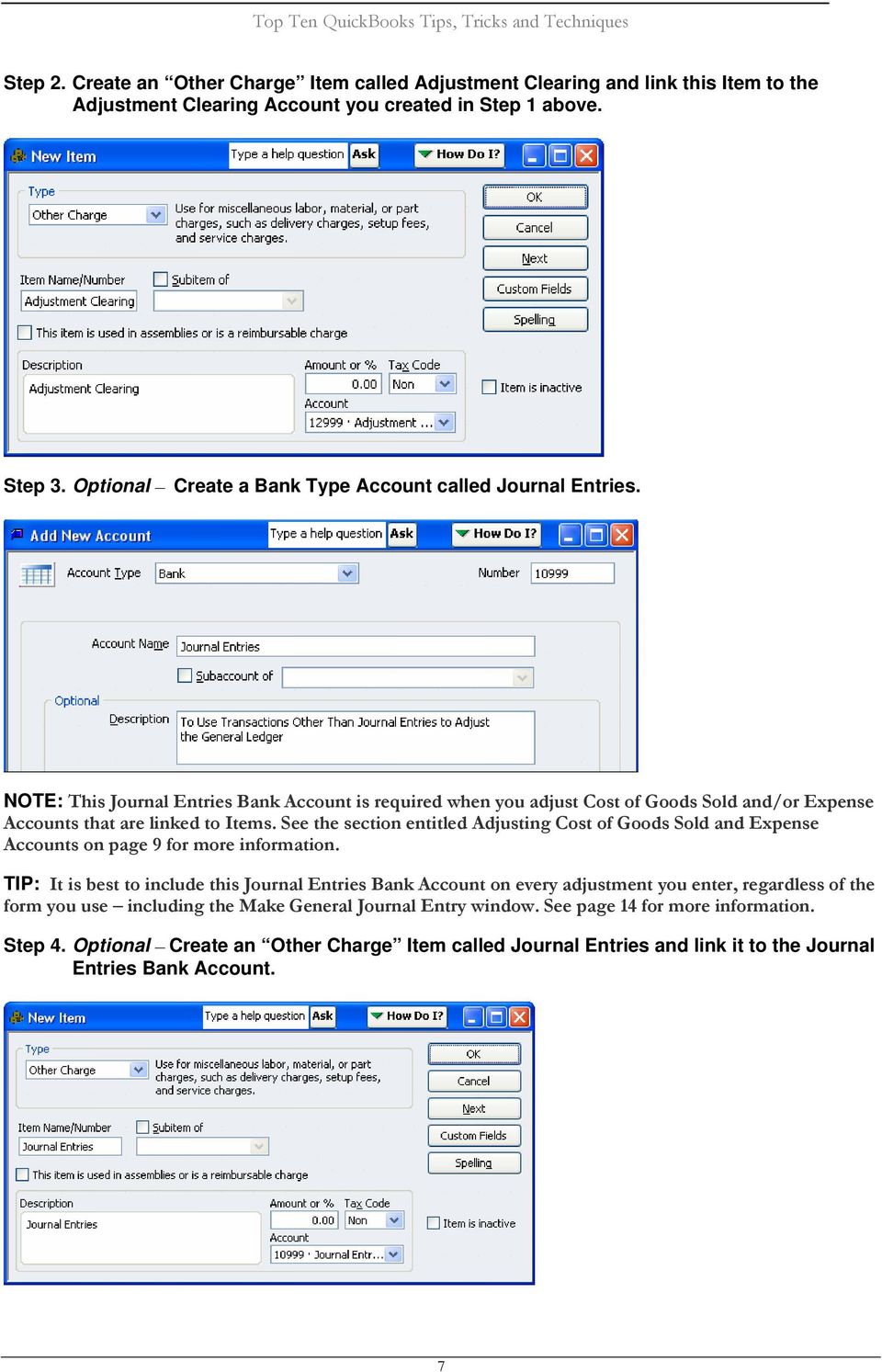
10 Step 5. Open the Enter Sales Receipt window and enter the Items and Accounts as shown in the figure below. Make sure the total amount of the Sales Receipt is Enter the applicable class as you would do on the Enter Journal Entry Window. You can optionally create a Customer called Adjustment. Enter the number of the Journal Entry here. If the client uses Sales Receipts make sure to reset the numerical sequence after you save this transaction. WARNING: Do not use Inventory Items in the steps above. If you need to adjust an Income Account that is linked to one or more Inventory Items, create an Income Item called Income Adjustment and link that Item to the Income Account you need to adjust. If you use an Inventory Item on the Sales Receipt above, QuickBooks will reduce the quantity on hand (even if you don t enter a quantity in the Quantity column) and QuickBooks will also adjust Inventory Asset and Cost of Goods Sold. TIP: For on-going use, you can create a new Sales Receipt template and title the printed form Journal Entry. This allows you to print these Journal Entries and store them with the corresponding back-end journal entry that QuickBooks will generate for you (see Step 6 below). NOTE: If you need to use more than one class on the Sales Receipt (i.e. Journal Entry), edit the template to include a Class column. NOTE: If you need to adjust both income and sales tax payable, you can make the Counter Item taxable. Then, increase the amount on the Adjustment Clearing line to zero the Sales Receipt. 8

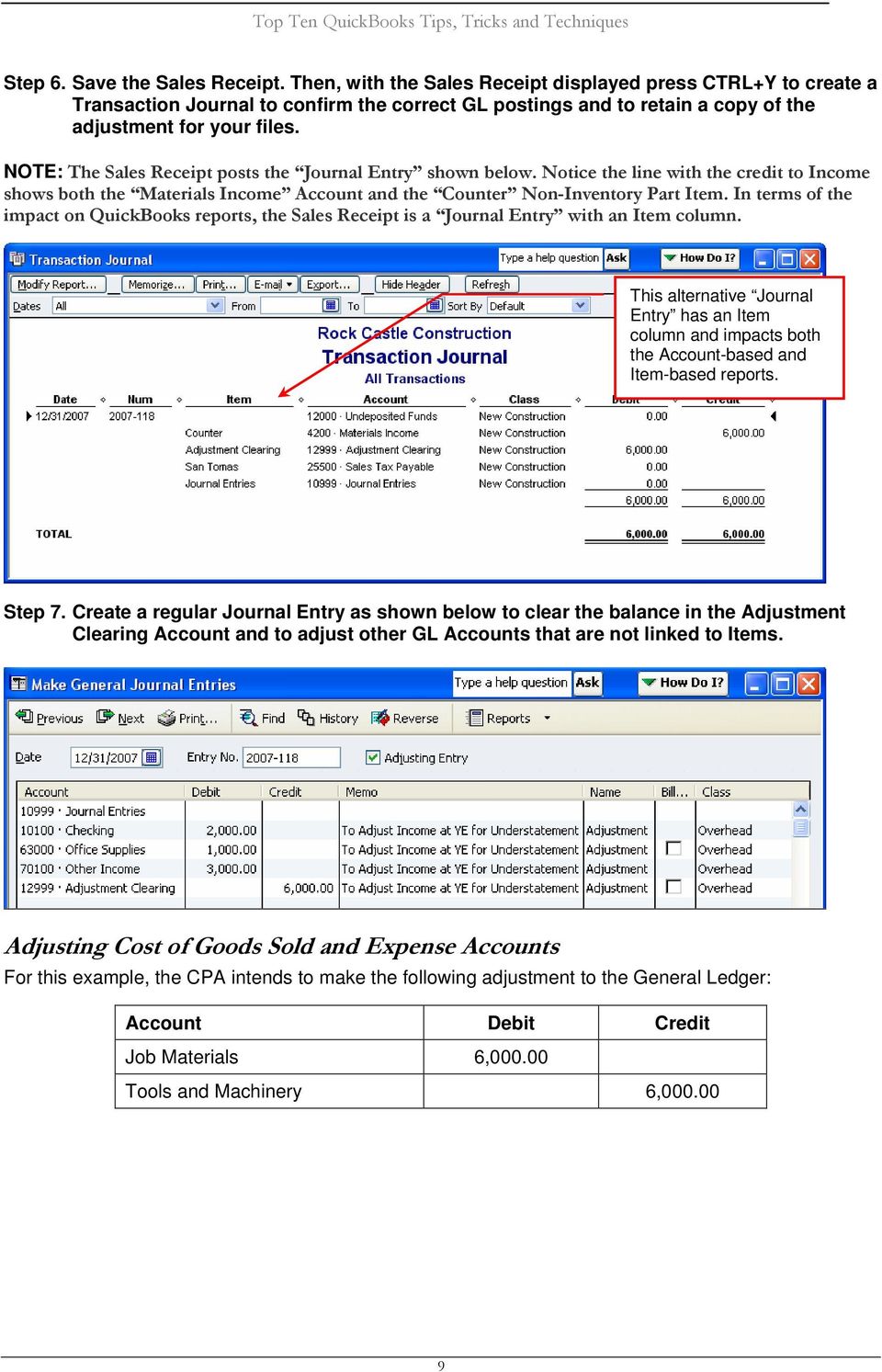
11 Step 6. Save the Sales Receipt. Then, with the Sales Receipt displayed press CTRL+Y to create a Transaction Journal to confirm the correct GL postings and to retain a copy of the adjustment for your files. NOTE: The Sales Receipt posts the Journal Entry shown below. Notice the line with the credit to Income shows both the Materials Income Account and the Counter Non-Inventory Part Item. In terms of the impact on QuickBooks reports, the Sales Receipt is a Journal Entry with an Item column. This alternative Journal Entry has an Item column and impacts both the Account-based and Item-based reports. Step 7. Create a regular Journal Entry as shown below to clear the balance in the Adjustment Clearing Account and to adjust other GL Accounts that are not linked to Items. Adjusting Cost of Goods Sold and Expense Accounts For this example, the CPA intends to make the following adjustment to the General Ledger: Account Debit Credit Job Materials 6, Tools and Machinery 6,
12 In the example above, the Job Materials Account (Cost of Goods Sold Type) is linked to several noninventory parts: Step 1. Create a Bank type GL Account called Journal Entries. Step 2. Open the Write Checks window and enter the Journal Entries Bank Account in the Bank Account field. Step 3. On the Item tab, select the non-inventory part Item or Items you wish to debit and enter the amounts. For this example the total debits for all non-inventory parts is $6, Step 4. On the expenses tab select the Job Materials Account and enter a negative amount for $6,000 to zero the Check. The Tools and Machinery expense Account is not linked to any Items so you should post to the Account only. 10

13 Step 5. Save the Check. Then, with the Check displayed press CTRL+Y to create and print a Transaction Journal. The debits to Job Materials impact both the Account and these Items. NOTE: Unlike the Sales Receipt, when you use a Check, there is no need to follow this with an additional Journal Entry. This is because the expenses tab allows you to debit and/or credit Accounts directly as you would do on a Journal Entry. NOTE: Since there is an Item and Expense tab on the Check, the Check window seems on the surface like the perfect alternative transaction for all types of Item/Account adjustments. However, the Check transaction affects the Account in the Cost field of the Item setup window, not the Account in the Income Account field. If an Item setup doesn t have a Cost field, the Check will impact the Account in the Income Account field. However, even though the Check would post to both the Item and the Income Account, the adjustment will not show on Item-based sales reports. For information to show on Item-based sales reports you must use a sales Item on a sales form (Invoice, Sales Receipt or Credit Memo). So, to adjust the Account in the Income Account field, use a Sales Receipt as described on page 6. WARNING: Do not use inventory Items in the steps above. If you need to adjust a Cost of Goods Sold type GL Account that is linked to one or more Inventory Items, use a value only Inventory Adjustment to change the Item s value on the general ledger. Offset the adjustment to a Cost of Goods Sold account. If you use an Inventory Item on the Check above, QuickBooks will increase the quantity on hand (even if you don t enter a quantity in the Quantity column) and QuickBooks will also adjust Inventory Asset. Inventory quantities and value will be overstated and Cost of Goods Sold the Account you are trying to adjust will be unaffected. Adjusting Sales Tax Payable by Sales Tax Item There are two types of adjustments to Sales Tax Payable: 1. Adjustments to Sales Tax Payable that show on the Sales Tax Return. Examples of this type of adjustment include (but are not limited to) reductions in Sales Tax Payable for timely filing discounts and increases in Sales Tax Payable for interest and penalties. 2. Corrective adjustments to Sales Tax Payable that are the result of incorrectly recorded transactions. If you are adjusting sales tax payable for adjustments that need to show on the Sales Tax Return, you can use a Journal Entry to debit or credit Sales Tax Payable. You can also use the Sales Tax Adjustment window. You will then apply this credit when you create the next Sales Tax Payment. There is no need to impact both Sales Tax Payable and the Sales Tax Item on your adjustment. 11

14 However, if you are making corrections to the balances in Sales Tax Payable because the balance is incorrect, and you need to adjust the balance to agree to the Sales Tax Return, it is best to adjust both Sales Tax Payable and the associated Sales Tax Items. Perform the following steps to adjust Sales Tax Payable by Sales Tax Item: To credit Sales Tax Payable, enter a Sales Receipt as described on page 6 above and enter the Sales Tax Item(s) you need to adjust. Do not enter any Sales Items just enter the Sales Tax Items. Zero the Sales Receipt to the Adjustment Clearing Account and follow up with a Journal Entry to clear the balance in the clearing Account. Enter the Journal Entries Item with a zero amount. See 14 for more information about the importance of this Item. To debit Sales Tax Payable: Step 1. Enter a Credit Memo as shown below. Enter the detail on the Credit Memo just as you would do with the Sales Receipt. However, on the Credit Memo positive amounts debit the General Ledger and negative amounts credit the General Ledger. Use the Adjustments Clearing Account and follow up with a Journal Entry to clear the balance in the clearing Account. Enter the Journal Entries Item with a zero amount. See 14 for more information about the importance of this Item. In the example below, the client used a Check instead of a Sales Tax Payment to pay a sales tax agency in an earlier period. The client posted the Check to an expense Account called Sales Tax Expense. 12
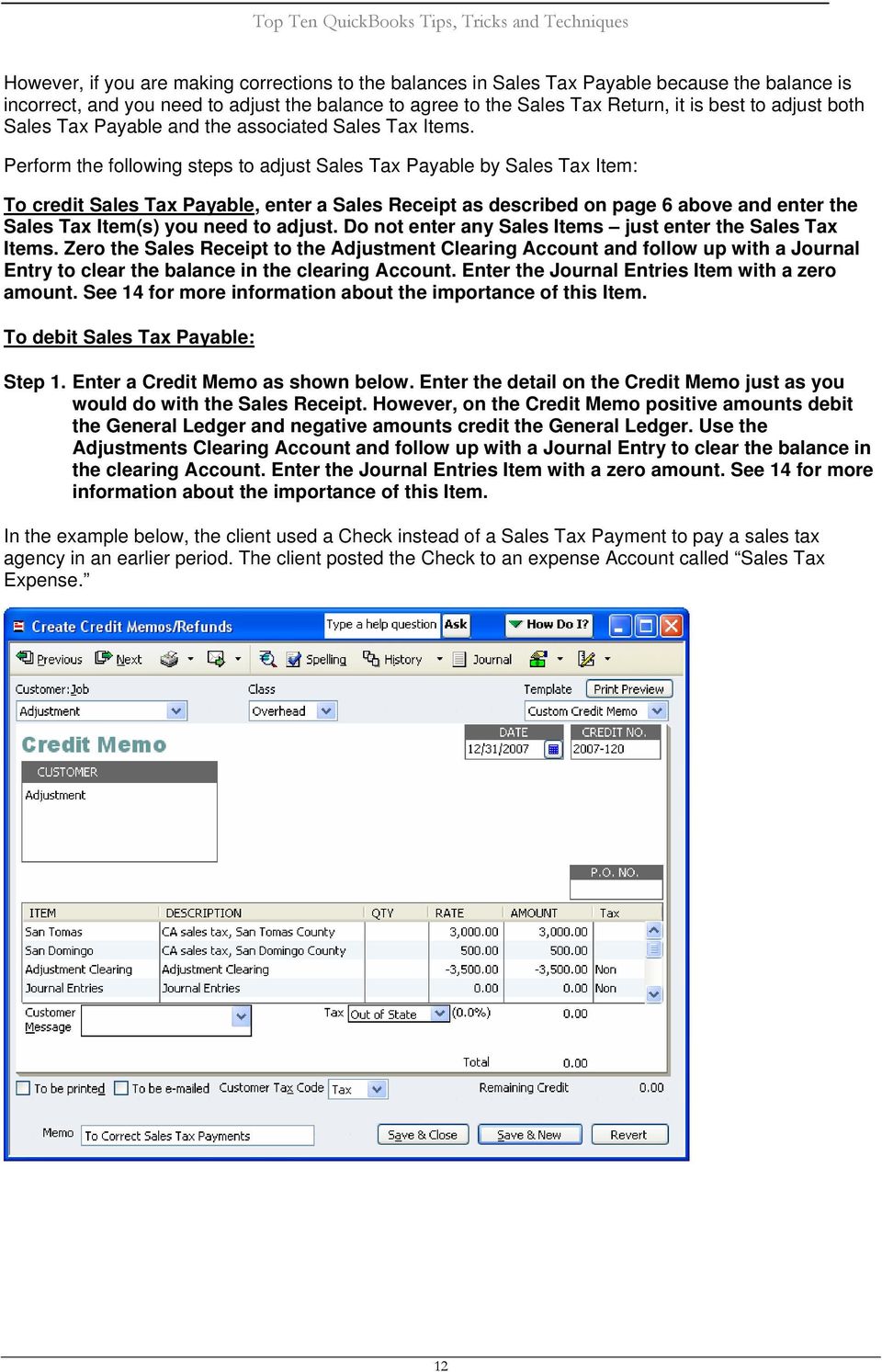
15 Step 2. Save the Credit Memo. With the saved Credit Memo displayed, press CTRL+Y to create and print a Transaction Journal. Notice that the Credit Memo debits Sales Tax Payable to adjust for the overstatement. Step 3. Enter a Journal Entry to clear the balance in the Adjustment Clearing account as shown below. 13

16 VIEWING A LIST OF ADJUSTMENTS If you use a Journal Entry for all types of adjustments (e.g. Sales Receipts, Credit Memos, Checks and Journal Entries), you can use the account register for the Journal Entries Bank Account to view a list of adjustments. Perform the following steps to create a General Journal that includes all of the transactions you used to adjust the client s QuickBooks data. Step 1. Include the Journal Entries Bank Account on every adjustment you enter, regardless of the form you use, as described above. Step 2. Use the Register for the Journal Entries Bank Account to review a list of the Journal Entries. Highlight any entries you want to view in more detail and click Edit Transaction to display the full transaction view. Step 3. Alternatively, you can run a Journal Report (Reports > Accountant > Journal) and filter on the Journal Entries Bank Account as the Account. Include splits. You will then get a report of all transactions booked to the Journal Entries Bank Account (effectively your Journal of adjustments.) This is another reason to include the Journal Entries Bank Account on every adjust entry you do. 14

17 2. TYING THE P&L BY JOB TO THE P&L The Profit & Loss by Job report shows all of the income and expenses you have assigned to Jobs on Checks, Bills, Invoices and other transactions. The Profit & Loss by Job report excludes all income and expenses you have not assigned to a Job. You need to edit the P&L by Job if you want to: View transactions that you should have applied to Jobs to edit them so they include the Job information. Include overhead transactions you never intend to assign to Jobs so that the total of the P&L by Job report will agree to the P&L. The Primary Issue that Requires a Trick: If you do not assign every post to income and expense to a Customer or Job, QuickBooks does not display the income or expense on the Profit & Loss by Job report. This causes the Profit & Loss by Job to show different totals than the Profit & Loss. It is critical for these two reports to agree. NOTE: Some businesses are only interested in making the Income and Cost of Goods Sold agree on the Profit & Loss by Job and the Profit & Loss. This section assumes you want all of the balances on these two reports to tie, including operating expenses. The Strategy behind the Trick: The Profit & Loss by Job report doesn t tie to the Profit & Loss unless every post to income and expense refers to a Customer or Job. As a result, you must total the Profit & Loss by some other criteria one that shows the columns for the Customers/Jobs but also include transactions not posted to a Customer or Job. TIP: If you use the P&L by Job report in your company, create a Customer name called Overhead. Use the Overhead Job name for expenses that are not tied to a specific Job like Office Supplies and Administrative Salaries. By dong so it is much easier to identify the transactions with no Job name (entered incorrectly) using the steps in this section. Option 1: Use the Expenses not Assigned to Jobs Report QuickBooks Premier: Contractor Edition and QuickBooks Enterprise Solutions: Contractor Edition include a report called Expenses not Assigned to Jobs. By default this report includes purchase forms only (e.g. Bills, Check, Credit Card Charges). If you need to track income not assigned to jobs as well, you can modify this report as follows to show income as well: Step 1. Remove the Transaction Type filter Step 2. Filter the report by account for All Income/Expense Accounts. NOTE: You cannot create this report if you use QuickBooks Pro or QuickBooks Premier for any edition other than Contractor Edition. If this is the case, use Option 2 below. NOTE: Even if the modified Expenses not Assigned to Jobs report shows no activity, you can still show a discrepancy between the Profit & Loss by Job and the Profit & Loss. There are two reasons: 1. If the top line of a Journal Entry posts to income, cost of goods sold or expense type accounts and if that top line does not include a customer:job name, the transaction will not show on the modified Expenses not Assigned to Jobs report. If this post to income, cost of goods sold or expenses is on the second or subsequent line of the Journal Entry the post will show on this report. You can use Option 2 below to find these Journal Entries 15
18 2. If Paychecks do not include job information, the payroll expenses not assigned to jobs (e.g., gross wages, payroll taxes, SUTA expense, FUTA expense, etc.) will not show on this report. As a result, Net Income on the Profit & Loss by Job may be significantly different from Net Income on the Profit & Loss by Job. You can use Option 2 below to find these transactions. Option 2: Use a Modified Profit & Loss Report Perform the following steps to create a Profit & Loss report showing transactions not assigned to jobs: Step 1. Create a Profit & Loss Standard report. Step 2. Filter the report by Customer:Job. Step 3. QuickBooks displays a No name column in the far right column of the report, just to the left of the total. Double-click each amount in the No name column and assign the transaction to a Customer:Job name. NOTE: There may be some transactions in the No name column to which you cannot assign a customer or job name. The steps below address this issue. Step 4. Total the report by Payee. Step 5. Filter the report by Name for All Vendors. NOTE: When you total by Payee, transactions without a Job name show by the Vendor record you used on the Check, Bill or Credit Card Charge. When you filter by name for All Vendors, the report will include only those transactions not assigned to a job name. Though it is counter-intuitive, when you assign a job name, QuickBooks will remove the amount from this report even though the report is totaled by Payee instead of Customer:Job. Step 6. Double-click on amount that shows in the Payee columns and assign the appropriate Customer or Job name. If the expense is overhead, use a Customer called overhead. NOTE: Discounts on Bill Payments do not allow you to assign a Job. To assign these discounts to the applicable Job, create a Journal Entry to Credit the Discounts Taken contra income Account or to debit the Discounts Taken Cost of Goods Sold Account (depending on which Account type you use). Enter this entry on the top line of the Journal Entry and do not include a Job name. Then, use the same Discounts Taken on the second line of the Journal Entry and enter the applicable Jobs (or overhead). The expense will still show in the Vendor s column when you total by Payee. However, when you total by Customer:Job the discounts taken will show in the appropriate Job column. 16

19 TIP: If there are numerous transactions not assigned to Jobs, you could use the Journal Entry method in the note above to assign balances to various Jobs as of the adjustment date (e.g. 12/31). However, it is best to edit each individual transaction to include a Customer or Job name so the Job cost reports will be accurate throughout the year, not just as of the date of your adjustment. As necessary, enlist the client s help to assign these transactions to Jobs. Step 7. Filter the report by name for All Other Names, and repeat Step 6 above for any amounts that show on the report. Step 8. Filter the report by name for All Employees and repeat Step 6 above for any amounts that show on the report. TIP: Payroll Expenses like Gross Wages, Payroll Taxes, Federal Unemployment and State Unemployment will show in employee columns if Paycheck doesn t include a Customer or Job name. The most common cause is administrative salaries administrative Employees for whom you do not use timesheet detail when creating Paychecks. You can edit each Paycheck to include the overhead Job or you can use Journal Entries entered monthly to assign the total wages and payroll taxes to the overhead Job as shown in the screenshot above. Step 9. After editing all transactions without a Job name, total the report by Job and confirm that the total of the report agrees to the Profit & Loss. NOTE: Some businesses tie only Gross Profit on the Profit & Loss to Gross Profit on the Profit & Loss by Job. If the amount on the report with no name is an Expense, Other Expense or Other Income type account, the QuickBooks user will not attempt to reconcile the discrepancy. These businesses conclude that Job Cost reports are really designed to track profitability by job, not net income by job. As a result, any amount below Gross Profit is irrelevant to the Profit & Loss by Job. 17

20 18

21 3. CREDIT CARD REFUNDS/RETURNS Processing credit card refunds and returns is a tricky process regardless of which accounting software solution you use, though using QuickBooks Point of Sale Solution can help automate the process for the user. Assuming you are not using Point of Sale with your QuickBooks, the process is detailed, but not difficult or time consuming. Perform the steps below to process returns or refunds to Customers who paid you with a credit card. The Primary Issue that Requires a Trick: When processing refunds and returns, income must decrease on both the Profit & Loss and on sales reports (that refer to sales Item details). There are other reasons to use a Credit Memo stated in Step 2 below. However, a Credit Memo is not designed to process banking transactions like a Sales Receipt or Receive Payment transaction. To process the transaction correctly, Accounts Receivable must go down (for credits to the Customer s Account) or Cash must go down for refunds to the Customer. This Trick assumes the Customer has paid with a credit card and you are refunding the Customer. As a result, the Credit Memo must have no net impact on Accounts Receivable and must credit cash instead. To further complicate the process, you must combine the refund to the Customer s credit card with all of the other credit card transactions for the day (all of the transaction in the batch). Failure to group these transactions together will complicate the bank reconciliation process. The Strategy behind the Trick: Use a Payment Item on the Credit Memo that is linked to Undeposited Funds. Since the Payment Item is designed to increase cash on Invoices, the Payment Item will decrease cash on a Credit Memo. NOTE: This section covers processing credit card refunds and returns using a Credit Memo. Writing off Customer Invoices (due to non-payment) is not within the scope of this Trick. NOTE: You need to perform the steps below even if the client subscribes to Intuit s Merchant Services. Perform the following steps to record a refund to a Customer issued to the Customer s credit card. Step 1. If you use Intuit Merchant Services to process the credit card refund, select the Customer menu, select Credit Card Processing Activities and then select Manage Merchant Service. Press the Process Transactions hyperlink and complete the form shown below. 19
22 Step 2. In QuickBooks, enter a Credit Memo to record the refund/return. You need to enter a Credit Memo to: A. Record an increase in inventory on hand when the Customer returns inventoried products. (If applicable) If the return/refund does not require you to re-stock inventory Items, you still need to use a Credit Memo see Letter B below. Use the same Services, Non-Inventory Parts and Other Charges that appeared on the original Invoice. B. Record a decrease in sales regardless of the type of sale (service, part, inventory part or miscellaneous charges other charge type). You can enter the reimbursement to the client s Credit Card directly on the Make Deposits window and you can offset the credit to cash by debiting one or more income Accounts. However, this transaction would impact income on the Profit & Loss but would not reduce sales on reports like the Sales by Item Summary, Sales Tax Revenue Summary and Sales Tax Liability reports. (Almost always applies.) C. Clear the balance in the Customer s Accounts Receivable Account. (If applicable). However, you still need to use a Credit Memo even if you do not need to clear the Customer s A/R sub-ledger balance. See Letter B above. D. Record the reduction in Sales Tax Payable, using the applicable Sales Tax Item and Sales Tax Code. (If applicable). However, if the original sale to the Customer did not include sales tax, you still need to use a Credit Memo see Letter b above. If the original sale did not include sales tax, use a non-taxable sales tax code when processing the return/refund. Step 3. Enter a Credit Memo like the one shown below. In this example all four reasons to use a Credit Memo stated in Step 2 above are reflected on the Credit Memo. 20
23 Step 4. Create an Item with a Payment type. It is best to create one Payment Item for each type of Credit Card you accept. See the Payment Item below. Step 5. After entering all of the Items from the original Sales Receipt or Invoice, enter a Payment Item with a negative amount to zero the Credit Memo. Then, save the Credit Memo. NOTE: QuickBooks will not allow you to enter a negative amount for the payment in the Amount column. You must enter the negative amount in the Rate column. Doing so will affect both the Rate and the Amount. 21
24 Step 6. Optional Create and print a Transaction Journal for your records (Control Y after you have saved the transaction). The Transaction Journal for the Credit Memo in this example is below. Notice the decrease in Sales Tax Payable by Sales Tax Item, the credit to Undeposited Funds, the reduction in income that also posts to sales Items, and the increase to both inventory stock status and Inventory Asset. NOTE: QuickBooks decreases Cost of Goods Sold based on the average cost as of the time you create the Credit Memo. As a result, the credits to Cost of Goods Sold on the Credit Memo may not be the same as the debits to Cost of Goods Sold on the Invoice you are reversing/crediting. However, in most circumstances (but not all) the average cost of inventory doesn t change drastically over a short period of time. Most businesses allow returns of products and refunds for a limited period of time after the sale (e.g. 30, 60 or 90 days). Step 7. Open the Make Deposits window and deposit the negative entry for the Credit Card credit along with other MasterCard and VISA transactions for the day. If the amount of the deposit is positive, save the deposit you have completed the process. If the amount of the deposit including the refund is negative, continue to Step 8 below. (Remember that you processed the actual REFUND to the customer, via the Manage Merchant Services Account step shown above, so the customer is OK at this point.) 22
25 Step 8. In the Payments to be Deposited window below, the credit to the Customer s MasterCard is the only MasterCard and VISA transaction for the day. The daily batch to MasterCard will result in a decrease in cash of $3,250. However, QuickBooks does not allow you to record a negative deposit. Perform one of the following to record a decrease in cash on the deposit transaction: Option 1: Use a Journal Entry that debits Undeposited Funds and Credits Cash. You would then have to return to the Payments to be Deposited window where the Journal Entry would show as a positive number. Option 2: Option 1 requires you to enter an additional transaction and the user recording the deposit must be able to perform Sensitive Accounting Activities in the user access privileges window. For these reasons, Option 2 may be the better choice. Perform the following steps for Option 2. Step 1. Select the all of the charges for the MasterCard/VISA that net to a zero amount. In our example there is only one charge. 23
26 Step 2. Change the Bank Account in the Deposit To field to an Account other than the one your merchant service will draft. Then, enter the bank Account below the payment(s) and enter a positive amount to zero the deposit as shown below. NOTE: The deposit above debits Undeposited Funds (to clear the balance), credits the Checking Account to reduce the balance and posts a $0.00 debit to the Savings Account. 24
27 4. MISSING AND DUPLICATE INVOICE REPORT It is important to assign a unique Invoice number to each Invoice you send to your customers. This unique number is a control device much like a Check number that allows you to research the client s invoice and also helps you to assign the payment from the customer to the correct account and invoice. The Primary Issue that Requires a Trick: Invoice number duplications and numbering sequence gaps (missing numbers) are important for any small business to quickly locate. QuickBooks includes a report that allows you to quickly locate missing and duplicate Check numbers but not Invoice numbers. The Strategy behind the Trick: Since QuickBooks has a report programmed to show you missing and duplicate Check numbers, modifying the existing report to show missing and duplicate invoice numbers is the best way to get the information you need. Perform the following Steps to create a Missing and Duplicate Invoice Number report. Step 1. Create a Missing Checks report by selecting the Reports menu, selecting Banking and then selecting Missing Checks. QuickBooks displays the window shown below. Step 2. Enter Accounts Receivable in the Account field instead of a bank Account. 25
28 Step 3. QuickBooks creates a report of Invoices in numerical order and the report notes any missing and/or duplicate Invoice numbers. Edit the title of the report and memorize the report for future use. 26
29 5. REPURPOSE QUICKBOOKS FIELDS AND LISTS Many QuickBooks users need to combine the standard fields in the QuickBooks program with one or more custom fields. In QuickBooks you can add custom fields to the Customer, Vendor, Employee and Item setup windows and have that information automatically populate on QuickBooks sales forms and Purchase Orders. The Primary Issue that Requires a Trick: When you create custom reports based on custom field information, the reports could lose integrity if each user does not use the exact wording you used when filtering the custom report. For example, if a veterinary office uses a custom Customer field called Pet Type, they could include the Pet Type field on a customized Invoice template and then filter sales reports for Customers with certain types of pets. However, since the Pet Type field is a text field, the report could lose integrity if a user misspelled the pet type (e.g. Parott instead of Parrot). Also, the text-only custom field does not allow you to filter for multiple selections on the same report. The Strategy behind the Trick: The propensity to misspell custom field information would be eliminated if the user selected the pet type from a drop down menu. Since QuickBooks custom fields do not allow you to create a drop down menu with a corresponding list, you can alternatively repurpose fields that already contain a drop down menu supported by a list. The most popular field to repurpose is the Ship Via field and corresponding list. It has drop down capabilities and you can easily replace the Ship Via list with a Customer custom field. However, for the choice of any list to be logical the information you need to track would have to be: Broader in choices: For example, if you use two different shipping carriers and 15 different pet types, using the Ship Via list to track pet types would be a better use of the list, or More Significant Reporting Criteria: For example, if a report showing the sales by pet type is a more important management report than sales by shipping carrier, using the Ship Via list to track pet types would be a better use of the list. 27
30 Lists you might consider re-purposing so you can support your custom field with a list and drop down menu are: The Class List: This list is designed beautifully for this Trick. QuickBooks built a very powerful custom field called Class into almost every window in the program. It is a very powerful tracking tool that you can customize for use in almost any business model. Because the Class field is so global and powerful, you want to use this field to track the most important management criteria. However, this Trick assumes the Class List is already in use and since it is not advisable to use the Class List to track two different wholly unrelated types of information, you need to find another list. NOTE: You cannot set a default Class in the Customer setup window. You have to select the Class as you record each sale, making proper training of your staff a vital step. Sales Rep List: You can only include three characters on the Sales Rep List drop down menu, but those three letters can be codes representing information. For example, you could use the first three letters of the animal s name: CAT, DOG, PAR (Parrot), SNA (Snake), HAM (Hamster), etc. NOTE: If you use the Sales Rep list to track information, you will have to setup a name on the Other Names list as well. The Sales Rep could be the three letter code and the name on the Other Names list could be the complete word. NOTE: You can have only one Sales Rep per sale. Customer Type: You can segregate Customers into different types based on the type of pet they own. However, consider that you can have only one Customer type per Customer record. If the Customer has two different types of pets you cannot override the Customer type in the Customer s setup window on each sales form. NOTE: You can filter reports based on the Customer type, but you cannot make the Customer type display on printed sales forms. Job Type: For Customers with more than one pet type, you can create a Job for each pet type. For example, John Smith could be the Customer and John Smith:Dog and John Smith:Cat could be the different pets. You can then assign the Job type: Dog and the Job type:cat to each of the Jobs. For that matter, a Veterinarian could use Jobs for all of the Customers, where the Job is the name of the pet. For example: John Smith:Fido with a Job type: Dog NOTE: You can filter reports based on the Job type, but you cannot get the Job type to show on printed sales forms. You can display the Job name on the Invoice by adding a Project field, but you cannot display the Job type. Terms List: You can only use the Terms list to track custom field information if you do not want QuickBooks to age any receivables or payables. Therefore, this field only works for the trick if your client records Sales Receipts for sales and uses Checks and Credit Card Charges (no Bill Payments) to pay Bills. If you will ever potentially use Invoices and/or Bills in the future, you should avoid the use of this list. This list is perhaps a last resort option. Ship Via List: As described above, the Ship Via list is perhaps the best field to repurpose because you can include the entire pet type on the sales form (unlike the abbreviated Sales Rep field and the two you can t display at all: Customer Type and Job Type). This field is not as heavily used as other lists and if you do need to track the shipping carrier you can do so with a Customer custom field. NOTE: There is only one drawback to repurposing the Sales Rep field. You cannot set a default entry for the Ship Via list in the Customer setup window. You have to select the Pet Type from the drop down menu for each and every sale. 28
31 Perform the following steps to repurpose a list and to include the information on sales reports and sales forms. NOTE: This example will use the Ship Via list but the steps work the same for all lists except the Customer type and Job type. For the Customer type and Job type you simply type the information into the Customer or Job setup window. Step 1. Open the list you want to repurpose from the Lists drop down menu (in this example: the Ship Via List.) Step 2. If the list contains information perhaps because QuickBooks automatically populated the list with information delete the list entries. If you can t delete the list entries because they are included in a transaction or are linked to another list, make them inactive. Step 3. Populate the list with the information you want to track. The Ship Via list below is populated with the different pet types the Veterinary Business treats. Step 4. Rename the Ship Via list using the Report Customization window. Make sure the list at least shows on the screen. You can optionally make the list information print as well. If you choose to make the information print, you may need to use the Layout Designer to position the field where you want the field to display on the printed Invoice. Step 5. Select the Pet Type when you record sales to Customers as shown below. 29
32 30
33 6. HIDE ITEM DETAILS ON SALES FORMS There are four reasons to include an Item on a sales form: 1. To display the details of a sale on the printed Invoice for the Customer to see. 2. To track Item-level sales information for detailed sales reports 3. To make the stock status of the inventory parts to go down (if applicable) 4. To calculate Sales Tax and to accrue the sales tax liability (if applicable) The Primary Issue that Requires a Trick: If you need all or some of the tracking and calculating benefits of 2 through 4 above, but you do not want the customer to see the detail, there is no print setting to hide the data from your Customer. For example, a construction company may quote a flat rate amount to install a new door. They want the Customer to see only a single line that reads, Replaced Door that includes the quoted price. However, for internal reporting and for inventory tracking the company needs to include all of the Inventory parts used to replace the door as well as the number of hours worked. The Strategy behind the Trick: QuickBooks Group Items allow you to show or hide information on the printed Invoice. To take advantage of this option, all of the information will need to be contained in a Group Item. Perform the following steps to hide Invoice detail by inserting it into a Group Item: Step 1. Create a new Other Charge Item called. Type the words Enter Invoice Details Here in the description field and link the Item to any income Account. You will never leave this Item on a saved transaction so the income Account you select is irrelevant. 31
34 Step 2. Create a new Group Item called Hidden Detail and include only the. Item in the Group as shown below. Step 3. When recording an Estimate, a Sales Order, an Invoice, a Sales Receipt or a Credit Memo, start the data entry process by selecting the Hidden Group Item above. Step 4. Place your cursor on the line with the. Item and Press CTRL+Insert to add additional blank lines within the group Item as shown below. 32
35 Step 5. Enter parts and labor Items just as you would on any Invoice. If you need additional lines create more by pressing CTRL+Insert. If you have extra lines you don t need, remove them (including the. Item) by pressing CTRL+Delete. Step 6. Type a description for the sale that you want the Customer to see on the printed Invoice. Only the description for the Group Item will show on the printed Invoice so use that line. In the screenshot above the description for the group Items currently reads, Enter Sales Description Here. On the screenshot below, the sales description has been replaced as Door Replacement. This is what the customer will see on the invoice itself. Step 7. Since the quoted price for the replacement of the door was $400, you need to edit the amounts for the labor and parts as appropriate. You can adjust the margin for both the material and the labor, or you can adjust the amount of labor or materials only. Either way, you need to make the total of the group agree to the quoted price. Each business will decide the best option for the way they want to track margins on materials and labor. On the screenshot below, the difference between $400 and $ is allocated proportionally across all of the lines. In most cases this is arguably the most accurate way to apply the increase or decrease, but it is also the most complicated and time consuming. NOTE: Many QuickBooks users will insert an Other Charge type Item into the Group Item and will enter a positive or negative number on the separate line to make the group price agree to the quoted price. However, doing so is not the best way to track the margins for the actual labor and materials you sell. Instead, the margins will all post to this separate Other Charge type Item on reports like Sales by Item Summary and Sales by Item Detail. 33
36 Step 8. When you print the Invoice, the Customer sees only the Description and the sales amount. NOTE: If you use a hidden Item to Invoice a Customer based on a flat rate quote, you may prefer to set the Item column, Quantity column and Rate column so they do not print, as shown above. If you do print those columns, the columns will show no information unless you enter a quantity on the Hidden Detail row of the Invoice. If you are using this method to hide detailed Item information because of a flat rate price, you should never need to print a quantity and rate for the Customer. 34
37 7. ALLOCATE FREIGHT TO INVENTORY ITEMS The most accurate way to track freight for the re-supply of inventory is to include the freight in the value of the products you purchase from the Vendor. By capitalizing the freight (i.e. initially recording the freight as an asset instead of a cost or expense) you can include the freight in the average cost calculation for the part. When you sell an inventory part in QuickBooks, the program debits Cost of Goods Sold and credits Inventory Asset. Since QuickBooks records Costs on the sales transactions, you will automatically associate the freight directly with the income generated from the sale of the product. When you incur costs in order to generate income, it is critical for the costs and the income to post in the same reporting period. The Primary Issue that Requires a Trick: There is no tool in QuickBooks that allows you to burden the inventory values with the freight you paid to ship the products from the supplier s location to yours. The Strategy behind the Trick: Since there is no tool to automatically burden freight costs into the value (purchase price) of inventory products, you must increase the per-unit costs to include this freight. You must do so as of the date of the Bill and the company must do this burden on each individual Inventory Item included on the Bill. WHEN FREIGHT IS INCLUDED ON THE BILL When the supplier charges you freight and the Bill total represents both the product you ordered and the freight, including freight in the cost of the inventory parts is relatively easy. Perform the following steps when the freight is included on the same Bill as the inventory part you purchased: Step 1. Enter all of the inventory Items, the rates and the quantities received just as they appear on the Bill from the supplier. Step 2. Determine the percentage of the total Bill represented by each line Item. For example, in the Bill below the percentages for each line are: Line 1 3.3% Line % Line 3 2.3% Line % 35
38 Step 3. Add the freight amount by percentage to each line. The total freight costs for the Bill above is $ The amount multiplied by the percentages above provides the following purchase costs. You can use the QuickBooks calculator to make the percentage markup right on the Amount column for each item. Freight Amt Freight by Line Percentage by Line Part Cost by Line Part Cost with Freight by Line x % = x % = 4, x % = x % = ,400 = 5,
39 Step 4. Confirm that the Bill total agrees to the Invoice your supplier sent you and then save the QuickBooks Bill. WHEN FREIGHT IS NOT INCLUDED ON THE BILL Perform the following steps to burden freight costs to the value (cost) of inventory when the freight is on a separate Bill from the inventory parts. Step 1. Enter the Bill for the freight on a separate Bill from the parts and make the Bill payable to the applicable Vendor (e.g. UPS or FedEx). Post the freight costs to an Account with a Cost of Goods Sold type called Freight Clearing. When you do, you will increase (debit) the Freight Clearing Account. Step 2. Perform the same steps as in the example above to allocate the freight to each line on the Bill from the supplier. 37
40 Step 3. Since the amount of the Bill will now be more than the amount on the Invoice from the supplier, reduce the total Bill amount by entering a negative number in the Amount field of the Expenses tab. Post the negative amount to the Freight Clearing Account as shown below. The entry below decreases (credits) the balance in the Freight Clearing Account. TIP: It can be very time consuming to calculate the percentage of freight by line Item on each line of every Bill you enter from your supplier. An easier method might be to determine the overall ratio of inventory costs to freight costs. You can then increase the default purchase price for all inventory parts to include this markup or you could use the markup as a standard and calculate all inventory costs by that percentage. For example, if Rock Castle Construction s total inventory purchases last quarter were $50,000 and the total freight associated with those inventory purchases was $5,000, the percentage of freight would be 10%. You would then multiple all purchase prices from suppliers by 1.10 to use the standard burden of 10%. If you have no variation in purchase prices, you could even edit the default costs for the inventory parts to include the 10% increase so no calculations are necessary on the purchase forms. In as much as actual freight costs may vary slightly from month to month, it is best to re-calculate the default percentage for the burden of freight at the beginning of each month using the prior month as a look back period. You can also choose to update the default percentages quarterly if there is no significant month by month variance. NOTE: You may be tempted to use the inventory adjustment window to increase the value of inventory by the freight costs. If you click Value Adjustment in the bottom left corner of the Inventory Adjustment window you can change the value of an Inventory Part without causing an increase or decrease in quantity on hand. However, it is best not to use an Inventory Adjustment to burden freight. The increase in the value of the Inventory Item for freight costs must take place before you use the Inventory Part on an Invoice. If you do not, the freight will not increase Cost of Goods Sold at the time of the sale. 38
41 8. TURN OFF ACCOUNT NUMBERS ON REPORTS Most accounting professionals agree that using Account numbers is the best way to manage and organize the QuickBooks Chart of Accounts. Using Account numbers allows users to: Dictate the order of the Accounts within an Account type. The Account numbers do not dictate the type of Account (e.g. Asset, Liability or Equity), but Account numbers do give you better control over the order of the Accounts within the Account type. Since QuickBooks uses the order of the Chart of Accounts as the order of accounts on financial reports like the Balance Sheet and Profit & Loss, sorting by number rather than by Account name alphabetically is a much better choice. The most prominent example is Fixed Assets. Since Accumulated Depreciation starts with the letter A, Accumulated Depreciation is almost never at the bottom of the Fixed Asset section as it is supposed to be. You can place the Account under the other Fixed Asset accounts, but if you re-sort the Chart of Accounts, Accumulated Depreciation moves back to the top or near the top of the list. By using an Account number higher than the number for the other Fixed Asset Accounts, you can lock in the placement for this Account. Increase the accuracy and efficiency of data entry. If you select Accounts by Account name on Checks, Bills and other data entry windows, the QuickFill option in QuickBooks may provide several different options. For example, if a user types Off in an Account field, QuickBooks will pull up Officer Wages, Office Equipment, Office Supplies and other Accounts that start with Off. If you select Accounts by typing in an Account number, you know for sure you are selecting the correct Account without the need to even look at the screen before advancing to the next field. The Primary Issue that Requires a Trick: The Account numbers display not only on the Chart of Accounts list and the Account field drop down menus, but also on financial reports like the Balance Sheet and Profit & Loss. The Strategy behind the Trick: You can hide the Account numbers in Financial Reports by turning off Account Numbers in the accounting Company preferences. However, you have to do so each and every time you create a financial report. Since you can only turn off Account numbers as the file Administrator and only in single user mode, turning off the Account numbers each time you want to print financial reports is not practical. Instead, you need to use a setting that will hide the Account numbers by default and then you can edit the Company Preferences only when you want the Account numbers to show (e.g. when printing the General Ledger and/or Trial Balance reports). Perform the following steps to hide the Account numbers on financial reports: Step 1. Edit the description for each Account on the Chart of Accounts, including any that you have made inactive but that might still show on financial reports. In most cases the description should be the same as the Account name. 39
42 Step 2. Edit the Reporting Company Preferences to display Accounts by Description rather than by Name only. The Name only setting doesn t describe fully what the Name setting does. When you select Name only on the window shown below, QuickBooks reports include both the Name and Number. QuickBooks will now show the description in financial reports, not the name and number. If any Accounts do not have a description in their set up, QuickBooks will revert to displaying the Account by name and number, but just for the selected Accounts with no description. Once you add a description and refresh the report, the Account number will go away. TIP: You can enter a slightly different wording for the Account in the description field. For example, the Account name can read Accounts Receivable and the Description could read Receivables Trade. The latter is a better wording for financial reports and the QuickBooks users will still see the wording Accounts Receivable on the Chart of Accounts window and on QuickBooks forms. 40
43 9. BURDEN PAYROLL TO COSTS For many small businesses, at least some of the labor costs (e.g. wages and payroll taxes) should appear above gross profit, meaning that the labor costs should post to a Cost of Goods Sold type Account. If the labor is directly related to the generation of income, it is usually best to track the labor costs as a reduction in gross profit. If the labor is administrative (i.e. overhead) it is usually best to track those expenses below gross profit as Expense type Accounts. By default, new Payroll Items you set up using the Payroll Setup wizard are linked to an Expense Account in QuickBooks called Payroll Expenses, but you can edit the Payroll Items so they post to whatever type of Account you wish. The Primary Issue that Requires a Trick: Though you can set up segregated Wage type Payroll Items for work that is directly related to the generation of income, you can set up only one Payroll Item to track each type of Federal and State Tax. You must use the same Federal and State tax Payroll Items for labor that is recorded both above and below Gross Profit. As a result, you will either need to post the payroll taxes to an Expense type Account and understate Cost of Goods Sold or you will have to post the payroll taxes to a Cost of Goods Sold type Account and understate Expenses. There is another issue as well: you many times need to burden certain overhead costs into the labor costs. For example, if 10 laborers on a manufacturing floor need 1/3 of the total lighting for the warehouse, you may need to burden that utility cost to the laborers who use it. Another example is Worker s Compensation insurance costs for workers for whom you record wages above Gross Profit. NOTE: If you are not a CPA yourself, we recommend consulting with a CPA and/or tax preparer for guidance on which costs company wide you should include above and below gross profit to get the most accurate gross margin possible. The example below assumes that all direct labor costs (associated with the generation of income) and the associated payroll taxes (Social Security and Medicare) are to be allocated to Cost of Goods Sold. The Strategy behind the Trick: Since there is no way to have QuickBooks post one type of payroll tax (e.g. Federal Unemployment) to more than one General Ledger Account, some type of adjusting entry is required. If possible, it would be best to make this adjusting entry automatic and to have the amounts adjusted reflect some percentage of each employee s gross wages. Perform the following steps to burden Cost of Goods Sold with payroll costs. Step 1. Create an Account called Labor Costs make the Account type Cost of Goods Sold Step 2. Create an Expense Account as a sub-account of Payroll Expenses called Less Payroll Allocated to Costs. Step 3. Compute a percentage of each Employee s gross pay that you intend to transfer from operating expenses to Cost of Goods Sold. For this example the percentage will be 7.65% - the percentage of the Company s portion of Social Security and Medicare. Step 4. Create an Addition Payroll Item called Allocated Payroll Costs. Make the Addition Payroll Item an adjustment to Net Pay. The Addition Payroll Item will have no impact on the calculation of payroll taxes so be sure to select a Tax Tracking Type of None. However, the Payroll Item should calculate based on Gross Pay. Link the Addition Payroll Item to the Labor Costs Account you created in Step 1 above. See the screenshot below. 41
44 Step 5. Create a Deduction Payroll Item called Less Payroll Allocated to Costs. Make the Deduction an adjustment to Net Pay. The deduction should have no impact on the calculation of payroll taxes. However, the Payroll Item should calculate based on Gross Pay. Link the Deduction Item to the Less Payroll Allocated to Costs Expense Account you created in Step 2 above. NOTE: In the above, the default percentages for the Addition and Deduction Payroll Items will move only the amount of the company s Social Security and Medicare expenses from Operating Expenses to Cost of Good Sold. This default percentage assumes that each Employee s Wage Payroll Item is linked to an Account with a Cost of Goods Sold type so Payroll Taxes (Social Security and Medicare) are the only expenses left to allocate to Costs. You can override these default percentages for each individual Employee as needed: Overhead burdens that are not directly related to the Employee s Paycheck but that you can base on a percentage of the Employees wages nonetheless. These overhead burdens might include utilities or rent necessary to support the labor force as they work to generate the income for the company. Wages when part of the Employee s wages posts to expenses and the other part posts to Cost of Goods Sold. Worker s Compensation costs Employer matched retirement funds etc. NOTE: Regardless of how much of the Employee s Paycheck you auto-adjust to Cost of Good Sold, you will use the same amount for both the Addition and Deduction Payroll Items. Doing so will increase and decrease the net amount of the Employee s Paycheck for the same amount. This process will have no impact on the Employees Gross or Net Pay. Step 6. Add the addition and deduction Item to each applicable Employee s default Payroll Items and set the default percentage you calculated for the Employee in Step 3 above. IMPORTANT: You must list the deduction Item at the top of the list of Other Payroll Items and then the Addition Payroll Item directly beneath the Deduction Payroll Item as shown above. If you do not, QuickBooks will not add and remove the same amount from the Employee s Paycheck, changing the amount of net pay. 42
45 Step 7. When you create Paychecks for the Employee in the future, the addition Payroll Item will increase Cost of Good Sold (and reduce Gross Profit). The deduction Item will decrease Payroll Expenses by the same amount. The deduction in Payroll Expenses will carry a negative balance. This type of Account is called a contra-expense since it reduces expenses on the Profit & Loss. See the transaction journal for the Paycheck below. The PayCheck credits this contraexpense Account, reducing operating expenses. The PayCheck debits this Cost of Goods Sold type Account, reducing Gross Profit $90.27 is equal to the company s payroll tax expense for Social Security and Medicare. You may also prefer to include Federal Unemployment and State Unemployment in this amount. 43
46 44
47 10. TRANSFER TRANSACTIONS BETWEEN QB FILES There are numerous reasons why you might need to transfer transactions from one QuickBooks file to another: When starting over with a new QuickBooks data file. When you create a new file and enter opening balances, you need to enter each open Invoice, unpaid Bill, open Estimate, open Sales Order and open Purchase Order. This data entry could be very time consuming since you have to enter all of the transaction details for all 5 transactions if you manage your business and/or file your tax return on the cash basis. You have to enter all of the detail for Estimates, Sales Orders and Purchase Orders regardless of which accounting basis you use to manage your business and/or file your tax return. You may also want to transfer numerous types of transactions from the old data file for comparative reporting. When you need to enter a list of Journal Entries prepared on a copy of your QuickBooks data file by your CPA or tax preparer. When an Employee uses a copy of your QuickBooks data file on a laptop to enter Sales Orders or Invoices in the field. The Primary Issue that Requires a Trick: QuickBooks allows you to transfer list information from one QuickBooks file to another. You can also transfer form templates and many memorized reports between QuickBooks data files. However, you cannot transfer transactions between QuickBooks files using in product tools. Since there is no feature in the QuickBooks product itself that allows you to transfer transactions, look to the Intuit Developer Network for a utility that will read QuickBooks data, including transactions, and will allow you to transfer the transactions between files. A tool used widely by innumerable QuickBooks users and ProAdvisors is called Data File Transfer by Karl Irvin. You can purchase the tool at Perform the following steps after you purchase and install the Data File Transfer Utility: Step 1. Back up both QuickBooks files and store them in a secure location, ideally not on the same computer you are working on to do the file transfer. Step 2. Open the QuickBooks data file that contains the transactions you wish to move and log in as the Administrator. This file is called the Source Company. Step 3. Open the Data File Transfer Utility and Browse to the.qbw file for the source company as shown below. Step 4. Click Open Source Company. 45
48 Step 5. When prompted, allow the Data File Transfer Utility to access your QuickBooks data file. You only have to select this option once. Step 6. Select the type of transaction(s) you want to export from the Source Company. NOTE: It is usually best to transfer one type of transaction at a time when bringing over open activities for a new QuickBooks data file, as in this example. If you are transferring transactions to populate your QuickBooks file with missing transactions transactions that reside in another QuickBooks data file, you might need to bring over more than one transaction at a time. If two transactions should be linked together like Payments that are linked to Invoices and Bill Payments that are linked to Bills, bring both of those transactions over at the same time. The example below assumes the company is starting over with a new QuickBooks data file and wants to transfer the Open Invoices and Unpaid Bills as of the date they started using the new QuickBooks data file. 46
49 Step 7. Click Additional Criteria. The Data File Transfer Utility shows the window below. To transfer only the Open Invoices, remove all of the criteria, including the date range, and set Not Paid Only as the sole criterion. Then, click Close Form. Step 8. Click Export Data and then print a report to show the exported data. The export report will show each Invoice you successfully exported from the Source Company. NOTE: If the Invoice is partially paid, the tool will bring the Invoice over in full, but the report will show you the total amount of Payments and Credits applied to the Invoice. You can then edit the Invoice or enter a dummy payment to adjust the amount down to the open balance. Step 9. Click Open Destination Company. When prompted, allow the Data File Transfer Utility total access to the QuickBooks data file as shown in Step 4 above. Step 10. Click Import Data and then click View Import Report. Step 11. Open the Destination Company file and confirm the total of the Open Invoices report agrees to the Import Report. 47
50 Step 12. Repeat these steps to transfer additional transactions from the Source Company into the Destination Company as necessary. Step 13. Verify the data by running reports and comparing them to the Source company reports. 48
51
52 P.O. Box 7850, MS 2475 Mountain View, CA Intuit Inc. All rights reserved. Unauthorized duplication is a violation of applicable law. Intuit, the Intuit logo and QuickBooks, among others, are registered trademarks and/or service marks of Intuit Inc. in the United States and other countries. Other parties trademarks and/or service marks are the property of their respective owners and should be treated as such. Terms, conditions, features, rs and service options are subject to change at any time without notice.
Top Ten QuickBooks Tricks and a Few Secrets
 Resources Used for This Handout The material in this handout is a compilation of publications distributed by Intuit, Joe Woodard of Creative Financial Solutions, Inc. and other talented QuickBooks experts.
INTUIT PROFESSIONAL EDUCATION. QuickBooks Files: Sharing, Managing, and Maintaining Data Integrity
 INTUIT PROFESSIONAL EDUCATION QuickBooks Files: Sharing, Managing, and Maintaining Data Integrity Copyright Copyright 2008 Intuit Inc. All rights reserved. Intuit Inc. 5601 Headquarters Drive Plano, TX
Chapter 1 Job Costing Using WIP Accounts
 Chapter 1 Job Costing Using WIP Accounts Objectives After completing this chapter, you should be able to: Set up the Chart of Accounts and Item List to track Job Cost codes (page 2). Track Insurance and
How QuickBooks desktop edition features and data are translated into QuickBooks Online: Legend Customers Vendors Employees Banking Lists
 This is a reprint from the help menu of the QuickBooks Online Edition. Page 1 of 10 If you are planning on switching from the desktop edition, this is an important document to read in its entirety. Visit
INTUIT PROFESSIONAL EDUCATION. Payroll Done Right: An Advanced End-to-End Perspective
 INTUIT PROFESSIONAL EDUCATION Payroll Done Right: An Advanced End-to-End Perspective Copyright Copyright 2008 Intuit Inc. All rights reserved Intuit Inc. 5601 Headquarters Drive Plano, TX 75024 Trademarks
County Accounting Manual. Accounts Receivables and Sales Receipts - Deposits
 County Accounting Manual Accounts Receivables and Sales Receipts - Deposits Contents: Preferences Create Item Create Invoice Customize Invoice Template Customer Payments Apply Customer Discount Add Payment
Report Basics - QuickBooks Accounting Software 2002 Bonnie J. Nagayama, CPA www.4luvofbiz.com
 Copyright 2002 by Bonnie J. Nagayama. Printed and bound in the United States of America. All rights reserved. No part of this book may be reproduced in any form or by any electronic or mechanical means
Intuit QuickBooks Certified User. Study Guide. succeed. www.certiport.com/quickbooks
 Intuit QuickBooks Certified User Study Guide succeed www.certiport.com/quickbooks Businesses Standardize on QuickBooks Dear Test Candidate, In preparation for the QuickBooks Certified User exam, we ve
Advanced QuickBooks Troubleshooting Techniques For Accounting Professionals Webinar Workshop
 Advanced QuickBooks Troubleshooting Techniques For Accounting Professionals Webinar Workshop Course Fee: $125.00 5 hour hands-on, webinar instruction. Class size limited to 20 participants. Course Description:
ACCRUAL ACCOUNTING WORKFLOW
 ACCRUAL ACCOUNTING WORKFLOW TABLE OF CONTENTS COMPANY ACCOUNT NUMBERS... 2 POLICY ENTRY... 2 Agency Bill... 2 Direct Bill... 3 Transaction Detail... 3 CLIENT PAYMENTS... 4 Agency Billed Payment... 4 Direct
INTUIT PROFESSIONAL EDUCATION. Reporting and Analysis for Financial and Operational Management and Job Costing Tracking
 INTUIT PROFESSIONAL EDUCATION Reporting and Analysis for Financial and Operational Management and Job Costing Tracking Copyright Copyright 2008 Intuit Inc. All rights reserved. Intuit Inc. 5601 Headquarters
AgencyPro. Cash Accounting Workflow
 AgencyPro Cash Accounting Workflow This document is a supplemental accounting guide to reiterate the general processes outlined during the first accounting training. Some of the outlined processes differ
QuickBooks. Reports List 2013. Enterprise Solutions 14.0
 QuickBooks Reports List 2013 Enterprise Solutions 14.0 Table of Contents Complete List of Reports... 5 Company & Financial Reports... 6 Profit & Loss... 6 Income & Expenses... 7 Balance Sheet & Net Worth...
Contents. Chapter 1 QuickBooks Payroll - Getting Started. Chapter 2 QuickBooks Payroll Setup
 i Contents Chapter 1 QuickBooks Payroll - Getting Started QuickBooks payroll services... 2 Basic payroll (Do-it-yourself)... 2 Standard payroll (Do-it-yourself)... 2 Enhanced payroll (Do-it-yourself)...
National Association of Certified Public Bookkeepers. Accounting Basics for QuickBooks Proficiency Test
 National Association of Certified Public Bookkeepers Accounting Basics for QuickBooks Proficiency Test Accounting Basics for QuickBooks Proficiency Test Table of Contents Accounting Basics for QuickBooks
Chapter 1 QuickBooks for Restaurants
 Chapter 1 QuickBooks for Restaurants Setting up QuickBooks for Restaurants Many restaurants can use QuickBooks very effectively for their back office work and for purchasing, bill paying, and payroll.
2014 Risk and Profit Conference Breakout Session Presenters. 15. Farm Accounting with QuickBooks
 2014 Risk and Profit Conference Breakout Session Presenters Mark Dikeman 15. Farm Accounting with QuickBooks Mark Dikeman works as Coordinator of Professional Development and Training
Navigating within QuickBooks
 Navigating within QuickBooks The simplest way to navigate within QuickBooks is to work from the home page. Looking at the home page, you will notice the most common functions within QuickBooks are represented
Billing Matters Accounting Sunset
 WHITE PAPER Billing Matters Accounting Sunset May 2013 Introduction... 2 Key Differences in Process... 2 How to Transition... 3 QuickBooks Setup... 4 What Do I Need... 4 QuickBooks Installation and Creation
How To Use Quickbooks
 OSP / QuickBooks Web Connector Setup Overview The OrderStream Pro Business Manager can be integrated in real time with QuickBooks Financial Software. Key data flows automatically between applications as
Training Guide for Accoun ng Professionals. Tracks for Accounting Professionals. Mastering Inventory in QuickBooks Enterprise
 Training Guide for Accounng Professionals Tracks for Accounting Professionals Mastering Inventory in QuickBooks Enterprise Mastering Inventory in QuickBooks Enterprise Solutions Table of Contents About
M O N T H E N D / Q U A R T E R L Y / Y E A R E N D C H E C K L I S T S & P R O C E D U R E S ACCOUNTS RECEIVABLE ACCOUNTS PAYABLE
 M O N T H E N D / Q U A R T E R L Y / Y E A R E N D C H E C K L I S T S & P R O C E D U R E S ACCOUNTS RECEIVABLE ACCOUNTS PAYABLE PAYROLL GENERAL LEDGER PROCOM SOLUTIONS, INC. OAKLAND CENTER 8980-A ROUTE
QuickBooks Credit Card Merchant Service May 18, 2015 revised
 May 18, 2015 revised Security Awareness link http://bblearn.missouri.edu Other resources: Signup for Swipe Reader Guidelines for Credit Card Swipe Reader What is the Merchant Service? The Merchant Service
4 Working with Inventory,
 Chapter 4 Working with Inventory, Vendors, and Customers OBJECTIVES: 1. Open the company, Your Name Retailers Inc. 2. Enter vendor records. 3. Enter inventory items. 4. Print the vendor list and item list.
Unlock the Knowledge Tips and Tricks
 Unlock the Knowledge Tips and Tricks Brought to you by: Solution Resources, Inc. Presented by: Stacy Y. Patrick, CPA Advanced Certified QuickBooks ProAdvisor Managing Partner Sandy Robertson Advanced Certified
Intuit QuickBooks Enterprise Solutions 10.0 Complete List of Reports
 Intuit QuickBooks Enterprise Solutions 10.0 Complete List of Reports Intuit QuickBooks Enterprise Solutions, for growing businesses, is the most powerful QuickBooks product. It has the capabilities and
Working with bank accounts
 LESSON 4 Working with bank accounts 4 Lesson objectives, 106 Supporting materials, 106 Instructor preparation, 106 To start this lesson, 106 Writing a QuickBooks check, 107 Using bank account registers,
Accountmate Newsletter
 Accountmate Newsletter Autumn 2009 Click on the topic... Taming the Inventory Reconciliation Beast Tips on how to reconcile inventory with the General Ledger asset account... Y2K + 10 Years Getting ready
Lesson 14. Tracking Time
 QUICKBOOKS 2016 STUDENT GUIDE Lesson 14 Tracking Time Copyright Copyright 2016 Intuit, Inc. All rights reserved. Intuit, Inc. 5601 Headquarters Drive Plano, TX 75024 Trademarks 2016 Intuit Inc. All rights
Most Common QuickBooks Mistakes and How to Fix Them
 Most Common QuickBooks Mistakes and How to Fix Them Copyright Copyright 2010 Intuit, Inc. All rights reserved. Intuit, Inc. 5601 Headquarters Drive Plano, TX 75024 Trademarks Intuit, the Intuit logo, QuickBooks,
Inaugurating your books with QuickBooks is a breeze if you ve just started a business:
 Setting Up Existing Records in a New Company File APPENDIX I Inaugurating your books with QuickBooks is a breeze if you ve just started a business: your opening account balances are zero and you build
How To Use A Bank Service On A Bank System
 Sage 300 ERP 2014 Bank Services User's Guide This is a publication of Sage Software, Inc. Copyright 2014. Sage Software, Inc. All rights reserved. Sage, the Sage logos, and the Sage product and service
Accounts Payable User Manual
 Accounts Payable User Manual Confidential Information This document contains proprietary and valuable, confidential trade secret information of APPX Software, Inc., Richmond, Virginia Notice of Authorship
Studio Designer 80 Guide
 Table Of Contents Introduction... 1 Installation... 3 Installation... 3 Getting started... 5 Enter your company information... 5 Enter employees... 6 Enter clients... 7 Enter vendors... 8 Customize the
Accounting I & Accounting II
 Accounting I & Accounting II 2011 User Conference Convergence: Better Together Configuring the Tigerpaw Accounting Interface The Configure Accounting dialog box is one of the main areas setup in Tigerpaw
Sage 300 ERP 2012. Bank Services User's Guide
 Sage 300 ERP 2012 Bank Services User's Guide This is a publication of Sage Software, Inc. Copyright 2014. Sage Software, Inc. All rights reserved. Sage, the Sage logos, and the Sage product and service
Introducing the Acowin Accounts Payable Module!
 Introducing the Acowin Accounts Payable Module! This quick reference sheet will help you get up and running with the new Acowin Accounts Payable system. For more detailed information about Accounts Payable,
Workflow Process: Purchasing. Ordering Process
 Workflow Process: Purchasing Ordering Process To determine the number of products needed, you first have to start with the assemblies. You want to look at how many are on hand, then estimate what the sales
for Sage 100 ERP General Ledger Overview Document
 for Sage 100 ERP General Ledger Document 2012 Sage Software, Inc. All rights reserved. Sage Software, Sage Software logos, and the Sage Software product and service names mentioned herein are registered
SuccessWare 21 Online Class Curriculum
 SuccessWare 21 Online Class Curriculum The following is a list of the classes that we currently offer our users in an online format. Each of the class consists of the stated number of 90 minute sessions.
Note: Only the Administrator of the file, working in single user mode, can set the Closing Date.
 QB TIPS: Practitioners are often in the position of cleaning up beginning balances. An understanding of how QuickBooks deals with data is a good prelude to the listing of action steps for cleaning up the
Reference Document Month-End Closing
 Overview Each individual company according to their own business practices establishes month end closing procedures. Typically, a company will create a monthly accounting calendar, which sets the dates
For illustrative purposes only, we will look at the logical flow of the Data Pro Job Cost package as a general contractor might use it.
 ACCOUNTING FLOW OF JOB COST / TIME BILLING The Data Pro Job Costing Series has a number of component parts that create both the reporting capability and the accounting flow through the modules. These component
Accounts Payable and Inventory Management
 Accounts Payable and Inventory Management 2013 SedonaOffice Users Conference Presented by: Lisa Gambatese & Laurie Goodrich Table of Contents Accounts Payable G/L Account Defaults (AP) 4 A/P Setup Processing
TheFinancialEdge. Records Guide for Fixed Assets
 TheFinancialEdge Records Guide for Fixed Assets 101811 2011 Blackbaud, Inc. This publication, or any part thereof, may not be reproduced or transmitted in any form or by any means, electronic, or mechanical,
Part 2. Contractor s Edition Workshop. By: Penny Lane Crull
 Part 2 Contractor s Edition Workshop By: Penny Lane Crull There are three options for processing payroll inside of QuickBooks: 1. QuickBooks Do it yourself payroll fixed yearly fee of $199 you are responsible
SALES AND RECEIVABLES: SERVICE BUSINESS
 SALES AND RECEIVABLES: SERVICE BUSINESS LEARNING OBJECTIVES At the completion of this chapter, you will be able to: 1. Create invoices and record sales transactions on account. 2. Create sales receipts
Last Updated on 11/06/2008. www.jobprotech.com
 Last Updated on 11/06/2008 www.jobprotech.com Copyright JobPro Technology, 2008 How to Use this Guide This manual is designed as a reference for JobPro customers. It is not intended to be a replacement
Microsoft Dynamics GP. Project Accounting Accounting Control Guide
 Microsoft Dynamics GP Project Accounting Accounting Control Guide Copyright Copyright 2007 Microsoft Corporation. All rights reserved. Complying with all applicable copyright laws is the responsibility
CHAPTER 1: END-OF-CHAPTER QUESTIONS
 PLEASE NOTE: You do not have permission to share the following information with anyone who is not currently registered for BUS 93 at Chabot College. Such permission must be obtained from the publisher
INVENTORY SET UP LESSON 6. Lesson 6: Inventory Set up LEARNING OUTCOME LEARNING OBJECTIVES
 INVENTORY SET UP LESSON 6 LEARNING OUTCOME The purpose of this lesson is to successfully set up the Inventory Module s defaults and master files. Lesson 6: Inventory Set up LEARNING OBJECTIVES On completion
EnterpriseOne Job Cost 8.9 PeopleBook
 EnterpriseOne Job Cost 8.9 PeopleBook September 2003 EnterpriseOne Job Cost 8.9 PeopleBook SKU REL9EJC0309 Copyright 2003 PeopleSoft, Inc. All rights reserved. All material contained in this documentation
Microsoft Dynamics GP. Project Accounting Cost Management Guide
 Microsoft Dynamics GP Project Accounting Cost Management Guide Copyright Copyright 2010 Microsoft. All rights reserved. Limitation of liability This document is provided as-is. Information and views expressed
Microsoft Dynamics GP. Invoicing
 Microsoft Dynamics GP Invoicing Copyright Copyright 2007 Microsoft Corporation. All rights reserved. Complying with all applicable copyright laws is the responsibility of the user. Without limiting the
for Sage 100 ERP Purchase Order Overview Document
 for Sage 100 ERP Purchase Order Document 2012 Sage Software, Inc. All rights reserved. Sage Software, Sage Software logos, and the Sage Software product and service names mentioned herein are registered
Chapter 2: Debits and Credits. 2012 Educating Bookkeepers for Business, Inc.
 Chapter 2: Debits and Credits Think through and record transactions (write sentences) using T-accounts and journal entries. Debits and Credits Every transaction (sentence in the story of what happened
Solar Eclipse Accounts Payable. Release 8.7.2
 Solar Eclipse Accounts Payable Release 8.7.2 Legal Notices 2011 Epicor Software Corporation. All rights reserved. Unauthorized reproduction is a violation of applicable laws. Epicor and the Epicor logo
Dynamics GP 50 Tips in 50 Minutes
 Tip #1 Speed Up GL Distribution Entry Account Alias Financials Assign an Alias to Accounts. In any GL Distribution Entry window, click the arrow next to the Account Lookup button or type Ctrl+Q. 1 Enter
EnterpriseOne JDE5 Job Cost PeopleBook
 EnterpriseOne JDE5 Job Cost PeopleBook May 2002 EnterpriseOne JDE5 Job Cost PeopleBook SKU JDE5EJC0502 Copyright 2003 PeopleSoft, Inc. All rights reserved. All material contained in this documentation
Computer Helper Publishing, Inc. 800-533-5227 www.churchwindows.com
 Training 2010 Financial to Accounting Transition Book 3: Transactions & Corrections Computer Helper Publishing, Inc. 800-533-5227 www.churchwindows.com Book 3 Transactions & Corrections Basic Transactions...
Inform Upgrade Version 20.0.77.77. New Features Improved Google Calendar Synchronization
 **The latest Inform upgrade includes features and fixes from all previous upgrades. Please review the upgrade notes for any additional versions that fall between your current version and this upgrade.**
Distribution Training Guide. D110 Sales Order Management: Basic
 Distribution Training Guide D110 Sales Order Management: Basic Certification Course Prerequisites The combined D110 Sales Order Management certification course consists of a hands- on guide that will walk
TheFinancialEdge. Configuration Guide for Accounts Payable
 TheFinancialEdge Configuration Guide for Accounts Payable 102312 2012 Blackbaud, Inc. This publication, or any part thereof, may not be reproduced or transmitted in any form or by any means, electronic,
Introduction to QuickBooks Online Edition Course Manual
 Introduction to QuickBooks Online Edition Course Manual Module 8 End of Period Activities and Financial Statements Copyright Notice. Each module of the Introduction To QuickBooks Course Manual may be viewed
AN INTRODUCTION TO QUICKBOOKS ONLINE. Getting Started Guide
 AN INTRODUCTION TO QUICKBOOKS ONLINE Getting Started Guide Copyright Copyright 2014 Intuit Ltd. All rights reserved. Intuit Australia Intuit Australia is a company registered in Australia - ABN 28 163
The End of Month Closing process cuts off all sub-journal postings for the month and should be performed at the conclusion of each month.
 End of Month Closing The End of Month Closing process cuts off all sub-journal postings for the month and should be performed at the conclusion of each month. Closing the month involves up to five steps:
Accounting & Finance. Guidebook
 Accounting & Finance Guidebook January 2012 TABLE OF CONTENTS Table of Contents... 2 Preface... 6 Getting Started... 8 Accounting... 10 Accounting Welcome... 10 Sales Quotes... 11 New Sales Quote... 11
TheFinancialEdge. Configuration Guide for Accounts Receivable
 TheFinancialEdge Configuration Guide for Accounts Receivable 101711 2011 Blackbaud, Inc. This publication, or any part thereof, may not be reproduced or transmitted in any form or by any means, electronic,
The POS system can track sales by various payment methods like cash, checks, credit cards, coupons, and gift certificates.
 Point-Of-Sale Overview You can use the Point-of-Sale module (POS) to create Cash Receipts, Invoices, and receive A/R Payments. In addition, you can create returns for Receipts and Invoices. The POS system
Solar Eclipse Accounts Receivable. Release 8.7.2
 Solar Eclipse Accounts Receivable Release 8.7.2 Legal Notices 2011 Epicor Software Corporation. All rights reserved. Unauthorized reproduction is a violation of applicable laws. Epicor and the Epicor logo
Version 7.40 Customer Upgrade Guide. Sage ERP MAS 500
 Version 7.40 Customer Upgrade Guide Sage ERP MAS 500 2005-2011 Sage Software, Inc. All rights reserved. Sage, the Sage logos, and the Sage product and service names mentioned herein are registered trademarks
Analyzing financial data
 LESSON 9 Analyzing financial data 9 Lesson objectives, 240 Supporting materials, 238 Instructor preparation, 238 To start this lesson, 240 Reports and graphs help you understand your business, 241 Creating
How To Use Quickbooks
 Course Handouts Course Handouts Using the course handouts In this section, you ll find copies of handouts for referenced course. The handouts are available for download in Portable Document Format (PDF)
6 Managing Bank Accounts
 6 Managing Bank Accounts The Bank Account Screen allows you to add and maintain information for WinCruise bank accounts, including bank contact and account information, General Ledger accounts, checks,
STUDIO DESIGNER. Accounting 4 Participant
 Accounting 4 Participant Thank you for enrolling in Accounting 4 for Studio Designer and Studio Showroom. Please feel free to ask questions as they arise. If we start running short on time, we may hold
Sage 50. Sage 50 Accounting U.S. Edition. Resource guide for Sage Business Care customers. Sage Learning Services
 Sage 50 Accounting U.S. Edition Sage 50 Resource guide for Sage Business Care customers Learn how to set up and use basic accounting functions, including sales, purchases, inventory, and payroll. Sage
Accounts Payable System Administration Manual
 Accounts Payable System Administration Manual Confidential Information This document contains proprietary and valuable, confidential trade secret information of APPX Software, Inc., Richmond, Virginia
Amicus Small Firm Accounting: Migrating from Another Accounting System
 Amicus Small Firm Accounting: Migrating from Another Accounting System Contents A. Selecting the conversion date... 1 B. Setting up your Firm Settings, accounting method, and users... 1 C. Preparing your
DBA Financials Conversion Guide
 Note: To change the product logo for your ow n print manual or PDF, click "Tools > Manual Designer" and modify the print manual template. Contents 3 Table of Contents 1 Who Is this Guide for? 4 2 Using
Sage 300 ERP 2014. Tax Services User's Guide
 Sage 300 ERP 2014 Tax Services User's Guide This is a publication of Sage Software, Inc. Copyright 2014. Sage Software, Inc. All rights reserved. Sage, the Sage logos, and the Sage product and service
The QuickBooks Extension
 The QuickBooks Extension Updated 2/23/2015 2014 Autotask Corporation Table of Contents The Autotask QuickBooks Extension 4 Initial Setup 6 Enable Autotask Access to QuickBooks 7 Import QuickBooks Customer
Inventory Control System Administration Manual
 Inventory Control System Administration Manual Confidential Information This document contains proprietary and valuable, confidential trade secret information of APPX Software, Inc., Richmond, Virginia
Accounting Startup in Mamut Business Software. Content
 ACCOUNTING STARTUP IN MAMUT BUSINESS SOFTWARE Accounting Startup in Mamut Business Software Content 1 WELCOME... 4 2 THE TOOLBAR EXPLAINED... 5 3 GETTING STARTED... 6 3.1 Navigating... 6 3.2 Accounting
Hierarchy of a Standard PEO. Company
 Client Maintenance This section details the procedures necessary to create a PEO client and describes the fields and options that appear on the Client Maintenance window. For details on setting up an ASO
CLIENT BOOKKEEPING SOLUTION ACCOUNTS RECEIVABLE. Getting Started. version 2007.x.x
 CLIENT BOOKKEEPING SOLUTION ACCOUNTS RECEIVABLE Getting Started version 2007.x.x TL 20746 (06/09/09) Copyright Information Text copyright 1997 2009 by Thomson Reuters/Tax & Accounting. All rights reserved.
EdgeLink Accounting Transfer Utility For Simply Accounting
 EdgeLink Accounting Transfer Utility For Simply Accounting Copyright Edge Management Systems Inc 403.948.0611 The EdgeLink Accounting Transfer Utility is an optional add-on module available within the
When the registration process begins, we highly the preparation of an enrollment spreadsheet with columns for:
 ACCOUNTS RECEIVABLE While the billing and collection of tuition is decided at the local parish level, it is necessary that the accounting for such tuition be standardized in order to simplify Archdiocesan
Setting up QuickBooks
 LESSON 2 Setting up QuickBooks 2 Lesson objectives, 33 Supporting materials, 33 Instructor preparation, 33 Creating a QuickBooks company, 33 How many companies should you set up?, 34 About the EasyStep
TIPS AND TRICKS for the CORE ACCOUNTING MODULES REMINDER:
 REMINDER: Please remember that this document is meant to be a guideline with some ideas of ways you can use MAS 90 / 200 core accounting modules more fully. However, your settings or process may not work
Copyright 2011 Business Management Systems. Web Based ERP/CRM Software
 Web Based ERP/CRM Software INTRODUCTION... 7 Features... 8 Services... 9 INSTALLATION... 10 CUSTOMER FILE... 11 Add Customer... 11 Modify Customer... 13 Add Ship To... 14 Modify Ship To... 15 Reports...
for Sage 100 ERP Job Cost Overview Document
 for Sage 100 ERP Job Cost Document 2012 Sage Software, Inc. All rights reserved. Sage Software, Sage Software logos, and the Sage Software product and service names mentioned herein are registered trademarks
Business Portal for Microsoft Dynamics GP. Key Performance Indicators Release 10.0
 Business Portal for Microsoft Dynamics GP Key Performance Indicators Release 10.0 Copyright Copyright 2007 Microsoft Corporation. All rights reserved. Complying with all applicable copyright laws is the
QuickBooks Online Advanced Certification
 #SNH16 QuickBooks Online Advanced Certification Exam Prep Part 1 #SNH16 Attending this Breakout session for the full 100 minutes entitles you to 2 hours of CPE. Please be sure you check in to the session
User Guide. Microsoft Dynamics GP 10 Upgrade. Understanding and using new features and functionality within Dynamics GP 10
 User Guide Microsoft Dynamics GP 10 Upgrade Understanding and using new features and functionality within Dynamics GP 10 Version 3.7 (Spring 2009) Microsoft Dynamics GP 10 Upgrade Copyright Copyright 1997-2009
TheFinancialEdge. Records Guide for Accounts Receivable
 TheFinancialEdge Records Guide for Accounts Receivable 102511 2011 Blackbaud, Inc. This publication, or any part thereof, may not be reproduced or transmitted in any form or by any means, electronic, or
Table of Contents. Getting Started...1. Chart of Accounts...1. Sales Tax...3. Setting Up Sales Tax the big picture... 3
 Table of Contents Table of Contents Getting Started...1 Chart of Accounts...1 Sales Tax...3 Setting Up Sales Tax the big picture... 3 Using Sales Tax the big picture... 4 Create individual tax items...
Microsoft Dynamics GP. Project Accounting Cost Management Guide
 Microsoft Dynamics GP Project Accounting Cost Management Guide Copyright Copyright 2008 Microsoft Corporation. All rights reserved. Complying with all applicable copyright laws is the responsibility of