
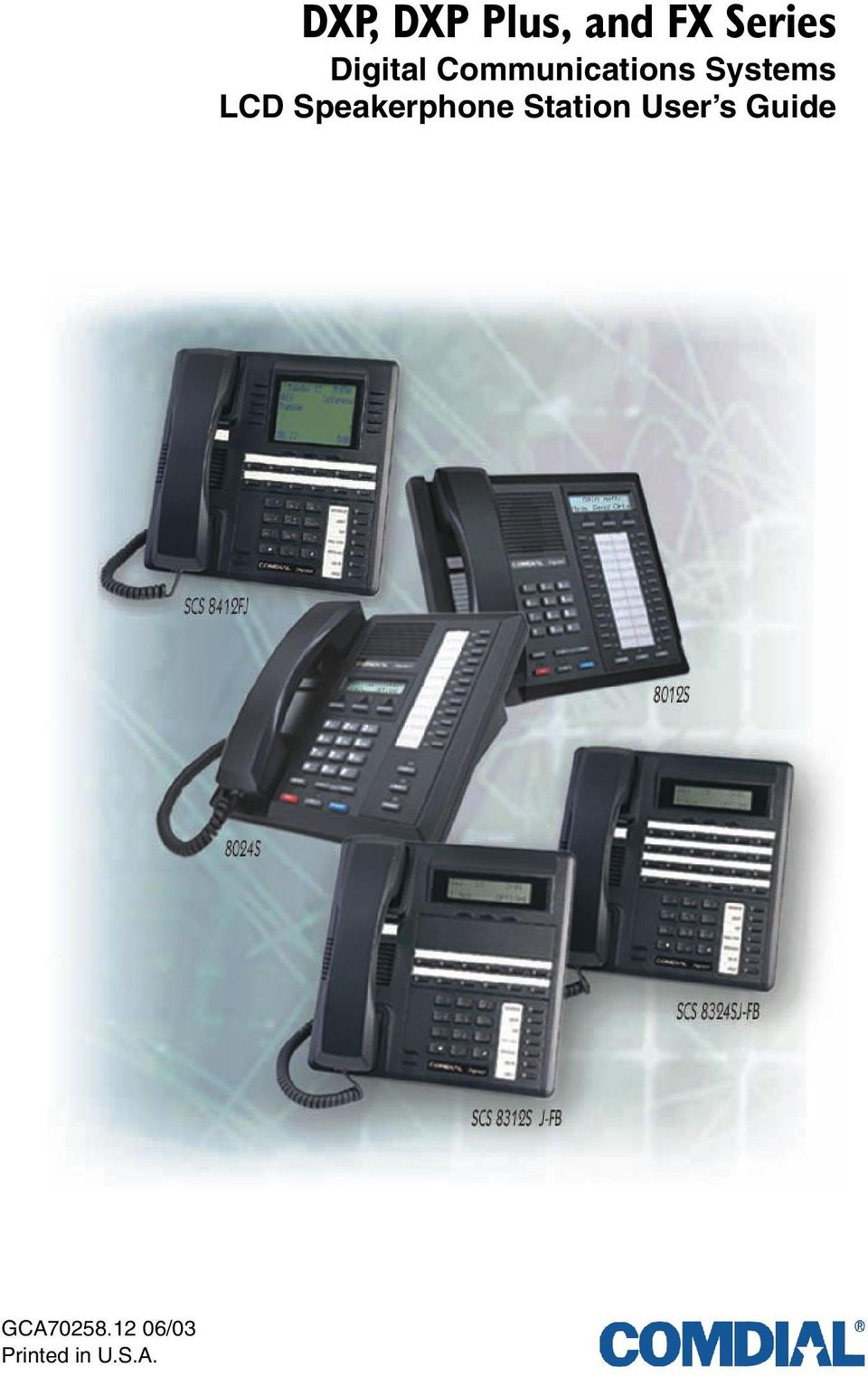
DXP, DXP Plus, and FX Series Digital Communications Systems LCD Speakerphone Station User s Guide
|
|
|
- Rodger Wood
- 10 years ago
- Views:
Transcription
1 GCA /03 Printed in U.S.A. DXP, DXP Plus, and FX Series Digital Communications Systems LCD Speakerphone Station User s Guide
2 This user s guide is for the following system: DXP, DXP Plus, and FX Series Digital Communications Systems This user s guide applies to the following telephone models: Impact 8012S-** Rev. A and later. Impact 8024S-** Rev. A and later. Impact SCS 8324S-** Rev. A and later Impact SCS 8312S-** Rev. A and later Impact SCS 8324F-** Rev. A and later Contact your Comdial dealer for updates of this as well as other Comdial publications. Copyright 2003 Comdial Corporation All rights reserved. Unauthorized use of this document is prohibited. Comdial Corporation 106 Cattlemen Road, Sarasota, Fl (941) or (800) Notice- Comdial reserves the right to make any changes and improvements in the product described in this document at any time and without prior notice. Impact is a trademark of Comdial Corporation. All other product names are trademarks of their respective owners. Printed in USA
3 TABLE OF CONTENTS 1. Getting Started Welcome Setting Up Your Speakerphone Positioning Your Speakerphone Setting Display Contrast Setting a Personal Ringing Tone Setting Volume Levels Answering and Making Calls Understanding the Basic Functions Your Speakerphone s Buttons Your Speakerphone s Display Lights Answering Calls Answering Outside Calls Answering Intercom Calls Night-Transferred Calls - Line Access From Any Station Holding Calls Call Pickup Group Call Pickup Directed Call Pickup Pickup For Monitored Stations Receiving Subdued Off-Hook Voice Announcements (SOHVA) Voice Announce Blocking Caller ID (Automatic Number Identification) Making Calls Making Outside Calls Making Intercom Calls Automatic Dialing Redialing Redial - Last-Dialed Number Redial Programming (Storing Numbers) Camping On - Busy Station, Automatic Callback Advanced Camping On Options TOC-1

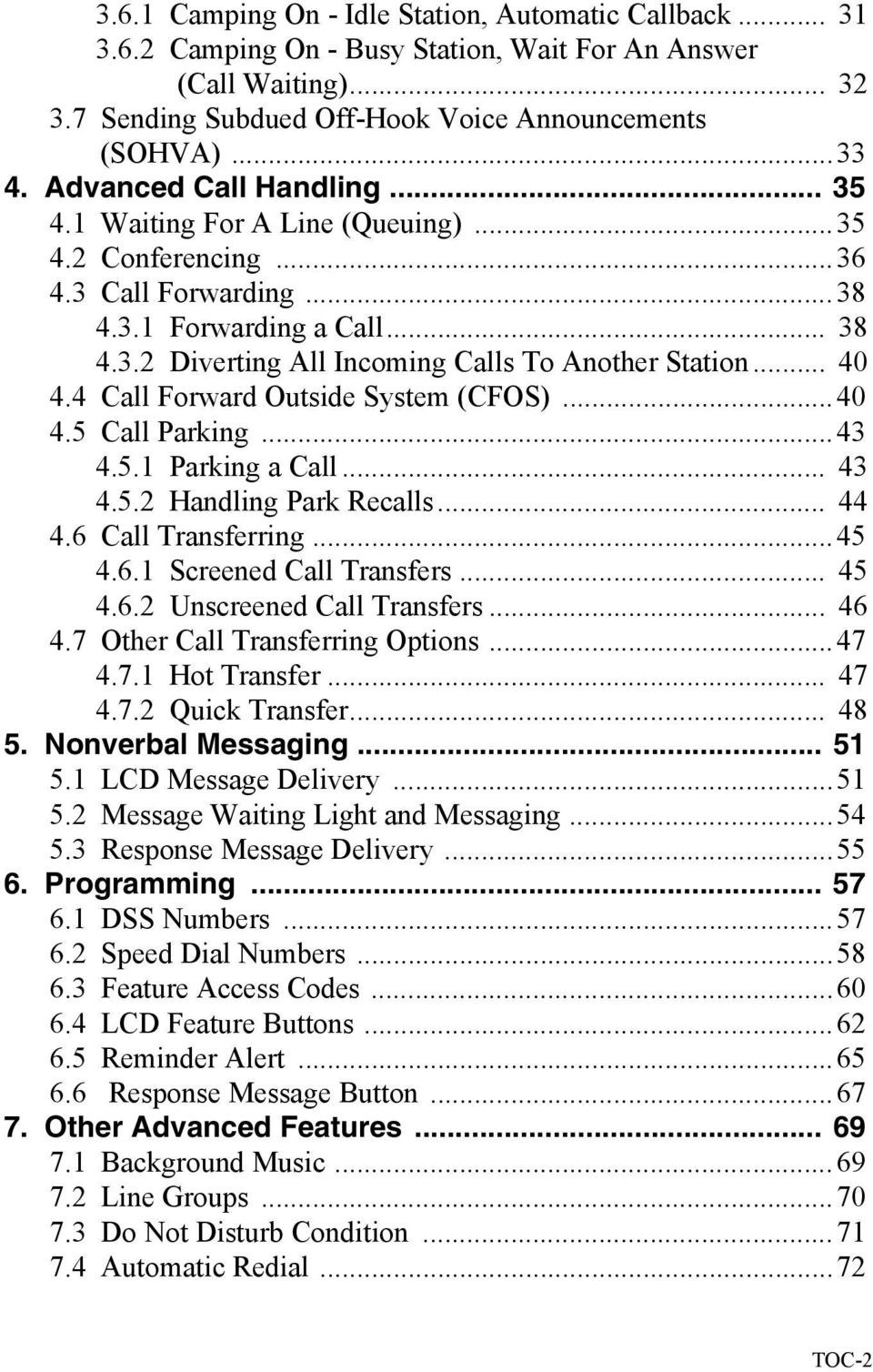
4 3.6.1 Camping On - Idle Station, Automatic Callback Camping On - Busy Station, Wait For An Answer (Call Waiting) Sending Subdued Off-Hook Voice Announcements (SOHVA) Advanced Call Handling Waiting For A Line (Queuing) Conferencing Call Forwarding Forwarding a Call Diverting All Incoming Calls To Another Station Call Forward Outside System (CFOS) Call Parking Parking a Call Handling Park Recalls Call Transferring Screened Call Transfers Unscreened Call Transfers Other Call Transferring Options Hot Transfer Quick Transfer Nonverbal Messaging LCD Message Delivery Message Waiting Light and Messaging Response Message Delivery Programming DSS Numbers Speed Dial Numbers Feature Access Codes LCD Feature Buttons Reminder Alert Response Message Button Other Advanced Features Background Music Line Groups Do Not Disturb Condition Automatic Redial...72 TOC-2
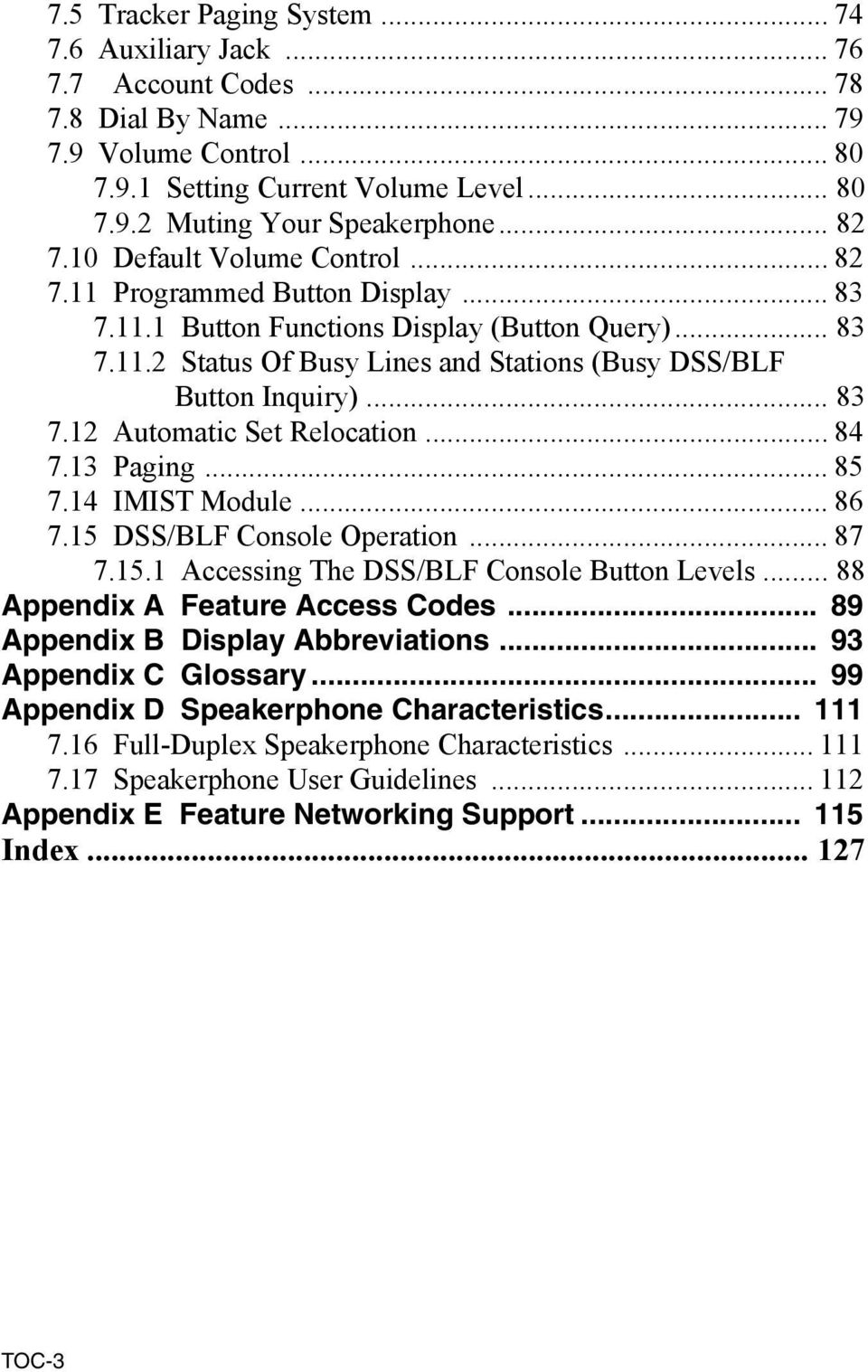
5 7.5 Tracker Paging System Auxiliary Jack Account Codes Dial By Name Volume Control Setting Current Volume Level Muting Your Speakerphone Default Volume Control Programmed Button Display Button Functions Display (Button Query) Status Of Busy Lines and Stations (Busy DSS/BLF Button Inquiry) Automatic Set Relocation Paging IMIST Module DSS/BLF Console Operation Accessing The DSS/BLF Console Button Levels Appendix A Feature Access Codes Appendix B Display Abbreviations Appendix C Glossary Appendix D Speakerphone Characteristics Full-Duplex Speakerphone Characteristics Speakerphone User Guidelines Appendix E Feature Networking Support Index TOC-3
6 Notes: TOC-4

7 GCA70258 LCD Speakerphone Station User s Guide 1. GETTING STARTED 1.1 Welcome Congratulations and thank you for using a Comdial telephone! Your digital speakerphone is supported by a communication system with hundreds of built-in, standard features. This manual serves as a helpful guide for using these various functions. The sections in this introductory chapter help you initially set up your speakerphone and become familiar with the controls and indicators. The remaining sections are titled as follows: Setting Up Your Speakerphone Understanding the Basic Functions Your Speakerphone s Buttons Your Speakerphone s Display Lights 1.2 Setting Up Your Speakerphone When your new speakerphone arrives, the system installer unpacks your speakerphone and connects the line to a system jack. The following sections describe a few initial adjustments that allow you to quickly begin making and answering calls with some of the most basic features. Impact 8024 LCD Speakerphone August, 03 Comdial 1
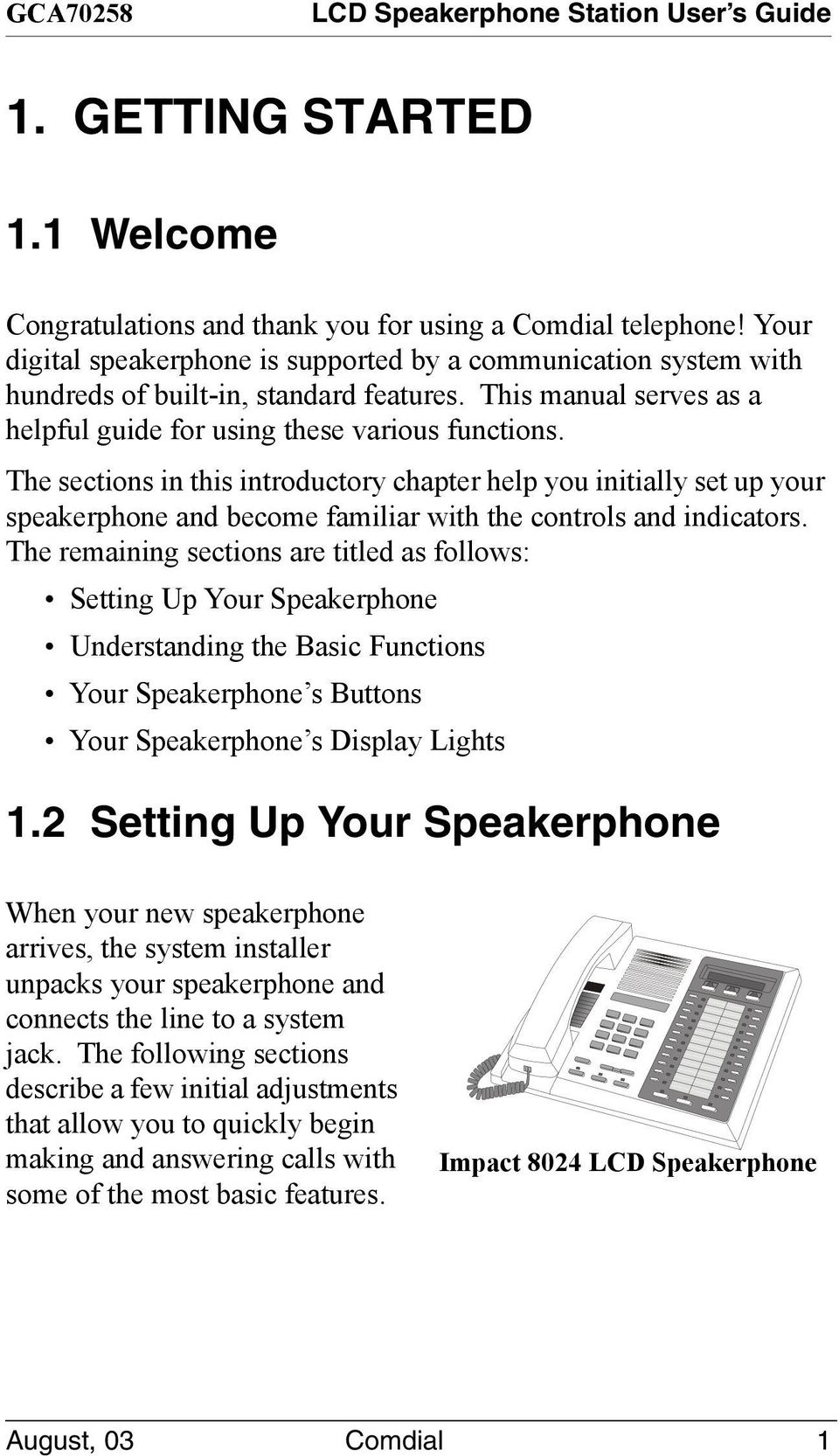
8 Getting Started POSITIONING YOUR SPEAKERPHONE You should adjust the position of the speakerphone on your desk or table to suit your individual needs and maximize the performance of the sound activated features. When using your speakerphone, the microphone and loudspeaker are farther from you than when you use a handset. Some positioning tips to consider include: For the microphone to best detect your voice, speak within three feet of it and face the speakerphone. Background noise may prevent the sound-activated switches from operating properly. Avoid placing the speakerphone where it will detect sounds from typewriters, keyboards, printers, paging systems, or other equipment. Place the telephone on a hard surface and away from table edges. Do not place the telephone in corners or enclosures. Do not let obstructions come between you and the microphone. If you are using an Impact SCS model, your telephone has an adjustable pedestal to allow you to select the most comfortable viewing angle. When you receive the telephone, the pedestal is in its lowest position flush against the pedestal. To adjust the pedestal (Impact SCS Models only), 1. GRASP the rear of the pedestal base firmly with one hand AND LIFT the rear portion of the telephone upward with your other hand. 2. LIFT the telephone upward with one hand AND RAISE the telephone supporting arms upward with your other hand. (Notice there are three sets of notches under the telephone corresponding to the three positions available.) Adjusting the Pedestal 2 Comdial August, 03
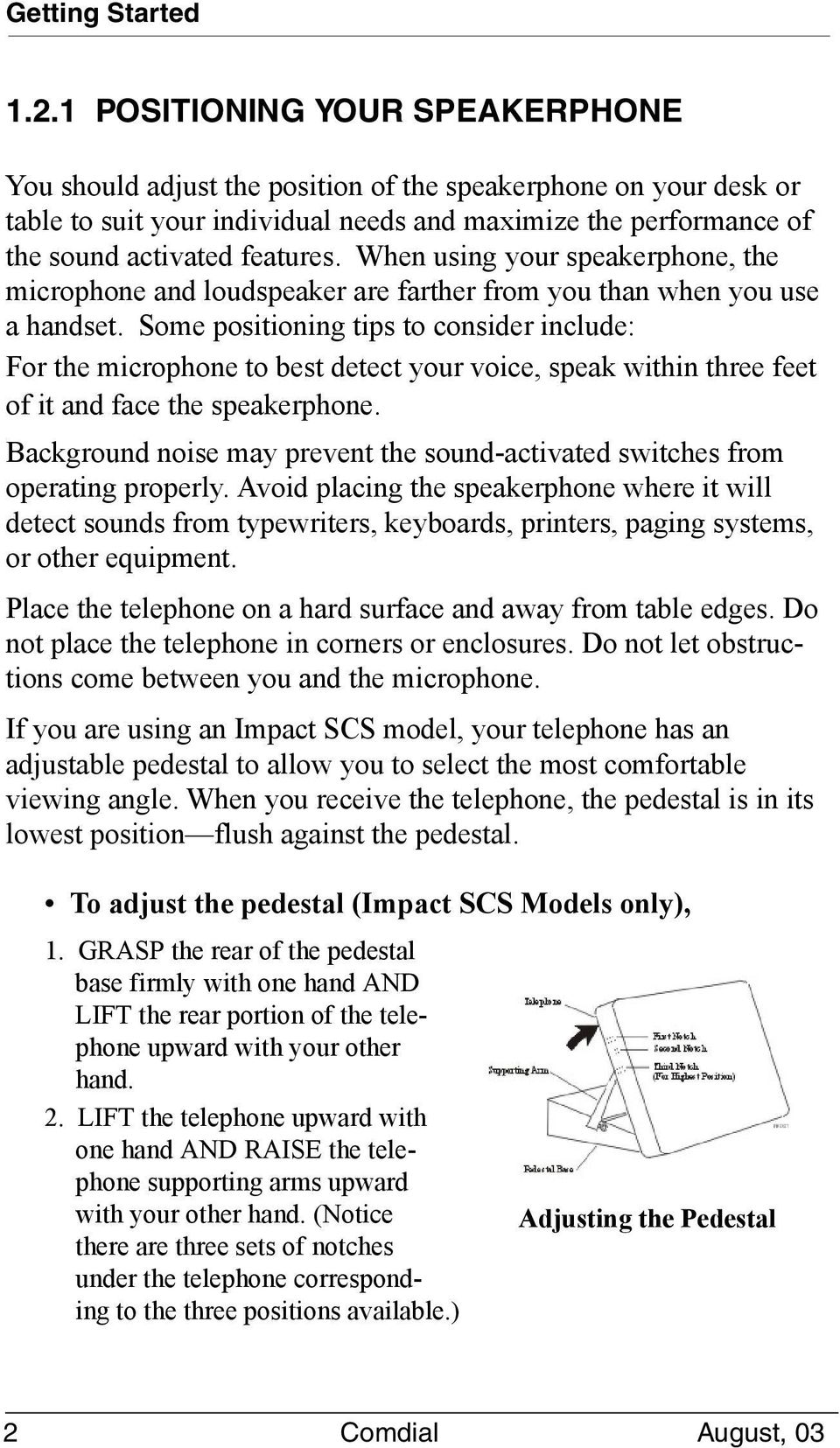
9 GCA70258 LCD Speakerphone Station User s Guide 3. When the telephone is at the desired height, SELECT the closest pair of notches AND INSERT the supporting arms in the notches. PRESS DOWN slightly on the telephone until you feel the supporting arms snap into place. Also remember, as with any piece of electronic equipment, your telephone may be damaged by contact with liquids. Please try to place the telephone in an area that is free from the danger of spills. NOTE: For more tips and information on speakerphone use including the use of a Full-Duplex Speakerphone, see Appendix D, Speakerphone Characterisics SETTING DISPLAY CONTRAST You can darken or lighten the contrast of the display for best viewing. To adjust the display contrast, 1. SELECT OPTIONS. 2. SELECT NEXT until the DISP option appears. 3. SELECT DISP. Your display will read CONTRAST LEVEL 4. SELECT LIGHT or DARK once for each degree of change desired. 5. PRESS SPEAKER to end. Select Display Setting the Contrast Level August, 03 Comdial 3
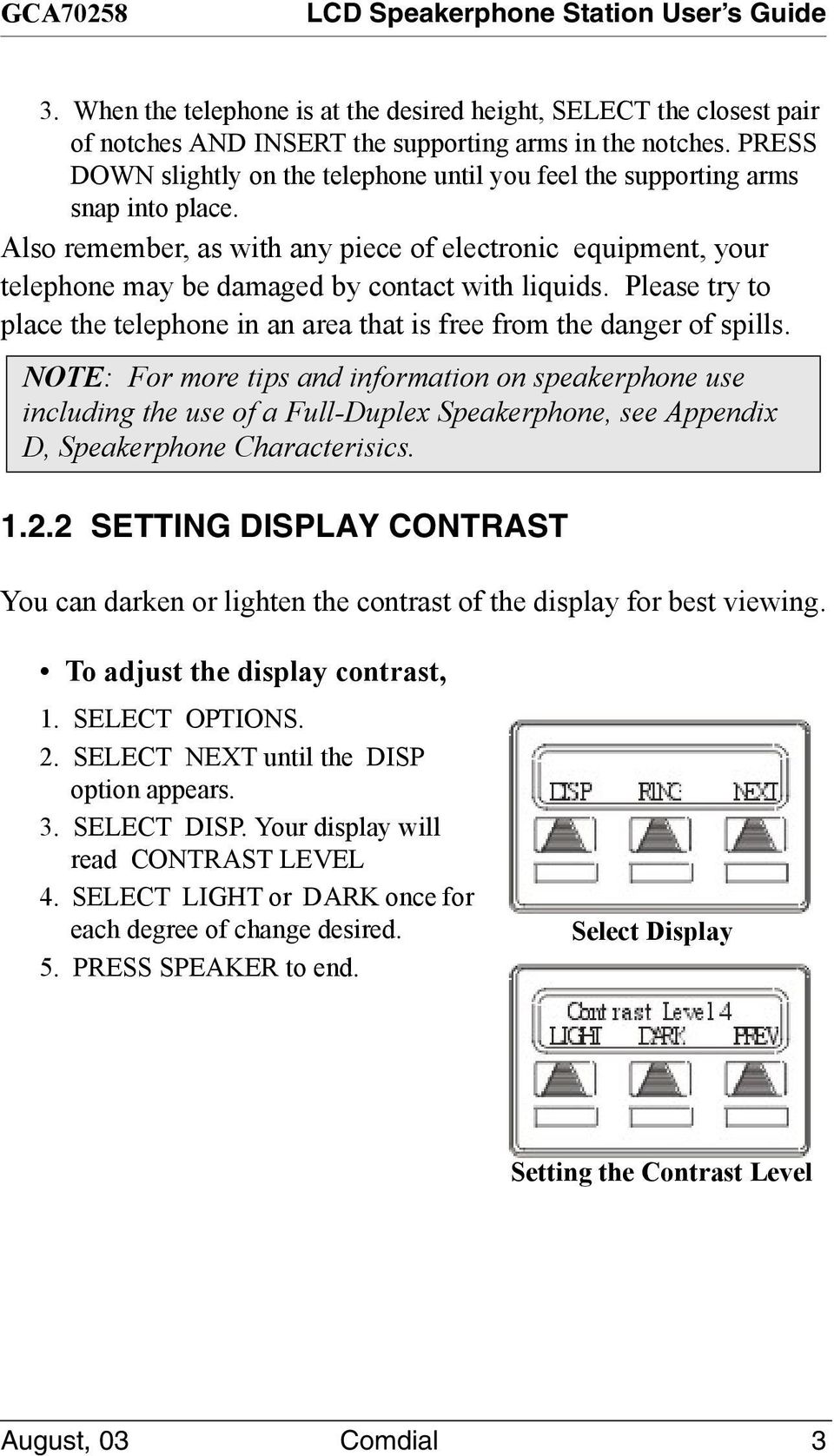
10 Getting Started SETTING A PERSONAL RINGING TONE You can choose one of many different ring tones for your telephone. Often, when several telephones are located close together, each user chooses a different personal ring tone. To select one of the ring tones, proceed as follows: 1. SELECT OPTIONS. 2. SELECT NEXT until the RING option appears. 3. SELECT RING. 4. SELECT UP OR DOWN to choose ring tone in display (a new tone will sound at each up or down press). 5. PRESS SPEAKER to end. Selecting the Ring Tone 4 Comdial August, 03

11 GCA70258 LCD Speakerphone Station User s Guide SETTING VOLUME LEVELS The volume control on your telephone is a multipurpose control you can use to set the volume (loudness) of the ringer, the speaker, and the handset. To set the ringer loudness level, While your telephone is on-hook and idle, PRESS the VOLUME UP OR VOLUME DOWN button once for each change in loudness you desire. The ringer sounds once for each change as an example of the current setting. Impact SCS Volume Buttons NOTE: If you set the ringer to the OFF position, your telephone sounds a short ring burst once for each call you receive at your station. To set the speaker and handset loudness levels, 1. PRESS INTERCOM button. 2. PRESS the VOLUME UP OR VOL- UME DOWN button once for each change in speaker volume that you desire. 3. LIFT handset. 4. PRESS the VOLUME UP OR VOL- UME DOWN button once for each change in handset volume that you desire. Impact Volume Buttons Note: When a call ends, the system resets the speaker and handset volume of all future calls to the programmed (default) setting. For instructions in setting your speakerphone s default volume, see Volume Control section in the system specific Features chapter. August, 03 Comdial 5

12 Getting Started ANSWERING AND MAKING CALLS Your speakerphone is now properly configured to answer and make calls to both stations within your system (intercom calls) and outside lines. Remember that when dialing an outside number, you must first select a line to connect your system to the local exchange. When you hear outside ringing (long bursts), 1. PRESS flashing line button. 2. SPEAK toward telephone OR LIFT handset if privacy is desired. When you hear intercom ringing (two short bursts), 1. PRESS INTERCOM. 2. SPEAK toward telephone OR LIFT handset if privacy is desired. To dial an outside number manually, 1. PRESS INTERCOM. 2. DIAL 9 OR PRESS other line button to select line (See Line Groups in the system specific Features chapters for more information on selecting an outside line). 3. LISTEN for dial tone. 4. DIAL number. 5. LIFT handset if privacy is desired. To dial an intercom number manually, 1. PRESS INTERCOM. 2. DIAL extension number (called telephone will ring or tone will be heard). 3. SPEAK toward telephone OR LIFT handset if privacy is desired. 6 Comdial August, 03

13 GCA70258 LCD Speakerphone Station User s Guide 1.3 Understanding the Basic Functions Your speakerphone provides many versatile features for your use. These features are explained in terms of what they allow you to do. Alphanumeric Display (Liquid Crystal Display LCD) Displays time, day, date, and active call information Keeps you apprised of the status of your telephone Provides programming prompts Auxiliary Jack Your Impact LCD speakerphone may be equipped with an auxiliary jack that provides an interface for a headset, a tape recorder, an external ringer, or an external pager. Message-Waiting Light Indicates that a message awaits pick up Microphone Opening Allows hands-free operation of speakerphone (speak clearly toward microphone opening) Speaker Sounds distant party s voice Sounds ringing and call-in-progress tones August, 03 Comdial 7
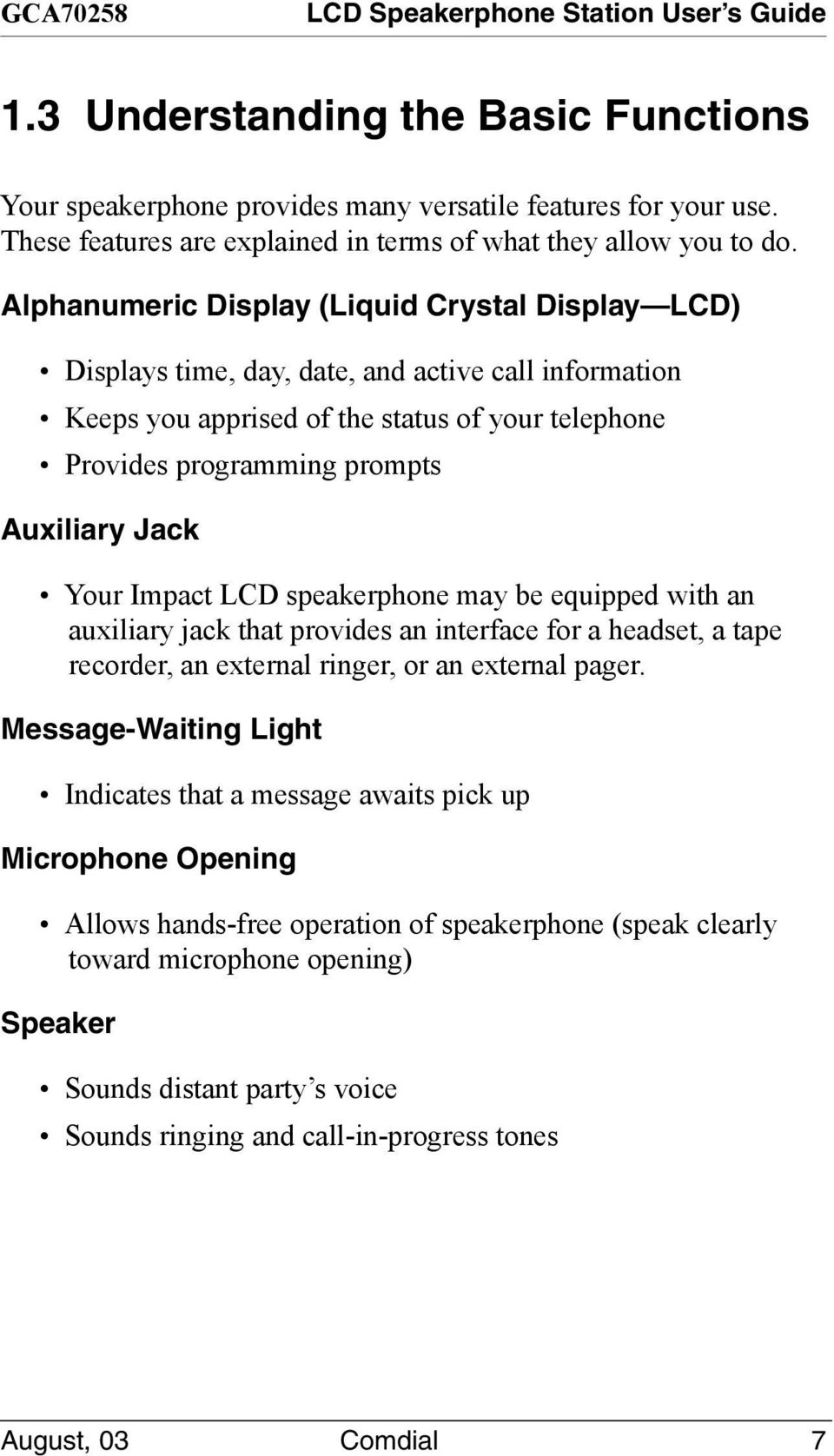
14 Getting Started Impact 8024S-** LCD Speakerphone Impact SCS 8312S=** LCD Speakerphone 8 Comdial August, 03

15 GCA70258 LCD Speakerphone Station User s Guide 1.4 Your Speakerphone s Buttons Hold Button (HOLD) Places a line or intercom call on hold Stores pauses in number sequences during programming If available, scrolls through LCD response messages If multiple held calls feature is available, scans or scrolls through calls placed on hold (when hold light is flashing) Interactive Buttons (located below alphanumeric display) Provide quick and easy access to system features Provide straightforward button programming without dialing codes (the interactive buttons themselves, however, are not programmable) Intercom Button (INTERCOM) Selects an intercom line Allows you to initiate many of the telephone s features Mute Button (MUTE) Keeps the person on the line from hearing your conversation Allows reply to a Subdued Off-Hook Voice Announcement (SOHVA). August, 03 Comdial 9

16 Getting Started Direct Station Select/Busy Lamp Field (DSS/BLF) Programmable Buttons Allow you to store numbers for automatic dialing functions Allow you to store telephone extension numbers for Direct Station Selection (DSS) May be programmed as a feature button May be designated a line button by your system installer Shift Button (SHIFT) Allows you to enter a second tier for storing and/or automatically dialing speed dial numbers. (That is, you can store two speed dial numbers at every programmable button location one in the regular tier and one in the second tier). You activate the shift function by pressing this button and turning the shift light on before storing or automatically dialing a speed dial number from the second tier. Speaker Button (SPEAKER) Turns your speaker on or off Disconnects a call when you are on a hands free call Ends or cancels programming Tap Button (TAP) Recalls dial tone or generates a hookflash Retrieves held calls or last call placed on hold Transfer/Conference Button (TRNS/CNF) Transfers calls Sets up conference calls 10 Comdial August, 03
17 GCA70258 LCD Speakerphone Station User s Guide Volume Control (VOLUME UP or VOLUME DOWN) Regulates the volume of the ringer, speaker, handset, headset, background music, and group listening mode Impact 8012S-** LCD Speakerphone August, 03 Comdial 11

18 Getting Started 1.5 Your Speakerphone s Display Lights The lights (LEDs) on your LCD speakerphone indicate the status of lines, features, and intercoms. Busy Lamp Field (BLF) lights (next to a Direct Station Select/Busy Lamp Field or DSS/BLF programmable button): Steady red = station is in use. Flashing red = station is receiving a call. Winking/Fluttering red = message-waiting light set for you by station associated with that DSS button. Next to a line button: Steady green = this is your line, either on-hook (in a hands free mode) or off-hook, when the line is active. Steady red = another station is using this line. Flashing red = a call is coming in on this line. Flashing orange = this line will be answered when you lift the handset. Winking green = your line is on hold. Winking red = the call has been placed on hold by another station. Fluttering orange or green = your line has recalled from hold. Fluttering red = the line put on hold by another station has recalled. Note: You can find the programmable buttons that the installer designates line buttons in the same location as the DSS/BLF buttons. Ensure that these buttons are labeled correctly to indicate their unique features. 12 Comdial August, 03

19 GCA70258 LCD Speakerphone Station User s Guide Next to a fixed feature or programmable feature button: Steady red = the feature is on. Steady off = the feature is off. Note: You can find the programmable buttons that the installer designates feature buttons through user programming in the same location as the DSS/BLF programmable buttons. Ensure that these buttons are labeled correctly to indicate their unique features. Above the MUTE button: On steady = called party cannot hear your conversation. Next to INTERCOM button: Steady green or red = you are using your intercom. Fluttering red = an LCD message is set on your telephone for others to receive when calling. Flashing orange = someone is calling your extension or a call is being transferred to you. August, 03 Comdial 13
20 R Getting Started Above the HOLD button: (Non-SCS Series models) Flashing/Fluttering red = message waiting. Winking green = a line is on hold at your station (DXP, DXP Plus, FXS and FXT Systems only). Next to the MESSAGE button (SCS Series Models only): Winking green = message awaits pick up. Above the SPEAKER button: On steady (with the telephone on hook and busy) = speakerphone mode On steady (with telephone on hook and idle) = background music is turned on. LCD Alphanumeric Display SCS02 Interactive Buttons (NOT programmable) Handset Programmable Buttons Telephone Speaker Dialpad Intercom Button* Message Waiting Light* Shift Button* TAP Button* Transfer/Conference Button* Speaker Button* Mute Button* Volume Up Volume Down Connectors On Bottom Of Telephone Optional IMIST Module Optional Console-Top Handset Headset Line Cord-Bottom Microphone Opening Hold Button* * NOTE: These may be default button locations. Your system may allow installer reprogramming of these buttons to better suit your applications. Impact SCS 8324F-** and Impact SCS 8324S-** 14 Comdial August, 03

21 GCA70258 LCD Speakerphone Station User s Guide 2. ANSWERING CALLS 2.1 Answering Outside Calls When an outside call rings at your station, the LCD screen displays the system line number of the incoming call (e.g., L123) and any caller ID information that your station is programmed to receive. In addition to simply lifting the handset, your other options for answering the call are displayed above the interactive buttons. When you hear outside ringing (two long bursts) and observe an orange flashing light, 1. For speakerphone, PRESS flashing line button OR SELECT ANS AND SPEAK toward telephone. 2. For privacy, LIFT handset. 3. SELECT DND if you do not wish to answer the call at this time. When you hear outside ringing (two long bursts) and observe a red flashing light, L123 J Doe DND 1. PRESS flashing line button OR SELECT ANS. 2. SPEAK toward telephone OR LIFT handset if privacy is desired. 3. SELECT DND if you do not wish to answer the call at this time. Note: For more information on setting DND at your station, see section titled Do Not Disturb Condition on page. ANS Outside Call on LIne 123 August, 03 Comdial 15
22 Answering Calls 2.2 Answering Intercom Calls Your station receives intercom calls in one of two ways depending upon system programming. In a voice-first setting, a short tone is followed by the caller s voice heard on the speaker. With a tone-first setting, the telephone rings in a distinctive pattern and the user of the receiving station must take action to answer. As with an outside call, your LCD screen displays the extension number of the incoming call (e.g., Ext 3213) and any caller ID information that your station is programmed to receive. When you hear an intercom tone followed by a caller s voice, SPEAK toward the telephone to answer, OR LIFT handset if privacy is desired. When you hear intercom ringing (two short bursts), 1. PRESS INTERCOM OR SELECT ANS. 2. SPEAK toward telephone OR LIFT handset if privacy is desired. 3. SELECT DND if you do not wish to answer the call at this time. J Doe Ext 321 DND ANS Intercom Call from J Doe Note: For more information on setting DND at your station, see section titled Do Not Disturb Condition on page. 16 Comdial August, 03
23 GCA70258 LCD Speakerphone Station User s Guide 2.3 Night-Transferred Calls - Line Access From Any Station The system attendant can transfer incoming calls to a particular station or stations for off-hour ringing. If your telephone rings, 1. PRESS line button with flashing light. 2. LIFT handset to talk. When you hear loud ringing anywhere in the system, 1. LIFT handset. 2. PRESS INTERCOM. 3. CHOOSE ringing zone: DIAL 65 through 68 to select ringing zone (1-4). DIAL 69 to answer for any zone. August, 03 Comdial 17
24 Answering Calls 2.4 Holding Calls You can place a call on hold and retrieve it later. With a regular hold, you can pick up the held call at your telephone or another user can pick the call up at a telephone sharing the held call line appearance. To place a call on hold, PRESS HOLD (station button) or SELECT HOLD (interactive button). The light above your HOLD button begins to blink. To retrieve a held call, 1. PRESS line button of the held call (with winking green light), OR PRESS TAP. 2. SPEAK toward telephone OR LIFT handset if privacy is desired. With an exclusive hold condition, you must pick up the held call at your telephone; no other telephone has access to the call. To place a call on exclusive hold, PRESS HOLD twice. To retrieve exclusive hold, 1. PRESS line button of held call (with winking green light), OR PRESS TAP. 2. SPEAK toward telephone OR LIFT handset if privacy is desired. After a call has been on hold for the period of time (set by the installer of your system), the system causes four quick hold recall tone bursts to sound at your telephone, the flash rate of the line button becomes faster and the light becomes orange. If the call is on exclusive hold, it will revert to manual hold after the hold recall period. 18 Comdial August, 03
25 GCA70258 LCD Speakerphone Station User s Guide If a held line is recalling, choose one of the following: 1. SELECT HOLD to place the call on hold at your station and restart hold timer. 2. LIFT handset, PRESS line button (with flashing orange light) OR SELECT ANS to retrieve the call. The installer can add a directed station hold feature to your telephone. With this feature, you can place a call on hold at another station. You can also pick up the held call that has been waiting the longest length of time at another telephone. To place a call on directed station hold, 1. ANSWER call. 2. PRESS INTERCOM OR TRNS/CNF if intercom call. 3. DIAL * DIAL extension number of station to receive held call. 5. HANG UP. To retrieve a held call at another station, Recall L123 HOLD 1. PRESS INTERCOM. 2. DIAL # DIAL extension number of station where call is currently on hold. 4. PRESS DSS/BLF button OR TAP to answer call. Often, you will have more than one call on hold at your station. You know you can retrieve the last call placed on hold simply by pressing TAP; however, if you do not have line appearance for a line on which another call is holding, the system provides a way for you to access that call before servicing the last call you placed on hold. To scan your held calls and retrieve a specific one: 1. REPEATEDLY PRESS HOLD to scan held call list. 2. PRESS TAP to retrieve call. ANS A Recalling Held Line August, 03 Comdial 19
26 Answering Calls 2.5 Call Pickup The Impact system offers three distinct methods to answer incoming calls that are ringing at other stations GROUP CALL PICKUP The installer often arranges several telephones together in a user group. If your telephone is so arranged, you can answer calls that are ringing at other stations within your particular group. To answer a call that is ringing within your group, 1. PRESS INTERCOM. 2. DIAL #4. 3. SPEAK toward telephone, OR LIFT handset if privacy is desired DIRECTED CALL PICKUP Also, you can answer a call that is ringing at any telephone in the system if you know the ringing telephone s extension number. To answer a call that is ringing at any telephone in the system, 1. PRESS INTERCOM. 2. DIAL *4. 3. DIAL extension number of ringing telephone. 4. SPEAK toward telephone, OR LIFT handset if privacy is desired PICKUP FOR MONITORED STATIONS Your telephone may have the personal intercom number of another telephone appearing at a programmable button location. You can use the light associated with this button to monitor the status of that telephone, and you can press the button to make a call to that telephone if you wish. 20 Comdial August, 03
27 GCA70258 LCD Speakerphone Station User s Guide To monitor another telephone, 1. OBSERVE the BLF light indications next to the Direct Station Select (DSS/BLF) button: Off = Station is idle Flashing (if enabled) = Station has an incoming call On = Station is busy To call an idle monitored station or to answer one that is ringing, 1. NOTE the BLF light condition. 2. PRESS assigned DSS/BLF button. 3. SPEAK toward telephone, OR LIFT handset if privacy is desired. If ringing telephone is within your designated calling group......dial # 4 For any ringing telephone......dial 4 + extension code Your Station Ringing Station If you have programmed a DSS/BLF button for the ringing telephone......press flashing DSS/BLF button Answering Calls for Other Stations August, 03 Comdial 21
28 Answering Calls 2.6 Receiving Subdued Off-Hook Voice Announcements (SOHVA) Handling an Incoming SOHVA This feature allows an intercom caller to break into your call by making an announcement through your handset receiver. The distant party that you are currently talking to cannot hear the announcement made by the SOHVA caller. To respond to a SOHVA verbally, 1. SELECT AND HOLD REPLY OR PRESS MUTE. 2. SPEAK into handset. Distant party cannot hear your response. 3. RELEASE REPLY OR MUTE after response is complete to return to distant party. J Doe Ext 321 Calling BLOCK MSG REPLY Incoming SOHVA To respond to a SOHVA nonverbally through Response Messaging, 1. SELECT MSG. 2. SELECT HAVE HOLD OR TAKE MSG. (Message appears in the display of the telephone making the SOHVA). S12 Calling HVHLD TKMSG CLBK Message Response 3. CONTINUE your current call with distant party. (SOHVA caller is automatically disconnected from your telephone). 22 Comdial August, 03
29 GCA70258 LCD Speakerphone Station User s Guide To respond to a SOHVA by blocking (see below for more information), SELECT BLOCK when you hear SOHVA tone. (SOHVA call is disconnected). Note: A station that is currently active in speakerphone mode or has Voice Announce Block set CAN NOT receive a SOHVA VOICE ANNOUNCE BLOCKING If your system installer makes this feature available, you can prevent voice announcements from sounding over your telephone speaker if you wish. This feature also blocks Subdued Off-Hook Voice Announcements (SOHVA) and will refuse any attempted SOHVAs. To block (unblock) all voice-announced calls, 1. SELECT OPTIONS. 2. SELECT NEXT until VAB appears. 3. SELECT VAB. 4. SELECT ON to block (OR OFF to unblock). 5. PRESS SPEAKER to end. INCOMING SOHVA Your Station VERBAL SOHVA RESPONSES Press and Hold MUTE While Speaking SOHVA Delivering Station NONVERBAL Select MSG And Choose Message To Deliver BLOCK Select BLOCK To Disconnect Answering aa SOHVA August, 03 Comdial 23
30 Answering Calls 2.7 Caller ID (Automatic Number Identification) When installed by system programming, the Caller ID feature allows you to view incoming call numbers before you answer them. Incoming call numbers flash in the lower half of the LCD. If you answer the call, the number appears in the upper half of the LCD. The system also stores numbers that ring on your line but receive no answer. If the call has been returned by someone else, selecting the S key reveals who returned the call. Everyone sharing your line can scroll through the stored numbers and choose which calls to return. To scroll through ring-no answer numbers stored on your system (CID light is flashing), 1. SELECT the programmed CALLER ID button on your telephone. Your LCD will display the calling number, date, and time the call came in. The most recent call appears first in the list. 2. SELECT the programmed CALLER ID button each time you wish to display the next most recent ring-no answer call to your line. 3. To dial one of the numbers in the redial queue, SELECT the programmed SAVED NUMBER REDIAL button. The system will automatically dial the number. Depending on your system programming, when a call is returned it might remain in the ring-no answer queue or the system might delete it from the ring-no answer queue. Your system installer can tell you how the feature is programmed. If the system is programmed to leave a returned number in the redial queue, the display will show a S next to numbers that have been returned. To determine who viewed the number and returned the call, DIAL *. 24 Comdial August, 03
31 GCA70258 LCD Speakerphone Station User s Guide 3. MAKING CALLS 3.1 Making Outside Calls You can manually dial a number over any telephone line you select. Or, if the installer assigned a prime line or the idle line preference feature to your LCD speakerphone, the system automatically selects a line for use when you lift the handset or press the speaker button. To dial an outside number manually, 1. PRESS INTERCOM. 2. DIAL 9 OR other line button to select line (See Line Groups in the system specific Advanced Features chapters for more information on selecting an outside line). 3. LISTEN for dial tone. 4. DIAL number. 5. LIFT handset if privacy is desired. If your station has an assigned prime line, you will not have to select a line before dialing outside your system. L123 CONF To dial an outside number using your prime line, ARDL Outside Dialing Display 1. PRESS SPEAKER OR LIFT handset if privacy is desired. Outside line is automatically selected. 2. LISTEN for dial tone. 3. DIAL number. August, 03 Comdial 25
32 Making Calls 3.2 Making Intercom Calls There are two methods for making an intercom call. One causes the called telephone to ring (tone-first). The other causes your voice to sound out at the called telephone (voice-first). Your installer can set the system to deliver either tone-first or voice-first calling. Note: The following instructions assume a tone-first setting. You can change a call to voice announce signaling for that call simply by pressing the INTERCOM button again after dialing the extension number or by pressing the DSS/BLF button again. To manually cause the other telephone to ring (tone calling), 1. PRESS INTERCOM. 2. DIAL extension number (called telephone will ring). Ext 321 J Doe To tone call automatically, PRESS DSS/BLF button (called telephone will ring). Press Intercom to Display Extension Number Note: The following instructions assume a voice-first default setting. Any user can change a call to a tone signaling for that call simply by pressing the INTERCOM button again after dialing the extension number or by pressing the DSS/BLF button again. 26 Comdial August, 03
33 GCA70258 LCD Speakerphone Station User s Guide To voice announce manually, 1. PRESS INTERCOM. 2. DIAL extension number. 3. SPEAK your announcement. Calling J Smith CALLBK MSG To voice announce automatically, 1. PRESS DSS/BLF button. 2. SPEAK your announcement. Ringing Intercom August, 03 Comdial 27
34 Making Calls 3.3 Automatic Dialing This feature provides one- or two-button speed dialing using programmable buttons at which you have previously stored numbers. There are two types of speed dial numbers: (1) numbers that you store for your own use (personal speed dial numbers), and (2) numbers that the system attendant stores for everyone s use (system speed dial numbers). To automatically dial a number stored at one of the programmable buttons on your station, choose one of the following: 1. PRESS programmed speed dial button (line selection is usually a part of the stored speed dial number). 2. PRESS SHIFT AND programmed speed dial button (to choose number stored as second choice at that button). To speed dial a personal speed dial number, While on hook, DIAL speed dial number on dial pad (0 to 9). To speed dial a system speed dial number, While on hook, DIAL * AND system speed dial number. Speed Dialing Options 28 Comdial August, 03
35 GCA70258 LCD Speakerphone Station User s Guide 3.4 Redialing For instruction on using your system s Automatic Redial feature, see page in the Other Features chapter REDIAL - LAST-DIALED NUMBER To redial the last-dialed number, 1. PRESS SPEAKER OR HANG UP handset to disconnect current ringing or busy tone. 2. DIAL #. 3. LISTEN for ringing or busy tone over the telephone speaker: REDIAL PROGRAMMING (STORING NUMBERS) To permanently store a number you ve just dialed, choose one of these methods: 1. SELECT SAVE AND PRESS unused programmable button OR, 2. PRESS programmed SAVED NUM- BER REDIAL button (see Feature Buttons section on page for set up details). L123 SAVE CONF ARDL Saving a Dialed Number August, 03 Comdial 29
36 Making Calls To store a number while you are on a call (if available), 1. PRESS programmed SAVE NUMBER REDIAL button twice (the display prompts you to dial a number). 2. DIAL the number that you wish to save (the system immediately saves the number for later redial; it does not dial it over the line you are on now). To redial the saved number, 1. PRESS line button to select a line. 2. PRESS programmed SAVE NUMBER REDIAL button (system automatically dials the number that you saved earlier). 3.5 Camping On - Busy Station, Automatic Callback If you call another station and receive a busy signal or a Do Not Disturb tone, you can press a button that will cause the system to ring your telephone when the station is available. To camp on at any busy station, 1. SELECT CAMP. 2. Your telephone immediately hangs up. When the station you called becomes available, your telephone will ring with five short tone bursts. J Doe Ext 321 Is Busy SOHVA CAMP NEXT When you hear five short tone bursts, PRESS INTERCOM OR SELECT ANS. The other telephone will start ringing. Camping On Selection Note: If you do not press INTERCOM after the ring back tones within the time limit set by the installer, the call back is canceled. 30 Comdial August, 03
37 GCA70258 LCD Speakerphone Station User s Guide To cancel the call back before your telephone sounds the tone bursts, PRESS INTERCOM AND DIAL #6. To camp on at a station with a Do Not Disturb condition set, SELECT CAMP. A call back will occur when called station is no longer set in the Do Not Disturb mode. 3.6 Advanced Camping On Options CAMPING ON - IDLE STATION, AUTOMATIC CALLBACK If you call another station and hear ringing but receive no answer, you can press a button that will cause the system to ring your telephone when any activity is initiated at that station. To camp on at a station for which you hear ringing but receive no answer, SELECT CALLBK. Callback will occur after any activity is initiated at dialed station. To cancel the camp-on condition, 1. PRESS INTERCOM AND DIAL #6. 2. HANG UP OR PRESS SPEAKER to end. August, 03 Comdial 31
38 Making Calls CAMPING ON - BUSY STATION, WAIT FOR AN ANSWER (CALL WAITING) If the telephone you have called is busy, you can send a call-waiting tone to the telephone and wait on the line for an answer (you must be using the handset for this feature to work). To activate call waiting when you hear a busy signal, 1. DIAL *6 (called party hears tone). 2. WAIT on line for reply. 3. Called party can place the current call on hold or disconnect from the call to answer your call-waiting tone, or choose to ignore your callwaiting tone and continue current conversation. To cancel call waiting, 1. PRESS INTERCOM AND DIAL #6. 2. HANG UP OR PRESS SPEAKER to end. To answer a call-waiting tone if you receive one while on a call, 1. HEAR short tone burst in receiver. 2. PLACE current call on hold, OR complete call AND HANG UP (waiting call will ring at your telephone). 32 Comdial August, 03
39 * 0 # GCA70258 LCD Speakerphone Station User s Guide 3. LIFT handset to answer call Your Station BUSY NO ANSWER To Wait For Callback... To Send Call Waiting Tone... To Wait For Callback......Select CALLBACK and Disconnect...Dial 6 and Wait For Reply...Select CAMP and Disconnect When idle, your call is connected. Busy station hears tone and may respond or ignore. When any activity occurs at station, your call is connected. Busy Station Idle Station Camping On Options 3.7 Sending Subdued Off-Hook Voice Announcements (SOHVA) You can make a private voice announcement to another station that is off-hook and busy on a call if the installer has arranged the system to provide this feature. August, 03 Comdial 33
40 Making Calls Make a SOHVA announcement using the SOHVA button as follows: 1. MAKE intercom call AND HEAR busy tone. If called station is on outside line, ring-back tone is heard, but SOHVA is still available. 2. SELECT SOHVA AND HEAR several quick tone bursts. 3. MAKE announcement. J Doe Ext 321 Is Busy SOHVA CAMP NEXT Making a SOHVA 4. WAIT on line for reply (either verbal or LCD reply). If your station returns to idle, the called party has blocked your SOHVA. Note: If the called station is currently in speakerphone mode or if the SOHVA has been denied by system programming, interactive button selection for SOHVA will not be available. 34 Comdial August, 03
41 GCA70258 LCD Speakerphone Station User s Guide 4. ADVANCED CALL HANDLING 4.1 Waiting For A Line (Queuing) If all the lines in a line group are busy, you can place your telephone in a queue to await an idle line. To queue for a line group, 1. PRESS INTERCOM. 2. DIAL the line group access code (see Line Group Access code table on page for your system s codes). 3. HEAR busy tone. 4. DIAL *6. If you have line appearance for a particular line and wish to queue for it, 1. OBSERVE the busy status light (LED). 2. PRESS INTERCOM. 3. DIAL *6. 4. PRESS line button. 5. When line group is free, your telephone sounds several short tone bursts. When you hear this, lift handset, hear dial tone, and place call. To cancel line queuing or line group queuing, 1. PRESS INTERCOM. 2. DIAL #6. August, 03 Comdial 35
42 Advanced Call Handling 4.2 Conferencing When your telephone is joined together with several other telephones on the same call, the effect is called conferencing. You can make conference calls that involve up to seven parties, including you as the originating party, in any combination of outside lines and intercom parties. Note: When setting up a conference call with outside lines and internal telephones, you must call the outside lines first. To set up a conference call that includes any combination of outside lines and intercom parties, 1. MAKE first call. 2. SELECT CONF. Call is placed on hold automatically. Establishing a Conference 3. SELECT next line AND MAKE next call. 4. SELECT CONF to establish conference. 5. PRESS TRNS/CNF button to add more parties. To continue conversation on remaining line after other outside lines have dropped out of conference, 1. PRESS HOLD. 2. PRESS the line button of the remaining party. To retrieve a line from hold and bring that party back into the conference, 1. PRESS TRNS/CNF. 2. PRESS line button. 3. PRESS TRNS/CNF. L123 CONF ARDL 36 Comdial August, 03
43 GCA70258 LCD Speakerphone Station User s Guide If you are involved in a conference call with two outside lines, you can drop out of this established conference call and leave the outside lines in the conference with each other. This is known as an unsupervised conference call. To drop out of a conference call you initiated involving outside lines (creating an unsupervised conference), DIAL # (lines remain lighted and in use until one or both outside parties disconnect; when only one party drops out of an unsupervised conference, the other party remains on hold until he hangs up or the line is answered). To rejoin an unsupervised conference between two outside lines, PRESS TAP or DSS/BLF button of one of the conferencing stations. Other Station To Add a Caller to a Conference... Managing a Conference Call...Select CONF or Press TRNS/CONF. To Remove a Caller From A Conference... To Drop Out of A Conference... Other Station...Select Line Button and Disconnect Line....Dial #. Your Station Managing a Conference August, 03 Comdial 37
44 Advanced Call Handling 4.3 Call Forwarding FORWARDING A CALL You can forward the calls that normally ring at your telephone to another telephone. To remind you that your calls are being forwarded, your telephone will sound a short ring burst each time the system forwards a call. To forward your calls, 1. SELECT OPTIONS. 2. SELECT NEXT until the CFWD option appears. 3. SELECT CFWD. 4. SELECT SET. 5. Choose one of the following call forwarding options: SELECT PERS to forward prime line and intercom calls SELECT ALL to forward all calls Call Forwarding SET CLR EXIT Selecting Call Forwarding Call Forwarding PERS ALL NEXT SELECT NEXT AND No ANS to forward calls that ring at your station but receive no answer after a preprogrammed number of rings (THEN PRESS PERS to forward your prime line and intercom calls, OR PRESS ALL to forward all calls that ring with no answer at your telephone). Call Forwarding Options MON 24 12:35 FWD to J Doe Ext 321 Call Forwarding Active 6. DIAL extension number of telephone to receive your forwarded calls. 7. PRESS SPEAKER to end. Display shows FWD. 38 Comdial August, 03
45 GCA70258 LCD Speakerphone Station User s Guide To cancel call forwarding, SELECT the right interactive button. PERS Forward Only Your Prime Line and Intercom Calls ALL Caller Your Station Forward All Calls That RIng At Your Station Forward Station NoANS Forward Only Calls That Are Not Answered At Your Station Call Forwarding Options August, 03 Comdial 39
46 Advanced Call Handling DIVERTING ALL INCOMING CALLS TO ANOTHER STATION Call diverting permits you to send an incoming call to another station that you have previously designated. You can divert an incoming call to the designated station whether you are busy or idle. To identify the station to receive diverted calls, 1. PRESS INTERCOM. 2. DIAL * DIAL extension number of station to receive diverted call. To divert calls to the designated station, 1. HEAR ringing AND/OR SEE flashing line status light. 2. PRESS programmed CALL FORWARD button (system immediately forwards ringing call to station you designated). See page for programming instructions. 4.4 Call Forward Outside System (CFOS) If enabled by your installer, the Call Forward Outside System (CFOS)* feature allows you to forward incoming or transferred line calls to telephone numbers outside the system. To activate CFOS with your LCD speakerphone, 1. SELECT OPTIONS. 2. SELECT NEXT until CFWD appears. 3. SELECT CFWD. 4. SELECT SET. 5. SELECT NEXT until CFOS appears. 6. SELECT CFOS. Call Forwarding NoANS CFOS NEXT Selecting CFOS 40 Comdial August, 03
47 GCA70258 LCD Speakerphone Station User s Guide 7. CHOOSE a type of CFOS and SELECT the desired interactive button (to switch the type of CFOS you wish to select, PRESS TGL): SELECT Itcm for intercom calls SELECT Line for prime line calls SELECT Itcm/Ln for all calls No CFOS Number SAVE BKSP NEXT Set Forward Destination SELECT RNA Itcm for ring-no-answer intercom calls SELECT RNA Line for ring-no-answer prime line calls SELECT RNA Itcm/Ln for all ring-no answer calls. 8. SELECT outbound line (press line button, dial appropriate code, or do nothing and let previously selected line remain in effect). If you want to change the destination, you must enter something for the outbound line. (See page for line access codes.) 9. SELECT forward destination (dial number, press speed dial button, or do nothing and let previously selected destination remain in effect). 10. PRESS SPEAKER to end (display shows CFOS and type of forwarding). August, 03 Comdial 41
48 Advanced Call Handling To deactivate CFOS, choose one of the following: 1. PRESS INTERCOM AND DIAL *56 OR, 2. SELECT OPTIONS. 3. SELECT NEXT until CFWD appears. 4. SELECT CFWD. 5. SELECT CLR. To join an active CFOS call from the CFOS-enabled station, Note flashing HOLD light indicating active CFOS call, and press TAP. Join CFOS-forwarded party and CFOS destination in a conference call. * Comdial has taken reasonable steps in the design of all product features, including CFOS, which protect against unauthorized or fraudulent access to, or use of, a system, or which protect against unauthorized, fraudulent or unaccounted-for access to, or use of, long distance lines. However, no system is entirely invulnerable or immune from unauthorized or fraudulent access or use, or unaccounted-for access or use, and therefore Comdial disclaims any and all liability, and makes no warranty, express or implied, relating to unauthorized or fraudulent access or use, or unaccounted-for access or use. 42 Comdial August, 03
49 GCA70258 LCD Speakerphone Station User s Guide 4.5 Call Parking PARKING A CALL You can place an intercom or outside call on hold in the system so that it can be answered from any station, even though it may not have a line appearance for the call. You accomplish this by placing the call in one of many park orbits, where the call remains until it is answered. To park a call in orbit, 1. While on the call, PRESS INTERCOM OR PRESS TRNS/CNF if intercom call. 2. DIAL *. 3. DIAL code for park orbit (910 to 999 for orbit 10 99). 4. Remember the code for later use or make it known to those who need to know it in order to retrieve the call. To park a call using a programmed PARK button, While on the call, PRESS the programmed PARK button (the system places the call in a preselected park orbit and lights the PARK light). To retrieve a call that was placed on hold in the system (parked), 1. PRESS INTERCOM. 2. DIAL #. 3. DIAL code for orbit (910 to 999 for orbit 10 99), OR PRESS programmed PARK button. August, 03 Comdial 43
50 Advanced Call Handling HANDLING PARK RECALLS When a parked call times out of the system, it returns to your telephone in the form of a park recall (you hear four short tone bursts at 12-second intervals). To answer a park recall, SELECT ANS. The call will then connect to your station. To place a park recall on hold at your station, SELECT HOLD. After the call remains on hold for a period of time, it rings back to your telephone as a hold recall. Recall Li HOLD A Park Recall ANS To re-park a park recall and restart the park timer, 1. ANSWER/RETRIEVE call. 2. SELECT PARK (the system places the call back in its original park orbit where it remains until it is answered or recalls again). Caller Your Station To Place Call In a Parking Orbit......DIAL and Orbit Number ( ) If the Parked Call Is Not Answered Within a Set Time, It Recalls To Your Station Parking Orbit To Retrieve a Parked Call From Any Other Station... Other Stations...DIAL # and Orbit Number ( ) Parking Calls 44 Comdial August, 03
51 GCA70258 LCD Speakerphone Station User s Guide 4.6 Call Transferring SCREENED CALL TRANSFERS You can answer a call at your LCD speakerphone and transfer it to another telephone. If you first identify the caller to the party receiving the transfer (giving that user the opportunity to prepare for the call), you have made a screened transfer. To screen and transfer a call to another telephone in the system, 1. ANSWER call. 2. PRESS TRNS/CNF (call is automatically placed on hold). 3. DIAL extension number of telephone to receive transfer, OR PRESS DSS/BLF button for that extension. 4. ANNOUNCE call when intercom party answers. 5. PRESS SPEAKER to disconnect (if in speakerphone mode), OR HANG UP. The intercom party then has the call (if he or she answered the screened transfer with the handset). If you announce the transfer over the speaker, the intercom party s telephone will ring with the transferred call after you hang up. If the intercom party is busy, take one of the following steps (if made available at your telephone by installer programming): J Doe Ext 321 Is Busy SOHVA RECON MSG 1. SELECT RECON to reconnect the call to your station. Attempting a Transfer 2. SELECT SOHVA to interrupt the call and tell the intercom party that a call awaits. 3. SELECT MSG to leave a message-waiting indication at the called station. August, 03 Comdial 45
52 Advanced Call Handling If the intercom party does not answer their telephone when ringing, take one of the following steps: 1. SELECT RECON to reconnect the call to your station. 2. SELECT MSG to leave a message-waiting indication at the station UNSCREENED CALL TRANSFERS You can answer a call at your LCD speakerphone and transfer it to another telephone. If you transfer the call without first announcing it, you have made an unscreened transfer. To transfer an unscreened call to another system telephone, 1. ANSWER call. 2. PRESS TRNS/CNF (call is automatically placed on hold). 3. DIAL extension number of telephone to receive transfer, OR PRESS DSS/ BLF button for that extension. 4. PRESS SPEAKER to disconnect (if in speakerphone mode), OR HANG UP. The transfer will ring at the called telephone. RCL L123 J Doe Ext 321 SEND HOLD ANS Attempted Transfer of Line 123 to J Doe is Recalling If an unscreened transfer call is not answered and recalls to your telephone, you can take one of the following steps: 1. PRESS HOLD to place the call on hold at your telephone. 2. SELECT ANS to return to the call. 3. SELECT SEND to retry the transfer. 46 Comdial August, 03
53 GCA70258 LCD Speakerphone Station User s Guide 4.7 Other Call Transferring Options HOT TRANSFER A hot transfer is a type of screened transfer. This feature is useful for transferring calls to people who need to work in a hands free mode. Once you announce the call and the system completes the transfer, the person receiving the transfer can simply begin speaking toward his or her speakerphone to answer the call. To make a hot transfer to another telephone in the system, 1. ANSWER call. 2. PRESS TRNS/CNF (the system automatically places the call on hold). 3. DIAL extension number of telephone to receive the transfer OR PRESS DSS/BLF button for that extension. 4. ANNOUNCE call. 5. PRESS TRNS/CNF. 6. If necessary, PRESS SPEAKER to disconnect (if in speakerphone mode) OR HANG UP. The person receiving the transfer then has the call. August, 03 Comdial 47
54 Advanced Call Handling QUICK TRANSFER When the installer programs the quick transfer method on your telephone, you can deliver an automatic transfer of an incoming line call without pressing the TRNS/CNF button. To do a quick screened transfer, 1. ANSWER call. 2. DIAL intercom number for transfer location. 3. When party at transfer location answers, ANNOUNCE call. 4. HANG UP, SELECT RELEASE, OR PRESS SPEAKER button. To do a quick unscreened transfer, 1. ANSWER call. 2. DIAL intercom number for transfer location. 3. HANG UP, SELECT RELEASE, OR PRESS SPEAKER button. 48 Comdial August, 03
55 GCA70258 LCD Speakerphone Station User s Guide Call Transferring Summary Transfer option What are the sender s actions after answering original call? How is the transferred call delivered to the receiver? Best suited for: Screened Transfer 1. Press TRNS/ CNF 2. Dial extension 3. Announce call 4. Disconnect Normal intercom ringing (two short bursts) and the introduction of the call; if answered in speakerphone mode, ringing will also follow the transfer Normal transfers that require introduction. Unscreened Transfer 1. Press TRNS/ CNF 2. Dial extension 3. Disconnect Normal intercom ringing (two short bursts) Expected transfers that need no introduction. Hot Transfer 1. Press TRNS/ CNF 2. Dial extension 3. Announce call 4. Press TRNS/ CNF 5. Disconnect Transfer introduction followed directly by the incoming call Personnel who must receive speakerphone calls in a hands-free mode. August, 03 Comdial 49
56 Advanced Call Handling Call Transferring Summary (Continued) Transfer option What are the sender s actions after answering original call? How is the transferred call delivered to the receiver? Best suited for: Quick Transfer (with intro) 1. Dial extension 2. Announce call 3. Disconnect Intercom ringing (two short bursts) and the introduction of the call; if answered in speakerphone mode, ringing will also follow the transfer Normal transfers from attendants and operators who handle a large number of incoming calls which require transfer. Quick Transfer (without intro) 1. Dial extension2. Disconnect Normal intercom ringing (two short bursts) Expected transfers from attendants and operators who handle a large number of incoming calls which require transfer. 50 Comdial August, 03
57 GCA70258 LCD Speakerphone Station User s Guide 5. NONVERBAL MESSAGING 5.1 LCD Message Delivery You can set system-supplied messages at your station to be received and displayed by a calling LCD speakerphone. To turn on a message from your telephone, 1. PRESS INTERCOM AND DIAL * DIAL the desired code number from your message list (01 30) on the next page, OR PRESS HOLD button to scroll through the available messages AND DIAL # to select. Note: See following page for LCD dialing codes. For a Back At message, dial the code for time numbers and colon from dialing codes table. (For example, DIAL # for the time 01:45). For a Call message, dial code for telephone number of your new location. (For example, DIAL # for the number ). 3. DIAL # AND PRESS SPEAKER to end message. To turn off the message and your intercom light, PRESS INTERCOM AND DIAL #02. August, 03 Comdial 51
58 Nonverbal Messaging Character Dialing Code Table Dialing Code Character space : Dialing Code Dial Code LCD MESSAGE LIST (Write the attendant supplied messages here.) Message 01 Back at (default message 1) 02 Call (default message 2) 03 Ask them to hold (default message 3) 04 Take a message (default message 4) 05 I will call back (default message 5) Comdial August, 03
59 GCA70258 LCD Speakerphone Station User s Guide LCD MESSAGE LIST (Write the attendant supplied messages here.) Dial Code Message August, 03 Comdial 53
60 Nonverbal Messaging 5.2 Message Waiting Light and Messaging If the system installer designates your LCD speakerphone to have message-wait originate ability, you can turn on the message-waiting light of any other telephone. To turn on the message-waiting light (and a broken dial tone, if installer programmed) at another station that is idle or busy, 1. PRESS INTERCOM. 2. DIAL *3. 3. DIAL extension number OR PRESS DSS/BLF button of station to be alerted. The message-waiting light of called station will flash. You can also turn on the message-waiting light and broken dial tone at another station when that station is busy, 1. HEAR the busy tone AND REMAIN on the line. 2. SELECT MSG. 3. HANG UP. Calling J Smith CALLBK MSG Leaving a LCD Message To turn off the message waiting light at a busy or idle station, 1. PRESS INTERCOM. 2. DIAL #3. 3. DIAL extension number OR PRESS DSS/BLF button of station that was alerted. The message-waiting light of called station will turn off. To turn off the message-waiting light during messagedelivering conversation, PRESS INTERCOM once if off-hook, twice if on-hook. 54 Comdial August, 03
61 GCA70258 LCD Speakerphone Station User s Guide To receive a message at an alerted station, 1. OBSERVE flashing message waiting light and the LCD message indicating who called for you. 2. SELECT CALL to dial the messaging station automatically. 3. SELECT CLEAR to clear the message from your station. Call J Doe CALL CLEAR Receiving a Message 5.3 Response Message Delivery By programming one or more RESPONSE MESSAGE buttons on your LCD speakerphone, you can respond with a variety of messages to many calling situations. A scrolling RESPONSE MESSAGE button allows the sender to select from several different messages which have been programmed by the system attendant. A fixed RESPONSE MESSAGE button sends the same message you previously select each time it is pressed. (See page for instructions on programming a dedicated RESPONSE MESSAGE button. To send an LCD message when you call and receive busy signal or no answer, 1. While still on the call, PRESS the appropriate RESPONSE MES- SAGE button to send a preselected message to the other telephone, 2. If a scrolling Response Messaging was programmed, continue to PRESS RESPONSE MESSAGE button AND DIAL # when your display shows the message you wish to send. To send an LCD message to a caller who has initiated a SOHVA or intercom call from another LCD telephone, 1. HEAR the SOHVA tone or voice announcement in your handset or headset. 2. PRESS the appropriate fixed RESPONSE MESSAGE button to send a preselected message to the calling telephone, August, 03 Comdial 55
62 Nonverbal Messaging 3. If a scrolling Response Messaging was programmed, continue to PRESS RESPONSE MESSAGE button AND DIAL # when your display shows the message you wish to send. 56 Comdial August, 03
63 GCA70258 LCD Speakerphone Station User s Guide 6. PROGRAMMING 6.1 DSS Numbers Storing another station extension number at a DSS/BLF programmable location allows you to monitor that station, dial with the press of one button, or pick up or hold calls at that station quickly and conveniently. To store an intercom number as a DSS number, Note: Storing DSS numbers at button locations will overwrite any previously stored numbers. 1. SELECT OPTIONS. 2. SELECT NEXT until the DSS option appears. 3. SELECT DSS. 4. PRESS programmable button to choose DSS/BLF button location. 5. DIAL extension number. 6. REPEAT the previous steps, OR SELECT EXIT. 7. PRESS SPEAKER to end. Enter Ext: EXIT Designating an Extension CAUTION Do not attempt to program interactive buttons; doing so can cause the system to make features unavailable. If you inadvertently program interactive buttons, you can retrieve their functions in the following manner: 1. PRESS INTERCOM **1 2. PRESS the interactive button to be reprogrammed 3. DIAL 91, 92, or 93 (for buttons from left to right). August, 03 Comdial 57
64 Programming 6.2 Speed Dial Numbers Speed dialing is a feature that lets you store and dial frequently called numbers using one or two buttons. You can store numbers for speed dialing at any programmable button that is not now assigned as a line button or other feature by the system administrator or installer or at the keypad numbers. Note: The Federal Communications Commission (FCC) requires that when programming emergency numbers and/or) making test calls to emergency numbers: 1. Remain on the line and briefly explain to the dispatcher the reason for the call; 2. Perform such activities in the off-peak hours, such as early morning or late evening. To store an outside number as a speed dial number, follow the display prompts and proceed as follows: Location EXIT 1. SELECT OPTIONS. 2. SELECT NEXT until SDIAL option appears. Choosing a Button 3. SELECT SDIAL to choose speed dial programming. 4. PRESS programmable button OR dial pad button (0 9) to choose storage location (remember, to access second level storage at a programmable button, press SHIFT first). Keypad DIAL desired number for personal speed dial OR DIAL and number for system speed dial Speed Dialing Options DSS/BLF Button PRESS button of desired station to dial directly 58 Comdial August, 03
65 GCA70258 LCD Speakerphone Station User s Guide 5. CHOOSE your speed dial route from the following list: PRESS line button to select outside Preselect line, EXIT DIAL 00 to select prime line or last line used, DIAL 01 to 16 to select line Selecting Line or Intercom group, PRESS INTERCOM button or dial 8 to select intercom. Note: You may need a pause between numbers to compensate for differences in response time between your system and the host system (ask your attendant about this). To store a pause, press HOLD, then continue dialing. If your system is behind a host system that needs a hookflash to access a feature, press TAP to store a hookflash, then continue dialing. 6. DIAL number (up to 16 digits long). 7. SELECT SAVE to store the number. 8. REPEAT previous steps until all numbers are stored, OR SELECT EXIT. 9. PRESS SPEAKER to end. Dial Number SAVE BKSP EXIT Dialing a Speed Number August, 03 Comdial 59
66 Programming 6.3 Feature Access Codes In addition to the system features which may be programmed using the interactive buttons, several other features may be programmed by using their access codes. The feature codes are programmed like speed dial numbers and can occupy the same programmable buttons on your telephone. Access codes are listed in Appendix A, Feature Access Codes found on page. To store a system feature access code, 1. SELECT OPTIONS. 2. SELECT NEXT until SDIAL option appears. 3. SELECT SDIAL to choose speed dial programming. 4. PRESS programmable button OR dial pad button (0 9) to choose storage location (remember, to access second level storage at a programmable button, press SHIFT first). 5. PRESS INTERCOM when prompted to preselect line. 6. DIAL access code associated with feature. 7. SELECT SAVE to store the number. 8. REPEAT previous steps until all numbers are stored, OR SELECT EXIT. 9. PRESS SPEAKER to end. To manually store an access code, 1. PRESS INTERCOM. 2. DIAL **3. 3. PRESS programmable button. 4. DIAL access code for feature. 5. PRESS SPEAKER to end. 6. LABEL button location. Location 60 Comdial August, 03 EXIT Choose a Location Dial Number SAVE BKSP EXIT Dial the Access Code
67 GCA70258 LCD Speakerphone Station User s Guide As you program numbers, fill in the identification strips on your telephone as well as these tables. Speed Dial Numbers, Features or DSS Locations (Programmable Buttons) Personal Speed Dial Numbers (Keypad Buttons) August, 03 Comdial 61
68 Programming 6.4 LCD Feature Buttons You can create feature access buttons to make operation easier. To do this, use the interactive buttons to select the feature you want to store, and then store it on a programmable button (see the instructions on the next page). Account Code Button (ACCT) allows you to enter an account code for call record purposes. Auxiliary Pager (APAGE) selects external pager operation through the auxiliary jack. Auxiliary Recorder (ARECD) selects tape recorder operation through the auxiliary jack. Auxiliary Ringer (ARING) selects auxiliary ringer operation through the auxiliary jack. Call Forward Button (CFWD) allows you to forward all of your calls to another telephone. Camp-On With Automatic Call Back (CAMP) allows you to camp on to a station. The system calls you back as soon as the called station becomes idle or occupied. Camp-On (Call Waiting) (CAMP) when calling a busy station, this feature allows you to send a call waiting tone to the station and to wait on-line for a reply. Clear Features (CLEAR) clears a currently active or engaged feature. Do Not Disturb Button (DND) prevents other telephones from ringing your telephone. Group Listen Button (GPLSN) allows others to hear a conversation over the telephone speaker while you use the handset or headset; the distant party can hear only the conversation transmitted through the handset or headset microphone. Headset (HDSET) enables headset operation through the auxiliary jack. 62 Comdial August, 03
69 GCA70258 LCD Speakerphone Station User s Guide Music Button (MUSIC) allows you to enable or disable background music; also allows you to choose from two preprogrammed music sources. Page Button (PAGE) provides one-button access to paging. Park Button (PARK) parks calls in preselected park orbit. Pick-Up Button (PCKUP) allows you to pick up a call ringing elsewhere in your system. Privacy Release Button (PRIV) allows other telephones which share a line appearance for current call to join. Saved Number Redial Button (SAVE) redials the last number saved Voice-Announce Block Button (VAB) blocks voice announcements. Programming of the feature access buttons may require several selections involving many LCD screens. If an abbreviation used is not familiar to you, consult Appendix B, Display Abbreviations on page. To create a feature access button, 1. SELECT OPTIONS. 2. SELECT NEXT until the FEAT option appears. 3. SELECT FEAT. 4. SELECT NEXT repeatedly until desired feature choice is displayed. 5. SELECT one of the buttons below the current display to choose desired selection. Program Button CAMP CFWD NEXT Selecting a Feature August, 03 Comdial 63
70 Programming 6. RESPOND to any menu prompts associated with feature (see example for Pickup). 7. PRESS programmable button for storage location. 8. REPEAT steps 3 through 7 for other features, OR SELECT EXIT to end programming. Pickup GRP DIRECT EXIT Responding to Prompts to Program a Pickup Button To clear a feature button assignment, REPEAT the above procedure, but SELECT CLEAR before selecting storage location button. 64 Comdial August, 03
71 GCA70258 LCD Speakerphone Station User s Guide 6.5 Reminder Alert You can set up to two reminder alerts to sound at your LCD speakerphone so that you will remember important regular events or occasional events. To set a reminder alert at your telephone, 1. SELECT OPTIONS. 2. SELECT NEXT until the ALERT option appears. 3. SELECT ALERT. 4. SELECT 1 OR 2 to select available alert designation; if you have already programmed an alert for 1, select 2 to set a second alert condition. 5. SELECT ON (Select OFF to turn off an alert that has already been set). 6. DIAL reminder time using the numbers on the dial pad (remember to dial a zero before single digit times: 01 for one o clock, 02 for 2 o clock, etc.). 7. SET AM or PM. 8. SELECT SAVE. 9. PRESS SPEAKER to quit. Alert 1 10:30 AM ON OFF< EXIT Setting an Alert Time: 10:30 AM SAVE PM EXIT Setting the Alert Time August, 03 Comdial 65
72 Programming When an alert sounds at the set time, you hear four short tone bursts, which will continue until acted upon. If you are not at your station to hear the alert when it sounds, your telephone s ring tone changes to the alert tone for every incoming call until you respond to the alert. To respond to an alert after it sounds, choose one of the following: 1. SELECT CLEAR to turn off the alert. 2. SELECT SET to reset the alert for the same time the following day. ALERT 1 10:30 AM SET CLEAR Responding to an Alert 66 Comdial August, 03
73 GCA70258 LCD Speakerphone Station User s Guide 6.6 Response Message Button You may program a RESPONSE MESSAGE button, which allows you to send an LCD message to a caller who has initiated a SOHVA or intercom call from another LCD speakerphone, or to send an LCD message to another LCD speakerphone that you call and receive a busy signal or no answer. To store a scrolling RESPONSE MESSAGE button, proceed as follows (user may press button repeatedly to choose from up to 30 system supplied messages), 1. PRESS INTERCOM 2. DIAL **6. 3. PRESS programmable button for RESPONSE MESSAGE button location. 4. DIAL DIAL # to save programming. 6. PRESS SPEAKER to end. 7. LABEL the button location. To store a fixed RESPONSE MESSAGE button (delivers the same message each time it is pressed), 1. PRESS INTERCOM. 2. DIAL **6 3. PRESS programmable button for RESPONSE MESSAGE button location. 4. DIAL message number (01-30) from list of messages. Note: Programmed messages available for use are created by the system attendant and listed in a table on page. 5. DIAL # to save programming. 6. PRESS SPEAKER to end. 7. LABEL the button location. August, 03 Comdial 67
74 Programming Notes 68 Comdial August, 03
75 GCA70258 LCD Speakerphone Station User s Guide 7. OTHER ADVANCED FEATURES 7.1 Background Music If the telephone system supplies background music, you can turn it on at your LCD speakerphone while on-hook and idle. The system automatically turns background music off during calls and voice announcements. To turn the music on, 1. SELECT OPTIONS. 2. SELECT NEXT until the MUSIC option appears. Background Music 3. SELECT MUSIC. 4. SELECT SET. 5. SELECT SRC 1 or SRC 2 for the SET CLR EXIT music source. 6. PRESS SPEAKER to end (the Setting Background Music speaker light turns on when background music is on). 7. ADJUST music volume with the volume buttons. To turn the music off, 1. SELECT OPTIONS. 2. SELECT NEXT until the MUSIC option appears. 3. SELECT MUSIC. 4. SELECT CLR. 5. PRESS SPEAKER to end (the speaker light turns off when background music is off). August, 03 Comdial 69
76 Other Advanced Features 7.2 Line Groups Some systems have telephone lines arranged into line groups which may be accessed for outside calling instead of selecting an individual line button. If your system has line groups, access them as follows: 1. PRESS INTERCOM. 2. DIAL desired line group access code, Line Group Access Codes Line Group Default Code Active Code* through through through through 64 * If your system attendant has reassigned your line group access codes, write them here for future reference. 3. LISTEN for outside dial tone. 4. DIAL desired number. 5. LIFT handset to talk. 70 Comdial August, 03
77 GCA70258 LCD Speakerphone Station User s Guide 7.3 Do Not Disturb Condition This feature keeps calls from ringing at your LCD speakerphone and makes your station appear to be busy to intercom calls. As a reminder, a station that is set in Do Not Disturb mode will display this information on the LCD. To enable DND, proceed as follows: 1. SELECT OPTIONS. 2. SELECT NEXT until the DND option appears. 3. SELECT DND. 4. SELECT ON. 5. SELECT EXIT. 6. PRESS SPEAKER to end. To disable the DND condition, Do Not Disturb ON OFF< EXIT Setting Do Not Disturb REPEAT the above procedure, BUT SELECT OFF instead of ON at step 4. Note: Although it does not appear on your screen while Do Not Disturb is displayed, the right interactive button will activate the Options menu. To set a Do Not Disturb condition at your telephone when a call rings at your station, 1. Hear ringing and notice incoming call information in display. 2. SELECT DND. Ringing will stop, caller will hear the do not disturb tone, and your telephone will remain in DND until you disable the feature (described above). J Doe Ext 321 DND ANS Blocking Calls with DND August, 03 Comdial 71
78 Other Advanced Features 7.4 Automatic Redial If your station has the multiple automatic redial feature enabled, you can place up to 10 numbers in your telephone s redial queue. Note: The AUTOMATIC REDIAL button described in the following steps must be programmed by your system installer or attendant. Individual users DO NOT have access to programming of this feature. To use the automatic redial feature to redial a busy or unanswered number, 1. While on the call, SELECT ARDL OR PRESS the AUTOMATIC REDIAL button programmed by your L123 installer. CONF ARDL 2. The system repeatedly dials the number until you cancel the feature or the system has dialed the number a preprogrammed number of times (determined by your system installer). Initiating Auto Redial 3. The AUTOMATIC REDIAL light flashes between redials and turns on steady during redialing. 4. IF your installer has enabled answer supervision on your line, the system automatically cancels automatic redialing and turns the AUTO- MATIC REDIAL light off. 5. IF answer supervision is NOT enabled, SELECT ARDL OR the programmed AUTOMATIC REDIAL button while on the call to cancel automatic redialing. 6. IF your system installer has enabled the redial multiple numbers feature, you can have up to 10 numbers in your redial queue. To add numbers to your redial queue, REPEAT step 1 in the above procedure. 72 Comdial August, 03
79 GCA70258 LCD Speakerphone Station User s Guide To scroll through numbers in your redial queue if your telephone is currently idle, 1. SELECT ARDL OR the programmed AUTOMATIC REDIAL button. The display shows the last number dialed. 2. Choose one of the following: SELECT REMOVE to remove the number from the redial queue. SELECT NEXT to scroll to the next number in the queue. SELECT EXIT to exit from the redial queue. To interrupt the redialing procedure so that you can scroll through numbers in your redial queue, 1. While your telephone is in the process of dialing a number, SELECT ARDL or the programmed AUTOMATIC REDIAL button twice. This treats the number as answered, cancels automatic redialing for that number, and puts the number back in the automatic redial queue. The display shows the last number dialed. 2. CHOOSE from one of the following: SELECT REMOVE to remove the number from the redial queue. SELECT NEXT to scroll to the next number in the queue. SELECT EXIT to exit from the redial queue. To cancel the automatic redial feature, choose one of the following: 1. PERFORM any user activity at the station (go on-hook, select the speaker button, etc...), 2. DIAL #72 to delete all numbers from the redial queue, 3. SELECT ARDL or the programmed AUTOMATIC REDIAL button while the number you wish to remove from the redial queue is ringing. August, 03 Comdial 73
80 Other Advanced Features 7.5 Tracker Paging System When installed with your system, the Tracker Paging System option allows you to send call back and parked call messages to Tracker pagers assigned to station extension numbers. Along with the parked call message, the system parks the call in orbit for retrieval by the paged party. The type of message that the system delivers (either alphanumeric or numeric-only) is dependent upon the Tracker pager model in use at the station. When outside callers call into a system that has both a Tracker Paging option and a voice mail option installed, the system gives these callers the option of either leaving a message or tracking the person that they are calling. To track a called party after receiving a ring no answer, 1. MAKE an intercom call to someone AND RECEIVE no answer. 2. SELECT TRACK. 3. HEAR confirmation beep (Tracker page accepted) OR HEAR busy tone (Tracker page not accepted). 4. PRESS SPEAKER to end. To track a called party without first calling them, Calling J Smith TRACK CALLBK 1. PRESS INTERCOM AND DIAL *8. 2. DIAL extension number. 3. HEAR confirmation beep (Tracker page accepted) OR HEAR busy tone (Tracker page not accepted). 4. PRESS SPEAKER to end. MSG Initiating a Tracker Page 74 Comdial August, 03
81 GCA70258 LCD Speakerphone Station User s Guide To use Tracker to transfer a call to a park orbit for retrieval and transmit the call s park orbit code and caller ID information (if available), 1. ANSWER call AND SELECT TRANS. 2. DIAL extension number. 3. If the called station does not answer or is busy, SELECT TRACK. 4. HEAR confirmation beep (Tracker page accepted) OR HEAR busy tone (Tracker page not accepted). 5. PRESS SPEAKER button to end. To retrieve a call that you parked using the Tracker option, 1. PRESS HOLD button to scroll your held calls, (display shows PAGE and extension number of each parked call). 2. PRESS TAP to retrieve the displayed parked call. If you receive a parked call message on your Tracker pager, 1. GO to any system station. 2. PRESS INTERCOM. 3. DIAL Tracker pager orbit code (#800 to #899). 4. RETRIEVE call. To enable or disable a Tracker pager at your station, 1. PRESS INTERCOM. 2. DIAL #07 to enable, OR DIAL #06 to disable. 3. PRESS SPEAKER to end. August, 03 Comdial 75
82 Other Advanced Features 7.6 Auxiliary Jack Your Impact LCD speakerphone may be equipped with an auxiliary jack that provides an interface for a headset, a tape recorder, an external ringer or an external pager. If your LCD speakerphone is so equipped, you must program one of it s programmable buttons to serve as an enable/disable button for each auxiliary device you plan to connect. The system will activate only the device that it identifies in the display, and will activate only one device at any time. The following modes are programmable with the auxiliary jack: The headset mode allows you to operate your telephone with a headset instead of as a speakerphone or with the handset. Note: The recorder, external ringer, or pager requires external power. The recorder mode allows you to send your voice and that of the distant party to a tape recorder. The ringer mode allows an external speaker to sound the ringing of your telephone. The pager mode allows an external paging device to sound all voice announcements (all-call, zone paging, voice announced intercom calls) sent to your telephone. Connectors on Bottom of Telephone Line Cord Auxiliary Jack Handset Auxiliary Jack Location 76 Comdial August, 03
83 GCA70258 LCD Speakerphone Station User s Guide Program the enable/disable buttons (at any blank programmable button location) as follows: 1. SELECT OPTIONS. 2. SELECT NEXT until the FEAT option appears. 3. SELECT FEAT. 4. SELECT NEXT until the desired options appear. 5. SELECT desired auxiliary feature: APAGE to choose pager ARECD to choose recorder ARING to choose external ringer HDSET to choose headset 6. PRESS blank programmable button location to serve as enable/disable button for the feature you ve selected. 7. RETURN to previous steps to add another device, OR SELECT SPEAKER to quit. SPKR to Quit DSS FEAT NEXT Programming Button Program Button ARING HDSET NEXT Selecting a Feature August, 03 Comdial 77
84 Other Advanced Features To enable an auxiliary mode, SELECT enable/disable button to enable mode. Light associated with button turns on and display denotes feature. To disable an auxiliary mode, SELECT enable/disable button. Light associated with button will turn off and display no longer denotes the feature. CAUTION With the exception of a headset microphone, do not connect the audio output of any external device to the auxiliary jack. Also, do not connect the tip and ring leads of a telephone line to the auxiliary jack. Do not connect any devices to the auxiliary jack other than those mentioned above. 7.7 Account Codes If the installer has arranged your system for account code entry, your display may prompt you to enter an account code after answering a call. To enter account code on an incoming call, 1. IF available, PRESS programmed ACCOUNT CODE button (the call in progress is not interrupted). 2. IF not available, PRESS INTERCOM AND DIAL *04 (call is automatically placed on hold). 3. DIAL account code. Your telephone automatically returns to the call after you ve dialed the complete account code. 78 Comdial August, 03
85 GCA70258 LCD Speakerphone Station User s Guide If the installer has arranged your system for account code entry, your display may prompt you to enter an account code before dialing. Depending upon how the installer has programmed your system, these account codes may be forced (mandatory) for dialing outside numbers To enter account code on an outgoing call, 1. DIAL 9 OR other line button (the display will prompt for Account Code if programmed to do so). 2. PRESS INTERCOM (call is automatically placed on hold). 3. DIAL *04 AND account code, OR PRESS programmed ACCOUNT CODE button,. 4. LISTEN for dial tone AND DIAL number you are calling. Note: See page for instructions on programming a dedicated ACCOUNT CODE button. 7.8 Dial By Name The Dial By Name feature provides an index of names for you to search through. When you select a name in the index, the system will automatically dial that person s extension number. Dial by Name INT EXT NEXT To use Dial By Name, Selecting Dial By Name 1. SELECT OPTIONS to enter the dial by name menu. 2. SELECT INT button for intercom calling, OR SELECT EXT for speed dial calling. 3. SELECT ALL to view all entries OR DIAL digits corresponding to the letters Enter Digits ALL EXIT in the name you want to locate Entering Search (for example, dial 266 for Comdial). There is no limit to the number of digits you can dial. August, 03 Comdial 79
86 Other Advanced Features 4. The display shows the first existing name match to the dialed digits or shows a NO MATCH message if the system can not find a match. 5. SELECT NEXT to display the subsequent names in the index until you reach the name you need. 6. SELECT DIAL to call the displayed location. 7. IF the display says NO MATCH, SELECT BACK to return to previous screen OR ENTER new digits to search for a new name. 7.9 Volume Control SETTING CURRENT VOLUME LEVEL The volume control on your telephone is a multipurpose control you can use to set the volume (loudness) of the ringer, the speaker, the handset, the headset, background music, and the group listening mode. There are four ringer loudness levels (plus an off position). Set these levels as follows: While your telephone is on-hook and idle, PRESS the VOLUME UP OR VOLUME DOWN button once for each change in loudness you desire. The ringer sounds once for each change as an example of the current setting. Volume Up Button No Match ALL BACK RETURN Finding No Match Volume Down Button NOTE: If you set the ringer to the OFF position, your telephone will sound a short ring burst once for each call you receive at your station while the ringer is off. 80 Comdial August, 03
87 HOLD QZ GHI PRS TA P A BC JKL TUV DEF MNO WXY SHIFT MUTE GCA70258 LCD Speakerphone Station User s Guide There are eight speaker loudness levels. Set these levels for the current call as follows: While on a call and in speakerphone mode, PRESS the VOLUME UP OR VOLUME DOWN button once for each change in loudness that you desire. There are at least eight handset loudness levels that you can set for the current call as follows: While on a call and in handset mode, PRESS the VOLUME UP OR VOLUME DOWN button once for each change in loudness that you desire. Note: When the call ends, the system resets the loudness of all future calls to the programmed (default) setting. For instructions in setting your speakerphone s default volume, see the next section of this chapter. There are eight headset loudness levels that you can set for the current call as follows: While on a call and in headset mode, PRESS the VOLUME UP OR VOL- UME DOWN button once for each change in loudness that you desire. Volume Down Button COMDIAL # Volume Up Button There are eight group listening loudness levels. Set the level for the current call as follows: While on a call and in the group listening mode, PRESS VOLUME UP OR VOLUME DOWN button once for each change in loudness you desire. There are eight background music loudness levels. To set the level, While background music is on at your station, PRESS VOLUME UP OR VOLUME DOWN button once for each change in loudness you desire. This level remains set for background music until you change it again, even if you turn off the feature and then reactivate it. August, 03 Comdial 81
88 Other Advanced Features MUTING YOUR SPEAKERPHONE By using the MUTE button, you can block transmission of your voice to the distant party. You can do this whether you are using the handset or the speaker. To mute your station, PRESS MUTE (mute function and light turn on). You can still hear the distant party, but he or she cannot hear you. To speak to the distant party, PRESS MUTE again (mute function and light turn off) Default Volume Control You can set a permanent loudness level for any volume control setting. The level will remain at this volume (referred to as the default setting) until you change the setting. To set a permanent speaker, headset, handset, or group listening loudness for all future calls, 1. PRESS INTERCOM. 2. ACTIVATE speaker, headset, handset, or group listen mode to be affected. 3. While in that mode, PRESS VOLUME UP or VOLUME DOWN button to adjust loudness. 4. DIAL **7 OR PRESS programmed SAVE button to hold the loudness at the last setting for all future calls (until you change the default again). 5. REPEAT this procedure in each mode until you ve set all default volume levels. 82 Comdial August, 03
89 GCA70258 LCD Speakerphone Station User s Guide 7.11 Programmed Button Display BUTTON FUNCTIONS DISPLAY (BUTTON QUERY) You can cause the display to identify the function of each button on your telephone. To button query your telephone, 1. SELECT OPTIONS. 2. SELECT NEXT until the QUERY option appears. 3. SELECT QUERY. 4. PRESS the button in question. 5. READ the displayed information (display will hold for few seconds before the telephone returns to idle). Press any button EXIT Button Query STATUS OF BUSY LINES AND STATIONS (BUSY DSS/BLF BUTTON INQUIRY) You can use this feature to identify the station that is busy on a line or the line on which a station is busy. To identify the station that occupies a busy line, 1. PRESS DSS/BLF button for busy line. 2. READ your display for intercom number of station that is busy on line. To identify the line that a busy station occupies, 1. PRESS DSS/BLF button for busy station. 2. READ your display for the busy station s line number. August, 03 Comdial 83
90 Other Advanced Features 7.12 Automatic Set Relocation If your installer has equipped your system with automatic set relocation, when you move your telephone to a new location, the system gives you a choice (through a display prompt) as to whether you want to keep your previous programming or use the programming in the new location. To maintain the extension number and programming features from the old location, 1. CONNECT the telephone line cord to the new jack. 2. OBSERVE the flashing HOLD light AND PRESS HOLD while the light is still flashing (your telephone immediately assumed the features from the previous location). Note: If you do not select a button after installing the telephone, the system automatically defaults to the programming from the previous location. To assume the extension number and programming features from the new location, 1. CONNECT the telephone line cord to the new jack. 2. OBSERVE the flashing HOLD light AND DIAL # while the light is still flashing (your telephone immediately assumes the features from the new location). 84 Comdial August, 03
91 GCA70258 LCD Speakerphone Station User s Guide 7.13 Paging Your system provides an all-call or a zone page feature that you access by dialing special codes. This arrangement sounds your voice announcement through the telephone speakers or through an external paging unit. To send a paging announcement, 1. LIFT handset. 2. PRESS INTERCOM. 3. DIAL 70 through 77 for zones 1 8. Note: Zone 1 (code 70) provides an all-call function in the default mode. 4. MAKE announcement. 5. REMAIN on line if awaiting a reply (known as a Meet-Me page), OR HANG UP handset. At times other telephone users may page you with instructions to meet them on line. This is known as a Meet-Me page. You can go to the nearest telephone, dial a code, and be in contact with the paging party. To reply to a Meet-Me page, 1. LIFT handset of nearest telephone. 2. PRESS INTERCOM. 3. DIAL MEET paging party on line. August, 03 Comdial 85
92 Other Advanced Features 7.14 IMIST Module Impact SCS 8324F-**, 8324S-**, and 8312S-** speakerphones equipped with the optional IMIST module can support an IST device (modem, FAX machine, industry-standard telephone, etc.) in addition to the LCD speakerphone. Depending on system programming, the IST device may be used to make outgoing calls and receive incoming calls. The functionality of the IMIST module depends on the type of system you are using: Note: Impact SCS phone model 8324SJ Rev. D and later, and model 8312SJ Rev. D and later, will not support the IMIST module. The IMIST module functions on a DXP system with the appropriate digital station board, but the IMIST module will not have its own extension number and will not function simultaneously with the speakerphone. On a DXP Plus system, the IMIST module functions simultaneously with the speakerphone and has its own extension number if your system has the appropriate digital station board and memory board. If your system does not have the optional enhanced memory board, the IMIST module will function like the one on the DXP system described above. Check with your system installer for complete details. On an FXS or FXT system, the speakerphone and IMIST module can function simultaneously and the IMIST module has its own extension number. Note: The IMIST module does not provide voltage to light a message waiting light. Message waiting lights on devices plugged into the IMIST module will not function. 86 Comdial August, 03
93 GCA70258 LCD Speakerphone Station User s Guide Power IST Device scs04 IMIST Module 7.15 DSS/BLF Console Operation The IB64X, IB48X, and IB24X DSS/BLF consoles have additional buttons and status lights that extend the memory button capability of an adjacent companion telephone. The buttons can be programmed for automatic dialing (speed dial) or direct station selection (DSS) with busy lamp field (BLF) using the instructions provided previously in this guide. Impact SCS phone model 8324SJ Rev. D and later, and model 8312SJ Rev. D and later will not support a bridged DSS console. August, 03 Comdial 87
94 Other Advanced Features When the installer assigns a DSS/BLF console to a station port, the system recognizes it as such and automatically clears (blanks) the console buttons so that you can store numbers at the buttons as you need them. ib64x IB64X DSS/BLF Console 88 Comdial August, 03
95 GCA70258 LCD Speakerphone Station User s Guide ACCESSING THE DSS/BLF CONSOLE BUT- TON LEVELS The IB24X and IB48X DSS/BLF consoles have four levels of buttons, quadrupling the consoles button capacity. The four buttons at the bottom of each console allow you to select which button level is currently active. To change button levels, press one of the buttons at the bottom of the console. The leftmost button activates level 1, the next button activates level 2, etc. A light beside the appropriate button lights to indicate which level is currently active. ib24x ib48x Level access buttons IB24X DSS/BLF Console Level access buttons IB48X DSS/BLF Console August, 03 Comdial 89
96 Other Advanced Features 90 Comdial August, 03
97 GCA70258 LCD Speakerphone Station User s Guide APPENDIX A CODES FEATURE ACCESS This chart provides you with a quick reference guide of the feature dialing codes. If you wish, you can detach these pages and keep them near your telephone to serve as a stand alone reference. On page the Feature Access Code section describes a method to program these codes on your telephone at unused programmable buttons. Feature Enable Code Disable Code Account Code INTERCOM + *04 + account code All Call INTERCOM + 70 Attendant Calling INTERCOM + 0 Authorization Code INTERCOM + #08 + authorization code Automatic Callback and Call Waiting INTERCOM + *6 INTERCOM + #6 Background Music INTERCOM + 11 or 12 Call Divert Station INTERCOM + *55 + extension number Call Forward, Personal Call Forward, Ring- No Answer, All Calls Call Forward, Ring- No Answer, Personal Calls Call Forward, All Calls Call Park, Orbit INTERCOM + *51 + extension number INTERCOM + *54 + extension number INTERCOM + *53 + extension number INTERCOM + *52 + extension number INTERCOM + * to 999 INTERCOM + #1 INTERCOM + #5 INTERCOM + #5 INTERCOM + #5 INTERCOM + #5 August, 03 Comdial 89
98 Feature Access Codes Feature Enable Code Disable Code Call Park, Pickup INTERCOM + # to 999 Call Pickup, Directed INTERCOM + *4 + extension number Call Pickup, Group INTERCOM + #4 Clear Major Alarm Ring DISA Access INTERCOM + #09 Installer Assigned Do Not Disturb INTERCOM + #01 INTERCOM + #01 (repeat) Do Not Disturb Override extension number + *03 DSS Programming INTERCOM + **3 Executive Override extension number + *03 Hold, Manual HOLD Hold, Exclusive HOLD + HOLD Hold, Directed INTERCOM + *90 Hold, Directed Pickup INTERCOM + #90 LCD Messaging INTERCOM + *02 + message Line Group 1 INTERCOM + 9 Line Groups 2-11 Line Groups Line Pick Up From Any Station, Zones 1-4 Line Pick Up From Any Station, All Zones INTERCOM + 80 to 89 INTERCOM + 60 to 64 INTERCOM + 65 to 68 INTERCOM + 69 INTERCOM + #02 90 Comdial August, 03
99 GCA70258 LCD Speakerphone Station User s Guide Feature Enable Code Disable Code Meet-Me Answer Page INTERCOM + 78 Message Waiting INTERCOM + *3 + extension number Message Wait #00 Retrieval Operator Access INTERCOM + 0 Paging, All Call INTERCOM + 70 Paging, Zones 2-8 INTERCOM + 71 to 77 Paging, Meet-Me INTERCOM + 78 Park Orbit Retrieve INTERCOM + # to 999 Park Orbit Send INTERCOM + * to 999 Personal Ringing Tones Redial Last Dialed Number Remote Station Disable INTERCOM + **4 + tone code (1 to 8) # INTERCOM + *05 + extension number Response Message INTERCOM + **6 + button + 01 to 30 Service Observing INTERCOM + #03 + extension number Speed Dial, Station Keypad 1, 2, 3, 4, 5, 6, 7, 8, 9, or 0. Speed Dial, System *100 to *599 Speed Dial, INTERCOM + **1 Programming Station Lock INTERCOM + #04 + code INTERCOM + #3 + extension number INTERCOM + #05 + extension number August, 03 Comdial 91
100 Feature Access Codes Feature Enable Code Disable Code Volume Save INTERCOM + **7 Voice-Announce Block INTERCOM + *2 INTERCOM + #2 NOTE: The dialing codes provided in this quick reference guide are default values. Your system installer has the ability to renumber these codes. The following table details several unique dialing codes that are only applicable to single line proprietary and industry-standard telephones. Feature Enable Code Pick Up Last Line *08 Broker s Call *07 Speed Dial Access Code *01 Saved Number Redial *06 Dial Saved Number *09 TAP Dialing Code ## 92 Comdial August, 03
101 GCA70258 LCD Speakerphone Station User s Guide APPENDIX B DISPLAY ABBREVIATIONS This chart identifies the interactive button abbreviations that appear in your display. Abbreviation Feature Definition ACCT Account Codes Stores a button that enables account code entry. ALERT Set Reminder Sets two reminder alerts that will sound at your station at specified times. ALL All Calls Forward Route all of your calls to a different station location. ANS Answer Answers any call ringing at your station. APAGE* Auxiliary Pager Stores a button that selects auxiliary paging speaker operation through the auxiliary jack. ARECD* Auxiliary Recorder Stores a button that selects tape recorder operation through the auxiliary jack. ARING* Auxiliary Ringer Stores a button that selects auxiliary ringer operation through the auxiliary jack. ARDL Automatic Redial Redials a busy call once a minute for 10 minutes. August, 03 Comdial 93
102 Display Abbreviations Abbreviation (Continued) Feature Definition BKSP Backspace While programming a speed dial number, backspace erases an incorrect entry. CALL Call Calls a station that turned on your message waiting light. CAMP Camp On Has system call you when busy station becomes idle. When chosen as a feature, stores a button that enables the function. CFWD Call Forward Forwards all of your calls to a different station location. When chosen as a feature, stores a button that enables the function CALLBK I Will Call Back Respond to a SOHVA call with a non-verbal message. CLEAR Clear Features Stores a button that clears a currently active or engaged feature. CLR Clear Cancels a call forward condition. CONF Conference Establishes a conference. DARK Dark (contrast) Makes LCD screen darker. DISP Display Adjusts the contrast of your LCD screen. DND Do Not Disturb Makes your station appear busy to other stations. When chosen as a feature, stores a button that enables the function. 94 Comdial August, 03
103 GCA70258 LCD Speakerphone Station User s Guide Abbreviation (Continued) Feature Definition DSS Direct Station Select Stores a personal intercom number at a DSS button. EXIT Exit Selection Ends a current programming session. EXT Speed Dial By Name Selects speed dial numbers to access through the dial by name interface. FEAT Feature Presents several different features you can store at programmable buttons for later use. GPLSN Group Listen When chosen as a feature, stores a button that enables loud speaker broadcast of distant party s voice. HDSET Headset When chosen as a feature, stores a button that enables headset operation. HAVE HOLD Ask Caller To Hold Send a non-verbal response to a SOHVA caller so he or she will know to place the outside caller on hold. LIGHT Light (contrast) Makes the LCD screen lighter. MSG Message Turns on message waiting light at another station. MUSIC Background Music Turn on the background music at your station. When chosen as a feature, stores a button that enables the function. NEXT Next Display Shows the next display. August, 03 Comdial 95
104 Display Abbreviations Abbreviation (Continued) Feature Definition NoANS No Answer/Forward Forwards calls that ring at your station but receive no answer. OPTIONS Options Selects interactive button features. OVER Override Overrides either a donot-disturb condition or a busy signal at a station you have called. PAGE Paging Zone When chosen as a feature, stores a button that provides one-button access to paging. PARK Park Orbit When chosen as a feature, stores a button that provides one-button parking of calls. PCKUP Pick Up When chosen as a feature, stores a button that allows you to pick up a call ringing elsewhere. PERS Personal Route your personal intercom calls to a different station location. PRIV Privacy When chosen as a feature, stores a button that releases privacy for a current call. QUERY Button Query Displays program status of any button. RECON Reconnect Reconnect you to a transferred call. RING Ring Tone Select different ringing tones. 96 Comdial August, 03
105 GCA70258 LCD Speakerphone Station User s Guide Abbreviation (Continued) Feature Definition SAVE Save Number Permanently saves last number you dialed. When chosen as a feature, stores a button that provides the function. SDIAL Speed Dial Programs a number for one-button calling. SEND Send Transfer Re-transfers a previously transferred call that returned to your station. SET Set Feature Enable call forwarding. SOHVA Secure Off-Hook Voice Announcement Sends a subdued offhook voice announcement to another station. SRC Music Source Selects which music source will supply background music. TAKE MSG Take A Message Send a non-verbal response to a SOHVA caller so he or she will know to take a message from an outside party. VAB Voice Announce Block Inhibits your station from receiving a SOHVA. Also, blocks voice calls sent over the speaker. When chosen as a feature, stores a button that provides the function. *Available only on 8024S. August, 03 Comdial 97
106 Display Abbreviations 98 Comdial August, 03
107 GCA70258 LCD Speakerphone Station User s Guide APPENDIX C GLOSSARY A Account Code A group of numbers, up to 16 digits in length, entered by station users during incoming or outgoing calls; the system uses account codes to identify the calls by category, or special grouping, for call accounting purposes. All-Call Paging Paging through the intercoms of all stations in the system. Assist Button A button that you can program that will let you send a message requesting assistance to the LCD of another telephone. Attendant Also known as the operator; typically, the first person to answer incoming calls and responsible for directing calls to the proper person or department. Automatic Callback System will ring a calling telephone when a busy called telephone becomes idle. Automatic Dialing (or Autodialing) Using programmable buttons to store numbers for one- or two-button dialing. Automatic Redialing Turning on a program that automatically redials the last number dialed once a minute for 10 minutes. August, 03 Comdial 99
108 Glossary Automatic Route Selection (ARS) ARS allows the system to automatically select the least costly line group available to a station to route a call. The system modifies the dialed number, if needed, to match the selected line group. ARS makes routing decisions (which lines to route a call over, if and how to modify a number, and costing information) based entirely upon the programming of the system. Automatic Station Relocation Process by which the system automatically recognizes particular stations if they are relocated to a different station port; the same class of service and station features are provided the station at the new port. B Block Programming To eliminate the need to program each station individually, programmers can assign features or functions to groups of stations. Button Query Feature which allows users to display the functions of programmable buttons on LCD telephones. C Call Forward Designating another telephone to receive intercom calls normally directed to the user s telephone. Call Forward Outside System (CFOS) Allows station users to forward incoming or transferred line calls to telephone numbers outside the system. 100 Comdial August, 03
109 GCA70258 LCD Speakerphone Station User s Guide Call Park Placing an active call at a particular telephone in system hold (park orbit) and retrieving it by any telephone. Call Pick-Up Answering a call at one telephone when it is ringing at another telephone. Call Transfer Transferring a call from one station to another. The transfer can be screened, i.e., you find out who is calling and announce them to the party being called; or unscreened, i.e., you transfer the call without identifying the calling party to the called party. Caller ID Allows station users to view the originating line number of incoming calls before they are answered. Camp On Process that allows a user to wait for a busy or idle line to become available and immediately be called back by the system; also allows users to send a tone to busy telephone to notify the station that a call is waiting. Central Message Desk A station that has been assigned to control message waiting lights and deliver messages to other stations in the system. Class Of Service (COS) Programming Customized programming of your system by the installer that establishes the basic operating parameters of the system and individual stations. August, 03 Comdial 101
110 Glossary D Data Interface Unit (DIU) This optional unit provides connections for your standard multiline digital telephone and Industry Standard Telephone (IST) device such as a FAX machine or answering machine. Departmental Station Operation The operation of stations that are organized into departments. Dial By Name This feature allows users to employ any two-line display, LCD speakerphone and its interactive buttons to search through an index of names, locate a desired station name or system speed dial name, and automatically call the located item. Digital Voice Announcing (DVA) The DVA is a line-powered device that provides voice prompts for auto-attendant and transfer, or you can use it to enhance the operation of DISA and Tracker. Direct Inward System Access (DISA) An enhancement option that allows outside callers to directly call a station or access certain internal system features, including all line groups and ARS. To prevent fraudulent access and unauthorized use, the caller must use an authorization code and system access code to gain access to outside lines as well as many of the advanced telephone features. Direct Inward Station Dialing (DISD or DID) This feature allows an outside party to call an intercom station directly without an attendant s assistance. 102 Comdial August, 03
111 GCA70258 LCD Speakerphone Station User s Guide Direct Station Selection/Busy Lamp Field (DSS/BLF) Programmable buttons which allow the user one button to place intercom calls to other stations within your system; the button is sometimes referred to as a DSS button. Busy lamp field or BLF is a term for a light that identifies current call status of DSS station. See telephone layout drawings in Chapter 1 for location. Do Not Disturb A mode that disables incoming call ringing and intercom calling. Dual Tone Multiple Frequency (DTMF) The tones made by your telephone when you dial. DXP, DXP Plus, FXS and FXT Common Code Based Systems; DXP, DXP Plus, FXS and FXT Comdial Communication Systems so named because the programmed function codes of these systems are interchangeable. Dynamic Line Button System temporarily assigns a normally unassigned line to an idle line button for certain call handling operations. E E&M Tie Lines In telephony, a separate pair of leads to your station which are used by system operators for signaling and supervisory purposes. Exclusive Hold Only the telephone placing the call on hold can retrieve it. August, 03 Comdial 103
112 Glossary Executive Override Breaking into a conversation at a busy called telephone. This intrusion is announced by several quick tone bursts over the conversation. H Hands free Answer Inhibit A telephone can be set to block voice calls sent to it over the speaker. Hookflash Action that occurs when the TAP button is pressed. Needed for activating host system features. Hookswitch The switch on a telephone which, when depressed manually or by the handset, disconnects a call. I IMIST Module which allows the connection of an external device to a Comdial digital telephone. Industry Standard Telephone (IST) Analog telephone with only a basic 12 button keypad and no advanced features Intercom An internal communication system that allows you to dial another station at your office or location without connecting to the outside telephone system. K Keypad Buttons 0 through 9, * and # used for dialing. 104 Comdial August, 03
113 GCA70258 LCD Speakerphone Station User s Guide L Last Number Redialing Automatically dialing the last number dialed. LCD Liquid crystal display; the alphanumeric display of several Comdial Digital Telephone models. Line Groups Programmers assemble and program outside lines into distinct line groups which users must dial a certain code to access. Line Queuing When several telephones share a line and that line is busy, a user can dial a code and hang up to wait for the line to become idle. When the line becomes idle, the user s telephone will ring. M Meet-Me Answer Page Any user can dial a code in response to an all-call or zone page and be connected to the paging party in a private conversation. Messaging Turning on a telephone lamp to let the user know that a message awaits pickup and leaving a message on the display of a telephone that gives information on your status. Mute A fixed feature button that keeps a distant party from hearing your conversation. This button also lets you adjust the telephone display contrast from light to dark. August, 03 Comdial 105
114 Glossary N Night Transfer Transferring incoming calls to a particular station(s) for off-hour answering. O Operator Station Also known as the attendant station, this system station is programmed to ring when users dial the operator; usually considered the central message desk of the system although multiple attendant stations are possible P Paging This feature allows station users to dial-up customer provided loudspeaker paging equipment and page over externally placed loudspeakers and determines what paging zones, if any, a station can page over. Prime Line A line designated to a particular telephone and automatically selected when the handset is lifted. Privacy Line feature, assigned by the programmer, to allow only one station to access a line at any time; no other station has access to the line unless the user makes it available through conferencing. Programmable Buttons Each telephone or station has buttons that can be user-programmed for autodialing numbers or feature codes, or other special purpose dialing requirements. 106 Comdial August, 03
115 GCA70258 LCD Speakerphone Station User s Guide Pulse/Tone Switching Changing from pulse/rotary dial signals to tone/ DTMF signals. Q Queue R Method by which a station user waits for an available line by dialing a code and waiting for the system to call back. Response Messaging Responding non-verbally to a calling station by pressing a programmed button that sends a message to the calling station s display. Ringing Line Preference An automatic connection to any outside line ringing at the station when the station handset is taken offhook. Ringing Tones, Personal A telephone can be arranged to ring in one of six distinctive tones. S Saved Number Redialing Saving a last manually dialed number for later autodialing. Screened Call Transfer Allows users to first announce and then transfer both line and intercom calls from one station or group to another. August, 03 Comdial 107
116 Glossary Service Observing Class of service programming option allows users to enter an in-progress call in an unannounced muted mode to monitor the call. Speed Dialing Autodialing using the keypad buttons. Speed dialing can be station calls (personal and accessed by only one specific user) or system calls (numbers used and accessed by anyone in the system). Station A single system telephone with an individual identity and feature set assigned by the programmer. Station Message Detail Accounting (SMDA) Station message detail accounting provides a record of the incoming and outgoing calls handled by the system on selected lines. This record provides information for accounting and traffic analysis studies. Subdued Off-Hook Voice Announce (SOHVA) A private announcement that can be made to a busy party which they hear through the receiver of their handset. System Alarm Reporting Allows you to view (through the LCD telephone screen) the various system alarms and the stations with which those alarms are associated. System Speed Dial System speed dialing provides system users with a repertory of up to 500 numbers that they can dial from any telephone in the system. The installer or the attendant is responsible for storing the system speed dial numbers. 108 Comdial August, 03
117 GCA70258 LCD Speakerphone Station User s Guide T TAP (Flash/Recall) Depending on your system s programming, this button gives you a fresh dial tone or activates a hookflash. Toll Restriction Class of service feature by which the system allows or denies outgoing calls to selected users over selected lines. Tone Call A ringing intercom call. Tracker Pager The Tracker optional pager system allows you to send and receive messages to Tracker pagers assigned to station extension numbers. TRNS/CNF A fixed feature button that allows you to transfer outside calls and set up conference calls. U Unscreened Call Transfer Allows users to transfer line or intercom calls from one station or group to another without first announcing them. Unsupervised Conference After a establishing a conference between two outside parties, the originator drops out leaving a line to line unsupervised connection with the remaining parties. August, 03 Comdial 109
118 Glossary V Voice call A verbal intercom call. Voice Announce Blocking (VAB) A telephone can be set to block voice calls sent to it over the speaker. Z Zone Paging Paging through the intercoms of some stations or departments in the system. 110 Comdial August, 03
119 GCA70258 LCD Speakerphone Station User s Guide APPENDIX D SPEAKERPHONE CHARACTERISTICS When using your speakerphone, the microphone and loudspeaker are farther away from you than when you use a handset. Both the signal from the loudspeaker and the signal to the microphone must be strengthened. When microphones and loudspeakers are close together (such as in a speakerphone), additional amplification typically generates a ringing sound (public address systems do this if the volume is too high or the microphone is too close to a loudspeaker) Full-Duplex Speakerphone Characteristics The Impact SCS 8324F-** speakerphone uses the latest full-duplex speakerphone technology. (Full-duplex technology enables both parties on a speakerphone call to speak simultaneously half-duplex speakerphones allow only one person to speak at a time.) The 8324F- ** will operate in either full-duplex or half-duplex mode depending on the current line conditions. At the beginning of each call the telephone must perform a speech training test. To achieve optimum performance from the full-duplex speakerphone, Comdial recommends that each user in turn speak about 10 consecutive words to allow the telephone to train itself. Note that during the speech training test, the speakerphone is operating in half-duplex mode. August, 03 Comdial 111
120 Speakerphone Characteristics Depending on the telephone line conditions and the type of speakerphone at the other end, it may not be possible for the 8324F-** to operate in full-duplex mode. If the speakerphone at the other end is a half-duplex speakerphone and both parties are in speakerphone mode, the half-duplex speakerphone is the controlling factor, preventing the 8324F-** from operating in full-duplex mode. Note: Pressing any button (mute, hold, etc.) on the speakerphone while in full-duplex mode causes the system to perform the speech training test again. For example, if you press MUTE while in full-duplex mode, when you release the call from mute, the system will perform the entire speech training test again Speakerphone User Guidelines Both parties can not talk at the same time. You must wait for silence out of your loudspeaker before talking. You must stop talking to hear the other party. Background noise may prevent the sound-activated switches from operating properly. Avoid placing the speakerphone where it will detect sounds from typewriters, keyboards, printers, paging systems, and other equipment. Speak slightly louder than normal and with a clear, authoritative voice. For the microphone to best detect your voice, speak within three feet of it and face the telephone. Raising the volume of the loudspeaker makes it easier for the sound-activated switches in your telephone to select the distant party s voice. Lowering the volume of the loudspeaker makes it easier for the switches to select your voice. Since the system takes several seconds to provide the best switching, constant sound patterns such as elongating your words and playing externally-supplied music may prevent the sound-activated switches from operating properly. 112 Comdial August, 03
121 GCA70258 LCD Speakerphone Station User s Guide Place the telephone on a hard surface and away from table edges. Do not place the telephone in corners or enclosures. Do not let obstructions come between you and the microphone. Rooms with hard, flat surfaces that reflect sound may affect the sound-activated switches. If you are using a handset and the other party is using a speakerphone, avoid breathing heavily into your microphone. Avoid other sounds that may affect the distant telephone s sound-activated switches. In some situations, such as when either you or the distant party are in a noisy environment, you may have to lift your handset to ensure a clear conversation. When both you and the distant party use speakerphones, the sound-activated switches can occasionally detect both voices simultaneously, thus blocking out both voices. August, 03 Comdial 113
122 Speakerphone Characteristics 114 Comdial August, 03
123 GCA70258 LCD Speakerphone Station User s Guide APPENDIX E FEATURE NETWORKING SUPPORT The table below shows all the features available on Set 15A. It identifies whether each feature is for a local stand-alone system or a system-to-system network. System-to-system networking connects several DXP, DXP Plus, FXS and FXT systems together in an arrangement that allows unified communications through the system. Also provided is information on which features Comdial provides remote networking support too. Feature Name Type Originating/ Terminating /Both Remote Networking Support Feature Parameters Program Feature Abandoned Hold Release Account Code Terminating None Across Network Both None Across Network Node/COS Alarms Local Node A-lead Local Node Alternate Attendant Terminating Comdial Local Node ANI (passed across the network but must be enabled per node) Terminating Comdial/ QSIG Local (display telephones) Node August, 03 Comdial 115
124 Feature Networking Support Feature Name (Continued) Type Originating/ Terminating /Both Remote Networking Support Feature Parameters Program Feature ANI DNIS (passed across the network but must be enabled per node) Originating Comdial/ QSIG Local (display telephones) ANS Detect Originating Comdial Across Network ARS Both Comdial Across Network Attendant Programing Authorizatio n Code Node Node N/A None Local Node Both Comdial Local Node Originating None Local Node Auto Hold Terminating None Across Network Auto Pause Terminating None Across Network Auto Redial Originating None Across Network Aux Line Across Network Node Node Node Node Aux Ring Local Node Block Program Across Network Incoming DID Node 116 Comdial August, 03
125 GCA70258 LCD Speakerphone Station User s Guide Feature Name (Continued) Type Originating/ Terminating /Both Remote Networking Support Feature Parameters Program Feature Button, Programable Both Comdial Across Network (with limitations) Call Costing Originating None Across Network (with limitations) Node/Station Node/Station Call Divert Terminating Comdial Local Node/Station Call Forward Default Forward Call Forward All Immediate Call Forward All RNA Call Pickup Directed Call Pickup Group Terminating Comdial Across Network Terminating Comdial Across Network Terminating Comdial Across Network Terminating Comdial Across Network Node/Station Node/Station Node/Station Node/Station Terminating None Local Node/Station Call Time Originating None Across Network Call Transfer Both Comdial Across Network Call Waiting Tone Node/Station Node/Station Terminating None Local Node/Station Camp On Terminating None Local Node/Station August, 03 Comdial 117
126 Feature Networking Support Feature Name (Continued) Type Originating/ Terminating /Both Remote Networking Support Feature Parameters Program Feature CFOS Both None Local Node/Station Clock Set Local Node Conference Both Comdial/ QSIG Across Network (with limitations) Station COS Local Node Day Night Class of Service Both Comdial Local Node Delay Hot Line Terminating None Local Node/Station Dist Ring Terminating None Local Node/Station Dial by Originating None Local Node/Station Name Directed Station Hold Disable Station Disconnect Notification DND/ inhibit/ override Both None Local Node/Station Local Both None Across Network Terminating Comdial/ QSIG Local Node/Station Node 118 Comdial August, 03
127 GCA70258 LCD Speakerphone Station User s Guide Feature Name (Continued) Type Originating/ Terminating /Both Remote Networking Support Feature Parameters Program Feature DNIS (passed across the Network but must be enabled per node) Both Comdial Local (display phones) DSS/BLF Both Comdial Across Network (with limitations) DTMF Signaling Enhanced Night Mode Enhanced Ringing Executive Override Extended DTMF Feature Numbering Both None Across Network Terminating None Across Network Terminating None Across Network Both None Local Group Listen Terminating None Across Network Hands Free Both None Across Network Node Node/Station Node Node Node Node/Station Node/Station August, 03 Comdial 119
128 Feature Networking Support Feature Name (Continued) Type Originating/ Terminating /Both Remote Networking Support Feature Parameters Program Feature Hold Terminating Comdial/ QSIG Hunt Group (can access Hunt group across Network but members must be local to each other) Across Network Terminating Comdial Across Network Node/Station Node Hunt List Terminating None Local Node/Station Idle Line Both None Local Node Incoming Call Routing Intercom Numbering Intercom Speed Dial Last Number Dialed LCD Contrast LCD Messaging Both Comdial Across Network Local Originating None Across Network Both None Local Station Only Node Node Both None Local Node Line Group Both None Local or Network Channels Node/Station Node/Station Node 120 Comdial August, 03
129 GCA70258 LCD Speakerphone Station User s Guide Feature Name (Continued) Type Originating/ Terminating /Both Remote Networking Support Feature Parameters Program Feature Line Monitoring Both Comdial Local Node Line Names Both Comdial/ QSIG Across Network Node Line Queue Both None Lock Both None Local Node/Station Location Codes Both None Local Node Mark Both None Local Node/Station Message Both Comdial Local Node/Station Deposit Message Waiting Music, Background Music, On Hold Terminating Comdial Across Network Both None Local Both None Local Mute Both None Across Network Operator/ Network Operator/ Node Both Comdial Across Network Node/Station Node/Station Hub Both Comdial Local Node Page Both None Local Node Park Orbit Terminating None Local Node August, 03 Comdial 121
130 Feature Networking Support Feature Name (Continued) Type Originating/ Terminating /Both Remote Networking Support Feature Parameters Program Feature Personal Ring Tone Terminating None Local Station Only Node/Station Prime Line Originating None Local Node/Station Privacy Terminating None Local Node/Station Pulse Set On Originating None Local Node Query (button) Originating None Local Node/Station Queue Terminating Comdial Local Node/Station Quick Transfer Recall Call Forward Recall Timing (Hunt Group) Terminating Comdial Across Network (with limitations) Terminating Comdial/ QSIG Across Network (with limitations) Across Network Record Both Comdial Across Network Response Message Ring Monitoring Both None Local Node/COS Node/Station Node Node/Station Terminating Comdial Local Node/Station 122 Comdial August, 03
131 GCA70258 LCD Speakerphone Station User s Guide Feature Name (Continued) Type Originating/ Terminating /Both Remote Networking Support Feature Parameters Program Feature Serial Transfer Service Observe Shift for Speed Dials Silent for Ringing SLPS Brokers Mode SLPS Dial Saved Number SLPS Pick Up Last Line SLPS Save Number Terminating Comdial/ QSIG Local Originating None Local Node/Station Both None Across Network Node/Station Both None Local Node/Station Both None Local Originating None Across Network Terminating None Across Network Originating None Across Network SLPS TAP Both None Across Network SMDA/ SMDR Both Comdial Across Network (with limitations) Softkey Both Comdial Across Network (with limitations) Node August, 03 Comdial 123
132 Feature Networking Support Feature Name (Continued) Type Originating/ Terminating /Both Remote Networking Support Feature Parameters Program Feature SOHVA Terminating Comdial Local Node/Station SOHVA Service Observe Originating None Local Node/Station Dial Originating None Across Network System Speed Dial Station Monitoring (DSS/BLF) Station Names Station State Query Subdue Ringing System Manager Prog System Parameters TAFAS (line answer from any station) Toll Restriction Both None Across Network Both Comdial Across Network (with limitations) Both None Across Network Originating Comdial Across Network Node/Station Node Hub only Node/Station Node/Station Terminating Comdial Local Node/Station Both None Local Both None Local Node Both None Local Node/Station Both None Across Network Node/COS 124 Comdial August, 03
133 GCA70258 LCD Speakerphone Station User s Guide Feature Name (Continued) Type Originating/ Terminating /Both Remote Networking Support Feature Parameters Program Feature Tracker Both Comdial Local Transfer to Voice Mail Trunk to Trunk Transfer Voice Announce Block Serial WP Integration VVP Both Comdial Across Network Both Comdial Across Network Terminating Comdial Across Network Across Network Across Network Node/Station Node/Station Hub and VM Hub and VM August, 03 Comdial 125
134 Feature Networking Support 126 Comdial August, 03
135 LCD Speakerphone User s Guide INDEX A Account Codes 62, 78, 79 all-call 85 All-Call Paging 85 Answering Calls 15, 16, 17 answering calls at night 35 answering from any station 20 answering within a group 20 associated lights 12 Automatic Number Identification 24 Automatic Redial 72 automatic redial 72 Automatic Set Relocation 84 Auxiliary Jack 62, 76 B basic function 7, 62 basic instructions 18 blocking all SOHVAs 23 Busy Lamp Field (BLF) Light 21, 54, 83 button functions 7, 10 Button Query 83 C Call Forward 38 Call Pick-Up 20, 35, 63 Caller ID 24 Calling 70 calling stations using DSS 21 Camping On 62 15, 16, 17, 18, 19, 20, 21, 22, 23, 24, 35, 36, 37, 38, 51, 52, 54, 55, 57, 58, 59, 60, 61, 62, 63, 64, 69, 70, 71, 72, 73, 74, 76, 77, 78, 79, 80, 81, 82, 83, 84, 85, 89, 93 Clearing Feature Buttons 64 codes 70, 85 compatible equipment 76 Conferencing 36, 37 configuring with auxillary jack 76 connecting an external ringer 77 creating conferences 36 creating unsupervised conferences 37 D default message table 52 Dial By Name 79 Direct Station Select (DSS) Button 10, 12, 21, 57, 83 Directed Station Hold 19 Display 93 displaying function (button query) function (button query) 83 displaying function (button query)(button query) 83 Do Not Disturb 62, 71 DSS/BLF Console Button Levels 88 DSS/BLF Console Operation 87 E enabling/disabling operation 71 entering for incoming calls 78 entering for outgoing calls 79 Exclusive Hold 18 F Feature Access Button Programming 63 Feature Access Codes 60, 89 Flash Button 10 forced verification of 79 Forwarding Calls 38, 62 function 10, 71, 80 functions 9, 10 G Group Listening 62, 81 H handling hold recalls 19 handling multiple calls on hold 19 handling ring no answer calls 38 August, 03 Comdial 127
136 Handset, setting volume 81 Headset 76, 81 Hold Button 9, 14 Holding Calls 18, 19 I IMIST Module 86 initial settings 84 Intercom Button 9, 13 intercom calls 16 L LCD Abbreviations 93 LCD Messages 51, 52 lighting for another station 54 lighting with station to station messaging station to station messaging 54 Lights, Display 12 Line Access From Any Station 17 Line Groups 35, 59, 70 M meaning of associated light 13, 14 Meet-Me Answer Page 85 Message Waiting Light 7, 54, 55 monitoring stations 21 Multiple Automatic Redial Queue 72 Music 63, 69, 81 Mute 82 Mute Button 13 N Night Transfer of Ringing 17 night transferred calls 17 outside calls 15 O P Paging 63, 85 Parking Calls 63 Personal Ringing Tone 4 Privacy Release 63 Programmed number table 61 programming a button 62, 63 programming a location 57 programming a music enable button 63 programming a Paging button 63 programming a Parking button 63 programming an enable button 62 programming button 62 Q queuing for an open line 35 Queuing, line 35 R receiving messages using 55 Redialing 72, 73 redirecting all calls 38 redirecting personal calls 38 Reminder Alert, setting 61 responding nonverbally 22 responding to SOHVA 22 Response Messaging 22, 55 Messaging 22 Ringer 4, 5, 77, 80 S Saved Number Redial 24, 63 selecting 69 selecting a line 70 selecting a personal tone 4 selecting from default messages 51 selecting when speed dialing 59 sending 51, 55 sending a Meet-Me page 85 sending a page 85 setting a default volume 82 setting the volume 80, 81 Shift Button 10, 58, 60 Speaker Button 10, 14 Speakerphone 7, 10, 81, 111, 112 Speed Dialing 58, 61 general description of 58 storing at programmable location 60 storing numbers 58 storing speed dial numbers using 58, Comdial August, 03
137 Subdued Off-Hook Voice Announcement (SOHVA) 22, 23 T TAP Button 10 Tracker Paging System 74 Transfer/Conference Button 10 TRNS/CNF 10 turning off 80 turning off ringer 5 U understanding abbreviations 93 Unsupervised Conferences 37 user guidelines 112 using a redial queue 73 using directed hold 19 using exclusive hold 18 using full-duplex technology 111 using with Caller ID 24 V VAB 23 Voice Announce Block 63 Voice Announce Block (VAB) 23 Volume Control 82, 84 VOLUME DOWN Button 80 VOLUME UP Button 80 Zone Paging 85 Z LCD Speakerphone User s Guide August, 03 Comdial 129
138 130 Comdial August, 03
139 This manual has been developed by Comdial Corporation (the Company ) and is intended for the use of its customers and service personnel. The information in this manual is subject to change without notice. While every effort has been made to eliminate errors, the Company disclaims liability for any difficulties arising from the interpretation of the information contained herein. The information contained herein does not purport to cover all details or variations in equipment or to provide for every possible contingency to be met in connection with installation, operation, or maintenance. Should further information be desired, or should particular problems arise which are not covered sufficiently for the purchaser s purposes, contact Comdial, Inside Sales Department, 106 Cattlemen Road, Sarasota, Florida Comdial strives to design the features in our communications systems to be fully interactive with one another. However, this is not always possible, as the combinations of accessories and features are too varied and extensive to insure total feature compatibility. Accordingly, some features identified in this publication will not operate if some other feature is activated. Comdial disclaims all liability relating to feature non-compatibility or associated in any way with problems which may be encountered by incompatible features. Notwithstanding anything contained in this publication to the contrary, Comdial makes no representation herein as to the compatibility of features.
140 GCA /03 Printed in U.S.A.
DSU II Digital Expandable Systems
 DSU II Digital Expandable Systems LCD Speakerphone Station User s Guide This publication supports both Impact and Impact SCS LCD Speakerphones GCA70281.08 06/03 Printed in U.S.A. This user s guide is for
CONVERSip EP100 Digital Endpoint. User Guide
 CONVERSip EP100 Digital Endpoint User Guide TABLE OF CONTENTS OVERVIEW...15 1.2 Positioning Your EP100...22 1.3 Setting Display Contrast...23 1.4 Setting a Personal Ringing Tone...24 1.5 Setting Volume
Comdial Impact and Impact SCS LCD Speakerphone User s Guide (Not all phones or systems support all features)
 Comdial Impact and Impact SCS LCD Speakerphone User s Guide (Not all phones or systems support all features) Setting Up Your Phone Set Display Contrast Customize Your Ring Tone Adjust Volume Ringer volume
Multiline Telephone User Guide
 Notice Note that when converting this document from its original format to a.pdf file, some minor font and format changes may occur causing slight variations from the original printed document. When viewing
TABLE OF CONTENTS 816 AND 800 KEYSET USER GUIDE. GENERAL INFORMATION About This Book... 1 Keyset Diagrams... 2 3 Things You Should Know...
 TABLE OF CONTENTS 816 AND 800 KEYSET USER GUIDE PROSTAR 816 PLUS September 1996 GENERAL INFORMATION About This Book... 1 Keyset Diagrams... 2 3 Things You Should Know... 4 5 OUTSIDE CALLS Making a Call...
Multiline Telephone User Guide
 NOTICE Note that when converting this document from its original format to a.pdf file, some minor font and format changes may occur causing slight variations from the original printed document. When viewing
Multiline Telephone User Guide
 NOTICE Note that when converting this document from its original format to a.pdf file, some minor font and format changes may occur. When viewing and printing this document, we cannot guarantee that your
SAMSUNG HANDSET USER GUIDE FOR DS-5007S / DS-5014S / DS-5038S / DS-5014D / DS-5021D ITP-5107 / ITP-5114D / ITP5121D
 SAMSUNG HANDSET USER GUIDE FOR DS-5007S / DS-5014S / DS-5038S / DS-5014D / DS-5021D ITP-5107 / ITP-5114D / ITP5121D FOR TECHNICAL TIPS PLEASE VISIT OUR WEBSITE www.prptelecom.co.uk 2 Table of Contents
DS 24D KEYSET USER GUIDE
 DS 24D KEYSET USER GUIDE SAMSUNG idcs 16 SYSTEM March 2005 Samsung Telecommunications America reserves the right without prior notice to revise information in this guide for any reason. Samsung Telecommunications
D-Term Series E User Guide
 D-Term Series E User Guide Table of Contents Keys and Lamps... 2 Tones... 3 Making and Receiving Calls... 4 Hold... 5 Transfer... 6 Conference Calls... 6 Soft Keys... 7 Feature Keys... 8 Speed Dial Keys...
ABOUT YOUR PHONE... 1 TIPS FOR YOUR COMFORT AND SAFETY... 2. Don't cradle the handset!... 2 Protect your hearing... 2 Adjusting the viewing angle...
 USER GUIDE Contents ABOUT YOUR PHONE... 1 TIPS FOR YOUR COMFORT AND SAFETY... 2 Don't cradle the handset!... 2 Protect your hearing... 2 Adjusting the viewing angle... 2 CUSTOMIZING YOUR PHONE... 4 Ringer
4406D+, 4412D+. 4424D+, and 4424LD+ Telephones User s Guide
 4406D+, 4412D+. 4424D+, and 4424LD+ Telephones User s Guide Back Panels: Programming and Feature Codes Displays Front Panels: Your Telephone Call Handling Using Features Programming and Feature Codes 555-710-127
How To Use A Cell Phone On A Cell (Cell Phone) On A Landline Phone On An Iphone Or Ipad Or Ipa (Cellphone)
 STANDARD TELEPHONE USER GUIDE idcs 500 DIGITAL COMMUNICATIONS SYSTEM November 2001 Samsung Telecommunications America reserves the right without prior notice to revise information in this guide for any
DIGITAL TELEPHONE USER GUIDE
 DIGITAL TELEPHONE USER GUIDE Xen IPK II DIGITAL TELEPHONE User Guide Table of Contents Xen IPK II Digital Telephones............................2 Key Descriptions......................................3
KEYSET (DIGITAL) TELEPHONE USER GUIDE FOR SAMSUNG DIGITAL COMMUNICATION SYSTEMS
 KEYSET (DIGITAL) TELEPHONE USER GUIDE FOR SAMSUNG DIGITAL COMMUNICATION SYSTEMS Phone: (07) 4931 0333 Fax: (07) 4922 5647 Email: [email protected] TABLE OF CONTENTS ABOUT THIS BOOK... 1 THINGS YOU
Part No.: GA68-00120A Printed in Korea
 Part No.: GA68-00120A Printed in Korea DS 24D/DS 24S KEYSET USER GUIDE SAMSUNG DCS SYSTEM AUGUST 2001 TABLE OF CONTENTS ABOUT THIS BOOK...1 THINGS YOU SHOULD KNOW...2 6 ASSEMBLING YOUR KEYSET...7 OUTSIDE
D-Term ACD-E User Guide
 D-Term ACD-E User Guide Table of Contents Keys and Lamps... 2 Tones... 3 Making and Receiving Calls... 4 Hold... 5 Transfer... 6 Conference Calls... 6 ACD Functions... 7 Logon... 7 Work... 7 Call Recover...
DS-5000 Series. Keysets. Quick Reference Guide
 DS-5000 Series Keysets Quick Reference Guide This QUICK REFERENCE GUIDE provides the basic operation of your Samsung DS 5021D, DS 5014D and DS 5007S telephones.the DS 5007S operates the same as the DS
Standard Telephone User Guide
 Standard Telephone User Guide STANDARD TELEPHONE USER GUIDE for OfficeServ 100, OfficeServ 500 and OfficeServ 7000 Series May 2009 Samsung Telecommunications America reserves the right without prior notice
ultiline Telephone y User Guide NEC LEVEL II
 ultiline Telephone @ y User Guide NEC LEVEL II ELECTRA PROFESSIONAL TELEPHONES 8 Line Non Display 16 Line Display 16 Line Non Display with 20 DSS/BLF One Touch Keys 24 Line Display with 12 DSS/BLF One
Personal Speed Dial Numbers
 Personal Speed Dial Numbers To dial a Personal Speed Dial number: Press [ Feature ] followed by the Dial Code. See panel 4 for programming instructions. Your system may also be programmed with System Speed
NITSUKO DS01 TELEPHONE USER S GUIDE
 NITSUKO DS01 TELEPHONE USER S GUIDE 2003-2004 Version 1.1 TABLE OF CONTENTS PAGES INTRODUCTION TELEPHONE FEATURES. TELEPHONE SERVICES.. VOICE MAIL. TELEPHONE FREQUENTLY ASKED QUESTIONS (FAQs) ADVANCED
di git al u se r guide
 di git al t e le ph o n e u se r guide Xen Digital Telephones 1 9 6 10 2 5 3 4 1 9 7 6 Xen Talk 8 line non display 10 11 2 5 10 1 9 11 7 6 3 4 Xen Exec 16 line display 2 3 5 Xen Professional 16 line display
Using the 5215 IP Phone in Remote Mode 3 About Feature Access Codes 3 For Users on Resilient 3300 ICP Systems 3
 USER GUIDE 3300 ICP - 7.0 Contents ABOUT YOUR PHONE 1 Using the 5215 IP Phone in Remote Mode 3 About Feature Access Codes 3 For Users on Resilient 3300 ICP Systems 3 TIPS FOR YOUR COMFORT AND SAFETY 3
AT&T. PARTNER Plus/PARTNER II. Quick Reference for Use with MLS-Series Telephones. Communications System
 AT&T PARTNER Plus/PARTNER II Communications System Quick Reference for Use with MLS-Series Telephones Copyright 1994 AT&T All Rights Reserved Printed in U.S.A. 518-455-327 Issue 1 August 1994 MLS-34D,
Business Communications Manager Telephone Feature Card
 Business Communications Manager Telephone Feature Card 2002 Nortel Networks P0993297 Issue 01 Buttons The Business Series Terminal (T-series) Feature button is a small globe icon. The M-series Feature
Personal Speed Dial Numbers
 Personal Speed Dial Numbers To dial a Personal Speed Dial number: Press Feature followed by the Dial Code. See panel 4 for programming instructions. Your system may also be programmed with System Speed
About Your Telephone. Call appearances/feature buttons
 About Your Telephone Your 8410B is a multi-appearance digital telephone. To familiarize yourself with your telephone, refer to the figure below and then read the following explanations. Call appearances/feature
D-Term ACD-IP User Guide
 D-Term ACD-IP User Guide Table of Contents Keys and Lamps... 2 Tones... 3 Making and Receiving Calls... 4 Hold... 5 Transfer... 6 Conference Calls... 6 ACD Functions... 7 Logon... 7 Work... 7 Call Recover...
NEC Dterm Series E - 16 Line Display
 NEC Dterm Series E - 16 Line Display The smart, sensible model for those who need information displayed at the desktop perfect for administrative use, general tasks or Automatic Call Distribution (ACD)
NEC SV-8100. Multiline Telephone User Guide All Digital and IP Phones w/um-8000 Voice Mail
 NEC SV-8100 Multiline Telephone User Guide All Digital and IP Phones w/um-8000 Voice Mail NEC SV-8100 - User Introduction for Display Phone TO TRANSFER A CALL DIRECTLY TO A MAILBOX: Press Transfer Dial
AT&T. DEFINITY Communications. and System 85 8102 and 8110 Telephone User's Guide. System Generic 2
 AT&T DEFINITY Communications System Generic and System 85 810 and 8110 Telephone User's Guide NOTICE While reasonable efforts were made to ensure that the information in this document was complete and
User Guide. Model 8560 Display Phone Model 8660 IP Phone
 User Guide Model 8560 Display Phone Model 8660 IP Phone AXXESS MODEL 8000 SERIES QUICK REFERENCE GUIDE TO FREQUENTLY USED FEATURES These are the basic instructions for the most frequently used telephone
STANDARD TELEPHONE USER GUIDE
 STANDARD TELEPHONE USER GUIDE for OfficeServ 100, OfficeServ 500 and OfficeServ 7000 Series September 2005 Samsung Telecommunications America reserves the right without prior notice to revise information
NEC SV-8100 Multiline Telephone User Guide All Digital and IP Phones w/inmail Voice Mail
 Version 2.50G NEC SV-8100 Multiline Telephone User Guide All Digital and IP Phones w/inmail Voice Mail NEC SV-8100 - User Introduction for Display Phone TO TRANSFER A CALL DIRECTLY TO A MAILBOX: Press
NEC SV8100 Telephone System User Guide (for SV8100 12-button and 24-button phones)
 NEC SV8100 Telephone System User Guide (for SV8100 12-button and 24-button phones) KEYS AND BUTTONS ON YOUR PHONE Incoming Call/Message Waiting indicator light Flashes red quickly when a call is ringing
Telephone User Guide (3-digit Extensions) (337) 234-2828. Business phones that build business
 Telephone User Guide (3-digit Extensions) (337) 234-2828 Business phones that build business Volume Control To adjust Handset Volume During a call, press down Vol or Vol. When you hang up, volume returns
NEC SV8100 Telephone System User Guide (for SV8100 12-button and 24-button phones with CAP/PARK keys)
 NEC SV8100 Telephone System User Guide (for SV8100 12-button and 24-button phones with CAP/PARK keys) KEYS AND BUTTONS ON YOUR PHONE Incoming Call/Message Waiting indicator light Flashes red quickly when
idcs KEYSET USER GUIDE
 idcs KEYSET USER GUIDE SAMSUNG idcs 500 SYSTEM November 2001 Samsung Telecommunications America reserves the right without prior notice to revise information in this guide for any reason. Samsung Telecommunications
Inter-Tel Eclipse 2. Associate Display and Basic Digital Phone. User s Guide
 Associate Display Phone 560.4200 Basic Digital Phone 560.4100 Inter-Tel Eclipse 2 Associate Display and Basic Digital Phone User s Guide Page 1 of 23 Feature Key Functions Press IC or CALL OUTGOING Unlit
DIGITAL TELEPHONE USER GUIDE
 DIGITAL TELEPHONE USER GUIDE Release 3 and 4 COPYRIGHT 1992 TOSHIBA AMERICA INFORMATION SYSTEMS, INC. All rights reserved. No part of this manual may be reproduced in any form or by any means graphic,
Axxess. Executone Phone User Guide
 Axxess Executone Phone User Guide QUICK REFERENCE GUIDE TO FREQUENTLY USED FEATURES These are the basic instructions for the most frequently used telephone system and voice mail features. For detailed
NEC DTERM SERIES E USER GUIDE. For the Muskingum College Implementation 2 ABC 3 DEF 4 GHI 6 MNO 5 JKL 8 TUV 7 PQRS 9 WXYZ. Feature. Recall.
 NEC DTERM SERIES E USER GUIDE For the Muskingum College Implementation 1 2 ABC 3 DEF Feature 4 GHI 5 JKL 6 MNO Recall 7 PQRS 8 TUV 9 WXYZ Conf * 0 OPER # Redial Hold Transfer Answer Speaker Liquid Crystal
EP4300 4 Line Intercom Speakerphone with Caller ID and Jumbo Pivoting Display
 EP4300 4 Line Intercom Speakerphone with Caller ID and Jumbo Pivoting Display User s Guide Please read before using telephone Getting Started Congratulations! You ve purchased a HGC EP4300 System Intercom
Avaya Campus PBX MICHIGAN STATE UNIVERSITY. Telecommunication Systems. Avaya 2410 User Guide
 Avaya Campus PBX MICHIGAN STATE UNIVERSITY Telecommunication Systems Avaya 2410 User Guide MICHIGAN STATE UNIVERSITY Avaya 2410 Telephone User Guide Michigan State University Telecommunication Systems
Telego User Guide. August 2011 Issue 1. Software Release 1.2
 Telego User Guide August 2011 Issue 1 Software Release 1.2 Copyright, Trademarks, and Legal Disclaimers 2011 Telego Telego, the names of Telego products, and Telego logos are trademarks owned by Telego.
Mitel 5000 Telephone System
 Mitel 5000 Telephone System Phone Keys & Key Descriptions The following telephone feature descriptions identify the keys on the key panel of your 8528 phone. Handset If you are using a headset or if you
NEAX 2000 IPS. D term SERIES I IP USER GUIDE
 NEAX 2000 IPS D term SERIES I D term IP USER GUIDE DIRECTORY EXIT LCD SOFT KEYS (4) CALL INDICATION LAMP DTR-16LD-1 (BK) TEL ITR-16LD-3 (BK) TEL FEATURE RECALL CONFERENCE REDIAL ANSWER HELP PROGRAMMABLE
DP 5000 Series Telephone Button Overview.
 DP 5000 Series Telephone Button Overview. A. Status LED (message and ringing) B. LCD Display C. Softkeys D. Programmable Feature Buttons E. Message Waiting LED F. Microphone Mute Button G. Speaker Phone
User Guide. Digital Proprietary Telephone. Model No. KX-T7667. Please read this guide before using and save for future reference.
 Digital Proprietary Telephone User Guide Model No. KX-T7667 Please read this guide before using and save for future reference. Document Version: 6- Features List (ICD Group) Outside Line button Off-hook
AT&T MERLIN COMMUNICATIONS SYSTEM USER S GUIDE MODELS 206, 410 AND 820 WITH FEATURE PACKAGE 2
 AT&T MERLIN COMMUNICATIONS SYSTEM USER S GUIDE MODELS 206, 410 AND 820 WITH FEATURE PACKAGE 2 Table of Contents Page Page Available Features Key to Symbols Placing and Answering Calls Line Buttons and
INT-2064 (UNIV) ISSUE 1.0. Single Line Telephone User Guide
 Notice Note that when converting this document from its original format to a.pdf file, some minor font and format changes may occur. When viewing and printing this document, we cannot guarantee that your
WAVE QUICK REFERENCE GUIDE
 WAVE QUICK REFERENCE GUIDE For Vertical Edge 100 and Edge 700 Digital Phones Business Communications Solutions 9910 Irvine Center Drive Irvine, CA 92618 www.bcsconsultants.com [ m ] 949.333.1000 [ f ]
Panasonic Business Telephone and Voice Mail Systems. User Guide
 Panasonic Business Telephone and Voice Mail Systems User Guide Location of Controls Panasonic Telephone System Telephone Set 2 Explanation of Controls PAUSE: Used to insert a pause when storing a telephone
GENERAL INFORMATION ANSWERING CALLS PLACING CALLS
 GENERAL INFORMATION THE FOLLOWING SHOULD BE CONSIDERED WHEN REVIEWING THIS User Guide: Instructions are provided for Electra Professional and Electra Elite telephones. When using an Electra Professional
IP Office Basic Edition IP Office Basic Edition - Quick Mode 1400 Series Phone User Guide
 - Quick Mode 1400 Series Phone User Guide - Issue 6b - (23 November 2011) 2011 AVAYA All Rights Reserved. Notices While reasonable efforts have been made to ensure that the information in this document
Venture Multiline Communications System
 THREE LINE TELEPHONE User Guide Venture Multiline Communications System Introduction...1 Your Venture phone... 2 Key descriptions... 3 Unpacking the phone... 4 Getting started...5 Preparing for the installation...
IP Office Essential Edition IP Office Essential Edition - PARTNER Version 1400 Series Phone User Guide
 - PARTNER Version 1400 Series Phone User Guide - Issue 5a - (25 October 2011) 2011 AVAYA All Rights Reserved. Notices While reasonable efforts have been made to ensure that the information in this document
5000 COMMUNICATIONS PLATFORM (CP)
 MITEL 5000 COMMUNICATIONS PLATFORM (CP) MITEL 5320e/5330e/5340e USER GUIDE NOTICE This guide is released by Mitel Networks Corporation and provides information necessary to use the 5320e/5330e/5340e IP
Release Date Version Supersedes Description. June 2006 Initial Release Initial Release
 45p SLT User Guide Record of Revision Release Date Version Supersedes Description June 2006 Initial Release Initial Release Copyright XBLUE Networks, LLC 2006 XBLUE Networks reserves the right to make
Single Line Telephone User Guide
 Record of Revision Release Date Version Supersedes Description March 2008 Initial Release Initial Release Copyright 2006 We reserves the right to make changes in specifications at any time without notice.
Axxess. Model 8520 Phone User Guide
 Axxess Model 8520 Phone User Guide MODEL 8000 SERIES PHONES QUICK REFERENCE GUIDE TO FREQUENTLY USED FEATURES These are the basic instructions for the most frequently used telephone system and voice mail
Toshiba Business Phones Quick Reference Guide
 Toshiba Business Phones Quick Reference Guide Training Videos and User Guides are available online at www.cdcomm.net 1 Index. Phone Button Overview... 3 Making A Call... 4 Answering A Call... 4 Placing
Don't cradle the handset! 8 Protect your hearing 9 Adjust the viewing angle 9
 USER GUIDE 3300 ICP 7.0 Contents ABOUT YOUR PHONE 1 Elements of Your Phone 4 Selecting Menu Options 7 Using Your IP Phone in Remote Mode 7 About Feature Access Codes 7 For Users on Resilient 3300 ICP Systems
Avaya 9608 IP Phone Quick Reference User Guide
 Avaya 9608 IP Phone Quick Reference User Guide The phone supports 24 programmable call appearance/feature buttons. The labels for these are displayed in the main display and can be controlled by the adjacent
For customers in AL, FL, GA, KS, SC, TN. wowforbusiness.com MATRIX USER GUIDE. For Cisco SPA504 & SPA509 IP Phones MGCP.U.1304.O
 wowforbusiness.com MATRIX USER GUIDE For Cisco SPA504 & SPA509 IP Phones MGCP.U.1304.O Matrix User Guide Table of Contents Getting Started...3 CommPortal...3 Support...3 Understanding Your Phone s Lines
Telephone Features User Guide. BCM50 2.0 Business Communications Manager
 Telephone Features User Guide BCM50 2.0 Business Communications Manager Document Status: Standard Document Version: 01.01 Part Code: NN40020-100 Date: September 2006 Telephone button icons Use this guide
Digital Multiline Telephone User Guide
 Digital Multiline Telephone User Guide WIN Digital Multiline Telephone User Guide 5 6 10 4 3 2 32 Line Display The 32 Line Display Telephone offers maximum use of digital telephone features including 32
AASTRA 9110 User Guide
 AASTRA 9110 User Guide Key Descriptions Redial Save Flash Mute Handset Ringer Switch Set Indicator Light Volume Bar Dial Pad Handsfree/Mute 7 Memory Keys Making and Answering Calls Making a call With your
SX-200 IP Communications Platform
 MITEL SX-200 IP Communications Platform 5312 IP and 5324 IP Phones User Guide NOTICE The information contained in this document is believed to be accurate in all respects but is not warranted by Mitel
2616 TELEPHONE. Listed below are the basic key functions that can be added to the phone.
 2616 TELEPHONE The 2616 Telephone is a multi-line, digital, business phone that has a display. The display provides additional information such as the telephone number calling and the building and room
TABLE OF CONTENTS TABLE OF CONTENTS. 1. Introduction:
 TABLE OF CONTENTS TABLE OF CONTENTS 1. Introduction: General... 4 Telephone Layout... 4 Key Definitions... 5 IP Telephone Log In/Out Hot Desking... 16 Speed Dial Programming Personal or Station... 17 Speed
Unified Communications
 Unified Communications Avaya 434DX Telephone User Guide Contents Avaya 434DX Diagram 4 SECTION 1 FIXED FEATURE BUTTONS Call Appearance.. Conference Drop.. Feature Buttons. Hold.. Message Light. Mute. Shift..
Ipiphony Phone System. User Manual. 1 P a g e
 Ipiphony Phone System User Manual 1 P a g e About this Guide This guide explains how to use the basic features of your new Aastra phones. Not all features listed are available by default. Contact your
Vertical 4-Line Desk Phone Quick Reference Guide ACC-1145 PUG
 ACC-1145 PUG Vertical 4-Line Desk Phone Quick Reference Guide Table of Contents INTRODUCTION TO YOUR XCELERATOR DESK PHONE... 2 WELCOME... 2 DESK PHONE... 2 HOW TO USE YOUR XCELERATOR DESK PHONE... 3 Answering
Introducing your Meridian Digital Telephone 1
 Contents Introducing your Meridian Digital Telephone 1 Meridian Digital Telephones 1 M3820 1 M3310 2 M3110 3 Selecting a position for your Meridian Digital Telephone 4 Parts of your Meridian Digital Telephone
Humboldt State University. 661Digital User Guide. TNS User Support 826-5000. 661 Digital
 Humboldt State University TNS User Support 826-5000 661 Digital 661Digital User Guide Humboldt State University owns and operates its own telephone switch, often referred to as a PBX (Private Branch Exchange).
2 Session buttons. 1 Phone Screen
 1 Phone Screen 2 Session buttons Shows information about your phone, including directory number (extension), call information (for example caller ID, icons for an active call or call on hold) and available
Cisco Unified IP Phone 6945 User Guide for Cisco Unified Communications Manager Express Version 8.8 (SCCP)
 Cisco Unified IP Phone 6945 User Guide for Cisco Unified Communications Manager Express Version 8.8 (SCCP) First Published: July 22, 2011 Last Modified: July 22, 2011 Americas Headquarters Cisco Systems,
Featuring the Vertical Xcelerator IP Phone System DESK PHONE USER GUIDE V1.5
 Featuring the Vertical Xcelerator IP Phone System DESK PHONE USER GUIDE V1.5 For Service Purchased After May 1 st 2009 Table of Contents INTRODUCTION TO YOUR XCELERATOR DESK PHONE... 2 WELCOME... 2 XCELERATOR
PN 58009805, Rev A 3300 ICP 6.1
 USER GUIDE PN 58009805, Rev A 3300 ICP 6.1 Contents ABOUT YOUR PHONE 1 Elements of Your Phone 4 Selecting Menu Options 7 Using Your IP Phone in Remote Mode 7 About Feature Access Codes 7 For Users on Resilient
DP5000-series Telephone Quick Reference Guide TOSHIBA. Business Telephones Helping You Communicate Better STRATA CIX
 TOSHIBA DP5000-series Telephone Quick Reference Guide STRATA CIX Business Telephones Helping You Communicate Better DP5000-Series Telephones A B D E F G I H K C J 10 Programmable Feature Buttons 9-Line
AT&T. DEFINITY Communications. 7410 Plus Voice Terminal User's Guide. and System 85. System Generic 2
 AT&T DEFINITY Communications System Generic 2 and System 85 7410 Plus Voice Terminal User's Guide NOTICE While reasonable efforts were made to ensure that the information in this document was complete
Avaya 2410 Digital Telephone End User Guide
 Avaya 2410 Digital Telephone End User Guide 2410 Digital Telephone End User Guide 1 P age Table of Contents About Your Telephone... 3 The Home Screen... 5 Navigating in the Home Screen Pages... 6 Call
UAB DIGITAL TELEPHONE SET USER GUIDE
 UAB DIGITAL TELEPHONE SET USER GUIDE MERIDIAN SL-100 M2616 MERIDIAN SL-100 M2008 UAB DIALING PLAN... 1 BASIC OPERATION... 2 ON-HOOK DIALING... 2 Optional Handsfree (M2008HF and M2616)... 2 Optional Mute
Electra Elite. Multiline Telephone User Guide
 Electra Elite Multiline Telephone User Guide Electra Elite Telephones 1 9 6 1 9 7 6 10 10 11 2 2 3 4 5 3 4 5 8 Button Non Display 16 Button Display 1 9 7 6 1 9 2 6 10 2 11 10 8 3 4 5 3 4 5 8 Button Display
M6320 Featurephone. User Guide
 M6320 Featurephone User Guide Introduction The M6320 Featurephone is a practical and convenient way to use a wide range of business telephone features, including Call Forward, Conference Calling, and Speed
How To Use A 9608 Phone On A Cell Phone On Sim Sims 2 (Satellite) On A Sims 3 (Cell Phone) On An Iphone Or Ipad Or Ipa 2 (Cellphone) On Sims 4
 AVAYA 9608 SIP DESKPHONE INSTRUCTIONS MESSAGE WAITING INDICATOR YOUR PHONE 9608 PHONE INSTRUCTIONS If there are messages in your Avaya Voice Mailbox, the light on the top right corner of your telephone
About Your Telephone. Call appearances/feature buttons
 About Your Telephone Your 8410D is a multi-appearance digital telephone. The display, along with the softkeys and display control buttons, offers valuable added functionality. To familiarize yourself with
DKT / IPT Telephone Quick Reference Guide STRATA. Business Telephones Helping You Communicate Better CIX/CTX
 DKT / IPT Telephone Quick Reference Guide STRATA CIX/CTX Business Telephones Helping You Communicate Better Introduction This quick reference guide applies to Toshiba DKT3200-series digital telephones
Wave ISM 1.5 SP3. Wave Phone User Guide
 Wave ISM 1.5 SP3 Wave Phone User Guide Release 1.5 SP3 Vertical Communications, Inc. reserves the right to revise this publication and to make changes in content without notice. 2009 by Vertical Communications,
idcs KEYSET USER GUIDE
 idcs KEYSET USER GUIDE for OfficeServ 100, OfficeServ 500 and OfficeServ 7000 Series September 2005 Samsung Telecommunications America reserves the right without prior notice to revise information in this
DIVERTING CALLS: EXTENSION DIVERT... 36 Diverting all calls from your extension... 36 Diverting your calls while you are at another extension (Follow
 Contents WELCOME...1 USING THIS DOCUMENT...1 BT CONTACT DETAILS...1 ABOUT YOUR BT QUANTUM TELEPHONES...2 BT QUANTUM SYSTEMPHONES...2 BT 8568 Digital Systemphone...2 BT 8528 Digital Systemphone...5 BT 5360
Polycom Conference Phone Quick Reference Guide ACC-1144 PUG
 ACC-1144 PUG Polycom Conference Phone Quick Reference Guide Table of Contents INTRODUCTION TO YOUR POLYCOM CONFERENCE PHONE... 2 WELCOME... 2 CONFERENCE PHONE... 2 HOW TO USE YOUR POLYCOM CONFERENCE PHONE...
Cisco IP 7961 Telephone & Unity Voicemail User s Guide
 Cisco IP 7961 Telephone & Unity Voicemail User s Guide Office of Information Technology Telecommunications and Network Operations Table of Contents General Information...1 Understanding Lines vs. Calls...2
DS-5000 Series. Keyset User Guide
 DS-5000 Series Keyset User Guide DS 5000 Series User Guide For OfficeServ 100, OfficeServ 500, and OfficeServ 7000 Series 05/2006 Copyright 2006 Samsung Telecommunications America. All rights reserved.
idcs Keyset User Guide
 idcs Keyset User Guide idcs KEYSET USER GUIDE for OfficeServ 100, OfficeServ 500 and OfficeServ 7000 Series December 2009 Samsung Telecommunications America reserves the right without prior notice to revise