
Use of Observa,onal Data to Make Causal Inferences About Treatment Decisions in Mul,ple Sclerosis. Brian Healy, PhD
|
|
|
- Amber Fitzgerald
- 10 years ago
- Views:
Transcription
1 Use of Observa,onal Data to Make Causal Inferences About Treatment Decisions in Mul,ple Sclerosis Brian Healy, PhD
2 Disclosures n I receive research support from Merck Serono and Novar,s

3 Outline n Background Treatment op,ons in MS Remaining clinical ques,ons n Approaches used for causal inference with examples Propensity score matching Inverse probability weigh,ng

4 Disease course In the initial stage of the disease, patients experience relapses. In the second phase of the disease, patients experience progressive worsening of the disease. Both clinical and MRI measures of each phase are available Meier DS, Weiner HL, GuNmann CR. Time- series modeling of mul,ple sclerosis disease ac,vity: a promising window on disease progression and repair poten,al? Neurotherapeu,cs. 2007;4(3):485-98

5 Treatment op,ons n Eleven FDA approved treatments are available n These treatments have generally been approved because of a reduc,on in the relapse rate n Several addi,onal treatments are in phase III trials Interferon beta- 1b (Betaseron) 1993 Interferon beta- 1b (Extavia) 2009 Interferon beta- 1a (Avonex) 1996 Fingolimod (Gilenya) 2010 Gla,ramer acetate (Copaxone) 1996 Teriflunomide (Aubagio) 2012 Mitoxantrone (Novantone) 2000 Dimethyl fumarate (Tecfidera) 2013 Interferon beta- 1a (Rebif) 2002 Peginterferon beta- 1a (Plegridy) 2014 Natalizumab (Tysabri) 2006

6 RCT results n Despite the large number of subjects who have par,cipated in trials, RCTs provide direct informa,on about a rela,vely small number of the possible treatment comparisons or treatment decision points Most clinical trials have compared a treatment to placebo so ac,ve treatment comparisons are limited Many possible treatment decision points are not evaluated in clinical trials Trials also provide only indirect informa,on about long- term treatment effects
7 What we know n Treatment with the agents from the previous slide reduce the relapse rate/,me to next relapse All treatments also have an impact on GD+ lesions The treatments are reducing the inflammatory component of the disease n In some case, treatment reduces the,me to sustained disability accumula,on n Some head- to- head treatment comparisons have been completed Several studies have shown limited differences between GA and forms of IFN- β
8 Unanswered ques,ons n Several important ques,ons remain unanswered Treatment comparisons How does the efficacy of the available treatments compare in the absence of direct RCT comparison? What is the impact of the treatment on long- term disability accumula,on? Treatment decision points Should treatment be changed ajer a relapse? n None of these ques,ons will be addressed in a RCT so alterna,ve methods are required
9 Comparison of treatments: Combina,on of trial results n One approach to address the treatment comparisons is to combine the informa,on from the available clinical trials n Two recent papers have combined informa,on across mul,ple trials to assess treatment comparisons not directly available in trials Indirect meta- analysis: Roskell et al. Comparison of fingolimod and first line treatments Network analysis: Zintzaras et al. Comparison of all poten,al treatment comparisons Requires many indirect comparisons n Despite these results, the comparison of treatments outside of a clinical trial selng is desirable

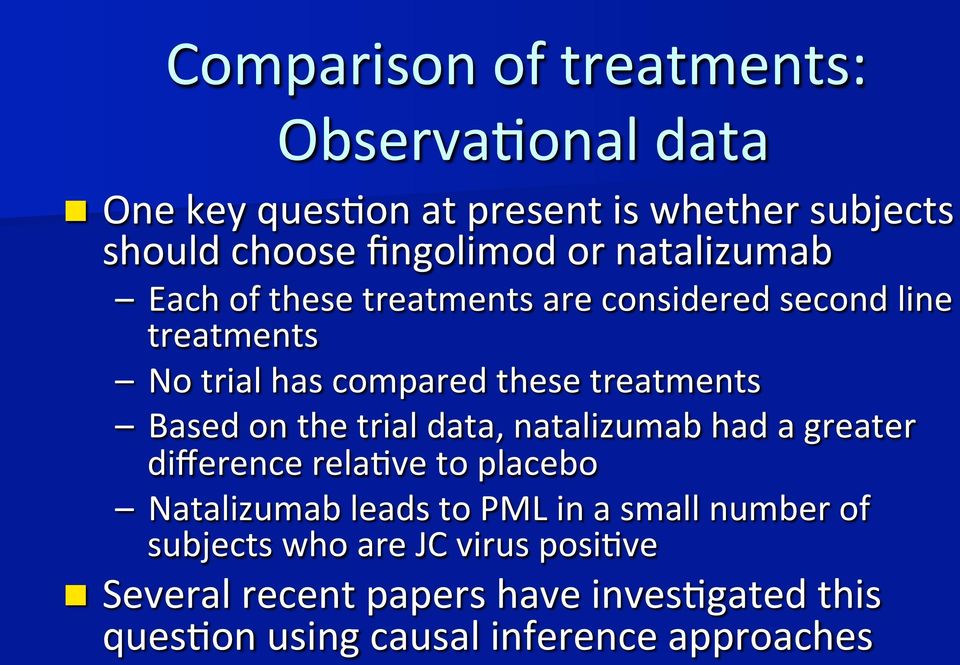
10 Comparison of treatments: Observa,onal data n One key ques,on at present is whether subjects should choose fingolimod or natalizumab Each of these treatments are considered second line treatments No trial has compared these treatments Based on the trial data, natalizumab had a greater difference rela,ve to placebo Natalizumab leads to PML in a small number of subjects who are JC virus posi,ve n Several recent papers have inves,gated this ques,on using causal inference approaches
11 Considera,ons n When using observa,onal data to make inferences about treatment comparisons, several considera,ons are needed Pa,ent selec,on The choice of the subject selec,on can impact the validity and generalizability of the findings All available vs. Specific inclusion/exclusion criteria Sta,s,cal methods Since the two treatment groups are not balanced, adjustment for group differences are required Propensity scores Inverse probability weigh,ng

12 Two studies n Two recent studies have inves,gated this ques,on Braude et al Subject selec,on: All available pa,ents Sta,s,cal approach: Propensity score stra,fica,on Carruthers et al Subject selec,on: Subjects who used JC virus serology for the choice of the treatment Sta,s,cal approach: Mul,variate regression and inverse probability weigh,ng n Each of these studies provides important informa,on about the treatment comparison

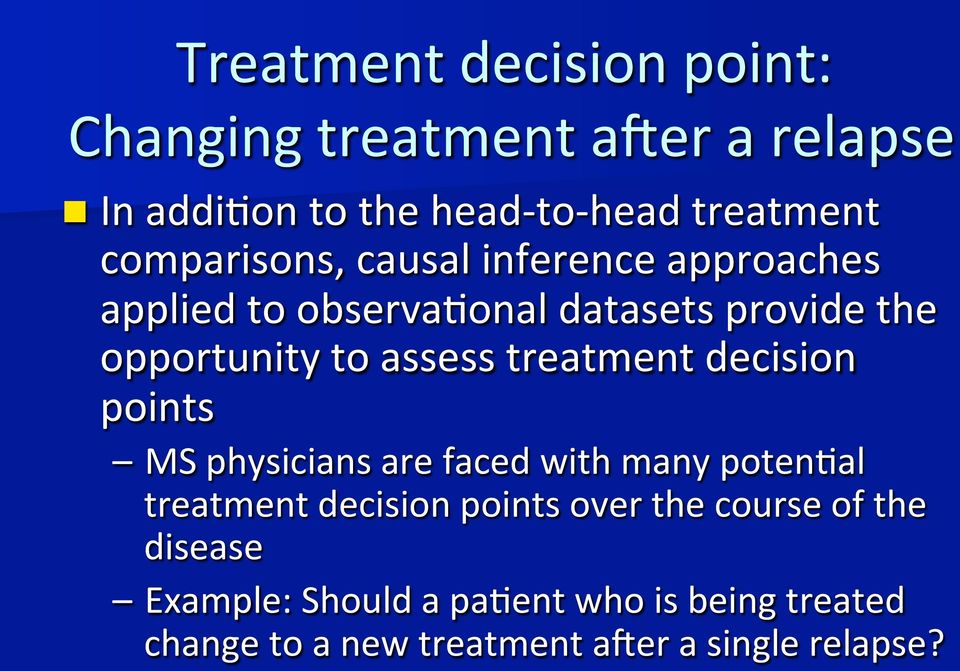
13 Treatment decision point: Changing treatment ajer a relapse n In addi,on to the head- to- head treatment comparisons, causal inference approaches applied to observa,onal datasets provide the opportunity to assess treatment decision points MS physicians are faced with many poten,al treatment decision points over the course of the disease Example: Should a pa,ent who is being treated change to a new treatment ajer a single relapse?
14 Framework n Using the causal inference framework, observa,onal data from the CLIMB was selected to mimic the equivalent clinical trial Pa,ent selec,on: Pa,ents who had a relapse ajer ini,a,on of gla,ramer acetate Treatment regimen: Subjects who changed to a new treatment within 180 days were compared to subjects who remained on GA Sta,s,cal approach: Mul,variate Cox model and inverse probability weigh,ng to adjust for differences between groups n Results showed no significant benefit of changing to a new treatment ajer a single relapse (Healy et al, 2010)

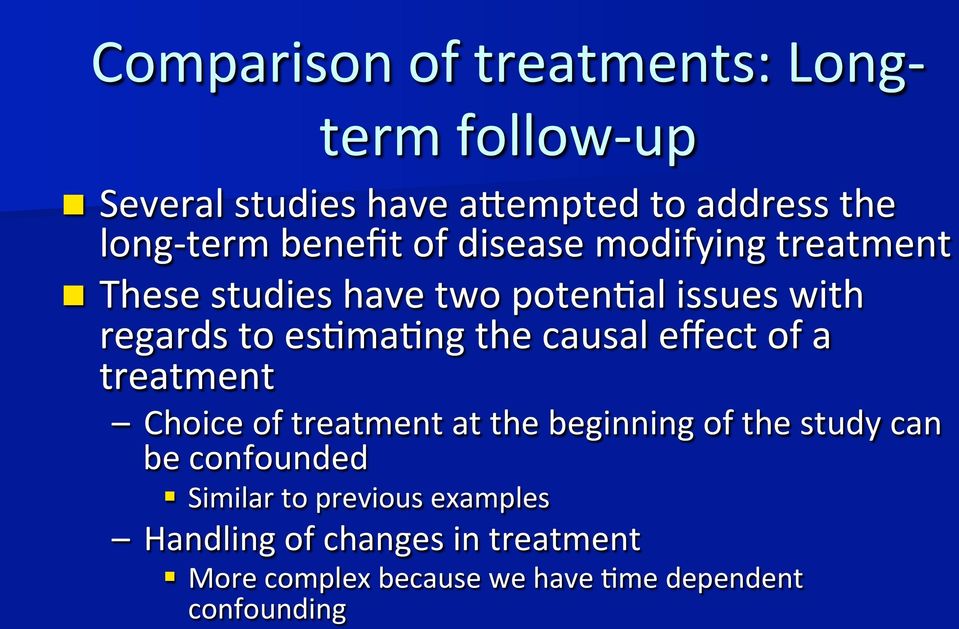
15 Comparison of treatments: Long- term follow- up n Several studies have anempted to address the long- term benefit of disease modifying treatment n These studies have two poten,al issues with regards to es,ma,ng the causal effect of a treatment Choice of treatment at the beginning of the study can be confounded Similar to previous examples Handling of changes in treatment More complex because we have,me dependent confounding
16 Approaches n Es,mate difference in treatment groups without accoun,ng for changes ajer treatment ini,a,on Long- term follow- up studies of trials use this approach Simplifies the analysis, but only addresses the causal effect of early vs. late ini,a,on of treatment n Censor subjects at the,me of treatment change and inverse probability weight subjects who remain on treatment This approach has been used less frequently, but it is beginning to be used Es,mates the parameter of most interest, but can suffer because a very small number of subjects remain on a treatment for many years if worsening May work bener if we switch to comparison of treatment regime

17 Conclusions n Observa,onal data provide the only source of informa,on regarding important clinical ques,ons in MS The number of clinical ques,ons is too large to have an RCT to address all poten,al comparisons Many ques,ons cannot be addressed due to challenges in comple,ng the studies n Research for applying these approaches and for combining indirect treatment comparisons from RCTs and observa,onal data analysis are on- going

18 CLIMB Medical Director Tanuja Chitnis, MD Director, Partners MS Center Howard Weiner, MD Director, Clinical Research Operations Bonnie Glanz, PhD Head of Biostatistics Brian Healy, PhD CLIMB Study Staff Sandra Cook, RN Mira Weiner Study Coordinators Grace Little Emily Greeke Immunology/Biomarkers Head of MS Biomarker Group Head of Biorepository & Assay Development Biomarker Development Translational Genomics & Integrative Analyses Roopali Gandhi, PhD Pia Kivisäkk, MD PhD Francisco Quintana, PhD Philip De Jager, MD PhD IT/Database Database Manager Software Architect System Administrator Data Analyst Mariann Polgar-Turcsanyi, MS Adam Polgar Mark Anderson Alicia Chua, MS Neuroimaging Research Rohit Bakshi, MD Charles Guttmann, MD MRI Analyst Svetlana Egorova, MD PhD THANK YOU to our CLIMB patients!

19 References n n n n n Braune S, Lang M, Bergmann A; NTC Study Group. Second line use of Fingolimod is as effec,ve as Natalizumab in a German out- pa,ent RRMS- cohort. J Neurol Dec;260(12): Carruthers RL, Rotstein DL, Healy BC, Chitnis T, Weiner HL, Buckle GJ. An observa,onal comparison of natalizumab vs. fingolimod using JCV serology to determine therapy. Mult Scler Sep;20(10): Healy BC, Glanz BI, Stankiewicz J, Buckle G, Weiner H, Chitnis T. A method for evalua,ng treatment switching criteria in mul,ple sclerosis. Mult Scler Dec;16(12): Roskell NS, Zimovetz EA, Rycroj CE, Eckert BJ, Tyas DA. Annualized relapse rate of first- line treatments for mul,ple sclerosis: a meta- analysis, including indirect comparisons versus fingolimod. Curr Med Res Opin May;28(5): Zintzaras E, Doxani C, Mprotsis T, Schmid CH, Hadjigeorgiou GM. Network analysis of randomized controlled trials in mul,ple sclerosis. Clin Ther Apr;34(4):

Measurement Issues in Short Term Clinical Trials. Brian Healy, PhD
 Measurement Issues in Short Term Clinical Trials Brian Healy, PhD Overview n In order to iden>fy treatment effects or predictors of disease course, measurement of disease course is required n Although
Medication Policy Manual. Topic: Aubagio, teriflunomide Date of Origin: November 9, 2012
 Medication Policy Manual Policy No: dru283 Topic: Aubagio, teriflunomide Date of Origin: November 9, 2012 Committee Approval Date: December 12, 2014 Next Review Date: December 2015 Effective Date: January
Committee Approval Date: December 12, 2014 Next Review Date: December 2015
 Medication Policy Manual Policy No: dru299 Topic: Tecfidera, dimethyl fumarate Date of Origin: May 16, 2013 Committee Approval Date: December 12, 2014 Next Review Date: December 2015 Effective Date: January
Medication Policy Manual. Topic: Aubagio, teriflunomide Date of Origin: November 9, 2012
 Medication Policy Manual Policy No: dru283 Topic: Aubagio, teriflunomide Date of Origin: November 9, 2012 Committee Approval Date: December 11, 2015 Next Review Date: December 2016 Effective Date: January
Medication Policy Manual. Topic: Betaseron, Extavia, interferon beta-1b Date of Origin: June 18, 2004
 Medication Policy Manual Policy No: dru108 Topic: Betaseron, Extavia, interferon beta-1b Date of Origin: June 18, 2004 Committee Approval Date: December 12, 2014 Next Review Date: December 2015 Effective
Treatment in Relapsing MS: Choosing Among the Options. Donald Negroski, MD
 Treatment in Relapsing MS: Choosing Among the Options Donald Negroski, MD Disclosures Research Grants Educational activities and lectures Consulting or other services including Continuing Medical Education
Multiple Sclerosis Update. Bridget A. Bagert, MD, MPH Director, Ochsner Multiple Sclerosis Center
 Multiple Sclerosis Update Bridget A. Bagert, MD, MPH Director, Ochsner Multiple Sclerosis Center None Disclosures First of All. Why is my talk in the Neurodegenerative hour? I respectfully object! Case
Medication Policy Manual. Topic: Plegridy, peginterferon beta-1a Date of Origin: December 12, 2014
 Medication Policy Manual Policy No: dru376 Topic: Plegridy, peginterferon beta-1a Date of Origin: December 12, 2014 Committee Approval Date: December 11, 2015 Next Review Date: December 2016 Effective
Study Support Materials Cover Sheet
 Study Support Materials Cover Sheet Document Title ESCALATE Patient Brochure Intended Audience This brochure is designed to be given to potentially eligible patients as a take-home summary of key information
Growth in revenue from MS drugs has been driven largely by price increases over the last several years.
 March 4, 2013 Ben Weintraub, PhD Are Injectable MS Drugs Finished? Market Ready for Tecfidera Companies: Biogen (BIIB) Sanofi (SNY) Teva (TEVA) Novartis (NVS) Merck Serono Bayer Schering Products: Tecfidera
Disease Modifying Therapies (DMTs) in Multiple Sclerosis
 Disease Modifying Therapies (DMTs) in Multiple Sclerosis Gary Stobbe, MD Medical Director, MS Project ECHO Clinical Assistant Professor, UW Neurology Conflict of Interest Dr. Stobbe has no conflicts of
Medication Policy Manual. Topic: Gilenya, fingolimod Date of Origin: November 22, 2010
 Medication Policy Manual Policy No: dru229 Topic: Gilenya, fingolimod Date of Origin: November 22, 2010 Committee Approval Date: December 11, 2015 Next Review Date: December 2016 Effective Date: January
Lemtrada (alemtuzumab)
 Lemtrada (alemtuzumab) Policy Number: 5.02.517 Last Review: 08/2015 Origination: 08/2015 Next Review: 08/2016 Policy BCBSKC will provide coverage for Lemtrada (alemtuzumab) when it is determined to be
New Treatment Options for MS Patients: Understanding risks versus benefits
 New Treatment Options for MS Patients: Understanding risks versus benefits By Michael A. Meyer, MD Department of Neurology, Sisters Hospital, Buffalo, NY Objectives: 1. to understand fundamentals of MS
Literature Scan: Oral Multiple Sclerosis Drugs
 Copyright 2012 Oregon State University. All Rights Reserved Drug Use Research & Management Program Oregon State University, 500 Summer Street NE, E35 Salem, Oregon 97301-1079 Phone 503-947-5220 Fax 503-947-1119
Uncertainty in Benefit and Risk: Tysabri (natalizumab)
 Uncertainty in Benefit and Risk: Tysabri (natalizumab) Robert J. Temple, M.D. Deputy Center Director for Clinical Science Center for Drug Evaluation and Research U.S. Food and Drug Administration IOM Drug
Multiple Sclerosis (MS) Aprile Royal, Novartis Pharma Canada Inc. September 21, 2011 Toronto, ON
 Multiple Sclerosis (MS) Aprile Royal, Novartis Pharma Canada Inc. September 21, 2011 Toronto, ON First-line DMTs Reduce Relapse Frequency by ~30% vs. Placebo Frequency of relapse with various DMTs, based
Treatment guidelines for relapsing MS and the two step approach for disease modifying therapy
 Treatment guidelines for relapsing MS and the two step approach for disease modifying therapy Klaus Schmierer, PhD FRCP Blizard Institute, Barts and The London School of Medicine & Dentistry Barts Health
A Product and Pipeline Analysis of the Multiple Sclerosis Therapeutics Market
 A Product and Pipeline Analysis of the Multiple Sclerosis Therapeutics Market Launch of Several Pipeline Oral Products Could Diminish the Market for Injectable Therapies NEC3-52 November 2014 Contents
MEDICAL POLICY STATEMENT
 MEDICAL POLICY STATEMENT Original Effective Date Next Annual Review Date Last Review / Revision Date 10/01/2013 10/1/2015 08/25/2015 Policy Name Policy Number Multiple Sclerosis Therapy Class SRx-0022
Which injectable medication should I take for relapsing-remitting multiple sclerosis?
 Which injectable medication should I take for relapsing-remitting multiple sclerosis? A decision aid to discuss options with your doctor This decision aid is for you if you: Have multiple sclerosis Have
Disease Modifying Therapies for MS
 Disease Modifying Therapies for MS The term disease-modifying therapy (DMT) means a drug that can modify or change the course of a disease. In other words a DMT should be able to reduce the number of attacks
Progress in MS: Current and Emerging Therapies
 Progress in MS: Current and Emerging Therapies Presented by: Dr. Kathryn Giles, MD MSc FRCPC The MS Society gratefully acknowledges the grant received from Biogen Idec Canada, which makes possible the
Multiple Sclerosis (MS) Class Update
 Drug Use Research & Management Program Oregon State University, 500 Summer Street NE, E35, Salem, Oregon 97301-1079 Phone 503-947-5220 Fax 503-947-1119 Multiple Sclerosis (MS) Class Update Month/Year of
New Developments in the Treatment and Management of Multiple Sclerosis
 New Developments in the Treatment and Management of Multiple Sclerosis Myla D. Goldman, MD, MS For a CME/CEU version of this article, please go to www.namcp.org/cmeonline.htm, and then click the activity
What is MS? 1. disease that affects the central nervous. Is a disease that affects both white and gray matter
 What is MS? 1 Neuron Damaged myelin due to inflammation MS is a chronic immunemediated disease that affects the central nervous system (CNS) Is a disease that affects both white and gray matter Interrupted
New and Emerging Immunotherapies for Multiple Sclerosis: Oral Agents
 New and Emerging Immunotherapies for Multiple Sclerosis: Oral Agents William Tyor, M.D. Chief, Neurology Atlanta VA Medical Center Professor, Department of Neurology Emory University School of Medicine
A neurologist would assess your eligibility and suitability for the DMTs.
 Choices Disease Modifying Treatments Disease modifying treatments (DMTs) are medications which modify the disease course. They target inflammation and are designed to reduce the damage caused by relapses.
A blood sample will be collected annually for up to 2 years for JCV antibody testing.
 Mellen Center Currently Enrolling Non-Treatment Trials STRATIFY-2 JCV Antibody Program in Patients with Relapsing Multiple Sclerosis Receiving or Considering Treatment with Tysabri Primary Investigator:
Relapsing-remitting multiple sclerosis Ambulatory with or without aid
 AVONEX/BETASERON/COPAXONE/EXTAVIA/GILENYA/REBIF/TYSABRI Applicant must be covered on an Alberta Government sponsored drug program. Page 1 of 5 PATIENT INFMATION Surname First Name Middle Initial Sex Date
Committee Approval Date: December 12, 2014 Next Review Date: December 2015
 Medication Policy Manual Policy No: dru381 Topic: Lemtrada TM, alemtuzumab Date of Origin: December 12, 2014 Committee Approval Date: December 12, 2014 Next Review Date: December 2015 Effective Date: January
New treatments in MS What s here and what s nearly here
 5 th MS Research Day, June 14 th 2014 New treatments in MS What s here and what s nearly here David Miller Queen Square MS Centre at UCL and UCLH Course of MS and its treatment Relapsing remitting Disability
fingolimod, 0.5mg, hard capsules (Gilenya ) SMC No. (992/14) Novartis Pharmaceuticals UK
 fingolimod, 0.5mg, hard capsules (Gilenya ) SMC No. (992/14) Novartis Pharmaceuticals UK 08 August 2014 The Scottish Medicines Consortium (SMC) has completed its assessment of the above product and advises
Is the Grass Really Greener with New Oral Multiple Sclerosis Treatments? A Clinical Debate
 Is the Grass Really Greener with New Oral Multiple Sclerosis Treatments? A Clinical Debate Elizabeth Sebranek Evans, PharmD, BCPS, CGP Alana Whittaker, PharmD, BCPS Roseman University of Health Sciences
PCORI Workshop on Treatment for Multiple Sclerosis. Breakout Group Topics and Questions Draft 3-27-15
 PCORI Workshop on Treatment for Multiple Sclerosis Breakout Group Topics and Questions Draft 3-27-15 Group 1 - Comparison across DMTs, including differential effects in subgroups Consolidated straw man
Information about medicines for multiple sclerosis
 Information about medicines for multiple sclerosis Information about medicines for multiple sclerosis What is multiple sclerosis? 1 Multiple sclerosis (MS) is a lifelong disease that affects your brain
Mellen Center Approaches: Choosing First-Line Treatment
 Cleveland Clinic Mellen Center for Multiple Sclerosis Treatment and Research 216.444.8600 Mellen Center Approaches: Choosing First-Line Treatment Q: Should my patient with newly diagnosed multiple sclerosis
Multiple Sclerosis Therapeutics to 2019 - Treatment Diversification, Increasing Efficacy, and Pipeline Innovation Combine to Drive Growth
 Brochure More information from http://www.researchandmarkets.com/reports/2640803/ Multiple Sclerosis Therapeutics to 2019 - Treatment Diversification, Increasing Efficacy, and Pipeline Innovation Combine
Multiple Sclerosis in Practice. An Expert Commentary With Jeffrey Cohen, MD, PhD A Clinical Context Report
 Multiple Sclerosis in Practice An Expert Commentary With Jeffrey Cohen, MD, PhD A Clinical Context Report Clinical Context: Multiple Sclerosis in Practice Expert Commentary Jointly Sponsored by: and Clinical
PharmaPoint: Multiple Sclerosis - United Kingdom Drug Forecast and Market Analysis to 2022. Multiple
 Brochure More information from http://www.researchandmarkets.com/reports/2541548/ PharmaPoint: Multiple Sclerosis - United Kingdom Drug Forecast and Market Analysis to 2022 Description: PharmaPoint: Multiple
Disease Modifying Therapies for MS
 Disease Modifying Therapies for MS The term disease-modifying therapy means a drug that can modify or change the course of a disease. In other words a DMT should be able to reduce the number of attacks
Multiple Sclerosis Drug Discoveries - What the Future Holds
 Brochure More information from http://www.researchandmarkets.com/reports/1408035/ Multiple Sclerosis Drug Discoveries - What the Future Holds Description: The recent approval in the US of Novartis' orally
Current and future options of MS treatment Prof. Dr. Karl Vass, AKH Wien
 Current and future options of MS treatment Prof. Dr. Karl Vass, AKH Wien European Health Forum, Gastein 6 th October 2010 Multiple Sclerosis is the most common neurological disorder in young Caucasian
Cost-effectiveness of dimethyl fumarate (Tecfidera ) for the treatment of adult patients with relapsing remitting multiple sclerosis
 Cost-effectiveness of dimethyl fumarate (Tecfidera ) for the treatment of adult patients with relapsing remitting multiple sclerosis The NCPE has issued a recommendation regarding the cost-effectiveness
SECTION 2. Section 2 Multiple Sclerosis (MS) Drug Coverage
 SECTION 2 Multiple Sclerosis (MS) Drug Coverage Section 2 Multiple Sclerosis (MS) Drug Coverage ALBERTA HEALTH AND WELLNESS DRUG BENEFIT LIST Selected Drug Products used in the treatment of patients with
Information About Medicines for Multiple Sclerosis
 Information About Medicines for Multiple Sclerosis Information About Medicines for Multiple Sclerosis What is multiple sclerosis? 1 Multiple sclerosis (MS) is a lifelong disease that affects your brain
Product Profiles: Multiple Sclerosis - Gilenya Raises Bar for New Market Entrants
 Brochure More information from http://www.researchandmarkets.com/reports/1841621/ Product Profiles: Multiple Sclerosis - Gilenya Raises Bar for New Market Entrants Description: Introduction Beginning with
Novel therapeutic approaches in multiple sclerosis Neuroprotective and remyelinating agents, the future of clinical trials in MS?
 Novel therapeutic approaches in multiple sclerosis Neuroprotective and remyelinating agents, the future of clinical trials in MS? Marie Trad, M.D., Lynne Hughes, Cathy VanBelle, Amy Del Medico 3rd International
What is Multiple Sclerosis? Disease Modifying Therapies. Best of all. Why is treatment so important? Outline and Expectations.
 What is Multiple Sclerosis? Disease Modifying Therapies for Relapsing Remitting MS Jeanie Lynn Cote, MD Chronic, auto immune disorder. As a consequence of immune attacks, there is loss of myelin (fatty
The MS Disease- Modifying Medications GENERAL INFORMATION
 The MS Disease- Modifying Medications GENERAL INFORMATION Current as of March 2014. This online brochure is updated with breaking news as required. If you have a printed a copy of this publication, please
How to S.E.A.R.C.H. SM for the Right MS Therapy For You!
 How to S.E.A.R.C.H. SM for the Right MS Therapy For You! The Changing Landscape The first treatment for relapsing-remitting multiple sclerosis (RRMS) was approved by the United States Food and Drug Administration
Multiple Sclerosis. Global Drug Forecast and Market Analysis to 2022 Event-Driven Update. GDHC34PIDR / Published April 2013
 Multiple Sclerosis Global Drug Forecast and Market Analysis to 2022 Event-Driven Update GDHC34PIDR / Published April 2013 Executive Summary The table below presents the key metrics for multiple sclerosis
Version History. Previous Versions. Drugs for MS.Drug facts box fingolimod Version 1.0 Author
 Version History Policy Title Drugs for MS.Drug facts box fingolimod Version 1.0 Author West Midlands Commissioning Support Unit Publication Date Jan 2013 Review Date Supersedes/New (Further fields as required
Treatments for MS: Immunotherapy. Gilenya (fingolimod) Glatiramer acetate (Copaxone )
 Treatments for MS: Immunotherapy There are currently several disease-modifying therapies approved for people with MS in Australia. These therapies, called immunotherapies, work to reduce disease activity
Treatment Optimization in MS: When to Start, When to Shift, when to Stop
 Treatment Optimization in MS: When to Start, When to Shift, when to Stop Mark S. Freedman MSc MD FAAN FANA FRCPC Director, Multiple Sclerosis Research Unit University of Ottawa Sr. Scientist, Ottawa Hospital
Multiple Sclerosis DIAGNOSIS AND THERAPY. Howard L. Weiner and James M. Stankiewicz EDITED BY
 Multiple Sclerosis DIAGNOSIS AND THERAPY EDITED BY Howard L. Weiner and James M. Stankiewicz Multiple Sclerosis Multiple Sclerosis Diagnosis and Therapy EDITED BY Howard L. Weiner, MD Robert L. Kroc
Therapeutic Class Overview Multiple Sclerosis Agents
 Therapeutic Class Overview Multiple Sclerosis Agents Therapeutic Class Overview/Summary: Several biologic response modifiers are Food and Drug Administration (FDA)- approved for the treatment of relapsing-remitting
How to evaluate medications in Multiple Sclerosis when placebo controlled RCTs are not feasible
 University of Florence Dept. of Neurosciences Careggi University Hospital Dept of Neurosciences How to evaluate medications in Multiple Sclerosis when placebo controlled RCTs are not feasible Luca Massacesi,
Multiple Sclerosis. Current and Future Players. GDHC1009FPR/ Published March 2013
 Multiple Sclerosis Current and Future Players GDHC1009FPR/ Published March 2013 Executive Summary Moderate Growth in the Multiple Sclerosis Market is Expected from 2012 2022 GlobalData estimates the 2012
TITLE: Treatment of Patients with Multiple Sclerosis: A Review of Guidelines
 TITLE: Treatment of Patients with Multiple Sclerosis: A Review of Guidelines DATE: 13 March 2013 CONTEXT AND POLICY ISSUES Multiple sclerosis (MS) is an unpredictable, often disabling disease of the central
Pharmacotherapy of Multiple Sclerosis
 PHARMACY / MEDICAL POLICY 5.01.565 Pharmacotherapy of Multiple Sclerosis Effective Date: July 1, 2016 Last Revised: June 14, 2016 Replaces: Extracted from 5.01.550 RELATED MEDICAL POLICIES: 5.01.556 Rituximab:
National Multiple Sclerosis Society. Disease Modification in Multiple Sclerosis. Current as of January 2, 2013
 National Multiple Sclerosis Society Disease Modification in Multiple Sclerosis Current as of January 2, 2013 Since 1993, the U.S. Food and Drug Administration (FDA) has approved several medications for
The MS Disease- Modifying Medications
 The MS Disease- Modifying Medications National MS Society 1 Current as of January 2015. This online brochure is updated with breaking news as required. If you have a printed a copy of this publication,
Published by MSAA in February 2014
 Published by MSAA in February 2014 VITAMIN D MSAA s MS Research Update is published annually as a service to the MS community. This update provides an overview of the research behind the approved and experimental
Pregnancy and Reproductive Issues in MS. Annette Wundes, MD Co-Director University of Washington MS Center November 12,2014
 Pregnancy and Reproductive Issues in MS Annette Wundes, MD Co-Director University of Washington MS Center November 12,2014 Conflicts of Interest Reports no conflicts pertaining to this presentation. Research
CADTH Therapeutic Review
 Canadian Agency for Drugs and Technologies in Health Agence canadienne des médicaments et des technologies de la santé CADTH Therapeutic Review October 2013 Volume 1, Issue 2B Comparative Clinical and
this 7^ day of September 2014 by Randall S. Gregg Special Deputy Director
 r STATE OF MICHIGAN DEPARTMENT OF INSURANCE AND FINANCIAL SERVICES Before the Director of Insurance and Financial Services In the matter of: Petitioner, v File No. 143525-001 Health Alliance Plan of Michigan,
Clinical Trials of Disease Modifying Treatments
 MS CENTER CLINICAL RESEARCH The UCSF MS Center is an internationally recognized leader in multiple sclerosis clinical research. We conduct clinical trials involving the use of experimental treatments,
Cost-effectiveness of teriflunomide (Aubagio ) for the treatment of adult patients with relapsing remitting multiple sclerosis
 Cost-effectiveness of teriflunomide (Aubagio ) for the treatment of adult patients with relapsing remitting multiple sclerosis The NCPE has issued a recommendation regarding the cost-effectiveness of teriflunomide
Immunoablative therapy with autologous hematopoietic stem cell transplantation in the treatment of poor risk multiple sclerosis
 Immunoablative therapy with autologous hematopoietic stem cell transplantation in the treatment of poor risk multiple sclerosis T Kozák, P Lhotáková Department of Clinical Haematology, 3r d School of Medicine,
Retail Pharmacy Clinical Services: Influence of ACOs & Healthcare Financing Models
 Retail Pharmacy Clinical Services: Influence of ACOs & Healthcare Financing Models Tim Kosty, R.Ph., MBA President Pharmacy Healthcare Solu
Best practices for using MS disease modifying therapies
 Best practices for using MS disease modifying therapies CMSC Annual Meeting 2015 COREY C FORD, MD, PHD MS SPECIALTY CLINIC UNIVERSITY OF NEW MEXICO HSC MAY 30, 2015 Objectives Use best practices to select
Multiple Sclerosis. Multiple Sclerosis. In addition to help nursing professional to understand the signs and
 How to Receive Your CE Credits Read your selected course Completed the quiz at the end of the course with a 70% or greater. Complete the evaluation for your selected course. Print your Certificate CE s
06/06/2012. The Impact of Multiple Sclerosis in the Pacific Northwest. James Bowen, MD. Swedish Neuroscience Institute
 The Impact of Multiple Sclerosis in the Pacific Northwest James Bowen, MD Multiple Sclerosis Center Multiple Sclerosis Center Swedish Neuroscience Institute 1 2 Motor Symptoms of MS Weakness Spasticity
CADTH Therapeutic Review
 Canadian Agency for Drugs and Technologies in Health Agence canadienne des médicaments et des technologies de la santé CADTH Therapeutic Review October 2013 Volume 1, Issue 2B Updated March 2014 Comparative
A Letter From the MS Coalition
 0 A Letter From the MS Coalition The treatment of multiple sclerosis (MS) requires a comprehensive management strategy. One important component of that strategy is modifying the disease course. When deciding
News on modifying diseases therapies. Michel CLANET CHU Toulouse France ECTRIMS
 News on modifying diseases therapies Michel CLANET CHU Toulouse France ECTRIMS Current treatment strategies Future oral treatments Future non oral treatments Drug safety and risks CIS at risk of MS Active
How To Use A Drug In Multiple Sclerosis
 Revised (2009) guidelines for prescribing in multiple sclerosis INTRODUCTION In January 2001, the (ABN) first published guidelines for the use of licensed disease modifying treatments (ß-interferon and
Dimethyl fumarate for treating relapsing remitting multiple sclerosis
 NATIONAL INSTITUTE FOR HEALTH AND CARE EXCELLENCE Final appraisal determination Dimethyl fumarate for treating relapsing remitting multiple sclerosis This guidance was developed using the single technology