
SOUTH UNIVERSITY CATALOG ADDENDUM III Effective June 28, 2014
|
|
|
- Alban Wilcox
- 10 years ago
- Views:
Transcription
1 SOUTH UNIVERSITY CATALOG ADDENDUM III Effective June 28, 2014 See suprograms.info for program duration, tuition, fees, and other costs, median debt, federal salary data, alumni success, and other important info. 1
2 Pages 6 and 7 Addition of new programs: DEGREE AND CERTIFICATE PROGRAMS South University s degree programs are designed to meet student needs and individual objectives. The primary goal of each program s curriculum is to combine didactic and practical educational experiences that will provide students with the academic background needed to pursue the profession of their choice. Not all programs and specializations are offered at all campuses. Before you apply for admission to South University, please review programs and specializations available at your preferred campus location. See page 9 for locations and degree and certificate programs offered at each campus. See suprograms.info for program duration, tuition, fees, and other costs, median student debt, federal salary data, alumni success, and other important information. DOCTORAL DEGREES Business Administration (DBA) Ministry (DMin) Nursing Practice (DNP**), with the following specializations: Administration Information Technology Leadership Project Management Public Health Occupational Therapy (OTD)± Pharmacy (PharmD) Pharmacy/Business Joint Degree (PharmD/MBA) POST GRADUATE CERTIFICATES** Adult Health Nurse Practitioner Family Nurse Practitioner Nurse Administrator Nurse Educator MASTER S DEGREES Accounting (MS) Anesthesia Science (MMSc) Business Administration (AMBA/MBA*) Clinical Mental Health Counseling (MA) Criminal Justice (MS) Design & Media Management (MA) Healthcare Administration (AMBA/MBA*) *NOTE: The Masters in Business Administration and Masters in Business Administration, Healthcare Administration, are offered in a 12-month, accelerated format through a combination of on-campus and online coursework. **NOTE: Minnesota residents are not eligible to enroll in the online programs for the Doctor of Nursing Practice, Post Graduate Certificates in Nursing, the Master of Science in Nursing or the RN to Master of Science in Nursing. ±The Doctorate in Occupational Therapy will be enrolling students as of the Summer 2014 quarter. 2
3 Information Systems and Technology (MS) Leadership (MS) Nursing (MSN**), with the following specializations: Adult Health Nurse Practitioner Family Nurse Practitioner Nurse Administrator Nurse Educator Nursing Informatics Physician Assistant (MS) Public Administration (MPA) Public Health (MPH) Public Relations (MS) RN to Master of Science in Nursing (BSN/MSN**), with the following specializations: Adult Health Nurse Practitioner Family Nurse Practitioner Nurse Administrator Nurse Educator Nursing Informatics BACHELOR S DEGREES Advertising Design (BFA) Audio Production (BS) Business Administration (BBA), with the following specializations: Accounting Criminal Justice (BS) Culinary Management (BS) Digital Filmmaking &Video Production (BFA) Fashion Design (BFA) Fashion & Retail Management (BA, BFA) Game Art & Design (BFA) Graphic Design (BS) Graphic & Web Design (BFA), with the following concentrations: Graphic Design Web Design Health Sciences (BS), with the following specialization: Public Health Healthcare Management (BS) Information Technology (BS), with the following specializations: Database Development and Administration Information Systems Security Network Administration and Management Multimedia and Web Development Interior Design (BFA) Legal Studies (BS) Media Arts & Animation (BFA) Nursing (BSN) Nursing Completion Program (RN to BSN) *NOTE: The Masters in Business Administration and Masters in Business Administration, Healthcare Administration, are offered in a 12-month, accelerated format through a combination of on-campus and online coursework. **NOTE: Minnesota residents are not eligible to enroll in the online programs for the Doctor of Nursing Practice, Post Graduate Certificates in Nursing, the Master of Science in Nursing or the RN to Master of Science in Nursing. 3

4 Photography (BFA) Public Relations (BS) Psychology (BA), with the following specializations: Behavioral Health Experimental/Research Visual Effects & Motion Graphics (BFA) ASSOCIATE S DEGREES Accounting (AS) Allied Health Science (AS) Baking & Pastry (AAS) Business Administration (AS), with the following specialization: Hospitality Management Criminal Justice (AS) Culinary Arts (AAS) Fashion & Retail Management (AAS) Fashion Design (AAA, AAS) Graphic Design (AAA, AAS, AS) Information Technology (AS) Interior Design (AAS) Medical Assisting (AS) Occupational Therapy Assistant (AS) Paralegal Studies (AS) Photography (AAS) Physical Therapist Assistant (AS, AAS) Restaurant & Catering Management (AAS) Video Production (AAS) CERTIFICATES (C) Baking & Pastry Culinary Arts Digital Image Management Fashion Retailing Web Design & Interactive Communications 4

5 SOUTH UNIVERSITY CAMPUSES Page 11 Austin Campus, update to program listing Addition of Degree Programs Master s Degrees Public Administration (MPA) Page 17 Columbia Campus, update to program listing Addition of Degree Programs Master s Degrees Nursing (MSN**), with the following specializations: Family Nurse Practitioner Page 25 Montgomery Campus, update to program listing Addition of Degree Programs Post Graduate Certificates Adult Health Nurse Practitioner Family Nurse Practitioner Nurse Educator Master s Degrees Leadership (MS) Page 27 Novi Campus, update to program listing Addition of Degree Programs Post Graduate Certificates Adult Health Nurse Practitioner Family Nurse Practitioner Nurse Administrator Master s Degrees Nursing (MSN**), with the following specializations: Nurse Administrator RN to Master of Science in Nursing (BSN/MSN**), with the following specializations: Nurse Administrator *NOTE: The Masters in Business Administration and Masters in Business Administration, Healthcare Administration, are offered in a 12-month, accelerated format through a combination of on-campus and online coursework. **NOTE: Minnesota residents are not eligible to enroll in the online programs for the Doctor of Nursing Practice, Post Graduate Certificates in Nursing, the Master of Science in Nursing or the RN to Master of Science in Nursing. 5

6 Page 36 Update to South University Online Programs Tuition and Fees section. Changes Highlighted. Tuition and Fees Tuition for most online undergraduate degree programs is $1,608 per 4 credit course ($402 per credit hour). Tuition does not include an initial one time application fee of $50. Please refer to the Financial Information section of this catalog for details regarding South University financial information policies. Effective Fall 2012 Summer 2014, tuition will change as follows: Master of Business Administration, Master of Business Administration in Healthcare Administration, Master of Science in Information Systems and Technology, Master of Science in Leadership, Master of Public Administration, Master of Science in Accounting and Master of Public Health in degree programs is $567 per credit hour. Tuition for the Master of Science in Criminal Justice degree program is $541 per credit hour. and the Tuition for the Master of Science in Nursing degree program is $436 $458 per credit hour, MSN Clinical Fee $1,000.00, MSN Practicum Evaluation Fees (online) $ (per clinical course). Tuition for the RN to Master of Science in Nursing degree program is $420 $441 per credit hour, MSN Practicum Evaluation Fees (online) $ (per clinical course). Tuition for the Post Graduate Certificates is $458 per credit hour. Tuition for the Doctor of Business Administration, (DBA) degree program is $709 per credit hour, DBA Residency Fee (Online) $1,100. Tuition for the Doctor of Nursing Practice (DNP) degree program is $499 per credit hour. Tuition for the Doctor of Ministry (DMin) degree program is $510 per credit hour. Tuition for the Nursing RN to BSN Completion program is $391 per credit hour. Nursing Program Fees Clinical Fee* There is a nonrefundable $1,000 clinical fee for applicants accepted into the Doctor of Nursing Practice, Post Graduate Certificate in Nursing -Nurse Practitioner Specializations, and Master of Science in Nursing, Nurse Practitioner Specializations. This fee is charged in two installments. The first charge ($500) is charged at the time of enrollment and the second charge ($500) occurs at the second year of the program or prior to the start of clinical courses. For Post Graduate Certificate in Nursing, Nurse Practitioner Specializations this fee will be prorated if Transfer of Credit is awarded for clinical/practicum courses. Practicum Evaluation Fee* There is a nonrefundable $525 practicum evaluation fee charged for each practicum course in all Nursing Programs. *This fee is refundable in accordance with the cancellation refund policies outlined in the Refund of Tuition section of the catalog and for students withdrawing from their course(s) who are residents of Iowa and Wisconsin, per the applicable state refund policy outlined in the Refund of Tuition section of the catalog. Page 43 Virginia Beach Campus, update to program listing Addition of Degree Programs Post Graduate Certificates Family Nurse Practitioner 6
7 Page 45 West Palm Beach Campus, update to program listing Addition of Degree Programs Doctoral Degrees Occupational Therapy (OTD) COLLEGE OF ARTS AND SCIENCES Page 51 to 53 Revised Admission to the Legal Studies and Paralegal Studies Degree Programs statement. Changes highlighted. ADMISSION TO THE LEGAL STUDIES AND PARALEGAL STUDIES DEGREE PROGRAMS Students seeking admission into these degree programs must meet all requirements for general admission into the University. Students seeking admission as transfer students must meet additional standards stated in this section of the catalog as well as those required of all transfer students seeking to enroll in South University. This applies to students moving from one South University campus to another or from the partially online program offered only through the Savannah campus. Students seeking to move between South University campuses are considered transfer students. This includes transfer between a ground campus and the partially online program offered through the Savannah campus. Students wishing to transfer to the partially online program from another a South University campus are required to transfer enrollment to the Savannah campus and through that campus to the partially online program. Those seeking admission as a transfer student into the Legal Studies or Paralegal Studies program must provide additional documentation to aid in evaluation for admission and acceptance of transfer credit. Legal specialty courses (e.g., those with LGS prefixes at South University) transferred into a South University campus will not count in the student s GPA calculation. This includes legal specialty courses taken at another South University campus or online. Students may transfer up to 75 percent of the total work required for a degree in these programs but no more than 50 percent of the work to be applied toward the legal specialty course requirements for the degree. All courses to be applied toward the legal specialty course requirements must be evaluated (using the procedure found in the subsequent paragraph) and found to be essentially comparable to the course for which the student would receive credit in the South University program. For legal specialty transfer courses, including courses taken from other South University campuses, the student should present the catalog description of the course from the source campus, college, or university. A syllabus or comparable document describing the course requirements, learning outcomes of the course, textbook and related materials used in the course, samples of work completed in the course, and grading criteria may also be required at the discretion of the Registrar or the Program Director making the evaluation. These materials will be referred to the appropriate Program Director or qualified faculty member for a final decision after the Registrar has reviewed the courses to assure the work meets the general transfer admission standards. All students enrolling in the partially online program offered through the Savannah campus must document that at least four (4) legal specialty courses comprising at least sixteen (16) quarter hours of credit were completed in a traditional classroom format. The program requires that LGS1005 Legal 7

8 Research and Writing I be completed in a traditional classroom format. The student can complete any other three (3) legal specialty courses in a traditional classroom format with the approval of the Program Director in consultation with the Registrar. Students already enrolled in the partially online program seeking to meet the requirement that at least sixteen (16) quarter hours of coursework must be completed in a traditional classroom format, including LGS1005 Legal Research and Writing I, will work with their online Academic Counselor and the online Program Chair or Program Director to identify an acceptable college or university where such work may be completed. Targeted courses will be identified and pre-approved by the online Program Chair or Program Director working with the Academic Counselor and Registrar using the criteria listed above as applicable. COLLEGE OF BUSINESS Page 60 to 61 Correction to the course list for the Free Elective pool. Add: BUS4101 Quality Management 4 MGT4059 Advanced Operations Management 4 COLLEGE OF HEALTH PROFESSIONS Page 70 Insert New program Doctor of Occupational Therapy Doctor of Occupational Therapy South University s Doctor of Occupational Therapy is an innovative graduate curriculum that builds the profession s capacity to empower the advanced clinical-scholar. The program emphasizes advanced leadership, advanced pedagogy, and advanced clinical knowledge that is consistent with the vision of South University where critical thinking, professionalism and community service which are tantamount to transformative learning. The Department of Occupational Therapy educates students who integrate the art and science of occupational therapy that collaborates creatively with clients to improve health and their participation in life. Through engagement in diverse learning opportunities within the classroom and community, students may graduate as competent, ethically-sound practitioners who will intuitively employ evidence-based practices throughout the many emerging therapeutic approaches. Thus, graduates of the program promote health and well-being through engagement in therapeutic occupations (e.g. everyday life activities) that enhance quality of life for persons in the communities wherever they live, work and play. Program Outcomes The Occupational Therapy Program and its faculty-mentors are committed to developing advanced clinical-scholars who are able to: 8
9 Apply the knowledge, skills and abilities necessary to make well-informed judgments regarding content validity in research as well as implement evidenced-based clinical practices throughout the spectrum of care. Advocate for clients, communities and entire populations right to receive prompt and effective occupational therapy services and employ newly gained transformative knowledge to develop and secure policies at local, state, regional and national levels. Employ critical thinking, life-long learning, and analytical methodologies to leverage and justify resources that enhance the effectiveness of advanced therapeutic interventions. Critically examine the rapid changes occurring throughout the health care landscape as well as understand issues regarding managed care, third party reimbursement, access to specialty care, and how occupational therapy will weave meaningful occupation into contemporary practice models. Collaborate with peers, faculty-mentors, subject matter experts, researchers and practitioners regarding material from peer-reviewed publications and do so during synchronous and asynchronous postings and during formal class presentations. Become a self-directed leaner consistent with an advanced scholar who is able to understand scientific evidence so that he/she is able to critically analyze, interpret and synthesize data while applying it within specific practice areas. Capstone Project The Capstone Project, an advanced experiential and research-based project, is considered the pinnacle of the student s combined experiences within the OTD Program. The faculty-mentor(s), OTD-Program Director, and Capstone Advisory Committee (CAC) are responsible for assisting each student in developing his/her project. The faculty mentor may be experienced in the health care industry, academia, or research as their scholarly work is deemed central to evidence based practice and/or translational research related to the student s Capstone Project. Additional members may be added to the committee upon request. The Capstone Project is directly influenced by the knowledge obtained within the advanced academic environment of the OTD Program; however, it can also be shaped by external influences, such as, from the information obtained while working with the student s subject matter expert (SME) or Capstone Advisory Committee (CAC). Students focus on projects geared toward a service-industry need, specific product, an assessment tool or a detailed document that may address critical issues in the field. The series of courses allow students an opportunity to document, implement, and/or evaluate their Capstone Project methodically and in a structured manner. As such, the course is structured (e.g., development of hypotheses, gathering empirical data, analysis, and implications and outcomes) to elevate the capstone project to a point where significant discovery occurs. On Campus Intensive The On Campus Intensive (OCI) is an advanced experiential learning opportunity where OTD students meet and collaborate, critically analyze, and debate course material presented by their classmates and faculty-mentors. The OCI also serves as a formalized and structured process whereby students can meet with their Capstone Advisory Committee (CAC) chairperson (e.g. the CAC chair will always default to an OTD faculty-mentor) and receive guidance and instruction relating directly to their capstone project; Attendance at the OCI is mandatory. If a student is unable to attend the scheduled OCIs, due to a medical or family emergency, he/she is encouraged to contact the Program Director as soon as possible. If attendance at an OCI event was impeded due to health related issues, then medical documentation will be required. It is the student s responsibility to obtain any information missed during the scheduled OCI. Applicants who fully meet entrance criteria and have a Masters Degree in Occupational Therapy from an accredited institution will matriculate through Track A for their core and elective courses. Total credit 9

10 hours required to graduate with a practice (clinical) Doctorate in Occupational Therapy at South University is 58 quarter hours in this track. Occupational Therapists with a Master s in Occupational Therapy may graduate in a shorter period of time than do their colleagues with a Bachelor s degree. Applicants with a Bachelor s degree in Occupational Therapy and a related Master s degree in Health Sciences, such as, a Master s in Health Service Administration, Master s in Clinical Social Work, Masters in Health Science, Master of Science in Nursing, Master in Public Health, or Masters of Business Administration-with an emphasis on healthcare will also matriculate into Track A. Applicants with a Baccalaureate degree in Occupational Therapy from an accredited institution will matriculate into Track B, unless they can demonstrate proof of having taken the required prerequisite courses at an approved institution. Total credit hours required to graduate with a practice (clinical) Doctorate in Occupational Therapy at South University is 74 quarter hours in this track. Occupational Therapists with a Bachelor s degree in Occupational Therapy require a longer period of time to graduate than do their Master s trained colleagues. This is based on the requirement of taking prerequisite courses embedded within the Doctor of Occupational Therapy curriculum. Any prerequisite courses considered for transfer will be evaluated by the Program Director for Occupational Therapy. Doctor of Occupational Therapy Track A 58 Credits Core 58 Credits OTD7000 Introduction to Advanced Doctoral Studies 3 OTD7021 Historical Perspectives in Occupational Therapy 3 OTD7022 Introduction to Neuro-Occupations 3 OTD7023 Critical Analysis of Health Promotion and 3 Healthcare Policy OTD7025 Healthcare Management and Program Development 3 OTD7030 Multidisciplinary Integration of Occupation and Clinical 3 Intervention OTD7031 Research Methodologies and Inquiry 4 OTD7032 Clinical Doctoral Outcome Measures I 4 OTD7033 Clinical Doctoral Outcome Measures II 4 OTD7035 Professional Development in Advanced Scholarship and Practice I 1 OTD7036 Professional Development in Advanced Scholarship and Practice II 1 OTD7037 Professional Development in Advanced Scholarship and Practice III 1 OTD7039 Critical Analysis of Occupational Therapy Practice 4 OTD7040 Critical Analysis of Capstone Project Trajectory I 1 OTD7041 Critical Analysis of Capstone Project Trajectory II 1 OTD7042 Critical Analysis of Capstone Project Trajectory III 1 OTD7043 Critical Analysis of Capstone Project Trajectory IV 1 OTD7044 Critical Analysis of Capstone Project Trajectory V 1 OTD7045 Critical Analysis of Capstone Project Trajectory VI 1 OTD7046 Critical Analysis of Capstone Project Trajectory VII 1 OTD7047 Advanced Clinical and Professional Ethics 4 OTD7050 Critical Analysis of Capstone Project with Presentation 4 10

11 Elective Courses (choose two) OTD7051 Educational Theory and Practice 3 OTD7052 The American Professorate: A Faculty Perspective 3 OTD7053 Emerging Issues in Advanced Geriatric Practice 3 OTD7054 Current Topics in Pediatric Intervention and Practice 3 OTD7055 Current Topics in Behavioral Health Intervention 3 OTD7056 Current Topics in Adult Rehabilitation Intervention 3 OTD7057 Exploration of Leadership in Occupational Therapy 3 OTD7058 Leadership, Patient Advocacy, and Social Policy 3 Doctor of Occupational Therapy 74 Credits Track B Prerequisite Competency Courses 16 Credits OTD6820 Occupational Therapy Perspectives in Diversity and Multiculturalism 4 OTD6821 Introduction to Research Methodologies and Evidenced-Based Practice 4 OTD6822 Contemporary and Emerging Trends in Occupational Therapy and the Health Care Industry 4 OTD6823 Perspectives in Health Care Ethics 4 Core 58 Credits OTD7000 Introduction to Advanced Doctoral Studies 3 OTD7021 Historical Perspectives in Occupational Therapy 3 OTD7022 Introduction to Neuro-Occupations 3 OTD7023 Critical Analysis of Health Promotion and 3 Healthcare Policy OTD7025 Healthcare Management and Program Development 3 OTD7030 Multidisciplinary Integration of Occupation and Clinical 3 Intervention OTD7031 Research Methodologies and Inquiry 4 OTD7032 Clinical Doctoral Outcome Measures I 4 OTD7033 Clinical Doctoral Outcome Measures II 4 OTD7035 Professional Development in Advanced Scholarship and Practice I 1 OTD7036 Professional Development in Advanced Scholarship and Practice II 1 OTD7037 Professional Development in Advanced Scholarship and Practice III 1 OTD7039 Critical Analysis of Occupational Therapy Practice 4 OTD7040 Critical Analysis of Capstone Project Trajectory I 1 OTD7041 Critical Analysis of Capstone Project Trajectory II 1 OTD7042 Critical Analysis of Capstone Project Trajectory III 1 OTD7043 Critical Analysis of Capstone Project Trajectory IV 1 OTD7044 Critical Analysis of Capstone Project Trajectory V 1 OTD7045 Critical Analysis of Capstone Project Trajectory VI 1 OTD7046 Critical Analysis of Capstone Project Trajectory VII 1 OTD7047 Advanced Clinical and Professional Ethics 4 OTD7050 Critical Analysis of Capstone Project with Presentation 4 Elective Courses (choose two) OTD7051 Educational Theory and Practice 3 OTD7052 The American Professorate: A Faculty Perspective 3 OTD7053 Emerging Issues in Advanced Geriatric Practice 3 OTD7054 Current Topics in Pediatric Intervention and Practice 3 OTD7055 Current Topics in Behavioral Health Intervention 3 11

12 OTD7056 Current Topics in Adult Rehabilitation Intervention 3 OTD7057 Exploration of Leadership in Occupational Therapy 3 OTD7058 Leadership, Patient Advocacy, and Social Policy 3 Page Revisions to the Master of Medical Science in Anesthesia Science Program. Course highlighted in yellow are new, courses highlighted in blue have changed quarters Master of Medical Science in Anesthesia Science Credits Quarter I Summer Credits 20 hours clinical experience ANS5001 Clinical Anesthesia I 1 ANS5020 Medical Terminology 1 ANS5040 Introduction to Cardiovascular Anatomy and Physiology 1 ANS5060 Introduction to Pulmonary Anatomy and Physiology 1 ANS5081 Principles of Airway Management I 2 ANS5100 Physics of Anesthesia 2 ANS5120 Introduction to Anesthesia Delivery Systems and Equipment 2 ANS5160 Introduction to Clinical Anesthesia 3 ANS5181 Anesthesia Laboratory I 1 ANS5191 Anesthesia Simulation I 1 ANS5931 Anatomy & Physiology I 4 ANS5941 Anatomy & Physiology Lab I 1 Basic life support certification will be accomplished during Quarter I Quarter II Fall 20 Credits 144 hours clinical experience ANS5002 Clinical Anesthesia II 4 ANS5082 Principles of Airway Management II 1 ANS5012 Clinical Anesthesia II 4 ANS5182 Anesthesia Laboratory II 1 ANS5192 Anesthesia Simulation II 1 ANS5201 Cardiovascular Physiology for Anesthesia Practice I 2 ANS5221 Principles of Instrumentation and Patient Monitoring I 2 ANS5345 Anesthesia Principles and Practice I 3 ANS5901 Anatomy 3 ANS5921 Physiology I 4 ANS5932 Anatomy & Physiology II 4 ANS5942 Anatomy & Physiology Lab II 1 PHA5001 General Pharmacology I 4 Quarter III Winter 20 Credits 120 hours clinical experience ANS5003 Clinical Anesthesia III 3 ANS5013 Clinical Anesthesia III 5 ANS5183 Anesthesia Laboratory III 1 ANS5193 Anesthesia Simulation III 1 ANS5201 Cardiovascular Physiology for Anesthesia Practice I 2 ANS5202 Cardiovascular Physiology for Anesthesia Practice II 3 ANS5222 Principles of Instrumentation and Patient Monitoring II 2 12

13 ANS5300 Pulmonary Physiology for Anesthesia Practice 2 ANS5346 Anesthesia Principles and Practice II 3 ANS5421 Pharmacology in Anesthesia Practice I 2 ANS5922 Physiology II 2 PHA5002 General Pharmacology II 4 Quarter IV Spring Credits 150 hours clinical experience ANS5004 Clinical Anesthesia IV 4 ANS5014 Clinical Anesthesia IV 5 ANS5184 Anesthesia Laboratory IV 1 ANS5194 Anesthesia Simulation IV 1 ANS5202 Cardiovascular Physiology for Anesthesia Practice II 3 ANS5300 Pulmonary Physiology for Anesthesia Practice 2 ANS5302 Pulmonary Physiology for Anesthesia Practice II 2 ANS5347 Anesthesia Principles and Practices III 3 ANS5422 Pharmacology in Anesthesia Practice II 2 ANS5400 Renal Physiology for Anesthesia Practice 1 ANS5421 Pharmacology in Anesthesia Practice I 2 ANS5510 AA Professional Seminar 1 ANS5601 Regional Anesthesia Practice I 2 Quarter V Summer 20 Credits 200 hours clinical experience ANS5005 Clinical Anesthesia V 6 ANS5015 Clinical Anesthesia V 6 ANS5140 Pre-anesthetic Evaluation 3 ANS5302 Pulmonary Physiology for Anesthesia Practice II 2 ANS5348 Anesthesia Principles and Practice IV 3 ANS5422 Pharmacology in Anesthesia Practice II 2 ANS5502 Advanced Anesthesia Systems and Monitoring 2 ANS5520 Advanced Airway Management 2 ANS5602 Regional Anesthesia Practice II 2 Advanced Cardiac Life Support and PALS certification will be obtained during this quarter. A Comprehensive Examination covering the material from the first five quarters will be administered to determine the preparedness of each student to advance to senior clinical year. Failure to successfully master the exam will result in remediation and necessary extension of the student s program by at least one Quarter. Quarter VI Fall 18 Credits 648 hours clinical experience ANS6001 Clinical Anesthesia I 16 ANS6011 Clinical Anesthesia I 16 ANS6021 Senior Seminar 1 ANS6041 Anesthesia Review I 1 Quarter VII Winter Credits 540 hours clinical experience ANS6002 Clinical Anesthesia II 14 ANS6012 Clinical Anesthesia II 16 ANS6022 Senior Seminar 1 ANS6042 Anesthesia Review II 1 13

14 Quarter VIII Spring Credits 540 hours clinical experience ANS6003 Clinical Anesthesia III 14 ANS6013 Clinical Anesthesia III 15 ANS6023 Senior Seminar 1 ANS6043 Anesthesia Review III 1 Quarter IX Summer 18 Credits 640 hours clinical experience ANS6004 Clinical Anesthesia IV 16 ANS6014 Clinical Anesthesia IV 16 ANS6024 Senior Seminar 1 ANS6044 Anesthesia Review IV 1 The curriculum is dynamic and changes may be made to update and improve the curriculum at any time. Should the curriculum depart from that published above, on the recommendation of the curriculum committee, the Council of Deans and the Council of Presidents before matriculation, a letter identifying the changes will be mailed to all students that have been accepted into the incoming class. At this point, students may elect to continue with their planned matriculation accepting the changes in the curriculum, or cancel their registration and receive a full refund of their deposit without a penalty. Generally, examinations for classroom and laboratory work will be administered outside of normal class periods. Occasionally, exams, review sessions, and special certification classes (Basic Life Support, Advanced Cardiac Life Support, Pediatric Advanced Life Support) may involve weekends. Clinical rotations may involve evenings, nights and weekends during the second year, depending upon the rotation and the clinical site. Clinical sites may require students to take in-house call. When a student, in their second year, participates in daytime operating room assignments and is expected to remain in-house for call or extended clinical opportunities that exceed midnight, the student will have the next 24 hours free of clinical obligations. By official request, special arrangements will be made for students who have religious obligations that may conflict with educational program activities. Pages 81 Delete Developing Program Status statement for the Associate of Science in Occupational Therapy Program and replace with the following: The Occupational Therapy Assistant program at South University, West Palm Beach and Tampa campuses are accredited by the Accreditation Council for Occupational Therapy Education (ACOTE) of the American Occupational Therapy Association (AOTA), located at 4720 Montgomery Lane, Suite 200, Bethesda, MD ACOTE s telephone number c/o AOTA is (301) 652-AOTA. Graduates of the program will be eligible to sit for the national certification examination for the occupational therapy assistant administered by the National Board for Certification in Occupational Therapy (NBCOT). After successful completion of this exam, the individual will be a Certified Occupational Therapy Assistant (COTA). In addition, most states require licensure in order to practice; however, state licenses are usually based on the results of the NBCOT Certification Examination. Note that a felony conviction may affect a graduate s ability to sit for the NBCOT certification examination or attain state licensure. More information on ACOTE may be obtained at Page 83 Updated to the Accreditation Statements for Physical Therapist Assistant Program. Replace current with text below. The Physical Therapist Assistant Program at South University, Montgomery is accredited by the Commission on Accreditation in Physical Therapy Education (CAPTE), 1111 North Fairfax Street, Alexandria, Virginia 22314; telephone: ; [email protected]; website: The program's current status is probationary accreditation. For more information see 14

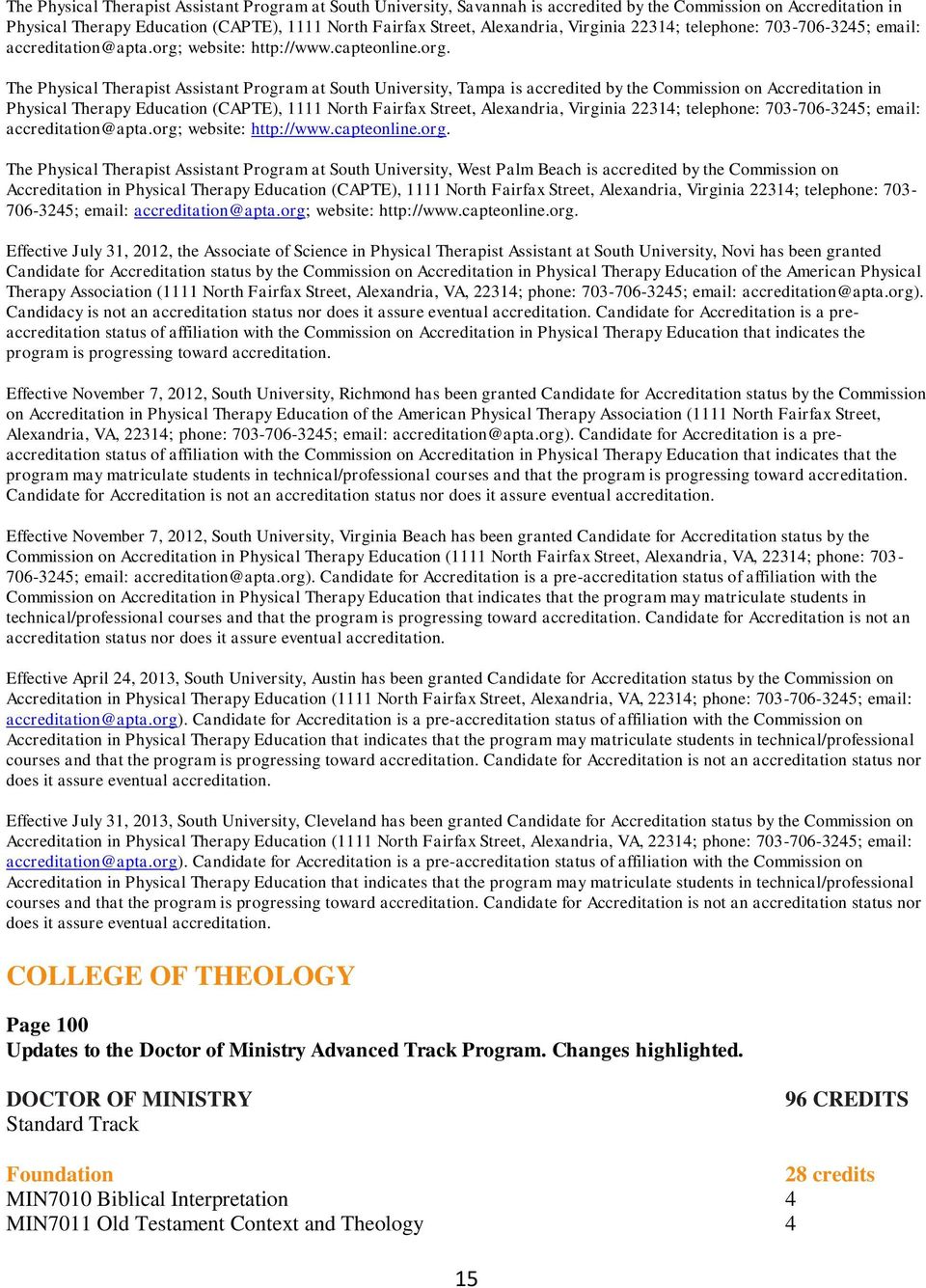
15 The Physical Therapist Assistant Program at South University, Savannah is accredited by the Commission on Accreditation in Physical Therapy Education (CAPTE), 1111 North Fairfax Street, Alexandria, Virginia 22314; telephone: ; website: The Physical Therapist Assistant Program at South University, Tampa is accredited by the Commission on Accreditation in Physical Therapy Education (CAPTE), 1111 North Fairfax Street, Alexandria, Virginia 22314; telephone: ; website: The Physical Therapist Assistant Program at South University, West Palm Beach is accredited by the Commission on Accreditation in Physical Therapy Education (CAPTE), 1111 North Fairfax Street, Alexandria, Virginia 22314; telephone: ; website: Effective July 31, 2012, the Associate of Science in Physical Therapist Assistant at South University, Novi has been granted Candidate for Accreditation status by the Commission on Accreditation in Physical Therapy Education of the American Physical Therapy Association (1111 North Fairfax Street, Alexandria, VA, 22314; phone: ; Candidacy is not an accreditation status nor does it assure eventual accreditation. Candidate for Accreditation is a preaccreditation status of affiliation with the Commission on Accreditation in Physical Therapy Education that indicates the program is progressing toward accreditation. Effective November 7, 2012, South University, Richmond has been granted Candidate for Accreditation status by the Commission on Accreditation in Physical Therapy Education of the American Physical Therapy Association (1111 North Fairfax Street, Alexandria, VA, 22314; phone: ; [email protected]). Candidate for Accreditation is a preaccreditation status of affiliation with the Commission on Accreditation in Physical Therapy Education that indicates that the program may matriculate students in technical/professional courses and that the program is progressing toward accreditation. Candidate for Accreditation is not an accreditation status nor does it assure eventual accreditation. Effective November 7, 2012, South University, Virginia Beach has been granted Candidate for Accreditation status by the Commission on Accreditation in Physical Therapy Education (1111 North Fairfax Street, Alexandria, VA, 22314; phone: ; [email protected]). Candidate for Accreditation is a pre-accreditation status of affiliation with the Commission on Accreditation in Physical Therapy Education that indicates that the program may matriculate students in technical/professional courses and that the program is progressing toward accreditation. Candidate for Accreditation is not an accreditation status nor does it assure eventual accreditation. Effective April 24, 2013, South University, Austin has been granted Candidate for Accreditation status by the Commission on Accreditation in Physical Therapy Education (1111 North Fairfax Street, Alexandria, VA, 22314; phone: ; [email protected]). Candidate for Accreditation is a pre-accreditation status of affiliation with the Commission on Accreditation in Physical Therapy Education that indicates that the program may matriculate students in technical/professional courses and that the program is progressing toward accreditation. Candidate for Accreditation is not an accreditation status nor does it assure eventual accreditation. Effective July 31, 2013, South University, Cleveland has been granted Candidate for Accreditation status by the Commission on Accreditation in Physical Therapy Education (1111 North Fairfax Street, Alexandria, VA, 22314; phone: ; [email protected]). Candidate for Accreditation is a pre-accreditation status of affiliation with the Commission on Accreditation in Physical Therapy Education that indicates that the program may matriculate students in technical/professional courses and that the program is progressing toward accreditation. Candidate for Accreditation is not an accreditation status nor does it assure eventual accreditation. COLLEGE OF THEOLOGY Page 100 Updates to the Doctor of Ministry Advanced Track Program. Changes highlighted. DOCTOR OF MINISTRY Standard Track 96 CREDITS Foundation 28 credits MIN7010 Biblical Interpretation 4 MIN7011 Old Testament Context and Theology 4 15
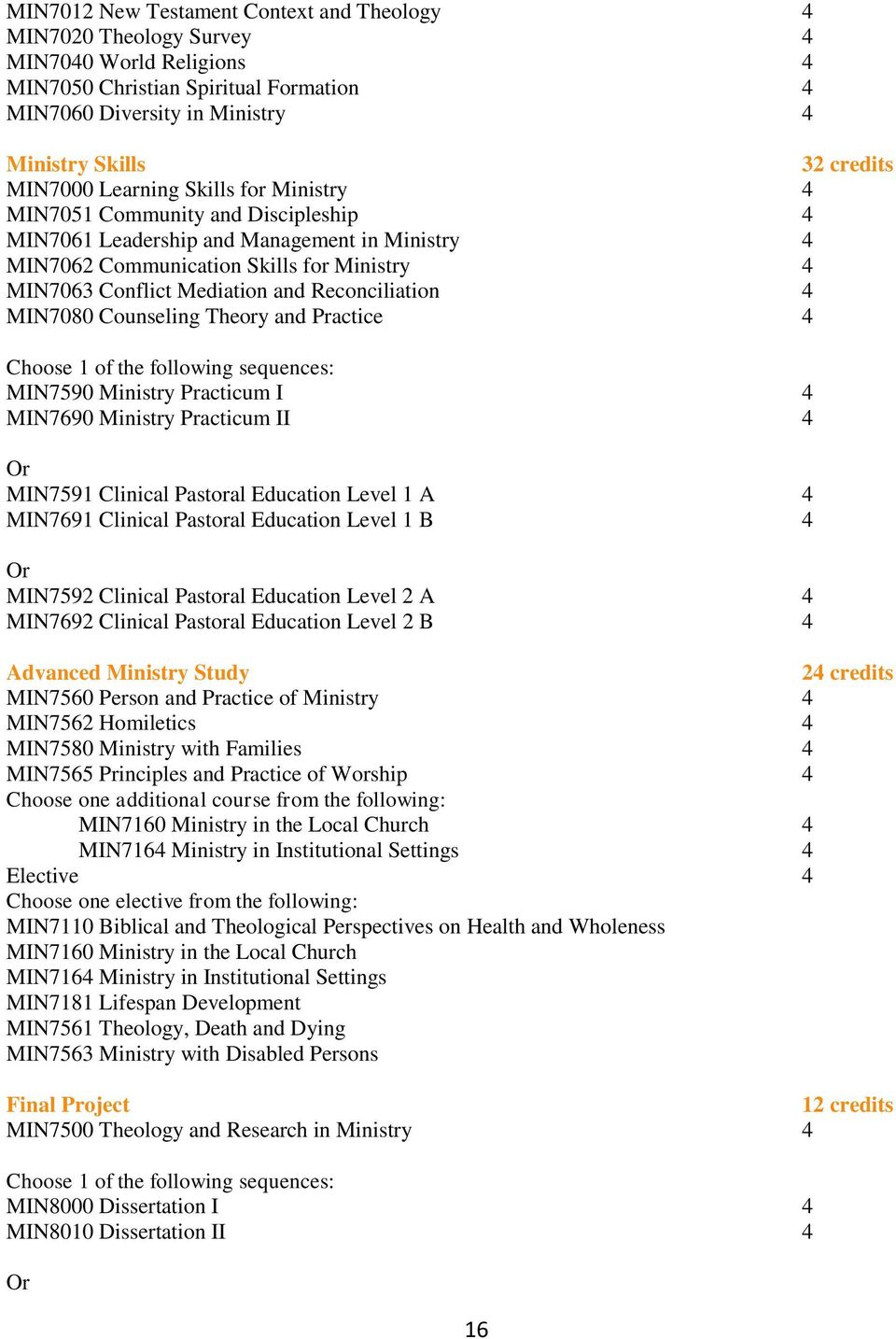
16 MIN7012 New Testament Context and Theology 4 MIN7020 Theology Survey 4 MIN7040 World Religions 4 MIN7050 Christian Spiritual Formation 4 MIN7060 Diversity in Ministry 4 Ministry Skills 32 credits MIN7000 Learning Skills for Ministry 4 MIN7051 Community and Discipleship 4 MIN7061 Leadership and Management in Ministry 4 MIN7062 Communication Skills for Ministry 4 MIN7063 Conflict Mediation and Reconciliation 4 MIN7080 Counseling Theory and Practice 4 Choose 1 of the following sequences: MIN7590 Ministry Practicum I 4 MIN7690 Ministry Practicum II 4 Or MIN7591 Clinical Pastoral Education Level 1 A 4 MIN7691 Clinical Pastoral Education Level 1 B 4 Or MIN7592 Clinical Pastoral Education Level 2 A 4 MIN7692 Clinical Pastoral Education Level 2 B 4 Advanced Ministry Study 24 credits MIN7560 Person and Practice of Ministry 4 MIN7562 Homiletics 4 MIN7580 Ministry with Families 4 MIN7565 Principles and Practice of Worship 4 Choose one additional course from the following: MIN7160 Ministry in the Local Church 4 MIN7164 Ministry in Institutional Settings 4 Elective 4 Choose one elective from the following: MIN7110 Biblical and Theological Perspectives on Health and Wholeness MIN7160 Ministry in the Local Church MIN7164 Ministry in Institutional Settings MIN7181 Lifespan Development MIN7561 Theology, Death and Dying MIN7563 Ministry with Disabled Persons Final Project 12 credits MIN7500 Theology and Research in Ministry 4 Choose 1 of the following sequences: MIN8000 Dissertation I 4 MIN8010 Dissertation II 4 Or 16
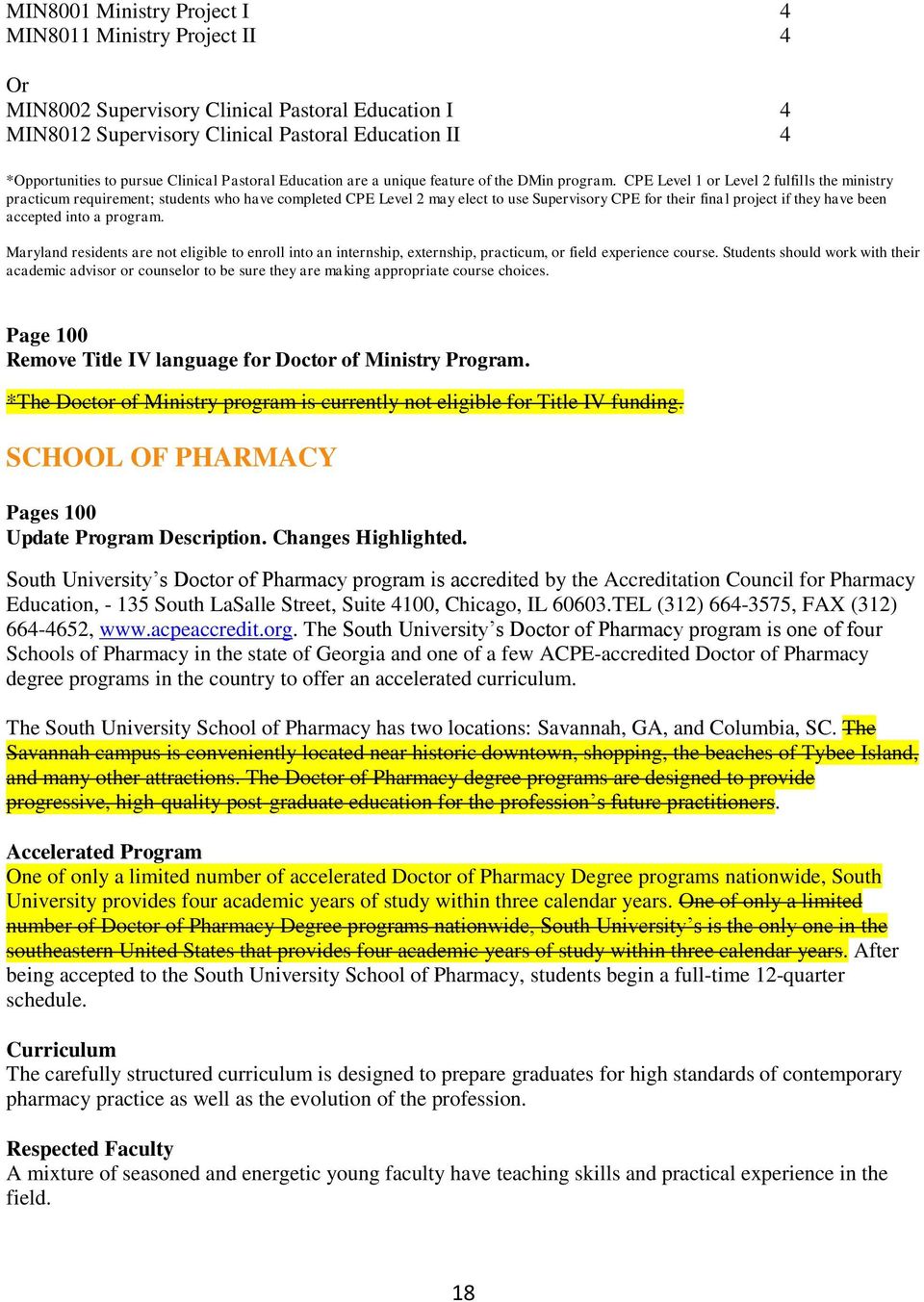
17 MIN8001 Ministry Project I 4 MIN8011 Ministry Project II 4 Or MIN8002Supervisory Clinical Pastoral Education I* 4 MIN8012 Supervisory Clinical Pastoral Education II* 4 *Opportunities to pursue Clinical Pastoral Education are a unique feature of the DMin program. CPE Level 1 or Level 2 fulfills the ministry practicum requirement; students who have completed CPE Level 2 may elect to use Supervisory CPE for their final project if they have been accepted into a program. DOCTOR OF MINISTRY Advanced Track Advanced Standing Credit CREDITS 56 credits Foundation 4 credits MIN7060 Diversity in Ministry 4 Ministry Skills 16 8 credits MIN7000 Learning Skills for Ministry 4 MIN7063 Conflict Mediation and Reconciliation 4 Electives 8 Choose two electives from the following: MIN7110 Biblical and Theological Perspectives on Health and Wholeness MIN7160 Ministry in the Local Church MIN7164 Ministry in Institutional Settings MIN7181 Lifespan Development MIN7561 Theology, Death and Dying MIN7563 Ministry with Disabled Persons Electives selected cannot fulfill requirements for both Ministry Skills and Advanced Ministry Study Advanced Ministry Study 16 credits MIN7560 Person and Practice of Ministry 4 Electives 12 Choose three electives from the following: MIN7110Biblical and Theological Perspectives on Health and Wholeness MIN7160 Ministry in the Local Church MIN7164 Ministry in Institutional Settings MIN7181 Lifespan Development MIN7561 Theology, Death and Dying MIN7563 Ministry with Disabled Persons Electives selected cannot fulfill requirements for both Ministry Skills and Advanced Ministry Study Final Project 12 credits MIN7500 Theology and Research in Ministry 4 Choose 1 of the following sequences: MIN8000 Dissertation I 4 MIN8010 Dissertation II 4 Or 17

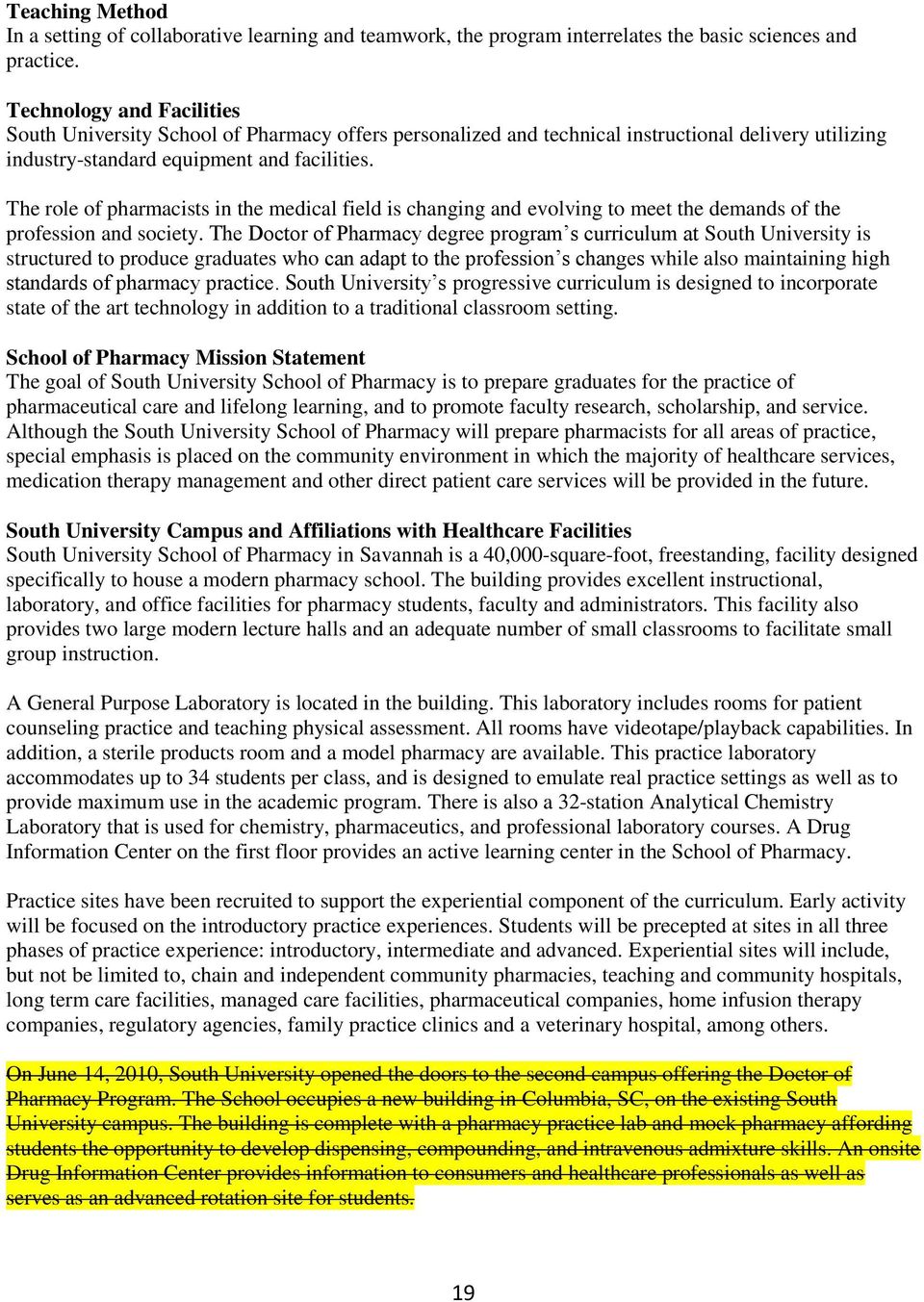
18 MIN8001 Ministry Project I 4 MIN8011 Ministry Project II 4 Or MIN8002 Supervisory Clinical Pastoral Education I 4 MIN8012 Supervisory Clinical Pastoral Education II 4 *Opportunities to pursue Clinical Pastoral Education are a unique feature of the DMin program. CPE Level 1 or Level 2 fulfills the ministry practicum requirement; students who have completed CPE Level 2 may elect to use Supervisory CPE for their final project if they have been accepted into a program. Maryland residents are not eligible to enroll into an internship, externship, practicum, or field experience course. Students should work with their academic advisor or counselor to be sure they are making appropriate course choices. Page 100 Remove Title IV language for Doctor of Ministry Program. *The Doctor of Ministry program is currently not eligible for Title IV funding. SCHOOL OF PHARMACY Pages 100 Update Program Description. Changes Highlighted. South University s Doctor of Pharmacy program is accredited by the Accreditation Council for Pharmacy Education, South LaSalle Street, Suite 4100, Chicago, IL TEL (312) , FAX (312) , The South University s Doctor of Pharmacy program is one of four Schools of Pharmacy in the state of Georgia and one of a few ACPE-accredited Doctor of Pharmacy degree programs in the country to offer an accelerated curriculum. The South University School of Pharmacy has two locations: Savannah, GA, and Columbia, SC. The Savannah campus is conveniently located near historic downtown, shopping, the beaches of Tybee Island, and many other attractions. The Doctor of Pharmacy degree programs are designed to provide progressive, high-quality post-graduate education for the profession s future practitioners. Accelerated Program One of only a limited number of accelerated Doctor of Pharmacy Degree programs nationwide, South University provides four academic years of study within three calendar years. One of only a limited number of Doctor of Pharmacy Degree programs nationwide, South University s is the only one in the southeastern United States that provides four academic years of study within three calendar years. After being accepted to the South University School of Pharmacy, students begin a full-time 12-quarter schedule. Curriculum The carefully structured curriculum is designed to prepare graduates for high standards of contemporary pharmacy practice as well as the evolution of the profession. Respected Faculty A mixture of seasoned and energetic young faculty have teaching skills and practical experience in the field. 18
19 Teaching Method In a setting of collaborative learning and teamwork, the program interrelates the basic sciences and practice. Technology and Facilities South University School of Pharmacy offers personalized and technical instructional delivery utilizing industry-standard equipment and facilities. The role of pharmacists in the medical field is changing and evolving to meet the demands of the profession and society. The Doctor of Pharmacy degree program s curriculum at South University is structured to produce graduates who can adapt to the profession s changes while also maintaining high standards of pharmacy practice. South University s progressive curriculum is designed to incorporate state of the art technology in addition to a traditional classroom setting. School of Pharmacy Mission Statement The goal of South University School of Pharmacy is to prepare graduates for the practice of pharmaceutical care and lifelong learning, and to promote faculty research, scholarship, and service. Although the South University School of Pharmacy will prepare pharmacists for all areas of practice, special emphasis is placed on the community environment in which the majority of healthcare services, medication therapy management and other direct patient care services will be provided in the future. South University Campus and Affiliations with Healthcare Facilities South University School of Pharmacy in Savannah is a 40,000-square-foot, freestanding, facility designed specifically to house a modern pharmacy school. The building provides excellent instructional, laboratory, and office facilities for pharmacy students, faculty and administrators. This facility also provides two large modern lecture halls and an adequate number of small classrooms to facilitate small group instruction. A General Purpose Laboratory is located in the building. This laboratory includes rooms for patient counseling practice and teaching physical assessment. All rooms have videotape/playback capabilities. In addition, a sterile products room and a model pharmacy are available. This practice laboratory accommodates up to 34 students per class, and is designed to emulate real practice settings as well as to provide maximum use in the academic program. There is also a 32-station Analytical Chemistry Laboratory that is used for chemistry, pharmaceutics, and professional laboratory courses. A Drug Information Center on the first floor provides an active learning center in the School of Pharmacy. Practice sites have been recruited to support the experiential component of the curriculum. Early activity will be focused on the introductory practice experiences. Students will be precepted at sites in all three phases of practice experience: introductory, intermediate and advanced. Experiential sites will include, but not be limited to, chain and independent community pharmacies, teaching and community hospitals, long term care facilities, managed care facilities, pharmaceutical companies, home infusion therapy companies, regulatory agencies, family practice clinics and a veterinary hospital, among others. On June 14, 2010, South University opened the doors to the second campus offering the Doctor of Pharmacy Program. The School occupies a new building in Columbia, SC, on the existing South University campus. The building is complete with a pharmacy practice lab and mock pharmacy affording students the opportunity to develop dispensing, compounding, and intravenous admixture skills. An onsite Drug Information Center provides information to consumers and healthcare professionals as well as serves as an advanced rotation site for students. 19
20 On June 14, 2010, South University opened the doors to the second campus offering the Doctor of Pharmacy Program. The School occupies a new building in Columbia, SC, on the existing South University campus. The building is complete with a pharmacy practice lab, mock pharmacy and patient assessment labs affording students the opportunity to develop dispensing, compounding, intravenous admixture and patient assessment/counseling skills. The laboratory in Columbia accommodates 48 students and is a complete practice and chemistry laboratory in one. An onsite Drug Information Center provides information to consumers and healthcare professionals as well as serves as an advanced rotation site for students. With ten full-time and seven part-time faculty positions, we have, Columbia faculty, in conjunction with our Savannah faculty, a combination of professionals who enable us to utilize Tandberg distance education, and other modern technologies in combination with live instruction, and who provide the pharmacy education required for our students to develop the professional skills to serve patients. South University has developed a program that is visionary in its approach to educating Pharmacy students, with a carefully structured curriculum designed to prepare graduates for both high standards of contemporary pharmacy practice and the evolution of the profession. At South University, we have integrated Medicinal Chemistry, Pharmacology, and Therapeutics into one combined continuing course sequence developed in full collaboration by science and practice faculty. The resulting efficiency allows a rigorous comprehensive didactic component in a curriculum that contains 12 months of full-time rotations using an accelerated, full-time 12-quarter schedule designed to deliver four academic years in three calendar years. Program Outcomes: Accurately and legally process drug orders: interpret and evaluate prescriptions, compound, prepare, package, and dispense medications. Communicate with patients and provide counseling regarding the purposes, uses, and effects of medications, related therapy, and general health promotion. Design, implement, monitor, evaluate, and modify or recommend modifications in drug therapy to insure effective, safe, and economical patient care. Identify, assess and solve medication-related problems, providing clinical judgment and recommendations for achievement of individualized therapeutic outcomes. Evaluate patients through interview, physical assessment, and objective tests, and triage patients to other health professionals as appropriate. Manage and utilize systems, technology and personnel to support, build and enhance the practice of pharmacy including storage, preparation, dispensing and administration of medicines. Understand relevant diet, nutrition, and non-drug therapies. Collaborate with other health professionals in patient care, scholarship, and service. Evaluate and document interventions and pharmaceutical care outcomes. Retrieve, evaluate, manage, and communicate professional information and literature. Contribute to the rational use of medications through skills related to formulary management, medication use evaluation, and adverse event reporting. Display professional attributes of a pharmacist including ethical decision making, critical thinking, and life-long learning as described in the Pharmacist s Oath. Understand the major components and dynamics of the U.S. healthcare system, and roles of pharmacy and the pharmaceutical industry within the system. Understand and use pharmaceutical calculations and pharmacokinetic principles to support accurate and safe drug delivery. 20

21 Predict the major pharmacological activity, potential side-effects and physicochemical properties of a drug based on its chemical structure. Comprehend basic pharmacological principles (dose-response relationships, drug receptor binding, drug metabolism & elimination) as well as the mechanism of action of a drug, its therapeutic indication and adverse effects. Understand the normal functioning of cells, tissues and organ systems in the context of the overall homeostasis of the organism. Understand how various disease states affect the normal physiology and homeostasis of an organism and use this understanding of pathophysiology as the basis for drug therapy. Compare and contrast various routes of drug administration and predict the availability, metabolism and elimination of a drug following its administration by these various routes. Understand the structure, physiochemical properties, and function of key biomolecules within the human body with respect to their role in metabolism, biosynthesis, energy production and expression of genetic material. Understand and apply the mathematical, physiochemical and biological principles governing the formulation, preparation & effectiveness of various dosage forms as well as new technologies involved in the development of these dosage forms. ACCREDITATION AND AFFILIATIONS Page 106 Revised Virginia Statement. Virginia South University, Richmond, 2151 Old Brick Road, Glen Allen, VA and South University, Virginia Beach, 301 Bendix Road, Suite 100, Virginia Beach, VA are certified to operate by the State Council of Higher Education for Virginia (James Monroe Building, 101 North 14 th Street, Richmond, VA 23219, ). Page 107 Revised Nursing statements. Replace current with text below. The RN to Bachelor of Science in Nursing, at South University, Austin are accredited by the Commission on Collegiate Nursing Education (CCNE), One Dupont Circle, NW, Suite 530, Washington, DC ; telephone: The Bachelor of Science in Nursing, the RN to Bachelor of Science in Nursing, and the Master of Science in Nursing and RN to Master of Science in Nursing specializations at South University, Columbia are accredited by the Commission on Collegiate Nursing Education (CCNE), One Dupont Circle, NW, Suite 530, Washington, DC ; telephone: The Bachelor of Science in Nursing, the RN to Bachelor of Science in Nursing, and the Master of Science in Nursing and RN to Master of Science in Nursing specializations at South University, Cleveland are accredited by the Commission on Collegiate Nursing Education (CCNE), One Dupont Circle, NW, Suite 530, Washington, DC ; telephone: The BSN and RN to Bachelor of Science in Nursing at South University, High Point are accredited by the Commission on Collegiate Nursing Education (CCNE), One Dupont Circle, NW, Suite 530, Washington, DC ; telephone:
22 The Bachelor of Science in Nursing, the RN to Bachelor of Science in Nursing, and the Master of Science in Nursing and RN to Master of Science in Nursing specializations at South University, Montgomery are accredited by the Commission on Collegiate Nursing Education (CCNE), One Dupont Circle, NW, Suite 530, Washington, DC ; telephone: The Bachelor of Science in Nursing, the RN to Bachelor of Science in Nursing, and the Master of Science in Nursing and RN to Master of Science in Nursing specializations at South University, Novi are accredited by the Commission on Collegiate Nursing Education (CCNE), One Dupont Circle, NW, Suite 530, Washington, DC ; telephone: The RN to Bachelor of Science in Nursing, and the Master of Science in Nursing and RN to Master of Science in Nursing specializations at South University Online are accredited by the Commission on Collegiate Nursing Education (CCNE), One Dupont Circle, NW, Suite 530, Washington, DC ; telephone: The Bachelor of Science in Nursing, the RN to Bachelor of Science in Nursing, and the Master of Science in Nursing and RN to Master of Science in Nursing specializations at South University, Richmond are accredited by the Commission on Collegiate Nursing Education (CCNE), One Dupont Circle, NW, Suite 530, Washington, DC ; telephone: The RN to Bachelor of Science in Nursing, and the Master of Science in Nursing and RN to Master of Science in Nursing specializations at South University, Savannah are accredited by the Commission on Collegiate Nursing Education (CCNE), One Dupont Circle, NW, Suite 530, Washington, DC ; telephone: The Bachelor of Science in Nursing, the RN to Bachelor of Science in Nursing, and the Master of Science in Nursing and RN to Master of Science in Nursing specializations at South University, Tampa are accredited by the Commission on Collegiate Nursing Education (CCNE), One Dupont Circle, NW, Suite 530, Washington, DC ; telephone: The Bachelor of Science in Nursing, the RN to Bachelor of Science in Nursing, and the Master of Science in Nursing and RN to Master of Science in Nursing specializations at South University, Virginia Beach are accredited by the Commission on Collegiate Nursing Education (CCNE), One Dupont Circle, NW, Suite 530, Washington, DC ; telephone: The Bachelor of Science in Nursing, the RN to Bachelor of Science in Nursing, and the Master of Science in Nursing specializations at South University, West Palm Beach are accredited by the Commission on Collegiate Nursing Education (CCNE), One Dupont Circle, NW, Suite 530, Washington, DC ; telephone: Page 107 Revised Occupational Therapy Assistant statement. Replace current with text below. The Occupational Therapy Assistant program at South University, West Palm Beach is accredited by the Accreditation Council for Occupational Therapy Education (ACOTE) of the American Occupational Therapy Association (AOTA), located at 4720 Montgomery Lane, Suite 200, Bethesda, MD ACOTE s telephone number c/o AOTA is (301) 652-AOTA. Graduates of the program will be eligible to sit for the national certification examination for the occupational therapy assistant administered by the National Board for Certification in Occupational Therapy (NBCOT). 22
23 After successful completion of this exam, the individual will be a Certified Occupational Therapy Assistant (COTA). In addition, most states require licensure in order to practice; however, state licenses are usually based on the results of the NBCOT Certification Examination. Note that a felony conviction may affect a graduate s ability to sit for the NBCOT certification examination or attain state licensure. More information on ACOTE may be obtained at ADMISSIONS COLLEGE OF HEALTH PROFESSIONS Pages 114 Addition of the Doctor in Occupational Therapy Admissions Requirements Procedure for Admission to Doctor in Occupational Therapy (OTD) Program Admissions criteria for the OTD program is as follows: OR Baccalaureate degree in Occupational Therapy from an accredited institution with a CGPA of 3.0 or higher on a 4.0 scale on all Occupational Therapy programmatic courses. Masters degree in Occupational Therapy from an accredited institution with a CGPA of 3.0 or higher on a 4.0 scale on the degree earned. Note: Applicants with a Bachelor s degree in Occupational Therapy and a Masters degree in Health Sciences (e.g. Public Health, Nursing, Health Sciences, etc ) may qualify for placement into the advanced track. Submission of official transcripts from all collegiate institutions attended before the student s start date. Holds an Occupational Therapy license within the state the student practices and is in good standing with the National Board for Certification in Occupational Therapy (NBCOT). Minimum of two years of experience as an Occupational Therapist. Completion of application for admission and submission of application fee ($60) Holds a current American Heart Association Basic Life Support for Healthcare Providers CPR Card (two year certification). Three recommendations using the OTD Recommendation for Admission Form. Two recommendations must be from an Occupational Therapist. Submission of a typed essay, not to exceed 750 words (Refer to the OTD Student Essay form.) Interview with the Program Director or designee. Transfer Credit Guidelines for the Doctor in Occupational Therapy Program Graduate work completed at another institution will be reviewed for possible credit based on the following criteria/procedure: 1. The course was taken at an acceptable accredited collegiate institution. 2. The transferred course must be determined to be equivalent to the course listed in the South University catalog. 23
24 Note: Students may be required to provide additional supporting documentation such as a course description or a syllabus for a class to be considered for Transfer of Credit. 3. Courses that may be transferred are subject to the following conditions: A course may be transferred if the student has earned a grade of B or better No more than 12 credit hours may be transferred from another institution to the OTD program and used to fulfill the completion/graduation requirements of the program. The majority of credits earned toward a graduate degree in the Doctor of Occupational Therapy program must be earned at South University. No course may be transferred if it was taken more than seven (7) years prior to the transfer request. Transfer credits being applied towards the OTD Program will be reviewed by the OTD Program Director with collaborative assistance from the Campus Registrars office. Formal authentication of the transfer student s transcripts will be vetted through the Registrars office. 4. South University reserves the right to reject any and all transfer credits from other institutions when it is determined that the quality of instruction is deficient or unsatisfactory as deemed by South University. 5. The University reserves the right to disallow transfer credit for courses if the student s subsequent grades in required courses in the same subject fall below average. Page 116 Addition of the Transfer of Credit Guidelines for the Master of Arts in Clinical Mental Health Counseling Program. Transfer of Credit Guidelines for the Master of Arts in Clinical Mental Health Counseling Program Graduate work completed at another institution will be reviewed by the Program Director for possible credit based on the following criteria/procedure: 1. The course was taken at an acceptable accredited collegiate institution. 2. The transferred course must be determined to be equivalent to the course listed in the South University catalog. Note: Students may be required to provide additional supporting documentation such as a course description or a syllabus for a class to be considered for Transfer of Credit. 3. Courses that may be transferred are subject to the following conditions: A course may be transferred if the student has earned a grade of B or better The majority of credits earned toward a graduate degree in the Clinical Mental Health Counseling program must be earned at South University. No more than 49% of courses may be transferred. No course may be transferred if it was taken more than seven (7) years prior to the transfer request. 4. South University reserves the right to reject any and all transfer credits from other institutions when it is determined that the quality of instruction is deficient or unsatisfactory as deemed by South University. 5. The University reserves the right to disallow transfer credit for courses if the student s 24
25 subsequent grades in required courses in the same subject fall below average. 6. Final approval on transfer credit is required by the College Dean or his/her designee. Page 118 Update to the Procedure for Admission to the Associate of Science in Occupational Therapy Assistant Program. Changes highlighted. Procedure for Admission to Associate of Science in Occupational Therapy Assistant Program Students intending to enter the Occupational Therapy Assistant (OTA) Program will be admitted to South University as candidates for the OTA Program. Only after completing prerequisite coursework and achieving the requirements outlined below will students be admitted into advanced standing in the OTA Program. Students may transfer prerequisite courses into the program before entering advanced standing if approved by the OTA Program Director and the Registrar. Transfer credit will not be accepted for courses in the South University OTA Professional Phase Curriculum. Note: This does not apply to South University OTA students (in good standing) transferring between campuses. Admission Requirements for the Professional Phase of Occupational Therapy Assistant Program: 1. A minimum cumulative GPA of Minimum of 24 hours of observation, volunteer, or employment in at least one occupational therapy clinic, in at least two practice areas of occupational therapy (e.g., pediatrics, physical disabilities, mental health, and geriatrics) attested to by an occupational therapist on the form provided. 3. Completion of the Self-assessment Inventory (available from the OTA Program Office). 4. Completed OTA Application Packet. Page 118 Update to the Procedure for Admission to the Associate of Science in Physical Therapist Assistant Program. Changes highlighted. Procedure for Admission to Associate of Science in Physical Therapist Assistant Program Students intending to enter the Physical Therapist Assistant (PTA) program will be admitted to South University as candidates for the Physical Therapist Assistant program. Only after completing prerequisite coursework and achieving the requirements outlined below will students be admitted into advanced standing in the PTA program. Students may transfer prerequisite courses into the program before entering advanced standing if approved by the program director and the registrar. Transfer credit will not be accepted for courses in the South University PTA Technical Phase Curriculum. Note: This does not apply to South University PTA students (in good standing) transferring between campuses. Admission Requirements: 1. A minimum cumulative GPA of 2.85 in all mandatory prerequisite courses. 2. Minimum grade of B in Medical Terminology, Anatomy and Physiology I and Anatomy and Physiology II, lecture and laboratory. Students may retake courses in order to achieve the minimum required grade of B. 3. Minimum of 25 hours of observation, volunteer, or employment in at least one physical therapy clinic, attested to by a physical therapist or physical therapist assistant on program-provided form. 25
26 4. Current American Heart Association Basic Life Support for Healthcare Providers CPR (two-year certification). All applicants to South University PTA program must submit standardized test scores using Accuplacer, SAT or ACT. Students who do not achieve the minimum entrance score defined by South University for general admission for each respective test will not be accepted into the PTA program. Standardized test scores (Accuplacer) must not be older than five (5) years. Applicants who take, or have taken, standardized entrance tests at a site outside of South University campuses, must provide official test scores to the South University campus to which they are applying. All applicants must satisfy technical standards for the PTA program in order to be admitted. Students who attempt to transfer into the South University PTA program must submit, in addition to the standard application for admission, official scores from acceptable standardized tests (SAT or ACT) or take the university s Accuplacer entrance test. Applicants who require developmental coursework (in English) based upon scores of the standardized tests will not be permitted to enroll in the PTA program even if they have taken coursework at another institution. The coursework that is transferred to South University must permit the student to obtain a 2.85 CGPA by the time the student applies for admission into the PTA technical phase. Students who transfer coursework into South University, but cannot mathematically attain a CGPA of 2.85 by the time they would enter the technical phase, will not be admitted to the PTA program. Students from South University who are in another major will be permitted to transfer into the general education phase of the PTA program if they achieved satisfactory scores on the Accuplacer, SAT or ACT for general admission at the time of original enrollment. Applicants must satisfy technical standards for the PTA program in order to be admitted. Admission to the Associate of Science in Physical Therapist Assistant Technical Phase Admission into the Technical Phase Students must apply for admission into the technical phase of the PTA program. 1. Application must be submitted seven (7) weeks before the start of the technical phase quarter. 2. Applicants must satisfy technical standards for the program in order to enter the ranking process. 3. Background check Applicants will not be permitted to enter the ranking process if they have been convicted of a felony, or a misdemeanor that would impair the student s ability to be placed in a clinical site and/or be eligible to take the PTA licensure exam. The student is responsible for providing the results of the background check to the campus to which the student is applying. The agency performing the background check must be acceptable to South University. 4. Students must have completed an American Heart Association Basic Life Support for Health Care Providers program and have a valid card at the time of application. The card must remain valid throughout all clinical rotations. 5. Students must have proof of appropriate immunizations before participating in the ranking process. 6. Applicants must have completed 25 hours of observation in a physical therapy setting documented by a licensed PT or PTA on the appropriate form provided in the admissions packet. 7. Ranking will be based upon: a. Cumulative GPA at the time of entry into the ranking process. (35 percent weight) b. Science GPA (required to score a B or higher in these courses). i. Medical Terminology ii. Anatomy and Physiology I 26
27 iii. Anatomy and Physiology I Lab iv. Anatomy and Physiology II v. Anatomy and Physiology II Lab c. HOBET (exam will not be accepted if 7 years or older) i. Reading ii. Math iii. Human Body Science iv. Scientific Reasoning v. English 8. Students must have a 2.85 CGPA or greater at the time they enter the ranking process. 9. Repeating courses to achieve a higher grade is associated with penalty point deductions from the ranking score. 10. Students must complete the general education phase of the program before entering the technical phase. 11. The number of students entering the technical phase will be determined by the President in conjunction with the PTA Program Director and the ACCE/DCE. Page 121 Update to the Procedure for Admission to the Master of Public Health Program. Changes highlighted. Procedure for Admission to Master of Public Health Program Admissions criteria for the Master of Public Health degree program is as follows: Completion of a bachelor s degree from an accredited institution, with a cumulative grade point average (CGPA) of at least 2.7 (on a scale of 4.0), OR Completion of a bachelor s degree from an accredited institution, with minimum GRE scores (GRE scores may not be older than 5 years) in the 45 th percentile for Verbal, and 32 nd percentile for Quantitative, OR An earned graduate degree from an accredited institution with a CGPA of 3.0 or higher. Completion of an application for admission and submission of a $50 application fee. Submission of a document that includes a self-appraisal of academic and professional qualifications to enter the program along with any volunteer experience. The document should also include, if appropriate, a career resume describing relevant professional work in the field of public health. Submission of official transcripts from all college and universities attended within 10 weeks of start date. Applicants for whom English is a Second Language (ESL) must submit a minimum paper-based TOEFL (Test of English as a Foreign Language) score of 600 or the electronic-based score of 250 to be considered for the program. Required Program Foundation Courses The following undergraduate courses must be completed with a grade of C or better have been taken at an accredited college or university and satisfactorily be completed prior to acceptance enrollment into the Master of Public Health program courses. Students accepted into the program without having completed 27
28 these courses must do so within two sessions of their acceptance date. Sciences courses will only be considered if they are no older than seven years at the time of application. College Algebra (1 course) or higher level math coursework Statistics (1 course) Biology (at least 2 courses), which may include General Biology, Ecology, Biotechnology, Inheritance, Microbiology, Evolution of Populations, OR Health-related Sciences (at least 2 courses), which may include Human Physiology, Human Anatomy and Physiology, Cell Biology, Medical Genetics, Immunology, etc. OR Any combination of courses in Biology or Health-related Sciences Foundation undergraduate course credits do not count towards the total number of credits for graduation nor do they count in the Cumulative Grade Point Average (CGPA); however, they do count in determining the maximum time frame (MTF) and the Incremental Completion Rate (ICR). Students enrolled in foundation undergraduate courses must successfully complete the course within their first three attempts or the student will be academically dismissed from the University. COLLEGE OF THEOLOGY Pages 122 Revised Procedures for Admission to Doctor of Ministry policy. Changes highlighted. Procedures for Admission to Doctor of Ministry The criteria used in determining admission to the doctoral program include: Admissions criteria for the Doctor of Ministry program are consistent with the criteria of other postbaccalaureate degree programs at South University. Completion of a graduate degree from an accredited institution with a CGPA of 3.0 or higher on a 4.0 scale. If no earned graduate degree, then completion of a baccalaureate degree from an accepted accredited collegiate institution with a cumulative grade point average (CGPA) of 2.7 or higher on a 4.0 scale for the last 60 semester credits/90 quarter credits of baccalaureate coursework. Interview with the Program Director/Chair or Dean of the College. Submission of official transcripts from all post-secondary institutions attended, with submission due within 10 weeks of initial start date. Applicants for whom English is a Second Language (ESL) must submit a minimum paper-based TOEFL (Test of English as a Foreign Language) score of 550 or the electronic-based score of to be considered for the program. Completion of an application for admission and submission of a $50 application fee. Applicants who are not citizens of the United States should refer to the section in the South University catalog entitled International Student Admissions Policy. Exceptions to the Minimum GPA Applications with CGPA lower than the stated program minimum (2.7 for the bachelors degree and 3.0 for a graduate degree/coursework) may be considered for admission on the basis of evidence of academic and professional potential demonstrated by career and/or personal accomplishments indicated in a personal statement of academic and professional goals, a career resume or curriculum vita, and two letters of academic and/or professional recommendation. The Program Director/Chair in consultation with the Dean of the College or designee must approve exceptions. 28
29 Students admitted on an exception basis will be admitted as regular students on provisional status for the first quarter of enrollment. In order to remain enrolled after completion of the first quarter the student must achieve a CGPA of at least 3.0. Transfer of Credit and Advanced Standing The majority 40 credits of credits toward any graduate or post-graduate degree the Doctor of Ministry degree program must be earned at South University. Credit for transfer work and advanced standing will be given if the courses were taken at an accepted accredited institution, the course is equivalent to courses offered at South University, and the course carries a grade of B or better (a grade of B is not acceptable). All transfer credit will be reviewed and approved by the Program Director/Chair or the Dean of the College or designee. Students wishing to transfer credit from other graduate or postgraduate programs request a transcript evaluation to determine which courses may be transferred. Advanced Standing Without Credit Students who have completed a previous degree in Bible and/or theology at the undergraduate level may be eligible for up to 16 QH units of advanced standing without credit, meaning some prerequisites program requirements may be considered fulfilled by previous coursework. Students can complete the corresponding number of units with elective courses. Students should request a transcript evaluation to determine which courses qualify the student for advanced standing without credit. The following courses may be waived: MIN7010 Biblical Interpretation MIN7011 Old Testament Context and Theology MIN7012 New Testament Context and Theology MIN7020 Theology Survey MIN7040 World Religions Advanced Track Standing with Credit Students who have completed course work at the graduate or postgraduate level may receive advanced standing with credit, meaning the total number of units to complete is reduced. Most Students who have completed a M.Div. or a M.A. in biblical, theological, and/or ministry studies with at least 90 quarter credits (60 semester credits) its educational equivalent (M.A. in biblical, theological, and/or ministry studies with at least 108 quarter credits/72 semester credits) may qualify for the Advanced Track, which is the maximum allowable advanced standing of 56 QH credits. Only work completed at an accepted accredited institution with a CGPA of 3.0 can be considered in determining eligibility for the Advanced Track. Students who have completed a M.A. with less than 90 quarter credits (60 semester credits), or a non-theological masters or postgraduate degree, or who have some graduate level coursework totaling less than 90 quarter credits (60 semester credits) may transfer appropriate credit into the program, subject to the University s transfer of credit policies. Transfer of Credit Students who have completed an M.A. with less than 108 quarter credits (72 semester credits), or a nontheological masters or postgraduate degree, or who have some graduate level coursework totaling less than 108 quarter credits (72 semester credits) may transfer up to 56 QH credits into the program, subject to the University s transfer of credit policies. The following courses may not be awarded transfer of credit: MIN7000 Learning Skills for Ministry 29
30 MIN7060 Diversity in Ministry MIN7063 Conflict Mediation and Reconciliation MIN7500 Theology and Research in Ministry MIN8000 Dissertation I and MIN8010 Dissertation II OR MIN8001 Ministry Project I and MIN8011 Ministry Project II OR MIN8002 Supervisory CPE I and MIN8012 Supervisory CPE II Requests for advanced standing without credit and transfer of credit are handled on a case-by-case basis by the Registrar and approved by the Program Director and the Chair or Dean of the College or designee. Only coursework completed at an accepted accredited institution can be considered for advanced standing and/or transfer of credit. FINANCIAL INFORMATION Page 124 Addition of the tuition for the Doctor of Ministry program. Tuition for the Doctor of Ministry degree program is as follows: $5,165 per quarter for 8-18 credit hours, $4,080 per quarter for 5-7 credit hours, and $2,395 per quarter for 1-4 credit hours. Page 124 Addition of the tuition for the Doctor of Occupational Therapy program. Tuition for the Doctor of Occupation Therapy degree program is as follows: $5,875 per quarter for 8-18 credit hours, $4,950 per quarter for 5-7 credit hours, and $2,450 per quarter for 1-4 credit hours. Page 124 Revision to the tuition for the Master of Science in Physician Assistant Program. Changes highlighted. Tuition for the Master of Science in Physician Assistant Studies degree program is $7,325 per quarter effective January Tuition in this program, effective January 2013, will be $7,615 per quarter. Tuition does not include a $500 nonrefundable acceptance fee, which is applied to tuition for the first quarter upon enrollment. This is for a full-time course load and does not include expenses for such required items as uniforms (approximately $40), textbooks (approximately $2800), and professional instruments (approximately $900). Students pay a $75 lab fee per quarter in the didactic phase. Students are required to purchase a laptop computer. Students are also required to purchase Typohon Group Health Solution Physician Assistant Student Tracking eclas clinical tracking software. Fees are $75 for year 1 and $93.75 for year 2. PA students are not eligible for part-time enrollment. Page 125 Addition of the Doctor of Occupational Therapy Degree Program information in the Fees section. Place immediately before the Doctor of Pharmacy Degree Program header. Doctor of Occupational Therapy Degree Program Students enrolled in the Doctor of Occupational Therapy (OTD) Program should be aware that throughout the process of their graduate education they will incur additional expenses beyond the normal tuition and book fees. Such expenses include travel to/from West Palm Beach, Florida for their On Campus Intensives (OCI), as well as, course materials and equipment, such as, the Clicker Technology device used to authenticate course attendance and validate course learning. Please refer to the OTD Student Manual (General Expenses for the On Campus Intensives-OCIs), for a general overview as to the additional expenses while attending the mandatory OCIs. 30
31 Additional Costs: On Campus Intensives (OCI) $650-to-$1000 (Four OCIs = $2600-to-$4000) Clicker Technology (querying-students) $45.00 Pages 126 to 128 Update to the Refund of Tuition Policy. Changes highlighted. Refund of Tuition Tuition charges are based on the total number of credit hours for which a student is enrolled on the first day of classes (as listed in the University calendar), regardless of program. Refunds or tuition adjustments will be awarded according to the following guidelines: 1. If circumstances prevent matriculation before a student begins attending the University, all tuition charges will be refunded. The application fee will be refunded only if a refund is requested within three days of application. A tuition adjustment results when a student officially changes enrollment status (full-time to part-time, part-time to less than part-time or part-time to full time) during the drop/add period. No adjustment will be made for students dropping individual classes after the drop/add period. 2. Richmond and Virginia Beach Virginia campuses only: Rejection: An applicant rejected by South University is entitled to a refund of all monies paid. Three-Day Cancellation: An applicant who provides written notice of cancellation within three (3) business days, excluding weekends and holidays, of executing the enrollment agreement is entitled to a refund of all monies paid, excluding the $50 non-refundable application fee. Other Cancellations: An application requesting cancellation more than three (3) days after executing the enrollment agreement and making an initial payment, but prior to the first day of class is entitled to a refund of all monies paid, less a maximum tuition fee of 15% of the stated cost of the course or $100, whichever is less. Withdrawal Procedure: A student choosing to withdraw from the school after the commencement of classes is to provide notice in writing or in person to the Office of the Registrar. The notice must include the expected last date of attendance and be signed and dated by the student. A student will be determined to be withdrawn from the institution if the student violates the schools published attendance policy. A student s status as a student will be terminated not later than seven consecutive instructional days after the last date on which the student actually attended the school. All refunds must be submitted within forty-five (45) calendar days of the determination of the withdrawal date. Tuition Refunds will be Determined as Follows: Proportion of Courses Taken by Withdrawal Date Less than 25% Refund Percentage 75% of course cost 25% up to but less than 50% 50% of course cost 50% up to but less than 75% 25% of course cost 75% or more No Refund 31
32 Withdrawal Procedure: A student choosing to withdraw from the school after the commencement of classes is to provide notice in writing or in person to the Office of the Registrar. The notice must include the expected last date of attendance and be signed and dated by the student. A student will be determined to be withdrawn from the institution if the student violates the schools published attendance policy. All refunds must be submitted within forty-five (45) calendar days after receipt of a written request or the date the student last attended classes whichever is sooner. Tuition Refunds will be Determined as Follows: Proportion of Courses Taken by Withdrawal Date During the Add/Drop Period After the Add/Drop Period and before the first 25% Refund Percentage 100% of course cost 75% of course cost 25% up to but less than 50% 50% of course cost 50% up to but less than 75% 25% of course cost 75% or more No Refund 3. Accelerated Graduate Programs, Austin, Columbia*, High Point, Montgomery, Novi, Savannah, Tampa, and West Palm Beach campuses: Tuition Refunds will be Determined as Follows, based on the week in which the student withdraws: Withdrawal Date Week 1 Week 2 Week 3 After Week 3 Tuition Refund 75% of course cost 50% of course cost 25% of course cost 0% of course cost *Columbia campus only: For students attending the University for the first time and who withdraw from the institution, a prorate refund calculation shall be applied up to 60 percent point in time of that initial term. Prorated refund is a refund for a student of not less than that portion of tuition, fees, and other charges assessed the student equal to the portion of the period of enrollment for which the student has been charged that remains on the last day of attendance by the student, rounded downward to the nearest ten percent of that period, less any unpaid charges owed for the period of enrollment for which the student has been charged that remains on the last day of attendance by the student, rounded downward to the nearest ten percent of that period, less any unpaid charges owed for the period of enrollment for which the student has been charged, and less an administrative fee not to exceed the lesser of five (5) percent or one hundred dollars. 32
33 Withdrawal Procedure: To withdraw officially from the institution, students must contact the office of the registrar to provide notification of their intention to withdraw. A student will be determined to be withdrawn from the institution if the student violates the university s published attendance policy in all their classes. All refunds must be submitted within thirty (30) calendar days of the determination of the withdrawal date. 4. Ohio campus: Students who apply for enrollment into the Cleveland campus but are rejected or provide written notice of cancellation within five (5) calendar days of executing the enrollment agreement are entitled to a refund of all monies paid, including the $50 application fee. An applicant requesting cancellation more than five (5) calendar days after executing the enrollment agreement and making an initial payment but prior to the first day of class is entitled to a refund of all monies paid, less the $50 application fee. Withdrawal Procedure: The University requests that a student choosing to withdraw from the school after the commencement of classes is to provide notice in writing or in person to the Office of the Registrar. The notice must include the expected last date of attendance and be signed and dated by the student. A student will be determined to be withdrawn from the institution if the student violates the university s published attendance policy. All refunds will be submitted within thirty (30) calendar days of the determination of the withdrawal date. Refunds are calculated based on the student s last date of attendance or participation in an academic activity. Refunds for Tuition and Refundable Fees will be determined as Follows: Calendar Week Withdrawal during the first full week Withdrawal during the second full week Withdrawal during the third full week Withdrawal after the third full week Tuition Refund 75% of tuition and refundable fees, less the $50 application fee 50% of tuition and refundable fees, less the $50 application fee 25% of tuition and refundable fees, less the $50 application fee No tuition or refundable fees refund 5. Students in South University s online programs who drop before the start date of the course will receive a 100% refund of the total cost of tuition for the course. Tuition refunds after the start of a course are based on weekly attendance. Fully online students must contact their Academic Advisor to officially withdraw from school. A student will be determined to be withdrawn from the institution if the student violates the university s published attendance policy in all their classes. All refunds must be submitted within thirty (30) calendar days of the determination of the withdrawal date. 5 and 5.5 Week Course Students who withdraw from their course after attending week 1 will receive a 75% tuition refund. Students who withdraw from their course after attending week 2 will receive a 50% tuition refund. Students who withdraw from their course dur ing o r after the 3rd week will receive a 0% tuition refund. 33
34 10 and 11 Week Course Students who withdraw from their course after attending week 2 will receive a 75% tuition refund. Students who withdraw from their course after attending week 4 will receive a 50% tuition refund. Students who withdraw from their course during or after the 5th week will receive a 0% tuition refund. Arizona State Cancellation Policy Three-Day Cancellation: An applicant who provides written notice of cancellation within three days (excluding Saturday, Sunday and federal and state holidays) of signing an enrollment agreement is entitled to a refund of all monies paid. No later than 30 days of receiving the notice of cancellation, the school shall provide the 100% refund. Iowa State Refund Policy Students taking online courses from their home state of Iowa who withdraw from their course(s) will receive a prorated course refund based on their official last date of attendance (LDA). Tuition charges are based on the total number of credit hours for which a student is enrolled on the first day of classes (as listed in the University calendar), regardless of program. Refunds or tuition adjustments will be awarded according to the following guidelines: I. If circumstances prevent matriculation before a student begins attending the University, all tuition charges will be refunded. The application fee will be refunded only if a refund is requested within three days of application. II. Students who drop before the start date of the course will receive a 100% refund of the total cost of tuition for the course. Tuition refunds after the start of a course are based on weekly attendance. 5 Week Course Refund% 5.5 Week Course Refund% Week 1 LDA 75% Week 1 LDA 75% Week 2 LDA 54% Week 2 LDA 57% Week 3 LDA 36% Week 3 LDA 40% Week 4 LDA 18% Week 4 LDA 24% Week 5 LDA 0% Week 5 LDA 7% 10 Week Course Refund% 11 Week Course Refund% Week 1 LDA 81% Week 1 LDA 82% Week 2 LDA 75% Week 2 LDA 75% Week 3 LDA 63% Week 3 LDA 65% Week 4 LDA 54% Week 4 LDA 57% Week 5 LDA 45% Week 5 LDA 49% Week 6 LDA 36% Week 6 LDA 40% Week 7 LDA 27% Week 7 LDA 32% Week 8 LDA 18% Week 8 LDA 24% Week 9 LDA 9% Week 9 LDA 15% Week 10 LDA 0% Week 10 LDA 7% 34
35 III. For a student who is a member, or the spouse of a member if the member has a dependent child, of the Iowa national guard or reserve forces of the United States and who is ordered to state military service or federal service or duty, the student shall have the following withdrawal options: (a) Withdraw from the student's entire registration and receive a full refund of tuition and mandatory fees. (b) Make arrangements with the student's instructors for course grades, or for incompletes that shall be completed by the student at a later date. If such arrangements are made, the student's registration shall remain intact and tuition and mandatory fees shall be assessed for the courses in full. (c) Make arrangements with only some of the student's instructors for grades, or for incompletes that shall be completed by the student at a later date. If such arrangements are made, the registration for those courses shall remain intact and tuition and mandatory fees shall be assessed for those courses. Any course for which arrangements cannot be made for grades or incompletes shall be considered dropped and the tuition and mandatory fees for the course refunded. Maryland State Refund Policy The Maryland State Refund Policy applies to students who are residents of Maryland. Refunds are made within 60 days from the date of withdrawal or termination. A Maryland student that withdraws or is terminated after completing only a portion of a course, program, or term within the applicable billing period is as follows: Proportion of Total Course, Program, or Term completed as of Date of Withdrawal or Termination Tuition Refund Less than 10% 90% refund 10% up to but not including 20% 80% refund 20% up to but not including 30% 60% refund 30% up to but not including 40% 40% refund 40% up to but not including 60% 20% refund More than 60% No refund Ohio State Refund Policy Residents of Ohio who apply for enrollment at South University but are rejected or provide written notice of cancellation within five (5) calendar days of executing the enrollment agreement 35
36 are entitled to a refund of all monies paid, including the $50 application fee. An applicant requesting cancellation more than five (5) calendar days after executing the enrollment agreement and making an initial payment but prior to the first day of class is entitled to a refund of all monies paid, less the $50 application fee. The University requests that a student choosing to withdraw from the school after the commencement of classes is to provide notice in writing or in person to the Office of the Registrar. The notice must include the expected last date of attendance and be signed and dated by the student. A student will be determined to be withdrawn from the institution if the student violates the university s published attendance policy. All refunds will be submitted within thirty (30) calendar days of the determination of the withdrawal date. Refunds are calculated based on the student s last date of attendance or participation in an academic activity. Refunds for Tuition and Refundable Fees will be determined as Follows: Calendar Week Withdrawal during the first full week Withdrawal during the second full week Withdrawal during the third full week Withdrawal after the third full week Tuition Refund 75% of tuition and refundable fees, less the $50 application fee 50% of tuition and refundable fees, less the $50 application fee 25% of tuition and refundable fees less the $50 application fee No tuition or refundable fees refund Wisconsin State Refund Policy The Wisconsin State Refund Policy applies to students who are residents of the state of Wisconsin who withdraw from all courses from South University. The enrollment agreement is a legally binding contract upon acceptance of the student by the school unless the student cancels the enrollment agreement within 3-business days of acceptance by the school day cancellation period. A student who withdraws or is dismissed after the three-business day cancellation period, but before completing 60% of the potential units in the current enrollment period, shall be entitled to a pro rata refund, as calculated below, less any amounts owed by the student for the current enrollment period, less a one-time application fee of $50. Pro rata refund shall be determined as the number of units remaining after the last unit completed divided by the total number of units in the enrollment period, rounded downward to the nearest ten percent. Pro rata refund is the resulting percent applied to the total tuition and other required costs paid by the student for the current enrollment period. The school will make every effort to refund prepaid amounts for books, supplies and other charges unless the student has consumed or used those items and they can no longer be used or sold to new students, or returned by the school to the supplier. The school will issue refunds within 40 days of the effective date of termination. A written notice of withdrawal is not required. The student is considered withdrawn from the school if the student fails to attend classes, utilize instructional facilities, or submit lessons, without providing an explanation to the school regarding the inactivity for 15 days. No refund is required for any student who withdraws or is dismissed after completing 60% of the potential units of instruction in the current enrollment period unless a student withdraws due to 36
37 mitigating circumstances, which are those that directly prohibit pursuit of a program and which are beyond the student s control. Cancellation Privilege A student shall have the right to cancel enrollment for a program not exempted until midnight of the third business day after written and final receipt of notice of acceptance from the school; The student will receive a full refund of all money paid if the student cancels within the threebusiness-day cancellation period; the student accepted was unqualified and the school did not secure a disclaimer; the school procured the student s enrollment as the result of false representations in the written materials used by the school or in oral representations made by or on behalf of the school. The school will issue refunds within 3 days of cancellation. Adjustments of the Tuition and Fee Charges before Attending Any Units of Instruction but After the 3 Day Cancellation Period: 100% refund less a one-time application fee of $50. Adjustment of Charges after Completing: At Least But Less Than Refund of Tuition 1 unit/calendar day 10% 90% 10% 20% 80% 20% 30% 70% 30% 40% 60% 40% 50% 50% 50% 60% 40% 60% no refund no refund As part of this policy, the school may retain a one-time application fee of no more than $50. STUDENT AFFAIRS Pages 136 to 137 Update to the Student General Complaint Procedures policy. Changes highlighted. Student General Complaint Procedures If you have a complaint or problem you are encouraged to follow this procedure: 1. You should discuss complaints with the individual(s) and his or her supervisor within the appropriate department. Initial discussion should be with the person most knowledgeable of the issues involved or with immediate decision-making responsibility. 2. If you feel that the complaint has not been fully addressed, a written account should be submitted to the 3. Dean of Student Affairs if related to non-academic issues or to the Dean of Academic Affairs for academic issues. The written account should indicate your name, phone number, and ID and discuss the steps you have taken to remedy the situation. 4. The appropriate South University staff member or department will be notified of the complaint. A follow-up meeting with you and the Dean of Student Affairs and/or Dean of Academic Affairs will be held within ten school days of the date of the written complaint in an effort to resolve the issue. 5. If you are not satisfied with the results, you may file an appeal with the President s Office. The appeal should be in writing and contain your name and phone number. You should summarize the 37
38 steps you have taken to remedy the situation and indicate why the results are not satisfactory. You will hear the results of the appeal within ten class days from the date the appeal is received. 6. If you follow this complaint procedure and still feel dissatisfied with the results you may send a written copy of the complaint to: Alabama Students Department of Postsecondary Education 135 S Union St Montgomery, AL Arizona Students Arizona State Board for Private Post- Secondary Education 1400 West Washington, Room 260 Phoenix, AZ (602) Website: Florida Students Florida Department of Education, Commission for Independent Education 325 West Gaines St, Suite 1414 Tallahassee, FL (850) Georgia Students Georgia Nonpublic Postsecondary Education Commission 2082 East Exchange Place, Suite 220 Tucker, GA (770) Maryland Students If a complaint cannot be resolved after exhausting the institution s complaint procedures, the student may file a complaint with the Maryland Attorney General. Complaints should be directed to: Maryland Attorney General Consumer Protection Division 200 St. Paul St. Baltimore, MD or (toll free) South University is subject to investigation of complaints by the Office of the Attorney General or the Maryland Higher Education Commission. Michigan Students Department of Licensing and Regulatory Affairs Bureau of Commercial Services Enforcement Division PO Box Lansing, MI (517)
39 Ohio Students Ohio State Board of Career Colleges and Schools 30 East Broad St, Suite 2481 Columbus, OH (614) Ohio Board of Regents 25 South Front Street Columbus, OH (614) New Mexico Students If the complaint cannot be resolved after exhausting the institution s grievance procedure, the student may file a complaint with the New Mexico Higher Education Department, 2048 Galisteo Street, Santa FE, NM , Phone: Fax: , North Carolina Students University of North Carolina General Administration 910 Raleigh Rd PO Box 2688 Chapel Hill, NC (919) South Carolina Students South Carolina Commission on Higher Education 122 Lady Street, Suite 300 Columbia, SC (803) Texas Students If you follow this complaint procedure and still feel dissatisfied with the results you may send a written copy of the complaint to the following: Texas Higher Education Coordinating Board 1200 East Anderson Lane Austin, TX PO Box Austin, TX (512) The Texas Higher Education Coordinating Board's rules governing student complaints (Title 19 of the Texas Administrative Code, Sections ) can be reviewed at: A description of the Texas Higher Education Coordinating Board's complaint procedure and online forms can be found at: 40FA9F46F2CD3C9D. 39
40 Virginia Students State Council of Higher Education for Virginia Private and Out-of-State Postsecondary Education 101 N. 14th Street, 9th Floor James Monroe Building Richmond, VA (804) ACADEMIC AFFAIRS Pages 138 to 141 Update to the Credit for Transcripted and Non-transcripted Work Acceptance of Transcripted (Transfer) Credit Policy. Changes Highlighted. Credit for undergraduate transfer work will be considered if the potential course meets all of the following conditions: The course was taken at an acceptable accredited collegiate institution. The course carries a grade of C or better. A grade of C- from colleges that award plus and minus grades is not transferable. The course is directly equivalent to a course required by the South University program in which the student is enrolled. Students may be required to provide additional supporting documentation such as a course description or a syllabus for a class to be considered for Transfer of Credit. The award of transfer credit may also be considered in the following cases: In an area requirement that a South University program does not specify a particular course, a student may submit for transfer of credit consideration a course not offered by South University but directly related in its content to the area requirement. For example, if a South University program allows a student to select coursework from an approved list of Arts and Humanities courses to fulfill the Arts and Humanities requirement within General Education, a student may submit for transfer of credit consideration an Arts and Humanities course not offered by South University. In all cases, the course submitted must also be taken at an acceptable accredited collegiate institution and carry a grade of C or better in order to be considered for transfer of credit. For a specific course requirement in a South University program, a student may submit for transfer of credit consideration a course directly related to the course requirement but at a higher content and course level than the specific course requirement. In a program area or in general education where courses are specified, a student may submit coursework to South University that is in a related discipline that may substitute for the required course(s). Course substitutions must be approved by the Department Chair or Dean of the College. In all cases, the course submitted must also be taken at an acceptable accredited collegiate institution and carry a grade of C or better in order to be considered for transfer of credit. Course work taken as part of a diploma, certificate or terminal associate degree may be accepted for transfer of credit. The courses submitted must be taken at an acceptable accredited collegiate institution and carry a grade of C or better in order to be considered for transfer of credit. 40
41 All coursework will be evaluated for its current relevance and may not transfer if the material in the coursework is deemed to be significantly noncurrent in the subject area. Individual Colleges/Schools and/or programs within South University may place limits on the age of courses eligible for transfer of credit. In the case of courses evaluated for General Education transfer credit, the submitted courses must meet the criteria established by the Commission on Colleges of the Southern Association of Colleges and Schools for General Education credit (as stated in the current Principles of Accreditation). The course must also be specifically classified as General Education (i.e., a survey or introductory course) at the transferring institution to be considered for General Education transfer of credit. Transfer credit will not be given by South University for developmental courses such as basic Mathematics or basic English. Transfer of credit will not be given for English as a Second Language (ESL) coursework. If a separate laboratory course and the related lecture/didactic course are evaluated for transfer of credit, credit will only be considered for the separate laboratory course if the related lecture/didactic course also received a grade of C or better. Students should consult with the Registrar about questions related to acceptance of transfer credit. Acceptance of credits earned at other institutions, through examination, and/or other institutions, through examination, and/or other means described in this catalog is limited to 75 percent of the total hours required for an undergraduate degree. No more than half the major area course requirements can be earned through transfer credit, through examination, and/or other means described in this catalog. Note that programmatic accreditation and/or specific state requirements may alter these percentages. Note: For transfer of credit guidelines for the Master of Science in Criminal Justice program see page 112 of this catalog. For transfer of credit guidelines for the Doctor of Business Administration program see page 112 of this catalog. For transfer of credit guidelines for the Master of Business Administration program see page 113 of this catalog. For transfer of credit guidelines for the Master of Public Administration program see page114 of this catalog. For transfer of credit guidelines for the Doctor in Occupational Therapy program see page 114 of this catalog. For transfer of credit guidelines for the Master of Arts in Clinical Mental Health Counseling program see page 114 of this catalog. For transfer of credit guidelines for the Associate of Science in Medical Assisting program see page 118 of this catalog. For transfer of credit guidelines for the Associate of Science in Physical Therapist Assistant program see page 118 of this catalog. For transfer of credit guidelines for the Associate of Science in Occupational Therapy Assistant program see page 118 of this catalog. For transfer of credit guidelines for the Nursing programs see page 121 of this catalog. General Education Transfer Credit Students who enroll at South University having graduated with an A.A. or A.S. degree from a public, state-recognized 2-year college that participates in a statewide general education articulation agreement in the following states will have satisfied all Area I (General Education) Requirements: Alabama Florida Georgia North Carolina South Carolina Texas Virginia In order to qualify, applicants must provide an official transcript verifying graduation with an A.A. or A.S. degree from an institution that meets the criteria described above. Certain programs at South University have specialized admission requirements, which are unaffected by this policy. 41
42 Information Technology Transfer Credit For all Information Technology courses, transfer of credit is not accepted for courses that are older than seven years. Students can meet the ITS1000 requirement if they meet any of the following criteria: A score of 50 or higher (out of 80) on the CLEP Information Systems and Computer Applications national exam, credit will be awarded for ITS1000 Computer and Internet Literacy (four credit hours). A score of 3 or higher (out of 5) on the College Board Advanced Placement Computer Science A exam, credit will be awarded for ITS1000 Computer and Internet Literacy (four credit hours). The student holds a current Microsoft Office Specialist certification; credit will be awarded for ITS1000 Computer and Internet Literacy (four credit hours). Students must provide a copy of the certification to the University A score of 70 or higher (out of 100) on the South University ITS1000 Placement Exam, credit will be awarded for ITS1000 Computer and Internet Literacy (four credit hours). Science Courses Transfer Credit For students in the Physical Therapist Assistant program, the following courses will not be accepted for transfer of credit if the course is older than 7 years before the student s original start date: AHS1001 Medical Terminology BIO1011 Anatomy and Physiology I BIO1012 Anatomy and Physiology I Lab BIO1013 Anatomy and Physiology II BIO1014 Anatomy and Physiology II Lab For students in the Bachelor of Science in Health Sciences and the Associate of Sciences in Allied Health Sciences programs, the following courses will not be accepted for transfer of credit if the course is older than 7 years before the student s original start date: AHS1001 Medical Terminology BIO1011 Anatomy and Physiology I BIO1012 Anatomy and Physiology I Lab BIO1013 Anatomy and Physiology II BIO1014 Anatomy and Physiology II Lab BIO2015 Human Pathophysiology BIO2070 Microbiology BIO2073 Microbiology Lab (on ground) OR BIO2071 Microbiology Lab (online) CHM1010 General Chemistry NTR2050 Nutrition RN to Bachelor of Science in Nursing (BSN) and RN to Master of Science in Nursing (MSN) General Education and Foundation Courses Transfer Credit Students applying to the RN to BSN Degree Completion and the RN to MSN Programs, who have earned an Associate s degree in nursing from an acceptable accredited institution, may receive up to 90 transfer of credits for the General Education and Foundation course requirements. 42
43 Acceptance of Graduate Transfer Credit Transfer credit may be allowed in some graduate or post baccalaureate degree programs at the discretion of the College/School Dean or Department Chair. However, the majority of credits toward any graduate or post baccalaureate degree program must be earned at South University. The University reserves the right to reject any or all undergraduate or graduate credits from other institutions, regardless of their accreditation status, when it determines through investigation or otherwise that the quality of instruction at such institutions is for any reason deficient or unsatisfactory. The judgment of the University on this question shall be final. The University reserves the right to disallow transfer credit for courses if the student s subsequent grades in required courses in the same subject fall below average. Credits Earned at a South University Campus Credits earned at any South University campus will be accepted at all campuses except as mentioned herein. If accepted, these credits will not be considered transfer credit (with the exception of Legal Studies [ LGS ] courses for students in the Associate of Science in Paralegal Studies or Bachelor of Science in Legal Studies programs); they will be included as credits earned at South University. If a campus should close a program in any state, students in good standing will be accepted at any South University campus having the same or a similar authorized degree program. The credits earned in the students original degree program will be applied to the degree program at the new location. Acceptance of Non-transcripted Credit South University offers students an opportunity to obtain course credit in areas of competency through several nontranscripted means, including AP Examinations, University-administered proficiency examinations, education training, and military experience and training. South University does not award credit for life experience. Acceptance of credits earned at other institutions, through examination, and/or other means described in this catalog is limited to 75 percent of the total hours required for an undergraduate degree. No more than half the major area course requirements (i.e., those requirements beyond General Education) can be earned through transfer credit, through examination, and/or other means described in this catalog. College Board Advanced Placement (AP) Examinations South University supports the College Board s Advanced Placement Program, which allows high school students the opportunity to pursue college level courses in their own schools and to be taught the material by their own teachers. After completion of the AP courses, students take the appropriate AP test to determine their level of achievement. For college credit to be awarded, a student must have official score reports from the College Board sent directly to the Office of Registrar at South University. Since there is major overlap in course content between the two English AP exams, the awarding of AP credit in English will be treated separately from that of other disciplines as follows: 1. If a student receives a score of 3 or 4 on either English AP exam, credit will be awarded for ENG1001 Composition I (four credit hours); 2. If a student receives a score of 3 or 4 on both English AP exams, or a 3 on one and a 4 on the other, credit will be awarded for ENG1001 Composition I and ENG1002 Composition II/Literature (eight credit hours); 3. If a student receives a score of 5 on either or on both English AP exams, credit will be awarded for ENG1001 Composition I and ENG1002 Composition II/Literature (eight credit hours). If a student receives a score of 3 or higher on the AP Computer Science A exam, credit will be awarded for ITS1000 Computer and Internet Literacy (four credit hours). 43
44 For additional information concerning the awarding of AP credit, contact the Registrar at the appropriate campus. Credit by Examination CLEP and DSST certification exams can be submitted for evaluation for course credit. The guidelines for awarding credit are available from the Registrar at the appropriate campus. In general, no score less than 50 on the CLEP test will be considered for course credit. The credit granting score for DSST exams is available from the Registrar. If students earn a credit granting score for a CLEP or DSST exam that does not directly correlate to a course offered by South University, credit may be awarded as a) free elective, OR b) General Education credit in the appropriate area. If CLEP or DSST examinations do not exist for a specific course, the Vice Chancellor for Academic Affairs, in consultation with the Dean of the College/School overseeing the course, is the final authority on whether or not a course may be exempted through the examination process. The Department Chair creates the examination to be used from previously administered final examinations in the course. To be eligible to earn credit the student must: 1. Submit a written request to his/her campus Dean of Academic Affairs and Operations or Director of Online Instruction. 2. Verify that s/he has not previously taken the course at South University. 3. Verify that s/he is not currently enrolled in the course at South University. 4. Score an 80% or better to receive credit. Students scoring below an 80% must take the course challenged as required in the curriculum. 5. Pay the applicable examination fee (this does not apply to examinations to exempt the keyboarding or word processing course). Credits earned by examination are considered in the same way as transfer credits and are not used in the computation of the student s grade point average. Students may not earn more than 75 percent of their total credits and 50 percent of their major credits through credit by examination, transfer credit, or a combination thereof. The time limit for granting credit by examination for any course is the same as that for accepting transfer credit for the same course. Credit by Education Training College credit may also be awarded for education training completed through business and industry, the armed services, or government organizations. South University is guided by the principles and recommendations of the American Council on Education (ACE) guidebooks when assessing requests for credit earned in this manner. Students must have their ACE transcripts sent directly from the Center for Adult Learning and Educational Credentials to the appropriate campus Registrar at South University. University Credit for Military Experience and Training Students who wish to have their military experience and training evaluated for university credit should submit copies of appropriate forms to the appropriate campus Registrar. Veterans should submit DD Form 214, and active duty military personnel should submit DD Form 295. Active duty Army personnel and soldiers discharged since October 1, 1986, should also provide the appropriate campus Registrar with copies of their Army/American Council on Education Registry Transcripts. The University may also accept as transfer credit completion of formal military courses as recommended by the American Council on Education (ACE) when verified through official transcripts (Army/ACE registry Transcript System, Community College of the Air Force, Sailor/Marine/ACE Registry Transcript, 44
45 Registry of Credit Recommendations, or National Registry for Training Programs). Additionally, credit may also be awarded through review of a student s certified Department of Defense (DD) Form 214 (Armed forces of the United States Report of Transfer or Discharge) in conjunction with the ACE Handbook, Evaluation of Educational Experiences in the Armed Forces. Credit will be applied to a degree program upon the approval of the Department Chair from which the degree is to be awarded. Timing of Transcripted and Non-transcripted Credit Consideration and Acceptance South University will accept transcripts for transcripted (transfer) and documentation of nontranscripted credit evaluation at most any points during a student s program of study, provided that limits placed on the total number of credits for the program and components of the program will not be exceeded. During a student s first quarter enrolled at South University, all official transcripts must be received and evaluated for those courses related to establishing basis of admission. No courses will be evaluated for transfer of credit during a student s final quarter before graduation. Active/Guard/Drilling Reserve military students may have a waiver from this policy concerning their final quarter (for students in oncampus programs) or final two course sessions (for students in online programs) and should work closely with their academic advisors or academic counselors as to their eligibility to have courses evaluated for transfer of credit at any time during their program. Students are encouraged to submit all transcripts for transfer of credit evaluation or documentation for non-transcripted credit as soon as possible upon admission to their program of study to enable accurate scheduling of coursework. Students are also strongly encouraged to discuss with their advisors or registrars the potential transferability of outside coursework being considered. Transferability of Credits to Other Universities South University is accredited by an accrediting agency recognized by the United States Department of Education. However the fact that a school is licensed and accredited is not necessarily an indication that credits earned at that school will be accepted by another school. In the U.S. higher education system, transferability of credit is determined by the receiving institution taking into account such factors as course content, grades, accreditation and licensing. For this reason South University does not imply, promise, or guarantee that credits earned at South University will be accepted by another college or university. Students planning to transfer to other colleges or universities are responsible for consulting with the registrar at those institutions as early as possible concerning the acceptance of credits earned at South University. Page 144 Update to the Attendance Policy. Changes Highlighted. ATTENDANCE POLICY University Attendance Policy South University maintains an institutional attendance policy to support the academic achievement of its students. Students are expected to attend all scheduled class, laboratory, and examination periods each week. Students, whether present or absent from class, are responsible for knowing all that is announced, discussed, and/or lectured upon in class or laboratory, as well as for mastering all assigned reading. In addition, students are responsible for submitting on time all assignments and examinations as required in the class. Students are expected to attend all scheduled activities that are part of the class, including those activities scheduled during class time and those scheduled outside of class time. An individual on-campus or online program may have specific policies (which in some cases may be more stringent than the general attendance requirements) as to the effect of attendance on class meetings, course assignments, off-campus 45
46 activities, internships/externships, clinical and practicum activities, and other program requirements. Attendance Requirements Students who fail to attend an on-campus class session will be given an absence for that session. Following the drop/add period, students taking on-campus classes must not miss the class meetings for 14 consecutive calendar days of the scheduled class time of the on-campus class (including on-campus classes that contain an online component). If a student misses the class meetings for 14 consecutive calendar days the student will be administratively withdrawn from the course. Following the drop/add period, if a student misses the class meetings for 21 consecutive calendar days in an 11-week on-campus course that meets once per week the student will be administratively withdrawn from the course. The last date of attendance will be the last day where the student met the attendance requirements. Students in Accelerated Graduate Programs are required to attend every on-campus, Saturday meeting. Failure to attend a Saturday session will result in the student being administratively withdrawn from the course, and may result in the student being withdrawn from the University. Students taking online classes must post in their online course at least two days each week. For online classes that end on a Wednesday, students must post one day from Monday to Wednesday to meet the weekly attendance. For online classes that end on a Saturday, students must post one day from Thursday to Saturday to meet the weekly attendance. Students who fail to meet the attendance requirements for a week will be given an absence for that week (7 days). Students who fail to meet the attendance requirements for 14 consecutive calendar days (two weeks) during a course will be administratively withdrawn from the course. Receiving a grade of F in a course and failing to meet positive attendance in the last week of that course, may impact a student s financial aid. Students who are absent due to a medical condition (including pregnancy or any related conditions, including recovery from childbirth) will be excused for as long as a health care provider states it is medically necessary for the student to be absent. Students absent due to such medical conditions may be allowed to make up missed work. In addition to contacting their faculty, students in campus-based programs should contact the Registrar s office, and students in online programs should contact their Academic Counselor. Students seeking exceptions for medically-related reasons will be required to provide a doctor s note indicating that the absences were medically necessary. Failure to provide evidence of a medical necessity for any absence could result in the student being administratively withdrawn from school, and the student will not be allowed to make up any missed assignments. The Dean of Academic Affairs and Operations for campus based students or the Assistant Vice Chancellor for Academic Operations for students in online programs, in consultation with the faculty member, will determine the amount of time a student will have to make up missed assignments. Upon their return to school, students will be allowed up to 12 weeks to complete missed assignments. Campus-based students whose conditions prevent them from completing all work within the 12 week timeline should contact the Dean of Academic Affairs and Operations. Online students should contact their Academic Counselor. College of Theology Attendance Requirements Students are expected to attend all scheduled classroom meetings and participate in online activities during each week of the quarter. Students must attend the first classroom meeting of the course. Failure to attend the first classroom meeting time will result in the student being administratively withdrawn from the course. Students taking hybrid courses that meet three (3) times during the quarter may only miss one classroom meeting. 46
47 Missing more than one classroom meeting or the first classroom meeting will result in the student being administratively withdrawn from the course. Students taking hybrid courses that meet 6 times during the quarter, may miss up to two (2) classroom meetings. Missing more than two classroom meetings or the first classroom meeting will result in the student being administratively withdrawn from the course. In addition to the classroom meetings, students are expected to post at least once in the online classroom each week. Students who fail to meet the attendance requirements for a week will be given an absence for that week (7 days). Students who fail to meet the attendance requirements for 21 consecutive calendar days (three weeks) during a course will be administratively withdrawn from the course. The last date of attendance will be the last day where the student met the attendance requirements. Receiving a grade of F in a course and failing to meet positive attendance in the last week of that course, may impact a student s financial aid. Attendance Week For on-campus classes beginning on a Saturday, the attendance week is defined as beginning on Saturday at 12:00 A.M. in the campus time zone to 11:59 P.M. in the campus time zone the following Friday. For on-campus classes beginning on Thursday, the attendance week is defined as beginning on Thursday at 12:00 A.M. in the campus time zone to 11:59 P.M. in the campus time zone the following Wednesday. The last week of the class begins on Thursday at 12:00 A.M. in the campus time zone and ends on the following Saturday at 11:59 P.M. in the campus time zone. For online classes beginning on a Monday, the attendance week is defined as beginning on Monday at 12:00 A.M. Mountain Time (MT) to 11:59 P.M. MT the following Sunday. The last week of a 5.5-week class begins on Monday at 12:00 A.M. MT and ends on the following Wednesday at 11:59 P.M. MT. For online classes beginning on Thursday, (this includes all 5 and 10 week courses) the attendance week is defined as beginning on Thursday at 12:00 A.M. MT to 11:59 P.M. MT the following Wednesday. The last week of a 5.5-week class begins on Thursday at 12:00 A.M. MT and ends on the following Saturday at 11:59 P.M. MT. There are no half weeks in either the 5 or 10 week courses. Page 153 Insert new Campus To Campus Transfers for Graduate Nursing Programs Policy. Graduate Nursing Programs Student Campus to Campus Transfer Policy 1. The student completes the Graduate Nursing Student Transfer Request form and submits to the Program Director of the campus of origin at least 45 days prior to the desired transfer date. 2. The Program Director confers with the student and confirms the student meets the program progression standards. 3. The Program Director consults with the receiving campus Program Director and completes the transfer request form and forwards the form to the Program Director of the receiving campus 30 days prior to transfer. For students transferring to online programs, the transfer request form is also sent to the Academic Counselor handling the student transfer. 4. The receiving campus Program Director will consult with the student and informs her/him of the request for transfer decision and space availability. The completed form is then resubmitted to the originating campus and the receiving campus Registrar s office. To be eligible to transfer campuses: 1. The student must be in good academic standing and meeting the program progression standards as outlined in the South University Catalog. 47
48 2. The student will be made aware that there will only be one (1) transfer made between campuses in the South University system, unless there are documented and approved mitigating circumstances. 3. The student may only transfer to another campus while they are enrolled in didactic courses. Once practica courses are begun, the student cannot transfer unless there are documented and approved mitigating circumstances. Page 157 Updated Physical Therapist Assistant Program Progressions Standards and Physical Therapist Assistant Reinstatement Policy. Replace entire policies with policies below. Physical Therapist Assistant Program Progressions Standards Enrolled PTA students are required to satisfactorily complete all technical phase course and clinical education requirements in order to remain in good standing and to be eligible for graduation. Specific requirements are published in the course syllabi and distributed to each student before or during the first class contact for each course. Students and program faculty must comply with published syllabi, course goals and objectives as well as published requirements to ensure satisfactory student progress through the technical phase. The PTA Progressions Committee (PC) will initiate the dismissal process if a student fails to maintain good standing status based on the following criteria: Good Standing Status - Students must meet all of the following criteria while in the technical phase of the program: 1. Maintain the minimum cumulative grade point average (CGPA) of 2.5 for all technical PTA designated courses during each quarter of the technical phase. 2. Successfully complete coursework by achieving a minimum grade of C (or passing grade) in all courses. Students are required to obtain a minimum grade of C in BOTH the classroom component and the laboratory component. The single final course grade will be a weighted average of these two scores. a. Students who do not achieve a minimum grade of C are unable to continue in the curriculum and will be dismissed. Please refer to the PTA Reinstatement Procedure. b. For students repeating a course, the final score in each of the classroom and laboratory sections must be a B or higher. 3. Clinical courses will be evaluated by the APTA Physical Therapist Assistant Clinical Performance Instrument (CPI). To receive a passing grade (P), students must meet minimal CPI competency standards and successfully complete all course requirements as published in clinical course syllabi. a. If the student fails to receive a passing grade in any clinical course or if they are removed from a clinical affiliation, they will proceed to Level Two: Suspension. 4. Remediation While in Good Standing a. Remediation is mandatory if a student scores less than 75% on a written exam. Failure to remediate via the format prescribed by the instructor (or PC) will result in an incomplete grade. b. A written remediation plan (i.e. Student Counseling Report, Student Learning Contract, etc.) is initiated when a student s average is nearing or below a passing grade for the course. Failure to comply with a remediation plan is likely to result in a failing grade. 48
49 Dismissal Process 1. Level One: Warning a. Failure to maintain the minimum CGPA of 2.5 will result in the student being placed on warning. The student will be permitted to remain on warning for a maximum of one quarter (but no later than the first full-time externship). If this requirement is not met, the student will be removed from the program (see Level Three: Immediate Dismissal). 2. Level Two: Suspension a. Withdrawal or removal from a clinical externship will result in suspension while the PC investigates the situation. 3. When a student is suspended, the PC will choose one of the following actions: 4. If the committee determines that the student has a high probability of entering the profession as a safe, proficient practitioner, the student may be permitted to repeat the clinical course. The repeat option will be offered only once for any student while in the technical phase of the program. 5. If the committee deems the withdrawal/removal a substantial indicator that the student will not succeed in the profession, the student will proceed to Level Three: Immediate Dismissal. 6. Level Three: Immediate Dismissal 7. Students are immediately dismissed when any of the following occur: a. Failure to achieve a CGPA of 2.5 within one quarter of being placed on warning status. b. Failure to achieve a CGPA of 2.5 prior to the first full-time externship. c. Receipt of one or more "D" or "F" grades in academic coursework or a grade of fail in clinical coursework. d. The PC recommends removal in the case of an incomplete externship or other significant policy violation. e. Students will be notified in writing if they are dismissed from the program. PTA students wishing to appeal their dismissal must do so in writing to the program director within 14 days of receipt of their dismissal letter. The program director is responsible for forwarding the request to the PTA Progressions Committee. Students who have been dismissed from the program may be considered for reinstatement by following the PTA Reinstatement Procedure. Note: If the student is dismissed a second time while in the technical phase, the student will be permanently removed from the program and is not eligible for readmission. Physical Therapist Assistant Reinstatement Policy Students who wish to be considered for reinstatement should reapply using the following procedure. The reinstatement process will only be offered once. There is no guarantee of reinstatement for any student. To begin the reinstatement process, the student must apply in writing to the Progressions Committee requesting reinstatement in the program. The letter must be received by the program director no later than the third week of the academic quarter preceding the quarter into which the student wishes to re-enroll. The student must meet with the Progressions Committee by the mid-quarter date to complete a plan of action to address the reasons for withdrawal/dismissal. The Progressions Committee will formally notify the student of their acceptance decision no less than 7 days prior to the start of the next quarter. The final decision for acceptance into the next cohort will be based upon available slots in the cohort and a reasonable expectation that the student in question has potential to succeed in the program. Withdraw Student 1. Students who are eligible for readmission and who have been out of the program for longer than one year must reapply for admission to the university and the PTA program. 2. If the student withdrew during the first quarter of the program, the Progressions Committee may elect to have the student enter the ranking process to gain admission to the next cohort. The 49
50 student will be required to follow the same application process as all other applicants. If the student gains admission to the technical phase, he/she will start at the beginning of all coursework and be held accountable to the same progressions requirements as their peers (i.e. C or better in all coursework, CGPA of 2.5). 3. If the student withdrew after completing one or more quarters of the program, the Progressions Committee will determine what coursework, if any, must be repeated upon reinstatement. When a student repeats a course he/she must achieve a minimum grade of B to continue in the curriculum. The repeat option will only be offered once. If the student fails to achieve a minimum grade of B in repeated coursework, he/she will be dismissed from the program. Dismissed Student 1. Students who are eligible for readmission may reapply for the technical phase only after a minimum of one quarter from the time that they were removed from the program. Eligible students who have been out of the program for longer than one year must reapply for admission to the university and the PTA program. 2. Readmission will be based on all applicable admissions criteria at the time of application for readmission. The student will enter the ranking process and be required to meet all deadlines expected of other applicants. 3. The Progressions Committee will determine what coursework, if any, must be repeated upon reinstatement. The reinstated student may be required to start at the beginning of all advanced standing coursework, regardless of grades obtained in the courses prior to removal from the program (see financial aid for costs associated with retaking coursework). At a minimum, the student will be required to repeat coursework where he/she did not achieve a C or better. The student is required to achieve a B or better in any repeated coursework. 4. If a student is dismissed a second time while in the technical phase, the student is not eligible for reinstatement. The reinstated student will be required to comply with the curriculum and requirements in force at the time of reinstatement, including any changes made to the curriculum or prerequisites during their absence from the program. COLLEGE OF HEALTH PROFESSIONS Page 153 Insert Doctor of Occupational Therapy Progressions Policy Doctor of Occupational Therapy Progressions Policy The charge of the Student Progressions Committee is to make appropriate recommendations pertaining to progression through the program. The faculty has established the following guidelines and rules as the basis for promotion and graduation. Students who do not meet the minimum performance requirements for the program will be referred to the South University Doctor of Occupational Therapy (OTD) Program Student Progressions Committee for review. Any student receiving a deficient or failing final course grade (below C) or failing course grade below the minimum GPA requirement will be automatically notified by the Program Director. The Student Progressions Committee will then evaluate the student s performance. 50
51 Although this is not a comprehensive list, the following situations will cause a student to be referred to the Student Progressions Committee: 1. Student s CGPA falls below 3.0 (refer to Satisfactory Academic Progress Policy). 2. A student receives a course grade below a C in any didactic course. Any course grade below a C in the didactic phase will result in dismissal from the program. 3. A student who does not receive a satisfactory grade in any part of the comprehensive mid-term or final examination or who is deemed not to be prepared to progress on to the remainder or followup course(s). 4. Failure to abide by all South University Doctor of Occupational Therapy Program policies and procedures, and breaches in the South University Doctor of Occupational Therapy Program Standards of Conduct and/or Standards of Professionalism, or South University Graduate Honor Code violations. ACADEMIC PROBATION AND DISMISSAL A student who fails to meet the required GPA or fails to achieve a C in any core course will be placed on Academic Warning. If a student s GPA fails below 2.0 CGPA for two consecutive quarters at any time during the program, he/she will be dismissed from the program. If a student obtains below a C in a required course, he/she will be required to take the course again. If the grade is below a C on the retake, the student will be dismissed from the program. A student will only be allowed to retake two core courses in the program. If a student earns less than a 2.4 in two or more core courses, within a given quarter, he/she will be dismissed from the doctoral program. Doctor of Occupational Therapy Student Progressions Committee The Student Progressions Committee is chaired by the Program Director who serves as a non-voting member of the committee. A quorum (defined as a simple majority of voting core faculty members) must be present to commence the Student Progressions Committee meeting. Doctor of Occupational Therapy Student Progressions Committee Procedure The Student Progressions Committee meets at least quarterly, or more often as needed, to review each Satisfactory Academic Progress (SAP), professionalism evaluations, and other information that may be available to aid in evaluation of each student. For procedures on students not meeting SAP standards, see above. At the quarterly meeting, the Student Progressions Committee makes one of the following recommendations to the Program Director for each student s clinical and professional progress in the program: 1. Advance in good standing 2. Advance on professional/clinical probation 3. Suspension 4. Expulsion If a student is being considered for placement in a status other than advance in good standing, he/she will be asked to speak formally to the Student Progressions Committee before a final decision is rendered by the committee. Any student not recommended to advance in good standing will be notified within 72 hours (3-business days) by the Program Director. The Program Director will notify the Dean of the College of Health Professions and the Dean of Academic Affairs and Operations on all recommendations of the Student 51
52 Progressions Committee other than advance in good standing and provide details and justification for the recommendation. In cases where professional probation is recommended by the Student Progressions Committee, the Program Director may require the student to meet with the academic advisor to define an exact remediation strategy or corrective action plan (CAP). Any remediation strategy may be approved by the Program Director. The Student Progressions Committee will continue to assess the student s progress under the plan provided to the Student Progressions Committee. In addition to quarterly meetings, the Student Progressions Committee may be convened on an ad hoc basis at any time to address specific student issues. Appeals of the Doctor of Occupational Therapy Student Progressions Committee Decisions In cases where students do not meet Satisfactory Academic Progress, appeals will be handled according to the SAP policy. Students may appeal decisions of the Student Progressions Committee on issues regarding clinical performance or professionalism. Any student wishing to appeal a decision of the Student Progressions Committee other than those based on the SAP policy must do so in writing to the Dean of Academic Affairs and Operations. Written appeals must be made within seven (7) business days of being notified of the decision of the Student Progressions Committee. Appeals submitted after this time will not be considered. Written appeals will only be considered for claims of the following: 1. Failure of the program or University to follow due process 2. New evidence pertinent to the student s case that has come to light after the committee s final decision was handed down. 3. Punishment not appropriate for the situation The Dean of Academic Affairs and Operations will review the student s appeal and will determine whether the circumstances and academic status warrant reconsideration of the decision of the Student Progressions Committee. The student may be asked to appear in person during the review process when deemed necessary by the Dean. The Dean of Academic Affairs and Operations will send formal notification to the student and appropriate academic offices of his/her decision. The final level of appeal is to the Dean of the College of Health Professions. The Dean will use the reports from the Student Progressions Committee and the Dean of Academic Affairs and Operations and will consult with the Program Director and Dean of Academic Affairs and Operations to reach a conclusion regarding the student s disposition. The Dean of the College of Health Professions will send formal notification to the student and appropriate academic offices. A student who has been expelled whose appeal is granted may be reinstated and, if otherwise eligible, receive financial aid; however, the student will be placed on professional probation at the start of the academic term. The granting of appeals for decisions other than suspension or expulsion may stipulate certain conditions as deemed necessary by the party granting the appeal for a student to continue in the program. 52
53 Doctor of Occupational Therapy Standards of Professionalism In the belief that practitioners of Occupational Therapy are called to the highest standards of honor and professional conduct and understanding that this responsibility begins at the inception of one s practice or clinical education rather than upon receipt of a degree, the students of the South University Doctor of Occupational Therapy program must uphold the following standards that serve as an embodiment of the conduct and integrity. These standards are intended to promote an atmosphere of honesty, trust, and cooperation among the students, their colleagues, the faculty, their patients, as well as, their profession. Students in the South University s Doctor of Occupational Therapy program are expected to demonstrate behavior that is considered appropriate for an advanced clinical career in allied health care and or occupational therapy education. Appropriate behavior includes, but is not in any way limited to honesty, trustworthiness, professional demeanor, respect for the rights of others, personal accountability, and concern for the welfare of patients. Violations of these Standards of Professionalism may result in referral to the Student Progressions Committee. Page 161 Insert Doctor of Occupational Therapy Graduation Requirements. DOCTOR OF OCCUPATIONAL THERAPY GRADUATION REQUIREMENTS To receive a Doctor of Occupational Therapy degree, a student must: Currently not be on clinical or professional probation. Complete the mandated quarter hours (graduate credits) specifically approved by the Program, within six (6) years. Beyond this time-frame, coursework will need to be repeated so as to keep up with new practice and professional information. Complete the Doctor of Occupational Therapy program degree requirements with a minimum overall GPA of 3.0. Satisfactorily meet all financial and library obligations of the university. COURSE DESCRIPTIONS Page New course and Revised course descriptions below. ANS5001 Clinical Anesthesia I ANS5012 Clinical Anesthesia II ANS5013 Clinical Anesthesia III ANS5014 Clinical Anesthesia IV ANS5015 Clinical Anesthesia V Prerequisite ANS5001: Permission of Faculty Prerequisite ANS5012: ANS5001 Prerequisite ANS5013: ANS5012 Prerequisite ANS5014: ANS5013 Prerequisite ANS5015: ANS5014 Summer, Fall, Winter, Spring Quarter. Foundations of the clinical practice of anesthesia gained through one-on-one supervised instruction the operating rooms and ancillary anesthetizing locations. Credit varies each quarter, escalating throughout the year as expectations and responsibilities increase with increasing knowledge base. ANS quarter hour; ANS quarter hours; ANS quarter hours; ANS quarter hours; ANS5015: 6 quarter hours 53
54 ANS5081 Principles of Airway Management I Prerequisite: Permission of Faculty Summer Quarter. This course will provide an opportunity to learn basic airway management techniques including bag/mask ventilation, simple oral and nasal intubation techniques, oral and nasal airways, application of laryngeal mask airway. 2 quarter hours ANS5140 Pre-anesthetic Evaluation Prerequisite: Permission of Faculty Summer Quarter. An introduction to pre-anesthetic evaluation including assessment of risk, planning and implementation of an appropriate anesthetic history and physical exam, and consideration of various comorbidities and patient populations that may alter anesthesia care. 3 quarter hours ANS5160 Introduction to Clinical Anesthesia Prerequisite: None Summer Quarter. Introductory course which will introduce the student to the fundamentals of the Operating Room. Students will also be introduced to the various types of anesthesia and to the standards of management and monitoring of patients during the perioperative period. 3 quarter hours ANS5181 Anesthesia Laboratory I Prerequisite: Permission of Faculty The summer quarter of anesthesia laboratory correlates with introductory principles of physics, anesthesia systems, and proper data analysis. Students will receive an introduction to SigmaPlot analysis systems and proper technique for operating a basic syringe pump. Measurements will be made to reinforce the concepts of pressure, flow, velocity, and resistance. The concept of time constants will be given hands on learning ability as will the functional of a normal vs. abnormal or malfunctioning breathing circuit. 1 quarter hour ANS5182 Anesthesia Laboratory II Prerequisite: ANS5181 The fall quarter of anesthesia laboratory correlates with introductory principles of anesthesia monitory systems and instrumentation. Students apply lecture materials to hands on experiments with various monitoring systems. Benefits and faults of each system will be analyzed. Systems studied will include electrocardiography, non-invasive blood pressure, intra-arterial blood pressure, and capnography. 1 quarter hour ANS5183 Anesthesia Laboratory III Prerequisite: ANS5182 The winter quarter of anesthesia laboratory correlates with instrumentation and monitoring and ventilation. Students will record the plethysmogram and pulse oximeter and determine the monitor s strengths and weaknesses. Two labs will be spent on patient supply of supplemental oxygen and capnography associated with various techniques. Furthermore, airway resistance and compliance will be simulated to test the ability of a ventilator to overcome respiratory issues. 1 quarter hour ANS5184 Anesthesia Laboratory IV Prerequisite: ANS5183 The spring quarter of anesthesia laboratory centers on electrical safety, delivery systems review, and design laboratory. Students will observe the various methods by which electricity is monitored and maintained in the operating room. Furthermore, the students will review the various anesthesia delivery systems. Finally, students will prepare, execute, and present upon an experiment of their own design. 1 quarter hour 54
55 ANS5191 Anesthesia Simulation I Prerequisite: Permission of the faculty An introductory course for students to learn the clinical skills of a beginner level anesthesiologist assistant student. In this quarter students will learn and apply basic ASA standard monitoring, airway management skills, anesthesia machine checkout procedures and the sequence of anesthesia patient care during the entire perioperative period. Students will practice communication skills with fellow students, and utilize partial task and high-fidelity patient simulators for the assigned tasks this quarter. 1 quarter hour ANS5192 Anesthesia Simulation II Prerequisite: ANS5191 The second course in a four course sequence for students to learn, practice and demonstrate clinical anesthesia skills. This quarter focuses on the assessment, and airway management of the difficult Airway. Student will practice managing difficult patient airways using a variety of techniques and devices according the ASA difficult airway algorithm. 1 quarter hour ANS5193 Anesthesia Simulation III Prerequisite: ANS5192 The third course in a four quarter sequence for students to learn, practice and demonstrate clinical anesthesia skills. This quarter focuses on patient care skills, teamwork, critical thinking and decision making during the course of anesthesia care. All sessions involve the use of the high fidelity patient simulated environment, where students assume various roles as members of the ACT. These sessions will be recorded using video and audio and then reviewed with the group in a debriefing session immediately following the simulation. 1 quarter hour ANS5194 Anesthesia Simulation IV Prerequisite: ANS5193 The fourth course in a four quarter sequence for students to learn, practice and demonstrate clinical anesthesia skills. This quarter focuses on patient care skills, teamwork, critical thinking and decision making during the course of anesthesia care. All sessions involve the use of the high fidelity patient simulated environment, where students assume various roles as members of the ACT. These sessions will be recorded using video and audio and then reviewed with the group in a debriefing session immediately following the simulation. 1 quarter hour ANS5201 Cardiovascular Physiology for Anesthesia Practice I Prerequisite: ANS5932 This is the first course in a sequence of two on the form and function of the human cardiovascular system. In this course students will be instructed on current physiology concepts and the application of such concepts to the care of patients undergoing anesthesia. 2 quarter hours ANS5202 Cardiovascular Physiology for Anesthesia Practice II Prerequisite: ANS5201 This is the second course in a sequence of two on the form and function of the human cardiovascular system. In this course students will be instructed on current physiology concepts and the application of such concepts to the care of patients undergoing anesthesia. 3 quarter hours ANS5221 Principles of Instrumentation and Patient Monitoring I Prerequisite: Permission of Faculty Covers the fundamental principles of measurement and the principles, application and interpretation of various monitoring modalities including: ECG, invasive and non-invasive blood pressure, oximetry, cardiac output, respiratory gas analysis as well as monitoring respiration. Also includes intraoperative 55
56 neurophysiology monitoring, temperature, renal function, coagulation/hemostasis, and neuromuscular junction. 2 quarter hours ANS5222 Principles of Instrumentation and Patient Monitoring II Prerequisite: ANS5221 Covers the fundamental principles of measurement and the principles, application and interpretation of various monitoring modalities including: ECG, invasive and non-invasive blood pressure, oximetry, cardiac output, respiratory gas analysis as well as monitoring respiration. Also includes intraoperative neurophysiology monitoring, temperature, renal function, coagulation/hemostasis, and neuromuscular junction. 2 quarter hours ANS5300 Pulmonary Physiology for Anesthesia Practice I Prerequisite: ANS5932 The first course in a two course sequence that covers the function, and processes of the human pulmonary system with particular emphasis on the application of concepts to the clinical practice of anesthesia. 2 quarter hours ANS5302 Pulmonary Physiology for Anesthesia Practice II Prerequisite: ANS5300 The second course in a two course sequence that covers the anatomy, function, and processes of the human pulmonary system with particular emphasis on the pathophysiology of pulmonary disease and how these disease states impact the care of the patient receiving anesthesia. 2 quarter hours ANS5345 Anesthesia Principles and Practice I Prerequisite: ANS5160 Introductory and supplementary coverage of the basic science courses in anatomy and physiology. Basic pulmonary physiology includes: ventilation, lung volumes, gas exchange, mechanics of breathing, and pulmonary function testing. 3 quarter hours ANS5346 Anesthesia Principles and Practice II Prerequisite: ANS5345 Principles involved in the formulation of anesthetic plans based upon data obtained during the preoperative evaluation. Includes the formulation of different anesthetic plans and techniques as related to specific surgical procedures and pathophysiology. 3 quarter hours ANS5347 Anesthesia Principles and Practice III Prerequisite: ANS5346 Principles involved in the formulation of anesthetic plans based upon data obtained during the preoperative evaluation. Includes the formulation of different anesthetic plans and techniques as related to specific surgical procedures and pathophysiology. 3 quarter hours ANS5348 Anesthesia Principles and Practice IV Prerequisite: ANS5347 Principles involved in the formulation of anesthetic plans based upon data obtained during the preoperative evaluation. Includes the formulation of different anesthetic plans and techniques as related to specific surgical procedures and pathophysiology. 3 quarter hours ANS5421 Pharmacology in Anesthesia Practice I Prerequisite: Permission of Faculty Emphasizes drugs specifically related to the practice of anesthesia: inhaled anesthetics, opioids, barbiturates, benzodiazepines, anticholinesterases and anticholinergics, neuromuscular blockers, 56
57 adrenergic agonists and antagonists, nonsteroidal anti-inflammatory drugs, anti-dysrhythmics, calcium channel blockers, diuretics, anticoagulants, antihistamines and antimicrobials. 2 quarter hours ANS5422 Pharmacology in Anesthesia Practice II Prerequisite: ANS5421 Emphasizes drugs specifically related to the practice of anesthesia: inhaled anesthetics, opioids, barbiturates, benzodiazepines, anticholinesterases and anticholinergics, neuromuscular blockers, adrenergic agonists and antagonists, nonsteroidal anti-inflammatory drugs, anti-dysrhythmics, calcium channel blockers, diuretics, anticoagulants, antihistamines and antimicrobials. 2 quarter hours ANS5502 Advanced Anesthesia Systems and Monitoring Prerequisites: ANS5120, ANS5221 and ANS5222 Through classroom lectures and sessions in the anesthesia learning laboratory, students will update their knowledge of current anesthesia delivery systems, mechanical ventilation and patient monitoring including point of care testing (POCT). Clinical scenarios will be provided for students to apply their knowledge to properly identify a patient s acid base status and demonstrate how to use that information to appropriately manage pulmonary ventilation and renal function. Aseptic technique and the insertion procedures for arterial and central lines will be covered through lectures and practice sessions using partial task trainers. 2 quarter hours ANS5510 AA Professional Seminar Prerequisites: Permission of the Faculty Through classroom teaching and interactive discussions this course presents an introduction/overview of the Anesthesiologist Assistant (AA) profession. Emphasis is placed upon the inception, history, and evolution of the AA profession; AA relationships with the supervising physician, the patient; responsibilities including the concepts of privilege, confidentiality and informed consent. The scope of AA practice, medical informatics systems and the concept of the quality of care and safety will also be introduced. Students will participate in class discussions and role playing exercises to explore the ethical and legal aspects of practicing as an Anesthesiologist Assistant. 1 quarter hour ANS5520 Advanced Airway Management Prerequisites: ANS5181 Covers recognition of the difficult airway, techniques to manage the difficult pediatric and adult airway, the ASA Difficult Airway Algorithm, physiologic response to intubation, fiber optic techniques, retrograde techniques, and the surgical airway. 2 quarter hours ANS5931 Anatomy & Physiology I Prerequisite: Permission of program faculty Medical Anatomy and Physiology I is the first course of a two quarter sequence in human anatomy and physiology. Class sessions will focus on an in-depth look at human anatomy and physiology with an emphasis on cellular and sub-cellular mechanisms of normal function. Introductory information will be provided as to clinical application of anatomic and physiologic variations from normal and the means by which these variations can contribute to disease. Class sessions will focus on an in-depth look at the central nervous system, cardiovascular, pulmonary and digestive systems. 4 quarter hours ANS5932 Anatomy & Physiology II Prerequisite: ANS5931 Medical Anatomy and Physiology II is the second course of a two quarter sequence in which the student will build upon information learned in the basic anatomy and physiology prerequisite courses. General review of all anatomic and physiologic concepts and systems will be undertaken. Class sessions will focus on an in-depth look at the bone, axial skeleton, endocrine system, immune system, renal and 57
58 reproductive systems. Clinically relevant examples will be provided throughout the course. 4 quarter hours ANS5941 Anatomy & Physiology Lab I Prerequisite: Permission of faculty Co-requisite: ANS5931 Anatomy laboratory course applying information/knowledge in ANS 5931 Anatomy & Physiology I. Students will work in small groups with faculty member to identify relevant structures using multiple learning modalities including software, models, radiology images and other learning aids. 1 quarter hour ANS5942 Anatomy & Physiology Lab II Prerequisite: ANS5931 Co-requisite: ANS5932 Anatomy laboratory course applying information/knowledge in ANS 5932 Anatomy & Physiology I. Students will work in small groups with faculty member to identify relevant structures using multiple learning modalities including software, models, radiology images and other learning aids. 1 quarter hour ANS6011 Clinical Anesthesia I Prerequisite: ANS5015 This course encompasses the student s clinical experience in required rotations through all anesthesia subspecialty areas in the senior year. Clinical practice of anesthesia gained through one-on-one supervised instruction and ancillary anesthetizing locations. 16 quarter hours ANS6012 Clinical Anesthesia II Prerequisite: ANS6011 This course encompasses the student s clinical experience in required rotations through all anesthesia subspecialty areas in the senior year. Clinical practice of anesthesia gained through one-on-one supervised instruction and ancillary anesthetizing locations. 16 quarter hours ANS6013 Clinical Anesthesia III Prerequisite: ANS6012 This course encompasses the student s clinical experience in required rotations through all anesthesia subspecialty areas in the senior year. Clinical practice of anesthesia gained through one-on-one supervised instruction and ancillary anesthetizing locations. 15 quarter hours ANS6014 Clinical Anesthesia IV Prerequisite: ANS6013 This course encompasses the student s clinical experience in required rotations through all anesthesia subspecialty areas in the senior year. Clinical practice of anesthesia gained through one-on-one supervised instruction and ancillary anesthetizing locations. 16 quarter hours ANS6021, 6022, 6023, 6024 Senior Seminar Prerequisite ANS6021: Permission of faculty Prerequisite ANS6022: ANS6021 Prerequisite ANS6023: ANS6022 Prerequisite ANS6024: ANS6023 Weekly student presentations based on the following four topics: Case presentations, hazards and complications in anesthesiology, surgical case presentations and reviews of current anesthesiology literature. 1 quarter hour each 58
59 Page 214 Add the following Course Descriptions OTD6820 Occupational Therapy Perspectives in Diversity and Multiculturalism Prerequisites: None Co-requisite: None The student will develop an in-depth understanding of multiculturalism at an individual and societal level to help raise their awareness and sensitivity to the various issues that affect diverse cultural and linguistic groups. This course will allow students to explore and analyze the issues of language, culture, ethnicity, racism, diversity, inclusion, and access to multicultural education. This course serves to enhance the students ability to understand and navigate around the many barriers that impede their diverse population s access to healthcare services. Various perspectives with regards to cultural belief about health, illness, and treatment are explored, debated, and discussed among a diverse population of students, faculty, and guest-lecturers. 4 quarter hours OTD6821 Introduction to Research Methodologies and Evidence-Based Practice Prerequisites: None Co-requisite: None The student will be introduced to the various reasons, types, and processes involved in graduate level research. Exposure to critical review of published, peer reviewed research with specific emphasis on Evidence-Based Practice and the use of research in clinical decision making. The student will gain insight as to why data analysis (e.g. trends, contrasts and comparing interventions, and validating ones practice interventions) assists them in the justification and the authentication of their therapeutic milieu. 4 quarter hours OTD6822 Contemporary and Emerging Trends in Occupational Therapy and the Health Care Industry Prerequisites: None Co-requisite: None The student will be exposed to the many emerging trends found in occupational therapy specifically and health care in general. The course will sensitize the student towards the obstacles, both administrative and policy-wide, that currently impact the delivery of occupational therapy services to would be clients. Areas of critical discussion will be managed care initiatives, affordable care act (ACA), reimbursement, primary care shortages, the greying of America, and cost-containment efforts by federal agencies. 4 quarter hours OTD6823 Perspective in Health Care Ethics Prerequisites: None Co-requisite: None The student will explore how current societal values are reflected in legal and medically oriented ethical policies that affect both the public and the private sectors. Students will examine and analyze the various contemporary ethical issues and make measured decisions to resolve personal, professional and organizational ethical conflicts. The student will utilize the AOTA Code of Ethics, Core Values and Standards of Practice, as well as, other guiding principles for ethical decision making throughout their professional and practice decision making strategies. 4 quarter hours OTD7000 Introduction to Advanced Doctoral Studies Prerequisites: None Co-requisite: None The student will become oriented to the advanced curriculum and flow of the post professional occupational therapy program. The information regarding what a professional or clinical doctorate in occupational therapy is will be disseminated and clarified, as well as, what can be expected of self- 59
60 directed and distance-based education. The student will use instructional methodologies with guided collaborative group-discussions that require peer-2-peer and per-to-faculty/mentor exchanges to foster substantive and critical discussions, essential in advancing the graduate learning experience. This course will begin as part of the 3-day on-campus intensive and continue with threaded asynchronous discussions once the student returns to their home of residence. The three day intensive course will allow students to become familiar with the institution s data-base of digital peer reviewed journals, as well as, research materials that can be accessed from the comfort of their homes. 3 quarter hours OTD7021 Historical Perspectives in Occupational Therapy Prerequisites: OTD7000 Co-requisite: None The student will gain knowledge of the occupational therapy profession s roots and origins and trace its growth from the time of the founding fathers at the National Society for the Promotion of Occupational Therapy (NSPOT) in Clifton Springs, NY to more contemporary times. The growth of the profession will be analyzed from several critical perspectives, such as sentinel world events (e.g. WWI and WWII, Vietnam-Conflict, and more recently OIF/OEF) and the driving forces of policy change more close to home (e.g. the Great Depression, the Technological Revolution and Titles 19 & 20, The Education for all Handicapped Act, ADA Legislation and BBA). The student will look at the driving forces and key leaders that have become steering mechanisms for the growing allied health profession. The course will also look at the transformative changes that lie ahead, as well as, understand how the AOTA s Centennial Vision 2017 will become our professional road-map for the coming decades. 3 quarter hours OTD7022 Introduction to Neuro-Occupations Prerequisites: OTD7000 Co-requisite: None The student will gain insight and knowledge on the Neuro-Occupation frame of reference. The Course examines the blending of neuroscience with occupations. This course examines how the nervous system and occupation are considered to be integrated, dynamically interactive and influenced by ones environment (Padilla and Payton, 1997). The student will learn how the neuro-occupation frame of reference reflects a core feature of occupational therapy practice as it relates to occupation in physical, social, cultural and environmental settings. The course also explores how occupation influences the Central Nervous System (CNS) and conversely. The course offers an in-depth overview of theories, such as, systems-theory, non-linear dynamics, chaos-theory, and complexity theory and looks at how they contribute to the framework of neuro-occupation. 3 quarter hours OTD7023 Critical Analysis of Health Promotion and Healthcare Policy Prerequisites: OTD7000 Co-requisite: None The student will obtain a well-structured understanding of how occupation and occupational therapy interventions improve the health of entire populations. Focused efforts that employ health promotion (e.g. occupational-health & wellness programs), health education and injury prevention enhance overall occupational health and prevent recurring injury and occupational disability. Industries across the U.S. are buying into this health-delivery concept and are eager in the reduction of occupational related injuries, as well as, optimizing employee output. Another focal-point of this course is to examine the regulatory agencies that offer oversight to the provider, as well as, the systematic delivery of patient care. The student does this while examining health care trends, policies, and current views on disabilities and the laws that protect the disabled population. 3 quarter hours 60
61 OTD7025 Healthcare Management and Program Development Prerequisites: OTD7000 Co-requisite: None The student examines the various core-components of program development and planning, as well as, forecasting the future financial growth of a clinic, health delivery center, entire organization or academic program. The student will become efficient with use of SWOT analysis (Strengths-Weakness- Opportunities and Threats), Top-Down Approach, Continuous Program Improvement or PIP (Program Improvement Plans) to facilitate program growth, expansion and maturity within current managed-care delivery models. This course assesses the need for health care service coordination, as well as, integration, program marketing, strategic-planning-initiatives (SPIs), and entrepreneurial business practices. 3 quarter hours OTD7030 Multidisciplinary Integration of Occupation and Clinical Intervention Prerequisites: OTD7000 Co-requisite: None The student will immerse him/herself in the interdisciplinary service model and gain insight into (Interprofessional practice; current terminology) interdisciplinary, cross-disciplinary, and interoperability practices that enhance service delivery. The student will explore and analyze advanced collaborative approaches that are viewed to be service-multipliers and they will leverage this knowledge to improve efficiency and effectiveness of occupational therapy services. The student will critically analyze comprehensive treatment plans from various practice settings (e.g. pediatrics, outpatient-services, acutecare, older-adult populations, and behavioral health settings) and make collaborative recommendations on how to maximize interdisciplinary service delivery. 3 quarter hours OTD7031 Research Methodologies and Inquiry Prerequisites: None Co-requisite: None The student will gain appreciation and a new-found understanding for scientific inquiry. The student will become reacquainted with quantitative and qualitative, as well as, blended research methodologies, and through inquiry, be able to justify their particular therapeutic interventions. The student will assess and review the evolution and implementation of evidence-based practice and be able to weave this model (or) mindset into everyday use. The student will explore the relevance of using evidence-based model (EBP), gathering various types of evidence, and using this data in forecasting future trends or document unmet needs. This course will allow the student to synthesize research, inquiry, and analytical trends to promote occupation and occupational therapy in real-life-settings. 4 quarter hours OTD7032 Clinical Doctoral Outcome Measures I Prerequisites: OTD7031 Co-requisite: None The student will examine the various components of grant-writing with a specific focus on occupational therapy and rehabilitation sciences. The student will gain insight into the use of appropriate terminology for writing a grant, as well as, how to develop a budget, and understand how to make the funded grant into a long-term or legacy program. The student will become comfortable navigating through the various parts of an Institutional Review Board (IRB) and acknowledge how this instrument is employed in the protection of human subjects. The student will also gain familiarity with the IRB components ranging from the cover-letter to the conflict of interest documentation. Finally, the student will be able to formulate a proper research question and will be able to selectively locate the targeted research information to best develop a well-directed research question. The learned contents of OTD7032 (module I) will be used exclusively in OTD7033 (module II) to refine the student s research question and then formulate their research proposal in the form of a manuscript (*Publishing not required). 4 quarter hours 61
62 OTD7033 Clinical Doctoral Outcome Measures II Prerequisites: OTD7032 Co-requisite: None The student will continue to develop the research proposal by conceptualizing how the program would be developed. Once the student has formulated the problem statement or question he/she will finalize the request for proposal (RFP), as well as, the grant narrative that best identify what criteria is needed for funding. The student will also critically evaluate how their review audience understands the research proposal and if the funding agency s philosophical view-point is compatible with the proposing agent (e.g. researcher, group, or facility). The student will fully understand the structured process and guidelines of grant writing and use this as the blue-print in the development of their research proposal. 4 quarter hours OTD7035 Professional Development in Advanced Scholarship and Practice I Prerequisites: None Co-requisite: None The student will gain in-depth insight into the various issues that impact rehabilitative science and occupational therapy practice communities. The student will critically assess the many barriers encountered by practitioners, as well as, their clients access to quality care. The course also addresses practice trends, opportunities for growth and the increasing state and federal oversight, as well as, procedural mandates. This diverse experiential course is provided primarily through visiting lectureships from subject matter experts, industry leaders, and experienced practitioners and academicians. The intent of the multifaceted course is to alert occupational therapists, of the many contemporary issues that has and/or will impact them and provoke reflective discussion/debate. 1 quarter hour OTD7036 Professional Development in Advanced Scholarship and Practice II Prerequisites: OTD7035 Co-requisite: None The student will gain in-depth insight into the various issues that impact rehabilitative science and occupational therapy practice communities. The student will critically assess the many barriers encountered by practitioners, as well as, their clients access to quality care. The course also addresses practice trends, opportunities for growth and the increasing state and federal oversight, as well as, procedural mandates. This diverse experiential course is provided primarily through visiting lectureships from subject matter experts, industry leaders, and experienced practitioners and academicians. The intent of the multifaceted course is to alert occupational therapists, of the many contemporary issues that has and/or will impact them and provoke reflective discussion/debate. 1 quarter hour OTD7037 Professional Development in Advanced Scholarship and Practice III Prerequisites: OTD7036 Co-requisite: None The student will gain in-depth insight into the various issues that impact rehabilitative science and occupational therapy practice communities. The student will critically assess the many barriers encountered by practitioners, as well as, their clients access to quality care. The course also addresses practice trends, opportunities for growth and the increasing state and federal oversight, as well as, procedural mandates. This diverse experiential course is provided primarily through visiting lectureships from subject matter experts, industry leaders, and experienced practitioners and academicians. The intent of the multifaceted course is to alert occupational therapists, of the many contemporary issues that has and/or will impact them and provoke reflective discussion/debate. 1 quarter hour 62
63 OTD7039 Critical Analysis of Occupational Therapy Practice Prerequisites: OTD7000 Co-requisite: None The student will critically evaluate the various viewpoints of internal and external stakeholders. The student will become familiar with the expectations, whether actual or false, of the profession s academic, clinical and research outcomes. The student will also gain insight into the factors that have and will continue to shape the occupational therapy profession for years to come. An exploration of contemporary practice issues, such as, delineation of OT services within the Allied Health Model, the marketing of the occupational therapy brand of treatment to the various end-users, straying too far from the profession s original core-values, and the hyper-specialization of OT practice, are just a few of in-depth discussions that will be explored in this course. 4 quarter hours OTD Critical Analysis of Capstone Project: Trajectories I-VII Prerequisites: None Co-requisite: None The POTD student will engage in a transformative and closely supervised capstone-project that is based upon a particular area of interest or expertise. This course is based on a well-orchestrated and planned out process that assists the student in identifying his/her core-idea (discernible project, theme, need or issue, etc.); followed by offering them the structure (e.g. tools) needed to successfully produce a tangible, scholarly, and professional looking project. The capstone project is considered an advanced scholarly body of work requiring research, professional writing, observational-skills, collaboration, and critical analysis. The student and/or faculty-mentor will identify a subject matter expert(s) in the respective specialty area and the faculty-mentor will serve as the liaison between the student and the SME. The capstone project is viewed as a rigorous experiential learning experience and infuses knowledge learned throughout the entire POTD program to allow the student to present a well-polished and professionally appealing body of work that is held to the highest academic standards. 1 quarter hour each. OTD7047 Advanced Clinical and Professional Ethics Prerequisites: OTD7000, OTD7021, OTD7023 Co-requisite: None The OTD student will be introduced to the fundamentals of clinical (practice) ethics and be able to place contemporary clinical issues within a broader context of the health care landscape. The student will become familiar with the ethical questions surrounding major health related topics, such as, patientprovider relationships and trust, cultural competence, advance directives, organ transplantation, the rationing of health-care services, life-sustaining treatments and end of life issues. Students will apply critical thinking skills to help them explore and deliberate on the various sentinel events that occur in and around the healthcare industry as a whole. At the commencement of this course the student will be able to extrapolate how profound and sentinel events affect the timely delivery of occupational therapy services. 4 quarter hours OTD7050 Critical Analysis of Capstone Project with Presentation Prerequisites: OTD7040, OTD7041, OTD7042, OTD7043, OTD7044, OTD7045, OTD7046 Co-requisite: None The student will, in this threaded course, reflect on the totality of his/her project and experience the satisfaction seeing it culminate in a completed, tangible and/or functioning product. The capstone course is meant to hone the student s preexisting skills and add new-found insight into scholarship, collaborative exchanges and self-directed learning. The skills obtained in this threaded course may be used as the building blocks to program development, organizational improvement, niche-development, expansion of evidence based-practice and professional growth and mentorship. The student will gain insight into collaborative partnerships and how to leverage their subject matter expert s knowledge-base in order to 63
64 produce a definitive understanding of his/her project. The premise of this course is to allow the student s project to reach its natural conclusion, based on introspective views, as well as, the comprehensive knowledge regarding the subject matter. Based on this premise, the student will formally present findings regarding their project, among peers, SMEs, faculty-mentors and distinguished guests. 4 quarter hours OTD7051 Educational Theory and Practice Prerequisites: None Co-requisite: None The student will explore the various styles of providing instruction to graduate-level students, as well as, become familiar with the emerging types of pedagogy advancing access to education through distanced based pathways. The student will better understand how cyber-education increases access to content and specialized education, particularly the underserved or geographically displaced populations. The student will also contrast and compare their own teaching styles and explore other contemporary styles used in current occupational therapy programs. This course will allow the student to gain an appreciation for the art and science of pedagogy and how future generations of OT students will be oriented and introduced into the ranks of occupational therapy. 3 quarter hours OTD7052 The American Professorate: A Faculty Perspective Prerequisites: None Co-requisite: None The student will explore and examine the many issues that currently impact graduate education in occupational therapy. The course explores the changing nature of the clinical-educator, as well as, what academic career tracks are and how post professional educators progress through them. Students will also explore the shortages among qualified faculty in allied health education, the growing workload for OT faculty, academic freedom, faculty tenure, and the primary functions of departmental chairs. 3 quarter hours OTD7053 Emerging Issues in Advanced Geriatric Practice Prerequisites: None Co-requisite: None The student will examine the emerging health issues within the geriatric and aged populations. The student will assess issues, such as, aging in place, the changing demographics of caregiving, driving with advanced age, health and wellness, fall prevention and home safety, community access and mobility, access to primary and specialty care, dementia related illnesses, and exploration of retirement and leisure interests. The course will allow clinicians, who are interested in geriatric care, as well as, issues affecting the adult population, to explore how the U.S. health care system will be overburdened by escalating needs and resource allocation within the next two decades. The student will engage in collaborative discussions, and will examine functional solutions to facilitate access to health care services among this client population. 3 quarter hours OTD7054 Current Topics in Pediatric Intervention and Practice Prerequisites: None Co-requisite: None The student will examine the practice and diagnostic issues that abound in this specialty practice area. The student critically analyzes patient-versus-provider advocacy and will assess current provider models for the socio-economically disadvantaged or marginalized child. Complex issues such as, developmentally challenged children and mainstreaming, children with HIV+/AIDs, domestic child abuse, grade-school bullying, complication from premature child-birth, birth defects and congenital deformities, adolescence access to drugs and alcohol, body image disorders (e.g. bulimia & anorexia) and childhood anxiety disorders and depression. Critical thinking and collaborative discussions will focus on our current health care system s approach to acute care, rehabilitation, and legacy-programs, as well as, 64
65 third-party payers (e.g. insurance companies) unrealistic views of patient/client progression. The course will provide an overview of pediatric practice settings, such as, neonatology (NICU), early intervention (school based programs), formative years-&-adolescence (outpatient/home health), and will discuss current measures to standardize pediatric interventions. 3 quarter hours OTD7055 Current Topics in Behavioral Health Intervention Prerequisites: None Co-requisite: None The student will critically explore the absence, and more recently, the resurgence of occupational therapy intervention within the specialty area of mental health. The student will assess contemporary and emerging (or) novel practice settings for occupational therapists within the broader umbrella of behavioral health. Such Practice settings include, but are not limited to, mental health in long term care facilities, wounded warriors and veterans, school and community based programs, and outpatient programs for adolescents and adults. The student will obtain additional insight into the collaborative efforts of the behavioral health team, which include case managers, psychiatrists, psychologists, social workers, mental health nurses, family physicians, pharmacists, mental health counselors, and child health-care advocates. The student will also explore AOTA s drive to rebalance contemporary curriculums related to mental health instruction. 3 quarter hours OTD7056 Current Topics in Adult Rehabilitation Intervention Prerequisites: None Co-requisite: None The student will examine the broad and dynamic field of adult rehabilitation which includes physical medicine and rehabilitation (PM&R), outpatient therapy, acute-rehab, and home-bound services. The student will critically assess the barriers to access in rehab-services, the various clinical models, diminishing lengths of stay (LOS) and decreased reimbursement thresholds common to this field. The course will explore, through collaborative discussions, scholarly research, clinical-site interviews, and threaded discussions, the sentinel issues that impact, as well as, shape the future direction of this specialty area. The student will also explore the changing mindset of occupational therapists and begin to understand how some practitioners have become entrepreneurs and have built dynamic partnerships with other allied health practitioners and non-medical personnel (e.g. Pharmacists, PA s, SLP s, PT s and special-education/researchers). 3 quarter hours OTD7057 Exploration of Leadership in Occupational Therapy Prerequisites: None Co-requisite: None The student will examine contemporary management and leadership styles employed throughout the many practice models common to occupational therapy. The course examines transformational leadership needed at every level of program service and development; moreover, it will assess what sorts of oversight that is needed at the departmental level, institutional or organizational level and regional or national levels. The student will contrast and compare program management and oversight in governmental, civilian, and private sectors. The student will also gain insight into mentorship initiatives employed to foster professional growth and development. The student will critically review and understand how AOTA will morph their vision and mission to reflect projected changes being mandated in its 2017 centennial vision. 3 quarter hours OTD7058 Leadership, Patient Advocacy, and Social Policy Prerequisites: None Co-requisite: None The student will explore and examine how insightful leaders leverage their knowledge of their specific practice area to advocate for patient s right to access to care. The student will also assess the varying 65
66 styles employed that make profound changes in clinical settings, academia, or research related work. As change agents, influential occupational therapists use their goal-driven focus and knowledge of the healthcare industry to make policy changes that benefit the patient, their organization, and the occupational therapy profession at large. The student will obtain in-depth knowledge about how leadership and patient advocacy can be comingled to form an impenetrable alliance that places the needs of the ill, infirmed, and marginalized client before the needs of third party payers. 3 quarter hours Page 229 to 233 Revised course descriptions and pre-requisites for the following courses. PSY2007 Statistics for Behavioral Sciences Prerequisites: PSY1001 with a C or better, MAT2058 with a C or better Co-requisite: PSY2008 An investigation of the methodological principles regarding behavioral science research, descriptive and inferential techniques, and the process of using these techniques for psychological experimentation and data analysis. 4 quarter hours PSY2022 Human Growth and Development Prerequisites: PSY1001 with a C or better Co-requisite: ENG1200 In Human Growth and Development, students will learn the normal developmental stages of the human life cycle. The stages of human development will be examined within the context of the biological, psychological, sociological, intellectual and emotional processes. Relevant cross-cultural comparisons are used to illustrate the unity and diversity of human life. 4 quarter hours PSY4001 Addictions Prerequisites: PSY2010, PSY2022, PSY2060, & PSY3300 with a C or better Co-requisite: None A theoretical, conceptual, and practical overview of internal and external determinants of addictive behaviors across the lifespan. Assessment and treatment approaches will be discussed along with issues influencing recidivism. 4 quarter hours PSY4300 Anxiety Disorders Prerequisites: PSY2010, PSY2022, PSY2060, & PSY3300 with a C or better Co-requisite: None Examination of the major, minor, and associated categories of anxiety disorders. The course will focus on etiology, prevalence rates, course, duration, assessment, diagnostic, and treatment issues. Attention will be drawn to the observed developmental differences in anxiety disorders, the relative contributions of research in the field, and the dynamic interaction between biological, psychological, and social factors in the field. 4 quarter hours PSY4400 Child and Adolescent Disorders Prerequisites: PSY2010, PSY2022, PSY2060, & PSY3300 with a C or better Co-requisite: None An introduction to the field of abnormal child psychology and the associated major theories. Students will be exposed to the pathogenic process (i.e., developmental sequence) of psychological disorders from early childhood to late adolescence. A major goal of the course is to promote critical thinking on major issues such as the genetic, biological, and environmental influences on behavior, emotions, and personality in conjunction with associated assessment, diagnostic, and treatment procedures. 4 quarter hours 66
67 PSY4490 Biological Psychology Prerequisites: PSY2010, PSY2022, PSY2060, & PSY3300 with a C or better Co-requisite: None A study of the biological mechanisms of behavior in psychology. Topics include the development of the brain, brain-behavior relationships, hormones and sexual behavior, the biology of learning, memory, and mental disorders. Emphasis will be placed on human findings and applications. 4 quarter hours PSY4570 Mood Disorders Prerequisites: PSY2010, PSY2022, PSY2060, & PSY3300 with a C or better Co-requisite: None Examination of the major, minor, and associated categories of mood disorders with emphasis on Major Depression and Bipolar Disorder. The course will focus on etiology, incidence and prevalence rates, course duration, assessment, and diagnostic and treatment issues. Attention will be drawn to ongoing changes in categorization including newly emerging ideas about spectrum disorders. Contributions of research will be covered and the dynamic interaction between biological, psychological, and social/cultural factors in the field will be addressed. 4 quarter hours PSY4851 Senior Thesis I Prerequisites: PSY3602, and PSY3652 with a C or better Co-requisite: None This course is designed to guide students toward the completion of a research proposal in the field of Psychology. Historical and current theories will be investigated and applied to specific research hypotheses. Students will conduct literary research, identify a relevant and specific research topic, design strategies for assessment, and develop specific research hypotheses through the production of an undergraduate thesis proposal. 4 quarter hours PTA2047 ESSENTIALS OF CLINICAL CARE Prerequisites: Admission into Technical Phase of the Physical Therapist Assistant program Under the direct supervision of a physical therapist or physical therapist assistant, the student will have the opportunity to integrate didactic and laboratory learning by demonstrating selected clinical competencies, specifically those competencies related to basic organization, professional interaction, and practice of clinical skills learned in the preceding academic terms. This is a 60-hour unpaid clinical externship. P/F, 4 quarter hours, Quarter 5 PTA2048 CLINICAL EXTERNSHIP I Prerequisites: Admission into Technical Phase of the Physical Therapist Assistant program This is a 240-hour unpaid clinical externship through which students perform and validate their professional competencies under the direct supervision of a license physical therapist or physical therapist assistant. P/F, 4 quarter hours, Quarter 7 PTA2049 Current Rehabilitation Issues Prerequisites: Admission into Technical Phase of the Physical Therapist Assistant program This is a lecture discussion course consisting of presentations designed to acquaint the student with the latest practice techniques and venues used in the care of patients requiring physical therapy intervention. Presentations will be made by local clinicians as well as by students, based on an independent study conducted during the full-time clinical rotation, PTA quarter hours, Quarter 7 PTA2058 CLINICAL EXTERNSHIP I Prerequisites: Admission into Technical Phase of the Physical Therapist Assistant program This is a 280-hour unpaid clinical externship through which students perform and validate their professional 67
68 competencies under the direct supervision of a license physical therapist or physical therapist assistant. P/F, 4 quarter hours, Quarter 8 PTA2099 CLINICAL EXTERNSHIP II Prerequisites: Admission into Technical Phase of the Physical Therapist Assistant program This is a 360-hour unpaid clinical externship through which students perform and validate their professional competencies under the direct supervision of a licensed physical therapist or physical therapist assistant. P/F, 4 quarter hours, Quarter 8 in the 8 Quarter program, Quarter 9 in the 9 Quarter program CAMPUS FACULTY AND STAFF University Administration Add: Theodor Richardson, Assistant Dean, College of Business; Ph.D., University of South Carolina; M.E., University of South Carolina; B.S., Bethany College Update: A. Destini Copp, Assistant Vice Chancellor for Online Academic Operations, College of Business; D.B.A., Argosy University; M.B.A., Keller Graduate School of Management; B.S., Clemson University Remove: Andrew Hurst, Vice Chancellor for Online and Strategic Operations Austin Add: Shawn Allen, Academic Coordinator of Clinical Education, Physical Therapist Assistant; M.Sc., University of Calgary; B.Sc., University of Alberta Linda Dune, Program Director, Nursing; Ph.D., Texas Woman s University; M.S.N., Texas Woman s University; B.S.N., University of New York at Albany Renee Kuhles, Reference Librarian Robert Ledman, Program Director, Business Administration; Ph.D., Virginia Commonwealth University; M.B.A., University of Maryland; B.A., University of Maryland Lucie Meyers, Financial Aid Officer Cory Smith, Assistant Director of Admissions Nancy Townsend, Assistant Director of Admissions Jen Virion, Assistant Director of Admissions Daniel Whittaker, Senior Director of Admissions Marissa Wise, Assistant Director of Admissions Manuel Zamarripa, Program Director, Clinical Mental Health Counseling; Ph.D., University of Wisconsin Madison; M.S., Our Lady of the Lake University; B.A., University of Notre Dame Update: Ashlie Mildfelt, Library Director Librarian Kelli Reid, Academic Coordinator of Clinical Education, Nursing; M.S.N., University of Phoenix; M.B.A., University of Phoenix; B.S., Missouri State University Shannon Anderson Rutkowski, Assistant Director of Admissions 68
69 Remove: Maxine Nadine Bennett, Assistant Director of Admissions Yolanda Shae Draine, Assistant Professor, Healthcare Management; D.H.A., Central Michigan University; M.S., Central Michigan University Anisa Lewis, Assistant Director of Admissions Alexander Plotkin, Assistant Director of Admissions David Woods, Program Director, Criminal Justice; Ph.D., Sam Houston State University, M.A., Southwest Texas State University; B.S.C.J., Texas State University Mourad Oulid-Aissa, Program Director, Information Technology; Ph.D., University of Michigan; M.S.E.E., University of Michigan, B.S.E.E., University of Michigan Cleveland Add: Jamie Flowers, Assistant Director of Admissions Sara Friedman, Director of Career Services Janel Morris, Assistant Director of Admissions Jennifer Louth, Assistant Director of Admissions Amy Naderer, Assistant Director of Admissions Pamela Ngangana, Faculty Nursing; M.S.N., Hampton University; B.S.N., Cuttington University Remove: Ashley Eddie, Assistant Director of Admissions Christina Smith, Assistant Director of Admissions Columbia Add: Mahfoud Assem, Associate Professor, Pharmacy; Ph.D., University of Burgundy; M.S., University of Nancy; B.S., University of Burgundy Emily Avery, Instructor, General Education; M.A., University of South Carolina; B.A. University of Cambridge Blythe Branham, Assistant Registrar Wayne Corbett, Program Director, General Education; M.A., University of Georgia; B.A. University of South Carolina Kayla Dicks-Receptionist Donald Jackson, Instructor, General Education; Ph.D., University of Southern Mississippi; D.Min., Harding Graduate School; M.A., Harding Graduate School; B.A., Benedict College Sarah Monakes-Assistant Professor, Clinical Mental Health Counseling; Ph.D., Sam Houston State University LaCresha Mitchum, Nursing Clinical Coordinator; M.S.N., South University Patrick Nhigula, Assistant Profession Healthcare Management; Ph.D., Walden University; M.S.P.H.,Walden University; M.A., Webster University; B.S., Allen University. Sandra Rhyne, Assistant Dean of Student Affairs; M.Ed., University of South Carolina; B. A., University of North Carolina, Greensboro Patricia Hunt-Slamow, Program Director, Nursing; Ph.D., Adelphi University; M.S., Hunter College; B.S., Hunter College Amy White-Receptionist Sandra Tucker, Instructor, Nursing; M.S., University of South Carolina; B.S., Boston University 69
70 Update: Dana Lindsey, Assistant to the Experiential Education Coordinator Experiential Education Compliance Officer, School of Pharmacy Brittany Sconka Csonka, Assistant Director of Admissions Carolyn Horner, Instructor, Assistant Program Director General Education; M.Ed., University of Akron; M.S., University of South Carolina; B.S., Ohio State University Naomi Simmons, Instructor, General Education; Ph. D. University of South Carolina; M.A., University of South Carolina Dorothy Sims, Instructor, Business Administration; D.B.A., Argosy University M.Ed., University of South Carolina; B.S., Allen University Jennifer Wright, Assistant Librarian Remove: Shana Ashford, Assistant Registrar Jennifer Bell, Instructor, Nursing; M.S.N., B.S.N., University of South Carolina James Byrd, Associate Director Financial Aid Megan Cranford, Administrative Assistant Peggy Cwiakala, Instructor, General Education; M.L.I.S., University of South Carolina; B.A., Rutgers University Windy Dukes, Assistant Director of Admissions Linda Hentz, Instructor, Nursing; M.S.N., University of South Carolina; B.S.N., University of South Carolina Donna Jenkins, Program Director, Medical Assisting; M.B.A., South University; B.S., South University; A.S., South University Alex Markle, Administrative Assistant High Point Add: Melissa Gintert, Assistant Director of Admissions Montgomery Remove: Donald Edwards, Dean of Academic Affairs & Operations; J.D., B.A., University of Alabama Savannah Add: Sean Abram, Assistant Program Director, Health Sciences; Ph.D., University of Mississippi Medical Center; B.S., Jackson State University Pamela Adams, Clinical Coordinator, Nursing; M.S.N., Walden University; B.S.N., Georgia Southern University Adegoke Adeniji, Assistant Professor, Pharmacy; Ph.D., University of the Sciences; B.Pharm., University of Ibadan Rachel Arrington, Receptionist Brian Bailey, Assistant Director of Admissions Arthur Cox, Associate Professor, Pharmacy; Ph.D. University of Georgia, BA Southern Illinois University Matthew Davis, Director of Finance 70
71 Lauren Ellison, Instructor, Pharmacy; Pharm.D., Samford University Andria Fetterman, Instructor, Pharmacy; Pharm.D., South University Yvette Francis, Library Assistant Michael Garcia, Porter Zachery Gelow, Assistant Director of Admissions Cale R Hall, Assistant Program Director, Business; D.B.A., Argosy University; M.B.A., South University; B.B.A. South University; A.B.A., South University Gayle D. Jones, Assistant Program Director, Health Sciences; Ph.D., Walden University; M.P.H., University of South Carolina Kenneth Keys, Porter Tyshawn King, Porter Laura McKay, Assistant Professor, Nursing; D.N.P., Georgia Southern University; M.S.N., Emory University Tracey Meade, Instructor, School of Pharmacy; Pharm.D., South University Susan Miller, Assistant Professor, Physician Assistant; M.S.P.A.S., South University; B.S. San Diego State University Chodaesessie Morgan, Assistant Program Director, Health Sciences; Ph.D., University of South Florida; M.P.H., University of South Florida; B.S., Fourah Bay College. Jeff Mortimore, Instructional Librarian Mourad Oulid-Aissa, Program Director, Information Technology; Ph.D., University of Michigan; M.S.E.E., University of Michigan, B.S.E.E., University of Michigan Marvin Pope, Financial Aid Officer Kenneth Richards, Porter John Robeson, Porter Somer Smith, Assistant Professor, Pharmacy; Pharm.D., Auburn University; B.S. Auburn University Abbey Wellen, Assistant Director of Admissions Update: Shawana Arkwright, Administrative Assistant Financial Aid Officer Jim Baer, Chair for Online Programs Faculty, General Education; Ph.D., James Cook University; M.A., Pennsylvania State University; B.S., Pennsylvania State University Marcia Berkey, Program Director Chair, Information Technology; D.B.A., Argosy University; M.B.A., Berry College; B.A., Covenant College Karin Bogue, Faculty Assistant Program Director, Business; J.D., University of Memphis, M.B.A., University of Memphis; B.B.A., University of Memphis Bruce Durham, Program Director Faculty, Business; D.M., University of Phoenix; M.S., Troy University; B.S., Auburn University Jennifer Ferraro, Assistant Program Director Instructor, General Education; M.F.A., University of New Mexico; M.A., University of New Mexico; B.A., Eugene Lang College of the New School for Social Research Andrea Goldstein, Faculty Assistant Program Director, General Education; Psy.D., Miami Institute of Psychology; M.S., Miami Institute of Psychology; M.S., Nova Southeastern University; B.A., Florida Atlantic University Lori Kepford, Assistant Program Director Faculty, Criminal Justice; Ph.D., Bowling Green State University; M.S., Bowling Green State University; B.S., Bluffton College Jessica Masoner, Chair for Online Programs Faculty, General Education, Ed.D., Argosy University; M.A., West Virginia University; B.S., Juniata College Jennifer Melvin, Faculty, Assistant Program Director, General Education, M.A., University of Florida; B.A., University of Florida Mark Rennaker, Assistant Program Director, Business; Ph.D., Regent University; M.Div., Bethel University; M.A., Indiana Wesleyan University; B.A., Indiana Wesleyan University 71
72 Ruth Roberman, Program Director for Online, General Education; Ed.D., Argosy University; M.S., Florida State University; B.S., Florida Southern College Rebecca Stout, Assistant Program Director, General Education; Ed.D., Argosy University; M.A., University of Colorado at Boulder; B.A., Cornell College Michael Whalen, Assistant Program Director Faculty, Criminal Justice; Ed.D., Nova Southeastern University; M.S., Florida International University; B.A., University of Florida Jeanne Williams, Assistant Program Director Faculty, General Education; Ph.D., Ohio State University; M.A., Marshall University; B.S., West Virginia University Aprille Woodson-Campbell, Assistant Program Director, General Education Criminal Justice; J.D., John Marshall Law School, M.A., Regis University; B.S., Tennessee State University Remove: Cyndi Faudree, Associate Professor, Nursing; D.N.P., University of South Carolina; MSN, Georgia Southern University B.S.N., University of Florida Michael Gray, Instructor, General Education; M.F.A., Western Michigan University; B.S., University of Illinois Gerry Helmly, Receptionist Anne Holland, Assistant Director of Admissions Jimmy Holmes, Director Facilities William Ashley Johnson, Assistant Program Director, General Education; M.F.A., University of North Carolina, Greensboro; B.F.A., Eckerd College Maggie Murphy, Administrative Assistant Michael Owens, Financial Aid Officer Dominque Pannazzo, Financial Aid Officer Theodor Richardson, Chair, Information Technology, College of Business; Ph.D., University of South Carolina; M.E., University of South Carolina; B.S., Bethany College Susan Ross, Assistant Director of Admissions Michael C.Thomas, Associate Professor, Pharmacy; Pharm.D., University of Arizona; B.S.Ed., University of Arizona Marta Urdaneta, Chair, Healthcare Management, Healthcare Management; Ph.D., University of Iowa; M.B.A., University of Iowa; M.A., University of Iowa; B.B.A., University of Iowa Natalie Youmans, Instructor, School of Pharmacy; Pharm.D., University of Georgia Tampa Add: Ramona Blanchard, Administrative Assistant Christine Bouchard, Academic Program Director, Associate Professor, Nursing; Ph.D., M.S.N., M.P.H., University of South Florida; B.A., University of Western Ontario; Diploma, Centennial College of Applied Arts and Technology Heidi Cappacetti, Assistant Director of Admissions Sylvia Dabrowski, Associate Registrar Dana Dixie, Assistant Professor, Occupational Therapy Assistant; O.T.D., B.S., University of Toledo. Kathleen Flach-Quisenberry, Assistant Professor, Physician Assistant; M.S., B.S., Nova Southeastern University; M.Ed.,Vanderbilt University; B.A., Ohio State University Alan Green, Assistant Professor, General Studies; Ph.D., M.A., University of South Florida; B.A., Saint Leo University Ashli Harper, Administrative Assistant Update: 72
73 Christie Addison-Moore Addison, Director of Student Financial Services Business Office Manager Mary LaJoie Henderson, Assistant Professor, General Education; Ed.D., M.T.M., B.A., University of West Florida Rose Nieves, Program Director, DNP, Associate Professor Assistant Professor, Nursing; Ph.D., M.S.N., B.S. N., University of South Florida Scot Robinson, Executive Assistant Business Office Manager Latiena Williams, Instructor Lecturer; M.S.N., South University; B.S.N., St. Petersburg College; A.D.N., St. Petersburg College Remove Thomas Arnold, Professor, Health Science; Ph.D., University of South Florida; B.S., University of Florida; A.A., Palm Beach Community College Misti Beierlein, Administrative Assistant Eric Callueng, Director of Student Financial Services Jamie Gonzalez, Administrative Assistant Kevin Jones, Assistant Professor, General Education; M.F.A., Queens University; B.A., Union Institute & University Amy LaPan, Dean of Academic Affairs & Operations, Associate Professor; Ph.D., University of California, Los Angeles; M.S.W., California State University; B.A., University of California, Los Angeles Steve Martin, Program Director, Associate Professor, Physician Assistant; M.P.A.S., University of Nebraska; B.S., University of Florida; B.A., University of South Carolina Rick Orzechowski, Associate Registrar Kasia Rutledge, Financial Aid Officer Laurie Stark, Program Director, Assistant Professor, Nursing; Ph.D., University of Central Florida; M.S.N., University of South Florida; A.S.N., North Central Michigan College 73
South University Brings New Higher Education Opportunities to Cleveland Warrensville Heights Campus Begins Classes April 7, 2012
 For More Information Contact: Bethany Hilt Office: (912) 201-8114 Office: (216) 928-3457 Mobile: (912) 414-2458 Mobile: (330) 338-6633 [email protected] For Immediate Release South University
2013-2014 SOUTH UNIVERSITY CATALOG ADDENDUM I Effective January 1, 2014
 2013-2014 SOUTH UNIVERSITY CATALOG ADDENDUM I Effective January 1, 2014 See suprograms.info for program duration, tuition, fees, and other costs, median debt, federal salary data, alumni success, and other
South University Announces the Opening of New Austin Campus Classes Slated to Begin in November 2011
 PRESS RELEASE SOUTH UNIVERSITY MEDIA CONTACT AUSTIN MEDIA CONTACT Heather Askew Christina Felton Assistant Chancellor for Communications Edelman Office: (912) 201-8114 Office: (512) 634-3662 Mobile: (912)
How To Pay $567 Per Credit Hour At A Masters Degree Program
 2013-2014 SOUTH UNIVERSITY CATALOG ADDENDUM V Effective June 27, 2015 See suprograms.info for program duration, tuition, fees, and other costs, median debt, federal salary data, alumni success, and other
2013-2014 SOUTH UNIVERSITY CATALOG ADDENDUM IV Effective January 10, 2015
 2013-2014 SOUTH UNIVERSITY CATALOG ADDENDUM IV Effective January 10, 2015 See suprograms.info for program duration, tuition, fees, and other costs, median debt, federal salary data, alumni success, and
2013-2014 SOUTH UNIVERSITY CATALOG ADDENDUM II Effective April 5, 2014
 2013-2014 SOUTH UNIVERSITY CATALOG ADDENDUM II Effective April 5, 2014 See suprograms.info for program duration, tuition, fees, and other costs, median debt, federal salary data, alumni success, and other
Doctorate in. Program Description. Occupational Therapy. Ruth Ford
 Doctorate in Ruth Ford Program Description The entry level doctoral degree in (OTD), offered at Huntington University s Parkview Hospital Randallia campus in Fort Wayne, Indiana, provides students with
Center for Medicine, Nursing and Health Sciences North Haven Campus
 School of Nursing School and Program Information..................................................168 Mission Statement.............................................................. 169 Values.........................................................................
South University Transfer Credit Policy
 Revision Effective Date 7/16/15 South University Transfer Credit Policy --------------------------------------------------------------------------------------------------------------------- The Policy:
COLLEGE OF HEALTH & HUMAN SERVICES
 COLLEGE OF HEALTH AND HUMAN SERVICES 159 COLLEGE OF HEALTH & HUMAN SERVICES Degree Program Dothan Campus Montgomery Campus The College of Health and Human Services provides quality education for professional
COLLEGE OF HEALTH & HUMAN SERVICES
 COLLEGE OF HEALTH AND HUMAN SERVICES 195 COLLEGE OF HEALTH & HUMAN SERVICES The College of Health and Human Services provides quality education for professional practice in a variety of areas associated
OCCUPATIONAL THERAPY ASSISTANT PROGRAM ADMISSION INFORMATION. EFFECTIVE 2016 2018 Cohort
 OCCUPATIONAL THERAPY ASSISTANT PROGRAM ADMISSION INFORMATION EFFECTIVE 2016 2018 Cohort TABLE OF CONTENTS Abbreviations... 2 Introduction... 3 Contact Information... 3 Occupational Therapy Assistant Program...
MASTER OF SCIENCE IN NURSING
 MASTER OF SCIENCE IN SCHOOL OF Available on the Jackson, Hendersonville, and Germantown Campuses Mission Statement To prepare graduates for advanced professional nursing practice with specific functional
Computer competency includes word processing skills and the ability to communicate electronically.
 College of Nursing Graduate Programs The College of Nursing at the University of Toledo offers several graduate-level degree and certificate programs. DNP and MS degrees and academic certificates are offered.
Computer competency that includes word processing skills and the ability to communicate electronically.
 College of Nursing Graduate Programs The College of Nursing at the University of Toledo offers several graduate-level degree and certificate programs. DNP and MS degrees and academic certificates are offered.
OCCUPATIONAL THERAPY PROGRAM
 TOURO COLLEGE SCHOOL OF HEALTH SCIENCES OCCUPATIONAL THERAPY PROGRAM Manhattan/Bay Shore Campus THE SCHOOL OF HEALTH SCIENCES was established to embody the universal aspect of Touro College s mission of
Four Schools. One Calling. SAMFORD UNIVERSITY S COLLEGE OF HEALTH SCIENCES
 Four Schools. One Calling. SAMFORD UNIVERSITY S COLLEGE OF HEALTH SCIENCES MEETING THE DEMAND FOR SKILLED, COMPASSIONATE CAREGIVERS Samford s College of Health Sciences comprises four schools: The College
2013-2014. Version I. www.southuniversity.edu
 2013-2014 Academic Catalog Version I www.southuniversity.edu Accreditation is accredited by the Southern Association of Colleges and Schools Commission on Colleges to award associate, baccalaureate, masters,
Doctorate in Occupational Therapy (OTD) Program Program Guide
 V1.5 July 8, 2013 Doctorate in Occupational Therapy (OTD) Program Program Guide A.T. Still University Home of the world s first osteopathic medical school, established in 1892, A.T. Still University is
SCHOOL OF NURSING. Baccalaureate in Nursing Degree (BSN) Nursing. Pat O Connor, Interim Dean Greta Kostac, Ph.D, Interim Dean
 102 SCHOOL OF NURSING Degree programs for Registered Nurses (RNs) Pat O Connor, Interim Dean Greta Kostac, Ph.D, Interim Dean Regina Hall, Room 118 (920) 923-8094 Excellence in education is at the forefront
College of Nursing Catalog 2015-2016
 College of Nursing Catalog 2015-2016 Graduate The College of Nursing at the University of Toledo offers several graduate-level degree and certificate programs. Doctor of Nursing Practice (DNP) and Master
Calendar. Program Mission and Outcomes
 Mercy College of Nursing and Health Sciences 31 Mercy College of Nursing and Health Sciences Master of Science in Nursing Dean: Kezia Lilly Faculty: Dana Hunt Office: 4431 S. Fremont St. Springfield, MO
Calendar. Program Mission and Outcomes. Class Dates. Deadlines for Intent to Graduate Card Fall 2015... September 10 Spring 2016...
 43 Mercy College of Nursing and Health Sciences Master of Science in Nursing Dean: Kezia Lilly Director: Cozi Bagley Faculty: Dana Hunt Office: 4431 S. Fremont St. Springfield, MO 65804 (417) 820-2069
Advanced Practice Nursing
 Wegmans School of Nursing Master of Science in: Advanced Practice Nursing Program Overview The mission of the program at St. John Fisher College is to provide a stimulating milieu of academic and clinical
Occupational Therapy (MS)
 UNIVERSITY OF SOUTH ALABAMA OCCUPATIONAL THERAPY (MS) 1 Occupational Therapy (MS) Degree Requirements Requirements For The Master Of Science Degree In Occupational Therapy Credit Hours The Master of Science
Doctor of Nursing Practice (DNP) College of Health Professions and Social Work http://www.fgcu.edu/chpsw/sondnp/index.
 Doctor of Nursing Practice (DNP) College of Health Professions and Social Work http://www.fgcu.edu/chpsw/sondnp/index.asp 239-590-7454 2015-2016 Catalog Year The Doctor of Nursing Practice (DNP) program
COLLEGE OF HEALTH & HUMAN SERVICES
 COLLEGE OF HEALTH AND HUMAN SERVICES 187 COLLEGE OF HEALTH & HUMAN SERVICES The College of Health and Human Services provides quality education for professional practice in a variety of areas associated
Auerbach School of Occupational Therapy
 Auerbach School of Occupational Therapy School Overview The Auerbach School of Occupational Therapy is named in honor of Dr. S. P. Auerbach and his family in recognition of their outstanding support of
Engaging Minds. Embracing the World. NURSE ANESTHESIA Master of Science in Health Science Doctor of Nurse Anesthesia Practice
 Engaging Minds. Embracing the World. NURSE ANESTHESIA Master of Science in Health Science Doctor of Nurse Anesthesia Practice AN EDUCATION WITH REAL-WORLD RESULTS Today s nurse anesthetists need theoretical
South University CATALOG ADDENDUM X
 South University CATALOG ADDENDUM X Catalog 2011-2012 CATALOG REVISIONS See suprograms.info for program duration, tuition, fees, and other costs,median debt, federal salary data, alumni success, and other
ESSENTIAL DUTIES AND RESPONSIBILITIES. Program Duties and Responsibilities:
 An Invitation to Apply: Simmons College School of Nursing and Health Sciences: Department of Nursing Director of the Doctor of Nursing Practice (DNP) Program THE SEARCH Simmons College School of Nursing
South University CATALOG ADDENDUM IX
 South University CATALOG ADDENDUM IX Catalog 2010-2011 CATALOG REVISIONS See suprograms.info for program duration, tuition, fees, and other costs,median debt, federal salary data, alumni success, and other
I. Required Nursing Courses ON-LINE PROGRAM AT IN-STATE TUITION RATES
 SCHOOL OF NURSING BSN DEGREE COMPLETION SEQUENCE F REGISTERED NURSES 3027 Human Health Building 2200 N. Squirrel Road, Rochester MI 8309-01 (28) 370-253 www.oakland.edu/nursing [email protected] ON-LINE
College of Nursing. Admission to Graduate Programs. Graduate Programs. Admission Requirements (DNP): 2011-2012 Catalog Revision 9/28/11 Page 1
 College of Nursing Graduate Programs The College of Nursing at the University of Toledo offers several graduate-level degree and certificate programs. DNP and MS degrees and academic certificates are offered.
MS in Occupational Therapy Applicant Handbook. Occupational Therapy: Living Life To Its Fullest
 Sage Graduate School Office of Admission 65 First Street Troy, NY 12180 518/ 244-2217 http://www.sage.edu/academics/health_sciences/programs/occupational_therapy/ MS in Occupational Therapy Applicant Handbook
Robert Stempel College of Public Health and Social Work Picture Page
 Graduate Catalog 2010-2011 Robert Stempel College of Public Health and Social Work 545 Robert Stempel College of Public Health and Social Work Picture Page 546 Robert Stempel College of Public Health and
Master of Science in Nursing
 Master of Science in Nursing Nurse Anesthesia Program I N S P I R AT I O N e X P LO R AT I O N c o m passion Students receive a great education. The caring NAP faculty focus on student wellness. Fatin
Doctor of Nursing Practice (DNP)
 2014-2015 Creighton University Catalog 1 Doctor of Nursing Practice (DNP) Creighton University College of Nursing offers a program of study in nursing leading to the degree of Doctor of Nursing Practice
High School GPA: 3.0 on a 4.0 scale SAT: 1000 or Above ACT: 21 or Above
 APPLICATION PROCEDURES The Occupational Therapy Admissions Committee selects students for admission after they have met the general Tuskegee University requirements for admission to the Graduate Program.
SOUTHERN UNIVERSITY AND A&M COLLEGE BATON ROUGE, LOUISIANA
 MASTER OF SCIENCE IN NURSING (MSN) COURSE DESCRIPTIONS 600. THEORETICAL FOUNDATIONS OF ADVANCED NURSING (Credit, 3 hours). A systematic examination of the concepts of nursing, human beings, health, and
M.S.N. Graduate Program
 M.S.N. Graduate Program Graduate Program Mission The Saint Luke s College of Health Sciences is an educational leader serving exceptional students pursuing a graduate nursing degree. An institution of
THE SCHOOL OF NURSING
 NURSING BACHELOR OF SCIENCE IN NURSING The RN to BSN Program is a baccalaureate program for Registered Nurses who hold an active, unencumbered license as a Registered Nurse from any state in the United
graduate-level Nursing
 nova southeastern university college of allied health and nursing graduate-level Nursing Master of Science in Nursing Degree Post-Master of Science in Nursing Certificates entering class 2012 The Master
University of Pikeville Division of Nursing RN- to- BSN Program. Accreditation Statement. Admission Criteria* RN to BSN Program
 University of Pikeville Division of Nursing RN- to- BSN Program Accreditation Statement The University of Pikeville RN- BSN program is a candidate for accreditation by the National League for Nursing Accrediting
Students complete 32 general education credits at a Partner College as prerequisite to the 42 credits of professional coursework at Rutgers.
 Program Overview The 74-credit joint Associate of Science Degree Program in Occupational Therapy Assistant (OTA) is offered in collaboration with Rutgers Partner Colleges including Camden County College,
THE SCHOOL OF NURSING
 NURSING BACHELOR OF SCIENCE IN NURSING The RN to BSN Program is a baccalaureate program for Registered Nurses who hold an active, unencumbered license as a Registered Nurse from any state in the United
Arkansas State University College of Nursing and Health Professions Department of Occupational Therapy Jonesboro, Arkansas
 Arkansas State University College of Nursing and Health Professions Department of Occupational Therapy Jonesboro, Arkansas Addendum to OTA Student Handbook October 2015 Below are revisions the Occupational
RN- BSN Program Admission and Curriculum. Accreditation Statement. Admission Criteria RN- BSN Program
 RN- BSN Program Admission and Curriculum Accreditation Statement The University of Pikeville RN- BSN program is accredited by the Accreditation Commission for Education in Nursing (ACEN), 4 Peachtree Road
SCHOOL OF NURSING BACCALAUREATE IN NURSING DEGREE (BSN) Nursing. Nursing. Julie Luetschwager, Ph.D., Dean
 105 SCHOOL OF NURSING Julie Luetschwager, Ph.D., Dean Regina Hall, Room 118 (920) 923-8094 Excellence in education is at the forefront of Marian s commitment to students. Graduates of our programs in nursing
SCHOOL OF NURSING AND HEALTH STUDIES GRADUATE NURSING
 SCHOOL OF NURSING AND HEALTH STUDIES GRADUATE NURSING DEPARTMENT CODE: NUR The School of Nursing and Health Studies offers two degrees: the Master of Science in Nursing and the Doctor of Philosophy with
Bachelor of Science in Nursing Entry Level COLLEGE OF NURSING
 Bachelor of Science in Nursing Entry Level COLLEGE OF NURSING nova southeastern university 2012 2013 The Largest Health Care Provider As you plan or consider a career as a registered nurse, you should
University of Miami Bulletin, 2003-2004 Graduate, School of Nursing
 SCHOOL OF NURSING - GRADUATE NURSING - Dept. Code: NUR The School of Nursing offers two degrees: the Master of Science in Nursing and the Doctor of Philosophy with a major in Nursing. Admission to graduate
University of Pikeville Division of Nursing RN-to-BSN Program. Accreditation Statement
 University of Pikeville Division of Nursing RN-to-BSN Program Accreditation Statement The University of Pikeville RN-BSN completion program is a candidate for accreditation by the National League for Nursing
COLLEGE OF NURSING Anita G. Hufft, Ph.D., R.N., Dean Room 224, S. Walter Martin Hall
 COLLEGE OF NURSING Anita G. Hufft, Ph.D., R.N., Dean Room 224, S. Walter Martin Hall The College of Nursing offers a program that leads to a Master of Science in Nursing (M.S.N.) degree. Master s nursing
Intent to Plan for Master of Science in Nursing
 Shepherd University Board of Governors October 12, 2006 Agenda Item No. 6 Intent to Plan for Master of Science in Nursing Board of Governors approval is sought to plan a Master of Science in Nursing (MSN)
MARYMOUNT UNIVERSITY. UNDERGRADUATE NURSING PROGRAMS Traditional Transfer B.S.N. Accelerated Second-Degree B.S.N. Hybrid Online R.N.-to-B.S.N.
 MARYMOUNT UNIVERSITY Arlington, Virginia great education capital location UNDERGRADUATE NURSING PROGRAMS Traditional Transfer B.S.N. Accelerated Second-Degree B.S.N. Hybrid Online R.N.-to-B.S.N. NURSING
Master of Science in Occupational Therapy
 Master of Science in Occupational Therapy Applicant Handbook (entering 202-20) Occupational Therapy: Living Life to Its Fullest Philadelphia University 420 Henry Avenue Philadelphia, PA 944-5497 25.95.29
COLLEGE OF NURSING UNIVERSITY OF SOUTH FLORIDA - 2010/2011 UNDERGRADUATE CATALOG. Undergraduate Nursing Program
 COLLEGE OF NURSING Undergraduate Nursing Program General Information The program is accredited by the Commission on Collegiate Nursing Education, One DuPont Circle, NW Suite 530, Washington, DC, 20036,
Doctor of Nursing Practice (DNP)
 REQUEST FOR NEW PROGRAM APPROVAL Catalog Copy for New Program Doctor of Nursing Practice (DNP) The doctor of nursing practice (DNP) degree prepares nurses with a blend of clinical, organizational, economic,
Northeast Ohio Medical University (NEOMED) Chair of Pharmaceutical Sciences Search
 Northeast Ohio Medical University (NEOMED) Chair of Pharmaceutical Sciences Search Spring 2013 About NEOMED Northeast Ohio Medical University (NEOMED) www.neomed.edu is a dynamic free-standing community-based,
it s all about Choices S H R P School of Health Related Professions Physician Assistant Program
 D E P A R T M E N T O F P R I M A R Y C A R E it s all Choices about S H R P School of Health Related Professions Physician Assistant Program P H Y S I C I A N A S S I S T A N T Choices Students who choose
COLLEGE OF NURSING UNIVERSITY OF SOUTH FLORIDA 2012-2013 UNDERGRADUATE CATALOG
 The program is accredited by the Commission on Collegiate Nursing Education, One DuPont Circle, NW Suite 530, Washington, DC, 20036, (202) 887-6791, and approved by the Florida State Board of Nursing.
DEPARTMENT OF NURSING C.W.POST CAMPUS LONG ISLAND UNIVERSITY GRADUATE STUDENT HANDBOOK
 DEPARTMENT OF NURSING C.W.POST CAMPUS LONG ISLAND UNIVERSITY GRADUATE STUDENT HANDBOOK C.W. POST CAMPUS DEPARTMENT OF NURSING GRADUATE STUDENT HANDBOOK TABLE OF CONTENTS PAGE MISSION STATEMENT FOR C.W.
NURSING. Doctor of Nursing Practice Program
 NURSING SUSAN DENISCO, DNP, APRN, FNP-BC, CNE, CNL Associate Professor and Interim Director School of Nursing Phone: 203-365-7661 Fax: 203-365-7662 E-mail: [email protected] Doctor of Nursing Practice
School of Nursing Program
 School of Nursing Program 18 School of Nursing Program The Duke University School of Nursing Program Mission The mission of the Duke University School of Nursing is to create a center of excellence for
Kaplan University School of Nursing
 Kaplan University School of Nursing 2013 School Overview healthcare.kaplan.edu Contents Who We Are... 5 Our Goal... 5 Kaplan University History... 6 School of Nursing Mission... 6 School of Nursing Philosophy...
Occupational Therapy Assistant Program. Navarro College
 Occupational Therapy Assistant Program Navarro College Occupational therapy focuses on enabling people to do the activities of daily life. The very word occupation means an activity which occupies our
Nursing. take your career to the next level. Graduate School. Master s Degrees: Doctoral Degree: Advanced Certificates: BUFFALO NEW YORK
 Graduate School take your career to the next level Nursing Master s Degrees: Community Health Family Nurse Practitioner Doctoral Degree: Nursing Practice (D.N.P.) Advanced Certificates: Family Nurse Practitioner
Post Graduate/APRN Certificate Programs
 POST-GRADUATE CERTIFICATE Post Graduate/APRN Certificate Programs Purpose This distance education program is designed for the experienced registered nurse who has earned a master s or doctoral degree in
Master of Science in Nursing
 Master of Science in Nursing Advanced Practice Registered Nurse, Family Nurse Practitioner COLLEGE OF NURSING nova southeastern university 2012 2013 MASTER OF SCIENCE IN NURSING ADVANCED PRACTICE REGISTERED
Full-Time Study 2 Years Part-Time Study Available Non-traditional Class & Clinical Schedule
 Contact us for the latest information regarding program changes/updates: Phone:(662)846-4255 Fax:(662)846-4271 E-mail: [email protected] WWW.DELTASTATE.EDU/NURSING Accredited by the National Commission
BACHELOR OF SCIENCE IN NURSING (BSN)
 BACHELOR OF SCIENCE IN NURSING (BSN) (Please see the Undergraduate Program Offerings by Campus chart in the catalog or on the Herzing Website at www.herzing.edu/career-programs/downloads for a list of
MASTER OF SCIENCE OCCUPATIONAL THERAPY
 Page 1 10/27/2014 10:31 AM MASTER OF SCIENCE OCCUPATIONAL THERAPY Occupational therapy is the art and science of facilitating participation in occupations. The core concepts and knowledge base of occupational
Purpose. Admission Requirements NURSING EDUCATION STUDENT LEARNING OUTCOMES RESIDENCY REQUIREMENTS. Clinical Requirements
 NURSING EDUCATION Purpose This program is designed for professional nurses who have earned a Master s or Doctoral Degree in Nursing and seek further education in advanced nursing practice. Concentrations
South University CATALOG ADDENDUM VIII
 South University CATALOG ADDENDUM VIII Catalog 2010-2011 CATALOG REVISIONS See suprograms.info for program duration, tuition, fees, and other costs,median debt, federal salary data, alumni success, and
Nursing DEGREE ONLINE. online.uark.edu/nurse RN TO BACHELOR OF SCIENCE IN NURSING MASTER OF SCIENCE IN NURSING DOCTOR OF NURSING PRACTICE PROGRAMS
 Nursing DEGREE PROGRAMS ONLINE RN TO BACHELOR OF SCIENCE IN NURSING MASTER OF SCIENCE IN NURSING DOCTOR OF NURSING PRACTICE online.uark.edu/nurse Welcome to the Eleanor Mann School of Nursing Welcome!
COLLEGE OF NURSING UNIVERSITY OF SOUTH FLORIDA - 2009/2010 UNDERGRADUATE CATALOG
 COLLEGE OF NURSING Undergraduate Nursing Program General Information The program is accredited by the National League for Nursing Accrediting Commission, 61 Broadway, New York, NY 10006, (212) 363-555
The Lakeland Advantage. For more information. Career Opportunities
 Nursing Registered nurses play a critical role in providing quality healthcare services to patients. RNs administer treatments and medications, review the results of diagnostic tests, and assist clients
COLLEGE OF NURSING Anita G. Hufft, Ph.D., R.N., Dean Room 224, S. Walter Martin Hall
 COLLEGE OF NURSING Anita G. Hufft, Ph.D., R.N., Dean Room 224, S. Walter Martin Hall The College of Nursing offers a program that leads to a Master of Science in Nursing (M.S.N.) degree. Master s nursing
Clinical Practicum From the second semester of the sophomore year, students will engage in clinical practice in various clinical settings.
 School of Nursing Elizabeth Simon, RN, PhD, CCRN, CEN, ANP, Director Nursing Major - B.S. Primary Faculty, Rockland: Inseon Hwang, DNSc, NP-C, RN, Assistant Professor Maureen Kroning, EdD, RN, Associate
Sciences Center New Orleans
 Louisiana State University Health Catalog/Bulletin 2013 2014 Sciences Center New Orleans [ARCHIVED CATALOG] Nursing, MN Delete this section RN to MN and MSN Track 1. Submit a completed application. 2.
University of Pikeville Division of Nursing RN-to-BSN Program. Admission and Curriculum Information
 Admission Criteria for the RN-to-BSN Program University of Pikeville Division of Nursing RN-to-BSN Program Admission and Curriculum Information 1. Must submit an application for admission to the University
DEPARTMENT OF NURSING C.W.POST CAMPUS LONG ISLAND UNIVERSITY UNDERGRADUATE STUDENT HANDBOOK
 DEPARTMENT OF NURSING C.W.POST CAMPUS LONG ISLAND UNIVERSITY UNDERGRADUATE STUDENT HANDBOOK C.W. POST CAMPUS DEPARTMENT OF NURSING UNDERGRADUATE STUDENT HANDBOOK TABLE OF CONTENTS MISSION STATEMENT FOR
An Invitation to Apply: Quinnipiac University School of Nursing Director, Nurse Anesthesia Program
 An Invitation to Apply: Quinnipiac University School of Nursing Director, Nurse Anesthesia Program THE SEARCH The Quinnipiac University School of Nursing invites applications and nominations/recommendations
BUTLER UNIVERSITY COLLEGE OF PHARMACY & HEALTH SCIENCES Doctor of Pharmacy Program
 BUTLER UNIVERSITY COLLEGE OF PHARMACY & HEALTH SCIENCES Doctor of Pharmacy Program The Butler experience is personal, enriching and dynamic! One of a select group of private universities that has a pharmacy
Pharmacy Technician Program
 Pharmacy Technician Program Information Packet Contact Information: Health Programs Admissions Office 850-484-2210 [email protected] Jennifer Moore, Program Director 850-484-2346 [email protected]
UNIVERSITY OF NORTH DAKOTA COLLEGE OF NURSING INFORMATION AND APPLICATION TO THE COLLEGE OF NURSING DISTANCE DELIVERY RN TO BSN PROGRAM
 UNIVERSITY OF NORTH DAKOTA COLLEGE OF NURSING INFORMATION AND APPLICATION TO THE COLLEGE OF NURSING DISTANCE DELIVERY RN TO BSN PROGRAM INTRODUCTION The RN/BSN Option is an upper division completion program
NURSING. Kathleen Hirthler, DNP, CRNP, FNP-BC; Chair, Graduate Nursing Program; Assistant Professor 570-408-5027 kathleen.hirthler
 NURSING Deborah A. Zbegner, Ph.D., CRNP, WHNP-BC; Dean of Nursing; Associate Professor 570-408-4086 [email protected] Kathleen Hirthler, DNP, CRNP, FNP-BC; Chair, Graduate Nursing Program; Assistant
Occupational Therapy. School of Health. Bachelor of Science
 306 OCCUPATIONAL THERAPY Occupational Therapy School of Health Division of Health Sciences Bachelor of Science Faculty Marilyn Masunaka-Noriega, Program Coordinator Pat Nagaishi (vacant), Fieldwork Coordinator
School of Nursing Program
 School of Nursing Program 18 Admisssion and Progression The Duke University School of Nursing Program MISSION The mission of the Duke University School of Nursing is to create a center of excellence for
Doctor of Nursing Practice (DNP) Program PSYCHIATRIC MENTAL HEALTH NURSE PRACTITIONER (PMHNP) (ACROSS THE LIFESPAN)
 Doctor of Nursing Practice (DNP) Program PSYCHIATRIC MENTAL HEALTH NURSE PRACTITIONER (PMHNP) (ACROSS THE LIFESPAN) The Vision of the College of Nursing is to be a force for innovation, learning and discovery
I. Required Nursing Courses ON-LINE PROGRAM AT IN-STATE TUITION RATES
 OAKLAND UNIVERSITY SCHOOL OF NURSING RN/BSN DEGREE COMPLETION SEQUENCE 3027 Human Health Building 2200 N. Squirrel Road, Rochester MI 8309-01 (28) 370-253 www.oakland.edu/nursing [email protected] Healthcare
Master of Science in Nursing Education and Administration
 BELLARMINE UNIVERSITY in veritatis amore Donna and Allan Lansing School of Nursing & Health Sciences Master of Science in Nursing Education and Administration The purpose of the Master of Science in Nursing
THE GRADUATE PROGRAM IN OCCUPATIONAL THERAPY INFORMATION SHEET
 THE GRADUATE PROGRAM IN OCCUPATIONAL THERAPY INFORMATION SHEET (914) 674-7822 or (914) 674-7815 Fax: (914) 674-7840 [email protected] https://www.mercy.edu/occupationaltherapyms The Graduate Program
Master of Arts in Higher Education (both concentrations)
 Higher Education Dickinson Hall, Room 419 (501) 569-3267 Master of Arts and Doctor of Education The Master of Arts in Higher Education is designed for those individuals who are interested in entering or
OCCUPATIONAL THERAPY GRADUATE PROGRAM OCCUPATIONAL THERAPY MASTER OF OCCUPATIONAL THERAPY. College of HSPH
 College of HSPH Donna Mann, Chair Health Sciences Bldg. 310 North Riverpoint Blvd, Box R Spokane, WA 99202-1675 MOT 509.828.1348 Faculty: J. Battan, S. Burwash, J. Goff, R. Krueger, D. Mann, M. Miller,