
SOUTH UNIVERSITY CATALOG ADDENDUM II Effective April 5, 2014
|
|
|
- Robert Arnold
- 10 years ago
- Views:
Transcription
1 SOUTH UNIVERSITY CATALOG ADDENDUM II Effective April 5, 2014 See suprograms.info for program duration, tuition, fees, and other costs, median debt, federal salary data, alumni success, and other important info. 1

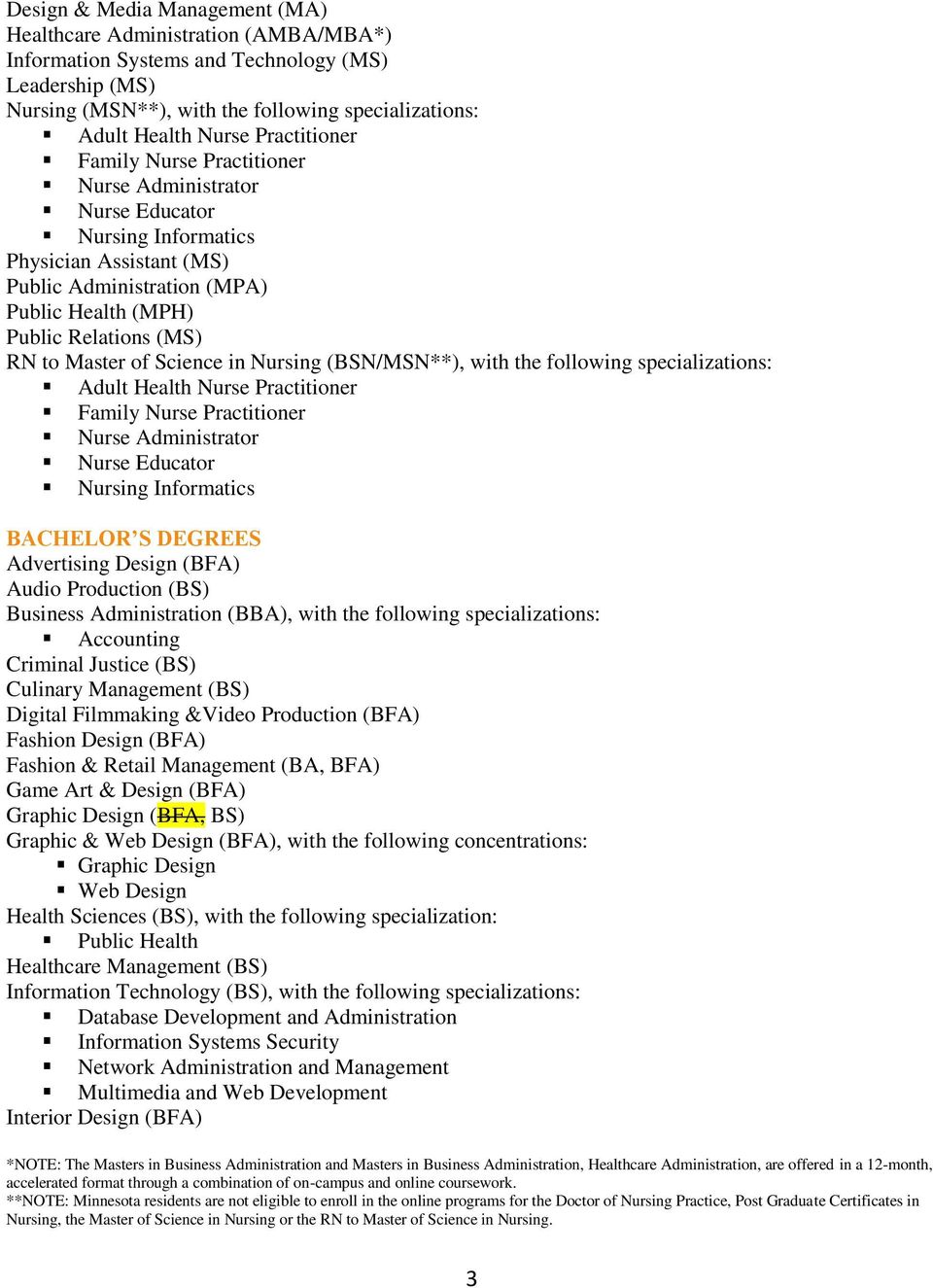
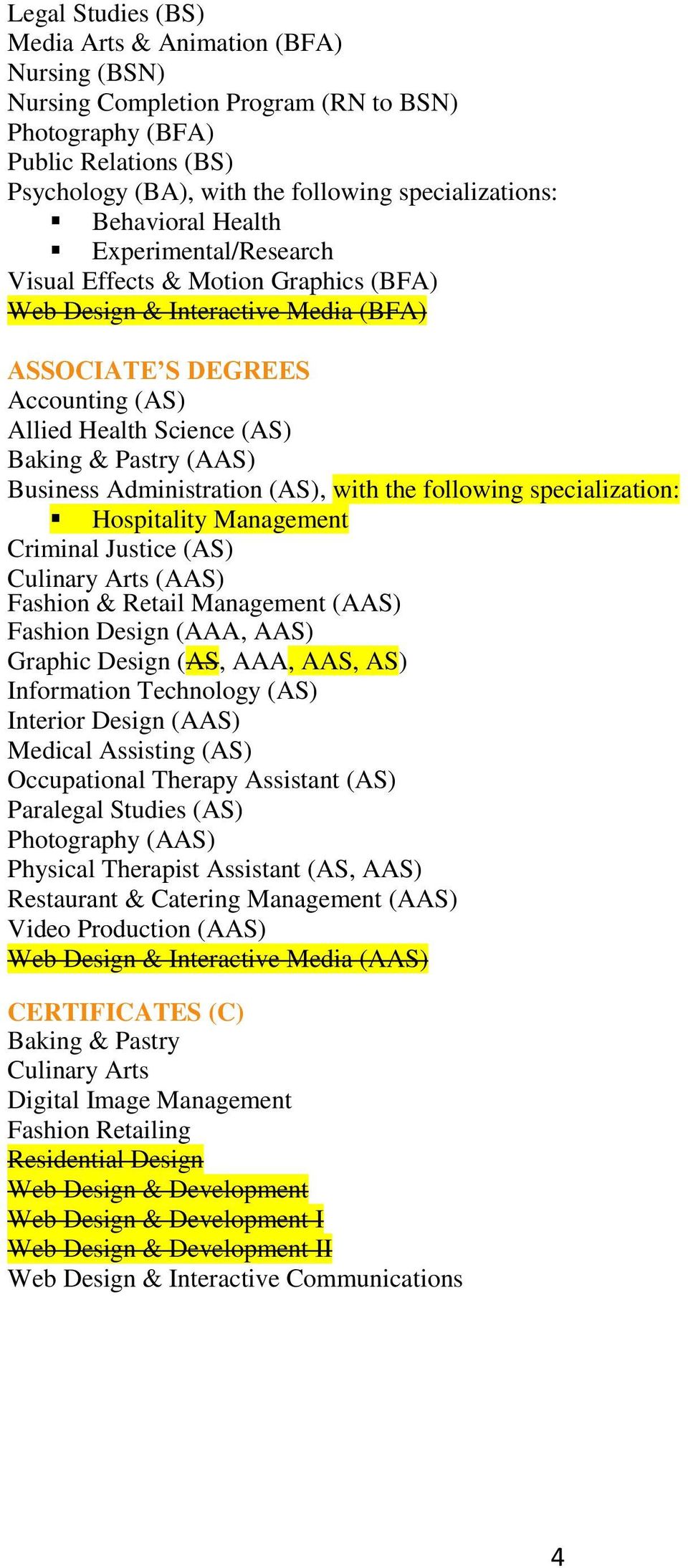
2 Pages 6 and 7 Addition of new programs: Doctorate of Ministry; Removal BFA, and AAS in Web Design & Interactive Media; Correction to the in Business Administration, Hospitality Management specialization; Revision to select degrees for Graphic Design; Removal of Certificates in Residential Design, Web Design & Development, Web Design & Development I and Web Design & Development II; Changes highlighted. DEGREE AND CERTIFICATE PROGRAMS South University s degree programs are designed to meet student needs and individual objectives. The primary goal of each program s curriculum is to combine didactic and practical educational experiences that will provide students with the academic background needed to pursue the profession of their choice. Not all programs and specializations are offered at all campuses. Before you apply for admission to South University, please review programs and specializations available at your preferred campus location. See page 9 for locations and degree and certificate programs offered at each campus. See suprograms.info for program duration, tuition, fees, and other costs, median student debt, federal salary data, alumni success, and other important information. DOCTORAL DEGREES Business Administration (DBA) Ministry (DMin)*** Nursing Practice (DNP**), with the following specializations: Administration Information Technology Leadership Project Management Public Health Occupational Therapy (OTD)± Pharmacy (PharmD) Pharmacy/Business Joint Degree (PharmD/MBA) POST GRADUATE CERTIFICATES** Adult Health Nurse Practitioner Family Nurse Practitioner Nurse Educator MASTER S DEGREES Accounting (MS) Anesthesia (MMSc) Business Administration (AMBA/MBA*) Clinical Mental Health Counseling (MA) Criminal Justice (MS) *NOTE: The Masters in Business Administration and Masters in Business Administration, Healthcare Administration, are offered in a 12-month, accelerated format through a combination of on-campus and online coursework. **NOTE: Minnesota residents are not eligible to enroll in the online programs for the Doctor of Nursing Practice, Post Graduate Certificates in Nursing, the Master of or the RN to Master of. ****The Doctor of Ministry program is currently not eligible for Title IV funding. ±The Doctorate in Occupational Therapy will be enrolling students as of the Summer 2014 quarter. Program information including curriculum and overview will be included in next addendum to the catalog. This program is currently not eligible for Title IV funding. 2

3 Design & Media Management (MA) Healthcare Administration (AMBA/MBA*) Information Systems and Technology (MS) Leadership (MS) Nursing (MSN**), with the following specializations: Adult Health Nurse Practitioner Family Nurse Practitioner Nurse Administrator Nurse Educator Nursing Informatics Physician Assistant (MS) Public Administration (MPA) Public Health (MPH) Public Relations (MS) RN to Master of (BSN/MSN**), with the following specializations: Adult Health Nurse Practitioner Family Nurse Practitioner Nurse Administrator Nurse Educator Nursing Informatics BACHELOR S DEGREES Advertising Design (BFA) Audio Production (BS) Business Administration (BBA), with the following specializations: Accounting Criminal Justice (BS) Culinary Management (BS) Digital Filmmaking &Video Production (BFA) Fashion Design (BFA) Fashion & Retail Management (BA, BFA) Game Art & Design (BFA) Graphic Design (BFA, BS) Graphic & Web Design (BFA), with the following concentrations: Graphic Design Web Design Health s (BS), with the following specialization: Public Health Healthcare Management (BS) Information Technology (BS), with the following specializations: Database Development and Administration Information Systems Security Network Administration and Management Multimedia and Web Development Interior Design (BFA) *NOTE: The Masters in Business Administration and Masters in Business Administration, Healthcare Administration, are offered in a 12-month, accelerated format through a combination of on-campus and online coursework. **NOTE: Minnesota residents are not eligible to enroll in the online programs for the Doctor of Nursing Practice, Post Graduate Certificates in Nursing, the Master of or the RN to Master of. 3
4 Legal Studies (BS) Media Arts & Animation (BFA) Nursing (BSN) Nursing Completion Program (RN to BSN) Photography (BFA) Public Relations (BS) Psychology (BA), with the following specializations: Behavioral Health Experimental/Research Visual Effects & Motion Graphics (BFA) Web Design & Interactive Media (BFA) ASSOCIATE S DEGREES Accounting (AS) Allied Health (AS) Baking & Pastry (AAS) Business Administration (AS), with the following specialization: Hospitality Management Criminal Justice (AS) Culinary Arts (AAS) Fashion & Retail Management (AAS) Fashion Design (AAA, AAS) Graphic Design (AS, AAA, AAS, AS) Information Technology (AS) Interior Design (AAS) Medical Assisting (AS) Occupational Therapy Assistant (AS) Paralegal Studies (AS) Photography (AAS) Physical Therapist Assistant (AS, AAS) Restaurant & Catering Management (AAS) Video Production (AAS) Web Design & Interactive Media (AAS) CERTIFICATES (C) Baking & Pastry Culinary Arts Digital Image Management Fashion Retailing Residential Design Web Design & Development Web Design & Development I Web Design & Development II Web Design & Interactive Communications 4
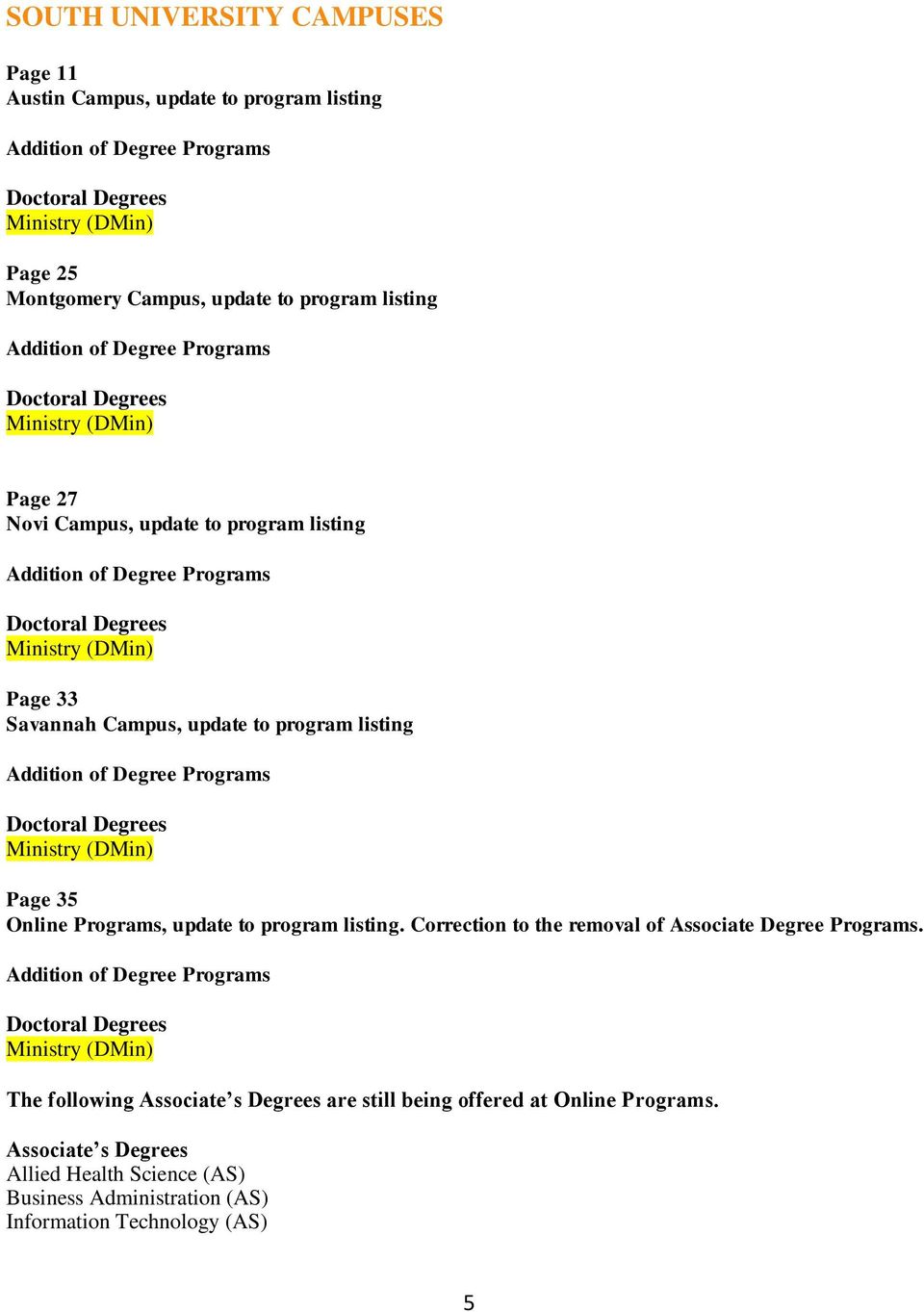
5 SOUTH UNIVERSITY CAMPUSES Page 11 Austin Campus, update to program listing Addition of Degree Programs Doctoral Degrees Ministry (DMin) Page 25 Montgomery Campus, update to program listing Addition of Degree Programs Doctoral Degrees Ministry (DMin) Page 27 Novi Campus, update to program listing Addition of Degree Programs Doctoral Degrees Ministry (DMin) Page 33 Savannah Campus, update to program listing Addition of Degree Programs Doctoral Degrees Ministry (DMin) Page 35 Online Programs, update to program listing. Correction to the removal of Associate Degree Programs. Addition of Degree Programs Doctoral Degrees Ministry (DMin) The following Associate s Degrees are still being offered at Online Programs. Associate s Degrees Allied Health (AS) Business Administration (AS) Information Technology (AS) 5
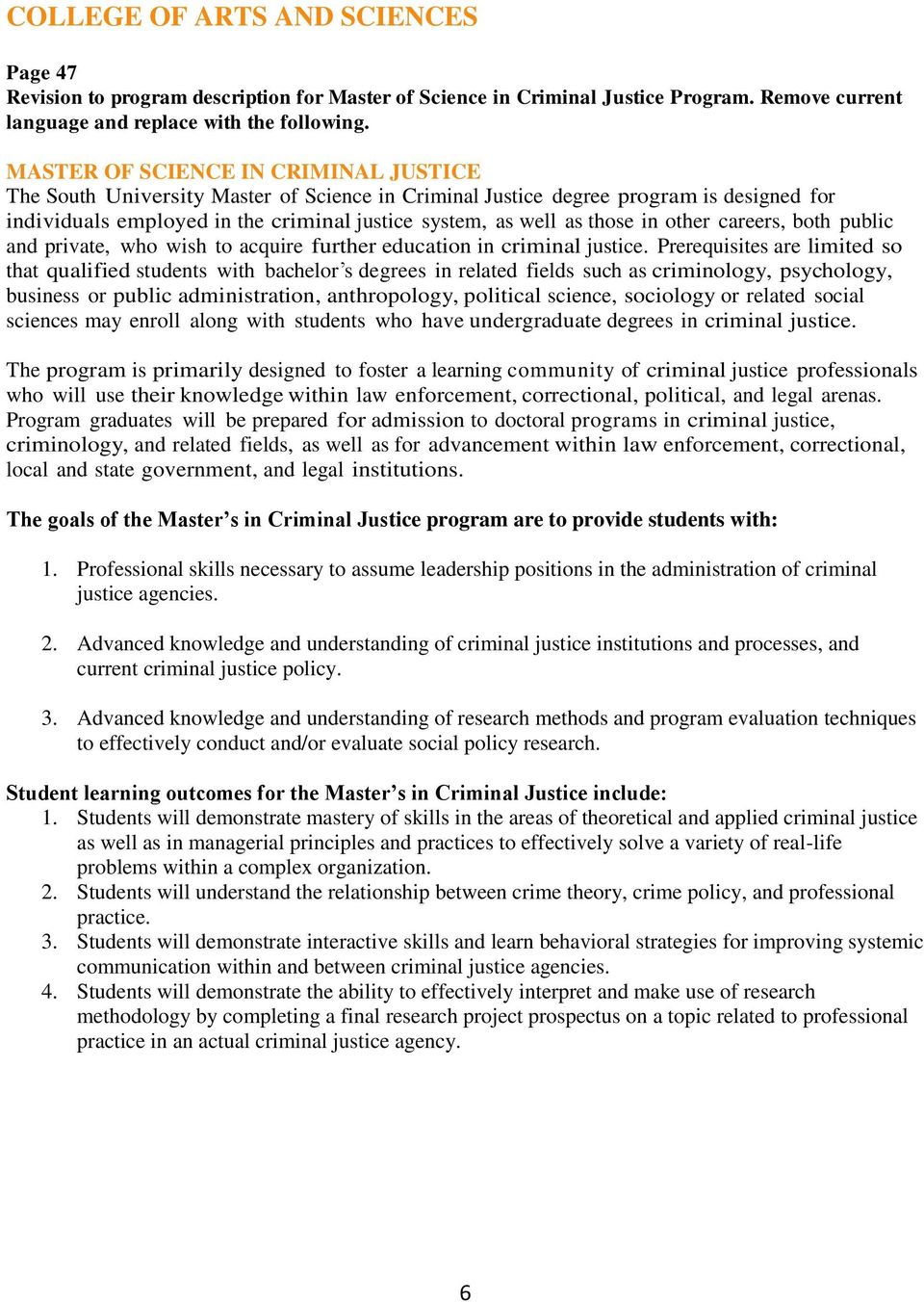
6 COLLEGE OF ARTS AND SCIENCES Page 47 Revision to program description for Master of in Criminal Justice Program. Remove current language and replace with the following. MASTER OF SCIENCE IN CRIMINAL JUSTICE The South University Master of in Criminal Justice degree program is designed for individuals employed in the criminal justice system, as well as those in other careers, both public and private, who wish to acquire further education in criminal justice. Prerequisites are limited so that qualified students with bachelor s degrees in related fields such as criminology, psychology, business or public administration, anthropology, political science, sociology or related social sciences may enroll along with students who have undergraduate degrees in criminal justice. The program is primarily designed to foster a learning community of criminal justice professionals who will use their knowledge within law enforcement, correctional, political, and legal arenas. Program graduates will be prepared for admission to doctoral programs in criminal justice, criminology, and related fields, as well as for advancement within law enforcement, correctional, local and state government, and legal institutions. The goals of the Master s in Criminal Justice program are to provide students with: 1. Professional skills necessary to assume leadership positions in the administration of criminal justice agencies. 2. Advanced knowledge and understanding of criminal justice institutions and processes, and current criminal justice policy. 3. Advanced knowledge and understanding of research methods and program evaluation techniques to effectively conduct and/or evaluate social policy research. Student learning outcomes for the Master s in Criminal Justice include: 1. Students will demonstrate mastery of skills in the areas of theoretical and applied criminal justice as well as in managerial principles and practices to effectively solve a variety of real-life problems within a complex organization. 2. Students will understand the relationship between crime theory, crime policy, and professional practice. 3. Students will demonstrate interactive skills and learn behavioral strategies for improving systemic communication within and between criminal justice agencies. 4. Students will demonstrate the ability to effectively interpret and make use of research methodology by completing a final research project prospectus on a topic related to professional practice in an actual criminal justice agency. 6
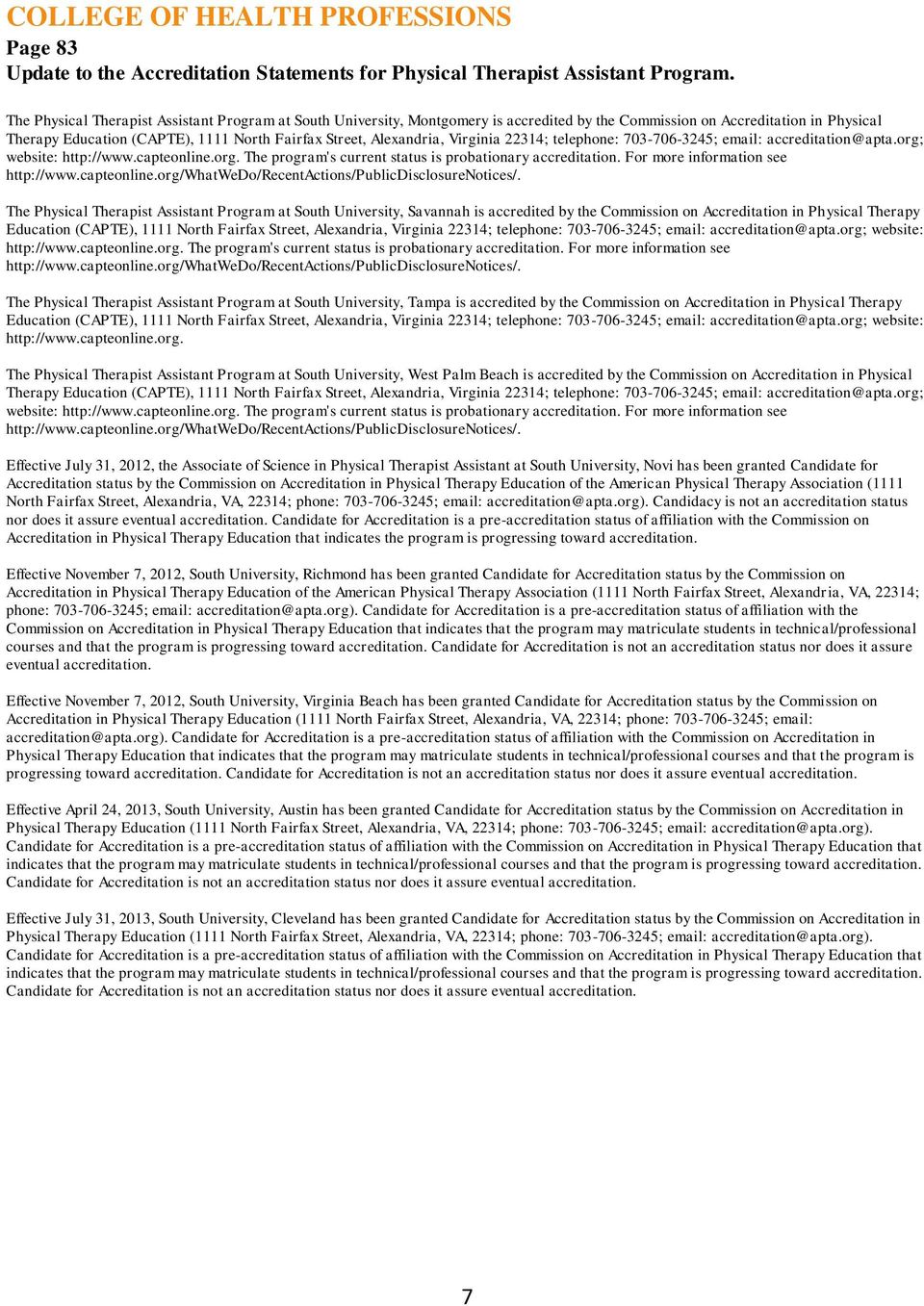
7 COLLEGE OF HEALTH PROFESSIONS Page 83 Update to the Accreditation Statements for Physical Therapist Assistant Program. The Physical Therapist Assistant Program at South University, Montgomery is accredited by the Commission on Accreditation in Physical Therapy Education (CAPTE), 1111 North Fairfax Street, Alexandria, Virginia 22314; telephone: ; website: The program's current status is probationary accreditation. For more information see The Physical Therapist Assistant Program at South University, Savannah is accredited by the Commission on Accreditation in Physical Therapy Education (CAPTE), 1111 North Fairfax Street, Alexandria, Virginia 22314; telephone: ; website: The program's current status is probationary accreditation. For more information see The Physical Therapist Assistant Program at South University, Tampa is accredited by the Commission on Accreditation in Physical Therapy Education (CAPTE), 1111 North Fairfax Street, Alexandria, Virginia 22314; telephone: ; website: The Physical Therapist Assistant Program at South University, West Palm Beach is accredited by the Commission on Accreditation in Physical Therapy Education (CAPTE), 1111 North Fairfax Street, Alexandria, Virginia 22314; telephone: ; website: The program's current status is probationary accreditation. For more information see Effective July 31, 2012, the in Physical Therapist Assistant at South University, Novi has been granted Candidate for Accreditation status by the Commission on Accreditation in Physical Therapy Education of the American Physical Therapy Association (1111 North Fairfax Street, Alexandria, VA, 22314; phone: ; Candidacy is not an accreditation status nor does it assure eventual accreditation. Candidate for Accreditation is a pre-accreditation status of affiliation with the Commission on Accreditation in Physical Therapy Education that indicates the program is progressing toward accreditation. Effective November 7, 2012, South University, Richmond has been granted Candidate for Accreditation status by the Commission on Accreditation in Physical Therapy Education of the American Physical Therapy Association (1111 North Fairfax Street, Alexandria, VA, 22314; phone: ; [email protected]). Candidate for Accreditation is a pre-accreditation status of affiliation with the Commission on Accreditation in Physical Therapy Education that indicates that the program may matriculate students in technical/professional courses and that the program is progressing toward accreditation. Candidate for Accreditation is not an accreditation status nor does it assure eventual accreditation. Effective November 7, 2012, South University, Virginia Beach has been granted Candidate for Accreditation status by the Commission on Accreditation in Physical Therapy Education (1111 North Fairfax Street, Alexandria, VA, 22314; phone: ; [email protected]). Candidate for Accreditation is a pre-accreditation status of affiliation with the Commission on Accreditation in Physical Therapy Education that indicates that the program may matriculate students in technical/professional courses and that the program is progressing toward accreditation. Candidate for Accreditation is not an accreditation status nor does it assure eventual accreditation. Effective April 24, 2013, South University, Austin has been granted Candidate for Accreditation status by the Commission on Accreditation in Physical Therapy Education (1111 North Fairfax Street, Alexandria, VA, 22314; phone: ; [email protected]). Candidate for Accreditation is a pre-accreditation status of affiliation with the Commission on Accreditation in Physical Therapy Education that indicates that the program may matriculate students in technical/professional courses and that the program is progressing toward accreditation. Candidate for Accreditation is not an accreditation status nor does it assure eventual accreditation. Effective July 31, 2013, South University, Cleveland has been granted Candidate for Accreditation status by the Commission on Accreditation in Physical Therapy Education (1111 North Fairfax Street, Alexandria, VA, 22314; phone: ; [email protected]). Candidate for Accreditation is a pre-accreditation status of affiliation with the Commission on Accreditation in Physical Therapy Education that indicates that the program may matriculate students in technical/professional courses and that the program is progressing toward accreditation. Candidate for Accreditation is not an accreditation status nor does it assure eventual accreditation. 7
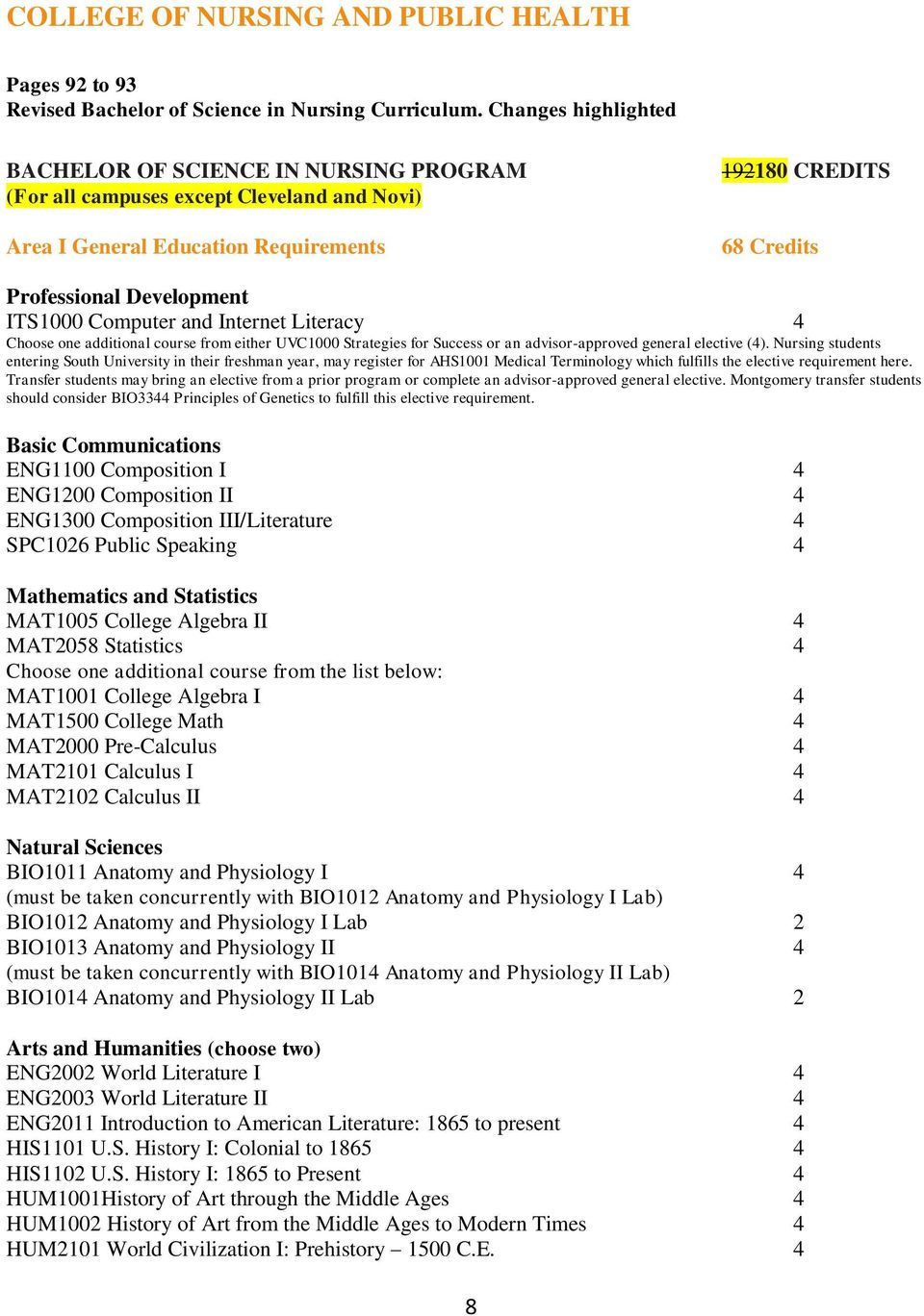
8 COLLEGE OF NURSING AND PUBLIC HEALTH Pages 92 to 93 Revised Bachelor of Curriculum. Changes highlighted BACHELOR OF SCIENCE IN NURSING PROGRAM (For all campuses except Cleveland and Novi) Area I General Education Requirements CREDITS 68 Credits Professional Development ITS1000 Computer and Internet Literacy 4 Choose one additional course from either UVC1000 Strategies for Success or an advisor-approved general elective (4). Nursing students entering South University in their freshman year, may register for AHS1001 Medical Terminology which fulfills the elective requirement here. Transfer students may bring an elective from a prior program or complete an advisor-approved general elective. Montgomery transfer students should consider BIO3344 Principles of Genetics to fulfill this elective requirement. Basic Communications ENG1100 Composition I 4 ENG1200 Composition II 4 ENG1300 Composition III/Literature 4 SPC1026 Public Speaking 4 Mathematics and Statistics MAT1005 College Algebra II 4 MAT2058 Statistics 4 Choose one additional course from the list below: MAT1001 College Algebra I 4 MAT1500 College Math 4 MAT2000 Pre-Calculus 4 MAT2101 Calculus I 4 MAT2102 Calculus II 4 Natural s BIO1011 Anatomy and Physiology I 4 (must be taken concurrently with BIO1012 Anatomy and Physiology I Lab) BIO1012 Anatomy and Physiology I Lab 2 BIO1013 Anatomy and Physiology II 4 (must be taken concurrently with BIO1014 Anatomy and Physiology II Lab) BIO1014 Anatomy and Physiology II Lab 2 Arts and Humanities (choose two) ENG2002 World Literature I 4 ENG2003 World Literature II 4 ENG2011 Introduction to American Literature: 1865 to present 4 HIS1101 U.S. History I: Colonial to HIS1102 U.S. History I: 1865 to Present 4 HUM1001History of Art through the Middle Ages 4 HUM1002 History of Art from the Middle Ages to Modern Times 4 HUM2101 World Civilization I: Prehistory 1500 C.E. 4 8
9 HUM2102 World Civilization II: 1500 Present 4 PHI2301 Introduction to Philosophy 4 Social and Behavioral s PSY1001 General Psychology 4 SOC1001 Introduction to Sociology 4 PSY2022 Human Growth and Development 4 *PSY2022 is required by CCNE for all BSN students. Per the Department of Behavioral s, the course meets the South University General Education requirements for Social and Behavioral s for Nursing students ONLY. Area II Foundation Requirements 22 Credits BIO2015 Human Pathophysiology 4 BIO2070 Microbiology 4 (must be taken concurrently with BIO2073 Microbiology Lab or BIO2071Microbiology Lab) BIO2073 Microbiology Lab (on ground) 2 (required for BSN; RN to BSN students ONLY can take either) OR BIO2071 Microbiology Lab (online) 2 CHM1010 General Chemistry 4 NTR2050 Nutrition 4 General Education Elective 4 Area III Major Requirements Credits Core NSG3001 Introduction to the Profession of Nursing 4 NSG3008 Principles of Assessment Lab 3 NSG3009 Principles of Assessment 3 (must be taken concurrently with NSG3008) NSG3022 Pharmacotherapeutics I 3 NSG3023 Fundamentals of Nursing 3 (must be taken concurrently with NSG3024 and NSG3027) NSG3024 Fundamentals of Nursing Skills Lab 4 NSG3027 Fundamentals of Nursing Practice 2 NSG3032 Pharmacotherapeutics II 3 NSG3037 Caring for Adults I 4 (must be taken concurrently with NSG3038) NSG3038 Caring for Adults I Practice 4 NSG3036 Introduction to Nursing Research 3 NSG3045 Caring for Adults II Practice 3 NSG3046 Caring for Adults II 3 (must be taken concurrently with NSG3045) NSG3047 Caring for Women and Neonates 3 (must be taken concurrently with NSG3048) NSG3048 Caring for Women and Neonates Practice 4 NSG3068 Caring for Diverse and Vulnerable Populations I 3 NSG4056 Caring for Children 3 (must be taken concurrently with NSG4057) NSG4057 Caring for Children Practice 4 NSG4052 Caring for Adults III 2 (must be taken concurrently with NSG4053) NSG4053 Caring for Adults III Practice 3 9

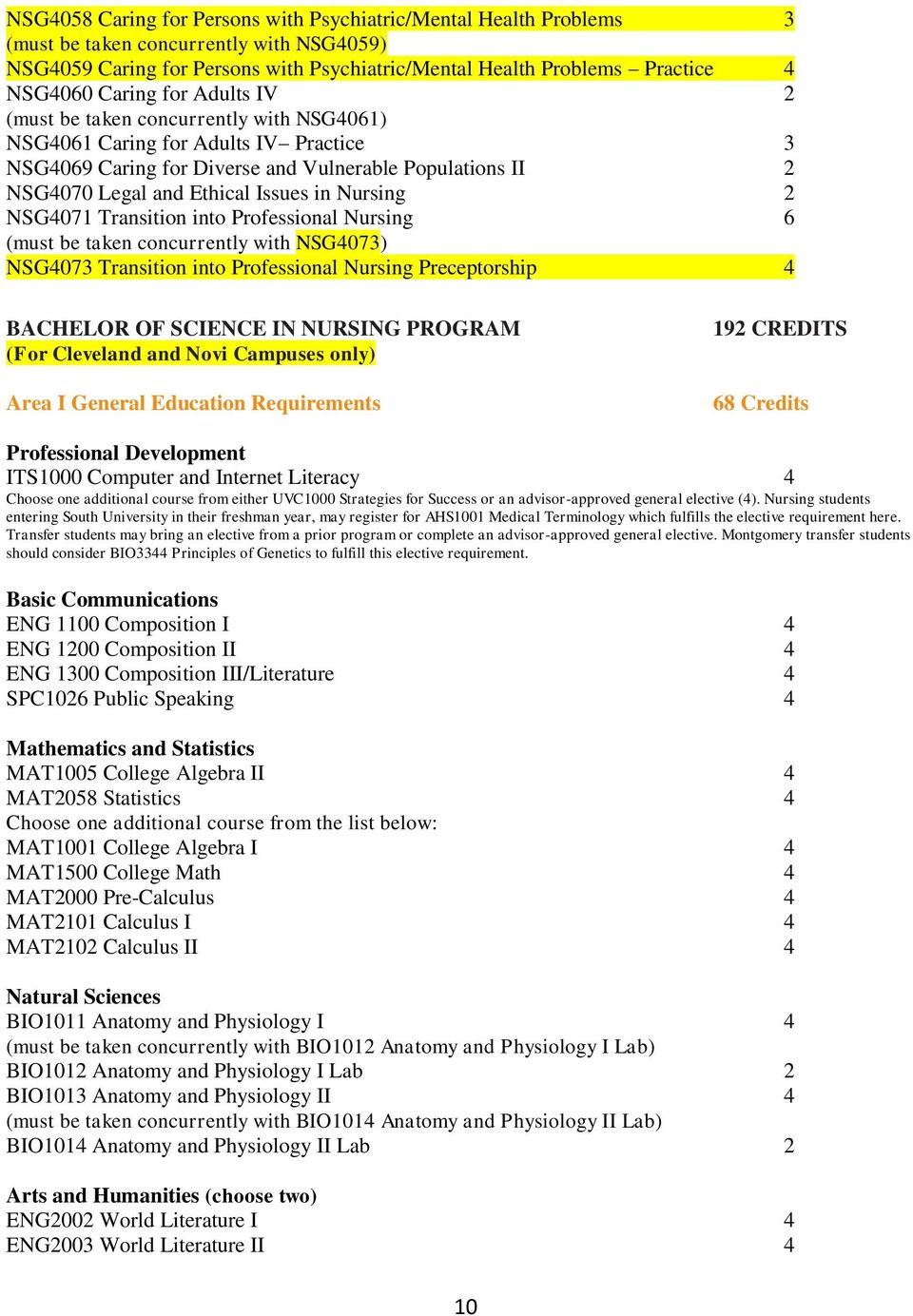
10 NSG4058 Caring for Persons with Psychiatric/Mental Health Problems 3 (must be taken concurrently with NSG4059) NSG4059 Caring for Persons with Psychiatric/Mental Health Problems Practice 4 NSG4060 Caring for Adults IV 2 (must be taken concurrently with NSG4061) NSG4061 Caring for Adults IV Practice 3 NSG4069 Caring for Diverse and Vulnerable Populations II 2 NSG4070 Legal and Ethical Issues 2 NSG4071 Transition into Professional Nursing 6 (must be taken concurrently with NSG4073) NSG4073 Transition into Professional Nursing Preceptorship 4 BACHELOR OF SCIENCE IN NURSING PROGRAM (For Cleveland and Novi Campuses only) Area I General Education Requirements 192 CREDITS 68 Credits Professional Development ITS1000 Computer and Internet Literacy 4 Choose one additional course from either UVC1000 Strategies for Success or an advisor-approved general elective (4). Nursing students entering South University in their freshman year, may register for AHS1001 Medical Terminology which fulfills the elective requirement here. Transfer students may bring an elective from a prior program or complete an advisor-approved general elective. Montgomery transfer students should consider BIO3344 Principles of Genetics to fulfill this elective requirement. Basic Communications ENG 1100 Composition I 4 ENG 1200 Composition II 4 ENG 1300 Composition III/Literature 4 SPC1026 Public Speaking 4 Mathematics and Statistics MAT1005 College Algebra II 4 MAT2058 Statistics 4 Choose one additional course from the list below: MAT1001 College Algebra I 4 MAT1500 College Math 4 MAT2000 Pre-Calculus 4 MAT2101 Calculus I 4 MAT2102 Calculus II 4 Natural s BIO1011 Anatomy and Physiology I 4 (must be taken concurrently with BIO1012 Anatomy and Physiology I Lab) BIO1012 Anatomy and Physiology I Lab 2 BIO1013 Anatomy and Physiology II 4 (must be taken concurrently with BIO1014 Anatomy and Physiology II Lab) BIO1014 Anatomy and Physiology II Lab 2 Arts and Humanities (choose two) ENG2002 World Literature I 4 ENG2003 World Literature II 4 10
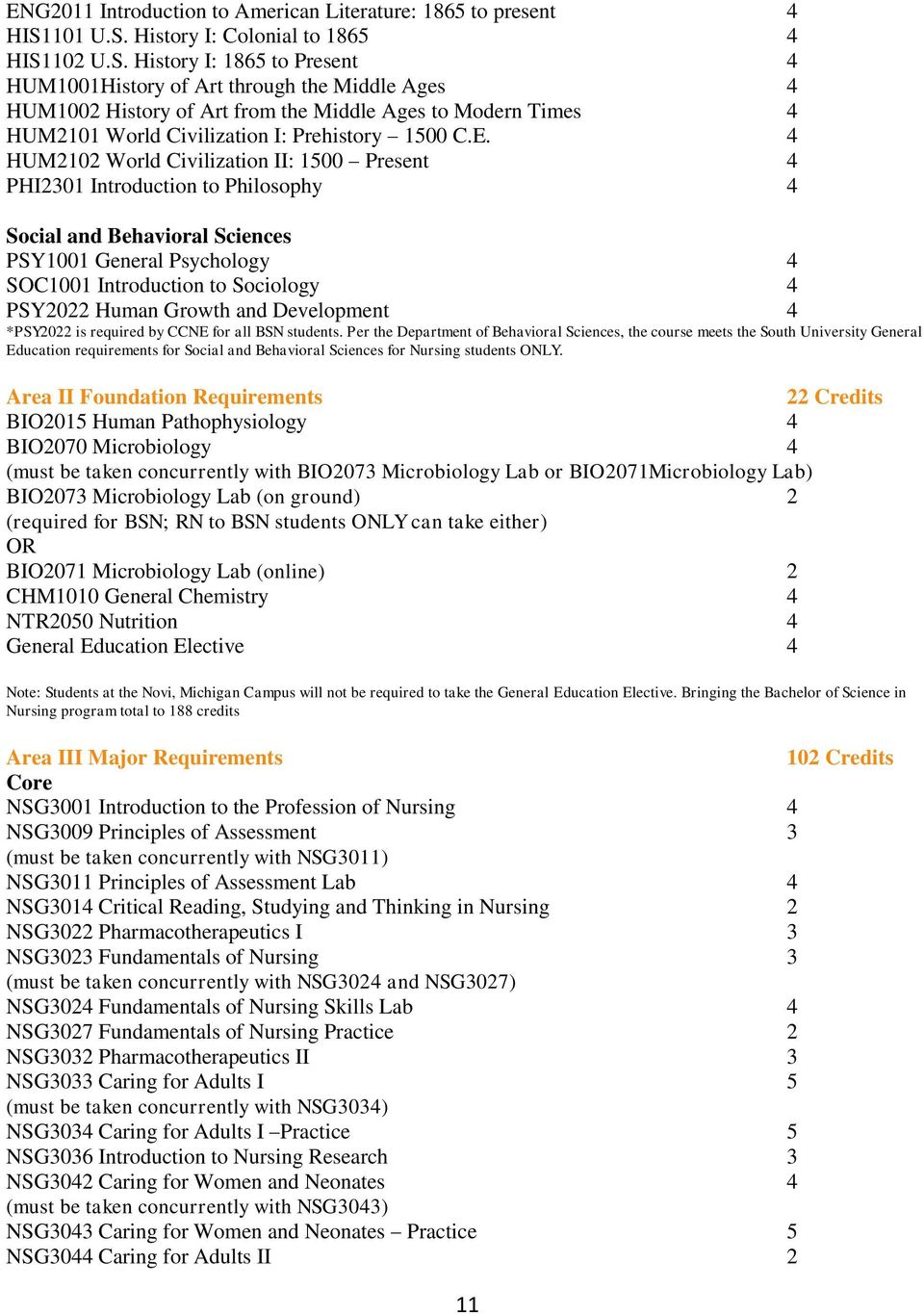
11 ENG2011 Introduction to American Literature: 1865 to present 4 HIS1101 U.S. History I: Colonial to HIS1102 U.S. History I: 1865 to Present 4 HUM1001History of Art through the Middle Ages 4 HUM1002 History of Art from the Middle Ages to Modern Times 4 HUM2101 World Civilization I: Prehistory 1500 C.E. 4 HUM2102 World Civilization II: 1500 Present 4 PHI2301 Introduction to Philosophy 4 Social and Behavioral s PSY1001 General Psychology 4 SOC1001 Introduction to Sociology 4 PSY2022 Human Growth and Development 4 *PSY2022 is required by CCNE for all BSN students. Per the Department of Behavioral s, the course meets the South University General Education requirements for Social and Behavioral s for Nursing students ONLY. Area II Foundation Requirements 22 Credits BIO2015 Human Pathophysiology 4 BIO2070 Microbiology 4 (must be taken concurrently with BIO2073 Microbiology Lab or BIO2071Microbiology Lab) BIO2073 Microbiology Lab (on ground) 2 (required for BSN; RN to BSN students ONLY can take either) OR BIO2071 Microbiology Lab (online) 2 CHM1010 General Chemistry 4 NTR2050 Nutrition 4 General Education Elective 4 Note: Students at the Novi, Michigan Campus will not be required to take the General Education Elective. Bringing the Bachelor of in Nursing program total to 188 credits Area III Major Requirements 102 Credits Core NSG3001 Introduction to the Profession of Nursing 4 NSG3009 Principles of Assessment 3 (must be taken concurrently with NSG3011) NSG3011 Principles of Assessment Lab 4 NSG3014 Critical Reading, Studying and Thinking 2 NSG3022 Pharmacotherapeutics I 3 NSG3023 Fundamentals of Nursing 3 (must be taken concurrently with NSG3024 and NSG3027) NSG3024 Fundamentals of Nursing Skills Lab 4 NSG3027 Fundamentals of Nursing Practice 2 NSG3032 Pharmacotherapeutics II 3 NSG3033 Caring for Adults I 5 (must be taken concurrently with NSG3034) NSG3034 Caring for Adults I Practice 5 NSG3036 Introduction to Nursing Research 3 NSG3042 Caring for Women and Neonates 4 (must be taken concurrently with NSG3043) NSG3043 Caring for Women and Neonates Practice 5 NSG3044 Caring for Adults II 2 11
12 (must be taken concurrently with NSG3045) NSG3045 Caring for Adults II Practice 3 NSG4050 Caring for Children 4 (must be taken concurrently with NSG4051) NSG4051 Caring for Children Practice 5 NSG4052 Caring for Adults III 2 (must be taken concurrently with NSG4053) NSG4053 Caring for Adults III Practice 3 NSG4060 Caring for Adults IV 2 (must be taken concurrently with NSG4061) NSG4061 Caring for Adults IV Practice 3 NSG4062 Caring for Persons with Psychiatric /Mental Health Problems 4 (must be taken concurrently with NSG4063) NSG4063 Caring for Persons with Psychiatric/Mental Health Problems Practice 5 NSG4070 Legal and Ethical Issues 2 NSG4071 Transition into Professional Nursing 6 (must be taken concurrently with NSG4072) NSG4072 Transition into Professional Nursing Preceptorship 5 NSG3069 Caring for Diverse and Vulnerable Populations I* 4 NSG4069 Caring for Diverse and Vulnerable Populations II* 2 *Upon the advisement of the nursing program director, the course sequence NSG3069 and NSG4069 may be substituted for the course sequence NSG3016 and NSG3028. Both courses are required for the substitution and the curriculum sequence of courses may be altered for program completion Pages 100 Insert College of Theology before School of Pharmacy COLLEGE OF THEOLOGY Purpose The purpose of the College of Theology is to equip graduates of all faith traditions to seek entry as ministry practitioners through advanced practical theology and ministry studies in a variety of settings, including local churches, parachurch organizations, institutions, the community, and the marketplace. The College is non-denominational and rooted in the Christian tradition, and shares the University s vision of contributing to human flourishing through educating graduates who care for the whole person. Drawing on the resources of the University, it offers practice-oriented education that prepares men and women to provide leadership in ministry and spiritual care. Theological Position South University is a private university and does not consider itself to be a faith-based institution. The University does seek to offer, however, a broad-based approach to learning that can and should offer religious and theological perspective and provide academically rigorous professional education for those who provide spiritual care in their faith communities and in public institutions. Accordingly, the College of Theology does not use a statement of faith or other religious test as a criterion of admissions for students or for hiring faculty and staff. Students from all religious traditions (and none) are welcome to enroll in the program. At the same time, the College considers the Nicene Creed to be the theological benchmark by which students, faculty and staff may better understand the perspective of the College and its programs. 12

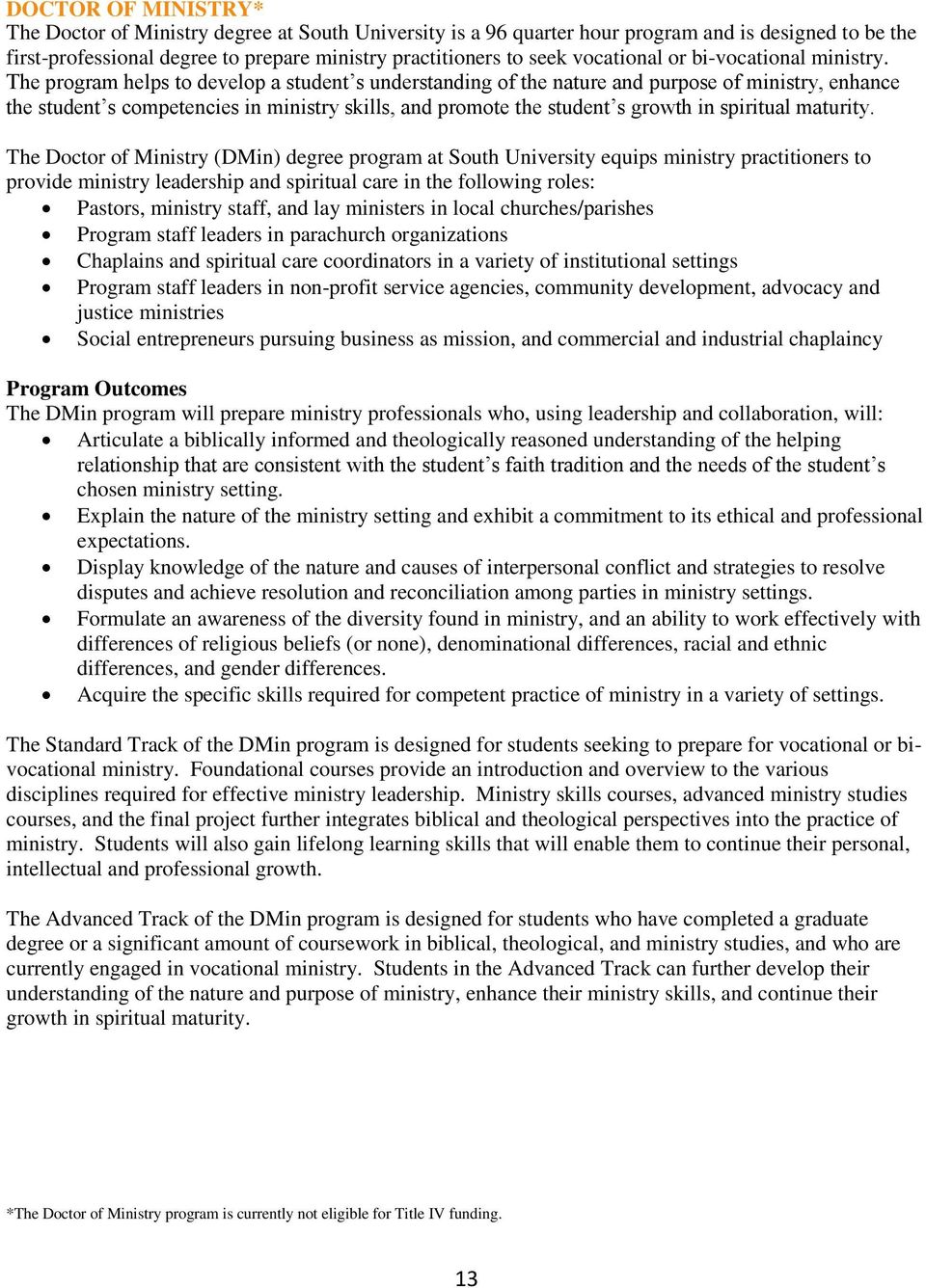
13 DOCTOR OF MINISTRY* The Doctor of Ministry degree at South University is a 96 quarter hour program and is designed to be the first-professional degree to prepare ministry practitioners to seek vocational or bi-vocational ministry. The program helps to develop a student s understanding of the nature and purpose of ministry, enhance the student s competencies in ministry skills, and promote the student s growth in spiritual maturity. The Doctor of Ministry (DMin) degree program at South University equips ministry practitioners to provide ministry leadership and spiritual care in the following roles: Pastors, ministry staff, and lay ministers in local churches/parishes Program staff leaders in parachurch organizations Chaplains and spiritual care coordinators in a variety of institutional settings Program staff leaders in non-profit service agencies, community development, advocacy and justice ministries Social entrepreneurs pursuing business as mission, and commercial and industrial chaplaincy Program Outcomes The DMin program will prepare ministry professionals who, using leadership and collaboration, will: Articulate a biblically informed and theologically reasoned understanding of the helping relationship that are consistent with the student s faith tradition and the needs of the student s chosen ministry setting. Explain the nature of the ministry setting and exhibit a commitment to its ethical and professional expectations. Display knowledge of the nature and causes of interpersonal conflict and strategies to resolve disputes and achieve resolution and reconciliation among parties in ministry settings. Formulate an awareness of the diversity found in ministry, and an ability to work effectively with differences of religious beliefs (or none), denominational differences, racial and ethnic differences, and gender differences. Acquire the specific skills required for competent practice of ministry in a variety of settings. The Standard Track of the DMin program is designed for students seeking to prepare for vocational or bivocational ministry. Foundational courses provide an introduction and overview to the various disciplines required for effective ministry leadership. Ministry skills courses, advanced ministry studies courses, and the final project further integrates biblical and theological perspectives into the practice of ministry. Students will also gain lifelong learning skills that will enable them to continue their personal, intellectual and professional growth. The Advanced Track of the DMin program is designed for students who have completed a graduate degree or a significant amount of coursework in biblical, theological, and ministry studies, and who are currently engaged in vocational ministry. Students in the Advanced Track can further develop their understanding of the nature and purpose of ministry, enhance their ministry skills, and continue their growth in spiritual maturity. *The Doctor of Ministry program is currently not eligible for Title IV funding. 13
14 DOCTOR OF MINISTRY Standard Track 96 CREDITS Foundation 28 credits MIN7010 Biblical Interpretation 4 MIN7011 Old Testament Context and Theology 4 MIN7012 New Testament Context and Theology 4 MIN7020 Theology Survey 4 MIN7040 World Religions 4 MIN7050 Christian Spiritual Formation 4 MIN7060 Diversity in Ministry 4 Ministry Skills 32 credits MIN7000 Learning Skills for Ministry 4 MIN7051 Community and Discipleship 4 MIN7061 Leadership and Management in Ministry 4 MIN7062 Communication Skills for Ministry 4 MIN7063 Conflict Mediation and Reconciliation 4 MIN7080 Counseling Theory and Practice 4 Choose 1 of the following sequences: MIN7590 Ministry Practicum I 4 MIN7690 Ministry Practicum II 4 Or MIN7591 Clinical Pastoral Education Level 1 A 4 MIN7691 Clinical Pastoral Education Level 1 B 4 Or MIN7592 Clinical Pastoral Education Level 2 A 4 MIN7692 Clinical Pastoral Education Level 2 B 4 Advanced Ministry Study 24 credits MIN7560 Person and Practice of Ministry 4 MIN7562 Homiletics 4 MIN7580 Ministry with Families 4 MIN7565 Principles and Practice of Worship 4 Choose one additional course from the following: MIN7160 Ministry in the Local Church 4 MIN7164 Ministry in Institutional Settings 4 Elective 4 Choose one elective from the following: MIN7110 Biblical and Theological Perspectives on Health and Wholeness MIN7160 Ministry in the Local Church MIN7164 Ministry in Institutional Settings MIN7181 Lifespan Development MIN7561 Theology, Death and Dying MIN7563 Ministry with Disabled Persons 14

15 Final Project 12 credits MIN7500 Theology and Research in Ministry 4 Choose 1 of the following sequences: MIN8000 Dissertation I 4 MIN8010 Dissertation II 4 Or MIN8001 Ministry Project I 4 MIN8011 Ministry Project II 4 Or MIN8002 Supervisory Clinical Pastoral Education I* 4 MIN8012 Supervisory Clinical Pastoral Education II* 4 *Opportunities to pursue Clinical Pastoral Education are a unique feature of the DMin program. CPE Level 1 or Level 2 fulfills the ministry practicum requirement; students who have completed CPE Level 2 may elect to use Supervisory CPE for their final project if they have been accepted into a program. DOCTOR OF MINISTRY Advanced Track 48 CREDITS Foundation 4 credits MIN7060 Diversity in Ministry 4 Ministry Skills 16 credits MIN7000 Learning Skills for Ministry 4 MIN7063 Conflict Mediation and Reconciliation 4 Electives 8 Choose two electives from the following: MIN7110 Biblical and Theological Perspectives on Health and Wholeness MIN7160 Ministry in the Local Church MIN7164 Ministry in Institutional Settings MIN7181 Lifespan Development MIN7561 Theology, Death and Dying MIN7563 Ministry with Disabled Persons Electives selected cannot fulfill requirements for both Ministry Skills and Advanced Ministry Study Advanced Ministry Study 16 credits MIN7560 Person and Practice of Ministry 4 Electives 12 Choose three electives from the following: MIN7110Biblical and Theological Perspectives on Health and Wholeness MIN7160 Ministry in the Local Church MIN7164 Ministry in Institutional Settings MIN7181 Lifespan Development MIN7561 Theology, Death and Dying MIN7563 Ministry with Disabled Persons Electives selected cannot fulfill requirements for both Ministry Skills and Advanced Ministry Study 15
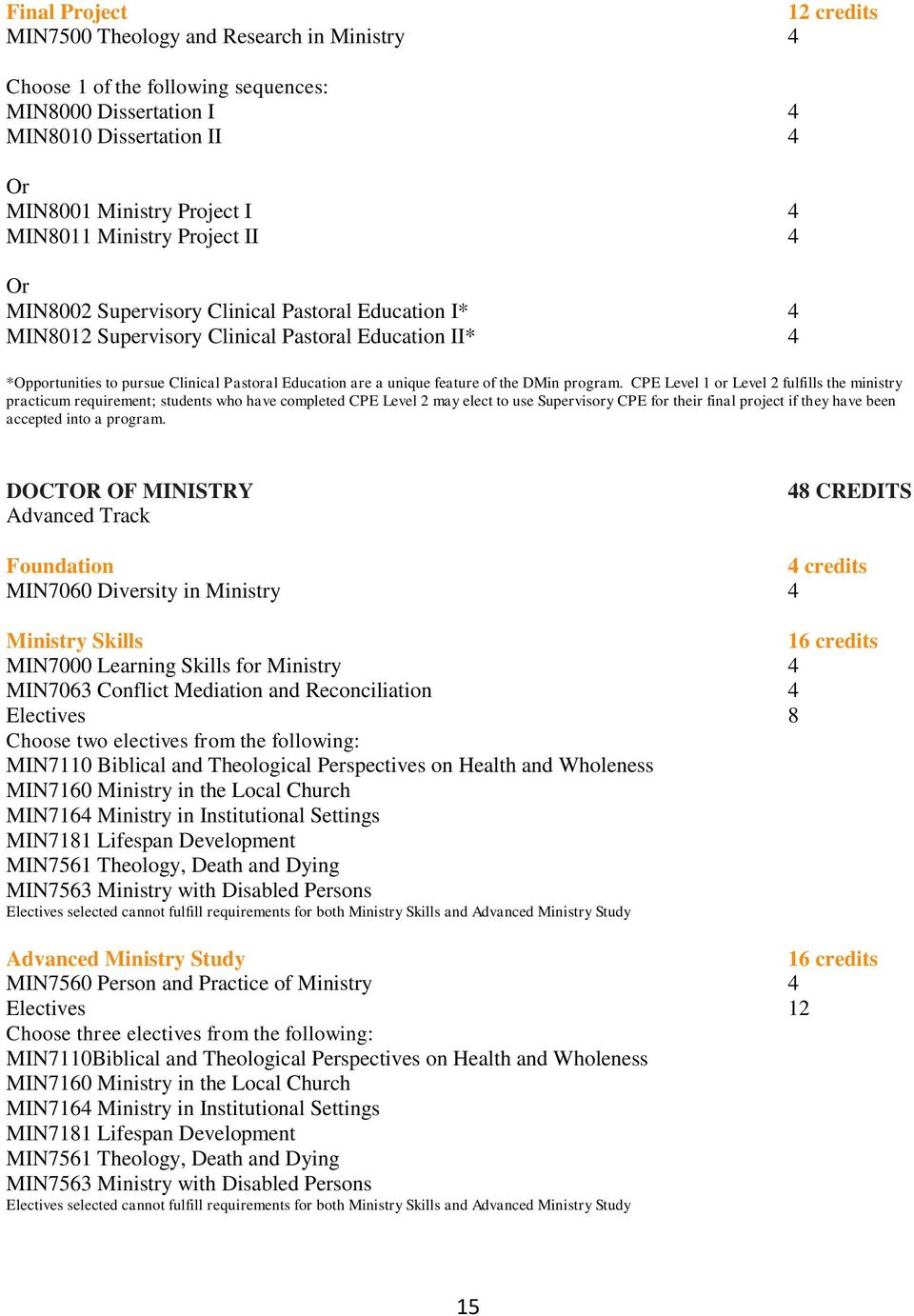
16 Final Project 12 credits MIN7500 Theology and Research in Ministry 4 Choose 1 of the following sequences: MIN8000 Dissertation I 4 MIN8010 Dissertation II 4 Or MIN8001 Ministry Project I 4 MIN8011 Ministry Project II 4 Or MIN8002 Supervisory Clinical Pastoral Education I 4 MIN8012 Supervisory Clinical Pastoral Education II 4 *Opportunities to pursue Clinical Pastoral Education are a unique feature of the DMin program. CPE Level 1 or Level 2 fulfills the ministry practicum requirement; students who have completed CPE Level 2 may elect to use Supervisory CPE for their final project if they have been accepted into a program. Maryland residents are not eligible to enroll into an internship, externship, practicum, or field experience course. Students should work with their academic advisor or counselor to be sure they are making appropriate course choices. ACCREDITATION AND AFFILIATIONS Pages 106 Update to the Business Program Accreditation. Revised statement below. The Bachelor of Business Administration, Bachelor of Business Administration with a specialization in Accounting, Bachelor of in Healthcare Management, Master of Business Administration, Accelerated Master of Business Administration, Master of Business Administration in Healthcare Administration, and Accelerated Master of Business Administration in Healthcare Administration programs are accredited by the Accreditation Council for Business Schools & Programs ([ACBSP] West 119th Street; Overland Park, KS 66213; ; Other programs in the College of Business, regionally accredited by the Southern Association of Colleges and Schools Commission on Colleges, have been excluded from ACBSP s scope of accreditation. These programs include: in Accounting, in Business Administration, Association of in Information Technology, Bachelor of in Information Technology, Post Baccalaureate Certificate in Project Management, Master of Public Administration, Master of in Accounting, Master of in Information Systems and Technology, Master of in Leadership, and Doctor of Business Administration. 16

17 ADMISSIONS COLLEGE OF HEALTH PROFESSIONS Pages 118 to 119 Correction to the Procedure for Admission to in Physical Therapist Assistant Program, highlighted text was deleted in error. Procedure for Admission to in Physical Therapist Assistant Program Students intending to enter the Physical Therapist Assistant (PTA) program will be admitted to South University as candidates for the Physical Therapist Assistant program. Only after completing prerequisite coursework and achieving the requirements outlined below will students be admitted into advanced standing in the PTA program. Students may transfer prerequisite courses into the program before entering advanced standing if approved by the program director and the registrar. Admission Requirements: 1. A minimum cumulative GPA of 2.85 in all mandatory prerequisite courses. 2. Minimum grade of B in Medical Terminology, Anatomy and Physiology I and Anatomy and Physiology II, lecture and laboratory. Students may retake courses in order to achieve the minimum required grade of B. 3. Minimum of 25 hours of observation, volunteer, or employment in at least one physical therapy clinic, attested to by a physical therapist or physical therapist assistant on program provided form. 4. Current American Heart Association Basic Life Support for Healthcare Providers CPR (two-year certification). All applicants to South University PTA program must submit standardized test scores using Accuplacer, SAT or ACT. Students who do not achieve the minimum entrance score defined by South University for general admission for each respective test will not be accepted into the PTA program. Standardized test scores (Accuplacer) must not be older than five (5) years. Applicants who take, or have taken, standardized entrance tests at a site outside of South University campuses, must provide official test scores to the South University campus to which they are applying. All applicants must satisfy technical standards for the PTA program in order to be admitted. Students who attempt to transfer into the South University PTA program must submit, in addition to the standard application for admission, official scores from acceptable standardized tests (SAT or ACT) or take the university s Accuplacer entrance test. Applicants who require developmental coursework (in English) based upon scores of the standardized tests will not be permitted to enroll in the PTA program even if they have taken coursework at another institution. The coursework that is transferred to South University must permit the student to obtain a 2.85 CGPA by the time the student applies for admission into the PTA technical phase. Students who transfer coursework into South University, but cannot mathematically attain a CGPA of 2.85 by the time they would enter the technical phase, will not be admitted to the PTA program. Students from South University who are in another major will be permitted to transfer into the general education phase of the PTA program if they achieve satisfactory scores on the Accuplacer, SAT or ACT for general admission at the time of original enrollment. Applicants must satisfy technical standards for the PTA program in order to be admitted. 17
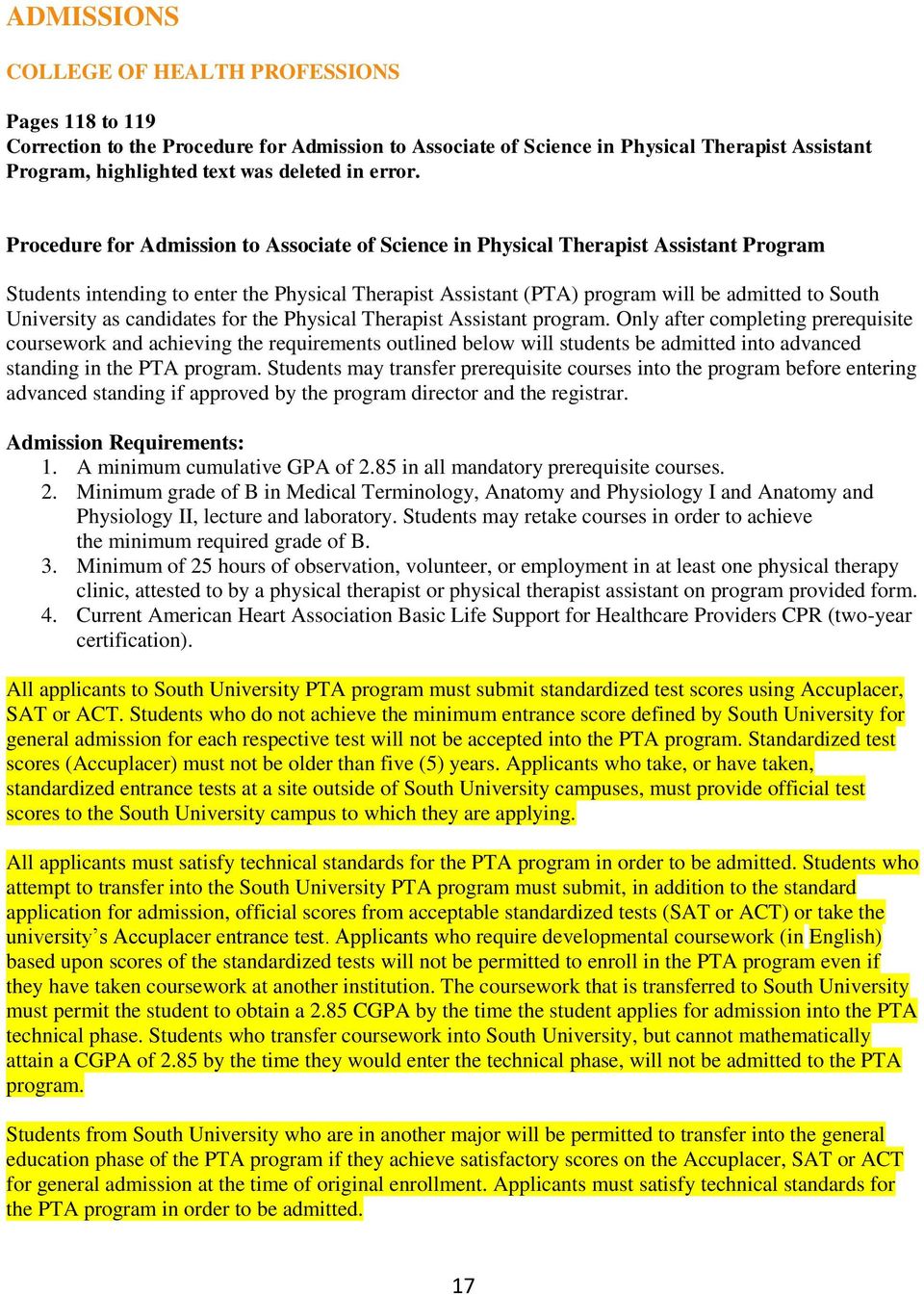
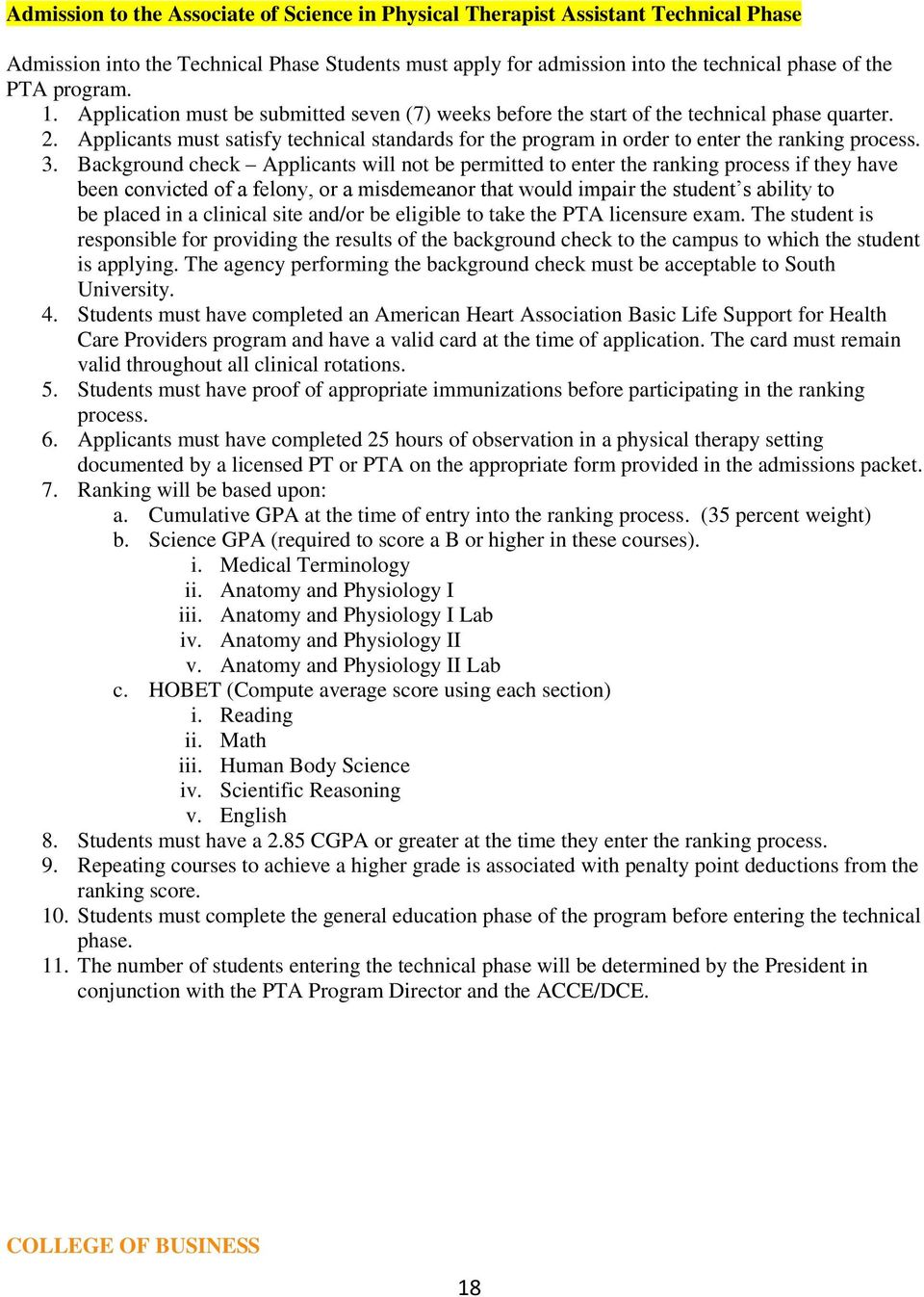
18 Admission to the in Physical Therapist Assistant Technical Phase Admission into the Technical Phase Students must apply for admission into the technical phase of the PTA program. 1. Application must be submitted seven (7) weeks before the start of the technical phase quarter. 2. Applicants must satisfy technical standards for the program in order to enter the ranking process. 3. Background check Applicants will not be permitted to enter the ranking process if they have been convicted of a felony, or a misdemeanor that would impair the student s ability to be placed in a clinical site and/or be eligible to take the PTA licensure exam. The student is responsible for providing the results of the background check to the campus to which the student is applying. The agency performing the background check must be acceptable to South University. 4. Students must have completed an American Heart Association Basic Life Support for Health Care Providers program and have a valid card at the time of application. The card must remain valid throughout all clinical rotations. 5. Students must have proof of appropriate immunizations before participating in the ranking process. 6. Applicants must have completed 25 hours of observation in a physical therapy setting documented by a licensed PT or PTA on the appropriate form provided in the admissions packet. 7. Ranking will be based upon: a. Cumulative GPA at the time of entry into the ranking process. (35 percent weight) b. GPA (required to score a B or higher in these courses). i. Medical Terminology ii. Anatomy and Physiology I iii. Anatomy and Physiology I Lab iv. Anatomy and Physiology II v. Anatomy and Physiology II Lab c. HOBET (Compute average score using each section) i. Reading ii. Math iii. Human Body iv. Scientific Reasoning v. English 8. Students must have a 2.85 CGPA or greater at the time they enter the ranking process. 9. Repeating courses to achieve a higher grade is associated with penalty point deductions from the ranking score. 10. Students must complete the general education phase of the program before entering the technical phase. 11. The number of students entering the technical phase will be determined by the President in conjunction with the PTA Program Director and the ACCE/DCE. COLLEGE OF BUSINESS 18
19 Pages 113 to 114 Revised Procedure for Admission to the College of Business Masters Programs, delete current admission policy and replace with policy below. Procedure for Admission to the College of Business Masters Programs Admissions criteria for the Master of Business Administration (MBA), Accelerated Master of Business Administration (AMBA), Master of Business Administration-Healthcare Administration (MBA-HCA), Accelerated Master of Business-Healthcare Administration (AMBA-HCA), Master of in Leadership (MSL), Master of in Accounting (MSA), Master of in Information Systems and Technology (MSIST), and Master of Public Administration (MPA) are as follows: Completion of application for admission and submission of application fee ($50), and An earned undergraduate degree from an accredited institution with a CGPA of 2.7 or better on a 4.0 scale OR An earned undergraduate degree from an accredited institution with a CGPA of 2.7 or better on a 4.0 scale during the applicant s last 60 semester or 90 quarter hours earned on the bachelor s degree or subsequent graduate work OR An earned undergraduate degree from an accredited institution with a minimum combined GMAT score of 400 or GRE scores of 150 Verbal and 150 Reasoning, OR An earned graduate degree from an accredited institution with a cumulative grade point average of at least 3.0 (on a scale of 4.0) MBA, MBA-HCA and MSA Programs For the MBA, MBA-HCA and MSA programs, the following foundation undergraduate courses must have been satisfactorily completed from an accredited institution or be satisfactorily completed (grade of C or better) within the first two quarters after acceptance into the degree program. Accounting: two courses (or completion of MBA5000 at South University) Macroeconomics: one course Statistics: one course For students admitted to the Master of in Accounting program who possess a bachelor s degree in a non-business program, the program is 76 quarter hours in length. Students must first complete a business core of 28 quarter hours of coursework from South University s Master of Business Administration program to gain a broad base of knowledge and skills in economics, decision-making, behavioral sciences, and strategic environment. Students then progress to the accounting core of 44 quarter hours and the accounting capstone of 4 quarter hours. For students admitted to the MSA program who possess a bachelor s degree in a business program (though not in accounting), the program is 48 quarter hours in length. Students complete the accounting core of 44 quarter hours and the accounting capstone of 4 quarter hours. Foundation Undergraduate Course Credits Foundation undergraduate course credits do not count towards the total number of credits for graduation nor do they count in the Cumulative Grade Point Average (CGPA); however, they do count in determining the maximum time frame (MTF) and the Incremental Completion Rate (ICR). Students 19

20 enrolled in foundation undergraduate course must successfully complete the course within their first three attempts or the student will be academically dismissed from the University. Master of Public Administration Program For admission to the Master of Public Administration degree program, applications with grade point averages lower than the stated program minimum may be considered for admission with significant evidence of academic and professional potential demonstrated by the career and/or personal accomplishments indicated in a personal statement of academic and professional goals, the career resume, academic or professional letters of matriculation recommendation, and/or GMAT scores. Exceptions must be recommended by the department chair or program director and approved by the College Dean. Students admitted to the MPA Program on an exception basis will be admitted as regular students on a probationary status for the first quarter of enrollment. In order to remain enrolled after the first quarter, the student must achieve a GPA of at least 3.0. Transfer of Credit Guidelines for the College of Business Masters Programs The majority of credits toward any graduate or post-graduate degree program must be earned at South University. Credit for transfer work will be given if the courses were taken at an accredited collegiate institution, the course is equivalent to courses offered at South University, and the course carries a grade of B or better. All transfer credit will be reviewed and approved by the Dean, College of Business or designee, and the Department Chair of the respective academic department and Program Director. The maximum number of classes to transfer is four courses or 16 quarter hours. NOTE: Capstone courses may not be transferred in from another institution. Credits earned at any South University campus will be accepted at all campuses. These credits will not be considered transfer credit; they will be included as credits earned at South University. If a campus should close a program in any state, students in good standing will be accepted at any South University campus having the same or a similar authorized degree program. The credits earned in the students original degree program will be applied to the degree program at the new location. Students may transfer a total of 12 credit hours into the Master of Public Administration degree program. The specific courses for which transfer credit is available are MPA5001 Foundations of Public Administration, MPA5005 Public and Nonprofit Organizational Behavior, and MBA6501 Strategic Human Resource Management. The evaluation of transfer of credit follows South University s applicable policies and procedures that pertain to accredited institutions. Applicants should review the published general graduate requirements listed in the South University catalog. Applicants who are citizens of countries other than the United States should also refer to the section in the South University catalog entitled International Admissions Policy. COLLEGE OF THEOLOGY Pages 122 Insert Procedures for Admission to Doctor of Ministry policy. Procedures for Admission to Doctor of Ministry The criteria used in determining admission to the doctoral program include: Admissions criteria for the Doctor of Ministry program are consistent with the criteria of other postbaccalaureate degree programs at South University. 20
21 Completion of a graduate degree from an accredited institution with a CGPA of 3.0 or higher on a 4.0 scale. If no earned graduate degree, then completion of a baccalaureate degree from an accepted accredited collegiate institution with a cumulative grade point average (CGPA) of 2.7 or higher on a 4.0 scale for the last 60 semester credits/90 quarter credits of baccalaureate coursework. Interview with the Program Director/Chair or Dean of the College. Submission of official transcripts from all post-secondary institutions attended, with submission due within 10 weeks of initial start date. Applicants for whom English is a Second Language (ESL) must submit a minimum paper-based TOEFL (Test of English as a Foreign Language) score of 550 or the electronic-based score of to be considered for the program. Completion of an application for admission and submission of a $50 application fee. Applicants who are not citizens of the United States should refer to the section in the South University catalog entitled International Student Admissions Policy. Exceptions to the Minimum GPA Applications with CGPA lower than the stated program minimum (2.7 for the bachelors degree and 3.0 for a graduate degree/coursework) may be considered for admission on the basis of evidence of academic and professional potential demonstrated by career and/or personal accomplishments indicated in a personal statement of academic and professional goals, a career resume or curriculum vita, and two letters of academic and/or professional recommendation. The Program Director/Chair in consultation with the Dean of the College or designee must approve exceptions. Students admitted on an exception basis will be admitted as regular students on provisional status for the first quarter of enrollment. In order to remain enrolled after completion of the first quarter the student must achieve a CGPA of at least 3.0. Transfer of Credit and Advanced Standing The majority of credits toward any graduate or post-graduate degree program must be earned at South University. Credit for transfer work and advanced standing will be given if the courses were taken at an accepted accredited institution, the course is equivalent to courses offered at South University, and the course carries a grade of B or better (a grade of B is not acceptable). All transfer credit will be reviewed and approved by the Program Director/Chair or the Dean of the College or designee. Students wishing to transfer credit from other graduate or postgraduate programs request a transcript evaluation to determine which courses may be transferred. Advanced Standing Without Credit Students who have completed a previous degree in Bible and/or theology at the undergraduate level may be eligible for advanced standing without credit, meaning some prerequisites may be considered fulfilled by previous coursework. Students can complete the corresponding number of units with elective courses. Students request a transcript evaluation to determine which courses qualify the student for advanced standing without credit. Advanced Track Students who have completed course work at the graduate or post-graduate level may receive advanced standing with credit, meaning the total number of units to complete is reduced. Most students who have completed a M.Div. or a M.A. in biblical, theological, and/or ministry studies with at least 90 quarter credits (60 semester credits) may qualify for the Advanced Track. Only work completed at an accepted accredited institution with a CGPA of 3.0 can be considered in determining eligibility for the Advanced 21
22 Track. Students who have completed a M.A. with less than 90 quarter credits (60 semester credits), or a non-theological masters or postgraduate degree, or who have some graduate level coursework totaling less than 90 quarter credits (60 semester credits) may transfer appropriate credit into the program, subject to the University s transfer of credit policies. Requests for advanced standing and transfer of credit are handled on a case-by-case basis by the Registrar and approved by the Dean of the College or designee. Only coursework completed at an accepted accredited institution can be considered for advanced standing and/or transfer of credit. FINANCIAL INFORMATION Pages Revision to the Return of Title IV Funds policy. Changes highlighted. RETURN OF TITLE IV FUNDS On-Campus Programs and Term-Based Online Programs In compliance with Federal regulations, the school will determine how much Federal student financial assistance the student has earned or not earned when a student, who is a Title IV recipient, withdraws from school. The school will calculate the percentage and amount of awarded Federal student financial assistance that the student has earned if the student withdraws up through the 60 percent point of the term or session if the student is only attending a session. If the student has completed more than 60 percent of the term or session the student earns 100 percent of the Federal student financial assistance. The amount earned will be based on the percentage of the term that was completed in days up to and including the last date of attendance. To calculate the amount earned, the school will determine the percentage by dividing the number of calendar days completed in the term up to and including the last date of attendance by the total number of calendar days in the term. If there is a scheduled break of five or more days, it will reduce the term length and if the scheduled break is before the student s last date of attendance, it will also reduce the calendar days completed. If the student received more than the amount of Federal student financial assistance earned, the difference will be returned to the Federal student financial assistance programs from which funds were received in the following order: Federal Unsubsidized Direct Loan, Federal Subsidized Direct Loan, Federal Perkins Loan, Federal Direct PLUS Loan, Federal Pell Grant, FSEOG. Funds will be returned to the aid source within forty-five (45) calendar days of the date that the school determines that the student has withdrawn. If more Federal student financial assistance has been earned than has been received, the student may be eligible for a post-withdrawal disbursement. The school will notify the student of any post-withdrawal disbursement loan funds for which the student may be eligible and what steps need to be taken for the Federal financial assistance funds to be received. The student or parent, in the case of the Federal PLUS Loans, needs to provide permission before any loan funds may be disbursed on the student s account or disbursed to the student or parent. However, the school may automatically use all or a portion of the postwithdrawal disbursement of grant funds for tuition, fees, and room and board charges (as contracted with the school), and, with the student s authorization, the school may automatically use the grant funds for other educationally-related charges. Any balance of grant funds that may be available will be offered the student. 22
23 If Federal student financial assistance funds need to be returned, the institution must return a portion or all of the unearned funds equal to the lesser of: The institutional charges multiplied by the percentage of the unearned Federal student financial assistance funds; or The entire amount of unearned funds. If there are remaining unearned Federal financial aid funds to be returned, the student must return any loan funds that remain to be returned in accordance with the terms and conditions of the promissory note. If the remaining amount of funds to be returned includes grant funds, the student must return any amount of the overpayment that is more than half of the grant funds received. The school will notify the student as to the amount owed and how and where it should be returned. If students are only scheduled to attend Session 1 or Session 2, the Return of Title IV Calculation as described will be applied to the applicable Session attended. Non-Term Based Online Programs In compliance with Federal regulations, the school will determine how much Federal student financial assistance the student has earned or not earned when a student, who is a Title IV recipient, withdraws from school. The school will calculate the percentage and amount of awarded Federal student financial assistance that the student has earned if the student withdraws up through the 60 percent point of the payment period. If the student has completed more than 60 percent of the payment period, the student earns 100 percent of the Federal student financial assistance. When a student withdraws from the payment period, the amount of federal financial aid assistance the student earned is determined by a specific formula. Scheduled breaks of at least five consecutive days and days in which the student was on an approved leave of absence are excluded from this calculation. Generally, a payment period consists of 18 credits. If the student received less assistance than the amount the student earned, the student may be able to receive those additional funds as a post-withdrawal disbursement. If the student received more assistance than the amount the student earned, the excess funds must be returned by the University and/or the student. The excess funds could result in an overpayment. The amount of assistance the student earned is determined on a rate-of-progression basis. When the student completes more than 60 percent of the payment period, the student earns all the assistance scheduled for that payment period. If the student received more than the amount of Federal student financial assistance earned, the difference will be returned to the Federal student financial assistance programs from which funds were received in the following order: Federal Unsubsidized Direct Loan, Federal Subsidized Direct Loan, Federal Perkins Loan, Federal Direct PLUS Loan, Federal Pell Grant, FSEOG. Funds will be returned to the aid source within forty-five (45) calendar days of the date that the school determines that the student has withdrawn. If more Federal student financial assistance has been earned than has been received, the student may be eligible for a post-withdrawal disbursement. The school will notify the student of any post-withdrawal disbursement loan funds for which the student may be eligible and what steps need to be taken for the Federal financial assistance funds to be received. The student or parent, in the case of the Federal PLUS Loans, needs to provide permission before any loan funds may be disbursed on the student s account or disbursed to the student or parent. However, the school may automatically use all or a portion of the postwithdrawal disbursement of grant funds for tuition, fees, and room and board charges (as contracted with the school), and, with the student s authorization, the school may automatically use the grant funds for 23
24 other educationally-related charges. Any balance of grant funds that may be available will be offered the student. If Federal student financial assistance funds need to be returned, the institution must return a portion or all of the unearned funds equal to the lesser of: The institutional charges multiplied by the percentage of the unearned Federal student financial assistance funds; or The entire amount of unearned funds. If there are remaining unearned Federal financial aid funds to be returned, the student must return any loan funds that remain to be returned in accordance with the terms and conditions of the promissory note. If the remaining amount of funds to be returned includes grant funds, the student must return any amount of the overpayment that is more than half of the grant funds received. The school will notify the student as to the amount owed and how and where it should be returned. Pages 129 Remove Georgia LEAP Grant Program. STUDENT AFFAIRS Pages 136 to 137 Update to the Student General Complaint Procedures policy. Changes highlighted. Student General Complaint Procedures If you have a complaint or problem you are encouraged to follow this procedure: 1. You should discuss complaints with the individual(s) and his or her supervisor within the appropriate department. Initial discussion should be with the person most knowledgeable of the issues involved or with immediate decision-making responsibility. 2. If you feel that the complaint has not been fully addressed, a written account should be submitted to the 3. Dean of Student Affairs if related to non-academic issues or to the Dean of Academic Affairs for academic issues. The written account should indicate your name, phone number, and ID and discuss the steps you have taken to remedy the situation. 4. The appropriate South University staff member or department will be notified of the complaint. A follow-up meeting with you and the Dean of Student Affairs and/or Dean of Academic Affairs will be held within ten school days of the date of the written complaint in an effort to resolve the issue. 5. If you are not satisfied with the results, you may file an appeal with the President s Office. The appeal should be in writing and contain your name and phone number. You should summarize the steps you have taken to remedy the situation and indicate why the results are not satisfactory. You will hear the results of the appeal within ten class days from the date the appeal is received. 6. If you follow this complaint procedure and still feel dissatisfied with the results you may send a written copy of the complaint to: Alabama Students Department of Postsecondary Education 135 S Union St Montgomery, AL
25 Arizona Students Arizona State Board for Private Post- Secondary Education 1400 West Washington, Room 260 Phoenix, AZ (602) Website: Florida Students Florida Department of Education, Commission for Independent Education 325 West Gaines St, Suite 1414 Tallahassee, FL (850) Georgia Students Georgia Nonpublic Postsecondary Education Commission 2082 East Exchange Place, Suite 220 Tucker, GA (770) Maryland Students If a complaint cannot be resolved after exhausting the institution s complaint procedures, the student may file a complaint with the Maryland Attorney General. Complaints should be directed to: Maryland Attorney General Consumer Protection Division 200 St. Paul St. Baltimore, MD or (toll free) South University is subject to investigation of complaints by the Office of the Attorney General or the Maryland Higher Education Commission. Michigan Students Department of Licensing and Regulatory Affairs Bureau of Commercial Services Enforcement Division PO Box Lansing, MI (517) Ohio Students Ohio State Board of Career Colleges and Schools 30 East Broad St, Suite 2481 Columbus, OH (614)
26 Ohio Board of Regents 25 South Front Street Columbus, OH (614) New Mexico Students If the complaint cannot be resolved after exhausting the institution s grievance procedure, the student may file a complaint with the New Mexico Higher Education Department, 2048 Galisteo Street, Santa FE, NM , Phone: Fax: , North Carolina Students University of North Carolina General Administration 910 Raleigh Rd PO Box 2688 Chapel Hill, NC (919) South Carolina Students South Carolina Commission on Higher Education 122 Lady Street, Suite 300 Columbia, SC (803) Texas Students Texas Higher Education Coordinating Board 1200 East Anderson Lane Austin, TX PO Box Austin, TX (512) Virginia Students State Council of Higher Education for Virginia Private and Out-of-State Postsecondary Education 101 N. 14th Street, 9th Floor - James Monroe Building Richmond, VA (804)
27 ACADEMIC AFFAIRS Page 140 Update to the University Credit for Military Experience and Training section of the Credit for Transcripted and Non-Transcripted Work policy. Changes highlighted. University Credit for Military Experience and Training Students who wish to have their military experience and training evaluated for university credit should submit copies of appropriate forms to the appropriate campus Registrar. Veterans should submit DD Form 214, and active duty military personnel should submit DD Form 295. Active duty Army personnel and soldiers discharged since October 1, 1986, should also provide the appropriate campus Registrar with copies of their Army/American Council on Education Registry Transcripts. The University may also accept as transfer credit completion of formal military courses as recommended by the American Council on Education (ACE) when verified through official transcripts (Army/ACE registry Transcript System, Community College of the Air Force, Joint Services Transcript, Sailor/Marine/ACE Registry Transcript, Registry of Credit Recommendations, or National Registry for Training Programs). Additionally, credit may also be awarded through review of a student s certified Department of Defense (DD) Form 214 (Armed forces of the United States Report of Transfer or Discharge) in conjunction with the ACE Handbook, Evaluation of Educational Experiences in the Armed Forces. Credit will be applied to a degree program upon the approval of the Department Chair from which the degree is to be awarded. Page 141 to 142 Update to Coursework Taken Outside a Student s Degree Program. Changes highlighted. Coursework Taken Outside a Student s Degree Program Students enroll in a degree program and the courses taken must all apply to that program. The requirements for the program are defined in this Academic Catalog. A degree program may include elective courses which apply to that program. Any course that is defined as a possible elective is acceptable for student enrollment, as long as the elective requirement has not already been satisfied by another course. If a student takes a course not required by his/her degree program, that course does not qualify for financial aid and does not qualify for computing the student s load for financial aid purposes. The student is responsible for payment of the course s tuition and any associated fees. The student must complete, sign, and submit the Coursework Intent Form (which must also be signed by the appropriate Financial Aid and Registrar staff members or their designees) to confirm the student s financial responsibility for course s tuition and any associated fees and that the tuition and associated fees will not be covered by financial aid. A student who needs to complete one course to complete an associate s degree and then intends to proceed directly into a bachelor s degree program cannot take the bachelor s program courses during the final quarter (for students enrolled in on-campus programs) or the final payment period (for students enrolled in online programs) of the associate s program and receive financial aid for those bachelor s program courses. 27
28 Students receiving VA benefits may take courses not required for their program of study to bring his/her course load up to a full-time in his/her last term only. This allows students to continue to receive benefits at the full-time rate in their last term of enrollment, even though fewer credits are required to complete the program. Students may only do this once in their program of study. Students should select courses in consultation with their Academic Advisor or Academic Counselor. Students must meet all pre-requisite requirements for the courses selected. Page 144 Update to Attendance Policy. Changes highlighted. ATTENDANCE POLICY University Attendance Policy South University maintains an institutional attendance policy to support the academic achievement of its students. Students are expected to attend all scheduled class, laboratory, and examination periods each week. Students, whether present or absent from class, are responsible for knowing all that is announced, discussed, and/or lectured upon in class or laboratory, as well as for mastering all assigned reading. In addition, students are responsible for submitting on time all assignments and examinations as required in the class. Students are expected to attend all scheduled activities that are part of the class, including those activities scheduled during class time and those scheduled outside of class time. An individual on-campus or online program may have specific policies (which in some cases may be more stringent than the general attendance requirements) as to the effect of attendance on class meetings, course assignments, off-campus activities, internships/externships, clinical and practicum activities, and other program requirements. Attendance Requirements Students who fail to attend an on-campus class session will be given an absence for that session. Following the drop/add period, students taking on-campus classes must not miss the class meetings for 14 consecutive calendar days of the scheduled class time of the on-campus class (including on-campus classes that contain an online component). If a student misses the class meetings for 14 consecutive calendar days the student will be administratively withdrawn from the course. Following the drop/add period, if a student misses the class meetings for 21 consecutive calendar days in an 11-week on-campus course that meets once per week the student will be administratively withdrawn from the course. The last date of attendance will be the last day where the student met the attendance requirements. Students in Accelerated Graduate Programs are required to attend every on-campus, Saturday meeting. Failure to attend a Saturday session will result in the student being administratively withdrawn from the course, and may result in the student being withdrawn from the University. Students taking online classes must post in their online course at least two days each week. For online classes that end on a Wednesday, students must post one day from Monday to Wednesday to meet the weekly attendance. For online classes that end on a Saturday, students must post one day from Thursday to Saturday to meet the weekly attendance. Students who fail to meet the attendance requirements for a week will be given an absence for that week (7 days). Students who fail to meet the attendance requirements for 14 consecutive calendar days (two weeks) during a course will be administratively withdrawn from the course. If the student is administratively withdrawn due to attendance with a passing grade the student will receive a WP grade for the course. If the student is administratively withdrawn due to attendance with a failing grade the student will receive a grade of WF for the course. The last date of attendance will be the last day where the student met the attendance requirements. 28
29 Receiving a grade of F in a course and failing to meet positive attendance in the last week of that course, may impact a student s financial aid. Attendance Week For on-campus classes beginning on a Saturday, the attendance week is defined as beginning on Saturday at 12:00 A.M. in the campus time zone to 11:59 P.M. in the campus time zone the following Friday. For on-campus classes beginning on Thursday, the attendance week is defined as beginning on Thursday at 12:00 A.M. in the campus time zone to 11:59 P.M. in the campus time zone the following Wednesday. The last week of the class begins on Thursday at 12:00 A.M. in the campus time zone and ends on the following Saturday at 11:59 P.M. in the campus time zone. For online classes beginning on a Monday, the attendance week is defined as beginning on Monday at 12:00 A.M. Mountain Time (MT) to 11:59 P.M. MT the following Sunday. The last week of a 5.5-week class begins on Monday at 12:00 A.M. MT and ends on the following Wednesday at 11:59 P.M. MT. For online classes beginning on Thursday, (this includes all 5 and 10 week courses) the attendance week is defined as beginning on Thursday at 12:00 A.M. MT to 11:59 P.M. MT the following Wednesday. The last week of a 5.5-week class begins on Thursday at 12:00 A.M. MT and ends on the following Saturday at 11:59 P.M. MT. There are no half weeks in either the 5 or 10 week courses. Page 145 to 155 Update Satisfactory Academic Progress Policy. Changes Highlighted. Satisfactory Academic Progress Policy Summary A student must demonstrate Satisfactory Academic/Financial Aid Progress by successfully completing courses attempted. Completing courses with C or better grades indicates academic progress. Poor performance such as receiving D or lower, withdrawing from a course, and/or being dismissed from a course may put students at risk. Poor performance may lead to an academic/financial aid warning and/or academic dismissal from the University. It is very important that students attend all registered courses and complete them successfully. The following criteria are used to determine whether or not a student is making academic/financial aid progress, where a student must be able to: Maintain a minimum acceptable cumulative grade point average (CGPA); Achieve the minimum incremental completion rate (ICR); and Complete the program within a maximum allowable timeframe (MTF). Administrative actions will be taken when a student fails to meet the minimum standards of any of the above criteria. If the resulting action results in academic dismissal from the University, a student may appeal the dismissal. If the appeal is denied, the student will be academically dismissed from the University. Periods of attendance when a student does not receive financial aid are included in determining academic/financial aid progress. Satisfactory Academic/Financial Aid Progress. Periods of nonattendance are not included in determining Satisfactory Academic/Financial Aid Progress. While the terms Academic Warning/Financial Aid Warning and Academic Probation/Financial Aid Probation are used, the status applies to all students whether receiving financial aid or not. 29
30 Regardless of a student s status in relation to academic/financial aid progress, the student must meet the graduation requirements for his/her specific program in order to graduate from the University. The Satisfactory Academic Progress Policy contains the following sections: I. Criteria for Honor Designations II. Minimum Standards for Undergraduate Satisfactory Academic/Financial Aid Progress and Consequences for Failing to Meet Minimum Standards III. Minimum Standards for Graduate Satisfactory Academic/Financial Aid Progress and Consequences for Failing to Meet Minimum Standards IV. Procedures for Appealing Academic/Financial Aid Dismissal V. Procedures for Readmission after Academic/Financial Aid Dismissal VI. Explanations of Related Issues The University has the right to modify the Satisfactory Academic/Financial Aid Progress policy at any time. I. Criteria for Honor Designations South University is proud to honor those students who demonstrate outstanding academic achievement in their programs of study. Honors are evaluated during a student s academic program (for undergraduate students only) and after successful completion of his/her academic program. Only courses taken at South University will be considered in evaluating and computing honors. a). Honors during a Student s Academic Program South University honors undergraduate students for their periodic outstanding academic achievement through the President s List and the Dean s List. To be eligible for the President s List, a student must achieve a grade point average of 4.00 for the courses completed during the evaluation period. To be eligible for the Dean s List, a student must achieve a grade point average greater than or equal to 3.50 and less than 4.00 for the courses completed during the evaluation period. For undergraduate students in on-campus programs, the President s and Dean s Lists are published quarterly. To be eligible for the President s List, a student must complete a minimum of 12 credit hours (non-developmental courses) during the quarter and earn the appropriate grade point average specified above. To be eligible for the Dean s List, a student must complete a minimum of 12 credit hours (non developmental courses) during the quarter and earn the appropriate grade point average specified above. For undergraduate students in online programs, eligibility for the President s or Dean s List is considered after attempting the applicable credit hours at the following evaluation points: 18 to 35 credit hours 36 to 53 credit hours 54 to 71 credit hours 72 to 89 credit hours 90 to 107 credit hours 108 to 120 credit hours 126 to 143 credit hours 144 to 161 credit hours 162 to 179 credit hours 30
31 After attempting the total number of credit hours specified, the grade point average for a student s most recently attempted 18 credit hours are evaluated for the grade point average levels as specified for the President s or Dean s List. A student is only evaluated once for periodic outstanding academic achievement at each evaluation point. b). Honors at Graduation South University honors students for their outstanding academic achievement upon successful completion of all graduation requirements. All non-developmental courses taken at South University will count in the calculation of the cumulative grade point average for honors at graduation. The calculation will include original and repeated course grades. For students in undergraduate programs, honors at graduation include: Summa Cum Laude: Undergraduate degree students graduating with a grade point average greater than or equal to 3.90 through 4.00 will be graduated Summa cum Laude. Magna Laude: Undergraduate degree students graduating with a grade point average greater than or equal to 3.70 but less than 3.90 will be graduated Magna cum Laude. Cum Laude: Undergraduate degree students graduating with a cumulative grade point average greater than or equal to 3.50 but less than 3.70 will be graduated Cum Laude. For students in graduate programs, honors at graduation include: Honors: Graduate degree students graduating with a cumulative grade point average of 3.75 through 3.89 will be graduated with Honors. High Honors: Graduate degree students graduating with a cumulative grade point average of 3.90 through 4.00 will graduate with High Honors. II. Minimum Standards for Undergraduate Academic/Financial Aid Progress and Consequences for Failing to Meet Minimum Standards To maintain academic progress, each undergraduate student must meet the required minimum standards of the following three criteria: Maintain a minimum acceptable cumulative grade point average (CGPA); Achieve the minimum incremental completion rate (ICR); and Complete the program within a maximum allowable timeframe (MTF). a.) All Undergraduate programs for Campus Based Students (Except Nursing, Occupational Therapy Assistant and Physical Therapist Assistant) Students in on-campus programs who start or re-enter at mid-quarter will have that mid-quarter count as an entire quarter for Satisfactory Academic/Financial Aid Progress purposes. The following evaluation points and minimum standards are used to assess each undergraduate student s academic performance. The evaluation points are at every academic year: After attempting his/her first academic year (an academic year is three quarters in which courses are attempted in each quarter), a student must achieve a CGPA of 1.00 and an ICR of
32 percent. A student not achieving these minimum standards of Satisfactory Academic Progress (SAP) will be academically dismissed from the University. After attempting his/her second academic year, a student must achieve a CGPA of 2.0 and an ICR of percent. A student not achieving these minimum standards of SAP will be academically dismissed from the University. Starting the quarter after the second academic year, and every subsequent quarter, a student must achieve a CGPA of 2.00 and an ICR of percent. A student not achieving these minimum standards of SAP will be placed on academic warning/financial aid warning. If a student who is already on academic warning/financial aid warning fails to achieve these minimum standards of SAP following a quarter or payment period of academic warning/financial aid warning, s/he will be academically dismissed from the University. Campus based students enrolled in a developmental course (ENG0099 and MAT0099) must successfully complete the course within their first three attempts or the student will be academically dismissed from the University. Maximum Time Frame (MTF): An undergraduate student may not attempt more than 150 percent of the credits in his/her program; anything in excess of 150 percent of the credits will result in academic dismissal for violating the MTF. Students who have not met the minimum standards of SAP will be notified in writing by the University. Students on academic warning/financial aid warning are considered to be making progress towards meeting SAP and, if otherwise eligible, can be eligible for financial aid. An undergraduate student may be academically dismissed for academic/financial aid reasons without a previous academic warning/financial aid warning. Students will be notified in writing if they are dismissed from the University. b). Bachelor of For undergraduate students in the Bachelor of program and Nursing Completion Program (RN to BSN) program, the following evaluation points and minimum standards are used to assess each student s academic performance. The evaluation points are at every academic year: After attempting the 1st quarter of the nursing program (for on-campus students) or first payment period of the nursing program (for online students), a student must achieve a CGPA of 2.5 and an ICR of 50%. A student not achieving these minimum standards of Satisfactory Academic Progress (SAP) will be placed on academic warning/financial aid warning and will continue to be eligible for financial aid. After attempting the 2nd quarter (for on-campus students) or second payment period (for online students), a student must achieve a CGPA of 2.5 and an ICR of 66.67%. A student not achieving these minimum standards of SAP will be placed on academic warning/financial aid warning and will continue to be eligible for financial aid. If a student who is already on academic warning/financial aid warning fails to achieve these minimum standards of SAP following a quarter or payment period of academic warning/financial aid warning, s/he will be academically removed from the University. 32
33 After attempting each subsequent quarter (for on-campus students) or subsequent payment period (for online students), a student must achieve a CGPA of 2.50 and an ICR of 66.67%. A student not achieving these minimum standards of SAP will be placed on academic warning/financial aid warning and will continue to be eligible for financial aid. If a student who is already on academic warning/financial aid warning fails to achieve these minimum standards of SAP following a quarter or payment period of academic warning/financial aid warning, s/he will be academically removed from the University. Maximum Time Frame (MTF): An undergraduate student may not attempt more than 150% of the credits in his/her program; anything in excess of 150% of the credits will result in academic dismissal for violating the MTF. Students who have not met the minimum standards of SAP will be notified in writing by the University. Students on academic warning/financial aid warning are considered to be making progress towards meeting SAP and, if otherwise eligible, can be eligible for financial aid. An undergraduate student may be academically dismissed for academic/financial aid reasons without a previous academic warning/financial aid warning. Students will be notified in writing if they are dismissed from the University. c). in Occupational Therapy Assistant For undergraduate students in the in Occupational Therapy Assistant program, the following evaluation points and minimum standards are used to assess each student s academic performance. After attempting his/her first quarter (for on-campus students) or first payment period (for online students), a student must achieve a CGPA of 2.40 and an ICR of percent. A student not achieving these minimum standards of Satisfactory Academic Progress (SAP) will be placed on academic warning/financial aid warning and will continue to be eligible for financial aid. After attempting his/her second quarter (for on-campus students) or second payment period (for online students), a student must achieve a CGPA of 2.85 and an ICR of 50 percent. A student not achieving these minimum standards of SAP will be placed on academic warning/financial aid warning and will continue to be eligible for financial aid. If a student who is already on academic warning/financial aid warning fails to achieve these minimum standards of SAP following a quarter or payment period of academic warning/financial aid warning, s/he will be academically dismissed from the University. NOTE: If a student is on academic warning/financial aid warning for failing to meet the ICR requirement, it will be very difficult for him/her to meet the ICR standard of 50 percent. In some cases, the student may have to successfully complete all the courses attempted. A student should consult with his/her academic advisor or academic counselor on the exact requirements. After attempting each subsequent quarter (for on-campus students) or subsequent payment period (for online students), a student must achieve a CGPA of 2.85 and an ICR of percent. A student not achieving these minimum standards of SAP will be placed on academic warning/financial aid warning. If a student who is already on academic warning/financial aid warning fails to achieve these minimum standards of SAP following a quarter or payment period of academic warning/financial aid warning, s/he will be academically dismissed from the University. 33
34 Campus based students enrolled in a developmental course (ENG0099 and MAT0099) must successfully complete the course within their first three attempts or the student will be academically dismissed from the University. Maximum Time Frame (MTF): An undergraduate student may not attempt more than 150 percent of the credits in his/her program; anything in excess of 150 percent of the credits will result in academic dismissal for violating the MTF. Students who have not met the minimum standards of SAP will be notified in writing by the University. Students on academic warning/financial aid warning are considered to be making progress towards meeting SAP and, if otherwise eligible, can be eligible for financial aid. An undergraduate student may be academically dismissed for academic/financial aid reasons without a previous academic warning/financial aid warning. Students will be notified in writing if they are dismissed from the University. d). in Physical Therapist Assistant For undergraduate students in the in Physical Therapist Assistant program, the following evaluation points and minimum standards are used to assess each student s academic performance. After attempting the 1st quarter (for on-campus students) or first payment period (for online students), a student must achieve a CGPA of 2.0 and an ICR of percent. A student not achieving these minimum standards of Satisfactory Academic Progress (SAP) will be placed on academic warning/financial aid warning and will continue to be eligible for financial aid. After attempting the 2nd quarter (for on-campus students) or second payment period (for online students), a student must achieve a CGPA of 2.25 and an ICR of 50 percent. A student not achieving these minimum standards of SAP will be placed on academic warning/financial aid warning and will continue to be eligible for financial aid. If a student who is already on academic warning/ financial aid warning fails to achieve these minimum standards of SAP following a quarter or payment period of academic warning/financial aid warning, s/he will be academically removed from the University. NOTE: If a student is on academic warning/financial aid warning for failing to meet the ICR requirement, it will be very difficult for him/her to meet the ICR standard of 50 percent. In some cases the student may have to successfully complete all the courses attempted. A student should consult with his/her academic advisor or academic counselor on the exact requirements. After attempting each subsequent quarter (for on-campus students) or subsequent payment period (for online students), a student must achieve a CGPA of 2.50 and an ICR of percent. A student not achieving these minimum standards of SAP will be placed on academic warning/financial aid warning and will continue to be eligible for financial aid. If a student who is already on academic warning/financial aid warning fails to achieve these minimum standards of SAP following a quarter or payment period of academic warning/financial aid warning, s/he will be academically removed from the University. NOTE: The minimum CGPA required to be eligible to apply to the technical phase of the PTA program is
35 Campus based students enrolled in a developmental course (ENG0099 and MAT0099) must successfully complete the course within their first three attempts or the student will be academically dismissed from the University. Maximum Time Frame (MTF): An undergraduate student may not attempt more than 150 percent of the credits in his/her program; anything in excess of 150 percent of the credits will result in academic dismissal for violating the MTF. Students who have not met the minimum standards of SAP will be notified in writing by the University. Students on academic warning/financial aid warning are considered to be making progress towards meeting SAP and, if otherwise eligible, can be eligible for financial aid. An undergraduate student may be academically dismissed for academic/financial aid reasons without a previous academic warning/financial aid warning. Students will be notified in writing if they are dismissed from the University. e). All Undergraduate programs for students in online programs (Except Nursing, Occupational Therapy Assistant and Physical Therapist Assisting) The following evaluation points and minimum standards are used to assess each undergraduate student s academic performance. The evaluation points are at the successful conclusion of every payment period. After attempting his/her first payment period, a student must achieve a CGPA of 1.25 and an ICR of percent. A student not achieving these minimum standards of Satisfactory Academic Progress (SAP) will be placed on academic warning/financial aid warning and will continue to be eligible for financial aid. After attempting his/her second payment period, a student must achieve a CGPA of 1.50 and an ICR of 50 percent. A student not achieving these minimum standards of SAP will be placed on academic warning/financial aid warning and will continue to be eligible for financial aid. If a student who is already on academic warning/financial aid warning fails to achieve these minimum standards of SAP following a payment period of academic warning/financial aid warning, s/he will be academically dismissed from the University. After attempting his/her third payment period, a student must achieve a CGPA of 1.75 and an ICR of percent. A student not achieving these minimum standards of SAP will be placed on academic warning/financial aid warning. If a student who is already on academic warning/financial aid warning fails to achieve these minimum standards of SAP following a payment period of academic warning/financial aid warning, s/he will be academically dismissed from the University. After attempting his/her fourth payment period, a student must achieve a CGPA of 2.00 and an ICR of percent. A student not achieving these minimum standards of SAP will be placed on academic warning/financial aid warning. If a student who is already on academic warning/financial aid warning fails to achieve these minimum standards of SAP following a payment period of academic warning/financial aid warning, s/he will be academically dismissed from the University. 35
36 NOTE: If a student is on academic warning/financial aid warning for failing to meet the ICR requirement, it will be very difficult for him/her to meet the ICR standard of percent. In some cases the student may have to successfully complete all the courses attempted. A student should consult with his/her academic advisor or academic counselor on the exact requirements. After attempting each subsequent payment period, a student must achieve a CGPA of 2.00 and an ICR of percent. A student not achieving these minimum standards of SAP will be placed on academic warning/financial aid warning. If a student who is already on academic warning/financial aid warning fails to achieve these minimum standards of SAP following a payment period of academic warning/financial aid warning, s/he will be academically dismissed from the University. Students in online programs enrolled in an undergraduate course (including the developmental courses of ENG0099 and MAT0099) must successfully complete the course within their first three attempts or the student will be academically dismissed from the University. Maximum Time Frame (MTF): An undergraduate student may not attempt more than 150 percent of the credits in his/her program; anything in excess of 150 percent of the credits will result in academic dismissal for violating the MTF. Students who have not met the minimum standards of SAP will be notified in writing by the University. Students on academic warning/financial aid warning are considered to be making progress towards meeting SAP and, if otherwise eligible, can be eligible for financial aid. An undergraduate student may be academically dismissed for academic/financial aid reasons without a previous academic warning/financial aid warning. Students will be notified in writing if they are dismissed from the University. III. Minimum Standards for Graduate Academic/Financial Aid Progress and Consequences for Failing to Meet Minimum Standards To maintain academic progress, each graduate student must meet the required minimum standards of the following three criteria: Maintain a minimum acceptable cumulative grade point average (CGPA); Achieve the minimum incremental completion rate (ICR); and Complete the program within a maximum allowable timeframe (MTF). Students in on-campus programs who start or re-enter at mid-quarter will have that mid-quarter count as an entire quarter for Satisfactory Academic/Financial Aid Progress purposes. a). All Graduate Programs (Except for the Master of Medical in Anesthesia s, Master of in Physician Assistant Studies, RN to Master of and Doctor of Pharmacy Programs). For all graduate students (except for those graduate students in the Master of Medical in Anesthesia s, Master of in Physician Assistant Studies, RN to Master of of Nursing and Doctor of Pharmacy programs described in b)., c)., d)., and e). below), the following evaluation points and minimum standards are used to assess each student s academic performance. The 36
37 evaluation points are at every quarter (for students in on-campus programs) or at the successful conclusion of every payment period (for students in online programs): After attempting his/her first quarter (for on-campus students) or first payment period (for online students), a student must achieve a CGPA of 3.00 and an ICR of percent. A student not achieving these minimum standards of Satisfactory Academic Progress (SAP) will be placed on one quarter of academic warning/financial aid warning and will continue to be eligible for financial aid. After attempting his/her second quarter (for on-campus students) or second payment period (for online students), a student must achieve a CGPA of 3.00 and an ICR of percent. A student not achieving these minimum standards of SAP will be placed on academic warning/financial aid warning and will continue to be eligible for financial aid. If a student who is already on academic warning/financial aid warning fails to achieve these minimum standards of SAP following a quarter or payment period of academic warning/financial aid warning, s/he will be academically dismissed from the University. After attempting each subsequent quarter (for on-campus students) or subsequent payment period (for online students), a student must achieve a CGPA of 3.00 and an ICR of percent. A student not achieving these minimum standards of SAP will be placed on academic warning/financial aid warning and will continue to be eligible for financial aid. If a student who is already on academic warning/financial aid warning fails to achieve these minimum standards of SAP following a quarter or payment period of academic warning/financial aid warning, s/he will be academically dismissed from the University. NOTE: If a student is on academic warning/financial aid warning for failing to meet the ICR requirement, it will be very difficult for him/her to meet the ICR standard of percent. In some cases the student may have to successfully complete all the courses attempted. A student should consult with his/her academic advisor or academic counselor on the exact requirements. b). Master of Medical in Anesthesia s For graduate students in the Master of Medical in Anesthesia s program, the following evaluation points and minimum standards are used to assess each student s academic performance: After attempting his/her first quarter, a student in the Master of Medical in Anesthesia s program must achieve a CGPA of 2.00, achieve an academic quarter GPA of 2.00, not receive a final grade of F for any course taken during the current quarter, not receive a final grade of D for any two courses taken during the current quarter, achieve satisfactory clinical performance, and receive an ICR of percent. A student not achieving these minimum standards of Satisfactory Academic Progress (SAP) will be placed on academic warning/financial aid warning and will continue to be eligible for financial aid. After attempting his/her second quarter, a student in the Master of Medical in Anesthesia s program must achieve a CGPA of 2.00, achieve an academic quarter GPA of 2.00, not receive a final grade of F for any course taken during the quarter, not receive a final grade of D for any two courses taken during the quarter, achieve satisfactory clinical performance, and receive an ICR of percent. A student not achieving these minimum standards of SAP will be placed on academic warning/financial aid warning and will continue to be eligible for financial aid. If a student who is already on academic warning/financial aid warning fails to achieve these 37
38 minimum standards of SAP following a quarter of academic warning/financial aid warning, s/he will be academically dismissed from the University. After attempting each subsequent quarter, a student in the Master of Medical in Anesthesia s program must achieve a CGPA of 2.00, achieve an academic quarter GPA of 2.00, not receive a final grade of F for any course taken during the quarter, not receive a final grade of D for any two courses taken during the quarter, achieve satisfactory clinical performance, and receive an ICR of percent. A student not achieving these minimum standards of SAP will be placed on academic warning/financial aid warning and will continue to be eligible for financial aid. If a student who is already on academic warning/financial aid warning fails to achieve these minimum standards of SAP following a quarter of academic warning/financial aid warning, s/he will be academically dismissed from the University. NOTE: If a student in the Master of Medical in Anesthesia s program is on academic warning/financial aid warning for failing to meet the ICR requirement, it will be very difficult for him/her to meet the ICR standard of percent. In some cases the student may have to successfully complete all the courses attempted. A student should consult with his/her academic advisor or academic counselor on the exact requirements. c). Master of in Physician Assistant Studies For graduate students in the Master of in Physician Assistant Studies program, the following evaluation points and minimum standards are used to assess each student s academic performance: After attempting his/her first quarter, a student in the Master of in Physician Assistant Studies program must achieve a CGPA of 2.50 and an ICR of percent. A student not achieving these minimum standards of Satisfactory Academic Progress (SAP) will be placed on academic warning/financial aid warning and will continue to be eligible for financial aid. After attempting his/her second quarter, a student in the Master of in Physician Assistant Studies program must achieve a CGPA of 2.50 and an ICR of percent. A student not achieving these minimum standards of SAP will be placed on academic warning/financial aid warning and will continue to be eligible for financial aid. If a student who is already on academic warning/financial aid warning fails to achieve these minimum standards of SAP following a quarter of academic warning/financial aid warning, s/he will be academically dismissed from the University. After attempting each subsequent quarter, a student in the Master of in Physician Assistant Studies program must achieve a CGPA of 2.50 and an ICR of percent. A student not achieving these minimum standards of SAP will be placed on academic warning/financial aid warning and will continue to be eligible for financial aid. If a student who is already on academic warning/financial aid warning fails to achieve these minimum standards of SAP following a quarter of academic warning/financial aid warning, s/he will be academically dismissed from the University. NOTE: If a student in the Master of in Physician Assistant Studies program is on academic warning/financial aid warning for failing to meet the ICR requirement, it will be very difficult for him/her to meet the ICR standard of percent. In some cases the student may have to successfully complete all the courses attempted. A student should consult with his/her academic advisor or academic counselor on the exact requirements. 38
39 d). RN to Master of For students in the RN to Master of, the following evaluation points and minimum standards are used to assess each student s academic performance. After attempting the 1 st quarter of the RN-MSN program (for on-campus students) or first payment period of the RN-MSN program (for online students), a student must achieve a CGPA of 2.5 and an ICR of 50%. A student not achieving these minimum standards of Satisfactory Academic Progress (SAP) will be placed on academic warning/financial aid warning and will continue to be eligible for financial aid. After attempting the 2nd quarter (for on-campus students) or second payment period (for online students), a student must achieve a CGPA of 2.5 and an ICR of 66.67%. A student not achieving these minimum standards of SAP will be placed on academic warning/financial aid warning and will continue to be eligible for financial aid. If a student who is already on academic warning/ financial aid warning fails to achieve these minimum standards of SAP following a quarter or payment period of academic warning/financial aid warning, s/he will be academically removed from the University. After attempting the 3 rd quarter (for on-campus students) or second payment period (for online students), a student must achieve a CGPA of 2.5 and an ICR of 66.67%. A student not achieving these minimum standards of SAP will be placed on academic warning/financial aid warning and will continue to be eligible for financial aid. If a student who is already on academic warning/ financial aid warning fails to achieve these minimum standards of SAP following a quarter or payment period of academic warning/financial aid warning, s/he will be academically removed from the University. After attempting the 4th quarter (for on-campus students) or second payment period (for online students), a student must achieve a CGPA of 2.75 and an ICR of 66.67%. A student not achieving these minimum standards of SAP will be placed on academic warning/financial aid warning and will continue to be eligible for financial aid. If a student who is already on academic warning/ financial aid warning fails to achieve these minimum standards of SAP following a quarter or payment period of academic warning/financial aid warning, s/he will be academically removed from the University. After attempting each subsequent quarter (for on-campus students) or subsequent payment period (for online students), a student must achieve a CGPA of 3.0 and an ICR of 66.67%. A student not achieving these minimum standards of SAP will be placed on academic warning/financial aid warning and will continue to be eligible for financial aid. If a student who is already on academic warning/financial aid warning fails to achieve these minimum standards of SAP following a quarter or payment period of academic warning/financial aid warning, s/he will be academically removed from the University. Maximum Time Frame (MTF): During the undergraduate course work the RN-MSN student may not attempt more than 150% of the credits in his/her program; anything in excess of 150% of the credits will result in academic dismissal for violating the MTF. Students who have not met the minimum standards of SAP will be notified in writing by the University. Students on academic warning/financial aid warning are considered to be making progress towards meeting SAP and, if otherwise eligible, can be eligible for financial aid. 39
40 e). Doctor of Pharmacy For graduate students in the Doctor of Pharmacy program, the following evaluation points and minimum standards are used to assess each student s academic performance: After attempting his/her first quarter, a student in the Doctor of Pharmacy program must achieve a CGPA of 2.00 and an ICR of percent. A student not achieving these minimum standards of Satisfactory Academic Progress (SAP) will be placed on academic warning/financial aid warning and will continue to be eligible for financial aid. After attempting his/her second quarter, a student in the Doctor of Pharmacy program must achieve a CGPA of 2.00 and an ICR of percent. A student not achieving these minimum standards of SAP will be placed on academic warning/financial aid warning and will continue to be eligible for financial aid. If a student who is already on academic warning/financial aid warning fails to achieve these minimum standards of SAP following a quarter of academic warning/financial aid warning, s/he will be academically dismissed from the University. After attempting each subsequent quarter, a student in the Doctor of Pharmacy program must achieve a CGPA of 2.00 and an ICR of percent. A student not achieving these minimum standards of SAP will be placed on academic warning/financial aid warning and will continue to be eligible for financial aid. If a student who is already on academic warning/financial aid warning fails to achieve these minimum standards of SAP following a quarter of academic warning/financial aid warning, s/he will be academically dismissed from the University. NOTE: If a student in the Doctor of Pharmacy program is on academic warning/financial aid warning for failing to meet the ICR requirement, it will be very difficult for him/her to meet the ICR standard of percent. In some cases the student may have to successfully complete all the courses attempted. A student should consult with his/her academic advisor or academic counselor on the exact requirements. f). Doctor of Ministry For graduate students in the Doctor of Ministry program, the following evaluation points and minimum standards are used to assess each student s academic performance: After attempting his/her first quarter, a student in the Doctor of Ministry program must achieve a CGPA of 3.00 and an ICR of percent. A student not achieving these minimum standards of Satisfactory Academic Progress will be placed on academic warning/financial aid warning and will continue to be eligible for financial aid. After attempting his/her second quarter, a student in the Doctor of Ministry program must achieve a CGPA of 3.00 and an ICR of percent. A student not achieving these minimum standards of Satisfactory Academic Progress will be placed on academic warning/financial aid warning and will continue to be eligible for financial aid. If a student who is already on academic warning due to low CGPA fails to achieve these minimum standards following a quarter of academic warning/financial aid warning, he or she will be academically dismissed from the University. After attempting each subsequent quarter, a student in the Doctor of Ministry program must achieve a CGPA of 3.00 and an ICR of percent. A student not achieving these minimum standards of Satisfactory Academic Progress will be placed on academic warning/financial aid warning and will continue to be eligible for financial aid. If a student who is already on academic warning due to low CGPA fails to achieve these minimum standards following a quarter of 40
41 academic warning/financial aid warning, he or she will be academically dismissed from the University. NOTE: A graduate student in the Doctor of Ministry program may be placed on academic warning/financial aid warning not more than three separate times (but not for two consecutive quarters) during his or her program. g). All Graduate Programs Maximum Time Frame (MTF): A graduate student may not attempt more than 150 percent of the credits in his/her program; anything in excess of 150 percent of the credits will result in academic dismissal for violating the MTF. A graduate student who has not met the minimum standards of SAP will be notified in writing by the University. Students on academic warning/financial aid warning are considered to be making progress towards meeting SAP and, if otherwise eligible, can be eligible for financial aid. A graduate student may only be placed on academic warning/financial aid warning one time during his/her academic program (except as noted below for graduate students in the Master of Medical in Anesthesia s or Doctor of Pharmacy programs). If a student is placed on academic warning/financial aid warning, successfully achieves the required CGPA, ICR, or other applicable SAP standards at the end of the next evaluation quarter or payment period (i.e., comes off academic warning/financial aid warning), and subsequently does not achieve the required CGPA, ICR, or other applicable SAP standards at the end of any subsequent evaluation quarter or payment period, the student will be dismissed from the University. A graduate student in the Master of Medical in Anesthesia s program may be placed on academic warning/financial aid warning not more than two separate times (but not for two consecutive quarters) during his/her academic program. A graduate student in the Doctor of Pharmacy program may be placed on academic warning/financial aid warning not more than three separate times (but not for two consecutive quarters) during his/her academic program. A graduate student may be academically dismissed for academic/financial aid reasons without a previous academic warning/financial aid warning. Students will be notified in writing if they are dismissed from the University. IV. Procedures for Appealing Academic/Financial Aid Dismissal Undergraduate and graduate students in on-campus programs wishing to appeal an academic dismissal/financial aid dismissal must do so in writing to their campus Dean of Academic Affairs and Operations. Undergraduate and graduate students in online programs wishing to appeal an academic dismissal/financial aid dismissal must do so in writing to their Academic Counselor. Graduate students in the Master of Medical in Anesthesia s program wishing to appeal an academic dismissal/financial aid dismissal must do so in writing to the Progress and Promotions Committee within the Department of Anesthesiologist Assistant Studies. Graduate students in the Master of in Physician Assistant Studies program wishing to appeal an academic dismissal/financial aid dismissal must do so in writing to the Student Progress Committee within the Department of Physician Assistant Studies. Graduate students in the Doctor of Ministry program wishing to appeal an academic dismissal/financial aid dismissal must do so in writing to the Progress and Promotions Committee within the College of Theology. Graduate students in the Doctor of Pharmacy program wishing to appeal an academic dismissal/financial aid dismissal must do so in writing to the Professional Performance Committee within the School of Pharmacy. 41
42 The student s written appeal must state the mitigating circumstances that contributed to the dismissal. The appeal must be supported with appropriate written documentation of the mitigating circumstances with explanation on how the circumstances have been remedied or changed that will allow the student to meet academic/financial aid progress. Mitigating circumstances are events that are outside the student s control and are unavoidable. Following is an example list of events that indicate there may be a mitigating circumstance that has negatively impacted academic/financial aid progress: Death of an immediate family member. Student illness requiring hospitalization (this includes mental health issues). Illness of an immediate family member where the student is a primary caretaker. Illness of an immediate family member where the family member is the primary financial support. Abusive relationships. Divorce proceedings. Previously undocumented disability. Work-related transfer before the evaluation point. Change in work schedule before the evaluation point. Natural disaster. Financial hardship such as foreclosure or eviction. Loss of transportation where there are no alternative means of transportation. Documentation from the Academic Advisor, Academic Counselor, and/or a Professional Counselor. Military deployment. NOTE: A student s life issues and the student s transition to college are not considered mitigating circumstances under this policy since a student has at least two quarters/two payment periods to adjust to college life. Documentation from a school or Professional Counselor should not breach the student/counselor relationship. A memorandum or letter on school or organizational letterhead indicating a Professional Counselor s opinion that student issues are contrary to academic/financial aid progress can be offered as proof of mitigating circumstances. The campus Dean of Academic Affairs and Operations (for students in on-campus programs), the Appeals Committee (for students in online programs), the Progress and Promotions Committee (for students in the Master of Medical in Anesthesia s program), the Student Progress Committee (for students in the Master of in Physician Assistant Studies program), the Progress and Promotions Committee (for students in the Doctor of Ministry program) or the Professional Performance Committee (for students in the Doctor of Pharmacy program) will review the student s appeal and related written documentation to determine whether the circumstances and academic status warrant consideration for granting the appeal. Any consideration of mitigating circumstances not specified above should be discussed with relevant College/School Dean. The Vice Chancellor for Academic Affairs is the final authority to which an academic dismissal can be appealed. A student who submits a written appeal and is granted the appeal will be placed on academic probation/financial aid probation at the start of the quarter or course session in which s/he resumes coursework. During the probationary period (which lasts up to two quarters for a student in an on-campus program or one payment period for a student in an online program), a student may receive (if otherwise eligible) financial aid. Prior to and during the probationary period, the student must agree with and sign a 42
43 written academic plan developed by the University on how the student will achieve specific minimum CGPA, ICR, and other applicable SAP standards associated with the appropriate evaluation points. If a student is able to meet the minimum CGPA, ICR, and other applicable SAP standards at the end of the appropriate evaluation points during the probationary period (i.e., at the end of the next quarter, the subsequent quarter [if granted], or the next payment period), the student would no longer be on probation. If a student is not able to meet minimum CGPA, ICR, and other applicable SAP standards at the end of the appropriate evaluation points during the probationary period, the student will be permanently dismissed from the University. A student who submits a written appeal and is denied the appeal cannot reappeal for one year after the quarter or course session in which the appeal was denied. An individual graduate program may have additional specific procedures for appealing an academic dismissal/financial aid dismissal which are more stringent than the above Procedures for Appealing Academic/Financial Aid Dismissal. A student is not allowed to appeal an academic dismissal/financial aid dismissal for violating the 150 percent MTF. The result of the appeal (whether granted or denied) will be provided in writing to the student and recorded in the student s academic file by the University. V. Procedures for Readmission After Academic/Financial Aid Dismissal After one year of remaining out of the University, undergraduate and graduate students can submit an additional written appeal for reinstatement. Undergraduate or graduate students in on-campus programs wishing to appeal an academic dismissal/financial aid dismissal must do so in writing to their campus Dean of Academic Affairs and Operations. Undergraduate and graduate students in online programs wishing to appeal an academic dismissal/financial aid dismissal must do so in writing to their Academic Counselor. Graduate students in the Master of Medical in Anesthesia s program and the Master of in Physician Assistant Studies programs cannot submit such an appeal for reinstatement. Graduate students in the Doctor of Ministry program must do so in writing to the Progress and Promotions Committee of the College of Theology. Graduate students in the Doctor of Pharmacy program wishing to appeal an academic dismissal/financial aid dismissal must do so in writing to the Professional Performance Committee within the School of Pharmacy. The second written appeal must be accompanied by a written discussion (and demonstration) of accomplishments or changes made in the prior year that will allow the student to meet academic/financial aid progress. In addition they must demonstrate how former mitigating circumstances will no longer impact their academic performance. A student who submits a second written appeal and is granted the appeal will be placed on academic probation/financial aid probation at the start of the quarter or course session in which s/he resumes coursework. During the probationary period (which lasts up to two quarters for a student in an on-campus program or one payment period for a student in an online program), a student may receive (if otherwise eligible) financial aid. Prior to and during the probationary period, the student must agree with and sign a written academic plan developed by the University on how the student will achieve specific minimum CGPA, ICR, and other applicable SAP standards associated with the appropriate evaluation points. 43
44 If a student is able to meet the minimum CGPA, ICR, and other applicable SAP standards at the end of the appropriate evaluation points during the probationary period (i.e., at the end of the next quarter, the subsequent quarter [if granted], or the next payment period), the student would no longer be on probation. If a student is not able to meet minimum CGPA, ICR, and other applicable SAP standards at the end of the appropriate evaluation points during the probationary period, the student will be permanently dismissed from the University. Should the student have his/her second appeal denied, the student will be permanently dismissed from the University. The result of the second appeal (whether granted or denied) will be provided in writing to the student and recorded in the student s academic file by the University. VI. Explanations of Related Issues a). Calculation of Cumulative Grade Point Average (CGPA) A student s cumulative grade point average (CGPA) is calculated by: Multiplying credits for each course by grade points associated with the grade earned; Totaling the grade points earned for all the courses; and Dividing total grade points earned by the total number of quality credits. Grades of A, B, C, D, F, and WF in c) below are included in a student s CGPA. Grades and symbols of EX, PR, TR, P, AU, W, WP, WX, I, and ^ in c) below are not included in a student s CGPA. b). Calculation of Incremental Completion Rate (ICR) A student s incremental completion rate (ICR) is calculated by: Totaling the number of credit hours attempted; Totaling the number of credit hours successfully completed; and Dividing the total number of credit hours successfully completed by the total number of credit hours attempted. Grades and symbols of A, B, C, D, F, TR, W, WP, WF, P, I and ^ in c) below are included in a student s ICR. Grades of EX, PR, AU, and WX, in c) below are not included in a student s ICR. c) Grading System Grade A Quality Points 4.0 Range Interpretation: Excellent Grade B Quality Points 3.0 Range Interpretation: Above Average Grade C Quality Points
45 Range Interpretation: Average Grade D Quality Points 1.0 Range Interpretation: Minimum Passing Grade F Quality Points 0.0 Range 0-59 Interpretation: Failure Grade WF Quality Points 0.0 Range 0 Interpretation: Withdraw/Failure The following symbols are used on grade reports, but are not used in the determination of a student s grade point average: EX Interpretation: Course exempted PR Interpretation: Course credit earned through credit by examination TR Interpretation: Course credit earned through transfer P Interpretation: Pass AU Interpretation: Audit W Interpretation: Withdrawal, no grade penalty WP Interpretation: Withdraw/Passing WX Interpretation: Withdrawal, never attended (no course credit or residence credit) I Interpretation: Incomplete 45
46 ^ Interpretation: Caret symbol, which denotes a developmental course grade d). Course Attempts A course attempt includes any time a student receives a grade for a course. This includes the letter grades of A through F, a passing grade of P, an incomplete grade of I, a withdrawal while passing the course of WP, a withdrawal while failing the course of WF, and a withdrawal with no grade penalty of W. Courses for which a student enrolls but then drops during the add/drop period at the beginning of a quarter or course session is not counted as a course attempt. e). Maximum Allowable Timeframe (MTF) A student may not attempt more than 150 percent of the credits in his/her program; anything in excess of 150 percent of the credits will result in the student s academic dismissal from the University. Students are not allowed to appeal academic dismissals for violating the 150 percent completion rate. The appeal process and related procedures are the same as those described in sections III., IV., and V. above. f). Developmental Courses South University requires academic placement tests. Depending on test scores, students may be required to take developmental courses (i.e., ENG0099 and MAT0099). If so required, a student must successfully complete such courses in order to progress within the program. Developmental course credits do not count towards the total number of credits for graduation nor do they count in the CGPA; however, they do count in determining the maximum time frame and the ICR. g). Repeated Courses and Grades Grades achieved in repeated classes will replace withdrawn or failing grades. Withdrawn and failing grades are included in the maximum allowable time frame and ICR. The grade I indicates Incomplete and is calculated as if it is an F for CGPA and ICR purposes until it is changed to another grade. A student may also retake a class in which s/he received a passing grade in order to improve his/her CGPA. A campus based student enrolled in developmental coursework (ENG0099 and MAT0099) must be able to pass the courses within three attempts or the student will be academically dismissed. A student in online program enrolled in all undergraduate coursework must be able to pass the course within three attempts or be academically dismissed. Note that graduate students enrolled in the Doctor of Pharmacy program will have all course grades (including repeated courses) included in the calculation of the CGPA. h). Remediation of Academic Deficiencies It is strongly recommended that any student with withdrawn or failing grades register for the same course(s) in the subsequent quarter or course session to improve his/her academic performance. i). Transfer Credits Credits from transfer courses are calculated in the maximum allowable credits or ICR requirements. Grades for credits transferred from any postsecondary institution will be recorded as TR and will not affect the student s CGPA. Grades from courses taken in a program within the same school group, if applicable to a transfer program, will be recorded as earned credit and will affect the student s CGPA. Students Transferring Between a Campus Program and an Online Program A student who transfers from a campus program to an online program or who transfers from an online program to a campus program is subject to the following SAP policies and procedures: 46
47 A student who is in a campus program and is in good standing per SAP in his/her campus program and transfers from a campus program to an online program will be evaluated at the next applicable evaluation point per the SAP policies and procedures of the online program. A student who is in an online program and is in good standing per SAP in his/her online program and transfers to a campus program will be evaluated at the next applicable evaluation point per the SAP policies and procedures of the campus program. A student who is in an online program and is on financial/academic warning per SAP in his/her online program and transfers to a campus program will be evaluated at the next applicable evaluation point per the SAP policies and procedures of the online program. o If the student meets the SAP policies and procedures of the online program at the next applicable evaluation point (thus coming off financial/academic warning), s/he will be evaluated at subsequent evaluations points per the SAP policies and procedures of the campus program. o If the student does not meet the SAP policies and procedures of the online program at the next applicable evaluation point, s/he will be dismissed from the University. The student may appeal his/her dismissal, with the appeal reviewed by the campus Dean of Academic Affairs and Operations and a representative from the online programs appeals committee. Note that the evaluation criteria and period of time until the next applicable evaluation point may differ from the SAP policies and procedures of the student s original program. The student should work closely with his/her academic advisor or academic counselor to understand the SAP implications (including financial aid implications) of his/her transfer before taking any action. Page 161 Insert Doctor of Ministry Graduation Requirements DOCTOR OF MINISTRY GRADUATION REQUIREMENTS To receive the Doctor of Ministry degree, a student must satisfy the following requirements: Successfully complete the course requirements described in the catalog. A student who leaves South University longer than three quarters will be required to meet catalog requirements in effect at the time of his/her return. Possess a cumulative grade point average of 3.0 or higher and complete all coursework in the program with no grade below a C. Successfully complete a portfolio review at mid-point (48 quarter credits completed, Standard Track only) and the end of the program (all students). Page 162 Insert Graduate Honor Code, Honor Code for the South University School of Pharmacy, and Undergraduate Academic Integrity Policies. Graduate Honor Code and Graduate Honor Council of South University South University Honor Code While I attend South University, I will be a fair and honorable student, and will promote fair and honorable conduct in others. I will not cheat, and I will not help others to cheat. I will do my own work, and give proper and truthful reference to those whose work has contributed any amount of content to mine. 47
48 The following policy may be superseded by similar policies specific to a College/School. Faculty should consult applicable documents in the College/School in which they are teaching. In the absence of such policies, the following policy is in effect. The Honor Code is a policy describing expectations of student decorum in all aspects of graduate education at South University. Each College/School, due to its administrative structure and programmatic length may deviate slightly in the constitution of its particular Graduate Honor Council or in the nature of information flow. However, the fundamental concepts of definition of violations, reporting, investigation, hearing, and penalties are to remain consistent. As the following represents an academic process of the Institution, no official or unofficial legal representation (e.g., attorneys) will be allowed to attend any of the identified proceedings. Article I - Name The name of this Article shall be the Graduate Honor Council of the South University Graduate Schools. The purposes of the Graduate Honor Council are to: Article II - Purpose 1. Investigate and hear cases involving Graduate School students accused of honor code violations; 2. Act as a judicial body and establish the guilt or innocence of students; 3. Recommend the disciplinary action to be taken, in all cases, in which the Graduate Honor Council determines there has been a violation; 4. Work with the faculty and the administration of Graduate programs within the identified College or School regarding the administration of the Graduate Honor Code. Article III - Authority Student authority to request revision of the contents of any article resides with the College/School Graduate Honor Council. Any revisions are subject to approval by the faculty, the Dean and the Vice Chancellor of Academic Affairs. The responsibility for the enforcement of the Graduate Honor Council s findings lies with the faculty, Program Director, Department Chair, and Progress and Promotions committees. Article IV - Membership Section A. Each College/School of South University (College of Arts and s, College of Business, College of Creative Art and Design, College of Health Professions, School of Pharmacy, College of Nursing and Public Health and the College of Theology) shall maintain its own Graduate Honor Council. The Graduate Honor Council shall be assembled according to the nomination and selection process identified in the membership selection procedures section. The Graduate Honor Council consists of faculty and student members. A total of seven faculty members and seven student members will be selected to serve on the College/School Graduate Honor Council. A quorum for a Graduate Honor Council hearing is defined as five voting members consisting of two faculty members and three student 48
49 members. One alternate faculty member and one alternate student member shall be chosen to replace a member that may be unavailable, recused, or removed from the Council. Membership for the Graduate Honor Council necessitates good academic and professional standing. Terms of membership include a two year period for faculty and twelve to twenty four month period for student members. Section B. The duties of Graduate Honor Council members are to: 1. Attend all meetings of the Graduate Honor Council; 2. Participate in and render objective judgment in discovery and hearing procedures; 3. Assist in educating Graduate School students and faculty on the principles and practice of the honor code; 4. Participate in training opportunities. Section C. In the event of a vacancy on the Council (faculty or student), an alternate member chosen by majority vote of the Council from the provided list, will become an active member of the Council. The student replacement should be from the same class level as the vacated position (e.g., second year student). Notification will occur within 7 days of the vacancy and will be made by the President of the Council (see Article V). If, for any reason, the President of the Council leaves office, it will be the Council s responsibility to select a replacement via majority vote. Section D. The Graduate Honor Council will have a Faculty Advisor appointed by the College/School Dean. The Faculty Advisor will serve as a non-voting Member of the Graduate Honor Council. The Faculty Advisor is recused should he or she have direct involvement in a case before the Council. The duties of the Faculty Advisor shall be to: 1. Attend Graduate Honor Council proceedings; 2. Advise the Graduate Honor Council on procedural matters; 3. Ensure that due process and equitable procedures are followed in all cases before the Graduate Honor Council and advise on matters of precedent; 4. Inform accused students of the Council s protocol and procedures throughout the progression of a case; 5. Notify the accused students of actions, hearings, verdicts and penalties as well as to generally act as a liaison between the Council and the accused student; 6. Provide proper notification of any Council action to the appropriate administrative personnel and faculty; 7. Ensure that appropriate documentation is completed by the Secretary for all hearings and other Council meetings; 8. Provide proper communication and documentation to Graduate Honor Council members for all cases; 9. Supervise and conduct investigations during the Period of discovery. 49
50 The College or School Dean shall also appoint a Faculty Advisor Alternate. In the event the Faculty Advisor is recused from a case, the Faculty Advisor Alternate will replace the Faculty Advisor during the proceedings of that particular case. Section E. procedures: The following exceptions may be made to participation of members in hearing 1. If a potential conflict of interest exists or some extraordinary circumstance outside of one s control, a member of the Graduate Honor Council may recuse himself or herself in a particular case. The wish of a council member to recuse oneself from a specific hearing should be reported to the Faculty Advisor of the Council within 3 days of written notification of the case. This request should be made before any active participation occurs with the case. 2. If the Graduate Honor Council President considers that a potential conflict of interest exists wherein one of the council members should not hear a particular case; he/she shall inform him/her accordingly. Should the decision of the President be disputed by the Council Member, this issue of recusal should be decided by a vote of the full Council following open discussion. 3. If the Graduate Honor Council considers that a potential conflict of interest exists wherein the President should be recused in a particular case, the issue should be addressed with the President in a meeting of the Council. Should the President dispute the recusal, the issue should be decided by a vote of the full Council following open discussion. 4. The accused Graduate Student will be provided a listing of the Graduate Honor Council members at least 48 hours prior to the start of the hearing. If the accused Graduate Student considers that a potential conflict of interest exists wherein a Graduate Student Honor Council Member (Student or Faculty) should be recused, the issue should be addressed with the Faculty Advisor. Should the Graduate Student Honor Council Member dispute the recusal, the issue should be decided by a vote of the full Council following open discussion. Section F. Removal of a Graduate Honor Council member for any reason not limited to but including issues of academic or professional integrity will be at the discretion of the Faculty Advisor and Faculty Advisor Alternate. Article V - Officers Section A. The officers of the Council shall consist of a President and Secretary, chosen from among and by the Council members. Both positions shall be filled by students. Section B. The Officers must have completed at least two quarters (or six (6) months) of the program or have past experience serving on the Graduate Honor Council. Section C. The duties of the President shall be to: 1. Preside over all meetings; 2. Direct the processes of all trials; 3. Represent the Graduate Honor Council in all appropriate affairs; 50
51 4. Supervise the investigation of all cases; 5. Ensure the integrity of all proceedings by strict adherence to the established procedures of the Graduate Honor Council. Section D. The duties of the Secretary shall be to: 1. Maintain written minutes of all Council meetings and hearings; 2. Maintain a true and accurate record, by audio recording and in writing, of all trial proceedings; 3. Prepare written communications from the Council regarding violations and Council actions; 4. Prepare official written communications to the Faculty Advisor for distribution to appropriate persons regarding Council actions; 5. Inform the members of the Council of all meetings through written communication (hard copy or electronic). For hearings, written minutes should be de-identified and assigned a specific case number. Article VI - Meetings Section A. Section B. Section C. Section D. Section E. A meeting of the Graduate Honor Council will be held after appointment and after the selection of new members to acquaint members with their duties and responsibilities. The President may call special meetings at any time either independently or at the request of any Council member. The time and place for all meetings shall be determined by the President. The meeting shall be held in a manner wherein confidentiality can be ensured. All members of the Council are expected to attend all meetings of the Council. Failure to do so may be grounds for removal. In the event that the Council must meet during regularly scheduled class time, the members of the Council shall be excused from conflicting classes and clinical experiences to attend the meeting. The affected faculty or preceptor shall be notified in advance of this excused absence by the Faculty Advisor. Article VII - Commencement of Proceedings Section A. All persons, including faculty having knowledge of or being witness to acts believed to be in violation of the Graduate Honor Code shall report in writing the fact, along with any pertinent physical evidence, to the Faculty Advisor of the Graduate Honor Council of his/her College or School, preferably within 72 hours of the alleged violation. In the event the Faculty advisor is unavailable, the information shall be reported to the College/School Dean. 51
52 Section B. A written statement about the violation by the witness(es) shall be required to begin the Period of Discovery. or investigation. Section C. Failure to report violations will be considered a form of illegal aid covered under Article X, Section A. Article VIII - Case Procedure Section A. Section B. Cases shall generally be resolved within 30 calendar days after they are reported. Note: The time allotted for case resolutions may be extended (up to an additional ten calendar days) in the event additional time is required. This determination will be made by the Faculty Advisor and Faculty Advisor Alternate upon receipt of a formal request from the President of the Graduate Honor Council. In such event, all parties involved will be notified promptly following the approval of the request for additional time. The procedure for handling cases shall be as follows: 1. Within 5 days of receiving written information about a possible violation, the Faculty Advisor and a Student member of the Graduate Honor Council shall be responsible for conducting the Period of Discovery, involving conducting of witness interviews, reviewing of evidence,, and ultimately making a decision regarding whether or not to bring the case before the Graduate Honor Council. 2. The Period of Discovery determines if sufficient evidence exists to proceed with a hearing. If it is determined that sufficient evidence exists, the case will be presented to the Council and a hearing will generally be scheduled to begin within 7 days. In the event of insufficient evidence, the case will be dropped. 3. If the case is accepted, the Faculty Advisor will promptly notify the accused that he/she has been accused of a violation. The accused shall be fully informed of the nature of the charges. Notification will be provided orally and in writing via and letter by registered mail. The accused shall be provided a copy of the violation and written notice of his or her rights to appear before the Council, to testify on his/her own behalf, to present evidence and question witnesses. If the Graduate Honor Council is using the accuser s testimony in determining the guilt or innocence of the accused, the student has the right to confront the accuser. The accused may at any time waive the right to a hearing by admitting guilt to the charges brought. 4. The accused may choose another registered, degree-seeking student as his/her advocate. He/she shall also have the right to provide his/her own witnesses. Witnesses are strictly limited to persons with direct evidence or direct knowledge of the alleged offense. Character witnesses are excluded from providing testimony. 5. All persons involved shall be notified promptly by the Faculty Advisor of the time and place of the hearing. Each individual shall be bound not to reveal the details of any alleged violation of the Graduate Honor Code. Any disclosure by any participant about the case shall be considered a violation of the Graduate Honor Code. Article IX - Hearing Procedure 52
53 Section A. Hearings of the Graduate Honor Council are closed. As such, all witnesses will be interviewed separately. The accused and any accused s advocate are permitted to be present for all presentation of evidence and witness testimony. The accuser is not required to attend the hearing. Note: In the rare event that a student is unable physically to attend the Graduate Honor Council proceedings in person, he/she will be required to sign a statement of confidentiality attesting to the fact that no one else is in the same room or able to hear the proceedings during the hearing and that no audio/video recordings are being made of the hearing. The student will also be required to join the hearing via University-approved video conferencing. In the event a student violates the statement of confidentiality/attestation, he/she is subject to being charged with an academic/professional violation(s) with penalty(ies) to be decided in a separate hearing. Section B. The procedure for conducting a hearing shall be as follows: 1. Following a formal reading of the charges, the accused is required to enter a plea before testimony is heard. 2. Each person providing testimony will be required to testify under oath. Both the Graduate Honor Council members and the accused will be afforded an opportunity to question persons providing testimony. 3. The Council may allow the introduction of evidence other than testimony of witnesses if the Council determines that the evidence is relevant. 4. Proceedings of each hearing shall be recorded in writing and on audio recording and shall be labeled and signed by the Secretary and the President of the Council. 5. After hearing all testimony and reviewing all relevant evidence, the accused, any accused advocate, and all witnesses will be excused for the Council deliberation. 6. The Council shall vote by secret ballot with the outcome determined by a simple majority. 7. The Graduate Honor Council Faculty Advisor shall verbally notify the defendant of the judgment of the Council. In the case of a not guilty adjudication, the Faculty advisor shall inform the accused by phone. In cases of guilt, the Faculty Advisor shall inform the accused of the penalty verbally and in writing (via registered mail) within 4 working days of the final hearing. The Faculty Advisor shall provide a summary report along with specific outcomes of the Council s proceedings to the College/School Dean. 8. In cases in which the accused is adjudged not guilty, all transcriptions, except de-identified minutes, and audio recordings shall be destroyed immediately by the Faculty Advisor. Deidentified minutes shall be provided to the appropriate College/School Dean. In cases of guilt, the transcriptions and tapes shall be delivered by the Secretary and filed in a closed file in the office of the College/School Dean. The office of the College/School Dean shall maintain this file for a period of 10 years. Section C. The decision rendered by the Council will be its final decision. If a student who has been found to be guilty (or a student who has confessed guilt) continues to believe the penalty is inappropriate, the student may then appeal the decision of the Council to the College/School Dean. Grounds for an appeal should be submitted in writing to the office of the College/School Dean by the accused within five 53
54 (5) business days of written notification of the Council decision and penalty. The College/School Dean may uphold or negate the recommendation of the Council following due consideration of the appeal. The decision of the College/School Dean is final. Section D. Confidentiality and Notification: 1. The only individuals who will be informed of an investigation of the Graduate Honor Council will be the council members, the accused, the accuser(s), the witness (es), the Faculty Advisor to the Honor Council, the Faculty Advisor alternate, the Department Chair, the College/School Dean, and the Chair of the Progress and Promotions Committee. 2. The only faculty members who will be informed of the outcome of the Graduate Honor Council investigation will be the Faculty Advisor to the Honor Council, the Faculty Advisor Alternate, the Department Chair, the College/School Dean and the accused student s Faculty Advisor and the faculty accuser(s). The Chair of the Progress and Promotions Committee shall also be notified of the Council s decisions. Article X - Honor Code Violations Section A. The following shall be deemed Graduate Honor Code violations and shall be the basis for reporting cases to the Council and for convictions by the Council. Other violations, not listed below, may also be considered reportable to the Graduate Honor Council upon recommendation of a faculty member, Program Director, or Progressions Committee. 1. Cheating on an academic work. For example: Giving or receiving, or otherwise utilizing unauthorized assistance in connection with any examination, work submitted by the student for credit, or work performed as a required element of a course or clinic; Using or attempting to use unauthorized material, aid or device prior to or during a test; Using, buying, selling, stealing, transporting or soliciting, in whole or in part or the attempt to use, buy, sell, steal, transport or solicit the contents of an un-administered test that is expected to be administered; Substituting for another student, or permitting another student to substitute for oneself, to take a test; Obtaining or attempting to physically obtain a test without authorization prior to administration or attempting to obtain unauthorized or reserved information about a test prior to administration; Obtaining, replicating or attempting to replicate, without authorization, an administered secure examination which has been designated for viewing only; Obtaining or attempting to physically obtain a test without authorization prior to administration of attempting to obtain unauthorized or reserved information about a test prior to administration; Obtaining, replicating or attempting to replicate, without authorization, an administered secure examination which has been designated for viewing only; 54
55 2. Providing information to another student with the intent to affect another student s academic performance; 3. Obstructing the attempts of another student to engage in academic activities with the intent to affect the other student s academic performance; 4. Falsifying, fabricating, or misrepresenting one s credentials or any other academic achievement or endeavor; 5. Disclosing information about a patient, along with the information suggesting the identity of that patient, to a person who is not, at the time of the disclosure, a member of the patient s health care team, without prior authorization from the patient 6. Making a false report of a Graduate Honor Code violation; 7. Obstructing the investigation or examination of an alleged Honor Code violation; 8. Destroying, hiding, or fabricating evidence related to a Graduate Honor Council proceeding; 9. Academic indiscretion; 10. Fabrication; 11. Forgery, alteration, destruction, or misuse of School documents, medical records, prescriptions, physician s excuses, etc; 12. Attempted or actual theft of property of the School or of a member of the Institution s community or campus visitor; 13. Unauthorized possession, duplication or use of keys to any premises of the School, or unauthorized entry, or use of the premises of the School; 14. Conspiring, planning, or attempting to achieve any of the above acts; 15. Plagiarism 16. Knowingly failing to report committed acts proscribed in Article X herein. ANY STUDENT WHO KNOWINGLY OR INTENTIONALLY PROVIDES ILLEGAL AID SHALL BE CONSIDERED AS RESPONSIBLE AS THE STUDENT WHO RECEIVES IT AND WILL BE DEALT WITH BY THE GRADUATE HONOR COUNCIL IN THE APPROPRIATE MANNER. Article XI - Penalties Section A. Upon determining a violation of the Graduate Honor Code or a plea of guilty, the Graduate Honor Council will submit the decision to the appropriate individual/committee. Decisions by the Graduate Honor Council are final. Note: Students found to be in violation of the Graduate Honor Code may also be subject to sanctions from the Progress and Promotions committee from their degree program, beyond those assigned by the Graduate Honor Council. The standard penalty for violation of the Graduate Honor Code is permanent expulsion. The student will receive a grade of Incomplete for all courses in which he/she is enrolled at the time of the infraction. Depending on the circumstances of the case, the Graduate Honor Council may assign a penalty less severe than permanent expulsion. These penalties include, but are not limited to, the following: a. Disciplinary probation for Graduate Honor Code Violation. The student may receive a grade of F (0.00) for a given course as well as a grade of Incomplete, Withdrawal, or Withdrawal Failing for one or more courses in which he/she is enrolled at the time of the infraction. A mandatory leave of absence from South University for approximately one academic year. The student will be permitted to return from a mandatory leave of absence according to the policies as stated in the Graduate Student Handbook of the program in which he/she is enrolled. 55
56 In the event a policy does not exist for the program in which the student is enrolled: 1. The student will be permitted to return from a mandatory leave of absence at the commencement of the term for the courses in which the violation occurred. 2. The student will receive a grade of Incomplete for all courses in which he/she is enrolled at the time of infraction. 3. Upon receipt of a mandatory leave of absence, the student cannot advance until he/she has completed the term in which the Incomplete grades were assigned. 4. At the discretion of the Department Chair in consultation with the College/School Dean, the student may be required to enroll as a student in special standing for the purposes of review or remediation prior to enrollment as a full time student. b. Assignment of a grade of zero for a given examination, test or assignment. Section B. IX. The penalty imposed may be appealed to the College/School Dean as outlined in Article Section C. In the case of an appeal, the College/School Dean makes the final decision and reports the decision to the Vice Chancellor of Academic Affairs. Section D. In the event a student admits guilt prior to the initiation of a Graduate Council hearing, penalty will be determined by the Faculty Advisor and a Student member of the Graduate Honor Council. Following, penalty decisions made by the Graduate Faculty Advisor and Student member will be reviewed and approved by the President of the Graduate Honor Council. Notification of penalty will occur as outlined in Article IX, Section B, item 7. Article XII - Amendments Section A. Amendments to the present statute may be proposed by the Graduate Honor Council. Proposals shall be forwarded to the Council of Deans and Council of Presidents for final approval when ratified by three-fourths of the members of the Graduate Honor Council at the next meeting following the proposal of the amendment. Section B. Ratified amendments shall become effective thirty days after final approval by the Council of Presidents. Article XIII Membership Selection Procedures Section A. Student members of the Graduate Honor Council shall be selected by the existing Graduate Honor Council and in accordance with the following procedures: a) An announcement requesting graduate student member applications will be released by the Faculty Advisor (or Faculty Advisor alternate) within the College/School along with the identified deadline and notification date. b) Student applicants must submit a completed Graduate Honor Council Member Application consisting of: 1. A statement of interest (a one-page minimum) 2. A letter of attestation regarding the student s standing in the program (i.e., academic, professional, clinical) and suitability to serve on the committee. This statement must be 56
57 obtained from the student s Program Director (on ground) or Graduate Team Member (online). 3. Demographic information (e.g., time in program, contact information) c) Applications will be reviewed during a scheduled meeting of the Graduate Honor Council. Note: GPA information will be redacted from the application materials. d) All applicants will be notified within 24 hours of the Council s decision regarding his/her application via . In some cases, it may be necessary to contact an applicant via phone. Section B. Faculty members of the Graduate Honor Council shall be selected by the existing Graduate Honor Council and in accordance with the following procedures: a) An announcement requesting faculty member applications will be released by the Faculty Advisor (or Faculty Advisor alternate) within the College/School along with the identified deadline and notification date. b) Faculty applicants must submit a completed Graduate Honor Council Member Application consisting of: 1. A statement of interest (a one-page minimum) 2. A letter of support from his/her direct supervisor. 3. Curriculum Vitae c) Applications will be reviewed during a scheduled meeting of the Graduate Honor Council. d) Applicants will be notified via of the Council s decision. In some cases, it may be necessary to contact an applicant via phone. Section C. To maintain an optimal composition of experience between existing and newly selected members, appointment terms (as outlined in Article IV, Section A) and start dates (i.e., Winter, Spring, Summer, Fall) will be assigned accordingly. This decision shall be made jointly by the Faculty Advisor and Graduate Honor Council President. Honor Council of the South University School of Pharmacy Article I Name The Name of this organization shall be the Honor Council of the South University School of Pharmacy Article II Purpose The purposes of the Honor Council are to: 1. Investigate and hear cases involving School of Pharmacy students accused of academic dishonesty; 2. Act as a hearing body and establish the guilt or innocence of students who have allegedly committed such violations 3. Recommend the disciplinary action to be taken, in all cases, in which the Graduate Honor Council determines there has been a violation; 4. Work with School of Pharmacy faculty/administration and South University administration in all matters regarding Honor Code administration. Article III Authority Student authority to request revision of the contents of any article in the Honor Code resides with the Honor Council. Any revisions are subject to approval by the faculty and the Dean of the School of Pharmacy and South University administration. Responsibility to enforce any effective penalty rendered 57
58 by the Honor Council lies with the School of Pharmacy s Assistant/Associate Dean for Academic Operations or designee. Article IV Membership Section A. The Honor Council membership includes two student members from each yearly class and an at-large member selected by the faculty from the second- or third-year class. In addition, there will be two primary faculty members and two alternate faculty members one of each from the two campuses. The faculty member will serve a twelve to twenty-four month period and will be appointed by the Dean of the School of Pharmacy. An alternate member will replace a member who is unavailable, recused or removed from the Council. If an alternate is chosen to permanently replace a voting member (presumptively alternate member one), a new second alternate will be appointed. The faculty and students will provide an initial list of student nominees to the Honor Council. Faculty members will review the initial list and may strike a name without cause. Faculty will approve a final list from which students will elect two members and two alternate members from the respective classes, one of each from the Columbia campus and one of each from the Savannah campus to serve on the Honor Council. This appointment shall be made at the beginning of the second quarter for first-year members. The Honor Council will convene and select an at-large member from a list of available second- or thirdyear students provided by the faculty. To be a member of the council, one must be in good academic and professional standing. Terms of office shall last from the date of election until the member graduates, unless decided otherwise by the Council. Alternates serve the Council as voting members during the period from the graduation date of the graduating class until the election of Honor Council members from the incoming class. For hearing purposes, the Honor Council will consists of five voting members, three student members including the President and Secretary of the Honor Council and a third student member randomly selected from the remaining student members and two faculty members. Section B. The Honor Council will have two Advisors appointed by the Dean of the School of Pharmacy. One will be from the Savannah Campus and the other will be from the Columbia Campus. The Advisor will attend all meetings as non-voting Members of the Honor Council. The Advisors: 1. Advises the Honor Council on procedural matters. 2. Ensures that due process and equitable procedures are followed in all cases before the Honor Council and advise on matters of precedent. 3. Informs accused students of the Council s protocol and procedures throughout the progression of a case. 4. Once a case is accepted, notify accused students of actions, hearings, and verdicts, and serves as liaison between the Council and the accused student. 5. Provides proper notification of any Council action to the appropriate administrative personnel and faculty. 6. Ensures that appropriate documentation is completed by the Secretary for all hearings and other Council meetings. 7. Supervise and conduct investigations during the Period of discovery. 8. Assign a temporary President and/or Secretary when either/both are unable to fulfill their duties. Section C. An Honor Council member will be removed by the Advisor for failure to fulfill Councilrelated obligations, failure to maintain good academic standing, or violation of the School s Honor Code or the University s Code of Conduct. Article V Officers 58
59 Section A. Council officers shall consist of a President and a Secretary, chosen by the Council members from the student members. Section B. Officers must have completed at least three quarters of the School s academic program or have past experience serving on a university-level Honor Council. Section C. The Honor Council President shall: 1. Preside over all meetings; 2. Direct all hearing processes; 3. Represent the Honor Council in all appropriate affairs; 4. Supervise all case investigations; 5. Ensure the integrity of all proceedings by strict adherence to the established Honor Council procedures; and 6. Participate in investigations during the Period of Discovery. Section D. The Honor Council Secretary shall: 1. Maintain written minutes of all Council meetings and hearings 2. Maintain a true and accurate record, by audio recording and in writing, of all hearing proceedings 3. Prepare written communications from the Council regarding violations and Council actions 4. Prepare official written communications to the Advisor for distribution to appropriate persons regarding Council actions 5. Inform Council members of all meetings through written communication 6. Promptly communicate in writing with all persons involved in cases Section E. Meeting time and place shall be determined by the President and shall be as convenient as possible for all concerned. The meeting shall be held in a location where confidentiality can be ensured. Section F. If the Council must meet during regularly scheduled class time, Council members shall be excused from conflicting classes and practice experiences to attend the meeting. The affected faculty or preceptor shall be notified in advance of this excused absence by the Faculty Advisor. Article VI Instigation of Proceedings Section A. All persons, including faculty having knowledge of or being witness to acts believed to be in violation of the Graduate Honor Code shall report in writing the fact, along with any pertinent physical evidence, to the Faculty Advisor at the Campus where the incident occurred preferably within 72 hours of the alleged violation. In the event the Campus Faculty Advisor is unavailable, the information shall be reported to any available Faculty Advisor. Section B. A written statement about the violation by the witness(es) shall be required to begin the Period of Discovery, or investigation. Section C. Failure to report violations will be considered a form of illegal aid covered under Article X, Section A. Article VII Case Procedure Section A. Procedure for the administration of cases shall be as follows: 1. Within 10 days of receipt of written information about a possible violation, the President of the Honor Council or designee and Faculty Advisor shall act as individuals responsible for conducting the Period of discovery to interview witnesses, review evidence, and make a decision regarding whether or not to bring the case before the entire Honor Council. All relief 59
60 methods via recusal, as described in Article IV, Section E, shall also govern the preliminary hearing members 2. The Period of Discovery determines if there is sufficient evidence to proceed with a hearing. In the event of insufficient evidence, the case will be dropped. If there is sufficient evidence, the case will be presented to the Council and a hearing is scheduled. 3. If the case is accepted, the Secretary or the Advisor will promptly notify the accused of the relevant charges and of the Council s intention to conduct a full Hearing of the case. At this time, the defendant shall be fully informed orally and in writing of the nature of the charges. The accused will be informed that if they choose not to be present for the hearing, the case will be heard in their absence. The accused shall be given a copy of the violation and written notice of his/her rights to appear before the Council, to testify on his/her own behalf, to present evidence and to call or question witnesses. If the Honor Council is using the accuser s testimony in determining the guilt or innocence of the accused, the student has the right to confront the accuser. The accused may at any time waive the right to a full hearing by entering a plea of guilty to the charges and proceed to directly to the penalty phase. 4. All persons involved shall promptly receive notification (oral or written) to attend a hearing. The person bringing the incident report and the accused student(s) shall receive both oral and written notification of the hearing. The Secretary and/or the Honor Council Advisor shall provide this notification. Each individual shall be bound not to reveal the details of any alleged violation of the Honor Code. Disclosure by any participant about the case will be an Honor Code violation. Article VIII Hearing Procedures Section A. Honor Council hearings are closed and all witnesses will be interviewed separately. The accused and accuser will be present for all presentations of evidence and witness testimony, provided that his or her behavior is not disruptive or threatening. Note: In the rare event that a student is unable to physically attend the Graduate Honor Council proceedings in person, he/she will be required to swear or affirm for the record the fact that no one else is in the same room or able to hear the proceedings during the hearing and that no audio/video recordings are being made of the hearing. Section B. The procedure for conducting a hearing shall be as follows: 1. Following a formal reading of the charges, the defendant is required to enter a plea before testimony is heard. 2. Each person giving testimony will be required to testify under oath. 3. Should a witness prove unable to comment on specific, direct details of the case, he/she will be removed from the hearing. The Advisor or President shall determine a witness ability to meet this standard. 4. The Council may allow the introduction of evidence other than witness testimony if the Council President and Advisor determine that the evidence is relevant. 5. The Council shall record in writing and on audio recording media. hearing proceedings 6. After hearing all testimony and reviewing all relevant evidence, all non-honor Council members will be excused for the Council deliberation 7. The Council shall vote by secret ballot Guilty or Not Guilty with the outcome determined by simple majority. i. In cases where the accused student is found not guilty, all transcripts, except deidentified minutes, and recorded media shall be destroyed or deleted immediately. De-identified minutes shall be filed in a closed file that is maintained in School of Pharmacy s vault under the oversight of the Dean of the School of Pharmacy. 8. A guilty verdict, hearing transcripts and recorded media shall be filed in a closed file that is maintained in School of Pharmacy s vault under the oversight of the Dean of the School of 60
61 Pharmacy. The office of the Dean shall maintain these files for a period of 5 years after which time the files will be properly destroyed. Article IX Penalties Section A. The standard penalty for violation of the Graduate Honor Code is permanent expulsion. The student will receive a grade of Withdrawal Failing for all courses in which he/she is enrolled at the time of the infraction. Depending on the circumstances of the case, the Graduate Honor Council may assign a penalty less severe than permanent expulsion. These penalties include, but are not limited to, the following: 1. Suspension: The student will be suspended from South University for approximately one year and may petition for readmission two quarters before the start of the curricular term within which the courses in which the violation occurred is next scheduled. a. The student will receive a grade of Failing (0.0) for the course within which the violation occurred, and a grade of Withdrawal for other courses enrolled in at the time of the infraction. b. The student may be required to enroll as a student in special standing prior to re-enrollment as a full-time student Section B. Confidentiality and Notification 1. The only individuals who will be informed of an investigation of the Honor Council will be the council members, the accused, the accuser(s), the witness(es), and the appropriate Assistant or Associate Dean or designee. 2. Appropriate Faculty will be informed of Honor Council activity according to trial outcome. In case of not guilty verdict, faculty notified are: the appropriate Assistant or Associate Dean or designee and the faculty accuser(s). 3. The Honor Council Advisor shall notify (oral or written) the defendant of the judgment of the Council. Findings shall be ed or delivered to the defendant within 3 calendar days of a Council judgment. 4. The Assistant or Associate Dean or designee will be informed promptly in writing by the Honor Council Faculty Advisor following the Honor Council s decision, who will communicate the penalty decision to South University Administration, as appropriate. Section C. Students found guilty of an Honor Code violation may appeal a guilty verdict and/or the penalty associated with that verdict to the Dean of the School of Pharmacy or designee. The defendant should submit a written request for appeal within seven days of the Honor Council rendering a verdict and penalty. The Dean or designee may uphold, amend, or negate the Honor Council s recommendation following due consideration of the appeal. This decision is final and will be rendered in writing within 14 days following the appeal request. Appropriate South University administrators will be notified of the appeal and the final decision. Article X Amendment Section A. Amendments to the present policy and procedures may be proposed by the Honor Council, by Class Officers representing their respective student body, or by Faculty members. Such proposals shall be forwarded to the faculty for approval at a SUSOP faculty meeting Section B. Faculty approved amendments become effective upon final ratification by the University Vice President of Academic Affairs 61
62 Undergraduate Academic Integrity Policy South University Honor Code While I attend South University, I will be a fair and honorable student, and will promote fair and honorable conduct in others. I will not cheat, and I will not help others to cheat. I will do my own work, and give proper and truthful reference to those whose work has contributed any amount of content to mine. Nature of Academic Integrity South University defines academic integrity as the complete, accurate, specific, and truthful representation of authorship, origin of ideas, mastery of material, and data, including access to and authorized use of resources. The demonstration of academic integrity typically falls into four broad categories: Mastery of material. Students are responsible for the truthful representation of their mastery of material on tests or other academic exercises. Representation of sources. Students are responsible for the complete, accurate, specific, and truthful acknowledgement of the work of others, including, but not limited to, their words, ideas, phrases, sentences, or data. Truthful submission of work. Students are responsible for the truthful representation of data or other findings, projects, or other academic exercise. Access and use of resources. Students are responsible for ensuring that their access and use of resources complies with South University policies. Academic Dishonesty Violations of the Academic Integrity Policy typically fall into the following categories: Cheating, Plagiarism, Fabrication, Sabotage and Academic Misconduct. Violations of academic integrity must be reported by faculty and administrators. Students should report violations of academic integrity. To aid understanding of what constitutes academic dishonesty the following definitions are provided: Categories of Academic Dishonesty Include: Cheating. Cheating is an act of deception by which a student misrepresents his or her mastery of material on a test or other academic exercise. This includes unauthorized assisting, attempting to assist, or receipt of assistance on an exam. Plagiarism. Plagiarism occurs when a person represents someone else s words, ideas, phrases, sentences, or data as one s own work (this includes work from any source, including the internet). Fabrication. Fabrication refers to the use of invented information or the falsification of research or other findings. Academic Misconduct. Academic Misconduct includes the alteration of grades, involvement in the acquisition or distribution of un-administered tests, unauthorized submission of student work in more than one class and collusion to commit any act of academic dishonesty. Sabotage. Sabotage is the willful attempt to hinder another student s work. 62
63 Collusion. Collusion is the unauthorized collaboration with any other person in preparing work offered for credit. Unless permission is received in advance from the faculty member a student may not submit work for one course that has been used to fulfill any academic requirement in another course at South University or any other institution. Classification of Academic Integrity Violations and Possible Penalties Violations of academic integrity are classified based on the level of seriousness of the behaviors. Brief descriptions, examples, and recommended penalties are provided below. These are general descriptions and should not be considered as all-inclusive. Level One Warning: Level One warnings consist of an instance when, in the opinion of the instructor, the student s actions were not intentional. A Level One warning is considered an academic issue and not a disciplinary offense. However, all incidents of Level One warning will be recorded in the student s academic record. Examples of Level One Warnings include, but are not limited to: PLAGIARISM Improper citation or referencing resulting from unintentional misrepresentation of a citation Citation of information not taken from the source indicated Recommended Penalties: resubmission of the assignment with corrections, completion of a make-up assignment at a more difficult level, assignment of no credit for work in question, attendance at a workshop on preparation of research papers, or completion of a library assignment on preparation of research papers. Level Two Violation: Level Two violations consist of an instance when, in the opinion of the instructor, one or more of the following conditions exists: The student s actions constitute a violation of academic integrity that cannot be dismissed as likely the result of ignorance or inexperience. The student has previously committed a Level One warning and has repeated the infraction. Examples of Level Two Violations include, but are not limited to: CHEATING Unauthorized assistance with academic work Allowing another student to copy one s work Copying from another student s work Using unauthorized materials such as a textbook or notebook during an examination PLAGIARISM Quoting another person s words directly without acknowledging the source 63
64 Using another s ideas, opinions or theories even if they have been completely paraphrased in one s own words without acknowledging the source Using facts, statistics or other illustrative material taken from a source without acknowledging the source, unless the information is common knowledge Submitting a computer program, or any other creative work or intellectual property as defined by the discipline, as original work which duplicates, in whole or in part, without citation, the work of another FABRICATION Listing of sources in a bibliography or other report not used in that project ACADEMIC MISCONDUCT Submitting the same written work to fulfill the requirements of more than one course without the explicit permission of the present instructor Recommended Penalty: A failing grade on the assignment. Level Three Violation: Level Three violations consist of an instance when, in the opinion of the instructor, one or more of the following conditions exists. The student s actions are a repeat offense of a Level Two violation. The student s actions are initial offenses of academic misconduct of a more serious nature than a Level Two Violation. Examples of Level Three Violation include, but are not limited to: CHEATING Using unauthorized materials such as a textbook or notebook or Internet-based information during an examination Collaborating with another person during an exam by giving or receiving information without permission from the instructor Unauthorized access to or use of someone else s computer account or computer files for any purpose. PLAGIARISM Improper citation or referencing resulting from intentional misrepresentation of a citation Citation of information not taken from the source indicated Quoting another person s words directly without acknowledging the source Using another s ideas, opinions or theories even if they have been completely paraphrased in one s own words without acknowledging the source Using facts, statistics or other illustrative material taken from a source without acknowledging the source, unless the information is common knowledge Submitting a computer program, or any other creative work or intellectual property as defined by the discipline, as original work which duplicates, in whole or in part, without citation, the work of another 64
65 FABRICATION Submission as one s own of any academic work prepared in whole or in part by others, unless the assignment allows students to work collaboratively ACADEMIC MISCONDUCT Altering test answers and then claiming instructor inappropriately graded the examination SABOTAGE Intentionally revising another s written work Intentionally keeping necessary resources, such as library books or articles, from another. COLLUSION Purchasing of a term paper from another student or company. Submitting of work previously submitted for another course without the prior permission of the faculty member. Recommended Penalty: Probation or suspension from the University with a notation of disciplinary suspension placed in a student s academic file and a failing grade in the course. Note that suspension from PLUS courses is also suspension from campus-based courses. Students may apply for re-entry at the end of the suspension period. No appeal is required. Level Four Violation: Level four violations are the most serious breaches of academic integrity. Level Four violations occur when, in the opinion of the instructor, one or more of the following conditions exist. The student s actions are a repeat offense of a Level Three violation The student s actions are initial offenses of academic misconduct of a more serious nature than a Level Three violation The student s actions represent any degree of infraction relating to a senior thesis The student s actions involve academic dishonesty committed after return from suspension for a previous violation or while on probation from a previous violation. Examples of Level Four Violations include, but are not limited to: PLAGIARISM Improper citation or footnoting resulting from intentional misrepresentation of a citation Citation of information not taken from the source indicated Quoting another person s words directly without acknowledging the source Using another s ideas, opinions or theories even if they have been completely paraphrased in one s own words without acknowledging the source Using facts, statistics or other illustrative material taken from a source without acknowledging the source, unless the information is common knowledge 65
66 Submitting a computer program, or any other creative work or intellectual property as defined by the discipline, as original work which duplicates, in whole or in part, without citation, the work of another FABRICATION Fabricating data or source information in experiments, research project or other academic exercises ACADEMIC MISCONDUCT Changing, altering, falsifying or being accessory to the changing, altering or falsifying of a grade report or form, or entering any university office, building or accessing a computer for that purpose Coercing any other person to obtain an un-administered test Stealing, buying, selling, giving away or otherwise obtaining all or part of any un-administered test/examination or term papers or works of art, or entering any university office or building for the purpose of obtaining said materials without authorization Creating illegal accounts, changing of files or securing of passwords illegally Destroying computer accounts without authorization Violation of the clinical or ethical code of a profession SABOTAGE Intentionally revising another s written work intentionally keeping necessary resources, such as library books or articles, from another. Collusion Purchasing of a term paper from another student or company. Submitting of work previously submitted for another course without the prior permission of the faculty member. Substituting for another student or permitting any other person to substitute for oneself to take a test or examination Recommended Penalty: Expulsion from the University and a permanent dismissal notation on the student s academic file. Procedures for infractions involving Campus-based Courses Violations of the University s academic integrity policy require completion of the Academic Integrity Violation Report (AIVR). The AIVR report must be submitted to the Dean of Academic Affairs and Operations, with copies to Program Chairs/Program Directors and Dean of Student Affairs. The burden of proof shall be upon the faculty member bringing the charges to prove the case. All faculty are expected to keep thorough records and documentation with copies of the work submitted. In the case of Level One warnings or Level Two violations, the instructor will meet with the student to outline the charge, including the level of violation and penalty. The penalty imposed by an instructor must be recorded on the AIVR and forwarded to the Office of the Dean of Academic Affairs and Operations, with copies to the Program Chair/Program Director and Dean of Student Affairs. All student/instructor conferences regarding Level Three and Four violations will be informational only. 66
67 Therefore it is not appropriate for these sessions to consider appeals at this time. The Dean of Academic Affairs and Operations will determine the penalty. Procedures for infractions involving Online Courses Violations of the University s academic integrity policy require completion of the Academic Integrity Violation Report (AIVR). The AIVR report form is submitted online and will be received by the Office of Online Student Affairs-Conduct and the Assistant Vice Chancellor for Online Academic Operations. The burden of proof shall be upon the faculty member bringing the charges to prove the case. All faculty are expected to keep thorough records and documentation with copies of the work submitted. In the case of Level One warnings or Level Two violations, the instructor will meet with the student to outline the charge, including the level of violation and penalty. A copy of the notification of the penalty imposed by an instructor must be forwarded to the Office of Online Student Affairs. All student/instructor conferences regarding Level Three and Four violations will be informational only. Therefore, it is not appropriate for these sessions to consider appeals at this time. The instructor will submit the online AIVR to the Office of Student Affairs. Online Student Affairs will escalate the case to the campus-based Dean of Academic Affairs and Operations who will determine the penalty. Appeal of Academic Integrity Violation Charge or Penalty Imposed for Campus-based Courses Students are encouraged to attempt to resolve any academic issues with their instructor. When that process has been exhausted the student may appeal to the next levels. Once a penalty has been imposed, the student may accept the penalty, or they must file a written appeal. Then the appeal proceeds as outlined below: For Level One warnings and Level Two Violations: First level of appeal is to the Program Director or Program Chair, whichever is located on the student s campus. Second level of appeal is to the Dean of Academic Affairs and Operations at the South University campus where the infraction occurred. The third and final level of appeal, after the Dean of Academic Affairs and Operations, is to the College/School Dean. The decision of the College/School Dean is final. For Level Three and Level Four Violations: First level of appeal is to the College/School Dean. Second level of appeal is the Vice Chancellor of Academic Affairs. The decision of the Vice Chancellor of Academic Affairs is final. All written appeals must be filed within ten (10) calendar days once the penalty has been imposed. Failure to meet this deadline will typically render the appeal moot. Should an Academic Integrity Violation charge be made at the end of a quarter, a grade of I will be assigned until the charge is adjudicated. It is the responsibility of the student then to appeal any adverse decision to the next level, again within ten (10) calendar days. The next level in the appeal process will not automatically consider it unless the student appeals it in writing and within the ten (10) calendar days. 67
68 Any written appeal by the student must be filed within the specified period of time and include: a clear statement of the nature and reason(s) of the appeal a clear concise statement of the material facts, with appropriate supporting documentation Appeal of Academic Integrity Violation Charge or Penalty Imposed for Online Courses Students are encouraged to attempt to resolve any academic issues with their instructor. When that process has been exhausted the student may appeal to the next levels. Once a penalty has been imposed, the student may accept the penalty, or they must file a written appeal. Then the appeal proceeds as outlined below: Level One warnings and Level Two violations: Student should file a written grade appeal through their academic counselor/student success advisor to be reviewed by the Program Director/Chair or his/her designee. Second level of appeal is to the Dean of Academic Affairs and Operations at the South University campus where the infraction occurred. The third and final level of appeal, after the Dean of Academic Affairs and Operations, is to the College/School Dean. The decision of the College/School Dean is final. For Level Three and Level Four Violations: First level of appeal is to the College/School Dean. Second level of appeal is the Vice Chancellor of Academic Affairs. The decision of the Vice Chancellor of Academic Affairs is final. All written appeals must be filed within ten (10) calendar days once the penalty has been imposed. Failure to meet this deadline may render the appeal moot. Should an Academic Integrity Violation charge be made at the end of a session, a grade of I will be assigned until the charge is adjudicated. It is the responsibility of the student then to appeal any adverse decision to the next level, again within ten (10) calendar days. The next level in the appeal process will not automatically consider it unless the student appeals it in writing and within the ten (10) calendar days. Any written appeal by the student must be filed within the specified period of time and include: a clear statement of the nature and reason(s) of the appeal a clear concise statement of the material facts, with appropriate supporting documentation Attorneys, Parents or Guardians: As this is an academic process of South University, no official or unofficial legal representation will be allowed to attend any of the identified proceedings. Students may invite parents/guardians to attend any meetings with university personnel during the appeal process but their presence is strictly to observe the proceedings and advise the student. They are otherwise not to participate. If a student does not appeal, the Academic Integrity Violations charge is substantiated and the Academic Integrity Violation form remains on file in the Office of the campus Dean of Student 68
69 Affairs/Office of Online Student Affairs-Conduct. Page 162 to 164 Revision to the Intellectual Property Policy. Changes highlighted. INTELLECTUAL PROPERTY POLICY Introduction I. Purpose or Scope The unauthorized distribution of copyrighted material, including unauthorized peer-to-peer file sharing, may subject students and individuals to civil and criminal liabilities. Almost all of the music, movies, television shows, software, games and images found on the Internet are protected by federal copyright law. The owner of the copyright in these works has the right to control their distribution, modification, reproduction, public display and public performance. It is therefore generally illegal to use file sharing networks to download and share copyrighted works without the copyright owner s permission unless fair use or another exemption under copyright law applies. Fair use under the federal Copyright Act allows the use without permission of copyrighted material for the purpose of criticism, comment, news reporting or teaching under certain limited circumstances. There is no blanket exception from liability for students or employees of educational university, however, and whether the use of copyrighted material without permission falls with fair use or one of the other exceptions in the Act depends on a very detailed, case-by-case analysis of various factors. Students should be aware that sharing music, videos, software and other copyrighted materials is very likely not to be considered a fair use and therefore may be a violation of the law. A violation of the South University s policy for use of its information technology system can result in termination of network access for the student and/or other disciplinary action including removal of the student from South University. Summary of Civil and Criminal Penalties for Violation of Federal Copyright Laws Copyright infringement is the act of exercising, without permission or legal authority, one or more of the exclusive rights granted to the copyright owner under section 106 of the Copyright Act (Title 17 of the United States Code). These rights include the right to reproduce or distribute a copyrighted work. In the file-sharing context, downloading or uploading substantial parts of a copyrighted work without authority constitutes an infringement. Penalties for copyright infringement include civil and criminal penalties. In general, anyone found liable for civil copyright infringement may be ordered to pay either actual damages or statutory damages affixed at not less than $750 and not more than $30,000 per work infringed. For willful infringement, a court may award up to $150,000 per work infringed. A court can, in its discretion, also assess costs and attorneys fees. For details, see Title 17, United States Code, Sections 504, 505. Willful copyright infringement can also result in criminal penalties, including imprisonment of up to five years and fines of up to $250,000 per offense. For more information, please see the website of the U.S. Copyright Office at South University s policies in regard to copyright infringement via the Internet prohibit the illegal downloading or unauthorized distribution of copyrighted materials using South University s information technology system. South University s policies prohibit use of South University s computer network to engage in illegal copying or distribution of copyrighted works such as by unauthorized peer-to-peer file sharing (i.e., the sharing of copyrighted works, typically in digital or electronic files) without permission. As a creative community of teachers, artists and scholars, South University is committed to encouraging 69
70 the creation of new works, new ideas, and new forms of creative and scholarly expression. This Policy on Intellectual Property is provided to protect the interests of those who create as well as the interests of South University itself, which supports this creative and scholarly work. I. Purpose and Scope This document expresses South University s policy regarding ownership and usage rights with respect to Intellectual Property (as hereinafter defined). It covers all those who are a part of South University faculty, staff, students, visiting artists, visiting scholars, or other participants enrolled, employed or affiliated with South University, and this Policy governs in all circumstances, unless South University has modified it through a written agreement connected to a sponsored or commissioned work or as part of work under a grant or contract. Should there be any conflict between the provisions of this Policy and the terms of a separate written agreement between South University and any party, the terms of that separate written agreement will govern. This Policy is not intended to limit fair use as defined by U.S. laws. II. Terminology Definitions (if applicable) The following terms are used throughout the Policy and are defined as follows: A. Copyright - Copyright is the intangible property right granted for a limited period of time by federal statute (Title 17 of the U.S. Code) for an original work of authorship fixed in any tangible form of expression. Copyright provides the owner with five exclusive rights, including the exclusive right to reproduce the work, to prepare derivative works based on the work, to distribute copies of the work to the public by sale or other transfer of ownership (or by rental, lease, license or lending), to display the work publicly and to perform the work publicly (if relevant). B. Commissioned Work - A Commissioned Work is defined as a Work (as defined in paragraph K) that is produced or created pursuant to a written agreement with the Institution and for Institution purposes by (a) individuals not under the employ of the Institution or (b) Institutional Employees (as defined in paragraph D) acting outside the scope of their regular Institution employment, as determined by their existing Institution employment arrangement or contract. C. Independent Academic Effort or Creative Activity Independent Academic Effort or Creative Activity is defined as the inquiry, investigation, research, or creative activity that is carried out by faculty, staff and Students of the Institution working on their own, that advances knowledge or the development of the arts, sciences, humanities, or technology where the specific direction, methodology, and content of the pursuit is determined by the faculty, staff member(s), or Student(s) without the direct assignment, supervision, or involvement of the Institution. D. Institutional Employee - An Institutional Employee is a full-time or part-time faculty member, visiting faculty, adjunct faculty, artist, scholar, or fellow (as defined in the Faculty Handbook), or a full-time or part-time staff member (as defined in the Staff Handbook), or Student, who is employed by the Institution or who is working under an Institution contract, either expressed or implied. E. Intellectual Property - Means: (i) trademarks, service marks, brand names, trade dress, assumed names, trade names, slogans, URLs, domain names, logos and other indications of source, sponsorship or affiliation, together with all associated goodwill (whether the foregoing are registered, unregistered or the subject of a pending application for registration); (ii) inventions, developments, improvements, discoveries, know how, concepts and ideas, whether patentable or not, in any jurisdiction; (iii) patents, patent applications and patent disclosures; (iv) trade secrets and proprietary or confidential information; (v) writings and other works of authorship, whether subject to copyright protection or not, in any jurisdiction, including but not limited to literary works (such as books, scholarly articles, journal articles and other articles, theses, research, course syllabi, curricula, exams, instructional and evaluation materials for classes, courses, labs 70
71 or seminars, study guides, student rosters and attendance forms, grade reports, assessment of student work and projects, course or program proposals, software, data and databases, lecture and presentation materials); musical works (including any accompanying words); dramatic works (including any accompanying music); pantomimes and choreographic works; pictorial, graphic, and sculpture works (including graphic designs; illustrations, photographs, paintings, sculptures and other works of art); motion pictures and other audiovisual works (including films, audio and video recordings and multimedia projects); sound recordings; architectural works; and compilations; and (vi) copyrights, copyright registrations and applications for registration of copyrights in any jurisdiction. F. Patent - A United States patent is a grant which gives the owner of the patent the right to exclude all others from making, using, or selling the claimed invention in the United States for a set period of time. Similar rights are granted in other countries, but the discussion of Patents in this Policy will focus specifically on United States patent rights. G. Sponsored Work - Sponsored Work is a Work (as defined in paragraph K) that is produced or created under an agreement between the Institution and a sponsor which provides the Institution with ownership and/or usage rights to the Work and Intellectual Property produced under the agreement. Sponsored works do not include works created through independent academic effort or creative activity, even when based on the findings of the sponsored project, so long as an agreement does not state otherwise. H. Student - A Student is a regularly registered, full- or part-time, undergraduate or graduate at the Institution, including students attending the Institution as special status students : e.g., as participants in Professional Institute for Educators (PIE), Continuing Education (CE), the Pre- College or Saturday programs, or in exchange programs or through special grants or fellowships. I. Substantial Institutional Resources - Any substantial use of Institution equipment, facilities, time, personnel, or funds, and use of Institution resources that are not commonly provided, is considered a use of Substantial Institutional Resources. This use does not include resources commonly provided to Institution faculty and staff, such as offices, library facilities, basic artistic facilities, and everyday telephone, computer, and computer network support. However, substantial time spent in the use of these latter resources may constitute the use of Substantial Institutional Resources. Resources not considered commonly provided include specially procured equipment or space, additional staffing or personnel, utilization beyond normal work hours of Institution personnel, and monetary expenditures that require a budget. Faculty may use the basic artistic facilities unless use infringes on student use of those facilities for coursework. J. Trademark and Service Mark A trademark or service mark is any word, phrase, name, symbol, logo, slogan, device, or any combination thereof that is used in trade to identify and distinguish one party s goods or services from those of others. K. Work - The term Work as used in this Policy shall be defined to include all of the items identified in Sections (i), (ii), (iv) and (v) of the definition of Intellectual Property in paragraph E. L. Work Made for Hire - A Work Made for Hire is defined as a Work (as defined in paragraph K) prepared by an employee within the scope of his or her employment. Consistent with the Copyright Act of 1976, as amended, a Work Made for Hire under this Policy also includes a work specially ordered or commissioned for use as a contribution to a collective work, as a part of a motion picture or other audiovisual work, as a translation, as a supplementary work, as a compilation, as an instructional text, as a test, as answer material for a test, or as an atlas, if the parties expressly agree in a written instrument signed by them that the work shall be considered a work made for hire. Examples of works made for hire include software programs created within the scope of an employee s duties by a staff programmer, a newspaper article written by a staff journalist for the newspaper that employs him/her, and a musical arrangement or ditty written for a music company by a salaried arranger on its staff. 71
72 III. Policy Provisions The Rights of the Creator of Intellectual Property (Policy Provisions) A. Faculty, Staff and Student Works 1. General Rule. Subject to the exceptions noted in this Policy, as a general rule, South University does not claim ownership of Intellectual Property developed through Independent Academic Effort or Creative Activity and that is intended to disseminate the results of academic research and scholarship, and/or to exhibit forms of artistic expression on the part of faculty, staff, and Students. 2. Exceptions to the General Rule. Exceptions to the general rule set forth in III.A.1 above include Intellectual Property developed by faculty, staff, Students and Institutional Employees under any of the following circumstances: (a) The Intellectual Property is developed as a Sponsored Work. (b) The Intellectual Property is developed as a Commissioned Work. (c) The Intellectual Property is developed using Substantial Institutional Resources. (d) The Intellectual Property is developed by the creator within the scope of his or her employment with South University and constitutes a Work Made for Hire. (e) The Intellectual Property is developed by a creator who is assigned, directed or funded by South University to create the Intellectual Property. (f) The Intellectual Property is developed under a grant, program or agreement which provides South University with ownership rights, in whole or in part, to the Intellectual Property. Under the circumstances described in Section III.A.2 (a) through (f) above, the Intellectual Property shall be owned by South University (or by South University and any other party as specified in any written grant, program or agreement). The creator of any Intellectual Property that is or might be owned by South University under this Policy is required to make reasonable prompt written disclosure of the Work to an officer designated by South University s President, and to execute any document deemed necessary by South University to perfect legal rights in South University and enable South University to file applications for registration when desired. 3. Ownership Rights in Specific Types of Works. For purposes of clarification and without limiting the general rule and exceptions set forth in SectionsIII.A.1 and 2 above, ownership rights in the following types of Works are allocated as set forth below: (a) Curricular materials including course outlines, curricula, lesson plans, course handouts, PowerPoint and other presentation materials (in all forms and media), course content and syllabi are deemed to be Works Made for Hire and therefore all Intellectual Property associated therewith is owned by South University. Likewise, student rosters, attendance forms, interim grade reports, and assessments of student projects, including all Intellectual Property associated therewith, belong solely to South University. (b) Unless developed under the circumstances set forth in Section III.A.2 (a) through (f), or a written agreement provides otherwise, scholarly articles and papers written for publication in journals, presentations and scholarly papers prepared for seminars and conferences, and personal lecture or teaching notes are typically not considered to be owned by South University as Works Made for Hire or otherwise. (c) If any Intellectual Property to be owned by South University under Section III.A.2 (a) through (f) above is developed jointly with a non-institution party, the parties respective 72
73 ownership and usage rights in the resulting Intellectual Property shall be set forth in a written agreement. (d) Where Intellectual Property is to be developed using Substantial Institutional Resources, authorized representatives of South University will develop a written agreement with the user of those resources, which must be executed by the parties before use of the resources, to identify the nature and terms of the use, including possible reimbursements or other systems of compensation back to South University. (e) Unless a Work is developed under the circumstances set forth in Section III.A.2 (a) through (f), or a written agreement provides otherwise, all Intellectual Property created by faculty during sabbatical are owned by the faculty. (f) Unless the Work is developed under the circumstances set forth in Section III.A.2 (a) through (f), or a written agreement provides otherwise, Intellectual Property created by a Student working on his or her own, or developed in the context of a course, is owned by the Student and South University will not use the Student s Work without the Student s permission to do so. (g) Students working on a project governed by an existing written agreement to which South University is a party are bound by all terms of that agreement. (h) Students hired to carry out specific tasks that contribute to Intellectual Property of South University retain no rights of ownership in whole or in part to that Intellectual Property or to the Student s contribution to that work. (i) Students who wish to work collaboratively with Institutional Employees on projects which involve the creation of Works and Intellectual Property are required to sign and deliver an acceptable written agreement to South University outlining their rights before commencing work on such projects. Either party has the right to initiate such agreement. (j) The rights of South University to a perpetual, worldwide license (exclusive or nonexclusive, as South University deems necessary), to use and reproduce copyrighted materials for educational, research, and promotional purposes must be included in any agreement with a non- Institution sponsor. B. Independent Contractor Works As a general rule, South University will own Intellectual Property created by an independent contractor if a written agreement signed by the parties so provides, or South University has specially ordered or commissioned the work and such work is designated as a Work Made for Hire in a signed written agreement between the parties. If South University does not own the Intellectual Property created by an independent contractor, it shall have a right or license to use any Work produced by the independent contractor in the course of performance of the contract, in accordance with the parties agreement. IV. Institution s Usage Rights To the extent that faculty, staff or Institutional Employees retain ownership of Work and Intellectual Property according to this Policy, South University shall have a permanent, non-exclusive, worldwide, royalty free right and license to make educational use of such Work and Intellectual Property, including the right to use, reproduce, distribute, display, perform and modify (i.e. create derivative works) such Work and Intellectual Property in all forms and media now known or hereafter existing in connection with its curriculum, courses of instruction and educational programs, and any related accreditation or promotion of South University. Where practicable, South University will use best efforts to cite the creator of the Work if South University exercises such usage rights. V. Institution s Marks Intellectual Property comprised of or associated with South University s Trademarks and Service Marks, including but not limited to its name, logos, slogans, insignia, and other symbols of identity (collectively the Marks ) belongs exclusively to South University and/or its affiliates. This Policy is designed to 73
74 protect the reputation of South University and its affiliates, and to prevent the illegal or unapproved use of South University s Marks. No Institution Mark may be used without the prior, written authorization of the appropriate authorities of South University. However, faculty, staff, and Students may identify their status or professional affiliation with South University as appropriate, but any use of South University s Marks in this regard must avoid any confusing, misleading or false impression of affiliation with, or sponsorship or endorsement by, South University. No products or services may be marked, offered, sold, promoted or distributed with or under South University s Marks without South University s prior written permission and compliance with the licensing policies of South University. All requests for use of Institution Marks must be submitted in writing to an officer designated by the President. The designated Institution officer retains information concerning what marks, names, logos, symbols, insignias, and related words, phrases, and images currently comprise South University s Marks. VI. Substantial Use of Institution Resources Although Substantial Institutional Resources is defined (see Section II. Terminology), it is acknowledged that such resources and their use may change over time, with changes in technology, physical infrastructure of South University, modes of employment, etc. Therefore, this Policy allows the Academic Policy Advisory Committee to review the definition of substantial use from time to time and implement any changes or clarification to the definitions which South University deems necessary in order to establish an appropriate standard. VII. Review Scheme Questions concerning this Intellectual Property Policy should be addressed to the Dean of Academic Affairs. VIII. Reservation of Rights South University reserves the right at any time in its sole discretion to modify and/or make changes to the Policy as advisable or appropriate. South University agrees, however, that it will endeavor to notify the entire Institution community through both print and electronic means of its intention to make modifications and/or changes to the Policy at least 30 working days before their enactment. IX. Effective Date This Policy supersedes any preexisting Intellectual Property policy of South University and will remain in effect until modified or revoked by South University. This Policy will be binding on all parties who create Intellectual Property after the effective date, and this Policy and other agreements that represent modifications to this Policy shall remain binding on such creators even after their relationship with South University changes or terminates. X. Governing Law This Policy shall be governed by and interpreted under applicable federal laws pertaining to intellectual property and applicable state law, without regard to choice of law provisions. 74
75 COURSE DESCRIPTIONS Course descriptions describe the learning opportunities that are provided through the classroom and coursework. It is each student s responsibility to participate in the activities that will lead to successfully meeting the learning outcomes. Page 204 Insert Ministry Header and the following Course Descriptions MIN7000 Learning Skills for Ministry Prerequisites: None This course offers an introduction and orientation to advanced professional ministry studies. It is designed to assist students in clarifying their career objectives by focusing on vocation/calling, personal gifting, strengths and limitations. It will also orient students by offering an overview of the program from beginning to end, examining in turn the kinds of disciplines they will encounter. Finally, the course will also explore the various academic skills required to successfully complete the program and serve in ministry effectively, including reading, research and writing, critical thinking skills, constructive conversation, personal organization and time management, and planning a course of studies. 4 quarter hours MIN7010 Biblical Interpretation Prerequisites: None This course is an introduction to the methods and principles of biblical interpretation and personal Bible study. It includes a survey of the various kinds of biblical literature and offers guidance on how to dig further into the original setting and meaning of Scripture. The course will also examine the major approaches to biblical interpretation in the history of Christianity. Finally, the course addresses the role of proper biblical interpretation in spiritual life and ministry. 4 quarter hours MIN7011 Old Testament Context and Theology Prerequisites: None This course provides a survey of Old Testament literature in its historical and cultural context. It focuses on a variety of themes in the Old Testament including creation, anthropology, sin, covenants, sacrifices, law, and prophecy. Students will study various theological approaches to the Hebrew scriptures with special attention to the historical interpretation of the theology of the Old Testament. 4 quarter hours MIN7012 New Testament Context and Theology Prerequisites: None This course surveys the different kinds of literature in the New Testament in its literary, historical and cultural contexts. It also addresses key themes in the New Testament including Christology, sacrifices, law, ecclesiology, and prophecy. Students will study various theological approaches to the New Testament with special attention to the historical interpretation of the theology of the New Testament and the methods of interpreting the gospels and Paul s writings. 4 quarter hours MIN7020 Theology Survey Prerequisites: None This course offers students an introduction to the study of theology, including theological methodology and the main topics of systematic theology. It presents brief surveys of the nature and character of the Triune God, revelation and the Bible, theological anthropology, Christology and salvation, the Holy Spirit, the Church, and eschatology. Particular attention will be given in each case to the significance of Christian doctrine in ministry. 4 quarter hours 75
76 MIN7040 World Religions Prerequisites: MIN7020 This course surveys the major world religions and several newer religions found in North America. By better understanding their beliefs and practices the course aims to equip students to minister more effectively in religiously diverse settings. Note: this course does not include apologetic strategies for evangelism/proselytism. It will encourage students to carefully consider how best to present their own convictions through constructive engagement with persons of other religious traditions or of no religious affiliation. 4 quarter hours MIN7050 Christian Spiritual Formation Prerequisites: MIN7000 This course presents an overview of the biblical principles of the Christian life and a survey of key historical figures and developments in the Catholic and Protestant Western tradition. It will address the issue of pastoral identity as participation in the ongoing ministry of Christ on behalf of the world, and explore the primary spiritual disciplines of prayer, study, worship, solitude, fellowship, and service from the perspective of leadership in pastoral ministry. 4 quarter hours MIN7051 Community and Discipleship Prerequisites: None Participants in this course will survey the biblical and theological foundations of community and discipleship, and the process of spiritual transformation. Specific attention will be given to strategies for gathering and leading small groups, and to effective practices in making disciples. Students will develop personal strategies for small groups and discipleship in their own ministries. 4 quarter hours MIN7060 Diversity in Ministry Prerequisites: None This course examines the many forms of diversity in North American culture and in ministry. Beginning with biblical and theological perspectives on diversity, the course will address racial/ethnic diversity, gender, class and socio-economic status, religious diversity, and sexual orientation. Each topic will be analyzed in the context of pastoral ministry, and students will be able to develop personal strategies for engaging people of many different backgrounds. 4 quarter hours MIN7061 Leadership and Management in Ministry Prerequisites: None This course gives students an overview of the basic models of leadership drawn from biblical and theological sources as well as contemporary leadership theory in business, non-profit, and ministry settings. Students will develop an understanding of their own personal leadership styles from the perspective of leadership development theory, and will examine the various roles and tasks of leadership. Attention will also be given to racial/ethnic, gender, and socio-economic factors in diversity, power dynamics, conflict, and trust and credibility. 4 quarter hours MIN7062 Communication Skills for Ministry Prerequisites: None Participants in this course will learn the basic theory of communication and develop skills in the practices of effective communication for ministry leaders. The theoretical foundations will draw on biblical and theological resources as well as contemporary communication theory. A variety of communication forms will be addressed, including preaching, teaching, one-on-one, small groups, writing, and social media. Attention will also be given to the communication needs of different audiences and to the dynamics of cross-cultural communication. 4 quarter hours 76
77 MIN7063 Conflict Mediation and Reconciliation Prerequisites: None Participants in this course will develop skills of mediating conflict and promoting reconciliation in the context of pastoral ministry. The course will consider biblical and theological resources as well as sociological and psychological research for understanding the causes of conflict and God s intention for reconciliation. Using case studies and role-play, students will have supervised opportunities to try out methods of resolving conflict. 4 quarter hours MIN7080 Counseling Theory and Practice Prerequisites: None The basic theory, principles, and techniques of counseling and its application to professional counseling settings are explained. Also considered are the various theories of counseling and issues, e.g., counselor self-evaluation (moral), ethical, and legal, in the practice of professional counseling. 4 quarter hours MIN7110 Biblical and Theological Perspectives on Health and Wholeness Prerequisites: MIN7010 This course explores the meaning of health and wellness in the Bible and examines different interpretations of the texts in their application in the ministry of healing. Consideration will also be given to perspectives on healing in other religious traditions. Students will be encouraged to develop their own theological understanding of healing and wholeness as a foundational perspective for their own ministry. 4 quarter hours MIN7160 Ministry in the Local Church Prerequisites: None This course provides an introduction and orientation to ministry leadership in the local church setting. Building from foundational biblical and theological perspectives on pastoral ministry, it will examine various pastoral roles and tasks, including preaching/teaching, worship/liturgy, pastoral care, fellowship, evangelism and new member assimilation. Special attention will be given to developing a pastoral awareness of the cultural context of the local church. 4 quarter hours MIN7164 Ministry in Institutional Settings Prerequisites: None This course provides an overview and orientation to pastoral ministry in institutional settings, including hospitals, care facilities, correctional facilities, first responders (fire/police/fema), residential recovery programs, recreation and retirement developments. It will equip participants to recognize and understand the unique opportunities in chaplaincy, and to formulate personal ministry strategies suited to their calling and vocation. While the primary focus of attention will be given to the theology of chaplaincy ministry from a Christian perspective, chaplaincy ministries in other faith traditions will also be addressed. 4 quarter hours MIN7181 Lifespan Development Prerequisites: None This course includes studies that provide a broad understanding of the nature and needs of individuals at all levels of development: normal and abnormal behavior; personality theory; lifespan theory; and learning theory within cultural contexts. Appropriate strategies for facilitating development over the lifespan are also integrated into the course. 4 quarter hours 77
78 MIN7500 Theology and Research in Ministry Prerequisites: MIN7000 This course provides students with an opportunity to develop their own theology of ministry and begin laying the academic foundations for their dissertation or ministry project. Biblical and theological resources for a theology of ministry will be examined, and students will explore different models of integrating theology and ministry. Considerable attention will also be given to the process of research in ministry and writing. 4 quarter hours MIN7560 Person and Practice of Ministry Prerequisites: None This course surveys the complex issues related to ministerial integrity. It addresses a number of issues, including but not limited to: the minister s personal life, relations with members of the congregation, relations with those in authority, interactions with peers, and engagement with the wider community. Particular attention will be given to issues of financial impropriety and sexual misconduct. 4 quarter hours MIN7561 Theology, Death and Dying Prerequisites: None The course provides a foundation for ministry with the dying and the grieving with a survey of biblical and theological resources as well as insights from the social sciences on grief and loss. Particular attention will be given to the Christian tradition of the ars moriendi (art of dying). The course will also assist the student in developing skills for ministry with the dying and their families and friends. 4 quarter hours MIN7562 Homiletics Prerequisites: None Students in this course will develop skills in preparing and delivering sermons. Particular attention will be given to different types of sermons as well as understanding the setting and audience for their teaching and preaching. Each student will prepare and deliver at least one sermon and will receive feedback from the instructor and his or her peers. 4 quarter hours MIN7563 Ministry with Disabled Persons Prerequisites: MIN7080 Participants in this course will develop skills for ministry to and with disabled persons. The course provides a foundation for ministry from biblical and theological resources, as well as perspectives from the social sciences. Attention will be given to the different forms of disability, as well as legal and ethical issues involved in ministry to and with disabled persons. 4 quarter hours MIN7565 Principles and Practice of Worship Prerequisites: None This course offers a foundation for understanding the ministry of worship from biblical and theological perspectives. It also examines the various elements of corporate worship and the organization of the worship ministry. Special issues in worship will also be considered, including the variety of worship styles, the use of media, and cultural and generational diversity. 4 quarter hours MIN7580 Ministry with Families Prerequisites: None This course develops a comprehensive understanding of the family from biblical and theological perspectives and from the social sciences, in particular family systems theory. It will assist students in developing pastoral care strategies with couples and families. Particular attention will be given to gaining skills in pre-marital and marital counseling, and counseling parents. 4 quarter hours 78
79 MIN7590 Ministry Practicum I Prerequisites: Approval of the Program Director Students serve in a pastoral capacity in a local church or institutional setting under the supervision of a ministry mentor. Students who are already serving in a part- or full-time ministry capacity will be assigned a ministry mentor who will work with them in the context of their own setting. The scope of the residency will vary depending on the previous ministry experience of the student. The residency focuses on further development of specific ministry skills such as preaching, teaching, leadership, and pastoral care and counseling. Particular attention is given to the integration of foundational theology and theory with the practice of ministry. Students must have completed at least 48 units in the program or through advanced standing or transfer of credit before enrolling in the Ministry Practicum. The practicum is usually carried out over two to four quarters. 4 quarter hours MIN7591 Clinical Pastoral Education, Level 1 A Prerequisites: None This course is built on Clinical Pastoral Education, Level 1 (Units 1 and 2). Participants will gain skills in but not limited to the following areas: 1) pastoral functioning, 2) self-awareness of attitudes, values, assumptions, strengths and weaknesses, 3) interpersonal awareness through giving and receiving peer critique, 4) integration of theological and theoretical concepts into practice of ministry, 5) the practice of clinical learning. 4 quarter hours MIN7592 Clinical Pastoral Education, Level 2 A Prerequisites: Clinical Pastoral Education, Level 1 and approval of the Program Director This course is built on Clinical Pastoral Education, Level 2 (Units 3 and 4). Participants will further develop skills in but not limited to the following areas: 1) pastoral functioning, 2) self-awareness of attitudes, values, assumptions, strengths and weaknesses, 3) interpersonal awareness through giving and receiving peer critique, 4) integration of theological and theoretical concepts into practice of ministry, 5) the practice of clinical learning. 4 quarter hours MIN7690 Ministry Practicum II Prerequisites: MIN7590 Students serve in a pastoral capacity in a local church or institutional setting under the supervision of a ministry mentor. Students who are already serving in a part- or full-time ministry capacity will be assigned a ministry mentor who will work with them in the context of their own setting. The scope of the residency will vary depending on the previous ministry experience of the student. The residency focuses on further development of specific ministry skills such as preaching, teaching, leadership, and pastoral care and counseling. Particular attention is given to the integration of foundational theology and theory with the practice of ministry. Students must have completed at least 48 units in the program or through advanced standing or transfer of credit before enrolling in the Ministry Practicum. The practicum is usually carried out over two to four quarters. 4 quarter hours MIN7691 Clinical Pastoral Education, Level 1 B Prerequisites: MIN7591 This course is built on Clinical Pastoral Education, Level 1 (Units 1 and 2). Participants will gain skills in but not limited to the following areas: 1) pastoral functioning, 2) self-awareness of attitudes, values, assumptions, strengths and weaknesses, 3) interpersonal awareness through giving and receiving peer critique, 4) integration of theological and theoretical concepts into practice of ministry, 5) the practice of clinical learning. 4 quarter hours 79
80 MIN7692 Clinical Pastoral Education, Level 2 B Prerequisites: MIN7592 This course is built on Clinical Pastoral Education, Level 2 (Units 3 and 4). Participants will further develop skills in but not limited to the following areas: 1) pastoral functioning, 2) self-awareness of attitudes, values, assumptions, strengths and weaknesses, 3) interpersonal awareness through giving and receiving peer critique, 4) integration of theological and theoretical concepts into practice of ministry, 5) the practice of clinical learning. 4 quarter hours MIN8000 Dissertation I Prerequisites: MIN7500 Students may elect to write a research dissertation. Students are able to register only if they have more than 12 units or less of other coursework remaining. May be repeated two or more times. 4 quarter hours MIN8001 Ministry Project I Prerequisites: MIN7500 In lieu of a dissertation students may elect to write a ministry project. The ministry project is an in-depth analysis of the student s ministry setting and a detailed recommendation for a ministry program or initiative that addresses a specific need or opportunity. The project also includes a survey of relevant literature and research and a suitable theological and theoretical foundation or rationale. Students are able to register only if they have more than 8 units or less of other coursework remaining. May be repeated two or more times. 4 quarter hours MIN8002 Supervisory Clinical Pastoral Education I Prerequisites: Admission to a Supervisory CPE program and permission of the DMIN Program Director In lieu of a dissertation or ministry project, students may elect to complete Supervisory Clinical Pastoral Education. NB: admission to Supervisory CPE requires completion of Levels 1 and 2, membership in ACPE, and an application to an ACPE Certification Committee. Only students admitted to Supervisory CPE may register for MIN8002. May be repeated two or more times. 4 quarter hours MIN8010 Dissertation II Prerequisites: MIN7500, MIN8000 Students may elect to write a research dissertation. Students are able to register only if they have more than 12 units or less of other coursework remaining. May be repeated two or more times. 4 quarter hours MIN8011 Ministry Project II Prerequisites: MIN7500, MIN8001 In lieu of a dissertation students may elect to write a ministry project. The ministry project is an in-depth analysis of the student s ministry setting and a detailed recommendation for a ministry program or initiative that addresses a specific need or opportunity. The project also includes a survey of relevant literature and research and a suitable theological and theoretical foundation or rationale. Students are able to register only if they have more than 12 units or less of other coursework remaining. May be continued two or more times. 4 quarter hours MIN8012 Supervisory Clinical Pastoral Education II Prerequisites: Admission to a Supervisory CPE program and permission of the DMIN Program Director, MIN7500, MIN8002 In lieu of a dissertation or ministry project, students may elect to complete Supervisory Clinical Pastoral Education. NB: admission to Supervisory CPE requires completion of Levels 1 and 2, membership in ACPE, and an application to an ACPE Certification Committee. Only students admitted to Supervisory CPE may register for MIN8012. May be continued two or more times. 4 quarter hours 80
81 Page 205 Updates to Nursing Course Descriptions and addition of new course descriptions. NSG3001 Introduction to the Profession of Nursing For all campuses, except Cleveland and Novi Prerequisites: Admission to the Bachelor of Program Co-requisites: NSG3008, NSG3009, NSG3022 For Cleveland and Novi Campuses Prerequisites: Admission to the Bachelor of Program Co-requisites: NSG3009, NSG3011, NSG3014, NSG3022 This course introduces professional nursing as a discipline based profession, centered in the art of caring and integrating principles of holism in its foundation of service. Topics discussed include evolution and philosophy of nursing, theoretical foundations of practice, legal and ethical issues, healthcare delivery systems, finance and healthcare policy. Students are introduced to critical thinking, the nursing process and documentation. Students learn the unique contribution of nursing to society. The health illness continuum, health promotion, basic human needs, therapeutic communication and nurse client interactions are explored, including the interdisciplinary team approach. 4 quarter hours NSG3008 Principles of Assessment Lab Prerequisites: Admission to the Bachelor of Program Co-requisite: NSG3001, NSG3009, NSG3022 This laboratory course is designed to provide the student with practical application of NSG3009. Students will be expected to integrate all components of assessment to perform comprehensive holistic assessments. Students practice interviewing skills, obtain health histories, and perform physical assessments. Satisfactory performance of all assessment skills is necessary for successful completion of the course. 3 quarter hours NSG3009 Principles of Assessment For all campuses, except Cleveland and Novi Prerequisites: Admission to the Bachelor of Program Co-requisites: NSG3001, NSG3008, NSG3022 For Cleveland and Novi Campuses Prerequisites: Admission to the Bachelor of Program Co-requisites: NSG3001, NSG3011, NSG3014 This course introduces the beginning level nursing student to a systems approach to physical assessment. Each physiological system will be studied with inclusion of normal or expected findings as well as abnormal or pathological findings. A lifespan approach and an end of course integration toward a comprehensive holistic assessment of person will be included. Therapeutic communication skills and cultural diversity issues are integrated. 3 quarter hours NSG3022 Pharmacotherapeutics I For all campuses, except Cleveland and Novi Prerequisites: Admission to the Bachelor of Program Co-requisites: NSG3001, NSG3008, NSG3009 For Cleveland and Novi Campuses Prerequisites: Admission to the Bachelor of Program Co-requisites: NSG2023, NSG3024, NSG3027, NSG3069 This course addresses the basic principles of pharmacology and studies drugs using a pharmacotherapeutics approach. The course focuses on the major pharmacological classifications and utilizes a prototype approach. Current pharmacological principles, therapeutic effect, drug interactions, 81
82 and side effects are emphasized. Drugs that affect neurological, cardiovascular, fluid and electrolyte, and hematological balance are included. 3 quarter hours NSG3023 Fundamentals of Nursing For all campuses, except Cleveland and Novi Prerequisites: NSG3001, NSG3008, NSG3009, NSG3022 Co-requisites: NSG3024, NSG3027, NSG3032 For Cleveland and Novi Campuses Prerequisites: NSG3001, NSG3009, NSG3011, NSG3014 Co-requisites: NSG3022, NSG3024, NSG3027 This course focuses on holistic caring for basic human needs. Strategies to promote health and well-being are identified for inclusion into the care of the person. Also included is the care of persons with special needs including clients with immobility problems, skin integrity and wound problems, sensory alterations, the surgical client, elders and those requiring extended care. Components of Professionalism (competency, legal, ethical, political and economic issues) and Critical Thinking are incorporated throughout this course to enable students to integrate theory and practice. 3 quarter hours NSG3024 Fundamentals of Nursing Skills Lab For all campuses, except Cleveland and Novi Prerequisites: NSG3001, NSG3008, NSG3009, NSG3022 Co-requisites: NSG3023, NSG3027, NSG3032 For Cleveland and Novi Campuses Prerequisites: NSG3001, NSG3009, NSG3011, NSG3014 Co-requisites: NSG3022, NSG3023, NSG3027 This laboratory course is designed to provide the student with practical application of NSG3023. Students are expected to prepare for each class session by reading or completing all assigned materials in advance. This class concentrates on psychomotor performance. Students will practice skills until proficient. Practice sessions may involve class partners and laboratory mannequins and a variety of supplies and equipment. Students must satisfactorily perform all assigned skills to successfully complete the course. 4 quarter hours NSG3027 Fundamentals of Nursing Practice For all campuses, except Cleveland and Novi Prerequisites: NSG3001, NSG3008, NSG3009, NSG3022 Co-requisites: NSG3023, NSG3024, NSG3032 For Cleveland and Novi Campuses Prerequisites: NSG3001, NSG3009, NSG3011, NSG3014 Co-requisites: NSG3022, NSG3023, NSG3024 This first clinical course is designed to provide the student with practical application of NSG3023 and NSG3024 and to assist the beginning level student to become grounded in caring for elders and person requiring long-term care. This course is conducted in extended care facilities where student focus on the skills of communication, assessment, and assisting residents with personal hygiene, feeding and mobility. Skills requiring sterile technique such as wound care and catheterization are integrated after these skills have been successfully completed in NSG3023. Components of Professionalism (competency, legal, ethical, political and economic issues) and Critical Thinking are incorporated throughout this course to enable student to integrate theory and practice. 2 quarter hours 82
83 NSG3032 Pharmacotherapeutics II For all campuses, except Cleveland and Novi Prerequisites: NSG3001, NSG3008, NSG3009, NSG3022 Co-requisites: NSG3023, NSG3024, NSG3027 For Cleveland and Novi Campuses Prerequisites: NSG3022 Co-requisites: NSG3033, NSG3034, NSG3036 A continuation of NSG3022, this course addresses the basic principles of pharmacology and uses a pharmacotherapeutic focus to study drugs. The course will focus on the major pharmacological classifications and will utilize a prototype approach. Current pharmacological principles, therapeutic effect, drug interactions, and side effects are emphasized. Content includes drugs that are used in the treatment of endocrine, reproductive, respiratory, gastrointestinal, bone and joint, cancer, immunologic, inflammatory and infectious disorders. 3 quarter hours NSG3036 Introduction to Nursing Research For all campuses, except Cleveland and Novi Prerequisites: NSG3023, NSG3024, NSG3027, NSG3032 Co-requisites: NSG3037, NSG3038, NSG3068 For Cleveland and Novi Campuses Prerequisites: NSG3022, NSG3023, NSG3024, NSG3027, NSG3069 Co-requisites: NSG3032, NSG3033, NSG3034 Students are introduced to concepts, issues and processes in nursing research and its application to practice. Emphasis is placed on the review, analysis, evaluation, and application of current nursing research. Selected research studies are critiqued. 3 quarter hours NSG3037 Caring for Adults I Prerequisites: NSG3023, NSG3024, NSG3027, NSG3032 Co-requisites: NSG3038, NSG3036, NSG3068 This course serves as the foundational course in caring for adults with health alterations from a holistic perspective. This unit of study concentrates on adults experiencing cardiovascular, respiratory, gastrointestinal, endocrine and related oncological alterations. Concepts of pathophysiology, diagnostics and treatments including pharmacotherapeutics, are integrated throughout the course. Components of Professionalism (competency, legal, ethical, political and economic issues) and Critical Thinking are incorporated throughout this course to enable students to integrate theory and practice. 4 quarter hours NSG3038 Caring for Adults I Practice Prerequisites: NSG3023, NSG3024, NSG3027, NSG3032 Co-requisites: NSG3037, NSG3036, NSG3068 This clinical practice course is designed to provide the student with application of theoretical content from NSG3037. Students, utilizing therapeutic communication, provide nursing care for adults experiencing health problems. The clinical focus is related to adults experiencing cardiovascular, pulmonary, gastrointestinal, endocrine, cancer and immunological disorders. Emphasis is placed on the processes used to implement care and meet the needs of ill adults and their families. Components of Professionalism (competency, legal, ethical, political and economic issues) and Critical Thinking are incorporated throughout this course to enable students to integrate theory and practice. 4 quarter hours 83
84 NSG3068 Caring for Diverse & Vulnerable Populations I Prerequisites: NSG3023, NSG3024, NSG3027, NSG3032 Co-requisites: NSG3036, NSG3037, NSG3038 This course focuses on caring for aggregates, particularly vulnerable populations. Concepts related to community and public health nursing are addressed. Among these are environment, epidemiological issues, and communicable disease. The nursing process is applied to groups and students are introduced to community-based care settings through observational experiences. 3 quarter hours NSG3045 Caring for Adults II Practice For all campuses, except Cleveland and Novi Prerequisites: NSG3036, NSG3037, NSG3038, NSG3068 Co-requisites: NSG3046 For Cleveland and Novi Campuses Prerequisites: NSG3032, NSG3033, NSG3034, NSG3036 Co-requisites: NSG3044 This clinical practice course is designed to provide the student with application of theoretical content from NSG3044. Utilizing supervised acute, rehabilitative and community based clinical experiences provides nursing care practice for adults and geriatric adults experiencing health problems primarily in the areas of neurology and sensory disorders. Emphasis is placed on utilizing the nursing process to provide holistic care for a culturally diverse population. Components of Professionalism (competency, legal, ethical, political and economic issues) and Critical Thinking are incorporated throughout this course to enable students to integrate theory and practice. Students develop increased nursing skills, including problem solving and decision making, as they work toward becoming independent. 3 quarter hours NSG3046 Caring for Adults II Prerequisites: NSG3036, NSG3037, NSG3038, NSG3068 Co-requisites: NSG3045 This course concentrates on caring for adults with neurological, integumentary, and sensory alterations. Concepts of pathophysiology, pharmacotherapeutics, and holistic assessment are integrated throughout the course to promote critical thinking and assimilation of learning. Components of Professionalism (competency, legal, ethical, political and economic issues) and Critical Thinking are incorporated throughout this course to enable students to integrate theory and practice. 3 quarter hours NSG3047 Caring for Women and Neonates Prerequisites: NSG3036, NSG3037, NSG3038, NSG3068 Co-requisites: NSG3048 This course provides the student with a foundation for caring for women and neonates. Emphasis is on caring for women before, during and after childbirth. Caring for the neonate is also addressed. Traditional and complementary treatments used in the management of women s health are explored. Students critically examine contemporary issues and concerns in gynecological and reproductive health care. Components of Professionalism (competency, legal, ethical, political and economic issues) and Critical Thinking are incorporated throughout this course to enable students to integrate theory and practice. 3 quarter hours NSG3048 Caring for Women and Neonates-Practice Prerequisites: NSG3036, NSG3037, NSG3038, NSG3068 Co-requisites: NSG3047 This course is designed to provide the student with clinical application of NSG3047. Clinical experiences are provided in acute care settings including maternity services and newborn nursery and neonatal intensive care settings. Selected community experiences are also included. Students utilize critical thinking skills in application of the nursing process in the care of the neonate and women. Components of 84
85 Professionalism, (competency, legal, ethical, political and economic issues), Critical Thinking are incorporated throughout this course to enable students to integrate theory and practice. 4 quarter hours NSG4052 Caring for Adults III For all campuses, except Cleveland and Novi Prerequisites: NSG3045, NSG3046 Co-requisites: NSG4053 For Cleveland and Novi Campuses Prerequisites: NSG3044, NSG3045 Co-requisites: NSG4053 This course will concentrate on caring for adults with male reproductive, renal and urological, hematological and musculoskeletal disorders. Concepts of pathophysiology, pharmacotherapeutics, and holistic assessment will be integrated throughout the course to promote assimilation of learning. Components of Professionalism (competency, legal, ethical, political and economic issues) and Critical thinking are incorporated throughout this course to enable students to integrate theory and practice. 2 quarter hours NSG4053 Caring for Adults III Practice For all campuses, except Cleveland and Novi Prerequisites: NSG3045, NSG3046 Co-requisites: NSG4052 For Cleveland and Novi Campuses Prerequisites: NSG3044, NSG3045 Co-requisites: NSG4052 This course is designed to provide the student with clinical application of theoretical content from NSG4052. This practicum offers students opportunities to provide supervised care for a culturally diverse adult population in acute care and home health settings with healthcare problems related to movement and coordination, urinary function and male reproductive disorders. Components of Professionalism (competency, legal, ethical, political and economic issues) and Critical Thinking are incorporated throughout this course to enable students to integrate theory and practice. 3 quarter hours NSG4056 Caring for Children Prerequisites: NSG3036, NSG3037, NSG3038, NSG3068 Co-requisites: NSG4057 This course provides an understanding of the health care needs of children from birth through adolescence. Caring for the child and the family are addressed using the framework of holism. Health promotion, acute and chronic health concerns, and injury prevention are addressed with integration of child growth and development issues. Components of Professionalism (competency, legal, ethical, political, and economic issues) and Critical Thinking are incorporated throughout this course to enable students to integrate theory and practice. 3 quarter hours NSG4057 Caring for Children-Practice Prerequisites: NSG3036, NSG3037, NSG3038, NSG3068 Co-requisites: NSG4056 This course is designed to provide the student with the clinical application of NSG4056. Supervised clinical experience takes place with children of various ages both in acute care and community settings. The students learn to care for children within the framework of holism and caring. Components of Professionalism (competency legal, ethical, political, and economic issues) and Critical Thinking are incorporated throughout this course to enable students to integrate theory and practice. 4 quarter hours 85
86 NSG4058 Caring for Persons with Psychiatric/Mental Health Problems Prerequisites: NSG3036, NSG3037, NSG3038, NSG3068 Co-requisites: NSG4059 This course provides the essential theoretical content for the performance of the professional mental health/psychiatric nurse. The conceptual framework of mental health/mental disorders is integrated in caring for culturally diverse individuals, families, and groups throughout the health-illness continuum. Students are introduced to psychiatric disorders, treatment modalities, and contemporary issues that affect persons with mental health/psychiatric problems. Components of Professionalism (competency, legal, ethical, political and economic issues) and Critical Thinking are incorporated throughout this course to enable students to integrate theory and practice. Emphasis is placed on therapeutic communication. 3 quarter hours NSG4059 Caring for Persons with Psychiatric/Mental Health Problems-Practice Prerequisites: NSG3036, NSG3037, NSG3038, NSG3068 Co-requisites: NSG4058 This course is designed to provide the student with clinical application of theoretical content from NSG4058. Clinical practice takes place in both in-patient psychiatric facilities and outpatient community settings utilizing the nursing process as well as critical thinking in caring for individuals experiencing specific psychiatric disorders. Group dynamics, treatment modalities, and strategies for prevention of mental illness are practiced. Components of Professionalism (competency, legal, ethical, political and economic issues) and Critical Thinking are incorporated throughout this course to enable students to integrate theory and practice. 4 quarter hours NSG4060 Caring for Adults IV Prerequisites: NSG4050, NSG4051, NSG4052, NSG4053 Co-requisites: NSG4061, NSG4062, NSG4063 This course concentrates on caring for critically ill adults. Content includes caring for patients with multiple trauma, shock, dysrhythmias, respiratory failure, Multiple Organ Failure, emergency and critical care. The challenge of holistic caring in high technologic environments is addressed. Concepts of pathophysiology, pharmacotherapeutics, and holistic assessment are integrated throughout the course to promote assimilation of learning. Components of Professionalism (competency, legal, ethical, political and economic issues) and Critical Thinking are incorporated throughout this course to enable students to integrate theory and practice. 2 quarter hours NSG4061 Caring for Adults IV Practice Prerequisites: NSG4050, NSG4051, NSG4052, NSG4053 Co-requisites: NSG4060, NSG4062, NSG4063 This course is designed to provide the student with clinical application of theoretical content from NSG4060. This clinical practice offers students opportunities to provide supervised care for a culturally diverse adult population in critical/emergency acute care and home health hospice settings with healthcare problems related to multiple system failures. Experiences include providing supervised nursing care within the critical care units, emergency room, PACU, and home hospice visits. Components of Professionalism (competency, legal, ethical, political and economic issues) and Critical Thinking are incorporated throughout this course to enable students to integrate theory and practice. 3 quarter hours 86
87 NSG4069 Caring for Diverse and Vulnerable Populations II For all campuses, except Cleveland and Novi Prerequisites: NSG3068 For Cleveland and Novi Campuses Prerequisites: NSG3069 This clinical course focuses on caring for aggregates, particularly vulnerable populations and applying the concepts related to community and public health nursing, such as environment, epidemiological issues, and communicable disease. The nursing process is applied to groups and communities under the supervision of their clinical instructor with an approved clinical preceptor. A seminar provides discussion of relevant topics linked to actual practice situations. 2 quarter hours NSG4070 Legal and Ethical Issues Prerequisites: Prelicensure BSN Program all campuses: All courses in Quarter 1-6 RN to BSN Program: NSG3005 Co-requisites: Prelicensure BSN Program all campuses: NSG4071, NSG4073 RN to BSN Program: none This course analyzes professional ethical and legal issues with the ensuing nursing dilemmas integrating the factors of professional laws/standards, personal ethical stance, social, spiritual, transcultural, economic, institutional and political climate. Legal and ethical practice issues will be reviewed. Emphasis is given to the resolution of ethical dilemmas through ethical reasoning and ethical and legal obligations in professional patient relationships. 2 quarter hours NSG4071 Transition into Professional Nursing Prerequisites: All courses in Quarter 1-6 Co-requisites: NSG4070, NSG4073 This course is designed to assist the student in making the transition into professional practice. Students select, research, analyze and evaluate current issues affecting the nursing profession. The course explores selected topics involving socioeconomics of the healthcare environment, organizational structure and culture, healthcare delivery systems and the impact of political issues on the profession of nursing. Professional roles and responsibilities in leadership, management, consumer advocacy and a commitment to lifelong learning and professional growth are reinforced. Components of Professionalism (competency, legal, ethical, political and economic issues) and Critical Thinking are incorporated throughout this course to enable students to integrate theory and practice. 6 quarter hours NSG4073 Transition into Professional Nursing Preceptorship Prerequisites: All courses in Quarter 1-6 Co-requisites: NSG4070, NSG4071 This course is designed to provide the student, under the direction of the clinical faculty, with a concentrated select clinical nursing practice experience in a preceptorship arrangement with a designated Registered Nurse Preceptor. Students complete 120 hours in the clinical setting. Students gradually assume increased levels of clinical responsibilities in the transition toward entry into practice. Components of professionalism (competency, legal, ethical, political and economic issues) and critical thinking are incorporated throughout this course to enable students to integrate clinical and leadership theory into practice. 4 quarter hours 87
88 CAMPUS FACULTY AND STAFF Page 238 to 249 Updates to Faculty and Staff Listings UNIVERSITY ADMINISTRATION Add: Tamara Avant, Psychology Department Chair, Campus Programs; Interim Assistant Dean, College of Health Professions; Ph.D. University of North Carolina, Greensboro; M.A., University of North Carolina, Greensboro; B.S., Lander University Betsy Nolen, Director of Public Relations & Communications ACCELERATED GRADUATE PROGRAMS Add: Jared Carroll, Assistant Director Of Admissions Blaine Woolfrey, Director Of Admissions CLEVELAND Add: Wael Bahhur, Financial Aid Officer Lis Blackburn, Financial Aid Officer Teresa Ciz-Madia, Assistant Librarian Lauren Goetz, Nursing Clinical Coordinator; M.S.N., C.N.M., Case Western Reserve University; B.S.N., Ursuline College Nancy Helmrich, Administrative Assistant Eric McLellan, Assistant Director of Admissions Darius Navran, Program Director, General Studies; Ph.D., Miami University; M.A., California State University Laurie Schenck, Receptionist Cheryl Seme, Academic Success Coordinator Michael Venable, Assistant Custodian Update: Giles Falinski, Program Director Chair, Criminal Justice; Ph.D., Kent State University; B.A., Cleveland State University Euriel Merrick, Assistant Professor Program Director, Psychology; Ph.D., Palo Alto University; M.A., Azusa Pacific University; B.A., Caribbean Wesleyan College Elin S. Meyer, Assistant Professor Program Director, Legal Studies; LL. M., Case Western Reserve University, J.D., Cleveland State University, B.S., Kent State University Mia Simmons, Assistant Professor, Information Technology; D.B.A., M.S., University of Phoenix; B.S., North Carolina Agricultural and Technical State University Kriste Susinskas Susiskas, Executive Assistant Remove: Montrelle Byrd, Assistant Director of Admissions 88
89 Audrey Davis, Receptionist Lindsey Sobeck, Senior Financial Aid Officer COLUMBIA Add: Robert Birchbauer, Senior Director of Admissions James R. Coleman, Program Director, Psychology; Ph.D., University of California; M.A., University of California; B.A., University of California P. Wayne Corbett, Program Director, General Studies; M.A., University of Georgia Dimitria Harding, Program Director, Medical Assisting; M.S., Old Dominion; B.S., Old Dominion Charles Moss, Evening Program Coordinator Jada Quinn, Program Coordinator, Nursing; D.N.P., University of South Carolina; B.S.N., University of South Carolina Patricia Sinclair, Librarian Brandy Stevens, Assistant Registrar Marta Urdaneta, Dean of Academic Affairs and Operations; Ph.D., University of Iowa; M.B.A., University of Iowa; M.A., University of Iowa; B.B.A., University of Iowa April Vance, Program Director, Legal Studies; J.D., University of South Carolina; P.A., Benedict College Cody Walters, Assistant Librarian Rashan White, Program Director, Occupational Therapy Assistant; O.T.D., Belmont University; B.S. University of Tennessee, Chattanooga Update: Tegia Coleman-Rochester, Assistant Professor, Criminal Justice; Ph.D. EdD., University of South Carolina; M.C.J., University of South Carolina; B.S., University of South Carolina Nicole Hulion, Associate Registrar Donna Jenkins, Program Director Associate Professor, Medical Assisting; M.B.A., South University; B.S., South University; A.S., South University David Shoop, President Dean of Academic Affairs and Operations; Ph.D., University of Nebraska Lincoln Robert Wolff, Instructor Program Director, Health ; Ph.D., University of Wisconsin; M.A., Western Michigan University; B.A., Hope College; B.S., Virginia Tech Remove: Joan Bainer, Clinical Coordinator, Nursing; B.S.N., University of South Carolina; Amanda DiFeterici, Librarian Pamela Gantt, Instructor, Nursing; M.S.N., South University; B.S.N., Clemson University Charles Gilchrist, Assistant Registrar Laurie Harden, Program Director, Nursing; M.S.N., University of South Carolina Terry Parmentier, Registrar Terra Rogerson, Assistant Librarian Greg Shields, Campus President HIGH POINT Add: 89
90 Kashonda Bynum, Assistant Professor, General Education; M.S., North Carolina A&T University; B.S.,North Carolina A&T University Devoon Goolsby, Program Director, Healthcare Management; M.B.A., University of Phoenix; B.S., Winston Salem State University Megan Gerwe, Receptionist Donna Kornegay, Program Director, Clinical Mental Health Counseling; Ph.D., North Carolina State University; M.A., North Carolina Central University; B.A., University of North Carolina at Wilmington Andy Laver, Senior Director of Admissions Jeffrey Leatherman, Assistant Professor, Clinical Coordinator, Physical Therapist Assistant; M.S., Medical College of Virginia; B.S., Auburn University Kendrick Scales, Assistant Registrar Update: Elisa Zuber, Program Director Chair, Physical Therapist Assistant; Ph.D., University of Central Arkansas; M.S., Radford University; B.S., Virginia Commonwealth University Remove: Nannette Funderburk, Program Director, Clinical Mental Health Counseling; Ph.D., North Carolina State University; M.S., North Carolina A&T University; B.A., University of North Carolina at Greensboro MONTGOMERY Update: Chrissy Calhoun, Program Director, Legal Studies, J.D., Jones School of Law, Faulker University, B.S. Auburn University-Montgomery RICHMOND Add: James Boscana, IT Desktop Analyst Michael Flannery, Assistant Director of Admissions Karen Frye, Program Director, Graduate Nursing; D.N.P, Old Dominion University; Post Masters F.N.P., University of Rochester; M.S.N., University of Rochester; B.S.N., Pennsylvania State University Delmar Harris, Assistant Director of Admissions Joel McCormick, Program Director, Criminal Justice; Ph.D., University of Florida; M.S., Longwood University; M.S., George Williams College of Aurora University; B.S., Christopher Newport University Janet Stamatelos, Instructor, Nursing; M.S.N., University of Jacksonville; B.S.N., University of Alabama in Huntsville Amanda Wasmer, Academic Success Coordinator Honyan Zhang, Reference Librarian Update: Andrew Sagadraca, Business Manager Director of Finance Remove: 90
91 Sharon Broscious, Program Director, Undergraduate Nursing; D.S.N., University of Alabama; M.S.N., Villanova University; B.S.N., Kutztown University Tracy Estes, Program Director, Graduate Nursing; Ph.D., Virginia Commonwealth University; M.A., Virginia Commonwealth University; B.A., University of Florida Christine Hardenberger, Assistant Director of Admissions Linda McCuistion, Professor, Nursing; Ph.D., University of New Orleans; M.S.N., LA State University; B.A., William Carey College Jason Sagadraca, Receptionist Tampa Correction: Suzette Fisher, Academic Resource Center Coordinator Addition to Program Gainful Employment Information The following links provide program duration, tuition, fees, other costs, median debt, federal salary data, alumni success, and other important info on programs offered at South University. Please note that some programs are no longer being offered and therefore not accepting new enrollments. (specific data is updated when new information is available, so please check back for updates): South University, Austin Criminal Justice (AS) Criminal Justice (BS) Criminal Justice (MS) Legal Studies (BS) Accounting (AS) Business Administration (AS) Business Administration (BBA) Business Administration (MBA) Healthcare Management (BS) Information Systems & Technology (MS) Bachelor of Master of Bachelor of Bachelor of Business Administration Master of Business Administration Bachelor of Master of ge.southuniversity.edu/programofferi ng/3949 ge.southuniversity.edu/programofferi ng/2932 ge.southuniversity.edu/programofferi ng/2934 ge.southuniversity.edu/programofferi ng/3952 ge.southuniversity.edu/programofferi ng/2923 ge.southuniversity.edu/programofferi ng/2925 ge.southuniversity.edu/programofferi ng/2927 ge.southuniversity.edu/programofferi ng/2931 ge.southuniversity.edu/programofferi ng/2928 ge.southuniversity.edu/programofferi ng/
92 Information Technology (AS) Information Technology (BS) Anesthesiologist Assistant (MMSc) Clinical Mental Health Counseling (MA) Physical Therapist Assistant (AS) Psychology (BA) Allied Health (AS) Health s (BS) Nursing (BSN) Nursing RN to BSN Degree Completion (BSN) Nursing with a specialization in Adult Health Nurse Practitioner (MSN) Nursing with a specialization in Family Nurse Practitioner (MSN) Nursing with a specialization in Nurse Educator (MSN) RN to Master of in Nursing with a specialization in Adult Health Nurse Practitioner (RN to MSN) RN to Master of in Nursing with a specialization in Family Nurse Practitioner (RN to MSN) RN to Master of in Nursing with a specialization in Nurse Educator (RN to MSN) Master of South University, Cleveland Criminal Justice (AS) Bachelor of Master of Medical Master of Arts Bachelor of Arts Bachelor of Bachelor of in Nursing Bachelor of in Nursing Master of in Nursing Master of in Nursing Master of in Nursing Master of in Nursing Master of in Nursing Master of in Nursing ge.southuniversity.edu/programofferi ng/2924 ge.southuniversity.edu/programofferi ng/2929 ge.southuniversity.edu/programofferi ng/2958 ge.southuniversity.edu/programofferi ng/3953 ge.southuniversity.edu/programofferi ng/3950 ge.southuniversity.edu/programofferi ng/2926 ge.southuniversity.edu/programofferi ng/3948 ge.southuniversity.edu/programofferi ng/2933 ge.southuniversity.edu/programofferi ng/3951 ge.southuniversity.edu/programofferi ng/2930 ge.southuniversity.edu/programofferi ng/4374 ge.southuniversity.edu/programofferi ng/4373 ge.southuniversity.edu/programofferi ng/4372 ge.southuniversity.edu/programofferi ng/4322 ge.southuniversity.edu/programofferi ng/4324 ge.southuniversity.edu/programofferi ng/4323 ge.southuniversity.edu/programofferi ng/
93 Criminal Justice (BS) Legal Studies (BS) Paralegal Studies (AS) Accounting (AS) Business Administration (AS) Business Administration (BBA) Business Administration (MBA) Healthcare Management (BS) Information Technology (AS) Information Technology (BS) Clinical Mental Health Counseling (MA) Physical Therapist Assistant (AAS) Psychology (BA) Health s (BS) Nursing (BSN) Nursing RN to BSN Degree Completion (BSN) Nursing with a specialization in Family Nurse Practitioner (MSN) Nursing with a specialization in Nurse Educator (MSN) RN to Master of in Nursing with a specialization in Family Nurse Practitioner (RN to MSN) Bachelor of Bachelor of Bachelor of Business Administration Master of Business Administration Bachelor of Bachelor of Master of Arts Applied Bachelor of Arts Bachelor of Bachelor of in Nursing Bachelor of in Nursing Master of in Nursing Master of in Nursing Master of in Nursing ge.southuniversity.edu/programofferi ng/3679 ge.southuniversity.edu/programofferi ng/3681 ge.southuniversity.edu/programofferi ng/3676 ge.southuniversity.edu/programofferi ng/3693 ge.southuniversity.edu/programofferi ng/3673 ge.southuniversity.edu/programofferi ng/3678 ge.southuniversity.edu/programofferi ng/3682 ge.southuniversity.edu/programofferi ng/3689 ge.southuniversity.edu/programofferi ng/3675 ge.southuniversity.edu/programofferi ng/3680 ge.southuniversity.edu/programofferi ng/3683 ge.southuniversity.edu/programofferi ng/3691 ge.southuniversity.edu/programofferi ng/3677 ge.southuniversity.edu/programofferi ng/3690 ge.southuniversity.edu/programofferi ng/3692 ge.southuniversity.edu/programofferi ng/3684 ge.southuniversity.edu/programofferi ng/4288 ge.southuniversity.edu/programofferi ng/4290 ge.southuniversity.edu/programofferi ng/
94 RN to Master of in Nursing with a specialization in Nurse Educator (RN to MSN) Master of in Nursing ge.southuniversity.edu/programofferi ng/4292 South University, Columbia Criminal Justice (AS) ge.southuniversity.edu/programoffering/3807 Criminal Justice (BS) Bachelor of ge.southuniversity.edu/programoffering/1517 Criminal Justice (MS) Master of ge.southuniversity.edu/programoffering/2769 Graphic Design (AS) ge.southuniversity.edu/programoffering/1531 Graphic Design (BS) Bachelor of ge.southuniversity.edu/programoffering/1526 Legal Studies (BS) Bachelor of ge.southuniversity.edu/programoffering/1525 Paralegal Studies (AS) ge.southuniversity.edu/programoffering/1520 Public Relations (BS) Bachelor of ge.southuniversity.edu/programoffering/4158 Public Relations (MS) Master of ge.southuniversity.edu/programoffering/4223 Accounting (AS) Business Administration (AMBA) Business Administration (AS) Business Administration (BBA) Business Administration (MBA) Healthcare Administration (AMBA) Healthcare Administration (MBA) Master of Business Administration Bachelor of Business Administration Master of Business Administration Master of Business Administration Master of Business Administration ge.southuniversity.edu/programoffering/1527 ge.southuniversity.edu/programoffering/3050 ge.southuniversity.edu/programoffering/1534 ge.southuniversity.edu/programoffering/1529 ge.southuniversity.edu/programoffering/1530 ge.southuniversity.edu/programoffering/3074 ge.southuniversity.edu/programoffering/1528 Healthcare Management (BS) Bachelor of ge.southuniversity.edu/programoffering/
95 Information Systems & Technology (MS) Information Technology (AS) Master of ge.southuniversity.edu/programoffering/4217 ge.southuniversity.edu/programoffering/1523 Information Technology (BS) Bachelor of ge.southuniversity.edu/programoffering/1524 Leadership (MS) Master of ge.southuniversity.edu/programoffering/3805 Public Administration (MPA) Clinical Mental Health Counseling (MA) Medical Assisting (AS) Master of Public Administration Master of Arts ge.southuniversity.edu/programoffering/4157 ge.southuniversity.edu/programoffering/3806 ge.southuniversity.edu/programoffering/1532 Psychology (BA) Bachelor of Arts ge.southuniversity.edu/programoffering/1564 Health s (BS) Bachelor of ge.southuniversity.edu/programoffering/1667 Nursing (BSN) Nursing RN to BSN Degree Completion (BSN) Nursing with a specialization in Family Nurse Practitioner (MSN) RN to Master of in Nursing with a specialization in Adult Health Nurse Practitioner (RN to MSN) RN to Master of in Nursing with a specialization in Family Nurse Practitioner (RN to MSN) Bachelor of Bachelor of Master of Master of Master of ge.southuniversity.edu/programoffering/1914 ge.southuniversity.edu/programoffering/1337 ge.southuniversity.edu/programoffering/4401 ge.southuniversity.edu/programoffering/4315 ge.southuniversity.edu/programoffering/4316 Pharmacy (PharmD) Doctor of Pharmacy ge.southuniversity.edu/programoffering/2457 South University, High Point Criminal Justice (AS) ge.southuniversity.edu/programoffering/4420 Criminal Justice (BS) Bachelor of ge.southuniversity.edu/programoffering/3800 Criminal Justice (MS) Master of ge.southuniversity.edu/programoffering/
96 Legal Studies (BS) Bachelor of ge.southuniversity.edu/programoffering/4418 Paralegal Studies (AS) Business Administration (BBA) Business Administration (MBA) Healthcare Administration (MBA) Bachelor of Business Administration Master of Business Administration Master of Business Administration ge.southuniversity.edu/programoffering/3796 ge.southuniversity.edu/programoffering/3799 ge.southuniversity.edu/programoffering/3802 ge.southuniversity.edu/programoffering/4416 Healthcare Management (BS) Bachelor of ge.southuniversity.edu/programoffering/3906 Information Systems & Technology (MS) Information Technology (AS) Master of ge.southuniversity.edu/programoffering/4415 ge.southuniversity.edu/programoffering/4419 Information Technology (BS) Bachelor of ge.southuniversity.edu/programoffering/4384 Leadership (MS) Master of ge.southuniversity.edu/programoffering/4414 Public Administration (MPA) Clinical Mental Health Counseling (MA) Physical Therapist Assistant (AS) Master of Public Administration Master of Arts ge.southuniversity.edu/programoffering/4413 ge.southuniversity.edu/programoffering/3803 ge.southuniversity.edu/programoffering/3907 Psychology (BA) Bachelor of Arts ge.southuniversity.edu/programoffering/3798 Health s (BS) Bachelor of ge.southuniversity.edu/programoffering/3909 Nursing (BS) Bachelor of ge.southuniversity.edu/programoffering/3908 Nursing RN to BSN Degree Completion (BSN) Bachelor of ge.southuniversity.edu/programoffering/3801 South University, Montgomery Criminal Justice (AS) ge.southuniversity.edu/programoffering/3534 Criminal Justice (BS) Bachelor of ge.southuniversity.edu/programoffering/
97 Criminal Justice (MS) Master of ge.southuniversity.edu/programoffering/3535 Legal Studies (BS) Bachelor of ge.southuniversity.edu/programoffering/1462 Paralegal Studies (AS) ge.southuniversity.edu/programoffering/1457 Public Relations (BS) Bachelor of ge.southuniversity.edu/programoffering/4065 Public Relations (MS) Master of ge.southuniversity.edu/programoffering/3966 Accounting (AS) Business Administration (AMBA) Business Administration (AS) Business Administration (BBA) Business Administration (DBA) Business Administration (MBA) Healthcare Administration (MBA) Master of Business Administration Bachelor of Business Administration Doctor of Business Administration Master of Business Administration Master of Business Administration ge.southuniversity.edu/programoffering/1464 ge.southuniversity.edu/programoffering/2154 ge.southuniversity.edu/programoffering/1562 ge.southuniversity.edu/programoffering/1468 ge.southuniversity.edu/programoffering/4376 ge.southuniversity.edu/programoffering/1463 ge.southuniversity.edu/programoffering/1465 Healthcare Management (BS) Bachelor of ge.southuniversity.edu/programoffering/1459 Information Systems & Technology (MS) Information Technology (AS) Master of ge.southuniversity.edu/programoffering/3954 ge.southuniversity.edu/programoffering/1461 Information Technology (BS) Bachelor of ge.southuniversity.edu/programoffering/1460 Leadership (MS) Master of ge.southuniversity.edu/programoffering/4375 Public Administration (MPA) Clinical Mental Health Counseling (MA) Medical Assisting (AS) Master of Public Administration Master of Arts ge.southuniversity.edu/programoffering/4004 ge.southuniversity.edu/programoffering/3780 ge.southuniversity.edu/programoffering/
98 Physical Therapist Assistant (AS) ge.southuniversity.edu/programoffering/1458 Psychology (BA) Bachelor of Arts ge.southuniversity.edu/programoffering/1565 Allied Health (AS) ge.southuniversity.edu/programoffering/2488 Health s (BS) Bachelor of ge.southuniversity.edu/programoffering/2489 Nursing (BSN) Nursing RN to BSN Degree Completion (BSN) Nursing with a specialization in Adult Health Nurse Practitioner (MSN) Nursing with a specialization in Family Nurse Practitioner (MSN) Nursing with a specialization in Nurse Educator (MSN) RN to Master of in Nursing with a specialization in Adult Health Nurse Practitioner (RN to MSN) RN to Master of in Nursing with a specialization in Family Nurse Practitioner (RN to MSN) RN to Master of in Nursing with a specialization in Nurse Educator (RN to MSN) South University, Novi Criminal Justice (AS) Bachelor of Bachelor of Master of Master of Master of Master of Master of Master of ge.southuniversity.edu/programoffering/2583 ge.southuniversity.edu/programoffering/2585 ge.southuniversity.edu/programoffering/4293 ge.southuniversity.edu/programoffering/4294 ge.southuniversity.edu/programoffering/4295 ge.southuniversity.edu/programoffering/4296 ge.southuniversity.edu/programoffering/4297 ge.southuniversity.edu/programoffering/4298 ge.southuniversity.edu/programoffering/3688 Criminal Justice (BS) Bachelor of ge.southuniversity.edu/programoffering/2745 Criminal Justice (MS) Master of ge.southuniversity.edu/programoffering/2901 Legal Studies (BS) Bachelor of ge.southuniversity.edu/programoffering/2747 Business Administration (AS) ge.southuniversity.edu/programoffering/
99 Business Administration (BBA) Business Administration (MBA) Healthcare Administration (MBA) Bachelor of Business Administration Master of Business Administration Master of Business Administration ge.southuniversity.edu/programoffering/2744 ge.southuniversity.edu/programoffering/2749 ge.southuniversity.edu/programoffering/4015 Healthcare Management (BS) Bachelor of ge.southuniversity.edu/programoffering/2746 Information Technology (AS) ge.southuniversity.edu/programoffering/3584 Information Technology (BS) Bachelor of ge.southuniversity.edu/programoffering/3585 Leadership (MS) Master of ge.southuniversity.edu/programoffering/4177 Clinical Mental Health Counseling (MA) Physical Therapist Assistant (AS) Master of Arts ge.southuniversity.edu/programoffering/3778 ge.southuniversity.edu/programoffering/2902 Psychology (BA) Bachelor of Arts ge.southuniversity.edu/programoffering/2743 Allied Health (AS) ge.southuniversity.edu/programoffering/4016 Health s (BS) Bachelor of ge.southuniversity.edu/programoffering/2763 Nursing (BSN) Nursing Practice (DNP) Nursing RN to BSN Degree Completion (BSN) Nursing with a specialization in Adult Health Nurse Practitioner (MSN) Nursing with a specialization in Family Nurse Practitioner (MSN) Nursing with a specialization in Nurse Educator (MSN) Public Administration (MPA) RN to Master of in Nursing with a specialization in Bachelor of Doctor of Nursing Practice Bachelor of Master of Master of Master of Master of Public Administration Master of ge.southuniversity.edu/programoffering/4143 ge.southuniversity.edu/programoffering/4377 ge.southuniversity.edu/programoffering/2748 ge.southuniversity.edu/programoffering/4299 ge.southuniversity.edu/programoffering/4300 ge.southuniversity.edu/programoffering/4301 ge.southuniversity.edu/programoffering/4378 ge.southuniversity.edu/programoffering/
100 Adult Health Nurse Practitioner (RN to MSN) RN to Master of in Nursing with a specialization in Family Nurse Practitioner (RN to MSN) RN to Master of in Nursing with a specialization in Nurse Educator (RN to MSN) South University, Online Programs Criminal Justice (AS) Master of Master of ge.southuniversity.edu/programoffering/4303 ge.southuniversity.edu/programoffering/4304 ge.southuniversity.edu/programoffering/2733 Criminal Justice (BS) Bachelor of ge.southuniversity.edu/programoffering/1539 Criminal Justice (MS) Master of ge.southuniversity.edu/programoffering/1535 Legal Studies (BS) Bachelor of ge.southuniversity.edu/programoffering/1542 Paralegal Studies (AS) ge.southuniversity.edu/programoffering/1537 Public Relations (BS) Bachelor of ge.southuniversity.edu/programoffering/4156 Accounting (AS) ge.southuniversity.edu/programoffering/1543 Accounting (MS) Master of ge.southuniversity.edu/programoffering/4126 Business Administration (AS) Business Administration (BBA) Business Administration (DBA) Business Administration (MBA) Healthcare Administration (MBA) Bachelor of Business Administration Doctor of Business Administration Master of Business Administration Master of Business Administration ge.southuniversity.edu/programoffering/1546 ge.southuniversity.edu/programoffering/1547 ge.southuniversity.edu/programoffering/2713 ge.southuniversity.edu/programoffering/1548 ge.southuniversity.edu/programoffering/1544 Healthcare Management (BS) Bachelor of ge.southuniversity.edu/programoffering/1538 Information Systems & Technology (MS) Master of ge.southuniversity.edu/programoffering/
101 Information Technology (AS) ge.southuniversity.edu/programoffering/1541 Information Technology (BS) Bachelor of ge.southuniversity.edu/programoffering/1540 Leadership (MS) Master of ge.southuniversity.edu/programoffering/1910 Public Administration (MPA) Master of Public Administration ge.southuniversity.edu/programoffering/2256 Psychology (BA) Bachelor of Arts ge.southuniversity.edu/programoffering/2683 Accelerated RN to Master of (MS) Adult Health Nurse Practitioner (C) Allied Health (AS) Family Nurse Practitioner (C) Master of Post Graduate Certificate Post Graduate Certificate ge.southuniversity.edu/programoffering/2459 ge.southuniversity.edu/programoffering/4118 ge.southuniversity.edu/programoffering/2005 ge.southuniversity.edu/programoffering/4116 Health s (BS) Bachelor of ge.southuniversity.edu/programoffering/1563 Nurse Educator (C) Nursing Practice (DNP) Nursing RN to BSN Degree Completion (BSN) Nursing with a specialization in Adult Health Nurse Practitioner (MSN) Nursing with a specialization in Family Nurse Practitioner (MSN) Nursing with a specialization in Nurse Administrator (MSN) Nursing with a specialization in Nurse Educator (MSN) Nursing with a specialization in Nursing Informatics (MSN) Public Health (MPH) RN to Master of in Nursing with a specialization in Infectious Disease Prevention and Post Graduate Certificate Doctor of Nursing Practice Bachelor of Master of Master of Master of Master of Master of Master of Public Health Master of 101 ge.southuniversity.edu/programoffering/4117 ge.southuniversity.edu/programoffering/4129 ge.southuniversity.edu/programoffering/1536 ge.southuniversity.edu/programoffering/4277 ge.southuniversity.edu/programoffering/4278 ge.southuniversity.edu/programoffering/4280 ge.southuniversity.edu/programoffering/4279 ge.southuniversity.edu/programoffering/4281 ge.southuniversity.edu/programoffering/4127 ge.southuniversity.edu/programoffering/4285
102 Control (RN to MSN) RN to Master of in Nursing with a specialization in Nurse Administrator (RN to MSN) RN to Master of in Nursing with a specialization in Nurse Educator (RN to MSN) RN to Master of in Nursing with a specialization in Nursing Informatics (RN to MSN) RN to Master of in Nursing with a specialization in Psychiatric Mental Health Nurse Practitioner (RN to MSN) RN to Master of in Nursing with a specialization in Women's Health Nurse Practitioner (RN to MSN) South University, Richmond Criminal Justice (AS) Master of Master of Master of Master of Master of ge.southuniversity.edu/programoffering/4400 ge.southuniversity.edu/programoffering/4283 ge.southuniversity.edu/programoffering/4284 ge.southuniversity.edu/programoffering/4286 ge.southuniversity.edu/programoffering/4287 ge.southuniversity.edu/programoffering/3028 Criminal Justice (BS) Bachelor of ge.southuniversity.edu/programoffering/2316 Criminal Justice (MS) Master of ge.southuniversity.edu/programoffering/3821 Legal Studies (BS) Bachelor of ge.southuniversity.edu/programoffering/2717 Paralegal Studies (AS) Business Administration (AS) Business Administration (BBA) Business Administration (MBA) Bachelor of Business Administration Master of Business Administration ge.southuniversity.edu/programoffering/2681 ge.southuniversity.edu/programoffering/2885 ge.southuniversity.edu/programoffering/2315 ge.southuniversity.edu/programoffering/2320 Healthcare Management (BS) Bachelor of ge.southuniversity.edu/programoffering/2317 Information Systems & Technology (MS) Master of ge.southuniversity.edu/programoffering/
103 Information Technology (AS) ge.southuniversity.edu/programoffering/3098 Information Technology (BS) Bachelor of ge.southuniversity.edu/programoffering/3099 Clinical Mental Health Counseling (MA) Physical Therapist Assistant (AS) Master of Arts ge.southuniversity.edu/programoffering/3779 ge.southuniversity.edu/programoffering/3822 Psychology (BA) Bachelor of Arts ge.southuniversity.edu/programoffering/2318 Family Nurse Practitioner (C) Post Graduate Certificate ge.southuniversity.edu/programoffering/4380 Health s (BS) Bachelor of ge.southuniversity.edu/programoffering/2682 Nursing (BSN) Nursing Practice (DNP) Nursing RN to BSN Degree Completion (BSN) Nursing with a specialization in Family Nurse Practitioner (MSN) RN to Master of in Nursing with a specialization in Family Nurse Practitioner (RN to MSN) South University, Savannah Bachelor of Doctor of Nursing Practice Bachelor of Master of Master of ge.southuniversity.edu/programoffering/2886 ge.southuniversity.edu/programoffering/4379 ge.southuniversity.edu/programoffering/2319 ge.southuniversity.edu/programoffering/4305 ge.southuniversity.edu/programoffering/4306 Criminal Justice (AS) ge.southuniversity.edu/programoffering/2716 Criminal Justice (BS) Bachelor of ge.southuniversity.edu/programoffering/1501 Criminal Justice (MS) Master of ge.southuniversity.edu/programoffering/3366 Environmental Studies (BS) Bachelor of ge.southuniversity.edu/programoffering/3979 Legal Studies (BS) Bachelor of ge.southuniversity.edu/programoffering/1505 Paralegal Studies (AS) ge.southuniversity.edu/programoffering/
104 Public Relations (BS) Bachelor of ge.southuniversity.edu/programoffering/4066 Public Relations (MS) Master of ge.southuniversity.edu/programoffering/3982 Accounting (AS) Business Administration (AMBA) Business Administration (AS) Business Administration (BBA) Business Administration (MBA) Healthcare Administration (AMBA) Healthcare Administration (MBA) Master of Business Administration Bachelor of Business Administration Master of Business Administration Master of Business Administration Master of Business Administration ge.southuniversity.edu/programoffering/1513 ge.southuniversity.edu/programoffering/2153 ge.southuniversity.edu/programoffering/1512 ge.southuniversity.edu/programoffering/1516 ge.southuniversity.edu/programoffering/1511 ge.southuniversity.edu/programoffering/3073 ge.southuniversity.edu/programoffering/1508 Healthcare Management (BS) Bachelor of ge.southuniversity.edu/programoffering/1499 Information Systems & Technology (MS) Information Technology (AS) Master of ge.southuniversity.edu/programoffering/1734 ge.southuniversity.edu/programoffering/1509 Information Technology (BS) Bachelor of ge.southuniversity.edu/programoffering/1510 Leadership (MS) Master of ge.southuniversity.edu/programoffering/1911 Public Administration (MPA) Anesthesiologist Assistant (MMSc) Clinical Mental Health Counseling (MA) Medical Assisting (AS) Physical Therapist Assistant (AS) Master of Public Administration Master of Medical Master of Arts ge.southuniversity.edu/programoffering/2252 ge.southuniversity.edu/programoffering/1500 ge.southuniversity.edu/programoffering/3777 ge.southuniversity.edu/programoffering/1514 ge.southuniversity.edu/programoffering/1507 Physician Assistant Studies (MS) Master of ge.southuniversity.edu/programoffering/
105 Psychology (BA) Bachelor of Arts ge.southuniversity.edu/programoffering/1603 Accelerated RN to Master of (MS) Adult Health Nurse Practitioner (C) Allied Health (AS) Family Nurse Practitioner (C) Master of Post Graduate Certificate Post Graduate Certificate ge.southuniversity.edu/programoffering/2458 ge.southuniversity.edu/programoffering/3972 ge.southuniversity.edu/programoffering/2004 ge.southuniversity.edu/programoffering/3970 Health s (BS) Bachelor of ge.southuniversity.edu/programoffering/1566 Nurse Educator (C) Nursing Practice (DNP) Nursing RN to BSN Degree Completion (BSN) Nursing with a specialization in Adult Health Nurse Practitioner (MSN) Nursing with a specialization in Family Nurse Practitioner (MSN) Nursing with a specialization in Nurse Educator (MSN) RN to Master of in Nursing with a specialization in Adult Health Nurse Practitioner (RN to MSN) RN to Master of in Nursing with a specialization in Family Nurse Practitioner (RN to MSN) RN to Master of in Nursing with a specialization in Nurse Educator (RN to MSN) Dual Degree: Pharmacy & Business Administration (PharmD/MBA) Post Graduate Certificate Doctor of Nursing Practice Bachelor of Master of Master of Master of Master of Master of Master of Doctor of Pharmacy/Master of Business Administration ge.southuniversity.edu/programoffering/3971 ge.southuniversity.edu/programoffering/3983 ge.southuniversity.edu/programoffering/3343 ge.southuniversity.edu/programoffering/4271 ge.southuniversity.edu/programoffering/4272 ge.southuniversity.edu/programoffering/4273 ge.southuniversity.edu/programoffering/4276 ge.southuniversity.edu/programoffering/4274 ge.southuniversity.edu/programoffering/4275 ge.southuniversity.edu/programoffering/3092 Pharmacy (PharmD) Doctor of Pharmacy ge.southuniversity.edu/programoffering/1502 South University, Tampa 105
106 Criminal Justice (AS) ge.southuniversity.edu/programoffering/3346 Criminal Justice (BS) Bachelor of ge.southuniversity.edu/programoffering/3811 Criminal Justice (MS) Master of ge.southuniversity.edu/programoffering/3347 Legal Studies (BS) Bachelor of ge.southuniversity.edu/programoffering/1497 Business Administration (BBA) Business Administration (MBA) Healthcare Administration (MBA) Bachelor of Business Administration Master of Business Administration Master of Business Administration ge.southuniversity.edu/programoffering/1495 ge.southuniversity.edu/programoffering/2904 ge.southuniversity.edu/programoffering/1786 Healthcare Management (BS) Bachelor of ge.southuniversity.edu/programoffering/1785 Information Systems & Technology (MS) Information Technology (AS) Master of ge.southuniversity.edu/programoffering/4006 ge.southuniversity.edu/programoffering/3344 Information Technology (BS) Bachelor of ge.southuniversity.edu/programoffering/3345 Occupational Therapy Assistant (AS) Physical Therapist Assistant (AS) Physician Assistant Studies (MS) ge.southuniversity.edu/programoffering/3814 ge.southuniversity.edu/programoffering/1832 ge.southuniversity.edu/programoffering/1494 Psychology (BA) Bachelor of Arts ge.southuniversity.edu/programoffering/1784 Allied Health (AS) ge.southuniversity.edu/programoffering/1493 Health s (BS) Bachelor of ge.southuniversity.edu/programoffering/1490 Nurse Educator (C) Nursing (BSN) Nursing Practice (DNP) Post Graduate Certificate Bachelor of Doctor of Nursing Practice ge.southuniversity.edu/programoffering/3968 ge.southuniversity.edu/programoffering/1496 ge.southuniversity.edu/programoffering/
107 Nursing RN to BSN Degree Completion (BSN) Nursing with a specialization in Adult Health Nurse Practitioner (MSN) Nursing with a specialization in Family Nurse Practitioner (MSN) Nursing with a specialization in Nurse Educator (MSN) RN to Master of in Nursing with a specialization in Adult Health Nurse Practitioner (RN to MSN) RN to Master of in Nursing with a specialization in Family Nurse Practitioner (RN to MSN) RN to Master of in Nursing with a specialization in Nurse Educator (RN to MSN) South University, Virginia Beach Criminal Justice (AS) Bachelor of Master of Master of Master of Master of Master of Master of ge.southuniversity.edu/programoffering/1491 ge.southuniversity.edu/programoffering/4307 ge.southuniversity.edu/programoffering/4308 ge.southuniversity.edu/programoffering/4309 ge.southuniversity.edu/programoffering/4310 ge.southuniversity.edu/programoffering/4311 ge.southuniversity.edu/programoffering/4312 ge.southuniversity.edu/programoffering/3029 Criminal Justice (BS) Bachelor of ge.southuniversity.edu/programoffering/2514 Criminal Justice (MS) Master of ge.southuniversity.edu/programoffering/3824 Legal Studies (BS) Bachelor of ge.southuniversity.edu/programoffering/2517 Paralegal Studies (AS) ge.southuniversity.edu/programoffering/2511 Public Relations (BS) Bachelor of ge.southuniversity.edu/programoffering/4383 Business Administration (AS) Business Administration (BBA) Business Administration (MBA) Healthcare Administration (MBA) Bachelor of Business Administration Master of Business Administration Master of Business Administration ge.southuniversity.edu/programoffering/2887 ge.southuniversity.edu/programoffering/2513 ge.southuniversity.edu/programoffering/2519 ge.southuniversity.edu/programoffering/
108 Healthcare Management (BS) Bachelor of ge.southuniversity.edu/programoffering/2516 Information Systems & Technology (MS) Information Technology (AS) Master of ge.southuniversity.edu/programoffering/3939 ge.southuniversity.edu/programoffering/3096 Information Technology (BS) Bachelor of ge.southuniversity.edu/programoffering/3097 Leadership (MS) Master of ge.southuniversity.edu/programoffering/3815 Clinical Mental Health Counseling (MA) Physical Therapist Assistant (AS) Master of Arts ge.southuniversity.edu/programoffering/3781 ge.southuniversity.edu/programoffering/3823 Psychology (BA) Bachelor of Arts ge.southuniversity.edu/programoffering/2512 Health s (BS) Bachelor of ge.southuniversity.edu/programoffering/2515 Nursing (BSN) Nursing RN to BSN Degree Completion (BSN) Nursing with a specialization in Family Nurse Practitioner (MSN) RN to Master of in Nursing with a specialization in Family Nurse Practitioner (RN to MSN) South University, West Palm Beach Bachelor of Bachelor of Master of Master of ge.southuniversity.edu/programoffering/3656 ge.southuniversity.edu/programoffering/2518 ge.southuniversity.edu/programoffering/4381 ge.southuniversity.edu/programoffering/4382 Criminal Justice (AS) ge.southuniversity.edu/programoffering/3586 Criminal Justice (BS) Bachelor of ge.southuniversity.edu/programoffering/1474 Criminal Justice (MS) Master of ge.southuniversity.edu/programoffering/3587 Legal Studies (BS) Bachelor of ge.southuniversity.edu/programoffering/1475 Paralegal Studies (AS) ge.southuniversity.edu/programoffering/
109 Accounting (AS) Business Administration (AS) Business Administration (BBA) Business Administration (MBA) Healthcare Administration (MBA) Bachelor of Business Administration Master of Business Administration Master of Business Administration ge.southuniversity.edu/programoffering/1482 ge.southuniversity.edu/programoffering/1489 ge.southuniversity.edu/programoffering/1484 ge.southuniversity.edu/programoffering/1485 ge.southuniversity.edu/programoffering/1483 Healthcare Management (BS) Bachelor of ge.southuniversity.edu/programoffering/1473 Information Systems & Technology (MS) Information Technology (AS) Master of ge.southuniversity.edu/programoffering/3826 ge.southuniversity.edu/programoffering/1479 Information Technology (BS) Bachelor of ge.southuniversity.edu/programoffering/1480 Public Administration (MPA) Clinical Mental Health Counseling (MA) Occupational Therapy Assistant (AS) Physical Therapist Assistant (AS) Master of Public Administration Master of Arts ge.southuniversity.edu/programoffering/3825 ge.southuniversity.edu/programoffering/1488 ge.southuniversity.edu/programoffering/3795 ge.southuniversity.edu/programoffering/1477 Psychology (BA) Bachelor of Arts ge.southuniversity.edu/programoffering/1664 Allied Health (AS) ge.southuniversity.edu/programoffering/1472 Health s (BS) Bachelor of ge.southuniversity.edu/programoffering/1469 Nursing (BSN) Nursing RN to BSN Degree Completion (BSN) Nursing with a specialization in Family Nurse Practitioner (MSN) Nursing with a specialization in Psychiatric Mental Health Nurse Practitioner (MSN) Bachelor of Bachelor of Master of Master of 109 ge.southuniversity.edu/programoffering/1478 ge.southuniversity.edu/programoffering/1471 ge.southuniversity.edu/programoffering/4313 ge.southuniversity.edu/programoffering/4314
110 The Art Institute of Charlotte, a campus of South University Media Arts & Animation (BFA) Bachelor of Fine Arts ge.artinstitutes.edu/programoffering/4061 Digital Filmmaking & Video Production (BFA) Bachelor of Fine Arts ge.artinstitutes.edu/programoffering/1723 Video Production (AAS) Applied ge.artinstitutes.edu/programoffering/4174 Art of Cooking (C) Certificate ge.artinstitutes.edu/programoffering/403 Baking & Pastry (C) Certificate ge.artinstitutes.edu/programoffering/3308 Culinary Arts (AAS) Applied ge.artinstitutes.edu/programoffering/404 Culinary Arts (C) Certificate ge.artinstitutes.edu/programoffering/3310 Culinary Management (BS) Bachelor of ge.artinstitutes.edu/programoffering/4162 Restaurant & Catering Applied Management (AAS) ge.artinstitutes.edu/programoffering/4060 Fashion Design (AAS) Applied ge.artinstitutes.edu/programoffering/4062 Fashion & Retail Management Applied (AAS) ge.artinstitutes.edu/programoffering/4155 Fashion & Retail Management (BA) Bachelor of Arts ge.artinstitutes.edu/programoffering/4161 Fashion Retailing (C) Certificate ge.artinstitutes.edu/programoffering/3301 Graphic & Web Design (BFA) Bachelor of Fine Arts ge.artinstitutes.edu/programoffering/4441 Graphic Design (AAS) Applied ge.artinstitutes.edu/programoffering/410 Graphic Design (BFA) Bachelor of Fine Arts ge.artinstitutes.edu/programoffering/409 Interior Design (AAS) Applied ge.artinstitutes.edu/programoffering/414 Interior Design (BFA) Bachelor of Fine Arts ge.artinstitutes.edu/programoffering/413 Residential Design (C) Certificate ge.artinstitutes.edu/programoffering/415 Digital Image Management (C) Certificate ge.artinstitutes.edu/programoffering/3299 Photography (AAS) Applied ge.artinstitutes.edu/programoffering/1721 Photography (BFA) Bachelor of Fine Arts ge.artinstitutes.edu/programoffering/1722 Web Design & Development (C) Certificate ge.artinstitutes.edu/programoffering/3303 Web Design & Interactive Communications (C) Certificate ge.artinstitutes.edu/programoffering/3304 Web Design & Interactive Media Applied (AAS) ge.artinstitutes.edu/programoffering/412 Web Design & Interactive Media (BFA) Bachelor of Fine Arts ge.artinstitutes.edu/programoffering/411 Web Design (C) Certificate ge.artinstitutes.edu/programoffering/416 The Art Institute of Dallas, a campus of South University Advertising Design (BFA) Bachelor of Fine Arts ge.artinstitutes.edu/programoffering/
111 Animation (C) Certificate ge.artinstitutes.edu/programoffering/5 Media Arts & Animation (BFA) Bachelor of Fine Arts ge.artinstitutes.edu/programoffering/448 Visual Effects & Motion Graphics (BFA) Bachelor of Fine Arts ge.artinstitutes.edu/programoffering/4002 Audio Production (BS) Bachelor of ge.artinstitutes.edu/programoffering/3935 Digital Filmmaking & Video Production (BFA) Bachelor of Fine Arts ge.artinstitutes.edu/programoffering/1325 Video Production (AAS) Applied ge.artinstitutes.edu/programoffering/450 Video Technology (C) Certificate ge.artinstitutes.edu/programoffering/6 Baking & Pastry (AAS) Applied ge.artinstitutes.edu/programoffering/1839 Baking & Pastry (C) Certificate ge.artinstitutes.edu/programoffering/3231 Culinary Arts (AAS) Applied ge.artinstitutes.edu/programoffering/441 Culinary Arts (C) Certificate ge.artinstitutes.edu/programoffering/3349 Culinary Management (BS) Bachelor of ge.artinstitutes.edu/programoffering/1838 Restaurant & Catering Applied Management (AAS) ge.artinstitutes.edu/programoffering/449 Fashion Design (AAA) Academic Arts ge.artinstitutes.edu/programoffering/443 Fashion Design (BFA) Bachelor of Fine Arts ge.artinstitutes.edu/programoffering/1397 Fashion & Retail Management (BFA) Bachelor of Fine Arts ge.artinstitutes.edu/programoffering/1398 Fashion Retailing (C) Certificate ge.artinstitutes.edu/programoffering/3235 Game Art & Design (BFA) Bachelor of Fine Arts ge.artinstitutes.edu/programoffering/4001 Design & Media Management (MA) Master of Arts ge.artinstitutes.edu/programoffering/3455 Graphic & Web Design (BFA) Bachelor of Fine Arts ge.artinstitutes.edu/programoffering/4071 Graphic Design (AAA) Academic Arts ge.artinstitutes.edu/programoffering/445 Graphic Design (BFA) Bachelor of Fine Arts ge.artinstitutes.edu/programoffering/444 Interior Design (BFA) Bachelor of Fine Arts ge.artinstitutes.edu/programoffering/447 Kitchen & Bath Design (AAA) Academic Arts ge.artinstitutes.edu/programoffering/1668 Digital Image Management (C) Certificate ge.artinstitutes.edu/programoffering/3234 Photography (AAS) Applied ge.artinstitutes.edu/programoffering/1840 Photography (BFA) Bachelor of Fine Arts ge.artinstitutes.edu/programoffering/2508 Web Design & Development I (C) Certificate ge.artinstitutes.edu/programoffering/3238 Web Design & Development II (C) Certificate ge.artinstitutes.edu/programoffering/3239 Web Design & Interactive Media (BFA) Bachelor of Fine Arts ge.artinstitutes.edu/programoffering/446 Web Design (C) Certificate ge.artinstitutes.edu/programoffering/7 The Art Institute of Fort Worth, a campus of South University 111
112 Advertising Design (BFA) Bachelor of Fine Arts ge.artinstitutes.edu/programoffering/2467 Media Arts & Animation (BFA) Bachelor of Fine Arts ge.artinstitutes.edu/programoffering/3454 Visual Effects & Motion Graphics (BFA) Bachelor of Fine Arts ge.artinstitutes.edu/programoffering/4073 Fashion & Retail Management (BFA) Bachelor of Fine Arts ge.artinstitutes.edu/programoffering/2468 Fashion Retailing (C) Certificate ge.artinstitutes.edu/programoffering/3236 Game Art & Design (BFA) Bachelor of Fine Arts ge.artinstitutes.edu/programoffering/4072 Graphic & Web Design (BFA) Bachelor of Fine Arts ge.artinstitutes.edu/programoffering/4075 Graphic Design (AAA) Academic Arts ge.artinstitutes.edu/programoffering/2473 Graphic Design (BFA) Bachelor of Fine Arts ge.artinstitutes.edu/programoffering/2469 Interior Design (BFA) Bachelor of Fine Arts ge.artinstitutes.edu/programoffering/2470 Digital Image Management (C) Certificate ge.artinstitutes.edu/programoffering/3233 Photography (AAS) Applied ge.artinstitutes.edu/programoffering/3453 Photography (BFA) Bachelor of Fine Arts ge.artinstitutes.edu/programoffering/2471 Web Design & Development I (C) Certificate ge.artinstitutes.edu/programoffering/3237 Web Design & Development II Certificate ge.artinstitutes.edu/programoffering/3240 (C) Web Design & Interactive Media (AAS) Web Design & Interactive Media (BFA) Applied Bachelor of Fine Arts The Art Institute of Raleigh-Durham, a campus of South University 112 ge.artinstitutes.edu/programoffering/2474 ge.artinstitutes.edu/programoffering/2472 Digital Filmmaking & Video Production (BFA) Bachelor of Fine Arts ge.artinstitutes.edu/programoffering/2719 Art of Cooking (C) Certificate ge.artinstitutes.edu/programoffering/3300 Baking & Pastry (C) Certificate ge.artinstitutes.edu/programoffering/3302 Culinary Arts (AAS) Applied ge.artinstitutes.edu/programoffering/1701 Culinary Arts (C) Certificate ge.artinstitutes.edu/programoffering/4338 Culinary Management (BS) Bachelor of ge.artinstitutes.edu/programoffering/4242 Fashion & Retail Management Applied (AAS) ge.artinstitutes.edu/programoffering/4243 Fashion & Retail Management (BA) Bachelor of Arts ge.artinstitutes.edu/programoffering/4244 Fashion Retailing (C) Certificate ge.artinstitutes.edu/programoffering/3296 Game Art & Design (BFA) Bachelor of Fine Arts ge.artinstitutes.edu/programoffering/2755 Graphic & Web Design (BFA) Bachelor of Fine Arts ge.artinstitutes.edu/programoffering/4442 Graphic Design (AAS) Applied ge.artinstitutes.edu/programoffering/1703 Graphic Design (BFA) Bachelor of Fine Arts ge.artinstitutes.edu/programoffering/1707 Interior Design (BFA) Bachelor of Fine Arts ge.artinstitutes.edu/programoffering/1709
113 Digital Image Management (C) Certificate ge.artinstitutes.edu/programoffering/3295 Photography (BFA) Bachelor of Fine Arts ge.artinstitutes.edu/programoffering/2714 Web Design & Development (C) Certificate ge.artinstitutes.edu/programoffering/3297 Web Design & Development II (C) Certificate ge.artinstitutes.edu/programoffering/4230 Web Design & Interactive Certificate ge.artinstitutes.edu/programoffering/4230 Communications Web Design & Interactive Media (AAS) Web Design & Interactive Media (BFA) Applied Bachelor of Fine Arts ge.artinstitutes.edu/programoffering/1704 ge.artinstitutes.edu/programoffering/
2013-2014 SOUTH UNIVERSITY CATALOG ADDENDUM I Effective January 1, 2014
 2013-2014 SOUTH UNIVERSITY CATALOG ADDENDUM I Effective January 1, 2014 See suprograms.info for program duration, tuition, fees, and other costs, median debt, federal salary data, alumni success, and other
2013-2014 SOUTH UNIVERSITY CATALOG ADDENDUM IV Effective January 10, 2015
 2013-2014 SOUTH UNIVERSITY CATALOG ADDENDUM IV Effective January 10, 2015 See suprograms.info for program duration, tuition, fees, and other costs, median debt, federal salary data, alumni success, and
South University Transfer Credit Policy
 Revision Effective Date 7/16/15 South University Transfer Credit Policy --------------------------------------------------------------------------------------------------------------------- The Policy:
South University Brings New Higher Education Opportunities to Cleveland Warrensville Heights Campus Begins Classes April 7, 2012
 For More Information Contact: Bethany Hilt Office: (912) 201-8114 Office: (216) 928-3457 Mobile: (912) 414-2458 Mobile: (330) 338-6633 [email protected] For Immediate Release South University
South University Announces the Opening of New Austin Campus Classes Slated to Begin in November 2011
 PRESS RELEASE SOUTH UNIVERSITY MEDIA CONTACT AUSTIN MEDIA CONTACT Heather Askew Christina Felton Assistant Chancellor for Communications Edelman Office: (912) 201-8114 Office: (512) 634-3662 Mobile: (912)
2013-2014 SOUTH UNIVERSITY CATALOG ADDENDUM III Effective June 28, 2014
 2013-2014 SOUTH UNIVERSITY CATALOG ADDENDUM III Effective June 28, 2014 See suprograms.info for program duration, tuition, fees, and other costs, median debt, federal salary data, alumni success, and other
How To Pay $567 Per Credit Hour At A Masters Degree Program
 2013-2014 SOUTH UNIVERSITY CATALOG ADDENDUM V Effective June 27, 2015 See suprograms.info for program duration, tuition, fees, and other costs, median debt, federal salary data, alumni success, and other
Center for Medicine, Nursing and Health Sciences North Haven Campus
 School of Nursing School and Program Information..................................................168 Mission Statement.............................................................. 169 Values.........................................................................
COLLEGE OF HEALTH & HUMAN SERVICES
 COLLEGE OF HEALTH AND HUMAN SERVICES 159 COLLEGE OF HEALTH & HUMAN SERVICES Degree Program Dothan Campus Montgomery Campus The College of Health and Human Services provides quality education for professional
COLLEGE OF HEALTH & HUMAN SERVICES
 COLLEGE OF HEALTH AND HUMAN SERVICES 195 COLLEGE OF HEALTH & HUMAN SERVICES The College of Health and Human Services provides quality education for professional practice in a variety of areas associated
How To Get A Nursing Degree At Troy University
 T ROY UNIVERSITY C OLLEGE OF HEALTH & HUMAN SERVICES S CHOOL OF NURSING RN - BSN/MSN ONLINE EDUCATIONAL MOBILITY TRACK Two Semester or Four Semester Program of Studies Academic Advisors: Troy Dr. Shellye
La Roche College ASSOCIATE OF SCIENCE IN NURSING / BACHELOR OF SCIENCE IN NURSING PROGRAM GUIDE
 La Roche College ASSOCIATE OF SCIENCE IN NURSING / BACHELOR OF SCIENCE IN NURSING PROGRAM GUIDE Student Name First-Year Student Transfer I.D. Number Change of Major Readmit This is the (check one) official
High School GPA: 3.0 on a 4.0 scale SAT: 1000 or Above ACT: 21 or Above
 APPLICATION PROCEDURES The Occupational Therapy Admissions Committee selects students for admission after they have met the general Tuskegee University requirements for admission to the Graduate Program.
RN - BSN/MSN T ROY UNIVERSITY C OLLEGE OF HEALTH & HUMAN SERVICES S CHOOL OF NURSING ONLINE EDUCATIONAL MOBILITY TRACK. For More Information:
 T ROY UNIVERSITY C OLLEGE OF HEALTH & HUMAN SERVICES S CHOOL OF NURSING RN - BSN/MSN ONLINE EDUCATIONAL MOBILITY TRACK Two Semester or Four Semester Program of Studies Academic Advisors: Troy/Montgomery
RN to BSN/MSN Montgomery - Troy - Phenix City - Dothan
 T ROY UNIVERSITY C OLLEGE OF HEALTH & HUMAN SERVICES S CHOOL OF NURSING RN to BSN/MSN Montgomery - Troy - Phenix City - Dothan ONLINE EDUCATIONAL MOBILITY TRACK Two Semester Or Four Semester Program of
SCHOOL OF NURSING. Baccalaureate in Nursing Degree (BSN) Nursing. Pat O Connor, Interim Dean Greta Kostac, Ph.D, Interim Dean
 102 SCHOOL OF NURSING Degree programs for Registered Nurses (RNs) Pat O Connor, Interim Dean Greta Kostac, Ph.D, Interim Dean Regina Hall, Room 118 (920) 923-8094 Excellence in education is at the forefront
COLLEGE OF NURSING UNIVERSITY OF SOUTH FLORIDA - 2010/2011 UNDERGRADUATE CATALOG. Undergraduate Nursing Program
 COLLEGE OF NURSING Undergraduate Nursing Program General Information The program is accredited by the Commission on Collegiate Nursing Education, One DuPont Circle, NW Suite 530, Washington, DC, 20036,
COLLEGE OF HEALTH & HUMAN SERVICES
 COLLEGE OF HEALTH AND HUMAN SERVICES 187 COLLEGE OF HEALTH & HUMAN SERVICES The College of Health and Human Services provides quality education for professional practice in a variety of areas associated
Nursing AAS (NURS) Catalog: 2015-2016 Effective Date: 9/01/2015. Introduction to College Writing or Writing Reading Workshop A/B
 Nursing AAS (S) [NOTE: The 2015-2016 Nursing AAS degree changes are pending SUNY/SED approval. These changes include elimination of the HRD, Health and Wellness and 1 elective credit requirements. Approval
COLLEGE OF NURSING UNIVERSITY OF SOUTH FLORIDA - 2009/2010 UNDERGRADUATE CATALOG
 COLLEGE OF NURSING Undergraduate Nursing Program General Information The program is accredited by the National League for Nursing Accrediting Commission, 61 Broadway, New York, NY 10006, (212) 363-555
2015-2016 Articulation Manual
 2015-2016 Articulation Manual Ringling College of Art and Design For more information please visit: www.ringling.edu Mission Ringling College of Art and Design recognizes that artists and designers play
www.aacc.edu/cache/pta
 PHYSICAL THERAPIST ASSISTANT PROGRAM www.aacc.edu/cache/pta ADMISSION REQUIREMENTS Revised 9/21/15 Students interested in the program should contact: Lorraine Holden Nursing and Allied Health Advisor 10-822-500
How To Become A Nurse
 West Virginia University 1 Bachelor of Science in Nursing Nature of Program The School of Nursing undergraduate program in nursing is recognized by health care agencies as providing excellent preparation
NORTHERN MICHIGAN UNIVERSITY SCHOOL OF NURSING
 NORTHERN MICHIGAN UNIVERSITY SCHOOL OF NURSING Information Packet for the Baccalaureate Nursing Program Traditional Track www.nmu.edu/nursing/ Updated May 2014 Getting Information about the University
Completion of not less than sixty (60) semester hours, or its equivalent, of acceptable credits prior to the date of registration.
 Cardiopulmonary Science Bachelor of Science Degree Admission Requirements: Admission to the Bachelor of Science Degree Program in Cardiopulmonary Science is on a competitive basis. Satisfactory completion
Sciences Center New Orleans
 Louisiana State University Health Catalog/Bulletin 2013 2014 Sciences Center New Orleans [ARCHIVED CATALOG] Nursing, MN Delete this section RN to MN and MSN Track 1. Submit a completed application. 2.
Physical Therapist Assistant Program Application Instructions
 Physical Therapist Assistant Program Application Instructions All applicants must complete a current CCC Physical Therapist Assistant Program Application. The form should be completed with care as this
If you are currently enrolled at Troy University, how many credit hours did you transfer to Troy University?
 Page 1 of 5 TROY UNIVERSITY SCHOOL OF NURSING APPLICATION FOR ADMISSION TO BSN PROGRAM Please submit all application materials to: Troy University School of Nursing BSN Admissions 400 Pell Avenue Troy,
BA or BS Leading to the MS in Occupational Therapy 3+2 Accelerated Program
 BA or BS Leading to the MS in Occupational Therapy 3+2 Accelerated Program RSC Applicant Handbook RSC BA or BS Options: Biology Creative Arts in Therapy (Art, Dance, Music, Theatre) English Health Sciences
Know our Admissions Requirements
 Know our Admissions Requirements Admissions Information The following application information is effective beginning with candidates applying for the class matriculating in the fall of 2010 (Application
www.aacc.edu/cache/pta Revised 8/08/13
 PHYSICAL THERAPIST ASSISTANT PROGRAM www.aacc.edu/cache/pta ADMISSION REQUIREMENTS Revised 8/08/1 Students interested in the program should contact: Lorraine Holden Nursing and Allied Health Advisor 10-822-500
How To Get A Ph.D. In Sport Management At Trotson University
 Addendum 2014-2015 Graduate Catalog DOCTOR OF PHILOSOPHY (PH.D.) IN SPORT MANAGEMENT NOTE: All applicants to the inaugural class of August 2015 must meet the program requirements listed in the Addendum
Agreement Between CAPE COD COMMUNITY COLLEGE and MASSACHUSETTS COLLEGE OF PHARMACY AND HEALTH SCIENCES (Online Campus)
 Agreement Between CAPE COD COMMUNITY COLLEGE and MASSACHUSETTS COLLEGE OF PHARMACY AND HEALTH SCIENCES (Online Campus) This agreement dated September 21, 2011 is between Cape Cod Community College, a nonprofit
Associate Degree in Nursing Application
 Associate Degree in Nursing Application Admission Information for Fall 2016 and Spring 2017 Associate in Applied Science: Major in Nursing The Associate Degree in Health Science Major in Nursing (ADN)
College of Nursing Catalog 2015-2016
 College of Nursing Catalog 2015-2016 Graduate The College of Nursing at the University of Toledo offers several graduate-level degree and certificate programs. Doctor of Nursing Practice (DNP) and Master
PHYSICAL THERAPIST ASSISTANT PROGRAM ADMISSION INFORMATION
 PHYSICAL THERAPIST ASSISTANT PROGRAM ADMISSION INFORMATION 2016 2018 Cohort NOTES Updated August 2015 PTA Program Admission Information Booklet Page 2 TABLE OF CONTENTS Abbreviations... 3 Introduction...
SCHOOL OF NURSING AND HEALTH STUDIES GRADUATE NURSING
 SCHOOL OF NURSING AND HEALTH STUDIES GRADUATE NURSING DEPARTMENT CODE: NUR The School of Nursing and Health Studies offers two degrees: the Master of Science in Nursing and the Doctor of Philosophy with
University of Miami Bulletin, 2003-2004 Graduate, School of Nursing
 SCHOOL OF NURSING - GRADUATE NURSING - Dept. Code: NUR The School of Nursing offers two degrees: the Master of Science in Nursing and the Doctor of Philosophy with a major in Nursing. Admission to graduate
MASTER OF SCIENCE IN NURSING
 MASTER OF SCIENCE IN SCHOOL OF Available on the Jackson, Hendersonville, and Germantown Campuses Mission Statement To prepare graduates for advanced professional nursing practice with specific functional
Clinical Practicum From the second semester of the sophomore year, students will engage in clinical practice in various clinical settings.
 School of Nursing Elizabeth Simon, RN, PhD, CCRN, CEN, ANP, Director Nursing Major - B.S. Primary Faculty, Rockland: Inseon Hwang, DNSc, NP-C, RN, Assistant Professor Maureen Kroning, EdD, RN, Associate
Computer competency that includes word processing skills and the ability to communicate electronically.
 College of Nursing Graduate Programs The College of Nursing at the University of Toledo offers several graduate-level degree and certificate programs. DNP and MS degrees and academic certificates are offered.
How To Get A Masters Degree In The United States
 The University of Texas Rio Grande Valley: Admissions criteria for graduate programs 13.0301.00 Doctor of Education in Curriculum and Instruction 1. Earned master s degree from a regionally accredited
Naugatuck Valley Community College Physical Therapist Assistant Program
 Naugatuck Valley Community College Physical Therapist Assistant PHYSICAL THERAPIST ASSISTANT PROGRAM Naugatuck Valley Community College offers the Associate Degree education necessary to become a Physical
College/University Transfer Programs
 Tidewater Community College 0-5 Catalog Transfer Education College/University Transfer Programs associate Degree Specialization Certificate Liberal Arts page Business Administration page Engineering* page
How To Become A Diabetic Nurse
 School of Nursing Doctor of Nursing Practice DNP Program Coordinator: R. Morgan The Doctor of Nursing Practice (DNP) degree at King is designed for nurses seeking a terminal degree in nursing practice.
South University CATALOG ADDENDUM VIII
 South University CATALOG ADDENDUM VIII Catalog 2010-2011 CATALOG REVISIONS See suprograms.info for program duration, tuition, fees, and other costs,median debt, federal salary data, alumni success, and
Computer competency includes word processing skills and the ability to communicate electronically.
 College of Nursing Graduate Programs The College of Nursing at the University of Toledo offers several graduate-level degree and certificate programs. DNP and MS degrees and academic certificates are offered.
Approved Electives. Approved Humanities Transfer Electives. Educational Information. Minimum Requirements for Associate Degrees in the VCCS
 Educational Information General Education Minimum Requirements for Associate Degrees in the VCCS AA AS AA&S AAA/AAS Communication (a) 6 6 6 3 Humanities / Fine Arts 6 6 6 3 Foreign Language 6 0 0 0 (Intermediate
How To Get A Masters Degree In Health Care From A Local College Recipe Cards
 COLLEGE OF SOUTHERN MARYLAND LaPlata Leonardtown Prince Frederick Waldorf PHYSICAL THERAPIST ASSISTANT PROGRAM ADMISSION REQUIREMENTS Students interested in the program should contact: Jane A. Bush, MA
Proposal to Revise the RN to BS in Nursing Major
 Agenda Item #09-30 Effective Immediately Proposal to Revise the RN to BS in Nursing Major Rationale: The RN to BS in Nursing Program at Eastern was approved by CAA in 2005 to provide a public education
College of Nursing. Admission to Graduate Programs. Graduate Programs. Admission Requirements (DNP): 2011-2012 Catalog Revision 9/28/11 Page 1
 College of Nursing Graduate Programs The College of Nursing at the University of Toledo offers several graduate-level degree and certificate programs. DNP and MS degrees and academic certificates are offered.
Minimum Quarter Units
 Nursing Science and Health-Care Leadership Graduate Group (NSHL) Master s Entry Program in Nursing (MEPN) MASTER OF SCIENCE IN NURSING DEGREE REQUIREMENTS Graduate Council Approval: January 9, 05 Master
SORRELL COLLEGE OF BUSINESS
 61 The Sorrell College of Business supports the Troy University mission by preparing our diverse student body to become ethical professionals equipped to compete in the global business environment. To
Auerbach School of Occupational Therapy
 Auerbach School of Occupational Therapy School Overview The Auerbach School of Occupational Therapy is named in honor of Dr. S. P. Auerbach and his family in recognition of their outstanding support of
Calendar. Program Mission and Outcomes
 Mercy College of Nursing and Health Sciences 31 Mercy College of Nursing and Health Sciences Master of Science in Nursing Dean: Kezia Lilly Faculty: Dana Hunt Office: 4431 S. Fremont St. Springfield, MO
Program Outcomes At the completion of the baccalaureate program, the graduate will be able to:
 Bachelor of Science in Nursing Improving the nation s health in the twenty-first century requires increasing the variety of care delivery settings available to the general population. Professional nurses
OCCUPATIONAL THERAPY ASSISTANT PROGRAM ADMISSION INFORMATION. EFFECTIVE 2016 2018 Cohort
 OCCUPATIONAL THERAPY ASSISTANT PROGRAM ADMISSION INFORMATION EFFECTIVE 2016 2018 Cohort TABLE OF CONTENTS Abbreviations... 2 Introduction... 3 Contact Information... 3 Occupational Therapy Assistant Program...
JSCC PTA Program 2016 JACKSON STATE COMMUNITY COLLEGE PHYSICAL THERAPIST ASSISTANT PROGRAM
 JACKSON STATE COMMUNITY COLLEGE Introduction Physical therapy is a health profession whose primary purpose is the promotion of optimal health and function. This purpose is accomplished through the application
Business Administration
 Business Administration Award: Associate of Arts & Sciences Length: 4 Semesters Purpose: The curriculum is designed for the student who plans to complete a baccalaureate degree program. The transfer institution
Licensed Practical Nurse to Nursing Application
 Licensed Practical Nurse to Nursing Application Admission Information for Summer 2016 and Fall 2016 Associate in Applied Science: Major in Nursing The Associate Degree in Health Science Major in Nursing
MARYMOUNT UNIVERSITY. UNDERGRADUATE NURSING PROGRAMS Traditional Transfer B.S.N. Accelerated Second-Degree B.S.N. Hybrid Online R.N.-to-B.S.N.
 MARYMOUNT UNIVERSITY Arlington, Virginia great education capital location UNDERGRADUATE NURSING PROGRAMS Traditional Transfer B.S.N. Accelerated Second-Degree B.S.N. Hybrid Online R.N.-to-B.S.N. NURSING
Associate of Applied Science Degrees. Associate of Arts & Sciences Degrees. Administration of Justice. Business Administration
 Associate of Arts & Sciences Degrees Business Administration General Studies Specialization: African-American Studies Specialization: Appalachian Studies Specialization: Criminal Justice Specialization:
Loma Linda University. School of Nursing BS, MS, DNP & PhD
 Loma Linda University School of Nursing BS, MS, DNP & PhD Facts about LLU» Founded: 1905 by the Seventh-day Adventist Church» Located: Southern California (Loma Linda, CA)» Status: Private, church affiliated,
BACHELOR OF SCIENCE IN NURSING (BSN)
 BACHELOR OF SCIENCE IN NURSING (BSN) (Please see the Undergraduate Program Offerings by Campus chart in the catalog or on the Herzing Website at www.herzing.edu/career-programs/downloads for a list of
Medical Assisting Admissions Requirements
 Medical Assisting Admissions Requirements 2014-2015 2 HEALTH PROGRAMS ADMISSIONS REQUIREMENTS Below are the general admissions requirements for all health programs followed by the program specific requirements.
Occupational Therapy (MS)
 UNIVERSITY OF SOUTH ALABAMA OCCUPATIONAL THERAPY (MS) 1 Occupational Therapy (MS) Degree Requirements Requirements For The Master Of Science Degree In Occupational Therapy Credit Hours The Master of Science
2013-2014. Version I. www.southuniversity.edu
 2013-2014 Academic Catalog Version I www.southuniversity.edu Accreditation is accredited by the Southern Association of Colleges and Schools Commission on Colleges to award associate, baccalaureate, masters,
UNIVERSITY FACULTY SENATE FORMS
 UNIVERSITY FACULTY SENATE FORMS Academic Program Approval This fm is a routing document f the approval of new and revised academic programs. Proposing department should complete this fm. F me infmation,
ADMISSION REQUIREMENTS BY PROGRAM
 ADMISSION REQUIREMENTS BY PROGRAM MASTER OF ARTS IN COUNSELING Candidates for admission to the Master of Arts in Counseling program must meet the following criteria: 1. Have earned an undergraduate degree
SULLIVAN COUNTY COMMUNITY COLLEGE FALL 2006 COLLEGE CATALOG PART 5 OF 8 NURSING
 SULLIVAN COUNTY COMMUNITY COLLEGE FALL 2006 COLLEGE CATALOG PART 5 OF 8 NURSING This is the fifth of a group of documents which comprise the Sullivan County Community College official College Catalog:
South University CATALOG ADDENDUM VII
 South University CATALOG ADDENDUM VII Catalog 2010-2011 CATALOG REVISIONS See suprograms.info for program duration, tuition, fees, and other costs,median debt, federal salary data, alumni success, and
Master of Science in Occupational Therapy
 Master of Science in Occupational Therapy Applicant Handbook (entering 202-20) Occupational Therapy: Living Life to Its Fullest Philadelphia University 420 Henry Avenue Philadelphia, PA 944-5497 25.95.29
South University CATALOG ADDENDUM IX
 South University CATALOG ADDENDUM IX Catalog 2010-2011 CATALOG REVISIONS See suprograms.info for program duration, tuition, fees, and other costs,median debt, federal salary data, alumni success, and other
NURSING COLLEGE OF NURSING AND HEALTH SCIENCES LEADING TO THE DEGREE OF MASTER OF SCIENCE IN NURSING (M.S.N
 NURSING COLLEGE OF NURSING AND HEALTH SCIENCES LEADING TO THE DEGREE OF MASTER OF SCIENCE IN NURSING (M.S.N.) INTERCOLLEGIATE CONSORTIUM FOR A MASTER OF SCIENCE IN NURSING DESCRIPTION OF THE PROGRAM The
RN- BSN Program Admission and Curriculum. Accreditation Statement. Admission Criteria RN- BSN Program
 RN- BSN Program Admission and Curriculum Accreditation Statement The University of Pikeville RN- BSN program is accredited by the Accreditation Commission for Education in Nursing (ACEN), 4 Peachtree Road
SCHOOL OF NURSING BACCALAUREATE IN NURSING DEGREE (BSN) Nursing. Nursing. Julie Luetschwager, Ph.D., Dean
 105 SCHOOL OF NURSING Julie Luetschwager, Ph.D., Dean Regina Hall, Room 118 (920) 923-8094 Excellence in education is at the forefront of Marian s commitment to students. Graduates of our programs in nursing
Middlesex County College Course Equivalency Guide
 Middlesex County College Course Equivalency Guide Bioscience Technologies (Biotechnology, Cytotechnology, Medical Technology) Prerequisite Requirements -(Must earn a 'C' or 2+2 BS +1 BS +2 Entry- Level
How To Get A Nursing Degree
 MASTER OF SCIENCE IN NURSING Program Director Judith L. Papenhausen, Ph.D., RN Graduate Coordinator and Chairperson Denise M. Boren, Ph.D., RN The mission of the graduate program in nursing at California
Master of Science in Occupational Therapy
 Master of Science in Occupational Therapy Applicant Handbook (entering 205-206) Occupational Therapy: Living Life to Its Fullest Philadelphia University 420 Henry Avenue Philadelphia, PA 944-5497 25.95.29
RN- BSN TRANSFER PLANNING GUIDE McHenry County College
 RN- BSN TRANSFER PLANNING GUIDE McHenry County College PRE- ADMISSION ADVISING The University of Illinois at Chicago (UIC), in collaboration with McHenry County College (MCC), offers pre- admission advising
NORTHERN MICHIGAN UNIVERSITY SCHOOL OF NURSING
 NORTHERN MICHIGAN UNIVERSITY SCHOOL OF NURSING Information Packet for the Baccalaureate Nursing Program RN to BSN Track www.nmu.edu/nursing/ Revised may 2015 MC/AS University & Nursing Program Information
College of NURSING. Mary H. Mundt, DEAN UNDERGRADUATE PROGRAM
 College of NURSING Mary H. Mundt, DEAN The nursing profession is committed to the promotion of health through the provision of high quality nursing care within the health care system. Nursing encompasses
University of Pikeville Division of Nursing RN-to-BSN Program. Accreditation Statement
 University of Pikeville Division of Nursing RN-to-BSN Program Accreditation Statement The University of Pikeville RN-BSN completion program is a candidate for accreditation by the National League for Nursing
Associate of Arts and Sciences Degree in Business Administration
 Associate of Arts and Sciences Degree in Business Administration AREA: Business Administration DEGREE: Associate of Arts and Sciences Degree LENGTH: Four semesters (two- year) program PURPOSE: There is
University of Pikeville Division of Nursing RN-to-BSN Program. Admission and Curriculum Information
 Admission Criteria for the RN-to-BSN Program University of Pikeville Division of Nursing RN-to-BSN Program Admission and Curriculum Information 1. Must submit an application for admission to the University
COLLEGE OF NURSING UNIVERSITY OF SOUTH FLORIDA 2012-2013 UNDERGRADUATE CATALOG
 The program is accredited by the Commission on Collegiate Nursing Education, One DuPont Circle, NW Suite 530, Washington, DC, 20036, (202) 887-6791, and approved by the Florida State Board of Nursing.
NURSING UNDERGRADUATE CATALOG 2015-2016 D YOUVILLE COLLEGE 1.800.777.3921 WWW.DYC.EDU SCHOOL OF NURSING DEGREES: B.S.N, R.N. TO B.S.N.
 94 SCHOOL OF DEGREES: B.S.N, R.N. TO B.S.N. Programs offered in the School of Nursing for undergraduate students include: A four-year bachelor of science in nursing program A bachelor of science in nursing
Nursing Program Admission Information
 Nursing Program Admission Information Associate in Applied Science (A.A.S) - Nursing 1333 South Prospect Street Nanticoke, PA 18634-3899 Phone: 1-800-377-5222 Fax: (570)740-0238 www.luzerne.edu Rev. 2/2015
Pharmacy Technology Programs
 Pharmacy Technology Programs Information Packet Important information about the Pharmacy Technology Program The Pharmacy Technology Program is designed to teach fundamental pharmacy technical skills to
Traditional Nursing. Admission. 2014-2015 Creighton University Catalog 1
 2014-2015 Creighton University Catalog 1 Traditional Nursing The traditional baccalaureate curriculum Program of Study is designed for recent high school graduates and requires eight (8) semesters of full-time
NORTHERN MICHIGAN UNIVERSITY SCHOOL OF NURSING
 NORTHERN MICHIGAN UNIVERSITY SCHOOL OF NURSING Information Packet for the Baccalaureate Nursing Program RN to BSN Track www.nmu.edu/nursing/ Revised may 2014 km/tv University & Nursing Program Information
Delaware County Community College Course Equivalency Guide
 Delaware County Community College Course Equivalency Guide Important Notice: BIO 117, Human Anatomy and BIO 11, Human Physiology course will be offer: BIO 117 through Summer 200 only BIO 11 in Spring 2010
Associate of Applied Science in Nursing Degree (ADN) Nursing Applicant Advising Sheet www.ncmich.edu
 Associate of Applied Science in Nursing Degree (ADN) Nursing Applicant Advising Sheet www.ncmich.edu The ADN program has a competitive admission process. Each fall semester 46 students can be admitted
ADMISSION REQUIREMENTS
 Degree: Associate in Applied Science Major: NURSING (ADN5) - Limited Access Program Credit Requirements: 68 semester credit hours Criminal Background Check Required: YES Urine Drug Screening Required: