
REMOTE MONITORING SETUP GUIDE QT SERIES DVR & NVR MODELS
|
|
|
- Lewis Ball
- 10 years ago
- Views:
Transcription
1 Setup Guide for Remote Internet and Smartphone Monitoring, MyQ-See DDNS, and Notification PC with Windows Operating System Apple Macintosh Computer ios Android QT SERIES DVR & NVR MODELS REMOTE MONITORING SETUP GUIDE 1
2 Thank You for Choosing a Q-See Product! We are proud to back up our products with conditional service warranty covering all hardware for 24 months from the date of purchase. But, we are also here to help you get the most out of your system even if there aren t any issues. Our self-help Knowledge Base, located at has the answers to the most common questions. If you can t find the solution to your problem, please feel free to contact our live support during the hours shown below. PRODUCT SUPPORT, DOWNLOADS, FIRMWARE UPDATES & MANUALS 24/7 Technical Resource Data Base Live Chat (M-F, 6am - 7pm Sat & Sun 9am - 5pm PST) Q-See. Reproduction in whole or in part without written permission is prohibited. All rights reserved. This manual and software and hardware described herein, in whole or in part, may not be reproduced, translated, or reduced to any machine-readable form without prior written approval. Trademarks: All brand names and products are trademarks or registered trademarks of their respective owners. Q-See is a registered trademark of DPS, Inc. Disclaimer: The information in this document is subject to change without notice. The manufacturer makes no representations or warranties, either express or implied, of any kind with respect to completeness of its contents. Manufacturer shall not be liable for any damages whatsoever from misuse of this product. 2

3 ABOUT THIS MANUAL If you were able to connect to your DVR using our new Scan N View service (available on some models), most of the work has been done for you. You will only need to consult this manual if you wish to set up an alternative connection method (See Alternate Connections, below and Chapter 1), want to change your settings (Chapter 3), or for full instructions on using the QT View mobile app (Chapter 4). If your system does is not capable of connecting via the Scan N View service, please follow the instructions on the Networking Poster or in the following chapters. This manual was accurate at the time it was completed. However, because of our ongoing effort to constantly improve our products, along with smartphone and router manufacturers adding and changing features on their products, it is possible that some functions may change from how they are described. We encourage you to visit our website at com to check for the latest firmware and sofware updates as well as product announcements. Throughout the manual we have highlighted warnings and other important information that will assist you in operating your new system in a safe and trouble-free manner. Please take the time to read and follow all instructions and pay attention to alerts as shown below: IMPORTANT! Red boxes with this icon indicate warnings. To prevent possible injury or damage to the product, read all warnings before use. NOTE! Text in blue boxes with the Information icon offer additional guidance and explanations about how to make the most out of your system. ALTERNATE CONNECTIONS In addition to using Scan N View, users can also choose to use one the traditional connection methods found in Chapter 1 as well. These methods will be needed to log onto their DVR remotely by using the Web Client (Chapter 2). Additionally, if you plan on using the included CMS software to monitor and control multiple QT-series devices, you will need an Internet IP address for each machine. Rev /30/2013 3

4 ABOUT THIS MANUAL 3 1. REMOTE ACCESS 6 4 TABLE OF CONTENTS 1.1 Connecting your DVR to a Network 6 Before you get started 6 Obtaining an IP Address Opening Ports 8 Option 1: UPnP 8 Option 2: Opening Ports Using DMZ 9 Confirming That Ports are Opened Static Internal IP (Network) Address PPPOE Domain Name System (DNS) Dynamic Domain Name Service (DDNS) Resolving Connection Issues 15 Determine the Number of Routers on the Network 15 Setting Up DMZ in Router REMOTE MONITORING Accessing the DVR From A PC 18 User Account Control for Windows Vista and Windows Accessing the DVR From A Macintosh 24 Installing the PlugIn Using the Remote Access Software 27 Live View Remote Playback and Backup 31 Remote Playback Remote System Configuration NOTIFICATION SETUP MOBILE SURVEILLANCE QT View for Apple ipad and iphone QT View for Android Smartphones QT View for Android Tablets Windows Mobile Pro Windows Phone 7 & BlackBerry 73

5 5

6 REMOTE ACCESS CHAPTER 1 In order to access your DVR remotely, you must connect it to a router or a modem. Using a router allows you to connect to your DVR from other computers on your LAN (Local Area Network) in addition to over the Web. Directly connecting to a modem makes your DVR available for connection through the Internet only. If you are using a router and wish to access your DVR from outside your LAN either over the Internet, or from your mobile device, then that router must be connected to the Internet. The instructions below will guide you through the process of configuring your DVR for remote access. Once completed, you will be able to access and control your system using one of two addresses. You will have a local IP address usable by computers connected to the same router as your DVR. This address can also be used by wireless devices as long as they are able to also connect to your router s WiFi signal. Once you leave the area covered by your local network, you will need to use a second address to access the DVR. This is the address which will allow you to connect to your system from anywhere in the world with Internet access. And, by using Q-See s free DDNS service, MyQ-See.com (more on this later), you ll be able to do so using a conventional web address. If you are using a router, proceed with Section 1.1. If you are connecting directly to the Internet via a modem then begin with Section 1.4. NOTE! The minimum speed on the internet connection is 1Mbps download and 1Mbps upload for 4 and 8 channels, and 2Mbps download and upload for 16 channels. You can check the speed of your connection at both ends by going from both a computer attached to the same router as the DVR as well as the remote computer which you will be using. 1.1 CONNECTING YOUR DVR TO A NETWORK First and foremost, you will need to physically connect your DVR to a router. This router can be part of an existing network of computers, or it can be the router/modem supplied by your Internet Service Provider (ISP) to connect you to the Internet. This connection will be made by plugging the included Ethernet cable into the port on the back of the DVR marked RJ45. Your DVR is not designed to be connected wirelessly to a network. It is also recommended that the router that the DVR is connected to should be connected directly to the Internet rather than to another router if Internet access is desired as multiple routers can create problems with connectivity. You will also need to have a computer connected to the same router - at least temporarily - to make certain settings. If, after following the instructions you are still not able to access your DVR, please see Section 1.7 Resolving Connection Issues later in this chapter. BEFORE YOU GET STARTED You will need to have: Your router s brand, model number and manual. The manual is also usually available on your router s manufacturer s website. The Manuals and Software CD that came with your DVR. It contains necessary software and links to other important programs which are mentioned in this guide. Your router s password (the default password should be in your router s manual). 6
7 OBTAINING AN IP ADDRESS Each device on a network - both a LAN or the Internet - has a specific IP address. This address is what allows different devices on the network to communicate with each other. Your QT-series DVR displays its IP address in the Network Setup window. STEP 1. Click on the Menu icon in the tool bar on the DVR s screen. PICTURE 1-1 STEP 2. Click on the Setup icon in the Main Menu PICTURE 1-2 STEP 3. Click on the Network icon in the Setup Menu PICTURE 1-3 STEP 4. Ensure that the box labeled Obtain IP Address Automatically is checked. If it is not, please put a checkmark in the box, click on Apply and then exit the window. Reopen the window to see the updated IP address. STEP 5. Write down the: 1. DVR s IP Address 2. Subnet Mask, and 3. Gateway (your Router s address) STEP 6. Exit Menu NETWORK Network Substream Other Settings HTTP Port 80 Server Port 6036 Obtain an IP address automatically IP Address Subnet Mask Gateway Preferred DNS Server Alternate DNS Server PPPoE User Name Password Test Default PICTURE Apply Exit 7

8 1.2 OPENING PORTS To make your DVR accessible from outside of your local network, you have to forward ports 85 and 6036 through your router to your DVR s IP address. We present two options which cover the majority of users - UPnP and Port Forwarding. You will only need to use one or the other. If you are unable to connect your DVR to the Internet using either of these procedures, the likely cause is the presence of multiple routers on your network. The solution is covered in Section 1.7 Resolving Connection Issues. OPTION 1: UPNP The QT series of DVRs come configured to take advantage of the latest networking technology, UPnP or Universal Plug n Play right out of the box. If you have an UPnP-enabled router, you will only need to plug the DVR into your network and you will then be able to proceed to the end of this section. Consult your router s manual to determine whether it has UPnP or not. Please note that, as of this writing, 2Wire brand routers do not have the UPnP feature. If you do not have a UPnP-enabled Router, you will have to utilize another method to forward your ports. NETWORK Network Substream Other Settings DDNS DDNS Server User Name Password Host Domain DDNS Update [Hours] MyQ-See.com myname@my address.com myqseeaccountpassword myaccount.myq-see.com 3 If you wish to ensure that UPnP is turned on in your DVR, go to the Network window as described above, and click on the Other Settings tab. The UPnP box should have a check mark in it. If it does not, click on the box to add the check, then click on Apply before hitting Exit. When you reopen the window, the box should be checked. UPnP Test Default PICTURE 1-5 Apply Exit IMPORTANT! If you connect your system to your network using UPnP you should NOT forward your ports as described in DMZ, as it will create connectivity problems. You may skip to Confirming that Ports are Opened. 8

9 OPTION 2: OPENING PORTS USING DMZ Accessing your router s DMZ controls: The exact location of DMZ within the router s settings vary by manufacturer so please consult your router s manual for the location of this feature. The method for accessing your router s settings, however, is pretty standard. STEP 1. On a computer connected to the same router as the DVR, open a web browser and enter the Gateway (Router s IP address) into the browser window s address bar to access your router. Browser - Windows Internet Explorer Web Client PICTURE 1-6 STEP 2. Locate the DMZ settings in your router. Each manufacturer is different so please consult your router s manual for the location of this setting. Two examples are shown at right. STEP 3. Enable DMZ. PICTURE 1-7 STEP 4. Enter the DVR s IP address. STEP 5. Click on Apply or Save to preserve your settings. PICTURE 1-8 Fine 9

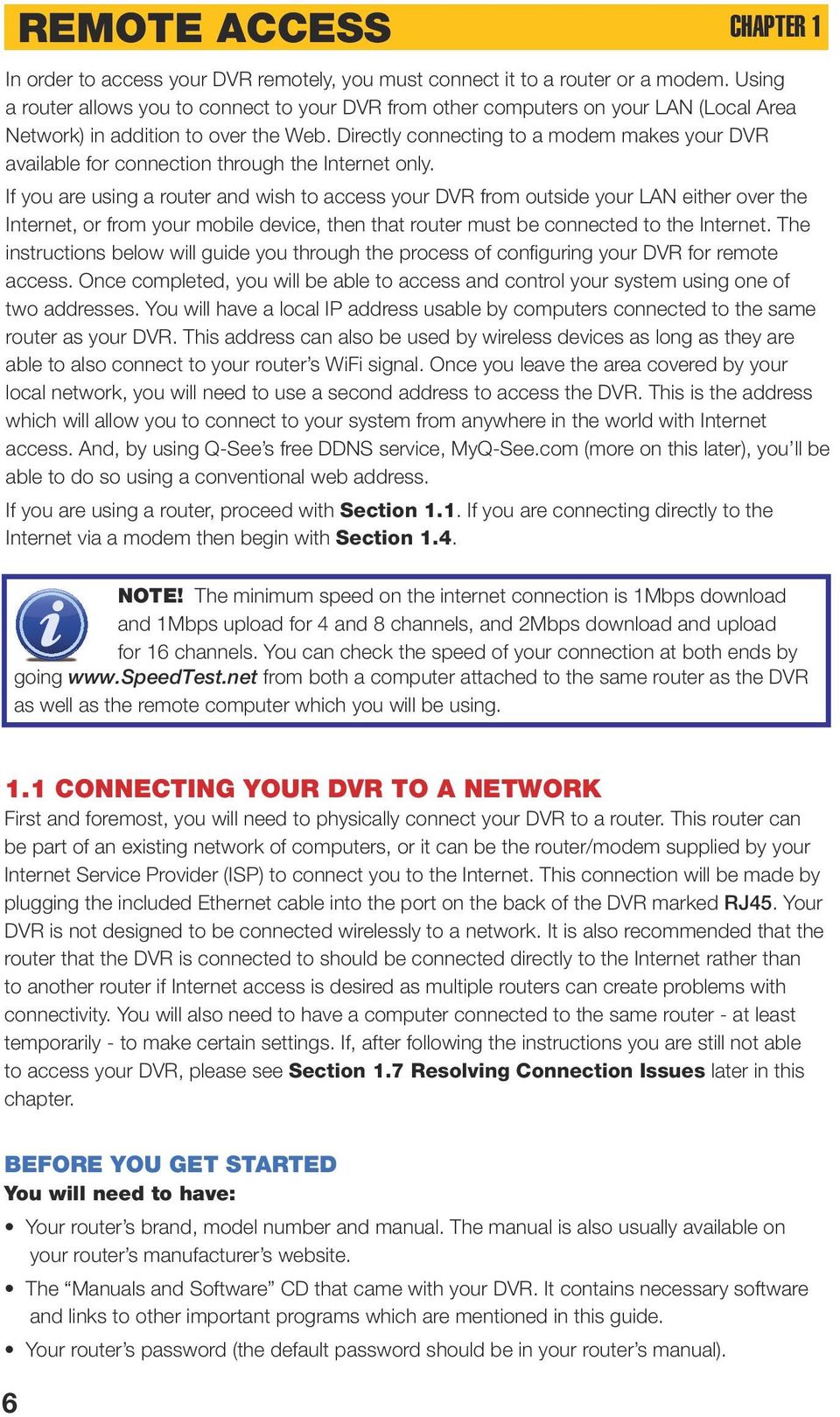
10 CONFIRMING THAT PORTS ARE OPENED To confirm that your ports have been forwarded successfully, go to using a computer connected to the same router as the DVR. STEP 1. Enter 85 into the box labeled What Port? STEP 2. Click on the Check button. STEP 3. You should see a green Success message. If not, return to the DVR s Network window and, in the Network tab, change port 85 to 81, 83 or 88 and click Apply to save your changes before checking using that new number on CanYouSeeMe. Browser - Windows Internet Explorer Open Port Check Tool Your IP: What Port? Check CanYouSeeMe.org - Open Port Check Tool This page will serve as a free utility for remotely verifying a port is open or closed. It will be useful for users who wish to check to see if a server or ISP is blocking certain ports. Success: I can see your service on on port (85) Your ISP is not blocking port 85 PICTURE 1-9 STEP 4. Repeat for port If there is a problem with port 6036, then try 6030 or 6100 in the same manner as above. This website will also display your Public IP address near the top of the page above the box where you entered your port number. This is the number which you will use to access the DVR using a web browser or your mobile device from outside Fine of your local network (away from the building in which your DVR is located). NOTE! If you are successful after changing from port 85, then you will need to add that to the IP address when accessing the DVR via the Internet. If, for example, you changed to port 81, the address would now read :81 10
11 1.3 STATIC INTERNAL IP (NETWORK) ADDRESS Most routers assign connected devices a random IP address that is not currently in use by another device on your internal network. With the exception of 2Wire brand routers, when a router or networked device reboots due to a power loss or other issue, the addresses will change and the port forwarding configuration will no longer work. For that reason, we recommend changing your DVR s network setting to a fixed, or static IP address which will not change. STEP 1. Click on the Setup icon in the Main Menu. PICTURE 1-10 STEP 2. Click on the Network icon in the Setup Menu. PICTURE 1-11 NETWORK STEP 3. Uncheck the box labeled Obtain IP Address Automatically. STEP 4. Click Apply and then Exit. Network Substream Other Settings HTTP Port 80 Server Port 6036 Obtain an IP address automatically IP Address Subnet Mask Gateway Preferred DNS Server Alternate DNS Server PICTURE 1-12 PPPoE User Name Password Test Default Apply Exit 11

12 1.4 PPPOE If you are going to attach the DVR directly to a DSL or cable modem instead of to a router then select the PPPOE option in the Network options. Before you proceed, you will need to contact your ISP to obtain your User Name and Password. STEP 1. Select the Setup icon in the Main Menu. PICTURE 1-13 STEP 2. Select the Network icon. PICTURE 1-14 STEP 3. Check the box next to PPPoE. STEP 4. Enter the User Name and Password obtained from your ISP in the fields below PPPoE STEP 5. Click the Test button to verify your settings. STEP 6. After receiving the OK message in the lower left of your screen, click on the Apply button to save your settings before exiting. NETWORK Network Substream Other Settings HTTP Port 80 Server Port 6036 Obtain an IP address automatically IP Address Subnet Mask Gateway Preferred DNS Server Alternate DNS Server PPPoE User Name Password Default Test PICTURE 1-15 Apply Exit 12

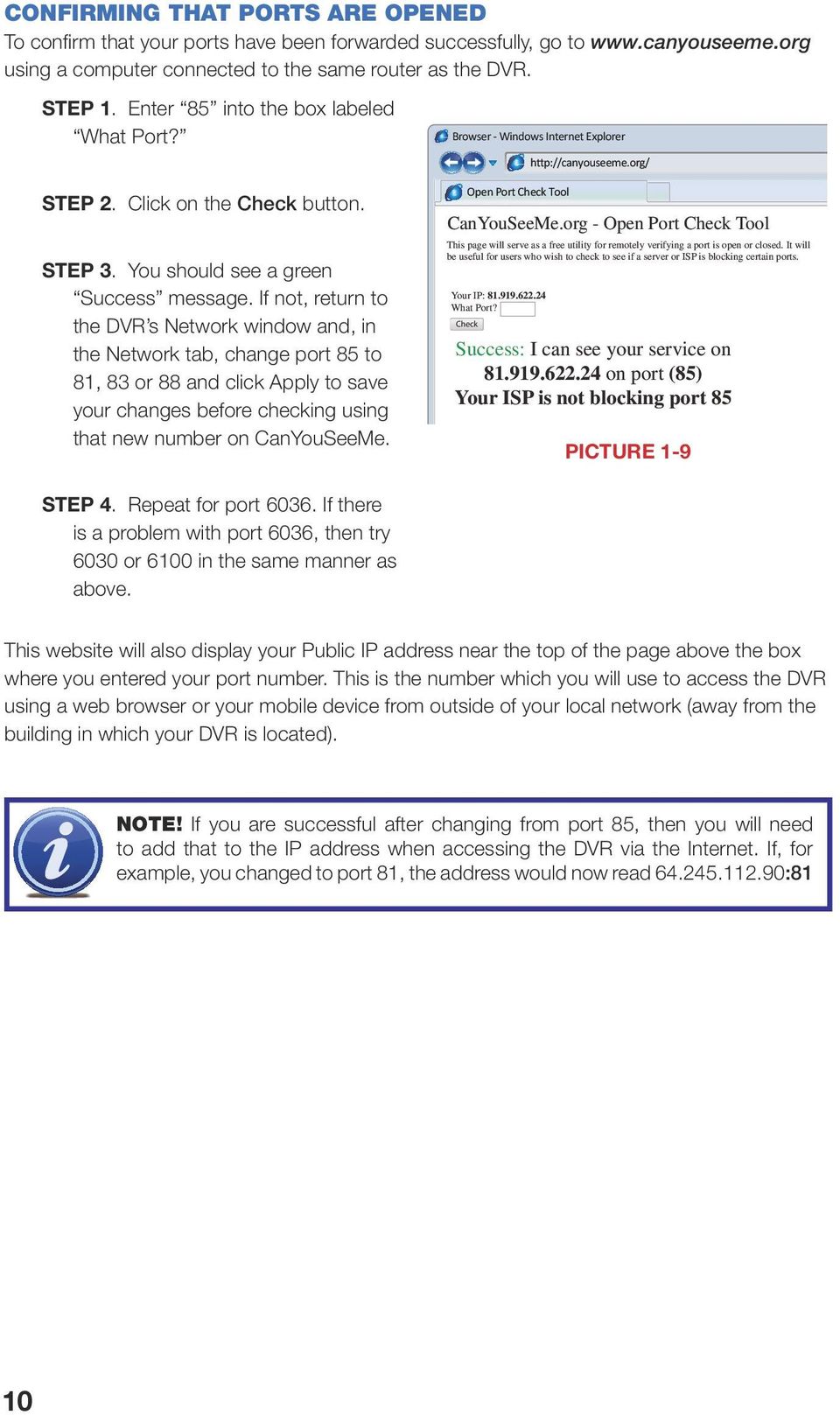
13 1.5 DOMAIN NAME SYSTEM (DNS) Once you have completed the above sections, you are able to operate your DVR remotely. The sections below allow you to take advantage of additional features including the ability to access your DVR using a conventional domain name and having your system send out alerts. To access these functions, you will have to access your router to obtain your DNS (Domain Name System) number. STEP 1. Open up an Internet Explorer browser window and enter the Gateway address (Item #3 which you wrote down in Section 1.1 Obtain an IP Address.) STEP 2. Locate your router s status window (may also be named Information or Info, it will list the DNS number copy this down. STEP 3. In the Network Settings window, enter the DNS number in the area marked Preferred DNS Server. You do not need to have an alternate server. STEP 4. Click Apply to save your settings. Browser - Windows Internet Explorer Router DEVICE INFO LOGS STATISTICS INTERNET SESSIONS ROUTING WIRELESS NETWORK SETTINGS Network Substream Other Settings HTTP Port 80 Server Port 6036 Obtain an IP address automatically IP Address Subnet Mask Gateway Fine Preferred DNS Server Alternate DNS Server PPPoE User Name Password Test STATUS ADVANCED DEVICE INFORMATION All of your Internet and network connection details are displayed on thi WAN MAC Address : 00:24:01:77:f9:00 IP Address : Subnet Mask : Default Gateway : Primary DNS Server : Secondary DNS Server : (null) Advanced DNS : Disabled PICTURE 1-16 Default PICTURE 1-17 Apply Exit 13
14 1.6 DYNAMIC DOMAIN NAME SERVICE (DDNS) This is an optional step which allows you to take advantage of Dynamic Domain Name Service, or DDNS. Not to be confused with DNS above, DDNS allows you to enter a conventional web address when remotely logging into your DVR from outside of your network. It also allows you to avoid having to repeat Sections 1.3 and 1.5 when/if your ISP reassigns IP addresses. Q-See offers DDNS service for free at and your DVR is configured accept account information from that site. STEP 1. Open a browser window and go to STEP 2. Register with the website and follow the instructions for creating a domain name. The website will display your pubic IP address and your domain name which will look like this: NEW USER REGISTRATION ADDRESS PASSWORD PASSWORD CONFIRM FIRST NAME LAST NAME SECURITY QUESTION.. ANSWER My first phone number CONFRIM YOU RE HUMAN New Captcha Enter the text you see above Submit Reset PICTURE 1-18 STEP 3. In the Network Settings window, check the DDNS box and select MyQ-See.com in the DDNS server pull-down menu. STEP 4. Enter your account information password and domain name. STEP 5. Click the Test button. STEP 6. If successful, you will see a message confirming your settings at the bottom of the window. Click on Apply to save your settings. NETWORK Network Substream Other Settings DDNS DDNS Server User Name Password Host Domain DDNS Update [Hours] UPnP MyQ-See.com myname@my address.com myqseeaccountpassword myaccount.myq-see.com 3 Test Default PICTURE 1-19 Apply Exit 14

15 1.7 RESOLVING CONNECTION ISSUES There are several hardware-related situations which can prevent the DVR s port from being properly forwarded. The presence of multiple routers or the routers not featuring UPnP or DMZ are the two most common issues. DETERMINE THE NUMBER OF ROUTERS ON THE NETWORK If there is more than one router between the DVR and the Internet it will block communication to and from your system. To find out the number of routers on your network, you will need to download a FREE router detection program. STEP 1. Go to com/shanes-toolbox STEP 2. Click on Detect Multiple Routers to begin the download. STEP 3. Unzip the application to install it. PICTURE 1-20 STEP 4. Click on the detect_routers application to run it. PICTURE

16 STEP 5. Click on CHECK NOW to detect how many Routers are in the network. PICTURE 1-22 STEP 6. If there is only one router detected, and you are using UPnP, then you will need to turn off that setting and attempt to connect using DMZ as described in Section 1.2 Opening Ports. If you are using DMZ, check to make sure that the UPnP option is turned off. If Multiple Routers are Detected If there are multiple routers, you will see a display similar to Picture If so, it may be preferable to connect your DVR and computer to the router that connects directly to the Internet. However, this is not always possible depending upon your particular situation. PICTURE 1-23 In this case, you will need to proceed with the next section and set up DMZ in the second router to allow communications to pass through it from the first. If only one router is detected you will need to consult your router s manual. 16

17 SETTING UP DMZ IN ROUTER 2 STEP 1. Login into Router 1 by putting the IP of Router 1 into the Internet Explorer browser, as in the example shown in Picture 1-22 where the IP address of Router 1 is STEP 2. Find the status page on the router settings that shows the WAN/ Internet IP address and write it down this WAN IP address. STEP 3. Log into the Router 2 by putting the IP of Router 2 into the Internet Explorer browser, as in example shown in Picture 1-24 where the IP address of Router 2 is STEP 4. Find the DMZ page in the router settings. STEP 5. Enter the WAN IP for Router 1 into the DMZ page and enable DMZ. PICTURE 1-24 NOTE! If you do not have a DMZ setting in the router, check to see if there is a Bridge setting. If so, then use the Bridge setting instead of DMZ. STEP 6. Save your changes. You have forwarded the ports on the router to which the DVR is connected, to the IP address of the DVR, and set the primary router to pass the connection to this router. 17
18 REMOTE MONITORING 2.1 ACCESSING THE DVR FROM A PC Once you have configured the network settings on the DVR to match those on your router and forwarded the ports needed by the DVR to enable remote access over the Internet, you will be ready to remotely view your cameras and control your system through a web browser. This is done by entering the DVR s address into the address area in a Microsoft Internet Explorer, Mozilla Firefox or Google Chrome web browser window, just as if you were typing the address for a website. If you re on the same network as the DVR, you ll enter the local IP address. You ll enter a web address or Internet IP address if you re connecting from a different network. Your local IP address is shown in the Network Information window. Your public (Internet) address is either the string of digits obtained by testing your ports on CanYouSeeMe.org (page 8) or the DDNS name you created on MyQ-See.com (page 12). Even if you plan on using one of the other browsers, you will need to first access your DVR using Microsoft s Internet Explorer browser because you will download a plugin WebClient. exe from your DVR. This occurs the first time you access your DVR from that particular computer. It is strongly recommended that you use Explorer 8 or 9. When the web page loads, you may receive a warning message along the top of the page indicating that an ActiveX control was blocked. You will need to click on the warning message bar to unblock it. You will be asked to install the file WebClient.exe. Click Allow to begin the download. Depending upon your security settings, your computer may ask you multiple times to confirm the installation and running of this application. This Explorer plug-in is being downloaded from your DVR itself and should list Q-See International, Ltd. as the publisher. Confirm the download and launch of the software as needed. This authorization process should only occur during the first time you access the DVR from that particular computer. When the Web Client plug-in is fully downloaded, it will launch in the web page and present you with a login screen. Enter the same user name and password that you use when accessing the DVR. You may also choose your preferred language. Browser - Windows Internet Explorer Web Client Page Safety Tools This website wants to install the following add-on: WebClient.exe from Q-See International Ltd. If you trust the website and the add-on and want to install it, click here... Internet Explorer - Security Warning Do you want to install this software? Name: WebClient.exe Publisher: Q-SEE Internation Ltd. More options While files from the Internet can be useful, this file type can potentially harm your computer. Only install software from publishers you trust. What s the risk? Fine Protected Mode: On 100% Install PICTURE 2-1 Don t Install Browser - Windows Internet Explorer Web Client Page Safety Tools User Name Password Language admin English Fine Protected Mode: On 100% LOGIN PICTURE 2-2 If you are having issues with the software not loading or operating properly, please see the next section, otherwise proceed to Section 2.3 for instructions on operating your DVR remotely. 18

19 USER ACCOUNT CONTROL FOR WINDOWS VISTA AND WINDOWS 7 Some users of computers using Windows Vista or Windows 7 operating systems may receive an error message informing of a codec that is missing or not installed. This conflict can be resolved by turning off User Account Control (UAC). If your are not having problems, please proceed to Section 2.3 for instructions on operating your DVR remotely. Windows Vista 1. Open the Control Panel (accessible by clicking on the Windows icon in the lower left of your screen. PICTURE Select User Accounts and Family Safety. PICTURE Select Add or Remove User Account. PICTURE Select the desired user account. PICTURE

20 5. Select Turn User Account Control on or off PICTURE Uncheck the box next to Use User Account Control (UAC) to help protect your computer. 7. You will then be asked to restart your computer for the change to take effect. PICTURE 2-8 Windows 7 1. Open up the Start Menu (accessible by clicking on the Windows icon in the lower left of your screen. Microsoft Office Outlook 2007 Sticky Notes itunes Adobe Acrobat All Programs Devices and Printers Default Programs Help and Support 2. Type uac into the search bar and hit ENTER. The User Account Control will open or you will be offered a link to click to open it. uac PICTURE 2-9 Shut down 3. Move slider to lowest setting and press OK. 20 PICTURE 2-10

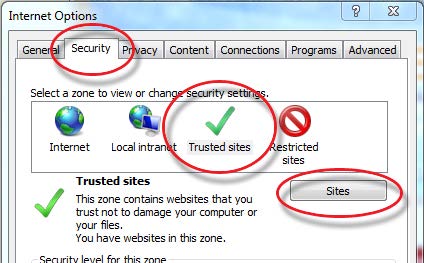
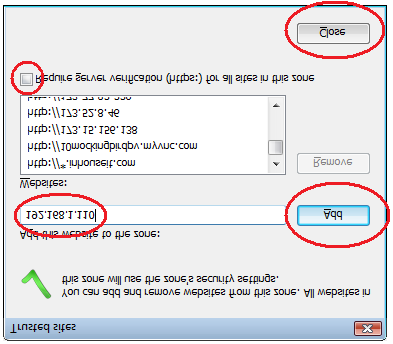
21 SETTING UP ACTIVEX CONTROL STEP 1. Open Internet Explorer STEP 2. Click on Tools STEP 3. Select Internet Options in the pull-down menu PICTURE 2-11 STEP 4. Click on the Security Tab STEP 5. Select Trusted Sites STEP 6. Click on the Sites button PICTURE 2-12 STEP 7. Uncheck the Require server verification ( for all sites in this zone button. STEP 8. Type the DVR s IP address (obtained during Network Setup) or DDNS domain name into the Add this website to the zone: box. STEP 9. Click the Add button STEP 10. Close the window. PICTURE

22 STEP 11. Click the Custom level button. PICTURE 2-14 STEP 12. Pull down the Reset to: menu button and select Low PICTURE

23 STEP 13. Click the Reset button STEP 14. Click Yes when asked, Are you sure you want to change the setting for this zone? STEP 15. Click OK STEP 16. Click Apply STEP 17. Click OK STEP 18. Close Internet Explorer PICTURE 2-16 You are now ready to monitor your DVR from your computer, please proceed to Section 2.3 Using the Remote Access Software. 23
24 2.2 ACCESSING THE DVR FROM A MACINTOSH Once you have configured the network settings on the DVR to match those on your router and forwarded the ports needed by the DVR to enable remote access over the Internet, you will be ready to remotely view your cameras and control your system through a web browser. This is done by entering the DVR s address into the address area in a Apple Safari or Google Chrome web browser window, just as if you were typing the address for a website. If you re on the same network as the DVR, you ll enter the local IP address. You ll enter a web address or Internet IP address if you re connecting from a different network. Your local IP address is shown in the Network Information window. Your public (Internet) address is either the string of digits obtained by testing your ports on CanYouSeeMe.org (page 8) or the DDNS name you created on MyQ-See.com (page 12). Even if you plan on exclusively using the Chrome browser to monitor your DVR, you will need to first access your DVR using the Safari browser because you will be downloading a plugin application from your DVR. This occurs the first time you access your DVR from that particular computer. DVR Firmware and Mac OSX compatibility Apple s recent upgrade of OSX and Safari changed the way they interact with certain programs. The current firmware (operating system) for your DVR is as of this writing. This is compatible with OSX version , 10.7 and higher along with Safari 5.1. The earlier firmware works with OSX through with Safari 5.0. To determine which firmware your DVR is using, open the System Info window on your DVR. To determine your Mac s software, click on About This Mac or About Safari using the Apple Menu (as appropriate) in the upper left corner of your computer s screen. INSTALLING THE PLUGIN Launch Safari and enter your DVR s IP address or DDNS address. The browser window will ask you to download the plugin. You receive this message only when you access the DVR with this computer for the first time, or after the DVR s firmware was updated. PICTURE 2-17 Once you have clicked on the arrow to begin the download, a window will pop up to display the progress of the file transfer. If you do not see a Downloads pop-up, you can open it by selecting it in the Window pull down menu at the top of the Safari screen or by entering Option+Command+L. The file, WebClientPlugin.pkg, will save to your Downloads folder which can be found in the Dock (icon bar) at the bottom of your screen. 24 PICTURE 2-18
25 Begin the installation process by double-clicking on the icon for the WebClientPlugin.pkg file - either in the Downloads pop-up window, or the Downloads window in your Dock. PICTURE 2-18 Once the installer has launched, quit out of Safari so that the plug in can be properly installed. Follow the instructions shown on the screen to properly install the software. PICTURE 2-19 PICTURE
26 You will be asked to input the user name and password for this computer to give the program permission to install. PICTURE 2-21 You ll see a progress bar as the program installs... PICTURE 2-22 Which will be followed by a message indicating that the program was installed correctly. PICTURE 2-23 Relaunch Safari and enter the web address for your DVR. You will be presented with a login screen. Instructions for remotely monitoring and controlling your DVR are presented in the next section. Browser - Windows Internet Explorer Web Client Page Safety Tools User Name Password Language admin English LOGIN Fine Protected Mode: On 100% PICTURE
27 2.3 USING THE REMOTE ACCESS SOFTWARE Once you have installed the WebClient plugin into your browser, you may access your DVR by entering the appropriate web address or local network IP address for your DVR into the browser s address bar. A login screen will be displayed indicating that your DVR is ready for access. Browser - Windows Internet Explorer Web Client Page Safety Tools Enter your User Name and Password that are stored on the DVR. User Name Password admin Language English LOGIN Fine Protected Mode: On 100% PICTURE 2-25 Upon successfully logging in, you will see the main Live View window showing the image from Camera 1 along with the controls. The various functions available are broken down by the tabs along the top of the window; Browser - Windows Internet Explorer Live, Search, Backup, Config, Tools and Info. Web Client Page Safety Tools LIVE SEARCH BACKUP CONFIG TOOLS INFO :16:49 Status 4 Master Stream Sub-Stream Local Recording Status Color P.T.Z Fine Protected Mode: On 100% PICTURE 2-26 LIVE VIEW Most of the controls, such as Screen Display Mode, Color and etc. are the same as found on the DVR, but there are some additional features available as well Live Viewer symbol and function definitions: 1 Channel Indicators 2 Screen Display Mode 3 Volume 4 Master/Sub Stream Status 5 Snapshot 6 Start Manual Record 7 Talk 8 Client Record 9 Local Playback 10 Color 11 PTZ Control 27
28 Screen Display Mode Clicking on the arrow beside the screen display mode will open the Channel Select dialog which will allow you to specify which channels are shown. Channels can be selected individually or in blocks of four. PICTURE 2-27 Record and Playback Controls Buttons 5 through 9 shown in Picture 2-26 allow you to save real-time still and video images to your computer. Clicking on the Snap icon will capture still images and save them to the computer. Record will begin remote manual recording of all active channels onto your DVR. Client Record will capture video and save it onto your computer s hard drive. Talk allows you to communicate through any channel where there is an audio-enabled camera or co-located microphone and speaker. You ll also need a microphone at your computer. This optional equipment must be added before this feature is available. Local Playback lets you review the Client Record video stored on your computer s hard drive. PICTURE 2-28 The destination for the still images is set in the Config tab in the main menu at the top of the Remote Live Viewer (See Section 2.4) which will open the Local Config sub menu. You can also set the number of images that are captured when the Snap Pictures button is pressed. This window is also used to set the destination for recordings made from within the Remote Live Viewer as well as how many audio channels (if available) are recorded in addition to which camera channels. 28
29 Color Adjustment Drag the slide bars to adjust Brightness, Contrast, Hue and Saturation. Clicking Default will return them to the original settings. Button Description Button Description Brightness Saturation Default Hue Contrast Save settings PTZ Control Selecting the PTZ button will bring up a control panel similar to that seen on the DVR. Users have the same level of control as they would at the DVR including activating pre-set commands and cruises as well as full manual control. Button Function Move the dome horizontally, vertically and diagonally. The center square stops the movement. Adjusts the speed of the dome s rotation. Focus button. Zoom button. Iris button. Increase or decrease the light level of the image. Go to a preset Select and do auto cruise Track Auto scan 29
30 Master and Sub-Streams Right-clicking on any live image will open up a pull-down menu. Changes made in this menu will be reflected in the Master/Sub-Stream status display on the right of the Remote Live Preview interface. Master Stream Sub-stream All to Master Stream All to Sub-stream Enable Audio Full Screen zoom in PICTURE 2-29 Stream This DVR supports dual streaming a master stream and a sub-stream. The master stream has a higher image quality and a frame rate of up to a maximum of 30 frames per second for NTSC (25FPS for PAL). The substream, by contrast, will have a reduced bitrate and may have a decreased frame rate as well depending upon your network s capabilities and settings you made in the DVR. For optimal performance, a network with increased bandwidth is recommended when attempting to remotely view multiple channels on the master stream. Regardless of which stream you view remotely, the DVR will record using the Master Stream. All to Master/Sub-Stream Sets all channels to master or sub-stream. Enable Audio Enables or disables audio feed. Full Screen The selected live preview will display full screen. The tool bar will be hidden. Double-clicking or a right-click will resume the previous display. Zoom In Single-channel large screen amplification. Select Zoom In and then click on the image to amplify the image. Click and drag to move within the image. Double-clicking will exit this mode. Right-clicking will return to the main interface. 30
31 2.4 REMOTE PLAYBACK AND BACKUP REMOTE PLAYBACK Clicking the Playback button (Item 8 in Picture 2-26) will bring up the Player window. Users can select the record date and channels. Double-click the file name in the record file list box and you can play back that file. Play Pause Stop Next Frame Next File Fast Forward Previous File Full Screen Progress Bar Volume Path PICTURE 2-30 In addition to the control buttons, progress through the playback can be controlled using the slider in the progress bar. 31
32 SEARCH Clicking on the Search tab in the Remote Live Viewer will allow you to search by Time, Event or File Management. Time Search STEP 1. The user can select the display mode as well as the time and date to begin searching from in the area at the top of the Search window (Red box listed as Item 1 in Picture 2-31) PICTURE 2-31 STEP 2. After running the search, available events will be displayed in the Data Information section. STEP 3. A highlighted date in the Calendar (Item 2 in Picture 2-31) indicates that data was recorded on that date. STEP 4. Select which channels data to display (Item 3 in Picture 2-31) STEP 5. Select an event from the Data Information list and click on the Play button to begin playback. 32
33 STEP 6. This will open a window with control buttons at the bottom. Control buttons at the bottom allow the user to move through the playback. Channel Mode Play Mode Play Button Progress Bar Play Rewind Single Frame Full Screen Pause Fast Forward Next Frame Volume PICTURE 2-32 Snap Exit STEP 7. The Snap button allows you to take still images of specific recordings. 33
34 Event Search STEP 1. Click on the highlighted date, select recorded channels along with the type of event motion or sensor. Then click Search. PICTURE 2-33 STEP 2. The list of recorded events will be displayed in the Event List. Double-click on an item to open the Playback window. 34
35 File Management This allows you to locate an event and lock, unlock or delete it from the record. PICTURE 2-34 Lock Select a recording from the File List box. Clicking the Lock button will protect the file from being overwritten or deleted except when the hard drive is reformatted. Unlock Unlocks a previously locked file. Delete Erases an unlocked file. If a file is locked, you must unlock it before it can be deleted. 35
36 Remote Backup Clicking on the Backup tab will open the Backup interface. This allows you to backup files from the DVR to your computer s hard drive. PICTURE 2-35 STEP 1. Select channels, the start and end time, and then click the Search button. The search results will be shown in the File List box. STEP 2. Select which files to back up by clicking on the appropriate box(es). STEP 3. Click on the Browse button to set the destination for the saved files. STEP 4. Click on Backup to begin the download. 36
37 2.5 REMOTE SYSTEM CONFIGURATION Clicking on the Config tab in the Main Menu of the Remote Live Viewer will change the display to where the user can set-up or alter the operating parameters of the DVR. Available functions include the ability to configure; Basic, Live, Record, Schedule, Alarm, Network, PTZ and User settings. Select an item from the submenu on the left and the appropriate window will open to the right. While one user is changing settings, other users are blocked from doing so. Main Menu Sub Menu PICTURE 2-36 The list of available functions and their options are identical to those on the DVR. Please refer to CHAPTER 4 of the User Manual, Main Menu Setup Guide for more details. Be sure to click on Apply to save your settings before exiting any window. Default will restore the original settings. 37
38 NOTIFICATION SETUP The tab, located in the Network menu, allows you to set how your DVR will send out alerts. You will be able to send alerts to three addresses. NOTE! Depending upon your settings, the system can generate a lot of alerts. For that reason, we recommend setting up a dedicated address specifically for the system to send alert notices. If you do not have your own system (such as a corporate mail server) you should consider using a free provider. However, because many free services allow only a limited amount of traffic we specifically recommend using Google s Gmail service with its higher limit. Similarly, you will want the alert s to go to a different account than the one sending them. This will ease your management of these alerts and prevent your mailbox from overflowing. If you do not have your own system, please set up a free account which the DVR can use to send out alerts before proceeding. For the example below, we will use Gmail. The settings can be found under Options when logged into your Gmail account. Clicking on any of the fields will bring up the virtual keyboard allowing you to enter the data. The virtual keyboard is capable of handling upper and lower case letters as well as numbers and symbols. Click the ENTER button to enter your input or ESC to exit the field without applying any changes. SMTP Server: smtp.gmail.com Port: 465 (standard port for Gmail - others may vary) SSL Check: You will need to select this for Gmail. Other ISPs may vary. Send Address: Enter your new address. This will appear on alert s sent from the DVR Password: Enter the password you created for this account. Remember, it will be case-sensitive. Receive Addresses: You may set up to three addresses to receive alerts. It is strongly advised that you do not use the same address that the DVR is using to send alerts. Advanced Attach Image: Select whether the DVR will send images along with the alert. The alert s can include up to three images. The number of images can be set in the Snap tab of the Recording menu. 38 NETWORK Network Substream Other Settings SMTP Server Port SSL Check Send Address Password Receive Address1 Receive Address2 Receive Address3 Advanced Attach Image RECORD Enable Record Bitrate Resolution Quality Snap Time Interval [S] Snap Number Time 465 Test Default PICTURE 3-1 Stamp Recycle Record CIF Medium 2 1 Default PICTURE 3-2 Apply Snap Apply Exit Exit
39 MOBILE SURVEILLANCE Your DVR supports mobile surveillance on smart phones and other devices running Android, Blackberry,Symbian and both Windows 7 Mobile and Windows Mobile Pro operating systems along with the ipad and iphone on 3G and 4G networks. To access the DVR from these devices you must have first configured the Network Settings on the DVR as shown in Chapter 2 of this guide or Section 4.5 of the Manual. Each mobile device has a dedicated viewer application designed to allow you to remotely monitor and control your system. This software is completely free. Users of devices running Windows Mobile Phone, BlackBerry and Symbian simply download the needed software by logging into their DVR. Those using Android, Apple or Windows Phone 7 should search for Q-See in their respective online markets (itunes, Android Market, etc.) to download the QT View app. Each program - and how it functions on the individual platform - will be described separately on the following pages. 39
40 4.1 QT VIEW FOR APPLE IPAD AND IPHONE IMPORTANT! QT View for ipad and iphone was being substancially upgraded at the time of printing and many of the windows and steps may have changed by the time you read this. Please visit the Q-See Knowledge Base at: for the most current instructions. The QT View software allows you to remotely monitor your QT-series DVR (see list below) using your mobile device and either a wireless or 3G/4G network. In addition to controlling your system, you will be able to alter its settings and review video records saved on its hard drive. In order to monitor your system using your iphone or ipad, you will need to install either the Q-See QT View app for smartphones or Q-See QT View HD app if you re using a tablet. These are available for free through itunes by searching for Q-See. Install either one as you would any other application on your device. Operation of both versions is largely the same with the major exception being that the HD version for the ipad allows you to be able to view up to nine cameras simultaneously rather than just four. Additionally, the viewing resolution is greater to take advantage of the tablet s higher resolution screen. Screen shots from both will be shown when there are differences, but otherwise, most images will be from the ipad version. For smartphones: Q-See QT View Utilities Released Apr 18, 2012 FREE For tablets: Q-See QT View HD Utilities Released May 10, 2012 FREE PICTURE 4-1 To launch QT View, simply tap on its icon in the app menu on your device. NOTE! Although the software needed to access your DVR is free, you will need to have or create an itunes or App Store account to proceed. SUPPORTED MODELS At the time of this writing, the models of DVRs supported by the QT View apps are: QT2124, QT426, QT428, QT454, QT474, QT446, QT4332, QT4516, QT4532, QT504, QT518, QT526, QT528, QT536 and QT5116. Models not listed above, but purchased after May, 2012 should also be compatible. 40
41 CONNECTING TO YOUR DVR Upon start-up, the QT View program will require you to log in. The first time you will need to enter the address of your DVR. You will need to create at least two connections to access your DVR. These are selected through the Login screen and can be created through this screen. They may also created in the Server list as described later. One connection is for use when you are accessing a wireless network connected to the same network as your DVR while another would be used when connecting from outside the area. Depending on your data plan (and whether your device has 3G/4G connectivity) you may find it necessary to take steps to ensure that you are connected wirelessly rather than through cellular to avoid data charges as data usage will be equivalent to that for streaming a video. PICTURE 4-2 Another reason for creating multiple Server connections is if you have more than one QT-series DVR that you wish to monitor remotely. Full information on obtaining these addresses can be found in the Remote Monitoring Guide but instructions for utilizing these addresses appears on the following pages. 41
42 If you will be connecting to your DVR on the same network, say from within the same building, enter the local IP address and this will be referred to as a Local Connection. The second connection will be for times when you are away from that network and will be connecting to a different network or using the 3G/4G function of your device. Local Connection To connect to your DVR using a wireless network that is connected to the same router as your DVR - such as a home network with WiFi and Ethernet connections - you will need to use the LAN or local IP address for your DVR. This can be found in your DVR s Network window. STEP 1. Open the Network window and write down the IP address (Yellow box in Picture 4-3). Ensure that the box labelled Obtain an IP address automatically is checked. If it isn t, check mark the box, click on Apply and then exit the window. Reopen the window to see the correct IP address. NETWORK Network Substream Other Settings HTTP Port Server Port Obtain an IP address automatically IP Address Subnet Mask Gateway Preferred DNS Server Alternate DNS Server PPPoE User Name Password Default Test Apply Exit PICTURE 4-3 If you changed anything, you should return it to its previous configuration to avoid problems with other devices or the DVR itself. STEP 2. Tap on the white fields in the Login screen to enter the needed information Server - Insert the IP address. Account and Password are those you use to log into the DVR. STEP 3. Check the box for Remember Server to add your new connection to the list. PICTURE
43 Remote Connection To monitor your DVR at times when you are away from its location, you will use the system s public or Internet address instead of the local IP address described above. This address could either be the series of digits that you use to log into your DVR over the Internet, or the Dynamic Domain Name Service (MyQ-See) address you created when configuring your DVR for remote access. See Sections 1.2 or 1.6 of the Remote Monitoring Guide respectively for full details on either option. You can quickly obtain the DVR s Internet IP address by going to using a computer connected to the same router as the DVR. The number at the bottom ( in the example shown) is the public IP address and you can enter this into the Address field. The rest of the process is the same as described above for adding a local connection. Browser - Windows Internet Explorer Open Port Check Tool CanYouSeeMe.org - Open Port Check Tool This page will serve as a free utility for remotely verifying a port is open or closed. It will be useful for users who wish to check to see if a server or ISP is blocking certain ports. Your IP: What Port? Check Success: I can see your service on on port (80) Your ISP is not blocking port 80 PICTURE 4-5 SERVER LIST The Server List contains all of your successful DVR connections. It is where you can add, edit or delete your connections. It is accessed by tapping Server List at the top of your screen. There is an additional field, Title, available in this area which we recommend utilizing descriptive names such as Home DVR, Local and Home DVR, Away or the like to help you make the appropriate connection. Fine PICTURE
44 Adding a Server A server is added in the same manner as in the Login screen. Simply tap on the white icon to open up the window to enter the information for the new connection including your name for this connection, the IP address (local or Internet) and your user name and password. PICTURE 4-7 Editing or Deleting a Server Each server connection features two icons in the upper right corner. The left one allows you to edit the connection s name, the address, the user name and password. The rightmost icon will allow you to remove the server from your list. PICTURE
45 OPERATION Live View When you log in, QT View will open the Live View window which will show a single-channel feed from your DVR. Examples are shown below from QT View HD (left) and QT View (right). You can configure the default display mode using the Settings menu described later. PICTURE 4-9 PICTURE 4-10 A series of indicators and icons will appear below the video feed in Live View. If the phone is rotated to landscape (wide) view, these icons will disappear to allow a larger view on the screen. The colored indicators show the status of each camera. Color Meaning Recording Not Recording Motion Recording Alarm Recording No Camera The icons allow you to control your display, including which cameras are being viewed, splitscreen four channel view, enable PTZ mode and etcetera. Button Function Button Function Single channel view Six, eight and nine channel views (ipad only) Record to iphone or ipad Four channel viewing mode Snapshot Audio On/Off Two-way talk Picture adjust (brightness, hue, saturation & contrast) Hide icons (tapping on screen Switches to PTZ interface makes them reappear) Note that both Two-way talk and Audio On/Off both require the use of an audio-capable camera or a co-located microphone. Two-way talk additionally requires a speaker located with the camera being used. 45
46 When switching to multi-channel view, a pop-up window will allow you to select which cameras will be displayed. PICTURE 4-11 PICTURE 4-12 The iphone version offers the option to view video from a single camera or four channels simultaneously. On QT View HD for the ipad, you also have the ability to view the feeds from six, eight or nine cameras at the same time as well. You may reposition the channel feeds in the multichannel viewing modes simply by dragging one screen into the desired position. This is especially useful in the asymmetric six- and eightchannel displays with the single large screen and multiple, smaller views. PICTURE 4-13 When viewing multiple channels, the screen outlined in red will be the one affected by such actions as snapshot or record. Double tap on a screen in a multi-channel mode to bring it to full screen. Double-tapping on the camera view will return to the split screen mode. 46
47 PTZ Tapping on the PTZ icon will open the PTZ Control window allowing you to control a Pan- Tilt-Zoom camera connected to your DVR by touching the directional arrows. Adjust your camera s focus, zoom and iris (light level) using the + and - buttons. There are three sliders which also provide camera control. On the iphone, they appear when the arrow to the right of the PTZ controls is tapped. The first slider allows you to control the speed of the camera s movement, from 1 (slowest) to 8 (fastest). PICTURE 4-14 The second slider allows you to select which Preset point you desire the camera to rotate towards. There are 128 points available and these are generally set up in the DVR when you first configure the PTZ camera. However, you can configure these within the program as well. PICTURE 4-15 PICTURE 4-16 The bottom slider allows you to select which cruise (path) you want the PTZ camera to perform. Like the Presets, these are usually set up when you first connect the PTZ camera, but you can create a new one using PTZ Settings within the Settings menu of this application. 47
48 Snapshot Tapping the Snapshot icon will cause the program to take a still image of the currently displayed video feed and save it onto your device. You can take full-size images from any or all of the currently displayed video feeds. These images are not saved to the Photos folder on your device, but are available for viewing by selecting them from the Image menu located at the upper left of the application s screen (circled, below). PICTURE 4-17 PICTURE 4-18 In the Image menu, you can select an image by tapping on it for a larger view. You can then either delete the image or copy it to your device s Photos menu. From there, you can edit it, download it or it as with any other image. 48
49 Record Likewise, tapping the Record icon will cause the program to begin recording video from the selected channel onto your device s internal memory. Tapping the icon again will end the recording. These files can be accessed, along with videos recorded onto your DVR s own hard drive in the Playback menu which is also located at the top of the screen next to the Image menu. PLAYBACK When you tap on the Playback icon you will be given the choice to search for files recorded on your device (locally) or on the DVR itself with the option to search a specific block of time, by recorded event, or if you have your DVR configured to record all the time, you should use the Remote File Search option. All four search modes operate much in the same manner. Select the date and starting time along with which channel(s) you want to search. Once you tap on Search, the application will display the search results. You will only be able to play back one video at a time. Local File Search Select the desired file from the search results by tapping on it. You will be given the option to play, copy or delete the video. If you select Copy, the video will be copied into your device s Photos folder. PICTURE 4-19 Selecting Play will open up the video and start the playback. There are no playback controls for local files. Tap on Close to end the playback. PICTURE
50 Time Search This search mode differs in that it ll show a 24-hour timeline for each channel with blocks indicating when a video record took place. To begin playback, simply select a channel and then tap on Play. A progress bar will appear below the video along with the start and end times of the video clip. Simply drag the playback point to the desired segment of the video. The time on the left will change to show the time that the particular video segment was recorded. Depending on the speed of the Internet connections at your DVR and your mobile device, you may experience a delay between when you drag the point and when the video begins playing from that point. PICTURE 4-21 Tap on Close to end the playback and return to the search results. Event Search This operates in the same manner as the Local File search, but returns results for video stored on the DVR s hard drive. In addition, it will list the type of event, such as Motion Detection or Alarm. PICTURE 4-22 Simply tap to begin playback. A progress bar identical to the one appearing in Time Search will appear to allow you to progress through the video. 50 PICTURE 4-23
51 Remote File Search This last search mode is best used when you have a channel set to constantly record but it also works if you know when an event occurred. The results list and playback will resemble that seen in the Event Search, above, but will not show the event type, rather it ll display the start and end times along with which channel. PICTURE 4-24 SETTINGS The Settings menu is also located at the top of the screen. It allows you configure both QT View on your mobile device as well as make or change settings on your DVR itself. The local settings are covered in this manual along with the Schedule and PTZ on-dvr settings. The remainder of the on-dvr settings mirror those conducted at the DVR itself and are therefore covered in the User Manual. PICTURE 4-25 Local Settings You can set the maximum amount of space set aside for video recordings on your device using the Storage options. The Display settings allow you to set the application to launch in your preferred viewing mode, whether single view, or multiple channel display. Alarm enables an audio and vibration alert when the DVR either detects motion or some other alarm input. Enabling Auto Reconnect will cause the program to attempt to re-establish your connection to the DVR if it is lost. 51
52 Schedule Settings This area is generally set up when you first configure your DVR, but you may find it necessary to change a recording schedule while you re away from your DVR. PICTURE 4-26 You ll be able to change the schedule for general recording, motion detection recording and alarm-based recording for each camera. Adjusting the schedules for any of these modes is identical. Simply touching and dragging in the desired time block and it ll turn blue to indicate that it ll be active during that time. Touching the blue area and dragging will return it to gray to deactivate that function. You can copy and paste your settings between cameras. Be sure to tap on Save to preserve your settings. PTZ Settings Configuring your PTZ camera is best done at the DVR itself, but if you find it necessary to update a Preset point, a Cruise or Track, that can be done in the Advanced segment of the PTZ Settings menu. Tapping on the Advanced button at the bottom of the PTZ Settings menu gives you access to your PTZ camera s settings. Simply tap on the Setting button corresponding to the desired function for the correct channel and adjust using the PTZ controls or by enabling/disabling as needed. Tapping on Save will save your settings. PICTURE
53 INFORMATION The three windows available under the Information menu allow you to access information about your DVR, your network and which users are currently logged into your system The information displayed in these three windows cannot be altered. System shows your DVR s name as well as the software and hardware configuration. Network provides details on your IP and router address along with which ports are in use and connection status along with other information. Detailed explanations on these items and their configuration can be found in the Remote Monitoring Guide. PICTURE 4-28 Online Users shows which users are remotely connected to your DVR. LOGOFF You can exit QT View by pushing the large button on your device, just like any other program. Or you can tap on the Logoff button which will return you to the Login screen. 53
54 4.2 QT VIEW FOR ANDROID SMARTPHONES The QT View software allows you to remotely monitor your system using your mobile device and either a wireless or 3G/4G network. You will not be able to change the DVR s settings using this application. That will need to be done either in the DVR itself or when remote monitoring using a computer. In order to monitor your system using your Android smartphone, you will need to install the Q-See QT View app for smartphones. The program is available for free through the Android market by searching for Q-See. Install it just as you would any other Android application. If you are using a tablet, you will need to download the Q-See QT View HD app. These are two separate programs and the HD version will not work on a smartphone. Please see Section 4.3, immediately following, for instructions on installing and using Q-See QT View HD on your tablet. For smartphones: Q-See QT View DPSI Free For tablets: Q-See QT View HD DPSI PICTURE 4-29 Free To launch QT View, simply tap on its icon in the app menu on your device. NOTE! Although the software needed to access your DVR is free, you will need to have or create an account with the Android Market to proceed. 54
55 CONNECTING TO YOUR DVR Upon start-up, the QT View program will require you to log in. The first time you will need to enter the address of your DVR. If you will be connecting to your DVR on the same network, say from within the same building, enter the local IP address. You will want to create a separate connection for use when you are away from the building housing the DVR. In this case, you should enter the MyQ- See address or the Internet IP address. Information on these addresses can be found in the Remote Monitoring Guide. Clicking the box marked Remember Server will add this connection to your Favorites list which will allow you to select the desired connection and DVR without having to log in again. PICTURE 4-30 Once you have added a DVR to QT View, you will only to tap on Server in the Log In screen to access your desired connection. You can also add another connection using this screen, in addition to doing so through the Server menu described later. Once you have logged into your DVR the application will take you to the Main Menu where you can access the functions of the program and the DVR. PICTURE
56 OPERATION Live View When you select Live from the Main Menu, you will be taken to the Live View window which will show a single-channel feed from your DVR. When the phone is held in portrait mode, a series of indicators and icons will appear below the video. The colored indicators show the status of each camera. Both sets of icons will disappear from the screen when the phone is held in landscape mode. Color Meaning Recording Not Recording Motion Recording Alarm Recording Not Connected PICTURE 4-32 The icons allow you to control your display, including which cameras are being viewed, splitscreen four channel view, enable PTZ mode and etcetera. Button Function Button Function Single channel view Switch channels Snapshot Two-way talk Four channel viewing mode Switches to PTZ interface Record Audio On/Off Minimize program Note that both Two-way talk and Audio On/Off both require the use of an audio-capable camera or a co-located microphone. Two-way talk additionally requires a speaker located with the camera being used. 56
57 When switching to four-channel view, the Channel Configure window will allow you to select which cameras will be displayed. When viewing multiple channels, the screen outlined in red will be the one affected by such actions as snapshot or record. Double tap on a screen in four-channel mode to bring it to full screen. Double-tapping on the camera view will return to the split screen mode. PICTURE 4-33 PTZ Tapping on the PTZ icon will open the PTZ Control window allowing you to control a Pan-Tilt-Zoom camera connected to your DVR by touching the directional arrows. Adjust your camera s focus, zoom and iris (light level) using the + and - buttons. The slider at the bottom adjusts the speed at which the camera moves. Clicking on the arrow to the right of the controls allow you to activate one of 16 presets or cruises that you may have already set up in the DVR. PICTURE
58 Snapshot and Record Tapping the Snapshot icon will cause the program to take a still image of the currently displayed video feed. In the case of multiscreen mode, the channel outlined in red will be the one that will be captured. PICTURE 4-35 Likewise, tapping the Record icon will cause the program to begin recording video from the selected channel onto your phone s internal memory. You are not able to view recordings or still images stored on your DVR s hard drive, only files that are saved onto your phone. You can access the images and video from the Main menu by selecting Image or Playback, respectively. PICTURE 4-36 Image View The Image window allows you to view your snapshots. Cycle through them using the arrow icons at the bottom. You may also zoom in or out to see more detail. Unwanted files can be deleted using the trashcan icon. PICTURE
59 Playback When you tap on the Playback icon you will be given a list of channels which have recordings. Select the desired channel and then select the video by date and time. Once you have selected your video, it will begin playing back. You may pause, stop or adjust the playback speed using the controls at the bottom. PICTURE 4-38 Settings You can set the maximum amount of space set aside for video recordings on you phone from within the Settings menu. You may also enable record recycling which overwrites older video rather than stopping recording when the allocated space has been filled. In addition, you can configure your display modes as well as setting whether the phone should sound an alarm, vibrate or both when the program s alarm fuction is triggered. PICTURE 4-39 Log The Log menu contains a list of all events recorded by QT View. Choose to see User Operations or alarms that were triggered by motion detection. PICTURE
60 Information This window contains information about your DVR and the phone you are using to run the QT View app. Device name and Device ID: these are both set on the DVR and are useful when you are using QT View to monitor more than one DVR. Software Version: This is the version of the firmware currently installed on the DVR. Build Date: The date the DVR s firmware was released. Phone Software Version: This shows what version of QT View you are using. Build Date: This is the date that your version of QT View was released. PICTURE 4-41 Help QT View includes an extensive electronic manual to assist you should you need more help. Logoff This allows you to log out of QT View and will return you to the Login screen. 60
61 4.3 QT VIEW FOR ANDROID TABLETS The QT View software allows you to remotely monitor your system using your mobile device and either a wireless or 3G/4G network. You will not be able to change the DVR s settings using this application. That will need to be done either in the DVR itself or when remote monitoring using a computer. In order to monitor your system using your Android tablet, you will need to install the Q-See QT View HD app. The program is available for free through the Android market by searching for Q-See. Install it just as you would any other Android application. The HD version of Q-See QT View allows you to view up to nine cameras simultaneously rather than the limit of four available on the smartphone. In addition, the viewing resolution is greater to take advantage of the tablet s higher resolution screen. If you are using a smartphone, you will need to download the Q-See QT View app. These are two separate programs and the HD version will not work on a smartphone. Please see Section 4.2, immediately before this section, for instructions on installing and using Q-See QT View on your smartphone. For smartphones: Q-See QT View DPSI Free For tablets: Q-See QT View HD DPSI PICTURE 4-42 Free To launch QT View, simply tap on its icon in the app menu on your device. NOTE! Although the software needed to access your DVR is free, you will need to have or create an account with the Android Market to proceed. 61
62 CONNECTING TO YOUR DVR Upon start-up, the QT View program will require you to log in. The first time you will need to enter the address of your DVR. If you will be connecting to your DVR on the same network, say from within the same building, enter the local IP address. You will want to create a separate connection for use when you are away from the building housing the DVR. In this case, you should enter the MyQ-See address or the Internet IP address. Information on these addresses can be found in the Remote Monitoring Guide. Clicking the box marked Remember Server will add this connection to your Server List which will allow you to select the desired connection and DVR without having to log in again. Once you have added a DVR to QT View, you will only to tap on Server in the Log In screen PICTURE 4-43 to access your desired connection. You can also add another connection once you re logged in by clicking on Server List at the top of the screen and then clicking on the white icon. PICTURE
63 OPERATION Live View Once you have logged into your DVR you will see a live display from the system s first camera. QT View HD only operates in landscape mode at present. PICTURE 4-45 You can select which channel you want to view by tapping on the single channel view icon and then selecting the desired channel followed by tapping on OK. Or, you can select a multichannel viewing mode by tapping on any of the other channel configurations and selecting which channels to view. PICTURE
64 In the viewing modes with a single large screen surrounded by smaller ones, the first camera selected will be the larger view. Double-tapping on any screen will bring it to full screen view. Double-tapping upon it again will return to multi-screen viewing mode. PICTURE 4-47 A series of indicators and icons appear below the live display regardless of viewing mode. The colored indicators show the status of each camera. Color Meaning Recording Not Recording Motion Recording Alarm Recording Not Connected The icons allow you to control your display, including which cameras are being viewed, splitscreen four channel view, enable PTZ mode and etcetera. Note that both Two-way talk and Audio On/Off both require the use of an audio-capable camera or a co-located microphone. Two-way talk additionally requires a speaker located with the camera being used. Button Function Button Function Single channel view Record etc. Multi-channel viewing modes Snapshot Audio On/Off Two-way talk Switches to PTZ interface In multiple-screen viewing modes, only the channel outlined in red will be affected by commands such as Record, Snapshot, etc. A channel may be selected simply by touching it s display. 64
65 Record and Snapshot You can record video or still images from any of the video streams onto your tablet for later review. This video is separate from that recorded on your DVR s hard drive and recording on your tablet will not affect the recording schedule on your DVR. Only one channel can be recorded or have a still image captured at a time. As mentioned before, this will be the channel currently indicated with a red outline around the edge. Touching the Record icon will begin the recording. You are able to perform other operations while recording. Touching the Record icon a second time will end the recording. The recording will also end when it reaches the maximum file clip size or fills up the available memory - both can be set using the Settings menu available at the top of the screen. Touching the Snapshot icon will cause the selected channel to flash white for a second, indicating that a still image has been captured and saved to your tablet s memory. Playback Video recordings saved onto your tablet can be accessed through the Playback menu which can be reached by selecting Playback at the top of the screen. The Playback window allows you to search for a recording by date and time. Enter the desired search parameters, including which channel, and then touch Search. A list of recordings which match your preferences will be displayed on the right portion of the window. Tap on the desired video to begin playback. PICTURE
66 PICTURE 4-49 The controls below the video playback allow you to start, stop or pause the video. The double arrows will take you to the previous or next video clip. Tapping on Close will take you back to the search window. Image View Selecting Image from the options along the top of the screen will allow you to review your saved images. You will see small previews of each of the saved images. Click on the desired image to bring it to full-screen viewing. PICTURE 4-50 Buttons to the lower right of the image allow you to move to the previous or next saved image or to delete an image from memory. Touching Close will return you to the list of images. 66
67 Settings This window is where you configure how QT View will record and display video along with how it will notify you of events. PICTURE 4-51 You are able to reserve a set amount of memory space for QT View to record files as well as the maximum file size for any recordings. In addition, you can set QT View to view 1, 4, 6, 8 or 9 channels by default along with it remembering which channels you wish to display. Lastly, you can set it so that your tablet will emit an audible alarm when motion is detected by your DVR. Information The data displayed in this window is your DVR s information. Device name and Device ID: these are both set on the DVR and are useful when you are using QT View HD to monitor more than one DVR. Hardware and MCU Version: These relate to the DVR s physical configuration. Kernel and Firmware Version: This concerns the operating system of the DVR and this data can be useful when determining whether your firmware is up-to-date. Launch Date: The date the DVR s firmware was released. PICTURE
68 4.4 WINDOWS MOBILE PRO Windows Mobile Pro 6.1 and 6.5 STEP 1. Activate mobile network access on the mobile phone. STEP 2. Run Internet Explorer STEP 3. Input the DVR s IP address or DDNS domain STEP 4. You will be asked to download the software PCam. Click on the software name to open the download dialog pop-up PICTURE 4-53 STEP 5. Click Yes to start downloading and installing. PICTURE
69 STEP 6. PCam will open automatically once the install process is complete. STEP 7. Input the DVR s address, ID and password respectively in the fields Server, User and Password. The User Name and Password are the same as used on the DVR. The default is admin and Click Go to log onto the DVR. Successful access will bring up the view from a camera. PICTURE 4-55 PICTURE 4-56 STEP 8. Camera 1 is the default channel after login. To change the channel, use the drop-down Channel menu. PICTURE
70 4.5 WINDOWS PHONE 7 & 8 To view your cameras from your Windows Phone device, you will need to download the free SuperCam app from the Windows Phone Marketplace. This program requires Windows Phone 7.5 or higher. STEP 1. Access the Windows Phone Marketplace from your mobile device and search for SuperCam. Download the free application and install it in the normal manner. PICTURE 4-58 STEP 2. Launch SuperCam and enter the address of the DVR along with the user name and password that you use to access your DVR. The default values for those two fields are admin and , respectively. IMPORTANT! Keep in mind that you will need to set up two separate logins. One will be for times when you are on the same network as the DVR, while the other will be for when you are on a different network. You will be able to switch networks using the server pull down in the Login screen or through the Server list found in the Main menu. PICTURE
71 The Main window gives you access to all the features of the program. Not all are shown in this screenshot but they are listed below. STEP 3. Select Live to begin viewing your cameras. PICTURE 4-60 Button Function Button Function Live Live view Settings Software settings Image Image view Server List Device list Log Log record Information Device information view? Software help center In Live view, you can switch between cameras by selecting the desired channel below the main image. Camera 1 is the default view in this window. Rotating your phone will switch to Landscape viewing, but will hide the controls temporarily. PICTURE
72 Pressing the PTZ icon at the bottom of the screen switches to the PTZ controls. You must have a PTZ camera connected to the DVR. The operation of the PTZ camera is the same as on the DVR itself or when using the WebClient plugin on the computer. Clicking on the Camera icon at the bottom of the screen takes a snapshot which can be viewed using the Image button in the Main menu. PICTURE 4-62 Button Function Button Function Switches to PTZ interface Move the dome horizontally and vertically. The center square stops the movement. Snap picture Zoom In/Focus In/Iris Open Zoom Out/Focus Out/Iris Close The Settings menu allows you to adjust how your phone notifies you of events as well as what events generate an alarm. The Log menu shows a record of user operations, motion alarms and video loss alarms. The Information window shows information about your mobile device, the software and the DVR s frimware. Device ID: This is the ID of the DVR you are connected to. This can be set on the DVR in the System tab shown in SECTION 4.1 of the User Manual PICTURE 4-63 Software Version: This is the version of the firmware currently installed on the DVR. Build Date: The date the firmware was released Software Version: The current version of the SuperCam software in use on your phone Software Build Date: The date this version of SuperCam was released 72
73 4.6 BLACKBERRY Please note that BlackBerry 10 is not supported and instructions for the third party SuperCam software used to monitor your system from your phone is provided as a courtesy for users of the legacy BlackBerry OS 5-7. SOFTWARE INSTALLATION STEP 1. Open the browser on your BlackBerry phone and enter the public IP address or the DDNS domain name of your router to access the DVR. PICTURE 4-64 STEP 2. You will be prompted to download the SuperCam software. Click on the link to bring up the download window. PICTURE 4-65 STEP 3. Click on the Download button to begin the download. The progress of the download will be displayed. PICTURE 4-66 STEP 4. The software will be installed automatically. PICTURE 4-67 PICTURE
74 If the software fails to download, please check the following: Verify that you have a good connection to your cellular network Verify that you can access the DVR from a remote computer Modify your BlackBerry s browser configuration: STEP 1. Open your Options menu from the Menu STEP 2. Open Browser Configuration and check the boxes to allow JavaScript Support and JavaScript pop-ups, along with enabling the browser to terminate slow-running scripts, use background images and support embedded media. PICTURE 4-69 STEP 3. Then, from the Options menu, select Cache Operations and click on Clear History to empty the browser cache. PICTURE 4-70 There may be a compatibility problem with SuperCam software running on mobile phones with touch screens. The following steps will resolve this issue: Step 1. Open the Options Menu Step 2. Select Advanced Options Step 3. Select Applications Step 4. Select SuperCam Step 5. Click on Disable Compatiblity 74
75 OPERATING SUPERCAM Login STEP 1. Launch SuperCam. This will bring up the Login interface. STEP 2. Input the DVR s IP address or DDNS domain name, User Name and Password. Check the Remember Server box to save this setting. The User Name and Password are the same as used on the DVR. The default is admin and If you are monitoring multiple devices, previously saved login data for these devices can be accessed using the button on the right. PICTURE 4-71 Main Menu This window contains the function buttons needed to access and control your system. PICTURE 4-72 Button Function Button Function Image Image View Log Record log Server List Device list Settings Software settings Live Live view Information Device information view Help Software help center Logoff Logoff and return to login interface 75
76 Live View In this display you can access the different viewing functions of the DVR in a similar manner to the controls on the DVR itself. PICTURE 4-73 PICTURE 4-74 PICTURE 4-75 PICTURE 4-76 Button Function Button Function Switch channels Snap picture Switches to PTZ interface Full Screen Background alarm Move the dome horizontally and vertically. The center square stops the movement. Zoom In/Focus In/Iris Open Zoom Out/Focus Out/Iris Close Preset Select the preset point Group Set the cruise line 76
77 Server List This allows you to add, delete or modify the DVR connection or connections if you are remotely monitoring multiple systems. Add Add a DVR s IP address or DDNS domain name Modify Modify a DVR s IP address or DDNS domain name Delete Remove a DVR s IP address or DDNS domain name Settings Configure which alarms will activate and what will trigger them. PICTURE 4-77 Alarm Type Choose which alarm types you want to be notified about. Alarm Output Type Choose whether the phone alerts you with an audio or vibratory alarm or a combination of both. PICTURE 4-78 Information View This presents information on the cell phone you are using the SuperCam software version on as well as the software itself. Device ID: This is the ID of the DVR you are connected to. This can be set on the DVR in the System tab shown in SECTION 4.1 of the User Manual Software Version: This is the version of the firmware currently installed on the DVR. Build Date: The date the firmware was released Software Version: The current version of the SuperCam software in use on your phone Software Build Date: The date this version of SuperCam was released PICTURE
78 Digital Peripheral Solutions, Inc E. Crystal Drive Anaheim, CA
Quick-Start Guide. Remote Surveillance & Playback SUPER DVR MONITORING SOFTWARE. For use on Q-See s QSDT series of PC Securitiy Surveillance Cards
 Quick-Start Guide SUPER DVR MONITORING SOFTWARE Remote Surveillance & Playback For use on Q-See s QSDT series of PC Securitiy Surveillance Cards 2 CONFIGURING ROUTER FOR REMOTE ACCESS REMOTE SURVEILLANCE
Remote Monitoring Quick Start Guide
 For more information about your new system, look for QC on our website or in our online support materials at www.q-see.com/support Remote Monitoring Quick Start Guide QC Series Network NVRs efore You Get
Remote Monitoring Setup Guide
 Remote Monitoring Setup Guide QC SERIES NVR MODELS Apple Macintosh Computer PC with Windows Operating System iphone Android BlackBerry* * Select Models Setup Guide for Remote Internet and Smartphone Monitoring,
Remote Monitoring Setup Guide
 Remote Monitoring Setup Guide QS SERIES DVR MODELS PC with Windows Operating System iphone Android BlackBerry* * Select Models Setup Guide for Remote Internet and Smartphone Monitoring, MyQ-See DDNS, and
Remote Monitoring Setup Guide
 Remote Monitoring Setup Guide QC SERIES DVR MODELS Apple Macintosh Computer PC with Windows Operating System iphone Android Setup Guide for Remote Internet and Smartphone Monitoring, MyQ-See DDNS, and
How To Set Up Flir Cloud Client For Pc Or Mac Or Mac (For Pc Or Ipad) On A Pc Or Pc Or Mouse (For Mac) On An Iphone Or Ipa) On Pc Or Tv (For Ipa
 Instruction Manual FLIR Cloud Services Client Instruction Manual FLIR Cloud Services Client #LX400018; r. 2.0/14567/14568; en-us iii Table of contents 1 Setting up FLIR Cloud Client for PC or Mac...1
NVMS-1200. User Manual
 NVMS-1200 User Manual Contents 1 Software Introduction... 1 1.1 Summary... 1 1.2 Install and Uninstall... 1 1.2.1 Install the Software... 1 2 Login Software... 3 2.1 Login... 3 2.2 Control Panel Instruction...
Video Loss. Remote MonitoringQuick Start Guide. QT Series Network DVRs. Before You Get Started. Network Information
 Remote MonitoringQuick Start Guide QT Series DVRs efore You Get Started This poster is intended to help you get your Q-See security system connected to your network and accessible for remote monitoring.
Amcrest 960H DVR Quick Start Guide
 Amcrest 960H DVR Quick Start Guide Welcome Thank you for purchasing our Amcrest 960H DVR! This quick start guide will help you become familiar with our DVR in a very short time. Before installation and
Remote Monitoring Setup Guide
 Remote Monitoring Setup Guide QS SERIES DVR MODELS PC with Windows Operating System iphone Android BlackBerry* * Select Models Setup Guide for Remote Internet and Smartphone Monitoring, MyQ-See DDNS, and
Instruction for IE network monitor
 Instruction for IE network monitor This system features a built-in browser-based software that allows you to access your system remotely over your local area network (LAN) or over the Internet (WAN) using
C n o t n e t n e t n s
 Preface Thank you for choosing our product, for a better understanding of the product, we recommend you read the instruction and safety information before use. Notice: This user manual is an operation
User Manual V1.0. Remote Software
 User Manual V1.0 Notice: The information in this manual was current when published. The manufacturer reserves the right to revise and improve its products. All specifications are therefore subject to change
HRG App for Android Devices. User Guide
 HRG App for Android Devices User Guide Document 800-12218 Rev A 07/2012 Revisions Issue Date Revisions A 07/2012 New document. Contents 3 Contents 1 1 Introduction...............................................
SETTING UP REMOTE ACCESS FOR Q-SEE DVR SYSTEMS MODEL NUMBER: QC40198
 Accessing the DVR from a Computer Attached to the Same Router: If you are only going to access the DVR from a computer that is attached to the same router as the DVR you only need to setup the information
BlackHawk for MAC Software User Guide
 BlackHawk for MAC Software User Guide Products: BLK-DH2 Series and BLK-HD Series DVRs Please read this manual before using your software, and always follow the instructions for safety and proper use. Save
How To Connect To Your Dvr On A Pc Or Mac (For A Dv) With A Dvr (For An Ipad) On A Dvd) On Pc Or Ipad (For Pc Or Pc) On An Ipa Or
 Lorex Edge LH300 Series DVR: Frequently Asked Questions Monitor/Display: 2 Q: Why can t I see an image when I connect my monitor to the DVR? 2 Remote Access and Software: 3 Q: What is my ID and password?
1. Central Monitoring System Software
 1. Central Monitoring System Software 1-1. General information CMS program is an application with which users not only watch and control remote DVRs, but also receive video/audio data or alarm signals
INSTRUCTION MANUAL Neo Coolcam IP Camera
 INSTRUCTION MANUAL Neo Coolcam IP Camera Revised: June 28, 2013 Thank you for purchasing from SafetyBasement.com! We appreciate your business. We made this simple manual to help you enjoy your new product
Quick Installation Guide
 V2.01 Model: FI9821W Quick Installation Guide Indoor HD Pan/Tilt Wireless IP Camera Black White For Windows OS ------- Page 1 For MAC OS ------- Page 16 ShenZhen Foscam Intelligent Technology Co., Ltd
1. Central Monitoring System Software
 1. Central Monitoring System Software 1-1. General information CMS program is an application with which users not only watch and control remote DVRs, but also receive video/audio data or alarm signals
Mobile Surveillance. User Manual
 Mobile Surveillance User Manual Contents 1 Network Configuration... 1 1.1 Access Device via WLAN... 1 1.2 Access Device via 3G Network... 1 2 By Phones with iphone OS... 2 2.1 Installation Instruction...
MJPEG Camera Client User Manual
 MJPEG Camera Client User Manual CONTENTS User Manual 1 WELCOME... 3 1.1Features... 3 1.2Installation Requirements... 3 1.3 Software Installation... 3 2 Software Operation... 5 2.1 Tab bar... 6 2.2 Device
SETTING UP REMOTE ACCESS FOR Q-SEE DVR SYSTEM
 Accessing the DVR from a Computer Attached to the Same Router If you are only going to access the DVR from a computer that is attached to the same router as the DVR you only need to setup the information
B Series Robot Model. IP Camera 2013-7 V4.18. User Manual
 B Series Robot Model IP Camera 2013-7 V4.18 User Manual Index 1 INTRODUCTION... 3 2 APPEARANCE AND INTERFACE... 5 3 VISIT IP CAMERA FROM LAN... 6 4 VISIT IP CAMERA FROM WAN... 10 5 OTHER SETTINGS... 12
FI8910W Quick Installation Guide. Indoor MJPEG Pan/Tilt Wireless IP Camera
 Model: FI8910W Quick Installation Guide (For Windows OS) (For MAC OS please go to page 17) Indoor MJPEG Pan/Tilt Wireless IP Camera Black White Package Contents IP Camera FI8910W with IR-Cut.x 1 DC Power
7 6.2 Windows Vista / Windows 7. 10 8.2 IP Address Syntax. 12 9.2 Mobile Port. 13 10.2 Windows Vista / Windows 7. 17 13.2 Apply Rules To Your Device
 TABLE OF CONTENTS ADDRESS CHECKLIST 3 INTRODUCTION 4 WHAT IS PORT FORWARDING? 4 PROCEDURE OVERVIEW 5 PHYSICAL CONNECTION 6 FIND YOUR ROUTER S LOCAL NETWORK IP ADDRESS 7 6.1 Windows XP 7 6.2 Windows Vista
NETGEAR genie Apps. User Manual. 350 East Plumeria Drive San Jose, CA 95134 USA. August 2012 202-10933-04 v1.0
 User Manual 350 East Plumeria Drive San Jose, CA 95134 USA August 2012 202-10933-04 v1.0 Support Thank you for choosing NETGEAR. To register your product, get the latest product updates, get support online,
NVMS - 1000 USER MANUAL. Version 2.1.0
 NVMS - 1000 USER MANUAL Version 2.1.0 Contents 1 Software Introduction... 1 1.1 Summary... 1 1.2 Operation Environment... 1 1.3 Install and Uninstall... 2 1.3.1 Install the Software... 2 1.3.2 Uninstall
TENVIS Technology Co., Ltd. User Manual. For H.264 Cameras. Version 2.0.0
 TENVIS Technology Co., Ltd User Manual For H.264 Cameras Version 2.0.0 Catalogue Basic Operation... 3 Hardware Installation... 3 Search Camera... 3 Get live video... 5 Camera Settings... 8 System... 8
CDVS-7000 Series Remote Software Users Guide
 CDVS-7000 Series Remote Software Users Guide Crest Electronics, Inc. Version 12.1005 Remote Surveillance Program The remote surveillance program enables users of the Crest 7000 series DVRs to connect remotely
How To Use A Wireless Pan & Tilt Camera On A Pc Or Mac Or Ipad (For Pc) For Free (For Mac) For A Week (For A Week) For $99.99) For Two Weeks (For Ipad)
 User Manual Wireless Pan & Tilt Camera CIPCAMPTIWL v1.0 Index 1 INTRODUCTION... 4 1.1 THE PACKAGE INCLUDES... 4 1.2 FUNCTION AND FEATURES... 4 1.3 TECHNICAL SPECIFICATIONS... 4 2 APPEARANCE AND INTERFACE...
ALIBI Witness and ALIBI Witness HD Apps for Android - Quick Start Guide
 ALIBI Witness and ALIBI Witness HD Apps for Android - Quick Start Guide Version 4.0.3 ALIBI Witness and ALIBI Witness HD are free applications (Apps) for the and Android OS (V2.3.3 or later) smartphone
This section will focus on basic operation of the interface including pan/tilt, video, audio, etc.
 Catalogue Basic Operation... 2 For Internet Explorer... 2 For Other Non-IE Web Browsers... 5 Camera Settings... 6 System... 6 About... 6 PT Setting... 7 Backup and Restore Setup... 8 NTP Setting... 8 System
Manual Client Management Software HDR50-CMS
 Manual Client Management Software HDR50-CMS HDR50-CMS (Client Management Software) A-1. Install HDR50-CMS for Windows PC HDR50-CMS is a program for communication between DVR and PC to control signal and
Meijer.com. User Manual CENTRAL MANAGEMENT SOFTWARE CMS. Remote Monitoring Software for Q-See s QT-Series DVRs
 User Manual CENTRAL MANAGEMENT SOFTWARE CMS Remote Monitoring Software for Q-See s QT-Series DVRs 1 Thank You for Choosing a Q-See Product! All of our products are backed by a conditional service warranty
QSD2316L DVR User s Manual
 QSD2316L DVR User s Manual H.264-200 FPS /240 FPS 16-channel digital video recorder All rights reserved Rev 062408 QSD2316L DVR User s Manual CAUTION Please read this user manual carefully to ensure that
ivms-4500(windows Mobile) Mobile Client Software User Manual Version 1.0
 ivms-4500(windows Mobile) Mobile Client Software User Manual Version 1.0 Thank you for purchasing our product. This manual applies to ivms-4500 (Windows Mobile) mobile client software, please read it carefully
ADTVision (ios) Mobile Client Software User Manual (V1.6)
 ADTVision (ios) Mobile Client Software User Manual (V1.6) Thank you for purchasing our product. This manual applies to ADTVision (ios) mobile client software, please read it carefully for the better use
LOREX CLIENT Remote Software 4.0
 LOREX CLIENT Remote Software 4.0 Instruction Manual English Version 2.0 MODEL: L20WD800 Series www.lorexcctv.com Copyright 2008 LOREX Technology Inc. Table of Contents Table of Contents Software Installation...
Multi-Site 4200. Remote Viewing Software. User Guide
 Multi-Site 4200 Remote Viewing Software User Guide Document 800-12064V1 Rev A 09/2012 User Guide Revisions Issue Date Revisions A 07/2012 New document. V1 Rev A 09/2012 Updated the description of the
ImagineWorldClient Client Management Software. User s Manual. (Revision-2)
 ImagineWorldClient Client Management Software User s Manual (Revision-2) (888) 379-2666 US Toll Free (905) 336-9665 Phone (905) 336-9662 Fax www.videotransmitters.com 1 Contents 1. CMS SOFTWARE FEATURES...4
ivms-4500(iphone) Mobile Client Software User Manual (V1.0)
 ivms-4500(iphone) Mobile Client Software User Manual (V1.0) Thank you for purchasing our product. This manual applies to ivms-4500 (iphone) mobile client software, please read it carefully for the better
Quick Start Guide. Plug n Play NVR DS-7604NI-E1/4P DS-7608NI-E2/8P. www.hikvision.com/en/us
 Quick Start Guide Plug n Play NVR DS-7604NI-E1/4P DS-7608NI-E2/8P Note: For more information refer to the complete User Manual located on the CD-ROM OVERVIEW 1. Overview 2. Main Menu Layout 3. Formatting
Guarding Expert (Android Tablet) Mobile Client Software User Manual (V3.1)
 Guarding Expert (Android Tablet) Mobile Client Software User Manual (V3.1) UD.6L0202D1080A01 Thank you for purchasing our product. This manual applies to Guarding Expert (Android Tablet) mobile client
How to Remotely View Security Cameras Using the Internet
 How to Remotely View Security Cameras Using the Internet Introduction: The ability to remotely view security cameras is one of the most useful features of your EZWatch Pro system. It provides the ability
1. Central Monitoring System Software
 1. Central Monitoring System Software 1-1. General information CMS program is an application with which users not only watch and control remote DVRs, but also receive video/audio data or alarm signals
Quick Installation Guide
 Quick Installation Guide (For Windows & Mac OS) Outdoor Wireless IP Camera Package Contents V1.1 IP Camera Power Adapter Resource CD Ethernet Cable Mounting Bracket(except FI8919) Wi-Fi Antenna Quick Installation
User s Manual of DVR DVS Remote Client Software V 4.0.1
 User s Manual of DVR DVS Remote Client Software V 4.0.1 Index Version description...4 1 Introduction...8 2 Software Install, Uninstall and use...9 2.1 Install remote client software ver4.0.1...9 2.2 Uninstall
IP Camera (L series) User manual 2013-05 V1.1
 Dear users, the configuration for this camera is professional, so please read the user manual carefully before using the camera. IP Camera (L series) User manual 2013-05 V1.1 Statement If the user manual
A quick user guide for your LX Apollo DVR
 A quick user guide for your LX Apollo DVR The LX Apollo series of DVR s is designed specially for the security and surveillance field and is an outstanding digital surveillance product. It has an embedded
Network Video Recorder. Operation Manual
 Network Video Recorder Operation Manual Content 1 Product Description... 1 1.1 Product Overview... 1 1.2 Specification... 1 2 Product Structure Introduction... 2 2.1 Back Interface... 2 2.2 Front Panel...
ivms-4500 (Android Tablet) Mobile Client Software User Manual (V3.0)
 ivms-4500 (Android Tablet) Mobile Client Software User Manual (V3.0) Thank you for purchasing our product. This manual applies to ivms-4500 (Android Tablet) mobile client software; please read it carefully
Access the GV-IP Camera through a broadband modem
 Access the GV-IP Camera through a broadband modem Applied to All GV-IP Cameras Article ID: GV15-12-03-26 Release Date: 03/26/2012 Introduction The document introduces how to connect your GV-IP Camera to
idvr-pro Viewer Software for Mac User Manual ver 0.1
 idvr-pro Viewer Software for Mac User Manual ver 0.1 1 Contents 1. Introduction... Error! Bookmark not defined. 1.1 Summary... Error! Bookmark not defined. 2. Install... Error! Bookmark not defined. 2.1
Access to remote DVR from IE USER S MANUAL CONTENT
 Access to remote DVR from IE CONTENT... 2 Preface... 2 1. Introduction... 2 2. System requirement and executing environment... 2 2.1. Supported operating System:... 2 2.2. Hardware requirement (recommend):...
ivms-4500 (Android) Mobile Client Software User Manual (V3.1)
 ivms-4500 (Android) Mobile Client Software User Manual (V3.1) UD.6L0202D1111A01 Thank you for purchasing our product. This manual applies to ivms-4500 (Android) V3.1 mobile client software; please read
Appendix A. CMS(Client Management Software)
 Appendix A. CMS(Client Management Software) A-1. Install CMS for Windows PC CMS is a program for communication between DVR and PC to control signal and video. Insert the enclosed CD, and go to CD-ROM Drive
Index. 4.1 INTERNET CONNECTION...13 4.2 PORT FORWARDING...13 4.3 DDNS...14 4.3.1 Manufacturer s DDNS...14 4.3.2 Third Party DDNS...
 "This product is meant for providing convenience for baby monitoring. The manufacturer is not responsible for any legal liability caused by negligence. " ibaby Monitor Model: M3 User Manual Index 1 INTRODUCTION...4
Remote Client Program... 3. Web Client... 39
 Remote Client / Web Client USER MANUAL T Series Digital Video Recorder Remote Client Program... 3 Remote Client Program Installation... 4 Remote Client... 6 Main Window... 6 Site Registration... 7 Group
SwannEye HD Plug & Play Wi-Fi Security Camera Quick Start Guide Welcome! Lets get started.
 EN SwannEye HD Plug & Play Wi-Fi Security Camera Quick Start Guide Welcome! Lets get started. QHADS453080414E Swann 2014 1 1 Introduction Congratulations on your purchase of this SwannEye HD Plug & Play
CMS-DH CENTRAL MANAGEMENT SOFTWARE
 CMS-DH CENTRAL MANAGEMENT SOFTWARE CMS-DH is a central management software that allows you to view and manage up to 300 DH200 series DVRs. System Requirements Your system must meet the system requirements
Quick Start Guide NVR DS-7104NI-SL/W NVR. www.hikvision.com. First Choice For Security Professionals
 Quick Start Guide NVR DS-7104NI-SL/W NVR NOTE: For more detailed information, refer to the User s Manual on the CD-ROM. You must use your PC or MAC to access the files. www.hikvision.com Quick Start 1.
User Manual for ios App
 User Manual for ios App Shenzhen Foscam Intelligent Technology Co.,Ltd. Table of Contents Table of Contents...1 1 Overview...2 2 Access the IP Camera...2 3 Install App... 2 4 Introduction to IPCam Management
Internet and Email Help. Table of Contents:
 Internet and Email Help The following tips are provided to assist you in troubleshooting and managing your Plex Internet and email services. For additional issues or concerns, you may also call our Product
Quick Installation Guide
 V48.01 Model: FI8919W Quick Installation Guide Outdoor Pan/Tilt Wireless IP Camera For Windows OS ------- Page 1 For MAC OS ------- Page 15 ShenZhen Foscam Intelligent Technology Co., Ltd Quick Installation
Central Management Software CV3-M1024
 Table of Contents Chapter 1. User Interface Overview...5 Chapter 2. Installation...6 2.1 Beginning Installation...6 2.2 Starting the CMS software...10 2.3 Starting it from the Start menu...10 2.4 Starting
PowerVideo Plus. EverFocus Central Management Software. for Networked Video Devices Management. User s Manual
 EverFocus Central Management Software for Networked Video Devices Management User s Manual Copyright EverFocus Electronics Corp. Release Date: January, 2013 Copyright 2012 EverFocus Electronics Corp. All
ibaby monitor Model: M3 User Manual The manufacturer is not responsible for any legal liability caused by negligence.
 ibaby monitor Model: M3 User Manual The manufacturer is not responsible for any legal liability caused by negligence. Index 1 INTRODUCTION... 4 1.1 PACKAGE CONTENTS... 4 1.2 FUNCTION AND FEATURES... 4
INDEX. Google Android Phone OS application and operation 2. Blackberry Operation System(Software Installation and Operation) 13
 DVR4rt-H264 Mobile User Guide INDEX DATE: 2011/03/02 VER 1.0 Google Android Phone OS application and operation 2 Blackberry Operation System(Software Installation and Operation) 13 iphone Software installation
Contents. 1.2 Software Installation... 1
 Software Manual Contents 1 Software Installation... 1 1.1 Overview...1 1.2 Software Installation... 1 2 Introduction To Basic Function...5 2.1 Login System... 5 2.2 CMS Operating Interface...5 2.2.1 Operating
7. Mobile Phone Support
 7. Mobile Phone Support A state-of-the-art feature of this DVR device is transmitting live feed from the CCTV cameras to your mobile phone, so that you can have on the go access to your surveillance system
Mobile Device Manual for 3G DVRs
 Mobile Device Manual for 3G DVRs The 3G DVR can be monitored with APPS for supported mobile device operating systems. Please refer to the table below for your specific mobile device application. Please
User Manual of Web Client
 User Manual of Web Client 1 Index Chapter 1 Software Installation... 3 Chapter 2 Begin to Use... 5 2.1 Login and Exit... 5 2.2 Preview Interface Instruction... 6 2.3 Preview Image... 7 Chapter 3 Playback...
Professional Surveillance System User s Manual
 Professional Surveillance System User s Manual \ 1 Content Welcome...4 1 Feature...5 2 Installation...6 2.1 Environment...6 2.2 Installation...6 2.3 Un-installation...8 3 Main Window...9 3.1 Interface...9
ACS CLIENT SOFTWARE USER MANUAL
 ACS CLIENT SOFTWARE USER MANUAL 1 ACS USER GUIDE 1.1 System Requirement Recommended System Requirement OS CPU VGA RAM HDD WindowXP, Vista Pentium 4, 2Ghz 1024*768, 64MB 24bit color graphic card 1GB 20MB
Wireless Pan&Tilt Network Camera. User Manual CIPCAMPTIWL V2.0
 Wireless Pan&Tilt Network Camera User Manual CIPCAMPTIWL V2.0 1 Installation Environment Keep away from the places for high-temperature, heat source and direct sunlight; Keep away from water and when get
CIPCAM720PTIWL,CIPCAM720OD,CIPCAM720ODWDR,CIPDC AM720OD
 Wireless Network Camera User Manual CIPCAM720PTIWL,CIPCAM720OD,CIPCAM720ODWDR,CIPDC AM720OD V1.0 Default DEFAULT SETTINGS IP Address 192.168.1.58 User/Password admin/123456 Notice 1 Installation Environment
User Manual. IP Camera. For further help, please visit www.zmodo.com 1
 User Manual IP Camera For further help, please visit www.zmodo.com 1 Preface Preface Dear customer, Thank you for purchasing our products. If there are any questions, or requests, please do not hesitate
MAC CMS User Manual 1
 1 TABLE OF CONTENTS Chapter 1. Overview... 4 Chapter 2. Starting CMS Client... 4 2.1 User Registration... 4 2.2 Wizard for Importing Device... 4 2.3 User Login... 9 2.4 Control Panel and Main Menu Bar
Wifi Pan/Tilt IP Camera User Manual
 Wifi Pan/Tilt IP Camera User Manual Rev. 3.0 Software Version 3.00 May. 25 th.2009 Table of Contents 1. PRODUCT VIEWS...3 1.1. PRONT PANEL...3 1.2. BACK PANEL...3 1.3. ACCESSORIES...4 2. SETUP AND STARTUP...5
Android /IOS Smart Phone Installation Manual
 Android /IOS Smart Phone Installation Manual Install IP Camera Install Mobile Phone App Technaxx Security Software Register an Account Add Cameras under this account IP Network Camera Installation Procedure
DVS Net (Integration)
 DVS Net (Integration) Installation and User s Guide Ver 11.10.x Digital Video Security System Digital Video Recorder www.tuniss.com PLEASE CALL TUNISS COMPUTER AT: 650-401-6138 FOR ANY QUASTIONS REGARDING
Central Management System (CMS) USER MANUAL
 Central Management System (CMS) USER MANUAL LEGAL INFORMATION Reproduction, transfer, distribution or storage of part or all of the contents in this document in any form without the prior written permission
SkyIPCam 250W Wireless Network Camera. Model # AIC250W. User s Manual
 SkyIPCam 250W Wireless Network Camera Model # AIC250W User s Manual Ver. 1B Table of Contents 1. Introduction... 4 2. Getting Started... 5 3. Installing the Setup Wizard... 6 4. Gathering Information...
Quick Start Guide. Hybrid DVR DS-90xxHFI-ST, DS-90xxHWI-ST Series. NVR DS-96xxNI-ST/RT Series. Plug n Play NVR DS-77xxNI-SP Series
 Quick Start Guide Hybrid DVR DS-90xxHFI-ST, DS-90xxHWI-ST Series NVR DS-96xxNI-ST/RT Series Plug n Play NVR DS-77xxNI-SP Series Note: For more information refer to the complete User Manual located on the
How To Use The Workstation Program On A Pc Or Mac Or Macbook Or Macintosh (Aero) With A Computer Or Ipa (A2) With An Ipa Or Ipad (A3) With The Powerpoint 2.
 Mirasys NVR 6.1 User s Guide CONTENTS Contents... 2 Before you start... 3 Introduction... 6 Logging in... 9 User interface... 13 Navigator... 16 Cameras... 25 Video outputs... 41 Digital outputs... 46
KViewCenter Software User Manual 2012 / 04 / 20 Version 2.2.1.0
 KViewCenter Software User Manual 2012 / 04 / 20 Version 2.2.1.0 Table of Contents Chapter 1. KViewCenter Interface... 5 1.1. Log in.... 5 1.2. Log out... 5 1.3. Control Panel... 6 1.4. Control Panel (Preview
SECTION 1: FIND OUT THE IP ADDRESS OF DVR To find out the IP of DVR for your DVR do the following:
 NOTE! The DVR and PC must be connected to the same router. Things you will need to know : 1. The make and model of the router. 2. If you changed the default r outer login, then you will need to know the
Dear users, the configuration for this camera is professional, so please read the user manual carefully before using the camera. 2012-11 V4.
 Dear users, the configuration for this camera is professional, so please read the user manual carefully before using the camera. IP Camera (B series) User manual 2012-11 V4.19 Statement If the user manual
Quick Installation Guide
 V2.01 IP Wired / Wireless Camera Quick Installation Guide (For Windows OS) Model: FI8602/FI8602W ShenZhen Foscam Intelligent Technology Co., Ltd Packing List Quick Installation Guide 1) IP CAMERA X 1 2)
DIGIMobile V2 User Manual
 DIGIMobile V2 User Manual Information in this document is subject to change without notice. 2014 Copyright, DIGIEVER Corporation. All rights reserve 1 Table of Contents CHAPTER1. OVERVIEW... 1 CHAPTER2.
SwannView Link for Android
 SwannView Link for Android Have a Smartphone or Tablet? With the free SwannView Link app, you can turn your Android mobile device into a monitoring centre for your DVR or NVR security system. Have the
PC-ZViewer User Manual
 PC-ZViewer User Manual For further help, please visit www.zmodo.com Contents Preface... 3 Statement... 3 Intended Reader... 3 Terms in this Manual... 3 Software Introduction... 3 Operating Environment...
USING YOUR DMX PROFUSION
 Set Up Guide USING YOUR DMX PROFUSION io FOR 1 Connect 2 Set Up 3 Listen SIMPLE PERSONALIZED UNLIMITED ECONOMICAL LICENSED Welcome Thank you for choosing DMX to provide your Pandora listening experience
Network Camera. User s Guide Software Version 1.3 Before operating the unit, please read this manual thoroughly and retain it for future reference.
 4-194-204-14 (1) Network Camera User s Guide Software Version 1.3 Before operating the unit, please read this manual thoroughly and retain it for future reference. SNC-CH110/CH210 SNC-DH110/DH110T/DH210/DH210T
IP Camera Centralization Management. Client Application. (IPCMonitor) Feb, 2013 Version 1.9. User Manual
 IP Camera Centralization Management Client Application (IPCMonitor) Feb, 2013 Version 1.9 User Manual INDEX 1 Introduction...3 2 Computer Requirement...3 3 Installation...4 4 Devices list...4 4.1 Adding
User Manual ivms-4200 Client Software. Version 1.02
 User Manual ivms-4200 Client Software Version 1.02 TABLE OF CONTENTS Chapter 1. Overview... 3 Chapter 2. Starting ivms-4200... 3 2.1 User Registration... 3 2.2 Wizard for Importing Device... 3 2.3 User
ShareLink 200 Setup Guide
 ShareLink 00 Setup Guide This guide provides instructions for installing and connecting the Extron ShareLink 00. The ShareLink USB 00 Wireless Collaboration Gateway allows anyone to present content from
NetClient software user manual
 NetClient software user manual 1-1. General information Net Client is an application which provides users not only viewing and controling remote DVRs, but also receiving realtime event data or alarm signals