
Catholic Diocese of Dallas Catechetical Plan
|
|
|
- Buck Phillips
- 10 years ago
- Views:
Transcription
1 Catholic Diocese of Dallas Catechetical Plan Continuing Catechetical Formation Handbook for Parish Catechetical Leaders, Catechists, and Instructors In an effort to create a tool by which Pastors, Parish Clergy, Catechetical Leaders, Catechists, and Instructors could best use and understand the Continuing Faith Formation Plan, the Department of Catechetical Services is pleased to present to you the Continuing Faith Formation Plan Handbook for Catechetical Leaders, Catechists and Instructors. This plan outlines the process of earning a Certificate in Catechesis, based on the standards developed by the TCC-RE. Furthermore, a Certificate for Parish Catechetical Leaders, based on the National Standards for Lay Ecclesial Ministers is also required for those not already credentialed. This is the first phase of a multi-faceted plan in which all ministries served by offices in the Pastoral Center will be asking that those in leadership and those volunteer ministers who evangelize and catechize in the name of the Bishop in parishes, to be formed in the areas of Christian Identity/Ministry, Sacred Scripture, Theology, Personal and Spiritual Maturity, and Catechetical Methodology/Skills. The Office of Youth and Young Adult Ministries will be the first Ministry Office to join with The Department of Catechetical Services in requiring their professional and volunteer ministers to receive a Certificate in Catechesis.

2 Table of Contents CHAPTER 1 1. Bishop s Introductory Letter Catechetical Roles Bishop and Pastor Diocesan Department of Catechetical Services Parish Catechetical Leader Catechist Catechist Assistant or Classroom Aide Administrative/Office Staff Catechist Formation and Certificate in Catechesis Background Diocesan Initiatives The Essential Attributes of a Catechist Definition of a Catechist Vocation of the Catechist The Call to be a Catechist Qualities of a Catechist The New or Transferring Catechist Agreement Catechist Statement of Intent Catechist Information Catechist Commitment Catechesis aims to bring about in the believer an ever more mature faith in Jesus Christ, a deeper knowledge and love of his person and message, and a firm commitment to follow him. In many situations, however, catechesis must also be concerned with arousing initial faith and sustaining this gradual conversion to Jesus Christ. National Directory for Catechesis no. 19A 6. Catechetical Plan Overview of Course and Continuing Education Requirements Course Listing Suggested Catechist Development Plan CCF Certificate (Master Catechist Certificate) Obtaining a CCF Certificate Record Keeping Continuing Formation for Catechists Optional Programs Offering Certification Hours or CEUs Optional Programs for Undergraduate College Credit Local Optional Programs for Master College Credit Keeping a Record of Catechist Certificate Hours Beginner Year One Intermediate Year Two Intermediate Year Three Yearly Activities Advanced Years Four and Five Continuing and Professional Education... 20
3 9. Process for Scheduling a Diocesan Course in a Parish Application for Scheduling a Diocesan Course Parish Initial Request Marketing and Advertising Parish Coordinator Duties Parish Physical Needs Equivalency Application Credit for Coursework outside Diocesan Classes...23 CHAPTER 2 1. Catechetical Leadership Formation Program (C.L.F.P.) Audience Goals Criteria for Entrance Requirements for Completion Costs for (Subject to Change) Location C.L.F.P. List of Courses/ Personal Planning Sheet Planning Sheet 1, Ministry Skills Planning Sheet 2, Theological Studies Planning Sheet 3, Continuing Education Instructor Application Form Instructional Preparation Equipment Stipend Evaluation and Student Attendance Rosters Safe Environment Clearance How Adults Learn: Principles of Adult Learning Suggested Catechetical Lesson Plan Lesson Plan Sample Course Outline CHAPTER 4 1. Core Curriculum Theological Modules Course Descriptions and Catechetical Modules Course Descriptions and Methodological Modules Course Descriptions and BIBLIOGRAPHY C.L.F.P. Course Descriptions Theological Year Ministerial Skills Year Catechetical Leadership Formation Program Application Personal Information Academic Background Pastor s Letter of Recommendation Written Assignment Online Educational Opportunities University of Dayton University of Dallas Additional Online Opportunities Continuing Formation for Professional Level Parish Catechetical Leaders After Completion of CLFP Program Higher Education CHAPTER 3 1. Instructor Qualifications and Requirements Theology Instructors Methodology and Ministerial Skills Instructors... 43

4 2010 Diocese of Dallas Back Chapter 1 1Thes 5:16-18 Chapter 1 CCF Plan Description DIOCESE OF DALLAS [Type text] 3 Diocese of Dallas September 17, 2010 Department of Catechetical Services
![OF DALLAS [Type text] 3 Diocese of Dallas](/docs-images/42/12609862/images/page_4.jpg "September 17, 2010 Department of Catechetical")
5 2. Catechetical Roles 2.1 Bishop and Pastor The Bishop of a diocese is beyond all others the one primarily responsible for catechesis, the catechist par excellence. [Since] all believers have a right to catechesis;; the pastor, as his closest collaborator, has the duty to provide it. 1 According to the National Directory for Catechesis, the Bishop Has a unique and authoritative role in teaching the faith to the Church entrusted to his care Transmits the teachings of Christ in his own preaching and teaching Is responsible for and supervises the total catechetical mission of the local Church Supports catechetical ministry in the diocese with competent personnel, and adequate financial resources Sees that textbooks transmit the Catholic faith completely and adequately Issues norms, goals, and priorities for catechesis Ensures that catechists are adequately prepared to proclaim the authentic Gospel and hand on the faith completely and accurately Integrates a plan for catechesis into the overall diocesan pastoral plan Diocesan Department of Catechetical Services Mission Statement The mission of the Diocese of Dallas, Department of Catechetical Services is to promote the evangelizing mission of the Church: to form disciples of Jesus Christ by assisting the Bishop, as head of the community and teacher of doctrine, to direct and moderate all the Catechetical activities of the diocese. 3 The Department assists parishes in fulfilling The Six Tasks of Catechesis: 1. Promotes knowledge of the Faith 2. Promotes knowledge of Liturgy and the Sacraments 3. Promotes moral formation in Jesus Christ 4. Teaches the Christian how to pray 5. Prepares the Christian to live in community and to participate in the life and mission of the Church 6. Promotes a missionary spirit 4 Department Goals The Department of Catechetical Services has as its goals: To provide systematic, consistent and continual formation for Parish Catechetical Leaders (PCLs) To assist parishes in the formation of competent, knowledgeable and skilled catechists, so that they may instruct others in the Catholic Faith To serve as a resource for parish communities in the faith formation of their members, including adults, youth, and children Evangelization Evangelization is truly the seed of faith planted by God into the heart of man. The Church evangelizes when she seeks to convert, solely through the divine power of the message she proclaims, both the personal and collective consciences of people, the activities in which they engage, and the lives and concrete milieu which are theirs. 5 Catechesis and evangelization work hand in hand in symbiotic relationship. Catechesis is so central to the Church s mission of evangelization that, if evangelization were to fail to integrate catechesis, initial faith aroused be the original proclamation of the Gospel would not mature, education in the faith through a deeper knowledge of the person and message of Jesus Christ would not transpire and discipleship in Christ through genuine apostolic witness would not be fostered Parish Catechetical Leader The Parish Catechetical Leader is the person who organizes and directs the program of lifelong faith formation for all parishioners under the direction of the pastor and in collaboration with the pastoral staff. PCLs areas of responsibility include: Program Development Recruitment and Training of Volunteer Personnel Administration Communication Continuing Personal Education and Professional Development 7 *Note: The reality in many of our parishes is- This job is often divided between several leaders with titles such as Director of Religious Education or Faith Formation, Children s Ministry Director, Lay Pastoral Associate, Adult Faith Director, Youth Minister or Youth Faith Formation Catechist, Family Life Minister, RCIA Director, etc. The PCL is not always equipped to carry out all the areas of responsibility including the training of volunteers 2.4 Catechist The apostolic work of the catechist springs from their Baptism through which all believers come to share in the prophetic ministry of Christ and the evangelizing mission of the Church the call to the ministry of catechist is a vocation, an interior call, the voice of the Holy Spirit. Catechists need to be practicing Catholics who participate fully in the communal worship and life of the Church and who have been prepared for their apostolate by appropriate catechetical training. They are commissioned by the Church to participate in the Divine calling to teach as Jesus did. 8 *Note: The reality in many of our parishes is- Despite many diocesan efforts, few of our Catechists are appropriately trained to catechize Many catechists have the desire to serve but might not have sufficient formation USCCB, National Directory for Catechesis (NDC). (Washington, D.C.: USCCB, 2005), no.54a&b. 2 NDC, no.54a;; no.59a. 3 NDC, no.59c. 4 NDC, no Diocese of Dallas September 17, 2010 Department of Catechetical Services 5 Paul VI, On Evangelization in the Modern World (Evangelii Nuntiandi) (EN) (Washington, D.C.: USCCB, 1975), no NDC, no USCCB, National Certification Standards for Lay Ecclesial Ministers (NCSLEM) (Washington, D.C.: USCCB,2006), NDC, no.54b8 5 Diocese of Dallas September 17, 2010 Department of Catechetical Services

6 2.5 Catechist Assistant or Classroom Aide The Catechist Assistant or Classroom Aid is a support person who is paired with the Catechist to help him/her perform the duties as catechist. At the request of the Catechist, this person may help with activities, supplies, class management, attendance records, set-up and clean-up, etc. *Note: The reality in many of our parishes is- Little or no training, besides Safe Environment Training, is required before these volunteers are put into the classrooms. We would suggest Methodology and Classroom Management Teens and Young Adults are used as teachers or aides (under 21) These young adults under age 21 and teens need Safe Environment Training They cannot be used as a 2 nd adult in the classroom Although they can be used in the role of Catechist in Training with an adult mentor, they should never be the main catechist or bear the responsibility of leadership in a classroom The above policy on Teens and Young Adults has been crafted with the collaboration of the Safe Environment Office of the Diocese of Dallas 2.6 Administrative Staff The Administrative Assistant or Catechetical Office Staff worker is another part of the support team for the Parish Catechetical Leader. These workers are either paid or volunteer staff who perform routine clerical and administrative functions such as drafting correspondence, scheduling appointments, organizing and maintaining paper and electronic files, or providing information to callers. By the very nature of this job, the office staff often presents the first contact between Parish Catechetical Staff and the Parishioners, and as such, should be pastoral in their approach whether in person, on the telephone or through correspondence. 9 *Note: The reality in many of our parishes is- There is no formal training offered to the administrative staff in the pastoral care of parishioners There is no sacramental training offered in an effort to understand the many problems that arise for families in this area Although tools are being developed for speaking with families with members who have disabilities, there is no training required We would suggest training in all these areas to create an effective Catechetical Staff. 3. Catechist Formation and Certificate in Catechesis 3.1 Background The Diocese of Dallas has always been responsible for providing formation of Parish Catechetical Leaders and Catechists, so that they may obtain their certificate in catechesis. Presently, there are over 7,000 Catechists serving in our parishes. In recent years, more parishes are conducting classes for adults, children, and youth in English and in Spanish. The increase of Spanish classes is due to the rapid growth of the Hispanic Catholic population in our geographic area. All of the recent documents from our bishops;; Renewing the Vision , Our Hearts Were Burning Within Us , National Directory for Catechesis , National Certification Standards for Lay Ecclesial Ministers , and Co-Workers in the Vineyard of the Lord ;; require that parishes and dioceses make systematic faith formation of adults and parish ministers a priority and provide the personnel and resources necessary for this endeavor. In 1997, the Bishops of Texas, upon the recommendation of the Texas Catholic Conference Religious Education Department, approved the Guidelines for Catechist Formation / Certification in the State of Texas. All the dioceses of Texas have been working toward a minimum of 130 clock hours of formation covering five specific areas: Christian Identity/Ministry, Sacred Scripture, Theology, Personal and Spiritual Maturity, and Catechetical Methodology/Skills. At one time, the Diocese of Dallas was implementing these guidelines through Christ the Servant Institute and Diocesan Courses, the Annual Ministry Formation Day, In-services, and Workshops. In 1999, the National Conference for Catechetical Leadership in collaboration with Resources for Christian Living Publishers developed and produced the video-assisted series Echoes of Faith in English and in Spanish with courses in Theology, Sacred Scripture, and Methodology for basic catechist formation (75 clock hours). Soon after, The Catholic Foundation provided a grant for the purchase of the entire series for each parish. The Parish Catechetical Leaders were responsible for making these courses available to the catechists for basic formation/diocesan Certificate in Catechesis. Because parish catechists are volunteers in ministry, it takes a long time for them to fulfill the requirements needed to obtain their certificate. Very few catechists have a Certificate in Catechesis although many are active. Many have some basic formation and are participating in parish and diocesan workshops and other adult faith formation opportunities. Some have participated in other non diocesan Adult Faith Formation courses offered by the School of Ministry of the University of Dallas. Every year, new Parish Catechetical Leaders and Catechists respond to the call to serve in catechetical ministry in their parishes, which makes the need for orientation and formation a continuing challenge for the parishes and for our department. 3.2 Diocesan Initiatives As a diocesan department, we are committed to helping parishes fulfill the requirements for the formation and Diocesan Catechist certificate. In 2007, the department began partnering with parishes, offering Scripture and Theology courses in English and in Spanish, with the help of instructors who have a Master s degree in Theology, Religious Education, or Religious Studies. Many of them are graduates from the University of Dallas. For these courses, we are using RCL Benziger Echoes of Faith Program as well as the Catholic Basic Series published by Loyola Press and other resource documents. 9 Syndicate PayScale Data. PayScale-School.( ). (accessed on July 30, 2009). 6 Diocese of Dallas September 17, 2010 Department of Catechetical Services Parish Catechetical Leaders are encouraged to receive training from the Department of Catechetical Services, so that they may be approved to teach Methodology and Skills courses. Parish Catechetical Leaders offer their parish, whenever possible, as a host parish and welcome 7 Diocese of Dallas September 17, 2010 Department of Catechetical Services
7 participants from parishes in their geographic area. The diocese provides the approved instructors as well as stipends and materials for instructors. In , twelve parishes hosted courses. Between 2008 and 2010, the number of host parishes increased considerably. Our goal is to make formation opportunities available and accessible to as many catechists as possible. In January 2009, the Diocese of Dallas became a partner in the Virtual Learning Community for Faith Formation Program provided by the University of Dayton for catechist and adult formation. This program provides on-line courses throughout the year. Department of Catechetical Services 4. The Essential Attributes of a Catechist 4.1 Definition of a Catechist Catechists are called to share their faith, give witness, pray, model service, and build community. Catechists minister to adults, youth, and children in a variety of locations and programs such as Sacramental Preparation, RCIA, Family Programs, Scripture Study, and more. Through Word and example, catechists hand on the Catholic faith and proclaim the Gospel of Jesus Christ. 4.2 Vocation of the Catechist The General Directory for Catechesis tells us that catechists have a vocation a calling from the Lord rooted in Baptism to carry out His mandate to proclaim the Gospel. And furthermore, it states that The Church awakens and discerns this divine vocation and confers the mission to catechize. The Lord Jesus invites men and women, in a special way, to follow Him, teacher and formator of disciples The Call to be a Catechist The call and response to become a catechist is recognized in the local Church by the Bishop. The response to this call includes willingness to give one s time and talent, not only to catechizing others, but to one s own growth and understanding of the faith. The call to this ministry often comes through the pastor, catechetical leader, youth minister, pastoral associate, or another catechist. 4.4 Qualities of a Catechist Catechists must possess and exhibit qualities or characteristics necessary to give credible witness to the Gospel. A catechist must: be a model of Catholic Christian faith and lifestyle;; participate in the spiritual, theological, and methodological training and formation... know and abide by the parish and/or diocesan guidelines and policies promoting effective catechesis;; and give sufficient preparation time for the catechetical task New or Transferring Catechist Agreement Every Catechist must agree to: Read and sign a statement of intent and commitment Begin formation requirements for a certificate in catechesis Continue to deepen and develop his/her Personal Spirituality Commit to continuing formation Learn the Methodology and ministerial Skills necessary to be an effective catechist Learn how to provide a Safe Environment for all students 8 Diocese of Dallas September 17, 2010 Department of Catechetical Services 10 USCCB, General Directory for Catechesis (GDC). (Washington, D.C.: USCCB, 2001), no.231 Office for Catechesis and Youth Ministry. Archdiocese of Chicago. (2009). - chicago.org/ (accessed on July 30, 2009). 9 Diocese of Dallas September 17, 2010 Department of Catechetical Services
8 5. Catechist Statement of Intent 5.1 Catechist Information Any person answering the call to serve as a Catechist in the Diocese of Dallas is asked to fill out this Statement 8 of Intent. A copy should be kept in their file at the Parish. Name Address City State Zip Code Daytime Phone Cell Phone 6. Catechetical Plan 6.1 Overview of Courses and Continuing Education Level Required Credit Hours Courses Required Expected Completion Time (starting date or date of program inception, 9/1/2010, whichever is latest) Parish, City Pre-requisites For identification Purposes in the Diocesan Database: Last 4 digits of SSN# DOB (mm/dd/yyyy) -- Beginner 30 Creed: Core End of 1 st year Previous Experience in Church Ministry (Volunteer or Paid) Ministry Location No. of Years Intermediate 60 Core End of 3 rd year Ministry Location No. of Years Faith Formation Classes hours 5.2 Catechist Commitment Other (CEUs, College Credit) hours I intend to serve my parish as a catechist beginning in (Fall/ Spring) of the year I commit to serve those in my charge to the best of my abilities, learning and growing in my faith as I serve others I commit to be active and fully participate in the sacramental life of the Church I commit to integrating the tasks of Catechesis into my ministry with those I serve: Communicating the message of our faith Leading Participants to a deeper understanding and active participation in liturgy and worship Promoting moral formation Teaching prayer Building Christian Community and motivating participants to mission and service I intend to love, respect and pray for those in my care I understand that I must follow the diocesan and Parish Safe Environment requirements for working with children and vulnerable adults I intend to advance my knowledge and skills by participating in courses, workshops, conferences and retreats as stated in the Continuing Catechetical Formation Plan, so that I may receive my Certificate in Catechesis ( Master Catechist) Advanced (Master Catechist) Continuing Education Requirements after achieving Master Catechist Certificate: Retreats, Conferences, additional Courses 60 Varies/ See Course Listing s 15 hrs: Theology 20 hrs: Scripture 10 hrs: Methodology and Skills/Ministerial Specialization 15 hrs: Personal and Spiritual Maturity N/A End of 5 rd year Annually Signature Date 10 Diocese of Dallas September 17, 2010 Department of Catechetical Services 11 Diocese of Dallas September 17, 2010 Department of Catechetical Services
9 6.2 Course Listing Course Number Course Title Credit Hours 101 Introduction to the Learner 5 Core 102 Grade Level Methods or Ministry Methods 5 Pre-requisite Role of the Catechist or Catechetical Materials Used in the Parish Getting Started as a Catechist or Introduction to Specialized Ministry 5 Pre-requisite 5 Pre-requisite 203 Person of the Catechist 5 Core Category 603 Prophets 5 Scripture 604 Wisdom Books 5 Scripture 605 Psalms 5 Scripture 606 Synoptic Gospels 5 Scripture 607 Book of John 5 Scripture 608 Letters of Paul 5 Scripture 609 Acts 5 Scripture 610 Apocalyptic Writing 5 Scripture 301 Ecclesiology 5 Pre-requisite 302 Creed 10 Pre-requisite 303 Old Testament 10 Core 304 New Testament 10 Core 305 Liturgy and Sacraments 10 Core 306 Christian Morality 10 Core 307 Prayer and Spirituality 10 Core 501 Church History 10 Theology 502 Mary and the Saints 5 Theology 503 Christology 5 Theology 504 Social Doctrine of the Church 5 Theology 505 Principles of Catholic Social Teaching 5 Theology 506 Ecumenism 5 Theology 507 Church Documents 5 Theology 601 Pentateuch 5 Scripture 602 Historical Books 5 Scripture 701 Sacramental Preparation 5 Methodology and Skills 702 Introduction to the Ministry of Catechesis 5 Methodology and Skills 703 Media 5 Methodology and Skills 704 Adult Ministry 5 Methodology and Skills 705 Multiculturalism 5 Methodology and Skills 706 RCIA 5 Methodology and Skills 707 Special Needs 5 Methodology and Skills 708 Leadership Skills 5 Methodology and Skills 709 Young Adult Ministry 5 Methodology and Skills 710 Quince Años 5 Methodology and Skills 711 Chaste Living 5 Methodology and Skills 712 Youth Ministry 5 Methodology and Skills 801 Art of Discernment 5 Personal and Spiritual Maturity 802 Theological Reflection 5 Personal and Spiritual Maturity 803 Spiritual Direction 5 Personal and Spiritual 12 Diocese of Dallas September 17, 2010 Department of Catechetical Services 13 Diocese of Dallas September 17, 2010 Department of Catechetical Services

10 804 Small Faith Sharing Groups Prayer Groups Days of Reflection Retreats 5 Maturity Personal and Spiritual Maturity Personal and Spiritual Maturity Personal and Spiritual Maturity Personal and Spiritual Maturity Year Two Core Courses Year Three Core Courses 30 hrs 30 hrs Those with a short term commitment to the vocation of catechist should have as their goal the completion of CCF Certificate (90 hours). Those who feel called to a longer commitment should be encouraged to complete the entire 150 hours. Advanced Level: Master Catechist All Intermediate Level courses in years one, two and three, plus Year Four Courses 30 hrs 1001 First Yearly Retreat 5 Personal and Spiritual Maturity Year Five Courses 30 hrs 1002 Yearly Retreat Local, Regional or National Conferences 5 hrs credit per day attended Use First Year towards Credit After First Year Use as Continuing Education 2000 Bachelor's Level College Credit in Theology or Ministry Specialization 3000 Master's Level College Credit in Theology or Ministry Specialization 6.3 Suggested Catechist Development Plan Beginner Level: Year One Pre-requisite Courses Core Courses Total 20 hrs 10 hrs 30 hrs The twenty hours of pre-requisite courses are designed for Catechist to complete before they even enter the classroom, or as soon as possible after they begin their ministry as catechists. Intermediate Level: Years Two and Three All Beginner Level courses in year one, plus 14 Diocese of Dallas September 17, 2010 Department of Catechetical Services 15 Diocese of Dallas September 17, 2010 Department of Catechetical Services

11 7. CCF Certificate (Master Catechist) 7.1 Obtaining a CCF Certificate Course registration should be done through the Parish Catechetical Leader The sequence of courses is a recommended progression Catechists may take courses out of sequence or at another level To receive a CCF Certificate, Master Catechist, the Catechist must finish all the required courses for 150 hrs After completing the 150 hrs certificate requirement, the Catechist must complete 10 hours continuing education each year To renew or keep certificate after10 years, Catechist must take refresher courses in Liturgy and Sacraments, Christian Morality, and Church Documents A Catechist may pursue professional development for College Credit in Theology, Religious Education, Youth Ministry or related degree fields on the undergraduate or graduate level at anytime in his/her formation 7.2 Record Keeping It is important that the Parish Catechetical Leader help the catechist create for themselves a personal plan of action for the purpose of completing coursework for the CCF Certificate in Catechesis and discuss yearly the progress made It is recommended that both Catechist and PCL, both, keep a record of the classes (see section 8) When the Catechist completes one level, the records of the classes taken at that level and the dates of completion, should be signed by both Catechist and PCL and sent by the PCL to the Department of Catechetical Services for final review and approval 7.3 Continuing Formation for Catechists Undergraduate Credit. For more information go to the University website or call UD School of Ministry University of Dallas, School of Ministry Biblical School: Offers CEUs or Undergraduate Credit For more information go to the University website or call UD School of Ministry University of Dallas School of Ministry Pastoral Theology: Offers CEUs or Undergraduate Credit For more information go to the University website or call UD School of Ministry Personal Portfolio of Seminars, Audits, Conferences Classes etc. Proof of attendance to be presented to the Director for approval 7.5 Optional Programs for Undergraduate College Credit Undergraduate Degree from the University of Dallas or any reputable Catholic University in Theology, Religious Education, or Related Field Virtual Learning Courses taken for Undergraduate Credit from the University of Dayton. For information on Course schedules and/or registration go to Online Catholic College Credit. Visit the United States Conference of Catholic Bishops Website at Local Optional Programs Master College Credit University of Dallas, School of Ministry. Master s Degree in Theology Studies, Pastoral Ministry, Religious Education, Youth Ministry, Family Ministry, etc. University of Dallas, Braniff Graduate School. Master of Theology Any reputable Catholic University. Master s Degree in Theology, Religious Education, Youth Ministry, Family Life, or Related Field Continuing Education Hours may be fulfilled by attending courses taught by a Master s level instructor in Theology, or related field, and by attending Retreats, Missions, Days of Reflection or Recollection, Diocesan, Regional and National Conferences, audited College Theology Courses, Biblical Courses etc. All Coursework is subject to the approval and evaluation of the Director of the Department of Catechetical Services 7.4 Optional Programs Offering Certification Hours or CEUs All coursework is subject to approval and evaluation by the Director or designated staff of the Department of Catechetical Services: Diocesan Coursework taught by Instructors holding a Master s in Theology or related Field or Specialists: Offered by the Department of Catechetical Services in the Parishes upon request Echoes of Faith Methodology Coursework Into the Fields Catechist Formation Program when the instructor has a Master s Degree in Theology University of Dayton Virtual Learning Community of Faith Formation: Offers CEUs, Certificates or Undergraduate Credit. For information on Course schedules and/or registration go to University of Dallas, School of Ministry, Adult Faith Program: Offers CEUs or 16 Diocese of Dallas September 17, 2010 Department of Catechetical Services 17 Diocese of Dallas September 17, 2010 Department of Catechetical Services

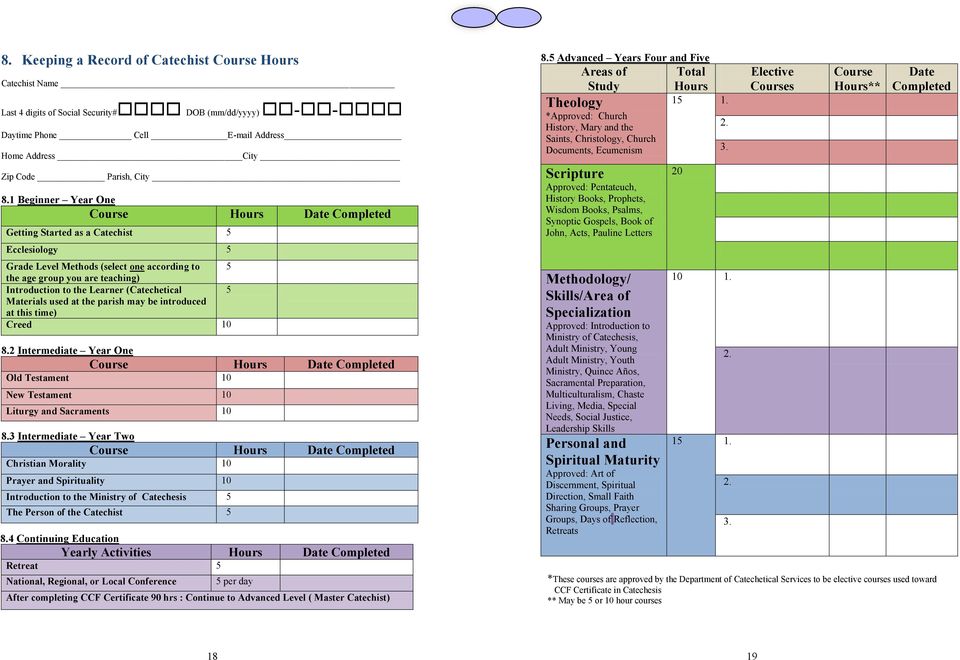
12 8. Keeping a Record of Catechist Course Hours Catechist Name Last 4 digits of Social Security# DOB (mm/dd/yyyy) -- Daytime Phone Cell Address Home Address City Zip Code Parish, City 8.1 Beginner Year One Course Hours Date Completed Getting Started as a Catechist 5 Ecclesiology 5 Grade Level Methods (select one according to 5 the age group you are teaching) Introduction to the Learner (Catechetical 5 Materials used at the parish may be introduced at this time) Creed Intermediate Year One Course Hours Date Completed Old Testament 10 New Testament 10 Liturgy and Sacraments Intermediate Year Two Course Hours Date Completed Christian Morality 10 Prayer and Spirituality 10 Introduction to the Ministry of Catechesis 5 The Person of the Catechist Continuing Education Yearly Activities Hours Date Completed Retreat 5 National, Regional, or Local Conference 5 per day After completing CCF Certificate 90 hrs : Continue to Advanced Level ( Master Catechist) 8.5 Advanced Years Four and Five Areas of Study Theology *Approved: Church History, Mary and the Saints, Christology, Church Documents, Ecumenism Scripture Approved: Pentateuch, History Books, Prophets, Wisdom Books, Psalms, Synoptic Gospels, Book of John, Acts, Pauline Letters Methodology/ Skills/Area of Specialization Approved: Introduction to Ministry of Catechesis, Adult Ministry, Young Adult Ministry, Youth Ministry, Quince Años, Sacramental Preparation, Multiculturalism, Chaste Living, Media, Special Needs, Social Justice, Leadership Skills Personal and Spiritual Maturity Approved: Art of Discernment, Spiritual Direction, Small Faith Sharing Groups, Prayer Groups, Days of Reflection, Retreats Total Hours Courses Course Hours** Date Completed *These courses are approved by the Department of Catechetical Services to be elective courses used toward CCF Certificate in Catechesis ** May be 5 or 10 hour courses 18 Diocese of Dallas September 17, 2010 Department of Catechetical Services 19 Diocese of Dallas September 17, 2010 Department of Catechetical Services
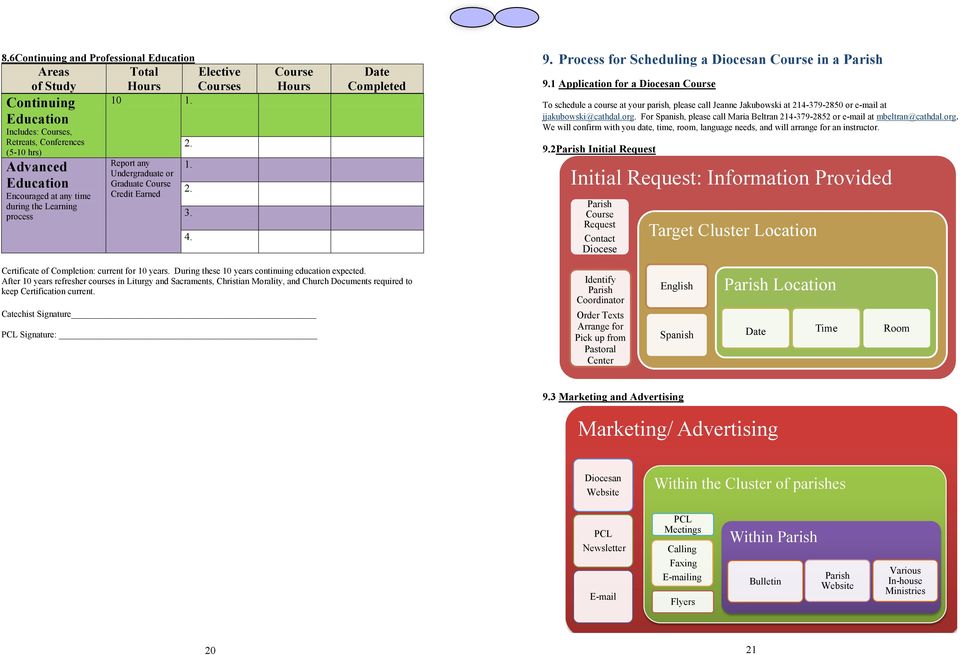
13 8.6Continuing and Professional Education Areas of Study Continuing Education Includes: Courses, Retreats, Conferences (5-10 hrs) Advanced Education Encouraged at any time during the Learning process Total Hours Report any Undergraduate or Graduate Course Credit Earned Courses Course Hours Date Completed 9. Process for Scheduling a Diocesan Course in a Parish 9.1 Application for a Diocesan Course To schedule a course at your parish, please call Jeanne Jakubowski at or at [email protected]. For Spanish, please call Maria Beltran or at [email protected] We will confirm with you date, time, room, language needs, and will arrange for an instructor. 9.2Parish Initial Request Initial Request: Information Provided Parish Course Request Contact Diocese Target Cluster Location Certificate of Completion: current for 10 years. During these 10 years continuing education expected. After 10 years refresher courses in Liturgy and Sacraments, Christian Morality, and Church Documents required to keep Certification current. Catechist Signature PCL Signature: Identify Parish Coordinator Order Texts Arrange for Pick up from Pastoral Center English Spanish Parish Location Date Time Room 9.3 Marketing and Advertising Marketing/ Advertising Diocesan Website Within the Cluster of parishes PCL Newsletter PCL Meetings Calling Faxing ing Flyers Within Parish Bulletin Parish Website Various In-house Ministries 20 Diocese of Dallas September 17, 2010 Department of Catechetical Services 21 Diocese of Dallas September 17, 2010 Department of Catechetical Services
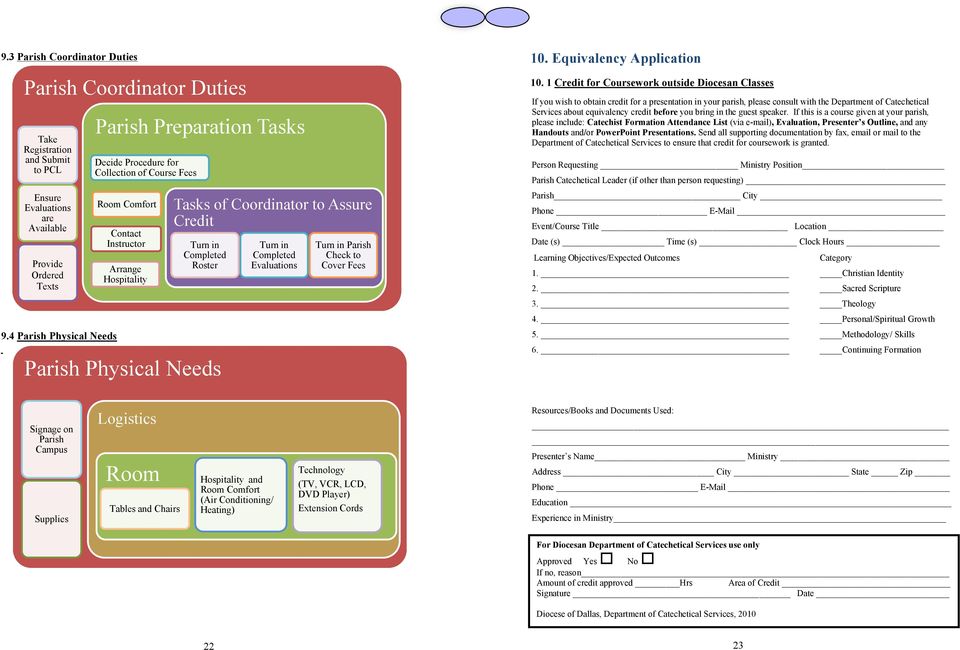
14 9.3 Parish Coordinator Duties Parish Coordinator Duties Take Registration and Submit to PCL Ensure Evaluations are Available Provide Ordered Texts 9.4 Parish Physical Needs Parish Preparation Tasks Decide Procedure for Collection of Course Fees Room Comfort Contact Instructor Arrange Hospitality Tasks of Coordinator to Assure Credit Turn in Completed Roster Parish Physical Needs Turn in Completed Evaluations Turn in Parish Check to Cover Fees 10. Equivalency Application Credit for Coursework outside Diocesan Classes If you wish to obtain credit for a presentation in your parish, please consult with the Department of Catechetical Services about equivalency credit before you bring in the guest speaker. If this is a course given at your parish, please include: Catechist Formation Attendance List (via ), Evaluation, and any Handouts and/or PowerPoint Presentations. Send all supporting documentation by fax, or mail to the Department of Catechetical Services to ensure that credit for coursework is granted. Person Requesting Ministry Position Parish Catechetical Leader (if other than person requesting) Parish City Phone Event/Course Title Location Date (s) Time (s) Clock Hours Learning /Expected Outcomes Category Christian Identity Sacred Scripture Theology Personal/Spiritual Growth Methodology/ Skills Continuing Formation Signage on Parish Campus Supplies Logistics Room Tables and Chairs Hospitality and Room Comfort (Air Conditioning/ Heating) Technology (TV, VCR, LCD, DVD Player) Extension Cords Resources/Books and Documents Used: Presenter s Name Ministry Address City State Zip Phone Education Experience in Ministry For Diocesan Department of Catechetical Services use only Approved Yes No If no, reason Amount of credit approved Hrs Area of Credit Signature Date Diocese of Dallas, Department of Catechetical Services, Diocese of Dallas September 17, 2010 Department of Catechetical Services 23 Diocese of Dallas September 17, 2010 Department of Catechetical Services
15 2010 Diocese of Dallas Chapter 2 Parish Catechetical Leader (PCL) Diocese of Dallas ormaton I have seen the Lord. Jn 21:18 26

16 Chapter 2 1. Catechetical Leadership Formation Program (CLFP) 1.1 Audience Those who are just getting started as Catechetical Leaders Professional Level (Degreed) Catechetical Leaders who need competency in Methodology are encouraged to complete Year 1 Ministerial Skills coursework Experienced Catechetical Leaders who want ongoing theological formational opportunities are encouraged to take Year 2 Theological Studies 1.2 Goals To provide formation and ministerial skills for the Parish Catechetical Leaders To lead participants towards a basic knowledge and understanding of the Catholic faith To establish a network between Parish Catechetical Leadership To provide an opportunity for personal and spiritual growth 1.6 Location Department of Catechetical Services Pastoral Center (First Floor Conference Room) 3725 Blackburn Street Dallas, Texas VLCFF University of Dayton online courses Please go to vlc.udayton.edu to register for required course work. The student will schedule courses according to their personal needs. Contact Information: For further information please contact Jeanne Jakubowski at (214) or e- mail at [email protected]. To register, please contact Maricarmen Corona at (214) or [email protected]. 1.3 Criteria for Entrance Presently involved in catechesis Willing to complete all sessions within 3 years Committed to Continuing Formation 1.4 Requirements for Completion A total of 100 Clock Hours in Ministerial skills A total of 155 Clock Hours in Theology A written paper at the end of each semester to be determined by director 1.5 Costs for (Subject to Change) Cost for Year 1 Ministerial Skills o $25 per Diocesan course x 10 = $250 (including books, paid to Diocese of Dallas, Department of Catechetical Services) o $40 per U Dayton VLCFF Courses (not including books) x 2 = $80 (course fee paid directly to University of Dayton, books purchased through Amazon.com) Cost for Year 2 Theological Studies: o $25 per Diocesan course x 5 = $125 (including books, paid to the Diocese of Dallas, Department of Catechetical Services) o $40 per University of Dayton VLCFF course (not including books) x 5 = $200 (paid directly to the University of Dayton; books purchased through Amazon.com) o All classes are scheduled Wednesdays, 9:30 a.m. 4:00 p.m

17 TOTAL 2. CLFP List of Courses / Personal Planning Sheet 2.1 Planning Sheet 1. Ministry Skills Name Parish Work Phone Home Phone Cell Phone Business Address BA in Theology or Related Field University Degree Field MA in Theology or Related Field University Degree Field Ministry or Basic Catechist Certificate (describe) Ministry Skills Year Courses Hours Introduction to Catechesis* 25 Pastoral Leadership for Effective Ministry 5 Developing Good Leadership Skills 5 Models of Catechesis for Parish Programs 5 Parish Catechesis for All Ages 5 Caring for Catechists, Volunteers 5 Developing a Budget 5 Building and Maintaining Good Ministerial 5 Relationships Fostering Diversity and Inclusion in Parish 5 Communities Maintaining a Professional Balance 5 Catechesis for a Just World* 25 Vocation, Spirituality and Discipleship of 25 Catechists* Spirituality and Inclusive Faith 25 Communities* Designing a Parish Catechetical Plan* 25 Overview of the GDC & NDC (Seminar)* 15 Retreat 5 Venue (Online, Diocesan, Other) Date Completed Diocesan CLFP Certificate Diocese of Intention to begin Training (describe) 2.2 Planning Sheet 2. Theological Studies Theological Studies Hours Year Courses Ecclesiology 5 Mary and the Saints 5 Ecumenism 5 Christology 5 Church History 5 Introduction to Scripture* 25 We Believe: The Creed* 25 Prayer* 25 Christian Morality* 25 Sacraments* 25 Retreat 5 TOTAL *Offered through the University of Dayton Venue (Online, Diocesan, Other) 2.3 Planning Sheet 3. Continuing Education Formational Function Hours Continuing Education Venue (Online, Diocesan, Other) Date Completed Date Completed Date Program Completed Date Certificate Issued 29 30

18 After Certificate of completion, Parish Catechetical Leaders are expected to maintain a Program of Continuing Education Hours keeping themselves up to date on New Documents, Trends, Skill Sets, etc. with at least 20 hours of Continuing Education hours per year. 3. CLFP Course Descriptions 3.1 Theological Year St. Augustine describes the study of Theology as Faith seeking understanding. It is with this in mind that we, as adults, may begin to realize that the doctrine we learned by rote or simple explanation as a child, needs to be revisited as we grow and mature into adulthood and seek mature answers to more complicated questions. With this in mind, our Bishop has asked that we not only form the children and the Catechists we serve, but call ourselves to be life-long learners in the faith. Our CLFP program uses the partnering that has been set up between the Diocese of Dallas and the University of Dayton Virtual Learning Community for Faith Formation (VLCFF) to aid us in accomplishing the formation of our Parish Catechetical Leaders. VLCFF The Virtual Learning Community for Faith Formation is an initiative which offers adult religious education and faith formation anytime and anywhere via the internet. The goal is to support the Church's professional ministry of religious education and faith formation in cyberspace. 13 By offering courses in Theology and Basic Skills to leaders in ministry, the Diocese of Dallas in partnership with U Dayton, prepares its students with college style coursework and a potential international student body of coursemates. 3.2 Ministerial Skills Year Building Community According to the National Certification Standards for Lay Ecclesial Ministers, the PCL has a definite responsibility to build community in parish programs. But on a larger scale, he/she has a special responsibility to integrate faith formation into the larger faith community of the parish. To examine the nature, purpose and importance of community from the sociological, theological, and catechetical perspective To review the principles and looking at the research for the formation and functions of a community To apply principles in Catechetical Programs for children and youth To apply the principles to adults, including those catechized, parents, catechists and other volunteers Catechizing for a Just World The National Certification Standards for Lay Ecclesial Ministers gives us a code of ethics for those in ministry to the parish. This code of ethics for the PCL incorporates the Church s teachings on Catholic 13 Virtual Learning Community for Faith Formation. University of Dayton, Institute for Pastoral Initiatives Webpage (accessed May 16, 2009) 31 32

19 Social Teaching. It is the job of the PCL to connect the Scripture and Church documents that provides a framing perspective of the Catholic teachings on Social Justice. To come to an awareness of our call to justice To teach the basic principles of the Church s Social Teaching To explore the difference between social justice and charity To reflect on Catholic tradition of peacemaking To identify possible action ideas to help implement the call to justice in the parish To act according to a personal code of ethics to which we are called to adhere according to Church teaching. Communicating Effectively Communication is a skill that is listed under the specific responsibilities of a PCL in the National Certification Standards for Lay Ecclesial Ministers. The Parish Catechetical Leader has responsibility to know how to advocate for catechesis and evangelization. They must also develop speaking and listening skills to enable themselves to keep others informed, (including the pastor and parish staff, parishioners and diocesan offices with which they interact) and, in turn, to keep themselves informed. Learning what communication skills are o Verbal skills o Non-verbal communication o Listening skills Learning about Small Group Dynamics Learning Conflict Resolution Learning to master the Art of Public Speaking Learning to master the written word and interpersonal relationships Developing a Parish Program Developing a Parish Program requires more than one skill. It requires theological as well as sociopsychological understanding about the faith learner as well as familiarity about methodological skills of teaching in the faith formation classroom. The PCL must know the principles of family life and the family life cycle and be sensitive to multiculturalism in his/her programs and in his/her larger parish community Understanding the need for ongoing faith formation for the all ages and stages, a vision of comprehensive Catechesis o Forming a Mission Statement o Looking at the best model for your parish Learning components of a comprehensive model Building a program to suit the needs of the parish Learning the Developmental Stages of the students served and various Catechetical Structures to best serve their needs 33 Identifying basic principles and programming strategies for Adult Formation Forming Ministerial Relationships In their person and relationships, PCLs must reflect the good news of being in relationship with Jesus Christ. The vocation of PCL calls for a person who can build relationships with the children, teens, and/or adults to whom they minister. They must also work as collaborators with pastors, co-workers, and parents to help the parish function in the best way possible. This course will explore: The Institutional and Structural requirements in Parish Leadership Intra-Parish Relationships Relationships with Families And Effective Programming and how this makes for good relationships and collaboration Keeping Records and Budgets Being a good steward, in a ministerial sense, means not only caring for how money is spent and collected but also how we budget our time and how we treat those under our direct management and those in our care. Stewardship also includes caring for the resources we have been given and the facilities which we use. It means spending wisely to help the parish to do the most efficient and effective ministry with what they are able to give. In a Church setting, sacramental and attendance record-keeping are very important and we must be accurate and attentive to those we serve Hiring staff and bringing in volunteers who have the skills to accomplish the job is a responsible use of resources Keeping accurate records and accounting for staff and volunteer personnel is also important Budgeting, and all the facets which it entails, helps the ministry to function at its highest capacity and assures that we are practicing good stewardship in managing the business area of our ministry Maintaining Professional Balance Professional Balance means keeping oneself well-balanced in all areas of life, whether it is professional, personal, spiritual or emotional. Often, like a juggler, we are called to balance many plates in the air at once. We are called on to be teacher, liturgist, theologian, Scripture scholar, parent, business manager, and referee, all on the same Sunday morning or Wednesday afternoon. To cultivate the gifts we will need to face this task To build the friendships and relationships we will need to help us To lead a life that has time for job, family and God To enrich and deepen one s spiritual life To understand our place in the Church Recruiting and Training Volunteers 34

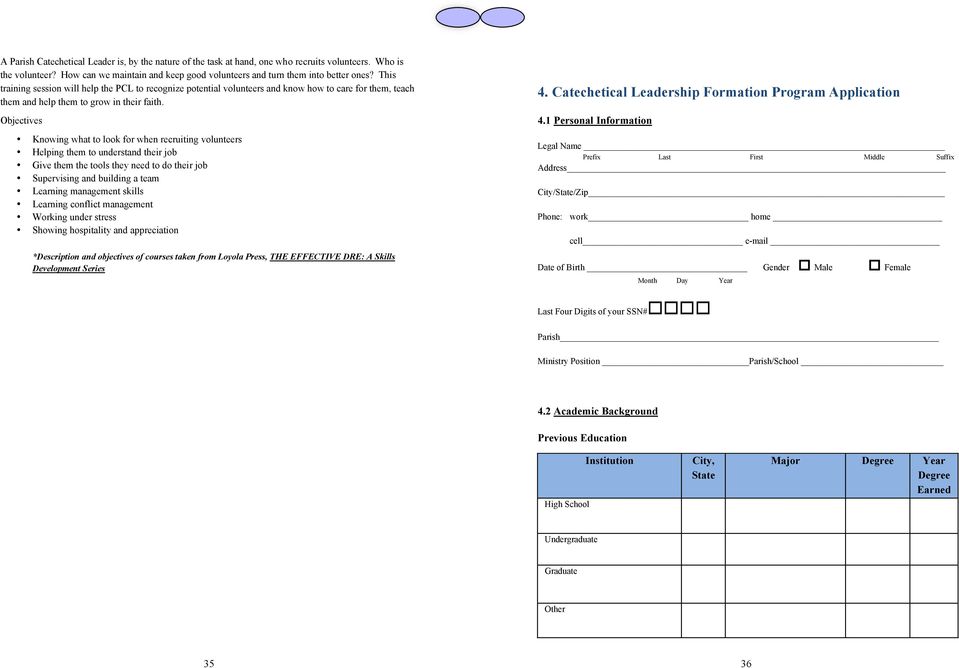
20 A Parish Catechetical Leader is, by the nature of the task at hand, one who recruits volunteers. Who is the volunteer? How can we maintain and keep good volunteers and turn them into better ones? This training session will help the PCL to recognize potential volunteers and know how to care for them, teach them and help them to grow in their faith. Knowing what to look for when recruiting volunteers Helping them to understand their job Give them the tools they need to do their job Supervising and building a team Learning management skills Learning conflict management Working under stress Showing hospitality and appreciation *Description and objectives of courses taken from Loyola Press, THE EFFECTIVE DRE: A Skills Development Series 4. Catechetical Leadership Formation Program Application 4.1 Personal Information Legal Name Prefix Last First Middle Suffix Address City/State/Zip Phone: work home cell Date of Birth Gender Male Female Month Day Year Last Four Digits of your SSN# Parish Ministry Position Parish/School 4.2 Academic Background Previous Education High School Institution City, State Major Degree Year Degree Earned Undergraduate Graduate Other 35 36
21 Experience in Ministry Ministry City, State Title Years of Service 4.3 Pastor s Letter of Recommendation As part of the registration for the Catechetical Leadership Formation Program, the Catechetical Leader must send a letter of recommendation from his/her Pastor to the Department of Catechetical Services. Here is a sample: Date To the Department of Catechetical Services: I, recommend for admission Catechist Certificate Level Location of Training: City, State Year of Completion Pastor/Supervisor Name of Applicant into the Diocese of Dallas Department of Catechetical Services two year Catechetical Leadership Formation Program which provides training in developing Ministerial Skills as well as basic Theology. I understand that this two year commitment requires the participant s time to attend classes and to complete any reading and written assignments. This preparation which should be a part of an ongoing process of formation, meets the directives of the United States Bishops Conference as expressed in the National Directory for Catechesis: the single most critical factor in an effective parish catechetical program is the leadership of a professionally Parish Catechetical Leader. 142 Sincerely, Title (Pastor or Parish Administrator) 14 NDC, no.54b
22 4.4 Written Assignment Written 3-5 page paper (one inch margin, double spaced, 12 font using Ariel or Times Roman) in English or Spanish on topics assigned by Department of Catechetical Services Associate Director of Programs and Projects The paper should have a Cover Sheet listing Title, Name of Student, Parish of Student, Student e- mail address or home address and date. Include Title Page Footnote (or include a page with texts cited) when you use another s words or ideas from a text or a document Please or mail your paper by specified date to Jeanne Jakubowski at [email protected] or Department of Catechetical Services 3725 Blackburn, Dallas,75219 Evaluation will be made based on: o Substantial content o Use of supporting materials o Success in putting forth an objective analysis o Correct usage of language, e.g. punctuation, spelling, sentence structure 5. Online Educational Opportunities Catechetical Leadership Formation Program uses the University of Dayton Online Courses as part of its formation program. 5.1University of Dayton The University of Dayton offers courses and seminars online through its Virtual Learning Community of Faith Formation (VCLFF). The Diocese of Dallas has partnered with this educational institution to offer online learning formation opportunities based on the evolving lifestyles of her members today. Those in the Catechetical Ministries are encouraged to use these courses as another alternative to gaining the needed hours towards the certificate in Catechetical Leadership Those in our Catechetical Leadership Formation Program will be receiving formation in seven course areas of VCLFF beginning coursework: Year 1 o o Introduction to Catechesis Survey of Catholic Social Teaching Year 2 o o o o o Introduction to Scripture We Believe: The Creed Christian Morality Sacraments Prayer 5.2 University of Dallas The University of Dallas, School of Ministry has online coursework in both its Master s Program and its Biblical School. These Master s Level Courses may be used in the Professional Level Certificate process of the Diocese. Courses taken through the Biblical School may count in the area of Sacred Scripture. PCLs are responsible for providing the Department of Catechetical Services with proof of courses completed. 5.3 Alternative Online Opportunities Online Undergraduate and Master s Programs are offered by many Catholic Universities To find more information on online Catholic degree programs go to:
23 6. Continuing Formation for Professional Level Parish Catechetical Leaders 6.1 After Completion of CLFP Program For those completing the Catechetical Leadership Formation Program (CLFP) or those Parish Catechetical Leaders (PCLs) who have a Bachelor s or Master s Degree in Theology or related fields it is recommended that they complete a minimum of 20 hours of continuing education each year. These hours may include Catechetical Workshops, Retreats, and Seminars; Local, Regional, or National Catechetical Conferences; and Coursework in Theology or Methodology. To record and receive credit with the Department of Catechetical Services, see Equivalency Application Form. 6.2 Higher Education The Department of Catechetical Services highly encourages Parish Catechetical Leaders to afford themselves, when possible, the opportunity of earning a Bachelor s and/or a Master s degree in Theology or a related field. After reaching one s personal goal of an undergraduate or graduate degree, 20 hours of continuing education each year is recommended. CEUs or Continuing Education Units These may be earned through the School of Ministry, Adult Faith Formation courses, or Catholic Biblical School of the University of Dallas. Online continuing education credit may be earned through the School of Ministry s Online Biblical School of the University of Dallas or the University of Dayton Virtual Learning Community Of Faith Formation (VLCFF). Undergraduate Credits in Theology or a Related Field These may be earned through our local Catholic University, The University of Dallas, online through the Diocesan partnership with the University of Dayton VLCFF program, or with a number of other reputable Catholic Universities throughout the country. Master s Credits in Theology These may be earned through the Braniff Graduate School of the University of Dallas, (M.A. in Theology, or a Master of Theology (MT), or through its School of Ministry which offers a Master s in Theological Studies ( MTS), Master s in Religious Education (MRE) or a Master s in Pastoral Ministry (MPM). Chapter 3 Instructors and Ministerial Skills 2010 Diocese of Dallas 41
24 Chapter 3 1. Instructor Qualifications and Requirements 1.1 Theology Instructors All instructors must have earned a Master s Degree in Theology or closely related field. o Exceptions may be made for someone with general equivalencies at the Masters level, at the discretion of the Diocesan Director of Catechetical Services o Exceptions may be made if an individual has outstanding credentials in a particular field. That individual would be allowed to teach only in that field at the discretion of the Diocesan Director of Catechetical Services Be willing to teach at parishes within the Diocese of Dallas Fill out Instructor Application Provide a resume Be willing to teach from materials provided by the diocese and fulfilling the goals and objectives set forth by the Department of Catechetical Services under the auspices of the Bishop Submit application along with proof of a current Safe Environment Clearance through a Parish, Catholic School or the Diocese of Dallas, or request a clearance to be processed through the director of the Department of Catechetical Services at Provide the Department of Catechetical Services with two recommendation letters, including one from the pastor If an instructor has taught through the Diocese before, we ask that information be kept current by sending updates of any information which has changed to the Department of Catechetical Services After completing the application process, the candidate will be interviewed by the Associate Director of Programs and Projects After fulfilling all the requirements, the candidate will be notified of his/her acceptance or refusal 1.2 Methodology and Ministerial Skills Instructors Instructor s Requirements Those who wish to be Ministerial Skills Instructors must fulfill the following requirements: Be a Certified Parish Catechetical Leader (having completed CLFP or with degree in Theology) with Classroom Experience Catholic School Religion Teachers Certified Catechist with at least 5 years classroom experience Certified Grade Level Coordinator (CLFP or degree in Theology) And must fulfill the following requirements: Must have attended an Echoes of Faith orientation class Must have observed another instructor Must be willing to have diocesan personnel monitor a course in progress as the person presents Must be approved by the Diocesan Department of Catechetical Services Preach the Gospel at all times --- If necessary, use words. St. Francis of Assisi 42 43
25 2. Instructor Application Form Name Last First Middle Address City/State/Zip Ministry Work Experience Parish/School Field of Ministry Date From To Parish Phone work home cell SSN #-- (for stipend purposes) Type of Education Experience Additional Training/ Workshops/ Coursework Host Area of Knowledge/ Skill Date Mailing Address (if different from above) Current Ministry Position Parish/School Are you a US citizen or alien legally authorized to work in the United States? Yes No Provisional Approval Granted Expiration Date Certificate Programs Granting Agency Date Granted Area of Certification May teach only the following coursework College/University Date Attended From To Educational Background Date of Graduation Degree Major Minor/ Area of Concentration May teach only with Mentor Availability Days of the week available Times of day Geographical Preference (Area of Diocese, Parish, etc.) Courses/Topics that you prefer Language Preference Please return to the Pastoral Center with the following 2 letters of recommendation (one of these should be from the Pastor, Catholic School Principal or Parish Supervisor) Proof of current Safe Environment Clearance (or ask for screening forms) Resume 44 45
26 3. Instructional Preparation We ask that instructors send an outline of the course prior to the first class, or if he/she have taught this class before and wish to change the outline, we ask that an updated outline be sent to the Department of Catechetical Services The Department of Catechetical Services will act as a liaison between the parish and the instructor o This office will secure the name and cell phone number of a person who will act as the parish contacts (usually the PCL or Adult Faith Formation Director) in case the instructor needs to contact them for classroom location, equipment request, or other additional needs. Please arrive at least hour before your class begins to be able to prepare for the class If the instructor is not able to teach because of an unforeseen emergency, please call or call the parish contact For special equipment needs for the class, please inform the Jeanne Jakubowski [email protected] or Maria Beltran [email protected] for Spanish courses at least one week prior to the class The instructor must consult with parish coordinator to find out if the books need to be picked up from the Department of Catechetical Services. Call Jeanne or e- mail [email protected] Evaluations and complete rosters will be turned in by Parish Coordinator/PCL with any unused books as soon as possible to the Department of Catechetical Services along with any unused books as soon as possible Feel free to use supplementary printed resources. Call Jeanne at at the Diocesan Catechetical Services Department to ask about available resources Instructors are teaching for the Church in the name of the Bishop. Personal opinions and personal devotions should be just that If the instructor needs handouts to be copied by the Department of Catechetical Services, they should be sent at least one week in advance. They should be mailed or ed to Jeanne at [email protected] or Maria Beltran [email protected]. Handouts will be printed according to registered number of students (unless otherwise specified) PowerPoint Presentations are available for some of the courses. Please contact Catechetical Services Department for these ancillary materials 3.2 Stipend The stipend for a five hour course is $200 and $ for a ten hour course. If a course is cancelled the day before or the day of the course, a small remuneration ($50.00) will be provided in recognition of the work already done to prepare for the course. 3.3 Evaluation and Student Attendance Rosters Please allow10-15 minutes at the end of last session of the course for the students to fill out evaluations. Attendees will not receive credit if they do not turn in an evaluation The Department of Catechetical Services will request your stipend only after receiving evaluations and the attendance roster. Be aware that it may take up to two weeks, after the course finishes, to receive stipend. 3.4 Safe Environment Clearance For as long as an instructor teaches for the Department of Catechetical Services, current proof of Safe Environment Clearance must be maintained. For assistance or questions, please feel free to call Jeanne at Equipment Here is a list of the equipment available if needed on a first come first serve basis: PowerPoint projector and Laptop Markers and Flip Charts Extension cords We will check with the parish contact first, if they do not have the needed equipment, then we will see if the Department of Catechetical Services can lend the equipment to the instructor on a first come first serve basis at or [email protected]
27 4. How Adults Learn: Principles of Adult Learning The following ten principles are essential for the development and presentation of effective programming for adults. They provide presenters and facilitators with basic guidelines to consider in their preparations. Adults learn best when Participants feel their time is well spent. Most important of all, the learning experience must be well planned and executed. It must also be pertinent and practical. Adults are seldom motivated by the theoretical or learning that will some day be valuable. If adults do not consider their faith as integral to their overall lifestyle, the application of this principle is especially challenging in contexts of religious and moral formation. They are treated with respect as mature and intelligent adults. Adults will not participate if they feel they are being talked down to, ridiculed or ignored, or perceive they have been given simplistic explanations. They are with their peers whom they perceive to have similar experiences and needs, and the format allows them to interact with other participants. Adults learn by sharing their experiences. When adults are in small groups of six to eight, they tend to feel freer to react, discuss, question, share and comment. The learning environment is suited to their physical and emotional needs. The program schedule and room layout must take into consideration hearing, vision, seating comfort, groupings, socialization, refreshments and restroom breaks. Adults are at ease when they know the time format and where restrooms and other facilities are located. The learning situation is related to their experience, a rich resource which should be tapped and related to in the learning process. The learning experience needs to enhance their present interests or help them on an immediate practical or personal level. In faith formation, experience can also be a block or challenge if adults are resistant to new ideas or understandings. They can set their own goals and be involved in the planning of the learning activity. When the goals of each presentation are explained clearly, participants can commit more fully to the process. Early in the experience, adults should be asked their expectations. There are a variety of learning activities (audiovisuals, discussions, exercises, reflections and prayer experiences) provided to accommodate a diversity of learning preferences and styles. They participate in problem-centered situations such as reflection questionnaires, simulated problems and case studies, and questions for reaction and comment. Opportunities to write their responses are provided to help them clarify and share their ideas. It is helpful when participants can write their individual responses or record their responses as a small group, and when responses shared in large group are recorded for all to see on a whiteboard or large tablet. Taken from Do s and Don ts: Facilitating a Small Group by Sr. Donna L. Ciangio, O.P. Pamphlet from National Pastoral Life Center. 5. Suggested Catechetical Lesson Plan 5.1 Lesson Plan The Catechetical Lesson Plan According to the Ecclesial Method provided below is from Topic of Catechesis Date Audience I. Learning (the participant will ) for deeper understanding for inviting learners to a change of heart II. Materials/Resources Needed (textbooks, media/technology, supplies, handouts, etc.) III. Catechetical Foundations A. Christocentricity: What does this topic have to do with Jesus and the love that never ends? B. Scriptural Driving Force: Which foundational scriptures will be used so the teaching relies on God s Word? C. Primary Catechism Sections: Which texts from the Catechism of the Catholic Church are central to understanding this topic? D. Other Important Resources: What other creative resources will be helpful in this catechesis? (textbook pages, websites, other books, maps, movie clips, music, art, stories, newspaper articles, etc.) IV. Procedure A. Preparation (calculated disengagement/prayer) B. Proclamation (short, poignant statement of heart/core truth of teaching) C. Explanation (content and method of delivery) D. Application (of doctrinal topic to personal life and to culture/real world) E. Celebration (ending in a place of gratitude and praise) and assignment V. Evaluation/Alterations for next time 48 49
28 6. Sample Course Outline Instructor Last First Middle Course Title Date (s) Time (s) Location Course Description 2010 Diocese of Dallas Learning Objective Chapter 4 Courses and THEOLOGY SCRIPTURE PERSONAL AND SPIRITUAL MATURITY METHODS AND MINISTERIAL SKILLS Related Concepts 50
29 Chapter 4 1. Core Curriculum 1.1Theological Modules Course Descriptions and Christian Morality Moral life is not reduced to a series of prohibitive principles regarding certain kind of life style. It is an ongoing discovering of how the Spirit lives within us and how the life of the Church nourishes human will to make the right choice regarding our behavior, way of living, administration of goods, human care, promotion of life and well being of all God s children. Although these issues seem to be a personal matter, the decisions we make about them have social implications that we need to be aware of. Articulate an understanding of Morality as the human person s response to the call to discipleship Understand Morality as a matter of discipleship and ongoing conversion to values of the Kingdom of God Understand Theology of sin and grace Understand the formation of conscience Identify the foundational sources of Christian Morality: Natural Law, Scripture, and Church Teaching Understand Morality s social dimension Christology Who do you say I am? This is a fundamental question not only because its context in the gospel, but for the very fact that the Church has been answering this question right from the beginning, defending and teaching Jesus humanity and divinity; expressing its truth through Ecumenical councils, Tradition, the teachings of the Church, images and faith truths around Jesus life, passion, death and resurrection. A fascinating course that presents the origins and developments of the Theology about Jesus Christ, true God and true Man. Understand Jesus of Nazareth s human and historic reality Recognize Jesus resurrection Understand the Incarnation and its purpose for our salvation Recognize Jesus Christ as the fullness of true humanity Identify Jesus presence among us Identify Jesus Christ as the Lord of the future in interreligious dialogue Church History Thou hast made us for thyself, O Lord, and our hearts are restless until they find their rest in thee. St Augustine Reading Church History goes beyond a series of facts that happened certain time in human history. On the contrary, we read our own history and how the spirited community saw herself immersed in human history. These events and actions are filled with joy and sorrow that remember an essential truth for us: We are the Mystical Body of Christ in human history, in the struggle to remain faithful to the Gospel, and to see ourselves as the mustard seed that should grow and bear fruit
30 Understand a faith in formation; the Early Church Identify the Christian Faith; the Christian Ideal Explain the divisions in Church History Identify Afro-American and Hispanic Presence Understand the Faith in a Revolutionary Age Articulate an understanding of the Legacy for the Third Millennium The Creed This course addresses the major elements of the Catholic Profession of Faith: the Trinitarian images of God the Father, God the Son, and God the Holy Spirit, as well as the Church as the Body of Christ. In addition, it presents a better understanding in the development of its key creedal statements and basic truths of our faith, so we feel more confident in sharing them with others. Identify and begin to integrate the four signs of the Catholic Message of Faith: Biblical, Ecclesial, Liturgical, and Natural Understand Scripture and Tradition Understand the development of Doctrine Identify the fundamental elements of the message of Salvation: o God o Creation o Jesus Christ o Holy Spirit o Church o Sacraments o Grace o The Moral Life o Mary and the Saints o Death, Judgment, and Eternity Ecclesiology This course develops a theological study about the Church. As believers, we must take a closer look to its liturgical life and its historical development and how the church sees herself through the centuries as the manifestation of the Holy Spirit. This developing is the work of the Holy Spirit expressed not only in the history or the marks of the Church, but also in the communion and mission that has been entrusted the community of believers lead by the shepherds. This course will lead the students to extend their vision with respect to the nature and ministry of the Church. Develop an appreciation of the fact that the call to ministry comes from God Understand that ministry demands a vibrant, growing relationship with God and others, and it is out of such relationship that genuine ministry flows Ecumenism Identify Jesus model of ministry Understand the place of the Holy Spirit inspiring ministry Understand the place of prayer in the minister s life Understand the apostolic activity of those who minister in Christ s name This course introduces the learner to an understanding of the Catholic faith tradition in relation to other Christian traditions; the religious beliefs, gifts, values, and traditions commonly shared by the different Catholic churches and other Christian communities; and the significant ecclesiological renewal conformed by Vatican II. (NCS #520.06, #520.15, #520.17) Note the context of catechetical work in light of the Church s teaching and American culture Focus on the methods and content of Catholic formation on the ecumenical horizon Look briefly at the churches which we relate, and note the level of relationship Introduce the implications of the dialogues for catechesis in various areas Survey the concerns important for sacramental preparation Provide suggestions for developing experiences of ecumenical mission Enumerate resources that can be helpful for unity Liturgy and Sacraments This course constitutes a fabulous introduction to the history, theology and practice of the sacraments and its celebration in the Catholic Church. As believers, we need to be aware of the historical development and pastoral practice of these the ritual celebrations. At the same time, we need to know what the Church teaches and celebrates around these channels of grace or God s self- revelation to us. Identify the Seven Sacraments Identify sacraments of Initiation, Service, and Healing Understand the Sacraments as encounters with God and others Understand Jesus as the living sacrament of God, and the Church as a sacrament in the world Describe the four major movements of the Eucharistic Liturgy: Gathering Rite, Liturgy of the Word, Liturgy of the Eucharist, Concluding Rite Identify Scriptures as basic to Liturgy Understand the Liturgy of the Hours, the Liturgical Year, and Sacred Art Mary and the Saints The essence of this course is often the hottest topic when talking with non-catholics. The author explains to us how the veneration of Saints was born within the Roman Catholic Tradition and the development within the history. Mary, as model of sainthood is there as well, in the middle of the controversy but also, as the leading figure in veneration. The author takes the reader into history and pastoral practices concerning veneration of saints, canonization process and the criteria to declare that Mary, indeed, had appeared in a certain place, according to the Church
31 Recognize the presence of Mary in the New Testament Identify the significance of Mary through the centuries Recognize the theological importance of Marian apparitions Identify the importance of Mary and the Saints in the modern world Understand the process of Canonization New Testament This course will journey through the History of Salvation in which humanity is saved once and for all through the sacrifice of Jesus Christ, the Son of God. It will introduce the student to Jesus constant message of love and forgiveness; his confrontation with the religious authorities of his time; and the understanding of his message after his passion, death, and resurrection; and finally the spread of his message to all the confines of the earth. Understand Jesus Role in the History of Salvation Recognize the Central message of Jesus preaching Recognize the difference between Synoptic Gospels and the Gospel of John Identify the Acts of the Apostles; Role of scripture in the life of the early Church Understand the Pauline Letters; Jesus message is spread Understand the place of Scripture in the believer s life of study, prayer and liturgy Articulate an understanding of Christian Spirituality Understand Spirituality as a Theological field of study Understand the place of relationship in the Christian spiritual life Understand the place of prayer in the spiritual life Recognize the tradition of discernment within the Catholic Christian spiritual tradition Theological Reflection The discernment between our desires and God s will is a constant in our lives. This reflection should take place in a prayerful context in the light of the written Word and the factual word. Combining prayer, Tradition, and the wisdom of the Church, this course leads us into what Theological Reflection is about and how this experience shapes our personal lives and the life of the Church itself. Understand what Theological Reflection is Understand the importance of Theological Reflection Understand the role of Experience, Tradition, and Culture in Theological Reflection Understand the method of Theological Reflection Understand the ministerial nature of Theological Reflection Old Testament This course contains fundamental information that all Catholics need in order to understand Sacred Scriptures correctly. It explores how the Jewish people experienced the presence God, choosing them as His elect and walking with them in despite of their unfaithfulness. This course will also explore how the writings of Scripture were formed over time, as the protagonists reflected theologically the historical successes of their life, and were able to see God s presence in their midst. Articulate the understanding that God reveals self through Word which is living and active in the life of God s people. Recognize the original context and literary forms of Biblical Writings Identify the process of formation of Scriptures Understand the sacredness of Scripture Understand biblical themes of Covenant and freedom Understand what is meant by Divine Revelation Identify major persons and events in Hebrew Scriptures Interpret Scripture in the modern world Prayer and Spirituality This course explores our relationship with the living God, which we call prayer. God calls, we respond. Our Christian Spirituality is centered in Jesus Christ and guided by the Holy Spirit. It is also modeled by the acceptance of Mary to the call of God, the Our Father and its seven petitions revealing the heart of the Gospel, and the Eucharist as the prayer of the community
32 1.2 Catechetical Modules Course Descriptions and Getting Started as a Catechist Getting Started as a Catechist introduces new catechists to some basics that will help them take their first steps as catechists. They will learn how to set up their classroom space, how to create an appropriate social climate for catechesis, appropriate ways to use creative activities, and the basics of session planning. Create the physical environment for catechesis Shape a social environment in which faith can be nurtured Use creative activities in learning Develop successful session plans Develop good management and discipline techniques Help learners pray together The Role of the Catechist The Role of the Catechist invites catechists to explore four aspects of their ministry in greater depth: skills for telling the story of faith, ways to walk with learners on their faith journey as teacher companions, strategies for leading prayer, and the importance of being a witness for justice and of inviting learners to do the same. Be a storyteller in religious education Understand the quality of the catechist as teacher/companion Understand the importance of leading prayer in the catechetical setting Understand the role of the catechist as a witness for justice The Person of the Catechist The Person of the Catechist addresses the spirituality of the catechist. It includes segments that explore the vocational call of the catechist, the qualities of a committed catechists, the importance of continuing formation, and the necessity for catechists to trust in the activity of the Holy Spirit as they continue in their ministry. Identify the vocation of the catechist Understand the role of the catechist in the Church s ministry Understand the qualities of a catechist as expressed in contemporary documents Understand the importance of the catechist s continued growth and understanding of the catechetical ministry Understand the role of the Spirit in the catechetical ministry of the Church 1.3 Methodological Modules Course Descriptions and Introduction to the Learner The Introduction to the Learner introduces the catechists to the process of growth and development of their learners, giving them a better understanding of the methodology used in modern catechetical materials. The catechist will have the opportunity to explore this growth and development in three areas: how we build knowledge and construct meaning; how we grow psychologically and in our ability to relate to others; how we grow in our ability to think and act morally; and how all these areas of development affect how we perceive our faith. Understand the nature of learning Understand the relationship of religion and science Understand the process of human knowing Identify the psycho-social development of the human person Understand moral decision making and the role of imagination in moral decision making Understand the relationship between moral decisions and moral actions Understand the relationship of human knowing, relating, and acting to religious faith Identify the stages of faith development Identify the journey of faith through the seasons of childhood, discipleship, and stewardship Methods for Grades (Grade 1-2; 3-4; 5-6; 7-8) Methods for Grades begins with a reflection on the life journey of faith. The three segments that follow explore strategies for helping students grow in their understanding of faith concepts, respond to the message of Jesus in age-appropriate ways, and respond to the demands of the justice dimensions of the Gospel. Identify human development characteristics Identify developmental faith needs Develop strategies for introducing the scripture and Sacred Tradition Understand the relevance of activities to faith development Identify appropriate prayer forms Develop ways to be inclusive of children with special needs *Description and objectives taken from Loyola Press, Catholic Basics: A Pastoral Ministry Series; and RCL Benziger, Echoes of Faith 58 59
33 BIBLIOGRAPHY NALM,,NAPM,NCCL,NFCYM. National Certification Standards for Lay Ecclesial Ministers. Washington, D.C., Office for Catechesis and Youth Ministry Webpage. Archdiocese of Chicago, Office For Catechesis and Youth Ministry Webpage Paul VI, Pope. "Evangelii Nuntiandi." APOSTOLIC EXHORTATION. Vatican City, December 8, Syndicate PayScale Data. PayScale-School.( ). (accessed on July 30, 2009). United States Catholic Conference of Bishops. General Directory for Catechesis. Washington, D.C.: United States Catholic Conference, United States Catholic Conference of Bishops. National Directory for Catechesis. Washington, D.C.: United States Conference of Catholic Bishops, Virtual Learning Community for Faith Formation. University of Dayton, Institute for Pastoral Initiatives Webpage (accessed May 16, 2009) Guide for the Catechist 60
34 Every disciple of the Lord Jesus shares in His mission to proclaim the Good News. To do their part, adult Catholics must be mature in faith and well equipped to share the Gospel, promoting it in every family circle, in every church gathering, in every place of work, and in every public forum. They must be women and men of prayer whose faith is alive and vital, grounded in a deep commitment to the person and message of Jesus. Our Hearts Were Burning Within Us Catechist s Guide 2010 Diocese of Dallas DIOCESE OF DALLAS
35 Table of Contents 1. Bishop s Introductory Letter The Essential Attributes of a Catechist Definition of a Catechist Vocation of the Catechist The Call to be a Catechist Qualities of a Catechist The New or Transferring Prospective Catechist Agreement... 2 In the History of the Church, Catechesis has had many champions. St. Robert Bellarmine, whose feast day is September 17 th. Doctor of the Church, noted Jesuit scholar, and apologist of the faith, is one of the patron Saints of Catechesis. Cardinal Robert Bellarmine ( ), along with other Bishops and theologians, worked diligently to systematize the truths of doctrine which aided the process of Catechesis and laid the groundwork for the publication of the Roman Catechism or Catechism of the Council of Trent, published in The Roman Catechism has been the basis for all catechisms including the Baltimore Catechism, and the1992 publication of the Catechism of the Catholic Church. Prayer for Catechists and Leaders God, our Father, You send your only Son, Jesus Christ, To show us your everlasting love; Help us to grow in your grace and knowledge. Help us to mature in our understanding of your Word And be with us as we serve as coworkers in your vineyard. Help us, as you did with your servant, Robert Bellarmine, To be humble and yet a champion of the truths Your Son commanded us to share With our brothers and sisters. Through Christ Jesus our Lord, Amen. Holy Robert Bellermine, champion of the faith, we ask that you intercede for us today as we meet, in an effort to become better servant leaders and catechists, the instrument of God s work in the kingdom Jeanne Jakubowski, Associate Director of Programs and Project Department of Catechetical Services 3. Catechist Statement of Intent Catechist Information Catechist Commitment Catechetical Plan Overview of Course and Continuing Education Course Listing Suggested Catechist Development Plan Catechetical Plan for the Master Catechist Certificate Catechetical Plan for Basic Certificate Catechetical Plan for Advanced Certificate CCF Certificate (Master Catechist) Obtaining a CCF Certificate Record Keeping Continuing Formation for Catechists Optional Programs Offering Certification Hours or CEUs Optional Programs for Undergraduate College Credits Local Optional Programs for Master College Credit Keeping a Record of a Catechist Certification Hours Beginner Year One Intermediate Year Two Intermediate Year Three Continuing Education Advanced Years Four and Five Continuing and Professional Education Equivalency Application Credit for Coursework outside Diocesan Classes Core Curriculum Theological Modules Course Descriptions and Catechetical Modules Course Descriptions and Methodological Modules Course Descriptions and Frequently Asked Questions... 24
36 1. Bishop s Introductory Letter 2. The Essential Attributes of a Catechist 2.1 Definition of a Catechist Catechists are called to share their faith, give witness, pray, model service, and build community. Catechists minister to adults, youth, and children in a variety of locations and programs such as Sacramental Preparation, RCIA, Family Programs, Scripture Study, and more. Through Word and example, catechists hand on the Catholic faith and proclaim the Gospel of Jesus Christ. 2.2 Vocation of the Catechist The General Directory for Catechesis tells us that catechists have a vocation a calling from the Lord rooted in Baptism to carry out His mandate to proclaim the Gospel. And furthermore, it states that The Church awakens and discerns this divine vocation and confers the mission to catechize. The Lord Jesus invites men and women, in a special way, to follow him, teacher and formator of disciples The Call to be a Catechist The call and response to become a catechist is recognized in the local Church by the Bishop. The response to this call includes willingness to give one s time and talent, not only to catechizing others, but to one s own growth and understanding of the faith. The call to this ministry often comes through the pastor, catechetical leader, youth minister, pastoral associate, or another catechist. 2.4 Qualities of a Catechist Catechists must possess and exhibit qualities or characteristics necessary to give credible witness to the Gospel. A catechist must: be a model of Catholic Christian faith and lifestyle; participate in the spiritual, theological, and methodological training and formation... know and abide by the parish and/or diocesan guidelines and policies promoting effective catechesis; and give sufficient preparation time for the catechetical task The New or Transferring Catechist Agreement Every Catechist must agree to: Read and sign a statement of intent Begin formation requirements for a certificate in catechesis Continue to deepen and develop his/her Personal Spirituality Commit to continuing formation Learn the Methodology and Ministerial Skills necessary to be an effective catechist Learn how to provide a Safe Environment for all students 1 USCCB, General Directory for Catechesis (GDC). (Washington, D.C.: USCCB, 2001), no.231 Office for Catechesis and Youth Ministry.Archdiocese of Chicago. (2009). - chicago.org/ (accessed on July 30, 2009). 2
37 3. Catechist Statement of Intent 3.1 Catechist Information Any person answering the call to serve as a Catechist in the Diocese of Dallas is asked to fill out this Statement of Intent. A copy should be kept in their file at the Parish. Name Address City State Zip Code 3 4. Catechetical Plan 4.1 Overview of Courses and Continuing Education Level Required Credit Hours Courses Required Expected Completion Time (starting date or date of program inception, 9/1/2010, whichever is latest) Daytime Phone Cell Phone Pre-requisites Parish, City For identification purposes in the Diocesan Database: Beginner 30 Creed: Core End of 1 st year Last 4 digits of SSN# Previous Experience in Church Ministry (Volunteer or Paid) DOB (mm/dd/yyyy) -- Intermediate 60 Core End of 3 rd year Ministry Location No. of Years Ministry Location No. of Years Faith Formation Classes hours 3.2 Catechist Commitment Other (CEUs, College Credit) hours I intend to serve my parish as a catechist beginning in (Fall/ Spring) of the year I commit to serve those in my charge to the best of my abilities, learning and growing in my faith as I serve others I commit to be active and fully participate in the sacramental life of the Church I commit to integrating the tasks of Catechesis into my ministry with those I serve: o Communicating the message of our faith o Leading Participants to a deeper understanding and active participation in liturgy and worship o Promoting moral formation o Teaching prayer o Building Christian Community and motivating participants to mission and service I intend to love, respect and pray for those in my care I understand that I must follow the diocesan and parish Safe Environment requirements for working with children and vulnerable adults I intend to advance my knowledge and skills by participating in courses, workshops, conferences and retreats as stated in the Continuing Catechetical Formation Plan, so that I may receive my Certificate in Catechesis ( Master Catechist) Advanced (Master Catechist) Continuing Education Requirements after achieving Master Catechist Certificate: Retreats, Conferences, additional Courses 60 Varies/ See Course Listing s 15 hrs: Theology 20 hrs: Scripture 10 hrs: Methodology and Skills/ Ministerial Specialization 15 hrs: Personal and Spiritual Maturity N/A End of 5 rd year Annually Signature 3 Date 4
38 601 Pentateuch 5 Scripture 4.2 Course Listing Course Number Course Title Credit Hours 101 Introduction to the Learner 5 Core 102 Grade Level Methods or Ministry Methods 5 Pre-requisite Role of the Catechist or Catechetical Materials used in the Parish Getting Started as a Catechist or Introduction to Specialized Ministry 5 Pre-requisite 5 Pre-requisite 203 Person of the Catechist 5 Core Category 602 Historical Books 5 Scripture 603 Prophets 5 Scripture 604 Wisdom Books 5 Scripture 605 Psalms 5 Scripture 606 Synoptic Gospels 5 Scripture 607 Book of John 5 Scripture 608 Letters of Paul 5 Scripture 609 Acts 5 Scripture 610 Apocalyptic Writing 5 Scripture 301 Ecclesiology 5 Pre-requisite 302 Creed 10 Pre-requisite 303 Old Testament 10 Core 304 New Testament 10 Core 305 Liturgy and Sacraments 10 Core 306 Christian Morality 10 Core 307 Prayer and Spirituality 10 Core 501 Church History 10 Theology 502 Mary and the Saints 5 Theology 503 Christology 5 Theology 504 Social Doctrine of the Church 5 Theology 505 Principles of Catholic Social Teaching 5 Theology 506 Ecumenism 5 Theology 507 Church Documents 5 Theology 701 Sacramental Preparation 5 Methodology and Skills 702 Introduction to the Ministry of Catechesis 5 Methodology and Skills 703 Media 5 Methodology and Skills 704 Adult Ministry 5 Methodology and Skills 705 Multiculturalism 5 Methodology and Skills 706 RCIA 5 Methodology and Skills 707 Special Needs 5 Methodology and Skills 708 Leadership Skills 5 Methodology and Skills 709 Young Adult Ministry 5 Methodology and Skills 710 Quince Años 5 Methodology and Skills 711 Chaste Living 5 Methodology and Skills 712 Youth Ministry 5 Methodology and Skills 801 Art of Discernment 5 Personal and Spiritual 5 6
39 Maturity 802 Theological Reflection 5 Personal and Spiritual Maturity Personal and Spiritual 803 Spiritual Direction 5 Maturity 804 Small Faith Sharing Groups Prayer Groups Days of Reflection 5 Personal and Spiritual Maturity Personal and Spiritual Maturity Personal and Spiritual Maturity The twenty hours of pre-requisite courses are designed for Catechist to complete before they even enter the classroom, or as soon as possible after they begin their ministry as catechists. Intermediate Level: Years Two and Three All Beginner Level courses in year one, plus Year Two Core Courses 30 hrs Year Three Core Courses 30 hrs Those with a short term commitment to the vocation of catechist should have as their goal the completion of CCF Certificate (90 hours). Those who feel called to a longer commitment should be encouraged to complete the entire 150 hours. 806 Retreats 5 Personal and Spiritual Maturity Advanced Level: Master Catechist All Intermediate Level courses in years one, two and three, plus Year Four Courses 30 hrs 1001 First Yearly Retreat 5 Personal and Spiritual Maturity Year Five Courses 30 hrs 1002 Yearly Retreat Local, Regional or National Conferences 5 credit hrs per day attended Use First Year towards Credit After First Year Use as Continuing Education 2000 Bachelor's Level College Credit in Theology or Ministry Specialization 3000 Master's Level College Credit in Theology or Ministry Specialization 4.3 Suggested Catechist Development Plan Beginner Level: Year One Pre-requisite Courses Core Courses Total 20 hrs 10 hrs 30 hrs I planted, Apollos watered, but God caused the growth. Therefore, neither the one who plants nor the one who waters is anything, but only God, who causes the growth. 1 Cor 3:
40 5. Catechetical Plan for Master Catechist Certificate 5.1 Basic Catechetical Plan 5.2 Catechetical Plan for Advanced Certificate: Years Four and Five Advanced certificate level requires selection of theology, methodology and skills courses that will enhance the catechist s knowledge and understanding of the Catholic Faith and areas of specialization in which he/she is teaching (e.g. catechesis of children, special needs, Youth and Young Adults, adults, R.C.I.A., etc.). This is a recommended plan for completion of the Diocese of Dallas Certificate in Catechesis. It has been created to help develop a Catechetical Plan for your parish. Beginner Level: Pre-requisites/ Year One 30 hours Getting Started as a Catechist or Introduction to Specializad Ministry 5hrs Introduction to the Learner 5 hrs Ecclesiology 5hrs Creed 10 hrs Intermediate Level: Year Two 30 hours Old Testament 10 hrs Grade Level Methods or Ministry Methods 5 hr New Testament 10 hrs Role of the Catechist or Catechetical Materials used in the Parish 5 hrs The Person of the Catechist 5 hrs Pentateuch Historical Books Prophets Theology 15 hrs 7. ( Defining 5 hrs each) Options for Formation Scripture 7.1 Diocesan Requirements for Completion of SyopticGospels Book of John ( 5 hrs each) Scripture 20 hrs Wisdom Books Psalms ( 5 hrs each) Letters of Paul Acts Apocalyptic Writings ( 5 hrs each) Methodology and Skills/ Ministerial Specialization 10 hrs Sacramental Preparation Introduction to the Ministry of Catechesis Media ( 5 hrs each) Special Needs Leadership Skills ( 5 hrs each) Personal and Spiritual Maturity Methodology and Skills 15 hrs Adult Ministry Multiculturalism RCIA ( 5 hrs each) Chaste Living Youth Ministry Young Adult Ministry Quince Años ( 5 hrs each) Intermediate Level: Year Three 30 hours Liturgy and Sacraments 10 hrs Christian Morality 10 hrs Prayer and Spirituality 10 hrs Art of Discernment Theological Reflection ( 5 hrs each) Small Faith Groups Prayer Groups ( 5 hrs each) Personal & Spiritual Maturity Spiritual Direction ( 5 hrs each) Days of Reflection Retreats ( 5 hrs each) Church History ( 10 hrs) Social Doctrine of the Church Principles of Catholic Social Teaching ( 5 hrs each) Theology Mary and the Saints Christology ( 5 hrs each) Ecumenism Church Documents ( 5 hrs each) Additional Training Requirements Yearly Retreat 5 hrs Local, Regional or National Conferences 5 hrs per day attended After Completing Intermediate Level First Retreat 5 hrs credit under Personal and Spiritual Maturity After Year One, Retreat can count towards Credit First Year can count towards Credit After Year One use as Continuing Education Option One: 10 hrs of Continuing Education each year Option Two: Complete Advanced Level 9 Additional Training Requirements Continuing Education Advanced 6. CCF Certificate (Master Catechist) Specialization 6. CCF Certificate (Master Catechist) 10 hrs for Catechists- Courses, Retreats, Conferences, etc. 20 hrs for Catechetical Leaders Bachelor' Level College Credit in Theology or Ministry Specialization Master's Level College Credit in Theology or MInistry 10
41 6.1 Obtaining a CCF Certificate Course registration should be done through the Parish Catechetical Leader The sequence of courses is a recommended progression Catechists may take courses out of sequence or at another level To receive a CCF Certificate, Master Catechist, the Catechist must finish all the required courses for 150 hrs After completing the 150 hrs certificate requirement, the Catechist must complete 10 hours continuing education each year To renew or keep certificate after10 years, Catechist must take refresher courses in Liturgy and Sacraments, Christian Morality, and Church Documents A Catechist may pursue professional development for College Credit in Theology, Religious Education, Youth Ministry or related degree fields on the undergraduate or graduate level at anytime in his/her formation 6.2 Record Keeping It is important that the Parish Catechetical Leader help the catechist create for themselves a personal plan of action for the purpose of completing coursework for the CCF Certificate in Catechesis and discuss yearly the progress made It is recommended that both Catechist and PCL, both, keep a record of the classes (see section 8) When the Catechist completes one level, the records of the classes taken at that level and the dates of completion, should be signed by both Catechist and PCL and sent by the PCL to the Department of Catechetical Services for final review and approval For more information go to the University website or call UD School of Ministry University of Dallas School of Ministry Pastoral Theology: Offers CEUs or Undergraduate Credit For more information go to the University website or call UD School of Ministry Personal Portfolio of Seminars, Audits, Conferences, Classes etc. 6.5 Optional Programs for Undergraduate College Credit Undergraduate Degree from the University of Dallas or any reputable Catholic University in Theology, Religious Education, or Related Field Virtual Learning Courses taken for Undergraduate Credit from the University of Dayton. For information on Course schedules and/or registration go to Online Catholic College Credit. Visit the United States Conference of Catholic Bishops Website at Local Optional Programs Master College Credit for Catechetical Leaders University of Dallas, School of Ministry Master s Degree in Theology Studies, Pastoral Ministry, Religious Education, Youth Ministry, Family Ministry, etc. University of Dallas, Braniff Graduate School Master of Theology Any reputable Catholic University Master s Degree in Theology, Religious Education, Youth Ministry, Family Life, or Related Field 6.3 Continuing Formation for Catechists Continuing Education Hours may be fulfilled by attending courses taught by a Master s level instructor in Theology, or related field, and by attending Retreats, Missions, Days of Reflection or Recollection, Diocesan, Regional and National Conferences, audited College Theology Courses, Biblical Courses etc. All Coursework is subject to the approval and evaluation of the Director of the Department of Catechetical Services 6.4 Optional Programs Offering Certification Hours or CEUs All coursework is subject to approval and evaluation by the Director or designated staff of the Department of Catechetical Services: Diocesan Coursework taught by Instructors holding a Master s in Theology or related Field or Specialists: Offered by the Department of Catechetical Services in the Parishes upon request Echoes of Faith: Methodology Coursework Into the Fields: Catechist Formation Program when the instructor has a Master s Degree in Theology University of Dayton Virtual Learning Community of Faith Formation: Offers CEUs, Certificates or Undergraduate Credit. For information on Course schedules and/or registration go to University of Dallas, School of Ministry, Adult Faith Program: Offers CEUs or Undergraduate Credit. For more information go to the University website or call UD School of Ministry University of Dallas, School of Ministry Biblical School: Offers CEUs or Undergraduate Credit 11 The Holy Spirit will come and we shall know him; he will be with us forever; he will remain with us. The Spirit will teach us everything, remind us of all that Christ said to us and bear witness to him. The Holy Spirit will lead us into all truth and will glorify Christ 12 CCC, no. 729
42 7. Keeping a Record of Catechist Course Hours Catechist Name Last 4 digits of Social Security# DOB (mm/dd/yyyy) -- Daytime Phone Cell Address Home Address City Zip Code Parish, City 7.1 Beginner Year One Course Hours Date Completed Getting Started as a Catechist 5 Ecclesiology 5 Grade Level Methods (select one according to 5 the age group you are teaching) Introduction to the Learner (Catechetical 5 Materials used at the parish may be introduced at this time) Creed from Core 200 series Intermediate Year Two Course Hours Date Completed Old Testament 10 New Testament 10 Liturgy and Sacraments Intermediate Year Three Course Hours Date Completed Christian Morality 10 Prayer and Spirituality 10 Introduction to the Ministry of Catechesis 5 The Person of the Catechist 5 Yearly Activities Hours Date Completed Retreat 5 National, Regional, or Local Conference 13 5 per day After completing CCF Certificate 90 hrs : Continue to Advanced Level ( Master Catechist) 7.4 Continuing Education 7.5 Advanced Years Four and Five Areas of Total Study Hours Theology 15 *Approved: Church History, Mary and the Saints, Christology, Church Documents, Ecumenism Scripture Approved: Pentateuch, History Books, Prophets, Wisdom Books, Psalms, Synoptic Gospels, Book of John, Acts, Pauline Letters Methodology/ Skills/Area of Specialization Approved: Introduction to Ministry of Catechesis, Adult Ministry, Young Adult Ministry, Youth Ministry, Quince Años, Sacramental Preparation, Multiculturalism, Chaste Living, Media, Special Needs, Social Justice, Leadership Skills Personal and Spiritual Maturity Approved: Art of Discernment, Spiritual Direction, Small Faith Sharing Groups, Prayer Groups, Days of Reflection, Retreats Courses 14 Course Hours** Date Completed *These courses are approved by the Department of Catechetical Services to be elective courses used toward CCF Certificate in Catechesis ** May be 5 or 10 hour courses
43 7.6 Continuing and Professional Education Areas Total Hours of Study Continuing Education Includes: Courses, Retreats, Conferences (5-10 hrs) Advanced Education Encouraged at any time during the Learning process Report any Undergraduate or Graduate Course Credit Earned Courses Course Hours Date Completed Certificate of Completion: current for 10 years. During these 10 years continuing education expected. After 10 years refresher courses in Liturgy and Sacraments, Christian Morality, and Church Documents required to keep Certification current. Catechist Signature PCL Signature: 8. Equivalency Application 8.1 Credit for Coursework outside Diocesan Classes If you wish to obtain credit for a presentation in your parish, please consult with the Department of Catechetical Services about equivalency credit before you bring in the guest speaker. If this is a course given at your parish, please include: Catechist Formation Attendance List (via ), Evaluation, Presenter s Outline, and any Handouts and/or PowerPoint Presentations. Send all supporting documentation by fax, or mail to the Department of Catechetical Services to ensure that credit for coursework is granted. Person Requesting Ministry Position Parish Catechetical Leader (if other than person requesting) Parish City Phone Event/Course Title Location Date (s) Time (s) Clock Hours Learning /Expected Outcomes Category Christian Identity Sacred Scripture Theology Personal/Spiritual Growth Methodology/ Skills Continuing Formation They devoted themselves to the teaching of the apostles and to the communal life, to the breaking of the bread and to the prayers. Acts 2:42 15 Resources/Books and Documents Used: Presenter s Name Ministry Address City State Zip Phone Education Experience in Ministry For Diocesan Department of Catechetical Services use only: Approved Yes No If no, reason Amount of credit approved Hrs Area of Credit Signature Date Diocese of Dallas, Department of Catechetical Services,
44 9. Core Curriculum 9.1Theological Modules Course Descriptions and Christian Morality Moral life is not reduced to a series of prohibitive principles regarding certain kind of life style. It is an ongoing discovering of how the Spirit lives within us and how the life of the Church nourishes human will to make the right choice regarding our behavior, way of living, administration of goods, human care, promotion of life and well being of all God s children. Although these issues seem to be a personal matter, the decisions we make about them have social implications that we need to be aware of. Articulate an understanding of Morality as the human person s response to the call to discipleship Understand Morality as a matter of discipleship and ongoing conversion to values of the Kingdom of God Understand Theology of sin and grace Understand the formation of conscience Identify the foundational sources of Christian Morality: Natural Law, Scripture, and Church Teaching Understand Morality s social dimension Christology Who do you say I am? This is a fundamental question not only because its context in the gospel, but for the very fact that the Church has been answering this question right from the beginning, defending and teaching Jesus humanity and divinity; expressing its truth through Ecumenical councils, Tradition, the teachings of the Church, images and faith truths around Jesus life, passion, death and resurrection. A fascinating course that presents the origins and developments of the Theology about Jesus Christ, true God and true Man. Understand Jesus of Nazareth s human and historic reality Recognize Jesus resurrection Understand the Incarnation and its purpose for our salvation Recognize Jesus Christ as the fullness of true humanity Identify Jesus presence among us Identify Jesus Christ as the Lord of the future in interreligious dialogue Church History Reading Church History goes beyond a series of facts that happened certain time in human history. On the contrary, we read our own history and how the spirited community saw herself immersed in human history. These events and actions are filled with joy and sorrow that remember an essential truth for us: We are the Mystical Body of Christ in human history, in the struggle to remain faithful to the Gospel, and to see ourselves as the mustard seed that should grow and bear fruit. 17 Understand a faith in formation; the Early Church Identify the Christian Faith; the Christian Ideal Explain the divisions in Church History Identify Afro-American and Hispanic Presence Understand the Faith in a Revolutionary Age Articulate an understanding of the Legacy for the Third Millennium The Creed This course addresses the major elements of the Catholic Profession of Faith: the Trinitarian images of God the Father, God the Son, and God the Holy Spirit, as well as the Church as the Body of Christ. In addition, it presents a better understanding in the development of its key creedal statements and basic truths of our faith, so we feel more confident in sharing them with others. Identify and begin to integrate the four signs of the Catholic Message of Faith: Biblical, Ecclesial, Liturgical, and Natural Understand Scripture and Tradition Understand the development of Doctrine Identify the fundamental elements of the message of Salvation: o God o Creation o Jesus Christ o Holy Spirit o Church o Sacraments o Grace o The Moral Life o Mary and the Saints o Death, Judgment, and Eternity Ecclesiology This course develops a theological study about the Church. As believers, we must take a closer look to its liturgical life and its historical development and how the church sees herself through the centuries as the manifestation of the Holy Spirit. This developing is the work of the Holy Spirit expressed not only in the history or the marks of the Church, but also in the communion and mission that has been entrusted the community of believers lead by the shepherds. This course will lead the students to extend their vision with respect to the nature and ministry of the Church. Develop an appreciation of the fact that the call to ministry comes from God Understand that ministry demands a vibrant, growing relationship with God and others, and it is out of such relationship that genuine ministry flows 18
45 Ecumenism Identify Jesus model of ministry Understand the place of the Holy Spirit inspiring ministry Understand the place of prayer in the minister s life Understand the apostolic activity of those who minister in Christ s name This course introduces the learner to an understanding of the Catholic faith tradition in relation to other Christian traditions; the religious beliefs, gifts, values, and traditions commonly shared by the different Catholic churches and other Christian communities; and the significant ecclesiological renewal conformed by Vatican II. (NCS #520.06, #520.15, #520.17) Note the context of catechetical work in light of the Church s teaching and American culture Focus on the methods and content of Catholic formation on the ecumenical horizon Look briefly at the churches which we relate, and note the level of relationship Introduce the implications of the dialogues for catechesis in various areas Survey the concerns important for sacramental preparation Provide suggestions for developing experiences of ecumenical mission Enumerate resources that can be helpful for unity Liturgy and Sacraments This course constitutes a fabulous introduction to the history, theology and practice of the sacraments and its celebration in the Catholic Church. As believers, we need to be aware of the historical development and pastoral practice of these the ritual celebrations. At the same time, we need to know what the Church teaches and celebrates around these channels of grace or God s self- revelation to us. Identify the Seven Sacraments Identify sacraments of Initiation, Service, and Healing Understand the Sacraments as encounters with God and others Understand Jesus as the living sacrament of God, and the Church as a sacrament in the world Describe the four major movements of the Eucharistic Liturgy: Gathering Rite, Liturgy of the Word, Liturgy of the Eucharist, Concluding Rite Identify Scriptures as basic to Liturgy Understand the Liturgy of the Hours, the Liturgical Year, and Sacred Art Mary and the Saints The essence of this course is often the hottest topic when talking with non-catholics. The author explains to us how the veneration of Saints was born within the Roman Catholic Tradition and the development within the history. Mary, as model of sainthood is there as well, in the middle of the controversy but also, as the leading figure in veneration. The author takes the reader into history and pastoral practices concerning veneration of saints, canonization process and the criteria to declare that Mary, indeed, had appeared in a certain place, according to the Church. Recognize the presence of Mary in the New Testament Identify the significance of Mary through the centuries Recognize the theological importance of Marian apparitions Identify the importance of Mary and the Saints in the modern world Understand the process of Canonization New Testament This course will journey through the History of Salvation in which humanity is saved once and for all through the sacrifice of Jesus Christ, the Son of God. It will introduce the student to Jesus constant message of love and forgiveness; his confrontation with the religious authorities of his time; and the understanding of his message after his passion, death, and resurrection; and finally the spread of his message to all the confines of the earth. Understand Jesus Role in the History of Salvation Recognize the Central message of Jesus preaching Recognize the difference between Synoptic Gospels and the Gospel of John Identify the Acts of the Apostles; Role of scripture in the life of the early Church Understand the Pauline Letters; Jesus message is spread Understand the place of Scripture in the believer s life of study, prayer and liturgy Old Testament This course contains fundamental information that all Catholics need in order to understand Sacred Scriptures correctly. It explores how the Jewish people experienced the presence God, choosing them as His elect and walking with them in despite of their unfaithfulness. This course will also explore how the writings of Scripture were formed over time, as the protagonists reflected theologically the historical successes of their life, and were able to see God s presence in their midst. Articulate the understanding that God reveals self through Word which is living and active in the life of God s people. Recognize the original context and literary forms of Biblical Writings Identify the process of formation of Scriptures Understand the sacredness of Scripture Understand biblical themes of Covenant and freedom Understand what is meant by Divine Revelation Identify major persons and events in Hebrew Scriptures Interpret Scripture in the modern world 19 20
46 Prayer and Spirituality This course explores our relationship with the living God, which we call prayer. God calls, we respond. Our Christian Spirituality is centered in Jesus Christ and guided by the Holy Spirit. It is also modeled by the acceptance of Mary to the call of God, the Our Father and its seven petitions revealing the heart of the Gospel, and the Eucharist as the prayer of the community. Articulate an understanding of Christian Spirituality Understand Spirituality as a Theological field of study Understand the place of relationship in the Christian spiritual life Understand the place of prayer in the spiritual life Recognize the tradition of discernment within the Catholic Christian spiritual tradition Theological Reflection The discernment between our desires and God s will is a constant in our lives. This reflection should take place in a prayerful context in the light of the written Word and the factual word. Combining prayer, Tradition, and the wisdom of the Church, this course leads us into what Theological Reflection is about and how this experience shapes our personal lives and the life of the Church itself. Understand what Theological Reflection is Understand the importance of Theological Reflection Understand the role of Experience, Tradition, and Culture in Theological Reflection Understand the method of Theological Reflection Understand the ministerial nature of Theological Reflection 9.2 Catechetical Modules Course Descriptions and Getting Started as a Catechist Getting Started as a Catechist introduces new catechists to some basics that will help them take their first steps as catechists. They will learn how to set up their classroom space, how to create an appropriate social climate for catechesis, appropriate ways to use creative activities, and the basics of session planning. Create the physical environment for catechesis Shape a social environment in which faith can be nurtured Use creative activities in learning Develop successful session plans Develop good management and discipline techniques Help learners pray together The Role of the Catechist The Role of the Catechist invites catechists to explore four aspects of their ministry in greater depth: skills for telling the story of faith, ways to walk with learners on their faith journey as teacher companions, strategies for leading prayer, and the importance of being a witness for justice and of inviting learners to do the same. Be a storyteller in religious education Understand the quality of the catechist as teacher/companion Understand the importance of leading prayer in the catechetical setting Understand the role of the catechist as a witness for justice The Person of the Catechist The Person of the Catechist addresses the spirituality of the catechist. It includes segments that explore the vocational call of the catechist, the qualities of a committed catechists, the importance of continuing formation, and the necessity for catechists to trust in the activity of the Holy Spirit as they continue in their ministry. Identify the vocation of the catechist Understand the role of the catechist in the Church s ministry Understand the qualities of a catechist as expressed in contemporary documents Understand the importance of the catechist s continued growth and understanding of the catechetical ministry Understand the role of the Spirit in the catechetical ministry of the Church 21 22
47 9.3 Methodological Modules Course Descriptions and Introduction to the Learner The Introduction to the Learner introduces the catechists to the process of growth and development of their learners, giving them a better understanding of the methodology used in modern catechetical materials. The catechist will have the opportunity to explore this growth and development in three areas: how we build knowledge and construct meaning; how we grow psychologically and in our ability to relate to others; how we grow in our ability to think and act morally; and how all these areas of development affect how we perceive our faith. Understand the nature of learning Understand the relationship of religion and science Understand the process of human knowing Identify the psycho-social development of the human person Understand moral decision making and the role of imagination in moral decision making Understand the relationship between moral decisions and moral actions Understand the relationship of human knowing, relating, and acting to religious faith Identify the stages of faith development Identify the journey of faith through the seasons of childhood, discipleship, and stewardship Methods for Grades (Grade 1-2; 3-4; 5-6; 7-8) Methods for Grades begins with a reflection on the life journey of faith. The three segments that follow explore strategies for helping students grow in their understanding of faith concepts, respond to the message of Jesus in age-appropriate ways, and respond to the demands of the justice dimensions of the Gospel. Identify human development characteristics Identify developmental faith needs Develop strategies for introducing the scripture and Sacred Tradition Understand the relevance of activities to faith development Identify appropriate prayer forms Develop ways to be inclusive of children with special needs *Description and objectives taken from Loyola Press, Catholic Basics: A Pastoral Ministry Series; and RCL Benziger, Echoes of Faith 10. FAQs about the Catechetical Continuing Formation Plan (CCF) Need for Formation 1. Why do I need training? In responding to our vocation as Catechists, we are called to continue to grow into a mature understanding of our faith so that we, in turn, are able to faithfully pass on the message of the Gospel. The General Directory for Catechesis states: The summit and center of catechetical formation lies in an attitude and ability to communicate the gospel message. (GDC, #235) 2. If I choose not to continue my catechetical formation, does that mean that I can t be a Catechist? On a yearly basis, the director will evaluate progress. If a Catechist chooses not to live up to the commitment for personal formation, the Catechist will be encouraged to pursue other forms of service that will not require the Diocesan Certificate in Catechesis. 3. Is this just Dallas that requires formation? Throughout the United States, the US Conference of Catholic Bishops encourages all Catechists to be formed. 4. Who provides the formation? The Department of Catechetical Services approves and provides curriculum and instructors in collaboration with the Parish Catechetical Leader (PCL), who will schedule courses. Diocesan Program 5. What is the program called? The Continuing Catechetical Formation Plan: Growing in the Grace and Knowledge of God. The plan for Catechist formation calls for: Beginning and 90 hours of formation in the areas of Theology, Personal and Intermediate Spiritual Maturity, Sacred Scripture, Methodology and Skills, Catholic Ministerial Identity Advanced 60 hours of formation in the above areas Total 150 hours Continuing formation 10 hours annually Renewal of certificate After 10 years contingent on 10 hours annual coursework in prescribed areas by the Department of Catechetical Services 6. Will I get a brochure that explains the plan? Is it available in Spanish? Will it be on the internet? Each Catechist will receive a form (English or Spanish) from their PCL. The PCL will explain the Continuing Catechetical Formation Plan. The form will be available on the internet. 7. Where on our Diocesan Website can I find out about course scheduling and about canceled courses? Go the Diocesan Website at On the blue ribbon, select the Educational Services pull-down tab Click on Catechetical Services On the left grey side bar, click on Catechetical Services once more Click on Catechetical Calendar 23 24
48 8. Who is responsible for printing out the Catechetical Plan Booklet? Will the parishes have to pay for them, or do they have to design their own? The Department of Catechetical Services will provide each PCL and Pastor with a CCFP Handbook. 9. Will there be any additional changes to the Catechetical Plan once it is in place? The Department of Catechetical Services will inform the PCL if any new additional courses will be added to the CCF Plan. 10. How long will it take me to complete the courses and complete the entire certificate process? If a Catechist completes at least 30 hours of prescribed coursework per year, it will take him/her no more than 5 years for the CCF Advanced Certificate. Non Diocesan Formation Programs 11. Which are the non diocesan venues offering Catechist formation? Some of the venues to seek formation are: U Dallas Adult Formation U Dallas Biblical School U Dayton VLCFF For questions on other coursework, contact your Parish Catechetical Leader or the Department of Catechetical Services before enrolling in a course 12. What is the University of Dayton Program Virtual Learning Community? How do I register for the U Dayton courses and where is the schedule? The Diocese of Dallas has committed to offering quality continuing educational opportunities to its members. As part of this effort, the Diocese has partnered with the University of Dayton VLCFF to give Catechists, Catholic School Teachers of Religion and adults interested in furthering their formation; the opportunity to participate in Adult Faith coursework online. The partnership allows all students in the Diocese to take courses at a discounted fee. Students can use their home computers to take courses at their convenience and share the on-line fellowship of an international community of potential classmates. Catechists may take individual courses that fulfill the goals and objectives of their Diocesan Certificate or may complete their entire certificate on-line. For more information go to What other options do I have online? I cannot attend night courses. Besides U Dayton VLCFF Courses, U Dallas Biblical School Program (which fulfills the 40 hours of required Scripture coursework), as well as any Catholic College online coursework that fulfills the areas stipulated in the Certificate program Please consult with your PCL before registering. 14. I do not have a computer at home to take online courses, is there a Catholic school where I can use the computer lab? Consult your Parish Catechetical Leader to see whether your parish provides such options. 15. Are there any day courses? I am a stay at home mom and would like to attend during the day. What are my options? Your PCL may schedule courses for Catechists available during the day. 16. How does a student inform the Department of Catechetical Services about non diocesan courses taken? The provider of courses must provide the Parish Catechetical Leader with complete student data, course credit, and instructor information. The PCL will make notations on Catechist record and 25 determine credit to be issued. The PCL will forward the Department of Catechetical Services for accreditation. Instructors 17. Can my parish priest teach courses? Yes, he must notify the Department of Catechetical Services. 18. Can deacons teach courses? Only Deacons who have their Master s Degree in Theology or a closely related field can be considered as instructors. Then, the deacon must apply to the Department of Catechetical Services and complete an interview to be considered as an instructor. 19. Can seminarians or nuns with credentials such as Licentiate or Doctorate in Sacred Theology (STL or STD) teach courses? Who qualifies them? Yes, they have valid credentials. They must apply with the Diocesan Office that approves instructor and materials. 20. Who can teach the Methodology courses? Is there training? PCLs, Certified Experienced Catechists, and School Teachers with experience in Religious Education. The training consists of: Attending a diocesan facilitator in-service for Methodology courses Attending a course as an observer Teaching the course while a diocesan designated person observes and evaluates course delivery Registering for a Course 21. Who will inform me of upcoming events and courses? It is the responsibility of the Parish Catechetical Leader to provide Catechists with required coursework and schedule of courses. 22. Where do I go for courses? Who schedules the courses? Are they available in English only? For courses in English and Spanish check the website and follow instructions on Question #7. For other language courses, please check with your local parish. 23. How do I register for a course? To register for a course, notify your PCL, so he/she can send in a complete registration roster to the Diocesan Administrative Registrar. Please register two weeks in advance. 24. I can never get in touch with my PCL to sign up for a course. Where can I call to sign up? your PCL. All PCLs should provide you with their work telephone number and address. 25. Whom do I contact when I go to a course and the instructor shows up late or is not there? Definitely, let your PCL know. The PCL will notify the Department of Catechetical Services. Paying for a Course 26. Who pays for my formation? What if I cannot afford to pay for the courses/books? What does my parish pay? Can I get reimbursement after I finish my certificate? 26
49 The parish will decide how formation will be funded. Consult your Parish Catechetical Leader to learn about the options in your parish. The parish will decide if reimbursement will be provided for courses taken by volunteer Catechists. 27. If I attend a course at another parish, what amount should I pay when I sign in? You should always consult with your Parish Catechetical Leader, so that he/she may explain payment arrangements. 28. I teach at two parishes. What parish should I designate as home parish? The parish where you celebrate the Eucharist and to which you contribute should be your home parish. 29. Which books are used for the courses? Do the instructors select their own books or does the diocese select them? Why? The Diocese currently uses: RCL/Benziger Echoes of Faith (with supplementary materials), Loyola Press Catholic Basics Series, and The Liturgical Press Collegeville Bible Commentary Series. The Department of Catechetical Services will continue to update the list of approved texts as they become available. These books are selected because they have been recommended by NCCL (National Conference for Catechetical Leadership) for teaching Catechists. Course Equivalency 30. What courses from previous institutes will be accepted? The Diocesan Department of Catechetical Services will determine which courses will be accepted. Courses taken from 1999 forward will be accepted. However, some updating in Christian Morality, Liturgy and Sacraments, and Church Documents may be needed. 31. I have my certificates from Christ the Servant Institute and John Paul II. Can I bring those to the Department of Catechetical Services to have them reviewed for credit? I invested time and money in taking these courses to not get credit. The Department of Catechetical Services will honor credit from 1999 to the present. Ask your PCL to verify and report any prior courses that satisfy the Certificate requirements. 32. Are any credit hours granted for attending the University of Dallas Ministry Conference? Yes, provided the Department of Catechetical Services receives documentation about attendance from the Conference registrar or from the Parish Catechetical Leader. The first year can count towards 5 Credit hours. After the first year, it can be applied as 5 Continuing Education hours. 33. Will the Department of Catechetical Services honor all coursework taken through Formación Pastoral at the Cathedral Shrine of the Virgin of Guadalupe? Which courses will be accepted? What process should be followed by participants who received certificate of completion? Originally, this program was intended for Adult Faith Formation. However, the program director of Formación Pastoral will have to contact the Department of Catechetical Services and provide all records of certificates issued with complete student data and instructor information electronically. Process to follow: Consult your Parish Catechetical Leader; inform him/her that you attended this formation Provide the PCL your certificates if you have them Parish Catechetical Leader (PCL) will be in communication with the Formación Pastoral Program Director or the Department Catechetical Services. 34. I took a year long course on the Catechism of the Catholic Church in my parish taught by a person with MTS. Can I count that credit? Your PCL must request approval for the instructor. The course must fit into the goals and objectives of the Certificate course (s) which it is meant to fulfill. Preferably this should be done before the course is 27 offered. The instructor should have consulted with the Department of Catechetical Services before the course, so that credit could be predetermined. 35. I am involved in Church Ministry (e.g. Marriage Ministry Disabilities, Pastoral Care). Will my current training count and if so, for what? Will there be special courses required of other ministries? Core Theology, Methodology and Catechetical courses are required for all ministries. Each ministry will also have specific Ministerial Skills requirements. The Diocesan Department for a specific ministry will design their own plan. Consult with the office which oversees your particular Ministry to see which courses you will be asked to take. 36. I am a school teacher and can t understand why I need to take Methodology courses? What is different about Methodology courses? Methodology courses are focused on the faith development of the student. Although teachers are introduced to well known learning development theories (Piaget, Gardner, Bloom); Methodology courses will also include Kohlberg (Moral Development), Fowler (Stages of Development), and Erik Erickson (Psych-social development). 37. Will credit be given for attending Faith Sharing Programs? A onetime total of 5 credit hours will be granted under the Personal and Spiritual Maturity standard, under the stipulation that the participant attends all sessions and the group leader verifies attendance. These include: Why Catholic Renew Growing in Faith Longing for the Holy 38. Will parish missions count for credit? Only as part of the Retreat credit and if verification of attendance is submitted by the PCL. 39. What do you mean by Retreat? 5 credit hours will be granted for Retreat, Liturgical Events, Days of Reflection, or Parish Mission. 40. My parish likes to schedule events for the whole parish (e.g. Advent Speaker). Who will determine whether or not this courses count? What is the process or steps for the leader? Before scheduling any event, your PCL will review the course description and objectives. He/she will the Department of Catechetical Services with a complete proposal of how the objectives will be met through a specific presentation. Then, the Department of Catechetical Services will approve or reject course credit for this substitute course. Recording Progress 41. Who will help me plan what I should take? The PCL will meet with Catechists, so that together they may plan on a yearly basis for the Catechist s personal formation plan. 42. How do I find out what courses I have taken? Periodically, the Department of Catechetical Services will provide your PCL with a complete report of courses completed by Catechists in the parish. 43. Who is responsible for recording my attendance at courses (database)? How do I request progress? When can I ask for my report? Can I just call the Diocesan Office at any time? 28
50 All attendance rosters along with evaluations will be submitted to the Diocesan Administrative Registrar by the PCL. Progress reports will be sent to the PCL at the beginning of each fiscal year or as close to that date as possible. Catechists should consult with their Parish Catechetical Leader about their progress. 44. Who keeps track of my course completion to obtain my certificate? For the purpose of accuracy, we ask that you and your PCL keep track of your progress. Then, after consultation with you, your PCL will notify the Diocesan Office when you are eligible for Beginning, Intermediate, and Advanced Certificates of Completion. 45. I was a Certified Catechist in another diocese. Who will review my transcript? There is no need to be re-certified immediately. The PCL will review your certificate and /or transcript. After the review, he/she will consult with the Diocesan Catechetical Service Department for approval. Continuing Education 46. Once I complete the CCF Certificate in Catechesis (150 hrs), will I have to continue taking courses and if so in what areas? Your certificate will be good for 10 years. After 10 years, renewal of the certificate is contingent on 10 hours annual coursework in prescribed areas by the Department of Catechetical Services. Some of those areas may include Liturgy and Sacraments, Christian Morality, and Church Documents. 47. If I get the Certificate in Catechesis from U Dayton, will the length of certificate of renewal be extended since the program requires more work? No, the length will be 10 years. Mary, Mother of Hope Mary, Mother of hope, accompany us on our journey! Teach us to proclaim the living God; help us to bear witness to Jesus, the one Savior. Make us kindly towards our neighbors, welcoming to the needy, concerned for justice, impassioned builders of a more just world. Intercede for us as we carry out our work in history, certain that the Father's plan will be fulfilled. John Paul II 29 30
Catholic Diocese of Dallas Catechetical Plan
 !!! Catholic Diocese of Dallas Catechetical Plan Continuing Catechetical Formation Handbook for Parish Catechetical Leaders, Catechists, and Instructors In an effort to create a tool by which Pastors,
YOUTH MINISTRY Methodology and Skills Course Information
 YOUTH MINISTRY Methodology and Skills Course Information Roman Catholic Diocese of Dallas How to Offer Youth Ministry Methodology & Skills Courses: For more information concerning Youth Ministry Methodology
FORMATION: CATECHIST, MASTER CATECHIST, PARISH CATECHETICAL LEADERSHIP
 FORMATION: CATECHIST, MASTER CATECHIST, PARISH CATECHETICAL LEADERSHIP Catechesis needs to announce the essential mysteries of Christianity, promoting the Trinitarian experience of life in Christ as the
ONLINE MINISTRY FORMATION PROGRAM
 ONLINE MINISTRY FORMATION PROGRAM Course 1 Ministry: Call and Response This course will help participants explore the call to ministry, the gifts of the minister, and the need for a balanced life required
Go therefore and make disciples of all nations.
 GUIDELINES FOR OBTAINING THE CALIFORNIA MASTER CATECHIST CERTIFICATE AND ITS RENEWAL DIOCESE OF OAKLAND Go therefore and make disciples of all nations. Matthew 28:19 DIOCESE OF OAKLAND DEPARTMENT FOR EVANGELIZATION
ARCHDIOCESE OF LOUISVILLE GUIDELINES FOR THE FORMATION OF CATECHISTS
 ARCHDIOCESE OF LOUISVILLE Office of Lifelong Formation and Education GUIDELINES FOR THE FORMATION OF CATECHISTS (Revised 2013) January 2013 Dear Catechist: May God bless you! I applaud your efforts to
Lay Ministry Formation Program
 Archdiocese of Hartford Office of Religious Education and Evangelization Lay Ministry Formation Program Course Descriptions What is Lay Ministry? Ministry is the way in which the Church continues what
DIOCESE OF ST. PETERSBURG GUIDELINES FOR CATECHIST CERTIFICATION
 DIOCESE OF ST. PETERSBURG GUIDELINES FOR CATECHIST CERTIFICATION Introduction The dimensions of formation: being, knowing, and savoir-faire The formation of catechists is made up of different dimensions.
ARCHDIOCESAN RELIGIOUS EDUCATION CERTIFICATION
 ARCHDIOCESAN RELIGIOUS EDUCATION CERTIFICATION The Religious Education Department of the Catholic Education Office of the Archdiocese of St. Louis issues several levels of certification for the ministry
Guidelines for Obtaining The California Catechist Certificate and The California Master Catechist Certificate
 Guidelines for Obtaining The California Catechist Certificate and The California Master Catechist Certificate Office of Religious Education Archdiocese of Los Angeles Revised Guidelines Approved by the
ARCHDIOCESE FOR THE MILITARY SERVICES, USA
 CATECHIST MANUAL ARCHDIOCESE FOR THE MILITARY SERVICES, USA May 2013 TABLE OF CONTENTS Introduction p 1 AMS Catechesis..p 1 Catechist Requirements.p 1 How to become an AMS Catechist.p 2 Basic Minimum Certification
The online application is here: http://www.diokzoo.org/application
 Applications are now being accepted for the Lay Ecclesial Ministry Institute of the Diocese of Kalamazoo which will begin its first sessions in September, 2015. The Institute seeks to provide women and
PASTORAL ASSOCIATE Position Description and Competencies
 PASTORAL ASSOCIATE Position Description and Competencies Archdiocese of Milwaukee Human Resources Department 3501 S. Lake Dr. - PO Box 070912 Milwaukee, WI 53207-0912 414-769-3329 or 1-800-769-9373, ext.
Formation for Christian Service
 Formation for Christian Service Our Goal Formation for Christian Service is a collaborative effort of the offices of the Pastoral Ministries Division. The goal of Formation for Christian Service is to
CERTIFICATION HANDBOOK
 CERTIFICATION HANDBOOK YOUTH MINISTRY CERTIFICATION USING THE NATIONAL COMPETENCIES FOR LAY ECCLESIAL YOUTH MINISTERS DIOCESE OF COLUMBUS Office of Youth and Young Adult Ministry 197 East Gay Street Columbus,
Go therefore and make disciples of all nations, teaching them to observe all that I have commanded you; and lo, I am with you always, to the close of
 Go therefore and make disciples of all nations, teaching them to observe all that I have commanded you; and lo, I am with you always, to the close of the age. (Mt. 28:19a, 20) Catechist Certification Guidelines
GUIDELINES FOR CATHOLIC HIGH SCHOOL RELIGION TEACHER CERTIFICATION
 ` GUIDELINES FOR CATHOLIC HIGH SCHOOL RELIGION TEACHER CERTIFICATION Archdiocese of Cincinnati Office of Evangelization & Catechesis 2016 TABLE OF CONTENTS I. THE RELIGION TEACHER PAGE A. Personal Qualifications...
Diocese of Lafayette Office of Christian Formation Catechist Certification Process
 Diocese of Lafayette Office of Christian Formation Catechist Certification Process with Echoes 3.0 Updated July, 2015 www.diolaf.org Dear Catechist, Probably the only thing worse than not having a catechist
A HANDBOOK FOR HIRING PARISH CATECHETICAL LEADER
 A HANDBOOK FOR HIRING A PARISH CATECHETICAL LEADER Office for Catechesis and Youth Ministry Archdiocese of Chicago 1025 W. Fry Street Chicago, IL 60622 (312) 243-3700 FAX: (312) 243-3801 - 1 - Effective
Office of Youth and Young Adult Ministries
 Office of Youth and Young Adult Ministries Roman Catholic Diocese of Dallas THE YOUTH MINISTRY PROFESSIONAL Standards for Formation Documentation and Formation Pathways Youth Ministry Specialization Complement
Diocese of Austin Department of Religious Education and Formation
 The Ministry of Catechesis Go therefore and make disciples of all nations, baptizing them in the name of the Father, the Son and the Holy Spirit, teaching them to observe all that I have commanded you.
ARCHDIOCESAN RELIGIOUS EDUCATION CERTIFICATION POLICIES
 ARCHDIOCESAN RELIGIOUS EDUCATION CERTIFICATION POLICIES Certifications issued through the Religious Education Department of the Catholic Education Office. See schedule of applicable courses for Archdiocesan
COMPREHENSIVE YOUTH MINISTRY
 Office of Youth and Young Adult Ministry Office of Religious Education Directory for Catechesis COMPREHENSIVE YOUTH MINISTRY YOUTH MINISTRY GOALS AND COMPONENTS Addressing the challenge of the Catholic
YOUTH MINISTRY Specialization
 YOUTH MINISTRY Specialization Complement Handbook to: The Continuing Catechetical Formation Handbook Growing in the grace and knowledge of God Continuing Catechetical Formation Guide for the Coordinator
POLICY IMPLEMENTATION
 CATECHETICAL PROGRAMS IN PARISHES Each parish is to organize catechetical programming to address the faith needs of the total parish community (Canon 773). Catechesis is understood to be lifelong, ongoing
Preparation for Teaching in Catholic Schools
 PREPARATION FOR TEACHING IN CATHOLIC SCHOOLS Preparation for Teaching in Catholic Schools (Initial Teacher Education Course) 2012 1. Introduction 1 The Institute for Catholic Education periodically updates
CERTIFICATE IN YOUTH MINISTRY STUDIES
 CERTIFICATE IN YOUTH MINISTRY STUDIES PROGRAM OVERVIEW AND COURSES The Certificate in Youth Ministry Studies is a two year educational program designed to provide participants with the foundations, principles,
MASTER OF DIVINITY. At the completion of this program, the student will be able to
 MASTER OF DIVINITY MASTER OF DIVINITY OBJECTIVES The three-year Master of Divinity (M.Div.) degree provides a strong theological and practical foundation to those preparing for the ordained priesthood
GRADUATE PROGRAM IN PASTORAL MINISTRIES
 GRADUATE PROGRAM IN PASTORAL MINISTRIES Educating minds and opening hearts to change the world Offering a Master of Arts in Catechetics, Liturgical Music, Pastoral Liturgy, and Spirituality S a n t a C
Introduction 4. Abbreviations 5. What is Catechesis? 6 Who is a Catechist? 8. Archdiocesan Regulations for Certification
 For those involved in catechesis for children (Kindergarten - Grade 5) and adults, the appropriate information concerning Catechist Certification is found in Faith Lived Faith Shared. For those involved
3. The CYM strives to recruit and retain competent and committed staff. 1...10
 PARISH YOUTH MINISTRY EVALUATION TOOL The greater the availability of religiously grounded relationships, activities, programs, opportunities, and challenges for teenagers, the more likely teenagers are
Renewing the Vision: A Framework for Catholic Youth Ministry
 Renewing the Vision: A Framework for Catholic Youth Ministry Summary A document of the United States Catholic Bishops, published in 1997. Parishes with dynamic youth ministry are guided by this document
Formation 1 FORMATION / ONGOING. Continuing Education 2. Ecclesial Lay Ministry Degree Procedures 6. Spiritual Direction 8. Catechist Certification 12
 Formation 1 FORMATION / ONGOING Continuing Education 2 Ecclesial Lay Ministry Degree Procedures 6 Spiritual Direction 8 Catechist Certification 12 Formation 2 Continuing Education Requirements In order
PASTORAL ASSOCIATE GUIDELINES
 PASTORAL ASSOCIATE GUIDELINES Office of Lay Ecclesial Ministries 66 Brooks Drive, Braintree, MA 02184 (617) 779-3690 I. Pastoral Associates A. Title Guidelines for Pastoral Associates The title Pastoral
THE DIOCESE OF CHARLESTON
 THE DIOCESE OF CHARLESTON Catechist Certification For Youth Ministry and RCIA Team Members, Teachers in Parish Religious Education Programs and Catholic Schools, and All Those Engaged in Faith Formation
Guidelines for the Formation and Certification of Youth Ministry Leaders and Youth Ministry Team Members Serving within the Diocese of Orlando.
 I am the vine, you are the branches. Those who abide in me and I in them bear much fruit. John 15:5 Guidelines for the Formation and Certification of Youth Leaders and Youth Team Members Serving within
A message from the Perth Bishops
 Dear friends, A message from the Perth Bishops Young people are an important part of the Church community. The document Anointed and Sent from the Australian Catholic Bishops Conference and now our local
SELF-EVALUATION ECCLESIAL LAY MINISTRY PROGRAM Diocese of Lafayette-in-Indiana
 SELF-EVALUATION ECCLESIAL LAY MINISTRY PROGRAM Diocese of Lafayette-in-Indiana Applicant: Directions: Please read each statement and evaluate this statement based on the following levels of satisfaction:
Sacred Heart Catholic Church Faith Formation Registration Form 2015-2016 Catechetical Year
 Sacred Heart Catholic Church Faith Formation Registration Form 2015-2016 Catechetical Year DATE RECEIVED: BAPTISMAL RECORD RECEIVED MEDICAL/PHOTO RELEASE COMMITMENT FORM REGISTRATION PAID $ Cash Check
Pax Christi Catholic Church Confirmation Class 2014-2015. Information & Registration Packet
 Pax Christi Catholic Church Confirmation Class 2014-2015 Information & Registration Packet Patrick Meleney Director of Youth Ministry [email protected] 303-799-1036 x.103 Dear Parish Families,
THEOLOGICAL EDUCATION FOR THE ANGLICAN COMMUNION PRIESTS AND TRANSITIONAL DEACONS TARGET GROUP
 Page 1 of 9 THEOLOGICAL EDUCATION FOR THE ANGLICAN COMMUNION PRIESTS AND TRANSITIONAL DEACONS TARGET GROUP At selection evidence should be shown that At ordination evidence should be shown that After ordination
Integrating Confirmation into a Comprehensive Youth Ministry
 Integrating Confirmation into a Comprehensive Youth Ministry Changing Directions The comprehensive approach to youth ministry developed in YouthWorks provides an excellent opportunity to integrate high
Catholic Campus Ministry Resource Guide
 Catholic Campus Ministry Resource Guide 2014 Version www.cccm.ca Pastoral ministry is an indispensable means by which Catholic students can, in fulfillment of their baptism, be prepared for active participation
FORMATION CRITERIA for ORDAINED MINISTRY: IME Phase 2. Structure of the formation criteria. Ordained Pioneer Ministry
 FORMATION CRITERIA for ORDAINED MINISTRY: IME Phase 2 Structure of the formation criteria The Formation Criteria are organised under seven headings: A. Christian faith, tradition and life B. Mission, evangelism
Standards & Guidelines
 Standards & Guidelines for professionals March 2011 ELCA Youth Ministry Network 866.ELCANET www.elcaymnet.org INTRODUCTION Recent years have seen an increase in the level of professionalism of those who
What is Youth Ministry?
 What is Youth Ministry? Quite simply, youth ministry is all the ways the parish community serves young people and their families, and equips them to live as Catholic Christians. Simple, but not easy. To
Forming Engaged Church Catechists and Teachers Certification Program
 Forming Engaged Church Catechists and Teachers Certification Program Catechesis is a pillar of faith education and we need good catechists! Thank you for your service to the Church and in the Church Pope
MASTER OF ARTS IN Theology and Ministry
 MASTER OF ARTS IN Theology and Ministry MASTER OF ARTS IN THEOLOGY AND MINISTRY Reflecting the recommendations of Co-Workers in the Vineyard of the Lord, the curriculum of the MA in Theology and Ministry
Our Lady Queen of Peace Catholic Church. Parish School of Religion (PSR) Bethalto, Illinois. PSR Family Handbook
 Our Lady Queen of Peace Catholic Church Parish School of Religion (PSR) Bethalto, Illinois PSR Family Handbook Date: August, 2014 Introduction Welcome to the Parish School of religion (PSR) at Our Lady
GRADUATE ASSISTANTSHIP in LITURGY AND MUSIC. College of Saint Benedict Campus Ministry
 GRADUATE ASSISTANTSHIP in LITURGY AND MUSIC Mission of Saint Benedict s Campus Ministry College of Saint Benedict Campus Ministry Campus Ministry supports this mission by accompanying students on their
Certificate in Youth Ministry Program
 Certificate in Youth Ministry Program Contents Program Overview Frequently Asked Questions Course Curriculum Next Steps Application Student Learning Contract Roles & Responsibilities Program Overview The
Confirmation Preparation
 Confirmation Preparation A GUIDEBOOK FOR CONFIRMATION CANDIDATES AND PARENTS St. Bartholomew, St. Joseph, and St. Stephen Catholic Churches...that their hearts may be encouraged as they are brought together
Developing a Catholic Faith Community Youth Ministry Team. A Resource from the Office of Youth Ministry Archdiocese for the Military Services, USA
 Developing a Catholic Faith Community Youth Ministry Team A Resource from the Office of Youth Ministry Archdiocese for the Military Services, USA April 2004 The following resource represents a sample Catholic
DIOCESE OF SACRAMENTO
 DIOCESE OF SACRAMENTO Department of Evangelization and Catechesis 2110 Broadway Sacramento, CA 95818-2541 (916) 733-0123 Fax (916) 733-0195 11/5/2012 Dear Pastor, I am writing to encourage you to send
Welcome to United! Spirit Led, Renewing the Church! United Theological Seminary 4501 Denlinger Road Dayton, Ohio 45426
 Welcome to United! Spirit Led, Renewing the Church! United Theological Seminary 4501 Denlinger Road Dayton, Ohio 45426 Our purpose is to recruit and educate faithful leaders for the mission of Jesus Christ
CERTIFICATE OF CHRISTIAN MINISTRY BULLETIN
 WAYLAND BAPTIST UNIVERSITY CERTIFICATE OF CHRISTIAN MINISTRY BULLETIN Wayland Baptist University San Antonio Certificate of Christian Ministry 11550 IH-35 North San Antonio, TX 78233 (210) 826-7595 September,
Religious Education in Catholic Schools
 Religious Education in Catholic Schools a statement from the Catholic Bishops Conference of England & Wales May 2000 Catholic Media Office Published in 2000 by the Catholic Media Office 39 Eccleston Square,
St. Augustine. Church and. Catholic Student. Center. Strategic Plan: Revised
 St. Augustine Church and Catholic Student Center Strategic Plan: Revised Revised by the Parish Council: July 16, 2014 1 Table of Contents Mission Statement..3 Mission 10,000.....4 Worship..7 Learning.10
Sample PPC Foundation Documents GUIDELINES FOR PARISH PASTORAL COUNCILS
 Sample PPC Foundation Documents Many diocesan models are powerful embodiments of the vision of the Second Vatican Council. They can be found on diocesan websites throughout the country. One example can
Religious Education Leader
 Policy 233 Pg. 1 Religious Education Leader General Introduction Evaluation of parish personnel which leads to improved performance can be important for the accomplishment of parish goals and objectives
St. Agnes Children s Faith Formation Program Family Handbook
 St. Agnes Children s Faith Formation Program Family Handbook St Agnes Catholic Community 1025 Masonic Ave. San Francisco, CA 94117 www.saintagnessf.com (415)487-8560, Fax (415)487-8575 TABLE OF CONTENTS
MINISTRY GUIDELINES FOR PASTORAL ASSOCIATES DIOCESE OF BROOKLYN
 MINISTRY GUIDELINES FOR PASTORAL ASSOCIATES DIOCESE OF BROOKLYN Pastoral Institute 310 Prospect Park West Brooklyn, NY 11215 Phone: (718) 281-9556 Fax: (718) 399-5920 Email: [email protected]
Certificate Program for Professional Youth Ministry Leaders
 Certificate Program for Professional Youth Ministry Leaders Program Description Application (Revised, July 2014) Youth Ministry Training Office of Youth and Young Adult Ministry Archdiocese of Cincinnati
SACRAMENTAL GUIDELINES The Initiation of Children
 Diocese of Hamilton SACRAMENTAL GUIDELINES The Initiation of Children Approved by The Most Reverend Douglas Crosby, OMI Bishop of Hamilton 0 Diocese of Hamilton SACRAMENTAL GUIDELINES The Initiation of
Master of Arts in Theology
 Master of Arts in Theology Overview The Whitworth Master of Arts in Theology Program seeks to produce Christ-centered, well-educated, spiritually disciplined, visionary leaders for the church and society.
Archdiocese of Chicago Department of Stewardship and Development Proposed Campaign for Catholic Education. Case Statement
 Archdiocese of Chicago Department of Stewardship and Development Proposed Campaign for Catholic Education Case Statement The Church of Chicago is called to introduce the world to its savior, Jesus Christ.
IGNATIAN ASSOCIATES. Core Beliefs and Statement of Identity and Values
 Our Core Beliefs 1 We are rooted in the Gospel above all else. From this experience of God in the person of Jesus and the Word of Scripture, all our core beliefs flow. We are formed by Ignatian Spirituality
Faith Formation & Youth Ministry
 Faith Formation & Youth Ministry 2015-2016 Accordingly, the definitive aim of catechesis is to put people not only in touch but in communion, in intimacy, with Jesus Christ: only He can lead us to the
Diaconal Ministry at Luther Seminary
 Diaconal Ministry at Luther Seminary Diaconal ministers are consecrated to ministry of Word and Service, at the intersection of church and world. Diaconal ministers work to seek wholeness in the world,
ANSWERING THE CALL TO SERVE THEOLOGY. Master of Arts in Theology
 ANSWERING THE CALL TO SERVE THEOLOGY Master of Arts in Theology 1 WALSH UNIVERSITY MASTER OF ARTS IN THEOLOGY 2 THEOLOGY It s possibly the only calling in which one is required to serve in order to lead.
Index of Courses. Code Course Description Credits Year
 St. Augustine's Major Seminary - Peramiho - Tanzania Index of Courses Code Course Description Credits Year PHILOSOPHY PH Introduction to Philosophy 1 PH History of Philosophy (Ancient Philosophy) 4 1 PH
MASTER OF ARTS IN PASTORAL MINISTRY (Summers Only)
 MASTER OF ARTS IN PASTORAL MINISTRY (Summers Only) MASTER OF ARTS IN PASTORAL MINISTRY Studies for the summers-only MA in Pastoral Ministry prepare women and men to take part in the various ministerial
Rochester Covenant Church Deeper in Christ, Further in Mission Job Description / Performance Appraisal
 Rochester Covenant Church Deeper in Christ, Further in Mission Job Description / Performance Appraisal Job Title: Job Description Last Reviewed: Job Description Director of Student Ministries (.25 FTE)
National Certification Standards for Lay Ecclesial Ministers
 National Certification Standards for Lay Ecclesial Ministers serving as Director of Worship Parish Life Coordinator Pastoral Associate Director of Music Ministries Parish Catechetical Leader Youth Ministry
Procedures, Guidelines and Recommendations for Youth Ministry
 Procedures, Guidelines and Recommendations for Youth Ministry Office of Evangelization and Catechesis Youth Ministry 3300 N. 60 th St. Mercy Hall Omaha, NE 68104 402-554-8493 402-554-8402 (FAX) Updated
1.1 The Program Core Ministry is accountable for all aspects of the Christian Education ministry at Trinity United Church.
 POLICY NUMBER: POLICY TYPE: POLICY TITLE: Approved Program Core- March 5, 2004 Revisions - September, 2010 -December 2010 -May 2011 CMP CE1 MEANS CHRISTIAN EDUCATION Section 1- Intent 1.1 The Program Core
Guidelines for Pastoral Associates In the Diocese of Manchester
 Guidelines for Pastoral Associates In the Diocese of Manchester GUIDELINES FOR PASTORAL ASSOCIATES CONTENTS INTRODUCTION. 3 TITLE/PROFILE... 3 ROLE DESCRIPTION..... 3 RESPONSIBILITIES. 4 QUALIFICATIONS..
GRADUATE PROGRAM IN THEOLOGY MASTER OF ARTS IN CATHOLIC THEOLOGY
 GRADUATE PROGRAM IN THEOLOGY MASTER OF ARTS IN CATHOLIC THEOLOGY The Theology Program at Our Lady of Holy Cross College offers a Master of Arts in Catholic Theology (MACT). This degree is designed to be
PASTORAL PLAN FOR HOLY TRINITY CATHOLIC HIGH SCHOOL 2015-2016. Ut Omnes Unum Sint That All May Be One
 PASTORAL PLAN FOR HOLY TRINITY CATHOLIC HIGH SCHOOL 2015-2016 Ut Omnes Unum Sint That All May Be One Principal: Humberto Cacilhas BHNCDSB Theme: Act Justly, Love Tenderly, Walk Humbly With Our God. - 1
MASTER OF DIVINITY PURPOSES OBJECTIVES. Program Information Sheet wscal.edu/admissions [email protected] 888.480.8474
 888.80.87 MASTER OF DIVINITY PURPOSES Educate and form candidates for official, ordained ministries of instruction and leadership in the church as pastors, evangelists, and teachers Prepare graduates to
Principles for Understanding Deaf Ministry and. Guidelines for Hiring Pastoral Ministers for the. Deaf Community
 Principles for Understanding Deaf Ministry and Guidelines for Hiring Pastoral Ministers for the Deaf Community It happens that there are many different languages in the world, and none is meaningless;
Steps to Starting a Correctional Ministry with Your Church
 Steps to Starting a Correctional Ministry with Your Church Step 1: Pray Prayer should be the foundation for ministry. Pray about what God wants for the specific institution, your individual role, and the
Diocese of Lafayette Office of Christian Formation Catechist Certification Process
 Diocese of Lafayette Office of Christian Formation Catechist Certification Process Revised November, 2012 www.diolaf.org From Bishop Jarrell: Probably the only thing worse than not having a catechist is
Catholic School Recognition by the Roman Catholic Bishop of Manchester
 Page 1 of 5 Catholic School Recognition by the Roman Catholic Bishop of Manchester Introduction Education is integral to the mission of the Church to proclaim the good news. First and foremost, every Catholic
Minister of Youth and Family Discipleship Resurrection Lutheran Church Portland, Oregon
 Resurrection Lutheran Church Portland, Oregon Purpose of Position: To effectively carry out the mission of this congregation, the position of is an essential member of the leadership team of RLC. The is
The Handbook on Licensed Lay Ministry
 The Handbook on Licensed Lay Ministry The Episcopal Diocese of Fort Worth Commission on Ministry: Committee for Lay Ministry September 2001 INDEX Preface...Page 3 Lector...Page 5 Lay Reader...Page 6 Lay
Department THEOLOGY School SOH. Course No. TH 121 Course Title AN INTRODUCTION TO DOING CATHOLIC THEOLOGY No. of Units 3 units
 ATENEO DE MANILA UNIVERSITY Loyola Schools Generic Course Syllabus for 2 nd Semester, School Year 2012-2013 Department THEOLOGY School SOH Course No. TH 121 Course Title AN INTRODUCTION TO DOING CATHOLIC
Components of an Evangelistically Effective Congregation By Bishop Scott J. Jones Kansas Area, United Methodist Church
 Components of an Evangelistically Effective Congregation By Bishop Scott J. Jones Kansas Area, United Methodist Church The Christian Church is a missionary organization. God s mission led to the formation
Annual Performance Evaluation Rector
 Annual Performance Evaluation Rector Employee Name: Seth Dietrich Position Title: Rector Supervisor Name: Supervisor Title: Bishop of Milwaukee; Wardens of Christ Church Date of Review: Period of Review:
Diocesan Catechist Certification Program Guidelines
 Diocese of Orlando Office of Faith Formation PO Box 1800, Orlando, FL 32802-1800 (407) 246-4912 50 E. Robinson St, Orlando FL 32801 Diocesan Catechist Certification Program Guidelines Program Overview
DIVISION OF CHRISTIAN STUDIES
 DIVISION OF CHRISTIAN STUDIES Martha S. Bergen, Chair The Division of Christian Studies promotes the academic study of the Bible, Biblical Languages, Christian Education, Christian Ministries, Intercultural
Dear Potential Applicant,
 Dear Potential Applicant, We welcome you to apply for a position as a Catholic Campus Ministry (CCM) Peer Minister. This position is unique in many ways. We try to provide an environment for you to learn
Lay Ministry Sunday: In Your Parish and Diocese
 Lay Ministry Sunday: In Your Parish and Diocese Promotional Packet Courtesy of the Advocacy Committee for National Association of Lay Ministry Mission Statement The National Association for Lay Ministry
Office for Youth and Young Adult Ministry
 Office for Youth and Young Adult Ministry Director: Chris Rogers Phone: 608-791-2659 Email: [email protected] Secretary: Position Open Phone: 608-791-2652 Email: Purpose of the Office The goals
PP-13 TEACHER ROLES AND RESPONSIBILITIES
 PP-13 TEACHER ROLES AND RESPONSIBILITIES The school year for teachers shall consist of 186 days which satisfy the requirements of the Pennsylvania Department of Education and are approved by the Catholic