
Page Introduction 1. Who is eligible for a grant? 5. Available Grants 5. Criteria for Prioritizing Projects 6
|
|
|
- Noel Cummings
- 10 years ago
- Views:
Transcription
1

2 Table of Contents Page Introduction 1 Who is eligible for a grant? 5 Available Grants 5 Criteria for Prioritizing Projects 6 Examples of eligible prioritized projects 7 Procedures 9 Conclusion 10 Appendices 11 A. Area Hydrologist locator 12 B. Application form 13 C. Area managers questionnaire 23 D. Sample resolution 24 E. Sample contract 25 F. Progress report 29 G. Criteria for Prioritizing Projects 31 H. Project evaluation sheet 32

3 Flood Damage Reduction Grant Assistance Program Mission: DNR Waters will work with local units of government by providing financial, planning and technical assistance to reduce recurring flood damages by promoting the sound management and appropriate use of floodplain and riparian areas Introduction The Flood Damage Reduction Grant Assistance Program (FDR) was created by the Legislature in 1987 to provide technical and financial assistance to local government units for reducing the damaging effects of floods. Under this program the state can make cost-share grants for up to 50% of the total cost of a project. The goal of existing regulations and programs for flood damage reduction is to minimize the threat to life and property from flooding. In addition to property loss, people can be killed or injured fighting flood waters. The Floodplain Management regulations in the state of Minnesota reflect a belief that people and their structures should not be located in high hazard floodway areas. The FDR Grant Assistance Program places a high priority on removing structures and protecting lives from the path of naturally occurring waters. Although the DNR funds both structural and nonstructural projects, efforts have shifted to finding nonstructural flood mitigation solutions if possible. Nonstructural mitigation approaches increase in effectiveness when they are part of a broader watershed plan. This approach is better than attempting to control our rivers and their natural forces with structures like dikes, levees, and diversion ditches. The majority of badly flooded areas are older developments built before floodplain management ordinances were in place. When large portions of a community, or the whole community, is located within the 100-year floodplain, structural measures may be the only feasible and prudent solution. The DNR has assembled the following FDR goals to not only guide the program, but also to help prioritize the applications for grant assistance. 1. Prevent Loss of Human Life a. Promote the development of flood plain management plans and land use ordinance administration and enforcement. b. Promote the development of community flood waming systems and emergency response plans. 1

4 c. Ensure state oversight of project design and technical criteria. 2. Prevent Damages to structures, homes and communities. a. Promote the acquisition and permanent removal of flood prone structures and establishment of green ways within the 100-year flood plain b. Promote the development of flood insurance studies, flood plain remapping and hydraulic/hydrologic studies and Section 22 studies in poorly defined or unmapped areas. c. Promote the development of comprehensive watershed and systems approaches to basin management. d. Promote the construction of farmstead ring dikes built to a minimum of 2 feet of free board over the flood of record, or I foot above the administrative 100-year flood, whichever is greater. e. Promote the construction of community setback levees and floodwalls built to the flood of record plus uncertainty (3 feet) or the 100-year flood, plus uncertainty, whichever is greater. f. Discourage the development of structures within the 100-year flood plain, with the exception of those approved in a communities flood plain ordinance. 3. Reduce damages to farmland, transportation and water quality. a. Providing protection against a ten-year summer storm event for intensively farmed agricultural land. b. Maintaining existing levels of flood protection when consistent with a comprehensive watershed management plan. 4. Avoid, minimize and mitigate environmental impacts caused by flood control projects. a. When advancing a project that requires a permit, select the least environmentally damaging (or most environmentally enhancing), feasible and prudent alternative that accomplishes the flood damage reduction goals in accordance with the procedures developed by the Red River Mediation Process. b. Where possible, design projects or packages of projects that provide net natural resource enhancement. c. A planned response to a flooding problem should take into account natural resource benefits, as well as negative impacts, in a watershed context. 5. Reduce social and economic loss and/or lost income due to flooding. a. Remove communities from the disaster/repair cycle by implementing 2
5 flood damage reduction projects. c. Promote projects that are cost beneficial. c. Discourage projects that are not cost effective. 6. Reduce flood losses on a watershed basis. a. Where possible, projects should be identified in a comprehensive watershed management plan and provide watershed benefits to flood damage reduction in accordance with the project development procedures of the Red River Mediation Process. b. Promote studies that will link watersheds from minor basins to major basins. c. Promote hydrologic/hydraulic studies of the major river basins and their tributaries. 7. Reduce disruption of human and natural systems. a. Projects should be developed as part of a systems approach to resource management and flood damage reduction in accordance with the project development procedures of the Red River Mediation Process. b. Projects should be developed by interdisciplinary resource teams. c. Projects should go through sequencing and alternatives analysis. 8. Promote an increased awareness of the FDR program and the benefits it provides to local units of government. a. Provide training to local units of government and agency staff. b. Develop a program database, ArcView information system and website to improve access to data and accountability of the program. Resource Management Goals 9. Manage lakes and streams for natural characteristics. a. Promote a diverse mix of permanent vegetation in riparian corridors (meander belt width). b. Where possible, promote restoration toward natural characteristics. 10. Enhance and restore riparian and instream habitats and natural flood plains. a. Establish native species of permanent vegetation along ditch, stream and river banks. b. Incorporate riparian areas into watershed wide connective corridors. c. Promote multi-disciplinary approaches to problem solving. 11. Provide recreational and green space opportunities and natural riparian corridors. a. Promote recreational opportunities as a part of flood damage reduction activities, 3
6 including parks and green ways. 12. Manage water quality to reduce erosion, toxics, sediments and nutrients. a. Promote the use of best management practices during the construction and implementation of flood damage reduction projects. 13. Promote the restoration of natural flood plains through setback levees and the acquisition of flood prone structures. a. Require, where possible, a meander width belt for levee and flood wall projects. 14. Promote the creation or enhancement of wildlife habitat as a part of flood damage reduction activities. a. Promote the establishment of corridors and the planting of native vegetation and cover species. The efforts of local governments to enforce their zoning ordinances and to sponsor projects and acquire or relocate flooded buildings have helped to reduce risk to lives and flood damages. Under stated law, the floodplain is considered to be the land adjoining lakes and rivers which is covered by a 100-year flood (flood that has a one percent chance of occurring in any one year). Floodway and flood fringe areas are officially identified on maps published by the Federal Emergency Management Agency (FEMA). Floodway : This is the land immediately adjoining the river channel that is the natural conduit for flood waters. The floodway must remain open to allow flood waters to pass. When the floodway is obstructed by buildings, structures, or debris, flood waters will be damned up and will flood areas upstream. Only open space areas, like parks, are normally allowed in the floodway. Flood fringe : This is the remainder of the floodplain lying beyond the floodway. This area is generally covered by shallow, slow moving flood waters. Development is normally allowed in the flood fringe provided that buildings are placed on fill so that the structure including the basement is above the 100- year flood level. State laws in place include: A207 It is the state s policy to reduce flood damages through floodplain management, stressing nonstructural measures such as floodplain zoning and flood proofing (like protective elevation) along with flood warning practices. 4
7 F.161 The Flood Damage Reduction Grant Assistance Program provides a grant program to assist local governments undertaking both structural and nonstructural flood damage reduction projects. It also supplements the local share for projects receiving federal funding. Throughout the existence of this program, FDR grants have been made to various local communities across the state. Since the FDR Program was instituted in 1987, a significant number of projects have been completed to minimize the threat of loss of life and property damage from flooding. Funds have been provided for floodplain analysis, structural acquisition, flood proofing, emergency levee analysis, storm sewer construction, and watershed analysis. This document will help to explain who is eligible for a grant and how the list of projects to be funded is developed by the DNR. Who is eligible for a grant? Any local government unit (LGU) is eligible to apply for a grant to plan or to implement some type of flood damage reduction measure. LGUs are eligible for FDR grants independent of a Presidential disaster declaration. LGUs are defined as counties, cities, towns, conservation districts, watershed districts, or lake improvement districts. Local governments also include joint powers organizations composed of these units. The commissioner may make grants to local governments to conduct flood damage reduction studies to determine the most feasible, practical, and effective methods and programs for mitigating the damages due to flooding within flood prone rural and urban areas and their watersheds and plan and implement flood mitigation measures. Available Grants There are currently two different classes of grants available through the FDR program. Small grants are for projects with a total cost of less than or equal to $300,000 (state share less than $150,000). Small grants are made directly by the DNR from funds appropriated by the Legislature. Large grants are for projects with a total cost greater than $300,000 (state share greater than $150,000). Large grant applications are received and prioritized by the DNR and then presented to the Governor and the Legislature for consideration in a capital bonding bill. A project will be funded based upon its rank after prioritization and the 5
8 amount of program funding made available by the Legislature. If a presidential declaration has been issued in Minnesota, FEMA pays for 75 percent of the cost of structural acquisition, with the remaining 25 percent to be provided by the local governments. The FDR program will pay half the local share leaving the local government unit with only a 12.5 percent share. The FDR program will also pay for half of the 35% nonfederal share of federal flood hazard mitigation projects. Criteria for Prioritizing Projects The interest in this program from LGUs is such that funding requests are two to three times greater than the funding available. This discrepancy is even greater for projects that require bonding funds. Because such a wide variety of proposals are received during each application period, prioritizing them has been somewhat problematic. Therefore, priorities were developed for the projects to determine who will receive a grant. Criteria for prioritizing projects comes from M.S. 103F.161 Subd. 2 (see appendix G). Examples of Eligible Prioritized Projects The FDR grant assistance program is designed to mitigate damages due to flooding within rural and urban floodplain areas. Structural and nonstructural mitigation measures are eligible for funding assistance. Eligible projects have been grouped as receiving High, Medium, or Low priority. The examples below are not all inclusive and each project proposal will be evaluated and prioritized on its own merit. The criteria and categories along with examples are as follows: High Priority Projects A. Grant requests (proposed projects) must be consistent, or responsive to, a comprehensive local water plan prepared under Minnesota Statutes Chapter 103B or 103D. B. Projects that will protect human lives, protect large numbers of structures from flooding, protect a smaller number of structures from frequent flooding or provide leverage for federal funds will receive a high priority. Examples 1. Cost-sharing assistance on federal flood damage reduction projects: Generally FDR grants provide one-half of the nonfederal share of Corps of Engineers, Natural Resources Conservation Service or FEMA flood control projects. 2. Engineering analysis and emergency response plans for communities with emergency levees: To maintain the 6
9 emergency levee in place, Minnesota Statutes require that the levees be evaluated and become a part of an operational flood response plan. 3. Flood warning systems and emergency evacuation plans: Flood warning emergency evacuation activities have been proven to be most effective in reducing the loss of life and flood damages. 4. Development and implementation of integrated watershed-wide flood damage reduction plans: A comprehensive approach to flood damage reduction that looks at several alternatives for mitigation of flood damages. 5. Protection of intensively farmed land from a 10-year summer storm event(10% chance of occurring in any year) that also provides protection to lives or structures. 6. Relocation of structures outside of high risk or frequently flooded areas: Removal of structures from the floodway or 10 to 25 year floodplain. 7. Implementation of post-disaster measures which achieve long-term damage reduction: These measures are identified in the State s pre-disaster hazard mitigation plan and the Federal Hazard Mitigation Report that is developed by FEMA following a Presidential disaster declaration. There may or may not be FEMA Section 404 Hazard Mitigation Grant Program funds involved. 8. Structural measures that provide protection for many buildings (i.e., all or a significant part of a community): Possible interpretations include a levee or diversion project that removes a portion, or an entire community from the floodplain. Medium Priority Projects A. Projects that are generally oriented to protecting smaller numbers of structures from less frequent flood events B. Floodplain management tools such as studies and mapping or remapping. C. Projects that may not directly provide protection to structures, but are consistent with high priority projects identified in a watershed plan. Examples 1. Relocation of structures out of the floodplain: Structures located within the 100-year floodplain but are not in the frequently flooded category. 2. Technical studies to determine flood elevations: A project proposed by an LGU as the only feasible means of protecting one or a small number of 7

10 structures in the floodplain. 3. Flood proofing private and public facilities within the floodplain: This is the only feasible means of protecting one or a small number of structures in the floodplain. This type of project must still be proposed by a local government unit. 4. Structural measures affecting a small number of structures in an area: It is related to levees, dams, dikes, water level control structures, floodwater impoundments or diversions but only a small number of structures will be affected. 5. Protection of intensively farmed land from a 10-year summer storm event, but does not protect lives or structures. 6. Public education activities: This category is very broad and could cover such things as actual educational courses, curriculums in schools, slide-tape shows, brochures or handouts for floodplain residents. 7. Establishing gages to collect flood data: This category could include the purchase and installation of precipitation gages, discharge gages or staff gages to be used in collecting and correlating flood data. 8. Stormwater management plans: These should be community-wide or watershedwide plans for the storage and/or disposal of storm water in developed areas. The actual construction of stormwater projects is generally funded through the bonding program and only if there is a significant amount of flood protection provided. 9. Planning and feasibility studies for projects. Low Priority Projects A. Projects that are not part of a watershed wide plan and provide protection to only to undeveloped land that is not intensively farmed. B. Projects intended solely to protect highway or transportation facilities: Generally these projects will be low priority unless the road or highway provides critical access to developed areas or essential facilities. C. Acquisition of undeveloped lands in the floodway or 10-year floodplain: This category involves the purchase by fee title or easement of land not structures. The priority would increase if acquisition is the only option to gain water storage to complete a watershed wide project protecting lives, structures, or intensively farmed land. Projects that cannot be funded A. Public ditch improvements, clearing and snagging natural watercourses and 8

11 dredging of stream channels will not be considered for funding. (Federal funding may, however, be available through the United States Army Corps of Engineers. Section 3, page 7, paragraph E, Section 208 of the 1954 Flood Control Act as amended in 1974 provides authority to the Corps to remove accumulated snags and other debris in the interest of flood control.) B. Projects that are not the least environmentally damaging (or most environmentally enhancing) feasible and prudent alternative. Procedures A. Work with the Area Hydrologist responsible for your community in the planning stage to determine flood damage reduction projects. With the help of the Area Hydrologist thoroughly complete the application form. B. Applications for small grant projects (less than $300,000) shall be submitted to the Area Hydrologist by June 1 st on a yearly basis. C. Applications for large grant projects (over $300,000) shall be submitted to the Area Hydrologists by June 1 st of odd numbered years. These will be prioritized and submitted to the Governor and the Legislature in September of odd numbered years. D. All applications received will first be prioritized at the DNR regional office level. The applications will then be sent to the central office in St. Paul where they will be prioritized on a statewide basis by a multi-agency committee. In addition to DNR Waters, Planning and Ecological Services, the review committee will involve the following agencies: Department of Trade and Economic Development, Board of Water and Soil Resources, US Army Corps of Engineers, Pollution Control Agency, and Nonprofit environmental organizations. E. The FDR Coordinator will inform successful and unsuccessful applicants shortly after funds are allocated or after a bonding bill is approved by the legislature and the Governor. F. Area hydrologists will discuss the scope of work with successful applicants and submit contract language for the project to the FDR coordinator. G. The FDR coordinator will develop the contract and send it to the local government unit for signature. The contract will then be returned for state signatures. The finalized copies will be 9
12 provided to the Area Hydrologist and local unit of government. H. Local units of Government provides billings/invoices to Area Hydrologist for payment. Area hydrologists will promptly review billings/invoices so that payments are disbursed by the DNR within 30 days of receiving them. Field inspections will be required before final payments are dispersed. Conclusion The repetitive flooding damage in certain areas of Minnesota has necessitated a program to mitigate the possibility of future damages. Since 1987, the FDR Grant Assistance Program has funded many successful projects. Because of the way projects are prioritized, it is very important that the grant application thoroughly define the project and any alternatives that were also considered. Working with the Area Hydrologist will improve your community s chances of presenting a successful project for grant assistance. We hope this document will clarify the application process for FDR Grants. If you have comments or questions about the priorities or procedures please bring them to the attention of your Area Hydrologist or the FDR coordinator at (612)

13 APPENDICES Appendix A - Area Hydrologist Locator Appendix B - Application Appendix C - Area Manager Questionnaire Appendix D - Sample Resolution Appendix E - Sample Contract Appendix F - Progress Report Appendix G - Criteria For Prioritizing Projects Appendix H - Project Evaluation Sheet 11

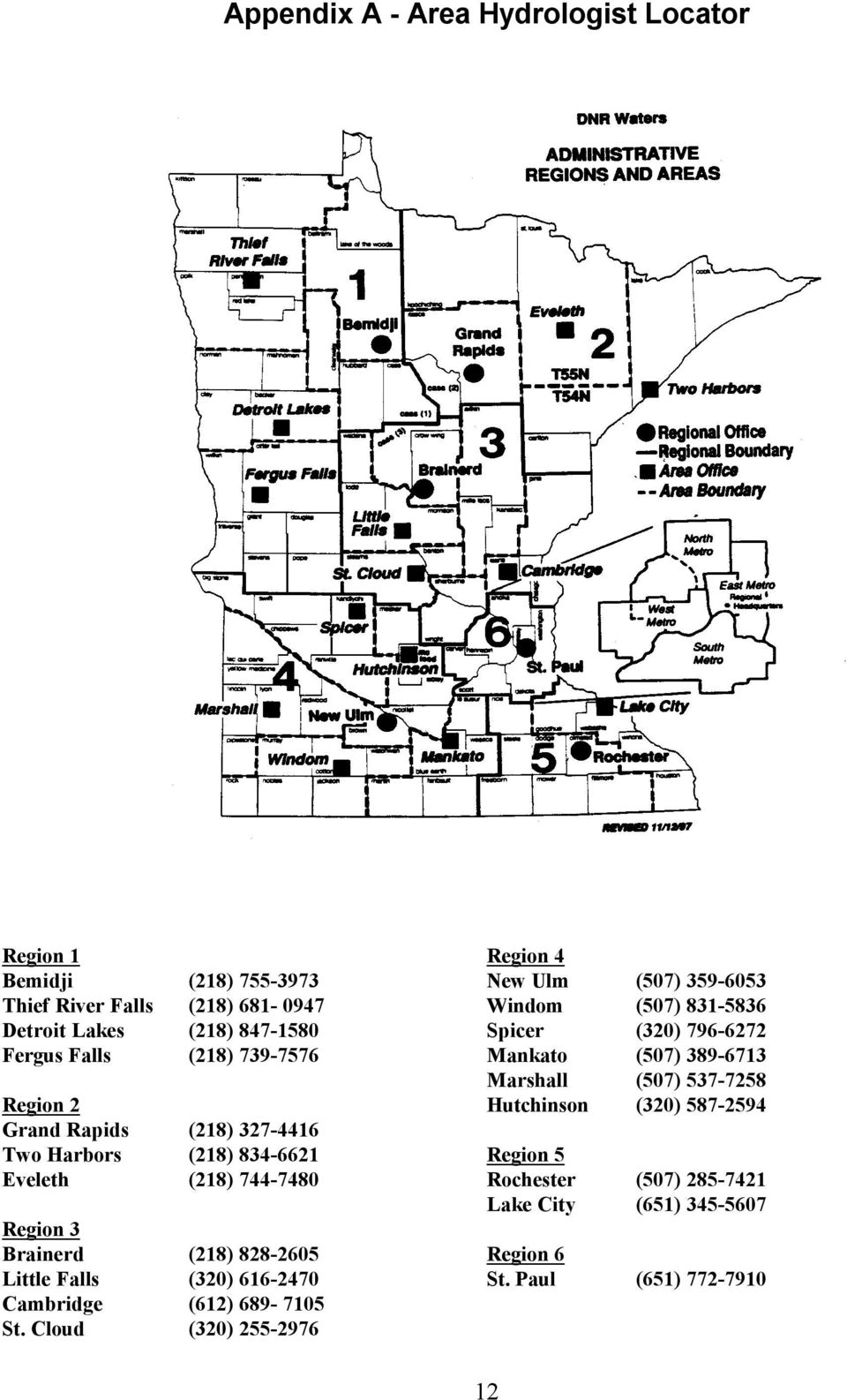
14 Appendix A - Area Hydrologist Locator Region 1 Region 4 Bemidji (218) New Ulm (507) Thief River Falls (218) Windom (507) Detroit Lakes (218) Spicer (320) Fergus Falls (218) Mankato (507) Marshall (507) Region 2 Hutchinson (320) Grand Rapids (218) Two Harbors (218) Region 5 Eveleth (218) Rochester (507) Lake City (651) Region 3 Brainerd (218) Region 6 Little Falls (320) St. Paul (651) Cambridge (612) St. Cloud (320)
15 Appendix B - Grant Application FLOOD DAMAGE REDUCTION PROGRAM S HAZARD MITIGATION GRANT APPLICATION (June 1999) Local Unit of Government Applicant: Authorized Agent: Address: Number & Street City/State Zip code County Phone No:( ) Fax No:( ) Cell Phone:( ) address: Contact person (if differnt from authorized agent): Address: Number & Street City/State Zip code County Phone No:( ) Fax No:( ) Cell Phone:( ) address: Project Funding Breakout Total Estimated Project Cost Amount Requested From DNR Waters Amont from other state agencies Total share of all local government sources Estimated in-kind match Federal share Private share 13

16 Check the following types of flood damage reduction activities included in project along with a quantity (if applicable) and cost or percentage of total project costs. Activity Quantity Cost or Percentage Acquisition Number of Homes Levee Levee Improvement Floodwall Ring Dike Ring Dike Improvement Flood Storage Easement Impoundment Miles Lineal Feet Lineal Feet Number of Ring Number of Ring Dikes Acres Acre Feet Impoundment Improvement Flood Warning System Feasibility Study Flood Insurance Study Floodplain Mapping Geographic Information System Hydrology / Hydraulic Study Other 14

17 Please answer the following questions Yes or No. Applicant must be able to answer the following four questions yes, before continuing. Y N A. Are local matching funds currently or imminently available? Y N B. Has an environmental review (if mandatory) been completed for the proposed project or included in the application as part of the project? Y N C. Is your project the least environmentally damaging (or the most environmentally enhancing) feasible and prudent alternative? Y N D. Is your project consistent with local comprehensive watershed management planning? Please answer the following questions yes or no: Y N A. Have the floods caused loss of lives or posed health and safety problems? B. Have floods damaged: Y N a. Residences/farmsteads? Y N b. Critical facilities; schools, hospitals, evacuation shelters, or power plants? Y N c. Public facilities/utilities? Y N d. Intensively farmed land? C. Does the proposed project involve: Y N a. Protection of lives? Y N b. The relocation of structures out of the floodway? Y N c. The relocation of structures out of the 100-year regulatory floodplain? Y N e. Nonstructural measures such as structural acquisition, storage easements, wetland restoration or others? D. Does the proposed project involve a reduction in flood damage potential to: Y N a. More than 10 structures Y N b. 5 to 10 structures Y N c. 1 to 5 structures E. Will you be able to avoid major social impacts with the proposed project such as: Y N a. Neighborhood disruption? Y N b. Transportation disruption? Y N c. Aesthetics? Y N F. Has the acquisition of all necessary lands, easements and rights-of-way been included in the project proposal? Y N G. Does your community have a flood warning system and/or emergency evacuation plan or is this part of the proposed project? Y N H. Has your local government conducted public information or education programs about floods? Y N I. Has your local government taken actions in the past to mitigate the effect of flooding? Y N J. Is your local government participating in a local water planning effort? (Please attach a copy of the completed Minnesota Natural Heritage Information System Data Request Form.)

18 Project Narrative (Please attach resolutions authorizing application and signature, a map of the site, highlighting area(s) damaged and the location of the proposed project) I. Briefly describe and itemize the damage(s): a) Describe the repetitive nature of flooding: 16
19 Project Narrative II. Describe the proposed project and its objective: (Please include project location, a list of funding sources, how local funding will be obtained and identify implementing parties and their roles) 17

20 Project Narrative III. a)summarize the alternative flood mitigation measures that were considered to achieve the desired benefits. b) Is the proposed project the least environmentally damaging alternative that is feasible and prudent? Why? 18

21 Project Narrative IV. Describe and itemize the costs (including environmental and natural resource costs) associated with the project: (Please include a budget/cost schedule. If the project will be completed in phases, please include a phasing schedule for the project.) Environmental costs do not need to be quantified in terms of money. 19
22 Project Narrative V. Describe and itemize the benefits (including environmental and natural resource costs) associated with this project: (Please describe the anticipated results of this project.) Environmental benefits do not need to be quantified in terms of money. 20
23 Project Narrative VI. List opportunities for public involvement and describe public response to the proposed project: a) Describe partners (if any) and their role in this project. 21
24 22
25 Appendix C Area Managers Project Narrative (Hydrologist and Fish and Wildlife) I. Is the proposed project consistent with, or part of a comprehensive watershed plan? II. Describe any environmental impacts and/or benefits: III. Describe alternatives to the proposed project, if any, that reduce the environmental impact or enhance environmental goal and provide the desired benefits: IV. Describe your working relationship with the community and the steps the community has taken with regard to ordinances, policy, and education to manage its water resources. Also describe the effectiveness of these programs. (Floodplain and shoreland ordinances, National Floodplain Insurance Program, wetland protection, etc.) 23
26 Appendix D - Sample Resolution Local Government Resolution BE IT RESOLVED that, hereinafter referred to as Authorized Official (Authorized Agent) acts as legal sponsor for the project contained in the Flood Damage Reduction Grant Assistance Program Application submitted on and that (Month-Day-Year) Authorized Official is hereby authorized to apply to the Minnesota Department of Natural Resource, hereinafter referred to a State, for funding of this project on behalf of the applicant. BE IT FURTHER RESOLVED that the Applicant has the legal authority to apply for financial assistance, and the institutional, managerial and financial capability to ensure adequate acquisition, maintenance and protection of the proposed project. BE IT FURTHER RESOLVED that the Applicant has not incurred any construction costs or has not entered into any written agreements to purchase property proposed by this project. BE IT FURTHER RESOLVED that the Applicant has not violated any Federal, State, or local laws pertaining to fraud bribery, graft, kickbacks, collusion, conflict of interest or other unlawful or corrupt practice. BE IT FURTHER RESOLVED that upon approval of the application by the State, the Authorized Official may enter into an Agreement with the State for the above-referenced project, and that the Applicant certifies that it will comply with all applicable laws and regulations as stated in the contract agreement. NOW, THEREFORE BE IT RESOLVED that is hereby authorized to execute (Authorized Agent) such Agreements as are necessary to implement the project on behalf of the Applicant. I CERTIFY THAT the above resolution was adopted by the of (City Council, County Board, etc.) on. (Applicant) (Date) SIGNED: WITNESSED: (Signature) (Signature) (Title) (Title) (Date) (Date) 24
27 Appendix E - Sample Contract FLOOD HAZARD MITIGATION GRANT AGREEMENT BETWEEN THE STATE OF MINNESOTA AND THE <<ORGANIZATION NAME>> THIS Grant is made between the State of Minnesota, acting by and through its Commissioner of Natural Resources (hereinafter the "State") and the <<ORGANIZATION NAME>> (hereinafter the "Grantee"). WHEREAS, the State is authorized by Minnesota Statutes Section 103F.161 to provide flood hazard mitigation grants to local units of government to conduct flood plain damage reduction studies and/or plan and implement flood mitigation measures; and WHEREAS, the Grantee has submitted an application to the State for a flood hazard mitigation grant; and WHEREAS, the State has determined that the Grantee should receive flood hazard mitigation assistance; and WHEREAS, the Grantee represents that it is duly qualified and willing to perform the services set forth herein. NOW THEREFORE, it is agreed between the State and the Grantee as follows: 1.0 AMOUNT OF GRANT 1.1 STATE SHARE The State shall award the Grantee fifty percent (50%) of the total costs or fifty percent (50%) of the non-federal share of the approved Project as identified in Section 2.1 (hereinafter Project ), or $, whichever is less, for the costs authorized herein. The total obligation of the State for all compensation and reimbursements to Grantee under this Grant shall not exceed $. 1.2 GRANTEE SHARE The Grantee is required to match the State share of the costs of the Project. In-kind services by the Grantee can constitute all or part of the Grantee s required share of costs provided that proper documentation of the in-kind services is provided to, and approved by, the State. 2.0 AUTHORIZED PROJECT 2.1 PROJECT PLAN The proceeds of this Grant are to be used solely for the Project, which is described in Exhibit A, attached hereto. A detailed description of the nature and scope of the Project is described in the Project Plan dated, and as subsequently amended or revised, which is incorporated herein by reference. The Grantee agrees to take before and after photographs of the Project and provide them to the State. 2.2 ADMINISTRATION AND SUPERVISION The Grantee shall be responsible for the administration, supervision, management and Project oversight that may be required for the work performed under this Grant. 3.0 ACKNOWLEDGMENTS The Grantee agrees to acknowledge the State's financial support for the Project. Any statement, press release, bid, solicitation, or other document issued describing the Project shall provide information reflecting that State funds were used to support the Project and will contain the following language: This Project is made possible in part by a grant provided by the Minnesota Department of Natural Resources, through an appropriation by the Minnesota State Legislature. Any site developed or improved by the Project shall display a sign, in a form approved by the State, stating the same information. 4.0 CONTACT PERSONS The State s authorized agent for the purpose of administration of this Grant is: 25
28 5.0 COSTS FDR Coordinator Minnesota DNR Waters 500 Lafayette Road, St. Paul, MN (651) The Grantee s authorized agent for the purpose of administration of this Grant is: <<authorized official>> <<organization>> <<complete address>> <<phone number>> 5.1 ELIGIBLE COSTS Eligible costs are those costs directly incurred by the Grantee that are solely related to and necessary for producing the work products described in the Project Plan. Eligible costs may include the following: Advertising costs for bids and proposals; Capital expenditures for facilities, equipment and other capital assets as expressly approved in the Project Plan; Materials & supplies; Architectural and engineering services; Construction management and inspection services; Surveys and soil borings; Actual construction of the Project; or Travel, lodging and meal expenses of persons involved in the Project in the same manner and in no greater amount than provided for in the current "Commissioner's Plan" promulgated by the Commissioner of Employee Relations. Certain other types of costs may be eligible provided that they are (1) directly incurred by the Grantee; (2) are solely related to, and necessary for, producing the work products described in the Project Plan; and (3) have prior written approval of the State. Any cost not defined as an eligible cost or not included in the Project Plan shall not be paid from State funds committed to the Project. 5.2 NONELIGIBLE COSTS Noneligible costs for reimbursement means all costs not defined as eligible costs, including but not limited to the following: Any costs incurred before the effective date of this Grant; Fund raising; Taxes, except sales tax on goods and services; Insurance, except title insurance; Attorney fees; except for acquisition and clearing title to land; Loans, grants, or subsidies to persons or entities for development; Bad debts or contingency funds; Interest; Lobbyists; and Political contributions. 6.0 PAYMENT OF GRANT MONIES 6.1 REIMBURSEMENT To obtain reimbursement for eligible costs under this Grant, the Grantee shall provide the State with invoices and evidence that the portion of the Project for which payment is requested has been satisfactorily completed. All invoices shall be sent to the person designated in Section 4.0 herein above. Grantee shall submit invoices and evidence that any and all advance payments have been spent prior to requesting additional payments by the State. Invoices will be submitted for double the amount and should differentiate, when applicable, between the Federal and Non-Federal Project costs, as well as the State and local share of the Project costs. No facsimiles will be accepted. Invoices must be received by the State within sixty (60) days after the completion of the Project or the expiration of this Grant as set forth in Section 11.1 herein below, 26
29 whichever occurs first. Invoices received after that date will not be eligible for reimbursement. The State s authorized agent has final authority for acceptance of Grantee s services, determination as to whether the expenditures are eligible for reimbursement under this Grant, and verification of the total amount requested. The Grantee shall not receive payment for work found by the State to be unsatisfactory, or performed in violation of federal, state or local law, ordinance, rule or regulation. No more than ninety (90) percent of the State s share of the cost shall be paid by the State until the State has determined that the Grantee has satisfactorily fulfilled all of the terms of this Grant. The Grantee shall arrange for a tour of the Project areas prior to release of the final ten (10) percent of the funds. 6.2 ADVANCEMENT Under this Grant the State agrees to advance Fifty (50%) Percent ($ ) of the Grant to the Grantee upon this Grant becoming effective pursuant to the terms contained in Section 11 herein below. The Grantee shall subsequently provide invoices and evidence justifying its expenditure of that amount. Any portion of that amount which is either not spent or constitutes a noneligible cost shall be returned to the State. Monies advanced under this agreement must not be placed in an interest bearing account. 7.0 ACCOUNTING AND AUDIT The Grantee shall maintain books, records, documents, and other evidence pertaining to the costs and expenses of implementing this Grant to the extent and in such detail that will accurately reflect the total cost of the Project. The Grantee shall use generally accepted accounting principles. All records shall be retained for five (5) years after completion of the Project. The State, its representative, or the legislative auditor shall have the right to examine books, records, documents, and other evidence and accounting procedures and practices relevant to the Grant. 8.0 AMERICANS WITH DISABILITY ACT AND HUMAN RIGHTS The Grantee, in the conduct of the Project, shall comply with the Americans with Disabilities Act of 1990 (P.L ), Minnesota Statutes Chapter 363 (the Minnesota Human Rights Act), and Minnesota Statutes, Sections and all applicable rules and subsequent amendments. 9.0 WORKERS COMPENSATION 10.0 LIABILITY 11.0 TERM The Grantee in the conduct of the Project shall comply with the provisions for workers compensation in Minnesota Statutes, Section Subdivision 1 and Section The Grantee agrees to indemnify and save and hold harmless the State, its agents and employees from any and all claims or causes of action arising from performance of this Grant by the Grantee, its agents, contractors or employees. This clause shall not be construed to bar any legal remedies the Grantee may have for the State s failure to fulfill its obligations under this Grant EFFECTIVE DATE This Grant shall become legally effective upon such date as it is executed by the Office of the Attorney General or his delegate and shall remain in effect until ( Date ) or until all obligations set forth in this Grant have been satisfactorily fulfilled, whichever occurs first TERMINATION This Grant may be terminated by the State or the Grantee at any time with or without cause upon thirty (30) days written notice to the other party. In the event of such a cancellation, the Grantee shall be entitled to payment determined on a pro rata basis for work or services satisfactorily performed AMENDMENTS This Grant may be amended in writing by the mutual consent of the State and the Grantee ASSIGNMENT The Grantee shall neither assign nor transfer any rights or obligations under this agreement without the prior written 27
30 consent of the State ANTI-TRUST PROVISION The Grantee hereby assigns to the State of Minnesota any and all claims for overcharges as to goods and/or services provided in connection with the Grant resulting from antitrust violations which arise under the antitrust laws of the United States and the antitrust laws of the State of Minnesota CHOICE OF LAW All matters relating to the performance of this Grant shall be controlled by and determined in accordance with the laws of the State of Minnesota. IN WITNESS WHEREOF, the parties have caused this Grant Agreement to be duly executed intending to be bound thereby. 1. GRANTEE: 2. STATE OF MINNESOTA ACTING BY AND THROUGH ITS COMMISSIONER OF NATURAL RESOURCES By: Title: Date: By: Title: By: Title: Date: Date: A certified copy of the Grantee s Resolution unconditionally approving this Grant Agreement is attached as Exhibit B. This form has been reviewed by the Attorney General 28
31 Appendix F-Progress Report/Reimbursement Request Flood Damage Reduction Program Progress Report and Reimbursement Request Form Please make copies to be completed and submitted quarterly or with a reimbursement request to your Area Hydrologist. Local Entity DNR Grant Number Report Completed By: Phone Number: Amount awarded Amount claimed Amount of Reimbursement Date (If submitting request for reimbursement) Acquisitions Total Expected Number of Buyouts Number of Signed Purchase Agreements Number Closed Number of Purchase Offers Current Month To Date Estimated Date of Completion PROJECTS Plans/Specs Completion Date Contract Starting Date % Work Completed Estimated Date of Completion Levee Levee Improvement Floodwall Ring Dike Ring Dike Improvement Flood Storage Easement Impoundment Impoundment Improvement 29
32 Flood Damage Reduction Program Progress Report and Reimbursement Request Form Plans/Specs Completion Date Contract Starting Date % Work Completed Estimated Date of Completion Flood Warning System Feasibility Study Flood Insurance Study Floodplain Mapping GIS Hydrology / Hydraulic Study Other Comments Signature of preparer: Date: 30
33 Appendix G - Criteria for Prioritizing Projects Criteria for prioritizing projects comes from M.S. 103F.161 Subd. 2: (Criteria are not order of priority) (1) the extent of effectiveness of mitigation measures already implemented by the local government requesting the grant; (2) the feasibility, practicality, and effectiveness of the proposed mitigation measures and the associated nonflood related benefits and detriments; (3) the level of grant assistance that should be provided to the local government, based on available facts regarding the nature, extent, and severity of flood problems; (4) the frequency of occurrence of severe flooding that has resulted in declaration of the area as a flood disaster area by the President of the United States; (5) the economic, social, and environmental benefits and detriments of the proposed mitigation measures; (6) whether the floodplain management ordinance or regulation adopted by the local government meets the minimum standards established by the commissioner, the degree of enforcement of the ordinance or regulation, and whether the local government is complying with the ordinance or regulation; (7) the degree to which the grant request is consistent with local water plans developed under chapter 103B and 103D; (8) the financial capability of the local government to solve its flood hazard problems without financial assistance; and (9) the estimated cost and method of financing of the proposed mitigation measures based on local money and federal and state financial assistance. 31
34 Appendix H - Project Evaluation Sheet Applicant Name Project Type Score FDR Project Application Evaluation Sheet The following evaluation sheet will be used by the DNR to rate each application for Flood Damage Reduction Grant Assistance. This is a scoring mechanism that will be used by DNR Waters to make detailed comparisons among applications. Section 1. FDR Program Goals A. Prevent loss of human life 50 = Substantially meets goal. 25 = Meets a minimum level of program goal. 0 = Does not meet program goals. B. Prevent damages to structures, homes and communities 30 = Substantially meets goal. 15 =Meets a minimum level of program goal. 0 = Does not meet program goals. C. Project is consistent with a comprehensive watershed plan 20 = Substantially meets goal. 10 =Meets a minimum level of program goal. 0 = Does not meet program goals. D. Reduce damages to intensively farmed land from a 10-year event 10 = Substantially meets goal. 5 =Meets a minimum level of program goal. 0 = Does not meet program goals. E. Avoid, minimize and mitigate environmental impacts caused by flood control projects 10 = Substantially meets goal. 5 =Meets a minimum level of program goal. 0 = Does not meet program goals. F. Water resource management (ordinances, education, and general cooperation with other state programs) 10 = Ordinances and/or other programs in place and effectively administered. 7 = Ordinance and/or other programs in place, generally effective (limited number of variances). 4 = Ordinances and/or other programs in place; somewhat effective. 1 = Ordinances and/or other programs in place, not very effective (variances often granted or permit often not required) 0 = Ordinances and/or other programs are ineffective (administration essentially ignored). 32
35 Section 2. Critical Needs A. Analysis of need 10 = Shows major, immediate need; analysis supported by other studies. 7 = Show importance, but less immediate need; supported by other studies. 4 = General need; not well supported. 1 = Shows limited need; not supported by other studies. 0 = Shows no more than minimal, infrequent need. B. Frequency of flooding 10 = Damages occurring from 10-year events. 7 = Damages occurring from 25-year events. 4 = Damages occurring from 50-year events. 1 = Damages occurring from 100-year events. 0 = Damages occurring from 500-year events. C. Desired by residents 10 = Very strong public support \ no opposition to project. 7 = Substantial public support \ no opposition to project. 4 = Some public support, but not an apparent high priority. 1 = Some important public opposition. 0 = Strong opposition A. Public Meetings/other comment opportunities B. Partnerships with other public agencies Section 3.Public Participation (For each of the 3 items) 10 = Substantial opportunity for or evidence of involvement by public/ agency. 7 = Adequate opportunity for or evidence of involvement. 4 = Limited opportunity for or evidence of involvement. 1 = Very limited opportunity for or evidence of involvement. 0 = No opportunity for involvement by public or agencies. Section 4.Resource Management Goals A. Manage lakes and streams for natural characteristics. B. Enhance and restore riparian and instream habitats and natural floodplains. C. Provide recreational and green space opportunities and natural riparian corridors. D. Manage water quality to reduce erosion, toxics, sediments, and nutrients E. Promote the creation or enhancement of wildlife habitat. 10 = Substantially meets goal. 5 =Meets a minimum level of program goal. 0 = Does not meet program goals. 33
36 Section 5.Consistency with other programs A. Absence of known conflicts 10 = No known significant conflicts with other programs. 7 = Some minor conflicts with other programs 4 = Important conflict with another program, but conflict can be resolved. 0 = Several known major conflicts with other programs B. Assistance in achieving goals 10 = Project or program substantially contributes to state/local objectives. 7 = Limited, but important contribution to meeting state/local objectives. 4 = Marginal contribution to meeting state/local objectives. 0 = Some conflicts with state/local objectives. Section 6.Project Effectiveness A. Modification of susceptibility to flood damage and disruption B. Modification of the impact of flooding on individuals and communities. C. Modification of flooding (for each of the 3 items) 10 = Proposal demonstrates proposed approach is more effective than its alternatives. 5 = Proposal demonstrates proposed approach is moderately more effective than its alternatives. 1 = Proposal provides insufficient information to determine if proposed approach is more effective than its alternatives. 0 = The approach proposed would be less effective than its alternatives. D. Concurrence in implementation roles 10 = All parties concur in their role in implementation. 5 = Most parties have concurred in their role in implementation. 1 = At least one major party does not concur, but the project could go on. 0 = Some parties concur, but significant others have not concurred. This scoring system will be used to aid DNR Waters with prioritizing the project applications. The DNR reserves the right to fund projects based on unforseen extenuating circumstances that are often associated with the unpredictable nature of flooding. 34
Flood Risk Management
 Flood Risk Management Value of Flood Risk Management Every year floods sweep through communities across the United States taking lives, destroying property, shutting down businesses, harming the environment
Flood Risk Management
 Flood Risk Management Value of Flood Risk Management Value to Individuals and Communities Every year floods sweep through communities across the United States taking lives, destroying property, shutting
- POLICY - Disaster Recovery Assistance Program
 August 29, 2013 - POLICY - Disaster Recovery Assistance Program Overview Disasters and emergency legislative funding occur frequently and usually unpredictably. These characteristics require a standard
STATE OF MINNESOTA GRANT CONTRACT
 STATE OF MINNESOTA GRANT CONTRACT This grant contract is between the State of Minnesota, acting through its Department of Labor and Industry, Apprenticeship Unit ("State") and [FULL NAME AND ADDRESS OF
A. Flood Management in Nevada
 Nevada Division of Water Planning A. Flood Management in Nevada Introduction Flooding has been a concern for Nevada communities since the first settlers moved to the territory in the mid-1800 s. Fourteen
Chehalis River Basin Flood Damage Reduction 2013-2015 Capital Budget Approved by Legislature in June 2013
 Chehalis River Basin Flood Damage Reduction 2013-2015 Capital Budget Approved by Legislature in June 2013 1. Design alternatives for large capital flood projects (basinlevel water retention and Interstate
Post-Flood Assessment
 Page 1 of 7 Post-Flood Assessment CHAPTER 4 AGENCY COORDINATION Agency coordination is an essential element for the operation of the flood management systems in the Central Valley. Due to the nature of
COMMUNITY CERTIFICATIONS
 National Flood Insurance Program Community Rating System COMMUNITY CERTIFICATIONS Public reporting burden for this form is estimated to average 4 hours for annual recertification, per response. The burden
3. The submittal shall include a proposed scope of work to confirm the provided project description;
 QIN Shoreline Master Program Project Summary The Shoreline Master Program (SMP) development process for the Quinault Indian Nation (QIN) includes the completion of inventory and analysis report with corresponding
Lower Raritan Watershed Management Area Stormwater & Flooding Subcommittee Strategy Worksheet LRSW-S3C1
 Strategy Name: Reduce Existing Potential for Flood Damages LRSW-S3C1. Develop and implement a program to: Minimize flood damages through the use of structural measures. Minimize flood damages through the
Flooding and Flood Threats on Trenton Island
 Mitigation Success Trenton Island, Pierce County, Wisconsin Background: Trenton Island is located in the unincorporated area of Trenton Township, Pierce County, in northwestern Wisconsin. Often called
STATE OF MINNESOTA MINNESOTA STATE COLLEGES AND UNIVERSITIES Minnesota State University, Mankato/System Office
 STATE OF MINNESOTA MINNESOTA STATE COLLEGES AND UNIVERSITIES Minnesota State University, Mankato/System Office SERVICES CONTRACT/P. O. # Title: THIS CONTRACT, and amendments and supplements thereto, is
CARVER COUNTY INDEPENDENT CONTRACTOR/PROFESSIONAL SERVICE AGREEMENT
 CARVER COUNTY INDEPENDENT CONTRACTOR/PROFESSIONAL SERVICE AGREEMENT This Agreement is entered into by and between the County of Carver, 600 East 4 th Street, Chaska, Minnesota 55318, through (Division),
What We Do: Wetlands, Wildlife Habitat & Flood Hazards in the Root River Watershed
 What We Do: Wetlands, Wildlife Habitat & Flood Hazards in the Root River Watershed presented by Ceil Strauss, State Floodplain Manager DNR Ecological & Water Resources 1 EWR Roles In Floodplains Regulatory:
King County, Washington Policies and Practice for the Use of Eminent Domain For Flood Risk Reduction
 King County, Washington Policies and Practice for the Use of Eminent Domain For Flood Risk Reduction Introduction Eminent domain refers to the power possessed by the state over all property within the
ALTERNATIVE SOURCES OF FUNDING FOR
 November 2015 ALTERNATIVE SOURCES OF FUNDING FOR Flood-Related General Water Management Water Supply Projects The following inventory contains information about a variety of funding programs offered by
Develop hazard mitigation policies and programs designed to reduce the impact of natural and human-caused hazards on people and property.
 6.0 Mitigation Strategy Introduction A mitigation strategy provides participating counties and municipalities in the H-GAC planning area with the basis for action. Based on the findings of the Risk Assessment
The answers to some of the following questions are separated into two major categories:
 Following the recent flooding events for Front Range communities in Colorado, property owners, communities, and the National Flood Insurance Program are being presented with some new challenges in the
TITLE XV: LAND USAGE 150. BUILDING CODE 151. FLOOD DAMAGE PREVENTION 153. SUBDIVISION REGULATIONS 154. ZONING CODE
 TITLE XV: LAND USAGE Chapter 150. BUILDING CODE 151. FLOOD DAMAGE PREVENTION 152. MOBILE HOMES AND TRAILER PARKS 153. SUBDIVISION REGULATIONS 154. ZONING CODE 2001 S-7 1 2 Middletown - Land Usage CHAPTER
Fiscal Year 2013-2014 St. Lucie River Issues Team Surface Water Restoration Grant Package
 Fiscal Year 2013-2014 St. Lucie River Issues Team Surface Water Restoration Grant Package Grant Guidelines.. 2 Grant Application & Statement of Work. 7 Fiscal Year 2013-2014 St. Lucie River Issues Team
CASS COUNTY COMMISSION POLICY MANUAL 38.07 ADOPTED DATE: FEBRUARY 2, 1998 PAGE 1 OF 9
 CASS COUNTY COMMISSION POLICY MANUAL 38.07 SUBJECT: ORDINANCE #1998-2 (FLOOD DAMAGE PREVENTION) ADOPTED DATE: FEBRUARY 2, 1998 PAGE 1 OF 9 NORTH DAKOTA COUNTY OF CASS ORDINANCE #1998-2 Be it ordained and
TITLE V--NATIONAL FLOOD INSURANCE REFORM
 Sept.23 RIEGLE COMMUNITY DEVELOPMENT ACT [Riegle Community Development and Regulatory Improvement Act of 1994] P.L. 103-325 Sec. 511 TITLE V--NATIONAL FLOOD INSURANCE REFORM SEC. 501. SHORT TITLE. This
RESTRICTIVE COVENANTS. THIS DECLARATION OF RESTRICTIVE COVENANTS is made this day of, 20, by RECITALS
 STATE OF NEW YORK COUNTY OF DECLARATION OF RESTRICTIVE COVENANTS THIS DECLARATION OF RESTRICTIVE COVENANTS is made this day of, 20, by, ("Declarant"), A New York corporation with offices at,, New York.
Public Law 84-99 and Non-Structural Alternatives to Levee Repairs
 Public Law 84-99 and Non-Structural Alternatives to Levee Repairs Presented by: Mr. Jerry A. Skalak, CFM U.S. Army Corps of Engineers Rock Island District and Mr. Tom Oswald Iowa Homeland Security and
Sec. 22a-1a page 1 (4-97)
 Department of Environmental Protection Sec. 22a-1a page 1 (4-97) TABLE OF CONTENTS Connecticut Environmental Policy Act Definitions... 22a-1a- 1 Determination of sponsoring agency.... 22a-1a- 2 Determination
Appendix A. Lists of Accomplishments and Project Costs. UMRWD 10 Year Plan Update. Appendix A UPPER MINNESOTA RIVER WATERSHED DISTRICT
 UPPER MINNESOTA RIVER WATERSHED DISTRICT Lists of Accomplishments and Project Costs 10 Year Plan Update UMRWD 10 Year Plan Update Page A 1 UMRWD LIST OF ACCOMPLISHMENTS Since its inception in 1967, the
STATE OF MINNESOTA CAPITAL GRANTS MANUAL. A step-by-step guide that describes what grantees need to do to receive state capital grant payments
 STATE OF MINNESOTA CAPITAL GRANTS MANUAL A step-by-step guide that describes what grantees need to do to receive state capital grant payments Revised May 2014 The State of Minnesota Capital Grants Manual
Henry Van Offelen Natural Resource Scientist MN Center for Environmental Advocacy [email protected]
 Henry Van Offelen Natural Resource Scientist MN Center for Environmental Advocacy [email protected] Wetland study slide Water Quality NRE goals in watershed plans Protect habitat that remains.
Floodplain Development Land Use Review
 COMMUNITY DEVELOPMENT DEPARTMENT Planning Division P.O. Box 490 333 Broadalbin Street SW Albany, OR 97321 Phone 541-917-7550 Fax 541-791-0150 www.cityofalbany.net Floodplain Development Land Use Review
MINNESOTA DEPARTMENT OF HEALTH MASTER GRANT CONTRACT FOR COMMUNITY HEALTH BOARDS
 MINNESOTA DEPARTMENT OF HEALTH MASTER GRANT CONTRACT FOR COMMUNITY HEALTH BOARDS DRAFT for Discussion Only 8.22.14 THIS MASTER GRANT CONTRACT, and amendments and supplements thereto, is between the State
House Research Department General Fund Appropriations in Flood Relief Bills
 House Research Department General Fund Appropriations in Flood Relief Bills These tables included state funding from the major disaster bills enacted to respond to a disaster. Appropriations may have been
APPLICATION FOR STATE REVOLVING FUND LOAN
 APPLICATION FOR STATE REVOLVING FUND LOAN for the Construction of Wastewater Treatment Facilities (Revised 02/2015) A completed application must be submitted for each proposed project. If any information
rescue and relief efforts in the aftermath of flooding, (iii) repair of flood damaged public facilities and utilities, and
 1. Purpose (1) It is the purpose of this Ordinance to protect human life, health, and property from flood conditions, to preserve the ability of floodplains to carry and discharge a base flood, and to
Harris County Flood Control District. Policy, Criteria, and Procedure Manual
 Harris County Flood Control District Policy, Criteria, and Procedure Manual For Approval and Acceptance of Infrastructure General Review October 10, 2003 Draft Please Provide Written Comments to the HCFCD
13. ENVIRONMENTAL PROTECTION/ RESOURCE MANAGEMENT
 13. ENVIRONMENTAL PROTECTION/ RESOURCE MANAGEMENT A. Existing Conditions Ramsey is fortunate to have an ample amount of natural resources and open space areas and a community attitude that is increasingly
John Keel, CPA State Auditor. An Audit Report on The Dam Safety Program at the Commission on Environmental Quality. May 2008 Report No.
 John Keel, CPA State Auditor An Audit Report on The Dam Safety Program at the Commission on Environmental Quality Report No. 08-032 An Audit Report on The Dam Safety Program at the Commission on Environmental
STATE OF MINNESOTA. North Hennepin Community College MINNESOTA STATE COLLEGES AND UNIVERSITIES INCOME CONTRACT
 04-25-16 I-1 F.Y. Cost Center Obj. Code Amount Vendor # P.O. # STATE OF MINNESOTA North Hennepin Community College MINNESOTA STATE COLLEGES AND UNIVERSITIES INCOME CONTRACT This contract is by and between
PALOMAR COMMUNITY COLLEGE DISTRICT AGREEMENT WITH INDEPENDENT CONTRACTOR
 PALOMAR COMMUNITY COLLEGE DISTRICT AGREEMENT WITH INDEPENDENT CONTRACTOR THIS AGREEMENT is made and entered into this day of by and between the Palomar Community College District, hereinafter called "District",
PRODUCER AGREEMENT. Hereinafter ("Producer"), in consideration of the mutual covenants and agreements herein contained, agree as follows:
 PRODUCER AGREEMENT Hereinafter First Choice Insurance Intermediaries, Inc "FCII", a Florida company, having an office at 814 A1A North, Suite 206, Ponte Vedra Beach, FL 32082 and " Producer" having an
FLOOD PROTECTION AND ECOSYSTEM SERVICES IN THE CHEHALIS RIVER BASIN. May 2010. Prepared by. for the. 2010 by Earth Economics
 FLOOD PROTECTION AND ECOSYSTEM SERVICES IN THE CHEHALIS RIVER BASIN May 2010 Prepared by for the Execubve Summary The Chehalis Basin experienced catastrophic flooding in 2007 and 2009. In response, the
Procedures for Applying for Financial Assistance
 EMERGENCY OPERATIONS PLAN May, 2009 Procedures for Applying for Financial Assistance GENERAL INFORMATION Financial assistance may come from the state alone or both the state and federal governments. For
Q:\COMP\FORESTS\BANKHEAD
 3. TITLE III OF THE BANKHEAD-JONES FARM TENANT ACT [As Amended through the end of the First Session of the 108th Congress (Public Law 108 198, Dec. 31, 2003)] 3 1 3. TITLE III OF THE BANKHEAD-JONES FARM
Chapter 6: Mitigation Strategies
 Chapter 6: Mitigation Strategies This section of the Plan describes the most challenging part of any such planning effort the development of a Mitigation Strategy. It is a process of: 1. Setting mitigation
Project Management Procedures
 1201 Main Street, Suite 1600 Columbia, South Carolina 29201 Project Management Procedures Start Up The grant becomes effective upon return of one copy of the grant award executed by the Chief Executive
AGREEMENT BETWEEN COUNTY AND CONTRACTOR FOR GOODS AND SERVICES. THIS AGREEMENT, effective this 20th day of April in the year, 2015, between:
 AGREEMENT BETWEEN COUNTY AND CONTRACTOR FOR GOODS AND SERVICES THIS AGREEMENT, effective this 20th day of April in the year, 2015, between: MARTIN COUNTY BOARD OF COUNTY COMMISSIONERS, a political subdivision
Emergency Conservation Program
 Materials Prepared for Federation of Southern Cooperatives Epes, Alabama September 11, 2009 Emergency Conservation Program by Karen R. Krub Farmers Legal Action Group, Inc. 360 North Robert Street, Suite
SENATE BILL 1288 AN ACT AMENDING SECTIONS 45-2103 AND 45-2113, ARIZONA REVISED STATUTES; RELATING TO THE ARIZONA WATER PROTECTION FUND.
 Senate Engrossed State of Arizona Senate Fifty-first Legislature First Regular Session SENATE BILL AN ACT AMENDING SECTIONS -0 AND -, ARIZONA REVISED STATUTES; RELATING TO THE ARIZONA WATER PROTECTION
1.7.0 Floodplain Modification Criteria
 1.7.0 Floodplain Modification Criteria 1.7.1 Introduction These guidelines set out standards for evaluating and processing proposed modifications of the 100- year floodplain with the following objectives:
ARCHITECTURAL SERVICES CONTRACT. THIS CONTRACT FOR ARCHITECTURAL SERVICES is made by and between the County of Nueces, hereinafter called County and
 ARCHITECTURAL SERVICES CONTRACT STATE OF TEXAS COUNTY OF NUECES THIS CONTRACT FOR ARCHITECTURAL SERVICES is made by and between the County of Nueces, hereinafter called County and hereinafter called Architect
How To Amend A Stormwater Ordinance
 Regulatory Alternatives to Address Stormwater Management and Flooding in the Marlboro Street Study Area Alternative 1: Amend Existing Local Regulations This proposed alternative provides an incremental
STATE OF GEORGIA DEPARTMENT OF TRANSPORTATION OPEN AGENCY SERVICE CONTRACT
 STATE OF GEORGIA DEPARTMENT OF TRANSPORTATION OPEN AGENCY SERVICE CONTRACT Contract #: Total Obligation: AGREEMENT BETWEEN: The Georgia Department of Transportation s location identified in Paragraph 101A
Suggested Procedures for School Boards
 Suggested Procedures for School Boards The Chronology of a Project: Some of the steps described may not apply to certain types of projects, or might occur concurrently with others. As you confer with the
Federal Emergency Management Agency, DHS 206.431. SOURCE: 55 FR 35537, Aug. 30, 1990, unless otherwise noted.
 Federal Emergency Management Agency, DHS 206.431 (d) A State may appeal a determination by the Regional Administrator on any action related to Federal assistance for fire suppression. Appeal procedures
Agent Agreement WITNESSETH
 PATRIOT NATIONAL UNDERWRITERS, INC. Agent Agreement THIS AGENT AGREEMENT (the Agreement ) is made and entered into by and between Patriot National Underwriters, Inc., a Texas corporation ( Patriot ), and
Mississippi Development Authority. Final Action Plan for CDBG Supplemental Disaster Recovery Funds 2nd Allocation, Public Law 110-252
 Mississippi Development Authority Final Action Plan for CDBG Supplemental Disaster Recovery Funds 2nd Allocation, Public Law 110-252 July 29, 2009 Mississippi Development Authority Proposed Action Plan
ARTICLE 12 FLOOD DAMAGE PREVENTION
 ARTICLE 12 FLOOD DAMAGE PREVENTION SECTION 12.1 AUTHORIZATION 12.1.1 General The Legislature of the State of North Carolina has in Part 6, Article 21 of Chapter 143; Parts 3 and 4 of Article 18 of Chapter
GENERAL OBLIGATION BONDS
 DESCRIPTIONS GENERAL OBLIGATION BONDS Appendix C, page 2 GENERAL OBLIGATION BONDS State Transportation Bonds --- 1968 An amount of $640,000,000 was authorized to improve the public transportation system.
ECONOMIC ANALYSIS FLOOD DAMAGE REDUCTION. Lower Carmel River Floodplain Restoration and Enhancement Project
 ECONOMIC ANALYSIS FLOOD DAMAGE REDUCTION Lower Carmel River Floodplain Restoration and Enhancement Project I. Description of the Project and its Relationship to Other Projects in the Proposal The Lower
Carlton Fields Memorandum
 Carlton Fields Memorandum TO: FROM: RE: DAN WEEDE FRED RUSHING RIPARIAN BUFFER DATE: JULY 26, 2013 BACKGROUND Both the state of Georgia and the city of Atlanta 1 have certain guidelines that must be followed
SECTION ELEVEN: ACTIVITIES REQUIRING A CERTIFIED EROSION AND SEDIMENT CONTROL PLAN 1
 SECTION ELEVEN: ACTIVITIES REQUIRING A CERTIFIED EROSION AND SEDIMENT CONTROL PLAN 1 An application for approval of a soil erosion and sediment control plan in accordance with these regulations shall be
San Diego Integrated Regional Water Management Implementation Grant Proposal Economic Analysis Flood Damage Reduction Costs and Benefits
 Attachment 9 San Diego Integrated Regional Water Management Economic Analysis Flood Damage Reduction Costs and Benefits Attachment 9 consists of the following items: Flood Damage Reduction Costs and Benefits.
MITIGATION STRATEGY OVERVIEW
 ALL-HAZARDS MITIGATION PLAN MITIGATION STRATEGY Code of Federal Regulations (CFR) Requirement 44 CFR Part 201.6(c)(3)(i): The mitigation strategy shall include a description of mitigation goals to reduce
BENTON COUNTY PERSONAL SERVICES CONTRACT
 BENTON COUNTY PERSONAL SERVICES CONTRACT This is an agreement by and between BENTON COUNTY, OREGON, a political subdivision of the State of Oregon, hereinafter called COUNTY, and, hereinafter called CONTRACTOR.
Goal 1 To protect the public health, safety and property from the harmful effects of natural disasters.
 Plan Framework for Coastal Management The purpose of this element is to provide for the protection of residents and property in within the coastal area of the host community, and to limit expenditures,
Consultants Services, Lump-Sum Remuneration
 1 S T A N D A R D F O R M O F C O N T R A C T FOR Consultants Services, Lump-Sum Remuneration CONTRACT FOR CONSULTANTS SERVICES Lump-Sum Remuneration Between [name of the Procuring Entity] and 2 [name
Town of Chatham Department of Community Development
 Town of Chatham Department of Community Development TOWN ANNEX 261 GEORGE RYDER ROAD 02633 CHATHAM, MA TELEPHONE (508) 945-5168 FAX (508) 945-5163 FEMA FLOOD MAP UPDATE & PROPOSED ZONING BYLAW AMENDMENT
CHAPTER 15 DISASTER COST RECOVERY PROCEDURES
 Kern County Policy and Administrative Procedures Manual CHAPTER 15 DISASTER COST RECOVERY PROCEDURES 1501. General Statement... 1 1502. Disaster Relief Claim Procedures... 1 1503. Responsibilities... 2
CHAPTER 3 page 69 LOCAL FLOODPLAIN REGULATIONS AND NFIP STANDARDS
 CHAPTER 3 page 69 LOCAL FLOODPLAIN REGULATIONS AND NFIP STANDARDS LOCAL FLOODPLAIN REGULATIONS AND NFIP STANDARDS, page 69 THE PARTICIPATION OF A COMMUNITY IN THE NFIP IS MADE POSSIBLE BY ITS ADOPTION
Protecting Floodplain. While Reducing Flood Losses
 Protecting Floodplain Natural and Beneficial i Functions While Reducing Flood Losses Jon Kusler Association of State Wetland Managers 518 872 1804; [email protected] Report available at: http://aswm.org/pdf_lib/nbf.pdf
CLACKAMAS COUNTY ZONING AND DEVELOPMENT ORDINANCE
 1008 STORM DRAINAGE (3/24/05) 1008.01 PURPOSE To minimize the amount of stormwater runoff resulting from development utilizing nonstructural controls where possible, maintain and improve water quality,
Control filling, grading, dredging, and other development which may increase erosion or flood damage; and
 ARTICLE 16. FLOOD DAMAGE PREVENTION Section 16-1: Findings of Fact The flood hazard areas of the Town of Lillington are subject to periodic inundation which results in loss of life and property, health
Business Associate Agreement Involving the Access to Protected Health Information
 School/Unit: Rowan University School of Osteopathic Medicine Vendor: Business Associate Agreement Involving the Access to Protected Health Information This Business Associate Agreement ( BAA ) is entered
Swannanoa River Flood Risk Management Study
 Swannanoa River Flood Risk Management Study Measures Evaluated to Reduce Future Flood Damages City of Asheville U.S. Army Corps of Engineers Flooding History Part of the 132 square mile Swannanoa River
Right-of-Way Permit Application Process (Plans that affect District owned or maintained right-of-way)
 Flood Control District of Maricopa County (District) 2801 W. Durango Street Phoenix, AZ 85009 Telephone: 602-506-4583 or 602-506-5476 Fax: 602-506-1663 Right-of-Way Permit Application Process (Plans that
RE: Docket # COE 2010 0035; ZRIN 0710 ZA05 Submitted via email to [email protected] and Rulemaking Portal at www.regulations.gov.
 April 18, 2011 U.S. Army Corps of Engineers Attn: CECW CO R 441 G Street, N.W. Washington, DC 20314 1000 RE: Docket # COE 2010 0035; ZRIN 0710 ZA05 Submitted via email to [email protected] and Rulemaking
DEVELOPMENT DUE DILIGENCE CHECKLIST
 DEVELOPMENT DUE DILIGENCE CHECKLIST A. Title Condition. 1. Preliminary Title Reports. A current preliminary title report ( PTR ) for the Real Property. 2. Copies of Exceptions to Title. Copies of all documents
FLOOD PROTECTION BENEFITS
 IV. (340 points) Flood Protection Benefits A. Existing and potential urban development in the floodplain (50) 1. Describe the existing and potential urban development at the site and the nature of the
Animals in Disasters
 MODULE B UNIT 6 Animals in Disasters Recovering from a Disaster Overview Federal, State, and local governments work together in any major emergency. Emergency assistance funding is based on the concept
General Permit for Activities Promoting Waterway - Floodplain Connectivity [working title]
![General Permit for Activities Promoting Waterway - Floodplain Connectivity [working title]](/thumbs/39/18645965.jpg "General Permit for Activities Promoting Waterway - Floodplain Connectivity [working title]") General Permit for Activities Promoting Waterway - Floodplain Connectivity [working title] Purpose These rules set forth the conditions under which a person may, without an individual removal-fill permit
General Permit for Activities Promoting Waterway - Floodplain Connectivity [working title] Purpose These rules set forth the conditions under which a person may, without an individual removal-fill permit
PERFORMANCE BOND INSTRUCTIONS (FEB 2015)
 PERFORMANCE BOND INSTRUCTIONS (FEB 2015) 1. Introduction a. Procurement Services Division has posted two distinct performance bond forms. One is an indemnity bond. The other is a completion bond. The nature
Stream Restoration Account of Flood and Drought Response Fund Grant Program Guidance May 2014
 Background Stream Restoration Account of Flood and Drought Response Fund Grant Program Guidance May 2014 Senate Bill 14-179, proposed to the 2014 Colorado General Assembly, establishes funding for stream
CONSULTING AGREEMENT
 CONSULTING AGREEMENT Agreement No. 2000398 Agreement dated 3/28/2000 by and between UserEdge Technical Personnel. ("USEREDGE") and CONSULTANT S CO., Tax ID No.99-9999999, including individually and collectively,
Appendix J Online Questionnaire
 Appendix J Online Questionnaire In accordance with the Paperwork Reduction Act, this questionnaire was approved by the Office of Management and Budget (OMB). The OMB control number and expiration date
Rhode Island NRCS received approximately $2.4 million in ARRA funds to implement four floodplain easement projects.
 American Recovery and Reinvestment Act (ARRA) Emergency Watershed Protection Program Floodplain Easements Rhode Island Natural Resources Conservation Service Rhode Island NRCS received approximately $2.4
Barre City City-wide Policy and Program Options
 Barre City (VERI Land Use Regulations Update policies allowing fill in flood hazard areas. RPC, DEC River Management, VLCT, Allowing landowners to elevate buildings using fill may help protect an individual
Lesson 5. After a Disaster: Recovery and Hazard Mitigation Programs. Disaster Assistance
 Introduction The previous four lessons focused on pre-disaster mitigation: developing a program, and writing and implementing a hazard mitigation plan. The Disaster Mitigation Act of 2000 (DMA 2000) encourages
(LABOR HOUSING LOAN AND GRANT TO A NONPROFIT CORPORATION)
 Form RD 3560-41 ` FORM APPROVED (02-05) OMB NO 0575-0189 (LABOR HOUSING LOAN AND GRANT TO A NONPROFIT CORPORATION) LOAN AND GRANT RESOLUTION OF, 20 RESOLUTION OF THE BOARD OF DIRECTORS OF PROVIDING FOR