
Hazard and Risk Assessment for Induced Seismicity Groningen
|
|
|
- Catherine White
- 10 years ago
- Views:
Transcription
1 Hazard and Risk Assessment for Induced Seismicity Groningen Study 1 Hazard Assessment Update 1 st May
2 Contents Introduction... 3 History of induced earthquakes in Groningen... 3 Study and Data Acquisition Plan... Fout! Bladwijzer niet gedefinieerd. Winningsplan Fout! Bladwijzer niet gedefinieerd. Hazard and Risk Assessment... 8 Scope and Expertise Required... 8 Progress Probabilistic Hazard Assessment... 9 Schedule... Fout! Bladwijzer niet gedefinieerd. Main new Elements Hazard Assessment May Rock Deformation Compaction Improvements for Version 1 (Mid 2015) Improvements for Version 2 (End 2015) Seismological Model Improvements for Version 1 (Mid 2015) Improvements for Version 2 (End 2015) Ground Motion Improvements for Version 1 (Mid 2015) Improvements for Version 2 (End 2015) Gas production Rock Deformation - Compaction Modelling Results Seismological Model Ground Motion Prediction Peak Ground Acceleration Spatial Variability Uncertainty Hazard Assessment Principles Updates Hazard Assessment Comparison of Mean Hazard Map with earlier Hazard Assessments Conclusion References Appendix A - Partners Appendix B - Experts

3 Introduction The people living in Groningen have been confronted with increasing intensity of the effects of induced earthquakes. This has been the source of anxiety and frustration among the community. NAM, the ministry of Economic Affairs, and regulator SodM face the challenge of formulating an adequate response to the induced earthquakes. To that end, the currently existing instruments for assessing and mitigating these effects as set down in mining regulations, risk policies and, for example, building codes need to be extended and made fit-for-purpose. Therefore, a new risk methodology was developed and initially used in the Winningsplan This new methodology combines NAM s own internal safety standards, including the important role of monitoring, national and international analogues. It will be progressed towards a dedicated risk assessment framework for the Winningsplan For this latter purpose the risk methodology has been shared with the Groningen Scientific Advisory Committee established by the Ministry of Economic Affairs (Ref. 17). This committee is tasked to develop a national policy on risks associated with induced earthquakes. This policy will be used, per decision on the Winningsplan 2013 (Ref. 19), to assess the Winningsplan Supporting elements, such as a national annex to the Eurocode 8 Building Code addressing the fragility of buildings. This Study 1 on Hazard Assessment addresses the technical hazard elements of the risk methodology, following the causal chain pictured in the subsequent paragraphs. This work has been well advanced since December 2013, with key deliverables such as a seismological model and compaction based on subsidence inversion now available. In Study 2 Risk Assessment, the risk methodology is described, following the same causal chain as used in the current hazard study. This work covers for the first time a fully probabilistic risk assessment, which as yet can only be used qualitatively as it awaits quantitative calibration following studies such as site response measurements at the geophone network locations and a shake table test for a terraced house. The two studies can be read independently. The additive attributes for the full risk dimension, including the regional social impacts are to be merged into the composite equation to evaluate the impact of gas production 1. Data presented in this report should be read or interpreted with due caution taking into account the remaining scientific uncertainties and further calibration, refining of models, validation taking place in 2015 and History of induced earthquakes in Groningen Since 1986, relatively small earthquakes have occurred near producing gas fields in the provinces of Groningen, Drenthe and Noord-Holland. Over time, these events were considered to be a negative, but not an insuperable, consequence of gas production. Since the Huizinge earthquake, however, it is recognized that the earthquakes also pose a potential safety risk. In the early 90 s, a multidisciplinary study was initiated by the Ministry of Economic Affairs and guided by the above-mentioned Scientific Advisory Committee. This study focused on the relationship between gas production and earth tremors. It was concluded that the observed earth tremors were of non-tectonic origin and most likely induced by reservoir depletion (i.e., gas production). An agreement was set up with Royal Dutch Meteorological Institute (KNMI) to install a borehole seismometer network in the Groningen area. The network has been active since 1995 and 1 This report is the report as indicated in article 6-1 of the decision from the Minister of Economic Affairs of 30 January

4 was designed to detect earth tremors, pinpoint their locations and quantify their magnitudes. Additional accelerometers were installed in areas with highest earth tremor frequency First induced earthquake observed (Assen M= 2.8) Early 90 Multidisciplinary Study (1993) concluded: Earthquakes in North-Netherlands are induced by gas production 1995 Seismic network operational 1995 KNMI estimates a maximum magnitude for Groningen: M max= Agreement between NAM, Groningen and Drenthe on damage claim handling 1997 Roswinkel earthquake with M= KNMI adjusts estimate of maximum magnitude: M max= Legal regulations damage claim handling set established by Parliament Establishment of Tcbb (Technische commissie bodembeweging): 2003 Technisch Platform Aardbevingen (TPA) established 2004 KNMI adjusts estimate of maximum magnitude: M max= First Probabilistic Seismic Hazard Analysis by TNO and KNMI 2006 Westeremden earthquake with M= Calibration study by TNO (Damage analysis) 2011 Deltares assesses the Building Damage in Loppersum and confirms M max= Huizinge earthquake with M= 3.6 Figure 1 Sequence of main events until the earthquake of 16 th August in Huizinge Two factors triggered a renewed focus and widespread attention for the issue of seismicity induced by gas production in Groningen. First, the earthquake near Huizinge (16 August 2012) with magnitude M w=3.6 was experienced as more intense and with a longer duration than previous earthquakes in the same area. Significantly more building damage was reported as a result of this earthquake compared to previous earthquakes. Second, a general realization and concern developed in society that seismicity in the Groningen area has increased over the last years. NAM reacted to these developments by initiating a series of new initiatives to better understand the relationship between gas production and safety. These are described in the NAM Study and Data Acquisition Plan, issued in October 2012 in support of a new Winningsplan This is further described in the next section. 4

5 Study and Data Acquisition Plan The Study and Data Acquisition Plan describes the relationship and goals of all study and research effort by NAM and was shared with SodM and the Ministry of Economic Affairs (Ref. 1) in November 2012 and made public early Regular updates of the study progress were reported to the advisory committee of the Minister of Economic Affairs (TBO), the regulator (SodM) and her advisors (TNO-AGE and KNMI) and the Dialoogtafel Groningen. The most recent update was reported to SodM in March 2015 (Ref. 13). The main objectives of the plan are to: 1. Understand the impact of the earthquake hazard on buildings and the safety of the community 2. Perform a fully integrated Hazard and Risk Assessment for the Groningen region, with all uncertainties fully and consistently recognised and quantified 3. Identify and develop mitigation options: Production measures Pressure maintenance options Optimised Structural Upgrading program: o Identify highest risk buildings o Establish optimal structural upgrading methodology Other objectives are to: 4. Address areas of different scientific views, and initiate additional studies or measurements to create consensus, 5. Effectively monitor subsidence and seismicity, 6. Continuously improve our understanding of the physical mechanism leading to induced seismicity and the resulting hazard and reduce the uncertainty in the hazard and risk assessment. To achieve these objectives, NAM has sought the assistance and advice from external experts for each expertise area from academia and knowledge institutes. The total cost of the study and data acquisition program for the period is estimated to be almost 100 mln. This program is reviewed every 6 months and adjusted if necessary. Some of the activities in the Study and Data Acquisition Plan are not expected to directly support the Hazard and Risk Assessment of Winningsplan They rather serve to increase the understanding of physical processes and therefore lend support and physical background to the hazard and risk assessments. These activities are not expected to reach a level of maturity in the short term where they can be used to lend support to predictions. Examples are, the planned laboratory experiments on the Zeerijp core to investigate rupture and compaction processes in reservoir rock. 5

6 Winningsplan 2013 Intermediate results of the studies into induced seismicity carried out in 2013 were shared with the technical advisory committee of the Ministry of Economic Affairs (TBO) at three two-day workshops held in May, July and August 2013, and in several intermediate technical meetings focusing on specific technical issues. The study results were reported to the Minister of Economic Affairs and SodM in November 2013 in the Technical Addendum to the Winningsplan - Groningen 2013 (Ref. 3, 4 and 5). This report also contained a probabilistic Hazard Assessment complemented by a deterministic Risk Assessment. Probabilistic analysis is based on chance incorporated in all uncertainties Deterministic analysis is based on specifically defined scenarios In addition to the Winningsplan 2013, NAM also issued a Borgingsprotocol and a Monitoringplan in December 2013, enabling regular revisits of the risk assessment on the basis of acquired monitoring data. The aforementioned Technical Addendum to the Winningsplan - Groningen 2013 (Ref. 4 and 5) gives a full overview of the results of the studies carried out by NAM by the end of
7 Winningsplan 2016 The work done during 2013 provided new insights and received generally positive comments from peer reviewers and the TBO, but was by no means conclusive or complete. Many technical questions remained unresolved (Ref. 8 and 9), while uncertainties in the geomechanical parameters and in the estimated seismic hazard were still large. Some of the remaining uncertainty stems from lack of knowledge and data (epistemic uncertainty) and is therefore prone to be further constrained with ongoing data acquisition and analysis. The Study and Data Acquisition Plan was therefore continued in 2014 and 2015 and will be continued in the years thereafter. The Study and Data Acquisition Plan is considered to be ambitious and comprehensive: It involves many external entities: commercial parties, academics, university laboratories and independent experts (Appendix A) The scientific work is subjected to an extensive voluntary and compulsory assurance program, through independent peer-review (Appendix B) Bases hazard and risk assessments on evidence and data, not solely on expert opinion or expert community consensus The Scientific Advisory Committee (SAC) appointed by the Minister of Economic Affairs provides independent oversight of the studies for the Winningsplan 2016 With the limited data available in 2013 to support or reject the available theories and models, the hazard assessment in 2013 was intended to be conservative. With the ongoing acquisition of new data and the progress of the studies, the hazard assessment will gradually become more reliable. Consequently, the assessed hazard and its associated uncertainty are expected to decrease. In January 2014, the Minister announced the intention to approve the Winningsplan Groningen 2013 subject to the condition that NAM would submit a new Winningsplan in 2016 based on further and emerging insights and study outcomes (Ref. 12). It was realized that the hazard could potentially increase (and there were more uncertainties for the longer period of time) and that new insights were to be gained from ongoing studies and monitoring. The final decision on the Winningsplan was made on 30 January 2015 (Ref. 19) with a number of conditions. For the purpose of this report, the conditions in article 6 and in article 4 of the final decision from February 2015, are most pertinent. Article 4 demands an assessment of the hazard and risks per relevant region within the Groningen Field by 1 st of May Several other conditions, e.g. the risk methodology, production caps, monitoring requirements and mitigation measures in terms of structural upgrading, are related to this hazard and risk assessment (as input or output) but are not discussed here. The current report presents the intermediate update for mid-2015 (1 May 2015) of the Hazard and Risk Assessment for Winningsplan Since these intermediate results are extracted from an ongoing work plan designed for delivery in 2016, they should be interpreted with caution given that some elements of the models, which are currently significantly more advanced than those presented in the Winningsplan 2013, are still evolving and maturing further using newly available data and recognizing that other improvements to reduce the uncertainty and further data from the monitoring programme will only be incorporated in a next version as they are currently not yet complete/mature. 7

8 Hazard and Risk Assessment An important topic in NAM s research program focuses on the assessment of the hazard and risk to which people and buildings in the immediate vicinity of the gas field are exposed. The research on hazard and risk has been split in two studies, as explained in the Introduction section. Study 1 discusses the hazard assessment. The hazard is defined as: the annual frequency or probability, associated with different levels of ground motion, at which buildings and other objects are exposed to earthquakes induced by the production of gas. A commonly used measure of the hazard is the Peak Ground Acceleration (PGA). Figure 3 Acceleration record for a typical strong tectonic earthquake, with the PGA indicated. Other important parameters for characterizing the hazard include: the spectral acceleration; the duration of earthquake accelerations; and the number of cycles. A possible consequence of the seismic hazard is damage to, and in exceptional cases even collapse of, buildings and other objects. To date no buildings have collapsed due to an earthquake. Potential injuries or casualties for people located close to or inside these buildings can result from the shaking loose and falling of building elements or from the (partial) collapse of buildings. The hazard and the risk of building collapse and the subsequent impact on people is assessed by a statistical methodology. The most widely used method is the Probabilistic Hazard and Risk Assessment or PHRA. The statistical Monte-Carlo method is used to perform the calculations for this hazard and risk assessment. This method entails repeated random sampling of the input variables to obtain numerical results for hazard and risk. This method is a common approach in solving physical and mathematical problems. It allows the uncertainties in all parameters to be consistently reflected in the PHRA, giving the full distribution of the hazard and risk and therefore also the hazard and risk at a given exceedance level. Scope and Expertise Required The hazard and risk assessment needs to span from the cause (gas production) to the effect (injuries and casualties). The uncertainties in each individual step need to be estimated and consistently incorporated in the total assessment. 8
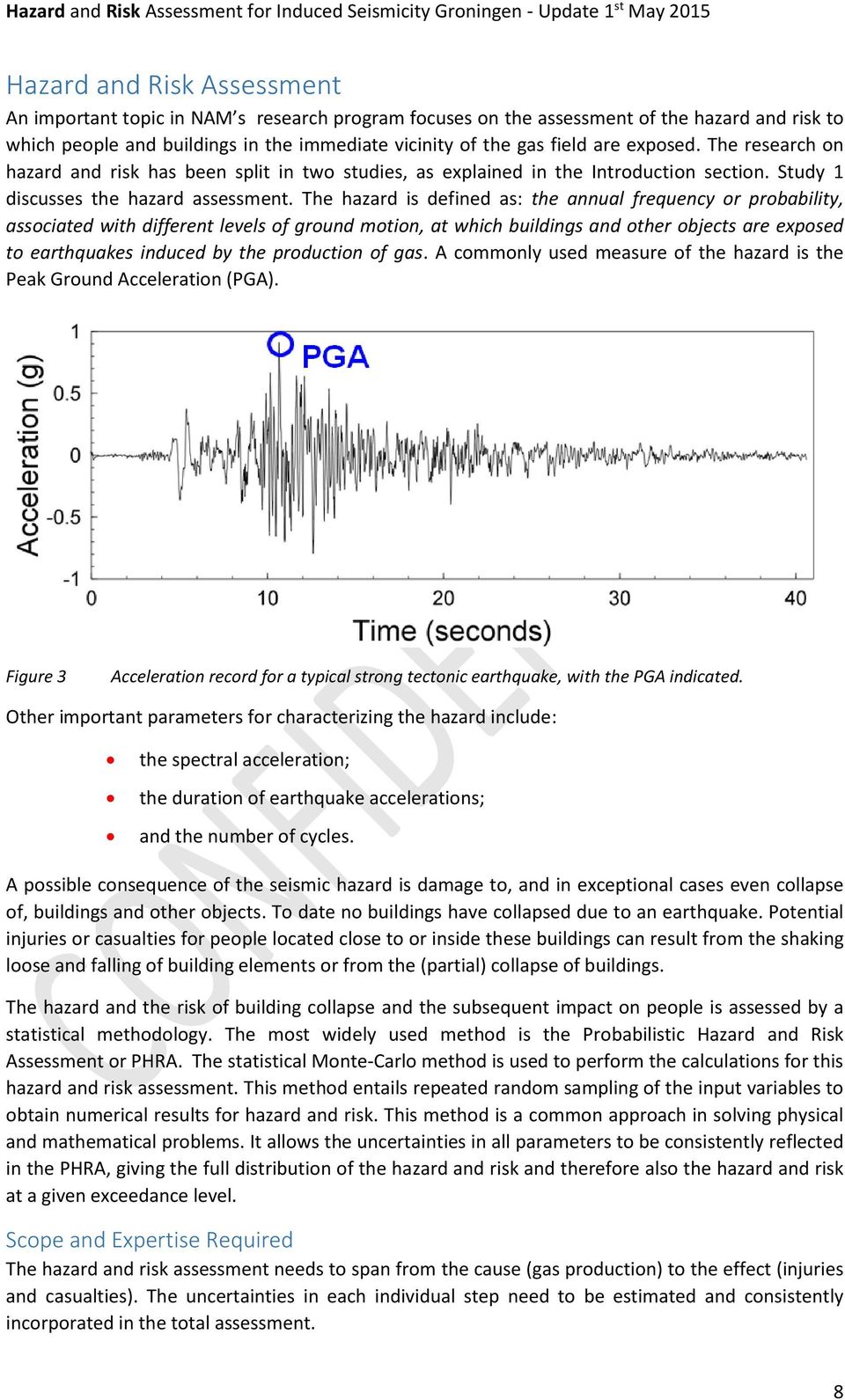
9 Cause Effect Gas Production Deformation Seismicity Ground movement Exposure Fragility Accidents Hazard Assessment Risk Assessment Figure 4 The Hazard and Risk Assessment requires a bridge to be built from the cause (gas production) to the effect (building collapse and potential casualties). The causal chain starts with gas production, reducing the gas pressure in the reservoir and causing deformation of the reservoir rock. Deformation in turn can cause sudden movement in the subsurface, in other words: seismicity. This compartment of the bridge is addressing processes in the deep subsurface; the geo-domain. This requires geological, geophysical and geomechanical expertise. The seismicity generated in the subsurface causes the ground motions or accelerations at surface which are affecting buildings and people. The prediction of ground motion is therefore the crucial link between the processes in the deep subsurface near the gas reservoir and the effects on buildings at the surface. With sufficient knowledge of buildings, their structural strength, and of the presence of people in these buildings (the exposure), the risks can eventually be assessed. This is described in Study 2. Especially expertise in the civil engineering domain is vital to be able to carry out this assessment. Progress Probabilistic Hazard Assessment Based on the available earthquake catalogue and other data specific for the Groningen field, a probabilistic seismological and hazard model was built in Where observational data was sparse or did not exist, analogue data and methods from tectonic earthquake regions were used as the best available data in the absence of appropriate data. This model formed the basis of the probabilistic hazard assessment supporting the Winningsplan In this Winningsplan, hazard maps were presented that showed the PGA for a given period, and with a given probability of exceedance level. Relatively sparse observational data from the Groningen area was available at that time. Both the number of earthquakes that had occurred and the number of observation sites were limited. From the start of monitoring in 1994 till August 2012, some 188 earthquakes with magnitude larger than M=1.5 2 had been recorded. For the prediction of the occurrence of larger events, NAM did not make an estimate of the hazard based on theoretical considerations, which would need to be supplemented with potentially biased expert judgment and the consensus views within the earthquake community. Instead, NAM prepared a hazard assessment based on the scarce evidence available from the Groningen area, complemented, where appropriate with evidence and methods derived from tectonic earthquakes (mainly in southern Europe). This is a conservative approach: for low exceedance levels, the hazard is more likely to be adjusted downwards than upwards, when updates are based on an expanding set of newly acquired acceleration data. 2 NAM is confident an earthquake with magnitude greater than or equal to M 1.5 will be detected wherever the earthquake occurred in the field and irrespective of its timing. An earthquake of smaller magnitude might remain undetected, for instance, among the noise from activities at surface. 9

10 Hence, the acquisition of more data, the completion of more studies and the better quantification of uncertainties, are very important. This led NAM in 2012 to embark on a large program to acquire more and more relevant data. The main objective of this campaign is to make the hazard assessment more reliable. As assumptions used tended to be conservative, the assessed hazard and its associated uncertainty are likely to decrease. The various activities included in the data acquisition campaign are described below. In 2013, geophone strings were placed in the two existing deep monitoring wells (Zeerijp-1 and Stedum-1) located in the Loppersum area, where seismicity is highest. With these two geophone strings placed at reservoir depth (some 3000 m), even small earthquakes could locally be monitored and their origin determined better relative to the interpreted fault system at reservoir level. Conclusions from the analyses of data retrieved from these geofoons are: The recorded micro-seismic events are in accordance with KNMI observations 98.3% of the analysed events originate from the gas reservoir Location of the events are in line with the known structural characteristics of the field Early 2014, 10 additional GPS stations were placed to monitor subsidence better. In 2013 also a campaign started to extend the existing geophone and accelerometer network. In 2014 some 42 shallow (200 m deep) geophone wells were drilled with 4 geophones placed at 50 m intervals in each of these wells. In 2015, drilling continues. Phase I of this project consisting of almost 60 geophone stations is expected to be completed mid However, drilling will be continued with Phase II adding another 11 stations. At each of these stations also a surface accelerometer will be placed. In 2014 the first dedicated deep well designed for seismic monitoring was drilled at the Zeerijp location to a depth below the Rotliegend reservoir. A second well will be spudded in May In this second well an extensive reservoir section will be cored. Three laboratories are awaiting arrival of sections of this core to perform rock experiments on both compaction and rupture processes. Mid 2015, NAM plans to install geophone strings in these dedicated wells. Additionally, a geophone string will be placed in the existing observation well Ten Boer-4, near the Eemskanaal cluster. Each earthquake will now (depending on the magnitude) be recorded from multiple observation points. Based on studies of the geophone and accelerometer data collected and compaction data measured from experiments in laboratories, the hazard model can now, and will continue to be, improved. For each successive improvement of the hazard model, based on studies and monitoring, conservatism in the model will be reduced as conservative assumptions are replaced by constraints derived from actual field observations. This means we feel confident that the assessed hazard at low exceedance levels of 0.2%/annum or less is more likely to decrease than increase overall as a result of further data collection and studies. Schedule Early 2014, the progress of the various studies and the status of the hazard and risk assessment were reviewed. This underlined and clarified the interrelations between the various research activities and provided an opportunity to re-direct the research effort towards resolving the largest uncertainties and the most relevant research questions. For each study domain, progress was envisaged with the hazard and risk model increasingly being refined and the model parameters improved. 10
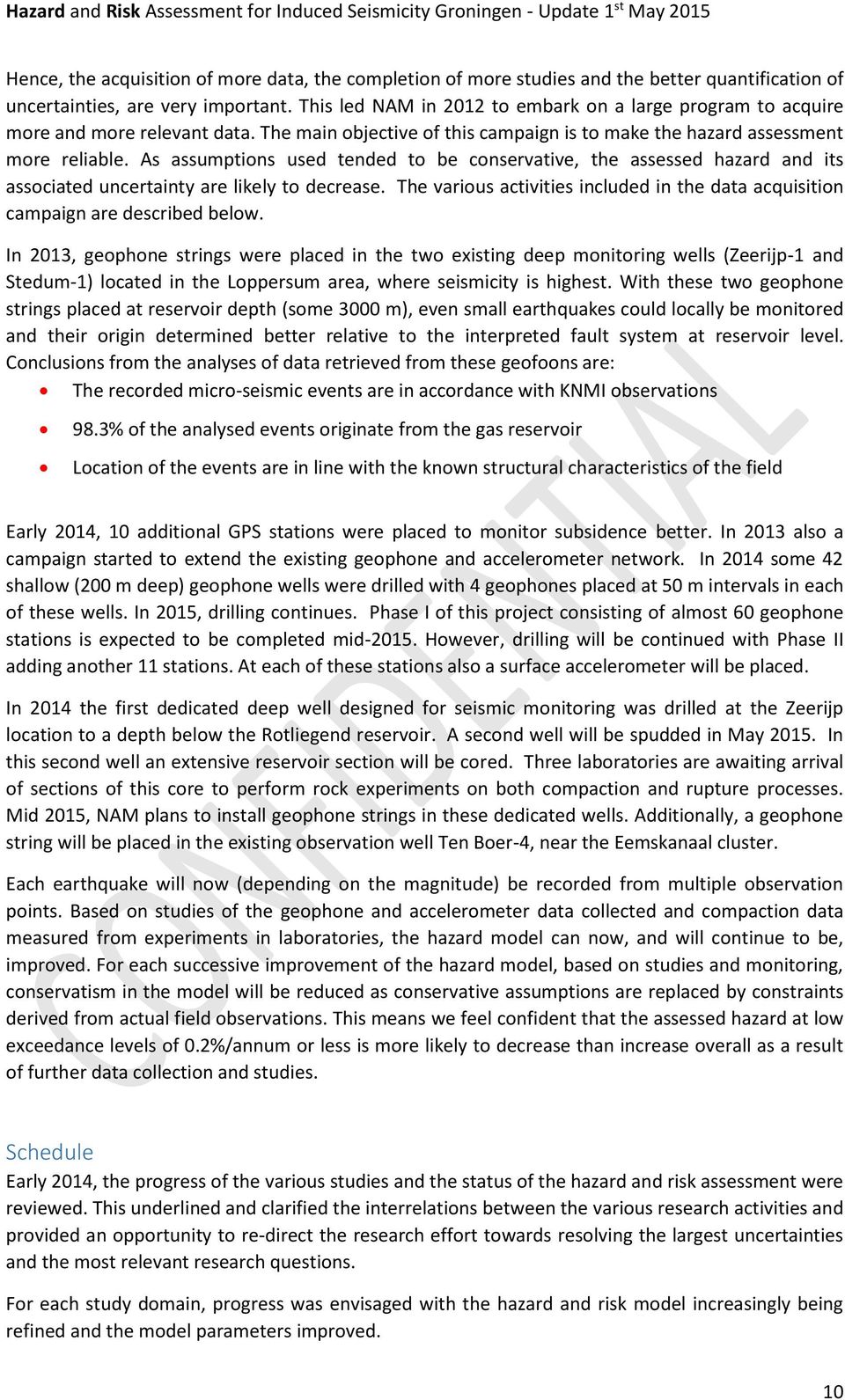

11 Figure 5 Schedule for the research program for the Winningsplan 2016 as presented in the Study and Data Acquisition Plan. Successive improvements at the half-yearly status reviews will be used to re-direct and optimise the research efforts. This is further discussed for each domain in the next sections. Note that the initial timeframe for the studies and half-yearly updates was different from the current timeframe as introduced by the February 2015 decision on the Winningsplan 2013 (Ref. 12). Table 1 shows the current schedule for updates of the hazard and risk assessment in preparation of the Winningsplan Target Date Maturity Status of Hazard and Risk Assessment Version 1 st January Demonstrate capability to extend the probabilistic hazard assessment into the risk domain. 1 st May First probabilistic Hazard and Risk Assessment. Important elements of the hazard assessment still in development (in particular site response). First version with probabilistic Risk Assessment for identification of most fragile buildings to optimise the structural upgrading program. 1 st January Include site response into the ground motion prediction methodology. Hazard and Risk Assessment with most important input included. 1 st July Final Hazard and Risk Assessment for Winningsplan The results of the full research effort is included in this assessment. Table 1 Main deliverables for each inventory update of the hazard and risk assessment 11

12 Main new Elements Hazard Assessment May 2015 This section presents the progress made in the probabilistic hazard assessment since the Winningsplan 2013 was submitted on 29 th November The hazard assessment for Winningsplan 2013 was the first probabilistic hazard assessment for induced seismicity in Groningen. The current probabilistic hazard assessment builds on the work presented in the Winningsplan 2013 (Ref. 3) and the accompanying Technical Addendum (Ref. 4 and 5). The further study work into induced seismicity in Groningen towards Winningsplan 2016 has been described in the Study and Data Acquisition Plan and the accompanying Study Catalogue. Below summarises the main improvements incorporated in the Hazard model for this assessment (mid 2015) and the expected improvements for the next assessment (late 2015) per category. Rock Deformation Compaction Improvements for Version 1 (Mid 2015) Inversion from subsidence by using optical leveling survey data up to Improvements for Version 2 (End 2015) Enhance inversion from subsidence by using additional optical leveling survey data 2013 and InSar data. Improved porosity model for the reservoir from detailed facies modelling and seismic inversion techniques for compressibility estimation. Seismological Model Improvements for Version 1 (Mid 2015) Activity Rate model for seismicity Integration between inversion from subsidence and activity rate model Confirmation from deep geophone wells that the hypo-centers of the earthquakes are in the reservoir with a small number of earthquakes possibly in the Zechstein. Improvements for Version 2 (End 2015) Investigate evidence for potential changes in b-value with time, space, strain, strain rate Investigate evidence for spatial-temporal bias in activity rates scope for refining extended activity rate model Investigate evidence for rate or delay effects following production changes Establish Bayesian framework for ranking performance of alternative models Utilize data from the upgraded monitoring network Investigate influence of finite ruptures along mapped faults Ground Motion Improvements for Version 1 (Mid 2015) Groningen-specific equations for spectral accelerations as well as PGA Expanded dataset of Groningen ground-motion records Epistemic uncertainty in Ground Motion Prediction Equations (GMPEs), due to extrapolation to larger magnitudes, in logic-tree branches Sigma models for GMPEs calibrated to local data, with adjustments for point-source distance metric at larger M Preliminary model for prediction of durations, calibrated to Groningen recordings 12

13 Model for correlation of predicted values of spectral acceleration and duration Improvements for Version 2 (End 2015) More accurate modelling of near-source attenuation of accelerations due to high-velocity layers above reservoir Improved model for durations, capturing very short durations in epicentral area and swift prolongation with distance, including enhanced model for the correlation of accelerations and duration Site-specific soil amplification terms giving more realistic spectral shapes and reduced sigma s in GMPEs Non-linear site response capturing reduced soil amplification with increased acceleration in base rock horizon Investigate strength limitations on maximum surface accelerations transmitted by very soft/weak soil layers Investigate influence of finite ruptures along mapped faults The activities planned to further improve the hazard assessment are all discussed in the Study and Data Acquisition Plan issued early 2015 and the accompanying studies catalogue (Ref. 13). Progress will be reviewed twice a year and the research program re-directed if required. In case of a significant adjustment, an update of the Study and Data Acquisition Plan will be issued. 13
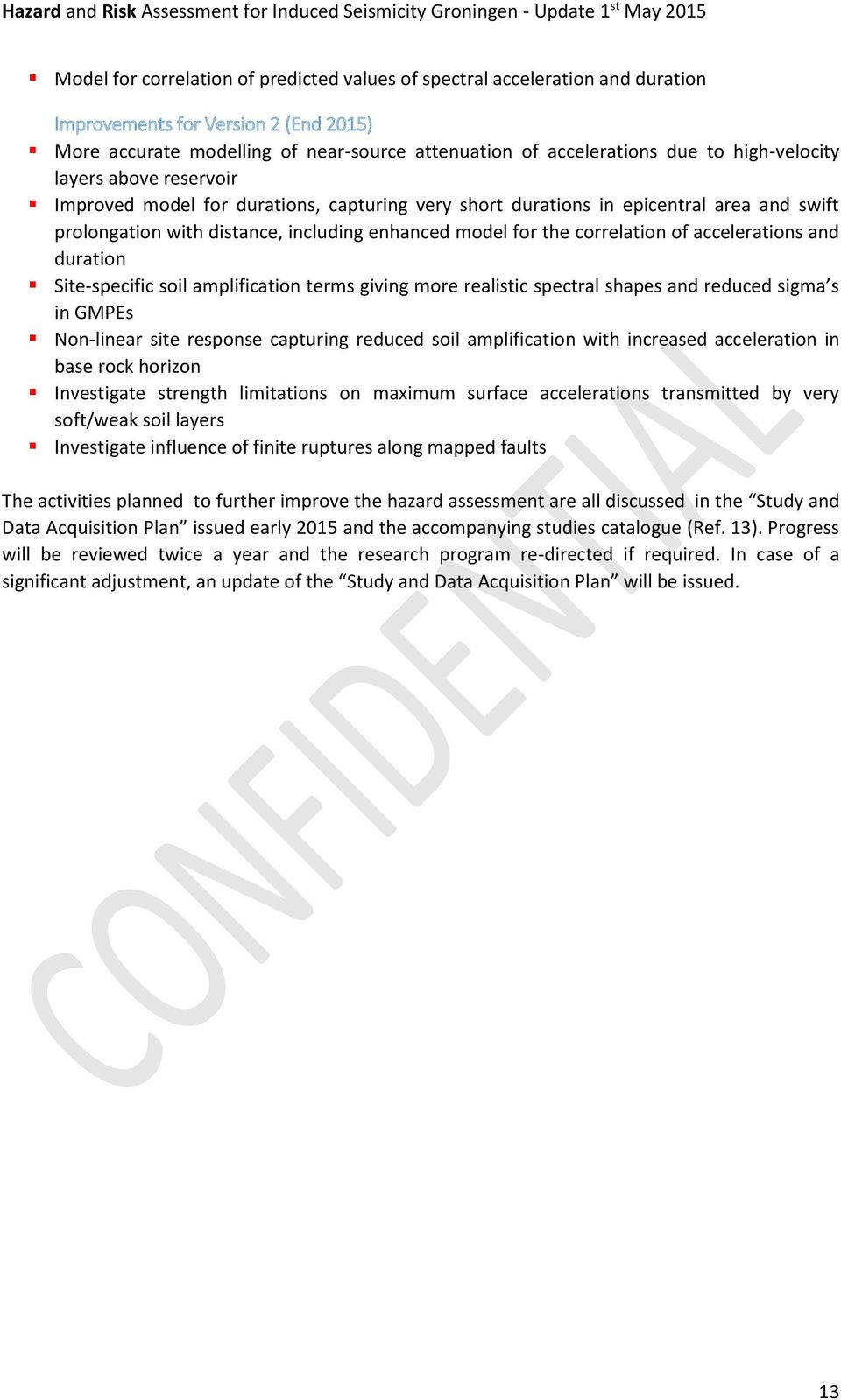
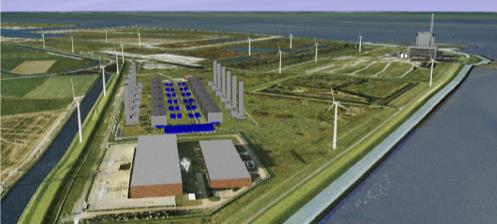
14 Gas production Cause Effect Gas Production Rock Deformation Seismicity Ground Movement Exposure Fragility Injuries Hazard Assessment Placement GPS Stations Geodetic Monitoring (Surveys and InSar) Extension of the Geophone Network Coring of Zeerijp-C Well and Rock Experiments (in Utrecht, Rijswijk and Houston) Rock compaction models and Compaction from Inversion. Geomechanical studies for input into seismological models Stedum Figure 6 The first section of the causal bridge starts with the cause, gas production, and the effect of the resulting pressure drop in the reservoir on the reservoir rock. In both studies (hazard and risk assessments) two production scenarios are used to evaluate the hazard and risk. These scenarios are: Scenario I The total gas production from the Groningen field in this scenario is limited to 39.4 Bcm/annum. Additionally, 4 regional production caps are imposed. These regional caps are imposed on the clusters in regions defined as East (24.5 Bcm/annum), LOPPZ (3 Bcm/annum 3 ), South-West (9.9 Bcm/annum) and Eemskanaal (2.0 Bcm/annum). Together the regional caps sum up to the field production limit of 39.4 Bcm/annum. A consequence is a relatively imbalanced load-factor distribution over the field, highest on Eastern clusters and lowest on LOPPZ clusters. Operational flexibility is further limited by the Eemskanaal gas quality issue (Ref. 18), gasdistribution over the ring pipeline system connecting the production clusters with the custody transfer stations (overslagen) and filling up of the Underground Gas Storage in Norg during the summer months. This scenario is based on the Ministerial decision of February 2015 (Ref. 19; article 5). 3 The ruling of the Council of State to further reduce LOPPZ to nil is not incorporated in this scenario given the limited time for modelling since the date of this ruling (14 th April 2015) and because this ruling does not rule out that 3 Bcm may be produced if necessary for security-of-supply reasons. This scenario is therefore a conservative approach for the Loppersum area. 14
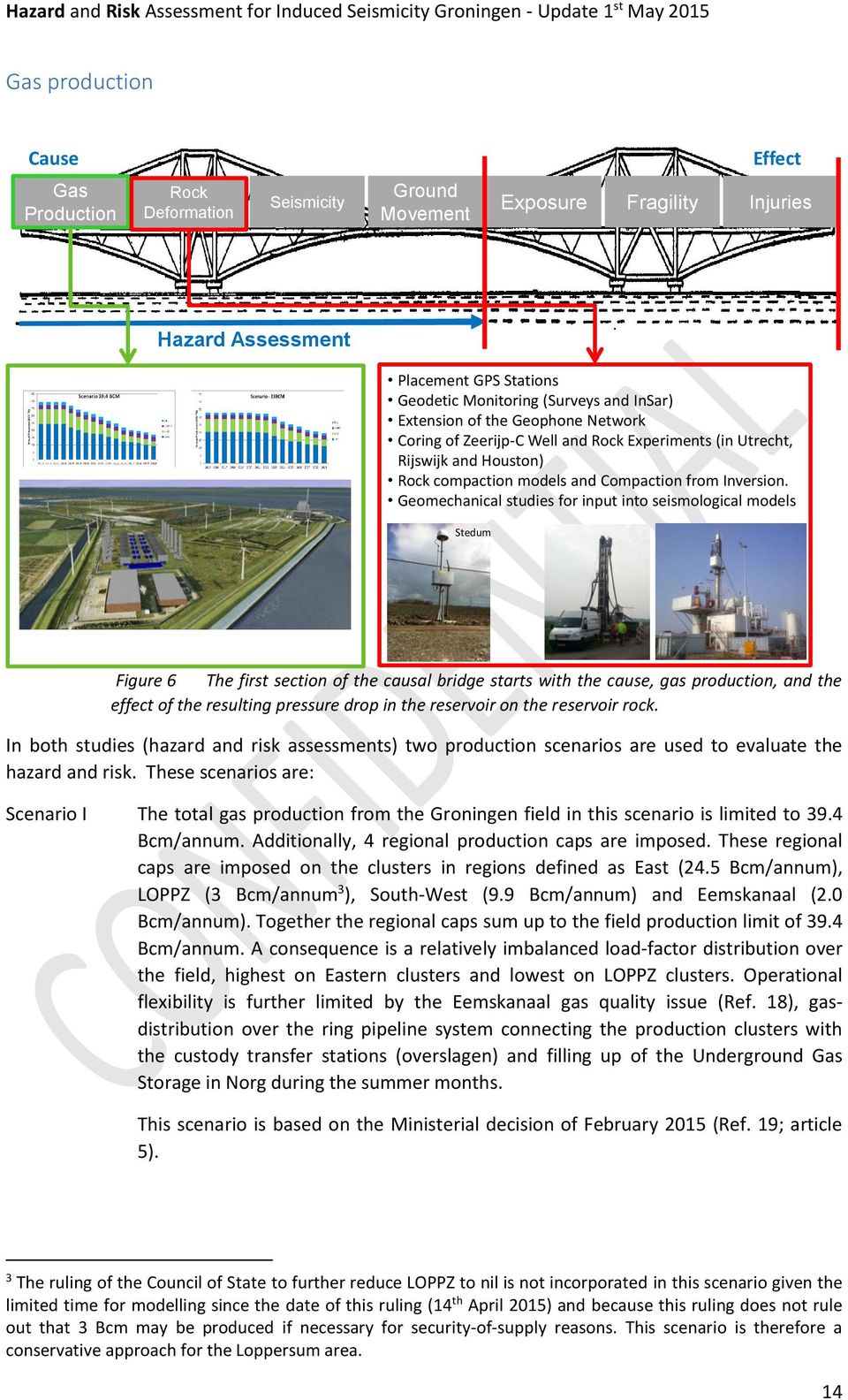
15 Figure 7 An indicative gas production schedule for scenario I. Production is kept below 39.4 Bcm, until the natural decline of the production from the field sets in. No additional development wells are drilled. Scenario II In this scenario the field production is limited to 33.0 Bcm/annum, while the imposed regional caps remain unchanged and defined as East (24.5 Bcm /annum), LOPPZ (3 Bcm /annum), South-West (9.9 Bcm/annum) and Eemskanaal (2 Bcm /annum). The 33 Bcm annual gas production volume is the minimum volume to cover GasTerra s portfolio, with a pre-set monthly volume distribution. Operational flexibility is dictated by the Eemskanaal quality issue, filling up during the summer season of the Underground Gas Storage in Norg and gas-distribution in cooperation with GasUnie gas-quality management. Figure 8 An indicative gas production schedule for scenario II. Production is kept below 33.0 Bcm, until the natural decline of the production from the field sets in. No additional development wells are drilled. This scenario is based on the letter from the minister announcing his decision to reduce the production in the first half of 2015 to 16.5 Bcm. In this scenario, it is assumed that in the second half of 2015 the production will be limited to the same volume as in the first half. 15
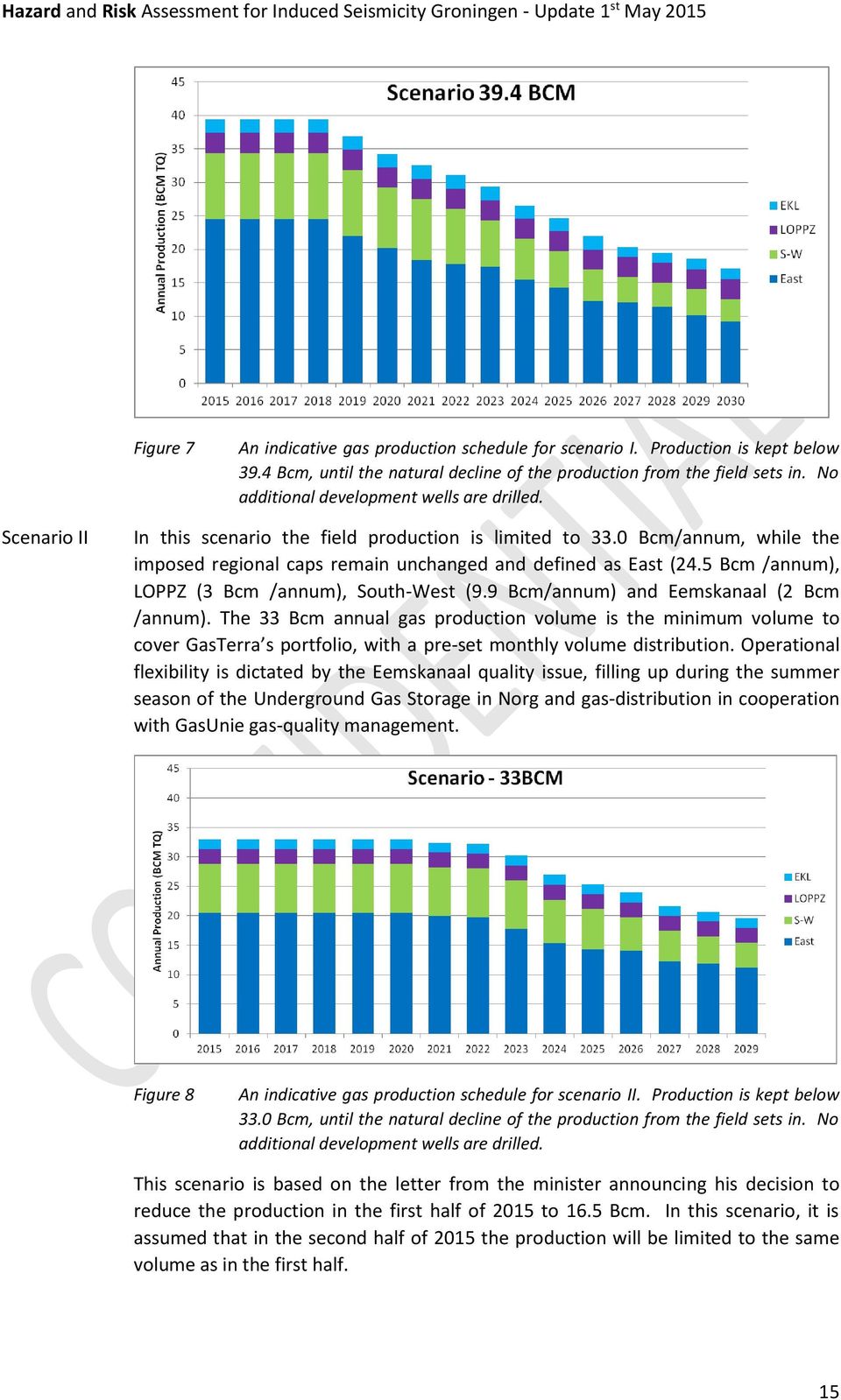
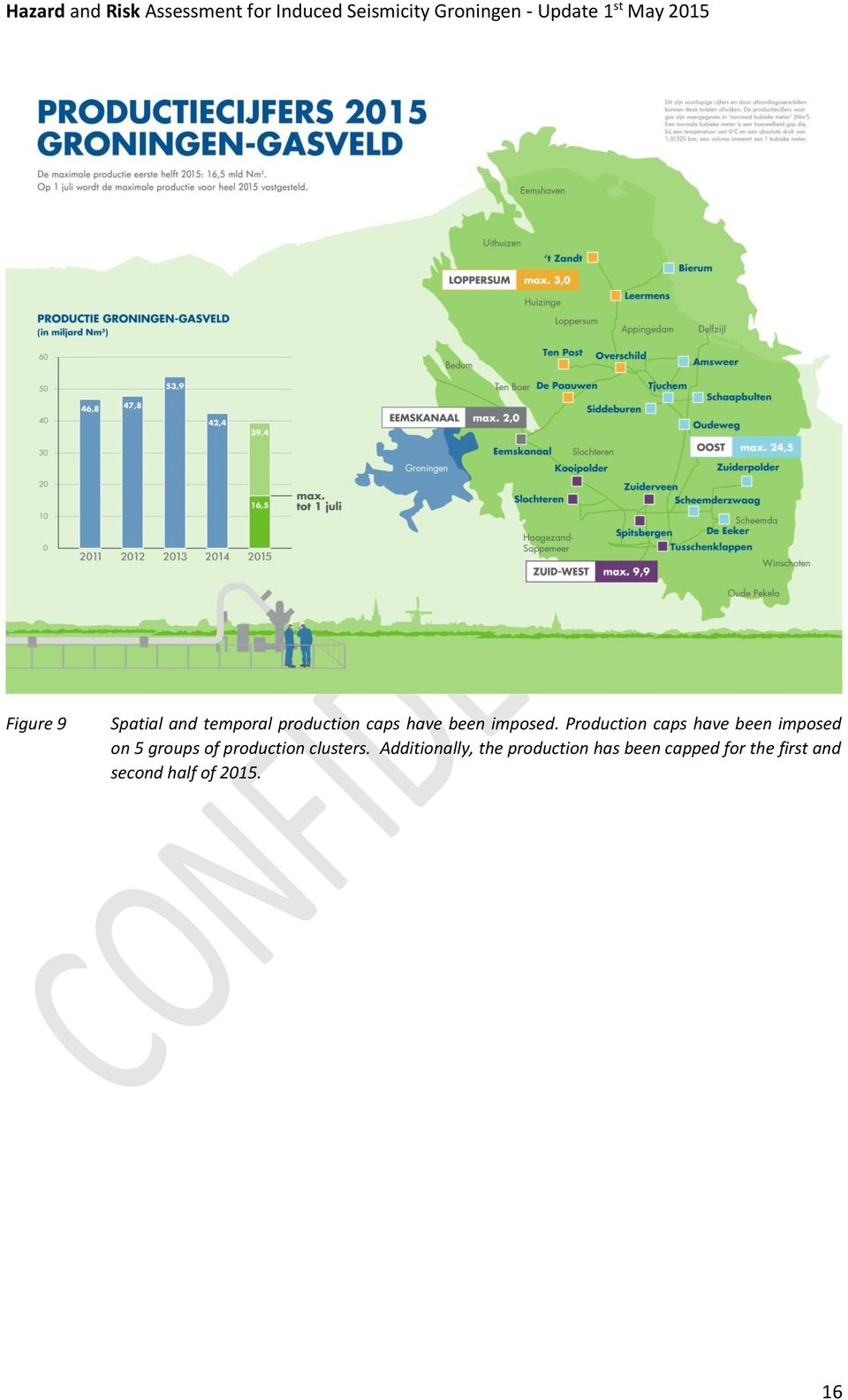
16 Figure 9 Spatial and temporal production caps have been imposed. Production caps have been imposed on 5 groups of production clusters. Additionally, the production has been capped for the first and second half of
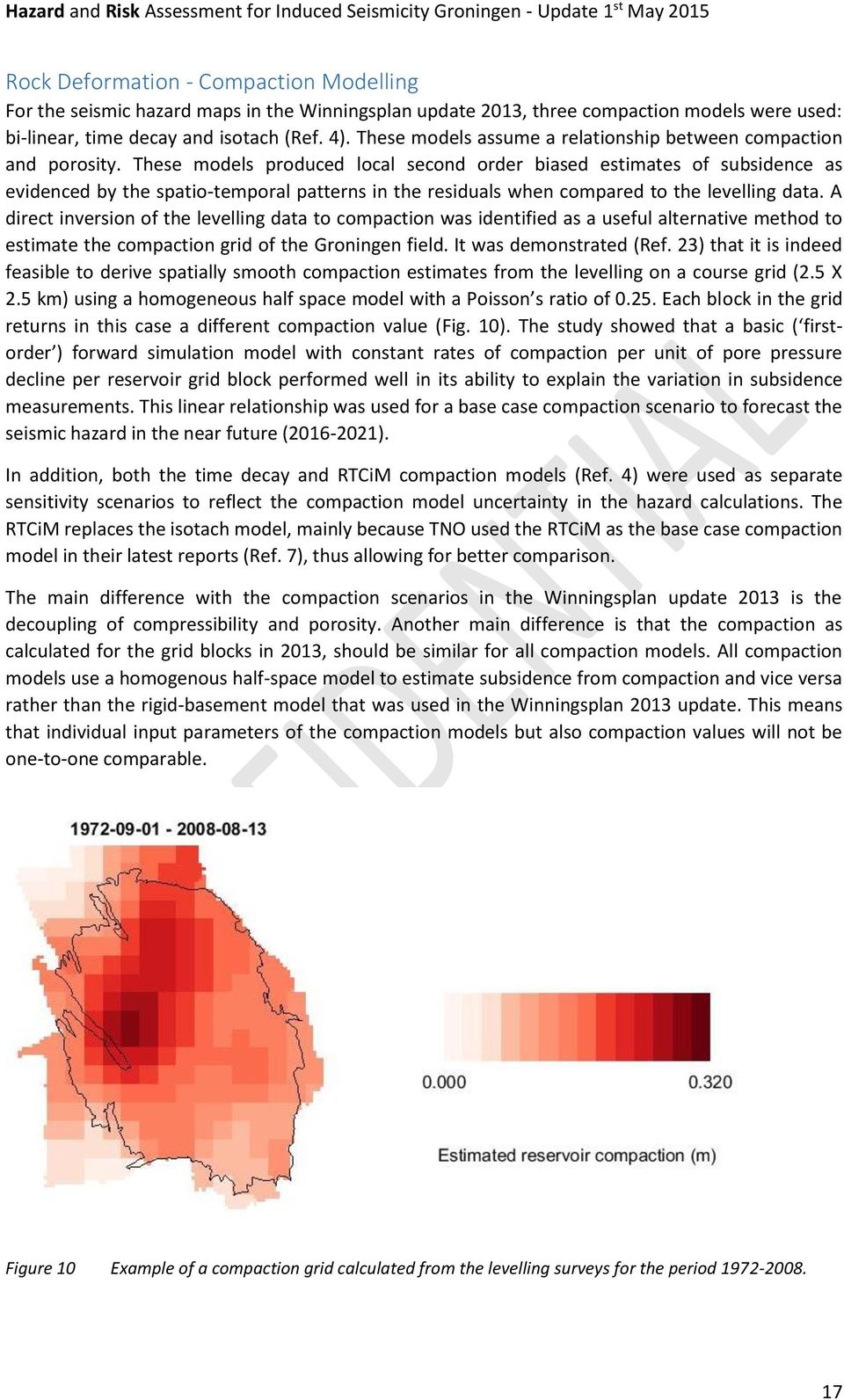
17 Rock Deformation - Compaction Modelling For the seismic hazard maps in the Winningsplan update 2013, three compaction models were used: bi-linear, time decay and isotach (Ref. 4). These models assume a relationship between compaction and porosity. These models produced local second order biased estimates of subsidence as evidenced by the spatio-temporal patterns in the residuals when compared to the levelling data. A direct inversion of the levelling data to compaction was identified as a useful alternative method to estimate the compaction grid of the Groningen field. It was demonstrated (Ref. 23) that it is indeed feasible to derive spatially smooth compaction estimates from the levelling on a course grid (2.5 X 2.5 km) using a homogeneous half space model with a Poisson s ratio of Each block in the grid returns in this case a different compaction value (Fig. 10). The study showed that a basic ( firstorder ) forward simulation model with constant rates of compaction per unit of pore pressure decline per reservoir grid block performed well in its ability to explain the variation in subsidence measurements. This linear relationship was used for a base case compaction scenario to forecast the seismic hazard in the near future ( ). In addition, both the time decay and RTCiM compaction models (Ref. 4) were used as separate sensitivity scenarios to reflect the compaction model uncertainty in the hazard calculations. The RTCiM replaces the isotach model, mainly because TNO used the RTCiM as the base case compaction model in their latest reports (Ref. 7), thus allowing for better comparison. The main difference with the compaction scenarios in the Winningsplan update 2013 is the decoupling of compressibility and porosity. Another main difference is that the compaction as calculated for the grid blocks in 2013, should be similar for all compaction models. All compaction models use a homogenous half-space model to estimate subsidence from compaction and vice versa rather than the rigid-basement model that was used in the Winningsplan 2013 update. This means that individual input parameters of the compaction models but also compaction values will not be one-to-one comparable. Figure 10 Example of a compaction grid calculated from the levelling surveys for the period

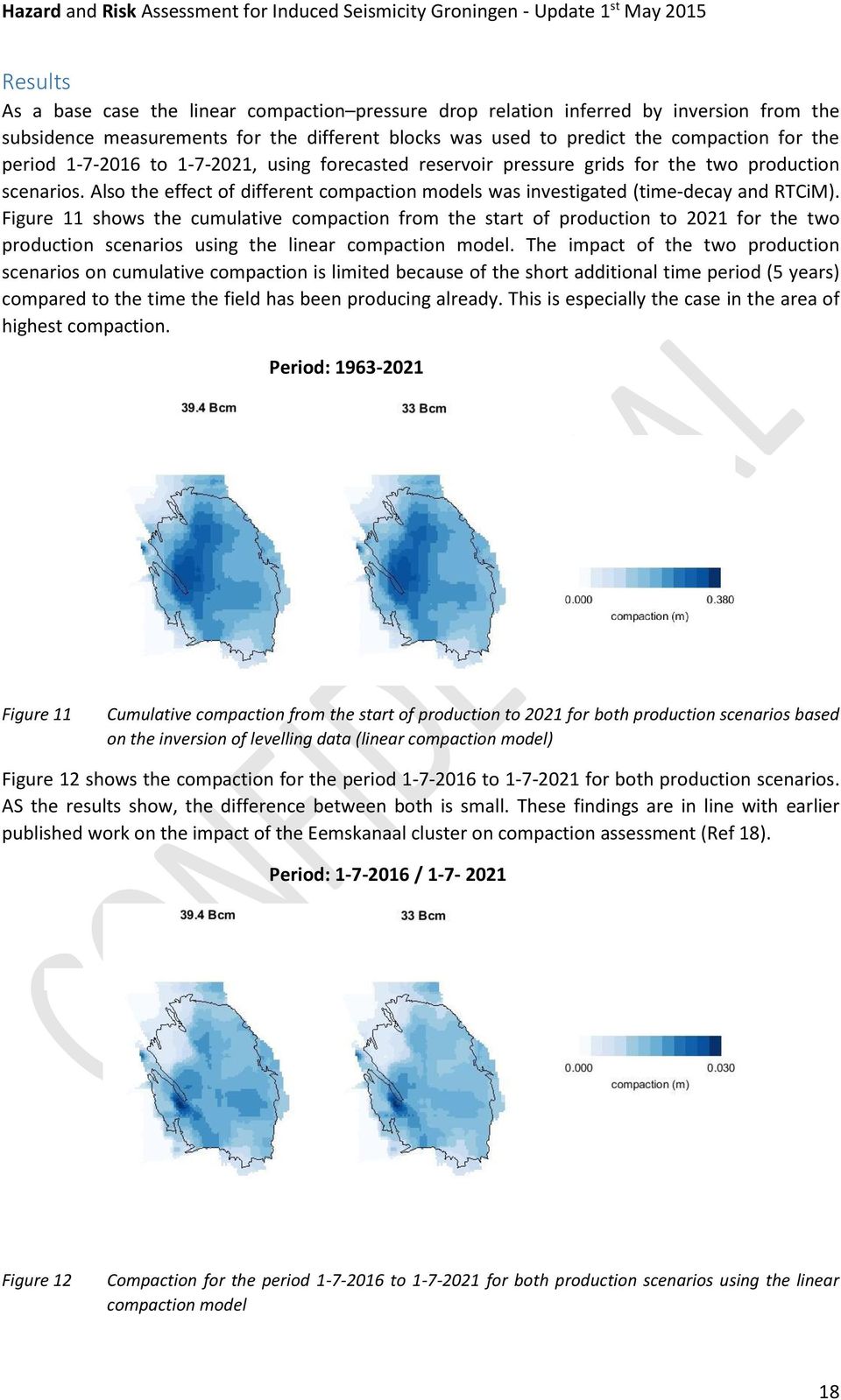
18 Results As a base case the linear compaction pressure drop relation inferred by inversion from the subsidence measurements for the different blocks was used to predict the compaction for the period to , using forecasted reservoir pressure grids for the two production scenarios. Also the effect of different compaction models was investigated (time-decay and RTCiM). Figure 11 shows the cumulative compaction from the start of production to 2021 for the two production scenarios using the linear compaction model. The impact of the two production scenarios on cumulative compaction is limited because of the short additional time period (5 years) compared to the time the field has been producing already. This is especially the case in the area of highest compaction. Period: Figure 11 Cumulative compaction from the start of production to 2021 for both production scenarios based on the inversion of levelling data (linear compaction model) Figure 12 shows the compaction for the period to for both production scenarios. AS the results show, the difference between both is small. These findings are in line with earlier published work on the impact of the Eemskanaal cluster on compaction assessment (Ref 18). Period: / Figure 12 Compaction for the period to for both production scenarios using the linear compaction model 18
19 The impact on additional compaction in the period between and , using alternative compaction models, is presented in Figure 13 for the 39.4 Bcm/annum scenario. This show that there is still uncertainty remaining in the compaction assessment. This is an important contributor to the uncertainty in the hazard and risk assessment. Period: / Figure 13 Compaction for the period to for the three compaction models (39.4 Bcm production scenario) 19

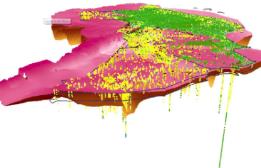
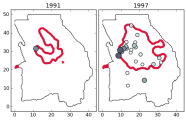
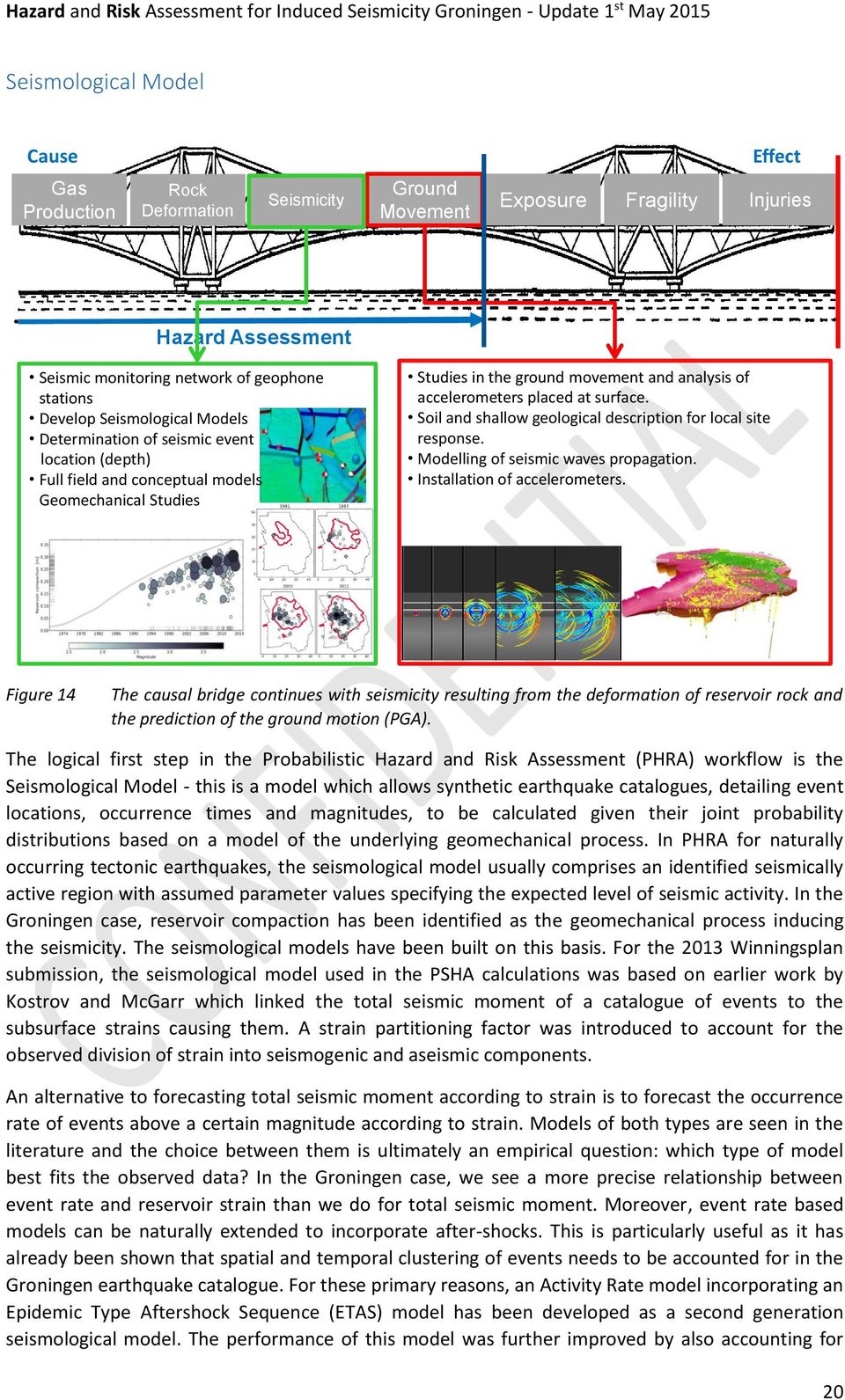
20 Seismological Model Cause Effect Gas Production Rock Deformation Seismicity Ground Movement Exposure Fragility Injuries Hazard Assessment Seismic monitoring network of geophone stations Develop Seismological Models Determination of seismic event location (depth) Full field and conceptual models Geomechanical Studies Studies in the ground movement and analysis of accelerometers placed at surface. Soil and shallow geological description for local site response. Modelling of seismic waves propagation. Installation of accelerometers. Velocity structure at depth likely to influence durations Figure 14 The causal bridge continues with seismicity resulting from the deformation of reservoir rock and the prediction of the ground motion (PGA). Confidential Courtesy of Steve Oates The logical first step in the Probabilistic Hazard and Risk Assessment (PHRA) workflow is the Seismological Model - this is a model which allows synthetic earthquake catalogues, detailing event locations, occurrence times and magnitudes, to be calculated given their joint probability distributions based on a model of the underlying geomechanical process. In PHRA for naturally occurring tectonic earthquakes, the seismological model usually comprises an identified seismically active region with assumed parameter values specifying the expected level of seismic activity. In the Groningen case, reservoir compaction has been identified as the geomechanical process inducing the seismicity. The seismological models have been built on this basis. For the 2013 Winningsplan submission, the seismological model used in the PSHA calculations was based on earlier work by Kostrov and McGarr which linked the total seismic moment of a catalogue of events to the subsurface strains causing them. A strain partitioning factor was introduced to account for the observed division of strain into seismogenic and aseismic components. An alternative to forecasting total seismic moment according to strain is to forecast the occurrence rate of events above a certain magnitude according to strain. Models of both types are seen in the literature and the choice between them is ultimately an empirical question: which type of model best fits the observed data? In the Groningen case, we see a more precise relationship between event rate and reservoir strain than we do for total seismic moment. Moreover, event rate based models can be naturally extended to incorporate after-shocks. This is particularly useful as it has already been shown that spatial and temporal clustering of events needs to be accounted for in the Groningen earthquake catalogue. For these primary reasons, an Activity Rate model incorporating an Epidemic Type Aftershock Sequence (ETAS) model has been developed as a second generation seismological model. The performance of this model was further improved by also accounting for 20
21 the influence of pre-existing fault offsets. A simple geometric argument can be used to show that the induced strain on a pre-existing vertical fault in a compacting reservoir is proportional to the product of fault offset and reservoir compaction. Generalising this simplified geometry it can be shown that replacing compaction in the initial version of the Activity Rate model with a strainthickness attribute accounts for reservoir compaction and reservoir dip including fault offsets. As well as accounting for the variation of seismicity with the process of reservoir level compaction, the seismological model must also account for the observed statistics of earthquakes magnitudes, in particular the relative abundance of large and small magnitude events described by the Gutenberg- Richter b-value. Consideration of the Groningen catalogue as a whole gives a b-value very close to the value of 1.0, generally found for earthquake populations elsewhere. If, however, the catalogue is subdivided into smaller subsets according to the strain-thickness attribute, then potentially significant systematic variations of the b-value with strain-thickness become apparent with b tending to smaller values at larger values of strain thickness. Although a systematic variation of the b-value is seen, the error bounds on the values obtained are large due to the reduced number of events considered in each subset. For this reason a constant b- value close to 1.0 calculated for the catalogue as a whole is taken as the base case scenario with an alternative upper bound scenario determined by taking the b-value as a stochastic function of the strain-thickness. The lower bound scenario was taken as having the constant b-value used for the base-case but maximum likelihood values of the Activity Rate and ETAS model parameters rather than samples drawn from the joint multi-parameter distribution. 21
22 Ground Motion Prediction Peak Ground Acceleration At the time of the preparation of Winningsplan 2013, relatively few earthquake acceleration records were available and therefore little data on which to base a ground motion prediction methodology. This was caused by the relatively low number of earthquakes causing measurable ground accelerations and the relatively low number of accelerometers placed over the field, recording these earthquake accelerations. Although the number of earthquakes with significant accelerations measured at surface increased from 8 to 12 from Winningsplan 2013 to this assessment, the number of recordings of these earthquakes increased from 40 to 85. This is mainly due to the increased number of recording sites as the first geophone sites with accelerometers of the network extension have now been taken into operation. Since the assessment was started two more earthquakes have occurred, each triggering 14 accelerometers and raising the number of recordings to 113. The acceleration records currently available in the Groningen area are for low magnitude earthquakes (M 3.6), which are capable of causing damage to buildings, but are considered to be too small to cause buildings to collapse. For the hazard and risk assessment the ground motion for larger magnitude earthquakes are important. To achieve this, the available data needs to be extrapolated to larger magnitude earthquakes. Within the available time for Winningsplan 2013, a model derived from recordings of tectonic earthquakes in southern Europe was used. Because equations were used that were intended for much stronger tectonic earthquakes, the hazard associated with larger magnitude earthquakes was in hindsight overstated in the first pass in the Winningsplan 2013 (Ref. 4; Chapter 7). The latest studies (Ref. 24) now show that for an earthquake of a given magnitude the ground accelerations are smaller at short periods (e.g. PGA). Figure 15 Variation in the median GMPE with epi-central distance (left) and the associated variability (right) for a (top row) M4.0 and (bottom row) M5.0 Due to the larger number of installed accelerometers in the field, more data is currently available for the preparation of a Groningen specific ground acceleration methodology. Using the additional acceleration records, first an assessment was made of the range of accelerations at surface that 22
23 larger earthquakes could impose. This is based on a simulation approach. This resulted for the best estimate in a lower assessment of the hazard for earthquakes with a larger magnitude (Ref. 24). In this update of the hazard assessment not only PGA is evaluated, but additionally spectral accelerations and the duration of the acceleration are evaluated. This is important for the risk assessment, as building response to the hazard critically depends on these parameters (see next section). Spatial Variability Apart from the average acceleration also the spatial variability of the acceleration resulting from a single earthquake is important. There are many reasons for the large variability in the accelerations measured by different stations, due to a single earthquake. Within the determining factors, the local soil conditions are very important. Accelerations at very soft sites, like peat areas, are in general higher than at less soft sites like sand areas. NAM has therefore asked Deltares to carry out a detailed study of the shallow geology of Groningen (Ref. 25 and 26). Together with experiments planned mid-2015 at the geophone locations and modelling of the site response, a basis will be created for the next update of the ground motion prediction methodology for the Groningen area, due by the end of In the Winningsplan 2013, a database of tectonic earthquake recordings mainly in southern Europe and Turkey was used. Of course, the variability in the shallow geology over such a large area is much larger than that over the Groningen area. It is therefore likely that also the variability in the accelerations was overestimated for the Winningsplan The studies of the shallow geology of Groningen and the planned experiments at the geophone / accelerometer stations are expected to lead to a further reduction of the uncertainty in the assessment for the majority of soil types. The outcome of these experiments at the geophone / accelerometer stations, that are expected to commence late April 2015, are crucial to confirm this. Figure 16 Results of a simulation of earthquake waves moving towards the surface. Uncertainty To reflect the remaining epistemic uncertainty in the final ground motion prediction, three methodologies are weighted (a low, mid and high case). These are combined to form the mean case using weight factors of 20%, 50% and 30% respectively. The high case is still based on tectonic earthquakes and is similar to the method used for the Winningsplan 2013, the mid and low case are based on simulation based extrapolation of the Groningen accelerometer data to higher magnitudes. 23
24 Hazard Assessment Principles For the probabilistic description of the ground accelerations (PGA) a hazard map is used. On this map for each location the acceleration is plotted that could, with a prescribed probability (exceedance level), be exceeded in a prescribed period. Hazard levels are shown using a gradual colour scales, with contours of equal hazard, i.e. PGA, added for convenience. Hazard maps can be made for different production scenarios. An example are the two hazard maps prepared late 2014 (Ref. 18) using the updated model of the reservoir (Figure 17), the activity rate seismicity model and the RTCiM model to predict compaction. These maps were prepared for a probability of exceedance (exceedance level) of 2%/annum for the period 2017 to The map on the left-hand side is based on the gas production as foreseen by NAM in the Winningsplan 2013, while the map on the right includes the production caps imposed early 2014 by the Minister of Economic Affairs. The yellow to red colour scale indicates the PGA as a fraction of g (the average free-fall acceleration in the gravitational field of the earth). Contours at intervals of 0.02 g are added. Period: 2017 / Winningsplan 2013 Ministerial Decision Feb 2014 Hazard map showing the peak ground acceleration (PGA) with 2% average annual chance of Figure exceedance 17 Hazard from 2017 map to showing 2027 and the the peak Activity ground Rate acceleration seismological (PGA) model. with The 2 contour % average interval annual is 0.02g. chance of exceedance from 2017 to 2027 and the Activity Rate seismological model. The contour interval is 0.02 g. Updates Hazard Assessment The construction of the hazard maps shown in this section requires clarification. A location in the Groningen field during a period of 5 years is subjected to accelerations resulting from induced earthquakes. At some locations, e.g. near Loppersum, the chance of experiencing a large acceleration is higher than at the periphery of the field. The chance of experiencing an acceleration in excess of a certain peak ground acceleration value declines with larger accelerations. This is shown for a large set of locations in figure 18. Each declining line corresponds to a single location in the field. 24
25 0.35g 0.2% year -1 Figure 18 Annual exceedance rate for peak ground acceleration at different locations in the field. This was assessed for the period and the 39.4 Bcm production scenario. Each line corresponds to a location in the field. The bold line indicates the maximum PGA in the field for a given exceedance level (bounding envelope). How to read this figure: The red line indicates that for an exceedance level of 0.2%/annum the highest PGA felt in the field is 0.35g. 25
26 A weighted ground-motion prediction methodology was used to assess the hazard. A low, mid and high case GPME model were combined to arrive at the (weighted) medium ground motion prediction to create the mean hazard map. The resulting mean hazard map is shown below, in figure 19. This map is the basis for the risk assessment in Study 2. Mean hazard map - period: / Figure 19 Mean hazard map for period , Production: 39.4 Bcm/annum, Compaction: Inversion, Activity Rate: V1, M 3.5 Metric: 0.2%/year chance of exceedance (10% chance in 50 years). 26
27 Comparison of Mean Hazard Map with earlier Hazard Assessments The current high case model was calculated using a methodology similar to the mean case model of Winningsplan 2013, adjusted for the 39.4 Bcm production scenario. The difference between these maps gives an indication of the reduction in the hazard assessment achieved by the study and data acquisition in 2014 and early This shows a meaningful reduction of the assessed seismic hazard. High - period: / Figure 20 Hazard map for period , Production: 39.4 Bcm/annum, Compaction: Inversion, Activity Rate: V1, M 3.5 Metric: 0.2%/year chance of exceedance (10% chance in 50 years). As a sensitivity, hazard maps for the mid case GMPE model are shown below, both for the 39.4 Bcm/annum and the 33 Bcm/annum production scenarios. As the production in the Loppersum area is reduced to a maximum of 3 Bcm/annum for in all production scenarios, the effect of the further reduction in production is minimal in the Loppersum area. The mid case GMPE model for the 39.4 Bcm/annum scenario shows markedly lower PGAs than the mean case model (Fig.19) as the mean case is heavily influenced by the high case. 27
28 39.4 Bcm/annum 33 Bcm/annum Figure 21 Hazard map PGA hazard sensitivity to production rates. Period: 2016/7 2021/7, Production scenarios: 39.4, 33, 20 Bcm/annum, Compaction: Inversion, Activity Rate: V1, M 3.5, GMPE (central), Metric: 0.2% year-1 chance of exceedance (10% chance in 50 years) 28
29 Conclusion 1. The Huizinge earthquake on August 16, 2012 was a watershed event for gas production in the Groningen field, causing NAM to launch a comprehensive Study and Data Acquisition Plan for induced seismicity in Groningen. This Plan builds on earlier seismic research and is a crucial building block for the Winningsplan, due July 1, The aim of the Plan is to deliver both a Hazard Assessment (i.e., ground motions) and a Risk Assessment (i.e., harm to people) for induced seismicity in the Groningen area. 2. The Hazard Assessment update presented in this study is an intermediate step in the execution of the Study and Data Acquisition Plan: a. Our understanding of the seismic hazard has benefited from fresh data obtained from the extended network of geophones and accelerometers, put in place in the second half of This has helped to refine our modeling of the seismic hazard. b. Compared with the results obtained for the 2013 Winningsplan, the current update shows a meaningful reduction of the assessed seismic hazard, translating into geographical maps with lower PGA hazard. 3. An important next step in the Study and Data Acquisition Plan is to further refine the Hazard Assessment by modeling the non-linear soil response using the recently completed Deltares description of the local shallow subsurface and new measurements of soil response. 29
30 References The references in this list have been placed in chronological order of publication. 1. Nederlandse Aardolie Maatschappij BV (Jan van Elk and Dirk Doornhof), Study and Data Acquisition Plan for Induced Seismicity in Groningen - Planning Report, November 2012, 2. Staatstoezicht op de Mijnen, Reassessment of the probability of higher magnitude earthquakes in the Groningen gas field, 16 th January groningse%20gasveld% pdf 3. Nederlandse Aardolie Maatschappij BV, Update of the Winningsplan Groningen 2013, 29 th November Nederlandse Aardolie Maatschappij BV (Jan van Elk and Dirk Doornhof, eds), Technical Addendum to the Winningsplan Groningen 2013; Subsidence, Induced Earthquakes and Seismic Hazard Analysis in the Groningen Field, 5. Nederlandse Aardolie Maatschappij BV (Jan van Elk and Dirk Doornhof, eds), Supplementary Information to the Technical Addendum of the Winningsplan Arup Project Title: Groningen 2013, Implementation Study and 7. TNO, A general framework for rate dependent compaction models for reservoir rock, 2013, Report TNO 2013 R TNO, Eindrapport - Toetsing van de bodemdalingsprognoses en seismische hazard ten gevolge van gaswinning van het Groningen veld, 2013, Report TNO 2013 R Staatstoezicht op de Mijnen, Advies Staatstoezicht op de Mijnen: Winningsplan Groningen % pdf 10. Staatstoezicht op de Mijnen Advies Winningsplan 2013 / Meet- en Monitoringsplan NAM Groningen gasveld SodM, Risico Analyse Aardbevingen Groningen, Ministry of Economic Affairs, The cabinet decision on production from the Groningen field Nederlandse Aardolie Maatschappij BV, Jan van Elk & Dirk Doornhof, Study and Data Acquisition Plan Induced Seismicity in Groningen for the update of the Winningsplan 2016, December 2014, submitted in March 2015, EP
31 14. Bourne, S. J., S. J. Oates, J. van Elk, and D. Doornhof (2014), A seismological model for earthquakes induced by fluid extraction from a subsurface reservoir, J. Geophys. Res. Solid Earth, 119, , doi: /2014jb ) or S.J. Bourne, S.J. Oates, J.J. Bommer, B. Dost, J. van Elk, D. Doornhof, A Monte Carlo method for probabilistic hazard assessment of induced seismicity due to conventional gas production, Bulletin of the Seismological Society of America, V.105, no. 3, June 2015 in press. 16. Magnitude, Barnavol, J., Belayouni, N., Daniel, G. and Fortier, E., Seismic Monitoring, Delivery of location Results Groningen field, January Nederlandse Aardolie Maatschappij BV, Risk Methodology; Back to the region, February 2015, (forwarded to the national committee on earth quake related risks in April 2015) (EP ). 18. Nederlandse Aardolie Maatschappij BV, Hazard Assessment for the Eemskanaal area of the Groningen field, November Besluit van de Minister van Economische Zaken: Instemming gewijzigd Winningsplan Groningen veld, Ministerie van Economische Zaken, February 2015, ETM/EM/ Stephen Bourne and Steve Oates, Activity Rate Model. 21. Letter from the Minister of Economic Affairs: Reductie van de productie van het Groningen veld eerste helft 2015, 10th February Matt Pickering, A re-estimate of the earthquake hypo-centre locations in the Groningen Gas Field, March Regularised direct inversion to compaction in the Groningen reservoir using measurements from optical levelling campaigns, S.M. Bierman, F. Kraaijeveld and S.J. Bourne, March Development of Version 1 GMPEs for Response Spectral Accelerations and for Strong-Motion Durations, Julian J Bommer, Peter J Stafford, Benjamin Edwards, Michail Ntinalexis, Bernard Dost and Dirk Kraaijpoel, March Introduction to the Geology of Groningen, Erik Meijles, April Geological schematisation of the shallow subsurface of Groningen (For site response to earthquakes for the Groningen gas field), Deltares Pauline Kruiver and Ger de Lange. 27. Exposure Model v1 Updated Typologies and Inference Rules, Helen Crowley, Damian Grant and Rui Pinho, March Report on software verification against experimental benchmark data, Mosayk, November Report on structural modelling of non-urm buildings, Mosayk, April URM Modelling and Analysis Cross Validation Arup, EUCENTRE, TU Delft, Reference _032.0_REP127_Rev.0.03 April Plan of approach for URM material testing, ARUP, Eucentre and TU Delft, March Report on v0 Partial Collapse Fragility Functions, Helen Crowley and Damian Grant, October Development of v1 Fragility Functions for Structural Failure, Helen Crowley, Damian Grant and Rein de Vries, April Analysis of deep compaction measurements in the Groningen field, Pepijn Kole, Dirk Doornhof and Antony Mossop, May 2015 (in preparation) 35. SodM, P500 Engels ref-06-risico-analyse-aardgasbevingen-groningen 36. TNO, TNO 2013 R12071, Safety considerations for earthquakes (2013); Steenbergen, R.D.J.M.; Vrouwenvelder, A.C.W.M.; Scholten N.P.M. (ERB) 37. SodM, Letter on reporting requirements as part of the final decision on the winningsplan, annex SodM expectations for NAM 1 st of May risk report, 31 March 2015,
32 Note: For each document the link to the document on the web-site, where the document was issued has been provided. Some of these links might have become obsolete. For those documents without a current link, a link to a site will be provided in the next update of the report. 32
33 Appendix A - Partners The main partners in the research program into induces seismicity in Groningen are listed below: Partner Expertise Deltares Shallow geology of Groningen, soil properties and measurements of site response/liquefaction. University Utrecht (UU) Measurements of rock compaction and rupture on core samples, understanding of physical processes determining compaction. University Groningen (RUG) Shallow geology of Groningen. ARUP Technical University Delft (TUD) Eucentre, Pavia, Italy Mosayk Modelling of building response to earthquakes, management of the program to measure strength of building materials. Measure strength of building materials and building elements. Measure strength of building materials, building elements and shake table testing of full scale houses. Modelling of building response to earthquakes. Magnitude (A Baker Hughes & CGG Company) Seismic Monitoring (determination of location results deep geophones) TNO Potential for earthquakes resulting from injection. Building sensor project. Avelon Supplier of geophone equipment permanent seismic observations wells. Baker-Hughes Supplier of geophone equipment temporary observation wells. Anthea Rossingh Drilling Management of the extension of the geophone network. Drilling of the shallow wells for the extension of the geophone network. 33
34 Appendix B - Experts Apart from scientist, engineers and researchers in NAM and the laboratories of Shell (Rijswijk) and Exxonmobil (Houston), NAM has also sought the advice of internationally recognised experts. Some of the experts involved in the research program on induced seismicity in Groningen, led by NAM, are listed below. External Expert Affiliation Role Main Expertise Area Gail Atkinson Sinan Akkar Western University, Ontario, Canada Bogazici, University Istanbul Independent Reviewer Collaborator Ground Motion Prediction Ground Motion Prediction Hilmar Bungum NORSAR, Norway Independent Reviewer Ground Motion Prediction Jack Baker Stanford University, US Independent Reviewer Building Fragility Julian Bommer Tijn Berends Independent Consultant, London Student; University Groningen Collaborator Independent Reviewer Ground Motion Prediction and Site Response Site Response and Shallow Geological Model Loes Buijze University Utrecht Collaborator Rock Physics / Core Experiments Fabrice Cotton Helen Crowley John Douglas GFZ Potsdam, Germany Independent Consultant, Pavia University of Strathclyde, UK Independent Reviewer Collaborator Independent Reviewer Ground Motion Prediction Building Fragility and Risk Ground Motion Prediction Ben Edwards University Liverpool Collaborator Ground Motion Prediction Paolo Franchin University of Rome La Sapienza Independent Reviewer Building Fragility Damian Grant ARUP Collaborator Building Fragility Michael Griffith University of Adelaide, Australia Independent Reviewer Building Fragility Russell Green Virginia Tech, USA Collaborator Liquefaction Model Brad Hager Curt Haselton Massachusetts Institute of Technology California State University, US Independent Advisor Independent Reviewer Geomechanics Rien Herber University Groningen Independent Facilitator General Rob van der Hilst Massachusetts Institute of Technology Independent Advisor Building Fragility Geomechanics Jason Ingham University of Auckland Independent Reviewer Building Fragility Adriaan Janszen Exxonmobil Independent Reviewer Shallow Geological Model Mandy Korff Deltares Collaborator Site Response, liquefaction and Shallow Geological Model 34
35 Table continued: External Expert Affiliation Role Main Expertise Area Marco de Kleine Deltares Collaborator Site Response and Shallow Geological Model Pauline Kruiver Deltares Collaborator Site Response and Shallow Geological Model Florian Lehner University of Vienna Independent Reviewer Rock mechanics Ger de Lange Deltares Collaborator Site Response and Shallow Geological Model Nico Luco United States Geological Survey Independent Reviewer Building Fragility Eric Meijles University Groningen Independent Reviewer Shallow Geological Model Guido Magenes EUCentre Pavia Collaborator Building Fragility Ian Main University Edinburgh Independent Reviewer Seismogenic Model / Statistics Piet Meijers Deltares Collaborator Site Response, liquefaction and Shallow Geological Model Michail Ntinalexis Independent Collaborator Ground Motion Prediction Barbara Polidoro Matt Pickering Independent Consultant, London Student; Leeds University Collaborator Collaborator Ground Motion Prediction Seismic Event Location Rui Pinho University Pavia Collaborator Building Fragility Adrian Rodriguez - Marek Emily So Robin Spence Virginia Tech, USA Collaborator Site Response Assessment Cambridge Architectural Research Ltd Cambridge Architectural Research Ltd Collaborator Collaborator Injury model Injury model Chris Spiers University Utrecht Collaborator Rock Physics / Core Experiments Joep Storms TU Delft Independent Reviewer Shallow Geological Model Jonathan Stewart UCLA, California, USA Independent Reviewer Ground Motion Prediction Peter Stafford Imperial College London Collaborator Ground Motion Prediction Peter Styles Keele University Independent Advisor Geomechanics Tony Taig TTAC Limited Collaborator Risk Dimitrios Vamvatsikos NTUA, Greece Independent Reviewer Building Fragility Brecht Wassing TNO Collaborator Geomechanics 35
36 Table continued: External Expert Affiliation Role Main Expertise Area Ivan Wong AECOM, Oakland, USA Independent Reviewer Ground Motion Prediction Stefan Wiemer ETHZ Zurich Independent Advisor Geomechanics Teng Fong Wong University Hong Kong Independent Reviewer Rock mechanics Bob Youngs AMEC, Oakland, USA Independent Reviewer Ground Motion Prediction Mark Zoback Stanford University Independent Reviewer Seismological Model and Geomechanics 36
37 37
Hazard and Risk Assessment for Induced Seismicity Groningen. Study 1 Hazard Assessment
 Hazard and Risk Assessment for Induced Seismicity Groningen Study 1 Hazard Assessment Update 1 st May 2015 Additional scenarios integrated 1 Contents Introduction... 3 History of induced earthquakes in
Hazard and Risk Assessment for Induced Seismicity Groningen
 Hazard and Risk Assessment for Induced Seismicity Groningen Study 2 Risk Assessment Update 1 st May 2015 Contents Introduction... 4 History of induced Earthquakes in Groningen... 4 Study and Data Acquisition
Technical Addendum to the Winningsplan Groningen 2013 Subsidence, Induced Earthquakes and Seismic Hazard Analysis in the Groningen Field
 Technical Addendum to the Winningsplan Groningen 2013 Subsidence, Induced Earthquakes and Seismic Hazard Analysis in the Groningen Field Date: November 2013 1 Subsurface aspects of Subsidence and Induced
Client: Nederlandse Aardolie Maatschappij Arup Project Title: Groningen 2013 Seismic Risk Study - Earthquake Scenario-Based Risk Assessment
 Client: Nederlandse Aardolie Maatschappij Arup Project Title: Groningen 2013 Seismic Risk Study - Earthquake Scenario-Based Risk Assessment REP/229746/SR001 Issue 29 November 2013 This report was prepared
PROHITECH WP3 (Leader A. IBEN BRAHIM) A short Note on the Seismic Hazard in Israel
 PROHITECH WP3 (Leader A. IBEN BRAHIM) A short Note on the Seismic Hazard in Israel Avigdor Rutenberg and Robert Levy Technion - Israel Institute of Technology, Haifa 32000, Israel Avi Shapira International
Report on the expected PGV and PGA values for induced earthquakes in the Groningen area
 Report on the expected PGV and PGA values for induced earthquakes in the Groningen area Bernard Dost, Mauro Caccavale, Torild van Eck, Dirk Kraaijpoel KNMI December 2013 2 Summary Recent developments in
Geothermal. . To reduce the CO 2 emissions a lot of effort is put in the development of large scale application of sustainable energy.
 Geothermal Energy With increasing fossil fuel prices, geothermal energy is an attractive alternative energy source for district heating and industrial heating. In recent years the use of geothermal energy
The successful integration of 3D seismic into the mining process: Practical examples from Bowen Basin underground coal mines
 Geophysics 165 Troy Peters The successful integration of 3D seismic into the mining process: Practical examples from Bowen Basin underground coal mines This paper discusses how mine staff from a number
Load and Resistance Factor Geotechnical Design Code Development in Canada. by Gordon A. Fenton Dalhousie University, Halifax, Canada
 Load and Resistance Factor Geotechnical Design Code Development in Canada by Gordon A. Fenton Dalhousie University, Halifax, Canada 1 Overview 1. Past: Where we ve been allowable stress design partial
Seismic Risk Study: Earthquake Scenario-Based Risk Assessment
 Review of Arup Report Seismic Risk Study: Earthquake Scenario-Based Risk Assessment Julian Bommer, Helen Crowley & Rui Pinho Scope This document presents a brief review of the report by Arup (REP/229746/SR001,
AFAD DEPREM DAİRESİ BAŞKANLIĞI TÜRKİYE KUVVETLİ YER HAREKETİ ve ÖN HASAR TAHMİN SİSTEMLERİ ÇALIŞMA GRUBU. (Rapid Estimation Damage)
 (Rapid Estimation Damage) AFAD-RED SYSTEM The technological advances in seismic instrumentation and telecommunication permit the development of rapid estimation of earthquake losses in order to enhance
Client: Nederlandse Aardolie Maatschappij Arup Project Title: Groningen 2013 Structural Upgrading Study
 Client: Nederlandse Aardolie Maatschappij Arup Project Title: Groningen 2013 REP/229746/SU003 Issue 29 November 2013 This report was prepared by Arup in November 2013 on the basis of a scope of services
BRO: the Dutch Key Register of the Subsurface
 Fact sheet BRO: the Dutch Key Register of the Subsurface Data types explained January 2012 This BRO fact sheet, one of a series, is a publication of the Dutch Ministry of Infrastructure and the Environment.
Integrated Reservoir Asset Management
 Integrated Reservoir Asset Management Integrated Reservoir Asset Management Principles and Best Practices John R. Fanchi AMSTERDAM. BOSTON. HEIDELBERG. LONDON NEW YORK. OXFORD. PARIS. SAN DIEGO SAN FRANCISCO.
Gas storage industry primer
 Gas storage industry primer Gas storage industry primer General Underground natural gas storage facilities are a vital and complementary component of the North American natural gas transmission and distribution
SOFTWARE FOR GENERATION OF SPECTRUM COMPATIBLE TIME HISTORY
 3 th World Conference on Earthquake Engineering Vancouver, B.C., Canada August -6, 24 Paper No. 296 SOFTWARE FOR GENERATION OF SPECTRUM COMPATIBLE TIME HISTORY ASHOK KUMAR SUMMARY One of the important
DECISION PROCESS AND OPTIMIZATION RULES FOR SEISMIC RETROFIT PROGRAMS. T. Zikas 1 and F. Gehbauer 2
 International Symposium on Strong Vrancea Earthquakes and Risk Mitigation Oct. 4-6, 2007, Bucharest, Romania DECISION PROCESS AND OPTIMIZATION RULES FOR SEISMIC RETROFIT PROGRAMS T. Zikas 1 and F. Gehbauer
Forecaster comments to the ORTECH Report
 Forecaster comments to the ORTECH Report The Alberta Forecasting Pilot Project was truly a pioneering and landmark effort in the assessment of wind power production forecast performance in North America.
Monte Carlo Simulations for Patient Recruitment: A Better Way to Forecast Enrollment
 Monte Carlo Simulations for Patient Recruitment: A Better Way to Forecast Enrollment Introduction The clinical phases of drug development represent the eagerly awaited period where, after several years
Waste Transfer Pricing Methodology for the disposal of higher activity waste from new nuclear power stations
 Waste Transfer Pricing Methodology for the disposal of higher activity waste from new nuclear power stations December 2011 Contents Contents... i Introduction... 1 Executive Summary... 1 Background...
Intermediate Seismic Hazard (May 2011) Evaluation of an intermediate seismic hazard for the existing Swiss nuclear power plants
 Intermediate Seismic Hazard (May 211) Evaluation of an intermediate seismic hazard for the existing Swiss nuclear power plants Document Rev. Date Prepared Checked Approved FGK-11.39.GS 1 27.6.211 Ph. Renault
Determination of source parameters from seismic spectra
 Topic Determination of source parameters from seismic spectra Authors Michael Baumbach, and Peter Bormann (formerly GeoForschungsZentrum Potsdam, Telegrafenberg, D-14473 Potsdam, Germany); E-mail: [email protected]
Integration of Geological, Geophysical, and Historical Production Data in Geostatistical Reservoir Modelling
 Integration of Geological, Geophysical, and Historical Production Data in Geostatistical Reservoir Modelling Clayton V. Deutsch (The University of Alberta) Department of Civil & Environmental Engineering
Data in seismology: networks, instruments, current problems
 Data in seismology: networks, instruments, current problems Seismic networks, data centres, instruments Seismic Observables and their interrelations Seismic data acquisition parameters (sampling rates,
Seismic Risk Assessment Procedures for a System consisting of Distributed Facilities -Part three- Insurance Portfolio Analysis
 Seismic Risk Assessment Procedures for a System consisting of Distributed Facilities -Part three- Insurance Portfolio Analysis M. Achiwa & M. Sato Yasuda Risk Engineering Co., Ltd., Tokyo, Japan M. Mizutani
Introduction to Engineering System Dynamics
 CHAPTER 0 Introduction to Engineering System Dynamics 0.1 INTRODUCTION The objective of an engineering analysis of a dynamic system is prediction of its behaviour or performance. Real dynamic systems are
Certificate Programs in. Program Requirements
 IHRDC Online Certificate Programs in OIL AND GAS MANAGEMENT Program Requirements IHRDC 535 Boylston Street Boston, MA 02116 Tel: 1-617-536-0202 Email: [email protected] Copyright International Human
Magnitude 7.2 GUERRERO, MEXICO
 A powerful magnitude-7.2 earthquake shook central and southern Mexico on Friday. The earthquake occurred at a depth of 24 km (15 miles). Its epicenter was in the western state of Guerrero, near the seaside
Marine broadband seismic: Is the earth response helping the resolution revolution? N. Woodburn*, A. Hardwick, and R. Herring, TGS
 Marine broadband seismic: Is the earth response helping the resolution revolution? N. Woodburn*, A. Hardwick, and R. Herring, TGS Summary Broadband seismic aims to provide a greater richness of both (a),
MIDLAND ISD ADVANCED PLACEMENT CURRICULUM STANDARDS AP ENVIRONMENTAL SCIENCE
 Science Practices Standard SP.1: Scientific Questions and Predictions Asking scientific questions that can be tested empirically and structuring these questions in the form of testable predictions SP.1.1
Applying GIS in seismic hazard assessment and data integration for disaster management
 Applying GIS in seismic hazard assessment and data integration for disaster management Rumiana Vatseva, Dimcho Solakov, Emilia Tcherkezova, Stela Simeonova, Petya Trifonova National Institute of Geophysics,
Guideline for Stress Testing the Climate Resilience of Urban Areas
 Netherlands Ministry of Infrastructure and Environment Delta Programme Urban Development and Reconstruction Guideline for Stress Testing the Climate Resilience of Urban Areas Extended summary Version 1.0
Simulating Aftershocks for an On Site Inspection (OSI) Exercise
 LLNL-TR-677873 Simulating Aftershocks for an On Site Inspection (OSI) Exercise J. J. Sweeney, S. R. Ford October 5, 2015 Disclaimer This document was prepared as an account of work sponsored by an agency
APPENDIX D RISK ASSESSMENT METHODOLOGY
 APPENDIX D RISK ASSESSMENT METHODOLOGY There are numerous human-health and ecological issues associated with the construction and operation of any large coal-fueled electric power generation facility.
ANNEX 2: Assessment of the 7 points agreed by WATCH as meriting attention (cover paper, paragraph 9, bullet points) by Andy Darnton, HSE
 ANNEX 2: Assessment of the 7 points agreed by WATCH as meriting attention (cover paper, paragraph 9, bullet points) by Andy Darnton, HSE The 7 issues to be addressed outlined in paragraph 9 of the cover
Data Mining and Exploratory Statistics to Visualize Fractures and Migration Paths in the WCBS*
 Data Mining and Exploratory Statistics to Visualize Fractures and Migration Paths in the WCBS* Jean-Yves Chatellier 1 and Michael Chatellier 2 Search and Discovery Article #41582 (2015) Posted February
CyberShake Simulations for Path Effects near SONGS
 CyberShake Simulations for Path Effects near SONGS Feng Wang, Thomas H. Jordan, Robert Graves, Scott Callaghan, Philip Maechling, and the CME Collaboration 2 SCEC s CyberShake utilizes 3D simulations and
Proposal for a RECOMMENDATION OF THE EUROPEAN COMMISSION
 EUROPEAN COMMISSION Brussels, XXX [ ] (2013) XXX draft Proposal for a RECOMMENDATION OF THE EUROPEAN COMMISSION Providing minimum principles for the exploration and production of hydrocarbons (especially
Italy - Porto Tolle: storage in offshore saline aquifer
 Italy - Porto Tolle: storage in offshore saline aquifer Monia Politi Enel - Engineering & Innovation Division - Research CO2GeoNet Open Forum 9-11 May 2011, San Servolo Island, Venice High level overview
A Time b). Redatuming Direct with Ghost by Correlation T AB + T BC
 STRT Monitoring oilfield reservoirs by downhole seismic arrays typically consists of picking traveltimes of direct arrivals and locating the hypocenter of the fracturing rock. The 3-component array typically
Interim Staff Guidance on Implementation of a Probabilistic Risk Assessment-Based Seismic Margin Analysis for New Reactors DC/COL-ISG-020
 Interim Staff Guidance on Implementation of a Probabilistic Risk Assessment-Based Seismic Margin Analysis for New Reactors DC/COL-ISG-020 1.0 Purpose For the licensing process in Title 10 of the Code of
A Statistical Framework for Operational Infrasound Monitoring
 A Statistical Framework for Operational Infrasound Monitoring Stephen J. Arrowsmith Rod W. Whitaker LA-UR 11-03040 The views expressed here do not necessarily reflect the views of the United States Government,
GROUND RESPONSE OF KATHMANDU VALLEY ON THE BASIS OF MICROTREMORS
 GROUND RESPONSE OF KATHMANDU VALLEY ON THE BASIS OF MICROTREMORS MADHAB R PANDEY 1 SUMMARY Devastation of Kathmandu valley from historical earthquakes, the M8.3 Bihar - Nepal Great Earthquake of 1934 in
Overview. NRC Regulations for Seismic. Applied to San Onofre Nuclear Generating Station. NRC History. How we Regulate
 Overview 1. NRC History and Overview NRC Regulations for Seismic Analysis and Design Applied to San Onofre Nuclear Generating Station Christie Hale Megan Williams 2. Regulations for Seismic Hazards 3.
Master of Mathematical Finance: Course Descriptions
 Master of Mathematical Finance: Course Descriptions CS 522 Data Mining Computer Science This course provides continued exploration of data mining algorithms. More sophisticated algorithms such as support
The valuation of oil and gas reserves
 The valuation of oil and gas reserves Paper by Environmental Accounts branch, Office for National Statistics Executive summary This paper explores a number of issues involved in making a valuation of the
Robot Perception Continued
 Robot Perception Continued 1 Visual Perception Visual Odometry Reconstruction Recognition CS 685 11 Range Sensing strategies Active range sensors Ultrasound Laser range sensor Slides adopted from Siegwart
Name: Date: Class: Finding Epicenters and Measuring Magnitudes Worksheet
 Example Answers Name: Date: Class: Finding Epicenters and Measuring Magnitudes Worksheet Objective: To use seismic data and an interactive simulation to triangulate the location and measure the magnitude
http://www.jstor.org This content downloaded on Tue, 19 Feb 2013 17:28:43 PM All use subject to JSTOR Terms and Conditions
 A Significance Test for Time Series Analysis Author(s): W. Allen Wallis and Geoffrey H. Moore Reviewed work(s): Source: Journal of the American Statistical Association, Vol. 36, No. 215 (Sep., 1941), pp.
NORSAR/International Center of Geohazards (ICG) Kjeller, Norway. International Conference on Open Risk Analysis Cambridge, UK 12-13 June 2009
 The SELENA RISe Open Risk Package D.H. Lang, S. Molina, V. Gutiérrez, C.D. Lindholm, and F. Lingvall NORSAR/International Center of Geohazards (ICG) Kjeller, Norway International Conference on Open Risk
NAM Groningen 2013 Preliminary Structural Upgrading Strategy for Groningen
 NAM Groningen 2013 Preliminary Structural Upgrading Strategy for Groningen Issue 5 30 July 2013 This report takes into account the particular instructions and requirements of our client. It is not intended
The private equity J-Curve: cash flow considerations from primary and secondary points of view
 The private equity J-Curve: cash flow considerations from primary and secondary points of view By Christian Diller, Ivan Herger, Marco Wulff, Capital Dynamics 2 Introduction Investors should expect a greater
CONTRASTING DISPLACEMENT DEMANDS OF DUCTILE STRUCTURES FROM TOHOKU SUBDUCTION TO CRUSTAL EARTHQUAKE RECORDS. Peter Dusicka 1 and Sarah Knoles 2
 CONTRASTING DISPLACEMENT DEMANDS OF DUCTILE STRUCTURES FROM TOHOKU SUBDUCTION TO CRUSTAL EARTHQUAKE RECORDS Abstract Peter Dusicka 1 and Sarah Knoles 2 With the impending Cascadia subduction zone event
STAG Technical Database Section 13
 Risk and Uncertainty May 2014 Transport Scotland Once printed or downloaded this document is considered to be uncontrolled. For the current version refer to the Scot-TAG section of the Transport Scotland
REDUCING UNCERTAINTY IN SOLAR ENERGY ESTIMATES
 REDUCING UNCERTAINTY IN SOLAR ENERGY ESTIMATES Mitigating Energy Risk through On-Site Monitoring Marie Schnitzer, Vice President of Consulting Services Christopher Thuman, Senior Meteorologist Peter Johnson,
FAN group includes NAMVARAN UPSTREAM,
 INTRODUCTION Reservoir Simulation FAN group includes NAMVARAN UPSTREAM, FOLOWRD Industrial Projects and Azmouneh Foulad Co. Which of these companies has their own responsibilities. NAMVARAN is active in
PRELIMINARY REPORT ON THE NORTHSTAR #1 CLASS II INJECTION WELL AND THE SEISMIC EVENTS IN THE YOUNGSTOWN, OHIO AREA
 PRELIMINARY REPORT ON THE NORTHSTAR #1 CLASS II INJECTION WELL AND THE SEISMIC EVENTS IN THE YOUNGSTOWN, OHIO AREA Tom Tomastik, Geologist, ODNR, Division of Oil and Gas Resources Management PURPOSE AND
Measurement and Metrics Fundamentals. SE 350 Software Process & Product Quality
 Measurement and Metrics Fundamentals Lecture Objectives Provide some basic concepts of metrics Quality attribute metrics and measurements Reliability, validity, error Correlation and causation Discuss
Section A. Index. Section A. Planning, Budgeting and Forecasting Section A.2 Forecasting techniques... 1. Page 1 of 11. EduPristine CMA - Part I
 Index Section A. Planning, Budgeting and Forecasting Section A.2 Forecasting techniques... 1 EduPristine CMA - Part I Page 1 of 11 Section A. Planning, Budgeting and Forecasting Section A.2 Forecasting
TABLE OF CONTENTS PREFACE INTRODUCTION
 TABLE OF CONTENTS PREFACE The Seismic Method, 2 The Near-Surface, 4 The Scope of Engineering Seismology, 12 The Outline of This Book, 22 INTRODUCTION Chapter 1 SEISMIC WAVES 1.0 Introduction, 27 1.1 Body
1. What is a biodiversity offset?
 How can BBOP help companies? This document is intended for developers who are considering undertaking a biodiversity offset and may welcome help from the Business and Biodiversity Offsets Programme (BBOP).
VOLATILITY AND DEVIATION OF DISTRIBUTED SOLAR
 VOLATILITY AND DEVIATION OF DISTRIBUTED SOLAR Andrew Goldstein Yale University 68 High Street New Haven, CT 06511 [email protected] Alexander Thornton Shawn Kerrigan Locus Energy 657 Mission St.
Safety Analysis for Nuclear Power Plants
 Regulatory Document Safety Analysis for Nuclear Power Plants February 2008 CNSC REGULATORY DOCUMENTS The Canadian Nuclear Safety Commission (CNSC) develops regulatory documents under the authority of paragraphs
Total deliverability gas storage analysis methodology and case study
 Risk, Reliability and Societal Safety Aven & Vinnem (eds) 2007 Taylor & Francis Group, London, ISBN 978-0-415-44786-7 Total deliverability gas storage analysis methodology and case study B. Haukelidsæter
DEPARTMENT OF PETROLEUM ENGINEERING Graduate Program (Version 2002)
 DEPARTMENT OF PETROLEUM ENGINEERING Graduate Program (Version 2002) COURSE DESCRIPTION PETE 512 Advanced Drilling Engineering I (3-0-3) This course provides the student with a thorough understanding of
Fairfield Public Schools
 Mathematics Fairfield Public Schools AP Statistics AP Statistics BOE Approved 04/08/2014 1 AP STATISTICS Critical Areas of Focus AP Statistics is a rigorous course that offers advanced students an opportunity
Capital Adequacy: Advanced Measurement Approaches to Operational Risk
 Prudential Standard APS 115 Capital Adequacy: Advanced Measurement Approaches to Operational Risk Objective and key requirements of this Prudential Standard This Prudential Standard sets out the requirements
Strategic Online Advertising: Modeling Internet User Behavior with
 2 Strategic Online Advertising: Modeling Internet User Behavior with Patrick Johnston, Nicholas Kristoff, Heather McGinness, Phuong Vu, Nathaniel Wong, Jason Wright with William T. Scherer and Matthew
Eurocode 7 - Geotechnical design - Part 2 Ground investigation and testing
 Brussels, 18-20 February 2008 Dissemination of information workshop 1 Eurocode 7 - Geotechnical design - Part 2 Ground investigation and testing Dr.-Ing. Bernd Schuppener, Federal Waterways Engineering
Earthquake Magnitude
 Earthquake Magnitude Earthquake magnitude scales: Logarithmic measure of earthquake size amplitude of biggest wave: Magnitude 6 quake 10 * Magnitude 5 energy: Magnitude 6 quake is about 32 * Magnitude
Ch.3 Demand Forecasting.
 Part 3 : Acquisition & Production Support. Ch.3 Demand Forecasting. Edited by Dr. Seung Hyun Lee (Ph.D., CPL) IEMS Research Center, E-mail : [email protected] Demand Forecasting. Definition. An estimate
INTERPRETATION ADDENDUM CANADIAN MINING COMPANY INC. SUITE 2300-1066 WEST HASTINGS STREET VANCOUVER, BC V6E 3X2 3D INDUCED POLARIZATION
 INTERPRETATION ADDENDUM FOR CANADIAN MINING COMPANY INC. SUITE 2300-1066 WEST HASTINGS STREET VANCOUVER, BC V6E 3X2 3D INDUCED POLARIZATION ON THE SAN BERNARDO PROJECT EL GOCHICO GRID Approximate Location:
Permafrost monitoring at Mölltaler Glacier and Magnetköpfl
 Permafrost monitoring at Mölltaler Glacier and Magnetköpfl DAVID OTTOWITZ 1, BIRGIT JOCHUM 1, ROBERT SUPPER 1, ALEXANDER RÖMER 1, STEFAN PFEILER 1 and MARKUS KEUSCHNIG 2, 3 1 Department of Geophysics,
STOCHASTIC MODELLING OF WATER DEMAND USING A SHORT-TERM PATTERN-BASED FORECASTING APPROACH
 STOCHASTIC MODELLING OF WATER DEMAND USING A SHORT-TERM PATTERN-BASED FORECASTING APPROACH Ir. LAM Shing Tim Development(2) Division, Development Branch, Water Supplies Department. Abstract: Water demand
Earthquakes. Earthquakes: Big Ideas. Earthquakes
 Earthquakes Earthquakes: Big Ideas Humans cannot eliminate natural hazards but can engage in activities that reduce their impacts by identifying high-risk locations, improving construction methods, and
Algorithmic Trading Session 1 Introduction. Oliver Steinki, CFA, FRM
 Algorithmic Trading Session 1 Introduction Oliver Steinki, CFA, FRM Outline An Introduction to Algorithmic Trading Definition, Research Areas, Relevance and Applications General Trading Overview Goals
Risk Analysis and Quantification
 Risk Analysis and Quantification 1 What is Risk Analysis? 2. Risk Analysis Methods 3. The Monte Carlo Method 4. Risk Model 5. What steps must be taken for the development of a Risk Model? 1.What is Risk
Aviation Demand Forecasting
 Airports Commission Discussion Paper 01 Aviation Demand Forecasting The Mayor of London s response March 2013 1. Purpose of paper 1.1. In February 2013, the Airports Commission issued a Discussion Paper
Evaluation policy and guidelines for evaluations
 Evaluation policy and guidelines for evaluations IOB October 2009 Policy and Operations Evaluation Department IOB October 2009 Policy and Operations Evaluation Department IOB October 2009 Policy and O
Guidelines: Reporting & Requirements for Geoscience Programs & Operations
 Reporting & Requirements for Geoscience Programs & Operations June 23, 2015 www.yukonoilandgas.com 1 TABLE OF CONTENTS Guidelines: 1 TABLE OF CONTENTS---------------------------------------------------------------------------------------
5 Aleatory Variability and Epistemic Uncertainty
 5 Aleatory Variability and Epistemic Uncertainty Aleatory variability and epistemic uncertainty are terms used in seismic hazard analysis that are not commonly used in other fields, but the concepts are
Incorporating Internal Gradient and Restricted Diffusion Effects in Nuclear Magnetic Resonance Log Interpretation
 The Open-Access Journal for the Basic Principles of Diffusion Theory, Experiment and Application Incorporating Internal Gradient and Restricted Diffusion Effects in Nuclear Magnetic Resonance Log Interpretation
Magnitude 8.8 OFFSHORE MAULE, CHILE
 A great 8.8-magnitude struck central Chile early Saturday. The quake hit 200 miles (325 kilometers) southwest of the capital Santiago. The epicenter was just 70 miles (115 kilometers) from Concepcion,
Space project management
 ECSS-M-ST-80C Space project management Risk management ECSS Secretariat ESA-ESTEC Requirements & Standards Division Noordwijk, The Netherlands Foreword This Standard is one of the series of ECSS Standards
Figure 1: 3D realisation of AST electrode firing head discarging high voltage charge within borehole.
 : crosswell seismic tomography using a repeatable downhole sparker source. William Wills, Roger Marriage*, Avalon Sciences Ltd, James Verdon, Outer Limits Geophysics LLP. Summary Velocity model errors
MONITORING THE GPR RESPONSE OF CURING CONCRETE T. De Souza 1, A.P. Annan 1, J.D. Redman 1, and N. Hu 1 1 Sensors & Software Inc., Mississauga, Canada
 MONITORING THE GPR RESPONSE OF CURING CONCRETE T. De Souza 1, A.P. Annan 1, J.D. Redman 1, and N. Hu 1 1 Sensors & Software Inc., Mississauga, Canada Abstract: Ground penetrating radar (GPR) is becoming
Marketing Mix Modelling and Big Data P. M Cain
 1) Introduction Marketing Mix Modelling and Big Data P. M Cain Big data is generally defined in terms of the volume and variety of structured and unstructured information. Whereas structured data is stored
Statistical Forecasting of High-Way Traffic Jam at a Bottleneck
 Metodološki zvezki, Vol. 9, No. 1, 2012, 81-93 Statistical Forecasting of High-Way Traffic Jam at a Bottleneck Igor Grabec and Franc Švegl 1 Abstract Maintenance works on high-ways usually require installation
ABSG Consulting, Tokyo, Japan Email: [email protected] 2. Professor, Kogakuin University, Tokyo, Japan 3
 Application of Earthquake Early Warning System and Real-time Strong-motion Monitoring System to Earthquake Disaster Mitigation of a High-Rise Building in Tokyo, Japan Tomohiro Kubo 1, Yoshiaki Hisada 2,
Quick Guide: Meeting ISO 55001 Requirements for Asset Management
 Supplement to the IIMM 2011 Quick Guide: Meeting ISO 55001 Requirements for Asset Management Using the International Infrastructure Management Manual (IIMM) ISO 55001: What is required IIMM: How to get