
ADMISSION Use Alt + Left Arrow Key to go back. 1
|
|
|
- Deirdre Wilkins
- 10 years ago
- Views:
Transcription
1 ADMISSION Courses Guidelines for application and admission Admission schedule Online application Fee Structure Ph.D. Programme Reservation Policy Bridge Course (For students having one Yr. P.G. degree from U.K.) Admission to foreign students Scholarships & Awards Ragging/Smoking Prohibited Departments Hostel Use Alt + Left Arrow Key to go back. 1

2 Courses Department Architecture Biotechnology Botanical & Environmental Sciences Chemistry Commerce Computer Science Computer Engineering & Technology Education Electronics Technology English Food Sc. & Tech. Foreign Languages Guru Nanak Studies Guru Ram Dass School of Planning Hindi History Course B.Arch. M.Arch (Urban Design) M.Sc. Biotechnology M.Sc. Botany M.Sc. Environmental Sciences B.Sc.(Hons. School) M.Sc.(Hons. School) M.Sc. M.Com. M.C.A. (Three Year) MCA(FYIC) M.Tech.(C.S.E) B.Tech.(Computer Science & Engineering) M.A. Education B.Tech.(Electronics & Comm. Engg.) M.Tech. (Electronics & Comm. Engg.) Specialization Communication Systems M.A. B.Tech. (Food Tech.) M.Sc. (Food Tech.) Full-Time Diploma Course in Russian Diploma Course in French Part-Time Certificate Course in Russian Certificate Course in French Certificate Course in German Certificate Course in Japanese Diploma in French Diploma in German Diploma in Russian Advanced Diploma in French Advanced Diploma in Russian M.A. Religious Studies M.A. Philosophy M.Phil (Religious Studies) B.Tech. (Urban & Regional Planning) M.Tech. (Urban Planning) Master in Planning (Infrastructure) M.A. Hindi M.Phil. P.G. Diploma in Translation M.A. Use Alt + Left Arrow Key to go back. 2

3 Human Genetics Laws Library and Information Science Mathematics Microbiology Molecular Biology & Biochemistry Music Pharmaceutical Sciences Physical Education Physics Political Science Psychology Punjab School of Economics Sanskrit, Pali & Prakrit School of Social Sciences School of Punjabi Studies Sociology Sports Medicine and Physiotherapy University Business School B.Sc.(Hons. School) M.Sc.(Hons. School) M.Sc. LL.B.(TYC) B.A.LL.B. (Hons.)(FYIC) LL.M. (One Year) B.Lib. & Information Science M.Lib & Information Science M.Sc. Mathematics M.Sc. Microbiology M.Sc. Fermentation & Microbial Technology M.Sc. M.P.A (Music Vocal) M.P.A. (Music Instrumental) M.Phil(Vocal & Inst.) B.Pharmacy M.Pharmacy Bachelor of Physical Education (B.P.Ed.) Master of Physical Education (M.P.Ed.) B.Sc.(Hons. School) M.Sc. M.Sc. (Hons. School) M.A. M.A. P.G. Diploma in Mental Health Counselling B.Sc.(Hons. School) M.Sc.(Hons. School) Master of Business Economics(MBE) M.A. Sanskrit M.Phil.(Sanskrit) B.A.(Hons.)Social Science M.A. Social Science B.A. (Hons. School) M.A. M.Phil. M.A. Masters in Sports Physiotherapy (MSPT) Bachelor of Physiotherapy(BPT) Masters in Hospital Administration(MHA) M.B.A M.B.A.(FYIC) Self-Financing Courses M.B.A. Financial Services M.B.A.Marketing & Retail Management Use Alt + Left Arrow Key to go back. 3

4 Urdu and Persian Zoology GNDU Regional Campus, Jalandhar Computer Science & Engineering Electronics & Comm. Engg. Punjabi Journalism and Mass Communication Laws GNDU Regional Campus, Sathiala, (Baba Bakala) GNDU Regional Campus, Fattu Dhingha(Sultanpur Lodhi) GNDU Regional Campus, Gurdaspur Certificate Course in Urdu (Part-time) Certificate Course in Persian (Part-time) Certificate Course in Arabic (Part-time) Diploma Course in Urdu (Part-time) Diploma Course in Persian (Part-time) Advance Diploma Course in Persian (Part-time) Advance Diploma Course in Urdu (Part-time) M.Sc. B.Tech. (Computer Science & Engineering) B.Tech.(Electronics & Comm. Engg.) M.Tech. Computer Science & Engineering M.Tech. (Electronics & Comm. Engg. ) Specialization Communication Systems M.A. Punjabi M.A. Journalism & Mass Communication LL.B. (TYC) B.A. LL.B.(Hons.) (FYIC) LL.M. (One Year) B.Tech. (Computer Sc. & Engineering) B.Tech. (Electronics & Communication Engg.) B.Tech. (Civil Engineering) B.Tech. ( Mechanical Engineering) M.B.A. (Two Year) M.C.A. (TYC) B.Tech. (Computer Sc. & Engineering) B.Tech. (Electronics & Communication Engg.) M.C.A.(FYIC) B.C.A. B.Com. P.G.D.C.A. M.B.A.(Two Year) M.C.A.(Three Year) M.Tech. Computer Science & Engineering M.Tech. (Electronics & Comm. Engg.) Specialization Communication Systems B.Tech. (Computer Science & Engineering) B.Tech. (Elect. & Comm. Engg.) B.A.L.L.B. (Hons.)(FYIC) M.Com B.Com Evening Shift Use Alt + Left Arrow Key to go back. 4

5 Guru Nanak Dev University College, Near Govt. College of Education, Ladowali Road, Jalandhar ASSM College, Mukandpur M.B.A.(Two Year) M.C.A.(TYC) M.B.A.(FYIC) M.Sc. Mathematics M.Com B.Com BBA BCA M.B.A.(Three Year Course) Evening Shift M.B.A.(Two Year) M.C.A.(Three Year) Use Alt + Left Arrow Key to go back. 5

6 Guidelines for application and admission Admission to the following courses shall be made on the basis of All India Rank of JEE(Main) Application for admission shall be submitted only on-line ( to ) as per the admission schedule on GNDU admissions website The counselling will be held at GNDU Campus by the Coordinator Dr. Dalbir Singh Sogi, Professor, Department of Food Science & Technology. Counselling schedule will be uploaded on GNDU website in due course of time : B.Tech Computer Science and Engineering (GNDU Campus, RC Jalandhar, RC Sathiala, RC Sultanpur Lodhi, RC Gurdaspur.) B.Tech. Electronics and Communication Engineering (GNDU Campus, RC Jalandhar, RC Sathiala, RC Sultanpur Lodhi, RC Gurdaspur.) B.Tech.(Civil Engineering), B.Tech.(Mechanical Engineering (GNDU R.C. Sathiala) B.Tech. (Food Technology)(GNDU Campus) Admission to B.Architecture course shall be made on the basis of NATA score and qualifying examination in the ratio of 50:50. Counselling will be held at the Department by the Head of the Department of Architecture, Guru Nanak Dev University, Amritsar. Admission to the following courses shall be made at the state level. A separate notification will be issued in the media. LL.B.(Three Year)/(GNDU Campus & RC Jalandhar)/B.A. LL.B. (Hons.)(FYIC) (GNDU Campus)/ (GNDU RC Jalandhar & Gurdaspur) 2. There will be no entrance test for the following courses where admission is based on 10+2 level. In these courses, admission will be made on the basis of merit of the candidate in the qualifying examination. M.B.A.(FYIC) GNDU Campus by HOD University Business School MBA(FYIC) GNDU College, Jalandhar by Principal of the College B.Tech. (Urban & Regional Planning) by HOD, G.R. D. School of Planning B.A(Hons.) Social Science B.Sc. (Hons. School) Economics B.A. (Hons. School) Punjabi by the Coordinator Dr. Jagrup Singh Sekhon Prof. & Head, Dept. of Political Science B.Pharmacy B.Sc. (Hons. School) Chemistry) B.Sc. (Hons. School) Physics B.Sc.(Hons.School) Human Genetics Bachelor of Physiotherapy (BPT) by the Coordinator Dr. Suboodh Kumar, Prof. Department of Chemistry B.Com at GNDU RC, Gurdaspur/Fattu Dhingha & GNDU College, Jalandhar by the Concerned Associate Dean, AA/ OSD/Principal Use Alt + Left Arrow Key to go back. 6

7 B.C.A. at GNDU RC Sultanpur Lodhi & GNDU College Jalandhar College. by OSD of the Regional Campus/Principal of the 3. Admission in M.B.A. (Two Year) (GNDU Campus, RC Sathiala,, RC Gurdaspur, University College Jalandhar, ASSM College Mukandpur.) and MBA (Financial Services/ Marketing and Retail Management(Self financing courses) at GNDU Campus Amritsar will be made on the basis of Guru Nanak Dev University Management Entrance Test(GMET). The Coordinator of admission shall be Dr. B.S. Mann, Head, University Business School. 4. There will be no entrance test for the following courses. Admission will be made by the respective Heads of Departments/Principal of the college/o.s.d. of the Regional Campus, on the basis of merit in the qualifying examination. M.A. Education P.G. Diploma in Mental Health Counselling P.G. Diploma in Translation M.Com (Regional Campus Gurdaspur/University College Jalandhar) MBA(Three Year) Evening Shift (University College, Jalandhar) M.Sc. (Mathematics) (University College, Jalandhar) P.G.D.C.A. (Regional Campus, Fattu Dhingha(Sultanpur Lodhi) 5. Admission to all the P.G./M.Phil courses shall be based on merit of the candidate in the Entrance Test to be conducted by the respective Heads of Departments. 6. Entrance Test for admission to the following courses shall be conducted by the Coordinator, mentioned againt each : M.C.A. (Three Year) (GNDU Campus,RC Gurdaspur/Sathiala University College Jalandhar, ASSM College Mukandpur.) M.Tech(CSE)/ M.Tech (Electronics & Comm. Engg. Specialization Communication Systems.) (GNDU Campus, RC Jalandhar, RC Gurdaspur Dr. K.S. Kahlon, Prof Department of Computer Science MCA(FYIC) (GNDU Campus/ Sultanpur Lodhi) - Dr. R.S. Virk Normalization procedure for merit based admissions Associate Professor, Computer Science Normalization procedure shall be adopted for UG and PG courses in which there is no Entrance Test. Use Alt + Left Arrow Key to go back. 7

8 UG Courses Normalization of marks will be done on the basis of marks obtained by a candidate in Senior Secondary (+2) examination conducted by C.B.S.E., I.C.S.E., and P.S.E.B. in the state of Punjab and U.T. of Chandigarh. In science stream normalization of marks will be done on the basis of marks obtained in Physics, Chemistry, Mathematics (PCM) or Physics, Chemistry, Biology(PCB). The higher marks obtained in Mathematics or Biology will be considered for normalization. There will be no normalization of marks for students from other States or Boards. P.G. Courses Normalization of marks will be done on the basis of marks obtained by the candidate in the qualifying examination for students graduating from the Universities of Punjab. There will be no normalization of marks for students graduating from other Universities or Institutes. Normalization for admission to U.G. courses will be carried out as follows : Normalized marks = Marks obtained by the candidate x 100 Marks obtained by the topper of the Board in the stream in which the candidate qualified Normalization for admission to P.G. Courses will be carried out as follows : Normalized marks = Marks obtained by the candidate x 100 Marks obtained by the topper of the University in the stream in which the candidate qualified The streams refer to combination of subjects such as Science, Arts, Commerce, etc. For I.C.S.E. and C.B.S.E., the topper at National Level will be treated as the topper. If a candidate has passed qualifying examination in a year before 2015, the marks obtained by the topper of 2015 will be taken for normalization. Normalization will be done only for those courses which were offered by concerned Universities of the Punjab State in the session Barring courses where a state level admission will be conducted, all application forms shall be submitted online (See Instructions). For last date for submission of application for different courses, see admission schedule. a) For bachelor degree courses, candidates can submit a single form for applying in more than one course within a stream (Sciences/Humanities) giving the names of the courses in the order of priority. For streams of Science and Humanities separate applications shall be submitted. b) For postgraduate courses and other courses candidates applying in more than one course shall have to submit separate forms. c) Each application form shall be submitted with an application fee of Rs. 1000/-. For schedule caste candidates the application fee shall be Rs. 500/-. However for B.Tech./B.Arch. courses (except B.Tech. URP) the one time counselling fee will be Rs. 2000/-(Non-refundable). d) There will be no migration from the Academic Session (Syndicate Para 47 dated ) for B.Tech. (Electronics & Communication Engineering) and B.Tech. (Computer Science & Engineering) from Regional Campus to Main Campus and vice-versa and also Regional Campuses to Regional Campuses. Use Alt + Left Arrow Key to go back. 8

9 e) Candidates seeking admission in various courses of the University, who have passed their lower examination with lateral entry and distance education programme, will have to get equivalency certificate from the University before getting the admission. 8. For making online application click here. 9. Each candidate shall bring the following certificates/documents in original and their self attested photocopies along with a hard copy (a printed version of the online application) at the time of counselling (see admission schedule): i. Matriculation or equivalent examination certificate bearing testimony to date of birth; ii iii iv Detailed marks card of the qualifying examination. Character certificate from the Principal of the college/school last attended; Two recent passport size photographs duly attested by the Principal of the College/School last attended/gazetted officer. Photographs must be pasted on the Form with glue (Please do not use staple pins). v. Reservation certificate as applicable.(as per format applicable on Annexure-I to VI.) vi. Residence certificate wherever applicable. (As per format applicable on Annexure-VII) Note : Candidates from other than GNDU shall be required to submit migration and eligibility certificate after admission as per University rules. However for B.Tech./B.Arch. courses (except B.Tech. URP) the following documents in original need to be produced by the candidate personally : i. Hard copy (printed version) of the online application form filled by the candidate in triplicate along with three sets of attested photocopies of the following documents. ii. iii. iv iv. Detailed marks sheet of +2 or equivalent examination. Matriculation or equivalent examination certificate bearing testimony to date of birth. Reservation certificate as applicable. (As per format applicable on Annexure-I to VI.) Residence certificate. (As per format applicable on Annexure-VII) v. Character certificate from the Principal of the college/school last attended. vi. vii. viii. ix. JEE(Main)-2015 Admit Card.(For B.Tech. Courses) JEE(Main)-2015 Score/Rank Card.(For B.Tech. Courses) Valid NATA Score(for B.Arch. course only) Two recent passport size photographs duly attested by the Principal of the College/School last attended. x. Migration and Eligibility Certificate in case of candidates from other University/Boards. 10. i. Reservation of seats in a course shall be determined as per the Reservation Policy of the ii. University. Applications under a reserved category must be accompanied by a certificate from the competent authority (as given in Reservation Policy) stating that the candidate belongs to that particular reserved category for which he/she is claiming a seat. iii. All candidates must declare their claims for reserved categories at the time of filling their online application forms for the entrance test/counselling, otherwise their subsequent claims shall not be accepted after the form has been submitted online. Use Alt + Left Arrow Key to go back. 9

10 iv. All admissions made in the reserved categories will be provisional and liable to cancellation, if at any stage, any information about reserved categories furnished by the candidate is found to be fabricated or false. v. 3% seats shall be reserved in the professional courses for the residents of the villages Sathiala, Gagarbhana, Vadadpura at the Regional Campus Sathiala and at Regional Campus Sultanpur Lodhi for the residents of the village Fattudhinga. vi. For SC/ST students, relaxation of 5% marks in eligibility conditions shall be given as per rules. 11. i. Eligibility criteria for each course are available in the profile of respective departments. The candidates who are due to appear or have appeared in the qualifying examinations of Guru Nanak Dev University, Amritsar, or any other examination considered as equivalent by Guru Nanak Dev University will also be eligible, provided in such cases the result must be available by the time of counselling failing which they will have no claim whatsoever for admission. ii. Any degree/diploma from a fake University as notified by the UGC ( shall not be considered at all as a basic eligibility for any admission to Guru Nanak Dev University. iii. In case of students who have participated in the Inter-University and/or in the National Tournaments as members of University or State team, the requirement of minimum marks for purpose of admission to postgraduate courses shall be reduced by 5%. 12. i. Where required, entrance test shall be conducted by the university/ department as per admission schedule. ii. The details of syllabi for entrance test, mode of examination, style of questions, etc. is available at the concerned Department. In case the syllabus is not specified, contact the concerned Head of the Department. In case of two candidates securing equal marks in the entrance test, the candidate younger in age shall get priority. However for admission in B.Arch. course see instructions given in the profile of Department of Architecture. 13. Interview/Counselling i. All candidates whether being admitted on merit in qualifying examination or through an entrance test shall be required to appear for interview/counselling before the interview panel/board of Control/ M.Phil. Committee of the department concerned on a date and time as given in admission schedule ii. If the number of qualifying candidates is more than the seats available, the Co-ordinator/Head shall have the right to call only a limited number of candidates in order of merit in the Entrance Test. iii) Candidates appearing in interview/counselling shall carry with them original degrees/diplomas/ reserved category certificates for verification. iv) As per instructions issued by the Punjab Govt., the counselling for General Category will be held first so that the candidates belonging to SC/ST category compete under General Category and will be considered in General Merit. Accordingly, admission will first be made against General categories followed by admission for reserved categories and if any reserved seat remains unfilled, it will be treated as open for admission from general category candidates. The claim for a seat in any reserve category will not prejudice the right of a candidate for being considered in open merit. Use Alt + Left Arrow Key to go back. 10

11 v) If any candidate is getting seat in general category as to his/her higher rank in merit, but the candidate belongs to reserve category and he/she has filled his /her category as reserve in the on-line application form, he/she shall be given seat in general category and he/she will be eligible for all benefits of reserve category like post matric scholarship schemes of Punjab State. vi.) vii). Candidates belonging to General and Reserved Categories other than Scheduled Castes/Scheduled Tribes who secure less than 30% marks in the Department Entrance Test will not be eligible for admission even if seats are available. In the case of Scheduled Castes/Scheduled Tribes candidates, the eligibility condition is a minimum of 20% marks in the Entrance Test. Personal appearance of the candidate in counselling is mandatory for admission. The selected students will have to deposit their fee within two working days after the selection list is placed on the Notice Board failing which their seats will be declared vacant and will be allotted to the candidates next on the waiting list. However the students selected for B.Tech./B.Arch. Courses (except B.Tech.URP) will have to deposit their fee on the spot at the time of counselling. (viii) All admissions made will be provisional and liable to cancellation, if at any stage, any information furnished by the candidate is found to be fabricated or false. (ix) In case of any dispute, the decision of competent authority conducting the counselling/admission shall be final and binding on all. (x) 10% fee can be increased every year. 14. i. The University may not offer any course, or may increase/decrease the number of seats in a particular course. ii. If the number of candidates seeking admission to a course is not adequate (minimum of 5 candidates in case of PG courses and 10 in case of UG courses), the University may discontinue the course. iii. Candidates who have passed B.A./B.Sc./B.Com. examination under old regulations (14 years) are also eligible for admission. 15. i. For approximate University tuition fee for various courses see Fee Structure ii. Fee structure and modes of payment for foreign/nri candidates, in each course are given in Admission to Foreign/NRI candidates iii. 10% of the students admitted, subject to maximum of 5, in each course may be considered for fee exemption under fee exemption to poor students as per University rules. iv. The University also offers a number of scholarships and awards to its students. For Further details see Scholarships and Awards Use Alt + Left Arrow Key to go back. 11

12 16. Refund of fee/security A. General Course : 1) If a candidate does not join the course and surrenders the seat after getting admission slip, the fee and funds deposited by such a candidate will be refunded after deducting processing charges of Rs.1000/-. 2) A candidate, who joins the course/class, may be even for one day, and surrenders the seat in writing, will be refunded tuition fee and funds after deducting fee and funds for three months. 3) Before the completion of admission process, if a candidate is allowed to shift from one general course/department to another general course/department, for this purpose, fee and funds deposited by him/her will be adjusted after charging Rs. 5000/- (for each shifting) as shifting fee. These rules will be applicable for University Campus, Regional Campuses and constituent colleges. 4) The amount of security shall be refunded on receipt of application and No Dues Certificate from the department. B. Self-Financing Courses: i. Refund of fee: The fee and funds deposited against self-financed courses shall not be refunded in any case whether a candidate surrenders his/her seat before or after joining the course. ii. Shifting from one course to another course: In case a candidate who has taken admission in a self-financed course and shifts to a general course as per merit list of the University Campus, its Regional Campuses and constituent colleges, the fee and funds deposited against self-financed course shall be treated as first semester fee and funds for the general course. From Second Semester onwards the candidate will deposit the tutition fee of general course. The balance fee will be adjusted/refunded. No shifting from self-financed course to general course shall be allowed in the second and subsequent semesters even if the seat in general course is available. iii. Refund of Security: The amount of security shall be refunded on receipt of application and No Dues Certificate from the department. 17. i. Ragging of students is strictly prohibited on the campus. Each students must follow the directives given in Ragging : Prohibition, Prevention and Punishment ii. iii. iv. 75% Attendance in theory and practical separately in each paper is mandatory. If a student does not attend the classes continuously for fifteen days without any information to the Head of the Department concerned, his/her name is liable to be struck off the rolls of the Department. He/she may seek re-admission giving valid reason for his/her absence within next fifteen days failing which he/she will forfeit the right of re-admission. A full-time student of a course is not allowed to join a full time job. Any student found doing this at any time shall be liable to lose his/her admission or degree even at a later stage. However, this shall not apply to students who have taken leave for study from their employers. v. Admission to two full time courses is not allowed simultaneously. vi. Candidates who have already passed M.A./M.Sc. examination from this University shall not be eligible for admission to a parallel course in this University. Use Alt + Left Arrow Key to go back. 12

13 18. i. In case of Kashmiri migrant students, the guidelines issued by the Ministry of Human Resource Development, Government of India shall be followed. ii. In case of outstanding artists, the University shall create 15 additional seats which may be allocated to different departments on the recommendation of a committee constituted for the purpose by the Vice Chancellor. 19. For any discrepancy or dispute, relevant ordinances as given in GNDU Calendar shall prevail. Use Alt + Left Arrow Key to go back. 13

14 Departments (GNDU Campus) Architecture Biotechnology Botanical and Environmental Sciences Chemistry Course Admission schedule On line Application Date Date of Entrance Test Time of Entrance Test Counselling Date Bachelor of Architecture to Counselling Schedule will be uploaded on GNDU website in due course of time. On the basis of combined merit of NATA score and qualifying examination in the ratio of 50:50. Counselling will be held at GNDU Campus by the Head, Department of Architrecture. Consult counselling schedule available at website Application for admission shall be submitted only on-line alongwith one time counselling fee of Rs.2000/-.(Non-refundable) M.Arch. (Urban Design) to noon p.m M.Sc. Biotechnology All India Combined Entrance Test to be conducted by J.N.U., New Delhi M.Sc. Biotechnology ( 14 University Seats) to p.m p.m M.Sc. Botany to a.m a.m. M.Sc. Environmental Sciences to a.m a.m. B.Sc. (Hons. School) to Consult Coordinator, Dr. Subodh Kumar Professor, Department of Chemistry to M.Sc. (Hons. School ) Consult Head of the Department M.Sc to a.m p.m Commerce M.Com to a.m to a.m Computer Science M.C.A. (Three Year) ( a.m to a.m noon onwards General Categories ( a.m. onwards Reserved Categories. Entrance Test will be conducted by the Coordinator, Prof. K.S. Kahlon, Department of Computer Science & Engineering. M.C.A. (FYIC) to a.m noon ( a.m. onwards General Categories ( a.m. onwards Reserved Categories. Entrance Test will be conducted by the Coordinator, Dr.R.S. Virk, Department of Computer Sc. Guru Nanak Dev University, Amritsar Use Alt + Left Arrow Key to go back. 13

15 Computer Engineering & Technology Economics (Punjab School of Economics) B.Tech. Computer Sc. & Engineering to Counselling Schedule will be uploaded on GNDU website in due course of time. M.Tech. (CSE) Admission will be made on the basis of All India Rank of JEE(Main) The counselling will be held at GNDU Campus by the Coordinator Dr. Dalbir Singh Sogi, Professor, Department of Food Science & Technology. Application for admission shall be submitted only on-line alongwith one time counselling fee of Rs.2000/-.(Non-refundable) to a.m am ( a.m. onwards General Categories ( a.m. onwards Reserved Categories. Entrance Test will be conducted by the Coordinator, Prof. K.S. Kahlon, Department of Computer Science & Engineering. B.Sc. (Hons. School) Economics to Consult Coordinator Dr. Jagrup Singh Sekhon Prof. & Head Department of to Political Science M.Sc. (Hons. School) Economics to a.m p.m Master of Business Economics to a.m p.m Education M.A. Education to Electronics Technology B.Tech. (Electronics & Communication Engineering) M.Tech. (Electronics & Communication Engineering) Speciaization Comm. System to Counselling Schedule will be uploaded on GNDU website in due course of time. Admission will be made on the basis of All India Rank of JEE(Main) The counselling will be held at GNDU Campus by the Coordinator Dr. Dalbir Singh Sogi, Professor, Department of Food Science & Technology. Application for admission shall be submitted only on-line alongwith one time counselling fee of Rs.2000/ to a.m a.m ( a.m. onwards General Categories ( a.m. onwards Reserved Categories. Entrance Test will be conducted by the Coordinator, Prof. K.S. Kahlon, Department of Computer Science & Engineering. English M.A to a.m p.m B.Tech Food Technology to Counselling Schedule will be uploaded on GNDU Food Science & Technology website in due course of time. Admission will be made on the basis of All India Rank of JEE(Main) The counselling will be held at GNDU Campus by the Coordinator Dr. Dalbir Singh Sogi, Professor, Department of Food Science & Technology. Application for admission shall be submitted only on-line alongwith one time counselling fee of Rs.2000/-.(Non-refundable) Use Alt + Left Arrow Key to go back. 14

16 Foreign Languages Guru Nanak Studies Hindi History Human Genetics M.Sc. Food Technology to a.m noon at a.m. Full-Time at a.m. Diploma Course in Russian Diploma Course in French Part-Time at a.m. Certificate Course in Russian Certificate Course in French to at a.m. Certificate Course in German Certificate Course in Japanese Diploma in French at p.m. Diploma in German Diploma in Russian Advanced Diploma in French at p.m. Advanced Diploma in Russian M.A. Religious Studies to p.m p.m M.A. Philosophy M.Phil. (Religious Studies) to p.m M.A to a.m p.m M.Phil to P.M P.G. Diploma in Translation to M.A to a.m a.m M.Sc to a.m p.m M.Sc.(Hons.Sch.) Consult Head of Department. B.Sc. (Hons. School) to Consult Coordinator, Dr. Subodh Kumar to Professor, Department of Chemistry LL.B.(Three Years) Laws B.A. LL.B (Hons.) (FYIC) State Level Counselling Process LL.M.(One Year) to a.m p.m ( Joint for Amritsar & Jalandhar) Library & Information Science B.Lib. & Information Science to M.Lib & Information Science to A.M Mathematics M.Sc. Mathematics to a.m p.m Microbiology M.Sc. Microbiology M.Sc. Fermentation and Microbial to p.m p.m Technology Molecular Biology & Biochemistry M.Sc to a.m a.m Music M.P.A. (Music Vocal) M.P.A. (Music Instrumental) to a.m p.m M.Phil. (Vocal & Inst.) to p.m Pharmaceutical Sciences B. Pharmacy to Consult Coordinator, Dr. Subodh Kumar, Professor, Department of Chemistry Use Alt + Left Arrow Key to go back to

17 M.Pharmacy to p.m Physical Education B.P.Ed to a.m. onwards Physics Planning (Guru Ramdas School of Planning) Political Science Psychology Punjabi (School of Punjabi Studies) Sanskrit, Pali & Prakrit Social Sciences (School of Social Sciences) Sociology Sports Medicine & Physiotherapy M.P.Ed to do M.Sc to a.m p.m M.Sc. (Hons School) Consult Head of the Department. B.Sc.(Hons. School) \ to Consult Coordinator, Dr. Subodh Kumar, Professor, Department of Chemistry to B.Tech. Urban and Regional Planning to (10.00 a.m.) M.Tech. (Urban Planning) Master in Planning (Infrastructure) to a.m noon ( a.m.) M.A to a.m p.m M.A p.m p.m P.G. Diploma in Mental Health Counselling to B.A. (Hons. School) to Consult Coordinator Dr. Jagrup Singh, to Prof. & Head Dept. of Political Science M.A to p.m. to p.m M.Phil to p.m M.A. Sanskrit to noon p.m M.Phil.(Sanskrit) to p.m B.A. (Hons.) Social Science to Consult Coordinator Dr. Jagrup Singh to Sekhon Dept. of Political Science M.A. Social Science to p.m p.m M.A to p.m p.m Bachelor in Physiotherapy (BPT) to Consult Coordinator, Dr. Subodh Kumar, to Professor, Department of Chemistry Masters in Sports Physiotherapy (MSPT) to a.m Masters in Hospital Administration (MHA) to a.m Tourism & Hospitality Bachelor of Toursim & Travel Management Admission to this course has been discontinued and the application fee will be refunded to the concerned students. Certificate Course in Urdu (Part-time) at a.m. Urdu & Persian Certificate Course in Persian (Part-time) Certificate Course in Arabic (Part-time) Diploma Course in Urdu (Part-time) Diploma Course in Persian (Part-time) to at p.m. Advance Diploma Course in Persian (Part-time) Advance Diploma Course in Urdu (Part-time) at 3.00 p.m. Use Alt + Left Arrow Key to go back. 16

18 University Business School M.B.A. (Two Year) Self -Financing Courses M.B.A. Financial Services M.B.A. Marketing & Retail Management to A.M P.M. Joint Counselling will be held by the Coordinator, Dr. B.S. Mann, Head, University Business School, Guru Nanak Dev University, Amritsar. Use Alt + Left Arrow Key to go back a.m. to p.m. General Category (Ranks 1 to 150), p.m. onwards General Category (Ranks 151 to 300) a.m. to p.m. General Category (Ranks 301 to 660), p.m. General Category (Ranks 601 onwards ) a.m. onwards - all reserved categories ( 9.00 a.m. onwards General Category. M.B.A. (FYIC) to Consult Head of the Department (9.00 a.m. onwards Reserve Categories. Zoology M.Sc to p.m p.m Guru Nanak Dev University Maharaja Ranjit Singh Regional Campus, Ladhewali, Jalandhar Computer Science & Engineering Electronics Technology B.Tech. Computer Science & Engineering B.Tech. Electronics & Communication Engineering M.Tech. Computer Science & Engineering M.Tech. (Electronics & Communication Engineering) Specialization Comm. System to Counselling Schedule will be uploaded on GNDU website in due course of time. Admission will be made on the basis of All India Rank of JEE(Main) The counselling will be held at GNDU Campus by the Coordinator Dr. Dalbir Singh Sogi, Professor, Department of Food Science & Technology.Application for admission shall be submitted only on-line alongwith one time counselling fee of Rs.2000/-.(Non-refundable) to a.m am ( a.m. onwards General Categories ( a.m. onwards Reserved Categories. Entrance Test will be conducted by the Coordinator, Prof. K.S. Kahlon, Department of Computer Science & Engineering. Punjabi M.A. Punjabi to noon to pm Journalism and Mass Communication Laws M.A. Journalism & Mass Communication to a.m a.m LL.B. (Three Year) B.A. LL.B.(Hons.) (FYIC) LL.M. (One Year) State Level Counselling Process to a.m p.m ( Joint for Amritsar & Jalandhar)

19 Guru Nanak Dev University College, Near Govt. College of Education Ladowali Road, Jalandhar M.B.A. (FYIC) Consult Principal of the College. MBA (Two Year) to A.M P.M a.m. to p.m. General Category (Ranks 1 to 150), p.m. onwards General Category (Ranks 151 to 300) a.m. to p.m. General Category (Ranks 301 to 660), p.m. General Category (Ranks 601 onwards ) a.m. onwards - all reserved categories. Joint Counselling will be held by the Coordinator Dr. B.S. Mann, Head, University Business School, Guru Nanak Dev University, Amritsar. M.C.A. (Three Year) M.Sc. (Mathematics) BBA BCA M. Com. B.Com M.B.A. (Three Year) Evening Shift to a.m noon ( a.m. onwards General Categories ( a.m. onwards Reserved Categories. Entrance Test will be conducted by the Coordinator, Prof. K.S. Kahlon, Department of Computer Science & Engineering. Consult Principal of the College. Use Alt + Left Arrow Key to go back. 18

20 B.A. LL.B.(Hons.)( FYiC) State Level Admission Guru Nanak Dev University Regional Campus, Gurdaspur M.B.A. (Two Year) to A.M P.M a.m. to p.m. General Category (Ranks 1 to 150), p.m. onwards General Category (Ranks 151 to 300) a.m. to p.m. General Category (Ranks 301 to 660), p.m. General Category (Ranks 601 onwards ) a.m. onwards - all reserved categories. Joint Counselling will be held by the Coordinator Dr. B.S. Mann, Head, University Business School, Guru Nanak Dev University, Amritsar. M.C.A. (Three Year) B.Tech. (Computer Sc. & Engineering) B.Tech. (Electronics & Comm. Engg). M.Tech. Computer Science & Engineering M.Tech. (Electronics & Communication Engineering) Specialization Comm. System to a.m noon ( a.m. onwards General Categories ( a.m. onwards Reserved Categories. Entrance Test will be conducted by the Coordinator, Prof. K.S. Kahlon, Department of Computer Science & Engineering to Counselling Schedule will be uploaded on GNDU website in due course of time. Admission will be made on the basis of All India Rank of JEE(Main) The counselling will be held at GNDU Campus by the Coordinator Dr. Dalbir Singh Sogi, Professor, Department of Food Science & Technology. Application for admission shall be submitted only on-line alongwith one time counselling fee of Rs.2000/-.(Non-refundable) to a.m am ( a.m. onwards General Categories ( a.m. onwards Reserved Categories. Use Alt + Left Arrow Key to go back. 19

21 M. Com.(Evening Shift) B.Com. (Evening Shift) Entrance Test will be conducted by the Coordinator, Prof. K.S. Kahlon, Department of Computer Science & Engineering. Consult Associate Dean, AA & SW, RC, Gurdaspur GNDU Regional Campus, Sathiala (Baba Bakala) B.Tech. (Computer Sc. & Engineering B.Tech. (Electronics & Communication Engg.) B.Tech. (Civil Engineering) B.Tech. (Mechanical Engineering) to Counselling Schedule will be uploaded on GNDU website in due course of time. Admission will be made on the basis of All India Rank of JEE(Main) The counselling will be held at GNDU Campus by the Coordinator Dr. Dalbir Singh Sogi, Professor, Department of Food Science & Technology. Application for admission shall be submitted only on-line alongwith one time counselling fee of Rs.2000/-.(Non-refundable) M.B.A. (Two Years.) to A.M P.M a.m. to p.m. General Category (Ranks 1 to 150), p.m. onwards General Category (Ranks 151 to 300) a.m. to p.m. General Category (Ranks 301 to 660), p.m. General Category (Ranks 601 onwards ) a.m. onwards - all reserved categories. Joint Counselling will be held by the Coordinator Dr. B.S. Mann, Head, University Business School, Guru Nanak Dev University, Amritsar. M.C.A. (Three Year) to a.m noon ( a.m. onwards General Categories ( a.m. onwards Reserved Categories. Entrance Test will be conducted by the Coordinator, Prof. K.S. Kahlon, Department of Computer Science & Engineering. Use Alt + Left Arrow Key to go back. 20
22 GNDU Regional Campus(Fattu Dhingha(Sultanpur Lodhi) Amardeep Singh Shergill Memorial College, Mukandpur B.Tech. (Computer Sc. & Engineering B.Tech. (Electronics & Communication Engg.) to Counselling Schedule will be uploaded on GNDU website in due course of time. Admission will be made on the basis of All India Rank of JEE(Main) The counselling will be held at GNDU Campus by the Coordinator Dr. Dalbir Singh Sogi, Professor, Department of Food Science & Technology. Application for admission shall be submitted only on-line alongwith one time counselling fee of Rs.2000/-.(Non-refundable) M.C.A. (FYIC) to a.m noon ( a.m. onwards General Categories ( a.m. onwards Reserved Categories. Entrance Test will be conducted by the Coordinator, Dr.R.S. Virk, Department of Computer Sc. Guru Nanak Dev University, Amritsar B.C.A. B.Com. P.G.D.C.A. Consult OSD of the Regional Campus M.B.A. (TwoYear) to A.M P.M a.m. to p.m. General Category (Ranks 1 to 150), p.m. onwards General Category (Ranks 151 to 300) a.m. to p.m. General Category (Ranks 301 to 660), p.m. General Category (Ranks 601 onwards ) a.m. onwards - all reserved categories. Joint Counselling will be held by the Coordinator Dr. B.S. Mann, Head, University Business School, Guru Nanak Dev University, Amritsar. M.C.A. (Three Year) to a.m noon ( a.m. onwards General Categories ( a.m. onwards Reserved Categories. Use Alt + Left Arrow Key to go back. 21
23 Bridge course Guru Nanak Dev University, Amritsar For students having one yr. P.G. degree from U.K.) Ph.D. in different Subjects Entrance Test will be conducted by the Coordinator, Prof. K.S. Kahlon, Department of Computer Science & Engineering. Consult concerned Head of Department. Separate advertisement will be published. Use Alt + Left Arrow Key to go back. 22
24 Online Application 1. Barring state level admissions, all applications for admission to courses are submitted online. 2. For filling up application form online, click here. Alternatively, the application form can also be accessed at 3. Each application form must be accompanied by application fee of Rs.1000/-(for General Category candidates) or Rs.500/- (for SC/ST candidates). However for B.Tech./B.Arch. courses (except B.Tech. URP) the one time counselling fee will be Rs. 2000/-. 4. Before filling up and submitting the application form, take the following steps to deposit the application fee. 5. Open the online application form, click bank form, select the desired Department, desired Course, fill in the name, date of birth, password, security key and click on submit button. A printed version will appear alongwith unique Deposit ID. Please print this bank slip and take it to the bank for depositing the application fee. 6. The application fee is to be deposited at any branch of State Bank of Patiala. After depositing the money in the bank, the bank will issue a unique Journal ID. 7. After a gap of minimum three working days, the application form should be submitted as given at 2 above. 8. The candidates must ensure that the mandatory fields shown in red star are filled carefully. 9. After filling all the fields in the application form, when the candidate clicks on the SUBMIT button, a form will appear showing particulars filled by the candidate. The candidate will have an option to edit the filled particulars or lock the application. 10. Once LOCK button is pressed, a print version of filled form will appear with a unique ID. This is a copy of the application that has now been submitted for admission. The candidate must take a printout of this form and paste an attested photograph on the specified space. The candidate will be required to bring this form at the time of counselling.
25 Fee Structure (Approximate)excluding Examination/Practical Fee DEPARTENT COURSE Fee/funds Fee for Total for 1 st Sem. 2 nd Sem. fee/funds for one year. ARCHITECTURE B.Arch M. Arch (Urban Design) BIOTECHNOLOGY M.Sc Bio Tech BOTANICAL & ENV. SCIENCE M.Sc Botany M.Sc Env. Sc B.Sc(HS) Chem CHEMISTRY M.Sc. Chem M.Sc(HS) Chem COMMERCE M.Com COMPUTER SCIENCE MCA MCA(FYIC) COMPUTER ENGINEERING & TECHNOLOGY M.Tech(CSE) B.Tech (CSE) ECONOMICS B.Sc.(HS) Eco M.Sc(HS) Eco M.B.E EDUCATION M.A. Education
26 ELELCTRONICS TECHNOLOGY B.Tech(ECE) M.Tech. (Electronics & Comm. Engg.) Specialization Communication Systems ENGLISH M.A English FOOD SCIENCE & TECHNOLOGY B.Tech.(Food Tech) M.Sc. Food Tech FOREIGN LANGUAGES Certificate Course In French (Part Time) Certificate Course In German (Part Time) Certificate Course In Russian (Part Time) Certificate Course in Japanese (Part Time) Diploma In French (Part-Time) Diploma In German (Part-Time) Diploma in Russian (Part-Time) Advanced Diploma In French (Part-Time) Advance Diploma in Russian (Part Time) Diploma In French (Full-Time) Diploma In Russian (Full-Time) GURU NANAK STUDIES M.A.Philosophy M.A. Religious Studies M.Phil (Relgious Studies) GURU RAM DASS SCHOOL OF PLANNING B.Tech(URP) Master in Planning (Infra) M.Tech (Urban Planning) HINDI M.A. Hindi M.Phil. Hindi P.G. Diploma In Translation HISTORY M.A
27 HUMAN GENETICS B.Sc.(HS) Human Genetics M.Sc. Human Genetics M.Sc. (Hons. Sch.) Human Genetics LAWS LLB (TYC) B.A. LL.B.(Hons.) (FYIC) LLM(One Year) LIBRARY INFORMATION SCIENCE B.LIB M.LIB MATHEMATICS M.Sc. Mathematics MICROBIOLOGY M.Sc FMT M.Sc Micro. Bio MOLECULAR BIOLOGY & BIO CHEM DEPTT, GNDU, ASR M.Sc. Molecular Biology & Biochemistry MUSIC M.P.A. ( Music Inst.) M.P.A. (Music Vocal ) M.Phil (Vocal & Inst.) PHARMACEUTICAL SCIENCE B.Pharmacy M.Pharma PHYSICAL EDUCATION B.P.Ed M.P.Ed PHYSICS B.Sc(HS) Physics M.Sc. Physics M.Sc (HS) PHYSIOTHERAPY & SPORTS MEDICINE BPT MSPT Master in Hosp. Administration (MHA)
28 POLITICAL SCIENCE M.A. Pol. Sc PSYCHOLOGY M.A. Psychology P.G. Dip In Mental Health Counselling SCHOOL OF PUNJABI STUDIES B.A. (HS) Punjabi M.A. Punjabi M.Phil. Punjabi SOCIAL SCIENCES B.A.(Hons.) Soc Sci M.A. Soc Sci SANSKRIT, PALI & PRAKRIT M.A. Sanskrit M.Phil Sanskrit SOCIOLOGY M.A. Sociology UNIVERSITY BUSINESS SCHOOL M.B.A M.B.A. (FYIC) M.B.A.F.S.(Self. Fin.) M.B.A. M.R.M.(Self. Fin.) URDU AND PERSIAN CERTIFICATE COURSE IN ARABIC (PART TIME) CERTIFICATE COURSE IN PERSIAN (PART TIME) CERTIFICATE COURSE IN URDU (PART TIME) DIPLOMA COURSE IN PERSIAN (PART TIME) DIPLOMA COURSE IN URDU (PART TIME) ADV DIP. COURSE IN PERSIAN (PART TIME) ADV DIP. COURSE IN URDU(PART TIME) ZOOLOGY M.Sc. Zoology
29 MAHARAJA RANJIT SINGH REGIONAL CAMPUS, LADHEWALI JALANDHAR CSE & ECE B.Tech(CSE) B.Tech(ECE) M.Tech. (Computer Sc. & Engg.) M.Tech. (Electronics & Comm. Engg.) Specialization Communication Systems PUNJABI M.A. Punjabi JOURNALISM & MASS COMMUNICATION M.A. Journalism & Mass Communication LAWS LLB (TYC) LLM (One Yr.) B.A. LL.B (Hons.) (FYIC) GNDU REGIONAL CAMPUS, GURDASPUR GNDU COLLEGE, JALANDHAR ASSM COLLEGE MUKANDPUR GNDU REGIONAL CAMPUS, SATHIALA (BABA BAKALA) MBA MCA M.Tech. (Computer Sc. & Engg.) M.Tech. (Elect. & Comm. Engg Specialization Comm. Systems) B.Tech.(ECE) B.Tech.(CSE) B.A. LLB (Hons..) (FYIC) M.COM B.COM MBA MBA(FYIC) MCA (TYC) M.Sc. (Mathematics) B.B.A B.C.A M.Com B.com M.B.A.(Three Year Course) Evening Shift MBA MCA B.Tech. (CSE) B.Tech.. (ECE)
30 B.Tech.(Civil Engineerng) B.Tech. (Mechanical Engineering) MBA (TWO YEARS) M.C.A. (TYC) GNDU REGIONAL CAMPUS, SULTANPUR LODHI B.Tech. (CSE) B.Tech. (ECE) MCA(FYIC) B.C.A B.Com P.G.D.C.A Note : i) The selected students will have to deposit their fee within two working days after the selection list is placed on the Notice Board failing which their seats will be declared vacant and will be allotted to the candidates next on the waiting list. ii) However the students selected for B.Tech./B.Arch. Courses(except B.Tech.URP) will have to deposit their fee on the spot at the time of counselling. iii) 30% relaxation in the fee and funds will be given to the students who will take admission in GNDU Regional Campus Sathiala and Fattu Dhinga(Sultanpur Lodhi).
31 Reservation policy S.No. Category Reservation %age A Schedule Castes/Tribes 25 B Backward Class 05 C Rural Area 07 D Border Area 03 E Sports 03 F Defence Personnel and their wards (Sons, Daughters and 02 Spouses) G Physically Handicapped 03 H Children of 02 (i) persons killed in terrorist Violence (ii) Army deserters killed (iii) (iv) (v) Explanation A to H Sikh Migrants as a result of 1984 riots Dependents of Freedom Fighters/Martyrs of Jallianwala Bagh and Kuka Lehar/Successors of the participants of Kama Gata Maru Lehar Para-military/Punjab Policemen/PAP Personnel killed in action and Punjab Policemen decorated with Gallantry Medals (A) SC / ST certificates to be issued by the competent authority as per specimen given in Annexure-II. (B) (C) (D) This includes all the specified backward classes whose family income does not exceed Rs. 6.0 lacs per annum or any such limit notified by the Punjab Government. Latest Certificate issued by competent authority to be attached as per specimen given in Annexure-III For claiming Rural Area reservation, the candidate will have to produce a certificate from Sub-divisional Magistrate/GA to D.C. to having studied for a minimum of two years and passed Matric/Higher Secondary Part-1 or +2 from a school which is situated in rural area. The candidate should also be a permanent resident of a rural area (village). This school should not fall within the limits of any Municipal Committee, notified area or a Cantonment Board. Schools like Dashmesh Academy and those situated in university campuses, Nangal Township and Talwara Township are excluded from the list of schools in the rural category. The format for Rural Area Certificate is attached as Annexure- IV. A candidate will be eligible for admission under this category only if he / she is from a town / village within the belt of 10 miles from the International Border and has studied for atleast five years there and has passed public examination (Matric or Higher Secondary Part-1) from a school located in border town / village (excluding the towns Ferozepur, Gurdaspur). Two certificates one from the DC / GA to DC of the
32 District or SDO (Civil) / SDM with the town / village being within 10 miles limit from the international border, and another from the Headmaster / Principal of the Institution with details of exact date of joining and leaving the school / college must be produced along with the application form as per Annexure-V. (E) (F) Only the certificates showing the specific grade pertaining to the following three categories from Director Sports, Punjab, Chandigarh are acceptable. The candidates will be admitted on the basis of merit of Grade A followed by Grade B and then by Grade C. Grade-A Sportsmen / Sportswomen of International standing i.e. those who have represented India in recognized international Tournaments, meets, Events, Competitions etc. Grade-B Sportsmen / Sportswomen of National standing i.e. having represented their States, combined universities, services, State School etc. in recognized National Tournament Contents, Competitions etc. Grade-C First three position holders of Punjab State Championships, inter-districts State Championships and State School Games, organized by Punjab Sports Departments/Punjab Olympic Association. The Certificate should be from the Station Commander or the Commanding Office of the unit in the case of serving Defence Personnel and from the concerned District Sainik Welfare Officer in case of retired personnel. In case of ex-serviceman below the rank of the Officers, discharge certificate should also be produced. The Officers should produce the retirement order or service particulars. The priority for different categories under the defence quota shall be determined as per Ministry of Defence letter No. 3547/AS(R)/94 dated endorsed by UGC vide letter No. F.1-53/98(CPP-II) dated (G) Physically handicapped shall mean one who is blind or deaf or has lost an arm or a leg or the use of any of these limbs or educable mentally retarded or is orthopedically handicapped permanently as per definition given below, provided that a certificate about any of these handicapped shall be produced from the Civil Surgeon / Chief Medical Officer of the District. The Blind are those who suffer from either of the following conditions: (i) Total absence of sight; (ii) Visual acuity not exceeding 6/60 or 20/200 (snellen) in the better eye with correcting lenses; (iii) Limitation of the field of vision subtending an angle of 20 degree or worse. The Deaf are those in whom the sense of hearing is non-functional for ordinary purposes of life. They do not hear, understand sounds at all, even with amplified speech. The cases included in this category will be those having hearing loss of more than 90 decibels in the better ear (Profound impairment) or total loss of hearing in both ears. The Orthopedically handicapped are those who have a physical defect or deformity which causes an interference with the normal functioning of bones, muscles and joints. Alternatively, a child may be considered orthopedically handicapped if his
33 disability prevents him from participating in an acceptable manner in childhood activities of a physical recreational or educational nature. Mental retardation refers to sub-average general intellectual functioning which originates during the development period and is associated with impairment in adaptive behaviour. (H) Children of families of persons killed as a result of terrorist violence / by security forces acting in aid of civil power and for the children of innocent civilian who have sustained 100% disability in terrorist violence or during operation by security forces acting in aid of civil power / children of Sikh migrants / children of army deserters killed / 100% physically disabled children / grand children of freedom fighters including Martyrs of Jallianwala Bagh & Kuka Lehar/Successors of the participants of Kama Gata Maru Lehar defined to include only sons / daughter, grandsons / grand daughters (both maternal and paternal) / Wards of Punjab Policemen decorated with Gallantry Medals. Certificates from Deputy Commissioner / GA to DC / ADC shall be accepted as per ANNEXURE-VI. The total reservation for all categories (excluding the sponsored candidates) shall not exceed 50% of the total strength in a course / class. If required e.g. in a course where the number of seats is less than 30 the reserve categories D to H may be clubbed together or into two or more groups of categories to arrive at a whole number for making the admission. However no one category will have more than one seat at the cost of any other reserve category if two or more seats are available by clubbing. The reserve categories A-E and G will be open for Punjab residence candidates only. For B.Tech./B.Arch. courses(except B.Tech.URP) the reserved categories A-E and G will be open for Punjab Residence(85% quota) candidates. The reserved categories for outside Punjab State candidates(15% quota) will be as per Punjab Govt. Notification. If a candidate is not able to produce his/her Punjab Residence Certificate then he/she shall be considered for 15% quota (i.e. for outside Punjab quota). For Punjab Resident Category, latest certificates as per the formats on Annexure-VII need to be produced. The candidate claiming seats under any one reserved category will be admitted on merit inter-se in that category / categories subject to fulfilling the eligibility requirements. All candidates must declare their claims for reserved categories at the time of filling their online application forms for the entrance test/counselling, otherwise their subsequent claims shall not be accepted. Admission will first be made against General categories followed by admission for reserved categories and if any reserved seat remains unfilled, it will be treated as open for admission from general category candidates. The claim for a seat in any reserve category will not prejudice the right of a candidate for being considered in open merit.
34 ONE EXTRA SEAT MAY BE CREATED TO ADMIT A FOREIGN STUDENT SPONSORED BY THE MINISTRY OF HUMAN RESOURCES IN ANY COURSE PROVIDED NECESSARY PHYSICAL FACILITIES ARE AVAILABLE AND THE CANDIDATE FULFILS THE FOLLOWING CONDITIONS: 1. All foreign students seeking admission to this university should get either sponsorship or No Objection Certificate from Govt. of India. However, candidate sponsored by Govt. of India will be preferred. 2. All such candidates have to meet a minimum requirement of eligibility for admission to the respective course. 3. No admission will be made after the last date of admission approved by the Vice-Chancellor. 4. All foreign students will be admitted only after getting Eligibility Certificate issued for the course from the General Branch of the University. 5. Foreign students must have Student Visas issued by the Govt. of India. In course where number of seats for admission is restricted due to limitation of facilities and filled quota of reservation category becomes more than 50% of total seats, an ad-hoc marginal increase in open category quota, may be allowed to fulfill the requirement of atleast 50% seats in open category. This increase will not at all count towards any fresh calculation of reservation policy quota. FOR RESERVED CATEGORIES, LATEST CERTIFICATES AS PER THE PRESCRIBED FORMAT (ANNEXURE II TO VI) ISSUED BY THE COMPETENT AUTHORITIES (AS MENTIONED ON ANNEXURE-I FOR SC AND BC CATEGORIES) NEED TO BE PRODUCED. FOR PUNJAB RESIDENT CATEGORY, LATEST CERTIFICATE AS PER THE INSTRUCTIONS/FORMAT(S) ON ANNEXURE-VII NEEDS TO BE PRODUCED. The university also provides facility of (Tuition) free education to children of persons killed in November, 1984 riots and terrorist violence in Punjab State. Under the Post-Matric Scholarship Scheme meant for S.C. students, no Admission Fee and Other Charges except Examination Fee would be charged. The S.C. students are to submit affidavit on Non- Judicial Stamp Paper stating that their parent's/guardian's annual income is less than Rs lacs. For detailed information about the scholarship, visit Punjab Govt. website
35 a) Scheduled Castes/Scheduled Tribes : ANNEXURE-I Competent Authority to issue Caste Certificate i) District Magistrate/Additional District Magistrate/Collector/Deputy Commisioner/Additional Deputy Commissioner/Deputy Collector/ I Class Stipendary Magistrate/ City Magistrate/Sub-Divisional Magistrate/Talika Magistrate/Executive Magistrate/Extra Assistant Commissioner (not below the rank of I Class Stipendary Magistrate). ii) Chief Presidency Magistrate/Additional Chief Presidency Magistrate/Presidency Magistrate. iii) Revenue Officer not below the rank of Tehsildar. iv) Sub-Divisional Officer of the area where the candidate and/or his family normally resides. v) Administrator/Secretary to Administrator/Development Officer Lakshadweep Islands. (Circulated vide No. 2/223/79-SWL/4337 dated ). vi) M.L.A. of the concerned constituency (Circulated vide No. 1/19/94-RCI/6045 dated ) b) Backward Classes : i) Sub-Divisional Officer (C) ii) Executive Magistrate iii) Tehsildar iv) Naib Tehsildar v) Block Officer vi) District Revenue Officer (Circulated vide No. 2/223/79-SWL/4337 dated ) vii) M.L.A. of the concerned constituency (Circulated vide No. 1/19/94-RCI/6045 dated )
36 ANNEXURE-II SCHEDULED CASTE CERTIFICATE Despatch No. It is certified that Shri/Shrimati/Kumari son/daughter of Shri of Village/town District/Division State of Punjab belongs to Caste which has been recognized as Scheduled Caste as per The Constitution (Scheduled Caste) order, Shri/Shrimati/Kumari and his/her family lives in village/town District/Division of Punjab State. Signature Place : Date : Designation Seal of Office
37 Despatch No. ANNEXURE-III FORM OF CERTIFICATE OF BACKWARD CLASS* i. This is to certify that Shri/Smt S/o / D/o / W/o of Sh. Resident of Village/Town District/Division of the state of Punjab belongs to the caste which is recoganised as a Backward Class in the terms of Punjab Govt. Letter no Dated ii. This is also certified that he/she does not belong to any category of persons/sections mentioned in column 3 of the schedule to Punjab Government, Department of Welfare letter No. Dated.. iii. Shri/Smt. and/or/ his family ordinarily reside(s) in village/town District of the state of Punjab. Place: State: Dated: Signature: Designation (with seal of officer concerned) *This Certificate must not be dated one year before the first day of counselling for admission. A certificate issued more than one year before counselling date shall not be valid.
38 *RURAL AREA CERTIFICATE Despatch No. Certified that Mr./Mrs./Ms. son/daughter of Shri has studied in this school/college (Name of the institution) from to an d has passed Matric/Hr. Sec. Part 1/+2 examination. This School/college does not fall within limits of Municipal Committee/Cantonment Board/ Notified Area. Place : Date : Office Stamp Verified by (Legible) School/College Principal/Head Master Despatch No. DC/GA to DC/SDM/SDO (Civil) Certified that Mr./Mrs./Ms. S/o/D/o Shri is a bonafide resident of village This village does not fall within limits of Municipal Committee/Cantonment Board/Notified Area. Place : Date : Office Stamp Verified by (Legible) School/College Principal/Head Master DC/GA to DC/SDM/SDO (Civil) *The village and school should not fall within the limits of any Municipal Committee, notified area or a Cantonment Board. Schools like Dashmesh Academy and those situated in university campuses, Nangal Township and Talwara Township are excluded from the list of schools in the rural category.
39 ANNEXURE-V **BORDER AREA CERTIFICATE Despatch No. Date: (i) I certify that son/daughter of Shri of village District is a bonafide resident of this village. Place : Date : DC/GA to DC/SDM/SDO (Civil) (With seal of the Court) (ii) *Certified that son/daughter of Shri of village District was a bonafide student of the School/College From to (exact date of joining and leaving the School/college to be given as per records) and passed examination. Date: Signature of Headmaster/Principal of the School/College (with seal) DC/GA to DC/SDM/SDO (Civil) (With seal of the Court) *It must be on a printed letter head/school leaving proforma **Town / village and School fall within the belt of 10 miles from the International Border (excluding the towns Ferozepur, Gurdaspur)
40 ANNEXURE-VI Certificate in respect of children of persons killed in terrorist Violence/ Army deserters killed/ Sikh Migrants as a result of 1984 riots / Dependents of Freedom Fighters/Martyrs of Jallianwala Bagh and Kuka Lehar/Successors of the participants of Kama Gata Maru Lehar/ Para-military/Punjab Policemen/PAP Personnel Killed in action and Punjab Policemen decorated with Gallantry Medals Despatch No. Dated This is to certify that son/daughter of Shri son/daughter of Shri is a child of persons killed in terrorist Violence/ Army deserters killed/ Sikh Migrants as a result of 1984 riots / Dependents of Freedom Fighters/Martyrs of Jallianwala Bagh and Kuka Lehar/Successors of the participants of Kama Gata Maru Lehar/ Para-military/Punjab Policemen/PAP Personnel Killed in action and Punjab Policemen decorated with Gallantry Medals. Place : Date : DC/GA to DC/SDM/SDO (Civil) (With Seal of the Court)
41 ANNEXURE-VII FOR PUNJAB RESIDENT CATEGORY, LATEST CERTIFICATES AS PER THE FOLLOWING FORMATS NEED TO BE PRODUCED: (A) CONTENT OF THE AFFIDAVIT FOR THE PUNJAB RESIDENT CATEGORY a) Citizens of India b)that they or their Children/Wards have not obtained the benefit of Residence of any other State (B) CATEGORIES OF PUNJAB RESIDENTS The Applicant must fulfill conditions of any of the following categories: (i) Candidates who have studied for a period of 5 years in Punjab or 2 years just preceding the qualifying examination for the admission. (ii) Children/Wards of (a) the employees of Punjab Government posted in or outside Punjab State or working on deputation having at least 3 years of service; (b) The employees of Government of India posted in Chandigarh or in Punjab in connection with the affairs of Punjab Government for a period of 3 years; (c) the employees of State Government institutions /undertakings who are posted in Chandigarh or in Punjab in connection with the affairs of the Punjab Government for a period of 3 years; (d) The employees having at least 3 years of service in autonomous bodies / companies in which Punjab Government has 20% or more shares; (e) The residents of Punjab who are residing outside Punjab on account of their service either with the GOI or with other State Government, are to be treated on par with the employees of the Government of Punjab in the matter of issue of 'Residence Certificate' provided the permanent a ddress of such employees fall in the reorganized Punjab i.e. on or after , as per their service books.added as per letter No. 1/2/95-3PP- II/80 dated (iii) Children/wards of the pensioners of Punjab Government irrespective of the fact that original home of the retiree is in a State other than Punjab or he has settled after retirement in or outside Punjab. (iv)children/wards of persons who have settled in Punjab or has resided in Punjab for a period of at least 5 years at any time prior to the date of the submission of the application either in pursuit of a profession or holding of a job. (v) Children/Wards of persons who have held immovable property in Punjab for a period Affidavit of the parent/guardian to be attested by an Executive Magistrate/ Oath Commissioner/ Notary Public Certificate and the authorities competent to issue the same. Certificate to be issued by the Head Master/Principal of the Government and recognised schools/colleges concerned. Certificate to be issued by the respective Head of the Department -do- -do- -do- -do- PPO issued by the Accountant General, Punjab. Certificate to be issued by the DC ADC (R) ADC (D) SDO (Civil), GA to DC, DORG, DRO, EM, Tehsildar,Commissioners of Municipal Corporations of Amritsar, Jalandhar & Ludhiana DC, ADC(R), ADC(D) SDO(Civil), GA to DC, EM, DORG, Tehsildar/DRO based on copies of
42 of five years. The property should be in the name of the parents/ guardians or the candidate himself (vi) Persons who were born in Punjab and produced a certificate to that effect. Jamabandi, Revenue Record, Municipal Record, Registered deeds or any other document to the full satisfaction of the D.C. As per category (iv) above. FORMATS FOR PUNJAB RESIDENCE CERTIFICATE (A) FORMAT OF AFFIDAVIT REGARDING PUNJAB RESIDENT CATEGORY OF THE PARENT/GUARDIAN TO BE ATTESTED BY AN EXECUTIVE MAGISTRATE/OATH COMMISSIONER/NOTARY PUBLIC resident of state and affirm as under: 1. That I am a citizen of India. father/mother guardian of Miss/Mr. (full address to be given) do, hereby, solemnly 2. That neither the deponent nor the child/ward of the deponent have obtained the Dated : benefit of residence in any other state. Deponent Verification: Dated : Verified that the contents of my above affidavit are true and correct to the best of my knowledge and belief and nothing has been concealed therefrom. Deponent
43 FORMATS FOR PUNJAB RESIDENCE CERTIFICATE (B) FORMAT OF CERTIFICATES REGARDING PUNJAB RESIDENTS CATEGORY (I) CERTIFICATE TO BE ISSUED BY THE PRINCIPAL/HEAD MASTER OF THE GOVERNMENT/RECOGNISED SCHOOL/COLLEGE CONCERNED IN CASE OF CATEGORY (i) Sh. It is certified that Miss/Mr. Years, from. D/o, S/o has been a student of this School for a period of to He/She left the School on Memo No. Dated_ Signature of Principal/Head Master of the School/College (with seal)
44 (II) CERTIFICATE TO BE ISSUED BY HEAD OF DEPARTMENT IN CASE OF CATEGORY (ii) (a) Certificate that Mrs./Mr. Sh. Father/mother of Miss/Mr. (name of the Candidate) is an employee of the Punjab Government. He/She is working as. He/She has more than three years service at his/her credit. _(name of Office) of and is posted at S/o,W/o Memo No. Head of Deptt. (with seal) Dated Place OR Certificate that Mrs./Mr. S/oW/o Sh. Father/mother of Miss/Mr. (name of the Candidate) is an employee of the of Punjab Government. He/She is working as on deputation with the and is posted at. He/She has more than three years service at his/her credit. Memo No. Dated Place Head of Deptt. (with seal)
45 (III) CERTIFICATE TO BE ISSUED BY THE RESPECTIVE HEAD OF DEPARTMENT IN CASE OF CATEGORY (ii) (b) Certified that Mrs./Mr. S/o/W/o Sh. father/mother of Miss./Mr. is an employee of the Government of India and he/she is working as. He/She has been posted at Chandigarh/Punjab in connection with the affairs of Punjab Government for the past three years. Memo No. Dated Place Head of Deptt. (with seal)
46 (IV) CERTIFICATE TO BE ISSUED BY THE RESPECTIVE HEAD OF DEPARTMENT IN CASE OF CATEGORY (ii) (c) Certified that Mrs./Mr. S/o/W/o Sh. father/mother of Miss./Mr. is an employee of the (institution/undertaking) of the Government of India and he/she is working as _. He/She has been posted at Chandigarh/Punjab in connection with the affairs of Punjab Government for the past three years. Memo No. Head of the Department(With Seal) Dated Place (V) CERTIFICATE TO BE ISSUED BY THE RESPECTIVE HEAD OF DEPARTMENT IN CASE OF CATEGORY (ii) (d) Certified that Mrs./Mr. S/o/W/o Sh. father/mother of Miss./Mr. is an employee of the he/she is working as (institution/undertaking) of the Government of India and _. He/She has been posted at Chandigarh/Punjab in connection with the affairs of Punjab Government for the past three years. Memo No. Dated Head of Deptt. (with seal) Place
47 (VI) RESIDENCE CERTIFICATE TO BE ISSUED BY THE DC, ADC(R), ADC(D), SDM, ASSTT. COMMISSIONER GENERAL, D.O.R.G., TEHSILDAR, COMMISSIONERS OF MUNICIPAL CORPORATIONS OF AMRITSAR, JALANDHAR AND LUDHIANA IN CASE OF CATEGORIES (iv) Certified that Mrs./Mr. (name of person) S/o/W/o Sh. Miss/Mr. father/mother/guardian of (name of the Child/Ward with full address) has settled* in Punjab or has resided* in Punjab for a period of 5 years from... to. He/She is working as (name of profession/designation/job). Signature of DC, ADC(R), ADC(D), SDM Memo No. Dated Asstt. Commissioner General, DORG, DRO, EM, Tehsildar, Commissioners of Municipal Corporations of Asr., Jal. and Ldh.
48 (VII) RESIDENCE CERTIFICATE TO BE ISSUED BY THE DC, ADC(R), ADC(D), DM, ASSTT. COMMISSIONER GENERAL, D.O.R.G., DRO, EM, TEHSILDAR, COMMISSIONERS OF MUNICIPAL CORPORATIONS OF AMRITSAR, JALANDHAR AND LUDHIANA IN CASE OF CATEGORIES (v) Certified that Mrs./Mr. (name of person) S/o/W/o Sh. father/mother/guardian of Miss/Mr. (name of the Child/Ward with full address) hold immovable property at (place & district) in the State of Punjab for the past Years. Memo No. Dated Signature of DC, ADC(R), ADC(D), SDM Asstt. Commissioner General, DORG, DRO, EM, Tehsildar, Commissioners of Municipal Corporations of Asr., Jal. and Ldh.
49 (VIII) RESIDENCE CERTIFICATE TO BE ISSUED BY THE DC, ADC(R), ADC(D) SDM, ASSTT. COMMISSIONER GENERAL, D.O.R.G., DRO, EM, TEHSILDAR, COMMISSIONERS OF MUNICIPAL CORPORATIONS IN CASE OF CATEGORIES (vi) Certified that Mrs./Mr. S/o/D/o Sh. resident of was born in Punjab as per Birth Certificate. Memo No. Dated Signature of DC, ADC(R), ADC(D), SDM Asstt. Commissioner General, DORG, DRO, EM, Tehsildar, Commissioners of Municipal Corporations of Asr., Jal. and Ldh. Use Alt + Left Arrow Key to go back. 27
50 ADMISSION TO FOREIGN/NRI STUDENTS I. Foreign/NRI candidates will be admitted against additional seats in each course to be decided by the University. This will be in addition to an extra seat to be created in each course to admit a foreign student sponsored by the Ministry of Human Resource Development, Government of India, as per the rules. II. Fee Structure (in US Dollars) S.No. Course Total I Yr II Yr III Yr IV Yr V Yr. VI Yr. (for ½ Yr.) 1. M.Tech. (CSE) M.Tech. (Elect. & Comm. Engg Specialization Comm. System) 3. MBA (Two Years) M.Arch (Urban Design) MBA (FYIC) MCA (FYIC) MCA (Three Years) M.Sc. Fermentation & Microbial Technology/ Biotechnology/ M.Tech.Urban Planning 9. M.Sc. (Food Technology) B.Tech. (ECE)/(CSE)/(Civil Engg.)/ (Mech. Engg.) 11. B.Tech. (Food Technology) B.Architecture B.Tech.(Urban & Reg. Planning) B. Pharmacy M.Pharmacy LL.B.(TYC) B.A. LL.B. (Hons.) (FYIC) LL.M. (One Years) B.Sc. (Hons. School) Master in Sports Physiotherapy Master in Hospital Administration 22. B.P.T M.A. Social Science B.A.(Hons.) Social Science Others courses 2000 Per Year Use Alt + Left Arrow Key to go back. 28
51 III. Mode of the Payment/Tuition Fee (i) The prescribed tuition fee would be payable at the time of admission by Bank Draft drawn from abroad in US Dollars favouring Registrar, Guru Nanak Dev University payable on any bank at Amritsar. Other funds, fees, securities etc. as prescribed for the course under rules would be received in cash at the counter of the University in Indian currency. (ii) The prescribed tuition fee (non-refundable) shall be payable through a Bank Draft in U.S. dollar issued against a Bank Account of the country in which he/she is residing or in the form of a Bank Draft in equivalent Indian currency issued against the NRI account maintained in India. In the latter case, the candidate shall also produce a certificate from the Bank that the Draft has been issued against NRI account. (iii) A photocopy of the Income Tax clearance certificate be attached. Note: The document must be attested by the Notary Public/Magistrate Class-I of the country in which the NRI/Foreign candidate is residing. IV. Mode of Admission Foreign/NRI candidates will be admitted on the basis of merit in the qualifying examination. They shall not be required to take the Common Entrance Test. V. Proof of Status as Foreign Candidate VI. The following proof shall be required for the status claimed as Foreign candidate: (i) Photocopy of the citizenship certificate. (ii) Photocopy of the passport. Proof of the Status as NRI Candidate For this purpose, either of the following documents shall be considered as proper proof: (i) Copy of the Alien Registration Card (Green Card) or Non-Resident Card or Employment Card issued by the Employer. (ii) Photocopy of the Immigration/Employment visa entry on the passport alongwith the details of the passport. (iii) Certificate issued by the Indian Embassy/High Commission in the country where the NRI is residing. Use Alt + Left Arrow Key to go back. 29
52 Scholarships & Awards The University awards scholarships to meritorious; handicapped/disabled/ blind and economically weak students. The DPI, Punjab also offers Post Merit Scholarships, National Scholarships, State Merit Scholarships and Non Hindi Speaking State Scholarships to the students of the University. A number of other agencies also award scholarships to deserving students. The merit-cum-means World University Service Scholarships are also awarded to the freshly admitted students in the beginning of the academic session in the affiliated colleges, constituent colleges, regional campuses and departments at the main campus of the University. Preference is given to the students from the rural areas who had their education in Govt./Govt. aided schools in the rural areas of Punjab. Scholarships like Mahesh Dutt Bhalla and Jaswant Kaur Bhalla Scholarship, Aman Sangram Singh Memorial Scholarship, S.Smittar Singh Scholarship, Prof. M.P.Satija Scholarship, Lt. Narinder Singh Sihota Scholarship, Capt. Harnam Singh Sihota Memorial Scholarship, Ishita Merit Scholarship and Balram Kaur Scholarship are also available to the students out of Endowment Fund created by the University. Special scholarships are available for students admitted to B.Sc.(Hons. Sch.), M.Sc.(Hons. Sch.) and M.Sc.(Hons.) Human Genetics. Note : For detailed information relating to the above scholarships, please contact Director Research, Guru Nanak Dev University, Amritsar. Use Alt + Left Arrow Key to go back. 30
53 Ragging: Prohibition, Prevention and Punishment The University Grants Commission vide its letter no F.1-16/2007 (CPP-II) dated June 17, 2009 has reiterated the ban on ragging of students in Institutions of Higher Learning. The students are therefore directed to strictly desist from any kind of ragging. Forms of Ragging: Display of noisy, disorderly conduct, teasing, excitement by rough or rude treatment or handling, including rowdy, undisciplined activities which cause or likely to cause annoyance, undue hardship, physical or psychological harm or raise apprehensive fear in a fresher, or asking the students to do any act or perform something which such a student will not do in the ordinary course and which causes him/her shame or embarrassment or danger to his/her life, etc. Punishment for Participation in/or Abetment of Ragging : 1. Cancellation of admission. 2. Suspension from attending classes. 3. Withholding/withdrawing scholarship/fellowship and other benefits. 4. Debarring from appearing in any test/examination or other evaluation process. 5. Withholding results. 6. Debarring from representing the institution in any national or international meet, tournament, youth festival, etc. 7. Suspension/expulsion from the hostel. 8. Rustication from the institution for periods varying from 1 to 4 semesters or equivalent period. 9. Expulsion from the institution and consequent debarring from admission to any other institution. 10 Fine up to Rs. 25,000/- Affidavit by students and parents Each student and his/her parents/ guardian shall have to furnish an affidavit alongwith the application form to the effect that they will not participate in or abet the act of ragging and that, if found guilty, shall be liable for punishment under the penal law of India. 1. Smoking and use of intoxicants are strictly prohibited in the Campus and the Regional Campuses. 2. Entry of Motorcycles with high sound level or modified silencer is strictly prohibited on the University Campus. Use Alt + Left Arrow Key to go back. 31
54 SELF DECLARATION BY PARENTS/GUARDIANS 1. Mr./Mrs./Ms. (full name) of parents/guardians) father/mother/guardian of full name of student with admission/registration/ enrollment number), having been admitted to (name of the institution), have received a copy of the UGC Regulations on Curbing the Menace of Ragging in Higher Educational Institutions, 2009, (hereinafter called the "Regulations"), carefully read and fully understood the provisions contained in the said Regulations. 2) I have, in particular, perused clause 3 of the Regulations and am aware as to what constitutes ragging. 3) I have also, in particular, perused clause 7 and clause 9.1 of the Regulations and am fully aware of the penal and administrative action that is liable to be taken against my ward in case he/she is found guilty of or abetting ragging, actively or passively, or being part of a conspiracy to promote ragging. 4) I hereby solemnly aver and undertake that : a) My ward will not indulge in any behaviour or act that may be constituted as ragging under clause 3 of the Regulations. b) My ward will not participate in or abet or propagate through any act of commission or omission that may be constituted as ragging under clause 3 of the Regulations. 5) I hereby affirm that, if found guilty of ragging, my ward is liable for punishment according to clause 9.1 of the Regulations, without prejudice to any other criminal action that may be taken against my ward under any penal law or any law for the time being in force. 6) I hereby declare that my ward has not been expelled or debarred from admission in any institution in the country on account of being found guilty of, abetting or being part of a conspiracy to promote, ragging; and further affirm that, in case the declaration is found to be untrue, the admission of my ward is liable to be cancelled. Declared this day of month of year. Signature of Father/Mother/Guardian Name : Address: Telephone/Mobile No. Self Declaration by Parents/Guardian Verified that the contents of this self declaration are true to the best of my knowledge and no part of the self declaration is false and nothing has been concealed or misstated therein. Verified at (Place) on this the (day) of (month), (year) Signature of Father/Mother/Guardian Use Alt + Left Arrow Key to go back. 32
55 SELF DECLARATION BY THE STUDENT I full name of student with admission/registration/enrolment number) s/o d/o Sh., having been admitted to name of the institution, have reveived a copy of the UGC Regulations on Curbing the Menance of Ragging in Higher Education Institutions, 2009, (hereinafter called the "Regulations") carefully read and fully understood the ;provisions contained in the said Regulations. 2) I have, in particular, perused clause 3 of the Regulations and am aware as to what constitutes ragging. 3) I have also, in particular, perused clause 7 and clause 9.1 of the Regulations and am fully aware of the penal and administrative action that is liable to be taken against me in case I am found guilty of or abetting ragging, actively or passively, or being part of a conspiracy to promote ragging. 4) I hereby solemnly aver and undertake that a) I will not indulged in any behaviour or act that may be constituted as ragging under clause 3 of the regulations. b) I will not participate in or abet or propagate through any act of commission or omission that may be constituted as ragging under clause 3 of the Regulations. 5) I hereby affirm that, if found guilty of ragging, I am liable for punishment according to clause 9.1 of the Regulations, without prejudice to any other criminal action that may be taken against me under any penal law or any law for the time being in force. 6) I hereby declare that I have not been expelled or debarred from admission in any institution in the country on account of being found guilty of, abetting or being part of a conspiracy to promote, ragging; and further affirm that, in case the declaration is found to be untrue, I am aware that my admission is liable to be cancelled. Declared this day of month of year. Signature of Student Name : Address: Telephone/Mobile No. SELF DECLARATION Verified that the contents of this self declaration are true to the best of my knowledge and no part of the declaration is false and nothing has been concealed or misstated therein. Verified at (place) on this the day of month, (year). Signature of student Use Alt + Left Arrow Key to go back. 33
56 Clause -3 What constitutes Ragging : - Ragging constitutes one or any of the follows acts:- Any conduct by any student or students whether by words spoken or written or by an act which has the effect of teasing, treating or handling with rudeness a fresher or any other student. Indulging in rowdy or indisciplined activities by any student or students which causes or is likely to cause annoyance, hardship, physical or psychological harm or to raise fear or apprehension thereof in any fresher or any other student; Asking any student to do any act which such student will not in the ordinary course do and which has the effect of causing or generating a sense of shame, or torment or embarrassment so as to adversely affect the physique or psyche of such fresher or any other student. Any act by a senior student that prevents, disrupts or disturbs the regular academic activity of any other student or a fresher; Exploiting the services of a fresher or any other student for completing the academic tasks assigned to an individual or a group of students. Any act of financial extortion or forceful expenditure burden put on a fresher or any other student by students; Any act of physical abuse including all variants of it: sexual abuse, homosexual assaults, stripping, forcing obscene and lewd acts, gestures, causing bodily harm or any other danger to health or person; Any act or abuse by spoken words, s, post, public insults which would also include deriving perverted pleasure, vicarious or sadistic thrill from actively or passively participating in the discomfiture to fresher or any other student; Any act that affects the mental health and self-confidence of a fresher or any other student. with or without an intent to derive a sadistic pleasure or showing off power, authority or superiority by a student over any fresher or any other student. Clause -7 Action to be taken by the Head of the institution : - On receipt of the recommendation of the Anti Ragging Squad or on receipt of any information concerning any reported incident of ragging, the Head of Institution shall immediately determine if a case under the penal laws is made and if so, either on his own or through a member of the Anti- Ragging Committee authorized by him in this behalf, proceed to file a First Information Report (FIR), within twenty four hours of receipt of such information or recommendation, with the police and local authorities, under the appropriate penal provisions relating to one or more of the following, namely; i ii iii iv v vi vii viii ix x xi xii xiii xiv xv. xvi. xvii. Abetment to ragging; Criminal conspiracy to rag; Unlawful assembly and rioting while ragging; Public nuisance created during ragging; Violation of decency and morals through ragging; Injury to body, causing hurt or grievous hurt; Wrongful restraint; Wrongful confinement; Use of criminal force; Assault as well as sexual offences or unnatural offences; Extortion; Criminal trespass; Offences against property; Criminal intimidation; Attempts to commit any or all of the above mentioned offences against the victim(s); Threat to commit any or all of the above mentioned offences against the victim(s); Physical or psychological humilliation; All other offences following from the definition of "Ragging" Use Alt + Left Arrow Key to go back. 34
57 Provided that the Head of institution shall forthwith report the occurrence of the incident of ragging to the District Level Anti-Ragging Committee and the Nodal officer of the affiliating University, if the institution is an affiliated institution. Provided further that the institution shall also continue with its own enquiry initiated under clause 9 of these Regulations and other measures without waiting for action on the part of the police/local authorities and such remedial action shall be initiated and completed immediately and in no case later than a period of seven days of the reported occurrence of the incident of ragging. Clause -9 Administrative action in the event of ragging: The institution shall punish a student found guilty of ragging after following the procedure and in the manner prescribed hereinunder:- a) The Anti-Ragging Committee of the institution shall take an appropriate decision, in regard to punishment or otherwise, depending on the facts of each incident of ragging and nature and gravity of the incident of ragging established in the recommendations of the Anti-Ragging Squad. b) The Anti-Ragging Committee may, depending on the nature and gravity of the guilt established by the Anti-Ragging Squad, award, to those found guilty, one or more of the following punishments, namely; i Suspension from attending classes and academic privileges. ii Withholding/withdrawing scholarship/fellowship and other benefits. iii Debarring from appearing in any test/examination or other evaluation process. iv Withholding results. v Debarring from representing the institution in any regional, national or international meet, tournament, youth festival etc. vi Suspension/expulsion from the hostel. vii Cancellation of admission viii Rustication from the institution for period ranging from one to four semesters. ix Expulsion from the institution and consequent debarring from admission to any other institution for a specified period. Provided that whether the persons committing or abetting the act of ragging are not identified, the institution shall resort to collective punishment. c) An appeal against the order of punishment by the Anti-Ragging Committee shall lie, i In case of an order of an institution, affiliated to or constituent part, of a University, to the Vice Chancellor of the University. ii In case of an order of University, to its Chancellor iii In case of an institution of national importance created by an Act of Parliament, to the Chairman or Chancellor of the institution, as the case may be. Use Alt + Left Arrow Key to go back. 35
58 Faculty of Arts & Social Sciences DEPARTMENT OF HISTORY TEACHING FACULTY Professor Radha Sharma, Ph.D.(GNDU) Sulakhan Singh, Ph.D.(GNDU) Sukhwant Singh, Ph.D(GNDU). Sukhdev Singh Sohal, Ph.D.(GNDU) Associate Professor Bir Good Gill, Ph.D. (PU Chd.)(Head) Amandeep, Ph.D.(GNDU) Courses offered M.A. Ph.D. Course Details : M.A. Distribution of seats Course Duration System Total Reserved Categories (Year) Seats SC/ST BC RA Others M.A. 2 Semester Eligibility a) Bachelor of Arts (Honours) in any subject or Bahcelor of Social Sciences(Honours School). b) Bachelor of Arts in any subject with at least 50% mark (45% for SC/ST) in aggregate. c) Bachelor of Arts in any subject at least 45% marks (40% for SC/ST) in the subject of History/Sociology/Public Administration. d) Any other examination recognized equivalent thereto. Mode of Admission Admission will be based on merit of the candidate in the Entrance Test to be conducted by the Head of the Department. Dates a) Submission of Application to b) Entrance Test ( 9.00 a.m a.m.) b) Admission/Counselling Venue : Department of History, GNDU, Amritsar Contact No. Coordinator/Head (M) Fee (Approximate) Rs /-(1 st.sem.) Rs.2300/-(2 nd Sem.) Special Features The Department publishes the Journal of Regional History. The Departmental Library has 8500 books and subscribes to 16 Journals. The Department organizes excursions and tours to places of historical interest. The Department has audio-visual facility. Academic activities are conducted under the History Forum and Research Forum. Use Alt + Left Arrow Key to go back. 36
59 DEPARTMENT OF LIBRARY AND INFORMATION SCIENCE TEACHING FACULTY Professor Amritpal Kaur, Ph.D.(GNDU) (Head) Assistant Professor Asha Narang, Ph.D.(GNDU) Satwinderpal Kaur Courses offered B.Lib. & Inf. Sc M.Lib. & Inf. Sc. Ph.D. Course Details: B.Lib. & Inf. Sc Distribution of seats Course Duration (Years) System Total Seats Reserved Categories SC/ST BC RA Others B.Lib. & Inf. Sc. 1 Semester Eligibility a) Bachelor's /Master's degree in any subject with at least 50% mark (45% for SC/ST) in aggregate. b) Any other examination recognized equivalent thereto. Mode of Admission The first merit list will be prepared on the basis of the percentage obtained at the Bachelor level. However, if any seats are vacant, then a second merit list on the basis of percentage of M.A./M.Sc./M.Com will be prepared to fill up the remaining seats. Dates a) Submission of Application to b) Admission/Counseling Contact No. Coordinator/Head: (M) Fee (Approximate) Rs /-(1 st.sem.) Rs.5000/-(2 nd Sem.) Course Details: M.Lib. & Inf. Sc. Distribution of seats Course Duration (Year) System Total Seats Reserved Categories SC/ST BC RA Others M.Lib. & Inf. Sc. 1 Semester Eligibility a) Bachelor of Library and Information Science with at least 50% marks(45% for SC/ST) in aggregate, and having obtained at least 50% marks in aggregate in Bachelor's /Master's degree in any other subject. b) Any other examination recognized equivalent thereto. Use Alt + Left Arrow Key to go back. 37
60 Mode of Admission Admission will be based on merit of the candidate in the Entrance Test to be conducted by the Department. Dates a) Submission of Application to b) Entrance E Test ( a.m.) c) Admission/Counseling Venue : Department of Library & Information Science, GNDU, Amritsar Contact No. Coordinator/Head: (M) Fee (Approximate) Rs /-(1 st.sem.) Rs.7000/-(2 nd Sem.) SCHOLARSHIPS In addition to usual financial aids and concessions, the following three scholarships are available in the Deptt. Prof. M.P. Satija Scholarship is offered to a student who tops in the B.Lib. Inf. Sc. Admission Merit List Balram Kaur Scholarship will be offered to a girl student from villages Chicha and Bhakna or girl student hailing from rural area of Amritsar district or a girl student on merit hailing from any rural area of Punjab. Prof. Jaginder Singh Ramdev Annual Scholarship for two top ranking GNDU students of B.Lib.I.Sc. who take admission in M.Lib.I.Sc. in this department in the following academic session. Special Features 1 The Department has its own Computer Laboratory with LAN and Internet Connectivity for training and practice in Computer Applications to Libraries and Information Services. 2 The Department offers Ph.D. programme and many scholars are registered for Ph.D. at present. 3 From time to time the Department also organises extra curricular activities like extension lectures by Eminent Professor/s, visit to other libraries and celebrate cultural and national functions. Use Alt + Left Arrow Key to go back. 38
61 DEPARTMENT OF POLITICAL SCIENCE TEACHING FACULTY Professor Jagrup S. Sekhon, Ph.D. (GNDU) Head Kuldip Singh,Ph.D. (GNDU) (Re-Employed) Courses offered M.A. Ph.D. Associate Professor Rajinder Singh Sandhu, Ph.D.(GNDU) Assistant Professor Harmeet Singh, M.A. Satnam Singh Deol,Ph.D.(PU Patiala) Course Details : M.A. Distribution of seats Course Duration System Total Reserved Categories (Year) Seats SC/ST BC RA Others M.A. 2 Semester Eligibility a) Bachelor of Arts (Honours) in any subject. b) Bachelor of Arts in any subject with at least 50% marks (45% for SC/ST) in aggregate. c) Bachelor of Arts in any subject with at least 45% marks (40% for SC/ST) in the subject of Political Science/Public Administration/Sociology d) Any other examination recognized equivalent thereto. Mode of Admission Admission will be based on merit of the candidate in the Entrance Test to be conducted by the Head of the Department. Dates a) Submission of Application to b) Entrance Test ( a.m p.m.) c) Admission/Counseling Venue Department of Political Science, Asia House, GNDU Campus, Amritsar Contact No. Coordinator/Head : (M) Fee (Approximate) Rs /-(1 st.sem.) Rs.2300/-(2 nd Sem.) Special Features Research facilities are available in the fields of State Politics in India with special reference to Punjab; Indian Government & Politics, Area Studies in South Asia, South West Asia and Central Asia. The Department publishes annual research journal, Punjab Journal of Politics. Use Alt + Left Arrow Key to go back. 39
62 DEPARTMENT OF PSYCHOLOGY TEACHING FACULTY Professor Navdeep Singh Tung, Ph.D.(GNDU) Suninder Tung, Ph.D. (GNDU) (Head) Sunita Gupta, Ph.D.(BHU) Courses offered Associate Professor Davinder Singh, Ph.D.(GNDU) Assistant Professor Rupan Dhillon, Ph.D.(GNDU) M.A. Post Graduate Diploma in Mental Health Counselling Ph.D. Course Detail: M.A. Distribution of seats Course Duration (Year) System Total Seats Reserved Categories SC/ST BC RA Others M.A. 2 Semester Eligibility a) Bachelor of Arts (Honours) in Psychology. b) Bachelor's degree in any subject with at least 50% marks(45% for SC/ST) in aggregate. c) Bachelor of Arts with at least 45% marks (40% for SC/ST)in the subject of Psychology. d) Any other examination recognized equivalent thereto. Mode of Admission Admission will be based on merit of the candidate in the Entrance Test to be conducted by the Head of the Department. Dates a) Submission of Application to b) Entrance Test (2.30 p.m p.m.) c) Counselling/Admission Venue : Department of Psychology, GNDU, Amritsar Contact No. Coordinator/Head : (M) Fee (Approximate) Rs.15700/- (1 st.sem.) Rs.2300/- (2 nd Sem.) Use Alt + Left Arrow Key to go back. 40
63 Course Details : Post Graduate Diploma in Mental Health Counselling Distribution of seats Course Post Graduate Diploma in Mental Health Counselling Duration (Year) 1Yr. + 4 month internship System Total Seats Reserved Categories SC/ST BC RA Others Semester Eligibility a) Master of Arts in Psychology with atleast 50% marks (45% for SC/ST) or equivalent Cumulative Grade Point Average. b) Any other examination recognized equivalent thereto. Mode of Admission Admission will be based on merit of the candidate in the qualifying examination. Dates a) Submission of Application to b) Admission/Counselling Contact No. Coordinator/Head: (M) Fee (Approximate) Rs.16400/- (1 st.sem.) Rs.3000/- (2 nd Sem.) Special Features The Department has well equipped laboratories for Experimental Psychology, Biofeedback, Psychological Testing and Projective Psychology. It also publishes an annual journal "Personality Study & Group Behaviour". Use Alt + Left Arrow Key to go back. 41
64 DEPARTMENT OF SOCIOLOGY TEACHING FACULTY Professor Paramjit Singh, Ph.D. (PU Chd.) Jasmeet Sandhu, Ph.D.(GNDU) ( Head) Gurpreet Bal, Ph.D.(PU Chd.) Assistant Professor Neena Rosey Kahlon, Ph.D.(PU Chd.) Rachana Sharma, Ph.D. (GNDU) Jesna Jayachandran, Ph.D. (JNU) Courses offered M.A. Ph.D. Course Details: M.A. Distribution of seats Course Duration (Year) System Total Seats R eserved Categories SC/ST BC RA Others M.A. 2 Semester Eligibility a) Bachelor of Arts (Honours) in Sociology. b) Bachelor's degree in any subject with at least 50% marks (45% for SC/ST) c) Bachelor of Arts in any subject with at least 45% marks(40% for SC/ST) in the subject of Sociology. Mode of Admission Admission will be based on merit of the candidate in the Entrance Test to be conducted by the Head of the Department. Dates a) Submission of Application to b) Entrance Test (02.00 p.m p.m.) c) Admission/Counselling Venue : Department of Sociology, GNDU, Amritsar Contact No. Coordinator/Head : (M) [email protected] Fee(Approximate) Rs.15700/- (1 st.sem.) Rs.2300/- (2 nd Sem.) Special Features The University Grants Commission has identified the Department as the Centre of Research under the Special Assistance Programme (SAP,DRS-III). The emphasis is being given on examining the changing social landscape of Indian Society, with special focus on Punjab. There is a computer laboratory accessible to all the enrolled students of the Department. The Department publishes an annual journal, Guru Nanak Journal of Sociology. Use Alt + Left Arrow Key to go back. 42
65 SCHOOL OF SOCIAL SCIENCES TEACHING FACULTY Professor Jagrup Singh Sekhon, Ph.D.(GNDU) (Head) Assistant Professor Rajesh Kumar, Ph.D.(JNU) Gurshaminder Singh Bajwa, Ph.D.(GNDU) Anjali Mehra, Ph.D.(GNDU) Courses offered B.A.(Hons.) Social Science M.A. Social Science Ph.D. Course Details : B.A. (Hons.) Social Science Distribution of seats Course Duration (Year) System Total Seats Reserved Category SC/ST BC RA Others B.A. (Hons.) Social Science 3 Semester Eligibility a) Senior Secondary Examination (12 th Grade)) with at least 50% marks (45% for SC/ST) in aggregate. b) Any other examination recognized equivalent thereto. Mode of Admission Admission will be based on merit of the candidate in the qualifying examination. Dr. Jagrup Singh Sekhon, Prof. & Head, Department of Political Science will be the Coordinator for admission. Dates a) Submission of Application to b) Admission/Counselling to Venue : Guru Nanak Bhavan, GNDU, Amritsar. Contact No. Coordinator/Head (M) Fee(Approximate) Rs.17200/- (1 st.sem.) Rs.4800/- (2 nd Sem.) Use Alt + Left Arrow Key to go back. 43
66 Course Details : M.A. (Social Science) Distribution of seats Course Duration (Year) System Total Seats Reserved Category SC/ST BC RA Others M.A. Social Science 2 Semester Eligibility a) Bachelor's degree in any subject with at least 50% marks(45% for SC/ST). b) Any other examination recognized equivalent thereto. Mode of Admission Admission will be based on merit of the candidate in the Entrance Test to be conducted by the Head of the Department. Dates a) Submission of Application to b) Entrance Test ( p.m p.m.) c) Admission/Counselling Venue : Department of Social Sciences, GNDU, Amritsar Contact No. Coordinator/Head: (M) Fee (Approximate) Rs.19400/- (1 st.sem.) Rs. 6000/- (2 nd Sem.) Special Features B.A.(Hons.) Social Science: The course provides an holistic and interdisciplinary training for a career in dynamic personality for pursuing a career in the corporate sector. The students shall have elaborate exposure and training in communication skills-written as well as oral-through elaborate discussion sessions, term paper writing and presentation. Besides courses in computers, the students shall be exposed to academic challenges, which aim at tapping their potential to the fullest. M.A. Social Science : Keeping in mind the changing economic and political environment of India and its growing integration with the global economy, this new programme concentrates on multidimensional thrust areas like International Politics and Economics, Population Studies, International Legal Order, Corporate Sociology, Human Resource Development, Research Methodology, Planning and Environmental Studies. Use Alt + Left Arrow Key to go back. 44
67 Faculty of Economics & Business DEPARTMENT OF COMMERCE TEACHING FACULTY Professor Fulbag Singh, Ph.D.(P.U. Chd.) G.S. Bhalla, Ph.D. (HPU) Associate Professor Balwinder Singh, Ph.D.(Kurukshetra) Lakhwinder Singh Kang, Ph.D.(GNDU) (Head) Jaspal Singh, Ph.D.(GNDU) Mandeep Kaur, Ph.D.(GNDU) Sangeeta Arora, Ph.D.(GNDU) Assistant Professor Harsandaldeep Kaur,Ph.D.(GNDU) Aparna Bhatia, Ph.D.(GNDU) Programmer Vishal Malhotra, MCA Courses offered/distribution of seats Course Details: M.Com Distribution of seats Course M.Com. Ph.D. M.Com Eligibility a) Bachelor of Commerce(Regular, Hons., Professional)/Business Administration with at least 50% marks (45% for SC/ST) b) Any other examination recognized equivalent thereto. Mode of Admission Duration (Year) Total Seats Reserved Categories SC/ST BC RA Others Admission will be based on merit of the candidate in the Entrance Test to be conducted by the Head of the Department. Syllabus for Entrance Test is available on University website and from department office. Dates a) Submission of Application to b) Entrance Test (10.00 a.m a.m.) c) Admission/Counselling Venue : Department of Commerce, GNDU, Amritsar Use Alt + Left Arrow Key to go back. 45
68 Contact No. Coordinator/Head : (M) Fee(Approximate) Rs /-(1 st.sem.) Rs.8500/-(2 nd Sem.) SYLLABUS for M.COM. ENTRANCE TEST ( ) for B.Com. (Regular, Hons., Professional) degree holder students Instructions for the candidates: There will be 80 Multiple Choice Questions, 20 from each section, carrying 1 mark each. Time Allowed: 90 mins. No Negative marking for wrong answers. Admission will be purely on the basis of merit in entrance test. 1. BANKING THEORY & PRACTICE Commercial Banks-evolution, nature, types, functions, and services. Techniques of credit controls & Credit creation by Central Bank. Non performing Assets. Mergers and Acquisitions in Indian Banking Sector. Innovations in Banking: Internet banking, E-Banking, Mobile Banking, Wholesale and Retail banking, Universal and Narrow banking. E.g. The merger between HDFC Bank and Centurion Bank of Punjab (CBOP) took place in: a) 2002 c) 2008 b) 2005 d) DIRECT TAX LAWS Incidence of Tax. Exempted Income. Capital Gains. Income from other sources Deduction of tax at Source. E.g. For an individual as a citizen of India who leaves India in the relevant previous year for the purpose of employment has to be in India for days or more during previous year. a) 182 c) 60 b) 365 d) None of these. Use Alt + Left Arrow Key to go back. 46
69 3. BUSINESS FINANCE Sources of Company Finance-Long Term and Short Term. Capital Budgeting Decisions. Tools of Financial Analysis. Cost of Capital. Working Capital Management. E.g. NPV takes into consideration a) Time value of money c) Share holders wealth maximization objective b) Discounted Cash flows d) all of the above 4. BUSINESS APTITUDE This paper will consist of questions on current issues related to Business and Finance. For instance: Mergers and acquisitions. CEO S of corporate and banking sector. Leading brands of India. Flagship companies of India. Advertisement issues Terminology related to business and finance. E.g who is the CEO of ICICI Bank a) Chanda Kochhar c) Indra Nooyi b) Shikha Sharma d) Naina Lal Kidwai SYLLABUS for M.COM. ENTRANCE TEST ( ) for B.B.A. degree holder students Instructions for the candidates: There will be 80 Multiple Choice Questions, 20 from each section, carrying 1 mark each. Time Allowed: 90 mins. No Negative marking for wrong answers. Admission will be purely on the basis of merit in entrance test. 1. BUSINESS LAWS The Indian Contract Act, The Negotiable Instruments Act, The Sale of Goods Act, The Indian Partnership Act, Use Alt + Left Arrow Key to go back. 47
70 E.g. Voidable contract is one: a) which is lawful. b) which is invalid. c) which is valid as long as it is not avoided by the party entitled to do so. d) which is unlawful. 2. MANAGEMENT AND COST ACCOUNTING Accounting Concepts and Convention. Distinction between Capital and Revenue items. Ratio analysis- liquidity, activity, profitability & solvency ratios. Budget and Budgetary control-concept types of budgets. Standard Costing &Variance Analysis. E.g. Difference between Standard Cost and Actual Cost is known as: a) Profit c) Wastage b) Loss d) Variance 3. FINANCIAL MANAGEMENT Financial Planning. Working Capital Management. Capital Budgeting Decisions. Cost of capital. Capital Structure Planning. E.g. NPV takes into consideration c) Time value of money c) Share holders wealth maximization objective d) Discounted Cash flows d) all of the above 4. BUSINESS APTITUDE This paper will consist of questions on current issues related to Business and Finance. For instance: Mergers and acquisitions. CEO S of corporate and banking sector. Leading brands of India. Flagship companies of India. Advertisement issues Terminology related to business and finance. E.g who is the CEO of ICICI Bank a) Chanda Kochhar c) Indra Nooyi b) Shikha Sharma d) Naina Lal Kidwai Use Alt + Left Arrow Key to go back. 48
71 Special Features The Department offers facilities for research in various specializations of Commerce leading to Ph.D. degree. The Department is having largest number of UGC qualified research fellows in India pursuing Ph.D. The Department also offers facilities for the preparation of students for competitive examination and NET. Use Alt + Left Arrow Key to go back. 49
72 TEACHING FACULTY UNIVERSITY BUSINESS SCHOOL Professor Raghbir Singh, Ph.D.(PU) (Re-employed) A.S.Sidhu, Ph.D.(GNDU) Associate Professor Bikramjit Singh Hundal, Ph.D.(GNDU) Bikramjit Singh Mann, Ph.D. (GNDU) (Head) Assistant Professor Sumninder Kaur Bawa, Ph.D. (GNDU) Jasveen Kaur, Ph.D. (GNDU) Vikram, B.Tech., MBA Pavleen Kaur, Ph.D. (GNDU) Gurpreet Kaur Randhawa, Ph.D.(Kurukshetra University) Courses offered Course Details: M.B.A.(Two Year) Self-Financing Courses M.B.A. Financial Services M.B.A. Marketing & Retail Management Distribution of seats Course Eligibility M.B.A M.B.A. Financial Services M.B.A. Marketing & Retail Management M.B.A. (FYIC) Ph.D. Duration (Year) Total Seats Reserved Categories SC/ST BC RA Others M.B.A M.B.A. Financial Services M.B.A. Marketing & Retail Management a) Bachelor's degree in any subject with at least 50% marks(45% for SC/ST). b) Any other examination recognized equivalent thereto. Mode of Admission Admission shall be made on the basis of Guru Nanak Dev University Management Entrance Test (GMET) to be conducted by the University Business School. Joint Counselling shall be conducted for MBA (Two Year) courses being run by the University at different Centres and for MBA(Hons.) Financial Services and MBA(Hons.) Marketing and Retail Management courses by the Coordinator, Dr. Bikramjit Singh Mann, Head, University Business School, Guru Nanak Dev University, Amritsar. Use Alt + Left Arrow Key to go back. 50
73 Dates a) Submission of Application to b) Entrance Test (10.30 a.m p.m.) c) Venue of Test University Business School, Guru Nanak Dev University, Amritsar and Guru Nanak Dev University College, Ladowali Road, Jalandhar. d) Joint Admission/Counseling for MBA a.m. to p.m. General Category (Ranks 01 to 150), p.m. (Two Years) for Amritsar Campus, onwards General Category (Ranks 151 to Jalandhar, Gurdaspur, Sathiala and 300) a.m. to p.m. General Mukandpur Centres, and for MBA Category (Ranks 301 to 600), p.m. (Hons.) Financial Services, MBA General Category (Ranks 601 onwards). (Hons) Marketing & Retail a.m. onwards- all Reserved Categories. Management e) Venue of Counselling University Business School, Guru Nanak Dev University, Amritsar. Fee (Approximate) M.B.A. (Two Years) Rs /-(1 st.sem.) Rs.40250/-(2 nd Sem.) M.B.A.FS/MRM Rs /-(1 st. Sem.) Rs.80,000/- (2 nd. Sem.) Papers for Entrance Test: Paper Title of the paper No. of Questions Marks Paper-I Mental and Numerical Ability Paper-II General Knowledge Paper-III General English Paper-IV Business Aptitude Sample Paper: GENERAL ENGLISH Fill in the blanks with appropriate prepositions 1. Beauty consists the character of a person. a) of b) off c) in d) none of these Fill in the blanks with appropriate words 2. The of the prince to the throne was welcomed. a) access b) accession c) acceptance d) assent Select the word which is nearest in meaning to the underlined word 3. Knave a) Knell b) Poignant c) Rogue d) Vapid Select the word which is opposite in meaning to the underlined word 4. Overwrought a) Fervent b) Tranquil c) Harmonious d) Profuse Use Alt + Left Arrow Key to go back. 51
74 MENTAL AND NUMERICAL ABILITY 5. Find the missing number: 1, 6, 13, 22, 33,? a. 44 b. 45 c. 46 d If + changes with and 4 with 2, which of these alternatives is correct? a =3 b =1.5 c =4 d =8 7. Find the missing value: ? a. 3 b. 29 c. 45 d The post office is in the East of the school while my house is in the south of the school. The market is in the north of the post office. If the distance of the market from the post office is equal to the distance of my house from the school, in which direction is the market with respect to my house? a. North b. East c. North-East d. South-West GENERAL KNOWLEDGE 9. Primitive man first learnt to (a) Make fire (b) Tame animals (c) Make a wheel (d) Grow grain 10. Who was the author of Gita Gobind (a) Vidyapati (b) Surdas (c) Jayadeva (d) Meera Bai 11. Rig Vedas Consist of (a) 1028 Hymns (b) 1000 Hymns (c) 2028Hymns (d) 1038 Hymns 12. The dead body of Babar was buried by his own wishes in (a) Kabul (b) Peshawar (c) Delhi (d) Agra BUSINESS APTITUDE 13. Which of the following is not a Public Sector Bank? (a) Corporation Bank (c) Federal Bank (b) Bank of Maharashtra (d) Oriental Bank of Commerce Use Alt + Left Arrow Key to go back. 52
75 14. Which of the following is wrongly matched? (a) Ford USA (b) Toyota Japan (c) Renault-----France (d) Mercedes---Italy 15. Which among the following was the chief centre or meeting point of the Indo-Roman trade? (a) Arikamedo (b) Alexandria (c) Madurai (d) Cochin 16. The Securities and Exchange Board of India (SEBI) is the chief regulator of market. The SEBI is a (a) Statutory body (c) Constitutional body (b) Advisory body (d) Non-statutory body Contact No. Coordinator: Ext (M) Course Details: M.B.A. (FYIC) Distribution of seats Course Eligibility a) Senior Secondary Examination (12 th Grade) with at least 50% marks (45% for SC/ST) in aggregate. b) Any other examination recognized equivalent thereto by GNDU, Amritsar. Mode of Admission Duration (Year) Total Seats Reserved Categories SC/ST BC RA Others M.B.A (FYIC) Admission will be based on merit of the candidate in the qualifying examination as per the following criteria:- Punjab School Education Board: a) Medical Stream: English+ Punjabi+Physics+Chemistry+Biology to make total marks of 450. b) Non-Medical Stream: English+ Punjabi + Physics + Chemistry + Maths to make total marks of 450. c) Commerce Stream: English+ Punjabi+ best four Commerce related subjects to make total marks of 450. d) Humanities Stream: English+ Punjabi+ best of three (as humanities does not have core subjects) to make total marks of 450. Central Board of Secondary Education: a) Medical Stream: English+Physics+Chemistry+Biology + any other subject having highest marks to make a total of 500. b) Non-Medical Stream : English + Physics + Chemistry + Math + any other subject having highest marks to make a total of 500. c) Commerce Stream: English+ best of 3 Commerce related subjects + any other subject having highest marks to make total of 500. d) Humanities Stream: English + best of four humanities related subjects (as humanities does not have core subjects) to make a total of 500. Use Alt + Left Arrow Key to go back. 53
76 The Indian School Certificate (ISC) a) Medical Stream: English+ Physics+ Chemistry +Biology to make a total of 400. b) Non-Medical Stream: English + Physics + Chemistry + Maths to make a Total of 400. c) Commerce Stream: English + best of 3 Commerce related subjects to make a Total of 400. d) Humanities Stream: English + best of 3 humanities related subjects (as humanities does not have core subjects) to make a total of 400. Note: Normalization of marks will be done as per the University policy. Dates a) Submission of Application to b) Admission/Counselling a.m. onwards- General Category (9.00 a.m. onwards all Reserved Categories c) Venue of Counselling University Business School, Guru Nanak Dev University, Amritsar. Fee (Approximate) Rs /-(1 st.sem.) Rs.11850/-(2 nd Sem.) Note : In the 4 th & 5 th Yr. the fee charged will be at par with our MBA General Two Yr. course. Venue of Counselling: University Business School, Guru Nanak Dev University, Amritsar. Contact No. Coordinator: Ext (M) Special Features University Business School is an important management institute offering four specializations - Marketing, Finance, Human Resource Management and International Business. Two Self-Financing courses are also offered in Financial Services and Marketing and Retail Management. University Business School started MBA (Five year Integrated Course) in July, 2014 All the faculty members are actively engaged in research and have published their research papers in various national/international journals. They bring their research into the classroom that provides greater depth to the course structure. The faculty in the Department imparts training to a large number of PhD scholars. The Pre-PhD course work is designed to make researchers aware of contemporary research areas, research methods and statistical techniques. Use Alt + Left Arrow Key to go back. 54
77 PUNJAB SCHOOL OF ECONOMICS TEACHING FACULTY Professor Paramjeet Kaur Dhindsa, Ph.D(GNDU) Parminder Singh, Ph.D. (GNDU) Vikram Chadha, Ph.D. (GNDU) Sharanjit Singh Dhillon,Ph.D. (GNDU) (on lien) Paramjit Nanda, Ph.D. (GNDU) (Head) Kuldip Kaur, Ph.D. (GNDU) Associate Professor Neena Malhotra, Ph.D. (GNDU) Inderpal Kaur, Ph.D. (GNDU) Assistant Professor Baljit Kaur, Ph.D. (GNDU) Swati Mehta, Ph.D. (P. U. Patiala) Re-Employed Faculty A.S. Sethi, Ph.D. (GNDU) Courses offered B.Sc. (Hons.School) M.Sc. (Hons. School) Master of Business Economics Ph.D. Course Details : B.Sc. (Hons. School) Distribution of seats Course Duration System Total Reserved categories (Year) Seats SC/ST BC RA Others B.Sc. (Hons.Sch.) 3 Semester Eligibility a) Senior Secondary Examination (12 th grade) with at least 50% marks (45% for SC/ST). b) Any other examination recognized equivalent thereto. Mode of Admission Admission will be based on merit of the candidate in the qualifying examination. Dr. Jagrup Singh Sekhon, Head, Department of Political Science will be the Coordinator for admission. Dates a) Submission of Application to b) Admission/Counselling to Venue : Conference Hall, Guru Nanak Bhavan, GNDU Amritsar Contact No./Coordinator : (M) Fee(Approximate) Rs /-(1 st.sem.) Rs.4800/-(2 nd Sem.) Use Alt + Left Arrow Key to go back. 55
78 Course Details : M.Sc. (Hons. School) Distribution of seats Course Duration System Total Reserved Categories (Years) Seats SC/ST BC RA Others M.Sc. (Hons. Sch.) 2 Semester Eligibility a) Bachelor of Science (Honours School) in Economics/Bachelor of Science in Economics with at least 50% marks (45% for SC/ST) in aggregate. b) Bachelor of Arts (Honours) in Economics/Bachelor of Commerce and Bachelor of Arts with at least 50% marks(45% for SC/ST) in aggregate and 50% marks(45% for SC/ST) in the subject of Economics. c) Any other examination recognized equivalent thereto. Mode of Admission Admission will be based on merit of the candidate in the Entrance Test to be conducted by the Department. Dates a) Submission of Application to b) Entrance Test (11.00 a.m to p.m.) c) Admission/Counselling Venue : Punjab School of Economics, GNDU, Amritsar Contact No. Head : (M) Fee(Approximate) Rs /-(1 st.sem.) Rs.6000/-(2 nd Sem.) Pattern and Syllabus for M.Sc. (H.S.) in Economics Entrance Test The pattern of the Entrance Test will be of short answer type questions of 5 marks each. In all, there will be 30 short answer type questions covering the following areas of economics at the graduation level. Microeconomics Macroeconomics Development Economics Indian Economy Maths & Statistics Use Alt + Left Arrow Key to go back. 56
79 Course Details : Master of Business Economics(M.B.E.) Distribution of seats Course Master of Business Economics(MBE) Eligibility Duration (Years) System Total Reserved Categories Seats SC/ST BC RA Others 2 Semester a) Bachelor's degree in any subject with at least 50% marks(45% for SC/ST) in aggregate. b) Any other examination recognized equivalent thereto. Mode of Admission Admission will be based on merit of the candidate in the Entrance Test. The test will carry weightae of 50 marks (20 marks objective type and 30 marks essay type) based on current affairs, General Awareness and Business Aptitude. Dates a) Submission of Application to b) Entrance Test (11.00 a.m. to p.m.) c) Admission/Counselling Venue : Punjab School of Economics, GNDU, Amritsar Contact No. Head : (M) Fee (Approximate) Rs /-(1 st.sem.) Rs.8400/-(2 nd Sem.) Special Features Research efforts are mainly devoted to the study of Indian Economy with special focus on Punjab Economy. The UGC has selected the School for continuation under its Special Assistance Programme at DRS Level II. The School publishes two biannual journals namely PSE Economic Analyst and Indian Journal of Quantitative Economics (IJQE) which are being exchanged with journals of repute in Economics. Apart from the computer facility along with laptop and internet and Wi-Fi connection to individual faculty members, the School has two independent computer labs with printing/scanning and internet facility for students also. The School also maintains a World Bank Depository Library Use Alt + Left Arrow Key to go back. 57
80 FACULTY OF EDUCATION (Department of Education) Guru Nanak Dev University has established Education Department at GNDU Campus, Amritsar from the academic session with M.Ed. Course. From session we are offering M.A.Education. TEACHING FACULTY Professor Aruna Anand, Ph.D (GNDU) Courses offered M.A. Education Assistant Professor Navdeep Kaur, Ph.D. (GNDU) Franky Rani, Ph.D. (P.U. Patiala) Gagndeep Kaur, Ph.D. (P.U. Chd.) Distribution of seats Course Name Duration (Years) System Total Seats Reserved Categories General SC/ST BC RA Others M.A. Education 2 Semester Eligibility A graduate in any discipline/stream with 50% marks (45% for SC/ST) from recognized Indian University with B.Ed. or Students who have studied Education; or Philosophy; or Sociology; or Psychology as elective subject in graduation with 50% marks( 45% for SC/ST) Mode of Admission Admission will be based on merit of the candidate in qualifying examination. Dates a. Submission of Application to b. Admission/ Counselling Venue : Department of Education, Opp. Pharmaceutical Department, GNDU Campus, Amritsar Contact No. Coordinator/Head : Extn Fee (Approximate) Rs /- (1 st Sem.) Rs. 2300/-(2 nd Sem.) Use Alt + Left Arrow Key to go back. 58
81 Faculty of Engineering & Technology TEACHING FACULTY DEPARTMENT OF COMPUTER SCIENCE Professor Hardeep Singh, Ph.D. Karanjeet Singh Kahlon, Ph.D. Gurvinder Singh, Ph.D. (Head) Associate Professor Rajinder Singh, Ph.D. Assistant Professor Jaswinder Singh, MCA Parminder Kaur, Ph.D. Kuljeet Kaur, Ph.D. Sandeep Singh Waraich, MCA Courses offered Master of Computer Applications(M.C.A.) Master of Computer Applications(M.C.A.) (Five Year Integrated course) Ph.D. Course Details : Master of Computer Applications(M.C.A.) Distribution of seats Course Duration System Total seats Reserved Categories (Year) SC/ST BC RA Others M.C.A. 3 Semester Eligibility BBA/B.com./B.com.(Professional)/B.Sc.(Hons.)Economics or Graduate in any stream with Mathematics/Statistics/Computer Sciences/Computer Applications/IT/Computer Maintenance/ Quantitative Techniques as one of the elective subjects with 50% marks(45% for SC/ST) in aggregate or any equivalent degree thereto. OR Bachelor's degree in any stream with 50% marks(45% for SC/ST) in aggregate with Mathematics as an elective subject at +2 level. Mode of Admission Based on the Entrance Test to be conducted by the Coordinator, Dr. K.S. Kahlon, Dept. of Comp. Sc. Guru Nanak Dev University, Amritsar Syllabus The question paper in the Entrance Test shall be based on Mental Ability, General English, Mathematics (+2 level) and Computer Science. There shall be total 150 multiple choice questions with 1 marks each, out of which 50 questions are from Mental Ability, General English, Mathematics (+2 level) and other 100 questions from Computer Science. The duration of the Entrance Exam will be 2 hours (120 minutes). Use Alt + Left Arrow Key to go back. 59
82 Dates a) Submission of Application to b) Entrance Test (10.00 a.m. to noon) c) Admission/Counselling ( a.m. onwards General Categories) ( a.m. onwards Reserved Categories). Venue: Deptt. of Computer Science, GND University, Amritsar Coordinator/Head: (02)-(09), Ext. 3228/3228 Fee (Approximate) Rs. 57,650/-(1 st.sem.) Rs.40,250/-(2 nd Sem.) Course Details : Master of Computer Applications(M.C.A.) (Integrated Course) Distribution of seats Duration System Total Reserved Categories Course (Year) seats SC/ST BC RA Others M.C.A. (Integrated course) 5½ Semester Eligibility a) Senior Secondary Examination (12 th grade) with at least 50% marks (45% for SC/ST) in aggregate. b) Any other examination recognized equivalent thereto by GND University, Amritsar. Mode of Admission Based on the Entrance Test to be conducted by the Coordinator. Dr. R.S. Virk,, Department of Computer Science. Syllabus General English Quantative Apptitude Current Affairs Mental Ability Dates a) Submission of Application to b) Entrance Test (10.00 a.m. to noon) c) Admission/Counselling ( a.m. onwards General Categories) ( a.m. onwards Reserved Categories). Venue: Department of Computer Science, GNDU, Amritsar Contact No. Coordinator: Fee(Approximate) Rs. 57,650/-(1 st.sem.) Rs.40,250/-(2 nd Sem.) Use Alt + Left Arrow Key to go back. 60
83 DEPARTMENT OF COMPUTER ENGINEERING & TECHNOLOGY TEACHING FACULTY Associate Professor Sandeep Sharma, B.E,M.E, Ph.D. (Head) Assistant Professor Amit Chhabra, B.Tech., M.Tech. Anil Kumar, B.Tech., M.Tech. Prabhpreet Kaur, B.Tech., M.Tech Kamaljit Kaur, B.Tech., M. Tech. Kiranbir Kaur, B.Tech., M. Tech. Sr. Programmer Chetan Marwaha, MCA Courses offered M.Tech. (Computer Science & Engineering) B.Tech. (Computer Science & Engineering) Ph.D. Course Details : M.Tech. (Computer Science & Engineering) Distribution of seats Course Duration (Year) System Total seats Reserved Categories SC/ST BC RA Others M.Tech. (Computer Science & Engineering) 2 Semester Eligibility a) Bachelor of Technology/Bachelor of Engineering with at least 60% marks (55% for SC/ST)in aggregate b) Any other examination recognized equivalent thereto by GND University, Amritsar. Mode of Admission Based on the Entrance Test to be conducted by the Coordinator, Dr. K.S. Kahlon, Dept. of Computer Sc. GND University, Amritsar Syllabus The question paper in the Entrance Test shall be based on the subjects of the B.Tech. (Computer Science & Engineering), carry 100 questions each of one mark and to be attempted in 90 minutes. Dates a) Submission of Application to b) Entrance Test (10.00 a.m. to a.m.) c) Admission/Counselling ( a.m. onwards General Category) ( a.m. onwards Reserved Categories) Venue: Deptt. of Computer Engineering & Technology, GND University, Amritsar Contact No. Coordinator: , (02)-(09), Ext Use Alt + Left Arrow Key to go back. 61
84 Fee (Approximate) Rs. 59,650/-(1 st.sem.) Rs.40,250/-(2 nd Sem.) Course Details : B.Tech.(Computer Science & Engineering) Distribution of seats Course B.Tech. (Computer Science & Engineering) Duration (Year) System Total seats 4 Semester 240 Quota Reserved Categories SC/ST BC RA Others 85% % Eligibility a) Senior Secondary Examination (12 th grade) with Physics, Chemistry, Mathematics and English with at least 50% marks (45% for SC/ST) in aggregate. b) Any other examination recognized equivalent thereto by GND University, Amritsar. Mode of Admission Admission will be made on the basis of All India Rank of JEE(Main)-2015 for both 85% quota for resident of Punjab and 15% quota for outside Punjab. Application for admission shall be submitted only on-line as per the admission schedule uploaded on GNDU admissions website The counselling will be held at GNDU Campus by the Coordinator Dr. Dalbir Singh Sogi, Professor, Department of Food Science & Technology. Counselling schedule will be uploaded on GNDU website in due course of time. Dates a) Submission of Application to b) Admission/Counselling Counselling Schedule will be uploaded on GNDU website in due course of time. Fee(Approximate) Rs. 56,650/-(1 st.sem.) Rs.40,250/-(2 nd Sem.) Contact No. Coordinator/Head: , (02)-(09), Ext Use Alt + Left Arrow Key to go back. 62
85 DEPARTMENT OF ELECTRONICS TECHNOLOGY TEACHING FACULTY Professor Sukhleen Bindra Narang, Ph.D.(GNDU) Maninder Lal Singh, Ph.D. (GNDU) (Head) Assistant Professor R.S.Sawhney, Ph.D.(GNDU) Shalini Bahel, Ph.D.(GNDU) Dhanjit Singh, B.Tech. Ravinder Kumar, M.Tech. Hardeep Kaur, M.Tech. Rupendeep Kaur, M.Tech. Gurpreet Singh, M.Tech. Shivinder Devra, M.Tech. Sukhdeep Kaur, M.Tech Pawandeep Kaur, M.Tech. Jasdeep Kaur, M.Tech. Instructor Jagdeep Singh, M.Phil Courses offered B.Tech. (Electronics & Communication Engineering) M.Tech. (Electronics & Communication Engineering) Specialization Communication Systems Ph.D. Course Detail : B.Tech. (Electronics & Communication Engineering) Distribution of seats Course B.Tech. (Electronics & Communication Engineering) Eligibility Duration (Year) System Total seats Quota Reserved Categories SC/ST BC RA Others 4 Semester % % a) Senior Secondary Examination (12 th grade) with Physics, Chemistry, Mathematics and English with at least 50% marks (45% for SC/ST)in aggregate. b) Any other examination recognized equivalent thereto. Mode of Admission Admission will be made on the basis of All India Rank of JEE(Main)-2015for both 85% quota for resident of Punjab and 15% quota for outside Punjab. Application for admission shall be submitted only on-line as per the admission schedule uploaded on GNDU admissions website The counselling will be held at GNDU Campus by the Coordinator Dr. Dalbir Singh Sogi, Professor, Department of Food Science & Technology. Counselling schedule will be uploaded on GNDU website in due course of time. Use Alt + Left Arrow Key to go back. 63
86 Dates a) Submission of Application to b) Admission/Counselling Counselling Schedule will be uploaded on GNDU website in due course of time. Fee(Approximate) Rs /-(1 st.sem.) Rs.40250/-(2 nd Sem.) Contact No. Coordinator/Head: , (02)-(09), Ext Course Detail : (M.Tech. (Electronics & Communication Engineering) Specialization Communication Systems Distribution of seats Course Name M.Tech. (Electronics & Communication Engineering) Specialization Communication Systems Duration (Years) System Total Seats Reserved Categories SC/ST BC RA Others 2 Semester Eligibility B.Tech./B.E. or equivalent in the Electronics or Electronics & Communication Engineering or Electronic Communication System Engineering or Electronics & Electrical Engineering or Instrumentation Engineering or B.Tech./B.E. in Information Technology or Computer Science & Engineering with at least 60% marks(55% for SC/ST) in aggregate or CGPA of 6.75% on 10 point scale. Mode of Admission Based on the Entrance Test to be conducted by the Coordinator, Prof. K.S. Kahlon, Dept. of Comp. Sc. & Engg. GND University, Amritsar Syllabus Electronic Devices & Circuits: Introduction to semiconductors, Diode applications, special purpose diodes like zener diodes, varactor diodes, optical diodes, Bipolar junction transistors, Transistor Biasing circuts, small signal bipolar amplifier, power amplifiers, Field Effect Transistor & Biasing, small signal FET amplifiers, Thyristors and other devices.operational amplifiers, Application of operational amplifiers, active filters, oscillators, phase locked loop and voltage regulators. Digital Electronics Circuits: Introductory digital concepts, Number systems, operations and codes, logic gates, Boolean Algebra and logic simplification using karnaugh maps, combinations circuits, sequential circuits, Memory & storage, logic familes and programmable logic devices, Analog to digital and digital to Analog convertors. Use Alt + Left Arrow Key to go back. 64
87 Electronic Communications: Communication fundamentals; Analysis of passive circuits, waveform spectra, Audio Signal and Noise, Electronic Communication circuits; RF and broadband Amplifiers, oscillators and receivers, Modulation of signals; various Analog and Digital Modulation & Demodulation techniques, Error detection and correction codes, Basics of satellite communications, fiber optic communications and microwave communications. General concepts of cellular mobile communications. Other Topics: Electrical and Electronic Instrumentations, Control systems, Basic computer programming, Microprocessors and Micro controllers, computer Networks, Computer Architecture, Neural Networks, Digital Signal Processing and Power Electronics. Candidates are also required to have sound analytical ability and awareness about the latest trends and technologies in the field of Electronics & Communications. Dates a) Submission of Application to b) Entrance Test :00 am to 11:30 am c) Admission/Counselling (10.00 a.m. onwards General Categories) (10.00 a.m. onwards Reserved Categories) Venue : Deptt. of Computer Science & Engineering, GND University, Amritsar Contact No. Coordinator: (02)-(09), Ext. 3226/3228 Fee(Approximate) Rs /-(1 st.sem.) Rs.40250/-(2 nd Sem.) Special Features The Department of Electronics Technology was founded in July, It supports the most coveted courses in the region. It is graced with a distinguished faculty. It has well equipped labs and facilities like Fiber Optic Communications, Microwave measurements, Digital Signal Processing, Microprocessor, Communication Systems and Electronic Devices and Circuits labs. The Department provides a well designed course curriculum and has an accordant interaction with industry experts. The Department also supports Ph.D. programme and extensive research activities in area like Digital Signal Processing, Microwave materials, Fiber Optics Communications (Components & Sensors) and nano devices. The Department has on-campus recruitment programmes for placements in prestigious companies and it is an honour for the Department that the placement rate is almost 100%. The students of the Department have formed ESF (Electronics Students Forum) to promote extra curricular activities to enrich their personalities. ESF organizes events like Group Discussion, Vocab-a-Mania, debates on contemporary issues & other related activities to showcase the hidden talents of the students. The department has been organizing National level Technical festival in past and promote students to participate in such events organized by other technical institutions. The students of our department have outperformed in interdepartmental sports meet as well as inter-departmental cultural festival conducted at university level. Use Alt + Left Arrow Key to go back. 65
88 Faculty of Humanities & Religious Studies TEACHING FACULTY Professor Shashi Bala, Ph.D.(GNDU) (Head) Courses Offered M.A.Religious Studies M.A. Philosophy M.Phil (Religious Studies) Ph.D. Course Details: Distribution of seats: Course Name DEPARTMENT OF GURU NANAK STUDIES M.A.Philosophy M.A. Religious Studies Assistant Professors Manvinder Singh, Ph.D.(GNDU) Bharatbeer Kaur Sandhu, Ph.D.(GNDU) Mohubat Singh, Ph.D (PUP) Sandeep Kaur Brar, M.Phil.(GNDU) Duration System Total Reserved Categories (Years) Seats SC/ST BC RA Others M.A.Philosophy 2 Semester M.A. Religious Studies 2 Semester Eligibility a) Bachelor's degree in any subject with at least 50% marks (45% for SC/ST) in aggregate. b) Bachelor of Arts with at least 45% marks (40% for SC/ST) in Punjabi/History/Philosophy/Sociology/Religious Studies/Hindi/English/Political Science. c) Any other examination recognized equivalent thereto. Mode of Admission Dates: Admission will be based on merit of the candidate in the qualifying Examination. a) Submission of Application to b) Entrance Test (02.30 p.m. to p.m.) c) Admission/Counselling Contact No. Coordinator/Head: (M) ; Ext [email protected]. Fee (Approximate) Rs /- Course Detail: M.Phil. Religious Studies Distribution of seats Course Name Duration System Total Reserved Categories (Years) Seats SC/ST BC RA Others M.Phil. Religious Studies 1 Semester Use Alt + Left Arrow Key to go back. 66
89 Eligibility Master's degree with at least 55% marks(6.18 CGPA out of 10) or (50% marks or 5.62 CGPA out of 10, for SC/ST candidates) of Guru Nanak Dev University or an equivalent degree of recognized Indian or foreign University in the subject concerned or allied subject. Mode of Admission Admission will be based on merit of the candidate in the Entrance Test to be conducted by the Department. Syllabus 1H Xow ns/ Xow nfxn?b ftf/ dh ni'e/ :[Zr ftu wjzssk 2H Gkosh XowL t/d, owkfjd, wjkgkos, p[x ws, i?b ws 3H f;zy XowL w[zy f;xks, r[o{ rqze ;kfjp d/ pkdheko, ykb;k gze dh ;kidk, f;zy ofjs wfo:kdk 4H gqw[zy pkdhnk pko/ ikd-gskdl ig[ih ;kfjp, nk;k dh tko, ;[ywbh ;kfjp 5H ;kwh XowL fj;bkw ns/ fj;kjh ws Dates: a) Submission of Application to b) Entrance Test at 2:00 pm c) Admission/Counselling Venue: Department of Guru Nanak Studies, GNDU, Amritsar. Contact No. Coordinator/Head: (M) ; Ext Fee (Approximate) Rs /- Special Features The Department of Guru Nanak Studies was set up in 1971 in accordance with the provisions of the Article IV of Guru Nanak Dev University Act, 1969 as follows: To make provision for study and research on the Life and Teachings of Guru Nanak Dev and their cultural and religious impact in the context of Indian and World Civilizations. The Department of Guru Nanak Studies is an inter-disciplinary department with its main focus on Sikh Studies and Comparative Study of Religion. The department offers two Post Graduate Courses in Religious Studies and Philosophy and M.Phil. Course in the subject of Religious Studies. Besides teaching, research guidance is provided to regular as well as part-time students pursuing for their Ph.D. The U.G.C has sanctioned grant of 60 lacs for the department under DRS-II (Special Assistance Programme) for the next five years. Journal of Sikh Studies, a refereed journal of international repute has been a regular feature of the department since A new Journal Dharam Adhyan Patrika (Punjabi) has been started from 2012.National and International Seminars and Conferences are organized by the department for dissemination of research activities on the Sikh Studies and allied fields in the wider perspective. Candidates admitted in M.A.(Hons.) Philosophy, M.A.(Hons.) Religious Studies and M.Phil.(Religious Studies) will be exempted of tuition fees Use Alt + Left Arrow Key to go back. 67
90 Faculty of Languages DEPARTMENT OF ENGLISH TEACHING FACULTY Professors Sukhdev Singh, Ph. D. (GNDU) (Head) Parminder Singh, Ph. D. (P.U.Patiala) (Re-employed) Associate Professors Harbir Singh Manku, Ph. D. (IIT Delhi) Yubee Gill, Ph. D. (GNDU) Assistant Professors Manbir Singh Bhullar, M. Phil. (GNDU) Sumneet Kaur, Ph. D. (GNDU) Courses offered M. A. Ph.D. Course Details: M. A. Distribution of seats Course Duration (Year) System Total Seats Reserved Category SC/ST BC RA Others M. A Semester Eligibility B.A. (Honours School) in English with 45% marks (40% for SC/ST candidates), OR any other Bachelor Degree with 50% marks aggregate. (45% for SC/ST candidates). Mode of Admission Admission will be based on merit of the candidate in the Entrance Test to be conducted by the Department. Dates a) Submission of Application: b) Entrance Test: (11:00 a.m. 01:00 p.m.) c) Admission/Counselling: Venue : Department of English, GNDU, Amritsar Contact No. Coordinator/Head , , Ext.3236 Fee (Approximate) Rs /-(1 st.sem.) Rs.5000/-(2 nd Sem.) Use Alt + Left Arrow Key to go back. 68
91 PATTERN M.A. ENGLISH ENTRANCE TEST 2015 The pattern of question paper for the entrance test for admission to M.A. English Semester-I ( ) is as follows: Q1. Comprehension of a Prose Passage OR Comprehension of a Short Poem 25 marks Note: In the test, a question on comprehension of either a prose passage or a poem will be set to test (a) Comprehension of text (b) Knowledge of meanings of individual words/phrases/sentences. Q2. Vocabulary: Meaning of given words and their usage in sentences. (10x1.5=15 marks Q3. Rewriting the given sentences as instructed (10x2=20 marks) Q4. Common literary terms and awareness (4x5=20 marks) (Recommended book for reading: A Glossary of Literary Terms by M.H. Abrams) Q5. A Paragraph on one of the 3 topics 20 marks (250 words approximately) SAMPLE QUESTIONS Q1. Read the following passage and answer the questions given at the end. Your answers should be brief and in your own words. Match your answers to the marks allotted for each questions. (25 marks) In the town of Surat, in India, was a coffee-house where many travellers and foreigners from all parts of the world met and conversed. One day a learned Persian theologian visited this coffee-house. He was a man who had spent his life studying the nature of the Deity and reading and writing books upon the subject. He had thought, read and written, so much about God that eventually he lost his wits, became quite confused and ceased even to believe in the existence of a God. The Shah, hearing of this, had banished him from Persia. After having argued all his life about the First Cause, this unfortunate theologian had ended by quite perplexing himself, and instead of understanding that he had lost his own reason he began to think that there was no higher Reason controlling the universe. The man had an African slave who followed him everywhere. When the theologian entered the coffee-house the slave remained outside, near the door, sitting on a stone in the glare of the sun and driving away the flies that buzzed around him. The Persian having settled down on divan in the coffee-house ordered himself a cup of opium. When he had drunk it and the opium had begun to quicken the working of his brain, he addressed his slave through the open door. Tell me, wretched slave, said he, do you think there is a God, or not? Of course there is, said the slave and immediately drew from under his girdle a small idol of wood. Use Alt + Left Arrow Key to go back. 69
92 There, said he, that is the God who has guarded me from the day of my birth. Every one in our country worships the fetish tree, from the wood of which this God was made. Questions: 1. What did the visitors do in the coffee-house? 2 marks a) study about God b) drink coffee c) take rest d) meet, talk and enjoy drink 2. Where did the learned man came from? 2 marks a) India b) Persia c) Africa d) Unknown country 3. Where was his slave when the learned man asked him the question? 2 marks a) in the coffee-house resting b) in the coffee-house keeping the flies off his master c) outside the coffee-house sitting d) outside the coffee-house talking to someone 4. What does a theologian do? 2 marks 5. How does the slave answer his master s question? 4 marks 6. Why did the Shah send the learned man away? 4 marks 7. What did the learned man believe in, and why? 4 marks Q1. Give a close reading to the following poem and answer the questions given at the end of the poem: (25 marks) A NOISELESS PATIENT SPIDER A noiseless patient spider I marked where on a little promontory it stood isolated, Marked how to explore the vacant vast surrounding, It launched forth filament, filament, filament, out of itself, Ever unreeling them, ever tirelessly speeding them. And you O my soul where you stand, Surrounded, detached, in measureless oceans of space, Ceaselessly missing, venturing, throwing, seeking the spheres to connect them, Till the bridge you will need be formed, till the ductile anchor hold, Till the gossamer thread you fling catch somewhere, O my soul. *Promontory projection, jutting 1. How does the first stanza (entirely about the spider) set up an elaborate parallel or comparison with the second (about the human soul)? Use Alt + Left Arrow Key to go back. 70
93 2. What effect is achieved by repeating the words filament and ever in the first stanza? 3. The spider s task is to explore. What does the soul do that in comparable? 4. In what ways are the types of activities of the spider and the soul different? Which is more explanatory and tentative? 5. Which two lines do you like and why? QII. Write the meanings of the following words and use them in your own sentences: Brisk, Consequence, Metabolism, Symmetry, Symphony QIII. Rewrite the following sentences according to the instructions given in italics: 1. I ve been working there for fifteen years. Suppose this sentence has been spoken by someone to you and you don t clearly understand if he has fifty of fifteen. To know the missing information, ask a question beginning with How 2. The managing director prefers to leave finance affairs to the accountant. Change the form of the word to make it suitable in the sentence. 3. Their product is nothing like as attractive as ours, we feel. Rewrite the sentence without changing its meaning. Begin as Our product is far 4. From your voice, I d say you have a cold. Rewrite the sentence without changing its meaning. Begin the sentence with You sound 5. I didn t steal the money, said Joe. Rewrite the sentence as indirect speech using denied to make it a negative statement. 6. It is possible that they didn t receive your letter. Rewrite the sentence using might to convey the sense of possibility. 7. Rich people have a longer life expectancy than poor people. Rewrite the sentence using one of the following options so that it is grammatically as well as logically correct: (a) certain to (b) sure to (c) bound to (d) likely to 8. Let us wait and see what she says. Choose one of the options to rewrite the sentences so that it has the same meaning. (a) understand (b) find out (c) consider (d) imagine. 9. I admire so many things about her: her generousness, her intelligence, her looks and above all her self-confidence. Correct the form of some words in the sentence. 10. He smokes all the time, I can t stand that about him. Rewrite the two sentences as one beginning your sentence with What I Use Alt + Left Arrow Key to go back. 71
94 Q.IV Write about 50 words on each of the following literary terms: (4x5=20 marks) 1. Elegy 2. Metaphor 3. Tragedy 4. Symbolism 5. Satire QV. Write a well developed paragraph of about 250 words on any one of the following topics: (20 marks) a) If I were Grass! b) Are we happier than our forefathers? c) Indian weddings are extravagant. For any other information, please contact: Ph.D. The thrust areas of teaching and research include Literary Theory, Modern Fiction, Indian Writing in English, Applied Linguistics, American Literature, Romantic and Victorian Poetry, Shakespeare, Modern Drama and Indian Classics in Translation. Special Features The Department publishes a research Journal 'Punjab Journal of English Studies'. Department has a very good independent Library. The Use Alt + Left Arrow Key to go back. 72
95 TEACHING FACULTY Associate Professor Mohan Kumar, M.A. Ph.D. (Head) Courses offered: DEPARTMENT OF FOREIGN LANGUAGES A) Full-time Diploma Courses (3 hrs. per day five times a week) i) French ii) Russian B) Certificate Courses (Part-Time) (1 hr. per day five times a week) i) French ii) German iii) Japanese iii) Russian C) Diploma Courses (Part-Time) (1 hr. per day five times a week) i) French ii) German iii) Russian D) Advanced Diploma Course (Part-Time) (1.5 hrs. per day five times a week) i) French ii) Russian E) Ph.D. (Russian only) Distribution of seats Course Name Eligibility Total Seats Duration A) Full-time Diploma Courses i) French One Year ii) Russian One Year B) Certificate Courses (Part-Time) i) French * One Year ii) German One Year iii) Japanese One Year iii) Russian One Year C) Diploma Course (Part-Time) i) French Certificate course in French 10 One Year ii) German Certificate course in German 10 One Year iii) Russian Certificate course in Russian 10 One Year D) Advanced Diploma Course (Part-Time) i) French Full-time Diploma or 10 One Year Diploma in French (Part-time) ii) Russian Full-Time Diploma in Russian or 10 One year Use Alt + Left Arrow Key to go back. 73
96 Diploma in Russian (Part-Time) *Subject to the availability of teachers in French there will be three groups in Certificate Course in French. Each group will have students. Number of seats in any course can be changed depending upon the availability of the teachers. A course can even be discontinued if the teacher of the concerned language is not available. Admission Procedure a) The applicants are required to submit the applications online. Date of counselling and admission schedule can be enquired from the Department office. b) The applicants for all Certificate & Full-time Diploma Courses will have to appear for counselling in the Department of Foreign Languages. c) Admission Committee shall assess the aptitude & objective of the applicants before finalizing admissions. d) Admission will be strictly on the merit basis and the decision of the Admission Committee will be final and binding. The admission criteria for Certificate Course in French will be as follows: i) University students pursuing higher education i.e., Ph.D., M. Phil., Post-Graduate & Graduate courses etc., will be given preference. ii) Final year college students. iii) Employees, professionals i.e., army personnel, bank employees, doctors, advocates etc. iv) +2 candidates will be given the last preference. e) It is mandatory for employees to produce proof of employment at the time of counselling. f) Regular students of various Departments of Guru Nanak Dev University and its affiliated colleges shall bring bonafide certificates from their respective heads of the Departments/ institutions. g) For admission to Certificate Courses, the applicants will be required to give options of the language (preference wise). h) Photographs and photocopies of the certificates attached with the form should be duly attested. Incomplete forms will be outrightly rejected. i) The applicants for all Certificate Courses and Full-time Diploma Courses shall bring all their original documents for the perusal of the Admission Committee. Note Classes for One Year Diploma (Full-Time) in Russian and French are held in the morning. Classes for part-time courses (Certificate) are held in the afternoon. Attendance is mandatory as per university rules. Special Features Beginning with the introductory level, the students are gradually led to the advanced level of language learning. Main emphasis is on developing the reading, speaking, writing and listening skills of the students in the concerned language. The Department is on the mailing list of French, German, Russian and Japanese embassies. Contact Head: : , Ext Use Alt + Left Arrow Key to go back. 74
97 DEPARTMENT OF HINDI TEACHING FACULTY Professor Sudha Jitender, M.Phil, Ph.D.(GNDU)(Head) Assistant Professor Sunita Sharma, Ph.D.(GNDU) Sunil, Ph.D.(MDU) Courses offered M.A. M.Phil. Post Graduate Diploma in Translation (PGDT) Ph.D. Course Details : M.A. Distribution of seats Course Duration (Year) System Total Seats Reserved Category SC/ST BC RA Others M.A. 2 Semester Eligibility a) Bachelor of Arts(Honours) in Hindi. b) Bachelor's degree in any subject with at least 50% marks (45% for SC/ST) in aggregate. c) Bachelor of Arts with at least 45% (40% for SC/ST) marks in the subject of Hindi/Sanskrit/Functional Hindi. d) Three years Shastri examination. e) Any other examination recognized equivalent thereto. Mode of Admission Admission will be based on merit of the candidate in the Entrance Test to be conducted by the Department. Dates a) Submission of Application : to b) Entrance Test : ( p.m.) c) Admission/Counselling : Contact No. Coordinator/Head , Ext Fee (Approximate) Rs /-(1 st.sem.), Rs.2300/-(2 nd Sem.) Use Alt + Left Arrow Key to go back. 75
98 Course Details : M.Phil Distribution of seats Course Duration (Year) System Total Seats Reserved Category SC/ST BC RA Others M.Phil. 1 Semester Eligibility Master's degree with at least 55% marks (6.18 CGPA out of 10) or (50% marks or 5.62 CGPA out of 10, for SC/ST candidates) of Guru Nanak Dev Univesity or an equivalent degree of recognized Indian or foreign University in the subject concerned or allied subject. Mode of Admission Admission will be based on merit of the candidate in the Entrance Test to be conducted by the Department. Syllabus iz'ui= esa fueufyf[kr ikb~;øe ij vk/kkfjr olrqfu"b ]y?kq,oa nh?kz iz'u iwns tk,axsa 1- fgunh Hkk"kk vksj mldk fodkl 2- fgunh Hkk"kk dk laos/kkfud Lo:i 3- fgunh lkfgr; dk bfrgkl] fgunh dfork 4- fgunh lkfgr; dh x fo/kk,a 5- fgunh lkfgr; dh dfksrj fo/kk,a 6- dko;'kkl= vksj vkykspuk,oa vkykspd 7- Hkk"kk fokku 8- Hkkjrh; lkfgr; 9- iz;kstuewyd fgunh 10- vk/kqfud foe'kz 11- nsoukxjh fyfi 12- fgunh O;kdj.k Dates a) Submission of Application : to b) Entrance Test : (2.00 P.M.) c) Admission/Counselling : Venue: Department of Hindi, GNDU, Amritsar. Contact No. Coordinator/Head , Ext Fee (Approximate) Rs /-(1 st.sem.), Rs.7,000/-(2 nd Sem.) Use Alt + Left Arrow Key to go back. 76
99 Course Details: Post Graduate Diploma in Translation (HINDI)(PGDT) Distribution of seats Course Post Graduate Diploma in Translation (PGDT) Duration (Year) System Total Seats Reserved Category SC/ST BC RA Others 1 Semester Eligibility a) M.A. Hindi or b) Post Graduation in any other subject with working knowledge of Hindi & English with at least 50% marks(45% for SC/ST) c) Any other examination recognized equivalent thereto. Mode of Admission Admission to this course is open for M.A. Hindi or all the post graduates in any other subject with working knowledge of Hindi & English with at least 50% marks(45% for SC/ST) Dates a) Submission of Application : to b Admission/Counselling : Contact No. Coordinator/ Head , Ext Fee (Approximate) Rs /-(1 st.sem.), Rs.2300/-(2 nd Sem.) Special Feature The Department of Hindi is one of the oldest and leading Departments in our University established in Besides M.A., Post Graduate Diploma in Translation, M.Phil., it provides research facilities leading to Ph.D. It specializes in Aesthetics, Stylistics, Drama & Theatre, Sociology of Literature, Axiology, Gurubani, Linguistics, Ancient, Medievel and Modern Literature & Hindi Literature of Punjab. The courses are regularly modernized in line with the latest literary trends. The Department of Hindi offers Post Graduate Diploma In Translation (PGDT) (Hindi-English &English- Hindi).This is a Job Oriented Course which offers excellent chances of employment.it includes the theory and practice of good translation and covers all disciplines of knowledge. More than 242 Researchers of the Deptarment have been awarded the degree of Ph.D. & near about 327 have been awarded the Degree of M.Phil. More than 331 students of the Department are serving as the Professors, Readers & Lecturers in different Universitiies, Governments and Nongovernment Colleges in all over India particularly in Punjab, Haryana, Himachal Pradesh, Maharashtra, Kerla and Union territories i.e. Chandigarh, Pondicherry and Andeman Niccobar. Our students are also working as correspondents of many important newspapers of India. Our many students of M.A. Translation are well-places as Hindi Officers in different Nationalised Banks as Hindi Translators in Indian Air Force and Income-Tax Departments. Many of our students has been working in different sectors i.e. teaching, media, banking, insurance etc. Use Alt + Left Arrow Key to go back. 77
100 Ten teachers have won National Awards and honours. The member of faculty have completed six Major Projects and five Minor Projects. The teachers of the Department publish extensively. Publication of the faculty include 116 Books and about 970 research papers and articles. The Department has prepared Hindi Lekhak Kosh of Hindi writers belonging to Punjab. Twelve books are also translated by the Faculty Members. The Department publishes a regular Research Journal Pradhikrit. 22 issues of research journal Pradhikrit are already published and 23 rd in press. The Department has organised 30 National and Regional Seminars/Conferences and seven Refresher Courses. Celebration of Hindi Diwas is the regular feature of the Deptt. Notable feature of the Department includes formation of Prem Chand Hindi Sahitya Parishad for literary development of students. Weekly Departmental Seminars are organized by the Parishad. The Department also provides necessary and latest information through Wall Magazine. Use Alt + Left Arrow Key to go back. 78
101 TEACHING FACULTY DEPARTMENT OF SANSKRIT, PALI & PRAKRIT Professor Renu Bala, Ph.D.(GNDU) (Head) Associate Professor Dalbir Singh (GNDU) Ph.D. Courses offered M.A.(Sanskrit) M.Phil.(Sanskrit) Ph.D. Course Details : M.A. (Sanskrit) Distribution of seats Course Duration (Year) System Total Seats Reserved Category SC/ST BC RA Others M.A.(Sanskrit) 2 Semester Eligibility a) Bachelor of Arts (Honours) in Sanskrit. b) Bachelor degree in any subject with at least 50% marks(45% for SC/ST) in aggregate. c) Bachelor of Arts with Sanskrit as an elective subject with at least 45% marks (40% for SC/ST) d) Shastri (New Scheme) Examination. e) Any other examination recognized equivalent thereto. Mode of Admission Admission will be based on merit of the candidate in the Entrance Test to be conducted by the Department. Dates a) Submission of Application : to b) Entrance Test : ( noon to p.m.) c) Admission/Counselling : Candidates admitted in M.A. Sanskrit will be exempted from tuition fee. Contact No. Coordinator/Head , Ext Fee (Approximate) Rs /-(1 st.sem.), Rs.2300/-(2 nd Sem.) Use Alt + Left Arrow Key to go back. 79
102 Course Details: M. Phil. (Sanskrit) Distribution of seats Course Duration (Year) System Total Seats Reserved Category SC/ST BC RA Others M.Phil. 1 Semester Eligibility Master's degree with at least 55% marks (6.18 CGPA out of 10) or 50% marks (5.62 CGPA out of 10, for SC/ST candidates) of Guru Nanak Dev Univesity or an equivalent degree of recognized Indian or foreign University in the subject concerned or allied subject. Mode of Admission Admission will be based on merit of the candidate in the Entrance Test to be conducted by the Department. Syllabus fueufyf[kr ikb~;øe ij vk/kkfjr iz ui= esa y?kq mÿkj okys iz u rfkk mÿkjksa ds cgq fodyi okys iz u gksaxsa ¼d½ lkeku; ifjp; % I II III IV V osn] osnkax] mifu"kn~ jkek;.k] egkhkkjr] iqjk.k Hkkl] dkfynkl] HkoHkwfr] Hkkjfo] ek?k] Jhg"kZ] ck.khkí] n.mh] vfecdknÿk O;kl rdzlaxzg] osnkurlkj,oa lka[;dkfjdk dko; kkl=h; leiznk;] dko; y{k.k] dko; iz;kstu] 'kcn kfdr;ka] jl] xq.k VI y?kqfl)kurdkseqnh ds vk/kkj ij % izr;kgkj lfu/k lekl L=h izr;; dkjd izdj.k Dr] DRok] Y;i~] rqequ~] vuh;j~ izr;; VII Hkk"kk fokku Hkk"kk ifjorzu /ofu ifjorzu /ofu fu;e mppkj.k LFkku Use Alt + Left Arrow Key to go back. 80
103 osfnd,oa yksfdd lald`r dh rqyuk okd; ds vko ;d rÿo vfkz dk egÿo vfkzfofu p; esa lgk;d rÿo vfkz fodkl dh fn kk;sa ¼[k½ lald`r Hkk"kk] dfo,oa lkfgr;ijd y?kq lald`r fucu/k Dates a) Submission of Application : to b) Entrance Test : (2.00 P.M.) c) Admission/Counselling : Venue : Department of Sanskrit, GNDU, Amritsar. Contact No. Coordinator/Head , Ext Fee (Approximate) Rs /-(1 st.sem.) Rs.7000/-(2 nd Sem.) Special Feature The Department of Sanskrit started functioning in July, It admits students for M.A. (Hons.) Sanskrit, M.Phil. Sanskrit and also provides facilities for research leading to Ph.D.Degree. Use Alt + Left Arrow Key to go back. 81
104 TEACHING FACULTY DEPARTMENT OF URDU AND PERSIAN Associate Professor Aziz Abbas, Ph.D. (Head) Courses offered: Certificate Course in Urdu (Part-time) Certificate Course in Persian (Part-time) Certificate Course in Arabic (Part-time) Diploma Course in Urdu ( Part-time) Diploma Course in Persian (Part-time) Advance Diploma Course in Urdu (Part-time) Advance Diploma Course in Persian (Part-time) Ph.D. Course Details: Distribution of seats Certificate Course in Urdu (Part-time) Certificate Course in Persian (Part-time) Certificate Course in Arabic (Part-time) Course Name Duration (Years) System Total Seats Certificate Course in Urdu (Part-time) 1 years (two semesters) Semester 30 Certificate Course in Persian (Part-time) 1 years (two semesters) Semester 30 Certificate Course in Arabic (Part-time) 1 years (two semesters) Semester 30 Eligibility 10+2 examination of Punjab School Education Board or equivalent examination. Mode of Admission Admission will be based on merit of the candidate in the qualifying examination. Dates a) Submission of Application : to b) Admission/Counseling : Contact No. Coordinator/Head , Ext., 3499 Fee (Approximate) Rs. 3100/- Use Alt + Left Arrow Key to go back. 82
105 Course Details: Diploma Course in Urdu (Part-time) Diploma Course in Persian (Part-time) Distribution of seats Course Name Duration (Years) System Total Seats Diploma Course in Urdu ( Part-time) 1 years (two semesters) Semester 30 Diploma Course in Persian (Part-time) 1 years (two semesters) Semester 20 Eligibility 10+2 examination along with Certificate Course in that particular language or any other equivalent examination. Mode of Admission Admission will be based on merit of the candidate in the qualifying examination. Dates a) Submission of Application : to b) Admission/Counseling : Contact No. Coordinator/Head , Ext., 3499 Fee (Approximate) Rs. 3100/- Course Details: Advance Diploma Course in Persian (Part-time) Advance Diploma Course in Urdu (Part-time) Distribution of seats Course Name Duration (Years) System Total Seats Advance Diploma Course in Urdu (Part-time) Advance Diploma Course in Persian (Part-time) 1 years (two semesters) Semester 10 1 years (two semesters) Semester 10 Eligibility 10+2 examination along with Diploma Course in that particular language or any other equivalent examination. Mode of Admission Use Alt + Left Arrow Key to go back. 83
106 Admission will be based on merit of the candidate in the qualifying examination. Dates a) Submission of Application : to b) Admission/Counseling : Contact No. Coordinator/Head , Ext., 3499 Fee (Approximate) Rs. 3100/- Special Features: Department of Urdu and Persian was established in 1974 and working as a full fledge Department since The Department is running Certificate Course in Urdu, Persian and Arabic, Diploma course in Urdu, Persian and Arabic and Advance Diploma course in Urdu and Advance Diploma course in Persian. All these Courses are part time evening courses under semester system. The Department also provides research facilities in Urdu and Persian both for research scholars and students especially in the field of classical, medieval and modern language and literature. Since its establishment, Department has produced eighteen Ph.Ds. in Urdu and five in Persian. Four Research Scholars are pursuing their Ph.D. in Urdu and one in Persian. Department is offering Inter Disciplinary Integrated Courses in Urdu and Persian Under Credit Based Continuous Evaluation Grading System for under graduate, Post Graduate, M.Phil and Pre-Ph.D Students of other Departments, too. Use Alt + Left Arrow Key to go back. 84
107 SCHOOL OF PUNJABI STUDIES TEACHING FACULTY Professor Harbhajan Singh Bhatia, Ph.D.(GNDU) (Head) Gurmeet Singh, Ph.D.(GNDU) Kawaljit Kaur Jassal, Ph.D.(GNDU) Harjit Kaur, Ph.D.(GNDU) Raminder Kaur, Ph.D.(GNDU) Sukhdev Singh Khahra, Ph.D.(GNDU) (Reemployed) Sohinder Singh, Ph.D. (GNDU) (Re-employed) Assistant Professor Darya, Ph.D.(GNDU) Manjinder Singh, Ph.D(GNDU). Courses offered B.A. (Hons. School) M.A. M.Phil. Ph.D. Course Details : B.A. (Hons. School) Distribution of seats Course Duration (Year) System Total Seats Reserved Category SC/ST BC RA Others B.A. (Hons. School) 3 Semester Eligibility a) Senior Secondary Examination (12 th Grade) with at least 50% marks(45% for SC/ST) in aggregate and 50% marks (45% for SC/ST) in the subject of Punjabi. or b) Any other examination recognized equivalent thereto. Mode of Admission Admission will be based on merit of the candidate in the qualifying examination. Prof. Jagrup Singh Sekhon, Department of Political Science will be the Coordinator for admission. Dates a) Submission of Application : to b) Admission/Counselling : to Venue: Guru Nanak Bhavan, GNDU, Amritsar. Contact No. Coordinator/Head (M) Use Alt + Left Arrow Key to go back. 85
108 Fee(Approximate) Rs /- Course Details : M.A. Distribution of seats Course Duration (Year) System Total Seats Reserved Category SC/ST BC RA Others M.A. 2 Semester Eligibility a) Bachelor of Arts(Honours) in Punjabi. or b) Bachelor degree in any subject with at least 50% marks(45% for SC/ST) in aggregate. or c) Bachelor's degree with at least 45% marks (40% for SC/ST) in the subject of Punjabi (Elective). Mode of Admission Admission will be based on merit of the candidate in the Entrance Test to be conducted by the Department. Syllabus for Test B.A. Level Punjabi(Elective and Compulsory) Dates a) Submission of Application : to b) Entrance Test : ( p.m p.m.) c) Admission/Counselling : Contact No. Coordinator/Head , , Ext Fee(Approximate) Rs /- Course Details : M. Phil. Distribution of seats Course Duration (Year) System Total Seats Reserved Category SC/ST BC RA Others M.Phil. 1½ Semester Use Alt + Left Arrow Key to go back. 86
109 Eligibility Master's degree in Punjabi with at least 55% marks (6.18 CGPA out of 10) or (50% marks or 5.62 CGPA out of 10, for SC/ST candidates) of Guru Nanak Dev University or an equivalent degree of recognized Indian or foreign University in the subject concerned. Mode of Admission Admission will be based on merit of the candidate in the Entrance Test to be conducted by the Department Syllabus for Test M.A. Annual & Semester System Dates a) Submission of Application : to b) Entrance Test at 2.00 p.m. c) Admission/Counselling : Venue: School of Punjabi Studies, GNDU, Amritsar. Contact No. Coordinator/Head , , Ext Fee (Approximate) Rs /- Note: Following Self Financed Courses are available for NRI students : I. Course in Punjabi Conversation II. Course in Punjabi Speech and Gurmukhi Orthography III. Course in Punjabi Folklore and Culture IV. Course in Punjabi Literature Candidates admitted in Punjabi will be exempted from tuition fee. Use Alt + Left Arrow Key to go back. 87
110 Faculty of Laws DEPARTMENT OF LAWS TEACHING FACULTY Professor Rajinderjit Kaur Pawar, Ph.D.(GNDU) (Re-employed) Gurjeet Singh, Ph.D.(GNDU) Kuljit Kaur, Ph.D.(PU Chd.). Rattan Singh, Ph.D.(GNDU) (On leave) Assistant Professor Ravinder Pal Singh, Ph.D.(GNDU) Bimaldeep Singh, Ph.D.(GNDU) Mrs. Harkirandeep Kaur Associate Professor Viney Kapoor, Ph.D.(GNDU) (Head) Courses offered LL.B.(TYC) B.A.LL.B.(Hons.)(FYIC) LL.M. Ph.D. Course Details : LL.B.(TYC)Distribution of seats Course Duration (Year) System Total Seats Reserved Category SC/ST BC RA Others LL.B (TYC) 3 Semester Eligibility Bachelor degree of Guru Nanak Dev University or a degree recognized as equivalent with atleast 45% marks(40% for SC/ST) in aggregate. Note : The applicants who have obtained 10+2 or graduation through Open Universities system directly without having any basic qualification for pursuing such studies are not eligible for admission in the law courses. Mode of Admission The admission to this course will be made on the basis of State Level Admission Process Fee (Approximate) Rs /-(1 st.sem.) Rs.5750/-(2 nd Sem.) Use Alt + Left Arrow Key to go back. 88
111 Course Details: B.A LL.B.(Hons.)(FYIC)(Full-time) Distribution of seats Course System B.A LL.B. (Hons.) (FYIC) Eligibility Duration (Year) Total Seats Reserved Category SC/ST BC RA Others 5 Semester Passed 10+2 examination of Punjab School Education Board or any other equivalent examination (such as 11+1, A level in Senior School leaving certificate course) from a recognized University of India or outside or from a Senior Secondary Board or equivalent institution from a foreign country securing not less than 50% marks in case of general category applicants and 45% of the total marks in case of SC/ST applicants. Explanation: The applicant who have obtained 10+2 or equivalent through open Universities system directly without having any basic qualification for pursuing such studies are not eligible for admission in the law course. There is no age bar. Fee (Approximate) Rs /-(1 st.sem.) Rs.14880/-(2 nd Sem.) Course Details: LL.M. (Full-time) Course Duration (Year) System Total Seats Reserved Category SC/ST BC RA Others LL.M. 1 Semester Eligibility a) Bachelor of Law (Professional) degree with at least 50% marks (45% for SC/ST) in aggregate of all the three years/five years as the case may be. b) Any other examination recognized equivalent thereto. Mode of Admission Admission will be based on merit of the candidate in through Entrance Test to be conducted by the Department. Dates a) Submission of Application : to b) Entrance Test at a.m p.m. c) Admission/Counselling : (Joint for Amritsar & Jalandhar) Venue: Department of Laws, GNDU Campus, Amritsar. Use Alt + Left Arrow Key to go back. 89
112 Contact No. Coordinator/Head: , , Ext Fee(Approximate) Rs /-(1 st.sem.) Rs.13000/-(2 nd Sem.) Syllabus for LL.M. Entrance Test LL.M Entrance Exam shall have two papers divided into objective and subjective portions. The question will cover the following areas. Legal and Constitutional History Jurisprudence Law of Contract Family Law Law of Torts and Consumer Protection Public International Law Company Law Environmental Law Criminal Law Constitutional Law Questions:- The paper will consists of 50 objective type questions and 10 subjective questions. Out of 10 subjective questions the candidates will be required to attempt 5 subjective questions Marks: Total 100 marks Objective Questions: 50 Marks Subjective Questions: 50 Marks Time Duration: Hours Special Features The Department of Laws at Guru Nanak Dev University, Amritsar was established in the year 1972 having LL.B. Course and in 1983, teaching of LL.M. was started. The Department now offers Bachelor of Laws (LL.B.) Three Years Course,B.A.LL.B.(Hons.)Five Year Course and Master of Laws (LL.M.) Course. There is also a provision for research leading to Ph.D. Degree. By now, more than Seven thousand two hundred students have obtained LL.B. Degrees from the Department. Nearly two hundred eighty students have completed LL.M. and more than 60 students have been awarded degrees of Ph.D. Many of the former students of the Law Department are now occupying prominent places in the Indian Administrative Services (IAS), Indian Foreign Service (IFS), Indian Police Services (IPS), and other Allied Services as well as in the State Civil and Judicial Services. A sizeable majority has joined the legal profession in the Supreme Court, High Courts and the subordinate courts and some of them have joined the academics and teaching profession. Numbers of students have joined UN Bodies, Corporations including MNCs. In addition to it, some of them have gone abroad for higher studies. Use Alt + Left Arrow Key to go back. 90
113 The Department has a team of highly educated, committed, dedicated and motivated teachers. Besides teaching, they are actively and tirelessly engaged in research in their respective fields. The Department has strength of Four Professors, One Associate Professor, Three Assistant Professor, Five Assistant Professors on contractual basis, Ten Part Time Assistant Professors and Twelve Research Fellows. The Departmental Library has a collection of about 17,315 books and manuscripts. The Library is also having a collection of Law Commission Reports. The Library is also subscribing to Indian Law Institute Newsletter. The Department has its own National Service Scheme (NSS) Unit for inculcating the qualities of leadership and brotherhood in the budding lawyers. A Professor of the the Department is heading the NCC Wing of the University. The Department has also allotted a separate room for a Legal Aid Clinic. Legal and Para Legal Services are provided free of cost to the poor and needy in these clinics. The Department organizes free Legal Aid Camps in the remote areas. The Department has also established a Moot Court Club for embedding the advocacy skills in the budding lawyers. The Department has also established an Alumni Association and the directory of Alumini is being maintained on a regular basis. Use Alt + Left Arrow Key to go back. 91
114 TEACHING FACULTY Faculty of Life Sciences DEPARTMENT OF BIOTECHNOLOGY Professor Gurcharan Kaur, Ph.D. Prabhjeet Singh, Ph.D. Associate Professor P.K. Verma, M. Tech. (Head) P.K. Pati, Ph.D. Courses offered M.Sc. Biotechnology Ph.D. Assistant Professor Ramandeep Kaur, Ph.D. Prakash Chandra Mishra, Ph.D. Programmer Bhupesh Kumar, M.C.A. Course Detail : M.Sc. Biotechnology Distribution of seats Course M.Sc. Biotechnology Duration (Year) System Total Seats Reserved Category SC/ST BC RA Others 2 Semester 15* 14** Mode of Admission *Admission will be made on the basis of merit of the candidate in the Combined Entrance Examination (CEE) to be conducted by the Jawaharlal Nehru University, New Delhi. (a) All India Basis = 13 (Sanctioned by DBT, Govt. of India). Each student admitted will get a scholarship of Rs. 3000/- p.m. (b) Punjab domicile = 2 (These students will also be admitted on the basis of merit in CEE but no scholarship will be paid to them). ** The Admission for the 14 seats will be based on merit of the candidate in the Entrance Test to be conducted by the Department at GNDU Eligibility for University 14 seats Bachelor s degree under pattern of education in Physical, Biological, Agricultural, Veterinary and Fishery Sciences, Pharmacy, Engineering/Technology, 4-years B.Sc. (Physician Assistant Course); OR Medicine (MBBS) OR B.D.S. with at least 50% marks (for SC/ST 45% marks). The candidates who have passed the qualifying examination or appearing in 2015 are eligible to apply. Use Alt + Left Arrow Key to go back. 92
115 Syllabus for entrance exam Entrance test will be of 1 hour duration. It will consist of 60 multiple choice type questions at the level of 10+2 in the subjects of Physics, Chemistry and Mathematics. 40 questions will be from Biology of graduation level. There will be no negative marking. Dates a) Submission of Application to b) Entrance Test at p.m to p.m c) Admission/Counselling Venue: New Biology Block, GNDU, Amritsar. Contact No. Coordinator/ Head: [email protected] Ext. 3169, (direct), Fee (Approximate) : Rs /-(1 st.sem.) Rs.22000/-(2 nd Sem.) Special Feature The Department of Biotechnology was established in the year 1991 with financial support from University and DBT, Govt. of India. The Department has made rapid strides in both teaching and research, and has made its presence felt at the national and international levels. This Department is a constituent of National Network of Centres imparting training to the students in Biotechnology. Students selected through AICET in Biotechnology are awarded a scholarship of Rs P.M. during M.Sc. Biotechnology. The Department has well equipped teaching/research and computer laboratories for imparting training to the students in Medical, Plant and Microbial Biotechnology. Use Alt + Left Arrow Key to go back. 93
116 DEPARTMENT OF BOTANICAL & ENVIRONMENTAL SCIENCES TEACHING FACULTY Professor Ashwani Kumar Thukral, Ph.D.(BITS, Pilani) (Re-employed) Avinash Kaur Nagpal, Ph.D.(GNDU) Renu Bhardwaj, Ph.D.(GNDU) Saroj Arora, Ph.D.(GNDU) Associate Professor Amarjit Singh Soodan, Ph.D.(Jammu Univ.) Adarsh Pal Vig, Ph.D.(GNDU) Satwinderjeet Kaur, Ph.D.(GNDU) Head Assistant Professor Rajinder Kaur, Ph.D (GNDU) Manpreet Singh Bhatti, Ph.D. (GNDU) Jatinder Kaur, Ph.D.(GNDU) Sr. Programmer Bhupinder Pal Singh, M.Tech. Courses offered M.Sc. Botany M.Sc. Environmental Sciences Ph.D. Course Detail: M.Sc. Botany Distribution of seats Course Name Duration System Total Reserved Categories (Years) Seats SC/ST BC RA Others M.Sc. Botany 2 Semester Eligibility B.Sc. degree ( system of education) in any science subject (any combination) with at least 50% marks (45% for SC/ST) from GNDU or any other examination recognized equivalent thereto by the University. Mode of Admission Admission will be based on merit of the candidate in the Entrance Test to be conducted by the Department. Dates a) Submission of Application to b) Entrance Test (09.00 a.m a.m.) c) Admission/ Counseling Venue: New Biology Block, GNDU, Amritsar. Fee (Approximate) Rs /-(1 st.sem.) Rs.8500/-(2 nd Sem.) Syllabus for Entrance Test The Entrance Test will be based on multiple choice questions. The paper will be of 100 marks and there will be no negative marking and of one hour duration. The question will be mainly based on subject of Botany from the syllabi of B.Sc. Semester I to VI of Guru Nanak Dev University Amritsar (Session ) Use Alt + Left Arrow Key to go back. 94
117 Course Detail: M.Sc. Environmental Sciences Distribution of seats Course Name M.Sc. Environmental Sciences Duration System Total Reserved Categories (Years) Seats SC/ST BC RA Others 2 Semester Eligibility B.Sc. (Hons. Sch.)/ B.Sc. (Hons)/ B.Sc. degree in any science subject (any combination) with 50% marks (45% for SC/ST)of Guru Nanak Dev University, or equivalent examination. Mode of Admission Admission will be based on merit of the candidate in the Entrance Test to be conducted by the Department. Dates a) Submission of Application to b) Entrance Test (10.00 a.m a.m.) c) Admission/ Counseling Venue: New Biology Block, GNDU, Amritsar. Fee (Approximate) Rs /-(1 st.sem.) Rs.8500/-(2 nd Sem.) Syllabus for Entrance Test The Entrance Test will be based on multiple choice questions. The paper will be of 100 marks and there will be no negative marking and of one hour duration. The question will be mainly based on general awareness, scientific aptitude and basic mathematics at the under graduate level. Special Features The Department of Botanical and Environmental Sciences came into existence in Since then, the department has made rapid strides in both teaching and research. It has emerged as one of the premier departments not only of the University but has made its mark at the National and International levels. The department is recognized under DST-FIST and UGC-DRS programmes. The research activities of the department focus on the thrust areas of Environmental Mutagenesis, Genetic Toxicology, Environmental Analysis, Computer Applications in Botany and Ecology, Vermitechnology, Plant Physiology, Plant Molecular Biology and Tissue Culture. The faculty of the department runs research projects funded by CSIR, UGC, DST, and DBT. Several faculty members have exposure to foreign research laboratories in the form of post doctoral and visiting scientists. The faculty has also developed collaboration with Indian and Foreign scientists who visit from time to time to deliver lectures on various aspects of Botany and Environment. The department also organizes refresher courses, national conferences/symposia and workshops. The Department has a Herbarium, Botanical Garden of 25 acres, Green House, Herbal Garden, Vermitechnology Unit, Computer Lab., Teaching and Research Labs, GC-MS, IRGA, Atomic Absorption Spectrophotometer, Fluorescent Microscope, Thermo-cycler, ELISA Reader, Stereomicroscopes, UV-VIS Spectrophotometer, Gel Documentation System, Flame Photometer and other facilities to carry out latest research in the advancing frontiers of Botanical and Environmental Sciences. The students carry out research at Ph.D. level in the Department. Use Alt + Left Arrow Key to go back. 95
118 DEPARTMENT OF HUMAN GENETICS TEACHING FACULTY Professor Amarjit Singh Bhanwer, Ph.D. (PU Patiala) Vasudha Sambyal, Ph.D. (PU Patiala) Vanita Kumar, Ph.D. (GNDU) Assistant Professor Manpreet Kaur, Ph.D. (GNDU) Kamlesh Guleria, Ph.D. (GNDU) Sanjana Mehrotra, Ph.D. (BHU Varanasi) Associate Professor Gursatej Gandhi, Ph.D. (CCSHAU Hisar) Anupam Kaur, Ph.D. (GNDU) (Head) Badaruddoza, Ph.D. (AMU Aligarh) (on leave) Courses offered B.Sc. (Hons. School) M.Sc. (Hons. School) M.Sc. Ph.D. Course Detail: B.Sc. (Hons. School) Distribution of Seats Course Name Duration (Years) System Total Seats Reserved Categories SC/ST BC RA Others B.Sc. (Hons. School) 3 Semester Eligibility a) Senior Secondary Examination (12 th grade) in Medical Stream with at least 50% marks(45% for SC/ST) in aggregate. b) Any other examination recognized equivalent thereto. Mode of Admission Admission will be based on merit of the candidate in the qualifying examination. The Coordinator of admission shall be Dr. Subodh Kumar, Prof., Department of Chemistry Dates a) Submission of Application to b) Admission/Counselling to Venue: Guru Nanak Bhawan, GNDU, Amritsar Contact No. Coordinator/Head: (M) Fee (Approximate): Rs /- (1 st.semester), Rs.4800/- (2 nd Semester) Use Alt + Left Arrow Key to go back. 96
119 Course Detail: M.Sc. (Hons. School) Distribution of Seats Course Name Duration (Years) System Total Seats Reserved Categories SC/ST BC RA Others M.Sc. (Hons. School) 2 Semester Eligibility: B.Sc. (Hons. School) Human Genetics, GNDU with at least 5.62 CGPA or 50% marks in aggregate (5.06 CGPA or 45% marks for SC/ST candidates). Mode of Admission Admission will be based on merit of the candidate in B.Sc. (Hons. School). Fee (Approximate): Rs /- (1 st Semester), Rs.8500/- (2 nd Semester) Dates Consult Head of Department Contact No. Head/Coordinator: (M) , Extn Course Detail: M.Sc. Distribution of Seats Course Name Duration (Years) System Total Seats Reserved Categories SC/ST BC RA Others M.Sc. 2 Semester Eligibility a) B.Sc. Medical/Bachelor in any combination of Life Sciences subject with at least 50% marks (45% for SC/ST) in aggregate.. b) Any other examination recognized equivalent thereto as at (a). c) MBBS or BDS only, with at least 50% marks in aggregate (45% for SC/ST ). Mode of Admission Admission will be based on merit of the candidate in the Entrance Test to be conducted by the Department. Dates a) Submission of Application to b) Entrance Test at a.m to p.m c) Admission/Counselling Venue: New Biology Block, GNDU, Amritsar. Use Alt + Left Arrow Key to go back. 97
120 Contact No. Head/Coordinator: (M) , Extn Fee (Approximate): Rs /- (1 st Semester), Rs.8500/- (2 nd Semester) Syllabus Unit I: Cell division: Mitosis and Meiosis. Unit II: Chromosomes: Physical and chemical structure, Nucleosome. Unit III: Structural changes in chromosomes: Deletion, duplication, para- and pericentric inversions, translocations and their significance. Meiosis in inversions and translocations. Heterozygote and its significance. Unit IV: Numerical changes in chromosomes: Non-disjunction, aneuploidy (monosomy, trisomy, nullisomy including primary, secondary and tertiary). Unit V: Modification of Mendelian ratios: Gene interaction, epistasis, complementary and supplementary genes, multiple alleles (as in blood groups of man), inheritance of blood groups. Unit VI: Chromosome theory of heredity, chromosomal determination of sex, sex-linked disorders in man. Unit VII: Linkage, crossing-over and recombination: Sex-linked characters, cytological basis of crossing-over, synaptonemal complex, chromosome mapping. Unit VIII: Gene, genetic code, structure of DNA and RNA. Unit IX: DNA replication and transcription. Unit X: Gene expression, protein synthesis in prokaryotes and eukaryotes. Unit XI: Genetic code and its properties. Unit XII: Split and overlapping genes. Unit XIII: Mutations: Spontaneous, induced, somatic and carcinogenesis. Unit XIV: Applied genetics: Recombinant DNA, gene cloning and its applications in medicine, DNA fingerprinting. Unit XV: Population genetics: Hardy-Weinberg's Law. Unit XVI: Multiple factors: Qualitative and quantitative traits, inheritance of quantitative traits (skin colour) in man. Note: 1. One hundred questions (objective type) will be set from the prescribed syllabus. Each question will be of one mark and followed by a list of three or four options, i.e., A, B, C, or D (see Model Question Paper). The duration of the test will be one hour. 2. Kindly bring black pen with you for the examination. Model Question Paper 1. The complete DNA sequence of an organism containing the complete genetic information is called: (A) Genome (B) Genetic code (C) Genotype (D) Gene 2. DNA synthesis occurs in: (A) G1 phase (B) G2 phase (C) M phase (D) S phase 3. In meiosis, crossing-over occurs during: (A) Prophase-I (B) Metaphase-I (C) Anaphase-I (D) Telophase-I Use Alt + Left Arrow Key to go back. 98
121 4. Base substitution that leads to amino acid substitution is known as: (A) Missense mutation (B) Nonsense mutation (C) Frameshift mutation (D) Triple repeat expansion 5. Consanguinity is a term related to: (A) Mating between the populations (B) Mating between the races (C) Mating between the relatives (D) None of these 6. Number of chromosomes in a human gamete are: (A) 42 (B) 46 (C) 23 (D) Genetic information is stored in: (A) DNA molecule (B) Protein molecule (C) Both DNA and protein molecule (D) Lipid molecule 8. A trait that manifests only in homozygous state is known as: (A)\ Dominant (B) Co-dominant (C) Recessive (D) Hemizygous 9. Blood group alleles in human are referred to as: (A)Multiple alleles (B) Multiple factors (C) Polygenes (D) Multigenes 10. Haemophilia is transmitted through: (A) X-Chromosome (B) Y-Chromosome (C) Chromosome 21 (D) Chromosome 13 Contact No. Head/Coordinator: (M) , Extn Special Features The Department of Human Genetics is a DST-FIST sponsored and a UGC-SAP (DRS-II)- recognized Department. Since its beginning in 1990 it has grown significantly in terms of teaching and research. At national and international level it is a well-known Department through its research achievements. Faculty members of the Department have received various research projects from funding agencies such as UGC, DBT, DST, ICMR, CSIR and PSCST time to time. The major thrust areas of research and teaching include: Human Biochemical Genetics, Cytogenetics, Genetic Epidemiology, Genetic Toxicology, Immunogenetics, Medical Genetics, Molecular Genetics and Population Genetics. Update of course syllabi, lectures by eminent scientists, organization of handson-training workshops, seminars and conferences are the regular features of the department. The students of the department have been absorbed in premier research institutes and have also been able to get jobs in different diagnostic centres, hospitals, teaching and research institutions in India as well as abroad. Use Alt + Left Arrow Key to go back. 99
122 DEPARTMENT OF MICROBIOLOGY TEACHING FACULTY Professor Daljit Singh Arora, Ph.D.(GNDU) Bhupinder Singh Chadha, Ph.D.(PAU)Ludhiana Harvinder Singh Saini, Ph.D.(PAU)Ludhiana Sajid Husain, Ph.D.(AMU)Aligarh Associate Professor Rajesh Kumari Manhas, Ph.D.(GNDU) (Head) Assistant Professor Amarjeet Kaur, Ph.D.(GNDU) Sukhraj Kaur, Ph.D.(NIPER Mohali) Courses offered M.Sc. Microbiology M.Sc. Fermentation & Microbial Technology Ph.D. Course Detail : M.Sc.Microbiology Distribution of seats Course Name Duration (Years) System Total Seats Reserved Categories SC/ST BC RA Others M.Sc. Microbiology 2 Semester Eligibility a) Bachelor of Science (10+2+3) degree in Biological/Life Sciences (Zoology/Botany/ Biochemistry/Microbiology/ Biotechnology/Industrial Microbiology/Agricultural Microbiology) with at least 50% marks(45% for SC/ST) in aggregate. b) Any other examination recognized equivalent thereto. Mode of Admission Admission will be based on merit of the candidate in the Entrance Test to be conducted by the Department. Dates a) Submission of Application to b) Entrance Test (02.00 p.m p.m.) c) Admission/ Counselling Venue: New Biology Block, GNDU, Amritsar. Contact No. Coordinator/Head , Ext Use Alt + Left Arrow Key to go back. 100
123 Fee(Approximate) Rs /-(1 st.sem.) Rs.8500/-(2 nd Sem.) Course Detail : M.Sc. Fermentation & Microbial Technology Distribution of seats Course Name M.Sc. Fermentation & Microbial Technology Duration System Total Reserved Categories (Years) Seats SC/ST BC RA Others 2 Semester Eligibility a) Bachelor of Science (10+2+3) degree in Biological/Life Sciences (Zoology/Botany/ Biochemistry/Microbiology/Biotechnology/IndustrialMicrobiology/Agricultural Microbiology) with at least 50% marks (45% for SC/ST) in aggregate. b) Any other examination recognized equivalent thereto. Mode of Admission Admission will be based on merit of the candidate in the Entrance Test to be conducted by the Department. Dates a) Submission of Application to b) Entrance Test ( p.m p.m.) c) Admission/ Counseling Venue: New Biology Block, GNDU, Amritsar. Contact No. Coordinator/Head , Ext Fee (Approximate) Rs /-(1 st.sem.) Rs.8500/-(2 nd Sem.) Syllabus of entrance test for admission to M.Sc. Microbiology and M.Sc. Fermentation and Microbial Technology Important Note : The test will be based on multiple choice questions and carry 100 marks. Unit I. Origin of Life, nomenclature and systems of classification: artificial and natural. Concept of cell, cell organelle, cell cycle, mitosis and meiosis. Unit II. Scope and History of Microbiology, spontaneous generation theory, Koch s postulates, Pasteur s contributions to microbiology. Sources of microorganisms, pure culture techniques. and preservation, bright field microscopy, Gram s staining. Unit III. Structure of Bacteria and chemical composition, bacterial cell wall, cell membrane, capsule, pili and spore. Classification of viruses, basic structure of a bacteriophage. Life cycle of bacteriophage (lytic and lysogenic). Use Alt + Left Arrow Key to go back. 101
124 Unit IV. Morphology and structure of fungi & bacteria, Mode of reproduction and nutrition in bacteria and fungi. Unit V. Microbial nutrition: growth medium (selective, differential, enrichment, complete, synthetic and minimal medium) factors affecting the growth of microorganisms. Unit VI. Microbial interactions: commemsalism, amensalism, symbiosis, parasitism and predation. Plant pathology, classification of plant pathogens, control measures. Unit VII. Biochemical pathways for metabolism of carbohydrates, lipids, proteins, Nitrogen fixation, Biogeochemical cycling and control of air, water and soil pollution. Unit VIII. Mutation, spontaneous & induced, chemical nature of genetic material, replication of DNA, Genetic code, Bacterial recombination, transformation, conjugation and transduction. DNA recombinant technology & its applications. Unit IX. Role of M/o s in industries such as bakery, alcoholic beverages, penicillin, biofertilizers, biopesticides, Mushroom cultivation: methods and future perspectives. Unit. X. Immune response: antigens, antibodies, cell mediated immunity, immune system T and B lymphocytes, generation of antibody diversity, monoclonal antibodies. Special Features The courses are comprehensively designed and regularly updated to train the students theoretically and practically for fermentation and microbiology. The Department has active collaboration with International and National institutes as well as reputed fermentation industries and research institutes. The students of the Department are occupying good positions in industry, teaching and research institutes in India and abroad including USA, Canada, Europe and Australia. The Department is equipped with basic and advanced facilities, including internet facility/connectivity, for microbiology related teaching and research. The Department has received special assistance grants under DST-FIST and UGC-SAP schemes for improvement of infrastructure. The faculty members of the department have received research grants from leading funding agencies like NAIP (World Bank), DST, DBT, UGC, CSIR etc. Use Alt + Left Arrow Key to go back. 102
125 DEPARTMENT OF MOLECULAR BIOLOGY AND BIOCHEMISTRY TEACHING FACULTY Professor Jatinder Singh, Ph.D. (Head) Sukhdev Singh, Ph.D. (Re-employed) P.K. Sehajpal, Ph.D. (Re-employed) Assistant Professor Rachna Hora, Ph.D. Anup Kumar Kesavan Ph.D. Gagandeep Kaur Gahlay Ph.D. Courses offered M.Sc. Ph.D. Course Detail : M.Sc. Distribution of seats Course Name Duration (Years) System Total Seats Reserved Categories SC/ST BC RA Others M.Sc. 2 Semester Eligibility a) Bachelor of Science in any science subject (any combination) with at least 50% marks (45% for SC/ST) in aggregate. b) Any other examination recognized equivalent thereto. Mode of Admission Admission will be based on merit of the candidate in the Entrance Test to be conducted by the Department. Dates a) Submission of Application to b) Entrance Test (10.15 a.m a.m.) c) Admission/ Counseling Venue: New Biology Block, GNDU, Amritsar. Contact No. Coordinator/Head , Extn Fee (Approximate) Rs /-(1 st.sem.) Rs. 8500/-(2 nd Sem.) Syllabus for Entrance Test Unit 1: Cell Biology: Structure and Functions of Plasma membrane; Endoplasmic reticulum; Mitochondria; Golgi complex Ribosomes; Lysosomes; Centrosome; Nucleus. Unit 2: Animal/Plan Physiology and General Biochemistry: Mammalian Physiology: Digestion and absorption, Blood, Heart, Respiration, Excretion, Muscles, Neural Integration, Endocrines. Use Alt + Left Arrow Key to go back. 103
126 Plant Physiology: Photosynthesis, Nitrogen fixation. General Biochemistry: Biochemistry and its scope, Carbohydrates, proteins, lipids and nucleic acids, their classification and function; Enzymes; Carbohydrate metabolism; Lipid metabolism; Lipogenesis, ketosis; Metabolism of aminoacids (oxidative deamination, transamination and decarboxylation) Hydrolysis of proteins, and urea cycle. Unit 3: Genetics and Molecular Biology: Cell division; Chromosomes; Structure and organization of genetic material in chromosomes. Numerical changes in chromosomes; Mutations. Chemical nature of genetic material: A detailed account of DNA and RNA structure and functions, Replication, Transformation and Transduction. Genes: Fine structure, gene expression (Transformation, Translation), genetic code, regulation of gene expression (operon model); Elementary knowledge of DNA recombinant technology and its applications. Unit 4: Elementary Immunology: Immune system; Cell and tissues; Humoral and cellular immune response; major histocompatibility complex; Cellular interactions in immune response. Note: There will be 100 MCQs from the above syllabus to be attempted in one hour. Special Features The department takes up fundamental and applied aspects of Molecular Biology and Biochemistry in its teaching and research programs. The primary emphasis is laid on the study of cell structure and function in relation to its molecular, biochemical and immunological characteristics. Use Alt + Left Arrow Key to go back. 104
127 DEPARTMENT OF PHARMACEUTICAL SCIENCES TEACHING FACULTY Associate Professor Preet Mohinder Singh Bedi, Ph.D(GNDU) Dr. Subheet Kumar Jain, Ph.D (Central Univ. Sagar) (Head) Assistant Professor Neena Bedi, M. Pharm. Rajbir Bhatti, M. Pharm. Balbir Singh, Ph.D (GNDU) Sarabjit Kaur, M. Pharm. Amritpal Singh, M. Pharm. Courses offered * B. Pharmacy * M. Pharmacy * Ph.D. Course Details: B. Pharmacy Distribution of seats Course Duration (years) System Total Seats Reserved Categories SC/ST BC RA Others B. Pharmacy 4 Semester Eligibility (a) Senior Secondary Examination (12 th grade) with Physics, Chemistry and Biology with at least 50% marks (45% for SC/ST) in aggregate. (b) Any other examination recognized equivalent thereto. Mode of Admission Admission will be based on merit of the candidate in the qualifying examination. The Coordinator of admission shall be Dr. Subodh Kumar Prof., Department of Chemistry. Dates a) Submission of Application : to b) Admission/Counselling : to Venue: Guru Nanak Bhavan, GNDU, Amritsar. Contact Head/Coordinator (M) Fee (Approximate) Rs /- 1st.Sem.) Rs.40250/-(2nd Sem.) Use Alt + Left Arrow Key to go back. 105
128 Course Details: M. Pharmacy Distribution of seats Course Duration (year) System Total Seats Reserved Categories SC/ST BC RA Others M. Pharmacy 2 Semester Eligibility (a) B. Pharmacy degree examination of Guru Nanak Dev University or any other recognized University/Institution with 60% marks (55% for SC/ST). (b) 80% seats are reserved for candidates who have qualified GPAT and passed B. Pharmacy examination of Guru Nanak Dev University. However, if eligible candidate(s) are not available under above category, the vacant seats shall be open to the candidates who have qualified GPAT and B.Pharm. examination from other universities. Mode of Admission The admission will be made, in the order of preference for specialization, on the basis of score in the GPAT and in case of non-availability of GPAT qualified candidates the admission will be based on merit in the Entrance Test to be conducted by the Department. GPAT qualified candidates must indicate their GPAT score and rank in admission form under the column "Any other Qualification". Syllabus for M. Pharmacy Entrance Test Important Note: The Entrance Test will be based on multiple choice questions and carries 100 marks and there will be no negative marking. Natural Products: Pharmacognosy & Phytochemistry Chemistry, tests, isolation, characterization and estimation of phytopharmaceuticals belonging to the group of Alkaloids, Glycosides, Terpenoids, Steroids, Bioflavanoids, Purines, Guggul lipids. Pharmacognosy of crude drugs that contain the above constituents. Standardization of raw materials and herbal products. WHO guidelines. Quantitative microscopy including modern techniques used for evaluation. Biotechnological principles and techniques for plant development, Tissue culture. Pharmacology: General pharmacological principles including Toxicology. Drug interactions. Pharmacology of drugs acting on Central nervous system, Cardiovascular system, Autonomic nervous system, Gastro intestinal system and Respiratory system. Pharmacology of Autocoids, Hormones, Hormone antagonists, chemotherapeutic agents including anticancer drugs. Bioassays, Immuno Pharmacology. Drugs acting on the blood & blood forming organs. Drugs acting on the renal system. Medicinal Chemistry and Pharmacology: Structure, nomenclature, classification, synthesis, SAR and Pharmacology of the following category of drugs, which are official in Indian Pharmacopoeia and British Pharmacopoeia. Introduction to drug design. Stereochemistry of drug molecules. Hypnotics and Sedatives, Analgesics, NSAIDS, Neuroleptics, Antidepressants, Anxiolytics, Anticonvulsants, Antihistaminics, Local Anaesthetics, Cardio Vascular drugs Antianginal agents Vasodilators, Adrenergic & Cholinergic drugs, Cardiotonic agents, Diuretics, Antijypertensive drugs, Hypoglycemic agents, Antilipedmic agents, Coagulants, Anticoagulants, Antiplatelet agents. Chemotherapeutic agents Antibiotics, Antibacterials, Sulphadrugs. Antiproliozoal drugs, Antiviral, Antitubercular, Antimalarial, Anticancer, Antiamoebic drugs. Diagnostic agents. Preparation and storage and uses of official Radiopharmaceuticals, Vitamins and Hormones. Eicosonoids and their application. Use Alt + Left Arrow Key to go back. 106
129 Pharmaceutics: Formulation, preparation and evaluation of solid, liquid and semi-solid dosage forms. Manufacturing standards, Quality control limits, labeling as per the Pharmacopoeial requirements, Storage conditions of different dosage forms. Concept of microencapsulation and its applications. Introduction to Novel drug delivery systems such as Nanoparticles, Liposomes, Niosomes etc. Biopharmaceutics and Pharmacokinetics and their importance in drug product design. Formulation and preparation of cosmetics products, Sterilization techniques, Pharmaceutical calculations. Pharmaceutical Jurisprudence: Drugs and Cosmetics Act and rules with respect to manufacture, sales and storage. Pharmacy Act, Pharmaceutical ethics. Pharmaceutical Analysis: Principles, instrumentation and applications of the following: Absorption spectroscopy (UV, visible & IR). Fluorimetry, Flame photometry, Potentiometry. Conductometry and Polorography. Pharmacopoeial assays. Principles of NMR, ESR, Mass spectroscopy. X-ray diffraction analysis and different chromatographic methods. Biochemistry. Biochemical role of hormones, Vitamins, Enzymes, Nucleic acids, Bioenergetics. General principles of immunology. Metabolism of carbohydrate, lipids, proteins. Methods to determine, kidney & liver function and lipid profiles. Microbiology : Principles and methods of microbiological assays mentioned in the Pharmacopoeia. Methods of preparation of official sera and vaccines. Serological and diagnostics tests. Applications of microorganisms in Bio Conversions and in the Pharmaceutical industry. Clinical Pharmacy : Therapeutic Drug Monitoring, dosage regimen in pregnancy and lactation, pediatrics and geriatrics, renal and hepatic impairment. Drug Drug interactions and drug food interactions, adverse Drug reactions. teratogenicity, prescription writing, clinical trails(overview), patient counseling. Dates a) Submission of Application : to b) Entrance Test : ( p.m.) c) Admission/Counselling : Venue: Department of Pharmaceutical Science, GNDU, Amritsar. Contact No. Coordinator/Head: , Ext. 3459, 3457 Mob.: Fee (Approximate) Rs /-(1 st.sem.) Rs.69000/-(2 nd Sem.) Use Alt + Left Arrow Key to go back. 107
130 DEPARTMENT OF ZOOLOGY TEACHING FACULTY Professors Dr. Satwinder Kaur, Ph.D.(GNDU) Dr. Anish Dua, Ph.D.(PU Chd.) Dr. Arvinder Kaur, Ph.D.(PAU) Associate Professors Dr. Sanehdeep Kaur, Ph.D.(PAU) (Head) Assistant Professors Dr. Pooja Chadha, Ph.D.(KU Kurukshetra) Dr. Puja Ohri, Ph.D.(GNDU) Courses offered M.Sc. Ph.D. Course Detail : M.Sc. Zoology Distribution of seats Course Name Duration (Years) System Total Seats Reserved Categories SC/ST BC RA Others M.Sc. 2 Semester Eligibility a) Bachelor of Science in any science subjects (with zoology as one of the subject) with at least 50% marks (45% for SC/ST) in aggregate. b) Any other examination recognized equivalent thereto. Mode of Admission Admission will be based on merit of the candidate in the qualifying examination Dates a) Submission of Application to b) Entrance Test (03.15 p.m p.m.) c) Admission/Counselling Venue: New Biology Block, GNDU, Amritsar. Contact No. Coordinator/Head , Ext Fee (Approximate) Rs /-(1 st Sem) Rs. 8500/-(2 nd Sem) Syllabus for Entrance Test Important Note: The Entrance Test will be based on multiple choice questions. The paper will be of 100 marks and there will be no negative marking. CELL BIOLOGY:- Principles of microscopy, Structure and functions of cell organelles, Plasma Membrane, Endoplasmic reticulum, Mitochondria, Golgi complex, Ribosomes, Lysosomes, Centrosome and Nucleus. Cancer, Cellular basis of immunity. Use Alt + Left Arrow Key to go back. 108
131 ECOLOGY:- Ecosystem, Ecological factors, Biogeochemical cycles and concept of limiting factors. Ecological Adaptations, Population: Characteristics and regulation of population, Inter and Intra specific interactions, Ecological succession and niche, Environmental pollution. BIODIVERSITY:- Detailed study of invertebrates and vertebrates. Evolution :- Concepts, evidences and theories of organic evolution, Origin of life, Speciation Fossils: its types and significance, Evolution of man, Migration & Parental Care in Pisces, Origin & Extinction of reptiles, Flight adaptation & Bird migration, Adaptive radiation and Dentition in Mammals. Biochemistry:- Carbohydrates, Proteins, Enzymes, Lipids and Nucleic acids, Metabolic path ways. Animal Physiology:- Digestion, Respiration, Blood & Circulation, Excretion, Muscles, Neural Integration, Behavior, Endocrine glands. Developmental Biology:- Fertilization, Parthenogenesis, Cleavage and its patterns, Determination and differentiation, Development upto three germinal layers, Fate maps of chick and frog embryos, Foetal membranes, Mammalian placenta, Induction, Metamorphosis. Genetics:- Modification of Mendelian Ratios, Multiple Alleles and Factors, Linkage, Crossing Over and Recombination, Gene and Genetic Code, Replication, transcription and translation, Mutations, Regulation of gene expressions, Extranuclear inheritance, Population genetics, Genetic recombination and applications, Evolution of genes. Medical Zoology :- Important pathogenic bacteria, viruses, protozoans, helminthes & arthropods. Special Feature The Department of Zoology is well equipped for Post graduate level of teaching and research. The faculty members are currently pursuing research in the thrust area of Environmental monitoring and best ecological practices. Research is being carried out in the fields of Aquatic Ecology, Insect pest control, Cytogenetics, Vermicomposting and Nematology. The Department is recognized under the DST-FIST and PURSE Programme. Use Alt + Left Arrow Key to go back. 109
132 Faculty of Physical Education DEPARTMENT OF PHYSICAL EDUCATION (TEACHING) STAFF Associate Professor Sukhdev Singh, Ph.D (Head) Assistant Professor Amandeep Singh, NIS(Ath.), Ph.D Baljinder Singh Bal, Ph.D Courses offered Bachelor of Physical Education (B.P.Ed) Master of Physical education (M.P.Ed) Ph.D. Course Detail : Bachelor of Physical Education (B.P.Ed) Distribution of Seats Course Bachelor of Physical Education) (B.P.Ed) Duration (Year) System Total Seats Reserved Category SC/ST BC RA Others 02 Annual Eligibility: A candidate who has passed any one of the following examinations shall be eligible to join the course: (a) (b) (c) (d) (e) (f) Bachelor's degree in any discipline with 50% marks and having at least participation in the Inter-College/ Inter-Zonal/ District School Competition in Sports and games as recognized by AIU/IOA/SGFI/Govt. of INDIA. Or Bachelor's Degree in Physical Education with 45% marks. Or Bachelor's Degree in any discipline with 45% marks and studied physical education as compulsory/elective subject. Or Bachelor's degree with 45% marks and having participated in National/Inter University/State Competitions or Secured 1st, 2nd or 3rd Position in Inter College/Inter Zonal/ District/ School Competiton in Sports and games as recognized by AIU/IOA/SGFI/Govt. of INDIA. Or Bachelor's Degree with participation in international competitions or secured 1st, 2nd or 3rd position in national/inter University competition in sports and games recognized by respective federations/ AIU/IOA/SGFI/Govt. of INDIA. Or Graduation with 45% marks and at least 3 years of teaching experience(for deputed in service candidated i.e. trained physical education teachers/coaches) Use Alt + Left Arrow Key to go back. 110
133 The relaxation in the percentage of marks in the qualifying examination and in the reservation of seats for SC/ST/OBC and other categories shall be as per the rules of the central government/state government, whichever is applicable. Every candidate shall be required to appear in Physical Fitness Test, as per events mentioned*. Candidate failing in Physical Fitness Test shall not be considered for admission. Mode of Admission Admission based on merit of the candidates who will clear Physical Fitness Test as per criteria given below :- Dates a. Submission of Application to b. Physical Fitness Test at 7.30 am onwards c. Admission/ Counseling Fee (Approximate) Rs /-(1 st.sem.) Rs.5000/-(2 nd Sem.) Admission Criteria for B.P.Ed: Every candidate shall be required to appear in Physical Fitness Test, as per events mentioned*. Candidate failing in Physical Fitness Test shall not be considered for admission. Physical Fitness Test Qualifying Pass Percentage is 50% The Merit of the students who qualify Physical Fitness Test will be prepared as per the following Criteria :- Written Test 60 Marks Sports Achievements** 40 Marks Total 100 Marks Note - The merit for admission will be prepared on the basis of Marks obtained from the total of 100 marks of Written Test and Sports Achievements. ** Sports Achievement marks are distributed as follows a) International level position/participation in competitions recognized by AIU/IOA/SGFI/Govt. of India b) Position Holder at Senior National Level : First Position Second Position Third Position c) All India Inter University Level : First Position Second Position Third Position 40 Marks 35 Marks 30 Marks 25 Marks 30 Marks 25 Marks 20 Marks d) Senior National Level / Combined University/ All India Inter University Participation 15 Marks e) North Zone Inter-University Participation 12 Marks Use Alt + Left Arrow Key to go back. 111
134 f) Position holder at National School Games/Junior National Level/Senior State Level: First Position 20Marks Second Position 15 Marks Third Position 10 Marks g) Participation in National School Games/Junior National Level/Senior State level: 07 Marks h) Inter-College position in any game/athletic event: First Position 10Marks Second Position 08Marks Third Position 06 Marks i) Position Holder at School State/Junior State Leve/Senior District level: First Position 06Marks Second Position 05 Marks Third Position 04 Marks j) Participation in School State/Junior state level: 03 Marks k) Position Holder at District/School District/Junior District: First Position 03Marks Second Position 02 Marks Third Position 01 Marks *** Only Highest Achievement in one Sport shall be considered for weightage. Note :- 1. The in-service candidates are required to submit "No Objection Certificate" from the employers. 2. The students are required to wear sports uniforms for practical classes as prescribed by the Board of Control/College Authority. 3. Physical fitness Test shall be conducted by the University Department/College Concerned. 4. The candidate seeking admission to the course should be medically fit and he/she will be required to furnish a Medical Certificate from the Medical Officer. 5. A married women will be required to furnish certificate to the effect that she is not already pregnant and shall undertake not to go in for pregnancy during the course of her studies. Course Detail : Master of Physical Education (M.P.Ed) Distribution of Seats Course Master of Physical Education (M.P.Ed) Duration (Year) System Total Seats Reserved Category SC/ST BC RA Others 02 Annual Eligibility (a) B.P.Ed(01 year)/b.p.e. (4 years) Degree from Guru Nanak Dev University or from a recognized Indian or Foreign University/Institution with at least 50% marks(45% for SC/ST) in aggregate. (b) Every candidate shall be required to appear in Physical Fitness Test, as per events mentioned*. Candidates failing in Physical Fitness Test shall not be considered for admission. Mode of Admission Admission based on merit of the candidate who will clear Physical Fitness Test as per criteria given below :- Use Alt + Left Arrow Key to go back. 112
135 Dates a. Submission of Application to b. Physical Fitness Test at 7.30 a.m onwards c. Admission/ Counseling Fee (Approximate) Rs /-(1 st.sem.) Rs.7000/-(2 nd Sem.) Admission Criteria for M.P.Ed. Physical Fitness Test Qualifying Pass Percentage is 50% The Merit of the students who qualify Physical Fitness Test will be prepared as per the following Criteria :- Written Test 60 Marks Sports Achievements** 40 Marks Total 100 Marks Note - The merit for admission will be prepared on the basis of Marks obtained from the total of 100 marks of Written Test and Sports Achievements. ** Sports Achievement marks are distributed as follows a) International level position/participation in competitions recognized by Indian Olympic Association b) Position Holder at Senior National Level : First Position Second Position Third Position c) Position Holder at All India Inter University Level : First Position Second Position Third Position 40 Marks 35 Marks 30 Marks 25 Marks 25 Marks 20 Marks 15 Marks d) Senior National Level / Combined University/All India Inter University Participation 10 Marks e) North Zone Inter-University Participation 7 Marks f) Inter-College position in any game/athletic event. First Position 5 Marks Second Position 3 Marks Third Position 2 Marks *** Only Highest Achievement in one Sport shall be considered for weightage. Note :- 1. The in-service candidates are required to submit "No Objection Certificate" from the employer. 2. The students are required to wear sports uniforms for practical classes as prescribed by the Board of Control/College Authority. 3. Physical fitness Test shall be conducted by the University Department/College Concerned. 4. The candidate seeking admission to the course should be medically fit and he/she will be required to furnish a Medical Certificate from the Medical Officer. 5. A married women will be required to furnish certificate to the effect that she is not already pregnant and shall undertake not to go in for pregnancy during the course of her studies. Use Alt + Left Arrow Key to go back. 113
136 Additional Seats : In addition to above mentioned seats, Five extra seats shall be reserved for outstanding sports persons each in B.P.Ed and M.P.Ed classes. Outstanding sports persons must have secured at least 2 nd position for B.P.Ed and 3 rd position for M.P.Ed at All India Inter-University Level in any game/athletic event. They should also be eligible to participate in Inter-University competitions for the session for which admission is sought. All the students must reach Campus Ground at 7:00 AM. sharp for Physical Fitness Test on the date as mentioned in the Admission Schedule * Events for Physical Fitness Test :- 50 Meters Dash 600 Meters run/walk 2 Hand overhead shot throw Shuttle run Standing broad jump. Contact No. Coordinator/Head , , Extn. 3337, , , Use Alt + Left Arrow Key to go back. 114
137 Faculty of Physical Planning & Architecture TEACHING FACULTY Professor Sarbjot Singh Behl, M.Arch. Associate Professor Paramjit Singh Mahoora, B.Arch. Karamjit Singh Chahal, Ph.D (GNDU) Sandeep Dua, Ph.D.(IIT Roorkee). (Head) Meenakshi, M.Tech. DEPARTMENT OF ARCHITECTURE Assistant Professor Pankaj Chhabra, M.Tech. Ranbir Kaur, P.G Dip.(Housing) Pinto Emerson, M.Tech. Renu Mehta, M.Tech. Harvinder Kaur B.Arch. Nitin Batra, M.Tech. Rawal Singh Aulakh, M.Tech. Courses offered B.Arch. M.Arch (Urban Design) Ph.D (For eligibility & other details see Ph.D. admission Ordinances at Course Detail : B.Arch. Distribution of seats Course Duration (Year) System Total seats B.Arch. 5 Semester 80 Eligibility Quota Reserved Categories SC/ST BC RA Others 85% % a) Senior Secondary Examination (12 th grade) with Mathematics as one of the subjects with at least 50% marks (45% for SC/ST) in aggregate. OR b) 10+3 Diploma in any stream and recognized by Central/State Government with 50%(45% for SC/ST) marks in aggregate. OR c) International Baccalaureate Diploma after 10 years of Schooling with not less than 50% marks(45% for SC/ST) in aggregate and with Mathematics as compulsory subject of examination. d) Any other examination recognized equivalent thereto. Mode of Admission On the basis of combined merit of NATA score and qualifying examination in the ratio of 50:50. Counselling will be held at GNDU Campus by the Head, Department of Architrecture. Counselling schedule will be uploaded on gndu website in due course of time. All admission to B.Arch. degree course shall be subject to passing of National Aptitude Test (NATA) conducted by the Council of Architecture (COA). A candidate must obtain a minimum of 40% marks to pass NATA. Use Alt + Left Arrow Key to go back. 115
138 TIE BREAKING i) Candidate scoring higher marks in NATA shall be higher in merit. ii) In case of tie in (i) above, candidate scoring higher marks in qualifying examination shall be higher in merit. iii) In case of tie in (ii) above, candidatge scoring higher marks in 10 th examination shall be higher in merit. Dates Contact No. a) Submission of Application to b) Admission/Counselling Counselling Schedule will be uploaded on GNDU website in due course of time. Coordinator/Head(O) EPABX , , Ext Fee (Approximate) Rs /-(1 st.sem.) Rs.40250/-(2 nd Sem.) Course Detail : M.Arch. (Urban Design) Distribution of seats Course Name M.Arch. (Urban Design) Duration (Years) System Total Seats Reserved Categories SC/ST BC RA Others 2 Semester Eligibility a) Bachelor of Architecture degree recognized by the council of Architecture, New Delhi, with at least 50% marks (45% for SC/ST) in aggregate. b) Any other examination recognized equivalent thereto. Mode of Admission Admission shall be based on the merit of the valid GATE score. In case of non-availability of GATE qualified candidates, the admission shall be based on the merit in the Entrance Test to be conducted by the department. GATE qualified candidates must indicate their valid GATE score and rank in admission form under the column Any other qualification. Entrance Test(75 Multiple Choice Questions) shall be based on: Courses studied as part of Undergraduate degree in architecture. General Awareness Mental Ability Dates a) Submission of Application to b) Entrance Test (12.00 noon to 1.00 p.m.) b) Admission/ Counselling Use Alt + Left Arrow Key to go back. 116
139 Venue : Department of Architecture Contact No. Coordinator/Head (O) EPABX , , Ext Fee (Approximate) Rs /-(1 st.sem.) Rs.25250/-(2 nd Sem.) Use Alt + Left Arrow Key to go back. 117
140 GURU RAMDAS SCHOOL OF PLANNING TEACHING FACULTY Associate Professor Dr. Balvinder Singh, Ph.D. (GNDU) F.I.T.P. Dr. Ashwani Luthra, Ph.D.(Mysore), F.I.T.P. Mr. Gopal Kumar Johari, M.C.R.P., A.I.T.P. (Head) Mr. Kuldip Singh, M.U.P., A.I.T.P. Mr. Karamjit Singh Sandhu, M.C.R.P., A.I.T.P. Assistant Professor Ms. Kirandeep Sandhu,, M.C.R.P. A.I.T.P. Dr. Bikramjit Singh Sekhon, Ph.D. (GNDU), A.I.T.P. (on leave) Mr. Ravi Inder Singh, M.Tech. (U.P.), A.I.T.P. Ms. Ritu Raj Kaur, M. Tech. (Environment Planning), A.I.T.P. Ms. Gursharan Kaur, M. Tech. (U.P.), A.I.T.P. Ms. Sakshi Sahni, M. Plan.(Infrastructure), A.I.T.P. Mr. Sandeep Kumar, M.Tech (U.P.) Courses offered B. Tech. (Urban & Regional Planning) M. Tech. (Urban Planning) Master in Planning (Infrastructure) Course Detail : B. Tech. (Urban & Regional Planning) Distribution of seats Course Name B. Tech. (Urban & Regional Planning) Eligibility Duration (Years) System Total seats Reserved Categories SC/ST BC RA Others 4 Semester a) Senior Secondary Examination (12 th grade) with Mathematics and English with at least 50% marks in aggregate(45% for SC/ST) b) Any other examination recognized equivalent thereto. Mode of Admission Admission will be made on merit of the candidate in the qualifying examination. Dates a. Submission of Application to b. Admission/ Counseling Venue: Bhai Gurdas Library Building, 4 th Floor, Guru Nanak Dev University, Amritsar. Contact No. Coordinator/Head , , Ext. 3250, [email protected] Fee (Approximate) Rs /-(1 st.sem.) Rs.23000/-(2 nd Sem.) Course Detail: M. Tech. (Urban Planning)/Master in Planning (Infrastructure) Use Alt + Left Arrow Key to go back. 118
141 Distribution of seats Course Name Duration (Years) System Total seats Reserved Categories SC/ST BC RA Others M. Tech. (Urban Planning) 2 Semester (10+5*+8**) Master in Planning 2 Semester (Infrastructure) (10+5*+5**) *Sponsored Seats (These seats may be converted in General Category in case the sponsored candidates are not admitted). ** Seats for GATE qualified (These seats may be converted in General Category in case the GATE qualified candidates are not admitted). Eligibility a) Bachelor's Degree in Urban & Regional Planning/Architecture/Civil Engineering with at least 50% marks (45% for SC/ST)in aggregate.. b) Master's Degree in Geography/Sociology/Economics with at least 50% marks (45% for SC/ST)in aggregate. c) Any other examination recognized equivalent thereto. Mode of Admission Admission will be made on merit of the candidate in the Joint Entrance Test to be conducted by the Head of the Department. Syllabus General Awareness Mental Ability Quantitative Aptitude Current Affairs No. of questions 100 (Multiple Choice Questions having one mark each) *. Duration of Examination : 1½ Hour * Candidates belonging to General and Reserved Categories other than Scheduled Castes/Scheduled Tribes who secure less than 30% marks in the Department Entrance Test will not be eligible for admission even if seats are available. In the case of Scheduled Castes/Scheduled Tribes candidates, the eligibility condition is minimum of 20% marks in the Entrance Test. Venue: Bhai Gurdas Library Building, 4 th Floor, Guru Nanak Dev University, Amritsar. Dates a) Submission of Application to b) Entrance Test (10.00 a.m. to noon) c) Admission/ Counseling Contact No. Coordinator/Head , , Ext [email protected] Fee (Approximate) Rs /-(1 st.sem.) Rs.25250/-(2 nd Sem.) Use Alt + Left Arrow Key to go back. 119
142 Faculty of Sciences DEPARTMENT OF CHEMISTRY (Centre for Advanced Studies-UGC) TEACHING FACULTY Professor Emeritus & INSA Scientist Harjit Singh, Ph.D.(PU Chd..) Professor Emeritus Tarlok Singh Lobana, Ph.D.(GNDU) Professor Maninder Singh Hundal, Ph.D.(GNDU) Rakesh Kumar Mahajan, Ph.D.(GNDU) Subodh Kumar, Ph.D.(GNDU) Balwinder Singh Randhawa, Ph.D. (GNDU) Kamaljit Singh, Ph.D(GNDU) Tarlok Singh Banipal, Ph.D.(GNDU) Geeta Hundal, Ph.D.(GNDU) Manoj Kumar, Ph.D. (GNDU)(Head) Sukhprit Singh, Ph.D.(GNDU) Swapandeep Singh Chimni, Ph.D.(GNDU) Sumanjit Kaur, Ph.D. (PU Patiala) Damanjit Kaur, Ph.D.(PU Chd.) Palwinder Singh, Ph.D.(GNDU) Paramjit Kaur, Ph.D.(GNDU) Associate Professor Parampaul Kaur, Ph.D.(GNDU) Assistant Professor Ashwani Kumar Sood, M.Tech Varinder Kaur, Ph.D (GNDU) Vandana Bhalla, Ph.D(GNDU) Inderpreet Kaur, Ph.D(GNDU) Vipan Kumar, Ph.D(GNDU) Ritu Bala, Ph.D(PU Chd.) Parambir Singh Malhi, M.Tech Prabhpreet Singh, Ph.D(GNDU) Sachin Kumar, M.Tech Tejwant Singh. Ph.D.(BU) Venus Singh Mithu Ph.D. (TIFR) Courses offered B.Sc. (Hons. School) M.Sc.(Hons. School) M.Sc. Ph.D Course Detail : B.Sc. (Hons. School ) Distribution of seats Course Name B.Sc. (Hons. School) Chemistry Eligibility Duration (Years) System Total Reserved Categories Seats SC/ST BC RA Others 3 Semester a) Senior Secondary Examination (12 th grade) in any science subject with at least 50% marks(45% for SC/ST) in aggregate. b) Any other examination recognized equivalent thereto. c) Admission will be based on merit of the candidate in qualifying examination. Use Alt + Left Arrow Key to go back. 120
143 Mode of Admission Admission will be based on merit of the candidate in qualifying examination. The Coordinator of admission shall be Dr. Subodh Kumar, Prof., Department of Chemistry Dates a. Submission of Application to b. Admission/ Counseling to Venue : Guru Nanak Bhavan, GNDU, Amritsar Contact No. Coordinator/Head (M) Fee (Approximate) Rs /-(1 st.sem.) Rs.4800/-(2 nd Sem.) Course Detail : M.Sc. (Hons. School) Distribution of seats Course Name Duration (Years) System Total Seats Reserved Categories SC/ST BC RA Others M.Sc. (Hons. School) Chemistry 2 Semester Eligibility Bachelor of Science (Hons. School) in Chemistry in Guru Nanak Dev University with a CGPA of 5.62 (equal to 50%marks(45% for SC/ST) in aggregate) Mode of Admission Admission will be based on merit of the candidate in B.Sc. (Hons. School) Dates Consult Head of the Department. Contact No. Coordinator/Head : , , Ext Fee (Approximate) Rs /-(1 st.sem.) Rs.8500/-(2 nd Sem.) Course Detail: M.Sc. Chemistry Distribution of seats Course Name Duration (Years) System Total Seats Reserved Categories SC/ST BC RA Others M.Sc. Chemistry 2 Semester Use Alt + Left Arrow Key to go back. 121
144 Eligibility a) Bachelor of Science with Chemistry as one of the subject with at least 50% marks(45% for SC/ST) in aggregate. b) Any other examination recognized equivalent thereto. Mode of Admission Admission will be based on merit of the candidate in the Entrance Test to be conducted by the Department. Dates a) Submission of Application to b) Entrance Test (11.00 a.m. to p.m.) c) Admission/ Counseling Venue : Guru Nanak Bhavan, GNDU, Amritsar Contact No. Coordinator/Head Telephone: , , Ext Fee (Approximate) Rs /-(1 st.sem.) Rs.8500/-(2 nd Sem.) Syllabus for Entrance Test : 1. Chemical bonding: Covalent Bond-Valence bond theory, hybridization and shapes of inorganic molecules and ions. VSEPR theory, MO theory-homonuclear (elements and ions of 1st and 2nd row) and heteronuclear (BO, CN, CO, NO +, CO +, CN), diatomic molecules, multicenter bonding in electron deficient molecule (Boranes). Ionic Solids: Concept of close packing, ionic structures (NaCI type, Zinc blende, Wurtzite, CaF2 and antifluorite), radius ratio rule, lattice defects, semiconductors, lattice energy and Born Haber cycle, solvation energy and solubility of ionic solids, polarizing power and polarisability of ions, Fajan s rule. Metallic bond free electron, valence bond and band theories. Weak Interactions (H-bonding, Vander Waals forces). 2. Acids and bases: Arrhenius, Bronsted-Lowry, the Lux-Flood, solvent system and Lewis concepts of acids and bases. 3. s and p-block elements: Comparative studies, diagonal relationship, salient features of hydrides, salvation and complexation tendencies of s-block elements. Comparative study (including diagonal relationship) of groups elements, compounds like hydrides, oxides, oxyacids and halides of groups 13 16, hydrides of boron diborane and higher boranes, borazine, borohydrides, fullerenes. Carbides, fluorocarbons, silicates (structural principle), tetrasulphur tetranitride, basic properties of halogens, interhalogens and polyhalide. Inorganic polymers- silicones and phosphazenes. 4. d-block elements: General characteristic properties of d block elements. Comparative properties of 1 st, 2 nd and 3 rd row transition elements with respect to ionic radii and oxidation states, magnetic Properties (types of magnetic behaviour, methods of determining magnetic susceptibility, spin-only formula. L-S coupling, correlation of μs and μeff values, orbital contribution to magnetic moments, application of magnetic moment data for characterization of 3d-2metal complexes). Metal-ligand bonding in Transition Metal Complexes: crystal-field theory, crystal field splitting in octahedral, tetrahedral and square planar complexes, factors affecting the crystal-field parameters. 5. f-block elements: Electronic structure, oxidation states, ionic radii, lanthanides and actinides contraction. Electronic absorption and magnetic properties. Use Alt + Left Arrow Key to go back. 122
145 6. Coordination Compounds: Werner's coordination theory, effective atomic number concept, chelates, nomenclature and isomerism. 7. Organometallic and bioinorganic chemistry: Classification of organometallic compounds. 18e s rule, preparation, properties and applications of alkyls aryls of lithium and aluminum, bonding in metal-olefin complexes, Mechanism of homogeneous hydrogenation reactions. Essential and trace elements in biological processes, metalloporphyrins and special reference to haemoglobin and myoglobin. Biological role of alkali and alkaline earth metal ions with special reference to Ca Mechanism of organic reactions Homolytic and heterolytic bond breaking. Reactive intermediates: carbocations, carbanions, free radicals, carbenes, arenes and nitrenes (structure, synthesis and reactions). 9. Alkanes and cycloalkanes Mechanism of free radical halogenation of alkanes: orientation, reactivity and selectivity. 10. Alkenes and alkynes Nomenclature of alkenes, methods of formation, mechanisms of dehydration of alcohols and dehydrohalogenation of alkyl halides, regioselectivity in alcohol dehydration. The Saytzeff rule, Hofmann elimination, physical properties and relative stabilities of alkenes. Chemical reactions of alkenes, mechanisms involved in hydrogenation, electrophilic and free radical additions, Markownikoff s rule, hydroboration-oxidation, oxymercuration reduction. 11. Arenes and aromaticity Aromaticity: the Huckel s rule. Aromatic electrophilic substitution reactions: role of σ and π complexes. Mechanisms of nitration, halogenation, sulphonation, desulphonation mercuration and Friedel Crafts reaction. 12. Alkyl and aryl halides Nomenclature and classes of alkyl halides, chemical reactions. Mechanisms of nucleophilic substitution reaction of alkyl halides, SN2 and SN1 reaction mechanisms with energy profile diagrams. Nuclear and side chain reactions of aryl halides. 13. Phenols Reactions of phenols: electrophilic aromatic substitution, acylation and carboxylation. Mechanisms of Fries rearrangement, Claisen rearrangement, Gatterman synthesis, Reimer Tiemann reaction. 14. Aldehydes and ketones Synthesis of aldehydes and ketones using 1,3-dithianes. Physical properties. Mechanism of nucleophilic additions to carbonyl group with particular emphasis on benzoin, aldol, Perkin and Knoevenagel condensations. Condensation with ammonia and its derivatives. Witting reaction. Mannich reaction. Use of acetals as protecting group. Oxidation of aldehydes, Baeyer-Villiger oxidation of ketones, Cannizzaro reaction. Meerwein-Pondorff-Verley reduction, Clemmensen reduction, Wolff-Kishner, LiAIH4 and NaBH4 reductions. Halogenation of enolizable ketones. 15. Carboxylic acids and derivatives Nomenclature, structure and bonding, physical properties, acidity of carboxylic acids, effects of substituents on acid strength. Reactions of carboxylic acids. Hell-Volhard-Zelinsky reaction. Preparation of carboxylic acid derivatives, chemical reactions. Mechanisms of esterification and hydrolysis (acidic and basic). 16. Organic compounds of nitrogen Reactivity, structure and nomenclature of amines, Methods of preparation of amines by reductive amination of aldehydic and ketonic compounds, Gabriel-phthalimide reaction and Hofmann bromamide reaction. Physical properties of amines. Structural features effecting basicity of amines. 17. Stereochemistry of organic compounds Relative and absolute configuration, sequence rules, D & L and R & S systems of nomenclature. Geometric isomerism determination of configuration of geometric isomers. E & Z system of nomenclature. Conformational isomerism conformational analysis of ethane and n butane; conformation of cyclohexane, axial and equatorial bonds, conformation of mono substituted cyclohexane derivatives. Newman projection and Sawhorse formulae, Fischer and flying wedge formulae. Difference between configuration and conformation. Use Alt + Left Arrow Key to go back. 123
146 18. Organometallic compounds Preparation, structure and reactions of Grignard and organolithium reagents. 19. Heterocyclic compounds Molecular orbital picture and aromaticity of pyrrole, furan, thiophene and pyridine. Methods of synthesis and chemical reactions with particular emphasis on the mechanism of electrophilic substitution. Comparison of basicity of pyridine, piperidine and pyrrole. 20. Amino acids, peptides, proteins and nucleic acids Classification, structure and stereochemistry of amino acids. Acid-base behavior, isoelectric point and electrophoresis. Preparation and reactions of α-amino acids. Structure and nomenclature of peptides and proteins. Classification of proteins. Peptide structure determination. Nucleic acids: Introduction. Constituents of nucleic acids. Ribonucleosides and ribonucleotides. The double helical structure of DNA. 21. Absorption spectroscopy Ultraviolet-visible (UV-Vis) absorption spectroscopy: electromagnetic spectrum, Beer-Lambert law, molar absorptivity, types of electronic transitions, effect of conjugation. Concept of chromophores and auxochromes, Bathochromic, hypsochromic, hyperchromic, hypochromic shifts, UV-Vis spectra of conjugated compounds, Infrared (IR) absorption spectroscopy: introduction, Hooke s law, selection rules, intensity of IR bands, measurement of IR spectrum, concept of FTIR, characterization of IR absorption frequencies of functional groups of simple organic compounds and relevant comparisons. 22. Nuclear Magnetic Resonance (NMR) spectroscopy. Proton Magnetic Resonance ( 1 H NMR) spectroscopy, Nuclear shielding and deshielding, chemical shift and molecular structure, spin-spin coupling and coupling constants. Concept of deuterium exchange. 23. Colloidal State Definition of colloids, classification of colloids. Solids in liquids (Sol): kinetic, optical and electrical properties, stability of colloids, protective action, Hardy Schulze law, gold number. Liquids in liquids (emulsions): Types of emulsions, preparation. Emulsifiers. general applications of colloids. 24. Solutions, Dilute Solutions and Colligative Properties Ideal and non ideal solutions, methods of expressing concentrations of solutions, activity and activity coefficient. Dilute solution, colligative properties, Raoult s law, relative lowering of vapour pressure. Osmosis, Law of osmotic pressure. Elevation of boiling point and depression of freezing point, Molecular weight determination, Abnormal molar mass, degree of dissociation and association of solutes. 25. Thermodynamics-I Definition of thermodynamic terms: System, surroundings, etc. Types of systems, intensive and extensive properties. State and path functions and their differentials. Thermodynamic process. Concept of heat and work. First Law of Thermodynamics: Statement, definition of internal energy and enthalpy. Heat capacity. Joule's law-joule-thomson coefficient and inversion temperature, Calculation of w,q,du & dh for the expansion of ideal gases. Thermochemistry: Standard state, standard enthalpy of formation-hess's Law of heat summation and its applications. Heat of reaction at constant pressure and at constant volume. Enthalpy of neutralization. Bond dissociation energy. Kirchhoff's equation. 26. Thermodynamics-II & III Second Law of Thermodynamics: Need for the law, different statements of the law, Carnot cycle and its efficiency, Carnot theorem. Thermodynamic scale of temperature. Concept of Entropy : Entropy change in physical change, Clausius inequality, entropy as a criteria of spontaneity and equilibrium. Entropy change in ideal gases and mixing of gases. Use Alt + Left Arrow Key to go back. 124
147 Third Law of Thermodynamics: Nernst heat theorem, statement and evaluation of absolute entropy from heat capacity data. Gibbs and Helmholtz functions, criteria for thermodynamic equilibrium and spontaneity, their advantages over entropy change. 27. Introduction to Phase Equilibrium Statement and meaning of the terms-phase, component and degree of freedom, derivation of Gibbs phase rule, phase equilibria of one component system-water, CO2 and S systems. Phase equilibria of two component systems-solid-liquid equilibria. Solid solutions-compound formation with congruent melting point (Mg-Zn), FeCl3-H2O) and incongruent melting point, (NaCl-H2O). CuSO4- H2O) system. Partially miscible liquids Phenol-water, triethylamine-water, Nicotine-water System. Lower and upper consulate temperature, Effect of impurity on consolute temperature, immiscible liquids, steam distillation. Nernst distribution law-thermodynamic derivation and applications. 28. Electrochemistry-I Electrical transport-conduction in metals and in electrolyte solutions, specific conductance and equivalent conductance. Migration of ions and Kohlrausch law, Arrhenius theory of electrolyte dissociation, weak and strong electrolytes, Ostwald's dilution law. Debye-Huckel-Onsager's equation for strong electrolytes (elementary treatment only). Transport number. Applications of conductivity measurements: conductometric titrations. 29. Electrochemistry II Types of reversible electrodes-gas metal ion, metal ion, metal insolblue salt-anion and redox electrodes. Electrode reactions. Nernst equation, derivation of cell E.M.F. and Single electrode potential, standard hydrogen electrode, reference electrodes, standard electrode potential, electrochemical series. Electrolytic and Galvanic cells, reversible and irreverisible cells. EMF of a cell and its measurements. Calculation of thermodynamic quantities of cell reactions (ΔG, ΔH and K), polarization, over potential and hydrogen overvoltage. Concentration cells with and without transport, liquid junction potential, application of concentration cells, valency of ions, solubility product and activity coefficient, potentiometric titrations. Definition of ph and pka, determination of ph using hydrogen, quinhydrone and glass electrodes by potentiometric methods. Buffers-mechanism of buffer action, Henderson-Hazel equation, Hydrolysis of salts. Corrosion-types, theories and methods of combating it. 30. Quantum Mechanics-I Black-body radiation, Planck's radiation law, Photoelectric effect, heat capacity of solids, Bohr's model of hydrogen atom and its defects, Compton effect. de Broglie hypothesis, Heisenberg's uncertainty principle, Sinusoidal wave equation, Hamiltonian operator, Schrodinger wave equation, physical interpretation of the wave function, postulates of quantum mechanics, particle in a one dimensional box, quantization of energy levels, extension to two and three dimensional boxes, degeneracy. Special Features The department of chemistry established in 1971 is one of the oldest departments of Guru Nanak Dev University. The department has earned a repute at the national & international level with the coordination and achievement of the dedicated faculty and non teaching staff. The department has been granted the status of "Centre for Advanced Studies", by UGC, New Delhi with the financial grant of Rs.136 lacs for the period under phase I and again in phase II with grant of Rs. 300 lacs ( ). The Department of Science and Technology (DST) also sanctioned a grant of Rs. 256 lacs under FIST for the period to purchase NMR (400 MHz) & CCD. The state of the art research facilities in the department such as 300 MHz NMR spectrometer, X-Ray powder Diffractometer, IR with variable temperature facility, Mossbauer Spectrometer, Fluorescence Spectrophotometer, CHNS Analyzer, HPLC, Tensiometer, Magnetic Susceptibility Balance, molecular modeling software, DTA-TGA Differential Scanning Calorimeter, Microwave Synthesizer, BET surface analyzer, Vibratory sample Magnetometer, Isothermal Calorimeter and Dynamic Light Scatterer etc. and modern fume-hoods are available in the research laboratories. Most of the students laboratories have been fitted with RO water purifier systems and Electronic balances. Use Alt + Left Arrow Key to go back. 125
148 All the faculty members have internet facility, the students have access to internet in the specially designed computer laboratory. The department aims at quality education and research in the field of chemistry. The syllabi are regularly revised from time to time. Use Alt + Left Arrow Key to go back. 126
149 DEPARTMENT OF FOOD SCIENCE & TECHNOLOGY TEACHING FACULTY Professor Narpinder Singh, Ph.D.(PAU) Dalbir Singh Sogi, Ph.D.(GNDU) Navdeep Singh Sodhi, Ph.D.(GNDU) (Head) Hardeep Singh Gujral, Ph.D.(GNDU) Assistant Professor Amritpal Kaur, Ph.D.(GNDU) Maninder Kaur, Ph.D.(GNDU) Bhavnita Dhillon, Ph.D.(NDSU, USA) Associate Professor Raj Sukhwinder Singh Kaler, Ph.D.(GNDU) Balmeet Singh Gill, Ph.D.(GNDU) Courses offered B.Tech. (Food Tech.) M.Sc. (Food Tech.) Ph.D. A) Course Details: B.Tech. (Food Technology) Distribution of seats Course Duration System (Years) Total seats Quota Reserved Categories SC/ST BC RA Others B.Tech. (Food Tech.) 4 Semester 60 85% % Eligibility a) Senior Secondary Examination (12 th grade) with Physics, Chemistry, Mathematics and English with at least 50% marks (45% for SC/ST) in aggregate. OR b) Any other examination recognized equivalent thereto. Mode of Admission Admission will be made on the basis of All India Rank of JEE(Main)-2015 for both 85% quota for resident of Punjab and 15% quota for outside Punjab. Application for admission shall be submitted only on-line as per the admission schedule uploaded on GNDU admissions website The counselling will be held at GNDU Campus by the Coordinator Dr. Dalbir Singh Sogi, Professor, Department of Food Science & Technology. Counselling schedule will be uploaded on GNDU website in due course of time. Dates a) Submission of Application to b) Admission/Counselling Counselling Schedule will be uploaded on GNDU website in due course of time. Fee (Approximate): Rs /-(1 st Sem.), Rs.34500/-(2 nd Sem.) Use Alt + Left Arrow Key to go back. 127
150 B) Course Details: M.Sc. (Food Technology) Distribution of seats Course Name Duration (Years) System Total Seats Reserved Categories SC/ST BC RA Others M.Sc. (Food Tech.) 2 Semester Eligibility (a) Bachelor of Science/Applied Science in any subject, B.Tech. in Food Technology/Biotechnology/Sugar Technology/Sugar and Alcohol Technology with at least 50% marks (45% for SC/ST) in aggregate. OR (b) Any other examination recognized equivalent thereto. Mode of Admission The admission will be based on merit of the candidate in the Entrance Test to be conducted by the University in the subject of Food Technology and Chemistry. Students can appear in any one of these subjects. Syllabus for the subject of Food Technology 1. Food nutrients requirements and deficiency diseases, food groups and concepts of balanced diet. 2. Food adulteration, food laws and food safety. 3. General principles of food processing and preservation by additives, high and low temperature, drying, irradiation, sugar, salt, etc. 4. Preparation of jams, jellies, marmalades, juices, squashes, ketchup, pickles and chutneys. 5. Liquid milk processing, filled and fermented milks. Preparation of milk products- cheese condensed and evaporated milk, whole and skim milk powder and ice cream. 6. Structure of cereals and their proximate composition, flour and its use in bakery productsbread, biscuits, cakes, doughnut and buns. Additives for bakery industry. Milling of different cereals, parboiling of rice. Pulses: composition, antinutritional factors and utilization. 7. Structure, composition, nutritive value and functional properties of eggs. Slaughter and dressing of poultry and other pet animals. Meat tenderization. Principles of meat preservation. 8. Dimensions and Units. Material and energy balance. Unit operations in food processing. 9. Cell bioconstituents, structure, function and biochemistry and human nutrition. Nutritional significance of carbohydrates, lipids, proteins and nucleic acids. 10. Biochemistry of enzymes, vitamins, mineral elements and their role in nutrition. Composition and functions of blood and lymph, digestion and absorption of carbohydrates, lipids and proteins. 11. Biochemistry of food constituents such as water, lipids, proteins, carbohydrates, minerals, vitamins, enzymes, tannins, coloring and flavoring components. 12. Effects of processing on food constituents. 13. Food spoilage-sources and preservation by physical and chemical means. Microbiology of foods-cereals based products, meat, poultry, eggs, fruits, vegetables, milk, milk products, salts, sugars, etc. 14. Role of microorganisms in fermented foods-bread, malt beverages, wine, vinegar, butter and cheese, etc. 15. Food poisoning and their causative organisms, food borne infections. Use Alt + Left Arrow Key to go back. 128
151 16. Principles of food packaging, packaging materials, packaging methods and machinery. Packaging requirements for different food products. Syllabus for the subject of Chemistry 1. Chemical Bonding and Structure: Ionic Bond: Recapitulation of general characteristics; radius ratio rules, the structures of NaCl, CsCl, ZnS and CaF2, lattice energy, Born-Haber cycle, covalent character in Ionic compounds, polarising power and polarizability, Fajan s rules, percentage ionic character from dipole moment and electronegativity difference. Covalent Bond: Valence Bond approach, concept of resonating structures and resonance energy, hybridization of atomic orbitals and VSEPR theory and its use in predicting structures. 2. Molecular orbital approach: Linear combination of atomic orbital, molecular orbitals, electronic configuration of diatomic moleculars (Be2,B2,N2,O2,O 2+,O2 2- CO,NO,CN.NO +,CN,HF,HCI). 3. Definitions: Complex, ligand, chelate, coordination number, Werner Theory, stereochemistry of different coordination numbers isomerism in coordination compounds, rules of Inorganic nomenclature. 4. Aldehydes and Ketones; Mechanism of nucleophillic addition reactions, oxidation, reduction and reductive amination Ketones, tautomerism Aldol condensation, Witting reaction, Perkin reaction, Knovenaegal reaction, Cannizaro reactions, Reformatsky reaction with mechanism. 5. Fats and Oils Analysis: Acid value, Iodine value, saponification. Soaps and detergents. 6. Phase Equilibria: Definition of phase, component and degree of freedom, Criteria of phase equilibria, Gibbs, Phase Rule and its thermodynamics derivation. Derivation of Clausis- Clapayron equation and its importance in phase equilibria, phase diagrams of water system, Ki-water system and lead-silver system. 7. Polymers : Varieties of macromolecules, molecular weight of macromolecules and its distribution, the number average and weight average molecular weights, methods of determining molecular weight, osmotic pressure, sedimentation, viscosity and light scattering methods. 8. Electrochemical Cells: Recapitulation of difference between electrolytic and galvanic cells, meaning of electrode potential and electro-motive force(emf), Reversible and irreversible cells, measurement of EMF of cell, thermodynamics of a reversible cell, calculation of thermodynamic properties *G, *H, *S from EMF data, Nernst equation, type of electrodes including reference electrodes, Standard electrode potentials, Determination of standard EMF of a cell, Activities, activity coefficients and equilibrium constants from EMF method, Concentration cells (both electrode and electrolyte) with transference and without transference, liquid junction potential. ph determination using hydrogen electrode, glass electrode and quinone-hydroquinone electrode, potentiometric titration: acid-base, redox and precipitation. 9. Adsorption: Difference between adsorption and absorption, factors influencing the adsorption of gases on solids, physicosorption and chemisorption, Langmuir theory of adsorption, Langmuir adsorption isotherm, B.E.T theory of multi layer adsorption, Type of adsorption isotherms. 10. Chemical Kinetics: Rate of reaction, rate constant rate expression, factors influencing rate of a reaction order and molecularity rate equation for 1 st order reaction, derivation of second order rate equations both for equal, unequal concentrations of reactants, half life time of reaction first and second order reactions, methods for determining the order of a reactions, consecutive reactions, parallel reactions, chain reactions and opposing reactions, influence of temperature on reaction rate, Activation energy and its calculation from Arrhenius equation, collision theory and Activated Complex theory of biomolecular reactions, Comparison of the two theories. Use Alt + Left Arrow Key to go back. 129
152 11. Transition Metal Chemistry : Definition, position in the periodic table, division into d- and f block transition elements, electronic configuration of atoms & ions, general characteristics such as size, density, melting & boiling points, oxidation states, ionisation energies, reactivity, complexations, Comparison of the properties of the first transition metal series with 2 nd & 3 rd transition series. Origin of paramagenetism, diamagnetism, magnetic susceptibility and magnetic moment from magnetic susceptibility, ferromagnatism and antiferromagnetism (qualitative idea), magnetic behaviour of first row transition metal compounds, qualitative idea of orbital contribution in explaining unusual magnetic moments in first row transition metal compounds. 12. Spectral properties of Transition Metal Compounds: Term, symbols, coupling scheme(l- S), determination of energy states for d 2 configuration only, Crystal Field Theory, Splitting of d-orbitals in octahedral, tetrahedral, square planar & tetragonally distorted geometry, CFSE, spectrochemical series, magnetic properties from crystal field theory, selection rules of electronic spectra, nature of electronic transition in complexes with d 1 -d 2 configurations in octahedral and tetrahedral fields (simple energy level Orgel diagrams only), special features of electronic spectra of Cr(III)- octahedral Mn(II) octahedral,co(ii) - tetrahedaral and Ni(II)-octahedral. 13. The f-type of elements: Lanthanides: Electronic structure and position in the periodic table, oxidation states, spectral and magnetic properties, lanthanide contraction and similarity in properties, occurrence, separation of lanthanides by ion exchange method. Actinides: Electronic structure and comparison with lanthanides, oxidation states, extraction of thorium and uranium from their ores. 14. Organometallic Compounds and acid -ח complexes. Definition, types of organometallic compounds, classification of ligands, EAN and nomenclature bonding, metal-carbon bonding, metal-carbon multiple bonding. 15. Reactive Intermediates Carbocation, Free radicals, carbenes and Niterenes (Structure stability and reaction). 16. Rearrangement: Banzidine, Beckmann, Schmidt Wagner-Meerwin, cope and Claissen rearrangement. 17. Heterocyclics: Structure formula of five and six membered heterocyclic with one hetero atom (furan, Pyrole, thiophene and pyridine), electrophillic substitution reaction. Mention of formula of pyrrolidine, piperidine, quinoline and isoquinoline. 18. Natural Products: Introduction to oils and fats stereoids, terpeniods and alkaloids, nomenclature, isoprene rules, synthesis and structure elucidation of camphor, citral, nicotine with special mention of estrone. Dates a) Submission of Application : to b) Entrance Test : (11.00 am noon) c) Admission/Counselling : (9.00 a.m.) Venue & Reporting time for Entrance Test Department of Food Science & Technology, GNDU, Amritsar at a.m. Fee (Approximate): Rs /-(1 st Sem.), Rs.20750/-(2 nd Sem.) Use Alt + Left Arrow Key to go back. 130
153 Special Features The department has been established to generate skilled manpower to meet the requirements of food processing, sugar & alcohol industry. The department has specialized laboratories in the areas of (1) Cereals, legumes and oilseeds processing; (2) Fruits and vegetables processing; (3) Meat, fish and poultry processing; (4) Milk, and milk products processing; (5) Food analysis and quality control; (6) Food engineering; (7) Product development; (8) Sugar processing; (9) Sugar testing; (10) Alcohol technology; and (11) Sophisticated instrumentation laboratory. In addition to theoretical knowledge, the students are also given in-plant industrial training. The laboratories are equipped with sophisticated instruments like UV-Spectrophotometer, Farinograph, Viscoamylograph, Alveograph, Mixolab, Amino Acid Analyser, Spray dryer, Freeze dryer, Electrophoresis, Differential scanning calorimeter, Dynamic rheometer, Rapid visco analyser, Moisture analyser, Brookefield viscometer, Texture analyser, HPLC, Hunter colour lab, sucrolyser system, Karl fischer titrator, NIR-spectrophotometer and sucro scan. The department has pilot scale processing facilities for fruits and vegetables, bakery, extruded & pasta products. Contact Coordinator/Head: , Ext Fax : [email protected] Use Alt + Left Arrow Key to go back. 131
154 DEPARTMENT OF MATHEMATICS TEACHING FACULTY Professor Pammy Manchanda, Ph.D.(GNDU) Om Parkash, Ph.D. (GNDU) T D Narang, Emeritus Fellow-UGC (DU, Delhi) Associate Professor Parminder Singh, Ph.D. (PU Chd.) Charan Jeet Singh, Ph.D.(HNBGU Srinagar) Lovleen Kumar Grover, Ph.D.(PU Patiala)(Head) Assistant Professor Jatinder Kumar, Ph.D.(GNDU) Jitender Singh, Ph.D. (PU Chd.) Harpreet Kaur, Ph.D. (PU Chd.) Surinderpal Singh, Ph.D.(IIT Bombay) Onleave Courses offered M.Sc. Mathematics Ph.D. Course Details: M.Sc. Mathematics Distribution of seats Course Duration (Year) System Total Seats Reserved Category SC/ST BC RA Others M.Sc. Mathematics 2 Semester Eligibility a) Bachelor of Science/Arts with Honours in Mathematics having at least 50% marks (45% for SC/ST) in aggregate and at least 55% marks (50% for SC/ST) in the subject of Mathematics. or b) Bachelor of Science/Arts with Mathematics as one of the elective subjects having at least 50% marks(45% for SC/ST) in aggregate and at least 55% marks (50% for SC/ST) in the subject of Mathematics. or c) Any other examination recognized equivalent thereto. Mode of Admission Admission will be based on merit of the candidate in the Entrance Test to be conducted by the Department. Syllabus and Other Related Information of Entrance Test The Entrance Test will consist of 60 Multiple Choice Questions, carrying one mark each. It covers the complete present syllabus of Elective Mathematics subject of B.A./B.Sc. Part I, II, and III of GNDU, Amritsar. Candidates are required to fill the correct choice of answer on the OMR sheet with black pen only. The duration of this test will be 90 minutes. Venue Lecture Theatere Complex, GNDU, Amritsar. Use Alt + Left Arrow Key to go back. 132
155 Dates a) Submission of Application to b) Entrance Test ( a.m p.m.) c) Admission/ Counselling Contact No. Coordinator/Head , Ext Fee (Approximate) Rs /-(1 st Sem.) Rs. 8500/-(2 nd Sem.) Special Features Research facilities exist in the fields of Applied functional analysis (Wavelet and Inverse problems), Information Theory, Approximation theory, Multiple Comparison Procedures, Queueing Theory, Survey Sampling Theory, Fluid Dynamics, Analytic Number theory, Algebra, Real Analysis, Generalized integrals, etc. Use Alt + Left Arrow Key to go back. 133
156 DEPARTMENT OF PHYSICS TEACHING FACULTY Professor R. Thangaraj, Ph.D. (Re-employed) Mahmood Mian, Ph.D. Bikramjit Singh Bajwa, Ph.D. Lakhwant Singh, Ph.D. Sham Sunder Malik, Ph.D. Ravi Chand Singh, Ph.D. (Head) Nareshpal Singh Saini, Ph.D. Davinder Paul Singh, Ph.D. Kanwarjeet Singh, Ph.D. Atul Khanna, Ph.D. Assistant Professor Aman Mahajan, Ph.D. Bindiya Arora, Ph.D. Sukhdeep Kaur, Ph.D. Anupinder Singh, Ph.D. Sandeep Sharma, Ph.D. Mandeep Singh, Ph.D. Harjit Kaur, M.Sc. Paramjit Kaur, M.Sc. Associate Professor Jaspal Singh, Ph.D. Courses offered B.Sc. (Hons. School) M.Sc. (Hons. School) M.Sc. Ph.D. course Course Detail : B.Sc. (Hons. School) Distribution of seats Course Name Duration System Total Reserved Categories (Years) Seats SC/ST BC RA Others B.Sc. (Hons. School) 3 Semester Eligibility a) Senior Secondary Examination (12 th grade) in any science subject with at least 50% marks(45% for SC/ST) in aggregate. b) Any other examination recognized equivalent thereto. Mode of Admission Admission will be based on merit of the candidate in qualifying examination. The Coordinator of admission shall be Dr. Subodh Kumar, Prof., Department of Chemistry Dates a. Submission of Application to b. Admission/ Counseling to Venue : Guru Nanak Bhavan, GNDU, Amritsar Use Alt + Left Arrow Key to go back. 134
157 Contact No. : Coordinator/Head (M): Fee(Approximate) : Rs /- (1st. Sem.) Rs. 4800/- (2nd Sem ) Course Detail : M.Sc. (Hons. School) Distribution of seats Course Duration (Year) System Total Seats Reserved Category SC/ST BC RA Others M.Sc. (Hons. School) 2 Semester Eligibility B.Sc. (Hons. School) in Physics from the Guru Nanak Dev University with at least CGPA 5.62 in aggregate. Mode of Admission Admission will be from amongst the students of B.Sc. (Hons. School) of this department who have secured CGPA 5.62 and above. Dates Consult Head of the Department. Contact No. Coordinator/Head : , , Ext Fee (Approximate): Rs/ 23900/-(Ist. Sem.)/ Rs. 8500/- (2nd Sem.) Course Detail : M.Sc. Distribution of seats Course Duration System Total Reserved Category (Year) Seats SC/ST BC RA Others M.Sc. 2 Semester Eligibility a) Bachelor of Science with Physics, Mathematics & Chemistry/Electronics/Computer Science/Computer Application with at least 50% marks (45% for SC/ST)in aggregate. b) Any other examination recognized equivalent thereto. Mode of Admission Admission will be based on merit of the candidate in the Entrance Test to be conducted by the Department. Use Alt + Left Arrow Key to go back. 135
158 Dates a) Submission of Application to b) Entrance Test (11.30 a.m. to p.m.) c) Admission/ Counseling Venue : Sangat Hall, Guru Nanak Bhawan, GNDU, Amritsar. Contact No. Coordinator/Head , Ext Fee (Approximate) Rs /- (Ist. Sem.) Rs. 8500/- (2nd Sem.) Syllabus for Entrance Test for M.Sc Physics Note: - There will 50 multiple choice questions of two marks each. There will be no negative marking. Basic ideas of Vector Calculus Gradient, Divergence, curl and their physical significance. Laplacian in rectangular, cylindrical and spherical coordinates. Coulomb s Law for point charges and countinuous distribution of charges. Electric field due to dipole, line charge and sheet of charge. Electric flux, Gauss s Law and its applications. Gauss s divergence theorem and differential form of Gauss s Law. Green s theorem. Work and potential difference. Potential difference as line integral of field. Electric potential due to a point charge a group of point charges, dipole and quadrupole moments, long uniformly charged wire, charged disc. Stoke s theorem and its applications in Electrostatic field, curl E=0. Electric fields as gradient of scalar potential. Calculation of E due to a point charge and dipole from potential. Potential due to arbitrary charge distribution and multipole moments. Physical interpretation of Maxwell s equations, E.M. waves and wave equation in a medium having finite permeability and permitivity but with conductivity. Poynting vector, Impedance of a dielectric to EM waves. EM waves in a conducting medium and Skin depth. EM wave velocity in a conductor and anomalous dispersion. Response of a conducting medium to EM waves. Reflection and transmission of EM waves at a boundary of two dielectric media for normal and oblique incidence. Postulates of special theory of relatively. Lorentz transformations, observer and viewer in relativity. Relativity of simultaneity, Length, Time, velocities. Relativistic Dopper effect. Variation of mass with velocity, mass-energy equivalence, rest mass in an inelastic collision, relativistic momentum & energy, their transformation, concepts of Minkowski space, four vector formulation. Simply harmonic motion, energy of a SHO. Compound pendulum. Torsional pendulum Electrical Oscillations Transverse Vibrations of a mass on string, composition of two perpendicular SHM of same period and of period in ratio 1:2. Brief introduction to need and development of quantum mechanics, photoelectric effect, Compton effect, Wave particle duality, De broglie hypothesis, Uncertainity principle, Guassian wave packet. Operator correspondence. Normalization and probability interpretation of wave function. Superposition principle. Use Alt + Left Arrow Key to go back. 136
159 Expectation value, Probability current and conservation of probability. Admissibility conditions or wave function. Ehrenfest theorem, Eigen function and eigen value. Operator formalism, orthogonal system, expansion in eigen functions, Hermitian operator, simultaneous eigen function, equation of motion. Fundamental postulates of wave mechanics, Schrodinger equation for a free particle and equation of a particle subject to forces. Schrodinger equation, Application to stationary states for one dimension, Potential Barrier, rectangular potential well, degeneracy, Orthogonality, Linear harmonic oscillator. Schrodinger equation for spherically symmetric potential for hydrogen atom. Spherical harmonics and their solution. Physical significance of quantum number. Degeneracy. Concepts of current and voltage sources, p-n junction, Biasing of diode, V-I characteristics, Zener diode, Rectification: half wave, full wave rectifiers and bridge rectifiers, Efficiency, Ripple factor, Qualitative ideas of filter circuits (LC and π filters), Photonic devices (solar cell, photodiode and LED). Junction transistor : Structure and working relation between different currents in transistors, Sign conventions, Amplifying action, Different configurations of a transistor and their comparison, CB and CE characteristics, Structure and characteristics of JEFT, Transistor biasing and stabilization of operating point, Voltage divider biasing circuit. Constituents of nucleus, non-existence of electrons in nucleus, Nuclear mass and binding energy, features of binding energy versus mass number curve, nuclear radius, angular momentum and parity, qualitative discussion of two-body nuclear forces, nuclear moments, magnetic dipole moment and electric quadruple moment. Modes of decay of radioactive nuclides and decay Laws, chart of nuclides and domain of instabilities, radioactive dating, constituents of Cosmic rays, Beta decays: β -, β + and electron capture decays, allowed and forbidden transitions (selection rules), parity violation in β decay, Alpha decay : Stability of heavy nuclei against beak up, Geiger-Nuttal law, barrier penetration as applied to alpha decay, reduced widths, deducing nuclear energy levels, Gamma transitions : Excited levels, isomeric levels, Gamma transitions. Energy loss of electrons and positrons, Positrons annihilation in condensed media, Sopping power and range of heavier charged, derivation of Bethe-Bloch formula, interaction of gamma rays with matter. Historical introduction, fermions and bosons, particles and antiparticles, Classification of particles, types of interactions, electromagnetic, weak, strong interactions, gravitational interactions, Quantum numbers and conservation laws, isospin, charge conjugation, Yukawa theory, Introduction to quarks and qualitative discussion of the model, high energy physics units. Crystal structure, Symmetry operations for a two dimensional crystal, Two dimensional Bravais lattices, Three dimensional Bravais lattices, Basic primitive cells, Crystal planes and Miller indices, Diamond and NaCl structure. Crystal diffraction : Bragg s law, Experimental methods for crystal structure studies, Laue equations, Reciprocal lattices of SC, BCC and FCC, Brag s law in reciprocal lattice, Brillouin zones and its derivation in two dimensions, Structure factor and atomic from factor. Band theory : Kronig-Penney model, Metals and insulators, Conductivity and its variation with temperature in semiconductors, Fermi levels in instrinsic and extrinsic semiconductors, Qualitative discussion of band gap in semiconductors, Superconductivity, Magnetic filed effect in superconductors, BCS theory, Thermal properties of superconductors. Use Alt + Left Arrow Key to go back. 137
160 Phase space and its division into elementary cells. Three kinds of statistics. The basic approach in the three statistics. Maxwell Boltzman (MB) statistics applied to an ideal gas in equilibrium. Experimental verification of Maxwell Boltzman law of distribution of molecular speeds. Need for quantum statistics-bose-einstein (B.E.) statistics. Derivation of Planck's law of radiation. Deduction of Wien displacement law and Stefan's law from Planck's law, Fermi-Dirac (E.D.) statistics, Comparison of M.B., B.E. and F.D. statistics. Statistical definition of entropy, Change of entropy of a system, Additive nature of entropy, Law of increase of entropy. Reversible and irreversible process and their examples. Work done in a reversible process, Examples of increase of entropy in natural processes, Entropy and disorder. Brief review of terms and laws of thermodynamics. Carnot's cycle, Entropy changes in Carnot cycle. Applications of thermodynamics to thermoelectric effect. Change of entropy along a reversible path in a P.V. diagram. Entropy of a perfect gas. Equation of state of an ideal gas from simple statistical consideration, Heat death of the universe. Special Features Experimental research facilities leading to Ph.D. degree have been established in the areas of material science namely, thin films, oxide and chalcogenide glasses, amorphous materials, glasses and glass ceramics, radiation effects in glasses, gas sensors and ferromagnetic semiconductors. Research is also being carried out in the areas of nuclear geo-physics based seismotectonic studies, radiation physics and environmental radioactivity. In theoretical physics, the department undertakes research work in the areas of nuclear theory, plasma physics, atomic physics and quantum computation. The Department has received financial assistance from the DST under the FISTprogramme. UGC under the SAP (DRS-II) programme and is also running research projects in different fields sanctioned by various scientific organizations viz. DST, CSIR, IUAC, UGC and BRNS etc. of around Rs crores. Research equipment such as FE-SEM, AFM, X-Ray Diffractometers with thin film attachment, Raman Spectrometer, UV-visible Spectrophotometer, Fluorescence Spectrophotometer, Source Meters, Impedance Analyzer, Ultrasonic Velocity and Attenuation Set-Up, Gas Sensors Test Facility, Ball Milling, RF Sputtering System, Vacuum Coating Units, Spin Coaters etc. are available. After completion of graduation courses, the students are generally placed in different Educational Institutes, Research establishments (such as BARC, TIFR, DRDO, PRL, IPR etc.), Defence and IT Companies. Use Alt + Left Arrow Key to go back. 138
161 Faculty of Sports Medicine &Physiotherapy DEPARTMENT OF SPORTS MEDICINE AND PHYSIOTHERAPY TEACHING FACULTY Professor Jaspal Singh Sandhu, M.S. (Ortho.) D.S.M,FAIS,FASM,FIASMSES, FFIMS (on leave) Associate Professor Shyamal Koley, Ph.D.(HSGU) (Head ) Shweta Shenoy, Ph.D.(GNDU) Guest Faculty Dr. H.P. Singh, M.D, EHSSI, Amritsar Dr. Sunil Gupta, M.D., CMO, GNDU Dr. H.P. Singh, M.B.B.S., GNDU Dr. Gaurav Bahri, Pharmacology, K.C. Amritsar Dr. Sandeep Sharma, Deptt. of Computer Engg. & Tech. Assistant Professor Sarika Chaudhary, M.S.P.T., Maman Paul, Ph.D. (PU) Archna Sharma, M.S.P.T. Amrinder Singh, M.S.P.T. Courses offered Bachelor of Physiotherapy (BPT) Masters in Sports Physiotherapy (MSPT) Masters in Hospital Administration(MHA) Ph.D. Course Details: Bachelor of Physiotherapy (BPT)-IAP recognized Courses offered/distribution of seats Course Bachelor of Physiotherapy (BPT) Eligibility Duration (Year) System Total seats Reserved Categories SC/ST BC RA Others 4½ Annual i. Senior Secondary Examination (12 th grade) with Physics, Chemistry, Biology, with at least 50% marks(45% for SC/ST) in aggregate. ii. Any other examination recognized equivalent thereto. Use Alt + Left Arrow Key to go back. 139
162 Mode of Admission Admission will be based on merit of the candidate in the qualifying examination. Coordinator of admission shall be Dr. Subodh Kumar, Prof., Department of Chemistry. The Dates a) Submission of Application : to b) Admission/Counselling : to Venue: Guru Nanak Bhawan, GNDU, Amritsar Contact No. Coordinator/Head (M) Fee (Approximate) Rs /-(1 st.sem.) Rs.22000/-(2 nd Sem.) Course Details : Masters in Sports Physiotherapy (MSPT) - IAP recognized Distribution of seats Course Duration (Year) System Total Seats Reserved Category SC/ST BC RA Others Masters in Sports Physiotherapy (MSPT) 2 Semester Eligibility a) Bachelor in Physiotherapy with at least 50% marks (45% for SC/ST)in aggregate. b) M.B.B.S. c) Any other examination recognized equivalent thereto. Mode of Admission Admission will be based on merit of the candidate in the Entrance Test to be conducted by the Department. Syllabus The Syllabus of B.P.T. /MBBS as well as General Awareness of Medical & Allied subjects, English Comprehension and Language. Dates a) Submission of Application : to b) Entrance Test : ( a.m.) c) Admission/Counselling : Venue : Department of Sports Medicine & Physiotherapy Contact No. Coordinator/Head , , Extn. 3340, Use Alt + Left Arrow Key to go back. 140
163 Fee (Approximate) Rs /-(1 st.sem.) Rs.44000/-(2 nd Sem.) Course Details: Masters in Hospital Administration (MHA) Distribution of seats Course Masters in Hospital Administration (MHA) Duration (Year) System Total Seats Reserved Category SC/ST BC RA Others 2 Semester Eligibility a) MBBS/BDS from a Medical/Dental Institute of India or other countries recognized by the respective Council. b) Bachelor of Physiotherapy/Bachelor of Science in Genetics/Nursing/Human Biology/Biotechnology/Bachelor of Pharmacy/Bachelor of Technology/Bachelor of Architecture (associated with hospitals for two years), Master of Science in Life Science. c) Postgraduate Diploma in Hospital Management from Guru Nanak Dev University will be eligible for lateral entry to the second year of the course. d) Any other examination recognized equivalent thereto. Mode of Admission Admission will be based on merit of the candidate in the Entrance Test to be conducted by the Department. Dates a) Submission of Application : to b) Entrance Test : (10.00 a.m a.m.) c) Admission/Counseling : Contact No. Coordinator/Head , , Extn. 3340, Fee (Approximate) Rs /-(1 st.sem.) Rs.21500/-(2 nd Sem.) Special Features Department of Sports Medicine and Physiotherapy was established in 1995 and is the only Department of Sports Medicine in any university in India. This is the only Department in India, which offers Ph.D. program in Sports Medicine and Sports Physiotherapy, both research based programs. It has one of the most comprehensive research laboratories in the fields of Neurophysiology, Motion Analysis, Human Performance, Sports Psychology, Exercise Physiotherapy, Kinanthropometry, Exercise Physiology, Isotonic and VO2 calculation. On the teaching aspect, this Department was the first to introduce Masters in Sports Physiotherapy in South-Central Asia, which is internationally M Use Alt + Left Arrow Key to go back. 141
164 Level accredited by the Health Professionals Council of U.K. and Global Accrediting Agency. We are also recognized department of International Council of Sports Science and Physical Education (ICSSPE). Bachelor in Physiotherapy and Masters in Hospital Administration are the two programs, which are introduced for the first time in North India. For the benefit of sportspersons, the Department runs the Sports Medicine Clinic and Center for Excellence in Sports Physiotherapy. The Department provided medical covers during the last 4 National Games, Busan Asiad training camps and XIX Commonwealth Games. The department has MoU with following Universities abroad for research and faculty exchange: Post Graduate Institute of Medicine, University of Colombo, Bloomsburg University, Pennsylvania, USA, Human Performance Lab, University of Graz, Austria, Karl Franzens Medical University, Graz, Austria and Universiti Sains Malaysia, Malaysia. Contact Head: , , Extn. 3340, [email protected], [email protected] Website: Use Alt + Left Arrow Key to go back. 142
165 Faculty of Visual & Performing Arts TEACHING FACULTY DEPARTMENT OF MUSIC Professor Gurpreet Kaur, Ph.D (HP Univ. Shimla (Head) Courses offered M.P.A. (Music Vocal) M.P.A.(Music Instrumental) M.Phil (Vocal & Inst.) Ph.D. Assistant Professor Tejinder Gulati, Ph.D.(Delhi Univ.) Rajesh Sharma, Ph.D.(Delhi Univ.) Course Details/Distribution of Seats Course Duration System Total Reserved Categories (Year) Seats SC/ST BC RA Others M.P.A.(Music Vocal) 2 Semester M.P.A.(Music Instrumental) 2 Semester Eligibility a) Bachelor degree in any Faculty with at least 50% marks (45% for SC/ST) in aggregate. b) Bachelor of Arts with atleast 45% marks in the subject of Music (Vocal/Instrumental) (Elective) c) Any other examination recognized equivalent thereto. Mode of Admission Admission will be based on merit of the candidate in the Entrance Test to be conducted by the Department. Dates a) Submission of Application : to b) Entrance Test : (10.00 a.m p.m.) c) Admission/Counselling : Venue : Committee Room Guru Nanak Bhavan, GNDU, Amritsar Contact No. Coordinator/Head: , Ext. 3306, (M) , , Fee (Approximate) Rs /-(1 st.sem.) Rs.2750/-(2 nd Sem.) Use Alt + Left Arrow Key to go back. 143
166 SYLLABUS FOR ENTRANCE TEST FOR M.P.A. MUSIC (VOCAL & INSTRUMENTAL) Instructions : Total marks for the entrance test will be 100. Practical Exam will be of 50 marks and similarly Theory paper will be of 50 marks. Syllabus for Practical Examination : Max Marks : Practical demonstration of One Raga of your choice with proper classical style. 2. One Light Composition/Dhun Syllabus for Theory Examination : Note : (i) Attempt any 05 questions (ii) Each question carry equal marks. Max Marks : 50 Time 01:30 Hrs. 1. Brief knowledge of following technical terminology of Music :- (i) Swara (ii) Saptak (iii) Raga (iv) nada (v) Laya (vi) Tala (vii) Vadi Swara (viii) Samvadi Swara (ix) Varjit Swara 2. Life sketch and contribution of any Musician of your choice. 3. Write down one Notation in Drut Khayala/Gata of your choice Raga. 4. Description and Notation of the following Talas in Ekgun, Dugun and Chugun Layakaries : (i) Teentaal (ii) Ektaal (iii) Jhaptaal (iv) EKeharva (v) Dadra Taal 5. One essay out of the following topics upto 300 words (i) Folk music of Punjab or any state. (ii) Gurmat Sangeet or Cinematic Music. (iii) Role and importance of Music in Life. 6. Development of Music as subject in modern times. Course Details : M.Phil. Music (Vocal & Inst.) Distribution of seats Course Duration System Total Reserved Categories (Year) Seats SC/ST BC RA Others M.Phil. Music (Vocal & Inst.) 1 Semester Use Alt + Left Arrow Key to go back. 144
167 Eligibility Master's degree with at least 55% marks (6.18 CGPA out of 10) or (50% marks or 5.62 CGPA out of 10, for SC/ST candidates) of Guru Nanak Dev Univesity or an equivalent degree of recognized Indian or foreign University in the subject concerned or allied subject. Mode of Admission Admission will be based on merit of the candidate in the Entrance Test to be conducted by the Department Syllabus Time 1:30 Hours Total Marks: 50 Note:- Students have to attempt five question. Q. No. 1 (10 Objective type Questions of 10 Marks, one mark each will be Compulsory) Topics: 1. Role of Media in the Promotion of Hindustani Classical Music. 2. Principles of Aesthetics in Music 3. Music as a Commercial Art 4. Use of Audio-Visual Aids in Music Education. 5. Relation of Music with: 5.1 Mathematics 5.2 Science 5.3 Psychology 5.4 Poetry 5.5 Theatre 5.6 Yoga Dates a) Submission of Application : to b) Entrance Test : (2.00 p.m.) c) Admission/Counseling : Venue: Committee Room, Guru Nanak Bhavan, GNDU, Amritsar Contact No. Coordinator/Head , Ext Fee (Approximate) Rs /-(1 st.sem.) Rs.7000/-(2 nd Sem.) Use Alt + Left Arrow Key to go back. 145
168 BRIDGE COURSE FOR STUDENTS HAVING ONE YEAR P.G. DEGREE FROM U.K. Purpose: The aim of the Bridge Courses is to accord equivalence of qualification in India to those students who have obtained One Year Master Degree from a duly recognized and accredited University in U.K. Eligibility: Students who have obtained One Year Master Degree from a duly recognized university in U.K. which is duly accredited by the nationally recognized accrediting agency in the field of Engineering, Management, Humanities, Science and Social Sciences, and have displayed academic performance at par with the Grade Point of 'B', provided they are in possession of 3 year Conventional Degree i.e. B.A./B.Sc./B.Com., as the case may be. Courses available: The following bridge courses are available in the University: 1. Sociology 2. Psychology 3. Economics 4. Computer Science 5. Management and Business Administration 6. Commerce 7. Biological Sciences 8. Architecture Duration: Six Months Use Alt + Left Arrow Key to go back. 146
169 Admission to Ph.D. Programme for The students who have qualified UGC (NET)/ UGC-CSIR (JRF) examination/ SLET/GATE/GPAT/INSPIRE/Rajiv Gandhi Fellowship awardees/teacher-fellowship holders, or have passed M.Phil. from Guru Nanak Dev University, Amritsar will be exempted from Ph.D. Eligibility Test. The UGC/CSIR/INSPIRE/Rajiv Gandhi Fellowship awardees or candidates who are awarded fellowships directly by these or other funding agencies for the purpose of pursuing Ph.D. can be enrolled any time during the session. NET/GATE qualified project fellows appointed against financed projects of at least two years duration can also be registered for Ph.D. any time during the session. Eligibility qualification for admission to Ph.D. Programme: Master s degree of Guru Nanak Dev University, Amritsar, with at least 55% marks (50% marks for SC /ST candidates), in the subject concerned or in an allied subject, or a Master s Degree with at least 55% marks (50% marks for SC /ST candidates ) which is recognised by the Guru Nanak Dev University, Amritsar, as an equivalent qualification for admission to its Ph.D. Programme. Ph.D. Eligibility Test: Ph.D. Eligibility Test will be conducted for the courses in which there are not sufficient number of NET and other qualified candidates to fill in seats for the Ph.D. programme, as per the prevailing Ordinances of Guru Nanak Dev University, Amritsar, for its Ph.D. Programmes. The minimum qualifying marks required to pass in the Ph.D. Eligibility Test have been fixed as 55% marks (50% marks for SC /ST candidates) in the aforesaid Eligibility test for admission to Ph.D. Programme. The Ph.D. Eligibility Test will be only a qualifying examination / step for participating in the counselling for admission, and the other conditions for Ph.D. admission will be as per the prevailing Ordinances of Guru Nanak Dev University, Amritsar, for its Ph.D. Programmes. Mere qualifying in the Ph.D. eligibility test does not ensure admission to Ph.D. The syllabus for the Ph.D. eligibility test for admission to Ph.D. Programme will be the same as prescribed for NET conducted by respective regulatory bodies. In case of subjects where NET is not conducted, the syllabus for the test will be notified by the concerned Head of the Department. There will be two question papers : The first paper will be compulsory and common to all candidates. It will consist of 25 multiple choice questions of general awareness and mental ability, and will carry 25 marks. The second paper will be subject specific. The candidates will be required to attempt 50 objective type questions, each question carrying 1 mark, and 5 short answer type questions (out of 15), each question carrying 5 marks. Use Alt + Left Arrow Key to go back. 147
170 Maharaja Ranjit Singh Regional Campus, Ladhewali, Jalandhar The Campus is located on the Jalandhar-Amritsar Highway about 3 kms from the PAP Chowk. The campus houses five departments and provides accommodation to 300 girl students in Hostel. DEPARTMENT OF COMPUTER SCIENCE & ENGINEERING AND DEPARTMENT OF ELECTRONICS & COMMUNICATION ENGINEERING TEACHING FACULTY (Comp.Sc. & Engg.) Associate Professor Jyoteesh Malhotra,Ph.D.(Head) Assistant Professor Mandeep Kaur, M.Tech. Neena Madaan, M.Tech. Sheetal Kalra, M.C.A. Pankajdeep Kaur, Ph.D Varinder Kaur, M.Tech (Electronics & Comm. Engg.) Associate Professor Jyoteesh Malhotra,Ph.D.(Head) Assistant Professor Deep Kamal Randhawa, Ph.D. Manjit Singh, M.Tech. Butta Singh, Ph.D. Neetika Soni, M.Tech. Harminder Singh Ph.D Himali Sarangal, M.Tech. Vinit Grewal, Ph.D. Harmandar Kaur, M.Tech. Courses offered M.Tech. Computer Science & Engineering M.Tech. (Electronics & Comm. Engg.) Specialization Communication Systems B.Tech. Computer Science & Engineering B.Tech. Electronics & Comm. Engg Ph.D. Use Alt + Left Arrow Key to go back. 148
171 Course Detail: M.Tech. (Computer Science & Engineering) Distribution of seats Course M.Tech. (Computer Science & Engg) Duration (Year) System Total Seats Reserved Category SC/ST BC RA Others 2 Semester Eligibility a) Bachelor of Technology/Bachelor of Engineering with at least 60% marks(55% for SC/ST) in aggregate b) Any other examination recognized equivalent thereto by GND University, Amritsar. Mode of Admission Based on the Entrance Test to be conducted by the Coordinator, Prof. K.S. Kahlon, Dept. of Comp. Sc. GND University, Amritsar Syllabus The question paper in the Entrance Test shall be based on the subjects of the B.Tech. (Computer Science & Engineering), carry 100 questions each of one mark and to be attempted in 90 minutes. Dates a) Submission of Application to b) Entrance Test (10.00 a.m. to a.m.) c) Admission/Counselling ( a.m. onwards General Categories ( a.m. onwards Reserved Categories. Venue: Deptt. of Computer Science & Engineering, GND University, Amritsar Coordinator/Head: (02)-(09), Ext. 3226/3228 Fee (Approximate) Rs. 59,650/-(1 st.sem.) Rs.40250/-(2 nd Sem.) Course Detail: M.Tech. (Electronics & Comm. Engg.) Specialization Communication Systems Distribution of seats Course M.Tech. (Electronics & Comm. Engg.) Specialization Communication Systems Duration (Year) System Total Seats Reserved Category SC/ST BC RA Others 2 Semester Use Alt + Left Arrow Key to go back. 149
172 Eligibility B.Tech/B.E. or equivalent in the Electronics or Electronics & Communication Engineering or Electronic Communication System Engineering or Electronics & Electrical Engineering or Instrumentation Engineering or B.Tech./B.E. in Information Technology or Computer Science & Engineering with at least 60% marks (55% for SC/ST)in aggregate or CGPA of 6.75% on 10 point scale. Mode of Admission Based on the Entrance Test to be conducted by the Coordinator, Prof. K.S. Kahlon, Dept. of Comp. Sc. GND University, Amritsar Syllabus Electronics Devices & Circuits: Introduction to semiconductors, Diode applications, special purpose diodes like zener diodes, varactor diodes, optical diodes, Bipolar junction transistors, Transistor Biasing circuts, small signal bipolar amplifier, power amplifiers, Field Effect Transistor & Biasing, small signal FET amplifiers, Thyristors and other devices. Operational amplifiers, Application of operational amplifiers, active filters, oscillators, phase locked loop and voltage regulators. Digital Electronics Circuits: Introductory digital concepts, Number systems, operations and codes, logic gates, Boolean Algebra and logic simplification using karnaugh maps, combinations circuits, sequential circuits, Memory & storage, logic familes and programmable logic devices, Analog to digital and digital to Analog convertors. Electronic Communications: Communication fundamentals; Analysis of passive circuits, waveform spectra, Audio Signal and Noise, Electronic Communication circuits; RF and broadband Amplifiers, oscillators and receivers, Modulation of signals; various Analog and Digital Modulation & Demodulation techniques, Error detection and correction codes, Basics of satellite communications, fiber optic communications and microwave communications. General concepts of cellular mobile communications. Other Topics: Electrical and Electronic Instrumentations, Control systems, Basic computer programming, Microprocessors and Micro controllers, computer Networks, Computer Architecture, Neural Networks, Digital Signal Processing and Power Electronics. Candidates are also required to have sound analytical ability and awareness about the latest trends and technologies in the field of Electronics & Communications. Dates a) Submissionof Application to b) Entrance Test :00 am to 11:30 am c) Admission/Counselling ( a.m. onwards General Categories ( a.m. onwards Reserved Categories. Venue : Deptt. of Computer Science & Engineering, GND University, Amritsar Contact No. Coordinator: (02)-(09), Ext. 3226/3228 Fee(Approximate) Rs /-(1 st.sem.) Rs.40250/-(2 nd Sem.) Use Alt + Left Arrow Key to go back. 150
173 Course Details : B.Tech. (Computer Science & Engineering) Distribution of seats Course B.Tech. (Computer Science & Engineering) Eligibility Duration System (Year) Total seats Quota Reserved Categories SC/ST BC RA Others 4 Semester % % c) Senior Secondary Examination (12 th grade) with Physics, Chemistry, Mathematics and English with at least 50% marks (45% for SC/ST) in aggregate. d) Any other examination recognized equivalent thereto by GND University, Amritsar. Mode of Admission Admission will be made on the basis of All India Rank of JEE(Main)-2015 for both 85% quota for resident of Punjab and 15% quota for outside Punjab. Application for admission shall be submitted only on-line as per the admission schedule uploaded on GNDU admissions website The counselling will be held at GNDU Campus by the Coordinator Dr. Dalbir Singh Sogi, Professor, Department of Food Science & Technology. Counselling schedule will be uploaded on GNDU website in due course of time. Dates a) Submission of Application to b) Admission/Counselling Counselling Schedule will be uploaded on GNDU website in due course of time. Fee(Approximate) Rs. 56,650/-(1 st.sem.) Rs.40,250/-(2 nd Sem.) Contact No. Coordinator: , (02)-(09), Ext Course Detail : B.Tech. (Electronics & Comm. Engg.) Distribution of seats Course B.Tech. (Electronics & Comm. Engg.) Eligibility Duration System (Year) Total seats Quota Reserved Categories SC/ST BC RA Others 4 Semester % % a. Senior Secondary Examination (12 th grade) with Physics, Chemistry, Mathematics and English with at least 50% marks(45% for SC/ST) in aggregate. b) Any other examination recognized equivalent thereto. Mode of Admission Admission will be made on the basis of All India Rank of JEE(Main)-2015for both 85% quota for resident of Punjab and 15% quota for outside Punjab. Application for admission shall be Use Alt + Left Arrow Key to go back. 151
174 submitted only on-line as per the admission schedule uploaded on GNDU admissions website The counselling will be held at GNDU Campus by the Coordinator Dr. Dalbir Singh Sogi, Professor, Department of Food Science & Technology. Counselling schedule will be uploaded on GNDU website in due course of time. Dates a) Submission of Application to b) Admission/Counselling Counselling Schedule will be uploaded on GNDU website in due course of time. Fee(Approximate) Rs /-(1 st.sem.) Rs.40250/-(2 nd Sem.) Contact No. Coordinator: , (02)-(09), Ext Special Features Since its inception, Engineering departments have been engaged in promoting technical education in the fast growing fields of Electronics and Computer Science Engineering. The Departments provide a well designed course curriculum that facilitates a unique blend of theory and practical to help students assimilate the subject thoroughly. The ECE department is equipped with state-of-the-art facilities for Devices and Circuits Lab., Digital Electronics Lab, Communication Systems Lab, Microprocessor lab, Measurement lab, Instrumentation lab Printed Circuits Board Lab and Electronics Design Automation lab. The Computer Labs of the departments are well equipped with latest PCs supported with internet connectivity of 10Mbps (leased line). EDUSAT facility is also available in the Departments for distance learning. Departments are graced with a distinguished and highly qualified faculty. For the practical understanding and exposure of the technology, students are encouraged to take up projects in diverse areas related to ECE and CSE. The students are also motivated to participate in various co-scholastic activities like mock campus interviews, Group discussions, and seminars to hone Soft-Skills and enrich their personalities. The N.S.S. unit of the campus actively organizes camps of Blood Donation, Tree Plantation, and Aids Awareness etc Both ECE and CSE departments have also been actively involved in R & D activities, in thrust areas like Wireless and Optical Communications, Biomedical Signal Processing, nano-technology, network security, cloud computing and software Engg. The Departments have excellent campus placement record in prestigious companies. CONTACT NO Use Alt + Left Arrow Key to go back. 152
175 TEACHING FACULTY Professor Sukhvinder Singh, Ph.D.(GNDU) (Head) Courses offered M.A. Ph.D. Course Detail: M.A. Distribution of seats Course Duration (Year) DEPARTMENT OF PUNJABI System Total Seats Reserved Category SC/ST BC RA Others M.A. 2 Semester Eligibility a) Bachelor of Arts (Honours) in Punjabi. b) Bachelor s degree in any subject with at least 50% marks (45% for SC/ST)in aggregate. c) Bachelor's degree with at least 45% marks (40% for SC/ST in the subject of Punjabi (Elective). Mode of Admission Admission will be based on merit of the candidate in the Entrance Test to be conducted by the Head, Department of Punjabi, GNDU, Regional Campus, Jalandhar. Dates a) Submission of Application to b) Entrance Test ( noon p.m.) c) Admission/Counselling Venue : Regional Campus, Jalandhar. Contact No. Coordinator/Head: (M) , Fee (Approximate) Rs /- Candidates admitted in Punjabi will be exempted from tuition fee. Special Features Facilities for research leading to Ph.D. in Punjabi language are available. Use Alt + Left Arrow Key to go back. 153
176 DEPARTMENT OF JOURNALISM AND MASS COMMUNICATION TEACHING FACULTY Associate Professor Dr. Kamlesh Singh Duggal, Ph.D.(GNDU) (Head) Assistant Professor Dr. Namarta Joshi, Ph.D.(GNDU) Ms.Charan Kamal Walia Courses offered: M.A. Journalism & Mass Communication Ph.D. Course Detail: M.A. Journalism & Mass Communication Distribution of seats Course M.A. Journalism & Mass Communication Eligibility Duration (Years) System Total Seats Reserved Category SC/ST BC RA Others 2 Semester a) Bachelor's /Master's degree in any subject with at least 50% marks (45% for SC/ST). b) Any other examination recognized equivalent thereto. Mode of Admission Admission will be based on merit of the candidate in the Entrance Test to be conducted by the Head of the Department. Dates a) Submission of Application to b) Entrance Test (10.00 a.m a.m. c) Admission/Counselling Contact No. Coordinator/Head : (M) , Fee (Approximate) Rs /-(1 st.sem.) Rs.8500/-(2 nd Sem.) Special Features It is a highly professional and practical course backed by latest technology including computers, micro-cassette recorders, sophisticated still cameras, digital video cameras etc. This course opens avenues for students to the spheres like radio, television, Print media besides advertising, Public Relations and the world of Corporate Communication. Contact Head : [email protected] Use Alt + Left Arrow Key to go back. 154
177 DEPARTMENT OF LAWS TEACHING FACULTY Associate Professor Dr K.S. Duggal, Ph.D.(GNDU) (Head) Courses offered LL.B.(TYC) B.A. LL.B. (Hons.)(FYIC) LL.M. Ph.D. Course Detail: LL.B.(TYC) Distribution of seats Assistant Professor Dr Harmeet Singh Sandhu, Ph.D. (GNDU) Dr Rupam Jagota, Ph.D. (GNDU) Dr Varinder Singh, Ph. D GNDU). Inderpreet Kaur Narang, LL.M. Nirmala Devi, LL.M. Mona Goel, LL.M Course Duration (Year) System Total Seats Reserved Category SC/ST BC RA Others LL.B.(TYC) 3 Semester Eligibility Bachelor degree of Guru Nanak Dev University or a degree recognized as equivalent with at least 45% marks in aggregate (40% for SC/ST). Note : 1. The applicants who have obtained 10+2 or graduation through Open Universities system directly without having any basic qualification for prosecuting such studies are not eligible for admission in the law courses. Mode of Admission Admission will be based on the State Level Admission Process. Contact No. Coordinator/Head : Fee (Approximate) Rs /-(1 st.sem.) Rs.5750/-(2 nd Sem.) or as per university rule. Course Detail: B.A.LL.B (Hons.) (FYIC) Course Duration (Year) System Total Seats Reserved Category SC/ST BC RA Others B.A. LL.B.(Hons.) (FYIC) 5 Semester Use Alt + Left Arrow Key to go back. 155
178 Eligibility Passed 10+2 examination of Punjab School Education Board or any other equivalent examination (such as 11+1, A level in Senior School leaving certificate course) from a recognized University of India or outside or from a Senior Secondary Board or equivalent institution from a foreign country securing not less than 50% marks in case of general category applicants and 45% of the total marks in case of SC/ST applicants. Explanation: The applicant who have obtained 10+2 or equivalent through open Universities system directly without having any basic qualification for pursuing such studies are not eligible for admission in the law course. There is no age bar. Mode of Admission Admission will be based on the State Level Admission Process. Contact No. Coordinator/Head : Fee (Approximate) Rs /- (1 st.sem.) Rs /- (2 nd Sem.) or as per university rules. Course Detail: LL.M. Distribution of seats Course Duration (Year) System Total Seats Reserved Category SC/ST BC RA Others LL.M. 1 Semester Eligibility a) Bachelor of Law (Professional) degree with at least 50% marks(45% for SC/ST) in aggregate of all the three years/five years as the case may be. b) Any other examination recognized equivalent thereto. Mode of Admission Admission will be based on merit of the candidate in the Entrance Test to be conducted by the Department of Laws, GNDU Campus, Amritsar. Dates a) Submission of Application : to b) Entrance Test : (11.00 a.m p.m.) c) Admission/Counselling : ( Joint for GNDU Campus, R.C. Jal.) Venue: Department of Laws, GNDU Campus, Amritsar. Use Alt + Left Arrow Key to go back. 156
179 Contact No. Coordinator/Head: [email protected] Fee(Approximate) Rs /-(1 st.sem.) Rs.13000/-(2 nd Sem.) Ph.D Classes: The Department of Law holds Ph.D. classes on regular and part time basis Eligibility: As per university norms. Syllabus for LL.M. Entrance Test LL.M Entrance Exam shall have two papers divided into objective and subjective portions. The question will cover the following areas. Legal and Constitutional History Jurisprudence Law of Contract Family Law Law of Torts and Consumer Protection Public International Law Company Law Environmental Law Criminal Law Constitutional Law Questions:- The paper will consists of 50 objective type questions and 10 subjective questions. Out of 10 subjective questions the candidates will be required to attempt 5 subjective questions Marks: Total 100 marks Objective Questions: 50 Marks Subjective Questions: 50 Marks Time Duration: Hours Special Features Thrust areas in the Department include Constitutional Law, Commercial Law, Criminal Law, Environmental Law, Labour Law, Human Rights & International Law, Election Law and Law of Torts. The Department also publishes a Research Journal: Amritsar Law Journal of Guru Nanak Dev University annually on alternative basis. Besides regular court practice, the Moot Court Contest is also regular feature of the Department. The Department has well equipped Library having more than 26,000 books & journals. The Department arranges academic tours/visits of the Students to Supreme Court/High Court/District Court/Jails/Lok Adalats etc. The Department has N.S.S. unit and arranges camps of Blood Donation, Tree Plantation, Aids Awareness, Pulse Polio etc. Use Alt + Left Arrow Key to go back. 157
180 Guru Nanak Dev University Regional Campus, Sathiala (Baba Bakala Sahib) Amritsar Guru Nanak Dev University Amritsar has started Regional Campus, Sathiala with state of art infrastructure with the financial help of Govt. of Punjab. This Regional Campus is located at a distance of about 6 kms from main G.T. Road and is on Rayya - Batala link road which spread over an area of 27 acres. The Regional Campus has several high capacity multimedia enabled Lecture Theatres, common open shelve library, Computer Centre, Electronics, Civil, Physics & Chemistry laboratories along with a Mechanical workshop. Academic blocks housing Civil Engineering, Computer Science and Engineering, Electronics and Communication Engineering, Mechanical Engineering, Management, Social Sciences and Sciences have been constructed at the Regional Campus. Seminars, lectures by resource persons, awareness camps, hiking and trekking camps, debates, quiz competitions, industrial visits, educational tours, capacity building programs, placement guidance cell etc. are integral part of the study at Regional Campus, Sathiala. Efforts are being made for promoting research based activities both for under graduate and post graduate students. The Regional Campus is a perfect blend of academic, curricular, and co-curricular activities where the students and teachers freely interact to uplift the standards of education under the aegis of Educational and Cultural Society. The ultramodern hostels for boys and girls are fully functional to accommodate 150 boys and 250 girls students. Multi-utility auditorium is catering to the needs of students for various competitions. Special transport arrangements from Amritsar, Jalandhar and Batala have been made for students seeking admissions in these courses at Regional Campus, Sathiala. Guru Nanak Dev University has also provided two buses to transport students from Amritsar city to Regional Campus, Sathiala and back. The other amenities include WIFI, Indoor Games, Cafeteria, 24 Hr Security, Play Grounds, Bank and Uninterrupted Power Supply. TEACHING FACULTY Incharge Prof. (Dr.) R.K. Mahajan Dean, College Development Council Officer on Special Duty Prof. (Dr.) G.S. Virk Assistant Professor (B.Tech.CSE) Sandeep Kaur (Incharge) Satinder Kaur Hardeep Singh Satveer Kaur Assistant Professor (B.Tech. ECE) Jaipreet Kaur (Incharge) Sukhdeep Kaur Manjit Sandhu Assistant Professor (B.Tech. Civil Engineering) M.P. Singh Assistant Professor (B.Tech. Mechanical Engineering) Sukhjeet Singh M.Tech M.Tech M.Tech M.Tech M.Tech M.Tech M.Tech ME M.Tech Use Alt + Left Arrow Key to go back. 158
181 Courses offered MBA (Two Years) MCA (Three Years) B.Tech. (Computer Science & Engineering ) (Four Years) B.Tech. (Electronics & Communication Engineering) (Four Years) B.Tech. (Civil Engineering ) (Four Years) B.Tech. (Mechanical Engineering ) (Four Years) Course Details: MBA Distribution of Seats Course Duration (Year) System Total Seats Reserved Category SC/ST BC RA Others MBA 2 Semester Eligibility a) Bachelor's degree in any subject with at least 50% marks(45% for SC/ST). b) Any other examination recognized equivalent thereto. Mode of Admission Admission shall be made on the basis of Guru Nanak Dev University Management Entrance Test (GMET) to be conducted by the University Business School. Joint Counselling shall be conducted for MBA (Two Years) courses being run by the University at different Centres by the Coordinator, Dr. Bikramjit Singh Mann, Head, University Business School, Guru Nanak Dev University, Amritsar. Dates a) Submission of Application to b) Entrance Test (10.30 a.m p.m.) c) Venue of Test University Business School, Guru Nanak Dev University, Amritsar and Guru Nanak Dev University College, Ladowali Road, Jalandhar. d) Joint Admission/Counseling for MBA a.m. to p.m. General Category (Ranks 01 to 150), p.m. (Two Years) for Amritsar Campus, onwards General Category (Ranks 151 to Jalandhar, Gurdaspur, Sathiala and 300) a.m. to p.m. General Mukandpur Centres, and for MBA Category (Ranks 301 to 600), p.m. (Hons.) Financial Services, MBA General Category (Ranks 601 onwards). (Hons) Marketing & Retail a.m. onwards- all Reserved Categories. Management e) Venue of Counselling University Business School, Guru Nanak Dev University, Amritsar. Use Alt + Left Arrow Key to go back. 159
182 Fee (Approximate) M.B.A. (Two Years) Rs /-(1 st.sem.) Rs.40250/- (2 nd Sem.) Note:- Special incentive of 30% reduction in Tuition Fee and Funds for students taking admission in 1 st semester at Regional Campus, Sathiala w.e.f. Session Syllabus Paper Title of the paper No. of Questions Marks Paper-I Mental and Numerical Ability Paper-II General Knowledge Paper-III General English Paper-IV Business Aptitude Venue: University Business School, GNDU, Amritsar. Contact No. Coordinator/Head: (M) , , Ext. 3184, Course Details: Master of Computer Applications (MCA) Distribution of Seats Course Duration (Year) System Total Seats Reserved Category SC/ST BC RA Others MCA 3 Semester Eligibility BBA/B.Com./B.Com.(Professional)/B.Sc. (Hons.)Economics or Graduate in any stream with Mathematics/Statistics/Computer Sciences/Computer Applications/IT/Computer Maintenance/ Quantitative Techniques as one of the elective subjects with 50% marks(45% for SC/ST) in aggregate or any equivalent degree thereto. OR Bachelor's degree in any stream with 50% marks(45% for SC/ST) in aggregate with Mathematics as an elective subject at +2 level. Mode of Admission Based on the Entrance Test to be conducted by the Coordinator, Dr. K.S. Kahlon, Prof., Dept. of Comp. Sc. GND University, Amritsar Syllabus The question paper in the Entrance Test shall be based on Mental Ability, General English, Mathematics (+2 level) and Computer Science. There shall be total 150 multiple choice questions with 1 marks each, out of which 50 questions are from Mental Ability, General English, Mathematics (+2 level) and other 100 questions from Computer Science. The duration of the Entrance Exam will be 2 hours (120 minutes). Use Alt + Left Arrow Key to go back. 160
183 Dates a) Submission of Application to b) Entrance Test (10.00 a.m. to noon) c) Admission/Counselling (10.00 a.m. onwards General Categories.) (10.00 a.m. onwards Reserved Categories.) Venue: Deptt. of Computer Science, GND University, Amritsar Coordinator/Head: (02)-(09), Ext. 3226/3228 Fee (Approximate) Rs /- (1 st.sem.) Rs.40250/- (2 nd Sem.) Note:- Special incentive of 30% reduction in Tuition Fee and Funds for students taking admission in 1 st semester at Regional Campus, Sathiala w.e.f. Session Course Details: B.Tech. (Computer Science & Engineering) Distribution of Seats Course B.Tech. (Computer Science & Engineering) Eligibility Duration (Year) System Total Seats 4 Semester 120 Reserved Categories Quota SC/ST BC RA Others 85% % a) Senior Secondary Examination (12 th grade) with Physics, Chemistry, Mathematics and English with at least 50% (45% for SC/ST)marks in aggregate. b) Any other examination recognized equivalent thereto by GND University, Amritsar. Mode of Admission Admission will be made on the basis of All India Rank of JEE(Main)-2015for both 85% quota for resident of Punjab and 15% quota for outside Punjab. Application for admission shall be submitted only on-line as per the admission schedule uploaded on GNDU admissions website The counselling will be held at GNDU Campus by the Coordinator Dr. Dalbir Singh Sogi, Professor, Department of Food Science & Technology. Counselling schedule will be uploaded on GNDU website in due course of time. (3% seats are reserved for the residents of the villages Sathiala, Gagarbhana and Vadadpura). Dates a) Submission of Application to b) Admission/Counselling Counselling Schedule will be uploaded on GNDU website in due course of time. Fee(Approximate) Rs /-(1 st.sem.) Rs /- (2 nd Sem.) Contact No. Coordinator: , (02)-(09), Ext Use Alt + Left Arrow Key to go back. 161
184 Note:- Special incentive of 30% reduction in Tuition Fee and Funds for students taking admission in 1 st semester at Regional Campus, Sathiala w.e.f. Session Course Details: B.Tech. (Electronics & Comm. Engineering) Distribution of Seats Course B.Tech. (Electronics & Communication Engineering) Eligibility Duration (Year) System Total seats 4 Semester 120 Reserved Categories Quota SC/ST BC RA Others 85% % c) Senior Secondary Examination (12 th grade) with Physics, Chemistry, Mathematics and English with at least 50% (45% for SC/ST) marks in aggregate. d) Any other examination recognized equivalent thereto. Mode of Admission Admission will be made on the basis of All India Rank of JEE(Main)-2015for both 85% quota for resident of Punjab and 15% quota for outside Punjab. Application for admission shall be submitted only on-line as per the admission schedule uploaded on GNDU admissions website The counselling will be held at GNDU Campus by the Coordinator Dr. Dalbir Singh Sogi, Professor, Department of Food Science & Technology. Counselling schedule will be uploaded on GNDU website in due course of time. (3% seats are reserved for the residents of the villages Sathiala, Gagarbhana and Vadadpura). Dates a) Submission of Application to b) Admission/Counselling Counselling Schedule will be uploaded on GNDU website in due course of time. Fee (Approximate) Rs /- (1 st.sem.) Rs /- (2 nd Sem.) Contact No. Coordinator: , (02)-(09), Ext Note:- Special incentive of 30% reduction in Tuition Fee and Funds for students taking admission in 1 st semester at Regional Campus, Sathiala w.e.f. Session Contact [email protected] Use Alt + Left Arrow Key to go back. 162
185 Course Details: B.Tech. (Civil Engineering) Distribution of Seats Course Duration System (Year) Total seats Quota Reserved Categories SC/ST BC RA Others B.Tech. (Civil Engineering) 4 Semester 60 85% % Eligibility a) Senior Secondary Examination (12 th grade) with Physics, Chemistry, Mathematics and English with at least 50% marks(45% for SC/ST) in aggregate. b) Any other examination recognized equivalent thereto. Mode of Admission Admission will be made on the basis of All India Rank of JEE(Main)-2015for both 85% quota for resident of Punjab and 15% quota for outside Punjab. Application for admission shall be submitted only on-line as per the admission schedule uploaded on GNDU admissions website The counselling will be held at GNDU Campus by the Coordinator Dr. Dalbir Singh Sogi, Professor, Department of Food Science & Technology. Counselling schedule will be uploaded on GNDU website in due course of time. (3% seats are reserved for the residents of the villages Sathiala, Gagarbhana and Vadadpura). Dates a) Submission of Application to b) Admission/Counselling Counselling Schedule will be uploaded on GNDU website in due course of time. Fee (Approximate) Rs /- (1 st Sem.) Rs /- (2 nd Sem.) Contact No. Coordinator: , (02)-(09), Ext Note:- Special incentive of 30% reduction in Tuition Fee and Funds for students taking admission in 1 st semester at Regional Campus, Sathiala w.e.f. Session Course Details: B.Tech. (Mechanical Engineering) Distribution of Seats Course B.Tech. (Mechanical Engineering) Duration System (Year) Total seats Quota Reserved Categories SC/ST BC RA Others 4 Semester 60 85% % Use Alt + Left Arrow Key to go back. 163
186 Eligibility a) Senior Secondary Examination (12 th grade) with Physics, Chemistry, Mathematics and English with at least 50% marks(45% for SC/ST) in aggregate. b) Any other examination recognized equivalent thereto. Mode of Admission Admission will be made on the basis of All India Rank of JEE(Main)-2015for both 85% quota for resident of Punjab and 15% quota for outside Punjab. Application for admission shall be submitted only on-line as per the admission schedule uploaded on GNDU admissions website The counselling will be held at GNDU Campus by the Coordinator Dr. Dalbir Singh Sogi, Professor, Department of Food Science & Technology. Counselling schedule will be uploaded on GNDU website in due course of time. (3% seats are reserved for the residents of the villages Sathiala, Gagarbhana and Vadadpura). Dates a) Submission of Application to b) Admission/Counselling Counselling Schedule will be uploaded on GNDU website in due course of time. Fee (Approximate) Rs /- (1 st Sem.) Rs /- (2 nd Sem.) Contact No. Coordinator: , (02)-(09), Ext Note:- Special incentive of 30% reduction in Tuition Fee and Funds for students taking admission in 1 st semester at Regional Campus, Sathiala w.e.f. Session Use Alt + Left Arrow Key to go back. 164
187 Guru Nanak Dev University Regional Campus, Fattu Dhingha (Sultanpur Lodhi) Guru Nanak Dev University Regional Campus, Fattu Dhinga (Sultanpur Lodhi) Distt. Kapurthala was established in year 2011 under the esteemed guidance of Vice-Chancellor Prof. (Dr.) Ajaib Singh Brar, for promoting technical education in the rural area of Punjab. This Regional Campus is located in Village Fattu Dhinga, District Kapurthala, Punjab on Kapurthala Sultanpur Lodhi Road in the Lap of pristine nature which adds to the beauty and glory of the Institution. This campus has a sprawling area of 25 acres of land. Surrounded by lush green land, the campus of the institute extends a beautiful and well developed area with many topographically featured picturesque landscape. The campus presents a spectacle of harmony and natural beauty. The location is well connected with roads having distance of 20 Km from Kapurthala, 7 Km from Goindwal Sahib, 18 Km from Sultanpur Lodhi and 40 Km from Jalandhar. Transport facility is available from Amritsar and others areas to Fattu Dhinga Campus. Presently, this campus is comprised of two departments: Department of Electronics and Communication Engineering and Department of Computer Science and Engineering. These departments are equipped with all up-to-date facilities such as different type of laboratories related to different fields of Electronics and Communication Engineering as well as four big computer labs. All advanced study material and software such as MATLAB, OptiSystem, PSPICE, Microsoft Office, SQL etc are available for promotion of higher level research. Seminars, Lectures by resource persons, awareness camps, debates, quiz competitions, educational tours, women empowerment, Tree plantation drives and capacity building programs are integral part of the study at Regional Campus, Fattu Dhinga (Sultanpur Lodhi). Having been taught by one of the best faculties of the region, the students of RC Fattu Dhinga (Sultanpur Lodhi) have been empowered and groomed to take on the rigorous challenges in their upcoming lives. The Regional Campus is a perfect blend of curricular and extra-curricular activities where the students and teachers freely interact to uplift the standards of education under the aegis of Educational and Cultural Society. Technical Student Forum is active to organize different activities related to enhance the technical and personality development skills of the students. Students are also encouraged to participate in various sports activities. The placement record of B. Tech. (ECE & CSE) final year is also marvelous. Large number of final year students are recruited by well-known companies such as Tata Consultancy Services, Tech Mahindra, Cape Gemini, CSC, Videocon etc. Special book bank has been set up for students. Financial aid is also provided to financially weak and needy students in the form of fee concession by Guru Nanak Dev University, Amritsar and different scholarships such as Merit cum means scholarship given by Department of Minority Affairs, Government of India. From this academic year, University have decided to reduce the fee of all professional courses running at this campus by 30%. Use Alt + Left Arrow Key to go back. 165
188 TEACHING FACULTY Officer on Special Duty Prof. (Dr.) Derick Engles, Ph.D Department of Electronics & Communication Engineering Er. Kuldeep Singh, M.E.(ECE) Er. Jaspreet Kaur, M. Tech (ECE) Er. Rajdeep Singh, M.Tech (Communication Systems) Er. Rajandeep Singh, M.Tech (Communication Systems) Department of Computer Science& Engineering Er. Amandeep Kaur Cheema, M. Tech (CSE) Er. Gurpreet Singh, M. Tech (CE) Courses Offered: B. Tech (Electronics& Communication Engineering) 4 Yr. B. Tech (Computer Science & Engineering) 4 Yr. M.C.A. (FYIC) 5½ B.C.A. 3 Yr. B.Com. 3 Yr. P.G.D.C.A. 1 Yr. Course Detail: B. Tech (Electronics & Communication Engineering) Distribution of seats Course B.Tech. (Electronics & Comm. Engg.) Eligibility Duration (Year) System Total seats Quota Reserved Categories SC/ST BC RA Others 4 Semester % % a) Senior Secondary Examination (12 th grade) with Physics, Chemistry, Mathematics and English with at least 50% marks (45% for SC/ST) in aggregate. b) Any other examination recognized equivalent thereto. Mode of Admission Admission will be made on the basis of All India Rank of JEE(Main)-2015for both 85% quota for resident of Punjab and 15% quota for outside Punjab. Application for admission shall be submitted only on-line as per the admission schedule uploaded on GNDU admissions website The counselling will be held at GNDU Campus by the Coordinator Dr. Dalbir Singh Sogi, Professor, Department of Food Science & Technology. Counselling schedule will be uploaded on GNDU website in due course of time. (3% seats are reserved for the residents of the village Fattu Dhinga.) Contact No. Coordinator: , (02)-(09), Ext Use Alt + Left Arrow Key to go back. 166
189 Fee (Approximate) Rs /-(1 st.sem.) Rs.40250/-(2 nd Sem.) Note:- Special incentive of 30% reduction in Tuition Fee and Funds for students taking admission in 1 st semester at Regional Campus, Fattu Dhingha(Sultanpur Lodhi) w.e.f. Session Course Detail: B. Tech (Computer Science & Engineering) Distribution of seats Course B. Tech (Computer Science & Engineering) Eligibility Duration (Year) 4 System Semester Total seats Quota Reserved Categories SC/ST BC RA Others % % a) Senior Secondary Examination (12 th grade) with Physics, Chemistry, Mathematics and English with at least 50% marks (45% for SC/ST)in aggregate. b) Any other examination recognized equivalent thereto by GND University, Amritsar. Mode of Admission Admission will be made on the basis of All India Rank of JEE(Main)-2015 for both 85% quota for resident of Punjab and 15% quota for outside Punjab. Application for admission shall be submitted only on-line as per the admission schedule uploaded on GNDU admissions website The counselling will be held at GNDU Campus by the Coordinator Dr. Dalbir Singh Sogi, Professor, Department of Food Science & Technology. Counselling schedule will be uploaded on GNDU website in due course of time. (3% seats are reserved for the residents of the village Fattu Dhinga.) Contact No. Coordinator: , (02)-(09), Ext Fee (Approximate) Rs /-(1 st.sem.) Rs.40250/-(2 nd Sem.) Note:- Special incentive of 30% reduction in Tuition Fee and Funds for students taking admission in 1 st semester at Regional Campus, Fattu Dhingha(Sultanpur Lodhi) w.e.f. Session Course Details: Master of Computer Applications (M.C.A.) (Five year and six Months Integrated course) Distribution of seats Course MCA(Five year and six Months Integrated course) Duration System Total Reserved Categories (Year) seats SC/ST BC RA Others 5½ Semester Use Alt + Left Arrow Key to go back. 167
190 Eligibility c) Senior Secondary Examination (12 th grade) with at least 50% marks (45% for SC/ST) in aggregate. d) Any other examination recognized equivalent thereto by GND University, Amritsar. Mode of Admission Based on the Entrance Test to be conducted by the Coordinator. Dr. R.S. Virk,, Department of Computer Science. Syllabus General English Quantative Apptitude Current Affairs Mental Ability Dates a) Submission of Application to b) Entrance Test (10.00 a.m. to noon) c) Admission/Counselling ( a.m. onwards General Categories ( a.m. onwards Reserved Categories. Venue: Department of Computer Science, GNDU, Amritsar Contact No. Coordinator: Fee(Approximate) Rs /-(1 st.sem.) Rs.40250/-(2 nd Sem.) Note:- Special incentive of 30% reduction in Tuition Fee and Funds for students taking admission in 1 st semester at Regional Campus, Fattu Dhingha(Sultanpur Lodhi) w.e.f. Session Course Details: Bachelor of Computer Applications (B.C.A.) (Three year course) Distribution of seats Duration System Total Reserved Categories Course (Year) seats SC/ST BC RA Others BCA 3 Semester Eligibility (a) 10+2 with atleast 40% marks(35% for SC/ST) in aggregate. (b) Any other examination recognized equivalent thereto by GND University, Amritsar. Mode of Admission Admission will be based on merit of the candidate on First Come First Serve Basis. Use Alt + Left Arrow Key to go back. 168
191 Dates Consult O.S.D. of the Regional Campus. Fee(Approximate) Rs (1 st.sem.) Rs.7070/-(2 nd Sem.) Note:- Special incentive of 30% reduction in Tuition Fee and Funds for students taking admission in 1 st semester at Regional Campus, Fattu Dhingha(Sultanpur Lodhi) w.e.f. Session Course Details: Bachelor of Commerce Distribution of seats Duration System Total Reserved Categories Course (Year) seats SC/ST BC RA Others B.Com. 3 Semester Eligibility (a) 10+2(Commerce) with atleast 40% marks(35% for SC/ST) in aggregate (b) Any other examination recognized equivalent thereto by GND University, Amritsar. Mode of Admission Admission will be based on merit of the candidate on First Come First Serve Basis. Fee structure will be as per decision of GNDU. Dates Consult O.S.D. of the Regional Campus. Fee(Approximate) Rs. 8900/-(1 st.sem.) Rs.3815/-(2 nd Sem.) Note:- Special incentive of 30% reduction in Tuition Fee and Funds for students taking admission in 1 st semester at Regional Campus, Fattu Dhingha(Sultanpur Lodhi) w.e.f. Session Course Details: P.G. Diploma in Computer Applications Distribution of seats Duration System Total Reserved Categories Course (Year) seats SC/ST BC RA Others PGDCA 1 Semester Eligibility: (a) Graduation in any stream with 50% marks (45% for SC/ST) in aggregate (b) Any other examination recognized equivalent thereto by GND University, Amritsar. Use Alt + Left Arrow Key to go back. 169
192 Mode of Admission Admission will be based on merit of the candidate on First Come First Serve Basis. Fee structure will be as per decision of GNDU. Dates Consult O.S.D. of the Regional Campus. Fee(Approximate) Rs /-(1 st.sem.) Rs.7070/-(2 nd Sem.) Note:- Special incentive of 30% reduction in Tuition Fee and Funds for students taking admission in 1 st semester at Regional Campus, Fattu Dhingha(Sultanpur Lodhi) w.e.f. Session Contact Details: Prof. (Dr.) Derick Engles O.S.D. Guru Nanak Dev University, Regional Campus, Fattu Dhinga(SultanpurLodhi) Distt. Kapurthala, Punjab Mobile No: [email protected] and [email protected] Use Alt + Left Arrow Key to go back. 170
193 Guru Nanak Dev University Regional Campus, Gurdaspur The Regional Campus, Gurdaspur which is spread over an area of 28 acres, is located on Hardo-Chhanni Road in the Lap of pristine nature which adds to the beauty and glory of the Institution. The campus was set up in the year 1999, caters to the educational needs of students of Punjab and neighbouring states of Himachal Pradesh and Jammu & Kashmir. Apart from basic amenities, the campus has a separate hostel facility for boys and girls. The regular placements of students from Regional Campus, Gurdaspur have been a distinguished achievement of the Campus. Further keeping pace with evolving cyber age, the University envisaged dedicated Internet Connectivity (10 Mbps) and four high end programming cum computing labs. There being a revolution in the telecommunication world, different advanced electronics labs have been setup. Wi- Fi Internet connectivity is provided in both the boys and girls hostels. All departments in the campus have been provided internet connectivity. One Internet Lab is provided in girl hostel for working in evening hours. The campus also has 250 KVA generator to provide 24 hrs electricity in the departments and the hostels. Transport facility for the students is available. The Campus is having well stocked library with facility of various national and international e-journals. Special book bank has been set up for students belonging to SC students. Technical Student Society is active to organize different activities related to enhance the technical and personality development skills of the students. NSS unit of campus is also active in organizing various social activities. TEACHING FACULTY Associate Dean Academic Affairs & Students' Welfare Sandeep Kumar Sood, Ph.D. Deptt. of Laws B.A. LL.B. (Hons.)(FYIC) Associate professor Pawan Kumar, Ph.D. (Head) Assistant Professor Parminder Kaur, Ph.D. Amandeep Kaur, L.L.M. Deptt. of Commerce & Business Mgt. M.B.A. Course Assistant Professor Rishi Raj Sharma, Ph.D. (Incharge) Harpreet Singh Chahal, Ph.D. Amardeep Kaur Ahluwalia, Ph.D. Sapna, M.Com.M.Phil. Arvinder Singh, Ph.D. Deptt. of Electronics & Communication Engg. M.TECH. (ELECTRONICS & COMMUNICATION ENGG. SPECIALIZATION COMMUNICATION SYSTEMS) and B.Tech Electronics & Communication Engg.) Assistant Professor Anu Sheetal, Ph.D (Incharge) Shashi Bhushan Rana, Ph.D Satbir Singh, M.Tech Harjit Singh, M.Tech Deptt. of Computer Sc. & Engg. M.Tech.(Computer Sc. & Engg.), B.Tech (Computer Sc. & Engg.) & M.C.A (TYC) Associate professor Sandeep Kumar Sood, Ph.D.(Head) Assistant Professor Amit Pal Singh, M.Tech Harjot Kaur, M.C.A. Sharanjit Singh, M.Tech Mini Singh Ahuja, M.S. Taqdir, M.Tech Sandeep Kaur, M.Tech. Use Alt + Left Arrow Key to go back. 171
194 Courses offered M.Tech (Computer Science & Engineering) B.Tech. (Computer Science & Engineering) B.Tech. (Electronics & Communication Engineering) Master of Computer Applications (M.C.A.) (Three Years Course) M.Tech. (Electronics & Communication Engineering Specialization Communication Systems) B.A. LL.B.(Hons.) (FYIC) M.B.A. (Two Years) M.Com B.Com Evening Shift Ph.D Course Detail: M.Tech. (Computer Science & Engineering) Distribution of seats Course System M.Tech. (Computer Science & Engg) Duration (Year) Total Seats Reserved Category SC/ST BC RA Others 2 Semester Eligibility c) Bachelor of Technology/Bachelor of Engineering with at least 60% marks(55% for SC/ST) in aggregate. d) Any other examination recognized equivalent thereto by GND University, Amritsar. Mode of Admission Based on the Entrance Test to be conducted by the Coordinator, Prof. K.S. Kahlon, Deptt. of Comp. Sc. GND University, Amritsar Syllabus The question paper in the Entrance Test shall be based on the subjects of the B.Tech. (Computer Science & Engineering), carry 100 questions each of one mark and to be attempted in 90 minutes. Dates a) Submission of Application to b Entrance Test (10.00 a.m. to a.m.) c) Admission/Counselling ( a.m. onwards General Categories ( a.m. onwards Reserved Categories. Venue: Deptt. of Computer Science, GND University, Amritsar Coordinator/Head: (02)-(09), Ext. 3226/3228 Fee (Approximate) Rs /-(1 st.sem.) Rs.40250/-(2 nd Sem.) Use Alt + Left Arrow Key to go back. 172
195 Course Detail :}M.Tech. (Electronics & Communication Engineering) Specialization Communication Systems) Distribution of seats Course M.Tech. (Electronics & Communication Engineering) Specialization Communication Systems Duration (Year) System Total Seats Reserved Category SC/ST BC RA Others 2 Semester Eligibility B.Tech/B.E. or equivalent in the Electronics or Electronics & Communication Engineering or Electronic Communication System Engineering or Electronics & Electrical Engineering or Instrumentation Engineering or B.Tech. / B.E. in Information Technology or Computer Science & Engineering with at least 60% marks (55% for SC/ST) in aggregate or CGPA of 6.75 on 10 point scale. Mode of Admission Based on the Entrance Test to be conducted by the Coordinator, Prof. K.S. Kahlon, Deptt. of Comp. Sc. GND University, Amritsar. Syllabus Electronics Devices & Circuits: Introduction to semiconductors, Diode applications, special purpose diodes like zener diodes, varactor diodes, optical diodes, Bipolar junction transistors, Transistor Biasing circuts, small signal bipolar amplifier, power amplifiers, Field Effect Transistor & Biasing, small signal FET amplifiers, Thyristors and other devices. Operational amplifiers, Application of operational amplifiers, active filters, oscillators, phase locked loop and voltage regulators. Digital Electronics Circuits: Introductory digital concepts, Number systems, operations and codes, logic gates,boolean Algebra an d logic simplification using karnaugh maps, combinations circuits, sequential circuits, Memory & stor age, logic familes and programmable logic devices, Analog to digital and digital to Analog convertors. Electronic Communications: Communication fundamentals; Analysis of passive circuits, waveform spectra, Audio Signal and Noise, Electronic Communication circuits; RF and broadband Amplifiers, oscillators and re ceivers, Modulation of signals; various Analog and Digital Modulation & Demodulation techniques, Error detection and correction codes, Basics of satellite communications, fiber optic communications and microwave communications. General concepts of cellular mobile communications. Other Topics: Electrical and Electronic Instrumentation, Control systems, Basic computer programming, Microprocessors and Micro controllers, computer Networks, Computer Architecture, Neural Networks, Digital Signal Processing and Power Electronics. Candidates are also required to have sound analytical ability and awareness about the latest trends and technologies in the field of Electronics & Communications. Use Alt + Left Arrow Key to go back. 173
196 Dates a) Submission of Application to b) Entrance Test (10:00 am to 11:30 am) c) Admission/Counseling ( a.m. onwards General Categories.) ( a.m. onwards Reserved Categories.) Venue : Deptt. of Computer Science, GND University, Amritsar Contact No. Coordinator: (02)-(09), Ext. 3226/3228 Fee(Approximate) Rs /-(1 st.sem.) Rs.40250/-(2 nd Sem.) Course Detail: B.Tech. (Computer Science & Engineering) Distribution of seats Distribution of seats Course B. Tech (Computer Science & Engineering) Duration System (Year) Total seats Quota Reserved Categories SC/ST BC RA Others 4 Semester % % Eligibility a) Senior Secondary Examination (12 th grade) with Physics, Chemistry, Mathematics and English with at least 50% marks (45% for SC/ST) in aggregate. b) Any other examination recognized equivalent thereto by GND University, Amritsar. Mode of Admission Admission will be made on the basis of All India Rank of JEE(Main)-2015for both 85% quota for resident of Punjab and 15% quota for outside Punjab. Application for admission shall be submitted only on-line as per the admission schedule uploaded on GNDU admissions website The counselling will be held at GNDU Campus by the Coordinator Dr. Dalbir Singh Sogi, Professor, Department of Food Science & Technology. Counselling schedule will be uploaded on GNDU website in due course of time. Dates a) Submission of Application to b) Admission/Counselling Counselling Schedule will be uploaded on GNDU website in due course of time. Fee(Approximate) Rs /-(1 st.sem.) Rs.40250/-(2 nd Sem.) Contact No. Coordinator: , (02)-(09), Ext Use Alt + Left Arrow Key to go back. 174
197 Course Detail: B.Tech. (Electronics & Communication Engineering) Distribution of seats Course B.Tech. (Electronics & Communication Engineering) Duration (Year) System Total seats Quota Reserved Categories SC/ST BC RA Others 4 Semester % % Eligibility a) Senior Secondary Examination (12 th grade) with Physics, Chemistry, Mathematics and English with at least 50% marks (45% for SC./ST) in aggregate. b) Any other examination recognized equivalent thereto. Mode of Admission Admission will be made on the basis of All India Rank of JEE (Main)-2015 for both 85% quota for resident of Punjab and 15% quota for outside Punjab. Application for admission shall be submitted only on-line as per the admission schedule uploaded on GNDU admissions website The counseling will be held at GNDU Campus by the Coordinator Dr. Dalbir Singh Sogi, Professor, Department of Food Science & Technology. Counseling schedule will be uploaded on GNDU website in due course of time. Dates a) Submission of Application to b) Admission/Counseling Counseling Schedule will be uploaded on GNDU website in due course of time. Fee(Approximate) Rs /-(1 st.sem.) Rs.40250/-(2 nd Sem.) Contact No. Coordinator: , (02)-(09), Ext Course Detail: Master of ComputerApplications(M.C.A.) Distribution of seats Course Duration (Year) System Total Seats Reserved Category SC/ST BC RA Others M.C.A. 3 Semester Eligibility a) BBA/B.com./B.com.(Professional)/B.Sc.(Hons.)Economics or Graduate in any stream with Mathematics/Statistics/Computer Sciences/Computer Applications/IT/Computer Maintenance/ Quantitative Techniques as one of the elective subjects with 50% marks(45% for SC/ST) in aggregate or any equivalent degree thereto. OR b) Bachelor's degree in any stream with 50% marks(45% for SC/ST) in aggregate with Mathematics as an elective subject at +2 level. Use Alt + Left Arrow Key to go back. 175
198 Mode of Admission Based on the Entrance Test to be conducted by the Coordinator, Dr. K.S. Kahlon, Prof., Dept. of Comp. Sc. GND University, Amritsar Syllabus The question paper in the Entrance Test shall be based on Mental Ability, General English, Mathematics (+2 level) and Computer Science. There shall be total 150 multiple choice questions with 1 marks each, out of which 50 questions are from Mental Ability, General English, Mathematics (+2 level) and other 100 questions from Computer Science. The duration of the Entrance Exam will be 2 hours (120 minutes). Dates a) Submission of Application to b) Entrance Test (10.00 a.m. to noon) c) Admission/Counselling ( a.m. onwards General Categories ( a.m. onwards Reserved Categories. Venue: Deptt. of Computer Science & Engineering, GND University, Amritsar Coordinator/Head: (02)-(09), Ext. 3226/3228 Fee (Approximate) Rs /-(1 st.sem.) Rs.40250/-(2 nd Sem.) Course Detail: B.A. LL.B. (Hons.)(FYIC) Distribution of seats Course Duration (Year) System Total Seats Reserved Category SC/ST BC RA Others B.A. LL.B. (Hons.) (FYIC) 5 Semester Eligibility Passed 10+2 examination of Punjab School Education Board or any other equivalent examination (such as 11+1, A level in Senior School leaving certificate course) from a recognized University of India or outside or from a Senior Secondary Board or equivalent institution from a foreign country securing not less than 50% marks in case of general category applicants and 45% of the total marks in case of SC/ST applicants. Explanation: The applicant who have obtained 10+2 or equivalent through open Universities system directly without having any basic qualification for pursuing such studies are not eligible for admission in the law course. There is no age bar. Mode of Admission Admission will be based on the State Level Admission Process.. Use Alt + Left Arrow Key to go back. 176
199 Fee (Approximate) Rs /- (1 st.sem.) Rs.14880/-(2 nd Sem.) Course Details: M.Com. Distribution of seats Course Duration (Year) Total Seats Reserved Categories SC/ST BC RA Others M.Com Eligibility a) Bachelor of Commerce/Commerce (Professional)/Business Administration with at least 50% marks(45% for SC/ST). b) Any other examination recognized equivalent thereto. Mode of Admission Admission will be based on merit of the candidate in the qualifying examination. Dates Consult Associate Dean, AA & SW of R.C. Gurdaspur Contact No. Coordinator/Head : (M) , , , Fee(Approximate) Rs /-(1 st Inst.) Rs.8210/-(2 nd Inst.) Course Detail: M.B.A. Distribution of seats Course Duration (Year) System Total Seats Reserved Category SC/ST BC RA Others M.B.A. (Two Years) 2 Semester Eligibility a) Bachelor's degree in any subject with at least 50% marks(45% for SC/ST). b) Any other examination recognized equivalent thereto. Mode of Admission Admission shall be made on the basis of Guru Nanak Dev University Management Entrance Test (GMET) to be conducted by the University Business School. Joint Counselling shall be conducted for MBA (Two Years) courses being run by the University at different Centres by the Coordinator, Dr. Bikramjit Singh Mann, Head, University Business School, Guru Nanak Dev University, Amritsar. Use Alt + Left Arrow Key to go back. 177
200 Dates a) Submission of Application to b) Entrance Test (10.30 a.m p.m.) c) Venue of Test University Business School, Guru Nanak Dev University, Amritsar and Guru Nanak Dev University College, Ladowali Road, Jalandhar. d) Joint Admission/Counselling for MBA a.m. to p.m. General Category (Ranks 01 to 150), p.m. (Two Years) for Amritsar Campus, onwards General Category (Ranks 151 to Jalandhar, Gurdaspur, Sathiala and 300) a.m. to p.m. General Mukandpur Centres, and for MBA Category (Ranks 301 to 600), p.m. (Hons.) Financial Services, MBA General Category (Ranks 601 onwards). (Hons) Marketing & Retail a.m. onwards- all Reserved Categories. Management e) Venue of Counselling University Business School, Guru Nanak Dev University, Amritsar. Fee (Approximate) Rs /-(1 st.sem.) Rs.40250/-(2 nd Sem.) Syllabus Paper Title of the paper No. of Questions Marks Paper-I Mental and Numerical Ability Paper-II General Knowledge Paper-III General English Paper-IV Business Aptitude Venue: University Business School, GNDU Campus, Amritsar. Contact No. Coordinator/Head: (M) , Ext. 3184, Course Details: B.Com. Distribution of seats Course Duration (Year) Total Seats Reserved Categories SC/ST BC RA Others B.Com Eligibility +2 with atleast 40% marks (35% for SC/ST) in aggregate or equivalent examination.. Use Alt + Left Arrow Key to go back. 178
201 Mode of Admission Admission will be based on merit of the candidate in the qualifying examination. Dates Consult Associate Dean, AA & SW of R.C. Gurdaspur. Contact No. Coordinator/Head: (M) , , , Fee(Approximate): B.Com. Rs. 6190/- (1 st. Inst.) Rs. 5000/- (2 nd Inst.) Use Alt + Left Arrow Key to go back. 179
202 Guru Nanak Dev University College, Jalandhar Principal Jaspal Singh Randhawa,M.A,M.Phil,Ph.D. TEACHING FACULTY COMMERCE : ASSCOCIATE PROFESSOR M.J Kalra M.Com C.K. Mahajan, M.Phil. T.S.Bagga, Ph.D. PHYSICAL EDUCATION ASSCOCIATE PROFESSOR Manjit Singh Dhall, M.P.Ed., NIS. BUSINESS SCHOOL : ASSCOCIATE PROFESSOR J.K. Gulati, Ph.D. ASSISTANT PROFESSOR Ashish Arora, M.B.A.,Ph.D. Sanjeev Arora, M.Com, M.B.A,FICWA, PGDFM(Gold Medalist),Ph.D Courses offered Master of Business Administration (MBA) (Two Years Course) Master of Business Administration (MBA) (Five year Integrated Course) Master of Computer Applications (MCA) (Three Years Course) Master of Science (M.Sc. -Mathematics) (Two year Course) Master of Commerce (M.Com.)(Two year Course) Bachelor of Computer Applications (BCA)(Three Years Course) Bachelor of Commerce ( B.Com )(Three Year Course) Master of Business Administration (MBA) (Three Year) Evening Shift Bachelor of Business Administration(BBA) ( Three Year Course) Course Detail: Master of Business Administration (M.B.A.) Distribution of seats Course Duration (Year) System Total Seats Reserved Category SC/ST BC RA Others M.B.A. (Two Years) 2 Semester Eligibility a) Bachelor's degree in any subject with at least 50% marks(45% for SC/ST). b) Any other examination recognized equivalent thereto. Use Alt + Left Arrow Key to go back. 180
203 Mode of Admission Admission shall be made on the basis of Guru Nanak Dev University Management Entrance Test (GMET) to be conducted by the University Business School. Joint Counselling shall be conducted for MBA (Two Years) courses being run by the University at different Centres by the Coordinator, Dr. Bikramjit Singh Mann, Head, University Business School, Guru Nanak Dev University, Amritsar. Dates a) Submission of Application to b) Entrance Test (10.30 a.m p.m.) c) Venue of Test University Business School, Guru Nanak Dev University, Amritsar and Guru Nanak Dev University College, Ladowali Road, Jalandhar. d) Joint Admission/Counseling for MBA (Two Years) for Amritsar Campus, Jalandhar, Gurdaspur, Sathiala and Mukandpur Centres, and for MBA (Hons.) Financial Services, MBA (Hons) Marketing & Retail Management a.m. to p.m. General Category (Ranks 01 to 150), p.m. onwards General Category (Ranks 151 to 300) a.m. to p.m. General Category (Ranks 301 to 600), p.m. General Category (Ranks 601 onwards) a.m. onwards- all Reserved Categories. e) Venue of Counselling University Business School, Guru Nanak Dev University, Amritsar. Fee (Approximate) Rs /-(1 st.sem.) Rs.40250/-(2 nd Sem.) Syllabus Paper Title of the paper No. of Questions Marks Paper-I Mental and Numerical Ability Paper-II General Knowledge Paper-III General English Paper-IV Business Aptitude Venue: University Business School, GNDU, Amritsar. Contact No. Coordinator/Head: (M) , Ext. 3184, Course Detail: Master of Computer Applications (M.C.A.) Distribution of seats Course System M.C.A.(Three year Course) Duration (Year) Total Seats Reserved Category SC/ST BC RA Others 3 Semester Use Alt + Left Arrow Key to go back. 181
204 Eligibility a) BBA/B.com./B.com.(Professional)/B.Sc.(Hons.)Economics or Graduate in any stream with Mathematics/Statistics/Computer Sciences/Computer Applications/IT/Computer Maintenance/ Quantitative Techniques as one of the elective subjects with 50% marks(45% for SC/ST) in aggregate or any equivalent degree thereto. OR b) Bachelor's degree in any stream with 50% marks(45% for SC/ST) in aggregate with Mathematics as an elective subject at +2 level. Mode of Admission Based on the Entrance Test to be conducted by the Coordinator, Dr. K.S. Kahlon, Prof., Dept. of Comp. Sc. GND University, Amritsar Syllabus The question paper in the Entrance Test shall be based on Mental Ability, General English, Mathematics (+2 level) and Computer Science. There shall be total 150 multiple choice questions with 1 marks each, out of which 50 questions are from Mental Ability, General English, Mathematics (+2 level) and other 100 questions from Computer Science. The duration of the Entrance Exam will be 2 hours (120 minutes). Dates a) Submission of Application to b) Entrance Test (10.00 a.m. to noon) c) Admission/Counselling ( a.m. onwards General Categories ( a.m. onwards Reserved Categories. Venue: Deptt. of Computer Science & Engineering, GND University, Amritsar Coordinator/Head: (02)-(09), Ext. 3226/3228 Fee (Approximate) Rs /-(1 st.sem.) Rs.40250/-(2 nd Sem.) Course Detail: Master of Business Administration (M.B.A.) (Five year Integrated Course) Distribution of seats Course MBA(Five Year and Integrated Course) Eligibility Duration (Year) System Total Seats Reserved Category SC/ST BC RA Others 5 Semester a) Senior Secondary Examination (12 th grade) with at least 50% marks (45% for SC/ST) in aggregate. b) Any other examination recognized equivalent thereto by GND University, Amritsar. Use Alt + Left Arrow Key to go back. 182
205 Mode of Admission Admission will be based on merit of the candidate in the qualifying examination by the Principal of the College. Dates Admission/Counselling Upto ( Consult Principal of the College). Fee (Approximate) Rs /-(1 st. Sem.) Rs.20000/-(2 nd Sem.) Course Detail: Master of Business Administration (M.B.A.) (Three Year Course) Evening Shift Distribution of seats Course MBA (Three Year Course) Evening Shift Eligibility Duration (Year) System Total Seats Reserved Category SC/ST BC RA Others 3 Semester a) Bachelor degree in any subject with at least 50% marks (45% for SC/ST). b) Any other examination recognized equivalent thereto. c) In addition, the candidate should have one-year executive work experience after graduation. Mode of Admission Admission will be based on merit of the candidate in the qualifying examination by the Principal of the College. Dates Consult Principal of the College. Fee (Approximate) Rs /-(1 st.sem.) Rs.26850/-(2 nd Sem.) Course Details: M.Com Distribution of seats Course Duration (Year) Total Seats Reserved Categories SC/ST BC RA Others M.Com(Two year Course) Use Alt + Left Arrow Key to go back. 183
206 Eligibility Bachelor of Commerce/Commerce (Professional)/Business Administration with at least 50% marks(45% for SC/ST) Any other examination recognized equivalent thereto. Mode of Admission Admission will be based on merit of the candidate in the qualifying examination by the Principal of the College. Fee (Approximate) Rs /-(1 st. Inst.) and Rs.8250/-(2 nd Inst.) Course Details: M.Sc.(Mathematics) Distribution of seats Course Duration (Year) Total Seats Reserved Categories SC/ST BC RA Others M.Sc(Mathematics) Eligibility B.A/B.Sc. with Honours in Mathematics /Statics/Operational Research OR B.A/B.Sc. with 50% marks(45% for SC/ST) in aggregate and having Mathematics as one of the subjects. OR B.Sc.(Hons.Sch. in Physics),B.Sc. Engg. With 50% marks (45% for SC/ST) in aggregate and having Mathematics as one of the subjects. OR B.A/B.Sc. in full subjects obtaining 45% marks (40% for SC/ST) in Mathematics. OR Master s Degree of this University in another subject of another faculty. OR Master s Degree in any subject from another University. Mode of Admission Admission will be based on merit of the candidate on First Come First Serve. Approximate) Rs /-(1 st. Inst.) and Rs.8250/-(2 nd Inst.) Use Alt + Left Arrow Key to go back. 184
207 Course Details: B.Com./BBA/BCA Distribution of seats Course Duration (Year) Total Seats Reserved Categories SC/ST BC RA Others B.Com BBA BCA Eligibility +2 with atleast 40% marks (35% for SC/ST) in aggregate or equivalent examination. Mode of Admission Admission will be based on merit of the candidate on First Come First Serve Basis. Fee(Approximate): B.Com. Rs. 6190/- (1 st. Inst.) and Rs. 5000/- (2 nd Inst.) BBA Rs /- (1 st.inst.) and Rs. 7650(2 nd Inst.) BCA Rs /- (1 st.inst.) and Rs (2 nd Inst.) Admission Schedule for M.Com,M.Sc.(Mathematics),B.Com,BCA,BBA 1. Normal Dates(Without Late Fee ) upto With Late Fee of Rs. 50/- upto to (With the approval of Principal) 3. With Late Fee of Rs. 100/- upto to (With the approval of the Dean, Academic Affairs) 4. With Late Fee of Rs. 1000/- upto to (With the approval of Vice-Chancellor) 5. With Late Fees of Rs. 5000/- upto to (With the permission of Syndicate) Contact No: Website Use Alt + Left Arrow Key to go back. 185
208 Amardeep Singh Shergill Memorial College, Mukandpur (A Constituent College of GNDU) TEACHING FACULTY Gurjant Singh, Ph.D. (Principal) Sanjay Dhawan, M.Phil. Shamshad Ali, M.Phil. Manjit Singh, M.Sc. Charanjit Kaur, Ph.D. Nirdosh Kaur, M.Phil. Jagwinder Singh, M.A. Ranjit Singh Gill, Ph.D. Karamjit Kaur, Ph.D. Sangeeta, Ph.D. Sukhminder Dass Bawa, M.Tech.(IT) Sarabjit Singh, M.C.A. Rupinder Singh, M.Phil. Ashima Passi, Ph.D. Meghna Aggarwal, Ph.D. Shaveta, M.Lib. (Asst. Librarian) Amardeep Singh Shergill Memorial College, Mukandpur (SBS Nagar) was taken over by Guru Nanak Dev University, Amritsar on July 4 th, 2007 as a Constituent College with the mission to provide quality education to the rural youth. The University is working on the process to establish the institution as its Rural Regional Campus. In the first phase the professional courses like M.C.A(Three years) and M.B.A(F.Y.I.C) were started during academic session ( ). MBA(two years) was started during session ( ). The College was established in 1994 in the memory of Amardeep Singh Shergill, an illustrious student of London School of Economics who passed away in prime of his youth. He was the only son of Sdrn. Surinder Kaur and S. Gurcharan Singh Shergill, an NRI from England. Instead of getting subdued in grief, the parents decided to serve noble cause of spreading the light of knowledge amongst rural youth. The College is situated at Mukandpur which is a small town in District S.B.S Nagar. It is about 8 Kms from Banga, 20Kms from Phagwara and 20 Kms from Phillaur. The campus sprawls over 20 acres with an architecture that merges with the landscape. It has a magnificent triple storeyed Building with open shelf Library, which has more than books, 40 journals/ magazines and 13 newspapers. The library has an E-Book section. The students can view the educational C.D s in the library. The College library provides facility of Internet and photocopy to students and faculty members. Latest equipments like O.H.P., multimedia, T.V., Stereo and DVD s etc. are employed as teaching aids. The College has Chemistry, Botany, Home Science, Child Care, Music, Physics, Dress Designing, Automobile Maintenance labs and smart class rooms. There is a separate Computer Use Alt + Left Arrow Key to go back. 186
209 Science and I.T Center, which has six state of art Computer Labs equipped with 150 computers and internet connectivity of 6mbps(1:1) through radio link. Keeping in view the deteriorating standard of English Language amongst rural youth an English language lab with Re-Net software imported from Finland has also been set up inside the College campus. There is a separate Seminar Hall with a sitting capacity of 170 persons. A Hostel for 80 girls is available with extended Internet facility in it. There is a graceful & grand Multipurpose Hall situated in the college with a sitting capacity more than 1800 persons. Gymnasium with its latest imported machines is a cynosure of all the eyes. Sports Complex with a track of four hundred meter has playfields for Football, Hockey, Volleyball and Handball. A fleet of buses carries the girl students to College and back to their home. The beautiful open-air theatre helps our students to nurture their academic and cultural capabilities. To widen the horizons of the learners, seminars and extension lectures by eminent speakers are arranged in the College from time to time. Separate units of N.C.C, N.S.S Youth Club and faculty/subject wise societies have been working to make our students disciplined and service oriented citizens. Educational trips are arranged during the session. Apart from being a medium for entertainment these Educational trips cultivate team spirit, mutual adjustment and tolerance among the youth. Various cultural programmes including talent hunt and Amardeep Mela are organized. Courses offered Undergraduate Courses: BA BCA B.Sc.( Medical,, Non-Medical, Computer Science, Economics) B.Com.(Regular and Professional) BBA Postgraduate Courses: Master of Computer Applications(M.C.A.)* M.B.A. (Two Years)* M.Sc.(IT) M.Sc. (Computer Science) MA (Economics) MA (Punjabi) M.Com. * Admission in MCA & MBA is made through the procedure adopted by the concerned department of the GNDU. For further information please visit or contact & Postgraduate Diploma Courses: Post Graduate Diploma in Computer Application (PGDCA) Post Graduate Diploma in Web Designing (PGDWD) Post Graduate Diploma in Financial Services (PGDFS) [Banking & Insurance] Use Alt + Left Arrow Key to go back. 187
210 Post Graduate Diploma in Business Management (PGDBM) Certificate Course: Certificate Course in Dress Designing Cutting and Tailoring Note: For more details regarding eligibility and seats,see college prospectus on college website Admission Schedule: Admission without late fee Up to With late fee Rs.50/ to (With the permission of Principal) With late fee Rs.100/ to (With the permission of Dean Academic Affairs) With late fee Rs.1000/ to (With the permission of Vice-Chancellor) With late fee Rs.5000/ to (With the permission of Syndicate) Course Detail: BA (Pass Course) Compulsory Subjects 1. Punjabi/ Basic Punjabi 2. English Elective/Vocational Subject Combinations 1. Computer Science/Home Science 2. Music(V)/Political Science 3. Mathematics/History/Computer Application/Early Childhood care & Education/Functional English 4. Economics/Sociology 5. Elective Punjabi Candidate must choose three subjects from above said combinations. Course Detail: M.B.A. Distribution of seats Course Duration System Total Reserved Categories (Year) Seats SC/ST BC RA Others M.B.A. (Two Years) 2 Semester 40+2*** Eligibility a) Bachelor's degree in any subject with at least 50% marks(45% for SC/ST). b) Any other examination recognized equivalent thereto. Mode of Admission Admission shall be made on the basis of Guru Nanak Dev University Management Entrance Test (GMET) to be conducted by the University Business School. Joint Counselling shall be conducted for MBA (Two Years) courses being run by the University at different Centres by the Coordinator, Dr. Bikramjit Singh Mann, Head, University Business School, Guru Nanak Dev University, Amritsar. Use Alt + Left Arrow Key to go back. 188
211 Dates a) Submission of Application to b) Entrance Test (10.30 a.m p.m.) c) Venue of Test University Business School, Guru Nanak Dev University, Amritsar and Guru Nanak Dev University College, Ladowali Road, Jalandhar. d) Joint Admission/Counseling for MBA (Two Years) for Amritsar Campus, Jalandhar, Gurdaspur, Sathiala and Mukandpur Centres, and for MBA (Hons.) Financial Services, MBA (Hons) Marketing & Retail Management a.m. to p.m. General Category (Ranks 01 to 150), p.m. onwards General Category (Ranks 151 to 300) a.m. to p.m. General Category (Ranks 301 to 600), p.m. General Category (Ranks 601 onwards) a.m. onwards- all Reserved Categories. e) Venue of Counselling University Business School, Guru Nanak Dev University, Amritsar. Fee (Approximate) Rs /-(1 st.sem.) Rs.40250/-(2 nd Sem.) Syllabus Paper Title of the paper No. of Questions Marks Paper-I Mental and Numerical Ability Paper-II General Knowledge Paper-III General English Paper-IV Business Aptitude Venue: University Business School, GNDU, Amritsar. Contact No. Coordinator/Head: (M) , Ext. 3184, Course Detail: Master of Computer Applications (M.C.A.) Distribution of seats Course Duration (Year) System Total Seats Reserved Category SC/ST BC RA Others M.C.A. 3 Semester 40+2*** Eligibility BBA/B.com./B.com.(Professional)/B.Sc.(Hons.)Economics or Graduate in any stream with Mathematics/Statistics/Computer Sciences/Computer Applications/IT/Computer Maintenance/ Quantitative Techniques as one of the elective subjects with 50% marks (45% for SC/ST)in aggregate or any equivalent degree thereto. OR Use Alt + Left Arrow Key to go back. 189
212 Bachelor's degree in any stream with 50% marks(45% for SC/ST) in aggregate with Mathematics as an elective subject at +2 level. Mode of Admission Based on the Entrance Test to be conducted by the Coordinator, Dr. K.S. Kahlon, Prof., Dept. of Comp. Sc. GND University, Amritsar Syllabus The question paper in the Entrance Test shall be based on Mental Ability, General English, Mathematics (+2 level) and Computer Science. There shall be total 150 multiple choice questions with 1 marks each, out of which 50 questions are from Mental Ability, General English, Mathematics (+2 level) and other 100 questions from Computer Science. The duration of the Entrance Exam will be 2 hours (120 minutes). Dates a) Submission of Application to b) Entrance Test (10.00 a.m. to noon) c) Admission/Counselling ( a.m. onwards General Categories) ( a.m. onwards Reserved Categories). Venue: Deptt. of Computer Science & Engineering, GND University, Amritsar Coordinator/Head: (02)-(09), Ext. 3226/3228 Fee (Approximate) Rs. 57,650/-(1 st.sem.) Rs.40,250/-(2 nd Sem.) *** Additional 2 seats are reserved in each of the courses (MBA & MCA) for the students who have passed out from ASSM College, Mukandpur, subject to fulfillment of the following conditions 1. The candidate must have studied for at least two years in graduation or Post-graduation in Amardeep Singh Shergill Memorial College, Mukandpur. 2. The candidate should belong to the rural area category as per University rules applicable from time to time. 3. The admission will be made strictly on the basis of merit of MBA/MCA entrance test conducted on behalf of the State Government. Note: For more details see college prospectus on college website. Website: Use Alt + Left Arrow Key to go back. 190
213 Allied Departments DEAN, ACADEMIC AFFAIRS ADMINISTRATION Dr. Paramjit Singh Dean, Academic Affairs deals with matters related to academics and the development, curricula, infrastructure, classroom instructions and research. The Dean is the formal link between the Teaching Departments and the Vice-Chancellor. The Dean co-ordinates, supervises and finally approves the admission of the students made by the Boards of Control to various University Departments. He also grants exemption from payment of tuition fee to the deserving students under various schemes of the University. Office of the Dean, Academic Affairs is located in the Vice- Chancellor s Office Complex. DIRECTOR OF RESEARCH Dr. T.S. Banipal The Director of Research deals with matters relating to research in the University. It includes, postgraduate research leading to M.Sc., M.Phil and Ph.D. degrees; submission of new research projects for external funding, review of research projects and development of national and international research collaborations. The Directorate deals with developing Memorandum of Understanding with other institutions, scholarships and memorial lectures etc. The office also looks after the rate contract with various firms for the purchase of equipments, chemicals, glassware etc. Office also assists the departments for the purchase of various scientific equipments. Directorate monitor the progress of the research activities under the various programs like DST-PURSE scheme of Department of Science and Technology, New Delhi; University with Potential for Excellence (UPE) scheme of University Grants Commission. The Centralized Sophisticated Instruments facility created in the Emerging Life Science building is being maintained and regularized by this office. Ph.D Eligibility test is conducted by the Directorate for admission to Pre-Ph.D Course every year. The office is housed in the Physics Block of the University. DEAN, STUDENTS WELFARE Dr. Amarjit Singh Sidhu Dean Students Welfare looks after the welfare of students of the University campus. The department provides facilities to the campus students in sports, cultural activities, National Service Scheme, NCC, hostel accommodation, community living canteen services and other student welfare activities. The office of the DSW is placed on the ground floor of Sahibjada Ajit Singh Student Bhawan. Besides deans office it also houses a multi purpose wooden floored specious hall which is used as a reading room for students as well as dancing floor for various cultural activities. Special efforts are made by office of the DSW to encourage cultural interest among students. There is a regular calendar for inter-departmental sports and cultural activities and students are provided with training in various cultural activities. The University campus students participated in Inter College Annual Youth Festival every year. The campus students won overall position in Zone- A during The office also organize Inter departmental cultural competition JSAHAN for four Use Alt + Left Arrow Key to go back. 191
214 days in March every year. For the last couple of years our students are participating actively in the North Zone and All India Inter University cultural festivals and achieving high accolades. In order to develop the interest of campus students in sports Student's Centre provides facilities for indoor games like Table Tennis, Chess and Carrom etc.. Sports equipments and other necessary items are provided to the students throughout the year. Four Badminton courts are available near the students centre which remains open day and night. Each year, Dean Students Welfare organizes Inter-department competitions in different games viz. Table Tennis, Chess, Carrom, Basketball, Volleyball, Handball, Tennis, Football, Kabaddi, Cricket, Swimming, Arm Wrestling, Best Physique, Tug of War and Hockey games. Annual Sports Meet is also organized and sports persons are honoured with cash prize and mementos. The students both boys and girls from different departments participate in these competitions. The position holder teams' upto third positions are awarded with Mementoes, Overall Trophies and Merit Certificates. Other playfields like Basketball, Volleyball, Handball, Tennis, Football and International Standard Swimming Pool, Indoor Multipurpose Gymnasium, International Standard Shooting Range, International Standard Hockey Turf and International Standard Velodrome are available to the campus students throughout the year. The Physical Fitness Centre is equipped with good number of machines. The teachers, students, employees and their wards are entitled to use at nominal charges. The campus students also take part in GNDU Inter-College sports competitions/north Zone/All India Inter-university/National and Inter-national Championships. The players who got position in these competitions upto Third place are awarded with cash prize and certificate. Besides, the university refund 50 % of tution fee with financial Assistance to campus students who participate in All India Inter-university championships. The campus sportspersons who secure Second or Third position in All India Inter-university or National Championships are awarded with refund of 100% fees, financial Assistance and Track Suits. Similarly, First position holders in All India Inter-university or National Championships are entitled to 100% fee refund, financial Assistant and honourd with Blazer and University Colour. Apart from these facilities students from economically weaker section may participate in the scheme "Earning while Learning" run by the Bhai Gurdas Library. Two Units of NSS and provision for training under the NCC for both boys and girls is also available for the campus students Librarian Dean Academic Affairs acting as Librarian BHAI GURDAS LIBRARY Assistant Librarian Surinder Singh Ghuman Sarita Rani, Ph.D. Baljit Kaur Satish Kumar Kulvir Kaur, Ph.D. Rajwant Kaur, Ph.D. Jatinder Singh, Ph.D. Nishi Handa Savita Balkar Singh System Manager Naresh Nandan The University Library has a collection of about 4, 84,000 documents. Named after the great Sikh Scholar, Bhai Gurdas, the University Library is housed in a five-storey magnificent building Use Alt + Left Arrow Key to go back. 192
215 visible from the main gate of the University. The Library remains open on all the days of the year except on 26 th January and 15 th August. There is a separate air-conditioned reading hall which remains open round the clock. The library has been organized into different sections such as Acquisition, Technical, Reference, Periodical, Circulation, Documentation, Electronic Theses and Dissertations Lab, Rare books and Manuscripts, Xeroxing & Microfilming, Computer, Internet Lab. and Binding. The University Library subscribes to 176 current Indian & Foreign journals, 25 popular magazines and 23 newspapers. More than 150 journals/periodicals are received as gift. The Library also provides INTERNET service and is a member of INFLIBNET UGC Infonet-e-journals Consortium programme which is providing free access to over 7500+e-journals and 10 databases. Library is also getting access to 166 e-journals and 9000 Conference Proceedings Package (IEEE ASPP+POP) for electronics and Computer Science & Engg. Departments. University Library has also subscribed database of Sciverse Scopus. Library has got the membership of DELNET. Faculty members, research scholars and students can get any book/article on inter library loan from DELNET. The backsets of research journals are available in bound form. The Library possesses about 5200 rare books and 1511 manuscripts which date back to 15 th, 16 th and early eighteenth centuries. All these manuscripts have been digitized and are available in CD/DVD form. A separate section of Prof. Pritam Singh s collection consisting of 9804 rare books and 1061 manuscripts has been organized. The Bibliographic Information of manuscripts is available on Internet and also in printed form. OPAC is available for the Library users. Comprehensive Bibliographies on different subjects like Guru Gobind Singh ; Holy City of Amritsar ; From Guru Nanak to Maharaja Ranjit Singh ; Shaheed Udham Singh ; Shaheed Bhagat Singh ; Freedom Movement in Punjab (bibliography of books in English, Punjabi and Hindi); Komagata Maru Episode and Punjab Through the Ages have been prepared by University Library which are also available on Internet. Apart from these, Bhai Gurdas Library has its own website Twenty five computers have been provided for accessing to online journals and databases. To serve the immediate needs of the students and the faculty, the Library has also established 16 Departmental Libraries in various buildings. HOSTELS SAHIBZADA JUJHAR SINGH BOYS HOSTEL-I Warden Assistant Registrar (Hostels) Dr. Ashwani Luthra Mobile No S. Major Singh Gill. Mobile No With an initial capacity of only 35 residents in 1973, the Boys' Hostel is now providing accommodation to about 704 students of 35 Departments. At present there are five blocks named A,B,C,D & E consisting of 356 cubical rooms in total. A category wise list of students is given hereunder. Use Alt + Left Arrow Key to go back. 193
216 MESS 1) General Category Students ) Schedule Caste Students 122 3) Other Backward Caste Students 09 Total :- 704 There are two messes in the hostel and both are run on contract Rs.23/- per diet. The Mess - cum-hostel welfare Committees comprising of five to seven students each, run these messes under the supervision of the Hostel Warden. The dinning halls are furnished with quality furniture and curtains. Cooking gas has been installed in both the messes. R.O. Systems are fitted with the water coolers. Two large size desert-coolers are fitted in both the messes. The facility of inverters has also been provided in the messes to meet the break-down of power. Separate residential facility has been provided to the mess boys who prepare and serve meals in the mess. WATER COOLERS & GEYSERS Geysers and water coolers have been provided in all the blocks of the hostel. To save electricity solar water heaters have been installed in the bathrooms of four blocks and in the messes. Recently two big water coolers each of capacity 150 ltrs. have been installed near the conteen and the messes. SOLAR LIGHTS Solar Lights have been installed in the hostel lawns. CANTEEN Two canteens inside the hostel are being run by two separate contractors. The canteen services are available to the residents from 6-00 a.m. to p.m. The canteens are provided with adequate furniture and other fittings. Snacks, tea, coffee, juice, milk products and other services are provided. COMMON ROOM FACILITIES The hostel has two common rooms. One is well-equipped with 42" LCD and other with 29"colour television sets, with facility of dish. Provision for indoor games like Table Tennis and Carom Board is also there. Fourteen leading newspapers in English, Hindi & Punjabi and fourteen magazines and periodicals are subscribed for the benefit of students. Common Room facilities are available to the students from 7-00 A.M. to P.M. READING ROOM A new Reading Room was recently constructed. It has a capacity for about 100 students and adequate furniture. It is furnished with new curtains and two desert coolers. The students have access to the internet through wi-fi. OUT DOOR GAMES Arrangements have also been made for out-door games. A volley-ball court has been prepared in the hostel premises. Similarly, two badminton courts are available. LAWNS Use Alt + Left Arrow Key to go back. 194
217 There are beautiful lawns and squares inside the hostel. Trees, shrubs and colourful seasonals flowers add to their beauty. The Solar Lights installed in these lawns help in keeping the area illuminated at night. Recently eleven benches were put up in the lawns. GUEST ROOM A guest room is kept ready for the stay of parents/relatives of the students. Another guest room is furnished with an eight seater sofa set for the visitors who come to meet their wards in the hostel. WATER SUPPLY To meet the water requirements of the hostel residents, a submersible pump has been installed near the hostel. R.O. systems have been fitted with each water cooler to provide clean water to the residents. WI-FI The students have access to the internet through Wi-Fi. High fidelity cables have been installed at all the floors in all the five blocks in the hostel. Warden Prof. Kanwarjit Singh SAHIBZADA ZORAWAR SINGH BOYS HOSTEL-II University Boys Hostel No II provides accommodation to about 450 students. Messes in the hostel are run by the contractors and are managed by Mess Committees of the students under the supervision of the Hostel Warden. The mess halls are furnished with furniture, curtains, desert coolers, inverters, deep freezers, fire extinguishers etc. In addition to the hostel mess, canteen service is also available. Snacks, tea, coffee, juice, milk products etc are available. Geysers and water coolers have been provided in the residential blocks. Hostels have well-equipped common rooms with LCD televisions and Dish T.V. facility and WI-fi facility is also available. The hostel has provision for outdoor and indoor games like Volleyball, Badminton, Chess, Table Tennis and Carom-board. About 12 leading newspapers and 7 magazines in punjabi, hindi and english are subscribed. Reading room facility is also there in the hostel. There is also a guest room in the hostel for the guests of the students. MATA NANAKI GIRLS HOSTEL-I, GNDU, AMRITSAR Warden Dr. Bhavnita Dhillon Mata Nanaki Girls Hostel-1 established in 1973 provides accommodation to students studying in different departments at the university campus. There are 179 rooms having intake capacity of 470 girls. The accommodation offered includes two seated, four seated and five seated rooms. The hostel is well-equipped with facilities like internet with wi-fi, medical room with para medical services, laundry with ironing facility, utility shop, photostat, boutique, general store, reading hall, mess, canteen, etc. The hostel blocks have geysers and water coolers with purifiers. To ensure the safety and security of the residents, the hostel boundaries and entrance are under 24 hrs CCTV surveillance. In addition to this the hostel is manned by female attendants and women night guards. Every effort is made to make the stay of residents comfortable, enjoyable and fruitful. The hostel is managed by hostel staff which includes office staff available from 9:00 am to 5:00 pm on week days as well as assistant warden and warden who are available 24 hrs when the need arise. Use Alt + Left Arrow Key to go back. 195
218 The hostel has well equipped common room with all necessary facilities such as L.C.D with Dish TV facility. Leading newspapers and magazines in Punjabi, Hindi and English are subscribed. Provision for indoor and outdoor games like Carom, Badminton and Table tennis for the residents are also there. A special care is taken for the mental and physical health of the residents, for this purpose lectures, yoga and aerobic classes are also organized from time to time. ELIGIBILITY FOR ADMISSION All the rights of admission to the hostel are reserved by the Dean Student Welfare. Application for admission on the prescribed Form, available online on university website, accompanied by two pass port size photographs, attested by the head of the department will be made in the students own hand writing and personally submitted to the warden of the hostel. Local students from within the radius of 25 Kilo Meters, evening students, employees and part- time students are not eligible for admission to the hostel. Admission will be sought afresh in every academic session. DISTRIBUTION OF SEATS As the number of seats in the hostel is limited, the admission to the hostel depends on the availability of seats. The students are advised to check it up before getting admission in any course. Living in the hostel entails a moral responsibility on resident to maintain the ultimate decorum and observe the hostel rules meticulously. The University authorities may ask any resident to leave the hostel at any time if they are not satisfied with her behavior, conduct, health or if the resident is not observing the hostel rules. MATA NANAKI GIRLS HOSTEL-II Warden Dr. Gagandeep Kaur Mata Nanaki Girls hostel II provides accommodation to 630 students in 232 rooms spread over 6 separate blocks. The accommodation offered includes two seated, three seated,four seated and 5 seated rooms.the residential blocks of its hostel have geysers and solar water heaters in the bathrooms and water coolers with water purifier. The block residents are also provided with Wi-fi facility. For security purposes, the boundaries and entrance to the hostel are under CCT surveillance in addition to being managed by female attendants and women night gurads. The residents are provided with mess facility which is run on contract basis and provides clean and nutritious food to students according to a pre decided menu. The dining hall of the mess is equipped with water coolers and fly/insect killers. In addition there is a separate canteen which offers a variety of snacks, beverages, fast food, etc. The hostel has a well-equipped computer laboratory with internet. The hostel common room provides residents with entertainment options like television, newspapers, magazines and some indoor games. A separate reading room is also available to the residents for studying. The hostel premises has green lawns and facilities for outdoor games. The hostel has a well furnished guest room for its visitors. A Medical Room with para-medical services is available in the hostel with a well qualified female nurse on duty during night. If need arises a doctor is also available on call. During day time any medical emergency can be treated at the Health Centre in the University Campus.The hostel has a provision store, stationery shop, photo copying facilities and provision for washing and ironing of clothes within its premises. Efforts are made to provide a conducive environment for the academic pursuits of its residents. Living in the hostel entails moral responsibility on the part of its residents to maintain decorum and to observe the hostel rules. The university authorities may ask any resident to leave the hostel at any time if they are not satisfied with her conduct, health or if the residents is not observing the hostel rules. Use Alt + Left Arrow Key to go back. 196
219 MATA NANAKI GIRLS HOSTEL-III Warden : Dr. Gagandeep Kaur Girls Hostel-III provides accommodation to nearly 480 students who are pursuing Ph.D., M.Phil or Post-graduation on regular basis in the University. The rooms are offered on individual and double sharing basis (288 cubicles and 96 double seater rooms). Each room is well lit and ventilated, and has an attached balcony/ verandah to it. The hostel premises is beautified by spacious green lawns interspersed with seasonal flower beds and trees. The hostel has a mess and a canteen run by separate contractors, who are made to ensure quality food and service to the students. The dining hall provides for a good seating and is equipped with desert coolers, water cooler along with water purifier and fly/insect killer for health & hygiene. Canteen offers a good variety of beverages, snacks, bakery items, fast food stuff, etc and remains open from 8:00 am to 10:00 pm. The hostel is well equipped with the modern facility of wi-fi system. The hostel has a stationery-cum-photostat shop, washing and ironing facility as also the para-medical facility within its premises. All the building blocks have geysers and water coolers to cater to the needs of various seasons. The hostel common room provides the facility of a colour TV with dish system and indoor games like carom, ludo and table tennis. About 10 newspapers and 12 magazines in Punjabi, Hindi and English are subscribed on a regular basis for the benefit of students. Badminton court is provided in the premises. The premises is also utilized for celebrations during festive occasion MATA NANAKI GIRLS HOSTEL-IV Warden Dr. Neena Bedi Mata Nanaki Girls Hostel IV is a new hostel started in January 2014 with provision of accommodation for 760 Students in 256 rooms spread over six storey high interconnected blocks. Each block has separate lift facility. This hostel is allotted only to the students who are in the second or higher year of their respective courses. The hostel has provision of geysers in all the bathrooms and water coolers along with water purifiers in each block. The mess of the hostel is being run on contract basis and provides clean nutritious food to the students according to a pre decided menu. The dining hall of the mess is equipped with water coolers along with water purifiers and fly/ insect killers. The hostel has the facility of common room as well as reading room. The hostel common room provides necessary facilities such as L.E.D. with Dish TV, newspapers, magazines and indoor games. Hostel has beautiful green lawns. A common medical room with Para-medical services is available in the hostel with a nurse, Attendant and Security Guards on duty at night. The hostel is equipped with wifi connectivity. The hostel has common provisional store and shops providing stationary, photocopying facility, tailoring facility, washing and ironing of clothes facility within the premises. All the efforts are made to give the homely feeling to the students. Use Alt + Left Arrow Key to go back. 197
220 HOSTEL AT REGIONAL CAMPUSES GIRLS HOSTEL, R.C. JALANDHAR Warden Dr. Namrata Joshi GIRLS HOSTEL, R.C. GURDASPUR Warden Mrs. Taqdeer BOYS HOSTEL, R.C. GURDASPUR Warden Dr.Pawan Kumar GIRLS HOSTEL, R.C. Sathiala Warden Er. Sandeep Kaur BOYS HOSTEL, R.C. SATHIALA Warden Er. Hardeep Singh ELIGIBILITY FOR ADMISSION TO HOSTELS All rights of admission to the hostels are reserved with the Dean Students Welfare. Application for admission, on the prescribed Form, available in the offices of the wardens, accompanied by two passport size photographs, attested by the Head of the Department will be made in the student s own handwriting and personally submitted to the warden of the hostel. Local students from within a radius of 40 kilometers (25 kilometers in case of girls), evening students, employees and parttime students are not eligible for admission to the hostel. Admission to hostel will be sought afresh in every academic session. Research Fellows are treated at par with other students. As the number of seats in the hostels is limited, accommodation in hostel shall not be available to all the applicants. The students are advised to make alternative arrangements for their stay outside the campus in that case. Use Alt + Left Arrow Key to go back. 198
221 CO-CURRICULAR SERVICES DEPARTMENT OF PHYSICAL EDUCATION (ALLIED TEACHING) Deputy Director Sports & Head Dr. H.S. Randhawa Assistant Director (Sports) Kanwar Mandeep Singh Volleyball Coach Jagdeep Singh Shooting Coach Rajwinder Kaur Athletics Coach Harpreet Singh Archery Coach Phulbagh Kaur Basketball Coach Manjit Singh Kho-Kho / Kabaddi Coach Lakhbir Singh Water Sports Coach Capt. Rampal singh Judo Coach Harmeet Singh Fencing Coach Shammipreet Kaur Archery Coach Balraj Singh Football Coach Pardeep Kumar SAI Handball Coach Baldeep Singh SAI Gymnastics Coach Kuldeep Kaur SAI Hockey Coach Amarjit Kaur SAI Wrestling Coach Sarwn Singh Guru Nanak Dev University accredited by NAAC with 'A' grade was established on November 24, 1969 to mark the 500 th birth Anniversary of Sri Guru Nanak Dev Ji. It is both a residential and affiliating university. Guru Nanak Dev University has made phenomena l progress in the field of sports in the Inter-University, National and International competitions. T h e D e p a r t m e n t o f P h y s i c a l E d u c a t i o n ( A l l i e d T e a c h i n g ) w a s s e t u p i n T h e Department started organizing Inter-College tournaments from 1970 itself and sent teams for the Inter-University tournaments for the first time in From the very beginning, sports committee for men and women were formed to guide and coordinate the sports activities and to organize games and sports in the affiliated colleges to raise the university teams for Inter- University and other tournaments. On the basis of the performance in the Inter-College tournaments, various universities teams are selected for participation in the Inter-University competitions which are organized by the Association of Indian Universities, New Delhi. Each year, the Department of Physical Education (Allied Teaching) organizes 83 Inter-college (men and women) tournaments and sends 73 university teams (M&W) for Use Alt + Left Arrow Key to go back. 199
222 participation in the Inter-University competitions. In order to attain excellence in sports, coaching camps for selected men and women teams are organized at Hill Station every year during summer vacation for imparting physical fitness and conditioning training. Liberal facilities are provided to the players who participate in the Inter-University tournaments as members of Guru Nanak Dev University teams in terms of free boarding and lodging during coaching camps and cash prize money to those players who win the positions in Inter-University National and International level competitions. T o d a y, i n t h e f i e l d o f s p o r t s, G u r u N a n a k D e v U n i v e r s i t y i s r a t e d a s t h e T o p University amongst universities in the country. The unparalleled achievement of Guru Nanak Dev University in sports is much due to its sportspersons of the colleges / university campus as well as a mechanism of 'right type of training' right type of selection' and 'right type of administration' which remains the key factors in achieving high stand ards in sports at Inter- University, National and International levels. Guru Nanak Dev University out of 43 years of its actual participation, it has won India's coveted Maulana Abul Kalam Azad Trophy for 22 times, claimed runners -up position 13 times and attained third position 3 times. The university has produced the following gems: - OUR PRIDE :- PADMASHREE AWARDEES - Six ARJUNA AWARDEES - Thirty One DRONACHARYA AWARD - Two Maharaja Ranjit Singh Awardee - Forty Four SPORTS FACILITIES AND INFRASTRUCTURE AVAILBLE AT UNIVERSITY CAMPUS An area of 30 acres of land has already been developed into various grounds/playfields for development of sports. FACILITIES & INCENTIVES : 1 Hockey Stadium : The new Hockey Astro Turf at the university campus is ready f o r t h e p l a y e r s. T h e s i t t i n g c a p a c i t y h a s b e e n e n h a n c e d a n d f l o o d lighting is available in the stadium. 2 Swimming Pool of International Standard has already been put to use for competitions/practice. 3 Indoor Multipurpose Gymnasium has been furnished with Mapple wood flooring, wall paneling, sound proofing and false ceiling. It has been put to use for various intercollege/inter-university competitions. 4 Velodrome : The Velodrome at the university campus is ready for use. The Velodrome shall groom the budding cyclists of this area and to project them in the inter-university, national and international competitions. Use Alt + Left Arrow Key to go back. 200
223 5 Shooting Range has been constructed at the university campus so that we could provide this facility to the shooters at the university campus and to field them for the inter-university, national and international level competitions. The Range is ready to use for the shooters. It is equipped with 30 target facility. 6 One grassy track (400m); 7 Two Crick et pitches; 8 Two grassy Hockey grounds; 9 Two Football grounds ; 10 Two cemented with flood light Basketball courts ; 11 Two cinder Volleyball courts ; 12 One cemented and one grassy Tennis court ; 13 One platform for Wrestling, Weight Lifting, Power Lifting and Boxing ; 14 Cash Incentives ; 15 Sports Hostel for accommodating 200 sportswomen ; 16 Accommodation for 100 sportsmen. YOUTH WELFARE DEPARTMENT Director Youth Welfare Dr. Jagjit Kaur The Department organizes youth activities for the student artists studying in different affiliated colleges and University Campuses at Amritsar, Jalandhar & Gurdaspur. The youth activities undertaken by the department are as follows : To organize Hiking Trekking, Youth Leadership Training Camps during Summer Vacations at University Students Holiday Home, Dalhousie.. To conduct Workshops/Seminars on Theatre, Music, Fine Arts, Dance items. University Zonal Youth Festivals( Men) & (Women) of Amritsar, Gurdaspur & Tarn Taran, Jalandhar, Kapurthala, Nawan Shahr districts Colleges/ University Campuses are organized. To organize Inter-Zonal Youth Festival in which Ist & IInd position holders of all Zonal Youth Festival participate. To organize Inter-University North Zone and National Youth Leadership Training Camp sponsored by A.I.U. To participate in Inter-University North Zone & All India National Youth Festivals To participate in South Asian Universities Youth Festival representing India To participate in Inter-University Competitions organized by D.P.I. (Colleges) Punjab, Director Youth Services Punjab, Panjabi Academy, Delhi & other Universities Use Alt + Left Arrow Key to go back. 201
224 To organize Cultural Programmes during the Seminars/Workshops etc. organized by different Teaching departments of University, University Foundation Day, University Annual Convocation, Independence day & Republic Day etc. To organize Cultural Tours, Coaching Camps for students before participation in Inter- University Competitions. Guru Nanak Dev University won OVERALL CHAMPIONSHIP in the North Zone Inter-University Youth Festival which was held at University of Jammu, Jammu. from January 15-19, The University also won Fine Arts & Dance Trophies of A.I.U. The University won 'Overall Runners Up Trophy' in Inter-University National Youth Festival held at Devi Ahilya University, Indore from February., In this festival 77 universities of the country participated. The University also won Fine Arts Trophy of A.I.U during this festival. The University teams of Folk Orchestra, Folk/Tribal Dance, Light Vocal Music & Poster Making items representing the country, are participating in the 8 th South Asian Universities Youth Festival (SAUFEST) being organized at Mohan Lal Sukhadia University, Udaipur from March 7-11 March, In the month of January, 2015 Punjab Heritage Festival was organized by Punjab Arts Council, Chandigarh at Sikh National College, Banga. During this festival University bagged Overall Third Trophy and won the First position in different items. In the Month of February, 2015 'NAAT MELA' was organized at Barnala. During this Mela University sent the teams of One Act Play and Folk/Tribal Dance to participate. During the mela University won First Position alongwith Cash Prize of Rs. 3100/- in One Act Play and Best Director, Best Stage Setting and 3 Best Actor/Actress awards were also won by the university while FolkTribal Dance team also bagged First position and Best Director of Dance and 3 Individual Best Dancers awards also won the University. EXTENSION SERVICES N.S.S. DEPARTMENT Programme Co-ordinator Dr. Sukhpal Singh Dhillon NSS volunteers regularly organize camps for Blood Donation, Blood Group Testing, Eye Checkup, Teeth Checkup, General Physical Checkup and Preventive Medicare and immunisations. They also actively participate in fight against Polio and AIDS. The NSS Volunteers create awareness about social problems like pollution, importance of girl child, evils of dowry system and harmful effects of drinking, drugs and other intoxicants. Now NSS Volunteers aso participate in 'Voter Jagrukta Abhiyan' and 'Swatch Bharat Abhiyan' awareness programmes. The University has enrolled 24,205 NSS Volunteers for the year Dr. Bimaldeep Singh, Assistant Professor is Programme Pfficer for NSS Unit-I (Law Department) and Dr. Rajesh Kumar, Assistant Professor is Programme Officer for NSS Unit-II(Guru Nanak Dev University). Use Alt + Left Arrow Key to go back. 202
225 Director Prof. Gurpreet Kaur DEPARTMENT OF LIFELONG LEARNING As per U.G.C guidelines, the Department of Lifelong Learning has been planning, co-ordinating and implementing several job oriented courses under the non-formal system of Education since inception. The department conducts outreach activities, orientation Programmes and Short-Term Courses largely for the Skill Development of rural society, backward sections and women jail inmates at Central Jail Amritsar enabling them all to channelise their skill, to earn their livelihood and to be Self-reliant in the society:- S.No Course/Diploma Place Eligibilty Duration Total 1 Dress Designing Cutting & Tailoring 2. Cutting & Tailoring Seats Male / Female Group Certificate/ Diploma G.N.D.U Matric One Year 80 Female Morning & Certificate Campus, Amritsar. Evening -do- Matric Six Months Female Evening Certificate 3. Textile -do One Year 40 Female Morning Diploma Designing 4. Cosmetology -do One Year 40 Female Morning Diploma 5. Computer Applications 6. Fashion Technology -do One Year Male & Morning & Diploma (80) Female Evening -do One Year 40 Female Morning Diploma 7 Cosmetology -do- Matric Six Month Female Evening Certificate 8. Dress Designing Cutting & Tailoring 9. Dress Designing Cutting & Tailoring 10. Course in Cutting & Tailoring G.N.D.U. Regional Campus, Gurdaspur Amardeep Singh Shergill Memorial College, Mukandpu r Central Jail, Amritsar. Matric One Year Female Morning Certificate Matric One Year Female Morning Certificate --- Two courses of Six Month each. Short Term/Crash Courses at G.N.D.U., Campus Amritsar For Female Inmates Only Certificate S.No Short Term/ Crash Course 1 Home Management 2 Personality Development Eligibilty Duration Total Seats Female/ Male Time Certificate/ Matric 30 Hours Females only 1.00 PM-2.30 PM Matric 30 Hours Females & Males 4.00 PM PM 1.00 PM-2.30 PM 4.00 PM PM Diploma Certificate Certificate Use Alt + Left Arrow Key to go back. 203
226 3 Personal Grooming 4 Hair & Skin Care 5 Basic Hair Dressing & Makeup 6 Computer Hardware 7 Mobile Repair Training 8 Interior Decoration 9 Computer Applications (Basics) 10 Boutique Training Matric 30 Hours Females only 1.00 PM-2.30 PM 4.00 PM PM Matric 30 Hours Females only 1.00 PM-2.30 PM 4.00 PM PM Matric 30 Hours Females only 1.00 PM-2.30 PM Matric 30 Hours Females & Males 4.00 PM PM 1.00 PM-2.30 PM 4.00 PM PM Matric 30 Hours Males only 1.00 PM-2.30 PM Matric 30 Hours Females & Males Matric 30 Hours Females & Males 4.00 PM PM 1.00 PM-2.30 PM 4.00 PM PM 1.00 PM-2.30 PM 4.00 PM PM Matric 30 Hours Females only 1.00 PM-2.30 PM 11 Aerobics & Yoga Matric 30 Hours Females & males 12 Dance & Music (PerformingArts) 13 Communication Skills 14 Gift Wrapping Skills Matric 30 Hours Females & Males Matric 30 Hours Females & males Matric 30 Hours Females & Males 4.00 PM PM 1.00 PM-2.30 PM 4.00 PM PM 1.00 PM-2.30 PM 4.00 PM PM 1.00 PM-2.30 PM 4.00 PM PM 1.00 PM-2.30 PM 4.00 PM PM Certificate Certificate Certificate Certificate Certificate Certificate Certificate Certificate Certificate Certificate Certificate Certificate UNIVERSITY PLACEMENT UNIT Professor-Incharge Dr.(Mrs.) Gurcharan Kaur Asstt. Placement Officer Er.Amit Chopra OTHER SERVICES Placement Department is centralized facility to support the placement efforts of students in all the 5 campuses Amritsar, Jalandhar, Gurdaspur, Sathiala, Sultanpur Lodhi and constituent colleges. It looks after academic and career counseling of students and organizes seminars, workshops and industrial training relating to job openings in various sectors. It establishes advanced communication with prospective employers and arranges their visits to the campus for direct recruitment of our students from following professional courses : Use Alt + Left Arrow Key to go back. 204
227 Masters: M.Tech. in Urban Planning, Computer Science & Engineering, Software Systems, Communication Systems, MCA, MBA, Business Economics (MBE), Sports Medicine & Physiotherapy (M.S.P.T.), LL.M. Journalism & Mass Communication (MJMC), Masters in Chemistry, Microbiology, Biotechnology, Pharmaceuticals, Botany, Environmental Science, Molecular Biology, Biochemistry, Food Science, Physics, Mathematics, Human Genetics, Fermentation & Microbial Technology and Industrial Microbiology. Bachelors: B.Tech. in Computer Science & Engineering, Electronics, Food Technology, Urban & Regional Planning, B.Arch., B.Pharma, LL.B., BPT. The soft copy of the placement brochures for these courses is designed every year by the Placement Department and sent to potential employers to attract their attention for recruitment drives. Since its inception in 1998, the Department has been able to place students in various reputed multinational companies at very handsome salaries. High profile companies like TCS, Amdocs, CSC, Tech Mahindra, SAP, Capgemini, Infogain, Wipro, Thoughtworks, Software AG, HCL Technologies, Nagarro, Navyug Info Solutions, Perkin Elmer, Daiichi Sankyo, Cognizant, Vardhman, Panacea Biotec, Ranbaxy, Trident, Axis Bank, HDFC Bank, SBI Life, Naukri.com, 99acres.com, Berger Paints, Vadilal, Nestle, ITC Food, Donear, Decathlon Sports India, Jaro Education, Azim Premji Foundation etc. visit the campus regularly for recruitment. The highest salary offered this year was Rs Lac per annum and average package was Rs Lac per annum. The Placement Department has created database of recruiting companies to provide a medium of communication between Guru Nanak Dev University, Amritsar and the potential employers. UNIVERSITY ALUMNI ASSOCIATION Dean Prof. Subodh Kumar The office of Dean, Alumni Association, Guru Nanak Dev University (AAGNDU) was established in the year AAGNDU endeavours to bring the old students of GND University together to promote the GNDU brand, to provide them a common platform worldwide and strengthen bonds between Guru Nanak Dev University and its Alumni. The office of Dean, AAGNDU supports activities of different alumni groups and offer a meeting ground to all of them. The office of AAGNDU is situated at ARTS Block (ground floor) in GNDU Campus and remains open on all working days from 09:00 am to 05:00 pm. The alumni can become member of AAGNDU by registering on the website The alumni are provided with ID/password to see their classmates on alumni portal, and to update their information on the AAGNDU website in future at anytime or can send the to [email protected]. The office of AAGNDU is committed to cater the concerns of alumni in the campus and to provide information to the alumni on its website or through . The University organized its first alumni meet at University level on February 21, In year , the departments viz Guru Ram Dass School of Planning, Department of Laws and Department of Journalism & Mass Communication also organized the alumni meets of their departments. The main objectives of AAGNDU are : * To bring all the X-GNDUites together to promote the GNDU Brand and Tradition. Use Alt + Left Arrow Key to go back. 205
228 * To provide a medium of communication between Guru Nanak Dev University, Amritsar & its alumni world wide. * To promote opportunities for the old students to retain associations with each other and the University. * To assist GNDU graduates find jobs, higher education opportunities in India and abroad. * To strengthen and support the effectiveness and activities of the alumni groups of different courses at various places in India & abroad. It also encourages and receives contributions, financial and otherwise from the alumni to assist GND University in its pursuit towards achieving its aims. COMPUTER CENTRE System Manager S. Tirath Singh, M.C.A (Incharge) Senior Programmer S. Dhanpreet Singh, M.Sc, M.Tech Dr. Bakhsish Singh Gill, M.C.A,M.Tech, Ph.D. (Re-employed) Programmer Ms. Jyoti Kalyani, M.C.A Sh. Sandeep Sood, M.Tech The Computer Centre established as Centralized Facility in the year 1985 and currently housed in Maharaja Ranjit Singh Bhawan. It has three computer laboratories equipped with latest hardware and software. The programmers of the centre are primarily involved in Software Development for the University. The centre is providing computing facilities for work involving statistical analysis of data and scientific calculations to the faculty, research scholars and students of the university. The programmers are also engaged in teaching to the students of various departments. The different online software applications are designed by the computer centre to facilitate the students as well as employees of the university. The Computer Centre prepares the database of Interdisciplinary Courses for various departments of the University campus and students can fill their choices online for interdisciplinary courses. The centre imparts computer training to the employees of the University as per requirements. The programmers are also involved in testing and implementation of ERP solution for the University. The infrastructure support is being provided for conducting practical classes and practical examinations of students from different departments. The online tests are also conducted for placement of students in the laboratories of computer centre. The internet facility is available in rooms of officers, computer laboratories and office. The help desk facility is also established in computer laboratory for helping the students to fill application/examination forms online. The results of entrance tests are compiled in the computer centre during admission process in the university campus and its regional campuses. The centre also maintains and updates the University websites. Use Alt + Left Arrow Key to go back. 206
229 HEALTH CENTRE Medical Staff: 1. Incharge, Health Center Dr. Sunil Kumar Gupta, M.D.( PGIMER, Chd) 2. Senior Medical Officer Dr. H.P. Singh 3. Medical Officer Dr. Harpreet Kaur 4. Medical Officer ( Dental) Dr. Pawan Sharma 5. Medical Officer ( Ayurvedic) Dr. Dinesh Sharma The University Health Center provides medical help to all students, teaching and non- teaching employees and their dependants; and the retired persons. Punjab Govt. has also opened Ayurvedic Dispensary in the Health Center premises. The facilities available in the Center include Fully Computerized well equipped clinical lab tests, ECG, Digital X- Ray, OPG, BMD scan, Mammography, Ultrasound, Color Doppler, TMT, Spirometry, Minor Operation Theater and Ambulance. Dental treatment facilities such as Dental Extractions, Apicoectomy, Periodontal Flap Surgeries, Surgical Removal of Impacted Teeth, Root Canal Treatment Pulpotomy, Pulpectomy, Temporary filling, Permanent filling, Dental X-rays, Ortho- Pantomogram, Scaling /Polishing, Gum curettage, are also available. The Health Center is adequately assisted by paramedical and other supporting staff. Health Center also contributes and assists various Teaching Departments such as Departments of Sports Medicine & Physiotherapy, Physical Education, Microbiology, Bio-Technology, Pharmaceutical Sciences in the academic as well as research activities and programmes. Health Center also deputes its staff for tournaments being organized on the Campus by the Department of Physical Education (Allied Teaching). It has full-fledged well equipped Physiotherapy Center, which provides physiotherapy services to university patients including sports persons. Health Center remains open for 24 hours even on Sundays and Holidays; and one Pharmacist and one Attendant are deputed round the clock. Health Center has also set up a Medical Room in the Girl s Hostels and Staff Nurse remains available there during night. Health Center has also started Medical services in the Regional Campus, Sathiala and a Pharmacist has been deputed there for this purpose. Use Alt + Left Arrow Key to go back. 207
Admission schedule 2015-16
 Departments (GNDU Campus) Architecture Biotechnology Botanical and Environmental Sciences Chemistry Course Admission schedule 2015-16 On line Application Date Date of Entrance Test Time of Entrance Test
Guidelines for application and admission
 Guidelines for application and admission Admission to the following courses shall be made on the basis of All India Rank of JEE(Main)-2015. Application for admission shall be submitted only on-line (07.07.2015
Chadha, Head, Punjab School iv. B.A.. (Hons. School) Punjabi
 ADMISSION GUIDELINES 1. Admission to the following courses shall be made through the state level entrance test. A separate notification and prospectus will be issued by the concerned university. i. B.Architecture
A) Courses at Punjabi University, Patiala Campus
 COURSES OFFERED BY PUNJABI UNIVERSITY, PATIALA A) Courses at Punjabi University, Patiala Campus 1) Courses after Graduation 2) Courses after 10+2 3) Lateral Entry 4) Postgraduate Diploma Courses 5) Diploma
Ph.D Admission - 2015
 GURU NANAK DEV UNIVERSITY, AMRITSAR Ph.D Admission - 2015 Online applications are invited for admission to Ph.D. 2015 in various courses latest by 17/7/2015. For details consult University website www.gndu.ac.in.
Guru Nanak Dev University College, Jalandhar
 Guru Nanak Dev University College, Jalandhar Principal Jaspal Singh Randhawa,M.A,M.Phil,Ph.D. TEACHING FACULTY COMMERCE : ASSCOCIATE PROFESS M.J Kalra M.Com C.K. Mahajan, M.Phil. T.S.Bagga, Ph.D. PHYSICAL
PG ADMISSION 2014-2015. Post Graduate Courses open for admission in the University:
 PG ADMISSION 2014-2015 Online registration for admission to various 2 years Post-graduate/Master s Courses under the different Faculties/Departments of University of Kalyani, Nadia District, West Bengal,
GURU NANAK DEV UNIVERSITY, AMRITSAR
 1 2 3 4 1 GURU NANAK DEV UNIVERSITY, AMRITSAR Eligibility Criteria for Courses being offered in Colleges/ for Private Students and under Capacity Enhancement Programme Session 2013-14 Sr. No. A Courses
Ist Installment (Payable at the time of admission) (In Rs.)
 Fees, Annual Funds, Charges for the session 2015-16 On admission in the Ist year a candidate shall have to pay fee including other charges for various courses given below A) Name of the Course Ist Installment
NOIDA INTERNATIONAL UNIVERSITY INTERNATIONAL FEE STRUCTURE 2011-2012 SCHOOL OF BUSINESS MANAGMENT UG/PG. 2 Years PG 3500 7000 14000
 S. NO. PROGRAMME DURATION MBA (Dual Specialisation), Marketing, Finance, HR, Production & Operations Management, International Business NOIDA INTERNATIONAL UNIVERSITY INTERNATIONAL FEE STRUCTURE 0-0 SCHOOL
 The above provision is extended to all the Under Graduate, Post Graduate Courses & Diplomas. This provision shall also be extended for subsequent semesters. 4. Assignments In courses involving project
programs except MA, BTech (Biotechnolo gy) June 30, 2015 June 12, 2015 AIPMT-2015 May 3, 2015
 IMPORTANT DATES AND INFORMATION: The online application form is available on www.thapar.edu. Fill the complete details and then take the print out of the form. Paste a recent passport size photograph on
PUNJAB TECHNICAL UNIVERSITY, JALANDHAR Eligibility Criteria Session 2013-14
 Sr Course Duration No of Course 1. B.Tech. 1 st Year 4 year/ 8 Sem 2. B.Tech. 1 st Year Bio- Technology 4 year/ 8 Sem 3. B.Tech. 2 nd Year 3 year / 6 sem 4. B.Arch. 5 year / 10 semester Qualification All
AS PER THE NOTIFICATION NO. 13/10/10-6EDU.1 ISSUED BY GOVERNMENT OF PUNJAB PROSPECTUS PUNJAB LAW ADMISSIONS (2015-16)
 AS PER THE NOTIFICATION NO. 13/10/10-6EDU.1 ISSUED BY GOVERNMENT OF PUNJAB PROSPECTUS PUNJAB LAW ADMISSIONS (2015-16) CENTRALIZED ONLINE COUNSELING FOR ADMISSION TO THE 5-YEAR B.A., LL.B./B.A., LL.B. (HONS.)
COURSES SUMMARY INDEX COURSES OFFERED BY PUNJABI UNIVERSITY, PATIALA
 COURSES SUMMARY INDEX COURSES OFFERED BY PUNJABI UNIVERSITY, PATIALA A) Courses at Patiala Campus, Punjabi University 1) Courses after 10+2 2) Courses after B.A./B.Sc./B.Com./B.B.A./B.C.A., Etc. 3) Lateral
SCHEDULE OF FEES. Rates of Fees. 9 5 year Integrated M.Sc. (Photonics) 15000 2650 1500 500 500 20150. 10 M.A.(Hindi) 1500 1150 1000-500 4150
 SCHEDULE OF FEES Sl. 1 2 3 4 B.Tech.(Civil Engg., Computer Science & Engg., Electrical and Electronics Engg., Electronics & Communication Engg., Information Technology, Mechanical Engg., Safety & Fire
Admission Notice For M.A under Faculty of Arts
 1 RABINDRA BHARATI UNIVERSITY 56A, B. T. ROAD, KOLKATA-700050 Admission Notice For M.A under Faculty of Arts Admission Notice: FC/PG/06 /15 July 13, 2015 The University invites online applications for
SRM University Haryana,Sonepat Common Admission Test (SRMHCAT-2015) for the Academic Year 2015-16
 SRM University Haryana,Sonepat Common Admission Test (SRMHCAT-2015) for the Academic Year 2015-16 INFORMATION DETAILS SRM University Haryana, Sonepat is a full-fledged State Private University established
Last Date for the receipt of application forms in the office of the Chairman of the concerned Department are as under: : 22-04-2015 Wednesday
 ADMISSIONS/ VACATIONS/ TEACHING/ EXAMINATIONS SCHEDULE FOR THE SESSION 2015-2016 A. Admission Date: Last Date for the receipt of application forms in the office of the Chairman of the concerned Department
Jamia Millia Islamia Entrance Test Schedule 2016-17
 Jamia Millia Islamia Entrance Test Schedule 2016-17 Program Progream name Date & Time of Entrance Test Code G10 P.G. Diploma in Acting (Self-Financed) 08/05/2016 Sunday 10:00-01:00 pm B35 B.A. (Hons) (Urdu)
Last Date 15th June? 2011
 CONFIRM PASSOUT GRADUATION IN ONE YEAR B.A,M.A,B.con,M.com,BBA,MBA,BCA,MCA,B.ED,M.ED,B.TECH,M.TECH,B.FARMA, M.FARMA,POLYTECHNIC DIPLOMA IN ANY TRADE,ITI IN ANY TRADEDIPLOMA IN YOGA,DIPLOMA IN NURSING,
Central University of Rajasthan Programme of Study and Eligibility Requirements for Foreign nationals seeking admission
 Central University of Rajasthan Programme of Study and Eligibility Requirements for Foreign nationals seeking admission Applications of Foreign Nationals nominated by the Govt. of India under scholarship
OFFERS ONLINE COURSES DEGREE-DIPLOMA LESS FEES-FAST TRACK MODE
 OFFERS ONLINE COURSES DEGREE-DIPLOMA LESS FEES-FAST TRACK MODE Turn over Pages FAST TRACK COURSES ARE ONLINE BASIS S.No. Course Type Program 1 B.A. Economics Arts & Humanities 2 B.A. English Arts & Humanities
MAR IVANIOS COLLEGE (AUTONOMOUS) (Affiliated to the University of Kerala)
 MAR IVANIOS COLLEGE (AUTONOMOUS) (Affiliated to the University of Kerala) MAR IVANIOS VIDYA NAGAR, THIRUVANANTHAPURAM KERALA, INDIA 695 015 PG ADMISSIONS 2015 GENERAL INSTRUCTIONS Applications are invited
BABASAHEB BHIMRAO AMBEDKAR UNIVERSITY
 WEBSITE VERSION BABASAHEB BHIMRAO AMBEDKAR UNIVERSITY (A Central University) LUCKNOW INFORMATION BROCHURE FOR ONLINE ADMISSION 15-16 Vidya Vihar, Raibareilly Road Lucknow-2225 www.bbau.ac.in Reservation
DEVI AHILYA VISHWAVIDYALAYA, INDORE
 DEVI AHILYA VISHWAVIDYALAYA, INDORE FEE STRUCTURE (ACADEMIC YEAR 2012-13) STUDENT SERVICES FEE (Applicable for All UTDs) S.No Item Odd Semester(2012-13) Even Semester (2012-13) BOYS GIRLS BOYS GIRLS 1
CALENDAR OF EVENTS / INSTRUCTIONS ADMISSIONS FALL 2015 MORNING / AFTERNOON PROGRAMMES. Time, Date and Place of Test. Morning 9:30 a.
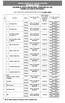 2. 1. NATIONAL UNIVERSITY OF MODERN LANGUAGES ISLAMABAD CAMPUS CALENDAR OF EVENTS / INSTRUCTIONS ADMISSIONS FALL 2015 MORNING / AFTERNOON PROGRAMMES (LAST DATE FOR ONLINE REGISTRATION IS 21 JULY 2015)
I. Admission to the M.Phil Programmes, 2015-2016
 1 SREE SANKARACHARYA UNIVERSITY OF SANSKRIT, KALADY NOTIFICATION No.Acd.A1/ 12164/SSUS/2015 Date: 06.10.2015 Applications in the prescribed format are invited through Online Registration from eligible
ADMISSIONS/ VACATIONS/ TEACHING/ EXAMINATIONS SCHEDULE
 ADMISSIONS/ VACATIONS/ TEACHING/ EXAMINATIONS SCHEDULE FOR THE SESSION 2014-2015 A. Admission Date: Last Date for the receipt of application forms in the office of the Chairman of the concerned Department
Guru Nanak Dev University, Amritsar Advertisement No. 4/2016
 Guru Nanak Dev University, Amritsar Advertisement No. 4/2016 Online Applications are invited for various non-teaching posts in Guru Nanak Dev University, Amritsar, its Regional Campuses & Constituent Colleges.
THE UNIVERSITY OF BURDWAN DIRECTORATE OF DISTANCE EDUCATION BARDHAMAN WEST BENGAL 713104 Ph: 0342 2657 804/912
 INSTRUCTIONS REGARDING ONLINE ADMISSION TO P.G. PROGRAMMES 1. Candidates must fill in the form carefully before submission. Incomplete form will be treated as cancelled. 2. Please select your preferablestudy
ACADEMIC PROGRAMMES AND ELIGIBILITY ENTRY LEVEL
 UG PROGRAMMES ACADEMIC PROGRAMMES AND NAME OF THE DEGREES AND COURSES B. Tech. Civil Mechanical Mechanical (Automobiles) Electrical & Electronics Electronics & Communication Computer Science & DURAT ION
Academic Programmes and CDC Facilities during visit. @ Mody University
 Academic Programmes and CDC Facilities during visit @ Mody University The Career Development Centre, Mody University, Lakshmangarh, invites recruiters to participate in the Campus Recruitment Programme
DEPARTMENT OF SPORTS MEDICINE AND PHYSIOTHERAPY. Course Details: Bachelor of Physiotherapy (BPT)-IAP recognized Courses offered/distribution of seats
 DEPARTMENT OF SPORTS MEDICINE AND PHYSIOTHERAPY TEACHING FACULTY Professor Jaspal Singh Sandhu, M.S. (Ortho.) D.S.M,FAIS,FASM,FIASMSES, FFIMS (on leave) Associate Professor Shyamal Koley, Ph.D.(HSGU) (Head
COURSES OFFERED FOR INTERNATIONAL STUDENTS
 COURSES OFFERED FOR INTERNATIONAL STUDENTS Information pertaining to the courses offered by Acharya Nagarjuna University: Acharya Nagarjuna University, a state university established in 1976, has been
M.Phil. / Ph. D. ADMISSIONS BROCHURE (2015-16)
 DIRECTORATE OF ADMISSIONS M.Phil. / Ph. D. ADMISSIONS BROCHURE (2015-16) GITAM University offers the following Research programmes for the year 2015-16. 1. M.Phil. (Full-time / Part-time) 2. Ph.D. (Full-time
(Only for Biology/Biotechnology based non JEE (Main) students)
 JAYPEE INSTITUTE OF INFORMATION TECHNOLOGY (JIIT), NOIDA, U.P. (Declared as Deemed to be University under section 3 of the UGC Act) JAYPEE UNIVERSITY OF INFORMATION TECHNOLOGY (JUIT), WAKNAGHAT, H.P. (Approved
PU: Central University of Haryana Information about Academic Programmes during 2015-16
 PU: Central University of Haryana Information about Academic Programmes during 2015-16 University is offering the following Programmes under various Schools in the academic year 2015-16: Post-Graduate
SUNRISE UNIVERSITY, Alwar - Fee Structure,
 S.NO. NAME OF COURSE ARTS DISCIPLINE SUNRISE UNIVERSITY, Alwar - Fee Structure, MIN. ELIGIBILITY (RELEVANT SUBJECT) DURATIO N (in Years) ENROLL FEE / REGN CHARGES PER YEAR EXAM FEE (PER YEAR) Bachelor
5.1 Minimum Educational Qualifications. Level - I - For becoming Teacher for Classes I-V : Primary Teacher (PRT)
 ELIGIBILITY All individuals who posses minimum educational qualifications etc. as delineated in the service rules relating to the teachers of all the three levels (available on the website of the School
University School of Studies (USS) and Approved Research Centres (ARC).
 1 Page GURU GOBIND SINGH INDRAPRASTHA UNIVERSITY DWARKA CAMPUS, SEC-16-C, NEW DELHI- 110 078 WEBSITE: http://www.ipu.ac.in OFFICE OF THE DIRECTOR (RESEARCH & CONSULTANCY) Ph. # 011-25302123 email Id: [email protected]
B.Ed. Admission session 2010-11 ADMISSION POLICY
 The Federation of Self Financed Colleges of Education Punjab MEMBERS ASSOCIATIONS : Association of Self Financed Colleges of Education, Affiliated to Punjabi University, Patiala Association of Self Financed
NATIONAL UNIVERSITY OF MODERN LANGUAGES H-9, ISLAMABAD
 NATIONAL UNIVERSITY OF MODERN LANGUAGES H-9, ISLAMABAD ADMISSIONS Spring 2014 1. Applications are invited for admissions to the following full-time courses (morning / evening programmes) for the session
1. A candidate has to open the website www.ojee.nic.in and click on "New Registration.
 TENTATIVE WEB COUNSELLING PROCEDURE FOR OJEE-2015 ADMISSIONS (The procedure for counseling is given below based on previous OJEE counseling processes. However, there may be slight modifications to the
How To Get A Degree In Hbgu
 IMPORTANT INSTRUCTIONS FOR M.Phil/ PhD. ADMISSION (2014-15) ADMISSION THROUGH ENTRANCE TEST AND INTERVIEW School of Ph.D. : Chemistry, Mathematics, Physics, Home Science School of Life Ph.D. :Biotechnology,
SREE SANKARACHARYA UNIVERSITY OF SANSKRIT, KALADY NOTIFICATION. Admission to the M.Phil., Integrated M.Phil-Ph.D. and Direct Ph.D.
 SREE SANKARACHARYA UNIVERSITY OF SANSKRIT, KALADY NOTIFICATION No.Acd.A 1 /9813/SSUS/2013 Date: 13.09.2013 Admission to the M.Phil., Integrated M.Phil-Ph.D. and Direct Ph.D. Programmes, 2014 Applications
FEE STRUCTURE. I Tuition fee and Lab Charges for Professional Courses Academic Session 2015-2016
 FEE STRUCTURE I Tuition fee and Lab Charges for Professional Courses Academic Session 20152016 Sr. No Class/Course Tuition Fee (P.A) To be charged in two installments Lab Charges (p.m.) 1. L.L.B (3 year
ADMISSION INFORMATION. DUAL DEGREE B.Sc. (Hons.)-M.Sc. in PHYSICS, CHEMISTRY, MATHEMATICS & BIOTECHNOLOGY (3+2= 5 YEARS) AND M.Sc. (ECONOMICS)-2 YEARS
 ADMISSION INFORMATION DUAL DEGREE B.Sc. (Hons.)-M.Sc. in PHYSICS, CHEMISTRY, MATHEMATICS & BIOTECHNOLOGY (3+2= 5 YEARS) AND M.Sc. (ECONOMICS)-2 YEARS 2016-17 A Grade NAAC Accredited State Govt. University
U.P. State Entrance Examination (UPSEE- 2016) Dr A. P. J. Abdul Kalam Technical University, Lucknow. Instructions to the Candidates
 U.P. State Entrance Examination (UPSEE- 2016) Dr A. P. J. Abdul Kalam Technical University, Lucknow UPSEE-2016 Counselling Instructions to the Candidates STEP-1 : Registration and Payment of Registration
2. (A) ADMISSION MODALITY FOR MBA #
 2. (A) ADMISSION MODALITY FOR MBA # 1. Modality for admission to Master of Business Administration (MBA) Courses, under Gujarat Professional Technical Educational Colleges or Institutions (Regulation of
How To Get A Post Graduate Merit Scholarship
 REVISED GUIDELINES FOR POST GRADUATE MERIT SCHOLARSHIP SCHEME FOR UNIVERSITY RANK HOLDERS AT UNDER GRADUATE LEVEL APPLICABLE UNIVERSITY GRANTS COMMISSION BAHADUR SHAH ZAFAR MARG NEW DELHI 110 002 Website
Guidelines for Admission (2014-15) at Faculty of Arts, The Maharaja Sayajirao University of Baroda
 Dear Student-Parents, Guidelines for Master of Arts Programme Greetings from the Faculty of Arts! Congratulations on your success at the Bachelor s exam! With a deep sense of pleasure, we welcome your
FACULTY OF ENGINEERING & TECHNOLOGY
 CAMPUS: Village Kotni, Near Mantralaya, Naya Raiur 492101 Chhattisgarh CITY OFFICE: T Water Front, First Floor, 301 303, Opposite Telibandha Talab, Raipur 492001 CG www.kalingauniversity.org E Mail: [email protected]
RASHTRASANT TUKADOJI MAHARAJ NAGPUR UNIVERSITY * * * * NOTIFICATION
 RASHTRASANT TUKADOJI MAHARAJ NAGPUR UNIVERSITY * * * * NOTIFICATION No.COE/Exams/S-13/ 1403-A Dated : 30 th October 2012 It is notified for general information that the probable dates of commencement of
ANNEXURE-I: PG Admission Schedule
 ANNEXURE-I: PG Admission Schedule MBA Discipline wise Intake Sl. No. Course Code Course Name Name of the Department/School Intake 1 381 MBA (Banking Technology) Dept. of Banking Technology 72 2 382 MBA
[MATHEMATICS AND SCIENTIFIC COMPUTING]
![[MATHEMATICS AND SCIENTIFIC COMPUTING]](/thumbs/31/14876486.jpg "[MATHEMATICS AND SCIENTIFIC COMPUTING]") 2015-16 INFORMATION BROCHURE M.Tech. (Part Time and Sponsored) Hewlett-Packard Company 2015-16 M.Sc. [MATHEMATICS AND SCIENTIFIC COMPUTING] & MASTER OF SOCIAL WORKS Motilal Nehru National Institute of
2015-16 INFORMATION BROCHURE M.Tech. (Part Time and Sponsored) Hewlett-Packard Company 2015-16 M.Sc. [MATHEMATICS AND SCIENTIFIC COMPUTING] & MASTER OF SOCIAL WORKS Motilal Nehru National Institute of
TUITION FEES, ENROLMENT FEE, EXAMINATION FEE AND OTHER RELATED UNIVERSITY CHARGES PAYABLE BY THE STUDENTS
 29 STATUTE 27: TUITION FEES, ENROLMENT FEE, EXAMINATION FEE AND OTHER RELATED UNIVERSITY CHARGES PAYABLE BY THE STUDENTS In pursuance of the provisions of sub-section (2) of Section 26 of the Guru Gobind
VIDYASAGAR UNIVERSITY MIDNAPORE ADMISSION NOTIFICATION FOR THE ACADEMIC YEAR 2016-17. Ref. No. : VU/PG/ 197 /16 Date - 13.06.2016
 VIDYASAGAR UNIVERSITY MIDNAPORE ADMISSION NOTIFICATION FOR THE ACADEMIC YEAR 2016-17 Ref. No. : VU/PG/ 197 /16 Date - 13.06.2016 Applications are invited for admission to the following Post Graduate Courses
Institute of Advanced Studies in Education (IASE) Deemed University Sardarshahr- 331401,Rajasthan, India. UGC, DEC, AIU, Approved University
 Institute of Advanced Studies in Education (IASE) Deemed University Sardarshahr- 331401,Rajasthan, India. UGC, DEC, AIU, Approved University ENGINEERING STREAM Programme with Code Duration (in years) Eligibility
Process to cancel the admission after first and second counseling: Process for Third Counseling against vacant seats:
 Devi Ahilya Vishwavidyalaya, Indore Common Entrance Test (CET) 2015 Important Notice Third Counseling Process to cancel the admission after first and second counseling: 1. All those Candidates who had
MIER COLLEGE OF EDUCATION (AUTONOMOUS)
 MIER COLLEGE OF EDUCATION (AUTONOMOUS) College with Potential for Excellence Status by the UGC Recognized by the Govt. of J&K & Permanently Affiliated to the University of Jammu ISO 9001:2008 Certified
Vinaya-Bhavana (Institute of Education) Code: 08
 Vinaya-Bhavana (Institute of Education) Code: 08 Established in 1948 as Art, Craft and Music Teachers' Training centre and subsequently developed as a full-fledged Teachers' Training College in 1951, Vinaya
Eligibility Conditions
 Eligibility Conditions For admission to various B. E.and B. Arch.Courses at 1. Dr. S. S. Bhatnagar University Institute of Chemical Engineering and Technology, Panjab University, Chandigarh (Formerly Department
AIRPORTS AUTHORITY OF INDIA
 1 AIRPTS AUTHITY OF INDIA (A Mini Ratna Category 1 Public Sector Enterprise) Advt.No. 2/2012 Airports Authority of India invites applications from the eligible candidates to apply ON- LINE through AAI
Reservation of Seats UG ADMISSION 2016 INFORMATION BROCHURE
 ADMISSION INFORMATION BROCHURE DATED 12.05.2006 BETHUNE COLLEGE Established in 1879 The First Women s College in India Re-Accredited by NAAC Grade A (in both 2 nd and 1 st Cycle) College with Potential
BANKURA CHRISTIAN COLLEGE
 BANKURA CHRISTIAN COLLEGE INFORMATION SHEET FOR APPLICANTS FOR ADMISSION TO 1ST YEAR DEGREE COURSE (HONOURS & PASS) SESSION :: 2015 16 1. Admission to 1st Year Honours & Pass (Science & Arts) Courses will
Important Announcement
 Important Announcement ONLINE ADMISSION - 2015-16 On-line Application Form for Merit List Cum-Provisional Admission to 1 st Year for the Academic Session 2015-16 will be available from 3 rd of June 2015
THE UNIVERSITY OF BURDWAN
 THE UNIVERSITY OF BURDWAN ADMISSION NOTICE FOR Ph.D. COURSE WORK PROGRAMME: 2015-16 No. FC/PG (Arts)/Ph.D./ Course Work /2015-16/100 Date: 18.09.2015 Applications in prescribed form, downloadable from
ATOMIC ENERGY EDUCATION SOCIETY (REGD.) (An Autonomous Body under Department of Atomic Energy, Govt. of India)
 ATOMIC ENERGY EDUCATION SOCIETY (REGD.) (An Autonomous Body under Department of Atomic Energy, Govt. of India) RECRUITMENT OF PRINCIPAL, TEACHING AND NON-TEACHING STAFF Advertisement No. AEES/01/2015 Atomic
PROGRAMMES OFFERED AND ELIGIBILITY
 PROGRAMMES OFFERED AND ELIGIBILITY CENTRAL UNIVERSITIES COMMON ENTRANCE TEST (CUCET)-2012 Admission to Integrated, PG&Research Programmes incentral Universities of Bihar(www.cub.ac.in), Jammu (www.cujammu.in)
The University. The Objectives of the University
 The University The West Bengal University of Animal & Fishery Sciences was established on January 2 nd. 1995 by a Legislative Act (West Bengal University of Animal and Fishery Sciences Act- VI, 1995).
1 Organic Chemistry Ph.D / NET / SLET in Chemistry with any Specialization ; M.Phil / PG with first class in
 SRI PADMAVATI MAHILA VISVAVIDYALAYAM (Women s University), Tirupati 517 502 Sri Padmavati Mahila Visvavidyalayam, Tirupati, will conduct Aptitude Test on 31st May 2016 in Examination hall, SPMVV between
All College Code & Subject Code List
 All College Code & Subject Code List S.No 1 2 3 4 5 6 College Name Faculty of Commerce, RKDF University Faculty of Computer Science & Application, RKDF University College Code 49013 Faculty of Social Science,
CERTIFICATE / DIPLOMA
 S.NO NAME OF COURSE DURATION YEARWISE FEE ELIGIBILITY 1 AUTOMOBILE ENGINEERING 3 YEARS 20000 PER YEAR MATRICULATION 2 CIVIL ENGINEERING 3 YEARS 20000 PER YEAR MATRICULATION 3 ELECTRICAL ENGINEERING 3 YEARS
Faculty of Applied Social Sciences And Humanities
 Faculty of Applied Social Sciences And Humanities UNIVERSITY OF DELHI SOUTH CAMPUS ADMISSION BROCHURE 2015-16 FOR BACHELOR OF MANAGEMENT STUDIES* BACHELOR OF BUSINESS ADMINISTRATION (FINANCIAL INVESTMENT
ELIGIBILITY CRITERIA FOR ADMITTING STUDENTS FOR 2015-2016 BATCH U.G. /P.G.
 ELIGIBILITY CRITERIA FOR ADMITTING STUDENTS FOR 2015-2016 BATCH U.G. /P.G. / M.Phil. /M.S. (By Research)./Ph.D./ P.G. DIPLOMA / ADVANCED DIPLOMA PROGRAMMES B. TECH COURSES (ALL DISCIPLINES) Admission will
Notification Admission to Ph.D. Programmes of Study 2015-16
 Central University of Himachal Pradesh (Established under Central Universities Act 2009) PO BOX: 21, DHARAMSHALA, DISTRICT KANGRA 176215, HIMACHAL PRADESH www.cuhimachal.ac.in; Phone: 01892 237285-2237289,
College of Graduate Studies Kuwait University. Announces. Graduate Study Excellence Scholarships. Academic Year 2015-2016
 College of Graduate Studies Kuwait University Announces Graduate Study Excellence Scholarships Academic Year 2015-2016 Students who have graduated with honors and/or distinction may apply for a two-year
CENTRE FOR INTERNATIONAL AFFAIRS
 Office Reference No. CENTRE FOR INTERNATIONAL AFFAIRS ANNA UNIVERSITY : : CHENNAI - 600 025, INDIA APPLICATION FOR ADMISSION TO RESEARCH PROGRAMMES UNDER FOREIGN NATIONALS CATEGORY Ph.D. M.S. (By Research)
GURU GOBIND SINGH INDRAPRASTHA UNIVERSITY DWARKA CAMPUS, SEC-16-C, NEW DELHI-
 1 Page GURU GOBIND SINGH INDRAPRASTHA UNIVERSITY DWARKA CAMPUS, SEC-16-C, NEW DELHI- 110 078 WEBSITE: http://www.ipu.ac.in OFFICE OF THE DIRECTOR (RESEARCH & CONSULTANCY) Ph. # 011-25302123 email Id: [email protected]
Eligibility Criteria Selection Procedure
 JADAVPUR UNIVERSITY Faculty of Arts On-line submission of application(s) for admission to M.A (Day & Evening) Courses 2015-16 Eligibility Criteria Selection Procedure Eligibility Criteria for Master of
Guru Gobind Singh Indraprastha University Sector 16 C, Dwarka, New Delhi-110075 Frequently Asked Questions Admission for Academic Session 2016-17
 Sl. No. Question 1. When will the result of CET be declared? 2. 3. 4. 5. 6. 7. What is the last date for submission of CET Application form? If any mistake has happened while filling up the CET form, how
JOINT PROSPECTUS FOR ADMISSION TO. B.Sc. MEDICAL TECHNOLOGY (X-RAY), B.Sc. MEDICAL TECHNOLOGY (ANAESTHESIA & OPERATION THEATRE TECHNIQUES)
 GOVERNMENT MEDICAL COLLEGE & HOSPITAL SECT 32, CHANDIGARH Telephone: 0172-2601023-24 JOINT PROSPECTUS F ADMISSION TO B.Sc. (MEDICAL LABATY TECHNOLOGY), B.Sc. MEDICAL TECHNOLOGY (X-RAY), B.Sc. MEDICAL TECHNOLOGY
AIRPORTS AUTHORITY OF INDIA
 1 Advt.No. 2/2015 Airports Authority of India invites applications from willing and eligible candidates to apply ON-LINE through AAI s website www.aai.aero for the following posts (NO APPLICATION THROUGH
Jabalpur Engineering College, Jabalpur (M.P.) - India
 Jabalpur Engineering College, Jabalpur (M.P.) - India (Established in 1947 as Government Engineering College, Jabalpur) (Declared Autonomous by Government of Madhya Pradesh and University Grant Commission,
GURU NANAK DEV UNIVERSITY, AMRITSAR
 GURU NANAK DEV UNIVERSITY, AMRITSAR (Established by the State Legislature Act No. 21 of 1969) Advertisement No. 2/2010 Applications are invited for the following posts on the prescribed application form
Academic Section. Information Brochure. NATIONAL INSTITUTE OF TECHNOLOGY KURUKSHETRA Institution of National Importance
 Academic Section Information Brochure NATIONAL INSTITUTE OF TECHNOLOGY KURUKSHETRA Institution of National Importance Teaching Departments/Schools A. Engineering: i. Civil Engineering ii. Computer Engineering
ADMISSION BROCHURE FOR ACADEMIC SESSION 2015-16 (PART D) / ADMISSIONS
 ADMISSION BROCHURE FOR ACADEMIC SESSION 2015-16 (PART D) COUNSELLING OUNSELLING / A / ADMISSIONS GUIDELINES GURU UNIVERSITY SECTOR 16C, DWARKA,, DELHID ECTOR 16C, D PART D Table of Contents CHAPTER- 9:
No.F.54(a)/KVP /2015-16/ Dated :09.02.16
 KENDRIYA VIDYALAYA, PICKET, SECUNDERABAD TEL/FAX:040-27846099, 040-27844964 PHONE NO. :040-27846099, 040-27844964 E-mail: [email protected] Website: kvpicket.ap.nic School No.06045 Affiliation No.100002
HINDU COLLEGE: DELHI. Second Admission List 2012-2013
 HINDU COLLEGE: DELHI Second Admission List 2012-2013 Non-Science Courses (Valid only for admissions on 29 June, 30 June and 2 July, 2012 from 10 AM to 1 PM on each day.) Cut off Point for Admission S.No
G. H. Raisoni College of Engineering, Nagpur. Admission to MBA First Year
 G. H. Raisoni College of Engineering, Nagpur (An Autonomous Institute by UGC Act & Affiliated to R T M. Nagpur University) Admission Notification for 2014-15 Admission to MBA First Year Applications are
VARDHMAN MAHAVEER OPEN UNIVERSITY, KOTA
 VARDHMAN MAHAVEER OPEN UNIVERSITY, KOTA Rawatbhata Road, Kota (Rajasthan) PIN: 324 021 (Ph. No. 0744-2797217, 2797241,2797339, 2797209) Toll Free- 1800-180-6166 Pre-Ph.D Entrance Test 2015 (As per UGC
The Maharaja Sayajirao University of Baroda Vadodara - 390 002, Gujarat, India.
 The Maharaja Sayajirao University of Baroda Vadodara - 390 002, Gujarat, India. NOTIFICATION NO. ADE9/11/2015-2016 The M.S. University of Baroda invites Online applications for the posts of Temporary Teaching
INSTITUTE OF HUMAN RESOURCES DEVELOPMENT
 INSTITUTE OF HUMAN RESOURCES DEVELOPMENT (Established by Government of Kerala) Prajoe Towers, Vazhuthacaud, Thiruvananthapuram-695 014, Kerala Telephone : 0471-2322985 Fax : 0471-2322035 Website : www.ihrd.ac.in
BANGLADESH UNIVERSITY OF ENGINEERING AND TECHNOLOGY, DHAKA
 BANGLADESH UNIVERSITY OF ENGINEERING AND TECHNOLOGY, DHAKA No: R-3517 Date: 24 Feb 2009 Prospectus for Admission into Postgraduate Programs Website for Online Application: http://www.buet.ac.bd A. The
No: SDAUHER/KLR/ADMN/6089/2015-16 Date: 28.03.2015 PROVISIONAL COUNSELING ANNOUNCEMENT
 SRI DEVARAJ URS ACADEMY OF HIGHER EDUCATION AND RESEARCH Comprising Sri Devaraj Urs Medical College POST BOX NO. 62, TAMAKA, KOLAR - 563 101, KARNATAKA, INDIA. A DEEMED TO BE UNIVERSITY (Declared Under
Admission to LL.B./LL.M. by Entrance Test
 Page 1 of 6 Admission to LL.B./LL.M. by Entrance Test Applications for LL.B./LL.M. admission 2015-16 by online registration mode only. Last date - 30 th April, 2015. (The rules at University website are
Bio-Technology / Computer science/ Spatial Information Technology
 1. Categories of Ph.Ds offered 1 The University offers Ph.D (minimum duration is 3 years) programmes in the following categories of disciplines Mathematics / Physical Sciences / English o Ph.D (Full time
MBA/MCA Admission 2015-16
 3. GUIDELINES FOR ONLINE REGISTRATION 3.1 GENERAL INSTRUCTIONS 1. The applicants should read this chapter carefully before doing online registration. 2. Information about various Institutions/Colleges/University
Kendriya Vidyalaya, Ballygunge, Kolkata-19
 Kendriya Vidyalaya, Ballygunge, Kolkata-19 Interested candidates may appear in Walk-in-interview on 27.02.2016 at 9: am at Vidyalaya premises with duly filled in application form(available in school website