
Muscles and Muscle Tissue
|
|
|
- Gary Walker
- 10 years ago
- Views:
Transcription
1 Overview of Muscle Tissues (pp ) Types of Muscle Tissue (p. 276) Special Characteristics of Muscle Tissue (p. 276) Muscle Functions (pp ) Skeletal Muscle (pp ) Gross Anatomy of a Skeletal Muscle (pp ) Microscopic Anatomy of a Skeletal Muscle Fiber (pp ) Sliding Filament Model of Contraction (p. 284) Physiology of Skeletal Muscle Fibers (pp ) Contraction of a Skeletal Muscle (pp ) Muscle Metabolism (pp ) Force of Muscle Contraction (pp ) Velocity and Duration of Contraction (pp ) Effect of Exercise on Muscles (pp ) Smooth Muscle (pp ) Microscopic Structure of Smooth Muscle Fibers (pp ) Contraction of Smooth Muscle (pp ) Types of Smooth Muscle (p. 311) Developmental Aspects of Muscles (pp , 316) Muscles and Muscle Tissue Because flexing muscles look like mice scurrying beneath the skin, some scientist long ago dubbed them muscles, from the Latin mus meaning little mouse. Indeed, we tend to think of the rippling muscles of professional boxers or weight lifters when we hear the word muscle. But muscle is also the dominant tissue in the heart and in the walls of other hollow organs. In all its forms, muscle tissue makes up nearly half the body s mass. Muscles are distinguished by their ability to transform chemical energy (ATP) into directed mechanical energy. In so doing, they become capable of exerting force. 275

2 276 UNIT 2 Covering, Support, and Movement of the Body Overview of Muscle Tissues Compare and contrast the basic types of muscle tissue. List four important functions of muscle tissue. Types of Muscle Tissue The three types of muscle tissue skeletal, cardiac, and smooth were introduced in Chapter 4. Now we are ready to describe the three types of muscle tissue in detail, but before we do, let s introduce some terminology. First, skeletal and smooth muscle cells (but not cardiac muscle cells) are elongated, and for this reason, are called muscle fibers. Second, whenever you see the prefixes myo or mys (both are word roots meaning muscle ) or sarco (flesh), the reference is to muscle. For example, the plasma membrane of muscle cells is called the sarcolemma (sar ko-lem ah), literally, muscle (sarco) husk (lemma), and muscle cell cytoplasm is called sarcoplasm. Okay, let s get to it. Skeletal muscle tissue is packaged into the skeletal muscles, organs that attach to and cover the bony skeleton. Skeletal muscle fibers are the longest muscle cells and have obvious stripes called striations (see Figure 4.10a, p. 136). Although it is often activated by reflexes, skeletal muscle is called voluntary muscle because it is the only type subject to conscious control. When you think of skeletal muscle tissue, the key words to keep in mind are skeletal, striated, and voluntary. Skeletal muscle is responsible for overall body mobility. It can contract rapidly, but it tires easily and must rest after short periods of activity. Nevertheless, it can exert tremendous power, a fact revealed by reports of people lifting cars to save their loved ones. Skeletal muscle is also remarkably adaptable. For example, your hand muscles can exert a force of a fraction of an ounce to pick up a paper clip, and the same muscles can exert a force of about 70 pounds to pick up this book! Cardiac muscle tissue occurs only in the heart (the body s blood pump), where it constitutes the bulk of the heart walls. Like skeletal muscle cells, cardiac muscle cells are striated (see Figure 4.10b, p. 137), but cardiac muscle is not voluntary. Indeed, it can and does contract without being stimulated by the nervous system. Most of us have no conscious control over how fast our heart beats. Key words to remember for cardiac muscle are cardiac, striated, and involuntary. Cardiac muscle usually contracts at a fairly steady rate set by the heart s pacemaker, but neural controls allow the heart to speed up for brief periods, as when you race across the tennis court to make that overhead smash. Smooth muscle tissue is found in the walls of hollow visceral organs, such as the stomach, urinary bladder, and respiratory passages. Its role is to force fluids and other substances through internal body channels. Smooth muscle cells like skeletal muscle cells are elongated fibers, but smooth muscle has no striations (see Figure 4.10c, p. 137). Like cardiac muscle, it is not subject to voluntary control. Contractions of smooth muscle fibers are slow and sustained. We can describe smooth muscle tissue as visceral, nonstriated, and involuntary. Special Characteristics of Muscle Tissue What enables muscle tissue to perform its duties? Four special characteristics or abilities are key. Excitability, also termed responsiveness or irritability, is the ability to receive and respond to a stimulus, that is, any change in the environment either inside or outside the body. In the case of muscle, the stimulus is usually a chemical for example, a neurotransmitter released by a nerve cell, or a local change in ph. The response (sometimes separated out as an additional characteristic called conductivity), is generation of an electrical impulse that passes along the plasma membrane of the muscle cell and causes the cell to contract. Contractility is the ability to shorten forcibly when adequately stimulated. This ability sets muscle apart from all other tissue types. Extensibility is the ability to be stretched or extended. Muscle cells shorten when contracting, but they can be stretched, even beyond their resting length, when relaxed. Elasticity is the ability of a muscle cell to recoil and resume its resting length after being stretched. Muscle Functions Muscle performs at least four important functions for the body. It produces movement, maintains posture, stabilizes joints, generates heat, and more. Producing Movement Just about all movements of the human body and its parts result from muscle contraction. Skeletal muscles are responsible for all locomotion and manipulation. They enable you to respond quickly to changes in the external environment for example, to jump out of the way of a car, to direct your eyeballs, and to smile or frown. Blood courses through your body because of the rhythmically beating cardiac muscle of your heart and the smooth muscle in the walls of your blood vessels, which helps maintain blood pressure. Smooth muscle in organs of the digestive, urinary, and reproductive tracts propels, or squeezes, substances (foodstuffs, urine, a baby) through the organs and along the tract. Maintaining Posture and Body Position We are rarely aware of the workings of the skeletal muscles that maintain body posture. Yet these muscles function almost continuously, making one tiny adjustment after another to counteract the never-ending downward pull of gravity. Stabilizing Joints Even as muscles pull on bones to cause movements, they stabilize and strengthen the joints of the skeleton (Chapter 8). Generating Heat Muscles generate heat as they contract. This heat is vitally important in maintaining normal body temperature. Because

3 skeletal muscle accounts for at least 40% of body mass, it is the muscle type most responsible for generating heat. Additional Functions What else do muscles do? Skeletal muscles protect the more fragile internal organs (the viscera) by enclosing them. Smooth muscle also forms valves to regulate the passage of substances through internal body openings, dilates and constricts the pupils of your eyes, and forms the arrector pili muscles attached to hair follicles. In much of this chapter, we examine the structure and function of skeletal muscle. Then we consider smooth muscle more briefly, largely by comparing it with skeletal muscle. We describe cardiac muscle in detail in Chapter 18, but for easy comparison, the characteristics of all three muscle types are included in the summary in Table.3 on p. 30. CHECK YOUR UNDERSTANDING 1. When describing muscle, what does striated mean? 2. Harry was pondering an exam question that said, What muscle type has elongated cells and is found in the walls of the urinary bladder? What should he have responded? For answers, see Appendix G. Skeletal Muscle Describe the gross structure of a skeletal muscle. Describe the microscopic structure and functional roles of the myofibrils, sarcoplasmic reticulum, and T tubules of skeletal muscle fibers. Describe the sliding filament model of muscle contraction. For easy reference, Table.1 summarizes the levels of skeletal muscle organization, gross to microscopic, that we describe in the following sections. Gross Anatomy of a Skeletal Muscle Each skeletal muscle is a discrete organ, made up of several kinds of tissues. Skeletal muscle fibers predominate, but blood vessels, nerve fibers, and substantial amounts of connective tissue are also present. A skeletal muscle s shape and its attachments in the body can be examined easily without the help of a microscope. Nerve and Blood Supply In general, each muscle is served by one nerve, an artery, and by one or more veins. These structures all enter or exit near the central part of the muscle and branch profusely through its connective tissue sheaths (described below). Unlike cells of cardiac Chapter Muscles and Muscle Tissue 277 and smooth muscle tissues, which can contract in the absence of nerve stimulation, each skeletal muscle fiber is supplied with a nerve ending that controls its activity. Skeletal muscle has a rich blood supply. This is understandable because contracting muscle fibers use huge amounts of energy and require more or less continuous delivery of oxygen and nutrients via the arteries. Muscle cells also give off large amounts of metabolic wastes that must be removed through veins if contraction is to remain efficient. Muscle capillaries, the smallest of the body s blood vessels, are long and winding and have numerous cross-links, features that accommodate changes in muscle length. They straighten when the muscle is stretched and contort when the muscle contracts. Connective Tissue Sheaths In an intact muscle, the individual muscle fibers are wrapped and held together by several different connective tissue sheaths. Together these connective tissue sheaths support each cell and reinforce the muscle as a whole, preventing the bulging muscles from bursting during exceptionally strong contractions. We will consider these from external to internal (see Figure.1 and the top three rows of Table.1). 1. Epimysium. The epimysium (ep ĭ-mis e-um; meaning outside the muscle ) is an overcoat of dense irregular connective tissue that surrounds the whole muscle. Sometimes it blends with the deep fascia that lies between neighboring muscles or the superficial fascia deep to the skin. 2. Perimysium and fascicles. Within each skeletal muscle, the muscle fibers are grouped into fascicles (fas ĭ-klz; bundles ) that resemble bundles of sticks. Surrounding each fascicle is a layer of fibrous connective tissue called perimysium (per ĭ-mis e-um; meaning around the muscle [fascicles] ). 3. Endomysium. The endomysium (en do-mis e-um; meaning within the muscle ) is a whispy sheath of connective tissue that surrounds each individual muscle fiber. It consists of fine areolar connective tissue. As shown in Figure.1, all of these connective tissue sheaths are continuous with one another as well as with the tendons that join muscles to bones. When muscle fibers contract, they pull on these sheaths, which in turn transmit the pulling force to the bone to be moved. The sheaths contribute somewhat to the natural elasticity of muscle tissue, and also provide entry and exit routes for the blood vessels and nerve fibers that serve the muscle. Attachments Recall from Chapter 8 that most skeletal muscles span joints and are attached to bones (or other structures) in at least two places, and that when a muscle contracts, the movable bone, the muscle s insertion, moves toward the immovable or less movable bone, the muscle s origin. In the muscles of the limbs, the origin typically lies proximal to the insertion. Muscle attachments, whether origin or insertion, may be direct or indirect. In direct, or fleshy, attachments, the epimysium of the muscle is fused to the periosteum of a bone or

4 278 UNIT 2 Covering, Support, and Movement of the Body Epimysium Bone Epimysium Perimysium Tendon Endomysium Muscle fiber in middle of a fascicle (b) Blood vessel Fascicle (wrapped by perimysium) Endomysium (between individual muscle fibers) Muscle fiber Perimysium Fascicle (a) Figure.1 Connective tissue sheaths of skeletal muscle: epimysium, perimysium, and endomysium. (b) Photomicrograph of a cross section of part of a skeletal muscle (150 ). (See A Brief Atlas of the Human Body, Plate 2.) perichondrium of a cartilage. In indirect attachments, the muscle s connective tissue wrappings extend beyond the muscle either as a ropelike tendon (Figure.1a) or as a sheetlike aponeurosis (ap o-nu-ro sis). The tendon or aponeurosis anchors the muscle to the connective tissue covering of a skeletal element (bone or cartilage) or to the fascia of other muscles. Of the two, indirect attachments are much more common because of their durability and small size. Tendons are mostly tough collagen fibers which can withstand the abrasion of rough bony projections that would tear apart the more delicate muscle tissues. Because of their relatively small size, more tendons than fleshy muscles can pass over a joint so tendons also conserve space. Before moving on to microscopic anatomy, you may want to review the top three rows of Table.1. Microscopic Anatomy of a Skeletal Muscle Fiber Each skeletal muscle fiber is a long cylindrical cell with multiple oval nuclei just beneath its sarcolemma or plasma membrane (Figure.2b). Skeletal muscle fibers are huge cells. Their diameter typically ranges from 10 to 100 µm up to ten times that of an average body cell and their length is phenomenal, some up to 30 cm long. Their large size and multiple nuclei are not surprising once you learn that hundreds of embryonic cells fuse to produce each fiber. Sarcoplasm, the cytoplasm of a muscle cell, is similar to the cytoplasm of other cells, but it contains unusually large amounts of glycosomes (granules of stored glycogen that provide glucose during periods of muscle cell activity) and myoglobin, a red pigment that stores oxygen. Myoglobin is similar to hemoglobin, the pigment that transports oxygen in blood. The usual organelles are present, along with some that are highly modified in muscle fibers: myofibrils, the sarcoplasmic reticulum, and T tubules (unique modifications of the sarcolemma). Let s look at these three special structures more closely because they play important roles in muscle contraction. Myofibrils Each muscle fiber contains many rodlike myofibrils that run parallel to its length (Figure.2b). The myofibrils, each 1 2 µm in diameter, are so densely packed in the fiber that mitochondria and other organelles appear to be squeezed between them. Hundreds to thousands of myofibrils are in a single muscle

5 Chapter Muscles and Muscle Tissue 27 TABLE.1 Structure and Organizational Levels of Skeletal Muscle STRUCTURE AND ORGANIZATIONAL LEVEL DESCRIPTION CONNECTIVE TISSUE WRAPPINGS Muscle (organ) Epimysium Muscle A muscle consists of hundreds to thousands of muscle cells, plus connective tissue wrappings, blood vessels, and nerve fibers. Covered externally by the epimysium Tendon Fascicle Fascicle (a portion of the muscle) Part of fascicle Perimysium A fascicle is a discrete bundle of muscle cells, segregated from the rest of the muscle by a connective tissue sheath. Surrounded by a perimysium Muscle fiber Muscle Fiber (cell) Nucleus Endomysium Sarcolemma A muscle fiber is an elongated multinucleate cell; it has a banded (striated) appearance. Surrounded by endomysium Part of muscle fiber Myofibril Myofibril or Fibril (complex organelle composed of bundles of myofilaments) Myofibrils are rodlike contractile elements that occupy most of the muscle cell volume. Composed of sarcomeres arranged end to end, they appear banded, and bands of adjacent myofibrils are aligned. Sarcomere Sarcomere (a segment of a myofibril) Sarcomere A sarcomere is the contractile unit, composed of myofilaments made up of contractile proteins. Thin (actin) filament Thick (myosin) filament Myofilament or Filament (extended macromolecular structure) Thick filament Head of myosin molecule Contractile myofilaments are of two types thick and thin. The thick filaments contain bundled myosin molecules; the thin filaments contain actin molecules (plus other proteins). The sliding of the thin filaments past the thick filaments produces muscle shortening. Elastic filaments (not shown here) maintain the organization of the A band and provide for elastic recoil when muscle contraction ends. Thin filament Actin molecules

6 280 UNIT 2 Covering, Support, and Movement of the Body (a) Photomicrograph of portions of two isolated muscle fibers (700 ). Notice the obvious striations (alternating dark and light bands). Nuclei Dark A band Light I band Fiber (b) Diagram of part of a muscle fiber showing the myofibrils. One myofibril is extended from the cut end of the fiber. Sarcolemma Mitochondrion Myofibril Thin (actin) filament Dark A band Light I band Z disc Nucleus H zone Z disc (c) Small part of one myofibril enlarged to show the myofilaments responsible for the banding pattern. Each sarcomere extends from one Z disc to the next. Thick (myosin) filament I band A band Sarcomere I band M line Z disc M line Z disc (d) Enlargement of one sarcomere (sectioned lengthwise). Notice the myosin heads on the thick filaments. Thin (actin) filament Elastic (titin) filaments Thick (myosin) filament (e) Cross-sectional view of a sarcomere cut through in different locations. Myosin filament Actin filament I band thin filaments only H zone thick filaments only M line thick filaments linked by accessory proteins Outer edge of A band thick and thin filaments overlap Figure.2 Microscopic anatomy of a skeletal muscle fiber. (See A Brief Atlas of the Human Body, Plate 28.)

7 fiber, depending on its size, and they account for about 80% of cellular volume. These myofibrils contain the contractile elements of skeletal muscle cells, the sarcomeres, which contain even smaller rodlike structures called myofilaments. Table.1 (bottom three rows) summarizes these structures, which we discuss next. Chapter Muscles and Muscle Tissue 281 Striations, Sarcomeres, and Myofilaments Striations, a repeating series of dark and light bands, are evident along the length of each myofibril. In an intact muscle fiber, the dark A bands and light I bands are nearly perfectly aligned with one another, giving the cell as a whole its striated appearance. As illustrated in Figure.2c, each dark A band has a lighter region in its midsection called the H zone (H for helle; bright ). Each H zone is bisected vertically by a dark line called the M line (M for middle) formed by molecules of the protein myomesin. The light I bands also have a midline interruption, a darker area called the Z disc (or Z line). A sarcomere (sar ko-mĕr; literally, muscle segment ) is the smallest contractile unit of a muscle fiber the functional unit of skeletal muscle. Averaging 2 µm long, a sarcomere is the region of a myofibril between two successive Z discs. In other words, it contains an A band flanked by half an I band at each end (Figure.2c). Within each myofibril, the sarcomeres are aligned end-to-end like boxcars in a train. If we examine the banding pattern of a myofibril at the molecular level, we see that it arises from an orderly arrangement of two types of even smaller structures within the sarcomeres. These smaller structures, the myofilaments or filaments, are the muscle equivalents of the actin- or myosin-containing microfilaments described in Chapter 3. As you will recall, the proteins actin and myosin play a role in motility and shape changes in virtually every cell in the body. This property reaches its highest development in the contractile muscle fibers. As you can see in Figure.2c and d, the central thick filaments containing myosin (red) extend the entire length of the A band. The more lateral thin filaments containing actin (blue) extend across the I band and partway into the A band. The Z disc, a coin-shaped sheet composed largely of the protein alpha-actinin, anchors the thin filaments. The third type of myofilament illustrated in Figure.2d, the elastic filament, is described in the next section. Intermediate (desmin) filaments (not illustrated) extending from the Z disc connect each myofibril to the next throughout the width of the muscle cell. Looking at the banding pattern more closely, we see that the H zone of the A band appears less dense because the thin filaments do not extend into this region. The M line in the center of the H zone is slightly darker because of the presence there of fine protein strands that hold adjacent thick filaments together. The myofilaments are connected to the sarcolemma and held in register at the Z discs and the M lines. A longitudinal view of the myofilaments such as that in Figure.2d is a bit misleading because it looks as if each thick (red) filament interdigitates with only four thin (blue) filaments. The cross section of a sarcomere on the far right in Figure.2e shows an area where thick and thin filaments overlap. Notice that each thick filament is actually surrounded by a hexagonal arrangement of six thin filaments, and each thin filament is enclosed by three thick filaments. Ultrastructure and Molecular Composition of the Myofilaments Muscle contraction depends on the myosin- and actin-containing myofilaments. As noted earlier, thick filaments (about 16 nm in diameter) are composed primarily of the protein myosin. Each myosin molecule consists of two heavy and four light polypeptide chains, and has a rodlike tail attached by a flexible hinge to two globular heads (Figure.3). The tail consists of two intertwined helical polypeptide heavy chains. The globular heads, each associated with two light chains, are the business end of myosin. During contraction, they link the thick and thin filaments together, forming cross bridges (Figure.4), and swivel around their point of attachment. As we will explain shortly, these cross bridges act as motors to generate the tension developed by a contracting muscle cell. Each thick filament contains about 300 myosin molecules bundled together with their tails forming the central part of the thick filament and their heads facing outward and at each end (Figure.3). As a result, the central portion of a thick filament (in the H zone) is smooth, but its ends are studded with a staggered array of myosin heads. The heads bear actin and ATPbinding sites and also contain ATPase enzymes that split ATP to generate energy for muscle contraction. The thin filaments (7 8 nm thick) are composed chiefly of the protein actin (blue in Figure.3). Actin has kidney-shaped polypeptide subunits, called globular actin or G actin, which bear the active sites to which the myosin heads attach during contraction. In the thin filaments, G actin subunits are polymerized into long actin filaments called fibrous,or F,actin.The backbone of each thin filament appears to be formed by two intertwined actin filaments that look like a twisted double strand of pearls (Figure.3). Several regulatory proteins are also present in thin filaments. Polypeptide strands of tropomyosin (tro po-mi o-sin), a rodshaped protein, spiral about the actin core and help stiffen and stabilize it. Successive tropomyosin molecules are arranged endto-end along the actin filaments, and in a relaxed muscle fiber, they block myosin-binding sites on actin so that the myosin heads on the thick filaments cannot bind to the thin filaments. The other major protein in thin filaments is troponin (tro ponin), a globular three-polypeptide complex (Figure.3). One of its polypeptides (TnI) is an inhibitory subunit that binds to actin. Another (TnT) binds to tropomyosin and helps position it on actin. The third (TnC) binds calcium ions. Both troponin and tropomyosin help control the myosin-actin interactions involved in contraction. The elastic filament we referred to earlier is composed of the giant protein titin (Figure.2d). This protein extends from the Z disc to the thick filament, and then runs within the thick filament (forming its core) to attach to the M line. It holds the thick filaments in place, thus maintaining the organization of the A band, and helps the muscle cell to spring back into shape after being stretched. (The part of the titin that spans the I bands is extensible, unfolding when the muscle is stretched and recoiling

8 282 UNIT 2 Covering, Support, and Movement of the Body Longitudinal section of filaments within one sarcomere of a myofibril Thick filament Thin filament In the center of the sarcomere, the thick filaments lack myosin heads. Myosin heads are present only in areas of myosin-actin overlap. Thick filament Each thick filament consists of many myosin molecules whose heads protrude at opposite ends of the filament. Portion of a thick filament Thin filament A thin filament consists of two strands of actin subunits twisted into a helix plus two types of regulatory proteins (troponin and tropomyosin). Portion of a thin filament Myosin head Tropomyosin Troponin Actin Actin-binding sites ATPbinding site Heads Flexible hinge region Tail Actin subunits Active sites for myosin attachment Myosin molecule Actin subunits Figure.3 Composition of thick and thin filaments. when the tension is released.) Titin does not resist stretching in the ordinary range of extension, but it stiffens as it uncoils, helping the muscle to resist excessive stretching, which might pull the sarcomeres apart. Another important structural protein is dystrophin, which links the thin filaments to the integral proteins of the sarcolemma (which in turn are anchored to the extracellular matrix). Other proteins that act to bind filaments or sarcomeres together and maintain their alignment include nebulin, myomesin, and C proteins. Sarcoplasmic Reticulum and T Tubules Skeletal muscle fibers contain two sets of intracellular tubules that participate in regulation of muscle contraction: (1) the sarcoplasmic reticulum and (2) T tubules. Sarcoplasmic Reticulum Shown in blue in Figure.5, the sarcoplasmic reticulum (SR) is an elaborate smooth endoplasmic reticulum (see p ). Its interconnecting tubules surround each myofibril the way the sleeve of a loosely crocheted sweater surrounds your arm. Most of these tubules run

9 Chapter Muscles and Muscle Tissue 283 Thin filament (actin) Myosin heads Thick filament (myosin) The major role of the SR is to regulate intracellular levels of ionic calcium. It stores calcium and releases it on demand when the muscle fiber is stimulated to contract. As you will see, calcium provides the final go signal for contraction. Figure.4 Transmission electron micrograph of part of a sarcomere clearly showing the myosin heads forming cross bridges that generate the contractile force. (277,000 ) longitudinally along the myofibril communicating at the H zone. Others called terminal cisternae ( end sacs ) form larger, perpendicular cross channels at the A band I band junctions and they always occur in pairs. Closely associated with the SR are large numbers of mitochondria and glycogen granules, both involved in producing the energy used during contraction. T Tubules At each A band I band junction, the sarcolemma of the muscle cell protrudes deep into the cell interior, forming an elongated tube called the T tubule (T for transverse ). The T tubules, shown in gray in Figure.5, tremendously increase the muscle fiber s surface area. Possibly the result of fusing tubelike caveolae (inpocketings of the sarcolemma), the lumen of the T tubule is continuous with the extracellular space. Along its length, each T tubule runs between the paired terminal cisternae of the SR, forming triads, successive groupings of the three membranous structures (terminal cisterna, T tubule, and terminal cisterna). As they pass from one myofibril to the next, the T tubules also encircle each sarcomere. Muscle contraction is ultimately controlled by nerve-initiated electrical impulses that travel along the sarcolemma. Because T tubules are continuations of the sarcolemma, they conduct impulses to the deepest regions of the muscle cell and to every sarcomere. These impulses signal for the release of calcium from the adjacent terminal cisternae. You can think of the T tubules as Part of a skeletal muscle fiber (cell) I band A band I band Z disc H zone Z disc M line Myofibril Sarcolemma Sarcolemma Triad: T tubule Terminal cisternae of the SR (2) Tubules of the SR Myofibrils Mitochondria Figure.5 Relationship of the sarcoplasmic reticulum and T tubules to myofibrils of skeletal muscle. The tubules of the SR (blue) encircle each myofibril like a holey sleeve. These tubules fuse to form a net of communicating channels at the level of the H zone and saclike elements called terminal cisternae abutting the A-I junctions. The T tubules (gray) are inward invaginations of the sarcolemma that run deep into the cell between the terminal cisternae. Sites of close contact of these three elements (terminal cisterna, T tubule, and terminal cisterna) are called triads.

10 284 UNIT 2 Covering, Support, and Movement of the Body Sliding Filament Model of Contraction We almost always think shortening when we hear the word contraction, but to physiologists the term refers only to the activation of myosin s cross bridges, which are the force-generating sites. Shortening occurs if and when the tension generated by the cross bridges on the thin filaments exceeds the forces opposing shortening and pulls the thin filaments toward the M line. Contraction ends when the cross bridges become inactive and the tension declines, inducing relaxation of the muscle fiber. The sliding filament model of contraction states that during contraction the thin filaments slide past the thick ones so that the actin and myosin filaments overlap to a greater degree. In a relaxed muscle fiber, the thick and thin filaments overlap only at the ends of the A band (Figure.6, 1 ). When muscle fibers are stimulated by the nervous system, the myosin heads on the thick filaments latch onto myosinbinding sites on actin in the thin filaments, and the sliding begins. These cross bridge attachments are formed and broken several times during a contraction, acting like tiny ratchets to generate tension and propel the thin filaments toward the center of the sarcomere. As this event occurs simultaneously in sarcomeres throughout the cell, the muscle cell shortens. Notice that as the thin filaments slide centrally, the Z discs to which they are attached are pulled toward the M line (Figure.6, 2 ). Overall, as a muscle cell shortens, the I bands shorten, the distance between successive Z discs is reduced, the H zones disappear, and the contiguous A bands move closer together but do not change in length. Z H I A 1 Fully relaxed sarcomere of a muscle fiber Z I CHECK YOUR UNDERSTANDING Z I 2 Fully contracted sarcomere of a muscle fiber Figure.6 Sliding filament model of contraction. The numbers indicate events in a 1 relaxed and a 2 fully contracted sarcomere. At full contraction, the Z discs abut the thick filaments and the thin filaments overlap each other. The photomicrographs (top view in each case) show enlargements of 2,200. a rapid telegraph system that ensures that every myofibril in the muscle fiber contracts at virtually the same time. Triad Relationships The roles of the T tubules and SR in providing signals for contraction are tightly linked. At the triads, where these organelles come into closest contact, something that resembles a double zipper of integral proteins protrudes into the intermembrane spaces. The protruding integral proteins of the T tubule act as voltage sensors. Those of the SR, called foot proteins, form gated channels through which Ca 2 can be released from the SR cisternae. We will return to consider their interaction shortly. A Z I 3. How does the term epimysium relate to the role and position of this connective tissue sheath? 4. Which myofilaments have binding sites for calcium? What specific molecule binds calcium? 5. Which structure T tubule, mitochondrion, or SR contains the highest concentration of calcium ions in a resting muscle fiber? Which structure provides the ATP needed for muscle activity? For answers, see Appendix G. Physiology of Skeletal Muscle Fibers Explain how muscle fibers are stimulated to contract by describing events that occur at the neuromuscular junction. Describe how an action potential is generated. Follow the events of excitation-contraction coupling that lead to cross bridge activity. The sliding filament model tells us how a muscle fiber contracts, but what induces it to contract in the first place? For a skeletal muscle fiber to contract 1. It must be activated, that is, stimulated by a nerve ending so that a change in membrane potential occurs.

11 2. Next, it must generate and propagate an electrical current, called an action potential, along its sarcolemma. 3. Then, a short-lived rise in intracellular calcium ion levels that is the final trigger for contraction must occur. Step 1, the activation step, occurs at the neuromuscular junction and sets the stage for the events that follow. Together steps 2 and 3, which link the electrical signal to contraction, are called excitation-contraction coupling. This series of events is summarized in Figure.7, and considered in more detail below. The Nerve Stimulus and Events at the Neuromuscular Junction The nerve cells that activate skeletal muscle fibers are called somatic motor neurons, or motor neurons of the somatic (voluntary) nervous system. These motor neurons reside in the brain or spinal cord, but their long threadlike extensions called axons travel, bundled within nerves, to the muscle cells they serve. The axon of each motor neuron divides profusely as it enters the muscle, and each axon ending gives off several short, curling branches that collectively form an elliptical neuromuscular junction with a single muscle fiber (Figure.8). As a rule, each muscle fiber has only one neuromuscular junction, located approximately midway along its length. The axon terminal and the muscle fiber are exceedingly close (1 2 nm apart), but they remain separated by a space, the synaptic cleft (Figure.8), which is filled with a gel-like extracellular substance rich in glycoproteins and collagen fibers. Within the moundlike axon terminal are synaptic vesicles, small membranous sacs containing the neurotransmitter acetylcholine (as ĕtil-ko lēn), or ACh. The trough-like part of the muscle fiber s sarcolemma that helps form the neuromuscular junction is highly folded. These junctional folds provide a large surface area for the millions of ACh receptors located there (Figure.8). Hence, the neuromuscular junction includes the axonal endings, the synaptic cleft, and the junctional folds of the sarcolemma. How does a motor neuron stimulate a skeletal muscle fiber? The simplest explanation is that when a nerve impulse reaches the end of an axon, the axon terminal releases ACh into the synaptic cleft. ACh diffuses across the cleft and attaches to ACh receptors on the sarcolemma of the muscle fiber, which triggers electrical events that ultimately cause action potential generation. This process is covered in step-by-step detail in: Focus on Events at the Neuromuscular Junction (Figure.8) on p Study this figure before continuing. After ACh binds to the ACh receptors, its effects are quickly terminated by its enzymatic breakdown to its building blocks, acetic acid and choline, by acetylcholinesterase (as ĕ-til-ko lines ter-ās), an enzyme located in the synaptic cleft. This removal of ACh prevents continued (and most likely undesirable) muscle fiber contraction in the absence of additional nervous system stimulation. HOMEOSTATIC IMBALANCE Many toxins, drugs, and diseases interfere with events at the neuromuscular junction. For example, myasthenia gravis Phase 1 Muscle fiber is stimulated by motor neuron (see Figure.8). (asthen weakness; gravi heavy), a disease characterized by drooping upper eyelids, difficulty swallowing and talking, and generalized muscle weakness, involves a shortage of ACh receptors. Serum analysis reveals antibodies to ACh receptors, suggesting that myasthenia gravis is an autoimmune disease. Although normal numbers of receptors are initially present, they appear to be destroyed as the disease progresses. Generation of an Action Potential Across the Sarcolemma Like the plasma membranes of all cells, a resting sarcolemma is polarized. That is, a voltmeter would show there is a potential difference (voltage) across the membrane and the inside is negative relative to the outer membrane face. (The resting membrane potential is described in Chapter 3.) The action potential (AP) is the result of a predictable sequence of electrical changes that once initiated occurs along the entire surface of the sarcolemma. Essentially three steps are involved, as shown in Figure. and summarized below. 1 Chapter Muscles and Muscle Tissue 285 Phase 2 Excitation-contraction coupling occurs (see Figures. and.11). Action potential (AP) arrives at axon terminal at neuromuscular junction ACh released; binds to receptors on sarcolemma Ion permeability of sarcolemma changes Local change in membrane voltage (depolarization) occurs Local depolarization (end plate potential) ignites AP in sarcolemma AP travels across the entire sarcolemma AP travels along T tubules SR releases Ca 2+ ; Ca 2+ binds to troponin; myosin-binding sites (active sites) on actin exposed Myosin heads bind to actin; contraction begins Figure.7 The phases leading to muscle fiber contraction. Local depolarization and generation of an end plate potential. Binding of ACh molecules to ACh receptors at the

12 Figure.8 FOCUS Events at the Neuromuscular Junction When a nerve impulse reaches a neuromuscular junction, acetylcholine (ACh) is released. Upon binding to sarcolemma receptors, ACh causes a change in sarcolemma permeability leading to a change in membrane potential. Action potential (AP) Nucleus Myelinated axon of motor neuron Axon terminal of neuromuscular junction Sarcolemma of the muscle fiber 1 Action potential arrives at axon terminal of motor neuron. 2 Voltage-gated Ca 2+ channels open and Ca 2+ enters the axon terminal. Ca 2+ Ca 2+ Axon terminal of motor neuron Synaptic vesicle containing ACh Mitochondrion Synaptic cleft 3 Ca 2+ entry causes some synaptic vesicles to release their contents (acetylcholine) by exocytosis. 4 Acetylcholine, a neurotransmitter, diffuses across the synaptic cleft and binds to receptors in the sarcolemma. Fusing synaptic vesicles ACh Sarcoplasm of muscle fiber Junctional folds of sarcolemma 5 ACh binding opens ion channels that allow simultaneous passage of Na + into the muscle fiber and K + out of the muscle fiber. More Na + ions enter than K + ions leave and this produces a local change in the membrane potential (depolarization). Na + K + Postsynaptic membrane ion channel opens; ions pass. 6 ACh effects are terminated by its enzymatic breakdown in the synaptic cleft by acetylcholinesterase. ACh Degraded ACh Na + Postsynaptic membrane ion channel closed; ions cannot pass. Acetylcholinesterase K + 286

13 Chapter Muscles and Muscle Tissue 287 Axon terminal Synaptic cleft _ Open Na + Channel Na + Closed K + Channel _ ACh Na + K + ACh Na + 1 Local depolarization: generation of the end plate potential on the sarcolemma Binding of ACh to ACh receptors opens the chemically gated ion channels housed in the ACh receptors allowing both Na + and K + to pass. Because more Na + diffuses in than K + diffuses out, a transient change in membrane potential, called depolarization, occurs so that the interior of the sarcolemma at that point becomes slightly less negative. This local electrical event is called the end plate potential. Sarcoplasm of muscle fiber K + Wave of depolarization Closed Na + Channel Na Action potential Open K + Channel Generation and propagation of the action potential (AP) Membrane areas adjacent to the neuromuscular junction are depolarized by spread of the local current. This opens voltage-gated sodium channels there, so Na + enters, following its electrochemical gradient, and initiates the AP. The action potential is propagated as the local depolarization wave spreads to adjacent areas of the sarcolemma and opens voltage-gated sodium channels there. Again, sodium ions, normally restricted from entering, diffuse into the cell following their electrochemical gradient _ K + K + 3 Repolarization This stage restores the sarcolemma to its initial polarized state. Repolarization quickly follows the depolarization wave and occurs as Na + channels close (inactivate) and voltage-gated K + channels open. Because K + concentration is substantially higher inside the cell than in the extracellular fluid, K + diffuses rapidly out of the muscle fiber down its concentration gradient. Figure. Summary of events in the generation and propagation of an action potential in a skeletal muscle fiber. The axon terminal plasma membrane and the sarcolemma are shown at different scales. neuromuscular junction opens chemically (ligand) gated ion channels that allow Na and K to pass (also see Figure.8). Because more Na diffuses in than K diffuses out, a transient change in membrane potential occurs as the interior of the sarcolemma becomes slightly less negative, an event called depolarization. 2 Generation and propagation of the action potential. Initially, depolarization is a local electrical event called an end plate potential, but it ignites the action potential that spreads in all directions from the neuromuscular junction across the sarcolemma, just as ripples move away from pebbles dropped into a stream. This local depolarization (end plate potential) then spreads to adjacent membrane areas

14 288 UNIT 2 Covering, Support, and Movement of the Body Membrane potential (mv) Depolarization due to Na + entry Na + channels open Na + channels close, K + channels open Repolarization due to K + exit Threshold K + channels close sarcolemma leads to the sliding of myofilaments. The action potential is brief and ends well before any signs of contraction are obvious. The events of excitation-contraction coupling occur during the latent period (laten = hidden), between action potential initiation and the beginning of mechanical activity (contraction). As you will see, the electrical signal does not act directly on the myofilaments. Instead, it causes the rise in intracellular calcium ion concentration that allows the filaments to slide. Focus on Excitation-Contraction Coupling (Figure.11) on pp illustrates the steps in this process. This Focus feature also reveals how the integral proteins of the double zippers in the triads interact to provide the Ca 2 necessary for contraction to occur. Make sure you understand this material before continuing on Time (ms) Figure.10 Action potential scan showing changes in Na and K ion channels. and opens voltage-gated (p. 81) sodium channels there. Na enters, following its electrochemical gradient, and once a certain membrane voltage, referred to as threshold,is reached, an action potential is generated (initiated). The action potential is propagated (moves along the length of the sarcolemma) as the local depolarization wave spreads to adjacent areas of the sarcolemma and opens voltage-gated sodium channels there. Again, Na, normally restricted from entering, diffuses into the cell following its electrochemical gradient. Repolarization. The sarcolemma is restored to its initial polarized state during repolarization. The repolarization wave, like the depolarization wave, is a consequence of changes in membrane permeability. In this case, Na channels close and voltage-gated K channels open. Since the potassium ion concentration is substantially higher inside the cell than in the extracellular fluid, K diffuses rapidly out of the muscle fiber, restoring negatively charged conditions inside (also see Figure.10). During repolarization, a muscle fiber is said to be in a refractory period, because the cell cannot be stimulated again until repolarization is complete. Note that repolarization restores only the electrical conditions of the resting (polarized) state. The ATP-dependent Na -K pump restores the ionic conditions of the resting state, but hundreds of action potentials can occur before ionic imbalances interfere with contractile activity. Once initiated, the action potential is unstoppable. It ultimately results in contraction of the muscle fiber. Although the action potential itself is very brief, only 1 2 milliseconds (ms), the contraction phase of a muscle fiber may persist for 100 ms or more and far outlasts the electrical event that triggers it. Excitation-Contraction Coupling Excitation-contraction (E-C) coupling is the sequence of events by which transmission of an action potential along the Summary of Different Types of Channels Involved in Initiating Muscle Contraction So let s summarize what has to happen from the nerve ending on to finally excite muscle cells. Essentially this process involves activation of four sets of ion channels: 1. The process is initiated when the nerve impulse reaches the neuron terminal and opens voltage-gated calcium channels in the axonal membrane. Calcium entry triggers release of ACh into the synaptic cleft. 2. Released ACh binds to ACh receptors in the sarcolemma, opening chemically gated Na -K channels. Greater influx of Na causes a local voltage change (the end plate potential). 3. Local depolarization opens voltage-gated sodium channels in the neighboring region of the sarcolemma. This allows more sodium to enter, which further depolarizes the sarcolemma, resulting in AP generation and propagation. 4. Transmission of an AP along the T tubules changes the shape of voltage-sensitive proteins in the T tubules, which in turn stimulate SR calcium release channels to release Ca 2 into the cytosol. Muscle Fiber Contraction: Cross Bridge Activity As we have noted, cross bridge formation (attachment of myosin heads to actin) requires Ca 2. Let s look more closely at how calcium ions promote muscle cell contraction. When intracellular calcium levels are low, the muscle cell is relaxed, and the active (myosin-binding) sites on actin are physically blocked by tropomyosin molecules. As Ca 2 levels rise, the ions bind to regulatory sites on troponin. To activate its group of seven actins, a troponin must bind two calcium ions, change shape, and then roll tropomyosin into the groove of the actin helix, away from the myosin-binding sites. In short, the tropomyosin blockade is removed when sufficient calcium is present. Once binding sites on actin are exposed, the events of the cross bridge cycle occur in rapid succession, as depicted in Focus on the Cross Bridge Cycle (Figure.12) on p. 22. Sliding of thin filaments continues as long as the calcium signal and adequate ATP are present. When nerve impulses are delivered rapidly, intracellular Ca 2 levels increase greatly due to successive puffs or rounds of Ca 2 released from the SR. In

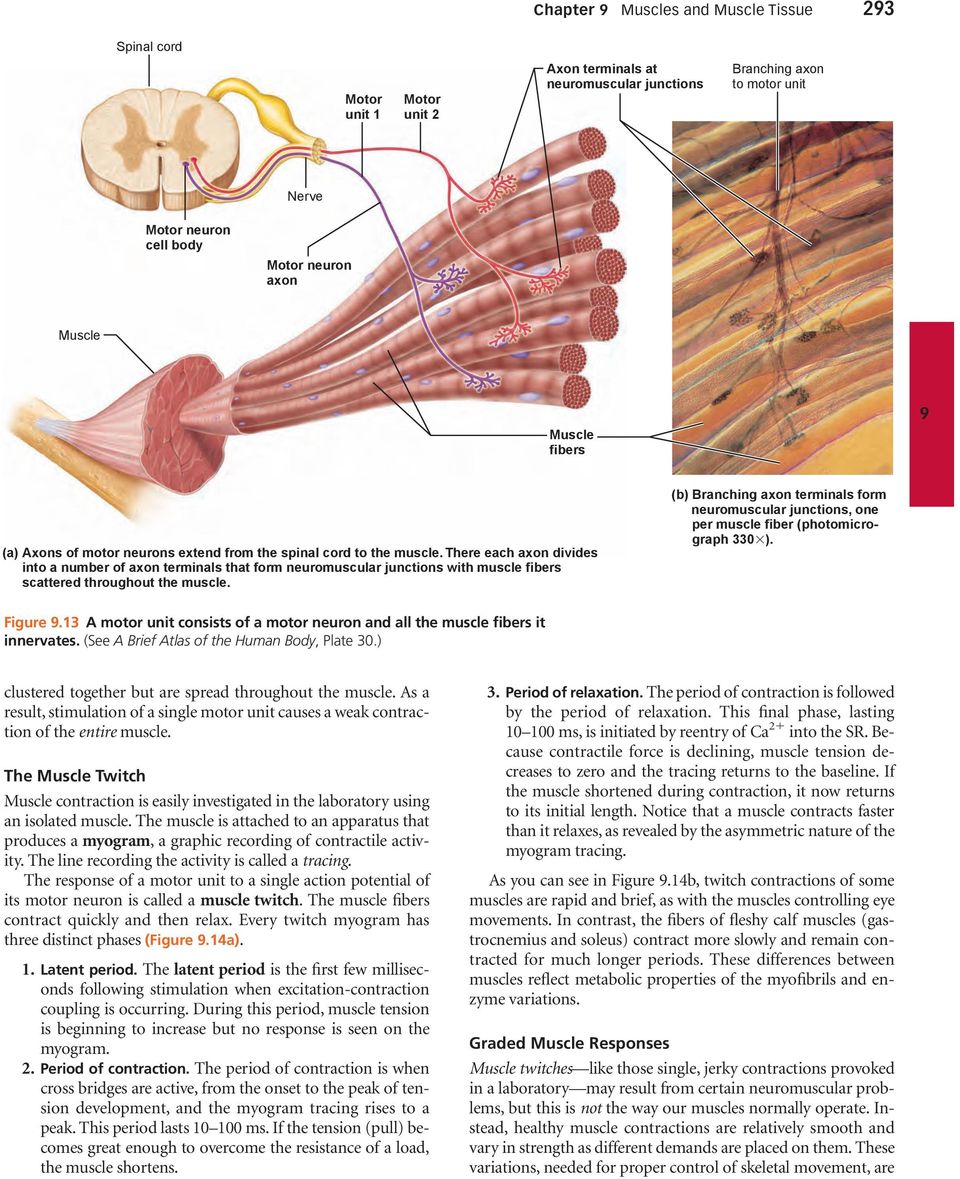
15 such cases, the muscle cells do not completely relax between successive stimuli and contraction is stronger and more sustained (within limits) until nervous stimulation ceases. As the Ca 2 pumps of the SR reclaim calcium ions from the cytosol and troponin again changes shape, actin s myosin-binding sites are again covered by tropomyosin. The contraction ends, and the muscle fiber relaxes. When the cycle is back where it started, the myosin head is in its upright high-energy configuration (see step 1 in Focus Figure.12), ready to take another step and attach to an actin site farther along the thin filament. This walking of the myosin heads along the adjacent thin filaments during muscle shortening is much like a centipede s gait. The thin filaments cannot slide backward as the cycle repeats again and again because some myosin heads ( legs ) are always in contact with actin (the ground ). Contracting muscles routinely shorten by 30 35% of their total resting length, so each myosin cross bridge attaches and detaches many times during a single contraction. It is likely that only half of the myosin heads of a thick filament are pulling at the same instant. The others are randomly seeking their next binding site. Except for the brief period following muscle cell excitation, calcium ion concentrations in the cytosol are kept almost undetectably low. There is a reason for this: ATP is the cell s energy source, and its hydrolysis yields inorganic phosphate (P i ). P i would combine with calcium ions to form hydroxyapatite crystals, the stony-hard salts found in bone matrix, if calcium ion concentrations were always high. Such calcified muscle cells would die. HOMEOSTATIC IMBALANCE Rigor mortis (death rigor) illustrates the fact that cross bridge detachment is ATP driven. Most muscles begin to stiffen 3 to 4 hours after death. Peak rigidity occurs at 12 hours and then gradually dissipates over the next 48 to 60 hours. Dying cells are unable to exclude calcium (which is in higher concentration in the extracellular fluid), and the calcium influx into muscle cells promotes formation of myosin cross bridges. Shortly after breathing stops, ATP synthesis ceases, but ATP continues to be consumed and cross bridge detachment is impossible. Actin and myosin become irreversibly cross-linked, producing the stiffness of rigor mortis, which gradually disappears as muscle proteins break down after death. CHECK YOUR UNDERSTANDING 6. What are the three structural components of a neuromuscular junction? 7. What is the final trigger for contraction? What is the initial trigger? 8. What prevents the filaments from sliding back to their original position each time a myosin cross bridge detaches from actin?. What would happen if a muscle fiber suddenly ran out of ATP when sarcomeres had only partially contracted? For answers, see Appendix G. Chapter Muscles and Muscle Tissue 28 Contraction of a Skeletal Muscle Define motor unit and muscle twitch, and describe the events occurring during the three phases of a muscle twitch. Explain how smooth, graded contractions of a skeletal muscle are produced. Differentiate between isometric and isotonic contractions. In its relaxed state, a muscle is soft and unimpressive, not what you would expect of a prime mover of the body. However, within a few milliseconds, it can contract to become a hard elastic structure with dynamic characteristics that intrigue not only biologists but engineers and physicists as well. Before we consider muscle contraction on the organ level, let s note a few principles of muscle mechanics. 1. The principles governing contraction of a single muscle fiber and of a skeletal muscle consisting of a large number of fibers are pretty much the same. 2. The force exerted by a contracting muscle on an object is called muscle tension, and the opposing force exerted on the muscle by the weight of the object to be moved is called the load. 3. A contracting muscle does not always shorten and move the load. If muscle tension develops but the load is not moved, the contraction is called isometric ( same measure ), as when you try to lift a 2000-lb car. If the muscle tension developed overcomes the load and muscle shortening occurs, the contraction is isotonic ( same tension ), as when you lift a 5-lb sack of sugar. We will describe these major types of contraction in detail, but for now the important thing to remember when reading the accompanying graphs is that increasing muscle tension is measured for isometric contractions, whereas the amount of muscle shortening (distance in millimeters) is measured for isotonic contractions. 4. A skeletal muscle contracts with varying force and for different periods of time in response to stimuli of varying frequencies and intensities. To understand how this occurs, we must look at the nerve-muscle functional unit called a motor unit. This is our next topic. The Motor Unit Each muscle is served by at least one motor nerve, and each motor nerve contains axons (fibrous extensions) of up to hundreds of motor neurons. As an axon enters a muscle, it branches into a number of terminals, each of which forms a neuromuscular junction with a single muscle fiber. A motor unit consists of a motor neuron and all the muscle fibers it supplies (Figure.13). When a motor neuron fires (transmits an action potential), all the muscle fibers it innervates contract. The number of muscle fibers per motor unit may be as high as several hundred or as few as four. Muscles that exert fine control (such as those controlling the fingers and eyes) have small motor units. By contrast, large, weight-bearing muscles, whose movements are less precise (such as the hip muscles), have large motor units. The muscle fibers in a single motor unit are not

16 Figure.11 FOCUS Excitation-Contraction Coupling Excitation-contraction (E-C) coupling is the sequence of events by which transmission of an action potential along the sarcolemma leads to the sliding of myofilaments. Setting the stage The events at the neuromuscular junction set the stage for E-C coupling by providing excitation. Released acetylcholine (ACh) binds to receptor proteins on the sarcolemma and triggers an action potential in a muscle fiber. Synaptic cleft Axon terminal of motor neuron ACh Action potential is generated Sarcolemma Terminal cisterna of SR Muscle fiber Ca 2+ Triad One sarcomere 20

17 Steps in E-C Coupling: Sarcolemma Voltage-sensitive tubule protein T tubule 1 Action potential is propagated along the sarcolemma and down the T tubules. Ca 2+ release channel Terminal cisterna of SR 2 Calcium ions are released. Transmission of AP along the T tubules of the triads causes the voltage-sensitive tubule proteins to change shape. This shape change opens the Ca 2+ release channels in the terminal cisternae of the sarcoplasmic reticulum (SR), allowing massive amounts of Ca 2+ to flow into the cytosol within 1 millisecond. Ca 2+ Actin Ca 2+ Troponin Tropomyosin blocking active sites Myosin Active sites exposed and ready for myosin binding 3 Calcium binds to troponin and removes the blocking action of tropomyosin. When Ca 2+ binds, troponin changes shape, exposing binding sites for myosin (active sites) on the thin filaments. Myosin cross bridge 4 Contraction begins: Myosin binding to actin forms cross bridges and contraction (cross bridge cycling) begins. At this point, E-C coupling is over. The aftermath The short-lived Ca 2+ signal ends, and Ca 2+ levels fall as Ca 2+ is continuously pumped back into the SR by active transport. The blocking action of tropomyosin is restored, inhibiting myosin-actin interaction and relaxation occurs. The sequence of E-C coupling events followed by a drop in Ca 2+ levels is repeated each time a nerve impulse arrives at the neuromuscular junction. 21

18 Figure.12 FOCUS Cross Bridge Cycle The cross bridge cycle is the series of events during which myosin heads pull thin filaments toward the center of the sarcomere. Actin Ca 2+ Thin filament Myosin head P i ADP Thick filament Myosin 1 Cross bridge formation. Energized myosin head attaches to actin myofilament, forming a cross bridge. P i ADP ATP hydrolysis ADP P i 4 Cocking of myosin head. As ATP is hydrolyzed to ADP and P i, the myosin head returns to its prestroke high-energy, or cocked, position. 2 The power (working) stroke. ADP and P i are released and the myosin head pivots and bends, changing to its bent low-energy shape. As a result it pulls on the actin filament, sliding it toward the M line. ATP ATP 3 Cross bridge detachment. After ATP attaches to myosin, the link between myosin and actin weakens, and the myosin head detaches (the cross bridge breaks ). 22

19 Chapter Muscles and Muscle Tissue 23 Spinal cord Motor unit 1 Motor unit 2 Axon terminals at neuromuscular junctions Branching axon to motor unit Nerve Motor neuron cell body Motor neuron axon Muscle Muscle fibers (a) Axons of motor neurons extend from the spinal cord to the muscle. There each axon divides into a number of axon terminals that form neuromuscular junctions with muscle fibers scattered throughout the muscle. (b) Branching axon terminals form neuromuscular junctions, one per muscle fiber (photomicrograph 330 ). Figure.13 A motor unit consists of a motor neuron and all the muscle fibers it innervates. (See A Brief Atlas of the Human Body, Plate 30.) clustered together but are spread throughout the muscle. As a result, stimulation of a single motor unit causes a weak contraction of the entire muscle. The Muscle Twitch Muscle contraction is easily investigated in the laboratory using an isolated muscle. The muscle is attached to an apparatus that produces a myogram, a graphic recording of contractile activity. The line recording the activity is called a tracing. The response of a motor unit to a single action potential of its motor neuron is called a muscle twitch. The muscle fibers contract quickly and then relax. Every twitch myogram has three distinct phases (Figure.14a). 1. Latent period. The latent period is the first few milliseconds following stimulation when excitation-contraction coupling is occurring. During this period, muscle tension is beginning to increase but no response is seen on the myogram. 2. Period of contraction. The period of contraction is when cross bridges are active, from the onset to the peak of tension development, and the myogram tracing rises to a peak. This period lasts ms. If the tension (pull) becomes great enough to overcome the resistance of a load, the muscle shortens. 3. Period of relaxation. The period of contraction is followed by the period of relaxation. This final phase, lasting ms, is initiated by reentry of Ca 2 into the SR. Because contractile force is declining, muscle tension decreases to zero and the tracing returns to the baseline. If the muscle shortened during contraction, it now returns to its initial length. Notice that a muscle contracts faster than it relaxes, as revealed by the asymmetric nature of the myogram tracing. As you can see in Figure.14b, twitch contractions of some muscles are rapid and brief, as with the muscles controlling eye movements. In contrast, the fibers of fleshy calf muscles (gastrocnemius and soleus) contract more slowly and remain contracted for much longer periods. These differences between muscles reflect metabolic properties of the myofibrils and enzyme variations. Graded Muscle Responses Muscle twitches like those single, jerky contractions provoked in a laboratory may result from certain neuromuscular problems, but this is not the way our muscles normally operate. Instead, healthy muscle contractions are relatively smooth and vary in strength as different demands are placed on them. These variations, needed for proper control of skeletal movement, are
20 24 UNIT 2 Covering, Support, and Movement of the Body Latent period Period of contraction Period of relaxation Single stimulus single twitch Percentage of maximum tension Tension (g) 0 Contraction Stimulus Relaxation Time (ms) Single stimulus (a) Myogram showing the three phases of an isometric twitch Time (ms) (a) A single stimulus is delivered. The muscle contracts and relaxes. 300 Percentage of maximum tension Latent period Extraocular muscle (lateral rectus) Gastrocnemius Soleus Single Time (ms) stimulus (b) Comparison of the relative duration of twitch responses of three muscles Tension (g) 0 Low stimulation frequency Partial relaxation Stimuli Time (ms) (b) If another stimulus is applied before the muscle relaxes completely, then more tension results. This is temporal (or wave) summation and results in unfused (or incomplete) tetanus. High stimulation frequency unfused (incomplete) tetanus fused (complete) tetanus Figure.14 The muscle twitch. referred to as graded muscle responses. In general, muscle contraction can be graded in two ways: (1) by changing the frequency of stimulation and (2) by changing the strength of stimulation. Muscle Response to Changes in Stimulus Frequency The nervous system achieves greater muscular force by increasing the firing rate of motor neurons. For example, if two identical stimuli (electrical shocks or nerve impulses) are delivered to a muscle in rapid succession, the second twitch will be stronger than the first. On a myogram the second twitch will appear to ride on the shoulders of the first (Figure.15b). This phenomenon, called temporal or wave summation, occurs because the second contraction occurs before the muscle has completely relaxed. Because the muscle is already partially contracted when the next stimulus arrives and more calcium is being squirted into the cytosol to replace that being reclaimed by the SR, Tension (g) 0 Stimuli Time (ms) (c) At higher stimulus frequencies, there is no relaxation at all between stimuli. This is fused (complete) tetanus. Figure.15 Muscle response to changes in stimulation frequency.

21 Stimulus voltage Tension Threshold stimulus Stimulus strength Proportion of motor units excited Strength of muscle contraction Time (ms) Maximal stimulus Stimuli to nerve Maximal contraction Figure.16 Relationship between stimulus intensity (graph at top) and muscle tension (tracing below). Below threshold voltage, no muscle response is seen on the tracing (stimuli 1 and 2). Once threshold (3) is reached, increases in voltage excite (recruit) more and more motor units until the maximal stimulus is reached (7). Further increases in stimulus voltage produce no further increase in contractile strength. muscle tension produced during the second contraction causes more shortening than the first. In other words, the contractions are summed. (However, the refractory period is always honored. Thus, if a second stimulus is delivered before repolarization is complete, no wave summation occurs.) If the stimulus strength is held constant and the muscle is stimulated at an increasingly faster rate, the relaxation time between the twitches becomes shorter and shorter, the concentration of Ca 2 in the cytosol higher and higher, and the degree of wave summation greater and greater, progressing to a sustained but quivering contraction referred to as unfused or incomplete tetanus (Figure.15b). Finally, as the stimulation frequency continues to increase, muscle tension increases until a maximal tension is reached. At this point all evidence of muscle relaxation disappears and the contractions fuse into a smooth, sustained contraction plateau called fused or complete tetanus (tet ah-nus; tetan = rigid, tense) (Figure.15c). (Note that this term is often confused with the bacterial disease called tetanus that causes severe involuntary contractions.) In the real world, fused tetanus happens Chapter Muscles and Muscle Tissue 25 infrequently, for example, when someone shows superhuman strength by lifting a fallen tree limb off a companion. Vigorous muscle activity cannot continue indefinitely. Prolonged tetanus inevitably leads to muscle fatigue, a situation in which the muscle is unable to contract and its tension drops to zero. Muscle Response to Changes in Stimulus Strength Wave summation contributes to contractile force, but its primary function is to produce smooth, continuous muscle contractions by rapidly stimulating a specific number of muscle cells. The force of contraction is controlled more precisely by recruitment, also called multiple motor unit summation. In the laboratory, recruitment is achieved by delivering shocks of increasing voltage to the muscle, calling more and more muscle fibers into play. Stimuli that produce no observable contractions are called subthreshold stimuli. The stimulus at which the first observable contraction occurs is called the threshold stimulus (Figure.16). Beyond this point, the muscle contracts more and more vigorously as the stimulus strength is increased. The maximal stimulus is the strongest stimulus that produces increased contractile force. It represents the point at which all the muscle s motor units are recruited. Increasing the stimulus intensity beyond the maximal stimulus does not produce a stronger contraction. In the body, the same phenomenon is caused by neural activation of an increasingly large number of motor units serving the muscle. The recruitment process is not random. Instead it is dictated by the size principle. In any muscle, motor units with the smallest muscle fibers are controlled by small, highly excitable motor neurons, and these motor units tend to be activated first. As motor units with larger and larger muscle fibers begin to be excited, contractile strength increases. The largest motor units, containing large, coarse muscle fibers, have as much as 50 times the contractile force of the smallest ones. They are controlled by the largest, least excitable (highest-threshold) neurons and are activated only when the most powerful contraction is necessary (Figure.17). The size principle is important because it allows the increases in force during weak contractions (for example, those that maintain posture or slow movements) to occur in small steps, whereas gradations in muscle force are progressively greater when large amounts of force are needed for vigorous activities such as jumping or running. This principle explains how the same hand that pats your cheek can deliver a stinging slap. Although all the motor units of a muscle may be recruited simultaneously to produce an exceptionally strong contraction, motor units are more commonly activated asynchronously in the body. At a given instant, some are in tetanus (usually unfused tetanus) while others are resting and recovering. This technique helps prolong a strong contraction by preventing or delaying fatigue. It also explains how weak contractions promoted by infrequent stimuli can remain smooth. Muscle Tone Skeletal muscles are described as voluntary, but even relaxed muscles are almost always slightly contracted, a phenomenon
22 26 UNIT 2 Covering, Support, and Movement of the Body Tension Motor unit 1 recruited (small fibers) Motor unit 2 recruited (medium fibers) Time Motor unit 3 recruited (large fibers) Figure.17 The size principle of recruitment. Recruitment of motor neurons controlling skeletal muscle fibers is orderly small, highly excitable motor neurons are generally recruited more readily than large, less excitable ones. This phenomenon is referred to as the size principle. In weaker contractions, small motor units containing small-diameter muscle fibers are recruited. As contractile strength increases, larger and larger motor units containing larger numbers of increasingly larger-diameter muscle fibers are activated. Consequently, the contractions get stronger and stronger in a predictable way. called muscle tone. Muscle tone is due to spinal reflexes that activate first one group of motor units and then another in response to activation of stretch receptors in the muscles. Muscle tone does not produce active movements, but it keeps the muscles firm, healthy, and ready to respond to stimulation. Skeletal muscle tone also helps stabilize joints and maintain posture. Isotonic and Isometric Contractions As noted earlier, there are two main categories of contractions isotonic and isometric.in isotonic contractions (iso = same; ton = tension), muscle length changes and moves the load. Once sufficient tension has developed to move the load, the tension remains relatively constant through the rest of the contractile period (Figure.18a). Isotonic contractions come in two flavors concentric and eccentric. Concentric contractions are those in which the muscle shortens and does work, such as picking up a book or kicking a ball. These contractions are probably more familiar. However, eccentric contractions, in which the muscle generates force as it lengthens, are equally important for coordination and purposeful movements. Eccentric contractions occur in your calf muscle, for example, as you walk up a steep hill. Eccentric contractions are about 50% more forceful than concentric ones at the same load and more often cause delayed-onset muscle soreness. (Consider how your calf muscles feel the day after hiking up that hill.) Just why this is so is unclear, but it may be that the muscle stretching that occurs during such contractions causes microtears in the muscles. Biceps curls provide a simple example of how concentric and eccentric contractions work together in our everyday activities. When you flex your elbow to raise this textbook to your shoulder, the biceps muscle in your arm is contracting concentrically. When returning the book to the desktop, the isotonic contraction of the biceps is eccentric. Basically, eccentric contractions put the body in position to contract concentrically. All jumping and throwing activities involve both types of contraction. In isometric contractions (metric = measure), tension may build to the muscle s peak tension-producing capacity, but the muscle neither shortens nor lengthens (Figure.18b). Isometric contractions occur when a muscle attempts to move a load that is greater than the force (tension) the muscle is able to develop think of trying to lift a piano singlehandedly. Muscles contract isometrically when they act primarily to maintain upright posture or to hold joints in stationary positions while movements occur at other joints. Let s consider knee bends as an example. When the squat position is held for a few seconds, the quadriceps muscles of the anterior thigh contract isometrically to hold the knee in the flexed position. They also contract isometrically when we begin to rise to the upright position until their tension exceeds the load (weight of the upper body). At that point muscle shortening (concentric contraction) begins. So the quadriceps contractile sequence for a deep knee bend from start to finish is (1) flex knee (eccentric), (2) hold squat position (isometric), (3) extend knee (isometric, then concentric). Of course, this list does not even begin to consider the isometric contractions of the posterior thigh muscles or of the trunk muscles that maintain a relatively erect trunk posture during the movement. Electrochemical and mechanical events occurring within a muscle are identical in both isotonic and isometric contractions. However, the result is different. In isotonic contractions, the thin filaments are sliding. In isometric contractions, the cross bridges are generating force but are not moving the thin filaments, so there is no change in the banding pattern from that of the resting state. (You could say that they are spinning their wheels on the same actin binding sites.) CHECK YOUR UNDERSTANDING 10. What is a motor unit? 11. What is happening in the muscle during the latent period of a twitch contraction? 12. Jay is competing in a chin-up competition. What type of muscle contractions are occurring in his biceps muscles immediately after he grabs the bar? As his body begins to move upward toward the bar? When his body begins to approach the mat? For answers, see Appendix G. Muscle Metabolism Describe three ways in which ATP is regenerated during skeletal muscle contraction. Define oxygen deficit and muscle fatigue. List possible causes of muscle fatigue.
23 Chapter Muscles and Muscle Tissue 27 (a) Concentric isotonic contraction On stimulation, muscle develops enough tension (force) to lift the load (weight). Once the resistance is overcome, the muscle shortens, and the tension remains constant for the rest of the contraction. (b) Isometric contraction Muscle is attached to a weight that exceeds the muscle s peak tension-developing capabilities. When stimulated, the tension increases to the muscle s peak tension-developing capability, but the muscle does not shorten. Tendon Muscle contracts (isotonic contraction) 3 kg Muscle contracts (isometric contraction) Tendon 3 kg 6 kg 6 kg Tension developed (kg) Muscle length (percent of resting length) Amount of resistance Muscle stimulus Peak tension developed Resting length Time (ms) Muscle relaxes Tension developed (kg) Muscle length (percent of resting length) Amount of resistance Peak tension developed Muscle stimulus Resting length Time (ms) Muscle relaxes Figure.18 Isotonic (concentric) and isometric contractions. Providing Energy for Contraction How does the body provide the energy needed for contraction? As a muscle contracts, ATP supplies the energy for cross bridge movement and detachment and for operation of the calcium pump in the SR. Surprisingly, muscles store very limited reserves of ATP 4 to 6 seconds worth at most, just enough to get you going. Because ATP is the only energy source used directly for contractile activities, it must be regenerated as fast as it is broken down if contraction is to continue. Fortunately, after ATP is hydrolyzed to ADP and inorganic phosphate in muscle fibers, it is regenerated within a fraction of a second by one or more of the three pathways summarized in Figure.1: (1) direct phosphorylation of ADP by creatine phosphate, (2) the anaerobic pathway called glycolysis, which converts glucose to lactic acid, and (3) aerobic respiration. All body cells use glycolysis and aerobic respiration to produce ATP, so we touch on these metabolic pathways here but describe them in detail later, in Chapter 24.
24 28 UNIT 2 Covering, Support, and Movement of the Body (a) Direct phosphorylation Coupled reaction of creatine phosphate (CP) and ADP (b) Anaerobic pathway Glycolysis and lactic acid formation (c) Aerobic pathway Aerobic cellular respiration Energy source: CP Energy source: glucose Energy source: glucose; pyruvic acid; free fatty acids from adipose tissue; amino acids from protein catabolism CP Creatine ADP Creatine kinase ATP Glucose (from glycogen breakdown or delivered from blood) Glycolysis in cytosol Fatty acids Glucose (from glycogen breakdown or delivered from blood) Pyruvic acid O 2 O 2 2 ATP net gain Released to blood Pyruvic acid Lactic acid O 2 O 2 Amino acids CO 2 Aerobic respiration in mitochondria H 2 O 32 ATP net gain per glucose Oxygen use: None Products: 1 ATP per CP, creatine Duration of energy provision: 15 seconds Oxygen use: None Products: 2 ATP per glucose, lactic acid Duration of energy provision: 60 seconds, or slightly more Oxygen use: Required Products: 32 ATP per glucose, CO 2, H 2 O Duration of energy provision: Hours Figure.1 Pathways for regenerating ATP during muscle activity. The fastest pathway is direct phosphorylation (a), and the slowest is aerobic respiration (c). Direct Phosphorylation of ADP by Creatine Phosphate (Figure.1a) As we begin to exercise vigorously, the demand for ATP soars and the ATP stored in working muscles is consumed within a few twitches. Then creatine phosphate (CP) (kre ahtin), a unique high-energy molecule stored in muscles, is tapped to regenerate ATP while the metabolic pathways are adjusting to the suddenly higher demands for ATP. The result of coupling CP with ADP is almost instant transfer of energy and a phosphate group from CP to ADP to form ATP: creatine kinase Creatine phosphate ADP n creatine ATP Muscle cells store two to three times as much CP as ATP, and the CP-ADP reaction, catalyzed by the enzyme creatine kinase, is so efficient that the amount of ATP in muscle cells changes very little during the initial period of contraction. Together, stored ATP and CP provide for maximum muscle power for seconds long enough to energize a 100-meter dash (slightly longer if the activity is less vigorous). The coupled reaction is readily reversible, and to keep CP on tap, CP reserves are replenished during periods of rest or inactivity. Anaerobic Pathway: Glycolysis and Lactic Acid Formation (Figure.1b) As stored ATP and CP are exhausted, more ATP is generated by breakdown (catabolism) of glucose obtained from the blood or of glycogen stored in the muscle. The initial phase of glucose breakdown is glycolysis (gli-kol ĭ-sis; sugar splitting ). This pathway occurs in both the presence and the absence of oxygen, but because it does not use oxygen, it is an anaerobic (an-a er-ōb-ik; without oxygen ) pathway. During glycolysis, glucose is broken down to two pyruvic acid molecules, releasing enough energy to form small amounts of ATP (2 ATP per glucose). Ordinarily, pyruvic acid produced during glycolysis then enters the mitochondria and reacts with oxygen to produce still more ATP in the oxygen-using pathway called aerobic respiration, described shortly. But when muscles contract vigorously and contractile activity reaches about 70% of the maximum possible (for example, when you run 600 meters with maximal effort), the bulging muscles compress the blood vessels within them, impairing blood flow and oxygen delivery. Under these anaerobic conditions, most of the pyruvic acid produced during glycolysis is converted into lactic acid, and the overall process is referred to as anaerobic glycolysis. Thus, during oxygen deficit, lactic acid is the end product of cellular metabolism of glucose. Most of the lactic acid diffuses out of the muscles into the bloodstream and is gone from the muscle tissue within 30 minutes after exercise stops. Subsequently, the lactic acid is picked up by liver, heart, or kidney cells, which can use it as an energy source. Additionally, liver cells can reconvert it to pyruvic acid or glucose and release it back into the bloodstream for muscle use, or convert it to glycogen for storage. The anaerobic pathway harvests only about 5% as much ATP from each glucose molecule as the aerobic pathway, but it pro-
25 Chapter Muscles and Muscle Tissue 2 Short-duration exercise Prolonged-duration exercise 6 seconds 10 seconds seconds End of exercise Hours ATP stored in muscles is used first. ATP is formed from creatine phosphate and ADP. Glycogen stored in muscles is broken down to glucose, which is oxidized to generate ATP. ATP is generated by breakdown of several nutrient energy fuels by aerobic pathway. This pathway uses oxygen released from myoglobin or delivered in the blood by hemoglobin. When it ends, the oxygen deficit is paid back. Figure.20 Comparison of energy sources used during short-duration exercise and prolonged-duration exercise. duces ATP about times faster. For this reason, when large amounts of ATP are needed for moderate periods (30 40 seconds) of strenuous muscle activity, glycolysis can provide most of the ATP needed as long as the required fuels and enzymes are available. Together, stored ATP and CP and the glycolysis lactic acid pathway can support strenuous muscle activity for nearly a minute. Although anaerobic glycolysis readily fuels spurts of vigorous exercise, it has shortcomings. Huge amounts of glucose are used to produce relatively small harvests of ATP, and the accumulating lactic acid is partially responsible for muscle soreness during intense exercise. Aerobic Respiration (Figure.1c) During rest and light to moderate exercise, even if prolonged, 5% of the ATP used for muscle activity comes from aerobic respiration. Aerobic respiration occurs in the mitochondria, requires oxygen, and involves a sequence of chemical reactions in which the bonds of fuel molecules are broken and the energy released is used to make ATP. During aerobic respiration, which includes glycolysis and the reactions that take place in the mitochondria, glucose is broken down entirely, yielding water, carbon dioxide, and large amounts of ATP as the final products. Glucose oxygen n carbon dioxide water ATP The carbon dioxide released diffuses out of the muscle tissue into the blood and is removed from the body by the lungs. As exercise begins, muscle glycogen provides most of the fuel. Shortly thereafter, bloodborne glucose, pyruvic acid from glycolysis, and free fatty acids are the major sources of fuels. After about 30 minutes, fatty acids become the major energy fuels. Aerobic respiration provides a high yield of ATP (about 32 ATP per glucose), but it is slow because of its many steps and it requires continuous delivery of oxygen and nutrient fuels to keep it going. Energy Systems Used During Sports Activities Which pathways predominate during exercise? As long as it has enough oxygen, a muscle cell will form ATP by the aerobic pathway. When ATP demands are within the capacity of the aerobic pathway, light to moderate muscular activity can continue for several hours in well-conditioned individuals (Figure.20). However, when exercise demands begin to exceed the ability of the muscle cells to carry out the necessary reactions quickly enough, glycolysis begins to contribute more and more of the total ATP generated. The length of time a muscle can continue to contract using aerobic pathways is called aerobic endurance, and the point at which muscle metabolism converts to anaerobic glycolysis is called anaerobic threshold. Exercise physiologists have been able to estimate the relative importance of each energy-producing system to athletic performance. Activities that require a surge of power but last only a few seconds, such as weight lifting, diving, and sprinting, rely entirely on ATP and CP stores. The more on-and-off or burstlike activities of tennis, soccer, and a 100-meter swim appear to be fueled almost entirely by anaerobic glycolysis (Figure.20).
26 300 UNIT 2 Covering, Support, and Movement of the Body Prolonged activities such as marathon runs and jogging, where endurance rather than power is the goal, depend mainly on aerobic respiration. Levels of CP and ATP don t change much during prolonged exercise because ATP is generated at the same rate as it is used a pay as you go system. Compared to anaerobic energy production, aerobic generation of ATP is relatively slow, but the ATP harvest is enormous. Muscle Fatigue Muscle fatigue is a state of physiological inability to contract even though the muscle still may be receiving stimuli. Although many factors appear to contribute to fatigue, its specific causes are not fully understood. Most experimental evidence indicates that fatigue is due to a problem in excitation-contraction coupling or, in rare cases, problems at the neuromuscular junction. Availability of ATP declines during contraction, but normally it is unusual for a muscle to totally run out of ATP. So, ATP is not a fatigue-producing factor in moderate exercise. A total lack of ATP results in contractures, states of continuous contraction because the cross bridges are unable to detach (not unlike what happens in rigor mortis). Writer s cramp is a familiar example of temporary contractures. Several ionic imbalances contribute to muscle fatigue. As action potentials are transmitted, potassium is lost from the muscle cells, and the Na -K pumps are inadequate to reverse the ionic imbalances quickly, so K accumulates in the fluids of the T tubules. This ionic change disturbs the membrane potential of the muscle cells and halts Ca 2 release from the SR. Theoretically, in short-duration exercise, an accumulation of inorganic phosphate (P i ) from CP and ATP breakdown may interfere with calcium release from the SR or alternatively with the release of P i from myosin and thus hamper myosin s power strokes. Lactic acid has long been assumed to be a major cause of fatigue, but it seems to be more important in provoking central (psychological) fatigue (in which the muscles are still willing to go but we feel too tired to continue the activity) than physiological fatigue. Excessive intracellular accumulation of lactic acid (which causes the muscles to ache) raises the concentration of H and alters contractile proteins; however, ph is normally regulated within normal limits in all but the greatest degree of exertion. Additionally, lactic acid has recently been shown to counteract high K levels which do lead to muscle fatigue (as noted above). In general, intense exercise of short duration produces fatigue rapidly via ionic disturbances that alter E-C coupling, but recovery is also rapid. In contrast to short-duration exercise, the slow-developing fatigue of prolonged low-intensity exercise may require several hours for complete recovery. It appears that this type of exercise damages the SR, interfering with Ca 2 regulation and release, and therefore with muscle activation. Oxygen Deficit Whether or not fatigue occurs, vigorous exercise causes a muscle s chemistry to change dramatically. For a muscle to return to its resting state, its oxygen reserves must be replenished, the accumulated lactic acid must be reconverted to pyruvic acid, glycogen stores must be replaced, and ATP and creatine phosphate reserves must be resynthesized. Additionally, the liver must convert any lactic acid persisting in blood to glucose or glycogen. During anaerobic muscle contraction, all of these oxygenrequiring activities occur more slowly and are (at least partially) deferred until oxygen is again available. For this reason, we say an oxygen deficit is incurred, which must be repaid. Oxygen deficit is defined as the extra amount of oxygen that the body must take in for these restorative processes. It represents the difference between the amount of oxygen needed for totally aerobic muscle activity and the amount actually used. All anaerobic sources of ATP used during muscle activity contribute to this deficit. Heat Production During Muscle Activity Only about 40% of the energy released during muscle contraction is converted to useful work (still, this percentage is significantly higher than that of many mechanical devices). The rest is given off as heat, which has to be dealt with if body homeostasis is to be maintained. When you exercise vigorously, you start to feel hot as your blood is warmed by the liberated heat. Like a car s cooling system that dissipates heat, heat buildup in the body is prevented from reaching dangerous levels by several homeostatic processes, including sweating and radiation of heat from the skin surface. Shivering represents the opposite side of homeostatic balance, in which muscle contractions are used to produce more heat. CHECK YOUR UNDERSTANDING 13. When Eric returned from jogging, he was breathing heavily, sweating profusely, and complained that his legs ached and felt weak. He wife poured him a sports drink and urged him to take it easy until he could catch his breath. On the basis of what you have learned about muscle energy metabolism, respond to the following questions: Why is Eric breathing heavily? What ATP-generating pathway have his working muscles been using that leads to such breathlessness? What metabolic products might account for his sore muscles and his feeling of muscle weakness? For answers, see Appendix G. Force of Muscle Contraction Describe factors that influence the force, velocity, and duration of skeletal muscle contraction. Describe three types of skeletal muscle fibers and explain the relative value of each type. The force of muscle contraction is affected by (1) the number of muscle fibers stimulated, (2) the relative size of the fibers, (3) the frequency of stimulation, and (4) the degree of muscle stretch (Figure.21). Let s briefly examine the role of each of these factors. Number of Muscle Fibers Stimulated As already discussed, the more motor units that are recruited, the greater the muscle force.
27 Chapter Muscles and Muscle Tissue 301 Large number of muscle fibers activated Large muscle fibers High frequency of stimulation Muscle and sarcomere stretched to slightly over 100% of resting length coil of the noncontractile components helps to return the muscle to its resting length. Time is required to take up slack and stretch the noncontractile components, and while this is happening, the internal tension is already declining. So, in brief twitch contractions, the external tension is always less than the internal tension. However, when a muscle is stimulated rapidly, contractions are summed, becoming stronger and more vigorous and ultimately producing tetanus (see Figure.15). During tetanic contractions more time is available to stretch the noncontractile components, and external tension approaches the internal tension. So, the more rapidly a muscle is stimulated, the greater the force it exerts. Contractile force Figure.21 Factors influencing force of skeletal muscle contraction. Size of the Muscle Fibers The bulkier the muscle (the greater its cross-sectional area), the more tension it can develop and the greater its strength, but there is more to it than this. As noted earlier, the large fibers of large motor units are very effective in producing the most powerful movements. Regular resistance exercise increases muscle force by causing muscle cells to hypertrophy (hi-per tro-fe), or increase in size. Frequency of Stimulation As a muscle begins to contract, the force generated by the cross bridges the internal tension stretches the connective tissue sheaths (noncontractile components). These in turn become taut and transfer their tension, called the external tension, to the load (muscle insertion) and when the contraction ends, re- Degree of Muscle Stretch The optimal operating length for muscle fibers is the length at which they can generate maximum force (Figure.21 and Figure.22). Within a sarcomere, the ideal length-tension relationship occurs when a muscle is slightly stretched and the thin and thick filaments overlap optimally, because this relationship permits sliding along nearly the entire length of the thin filaments. If a muscle fiber is stretched so much that the filaments do not overlap, the myosin heads have nothing to attach to and cannot generate tension. Alternatively, if the sarcomeres are so compressed and cramped that the Z discs abut the thick myofilaments, and the thin filaments touch and interfere with one another, little or no further shortening can occur. Identical relationships exist in a whole muscle. If you stretch a muscle to various extents and then stimulate it tetanically, the active tension the muscle can generate varies with length as shown in Figure.22. A severely stretched muscle (say one over 180% of its optimal length) cannot develop tension. Likewise, at 75% of a muscle s resting length, force generation (or shortening) is limited because the actin myofilaments in its sarcomeres overlap and the thick filaments run into the Z discs, restricting further shortening. Tension (percent of maximum) Sarcomeres greatly shortened 75% Sarcomeres at resting length 100% Optimal sarcomere operating length (80% 120% of resting length) Sarcomeres excessively stretched 170% Figure.22 Length-tension relationships of sarcomeres in skeletal muscles. Maximum force is generated when the muscle is between 80 and 120% of its optimal resting length. Increases and decreases beyond this optimal range result in decreased force and inability to generate tension Percent of resting sarcomere length
28 302 UNIT 2 Covering, Support, and Movement of the Body Velocity and Duration of Contraction Muscles vary in how fast they can contract and in how long they can continue to contract before they fatigue. These characteristics are influenced by muscle fiber type, load, and recruitment. Predominance of fast glycolytic (fatigable) fibers Contractile velocity Small load Predominance of slow oxidative (fatigue-resistant) fibers Contractile duration Figure.23 Factors influencing velocity and duration of skeletal muscle contraction. In the body, skeletal muscles are maintained near their optimal operating length by the way they are attached to bones. The joints normally prevent bone movements that would stretch attached muscles beyond their optimal range. Muscle Fiber Type There are several ways of classifying muscle fibers, but learning about these classes will be easier if you initially pay attention to just two major functional characteristics: Speed of contraction. On the basis of speed of shortening, or contraction, there are slow fibers and fast fibers. The difference in their speed reflects how fast their myosin ATPases split ATP, and on the pattern of electrical activity of their motor neurons. Duration of contraction also varies with fiber type and depends on how quickly Ca 2 is moved from the cytosol into the SR. The major pathways for forming ATP. The cells that rely mostly on the oxygen-using aerobic pathways for ATP generation are oxidative fibers, and those that rely more on anaerobic glycolysis are glycolytic fibers. Using these two criteria, we can classify skeletal muscle cells as being slow oxidative (SO) fibers, fast oxidative (FO) fibers, or fast glycolytic (FG) fibers. Details about each group are given in Table.2, but a word to the wise: Do not approach this information by rote memorization you ll just get frustrated. Instead, start with what you know for any category and see how the characteristics listed support that. For example, think about a slow oxidative fiber (Table.2, first column, and Figure.23, TABLE.2 Structural and Functional Characteristics of the Three Types of Skeletal Muscle Fibers SLOW OXIDATIVE FIBERS FAST OXIDATIVE FIBERS FAST GLYCOLYTIC FIBERS Metabolic Characteristics Speed of contraction Slow Fast Fast Myosin ATPase activity Slow Fast Fast Primary pathway for ATP synthesis Aerobic Aerobic (some anaerobic glycolysis) Myoglobin content High High Low Glycogen stores Low Intermediate High Recruitment order First Second Third Rate of fatigue Slow (fatigue-resistant) Intermediate (moderately fatigueresistant) Anaerobic glycolysis Fast (fatigable) Activities Best Suited For Endurance-type activities e.g., running a marathon; maintaining posture (antigravity muscles) Sprinting, walking Short-term intense or powerful movements, e.g., hitting a baseball Structural Characteristics Color Red Red to pink White (pale) Fiber diameter Small Intermediate Large Mitochondria Many Many Few Capillaries Many Many Few
29 right side). We can see that it Contracts relatively slowly because its myosin ATPases are slow (a criterion) Depends on oxygen delivery and aerobic pathways (high oxidative capacity a criterion) Is fatigue resistant and has high endurance (typical of fibers that depend on aerobic metabolism) Is thin (a large amount of cytoplasm impedes diffusion of O 2 and nutrients from the blood) Has relatively little power (a thin cell can contain only a limited number of myofibrils) Has many mitochondria (actual sites of oxygen use) Has a rich capillary supply (the better to deliver bloodborne O 2 ) Is red (its color stems from an abundant supply of myoglobin, muscle s oxygen-binding pigment that stores O 2 reserves in the cell and aids diffusion of O 2 through the cell) Add these features together and you have muscle fibers best suited to endurance-type activities. Now think about a fast glycolytic fiber (Table.2, third column, and Figure.23, left side). In contrast, it Contracts rapidly due to the activity of fast myosin ATPases Does not use oxygen Depends on plentiful glycogen reserves for fuel rather than on blood-delivered nutrients Tires quickly because glycogen reserves are short-lived and lactic acid accumulates quickly, making it a fatigable fiber Has a large diameter, indicating the plentiful contractile myofilaments that allow it to contract powerfully before it poops out Has few mitochondria, little myoglobin and low capillary density (and so is white), and is a much thicker cell (because it doesn t depend on continuous oxygen and nutrient diffusion from the blood) For these reasons, the fast glycolytic fibers are best suited for short-term, rapid, intense movements (moving furniture across the room, for example). Finally, consider the less common intermediate muscle fiber types, called fast oxidative fibers (Table.2, middle column). They have many characteristics (fiber diameter and power for example) intermediate between the other two types. Like fast glycolytic fibers, they contract quickly, but like slow oxidative fibers, they are oxygen dependent and have a rich supply of myoglobin and capillaries. Some muscles have a predominance of one fiber type, but most contain a mixture of fiber types, which gives them a range of contractile speeds and fatigue resistance (Figure.24). For example, a calf muscle can propel us in a sprint (using its white fast glycolytic fibers) or a long-distance race (making good use of its slow and fast oxidative fibers). But, as might be expected, all muscle fibers in a particular motor unit are of the same type. Although everyone s muscles contain mixtures of the three fiber types, some people have relatively more of one kind. These differences are genetically initiated, but are modified by Chapter Muscles and Muscle Tissue 303 FO Figure.24 Cross section of the three types of fibers in skeletal muscle. From generally smallest to largest, they are slow oxidative fibers (SO), fast oxidative fibers (FO), and fast glycolytic fibers (FG). The staining technique used differentiates the fibers by the abundance of their mitochondria, which contain mitochondrial enzymes (600 ). exercise and no doubt determine athletic capabilities, such as endurance versus strength, to a large extent. For example, muscles of marathon runners have a high percentage of slow oxidative fibers (about 80%), while those of sprinters contain a higher percentage (about 60%) of fast oxidative and glycolytic fibers. Interconversion between the fast fiber types occurs as a result of specific exercise regimes, as we ll describe below. Load Because muscles are attached to bones, they are always pitted against some resistance, or load, when they contract. As you might expect, they contract fastest when there is no added load on them. A greater load results in a longer latent period, a slower contraction, and a shorter duration of contraction (Figure.25). If the load exceeds the muscle s maximum tension, the speed of shortening is zero and the contraction is isometric (see Figure.18b). Recruitment Just as many hands on a project can get a job done more quickly and also can keep working longer, the more motor units that are contracting, the faster and more prolonged the contraction. CHECK YOUR UNDERSTANDING 14. List two factors that influence contractile force and two that influence velocity of contraction. 15. Jim called several friends to help him move. Would he prefer to have those with more slow oxidative muscle fibers or those with more fast glycolytic fibers as his helpers? Why? For answers, see Appendix G. SO FG
30 304 UNIT 2 Covering, Support, and Movement of the Body Distance shortened Light load Intermediate load Heavy load Velocity of shortening Figure.25 Influence of load on contraction duration and velocity Time (ms) Stimulus (a) The greater the load, the less the muscle shortens and the shorter the duration of contraction 0 Increasing load (b) The greater the load, the slower the contraction Effect of Exercise on Muscles Compare and contrast the effects of aerobic and resistance exercise on skeletal muscles and on other body systems. The amount of work a muscle does is reflected in changes in the muscle itself. When used actively or strenuously, muscles may increase in size or strength or become more efficient and fatigue resistant. Muscle inactivity, on the other hand, always leads to muscle weakness and wasting. Adaptations to Exercise Aerobic, or endurance, exercise such as swimming, jogging, fast walking, and biking results in several recognizable changes in skeletal muscles. There is an increase in the number of capillaries surrounding the muscle fibers, and in the number of mitochondria within them, and the fibers synthesize more myoglobin. These changes occur in all fiber types, but are most dramatic in slow oxidative fibers, which depend primarily on aerobic pathways. The changes result in more efficient muscle metabolism and in greater endurance, strength, and resistance to fatigue. Additionally, regular endurance exercise may convert fast glycolytic fibers into fast oxidative fibers. The moderately weak but sustained muscle activity required for endurance exercise does not promote significant skeletal muscle hypertrophy, even though the exercise may go on for hours. Muscle hypertrophy, illustrated by the bulging biceps and chest muscles of a professional weight lifter, results mainly from high-intensity resistance exercise (typically under anaerobic conditions) such as weight lifting or isometric exercise, in which the muscles are pitted against high-resistance or immovable forces. Here strength, not stamina, is important, and a few minutes every other day is sufficient to allow a proverbial weakling to put on 50% more muscle within a year. The increased muscle bulk largely reflects increases in the size of individual muscle fibers (particularly the fast glycolytic variety) rather than an increased number of muscle fibers. [However, some of the increased muscle size may result either from longitudinal splitting or tearing of the fibers and subsequent growth of these split cells, or from the proliferation and fusion of satellite cells (see p. 312). The controversy is still raging.] Vigorously stressed muscle fibers contain more mitochondria, form more myofilaments and myofibrils, and store more glycogen. The amount of connective tissue between the cells also increases. Collectively these changes promote significant increases in muscle strength and size. Fast oxidative fibers can be shifted to fast glycolytic fibers in response to resistance activities. However, if the specific exercise routine is discontinued, the fibers previously converted revert to their original metabolic properties. Resistance training can produce magnificently bulging muscles, but if done unwisely, some muscles may develop more than others. Because muscles work in antagonistic pairs or groups, opposing muscles must be equally strong to work together smoothly. When muscle training is not balanced, individuals can become muscle-bound, which means they lack flexibility, have a generally awkward stance, and are unable to make full use of their muscles. Whatever the activity, exercise gains adhere to the overload principle. Forcing a muscle to work hard promotes increased muscle strength and endurance, and as muscles adapt to the increased demands, they must be overloaded even more to produce further gains. However, a heavy-workout day should be followed by one of rest or an easy workout to allow the muscles to recover and repair themselves. Doing too much too soon, or ignoring the warning signs of muscle or joint pain, increases the risk of overuse injuries that may prevent future sports activities, or even lead to lifetime disability. Endurance and resistance exercises produce different patterns of muscular response, so it is important to know what your exercise goals are. Lifting weights will not improve your endurance for a triathlon. By the same token, jogging will do little to improve your muscle definition or to enhance your strength for moving furniture. A program that alternates aerobic activities with anaerobic ones provides the best program for optimal health.
31 Chapter Muscles and Muscle Tissue 305 Longitudinal layer of smooth muscle (shows smooth muscle fibers in cross section) Small intestine Mucosa (a) (b) Cross section of the intestine showing the smooth muscle layers (one circular and the other longitudinal) running at right angles to each other. Circular layer of smooth muscle (shows longitudinal views of smooth muscle fibers) Figure.26 Arrangement of smooth muscle in the walls of hollow organs. HOMEOSTATIC IMBALANCE To remain healthy, muscles must be active. Complete immobilization due to enforced bed rest or loss of neural stimulation results in disuse atrophy (degeneration and loss of mass), which begins almost as soon as the muscles are immobilized. Under such conditions, muscle strength can decrease at the rate of 5% per day! As noted earlier, even at rest, muscles receive weak intermittent stimuli from the nervous system. When totally deprived of neural stimulation, a paralyzed muscle may atrophy to onequarter of its initial size. Lost muscle tissue is replaced by fibrous connective tissue, making muscle rehabilitation impossible. CHECK YOUR UNDERSTANDING 16. Relative to their effect on muscle size and function, how do aerobic and anaerobic exercise differ? For answers, see Appendix G. Smooth Muscle Compare the gross and microscopic anatomy of smooth muscle cells to that of skeletal muscle cells. Compare and contrast the contractile mechanisms and the means of activation of skeletal and smooth muscles. Distinguish between single-unit and multiunit smooth muscle structurally and functionally. Except for the heart, which is made of cardiac muscle, the muscle in the walls of all the body s hollow organs is almost entirely smooth muscle. The chemical and mechanical events of contraction are essentially the same in all muscle tissues, but smooth muscle is distinctive in several ways that are summarized in Table.3. Microscopic Structure of Smooth Muscle Fibers Smooth muscle fibers are spindle-shaped cells of variable size, each with one centrally located nucleus (Figure.26b). Typically, they have a diameter of 5 10 µm and are µm long. Skeletal muscle fibers are up to 10 times wider and thousands of times longer. Smooth muscle lacks the coarse connective tissue sheaths seen in skeletal muscle. However, a small amount of fine connective tissue (endomysium), secreted by the smooth muscles themselves and containing blood vessels and nerves, is found between smooth muscle fibers. Most smooth muscle is organized into sheets of closely apposed fibers. These sheets occur in the walls of all but the smallest blood vessels and in the walls of hollow organs of the respiratory, digestive, urinary, and reproductive tracts. In most cases, two sheets of smooth muscle are present, with their fibers oriented at right angles to each other, as in the intestine (Figure.26). In the longitudinal layer, the muscle fibers run parallel to the long axis of the organ. Consequently, when the muscle contracts, the organ dilates and shortens. In the circular layer, the fibers run around the circumference of the organ. Contraction of this layer constricts the lumen (cavity) of the organ and causes the organ to elongate. The alternating contraction and relaxation of these opposing layers mixes substances in the lumen and squeezes them through the organ s internal pathway. This propulsive action is
32 306 UNIT 2 Covering, Support, and Movement of the Body Varicosities Intermediate filament Caveolae Gap junctions Autonomic nerve fibers innervate most smooth muscle fibers. Smooth muscle cell Nucleus (a) Relaxed smooth muscle fiber (note that adjacent fibers are connected by gap junctions) Nucleus Dense bodies Dense bodies (b) Contracted smooth muscle fiber Synaptic vesicles Mitochondrion Figure.27 Innervation of smooth muscle. Varicosities release their neurotransmitters into a wide synaptic cleft (a diffuse junction). called peristalsis (per ĭ-stal sis; around contraction ). Contraction of smooth muscle in the rectum, urinary bladder, and uterus helps those organs to expel their contents. Smooth muscle contraction also accounts for the constricted breathing of asthma and for stomach cramps. Smooth muscle lacks the highly structured, specific neuromuscular junctions of skeletal muscle. Instead, the innervating nerve fibers, which are part of the autonomic (involuntary) nervous system, have numerous bulbous swellings, called varicosities (Figure.27). The varicosities release neurotransmitter into a wide synaptic cleft in the general area of the smooth muscle cells. Such junctions are called diffuse junctions. Comparing the specificity of neural input to skeletal and smooth muscles, you could say that skeletal muscle gets priority mail while smooth muscle gets bulk mailings. The sarcoplasmic reticulum of smooth muscle fibers is much less developed than that of skeletal muscle and lacks a specific pattern relative to the myofilaments. Some SR tubules of smooth muscle touch the sarcolemma at several sites, forming what resembles half-triads that may couple the action potential to calcium release from the SR. T tubules are notably absent, but the sarcolemma of the smooth muscle fiber has multiple caveolae, pouchlike infoldings that sequester bits of extracellular fluid containing a high concentration of Ca 2 close to the membrane (Figure.28a). Consequently, when calcium channels in the caveolae open, Ca 2 influx occurs rapidly. Although the SR does release some of the calcium that triggers contraction, most enters through calcium channels directly from the extracellular space. Contraction ends when calcium is actively transported into the SR and out of the cell. This situation is quite different from what we see in skeletal muscle, which does not depend on extracellular Ca 2 for excitation-contraction coupling. Figure.28 Intermediate filaments and dense bodies of smooth muscle fibers harness the pull generated by myosin cross bridges. Intermediate filaments attach to dense bodies throughout the sarcoplasm. There are no striations, as the name smooth muscle indicates, and therefore no sarcomeres. Smooth muscle fibers do contain interdigitating thick and thin filaments, but they are much longer than those in skeletal muscle, and the type of myosin contained differs in smooth muscle. The proportion and organization of the myofilaments are also different: 1. Thick filaments are fewer but have myosin heads along their entire length. The ratio of thick to thin filaments is much lower in smooth muscle than in skeletal muscle (1:13 compared to 1:2). However, thick filaments of smooth muscle contain actin-gripping myosin heads along their entire length, a feature that allows smooth muscle to be as powerful as a skeletal muscle of the same size. 2. No troponin complex in thin filaments. As opposed to skeletal muscle which has calcium-binding troponin on the thin filaments, no troponin complex is present in smooth muscle. Instead, a protein called calmodulin acts as the calcium-binding site. 3. Thick and thin filaments arranged diagonally. Bundles of contractile proteins crisscross within the smooth muscle cell so they spiral down the long axis of the cell like the stripes on a barber pole. Because of this diagonal arrangement, the smooth muscle cells contract in a twisting way so that they look like tiny corkscrews (Figure.28b). 4. Intermediate filament dense body network. Smooth muscle fibers contain a lattice-like arrangement of noncontractile intermediate filaments that resist tension. They attach at regular intervals to cytoplasmic structures called dense bodies (Figure.28). The dense bodies, which are also tethered to the sarcolemma, act as anchoring points for thin filaments and therefore correspond to Z discs of skeletal muscle. The intermediate filament dense body network forms a strong, cable-like intracellular cytoskeleton that harnesses the pull generated by the sliding of the thick
33 and thin filaments. During contraction, areas of the sarcolemma between the dense bodies bulge outward, giving the cell a puffy appearance, as in Figure.28b. Dense bodies at the sarcolemma surface also bind the muscle cell to the connective tissue fibers outside the cell (endomysium) and to adjacent cells. This arrangement transmits the pulling force to the surrounding connective tissue and partly accounts for the synchronous contraction of most smooth muscle. Contraction of Smooth Muscle Mechanism of Contraction In most cases, adjacent smooth muscle fibers exhibit slow, synchronized contractions, the whole sheet responding to a stimulus in unison. This synchronization reflects electrical coupling of smooth muscle cells by gap junctions, specialized cell connections described in Chapter 3. Skeletal muscle fibers are electrically isolated from one another, each stimulated to contract by its own neuromuscular junction. By contrast, gap junctions allow smooth muscles to transmit action potentials from fiber to fiber. Some smooth muscle fibers in the stomach and small intestine are pacemaker cells and, once excited, they act as drummers to set the contractile pace for the entire muscle sheet. Additionally, these pacemakers have fluctuating membrane potentials and are self-excitatory, that is, they depolarize spontaneously in the absence of external stimuli. However, both the rate and the intensity of smooth muscle contraction may be modified by neural and chemical stimuli. Contraction in smooth muscle is like that in skeletal muscle in the following ways: (1) actin and myosin interact by the sliding filament mechanism; (2) the final trigger for contraction is a rise in the intracellular calcium ion level; and (3) the sliding process is energized by ATP. During excitation-contraction coupling, Ca 2 is released by the tubules of the SR, but, as mentioned above, it also moves into the cell via membrane channels from the extracellular space. By binding to troponin, calcium ions activate myosin in all striated muscle types, but in smooth muscle, they activate myosin by interacting with a regulatory molecule called calmodulin, a cytoplasmic calcium-binding protein. Calmodulin, in turn, interacts with a kinase enzyme called myosin kinase or myosin light chain kinase which phosphorylates the myosin, activating it. This sequence of events is depicted in Figure.2. (Note that this is just one pathway of smooth muscle activation. There are others. For example, in some smooth muscles, regulatory proteins associated with actin appear to play a role.) As in skeletal muscle, smooth muscle relaxes when intracellular Ca 2 levels drop, but getting muscle to cease its contractile activity is quite a bit more complex in smooth muscle then in skeletal muscle. Events known to be involved include calcium detachment from calmodulin, active transport of Ca 2 into the SR and the extracellular fluid, and dephosphorylation of myosin by a phosphorylase enzyme, which reduces the activity of the myosin ATPases. Chapter Muscles and Muscle Tissue 307 Extracellular fluid (ECF) Ca 2+ Cytoplasm 1 Calcium ions (Ca 2+ ) enter the cytosol from the ECF via voltagedependent or voltageindependent Ca 2+ channels, or from the scant SR. 2 Ca 2+ binds to and activates calmodulin. Inactive calmodulin 3 Activated calmodulin activates the myosin light chain kinase enzymes. Inactive kinase 4 The activated kinase enzymes catalyze transfer of phosphate to myosin, activating the myosin ATPases. 5 Activated myosin forms cross bridges with actin of the thin filaments and shortening begins. Thin filament Thick filament Inactive myosin molecule Plasma membrane ATP ADP Ca 2+ P i P i Ca 2+ Sarcoplasmic reticulum Activated calmodulin Activated kinase Activated (phosphorylated) myosin molecule Figure.2 Sequence of events in excitation-contraction coupling of smooth muscle.
34 308 UNIT 2 Covering, Support, and Movement of the Body Smooth muscle takes 30 times longer to contract and relax than does skeletal muscle and can maintain the same contractile tension for prolonged periods at less than 1% of the energy cost. If skeletal muscle is like a speedy windup car that quickly runs down, then smooth muscle is like a steady, heavy-duty engine that lumbers along tirelessly. Part of the striking energy economy of smooth muscle is the sluggishness of its ATPases compared to those in skeletal muscle. Moreover, smooth muscle myofilaments may latch together during prolonged contractions, saving energy in that way as well. Smooth muscle cells may maintain that latch state even after dephosphorylation of myosin. The ATP-efficient contraction of smooth muscle is extremely important to overall body homeostasis. The smooth muscle in small arterioles and other visceral organs routinely maintains a moderate degree of contraction, called smooth muscle tone,day in and day out without fatiguing. Smooth muscle has low energy requirements. Typically, enough ATP is made via aerobic pathways to keep up with the demand. Regulation of Contraction The contraction of smooth muscle can be regulated by nerves, hormones, or local chemical changes. Let s briefly consider each of these methods. Neural Regulation In some cases, the activation of smooth muscle by a neural stimulus is identical to that in skeletal muscle: An action potential is generated by neurotransmitter binding, and is coupled to a rise in calcium ions in the cytosol. However, some types of smooth muscle respond to neural stimulation with graded potentials (local electrical signals) only. Recall that all somatic nerve endings, that is, nerve endings that serve skeletal muscle, release acetylcholine, which excites the skeletal muscle. However, different autonomic nerves serving the smooth muscle of visceral organs release different neurotransmitters, each of which may excite or inhibit a particular group of smooth muscle cells. The effect of a specific neurotransmitter on a given smooth muscle cell depends on the type of receptor molecules on its sarcolemma. For example, when acetylcholine binds to ACh receptors on smooth muscle in the bronchioles (small air passageways of the lungs), the muscle contracts strongly, narrowing the bronchioles. When norepinephrine, released by a different type of autonomic nerve fiber, binds to norepinephrine receptors on the same smooth muscle cells, the effect is inhibitory, so the muscle relaxes, dilating the air passageways. However, when norepinephrine binds to smooth muscle in the walls of most blood vessels, it stimulates the smooth muscle cells to contract and constrict the vessel. Hormones and Local Chemical Factors Not all smooth muscle activation results from neural signals. Some smooth muscle layers have no nerve supply at all. Instead, they depolarize spontaneously or in response to chemical stimuli that bind to G protein linked receptors. Others respond to both neural and chemical stimuli. Chemical factors that cause smooth muscle contraction or relaxation without an action potential (by enhancing or inhibiting Ca 2 entry into the sarcoplasm) include certain hormones, lack of oxygen, histamine, excess carbon dioxide, and low ph. The direct response to these chemical stimuli alters smooth muscle activity according to local tissue needs and probably is most responsible for smooth muscle tone. For example, the hormone gastrin stimulates contraction of stomach smooth muscle so that it can churn foodstuffs more efficiently. We will consider how the smooth muscle of specific organs is activated as we discuss each organ in subsequent chapters. Special Features of Smooth Muscle Contraction Smooth muscle is intimately involved in the functioning of most hollow organs and has a number of unique characteristics. We have already considered some of these smooth muscle tone; slow, prolonged contractile activity; and low energy requirements. But smooth muscle also responds differently to stretch and can shorten more than other muscle types. Let s take a look. Response to Stretch Up to a point, when skeletal muscle is stretched, it responds with more vigorous contractions. Stretching of smooth muscle also provokes contraction, which automatically moves substances along an internal tract. However, the increased tension persists only briefly, and soon the muscle adapts to its new length and relaxes, while still retaining the ability to contract on demand. This stress-relaxation response allows a hollow organ to fill or expand slowly (within certain limits) to accommodate a greater volume without promoting strong contractions that would expel its contents. This is an important attribute, because organs such as the stomach and intestines must be able to store their contents temporarily to provide sufficient time for digestion and absorption of the nutrients. Likewise, your urinary bladder must be able to store the continuously made urine until it is convenient to empty your bladder, or you would spend all your time in the bathroom. Length and Tension Changes Smooth muscle stretches much more than skeletal muscle and generates more tension than skeletal muscles stretched to a comparable extent. As we saw in Figure.22, precise, highly organized sarcomeres limit how far a skeletal muscle can be stretched before it is unable to generate force. In contrast, the lack of sarcomeres and the irregular, overlapping arrangement of smooth muscle filaments allow them to generate considerable force, even when they are substantially stretched. The total length change that skeletal muscles can undergo and still function efficiently is about 60% (from 30% shorter to 30% longer than resting length), but smooth muscle can contract when it is anywhere from twice to half its resting length a total length change of 150%. This capability allows hollow organs to tolerate tremendous changes in volume without becoming flabby when they empty. Hyperplasia Besides being able to hypertrophy (increase in cell size), which is common to all muscle cells, certain smooth
35 Chapter Muscles and Muscle Tissue 30 TABLE.3 Comparison of Skeletal, Cardiac, and Smooth Muscle CHARACTERISTIC SKELETAL CARDIAC SMOOTH Body location Attached to bones or (some facial muscles) to skin Walls of the heart Single-unit muscle in walls of hollow visceral organs (other than the heart); multiunit muscle in intrinsic eye muscles, airways, large arteries Cell shape and appearance Single, very long, cylindrical, multinucleate cells with obvious striations Branching chains of cells; uni- or binucleate; striations Single, fusiform, uninucleate; no striations Connective tissue components Epimysium, perimysium, and endomysium Endomysium attached to fibrous skeleton of heart Endomysium Epimysium Perimysium Endomysium Cells Endomysium Endomysium Presence of myofibrils composed of sarcomeres Yes Yes, but myofibrils are of irregular thickness No, but actin and myosin filaments are present throughout; dense bodies anchor actin filaments Presence of T tubules and site of invagination Yes; two in each sarcomere at A-l junctions T tubule SR Yes; one in each sarcomere at Z disc; larger diameter than those of skeletal muscle No; only caveolae A band I band I band Z disc
36 310 UNIT 2 Covering, Support, and Movement of the Body TABLE.3 Comparison of Skeletal, Cardiac, and Smooth Muscle (continued) CHARACTERISTIC SKELETAL CARDIAC SMOOTH Elaborate sarcoplasmic reticulum Presence of gap junctions Cells exhibit individual neuromuscular junctions Yes Less than skeletal muscle (1 8% of cell volume); scant terminal cisternae Equivalent to cardiac muscle (1 8% of cell volume); some SR contacts the sarcolemma No Yes; at intercalated discs Yes; in single-unit muscle Yes No Not in single-unit muscle; yes in multiunit muscle Regulation of contraction Voluntary via axon terminals of the somatic nervous system Involuntary; intrinsic system regulation; also autonomic nervous system controls; hormones; stretch Involuntary; autonomic nerves, hormones, local chemicals; stretch Source of Ca 2 for calcium pulse Site of calcium regulation Sarcoplasmic reticulum (SR) SR and from extracellular fluid SR and from extracellular fluid Troponin on actin-containing thin filaments Troponin on actin-containing thin filaments Calmodulin in the cytosol Calmodulin Actin Troponin Actin Troponin Myosin Presence of pacemaker(s) Effect of nervous system stimulation Speed of contraction No Yes Yes (in single-unit muscle only) Excitation Excitation or inhibition Excitation or inhibition Slow to fast Slow Very slow Rhythmic contraction No Yes Yes in single-unit muscle Response to stretch Contractile strength increases with degree of stretch (to a point) Contractile strength increases with degree of stretch Stress-relaxation response Respiration Aerobic and anaerobic Aerobic Mainly aerobic
37 Chapter Muscles and Muscle Tissue 311 Embryonic mesoderm cells Myoblasts Myotube (immature multinucleate muscle fiber) Satellite cell 1 Embryonic mesoderm cells undergo cell division (to increase number) and enlarge. 2 Several myoblasts fuse together to form a myotube. 3 Myotube matures into skeletal muscle fiber. Mature skeletal muscle fiber Figure.30 Formation of a multinucleate skeletal muscle fiber by fusion of myoblasts. muscle fibers can divide to increase their numbers, that is, they undergo hyperplasia. One example is the response of the uterus to estrogen. At puberty, girls plasma estrogen levels rise. As estrogen binds to uterine smooth muscle receptors, it stimulates the synthesis of more uterine smooth muscle, causing the uterus to grow to adult size. During pregnancy, high blood levels of estrogen stimulate uterine hyperplasia to accommodate the growing fetus. Types of Smooth Muscle The smooth muscle in different body organs varies substantially in its (1) fiber arrangement and organization, (2) innervation, and (3) responsiveness to various stimuli. For simplicity, however, smooth muscle is usually categorized into two major types: single-unit and multiunit. Single-Unit Smooth Muscle Single-unit smooth muscle, commonly called visceral muscle because it is in the walls of all hollow organs except the heart, is far more common. All the smooth muscle characteristics described so far pertain to single-unit smooth muscle. For example, the cells of single-unit smooth muscle 1. Are arranged in opposing (longitudinal and circular) sheets 2. Are innervated by ANS varicosities and often exhibit rhythmic spontaneous action potentials 3. Are electrically coupled by gap junctions and so contract as a unit (for this reason recruitment is not an option in smooth muscle) 4. Respond to various chemical stimuli Multiunit Smooth Muscle The smooth muscles in the large airways to the lungs and in large arteries, the arrector pili muscles attached to hair follicles, and the internal eye muscles that adjust pupil size and allow the eye to focus visually are all examples of multiunit smooth muscle. In contrast to what we see in single-unit muscle, gap junctions are rare, and spontaneous synchronous depolarizations are infrequent. Like skeletal muscle, multiunit smooth muscle 1. Consists of muscle fibers that are structurally independent of one another 2. Is richly supplied with nerve endings, each of which forms a motor unit with a number of muscle fibers 3. Responds to neural stimulation with graded contractions that involve recruitment However, while skeletal muscle is served by the somatic (voluntary) division of the nervous system, multiunit smooth muscle (like single-unit smooth muscle) is innervated by the autonomic (involuntary) division and is also responsive to hormonal controls. CHECK YOUR UNDERSTANDING 17. Compare the structure of skeletal muscle fibers to that of smooth muscle fibers. 18. Calcium is the trigger for contraction of all muscle types. How does its binding site differ in skeletal and smooth muscle fibers? 1. How does the stress-relaxation response suit the role of smooth muscle in hollow organs? For answers, see Appendix G. Developmental Aspects of Muscles Describe embryonic development of muscle tissues and the changes that occur in skeletal muscles with age. With rare exceptions, all three types of muscle tissue develop from embryonic mesoderm cells called myoblasts. In forming skeletal muscle tissue several myoblasts fuse to form multinuclear myotubes (Figure.30). This process is guided by the integrins (cell adhesion proteins) in the myoblast membranes. Soon functional sarcomeres are present, and skeletal muscle fibers are contracting by week 7 when the embryo is only about 2.5 cm (1 inch long). Initially, ACh receptors sprout over the entire surface of the developing myoblasts. As spinal nerves invade the muscle masses, the nerve endings target individual myoblasts and release the growth factor agrin. This chemical activates a muscle kinase (MuSK), which stimulates clustering and maintenance of ACh receptors at the newly forming neuromuscular junction in each
38 312 UNIT 2 Covering, Support, and Movement of the Body muscle fiber. Then, the nerve endings provide an independent chemical signal that causes elimination of the receptor sites not innervated and not stabilized by agrin. Electrical activity in the neurons serving the muscle fibers also plays a critical role in muscle fiber maturation. As the muscle fibers are brought under the control of the somatic nervous system, the number of fast and slow contractile fiber types is determined. Myoblasts producing cardiac and smooth muscle cells do not fuse. However, both develop gap junctions at a very early embryonic stage. Cardiac muscle is pumping blood just 3 weeks after fertilization. Specialized skeletal and cardiac muscle cells stop dividing early on but retain the ability to lengthen and thicken in a growing child and to hypertrophy in adults. However, myoblast-like cells associated with skeletal muscle, called satellite cells (Figure.30), help repair injured fibers and allow very limited regeneration of dead skeletal muscle fibers. Cardiac muscle was thought to have no regenerative capability whatsoever, but recent studies suggest that cardiac cells do divide at a modest rate. Nonetheless, injured heart muscle is repaired mostly by scar tissue. Smooth muscles are able to regenerate throughout life. At birth, a baby s movements are uncoordinated and largely reflexive. Muscular development reflects the level of neuromuscular coordination, which develops in a head-to-toe and proximal-to-distal direction. In other words, a baby can lift its head before it can walk, and gross movements precede fine ones. All through childhood, our control of our skeletal muscles becomes more and more sophisticated. By midadolescence, we reach the peak of our natural neural control of muscles, and can either accept that level of development or improve it by athletic or other types of training. A frequently asked question is whether the difference in strength between women and men has a biological basis. It does. Individuals vary, but on average, women s skeletal muscles make up approximately 36% of body mass, whereas men s account for about 42%. Men s greater muscular development is due primarily to the effects of testosterone on skeletal muscle, not to the effects of exercise. Body strength per unit muscle mass, however, is the same in both sexes. Strenuous muscle exercise causes more muscle enlargement in males than in females, again because of the influence of testosterone. Some athletes take large doses of synthetic male sex hormones ( steroids ) to increase their muscle mass. This illegal and physiologically dangerous practice is discussed in A Closer Look, opposite. Because of its rich blood supply, skeletal muscle is amazingly resistant to infection throughout life. Given good nutrition and moderate exercise, relatively few problems afflict skeletal muscles. However, muscular dystrophy, the world s most common genetic disorder, is a serious condition that deserves more than a passing mention. HOMEOSTATIC IMBALANCE The term muscular dystrophy refers to a group of inherited muscle-destroying diseases that generally appear during childhood. The affected muscles initially enlarge due to fat and connective tissue deposit, but the muscle fibers atrophy and degenerate. The most common and serious form is Duchenne muscular dystrophy (DMD), which is inherited as a sex-linked recessive disease: Females carry and transmit the abnormal gene, but it is expressed almost exclusively in males (one in every 3500 births). This tragic disease is usually diagnosed when the boy is between 2 and 7 years old. Active, normal-appearing children become clumsy and fall frequently as their skeletal muscles weaken. The disease progresses relentlessly from the extremities upward, finally affecting the head and chest muscles and cardiac muscle of the heart. Victims rarely live beyond their early 20s, dying of respiratory failure. Recent research has pinned down the cause of DMD: The diseased muscle fibers lack dystrophin, a cytoplasmic protein that links the cytoskeleton to the extracellular matrix and, like a girder, helps stabilize the sarcolemma. The fragile sarcolemma of DMD patients tears during contraction, allowing entry of excess Ca 2. The deranged calcium homeostasis damages the contractile fibers which then break down, and inflammatory cells (macrophages and lymphocytes) accumulate in the surrounding connective tissue. As the regenerative capacity of the muscle is lost, and damaged cells undergo apoptosis, muscle mass drops. There is still no cure for DMD, and thus far the only medication that has improved muscle strength and function is the steroid prednisone. One initially promising technique, myoblast transfer therapy, involves injecting diseased muscle with healthy myoblast cells that fuse with the unhealthy ones. The idea is that the normal gene provided would allow the fiber to produce dystrophin and so to grow normally. The therapy has shown some success in mice, but human trials have been disappointing. The large size of the dystrophin gene and of human muscles presents a huge challenge to that therapy. Two newer experimental therapies have each produced striking reversals of disease symptoms in dystrophic animal models. One is injection of adeno-associated viruses carrying pared-down microdystrophin genes. The second is infusion into the bloodstream of dystrophic mesangioblasts (stem cells harvested from blood vessels) corrected by inserting microdystrophin genes. A different approach being tested is coaxing dystrophic muscles to produce more utrophin, a similar protein present in low amounts in adults but at much higher levels in fetal muscles. In mice at least, utrophin can compensate for dystrophin deficiency. As we age, the amount of connective tissue in our skeletal muscles increases, the number of muscle fibers decreases, and the muscles become stringier, or more sinewy. By the age of 30, even in healthy people, a gradual loss of muscle mass, called sarcopenia (sar-co-pe ne-ah), begins to occur as muscle proteins start to degrade more rapidly than they can be replaced. Just why this happens is still a question, but apparently the same regulatory molecules (transcription factors, enzymes, hormones, and others) that promote muscle growth also oversee this type of muscle atrophy. Because skeletal muscles form so much of the body mass, body weight and muscle strength (Text continues on p. 316.)
39 Chapter Muscles and Muscle Tissue 313 Athletes Looking Good and Doing Better with Anabolic Steroids? Society loves a winner and top athletes reap large social and monetary rewards. It is not surprising that some will grasp at anything that might increase their performance including juice, or anabolic steroids. These drugs are variants of the male sex hormone testosterone engineered by pharmaceutical companies. They were introduced in the 150s to treat anemia and certain muscle-wasting diseases and to prevent muscle atrophy in patients immobilized after surgery. Testosterone is responsible for the increase in muscle and bone mass and other physical changes that occur during puberty and converts boys into men. Convinced that megadoses of steroids could produce enhanced masculinizing effects in grown men, many athletes and bodybuilders were using them by the early 160s. Investigations of the so-called Balco Scandal have stunned fans of major league baseball players with revelations in 2004 and since of rampant steroid use by Barry Bonds, of the San Francisco Giants, and many other elite athletes. It is still going on. In October of 2007, Marion Jones, one of the most celebrated of women athletes of all time, admitted that she was using performance-enhancing steroids when she won five gold medals in the 2000 Olympics. Furthermore, steroid use today is not confined to athletes. Indeed, it is estimated that nearly one in every 10 young men has tried them, and the practice is also spreading among young women. It is difficult to determine the extent of anabolic steroid use because most international competitions ban the use of drugs. Users (and prescribing physicians or drug dealers) are naturally reluctant to talk about it, and users stop doping before the event, aware that evidence of drug use is hard to find a week after its use is stopped. Additionally, underground suppliers of performance-enhancing drugs keep producing new versions of designer steroids that evade standard antidoping tests. The Olympic Analytical Laboratory in Los Angeles rocked the sports world in November of 2003 when it revealed that a number of elite athletes tested positive for tetrahydrogestrinone (THG), a designer steroid not previously known or tested for. Nonetheless, there is little question that many professional bodybuilders and athletes competing in events that require muscle strength (e.g., shot put, discus throwing, and weight lifting) are heavy users. Sports figures such as football players have also admitted to using steroids as an adjunct to training, diet, and psychological preparation for games. These athletes claim that anabolic steroids enhance muscle mass and strength, and raise oxygen-carrying capability owing to greater red blood cell volume. Typically, bodybuilders who use steroids combine high doses (up to 200 mg/day) via injection or transdermal skin patches with heavy resistance training. Intermittent use begins several months before an event, and commonly entails the use of many anabolic steroid supplements (a method called stacking). Doses are increased gradually as the competition nears. Do the drugs do all that is claimed? Research studies report increased isometric strength and body weight in steroid users. While these are results weight lifters dream about, for runners and others requiring fine muscle coordination and endurance these changes may not translate into improved performance. The jury is still out on this question. Do the alleged advantages of steroids outweigh their risks? Absolutely not. Physicians say they cause bloated faces (Cushingoid sign of steroid excess); acne and hair loss; shriveled testes and infertility; damage to the liver that promotes liver cancer; and changes in blood cholesterol levels that may predispose users to coronary heart disease. In addition, females can develop masculine characteristics such as smaller breasts, enlarged clitoris, excess body hair, and thinning scalp hair. The psychiatric hazards of anabolic steroid use may be equally threatening: Recent studies indicate that one-third of users suffer serious mental problems. Depression, delusions, and manic behavior in which users undergo Jekyll-and-Hyde personality swings and become extremely violent (termed roid rage) are all common. A more recent arrival on the scene, sold over the counter as a nutritional performance-enhancer, is androstenedione, which is converted to testosterone in the body. Though it is taken orally (and much of it is destroyed by the liver soon after ingestion), the few milligrams that survive temporarily boost testosterone levels. Reports of its use by baseball great Mark McGwire before he retired, and of athletic wanna-bes from the fifth grade up sweeping the supplement off the drugstore shelves, are troubling, particularly since it is not regulated by the U.S. Food and Drug Administration (FDA) and its long-term effects are unpredictable and untested. A study at Massachusetts General Hospital found that males who took androstenedione developed higher levels of the female hormone estrogen as well as testosterone, raising their risk of feminizing effects such as enlarged breasts. Youths with elevated levels of estrogen or testosterone may enter puberty early, stunting bone growth and leading to shorter-thannormal adult height. Some people admit to a willingness to try almost anything to win, short of killing themselves. Are they unwittingly doing this as well?
40 M A K I N G C O N N E C T I O N S Homeostatic Interrelationships Between the Muscular System and Other Body Systems Endocrine System Growth hormone and androgens influence skeletal muscle strength and mass; other hormones help regulate cardiac and smooth muscle activity Cardiovascular System Skeletal muscle activity increases efficiency of cardiovascular functioning; helps prevent atherosclerosis and causes cardiac hypertrophy Cardiovascular system delivers needed oxygen and nutrients to muscles Lymphatic System/Immunity Physical exercise may enhance or depress immunity depending on its intensity Lymphatic vessels drain leaked tissue fluids; immune system protects muscles from disease Respiratory System Muscular exercise increases respiratory capacity and efficiency of gas exchange Respiratory system provides oxygen and disposes of carbon dioxide Digestive System Physical activity increases gastrointestinal motility and elimination when at rest Digestive system provides nutrients needed for muscle health; liver metabolizes lactic acid Integumentary System Muscular exercise enhances circulation to skin and improves skin health Skin protects the muscles by external enclosure; helps dissipate heat generated by the muscles Skeletal System Skeletal muscle activity maintains bone health and strength Bones provide levers for muscle activity Urinary System Physical activity promotes normal voiding behavior; skeletal muscle forms the voluntary sphincter of the urethra Urinary system disposes of nitrogenous wastes Reproductive System Skeletal muscle helps support pelvic organs (e.g., uterus); assists erection of penis and clitoris Testicular androgen promotes increased skeletal muscle Nervous System Facial muscle activity allows emotions to be expressed Nervous system stimulates and regulates muscle activity 314
41 THE MUSCULAR SYSTEM and Interrelationships with the Cardiovascular, Endocrine, Lymphatic/Immunity, and Skeletal Systems Our skeletal muscles are a marvel. In the well conditioned, they ripple with energy. In those of us who are less athletic, they enable us to perform the rather remarkable tasks of moving and getting around. No one would argue that the nervous system is indispensable for activating muscles to contract and for keeping them healthy via tone. Let s look at how skeletal muscle activity affects other body systems from the vantage point of overall health and disease prevention. Cardiovascular System The single most important barometer of how well we age is the health of our cardiovascular system. More than any other factor, regular exercise helps to maintain that health. Anything that gets you huffing and puffing on a regular basis, be it racquetball or a vigorous walk, helps to keep heart muscle healthy and strong. It also keeps blood vessels clear, delaying atherosclerosis and helping to prevent the most common type of high blood pressure and hypertensive heart disease ailments that can lead to the deterioration of heart muscle and the kidneys. Uncluttered blood vessels also stave off painful or disabling intermittent claudication in which muscle pain due to ischemia hinders walking. Furthermore, regular exercise boosts blood levels of clot-busting enzymes, helping to ward off heart attacks and strokes, other scourges of old age. Endocrine System Muscle has a high rate of metabolism, and even at rest it uses much more energy than does fat. Consequently, exercise that builds moderate muscle mass helps to keep weight down and prevents obesity. Obesity is one of the risk factors for development of age-related diabetes mellitus the metabolic disorder in which body cells are unresponsive to insulin (secreted by the pancreas) and, hence, unable to utilize glucose normally. Additionally, exercise helps to maintain normal cellular responses to insulin. On the other side of the coin, several hormones, including growth hormone, thyroid hormone, and sex hormones, are essential for normal development and maturation of the skeletal muscles. Lymphatic System/Immunity Physical exercise has a marked effect on immunity. Moderate or mild exercise causes a temporary rise in the number of phagocytes, T cells (a particular group of white blood cells), and antibodies, all of which populate lymphatic organs and mount the attack against infectious disease. By contrast, strenuous exercise depresses the immune system. The way in which exercise affects immunity including these seemingly contradictory observations is still a mystery, but the so-called stress hormones are definitely involved. Like major stressors such as surgery and serious burns, strenuous exercise increases blood levels of stress hormones such as epinephrine and glucocorticoids. These hormones depress the immune system during severe stress. This is thought to be a protective mechanism a way of preventing large numbers of slightly damaged cells from being rejected. Skeletal System Last but not least, weight-bearing exercise of the skeletal muscles promotes skeletal strength and helps prevent osteoporosis. Since osteoporosis severely detracts from the quality of life by increasing risk of fractures, this is an extremely important interaction. But without their bony attachments, muscles would be ineffective in causing body movement. Case study: Let s continue our tale of Mrs. DeStephano s medical problems, this time looking at the notes made detailing observations of her skeletal musculature. Muscular System Severe lacerations of the muscles of the right leg and knee Damage to the blood vessels serving the right leg and knee Transection of the sciatic nerve (the large nerve serving most of the lower limb), just above the right knee Her physician orders daily passive range-of-motion (ROM) exercise and electrical stimulation for her right leg and a diet high in protein, carbohydrates, and vitamin C. 1. Describe the step-by-step process of wound healing that will occur in her fleshy (muscle) wounds, and note the consequences of the specific restorative process that occurs. 2. What complications in healing can be anticipated owing to vascular (blood vessel) damage in the right leg? 3. What complications in muscle structure and function result from transection of the sciatic nerve? Why are passive ROM and electrical stimulation of her right leg muscles ordered? 4. Explain the reasoning behind the dietary recommendations. (Answers in Appendix G) 315
42 316 UNIT 2 Covering, Support, and Movement of the Body decline in tandem. Muscle strength has usually decreased by about 50% by the age of 80 years. This flesh wasting condition has serious health implications for the elderly, particularly because falling becomes a common event. But we don t have to slow up during old age. Muscle is responsive to exercise throughout life. Regular exercise helps reverse sarcopenia, and frail elders who begin to pump iron (lift leg and hand weights) can rebuild muscle mass and dramatically increase their strength. Performing those lifting exercises rapidly can improve a person s ability to carry out the explosive movements needed to rise from a chair or catch one s balance. Even moderate activity, like taking a walk daily, results in improved neuromuscular functioning and enhances independent living. Muscles can also suffer indirectly. Aging of the cardiovascular system affects nearly every organ in the body, and muscles are no exception. As atherosclerosis takes its toll and begins to block distal arteries, a circulatory condition called intermittent claudication (klaw dĭ-ka shun; limping ) occurs in some individuals. This condition restricts blood delivery to the legs, leading to excruciating pains in the leg muscles during walking, which forces the person to stop and rest to get relief. Smooth muscle is remarkably trouble free. The few problems that impair its functioning stem from external irritants. In the gastrointestinal tract, irritation might result from ingestion of excess alcohol, spicy foods, or bacterial infection. Under such conditions, smooth muscle motility increases in an attempt to rid the body of irritating agents, and diarrhea or vomiting occurs. CHECK YOUR UNDERSTANDING 20. How is the multinucleate condition achieved during development of skeletal muscle fibers? 21. What does it mean when we say muscles get stringier with age? 22. How can we defer (or reverse) some of the effects of age on skeletal muscles? For answers, see Appendix G. The capacity for movement is a property of all cells but, with the exception of muscle, these movements are largely restricted to intracellular events. Skeletal muscles, the major focus of this chapter, permit us to interact with our external environment in an amazing number of ways, and they also contribute to our internal homeostasis as summarized in Making Connections (pp ). In this chapter we have covered muscle anatomy from the gross level to the molecular level and have considered muscle physiology in some detail. Chapter 10 continues from this point to explain how skeletal muscles interact with bones and with each other, and then describes the individual skeletal muscles that make up the muscular system of the body. RELATED CLINICAL TERMS Fibromyositis (fibro = fiber; itis = inflammation) Also known as fibromyalgia; a group of conditions involving chronic inflammation of a muscle, its connective tissue coverings and tendons, and capsules of nearby joints. Symptoms are nonspecific and involve varying degrees of tenderness associated with specific trigger points, as well as fatigue and frequent awakening from sleep. Hernia Protrusion of an organ through its body cavity wall; may be congenital (owing to failure of muscle fusion during development), but most often is caused by heavy lifting or obesity and subsequent muscle weakening. Myalgia (mi-al je-ah; algia = pain) Muscle pain resulting from any muscle disorder. Myofascial pain syndrome Pain caused by a tightened band of muscle fibers, which twitch when the skin over them is touched. Mostly associated with overused or strained postural muscles. Myopathy (mi-op ah-the; path = disease, suffering) Any disease of muscle. Myotonic dystrophy A form of muscular dystrophy that is less common than DMD; in the U.S. it affects about 14 of 100,000 people. Symptoms include a gradual reduction in muscle mass and control of the skeletal muscles, abnormal heart rhythm, and diabetes mellitus. May appear at any time; not sex-linked. Underlying genetic defect is multiple repeats of a particular gene on chromosome 1. Because the number of repeats tends to increase from generation to generation, subsequent generations develop more severe symptoms. No effective treatment. RICE Acronym for rest, ice, compression, and elevation, the standard treatment for a pulled muscle, or excessively stretched tendons or ligaments. Spasm A sudden, involuntary twitch in smooth or skeletal muscle ranging in severity from merely irritating to very painful; may be due to chemical imbalances. In spasms of the eyelid or facial muscles, called tics, psychological factors have been implicated. Stretching and massaging the affected area may help to end the spasm. A cramp is a prolonged spasm; usually occurs at night or after exercise. Strain Commonly called a pulled muscle, a strain is excessive stretching and possible tearing of a muscle due to muscle overuse or abuse; the injured muscle becomes painfully inflamed (myositis), and adjacent joints are usually immobilized. Tetanus (1) A state of sustained contraction of a muscle that is a normal aspect of skeletal muscle functioning. (2) An acute infectious disease caused by the anaerobic bacterium Clostridium tetani and resulting in persistent painful spasms of some of the skeletal muscles. Progresses to fixed rigidity of the jaws (lockjaw) and spasms of trunk and limb muscles; usually fatal due to respiratory failure.
BIO 2401 MUSCLE TISSUE page 1 MUSCLES AND MUSCLE TISSUE. Striations Present or Absent?
 BIO 2401 MUSCLE TISSUE page 1 Types of Muscle MUSCLES AND MUSCLE TISSUE Type of Muscle Skeletal Location of Muscle attaches to and covers bony skeleton Striations Present or Absent? present Control of
Muscular System. Skeletal Muscle
 Muscular System Overview of Muscle Tissues Types of Muscle Tissue o Skeletal and smooth muscles which are elongated are called muscle fibers o Myo- and Mys- = muscle o Sarco = flesh refers to muscle; i.e.,
CHAPTER XV PDL 101 HUMAN ANATOMY & PHYSIOLOGY. Ms. K. GOWRI. M.Pharm., Lecturer.
 CHAPTER XV PDL 101 HUMAN ANATOMY & PHYSIOLOGY Ms. K. GOWRI. M.Pharm., Lecturer. Types of Muscle Tissue Classified by location, appearance, and by the type of nervous system control or innervation. Skeletal
Muscle Tissue. Muscle Physiology. Skeletal Muscle. Types of Muscle. Skeletal Muscle Organization. Myofibril Structure
 Muscle Tissue Muscle Physiology Chapter 12 Specially designed to contract Generates mechanical force Functions locomotion and external movements internal movement (circulation, digestion) heat generation
Chapter 10 Muscle Tissue Lecture Outline
 Chapter 10 Muscle Tissue Lecture Outline Muscle tissue types 1. Skeletal muscle = voluntary striated 2. Cardiac muscle = involuntary striated 3. Smooth muscle = involuntary nonstriated Characteristics
Muscles How muscles contract - The Sliding Filament Theory
 Muscles How muscles contract - The Sliding Filament Theory A muscle contains many muscle fibers A muscle fiber is a series of fused cells Each fiber contains a bundle of 4-20 myofibrils Myofibrils are
Muscles and Muscle Tissue
 Muscles and Muscle Tissue 9 Overview of Muscle Tissues (pp. 280=281) 1. Compare and contrast the basic types of muscle tissue. 2. List four important functions of muscle tissue. Skeletal Muscle (pp. 281=309)
Muscles and Muscle Tissue
 < 278 UNIT 2 Covering, Support, and Movement of the Body Muscles and Muscle Tissue WHY THIS MATTERS In this chapter, you will learn that Muscles use actin and myosin molecules to convert the energy of
Chapter 10: Muscles and Muscle Tissue
 Chapter 10: Muscles and Muscle Tissue Chapter Objectives OVERVIEW OF MUSCLE TISSUE 1. Describe the three key functions of muscle. 2. Describe the four special properties of muscle tissue. SKELETAL MUSCLE
Muscles and Contraction
 Muscles and Contraction Muscle tissue forms the organs called muscle. Three types of muscle tissue are (1) skeletal, (2) cardiac, and (3) smooth. Anatomy and Physiology Text and Laboratory Workbook, Stephen
Muscular System: Muscle Tissue (Chapter 10) Lecture Materials for Amy Warenda Czura, Ph.D. Suffolk County Community College
 Muscular System: Muscle Tissue (Chapter 10) Lecture Materials for Amy Warenda Czura, Ph.D. Suffolk County Community College Primary Sources for figures and content: Eastern Campus Marieb, E. N. Human Anatomy
Smooth Muscle. Learning Objectives.
 Smooth Muscle. Learning Objectives. At the end of this course, you should be able to : 1. describe the structure of smooth muscle 2. describe where smooth muscle occurs within the body 3. discuss the structural
Biology 2401 Anatomy and Physiology I Exam 3 Notes- Muscular System Ch. 8
 Biology 2401 Anatomy and Physiology I Exam 3 Notes- Muscular System Ch. 8 Functions of the muscular system: movement of body or body parts and materials within the body maintain posture and body position
Muscle Tissue Muscle tissues are specialized to contract. Muscle cells are connected together, primarily by collagen fibers
 Muscle Tissue Muscle tissues are specialized to contract. Muscle cells are connected together, primarily by collagen fibers When a muscle cell contracts t it pulls on the collagen fibers creating tension
Teppe Treppe: A staircase increase in tension production after repeated simulation, even though the muscle is allowed to relax between twitches.
 Part II, Muscle: Mechanisms of Contraction and Neural Control, Chapter 12 Outline of class notes Objectives: After studying part II of this chapter you should be able to: 1. Discuss how contractile force
PART I: Neurons and the Nerve Impulse
 PART I: Neurons and the Nerve Impulse Identify each of the labeled structures of the neuron below. A. B. C. D. E. F. G. Identify each of the labeled structures of the neuron below. A. dendrites B. nucleus
MUSCLES AND MUSCLE TISSUE
 MUSCLES AND MUSCLE TISSUE The muscular system provides for movement of the body and its parts (as muscles shorten), maintains posture, generates heat and stabilizes joints. The various types of muscles
Nerves and Nerve Impulse
 Nerves and Nerve Impulse Terms Absolute refractory period: Period following stimulation during which no additional action potential can be evoked. Acetylcholine: Chemical transmitter substance released
MUSCULAR SYSTEM. A. K. Sengupta 9/9/2010 1/12
 MUSCULAR SYSTEM Introduction Functions and basic types of muscle cells Skeletal muscle cells and connective tissues The nervous system Mechanism of muscle contraction Motor unit Action potential basis
Practice Chapter 6. Figure 6.3. Multiple Choice Identify the choice that best completes the statement or answers the question.
 Practice Chapter 6 Multiple Choice Identify the choice that best completes the statement or answers the question. 1. Voluntary muscle tissue is; a. smooth muscle b. skeletal muscle c. dense regular d.
UNIT 5 - MUSCULAR SYSTEM LECTURE NOTES
 UNIT 5 - MUSCULAR SYSTEM LECTURE NOTES 5.0I MUSCLE TISSUE FUNCTIONS A. Motion by moving the skeletal levers of the body B. Posture - stabilizing body positions C. Regulation of organ volume D. Thermogenesis
Skeletal Muscle Structure & Function.
 Skeletal Muscle Structure & Function. Learning Objectives. At the end of this course, you should be able to : 1. describe the structure of skeletal muscle 2. understand the function of a motor unit 3.
Questions on The Nervous System and Gas Exchange
 Name: Questions on The Nervous System and Gas Exchange Directions: The following questions are taken from previous IB Final Papers on Topics 6.4 (Gas Exchange) and 6.5 (Nerves, hormones and homeostasis).
AP Biology I. Nervous System Notes
 AP Biology I. Nervous System Notes 1. General information: passage of information occurs in two ways: Nerves - process and send information fast (eg. stepping on a tack) Hormones - process and send information
Module F SKELETAL SYSTEM & ARTICULATIONS
 Module F SKELETAL SYSTEM & ARTICULATIONS Topic from General functions of bone & the skeletal system Structural components microscopic anatomy Structural components gross anatomy Physiology of embryonic
Lesson Aim To explain the human body at a microscopic level, including the structure and function of cells, tissues and membranes.
 LESSON 1. CELLS & TISSUES Lesson Aim To explain the human body at a microscopic level, including the structure and function of cells, tissues and membranes. THE CELL All living matter is composed of functional
Lecture Outline. Cardiovascular Physiology. Cardiovascular System Function. Functional Anatomy of the Heart
 Lecture Outline Cardiovascular Physiology Cardiac Output Controls & Blood Pressure Cardiovascular System Function Functional components of the cardiovascular system: Heart Blood Vessels Blood General functions
Animal Tissues. I. Epithelial Tissue
 Animal Tissues There are four types of tissues found in animals: epithelial tissue, connective tissue, muscle tissue, and nervous tissue. In this lab you will learn the major characteristics of each tissue
RAD 223. Radiography physiology. Lecture Notes. First lecture: Cell and Tissue
 RAD 223 Radiography physiology Lecture Notes First lecture: Cell and Tissue Physiology: the word physiology derived from a Greek word for study of nature. It is the study of how the body and its part work
MUSCULAR SYSTEM REVIEW. 1. Identify the general functions of the muscular system
 MUSCULAR SYSTEM REVIEW 1. Identify the general functions of the muscular system 2. Define the four characteristics of muscular tissue a. irritability (excitability) - b. extensibility- c. contractibility
Chapter 6: The Muscular System
 Chapter 6: The Muscular System I. Overview of Muscle Tissues Objectives: Describe the similarities and differences in the structure and function of the three types of muscle tissue, and indicate where
Bi 360: Midterm Review
 Bi 360: Midterm Review Basic Neurobiology 1) Many axons are surrounded by a fatty insulating sheath called myelin, which is interrupted at regular intervals at the Nodes of Ranvier, where the action potential
Skeletal, Muscular, and Integumentary Systems
 Chapter 36 Skeletal, Muscular, and Integumentary Systems Section 36 1 The Skeletal System (pages 921 925) This section describes the skeletal system and its functions. Introduction (page 921) 1. What forms
Resting membrane potential ~ -70mV - Membrane is polarized
 Resting membrane potential ~ -70mV - Membrane is polarized (ie) Electrical charge on the outside of the membrane is positive while the electrical charge on the inside of the membrane is negative Changes
12. Nervous System: Nervous Tissue
 12. Nervous System: Nervous Tissue I. Introduction to the Nervous System General functions of the nervous system The nervous system has three basic functions: 1. Gather sensory input from the environment
7Muscles. Major Themes. Chapter Objectives. Overview of Muscle 228. Structure of Skeletal Muscle Tissue 231. Muscle Energy 243
 7Muscles Major Themes Muscle cells shorten on command; no other cells do. There are three types of muscle cells: skeletal, cardiac, and smooth. Skeletal muscle contracts voluntarily to produce body movements.
Name: Teacher: Olsen Hour:
 Name: Teacher: Olsen Hour: The Nervous System: Part 1 Textbook p216-225 41 In all exercises, quizzes and tests in this class, always answer in your own words. That is the only way that you can show that
MUSCLE TISSUE. Larry Johnson Texas A&M University
 MUSCLE TISSUE Larry Johnson Texas A&M University Objectives Histologically identify and functionally characterize each of the 3 types of muscle tissues. Describe the organization of the sarcomere as seen
Parts of the Nerve Cell and Their Functions
 Parts of the Nerve Cell and Their Functions Silvia Helena Cardoso, PhD [ 1. Cell body] [2. Neuronal membrane] [3. Dendrites] [4. Axon] [5. Nerve ending] 1. Cell body The cell body (soma) is the factory
Human Anatomy & Physiology I with Dr. Hubley. Practice Exam 1
 Human Anatomy & Physiology I with Dr. Hubley Practice Exam 1 1. Which definition is the best definition of the term gross anatomy? a. The study of cells. b. The study of tissues. c. The study of structures
Activity 5: The Action Potential: Measuring Its Absolute and Relative Refractory Periods. 250 20 Yes. 125 20 Yes. 60 20 No. 60 25 No.
 3: Neurophysiology of Nerve Impulses (Part 2) Activity 5: The Action Potential: Measuring Its Absolute and Relative Refractory Periods Interval between stimuli Stimulus voltage (mv) Second action potential?
Vertebrate Body Organization
 Vertebrate Body Organization Digestive tube suspended in coelom from mouth to anus Body supported by internal skeleton of jointed bones Vertebrae and Cranium protects nervous system Diaphragm divides coelom
The Action Potential Graphics are used with permission of: adam.com (http://www.adam.com/) Benjamin Cummings Publishing Co (http://www.awl.
 The Action Potential Graphics are used with permission of: adam.com (http://www.adam.com/) Benjamin Cummings Publishing Co (http://www.awl.com/bc) ** If this is not printed in color, it is suggested you
Section 7-3 Cell Boundaries
 Note: For the past several years, I ve been puzzling how to integrate new discoveries on the nature of water movement through cell membranes into Chapter 7. The Section below is a draft of my first efforts
I have also included the questions from the muscular system quiz 7AB and 8 AB in this practice set.
 1 Practice Questions for Exam 2 As you prepare for the exam you should review all of your lecture notes, study guides, key medical terms, blood test information, and previous quizzes. The following are
Section B: Epithelial Tissue 1. Where are epithelial tissues found within the body? 2. What are the functions of the epithelial tissues?
 Tissue worksheet Name Section A: Intro to Histology Cells are the smallest units of life. In complex organisms, cells group together with one another based on similar structure and function to form tissues.
Skeletal Muscle Contraction MUSCLE PHYSIOLOGY. Sliding Filament Model of Contraction. Nerve Stimulus of Skeletal Muscle
 Skeletal Muscle Contraction MUSCLE PHYSIOLOGY In order to contract, a skeletal muscle must: Be stimulated by a nerve ending Propagate an electrical current, or action potential, along its sarcolemma Have
CHAPTER 9 BODY ORGANIZATION
 CHAPTER 9 BODY ORGANIZATION Objectives Identify the meaning of 10 or more terms relating to the organization of the body Describe the properties of life Describe the function for the structures of the
Biological Sciences Initiative. Muscle Contraction
 BSI Activity Page 1 Biological Sciences Initiative HHMI Muscle Contraction SUMMARY In this activity, students will play the role of different proteins involved in muscle contraction and act out the process.
Muscle Fibres. Anatomy and Physiology Advanced Diploma Course Sample Pages Page 1
 Muscle Fibres Muscles are composed of thousands of individual muscle fibres, which are held together by connective tissue. However, muscle fibres may differ in physiological makeup. Anatomy and Physiology
Reflex Physiology. Dr. Ali Ebneshahidi. 2009 Ebneshahidi
 Reflex Physiology Dr. Ali Ebneshahidi Reflex Physiology Reflexes are automatic, subconscious response to changes within or outside the body. a. Reflexes maintain homeostasis (autonomic reflexes) heart
Review of the Cell and Its Organelles
 Biology Learning Centre Review of the Cell and Its Organelles Tips for most effective learning of this material: Memorize the names and structures over several days. This will help you retain what you
Cardiac Muscle. Learning Objectives.
 Cardiac Muscle. Learning Objectives. At the end of this course, you should be able to : 1. describe the structure of cardiac muscle 2. understand the concept of the functional syncytium 3. give a basic
North Bergen School District Benchmarks
 Grade: 10,11, and 12 Subject: Anatomy and Physiology First Marking Period Define anatomy and physiology, and describe various subspecialties of each discipline. Describe the five basic functions of living
Anatomy and Physiology Placement Exam 2 Practice with Answers at End!
 Anatomy and Physiology Placement Exam 2 Practice with Answers at End! General Chemical Principles 1. bonds are characterized by the sharing of electrons between the participating atoms. a. hydrogen b.
THE SPINAL CORD AND THE INFLUENCE OF ITS DAMAGE ON THE HUMAN BODY
 THE SPINAL CORD AND THE INFLUENCE OF ITS DAMAGE ON THE HUMAN BODY THE SPINAL CORD. A part of the Central Nervous System The nervous system is a vast network of cells, which carry information in the form
The Cell Interior and Function
 The Cell Interior and Function 5 5.0 CHAPTER PREVIEW Investigate and understand the organization and function of the cell interior. Define the differences between eukaryotic and prokaryotic cell structure.
REVIEW SHEET EXERCISE 3 Neurophysiology of Nerve Impulses Name Lab Time/Date. The Resting Membrane Potential
 REVIEW SHEET EXERCISE 3 Neurophysiology of Nerve Impulses Name Lab Time/Date ACTIVITY 1 The Resting Membrane Potential 1. Explain why increasing extracellular K + reduces the net diffusion of K + out of
Neurophysiology. 2.1 Equilibrium Potential
 2 Neurophysiology 2.1 Equilibrium Potential An understanding of the concepts of electrical and chemical forces that act on ions, electrochemical equilibrium, and equilibrium potential is a powerful tool
Compartmentalization of the Cell. Objectives. Recommended Reading. Professor Alfred Cuschieri. Department of Anatomy University of Malta
 Compartmentalization of the Cell Professor Alfred Cuschieri Department of Anatomy University of Malta Objectives By the end of this session the student should be able to: 1. Identify the different organelles
Animal Systems: The Musculoskeletal System
 Animal Systems: The Musculoskeletal System Tissues, Organs, and Systems of Living Things Cells, Cell Division, and Animal Systems and Plant Systems Cell Specialization Human Systems The Digestive The Circulatory
Biology Slide 1 of 38
 Biology 1 of 38 2 of 38 35-2 The Nervous System What are the functions of the nervous system? 3 of 38 35-2 The Nervous System 1. Nervous system: a. controls and coordinates functions throughout the body
Helices From Readily in Biological Structures
 The α Helix and the β Sheet Are Common Folding Patterns Although the overall conformation each protein is unique, there are only two different folding patterns are present in all proteins, which are α
Structure and Function of the Musculoskeletal System Professor Alan Hedge DEA 3250/6510
 Structure and Function of the Musculoskeletal System Professor Alan Hedge DEA 3250/6510 Functions of the Musculoskeletal System Support and protect the body and its organs. Provide motion. Musculoskeletal
Chetek-Weyerhaeuser High School
 Chetek-Weyerhaeuser High School Anatomy and Physiology Units and Anatomy and Physiology A Unit 1 Introduction to Human Anatomy and Physiology (6 days) Essential Question: How do the systems of the human
Origin of Electrical Membrane Potential
 Origin of Electrical Membrane Potential parti This book is about the physiological characteristics of nerve and muscle cells. As we shall see, the ability of these cells to generate and conduct electricity
Introduction to the Cell: Plant and Animal Cells
 Introduction to the Cell: Plant and Animal Cells Tissues, Organs, and Systems of Living Things Cells, Cell Division, and Animal Systems and Plant Systems Cell Specialization Human Systems All organisms
The Lipid Bilayer Is a Two-Dimensional Fluid
 The Lipid Bilayer Is a Two-Dimensional Fluid The aqueous environment inside and outside a cell prevents membrane lipids from escaping from bilayer, but nothing stops these molecules from moving about and
The Tissue Level of Organization
 The Tissue Level of Organization Tissues A groups of similar cells, usually having similar embryonic origin and specialized function Histology: the study of tissues Four general types Epithelial Muscle
CHAPTER 5 SIGNALLING IN NEURONS
 5.1. SYNAPTIC TRANSMISSION CHAPTER 5 SIGNALLING IN NEURONS One of the main functions of neurons is to communicate with other neurons. An individual neuron may receive information from many different sources.
Smooth Muscle. Smooth Muscle Structure
 Smooth Muscle Spindle-shaped Small (2-5 um wide, 50-300 um long) 1 centrally placed nucleus per cell Usually organized in small to moderate sized clusters of cells Lack sarcomeres No T-tubules or terminal
The Cell: Organelle Diagrams
 The Cell: Organelle Diagrams Fig 7-4. A prokaryotic cell. Lacking a true nucleus and the other membrane-enclosed organelles of the eukaryotic cell, the prokaryotic cell is much simpler in structure. Only
Tissues (Histology) Ch. 3 Human Anatomy lecture
 I. Histology the study of tissues A. 4 basic tissue types epithelial connective muscle nervous Tissues (Histology) Ch. 3 Human Anatomy lecture B. Usually found in combinations to form organs. C. As you
Biology 13A Lab #3: Cells and Tissues
 Biology 13A Lab #3: Cells and Tissues Lab #3 Table of Contents: Expected Learning Outcomes.... 28 Introduction...... 28 Activity 1: Eukaryotic Cell Structure... 29 Activity 2: Perspectives on Tissue Preparations.
Introduction to Psychology, 7th Edition, Rod Plotnik Module 3: Brain s Building Blocks. Module 3. Brain s Building Blocks
 Module 3 Brain s Building Blocks Structure of the Brain Genes chains of chemicals that are arranged like rungs on a twisting ladder there are about 100,000 genes that contain chemical instructions that
Chapter 15. The Autonomic Nervous. The Autonomic Nervous System. Autonomic Motor Pathways. ANS vs. SNS
 The Autonomic Nervous System Chapter 15 The subconscious involuntary nervous system Regulates activity of smooth muscle, cardiac muscle & certain glands The Autonomic Nervous System 1 2 ANS vs. SNS Somatic
1. Give the name and functions of the structure labeled A on the diagram. 2. Give the name and functions of the structure labeled B on the diagram.
 2013 ANATOMY & PHYSIOLOGY Sample Tournament Station A: Use the diagram in answering Questions 1-5. 1. Give the name and functions of the structure labeled A on the diagram. 2. Give the name and functions
Chapter 13. The Nature of Somatic Reflexes
 Chapter 13 The Nature of Somatic Reflexes Nature of Reflexes (1 of 3) A reflex is an involuntary responses initiated by a sensory input resulting in a change in a gland or muscle tissue occur without our
http://faculty.sau.edu.sa/h.alshehri
 http://faculty.sau.edu.sa/h.alshehri Definition: Proteins are macromolecules with a backbone formed by polymerization of amino acids. Proteins carry out a number of functions in living organisms: - They
The Neuron and the Synapse. The Neuron. Parts of the Neuron. Functions of the neuron:
 The Neuron and the Synapse The Neuron Functions of the neuron: Transmit information from one point in the body to another. Process the information in various ways (that is, compute). The neuron has a specialized
Cell and Membrane Practice. A. chromosome B. gene C. mitochondrion D. vacuole
 Name: ate: 1. Which structure is outside the nucleus of a cell and contains N?. chromosome. gene. mitochondrion. vacuole 2. potato core was placed in a beaker of water as shown in the figure below. Which
ELEC 811 Skeletal Muscle Anatomy and Function. Skeletal muscles act on bones to produce movement of the limb and to move (lift and carry) objects.
 ELEC 811 Skeletal Muscle Anatomy and Function The primary function of a skeletal muscle is to generate forces, by contracting; these forces allow us to move through and interact with our environment Skeletal
1.1.2. thebiotutor. AS Biology OCR. Unit F211: Cells, Exchange & Transport. Module 1.2 Cell Membranes. Notes & Questions.
 thebiotutor AS Biology OCR Unit F211: Cells, Exchange & Transport Module 1.2 Cell Membranes Notes & Questions Andy Todd 1 Outline the roles of membranes within cells and at the surface of cells. The main
7.2 Cells: A Look Inside
 CHAPTER 7 CELL STRUCTURE AND FUNCTION 7.2 Cells: A Look Inside Imagine a factory that makes thousands of cookies a day. Ingredients come into the factory, get mixed and baked, then the cookies are packaged.
7. A selectively permeable membrane only allows certain molecules to pass through.
 CHAPTER 2 GETTING IN & OUT OF CELLS PASSIVE TRANSPORT Cell membranes help organisms maintain homeostasis by controlling what substances may enter or leave cells. Some substances can cross the cell membrane
Chapter 9 Nervous System
 Chapter 9 Nervous System Nervous System function: The nervous system is composed of neurons and neuroglia. at the ends of peripheral nerves gather information and convert it into nerve impulses. When sensory
Neuromuscular Adaptations to Training
 Neuromuscular Adaptations to Training Baechle Chapter 4, pp. 143-151, 151, Powers & Howley pp. 253-255 255 Lecture Overview Neural Adaptations Skeletal Muscle Adaptations Connective Tissue Anatomy Connective
Anatomy PHL 212. By Dr Tajdar Husain Khan
 Anatomy PHL 212 By Dr Tajdar Husain Khan Overview of Anatomy Anatomy(from the Greek word anatome,"dissection") is a branch of natural science dealing with the structural organization of living things The
Anatomy & Physiology Bio 2401 Lecture. Instructor: Daryl Beatty Nervous System Introduction Part 1
 Anatomy & Physiology Bio 2401 Lecture Instructor: Daryl Beatty Nervous System Introduction Part 1 Nervous System Introduction Chapter 11 Section A Sequence 4.1 DB Nervous system 1 Intro Presentations 4.2,
Page 1. Introduction The blood vessels of the body form a closed delivery system that begins and ends at the heart.
 Anatomy Review: Blood Vessel Structure & Function Graphics are used with permission of: Pearson Education Inc., publishing as Benjamin Cummings (http://www.aw-bc.com) Page 1. Introduction The blood vessels
EXCITABILITY & ACTION POTENTIALS page 1
 page 1 INTRODUCTION A. Excitable Tissue: able to generate Action Potentials (APs) (e.g. neurons, muscle cells) B. Neurons (nerve cells) a. components 1) soma (cell body): metabolic center (vital, always
Chapter 15. Autonomic Nervous System (ANS) and Visceral Reflexes. general properties Anatomy. Autonomic effects on target organs
 Chapter 15 Autonomic Nervous System (ANS) and Visceral Reflexes general properties Anatomy Autonomic effects on target organs Central control of autonomic function 15-1 Copyright (c) The McGraw-Hill Companies,
Chapter 6. Components of Elasticity. Musculotendinous Unit. Behavioral Properties of the Musculotendinous Unit. Biomechanics of Skeletal Muscle
 Chapter 6 Behavioral Properties of the Musculotendinous Unit 1) extensibility: ability to be stretched or to increase in length 2) elasticity: ability to return to normal resting length following a stretch
Lumbar Spine Anatomy. eorthopod.com 228 West Main St., Suite D Missoula, MT 59802-4345 Phone: 406-721-3072 Fax: 406-721-2619 info@eorthopod.
 A Patient s Guide to Lumbar Spine Anatomy 228 West Main St., Suite D Missoula, MT 59802-4345 Phone: 406-721-3072 Fax: 406-721-2619 [email protected] DISCLAIMER: The information in this booklet is compiled
Biological cell membranes
 Unit 14: Cell biology. 14 2 Biological cell membranes The cell surface membrane surrounds the cell and acts as a barrier between the cell s contents and the environment. The cell membrane has multiple
tissues are made of cells that work together, organs are )
 Study Guide Cells Unit Test Matching. Write the letter of the correct response on the line. You may use the responses more than once. A. proteins B. simple carbohydrates C. complex carbohydrates D. lipids
Muscle Physiology and the. Pathology of Muscular Dystrophy
 Muscle Physiology and the Pathology of Muscular Dystrophy Angela Tompkins February 23, 2010 Everglades University Biology 1 Muscle Physiology and the Pathology of Muscular Dystrophy Humans are able to
CELLS: PLANT CELLS 20 FEBRUARY 2013
 CELLS: PLANT CELLS 20 FEBRUARY 2013 Lesson Description In this lesson we will discuss the following: The Cell Theory Terminology Parts of Plant Cells: Organelles Difference between plant and animal cells
Living things: Cells Living things:
 unit 1 The cell is the smallest unit capable of living an independent existence. Most cells contain a nucleus which controls the way they work; the only cells in the human body with no nuclei are the red
ANATOMY & PHYSIOLOGY ONLINE COURSE - SESSION 2 ORGANIZATION OF THE BODY
 ANATOMY & PHYSIOLOGY ONLINE COURSE - SESSION 2 ORGANIZATION OF THE BODY Human beings are arguably the most complex organisms on this planet. Imagine billions of microscopic parts, each with its own identity,