
INSTALLING AND DEPLOYING ADOBE LIVECYCLE ES4 FOR WEBSPHERE
|
|
|
- Julia Wells
- 10 years ago
- Views:
Transcription
1 INSTALLING AND DEPLOYING ADOBE LIVECYCLE ES4 FOR WEBSPHERE

2 Legal notices Legal notices For legal notices, see

3 iii Contents Chapter 1: About This Document 1.1 Who should read this document? Conventions used in this document Additional information Chapter 2: Introduction to Installation, Configuration, and Deployment Process 2.1 Installation, configuration, and deployment overview Selecting tasks for configuring and deploying Automatic vs. manual configuration LiveCycle installation, configuration, and deployment lists Chapter 3: Installing LiveCycle modules 3.1 Before you begin Installation considerations Installing LiveCycle Next steps Chapter 4: Configuring LiveCycle for deployment 4.1 Considerations when configuring and deploying LiveCycle LiveCycle pre-configuration tasks Configuring and deploying LiveCycle Chapter 5: Post-deployment tasks 5.1 General tasks Accessing module web applications Configure Correspondence Management Solution Configuring PDF Generator Final setup for Rights Management Configuring LDAP access Enabling FIPS mode Configuring HTML digital signature Configure CSIv2 inbound transport Configuring Connector for EMC Documentum Creating the XDP MIME format in a Documentum repository Configuring the Connector for IBM Content Manager Configuring the Connector for IBM FileNet Chapter 6: Advanced Production Configuration 6.1 Configuring pool size for Output and Forms PDF Generator Enabling CIFS on Windows

4 Contents iv Chapter 7: Appendix - Install Command Line Interface 7.1 Overview Install LiveCycle Error logs Uninstalling LiveCycle in console mode Chapter 8: Appendix - Configuration Manager Command Line Interface 8.1 Order of operations Command Line Interface property file General configuration properties Examples Usage Configuration Manager CLI Logs Next steps Chapter 9: Appendix - Manually Configuring WebSphere 9.1 Setting directory permissions Configuring JVM arguments Configuring WebSphere time-out settings Configuring throttling for PDF Generator Configuring the LiveCycle database connectivity Next step Chapter 10: Manually Deploying to WebSphere 10.1 About deploying LiveCycle modules Deploying to WebSphere Starting the application Chapter 11: Appendix - Configuring the Connector for Microsoft SharePoint on the SharePoint Server 11.1 Installation and configuration Installation and configuration on the SharePoint server Installation and configuration on the SharePoint server 2010 and SharePoint server

5 1 Chapter 1: About This Document LiveCycle is an enterprise server platform that helps you automate and streamline business processes. LiveCycle comprises the following components: J2EE-based Foundation provides server capabilities and runtime environment Tools to design, develop, and test LiveCycle Applications Modules and Services are deployed on LiveCycle Server and provide functional services For more information about the LiveCycle architecture and capabilities, see LiveCycle Overview. This document is part of a larger documentation set available at LiveCycle Documentation page. It is advised that you start with the preparing guide and then move on to installation and configuration guide depending on whether you are performing a fresh installation (single server or cluster setup) or upgrading your existing LiveCycle deployment. For Turnkey deployment, which is only for evaluation purposes, see Installing and Deploying LiveCycle using JBoss Turnkey. 1.1 Who should read this document? This guide provides information for administrators or developers who are responsible for installing, upgrading, configuring, administering, or deploying LiveCycle components. The information provided is based on the assumption that anyone reading this guide is familiar with J2EE application servers, operating systems, database servers, and web environments. 1.2 Conventions used in this document The installation and configuration documentation for LiveCycle uses the following naming conventions for common file paths. Name Default value Description [LiveCycle root] [appserver root] Windows: C:\Adobe\Adobe LiveCycle ES4 AIX, Linux, and Solaris: /opt/adobe/adobe_livecycle_es4 WebSphere on Windows: C:\Program Files\IBM\WebSphere\AppServer\ WebSphere on Linux and Solaris: /opt/ibm/websphere/appserver/ WebSphere on AIX: /usr/ibm/websphere/appserver The installation directory that is used for all LiveCycle modules. The installation directory contains subdirectories for LiveCycle Configuration Manager. This directory also includes directories related to the LiveCycle SDK and third-party products. The home directory of the application server that runs the services that are part of LiveCycle. [server name] server1 The name of the server configured on your application server.

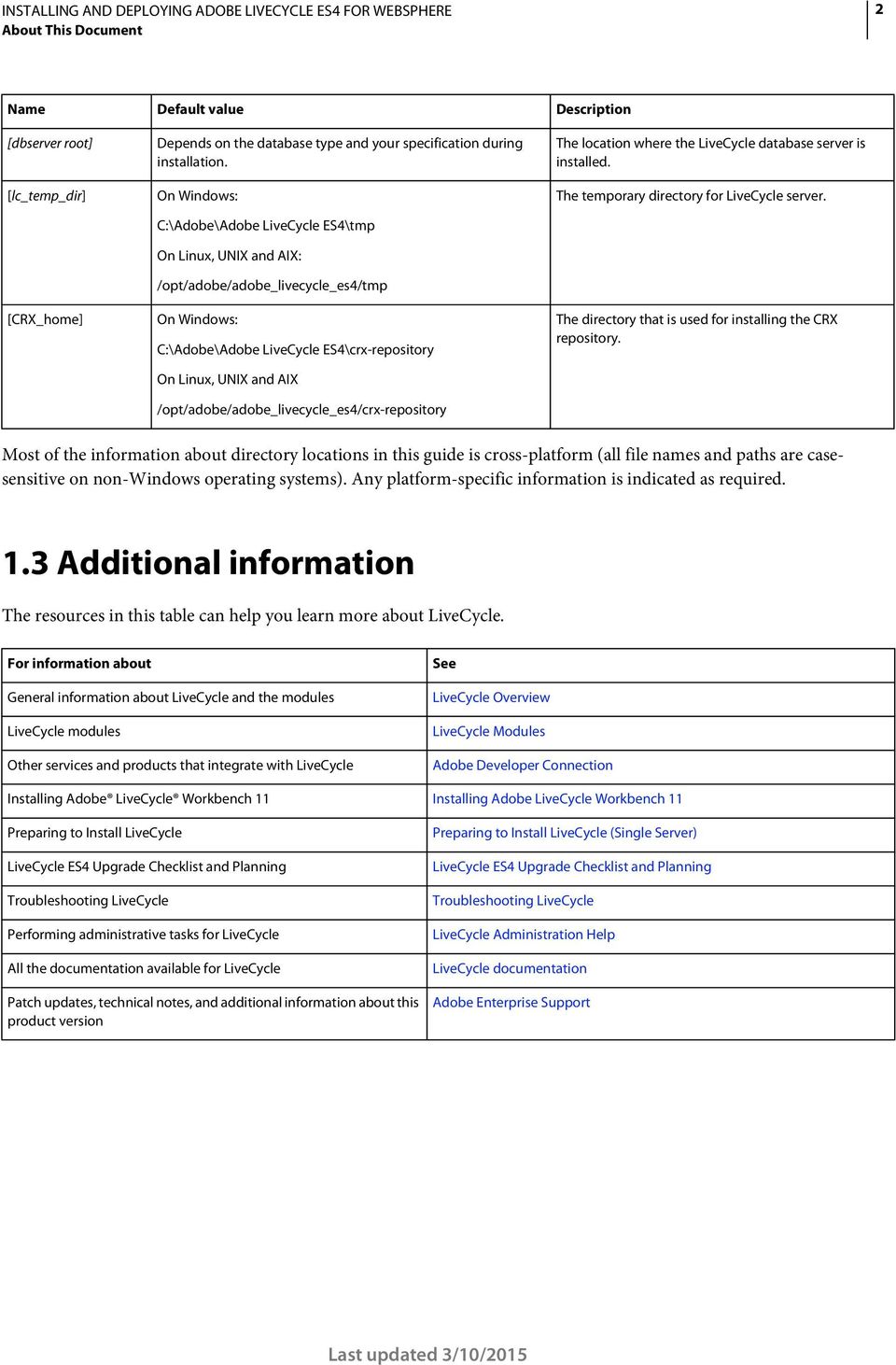
6 About This Document 2 Name Default value Description [dbserver root] [lc_temp_dir] [CRX_home] Depends on the database type and your specification during installation. On Windows: C:\Adobe\Adobe LiveCycle ES4\tmp On Linux, UNIX and AIX: /opt/adobe/adobe_livecycle_es4/tmp On Windows: C:\Adobe\Adobe LiveCycle ES4\crx-repository On Linux, UNIX and AIX /opt/adobe/adobe_livecycle_es4/crx-repository The location where the LiveCycle database server is installed. The temporary directory for LiveCycle server. The directory that is used for installing the CRX repository. Most of the information about directory locations in this guide is cross-platform (all file names and paths are casesensitive on non-windows operating systems). Any platform-specific information is indicated as required. 1.3 Additional information The resources in this table can help you learn more about LiveCycle. For information about General information about LiveCycle and the modules LiveCycle modules Other services and products that integrate with LiveCycle See LiveCycle Overview LiveCycle Modules Adobe Developer Connection Installing Adobe LiveCycle Workbench 11 Installing Adobe LiveCycle Workbench 11 Preparing to Install LiveCycle LiveCycle ES4 Upgrade Checklist and Planning Troubleshooting LiveCycle Performing administrative tasks for LiveCycle All the documentation available for LiveCycle Patch updates, technical notes, and additional information about this product version Preparing to Install LiveCycle (Single Server) LiveCycle ES4 Upgrade Checklist and Planning Troubleshooting LiveCycle LiveCycle Administration Help LiveCycle documentation Adobe Enterprise Support
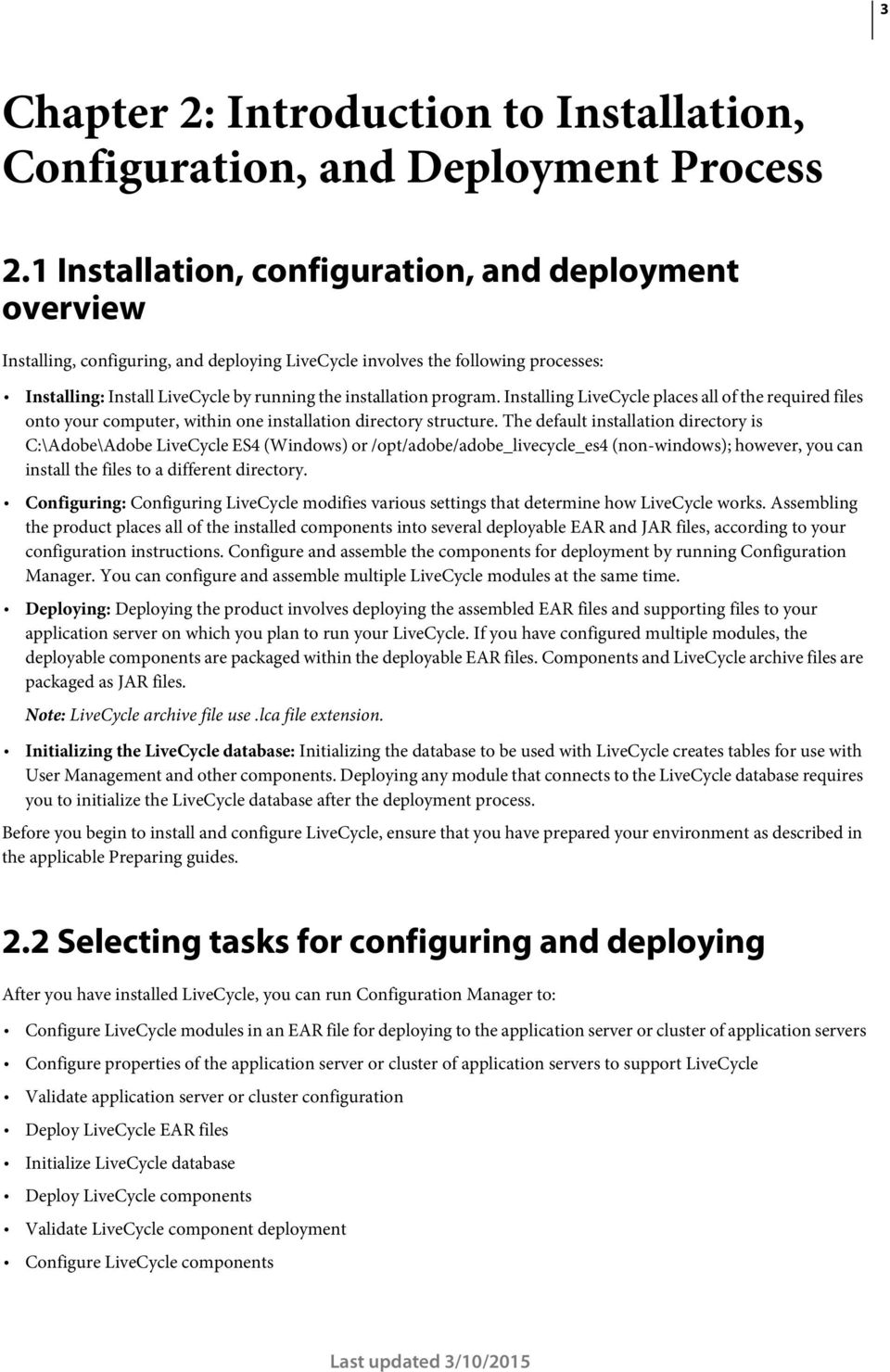
7 3 Chapter 2: Introduction to Installation, Configuration, and Deployment Process 2.1 Installation, configuration, and deployment overview Installing, configuring, and deploying LiveCycle involves the following processes: Installing: Install LiveCycle by running the installation program. Installing LiveCycle places all of the required files onto your computer, within one installation directory structure. The default installation directory is C:\Adobe\Adobe LiveCycle ES4 (Windows) or /opt/adobe/adobe_livecycle_es4 (non-windows); however, you can install the files to a different directory. Configuring: Configuring LiveCycle modifies various settings that determine how LiveCycle works. Assembling the product places all of the installed components into several deployable EAR and JAR files, according to your configuration instructions. Configure and assemble the components for deployment by running Configuration Manager. You can configure and assemble multiple LiveCycle modules at the same time. Deploying: Deploying the product involves deploying the assembled EAR files and supporting files to your application server on which you plan to run your LiveCycle. If you have configured multiple modules, the deployable components are packaged within the deployable EAR files. Components and LiveCycle archive files are packaged as JAR files. Note: LiveCycle archive file use.lca file extension. Initializing the LiveCycle database: Initializing the database to be used with LiveCycle creates tables for use with User Management and other components. Deploying any module that connects to the LiveCycle database requires you to initialize the LiveCycle database after the deployment process. Before you begin to install and configure LiveCycle, ensure that you have prepared your environment as described in the applicable Preparing guides. 2.2 Selecting tasks for configuring and deploying After you have installed LiveCycle, you can run Configuration Manager to: Configure LiveCycle modules in an EAR file for deploying to the application server or cluster of application servers Configure properties of the application server or cluster of application servers to support LiveCycle Validate application server or cluster configuration Deploy LiveCycle EAR files Initialize LiveCycle database Deploy LiveCycle components Validate LiveCycle component deployment Configure LiveCycle components
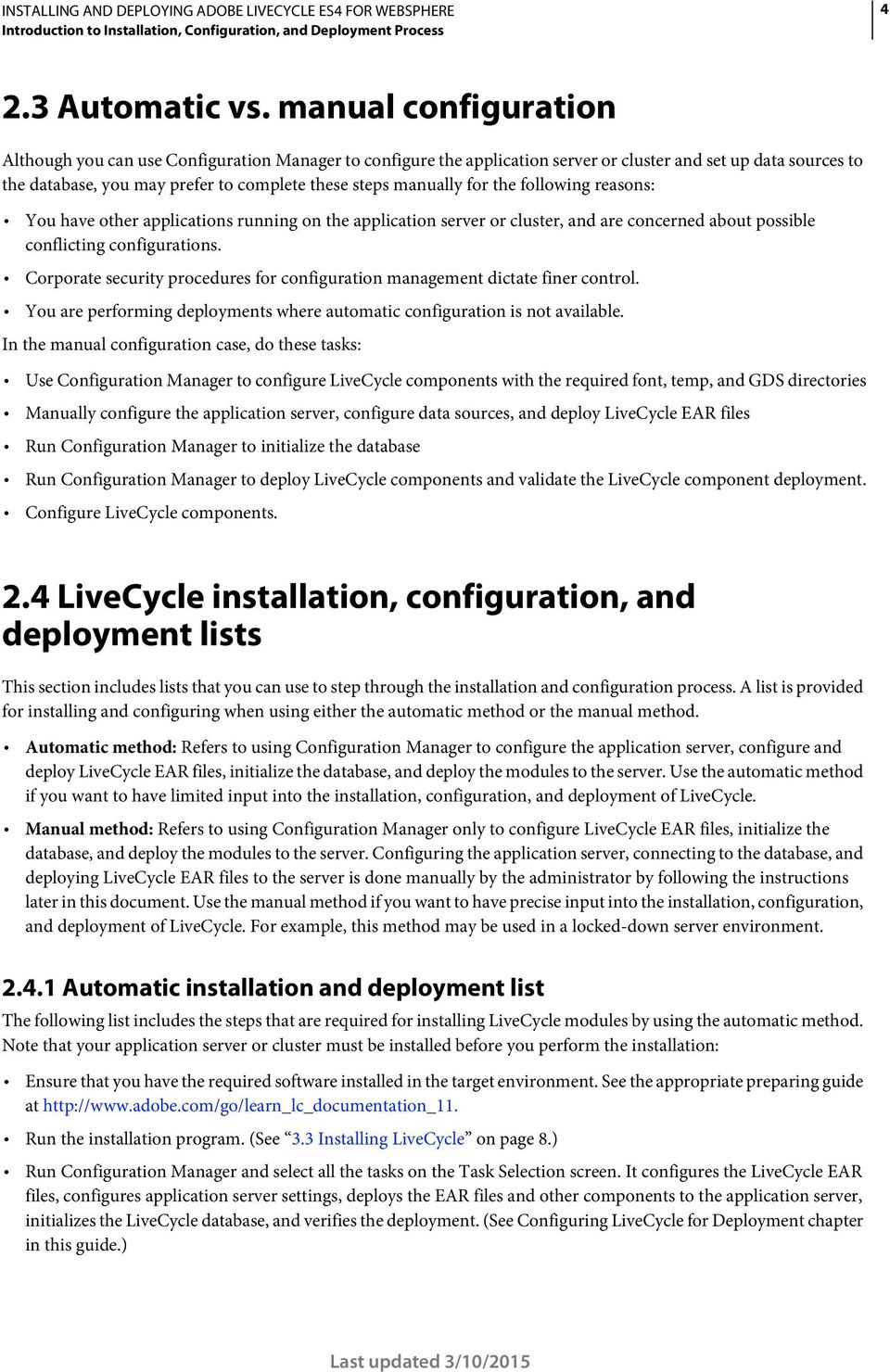
8 Introduction to Installation, Configuration, and Deployment Process Automatic vs. manual configuration Although you can use Configuration Manager to configure the application server or cluster and set up data sources to the database, you may prefer to complete these steps manually for the following reasons: You have other applications running on the application server or cluster, and are concerned about possible conflicting configurations. Corporate security procedures for configuration management dictate finer control. You are performing deployments where automatic configuration is not available. In the manual configuration case, do these tasks: Use Configuration Manager to configure LiveCycle components with the required font, temp, and GDS directories Manually configure the application server, configure data sources, and deploy LiveCycle EAR files Run Configuration Manager to initialize the database Run Configuration Manager to deploy LiveCycle components and validate the LiveCycle component deployment. Configure LiveCycle components. 2.4 LiveCycle installation, configuration, and deployment lists This section includes lists that you can use to step through the installation and configuration process. A list is provided for installing and configuring when using either the automatic method or the manual method. Automatic method: Refers to using Configuration Manager to configure the application server, configure and deploy LiveCycle EAR files, initialize the database, and deploy the modules to the server. Use the automatic method if you want to have limited input into the installation, configuration, and deployment of LiveCycle. Manual method: Refers to using Configuration Manager only to configure LiveCycle EAR files, initialize the database, and deploy the modules to the server. Configuring the application server, connecting to the database, and deploying LiveCycle EAR files to the server is done manually by the administrator by following the instructions later in this document. Use the manual method if you want to have precise input into the installation, configuration, and deployment of LiveCycle. For example, this method may be used in a locked-down server environment Automatic installation and deployment list The following list includes the steps that are required for installing LiveCycle modules by using the automatic method. Note that your application server or cluster must be installed before you perform the installation: Ensure that you have the required software installed in the target environment. See the appropriate preparing guide at Run the installation program. (See 3.3 Installing LiveCycle on page 8.) Run Configuration Manager and select all the tasks on the Task Selection screen. It configures the LiveCycle EAR files, configures application server settings, deploys the EAR files and other components to the application server, initializes the LiveCycle database, and verifies the deployment. (See Configuring LiveCycle for Deployment chapter in this guide.)
9 Introduction to Installation, Configuration, and Deployment Process 5 Access the Administration Console and User Management. (See Accessing LiveCycle Administration Console on page 19.) (Optional) Configure LDAP access. (See 5.6 Configuring LDAP access on page 38.) Manual installation and deployment list The following list includes the steps that are required for installing LiveCycle by using the manual method. Your application server or cluster must be installed and configured before you perform the installation. Ensure that you have the required software installed and configured in the target environment. Ensure that you created and configured the application server in the target environment. Run the installation program. Run Configuration Manager and select the Configure LiveCycle EARs task. This task configures LiveCycle. Configure Application Server settings. Deploy the EAR files to the application server. You can do this manually or use Configuration Manager. Note: (Cluster only) Ensure that you deploy ear files to the application server on every node of the cluster, When deploying ear files to the application server, ensure that you map modules to the Cluster and the webserver. Run Configuration Manager to initialize the LiveCycle database and deploy LiveCycle component files. Access Administration Console and User Management. (Optional) Configure LDAP access.

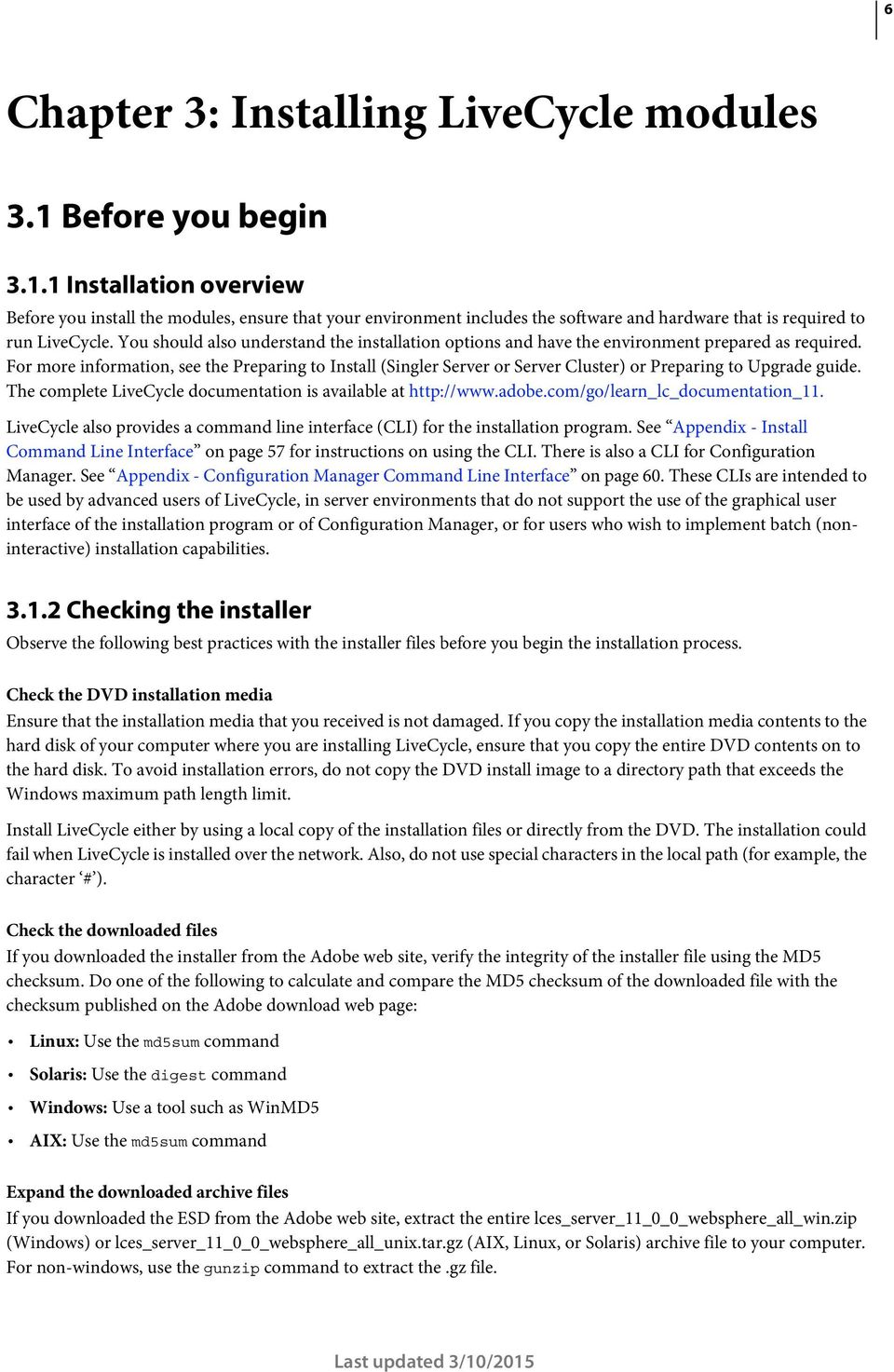
10 6 Chapter 3: Installing LiveCycle modules 3.1 Before you begin Installation overview Before you install the modules, ensure that your environment includes the software and hardware that is required to run LiveCycle. You should also understand the installation options and have the environment prepared as required. For more information, see the Preparing to Install (Singler Server or Server Cluster) or Preparing to Upgrade guide. The complete LiveCycle documentation is available at LiveCycle also provides a command line interface (CLI) for the installation program. See Appendix - Install Command Line Interface on page 57 for instructions on using the CLI. There is also a CLI for Configuration Manager. See Appendix - Configuration Manager Command Line Interface on page 60. These CLIs are intended to be used by advanced users of LiveCycle, in server environments that do not support the use of the graphical user interface of the installation program or of Configuration Manager, or for users who wish to implement batch (noninteractive) installation capabilities Checking the installer Observe the following best practices with the installer files before you begin the installation process. Check the DVD installation media Ensure that the installation media that you received is not damaged. If you copy the installation media contents to the hard disk of your computer where you are installing LiveCycle, ensure that you copy the entire DVD contents on to the hard disk. To avoid installation errors, do not copy the DVD install image to a directory path that exceeds the Windows maximum path length limit. Install LiveCycle either by using a local copy of the installation files or directly from the DVD. The installation could fail when LiveCycle is installed over the network. Also, do not use special characters in the local path (for example, the character # ). Check the downloaded files If you downloaded the installer from the Adobe web site, verify the integrity of the installer file using the MD5 checksum. Do one of the following to calculate and compare the MD5 checksum of the downloaded file with the checksum published on the Adobe download web page: Linux: Use the md5sum command Solaris: Use the digest command Windows: Use a tool such as WinMD5 AIX: Use the md5sum command Expand the downloaded archive files If you downloaded the ESD from the Adobe web site, extract the entire lces_server_11_0_0_websphere_all_win.zip (Windows) or lces_server_11_0_0_websphere_all_unix.tar.gz (AIX, Linux, or Solaris) archive file to your computer. For non-windows, use the gunzip command to extract the.gz file.
11 Installing LiveCycle modules 7 Note: Be sure to keep the directory hierarchy unchanged from the original ESD file. 3.2 Installation considerations Installation paths To successfully install, you need read, write, and execute permissions on the installation directory. The following installation directories are the defaults; however, you can specify a different directory as required: (Windows) C:\Adobe\Adobe LiveCycle ES4 (AIX, Linux, or Solaris) /opt/adobe/adobe_livecycle_es4 Important: When installing LiveCycle, do not use double byte or extended latin characters (such as àâçéèêëîïôùûäößü) in the installation path. When you are installing the modules on UNIX-based systems, you must be logged in as the root user to successfully install the modules to the default location, which is /opt/adobe/adobe_livecycle_es4. If you are logged in as a non-root user, change the installation directory to one that you have permissions (read-write-execute privileges) for. For example, you can change the directory to /home/[username]/adobe/adobe_livecycle_es4. Note: On a UNIX-like system, when you copy/download files from the source (installation media), install.bin might lose the executable permissions. Ensure that you restore the write-execute permissions after copying/downloading the files. On Windows, you must have administrator privileges to install LiveCycle. When you run the LiveCycle installer, you should run it as the same user that installed WebSphere Application Server Temporary directories Temporary files are generated in the temp directory. In certain instances, the generated temporary files may remain after the installer is closed. You can remove these files manually. When installing on Linux, the installation program uses the logged-in user's home directory as a temporary directory for storing files. As a result, messages such as the following text may appear in the console: WARNING: could not delete temporary file /home/<username>/ismp001/ When you complete the installation, you must manually delete the temporary files from the following directories: (Windows) TMP or TEMP path as set in the environment variables (AIX, Linux, or Solaris) Logged-in user s home directory On UNIX-based systems, a non-root user can use the following directory as the temporary directory: (Linux) /var/tmp or /usr/tmp (AIX) /tmp or /usr/tmp (Solaris) /var/tmp or /usr/tmp
12 Installing LiveCycle modules Installing on a Windows staging platform for Linux or UNIX LiveCycle can be installed and configured on Windows for deployment on a Linux or UNIX platform. You can use this functionality for installing on a locked-down Linux or UNIX environment. A locked-down environment does not have a graphical user interface installed. For the Linux or UNIX platform, the installation program installs binaries that are used by Configuration Manager to configure the product. The computer running Windows can then be used as a staging location for the deployable objects, which can be copied to a Linux or UNIX computer for deployment to the application server. The application server on the Windows-based computer, and the Linux or UNIX target computer on which you want to install LiveCycle must be the same Configuring the JAVA_HOME environment variable The JAVA_HOME environment variable must point to the Java SDK for your application server as outlined in the preparing guide. See Preparing to Install LiveCycle (Single Server) or Preparing to Install LiveCycle (Server Cluster) for more information General installation notes On Windows, improve the speed of installation by disabling any on-access virus scanning software during installation. If you are installing on UNIX-based systems and are not installing directly from a release DVD, set executable permissions on the installation file. To avoid permission issues during deployment, ensure that you run the LiveCycle installer and Configuration Manager as the same user who will run the application server. If you are installing on UNIX-based computers, the installation directory you specify should not contain any spaces. Ensure that the JAVA_HOME environment variable points to [appserver root]/java/. When configuring WebSphere on Windows, make sure that Configuration Manager is running using the appropriate JDK. WebSphere installations typically use the IBM JDK. If WebSphere is not using the IBM JDK, relaunch Configuration Manager using the [LiveCycle root]/configurationmanager/bin/configurationmanager.bat script. Note: If you are using a non-ibm JDK, do not use [LiveCycle root]/configurationmanager/bin/configurationmanager.exe. If errors occur during installation, the installation program creates the install.log file, which contains the error messages. This log file is created in the [LiveCycle root]/log directory. 3.3 Installing LiveCycle 1 Start the installation program: (Windows) Navigate to the \server\disk1\instdata\windows_64\vm directory on the installation media or folder on your hard disk where you copied the installer. Right-click the install.exe file and select Run as administrator. (Non-Windows) Navigate to the appropriate directory, and from a command prompt, type./install.bin. (AIX) /server/disk1/instdata/aix/vm

13 Installing LiveCycle modules 9 (Linux) /server/disk1/instdata/linux/novm (Solaris) /server/disk1/instdata/solaris/novm 2 When prompted, select the language for the installation to use and click OK. 3 On the Introduction screen, click Next. 4 If you have a previous version of LiveCycle ES2, ADEP, or LiveCycle ES3 installed on the computer where you are running the installer, the Preparation for Upgrade screen appears. Note: If you are performing an out-of-place upgrade on a new machine, this screen is not shown. Prepare to upgrade existing installation to Adobe LiveCycle ES4: Do not select this option if you are performing a fresh installation. Install Adobe LiveCycle ES4: Installs LiveCycle afresh. Select Next to continue. 5 On the Choose Install Folder screen, accept the default directory or click Choose and navigate to the directory where you intend to install LiveCycle, and then click Next. If you type the name of a directory that does not exist, it is created for you. Click Restore Default Folder to restore the default directory path. 6 (Windows only) On the Manual Installation Options screen, select the target deployment option and click Next: Windows (Local): Select this option if you are installing and deploying LiveCycle on the local server. Staged (Installed on Windows, targeting remote systems): Select this option if you plan to use Windows as a staging platform for your deployment and then select the target operating system on the remote server. You can select a UNIX operating system as the target for deployment even if you are installing on Windows. (See Installing on a Windows staging platform for Linux or UNIX on page 8.) 7 Read the Adobe LiveCycle ES4 License Agreement, select I accept to accept the terms of the license agreement and then click Next. If you do not accept the license agreement, you cannot continue. 8 On the Pre-Installation Summary screen, review the details and click Install. The installation program displays the progress of the installation. 9 Review the Release Notes information and click Next. 10 Review the details on the Install Complete screen. 11 The Start LiveCycle Configuration Manager checkbox is selected by default. Click Done to run the Configuration Manager. Note: To run Configuration Manager later, deselect the Start LiveCycle Configuration Manager option before you click Done. You can start Configuration Manager later using the appropriate script in the [LiveCycle root]/configurationmanager/bin directory. See the Configuring LiveCycle For Deployment chapter in this guide. 3.4 Next steps You must now configure LiveCycle for deployment. You can also choose to run Configuration Manager later by using the ConfigurationManager.bat or ConfigurationManager.sh file located in [LiveCycle root]\configurationmanager\bin.
14 10 Chapter 4: Configuring LiveCycle for deployment 4.1 Considerations when configuring and deploying LiveCycle General Considerations For IPv6, run IPv6 LiveCycle Configuration Manager. For detailed information, see LiveCycle IPv6 support section in prepare to install guide. You can override the default font for the Configuration Manager by adding the following JVM argument in [LiveCycle root]\configurationmanager\bin\configurationmanager.bat (Windows) or [LiveCycle root]\configurationmanager\bin\configurationmanager.sh (Linux, UNIX): -Dlcm.font.override=<FONT_FAMILY _NAME> For example: -Dlcm.font.override=SansSerif Restart the Configuration Manager after adding the JVM argument. During configuration, if you must reset the data in Configuration Manager by using the Reset to Default option, ensure that you relaunch the Configuration Manager. Otherwise, you may encounter some missing configuration screens. During configuration, you must provide the location of the JDBC drivers for your database. The Oracle, SQL Server, and DB2 drivers are in the [LiveCycle root]/lib/db/[database] directory. Global Document Storage (GDS) directory: Specify the GDS directory that meets the requirements outlined in the Preparing to Install (Single Server or Server Cluster). For latest documentation, see CLI versus GUI versions of Configuration Manager This section describes the GUI version of Configuration Manager. For instructions about using the command line interface (CLI) version of Configuration Manager, see Appendix - Configuration Manager Command Line Interface on page 60. LiveCycle configuration task Configuration Manager GUI Configuration Manager CLI Manual Configure LiveCycle Yes Yes No Configure application server Yes Yes Yes Only WebLogic and WebSphere application servers can be configured using Configuration Manager. Validate application server configuration Yes Yes Yes Only WebLogic and WebSphere application server configurations can be validated using Configuration Manager.
![You can override the default font for the Configuration Manager by adding the following JVM argument in [LiveCycle root]\configurationmanager\bin\configurationmanager.](/docs-images/40/12192919/images/page_14.jpg "bat (Windows) or [LiveCycle root]\configurationmanager\bin\configurationmanager.sh (Linux, UNIX): -Dlcm.font.override=<FONT_FAMILY _NAME> For example: -Dlcm.font.override=SansSerif Restart the Configuration Manager after adding the JVM argument.")
15 Configuring LiveCycle for deployment 11 LiveCycle configuration task Configuration Manager GUI Configuration Manager CLI Manual Deploy LiveCycle EARs Yes Yes Yes LiveCycle EARs can be deployed only on WebLogic and WebSphere application servers using Configuration Manager. Initialize LiveCycle database Yes Yes No Validate LiveCycle Server connection Yes Yes No Deploy LiveCycle components Yes Yes No Validate LiveCycle component deployment Yes Yes Yes Configure LiveCycle components Yes Yes Yes Considerations for WebSphere application server Configuration Manager does not support deployment or undeployment of EAR files with custom file names. If your EAR files use a custom file name, you must manually deploy and undeploy them to the application server. If you are deploying components to WebSphere on a localized instance of the Windows operating system, the Configuration Manager deployment process reaches approximately 7% completion and then adobe-livecyclewebsphere.ear fails to deploy. You must perform additional steps described in the Miscellaneous Errors section of the adobe-livecycle-websphere.ear fails to deployarticle. If you are installing in a distributed environment to a secured server, you will encounter SSL handshake exceptions when running Configuration Manager. To avoid this error, run the following executable file before running Configuration Manager: [appserver root]/bin/retrievesigners.bat. The retrievesigners utility retrieves the certificates from the WebSphere Deployment Manager server and adds them to the local server s trust store. See the article Retrieving signers using the retrievesigners utility at the client available from the IBM Information Center. Some Configuration Manager screens require you to provide the SOAP port of the application server or the deployment manager. For more information on how to determine SOAP ports of your WebSphere application server, see this blog. If you are configuring a remote application server, ensure that an application server is also installed on the same computer as Configuration Manager so that Configuration Manager can use the application server library files. You can determine the JNDI port number by logging in to WebSphere Administrative Console. On WebSphere admin console, click Servers > Server Types > WebSphere application servers > [server name] > Communications > Ports. You will need to provide the value for BOOTSTRAP_ADDRESS when you configure the application server using Configuration Manager Set the date, time, and time zone Setting the date, time, and time zone on all servers connected to your LiveCycle environment will ensure that timedependent modules, such as Adobe LiveCycle Digital Signatures 11 and Reader Extensions 11, function correctly. For example, if a signature appears to have been created in the future, it will not validate. Servers that require time synchronization are database servers, LDAP servers, HTTP servers and J2EE servers (Application servers).

16 Configuring LiveCycle for deployment LiveCycle pre-configuration tasks Note: Press F1 in Configuration Manager to view Help information for the screen you are viewing. You can view the configuration progress at any time by clicking View Progress Log. 1 If you did not start Configuration Manager automatically from the installation program, navigate to the [LiveCycle root]/configurationmanager/bin directory and run the ConfigurationManager.bat/sh script. 2 If prompted, select a language for Configuration Manager to use and click OK. 3 On the Welcome screen, click Next. 4 Do not select any option on the Upgrade Task Selection screen and click Next. 5 On the Modules screen, select Adobe LiveCycle ES4 modules you wish to configure and click Next. Note: Some modules have technical dependencies on other modules for proper configuration and functioning. Configuration Manager displays a dialog and does not allow to proceed further if mutually dependent modules are not selected. For example, you must select Adobe LiveCycle Forms, Adobe LiveCycle Output, and Content Repository modules if you are configuring Correspondence Management Solution. 6 On the Task Selection screen, select all the tasks you want to perform and click Next. 4.3 Configuring and deploying LiveCycle Note: Press F1 in Configuration Manager to view Help information for the screen you are viewing. Configuring LiveCycle 1 On the Configure LiveCycle ES4 (1 of 5) screen, click Configure and click Next when done. 2 On the Configure LiveCycle ES4 (2 of 5) screen, click Next to accept the default directory locations, or click Browse to navigate to and change the directories that LiveCycle will use to access fonts, and then click Next. Click Edit configuration to change any values on this screen. This button is not available when the Configuration Manager is run for the first time, but is available on the second and subsequent runs of the Configuration Manager. (Optional) To change the default location of the Adobe server fonts directory, type the path or browse to the directory. To change the default location of the Customer fonts directory, click Browse or specify a new location for your customer fonts. Note: Your right to use fonts provided by parties other than Adobe is governed by the license agreements provided to you by such parties with those fonts, and is not covered under your license to use Adobe software. Adobe recommends that you review and ensure that you are in compliance with all applicable non-adobe license agreements before using non-adobe fonts with Adobe software, particularly with respect to use of fonts in a server environment. (Optional) To change the default location of the System fonts directory, type the path or browse to the directory. To add more directories to the list, click Add. (Optional) To enable FIPS, ensure that Enable FIPS is selected. Select this option only if you require the Federal Information Processing Standards (FIPS) to be enforced. 3 Click Browse on the Configure LiveCycle ES4 (3 of 5) screen to specify the Location of the temporary directory, and then click Next.
![1 If you did not start Configuration Manager automatically from the installation program, navigate to the [LiveCycle root]/configurationmanager/bin directory and run the ConfigurationManager.](/docs-images/40/12192919/images/page_16.jpg "bat/sh script. 2 If prompted, select a language for Configuration Manager to use and click OK. 3 On the Welcome screen, click Next.")
17 Configuring LiveCycle for deployment 13 Note: Ensure that the temporary directory is on the local file system. LiveCycle does not support a temporary directory at a remote location. Note: If you do not specify the temporary directory, the default system-configured temp location is used. 4 On the Configure LiveCycle ES4 (4 of 5) screen, click Browse to specify the path for the Global Document Storage (GDS) directory, and then click Next.. Note: If you leave the GDS directory field empty, LiveCycle will create the directory in a default location in the application server directory tree. After you finish the configuration steps, you can access the location from Administration Console > Settings > Core System Settings > Configurations. 5 On the Configure Persistent Document Storage (5 of 5) screen, select the option for persistent document storage in addition to the GDS directory. Select one of the following: Use GDS: Use the file system-based GDS for all persistent document storage. This option provides the best performance, and a single location for GDS. Use database: Use the LiveCycle database for storing the persistent documents and long-lived artifacts. However, the file-system based GDS is also required. Using the database simplifies backup and restore procedures. Click Configure to configure the LiveCycle EARs with this directory information and, after the configuration is complete, click Next. Configuring Acrobat for PDF Generator (Windows only) On the Configure Acrobat For LiveCycle PDF Generator screen, click Configure to run the script that will configure Adobe Acrobat and required environment settings. Click Next when complete. Note: This screen will perform the desired configuration only when Configuration Manager is running locally. You must have Adobe Acrobat XI Pro already installed or this step will fail. LiveCycle Configuration Summary On the Configure LiveCycle ES4 Summary screen, click Next. Configured archives are placed in the [LiveCycle root]/configurationmanager/export directory. Configure CRX The CRX Configuration screen allows you to configure the CRX repository and install it into the LiveCycle Core EAR file. On this screen, specify the path to the repository and click Configure to create the required repository files at the specified location. If you are using a custom path for the repository, ensure that the file system already contains custom directory. Note: (Non-turnkey only) If your LiveCycle server is running remotely, select Server is running on remote host, and specify the path to the repository on the remote host. Click Next to continue. Note: Once the packages are configured, you cannot remove them by re-running the Configuration Manager. For clean uninstallation of deployed packages, you need to uninstall and delete the packages using Package Manager. (Remote host only) CRX Configuration Summary For a remote deployment, copy the content from the [LiveCycle root]/configurationmanager/export/crxquickstart/ directory to the location on the remote host you specified on the CRX Configuration screen. Note: In case of clustered deployment, you must copy the content from the [LiveCycle root]/configurationmanager/export/crx-quickstart/ directory to the specified location on all cluster node hosts.

18 Configuring LiveCycle for deployment 14 Configuring your application server and database 1 On the Application Server Configuration Details screen, provide the information for the fields (all fields are mandatory) and then click Verify Server Connection. When the verification has completed successfully, click Next. Note: If WebSphere Administrative Security is off, Admin User ID and Password fields can be left blank. Note: When using WebSphere Cluster or WebSphere Network Deployment server to configure a standalone WebSphere Application server, enter the port number of the deployment manager in the SOAP Port field. Note: If you are using non-default WebSphere profile, ensure that you provide the complete path, including the profile name, in the Local Application Server Root Directory field. 2 On the Application Server Configuration Selection screen, select the tasks for Configuration Manager to perform, and click Next. 3 On the Server Settings Configuration screen (appears only if Configure Server Settings was selected), provide the information for the fields, and then click Next. 4 On the Datasource Configuration screen (appears only if Configure Datasource option is selected), provide the information for the fields and then click Test Database Connection. When the connection is tested successfully, click Next. You can choose to manually configure data sources rather than allowing Configuration Manager to configure them for you. To override automatic data source configuration, select Manually configure data source in the WebSphere Administrative Console before continuing, at the bottom of the screen. Without exiting Configuration Manager, go to the application server administration console, and configure data sources as described in 9.5 Configuring the LiveCycle database connectivity on page 79 in Installing LiveCycle for WebSphere Server Guide. Note: By default, Configuration Manager creates datasources at node level. To set the datasource at the server level, see how to create a JDBC provider for your database in Appendix - Manually Configuring WebSphere on page 76 in the Installing LiveCycle for WebSphere Server Guide. 5 On the Application Server Configuration screen, click Configure. When the process is completed, click Next. 6 On the Application Server Configuration Validation screen, select the tasks for validating and then click Validate and select Yes on prompt to deploy adobe-lcm-lcvalidator.ear. When the process is completed, click Next. Choose installation verification sample (IVS) EAR files (Forms, Output, Mobile Forms, and Assembler only)on the LiveCycle ES4 Installation Verification Sample (IVS) EAR files screen, you can install three service-specific sample applications. Select Include IVS EARs in deployment set and click Next to install these sample files. The ear files appear only if you have selected respective modules on the Modules screen. Note: Do not deploy the IVS EAR files to a production environment. Deploying LiveCycle EARs On the Deploy LiveCycle ES4 EARs screen, select the EAR files to deploy, and then click Deploy. This operation may take several minutes to complete. When the deployment has completed successfully, click Next. Note: If the deployment of EARs fails with the error The system failed to make the SOAP RPC call: invoke increase the SOAP timeout value as described in 9.3 Configuring WebSphere time-out settings on page 77 and then deploy the EARs.

19 Configuring LiveCycle for deployment 15 Note: When Configuration Manager has started the execution of the IBM WebSphere JACL deployment scripts, you cannot stop the deployment even if you exit or cancel Configuration Manager prior to deployment completion. No user action is required because the product EARs will be successfully deployed. By default, Configuration Manager deploys the EAR files to the WebSphere default virtual host, default_host. To deploy the EAR files to a different virtual host, select the target host from the Virtual Host list. To connect to the application server using a secure port while running Configuration Manager, do the following tasks: a b Add the crypto.jar file provided by IBM to the LiveCycle Configuration Manager path. Set the following JVM argument to disable hostname verification: ssl.disable.url.hostname.verification.cwpki0027i=cwpki0027i You can connect to the application server using this workaround only if you are using the default HTTPS port. Initializing LiveCycle database 1 On the LiveCycle ES4 Database Initialization screen, verify that the hostname and port number provided for your application server is correct and then click Initialize. The database initialization task creates tables in the database, adds default data to the tables, and creates basic roles in the database. When the initialization has completed successfully, click Next. Restart the application server manually when you are prompted to do so. 2 On the LiveCycle ES4 Information screen, enter LiveCycle ES4 User ID and Password whose default values are administrator and password respectively. Click Verify Server Connection, and when complete, click Next. Note: The server information that appears on this screen represents default values for the deployment. Verifying the server connection helps narrow troubleshooting in case failures occur in the deployment or validation. If the connection test passes but deployment or validation fails in the next few steps, connectivity issues can be eliminated from the troubleshooting process. Deploying Central Migration Bridge Service On the Central Migration Bridge Service Deployment Configuration screen, if applicable, select the Include Central Migration Bridge Service in deployment option and then click Next. Deploying LiveCycle components 1 On the LiveCycle ES4 Component Deployment screen, click Deploy. The components that are deployed at this time are Java archive files that plug into the service container that is part of LiveCycle for purposes of deploying, orchestrating, and executing services. When the deployment has completed successfully, click Next. 2 On the LiveCycle Component Deployment Validation screen, click Validate. Click View Progress Log to view the validation progress and, when the validation has completed successfully, click Next. Configuring LiveCycle components On the Configure LiveCycle ES4 Components screen, select the tasks to run with Configuration Manager, and click Next. LiveCycle Server JNDI information On the LiveCycle Server JNDI Information screen, enter the host name and port number for the JNDI server. Provide location for Local Application Server Root Directory, and Click Test Connection. When complete, click Next.
20 Configuring LiveCycle for deployment 16 Configure Adobe LiveCycle 11 Connector for EMC Documentum Note: In case of a remote LiveCycle deployment, you cannot configure the Connector for EMC Documentum using Configuration Manager. 1 On the Specify Client for EMC Documentum screen, select Configure Connector for EMC Documentum Content Server, and specify the following settings. Enter the details, click Verify, and when complete, click Next to continue. Choose EMC Documentum Client Version: Select the client version to use with the EMC Documentum Content Server. EMC Documentum Client Installation Directory Path: Click Browse to select the directory path. Note: Configure Documentum 6.7 manually, LCM does not contain support for Documentum On the Specify EMC Documentum Content Server Settings screen, enter the EMC Documentum Server details, and then click Next. Press F1 for information about the details you need to enter. 3 On the Configure Connector for EMC Documentum screen, click Configure Documentum Connector. When completed, click Next. 4 On the Required Manual Configurations for Connector for EMC Documentum screen, review and perform the manual steps listed and then click Next. Configure Adobe LiveCycle 11 Connector for IBM Content Manager Note: In case of a remote LiveCycle deployment, you cannot configure the Connector for IBM Content Manager using Configuration Manager. 1 On the Specify Client for IBM Content Manager screen, select Configure Connector for IBM Content Manager, and enter a value for the IBM Content Manager Client Installation Directory Path. Click Verify and when complete, click Next to continue. 2 On the Specify IBM Content Manager Server Settings screen, enter the details of the IBM Content Manager Server, and click Next. 3 On the Configure Connector for IBM Content Manager screen, click Configure IBM Content Manager Connector. When complete, click Next. 4 On the Required Manual Configurations for Connector for IBM Content Manager screen, review and perform the manual steps listed and then click Next. Configure Adobe LiveCycle 11 Connector for IBM FileNet Note: In case of a remote LiveCycle deployment, you cannot configure the Connector for IBM FileNet using Configuration Manager. 1 On the Specify Client for IBM FileNet screen, select Configure Client for IBM FileNet Content Manager, and specify the following settings. Choose IBM FileNet Client Version: Select the client version that you want to use with the IBM FileNet Content Server. IBM FileNet Client Installation Directory Path: Click Browse to select the directory path. Note: The validation of IBM FIleNet may fail if there are special characters, such as hyphen (-), underscore (_), comma (,), or dot (.) in the directory name containing the IBM FileNet client. Click Verify, and when complete, click Next to continue.

21 Configuring LiveCycle for deployment 17 2 On the Specify IBM FileNet Content Server Settings screen, enter the required details, and click Next. Press F1 for more information. 3 On the Specify Client for IBM FileNet Process Engine screen, enter the required details, and click Verify. When complete, click Next. 4 On the Specify IBM FileNet Process Engine Server Settings screen, enter the required details and click Next. Press F1 for more information. 5 On the Configure Connector for IBM FileNet screen, click Configure FileNet Connector. When complete, click Next. 6 On the Required Manual Configurations for Connector for IBM FileNet screen, review and perform the manual steps listed and then click Next. Configure Adobe LiveCycle 11 Connector for Microsoft SharePoint Note: In case of a remote LiveCycle deployment, you cannot configure the Connector for Microsoft SharePoint using Configuration Manager. On the Configure Adobe LiveCycle ES4 Connector for Microsoft SharePoint screen, do one of the following tasks: Deselect the Configure Adobe LiveCycle ES4 Connector for Microsoft SharePoint option to manually configure Microsoft Sharepoint later, and then click Next. Leave the Configure Adobe LiveCycle ES4 Connector for Microsoft SharePoint option selected. Enter the required values, and then click Configure SharePoint Connector. When complete, click Next. Note: You can skip this step if you want to configure the Connector for Microsoft SharePoint later using Administration Console. Configuring LiveCycle Server for native file conversions (PDF Generator only) On the Admin user credentials for native PDF conversions screen, enter the user name and password of a user with administrative privileges on the server computer, and then click Add user. Note: You must add at least one administrative user for Windows 2008 Server. On Windows 2008 Server, User Account Control (UAC) must be disabled for the users you add. To disable UAC, click Control Panel > User Accounts > Turn User Account Control on or off and deselect Use User Account Control (UAC) to help protect your computer, then click OK. Restart the computer to apply these changes. System readiness test for PDF Generator On the Document Services PDF Generator System Readiness Test screen, click Start to validate if the system has been appropriately configured for PDF Generator. Review the System Readiness Tool Report and click Next. Note that the system readiness test fails if LiveCycle is deployed on a remote machine. Configuring LiveCycle Reader Extensions On the Reader Extensions Credential Configuration screen, specify the details that are associated with the Reader Extensions credential that activates the module services. Note: You can skip this step at this time by selecting Configure later using LiveCycle ES4 Administration Console. You can configure the Reader Extensions credential by using Administration Console after you complete the deployment. (After logging in to Administration Console, click Home > Settings > Trust Store Management > Local Credentials.) Click Configure and then click Next.
22 Configuring LiveCycle for deployment 18 Summary, and Next Steps Review the Configuration Manager task summary list and choose the appropriate options: Select Launch Next Steps to view information about LiveCycle users and administrative interfaces to launch an html page containing step-by-step instructions to start and use LiveCycle. Click Finish to exit the Configuration Manager
23 19 Chapter 5: Post-deployment tasks 5.1 General tasks Perform a system image backup After LiveCycle is installed and deployed into production areas and before the system is live, it is recommended that you perform a system image backup of the servers on which LiveCycle is implemented. Also take backup of CRX repository. The LiveCycle database, GDS directory, and application servers must be part of this backup. This is a complete system backup that you can use to restore the contents of your computer if your hard drive or entire computer stops working. See the LiveCycle Backup and Recovery topic in Administration Help Restart the application server When you first deploy LiveCycle, the server is in a deployment mode in which most modules are in memory. As a result, the memory consumption is high and the server is not in a typical production state. You must restart the application server to get the server back into a clean state Verify the deployment You can verify the deployment by logging in to Administration Console. If you log in successfully, then LiveCycle is running on the application server and the default user is created in the database. To verify the CRX repository deployment, access the CRX welcome page. You can review the application server log files to ensure that components were deployed correctly or to determine the cause of any deployment issues you may encounter Accessing LiveCycle Administration Console Administration Console is the web-based portal for accessing a variety of configuration pages where you can set runtime properties that control the way LiveCycle operates. When you log in to Administration Console, you can access User Management, Watched Folder, and client configuration, and administrative configuration options for other services. Administration Console also provides access to Applications and Services, which administrators use for managing archives and deploying services to a production environment. The default user name and password for logging in is administrator and password. After you log in the first time, access User Management and change the password. Before you access Administration Console, LiveCycle must be deployed and running on your application server. For information about using Administration Console, see Administration Help. 1 Type the following URL in a web browser: For example: 2 If you have upgraded to LiveCycle, enter the same administrator user name and password as that of your previous LiveCycle installation. In case of a fresh installation, enter the default user name and password.
24 Post-deployment tasks 20 3 After you log in, click Services to access the service administration pages or click Settings to access the pages on which you can administer settings for different modules Change the default password of LiveCycle Administrator LiveCycle creates one or more default users during the installation. The password for these users is in the product documentation and is publicly available. You must change this default password, depending on your security requirements. The LiveCycle administrator user password is set to password by default. You must change it in Administration Console > Settings > User Management. Also, it is recommended to change the default password for CRX Administrator. For detailed information, see Change the default administrator password Accessing CQ Welcome Page CQ welcome page is the web-based portal for accessing various CQ components, administration, deployment and development tools. The default user name and password for logging in is administrator and password (same as LiveCycle Administrator). Access the welcome page using the following steps: 1 Type the following URL in a web browser: 2 Enter the same administrator user name and password as mentioned above. 3 After you log in, you can access various components, administration, deployment and development UIs Accessing OSGi Management Console In CQ, components are in form of OSGi bundles which are deployed to Apache Felix OSGi container. OSGi console provides a way to manage OSGi bundles and services configurations. The default user name and password for logging in is admin and admin (same as CRX Administrator). Access the OSGi Management console using the following steps: 1 Type the following URL in a web browser: 2 Enter the same administrator username and password as mentioned above. 3 After you log in, you can access various components, services, bundles and other configurations Change CQ Administrator default password CQ embedded within LiveCycle has two administrator users as mentioned below. Super Administrator (administrator): The Super Administrator user can access various CQ/CRX UIs and perform admin operations. The default username and password are same as LiveCycle Administrator, administrator/password. This user doesn't have access to OSGi Management Console. The default password of this user can be changed using LiveCycle Administrator console only as mentioned in section Change default LiveCycle password. The changed password will be applicable for both LiveCycle and CQ.
25 Post-deployment tasks 21 Administrator (admin): This user can access to OSGi console in addition to CQ/CRX UIs and has administrator privileges. The default username and password for the user are admin/admin. To change the default password follow the below mentioned steps: 1 Type the following URL in a web browser. 2 Login using following credential: Username: admin Password: admin. 3 Search for user Administrator. 4 Click on the user in left pane, the user details is displayed in the right pane. 5 Click on Edit icon in the right pane. 6 On the edit page in the right pane, provide new password in the New Password field and current password in Your Password field. 7 Click Save icon in the right pane. 8 Re-login using the changed password to verify View the log files Events, such as run-time or startup errors, are recorded to the application server log files. If you have problems deploying to the application server, you can use the log files to help you find the problem. You can open the log files by using any text editor. The following log files are located in the [appserver root]/profiles/[profilename]/logs/[server name] directory: SystemErr.log SystemOut.log startserver.log Following CRX log files are located at [CRX_home]/ error.log audit.log access.log request.log update.log Note: Each time LiveCycle starts, the following error appears in the log: FacesConfigur E org.apache.myfaces.config.facesconfigurator configurerenderkits failed to configure class com.adobe.framework.jsf.renderkit.secureinputrenderer java.lang.classcastexception This error occurs due to a different version of the IBM JSF engine expected by WebSphere. This is a known issue and this error can be safely ignored.
26 Post-deployment tasks Accessing module web applications After LiveCycle is deployed, you can access the web applications that are associated with the following modules: Reader Extensions Adobe LiveCycle Workspace 11 Note: The Flex Worksapce is deprecated for AEM forms. It is available for the LiveCycle ES4 release. HTML Workspace User management Correspondance management PDF Generator web application Adobe LiveCycle PDF Generator 11 Adobe LiveCycle Rights Management 11 After accessing the web applications by using the default administrator permissions to ensure that they are accessible, you can create additional users and roles so that others can log in and use the applications. (See Administration Help.) Access the Reader Extensions web application Note: You must apply a Reader Extensions credential and apply the user roles for a new user. (See Configuring credentials for use with Reader Extensions in LiveCycle Administration Help.) 1 Open a web browser and enter this URL: 2 Log in using the user name and password for LiveCycle. Note: You must have administrator or superuser privileges to log in. To allow other users to access the Reader Extensions web application, you must create the users in User Management and grant them the Reader Extensions Web Application role Access Workspace 1 Open a web browser and enter this URL: 2 Log in using the user name and password for LiveCycle. Note: The Flex Worksapce is deprecated for AEM forms. It is available for the LiveCycle ES4 release Access HTML Workspace 1 Open a web browser and enter this URL: 2 Log in using the user name and password for LiveCycle.
27 Post-deployment tasks Access Forms Manager 1 Open a web browser and enter this URL: 2 Log in using the user name and password for LiveCycle Access PDF Generator Web Application 1 Open a web browser and enter this URL: 2 Log in using the user name and password for LiveCycle Access Rights Management You must create a user with the Rights Management End User role in User Management and log in to the Rights Management administrator or end-user applications by using the login information that is associated with that user. Note: The default administrator user cannot access the Rights Management end-user web application but you can add the appropriate role to its profile. You can create a new user or modify an existing user through Administration Console. Access the Rights Management end-user web application Open a web browser and enter this URL: Access the Rights Management administration web application 1 Open a web browser and enter this URL: 2 Click Services > LiveCycle Rights Management 11. For information about setting up users and roles, see Administration Help. Assign the Rights Management End User role 1 Log in to Administration Console. (See Accessing LiveCycle Administration Console on page 19.) 2 Click Settings > User Management > Users and Groups. 3 In the Find box, type all and, in the In list, select Groups. 4 Click Find and, for the required domains, click All Principals in the list that appears. 5 Click the Role Assignments tab and click Find Roles. 6 In the list of roles, select the check box next to Rights Management End User. 7 Click OK and then click Save.
28 Post-deployment tasks Accessing User Management By using User Management, administrators can maintain a database of all users and groups, synchronized with one or more third-party user directories. User Management provides authentication, authorization, and user management for LiveCycle modules, including Reader Extensions, Workspace, Rights Management, Adobe LiveCycle Process Management 11, Adobe LiveCycle Forms Standard 11 and PDF Generator. 1 Log in to Administration Console. 2 On the home page, click Settings > User Management. Note: For information about configuring users with User Management, click User Management Help in the upperright corner of the User Management page Access Correspondence Management Solution template You can verify the Correspondence Management Solution deployment by visiting and logging in using LiveCycle administrator credentials. Solution template is a reference implementation of Correspondence Management Solution. Note: In a non-turnkey deployment, if you encounter an error while accessing the solution template, you must integrate LiveCycle with Correspondence Management Solution. For more information, see the Configure Publish nodes to Integrate with LiveCycle section of this document. 5.3 Configure Correspondence Management Solution Perform the following tasks to configure Correspondence Management Solution. For a recommended setup for the Correspondence Management Solution, see Correspondence Management Solution Topology Configure the Author instance The Author instance is embedded within the LiveCycle server. This implies that you do not need to make any configuration updates to the Author instance. The instance inherits all the configuration settings from the LiveCycle server Configure the Publish instance You must run separate Author and Publish instances for Correspondence Management Solution. However, you can configure the two instances on the same or on different machines. An author instance is embedded in the LiveCycle Core application and runs on the LiveCycle server. For publish instance, LCM configures a publish ear (adobelivecycle-cq-publish.ear). Deploy the publish ear on a separate server instance. Note: Before configuring the Publish instance, ensure that your author instance is configured and deployed. You can verify by successfully logging in to the solution template for Correspondence management Solution. For more information, see the Access Correspondence Management Solution template section of this document. 1 Create a server instance in a different application server profile. 2 Copy the [LiveCycle root]/crx-repository directory from the author instance to the publish instance machine.
29 Post-deployment tasks 25 3 From the crx-repository directory on the publish instance machine, open the crx-repository/install folder. Keep the following packages and delete all other packages from the install folder: dataservices-pkg.zip platform-common-pkg.zip platform-content-pkg.zip platform-security-pkg.zip solution-correspondencemanagement-pkg.zip 4 Start the Publish server with -Dcom.adobe.livecycle.crx.home=<location for crx-repository> parameter, where <location for crx-repository> is the location where you copied the crx-repository directory for the Publish instance. For details on how to configure generic JVM arguments for WebSphere and WebLogic, see the Configuring the JVM arguments section for WebSphere and WebLogic. 5 Deploy adobe-livecycle-cq-publish.ear to the server. Note: If author and Publish instances are on the same machine, ensure that you start the Publish instance using a different port. Now that the Publish instance is up and running, you need to configure the two instances to communicate with each other Configure Publish nodes to Integrate with LiveCycle Perform these steps on all publish instances. To enable communication between publish instance and LiveCycle Server: 1 Go to and Login with OSGi Management Console user credentials. The default credential are admin/admin. 2 Search and click Edit next to the Adobe LiveCycle Client SDK Configuration setting. 3 In the Server Url field, ensure that is specified. Important: Ensure that the LiveCycle server is listening on the specified host and port combination. The following three scenarios are possible in the case of a LiveCycle server cluster: All LiveCycle server instances are running on localhost and the same port. In this case use localhost:[port]. All LiveCycle server instances are running on localhost but on different ports. In this case, use a load balancer host name and port combination [loadbalancer_host]:[loadbalancer_port]. All LiveCycle server instances are running on a particular host name (not localhost) and different/same ports. In this case, use a load balancer host name and port [loadbalancer_host]:[loadbalancer_port]. If you need to use a load balancer URL to access the LiveCycle server cluster (as mentioned above), ensure that the required communication ports between Author instances and the load balancer are open. 4 Specify LiveCycle administrator credentials in the Username as Password fields. 5 Click Save Communicating between the Author and Publish instances You need to perform certain configuration changes to enable two-way communication between the Author and Publish instances.
30 Post-deployment tasks Configure Replication Agents (Define publish instance URL) On the Author instance, you need to configure replication agents for each Publish instance. These agents replicate content from the Author instances to all the Publish instances. 1 Log in to Tools UI at 2 Select Replication, then Agents on author in the left panel. On the right panel, you see various agents configured for the Author instance. 3 On the right panel, Select New... and click New Page. The Create Page dialog displays. 4 Set the Title and Name, then select Replication Agent. 5 Click Create to create new agent. 6 Double-click the new agent item to open the configuration panel. 7 Click Edit - the Agent Settings dialog displays. a In the Settings tab: Enter a Description. Check Enabled. Select Serialization Type as Default. Set the Retry Delay to Set the Log Level as Info. b In the Transport tab: Enter the required URI for the Publish instance Set User and Password. The default credential are admin/admin. 8 Click OK to save the settings. 9 On the agent configuration panel, click Test Connection. Successful connection ensures that the configuration is done correctly. Note: : In case, you have only one Publish instance you can use the default Replication Agent named as publish. You need to edit it for specifying Publish URI in the Transport tab as mentioned in the step b(i). In this case, you do not need to create a new replication agent. Note: : In case, you have a publish farm(multiple non-clustered publish instances), you need to create a replication agent for each Publish instance as mentioned in Steps 1-9. For each such replication agent, Title and Name should be significant and unique, so the identification of the corresponding Publish instance can be simpler. Each such replication agent has a different URI in the Transport tab pointing to a particular Publish instance. For multiple publish instances, you can also create replication agents by copying the default agent publish and then editing Name and URI in transport tab of the created agent. If you are not using the default Replication Agent, disable it, so an unnecessary replication attempt can be avoided. Note: For Author clusters, these steps need to be performed on one Author instance (preferably a master instance) Define Publish instance URL for ActivationManagerImpl 1 Go to Login with OSGi Management Console user credentials. The default credential is admin/admin.
31 Post-deployment tasks 27 2 Find and click the Edit icon next to the com.adobe.livecycle.content.activate.impl.activationmanagerimpl.name setting. 3 In the ActivationManager Publish URL field, specify the URL for accessing the Publish instance ActivationManager. You can provide the following URLs. a b Load Balancer URL (Recommended): Provide load balancer URL, If you have a webserver acting as load balancer in front of publish farm (multiple non-clustered publish instances). Publish instance URL: Provide any publish instance URL, If you have a single publish instance or the webserver fronting the publish farm is not accessible from the author environment due to any restrictions. In case, the specified publish instance is down, there is a fallback mechanism to deal with on the author side. URL string: 4 Click Save Configure reverse replication queue On the Author instance, you need to configure reverse replication agents for each Publish instance. These agents replicate content from the Publish instance to the Author instance. 1 Log in to Tools UI at 2 Select Replication, then Agents on author in the left panel. On the right panel, you see various agents configured for the Author instance. 3 On the right panel, Select New, and click New Page. The Create Page dialog appears. 4 Set the Title and Name, then select Reverse Replication Agent. 5 Click Create to create new agent. 6 Double-click the new agent item to open the configuration panel. 7 Click Edit - the Agent Settings dialog displays. a b c In the Settings tab: Enter a Description Check Enabled. Set the Retry Delay to Set the Log Level as Info. In the Transport tab: Enter the required URI for the Publish instance - Set User and Password - admin/admin In the Extended tab: Set HTTP Method as GET 8 Click OK to save the settings. 9 On the agent configuration panel, click Test Connection. Successful connection ensures that the configuration is done correctly.
32 Post-deployment tasks 28 Note: : In case, you have only one Publish instance you can use the default Reverse Replication Agent named as publish_reverse. You need to edit it for specifying Publish URI in the Transport tab as mentioned in the step b(i). In this case, you do not need to create a new reverse replication agent. Note: In case, you have a publish farm(multiple non-clustered publish instances), you need to create a reverse replication agent for each Publish instance as mentioned in Steps 1-9. For each such replication agent, Title and Name should be significant and unique, so the identification of the corresponding Publish instance can be simpler. Each such replication agent has a different URI in the Transport tab pointing to a particular Publish instance. For multiple publish agents, you can also create reverse replication agents by copying the default agent publish_reverse and then editing Name and URI in transport tab of the created agent. If you are not using the default Reverse Replication Agent, disable it, so an unnecessary replication attempt can be avoided. Note: For Author clusters, these steps need to be performed on one Author instance (preferably a master instance) Define author instance URL for VersionRestoreManagerImpl 1 Go to Login with OSGi Management Console user credentials. The defaults credential are admin/admin. 2 Find and click the Edit icon next to the com.adobe.livecycle.content.activate.impl.versionrestoremanagerimpl.name setting. 3 In the VersionRestoreManager Author URL field, specify the URL of the author instance VersionRestoreManager. URL string: Note: If there are multiple author instances( Clustered) fronted by a Load Balancer, specify the URL to the load balancer in the VersionRestoreManager Author URL field. 4 Click Save Install sample users and assets You can install sample users with predefined user permissions to further explore the solution template, which you can customize to build your own solution. 1 Go to 2 Log in using LiveCycle administrator credentials and click Package Manager. 3 In Package Manager, upload the samples-correspondencemanagement-pkg-<version>.zip package from <LC_HOME>/deploy/crx. 4 Click Install once the package uploads successfully. 5 Click Install on the confirmation dialog to install the sample users and assets. Correspondence Management Sample Users Correspondence Management Solution Accelerator contains the following sample users. These user are expected to participate in the activities leading to generation of interactive customer communication. The following roles mentioned are automatically assigned to the users during package Installation:
33 Post-deployment tasks 29 User name Assigned role Responsibilities Todd Goldman Correspondence Management Administrator This user is the general system administrator. This role enables the user to modify all assets. This role also lets define the categories. Heather Douglas Caleb Lopez Correspondence Management Subject Matter Expert Correspondence Management Application Specialist This persona has the role enabling him to CRUD texts and images. This user defines the letter template by judicious usage of the text, picture, condition, list objects. With this role, the user can CRUD the letter templates, layouts, lists, conditions, texts and images. Gloria Rios Correspondence Management Claim Adjustor An agent user would use the letter template defined by the business user to produce the letter communication to deliver to the customer. Jocelyn Robinson Correspondence Management Form Designer This user has the skills to design form layouts using LiveCycle Designer. Having equipped with the necessary know-how to design form layouts for use in correspondence management, this user will use LiveCycle Designer and design the XDP templates, which would serve as the boilerplate for the letter. Frank Kricfalusi Correspondence Management Developer This user has the knowledge about XSD schema and data modelling concepts and is responsible for creation and maintenance of Data Dictionaries. For more information about the sample users and guidelines to implement a solution using the solution template, see Correspondence Management Solution Guide. Note: For author clusters, these steps need to be performed on one author instance (preferably a master instance) Configure IPv6 implementation Note: Perform these steps only if Correspondence Management Solution is running on a machine that uses an IPv6 address. To map the IPv6 address to a hostname on the server and client machines: 1 Navigate to the C:\Windows\System32\drivers\etc directory. 2 Open the hosts file in a text editor. 3 Add a mapping for the IPv6 address to a host name. For example: 2001:1890:110b:712b:d1d:9c99:37ef:7281 <ipv6_hostname> 4 Save and close the file. Ensure that you use the mapped host name instead of the IPv6 address to access Correspondence Management Solution.
34 Post-deployment tasks Install Japanese fonts for Adobe Reader If your Correspondence Management assets use Japanese fonts, you must install the Japanese Language Support Package for Adobe Reader. Otherwise, your letters and forms will not render and function properly. For installing language packs, visit the downloads page for Adobe Reader. 5.4 Configuring PDF Generator If you installed PDF Generator as part of your LiveCycle, complete the following tasks: Environment variables If you installed the PDF Generator module and configured it to convert files to PDF, for some file formats, you must manually set an environment variable that contains the absolute path of the executable that is used to start the corresponding application. The table below lists the environment variables for the native applications that you have installed. Note: All environment variables and respective paths are case-sensitive. Application Environment variable Example Adobe Acrobat Acrobat_PATH C:\Program Files (x86)\adobe\acrobat 11.0\Acrobat\Acrobat.exe Adobe FrameMaker FrameMaker_PATH C:\Program Files (x86)\adobe\framemaker8.0\framemaker.exe Notepad Notepad_PATH C:\WINDOWS\notepad.exe You can leave the Notepad_PATH variable blank. OpenOffice OpenOffice_PATH C:\Program Files (x86)\openoffice.org 3.3 Adobe PageMaker PageMaker_PATH C:\Program Files (x86)\adobe\pagemaker 7.0.2\PageMaker.exe WordPerfect WordPerfect_PATH C:\Program Files (x86)\wordperfect Office 12\Programs\wpwin12.exe Adobe Photoshop Photoshop_PATH C:\Program Files (x86)\adobe\adobe Photoshop CS4\Photoshop.exe Note: The environment variable OpenOffice_PATH is set to the installation folder instead of the path to the executable. You do not need to set up the paths for Microsoft Office applications such as Word, PowerPoint, Excel, Visio, and Project, or for AutoCAD. The Generate PDF service starts these applications automatically if they are installed on the server. Create a new Windows environment variable 1 Select Start > Control Panel > System. 2 Click the Advanced tab and click Environment Variables. 3 In the System variables section, click New. 4 Enter the environment variable name you need to set (for example, enter Photoshop_PATH). This folder is the one that contains the executable file. For example, type the following path: D:\Program Files\Adobe\Adobe Photoshop CS4\Photoshop.exe
35 Post-deployment tasks 31 Set the PATH variables on Linux or UNIX (OpenOffice only) Execute the following command: export OpenOffice_PATH=/opt/openoffice.org Setting the Adobe PDF Printer as the default printer You must set the Adobe PDF Printer to be the default printer on the server. If the Adobe PDF Printer is not set as the default, PDF Generator cannot convert files successfully. Set the default printer 1 Select Start > Printers and Faxes. 2 In the Printers and Faxes window, right-click Adobe PDF and select Set as Default Printer Configuring Acrobat Professional (Windows-based Computers Only) Note: This procedure is required only if you upgraded to or installed Acrobat after you completed the LiveCycle installation. Upgrading Acrobat can be completed after you run Configuration Manager and deploy LiveCycle to the application server. Acrobat Professional root directory is designated as [Acrobat root]. Typically, the root directory is C:\Program Files\Adobe\Acrobat 11.0\Acrobat. Configure Acrobat for use with PDF Generator 1 If an earlier version of Acrobat is installed, uninstall it by using Add or Remove Programs in the Windows Control Panel. 2 Install Acrobat XI Pro by running the installer. 3 Navigate to the additional\scripts folder on the LiveCycle installation media. 4 Run the following batch file. Acrobat_for_PDFG_Configuration.bat [LiveCycle root]/pdfg_config 5 On other cluster nodes on which you do not run LiveCycle Configuration Manager,do the following: Add a new registry DWORD entry named SplWOW64TimeOut at HKEY_LOCAL_MACHINE\SYSTEM\CurrentControlSet\Control\Print. Set its value to Copy PDFGen.api from the [LiveCycle root]/plugins/x86_win32 directory on the node where LiveCycle is installed to the [Acrobat root]/plug_ins directory on the node being currently configured. 6 Open Acrobat and select Help > Check for updates > Preferences. 7 Deselect Automatically check for Adobe updates. Validate the Acrobat installation 1 Navigate to a PDF file on your system and double-click it to open it in Acrobat. If the PDF file opens successfully, Acrobat is installed correctly. 2 If the PDF file does not open correctly, uninstall Acrobat and reinstall it. Note: Ensure that you dismiss all the Acrobat dialog boxes that are displayed after the Acrobat installation is completed and disable the automatic updates for Acrobat. Set the Acrobat_PATH environment variable to point to Acrobat.exe (For example, C:\Program Files\Adobe\Acrobat 11.0\Acrobat\Acrobat.exe).
36 Post-deployment tasks 32 Configure native application support 1 Install and validate Acrobat as described in the previous procedure. 2 Set Adobe PDF printer as the default printer. Add temporary directories to trusted directories list in Acrobat The OptimizePDF service uses Adobe Acrobat and mandates that LiveCycle temporary directory and PDF Generator temporary directory are listed in the trusted directories list of Acrobat. If LiveCycle temporary directory and PDF Generator temporary directory are not listed in the trusted directories list, the OptimizePDF service fails to run. Perform the following steps to add directories to the temporary directory list: 1 Open Acrobat, Choose Edit > Preferences. 2 From the Categories on the left, select Security (Enhanced), and then select the Enable Enhanced Security option. 3 To add LiveCycle temporary directory and PDF Generator temporary directory to the trusted directories list, click Add Folder Path, select directories and click OK Installing East Asian characters in Windows Server 2003 When HTML files are converted to PDF by using PDF Generator, some East Asian languages, such as Japanese, Korean, and Chinese, and also right-to-left languages, such as Arabic, Armenian, Georgian, Hebrew, Indic, Thai, and Vietnamese, may not be displayed in the PDF file. To ensure that these languages are displayed in Windows Server 2003, appropriate fonts must be present on the client and server. Install East Asian characters in Windows Server Select Start > Control Panel and open Regional and Language Options. 2 Click the Languages tab and select Install Files for East Asian Languages. 3 Click the Advanced tab and select all the options under Code Page Conversion Tables. If converted PDF files are still missing fonts, verify that the Arial Unicode MS (TrueType) font (ARIALUNI.TTF) is present in the C:\WINDOWS\Fonts directory Adding fonts to PDF Generator LiveCycle provides a central repository of fonts, which is accessible to all LiveCycle modules. Make the extra fonts available to non-livecycle applications on the server so that PDF Generator can use these fonts to create PDF documents that are created with these applications. Note: Restart the application server after adding new fonts to the specified fonts folder Non-LiveCycle applications The following list contains non-livecycle applications that PDF Generator can use for PDF generation on the server side: Windows-only Applications Microsoft Office Word Microsoft Office Excel Microsoft Office PowerPoint Microsoft Office Project
37 Post-deployment tasks 33 Microsoft Office Visio Microsoft Office Publisher AutoDesk AutoCAD Corel WordPerfect Adobe Photoshop CS Adobe FrameMaker Adobe PageMaker Adobe Acrobat Professional Multiplatform applications OpenOffice Writer OpenOffice Calc OpenOffice Draw OpenOffice Impress Note: In addition to these applications, your list may include additional applications that you added. Of the above applications, the OpenOffice Suite (which includes Writer, Calc, Draw, and Impress) is available on Windows, Solaris, and Linux platforms, whereas other applications are available on Windows only Adding new fonts to Windows applications only All the Windows-only applications that are mentioned above can access all the fonts that are available in the C:\Windows\Fonts (or equivalent) folder. In addition to C:\Windows\Fonts, each of these applications may have its own private fonts folders. Therefore, if you plan to add any custom fonts to the LiveCycle fonts repository, ensure that the same fonts are available to the Windows-only applications also by copying these fonts to either C:\Windows\Fonts or to an equivalent folder. Your custom fonts must be licensed under an agreement that allows you to use them with the applications that have access to these fonts Adding new fonts to other applications If you added support for PDF creation in other applications, see the Help for these applications to add new fonts. In Windows, copying your custom fonts to the C:\Windows\Fonts (or equivalent) folder should be sufficient Configuring HTML to PDF conversions The HTML-to-PDF conversion process is designed to use the settings from Acrobat XI Pro that override the settings from PDF Generator. Note: This configuration is required to enable the HTML-to-PDF conversion process, otherwise this conversion type will fail Configure the HTML-to-PDF conversion 1 Install and validate Acrobat as described in Configuring Acrobat Professional (Windows-based Computers Only) on page 31.
38 Post-deployment tasks 34 2 Locate the pdfgen.api file in the [LiveCycle root]\plugins\x86_win32 directory and copy it to [Acrobat root]\acrobat\plug_ins directory Enable support for Unicode fonts in HTML to PDF conversions Important: The HTML-to-PDF conversion fails if a zipped input file contains HTML files with double-byte characters in filenames. To avoid this problem, do not use double-byte characters when naming HTML files. 1 Copy the Unicode font to any of the following directories as appropriate for your system: Windows [Windows root]\windows\fonts [Windows root]\winnt\fonts UNIX /usr/lib/x11/fonts/truetype /usr/openwin/lib/x11/fonts/truetype /usr/share/fonts/default/truetype /usr/x11r6/lib/x11/fonts/ttf /usr/x11r6/lib/x11/fonts/truetype /usr/x11r6/lib/x11/fonts/truetype /usr/x11r6/lib/x11/fonts/ttf /Users/cfqauser/Library/Fonts /System/Library/Fonts /Library/Fonts /Users/ + System.getProperty(<user name>, root) + /Library/Fonts System.getProperty(JAVA_HOME) + /lib/fonts /usr/share/fonts (Solaris) Note: Ensure that the directory /usr/lib/x11/fonts exists. If it does not, create a symbolic link from /usr/share/x11/fonts to /usr/lib/x11/fonts using the ln command. 2 Modify the font-name mapping in the cffont.properties file located in the [LiveCycle root]/deploy/adobegeneratepdf-dsc.jar file: Extract this archive, and locate the cffont.properties file and open it in an editor. In the comma-separated list of Java font names, add a map to your Unicode system font for each font type. In the example below, kochi mincho is the name of your Unicode system font. dialog=arial, Helvetica, kochi mincho dialog.bold=arial Bold, Helvetica-Bold, kochi mincho... Save and close the properties file, and then repackage and redeploy the adobe-generatepdf-dsc.jar file. Note: On a Japanese operating system, specify the font mapping in the cffont.properties.ja file as well, which takes precedence over the standard cffont.properties file.
39 Post-deployment tasks 35 Fonts in the list are searched from left to right, using the first font found. HTML-to-PDF conversion logs return a list of all the font names that are found in the system. To determine the font name you need to map, add the font to one of the directories above, restart the server, and run a conversion. You can determine from the log files the font name to use for mapping. To embed the font in the generated PDF files, set the embedfonts property in the cffont.properties file to true (the default is false) Modify Microsoft Visio default macro settings When a Microsoft Visio file containing macros is submitted for conversion, the resultant Microsoft Office Visio Security Notice dialog causes the conversion to time out. To successfully convert files that contain macros, the default macro settings in Visio must be changed. In Visio, click Tools > Trust Center > Macro Settings and select either of the following options and then click OK: Disable all macros without notification Enable all macros Installing the Network Printer Client PDF Generator includes an executable file to install the PDF Generator network printer on a client computer. After the installation is complete, a PDF Generator printer is added to the list of existing printers on the client computer. This printer can then be used to send documents for conversion to PDF. Note: The Network Printer Client installation wizard available in the Administration Console is supported only on Windows operating system. Ensure that you use a 32-bit JVM to launch the Network Printer Client installation wizard. You will encounter an error if you use a 64-bit JVM. If the PDFG Network Printer fails to install on Windows or if you want to install the printer on UNIX or Linux platforms, use the operating system s native Add Printer utility and configure it as described in Configure PDFG Network Printer on Windows using the native Add Printer wizard on page Install the PDF Generator Network Printer Client Note: Before installing the PDF Generator network printer client on Windows Server 2008, Ensure that you have the Internet Printing Client feature installed on your Windows Server For installing the feature, see Windows Server 2008 Help. 1 Ensure that you successfully installed PDF Generator on your server. 2 Do one of the following: From a Windows client computer, enter the following URL in your web browser, where [host] is the name of the server where you installed PDF Generator and [port] is the application server port used: In Administration Console, click Home > Services > PDF Generator > PDFG Network Printer. In the PDFG Network Printer Installation section, click Click here to launch the PDFG Network Printer Installation. 3 On the Configure Internet Port screen, select Use the specified user account option, and provide the credentials of a LiveCycle user who has the PDFG Administrator/User role. This user must also have an address that can be used to receive the converted files. To have this security setting apply to all users on the client computer, select Use the same security options for all users, and then click OK.
40 Post-deployment tasks 36 Note: If the user s password changes, then users will need to reinstall the PDFG Network Printer on their computers. You cannot update the password from Administration Console. Upon successful installation, a dialog box appears, indicating that The Printer Adobe LiveCycle PDF Generator 11 has been successfully installed. 4 Click OK. You will now have a printer named Adobe LiveCycle PDF Generator 11in your list of available printers Configure PDFG Network Printer on Windows using the native Add Printer wizard 1 Click Start > Printers and Faxes and double-click Add Printer. 2 Click Next, select A network printer, or a printer attached to another computer, and then click Next. 3 Select Connect to a printer on the internet or on a home or office network and type the following URL for the PDFG printer, where [host] is the server name and [port] is the port number where the server is running: 4 On the Configure Internet Port screen, select Use the specified user account and provide valid User credentials. 5 In the Printer Driver Select box, choose any standard PostScript-based printer driver (for example, HP Color LaserJet PS). 6 Complete the installation by choosing appropriate options (for example, setting this printer as default). Note: The user credentials used while adding the printer must have a valid ID configured in User Management to receive the response. 7 Configure the service s sendmail service. Provide a valid SMTP server and authentication information in the service s configuration options Install and configure the PDF Generator Network Printer Client using Proxy server port forwarding 1 Configure port forwarding on the CC Proxy server on a particular port to the LiveCycle Server, and disable the authentication at proxy server level (because LiveCycle uses its own authentication). If a client connects to this Proxy server on the forwarded port, then all the requests will be forwarded to the LiveCycle Server. 2 Install PDFG Network Printer using the following URL: server]:[forwarded port]/pdfg-ipp/install. 3 Provide the necessary credentials for authentication of the PDFG Network Printer. 4 The PDFG Network Printer will be installed on the client machine which you can use for PDF conversion using the firewall protected LiveCycle Server Changing File Block Settings Change Microsoft Office trust center settings to enable PDFG to convert older versions of Microsoft office documents. 1 Click the File tab in any Office 2010 application. Under Help, click Options; the Options dialog box appears 2 Click Trust Center, and then click Trust Center Settings. 3 In the Trust Center settings, click File Block Settings. 4 In the File Type list, uncheck open for the file type that you want to be converted by PDFG.
41 Post-deployment tasks Watched folder performance parameters To avoid java.io.ioexception error messages indicating that not enough disk space is available to perform PDF conversions by using a watched folder, you can modify the settings for PDF Generator in Administration Console. You must ensure that for WebSphere application server, the maximum transaction time-out and ORB service have the proper values. Configure transaction time-out 1 Do the following: Log in to WebSphere Administrative Console, click Servers > Server Types > WebSphere application servers, and then click the name of the server instance to configure (for example, server1). 2 Under Container Settings, click Container Services > Transaction Service. 3 Under General Properties, in the Total transaction lifetime timeout box, type 300 (or higher). 4 Ensure that the value in the Maximum transaction timeout box is greater than or equal to the Total transaction lifetime timeout. 5 Click OK or Apply and then click Save directly to master configuration. Increase the CORBA time-out value 1 Do the following: Log in to WebSphere Administrative Console, click Servers > Server Types > WebSphere application servers, and then click the name of the server instance to configure (for example, server1). 2 Under Container Settings, click Container Services > ORB Service. 3 Under General Properties, in the Request timeout box, type 360 and, in the Locate Request Timeout box, type Click OK or Apply and then click Save directly to master configuration. Set performance parameters for PDF Generator 1 Log in to Administration Console and click Services > Applications and Services > Service Management. 2 In the list of services, navigate to and click PDFGConfigService, and then set the following values: PDFG Cleanup Scan Seconds: 1800 Job Expiration Seconds: 6000 Server Conversion Timeout: Change the default of 270 to a higher value, such as Click Save and restart the server Enable PDF Conversion for Microsoft Word document containing protected fields The PDF Generator supports Microsoft Word documents containing protected fields. To enable PDF Conversion for Microsoft Word document containing protected fields, change the file type settings: 1 In the Administration Console, navigate to Services > PDF Generator > File Type Settings, and open your file type settings profile. 2 Expand the Microsoft Word option and select the Preserve document markup in Adobe PDF (for Microsoft Office 2003 or later) option. 3 Click Save As, specify name of the file type setting, and click OK.
42 Post-deployment tasks Final setup for Rights Management Rights Management requires the application server to be configured to use SSL. (See Administration Help.) 5.6 Configuring LDAP access Configure User Management (Local Domain) 1 Open a web browser, navigate to and log in. (See Accessing LiveCycle Administration Console on page 19.) 2 Click Settings > User Management > Domain Management, and then click New Local Domain. 3 In the appropriate boxes, enter the domain ID and name. (See Adding local domains in Administration help.) 4 (Optional) Disable account locking by deselecting the Enable Account Locking option. 5 Click OK Configure User Management with LDAP (Enterprise Domain) 1 Open a web browser, navigate to and log in. (See Accessing LiveCycle Administration Console on page 19.) 2 Click Settings > User Management > Domain Management, and then click New Enterprise Domain. 3 In the ID box, type a unique identifier for the domain and, in the Name box, type a descriptive name for the domain. Note: When using DB2 for your LiveCycle database, the maximum permitted length of the ID is 100 single-byte (ASCII) characters or 50 double-byte characters or 25 four-byte characters. (See Adding enterprise domains in Administration Help.) Note: When using MySQL for your LiveCycle database, use only single-byte (ASCII) characters for the ID. (See Adding enterprise domains in Administration Help.) 4 Click Add Authentication and, in the Authentication Provider list, select LDAP. 5 Click OK. 6 Click Add Directory and, in the Profile Name box, type a name for your LDAP profile. 7 Click Next. 8 Specify values in the Server, Port, SSL, and Binding boxes, and in the Populate Page with box, select a directory settings option such as Default Sun ONE values. Also, specify values in the Name and Password box that would be used to connect to the LDAP database when anonymous access is not enabled. (See Directory settings in Administration Help.) 9 (Optional) Test your configuration: Click Test. The screen displays a message indicating either a successful server test or any configuration errors that exist. 10 Click Next and configure the User Settings as required. (See Directory settings in Administration Help.) 11 (Optional) Test your configuration: Click Test.
43 Post-deployment tasks 39 In the Search Filter box, verify the search filter or specify a new search filter, and then click Submit. The screen displays a list of entries that match the search criteria. Click Close to return to the User Settings screen. 12 Click Next configure the Group Settings as required. (See Directory settings in Administration Help.) 13 (Optional) Test your configuration: Click Test. In the Search Filter box, verify the search filter or specify a new search filter, and then click Submit. The screen displays a list of entries that match the search criteria. Click Close to return to the Group Settings screen. 14 Click Finish to exit the New Directory page and then click OK to exit. 5.7 Enabling FIPS mode LiveCycle provides a FIPS mode to restrict data protection to Federal Information Processing Standard (FIPS) approved algorithms using the RSA BSAFE Crypto-C 2.1 encryption module. If you did not enable this option by using Configuration Manager during LiveCycle configuration or if you enable it but want to turn it off, you can change this setting through Administration Console. Modifying FIPS mode requires you to restart the server. FIPS mode does not support Acrobat versions earlier than 7.0. If FIPS mode is enabled and the Encrypt With Password and Remove Password processes include the Acrobat 5 setting, the process fails. In general, when FIPS is enabled, the Assembler service does not apply password encryption to any document. If this is attempted, a FIPSModeException is thrown, indicating that Password encryption is not permitted in FIPS mode. Additionally, the PDFsFromBookmarks element is not supported in FIPS mode when the base document is passwordencrypted. Turn FIPS mode on or off 1 Log in to Administration Console. 2 Click Settings > Core System Settings > Configurations. 3 Select Enable FIPS to enable FIPS mode or deselect it to disable FIPS mode. 4 Click OK and restart the application server. Note: LiveCycle software does not validate code to ensure FIPS compatibility. It provides a FIPS operation mode so that FIPS-approved algorithms are used for cryptographic services from the FIPS-approved libraries (RSA). 5.8 Configuring HTML digital signature To use the HTML digital signature feature of Forms, complete the following procedure. 1 Manually deploy the [LiveCycle root]/deploy/adobe-forms-ds.ear file to your application server. 2 Log in to Administration Console and click Services > LiveCycle Forms ES4. 3 Select HTML Digital Signature Enabled and then click Save.
44 Post-deployment tasks Configure CSIv2 inbound transport On the default Global Security enabled installation of IBM WebSphere, CSIv2 inbound transport option is set to SSLrequired. This configuration causes Output and Forms components to fail. Ensure that you change CSIv2 inbound transport option to SSL-Supported: To change the option: 1 Log in to IBM WebSphere Administration Console. 2 Expand Security, and then click Global security. 3 In the Authentication section, expand RMI/IIOP security, and then click CSIv2 inbound communications 4 In CSIv2 Transport Layer section, set value of Transport to SSL-Supported. 5 Click Apply Configuring Connector for EMC Documentum Note: LiveCycle supports EMC Documentum, versions 6.0, 6.5, 6.7 SP1, and 7.0 and minor updates only. Make sure your ECM is upgraded accordingly. If you installed Connector for EMC Documentum as part of your LiveCycle, complete the following procedure to configure the service to connect to the Documentum repository. Configure Connector for EMC Documentum 1 Locate the adobe-component-ext.properties file in the [appserver root]/profiles/[profile name] folder (if the file does not exist, create it). 2 Add a new system property that provides the following Documentum Foundation Classes JAR files: dfc.jar aspectjrt.jar log4j.jar jaxb-api.jar (For Connector for EMC Documentum 6.5 only) configservice-impl.jar, configservice-api.jar The new system property should take on this form: [component id].ext=[jar files and/or folders] For example, using default Content Server and Documentum Foundation Classes installations, add to the file one of the following system properties on a new line, with no line breaks, and end the line with a carriage return: Connector for EMC Documentum 6.0 only: com.adobe.livecycle.connectorforemcdocumentum.ext= C:/Program Files/Documentum/Shared/dfc.jar, C:/Program Files/Documentum/Shared/aspectjrt.jar, C:/Program Files/Documentum/Shared/log4j.jar C:/Program Files/Documentum/Shared/jaxb-api.jar Connector for EMC Documentum 6.5 only:
45 Post-deployment tasks 41 com.adobe.livecycle.connectorforemcdocumentum.ext= C:/Program Files/Documentum/Shared/dfc.jar, C:/ProgramFiles/Documentum/Shared/aspectjrt.jar, C:/Program Files/Documentum/Shared/log4j.jar, C:/Program Files/Documentum/Shared/jaxb-api.jar, C:/Program Files/Documentum/Shared/configservice-impl.jar, C:/Program Files/Documentum/Shared/configservice-api.jar Note: The above text contains formatting characters for line breaks. If you copy and paste this text, you must remove the formatting characters. Connector for EMC Documentum 6.7 SP1 and 7.0 only: com.adobe.livecycle.connectorforemcdocumentum.ext= C:/Program Files/Documentum/Shared/dfc.jar, C:/ProgramFiles/Documentum/Shared/aspectjrt.jar, C:/Program Files/Documentum/Shared/log4j.jar, C:/Program Files/Documentum/Shared/jaxb-api.jar, C:/Program Files/Documentum/Shared/configservice-impl.jar, C:/Program Files/Documentum/Shared/configservice-api.jar C:/Program Files/Documentum/Shared/commons-codec-1.3.jar C:/Program Files/Documentum/Shared/commons-lang-2.4.jar Note: The above text contains formatting characters for line breaks. If you copy and paste this text, you must remove the formatting characters. 3 (Connector for EMC Documentum 6.0 only) Delete the dfc.keystore file located in the C:\Documentum\config directory. Note: This step is required due to incompatible JDK requirements for WebSphere and Documentum Foundation Classes of EMC Documentum Open a web browser and enter this URL: 5 Log in using the default user name and password: User name: administrator Password: password 6 Navigate to Services > LiveCycle 11 Connector for EMC Documentum > Configuration Settings and perform these tasks: Type all the required Documentum repository information. To use Documentum as your repository provider, under Repository Service Provider Information, select EMC Documentum Repository Provider, and then click Save. For more information, click the Help link in the upper-right corner of the page in the Administration Help. 7 (Optional) Navigate to Services > LiveCycle 11 Connector for EMC Documentum > Repository Credentials Settings, click Add, specify the Docbase information, and then click Save. (For more information, click Help in the upper-right corner.) 8 If the application server is not currently running, start the server. Otherwise, stop and then restart the server. 9 Open a web browser and enter this URL Log in using the default user name and password: User name: administrator
46 Post-deployment tasks 42 Password: password 11 Navigate to Services > Applications and Services > Service Management and select these services: EMCDocumentumAuthProviderService EMCDocumentumContentRepositoryConnector EMCDocumentumRepositoryProvider 12 Click Start. If any of the services do not start correctly, check the settings you completed earlier. 13 Do one of the following tasks: To use the Documentum Authorization service (EMCDocumentumAuthProviderService) to display content from a Documentum repository in the Resources view of Workbench, continue with this procedure. Using the Documentum Authorization service overrides the default LiveCycle authorization and must be configured to log in to Workbench using Documentum credentials. To use the LiveCycle repository, log in to Workbench by using the LiveCycle super administrator credentials (by default, administrator and password). You have now completed the required steps for this procedure. Use the credentials provided in step 19 for accessing the default repository in this case and use the default LiveCycle authorization service. 14 Restart the application server. 15 Log in to Administration Console and click Settings > User Management > Domain Management. 16 Click New Enterprise Domain, and type a domain ID and name. The domain ID is the unique identifier for the domain. The name is a descriptive name for the domain. Note: (WebLogic and WebSphere only) When using DB2 for your LiveCycle database, the maximum permitted length of the ID is 100 single-byte (ASCII) characters or 50 double-byte characters or 25 four-byte characters. (See Adding enterprise domains in Administration Help.) Note: When using MySQL for your LiveCycle database, use only single-byte (ASCII) characters for the ID. (See Adding enterprise domains in LiveCycle Administration Help.) 17 Add a custom authentication provider: Click Add Authentication. In the Authentication Provider list, select Custom. Select EMCDocumentumAuthProvider and then click OK. 18 Add an LDAP authentication provider: Click Add Authentication. In the Authentication Provider list, select LDAP, and then click OK. 19 Add an LDAP directory: Click Add Directory. In the Profile Name box, type a unique name, and then click Next. Specify values for the Server, Port, SSL, Binding, and Populate page with options. If you select User for the Binding option, you must also specify values for the Name and Password fields. (Optional) Select Retrieve Base DN to retrieve base domain names, as required. Click Next, configure the user settings, click Next, configure group settings, as required, and then click Next. For details about the settings, click User Management Help in the upper-right corner of the page.
47 Post-deployment tasks Click OK to exit the Add Directory page and then click OK again. 21 Select the new enterprise domain and click Sync Now. Depending on the number of users and groups in your LDAP network and the speed on your connection, the synchronization process may take several minutes. (Optional) To verify the status of the synchronization, click Refresh and view the status in the Current Sync State column. 22 Navigate to Settings > User Management > Users and Groups. 23 Search for users that were synchronized from LDAP and perform these tasks: Select one or more users and click Assign Role. Select one or more LiveCycle roles and click OK. Click OK a second time to confirm the role assignment. Repeat this step for all users that you assign roles to. For more information, click User Management Help in the upper-right corner of the page. 24 Start Workbench and log in by using the credentials for the Documentum repository: Username: [username]@[repository_name] Password: [password] After you log in, the Documentum repository appears in the Resources view within Workbench. If you do not log in using the username@repository_name, Workbench attempts to log in to the default repository. 25 (Optional) To install the LiveCycle Samples for Connector for EMC Documentum, create a Documentum repository named Samples, and then install the samples in that repository. After you configure the Connector for EMC Documentum service, see LiveCycle Administration Help for information about configuring Workbench with your Documentum repository Creating the XDP MIME format in a Documentum repository Before users can store and retrieve XDP files from a Documentum repository, you must do one of these tasks: Create a corresponding XDP format in each repository where users will access XDP files. Configure the Connector for EMC Documentum service to use a Documentum Administrator account when accessing the Documentum repository. In this case, the Connector for EMC Documentum service uses the XDP format whenever it is required. Create the XDP format on Documentum Content Server using Documentum Administrator 1 Log in to Documentum Administrator. 2 Click Formats and then select File > New > Format. 3 Type the following information in the corresponding fields: Name:xdp Default File Extension:xdp Mime Type: application/xdp 4 Repeat steps 1 to 3 for all other Documentum repositories where users will store XDP files.
48 Post-deployment tasks 44 Configure the Connector for EMC Documentum service to use a Documentum Administrator 1 Open a web browser and enter this URL: 2 Log in using the default user name and password: User name: administrator Password: password 3 Click Services > LiveCycle 11 Connector for EMC Documentum > Configuration Settings. 4 Under Documentum Principal Credentials Information, update the following information and then click Save: User Name: [Documentum Administrator user name] Password: [Documentum Administrator password] 5 Click Repository Credentials Settings, select a repository from the list or, if none exist, click Add. 6 Provide the appropriate information in the corresponding fields and then click Save: Repository Name: [Repository Name] Repository Credentials User Name:[Documentum Administrator user name] Repository Credentials Password:[Documentum Administrator password] 7 Repeat steps 5 and 6 for all repositories where users will store XDP files Add support for multiple connection brokers LiveCycle Configuration Manager supports configuring only one connection broker. Use LiveCycle Administrator Console to add support for multiple connection brokers: 1 Open LiveCycle Administrator Console. 2 Navigate to Home > Services > LiveCycle 11 Connector for EMC Documentum > Configuration Settings. 3 In the Connection broker Host Name or IP Address, enter comma seperated list of hostnames of different connection brokers. For example, host1, host2, host3. 4 In the Port Number of Connection broker, enter comma seperated list of the ports of corresponding connection brokers. For example, 1489, 1491, Click Save Creating the XDP MIME format in a Documentum repository Before users can store and retrieve XDP files from a Documentum repository, you must do one of these tasks: Create a corresponding XDP format in each repository where users will access XDP files. Configure the Connector for EMC Documentum service to use a Documentum Administrator account when accessing the Documentum repository. In this case, the Connector for EMC Documentum service uses the XDP format whenever it is required.
49 Post-deployment tasks 45 Create the XDP format on Documentum Content Server using Documentum Administrator 1 Log in to Documentum Administrator. 2 Click Formats and then select File > New > Format. 3 Type the following information in the corresponding fields: Name:xdp Default File Extension:xdp Mime Type: application/xdp 4 Repeat steps 1 to 3 for all other Documentum repositories where users will store XDP files. Configure the Connector for EMC Documentum service to use a Documentum Administrator 1 Open a web browser and enter this URL: 2 Log in using the default user name and password: User name: administrator Password: password 3 Click Services > LiveCycle 11 Connector for EMC Documentum > Configuration Settings. 4 Under Documentum Principal Credentials Information, update the following information and then click Save: User Name: [Documentum Administrator user name] Password: [Documentum Administrator password] 5 Click Repository Credentials Settings, select a repository from the list or, if none exist, click Add. 6 Provide the appropriate information in the corresponding fields and then click Save: Repository Name: [Repository Name] Repository Credentials User Name:[Documentum Administrator user name] Repository Credentials Password:[Documentum Administrator password] 7 Repeat steps 5 and 6 for all repositories where users will store XDP files Configuring the Connector for IBM Content Manager Note: LiveCycle supports IBM Content Manager, version 8.4 only. Make sure your ECM is upgraded accordingly. If you installed the Connector for IBM Content Manager as part of your LiveCycle, complete the following procedure to configure the service to connect to the IBM Content Manager datastore. Configure Connector for IBM Content Manager 1 Locate the adobe-component-ext.properties file in the [appserver root]/profiles/[profile name] folder. If the file does not exist, create it.
50 Post-deployment tasks 46 2 Add a new system property that provides the location of the following IBM II4C JAR files: cmb81.jar cmbcm81.jar cmbicm81.jar cmblog4j81.jar cmbsdk81.jar cmbutil81.jar cmbutilicm81.jar cmbview81.jar cmbwas81.jar cmbwcm81.jar cmgmt Note: cmgmt is not a JAR file. On Windows, by default, this folder is at C:/Program Files/IBM/db2cmv8/. common.jar db2jcc.jar db2jcc_license_cisuz.jar db2jcc_license_cu.jar ecore.jar ibmjgssprovider.jar ibmjsseprovider2.jar ibmpkcs.jar icmrm81.jar jcache.jar log4j jar xerces.jar xml.jar xsd.jar The new system property looks similar to the following: [component id].ext=[jar files and/or folders] For example, using a default DB2 Universal Database Client and II4C installation, in the file, add the following system property on a new line, with no line breaks, and end the line with a carriage return:
51 Post-deployment tasks 47 C:/Program Files/IBM/db2cmv8/cmgmt, C:/Program Files/IBM/db2cmv8/java/jre/lib/ibmjsseprovider2.jar, C:/Program Files/IBM/db2cmv8/java/jre/lib/ibmjgssprovider.jar, C:/Program Files/IBM/db2cmv8/java/jre/lib/ibmpkcs.jar, C:/Program Files/IBM/db2cmv8/java/jre/lib/xml.jar, C:/Program Files/IBM/db2cmv8/lib/cmbview81.jar, C:/Program Files/IBM/db2cmv8/lib/cmb81.jar, C:/Program Files/IBM/db2cmv8/lib/cmbcm81.jar, C:/Program Files/IBM/db2cmv8/lib/xsd.jar, C:/Program Files/IBM/db2cmv8/lib/common.jar, C:/Program Files/IBM/db2cmv8/lib/ecore.jar, C:/Program Files/IBM/db2cmv8/lib/cmbicm81.jar, C:/Program Files/IBM/db2cmv8/lib/cmbwcm81.jar, C:/Program Files/IBM/db2cmv8/lib/jcache.jar, C:/Program Files/IBM/db2cmv8/lib/cmbutil81.jar, C:/Program Files/IBM/db2cmv8/lib/cmbutilicm81.jar, C:/Program Files/IBM/db2cmv8/lib/icmrm81.jar, C:/Program Files/IBM/db2cmv8/lib/db2jcc.jar, C:/Program Files/IBM/db2cmv8/lib/db2jcc_license_cu.jar, C:/Program Files/IBM/db2cmv8/lib/db2jcc_license_cisuz.jar, C:/Program Files/IBM/db2cmv8/lib/xerces.jar, C:/Program Files/IBM/db2cmv8/lib/cmblog4j81.jar, C:/Program Files/IBM/db2cmv8/lib/log4j jar, C:/Program Files/IBM/db2cmv8/lib/cmbsdk81.jar, C:/Program Files/IBM/db2cmv8/lib/cmbwas81.jar 3 If the application server is not currently running, start the server; otherwise, stop and then restart the server. You can now connect to the IBM Content Manager datastore from the IBMCMConnectorService Property Sheets by using the Use User Credentials as the login mode. You have now completed the required steps for this procedure. (Optional) If you want to connect to IBM Content Manager datastore from IBMCMConnectorService Property Sheets by using the Use Credentials From Process Context as the login mode, complete the following procedure. Connect using Use Credentials from process context login mode 1 Open a web browser and enter this URL: 2 Log in using the super administrator credentials. Default values set during installation are: User name:administrator Password:password 3 Click Services > LiveCycle 11 Connector for IBM Content Manager 4 Type all of the required repository information and click Save. For more information about the IBM Content Manager repository information, click the Help link in the upper-right corner of the page. 5 Do one of these tasks: To use the IBM Content Manager Authorization service IBMCMAuthProvider to use content from an IBM Content Manager datastore, in the Processes view of Workbench, continue with this procedure. Using the IBM Content Manager Authorization service overrides the default LiveCycle authorization and must be configured to log in to Workbench by using IBM Content Manager credentials.
52 Post-deployment tasks 48 To use the System Credentials provided in step 4 to use content from an IBM Content Manager datastore, in the Processes view of Workbench, log in to Workbench by using the LiveCycle super administrator credentials (by default, administrator and password). You have now completed the required steps for this procedure. The System Credentials that are provided in step 4 use the default LiveCycle authorization service for accessing the default repository in this case. 6 Log in to the Administration Console, and click Settings > User Management > Domain Management. 7 Click New Enterprise Domain and type a domain ID and name. The domain ID is the unique identifier for the domain. The name is a descriptive name for the domain. Note: When using DB2 for your LiveCycle database, the maximum permitted length of the ID is 100 single-byte (ASCII) characters or 50 double-byte characters or 25 four-byte characters. (See Adding enterprise domains in LiveCycle Administration Help.) Note: When using MySQL for your LiveCycle database, use only single-byte (ASCII) characters for the ID. (See Adding enterprise domains in Administration Help.) 8 Add a custom authentication provider: Click Add Authentication. In the Authentication Provider list, select Custom, and then select IBMCMAuthProviderService and click OK. 9 Add an LDAP authentication provider: Click Add Authentication. In the Authentication Provider list, select LDAP and then click OK. 10 Add an LDAP directory: Click Add Directory. In the Profile Name box, type a unique name, and then click Next. Specify values for the Server, Port, SSL, Binding, and Populate page with options. If you select User for the Binding option, you must also specify values for the Name and Password fields. (Optional) Select Retrieve Base DN to retrieve base domain names, as required. When finished, click Next. Configure the user settings, click Next, configure group settings as required, and then click Next. For details about the above settings, click the Help link in the upper-right corner of the page. 11 Click OK to exit the Add Directory page and click OK again. 12 Select the new enterprise domain and click Sync Now. Depending on the number of users and groups in your LDAP network and the speed on your connection, the synchronization process may take several minutes. 13 To verify the status of the synchronization, click Refresh and view the status in the Current Sync State column. 14 Navigate to Settings > User Management > Users and Groups. 15 Search for users that were synchronized from LDAP and do these tasks: Select one or more users and click Assign Role. Select one or more LiveCycle roles and click OK. Click OK a second time to confirm the role assignment. Repeat this step for all users that you want to assign roles to. For more information, click the Help link in the upperright corner of the page. 16 Start Workbench and log in using the following credentials for IBM Content Manager datastore:
53 Post-deployment tasks 49 Password: [password] The IBM Content Manager datastore can now be used in the Processes view within Workbench when the login mode for IBMCMConnectorService orchestrable components is selected as Use Credentials from process context Configuring the Connector for IBM FileNet LiveCycle supports IBM FileNet, versions 4.0, 4.5, 5.0, and 5.2 only. Make sure your ECM is upgraded accordingly. Note: LiveCycle supports FileNet 5.2 Content Engine; FileNet 5.2 Process Engine is not supported. Moreover, the LiveCycle Configuration Manager (LCM) does not support/configure FileNet 5.2, perform manual configuration for FileNet 5.2. If you installed Connector for IBM FileNet as part of your LiveCycle, you must configure the service to connect to the FileNet object store. Complete the following procedure to configure Connector for IBM FileNet. Configure Connector for IBM FileNet using FileNet 4.x or FileNet 5.x and CEWS transport 1 Log in to WebSphere Administrative Console, click Servers > Server Types > WebSphere application servers, and then click the name of the server instance to configure (for example, server1). 2 Under Server Infrastructure, click Java and Process Management > Process Definition. 3 Under Additional Properties, click Java Virtual Machine. 4 (Only for FileNet 4.x)Under Generic JVM arguments, add the location of the FileNet Configuration files as a Java option to the application server start command. -Dwasp.location= <configuration files location> For example, using a default FileNet Application Engine installation on a Windows operating system, add this Java option: -Dwasp.location=C:/Progra~1/FileNet/AE/CE_API/wsi 5 Click Apply and then click Save to Master Configuration. 6 Locate the adobe-component-ext.properties file in the [appserver root]/profiles/[profile name] folder (if the file does not exist, create it). 7 Add a new system property that provides the location of these FileNet Application Engine JAR files: For Filenet 4.x add following JAR files. javaapi.jar log4j jar soap.jar wasp.jar builtin_serialization.jar (FileNet 4.0 only) wsdl_api.jar jaxm.jar jaxrpc.jar
54 Post-deployment tasks 50 saaj.jar jetty.jar runner.jar p8cjares.jar Jace.jar (optional) pe.jar For FileNet 5.x add following JAR files Jace.jar javaapi.jar log4j.jar pe.jar stax-api.jar xlxpscanner.jar xlxpscannerutils.jar Note: Add the pe.jar file only if your deployment uses the IBMFileNetProcessEngineConnector service. The new system property should reflect this structure: [component id].ext=[jar files and/or folders] For example, using a default FileNet Application Engine installation on a Windows operating system, add the following system property on a new line with no line breaks and end the line with a carriage return: Note: The following text contains formatting characters for line breaks. If you copy this text to a location outside this document, remove the formatting characters when you paste it to the new location. com.adobe.livecycle.connectorforibmfilenet.ext= C:/Program Files/FileNet/AE/CE_API/lib2/javaapi.jar, C:/Program Files/FileNet/AE/CE_API/lib2/log4j jar 8 (FileNet Process Engine Connector only) Configure the connection properties for the process engine as follows: Using a text editor, create a file with the following content as a single line and end the line with a carriage return: (FileNet 4.x and 5.0 only) RemoteServerUrl = cemp: (FileNet 5.2 only) RemoteServerUrl = cemp: Save the file as WcmApiConfig.properties in a separate folder, and add the location of the folder that contains the WcmApiConfig.properties file to the adobe-component-ext.properties file. For example, if you save the file as c:/pe_config/wcmapiconfig.properties, add the path c:/pe_config to the adobe-component-ext.properties file. Note: The filename is case-sensitive. 9 Locate the file wsjaas.conf and add the following lines:
55 Post-deployment tasks 51 FileNetP8 {com.filenet.api.util.wsiloginmodule required;}; FileNetP8WSI {com.filenet.api.util.wsiloginmodule required;}; FileNetP8Engine {com.ibm.ws.security.common.auth.module.proxy.wsloginmoduleproxy required delegate=com.ibm.ws.security.common.auth.module. WSLoginModuleImpl;}; FileNetP8Server {com.ibm.ws.security.common.auth.module.proxy.wsloginmoduleproxy required delegate=com.ibm.ws.security.common.auth.module. WSLoginModuleImpl;}; FileNetP8KerberosService {com.ibm.ws.security.common.auth.module.proxy.wsloginmoduleproxy required delegate=com.filenet.engine.authentication.kerberos.login. KrbServiceLoginModule; com.ibm.ws.security.common.auth.module.proxy.wsloginmoduleproxy required delegate=com.ibm.ws.security.server.lm.ltpaloginmodule; com.ibm.ws.security.common.auth.module.proxy.wsloginmoduleproxy required delegate=com.ibm.ws.security.server.lm. wsmapdefaultinboundloginmodule;}; Note: By default, the wsjaas.conf file is located in the folder [appserver root]/profiles/[profile name]/properties/. 10 If the application server is not currently running, start the server. Otherwise, stop and then restart the server. 11 (Applicable only if IBM FileNet and LiveCycle are installed on the same WebSphere application server) Verify that these settings have been implemented correctly in the WebSphere Administrative Console by doing the following: In the WebSphere Administrative Console navigation tree, click Security > Global security. Under Authentication, click Java Authentication and Authorization Service > Application logins. Click the FileNetP8 application login, and then click JAAS login modules. If the values on this page do not match the following, modify them: Module class name: "com.filenet.api.util.wsiloginmodule" Authentication Strategy: REQUIRED Module Order: 1 Click OK or Apply, and then click Save directly to master configuration. 12 Open a web browser and enter this URL: 13 Log in using the default user name and password: User name: administrator Password: password 14 Click Services > LiveCycle 11 Connector for IBM FileNet. 15 Provide the Content Engine URL. For example, cemp: 16 Provide all of the required FileNet repository information and, under Repository Service Provider Information, select IBM FileNet Repository Provider. If your deployment uses the optional process engine service, under Process Engine Settings, select Use Process Engine Connector Service and specify the process engine settings. For more information, click the Help link in the upper-right corner of the page.
56 Post-deployment tasks 52 Note: The credentials that you provide in this step are validated later when you start the IBM FileNet repository services. If the credentials are not valid, an error is thrown and the services will not start. 17 Click Save and navigate to Services > Applications and Services > Service Management. 18 Select the check box next to each of these services and then click Start: IBMFileNetAuthProviderService IBMFileNetContentRepositoryConnector IBMFileNetRepositoryProvider IBMFileNetProcessEngineConnector (if configured) If any of the services do not start correctly, verify the Process Engine settings. 19 Do one of the following tasks: To use the FileNet Authorization service (IBMFileNetAuthProviderService) to display content from a FileNet object store in the Resources view of Workbench, continue with this procedure. Using the FileNet Authorization service overrides the default LiveCycle authorization and must be configured to log in to Workbench by using FileNet credentials. To use the LiveCycle repository, log in to Workbench by using the LiveCycle super administrator credentials (by default, administrator and password). The credentials provided in step 16 use the default LiveCycle authorization service for accessing the default repository in this case. 20 Restart your application server. 21 Log in to Administration Console and click Settings > User Management > Domain Management. 22 Click New Enterprise Domain and then type a domain ID and name. The domain ID is the unique identifier for the domain. The name is a descriptive name for the domain. When using DB2 for your LiveCycle database, the maximum permitted length of the ID is 100 single-byte (ASCII) characters or 50 double-byte characters or 25 four-byte characters. (See Adding enterprise domains in Administration Help.) 23 Add a custom authentication provider: Click Add Authentication. In the Authentication Provider list, select Custom. Select IBMFileNetAuthProviderService and then click OK. 24 Add an LDAP authentication provider: Click Add Authentication. In the Authentication Provider list, select LDAP and then click OK. 25 Add an LDAP directory: Click Add Directory and, in the Profile Name box, type a unique name, and then click Next. Specify values for the Server, Port, SSL, Binding, and Populate page with options. If you select User for the Binding option, you must also specify values for the Name and Password fields. (Optional) Select Retrieve Base DN to retrieve base domain names, as required. When finished, click Next. Configure the user settings, click Next, configure group settings as required, and then click Next. For details about the settings, click Help link in the upper-right corner of the page. 26 Click OK to exit the Add Directory page, and then click OK again.
57 Post-deployment tasks Select the new enterprise domain and click Sync Now. Depending on the number of users and groups in your LDAP network and the speed on your connection, the synchronization process may take several minutes. (Optional) To verify the status of the synchronization, click Refresh and view the status in the Current Sync State column. 28 Navigate to Settings > User Management > Users and Groups. 29 Search for users that were synchronized from LDAP and perform these tasks: Select one or more users and click Assign Role. Select one or more LiveCycle roles and click OK. Click OK a second time to confirm the role assignment. Repeat this step for all users you want to assign roles to. For more information, click the Help link in the upperright corner of the page. 30 Start Workbench and log in using the following credentials for the IBM FileNet repository: User name:[username]@[repository_name] Password: [password] The FileNet object store should now be visible in the Resources view within Workbench. If you do not log in using the username@repository name, Workbench attempts to log in to the default repository specified in step (Optional) If you intend to install the LiveCycle Samples for Connector for IBM FileNet, create a FileNet object store named Samples and install the samples in that object store. After you configure Connector for IBM FileNet, it is recommended that you see LiveCycle Administration Help for information about configuring Workbench functions properly with your FileNet repository.
58 54 Chapter 6: Advanced Production Configuration This section describes advanced tuning for Adobe LiveCycle Output 11, Adobe LiveCycle Forms Standard 11, and PDF Generator. This section should be completed only on a production system by an advanced application server administrator. 6.1 Configuring pool size for Output and Forms The current default value for PoolMax is 4. The actual value to set depends on the hardware configuration and the expected usage in your environment. For optimal use, we recommend that the lower limit of PoolMax not be less than the number of CPUs that are available. The upper limit must be determined by the load pattern on your server. Generally, the upper limit should be set to twice the number of CPUs cores on your server. Modify the existing PoolMax value 1 Log in to the WebSphere Administrative Console. 2 In the navigation tree, click Servers > Application Servers > [server name] > Java and Process Management > Process Definition >Java Virtual Machine > Custom Properties. 3 Add the following properties for ConvertPdf: com.adobe.convertpdf.bmc.pool_max=[new value] com.adobe.convertpdf.bmc.maximum_reuse_count=5000 com.adobe.convertpdf.bmc.report_timing_information=true com.adobe.convertpdf.bmc.ct_allow_system_fonts=true 4 Add the following properties for XMLFM: com.adobe.xmlform.bmc.pool_max=[new value] com.adobe.xmlform.bmc.maximum_reuse_count=5000 com.adobe.xmlform.bmc.report_timing_information=true com.adobe.xmlform.bmc.ct_allow_system_fonts=true 5 (Cluster only) Repeat steps 2 to 4 for each server in the cluster. 6.2 PDF Generator PDF Generator is capable of doing multiple PDF conversions simultaneously for some types of input files. This is enforced through the use of stateless session beans.
59 Advanced Production Configuration Configuring EJB Pool Size Four different stateless session beans exist for enforcing independent pool sizes for the following types of input files: Adobe PostScript and Encapsulated PostScript (EPS) files Image files, such as BMP, TIFF, PNG, and JPEG files OpenOffice files All other file types (except HTML files), such as Microsoft Office, Photoshop, PageMaker, and FrameMaker files The pool size for HTML-to-PDF conversions is not managed through the use of stateless session beans. The default pool size for PostScript and EPS files and for image files is set to 3, and the default pool size for OpenOffice and other file types (except HTML) is set to 1. You can configure the PS/EPS and image pool size to a different value based on your server hardware configuration, such as the number of CPUs, the number of cores within each CPU, and so on. However, it is mandatory that the pool size for the OpenOffice and other file types be left unchanged at 1 for proper functioning of PDF Generator. This section describes how the pool size for PS2PDF and Image2PDF can be configured for each of the supported application servers. The text that follows assumes that the following two LiveCycle application EARs are deployed on the application server: adobe-livecycle-websphere.ear adobe-livecycle-native-websphere-[platform].ear where [platform] should be replaced with one of the following strings, depending on your operating system: (Windows) x86_win32 (Linux) x86_linux (SunOS ) sparc_sunos (AIX) powerpc_aix Configure the pool size for PS2PDF and Image2PDF Refer to Distiller service settings and Generate PDF service settings under Managing services in the LiveCycle Administration Help. 6.3 Enabling CIFS on Windows You will need to manually configure the Windows Server machine that host LiveCycle. Note: Ensure that the server has a static IP address. On Windows machines, you need to do the following: More Help topics Disable SMB over NetBIOS registry (Windows Server 2003 only) on page 56
60 Advanced Production Configuration Enable NetBIOS over TCP/IP You need to enable NetBIOS over TCP/IP so that clients connecting to the LiveCycle Server can have their requests revolved for the server host name. 1 In the Local Area Connection Properties dialog box, on the General tab, select Internet Protocol, and then click Properties. 2 In the General tab of the Internet Protocol (TCP/IP) Properties dialog box, ensure that the server has a static IP address. Click Advanced. 3 In the Advanced TCP/IP Settings dialog box, select the WINS tab and select Enable NetBIOS over TCP/IP Add additional IP addresses 1 In the Local Area Connection Properties dialog box, on the General tab, select Internet Protocol, and then click Properties. 2 In the General tab of the Internet Protocol (TCP/IP) Properties dialog box, ensure that the server has a static IP address. Click Advanced. 3 In the Advanced TCP/IP Settings dialog box, select the IP Settings tab and click Add. 4 Specify a static IP address and click Add Disable SMB over NetBIOS registry (Windows Server 2003 only) You must disable SMB over NetBIOS by editing the Windows registry. 1 In the Windows Registry Editor, navigate to HKEY_LOCAL_MACHINE > SYSTEM > CurrentControlSet > Services > NetBT > Parameters. 2 Set the DWORD SMBDeviceEnabled to 0. If it is not present, add a new DWORD value with name SMBDeviceEnabled and set it to Disable File and Printer Sharing (Windows Server 2008 only) Go to Network Settings, deselect File and Printer Sharing for Microsoft Clients, and c lick Apply.
61 57 Chapter 7: Appendix - Install Command Line Interface 7.1 Overview LiveCycle provides a command line interface (CLI) for the installation program. The CLI is intended to be used by advanced users of LiveCycle or in server environments which do not support the use of the Graphical User Interface (GUI) of the installation program. The CLI runs in console mode with one interactive session for all install operations. Before you install the modules using the CLI install option, ensure that you have prepared your environment required to run LiveCycle according to the Preparing guide for fresh single server installation, cluster setup, or upgrade, as appropriate. The completed LiveCycle documentation is available at For an overview of the installation process, see 3.1 Before you begin on page 6. After you start the installation process, follow the on-screen instructions to choose your installation options. Respond to each prompt to proceed to the next step in the installation. Note: If you want to change a choice that you made on a previous step, type back. You can cancel the installation at any time by typing quit. 7.2 Install LiveCycle 1 Open a command prompt and navigate to the folder in the installation media or your hard disk that contains the installer executable: (Windows) server\disk1\instdata\windows_64\vm (Linux) server/disk1/instdata/linux/novm (Solaris) server/disk1/instdata/solaris/novm (AIX) server/disk1/instdata/aix/vm 2 Open a command prompt and run the following command: (Windows) install.exe -i console (Non-Windows)./install.bin -i console Note: Entering the command without the -i console option launches the GUI-based installer. 3 Respond to the prompts as described in the following table:
62 Appendix - Install Command Line Interface 58 Prompt Choose Locale Description Select the locale for the installation to use by entering a value between 1 and 3. You can select the default value by pressing Enter. The options are Deutsch, English, and Français. English is the default language. Choose Install Folder On the Destination screen, press Enter to accept the default directory or type the new installation directory location. Default install folders are: (Windows): C:\Adobe\Adobe LiveCycle ES4 (Non-Windows): /opt/adobe/adobe_livecycle_es4 Do not use accented characters in the directory name. Otherwise, the CLI will ignore the accents and create a directory after modifying the accented characters. LiveCycle Server License Agreement Press Enter to read through the pages of the license agreement. If you agree to the agreement, type Y and press Enter. Pre-Installation Summary Review the installation choices you have made and press Enter to continue installation with the choices you have made. Type back to go back to previous steps and change any of the settings. Ready To Install Installer displays the installation directory. Press Enter to start the installation process. Installing Configuration Manager During the installation process, the progress bar advances to indicate the progress of installation. Press Enter to complete the installation of LiveCycle. You can run the Configuration Manager in GUI mode by invoking the following script: (Windows): C:\Adobe\Adobe LiveCycle ES4\configurationManager\bin\ConfigurationManager.bat (Non-Windows): /opt/adobe/adobe_livecycle_es4/configurationmanager/bin/configurationm anager.sh Installation Complete The installation completion screen displays the status and the location of install. Press Enter to exit the installer. 7.3 Error logs If an error occurs, you can review the install.log in the log directory of your installation: (Windows) [LiveCycle root]\log (AIX, Linux, Solaris) [LiveCycle root]/log
63 Appendix - Install Command Line Interface Uninstalling LiveCycle in console mode Note: If you had installed LiveCycle using the command line option, you can uninstall LiveCycle ES4 only by running the uninstaller from the command line. If you want a silent uninstallation, omit the -i console flag. 1 Open a command prompt, and navigate to the directory which contains the uninstall script: Note: On UNIX systems, you should manually navigate to the directory that contains the uninstall script because the directory name contains spaces. (Windows) cd C:\Adobe\Adobe LiveCycle ES4\Uninstall_Adobe LiveCycle ES4 (UNIX-like systems) cd /opt/adobe/adobe_livecycle_es4/uninstall_adobe Livecycle ES4 2 Type the following command at the prompt and press Enter: (Windows) Uninstall Adobe LiveCycle ES4 -i console (AIX)./Uninstall Adobe Livecycle ES4 -i console (Linux, Solaris)./Uninstall Adobe Livecycle ES4 -i console 3 Follow the on-screen instructions. Prompt Uninstall LiveCycle ES4 Uninstalling... Uninstall Complete Description Press Enter to continue uninstallation. Enter quit to close the uninstall program. After the uninstallation starts, the rest of the uninstallation process is completed and the cursor returns to the prompt. Note that some items may not be removed. Also, any folder created after installing LiveCycle are not removed. You must remove these files and folders manually.
64 60 Chapter 8: Appendix - Configuration Manager Command Line Interface LiveCycle provides a Command Line Interface (CLI) for the Configuration Manager. The CLI is intended to be used by advanced users of LiveCycle, for example in server environments which do not support the use of the Graphical User Interface (GUI) of the Configuration Manager. 8.1 Order of operations The Configuration Manager CLI must follow the same order of operations as the GUI version of the Configuration Manager. Ensure that you use the CLI operations in this order: 1 Configure LiveCycle. 2 Configure CRX 3 Validate application server topology. 4 Validate the database connectivity. 5 Configure the application server. 6 Validate the application server configurations. 7 Deploy LiveCycle. 8 Initialize LiveCycle. 9 Validate LiveCycle. 10 Deploy the LiveCycle modules. 11 Validate the LiveCycle module deployment. 12 Check system readiness for PDF Generator. 13 Add administrator user for PDF Generator. 14 Configure Connector for IBM Content Manager. 15 Configure Connector for IBM FileNet. 16 Configure Connector for EMC Documentum. 17 Configure Connector for SharePoint. 8.2 Command Line Interface property file The Configuration Manager CLI requires a property file containing the defined properties for your LiveCycle environment. The template for the properties file, cli_propertyfile_template.txt, is located in the [LiveCycle root]/configurationmanager/bin folder. You must create a copy of this file and edit the values. You can customize this file based on the Configuration Manager operations you intend to use. The following section describes the properties and values required.
65 Appendix - Configuration Manager Command Line Interface 61 You should create the property file according to your installation. Use one of the following methods. Create a property file and populate the values according to your installation and configuration scenarios. Use the property file cli_propertyfile_template.txt file as a template and edit the values based on the Configuration Manager operations you intend to use. Use the GUI of the Configuration Manager and then use the property file created by the GUI version as the CLI version property file. When you run the [LiveCycle root]/configurationmanager/bin/configurationmanager.bat/sh file, the uservaluesforcli.properties file is created in the [LiveCycle root]/configurationmanager/config directory. You can use this file as input for the Configuration Manager CLI. Note: In the CLI properties file, you must use the escape character (\) for Windows paths directory separator (\). For example, if the Fonts folder to be mentioned is C:\Windows\Fonts, in the Configuration Manager CLI script, you should enter it as C:\\Windows\\Fonts. Note: The following modules depend on ALC-LFS-ContentRepository. If you are using the cli_propertyfile_template.txt as template then either remove the ALC-LFS-ContentRepository from excludedsolutioncomponents list or add the following LFS in excludedsolutioncomponents list: ALC-LFS-ProcessManagement ALC-LFS-CorrespondenceManagement ALC-LFS-ContentRepository ALC-LFS-MobileForms ALC-LFS_FormsManager 8.3 General configuration properties Common properties Common properties are: WebLogic and WebSphere specific properties: Required for the Configure Application Server, Deploy LiveCycle, Validate Application Server Topology and Validate Application Server Configurations operations. LiveCycle Server specific properties: Required for the Initialize LiveCycle and Deploy LiveCycle Components operations. These properties are required for the following operations: Initialize LiveCycle Deploy LiveCycle components. Property Values Description targetserver.topologytype server or cluster The type of application server topology for which you are deploying LiveCycle. targetserver.name String The name assigned to the application server/admin server node or cluster. targetserver.adminhost String Default is localhost The hostname of the server where the application server is installed.
66 Appendix - Configuration Manager Command Line Interface 62 Property Values Description targetserver.adminport Integer The port number the admin server uses to listen for SOAP requests. targetserver.adminuserid String The administrative user ID to use when accessing the application server. localserver.appserverrootdir LiveCycle Server specific properties Default: (Windows) C:\Program Files\IBM\ WebSphere\AppServer (Linux, Solaris) /opt/ibm/websphere/appserver (AIX) /usr/ibm/websphere/appserver The root directory of the application server instance that you are configuring locally (on which you plan to deploy LiveCycle or that you will use to communicate with a remote server on which you plan to deploy LiveCycle). LCHost String The hostname of the server where LiveCycle will be deployed. LCPort Integer The web port number where LiveCycle will be deployed. excludedsolutioncomponents includecentralmigrationservice CRX Content repository The following properties are specified in the cli_propertyfile_crx_template.txt file. contentrepository.rootdir String. Values include: ALC-LFS-Forms, ALC-LFS-ConnectorEMCDocumentum, ALC-LFS-ConnectorIBMFileNet, ALC-LFS-ConnectorIBMContentManager, ALC-LFS-DigitalSignatures, ALC-LFS-DataCapture, ALC-LFS-Output, ALC-LFS-PDFGenerator, ALC-LFS-ProcessManagement, ALC-LFS-ReaderExtensions, ALC-LFS-RightsManagement ALC-LFS-CorrespondenceManagement, ALC-LFS-ContentRepository, ALC-LFS-MobileForms, ALC-LFS_FormsManager true: to include service false: to exclude servcie (Optional) List the LiveCycle modules you do not want to configure. Specify the excluded modules in a comma separated list. The property to include or exclude Central Migration Bridge Service. Path of the CRX repository Configure LiveCycle properties These properties only apply to the configure LiveCycle operation.
67 Appendix - Configuration Manager Command Line Interface 63 Property Values Description AdobeFontsDir String Location of the Adobe server fonts directory. This path must be accessible from the server being deployed to. customerfontsdir String Location of the customer fonts directory. This path must be accessible from the server being deployed to. systemfontsdir String Location of the system fonts directory. This path must be accessible from the server being deployed to. LCTempDir String Location of the temporary directory. This path must be accessible from the server being deployed to. LCGlobalDocStorageDir String The global document storage root directory. Specify a path to an NFS shared directory used to store long-lived documents and to share them among all cluster nodes. This path must be accessible from the server being deployed to. EnableDocumentDBStorage true or false Default: false Enables or disables document storage in database for persistent documents. Even if you enable document storage in database, you will need the file system directory for GDS Configure or validate application server properties Configure or Validate WebSphere properties The Configuration Manager can configure or validate your WebSphere application server as required by LiveCycle. These properties apply to the following operations: Configure Application Server Validate Application Server Topology Validate Application Server Configurations Validate Database Connectivity
68 Appendix - Configuration Manager Command Line Interface Application server properties Property Values Description You must configure the application serverspecific properties section. For more information see Common properties jvm.initialheapsize jvm.maxheapsize WebLogic and WebSphere Cluster only Default: 256 Default: 2048 The initial heap size, in MB, for the JVM. The maximum heap size, in MB, for the JVM. cache.useudp true Set the value to true if LiveCycle uses UDP to implement caching. Set to false if LiveCycle uses TCP to implement caching. cache.udp.port Default: The port number that the primary computer uses for UDP-based caching communication. Configure only if cache.useudp=true. cache.tcpip.primaryhost String The host name of the computer where the primary application server is installed. Configure only if cache.useudp!=true. cache.tcpip.primaryport Default: The port number that the primary application server computer uses for TCP-based caching communication. Configure only if cache.useudp!=true. cache.tcpip.secondaryhost String The host name of the computer where the secondary application server is installed. Configure only if cache.useudp!=true. cache.tcpip.secondaryport Datasource configuration datasource.dbtype Default: Choose: oracle db2 sqlserver The port number that the secondary application server computer uses for TCP-based caching communication. Configure only if cache.useudp!=true. The type of database configured to use with LiveCycle. datasource.dbname String The name of the database. datasource.dbhost String The host name or IP address of the server where the database is located. datasource.dbport Integer The database port LiveCycle will use when communicating with the database.
69 Appendix - Configuration Manager Command Line Interface 65 Property Values Description datasource.dbuser String The user ID LiveCycle will use when accessing the database. datasource.dbpassword String The password associated with the database user ID. datasource.target.driverpath String JDBC driver in the application server lib directory. This path must be valid and accessible from the server being configured. datasource.local.driverpath String Local JDBC driver. This value is used for testing direct database connection Deploy LiveCycle properties These Deploy LiveCycle properties only apply to the deploy LiveCycle operation. Property Values Description For more information, see Common properties on page 61 deployment.includeivs false Specifies whether IVS EAR files are included in the deployment. It is recommended not to include IVS EAR files in a production environment. targetserver.virtualhost String Virtual host of your WebSphere application server. The default values are admin_host, default_host, proxy_host Initialize LiveCycle properties These initialize LiveCycle properties only apply to the initialize LiveCycle operation. Property Values Description For more information, see Common properties on page Deploy LiveCycle Components properties These properties apply to the following operations: Deploy LiveCycle Components Validate LiveCycle Component Deployment Validate LiveCycle Server.
70 Appendix - Configuration Manager Command Line Interface 66 Property Values Description You must configure the LiveCycle Server Information section. For more information, see Common properties LCAdminUserID String The user ID to assign to the LiveCycle Administrator user. This User ID is used to login to the Administrator Console. LCAdminPassword String The password to assign to the LiveCycle Administrator user. This password is used to login to the Administrator Console Add administrator user for PDF Generator These properties apply only to the adding administrator user for PDF Generator operation. These properties are present in cli_propertyfile_pdfg_template.txt Property Values Description LCHost String Hostname where LiveCycle Server is installed. LCPort Integer Port number where LiveCycle application server is configured LCAdminUserID String The user ID to assign to the LiveCycle Administrator user. This User ID is used to login to the Administrator Console. LCAdminPassword String The password to assign to the LiveCycle Administrator user. This password is used to login to the Administrator Console. LCServerMachineAdminUser String The user ID of the Administrator user of the Operation System hosting LiveCycle LCServerMachineAdminUserPasswd String The password of the Administrator user of the Operation System hosting LiveCycle Configure Connector for IBM Content Manager Property Values Description LCHost String Hostname where LiveCycle Server is installed. LCPort Integer Port number where LiveCycle application server is configured LCAdminUserID String The user ID to assign to the LiveCycle Administrator user. This User ID is used to login to the Administrator Console. LCAdminPassword String The password to assign to the LiveCycle Administrator user. This password is used to login to the Administrator Console. jndiportnumber String JNDI port corresponding to LiveCycle application server. jboss.clientjar.location String The location of the jbossall-client.jar file (JBoss only)
71 Appendix - Configuration Manager Command Line Interface 67 Property Values Description CDVTopology.appserverrootdir String The root directory of the application server instance that you are configuring on a remote server (on which you plan to deploy LiveCycle) ConfigureIBMCM true or false Specify true to configure Connector for IBM Content Manager IBMCMClientPathDirectory String Location of IBM Content Manager client installation directory. DataStoreName String Name of the DataStore of IBM Content Manager Server that you want to connect to IBMCMUsername String The user name assign to the IBM Content Manager Administrator user. This User ID is used to login to the IBM Content Manager. IBMCMPassword String The password to assign to the IBM Content Manager Administrator user. This password is used to login to the IBM Content Manager. ConnectionString String Additional arguments used in the connection string to connect to IBM Content Manager(Optional) Configure Connector for IBM FileNet Property Values Description LCHost String Hostname where LiveCycle Server is installed. LCPort Integer Port number where LiveCycle application server is configured LCAdminUserID String The user ID to assign to the LiveCycle Administrator user. This User ID is used to login to the Administrator Console. LCAdminPassword String The password to assign to the LiveCycle Administrator user. This password is used to login to the Administrator Console. jndiportnumber String JNDI port corresponding to LiveCycle application server. jboss.clientjar.location String The location of the jbossall-client.jar file (JBoss only) CDVTopology.appserverrootdir String The root directory of the application server instance that you are configuring on a remote server (on which you plan to deploy LiveCycle) ConfigureFilenetCE true or false Specify true to configure Connector for IBM Filenet FilenetConfigureCEVersion String The FileNet client version to configure. Specify FilenetClientVersion4.0 or FilenetClientVersion5.0 FilenetCEClientPathDirectory String Location of IBM Filenet Content Manager client installation directory.
72 Appendix - Configuration Manager Command Line Interface 68 Property Values Description ContentEngineName String Hostname or IP address of the machine where IBM Filenet Content Engine is installed ContentEnginePort String The port number used by IBM Filenet Content Engine CredentialProtectionSchema CLEAR or SYMMETRIC Specify the level of protection. EncryptionFileLocation String Location of the encryption file. This is required only when you select SYMMETRIC option for CredentialProtectionSchema attribute. Use a forward slash (/) or double backward slashes (\\) as a path seperator. DefaultObjectStore String Name of the ObjectStore for the Connector for IBM Filenet Content Server. FilenetContentEngineUsername String The user ID to connect to the IBM FileNet Content server. The user ID with read-access privileges would be allowed to connect to the Default object Store. FilenetContentEnginePassword String The password to assigned to the IBM FileNet user. This password is used to connect to Default object Store. ConfigureFilenetPE true or false Specify true to configure Connector for IBM FileNet FilenetPEClientPathDirectory String Location of IBM FIleNet client installation directory FilenetProcessEngineHostname String Hostname or IP address of the process router. FilenetProcessEnginePortNumber Integer Port number for IBM FileNet Content Server FilenetPERouterURLConnectionPoint String Name of the process router. FilenetProcessEngineUsername String The user ID to connect to the IBM FileNet Content Server FilenetProcessEnginePassword String The password to connect to the IBM FileNet Content Server Configure Connector for EMC Documentum Property Values Description LCHost String Hostname where LiveCycle Server is installed. LCPort Integer Port number where LiveCycle application server is configured LCAdminUserID String The user ID to assign to the LiveCycle Administrator user. This User ID is used to login to the Administrator Console. LCAdminPassword String The password to assign to the LiveCycle Administrator user. This password is used to login to the Administrator Console.
73 Appendix - Configuration Manager Command Line Interface 69 Property Values Description jndiportnumber String JNDI port corresponding to LiveCycle application server. jboss.clientjar.location String The location of the jbossall-client.jar file (JBoss only) CDVTopology.appserverrootdir String The root directory of the application server instance that you are configuring on a remote server (on which you plan to deploy LiveCycle) ConfigureDocumentum true or false Specify true to configure Connector for EMC Documentum DocumentumClientVersion String The EMC Documentum client version to configure. Specify DocumentumClientVersion6.0 or DocumentumClientVersion6.5 DocumentumClientPathDirectory String Location of EMC Documentum client installation directory ConnectionBrokerHostName String Hostname or IP address of the EMC Documentum Content Server. ConnectionBrokerPortNumber String Port number for EMC Documentum Content Server DocumentumUsername String The user ID to connect to the EMC Documentum Content Server. DocumentumPassword String The password ID to connect to the EMC Documentum Content Server. DocumentumDefaultRepositoryName String Name of the default repository of MC Documentum Content Server Configure Connector for Microsoft SharePoint Property Values Description LCHost String Hostname where LiveCycle Server is installed. LCPort Integer Port number where LiveCycle application server is configured LCAdminUserID String The user ID to assign to the LiveCycle Administrator user. This User ID is used to login to the Administrator Console. LCAdminPassword String The password to assign to the LiveCycle Administrator user. This password is used to login to the Administrator Console. jndiportnumber String JNDI port corresponding to LiveCycle application server. jboss.clientjar.location String The location of the jbossall-client.jar file (JBoss only) CDVTopology.appserverrootdir String The root directory of the application server instance that you are configuring on a remote server (on which you plan to deploy LiveCycle)
74 Appendix - Configuration Manager Command Line Interface 70 Property Values Description ConfigureSharePoint true or false Specify true to configure Connector for Microsoft SharePoint SharePointServerAddress String Hostname or IP address of the Sharepoint Server SharePointUsername String The user ID to connect to the Sharepoint Server SharePointPassword String The password to connect to the Sharepoint Server SharePointDomain String The Domain Name of the Sharepoint Server ConnectionString String Additional arguments used in the connection string to connect to the Sharepoint Server(optional Command Line Interface Usage Once you have configured your property file, you must navigate to the [LiveCycle root]/configurationmanager/bin folder. To view a complete description of the Configuration Manager CLI commands, type: ConfigurationManagerCLI help <command name> Configure LiveCycle CLI Usage The Configure LiveCycle operation requires the following syntax: configurelivecycle -f <propertyfile> Where: -f <propertyfile>: A property file containing the required arguments. For more information on creating a property file, see Command Line Interface property file Configure CRX CLI Usage The Configure CRX Repository requires the following syntax: configurecrxrepository -f <propertyfile> Where: -f <propertyfile>: A property file containing the required arguments. For more information on creating a property file, see Command Line Interface property file Validate Application Server Topology CLI Usage The Validate Application Server Topology operation is optional and requires the following syntax: validateapplicationservertopology -f <propertyfile> -targetserver_adminpassword <password> Where: -f <propertyfile>: A property file containing the required arguments. For more information on creating a property file, see Command Line Interface property file. -targetserver_adminpassword <password>: Allows you to set the Admin password on the command line. If this argument is present, it will override the targetserver.adminpassword property in the property file.
75 Appendix - Configuration Manager Command Line Interface Validate database connectivity CLI Usage The validate Database Connectivity operation is optional and requires the following syntax: validatedbconnectivity -f <propertyfile> -datasource_dbpasssword <password> Where: -f <propertyfile>: A property file containing the required arguments. For more information on creating a property file, see Command Line Interface property file. -datasource_dbpassword <password>: Allows you to set the database user password on the command line. If this argument is present, it will override the datasource.dbpassword property in the property file Configure the Application Server CLI Usage The Configure Application Server operation requires the following syntax: configureapplicationserver -targetserver_adminpassword <password> -f <propertyfile> [-skip <configurationstoskiplist>] Where: -targetserver_adminpassword <password>: Allows you to set the Administrator password on the command line. If this argument is present, it will override the targetserver_adminpassword property in the property file. -f <propertyfile>: A property file containing the required arguments. For more information on creating a property file, see Command Line Interface property file. -skip <configurationstoskiplist>: This is an optional parameter which allows you to list the application server components you do not want to configure. Specify the excluded components in a comma separated list. Valid options are Datasource or Core Validate Application Server Configurations CLI Usage The Validate Application Server Configurations operation is optional and requires the following syntax: validateapplicationserverconfigurations -f <propertyfile> -targetserver_adminpassword <password> Where: -f <propertyfile>: A property file containing the required arguments. For more information on creating a property file, see Command Line Interface property file. -targetserver_adminpassword <password>: Allows you to set the Admin password on the command line. If this argument is present, it will override the targetserver.adminpassword property in the property file (WebSphere and Weblogic Only) Deploy LiveCycle CLI Usage The Deploy LiveCycle operation requires the following syntax: deploylivecycle -f <propertyfile> Where: -f <propertyfile>: A property file containing the required arguments. For more information on creating a property file, see Command Line Interface property file. Important: You must restart your application server after you complete Deploy LiveCycle operation Manually deploy configured EAR files For detailed instructions to manually deploy configured ear files, see Deploying to JBoss Application Server
76 Appendix - Configuration Manager Command Line Interface Initialize LiveCycle CLI Usage The initialize LiveCycle operation requires the following syntax: initializelivecycle -f <propertyfile> Where: -f <propertyfile>: A property file containing the required arguments. For more information on creating a property file, see Command Line Interface property file Validate LiveCycle Server CLI Usage The Validate LiveCycle Server operation is optional and requires the following syntax: validatelivecycleserver -f <propertyfile> -LCAdminPassword <password> Where: -f <propertyfile>: A property file containing the required arguments. For more information on creating a property file, see Command Line Interface property file. -LCAdminPassword <password>: Allows you to set the Admin password on the command line. If this argument is present, it will override the targetserver.adminpassword property in the property file Deploy LiveCycle Components CLI Usage The Deploy LiveCycle Components operation requires the following syntax: deploylivecyclecomponents -f <propertyfile> -LCAdminPassword <password> Where: -f <propertyfile>: A property file containing the required arguments. For more information on creating a property file, see Command Line Interface property file. -LCAdminPassword <password>: Allows you to set the Admin password on the command line. If this argument is present, it will override the targetserver.adminpassword property in the property file Validate LiveCycle Component Deployment CLI Usage The Validate LiveCycle Component Deployment operation is optional and requires the following syntax: validatelivecyclecomponentdeployment -f <propertyfile> -LCAdminPassword <password> Where: -f <propertyfile>: A property file containing the required arguments. For more information on creating a property file, see Command Line Interface property file. -LCAdminPassword <password>: Allows you to set the Admin password on the command line. If this argument is present, it will override the targetserver.adminpassword property in the property file Check system readiness for PDF Generator The Checking system readiness for PDF Generator operation requires the following syntax: pdfg-checksystemreadiness Adding administrator user for PDF Generator The adding administrator user for PDF Generator operation requires the following syntax:
77 Appendix - Configuration Manager Command Line Interface 73 pdfg-addadminuser -f <propertyfile> Where: -f <propertyfile>: A property file containing the required arguments. For more information on creating a property file, see Command Line Interface property file Configure Connector for IBM Content Manager The Configure Connector for IBM Content Manager operation is optional and requires the following syntax: IBMCM-configurationCLI -f <propertyfile> Where: -f <propertyfile>: A property file containing the required arguments. For more information on creating a property file, see Command Line Interface property file. Important: Modify the <propertyfile> called cli_propertyfile_ecm_ibmcm_template.txt located in the [LiveCycle root]\configurationmanager\bin\ directory. Perform the following steps manually to complete the configuration for Connector for IBM Content Manager. 1 Copy the adobe-component-ext.properties file from [LiveCycle root]/configurationmanager/configureecm/websphere to the following [appserver root]/profiles/[profile_name] directory. 2 Restart the Application Server. 3 Start the following services from LiveCycle Administration Console IBMCMAuthProviderService IBMCMConnectorService Configure Connector for IBM FileNet The Configure Connector for IBM FileNet operation is optional and requires the following syntax: filenet-configurationcli -f <propertyfile> Where: -f <propertyfile>: A property file containing the required arguments. For more information on creating a property file, see Command Line Interface property file. Important: Modify the <propertyfile> called cli_propertyfile_ecm_filenet_template.txt located in the [LiveCycle root]\configurationmanager\bin\ directory. Perform the following steps manually to complete the configuration for Connector for IBM Content Manager. 1 Copy the adobe-component-ext.properties file from [LiveCycle root]/configurationmanager/configureecm/websphere to the following [appserver root]/profiles/[profile_name] directory. 2 Locate the wsjass.conf file in the [appserver root]/profiles/[profile name]/properties directory and add to it contents of wsjass.conf file available in [LiveCycle root]/configurationmanager/configure-ecm/websphere directory. 3 (Only for FileNet 4.x) Add the Java option -Dwasp.location=[FileNetClient root]/wsi to the Application Server startup options. 4 Restart the Application Server.
78 Appendix - Configuration Manager Command Line Interface 74 5 Start the following services from LiveCycle Administration Console IBMFileNetAuthProviderService IBMFileNetContentRepositoryConnector IBMFileNetRepositoryProvider IBMFileNetProcessEngineConnector(If configured) Configure Connector for EMC Documentum The Configure Connector for EMC Documentum operation is optional and requires the following syntax: documentum-configurationcli -f <propertyfile> Where: -f <propertyfile>: A property file containing the required arguments. For more information on creating a property file, see Command Line Interface property file. Important: Modify the <propertyfile> called cli_propertyfile_ecm_documentum_template.txt located in the [LiveCycle root]\configurationmanager\bin\ directory. Perform the following steps manually to complete the configuration for Connector for EMC Documentum. 1 Copy the adobe-component-ext.properties file from [LiveCycle root]/configurationmanager/configureecm/websphere to the following [appserver root]/profiles/[profile_name] directory. 2 Restart the Application Server. 3 Start the following services from LiveCycle Administration Console EMCDocumentumAuthProviderService EMCDocumentumRepositoryProvider EMCDocumentumContentRepositoryConnector Configure Connector for Microsoft SharePoint The Configure Connector for Microsoft SharePoint operation is optional and requires the following syntax: sharepoint-configurationcli -f <propertyfile> Where: -f <propertyfile>: A property file containing the required arguments. For more information on creating a property file, see Command Line Interface property file. Important: Modify the <propertyfile> called cli_propertyfile_ecm_sharepoint_template.txt located in the [LiveCycle root]\configurationmanager\bin\ directory. 8.4 Examples Usage From the C:\Adobe\Adobe LiveCycle ES4\configurationManager\bin, type: ConfigurationManagerCLI configurelivecycle -f cli_propertyfile.txt Where cli_propertyfile.txt is the name of the property file you created.
79 Appendix - Configuration Manager Command Line Interface Configuration Manager CLI Logs If an error occurs, you can review the CLI logs located here in the [LiveCycle root]\configurationmanager\log folder. The log file generated will have a naming convention such as lcmcli.0.log where the number in the filename (0) will increment when the log files are rolled over. 8.6 Next steps If you used Configuration Manager CLI to configure and deploy LiveCycle, you can now do the following tasks: Verify the deployment. (See Verify the deployment on page 19.) Access Administration Console. (See Accessing LiveCycle Administration Console on page 19.) Configure LiveCycle modules to access LDAP. (See 5.6 Configuring LDAP access on page 38.)
80 76 Chapter 9: Appendix - Manually Configuring WebSphere Note: This appendix describes how to manually configure your application server for Adobe LiveCycle ES4. The Configuration Manager provides an option to automatically complete these steps for you. If you deselect this option, you will need to complete the steps in this appendix. For information about how to automatically configure your application server, see 4.3 Configuring and deploying LiveCycle on page 12. At this point in the installation process, you have already installed LiveCycle files and run Configuration Manager to configure the LiveCycle deployable archives. Now, you can manually configure the database connectivity with the application server. 9.1 Setting directory permissions The LiveCycle application will extract files to the [appserver root]/installedapps directory. Therefore, it is important that writable permissions be given to that directory. If writable permissions cannot be given, the section below describes how to modify the location for the extracted files. Note: It is recommended that you modify the location of the extracted files to [appserver root]/profiles/<profile_name>/installedapps Modify the location for the extracted files 1 Log in to the WebSphere Administrative Console. 2 Click Servers > Server Types > WebSphere Application servers and click your server name, such as server1. 3 Under Server Infrastructure, click Java and Process Management > Process Definition. 4 Under Additional Properties, click Java Virtual Machine and then click Custom Properties. 5 Click New and create a custom property named adobeidp.rootdirectory. 6 Set the value of adobeidp.rootdirectory to the path where Adobe native files should be extracted, such as [appserver root]/profiles/<profile_name>/installedapps. 7 Click OK or Apply. 8 In the Messages box, click Save directly to master configuration, and then restart the application server. 9.2 Configuring JVM arguments You must configure the JVM arguments and custom properties. Configure the JVM arguments 1 In the WebSphere Administrative Console navigation tree, do the following for your application server: Click Servers > Server Types > WebSphere application servers
81 Appendix - Manually Configuring WebSphere 77 2 In the right pane, click the server name. 3 Under Server Infrastructure, click Java and Process Management > Process Definition. 4 Under Additional Properties, click Java Virtual Machine. 5 In the Initial Heap Size box, type 256 and, in the Maximum Heap Size box, type Note: This value depends on the hardware configuration and the available memory. If you are using an x86/64-bit server, you can set the Maximum Heap Size to 2048 or higher. Note: If you are installing the Correspondence Management Solution, it is recommended that you set the Maximum Heap Size to 4096 (4 GB). 6 In the Generic JVM arguments box, add the following arguments. -Xgcpolicy:gencon -Dfile.encoding=utf8 -DentityExpansionLimit=10000 Note: Add the -Xgcpolicy:gencon JVM argument only if WebSphere is using the IBM JDK. However, do not add this argument in case of WebSphere on Solaris operating system. 7 Click OK or Apply,and then click Save directly to the master configuration. 8 Under additional properties, click Java Virtual Machine. 9 In the right pane, under Additional Properties, click Custom Properties, and then click New. 10 In the Name box, type java.net.preferipv4stack for IPv4 or java.net.preferipv6stack for IPv6 and, in the Value box, type true. 11 Click OK or Apply and then click Save directly to master configuration. 9.3 Configuring WebSphere time-out settings Creating a large number of users can be done by using a single invocation of the CreateLocalUsers API. The API is expected to persist all the new users or roll back all changes in the event of a failure. Therefore, the API is required to operate in a single transaction to support rollback. Because a transaction s lifetime is limited by the application server settings (usually 30 seconds), the number of inserts that can be performed in the given time frame is limited. As a result, bulk insert APIs such as CreateLocalUser fail when the number of users exceeds a certain limit. This limit is decided again by the transaction s lifetime. You must modify the following time-out settings: Transaction time-out value CORBA time-out value SOAP request time-out value Configure transaction time-out 1 In the WebSphere Administrative Console navigation tree, do the following for your application server: Click Servers > Server Types > WebSphere application servers 2 Click the server name in the right pane. 3 Under Container Settings, click Container Services > Transaction Service.
82 Appendix - Manually Configuring WebSphere 78 4 Under General Properties, in the Total transaction lifetime timeout box, type 300 (or higher). 5 Ensure that the value in the Maximum transaction timeout box is greater than or equal to the Total transaction lifetime timeout. 6 Click OK or Apply and the n click Save directly to master configuration. Increase the CORBA time-out value 1 In the WebSphere Administrative Console navigation tree, do the following for your application server: Click Servers > Server Types > WebSphere application servers 2 Click the server name in the right pane. 3 Under Container Settings, click Container Services > ORB Service. 4 Under General Properties, in the Request timeout box, type 360 and, in the Locate Request Timeout box, type Click OK or Apply and then click Save directly to master configuration. increase the SOAP request time-out value 1 Navigate to your [appserver root] directory and search for all files named soap.client.props. Multiple files may have this name. For example, the following files may require modifications. Modification of the template profile definitions is required only if profiles will be created using these templates: [appserver root]/profiletemplates/default/documents/properties/soap.client.props [appserver root]/profiletemplates/cell/default/documents/properties/soap.client.props [appserver root]/cip/profiletemplates/minimal/documents/properties/soap.client.props [appserver root]/profiles/appsrv01/properties/soap.client.props 2 Open the file in a text editor, find the com.ibm.soap.requesttimeout property, change the value from 180 to 1800, and then save the file(s). Note: Repeat this step for each file. 3 In the WebSphere Administrative Console navigation tree, do the following for your application server: (WebSphere 6.1) Click Servers > Application servers. (WebSphere 7.0) Click Servers > Server Types > WebSphere application servers. 4 Click the server name in the right pane. 5 Under Server Infrastructure, click Administration > Administration Services. 6 Under Additional Properties, click JMX connectors and, in the right pane, click SOAPConnector in the list. 7 On the next screen, click Custom Properties, and then click requesttimeout in the list. 8 Under General Properties, in the Value box, change 600 to Click OK or Apply and then click Save directly to master configuration. Note: Increase the SOAP request time-out value beyond 1800 if EAR deployment fails with The system failed to make the SOAP RPC call: invoke error.
83 Appendix - Manually Configuring WebSphere Configuring throttling for PDF Generator PDF Generator requires a throttling configuration to be added to the application server configuration. 1 In the WebSphere Administrative Console navigation tree, do the following for your application server: Click Servers > Server Types > WebSphere application servers 2 Click the server name in the right pane. 3 Under Server Infrastructure, click Java and Process Management > Process Definition. 4 Under Additional Properties, click Java Virtual Machine and, on the next screen, click Custom Properties. 5 Click New and, in the following boxes, type the corresponding text to create a new property: Name:com.ibm.websphere.ejbcontainer.poolSize Value:LiveCycleES4#adobe-pdfg-bmc-invoker-ejb.jar#NativeToPDFInvoker=1,1: LiveCycleES4#adobe-pdfg-bmc-invoker-ejb.jar#OpenOfficeToPDFInvoker=1,1: LiveCycleES4#adobe-pdfg-bmc-invoker-ejb.jar#ImageToPDFInvoker=3,3: LiveCycleES4#adobe-pdfg-bmc-invoker-ejb.jar#PSToPDFInvoker=3,3 Note: You must manually type the value. You cannot copy and paste the value from this document. In the example, LiveCycleES4 is the name of the LiveCycle core application as shown in the WebSphere Application Server. If this name is different, all four instances of the string LiveCycleES4 in the value parameter must be replaced with the actual application name. Description:Adobe PDF Generator Throttling Configuration 6 Click OK or Apply and then click Save directly to master configuration. 9.5 Configuring the LiveCycle database connectivity To enable WebSphere and LiveCycle deployment to connect to the LiveCycle database, create a database connection for LiveCycle by installing the database drivers and then setting up a data source. Install drivers for the type of database that you use for the LiveCycle database. The drivers must be placed in the installation directories of the application server. Configure the data source to connect to the database. For WebSphere, you can configure a DB2, an Oracle, or a SQL Server data source. You will need the following information from tasks you performed in Preparing to Install LiveCycle (Single Server). Database name Server name User name Password
84 Appendix - Manually Configuring WebSphere Configure J2C authentication for data source You must configure the J2C authentication for your data source before you configure the data source. 1 In the WebSphere Administrative Console navigation tree, click the following: Security > Global Security 2 In the right pane, under Authentication, click Java Authentication and Authorization Service > J2C authentication data and then click New. 3 Provide the appropriate information in these boxes: Alias: Type a name that is appropriate for the database user (for example, type IDP_DS/db2-db2user). User ID: Enter a user ID. This ID is the login credential that is used to access whichever database will be used with the IDP_DS data source (for example, db2user). Password: Type a password for this user. 4 Click OK or Apply and then click Save directly to master configuration Configuring DB2 database connectivity Configuring the DB2 data source requires you to install the DB2 database drivers, create a DB2 JDBC provider on WebSphere, create the data source on WebSphere, and then configure the corresponding connection pool. In addition, WebSphere connecting to DB2 requires a custom property to avoid thread deadlock. Note: These procedures apply to both DB2 9.1 and DB Install the DB2 database driver 1 In the [appserver root] directory, create a directory named db2libs. 2 Copy the db2jcc.jar files from one of these locations to the [appserver root]\db2libs directory: The Java directory under your [dbserver root] directory, such as [dbserver root]/ibm/sqllib/java (Windows) or [dbserver root]/java (Linux or UNIX) (for DB9.5 only) [LiveCycle root]\lib\db\db2\ Create a DB2 JDBC provider 1 In the WebSphere Administrative Console navigation tree, click Environment > Websphere Variables and, in the right pane, click DB2UNIVERSAL_JDBC_DRIVER_PATH. 2 In the Value box, type the path to the db2libs directory. 3 Click OK or Apply and then click Save directly to master configuration. 4 In the navigation tree, click Resources > JDBC > JDBC Providers. 5 In the Scope drop-down list in the right pane, select Node=NodeName, Server=ServerName as the level, and then click New. 6 In the Step 1 pane, set the following configuration: In the Database type list, select DB2. In the Provider type list, select DB2 Universal JDBC Driver Provider. In the Implementation type list, select Connection pool data source. Notice that for each Configuration Manager configuration script, the field implementation class name is com.ibm.db2.jcc.db2connectionpooldatasource.
85 Appendix - Manually Configuring WebSphere 81 In the Name box, either keep the default DB2 Universal JDBC Driver Provider or type LiveCycle - DB2 - IDP_DS. 7 Click Next and, in the Step 2 pane, click Next again. 8 In the Step 3 pane, click Finish and then click Save directly to master configuration. Create the DB2 JDBC data source: 1 In the navigation tree, click Resources > JDBC > JDBC Providers and, in the right pane, click the provider that you created in the Create a DB2 JDBC provider section. 2 Under Additional Properties, click Data sources and then click New. 3 In the Enter basic data source information pane, set the following configurations and then click Next: In the Data source name box, type Livecycle - DB2 - IDP_DS. In the JNDI name box, type IDP_DS. 4 In the Enter database specific properties for the datasource pane, select the driver type, database name, server name, and port number of the database that you created in Configure J2C authentication for data source on page 80. Ensure that Use this data source in container managed persistence (CMP) is selected, and then click Next. 5 In the Setup security aliases pane, set the following configurations: In the list under Component-managed authentication alias, select the authentication alias that you created for this data source in Configure J2C authentication for data source on page 80. In the Mapping-configuration alias list, select DefaultPrincipalMapping. In the Container-managed authentication alias list, select the authentication alias that you created for this data source in Configure J2C authentication for data source on page 80, and then click Next. 6 Click Finish in the Step 4 pane. 7 Click OK or Apply and then click Save directly to master configuration. 8 Change the statement cache size. Do the following tasks: In WebSphere Administrative Console, click JDBC > Data sources. Click the data source you just created and under Additional Properties, click WebSphere Application Server data source properties. Change the value of the Statement cache size field to 80. Click OK or Apply and the click Save directly to the master configuration. 9 Select the data source you just created and select Test Connection to ensure that the data source connection is functioning correctly. Configure LiveCycle - DB2 - IDP_DS connection pools 1 In the navigation tree, click Resources > JDBC > JDBC Providers and, in the right pane, click the JDBC provider you just created (either DB2 Universal JDBC Driver Provider or LiveCycle - db2 - IDP_DS) as used as an example when creating the DB2 JDBC provider. 2 Under Additional Properties, click Data sources and then select Livecycle - DB2 - IDP_DS. 3 On the next screen, under Additional Properties, click Connection Pool Properties and set the properties as follows: In the Maximum connections box, type 30 (or higher if required). In the Minimum connections box, type 1.
86 Appendix - Manually Configuring WebSphere 82 4 Click OK or Apply and then click Save directly to master configuration. Configure the custom property for DB2 1 In the navigation tree, click Resources > JDBC > Data sources and, in the right pane, click the data source that you created. 2 Under Additional Properties, click Custom properties and then click New. 3 In the Name box, type userrasetequals and in the Value box, type true. 4 Click OK or Apply and then click Save directly to master configuration. Create the DB2 JDBC data source for Rights Management Note: This section applies only if you have Rights Management installed. 1 In the navigation tree, click Resources > JDBC > JDBC Providers and then click the provider that you created in the Create a DB2 JDBC provider section. 2 Under Additional Properties, click Data sources and then click New. 3 In the Enter basic data source information pane, set the following configurations and then click Next: In the Data source name box, type Livecycle - DB2 - RM_DS. In the JNDI name box, type EDC_DS. 4 In the Enter database specific properties for the datasource pane, type the driver type, database name, server name, and port number of the database that you created in Configure J2C authentication for data source on page Ensure that Use this data source in container managed persistence (CMP) is selected, and then click Next. 6 Set the following configurations in the Setup security aliases pane: In the list under Component-managed authentication alias, select the authentication alias that you created for this data source in Configure J2C authentication for data source on page 80, and then click Next. In the Mapping-configuration alias list, select DefaultPrincipalMapping. In the Container-managed authentication alias list, select the authentication alias that you created for this data source in Configure J2C authentication for data source on page Click Finish in the Step 4 pane. 8 Click OK or Apply and then click Save directly to master configuration. 9 Change the statement cache size. Do the following tasks: In WebSphere Administrative Console, click JDBC > Data sources. Click the data source you just created and under Additional Properties, click WebSphere Application Server data source properties. Change the value of the Statement cache size field to 80. Click OK or Apply and the click Save directly to the master configuration. 10 Select the data source you just created and select Test Connection to ensure that the data source connection is functioning correctly.
87 Appendix - Manually Configuring WebSphere 83 Configure LiveCycle- DB2 - RM_DS connection pools for Rights Management: Note: This section applies only if you have Rights Management installed. 1 In the navigation tree, click Resource > JDBC > JDBC Providers and, in the right pane, click the JDBC provider you just created (either DB2 Universal JDBC Driver Provider or LiveCycle - db2 - RM_DS) as used as an example when creating the DB2 JDBC provider.. 2 Under Additional Properties, click Data sources and then select Livecycle - DB2 - RM_DS. 3 On the next screen, under Additional Properties, click Connection Pool Properties and set the properties as follows: In the Maximum connections box, type 20 (or higher if required). In the Minimum connections box, type 1. 4 Click OK or Apply and then click Save directly to master configuration. Configure the custom property for DB2: 1 In the navigation tree, click Resources > JDBC > Data sources and, in the right pane, click the data source that you created in the Create the DB2 JDBC data source for Rights Management section. 2 Under Additional Properties, click Custom properties and then click New. 3 In the Name box, type userrasetequals and in the Value box, type true. 4 Click OK or Apply and then click Save directly to master configuration. Set default isolation level 1 Log in to WebSphere Integrated Solutions Console. 2 In the WebSphere Administrative Console navigation tree, click Resources > JDBC > Data Sources. 3 From the drop-down list in the right pane, select Node=NodeName, Server=ServerName. All data sources under the node are displayed. 4 Click LiveCycle - DB2 - IDP_DS with JNDI name IDP_DS. 5 Click Custom Properties. 6 Search for webspheredefaultisolationlevel property, and click to open it for edit. 7 Set value as 2. The value 2 denotes Read Committed. 8 Click Apply and then click OK. 9 In the Messages box at the top of the page, click Save directly to master configuration. 10 Restart WebSphere Configuring Oracle database connectivity Configuring the Oracle data source requires you to install the Oracle database drivers, create a Oracle JDBC provider on WebSphere, create the data source on WebSphere, and then configure the corresponding connection pool. Install the Oracle 11g database driver 1 In the [appserver root] directory, create a directory named db_driver. 2 Copy the ojdbc6.jar for JDK 1.6 driver file from the [LiveCycle root]\lib\db\oracle directory to the directory created in step 1.
88 Appendix - Manually Configuring WebSphere 84 Create the Oracle JDBC provider 1 In the WebSphere Administrative Console navigation tree, click Environment > Websphere Variables and, in the right pane, click ORACLE_JDBC_DRIVER_PATH. 2 Under General Properties, in the Value box, type the path to the database driver file, ojdbc6.jar for JDK 1.6, that you created in the Install the Oracle 11g database driver section. 3 Click OK and then click Save directly to master configuration. 4 In the navigation tree, click Resources > JDBC > JDBC Providers. 5 In the Scope drop-down list in the right pane, select Node=NodeName, Server=ServerNameas the level, and then click New. 6 In the Step 1 pane, set the following configuration: In the Database type list, select Oracle. In the Provider type list, select Oracle JDBC Driver. In the Implementation type list, select Connection pool data source. In the Name text box, modify the default content or leave it as is. 7 Click Next and, in the Step 2 pane, accept the default database class path and click Next again. 8 In the Step 3 pane, click Finish, and then click Save directly to master configuration. Create the Oracle JDBC data source 1 In the navigation tree, click Resources > JDBC > JDBC Providers and, in the right pane, click the provider that you created in the Create the Oracle JDBC provider section. 2 Under Additional Properties, click Data sources and then click New. 3 In the Enter basic data source information pane, set the following configurations and then click Next: In the Data source name box,type Livecycle - oracle - IDP_DS. In the JNDI name box, type IDP_DS. In the list under Component-Managed Authentication and XA Recovery Authentication, select the authentication alias that you created for this data source in Configure J2C authentication for data source on page In the Enter database specific properties for the datasource pane, type the following line in the URL field: jdbc:oracle:thin:@[hostname]:[port]:[sid] where [hostnamet] is the IP address of the database server, [port] is the port that the database is listening on (default 1521), and [SID] is the service ID of the database. 5 (Oracle RAC only) In the Enter database specific properties for the datasource pane, type the following connection URL in the URL field: jdbc:oracle:thin:@(description=(enable=broken) (ADDRESS_LIST=(ADDRESS= (PROTOCOL=TCP) (HOST=yourhost1) (PORT=1521)) (ADDRESS=(PROTOCOL=TCP) (HOST=yourhost2) (PORT=1521)) (LOAD_BALANCE=on) (FAILOVER=on)) (CONNECT_DATA=(SERVER=dedicated) (SERVICE_NAME=service.yourcompany.com) (FAILOVER_MODE=(TYPE=session) (METHOD=basic) (RETRIES=10) (DELAY=3))))
89 Appendix - Manually Configuring WebSphere 85 Replace the highlighted text in the connection URL with the following values: yourhost1: The name, IP address, or fully-qualified domain name of the first node in the cluster that hosts the database. yourhost2: The name, IP address, or fully-qualified domain name of the second node in the cluster that hosts the database. Note: The cluster hosting the database could have n nodes. yourhost1 and yourhost2 are examples in the case of a two-node cluster. service.yourcompany.com: The service name for the Oracle RAC database. 6 Select Oracle 11g data store helper. 7 Click Next and, in the Setup security aliases pane, click Finish. 8 Click Save directly to master configuration. 9 Select the data source you just created to modify additional parameters and set the following configuration: In the Container-managed authentication alias list, select the authentication alias that you created for this data source in Configure J2C authentication for data source on page 80. In the Mapping-configuration alias list, select DefaultPrincipalMapping. 10 Click OK or Apply and then click Save directly to master configuration. 11 Change the statement cache size. Do the following tasks: In WebSphere Administrative Console, click JDBC > Data sources. Click the data source you just created and under Additional Properties, click WebSphere Application Server data source properties. Change the value of the Statement cache size field to 80. Click OK or Apply and the click Save directly to the master configuration. Configure LiveCycle- oracle - IDP_DS connection pools: 1 In the navigation tree, click Resources > JDBC > JDBC Providers and, in the right pane, click the Oracle JDBC Driver data source you just created. 2 Under Additional Properties, click Data sources and then select Livecycle - oracle - IDP_DS. 3 On the next screen, under Additional Properties, click Custom Properties and then change oracle9ilogtracelevel to null (no value). 4 Under Additional Properties, click Connection Pool Properties and, in the Maximum connections box, type Click OK or Apply and then click Save directly to master configuration. Configure the custom property for Oracle: 1 In the navigation tree, click Resources > JDBC > Data sources and, in the right pane, click the data source that you created in the Create the Oracle JDBC data source section. 2 Under Additional Properties, click Custom properties and then click New. In the Name box, type userrasetequals and in the Value box, type true. 3 Click OK or Apply and then click Save directly to master configuration.
90 Appendix - Manually Configuring WebSphere 86 Create the Oracle JDBC data source for Rights Management Note: This section applies only if you have Rights Management installed. 1 In the navigation tree, click Resources > JDBC > JDBC Providers and, in the right pane, click the provider that you created in the Create the Oracle JDBC provider section. 2 Under Additional Properties, click Data sources and then click New. 3 In the Enter basic data source information pane, set the following configurations and then click Next: In the Data source name box, type Livecycle - oracle - RM_DS. In the JNDI name box, type EDC_DS. In the list under Component-Managed Authentication and XA Recovery Authentication, select the authentication alias that you created for this data source in Configure J2C authentication for data source on page In the Enter database specific properties for the datasource pane, type the following line in the URL field: jdbc:oracle:thin:@[server_host]:[port]:[sid] where [server_host] is the IP address of the database server, [port] is the port that the database is listening on (default 1521), and [SID] is the service ID of the database. 5 Select Oracle 11g data store helper. 6 Click Next and, in the Setup security aliases pane, click Finish. 7 Click Save directly to master configuration. 8 Select the data source (RM_DS) you just created to modify additional parameters and then set the following configuration: In the Container-managed authentication alias list, select the authentication alias that you created for this data source in Configure J2C authentication for data source on page 80. In the Mapping-configuration alias list, select DefaultPrincipalMapping. 9 Click OK and then click Save directly to master configuration. 10 Change the statement cache size. Do the following tasks: In WebSphere Administrative Console, click JDBC > Data sources. Click the data source you just created and under Additional Properties, click WebSphere Application Server data source properties. Change the value of the Statement cache size field to 80. Click OK or Apply and the click Save directly to the master configuration. Configure LiveCycle- oracle - RM_DS connection pools for Rights Management: Note: This section applies only if you have Rights Management installed. 1 In the navigation tree, click Resources > JDBC > JDBC Providers and, in the right pane, click the Oracle JDBC Driver data source you just created. 2 Under Additional Properties, click Data sources and then select Livecycle - oracle - RM_DS. 3 On the next screen, under Additional Properties, click Connection Pool Properties and, in the Maximum connections box, type Click OK or Apply and then click Save directly to master configuration.
91 Appendix - Manually Configuring WebSphere 87 Configure the custom property for Oracle: 1 In the navigation tree, click Resources > JDBC > Data sources and, in the right pane, click the provider that you created in the Create the Oracle JDBC data source for Rights Management section. 2 Under Additional Properties, click Custom properties and then click New. 3 In the Name box, type userrasetequals and in the Value box, type true. 4 Click OK or Apply and then click Save directly to master configuration Configuring SQL Server database connectivity Configuring the SQL Server data source requires you to install the SQL Server database drivers, create a SQL Server JDBC provider on WebSphere, create the data source on WebSphere, and then configure the corresponding connection pool. Install the SQL Server database driver If you have not done so already, copy the SQL Server JDBC Driver from [LiveCycle root]\lib\db\mssql to the [appserver root]\lib\ directory. Note: Make a note of the directory location where you install the driver on your system. Create the SQL Server JDBC provider 1 In the WebSphere Administrative Console navigation tree, click Environment > WebSphere Variables and, in the right pane, click one of the following: MICROSOFT_JDBC_DRIVER_PATH 2 Under General Properties, in the Value box, type the path to the sqljdbc4.jar file that you created in the Install the SQL Server database driver section, and then click OK. 3 In the Messages box, click Save directly to master configuration. 4 In the navigation tree, click Resources > JDBC > JDBC Providers. 5 In the Scope drop-down list in the right pane, select Node=NodeName, Server=ServerNameas the level, and then click New. 6 In the Create new JDBC provider pane, set the following configurations and then click Next: In the Database type list, select SQL Server. In the Provider Type list, select Microsoft SQL Server JDBC Driver. In the Implementation type list, select Connection Pool Data Source. In the Name box, type Microsoft SQL Server JDBC Driver, or accept the default value. 7 In the Enter database class path information pane, replace the existing entry with the following, and then click Next: ${MICROSOFT_JDBC_DRIVER_PATH}/sqljdbc4.jar Note: For WebSphere, if you have set the WebSphere variable MICROSOFT_JDBC_DRIVER_PATH, the database class path information is populated automatically. 8 In the Summary pane, click Finish and then click Save directly to master configuration.
92 Appendix - Manually Configuring WebSphere 88 Create the SQL Server data source for LiveCycle Follow the steps below to create the SQL Server data source for your application server version. 1 In the navigation tree, click Resources > JDBC > JDBC Providers and, in the right pane, click the provider that you created in the Create the SQL Server JDBC provider section. 2 Under Additional Properties, click Data sources and then click New. 3 In the Enter basic data source information pane, set the following configurations and then click Next: In the Data source name box, type Livecycle - SQLServer - IDP_DS. In the JNDI name box, type IDP_DS. 4 In the Enter database specific properties for the data source pane, enter the database name, server name, and port. 5 ( Not for SQl Server with Windows Authentication)In the Setup security aliases pane, set the following, and click Next. In the Component managed authentication alias list, select the authentication alias that you created for this data source in Configure J2C authentication for data source on page 80. In the Mapping-configuration alias list, select DefaultPrincipalMapping. In the Container managed authentication alias list, select the authentication alias that you created for this data source in Configure J2C authentication for data source on page In the Summary pane, click Finish, and then click Save directly to the master configuration. 7 Set the data store helper class for the data source. Do the following tasks: In the navigation tree, click Resources > JDBC > Data sources and, in the right pane, click the data source that you created. In the next screen, under Data store helper class name, select Specify a user-defined data store helper, and replace the existing entry with the following text: com.ibm.websphere.rsadapter.genericdatastorehelper 8 Change the statement cache size. Do the following tasks: In WebSphere Administrative Console, click JDBC > Data sources. Click the data source you just created and under Additional Properties, click WebSphere Application Server data source properties. Change the value of the Statement cache size field to 80. Click OK or Apply and the click Save directly to the master configuration. Configure LiveCycle - SQLServer - IDP_DS connection pools 1 In the navigation tree, click Resources > JDBC > JDBC Providers and, in the right pane, click the provider that you created earlier for WebSphere. Microsoft SQL Server JDBC Driver. 2 Under Additional Properties, click Data sources and then select Livecycle - SQLServer - IDP_DS. 3 On the next screen, under Additional Properties, click Connection Pool Properties and, in the Maximum connections box, type Click OK or Apply and then click Save directly to master configuration.
93 Appendix - Manually Configuring WebSphere 89 Configure the custom property for SQL Server 1 In the navigation tree, click Resources > JDBC > Data sources and, in the right pane, click the data source that you created in the Create the SQL Server data source for LiveCycle section. 2 Under Additional Properties, click Custom properties and then click New. 3 In the Name box, type userrasetequals and in the Value box, type true. 4 Click OK or Apply and then click Save directly to master configuration. Create SQL Server data source for Rights Management Follow the steps below to create the SQL Server data source for your application server version. 1 In the navigation tree, click Resources > JDBC > JDBC Providers and, in the right pane, click the provider that you created in the Create the SQL Server JDBC provider section. 2 Under Additional Properties, click Data sources and then click New. 3 In the Enter basic data source information pane, set the following configurations and then click Next: In the Data source name box, typelivecycle - SQLServer - RM_DS. In the JNDI name box, type EDC_DS. 4 In the Enter database specific properties for the data source pane, in the Data store helper class name box, replace the existing entry with the following: com.ibm.websphere.rsadapter.genericdatastorehelper 5 (Not for SQL server with Windows authentication)in the Setup security aliases pane, set the following, and click Next. In the Component managed authentication alias list, select the authentication alias that you created for this data source in Configure J2C authentication for data source on page 80. In the Mapping-configuration alias list, select DefaultPrincipalMapping. In the Container managed authentication alias list, select the authentication alias that you created for this data source in Configure J2C authentication for data source on page In the Summary pane, click Finish, and then click Save directly to the master configuration. 7 Change the statement cache size. Do the following tasks: In WebSphere Administrative Console, click JDBC > Data sources. Click the data source you just created and under Additional Properties, click WebSphere Application Server data source properties. Change the value of the Statement cache size field to 80. Click OK or Apply and the click Save directly to the master configuration. Configure LiveCycle - SQLServer - RM_DS connection pools 1 In the navigation tree, click Resources > JDBC > JDBC Providers and, in the right pane, click the provider that you created earlier for WebSphere. SQL Server Provider. 2 Under Additional Properties, click Data sources and then select Livecycle - SQLServer - RM_DS. 3 On the next screen, under Additional Properties, click Connection Pool Properties and, in the Maximum connections box, type 20.
94 Appendix - Manually Configuring WebSphere 90 4 Click OK or Apply and then click Save directly to master configuration. Configure the custom property for SQL Server 1 In the navigation tree, click Resources > JDBC > Data sources and, in the right pane, click the data source that you created in the Create SQL Server data source for Rights Management section. 2 Under Additional Properties, click Custom properties and then click New. 3 In the Name box, type userrasetequals and in the Value box, type true. 4 Click OK or Apply and then click Save directly to master configuration. Map the Windows login to the LiveCycle database user Note: You must already have a user account created and associated with your Windows domain. Note: When you run Configuration Manager, database validation will fail if you use Windows authentication as the authentication mode for your database. You can safely ignore this error during the configuration steps. 1 Using Microsoft SQL Server Management Studio, connect to the database server that hosts the LiveCycle database. 2 Set the Authentication mode to Windows authentication. 3 Under Security > Logins, create a new account for the Windows domain user and select Windows authentication. 4 Click User Mapping on the Login - New screen and set the database and default schema for the new user. 5 Select db_owner as the Database role and click OK. To verify that you created the user, expand the LiveCycle database in the navigation tree and open Security > Users. The new user is listed there. Configure integrated security on Windows to make a trusted connection with SQL Server 1 Start the application server by using the Windows domain user. If WebSphere Application Server is running as a service, it should be started by using the Windows domain user account. 2 Start the WebSphere Administrative Console by typing in the URL line of a web browser. 3 In the navigation tree, click Resources > JDBC > Data Sources and, in the right pane, click IDP_DS. 4 In the right pane, under Additional Properties, click Custom Properties, and on the next screen, click integratedsecurity. 5 On the next screen, under General Properties, type true in the Value box. 6 Click OK or Apply and then click Save directly to the master configuration. 7 In the navigation tree, click Resources > JDBC > Data Sources and, in the right pane, click RM_DS. 8 In the right pane, under Additional Properties, click Custom Properties, and on the next screen, click integratedsecurity. 9 On the next screen, under General Properties, type true in the Value box. 10 Click OK or Apply and then click Save directly to the master configuration. 11 Open the Services control panel and stop the IBM WebSphere Application Server <version> - <node> service. 12 Right-click the service name and click Properties > Log On. 13 Change the default Log On property from Local System to the Windows domain user account that you configured in the Map the Windows login to the LiveCycle database user section and then restart the service.
95 Appendix - Manually Configuring WebSphere On the computer where the application server is installed, add sqljdbc_auth.dll to the Windows systems path (C:\Windows). Note: The sqljdbc_auth.dll file is in the same location as the Microsoft SQL JDBC 3.0 driver installation (default is [InstallDir]/sqljdbc_3.0/enu/auth/x86). 9.6 Next step You must now deploy the LiveCycle EAR files to the application server. See 4.3 Configuring and deploying LiveCycle on page 12.
96 92 Chapter 10: Manually Deploying to WebSphere This chapter describes how to manually deploy LiveCycle modules to WebSphere. This chapter applies only if you chose not to deploy LiveCycle to your WebSphere Application Server automatically. For information about how to automatically deploy LiveCycle to your application server, see 4.3 Configuring and deploying LiveCycle on page 12. At this point in the installation process, you have already installed LiveCycle files, run Configuration Manager to configure the LiveCycle deployable archives, and manually configured your WebSphere Application Server. Now you must manually deploy the LiveCycle deployable archives About deploying LiveCycle modules Before you deploy LiveCycle, ensure that you completed these tasks: Installed the required software and files, and know the location of the directories you will be working with. If you did not complete this task, see Preparing to Install LiveCycle (Single Server). Run Configuration Manager to configure LiveCycle modules according to your system and application server requirements. To add a module to your deployment, you can run Configuration Manager to make the changes and then redeploy the updated EAR file. If you are deploying LiveCycle for the first time, initialize the database by using Configuration Manager after you deploy the EAR files. If you are using an external web server, see your web server documentation for information about the configuration that is required to allow access to the application server Summary of deployable components During the deployment process, you need to deploy the following components for LiveCycle: adobe-livecycle-native-websphere-[os].ear adobe-livecycle-websphere.ear adobe-workspace-client.ear After LiveCycle is configured using Configuration Manager, these files are located in the [LiveCycle root]/configurationmanager/export/ directory Deploying to WebSphere Deploy LiveCycle modules to WebSphere by deploying the component EAR files to the application server using the WebSphere Administrative Console. Before deploying to WebSphere, start the application server or the cluster. After you deploy the required components, stop and restart the application server or cluster before you start any services.
97 Manually Deploying to WebSphere 93 To deploy the EAR files: 1 In the WebSphere Administrative Console navigation tree, click Applications > New Application. 2 In the right pane, click New Enterprise Application and then select Remote file system or Local File System. 3 Click Browse, navigate to one of the EAR files in Summary of deployable components, and select the EAR file. 4 Select Show all installation options and parameters and expand Choose to generate default bindings and mappings. 5 Select Generate Default Bindings and click Next. 6 In the left column of the Summary pane on the right, select the last step and click Finish. 7 When the EAR file is installed successfully, in the Messages box, click Save directly to Master Configuration. 8 Repeat these steps for each of the EAR files in Summary of deployable components Starting the application After deploying the module, you need to start the applications. When the red X beside the name of the application changes to a green arrow, the application has been deployed and started successfully. WebSphere displays an error message if it cannot start the application. For information about WebSphere error messages, see your WebSphere Application Server documentation. To start an application in WebSphere: 1 In the WebSphere Administrative Console navigation tree, click Applications > Application Types > WebSphere Enterprise applications. 2 Select any or all of the LiveCycle applications that you want to start and click Start. The red X beside the status of each application changes to a green arrow, indicating that the application is running.
98 94 Chapter 11: Appendix - Configuring the Connector for Microsoft SharePoint on the SharePoint Server The Connector for Microsoft SharePoint allows you to integrate workflows from both the LiveCycle and the SharePoint development perspectives. This module includes a LiveCycle service and a sample SharePoint feature that facilitates end-to-end connection between the two systems. The service provides search, read, write, delete, update, and check in/out capabilities with a SharePoint repository. SharePoint users can initiate LiveCycle processes such as an approval process from within SharePoint, convert documents to Adobe PDF, and manage the rights on a file in PDF or native formats. In addition, from within the SharePoint context, you can automate running LiveCycle processes from within SharePoint workflows Installation and configuration After you configured the LiveCycle installation, carry out the following steps to configure the connector on the SharePoint server System requirements for the SharePoint server Ensure that your server that runs the SharePoint site meets the following requirements: Microsoft SharePoint Server 2007, 2010, or 2013 Microsoft.NET Framework Installation considerations Keep in mind the following before you plan your installation: If you are using Microsoft SharePoint Server 2007, the installation process stops and restarts the Windows IIS Server when installing Connector for Microsoft SharePoint on the SharePoint server. Before you run the installation, ensure that none of the other sites or web applications is using services on the IIS Server. Consult your IIS Administrator before you proceed with the installation. (For Sharepoint server 2010 Farmed installation) The SharePoint administration service is running on the centeral adminstration server of sharepoint server Farm. (For Sharepoint server 2010 Standalone installation) The SharePoint administration service is stopped on the sharepoint server.
99 Appendix - Configuring the Connector for Microsoft SharePoint on the SharePoint Server Installation and configuration on the SharePoint server Extract the web part installer When you installed the LiveCycle server, the web part installer for SharePoint server named Adobe LiveCycle Connector-2007.zip was created in the [LiveCycle root]\plugins\sharepoint folder. Copy this file to a folder on the Windows server that hosts SharePoint, and then extract the files Edit the batch file The folder extracted from the web part installer contains a batch file named Install.bat. You must update this batch file with the file and folder paths relevant to your SharePoint server. 1 Open the Install.bat file in a text editor. 2 Locate the following lines in the file and change GACUTILEXE="C:\Program Files\Microsoft SDKs\Windows\v6.0A\Bin\ TEMPLATEDIR="c:\Program Files\Common Files\Microsoft Shared\ web server SITEURL=" Server>:<port>/SiteDirectory/<site STSADM="C:\Program Files\Common Files\Microsoft Shared\ web server extensions\12\bin\stsadm.exe" GACUTILEXE: Change the path to the folder where the GAC utility is located. TEMPLATEDIR: Change the template directory path of the IIS Server on your system. WEBAPPDIR: Change the path of the WEBAPPDIR of the IIS Server on your system if it differs from the default value included in the batch file. SITEURL: Change the URL of the SharePoint site on your system on which you want to activate the LiveCycle feature. STSADM: Change the path to the folder where the STSADM utility is located. Note: The LiveCycle feature is installed on a web application on the SharePoint server. The LiveCycle feature will be activated only on the site that you have provided the site URL for. You can activate the LiveCycle feature for other SharePoint sites later from the Site Settings page of those sites. See SharePoint Help for more information. 3 Save and close the file Run the batch file Navigate to the folder where the edited batch file is present, and then run the Install.bat file. Keep in mind that the SharePoint site will be unavailable for other services during the time the batch file runs. When you run the batch file, the following occur: Registers the AdobeLiveCycleConnector.dll and AdobeLiveCycleWorkflow.dll files. These dynamic libraries integrate the LiveCycle features with the SharePoint server. Uninstalls any previously installed SharePoint connector. Copies the template files to the WSS \TEMPLATE directory.
100 Appendix - Configuring the Connector for Microsoft SharePoint on the SharePoint Server 96 Copies the resource files to WEBAPPDIR\App_GlobalResources directory. Installs and activates the LiveCycle features with web server extensions. Closes the installer and returns the prompt Copy the Service Model configuration to the IIS Web Application folder You must copy the SharePoint Connector-specific configuration settings to the web application home directory of the IIS Server. This adds the LiveCycle feature to the web application. 1 Navigate to the sharepoint-webpart folder that was created when you extracted the LiveCycle feature installer. 2 Open the AdobeLiveCycleConnector.dll.config file in a text editor. 3 Copy the contents between <system.servicemodel> and </system.servicemodel> tags (including both the starting and ending tags), and then close the file. 4 Navigate to the web application home directory on the IIS Service on your computer that you specified in the batch file. Typically, the folder is C:\Inetpub\wwwroot\wss\VirtualDirectories\<port>. 5 Create a backup copy of the web.config file and then open the original file in a text editor. 6 Append the contents that you copied before the </configuration> tag. 7 Save and close the file Installation and configuration on the SharePoint server 2010 and SharePoint server Edit Environment Variables Append path of stsadm.exe to PATH environment variable. The default path of stsadm.exe is C:\Program Files\Common Files\MicrosoftShared\Web Server Extensions\14\BIN Extract the web part installer When you installed the LiveCycle server, the web part installer for SharePoint server files named Adobe LiveCycle Connector-2010.zip and Adobe LiveCycle Connector-2013.zip are created in the [LiveCycle root]\plugins\sharepoint folder. If you are using Microsoft SharePoint 2010, copy file Adobe LiveCycle Connector-2010.zip to a folder on the Windows server that hosts SharePoint, and then extract the copied file. If you are using Microsoft SharePoint 2013, copy file Adobe LiveCycle Connector-2013.zip to a folder on the Windows server that hosts SharePoint, and then extract the copied file Install and Activate Connector 1 If your old LiveCycle setup had SharePoint Connector installed, perform the following commands in the listed order to uninstall the old SharePoint Connector: install.bat -uninstall install.bat -retract install.bat -delete.
101 Appendix - Configuring the Connector for Microsoft SharePoint on the SharePoint Server 97 2 (Optional)Select options for SharePoint Server Context menu before installing connector. See Enable/Disable features on page 97 for detailed steps. 3 Run following commands in the listed order to install Connector for SharePoint Server. Ensure that you run stsadm - o enumsolutions after each command to verify that the changes have been the propagated to all the servers. Run stsadm - o enumsolutions repeatedly, until the resultant xml contains <state>pending</state> tag. install.bat -create install.bat -add install.bat -deploy install.bat -install Note: For the install.bat -deploy command, run stsadm - o enumsolutions repeatedly, until the resultant xml contains <LastOperationResult>DeploymentSucceeded</LastOperationResult> tag. 4 Activate the connector from SharePoint Web Application. To activate the connector: a Open SharePoint Web Application in a browser. b Click Site Settings. c d Click Site Collection Features. Click Activate for Adobe LiveCycle Connector and Adobe LiveCycle Workflow feature Enable/Disable features You can change options of context menu and disable other features on SharePoint Sites. For the Sharepoint Connector installed with default set of options, following options are enabled on SharePoint Server: Convert to Adobe PDF Enable for commenting by adobe reader. Secure with Adobe Policy. Invoke Adobe LiveCycle Processes You may make changes to Elements.xml file to change above options and to enable or disable another features. To make changes to Elements.xml 1 Navigate to the folder containing extracted contents of Adobe LiveCycle Connector-2010.zip or Adobe LiveCycle Connector-2013.zip file. 2 Take backup of Elements.xmlfile. The default location of Elements.xml is < Directory containing Extracted Adobe LiveCycle Connector-2010/2013.zip File >\TEMPLATE\FEATURES\LiveCycle\Elements.xml 3 Open the Elements.xml file in a text editor. 4 Delete or comment the CustomAction elements of features that you want to disable. Docuent Server feature Reader Exte nsions Rights Manageme nt CustomAction element ID LiveCycle.ApplyReaderExtensions LiveCycle.RightsManagement.ApplyP olicytopdf Description Enables Reader Extensions on PDF documents. Rights-protect PDF documents
102 Appendix - Configuring the Connector for Microsoft SharePoint on the SharePoint Server 98 PDF Generator LiveCycle.RightsManagement.ApplyP olicytodoc LiveCycle.RightsManagement.ApplyP olicytoxls LiveCycle.RightsManagement.ApplyP olicytoppt LiveCycle.RightsManagement.ApplyP olicytodocx LiveCycle.RightsManagement.ApplyP olicytoxlsx LiveCycle.RightsManagement.ApplyP olicytopptx LiveCycle.RightsManagement.ApplyP olicytodwg LiveCycle.RightsManagement.ApplyP olicytodxf LiveCycle.RightsManagement.ApplyP olicytodwf LiveCycle.GeneratePDFFromPdf LiveCycle.GeneratePDFFromDoc LiveCycle.GeneratePDFFromPs LiveCycle.GeneratePDFFromEps LiveCycle.GeneratePDFFromPrn LiveCycle.GeneratePDFFromDocx LiveCycle.GeneratePDFFromPpt LiveCycle.GeneratePDFFromPptx LiveCycle.GeneratePDFFromXls LiveCycle.GeneratePDFFromXlsx LiveCycle.GeneratePDFFromBmp LiveCycle.GeneratePDFFromGif LiveCycle.GeneratePDFFromJpeg LiveCycle.GeneratePDFFromJpg LiveCycle.GeneratePDFFromTiff LiveCycle.GeneratePDFFromTif Rights-protect Microsoft Word documents Rights-protect Microsoft Excel documents Rights-protect Microsoft PowerPoint doments Rights-protect Microsoft Word documents Rights-protect Microsoft Excel documents Rights-protect Microsoft PowerPoint doments Rights-protect Microsoft Excel documents Rights-protect AutoCAD documents Rights-protect AutoCAD documents Convert a PDF created from an image to atext-based PDF if Standard OCR was used as the file type in Site Settings. Generate PDF from Microsoft Word documents Generate PDF from PostScript files Generate PDF from EPS documents Generate PDF from PRN files Generate PDF from Microsoft Word 2007 documents Generate PDF from Microsoft PowerPoint documents Generate PDF from Microsoft PowerPoint documents Generate PDF from Microsoft Excel documents Generate PDF from Microsoft Excel documents Generate PDF from BMP files Generate PDF from GIF files Generate PDF from JPEG images Generate PDF from JPG images Generate PDF from TIFF images Generate PDF from TIF images
103 Appendix - Configuring the Connector for Microsoft SharePoint on the SharePoint Server 99 Invoke LiveCycle process Adobe Forms Library LiveCycle User Tasks LiveCycle Group Tasks LiveCycle.GeneratePDFFromPng LiveCycle.GeneratePDFFromJpf LiveCycle.GeneratePDFFromJpx LiveCycle.GeneratePDFFromJp2 LiveCycle.GeneratePDFFromJ2k LiveCycle.GeneratePDFFromJ2c LiveCycle.GeneratePDFFromJpc LiveCycle.GeneratePDFFromHtm LiveCycle.GeneratePDFFromHtml LiveCycle.GeneratePDFFromSwf LiveCycle.GeneratePDFFromFlv LiveCycle.GeneratePDFFromTxt LiveCycle.GeneratePDFFromRtf LiveCycle.GeneratePDFFromMpp LiveCycle.GeneratePDFFromPub LiveCycle.InvokeGenericLiveCyclePro cessonall AdobeFormsLibrary LiveCycleUserTasks LiveCycleGroupTasks Generate PDF from PNG images Generate PDF from JPF images Generate PDF from JPX images Generate PDF from JPEG 2000 images Generate PDF from JPEG 2000 images Generate PDF from JPEG 2000 images Generate PDF from JPEG 2000 images Generate PDF from HTM documents Generate PDF from HTML documents Generate PDF from SWF files Generate PDF from Flash video files Generate PDF from text files Generate PDF from Rich Text Format files Generate PDF from Microsoft Project files Generate PDF from Microsoft Publisherdocuments Invoke LiveCycle Process Set up SharePoint as the repository for forms data.remove the CustomAction, ListTemplate and ListInstance elements. Lists the user tasks.remove the ListTemplate element. Lists the group tasks.remove the ListTemplate element. 5 Save and close Elements.xml Uninstalling Connector for Microsoft SharePoint Server 2010 and Microsoft SharePoint Server Deactivate SharePoint Connector from Shrepoint Web Application. To deactivate SharePoint Connector a b c d Open SharePoint Web Application in a browser. Click Site Settings. Click Site Collection Features. Click Deactivate for Adobe LiveCycle Connector and Adobe LiveCycle Workflow Features
104 Appendix - Configuring the Connector for Microsoft SharePoint on the SharePoint Server On the command prompt, run the following commands in the given order. Ensure that you run stsadm - o enumsolutions after each command to verify that the changes have been the propagated to all the servers. Run stsadm - o enumsolutions repeatedly, until the resultant xml contains <state>pending</state> tag. Install.bat -uninstall Install.bat -retract Install.bat -delete Note: For the Install.bat -retract command, run stsadm - o enumsolutions repeatedly, until the resultant xml contains <LastOperationResult>RetractionSucceeded</LastOperationResult> tag.
Configuring ADOBE LIVECYCLE ES4 Application Server Cluster using WEBSPHERE
 Configuring ADOBE LIVECYCLE ES4 Application Server Cluster using WEBSPHERE Legal notices Legal notices For legal notices, see http://help.adobe.com/en_us/legalnotices/index.html. iii Contents Chapter 1:
bbc Installing and Deploying LiveCycle ES2 Using JBoss Turnkey Adobe LiveCycle ES2 November 30, 2011 Version 9
 bbc Installing and Deploying LiveCycle ES2 Using JBoss Turnkey Adobe LiveCycle ES2 November 30, 2011 Version 9 2011 Adobe Systems Incorporated and its licensors. All rights reserved. Installing and Deploying
Installing and Configuring Adobe LiveCycle 9.5 Connector for Microsoft SharePoint
 What s new Installing and Configuring Adobe LiveCycle 9.5 Connector for Microsoft SharePoint Contents Introduction What s new on page 1 Introduction on page 1 Installation Overview on page 2 System requirements
Sametime Gateway Version 9. Deploying DMZ Secure Proxy Server
 Sametime Gateway Version 9 Deploying DMZ Secure Proxy Server November 2013 Edition Notice Note: Before using this information and the product it supports, read the information in "Notices." This edition
IBM WebSphere Application Server Version 7.0
 IBM WebSphere Application Server Version 7.0 Centralized Installation Manager for IBM WebSphere Application Server Network Deployment Version 7.0 Note: Before using this information, be sure to read the
Deploying Intellicus Portal on IBM WebSphere
 Deploying Intellicus Portal on IBM WebSphere Intellicus Web-based Reporting Suite Version 4.5 Enterprise Professional Smart Developer Smart Viewer Intellicus Technologies [email protected] www.intellicus.com
DS License Server V6R2013x
 DS License Server V6R2013x DS License Server V6R2013x Installation and Configuration Guide Contains JAVA SE RUNTIME ENVIRONMENT (JRE) VERSION 7 Contains IBM(R) 64-bit SDK for AIX(TM), Java(TM) Technology
SAS Marketing Automation 4.4. Unix Install Instructions for Hot Fix 44MA10
 SAS Marketing Automation 4.4 Unix Install Instructions for Hot Fix 44MA10 Introduction This document describes the steps necessary to install and deploy the SAS Marketing Automation 4.4 Hot fix Release
TIBCO ActiveMatrix BusinessWorks Plug-in for TIBCO Managed File Transfer Software Installation
 TIBCO ActiveMatrix BusinessWorks Plug-in for TIBCO Managed File Transfer Software Installation Software Release 6.0 November 2015 Two-Second Advantage 2 Important Information SOME TIBCO SOFTWARE EMBEDS
Tivoli Access Manager Agent for Windows Installation Guide
 IBM Tivoli Identity Manager Tivoli Access Manager Agent for Windows Installation Guide Version 4.5.0 SC32-1165-03 IBM Tivoli Identity Manager Tivoli Access Manager Agent for Windows Installation Guide
McAfee SMC Installation Guide 5.7. Security Management Center
 McAfee SMC Installation Guide 5.7 Security Management Center Legal Information The use of the products described in these materials is subject to the then current end-user license agreement, which can
EVALUATION ONLY. WA2088 WebSphere Application Server 8.5 Administration on Windows. Student Labs. Web Age Solutions Inc.
 WA2088 WebSphere Application Server 8.5 Administration on Windows Student Labs Web Age Solutions Inc. Copyright 2013 Web Age Solutions Inc. 1 Table of Contents Directory Paths Used in Labs...3 Lab Notes...4
IBM WEBSPHERE LOAD BALANCING SUPPORT FOR EMC DOCUMENTUM WDK/WEBTOP IN A CLUSTERED ENVIRONMENT
 White Paper IBM WEBSPHERE LOAD BALANCING SUPPORT FOR EMC DOCUMENTUM WDK/WEBTOP IN A CLUSTERED ENVIRONMENT Abstract This guide outlines the ideal way to successfully install and configure an IBM WebSphere
Siebel Installation Guide for UNIX. Siebel Innovation Pack 2013 Version 8.1/8.2, Rev. A April 2014
 Siebel Installation Guide for UNIX Siebel Innovation Pack 2013 Version 8.1/8.2, Rev. A April 2014 Copyright 2005, 2014 Oracle and/or its affiliates. All rights reserved. This software and related documentation
Installing and Configuring DB2 10, WebSphere Application Server v8 & Maximo Asset Management
 IBM Tivoli Software Maximo Asset Management Installing and Configuring DB2 10, WebSphere Application Server v8 & Maximo Asset Management Document version 1.0 Rick McGovern Staff Software Engineer IBM Maximo
Kony MobileFabric. Sync Windows Installation Manual - WebSphere. On-Premises. Release 6.5. Document Relevance and Accuracy
 Kony MobileFabric Sync Windows Installation Manual - WebSphere On-Premises Release 6.5 Document Relevance and Accuracy This document is considered relevant to the Release stated on this title page and
HP Enterprise Integration module for SAP applications
 HP Enterprise Integration module for SAP applications Software Version: 2.50 User Guide Document Release Date: May 2009 Software Release Date: May 2009 Legal Notices Warranty The only warranties for HP
Using EMC Documentum with Adobe LiveCycle ES
 Technical Guide Using EMC Documentum with Adobe LiveCycle ES Table of contents 1 Deployment 3 Managing LiveCycle ES development assets in Documentum 5 Developing LiveCycle applications with contents in
DocuShare Installation Guide
 DocuShare Installation Guide Publication date: February 2011 This document supports DocuShare Release 6.6.1 Prepared by: Xerox Corporation DocuShare Business Unit 3400 Hillview Avenue Palo Alto, California
Oracle Fusion Middleware 11gR2: Forms, and Reports (11.1.2.0.0) Certification with SUSE Linux Enterprise Server 11 SP2 (GM) x86_64
 Oracle Fusion Middleware 11gR2: Forms, and Reports (11.1.2.0.0) Certification with SUSE Linux Enterprise Server 11 SP2 (GM) x86_64 http://www.suse.com 1 Table of Contents Introduction...3 Hardware and
EMC Documentum Content Services for SAP Repository Manager
 EMC Documentum Content Services for SAP Repository Manager Version 6.0 Installation Guide P/N 300 005 500 Rev A01 EMC Corporation Corporate Headquarters: Hopkinton, MA 01748 9103 1 508 435 1000 www.emc.com
WebSphere Business Monitor V7.0: Clustering Single cluster deployment environment pattern
 Copyright IBM Corporation 2010 All rights reserved WebSphere Business Monitor V7.0: Clustering Single cluster deployment environment pattern What this exercise is about... 2 Exercise requirements... 2
Enhanced Connector Applications SupportPac VP01 for IBM WebSphere Business Events 3.0.0
 Enhanced Connector Applications SupportPac VP01 for IBM WebSphere Business Events 3.0.0 Third edition (May 2012). Copyright International Business Machines Corporation 2012. US Government Users Restricted
Attix5 Pro Server Edition
 Attix5 Pro Server Edition V7.0.3 User Manual for Linux and Unix operating systems Your guide to protecting data with Attix5 Pro Server Edition. Copyright notice and proprietary information All rights reserved.
DEPLOYING EMC DOCUMENTUM BUSINESS ACTIVITY MONITOR SERVER ON IBM WEBSPHERE APPLICATION SERVER CLUSTER
 White Paper DEPLOYING EMC DOCUMENTUM BUSINESS ACTIVITY MONITOR SERVER ON IBM WEBSPHERE APPLICATION SERVER CLUSTER Abstract This white paper describes the process of deploying EMC Documentum Business Activity
Implementing a SAS 9.3 Enterprise BI Server Deployment TS-811. in Microsoft Windows Operating Environments
 Implementing a SAS 9.3 Enterprise BI Server Deployment TS-811 in Microsoft Windows Operating Environments Table of Contents Introduction... 1 Step 1: Create a SAS Software Depot..... 1 Step 2: Prepare
Deploying EMC Documentum WDK Applications with IBM WebSEAL as a Reverse Proxy
 Deploying EMC Documentum WDK Applications with IBM WebSEAL as a Reverse Proxy Applied Technology Abstract This white paper serves as a detailed solutions guide for installing and configuring IBM WebSEAL
bbc Installing Your Development Environment Adobe LiveCycle ES July 2007 Version 8.0
 bbc Installing Your Development Environment Adobe LiveCycle ES July 2007 Version 8.0 2007 Adobe Systems Incorporated. All rights reserved. Adobe LiveCycle ES 8.0 Installing Your Development Environment
Install guide for Websphere 7.0
 DOCUMENTATION Install guide for Websphere 7.0 Jahia EE v6.6.1.0 Jahia s next-generation, open source CMS stems from a widely acknowledged vision of enterprise application convergence web, document, search,
DS License Server. Installation and Configuration Guide. 3DEXPERIENCE R2014x
 DS License Server Installation and Configuration Guide 3DEXPERIENCE R2014x Contains JAVA SE RUNTIME ENVIRONMENT (JRE) VERSION 7 Contains IBM(R) 64-bit SDK for AIX(TM), Java(TM) Technology Edition, Version
Automated Process Center Installation and Configuration Guide for UNIX
 Automated Process Center Installation and Configuration Guide for UNIX Table of Contents Introduction... 1 Lombardi product components... 1 Lombardi architecture... 1 Lombardi installation options... 4
Deltek Costpoint 7.1.1. New Installation Guide for Microsoft SQL Server
 Deltek Costpoint 7.1.1 New Installation Guide for Microsoft SQL Server March 28, 2016 While Deltek has attempted to verify that the information in this document is accurate and complete, some typographical
WebSphere Business Monitor V7.0 Installation and stand-alone server profile creation
 Copyright IBM Corporation 2010 All rights reserved WebSphere Business Monitor V7.0 Installation and stand-alone server profile creation What this exercise is about... 2 Exercise requirements... 2 What
Installation Guide. SAP Control Center 3.3
 Installation Guide SAP Control Center 3.3 DOCUMENT ID: DC01002-01-0330-01 LAST REVISED: November 2013 Copyright 2013 by SAP AG or an SAP affiliate company. All rights reserved. No part of this publication
WhatsUp Gold v16.2 Installation and Configuration Guide
 WhatsUp Gold v16.2 Installation and Configuration Guide Contents Installing and Configuring Ipswitch WhatsUp Gold v16.2 using WhatsUp Setup Installing WhatsUp Gold using WhatsUp Setup... 1 Security guidelines
NetIQ Identity Manager Setup Guide
 NetIQ Identity Manager Setup Guide July 2015 www.netiq.com/documentation Legal Notice THIS DOCUMENT AND THE SOFTWARE DESCRIBED IN THIS DOCUMENT ARE FURNISHED UNDER AND ARE SUBJECT TO THE TERMS OF A LICENSE
StruxureWare Power Monitoring 7.0.1
 StruxureWare Power Monitoring 7.0.1 Installation Guide 7EN02-0308-01 07/2012 Contents Safety information 5 Introduction 7 Summary of topics in this guide 7 Supported operating systems and SQL Server editions
Installation Instructions for Version 8 (TS M1) of the SAS System for Microsoft Windows
 Installation Instructions for Version 8 (TS M1) of the SAS System for Microsoft Windows Table of Contents Chapter 1, Introduction...1 Terminology and Symbols Used in this Document...1 SASROOT Directory...1
Novell Access Manager
 J2EE Agent Guide AUTHORIZED DOCUMENTATION Novell Access Manager 3.1 SP3 February 02, 2011 www.novell.com Novell Access Manager 3.1 SP3 J2EE Agent Guide Legal Notices Novell, Inc., makes no representations
How To Install Powerpoint 6 On A Windows Server With A Powerpoint 2.5 (Powerpoint) And Powerpoint 3.5.5 On A Microsoft Powerpoint 4.5 Powerpoint (Powerpoints) And A Powerpoints 2
 DocAve 6 Service Pack 1 Installation Guide Revision C Issued September 2012 1 Table of Contents About the Installation Guide... 4 Submitting Documentation Feedback to AvePoint... 4 Before You Begin...
FDA Medication Guides Project
 FDA Medication Guides Project Java Component (Automatic Printing) INSTALLATION GUIDE XU*8*566 PSN*4*264 PSO*7*367 PSX*2*70 PSS*1*177 PSO*7*428 March 2012 (Revised December 2014) Department of Veterans
WhatsUp Gold v16.1 Installation and Configuration Guide
 WhatsUp Gold v16.1 Installation and Configuration Guide Contents Installing and Configuring Ipswitch WhatsUp Gold v16.1 using WhatsUp Setup Installing WhatsUp Gold using WhatsUp Setup... 1 Security guidelines
A Step-By-Step Guide to Configuring a WebSphere Portal v8.0.0.1 Dynamic Cluster
 A Step-By-Step Guide to Configuring a WebSphere Portal v8.0.0.1 Dynamic Cluster Hunter Tweed WebSphere Portal Level 2 Support Technical Lead IBM Raleigh Lab August, 2013 Copyright International Business
Deploying Physical Solutions to InfoSphere Master Data Management Server Advanced Edition v11
 Deploying Physical Solutions to InfoSphere Master Data Management Server Advanced Edition v11 How to deploy Composite Business Archives (CBA) to WebSphere John Beaven IBM, Hursley 2013 1 Contents Overview...3
Siebel Installation Guide for Microsoft Windows. Siebel Innovation Pack 2013 Version 8.1/8.2, Rev. A April 2014
 Siebel Installation Guide for Microsoft Windows Siebel Innovation Pack 2013 Version 8.1/8.2, Rev. A April 2014 Copyright 2005, 2014 Oracle and/or its affiliates. All rights reserved. This software and
Application Servers - BEA WebLogic. Installing the Application Server
 Proven Practice Application Servers - BEA WebLogic. Installing the Application Server Product(s): IBM Cognos 8.4, BEA WebLogic Server Area of Interest: Infrastructure DOC ID: AS01 Version 8.4.0.0 Application
Installation Guide for Websphere ND 7.0.0.21
 Informatica MDM Multidomain Edition for Oracle (Version 9.5.1) Installation Guide for Websphere ND 7.0.0.21 Page 1 Table of Contents Preface... 3 Introduction... 4 Before You Begin... 4 Installation Overview...
bbc Configuring LiveCycle Application Server Clusters Using WebSphere 6.0 Adobe LiveCycle June 2007 Version 7.2
 bbc Configuring LiveCycle Application Server Clusters Using WebSphere 6.0 Adobe LiveCycle June 2007 Version 7.2 2007 Adobe Systems Incorporated. All rights reserved. Adobe LiveCycle 7.2 Configuring LiveCycle
Juris Installation / Upgrade Guide
 Juris Installation / Upgrade Guide Version 2.7 2015 LexisNexis. All rights reserved. Copyright and Trademark LexisNexis, Lexis, and the Knowledge Burst logo are registered trademarks of Reed Elsevier Properties
Upgrading Your Web Server from ClientBase Browser Version 2.0 or Above to Version 2.1.1
 Upgrading Your Web Server from ClientBase Browser Version 2.0 or Above to Version 2.1.1 Introduction Successful ClientBase Browser usage depends on proper hardware, setup and installation. This section
Installation Guide. Release 3.1
 Installation Guide Release 3.1 Publication number: 613P10303; September 2003 Copyright 2002-2003 Xerox Corporation. All Rights Reserverved. Xerox, The Document Company, the digital X and DocuShare are
A Step-By-Step Guide to Configuring a WebSphere Portal v8.0 Cluster
 A Step-By-Step Guide to Configuring a WebSphere Portal v8.0 Cluster Hunter Tweed WebSphere Portal Level 2 support Team Lead IBM Raleigh Lab May, 2012 Copyright International Business Machines Corporation
Portions of this product were created using LEADTOOLS 1991-2009 LEAD Technologies, Inc. ALL RIGHTS RESERVED.
 Installation Guide Lenel OnGuard 2009 Installation Guide, product version 6.3. This guide is item number DOC-110, revision 1.038, May 2009 Copyright 1992-2009 Lenel Systems International, Inc. Information
DiskPulse DISK CHANGE MONITOR
 DiskPulse DISK CHANGE MONITOR User Manual Version 7.9 Oct 2015 www.diskpulse.com [email protected] 1 1 DiskPulse Overview...3 2 DiskPulse Product Versions...5 3 Using Desktop Product Version...6 3.1 Product
MIGRATING TO AVALANCHE 5.0 WITH MS SQL SERVER
 MIGRATING TO AVALANCHE 5.0 WITH MS SQL SERVER This document provides instructions for migrating to Avalanche 5.0 from an installation of Avalanche MC 4.6 or newer using MS SQL Server 2005. You can continue
Third-Party Software Support. Converting from SAS Table Server to a SQL Server Database
 Third-Party Software Support Converting from SAS Table Server to a SQL Server Database Table of Contents Prerequisite Steps... 1 Database Migration Instructions for the WebSphere Application Server...
SIMULIA Execution Engine 5.8. Installation and Configuration Guide WebLogic and Oracle
 SIMULIA Execution Engine 5.8 Installation and Configuration Guide WebLogic and Oracle Legal Notices Legal Notices Isight and the SIMULIA Execution Engine are products of Dassault Systèmes Simulia Corp.,
PN 00651. Connect:Enterprise Secure FTP Client Release Notes Version 1.2.00
 PN 00651 Connect:Enterprise Secure FTP Client Release Notes Version 1.2.00 Connect:Enterprise Secure FTP Client Release Notes Version 1.2.00 First Edition This documentation was prepared to assist licensed
ProSystem fx Workpaper Manager. Installation Guide
 ProSystem fx Workpaper Manager Installation Guide July 2014 Copyright 2014, CCH INCORPORATED, a part of Wolters Kluwer. All Rights Reserved. Material in this publication may not be reproduced or transmitted,
MAS 90. Installation and System Administrator's Guide 4WIN1010-02/04
 MAS 90 Installation and System Administrator's Guide 4WIN1010-02/04 Copyright 1998-2004 Best Software, Inc. All rights reserved. Rev 02 Contents Chapter 1 Introduction 1 How to Use This Manual 1 Graphic
safend a w a v e s y s t e m s c o m p a n y
 safend a w a v e s y s t e m s c o m p a n y SAFEND Data Protection Suite Installation Guide Version 3.4.5 Important Notice This guide is delivered subject to the following conditions and restrictions:
Installing Management Applications on VNX for File
 EMC VNX Series Release 8.1 Installing Management Applications on VNX for File P/N 300-015-111 Rev 01 EMC Corporation Corporate Headquarters: Hopkinton, MA 01748-9103 1-508-435-1000 www.emc.com Copyright
LAE 5.1. Windows Server Installation Guide. Version 1.0
 LAE 5.1 Windows Server Installation Guide Copyright THE CONTENTS OF THIS DOCUMENT ARE THE COPYRIGHT OF LIMITED. ALL RIGHTS RESERVED. THIS DOCUMENT OR PARTS THEREOF MAY NOT BE REPRODUCED IN ANY FORM WITHOUT
TIBCO iprocess Web Services Server Plug-in Installation. Software Release 11.3.0 October 2011
 TIBCO iprocess Web Services Server Plug-in Installation Software Release 11.3.0 October 2011 Important Information SOME TIBCO SOFTWARE EMBEDS OR BUNDLES OTHER TIBCO SOFTWARE. USE OF SUCH EMBEDDED OR BUNDLED
Department of Veterans Affairs VistA Integration Adapter Release 1.0.5.0 Enhancement Manual
 Department of Veterans Affairs VistA Integration Adapter Release 1.0.5.0 Enhancement Manual Version 1.1 September 2014 Revision History Date Version Description Author 09/28/2014 1.0 Updates associated
Deploying Oracle Business Intelligence Publisher in J2EE Application Servers Release 10.1.3.2.0
 Oracle Business Intelligence Publisher Deploying Oracle Business Intelligence Publisher in J2EE Application Servers Release 10.1.3.2.0 Part No. B32481-01 December 2006 Introduction Oracle BI Publisher
Installation Guide for Pulse on Windows Server 2008R2
 MadCap Software Installation Guide for Pulse on Windows Server 2008R2 Pulse Copyright 2014 MadCap Software. All rights reserved. Information in this document is subject to change without notice. The software
TIBCO Hawk SNMP Adapter Installation
 TIBCO Hawk SNMP Adapter Installation Software Release 4.9.0 November 2012 Two-Second Advantage Important Information SOME TIBCO SOFTWARE EMBEDS OR BUNDLES OTHER TIBCO SOFTWARE. USE OF SUCH EMBEDDED OR
PUBLIC Installation: SAP Mobile Platform Server for Linux
 SAP Mobile Platform 3.0 SP11 Document Version: 1.0 2016-06-09 PUBLIC Content 1.... 4 2 Planning the Landscape....5 2.1 Installation Worksheets....6 3 Installing SAP Mobile Platform Server....9 3.1 Acquiring
Witango Application Server 6. Installation Guide for OS X
 Witango Application Server 6 Installation Guide for OS X January 2011 Tronics Software LLC 503 Mountain Ave. Gillette, NJ 07933 USA Telephone: (570) 647 4370 Email: [email protected] Web: www.witango.com
CA Identity Manager. Installation Guide (WebLogic) r12.5 SP8
 CA Identity Manager Installation Guide (WebLogic) r12.5 SP8 This documentation, which includes embedded help systems and electronically distributed materials, (hereinafter referred to as the Documentation
Spectrum Technology Platform. Version 9.0. Spectrum Spatial Administration Guide
 Spectrum Technology Platform Version 9.0 Spectrum Spatial Administration Guide Contents Chapter 1: Introduction...7 Welcome and Overview...8 Chapter 2: Configuring Your System...9 Changing the Default
DocuShare Installation Guide
 DocuShare Installation Guide Publication date: May 2009 This document supports DocuShare Release 6.5/DocuShare CPX Release 6.5 Prepared by: Xerox Corporation DocuShare Business Unit 3400 Hillview Avenue
Reconfiguring VMware vsphere Update Manager
 Reconfiguring VMware vsphere Update Manager vsphere Update Manager 6.0 This document supports the version of each product listed and supports all subsequent versions until the document is replaced by a
Fuse ESB Enterprise Installation Guide
 Fuse ESB Enterprise Installation Guide Version 7.1 December 2012 Integration Everywhere Installation Guide Version 7.1 Updated: 08 Jan 2014 Copyright 2012 Red Hat, Inc. and/or its affiliates. Trademark
Laptop Backup - Administrator Guide (Windows)
 Laptop Backup - Administrator Guide (Windows) Page 1 of 86 Page 2 of 86 Laptop Backup - Administrator Guide (Windows) TABLE OF CONTENTS OVERVIEW PREPARE COMMCELL SETUP FIREWALL USING PROXY SETUP FIREWALL
Oracle WebCenter Sites. Installing on Oracle WebLogic Application Server 11g Release 1 (11.1.1)
 Oracle WebCenter Sites Installing on Oracle WebLogic Application Server 11g Release 1 (11.1.1) April 2012 Oracle WebCenter Sites: Installing on Oracle WebLogic Application Server, 11g Release 1 (11.1.1)
External Data Connector (EMC Networker)
 Page 1 of 26 External Data Connector (EMC Networker) TABLE OF CONTENTS OVERVIEW SYSTEM REQUIREMENTS INSTALLATION (WINDOWS) INSTALLATION (UNIX) GETTING STARTED Perform a Discovery Perform a Migration ADVANCED
CA SiteMinder. Web Agent Installation Guide for IIS. r12.5
 CA SiteMinder Web Agent Installation Guide for IIS r12.5 This Documentation, which includes embedded help systems and electronically distributed materials, (hereinafter referred to as the Documentation
Synchronizer Installation
 Synchronizer Installation Synchronizer Installation Synchronizer Installation This document provides instructions for installing Synchronizer. Synchronizer performs all the administrative tasks for XenClient
WebSphere Business Monitor V7.0 Configuring a remote CEI server
 Copyright IBM Corporation 2010 All rights reserved WebSphere Business Monitor V7.0 What this exercise is about... 2 Lab requirements... 2 What you should be able to do... 2 Introduction... 3 Part 1: Install
Installing Sage Accpac ERP CGA 5.6A
 APPENDIX A Updated December 2, 2011 Installing Sage Accpac ERP CGA 5.6A This appendix describes how to install and remove Sage Accpac ERP CGA 5.6A. Before installation, make sure your computer meets the
Installation Guide for Pulse on Windows Server 2012
 MadCap Software Installation Guide for Pulse on Windows Server 2012 Pulse Copyright 2014 MadCap Software. All rights reserved. Information in this document is subject to change without notice. The software
How To Install An Aneka Cloud On A Windows 7 Computer (For Free)
 MANJRASOFT PTY LTD Aneka 3.0 Manjrasoft 5/13/2013 This document describes in detail the steps involved in installing and configuring an Aneka Cloud. It covers the prerequisites for the installation, the
Installation Guide: Migrating Report~Pro v18
 Introduction... 2 Overview... 2 System Requirements... 3 Hardware Requirements... 3 Software Requirements... 3 Assumptions... 4 Notes... 4 Installation Package Download... 5 Package Contents... 5 Pre-Installation
Administration Guide - Documentum idataagent (DB2)
 Page 1 of 65 Administration Guide - Documentum idataagent (DB2) TABLE OF CONTENTS OVERVIEW Introduction Key Features Supported Environments Full Range of Backup and Recovery Options Scheduling Efficient
Online Backup Client User Manual Linux
 Online Backup Client User Manual Linux 1. Product Information Product: Online Backup Client for Linux Version: 4.1.7 1.1 System Requirements Operating System Linux (RedHat, SuSE, Debian and Debian based
1. Product Information
 ORIXCLOUD BACKUP CLIENT USER MANUAL LINUX 1. Product Information Product: Orixcloud Backup Client for Linux Version: 4.1.7 1.1 System Requirements Linux (RedHat, SuSE, Debian and Debian based systems such
FileMaker Server 15. Getting Started Guide
 FileMaker Server 15 Getting Started Guide 2007 2016 FileMaker, Inc. All Rights Reserved. FileMaker, Inc. 5201 Patrick Henry Drive Santa Clara, California 95054 FileMaker and FileMaker Go are trademarks
TIBCO Runtime Agent Domain Utility User s Guide Software Release 5.8.0 November 2012
 TIBCO Runtime Agent Domain Utility User s Guide Software Release 5.8.0 November 2012 Important Information SOME TIBCO SOFTWARE EMBEDS OR BUNDLES OTHER TIBCO SOFTWARE. USE OF SUCH EMBEDDED OR BUNDLED TIBCO
Witango Application Server 6. Installation Guide for Windows
 Witango Application Server 6 Installation Guide for Windows December 2010 Tronics Software LLC 503 Mountain Ave. Gillette, NJ 07933 USA Telephone: (570) 647 4370 Email: [email protected] Web: www.witango.com
Sharp Remote Device Manager (SRDM) Server Software Setup Guide
 Sharp Remote Device Manager (SRDM) Server Software Setup Guide This Guide explains how to install the software which is required in order to use Sharp Remote Device Manager (SRDM). SRDM is a web-based
Installation & Configuration Guide
 Installation & Configuration Guide Bluebeam Studio Enterprise ( Software ) 2014 Bluebeam Software, Inc. All Rights Reserved. Patents Pending in the U.S. and/or other countries. Bluebeam and Revu are trademarks
SAS Marketing Optimization. Windows Installation Instructions for Hot Fix 51mo14
 SAS Marketing Optimization Windows Installation Instructions for Hot Fix 51mo14 Introduction This document describes the steps necessary to install and deploy the SAS Marketing Optimization 5.1 hot fix
c360 Portal Installation Guide
 c360 Portal Installation Guide Microsoft Dynamics CRM 2011 compatible c360 Solutions, Inc. www.c360.com [email protected] Table of Contents c360 Portal Installation Guide... 1 Table of Contents... 2 Overview
Oracle WebLogic Server
 Oracle WebLogic Server Creating WebLogic Domains Using the Configuration Wizard 10g Release 3 (10.3) November 2008 Oracle WebLogic Server Oracle Workshop for WebLogic Oracle WebLogic Portal Oracle WebLogic
AVALANCHE MC 5.3 AND DATABASE MANAGEMENT SYSTEMS
 AVALANCHE MC 5.3 AND DATABASE MANAGEMENT SYSTEMS Avalanche Mobility Center (MC) offers support for other database management systems (DBMS) as alternatives to the built-in PostgreSQL DBMS. This was prompted
026-1010 Rev 7 06-OCT-2011. Site Manager Installation Guide
 026-1010 Rev 7 06-OCT-2011 Site Manager Installation Guide Retail Solutions 3240 Town Point Drive NW, Suite 100 Kennesaw, GA 30144, USA Phone: 770-425-2724 Fax: 770-425-9319 Table of Contents 1 SERVER
Sophos for Microsoft SharePoint startup guide
 Sophos for Microsoft SharePoint startup guide Product version: 2.0 Document date: March 2011 Contents 1 About this guide...3 2 About Sophos for Microsoft SharePoint...3 3 System requirements...3 4 Planning