
THE ASSET MANAGEMENT PLAN FOR THE TOWNSHIP OF ASHFIELD-COLBORNE-WAWANOSH
|
|
|
- Bridget Carr
- 10 years ago
- Views:
Transcription
1 THE ASSET MANAGEMENT PLAN FOR THE TOWNSHIP OF ASHFIELD-COLBORNE-WAWANOSH 2013 SUBMITTED DECEMBER 2013 BY PUBLIC SECTOR DIGEST 148 FULLARTON STREET, SUITE 1410 LONDON, ONTARIO, N6A 5P3

2 State of the Infrastructure The Township of Ashfield-Colborne-Wawanosh AVERAGE ANNUAL FUNDING REQUIRED vs. AVERAGE ANNUAL FUNDING AVAILABLE $964,000 $627,000 $191,000 $129,000 $17,000 ROAD NETWORK BRIDGES & CULVERTS WATER NETWORK STORM NETWORK -$167,000 Fully Funded -$17,000 TOTAL -$841,000 -$1,025,000 Total Annual Deficit: $1,025,000 Annual Funding Available Annual Funding Deficit

3 PUBLIC SECTOR DIGEST INTELLIGENCE FOR THE PUBLIC SECTOR. December Fullarton Street, Suite 1410 London, Ontario, Canada N6A 5P3 T: F: The Township of Ashfield-Colborne-Wawanosh Council Line, R.R.#5 Goderich, Ontario, N7A 3Y2 Attention: Mark Becker, Clerk/Treasurer We are pleased to submit the 2013 Asset Management Plan (AMP) for the Township of Ashfield-Colborne-Wawanosh. This AMP complies with the requirements as outlined within the provincial Building Together Guide for Municipal Asset Management Plans. It will serve as a strategic, tactical, and financial document, ensuring the management of the municipal infrastructure follows sound asset management practices and principles, while optimizing available resources and establishing desired levels of service. Given the broad and profound impact of asset management on the community, and the financial & administrative complexity involved in this ongoing process, we recommend that senior decision-makers from across the organization are actively involved in its implementation. The performance of a community s infrastructure provides the foundation for its economic development, competitiveness, prosperity, reputation, and the overall quality of life for its residents. As such, we are appreciative of your decision to entrust us with the strategic direction of its infrastructure and asset management planning, and are confident that this AMP will serve as a valuable tool. Sincerely, The Public Sector Digest Inc. Matthew Dawe Vice President [email protected] Israr Ahmad Managing Editor [email protected]

4 PUBLIC SECTOR DIGEST INTELLIGENCE FOR THE PUBLIC SECTOR. Contacts Matthew Dawe Vice President Israr Ahmad Managing Editor Christine Beneteau Data Analyst Chad Gale Data Analyst Jona Mema Data Analyst Salman Zafar Data Analyst Tyler Sutton Senior Research Analyst Matthew Van Dommelen Regional Director Gabe Metron Regional Director Holly Jennings Account Manager LEGAL NOTICE This report has been prepared by The Public Sector Digest Inc. ( PSD ) in accordance with instructions received from the Township of Ashfield-Colborne-Wawanosh (the Client ) and for the sole use of the Client. The content of (and recommendations) this report reflects the best judgement of PSD personnel based on the information made available to PSD by the Client. Unauthorized use of this report for any other purpose, or by any third party, without the express written consent of PSD, shall be at such third party s sole risk without liability to PSD. This report is protected by copyright.
5 T H E A S S E T M A N A G E M E N T P L A N F O R T H E T O W N S H I P O F A S H F I E L D - C O L B O R N E W A W A N O S H Table of Contents 1.0 Executive Summary Introduction Importance of Infrastructure Asset Management Plan (AMP) - Relationship to Strategic Plan AMP - Relationship to other Plans Purpose and Methodology CityWide Software alignment with AMP State of the Infrastructure Objective and Scope Approach Base Data Asset Deterioration Review Identify Sustainable Investment Requirements Asset Rating Criteria Infrastructure Report Card General Methodology and Reporting Approach Road Network What do we own? What is it worth? What condition is it in? What do we need to do to it? When do we need to do it? How much money do we need? How do we reach sustainability? Recommendations Bridges & Culverts What do we own? What is it worth? What condition is it in? What do we need to do to it? When do we need to do it? How much money do we need? How do we reach sustainability? Recommendations Water Network
6 3.5.1 What do we own? What is it worth? What condition is it in? What do we need to do to it? When do we need to do it? How much money do we need? How do we reach sustainability? Recommendations Storm Sewer Network What do we own? What is it worth? What condition is it in? What do we need to do to it? When do we need to do it? How much money do we need? How do we reach sustainability? Recommendations Infrastructure Report Card Desired Levels of Service Key factors that influence a level of service: Strategic and Corporate Goals Legislative Requirements Expected Asset Performance Community Expectations Availability of Finances Key Performance Indicators Transportation Services Service Description Scope of Services Performance Indicators (reported annually) Water / Sanitary / Storm Networks Service Description Scope of services Performance Indicators (reported annually) Asset Management Strategy Objective Non-Infrastructure Solutions and Requirements Condition Assessment Programs Pavement Network Inspections Bridges & Culverts (greater than 3m) Inspections Sewer Network Inspections (Sanitary & Storm) Water network inspections

7 6.4 AM Strategy Life Cycle Analysis Framework Paved Roads Gravel Roads Sanitary and Storm Sewers Bridges & Culverts (greater than 3m span) Water Network Growth and Demand Project Prioritization Risk Matrix and Scoring Methodology Financial Strategy General overview of financial plan requirements Financial information relating to Ashfield-Colborne-Wawanosh s AMP Funding objective Tax funded assets Current funding position Recommendations for full funding Rate funded assets Current funding position Use of debt Use of reserves Available reserves Recommendation Appendix A: Report Card Calculations

8 1.0 Executive Summary The performance of a community s infrastructure provides the foundation for its economic development, competitiveness, prosperity, reputation, and the overall quality of life for its residents. Reliable and wellmaintained infrastructure assets are essential for the delivery of critical core services for the citizens of a municipality. A technically precise and financially rigorous asset management plan, diligently implemented, will mean that sufficient investments are made to ensure delivery of sustainable infrastructure services to current and future residents. The plan will also indicate the respective financial obligations required to maintain this delivery at established levels of service. This Asset Management Plan (AMP) for the Township of Ashfield-Colborne-Wawanosh meets all requirements as outlined within the provincial Building Together Guide for Municipal Asset Management Plans. It will serve as a strategic, tactical, and financial document, ensuring the management of the municipal infrastructure follows sound asset management practices and principles, while optimizing available resources and establishing desired levels of service. Given the expansive financial and social impact of asset management on both a municipality, and its citizens, it is critical that senior decisionmakers, including department heads as well as the chief executives, are strategically involved. Measured in 2012 dollars, the replacement value of the four major asset categories analyzed totaled approximately $86 million for the Township of Ashfield-Colborne-Wawanosh. Replacement Cost by Asset Class in 2012 Dollars Total: $86,089,762 Water Network, $6,223,709 7% Storm Sewer Network, $3,006,341 3% Bridges & Culverts, $20,277,499 24% Road Network, $56,582,213 66% 4


9 While the municipality is responsible for the strategic direction, it is the taxpayer in Ashfield-Colborne- Wawanosh who ultimately bears the financial burden. As such, a cost per household (CPH) analysis was conducted for each of the asset categories to determine the financial obligation of each household in sharing the replacement cost of the municipality s assets. Such a measurement can serve as an excellent communication tool for both the administration and the council in communicating the importance of asset management to the citizen. The diagram below illustrates the total CPH, as well as the CPH for individual asset categories. Infrastructure Replacement Cost Per Household Total: $67,547 per household Road Network Total Replacement Cost: $56,582,213 Cost Per Household: $18,276 Sanitary Sewer Infrastructure N/A Storm Sewer Network Total Replacement Cost: $3,006,341 Cost Per Household: $27,084 Water Network Total Replacement Cost: $6,223,709 Cost Per Household: $15,637 Bridges & Culverts Total Replacement Cost: $20,277,499 Cost Per Household: $6,550 In assessing the municipality s state of the infrastructure, we examined, and graded, both the current condition (Condition vs. Performance) of the asset categories as well as the municipality s financial capacity to fund the asset s average annual requirement for sustainability (Funding vs. Need). We then generated the municipality s infrastructure report card. The municipality received a cumulative GPA of C with an annual, cumulative infrastructure deficit of $1.03 million. The township s grades on the Funding vs. Need dimension varied considerably across the four asset classes analyzed in this document. It received an A in the water network as the municipality is full-funding the category s annual infrastructure requirements. However, a grade of F was assigned in the roads network, with the municipality funding less that 50% of its annual requirements. For both the bridges & culverts asset class, and the township s storm network, a grade of D was assigned. Ashfield-Colborne-Wawanosh s grades on the Condition vs. Performance dimension were similar. While it received a B and a B+ in water and storm networks, respectively, a grade of C was assigned in the roads network. A C is indicative of increasingly noticeable signs of deterioration, and a possible compromise in asset function. With a grade of D in bridges & culverts, the asset class is considered in poor condition, and function is inadequate. These grades also signal a substantial financial demand on the township in the short term. For example, based on the age data only, a significant portion of the road network assets are in poor or critical condition. This has generated a significant backlog of needs which must be addressed totaling approximately $13 million over the next 5 years. Similarly, based on the age data only, there is a noticeable percentage of bridges and large structures also in poor and critical condition, generating approximately $6.5 million in accumulated needs. Structures are one of the highest liability assets a municipality owns. 5

10 Therefore, a high priority should be to establish a condition assessment program for this asset class and others to reconcile field data with age based data. In order for an AMP to be effectively put into action, it must be integrated with financial planning and longterm budgeting. We have developed scenarios that would enable the Township of Ashfield-Colborne- Wawanosh to achieve full funding within 5 years or 10 years for the following: tax funded assets, including road network (paved roads), storm sewer network, and; rate funded assets, i.e., the water network. The average annual investment requirement for paved roads, storm network and bridges/culverts is $1,860,000. Annual revenue currently allocated to these assets is $835,000 leaving an annual deficit of $1,025,000. To put it another way, these infrastructure categories are currently funded at 45% of their longterm requirements. Ashfield-Colborne-Wawanosh has annual tax revenues of $2,881,000 in Without consideration of any other source of revenue, full funding would require an increase in tax revenue of 35.6% over time. We recommend a 10 year option which involves full funding being achieved over 10 years by: a) increasing tax revenues by 3.6% each year for the next 10 years solely for the purpose of phasing in full funding to the three tax based asset categories covered by this AMP. b) allocating 100% of the federal gas tax revenue (currently $170,000) to the bridges & culverts category. c) increasing existing and future infrastructure budgets by the applicable inflation index on an annual basis in addition to the deficit phase-in. The average annual investment requirement for water services is $129,000. Annual revenue currently allocated to these assets for capital purposes is $129,000 leaving an annual deficit of $0. To put it another way, this infrastructure category is currently funded at 100% of their long-term requirements. In 2013, Ashfield-Colborne-Wawanosh has annual water revenues of $261,000. No change is required since full funding has been achieved. Although the current position of water services has achieved full funding on an annual basis and provides financial sustainability over the period modeled (to 2050), Ashfield-Colborne-Wawanosh will be required to prioritize capital projects to fit the resulting annual funding available. As of 2013, age based data shows a pent up investment demand for water services of $120,000. Prioritizing future projects will require the age based data to be replaced by condition based data. Although our recommendations include no further use of debt, the results of the condition based analysis may require otherwise. 6

11 2.0 Introduction This Asset Management Plan meets all provincial requirements as outlined within the Ontario Building Together Guide for Municipal Asset Management Plans. As such, the following key sections and content are included: 1. Executive Summary and Introduction 2. State of the Current Infrastructure 3. Desired Levels of Service 4. Asset Management Strategy 5. Financial Strategy The following asset classes are addressed: 1. Road Network: Paved & gravel roads 2. Bridges and Culverts: Structures greater than 3 m in span 3. Water Network: Water mains, valves and facilities 4. Storm Sewer Network: Storm sewer mains Municipalities are encouraged to cover all asset categories in future iterations of the AMP. This asset management plan will serve as a strategic, tactical, and financial document ensuring the management of the municipal infrastructure follows sound asset management practices and principles, while optimizing available resources and establishing desired levels of service. At a strategic level, within the State of the Current Infrastructure section, it will identify current and future challenges that should be addressed in order to maintain sustainable infrastructure services on a long-term, life cycle basis. It will outline a Desired Level of Service (LOS) Framework for each asset category to assist the development and tracking of LOS through performance measures across strategic, financial, tactical, operational, and maintenance activities within the organization. At a tactical level, within the Asset Management Strategy section, it will develop an implementation process to be applied to the needs-identification and prioritization of renewal, rehabilitation, and maintenance activities, resulting in a 10 year plan that will include growth projections. At a financial level, within the Financial Strategy section, a strategy will be developed that fully integrates with other sections of this asset management plan, to ensure delivery and optimization of the 10 year infrastructure budget. Through the development of this plan, all data, analysis, life cycle projections, and budget models will be provided through the Public Sector Digest s CityWide suite of software products. The software and plan will be synchronized, will evolve together, and therefore, will allow for ease of updates, and annual reporting of performance measures and overall results. This will allow for continuous improvement of the plan and its projections. It is therefore recommended that the plan be revisited and updated on an annual basis, particularly as more detailed information becomes available. 2.1 Importance of Infrastructure Municipalities throughout Ontario, large and small, own a diverse portfolio of infrastructure assets that in turn provide a varied number of services to their citizens. The infrastructure, in essence, is a conduit for the various public services the municipality provides, e.g.: the roads supply a transportation network service 7

12 the water infrastructure supplies a clean drinking water service A community s prosperity, economic development, competitiveness, image, and overall quality of life are inherently and explicitly tied to the performance of its infrastructure. 2.2 Asset Management Plan (AMP) - Relationship to Strategic Plan The major benefit of strategic planning is the promotion of strategic thought and action. A strategic plan spells out where an organization wants to go, how it s going to get there, and helps decide how and where to allocate resources, ensuring alignment to the strategic priorities and objectives. It will help identify priorities and guide how municipal tax dollars and revenues are spent into the future. The strategic plan usually includes a vision and mission statement, and key organizational priorities with alignment to objectives and action plans. Given the growing economic and political significance of infrastructure, the asset management plan will become a central component of most municipal strategic plans, influencing corporate priorities, objectives, and actions. 2.3 AMP - Relationship to other Plans An asset management plan is a key component of the municipality s planning process linking with multiple other corporate plans and documents. For example: The Official Plan The AMP should utilize and influence the land use policy directions for long-term growth and development as provided through the Official Plan. Long Term Financial Plan The AMP should both utilize and conversely influence the financial forecasts within the longterm financial plan. Capital Budget The decision framework and infrastructure needs identified in the AMP form the basis on which future capital budgets are prepared. Infrastructure Master Plans The AMP will utilize goals and projections from infrastructure master plans and in turn will influence future master plan recommendations. By-Laws, standards, and policies The AMP will influence and utilize policies and by-laws related to infrastructure management practices and standards. Regulations The AMP must recognize and abide by industry and senior government regulations. Business Plans The service levels, policies, processes, and budgets defined in the AMP are incorporated into business plans as activity budgets, management strategies, and performance measures. 8

13 2.4 Purpose and Methodology The following diagram depicts the approach and methodology, including the key components and links between those components that embody this asset management plan: INFR ASTRUCTURE STR ATEGIC PL AN Strategic Plan Goals, Asset Performance & Community Expectations, Legislated Requirements Are levels of service achievable? STATE OF THE CURRENT INFR ASTRUCTURE REPORTS Asset Inventory, Valuation, Current Condition/Performance, Sustainable Funding Analysis EXPECTED LEVELS OF SERVICE Key Performance Indicators, Performance Measures, Public Engagement ASSET M AN AGEMENT STR ATEGY Lifecycle Analysis, Growth Requirements, Risk Management, Project Prioritization Methodologies FINANCING STR ATEGY Available Revenue Analysis, Develop Optional Scenarios, Define Optimal Budget & Financial Plan AMP PERFORM ANCE REPORTING Project Implementation, Key Performance Measures Tracked, Progress Reported to Senior Management & Council It can be seen from the above that a municipality s infrastructure planning starts at the corporate level with ties to the strategic plan, alignment to the community s expectations, and compliance with industry and government regulations. Then, through the State of the Current Infrastructure analysis, overall asset inventory, valuation, condition and performance are reported. In this initial AMP, due to a lack of current condition data, present performance and condition are estimated by using the current age of the asset in comparison to its overall useful design life. In future updates to this AMP, accuracy of reporting will be significantly increased through the use of holistically captured condition data. Also, a life cycle analysis of needs for each infrastructure class is conducted. This analysis yields the sustainable funding level, compared against actual current funding levels, and determines whether there is a funding surplus or deficit for each infrastructure program. The overall measure of condition and available funding is finally scored for each asset class and presented as a star rating (similar to the hotel star rating) and a letter grade (A-F) within the Infrastructure Report card. From the lifecycle analysis above, the municipality gains an understanding of the level of service provided today for each infrastructure class and the projected level of service for the future. The next section of the 9

14 AMP provides a framework for a municipality to develop a Desired Level of Service (or target service level) and develop performance measures to track the year-to-year progress towards this established target level of service. The Asset Management Strategy then provides a detailed analysis for each infrastructure class. Included in this analysis are best practices and methodologies from within the industry which can guide the overall management of the infrastructure in order to achieve the desired level of service. This section also provides an overview of condition assessment techniques for each asset class; life cycle interventions required, including those interventions that yield the best return on investment; and prioritization techniques, including risk quantification, to determine which priority projects should move forward into the budget first. The Financing Strategy then fully integrates with the asset management strategy and asset management plan, and provides a financial analysis that optimizes the 10 year infrastructure budget. All revenue sources available are reviewed, such as the tax levy, debt allocations, rates, reserves, grants, gas tax, development charges, etc., and necessary budget allocations are analysed to inform and deliver the infrastructure programs. Finally, in subsequent updates to this AMP, actual project implementation will be reviewed and measured through the established performance metrics to quantify whether the desired level of service is achieved or achievable for each infrastructure class. If shortfalls in performance are observed, these will be discussed and alternate financial models or service level target adjustments will be presented. 10

15 2.5 CityWide Software alignment with AMP The plan will be built and developed hand in hand with a database of municipal infrastructure information in the CityWide software suite of products. The software will ultimately contain the municipality s asset base, valuation information, life cycle activity predictions, costs for activities, sustainability analysis, project prioritization parameters, key performance indicators and targets, 10 year asset management strategy, and the financial plan to deliver the required infrastructure budget. The software and plan will be synchronized, and will evolve together year-to-year as more detailed information becomes available. This synchronization will allow for ease of updates, modeling and scenario building, and annual reporting of performance measures and results. This will allow for continuous improvement of the plan and its projections. It is therefore recommended that it is revisited and updated on an annual basis. The following diagram outlines the various CityWide software products and how they align to the various components of the AMP. INFR ASTRUCTURE STR ATEGIC PL AN Strategic Plan Goals, Asset Performance & Community Expectations, Legislated Requirements Are levels of service achievable? STATE OF THE CURRENT INFR ASTRUCTURE REPORTS Asset Inventory, Valuation, Current Condition/Performance, Sustainable Funding Analysis EXPECTED LEVELS OF SERVICE Key Performance Indicators, Performance Measures, Public Engagement ASSET M AN AGEMENT STR ATEGY Lifecycle Analysis, Growth Requirements, Risk Management, Project Prioritization Methodologies FINANCING STR ATEGY Available Revenue Analysis, Develop Optional Scenarios, Define Optimal Budget & Financial Plan AMP PERFORM ANCE REPORTING Project Implementation, Key Performance Measures Tracked, Progress Reported to Senior Management & Council 11

16 3.0 State of the Infrastructure 3.1 Objective and Scope Objective: To identify the state of the municipality s infrastructure today and the projected state in the future if current funding levels and management practices remain status quo. The analysis and subsequent communication tools will outline future asset requirements, will start the development of tactical implementation plans, and ultimately assist the organization to provide cost effective sustainable services to the current and future community. The approach was based on the following key industry State of the Infrastructure documents : Canadian Infrastructure Report Card City of Hamilton s State of the Infrastructure reports Other Ontario Municipal State of the Infrastructure reports The above reports are themselves based on established principles found within key, industry best practices documents such as: The National Guide for Sustainable Municipal Infrastructure (Canada) The International Infrastructure Management Manual (Australia / New Zealand) American Society of Civil Engineering Manuals (U.S.A) Scope: Within this State of the Infrastructure report a high level review will be undertaken for the following asset categories: 1. Road Network: Paved & gravel roads 2. Bridges and Culverts: Structures greater than 3 m in span 3. Water Network: Water mains, valves and facilities 4. Storm Sewer Network: Storm sewer mains 3.2 Approach The asset categories above were reviewed at a very high level due to the nature of data and information available. Subsequent detailed reviews of this analysis are recommended on an annual basis, as more detailed conditions assessment information becomes available for each infrastructure program Base Data In order to understand the full inventory of infrastructure assets within Ashfield-Colborne-Wawanosh Township, all tangible capital asset data, as collected to meet the PSAB 3150 accounting standard, was loaded into the CityWide Tangible Asset software module. This data base now provides a detailed and summarized inventory of assets as used throughout the analysis within this report and the entire Asset Management Plan Asset Deterioration Review Without detailed condition assessment information captured holistically across entire asset networks (e.g., the sanitary sewer network), the deterioration review will rely on the straight line amortization schedule approach provided from the accounting data. Although this approach is not as accurate for entire life cycle analysis as the use of detailed condition data, it does provide a reliable benchmark of future requirements. Each asset is analyzed individually. Therefore, while there may be inaccuracies in the data associated with any given asset, these imprecisions are minimized at the aggregate over entire asset categories. It is a sound approach for a high level review. 12

17 3.2.3 Identify Sustainable Investment Requirements A gap analysis was performed to identify sustainable investment requirements for each asset category. Information on current spending levels and budgets was acquired from the organization, future investment requirements were calculated, and the gap between the two was identified. The above analysis is performed by using investment and financial planning models, and life cycle costing analysis, embedded within the CityWide software suite of applications Asset Rating Criteria Each asset category will be rated on two key dimensions: Condition versus Performance: What is the condition of the asset today and how well does it perform its function? Funding versus Need: Based on the actual investment requirements to ensure replacement of the asset at the right time, versus current spending levels for each asset group Infrastructure Report Card The dimensions above will be based on a simple 1 5 star rating system, which will be converted into a letter grading system ranging from A-F. An average of the two ratings will be used to calculate one overall blended rating for each asset category. The outputs for all municipal assets will be consolidated within the CityWide software to produce one overall Infrastructure Report Card showing the current state of the assets and future projections for the Infrastructure. Star Rating Grading Scale: Condition vs. Performance What is the condition of the asset today and how well does it perform its function? Letter Grade Color Indicator Description A Excellent: No noticeable defects B Good: Minor deterioration C Fair: Deterioration evident, function is affected D Poor: Serious deterioration. Function is inadequate F Critical: No longer functional. General or complete failure Grading Scale: Funding vs. Need Based on the actual investment requirements to ensure replacement of the asset at the right time, versus current spending levels for each asset group. Star Rating Letter Grade Description A Excellent: 91 to 100% of need B Good: 76 to 90% of need C Fair: 61 to 75% of need D Poor: 46 60% of need F Critical: under 45% of need 13

18 3.2.6 General Methodology and Reporting Approach The report will be based on the seven key questions of asset management as outlined within the National Guide for Sustainable Municipal Infrastructure: What do you own and where is it? (inventory) What is it worth? (valuation / replacement cost) What is its condition / remaining service life? (function & performance) What needs to be done? (maintain, rehabilitate, replace) When do you need to do it? (useful life analysis) How much will it cost? (investment requirements) How do you ensure sustainability? (long-term financial plan) The above questions will be answered for each individual asset category in the following report sections. 14

19 3.3 Road Network 3.3 Road Network Infrastructure D INFRASTRUCTURE REPORT CARD GRADE 15

20 3.3 Road Network What do we own? As shown in the summary table below, the entire network comprises approximately 436 centreline km of road. Road Network Inventory Asset Type Asset Component Quantity/Units Roads - Base 145,400m Road Network Roads - Gravel 285,350m Roads - Surface 150,580m Sidewalks 1 pool The road network data was extracted from the Tangible Capital Asset and G.I.S. modules of the CityWide software suite What is it worth? The estimated replacement value of the road network, in 2012 dollars, is approximately $120.5 million. The cost per household for the road network is $18,276 based on 3,096 households (excludes gravel roads). Asset Type Asset Component Quantity/Units Road Network Road Network Replacement Value 2012 Unit Replacement Cost 2012 Overall Replacement Cost Roads - Base 145,400m NRBCPI $40,659,052 Roads - Gravel 285,350m NRBCPI $63,982,679 Roads - Surface 150,580m NRBCPI $15,909,355 Sidewalks 1 ea NRBCPI $13,806 $120,564,893 16

21 The pie chart below provides a breakdown of each of the network components to the overall system value. Road Network Components What condition is it in? While 60% of the road network is in fair to excellent condition, the remaining 40% is in poor to critical condition. As such, the municipality received a Condition vs. Performance rating of C. Road Network Condition by Length (m) 17
22 3.3.4 What do we need to do to it? There are generally four distinct phases in an asset s life cycle that require specific types of attention and lifecycle activity. These are presented at a high level for the road network below. Further detail is provided in the Asset Management Strategy section of this AMP. Addressing Asset Needs Phase Lifecycle Activity Asset Life Stage Minor maintenance Major maintenance Rehabilitation Activities such as inspections, monitoring, sweeping, winter control, etc. Activities such as repairing pot holes, grinding out roadway rutting, and patching sections of road. Rehabilitation activities such as asphalt overlays, mill and paves, etc. 1 st Qtr 2 nd Qtr 3 rd Qtr Replacement Full road reconstruction 4 th Qtr When do we need to do it? For the purpose of this report, useful life data for each asset class was obtained from the accounting data within the CityWide software database. This proposed useful life is used to determine replacement needs of individual assets. These needs are calculated and quantified in the system as part of the overall financial requirements. Asset Useful Life in Years Asset Type Road Network Asset Component Useful Life in Years Roads - Base 100 Roads - Gravel 100 Roads - Surface 15 Sidewalks 15 As field condition information becomes available, the data can be loaded into the CityWide system to increase the accuracy of current asset age and, therefore, that of future replacement requirements. The following table shows the projection of road network replacement costs based on the age of the asset only. Road Network Replacement Profile (excludes gravel roads) 18
23 3.3.6 How much money do we need? The analysis completed to determine capital revenue requirements was based on the following constraints and assumptions: 1. Replacement costs are based upon the unit costs identified within the What is it worth? section. 2. The timing for individual road replacement was defined by the replacement year as described in the When do you need to do it? section. 3. All values are presented in 2012 dollars. 4. The analysis was run for a 100 year period to ensure all assets went through at least one iteration of replacement, therefore providing a sustainable projection How do we reach sustainability? Based upon the above parameters, the average annual revenue required to sustain Ashfield-Colborne- Wawanosh s paved road network is approximately $1,468,000. Based on Ashfield-Colborne-Wawanosh s current annual funding of $627,000, there is an annual deficit of $841,000. As such, the municipality received a Funding vs. Need rating of F. The following table illustrates the expenditure requirements in five year increments against the sustainable funding threshold line. Sustainable Funding Requirements (excludes gravel roads) In conclusion, based on the age data only, a significant portion of the road network assets are in poor or critical condition. This has generated a significant backlog of needs within the road network that must be addressed totaling approximately $13 million over the next 5 years. A condition assessment program should be established to aid in prioritizing overall needs for rehabilitation and replacement and to assist with optimizing the long and short term budgets. Further detail is outlined within the Asset Management Strategy section of this AMP. 19
24 3.3.8 Recommendations The municipality received an overall rating of D for its road network, calculated from the Condition vs. Performance and the Funding vs. Need ratings. Accordingly, we recommend the following: 1. A condition assessment program should be established for the entire paved road network to gain a better understanding of current condition and performance as outlined further within the Asset Management Strategy section of this AMP. 2. As approximately 65% of the township s road network comprises gravel roads, a detailed study should be undertaken to assess the overall maintenance costs of gravel roads and whether there is benefit of converting some gravel roads to paved roads to reduce future costs. This is further detail outlined within the Asset Management Strategy section of this AMP. 3. Once the above studies are complete or underway, the condition data should be loaded into the CityWide software and an updated current state of the infrastructure analysis should be generated. 4. An appropriate % of asset replacement value should be used for operations and maintenance activities on an annual basis. This should be determined through a detailed analysis of O & M activities and be added to future AMP reporting. 5. The Infrastructure Report Card should be updated on an annual basis. 20
25 Bridges & Culverts Bridges & Culverts D INFRASTRUCTURE REPORT CARD GRADE 21
26 3.4 Bridges & Culverts What do we own? As shown in the summary table below the township owns 17 bridges and 54 culverts (excluding outliers where no data was available). Bridges & Culverts Inventory Asset Type Asset Component Count/Quantity Bridge Foundation 17 Bridge Guide Rails 4 Bridge Deck/Surface 17 each/3,706m 2 Bridges & Culverts Culverts - Corrugated Steel 6 Culverts - Replacements 10 Culverts - Guide Rails 8 Culverts - Structure 48 each/3,243.99m 2 Culverts - London Road 1 The bridges & culverts data was extracted from the Tangible Capital Asset and G.I.S. modules of the CityWide software suite What is it worth? The estimated replacement value of the township s bridges & culverts, in 2012 dollars, is approximately $20 million. The cost per household for bridges & culverts is $6,550 based on 3,096 households. Bridges & Culverts Replacement Value Asset Type Asset Component Count/Quantity 2012 Replacement Cost Bridge Foundation 17 $5,101,037 Bridge Guide Rails 4 $133,280 Bridge Deck/Surface 17 each/3,706m 2 $6,777,611 Bridges & Culverts Culverts - Corrugated Steel 6 each/595.36m 2 $1,157,845 Culverts - Replacements 10 $39,871 Culverts - Guide Rails 8 $224,672 Culverts - Structure 48 each/3,243.99m 2 $6,765,170 Culverts - London Road 1 $78,013 $20,277,499 22
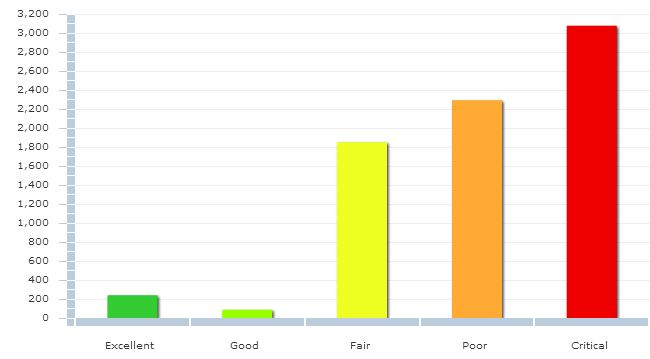
27 The pie chart below provides a breakdown of each of the bridges & culverts components to the overall structures value. Bridges & Culverts Components What condition is it in? Based on area, more than 70% of the municipality s bridges & culverts are in poor to critical condition. Further, based on quantity, an additional 50% are in poor to critical condition. As such, the municipality received a Condition vs. Performance rating of D. Bridges/Culverts Condition by Area Bridges & Culverts Condition by Quantity 23
28 3.4.4 What do we need to do to it? There are generally four distinct phases in an asset s life cycle. These are presented at a high level for the bridge and culvert structures below. Further detail is provided in the Asset Management Strategy section of this AMP. Addressing Asset Needs Phase Lifecycle Activity Asset Life Stage Minor Maintenance Major Maintenance Rehabilitation activities such as inspections, monitoring, sweeping, winter control, etc. activities such as repairs to cracked or spalled concrete, damaged expansion joints, bent or damaged railings, etc. rehabilitation events such as structural reinforcement of structural elements, deck replacements, etc. 1 st Qtr 2 nd Qtr 3 rd Qtr Replacement full structure reconstruction 4 th Qtr When do we need to do it? For the purpose of this report, useful life data for each asset class was obtained from the accounting data within the CityWide software database. This proposed useful life is used to determine replacement needs of individual assets, which are calculated in the system as part of the overall financial requirements. Asset Useful Life in Years Asset Type Asset Component Useful Life in Years Bridges - Foundation 80 Bridges Guide Rails 30 Bridges & Culverts Bridges Deck/Surface 40 Culverts Corrugated Steel 50 Culverts - Replacements 50 Culverts Guide Rails 30 Culverts - Structure 80 Culverts London Road 80 As field condition information becomes available in time, the data should be loaded into the CityWide system in order to have an increasingly more accurate picture of current asset age and, therefore, future replacement requirements. The following table shows the current projection of structure replacements based on the age of the asset only. 24
29 Structures Replacement Profile How much money do we need? The analysis completed to determine capital revenue requirements was based on the following constraints and assumptions: 1. Replacement costs are based upon the What is it worth? section above. 2. The timing for individual structure replacement was defined by the replacement year as described in the When do you need to do it? section above. 3. All values are presented in 2012 dollars. 4. The analysis was run for an 80 year period to ensure all assets cycled through at least one iteration of replacement, therefore providing a sustainable projection How do we reach sustainability? Based upon the above assumptions, the average annual revenue required to sustain Ashfield s bridges & culverts is $358,000. Based on Ashfield s current annual funding of $191,000, there is an annual deficit of $167,000. The municipality received a Funding vs. Need rating of D. The following graph presents five year blocks of expenditure requirements against the sustainable funding threshold line. Sustainable Revenue Requirement 25
30 In conclusion, based on the age data only, there is a noticeable percentage of bridges and large structures in poor and critical condition. There are significant needs to be addressed within the next 5 years totaling approximately $6.5 million. Structures are one of the highest liability assets a municipality owns. Therefore, a high priority should be to establish a condition assessment program and/or enter completed condition results into the CityWide software for further analysis. A full analysis of field condition will aid in prioritizing overall needs for rehabilitation and replacement and will assist with optimizing the long and short term budgets. Further detail is outlined within the Asset Management Strategy section of this AMP Recommendations The municipality received an overall rating of D for its bridges & culverts, calculated from the Condition vs. Performance and the Funding vs. Need ratings. Accordingly, we recommend the following: 1. As a result of the condition assessment policy and the subsequent OSIM inspections, condition data should be loaded into the CityWide software and an updated current state of the infrastructure analysis should be generated. 2. An appropriate % of asset replacement value should be used for operations and maintenance activities on an annual basis. This should be determined through a detailed analysis of O & M activities and added to future AMP reporting. 3. The Infrastructure Report Card should be updated on an annual basis. 26
31 3.5 Water Network 3.5 Water Infrastructure B+ INFRASTRUCTURE REPORT CARD GRADE 27
32 3.5 Water Network What do we own? Ashfield-Colborne-Wawanosh Township is responsible for the following water network inventory which includes approximately 15 km of water mains: Water Network Inventory Asset Type Asset Component Quantity Mains - Local (less than 450mm) 14,906m Tees and Valves 7 Benmiller Water Facility 1 Water Network Century Heights Water Facility 1 Dungannon Water Facility 1 Huron Sands Water Facility 1 Century Heights Water Construction 2 The water network data was extracted from the Tangible Capital Asset and G.I.S. modules of the CityWide software suite What is it worth? The estimated replacement value of the water network, in 2012 dollars, is approximately $6 million. The cost per household for the water network is $15,637 based on 398 households. Water Network Replacement Value Asset Type Asset Component Quantity 2012 Unit Replacement Cost 2012 Overall Replacement Cost Mains - Local (19mm) 2,725m NRBCPI $368,997 Mains - Local (25mm) 71m NRBCPI $7,001 Mains - Local (50mm) 1,392m NRBCPI $460,384 Mains - Local (100mm) 7,902m NRBCPI $2,131,988 Mains - Local (150mm) 992m NRBCPI $625,683 Water Network Mains - Local (200mm) 1,824m NRBCPI $323,578 Tees and Valves 7.00 NRBCPI $42,974 Benmiller Water Facility 1 NRBCPI $402,483 Century Heights Water Facility 1 NRBCPI $727,016 Dungannon Water Facility 1 NRBCPI $754,416 Huron Sands Water Facility 1 NRBCPI $258,707 Century Heights Water Construction 2 NRBCPI $120,482 $6,223,709 28
33 The pie chart below provides a breakdown of each of the network components to the overall system value. Water Network Components What condition is it in? The vast majority, 82%, of the municipality s facilities assets, and 100% of water mains, are in fair to excellent condition. As such, the municipality received a Condition vs. Performance rating of B. Water Mains Condition by Length (m) Water Facilities Condition (base on replacement value) What do we need to do to it? There are generally four distinct phases in an asset s life cycle. These are presented at a high level for the water network below. Further detail is provided in the Asset Management Strategy section of this AMP. 29
34 Addressing Asset Needs Phase Lifecycle Activity Asset Age Minor Maintenance Major Maintenance Rehabilitation Activities such as inspections, monitoring, cleaning and flushing, hydrant flushing, pressure tests, visual inspections, etc. Such events as repairing water main breaks, repairing valves, replacing individual small sections of pipe etc. Rehabilitation events such as structural lining of pipes and a cathodic protection program to slow the rate of pipe deterioration. 1st Qtr 2nd Qtr 3rd Qtr Replacement Pipe replacements 4th Qtr When do we need to do it? For the purpose of this report useful life data for each asset class was obtained from the accounting data within the CityWide software database. This proposed useful life is used to determine replacement needs of individual assets, which are calculated in the system as part of the overall financial requirements. Asset Useful Life in Years Asset Type Water Network Asset Component Useful Life in Years Mains - Local (19mm) 75 Mains - Local (25mm) 75 Mains - Local (50mm) 75 Mains - Local (100mm) 75 Mains - Local (150mm) 75 Mains - Local (200mm) 75 Tees and Valves 75 Benmiller Water Facility Century Heights Water Facility Dungannon Water Facility Huron Sands Water Facility Century Heights Water Construction 75 As field condition information becomes available in time, the data should be loaded into the CityWide system in order to increasingly have a more accurate picture of current asset age and condition, therefore, future replacement requirements. The following graph shows the current projection of water main replacements based on the age of the assets only. 30
35 Water Network Replacement Profile How much money do we need? The analysis completed to determine capital revenue requirements was based on the following assumptions: 1. Replacement costs are based upon the unit costs identified within the What is it worth? section above. 2. The timing for individual water main replacement was defined by the replacement year as described in the When do you need to do it? section above. 3. All values are presented in 2012 dollars. 4. The analysis was run for a 75 year period to ensure all assets went through at least one iteration of replacement, therefore providing a sustainable projection How do we reach sustainability? Based upon the above assumptions, the average annual revenue required to sustain Ashfield-Colborne- Wawanosh s water network is approximately $129,000. Based on Ashfield-Colborne-Wawanosh s current annual funding of $129,000, the asset class is fully-funded. As such, the municipality received a Funding vs. Need rating of A. The following table presents five year blocks of expenditure requirements against the sustainable funding threshold line. Sustainable Revenue Requirements 31
36 In conclusion, Ashfield-Colborne-Wawanosh s water distribution network is generally in very good condition while the facilities are generally in fair condition based on age data only. There are some facilities needs coming forward in the 5 year window, however, there are significant facilities replacement requirements within the 10 year window. A condition assessment program should be established to aid in prioritizing overall needs for rehabilitation and replacement and to assist with optimizing the long and short term budgets. Further detail is outlined within the Asset Management Strategy section of this AMP Recommendations The municipality received an overall rating of B+ for its water network, calculated from the Condition vs. Performance and the Funding vs. Need ratings. Accordingly, we recommend the following: 1. A more detailed study to define the current condition of the water network should be undertaken as described further within the Asset Management Strategy section of this AMP. 2. Also, a detailed study to define the current condition of the water facilities and their components (structural, architectural, electrical, mechanical, process, etc.) should be undertaken, as collectively they account for 35% of the water infrastructure s value. 3. Once the above study is complete, a new performance age should be applied to each asset and an updated current state of the infrastructure analysis should be generated. 4. An appropriate % of asset replacement value should be used for operations and maintenance activities on an annual basis. This should be determined through a detailed analysis of O & M activities and be added to future AMP reporting. 5. The Infrastructure Report Card should be updated on an annual basis. 32
37 3.7 Sewer Infrastructure 3.6 Storm Sewer Infrastructure C INFRASTRUCTURE REPORT CARD GRADE 33
38 3.6 Storm Sewer Network What do we own? The inventory components of the storm sewer network are outlined in the table below. Storm Sewer Network Inventory Asset Type Asset Component Quantity/Units Mains - Local (100mm) m Storm Sewer Network Mains - Local (300mm) 372m Mains - Local (375mm) 113m Mains - Local (450mm) 365m Mains - Local (500mm) 190m Mains - Local (525mm) 369.8m Mains - Local (600mm) 254m Mains - Local (675mm) 100m Catch Basins 3 Manholes 4 Kingsbridge Line Storm Sewer Improvement 1 London Road Storm Sewers 1 Galt Place Engineering 1 As shown in the summary table below the entire network consists of approximately 2 km of storm sewer main. Storm Sewer Network Inventory Summary Asset Type Asset Component Quantity/Units Mains - Local (450mm and smaller) m Mains - Local (Larger Than 450mm) m Storm Sewer Network Catch Basins 3 Manholes 4 Kingsbridge Line Storm Sewer Improvement 1 London Road Storm Sewers 1 Galt Place Engineering 1 The storm sewer network data was extracted from the Tangible Capital Asset and G.I.S. modules of the CityWide software suite. 34
39 3.6.2 What is it worth? The estimated replacement value of the storm sewer network, in 2012 dollars, is approximately $3 million. The cost per household for the storm sewer network is $27,084 based on 111 households. Storm Sewer Network Replacement Value Asset Type Asset Component Quantity/Units Storm Sewer Network 2012 Unit Replacement Cost 2012 Overall Replacement Cost Mains - Local (100mm) m NRBCPI $21,494 Mains - Local (300mm) 372m NRBCPI $174,102 Mains - Local (375mm) 113m NRBCPI $79,966 Mains - Local (450mm) 365m NRBCPI $113,054 Mains - Local (500mm) 190m NRBCPI $155,146 Mains - Local (525mm) 369.8m NRBCPI $126,380 Mains - Local (600mm) 254m NRBCPI $215,427 Mains - Local (675mm) 100m NRBCPI $23,261 Catch Basins 3 NRBCPI $8,815 Manholes 4 NRBCPI $16,249 Kingsbridge Line Storm Sewer Improvement 1 NRBCPI $1,651,803 London Road Storm Sewers 1 NRBCPI $412,019 Galt Place Engineering 1 NRBCPI $8,625 $3,006,341 The pie chart below provides a breakdown of each of the network components to the overall system value. Storm Sewer Network Components 35
40 3.6.3 What condition is it in? Nearly 100% of the storm sewer network, mains and appurtenances, are in fair to excellent condition. As such, the municipality received a Condition vs. Performance rating of B+. Storm Sewer Network Condition by Length (metres) Storm Sewer Network by Quantity What do we need to do to it? There are generally four distinct phases in an assets life cycle. These are presented at a high level for the storm sewer network below. Further detail is provided in the Asset Management Strategy section of this AMP. Addressing Asset Needs Phase Lifecycle Activity Asset Age Minor Maintenance Major Maintenance Rehabilitation Activities such as inspections, monitoring, cleaning and flushing, zoom camera and CCTV inspections, etc. Activities such as repairing manholes and replacing individual small sections of pipe. Rehabilitation events such as structural lining of pipes are extremely cost effective and provide an additional 75 plus years of life. 1 st Qtr 2 nd Qtr 3 rd Qtr Replacement Pipe replacements 4 th Qtr When do we need to do it? For the purpose of this report useful life data for each asset class was obtained from the accounting data within the CityWide software database. This proposed useful life is used to determine replacement needs of individual assets, which are calculated in the system as part of the overall financial requirements. 36
41 Asset Useful Life in Years Asset Type Asset Component Useful Life in Years Mains - Local (100mm) 100 Mains - Local (300mm) 50 Mains - Local (300mm) 75 Mains - Local (300mm) 100 Mains - Local (375mm) 75 Mains - Local (450mm) 50 Mains - Local (450mm) 75 Mains - Local (450mm) 100 Storm Sewer Network Mains - Local (500mm) 75 Mains - Local (525mm) 50 Mains - Local (525mm) 100 Mains - Local (600mm) 50 Mains - Local (600mm) 75 Mains - Local (675mm) 100 Catch Basins 100 Manholes 100 Kingsbridge Line Storm Sewer Improvement 100 London Road Storm Sewers 100 Galt Place Engineering 75 As field condition information becomes available in time, the data should be loaded into the CityWide system in order to increasingly have a more accurate picture of current asset performance age and, therefore, future replacement requirements. The following table shows the current projection of storm sewer main replacements based on the age of the asset only. Storm Sewer Main Replacement Profile 37
42 3.6.6 How much money do we need? The analysis completed to determine capital revenue requirements was based on the following assumptions: 1. Replacement costs are based upon the unit costs identified within the What is it worth? section above. 2. The timing for individual storm sewer main replacement was defined by the replacement year as described in the When do you need to do it? section above. 3. All values are presented in 2012 dollars. 4. The analysis was run for a 100 year period to ensure all assets went through one iteration of replacement, therefore providing a sustainable projection How do we reach sustainability? Based upon the above assumptions, the average annual revenue required to sustain Ashfield-Colborne- Wawanosh s storm sewer network is approximately $34,000. Based on Ashfield-Colborne-Wawanosh s current annual funding of $17,000, there is an annual deficit of $17,000. As such, the municipality received a Funding vs. Need rating of D. Storm Sewer Main Replacement Profile In conclusion, Ashfield-Colborne-Wawanosh s storm sewer network, based on age data only, is generally in very good condition with marginal to no immediate need Recommendations The municipality received an overall rating of C for its storm sewer network, calculated from the Condition vs. Performance and the Funding vs. Need ratings. Accordingly, we recommend the following: 1. A condition assessment program should be considered for the storm sewer network to gain a better understanding of current condition and performance as outlined further within the Asset Management Strategy section of this AMP. 2. Once the above study is complete or underway, the condition data should be loaded into the CityWide software and an updated current state of the infrastructure analysis should be generated. 3. An appropriate % of asset replacement value should be used for operations and maintenance activities on an annual basis. This should be determined through a detailed analysis of O & M activities and be added to future AMP reporting. 4. The Infrastructure Report Card should be updated on an annual basis. 38
43 4.0 Infrastructure Report Card CUMULATIVE GPA C Infrastructure Report Card The Township of Ashfield-Colborne-Wawanosh 1. Each asset category was rated on two key, equally weighted (50/50) dimensions: Condition vs. Performance, and Funding vs. Need. 2. See the What condition is it in? section for details on the grade of each asset category on the Condition vs. Performance dimension. 3. See the How do we reach sustainability? section for details on the grade of each asset category on the Funding vs. Need dimension. 4. The Overall Rating below is the average of the two ratings. Asset category Condition vs. Performance Need vs. Funding Overall grade Comments Road Network C F D While 60% of the road network is in fair to excellent condition, the remaining 40% is in poor to critical condition. The average annual revenue required to sustain Ashfield-Colborne-Wawanosh s paved road network is approximately $1,468,000. Based on Ashfield-Colborne- Wawanosh s current annual funding of $627,000, there is an annual deficit of $841,000. Bridges & Culverts D D D Water Network B A B+ Based on area, more than 70% of the municipality s bridges & culverts are in poor to critical condition. Further, based on quantity, an additional 50% are in poor to critical condition. The average annual revenue required to sustain Ashfield s bridges & culverts is $358,000. Based on Ashfield s current annual funding of $191,000, there is an annual deficit of $167,000. The vast majority, 82%, of the municipality s facilities assets, and 100% of water mains, are in fair to excellent condition. The average annual revenue required to sustain Ashfield-Colborne-Wawanosh s water network is approximately $129,000. Based on Ashfield-Colborne- Wawanosh s current annual funding of $129,000, the asset class is fullyfunded. Storm Sewer Network B+ D C Nearly 100% of the storm sewer network, mains and appurtenances, are in fair to excellent condition. The average annual revenue required to sustain Ashfield-Colborne-Wawanosh s storm sewer network is approximately $34,000. Based on Ashfield-Colborne-Wawanosh s current annual funding of $17,000, there is an annual deficit of $17,
44 5.0 Desired Levels of Service Desired levels of service are high level indicators, comprising many factors, as listed below that establish defined quality thresholds at which municipal services should be supplied to the community. They support the organization s strategic goals and are based on customer expectations, statutory requirements, standards, and the financial capacity of a municipality to deliver those levels of service. Levels of Service are used: to inform customers of the proposed type and level of service to be offered; to identify the costs and benefits of the services offered; to assess suitability, affordability and equity of the services offered; as a measure of the effectiveness of the asset management plan as a focus for the AM strategies developed to deliver the required level of service In order for a municipality to establish a desired level of service, it will be important to review the key factors involved in the delivery of that service, and the interactions between those factors. In addition, it will be important to establish some key performance metrics and track them over an annual cycle to gain a better understanding of the current level of service supplied. Within this first Asset Management Plan, key factors affecting level of service will be outlined below and some key performance indicators for each asset type will be outlined for further review. This will provide a framework and starting point from which the municipality can determine future desired levels of service for each infrastructure class. 5.1 Key factors that influence a level of service: Strategic and Corporate Goals Legislative Requirements Expected Asset Performance Community Expectations Availability of Finances Strategic and Corporate Goals Infrastructure levels of service can be influenced by strategic and corporate goals. Strategic plans spell out where an organization wants to go, how it s going to get there, and helps decide how and where to allocate resources, ensuring alignment to the strategic priorities and objectives. It will help identify priorities and guide how municipal tax dollars and revenues are spent into the future. The level of importance that a community s vision is dependent upon infrastructure, will ultimately affect the levels of service provided or those levels that it ultimately aspires to deliver Legislative Requirements Infrastructure levels of service are directly influenced by many legislative and regulatory requirements. For instance, the Safe Drinking Water Act, the Minimum Maintenance Standards for municipal highways, building codes, and the Accessibility for Ontarians with Disabilities Act are all legislative requirements that prevent levels of service from declining below a certain standard Expected Asset Performance A level of service will be affected by current asset condition, and performance and limitations in regards to safety, capacity, and the ability to meet regulatory and environmental requirements. In addition, the design life of the asset, the maintenance items required, the rehabilitation or replacement schedule of the asset, and the total costs, are all critical factors that will affect the level of service that can be provided Community Expectations Levels of services are directly related to the expectations that the general public has from the infrastructure. For example, the public will have a qualitative opinion on what an acceptable road looks like, and a quantitative one on how long it should take to travel between two locations. Infrastructure costs are projected to increase dramatically in the future, therefore it is essential that the public is not only 40
45 consulted, but also be educated, and ultimately make choices with respect to the service levels that they wish to pay for Availability of Finances Availability of finances will ultimately control all aspects of a desired level of service. Ideally, these funds must be sufficient to achieve corporate goals, meet legislative requirements, address an asset s life cycle needs, and meet community expectations. Levels of service will be dictated by availability of funds or elected officials ability to increase funds, or the community s willingness to pay. 5.2 Key Performance Indicators Performance measures or key performance indicators (KPIs) that track levels of service should be specific, measurable, achievable, relevant, and timebound (SMART). Many good performance measures can be established and tracked through the CityWide suite of software products. In this way, through automation, results can be reviewed on an annual basis and adjustments can be made to the overall asset management plan, including the desired level of service targets. In establishing measures, a good rule of thumb to remember is that maintenance activities ensure the performance of an asset and prevent premature aging, whereas rehab activities extend the life of an asset. Replacement activities, by definition, renew the life of an asset. In addition, these activities are constrained by resource availability (in particular, finances) and strategic plan objectives. Therefore, performance measures should not just be established for operating and maintenance activities, but also for the strategic, financial, and tactical levels of the asset management program. This will assist all levels of program delivery to review their performance as part of the overall level of service provided. This is a very similar approach to the balanced score card methodology, in which financial and nonfinancial measures are established and reviewed to determine whether current performance meets expectations. The balanced score card, by design, links day to day operations activities to tactical and strategic priorities in order to achieve an overall goal, or in this case, a desired level of service. The structure of accountability and level of indicator with this type of process is represented in the following table, modified from the InfraGuide s best practice document, Developing Indicators and Benchmarks published in April
46 LEVEL OF I NDI CATOR M UNI CIPAL STRUCTURE COUNCIL STRATEGIC CITY MANAGER TACTICAL CITY ENGINEER TACTICAL & OPERATIONAL WATER MANAGER ROAD MANAGER OPERATIONAL WATER DEPARTMENT ROAD DEPARTMENT As a note, a caution should be raised over developing too many performance indicators that may result in data overload and lack of clarity. It is better to develop a select few that focus in on the targets of the asset management plan. Outlined below for each infrastructure class is a suggested service description, suggested service scope, and suggested performance indicators. These should be reviewed and updated in each iteration of the AMP. 5.3 Transportation Services Service Description The township s transportation network comprises approximately 436 centreline km of road, 285 km are gravel and 151 km are paved, 17 bridges and a number of large culverts and sidewalks. Together, the above infrastructure enables the township to deliver transportation and pedestrian facility services and give people a range of options for moving about in a safe and efficient manner. 42
47 5.3.2 Scope of Services Movement providing for the movement of people and goods. Access providing access to residential, commercial, and industrial properties and other community amenities. Recreation providing for recreational use, such as walking, cycling, or special events such as parades Performance Indicators (reported annually) Performance Indicators (reported annually) Strategic Indicators percentage of total reinvestment compared to asset replacement value completion of strategic plan objectives (related to transportation) Financial Indicators annual revenues compared to annual expenditures annual replacement value depreciation compared to annual expenditures total cost of borrowing compared to total cost of service revenue required to maintain annual network growth Tactical Indicators percentage of road network rehabilitated / reconstructed value of bridge / large culvert structures rehabilitated or reconstructed overall road condition index as a percentage of desired condition index overall bridge condition index as a percentage of desired condition index annual adjustment in condition indexes annual percentage of network growth percent of paved road lane km where the condition is rated Poor or Critical number of bridge / large culvert structures where the condition is rated Poor or Critical percentage of road network replacement value spent on operations and maintenance percentage of bridge / large culvert structures replacement value spent on operations and maintenance Operational Indicators percentage of road network inspected within last 5 years percentage of bridge / large culvert structures inspected within last two years operating costs for paved roads per lane km operating costs for gravel roads per lane km operating costs for bridge / large culvert structures per square metre number of customer requests received annually percentage of customer requests responded to within 24 hours 5.4 Water / Sanitary / Storm Networks Service Description The township s water distribution network comprises 15km of water main, and water facilities. The storm network comprises 2km of storm main. Together, the above infrastructure enables the township to deliver a potable water distribution service, and a storm water collection service to the residents of the township. 43
48 5.4.2 Scope of services The provision of clean safe drinking water through a distribution network of water mains and pumps. The removal of storm water through a collection network of storm sewer mains, and catch basins Performance Indicators (reported annually) Performance Indicators (reported annually) Strategic Indicators Percentage of total reinvestment compared to asset replacement value Completion of strategic plan objectives (related water / storm) Financial Indicators Annual revenues compared to annual expenditures Annual replacement value depreciation compared to annual expenditures Total cost of borrowing compared to total cost of service Revenue required to maintain annual network growth Lost revenue from system outages Tactical Indicators Percentage of water / storm network rehabilitated / reconstructed Overall water / storm network condition index as a percentage of desired condition index Annual adjustment in condition indexes Annual percentage of growth in water / storm network Percentage of mains where the condition is rated Poor or Critical for each network Percentage of water / storm network replacement value spent on operations and maintenance Operational Indicators Percentage of water / storm network inspected Operating costs for storm water management (collection, treatment, and disposal) per kilometre of drainage system. Operating costs for the distribution/ transmission of drinking water per kilometre of water distribution pipe. Number of days when a boil water advisory issued by the medical officer of health, applicable to a municipal water supply, was in effect. Number of water main breaks per 100 kilometres of water distribution pipe in a year. Number of customer requests received annually per water / storm networks Percentage of customer requests responded to within 24 hours per water / storm network 44
49 6.0 Asset Management Strategy 6.1 Objective To outline and establish a set of planned actions, based on best practice, that will enable the assets to provide a desired and sustainable level of service, while managing risk, at the lowest life cycle cost. The Asset Management Strategy will develop an implementation process that can be applied to the needs identification and prioritization of renewal, rehabilitation, and maintenance activities. This will assist in the production of a 10 year plan, including growth projections, to ensure the best overall health and performance of the municipality s infrastructure. This section includes an overview of condition assessment techniques for each asset class; the life cycle interventions required, including interventions with the best ROI; and prioritization techniques, including risk, to determine which priority projects should move forward into the budget first. 6.2 Non-Infrastructure Solutions and Requirements The Township should explore, as requested through the provincial requirements, which non-infrastructure solutions should be incorporated into the budgets for the road, water, sewer (sanitary and storm), and bridges & culverts programs. Non- Infrastructure solutions are such items as studies, policies, condition assessments, consultation exercises, etc., that could potentially extend the life of assets or lower total asset program costs in the future. Typical solutions for a municipality include linking the asset management plan to the strategic plan, growth and demand management studies, infrastructure master plans, better integrated infrastructure and land use planning, public consultation on levels of service, and condition assessment programs. As part of future asset management plans, a review of these requirements should take place, and a portion of the capital budget should be dedicated for these items in each programs budget. It is recommended, under this category of solutions, that the township implement holistic condition assessment programs for their road, water, sanitary, and storm sewer networks. This will lead to higher understanding of infrastructure needs, enhanced budget prioritization methodologies, and a clearer path of what is required to achieve sustainable infrastructure programs. 6.3 Condition Assessment Programs The foundation of good asset management practice is based on having comprehensive and reliable information on the current condition of the infrastructure. Municipalities need to have a clear understanding regarding performance and condition of their assets, as all management decisions regarding future expenditures and field activities should be based on this knowledge. An incomplete understanding about an asset may lead to its premature failure or premature replacement. Some benefits of holistic condition assessment programs within the overall asset management process are listed below: Understanding of overall network condition leads to better management practices Allows for the establishment of rehabilitation programs Prevents future failures and provides liability protection Potential reduction in operation / maintenance costs Accurate current asset valuation Allows for the establishment of risk assessment programs Establishes proactive repair schedules and preventive maintenance programs Avoids unnecessary expenditures Extends asset service life therefore improving level of service 45
50 Improves financial transparency and accountability Enables accurate asset reporting which, in turn, enables better decision making Condition assessment can involve different forms of analysis such as subjective opinion, mathematical models, or variations thereof, and can be completed through a very detailed or very cursory approach. When establishing the condition assessment of an entire asset class, the cursory approach (metrics such as Good, Fair, Poor, Critical) is used. This will be a less expensive approach when applied to thousands of assets, yet will still provide up to date information, and will allow for detailed assessment or follow up inspections on those assets captured as Poor or Critical condition later. The following section outlines condition assessment programs available for road, bridge, sewer, and water networks that would be useful for the township Pavement Network Inspections Typical industry pavement inspections are performed by consulting firms using specialised assessment vehicles equipped with various electronic sensors and data capture equipment. The vehicles will drive the entire road network and typically collect two different types of inspection data surface distress data and roughness data. Surface distress data involves the collection of multiple industry standard surface distresses, which are captured either electronically, using sensing detection equipment mounted on the van, or visually, by the van's inspection crew. Examples of surface distresses are: For asphalt surfaces alligator cracking; distortion; excessive crown; flushing; longitudinal cracking; map cracking; patching; edge cracking; potholes; ravelling; rippling; transverse cracking; wheel track rutting For concrete surfaces coarse aggregate loss; corner 'C' and 'D' cracking; distortion; joint faulting; joint sealant loss; joint spalling; linear cracking; patching; polishing; potholes; ravelling; scaling; transverse cracking Roughness data capture involves the measurement of the roughness of the road, measured by lasers that are mounted on the inspection van's bumper, calibrated to an international roughness index. Most firms will deliver this data to the client in a database format complete with engineering algorithms and weighting factors to produce an overall condition index for each segment of roadway. This type of scoring database is ideal for upload into the CityWide software database, in order to tag each road with a present condition and then further life cycle analysis to determine what activity should be completed on which road, in what timeframe, and to calculate the cost for the work will be completed within the CityWide system. The above process is an excellent way to capture road condition as the inspection trucks will provide detailed surface and roughness data for each road segment, and often include video or street imagery. A very rough industry estimate of cost would be about $100 per centreline km of road, which means it would cost the township approximately $15,100 for the 151 centreline km of paved road network. Another option for a cursory level of condition assessment is for municipal road crews to perform simple windshield surveys as part of their regular patrol. Many municipalities have created data collection inspection forms to assist this process and to standardize what presence of defects would constitute a Good, Fair, Poor or Critical score. Lacking any other data for the complete road network, this can still be seen as a good method and will assist greatly with the overall management of the road network. The CityWide Works software has a road patrol component built in that could capture this type of inspection data during road patrols in the field, enabling later analysis of rehabilitation and replacement needs for budget development. It is recommended that the township establish a pavement condition assessment program and that a portion of capital funding is dedicated to this. 46
51 6.3.2 Bridges & Culverts (greater than 3m) Inspections Ontario municipalities are mandated by the Ministry of Transportation to inspect all structures that have a span of 3 metres or more, according to the OSIM (Ontario Structure Inspection Manual). At present, in the township, there are 17 bridges and a number of culverts structures that meet this criterion. Structure inspections must be performed by, or under the guidance of, a structural engineer, must be performed on a biennial basis (once every two years), and include such information as structure type, number of spans, span lengths, other key attribute data, detailed photo images, and structure element by element inspection, rating and recommendations for repair, rehabilitation, and replacement. The best approach to develop a 10 year needs list for the township s relatively small structure portfolio would be to have the structural engineer who performs the inspections to develop a maintenance requirements report, and rehabilitation and replacement requirements report as part of the overall assignment. In addition to refining the overall needs requirements, the structural engineer should identify those structures that will require more detailed investigations and non-destructive testing techniques. Examples of these investigations are: Detailed deck condition survey Non-destructive delamination survey of asphalt covered decks Substructure condition survey Detailed coating condition survey Underwater investigation Fatigue investigation Structure evaluation Through the OSIM recommendations and additional detailed investigations, a 10 year needs list will be developed for the municipality s bridges. The 10 year needs list developed could then be further prioritized using risk management techniques to better allocate resources. Also, the results of the OSIM inspection for each structure, whether BCI (bridge condition index) or general condition (Good, Fair, Poor, Critical) should be entered into the CityWide software to update results and analysis for the development of the budget Sewer Network Inspections (Sanitary & Storm) The most popular and practical type of sanitary and storm sewer assessment is the use of Closed Circuit Television Video (CCTV). The process involves a small robotic crawler vehicle with a CCTV camera attached that is lowered down a maintenance hole into the sewer main to be inspected. The vehicle and camera then travels the length of the pipe providing a live video feed to a truck on the road above where a technician / inspector records defects and information regarding the pipe. A wide range of construction or deterioration problems can be captured including open/displaced joints, presence of roots, infiltration & inflow, cracking, fracturing, exfiltration, collapse, deformation of pipe and more. Therefore, sewer CCTV inspection is a very good tool for locating and evaluating structural defects and general condition of underground pipes. Even though CCTV is an excellent option for inspection of sewers it is a fairly costly process and does take significant time to inspect a large volume of pipes. Another option in the industry today is the use of Zoom Camera equipment. This is very similar to traditional CCTV, however, a crawler vehicle is not used but in it s a place a camera is lowered down a maintenance hole attached to a pole like piece of equipment. The camera is then rotated towards each connecting pipe and the operator above progressively zooms in to record all defects and information about each pipe. The downside to this technique is the further down the pipe the image is zoomed, the less clarity is available to accurately record defects and measurement. The upside is the process is far quicker and significantly less expensive and an assessment of the manhole can be provided as well. Also, it is important to note that 80% of pipe deficiencies generally occur within 20 metres of each manhole. The following is a list of advantages of utilizing Zoom Camera technology: 47
52 A time and cost efficient way of examining sewer systems; Problem areas can be quickly targeted; Can be complemented by a conventional camera (CCTV), if required afterwards; In a normal environment, 20 to 30 manholes can be inspected in a single day, covering more than 1,500 meters of pipe; Contrary to the conventional camera approach, cleaning and upstream flow control is not required prior to inspection; Normally detects 80% of pipe deficiencies, as most deficiencies generally occur within 20 meters of manholes. The following table is based on general industry costs for traditional CCTV inspection and Zoom Camera inspection; however, costs should be verified through local contractors. It is for illustrative purposes only but supplies a general idea of the cost to inspect Ashfield-Colborne-Wawanosh s entire storm network. Sanitary and Sewer Inspection Cost Estimates Sewer Network Assessment Activity Cost Metres of Main / # of Manholes Total Storm *Manhole numbers estimated using 1 per 80m of main Full CCTV $10 (per m) 2,000m $20,000 Zoom $300 (Per mh) 25 manholes* $7,500 It can be seen from the above table that there is a significant cost savings achieved through the use of Zoom Camera technology. A good industry trend and best practice is to inspect the entire network using Zoom Camera technology and follow up on the Poor and Critical rated pipes with more detail using a full CCTV inspection. In this way, inspection expenditures are kept to a minimum, however, an accurate assessment on whether to rehabilitate or replace pipes will be provided for those with the greatest need. It is recommended that the township establish a sewer condition assessment program and that a portion of capital funding is dedicated to this. In addition to receiving a video and defect report of each pipe s CCTV or Zoom camera inspection, many companies can now provide a database of the inspection results, complete with scoring matrixes that provide an overall general condition score for each pipe segment that has been assessed. Typically pipes are scored from 1 5, with 1 being a relatively new pipe and 5 being a pipe at the end of its design life. This type of scoring database is ideal for upload into the CityWide software database, in order to tag each pipe with a present condition and then further life cycle analysis to determine what activity should be done to which pipe, in what timeframe, and to calculate the cost for the work will be completed by the CityWide system Water network inspections Unlike sewer mains, it is very difficult to inspect water mains from the inside due to the high pressure flow of water constantly underway within the water network. Physical inspections require a disruption of service to residents, can be an expensive exercise, and are time consuming to set up. It is recommended practice that physical inspection of water mains typically only occurs for high risk, large transmission mains within the system, and only when there is a requirement. There are a number of high tech inspection techniques in the industry for large diameter pipes but these should be researched first for applicability as they are quite expensive. Examples are: Remote eddy field current (RFEC) Ultrasonic and acoustic techniques Impact echo (IE) Georadar For the majority of pipes within the distribution network gathering key information in regards to the main and its environment can supply the best method to determine a general condition. Key data that could be used, along with weighting factors, to determine an overall condition score are listed below. Age Material Type Breaks Hydrant Flow Inspections 48
53 Soil Condition Understanding the age of the pipe will determine useful life remaining, however, water mains fail for many other reasons than just age. The pipe material is important to know as different pipe types have different design lives and different deterioration profiles. Keeping a water main break history is one of the best analysis tools to predict future pipe failures and to assist with programming rehabilitation and replacement schedules. Also, most municipalities perform hydrant flow tests for fire flow prevention purposes. The readings from these tests can also help determine condition of the associated water main. If a hydrant has a relatively poor flow condition it could be indicative of a high degree of encrustation within the attached water main, which could then be flagged as a candidate for cleaning or possibly lining. Finally, soil condition is important to understand as certain soil types can be very aggressive at causing deterioration on certain pipe types. It is recommended that the township develop a rating system for the mains within the distribution network based on the availability of key data, and that funds are budgeted for this development. Also, it is recommended that the township utilize the CityWide Works application to track water main break work orders and hydrant flow inspection readings as a starting point to develop a future scoring database for each water main. 49
54 6.4 AM Strategy Life Cycle Analysis Framework An industry review was conducted to determine which life cycle activities can be applied at the appropriate time in an asset s life, to provide the greatest additional life at the lowest cost. In the asset management industry, this is simply put as doing the right thing to the right asset at the right time. If these techniques are applied across entire asset networks or port folios (e.g., the entire road network), the township could gain the best overall asset condition while expending the lowest total cost for those programs Paved Roads The following analysis has been conducted at a fairly high level, using industry standard activities and costs for paved roads. With future updates of this Asset Management Strategy, the township may wish to run the same analysis with a detailed review of Township activities used for roads and the associated local costs for those work activities. All of this information can be input into the CityWide software suite in order to perform updated financial analysis as more detailed information becomes available. The following diagram depicts a general deterioration profile of a road with a 30 year life. As shown above, during the road s life cycle there are various windows available for work activity that will maintain or extend the life of the asset. These windows are: maintenance; preventative maintenance; rehabilitation; and replacement or reconstruction. 50
55 The windows or thresholds for when certain work activities should be applied to also coincide approximately with the condition state of the asset as shown below: Asset Condition and Related Work Activity: Paved Roads Condition Condition Range Work Activity Excellent condition (Maintenance only phase) maintenance only Good Condition (Preventative maintenance phase) Fair Condition (Rehabilitation phase) Poor Condition (Reconstruction phase) 25-1 crack sealing emulsions resurface - mill & pave resurface - asphalt overlay single & double surface treatment (for rural roads) reconstruct - pulverize and pave reconstruct - full surface and base reconstruction Critical Condition (Reconstruction phase) 0 Critical includes assets beyond their useful lives which make up the backlog. They require the same interventions as the Poor category above. With future updates of this Asset Management Strategy the township may wish to review the above condition ranges and thresholds for when certain types of work activity occur, and adjust to better suit the township s work program. Also note: when adjusting these thresholds, it actually adjusts the level of service provided and ultimately changes the amount of money required. These threshold and condition ranges can be easily updated with the CityWide software suite and an updated financial analysis can be calculated. These adjustments will be an important component of future Asset Management Plans, as the Province requires each municipality to present various management options within the financing plan. The table below outlines the costs for various road activities, the added life obtained for each, the condition range at which they should be applied, and the cost of 1 year added life for each (cost of activity / added life) in order to present an apples to apples comparison. Road Lifecycle Activity Options Treatment Average Unit Cost (per sq. m) Added Life (Years) Condition Range Cost Of Activity/Added Life Urban Reconstruction $ $6.83 Urban Resurfacing $ $5.60 Rural Reconstruction $ $4.50 Rural Resurfacing $ $2.67 Double Surface Treatment $ $2.50 Routing & Crack Sealing (P.M) $ $
56 As can be seen in the table above, preventative maintenance activities such as routing and crack sealing have the lowest associated cost (per sq. m) in order to obtain one year of added life. Of course, preventative maintenance activities can only be applied to a road at a relatively early point in the life cycle. It is recommended that the township engage in an active preventative maintenance program for all paved roads and that a portion of the maintenance budget is allocated to this. Also, rehabilitation activities, such as urban and rural resurfacing or double surface treatments (tar and chip) for rural roads have a lower cost to obtain each year of added life than full reconstruction activities. It is recommended, if not in place already, that the municipality engages in an active rehabilitation program for urban and rural paved roads and that a portion of the capital budget is dedicated to this. Of course, in order to implement the above programs it will be important to also establish a general condition score for each road segment, established through standard condition assessment protocols as previously described. It is important to note that a worst first budget approach, whereby no life cycle activities other than reconstruction at the end of a roads life are applied, will result in the most costly method of managing a road network overall Gravel Roads As reported in the State of the Infrastructure section, approximately 65% of Ashfield-Colborne-Wawanosh s road network comprises gravel roads. The life cycle activities required for these roads are quite different from paved roads. Gravel roads require a cycle of perpetual maintenance, including general re-grading, reshaping of the crown and cross section, gravel spot and section replacement, dust abatement and ditch clearing and cleaning. Gravel roads can require frequent maintenance, especially after wet periods and when accommodating increased traffic. Wheel motion shoves material to the outside (as well as in-between travelled lanes), leading to rutting, reduced water-runoff, and eventual road destruction if unchecked. This deterioration process is prevented if interrupted early enough, simple re-grading is sufficient, with material being pushed back into the proper profile. As a high proportion of gravel roads can have a significant impact on the maintenance budget, it is recommended that with further updates of this asset management plan the township study the traffic volumes and maintenance requirements in more detail for its gravel road network. Similar studies elsewhere have found converting certain roadways to paved roads can be very cost beneficial especially if frequent maintenance is required due to higher traffic volumes. Roads within the gravel network should be ranked and rated using the following criteria: Usage - traffic volumes and type of traffic Functional importance of the roadway Known safety issues Frequency of maintenance and overall expenditures required. Through the above type of analysis, a program could be introduced to convert certain gravel roadways into paved roads, reducing overall costs, and be brought forward into the long range budget Sanitary and Storm Sewers The following analysis has been conducted at a fairly high level, using industry standard activities and costs for sanitary and storm sewer rehabilitation and replacement. With future updates of this asset management strategy, the township may wish to run the same analysis with a detailed review of Township activities used for sewer mains and the associated local costs for those work activities. All of this information can be input into the CityWide software suite in order to perform updated financial analysis as more detailed information becomes available. The following diagram depicts a general deterioration profile of a sewer main with a 100 year life. 52
57 As shown above, during the sewer main s life cycle there are various windows available for work activity that will maintain or extend the life of the asset. These windows are: maintenance; major maintenance; rehabilitation; and replacement or reconstruction. The windows or thresholds for when certain work activities should be applied also coincide approximately with the condition state of the asset as shown below: Asset Condition and Related Work Activity: Sewer Main Condition Condition Range Work Activity Excellent condition (Maintenance only phase) maintenance only (cleaning & flushing etc.) Good Condition (Preventative maintenance phase) mahhole repairs small pipe section repairs Fair Condition (Rehabilitation phase) structural relining Poor Condition (Reconstruction phase) 25-1 pipe replacement reconstruct - full surface and base reconstruction Critical Condition (Reconstruction phase) 0 critical includes assets beyond their useful lives which make up the backlog. They require the same interventions as the Poor category above. With future updates of this Asset Management Strategy the township may wish to review the above condition ranges and thresholds for when certain types of work activity occur, and adjust to better suit the townships work program. Also note: when adjusting these thresholds, it actually adjusts the level of service provided and ultimately changes the amount of money required. These threshold and condition ranges can be easily updated with the CityWide software suite and an updated financial analysis can be 53
58 calculated. These adjustments will be an important component of future Asset Management Plans, as the province requires each municipality to present various management options within the financing plan. The table below outlines the costs, by pipe diameter, for various sewer main rehabilitation (lining) and replacement activities. The columns display the added life obtained for each activity, the condition range at which they should be applied, and the cost of 1 year added life for each (cost of activity / added life) in order to present an apples to apples comparison. Sewer Main Lifecycle Activity Options Category Cost (per m) Added Life Condition Range 1 year Added Life Cost (Cost / Added Life) Structural Rehab (m) 0-325mm $ $ mm $ $ mm $1, $24.76 > 925mm $1, $23.62 Replacement (m) 0-325mm $ $ mm $ $ mm $ $9.00 > 925mm $1, $14.75 As can be seen in the above table, structural rehabilitation or lining of sewer mains is an extremely cost effective industry activity and solution for pipes with a diameter less than 625mm. The unit cost of lining is approximately one third of replacement and the cost to obtain one year of added life is half the cost. For Ashfield-Colborne-Wawanosh, this diameter range would account for 95% of storm mains. Structural lining has been proven through industry testing to have a design life (useful life) of 75 years, however, it is believed that liners will probably obtain 100 years of life (the same as a new pipe). For sewer mains with diameters greater than 625mm specialized liners are required and therefore the costs are no longer effective. It should be noted, however, that the industry is continually expanding its technology in this area and therefore future costs should be further reviewed for change and possible price reductions. It is recommended, if not in place already, that the township engage in an active structural lining program for sanitary and storm sewer mains and that a portion of the capital budget be dedicated to this. In order to implement the above, it will be important to also establish a condition assessment program to establish a condition score for each sewer main within the sanitary and storm collection networks, and therefore identify which pipes are good candidates for structural lining Bridges & Culverts (greater than 3m span) The best approach to develop a 10 year needs list for the township s relatively small bridge structure portfolio would be to have the structural engineer who performs the inspections to develop a maintenance requirements report, a rehabilitation and replacement requirements report and identify additional detailed inspections as required. This approach is described in more detail within the Bridge & Culvert (greater than 3m) Inspections section above Water Network As with roads and sewers above, the following analysis has been conducted at a fairly high level, using industry standard activities and costs for water main rehabilitation and replacement. The following diagram depicts a general deterioration profile of a water main with an 80 year life. 54
59 As shown above, during the water main s life cycle there are various windows available for work activity that will maintain or extend the life of the asset. These windows are: maintenance; major maintenance; rehabilitation; and replacement or reconstruction. The windows or thresholds for when certain work activities should be applied also coincide approximately with the condition state of the asset as shown below: Asset Condition and Related Work Activity: Water Main Condition Condition Range Work Activity Excellent condition (Maintenance only phase) maintenance only (cleaning & flushing etc.) Good Condition (Preventative maintenance phase) water main break repairs small pipe section repairs Fair Condition (Rehabilitation phase) structural water main relining Poor Condition (Reconstruction phase) 25-1 pipe replacement Critical Condition (Reconstruction phase) 0 critical includes assets beyond their useful lives which make up the backlog. They require the same interventions as the Poor category above. 55
60 Water main Lifecycle Activity Option Category Cost Added Life Condition Range Cost of Activity / Added Life Structural Rehab (m) m $ $ m $ $ m $ $ m $1, $ m - & + $2, $40.00 Replacement (m) m $ $ m $ $ m $ $ m $1, $ m - & + $2, $25.00 Water rehab technologies still require some digging (known as low dig technologies, due to lack of access) and are actually more expensive on a life cycle basis. However, if the road above the water main is in good condition lining avoids the cost of road reconstruction still resulting in a cost effective solution. It should be noted, that the industry is continually expanding its technology in this area and therefore future costs should be further reviewed for change and possible price reductions. At this time, it is recommended that the township only utilize water main structural lining when the road above requires rehab or no work. 56
61 6.5 Growth and Demand Typically a municipality will have specific plans associated with population growth. It is essential that the asset management strategy should address not only the existing infrastructure, as above, but must include the impact of projected growth on defined project schedules and funding requirements. Projects would include the funding of the construction of new infrastructure, and/or the expansion of existing infrastructure to meet new demands. The Township should enter these projects into the CityWide software in order to be included within the short and long term budgets as required. 6.6 Project Prioritization The above techniques and processes when established for the road, water, sewer networks and bridges will supply a significant listing of potential projects. Typically the infrastructure needs will exceed available resources and therefore project prioritization parameters must be developed to ensure the right projects come forward into the short and long range budgets. An important method of project prioritization is to rank each project, or each piece of infrastructure, on the basis of how much risk it represents to the organization Risk Matrix and Scoring Methodology Risk within the infrastructure industry is often defined as the probability (likelihood) of failure multiplied by the consequence of that failure. RISK = LIKELIHOOD OF FAILURE x CONSEQUENCE OF FAILURE The likelihood of failure relates to the current condition state of each asset, whether they are in Excellent, Good, Fair, Poor or Critical condition, as this is a good indicator regarding their future risk of failure. The consequence of failure relates to the magnitude, or overall effect, that an asset s failure will cause. For instance, a small diameter water main break in a sub division may cause a few customers to have no water service for a few hours, whereby a large trunk water main break outside a hospital could have disastrous effects and would be a front page news item. The following table represents the scoring matrix for risk: All of the township s assets analyzed within this asset management plan have been given both a likelihood of failure score and a consequence of failure score within the CityWide software. The following risk scores have been developed at a high level for each asset class within the CityWide software system. It is recommended that the township undertake a detailed study to develop a more tailored suite of risk scores, particularly in regards to the consequence of failure, and that this be updated within the CityWide software with future updates to this Asset Management Plan. 57
62 The current scores that will determine budget prioritization currently within the system are as follows: All assets: The Likelihood of Failure score is based on the condition of the assets: Likelihood of Failure: All Assets Asset condition Likelihood of failure Excellent condition score of 1 Good condition score of 2 Fair condition score of 3 Poor condition score of 4 Critical condition score of 5 Bridges (based on valuation): The consequence of failure score for this initial AMP is based upon the replacement value of the structure. The higher the value, probably the larger the structure and therefore probably the higher the consequential risk of failure: Consequence of Failure: Bridges Replacement Value Consequence of failure Up to $100k score of 1 $101-$200k score of 2 $201-$400k score of 3 $401-$800k score of 4 $801k and above score of 5 Roads (based on classification): The consequence of failure score for this initial AMP is based upon the road classification as this will reflect traffic volumes and number of people affected. Consequence of Failure: Roads Road Classification Consequence of failure Gravel score of 1 Paved score of 4 58
63 Water (based on diameter): The consequence of failure score for this initial AMP is based upon pipe diameter as this will reflect potential service area affected. Consequence of Failure: Water Pipe Diameter Consequence of Failure Up to 50mm score of mm score of mm score of mm score of 4 201mm and above score of 5 Storm Sewer (based on diameter): The consequence of failure score for this initial AMP is based upon pipe diameter as this will reflect potential upstream service area affected. Consequence of Failure: Storm Sewer Replacement Value Consequence of failure Up to 150mm score of mm score of mm score of mm score of 4 601mm and above score of 5 59
64 7.0 Financial Strategy 7.1 General overview of financial plan requirements In order for an AMP to be effectively put into action, it must be integrated with financial planning and longterm budgeting. The development of a comprehensive financial plan will allow the Township of Ashfield- Colborne-Wawanosh to identify the financial resources required for sustainable asset management based on existing asset inventories, desired levels of service and projected growth requirements. The following pyramid depicts the various cost elements and resulting funding levels that should be incorporated into AMP s that are based on best practices. This report develops such a financial plan by presenting several scenarios for consideration and culminating with final recommendations. As outlined below, the scenarios presented model different combinations of the following components: a) the financial requirements (as documented in the SOTI section of this report) for: existing assets existing service levels requirements of contemplated changes in service levels (none identified for this plan) requirements of anticipated growth (none identified for this plan) b) use of traditional sources of municipal funds: tax levies user fees reserves debt (no additional debt required for this AMP) development charges (not applicable) 60
65 c) use of non-traditional sources of municipal funds: reallocated budgets (not required for this AMP) partnerships (not applicable) procurement methods (no changes recommended) d) use of senior government funds: gas tax grants (not included in this plan due to Provincial requirements for firm commitments) If the financial plan component of an AMP results in a funding shortfall, the Province requires the inclusion of a specific plan as to how the impact of the shortfall will be managed. In determining the legitimacy of a funding shortfall, the Province may evaluate a municipality s approach to the following: a) in order to reduce financial requirements, consideration has been given to revising service levels downward b) all asset management and financial strategies have been considered. For example: if a zero debt policy is in place, is it warranted? If not, the use of debt should be considered. do user fees reflect the cost of the applicable service? If not, increased user fees should be considered. This AMP includes recommendations that avoid long-term funding deficits. 7.2 Financial information relating to Ashfield-Colborne-Wawanosh s AMP Funding objective We have been asked to develop scenarios that would enable the Township of Ashfield-Colborne- Wawanosh to achieve full funding within 5 to 10 years for the following assets: a) Tax funded assets - paved roads; bridges & culverts; storm sewers. b) Rate funded assets water services. Note: For the purposes of this AMP, we have excluded the category of gravel roads since gravel roads are a perpetual maintenance asset and end of life replacement calculations do not normally apply. If gravel roads are maintained properly they, in essence, could last forever. For each scenario developed we have included strategies, where applicable, regarding the use of tax revenues, user fees and reserves. 7.3 Tax funded assets Current funding position Tables 1 and 2 outline, by asset category, the Township of Ashfield-Colborne-Wawanosh s average annual asset investment requirements, current funding positions and funding increases required to achieve full funding on assets funded by taxes. Table 1. Summary of Infrastructure Requirements & Current Funding Available Asset Category Average Annual Investment Required 2013 Annual Funding Available Taxes Gas Tax User Fees Total Annual Deficit Paved Roads 1,468, , , ,000 Bridges & Culverts 358,000 21, , , ,000 Storm 34, ,000 17,000 17,000 Total 1,860, , ,000 17, ,000 1,025,000 61
66 Recommendations for full funding The average annual investment requirement for paved roads and bridges/culverts is $1,860,000. Annual revenue currently allocated to these assets is $835,000 leaving an annual deficit of $1,025,000. To put it another way, these infrastructure categories are currently funded at 45% of their long-term requirements. Ashfield-Colborne-Wawanosh has annual tax revenues of $2,881,000 in As illustrated in table 2, without consideration of any other source of revenue, full funding would require an increase in tax revenue of 35.6% over time. Table 2. Overview of Revenue Requirements for Full Funding Asset Category Tax Increase Required for Full Funding Paved Roads 29.2% Bridges & Culverts 5.8% Storm Sewers 0.6% Total 35.6% Through table 3, we have expanded the above scenario to outline two options: Table 3. Revenue Options for Full Funding Tax Revenues 5 Years 10 Years Annual tax increases required 7.1% 3.6% We recommend the 10 year option in table 3. This involves full funding being achieved over 10 years by: a) increasing tax revenues by 3.6% each year for the next 10 years solely for the purpose of phasing in full funding to the three tax based asset categories covered by this AMP. b) allocating 100% of the federal gas tax revenue (currently $170,000) to the bridges & culverts category. c) increasing existing and future infrastructure budgets by the applicable inflation index on an annual basis in addition to the deficit phase-in. Notes: 1. As in the past, periodic senior government infrastructure funding will most likely be available during the phase-in period. By Provincial AMP rules, this funding cannot be incorporated into the AMP unless there are firm commitments in place. Although this option achieves full funding on an annual basis in 10 years and provides financial sustainability over the period modeled (to 2050), the recommendations do require prioritizing capital projects to fit the resulting annual funding available. As of 2013, age based data shows a pent up investment demand of $10,310,000 for paved roads, $5,448,000 for bridges/culverts and $0 for storm sewers. Prioritizing future projects will require the age based data to be replaced by condition based data. Although our recommendations include no further use of debt, the results of the condition based analysis may require otherwise. 62
67 7.4 Rate funded assets Current funding position Tables 4 and 5 outline, by asset category, the Township of Ashfield-Colborne-Wawanosh s average annual asset investment requirements, current funding positions and funding increases required to achieve full funding on assets funded by rates. Table 4. Summary of Infrastructure Requirements & Current Funding Available Asset Category Average Annual Investment Required Rates 2013 Annual Funding Available Less: Allocated to Operations Other Annual Deficit Sanitary Services Water Services 129, , , ,000 0 Total 129, , , ,000 0 Total The average annual investment requirement for water services is $129,000. Annual revenue currently allocated to these assets for capital purposes is $129,000 leaving an annual deficit of $0. To put it another way, this infrastructure category is currently funded at 100% of their long-term requirements. In 2013, Ashfield-Colborne-Wawanosh has annual water revenues of $261,000. As illustrated in table 5, no change is required since full funding has been achieved. Table 5. Overview of Revenue Increases Required for Full Funding Asset Category Rate Increase Required for Full Funding Sanitary Services Water Services 0.0% Notes: 1. As in the past, periodic senior government infrastructure funding will most likely be available during the phase-in period. By Provincial AMP rules, this funding cannot be incorporated into an AMP unless there are firm commitments in place. 2. Any increase in rates required for operations would be in addition to the above recommendations. Although the current position of water services has achieved full funding on an annual basis and provides financial sustainability over the period modeled (to 2050), Ashfield-Colborne-Wawanosh will be required to prioritize capital projects to fit the resulting annual funding available. As of 2013, age based data shows a pent up investment demand for water services of $120,000. Prioritizing future projects will require the age based data to be replaced by condition based data. Although our recommendations include no further use of debt, the results of the condition based analysis may require otherwise. n/a 63
68 7.5 Use of debt For reference purposes, table 6 outlines the premium paid on a project if financed by debt. For example, a $1M project financed at 3.0% 1 over 15 years would result in a 26% premium or $260,000 of increased costs due to interest payments. For simplicity, the table does not take into account the time value of money or the effect of inflation on delayed projects. Table 6. Total Interest Paid as a % of Project Costs Number Of Years Financed Interest Rate % 22% 42% 65% 89% 115% 142% 6.5% 20% 39% 60% 82% 105% 130% 6.0% 19% 36% 54% 74% 96% 118% 5.5% 17% 33% 49% 67% 86% 106% 5.0% 15% 30% 45% 60% 77% 95% 4.5% 14% 26% 40% 54% 69% 84% 4.0% 12% 23% 35% 47% 60% 73% 3.5% 11% 20% 30% 41% 52% 63% 3.0% 9% 17% 26% 34% 44% 53% 2.5% 8% 14% 21% 28% 36% 43% 2.0% 6% 11% 17% 22% 28% 34% 1.5% 5% 8% 12% 16% 21% 25% 1.0% 3% 6% 8% 11% 14% 16% 0.5% 2% 3% 4% 5% 7% 8% 0.0% 0% 0% 0% 0% 0% 0% It should be noted that current interest rates are near all-time lows. Sustainable funding models that include debt need to incorporate the risk of rising interest rates. The following graph shows where historical lending rates have been: 1 Current municipal Infrastructure Ontario rates for 15 year money is 3.2%. 64
69 Historical Prime Business Interest Rate 16.00% 14.00% 12.00% 10.00% 8.00% 6.00% 4.00% 2.00% 0.00% Year As illustrated in table 6, a change in 15 year rates from 3% to 6% would change the premium from 26% to 54%. Such a change would have a significant impact on a financial plan. Tables 7 and 8 outline how the Township of Ashfield-Colborne-Wawanosh has historically used debt for investing in the asset categories as listed. There is currently no debt outstanding for the assets covered by this AMP. In terms of overall debt capacity, Ashfield-Colborne-Wawanosh currently no debt outstanding debt and no annual principal and interest payment commitments. Its provincially prescribed annual debt payment maximum is $1,154,000. Asset Category Table 7. Overview of Use of Debt Current Debt Outstanding Use Of Debt In Last Five Years Paved Roads Bridges & Culverts Storm Sewers Sanitary Services Water Services Total for AMP Categories Non AMP Debt Overall Total
70 Table 8. Overview of Debt Costs Principal & Interest Payments In Next Five Years Asset Category Paved Roads Bridges & Culverts Storm Sewers Total Tax Funded Sanitary Services Water Services Total Rate Funded Total AMP Debt Non AMP Debt Overall Total The Township of Ashfield-Colborne-Wawanosh has indicated that their long-term goal is to fully fund its infrastructure requirements without further use of debt. As illustrated in this plan, the revenue options available to Ashfield-Colborne-Wawanosh allow them to meet this goal. However, as explained in sections and 7.4.2, the recommended condition rating analysis may require otherwise. 7.6 Use of reserves Available reserves Reserves play a critical role in long-term financial planning. The benefits of having reserves available for infrastructure planning include: the ability to stabilize tax rates when dealing with variable and sometimes uncontrollable factors financing one-time or short term investments accumulating the funding for significant future infrastructure investments managing the use of debt normalizing infrastructure funding requirements By infrastructure category, table 9 outlines the details of the reserves currently available to the Township of Ashfield-Colborne-Wawanosh. Table 9. Summary of Reserves Available Asset Category Balance at December 31, 2012 Paved Roads 0 Bridges 81,000 Storm Sewers 0 Total Tax Funded 81,000 Water Services 125,000 Sanitary Services 0 Total Rate Funded 125,000 66
71 There is considerable debate in the municipal sector as to the appropriate level of reserves that a municipality should have on hand. There is no clear guideline that has gained wide acceptance. Factors that municipalities should take into account when determining their capital reserve requirements include: breadth of services provided age and condition of infrastructure use and level of debt economic conditions and outlook internal reserve and debt policies. Due to the relatively low level of reserves for the asset categories covered by this AMP, the scenarios developed in this report do not draw on the above reserves during the phase-in period to full funding. This, coupled with Ashfield-Colborne-Wawanosh s judicious use of debt in the past, allows the scenarios to assume that, if required, available reserves and debt capacity can be used for emergency situations until reserves are built to desired levels. This will allow the Township of Ashfield-Colborne-Wawanosh to address high priority infrastructure investments in the short to medium-term Recommendation As the Township of Ashfield-Colborne-Wawanosh updates its AMP and expands it to include other asset categories, that future planning should include determining what its long-term reserve balance requirements are and a plan to achieve such balances in the long-term. 67
72 8.0 Appendix A: Report Card Calculations Key Calculations 1. Weighted, unadjusted star rating : (% of assets in given condition) x (potential star rating) 2. Adjusted star rating (weighted, unadjsted star rating) x (% of total replacement value) 3. Overall Rating (Condition vs. Performance star rating) + (Funding vs. Need star rating) 2 68
73 Roads Ashfield-Colborne-Wawanosh 1. Condition vs. Performance Total category replacement value $56,568,407 Segment Surface and base Condition Letter grade Star rating Segment value as a % of total category Segment replacement value $56,568, % replacement value Quantity (m) in given condition % of Assets in given condition Weighted, unadjusted star rating Excellent A 5 39,630 15% 0.73 Good B 4 106,180 39% 1.56 Fair C 3 15,570 6% 0.17 Poor D 2 25,670 9% 0.19 Critical F 1 85,140 31% 0.31 Totals 272, % 2.96 Segment adjusted star rating 3.0 Category star rating Category letter grade 3.0 C 2. Funding vs. Need Average annual investment required 2013 funding available Funding percentage Deficit $1,468,000 $627, % $841,000 Category star rating Category letter grade 1.0 F 3. Overall Rating Condition vs Performance star rating Funding vs. Need star rating Average star rating Overall letter grade D
74 Bridges & culverts Ashfield-Colborne-Wawanosh 1. Condition vs. Performance Total category replacement value $20,277,499 Segment Bridges & culverts Condition Letter grade Star rating Segment value as a % of total category Segment replacement value $14,700, % replacement value Quantity (m.sq) in given condition % of Assets in given condition Weighted, unadjusted star rating Excellent A % 0.16 Good B % 0.05 Fair C 3 1,851 25% 0.74 Poor D 2 2,291 30% 0.61 Critical F 1 3,077 41% 0.41 Totals 7, % 1.96 Segment adjusted star rating 1.4 Total category replacement value $20,277,499 Segment Bridges & culverts Condition Letter grade Star rating Segment value as a % of total category Segment replacement value $5,576, % replacement value Units in given condition % of Assets in given condition Weighted, unadjusted star rating Excellent A % 1.46 Good B % 0.49 Fair C % 0.37 Poor D % 0.20 Critical F % 0.37 Totals % 2.88 Segment adjusted star rating 0.8 Category star rating Category letter grade 2.2 D 2. Funding vs. Need Average annual investment required 2013 funding available Funding percentage Deficit $358,000 $191, % $167,000 Category star rating Category letter grade 1.9 D 3. Overall Rating Condition vs Performance star rating Funding vs. Need star rating Average star rating Overall letter grade D
75 Water Ashfield-Colborne-Wawanosh 1. Condition vs. Performance Total category replacement value $6,060,253 Segment Mains Condition Letter grade Star rating Segment value as a % of total category Segment replacement value $3,917, % replacement value Quantity (m) in given condition % of Assets in given condition Weighted, unadjusted star rating Excellent A 5 11,105 75% 3.73 Good B 4 1,523 10% 0.41 Fair C 3 2,278 15% 0.46 Poor D 2 0 0% 0.00 Critical F 1 0 0% 0.00 Totals 14, % 4.59 Segment adjusted star rating 3.0 Total category replacement value $6,060,253 Segment Facilities Condition Letter grade Star rating Segment value as a % of total category Segment replacement value $2,142, % replacement value Quantities ($) given condition % of Assets in given condition Weighted, unadjusted star rating Excellent A 5 $626,240 29% 1.46 Good B 4 $417,792 19% 0.78 Fair C 3 $710,584 33% 0.99 Poor D 2 $248,901 12% 0.23 Critical F 1 $139,106 6% 0.06 Totals $2,142, % 3.53 Segment adjusted star rating 1.2 Category star rating Category letter grade 4.2 B 2. Funding vs. Need Average annual investment required 2013 funding available Funding percentage Deficit $129,000 $129, % $0 Category star rating Category letter grade 5.0 A 3. Overall Rating Condition vs Performance star rating Funding vs. Need star rating Average star rating Overall letter grade B+
76 Storm Ashfield-Colborne-Wawanosh 1. Condition vs. Performance Total category replacement value $3,006,341 Segment Mains Condition Letter grade Star rating Segment value as a % of total category Segment replacement value $908, % replacement value Quantity (m) in given condition % of Assets in given condition Weighted, unadjusted star rating Excellent A % 2.49 Good B % 1.60 Fair C % 0.05 Poor D % 0.17 Critical F 1 0 0% 0.00 Totals 2, % 4.31 Segment adjusted star rating 1.3 Total category replacement value $3,006,341 Segment Condition Letter grade Star rating Segment value as a % of total category Segment replacement value $2,097, % replacement value Units in given condition % of Assets in given condition Weighted, unadjusted star rating Excellent A % 5.00 Good B 4 0 0% 0.00 Catch basins, Fair C 3 0 0% 0.00 manholes, misc. 3.5 Poor D 2 0 0% 0.00 Critical F 1 0 0% 0.00 Totals % 5.00 Segment adjusted star rating Category star rating Category letter grade 4.8 B+ 2. Funding vs. Need Average annual investment required 2013 funding available Funding percentage Deficit $34,000 $17, % $17,000 Category star rating Category letter grade 1.9 D 3. Overall Rating Condition vs Performance star rating Funding vs. Need star rating Average star rating Overall letter grade C
77 Township of Ashfield-Colborne-Wawanosh Infrastructure Replacement Cost Per Household Total: $67,547 per household Road Network Total Replacement Cost: $56,582,213 Cost Per Household: $18,276 Sanitary Sewer Infrastructure N/A Storm Sewer Network Total Replacement Cost: $3,006,341 Cost Per Household: $27,084 Water Network Total Replacement Cost: $6,223,709 Cost Per Household: $15,637 Bridges & Culverts Total Replacement Cost: $20,277,499 Cost Per Household: $6,550 Daily Investment Required Per Household for Infrastructure Sustainability $4.00 $3.50 Daily infrastructure investment: $3.34 $3.00 $2.50 $2.00 Daily cup of coffee: $1.56 $1.50 $1.30 $1.00 $0.89 $0.84 $0.50 $0.32 $0.00 Road Network Bridges & Culverts Water Network Storm Sewer Network
Bridges & Culverts Condition by Quantity
 3.4.3 What condition is it in? Approximately 93% of the municipality s bridge structures are in good to excellent condition, with the remaining 7% in fair condition. As a result, the municipality received
The City of Owen Sound Asset Management Plan
 The City of Owen Sound Asset Management Plan December 013 Adopted by Council March 4, 014 TABLE OF CONTENTS 1 EXECUTIVE SUMMARY... 1 INTRODUCTION....1 Vision.... What is Asset Management?....3 Link to
Township of Amaranth. Asset Management Plan Report
 Township of Amaranth Prepared By: R.J. Burnside & Associates Limited 15 Townline Orangeville ON L9W 3R4 Prepared for: Township of Amaranth File No: 300033404 The material in this report reflects best judgement
Township of Enniskillen. Asset Management Plan
 Township of Enniskillen Asset Management Plan 2014 1 TABLE OF CONTENTS Page A. Introduction 3 B. State of Local Infrastructure 4 C. Desired Levels of Service 7 D. Asset Management Strategy 8 E. Financing
2014 ASSET MANAGEMENT PLAN Building, Stormwater & Linear Transportation
 2014 ASSET MANAGEMENT PLAN Building, Stormwater & Linear Transportation Version 1 Table of Contents Executive Summary... 5 1.1 Background... 5 1.2 State of Local Infrastructure... 5 1.3 Desired Levels
County of Oxford Asset Management Plan 2014. 1.0 Executive Summary... 2. 2.0 Introduction... 7. 3.0 Purpose and Methodology... 10
 Asset Management Plan AUGUST 2014 County of Oxford Asset Management Plan 2014 Table of Contents 1.0 Executive Summary... 2 2.0 Introduction... 7 3.0 Purpose and Methodology... 10 4.0 State of Infrastructure...
RE: 2014 Asset Management Plan. OBJECTIVE: To present Council with an Asset Management Plan and recommended implementation strategy moving forward.
 HALDIMAND COUNTY Report PW-GM-01-2014 of the General Manager of Public Works For Consideration by RE: 2014 Asset Management Plan OBJECTIVE: To present Council with an Asset Management Plan and recommended
The Corporation of the Municipality of Callander. Asset Management Plan
 The Corporation of the Municipality of Callander Asset Management Plan April 2014 1 Index A) Executive Summary P. 3 B) Introduction P. 4 C) State of Local Infrastructure P. 7 D) Expected Levels of Service
How To Manage The County Of Simcoe'S Infrastructure
 Asset Management Plan Asset Management Plan Table of Contents 1.0 Executive Summary... 2 2.0 Introduction... 4 3.0 State of County of Simcoe s Infrastructure... 7 4.0 Levels of Service... 14 5.0 Asset
Township of Terrace Bay Drinking Water System Financial Plan
 Township of Terrace Bay Drinking Water System Financial Plan August 2014 Introduction Municipalities in Ontario recently adopted a full accrual accounting approach to tangible municipal assets in accordance
Town of Huntsville Municipal Asset Management Plan
 Town of Huntsville Municipal Asset Management Plan Adopted by Council (Resolution 470-13) December 20, 2013 1 P age Table of Contents Executive Summary... 3 Introduction... 4 State of Local Infrastructure...
Asset Management Plan Final Report
 AssetManagementPlan FinalReport DillonConsultingLimited 10FifthStreetSouth Chatham,ONN7M4V4 T:519-352-7802 F:519-354-2050 May,2014 www.dillon.ca EXECUTIVE SUMMARY Public infrastructure is central to our
ASSET MANAGEMENT PLAN
 ASSET MANAGEMENT PLAN REPORT Prepared for: Township of South Frontenac December 2013 RVA 132914 This report is protected by copyright and was prepared by R.V. Anderson Associates Limited for the account
TOWN OF GRIMSBY ASSET MANAGEMENT PLAN
 TOWN OF GRIMSBY ASSET MANAGEMENT PLAN August 20, 2014 DFA Infrastructure International Inc. Executive Summary ES1 Background The Town of Grimsby (Town) with a population of approximately 25,325 is located
Asset Management Plan
 Asset Management Plan Final Report May 2014 EXECUTIVE SUMMARY Adequate municipal infrastructure such as roads, bridges, and underground water and sewage pipes are essential to economic development, citizen
Town of Mattawa Asset Management Plan. December 2013
 Town of Mattawa Asset Management Plan December 2013 2 P a g e Town of Mattawa Asset Management Plan Executive Summary This Asset Management Plan is intended to describe the infrastructure owned, operated,
ASSET MANAGEMENT PLAN
 Tof Proud Heritage, Exciting Future ASSET MANAGEMENT PLAN 1 TABLE OF CONTENTS PAGE 3 OVERVIEW 8 FACILITIES 12 FLEET 16 PLAYGROUND EQUIPMENT 19 ROADWAYS 23 BRIDGES 26 WATER RELATED ASSETS 2 One of the goals
cugog TOWNSHIP OF Ian
 TOWNSHIP OF cugog EDUCATION AND TRAINING SESSION AGENDA MONDAY, OCTOBER 28, 2013 AT 9:00 A.M. IN COUNCIL CHAMBERS Road and Bridge Asset Management Plan The What and the How 9:00 a.m. The What Ian Roger
Minto Asset Management Plan
 Minto Asset Management Plan 1. EXECUTIVE SUMMARY 1.1 What the Municipality Provides The Town of Minto has a significant portfolio of community assets under its care and control. These assets form an integral
MUNICIPAL ASSET MANAGEMENT & FINANCIAL PLANNING A CASE STUDY: THE TOWNSHIP OF SCUGOG
 MUNICIPAL ASSET MANAGEMENT & FINANCIAL PLANNING IN SMALLER MUNICIPALITIES A CASE STUDY: THE TOWNSHIP OF SCUGOG JULY 2012 By: David A. Stewart THE PAPER VS. THE PRESENTATION The Paper Includes A literature
The Town of Fort Frances
 The Town of Fort Frances Long-Term Capital Financial Plan POLICY Resolution Number: 391 (Consent) 12/09 SECTION ADMINISTRATION AND FINANCE NEW: December 2009 REVISED: Supercedes Resolution No. Policy Number:
Our Challenging Future
 Protecting Our Future by Making Advanced Asset Management Decisions < All stories in this section Gregory M. Baird Dec 23, 2011 America s economic dominance as a world power over the past several decades
EXECUTIVE SUMMARY. Asset Management Relationships and Dependencies. Introduction
 EXECUTIVE SUMMARY Introduction The Asset Management Plan demonstrates sound stewardship of the Region s existing assets to support services at desired levels and to ensure the support of the Region s infrastructure
County of Peterborough Capital Asset Management Plan - Review
 2013 County of Peterborough Capital Asset Management Plan December 18, 2013 Capital Asset Management Plan Preface The County of Peterborough owns, operates, and maintains a wide ranging inventory of tangible
Business Unit Asset Management Plan Framework & Guidelines
 Draft Report Business Unit Asset Management Plan Framework & Guidelines Prepared for March 2014 Contents Section Page Contents... i Background... 1 Asset Management Plans... 1 The AMP Framework... 1 About
Asset Management Plan
 Asset Management Plan Contents Executive Summary... 4 Asset Management Plan... 6 Introduction... 6 Financial Overview... 11 Conclusion... 11 Attached Appendices... 11 Asset Management Strategy... 13 Introduction...
Asset Management Plan
 Corporation of the Town of Innisfil Asset Management Plan Prepared by: AECOM 55 Cedar Pointe Drive, Suite 620 705 721 9222 tel Barrie, ON, Canada L4N 5R7 705 734 0764 fax www.aecom.com Project Number:
Asset Management Plan 2015 Facilities and Transit
 Asset Management Plan 2015 Facilities and Transit Prepared for Submitted by October 2015 Asset Management Plan Contents Section 1 Executive Summary Table of Content Section 2 Introduction Section 3 State
If this information is required in an accessible format, please contact 1-800-372-1100 ext. 2305
 If this information is required in an accessible format, please contact 1-800-372-1100 ext. 2305 The Regional Municipality of Durham Report to: The Finance & Administration Committee From: R.J. Clapp,
Asset Management Plan Public Works and Social Housing Infrastructure City of Brantford, Ontario
 2013 Asset Management Plan Asset Management Plan City of Brantford, Ontario November 29, 2013 Prepared by: Capital Planning Facilities and Asset Management, Public Works Corporation of the City of Brantford
City of Cambridge and IBM Build a Smarter City
 City of Cambridge and IBM Build a Smarter City September 8, 2010 Presented by Mike Hausser, P.Eng Director of Asset Management and Support Services City of Cambridge Infrastructure Asset Life Cycle Install
LONDON CORPORATE ASSET MANAGEMENT PLAN 2014
 LONDON CORPORATE ASSET MANAGEMENT PLAN 2014 ACKNOWLEDGEMENT Acknowledgement The Corporate Asset Management office would like to acknowledge the efforts of the staff of the individual City of London Service
The Corporation of the Town of Amherstburg, Ontario ASSET MANAGEMENT PLAN
 The Corporation of the Town of Amherstburg, Ontario ASSET MANAGEMENT PLAN December 2013 Asset Management Plan Preface An Asset Management Plan is a strategy that identifies how municipal assets will be
Asset Management B.C.
 Asset Management BC Roadmap Project Guide for using the Asset Management BC Roadmap Asset Management B.C. ROADMAP MAY 2011 Asset Management BC ROADMAP PROJECT Guide for using the Asset Management BC Roadmap
Glenorchy City Council Asset Management Strategy for Infrastructure Assets
 Glenorchy City Council Asset Strategy for Infrastructure Assets 2014/15 to 2017/18 Version 1.3 June 2014 Glenorchy City Council Asset Strategy for Infrastructure Assets Document Control Document Control
REPORT CITY OF WATERLOO ASSET MANAGEMENT PLAN OCTOBER 2014
 REPORT CITY OF WATERLOO ASSET MANAGEMENT PLAN OCTOBER 2014 City of Waterloo Asset Management Plan EXECUTIVE SUMMARY The City of Waterloo has prepared this asset management plan in accordance with the Ministry
The Town of Fort Frances POLICY SECTION ACCOUNTING FOR TANGIBLE CAPITAL ASSETS. ADMINISTRATION AND FINANCE NEW: May 2009 1. PURPOSE: 2.
 The Town of Fort Frances ACCOUNTING FOR TANGIBLE CAPITAL ASSETS SECTION ADMINISTRATION AND FINANCE NEW: May 2009 REVISED: POLICY Resolution Number: 05/09 Consent 156 Policy Number: 1.18 PAGE 1 of 11 Supercedes
Managing Capital Assets
 Managing Capital Assets A New Emphasis on a Traditional Role By Public Sector Digest Research and Shayne Kavanagh Capital asset management has become a topic of increasing interest for local governments,
ASSET MANAGEMENT PLAN
 ASSET MANAGEMENT PLAN DECEMBER 2013 (Released in August 2014) Asset management planning is the process of making the best possible decisions regarding the building, operating, maintaining, renewing, replacing
Glossary. means the asset valuation module of Municipal DataWorks. means Geographic Information System
 Getting Started The Prerequisites for Asset Management July 2009 Glossary Asset... means public infrastructure or a component thereof that has a tangible value, enables services to be provided and has
Paving Capitalization Work Categories and Treatments
 Statement of ODOT Infrastructure Capitalization Policy Government Accounting Standards Board (GASB) 34 requires public agencies to capitalize infrastructure assets on their financial statements for periods
ASSET MANAGEMENT PLAN Town of Newmarket
 Town of Newmarket December 23, 2014 1 Acknowledgements The development of the Town of Newmarket s first Asset Management Plan was based on the contributions of many Town staff. This acknowledgement is
STAFF REPORT TO COMMITTEE OF THE WHOLE
 STAFF REPORT TO COMMITTEE OF THE WHOLE DATE: November 7 2012 TO: FROM: SUBJECT: ATTACHMENT(S): COMMITTEE OF THE WHOLE GINA LAYTE-LISTON, SUPERVISOR, WASTEWATER Stormwater Management Funding Strategy None
THE CORPORATION OF THE TOWNSHIP OF SPRINGWATER
 THE CORPORATION OF THE TOWNSHIP OF SPRINGWATER Drinking Water System: Financial Plan 128-301A January 2012 1 www.springwater.ca 2231 Nursery Road Minesing, Ontario L0L 1Y2 Canada DRINKING WATER SYSTEM:
CGAM022.1/12/10. Asset Management Improvement Strategy 2010
 Asset Management Improvement Strategy 2010 Version Control Version No. Date Details Author/s 1.0 July 2009 Adopted Strategy 2.0 October 2010 Update TABLE OF CONTENTS OF CONTENTS 4 OF THE ASSET MANAGEMENT
COMPREHENSIVE ASSET MANAGEMENT STRATEGY
 COMPREHENSIVE ASSET MANAGEMENT STRATEGY APPROVED BY SENIOR MANAGEMENT COMMITTEE ON AUGUST 23, 2012 (TO BE FINALIZED AFTER APPROVAL OF CAM POLICY BY COUNCIL) August 2012 Contents CONTENTS EXECUTIVE SUMMARY
Asset Management and Industry Solutions - A Municipal Perspective
 Asset Management and Industry Solutions - A Municipal Perspective Saidur Rahman, Ph.D., P. Eng. Senior Infrastructure Project Manager Town of Oakville Highlights Municipal Infrastructure in Canada Scope
Transportation Asset Management Best Practices for Canada
 Primer Transportation Asset Management Best Practices for Canada Introduction Canada ranks seventh in the world in terms of road network size, with a two-lane equivalent length of 1.04 million kilometres,
TOWN OF PENETANGUISHENE ASSET MANAGEMENT PLAN
 TOWN OF PENETANGUISHENE ASSET MANAGEMENT PLAN 2013 Contents Executive Summary... 4 1. Introduction... 6 Provincial Commitment to Infrastructure... 6 Town Of Penetanguishene s etanguishene s Commitment
ENGINEERING & PUBLIC WORKS ASSET MANAGEMENT PLAN
 ENGINEERING & PUBLIC WORKS ASSET MANAGEMENT PLAN NOVEMBER 2010 TABLE OF CONTENTS TABLE OF CONTENTS 1. Introduction...4 2. Mission Statements and Goals...5 3. How does the Asset Management Plan Support
MUNICIPALITY OF THAMES CENTRE TREASURY FINANCE. Mary Ellen Weatherhead, Director of Financial Services/ Treasurer
 MUNICIPALITY OF THAMES CENTRE TREASURY FINANCE REPORT NO. F- 018-13 TO: Mayor and Members of Council FROM: Mary Ellen Weatherhead, Director of Financial Services/ Treasurer DATE: November 11, 2013 SUBJECT:
Business Plan: Corporate Asset Management
 Business Plan: Corporate Asset Management How does this service contribute to the results identified in the City of London Strategic Plan? A Strong Economy A Sustainable Infrastructure Corporate Asset
Financial Plan #203-301B
 The Corporation of the Township of Whitewater Region Financial Plan #203-301B Cobden Drinking Water System Licence #203-101 Beachburg Drinking Water System Licence #203-102 Haley Drinking Water System
City of Brantford Water and Wastewater Ontario Regulation 453/07 Financial Plans. Financial Plan #063-301
 City of Brantford Water and Wastewater Ontario Regulation 453/07 Financial Plans Financial Plan #063-301 May 26, 2015 Contents Page EXECUTIVE SUMMARY (i) 1. Introduction... 1-1 1.1 Study Purpose... 1-1
The Asset Management Landscape
 The Asset Management Landscape ISBN 978-0-9871799-1-3 Issued November 2011 www.gfmam.org The Asset Management Landscape www.gfmam.org ISBN 978-0-9871799-1-3 Published November 2011 This version replaces
Pavement Management Implementation: Success Stories for Maryland Counties
 Pavement Management Implementation: Success Stories for Maryland Counties September 25, 2015 Aaron D. Gerber, P.E. How Does Your Organization Manage Pavement Assets? By Experience/Past Practice? By Customer
Stormwater Infrastructure Asset Management Plan
 District of West Vancouver May 18, 2010 FINAL REPORT Prepared by: AECOM Canada Ltd. 1901 Rosser Avenue, Floor 6, Burnaby, BC, Canada V5C 6S3 T 604.298.6181 F 604.294.8597 www.aecom.com Project Number:
CHAPTER 2 PAVEMENT MANAGEMENT SYSTEM
 CHAPTER 2 PAVEMENT MANAGEMENT SYSTEM 2.1. INTRODUCTION TO PAVEMENT MANAGEMENT The ability of a pavement system to serve a society is largely a function of planning. Planning is the intersection between
Fiscal Impact Analysis of the Annexation Proposed by the Town of Beaumont. Leduc County FINAL REPORT
 Fiscal Impact Analysis of the Annexation Proposed by the Town of Beaumont Leduc County FINAL REPORT Suite 2220 Sun Life Place 10123 99 Street Edmonton, Alberta T5J 3H1 T 780.425.6741 F 780.426.3737 www.think-applications.com
Capital Asset Management Plan
 2015 Capital Asset Management Plan City of Peterborough 12/15/2015 Executive Summary Asset management planning supports evidence based decisions regarding the building, operating, maintaining, renewing,
Data Management Practices for Intelligent Asset Management in a Public Water Utility
 Data Management Practices for Intelligent Asset Management in a Public Water Utility Author: Rod van Buskirk, Ph.D. Introduction Concerned about potential failure of aging infrastructure, water and wastewater
Policies & Procedures
 Budget and Business Plan 2015 Policies & Procedures POLICIES & PROCEDURES Policies & Procedures Presentation of Halton Region s Financial Information General Guidelines Halton Region prepares and presents
ASSET MANAGEMENT FOR LOCAL GOVERNMENTS
 AGLG Perspectives Series Accessible Tools Audit Topic 3 - Tool 2 (July, 2015) ASSET MANAGEMENT FOR LOCAL GOVERNMENTS Key Considerations for Local Government Council, Board Members and Staff to Help You
Long-Term Asset Management Plan 2011-2021
 Long-Term Asset Management Plan 2011-2021 Contents Introduction...3 A shared vision...4 Strategic planning to achieve our goals...4 Towards 2031...5 A long-term vision, communicated by our community...5
TEC Capital Asset Management Standard January 2011
 TEC Capital Asset Management Standard January 2011 TEC Capital Asset Management Standard Tertiary Education Commission January 2011 0 Table of contents Introduction 2 Capital Asset Management 3 Defining
Asset Management Plan
 Asset Management Plan (DRAFT) 2014 The Town of Aurora Asset Management Plan T own of Aurora Asset Management Plan (DRAFT) 2014 TABLE OF CONTENTS Executive Summary... 1 Introduction... 2 Town of Aurora
The Roads to Recovery. Facts About Transportation Funding and Spending
 The Roads to Recovery Facts About Transportation Funding and Spending How Pima County spends transportation money (F.Y. 2014-15 Transportation Budget) 1 Debt Service (1997 bonds): $19.1 million In 1997,
Managing municipal assets for regulatory compliance with PSAB 3150
 Managing municipal assets for regulatory compliance with PSAB 3150 White paper July 2009 By Sil Zoratti Director of Marketing, The Createch Group, a Bell Canada company, Executive summary As of January
GLAMORGAN SPRING BAY COUNCIL. Asset Management Strategy
 GLAMORGAN SPRING BAY COUNCIL Asset Management Strategy Table of Contents Introduction... 3 Vision... 3 Objective of the Asset Management Strategy... 4 Aim of the Asset Management Strategy... 4 Links to
ASSET MANAGEMENT STRATEGY
 ASSET MANAGEMENT STRATEGY Version 3 - Final Adopted 19 February 2013 NAMS.PLUS Burnie City Council Asset Strategy Document Control Document Control NAMS.PLUS Asset www.ipwea.org.au/namsplus Document ID:
Capital Improvement Program: Public Input and the Need for a Multi-year Plan
 Attachment 1 OFFICE OF THE INDEPENDENT BUDGET ANALYST REPORT Date Issued: September 21, 2012 IBA Report Number: 12-39 Budget and Finance Committee Docket Date: September 26, 2012 Item Number: 8 OVERVIEW
APPLICATION PROCEDURES FOR PLACEMENT OF UNDERGROUND WATER AND SEWER PIPELINES IN THE VICINITY OF TRANSPORTATION FACILITIES UNDER THE
 APPLICATION PROCEDURES FOR PLACEMENT OF UNDERGROUND WATER AND SEWER PIPELINES IN THE VICINITY OF TRANSPORTATION FACILITIES UNDER THE JURISDICTION OF ALBERTA TRANSPORTATION 1.0 Application Procedures 2.0
Road Asset Management vs Pavement Management A new Paradigm. Arthur Taute Stewart Russell
 Road Asset Management vs Pavement Management A new Paradigm Arthur Taute Stewart Russell Contents Background Definitions Improvements over PMS TMH22 elements Conclusions BACKGROUND Municipal AMS GRAP17
Building Infrastructure Asset Management Plan
 Building Infrastructure Asset Management Plan Version 1.1 Building Infrastructure Asset Management Plan (Version 1.1) Page 1 of 19 Document Control Council policy documents change from time to time and
Prepared by. Tamer E. El-Diraby, PhD., PEng. Associate Professor, Sherif N. Kinawy, MSc., EP, Research Assistant. Department of Civil Engineering,
 Analyzing Approaches Used by Ontario Municipalities to Develop Road Asset Management Plans: Initial Insights Report Prepared by Tamer E. El-Diraby, PhD., PEng. Associate Professor, Sherif N. Kinawy, MSc.,
PUBLIC WORKS DESIGN, SPECIFICATIONS & PROCEDURES MANUAL LINEAR INFRASTRUCTURE
 REGION OF PEEL PUBLIC WORKS DESIGN, SPECIFICATIONS & PROCEDURES MANUAL LINEAR INFRASTRUCTURE Storm Sewer Design Criteria REVISED July 2009 PUBLIC WORKS STORM SEWER DESIGN CRITERIA TABLE OF CONTENTS 1.0
Four Pillars of Urban Sustainability Submission
 Four Pillars of Urban Sustainability Submission Introduction The sustainability of a city can, in part, be measured by the quality of its infrastructure. Physical assets such as roads, sewer lines, transit,
2007 Operating Budget 2007-2016 Capital Budget 2007 Proposed Water and Wastewater Service Rate
 2007 Operating Budget 2007-2016 Capital Budget 2007 Proposed Water and Wastewater Service Rate Toronto City Council February 1 5, 2007 Multi-Year Toronto Water Business Plan was approved by Council February
Utilizing Remaining Useful Life for Asset Management of Critical Wastewater Assets
 *Jessica Brown, P.E., Freese and Nichols, Inc., (817) 312-6980; [email protected] Mazen Kawasmi, Freese and Nichols, Inc. ABSTRACT The City of Fort Worth s wastewater collection system includes