
Supervision and delegation framework for allied health assistants
|
|
|
- Eugenia Hicks
- 10 years ago
- Views:
Transcription
1 Supervision and delegation framework for allied health assistants

2

3 Supervision and delegation framework for allied health assistants

4 Acknowledgements The department would like to acknowledge the contribution of Healthcare Management Advisors Pty Ltd in preparing this framework. If you would like to receive this publication in an accessible format, please phone using the National Relay Service if required, or This document is also available in PDF format on the internet at: Copyright, State of Victoria, Department of Health 2012 This publication is copyright, no part may be reproduced by any process except in accordance with the provisions of the Copyright Act Authorised and published by the State Government of Victoria, 50 Lonsdale Street, Melbourne. Published by the Workforce, Leadership and Development branch, Victorian Government, Department of Health, Melbourne, Victoria. Except where otherwise indicated, the images in this publication show models and illustrative settings only, and do not necessarily depict actual services, facilities or recipients of services. Print managed by Finsbury Green. Printed on sustainable paper. January 2012 ( )

5 Foreword The Victorian Government is committed to achieving the best health and wellbeing for all Victorians. In achieving this goal, the government recognises the critical role the health workforce plays in the delivery of high-quality sustainable health services. The ageing population and increasing burden of chronic disease present new challenges to health service delivery in Victoria. Similarly, evolving technologies and models of care generate new opportunities for us to develop and grow our health system for the future. Improved utilisation of the support level health workforce, including allied health assistants (AHAs), has been an important aspect of the activities of the Department of Health (the department) to improve the sector s capacity to meet the community s current and future healthcare needs. The introduction of the Certificate IV in Allied Health Assistance qualification in 2007 was a key enabler for increasing the numbers and utilisation of AHAs in the delivery of quality health services across a broad range of disciplines, settings and clinical environments, including community, rehabilitation, aged care and mental health. In 2009, an AHA scoping project identified a number of barriers that had impacted on the development of the AHA role, and recognised the broader benefit of the sector actively improving its understanding of the roles, skills and contribution that AHAs can make to patient outcomes and service design. In response to the findings of this project, the department engaged Healthcare Management Advisors to develop the Supervision and delegation framework for allied health assistants (the framework) to provide information and guidance to enhance the utilisation and development of the AHA role across health and community services throughout Victoria. The framework can be used to assist: managers and supervisors to make best use of their existing AHA workforce and identify opportunities to develop and implement new AHA roles managers and supervisors to support newly commenced AHAs by utilising the document as a key orientation tool clinicians in supervising and delegating tasks to AHAs clinicians in gaining a greater appreciation of the AHA role, and developing ways of working with and supporting the professional development of AHAs AHAs to gain a greater appreciation of the respective roles and responsibilities of both AHPs and AHAs that support effective teamwork. The framework can also be utilised by the vocational education and training (VET), university sectors and professional associations. For information regarding other initiatives and projects being supported by the department, please refer to our website at < I would like to thank all those who participated in the consultation process and provided input and feedback in the development of the framework, from health and community services, professional associations, union representatives and training providers. Your time, effort and expertise is appreciated and greatly valued by the department. Jan Norton Director Workforce, Leadership and Development

6

7 Contents Abbreviations viii 1 Introduction Context Purpose of the guide How this guide was developed Who this guide is for How to use the guide What is in the guide Terminology and currency 4 2 The allied health team Contemporary practice Effective team work The AHP AHA relationship AHP responsibilities AHA responsibilities Allied health manager/director responsibilities Recruiting an AHA to meet organisational needs Orientating a new AHA Orientation to a multidisciplinary/interdisciplinary environment Orientation in a rural environment Orientation of a new AHP Systems to support AHAs 9 3 Role and competencies of an AHA The role of an AHA Equivalence Role of AHAs working within a specific allied health discipline Roles of AHAs working in a multidisciplinary and interdisciplinary allied health team Grade 3 AHA roles Working within scope of delegation Knowledge and skill base of an AHA Employability skills Common competencies held by grade 2 and 3 AHAs 17
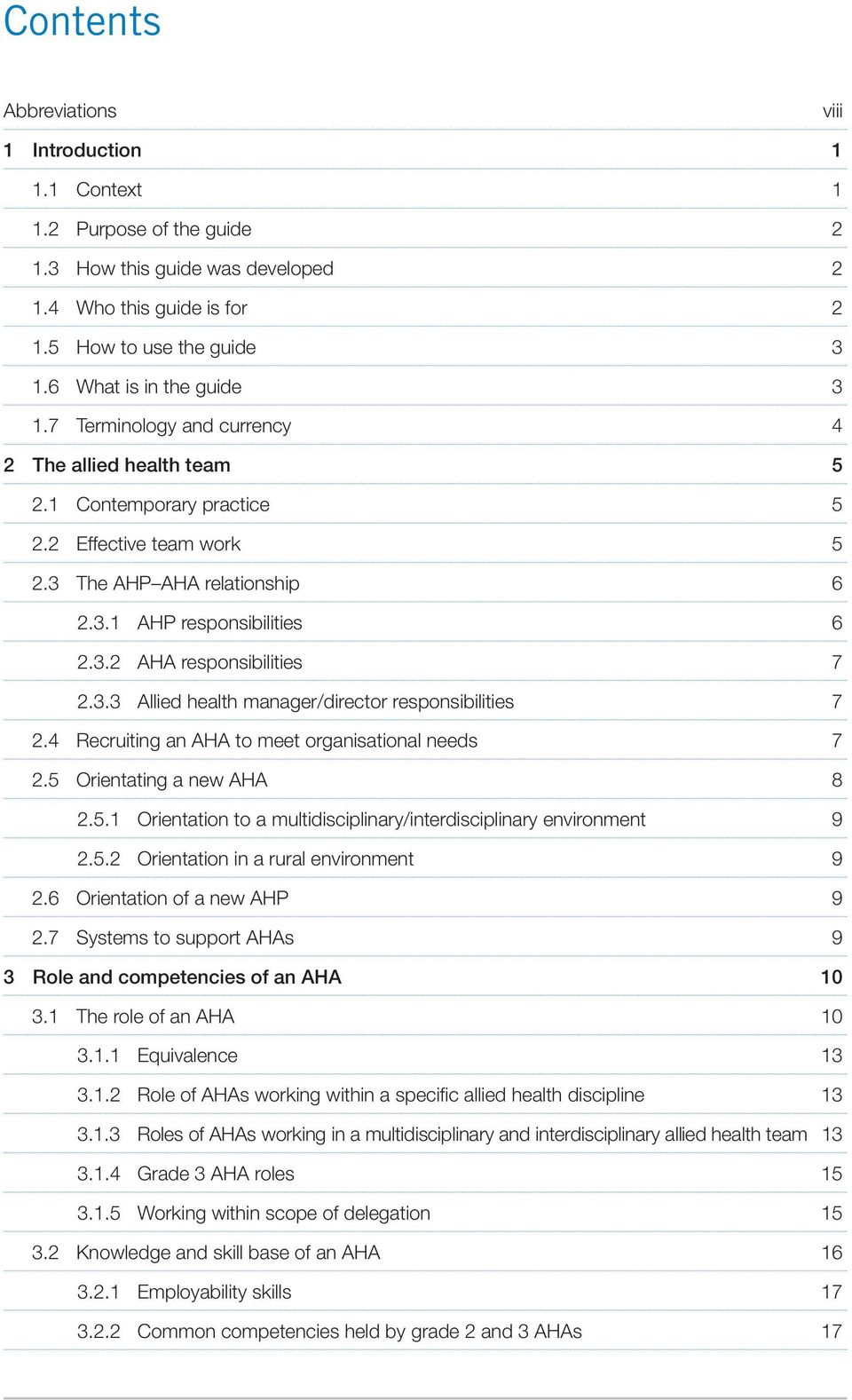
8 3.2.3 Discipline-specific AHA Multidisciplinary/interdisciplinary AHAs Competencies of individual AHAs Establishing knowledge and skills Continuing professional development Role review and learning plans Documentation 20 4 Delegation What is delegation? When is it appropriate to delegate? When is it appropriate to assign responsibility? When is it appropriate for an AHA to refuse to accept delegation of a task? Principles of effective delegation Accountability 24 5 Supervision Definition of supervision Importance of building a strong working relationship Types of supervision The role of a supervisor Monitoring performance Appropriate monitoring strategies Monitoring plans Who can supervise Supervision of AHA students Mode of supervision Approaches to supervision Multidisciplinary/interdisciplinary supervision Characteristics of effective supervisors Giving feedback Skills associated with supervision Establishing structured supervision mechanisms Importance of structural approaches in a rural context 35

9 6 Specific guidance for professions Guidance for nutrition and dietetics Activities that should not be delegated by a dietitian Skills and knowledge matrix for nutrition and dietetics Guidance for occupational therapy Activities that should not be delegated by an occupational therapist Documents supporting AHPs working with AHAs Skills and knowledge matrix for occupational therapy Guidance for physiotherapy Activities that should not be delegated by a physiotherapist Role of the australian physiotherapy association in supporting AHAs Skills and knowledge matrix for physiotherapy Guidance for podiatry Activities that should not be delegated by a podiatrist Support of professional associations and documents providing guidance Skills and knowledge matrix for podiatry Guidance for speech pathology Activities that should not be delegated by a speech pathologist Documents supporting AHPs working with AHAs Skills and knowledge matrix for speech pathology 51 7 Appendices 55 Appendix A: Employability skills matrix 56 Appendix B: Skills and knowledge matrix: AHAs with certificate iii and iv in allied 60 health assistance Appendix C: Qualification framework from HLT07 65 Appendix D: Competencies required of clinical supervisors 75 Appendix E: Training options for clinicians and managers wanting to develop skills 76 in workplace training and assessment References 77

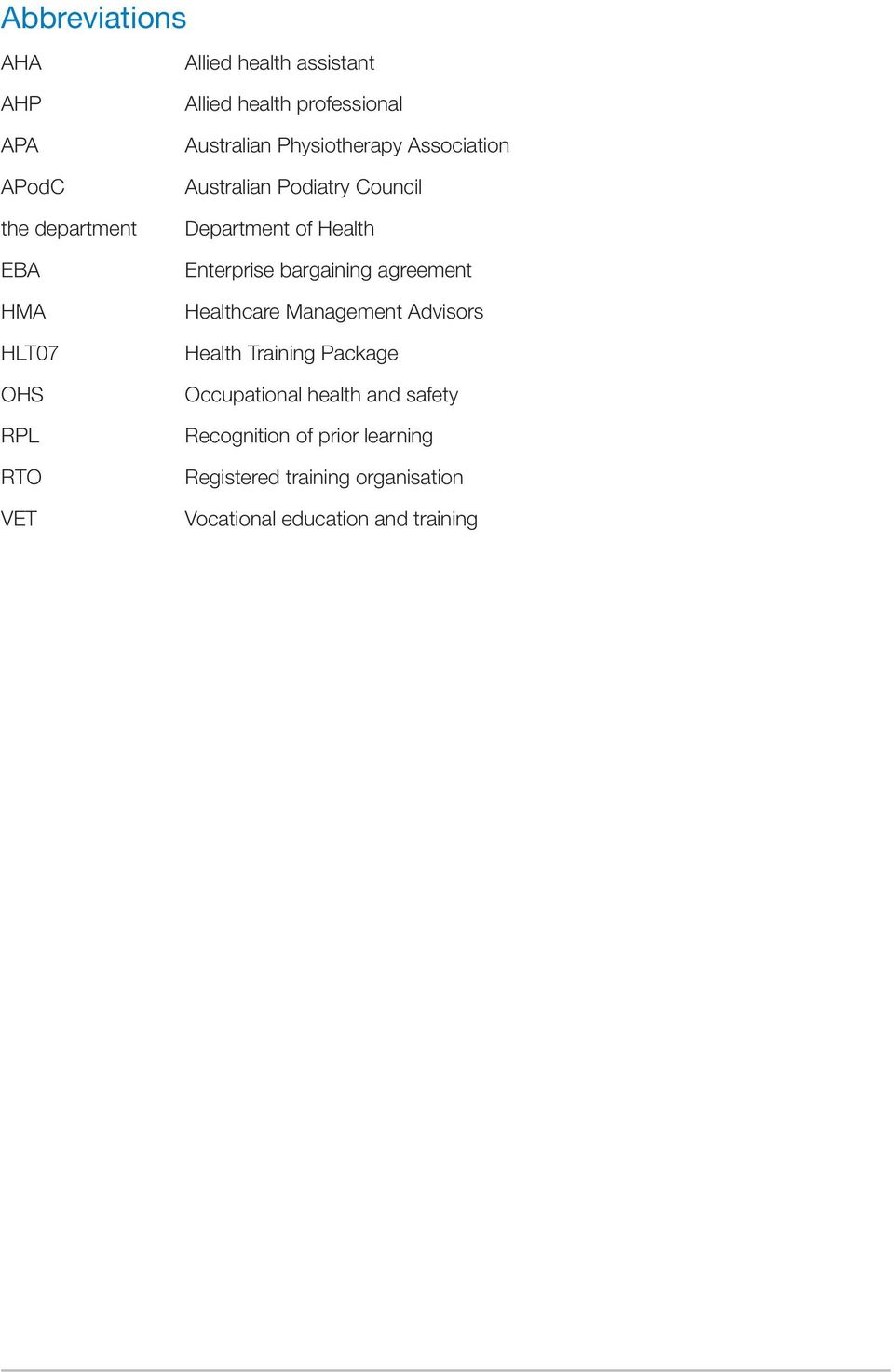
10 Abbreviations AHA AHP APA APodC the department EBA HMA HLT07 OHS RPL RTO VET Allied health assistant Allied health professional Australian Physiotherapy Association Australian Podiatry Council Department of Health Enterprise bargaining agreement Healthcare Management Advisors Health Training Package Occupational health and safety Recognition of prior learning Registered training organisation Vocational education and training
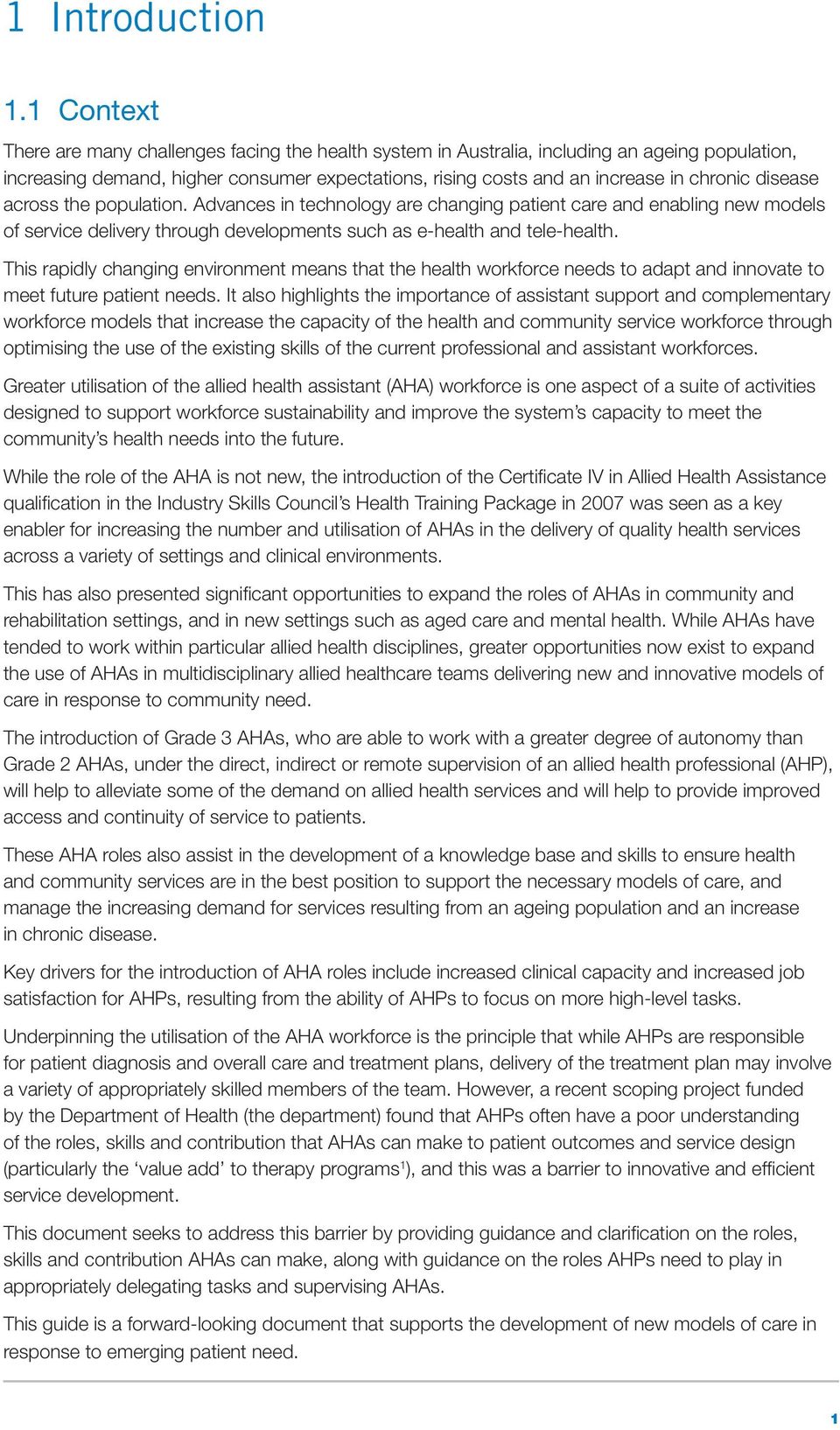
11 1 Introduction 1.1 Context There are many challenges facing the health system in Australia, including an ageing population, increasing demand, higher consumer expectations, rising costs and an increase in chronic disease across the population. Advances in technology are changing patient care and enabling new models of service delivery through developments such as e-health and tele-health. This rapidly changing environment means that the health workforce needs to adapt and innovate to meet future patient needs. It also highlights the importance of assistant support and complementary workforce models that increase the capacity of the health and community service workforce through optimising the use of the existing skills of the current professional and assistant workforces. Greater utilisation of the allied health assistant (AHA) workforce is one aspect of a suite of activities designed to support workforce sustainability and improve the system s capacity to meet the community s health needs into the future. While the role of the AHA is not new, the introduction of the Certificate IV in Allied Health Assistance qualification in the Industry Skills Council s Health Training Package in 2007 was seen as a key enabler for increasing the number and utilisation of AHAs in the delivery of quality health services across a variety of settings and clinical environments. This has also presented significant opportunities to expand the roles of AHAs in community and rehabilitation settings, and in new settings such as aged care and mental health. While AHAs have tended to work within particular allied health disciplines, greater opportunities now exist to expand the use of AHAs in multidisciplinary allied healthcare teams delivering new and innovative models of care in response to community need. The introduction of Grade 3 AHAs, who are able to work with a greater degree of autonomy than Grade 2 AHAs, under the direct, indirect or remote supervision of an allied health professional (AHP), will help to alleviate some of the demand on allied health services and will help to provide improved access and continuity of service to patients. These AHA roles also assist in the development of a knowledge base and skills to ensure health and community services are in the best position to support the necessary models of care, and manage the increasing demand for services resulting from an ageing population and an increase in chronic disease. Key drivers for the introduction of AHA roles include increased clinical capacity and increased job satisfaction for AHPs, resulting from the ability of AHPs to focus on more high-level tasks. Underpinning the utilisation of the AHA workforce is the principle that while AHPs are responsible for patient diagnosis and overall care and treatment plans, delivery of the treatment plan may involve a variety of appropriately skilled members of the team. However, a recent scoping project funded by the Department of Health (the department) found that AHPs often have a poor understanding of the roles, skills and contribution that AHAs can make to patient outcomes and service design (particularly the value add to therapy programs 1 ), and this was a barrier to innovative and efficient service development. This document seeks to address this barrier by providing guidance and clarification on the roles, skills and contribution AHAs can make, along with guidance on the roles AHPs need to play in appropriately delegating tasks and supervising AHAs. This guide is a forward-looking document that supports the development of new models of care in response to emerging patient need. 1
12 1.2 Purpose of the guide This guide seeks to be an enabling tool to support AHPs across a range of allied health disciplines to: better understand the range of roles AHAs can play in patient care better understand the supervision and delegation responsibilities of an AHP working with an AHA feel confident in working safely with AHAs. 1.3 How this guide was developed In developing this guide, Healthcare Management Advisors (HMA): (1) reviewed the available literature and a number of AHA supervision and delegation frameworks developed in other jurisdictions (2) reviewed professional standards and legislative requirements related to the five professional discipline areas within the scope of this project (nutrition and dietetics, occupational therapy, physiotherapy, podiatry and speech pathology) (3) consulted with key stakeholders on the issues the guide should cover, including professional associations, clinicians, AHAs, directors/managers of allied health departments, training providers, the Health Services Union East Branch and the Medical Scientists Association of Victoria (4) developed the draft guide and held consultations with key stakeholder groups (5) refined the draft guide incorporating the feedback received in the consultations. 1.4 Who this guide is for This guide primarily seeks to support AHPs who have not worked previously with an AHA, including both new graduates entering the workforce and experienced practitioners. The guide seeks to provide practical information on ways of working with AHAs to support AHPs to feel confident in: delegating tasks identifying whether a particular AHA possesses the required knowledge and skills to undertake a particular task supervising an AHA supporting the professional development of an AHA. We also hope that this guide will provide useful information for: (1) AHAs to gain a greater appreciation of: the expected knowledge and skill levels of AHAs with a Certificate III or IV in Allied Health Assistance the respective roles and responsibilities of both AHPs and AHAs that support effective team work. (2) Allied health directors/managers to: identify the policies required at a systems level to support AHPs and AHAs to work effectively together within a team develop role statements for new AHA positions, and define/identify the competencies required at each grade level. The guide can also be used by training providers from both the vocational education and training (VET) and university sectors. 2

13 1.5 How to use the guide We suggest that readers initially read this entire guide to gain an appreciation of the matters that allied health team members need to understand about the respective roles and responsibilities of AHPs and AHAs when delegating tasks, and the supervision and support AHAs require to work safely with patients. The guide does not provide definitive answers to whether or not you can delegate particular tasks. Instead, it seeks to identify factors to be considered in delegating tasks, and the level of support and supervision required if tasks are delegated. Whether it is appropriate to delegate the task depends on a number of factors, including the knowledge and skills of the AHA, their experience with the task, the complexity of the task, the acuity and complexity of the patient, and the level of supervision available to support the AHA (direct, indirect or remote). We suggest AHPs use this guide as a tool to assist their decision making as to whether or not they delegate a particular task, and if they do, to identify what supervision and support needs to be provided to the AHA undertaking the task. We suggest AHAs use the guide as a practical tool to understand the parameters of practice for Grade 1, 2 and 3 AHAs, and identify the supervision and support they may need from an AHP to safely undertake delegated tasks. We hope the guide will support healthy dialogue between AHPs and AHAs on how to work effectively together in delivering high-quality patient care. 1.6 What is in the guide The remainder of this guide is structured in the following way. Chapter 2. The allied health team: In this chapter, the characteristics of effective teamwork and the implications for the AHP-AHA relationship, including the responsibilities of AHPs, AHAs and allied health managers/directors are discussed. Chapter 3. Roles and competencies of an AHA: This chapter provides an overview of the career pathway of an AHA. It explains the differences in roles of a Grade 1, 2 and 3 AHA, and the differences in competencies that can reasonably be expected of an AHA with either a Certificate III or IV in Allied Health Assistance. This information is provided to support AHPs decision-making processes in regard to delegating tasks. The chapter also discusses the matters an AHP needs to consider in determining an individual AHA s knowledge and skill level, including the importance of familiarising the AHA with the processes and approaches taken within a particular setting, and AHA access to formal continuing professional development opportunities. Chapter 4. Delegation: Here, the concept of delegation is defined and guidance is provided on when it is appropriate to delegate tasks and issues that need to be considered in delegating tasks. It also provides a series of principles that support effective delegation and the level of accountability AHPs and AHAs hold in relation to delegated tasks. 3
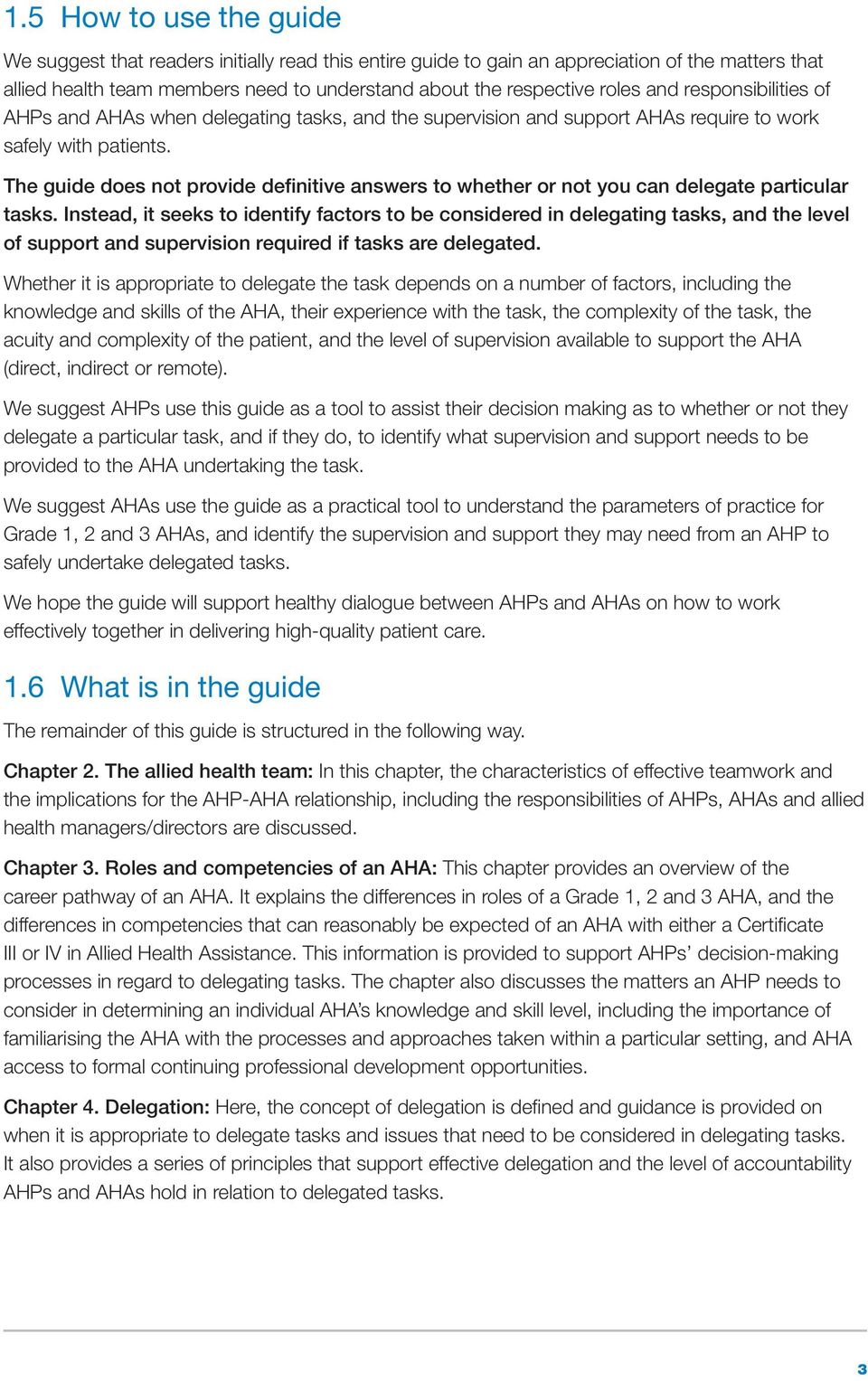
14 Chapter 5. Supervision: In this chapter, we define what is meant by supervision and discuss the role of the supervisor in monitoring performance. We provide information on: who can supervise AHAs and students approaches to supervision, particularly within a multidisciplinary/interdisciplinary context the characteristics of effective supervisors giving feedback the skills associated with supervision the importance of establishing structured supervision mechanisms. Chapter 6. Specific guidance for professions: Here, discipline-specific guidance is provided on activities that should not be delegated to AHAs based on standards set by professional associations. The chapter also details the level of competencies that can be expected of an AHA with a tailored Certificate III or IV in Allied Health Assistance to work with either dietitians, occupational therapists, physiotherapists, podiatrists or speech pathologists. Chapter 7. Appendices: The appendices provide information around the allied health assistance courses and more general information about training courses available, including: Appendix A: Employability skills matrix Appendix B: Skills and knowledge matrix: AHAs with a Certificate III or IV in Allied Health Assistance Appendix C: Qualification framework from HLT07 Appendix D: Competencies required of clinical supervisors Appendix E: Training options for clinicians and managers wanting to develop skills in workplace training and assessment. 1.7 Terminology and currency Traditionally, hospitals use the term patients to refer to the individuals they provide services to, while community health services use the term clients. Throughout this document, we have chosen to use the term patients for editorial simplicity, unless directly quoted from the relevant training package. Please note, the terms patient and client are used interchangeably. While the information provided in the framework relating to the Health Training Package HLT07 is to our knowledge up to date at the time of printing, it is acknowledged that changes will occur to all training packages over time, as part of the Industry Skills Council s continuous improvement of training packages. Therefore, it is recommended that training package information is sourced from the Australian government website < to ensure currency. Within Victoria, the scope of an AHA role is defined by current classification on descriptors. 2 Please note that these structures and definitions apply at the time of printing. However, as with any industrial obligation, it is recommended that the latest version of the relevant enterprise bargaining agreement (EBA) is consulted to ensure compliance with the most up to date requirements. 4
15 2 The allied health team This chapter discusses the characteristics of effective teamwork and the implications for the AHP AHA relationship, including a discussion of the responsibilities of AHPs, AHAs and allied health directors/managers. 2.1 Contemporary practice The ageing population and the increase in the burden of chronic disease highlight the important role that the allied health workforce will play in meeting current and future health workforce challenges. A skilled and flexible AHA workforce that is able to work with particular allied health disciplines or in multidisciplinary allied healthcare teams will help to alleviate some of the increasing demand pressure on allied health services and allow for the delivery of new and innovative models of care in response to community need. In 2008, the department engaged HMA to undertake an AHA scoping study that included 23 health and community services from across Victoria. The Allied Health Assistant Scoping Project 3 sought to ascertain the current use and practices of AHAs within the sample, identify the current supply and future demand of AHAs, examine barriers to using AHAs, and uncover ways in which AHA roles can be supported and enhanced. In summary, the scoping study identified that AHAs are performing a wide range of roles across the health sector in Victoria. In particular, in 2009, the greatest numbers of AHAs were working with physiotherapists (45 per cent), multidisciplinary teams (26 per cent) and occupational therapists (24 per cent). Across the professions, significant demand for AHAs was identified. Strongest demand remains for AHA roles in physiotherapy, multidisciplinary care and occupational therapy. Emerging demand was identified in podiatry, dietetics and social work, audiology, prosthetics/orthotics and speech pathology. Strongest demand for AHAs was found to exist within community health and rehabilitation settings, followed closely by aged care and acute settings. 2.2 Effective team work Characteristics of effective healthcare teams 4,5,6 have been identified to include: a clear team vision and goals that team members are committed to achieving a focus on delivering patient-centred care support for innovation and task orientation to provide high-quality and safe patient care an identifiable team leader clearly defined roles for team members a commitment among team members to work collaboratively guidelines to support the way the team undertakes its work good communication between team members on a regular basis (either face to face or by alternative mediums) the ability to monitor and evaluate team performance. 5
16 For teams to perform well, it is important that: team members are involved in planning processes and setting goals individuals have a clear understanding of how their own position and the positions of other team members contribute to the achievement of the teams goals team members have mutual respect for each other team members have their individual contributions valued there are regular opportunities for team members to meet to air matters of concern and develop ways to address these issues, and improve team effectiveness or improve patient care. It is important to recognise that differences of opinion are healthy. Encouraging open communication with respect for each other, and developing team members skills to constructively resolve differences, are important in strengthening team performance. Allied health directors/managers also identify the importance of ensuring AHAs are appropriately involved in team meetings, patient handovers and reviews. This is particularly important for AHAs working in multidisciplinary/interdisciplinary teams, who are often providing care to individual patients receiving care from a number of AHPs. It is particularly important that AHAs have an understanding of the overall treatment goals for each individual patient. 2.3 The AHP-AHA relationship As members of a discipline-specific allied health team or a member of a multidisciplinary/ interdisciplinary team, AHPs and AHAs have a responsibility to: work towards achieving the team s vision and goals provide high-quality and safe patient care contribute to the development of service innovation communicate effectively and regularly with other team members work collaboratively in accordance with their role descriptions show each other mutual respect and value each other s contribution openly communicate with each other and other team members, raising issues of concern and resolving issues before conflict arises AHP responsibilities AHPs with responsibility for supervising an AHA need to ensure that they: are responsible for patient diagnosis and overall care and treatment plans, while the delivery of care and treatment can involve a variety of appropriately skilled members of the team have a clear understanding of the AHA s role (as detailed in the AHA s position description) have a good understanding of the AHA s knowledge and skill level analyse clinical practice to identify tasks that do not require clinical judgement, assessment, diagnosis, care planning or evaluation (for example, information gathering and monitoring of interventions) and that could be completed by an appropriately trained and supported AHA provide support to the AHA in undertaking their role and where necessary, demonstrate how to do specific tasks associated with their role establish with the AHA collaborative ways of working together to support good communication and high-quality care for patients 6

17 delegate tasks appropriately and provide appropriate levels of supervision to support the AHA regularly provide clinical supervision to the AHA in accordance with organisational guidelines participate in professional development activities to develop and refine their supervision skills as required AHA responsibilities When working under the supervision of an AHP, an AHA needs to ensure that they: understand that the AHP is responsible for patient diagnosis and overall care and treatment planning, while the AHA is responsible for delivery of elements of the care or treatment plan fully understand what is expected of them in relation to tasks being delegated and seek clarification where required raise concerns if they feel they do not have the necessary skills to undertake a task being delegated to them seek the support of an AHP where there is a concern about patient safety actively participate in the clinical supervision process regularly participate in appropriate professional development activities Allied health manager/director responsibilities In supporting effective teams, allied health managers/directors have key roles in: providing clinical leadership to the team and supporting the development of innovative approaches in care in response to patient need developing and regularly reviewing team members position descriptions as required monitoring team performance and service quality providing support and supervision to team members as required ensuring clear policies are in place that guide the way the team works, and setting expectations in regard to clinical supervision and professional development resolving any differences among team members if they arise. 2.4 Recruiting an AHA to meet organisational needs AHAs have a great deal of choice in the units of study they take as part of a Certificate III or IV in Allied Health Assistance. To secure AHAs with appropriate competencies to meet the requirements of particular positions, it is important the position description clearly defines the role and the knowledge, skills and abilities required of applicants. In recruiting an AHA, it is appropriate to know what units of study the applicant has undertaken as part of their Certificate III or IV in Allied Health Assistance, to understand the knowledge, skills and abilities they can bring to the role. The Western Australia Department of Health has developed two useful tools that may assist managers to identify the roles and competencies required for a particular position. These are the: (1) Allied health assistant roles audit, which provides a template for managers, in identifying the roles required of an AHA (that could be adapted to local needs) 7

18 (2) Rural and remote allied health competencies: allied health assistants, which provides a template for managers in identifying the competencies required for particular positions (that could be adapted to local needs). The template also has the capacity to support supervisors to: (a) identify and document the level of proficiency and skill in the specific competencies relevant to positions (b) develop learning plans for AHAs to acquire skills required for the role. Both tools are accessible at < 2.5 Orientating a new AHA As with any new staff member, when a new AHA is appointed, it is important that a planned orientation, induction and support program is designed to introduce the AHA to the policies of the organisation, the specifics of the work they will be asked to do as an AHA and as a member of the allied health team, the model of care that guides the work of the allied health team, and any administrative requirements associated with the role. The use of a check list and timeline of what needs to be covered, by whom and by when, can be a useful tool, to ensure all the key orientation issues are covered. An AHP with responsibilities for supervising new AHAs needs to initially gain an understanding of the AHA s training and previous experience, in view of the role the AHA will be required to undertake, and consider whether any extra instruction is required regarding specific tasks. A good place to start is for the AHP to sit down with the AHA and discuss: the units of study the AHA has undertaken as part of their Certificate III or IV in Allied Health Assistance the roles and responsibilities the AHA has undertaken in previous positions the clinical environments the AHA has worked in on-the-job training and professional development courses or programs the AHA has undertaken. The focus of these discussions should be on identifying the level of proficiency and skill the AHA has in the specific skill areas of their position description, the tasks that need to be demonstrated, and the tasks where initial support will be needed. Having identified the AHA s skills and abilities, the supervisor should familiarise the AHA with what is specifically required in their role, the tasks expected of them, and where necessary, demonstrate how to do specific tasks associated with the role in accordance with workplace expectations. In developing new skills, AHAs often benefit from direct scaffolding support from an AHP before performing the tasks independently. This can be achieved by working on a task as a pair, with the AHP providing any input required to enable the AHA to take the lead. It is not necessary for the AHP with responsibility for supervising the AHA to undertake all of the orientation. It is appropriate to draw on other team members (including AHPs and AHAs) to support the orientation process as required. It is particularly important that a supervisor works closely with the AHA during the first three months of their employment (generally termed the probationary period ), to ensure the AHA fully understands their role and scope of practice, and the AHP has a good understanding of how the AHA is performing in the role. Further information related to establishing knowledge and skills is available in Section

19 2.5.1 Orientation to a multidisciplinary/interdisciplinary environment It is important that AHAs new to working in a multidisciplinary/interdisciplinary environment are orientated by their supervisor to ways of working within a multidisciplinary/interdisciplinary team and that, if required, support is available to enable them to develop the specific skills associated with working within a team context Orientation in a rural environment In a rural environment, AHPs and AHAs are often required to work in a different context to their counterparts in a metropolitan setting. As a result, it is particularly important that orientation processes for AHAs are robust, and they have close and regular clinical supervision during orientation to the new role and organisation. 2.6 Orientation of a new AHP It is important to recognise that not all AHPs have been exposed to working with AHAs. Where this is the case, it is important that clinical leaders orientate a new AHP in what is expected of them when working with AHAs. 2.7 Systems to support AHAs AHAs working in a rural environment can be fairly isolated, particularly if they are working as a sole AHA. It is important for allied health directors/managers to encourage AHAs to develop relationships with other AHAs in nearby health services and/or participate in regional allied health assistant networks. Resources exist to assist health and community services to establish positive workplaces that will attract prospective employees to the health and community service sector in Victoria. Once such resource is the Victorian Attractive Employer Model (AEM) 7, which includes a number of practical tools and resources to assist employers in promoting Victoria as an attractive place to work. The provision of supporting resources such as welcome kits, induction and orientation programs that include information on local networks, events, facilities, sponsorships, and support for families and partners, are a good way to initiate a relationship between an employee and a new community. The AEM Framework can be found on the Victorian Department of Health s workforce website < 9

20 3 Role and competencies of an AHA This chapter provides an overview of the career pathway for an AHA. It explains the differences in roles of a Grade 1, 2 and 3 AHA, and the differences in competencies and practice that can reasonably be expected of an AHA at varying grade levels. This information is provided to support AHPs decision-making processes in regards to delegating tasks. The chapter also discusses the matters that an AHP needs to consider in determining an individual AHA s knowledge and skill level. This includes the importance of familiarising the AHA with processes and approaches taken within a particular setting, and enabling access to formal continuing professional development opportunities. This guide limits itself to describing the expected competencies of an AHA with either a Certificate III or IV in Allied Health Assistance. It does not define the competencies of an AHA who may hold a higher qualification and have more advanced competencies. 3.1 The role of an AHA AHAs support and assist the work of an AHP by undertaking a range of less complex tasks, (both clinical and non-clinical) enabling the AHP to focus on more complex clinical work (that cannot be undertaken by others) and provide care to a greater number of patients. AHAs commonly work with dietitians, physiotherapists, podiatrists, occupational therapists and speech pathologists in a variety of settings, including acute, rehabilitation, outpatient, community and mental health. AHAs are also known as rehabilitation assistants, therapy assistants, therapy aides, technicians, support workers and attendants. While AHAs work within clearly defined parameters, the role is often very flexible, involving a mixture of direct patient care and indirect support as detailed in Table 3.1. The mix of duties is determined by the needs of the professional delegating work to the AHA, and the types of services and programs delivered by the allied health team. The role a particular AHA plays is also dependant on the competencies of the individual AHA. While the competencies that an individual possesses vary, so do the individual roles an AHA plays. The recruitment process is a key element in achieving an appropriate match between the competencies an AHA possesses and the requirements for the role. The position description provides a key governance structure, outlining the regular duties of the AHA and areas that will be delegated by an AHP. While AHAs are not autonomous practitioners and always work under the overarching auspice and clinical oversight of the AHP, the degree of monitoring required will vary depending on the knowledge, experience, skill level and Grade of the AHA. 10
21 Table 3.1: Direct and indirect activities that may be undertaken by an AHA 8 Direct work with patients may include: Physical and social support to patients Implementing and facilitating therapy programs designed by professionals Assisting professionals in the safe use of equipment Providing assistance for patient therapy or exercise programs Supporting and supervising patients with activities of daily living Administering clinical services and modalities as delegated by professionals Working with patients towards rehabilitation goals Gathering and documenting objective and subjective patient information for AHP assessment, diagnosis, care planning or evaluation of interventions. Transferring patients Communicating patient progress to other staff Indirect support work may include: Administration Ordering stock Assisting and coordinating services Preparing and/or maintaining environment Maintenance of equipment Manufacturing and adjusting support devices Monitoring and updating databases Maintaining records of work undertaken with patients Recording activities and undertaking statistics Cleaning Assisting with mobility and gait Provision of equipment Patient education as prescribed by a health professional, where permitted by the professional association Health promotion activities developed by health professionals Provision of healthcare to patients in accordance with treatment plans Supervising and conducting exercise classes Preparing patients for treatment Undertaking individual or group therapy 11
22 Within Victoria, the scope of an AHA role is defined by the current classification descriptors. 2 Figure 3.1 details the duties of Grade 1, 2 and 3 AHA roles, the level of supervision required and educational levels for each grade.* It shows the differences in roles and summarises the AHA career structure. Please note that these structures and definitions apply at the time of printing however as with any industrial obligation it is recommended that the latest version of the relevant EBA is consulted to ensure compliance with the most up to date requirements. In developing position descriptions for AHAs, allied health directors/managers should consider the varying activities that it is appropriate for AHAs to undertake at different grade levels. It is important that professional development plans for AHAs support their career progression, so that over time, they are able to take on more advanced roles. Figure 3.1: Duties of AHAs, education-level entry criteria and career pathways Grade 3 AHA Supervision and nature of work: Will be required to perform work of a general nature under the supervision of an AHP. Grade 1 AHA Supervision and nature of work: Will be required to perform work of a general nature under the direct supervision of an AHP. Education level entry criteria: No formal qualifications required. Duties: May include collection and preparation of equipment, maintaining client contact details, monitoring clients to ensure they follow their program. Grade 2 AHA Supervision and nature of work: Will be required to perform work of a general nature under the supervision of an AHP. Education level entry criteria: Formal qualification of at least Certificate III level from RTO, or its equivalent. Duties: Perform the full range of duties of a Grade 1. Work directly with an AHP; work alone or in teams under supervision following a prescribed program of activity. Use communication and interpersonal skills to assist in meeting the needs of clients. Accurately document client progress and maintain documents as required. Demonstrate a capacity to work flexibly across a broad range of therapeutic and program related activities. Identify client circumstances that need additional input from the AHP. Prioritise work and accept responsibility for outcomes within the limit of their accountabilities. Education level entry criteria: A Grade 3 AHA is a person appointed as such. Formal qualifications of at least Certificate IV level from RTO, or its equivalent. Duties: Perform the full range of duties of a Grade 1 and Grade 2. Understand the basic theoretical principles of the work undertaken by the AHP whom they are employed to support. Work with minimum supervision to implement therapeutic and related activities, including maintenance of appropriate documentation. Identify client circumstances that need additional input from the AHP, including suggestions as to appropriate interventions. Demonstrate very good communication and interpersonal skills. Organise their own workload and set work priorities within the program established by the AHP. If required, assist in the supervision of the work being performed by Grade 1 and 2 AHAs and those in training. * The current classification structure (which came into effect on 1/9/2007) replaced the previous structure, which supported unqualified and qualified AHAs. 12
23 There is no specific education level or entry criterion for a Grade 1 AHA. It is a requirement that they are directly supervised by an AHP. Their duties are of a general nature, and include the collection and preparation of equipment, maintenance of patient contact details, and monitoring patients to ensure they follow their program. Under the classification descriptors for AHAs, automatic progression occurs from Grade 1 to Grade 2 on successful completion of Certificate III in Allied Health Assistance. A Grade 2 AHA is able to perform the full range of duties of a Grade 1 AHA. However, they have a broader role and are able to work with AHPs to provide care in accordance with prescribed treatment plans for patients. Grade 3 AHAs have broader roles again. In addition to performing the full range of duties of a Grade 1 and Grade 2 AHA, the Grade 3 AHA is able to work with minimum supervision to implement therapeutic treatments for patients in accordance with care plans, seeking input from AHPs as required. In a rural context, many Grade 3 AHAs have roles supporting patients in the community and involving home visits. The entry level to a Grade 3 AHA position is a Certificate IV in Allied Health Assistance. In addition, it would be expected that an AHA appointed to a Grade 3 AHA position, would have additional relevant experience. Employers determine whether a position is classified as a Grade 3 AHA role. Attainment of a Certificate IV in Allied Health Assistance does not result in automatic progression to a Grade 3 position. The structure of the Certificate III and IV in Allied Health Assistance is detailed in Appendix C Equivalence The education level entry criteria under the classification descriptors for AHAs allows for people with an equivalent qualification to a Certificate III or IV in Allied Health Assistance to enter roles as Grade 2 or 3 AHAs respectively. Some AHAs employed by health services may have other qualifications that allow them to undertake a broader range of tasks. These qualifications may include exercise physiology, human movement, fitness, massage and nursing. Where AHAs have a broader range of qualifications, it is important that the AHP has a good understanding of the competencies associated with these other qualifications. It is within the allied health director s/manager s discretion in employing staff to determine whether the qualification a person has is equivalent to a Certificate III or IV in Allied Health Assistance Role of AHAs working within a specific allied health discipline The role of an AHA working within a specific allied health discipline will vary according to whether the individual AHA is at a Grade 1, 2 or 3 level, and whether they have successfully completed all the mandatory training units that equip them to specialise in a particular discipline. If the individual has successfully completed all the mandatory units, we would expect their role would reflect the discipline-specific skills and knowledge acquired. Chapter 6 details the competencies that can reasonably be expected of an AHA who has successfully completed the mandatory units. Where an AHA has not undertaken all the discipline-specific mandatory units, their scope of practice may be more limited Roles of AHAs working in a multidisciplinary and interdisciplinary allied health team An AHA may specialise and support the work of an AHP in only one discipline, or they may work more broadly and support the work of several professions in multidisciplinary or interdisciplinary teams. 13
24 Multidisciplinary and interdisciplinary approaches Throughout this document, the terms multidisciplinary and interdisciplinary are used. The Services for Australian Rural and Remote Allied Health (SARRAH) 9 defines: multidisciplinary approaches as utilising the skills and experience of individuals from different disciplines, with each discipline approaching the patient from their own perspective. Each team member conducts separate assessment, planning and provision of care with varying degrees of coordination. The team, directly or indirectly shares information regarding the patient and discusses directions in patient care, relying on good communication systems (for example, team meetings, case conferences). Essentially, health professionals work in conjunction with each other, but act autonomously. interdisciplinary approaches as expanding the multidisciplinary team through collaborative communication (rather then shared communication) and interdependent practice. Members contribute their own professional specific expertise, but collaborate to interpret findings and develop a care plan. Team members negotiate priorities and agree by consensus. Multidisciplinary or interdisciplinary teams may involve a range of professionals, including (but not limited to) dietitians, health promotion officers, nurses, occupational therapists, physiotherapists, podiatrists, prosthetists, social workers and speech pathologists. Interdisciplinary teams often have a particular clinical focus and/or work with patients with complex needs and chronic health conditions, such as diabetes or continence issues. Role of AHAs The role an AHA plays in a multidisciplinary/interdisciplinary team can vary. Some AHAs work across a range of disciplines. Anecdotal evidence suggests that increasingly, AHAs are working in roles that assist with continuity of care and care planning, and are involved in enhancing patient-centred care by moving with patients with complex needs who require care from practitioners across multiple allied health disciplines. Other AHAs support an AHP from the one discipline. Additionally, the role of an AHA working within a multidisciplinary/interdisciplinary team will vary according to whether the individual AHA is at a Grade 1, 2 or 3 level, and the extent to which they have acquired competencies in mandatory training units that equip them to specialise in a particular discipline. As noted in the Health Training Package HLT07, if an AHA has undertaken generic units of study, it is reasonable to expect them to be undertaking more generic roles within the multidisciplinary team. Where this is the case, the AHA will often be involved in administrative activities such as making appointments for patients, or non-direct clinical activities such as cleaning equipment or preparing the clinic for patients. However, some AHAs will have undertaken units of study that enable them to work with one or more specific discipline foci. These AHAs will obviously have roles with a more clinical focus. AHAs can only work to the maximum scope of practice in a particular discipline area if they have successfully completed all the mandatory units or equivalent in that area. Under the packaging rules associated with Certificate IV in Allied Health Assistance, it is possible for an AHA to specialise in up to three allied health discipline areas. It is also possible for AHAs to complete additional units after completion of Certificate IV in Allied Health Assistance to specialise in additional discipline areas. 14
25 The role an individual AHA can play within a multidisciplinary/interdisciplinary team needs to be based on the actual competencies the AHA holds. Careful attention needs to be given by allied health directors/managers in defining the breadth and depth of roles for AHAs in multidisciplinary/interdisciplinary teams, to ensure the AHA has an appropriate patient load, having regard for the types of tasks the AHA is expected to undertake. This can be managed by limiting the number of discipline areas an AHA works across. Alternatively, where the AHA is working with patients with complex care needs, requiring the AHA to work with a broad range of practitioners, the AHA may have a lower than average caseload of patients to reflect the intensity of support required by the patient group. In defining the breadth of scope of practice for an AHA working in a multidisciplinary/interdisciplinary team, it is also important to consider the fact that AHAs need to maintain their level of competence across the disciplines or clinical areas they work in. For new AHA graduates, it may be appropriate for their scope of practice to be limited to working across one or two disciplines or one clinical area only, so that they have the capacity to build their skills in the specific discipline(s) or clinical area. As the AHA becomes more experienced, the scope of practice related to the number of disciplines or clinical areas they cover may expand Grade 3 AHA roles Generally, Grade 3 AHAs have greater scope to undertake work with a greater degree of independence and autonomy (within the pre-determined parameters of the care plan developed by an AHP). The majority of roles described for Grade 3 AHAs contain elements of responsibility for monitoring progress, against the pre-determined goals and treatment planning with the registered therapy professional supervising the AHA. While still being under the supervision and guidance of an AHP, a Grade 3 AHA may undertake some components of healthcare service delivery (for which an AHA has been trained and assessed as competent) in accordance with organisational policies and procedures. This may include some components of activities related to monitoring ongoing progress, treatment and coordination of care. In the absence of clearly prescribed parameters of practice established by an AHP, the AHA needs to liaise closely with the AHP in regard to all activities and tasks. While in some instances there may be a greater degree of independence and autonomy associated with Grade 3 AHA roles, there also needs to be clear and agreed responsibilities (between the AHP and AHA) to ensure the AHA keeps the AHP abreast of any clinical issues emerging around patient care, so the AHP can actively monitor patient progress Working within scope of delegation In working with patients, from time to time, an AHA may have concerns about a patient s health that requires referral to, or input from, another health practitioner or screening as part of the assessment process. In some instances, where an AHA is working within their predetermined scope of delegation for a particular task (that is, they have been trained to undertake a particular activity or task described in their position description, for example, to apply a screening tool or highlight opportunities for referrals in specific circumstances within the local healthcare context), it is reasonable for the AHA to initiate action to meet the patient s immediate needs and provide timely notification to the relevant AHP in accordance with organisational policies and procedures. This can only happen if it is clearly established up front between the AHA and the supervising AHP. In the absence of this, the AHA should consult with the AHP. 15
26 In such circumstances, it is important for the AHA to advise of any referrals made or the outcomes of any screening (both positive or negative), so that the AHP is aware of issues identified and can undertake further assessments and/or make modifications to the treatment plan as required. It is important that such information is communicated in a timely fashion, particularly with regard to the acuity of the patient s condition. 3.2 Knowledge and skill base of an AHA It is important for an AHP supervising an AHA to be aware of the training programs that AHAs are participating in or the training they have received, so that the AHP can facilitate the use of their knowledge and skills in a clinical context to meet local need. In addition to formal training programs, AHAs may need worksite role-specific training to be competent and confident in particular work tasks. Certificate III and IV in Allied Health Assistance are delivered by a range of public and private registered training organisations (RTOs). Vocational education and training (VET) courses, such as Certificate III and IV in Allied Health Assistance, are designed with industry input to equip trainees with the occupational skills needed in the workplace. Some health services have established close working relationships with RTOs who deliver specific units of allied health assistance training to support AHAs to develop additional skills that individual health services may require of the role. Components of this training may be delivered on site at the health service. The VET system provides competency-based training. Competency is defined 10 as involving: not only observable behaviour which can be measured, but also unobservable attributes including attitudes, values, judgemental ability and personal dispositions: that is not only performance but capability. Competency standards for all units undertaken as part of the Certificate III and IV in Allied Health Assistance are available from the training.gov.au website at: < The Australian Qualifications Framework provides an overview of the characteristics of learning, comparing the breadth, depth and complexity of content in relation to work outcomes for qualifications offered at different levels. While some topics are covered at all levels, the extent of learning at each level will be different. How this translates into performance in the work environment is detailed in Table 3: Characteristics of Learning Outcomes of the Implementation Handbook at: Some people have skills and knowledge that enable them to gain part or all of a qualification without completing the standard training program. The knowledge and skills may be gained through undertaking formal courses, self-tuition, work experience or life experience. An RTO can formally recognise a student s existing level of skill and knowledge in two ways: recognition of prior learning (RPL) credit transfer. 16
27 Recognition of prior learning RPL is an assessment process that recognises prior knowledge and experience, and measures it against the course in which the student is enrolled. A student possessing some of the skills and/ or knowledge taught in the course may not need to complete all of the units, if the RTO makes an assessment that the student has achieved the required learning outcomes, competency outcomes, or standards for a particular unit. Credit transfer A credit transfer allows students to count successfully completed relevant studies at an RTO or university towards their current course or qualification. A credit transfer can work in one of two ways: Students can receive a credit for units they have previously completed and receive an exemption from retaking them, thereby reducing the study load. Students can be exempt from certain introductory units, but are still required to complete the total number of units for the course Employability skills In a workplace setting, competency takes into account the complex interaction of attributes that underpin occupational performance. VET training seeks to provide trainees with the relevant knowledge, skills and attitudes to exercise judgement in undertaking activities. VET training packages incorporate employability skills that reflect higher education graduate attributes. The core employability skills embedded in Certificate III and IV in Allied Health Assistance include communication, teamwork, problem solving, initiative and enterprise, planning and organising, self-management, learning and technology. Appendix A provides a matrix of desirable employability skills that an employer may expect of an AHA. The employability skills matrix (developed by HMA) is based on the employability skills specified for the Health Training Package HLT Common competencies held by Grade 2 and 3 AHAs To obtain a Certificate III in Allied Health Assistance, there are 10 core units that must be completed. Seven of these core units are also pre/co-requisites to attaining a Certificate IV in Allied Health Assistance. As a consequence, it is reasonable to assume that AHAs with either a Certificate III or IV in Allied Health Assistance will have competencies to: recognise healthy body systems in a healthcare context use basic medical terminology maintain a high standard of patient service assist with an allied health program assist with patient movement communicate and work effectively comply with infection control policies and procedures in health work. To obtain a Certificate IV in Allied Health Assistance, there are a further four core units that must be completed. In addition to the above competencies, all AHAs with a Certificate IV in Allied Health Assistance will also have competencies to: contribute to occupational health and safety (OHS) procedures contribute to organisational effectiveness in the health industry 17
28 implement and monitor compliance with legal and ethical requirements implement and monitor infection control policies and procedures. Appendix A provides a knowledge and skills matrix articulating the employability skills that could reasonably be expected of an AHA who has attained: (1) a Certificate III in Allied Health Assistance (2) a Certificate IV in Allied Health Assistance. In delegating tasks, it should be remembered that the depth of knowledge or skills of an individual AHA will vary depending on their experience and/or aptitude. It is also important to consider the individual s ability to undertake the task and their capacity to develop new skills Discipline-specific AHA In undertaking the Certificate IV in Allied Health Assistance, focused studies are able to be undertaken to gain the specific competencies required for an AHA working with dietitians, occupational therapists, physiotherapists, podiatrists or speech pathologists. To attain a disciplinespecific AHA qualification for a particular discipline, all the mandatory units listed for that specific area of work must be completed. In Appendix C, the units that must be taken to acquire a discipline-specific AHA qualification are detailed. In Chapter 6, the competencies that can reasonably be expected of an AHA with a discipline-specific AHA qualification are detailed Multidisciplinary/interdisciplinary AHAs Many health services provide opportunities for AHAs working in multidisciplinary/interdisciplinary teams to participate in rotations and gain experience working with practitioners of different disciplines. This enables them to gain an appreciation of the roles that AHPs of different disciplines play, as well as supporting AHAs to develop the skills associated in working in a multidisciplinary/ interdisciplinary environment. Careful consideration needs to be given to the purpose of rotations and how they are structured, particularly where AHPs also undertake rotations across different areas of a health service, as there is potential for team stability to be disrupted if rotation processes for AHPs and AHAs are not carefully considered. It is important that the length of rotations is appropriate to enable the AHA to consolidate their skills in the area Competencies of individual AHAs AHAs will have completed a number of elective units in undertaking their Certificate III and IV in Allied Health Assistance. In Appendix C, we list the range of electives that can be undertaken. To fully understand the competencies an individual AHA may have, it is important to understand the elective units they have undertaken, the material covered in those elective units and the associated competencies. Many AHAs have competencies they have developed as a result of participating in informal training and experience in previous roles and in-house development opportunities. 18
29 3.3 Establishing knowledge and skills Establishing the competence of an AHA in relation to a particular task involves a process of making a judgement as to whether the AHA has the knowledge, skills and attitude required to perform a task to the standard expected in the workplace. In Victoria, one of the ways in which competence is established is through attainment of a Certificate III or IV in Allied Health Assistance. RTOs are responsible for assessing the competence of students against national competency standards. On attainment of the relevant certificate, it is reasonable to assume that an AHA has the required level of competence associated with each unit of study undertaken as part of the certificate. In the workplace, AHAs will be asked to apply their generalised skills and knowledge to particular tasks that an individual AHP requires of them. In delegating tasks to AHAs, it is important for the AHP to establish whether the AHA has competently performed the particular task being delegated in the past, and in what setting and circumstances. The AHP also needs to be confident that the AHA is able to perform the task competently in the future. If the AHA has not carried out a specific activity before, this indicates there is a need to instruct the AHA before delegating the task. It also means that a higher level of supervision may be required initially to support the AHA to acquire the necessary knowledge, skills or abilities associated with the task. 3.4 Continuing professional development It is important that AHAs are able to maintain their knowledge and skill base through ongoing participation in continuing professional development activities, which may include: short courses to address identified learning needs. For example, they may wish to take an additional AHA elective unit to expand their knowledge and skills in a particular clinical or administrative area relevant programs delivered by professional associations or other organisations in-house programs, which may include in-service training for all members of the allied health team, as well as specific training designed solely for AHAs structured informal learning opportunities provided by supervisors or a member of the allied health team informal demonstration and reflection of tasks. To be effective, any continuing professional development activities must be undertaken and planned with specific learning outcomes indentified, communicated and assessed. The purpose of the new learning and skill, and how they will be applied, also needs to be clear and well communicated to both the AHA and AHP. 3.5 Role review and learning plans As with all staff, it is important that the allied health director/manager undertakes an annual role review with the AHA to consider their current role, the knowledge, skills and abilities the AHA has acquired in accordance with their annual learning plan over the past year, and to identify ways in which the role could be developed into the future. 19
30 Following this, an annual learning plan should be developed to support the AHA to: maintain their skill level acquire new skills associated with their current or future role. The roles and demands of an AHA working in different settings will vary. It is important that when an AHA (as for any staff member) moves from one setting to another (for example, from an acute to a rehabilitation setting), the AHA is orientated to the new environment. It is also important that their supervisor gains an appreciation of the AHA s knowledge and skill level against their new position description and develops a learning plan to support the AHA in their new role where required. 3.6 Documentation It is particularly important that a system is in place to support the documentation of competencies an AHA acquires as a result of: formal qualifications acquired participation in professional development activities informal training and experience. One of the reasons for this is to ensure that AHAs do not have to continually re-establish their competency attainment, when the AHP with responsibility for supervising them changes. It is also important that annual learning plans are documented in accordance with organisational policies. 20
31 4 Delegation This chapter defines the concept of delegation. It discusses when it is appropriate to delegate or assign tasks, and identifies factors that need to be considered in delegating tasks. It also provides a series of principles that support effective delegation, and discusses the level of accountability that AHPs and AHAs hold in relation to delegated tasks. 4.1 What is delegation? In this context, delegation is the process by which an AHP allocates work to an AHA who is deemed competent to undertake that task. The AHA then carries out the responsibility for undertaking that task. AHPs have responsibility for all diagnoses and clinical decisions regarding patient care, including developing care plans. It is never appropriate to delegate these responsibilities. However, delivery of care plans may involve various members of the team. There is a distinction between delegation and assignment. Delegation involves the AHA being responsible for undertaking the task while the AHP retains accountability. Assignment involves both the responsibility and accountability for an activity passing from the AHP to the AHA. Choosing clinical tasks that can be delegated to AHAs is a complex professional activity that depends on an AHP s professional opinion related to the demonstrated skill level of individual AHAs to effectively undertake the clinical task for that patient or individual. For any particular task, there are no general rules. 4.2 When is it appropriate to delegate? Figure 4.1 provides a summary flow chart to assist AHPs to determine whether it is appropriate to delegate a task. If the answer to any of the key questions is no, then it is not appropriate to delegate the activity. 21
32 Figure 4.1: Flow chart demonstrating the decision-making steps for delegation Is the activity suitable to be delegated? Need to consider: nature and complexity of the task patient safety/risk degree of judgement /decision making required for modification of treatment based on patient s response Is the AHP competent to delegate? Need to consider: experience in supervising and mentoring understanding competencies required to effectively undertake task ability to communicate and supervise AHA Yes to all? Proceed to delegate Is the AHA competent to undertake activity and willing to do so? Need to consider education, training, experience and skill of AHA No to any? Activity not delegated Can the activity be appropriately monitored? Need to consider level of monitoring required Is the specific context for the activity appropriate for delegation? Need to consider: practice setting acuity of patient condition Note: Figure 4.1 is based on a diagram developed by the Western Australia Country Health Service, Department of Health, titled Delegation, monitoring and evaluation of allied health assistants. 11 The question of whether an activity is appropriate to delegate depends on a number of factors. Consideration needs to be given to: (1) whether the activity is suitable to be delegated, considering the scope of practice of the delegating AHP, whether it is within the scope of practice for an AHA, and if any legislation or regulatory requirements prevent the activity from being delegated (2) the competence of the AHP to delegate, considering whether the AHP has the appropriate skills, knowledge and ability to delegate, along with skills in supervising the activity, and the willingness to accept accountability for the performance of the task (3) the individual AHA s skills, competence, attitudes and experience, considering the complexity of the task that the AHA is being asked to perform and their familiarity in undertaking the task. Key questions to ask include: 22
33 (a) Are the AHA s competencies current? (b) Is the AHA confident to undertake the activity? (c) Does the AHA accept delegation of the task? (4) whether an activity can be appropriately monitored, considering all of the circumstances associated with undertaking the activity (5) the nature of the task in the specific circumstance, including the complexity of the task, the equipment to be used, the setting the care is being provided in (for example, hospital or community), environmental factors, and any risks to the patient associated with undertaking the task. In particular, it is important that the AHP considers the severity and complexity of the patient s health condition, the stability of the patient and the complexity of care required. Professional associations have standards related to what activities are appropriate for an AHP to delegate and what activities cannot be delegated. The standards for each of the professions are detailed in Chapter When is it appropriate to assign responsibility? Generally, administrative and non-clinical tasks can be assigned to AHAs, such as picking up the mail and ordering supplies. In assigning tasks, it is important to consider the abilities of the AHA to undertake the task. Where required, it is important that appropriate familiarisation is provided in undertaking the task, and that guidelines are in place to provide guidance on how the AHA should undertake the task, the parameters within which the AHA can make decisions, and when the AHA should seek advice from their supervisor. 4.4 When is it appropriate for an AHA to refuse to accept delegation of a task? It is important that there is open dialogue between AHPs and AHAs relating to their knowledge, skills and abilities to undertake tasks. If an AHA is concerned about their capacity to undertake a task, it is appropriate that they raise their concerns directly with the AHP seeking to delegate the task to them. Through open discussions about their concerns, it should be possible to identify if any instruction or supports are needed to enable the AHA to undertake the task. If following discussion with the AHP, the AHA still feels uncomfortable undertaking an activity they feel they are not competent to perform, they should speak directly with their manager. 4.5 Principles of effective delegation In delegating activities, AHPs should have regard for the following principles: (1) The primary motivation for delegation should be to serve the interests of the patient. (2) Diagnosis and clinical management and treatment plans are established by AHPs. (3) AHPs should not delegate tasks and responsibilities beyond their level of skill and experience. (4) AHPs should determine whether it is appropriate to delegate a task to an AHA and only delegate if it is appropriate. (5) AHAs to whom tasks are being delegated must have the level of experience and skills to carry out the task. 23
34 (6) The task being delegated should always be discussed and, if both the AHP and AHA feel confident, then the AHA can carry out the delegated task. If the AHA does not feel confident undertaking the task, then the appropriate knowledge, skills and confidence should be acquired before the task is delegated. (7) In delegating a task, AHPs should provide: (a) clear instructions on the outcomes to be achieved (b) clear processes to be followed in undertaking the task (c) guidance on how to manage any perceived risks (d) alternative strategies to be utilised if modification is required (e) clear guidance on when further advice or direction should be sought from the AHP. (8) The level of supervision and feedback provided to an AHA should be appropriate, having regard for the knowledge and skill level of the AHA, the needs of the patient, the service setting and the task assigned. (9) AHAs have responsibility for raising any issues related to undertaking the delegated task, and should request additional information and/or support as required. (10) AHAs should be aware of the extent of their expertise at all times and seek support from AHPs as required. Effective delegation is a skill that needs to be mastered. It is important that AHPs have access to support to develop skills in effective delegation. 4.6 Accountability AHPs are accountable to ensure their activities conform to legal requirements. In addition, employees are accountable to their employer to work in accordance with their contract of employment and clinical governance policies. AHPs are also accountable to regulatory and professional bodies in terms of standards of practice and patient care. A number of professional associations have developed standards that seek to support AHPs working with AHAs. Relevant standards and support documents for each of the professions are detailed in Chapter 6. AHPs are accountable for delegating tasks and have a legal responsibility to determine that the AHA has the knowledge and skill level required to perform the delegated task, provide an appropriate level of supervision and feedback, and to only delegate tasks that fall within the guidelines and protocols of the workplace. AHAs are accountable for accepting the delegated task, as well as being responsible for their actions in carrying out the delegated task when they have the skills, knowledge and judgement to perform the delegation, the delegation is within the guidelines and protocols of the workplace, and the AHA has an appropriate level of supervision and feedback. It is important for AHPs to establish agreed ways of working with AHAs to ensure the AHA provides appropriate feedback on the status of patients in a timely manner and seeks the advice of AHPs where required. 24
35 5 Supervision AHPs are responsible for supervising and supporting AHAs to whom they delegate activities, and for monitoring the AHA s performance of activities they delegate. Some Grade 3 AHAs also have responsibilities to assist AHPs in supervising Grade 1 and 2 AHAs. This chapter defines supervision and details the role of the supervisor in monitoring performance. It provides information about who can supervise AHAs and students, approaches to supervision, particularly within a multidisciplinary/interdisciplinary context, the characteristics of effective supervisors, giving feedback, the skills associated with supervision and the importance of establishing structured supervision mechanisms. 5.1 Definition of supervision Supervision has been defined as comprising four elements: delegation, direction, guidance and support. 12 The elements can vary depending on the context, complexity of the task or the needs of the patient. The elements are defined as: Delegation: involves allocating responsibility to another person (in this context, the AHA) to undertake tasks, or make decisions, while retaining accountability for the activity being delegated. Direction: provides advice on the course of action to be taken. Guidance: shows the way for effective learning through visual/verbal/manual/mechanical aids. Support: nurtures, reassures and protects, enabling a person to gain skills and confidence. Supervision can vary in terms of what it covers. It may incorporate elements of direction, guidance, observation, joint working, exchanging ideas and coordination of activities. 13 It may be direct, indirect or remote, according to the nature of the work being delegated (please refer to Section 5.5 for definitions). In the context of AHAs undertaking clinical duties, effective supervision also incorporates a significant element of monitoring. Generally, supervision plays a key role in: supporting the development of individuals in line with personal needs and service requirements providing support to the individual through validating their work, providing clarity regarding roles and expectations, feedback and opportunities for reflection, performance of tasks, quality of care and workload monitoring workloads and quality of care in the delivery of services. 14 Within the context of supervising an AHA, there can be a number of types of supervision Importance of building a strong working relationship The quality of the relationship between supervisor and supervisee is one of the most important factors for effective supervision. 15 It important that: time is regularly set aside for formal supervision sessions or practice review. Research has identified that clinical supervision is seen more positively by participants when it is for at least an hour in length and on a monthly basis 16 the supervisor is reasonably accessible to provide support as required to ensure patient safety there is continuity in the supervisor
36 Research has identified that supervision sessions held away from the workplace can assist in building trust and rapport, strengthen skills and care, and support reflection. 16 This may not always be possible, but it is important to meet in a location where issues can be discussed without interruption and away from clinical settings. When setting throughput targets for AHPs, it is important that allied health directors/managers have regard to the time required to supervise an AHA, so that the workload of AHPs with these responsibilities are manageable Types of supervision Table 5.1 shows the different types of supervision that may be involved, and describes the type of activity involved and the duties of the supervisor. Table 5.1: The different types of supervision needed for an AHA Type of individual supervision Definition Supervisor s duties Managerial supervision Personal (or pastoral) supervision Clinical supervision Managerial supervision involves issues relating to the job description or the workplace Personal supervision relates to personal issues raised through work Clinical supervision is a professional relationship that supports the AHA to develop knowledge and competence, assume responsibility for their own practice and enhance consumer protection and safety of care in complex clinical situations Sharing information relevant to work Clarifying task boundaries Identifying training and development needs Discussing how outside factors are affecting work Enabling people to deal with stress Prioritising workloads Monitoring work and work performance Monitoring the employee s work with patients Maintaining ethical and professional standards Note: this table is based on the National Health Service s Supervision for healthcare assistants 17 Often within allied health teams, different people provide the different types of supervision. Commonly, AHAs will have: (1) a manager they report to, who will take responsibility for supporting the AHA in regards to managerial and/or personal (pastoral) supervision. In many rural health services, team leader roles are undertaken by nurses (2) a clinical supervisor who will support the AHA in relation to all clinical aspects of the role and at times, will also provide personal (pastoral) supervision. 26
37 5.2 The role of a supervisor When working with an AHA, the supervisor has the responsibility to provide ongoing supervision by setting, encouraging, monitoring and assessing the standard of work performed by the AHA, to ensure they are able to safely, effectively and efficiently perform each task. This is best achieved through the supervisor having a good awareness of an AHA s knowledge, skills and their personal strengths and weaknesses, setting appropriate expectations, monitoring performance and providing the appropriate level of support Monitoring performance In the context of AHAs undertaking clinical duties, the importance of monitoring AHA performance of tasks and activities in ensuring safe and high-quality care must be emphasised. In developing the Delegation, monitoring and evaluation of allied health assistants resource, the Western Australian Department of Health moved away from the use of term supervision in preference for the term monitoring. Their rationale for doing this is that they believe the use of the term supervision focuses attention on the role the AHP has in managing the AHA, and overshadows the importance of the delegation relationship. Monitoring is described 17 as a process of ensuring the delegated activity is being completed safely and competently in the manner required. Monitoring AHA s performance of delegated activities allows AHPs to: ensure the AHA is competent to undertake that activity ensure the activity is being completed appropriately and is compliant with instructions modify the activity and/or instruction as required determine where the AHA may need further support or development ensure the outcomes of the activity are appropriate. The Delegation, monitoring and evaluation of allied health assistants resource is available at: < It is important that AHPs ensure appropriate monitoring mechanisms are in place to monitor an AHA s performance. The modes and frequency they utilise will often depend on a range of factors, including the nature of the delegated task, the patient condition (for example, severity and stability), the setting/environment, and the knowledge and skill level of the AHA. The AHP, in exercising their professional judgement on the appropriate monitoring conditions, should have regard to the: (1) nature of the delegated task, including: (a) the complexity associated with undertaking the task (b) whether the task carries risk of injury to the patient, health professional, or other person (2) characteristics of the patient and their medical condition, in particular: (a) the severity and complexity of the patient s health issue (b) the stability of the patient s health condition (c) the risk of deterioration in the patient s condition (d) the potential impact of the task on the patient s condition (e) the level of patient anxiety 27
38 (3) characteristics related to the setting/environment, including: (a) proximity to the delegating AHP (b) frequency of contact with the delegating AHP (c) the setting (for example, whether working in a community, acute or school setting) (d) proximity to other health professionals and other support infrastructure (4) qualifications, training and skills of the AHA, including: (a) their current skills and competencies (b) their level of experience in undertaking the task or similar tasks (5) level of risk associated with undertaking the task Appropriate monitoring strategies A range of direct and indirect strategies can be utilised to monitor an AHA s performance including: (1) direct monitoring strategies, involving observation of activity performance, clinical supervision, which may be face to face or via teleconference, and verbal or written feedback from the AHP (2) indirect and remote monitoring strategies, involving tracking of activity performance, monitoring of patient progress, review of notes or records, review of log books, diary and timetables, and measurement of outcomes using assessment tools. Table 5.2 provides a framework that gives assistance to AHPs in determining the frequency and type of monitoring that may be required for given tasks. The table is a guide only and must be guided by the AHP s professional judgement. 28
39 Table 5.2: Frequency and type of activity associated with complexity of task and nature of the delegation Task complexity/ delegation Simple, routine task Recurrent delegation Simple non-routine task New delegation Complex, routine task Recurrent delegation Complex, non-routine task New delegation Patient condition Stable Stable Fluctuating High degrees of fluctuation/ instability Simple condition/ issues More complex condition More complex condition Complex condition/issues Skills and competencies Demonstrated advanced competency Demonstrated advanced competency Demonstrated basic competency/ competency assessment required Demonstrated basic competency/ competency assessment required Recent experience Past experience Past experience No past experience Frequently conducted Occasionally conducted Occasionally conducted Never conducted Impact on service Minimal Some quality impact Moderate impact on quality Significant impact on quality Adverse risk Minimal Mildly attributable to performance Moderately attributable to performance Directly attributable to performance Timeframe Significant time can elapse before error has impact Some time before impact evident Short time before impact evident Immediate/rapid impact evident Frequency of monitoring Intermittent monitoring Regular monitoring Frequent monitoring Frequent continuous monitoring Type of monitoring Indirect monitoring Direct and indirect monitoring and some supervision Direct and indirect monitoring and some frequent supervision Direct monitoring and supervision at all times Note: this table is drawn from the Western Australian Country Health Service s Delegation, monitoring and evaluation of allied health assistants
40 5.2.3 Monitoring plans Before delegating an activity to an AHA, it is important the AHP knows how they will appropriately monitor the activity they are delegating. In doing this, they should consider: what will be monitored what monitoring strategies they will use how regularly they will monitor the activity what mode of communication they will use to monitor the activity (for example, face to face, phone, videoconference). 5.3 Who can supervise An AHP should have a supervisory role over all clinical activities of an AHA and those in training. While this is the case, the AHA classification descriptors detailed in Figure 3.1 in Section 3.1 provides for Grade 3 AHAs to assist the AHP to supervise work being performed by Grade 1 and 2 AHAs and those in training. Often, this may involve providing supervision of activities, peer support or mentoring, under the overarching auspice and clinical oversight of an AHP. However, it is also reasonable to expect that Grade 3 AHAs can take full responsibility for supervising non-clinical and administrative activities of Grade 1 and 2 AHAs and those in training. Managers should ensure that staff members supervising other staff members have the appropriate experience and skills to supervise others. Appendix D provides an overview of the competencies associated with supervision and a link to supervision training courses available in Victoria. 5.4 Supervision of AHA students Melbourne Health has developed a successful model that utilises a structured team approach to the supervision of AHAs in training. It takes the form of an interdisciplinary training program for Grade 1 AHP staff to ensure they have the necessary skills to provide clinical supervision to Certificate IV in Allied Health Assistance students. Melbourne Health has also developed a Certificate IV in Allied Health Assistance workplace training resource that outlines the general principles and processes required to deliver a typical four-week Certificate IV in Allied Health Assistance clinical placement at Melbourne Health, and provides tools and templates to support this process. This Melbourne Health project and a case study that provides an overview of the project and model are available on the Department of Health s Health Workforce website at < This resource may provide useful information for services and settings seeking to strengthen their capacity to offer clinical placements to Certificate IV in Allied Health Assistance students. While the resource specifically relates to Melbourne Health policies and procedures, and the nature of individual workplace training experiences may vary between services, the basic principles and processes required for the placement should still apply. Potential also exists for health services to develop team-based learning programs in which a Grade 3 AHA is supported to undertake a liaison/supervision role. This Grade 3 AHA role might include organising AHA-specific professional development programs for existing Grade 1 and 2 AHA staff, 30
41 and managing the organisation and supervision of clinical placements for the Certificate IV in Allied Health Assistance and VET in Schools programs under the overarching auspice and clinical oversight of an AHP. 5.5 Mode of supervision The mode by which supervision occurs can vary. We define below what is meant by direct, indirect or remote supervision. Direct supervision is where the supervisor works alongside the AHA and is able to observe and direct the activities of the AHA, enabling immediate guidance, feedback and intervention as required. Indirect supervision is where the supervisor is not physically present, but processes are in place to ensure the supervisor is easily contactable and accessible to provide direction, guidance and support as required. Remote supervision is where the supervisor is located some distance from the AHA, but processes are in place to ensure the supervisor is contactable and reasonably accessible to provide direction, guidance and support as required. Mechanisms will be in place allowing the supervisor to appropriately monitor and support the AHA from a distance, including the use of information communication technologies, such as multimedia messaging services and video phones. In determining reasonable access and the frequency of monitoring required, consideration needs to be given to the skills and competence of the AHA. 5.6 Approaches to supervision Most models of supervision stress the need for supervisors to use approaches that are appropriate to the supervisee s level of experience and training. Supervision is a dynamic process requiring the supervisor to determine the supervisee s knowledge and skill level, and evaluate and adjust their strategies to ensure care is provided safely. A range of strategies, which can be used in combination, may be helpful in supervising AHAs. Effective strategies for consideration include: 19 Direct observation for determining technical competence and how an AHA behaves in a clinical setting. Direct observation of an AHA performing a task is a critical element to ensuring patient safety. It helps supervisors to identify the skills and abilities of an AHA. Combined with the provision of focused feedback, it has been shown to facilitate more rapid skill development and confidence. The key advantage is that the supervisor can directly observe and assess their skill level and correct performance if required. The supervisee can also seek direction if required. It is recommended that direct supervision is used: to make an initial determination of an AHA s skills and abilities when the AHA is learning a new skill or technique when the AHA is performing a task with a patient for the first time when the supervisor has concerns about the AHA s ability to perform the task. 31
42 Observation via multimedia messaging services or video phones AHPs in remote areas may use these technologies for observing performance. However, it is not as accurate as direct observation. This option is not appropriate as the only means of an initial determination of skill level, but may be appropriate once the supervisor has confidence in the AHA s abilities to perform the task safely. Once the AHP has confidence in the AHA s abilities, then these technologies may be appropriate. Medical record audit can provide information regarding the completeness and quality of the care provided. Examining the medical record may assist in determining what was done, and whether the care provided was in accordance with the agreed treatment plan. An audit also measures the ability of the AHA to make notes in a medical record. Regular discussions to appropriately monitor performance and provide support. Discussions provide opportunities to discuss workload, performance and issues where they need support. Discussions should be scheduled regularly and may be in person, by phone or . Regular allied health team meetings can help assess professional behaviour, communication and collaboration. Regular team discussions can provide the supervisor with information or perceptions that can be useful in ongoing performance reviews. 5.7 Multidisciplinary/interdisciplinary supervision It is important that an AHA, using discipline-specific qualifications within a multidisciplinary or interdisciplinary environment, has access to an AHP of the relevant discipline when exercising duties associated with that discipline. If the AHA has discipline-specific qualifications in more than one discipline area, and the AHA is utilising these competencies, systems need to be in place to ensure the AHA is able to access the support of an AHP from the relevant discipline as required. Additionally, it is important that regular structured supervision or practice review sessions are available to provide AHAs with access to AHPs from each discipline that the AHA specialises in. For AHAs working in a multidisciplinary environment, this may involve a supervision/practice review session with each of the AHPs appointed as their supervisor. The amount of time required across the disciplines may vary depending on the focus of the position. For example, if an AHA is working with a physiotherapist for 60 per cent of their time and an occupational therapist for 40 per cent of their time, they may spend 45 minutes with a physiotherapist for a practice review once a month and 30 minutes with an occupational therapist. For AHAs working in an interdisciplinary environment, the supervision/practice review session may involve all the AHPs the AHA works with, and some of this may occur within interdisciplinary meetings. Some health services have established regular practice review sessions for groups of AHAs involving AHPs from across the range of disciplines the AHAs work in. The positive features of group practice review sessions is that they provide opportunities for peer review and support networks to be developed across the team, along with opportunities to develop a common team approach to caring for patients. If the roles of the AHA are generic in nature, then it is reasonable for an AHA to be supervised by any AHP from within the multidisciplinary/interdisciplinary team. In some health services, AHAs may be required to work across a number of campuses or wards. At times, this can add a degree of complexity that needs to be considered in ensuring appropriate supervision arrangements are in place. 32
43 5.8 Characteristics of effective supervisors A review of the literature 16 identifies that: (1) Supervisors need to be clinically competent and knowledgeable, have good communication skills and be able to relate well to those they supervise. (2) The relationship between the supervisor and the supervisee should recognise the AHA gaining more experience. (3) Helpful supervisory relationships include giving direct guidance on clinical work, linking theory to practice, joint problem solving and offering feedback, reassurance and role models. (4) Supervisors need to provide supervisees with clear feedback about their errors, so they are aware of any mistakes or weaknesses. It is also very useful if supervisors can provide suggestions to assist the AHA to avoid making mistakes in the future, or offer ways to strengthen their performance. (5) Ineffective supervisory behaviours include rigidity, low levels of empathy with others, failure to offer support, failure to follow up supervisees concerns, inability to facilitate learning, being indirect and intolerant, and focusing on evaluation and negative aspects. 5.9 Giving feedback Giving feedback is an important component of supervision. It is important that the supervisee knows and understands what is going well and what requires improvement. Without feedback, individuals may be unaware of errors they are making, or changes required in the way they work. Feedback helps supervisees understand how others observe what they did, how it was done and the consequences of their behaviour. Being more aware of one s actions enables individuals to modify and change their behaviour, becoming more effective in their interactions with others or improving their performance. The goal of feedback is to develop a specific action plan to improve performance outcomes that can be reviewed. Tips for providing and receiving positive feedback 20 Focus feedback on: behaviour rather than the person observations rather than inferences descriptions rather than judgements behaviour descriptions in terms of more or less, rather than either or specific situations, preferably in the here and now, rather than abstract behaviour in the there and then sharing of ideas and information, rather than giving advice exploration of alternatives, rather than the answers or solutions the value it may have to the recipient and not the value or release that it provides for the person giving the feedback the amount of information that the person receiving it can use, rather than on the amount you might like to give time and place so that the personal data can be shared at the appropriate time what is said, rather than why it is said. 33
44 5.10 Skills associated with supervision Supervision is an important skill for all AHPs, given the expectations within the public health system that AHPs will be involved in supervising students, more junior staff and AHAs. Supervisors are responsible and accountable for the quality of supervision they provide to AHAs. Staff with responsibility for supervising other staff should take responsibility for: ensuring they have the appropriate knowledge, skills and abilities to provide supervision participating in appropriate professional development activities to acquire the necessary competencies. Allied health directors/managers should ensure all staff with roles in the provision of clinical supervision have undertaken appropriate training, and work within the organisational polices relating to supervision. Appendix D details the competencies required of clinical supervisors and links to a guide on available supervision training courses. Given the level of complexity associated with the more advanced roles AHAs undertake, it is important that allied health directors/managers ensure they have access to clinical supervision from an AHP with the skills to support them in their roles Establishing structured supervision mechanisms Managers should design supervision systems and develop policies to support maintenance of the highest possible standards of care. It is expected that supervision frameworks and policies will ensure: (1) Supervision structures and arrangements are clear. The policies should ensure: (a) the role and responsibilities of AHPs in supervising AHAs are clearly documented. It is important that appropriate time is made available for supervisors to supervise AHAs and clinical targets set for supervisors reflect their supervision responsibilities (b) the different professional requirements and approaches to supervision across the disciplines are accommodated (c) AHPs are aware of the AHAs they have, including: managerial responsibility for supervising on a day-to-day basis responsibility for providing clinical supervision or practice review (d) AHAs are aware of: the AHPs to whom they are accountable on a day-to-day basis and whom they will meet with regularly for clinical supervision or practice review staff members they can seek support and supervision from, if the AHP to whom they are accountable is unexpectedly absent or unavailable (for example, due to illness). (2) Standards are set in regard to the requirements and expectations relating to clinical supervision or practice review, including frequency of clinical supervision or practice reviews, confidentiality and documentation. (3) Mechanisms are in place, so that when an AHP leaves, the responsibilities for providing supervision to the AHA are reassigned and where this is not possible, the role of the AHA is reviewed. All AHAs with discipline-specific roles must be supervised by AHPs of the relevant discipline area(s). If a supervisor of the AHA leaves, then alternative supervision arrangements must be put in place immediately. If this is not possible, then the scope of practice of the AHA may need to be reduced until appropriate clinical supervision is available. 34
45 (4) Training or professional development is available to support supervisors to acquire supervision skills. (5) Training or professional development is available to support AHAs to address learning needs identified in clinical supervision or practice review sessions. (6) Qualifications and skills of AHAs are documented. It is expected that AHAs will participate in a range of continuous professional development activities, including on-the-job training and formal training programs. It is important that formal mechanisms are in place to monitor and record the qualifications and skills they acquire Importance of structural approaches in a rural context Given the high workforce turnover and the higher percentage of sole AHPs working in rural Victoria, it is important that risk management and contingency strategies are in place to enable AHAs to continue working with the support and supervision of an AHP, should a sole AHP leave their role. If systems are not in place to allow this to occur, then it may be necessary for patients to be referred to other health services in the local area and the scope of the AHA restricted until another AHP is employed. To address this issue, many rural health services have developed contractual relationships with private providers or other rural health services to provide clinical services to meet patient needs, along with supervision support for AHAs. Other systemic approaches that support the provision of high-quality care in a remote rural environment include: all delegated tasks and activities having written protocols that incorporate robust processes to support the AHA to undertake tasks and identify situations when they need to seek further support from an AHP documented care planning processes, with the AHP regularly reviewing the patient s progress regular face-to-face visits by the AHP to see patients and provide clinical supervision to the AHA regular contact between the AHP and AHA to discuss any emerging issues good access to professional development activities as required. 35
46 36
47 6 Specific guidance for professions In this chapter, we provide discipline-specific guidance for activities that should not be delegated to AHAs. This is based on the standards of professional associations and the level of competencies that can be expected of an AHA who has completed specific units in undertaking their Certificate III or IV in Allied Health Assistance, to work with a dietitian, occupational therapist, physiotherapist, podiatrist or speech pathologist. These standards are current at the time of printing and subject to change. For up-to-date information, please refer to the relevant professional association website. The care and/or management plans developed for each individual patient by the AHP for implementation by an AHA will incorporate parameters to guide the AHA in the amount of modification to the program (within these parameters) that is appropriate in each circumstance. For example, it is frequently appropriate for an AHA to apply a graded increase in the number of exercise repetitions or distance walked, within certain guidelines or parameters pre-determined by the AHP (in this example, by a physiotherapist). 6.1 Guidance for nutrition and dietetics Activities that should not be delegated by a dietitian The Dietetics Association of Australia has developed a statement on the scope of practice for support staff. It states that tasks should not require: interpretation of data (such as clinical data, referral of investigative procedures and research data) assessment (including needs assessment and clinical assessment) application of dietetic knowledge and skills formulation or modification of a menu or plan (for example, for a nutrition project or individual patient care plan) prescribing a therapeutic diet for a medical condition explanation of the rationale, risks and options of nutrition and dietetic care or services to patients and their families education in relation to a therapeutic diet liaison with other health practitioners in relation to nutrition and dietetic care or services follow up and/or evaluation of nutrition and dietetic services. Nevertheless, the collection of information for the purpose of AHP assessment or evaluation of care is within the AHA scope of practice. It is understood that the care and/or management plans developed for each individual patient by the AHP for implementation by an AHA will incorporate parameters to guide the AHA in the amount of modification to the program (within these parameters) that is appropriate in each circumstance Skills and knowledge matrix for nutrition and dietetics A number of specialist units that are part of the Certificate III in Nutrition and Dietetic Support are prerequisites to specialise in nutrition and dietetics within the Certificate IV in Allied Health Assistance. These include: HLTNA301C Provide assistance to nutrition and dietetic services HLTNA302C Plan and evaluate meals and menus to meet recommended dietary guidelines HLTNA303C Plan and modify meals and menus according to nutrition care plans 37
48 HLTNA304BC Plan meals and menus to meet cultural and religious needs HLTNA305C Support food services in menu and meal order processing HLTFS207C Follow basic food safety practices. Two of the three nutrition and dietetics specialisation electives within the Certificate IV in Allied Health Assistance are also required to specialise in nutrition and dietetics. They are: HLTAH415B Assist with the screening of dietary requirements and special diets HLTAH409B Conduct group sessions for individual client outcomes HLTAH420B Support the provision of basic nutrition advice/education. Please refer to the HLT07 training package or your training provider for clarification and advice. Table 6.1 has been developed to assist AHPs to understand the knowledge and skill levels that can reasonably be expected of an AHA who has completed nutrition and dietetic-specific units as part of their Certificate III or IV in Allied Health Assistance. It excludes reference to the generic AHA skill sets that were discussed in previous chapters. This table may provide useful information to assist: managers to develop role statements for AHAs working with a dietitian AHPs to consider when delegation of a task to an AHA may be appropriate. One of the key considerations in delegating tasks is whether the AHA has the required skills and knowledge to undertake the task. Development of Table 6.1: The skills and knowledge contained in this table have been identified from a review of the knowledge and skills associated with specified units of the Health Training Package (HLT07) at either Certificate III or IV levels. The training package has been developed by the Community Services and Health Industry Skills Council with input from the health sector. Some Grade 2 AHAs will have undertaken some or all of the pre-requisite units to specialise in nutrition and dietetics as part of their Certificate III in Allied Health Assistance. This course would have to allow these units to be imported from the Certificate III in Nutrition and Dietetic Support. A Grade 2 AHA who has undertaken these units can be expected to have all the competencies articulated on the left-hand side of the table. Grade 3 AHAs and Grade 2 AHAs, who have a Certificate IV in Allied Health Assistance qualification within the specialist nutrition and dietetic stream, will have completed the prerequisite units (as noted above) and a minimum of two of the Certificate IV in Allied Health Assistance specialisation units of competency articulated in the matrix. Additionally, it is reasonable to expect that these Grade 3 AHAs will have very well developed skills, knowledge and experience in the relevant areas of competence, as a result of working in a dietetic-specific position for a number of years. 38
49 Table 6.1: Skills and knowledge table of an AHA who has completed specialised units in nutrition and dietetics as part of their Certificate III or IV in Allied Health Assistance Skills and knowledge expected of a person with a Certificate III in Allied Health Assistance (these units can be imported from the Certificate III in Nutrition and Dietetic Support) Follow basic food safety practices: HLTFS207C The AHA will have all the basic knowledge and skills to: maintain food safety while carrying out foodhandling activities according to the food safety program comply with personal hygiene standards contribute to the cleanliness of foodhandling areas dispose of food according to the food safety program. Provide assistance to nutrition and dietetic services: HLTNA301C The AHA will have all the basic knowledge and skills to: assist the patient with meal selection by providing guidance to the patient and recording patient food preferences provide guidance to the patient, to ensure that meal choices are consistent with the care plan developed by a dietitian or other relevant health professional, such as a speech pathologist report back to the dietitian on any consistently poor patient meal choices prepare and deliver nutrition support based on instructions from a dietitian comply with personal hygiene standards support the patient with acceptance of the nutrition care plan and report to the dietitian as appropriate identify and report factors that place the patient at nutritional risk monitor the nutrition status of patients and report progress to the dietitian, based on standard protocols. Skills and knowledge expected of a person with a Certificate IV in Allied Health Assistance Conduct group sessions for individual client outcomes: HLTAH409B It is expected that the AHA will have advanced skills and abilities to: obtain information about the purpose of the program from the AHP and information about desired individual patient outcomes assist with developing group sessions by considering patients pace, size of the group and mechanisms for ensuring maximum involvement from all group members gather and prepare materials and equipment conduct group activities by encouraging participation, providing appropriate information to participating patients, identifying any potential conflict within the group, and appropriately managing and monitoring individual patient progress clean and check all equipment and report any faults at the conclusion of the program document patient information and provide feedback to the patient s care team. Assist with the screening of dietary requirements and special diets: HLTAH415B It is expected that the AHA will have advanced skills and abilities to: conduct basic nutrition screening using the established screening documentation tabulate screening results to determine nutritional risk and inform the dietitian accordingly prepare or arrange a supply of nutrition support services for low to medium-risk patients under the supervision of a dietitian implement special dietary requirements in accordance with organisation protocols refer issues to a dietitian if they are beyond the scope of the AHA roles and responsibilities as defined by the organisation. 39
50 Skills and knowledge expected of a person with a Certificate III in Allied Health Assistance (these units can be imported from the Certificate III in Nutrition and Dietetic Support) Support food services in menu and meal order processing: HLTNA305C The AHA will have all the basic knowledge and skills to: distribute and collect general menus and meal orders for patients collate menus and meal orders, including orders for patients receiving diet therapy or nutrition support communicate changes in meal orders, including meals for patients receiving diet therapy or nutrition support monitor patient satisfaction with food services. Skills and knowledge expected of a person with a Certificate IV in Allied Health Assistance Support the provision of basic nutrition advice/education: HLTAH420B It is expected that the AHA will have advanced skills and abilities to: prepare appropriate education/information resources for dietary education based on patient education requirements provided by the dietitian provide basic and practical dietary and nutrition information/education to the patient that supports meal and food choices consistent with the nutrition care plan monitor patient response to the information/ education, and identify and report any deviations from the nutrition care plan to the dietitian seek patient feedback on satisfaction with the dietetic service clean and store materials and equipment and report any faults document patient information. Plan and evaluate meals and menus to meet recommended dietary guidelines: HLTNA302C The AHA will have all the basic knowledge and skills to: identify the nutrients and food group serves recommended for good health for patient groups plan and develop menus in accordance with relevant dietary guidelines to minimise nutrient imbalance discuss menu plans with the dietitian identify the most common lifestyle-related diseases and disorders and dietary links present recommendations to the dietitian on suggested changes and make adjustments to menu according to the dietitian s directions evaluate meals and menus according to the directions and processes defined by the dietitian. 40
51 Skills and knowledge expected of a person with a Certificate III in Allied Health Assistance (these units can be imported from the Certificate III in Nutrition and Dietetic Support) Skills and knowledge expected of a person with a Certificate IV in Allied Health Assistance Plan and modify meals and menus according to nutrition care plans: HLTNA303C The AHA will have all the basic knowledge and skills to: identify conditions requiring a nutrition plan most commonly encountered by the patient group identify special nutritional and dietary needs of patient groups develop or modify meals and menus to meet special nutritional and dietary needs of patient groups plan meals to meet the nutritional needs of at risk groups. Plan meals and menus to meet cultural and religious needs: HLTNA304C The AHA will have all the basic knowledge and skills to: select meals to meet the food-related cultural and religious needs of patient groups plan and modify menus to meet food-related cultural and religious needs of patient groups. In addition to the competencies detailed in this matrix, AHAs may have skills related to dietetic practice that they have acquired through informal training and participation in professional development programs. It should be noted that during the consultation process, there was industry concern expressed that three of the units in table 6.1 appear to contradict the principle that the dietitian is responsible for developing menus, and prescribing therapeutic diets and meals. It should be remembered that these prerequisite units are incorporated into the Certificate III Nutrition and Dietetic Support. The scope of practice of AHAs working in nutrition and dietetics should be limited to the implementation of menu and meal plans established by a dietitian. Both the Dietetics Association of Australia and Medical Scientists Association of Victoria have expressed concern that the current training units do not adequately support AHAs to acquire the competencies required in the current service delivery environment. 41
52 6.2 Guidance for occupational therapy Activities that should not be delegated by an occupational therapist The Australian Association of Occupational Therapists has developed a position statement that supports the use of occupational therapy assistants, emphasising the need for occupational therapists to provide supervision of assistants. Some individual state occupational therapy boards have issued guidelines that provide guidance on the activities that cannot be undertaken by assistants. While these guidelines do not currently apply in Victoria, in the transition of the profession of occupational therapy into the National Registration Scheme on 1 July 2012, they may form the basis of a national board discussion regarding the activities that cannot be undertaken by assistants. The Queensland and Western Australian guidelines state that occupational therapy assistants should not: initiate or interpret referrals for occupational therapy conduct initial occupational therapy assessment or clinical screening interviews with patients undertake occupational therapy assessment procedures develop a diagnosis or give interpretive information to patients, relatives or other staff members plan, institute or modify intervention programs without prior consultation with the occupational therapist conduct occupational therapy discharge planning. It is understood that the care and/or management plans developed for each individual patient by the AHP for implementation by an AHA will incorporate parameters to guide the AHA in the amount of modification to the program (within these parameters) that is appropriate in each circumstance. For example, it is frequently appropriate for an AHA to apply a graded increase in the number of repetitions or functional activity undertaken within certain guidelines or parameters pre-determined by the AHP. A Grade 3 AHA may be required to supervise a Grade 2 in a specific competency area (for example burns management). The Grade 3 AHA will have the skills, knowledge and experience in the related competency area in order to undertake this supervisory task. The supervision format would not involve training of the Grade 2 in that specific competency area. This care delivery would happen under the overarching auspice and clinical oversight of an AHP Documents supporting AHPs working with AHAs The Australian Association of Occupational Therapists has a position statement related to occupational therapy assistants, which is available at: < Skills and knowledge table for occupational therapy To specialise in occupational therapy within the Certificate IV in Allied Health Assistance, the specific elective units of competency required are: HLTAH407B Assist with the rehabilitation of clients HLTAH408B Assist with the development and maintenance of client functional status HLTAH409B Conduct group sessions for individual client outcomes HLTAH414B Support the fitting of assistive devices. Table 6.2 has been developed to assist AHPs to understand the knowledge and skill levels that can reasonably be expected of an AHA who has completed the occupational therapy specialisation units as part of their Certificate IV in Allied Health Assistance. It excludes reference to the generic AHA skill sets discussed in previous chapters. 42
53 This table may provide useful information to assist: managers to develop role statements for AHAs working with a occupational therapist AHPs to consider when delegation of a task to an AHA may be appropriate. One of the key considerations in delegating tasks is whether the AHA has the required skills and knowledge to undertake the task. Development of Table 6.2: The skills and knowledge contained in this table have been identified from a review of the knowledge and skills associated with specialist units of the HLT07 at Certificate IV level. Grade 2 and 3 AHAs who have a Certificate IV in Allied Health Assistance qualification within the specialist occupational therapy stream, will have all the competencies articulated in the table. Additionally, it is reasonable to expect that Grade 3 AHAs will have very well developed skills, knowledge and experience in the relevant areas of competence, as a result of working in an occupational therapy-specific position for a number of years. Table 6.2: Skills and knowledge of an AHA who has completed specialist units in occupational therapy as part of their Certificate IV in Allied Health Assistance Skills and knowledge expected of a person with a Certificate IV in Allied Health Assistance Assist with the rehabilitation of clients: HLTAH407B It is expected that the AHA will have advanced skills and abilities to: plan to deliver a rehabilitation program by obtaining information about the program from the AHP, including desired patient outcomes, ensuring any program requirements outside the scope of the roles and responsibilities of the AHA are discussed with the AHP, obtaining information about the medical and psychosocial conditions that may impact on rehabilitation outcomes for the patient, and determining patient availability assist with developing a rehabilitation program by considering the patient s current skills and abilities, as well as their desired goals to acquire, regain and retain skills for daily living assist with the delivery of a rehabilitation program by gathering equipment and materials, supporting the patient to carry out activities in ways that promote safety, involvement and confidence, providing constructive feedback to the patient, and monitoring the use of adaptive equipment in accordance with the instructions of the occupational therapist clean and store all equipment and report any faults at the conclusion of the program document patient information and provide feedback to the patient s care team. Assist with the development and maintenance of client functional status: HLTAH408B It is expected that the AHA will have advanced skills and abilities to: plan and deliver skill development program activities by obtaining information from the AHP on program requirements and desired patient outcomes support the AHP to develop a skill development and maintenance program based on identified goals of the patient that will build on their strengths, and work at the patient s own pace to acquire and retain skills for daily living deliver the skill development and maintenance program by gathering equipment and materials in line with patient needs, supporting the patient to carry out activities safely, providing active support in a manner that is respectful of the patient and modifying approaches if the patient becomes distressed, in pain or wants to stop adapt the environment and activity to maximise functional independence under the direction of an AHP clean and store the equipment, reporting any faults document patient information and provide feedback to the patient s care team. 43
54 Skills and knowledge expected of a person with a Certificate IV in Allied Health Assistance Conduct group sessions for individual client outcomes: HLTAH409B It is expected that the AHA will have advanced skills and abilities to: obtain information about the purpose of the program from the AHP and information about desired individual patient outcomes assist with developing group sessions by considering patients pace, size of the group and mechanisms for ensuring maximum involvement from all group members gather and prepare materials and equipment conduct group activities by encouraging participation, providing appropriate information to participating patients, identifying any potential conflict within the group and appropriately managing and monitoring individual patient progress clean and check all equipment and report any faults at the conclusion of the program document patient information and provide feedback to the patient s care team. Support the fitting of assistive devices: HLTAH414B It is expected that the AHA will have advanced skills and abilities to: prepare for the fitting of an assistive device by confirming with the AHP the assistive device details and fitting requirements, and specific patient needs and abilities, ensuring any fitting requirements outside the scope of the roles and responsibilities of the AHA are discussed with the AHP, gathering the assistive devise, preparing the setting for fitting, and obtaining informed consent before fitting the assistive device fit the assistive device in accordance with fitting requirements prescribed by the AHP, confirming that the suitability of fit, size and operation meets performance parameters and prescription, and conforms to the manufacturer s guidelines document and report the process and outcomes of fitting, and confirm the patient has all necessary documentation and understands any further action needed support the patient to use an assistive device by explaining and reinforcing information about the use of the assistive device, in a manner, and at the level and pace, appropriate for the patient educate the patient (and carers) in the safe use, transportation and maintenance of the assistive device complete basic construction or modification, based on specifications provided by the AHP clean and store assistive devices after use and report any faults report and document information including suggested adjustments, provide patient progress feedback to the AHP and report any patient difficulties to the AHP, and implement any advice provided by the AHP. In addition to the competencies detailed in this table, AHAs may have skills related to occupational therapy practice that they have acquired through informal training and participation in professional development programs. 44
55 6.3 Guidance for physiotherapy Activities that should not be delegated by a physiotherapist The Australian Physiotherapy Council has developed guidelines for physiotherapists working with assistants. These guidelines state that: Physiotherapy assistants must work under the supervision of a physiotherapist. Physiotherapy assistants cannot substitute for a physiotherapist in respect of assessment, diagnosis, program planning, program evaluation or client/family education. It is understood that the care and/or management plans developed for each individual patient by the AHP for implementation by an AHA will incorporate parameters to guide the AHA in the amount of modification to the program (within these parameters) that is appropriate in each circumstance. For example, it is frequently appropriate for an AHA to apply a graded increase in the number of exercise repetitions or distance walked within certain guidelines or parameters pre-determined by the AHP Role of the Australian Physiotherapy Association in supporting AHAs In recognising the valuable role that physiotherapy assistants play in the delivery of physiotherapy services, the Australian Physiotherapy Association (APA) allows physiotherapy assistants to be members of the APA. A requirement of membership is the completion of the Certificate III or IV in Allied Health Assistance. The APA s position statement Working with a physiotherapy assistant or other support worker is available at: < Skills and knowledge table for physiotherapy To specialise in physiotherapy within the Certificate IV in Allied Health Assistance, the specific elective units of competency required are: HLTAH401B Deliver and monitor a client-specific exercise program HLTAH402B Assist with physiotherapy treatments and interventions HLTAH403B Deliver and monitor exercise program for mobility. Table 6.3 has been developed to assist AHPs to understand the knowledge and skill levels that can reasonably be expected of an AHA who has completed physiotherapy-specific units as part of their Certificate IV in Allied Health Assistance. It excludes reference to the generic AHA skill sets that were discussed in previous chapters. This table may provide useful information to assist: managers to develop role statements for AHAs working with a physiotherapist AHPs to consider when delegation of a task to an AHA may be appropriate. One of the key considerations in delegating tasks is whether the AHA has the required skills and knowledge to undertake the task. Development of Table 6.3: The skills and knowledge contained in this table have been identified from a review of the knowledge and skills associated with specialist units of the HLT07 at Certificate IV level. Grade 2 and 3 AHAs, who have a Certificate IV in Allied Health Assistance qualification with the specialist physiotherapy stream, will have all the competencies articulated in the table. Additionally, it is reasonable to expect that these Grade 3 AHAs will have very well developed skills, knowledge and experience in the relevant areas of competence, as a result of working in a physiotherapy-specific position for a number of years. 45
56 Table 6.3: Skills and knowledge of an AHA who has completed specialist units in physiotherapy as part of their Certificate IV in Allied Health Assistance Skills and knowledge expected of a person with a Certificate IV in Allied Health Assistance Deliver and monitor a client-specific exercise program: HLTAH401B It is expected that the AHA will have advanced skills and abilities to: prepare for delivery of a patient-specific exercise program, including obtaining information about the program and patient, determining patient availability and gathering the equipment to deliver the program deliver the exercise program based on the treatment plan, encompassing confirmation with the patient of their understanding of the program, obtaining patient consent, guiding the patient through the program, identifying and managing patient compliance, providing feedback to the physiotherapist on any patient misunderstandings, reporting any difficulties the patient experiences with completing the exercise program, and providing feedback to the patient to reinforce patient understanding and correct application of the exercise program assist with mobility and movement programs for patients unable to actively participate by monitoring posture management and identifying any adjustment required in accordance with AHP directives, monitoring action to control limb oedema, correctly positioning the patient, discussing the treatment/ program activities with the patient and creating a treatment/program environment that fosters patients to ask questions about progress and activities clean and store equipment and report any faults document patient information comply with supervisory requirements involving assisting with an exercise program according to the instruction of the treating AHP, providing patient progress feedback, reporting patient difficulties and concerns, and implementing variations to the exercise program according to the advice of the treating AHP. Assist with physiotherapy treatments and interventions: HLTAH402B It is expected that the AHA will have advanced skills and abilities to: prepare for the delivery of a treatment program, including obtaining information about the treatment or intervention, determining patient and treatment space availability and gathering the equipment to deliver the treatment program conduct physiotherapy treatment and interventions involving confirming patient s understanding of the program, obtaining informed consent, positioning of patient and equipment, reporting any patient misunderstanding or confusion, guiding the patient through the treatment program, identifying any difficulties that the patient experiences in completing treatment and reporting to AHP, identifying and managing patient compliance issues and reporting to the AHP, providing feedback to the patient to reinforce patient understanding of treatment program and seeking assistance when the patient presents with needs or signs outside the limits of the AHA s own authority, skills and/or knowledge clean and store equipment according to manufacturer s recommendations, infection control requirements and organisation protocols, and report any faults report and document patient information comply with supervisory requirements, involving assisting with an exercise program according to the instruction of the treating AHP, providing patient progress feedback, reporting patient difficulties and concerns, and implementing variations to the exercise program according to the advice of the treating AHP and assisting with patient and machine positioning and treatment under the direct supervision of an AHP. 46
57 Skills and knowledge expected of a person with a Certificate IV in Allied Health Assistance Deliver and monitor exercise program for mobility: HLTAH403B It is expected that the AHA will have advanced skills and abilities to: prepare for mobility and movement programs, including confirming program requirements with the AHP conduct mobility and movement programs to restore optimum movement, including providing encouragement to patients to take advantage of planned and unplanned opportunities to integrate skills into normal daily activities, and monitoring patients during and after the program according to the treatment plan identify and report to the physiotherapist any need for modifications to the program and patient compliance issues clean and store equipment report and document information comply with supervisory requirements. In addition to the competencies detailed in this table, AHAs may have skills related to physiotherapy practice that they have acquired through informal training and participation in professional development programs. 47
58 6.4 Guidance for podiatry Activities that should not be delegated by a podiatrist The Australian Podiatry Council (APodC) has developed a policy on the role of podiatry assistants in podiatric practice that supports the use of assistants and emphasises the need for supervision of assistants by a podiatrist. The policy states that podiatry assistants cannot substitute for a podiatrist in patient assessment, diagnosis, care planning, management, evaluation of treatment outcomes and patient education. The use of scalpel blades on patients by podiatry assistants is not allowed under this policy. It is understood that the care and/or management plans developed for each patient by the AHP for implementation by an AHA will incorporate parameters to guide the AHA in the amount of modification to the program (within these parameters) that is appropriate in each circumstance Support of professional associations and documents providing guidance The Australian Podiatry Association (Vic) supports podiatry assistants and they are eligible to be members of the Association. The APodC policy on the role of podiatry assistants in podiatric practice is available at: < Skills and knowledge table for podiatry To specialise in podiatry within the Certificate IV in Allied Health Assistance, the specific elective units of competency required are: HLTAH404B Assist with basic foot hygiene HLTAH405B Assist with podiatric procedures HLTAH406B Assist with podiatry assessment and exercise HLTIN302B Process reusable instruments and equipment in health work. There are specific critical aspects for assessment and evidence required to demonstrate the podiatry specialisation elective units, which are different to the other elective skills sets. Examples are that there needs to be: consistency of performance demonstrated for a minimum of seven different patient-specific podiatry foot exercise and rehabilitation/podiatry assessment sessions consistency of performance demonstrated for a minimum of seven balance and fall monitoring sessions consistent adherence to supervisory requirements effective communication with patients legible, logical and appropriate documentation demonstrated safe and effective implementation of procedures under supervision. Table 6.4 has been developed to assist AHPs to understand the knowledge and skill levels that can reasonably be expected of an AHA who has completed podiatric-specific units as part of their Certificate III or IV in Allied Health Assistance. It excludes reference to the generic AHA skill sets that were discussed in previous chapters. 48
59 This table may provide useful information to assist: managers to develop role statements for AHAs working with a podiatrist AHPs to consider when delegation of a task to an AHA may be appropriate. One of the key considerations in delegating tasks is whether the AHA has the required skills and knowledge to undertake the task. Development of Table 6.4: The skills and knowledge contained in this table have been identified from a review of the knowledge and skills associated with specialist units of the HLT07 at Certificate IV level. Grade 2 and 3 AHAs, who have a Certificate IV in Allied Health Assistance qualification within the specialist podiatry stream, will have all the competencies articulated in the table. Additionally, it is reasonable to expect that these Grade 3 AHAs will have very well developed skills, knowledge and experience in the relevant areas of competence, as a result of working in a podiatry-specific position for a number of years. Table 6.4: Skills and knowledge of an AHA who has completed specialist units in podiatry as part of their Certificate IV in Allied Health Assistance Skills and knowledge expected of a person with a Certificate IV in Allied Health Assistance Assist with basic foot hygiene: HLTAH404B It is expected that the AHA will have advanced skills and abilities to: prepare for basic foot care in accordance with the patient foot care plan prescribed by the supervising podiatrist, schedule the patient, gather equipment and meet infection control procedures perform basic foot hygiene by explaining session details to the patient, identify any high-risk conditions and advise the podiatrist, apply appropriate dressings, and provide feedback to the patient that reinforces the podiatrist s advice apply padding and cushioning as prescribed by the supervising podiatrist clean and store equipment document patient information comply with supervisory requirements, which involve providing assistance in accordance with the treating instruction, providing patient progress feedback, difficulties and concerns to treating podiatrist, and implementing variations to podiatry care in accordance with treating podiatrist s advice. Assist with podiatric procedures: HLTAH405B It is expected that the AHA will have advanced skills and abilities to: prepare for a surgical podiatry procedure by obtaining information from the podiatrist and the patient s record relevant to the procedure, scheduling the patient, gathering necessary equipment, and ensuring all infection control and sterilisation processes are followed assist with the surgical podiatry procedure under the direction of the podiatrist assist with templating for manufacture of orthotic devices, and work with the podiatrist and patient within organisational guidelines to determine appropriate follow up assist with modification to orthoses and footwear according to the care plan and prescriptions from the supervising podiatrist assist with support and advice to patients in selection of footwear clean, sterilise and store equipment document patient information comply with supervisory requirements. 49
60 Skills and knowledge expected of a person with a Certificate IV in Allied Health Assistance Assist with podiatry assessment and exercise: HLTAH406B It is expected that the AHA will have advanced skills and abilities to: prepare for the delivery of a podiatry exercise program or assessment procedure, involving interpreting a patient care plan and implementing the relevant exercise program deliver the exercise or rehabilitation program based on the treatment plan, encompassing confirmation with the patient of their understanding of the program, assisting the patient to follow the AHP s instructions, identifying and reporting any difficulties or patient compliance issues, and planning with the patient any follow-up requirements assist with podiatry assessments, including handling equipment and recording data clean and store all equipment and report any faults document patient information comply with supervisory requirements. Process reusable instruments and equipment in health work: HLTIN302B The AHA will have all the basic knowledge and skills to: prepare to clean used items, including following safe work practices, and disposing of sharps and other waste in accordance with Australian standards clean and dry items and maintain workflow protocols prepare and pack items for sterilisation sterilise loads according to manufacturer instructions, legislative guidelines and workplace protocols, and monitor and maintain records for each sterilising cycle as required, in accordance with current Australian Standards and workplace protocols maintain sterilising equipment. In addition to the competencies detailed in this table, AHAs may have skills related to podiatry practice that they have acquired through informal training and participation in professional development programs. 50
61 6.5 Guidance for speech pathology Activities that should not be delegated by a speech pathologist The Speech Pathology Association of Australia has developed guidelines for the delegation, collaboration and teamwork in speech pathology practice. The guidelines state that the following remain the exclusive responsibility of a speech pathologist (and therefore should not be delegated): informing clients and families about the type, frequency and duration of services representing the speech pathology team in all collaborative, inter-professional and interagency meetings, correspondence and reports all clinical decision making, including determining client selection for inclusion/exclusion in caseload and discharging clients from treatment communicating with clients, parents and family members about diagnosis, prognosis and the treatment plan conducting diagnostic assessments, evaluations or appraisals, and interpreting obtained data in reports preparing individualised treatment plans and introducing modifications prior to or during implementation signing all formal reports. The guidelines further clarify by stating that a support worker may not: select clients for assessment or intervention perform definitive assessment procedures change any treatment independently alter a plan of care or treatment goals independently draft reports discharge clients from treatment. It is understood that the care and/or management plans developed for each patient by the AHP for implementation by an AHA will incorporate parameters to guide the AHA in the amount of modification to the program (within these parameters) that is appropriate in each circumstance. For example, it may be appropriate for an AHA to apply a graded increase in the number of exercise repetitions within certain guidelines or parameters pre-determined by the AHP Documents supporting AHPs working with AHAs Speech Pathology Australia has a document entitled Parameters of practice: Guidelines for delegation, collaboration and teamwork in speech pathology practice, which covers a range of issues related to working with AHAs. It is available at: Skills and knowledge table for speech pathology To specialise in speech pathology within the Certificate IV in Allied Health Assistance, the specific elective units of competency required are: HLTAH410B Support the development of speech and communication skills HLTAH411B Provide support in dysphagia management HLTAH412B Assist and support the use of augmentative and alternative communication systems. 51
62 Table 6.5 has been developed to assist AHPs to understand the knowledge and skill levels that can reasonably be expected of an AHA who has completed the speech pathology-specialisation units as part of their Certificate IV in Allied Health Assistance. It excludes reference to the generic AHA skill sets that were discussed in previous chapters. This table may provide useful information to assist: managers to develop role statements for AHAs working with a speech pathologist AHPs to consider when delegation of a task to an AHA may be appropriate. One of the key considerations in delegating tasks is whether the AHA has the required skills and knowledge to undertake the task. Development of Table 6.5: The skills and knowledge contained in this table have been identified from a review of the knowledge and skills associated with specified units of the HLT07 at Certificate IV level. Grade 2 and 3 AHAs, who have a Certificate IV in Allied Health Assistance qualification with the specialist speech pathology stream, will have all the competencies articulated in the table. Additionally, it is reasonable to expect that these Grade 3 AHAs will have very well developed skills, knowledge and experience in the relevant areas of competence, as a result of working in a speech pathology-specific position for a number of years. Table 6.5: Skills and knowledge of an AHA who has completed specialist units in speech pathology as part of their Certificate IV in Allied Health Assistance Skills and knowledge expected of a person with a Certificate IV in Allied Health Assistance Support the development of speech and communication skills: HLTAH410B It is expected that the AHA will have advanced skills and abilities to: prepare for delivery of a speech pathology program by obtaining information about the program from the supervising AHP, determining patient availability, gathering the equipment required to deliver the program, and determining if an interpreter is required conduct the speech pathology program according to identified goals and methods under the supervision of the AHP by confirming the therapeutic outcomes defined in the program with the patient and AHP, obtaining patient consent, using motivators appropriate to the age and communication ability of the patient, and encouraging the patient to practice existing and newly developed skills provide feedback to the AHP and/or patient s care team to support future planning develop activities to support a speech pathology program under the direction of an AHP clean and store equipment and report any faults document patient information. 52
63 Skills and knowledge expected of a person with a Certificate IV in Allied Health Assistance Provide support in dysphagia management: HLTAH411B It is expected the AHA will have advanced skills and abilities to: prepare for support of treatment and monitoring programs to promote safe swallowing and eating by obtaining information about the requirements from the supervising speech pathologist and determining if an interpreter is required deliver program under the supervision of the speech pathologist, which involves obtaining informed consent and confirming patient/carer s understanding of the program, providing mealtime assistance, including reinforcement of positioning and strategies to support safe swallowing and maximising independence, preparing texture-modified foods and fluids as determined by the speech pathologist, providing the patient with relevant information and advice, and identifying adverse reactions/events and responding according to a risk management framework monitor the patient s management of dysphagia in consultation with the speech pathologist and care team document patient information. Assist and support the use of augmentative and alternative communication systems: HLTAH412B It is expected that the AHA will have advanced skills and abilities to: prepare for the development of augmentative and alternate communication systems by obtaining information about requirements and communication goals from the speech pathologist, and determining if an interpreter is required assist in development of augmentative and alternate communication systems, including confirming the nature of the system and resource requirements, and adapting existing resources as appropriate support the use of augmentative and alternate communication systems by setting out equipment and assisting the patient to access the system clean and store the equipment document patient information. In addition to the competencies detailed in this table, AHAs may have skills related to speech pathology practice that they have acquired through informal training and participation in professional development programs. 53
64 54
65 7 Appendices The following appendices contained in this chapter are: Appendix A: Employability skills matrix Appendix B: Skills and knowledge matrix: AHAs with Certificate III and IV in Allied Health Assistance Appendix C: Qualification framework from HLT07 Appendix D: Competencies required of clinical supervisors Appendix E: Training options for clinicians and managers wanting to develop skills in workplace training and assessment. 55
66 Appendix A: Employability skills matrix Employability skills are also sometimes referred to as generic skills, capabilities, enabling skills or key competencies. Employability skills are embedded in training package units of competency, and employability skills summaries are prepared for each training package qualification. The employability skills specified for the HLT07 are fairly generic across Certificate III and IV. Table 7.1 describes a set of desirable employability skills (developed by HMA) to support an employer to identify some of the employability skills they may require when recruiting an AHA. These skills fit across eight skill domains: communication, team work, problem solving, initiative and enterprise, planning and organising, self-management, learning, and technology. This table was developed by HMA as a guide only and while it has been informed by the HLT07, it is not necessarily representative of the differing levels of training or grade of an AHA. This table should be used in conjunction with the other information provided in this framework and the policies and procedures of your organisation. Table 7.1: Level of desirable employability skills of an AHA Skill domain Level of employability skills (knowledge, skills and attitudes) of an AHA Base-level skills Intermediate skills Advanced skills Communication Able to communicate effectively: speak clearly, read, write and use basic numerical skills follow spoken and written directions and write notes related to their work interpret the needs of internal and external customers from clear instructions. Able to communicate with patients and show empathy. Able to negotiate and be assertive in regards to his/her own work role and safe or ethical work practices. Has more developed communication skills to a point where they can effectively communicate: about patients to other team members, and with patients and their carers. Has good written and verbal communication skills and numeracy skills. Is an effective and assertive team member, able to work with patients and colleagues. Has very well developed communication skills, enabling them to be highly effective team members. Works effectively, not only within their team, but has the ability to communicate with other areas of the organisation under the supervision of an AHP. 56
67 Skill domain Level of employability skills (knowledge, skills and attitudes) of an AHA Base-level skills Intermediate skills Advanced skills Teamwork Able to work as an individual and a team member. Able to work effectively with a diverse range of individuals and groups. Able to identify and utilise the strengths of other team members as required, in line with identified functions. Has more developed teamwork skills to a point where they can work effectively with other team members, patients and their carers in a team environment. Has developed an ability to identify and utilise the strengths of other team members and will actively participate in and promote teamwork in a limited range of situations. Is capable of being involved in some instances in giving feedback, coaching or mentoring. Has very well developed teamwork skills that enable them to work as highly effective team members. They will work effectively, not only within their team, but will have the ability to work in teams with other areas of the organisation under the supervision of an AHP. Will have the capacity to undertake roles that involve giving feedback, coaching or mentoring. Problem solving Able to show some independence and initiative in identifying workplace problems and developing practical solutions. Able to solve problems individually or in teams, including using numeracy skills (for example, time management and utilising resources). Able to listen to and resolve concerns in relation to workplace issues where the issues are simple, and will understand the need to obtain assistance with issues requiring intervention at a higher level. Will show independence and initiative in identifying workplace problems and developing practical solutions. Able to solve more complex problems individually or in teams. Able to listen to and resolve concerns in relation to workplace issues where the issues are of intermediate complexity, and determine when problem resolution requires the assistance of intervention at a higher level. Will show a high level of independence and initiative in identifying workplace problems and in the development of practical solutions. Able to solve relatively complex problems individually or in teams. Able to listen to and resolve concerns in relation to workplace issues, where the issues are quite complex, and determine when problem resolution requires the assistance of intervention at a higher level. Initiative and enterprise Able to adapt to a limited range of new situations (within scope of their own role). Able to creatively respond to workplace challenges of a simple nature. They will sometimes be able to translate ideas into action and develop innovative solutions (within a team or supervised work context, and within established guidelines). Able to adapt to a range of new situations (within scope of their own role). Able to creatively responding to more complex workplace challenges. Able to translate ideas into action and develop innovative solutions (within a team or supervised work context and within established guidelines). Able to adapt to a wide range of new situations. Able to creatively respond to workplace challenges. Able to translate ideas into action and develop innovative solutions. 57
68 Skill domain Level of employability skills (knowledge, skills and attitudes) of an AHA Base-level skills Intermediate skills Advanced skills Planning and organising Able to collect, analyse and organise information using basic systems for planning and organising. Able to be resourceful and take limited initiative and decision-making responsibility within authorised limits of the workplace role. Able to participate in continuous improvement and planning processes to achieve established goals. Able to determine or apply resources to a limited extent. Able to manage own work time and priorities. Able to collect, analyse and organise information using more complex systems for planning and organising. Able to be resourceful and take initiative and decision-making responsibility within authorised limits. Able to participate in continuous improvement and planning processes. Able to determine or apply resources. Able to manage own work time and priorities and those of others, as required by the supervising AHP. Able to collect, analyse and organise information using complex systems for planning and organising. Able to be resourceful and take initiative and decision-making responsibility. Able to participate in continuous improvement and planning processes, which may include activities involving other parts of the organisation as delegated by the supervising AHP. Able to manage own work time and priorities and those of others. Self-management Will have a level of self-motivation in relation to the requirements of their own work role. Able to articulate their own ideas and balance their own ideas and values with workplace values and requirements at a base level. Able to monitor and evaluate their own performance and take responsibility at the appropriate level. Will be self-motivated in relation to the requirements of their own role. Able to articulate and balance their own ideas and values with workplace values and requirements. Able to monitor and evaluate their own performance and take responsibility at the appropriate level. Will be highly self-motivated in relation to the requirements of their own role. Able to articulate and balance their own ideas and values with workplace values and requirements. Able to monitor and evaluate their own performance and take responsibility at the appropriate level. Learning Will be open to and participate in learning new ideas, skills and techniques. Will take responsibility for their own learning and contribute to the learning of others (for example, by sharing information within the work environment). Will participate in developing their own learning plans. Will actively participate in learning new ideas, skills and techniques in a range of settings. Will take responsibility for their own learning and contribute to the learning of others. May have limited roles in coaching and mentoring other AHAs, under the direction of an AHP. Will participate in developing their own learning plans. Will actively participate in learning new ideas, skills and techniques in a range of settings, including skills that will contribute to strengthening organisational performance. Will take responsibility for their own learning and actively contribute to the learning of others through coaching and mentoring other AHAs, under the direction of an AHP. Will participate in developing their own learning plans. 58
69 Skill domain Level of employability skills (knowledge, skills and attitudes) of an AHA Base-level skills Intermediate skills Advanced skills Technology Able to use basic technology and workplace equipment. Has skills to use basic technology to organise data. Able to adapt to new technology skill requirements with training if required. Able to apply OHS knowledge when using technology. Able to use technology and related workplace equipment. Has intermediate skills to use basic technology to organise data. Able to adapt to new technology skill requirements with training if required. Able to apply OHS knowledge when using technology. Able to use more complex technology and related workplace equipment. Has advanced skills to use basic technology to organise data. Able to adapt to new technology skill requirements with training if required. Able to apply OHS knowledge when using technology. 59
70 Appendix B: Skills and knowledge matrix: AHAs with Certificate III and IV in Allied Health Assistance Purpose of this matrix: to assist AHPs to understand the knowledge and skill levels that can reasonably be expected of an AHA with a Certificate III or IV in Allied Health Assistance. It is a tool that can be utilised to support: managers to develop role statements for AHAs AHPs to consider when delegation of a task to an AHA may be appropriate. One of the key considerations in delegating tasks is whether the AHA has the required skills and knowledge to undertake the task. Development of this matrix: This matrix summarises the knowledge and skills associated with specified units of the HLT07 at either Certificate III or IV levels. While the selected Certificate III level units are pre-requisites for entry into the Certificate IV course, the selected Certificate IV level units are core requirements and must be completed in order to gain the Certificate IV qualification. We have assumed that all AHAs with Certificate IV in Allied Health Assistance will have continued to consolidate their knowledge and skills after undertaking a Certificate III unit. We have assumed a person with a Certificate IV in Allied Health Assistance will have well-developed skills in the relevant area of competence. All Grade 2 AHAs can be expected to have all the competencies articulated on the left-hand side of the matrix (which relates to a person with a Certificate III in Allied Health Assistance). Many Grade 2 AHAs will have also completed a Certificate IV in Allied Health Assistance. It is reasonable to expect those AHAs to have all the competencies articulated in the matrix. Grade 3 AHAs will have all the competencies articulated in the matrix. Additionally, it is reasonable to expect that they will have very well developed skills in the relevant areas of competence. 60
71 Skills and knowledge expected of a person with a Certificate III in Allied Health Assistance Skills and knowledge expected of a person with a Certificate IV in Allied Health Assistance Communicate and work effectively in health: HLTHIR301B Contribute to organisational effectiveness in the health industry: HLTHIR402C Able to work ethically and reflect an understanding of, and demonstrating compliance with, principles of duty of care, policies relating to patient confidentiality and the need to avoid conflicts of interest. Able to communicate effectively with patients and colleagues in a manner that enhances patient-centred care, recognising individual and cultural differences, appropriately responding to patient need and resolving interpersonal differences. Able to practice high standards of personal hygiene Able to promote a positive approach and good health by including patients in shared decision-making, sharing information in line with organisational policy and focusing on preventing ill health Able to maintain professional work standards by identifying relevant organisational policies, standards and legislative requirements related to their role, clarifying any uncertainties and working in accordance with all standards. Able to work effectively within the healthcare system by demonstrating respect for different sectors and maintaining an awareness of current issues influencing healthcare, including health issues for Aboriginal patients. Able to take responsibility for personal skill development. Able to promote ethical work practice through an understanding of the principles of patient confidentiality, patient rights and responsibilities, duty of care and legal responsibilities relevant to their role, and able to encourage colleagues to comply with confidentiality requirements, and to maintain patient rights Able to contribute to patient and organisation outcomes by working in ways consistent with organisational policies, to meet patient need and maintain and encourage positive relationships between their own organisation and other organisations, and individuals that contribute to positive patient outcomes. Has awareness of sources of funding, budgets and budget monitoring processes as they relate to their role. Has an awareness of performance measures and is able to use performance indicators relevant to their role. Has an awareness of basic quality improvement principles and processes, and is able to participate in accreditation, qualify improvement, infection control, OHS projects, service and process improvements, or customer service projects that are relevant to their role. Comply with infection control policies and procedures: HLTIN301C Implement and monitor infection control policy and procedures: HLTIN403C Has knowledge and skills to work in accordance with standard and additional precautions to prevent the spread of infection and minimise contamination of materials, equipment and instruments. Able to identify and respond to infection risks in accordance with policies and procedures. Able to maintain personal hygiene in accordance with hand washing and hand care procedures. Able to use personal protective equipment in accordance with infection control standards. Able to limit contamination by demarcating and maintaining clean and contaminated zones. Able to correctly handle, package, label, store, transport and dispose of clinical waste. Able to clean environmental surfaces in accordance with cleaning procedures. Able to explain accurately and clearly to the work group, relevant information about infection control policies and procedures, and regularly provide information about identified hazards and outcomes of risk assessments. Has knowledge of safe work practices and is able to coach and support team members to work safely in accordance with infection control policy. Able to monitor infection control performance and implement improvements in practices. 61
72 Skills and knowledge expected of a person with a Certificate III in Allied Health Assistance Skills and knowledge expected of a person with a Certificate IV in Allied Health Assistance Maintain a high standard of client service: HLTCSD201C Well developed skills in maintaining high standard of patient service Able to communicate effectively with patients and develop and maintain appropriate relationships by establishing rapport, demonstrating good listening skills and identifying patient concerns and needs. Able to respond where issues are within their level of responsibility, or able to raise issues with the supervising AHP. Able to act respectfully towards patients and ensure patient confidentiality and privacy. Courteous in all interactions with patients, their visitors, carers and family. Able to provide assistance with patients with challenging behaviours. Able to use appropriate techniques to manage and minimise aggression. Able to evaluate their own work performance and maintain a high standard of service, including incorporating advice to address performance issues. The AHA will have all the basic knowledge and skills of the Grade 2 AHA. As a result of developing additional competencies, however, it is expected they will have: advanced skills and abilities to maintain high standards of patient service skills to promote high standards of care with their colleagues, and coach and mentor colleagues to develop these skills. Assist with an allied health program: HLTAH301B Well developed skills in assisting with an allied health program Understand the role of an AHP and AHA, adhere to confidentiality policies and be able to provide accurate information to patients regarding allied health services. Able to prepare for a therapy session in accordance with the requirements of the supervising AHP, ensuring required resources are available, equipment is in working order, and hazards are recognised and minimised. Able to prepare the patient for treatment under the direction of the supervising AHP and provide assistance with a therapy session Able to use therapy equipment correctly and safely in accordance with OHS guidelines, manufacturer and AHP s instructions. Able to pass on significant information to the appropriate supervising AHP and document information in accordance with policies and procedures. Able to assist in the design and construction of simple therapy materials and equipment. Maintain statistics and stock levels, and book in patients in accordance with organisational policies and procedures. The AHA will have all the basic knowledge and skills of the Grade 2 AHA. As a result of developing additional competencies, however, it is expected they will have advanced skills and abilities to: provide individual therapeutic treatment following prescribed programs/treatment for common conditions in accordance with clinical guidance under the supervision of an AHP be aware of contradictions of treatment and have the ability to independently identify significant issues that need to be brought to the attention of the AHP to ensure safe care is provided to the patient identify social and emotional wellbeing needs of patients, and raise these with the supervising AHP so that appropriate referrals and/or care plans can be developed independently deliver prescribed health maintenance and health promotion programs. 62
73 Skills and knowledge expected of a person with a Certificate III in Allied Health Assistance Skills and knowledge expected of a person with a Certificate IV in Allied Health Assistance Assist with an allied health program: HLTAH301B (cont.) Able to apply a primary healthcare approach (understand the concept of health as wellbeing rather than focusing on disease, and be aware of the multiple determinants of health, including housing, education, nutrition and communication, support the involvement of the patient in their care, be able to promote good health and a preventive approach, recognise the importance of access and equity, and be able to reflect evidence-based practice in their own provision of services). Recognise healthy body systems in a healthcare context: HLTAP301B Well developed knowledge of healthy body systems Able to use accepted health terminology to describe normal structure, function and location of the major body systems, and apply a basic understanding of maintaining a healthy body. Able to apply basic knowledge factors that support healthy functioning of the body. The AHA will have all the basic knowledge and skills of the Grade 2 AHA. As a result of developing additional competencies, however, it is expected they will have a comprehensive knowledge of body health systems and a well developed understanding of maintaining a healthy body and factors that support healthy functioning of the body. Interpret and apply medical terminology appropriately: BSBMED301B Well developed ability to apply medical terminology Able to receive, interpret and document written and oral instructions using medical terminology Able to understand abbreviations for specialised medical terminology and associated processes. Able to seek clarification of terminology when required. Able to use medical terminology appropriately in oral and written communication. The AHA will have all the basic knowledge and skills of the Grade 2 AHA. As a result of developing additional competencies, however, it is expected they will have the ability to interpret and apply more complex medical terms. Assist with client movement: HLTCSD305C Skills in assisting with patient movement Able to select appropriate equipment to move patients, prepare the environment and explain the procedure to a patient, and seek their consent in accordance with protocols and safe working practice. Able to move the patient using safe-handling methods and take action to ensure patient comfort and safety. Able to clean equipment after use and report any faults in accordance with organisational procedures. The AHA will have all the basic knowledge and skills of the Grade 2 AHA. If they have had significant experience in this area in their roles, then it is expected they would have well developed skills in assisting with patient movement. 63
74 Skills and knowledge expected of a person with a Certificate III in Allied Health Assistance Skills and knowledge expected of a person with a Certificate IV in Allied Health Assistance Implement and monitor compliance with legal and ethical requirements: HLTHIR506C Aware of statutory obligations and complies with these requirements. Able to maintain ethical work practices, including compliance with confidentiality, freedom of information and privacy policies, and professional standards. Able to exercise duty of care in all aspects of work to ensure patient safety. Able to refer ethical issues or breaches of ethical practice to management of ethics committees in accordance with organisational policies and procedures. Able to handle patient complaints sensitively and in line with organisational policies and procedures. Able to perform all work within the boundaries of responsibilities and refer problems to a supervisor. Treat patients fairly and equitably, and respect their rights. Able to complete documentation within patients medical records in accordance with organisational policies. Able to comply with legal requirements associated with their role. Contribute to occupational health and safety (OHS) processes: HLTOHS300B Able to plan and conduct own work safely. Able to support others to work safely. Able to make a positive contribution in workplace meetings, inspections or other consultative activities to improve safety. Able to contribute to hazard identification, risk assessment and risk control activities within the workplace. Able to take initial action to control or confine an emergency according to organisational procedures, taking account of the nature and scope of the emergency. Able to implement emergency response procedures within the scope of training and competence. 64
75 Appendix C: Qualification framework from HLT07 This information is current as at October Given that training package information is subject to change, it is recommended that this information is used as a guide only and should be crossreferenced with the most up-to-date version of the training package available on the Australian government website < to ensure currency. Certificate III in Allied Health Assistance HLT32407 The Health Training Package HLT07, release 4, provides the following qualification summary for HLT32407 Certificate III in Allied Health Assistance. This qualification covers workers who provide assistance to allied health professionals. Workers at this level operate under direct supervision and do not conduct programs or therapeutic interventions. This qualification is suited to Australian Apprenticeship pathways. Occupational titles for these workers may include: therapy assistant podiatry assistant physiotherapy assistant speech pathology assistant occupational therapy assistant allied health assistant. Packaging rules Packaging rules Fifteen units of competency are required for award of this qualification, including: ten core units five elective units. A wide range of elective units is available, including: Group A electives which are recommended for culturally aware and respectful practice other relevant electives listed below units of competency to address workplace requirements and packaged at the level of this qualification or higher in Health and/or Community Services Training Packages where appropriate, to address workplace requirements, up to three units of competency packaged at the level of this qualification or higher in other relevant training packages or accredited courses where the details of those courses are available on the NTIS or other public listing. 65
76 Core units BSBFLM303C Contribute to effective workplace relationships BSBINM301A Organise workplace information BSBMED301B Interpret and apply medical terminology appropriately HLTAH301B Assist with an allied health program HLTAP301B Recognise healthy body systems in a healthcare context HLTCSD201C Maintain high standard of client service HLTCSD305C Assist with client movement HLTHIR301B Communicate and work effectively in health HLTIN301C Comply with infection control policies and procedures HLTOHS200B Participate in OHS processes The importance of culturally aware and respectful practice All workers undertaking work in health need foundation knowledge to inform their work with Aboriginal and Torres Strait Islander clients and co-workers, and with clients and co-workers from culturally and linguistically diverse backgrounds. This foundation must be provided and assessed as part of a holistic approach to delivery and assessment of this qualification. Specific guidelines for assessment of this aspect of competency are provided in the Assessment Guidelines for the Health Training Package. Group A electives recommended for culturally aware and respectful practice Where work involves a specific focus on Aboriginal and Torres Strait Islander and/or culturally diverse clients or communities, one or both of the following electives is recommended: HLTHIR403C Work effectively with culturally diverse clients and co-workers HLTHIR404D Work effectively with Aboriginal and/or Torres Strait Islander people Other relevant electives Electives are to be selected in line with the specified Packaging Rules. The following grouping of electives is intended to facilitate selection. Electives may be selected from one or more groups, and employers may specify that certain electives are required to address identified workplace needs. Client support CHCAC318B Work effectively with older people CHCCS401B Facilitate responsible behaviour CHCDIS301B Work effectively with people with a disability CHCMH301B Work effectively in mental health or CHCMH411A Work with people with mental health issues CHCOHC303A Use basic oral health screening tools 66
77 HLTAH302C Assist with the application and removal of a plaster cast HLTCOM404C Communicate effectively with clients HLTCSD304C Support the care of clients HLTCSD306C Respond effectively to difficult or challenging behaviour HLTHIR403C Work effectively with culturally diverse clients and co-workers HLTHIR404D Work effectively with Aboriginal and Torres Strait Islander people HLTRAH301C Undertake visits to remote communities First aid HLTCPR201B Perform CPR HLTFA201B Provide basic emergency life support Medical imaging assistance HLTMI301A Contribute to client flow and client information management in medical imaging HLTMI302A Support the medical imaging professional Equipment/environment support HLTIN302B Process reusable instruments and equipment in health work (Note: pre-req: HLTIN301C) HLTMS203C Undertake routine stock maintenance HLTMS204C Handle and move equipment, goods, mail and furniture HLTTH303C Identify and move to maintain a sterile field (Note: pre-req: HLTIN301C) HLTMS206C Perform general cleaning tasks in a clinical setting HLTMS208C Handle waste in a healthcare environment HLTGM305C Maintain pool environments Performance BSBFLM312C Contribute to team effectiveness BSBINN301A Promote innovation in a team environment BSBWOR301A Organise personal work priorities and development Administration BSBMED302B Prepare and process medical accounts BSBMED303B Maintain patient records BSBWOR204A Use business technology HLTCOM407B Provide reception services for a practice 67
78 Certificate IV in Allied Health Assistance HLT42507 The Health Training Package HLT07, release 4, provides the following qualification summary for HLT42507 Certificate IV in Allied Health Assistance. This qualification covers workers who provide therapeutic and program-related support to AHPs. The worker is required to conduct therapeutic and program-related activities under the guidance of an AHP. Supervision may be direct, indirect or remote, and must occur within organisation requirements. The worker is required to identify patient circumstances that need additional input from the AHP. This qualification is suited to Australian apprenticeship pathways. Occupational titles for these workers may include: therapy assistant podiatry assistant physiotherapy assistant speech pathology assistant occupational therapy assistant alied health assistant nutrition assistant dietetic assistant community rehabilitation assistant. Entry requirements The following units of competency should be either achieved before attempting this qualification, or must be undertaken as part of the qualification: BSBMED301B Interpret and apply medical terminology appropriately HLTAH301B Assist with an allied health program HLTAP301B Recognise healthy body systems in a healthcare context HLTCSD201C Maintain a high standard of client service HLTCSD305C Assist with client movement HLTHIR301B Communicate and work effectively in health HLTIN301C Comply with infection control policies and procedures The importance of culturally aware and respectful practice All workers undertaking work in health need foundation knowledge to inform their work with Aboriginal and Torres Strait Islander clients and co-workers, and with clients and co-workers from culturally and linguistically diverse backgrounds. This foundation must be provided and assessed as part of a holistic approach to delivery and assessment of this qualification. Specific guidelines for assessment of this aspect of competency are provided in the Assessment Guidelines for the Health Training Package. 68
79 Packaging rules Fifteen units of competency are required for award of this qualification, including: four core units eleven elective units. A wide range of electives are available and can be packaged to provide either: a generic qualification that covers a range of work functions a qualification tailored to address specific workplace requirements. Elective units are to be packaged as follows: Group A Allied health electives. For award of this qualification (either generic or tailored), a minimum of five electives must be selected from Group A allied health electives. Note that Group A includes Groups B, C D, E, F and G. Groups B to G electives for allied health assistance specialisations. For award of a tailored qualification, to address specific requirements for work in physiotherapy, podiatry, occupational therapy, speech pathology, community rehabilitation, or nutrition and dietetics, electives must be selected as specified below from the elective group listed for that area of work. Group H electives are recommended for culturally aware and respectful practice. Units of competency to address workplace requirements are packaged at the level of this qualification or higher in Health and/or Community Services Training Packages. Where appropriate, to address workplace requirements, up to three units of competency are packaged at the level of this qualification or higher in other relevant training packages. Core units HLTHIR402C Contribute to organisational effectiveness in the health industry HLTHIR506C Implement and monitor compliance with legal and ethical requirements HLTIN403C Implement and monitor infection control policy and procedures (Note; pre-req: HLTIN301C) HLTOHS300B Contribute to OHS processes Relevant electives Electives are to be selected in line with the specified Packaging Rules. Workplaces may package electives to reflect the functions of workers. Relevant units of competency have been identified and grouped to facilitate selection. Electives must be selected as follows: At least five electives must be selected from Group A allied health electives. For award of a qualification with a specialisation, units must be selected in line with requirements outlined below for the particular area of specialisation. For award of the qualification without a specialisation, electives may be selected from all electives listed as Group A allied health electives. Group A includes Groups B-G and other Group A allied health electives Further electives are to be selected in line with the Packaging Rules to a total of 11 electives. 69
80 Electives required for allied health assistance specialisations Six industry sectors have identified specific electives required for allied health assistance specialisations. Where units are achieved as required for the specialisation, this is to be clearly articulated on the transcript (certification) as per the following example: This qualification includes Group B electives as required for physiotherapy. Group B electives all three electives are required for the Physiotherapy specialisation Group C electives all four electives are required for the Podiatry specialisation Group D electives all four electives are required for the Occupational Therapy specialisation Group E electives all four electives are required for the Speech Pathology specialisation Group F electives all three electives are required for the Community Rehabilitation specialisation Group G electives two electives from Group G are required for the Nutrition and Dietetics specialisation Diagrammatic structure Certificate IV in Allied Health Assistance Core competency units 7 units for entry 4 core units 6 additional pre-requisites from Certificate III in Nutrition and Dietetic Support Group A Allied health electives Specialisation electives (Group B G) Allied health electives Group B Physiotherapy Allied health electives 1 2 Group C Podiatry Allied health electives 1 Group D Occupational Therapy Allied health electives 1 Group E Speech Pathology Allied health electives 1 2 Group F Community Rehabilitation Allied health electives 1 2 Group G Nutrition and Dietetics 1 2 Allied health electives Allied health electives for generic qualification Other electives 6 other electives
81 Group A Allied health electives Group B electives all required for Physiotherapy specialisation HLTAH401B Deliver and monitor a client-specific exercise program (Note: pre-req: HLTAP301B, HLTCSD305C, HLTAH301B) HLTAH402B Assist with physiotherapy treatments and interventions (Note: pre-req: HLTAP301B, HLTCSD305C, HLTAH301B) HLTAH403B Deliver and monitor exercise program for mobility (Note: pre-req: HLTAP301B, HLTCSD305C, HLTAH301B) Group C electives all required for Podiatry specialisation HLTAH404B Assist with basic foot hygiene (Note: pre-req: HLTAP301B, HLTCSD305C, HLTAH301B, HLTIN302B) HLTAH405B Assist with podiatric procedures (Note: pre-req: HLTAP301B, HLTCSD305C, HLTAH301B, HLTIN302B) HLTAH406B Assist with podiatry assessment and exercise (Note: pre-req: HLTAP301B, HLTCSD305C, HLTAH301B) HLTIN302B Process reusable instruments and equipment in health work (Note: pre-req: HLTIN301C) Group D electives all required for Occupational Therapy specialisation HLTAH407B Assist with the rehabilitation of clients HLTAH408B Assist with the development and maintenance of client functional status HLTAH409B Conduct group sessions for individual client outcomes LTAH414B Support the fitting of assistive devices Group E electives all required for Speech Pathology specialisation HLTAH410B Support the development of speech and communication skills (Note: pre-req: HLTAH301B) HLTAH411B Provide support in dysphagia management (Note: pre-req: HLTAH301B, HLTAH410B) HLTAH412B Assist and support the use of augmentative and alternative communication systems (Note: pre-req: HLTAH301B, HLTAH410B) Group F electives all required for Community Rehabilitation specialisation HLTCR401B Work effectively in community rehabilitation HLTCR402B Support client daily living requirements in a community rehabilitation context HLTCR403B Support community access and participation 71
82 Group G electives two required for Nutrition and Dietetics specialisation Two electives must be selected from the following three to address requirements for the Nutrition and Dietetics mandatory elective group. HLTAH415B Assist with the screening of dietary requirements and special diets (Note: pre-req: HLTNA301C, HLTNA302C, HLTNA303C, HLTNA304C, HLTNA305C, HLTFS207C) HLTAH409B Conduct group sessions for individual client outcomes HLTAH420B Support the provision of basic nutrition advice/education (Note: pre-req: HLTNA301C, HLTNA302C, HLTNA303C, HLTNA304C, HLTFS207C) Please note pre-requisite units for Nutrition and Dietetics Group G electives The following units (from the Certificate III in Nutrition and Dietetic Support) are pre-requisites for units listed as Group G electives for Nutrition and Dietetics (above) and as such must be completed. HLTNA301C Provide assistance to nutrition and dietetic services HLTNA302C Plan and evaluate meals and menus to meet recommended dietary guidelines HLTNA303C Plan and modify meals and menus according to nutrition care plans HLTNA304C Plan meals and menus to meet cultural and religious needs HLTNA305C Support food services in menu and meal order processing HLTFS207C Follow basic food safety practices Other allied health electives HLTAH302C Assist with the application and removal of a plaster cast HLTAH413B Deliver and monitor a hydrotherapy program (Note: pre-req: HLTFA301C) HLTAH414B Support the fitting of assistive devices HLTAH416B Support special diet requirements (Note: pre-req: HLTNA301C, HLTNA302C, HLTNA303C, HLTNA304C, HLTNA305C, HLTFS207C) HLTIN302B Process reusable instruments and equipment in health work (Note: pre-req: HLTIN301C) Other relevant electives Group H electives recommended for culturally aware and respectful practice Where work involves a specific focus on Aboriginal and/or Torres Strait Islander and/or culturally diverse clients or communities, one or both of the following electives is recommended: HLTHIR403C Work effectively with culturally diverse clients and co-workers HLTHIR404D Work effectively with Aboriginal and Torres Strait Islander people 72
83 Below are additional units of competency that may be selected as electives, grouped to facilitate selection. Electives may be selected from one or more groups. Client support CHCCM401D Undertake case management CHCCS401B Facilitate responsible behaviour CHCCS427A Facilitate adult learning and development HLTAH302C Assist with the application and removal of a plaster cast HLTCOM301C Provide specific information to clients HLTCSD306C Respond effectively to difficult or challenging behaviour HLTRAH301C Undertake visits to remote communities First aid HLTCPR201B Perform CPR HLTFA201B Provide basic emergency life support HLTFA301C Apply first aid HLTFA402C Apply advanced first aid (Note: pre-req: HLTFA301C) Client care CHCAC317A Support older people to maintain their independence CHCAC318B Work effectively with older people CHCAC319A Provide support to people living with dementia CHCCN305B Provide care for babies CHCCS416A Assess and provide services for clients with complex needs CHCDIS301B Work effectively with people with a disability CHCHC311B Work effectively in home and community care CHCIC301E Interact effectively with children CHCICS302A Participate in the implementation of individualised plans CHCMH301B Work effectively in mental health or CHCMH411A Work with people with mental health issues CHCRF301E Work effectively with families to care for the child HLTRAH302B Undertake home visits SRCAQU007B Respond to an aquatic emergency using advanced water rescue techniques SRCAQU008B Apply the principles of movement in water to aquatic activities SRCAQU009B Instruct water familiarisation, buoyancy and mobility skills SRCAQU012B Foster the motor, cognitive and personal development of infants and toddlers in an aquatic environment 73
84 SRCAQU014B Assist participants with a disability during aquatic activities SRCCRO009B Conduct a recreation program for older persons SRCCRO010B Conduct a recreation program for people with a disability SRFFIT004B Develop basic fitness programs SRFFIT005B Apply basic exercise science to exercise instruction SRFFIT007B Undertake relevant exercise planning and programming TAEDEL401A Plan, organise and deliver group-based learning Performance BSBAUD402B Participate in a quality audit BSBINN301A Promote innovation in a team environment BSBMGT403A Implement continuous improvement BSBWOR401A Establish effective workplace relationships BSBWOR502B Ensure team effectiveness CHCPOL403B Undertake research activities HLTAMBPD401C Manage personal stressors in the work environment Administration BSBINM301A Organise workplace information BSBMED401B Manage patient record-keeping system HLTCOM405C Administer a practice HLTCOM407B Provide reception services for a practice HLTCOM503C Manage a practice Medical imaging assistance HLTMI301A Contribute to client flow and client information management in medical imaging HLTMI302A Support the medical imaging professional Oral health electives CHCOHC303A Use basic oral health screening tools CHCOHC401A Inform and encourage clients and groups to understand and achieve good oral health CHCOHC402A Support clients and groups to learn practical aspects of oral health care CHCOHC404A Recognise and respond to signs and symptoms that may indicate oral health issues CHCOHC406A Provide or assist with oral hygiene (Note: pre-req: HLTIN301C or CHCOHS312B) CHCOHC407A Apply and manage use of basic oral health products 74
85 Appendix D: Competencies required of clinical supervisors A wide range of clinical supervision training programs are available as short courses or via online learning. The Victorian Healthcare Association 21 identifies that clinical supervision training may include, but is not limited to, core requirements that include: the policy environment in which health services are delivered the social model of health and its significance in terms of health service delivery models of clinical supervision (psychotherapeutic, developmental and social role models) the importance of the clinical supervision contract and the framework it provides for supervision practice forms of clinical supervision that may be used (one-on-one, group, peer supervision) the skills required for the development and maintenance of effective supervisory relationships (establishing relationships that provide opportunities for professional learning, skill acquisition and self development) the theory underpinning and techniques required for effective clinical supervision (reflective practice, communication, adult learning and developmental frameworks) the roles and responsibilities of the supervisor and supervisee in relation to clinical supervision and the delivery of patient-focused, evidenced-based therapeutic interventions establishing collaborative supervisory relationships that allow supervisees to identify their key work areas and performance expectations, in line with organisational expectations and guidelines identifying and addressing performance issues appropriately, including the provision of timely and appropriate feedback ethical, legal and professional issues associated with the delivery of clinical supervision cultural sensitivity in the setting of clinical supervision enhancing existing administrative skills in terms of effectively planning for, delivering, evaluating and reporting on clinical supervision supporting effective team work and conflict resolution in the workplace through the supervisory process identifying and managing challenging attitudes and behaviours strategies for dealing with emotional responses to complex situation. A Guide to available supervision training courses is available on the Victorian Healthcare Association website at < 75
86 Appendix E: Training options for clinicians and managers wanting to develop skills in workplace training and assessment For clinicians or managers wanting to develop skills in workplace training and assessment, one of the most appropriate courses would be the Certificate IV in Training and Assessment (TAE40110), which is designed for a person whose primary function is to deliver training and assessment in a workplace environment. Within this course, there are a number of units that would be particularly useful for clinically based supervisors and those assessing in the workplace. These include: TAEASS301A Contribute to assessment TAEASS401A Plan assessment activities and processes TAEASS402A Assess competence TAEASS403A Participate in assessment validation TAEASS502A Design and develop assessment tools. Be aware that this course is currently undergoing change, which may result in changes to the unit codes. 76
87 References 1 Healthcare Management Advisors Pty Ltd, 2009, Allied health assistants final report, p. 96, available on request to the Victorian Department of Health 2 Fair Work Australia, Victorian Public Health Sector (Health and Allied Services, Managers and Administrative Officers) Multiple Enterprise Agreement , available at 3 Healthcare Management Advisors Pty Ltd, 2009, Allied health assistants final report, available on request to the Victorian Department of Health 4 Ducanis, A & Golin, A, 1979, The interdisciplinary healthcare team: A handbook, Aspen Systems Corp, London. 5 West, MA, 1994, Effective teamwork, BPS Books, Leicter, UK. 6 Ross, J, 2001, Dimensions of team effectiveness in rural health services, available at: 7 Department of Health, Victoria, 2011, The Victorian Attractive Employer Framework for the Health and Community Services Sector, available at 8 Allied Health Assistants in SA website available at: 9 Services for Australian rural and remote allied health, Team practice, Education and training for rural and remote allied health professionals, available at: 10 Worth-Butler, M, Murphy, RJ & Fraser, DM, 1994, Towards an integrated model of competence in midwifery, Midwifery, vol. 10, no. 4. pp Western Australia Country Health Service, Department of Health, 2009, Delegation, monitoring and evaluation of allied health assistants, available at: php?id= The Scottish Government, 2010, A guide to healthcare support worker education and role development, available at: 13 Department of Health, Western Australia, Discussion paper: Allied health assistants, available at: 14 Lin, L & Goodale, B, 2006, Improving the supervision of therapy assistants in Western Australia: the Therapy Assistant Project, Rural and Remote Health, vol. 6, p Kilminster, SM & Jolly, BC, 2000, Effective supervision in clinical practice settings: a literature review, Medical Education, vol. 34, pp Edwards, D, Cooper, L, Burnard, P, Hannigan, B, Juggesur, T, Adams, J, Fothergill, A & Coyle, D, 2005, Factors influencing the effectiveness of clinical supervision, Journal of Psychiatric and Mental Health Nursing, vol. 12, no. 4, pp National Health Service, 2006, Supervision for health care assistants, available at: data/assets/pdf_file/0011/159581/supervision_for_hcas.pdf 18 Western Australia Country Health Service, Department of Health, 2009, Delegation, monitoring and evaluation of allied health assistants resource available at: php?id=637 77
88 19 College of Physical Therapists of Alberta, 2008, Supervision resource guide for Alberta physiotherapists, available at: 20 Lehner, GFJ, Professor of Psychology, University of California, Los Angeles. 21 Victorian Healthcare Association, Clinical supervision in community health: components of clinical supervision training, available at: 78
89
Position Paper. Allied Health Assistants in Rural and Remote Australia
 Position Paper Allied Health Assistants in Rural and Remote Australia December 2011 Allied Health Assistants in Rural and Remote Australia i Table of Contents DISCLAIMER... II GLOSSARY OF TERMS... III
CONSULTATIVE DRAFT. The role of allied health assistants in supporting occupational therapy practice POSITION PAPER:
 POSITION PAPER: The role of allied health assistants in supporting occupational therapy practice Occupational Therapy Australia 2015 About Occupational Therapy Australia Occupational Therapy Australia
NSW HEALTH SERVICE HEALTH PROFESSIONALS (STATE) AWARD
 IRC No 427 of 2015 Walton P New Award effective 1 July 2015 NSW HEALTH SERVICE HEALTH PROFESSIONALS (STATE) AWARD AWARD PART A 1. Arrangement Clause No. Subject Matter 1 Arrangement 2 Definitions 3 Classification
Customers first Ideas into action Unleash potential Be courageous Empower people
 Role Description Job ad reference: RK6B204896 Hospital and Health Service: Role title: Allied Health Senior (Clinical Intake Officer) Status: Permanent Part Time (38 hrs p.f.) Unit: Child Development Services
APPENDIX 13.1 WORLD FEDERATION OF OCCUPATIONAL THERAPISTS ENTRY LEVEL COMPETENCIES FOR OCCUPATIONAL THERAPISTS
 APPENDIX 13.1 WORLD FEDERATION OF OCCUPATIONAL THERAPISTS ENTRY LEVEL COMPETENCIES FOR OCCUPATIONAL THERAPISTS APPENDIX 13.1 FORMS PART OF THE APPENDICES FOR THE 28 TH COUNCIL MEETING MINUTES CM2008: Appendix
Understanding the role
 Section 1 Understanding the role SECTION 1 Understanding the role 1. Overview To address structural pressures on the health system and to better meet changing health care needs of the population, the National
POSITION DESCRIPTION. Classification: Job and Person Specification Approval JOB SPECIFICATION
 POSITION DESCRIPTION POSITION DETAILS Position Title: Central Adelaide Director of Psychology Classification: Administrative Unit: Allied Health Term: Type of Appointment: Ongoing Date Created: November
Registered Nurse professional practice in Queensland
 Nursing and Midwifery Office, Queensland Strengthening health services through optimising nursing Registered Nurse professional practice in Queensland Guidance for practitioners, employers and consumers.
Policy Paper: Accessible allied health primary care services for all Australians
 Policy Paper: Accessible allied health primary care services for all Australians March 2013 Contents Contents... 2 AHPA s call to action... 3 Position Statement... 4 Background... 6 Healthier Australians
Nurse Practitioner Frequently Asked Questions
 HEALTH SERVICES Nurse Practitioner Frequently Asked Questions The Frequently Asked Questions (FAQs) have been designed to increase awareness and understanding of the Nurse Practitioner role within the
Registered nurse professional practice in Queensland. Guidance for practitioners, employers and consumers
 Registered nurse professional practice in Queensland Guidance for practitioners, employers and consumers December 2013 Registered nurse professional practice in Queensland Published by the State of Queensland
Certificate IV in Allied Health Assistance
 of health care HLT42512 Certificate IV in Allied Health Assistance (specialising in Speech Pathology) HLT42512 v2 At Open Colleges, we are passionate about helping people from all walks of life to achieve
Standard 1. Governance for Safety and Quality in Health Service Organisations. Safety and Quality Improvement Guide
 Standard 1 Governance for Safety and Quality in Health Service Organisations Safety and Quality Improvement Guide 1 1 1October 1 2012 ISBN: Print: 978-1-921983-27-6 Electronic: 978-1-921983-28-3 Suggested
A Framework for the classification of the Health Professional Workforce
 A Framework for the classification of the Health Professional Workforce Summary statement Services for Australian Rural and Remote Allied Health August 2007 Shelagh Lowe Robyn Adams Anne O Kane How is
Guide to the National Safety and Quality Health Service Standards for health service organisation boards
 Guide to the National Safety and Quality Health Service Standards for health service organisation boards April 2015 ISBN Print: 978-1-925224-10-8 Electronic: 978-1-925224-11-5 Suggested citation: Australian
Stawell Regional Health
 Stawell Regional Health provides a complete continuum of integrated health and related services, by providing the highest quality facilities and skills delivered in a personalised and caring environment.
NATIONAL PRACTICE STANDARDS for NURSES IN GENERAL PRACTICE
 NATIONAL PRACTICE STANDARDS for NURSES IN GENERAL PRACTICE Australian Nursing and Midwifery Federation Standards funded by the Australian Government Department of Health Acknowledgements This Project,
Clinical education without borders: development of an online multidisciplinary preceptor program
 Clinical education without borders: development of an online multidisciplinary preceptor program The AUSTRALIAN CONSORTIUM for the EDUCATION of PRECEPTORS (ACEP) Funded by: Rural Health Support, Education
Award STANDARDS - Nursing and midwifery
 Award STANDARDS - Nursing and midwifery www.qqi.ie July 2014/HS10 QQI Foreword The Qualifications (Education & Training) Act 1999 required the Higher Education and Training Awards Council to determine
POSITION DESCRIPTION. CLOSING DATE FOR APPLICANTS: 2 nd January 2015. Salary Range $95,000 - $105,000 including Super and Salary Packaging benefits
 POSITION DESCRIPTION CLOSING DATE FOR APPLICANTS: 2 nd January 2015 Salary Range $95,000 - $105,000 including Super and Salary Packaging benefits GPcare Practice Manager: 0.8 1.0FTE (negotiable), 2 year
Maternal and Child Health Service. Program Standards
 Maternal and Child Health Service Maternal and Child Health Service Program Standards Contents Terms and definitions 3 1 Introduction 6 1.1 Maternal and Child Health Service: Vision, mission, goals and
The State of Queensland (Department of Education and Training) 2009 First published 1996 as Guidelines for Speech language Therapy Services Revised
 The State of Queensland (Department of Education and Training) 2009 First published 1996 as Guidelines for Speech language Therapy Services Revised edition 1998 as SM10 - Speech language Therapy Services
Re: Stakeholder feedback on Advanced Diploma of Sports Therapy
 18/02/2015 Katie Lyndon Senior Industry Development Officer [email protected] Re: Stakeholder feedback on Advanced Diploma of Sports Therapy To Whom It May Concern: Thank you for providing (ESSA)
CRITERIA AND OPERATIONAL STANDARDS FOR WORKPLACE REHABILITATION PROVIDERS 2015
 Safety, Rehabilitation and Compensation Act 1988 Sections 34D and 34E CRITERIA AND OPERATIONAL STANDARDS FOR WORKPLACE REHABILITATION PROVIDERS 2015 Pursuant to sections 34D and 34E of the Safety, Rehabilitation
POSITION DESCRIPTION Nurse Practitioner (AGED CARE)
 POSITION DESCRIPTION Nurse Practitioner (AGED CARE) THE ORGANISATION Rural Northwest Health is a public health service funded by State and Commonwealth Government and supported by the local community.
Clinical Governance for Nurse Practitioners in Queensland
 Office of the Chief Nursing Officer Clinical Governance for Nurse Practitioners in Queensland A guide Clinical Governance for Nurse Practitioners in Queensland: A guide Queensland Health Office of the
Guideline: responsibilities for direction and delegation of care to enrolled nurses
 Guideline: responsibilities for direction and delegation of care to enrolled nurses Te whakarite i ngā mahi tapuhi kia tiakina ai te haumaru ā-iwi Regulating nursing practice to protect public safety May
POSITION DESCRIPTION
 POSITION DESCRIPTION POSITION TITLE Health Independence Program Speech Pathologist Speech Pathologist Grade 2 REPORTS TO: Manager Health Independence Programs & Health and Rehabilitation Centre Professionally
EXECUTIVE SUMMARY SYSTEMATIC REVIEW OF THE LITERATURE ON UTILISATION OF SUPPORT WORKERS IN COMMUNITY BASED REHABILITATION
 Queensland Health Centre for Allied Health Evidence EXECUTIVE SUMMARY SYSTEMATIC REVIEW OF THE LITERATURE ON UTILISATION OF SUPPORT WORKERS IN COMMUNITY BASED REHABILITATION Prepared by Dr. Saravana Kumar
COURSE INFORMATION BSB61015 Advanced Diploma of Leadership and Management
 COURSE INFORMATION BSB61015 Advanced Diploma of Leadership and Management What is the Australian Qualifications Framework? The Australian Qualifications Framework (AQF) establishes the quality of Australian
Good Scientific Practice
 Section 1: The purpose of this document There are three key components to the Healthcare Science workforce in the UK: 1. Healthcare Science Associates and Assistants who perform a diverse range of task
Summary of new Medicare Benefits Schedule (MBS) item numbers: general practice and allied health. Updated April 2013
 Summary of new Medicare Benefits Schedule (MBS) item numbers: general practice and allied health Updated April 2013 If you would like to receive this publication in an accessible format please phone (03)
BSB50615 Diploma of Human Resources Management. Release Number 2. Online Flexible Delivery
 BSB50615 Diploma of Human Resources Management Release Number 2 Online Flexible Delivery Course Guide Course BSB50615 Diploma of Human Resources Management Release Number & Currency 2 Current. Course Description
COURSE INFORMATION BSB50415 Diploma of Business Administration
 COURSE INFORMATION BSB50415 Diploma of Business Administration What is the Australian Qualifications Framework? The Australian Qualifications Framework (AQF) establishes the quality of Australian qualifications.
Accreditation under the Health Practitioner Regulation National Law Act 1 (the National Law)
 Accreditation under the Health Practitioner Regulation National Law Act 1 (the National Law) This paper which has been developed by accreditation authorities, national boards and the Australian Health
FINAL REPORT DISCIPLINE OF OCCUPATIONAL THERAPY
 FINAL REPORT QUEENSLAND REGIONAL TRAINING NETWORK HEALTH DISCIPLINE GROUPS 2014 DISCIPLINE OF OCCUPATIONAL THERAPY A collaboration between The Queensland Occupational Therapy Fieldwork Collaborative (QOTFC),
Academy of. West Coast Institute of Training
 Academy of Health Sciences West Coast Institute of Training MESSAGE FROM THE EXECUTIVE DIRECTOR West Coast Institute of Training has a reputation for excellence in delivering high quality training and
BSB51915 Diploma of Leadership and Management. Release Number 2. Online Flexible Delivery
 BSB51915 Diploma of Leadership and Management Release Number 2 Online Flexible Delivery Course Guide Course BSB51915 Diploma of Leadership and Management Release Number & Currency 2 Current. Course Description
Next Steps for the IBSA VET Capability Framework. Options Paper prepared for IBSA
 Next Steps for the IBSA VET Capability Framework Options Paper prepared for IBSA October 2012 Contents Introduction... 1 Mapping the Capability Framework to TAE10 units and qualifications... 3 At Level
Education programme standards for the registered nurse scope of practice
 Education programme standards for the registered nurse scope of practice July 2010 2 Introduction Under the Health Practitioners Competence Assurance Act 2003 ( the Act ) the Nursing Council of New Zealand
Foreword. Closing the Gap in Indigenous Health Outcomes. Indigenous Early Childhood Development. Indigenous Economic Participation.
 National Aboriginal and Torres Strait Islander Health Workforce Strategic Framework 2011 2015 Prepared for The Australian Health Ministers Advisory Council by the Aboriginal and Torres Strait Islander
PRACTICE FRAMEWORK AND COMPETENCY STANDARDS FOR THE PROSTATE CANCER SPECIALIST NURSE
 PRACTICE FRAMEWORK AND COMPETENCY STANDARDS FOR THE PROSTATE CANCER SPECIALIST NURSE MARCH 2013 MONOGRAPHS IN PROSTATE CANCER OUR VISION, MISSION AND VALUES Prostate Cancer Foundation of Australia (PCFA)
BSB50613 Diploma of Human Resources Management. Course Overview
 BSB50613 Diploma of Human Resources Management Course Overview Table of Contents Table of Contents... 1 1. Welcome... 2 1.1 VECCI Team... 2 2. BSB50613 Diploma of Human Resources Management... 2 2.1 Program
The National Health Plan for Young Australians An action plan to protect and promote the health of children and young people
 The National Health Plan for Young Australians An action plan to protect and promote the health of children and young people Copyright 1997 ISBN 0 642 27200 X This work is copyright. It may be reproduced
CHC40308 Certificate IV in Disability
 CHC40308 Certificate IV in Disability Course information and vocational outcomes This is nationally accredited course addresses work in residential group homes, training resource centres, day respite centres
New ways of working Developing advanced assistant roles in Community Rehabilitation
 New ways of working Developing advanced assistant roles in Community Rehabilitation Angela Wood Senior Project Officer, Community Rehabilitation Workforce Project Allana Clark Project Officer, Spiritus
Good practice guide NCVER. Quality features of traineeships. Quality features of traineeships, shown by level of impact
 Good practice guide High-quality traineeships: Identifying what works Traineeships were introduced alongside apprenticeships to increase the reach of contracted training to a wider range of occupations
Policy Paper: Enhancing aged care services through allied health
 Policy Paper: Enhancing aged care services through allied health March 2013 Contents Contents... 2 AHPA s call to action... 3 Position Statement... 4 Background... 6 Enhancing outcomes for older Australians...
A national framework for the development of decision-making tools for nursing and midwifery practice
 A national framework for the development of decision-making tools for nursing and midwifery practice Introduction The Nursing and Midwifery Board of Australia The Nursing and Midwifery Board of Australia
Victorian Public Health Sector Classification System
 Victorian Public Health Sector Classification System A review and development of a new classification structure was proposed in the Health Services Union of Australia Administrative Offices Victorian Public
The Role of the Workplace Rehabilitation Provider
 The Role of the Workplace Rehabilitation Provider The Role of the Workplace Rehabilitation Provider 1 Please note This information is for guidance only and is not to be taken as an expression of the law.
Public consultation paper
 Public consultation paper September 2013 Proposed expanded endorsement for scheduled medicines Draft Registration standard for endorsement of registered nurses and/or registered midwives to supply and
JOB AND PERSON SPECIFICATION
 Central Northern Adelaide Health Service LYELL McEWIN HOSPITAL JOB AND PERSON SPECIFICATION Position Title: Associate Clinical Services Coordinator Diabetes Classification Code: Registered Nurse and/or
POSITION PAPER: Occupational therapy in oncology
 POSITION PAPER: Occupational therapy in oncology Occupational Therapy Australia 2015 About Occupational Therapy Australia Occupational Therapy Australia is the professional association for occupational
Defining Allied Health. Current and future allied health workforce planning
 Defining Allied Health Current and future allied health workforce planning Introduction Workforce planning for: Contemporary models of care Models to meet demands of redevelopment and reform Infrastructure
HLTAH301C Assist with an allied health program
 HLTAH301C Assist with an allied health program Release: 1 HLTAH301C Assist with an allied health program Modification History HLT07 Version 4 HLT07 Version 5 Comments HLTAH301B Assist with an allied health
Nursing & Midwifery Learning Disability Liaison Nurse Acute Services Band 7 subject to job evaluation. Trustwide
 PLYMOUTH HOSPITALS NHS TRUST JOB DESCRIPTION Job Group: Job Title: Existing Grade: Directorate/Division: Unit: E.g., Department, Area, District Location: Reports to: Accountable to: Job Description last
FREQUENTLY USED DESKTOP GUIDE TO ITEM NUMBERS for Allied Health Services
 FREQUENTLY USED DESKTOP GUIDE TO ITEM NUMBERS for Allied Health Services July 2014 FREQUENTLY USED DESKTOP GUIDE TO ITEM NUMBERS ELIGIBILITY CRITERIA FOR ALLIED HEALTH PROFESSIONALS... 3 ALLIED HEALTH
BSB51107 DIPLOMA OF MANAGEMENT
 BSB51107 DIPLOMA OF MANAGEMENT SELF ASSESSMENT QUESTIONS AND CHECKLIST From the BSB07 Business Services Training Package Contact CCWT: Level 4, 699 George Street (Near Ultimo Road) Sydney NSW 2000 Phone:
How To Write An Asen
 Advanced Skill Enrolled Nurse Classification Guide Nursing and midwifery: great care is our business Foreword Congratulations on your decision to seek reclassification to the Advanced Skill Enrolled Nurse
The Role and Scope of Occupational Therapy and Physiotherapy Services in State Schools Revised edition
 The Role and Scope of Occupational Therapy and Physiotherapy Services in State Schools Revised edition 2 Contents Purpose 3 1. Definitions 3 Occupational Therapy 3 Physiotherapy 3 Relationship between
NSW Health Service Health Professionals (State) Award
 Department of Health, NSW 73 Miller Street North Sydney NSW 2060 Locked Mail Bag 961 North Sydney NSW 2059 Telephone (02) 9391 9000 Fax (02) 9391 9101 http://www.health.nsw.gov.au/policies/ NSW Health
Career & Development Framework for District Nursing
 & Development for District Nursing & Development for District Nursing Contents Introduction 5 6 7 8 Practitioner Senior Advanced Practitioner Consultant Practitioner Appendices Appendix 1 Appendix 2 Appendix
POSITION DESCRIPTION
 POSITION DESCRIPTION POSITION TITLE REPORTS TO AWARD/AGREEMENT/CONTRACT POSITION TYPE HOURS PER WEEK Nurse Unit Manager Business Director of Ambulatory and Continuing Care Professional Executive Director
Submission to the Finance and Administration Committee Queensland Parliament. Inquiry into the Operation of Queensland s Workers Compensation Scheme
 Submission to the Finance and Administration Committee Queensland Parliament Inquiry into the Operation of Queensland s Workers Compensation Scheme August 2012 Authorised by: Cherie Hearn Queensland Branch
BSB51915 Diploma of Leadership and Management. Course Overview
 BSB51915 Diploma of Leadership and Management Course Overview Table of Contents Table of Contents... 1 1. Welcome... 2 1.1 The Victorian Chamber Team... 2 2. BSB51915 Diploma of Leadership and Management...
COURSE PROFILE BSB41407 CERTIFICATE IV IN OCCUPATIONAL HEALTH & SAFETY
 P-E HANDLEY-WALKER TRAINING Pty. Ltd. ACN 150 893 931 ABN 12 150 893 931 RTO No. 21789 P.O. Box 681 Mornington VIC 3931 Ph: (03) 9708 8809 Fax: (03) 9775 4607 www.pehw.net.au BSB41407 CERTIFICATE IV IN
Accreditation standards for training providers
 PREVOCATIONAL MEDICAL TRAINING FOR DOCTORS IN NEW ZEALAND Accreditation standards for training providers Introduction Prevocational medical training (the intern training programme) spans the two years
Department of Health & Human Services
 Department of Health & Human Services Position description Advanced Child Protection Practitioner In the context of a whole of community approach, Child Protection Practitioners have a specific statutory
POSITION DESCRIPTION
 POSITION DESCRIPTION Position Title: Community Services Manager- Purpose of Position: To provide leadership within Tallangatta Health Service (THS) in conjunction with the Executive, to achieve the organisations
West Gippsland Healthcare Group
 West Gippsland Healthcare Group Position Description Community Rehabilitation Centre Position Title: Assistant Grade 3 Employment Type: Reporting Relationship: Enterprise Agreement: Division: Classification:
South Australia Police POSITION INFORMATION DOCUMENT
 South Australia Police POSITION INFORMATION DOCUMENT Stream : Administrative Services Career Group : Project and Policy Discipline : Procurement & Contract Management Services Branch Classification : ASO4
PORT PIRIE REGIONAL HEALTH SERVICE COUNTRY HEALTH SA. Community Health Services
 PORT PIRIE REGIONAL HEALTH SERVICE COUNTRY HEALTH SA POSITION INFORMATION DOCUMENT Division: Community Health Services Career Group: Professional Officer Classification: PO 2 Position Title: Senior Speech
About the consultation
 Hearing Aid Council and Health Professions Council consultation on standards of proficiency and the threshold level of qualification for entry to the Hearing Aid Audiologists/Dispensers part of the Register.
Skilled Occupation List (SOL) 2015-16
 Skilled List (SOL) 2015-16 Tracking Code: 24AKG5 Name Individual * Jocelyne Aldridge Organisation Community Services and Health Industry Skills Council (CS&HISC) What are the industry/industries and ANZSCO
South Australia Police POSITION INFORMATION DOCUMENT
 South Australia Police POSITION INFORMATION DOCUMENT Stream : Administrative Services Career Group : Financial Related Discipline : Financial Services Classification : ASO-7 Service : Crime Service Position
Intern training National standards for programs
 Intern training National standards for programs Introduction These national standards outline requirements for processes, systems and resources that contribute to good quality intern training. Health services
Release: 1. HLTCR401C Work effectively in community rehabilitation
 Release: 1 HLTCR401C Work effectively in community rehabilitation HLTCR401C Work effectively in community rehabilitation Modification History Version 4 Version 5 Comments HLTCR401B Work effectively in
Career & Development Framework for Nursing in Occupational Health
 & Development for Nursing in Occupational Health & Development for Nursing in Occupational Health Contents Introduction 5 6 7 8 9 Practitioner Senior Advanced Practitioner Consultant Practitioner Senior
Rehabilitation Network Strategy 2014 2017. Final Version 30 th June 2014
 Rehabilitation Network Strategy 2014 2017 Final Version 30 th June 2014 Contents Foreword 3 Introduction Our Strategy 4 Overview of the Cheshire and Merseyside Rehabilitation Network 6 Analysis of our
Position Description Senior Speech Pathologist Foundation Skills Group
 Position Title: Department: Reports to: Direct Reports: Award and Classification: Enterprise Agreement: Levels of Authority: Early Intervention and Clinic Services Manager Early Intervention and Clinic
South Australia Police POSITION INFORMATION DOCUMENT
 South Australia Police POSITION INFORMATION DOCUMENT Stream : Administrative Services Career Group : Financial Related Discipline : Financial Services Classification : ASO-6 Service : Crime Service Position
Job Description. Registered Nurse - Case Manager/Crisis Worker, Mental Health & Addiction Services
 Job Description Registered Nurse - Case Manager/Crisis Worker, Mental Health & Addiction Services Report To: Liaise With: Team Leader Nurse Leader Mental Health and Addiction Service Nurse Educator Mental
FINANCIAL SERVICES TRAINING PACKAGE FNB99
 FINANCIAL SERVICES TRAINING PACKAGE FNB99 This is Volume 12 of a 13-volume set. This volume should not be used in isolation but in the context of the complete set for the Financial Services Training Package.
The Dental Hygienists Association of Australia Inc.
 The Dental Hygienists Association of Australia Inc. June 2013 Response to the Dental Board of Australia s Preliminary Consultation on the Draft Scope of Practice Registration Standard and Guidelines Authorised
How To Get A Project Manager Diploma
 Self Assessment Checklist & Questions Diploma in Management RPL Portfolio BSB51107 Diploma of Management RPL Portfolio Self-Assessment Checklist and Questions Self Assessment Checklist & Questions Diploma