
Business Accounting 1 & 2 ELEVENTH EDITION
|
|
|
- Miles Francis
- 10 years ago
- Views:
Transcription
1 SOLUTIONS MANUAL Frank Wood s Business Accounting 1 & 2 ELEVENTH EDITION Frank Wood BSc(Econ), FCA and Alan Sangster BA, MSc, CertTESOL, CA ISBN Pearson Education Limited 2008 Lecturers adopting the main text are permitted to download and photocopy this manual as required.

2 Pearson Education Limited Edinburgh Gate Harlow Essex CM20 2JE England and Associated Companies around the world Visit us on the World Wide Web at Eleventh edition published in 2008 Pearson Education Limited 2008 The rights of Frank Wood and Alan Sangster to be identified as authors of this Work have been asserted by them in accordance with the Copyright, Designs and Patents Act All rights reserved. Permission is hereby given for the material in this publication to be reproduced for OHP transparencies and student handouts, without express permission of the Publishers, for educational purposes only. In all other cases, no part of this publication may be reproduced, stored in a retrieval system, or transmitted in any form or by any means, electronic, mechanical, photocopying, recording, or otherwise without either the prior written permission of the Publishers or a licence permitting restricted copying in the United Kingdom issued by the Copyright Licensing Agency Ltd, Saffron House, 6 10 Kirby Street, London ECIN 8TS. ISBN Printed in Great Britain

3 Contents Preface iv Part 1 Business Accounting 1 1 Students and examination success 3 Answers 6 Part 2 Business Accounting 2 93 Answers 95

4 Preface This solutions manual contains answers to all the questions not already answered in Business Accounting 1 and Business Accounting 2. It can be seen that there are a considerable number of questions in both textbooks. About one-half of these have the answers at the back of the relevant textbook, while the remainder of the answers are contained in this manual. The result of this is to give a high degree of flexibility in the use of the textbooks. To illustrate the contents of each chapter, the questions can be used which have answers in the textbook. Any students who are absent can be told what they have missed and can look up the answers themselves. Students who arrive late on the course can also be told what work to do and they can check their own progress against the answers as given. However, quite obviously work must be set, either in class or for homework, for which answers are not available to students. This manual can therefore be used to check such work. Whilst every endeavour has been made to show workings quite fully, it must be appreciated that there are often different ways of getting to the same answer. This manual would be unduly lengthy and complicated if every version of arriving at the answer were to be shown. The methods chosen are therefore those judged to be the best from a teaching point of view. Frank Wood and Alan Sangster By writing on letterheaded paper of the institution where you teach, giving details of the course for which you use Business Accounting 1 or Business Accounting 2 with your classes, you can obtain complimentary copies of this manual. This manual is not available for students, nor is it in any way available for sale to the general public. It is also available on the lecturer s password-protected section of the Frank Wood website at

5 PART 1 BUSINESS ACCOUNTING 1

6

7 Students and examination success Experienced teachers and lecturers know just as much as we do about this topic. There will, however, be quite a lot of people reading this who are new to teaching, and who have little experience in understanding how the examiner views things. If we have anything to offer, it is simply that we have, between us, been concerned with accounting education for many years and have been examiners for several external examining bodies. The Notes for Students at the start of both Business Accounting 1 and Business Accounting 2 deal with examination techniques. Make certain the students read these. Go through these with them. If we all tell students that what these say is true, then they are more likely to believe us. How students lose marks 1 Lack of knowledge (obviously) but they throw away marks unnecessarily for all of the following reasons: (a) Untidy work, including columns of figures not lined up. (b) Bad handwriting. Do not make it difficult for the examiner to read and mark. (c) Lack of headings, dates, sub-totals, etc. in accounting statements. (d) Not submitting proper workings. You can only get them to rectify everything under this heading by insisting on them correcting (a), (b), (c) and (d) from early on in the course. Do not wait until a few weeks before the examination to insist upon properly laid out and neatly constructed work. 2 Students very often do not follow the rubric on the examination paper. If it asks for two questions only from Section A, then it means just that. A remarkably high percentage do not follow the instructions per the rubric. 3 Students fail to answer the questions as set. If, for example, an examiner wants a list, students will lose marks by giving explanations instead. Students must tackle the question in the prescribed way and not do it differently. The percentage of students passing examinations would rise dramatically if only we could correct this failing. A good plan is to get them to highlight the instruction that shows how the examiner wants the question to be answered, e.g. List the ways by which... Describe the ways by which... Write a report to the managing director about the ways by which... Discuss how the ways by which... Explain how the ways by which... Then, get them to underline the key words in the rest of the question. They need as much practice as possible in doing this, especially for essay-type questions. Practice is even more essential for students for whom English is not their first language. At the end of this section are 20 essay questions in which we have already highlighted the instruction and underlined the key words. See if your students can do the same. 4 Poor technique with essay questions. Business Accounting 2, Notes for students, the section headed Answering essay questions covers this point. Discuss this with your students who have to tackle essay questions. 5 Not tackling the required number of questions. I have always found it very difficult to convince students to get hold of the idea that they will get more marks for five uncompleted questions than they will for four completed questions, when the examiner has asked for five to be attempted. Time planning is essential. 6 By not tackling the easiest questions first. Years ago, we did quite a lot of research into the results of students who had followed this advice, compared with those who ignored it. Following the advice produced better results. 7 By simply regurgitating the contents of a textbook in essay answers. For instance, when an examiner set a question on, say, materiality. Most of the answers simply gave exactly the same examples, word for word sometimes, that we have given in Business Accounting 1. Examiners are looking for originality and imagination. Students will get excellent marks if they give their own examples. A good idea is that, for each of the concepts and conventions, they think up their own examples before the examination. There are going to be more and more questions on these things in the years ahead. Pearson Education Limited

8 8 Examiners like to see answers where students realise that all accounting is not found in textbooks, but exists for the use of businesses. Get them to use examples in essay questions based on what they have observed in the businesses around them. For example, a question on ratios and interpretation will often be answered by students just using figures. They should also say why the figures have changed; what possible causes there might have been. In their life outside their studies, they should observe how accounting is carried out. They all go at one time or another to refectories, restaurants, shops, department stores, clothes shops, travel on buses and trains, etc. They should observe how the money is calculated and collected, what sort of bills or tickets are given out, how fraud or errors could occur, and so on. They can give this flavour of the real world in their answers. Believe us, they will get better marks. Essay questions how not to misunderstand them 1 List the various pieces of information which should be shown on a sales invoice. 2 Describe what is meant by an imprest system. 3 Accounting based on historical costs can be misleading. Discuss. 4 The bookkeeper has said that if an error does not affect trial balance agreement then it cannot affect anything else very much. You are to write a report to the managing director stating whether or not you agree with the bookkeeper. 5 Give five examples of different compensating errors and explain why they cancel each other out. 6 Explain the differences between the straight line and reducing balance methods of depreciation. 7 Briefly describe the benefits to be gained from maintaining control accounts. 8 List six instances of errors which could cause the trial balance totals to disagree. 9 Name three methods of inventory valuation, and briefly describe any one of them. 10 Without the use of accounting ratios, much of the accounting work already performed would be wasted. Discuss the amount of truth in this statement. 11 How can retail stores use accounting ratios to help them to plan future inventory levels? 12 Assess the benefits of double entry as compared with single entry methods of bookkeeping. 13 Define depreciation and describe how the annual charge is worked out using the straight line method. 14 For a firm buying goods on credit, how can it calculate the figure of purchases even though a Purchases Journal has not been kept? 15 List the differences between the income and expenditure account of a club and the income statement of a trading concern. 16 It is unsatisfactory for the treasurer of a club to prepare and present to the members only the receipts and payments account as a summary of the records of the club s activities for the year. Why is this true? What is the better thing to do? 17 You are to give your advice to the managing director of a company on the best manner of constructing departmental income statements. 18 How do the financial statements of a partnership vary from those of a sole trader, and why? 19 Consider the view that if profit was not calculated at all until the business was closed down, then such a calculation would be a simple and straightforward affair. 20 You are to write a letter to a friend explaining in simple terms why profit does not necessarily mean that you have cash in the bank. Practice on past full examination papers If students have not tackled past papers, under as near examination conditions as possible, they will often get quite a shock when they first sit an accounting examination. This very often is due to two main reasons: (a) There is such a lot to do in such a short time. (b) Even though there is so much to do, in professional examinations in particular, many of the questions are quite difficult with some complicated calculations or adjustments. If students can attempt, say, at least two such papers and then have their attempts marked and criticised, they will normally learn a lot from the experience. Examination questions and marking schemes We had originally intended to put here some typical examination questions and their marking schemes. However, after some considerable thought, we decided against doing so. There is no one precise mode of marking and any suggestions that we might make could perhaps create more arguments and consequent misunderstandings. 4 Pearson Education Limited 2008
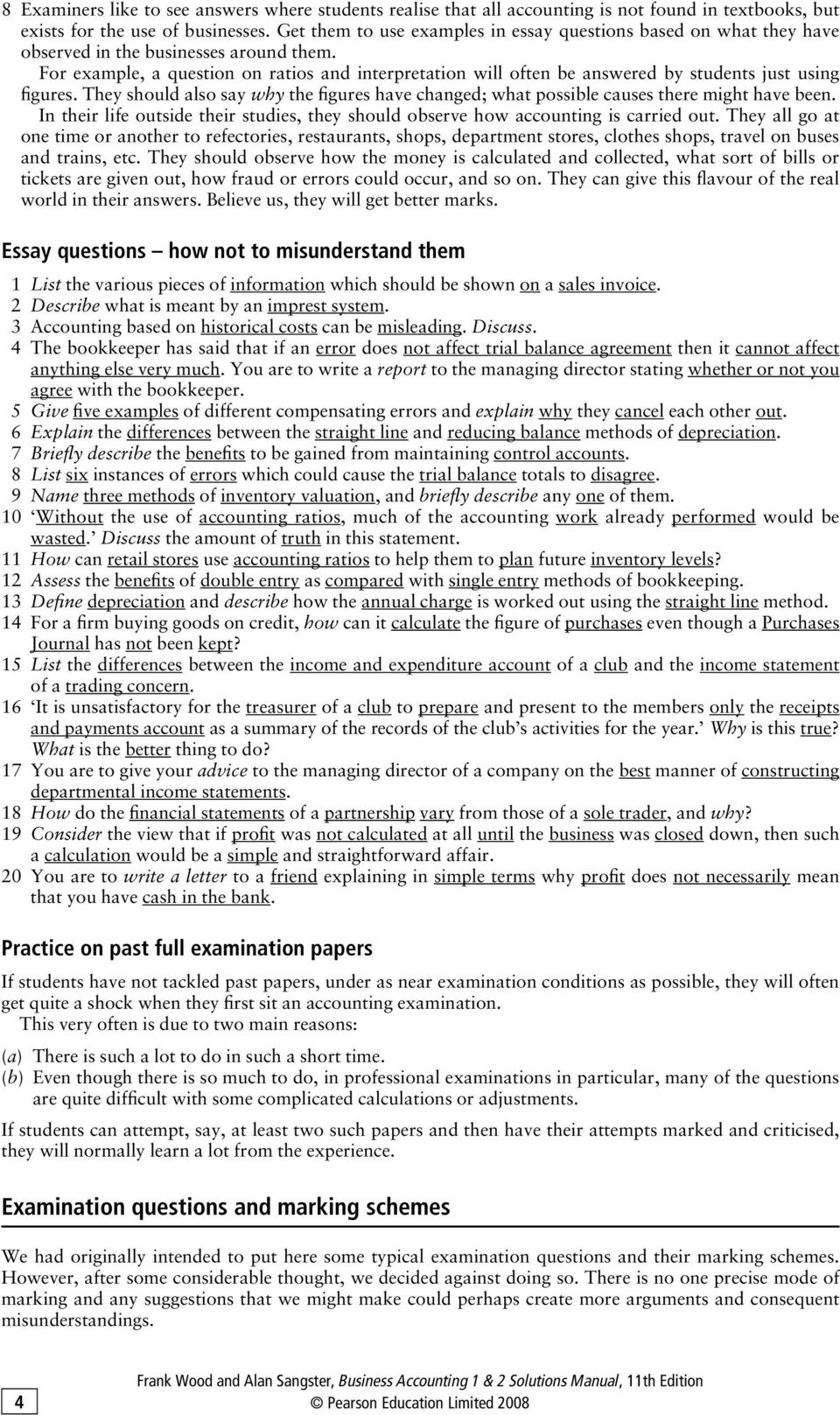
9 In front of a group of people, it would be possible to do this, as we could deal with all the comments from the group and arrive at a consensus of opinion. However, the books sell world-wide and practices can vary. It can, however, be said that: (a) By and large, marking is positive, i.e. marks are awarded for what a student gets right, rather than being deducted for what a student gets wrong. (b) However, marks are deducted for untidy work, lack of headings, dates, sub-totals, etc. (c) An incorrect part of an answer, with no workings attached to it, will get nil marks. (d) Extra, unnecessary answers, resulting from students failing to follow the rubric, will not be marked. (e) Not following the examiner s instructions will lose marks. For example, marks will be lost if, when asked for a report, a student gives a list ; or if asked to discuss, a student gives only one side of the argument; or if asked to define, a student gives an explanation. Some examiners will award zero marks, even though the answers given by the student show good knowledge of the topic. Others (including ourselves) would be kinder than that. (f ) An error which repeats itself through an answer should lose only one set of marks. For instance, an error in the trading account will also affect balances in the profit and loss account, appropriation account and balance sheet. In cases of this type, only one set of marks should be lost. (g) Guessing by students is not normally penalised. The one exception that may arise concerns multiple choice questions where wrong answers may be penalised as an incentive to prevent students guessing. In this case, the examining body would make this information known well in advance of the examination date. (h) The easiest marks to get, especially in an essay question, are the first few marks. (i) Good handwriting and well displayed answers will often (although theoretically they should not) get higher marks than they deserve. This is simply because examiners are human beings with human failings, and work that can be easily marked makes them feel generous. Frank Wood and Alan Sangster Pearson Education Limited
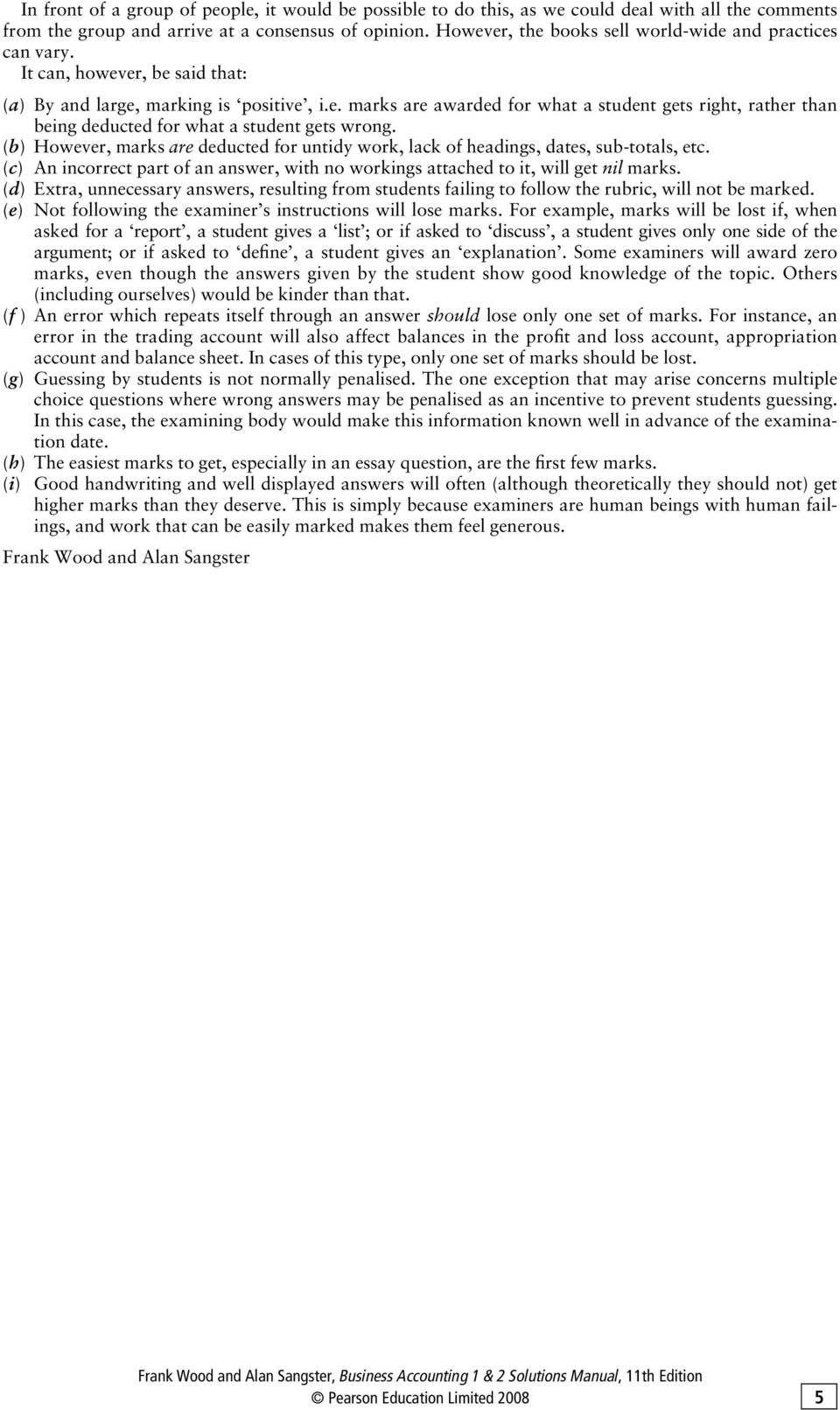
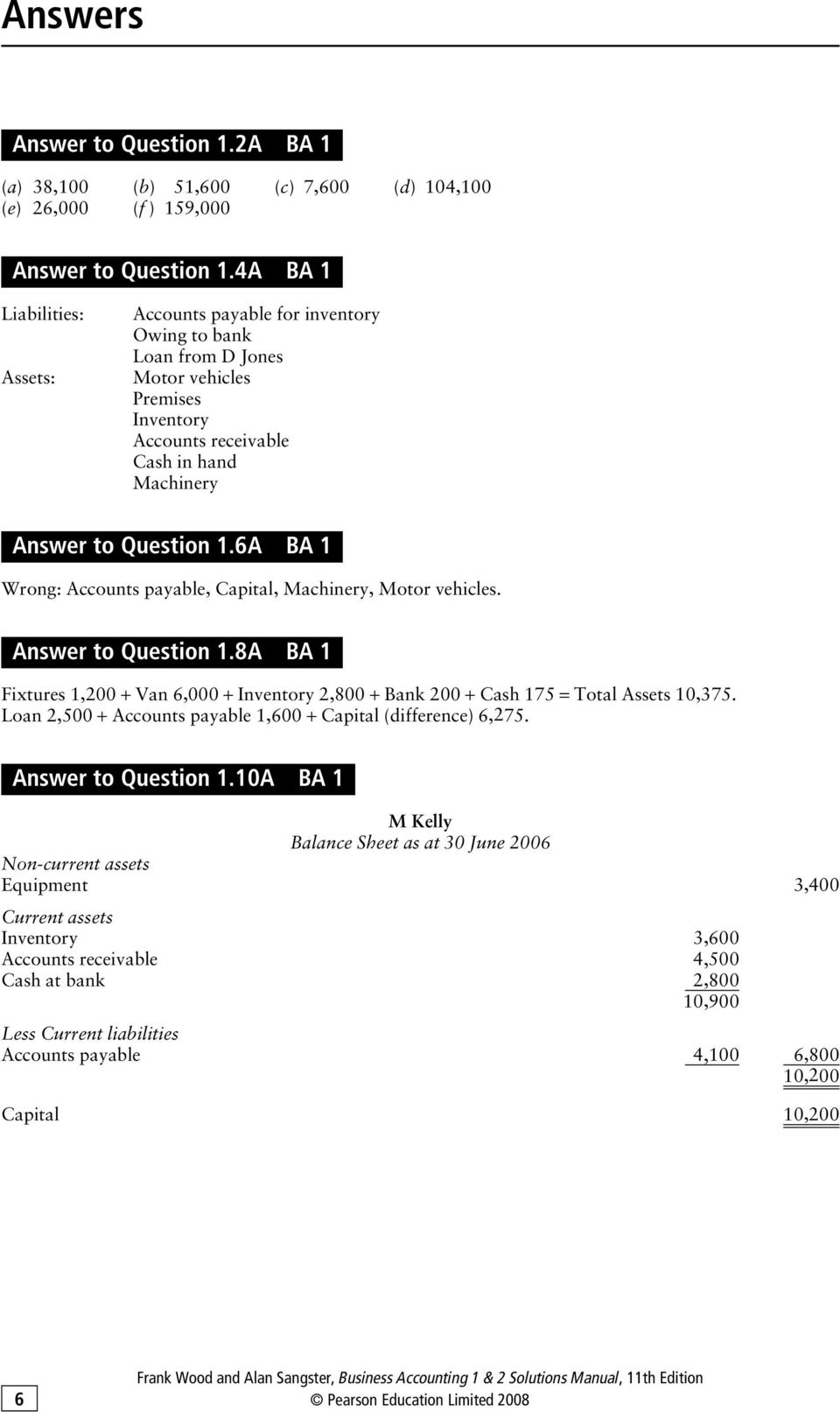
10 Answers Answer to Question 1.2A BA 1 (a) 38,100 (b) 51,600 (c) 7,600 (d) 104,100 (e) 26,000 (f ) 159,000 Answer to Question 1.4A BA 1 Liabilities: Assets: Accounts payable for inventory Owing to bank Loan from D Jones Motor vehicles Premises Inventory Accounts receivable Cash in hand Machinery Answer to Question 1.6A BA 1 Wrong: Accounts payable, Capital, Machinery, Motor vehicles. Answer to Question 1.8A BA 1 Fixtures 1,200 + Van 6,000 + Inventory 2,800 + Bank Cash 175 = Total Assets 10,375. Loan 2,500 + Accounts payable 1,600 + Capital (difference) 6,275. Answer to Question 1.10A BA 1 M Kelly Balance Sheet as at 30 June 2006 Non-current assets Equipment 3,400 Current assets Inventory 3,600 Accounts receivable 4,500 Cash at bank 2,800 10,900 Less Current liabilities Accounts payable 4,100 6,800 10,200 Capital 10,200 6 Pearson Education Limited 2008
11 Answer to Question 1.12A BA 1 Assets Liabilities Capital (a) +Van +Accounts payable (b) Cash Loan from P Smith (c) +Inventory Bank (d) +Cash +Capital (e) +Inventory Accounts receivable (f ) +Inventory +Accounts payable (g) Cash Capital (h) Bank Accounts payable Answer to Question 1.14A BA 1 J Hill Balance Sheet as at 7 December 2009 Non-current assets Equipment 6,310 Car 7,300 Current assets Inventory 8,480 Accounts receivable 3,320 Bank 9,510 Cash ,610 21,795 35,405 Current liabilities Accounts payable 1,760 33,645 Capital 33,645 Answer to Question 2.2A BA 1 Debited Credited Debited Credited (a) Lorry Cash (b) T Lake Bank (c) Loan from P Logan Cash (d) Cash Lorry (e) Office machinery Ultra Ltd (f ) Cash A Hill (g) Bank J Cross (h) Bank Capital (i) Cash Loan from L Lowe (j) D Lord Cash To save time and space, the months are omitted in the Ledger accounts which follow. The day of the month is shown in brackets. Pearson Education Limited

12 Answer to Question 2.5A BA 1 Bank Cash (1) Capital 16,000 (2) Van 6,400 (12) Bank 180 (15) Office fixtures 120 (25) Cash 400 (12) Cash 180 (21) Loan: Berry 500 (25) Bank 400 (19) Carton Cars 7,100 (30) Office fixtures 480 Vans (2) Bank 6,400 Office Fixtures (8) Carton Cars 7,100 (5) Old Ltd 900 (15) Cash 120 Old Ltd (30) Bank 480 (5) Office fixtures 900 Capital Carton Cars (1) Bank 16,000 (19) Bank 7,100 (8) Van 7,100 Loan from Berry (21) Cash 500 Answer to Question 2.6A BA 1 Bank Cash (1) Capital 9,000 (8) Cash 200 (1) Capital 750 (3) Computer 600 (2) Loan Blane 2,000 (15) Loan Blane 500 (8) Bank 200 (24) Loan Blane 250 (17) Clearcount 420 Computer Loan: B Blane (3) Cash 600 (15) Bank 500 (2) Bank 2,000 (24) Cash 250 Display Equipment (5) Clearcount 420 Capital (1) Cash 750 (31) F Jones 200 (1) Bank 9,000 Clearcount Ltd (17) Bank 420 (5) Display eqt 420 F Jones (31) Printer 200 Printer Answer to Question 3.2A BA 1 Debited Credited Debited Credited (a) Purchases T Morgan (b) Returns in J Thomas (c) L Jones Ltd Machinery (d) Purchases Cash (e) Van D Davies Ltd (f ) I Prince Returns out (g) Bank D Picton (h) Purchases Bank (i) B Henry Bank (j) J Mullings Sales 8 Pearson Education Limited 2008

13 Answer to Question 3.4A BA 1 Cash Bank (1) Capital 7,400 (2) Bank 7,000 (2) Cash 7,000 (5) Van 4,920 (19) Sales 54 (7) Purchases 362 (24) F Holmes (29) J Watson 368 (Loan) 1,500 (31) Firelighters Ltd820 Purchases (4) J Watson 410 (7) Cash 362 Sales Returns Outwards (10) L Less 218 (12) J Watson 42 (19) Cash 54 J Watson Fixtures (12) Returns 42 (4) Purchases 410 (22) Firelighters (29) Bank 368 Ltd 820 L Less Van (10) Sales 218 (5) Bank 4,920 F Holmes (Loan) (24) Bank 1,500 Firelighters Ltd (31) Bank 820 (22) Fixtures 820 Capital (1) Cash 7,400 Answer to Question 3.6A BA 1 Bank Purchases (1) Capital 18,000 (21) Printer 620 (2) B Hind 1,455 (18) Cash 250 (29) B Hind 1,373 (3) G Smart 472 (8) G Smart 370 Cash (5) Sales 210 (18) Bank 250 Sales (12) Sales 305 (5) Cash 210 (10) P Syme 483 B Hind (12) Cash 305 (6) Returns Out 82 (2) Purchases 1,455 (22) H Buchan 394 (29) Bank 1,373 G Smart Returns Inwards (28) Returns Out 47 (3) Purchases 472 (23) P Syme 160 (8) Purchases 370 (25) H Buchan 18 P Syme Returns Outwards (10) Sales 483 (23) Returns In 160 (6) B Hind 82 (28) G Smart 47 H Buchan (22) Sales 394 (25) Returns In 18 A Cobb Machinery (31) Machinery 419 (31) A Cobb 419 Capital Printer (1) Bank 18,000 (21) Bank 620 Pearson Education Limited

14 Answer to Question 4.3A BA 1 July Dr Cr 1 Bank 5,000 Cash 1,000 Capital 6,000 2 Stationery 75 Bank 75 3 Purchases 2,100 T Smart 2,100 4 Cash 340 Sales Insurance 290 Cash Computer 700 J Hott Expenses 32 Bank C Biggins 630 Sales T Smart 55 Returns Out Wages 210 Cash Rent 225 Bank Bank 400 C Biggins J Hott 700 Bank Stationery 125 News Ltd F Tank 645 Sales News Ltd 125 Bank Pearson Education Limited 2008

15 Answer to Question 4.4A BA 1 Bank Purchases (1) Capital 11,000 (5) Stationery 62 (2) J Biggs 830 (24) K Fletcher 250 (16) Business rates 970 (2) D Martin 610 (28) Business rates 45 (19) Rent 75 (2) P Lot 590 (28) J Biggs 830 (3) Cash 370 (28) D Martin 415 (28) B Black 6,100 Sales (6) D Twigg 370 Cash (6) B Hogan 290 (1) Capital 1,600 (3) Purchases 370 (6) K Fletcher 410 (4) Rent 75 (15) T Lee 205 (7) Wages 160 (15) F Sharp 280 (11) Rent 75 (15) G Rae 426 (18) Insurance 280 (21) Motor exps 24 Returns Outwards (23) Wages 170 (10) D Martin 195 Capital Returns Inwards (1) Bank 11,000 (13) B Hogan 35 (1) Cash 1,600 B Black Rent (28) Bank 6,100 (20) Van 6,100 (4) Cash 75 (11) Cash 75 J Biggs (19) Bank 75 (28) Bank 830 (2) Purchases 830 Wages D Martin (7) Cash 160 (10) Returns Out 195 (2) Purchases 610 (23) Cash 170 (28) Bank 415 Stationery P Lot (5) Bank 62 (2) Purchases 590 Business rates D Twigg (16) Bank 970 (28) Bank 45 (6) Sales 370 Insurance B Hogan (18) Cash 280 (6) Sales 290 (13) Returns In 35 Motor Expenses K Fletcher (21) Cash 24 (6) Sales 410 (24) Bank 250 Van T Lee (20) B Black 6,100 (15) Sales 205 F Sharp (15) Sales 280 G Rae (15) Sales 426 Pearson Education Limited

16 Answer to Question 4.6A BA 1 (A) Goods bought on credit 27,000. (B) Borrowed 35,000 and immediately spent it on land and buildings 35,000. (C) Sold goods costing 20,000 for 30,000 on credit. (D) Debtors paid 13,000. (E) Debtors paid 2,000: this amount taken by proprietors. (F) Took 5,000 drawings by cheque and paid off 3,000 accrued expenses by cheque. (G) Equipment costing 30,000 sold for 21,000; paid by cheque. (H) Goods taken for own use 1,000. (I) Took 6,000 cash as drawings. Could have been 6,000 cash stolen thus reducing cash and causing a loss. Answer to Question 5.6A BA 1 G Wood (1) Sales 310 (19) Bank 310 (21) Sales 90 (31) Balance c/d (1) Balance b/d 90 K Hughes (1) Sales 42 (31) Balance c/d 633 (8) Sales 161 (21) Sales (1) Balance b/d 633 F Dunn (1) Sales 1,100 (10) Returns 31 (8) Sales 224 (19) Bank 750 (31) Balance c/d 543 1,324 1,324 (1) Balance b/d 543 M Lyons (1) Sales 309 (10) Returns 82 (12) Cash T Sim (15) Returns 15 (2) Purchases 190 (28) Bank J Leech (31) Balance c/d 278 (2) Purchases 63 (9) Purchases (1) Balance b/d 278 P Tidy (28) Bank 180 (2) Purchases 210 (31) Balance c/d (31) Balance b/d 30 F Rock (15) Returns 21 (2) Purchases 190 (28) Bank 100 (9) Purchases 164 (31) Returns 18 (31) Balance c/d (1) Balance b/d 215 Wood, Hughes and Dunn are debtors. Leech, Tidy and Rock are creditors. 12 Pearson Education Limited 2008

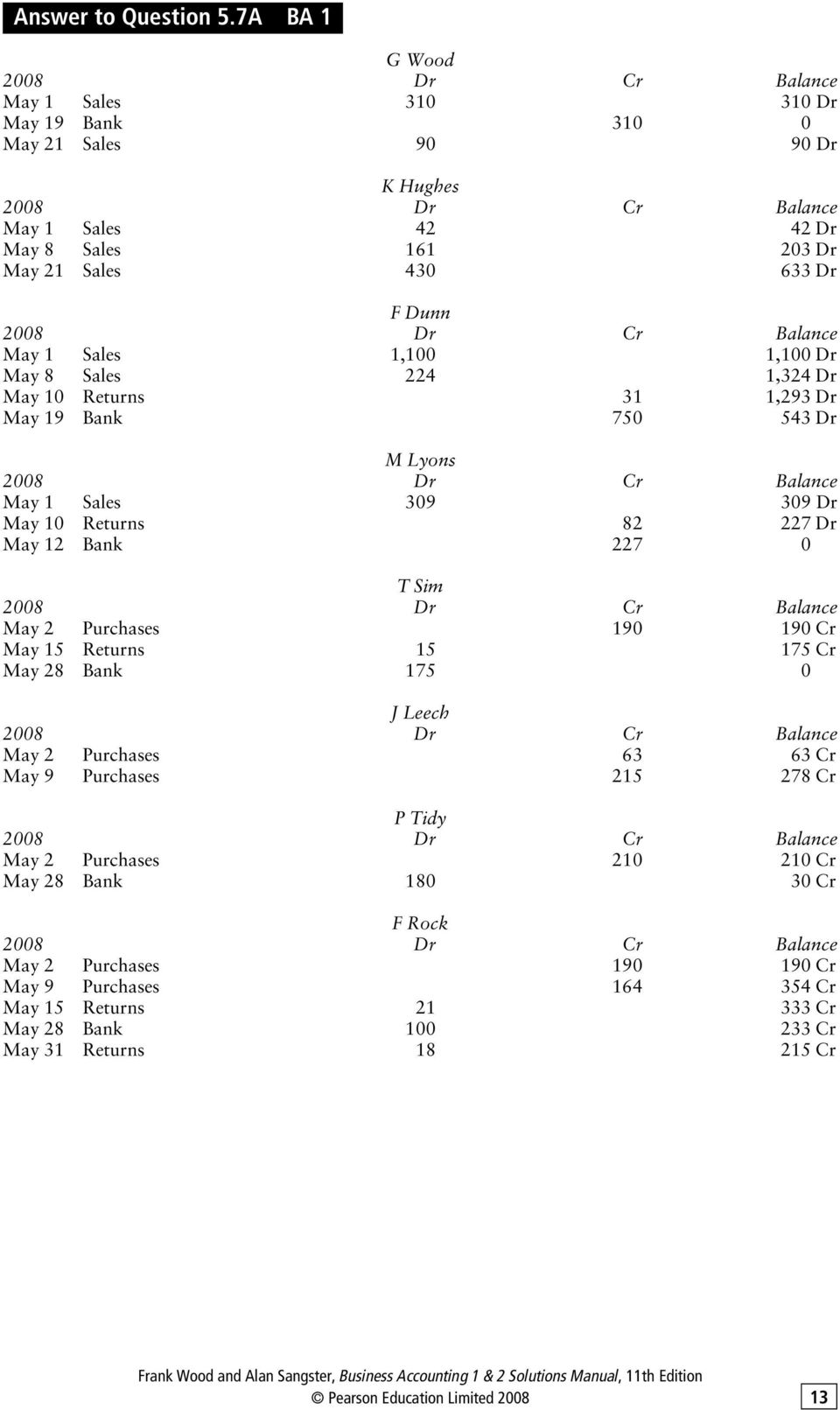
17 Answer to Question 5.7A BA 1 G Wood 2008 Dr Cr Balance May 1 Sales Dr May 19 Bank May 21 Sales Dr K Hughes 2008 Dr Cr Balance May 1 Sales Dr May 8 Sales Dr May 21 Sales Dr F Dunn 2008 Dr Cr Balance May 1 Sales 1,100 1,100 Dr May 8 Sales 224 1,324 Dr May 10 Returns 31 1,293 Dr May 19 Bank Dr M Lyons 2008 Dr Cr Balance May 1 Sales Dr May 10 Returns Dr May 12 Bank T Sim 2008 Dr Cr Balance May 2 Purchases Cr May 15 Returns Cr May 28 Bank J Leech 2008 Dr Cr Balance May 2 Purchases Cr May 9 Purchases Cr P Tidy 2008 Dr Cr Balance May 2 Purchases Cr May 28 Bank Cr F Rock 2008 Dr Cr Balance May 2 Purchases Cr May 9 Purchases Cr May 15 Returns Cr May 28 Bank Cr May 31 Returns Cr Pearson Education Limited
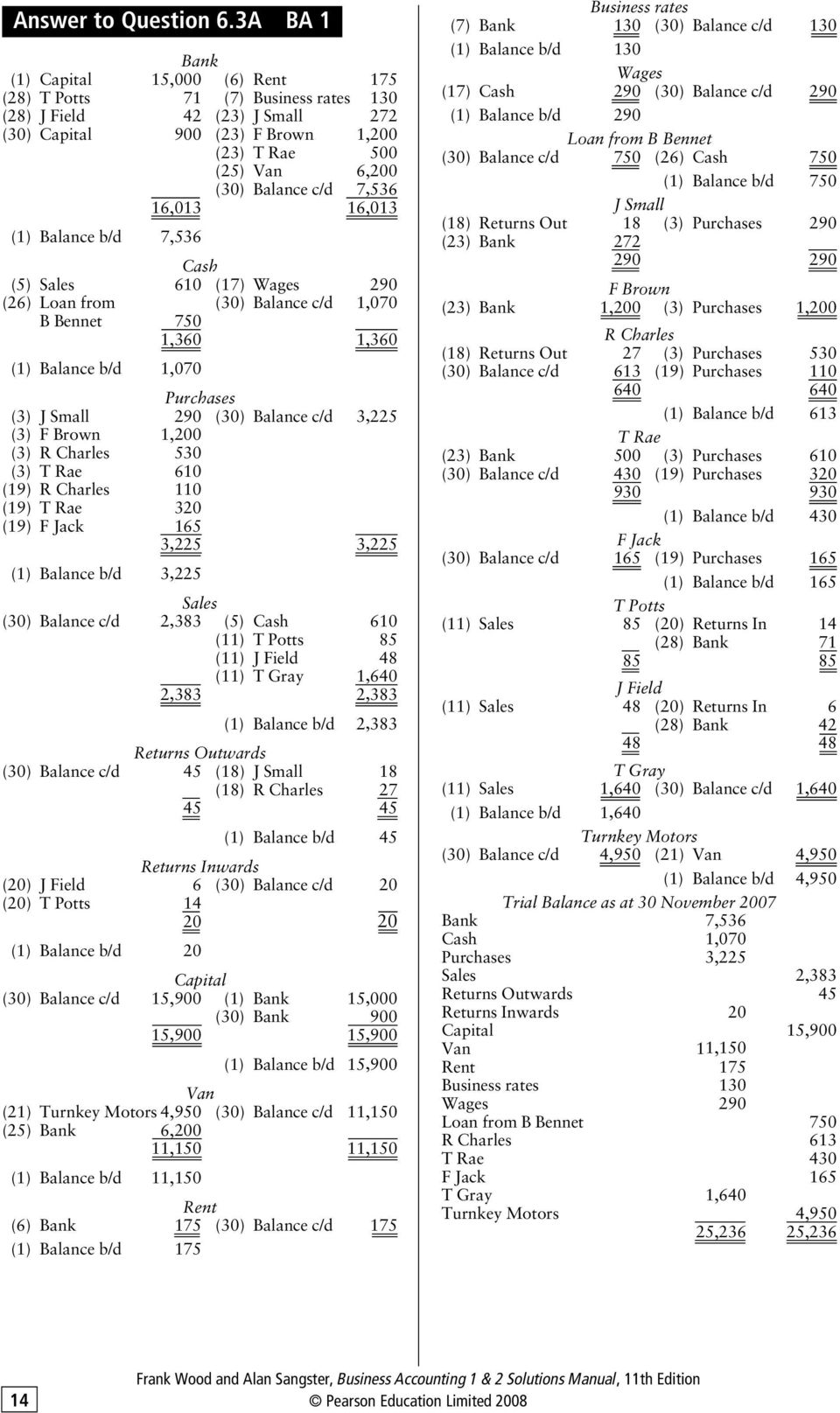
18 Answer to Question 6.3A BA 1 Bank (1) Capital 15,000 (6) Rent 175 (28) T Potts 71 (7) Business rates 130 (28) J Field 42 (23) J Small 272 (30) Capital 900 (23) F Brown 1,200 (23) T Rae 500 (25) Van 6,200 (30) Balance c/d 7,536 16,013 16,013 (1) Balance b/d 7,536 Cash (5) Sales 610 (17) Wages 290 (26) Loan from (30) Balance c/d 1,070 B Bennet 750 1,360 1,360 (1) Balance b/d 1,070 Purchases (3) J Small 290 (30) Balance c/d 3,225 (3) F Brown 1,200 (3) R Charles 530 (3) T Rae 610 (19) R Charles 110 (19) T Rae 320 (19) F Jack 165 3,225 3,225 (1) Balance b/d 3,225 Sales (30) Balance c/d 2,383 (5) Cash 610 (11) T Potts 85 (11) J Field 48 (11) T Gray 1,640 2,383 2,383 (1) Balance b/d 2,383 Returns Outwards (30) Balance c/d 45 (18) J Small 18 (18) R Charles (1) Balance b/d 45 Returns Inwards (20) J Field 6 (30) Balance c/d 20 (20) T Potts (1) Balance b/d 20 Capital (30) Balance c/d 15,900 (1) Bank 15,000 (30) Bank ,900 15,900 (1) Balance b/d 15,900 Van (21) Turnkey Motors 4,950 (30) Balance c/d 11,150 (25) Bank 6,200 11,150 11,150 (1) Balance b/d 11,150 Rent (6) Bank 175 (30) Balance c/d 175 (1) Balance b/d 175 Business rates (7) Bank 130 (30) Balance c/d 130 (1) Balance b/d 130 Wages (17) Cash 290 (30) Balance c/d 290 (1) Balance b/d 290 Loan from B Bennet (30) Balance c/d 750 (26) Cash 750 (1) Balance b/d 750 J Small (18) Returns Out 18 (3) Purchases 290 (23) Bank F Brown (23) Bank 1,200 (3) Purchases 1,200 R Charles (18) Returns Out 27 (3) Purchases 530 (30) Balance c/d 613 (19) Purchases (1) Balance b/d 613 T Rae (23) Bank 500 (3) Purchases 610 (30) Balance c/d 430 (19) Purchases (1) Balance b/d 430 F Jack (30) Balance c/d 165 (19) Purchases 165 (1) Balance b/d 165 T Potts (11) Sales 85 (20) Returns In 14 (28) Bank J Field (11) Sales 48 (20) Returns In 6 (28) Bank T Gray (11) Sales 1,640 (30) Balance c/d 1,640 (1) Balance b/d 1,640 Turnkey Motors (30) Balance c/d 4,950 (21) Van 4,950 (1) Balance b/d 4,950 Trial Balance as at 30 November 2007 Bank 7,536 Cash 1,070 Purchases 3,225 Sales 2,383 Returns Outwards 45 Returns Inwards 20 Capital 15,900 Van 11,150 Rent 175 Business rates 130 Wages 290 Loan from B Bennet 750 R Charles 613 T Rae 430 F Jack 165 T Gray 1,640 Turnkey Motors 4,950 25,236 25, Pearson Education Limited 2008
19 Answer to Question 6.4A BA 1 Cash (1) Capitals 10,500 (2) Bank 9,000 (21) Sales 145 (3) Purchases 550 (30) Loan: B Barclay 500 (11) Salaries 790 (30) A Tom 614 (30) Balance c/d 1,419 11,759 11,759 (1) Balance b/d 1,419 Bank (2) Cash 9,000 (8) Rent 220 (16) Loan: B Barclay2,000 (15) Van 6,500 (29) R Pleat 158 (26) F Hood 900 (29) L Fish 370 (26) M Smith 118 (30) Balance c/d 3,790 11,528 11,528 (1) Balance b/d 3,790 Purchases (3) Cash 550 (30) Balance c/d 2,950 (4) T Dry 800 (4) F Hood 930 (4) M Smith 160 (4) G Low 510 2,950 2,950 (1) Balance b/d 2,950 Sales (30) Balance c/d 1,783 (6) R Tong 170 (6) L Fish 240 (6) M Singh 326 (6) A Tom 204 (21) Cash 145 (24) L Fish 130 (24) A Tom 410 (24) R Pleat 158 1,783 1,783 (1) Balance b/d 1,783 Returns Outwards (30) Balance c/d 72 (14) F Hood 30 (14) M Smith (1) Balance b/d 72 Returns Inwards (18) R Tong 5 (30) Balance c/d 25 (18) M Singh (1) Balance b/d 25 Capital (30) Balance b/d 10,500 (1) Cash 10,500 (1) Balance b/d 10,500 T Dry (30) Balance c/d 800 (4) Purchases 800 (1) Balance b/d 800 M Smith (14) Returns Out 42 (4) Purchases 160 (26) Bank G Low (30) Balance c/d 510 (4) Purchases 510 (1) Balance b/d 510 Buttons Ltd (30) Balance c/d 89 (5) Stationery 89 (1) Balance b/d 89 Stationery (5) Buttons Ltd 89 (30) Balance c/d 89 (1) Balance b/d 89 Rent (8) Bank 220 (30) Balance c/d 220 (1) Balance b/d 220 Salaries (11) Cash 790 (30) Balance c/d 790 (1) Balance b/d 790 Fixtures (10) Chiefs Ltd 610 (30) Balance c/d 610 (1) Balance b/d 610 Van (15) Bank 6,500 (30) Balance c/d 6,500 (1) Balance b/d 6,500 Loan from B Barclay (30) Balance c/d 2,500 (16) Bank 2,000 (30) Cash 500 2,500 2,500 (1) Balance b/d 2,500 Chiefs Ltd (30) Balance c/d 610 (10) Fixtures 610 (1) Balance b/d 610 L Fish (6) Sales 240 (29) Bank 370 (24) Sales M Singh (6) Sales 326 (18) Returns In 20 (30) Balance c/d (1) Balance b/d 306 A Tom (6) Sales 204 (30) Cash 614 (24) Sales R Pleat (24) Sales 158 (29) Bank 158 R Tong (6) Sales 170 (18) Returns In 5 (30) Balance c/d (1) Balance b/d 170 F Hood (14) Returns Out 30 (4) Purchases 930 (26) Bank Trial Balance as at 31 January 2008 Cash 1,419 Bank 3,790 Purchases 2,950 Sales 1,783 Returns Outwards 72 Returns Inwards 25 Capital 10,500 Stationery 89 Rent 220 Salaries 790 Fixtures 610 Van 6,500 Loan from B Barclay 2,500 Chiefs Ltd 610 M Singh 306 R Tong 165 T Dry 800 G Low 510 Buttons Ltd 89 16,864 16,864 Pearson Education Limited

20 Answer to Question 7.3A BA 1 B Morse Income Statement for the year ending 31 December 2008 Sales 235,812 Less Cost of goods sold: Purchases 121,040 Less Closing inventory 14, ,554 Gross profit 129,258 Less Expenses: Salaries 39,560 Business rates 2,400 Motor expenses 910 General expenses 305 Insurance 1,240 44,415 Net profit 84,843 Answer to Question 7.4A BA 1 G Graham Income Statement for the year ending 30 June 2008 Sales 382,420 Less Cost of goods sold: Purchases 245,950 Less Closing inventory 29, ,646 Gross profit 165,774 Less Expenses: Salaries and wages 48,580 Equipment rental 940 Insurance 1,804 Lighting and heating 1,990 Motor expenses 2,350 Sundry expenses ,288 Net profit 109,486 Answer to Question 8.3A BA 1 B Morse Balance Sheet as at 31 December 2008 Non-current assets Premises 53,000 Car 4,300 57,300 Current assets Inventory 14,486 Accounts receivable 21,080 Bank 2,715 Cash ,606 Total assets 95,906 Less Current liabilities Accounts payable 11,200 84,706 Capital Balance at ,263 Add Net profit 84, ,106 Less Drawings 23,400 84, Pearson Education Limited 2008

21 Answer to Question 8.4A BA 1 G Graham Balance Sheet as at 30 June 2008 Non-current assets Shop 174,000 Fixtures 4,600 Lorry 19, ,000 Current assets Inventory 29,304 Accounts receivable 44,516 Bank 11,346 85, ,166 Current liabilities Accounts payable 23, ,758 Capital Balance at ,272 Add Net profit 109, ,758 Less Drawings 44, ,758 Answer to Question 8.6A BA 1 Capital at 1 January 2009 = 18, , , ,600 8,000 6,000 = 49,160 Capital at 31 December 2009 = 16, , , , ,000 11,000 2,000 = 57,840 Increase in capital = 8,680 Add Drawings (200 52) 10,400 19,080 Less Capital introduced 4,000 Net profit 15,080 A Trader Balance Sheet as at 31 December 2009 Non-current assets Fixtures 16,200 Motor vehicle 16,000 32,200 Current assets Inventory 28,000 Accounts receivable 5,800 Bank 4,600 Cash ,640 70,840 Current liabilities: Accounts payable 11,000 Non-current liabilities: Loan 2,000 13,000 57,840 Capital account Balance at 1 January ,160 Add Capital introduced 4,000 Net profit 15,080 68,240 Less Drawings 10,400 57,840 Pearson Education Limited
22 Answer to Question 9.2A BA 1 P Frank Trading Account part of the Income Statement for the year ending 31 March 2008 Sales 469,320 Less Returns in 16, ,100 Less Cost of goods sold: Purchases 394,170 Less Returns out 19, ,690 Carriage inwards 2, ,180 Less Closing inventory 52, ,780 Gross profit 128,320 Answer to Question 9.5A BA 1 T Owen Income Statement for the year ending 31 March 2009 Sales 276,400 Less Cost of goods sold: Opening inventory 52,800 Add Purchases 141,300 Less Returns out 2, ,892 Carriage inwards 1, ,042 Less Closing inventory 58, ,602 Gross profit 141,798 Less Expenses: Wages and salaries 63,400 Carriage outwards 5,840 Business rates 3,800 Communication expenses 714 Commissions paid 1,930 Insurance 1,830 Sundry expenses ,722 Net profit 64,076 Balance Sheet as at 31 March 2009 Non-current assets Buildings 125,000 Fixtures 1, ,106 Current assets Inventory 58,440 Accounts receivable 45,900 Bank 31,420 Cash , ,142 Current liabilities Accounts payable 24, ,272 Capital Balance at ,516 Add Net profit 64, ,592 Less Drawings 37, , Pearson Education Limited 2008
23 Answer to Question 9.6A BA 1 F Brown Income Statement for the year ending 30 September 2008 Sales 391,400 Less Returns in 2, ,290 Less Cost of goods sold: Opening inventory 72,410 Add Purchases 254,810 Less Returns out 1, ,570 Carriage inwards ,740 Less Closing inventory 89, ,336 Gross profit 151,954 Less Expenses: Wages and salaries 39,600 Carriage out 2,850 Motor expenses 1,490 Rent and rates 8,200 Telephone charges 680 Insurance 745 Office expenses 392 Sundry expenses ,173 97,781 Balance Sheet as at 30 September 2008 Non-current assets Van 5,650 Office equipment 7,470 13,120 Current assets Inventory 89,404 Accounts receivable 38,100 Bank 4,420 Cash , ,156 Current liabilities Accounts payable 26, ,856 Capital Balance as at ,675 Add Net profit 97, ,456 Less Drawings 28, ,856 Answer to Question 9.8A BA 1 Inventory July 1 Balance b/d 5,000 Capital July 1 Balance b/d 9,700 OK Ltd July Bank 3,000 July 1 Balance b/d 500 July 31 Balance c/d 1,400 Purchases 3,900 4,400 4,400 Aug 1 Balance b/d 1,400 Pearson Education Limited
24 AB Ltd July 1 Balance b/d 300 July Bank 300 Sales 600 July 31 Balance c/d Aug 1 Balance b/d 600 Equipment July 1 Balance b/d 3,700 July 31 Balance c/d 3,700 Aug 1 Balance b/d 3,700 Bank July 1 Balance b/d 1,200 July OK Ltd 3,000 Sales 3,200 General expenses 500 AB Ltd 300 July 31 Balance c/d 1,200 4,700 4,700 Aug 1 Balance b/d 1,200 Sales July 31 Balance c/d 3,800 July Bank 3,200 AB Ltd 600 3,800 3,800 Aug 1 Balance b/d 3,800 Purchases July OK Ltd 3,900 July 31 Balance c/d 3,900 Aug 1 Balance b/d 3,900 General Expenses July Bank 500 July 31 Balance c/d 500 Aug 1 Balance b/d 500 Ms Porter Trial Balance as at 31 July Dr Cr Equipment 3,700 Inventory 5,000 Bank 1,200 General expenses 500 Purchases 3,900 AB Ltd 600 OK Ltd 1,400 Sales 3,800 Capital 9,700 14,900 14,900 Ms Porter Income Statement for July Sales 3,800 Less Cost of goods sold: Opening inventory 5,000 Purchases 3,900 8,900 Less Closing inventory 6,200 2,700 Gross profit 1,100 Less General expenses 500 Net profit Pearson Education Limited 2008
25 Balance Sheet as at 31 July Non-current assets Equipment 3,700 Current assets Inventory 6,200 Accounts receivable 600 Bank 1,200 8,000 11,700 Current liability: Accounts payable 1,400 10,300 Capital 9,700 Add Net profit ,300 Answer to Question 13.2A BA 1 Cash Book Cash Bank Cash Bank (1) Balances b/d 295 4,240 (3) Bank 200 (2) Sales 310 (5) Postage 80 (3) Cash 200 (6) Office equipment 310 (4) F Bell 194 (7) L Root 94 (9) Business rates 115 (11) Cash 150 (11) Bank 150 (12) Wages 400 (13) Sales 430 (14) Motor expenses 81 (16) J Bull (Loan) 1,500 (28) General expenses 35 (20) K Brown 174 (30) Insurance 320 (30) Balances c/d 1,970 3,968 2,685 4,923 2,685 4,923 Answer to Question 13.4A BA 1 Cash Book Disct Cash Bank Disct Cash Bank (1) Balances b/d 420 4,940 (5) Rent 340 (2) S Braga (6) M Peters (2) L Pine (6) G Graham (2) G Hodd (6) F Bell (2) M Rae (8) Cash 400 (3) Sales 740 (14) Wages 540 (8) Bank 400 (16) R Todd (10) Sales 1,260 (16) F Dury (12) B Age (20) Fixtures 4,320 (29) A Line 324 (24) Lorry 14,300 (30) Sales 980 (30) Stationery 56 (30) Balance c/d 12,623 (30) Balance c/d 2, ,060 21, ,060 21,392 Discounts Allowed (30) Total for month 135 Discounts Received (30) Total for month 70 Pearson Education Limited
26 Answer to Question 13.6A BA 1 Cash Book Disct Cash Bank Disct Cash Bank Balance b/d Cash 100 AB GH CD IJ 70 1,330 EF Wages 130 Bank 100 Balance c/d 125 Balance c/d , ,985 Balance b/d 50 Balance b/d 125 AB Balance b/d 200 Bank 192 Discount received CD Balance b/d 500 Bank 480 Discount received EF Balance b/d 300 Bank 288 Discount received GH Bank 555 Balance b/d 600 Discount allowed IJ Bank 1,330 Balance b/d 1,400 Discount received 70 1,400 1, Pearson Education Limited 2008
27 Answer to Question 14.2A BA 1 Sales Day Book Sales Ledger (1) I Hood 520 I Hood (3) S Bell 318 (1) Sales 520 (5) J Smart 64 (7) K Byers 165 S Bell (16) T Todd 540 (3) Sales 318 (23) W Morris 360 (30) F Lock 2,040 J Smart 4,007 (5) Sales 64 General Ledger K Byers Sales (7) Sales 165 (31) Total for month 4,007 T Todd (16) Sales 540 W Morris (23) Sales 360 F Lock (30) Sales 2,040 Answer to Question 14.4A BA 1 (a) Invoice summaries: (b) Sales Journal A Portsmouth (1) A Portsmouth metres plastic 1 22 (5) B Butler sheets foam 3 18 (11) A Gate boxes vinyl 5 20 (21) L Mackeson (30) M Alison 120 Less Trade discount 25% Sales Ledger B Butler A Portsmouth 50 lengths polythene (1) Sales 45 8 boxes vinyl sheets foam 3 60 B Butler 200 (5) Sales 160 Less Trade discount 20% A Gate A Gate (11) Sales metres plastic lengths polythene 2 66 L Mackeson 30 sheets foam 3 90 (21) Sales Less Trade discount 25% 40 M Alison 120 (30) Sales 120 L Mackeson 29 metres plastic 1 29 (c) General Ledger Sales M Alison (30) Total for 32 metres plastic 1 32 month lengths polythene boxes vinyl Less Trade discount 33 1 /3% Pearson Education Limited
28 Answer to Question 15.2A BA 1 Workings: Invoices F Day F Hope 2 sets golf 800 1,600 6 sets golf sets golf 900 3,600 1,800 4,140 Less Trade discount 25% 450 Less Trade discount 33 1 /3% 1,380 1,350 2,760 G Smith L Todd 6 cricket cricket ice Less Trade discount 25% 65 4 rugby Less Trade discount 20% 138 M Moore goal Less Trade discount 40% 256 (a) Purchases Day Book 384 (2) F Day 1,350 (11) G Smith 552 (18) F Hope 2,760 (25) L Todd 195 (30) M Moore 384 5,241 (b) Purchases Ledger F Day (2) Purchases 1,350 (c) General Ledger Purchases (30) Total for month 5,241 G Smith (11) Purchases 552 F Hope (18) Purchases 2,760 L Todd (25) Purchases 195 M Moore (30) Purchases Pearson Education Limited 2008
29 Answer to Question 15.4A BA 1 (a) Purchases Day Book Sales Day Book (9) C Clarke 240 (1) M Marshall 45 (16) A Charles 160 (7) R Richards 200 (31) M Nelson 50 (23) T Young (b) Purchases Ledger Sales Ledger C Clarke M Marshall (9) Purchases 240 (1) Sales 45 (c) General Ledger Purchases Account (31) Total for month 450 A Charles R Richards (16) Purchases 160 (7) Sales 200 M Nelson T Young (31) Purchases 50 (23) Sales 160 Sales Account (31) Total for month 405 Answer to Question 16.2A BA 1 Sales Day Book Sales Ledger (1) B Dock 240 B Dock (1) M Ryan 126 (1) Sales 240 (10) Returns 19 (1) G Soul 94 (1) F Trip 107 M Ryan (6) P Coates 182 (1) Sales 126 (6) L Job 203 (6) T Man 99 G Soul (20) B Uphill 1,790 (1) Sales 94 (30) T Kane 302 (6) Sales 99 3,143 F Trip Returns Inwards Day Book (1) Sales 107 (10) Returns 32 (10) B Dock 19 (10) F Trip 32 P Coates (24) L Job 16 (6) Sales L Job General Ledger (6) Sales 203 (24) Returns 16 Sales (30) Total for B Uphill the month 3,143 (20) Sales 1,790 Returns Inwards T Kane (30) Total for (30) Sales 302 the month 67 Pearson Education Limited
30 Answer to Question 16.4A BA 1 Sales Day Book Purchases Day Book (3) E Rigby 510 (1) K Hill 380 (3) E Phillips 246 (1) M Norman 500 (3) F Thompson 356 (1) N Senior 106 (8) A Green 307 (5) R Morton 200 (8) H George 250 (5) J Cook 180 (8) J Ferguson 185 (5) D Edwards 410 (20) E Phillips 188 (5) C Davies 66 (20) F Powell 310 (24) C Ferguson 550 (20) E Lee 420 (24) K Ennevor 900 2,772 3,292 Returns Inwards Day Book Returns Outwards Day Book (14) E Phillips 18 (12) M Norman 30 (14) F Thompson 22 (12) N Senior 16 (31) E Phillips 27 (31) J Cook 13 (31) E Rigby 30 (31) C Davies Sales Ledger Purchases Ledger E Rigby K Hill (3) Sales 510 (31) Returns In 30 (1) Purchases 380 E Phillips M Norman (3) Sales 246 (14) Returns In 18 (12) Returns Out 30 (1) Purchases 500 (20) Sales 188 (31) Returns In 27 N Senior F Thompson (12) Returns Out 16 (1) Purchases 106 (3) Sales 356 (14) Returns In 22 R Morton A Green (5) Purchases 200 (8) Sales 307 J Cook H George (31) Returns Out 13 (5) Purchases 180 (8) Sales 250 D Edwards J Ferguson (5) Purchases 410 (8) Sales 185 C Davies F Powell (31) Returns Out 11 (5) Purchases 66 (20) Sales 310 C Ferguson E Lee (24) Purchases 550 (20) Sales 420 K Ennevor (24) Purchases 900 General Ledger Sales Returns Inwards (31) Sales Day (31) Returns In Book 2,772 Day Book 97 Purchases Returns Outwards (31) Purchases (31) Returns Out Day Book 3,292 Day Book Pearson Education Limited 2008
31 Answer to Question 17.2A BA 1 Fixtures Dr 1,153 : Bell and Co Cr 1,153 Drawings Dr 340 : Purchases Cr 340 Purchases Dr 68 : Drawings Cr 68 Computer equipment Dr 640 : H Cowes Cr 640 Bell and Co Dr 42 : Fixtures Cr 42 Bad debts Dr 124 : P Lees Cr 124 Office equipment Dr 1,710 : Furniture Today Ltd Cr 1,710 Answer to Question 18.3A BA 1 Petty Cash Book Receipts Total Office Motor Cleaning Casual Exps Exps Labour 600 (1) Balance b/d (1) F Black (2) Letterheadings (2) Abel Motors (3) Cleaning materials 4 4 (6) Envelopes (8) Petrol (11) P Lyon (12) T Upton 8 8 (12) Paper clips 3 3 (14) Petrol (16) Adhesive tape 2 2 (16) Petrol (21) Motor tax (22) F Luck (23) T Upton (24) J Lamb (25) Copy paper 8 8 (26) Lively Cars (29) Petrol (30) F Tred (30) Cash (30) Balance c/d 600 1,127 1,127 (a) Answer to Question 19.2A BA 1 A Duff Middle Road Paisley INVOICE number 1876 VAT Registration No To: R Wilson Date: 1 March Peter Street Your Order No. 943 Loughborough 20,000 Coils Sealing 6.10 per 1,000 = ,000 Sheets Bank 4.60 per 1,000 = ,000 Sheets Bank 8.20 per 1,000 = Add VAT 10% Pearson Education Limited
32 (b) Books of R Wilson: A Duff 2006 Mar 1 Purchases Books of A Duff: R Wilson 2006 Mar 1 Sales Answer to Question 19.5A BA 1 Sales Day Book Net VAT Gross (1) H Impey Ltd (4) B Volts (14) L Marion (28) B Volts , ,100 Purchases Day Book Net VAT Gross (5) G Sharpe and Co (8) R Hood and Associates (18) F Tuckley Ltd (30) R Hood and Associates Sales Ledger H Impey Ltd (1) Sales 198 B Volts (4) Sales 451 (28) Sales 242 L Marion (14) Sales 209 Purchases (31) Credit purchases for month 720 Purchases Ledger G Sharpe and Co (5) Purchases 99 R Hood and Associates (8) Purchases 165 (30) Purchases 385 F Tuckley Ltd (18) Purchases 143 General Ledger Sales (31) Credit sales per month 1,000 Value Added Tax (31) VAT content purchases 72 (31) VAT content sales 100 (31) Balance c/d Pearson Education Limited 2008
33 Answer to Question 19.7A BA 1 (a) Sales Day Book 2007 Invoice No Net VAT Gross May 25 Laira Brand , , Brown Bros , , Penfold s T Tyrrell Laira Brand , , , , (b) Personal accounts in Sales Ledger: debit gross amounts Sales account in General Ledger: credit net total for period VAT account in General Ledger: credit total of VAT column for period (c) Laira Brand May 1 Balance b/d 2, May 21 Bank 2, Sales Returns In Sales 1, Balance c/d 2, Sales 1, , , Answer to Question 20.4A BA 1 G Graham Purchases Analysis Book Total Purchases Light & Motor Stationery Carriage Heat Exps Inwards 2008 June 1 J Syme T Hill F Love Topp Garages BT Gilly Shop G Farmer B&T Ltd T Player Overnight Couriers Ltd J Moore Topp Garages PowerNorth Ltd H Noone PMP Ltd Topp Garages ,036 1, Answer to Question 20.5A BA 1 General ledger: Purchases Dr 1,109; Lighting and heating Dr 117; Motor expenses Dr 695; Stationery Dr 31; Carriage inwards Dr 84. Purchases ledger: Credits in personal accounts should be obvious. Pearson Education Limited
34 Answer to Question 21.5A BA 1 Gross pay 210 Less Income tax 28 National Insurance Net pay 164 Answer to Question 21.6A BA 1 Basic pay 200 Danger money Less Income tax* 35 National Insurance Net pay 186 * = 150. First 20% = %) 25 = 35 Answer to Question 21.7A BA 1 Basic pay 860 Maternity pay Less Income tax* 145 National Insurance Net pay 726 * = 630. First 20% = %) 95 = 145 Answer to Question 21.8A BA 1 Pay 1,500 Sick pay 150 1,650 Less Superannuation 90 Income tax* 290 National Insurance Net pay 1,140 * 1, = 1,210. First 20% = %) 240 = 290 Answer to Question 24.2A BA 1 Capital (a) (c) (f ). Revenue (b) (d) (e) (g). Answer to Question 24.4A BA 1 See text for how to distinguish between capital and revenue expenditure. (i) Cost of repairs is always revenue; an extension to an asset is always capital. (ii) This is capital expenditure in the same way as buying a van to replace a van is capital expenditure. (iii) This is capital expenditure because the asset was improved by the expenditure. Answer to Question 24.6A BA 1 Capital: 2,600 of (a); 600 of (c); 150 of (d); all of (e). Revenue: 300 of (a); all of (b); 2,680 of (c); 1,110 of (d). 30 Pearson Education Limited 2008
35 Answer to Question 24.8A BA 1 (a) Revenue (g) Capital (b) Revenue (h) Revenue (c) Capital (i) Revenue (d) Revenue (j) Capital (e) Capital (k) Revenue (f ) Revenue (l) Capital Answer to Question 24.10A BA 1 (a) Capital (f ) Capital (b) Revenue (g) Revenue (c) Revenue (h) Revenue (d) Revenue (i) Capital (e) Capital Answer to Question 24.13A BA 1 (a) Premises Balance b/d 521,100 Survey fees 1,500 Legal charges 3,000 Cost of premises 90,000 Architect s fees 8,700 Subcontractors 69,400 Transfer from wages 11,600 Inventory of materials used 76,800 Balance c/d 782, , ,100 Plant Balance b/d 407,500 Vendor of Press A 87,300 Installation costs (A) 2,310 Vendor of Press B 105,800 Installation costs (B) 2,550 Transport costs (A) 2,900 Balance c/d 608, , ,360 (b) Cash discount 2% on Press A. Connected with finance not plant. Debenture interest similarly not applicable. The 4,700 demolition cost and 1,400 plus 1,750 cost of hiring lifting gear are not shown separately as they are included in other figures used above. Answer to Question 24.15A BA 1 (a) Computers 7,000 Cabling 300 Installation 500 7,800 Less Cash discount (2 1 /2%) 195 7,605 Printers 375 Software 350 Amount capitalised 8,330 Amount charged to revenue Consumables (250 50) 200 Training Pearson Education Limited
36 (b) When an amount is not considered to be material i.e. it is not of interest to the users of the financial statements it may be treated as a revenue expense rather than being capitalised. In this case, it might be considered that the cost of the cabling ( /2% = ) was not material the business may, for example, use 300 as the minimum amount that should be capitalised, anything costing less than this being treated as a revenue expense. Answer to Question 25.4A BA 1 Note: The answer assumes that the figure for accounts receivable in the question is after deduction of bad debts. (a) Bad Debts Dec 31 Various accounts receivable 1,240 Dec 31 Profit and Loss 1, Dec 31 Various accounts receivable 2,608 Dec 31 Profit and Loss 2, Dec 31 Various accounts receivable 5,424 Dec 31 Profit and Loss 5,424 (b) Allowance for Doubtful Debts Dec 31 Balance c/d 1,640 Dec 31 Profit and Loss 1, Dec 31 Balance c/d 4560 Jan 1 Balance b/d 1,640 Dec 31 Profit and Loss 2,920 4,560 4, Dec 31 Profit and Loss 160 Jan 1 Balance b/d 4,560 Dec 31 Balance c/d 4,400 4,560 4,560 (c) Balance Sheet (extracts) Debtors 41,000 76,000 88,000 Less Allowance for doubtful debts 1,640 39,360 4,560 71,440 4,400 83,600 Answer to Question 25.6A BA 1 (a) (i) Prudence. Always provide for probable losses. (ii) To match the expense of bad debts with the sales which occasioned the debts. (iii) Overall percentage. Percentages using ageing schedule. Flat sum. (b) (i) Allowance for Doubtful Debts Dec 31 Balance c/d 600 Jan 1 Balance b/d 500 Dec 31 Profit and loss Dec 31 Profit and loss 200 Jan 1 Balance b/d 600 Balance c/d Dec 31 Balance c/d 400 Jan 1 Balance b/d 400 (ii) (Extracts) Profit and Loss Account section of the income statement for the year ending 31 December (2008) Allowance for doubtful debts 100 (2009) Reduction in allowance for doubtful debts 200 Note: See textbook Exhibit 25.5 for an alternative layout to adopt on this answer. (c) A bad debt is a debt which has proved to be irrecoverable and so is written off. Allowance for doubtful debts: the amount of accounts receivable on a certain date which will probably turn out to be bad debts and have to be written off eventually. 32 Pearson Education Limited 2008
37 (d) Warren Mair Jan 1 Balance b/d 130 Aug 25 Bank 39 Aug 25 Bad debts Answer to Question 25.8A BA 1 Allowance for Doubtful Debts Dec 31 Balance c/d 1,284 Jan 1 Balance b/d 930 Dec 31 Profit and loss 354 1,284 1,284 Provision for Discount on Debtors Dec 31 Balance c/d* 415 Jan 1 Balance b/d 301 Dec 31 Profit and loss Bad Debts Dec 31 Various debtors 1,110 Dec 31 Profit and loss 1,110 Discounts Allowed Dec 31 Total for year 362 Dec 31 Profit and loss 362 Profit and Loss Bad debts 1,110 Increase in allowance for doubtful debts 354 Discounts allowed 362 Increase in provision for discounts on debtors 114 * 1% of [42,800 1,284] (obviously we do not give discounts on bad debts). Answer to Question 25.11A BA 1 (a) Allowance for Doubtful Debts Dec 31 Balance c/d 1,800 Jan 1 Balance b/d 1,500 Dec 31 Profit and loss 300 1,800 1, Dec 31 Profit and loss 1,600 Jan 1 Balance b/d 1,800 Balance c/d 200 1,800 1, Jan 1 Balance b/d 200 Bad Debts Dec 31 Accounts receivable 2,100 Dec 31 Profit and loss 2, Dec 31 Accounts receivable 750 Dec 31 Profit and loss 750 (b) B. Roke Jan 1 Balance b/d 70 Dec 31 Bad debts 70 Pearson Education Limited
38 H A Ditt Jun 1 Balance b/d 42 Dec 31 Bad debts 42 Bad Debts Dec 31 B Roke 70 Dec 31 Profit and loss 112 HA Ditt Answer to Question 26.4A BA 1 (a) Straight line (b) Reducing balance Photocopier cost 23,000 Photocopier cost 23,000 Yr 1 Depreciation 4,750* Yr 1 Depn 35% of 23,000 8,050 18,250 14,950 Yr 2 Depreciation 4,750 Yr 2 Depn 35% of 14,950 5,233 13,500 9,717 Yr 3 Depreciation 4,750 Yr 3 Depn 35% of 9,717 3,401 8,750 6,316 Yr 4 Depreciation 4,750 Yr 4 Depn 35% of 6,316 2,211 4,000 4,105 * Calculation: 23, 000 4, , 000 = = 4, Answer to Question 26.5A BA 1 (a) Reducing balance (b) Straight line Printer cost 800 Printer cost 800 Yr 1 Depreciation 60% 480 Yr 1 Depreciation 160* Yr 2 Depn 60% of Yr 2 Depreciation Yr 3 Depn 60% of Yr 3 Depreciation Yr 4 Depn 60% of Yr 4 Depreciation Yr 5 Depn 60% of Yr 5 Depreciation * Calculation: Answer to Question 26.6A BA = (a) Reducing balance (b) Straight line Bus cost 56,000 Bus cost 56,000 Yr 1 Depreciation 25% 14,000 Yr 1 Depreciation 9,500* 42,000 46,500 Yr 2 Depn 25% of 42,000 10,500 Yr 2 Depreciation 9,500 31,500 37,000 Yr 3 Depn 25% of 31,500 7,875 Yr 3 Depreciation 9,500 23,625 27,500 Yr 4 Depn 25% of 23,625 5,906 Yr 4 Depreciation 9,500 17,719 18,000 * Calculation: 56, , , 000 = = 9, Pearson Education Limited 2008
39 Answer to Question 26.10A BA 1 (a) (i) Straight line: 100,000 20,000 = 80,000 4 = 20,000 depreciation per year. Cost/NBV Depn NBV ,000 20,000 80, ,000 20,000 60, ,000 20,000 40, , 000 (ii) Reducing balance: Percentage = 1 100, 000 = 33% Cost/NBV Depn NBV ,000 33,000 67, ,000 22,110 44, ,890 14,814 30,076 (b) Straight line Reducing balance Sale proceeds 45,000 45,000 Balance b/d at ,000 30,076 Gain on sale 5,000 14,924 (c) See text. Straight line is more appropriate when the economic benefits of using an asset reduce evenly over its useful economic life, such as in the case of office furnishings which will deteriorate gradually through wear and tear. Reducing balance is more appropriate when the economic benefits of using an asset reduce rapidly from the start, such as in the case of a motor vehicle the cost of maintaining it, for example, is very low at the start and, generally, higher the longer it is in use. (d) Net book value represents an estimate of the remaining economic value of an asset expressed financially on a basis which is usually directly related to its original cost, original estimate of its residual value, and original estimated useful economic life. Answer to Question 26.11A BA 1 Forklift trucks A B C D Bought , Depreciation 30% for 9 months 540 1,860 Bought , Depreciation 30% 1, % for 5 months 313 1,302 2,187 Bought , Depreciation 30% 1, % 2, % for 12 months ,531 2,560 Bought , Depreciation 30% % 1, % 2, % for 6 months 1, ,072 1,792 2, Total Depreciation Provision = ,080 = 2,580 Pearson Education Limited
40 Answer to Question 27.3A BA 1 (a) Machinery Jan 1 Bank 2,800 Dec 31 Balance c/d 2, Jan 1 Balance b/d 2,800 Dec 31 Balance c/d 6,300 Oct 1 Bank 3,500 6,300 6,300 (b) Fixtures Jan 1 Bank 290 Dec 31 Balance c/d 910 Jul 1 Bank Jan 1 Balance b/d 910 Dec 31 Balance c/d 1,040 Dec 1 Bank 130 1,040 1,040 (c) Provision for Depreciation: Machinery Dec 31 Balance c/d 420 Dec 31 Profit and loss Dec 31 Balance c/d 1,302 Jan 1 Balance b/d 420 Dec 31 Profit and loss 882* 1,302 1,302 *(2, ) 15% = 357 3,500 15% = Provision for Depreciation: Fixtures Dec 31 Balance c/d 46 Dec 31 Profit and loss Dec 31 Balance c/d 96 Jan 1 Balance b/d 46 Dec 31 Profit and loss 50* * (910 46) 5% = % = rounded to 50. (d) Balance Sheets (extracts) 31 December 2005 Machinery at cost 2,800 Less Depreciation 420 2,380 Fixtures at cost 910 Less Depreciation December 2006 Machinery at cost 6,300 Less Depreciation to date 1,302 4,998 Fixtures at cost 1,040 Less Depreciation to date Pearson Education Limited 2008
41 Answer to Question 27.7A BA 1 (a) Per text. (b) Any three from physical deterioration, economic factors, obsolescence, inadequacy, time, wasting character (e.g. mines). (c) Straight line and reducing balance. (d) Keep consistently to one particular method for an asset. (e) Briefly: otherwise would not be able to calculate figures until asset put out of use, possibly many years hence. Need to calculate profits, allowing for depreciation, even though figures not absolutely accurate. (f ) Profits would be overstated. Values per balance sheet also overstated. (g) Prudence concept does not take profits into account until they have been realised. An increase in value, without sale, does not represent realisation. (h) (i) Machinery Jan 1 Bank 5,000 Jan 4 Machinery disposals 5,000 (ii) Provision for Depreciation of Machinery Jan 4 Machinery disposals 1,000 Dec 31 Profit and loss Dec 31 Profit and loss 500 1,000 1,000 (iii) Machinery Disposals Jan 4 Machinery 5,000 Jan 4 Provision for depreciation 1,000 Jan 4 Bank 3,760 Dec 31 Profit and loss 240 5,000 5,000 Profit and Loss (extracts) 2007 Dec 31 Provn for depn of machinery Dec 31 Provn for depn of machinery Dec 31 Machinery disposals (loss) 240 (iv) (Extracts) Income Statement for the year ending 31 December (2007) Provision for depreciation 500 (2008) Provision for depreciation 500 (2009) Loss on sale of machinery 240 Answer to Question 27.9A BA 1 Workings: AAT 101 Cost 8,500 Less Estimated residual value 2,500 Estimated total depreciation 6,000 Estimated life 5 years Depreciation charge per year 1,200 Accumulated depreciation at years 6 1,200 3,000 Depreciation to ,200 p.a. 300 Depreciation to ,300 Cost was 8,500 Written-down value on disposal 5,200 Trade-in allowance 5,000 Loss on disposal 200 Pearson Education Limited
42 DJH 202 Cost 12,000 Less Estimated residual value 2,000 Estimated total depreciation 10,000 Estimated life 8 years Depreciation charge per year 1,250 Accumulated depreciation at ,250 2,500 Remainder of estimated depreciation 7,500 Adjust to cover 4 years in future: i.e. 7,500 4 now yearly charge 1,875 Depreciation for year to 31 March 2007 AAT 101 As above 300 DJH 202 As above 1,875 KGC 303 Cost 15,000 residual value 4,000 = 11,000 5 years = 2,200 p.a. For 9 months to ,200 9 /12 1,650 3,825 (a) (dates omitted) Journal Dr Cr Motor vehicles 15,000 Motor vehicle disposals 5,000 Pinot Finance 6,000 Bank 4,000 Purchase of KGC 303 Motor vehicle disposals 8,500 Motor vehicles 8,500 Cost of vehicle AAT 101 Provision for depreciation: Motors 3,300 Motor vehicle disposals 3,300 Depreciation to date of disposal of AAT 101 Profit and loss 200 Motor vehicle disposals 200 Loss on disposal of vehicle AAT 101 (b) Profit and loss 3,825 Provision for depreciation: Motor vehicles 3,825 Depreciation on motor vehicles for years to 31 March 2007 (c) (dates omitted) Motor Vehicles Balance b/d 20,500 Motor vehicle disposals 8,500 Purchase of KGC ,000 Balance c/d 27,000 35,500 35,500 Provision for Depreciation: Motor Vehicles Motor vehicle disposals 3,300 Balance b/d 5,500 Balance c/d 6,025 Profit and loss 3,825 9,325 9,325 Answer to Question 27.11A BA 1 (a) (i) Depreciation on Machines each year Machine 1 (95% 10%) 3,800 (12 months) 3,800 (12 months) 3,800 (12 months) Machine 2 (95% 10%) 3,800 (12 months) 3,800 (12 months) 3,800 (12 months) Machine 3 (95% 10%) 361 (3 months) 1,444 (12 months) 722 (6 months) Machine 4 (95% 10%) 361 (3 months) 1,444 (12 months) 1,444 (12 months) Machine 5 (95% 10%) 950 (6 months) Total per year 8,322 10,488 10, (ii) Sale proceeds 12,640 Machine 3 cost 15,200 Depreciation provision ( , ) 2,527 12,673 Loss on sale of Machine 3 33 Pearson Education Limited 2008
43 (b) Assuming that the depreciation rate was set to match the estimated useful economic life, it should not matter which depreciation method was used. The overall reported profits during the economic life of the vehicle would be identical. However, the diminishing balance method (or reducing balance method) will result in lower reported profits in the first few years, but higher reported profits in the later years. Answer to Question 27.13A BA 1 Accumulated provision for depreciation 2007 Balance c/d 10, Depreciation 10, Balance c/d 17, Balance b/d 10,000 Depreciation 7,500 17,500 17, Balance c/d 20, Balance b/d 17,500 Depreciation 3,000 20,500 20,500 Balance Sheet extract as at 31 December 2007 Machine 30, Machine 22, Machine 19,500 Answer to Question 27.15A BA 1 Lorries April 1 Balance b/d 99,600 June 1 Lorry disposal 19,600 June 7 Bank 32,800 August 21 Lorry disposal 31,200 October 30 Bank 39, March 6 Lorry disposal 39,000 March 6 Lorry disposal 37, Balance b/d 119, , , April 1 Balance b/d 119,200 Accumulated depreciation on lorries June 1 Lorry disposal 7,840 April 1 Balance b/d 42,560 August 21 Lorry disposal 24, March 31 Depreciation 23,840 March 31 Balance c/d 33,600 66,400 66, April 1 Balance b/d 33,600 Lorry disposal June 1 Lorries 19,600 June 1 Accumulated depreciation on August 21 Lorries 31,200 lorries 7,840 1 Bank 10, March 6 Lorries 39,000 August 21 Accumulated depreciation on lorries 24, Bank 7, March 6 Lorries 37, Profit and loss (loss on disposal) 1,900 89,800 89,800 Pearson Education Limited
44 Bank June 1 Lorry disposal 10,500 June 7 Lorries 32,800 August 21 Lorry disposal 7,000 October 30 Lorries 39,000 Depreciation on lorries March 3 Accumulated depreciation March 31 Profit and loss 23,840 on lorries 23,840 Answer to Question 27.17A BA 1 Machinery Jan 1 Balance b/d 52,950 Machinery disposal 2,800 Bank 2,480 Dec 31 Balance c/d 52,630 55,430 55,430 Machinery disposal Machinery 2,800 Accumulated provision for depreciation machinery 1,120 Bank 800 Dec 31 Profit and loss (loss on disposal) 880 2,800 2,800 Accumulated provision for depreciation machinery Machinery disposal 1,120 Jan 1 Balance b/d 25,670 Dec 31 Balance c/d 29,813 Dec 31 Depreciation 5,263 30,933 30,933 Office furniture Jan 1 Balance b/d 2,860 Dec 31 Balance c/d 3,180 Bank 320 3,180 3,180 Accumulated provision for depreciation office furniture Dec 31 Balance c/d 1,649 Jan 1 Balance b/d 1,490 Dec 31 Depreciation 159 1,649 1,649 Balance Sheet extract as at 31 December 2009 Machinery, at cost 52,630 Less Accumulated depreciation 29,813 Office furniture, at cost 3,180 Less Accumulated depreciation 1,649 22,817 1, Pearson Education Limited 2008
45 Answer to Question 27.19A BA 1 (a) M Jackson Income Statement for the year ending 30 April 2007 Sales 18,614 Less Returns inwards ,174 Less Cost of Sales Opening inventory 3,776 Add Purchases 11,570 Less Returns outwards ,215 Carriage inwards ,225 Less Closing inventory 4,000 11,225 6,949 Gross profit Less Expenses: Carriage outwards 326 Salaries 2,447 Motor expenses 664 Rent 576 Sundry expenses 1,202 Bad debts 800 Depreciation: Fixtures and fittings 60 Motor vehicles 850 6,925 Net profit 24 Balance Sheet as at 30 April 2007 Non-current assets Fixtures and fittings (600 60) 540 Motor vehicles (3, ) 2,550 3,090 Current assets Inventory 4,000 Accounts receivable (4, ) 3,777 Bank 3,876 Cash ,773 Less Current liabilities Accounts payable 3,045 8,728 11,818 Capital account Opening balance 13,844 Add Net profit 24 13,868 Less Drawings 2,050 11,818 (b) See text Chapters 25 (bad debts) and 27 (depreciation). Pearson Education Limited
46 Answer to Question 27.21A BA 1 (a) Annual Depreciation Charge (i) Straight line (ii) Diminishing balance (iii) Units of output Year % 1,800 = 1,080 35,000/180,000 1,800 = 350 Year % 720 = ,000/180,000 1,800 = 450 Year % 288 = ,000/180,000 1,800 = 450 Year % 115 = 69 55,000/180,000 1,800 = 550 1,800 1,754 1,800 (b) (Dates omitted) (i) Laser Printer Balance b/d 1,800 Assets disposals 1,800 (ii) Provision for Depreciation: Laser Printer Assets disposals 1,720 Balance b/d 1,685 Profit and loss 35 1,720 1,720 (iii) Assets Disposals Laser printer 1,800 Provision for depreciation 1,720 Profit and loss 120 Bank 200 1,920 1,920 Answer to Question 28.2A BA 1 (a) Stationery Jul 1 Stock b/d 60 Jun 30 Profit and loss Inventory c/d 95 Jun 30 Cash and bank (b) General Expenses Jun 30 Cash and bank 470 Jul 1 Owing b/d Owing c/d Jun 30 Profit and loss (c) Rent and Rates Jun 30 Cash and bank 5,410 Jul 1 Owing b/d 30 Rates owing c/d 393 Rent 220 Rates Jun 30 Profit and loss 5, Rent prepaid c/d 370 5,803 5,803 (d) Motor Expenses Jun 30 Cash and bank 1,410 Jul 1 Owing b/d Owing c/d Jun 30 Profit and loss 1,385 1,477 1,477 (e) Commission Receivable Jul 1 Owing b/d 50 Jun 30 Cash and bank 1, Owing c/d 82 Jun 30 Profit and loss 1,132 1,182 1, Pearson Education Limited 2008
47 Answer to Question 28.4A BA 1 Lighting and Heating Jan 1 Balance b/d 192 Dec 31 Profit and loss 2,259 Dec 31 Bank (electricity) 1, Inventory c/d Bank (oil) Owing c/d 162 2,464 2,464 Insurance Jan 1 Balance b/d 1,410 Jun 30 Bank 82 Dec 31 Bank (fire) 1,164 Dec 31 Profit and loss 2, Bank (general) 1, Prepaid c/d * 1,339 4,038 4,038 * Prepaid calculated: Fire 5 months 5 /12 = 485 General 7 months 7 /12 = 854 1,339 Answer to Question 28.6A BA 1 (1) Expense. (2) Revenue. (3) Nominal ledger. (4) Current assets: Debtors and prepayments. (5) Current liabilities: Revenue prepaid. (6) The Journal. (7) Cheque counterfoil as written up in the bank column of cash book. (8) Bank paying-in book, as written up in bank column of cash book. (9) 620 Dr. (10) 960 Cr. (11) Understated 90. (12) Overstated 75. Answer to Question 28.7A BA 1 No set answer. Note: Avoid very technical language as it is for a non-accountant. Keep it fairly brief. (a) Assets means the resources possessed by the business, but there is one important qualification to this statement. That is that the asset must have cost the business something that can easily be measured in monetary terms. Whilst, therefore, your skill and knowledge may be an asset in ordinary everyday language, it cannot be classed as an asset in an accounting sense as it did not cost anything to the business. (b) The house you live in, we assume, is not used at all for your business. It cannot therefore be included as a business asset. Accordingly the increase in the value is also irrelevant. If the house is owned by the business it would be included as an asset at 30,000 until a proper revaluation takes place. (c) Assets are called non-current assets when they are of long life, are to be used in the business and were not bought with the main purpose of resale. Examples are buildings, machinery, motor vehicles, and fixtures and fittings. Assets are called current assets when they represent cash or are primarily for conversion into cash or have a short life. An example of a short-lived asset is that of the stock of oil held to power the boilers in a factory, as this will be used up in the near future. Other examples of current assets are cash itself, stocks of goods, debtors and bank balances. (d) Some vehicles may have been bought specifically for resale, and are therefore current assets. Other vehicles, such as a breakdown truck, have been bought for use, not resale, and are consequently noncurrent assets. See definitions in (c) above. Pearson Education Limited
48 (e) The profit in the income statement is calculated by matching up sales for the year with those costs that have been incurred in order to achieve the sales. Some of the costs were paid for in a previous year, some items are still owed for. This means that costs do not mean items paid for in the year. Similarly, a lot of sales will still be owed for see accounts receivable so that this does not equal cash received in the year. As many items in the income statement do not equal cash received or paid out, then obviously there is not necessarily any easy comparison between profit and cash and bank balances. (f ) No, that is not true. Depreciation represents the part of the cost used up in the year. As equipment may last for several years, only part will be charged against one year. The remaining value of the equipment is shown in your balance sheet. The total cost will be charged against your profits, but spread over several years. The total costs will only be charged once against the profits. Answer to Question 28.10A BA 1 J Wright Income Statement for the year ending 31 March 2009 Sales 127,245 Less Returns in 3, ,759 Less Cost of goods sold: Opening inventory 7,940 Add Purchases 61,420 Less Returns out 1,356 60,064 68,004 Less Closing inventory 6,805 61,199 Gross profit 62,560 Add Discounts received 62 Less Expenses: 62,622 Wages and salaries (39, ,500) 42,700 Rent and insurance (8, ) 8,270 Carriage outwards 3,210 General office expenses ( ) 335 Discounts allowed 2,480 Allowance for doubtful debts 110 Depreciation: Fixtures and fittings 190 Delivery van 1,400 1,590 58,695 Net profit 3,927 Balance Sheet as at 31 March 2009 Non-current assets Fixtures and fittings 1,900 Less Depreciation 190 1,710 Delivery van 5,600 Less Depreciation 1,400 4,200 Current assets 5,910 Inventory 6,805 Accounts receivable 12,418 Less Provision for doubtful debts ,678 Prepaid expenses 600 Cash in hand ,223 25,133 Less Current liabilities Accounts payable 11,400 Expenses owing (3, ) 3,516 Bank overdraft 2,490 17,406 7,727 Financed by: Capital Balance at 1/4/ ,200 Add Net profit 3,927 29,127 Less Drawings 21,400 7, Pearson Education Limited 2008
49 Answer to Question 28.12A BA 1 Mr Yousef Income Statement for the year ending 31 May 2006 Sales 138,078 Less Cost of goods sold Inventory 1 June ,927 Purchases 82,350 Carriage inwards 2,211 96,488 Less Inventory 31 May ,551 82,937 Gross profit 55,141 Less Carriage outwards 2,933 Salaries and wages 26,420 Rent, rates and insurance (6, ) 5,952 Postage and stationery 3,001 Advertising 1,330 Bad debts 877 Allowance for doubtful debts 40 Depreciation 8,700 49,253 Net profit 5,888 Balance Sheet as at 31 May 2006 Non-current assets Equipment at cost 58,000 Less Depreciation to date 27,700 30,300 Current assets Inventory 13,551 Accounts receivable 12,120 Less Allowance for doubtful debts ,950 Prepayments 880 Bank 1,002 Cash ,560 57,860 Current liabilities Accounts payable 6,471 Expenses accrued 210 6,681 51,179 Financed by: Capital: Balance at 1 June ,091 Add Net profit 5,888 58,979 Less Drawings 7,800 51,179 Answer to Question 29.3A BA 1 (i) FIFO: 19 = 285 (ii) LIFO: Received Issued Inventory after each transaction Jan ,920 Apr , ,200 3,120 June , Oct , ,850 4,050 Nov Pearson Education Limited
50 (iii) AVCO: Received Issued Average cost per No. of units Total value unit of inventory in inventory of inventory Jan ,920 Apr ,360 Jun ,260 Oct ,110 Nov Answer to Question 29.4A BA 1 Trading Accounts for the year ended 31 December 2010 FIFO LIFO AVCO Sales (All methods) Purchases 6,210 6,210 6, ,750 Less Closing inventory ,250 8,000 Cost of goods sold 5,925 5,970 5,936 Gross profit 2,075 2,030 2,064 Sales 8,000 8,000 8,000 Answer to Question 29.7A BA 1 (a) Mary Smith Income Statement for the 3 months ending 30 November 2009 FIFO LIFO Sales 15,840 15,840 Less Cost of sales (note 1) 10,408 11,392 Gross profit 5,432 4,448 Less Overhead expenses 1,520 1,520 Sales commission (note 2) Depreciation of lawn mower (note 3) 12 1, ,645 Net profit 3,764 2,803 Note 1 (FIFO) Closing inventory 489 4, (net realisable value) 350 5,240 Purchases 16,032 Less Taken for business use 384 Inventory 5,240 5,624 Cost of sales 10,408 (LIFO) Closing inventory 384 3, (net realisable value) 350 4,190 Purchases 16,032 Less Taken for business use 450 Inventory 4,190 4,640 11,392 Note 2 Sales commission: FIFO 2 1 5,432 = LIFO 2 1 4,448 = Note 3 Depreciation: FIFO = LIFO = Pearson Education Limited 2008
51 (b) Mary Smith s income, 3 months to 31 August 2009: Salary 3,750 + Interest ( 1 7,000) 175 = 3,925 Business: 3 months to 30 November 2009 = 3,764 (c) FIFO: Advantage: related to actual movements of goods therefore closing inventory nearer to actual current price levels. Disadvantage: during inflation profits include holding gains. LIFO: Advantage: cost of sales nearer to current price levels. Disadvantages: not related to actual movement of goods, therefore inventory valuations will not match up to current price levels. Answer to Question 29.10A BA 1 (a) Inventory at 9 March 2008 Increase Decrease 100,600 Sales at cost [w1] 33,400 Purchases 14,000 Sales returns [w2] 3,336 Purchase returns 850 Office cleaning 600 Inventory with Marketing [w3] 1,320 Sale or return [w4] 320 Free sample 20 35,890 (17,956) 17,934 Inventory at 29 February ,534 Workings [1] (43, /105) 100 /125 [2] 4, /125 [3] 1, /125 [4] /125 = 640; 1 /2 sold = 320. (b) Revised Net Profit for the year ending 29 February 2008 Draft net profit 249,600 Add: undervaluation of inventory 17,934 goods sold on sale or return [w5] , ,934 Less: Office cleaning material ,334 Revised total current assets at 29 February 2008 Draft current assets 300,000 Add: undervalued inventory 17,934 Revised total current assets 317,934 Workings [5] /100 Pearson Education Limited
52 Answer to Question 30.2A BA 1 Cash Book Balance b/d 2,740 Bank charges 32 B Barnes 201 Giffy Ltd 98 Balance c/d 2,816 2,941 2,941 Bank Reconciliation Statement as on 31 March 2009 Bank balance per cash book 2,816 Add Unpresented cheque 131 2,947 Less Bankings not yet on bank statement 410 Bank balance per bank statement 3,357 Answer to Question 30.4A BA 1 (a) D Hogan: Cash Book Jun 1 Balance b/d 1,410 Jun 5 L Holmes J May J Rebus T Wilson T Silver F Slack Blister Disco G Baker SLM Flynn Bank charges Balance c/d 1,560 2,417 2,417 (b) D Hogan: Bank Reconciliation Statement as on 30 June 2007 Balance in hand per cash book 1,560 Add unpresented cheque 22 1,582 Less Bank lodgement not yet entered on bank statement 582 Balance in hand as per bank statement 1,000 Answer to Question 30.6A BA 1 (a) Thomas P Lee Computation of Bank Balance for Balance Sheet Purposes as on 31 October 2009 Balance per cash book Add Cheque duplicated Traders credits not in cash book , Less T Andrews: dishonoured cheque Bank charges not in cash book: Bank commission Bank interest Incorrect entry of cheque ( ) 9.00 Standing order not in cash book Corrected bank balance (b) Thomas P Lee Bank Reconciliation Statement as on 31 October 2009 Corrected cash book balance Add Unpresented cheques , Less Bankings not on bank statements 1, Overdraft per bank statement (c) Briefly: helps verify correctness of cash book and bank statement. 48 Pearson Education Limited 2008
53 Answer to Question 30.8A BA 1 (a) F King: Cash Book Dec 6 P Pan 230 Dec 1 Balance b/d 1, C Hook J Lamb W Britten P Wilson F Ray K Coull Balance c/d 1, Tox Bank charges 72 2,668 2,668 (b) F King: Bank Reconciliation Statement as on 31 December 2007 Bank overdraft per cash book 1,746 Add Bank lodgements not yet entered on bank statement 325 2,071 Less Unpresented cheque 37 Bank overdraft per bank statement 2,034 Answer to Question 31.2A BA 1 Purchases Ledger Control Returns outwards 246 Balance b/d 11,241 Bank 8,300 Purchases 6,100 Discounts received 749 Balance c/d 8,046 17,341 17,341 Answer to Question 31.4A BA 1 Sales Ledger Control Balance b/d 28,409 Bad debts 342 Sales journal 26,617 Bank 24,293 Bank: dishonoured cheques 120 Discounts 416 Returns in 924 Set-offs to purchases ledger 319 Balance c/d 28,852 55,146 55,146 Answer to Question 31.7A BA 1 Sales Ledger Control Balance b/d 20,040 Balance b/d 56 Sales day book 124,600 Cash book 119,930 Balance c/d 37 Bad debts 204 Discount allowed 3,480 Returns inwards 1,063 Purchase ledger 438 Balance c/d 19, , ,677 Purchases Ledger Control Balance b/d 12 Balance b/d 14,860 Cash book 93,685 Purchases day book 95,580 Discount received 2,850 Balance c/d 26 Returns outwards 240 Sales ledger 438 Balance c/d 13, , ,466 Pearson Education Limited
54 Answer to Question 31.8A BA 1 (a) (i) Purchases invoices; (ii) Debit notes. (b) Sales journal, Returns inwards journal. Descriptions per text. (c) T Sage Apr 9 Bank 690 Apr 1 Balance b/d Discount Purchases Returns out Balance c/d 330 1,130 1,130 May 1 Balance b/d 330 (d) Purchases Ledger Control Apr 30 Bank 1,596 Apr 1 Balance b/d 1, Discounts Purchases 1, Returns out Balance c/d* Contra to sales ledger Balance c/d 1,360 3,350 3,350 May 1 Balance b/d 10 May 1 Balance b/d 1,360 * Debit balance on J Morris account. (e) 1 Arithmetical check on accuracy of entries in purchases ledger. 2 Quick way to find figure of creditors. Answer to Question 32.3A BA 1 (a) B Roy Dr 1,410 : A Ray Cr 1,410 (b) Cash Dr 94 : Bank Cr 94 (c) D Rolls Dr 734 : D Rollo Cr 734 (d) Purchases Dr 72 : L Hand Cr 72 (e) G Boyd Dr 128 : Cash Cr 128 (Needs double the amount to cancel out the error and replace it with the correct amount.) (f ) Sales Dr 320 : Fittings Cr 320 (g) Cash Dr 400 : Bank Cr 400 (Needs double the amount.) (h) Purchases Dr 1,182 : Furnishings Cr 1,182 Answer to Question 32.6A BA 1 (a) Commissions received Dr 430 : Rent received Cr 430 (b) Bank charges Dr 34 : Business rates Cr 34 (c) Motor expenses Dr 37 : Bank Cr 37 (d) Fax machine Dr 242 : Purchases Cr 242 (e) Returns inwards Dr 216 : Returns outwards Cr 216 (f ) Capital Dr 2,000 : Loan G Bain Cr 2,000 (g) Loan interest Dr 400 : Van Cr 400 (h) Drawings Dr 168 : Purchases Cr 168 (double the original amount) 50 Pearson Education Limited 2008
55 Answer to Question 32.7A BA 1 (a) Thomas Smith Corrected Trial Balance as at 31 March 2008 Inventory in trade ,700 Discounts allowed 310 Discounts received 450 Allowance for doubtful debts 960 Purchases 94,000 Purchases returns 1,400 Sales 132,100 Sales returns 1,100 Freehold property: at cost 70,000 provision for depreciation 3,500 Motor vehicle: at cost 15,000 provision for depreciation 4,500 Capital 84,600 Bank 7,100 Trade accounts receivable 11,300 Trade accounts payable 7,600 Establishment and administrative expenditure 16,600 Drawings 9, , ,110 (b) (Dates omitted) The Journal Dr Cr Inventory 1,300 Capital 1,300 (Being adjustment for items on mislaid inventory lists.) Trade accounts payable 210 Purchases returns 210 (Being goods returned to J Hardwell Ltd.) Sales 1,000 Trade accounts receivable 1,000 (Being reversal of trade sample sent to John Grey wrongly treated as a sale.) Trade samples 1,000 Purchases 1,000 (Being correction of treatment of trade sample.) Repairs and renewals 150 Purchases 150 (Being correction of treatment of paint used to paint stockroom wrongly charged to purchases.) Answer to Question 33.3A BA 1 (a) (Narratives omitted) The Journal Dr Cr (i) Sales 125 Office equipment 125 (ii) Suspense 10 Purchases 10 (iii) Drawings 140 Purchases 140 (iv) Bank charges 22 Suspense 22 (v) Suspense 90 K Lamb 90 Pearson Education Limited
56 (b) Suspense Purchases 10 Balance 78 K Lamb 90 Bank charges (c) Statement of Corrected Net Profit for the year ended 31 December 2007 Net profit per the financial statements 28,400 Add Purchases overcast 10 Add Private purchases ,550 Less Sales shown in error 125 Less Bank charges omitted Corrected net profit 28,403 Answer to Question 33.7A BA 1 1 Trial Balance as at 31 March 2009 Dr Cr Non-current assets at cost 18,300 Provision for depreciation 1 April ,800 Inventory as at 1 April ,700 Trade accounts receivable 1,825 Trade accounts payable 864 Balance at bank (overdrawn) 382 Capital 26,860 Drawings 7,740 Sales 26,080 Purchases 18,327 Running expenses 6,904 Allowance for doubtful debts 90 Suspense ,076 57,076 2 The Journal Dr Cr Sales 120 Suspense 120 Office equipment (Non-current assets) 360 Purchases 360 Bank 45 Account payable 45 Return inwards 37 Account receivable 37 Drawings 160 Suspense Suspense Per trial balance 280 Sales 120 Drawings Per text. 52 Pearson Education Limited 2008
57 Answer to Question 33.9A BA 1 (a) Suspense Balance b/d 1,536 (i) Debtor balance omitted 87 (iv) Sales undercast 360 (iii) Undercast of cash book 720 Items (ii) and (vi) do not pass through suspense account. (v) Supplier incorrectly credited for returns out (double the amount) 358 (vii) Cheque omitted: Mr Smith 731 1,896 1,896 (b) (i) Account receivable increased in balance sheet. (ii) Net profit will be increased by 1,200 but further depreciation needed. Machinery increased by 1,200 (subject to depreciation) in the balance sheet. (iii) Cash in the balance sheet increased by 720. (iv) Sales increased 360; so too are gross profit and net profit. (v) Accounts payable reduced 358 in balance sheet. (vi) Electricity increased 152, so net profit reduced 152. Also electricity owing 152 to be included as extra accrual in balance sheet. (vii) Cash increased 731 in balance sheet. Can now be removed from allowance for doubtful debts, so net profit increased 731 and accounts receivable (net) in balance sheet increased 731. Answer to Question 33.10A BA 1 Sales Ledger Control Balance b/d 110,172 Purchases ledger: set-off (iii) 700 Customer Y (x) 200 Customer: posting error (vii) 100 Balance c/d 109, , ,372 Purchases Ledger Control Sales ledger: set-off (iii) 700 Balance b/d 78,266 Purchases: wrong posting (vi) 198 Purchases overcast (viii) 1,000 Balance c/d 76,368 78,266 78,266 Suspense Balance b/d 2,315 Trial balance error (ix) 2,400 Insurances (xi) 90 Balance c/d 5 2,405 2,405 Purchases Ledger Balances As given 77,777 Add M Smith: credit posted in error (iv) ,377 Less Debit balances 1,111 Set-off (iii) 700 Invoice entered in error (vi) 198 2,009 Revised list of balances 76,368 Now, identify what has led to the balance on the suspense account, and make the appropriate correcting entries needed to close the account. Pearson Education Limited
58 Answer to Question 33.13A BA 1 Dr Cr (a) Discount allowed 62 Discount received 62 Suspense 124 (b) Sales 100 Suspense 100 (c) Fittings 1,400 Bank 700 Motor van 1,800 Gain on sale of motor van 300 (d) Premises 810 Wages 470 Purchases 340 (e) C Blimp 90 Bank 86 Discounts allowed 4 (f ) D Hood 76 D I Hoade 67 Suspense 9 Answer to Question 34.2A BA 1 (a) R Jack Income Statement for the year ending 31 March 2005 Sales (iv) 106,400 Less Cost of goods sold: Inventory 1 April ,000 Add Purchases 82,000 96,000 Less Inventory 31 March 2005 (i) 20,000 (ii) 76,000 Gross profit (iii) 30,400 Less Expenses (vi) 21,888 Net profit (v) 8,512 The closing inventory as at 31 March 2005, as shown above, is 20,000. Order of solving problem: 14, ( a) (i) Average inventory is 17,000. Therefore = 17, 000 Therefore (a) = 20, (ii) can now be found by deducting (a) 20,000 from 96,000 = 76,000. (iii) is 40% of (ii), therefore (iii) is 30,400. (iv) is therefore needed to balance the account, i.e. 106,400. (v) if net profit was 8% of sales it would be 8,512. (vi) therefore expenses are 30,400 (v) 8,512 = 21,888. (b) The total amount of profit and loss expenditure Jack must not exceed if he is to maintain a net profit on sales of 8% is, as shown in step (vi): 21, Pearson Education Limited 2008
59 Answer to Question 34.4A BA 1 Category X Category Y (a) Cost of goods sold = Sales less 9,000 15% 24,000 18% trade discount = 7,650 = 19,680 (b) Sales Cost of goods sold 9,000 7,650 24,000 19,680 = Gross profit = 1,350 = 4,320 (c) Total expenses = 14% of sales 1,260 3,360 (d) Gross profit Expenses = Net profit 1,350 1,260 4,320 3,360 = 90 = 960 (e) Cost of goods sold 7, , 680 = Inventory turnover = 10 = 16 Average inventory?? So, by arithmetical deduction = 765 = 1,230 Answer to Question 34.6A BA 1 (a) Mark-up therefore Margin = ( see text) = 25% (b) 14, = % 60, (c) Such as: wastage; pilferage; sales at reduced prices; incorrect inventory valuation; arithmetical errors on selling prices. (d) Trading Account for the year ending 31 December 2009 Sales 60,000 Less: Cost of goods sold 3,000 Inventory 1 January ,350 Add: Purchases (47, %) 52,350 Less: Inventory 31 December 2009 (4, %) 4,725 47,625 Gross profit 12,375 (e) 45, 500 (, , 500) 2 45, 500 = = times 3, 750 (f ) Gross profit 14,500 Expenses (10% of 60,000) 6,000 = Net profit 8,500. (g) Amended net profit: Gross profit 12,375 Expenses 6,000 = 6,375 Reduction compared with (f ) 8,500 6,375 = 2,125 As a percentage of (f ) 2, = 25% 8, Pearson Education Limited
60 Answer to Question 34.8A BA 1 (a) Bank transactions Opening balance 3,063 Add Receipts 1,467 4,530 Less Payments: Rent 60 Adverts 66 Miscellaneous 12 Drawings ,242 (b) Closing inventory A: ( ) 4 54 = 216 B: ( ) 5 48 = Arthur is correct (c) Gross profit A: (81 54) 11 = 297 B: (72 48) 8 = = 33.33% Net profit 489 ( ) = 351 = 23.9 % (d) Arthur Income Statement for the month ending 31 October Sales (11 81) + (8 72) 1,467 Opening inventory 306 Purchases 1,128 1,434 Closing inventory Gross profit 489 Less Expenses: Rent 60 Advertising 66 Miscellaneous Net profit 351 Balance Sheet as at 31 October Current assets Inventory 456 Bank 4,242 4,698 Current liabilities Raleigh 1,128 3,570 Capital account Opening balance 3,369 Add Net profit 351 3,720 Less Drawings 150 3,570 (e) Profit of 351 Drawings 150 Increase in Inventory 150 Increase in Bank 1,179 Increase in Accounts payable (1,128) Pearson Education Limited 2008
61 Answer to Question 35.3A BA 1 Opening Capital: 31 October 2003 Cash 210 Bank 4,700 Fixtures 2,800 Inventory 18,200 Accounts receivable 26,600 Motor van 6,800 59,310 Less Creditors 12,700 46,610 B Barnes Statement of Affairs as at 31 October 2004 Non-current assets Motor van 6,800 Less Depreciation 1,360 5,440 Fixtures 3,700 Less Depreciation 370 3,330 Current assets 8,770 Inventory 23,900 Accounts receivable 29,400 Prepaid expenses 460 Cash ,950 Current liabilities 62,720 Trade accounts payable 9,100 Expenses owing 320 Bank overdraft 1,810 11,230 51,490 Financed by: Capital Balance at 31 October ,610 Add Net profit (C) Add Cash introduced 7,600 (B) Less Drawings 32,200 (A) Missing figures deduced: (A) 51,490 (B) 83,690 (C) 31,480. Answer to Question 35.5A BA 1 Workings: Cash Bank Cash Bank Balance b/d Cash 12,600 Receipts from debtors 94,200 Trade accounts payable 1,310 63,400 Cash sales 1,540 Rent 3,200 Loan from F Tung 2,500 Insurance 1,900 Bank 12,600 Drawings* xxx 11,400 Sundry expenses Balance c/d 272 4,300 14,334 97,620 14,334 97,620 * Figure for drawings is that needed to make cash columns balance, i.e. 12,572. Pearson Education Limited
62 Capital at 31 December 2007 Purchases Sales Bank 920 Bank 63,400 Bank 94,200 Cash 194 Cash 1,310 Cash 1,540 Inventory 24,200 64,710 95,740 Accounts receivable 9,200 Opening Crs 7,300 Opening Drs 9,200 Insurance prepaid ,410 86,540 Motor van 5,500 + Closing Crs 8,100 + Closing Drs 11,400 40,354 65,510 97,940 Less Accounts payable 7,300 33,054 A Bell Income Statement for the year ending 31 December 2008 Sales 97,940 Less Cost of goods sold: Opening inventory 24,200 Add Purchases 65,510 89,710 Less Closing inventory 27,100 62,610 Gross profit 35,330 Less Expenses: Rent (3, ) 3,560 Insurance (1, ) 1,840 Sundry expenses ( ) 1,000 Depreciation: motor van 900 7,300 Net profit 28,030 Balance Sheet as at 31 December 2008 Non-current assets Motor van 5,500 Less depreciation 900 4,600 Current assets Inventory 27,100 Accounts receivable 11,400 Prepayments 400 Bank 4,300 Cash ,472 48,072 Current liabilities Trade accounts payable 8,100 Rent owing 360 8,460 Non-current liabilities Loan F Tung 2,500 10,960 37,112 Capital Balance at 1 January ,054 Add Net profit 28,030 61,084 Less Drawings (12, ,400) 23,972 37, Pearson Education Limited 2008
63 Answer to Question 35.7A BA 1 (a) (i) Accounts Receivable Control Balance b/d 2,643 Bank 44,846 Credit sales (difference) 46,215 Balance c/d 4,012 48,858 48,858 Total sales = credit 46,215 + cash 3,921 = 50,136 Accounts Payable Control Bank 22,177 Balance b/d 1,598 Balance c/d 2,445 Purchases (difference) 23,024 24,622 24,622 Total purchases = 23,024 + table 300 = 23,324 (ii) Bill Smithson Income Statement for the year ending 31 March 2009 Sales 50,136 Less Cost of goods sold: Opening inventory 3,210 Add Purchases 23,324 26,534 Less Closing inventory 4,063 22,471 Gross profit 27,665 Less Expenses: Electricity 1,090 Telephone 360 Rent 2,000 Advertising 1,430 Insurance ( ) 769 Motor expenses (2, ) 1,975 Depreciation: Motor 1,020 Fittings 620 9,264 Net profit 18,401 (b) Balance Sheet as at 31 March 2009 Non-current assets Fittings (4, , ) 6,200 Less Depreciation 620 5,580 Motor 5,100 Less Depreciation 1,020 4,080 9,660 Current assets Inventory 4,063 Accounts receivable 4,012 Prepayment 177 Bank 1,775 10,027 19,687 Current liabilities Accounts payable 2,445 Expenses owing 291 2,736 16,951 Capital Balance at ,543 Add Net profit 18,401 33,944 Less Drawings (16,743 + shelving 250) 16,993 16,951 Pearson Education Limited
64 Answer to Question 35.9A BA 1 Jean Smith Income Statement for the year ending 31 March 2006 Sales 50,400 Less Cost of sales: Purchases (26, ) 27,400 Less Closing inventory 1,900 25,500 Gross profit 50% (50, ) 24,900 Less Expenses: Wages 14,700 Rent (3, ) 2,800 Rates 1,200 Electricity ( ) 940 Postages, stationery and sundries 355 Van running expenses 890 Van licence and insurance ( ) 125 Van depreciation 750 Loan interest ,885 Net profit 3,015 Balance Sheet as at 31 March 2006 Non-current assets Motor van at cost 7,600 Less Provision for depreciation 750 6,850 Current assets Inventory 1,900 Accounts receivable 2,300 Prepayments ( ) 825 Bank (W1) 4,310 Cash 640 9,975 16,825 Less Current liabilities Accounts payable 880 Accrued expenses ( ) 305 1,185 Non-current liabilities 10,000 11,185 Loan from John Peacock 5,640 Capital: Balance as at 1 April ,000 Add Net profit 3,015 18,015 Less Drawings (3,875 (W1) + 8,500) 12,375 5,640 (W1) Cash Bank Cash Bank Capital 15,000 Van running expenses 890 Loan: J Peacock 10,000 Van licence and insurance 250 Bankings 42, ,340 Van 7,600 Cash sales 50,400 2,300 48,100 Caravan 8,500 Wages 14,700 Rates 1,200 Rent 3,500 Electricity 760 Purchases (26, ) 26,520 Postages, etc 355 Bankings 42,340 Drawings (difference) 3,875 Balances c/d 640 4,310 48,100 67,340 48,100 67, Pearson Education Limited 2008
65 Answer to Question 35.13A BA 1 (a) P Maclaran Capital Account on 1 January 2008 Bank 6,000 Cash 60 Inventory 2,300 Machinery 9,800 Accounts receivable 8,100 26,260 Less: Accruals 150 Accounts payable 5,700 Loan 7,000 12,850 13,410 P Maclaran Income Statement for the year ending 31 December 2008 Sales 47,700 Less: Sales returns ,060 Less: Cost of sales Opening inventory at 1 January ,300 Add: Purchases 30,700 33,000 Less: Withdrawn by the owner 1,200 Less: Closing inventory at 31 December ,400 6,600 26,400 Gross profit 20,660 Add: Discount received ,260 Less: Expenses Rent 850 Bad debts written off 240 Wages 9,200 Insurance 850 Loan interest 700 Depreciation 2,800 Repairs 1,400 Electricity ,610 Net profit 4,650 Workings: Sales: 35, , , , ,100 = 47,700. Purchases: 31,000 5, , = 30,700. Depreciation: 9, ,400 10,400 = 2,800. Pearson Education Limited
66 Answer to Question 35.14A BA 1 P Maclaran Balance Sheet as at 31 December 2008 Non-current Assets Machinery at 1 January ,800 Add: Additions 3,400 13,200 Less: Depreciation 2,800 10,400 Current assets Inventory 5,400 Accounts recevivable 9,200 Prepayments 100 Cash 90 14,790 25,190 Current liabilities Accounts payable 4,800 Bank overdraft 2,930 7,730 Accrued charges: Loan interest 200 Non-current liabilities 7,930 Bank loan 10% 7,000 14,930 10,260 Capital Account Balance at 1 January ,410 Add: Net profit 4,650 18,060 Less: Drawings 7,800 10,260 Answer to Question 36.2A BA 1 The Shire Golf Club (a) Bar Trading Account for the year ending 31 December 2003 Sales 84,600 Less Cost of supplies sold: Opening inventory 9,400 Add Purchases 41,300 50,700 Less Closing inventory 6,410 44,290 Gross profit 40,310 Wages of bar staff 29,200 Profit to income & expenditure 11,110 (c) Income and Expenditure Account for the year ending 31 December 2003 Income Subscriptions (183,400 1,870) 181,530 Profit on bar 11,110 Profits from raffles 6, ,148 Less Expenditure: Golf professional s salary 37,000 Greenkeeper s wages 21,500 General expenses 910 Depreciation of equipment 2,400 61,810 Surplus of income over expenditure 137, Pearson Education Limited 2008
67 Balance Sheet as at 31 December 2003 Non-current assets Clubhouse 142,000 Equipment 18,600 Less Depreciation 2,400 16, ,200 Current assets Bar inventory 6,410 Bank 3,924 10, ,534 Current liabilities Subscriptions received in advance 1, ,664 (b) Financed by: Accumulated fund Balance at 1 January ,326 Add Surplus of income over expenditure 137, ,664 Answer to Question 36.4A BA 1 (a) Plumpton Leisure Centre Trading Account for the year ending 31 December 2004 Takings 16,290 Less Cost of supplies Opening inventory 680 Add Purchases 4,320 5,000 Less Closing inventory 920 4,080 Gross profit 12,210 Wages 4,680 Profit to income and expenditure 7,530 (c) Income and Expenditure Account for the year ending 31 December 2004 Income Subscriptions (45, ) 45,920 Refreshment bar profit 7,530 Profits from dances 4,116 Profit on exhibition ,456 Less Expenditure Wages (31,400 4,680) 26,720 Rent of building 8,700 Travelling expenses of teams 1,900 Depreciation of equipment 5,200 Loss on equipment sold 80 42,600 Surplus of income over expenditure 15,856 Pearson Education Limited
68 Balance Sheet as at 31 December 2004 Non-current assets Equipment (32, ,200) 50,180 Less Depreciation 5,200 44,980 Current assets Refreshment bar inventory 920 Accounts receivable for subscriptions 860 Bank 6,076 7,856 52,836 Financed by: Accumulated fund Balance at 1 January 2004* 36,980 Add Surplus for the year 15,856 52,836 * 1 January 2004 Equipment 32,400 + Inventory Bank 3,900 = 36,980. Answer to Question 36.6A BA 1 Milham Theatre Club (a) Accumulated Fund as at 1 February 2007 Cash in hand 80 Subscriptions in arrears 150 Savings account 1,950 2,180 Less Bank overdraft 180 Coach hire owing ,940 (b) Theatre Trips Account Income: For theatre tickets 2,720 For coach travel 1,240 3,960 Less Expenses for theatre tickets 3,120 For coach travel (1,540 60) 1,480 4,600 Deficit to income and expenditure account 640 (c) Income and Expenditure Account for the year ending 31 January 2008 Income: Subscriptions (1, ) 1,695 Savings account interest 155 1,850 Less Expenditure: Secretarial and administrative expenses 55 Subscription arrears written off 30 Deficit on theatre trips Surplus of income over expenditure 1,125 (d) (Extracts) Balance Sheet as at 31 January 2008 Accumulated fund: Balance at 1 February ,940 Add Surplus for the year 1,125 Add Gift from member 1,000 4,065 Current liabilities Subscriptions received in advance 165 (e) 1 Increase number of members. 2 Make all subscriptions payable in advance. 3 Charge more for coach travel. 4 Charge more for theatre tickets. 64 Pearson Education Limited 2008
69 Answer to Question 37.3A BA 1 J Jones Manufacturing Account and Income Statement for the year ending 31 December 2006 Inventory of raw materials at ,000 Add: Purchases 258, ,000 Less: Inventory of raw materials at ,000 Cost of raw materials consumed 254,000 Factory wages 59,000 Prime cost 313,000 Indirect manufacturing costs Fuel and Light 20,000 Rent and business rates 12,000 Repairs to plant and machinery 9,000 Depreciation plant and machinery 8,000 49, ,000 Add: Work in progress at , ,000 Less: Work in progress at ,000 Production cost of goods completed 365,000 Sales 482,000 Less: Returns inward 7, ,000 Less: Cost of goods sold Inventory of finished goods at ,000 Add: Production cost of goods completed 365, ,000 Less: Inventory of finished goods at , ,000 Gross profit 113,000 Less: Expenses Administration expenses Fuel 5,000 Salaries 17,000 Rent and business rates 4,000 Office expenses 9,000 35,000 Selling and distribution expenses Carriage outwards 4,000 Financial charges Allowance for doubtful debts 1,000 40,000 Net profit 73,000 Pearson Education Limited
70 Balance Sheet as at 31 December 2006 Non-current assets Premises 410,000 Plant and machinery 64, ,000 Current assets Inventory raw materials 25,000 work in progress 11,000 finished goods 26,000 62,000 Accounts receivable 19,000 Prepayments 5,000 Bank 11,000 97, ,000 Current liabilities Accounts payable 37,000 Accrual 4,000 41, ,000 Capital account Opening balance 457,000 Add: Net profit 73, ,000 Answer to Question 37.6A BA 1 Manufacturing Account and Trading Account part of the Income Statement for the 3 months ending 31 March 2002 Inventory of raw materials at ,500 Add: Purchases 27,200 Carriage in ,400 Less: Inventory of raw materials at ,200 (a) Cost of raw materials used in production 28,200 Add: Direct factory wages 72,600 (b) Prime cost 100,800 Indirect manufacturing costs: Factory wages 13,900 Rent and business rates 1,200 Power 2,000 Repairs 1,300 Sundry expenses 900 Depreciation machinery 3,900 23, ,000 Add: Work in progress at , ,400 Less: Work in progress at ,900 (c) Production cost of goods completed 123,500 Sales 160,400 Less: Cost of goods sold Inventory of finished goods at ,300 Production cost of goods completed 123, ,800 Less: Inventory of finished goods at ,200 (d) Cost of goods sold 124,600 (e) Gross profit 35, Pearson Education Limited 2008
71 Answer to Question 37.9A BA 1 (a) Jean Marsh Manufacturing Account for the year ending 31 December 2009 Cost of raw materials consumed: Inventory of raw materials at ,400 Add Purchases 18,000 Carriage inwards ,200 Less Inventory of raw materials ,900 19,300 Factory wages 18,500 Prime cost 37,800 Factory overhead expenses: General expenses 1,200 Lighting 4 /5 2,000 Rent 4 /5 3,000 Insurance 3 /4 600 Depreciation of plant and machinery 1,500 8,300 Factory cost of production c/d 46,100 (b) Trading Account part of the Income Statement for the year ending 31 December 2009 Sales 90,000 Less Cost of sales of finished goods: Opening inventory 6,100 Add Factory cost of production b/d 46,100 52,200 Less Closing inventory 8,200 44,000 Gross profit c/d 46,000 (c) Profit and Loss Account part of the Income Statement for the year ending 31 December 2009 Gross profit b/d 46,000 Add Discount received 1,600 47,600 Less Administrative costs: Office salaries 16,900 General expenses 825 Lighting 1 /5 500 Rent 1 /5 750 Insurance 1 / ,175 Selling costs: Jean Marsh: Salary and expenses 10,400 Depreciation of car 500 Advertising 1,400 Bad debts 650 Carriage outwards ,325 32,500 Net profit after proprietor s salary 15,100 Pearson Education Limited
72 (d) Balance Sheet as at 31 December 2009 Non-current assets Plant and machinery 9,100 Less Depreciation for year 1,500 7,600 Motor vehicle 4,200 Less Depreciation 500 3,700 11,300 Current assets Inventory: Raw materials 2,900 Finished goods 8,200 Accounts receivable 7,700 Prepayments 150 Bank 3,600 Cash ,875 34,175 Current liabilities Accounts payable 6,000 Expenses owing 75 6,075 28,100 Financed by: Capital Balance at 1 January ,000 Add Net profit after salary 15,100 30,100 Less Drawings 2,000 28,100 Answer to Question 38.3A BA 1 Jack s Superstores Departmental Income Statement for the year ending 31 March 2005 A B C Sales 180, ,000 82,000 Less Cost of goods sold: Opening inventory 27,100 21,410 17,060 Add Purchases 101,300 81,200 62, , ,610 79,960 Less Closing inventory 23, ,810 15,360 87,250 18,200 61,760 Gross profits 75,190 50,750 20,240 Add Discounts received 1, Less Expenses: 76,203 51,562 20,869 Salaries and wages 45,600 30,400 15,200 Rent and rates 3,100 3,100 3,100 Delivery expenses 1,620 1, Commission 4,500 3,450 2,050 Insurance Advertising Administration expenses 6,600 6,600 6,600 Depreciation 1,400 64,489 1,400 47,561 1,400 30,157 Net profits/(losses) 11,714 4,001 ( 9,288) 68 Pearson Education Limited 2008
73 Answer to Question 39.2A BA 1 Gerry Peace Statement of Cash Flows for the year ending 31 December 2003 Operating activities Profit from operations 21,160 Adjustments for: Depreciation (fixtures van 2,020) 2,220 Operating cash flows before movements in working capital 23,380 Increase in inventory (6,800) Increase in accounts receivable (1,800) Decrease in accounts payable (3,294) (11,894) Cash generated by operations 11,486 Tax paid Interest paid Net cash from operating activities 11,486 Investing activities Payments to acquire tangible non-current assets (5, ) (5,900) Net cash used in investing activities (5,900) Financing activities Loan received 5,000 Capital introduced 10,000 Drawings (21,600) Net cash used in financing activities (6,600) Net decrease in cash and cash equivalents (1,014) Cash and cash equivalents at beginning of year ( ) 1, Cash and cash equivalents at end of year Bank balances and cash ((94) + 200) 106 Pearson Education Limited
74 Answer to Question 39.5A BA 1 K Rock Statement of Cash Flows for the year ending 30 June 2009 Operating activities Profit from operations 51,000 Adjustments for: Depreciation (5, ,300) 11,500 Loss on sale of tangible non-current assets 1,600 Reduction in allowance for doubtful debts ( 200) 12,900 Operating cash flows before movements in working capital 63,900 Increase in inventory (2,900) Increase in accounts payable 3,200 Decrease in accounts receivable 1,600 1,900 Cash generated by operations 65,800 Tax paid Interest paid Net cash from operating activities 65,800 Investing activities Payments to acquire tangible non-current assets (18,100) Receipts from sale of tangible non-current assets 15,800 Net cash used in investing activities (2,300) Financing activities Loan repaid to T Pine (10,000) Drawings (38,000) Net cash used in financing activities (48,000) Net increase in cash and cash equivalents 15,500 Cash and cash equivalents at beginning of year 12,600 28,100 Cash and cash equivalents at end of year Bank balances and cash 28,100 Answer to Question 40.2A BA 1 (i) Memorandum Joint Venture Account for Frank and Graham Mowers purchased 135,260 Sales 123,790 Carriage 404 Frank: Mowers taken over 40,000 Net Profit: Frank 1 /2 14,063 Graham 1 /2 14,063 28, , ,790 (ii) (Frank s books) Joint Venture with Graham Mowers purchased 120,400 Bank 70,000 Carriage 320 Mowers taken over 40,000 Bank: Graham 50,000 Sales 104,590 Profit and loss 14,063 Balance c/d 29, , ,590 Bank: to Graham 29,807 Balance b/d 29,807 (Graham s books) Joint Venture with Frank Mowers purchased 14,860 Bank 50,000 Carriage 84 Sales 19,200 Bank: Frank 70,000 Balance c/d 29,807 Profit and loss 14,063 99,007 99,007 Balance b/d 29,807 Bank: to Frank 29, Pearson Education Limited 2008
75 Answer to Question 40.4A BA 1 Memorandum Joint Venture Account for Rock, Hill and Pine Paintings (8, , ,700) 26,700 Sales (31, , ,300) 37,930 Lighting and heating 86 Goods taken over 6,200 Rent 2,100 Sale of van 1,700 Van 2,200 Use of Pine s van 600 General expenses 1,090 Net profit: Rock 3 /8 4,895 Hill 1 /2 6,527 Pine 1 /8 1,632 13,054 45,830 45,830 (Rock s Books) Joint Venture with Hill and Pine Rent 2,100 Sale of van 1,700 Paintings 17,000 Balance c/d 22,840 General expenses 545 Profit and loss 4,895 24,540 24,540 Balance b/d 22,840 Cash: from Pine 22,840 (Hill s Books) Joint Venture with Rock and Pine Van 2,200 Sales 4,220 Paintings 8,000 Good taken over 6,200 Profit and loss 6,527 Balance c/d 6,307 16,727 16,727 Balance b/d 6,307 Cash: from Pine 6,307 (Pine s Books) Joint Venture with Rock and Hill Use of van 600 Sales 31,410 Lighting 86 Sales 2,300 Paintings 1,700 General expenses 545 Profit and loss 1,632 Balance c/d 29,147 33,710 33,710 Cash: to Rock 22,840 Balance b/d 29,147 Cash: to Hill 6,307 29,147 29,147 Answer to Question 41.2A BA 1 Gray, Wilkes and Booth Appropriation Account for the year ending 31 December 2003 Net profit 84,800 Less: Salaries Wilkes 32,000 Booth 14,000 46,000 Interest on capital Gray 2,500 Wilkes 2,000 Booth 1,500 6,000 52,000 Share of profit 32,800 Gray 3 /8 12,300 Wilkes 3 /8 12,300 Booth 1 /4 8,200 32,800 Pearson Education Limited
76 Answer to Question 41.5A BA 1 Cole, Knox and Lamb Appropriation Account for the year ending 31 December 2005 Net Profit 184,800 Add: Interest on drawings Cole 1,200 Knox 900 Lamb 500 2,600 Less: Salaries 187,400 Knox 22,000 Lamb 28,000 50,000 Interest on capital Cole 3,600 Knox 2,700 Lamb 2,100 8,400 58, ,000 Balance of profit shared: Cole 55% 70,950 Knox 25% 32,250 Lamb 20% 25, ,000 Balance Sheet as at 31 December 2005 (extract) Capital: Cole 60,000 Knox 45,000 Lamb 35, ,000 Current accounts Cole Knox Lamb Balances at ,000 8,000 6,000 Add: Salaries 22,000 28,000 Interest on capital 3,600 2,700 2,100 Share of profit 70,950 32,250 25,800 92,550 64,950 61,900 Less: Drawings (27,000) (23,000) (17,000) Interest on drawings ( 1,200) ( 900) ( 500) 64,350 41,050 44, ,800 Answer to Question 41.6A BA 1 (a) (i) Penrose and Wilcox Profit and Loss Appropriation Account for the year ending 31 December 2009 Net profit brought down 6,810 Add Interest on drawings: Penrose 270 Wilcox ,260 Less Salary: Penrose 2,000 Interest on capital: Penrose 540 Wilcox 720 1,260 3,260 4,000 Balance of profit shared: Penrose 3 /5 2,400 Wilcox 2 /5 1,600 4,000 4,000 (ii) Current Accounts (dates omitted) Penrose Wilcox Penrose Wilcox Balance b/d 640 Balance b/d 330 Interest on drawings Interest on capital Drawings 3,000 2,000 Salary 2,000 Balances c/d 1, Share of profit 2,400 1,600 4,940 2,650 4,940 2,650 (b) Shows easily whether original investment is growing or declining. (c) He had taken out more in drawings than he was entitled to as share of profit. (d) (i) To calculate net profit. (ii) To show how net profits are divided between the partners. (e) (i) To compensate one partner for having contributed more as capital than another. (ii) To provide deterrent if partners take out more in drawings than they need to. 72 Pearson Education Limited 2008
77 Answer to Question 41.7A BA 1 (a) Profit and Loss Appropriation Account Net profit 25,800 Add: Interest on drawings A 400 B Less: Salary B 26,500 4,500 Less: Interest on capital 22,000 A 1,500 B 500 2,000 Less: Share of Profit 20,000 A 12,000 B 8,000 20,000 (b) Partners Current Accounts A B Opening balance ( 500) 1,280 Add: Interest on capital 1, ,000 1,780 Add: Salary 4,500 Share of profit 12,000 8,000 13,000 14,280 Less: Interest on drawings ( 400) ( 300) 12,600 13,980 Less: Drawings (12,000) (15,000) Closing balance 600 ( 1,020) Answer to Question 41.10A BA 1 Scot and Joplin: Income Statement and Profit and Loss Appropriation Account for the year ending 31 December 2007 Sales 180,400 Less Cost of goods sold: Opening inventory 38,410 Add Purchases 136, ,090 Less Closing inventory 41, ,778 Gross profit 46,622 Less Expenses: Salaries 27,400 Office expenses (2, ) 2,370 Discounts allowed 312 Depreciation: Motors 5,350 Office equipment 1,840 7,190 37,272 Net profit 9,350 Add Interest on drawings: Scot 300 Joplin ,850 Less Interest on capital: Scot 2,500 Joplin 1,000 3,500 6,350 Balance of profit shared: Scot 70% 4,445 Joplin 30% 1,905 6,350 Pearson Education Limited
78 Balance Sheet as at 31 December 2007 Non-current assets Cost Depreciation Office equipment 9,200 5,440 3,760 Motor vehicles 21,400 18,150 3,250 30,600 23,590 7,010 Current assets Inventory 41,312 Accounts receivable 41,940 Bank 2,118 Cash ,687 Less Current liabilities Accounts payable 32,216 Expenses owing ,456 53,231 60,241 Capitals Scot 50,000 Joplin 20,000 70,000 Current accounts Scot Joplin Balance ,382 7,009 Add Interest on capital 2,500 1,000 Add Share of profits 4,445 1,905 14,327 9,914 Less Drawings 17,500 16,000 Less Interest on drawings , ,200 ( 3,473) ( 6,286) ( 9,759) 60,241 Answer to Question 41.12A BA 1 Bush, Home and Wilson Income Statement for the year ending 30 April 2004 Sales Less Returns inwards 334,618 10, ,418 Less Cost of goods sold: Opening inventory 68,127 Add Purchases 196,239 Carriage inwards 3, , ,466 Less Closing inventory 74, ,243 Gross profit 131,175 Less Expenses: Salaries and wages 54,117 Discounts allowed 190 Business rates (2, ) 2,700 Postages (845 68) 777 Bad debts 1,620 Allowance for doubtful debts 450 General expenses 1,017 Depreciation: Computers 2,800 Office equipment 1,100 3,900 64,771 Net profit 66,404 Add Interest on drawings: Bush 300 Home 200 Wilson ,144 Less Salaries: Home 18,000 Wilson 14,000 32,000 Interest on capital: Bush 4,800 Home 800 Wilson 2,400 8,000 40,000 27,144 Balance of profit shared: Bush 1 /2 13,572 Home 1 /8 3,393 Wilson 3 /8 10,179 27, Pearson Education Limited 2008
79 Balance Sheet as at 30 April 2004 Non-current assets Cost Depreciation Office equipment 5,700 4,000 1,700 Computers 8,400 6,400 2,000 14,100 10,400 3,700 Current assets Inventory 74,223 Accounts receivable 51,320 Less Allowance for doubtful debts 1,400 49,920 Prepayments ( ) 268 Bank 5, , ,325 Current liabilities Accounts payable 36,480 96,845 Financed by: Capital: Bush 60,000 Home 10,000 Wilson 30, ,000 Current accounts: Bush Home Wilson Balances ,940 (2,117) 9,618 Add Salaries 18,000 14,000 Interest on capital 4, ,400 Share of profit 13,572 3,393 10,179 24,312 20,076 36,197 Less Drawings (39,000) (16,000) (28,000) Interest on drawings ( 300) ( 200) ( 240) (14,988) 3,876 7,957 ( 3,155) 96,845 Answer to Question 42.2A BA 1 (a) Balance Sheet as at 1 October 2002 Goodwill 72,000 Other assets 180, ,000 Capitals Mack (30, ,200) 37,200 Burns (70, ,800) 98,800 Flint (35, ,400) 49,400 Tonks (45, ,600) 66, ,000 (b) Before After Loss or gain Action needed Mack 1 /10 1 /5 14,400 Gain 7,200 Debit Mack 7,200 Burns 2 /5 3 /10 21,600 Loss 7,200 Credit Burns 7,200 Flint 1 /5 2 /5 28,800 Gain 14,400 Debit Flint 14,400 Tonks 3 /10 1 /10 7,200 Loss 14,400 Credit Tonks 14,400 72,000 Balance Sheet as at 1 October 2002 Net assets 180, ,000 Capitals Mack (30,000 7,200) 22,800 Burns (70, ,200) 77,200 Flint (35,000 14,400) 20,600 Tonks (45, ,400) 59, ,000 Pearson Education Limited
80 Answer to Question 42.4A BA 1 (a) Share old Share new Action: Capital goodwill goodwill accounts Blunt 1 /6 10,000 1 /3 20,000 Dr Capital 10,000 Dodds 1 /2 30,000 5 /12 25,000 Cr Capital 5,000 Fuller 1 /3 20,000 1 /6 10,000 Cr Capital 10,000 Baxter 1 /12 5,000 Dr Capital 5,000 60,000 60,000 Capital Accounts Blunt Dodds Fuller Baxter Blunt Dodds Fuller Baxter Adjustment Balances b/d 14,000 24,400 20,400 for goodwill 10,000 5,000 Adjustment for goodwill 5,000 10,000 Balances c/d 4,000 29,400 30,400 19,000 Cash 24,000 14,000 29,400 30,400 24,000 14,000 29,400 30,400 24,000 (b) Balance Sheet Other assets 66,000 Cash 25,200 91,200 Accounts payable ( 8,400) 82,800 Capitals Blunt 4,000 Dodds 29,400 Fuller 30,400 Baxter 19,000 82,800 Answer to Question 43.2A BA 1 (a) (i) Goodwill Balance b/d 12,400 Revaluation 12,400 (ii) Revaluation Goodwill 12,400 Plant and machinery 480 Inventory 320 Loss on revaluation Fitch 5 /8 7,650 Wall 3 /8 4,590 12,240 12,720 12,720 (iii) Capitals Fitch Wall Home Fitch Wall Home Loss on revaluation 7,650 4,590 Balances b/d 19,461 14,477 Balances c/d 11,811 9,887 12,000 Cash 12,000 19,461 14,477 12,000 19,461 14,477 12, Pearson Education Limited 2008
81 (b) Balance Sheet Non-current assets Plant and machinery at valuation 16,800 Current assets Inventory 6,100 Accounts receivable 4,100 Bank 16,626 22,826 38,626 Less Current liabilities Accounts payable 5,928 33,698 Capitals Fitch 11,811 Wall 9,887 Home 12,000 33,698 Answer to Question 43.4A BA 1 (a) Dr Cr Buildings 4,000 Goodwill 12,000 Fittings 2,000 Inventory 500 Accounts receivable 200 Accrued expenses 300 A Barnes 7,800 C Darwin 5,200 (b) A Barnes, C Darwin and E Fox Balance Sheet as at 31 March 2008 Non-current assets Goodwill 12,000 Buildings 55,000 Fittings 27,000 94,000 Current assets Inventory 15,500 Accounts receivable 4,800 Bank 22,000 42, ,300 Current liabilities Accounts payable 8,000 Accruals 300 8, ,000 Capital accounts A Barnes 67,800 C Darwin 35,200 E Fox 25, ,000 (c) Dr Cr A Barnes 6,000 C Darwin 4,000 E Fox 2,000 Goodwill 12,000 Pearson Education Limited
82 Answer to Question 44.3A BA 1 Gain and Main Profit and Loss Appropriation Account for the year ending 31 March 2008 Net profit b/d 26,250 Less Salary: Main 9,750 Interest on capital: Gain 1,000 Main 500 1,500 11,250 Balance of profit 15,000 Shared: Gain 9,000 Main 6,000 15,000 Current Accounts Gain Main Gain Main Balance b/d 2,000 Balance b/d 1,000 Realisation: Capitals transferred 10,000 5,000 Car taken over 1,000 P&L appropriation: Plain Ltd: Shares 24,000 16,000 Salary 9,750 Bank: to settle 4,170 Interest 1, Share of profit 9,000 6,000 Realisation profit shared 1, Bank: to settle 2,620 25,000 22,170 25,000 22,170 Realisation Fixtures 2,000 Accounts payable 500 Land and buildings 30,000 Depreciation: Fixtures 1,000 Motors 4,500 Motors 1,300 Inventory 3,000 Gain: Car taken over 1,000 Accounts receivable 2,000 Plain Ltd: Purchase price 40,000 Profit on realisation: Gain 1,380 Main 920 2,300 43,800 43,800 Bank Balance b/d 1,550 Main: to settle 4,170 Gain: to settle 2,620 4,170 4,170 Plain Ltd Realisation 40,000 Gain 24,000 Main 16,000 40,000 40, Pearson Education Limited 2008
83 Answer to Question 44.4A BA 1 (a) (Narratives omitted) Dr Cr Realisation 44,000 Freehold premises 18,000 Equipment and machinery 12,000 Cars 3,000 Inventory 11,000 CNO Ltd 58,000 Realisation 58,000 Cash 10,000 Preference shares in CNO Ltd 12,000 Ordinary shares in CNO Ltd 36,000 CNO Ltd 58,000 Accounts payable 10,000 Bank 9,810 Realisation (discount) 190 Cash 12,800 Realisation (bad debts 800, discounts 400) 1,200 Accounts receivable 14,000 Realisation (profit) 12,990 Capitals A 2 /5 5,196 B 2 /5 5,196 C 1 /5 2,598 Capitals A 4,800 B 4,800 C 2,400 Preference shares in CNO Ltd 12,000 Capitals A 14,400 B 14,400 C 7,200 Ordinary shares in CNO Ltd 36,000 Loan A 7,000 Cash 7,000 Capitals A 7,996 B 3,996 C 2,998 Cash 14,990 (b) The partners will receive the following shares, the shares being split in profit sharing ratio: Ordinary Preference A 11,520 4,800 B 11,520 4,800 C 5,760 2,400 28,800 12,000 Pearson Education Limited
84 Answer to Question 44.6A BA 1 (a) (All in 000) Revaluation Furniture: decrease (12 5) 7 Land and buildings: Motors: decrease 20 (10 + 4) 6 increase ( ) 40 Inventory written off 5 Bad debt written off 2 Doubtful debts provision: increase (42 2) 5% 1 1 Office expenses accrued 3 Dissolution costs 1 Capitals: Proudie 3 /5 9 Slope 1 /5 3 Thorne 1 / (b) Capitals Proudie Slope Thorne Proudie Slope Thorne Motor 4 Balances b/d Goodwill written off (W1) Current a/cs Cash 8 Revaluation Loan a/c: transfer 219 Loan 8 Balances c/d 28 6 Goodwill share (W1) (W1) Goodwill: Profits Less Stock reduction 5 Bad debt written off 2 Increase in allowance for doubtful debts 1 Office expenses accrued Average profit = 150; Proudie s share /5 = 90 Split equally between Slope and Proudie. (c) Slope and Thorne Balance Sheet as at 1 June 2009 Non-current assets Land and buildings 200 Furniture 5 Motor vehicles Current assets Inventory 18 Accounts receivable 40 Less Allowance for doubtful debts 2 38 Prepaid expenses 2 Cash Current liabilities Accounts payable 15 Accrued expenses ( ) Non-current liabilities Loan Proudie Capitals: Slope 28 Thorne Pearson Education Limited 2008
85 Answer to Question 44.8A BA 1 (All answers shown in 000) (a) (i) Grant and Herd Profit and Loss Appropriation Account for the year ending Net profit for the year 60 Add Interest on drawings: Grant (40 10% 1 /2) 2 Herd (40 10% 3 /4) Less Salary: Herd 20 Interest on capital: Grant 15 Herd 5 20 Balance of profit: Grant 3 /5 15 Herd 2 / (ii) Capitals Grant Herd Grant Herd Salary paid 10 Balances b/d Drawings Salary 20 Interest on drawings 2 3 Interest on capital 15 5 Car 10 Share of profit Shares in Valley Realisation Bank 65 Bank (iii) Realisation Non-current assets 300 Depreciation 100 Inventory 90 Trade accounts payable 141 Accounts receivable and prepayments 18 Accounts payable and accruals 25 Trade accounts receivable 223 Grant: Car 10 Profit on realisation to capitals: Grant 3 /5 87 Valley Ltd: Consideration 500 Herd 2 /5 58 (400, ) (b) Valley Ltd Balance Sheet as at 1 January 2009 Non-current assets at cost Intangible asset: Goodwill 145 Tangible assets ( ) Current assets Inventory 90 Trade accounts receivable 223 Other accounts receivable and prepayments Current liabilities Trade accounts payable 141 Other accounts payable and accruals Capital and reserves Called-up share capital 400 Share premium Pearson Education Limited
86 Answer to Question 45.5A BA 1 Developing Limited Statement of Changes in Equity (extract) for 2004 ( 000s) Retained General Share Profits Reserve Premium Opening balance Retained profits for the year 27 Transferred to General Reserve (10) 10 Closing balance Balance Sheet as at 31 December 2004 ( 000s) Non-current assets 140 Current assets Less: Current liabilities Accounts payable Less: Non-current liabilities Loan notes Share capital Authorised Issued Ordinary shares of 50p each % Preference shares of 1 each Reserves Share premium 4 General reserve 17 Retained profits Answer to Question 45.7A BA 1 (a) Budgie Ltd Balance Sheet as at...( 000s) Non-current assets Cost 160 Less: Accumulated depreciation Current assets Inventory 40 Accounts receivable Current liabilities Accounts payable 45 Bank overdraft Shareholders funds Share capital 100 Retained profits (b) Inventory represents almost half the current assets the acid test ratio is 0.63:1 compared with the current ratio of 1.16:1 and, in the absence of any information on industry norms, this level of inventory appears to be too high. If the bank demanded payment of the overdraft, the company would face severe liquidity problems. It should probably try to reduce the level of inventory held and reduce the bank overdraft. 82 Pearson Education Limited 2008
87 Answer to Question 45.9A BA 1 Tully Ltd Income Statement for the year ending 31 December 2005 Sales 975,600 Less Cost of goods sold Opening inventory 81,300 Purchases 623, ,100 Less Closing inventory 102, ,700 Gross profit 372,900 Less Expenses Wages 241,500 Motor expenses 4,580 Machinery repairs 3,600 Sundry expenses 2,900 Depreciation: Premises 13,250 Machinery 21,820 Motor vehicles 6,940 42,010 Directors remuneration 82, ,190 Net loss 4,290 Balance Sheet as at 31 December 2005 Non-current assets Cost Depn Net Premises 265,000 73, ,750 Machinery 109,100 63,220 45,880 Motor vehicles 34,700 25,140 9, , , ,190 Current assets Inventory 102,400 Accounts receivable 169,600 Bank 17, , ,090 Current liabilities Accounts payable 74,900 Motor expenses owing ,180 Total assets less current liabilities 461,910 Capital and reserves Called-up share capital 375,000 General reserve 67,500 Retained profits ( 4, ,200 7,500) 19,410 86, ,910 Note: The proposed dividend will be shown as a note. Pearson Education Limited
88 Answer to Question 45.11A BA 1 Falta Ltd Income Statement for the year ending 30 April 2005 Sales 880,426 Less Returns inwards 18, ,026 Less Cost of goods sold Opening inventory 102,994 Add Purchases 419,211 Add Carriage inwards 1, ,657 Less Closing inventory 111, ,340 Gross profit 449,686 Less Expenses Wages and salaries 123,289 Rent, business rates and insurance 17,042 Discounts allowed 3,415 Debenture interest 3,200 Depreciation: Equipment 45,000 Motor vehicles 14,300 Directors remuneration 88, ,646 Net profit 155,040 Balance Sheet as at 30 April 2005 Non-current assets Cost Depreciation Net Equipment 225,000 77, ,400 Motors 57,200 32,500 24, ,200 98, ,100 Current assets Inventory 111,317 Accounts receivable 227,219 Bank 4,973 Cash , ,671 Current liabilities Expenses owing 6,802 Loan notes interest 1,600 Accounts payable 54,818 63,220 Non-current liabilities 8% Loan notes 40, , ,451 Capital and reserves Called-up share capital 200,000 Non-current asset replacement reserve 40,000 General reserve 20,000 Retained profits (12, ,040 (5, ,000)) 152, , ,451 Note: The proposed dividend will be shown as a note. 84 Pearson Education Limited 2008
89 Answer to Question 45.13A BA 1 (a) (Narratives omitted) The Journal Dr Cr (i) Accounts payable 10,000 Accounts receivable 10,000 Operating profit 1,000 Accounts receivable 1,000 Operating profit 4,000 Suspense 4,000 (ii) Bank 2,000 Accounts receivable 2,000 Operating profit 1,000 Bank 1,000 (iii) Operating profit 1,000 Accounts receivable 1,000 Allowance for doubtful debts (note 1) 1,140 Operating profit 1,140 (iv) Retained profit brought forward 1,000 Operating profit 1,000 Inventory 2,000 Operating profit 2,000 (v) Suspense (note 2) 3,000 Operating profit 3,000 Notes: 1 Accounts receivable (i) 1 (i) 2 (ii) 1 (iii) = 186 ( 000) New allowance 1% 186,000 = 1,860 Reduction in allowance 3,000 1,860 = 1,140 2 See note (v) in question. Credit balance on suspense account treated as sales. Pearson Education Limited
90 (b) Fiddles PLC Income Statement for the year ending... Operating profit (note 1) 80,140 Loan note interest (note 2) 7,200 Net profit for the year 72,940 Add Retained profits brought forward from last year 199,000 Retained profits carried forward to next year 271,940 Balance Sheet as at... Non-current assets Land 100,000 Buildings 120,000 Plant and machinery 170,000 Less Depreciation 120,000 50, ,000 Current assets Inventory 192,000 Accounts receivable 186,000 Less Allowance for doubtful debts 1, ,140 Bank 13, , ,140 Current liabilities Accounts payable 100,000 Loan note interest 7, ,200 Non-current liabilities 16% Loan notes 180, , ,940 Capital and reserves Called-up share capital 100,000 Retained profits 271, ,940 Notes: 180,000 + (iii) 1,140 + (iv) 1,000 + (iv) 2,000 + (v) 3,000 (i) 1,000 (i) 4,000 (ii) 1,000 (iii) 1,000 = 80, ,000 16% 3 months = 7,200 3 The proposed dividend will be shown as a note 86 Pearson Education Limited 2008
91 Answer to Question 46.2A BA 1 (a) Business Purchase Accounts payable 9,000 Premises 35,000 Bank 50,000 Plant 6,000 Inventory 8,000 Accounts receivable 6,000 Goodwill (difference) 4,000 59,000 59,000 (b) Balance Sheet at 1 January 2009 Non-current assets Goodwill 4,000 Premises 90,000 Plant and machinery, at cost less depreciation 30,000 Fixtures and fittings, at cost less depreciation 4, ,000 Current assets Inventory 25,000 Accounts receivable 15,500 Cash (4, ,000) ,300 Total assets 169,300 Current liabilities Accounts payable 17,000 Bank overdraft 15,800 Expenses owing ,000 Non-current liabilities 25,000 58, ,300 Capital: Balance 87,000 Add Cash introduced 25, ,000 Less Loss on plant ,300 Pearson Education Limited
92 Answer to Question 47.2A BA 1 (a) Spendlight Easylawn (i) Gross profit as % of sales = 17. 2% = 26. 9% 2, , (ii) Net profit as % of sales = 66. % 2, = 10. 6% 1, (iii) Expenses as % of sales = 10. 6% 2, = % 1, (iv) Inventory turnover 2, 070 ( ) 2 = times 1170, ( ) 2 = 87. times (v) ROCE = % = % (vi) Current ratio = = 52. (vii) Acid test ratio = = (viii) Accounts receivable/sales ratio = 0. 5 months 2, = 0. 2 months 1, 600 (ix) Accounts payable/purchases ratio = months 2, = months 1, 220 (ii) (b) Easylawn is the more efficient company. It has made 170,000 profit as compared with 166,000 profit and has achieved a return on capital employed of 76.2% per cent, almost 70% higher than that of Spendlight, with 45.1%. Reasons: These are conjecture you really have to know more about the businesses before you can be definite. (i) Easylawn has managed to achieve a far greater percentage gross profit, whilst maintaining a reasonable level of sales. Because expenses are lower, but gross profit is the same as for Spendlight, a higher figure of net profit is achieved by Easylawn. (iii) Easylawn has kept inventory down to relatively lower figures than Spendlight, although Spendlight has managed to get higher rate of inventory turnover. (iv) Easylawn has a 69% higher rate of return on capital employed, helped by lower inventory, better debt/sales ratio and relatively lower accounts payable. (v) Acid test ratio with Easylawn appears healthier than with Spendlight. 88 Pearson Education Limited 2008
93 Answer to Question 47.5A BA 1 (a) (i) (ii) (iii) (iv) (v) = 25% Cost of sales Average inventory = = = 20% = 25% = 10 2 : 1 Accounts receivable and bank 10 (vi) = = 1: 1 Accounts payable liabilities 10 (b) Although the gross profit percentage is the same, inventory turnover is down from 12 to 9. This would mean a relatively lower gross profit figure for CD. Net profit percentage is markedly lower, down from 20% to 10%. This implies that CD has far higher expenses than AB. For the amount of assets used AB is getting twice the return on them than CD, 25% compared with 12 1 /2%. CD has kept current assets to a minimum a figure of 1 : 1 is too low for comfort under normal circumstances. Similarly the quick asset ratio is too low. AB is by far the more successful business. It is turning over its inventory more frequently and has kept expenses under control. This has meant overall a return of 25% on its capital employed. It is also in a good liquid position and able to meet its debts. CD on the other hand is in a worse position on each factor. It is not only less profitable; it may well be unable to meet its debts as they fall due. Answer to Question 47.6A BA 1 1 (i) Loan note interest has to be paid whether profits are made or not. Dividends on shares can only be paid if there are sufficient available profits. (ii) Shareholders are part owners of the company and can exercise their powers with the votes at their disposal. Loan note holders normally have no voice in the running of the company. (iii) If the company ceases to trade, then loan note holders are entitled to a full return of their money before the shareholders get anything. 2 (i) Galloway Ltd Profit and Loss Appropriation Account for the year ending 30 April 2008 Net profit for the year brought down 36,600 Add Retained profits brought forward from last year 3,950 40,550 Less Transfer to general reserve 5,000 Retained profits carried forward to next year 35,550 Pearson Education Limited
94 (ii) Balance Sheet as at 30 April 2008 Non-current assets Freehold premises at cost 190,000 Furniture and equipment at cost 44,000 Less Depreciation to date 7,460 36,540 Motor vehicles at cost 38,400 Less Depreciation to date 16,300 22, ,640 Current assets Inventory 32,124 Accounts receivable 4,782 Prepayments 280 Rent receivable , ,001 Current liabilities Accounts payable 3,847 Bank overdraft 1,830 Expenses owing 774 6,451 Non-current liabilities 8% Loan notes 15,000 21, ,550 Share capital: Ordinary shares 200,000 Reserves: General reserve 29,000 Retained profits 35,550 64, ,550 3 (i) Net profit as % of sales. (ii) Lower gross profit % ratio. Higher expenses. (iii) Acid test ratio. (iv) More capital introduced in cash; loans received in cash; non-current assets sold; profits. Answer to Question 47.8A BA 1 (a) Schedule of Accounting Ratios and Resource Utilisation Year ended 30 September (i) Net profit as % of sales 13, , , 000 = 14.4% = 20% 90, , , 000 = 18.3% (ii) Gross profit as % of sales 16, , , 000 = 17.8% = 25% 90, , , 000 = 23.3% (iii) Inventory turnover 74, , , 000 = 21.1 = , 500 5, , 500 = 5.0 (iv) Current ratio 24, , , 000 = 6 : 1 = 4.2 : 1 4, 000 6, , 000 = 3.6 : 1 (v) Acid test ratio 20, , , 000 = 5 : 1 = 3 : 1 4, 000 6, , 000 = 0.9 : 1 (vi) Accounts receivable/ sales (months) 19, , , = = = , , , 000 These are not the only six ratios or measures available. 90 Pearson Education Limited 2008
95 (b) (i) Your answer should be in report fashion. The main points you should cover include: The increase of sales by 20,000 from 2008 to 2009 has been accompanied by a fall in net profit ratio of 1.7%, and worse liquidity ratios. The acid test ratio shows that there may be difficulties in paying your debts soon. The year to 2008 showed a considerable increase in profitability. Can this be maintained? (ii) (iii) Why has inventory increased to 30,000 at end of 2009? Does this show difficulties in achieving sales? Investigate. (iv) If the above indicate problems in the future, what is the value of assets if sold at break-up prices? (v) A government investment involves no risk, except for inflation. (vi) Your return from Space Age should have a figure deducted for the value of your services. Only then can we sensibly compare the return from the business with the return from the investment. (vii) There is a case for the investment in the loan stock being better than carrying on the business. Answer to Question 47.10A BA 1 (a) Table of Accounting Ratios A B Current ratios = 1.1 = Acid test = = Net profit as % of sales = 3% 1, 000 3, 000 = 3.3% 600 1, Gross profit as % of sales = 60% = 33% 1, 000 3, Accounts receivable/sales (months) 12 = = , 000 3, Accounts payable/cost of sales (months) 12 = = , Return on owners equity = 30% = 19.2% Gearing = 50% = 20% (b) (i) (ii) Should be in report fashion. Main points, briefly: Both have similar net profit percentage: A 3%; B 3.3%. However, result obtained very differently as A has high GP% and very high expenses, whereas B has lower GP% and relatively lower expenses. Higher gearing of A leads to higher return on owners equity. The extra debt of A could lead to problems when profits fall. (iii) A s high accounts payable/cost of sales ratio is very worrying, as is the low current ratio. (iv) Figures considerably distorted by B s land revaluation. This leads to B s ROOE being understated, whilst that of A by comparison is overstated. Answer to Question 47.20A BA 1 See text. Pearson Education Limited
96
97 PART 2 BUSINESS ACCOUNTING 2
98
99 Answers Answer to Question 1.4A BA 2 (a) All in 000 Branch Inventory (Selling price) Balance b/d 75 Returns 30 Goods to branch 600 Cash sales 120 Branch accounts receivable: returns 8 Branch accounts receivable 437 Inventory deficiency to branch adjustment 6 Balance c/d Balance b/d 90 Goods Sent to Branch (Cost price) Returns from branch 20 Branch inventory 400 Head office trading a/c Branch Adjustment (Profit loading) Returns from branch 10 Unrealised profit b/d 25 Branch inventory deficiency 6 Goods to branch 200 Branch profit and loss 179 Unrealised profit c/d Unrealised profit b/d 30 Branch Accounts receivable Balance b/d 66 Branch inventory: Returns 8 Branch inventory 437 Bank 390 Discounts 9 Bad debts 15 Balance c/d Balance b/d 81 Branch Bank Balance b/d 3 General expenses 42 Cash sales 120 To HO bank 459 Branch accounts receivable 390 Balance c/d Balance b/d 12 Pearson Education Limited
100 (b) Paper Products Income Statement for the year ending 31 March 2006 Head Office Branch Total Revenue: Cash 1, ,620 Credit 1, ,389 3, ,009 Less Cost of goods sold: Opening inventory Add Purchases 2, ,780 2, ,010 Less Closing inventory 220 2, ,730 Gross profit 1, ,279 Less Expenses: General expenses Discounts allowed Bad debts Net profit (c) See text, but merits mainly concern tight control as HO can see what profits the branch ought to be making; also saves branch staff having to keep full accounting records. Demerits depend on whether branch staff are given room for initiative within the above system, or else the HO stupidly lets the system strangle all initiative. Answer to Question 1.6A BA 2 LR Income Statement for the year ending 31 December 2009 Head Office Branch Revenue 83,550 51,700 Less Cost of goods sold: Purchases 123,380 Goods to branch 44,264 44,264 79,116 Less Closing inventory 12,276 66,840 2,664 41,600 Gross profit 16,710 10,100 Less General expenses 8,470 6,070 Net profit 8,240 4,030 Balance Sheet as at 31 December 2009 Non-current assets 39,000 Current assets Inventory 14,940 Accounts receivable 15,020 Cash in transit 1,000 Bank 5,260 36,220 75,220 Less Current liabilities Accounts payable 12,690 62,530 Equity Capital introduced 52,000 Add Net profit 12,270 64,270 Less Drawings 1,740 62, Pearson Education Limited 2008
101 Workings: Inventory: Head office Purchases 123,380 Less Cost of sales: 100 /125 83,550 66,840 Cost of goods to branch: 100 /125 56,250 45, ,840 11,540 Add Cost of goods in transit: 100 / ,276 Inventory: Branch Cost of goods sent 45,000 Less Cost of sales: 100 /125 51,700 41,360 Cost of goods in transit: 736 Inventory shortage at cost: 100 / ,336 2,664 Answer to Question 1.8A BA 2 (a) (All in 000) Star Stores Income Statements for the year ending 31 December 2009 Head Office Branch Revenue 1, Goods transferred to branch 360 1, Less Cost of goods sold: Opening inventory Add Purchases 880 Transfer of goods from head office Less Closing inventory Gross profit Less Administrative expenses Distribution costs Increase in provision for profit included in branch inventory* Net profit * (48 1 /6) 5 + (60 1 /6) Pearson Education Limited
102 (b) Balance Sheet as at 31 December 2009 Non-current assets Cost Depn Net Plant and equipment Motor vehicles , Current assets Inventory ( ) 190 Accounts receivable and prepayments 206 Bank and cash ( ) Less Current liabilities Accounts payable and accruals Capital: Balance at Add Net profit Less Drawings Workings Branch Current Account Balance b/d 255 Inventory in transit c/d 60 Net profit 86 Cash in transit c/d 15 Balance c/d Head Office Current Account Balance c/d 266 Balance b/d 180 Net profit Answer to Question 1.11A BA 2 Conversion of currency to sterling: Dr Balances: Mics Rate Non-current assets at cost 900,000 8 to 112,500 Accounts receivable and cash 36,000 4 to 9,000 Operating costs 225,000 5 to 45,000 1,161, ,500 Cr Balances: Sales 480,000 5 to 96,000 Accounts payable 25,000 4 to 6,250 HO current account 420,000 actual 42,600 Accumulated depreciation 236,000 8 to 29,500 1,161, ,350 Difference represents exchange loss: to be written off 7, ,500 Home Ltd Income Statement for the year ending 31 December 2004 Revenue (96, ,300) 282,300 Less Operating costs (103, ,000) 148,700 Exchange losses 7, ,550 Net profit for the year 125,750 Add Retained profit 31 December ,800 Retained profit at 31 December , Pearson Education Limited 2008
103 Balance Sheet as at 31 December 2004 Non-current assets (W1) 425,900 Current assets Accounts receivable and cash (17, ,000) 26,600 Creditors: amounts falling due within one year Trade accounts payable (9, ,250) 15,950 10, ,550 Capital and reserves Called-up share capital 200,000 Retained profits 236, ,550 (W1) Cost 450, ,500 = 562,500 accumulated depreciation 107, ,500 = (net) 425,900. Answer to Question 2.2A BA 2 (a) Computer 2005 Jan 1 Dowe Ltd 1,046 Accumulated Provision for Depreciation Dec 31 Balance c/d 418 Dec 31 Profit and loss Dec 31 Balance c/d 669 Jan 1 Balance b/d 418 Dec 31 Profit and loss Dec 31 Balance c/d 820 Jan 1 Balance b/d 669 Dec 31 Profit and loss Dowe Ltd Jan 1 Bank 300 Jan 1 Computer 1,046 Dec 31 Bank 300 Dec 31 HP interest (10% of 746) Balance c/d 521 1,121 1, Dec 31 Bank 300 Jan 1 Balance b/d Balance c/d 273 Dec 31 HP interest Dec 31 Bank 300 Jan 1 Balance b/d 273 Dec 31 HP interest (b) Balance Sheet as at 31 December 2005 (extract) Non-current assets Computer at cost 1,046 Less Depreciation Current liabilities Owing on HP 521 Pearson Education Limited
104 Answer to Question 2.4A BA 2 (a) Motor Vehicles 2002 July 31 HP Company: Cash price DL1 27, Dec 31 Balance c/d 63,000 Nov 30 HP Company: Cash price DL2 36,000 63,000 63, Jan 1 Balance b/d 63, Sept 1 Disposal DL1 27,000 Dec 31 Balance c/d 36,000 63,000 63,000 (b) Depreciation 2002 Dec 31 Balance c/d 3, Dec 31 Profit and loss: DL1 25% 5 /12 27,000 2,813 DL2 25% 1 /12 36, ,563 3, Sept 1 Disposals re: DL1 7, Jan 1 Balance b/d 3,563 Dec 31 Balance c/d 9,750 Sept 1 Profit and loss: DL1 25% 8 /12 27,000 4,500 DL2 25% 36,000 9,000 17,063 17,063 (c) Hire Purchase Company DL1 DL2 DL1 DL July 31 Cash: deposit 4, Motors Nov 30 Cash: deposit 7,200 July 31 Cash price 27,000 Dec 31 Cash: instalments Nov 30 Cash price 36, ,050 5,250 Dec 31 Profit and loss: 1 1,350 1,350 HP interest Balance c/d 17,670 27, ,600 36,150 27,600 36, Jan Aug 31 Cash: 8 1,050 8, Jan 1 Balance b/d 17,670 27,600 Sept 20 Cash to settle 10,700 Sept 20 Profit and loss: Jan Dec 31 Cash 12 1,350 16,200 HP interest 1,430 Balance c/d 13,200 Dec ,800 19,100 29,400 19,100 29,400 (d) Assets Disposal 2003 Sept 1 Motor vehicles DL1 27, Sept 1 Depreciation 7,313 Sept 20 Cash 18,750 Dec 31 Profit and loss: Loss on disposal ,000 27, Pearson Education Limited 2008
105 Answer to Question 2.8A BA 2 Object Ltd Income Statement for the year ending 31 August 2006 Hire purchase sales 540,000 Cash sales 71, ,000 Less Cost of goods sold Opening inventory 15,000 Purchases 342,000 Inventory repossessed 2, ,500 Less Closing inventory (see W1) 12, , ,500 Add Profit on repossessed goods (see W2) ,200 Less Provision for unrealised profit (see W3) 99,792 Gross profit 164,408 Less Administration and shop expenses 130,000 Depreciation 15, ,000 Net profit for the year 19,408 Balance Sheet as at 31 August 2006 Non-current assets Intangible assets Premises and equipment at cost 100,000 Less Depreciation to date 60,000 40,000 Current assets Inventory 12,000 Accounts receivable (see W4) 223,560 Less Provision for unrealised profit (W3) 99, ,200 Bank and cash 6, , ,408 Current liabilities Trade accounts payable 80,000 Net current assets 102,408 Equity Called-up share capital 75,500 Retained profits 27, ,408 Workings: (W1) Opening inventory 15,000 Purchases 342, ,000 Cash sales 71,000 Less Repossessed 3,500 67,500 Accordingly: Cost of sales 67, /150 45,000 HP sales: Cost 540, / , ,000 Closing inventory 12,000 Pearson Education Limited
106 (W2) Repossessions HP Accounts receivable 3,240 Provision for unrealised profit 1,440 Profit to trading a/c 700 Purchases 2,500 3,940 3,940 (W3) Provision for Unrealised Profit Repossessions 3, /180 1,440 Balance b/d 1,008 Balance c/d 223, /180 99,360 Trading account 99, , ,800 (W4) HP Accounts receivable Balance b/d 2,268 Cash 315,468 HP sales 540,000 Repossessions 3,240 Balance c/d 223, , ,268 Answer to Question 2.9A BA 2 (a) First assumption F Ltd Hire Purchase Income Statement (extract) Hire purchase sales 1,815 Cost of sales 1,210 Provision for unrealised profit 229 Loss on repossessed goods 53 1,492 Gross profit 323 Balance Sheet (extract) Hire purchase accounts receivable 687 Less Provision for unrealised profit Workings: Cost HP sales Cash Balance Balance of profit price collected Earned Unearned Cost Jan Mar May July Sept Oct Nov ,210 1,815 1, (b) Second assumption F Ltd Hire Purchase Income Statement (extract) Hire purchase sales 1,815 Cost of sales 1,210 Provision for unrealised profit 405 Loss on repossessed goods 53 1,668 Gross profit 147 Balance Sheet (extract) Hire purchase accounts receivable 687 Less Provision for unrealised profit Pearson Education Limited 2008
107 Workings: Cost HP sales Cash Balance Balance of profit price collected Earned Unearned Cost Jan Mar May July Sept Oct Nov ,210 1,815 1, Answer to Question 2.10A BA 2 (a) (i) Machinery HP Loan 20,000 (ii) Provision for Depreciation: Machinery Profit and loss 4, Balance c/d 8, Profit and loss 4,000 8,000 8, Balance b/d 8, Balance c/d 12, Profit and loss 4,000 12,000 12,000 (iii) Hire Purchase Loan Bank 6, Machinery 20, Bank 5, Profit and loss Balance c/d 9,852 (12% 14,000) 1,680 21,680 21, Bank 5, Balance b/d 9,852 Balance c/d 5, Profit and loss (12% 9,852) 1,182 11,034 11, Bank 5, Balance b/d 5, Profit and loss (12% 5,206) 625 5,831 5,831 (b) (Extracts) Balance Sheet as at 31 December Non-current assets Machinery at cost 20,000 20,000 20,000 Less Depreciation to date 4,000 8,000 12,000 16,000 12,000 8,000 Non-current liabilities Owing under hire purchase 5,206 Current liabilities Owing under hire purchase 4,646 5,206 Pearson Education Limited
108 Answer to Question 3.3A BA 2 Cantilever Ltd Contract Account Materials issued 9,411 Architect s certificates (64, /9) 71,300 Materials bought 28,070 Inventory of materials 2,164 Direct expenses 6,149 Plant 10,150 Administration charge 2,146 Wages 18,493 Plant bought 12,180 Accrued wages c/d 366 Accrued expenses c/d 49 76,864 Profit and loss (6,750 2 /3) 4,500 Reserve (part of apparent profit not recognised as being earned yet) 2,250 83,614 83,614 Answer to Question 3.4A BA 2 Contract Account Year ended 31 December 2010 Plant 30,000 Sale of materials (at cost) 8,000 Materials 124,000 Unused materials c/d 10,000 Wages 95,000 Plant c/d 20,000 Sundry expenses 5,000 Cost of contract to date c/d 225,000 Head office charges 9, , ,000 Cost of contract b/d 225,000 Unused materials b/d 10,000 Plant b/d 20,000 Profit and loss account Profit taken to date 43,000 Workings: Value Cost Profit Cash received to date 195,000 Value of work certificated ( 100 /75 thereof) 260,000 Work completed but not yet certified 30,000 Total value of work executed to date 290, ,000 65,000 Further costs to be incurred: Wages 64,000 Materials 74, ,000 84,400 Sundry expenses 9,000 Plant 25, ,000 45,000 Plant residual value (15,000) Head office charges ( 6 /9 9,000) + 10% 6,600 Contingency provision 15, , , , ,000 86,000 Work certified to date 260,000: Profit to be taken now 260 /520 86,000 = 43, Pearson Education Limited 2008
109 Answer to Question 3.5A BA 2 (All in 000) (a) Workings: (i) Profits/(losses) Contracts Contract price 1, ,400 1,300 1,200 Less Costs to date ,070 estd further costs to completion estd post-completion costs , , ,240 Estd total profits/(losses) ( 135) ( 160) ( 40) Profit/loss recognised Profit: Cost of sales to date Total cost: Contract / Contract / Overall losses (135) (160) (40) (ii) Payments on account Contracts Turnover to Progress payments: received awaited retained Yet to recover Excess paid (80) (54) (125) Transferred to long-term Payments on account (net) (15) (25) (125) (iii) Data for Income Statement for the year ending 31 October 2010 Contracts Profit or Loss Turnover to Profit to Turnover to To profit and loss ,162 Cost of sales to Loss to Cost of sales to To profit and loss ,154 Profit/loss (proof) to (135) (160) ( 40) to ( 70) (135) ( 90) ( 40) 8 Costs to ,070 To cost of sales Less Losses foreseeable ( 45) 130 Transfers from payments on a/c Long-term contract balances Provision for losses ( 45) Pearson Education Limited
110 (b) Balance Sheet extracts at 31 October 2010 Current assets Inventory Long-term contracts ( ) 214 Accounts receivable Recoverable on long-term contracts ( ) 108 Creditors Payments on account ( ) 165 Provisions for liabilities and charges Foreseeable losses provision 45 Note attached to balance sheet: Long-term contract balances ( ) 308 Less Payments on account ( ) Answer to Question 5.4A BA 2 (Dates omitted) (a) Ordinary Share Capital Forfeited shares (5,000 1) 5,000 Balance b/d 500,000 Application and allotment 70,000 Balance c/d 595,000 First and final call 30, , ,000 Balance b/d 595,000 Balance c/d 600,000 Amber 5, , ,000 (b) Share Premium Application and allotment 50,000 Balance c/d 52,500 Forfeited shares 2,500 52,500 52,500 (c) Application and Allotment Bank refunds (75,000 65p) 48,750 Bank (200,000 65p) 130,000 Bank refunds re 3 for 4 Bank (100,000 55p) 55,000 allotment (25,000 65p) 16,250 Ordinary share capital 70,000 Share premium 50, , ,000 (d) First and Final Call Ordinary share capital Bank (95,000 30p) 28,500 (100,000 30p) 30,000 Forfeited shares (5,000 30p) 1,500 30,000 30,000 (e) Forfeited Shares First and final call 1,500 Ordinary share capital 5,000 Amber Ltd 1,000 Share premium 2,500 5,000 5,000 (f ) Amber Ltd Ordinary share capital 5,000 Bank (5,000 80p) 4,000 Forfeited shares* 1,000 5,000 5,000 * discount on reissue 106 Pearson Education Limited 2008
111 Answer to Question 5.6A BA 2 Grobigg Ltd Application and Allotment Cash: return of unsuccessful Cash: 180, ,000 application monies 8, ,000 Share capital: Due on application Cash: Balance due on allotment 13,500 and allotment 150, ,000 Share premium 150, , , ,500 Call Share capital 150, ,000 Cash: 149, ,920 Forfeited shares 80 30,000 30,000 Forfeited Shares Call 80 Share capital 400 Share capital 400 Cash: Share premium Share Premium Application and allotment 22,500 Forfeited shares 280 Share Capital Forfeited shares 400 Application and allotment 120,000 Balance c/d 150,000 Forfeited shares 400 Call 30, , ,400 Answer to Question 6.2A BA 2 (a) Dr Cr (A1) Bank 7,000 (A2) Preference share applicants 7,000 Cash received from applicants (B1) Preference share applicants 7,000 (B2) Preference share capital 7,000 Preference shares allotted (C1) Retained profits 3,000 (C2) Capital redemption reserve 3,000 Part of purchase price of shares not covered by new issue, to comply with Companies Acts (D1) Ordinary share capital 10,000 (D2) Ordinary share purchase 10,000 Shares being purchased (E1) Ordinary share purchase 10,000 (E2) Bank 10,000 Payment made for share purchase Pearson Education Limited
112 Balances Effect Balances before Dr Cr after Net assets (except bank) 31,000 31,000 Bank 16,000 (A1) 7,000 (E2) 10,000 13,000 47,000 44,000 Preference share capital 8,000 (B2) 7,000 15,000 Preference share applicants (B1) 7,000 (A2) 7,000 Ordinary share capital 20,000 (D1) 10,000 10,000 Ordinary share purchase (E1) 10,000 (D2) 10,000 Capital redemption reserve (C2) 3,000 3,000 Share premium 4,000 4,000 32,000 32,000 Retained profits 15,000 (C1) 3,000 12,000 47,000 44,000 (b) Dr Cr (A1) Ordinary share capital 12,000 (A2) Ordinary share purchase 12,000 Shares being purchased (B1) Retained profits 2,400 (B2) Ordinary share purchase 2,400 Premium on purchase of shares not previously issued at premium (C1) Retained profits 12,000 (C2) Capital redemption reserve 12,000 Transfer because shares purchased out of distributable profits (D1) Ordinary share capital 14,400 (D2) Bank 14,400 Payment of redemption Balances Effect Balances before Dr Cr after Net assets (except bank) 31,000 31,000 Bank 16,000 (D2) 14,400 1,600 47,000 32,600 Preference share capital 8,000 8,000 Ordinary share capital 20,000 (A1) 12,000 8,000 Ordinary share purchase (D1) 14,400 (A2) 12,000 (B2) 2,400 Capital redemption reserve (C2) 12,000 12,000 Share premium 4,000 4,000 32,000 32,000 (C1) 12,000 Retained profits 15,000 (B1) 2, ,000 32, Pearson Education Limited 2008
113 (c) Dr Cr (A1) Preference share capital 8,000 (A2) Preference share purchase 8,000 Shares to be purchased (B1) Preference share purchase 8,000 (B2) Bank 8,000 Cash paid on purchase (C1) Retained profits 8,000 (C2) Capital redemption reserve 8,000 Transfer per Companies Acts Balances Effect Balances before Dr Cr after Net assets (except bank) 31,000 31,000 Bank 16,000 (B2) 8,000 8,000 47,000 39,000 Preference share capital 8,000 (A1) 8,000 Preference share purchase (B1) 8,000 (A2) 8,000 Ordinary share capital 20,000 20,000 Capital redemption reserve (C2) 8,000 8,000 Share premium 4,000 4,000 32,000 32,000 Retained profits 15,000 (C1) 8,000 7,000 47,000 39,000 (d) Dr Cr (A1) Bank 12,000 (A2) Preference share applicants 12,000 Cash received from applicants (B1) Preference share applicants 12,000 (B2) Preference share applicants 12,000 Preference shares allotted (C1) Ordinary share capital 12,000 (C2) Ordinary share purchase 12,000 Shares to be purchased (D1) Ordinary share purchase 12,000 (D2) Bank 12,000 Payment made to purchase shares Balances Effect Balances before Dr Cr after Net assets (except bank) 31,000 31,000 Bank 16,000 (A1) 12,000 (D2) 12,000 16,000 47,000 47,000 Preference share capital 8,000 (B2) 12,000 20,000 Preference share applicants (B1) 12,000 (A2) 12,000 Ordinary share capital 20,000 (C1) 12,000 8,000 Ordinary share purchase (D1) 12,000 (C2) 12,000 Share premium 4,000 4,000 32,000 32,000 Retained profits 15,000 15,000 47,000 47,000 Pearson Education Limited
114 (e) Dr Cr (A1) Bank 10,000 (A2) Preference share applicants 10,000 Cash received from applicants (B1) Preference share applicants 10,000 (B2) Preference share capital 10,000 Preference shares allotted (C1) Ordinary share capital 6,000 (C2) Ordinary share purchase 6,000 Shares being purchased (D1) Share premium account 1,200 (D2) Ordinary share purchase 1,200 Amount of share premium account used for redemption (E1) Retained profits 1,800 (E2) Ordinary share purchase 1,800 Excess of premium payable over amount of share premium account usable for the purpose (F1) Ordinary share purchase 9,000 (F2) Bank 9,000 Amount payable on purchase Balances Effect Balances before Dr Cr after Net assets (except bank) 31,000 31,000 Bank 16,000 (A1) 10,000 (F2) 9,000 17,000 47,000 48,000 Preference share capital 8,000 (B2) 10,000 18,000 Preference share applicants (B1) 10,000 (A2) 10,000 Ordinary share capital 20,000 (C1) 6,000 14,000 Ordinary share purchase (F1) 9,000 (C2) 6,000 (D2) 1,200 (E2) 1,800 Share premium account 4,000 (D1) 1,200 2,800 32,000 34,800 Retained profits 15,000 (E1) 1,800 13,200 47,000 48,000 Answer to Question 6.4A BA 2 (a) Loan Note Redemption Reserve 2003 Dec 31 Retained profits* 6, Dec 31 Bank: Interest Dec 31 Balance c/d 14, Dec 31 Retained profits 6, , , Jan 1 Balance b/d 14, Dec 31 Bank: Interest Dec 31 Balance c/d 21, Dec 31 Retained profits 6, , , Jan 1 Balance b/d 21, Dec 31 Retained profits: Loan notes Dec 31 Bank: Interest 1, now redeemed 30, Dec 31 Retained profits 6, , , * ,000 = 6, Pearson Education Limited 2008
115 (b) Loan Note Sinking Fund Investment 2003 Dec 31 Bank 6, Dec 31 Bank 7, Dec 31 Bank 7, Dec 31 Bank 8, Dec 31 Bank 30, , , (c) Loan Notes Dec 31 Bank (redemption) 30, Jan 1 Bank 30, (d) Retained Profits (extracts) for the years ended 31 December 2003 Loan note Redemption Reserve 6, Loan note Redemption Reserve 6, Loan note Redemption Reserve 6, Loan note Redemption Reserve 6, Answer to Question 6.6A BA 2 (Dates omitted) Dr Cr (a) Bank 1,320,000 Application and allotment 1,320,000 Application monies received (b) Application and allotment 1,032,000 Bank 1,032,000 Oversubscriptions refunded (c) Application and allotment 340,000 Ordinary share capital 140,000 Share premium 200,000 Amount due on allotment ordinary shares (d) Bank (see workings W1) 51,975 Application and allotment 51,975 (e) Call 60,000 Ordinary share capital 60,000 First and final call made (f ) Bank 59,910 Call 59,910 Amount paid on call (g) Ordinary share capital 300 Forfeited shares 300 Shares forfeited (h) Forfeited shares 115 Application and allotment 25 Call 90 Amounts not received cancelled (i) Forfeited shares 300 Ordinary share capital 300 Forfeited shares now reissued (j) Bank 500 Forfeited shares 500 Cash received on reissue (k) Forfeited shares 385 Share premium 385 Profit on reissue transferred (l) Bank 800,000 Application and allotment redeemable shares 800,000 Monies received on issue Pearson Education Limited
116 (m) Application and allotment redeemable shares 800,000 Share premium 300,000 Redeemable shares 500,000 Redeemable shares allotted (n) (Old) redeemable preference shares 500,000 Share premium 200,000 Redemption of shares 700,000 Shares to be redeemed at premium 40p (o) Redemption of shares 700,000 Bank 700,000 Monies paid on redemption (p) Investments 100,000 Ordinary share capital 100, ,000 March Hares shares of 25p purchased, payment being 200,000 50p ordinary shares (q) 8 per cent loan notes 400,000 Share premium 40,000 Loan note redemption 440,000 Amount due on loan notes to be redeemed (r) Loan note redemption 440,000 Bank 440,000 Redeemed loan notes paid for (s) Bank 475,000 Share premium 25,000 7% Loan notes 500,000 Issue of 7% loan notes at 5% discount Workings (W1): Due on application and allotment 340,000 Received on application 1,320,000 Less Returned 1,032, ,000 52,000 Less Unpaid p 25 51,975 Answer to Question 6.8A BA 2 (All in 000) (a) Ordinary Share Capital Balance b/d 500 Ordinary share application 150 Ordinary share allotment 150 Ordinary share first call 100 Balance c/d 1,000 Ordinary share final call 100 1,000 1,000 (b) and (c) Ordinary Share Application and Allotment Bank (10,000 3) 30 Bank (85,000 3) 255 Ordinary share capital 300 Bank (50,000 8) 75, Share premium (d) Share Premium Ordinary share allotment 250 Balance c/d 305 Investments (own shares) (e) Ordinary Share: First Call Ordinary share capital 100 Bank Pearson Education Limited 2008
117 (f ) Ordinary Share: Final Call Ordinary share capital 100 Bank 90 Investments (own shares) (g) Investments: Own Shares Ordinary share capital: final call 10 Bank 65 Share premium Answer to Question 7.4A BA 2 (a) Hubble Ltd: Journal Dr Cr Cash 75,000 Freehold premises 55,000 Gain on sale of non-current asset 20,000 Sale of freehold premises Freehold premises 80,000 Revaluation reserve 80,000 Surplus on revaluation of premises (400,000 (375,000 55,000)) Freehold premises 100,000 Plant and machinery 10,000 Inventory 55,000 Vendor: A Bubble 165,000 Assets taken over as per purchase agreement Vendor: A Bubble 165,000 Ordinary share capital 120,000 Share premium 20,000 Cash 25,000 Discharge of purchase consideration by issue of 120,000 ordinary shares 1 each and a cash payment of 25,000 (b) Hubble Ltd: Balance Sheet as at 31 May 2010 Non-current assets Freehold premises at cost or valuation 500,000 Plant and machinery at cost 160,000 Less Depreciation 48, ,235 Motor vehicles at cost 8,470 Less Depreciation 1,695 6, ,010 Current assets Inventory 157,550 Accounts receivable 96,340 Bank 11,825 Cash ,820 Current liabilities 883,830 Trade accounts payable 63,200 Financed by: 820,630 Share capital Authorised: 650,000 ordinary shares 650,000 Issued: 520,000 ordinary shares 520,000 Reserves Share premium 20,000 Revaluations reserve 80,000 Retained profits 200, , ,630 Pearson Education Limited
118 Workings Freehold premises 375, , ,000 55,000 = 500,000 Plant and machinery 101, ,000 = 111,235 Bank 75,000 38,175 25,000 = 11,825 Retained profits 180, ,000 = 200,630 Answer to Question 7.5A BA 2 VU Limited Pre-incorporation Post to incorporation to Revenue 30,000 95,000 Less Cost of sales (A) 20,779 59,221 9,221 35,779 Less Depreciation (B) 555 1,665 Directors fees 500 Administration expenses (B) 2,210 6,630 Sales commission (C) 1,050 3,325 Interest on purchase consideration (B) 1, Distribution costs: Variable (C) 900 2,850 Fixed (B) 625 1,875 Loan note interest 1,600 6,740 18,912 Net profit for the periods 2,481 16,867 Less Goodwill impaired written-off (D) 1,000 Preliminary expenses written-off (D) 1, Dividend paid 7,560 2,481 7,729 Retained profit carried forward 9,138 Notes: (A) See workings below. (B) Time basis. (C) Pro rata to sales. (D) The goodwill impaired is written-off against the pre-incorporation profit of 2,481, as are preliminary expenses (so far as possible). The split of cost of sales is rather tricky. The answer will be demonstrated in an arithmetical, rather than algebraic, fashion: Sales are: Pre-incorporation 30,000 = 24% Post-incorporation 95,000 = 76% As post-incorporation cost of sales fell by 10% then the relationship between pre- and post-incorporation cost of sales is: Pre-incorporation 24 Post-incorporation 76% ( 1 /10 76%) Pre-incorporation costs are 80, / /100 = 20,779 Note: The proposed dividend is not relevant as it is an appropriation of profit and is not part of the calculation of profit. Answer to Question 7.6A BA 2 Rowlock Ltd Income Statement for the year ending 31 May 2009 Revenue 52,185 Cost of goods sold: Opening inventory 5,261 Add Purchases 38,829 44,090 Less Closing inventory 4,946 39,144 Gross profit 13, Pearson Education Limited 2008
119 Post- Pre-incorporation incorporation Gross profit (allocated on basis of sales 5 : 16) 3,105 9,936 Variable expenses: Wrapping 840 Postage 441 Packing 1,890 (5 : 16) 3, ,416 Fixed expenses Office 627 Warehouse rent, etc. 921 (4 : 8) 1, ,032 Expenses attributable to company: Director s salary 1,000 Loan note interest 525 1,271 4,973 1,834 4,963 Formation expenses 218 Net profit 1,616 4,963 Balance Sheet as at 31 May 2009 Non-current assets Goodwill 4,434 Sundry 25,000 29,434 Current assets Inventory 4,946 Sundry 9,745 14,691 Total assets 44,125 Current liabilities Non-current liabilities 4,162 7% loan notes 15,000 19,162 Net assets 24,963 Equity Ordinary share capital 20,000 4,963 24,963 Workings: Gross profit allocated per volume sales in each period: Oct Nov Dec Jan Feb Mar Apr May Jun July Aug Sept Purchase of Business Account Drawings 500 Balance Rowlock s capital Purchase consideration: account at = net assets 29,450 Ordinary shares 20,000 Pre-incorporation profits 1,616 Debentures 15,000 Goodwill (difference) 4,434 35,500 35,500 Answer to Question 8.2A BA 2 (a) Ordinary Dividends Jan 31 Bank 48,000 Dec 31 Profit and loss 88,000 Jul 10 Bank 40,000 88,000 88,000 Pearson Education Limited
120 Corporation Tax Oct 1 Bank 145,000 Jan 1 Balance b/d 145,000 Dec 31 Accrued c/d 160,000 Dec 31 Profit and loss 160, , ,000 Deferred Taxation Dec 31 Balance c/d 28,000 Jan 1 Balance b/d 16,000 Dec 31 Profit and loss 12,000 28,000 (30,000 40%) 28,000 Income Tax Jan 30 Bank 3,500 Jan 1 Balance b/d 3,500 Dec 31 Loan note Int. receivable 2,100 Dec 31 Loan note Interest payable 3,500 Dec 31 Balance c/d 1,400 7,000 7,000 Loan note Interest Payable Dec 31 Bank 14,000 Dec 31 Profit and loss 17,500 Dec 31 Income tax 3,500 17,500 17,500 Loan note Interest Receivable Dec 31 Profit and loss 10,500 Dec 31 Bank 8,400 Dec 31 Income tax 2,100 10,500 10,500 Investment Income Dec 31 Profit and loss 4,200 Sep 30 Bank 4,200 (b) Income Statement (extract) for the year ending 31 December 2007 Net trading profit 540,000 Add Loan note interest received 14,000 Investment income 4,200 18, ,200 Less Loan note interest payable 17,500 Profit before taxation 540,700 Taxation: Corporation tax 160,000 Deferred tax 12, ,000 Profit for the year 368,700 Balance Sheet (extract) as at 31 December 2007 Current liabilities Corporation tax 160,000 Non-current liabilities Deferred taxation 28, Pearson Education Limited 2008
121 Answer to Question 8.4A BA 2 Joytan Ltd Income Statement for the year ending 31 December 2009 Trading profit 500,000 Income from other non-current asset investments 13,500 Other interest receivable and similar income 8,000 21, ,500 Interest payable and similar charges 30,000 Profit before taxation 491,500 Tax on profit on ordinary activities 210,000 Profit for the year 281,500 Answer to Question 8.7A BA 2 (a) Tax on profit on ordinary activities ( 000): Corporation tax at 35% ( ) (W1) 844 Deferred taxation Corporation tax overprovided in previous years (W2) ( 80) 784 Workings (W1) 740,000 plus tax relief 104,000 (W2) Balance due at 31 March ,000 Less: CT paid to Revenue and Customs (520,000) 80,000 (b) Corporation tax liability: Estimated CT charged on profits for year ended 31 March ,000 Less Tax credit on investment income (12 20 /80) 3,000 Total tax liability 737,000 (c) Deferred taxation: Balance at 31 March Transfer from profit and loss No provision has been made in respect of timing differences totalling 400,000. Answer to Question 10.4A BA 2 (a) Realisation Goodwill 50,000 Rays Ltd 239,600 Non-current assets 190,000 Loss on realisation 70,400 Inventory 21,000 Work in progress 3,000 Accounts receivable 25,000 Bank 18,000 Formation expenses 3, , ,000 Sundry Shareholders Retained profits 80,000 Ordinary share capital 200,000 Loss on realisation 70,400 Preference share capital 100,000 Rays Ltd: Shares 149, , ,000 Pearson Education Limited
122 (b) (i) To Loan note holders: Cash 30, % Loan notes 30,000 60,000 To Creditors: Cash 18,000 Shares 12,000 30,000 To Preference shareholders: Dividend arrears 9,600 Shares: 9 for every 10 90,000 99,600 To Ordinary shareholders: 50,000 shares (1 for 4) 50,000 Total purchase consideration 239,600 (ii) Agreed value of assets Inventory 15,000 Work in progress 3,000 Accounts receivable 25,000 Bank 18,000 Non-current assets (balance) 178, ,600 (c) Rays Ltd Balance Sheet as at 1 January 2009 Non-current assets 178,600 Current assets Inventory 15,000 Work in progress 3,000 Accounts receivable 25,000 Bank 58, ,400 Total assets 280,000 Non-current liability Loan notes 30,000 Equity 250,000 Issued share capital 250,000 Bank Balance b/d 18,000 Loan note holders 30,000 Shares issued Accounts payable 18,000 (250, ,600) 88,400 Balance c/d 58, , ,400 Answer to Question 10.5A BA 2 Workings TickTick Ltd Capital Reduction Development expenditure 110,000 Preference share capital 50,000 Debit balance of the retained profits 121,000 Ordinary shares 400,000 Plant (balance) 219, , ,000 Journal Dr Cr Capital reduction 231,000 Development expenditure 110,000 Retained profits 121,000 Preference share capital 50,000 Ordinary shares 400,000 Capital reduction 450,000 Capital reduction 219,000 Plant 219, Pearson Education Limited 2008
123 Balance Sheet as at 31 March 2010 Non-current assets Freehold premises 90,000 Plant 81, ,000 Current assets Inventory 82,000 Accounts receivable 96,000 Cash at bank 11, ,000 Total assets 360,000 Current liabilities Accounts payable 60,000 Net assets 300,000 Equity Issued capital: Ordinary shares 500,000 of 20p each 100,000 Preference shares 250,000 8 per cent of 80p each 200, ,000 Answer to Question 11.3A BA 2 (a) (i) Turnover should not include VAT on taxable outputs. It would be permissible to show gross turnover only where VAT is deducted to clearly describe turnover net of VAT. (ii) Where there is irrecoverable VAT in respect of non-current assets, or other items needing disclosure, these should all be shown inclusive of VAT. (b) (i) IAS 33 requires that earnings per share should be shown with the income statement for the current and preceding year. (ii) Where the basic EPS differs materially from the diluted EPS, this should also be shown. (c) IAS 16 and IAS 36 require that the following are disclosed: 1 Methods of depreciation used. 2 Useful lives or the depreciation rates in use. 3 Total depreciation charged for the period. 4 Where material, the financial effect of a change in either useful lives or estimates of residual values. 5 The cost or revalued amount at both the start and end of the accounting period. 6 The cumulative amount of provisions for depreciation or impairment at the beginning and end of the financial period. 7 A reconciliation of the movements, separately disclosing additions, disposals, revaluations, transfers, depreciation, impairment losses, and reversals of past impairment losses written back in the period. 8 The net carrying amount at the beginning and end of the financial period. (i) depreciation methods in use; (ii) useful lives, or alternatively the depreciation rates; (iii) total depreciation for the period; (iv) gross amounts of these assets and accumulated depreciation. (d) IAS 38 expenditure for research and development concerned with research to be written off immediately. (e) IAS 20 such grants are to be: credited to profit and loss over expected useful life of the asset, by treating it as a deferred credit, where a proportion of it is transferred annually to profit and loss; Grants are not to be shown as part of shareholders funds. (f ) IFRS 3 (Chapter 25) states that goodwill should be capitalised and shown on the face of the balance sheet. It should be reviewed annually for impairment. It should not be amortised. (g) IAS 8 and the Framework for the preparation and presentation of financial statements deal with this. Financial statements should be drawn up on the accrual basis and on the assumption that the entity is a going concern. See Chapter 13 Section 13.9 for a fuller answer. (h) The parent company should prepare consolidated accounts covering both of them. Uniform accounting policies should be used and, if possible, the same accounting date. Pearson Education Limited
124 Answer to Question 11.4A BA 2 (a) (i) Leasehold land and buildings (IAS 16 and IAS 17) The total cost of 375,000 can be amortised over a period longer than the lease where there are sufficient reasons for believing that the lease will be renewed for a further period. A more permanent state would appear to be indicated by the fact that 300,000 was spent on buildings; such a period would be permissible, given sufficient reasons regarding lease extensions. (ii) Freehold land and buildings (IAS 16) Cost of building should be separated from that of land. Land (normally) is not to be depreciated. Buildings are to be depreciated over normal expected useful life. Increase in value due to inflation could result in a revaluation which in turn would mean increased charge for depreciation. Costs of maintenance do not mean that depreciation should not be charged. (iii) Plant and machinery (IAS 16) Depreciation rate to be fixed by reference to expected useful life. The degree of obsolescence and the full physical life will have to be taken into consideration. Straight line 25 per cent would take only four years to write cost down to nil. On the other hand, 15 per cent reducing balance would take over three times that period. Some compromise between these figures must be the obvious choice. If repairs and maintenance are likely to be light in early years and heavy in later years, it may make sense to use a fairly high rate using the reducing balance method. (iv) Research and development (IAS 38) The 250,000 spent on grass-cutting characteristics is purely research and should be completely written off. It will depend on whether the 100,000 spent has resulted in an asset with a future which is economically viable. If it has, then this sum can be written off over an appropriate period. The 75,000 for market research has not produced an identifiable product and consequently should be written off. (v) Inventory (IAS 2) Included in the balance sheet valuation should be all costs attributable to bringing the inventory to its existing location and condition. Sales prices are only used in certain cases, e.g. in retailing where the usual gross profit percentage is used to find cost price which will then be used for the valuation. (b) (Figures in 000) Profit per draft accounts Add Amortisation of leaseholds added back ( ) Less: Depreciation of freeholds (assuming land is 200 and buildings 150) over 50 years 3 Plant and machinery (assume 25% reducing balance) 131 Research and development write off 250 Drive system treated as viable to be written off over 4 years 25 Market research Already charged Revised figure of profit Pearson Education Limited 2008
125 Answer to Question 12.4A BA 2 (i) (Internal use) Breaker plc Income Statement for the year ending 31 March 2004 Sales 1,450,000 Less Returns inwards 29,000 1,421,000 Less Cost of sales: Inventory ,000 Add Purchases 700,000 Less Returns outwards 22, , ,000 Less Inventory , ,000 Gross profit 765,000 Distribution costs: Wages and salaries 177,000 Motor expenses 8,800 Hire of motors 14,000 General distribution expenses 26,000 Depreciation: Plant and machinery 17, ,300 Administrative expenses: Wages and salaries 98,000 Motor expenses 2,200 Hire of motors 5,000 General administrative expenses 19,000 Discounts allowed 7,000 Directors remuneration 41,000 Auditor s remuneration 8,000 Depreciation: Plant and machinery 8, ,950 Less Discounts received 6, , ,250 Balance c/d 338,750 Balance b/d 338,750 Licence fees receivable 13,000 Operating profit 351,750 Bank interest receivable 3,000 Profit before taxation 354,750 Taxation 143,000 Profit for the year 211,750 Retained profit brought forward from last year 88, ,750 Transfer to general reserve 25,000 Ordinary dividend paid 80, ,000 Retained profit carried forward to next year 194,750 (ii) (Published) Breaker plc Income Statement for the year ending 31 March 2004 Revenue 1,421,000 Cost of sales 656, ,000 Distribution costs 243,300 Administrative expenses 182, , ,750 Licence fees receivable 13,000 Operating profit 351,750 Bank interest receivable 3,000 Profit before taxation 354,750 Taxation 143,000 Profit for the year 211,750 Pearson Education Limited
126 Answer to Question 12.5A BA 2 (i) (Internal use) Mitchell plc Income Statement for the year ending 31 July 2002 Sales 1,790,000 Less Returns inwards 29,000 1,761,000 Less Cost of sales: Inventory ,000 Add Purchases 1,310,000 Less Returns outwards 57,000 1,253,000 Carriage inwards 10,000 1,580,000 Less Inventory ,000 Cost of goods sold 1,277,000 Wages 109,000 Hire of plant and machinery 12,000 1,408,000 Gross profit 353,000 Distribution costs: Salaries and wages 41,000 Motor expenses 26,000 Rent and business rates 12,750 General distribution expenses 7,000 Advertising 19,000 Depreciation: Motors 15,000 Plant and machinery 1, ,050 Administrative expenses: Salaries and wages 62,000 Motor expenses 8,000 Rent and business rates 4,250 General administrative expenses 6,000 Bad debts 3,000 Discounts allowed 11,000 Auditor s remuneration 15,000 Directors remuneration 35,000 Hire of plant and machinery 2,000 Depreciation: Motors 6, ,250 Less Discounts received 15, , ,300 Operating profit 93,700 Income from shares in group entities 8,000 Income from shares in associates and joint ventures 5,000 13, ,700 Loan note interest 7,000 Profit before taxation 99,700 Taxation 29,000 Profit after taxation 70,700 Profit on disposal of investments 14,000 Tax on profit from disposal of investments 3,000 11,000 Profit for the year 81,700 Retained profit brought forward from last year 141, ,700 Transfer to general reserve 50,000 Preference dividend paid 20,000 Ordinary dividend paid 110, ,000 Retained profits 42, Pearson Education Limited 2008
127 (ii) (Published) Mitchell plc Income Statement for the year ending 31 July 2002 Revenue 1,761,000 Cost of sales 1,408, ,000 Distribution costs 122,050 Administrative expenses 137, ,300 Operating profit 93,700 Profit on disposal of investments 14,000 Income from shares in group entities 8,000 Income from shares in associates and joint ventures 5,000 27, ,700 Interest payable and similar charges 7,000 Profit before taxation 113,700 Taxation 32,000 Profit for the year 81,700 Answer to Question 12.6A BA 2 (All in 000) Bunker plc Income Statement for the year ending 31 March 2010 Revenue (note 1) 35,000 Cost of sales (5, ,000 6, , ) 24,900 10,100 Distribution costs (1, ) 1,940 Administrative expenses ( ) 1,233 3,173 Operating profit (note 2) 6,927 Income from non-current asset investment (note 3) 1,600 8,527 Loss on disposal of discontinued operations (note 4) 350 Profit before taxation 8,177 Taxation (note 5) 7,120 Profit for the year 1,057 Earnings per share ( 1,057 /1,000) (note 6) 105.7p Notes 1 Revenue is net of value added tax. 2 Operating profit is found after charging: Depreciation ( ) 543 Auditors remuneration 30 Directors emoluments 300 Staff costs ( ) 1,200 3 Income from listed companies 1,600 4 Closure of overseas operations Taxation UK corporation tax at 35% 7,200 Previous year s overprovision ( 200) Deferred taxation transfer 150 Tax relief on overseas operations closure costs ( 30) 7,120 6 Earnings per share: Based on 1 million ordinary shares of 1 each and ordinary profit after taxation of 1,057, Dividends: Ordinary interim 100 Ordinary final Pearson Education Limited
128 Answer to Question 13.4A BA 2 (a) (For internal use) Jeremina plc Income Statement for the year ending 31 March 2002 Sales 1,320,000 Less Returns inwards 34,000 1,286,000 Less Cost of sales: Inventory 1 April ,000 Add Purchases 620,000 Add Carriage inwards 6, ,000 Less Inventory 31 March , ,000 Wages 104,000 Depreciation: Plant and machinery 25, ,200 Gross profit 509,800 Distribution costs: Warehouse wages 40,000 Wages and salaries: Sales staff 67,000 Motor expenses 23,200 General distribution expenses 17,000 Depreciation: Plant and machinery 7,200 Motor vehicles 19, ,600 Administrative expenses: Wages and salaries 59,000 Motor expenses 5,800 General administrative expenses 12,000 Directors remuneration 84,000 Bad debts 10,000 Discounts allowed 14,000 Depreciation: Plant and machinery 3,600 Motor vehicles 4, ,200 Less Discounts received 11, , , ,000 Other operating income: Royalties receivable 5, ,000 Loan note interest 2,000 Profit before taxation 157,000 Taxation 38,000 Profit on ordinary activities after taxation 119,000 Retained profits from last year 21, ,000 Preference dividend 12,000 Ordinary dividend 40,000 52,000 Retained profits carried forward to next year 88, Pearson Education Limited 2008
129 (b) (For publication) Jeremina plc Income Statement for the year ending 31 March 2002 Revenue 1,286,000 Cost of sales 776,200 Gross profit 509,800 Distribution costs 173,600 Administrative expenses 182, , ,000 Other operating income 5,000 Operating profit 159,000 Interest payable and similar charges 2,000 Profit before taxation 157,000 Taxation 38,000 Profit for the year 119,000 Balance Sheet as at 31 March 2002 Non-current assets Intangible assets Development costs 24,000 Goodwill 200, ,000 Tangible assets Plant and machinery 132,000 Motor vehicles 48, , ,000 Current assets Inventory: Finished goods and goods for resale 163,000 Trade accounts receivable 188, ,000 Total assets 755,000 Current liabilities Bank loans and overdrafts 7,000 Trade accounts payable 45,000 Bills of exchange payable 7,000 Corporation tax payable 38,000 97,000 Non-current liabilities Loan notes 30, , ,000 Equity Called-up share capital 500,000 Reserves: General reserve 25,000 Exchange reserve 15,000 Retained profits (21, ,000 12,000 40,000) 88, , ,000 Note: It is assumed that both the ordinary dividend and the preference dividend were paid during the year. Notes 1 The called-up capital consists of: 400,000 Preference shares of 50p each 200, ,000 Ordinary shares of 1 each 300, ,000 2 Plant and machinery: Cost 240,000 Depreciation to 31 March ,000 Depreciation for the year to 31 March , , ,000 3 Motor vehicles at cost: 120,000 Less Depreciation to 31 March ,000 Less Depreciation for the year ended 31 March ,000 72,000 48,000 Pearson Education Limited
130 Answer to Question 13.5A BA 2 (All in 000) Plott plc Balance Sheet as at 31 March 2011 Non-current assets Notes Tangible assets 2,400 (1) Investments 100 (2) 2,500 Current assets Inventory 400 (3) Trade and other accounts receivable 5,500 5,900 (4) Total assets 8,400 Current liabilities Trade and other accounts payable 2,300 (5) Bank overdraft 500 Current tax 900 3,700 Non-current liabilities Deferred tax 80 3,780 (6) Net assets 4,620 Equity Called-up share capital 2,100 (7) Reserves 2,520 (8) 4,620 Notes to the balance sheet (1) Tangible assets: Cost at ,400 Additions 600 Disposals ( 200) At ,800 Depreciation at ,200 Additions 500 Disposals ( 300) At ,400 Net book value: at ,400 at ,200 (2) Investments: Cost at and No purchase or sales of non-current asset investments took place during the year. Market value of investments at was 110,000. (3) Inventory: Finished goods 400 No significant difference between replacement cost and value shown on balance sheet. (4) Accounts receivable: Trade 5,300 + Other 200 5,500 (5) Trade and other accounts payable Trade accounts payable 2,000 Other accounts payable 300 2,300 (6) Provisions for liabilities and charges: Deferred taxation Pearson Education Limited 2008
131 (7) Called-up share capital Authorised Issued Ordinary shares 1 each 2,500 2,100 (8) Reserves Share Retained Total premium profits At 1 April ,200 1,515 Profit for the year ( ) 1,005 1,005 At 31 March ,205 2,520 (9) The proposed dividend will be shown as a note Answer to Question 13.6A BA 2 (All in 000) Quire plc Income Statement for the year ending 30 September 2011 Revenue 19,000 Cost of sales ( , ) 12,820 Gross profit 6,180 Distribution costs (2, ) 3,110 Administrative expenses (3, ) 3,250 6,360 Operating loss (180) Income from non-current asset investments 40 + ( 1 /4 40) 50 (130) Interest payable (400) Loss before taxation (530) Taxation ( ) ( 30) Loss for the period (560) 560 Loss per share 4, 000 Note: The proposed dividend should not be accrued. (14.0p) Balance Sheet as at 30 September 2011 Non-current assets Tangible assets (3,500 1,100 1,200) 1,200 Investments 100 1,300 Current assets Inventory 400 Trade and other account receivables (5, ) 5,530 5,930 Total assets 7,230 Current liabilities Trade and other accounts payable ( ) 410 Bank overdraft 2,400 Current tax 80 2,890 Non-current liabilities Deferred tax (200 60) 140 Total liabilities 3,030 Net assets 4,200 Equity Called-up share capital 4,000 Retained profits ( ) 200 4,200 Pearson Education Limited
132 Workings: 1 Depreciation: Fixed assets at cost 3,500 Less Depreciation to 1 October ,100 2,400 50% 1,200 Apportioned: Cost of sales (60%) 720 Distribution (30%) 360 Administration (10%) 120 1,200 Answer to Question 13.7A BA 2 (All in 000) Patt plc Income Statement for the year ending 31 March 2010 Notes Revenue 7,000 (1) Cost of sales ( , ,230) 5,932 Gross profit 1,068 Distribution costs ( ) 97 Administrative expenses ( ) + [5% (2, )] Profit before taxation 355 (2) Taxation 160 (3) Profit for the year 195 Earnings per share (195 1,440) 13.54p (4) Note: Dividends proposed of 10p per ordinary share = 144,000 Balance Sheet as at 31 March 2010 Non-current assets Notes Tangible assets 120 (5) Current assets Inventory 170 Trade and other accounts receivable 1,965 2,135 (6) Total assets 2,255 Current liabilities Trade and other accounts payable 235 (7) Bank overdraft 25 Current tax Net assets 1,835 Equity Called-up share capital 1,440 (8) Retained profits 395 (9) 1, Pearson Education Limited 2008
133 Notes (1) Revenue is in respect of invoices sent to customers, exclusive of value added tax. (2) Profit on operating activities before taxation: After charging: Depreciation 60 Bad debt 290 Allowance for doubtful debts 100 (3) Tax on profit on ordinary activities: UK corporation tax at 35% 160 (4) Earnings per share. Based on the profit on ordinary activities, after taxation, on 1,440,000 ordinary shares 1 each in issue. (5) Tangible fixed assets Total cost at 1 April 2009 and 31 March Depreciation at 1 April Charge for year (6) Trade and other accounts receivable: Trade (2, ) 1,900 Other accounts receivable 50 Prepayments 15 1,965 (7) Trade and other accounts payable Trade 160 Other accounts payable 55 Accruals 20 (8) Share capital Ordinary shares 1 each 1,440 (9) Retained profit At 1 April Profit for year (10) Dividend proposed of 10p per share = 144, Answer to Question 14.3A BA 2 Cosnett Ltd Income Statement for the year ending 30 September 2005 Revenue 3,058,000 Cost of sales 2,083,500 Gross profit 974,500 Distribution costs 82,190 Administrative expenses (W1) 484, , ,830 Loss on disposal of discontinued operations 86, ,730 Dividends received from investments 2, ,530 Interest payable 19,360 Profit before taxation 305,170 Taxation: Current tax 120,000 Deferred tax 26, ,500 Profit for the year 158,670 Pearson Education Limited
134 Balance Sheet as at 30 September 2005 Non-current assets Tangible assets Plant and machinery 1,184,300 Current assets Inventory 421,440 Trade accounts receivable (W2) 332,100 Investments (W3) 20,000 Cash at bank 17, ,490 Total assets 1,975,790 Current liabilities Trade and other accounts payable 212,560 Taxation (W4) 120,000 Accruals 3,260 Bank loan 5, ,820 Non-current liabilities Loan notes 150,000 Bank loan 20,000 Deferred taxation 71,600 Account payable for plant 30, , ,420 Net assets 1,363,370 Equity Ordinary share capital 600,000 Retained profits 763,370 1,363,370 Workings: (W1) Administrative expenses: Salaries: office staff 42,100 Directors emoluments 63,000 Travel and entertainment 4,350 Political and charitable donations 750 Rent and rates: offices 82,180 General expenses 221,400 Allowance for doubtful debts 64,000 Hire of plant 6, ,480 (W2) 396,100 (80% 80,000) = 332,100 (W3) Obviously a current asset was bought with temporary surplus cash (W4) Mainstream corporation tax 120, Pearson Education Limited 2008
135 Notes to Published Accounts 1 Accounting policies. These were... [should be given] 2 Directors emoluments were 63,000. [Details should be shown of highest paid and bands of payments.] 3 Depreciation. [Details of methods etc. to be given.] 4 Plant and machinery account showed cost 1,475,800 and aggregate depreciation 291,500. [Details of year s movements should be stated.] 5 Auditors remuneration was... 6 Hire of plant and machinery cost 6, The closure of the factory at... incurred a loss of 86, Tax charged for the year is calculated: Corporation tax on profit 120,000 Deferred tax 26, ,500 9 Deferred taxation consists of: Balance 1 October ,100 Add Change to profit or loss 26,500 71, Retained profits Balance at 1 October ,700 Profits for the year 158,670 Balance at 30 September ,370 Interim dividend paid 21, ,370 Answer to Question 14.4A BA 2 (All in 000) Arran plc Income Statement for the year ending 31 March 2007 Revenue 2,265 Cost of sales ( , ) 1,200 Gross profit 1,065 Distribution costs 500 Administrative expenses ( ) Operating profit 425 Income from non-current asset investment 12 Profit before taxation 437 Taxation: Current tax (180 5) 175 Deferred tax Profit for the year 258 Earnings per share (W2) 129p Note: Dividends proposed at 20p per ordinary share = 60,000. Pearson Education Limited
136 Balance Sheet as at 31 March 2007 Non-current assets Tangible assets Land and buildings (W3) 165 Plant and machinery (W3) Investments Current assets Inventory 150 Accounts receivable 230 Cash and bank Total assets 1,040 Current liabilities Trade accounts payable 130 Taxation (W4) Non-current liabilities Deferred tax (60 + 4) Net assets 666 Equity Called-up share capital 200 Retained profits ( ) Workings: (W1) Corporation tax for the year 180 Less Overprovision in previous year Deferred tax (W2) Profit after tax EPS = Number of ordinary shares issued 258 = = 129p 200 (W3) Land and Plant, etc. buildings Cost 1 April Depreciation b/d Depreciation for year Written-down value 31 March (W4) Corporation tax for the year Pearson Education Limited 2008
137 Answer to Question 14.5A BA 2 (All in 000) Greet plc Income Statement for the year ending 31 March 2008 Notes Revenue 1,950 Cost of sales ( ) (1) 950 Gross profit 1,000 Distribution costs (1) 420 Administrative expenses (1) Operating profit 370 Gain on disposal of discontinued operations (2) Income from other non-current asset investment (3) 72 Profit before taxation 502 Taxation: Current tax (4) 27 Deferred tax 16 Profit for the year Earnings per share (5) 76.5p Balance Sheet as at 31 March 2008 Non-current assets Tangible assets (7) 530 Investments (8) 560 1,090 Current assets Inventory 150 Accounts receivable 470 Cash and bank Total assets 1,750 Current liabilities Trade accounts payable 261 Taxation Non-current liabilities Deferred tax (9) 196 Total liabilities 509 Net assets 1,241 Equity Called-up share capital (10) 600 Retained profits ( ) 641 1,241 Pearson Education Limited
138 Notes attached to the accounts for year ended 31 March In calculating distribution and administrative costs, the following items have already been charged: Hire of plant 35 Depreciation 32 Directors emoluments 45 Auditors remuneration 30 2 Sale of factory 60 3 Non-current asset income is on listed non-current asset investments 4 Tax on profit on ordinary activities: UK corporation tax (estimated) 52 Previous year s overprovision (25) Deferred tax: increase in provision EPS based on 600,000 shares in issue and the profit after tax 76.5p 6 Proposed final dividend 50p a share Plant and machinery: Cost 31 March Depreciation to 31 March Depreciation for the year Investments: These comprise of non-current asset investments at cost, with market value 580,000 No movements during year Deferred taxation: at 31 March Add Provided during year Called-up share capital: Ordinary shares 1 each Authorised 1,000 Issued 600 Answer to Question 14.7A BA 2 Per text. Answer to Question 15.2A BA 2 See text. 134 Pearson Education Limited 2008
139 Answer to Question 15.4A BA 2 Pennylane Ltd (IAS 7) Statement of Cash Flows (using the indirect method) for the year ending 31 December 2003 ( 000) Cash flows from operating activities Profit from operations 330 Adjustments for: Depreciation 90 Loss on sale of tangible non-current assets 13 Profit on sale of financial investment ( 5) 98 Operating cash flows before movements in working capital 428 Increase in inventories ( 16) Increase in accounts receivable (105) Increase in accounts payable 14 (107) Cash generated by operations 321 Tax paid (110) Interest paid ( 75) (185) Net cash from operating activities 136 Cash flows from investing activities Interest received 25 Payments to acquire intangible non-current assets ( 50) Payments to acquire tangible non-current assets (205) Receipts from sale of tangible non-current assets 37 Receipts from sale of financial investments 30 Net cash used in investing activities (163) Cash flows from financing activities Issue of ordinary share capital 60 Dividends paid ( 80) Long-term loan 100 Net cash from financing activities 80 Net increase in cash and cash equivalents 53 Cash and cash equivalents at beginning of period (181) Cash and cash equivalents at end of period (128) Answer to Question 15.8A BA 2 (All in 000) (a) Income Statement for the year ending 30th April 2006 Trading profit 520 Less Depreciation on property 36 Depreciation on plant and vehicles 84 Loss on sale of plant and vehicles Net profit before tax 380 Less Taxation: Provision for corporation tax 172 Transfer to deferred tax 176 (348) Net profit for the year 32 Note: The transfer of profit for the year to a general reserve would be shown in the statement of changes in Equity. Pearson Education Limited
140 (b) Statement of Cash Flows for the year ending 30 April 2006 Cash flows from operating activities Profit before taxation 380 Adjustments for: Depreciation 120 Loss on sale of tangible non-current assets 20 Increase in inventories ( 24) Increase in accounts receivable ( 76) Decrease in accounts payable Cash generated from operations 444 Taxation paid (450) Net cash used in operating activities ( 6) Cash flows from investing activities Payments to acquire tangible non-current assets (420) Payments to acquire intangible non-current assets ( 40) Receipts from sales of tangible non-current assets 40 Net cash used in investing activities (420) Cash flows from financing activities Proceeds from issue of share capital 440 Payment to redeem share capital (125) Net cash from financing activities 315 Net decrease in cash and cash equivalents (111) Cash and cash equivalents at beginning of period 50 Cash and cash equivalents at end of period ( 61) Workings: Loss on sale of tangible non-current assets = = (20) Cash and cash equivalent at end of period = 64 (per movement of assets table) less 125 (unrecorded redemption of shares) ( 61) Answer to Question 15.10A BA 2 (All in 000) (a) Statement of Cash Flows for V Ltd for the year ending 31 December 2003 (indirect method) Cash flows from operating activities Profit before taxation 331 Adjustments for: Depreciation 74 Loss on sale of tangible non-current assets 4 Increase in inventories ( 3) Increase in accounts receivable ( 9) Increase in accounts payable ( 5) 61 Cash generated from operations 392 Interest paid ( 23) Taxation paid ( 68) Net cash from operating activities 301 Cash flows from investing activities Payments to acquire tangible non-current assets ( 98) Receipts from sales of tangible non-current assets 2 Net cash used in investing activities ( 96) Cash flows from financing activities Proceeds from issue of share capital 91 Payment of long-term loan (250) Dividend paid ( 52) Net cash used in financing activities (211) Net decrease in cash and cash equivalents ( 6) Cash and cash equivalents at beginning of period 37 Cash and cash equivalents at end of period Pearson Education Limited 2008
141 Working Loss on sale of tangible non-current assets = 2 (18 12) = (4) Taxation paid = charge in income statement 87 new provision (100) ( 13) old provision 81 paid 68 (b) In the long term, if a business is not profitable, it will not produce sufficient revenues to cover its expenses. Despite the importance of short-term cash flow to meet payments as they fall due, it is in the long-term interests of the business to invest in non-current assets, research and development, and advertising in order to generate future revenues in a profitable manner. Sometimes, management is accused of short-termism, for example delaying necessary capital expenditure in order to keep costs low. While this will indeed improve short-term cash flow, the long-term viability of the business can be at risk. Answer to Question 17.4A BA 2 Consolidated Balance Sheet Goodwill 20,000 Non-current assets 158,000 Inventory 41,000 Accounts receivable 28,000 Bank 3, ,000 Share capital 250, ,000 Answer to Question 17.5A BA 2 Consolidated Balance Sheet Non-current assets 170,000 Inventory 42,000 Accounts receivable 78,000 Bank 5, ,000 Share capital 235,000 Retained profits 60, ,000 Elimination of negative goodwill of 60,000 by Parental Ltd recognising the gain in profit or loss. Answer to Question 17.8A BA 2 Consolidated Balance Sheet Non-current assets 64,200 Inventory 15,200 Accounts receivable 19,900 Bank 6, ,400 Share capital 100,000 Minority interest 5, ,400 Elimination of negative goodwill of 1,200 uplifted for minority interest element to 1,200 plus 1,200 1 /2 = 1,800. Non-current assets in Son and Daughter reduced by 1,800. Minority interest = 1 /3 of 16,200 = 5,400. Pearson Education Limited
142 Answer to Question 17.9A BA 2 Consolidated Balance Sheet Goodwill 3,000 Non-current assets 57,000 Inventory 11,000 Accounts receivable 17,000 Bank 7,000 95,000 Share capital 90,000 Minority interest 5,000 95,000 Answer to Question 17.12A BA 2 Consolidated Balance Sheet Goodwill 2,000 Non-current assets 129,000 Current assets 51, ,000 Share capital 100,000 Retained profits 56,000 General reserve 20,000 Minority interest 6, ,000 Elimination of negative goodwill of 18,000 by reducing non-current assets in Sub 1. Answer to Question 17.13A BA 2 Consolidated Balance Sheet Goodwill* 19,500 Non-current assets 189,000 Current assets 55, ,500 Share capital 160,000 Retained profits 58,000 General reserve 20,000 Minority interest 25, ,500 * Goodwill 10, ,000 = 19,500 Answer to Question 18.3A BA 2 Consolidated Balance Sheet as at 31 October 2008 Goodwill* 7,980 Non-current assets 165,000 Current assets 55, ,980 Share capital 125,000 Retained profits: 45,000 + (51% of 8,000) 49,080 Minority interest 39,200 + [49% of (15, ,000)] 53, ,980 * Goodwill: Cost 60,000 [51% of (80, , ,000)] = 7, Pearson Education Limited 2008
143 Answer to Question 18.5A BA 2 P, S1 and S2 Consolidated Balance Sheet as at 31 December 2003 Goodwill 1,800 Non-current assets 157,667 Current assets 114, ,767 Share capital 200,000 Retained profits: 27,000 (80% of 1,600) + (75% of 3,400) 28,270 General reserve 23,000 Minority interest: [20% of (50, , ,000) + 25% of (36, ,067)] 22, ,767 Goodwill S1 Cost 49,000 [80% of (50, , ,000)] = 1,800 Negative goodwill S2 Cost 30,500 [75% of (36, , ,800)] = 1,450 Elimination of negative goodwill of 1,450 uplifted for minority interest element in S2 to 1,450 plus 1, /75 = 1,933 (to nearest ). Non-current assets in S2 reduced by 1,933. Minority interest in S2 = 25 per cent of 44,067 = 11,017. S2 Balance Sheet (restated) Non-current assets 29,467 Current assets 14,600 44,067 Share capital 36,000 Retained profits as at ,667 Add profit for ,400 8,067 44,067 Answer to Question 18.6A BA 2 (All in 000) (a) Cost of acquisition 150 Nominal value shares bought 80 Retained profits (50 80%) Goodwill 30 (b) Heather 700 Thistle (120 50) 80% 56 Group retained profit 756 (c) Minority interest: Nominal value of shares 100 Retained profits Minority interest % = 44 Pearson Education Limited
144 Answer to Question 19.4A BA 2 (All in 000) Seneley Group Consolidated Balance Sheet as at 30 September 2006 Non-current assets Goodwill (W4) 58 Other non-current assets 745 Total non-current assets 803 Current assets Inventory ( ) 416 Accounts receivable (W1) 420 Cash and bank Total assets 1,704 Current liabilities: Accounts payable (W1) 430 1,274 Equity Called-up share capital 800 Retained profits (W2) 289 1,089 Minority interest (W3) 185 1,274 (W1) Accounts Accounts Receivable Payable Seneley Lowe Wright Less Intercompany debts: Wright owed Lowe Lowe owed Seneley Seneley owed Wright (W2) Retained profits: Seneley 252 Wright (50 60) 70% ( 7) Lowe (150 90) 80% Less Profit in inventory ( 4) 289 (W3) Minority interest: Lowe % 110 Wright % (W4) Cost of control: Lowe Wright Cost of investment Share capital 80% (320) (70%) (140) Retained profits 80% ( 72) (70%) ( 42) Goodwill/(Negative goodwill) 58 ( 52) 140 Pearson Education Limited 2008
145 Answer to Question 19.5A BA 2 Consolidated Balance Sheet as at 31 December 2005 Non-current assets Goodwill (125, ,000) + (85,000 77,840) 19,160 Other non-current assets 322, ,160 Current assets Inventory (101, ) 100,650 Accounts Receivable (85,000 5,700) 79,300 Bank 48, ,950 Total assets 569,110 Current liabilities Accounts Payable (30,000 5,700) 24,300 Net assets 544,810 Share capital 325,000 Retained profits (37, ,000 (56% 4,000)) 60,410 General reserve 100, ,410 Minority interest 44% (135,000) 59, ,810 Answer to Question 19.7A BA 2 (All in 000) Block Group of Companies Consolidated Balance Sheet as at 30 September 2008 Non-current assets Goodwill (W1) 100 Other non-current assets (8, , ,240) 14,420 Total non-current assets 14,520 Current assets Inventory ( ) 490 Accounts receivable (1, ) 1,730 Cash ( ) 630 2,850 Total assets 17,370 Accounts payable ( ) ,850 Capital and reserves Called-up share capital 10,000 Retained profits (W2) 5,190 15,190 Minority interest (W3) 1,660 16,850 Workings: (W1) Goodwill: Chip Knot Cost 2,500 1,600 Shares 3,000 2,000 Retained profits ,200 80% 2,560 2,500 60% 1,500 ( 60) 100 Pearson Education Limited
146 (W2) (W3) Retained profits Block 5,060 Chip ( ) 80% 240 Knot ( ) 60% ( 60) Inventory profit unrealised % ( 50) 5,190 Minority interest Chip 20% 3, Knot 40% 2, ,660 Answer to Question 20.2A BA 2 Holding Cost 75% Share capital and reserves 31 October ,000 Shares bought 31 October , ,000 Shares bought 31 October , , , ,000 Goodwill on acquisition 145,000 Note Comprising: 31 October 2004: 260,000 ((25% of 600, ,000) = 235,000) = 25, October 2008: 650,000 ((50% of 600, ,000) = 510,000) = 140, ,000 Post first purchase profits 31 October 2004 to 31 October 2008 (25% of 80,000) ( 20,000)* 145,000 * This is the goodwill lost by delaying acquisition until 31 October Answer to Question 20.4A BA 2 Shares bought 175,000 Reserves at 31 December , ,000 = 36,000 Add proportion of 2008 profits before acquisition ( 1 /4 24,000) 6,000 42, , 000 Proportion of pre-acquisition profits 42, 000 = 36, , ,750 Paid for shares 240,000 Therefore goodwill is 240, ,750 = 28,250 Answer to Question 21.2A BA 2 Consolidated Balance Sheet as at 31 December 2007 Goodwill 39,000 Other non-current assets 279,000 Current assets 107, ,000 Share capital 300,000 Retained profits (74, ,000 25, ,000) 125, ,000 Workings: Goodwill: Cost 160,000 80,000 16,000 Dividend 25,000 = 39, Pearson Education Limited 2008
147 Answer to Question 21.4A BA 2 Consolidated Balance Sheet as at 31 December 2008 Goodwill (380, ,000 65% of 62,000) 144,700 Other non-current assets 510, ,700 Current assets 212, ,700 Current liabilities 50, ,700 Share capital 600,000 Retained profits (112,000 65% of 22,000) 97,700 Minority interest (105, % of 40,000) 119, ,700 Answer to Question 21.7A BA 2 (a) (All in 000) P plc & S plc Consolidated Balance Sheet as at 30 April 2008 Non-current assets Goodwill 22 Cost Depreciation Other non-current assets to date Freehold property Plant Current assets Inventory (W1) 172 Accounts receivable (W2) 35 Cash (W3) Total assets 632 Current liabilities Trade Accounts payable (W4) 51 Taxation 80 Equity Called-up share capital 300 Reserves Share premium 20 General reserve (W6) 64 Retained profits (W7) Minority interest (W5) Workings: Cost of Control Account Cost of investment in ordinary share capital 150 Ordinary share capital (80% 100) 80 Share premium (80% 10) 8 General reserve (80% 20) 16 Profit and loss (80% 30) 24 Goodwill Pearson Education Limited
148 (W1) Inventory P 111 S Less Profit in unsold inventory 20% margin (W2) Accounts receivable P 30 S Less Intercompany account (W3) Cash P 19 S 2 Cheque in transit 4 25 (W4) Trade accounts payable P 35 S Less Intercompany account 6 51 (W5) Minority interest: Ordinary share capital 20% Preference share capital 50% Share premium 20% 10 2 General reserve 20% 15 3 Retained profits 20% (W6) General reserve: P 68 Less 80% reduction S reserve (W7) Retained profits P 65 S 80% Less Profit on intercompany inventory (see W1) ( 4) 73 (b) Cost of control is the excess of the purchase price over the value of the assets acquired when one company takes a controlling interest in another company. It is usually called, goodwill, although the term cost of control is more explicit. The treatment adopted complies with International GAAP. Answer to Question 22.2A BA 2 Consolidated Balance Sheet as at 31 March 2004 Non-current assets Goodwill (74,000 30,000 18,000 16,000) 10,000 Other non-current assets 263,000 Less Depreciation 64, ,100 Current assets 76, ,100 Share capital 210,000 Retained profits (65,000 1, , ) 74, ,100 Answer to Question 22.4A BA 2 Consolidated Balance Sheet as at 31 December 2008 Non-current assets Goodwill (68,000 65,000) 3,000 Other non-current assets 155,000 Less Depreciation 15, ,500 Current assets 20, ,500 Share capital 110,000 Retained profits (42, ,000 1,500) 52, , Pearson Education Limited 2008
149 Answer to Question 23.2A BA 2 Consolidated Balance Sheet as at 31 March 2003 Non-current assets Goodwill 50,100 Other non-currents assets 566,250 Current assets 123, ,100 Share capital 500,000 Retained profits (197, % of 10, % of 12,500) 212,500 Minority interest 27, ,100 Goodwill: Cost of shares to group in Sub A Ltd 97,500 Cost of shares to group in Sub B Ltd 80% of 32,500 26, ,500 Less Shares: in Sub A 40,000 in Sub B 56% of 25,000 14,000 54,000 Retained profits: in Sub A 80% of 15,000 12,000 in Sub B 56% of 2,500 1,400 13,400 General reserve: in Sub A 80% of 7,500 6,000 73,400 50,100 Minority interest: Shares in Sub A 10,000 Shares in Sub B 44% of 25,000 11,000 21,000 Retained profits: in Sub A 20% of 25,000 5,000 in Sub B 44% of 15,000 6,600 11,600 General reserve: in Sub A 20% of 7,500 1,500 34,100 Less Cost of shares in Sub B to minority interest of Sub A 20% of 32,500 6,500 27,600 Answer to Question 23.4A BA 2 The dividend on the preference share should be treated like interest and accrued (see W7). Bryon Ltd & its subsidiaries Balance Sheet as at 30 September 2006 Non-current assets Goodwill 550,625 Tangible assets Freehold land and buildings at cost (W1) 2,825,000 Plant and equipment at cost (W2) 11,468,400 Less Depreciation 8,419,600 3,048,800 Current assets Inventory (W4) 2,870,500 Accounts receivable (W5) 4,600,000 Cash at bank (W6) 142,000 7,612,500 Total assets 14,036,925 Current liabilities Accounts payable 4,073,050 Preference dividends accrued (W7) 80,000 Bank overdraft 1,450,850 5,603,900 Non-current liabilities 8% Redeemable preference shares 2,000,000 10% Loan note 2,000,000 4,000,000 9,603,900 4,433,025 Capital and reserves Called-up share capital 2,000,000 Reserves (W9) 949,675 Minority interests (W8) 1,483,350 4,433,025 Pearson Education Limited
150 Workings: Bryon owns 75% of Carlyle Bryon owns 75% 66 2 /3% = 50% of Doyle (W1) Land and buildings per balance sheets 2,625,000 Extra value: Doyle 200,000 2,825,000 (W2) Plant per balance sheets 11,250,000 Extra value: Doyle 218,400 11,468,400 (W3) Depreciation per balance sheets 8,280,000 Extra depreciation: Doyle 139,600 8,419,600 (W4) Inventory per balance sheets 2,950,500 Less Intercompany profit: Doyle 80,000 2,870,500 (W5) Accounts receivable per balance sheets 4,700,000 Less Cheque in transit 100,000 4,600,000 (W6) Bank per balance sheets 42,000 Cheque in transit 100, ,000 (W7) (W8) (W9) (i) Preference dividend 1 /2 year accrued: 8% 2,000,000 6 months 80,000 Minority interests Shares: Ordinary: Carlyle (25%) 250,000 Doyle (50%) 600, ,000 Reserves: Carlyle Per question 1,013,400 Less Preference dividend , ,400 25% 233,350 Reserves: Doyle Per balance sheet 521,200 Fair value adjustments 278, ,000 50% share 400,000 1,483,350 Reserves Profit in Doyle Per question 310,000 Less Additional depreciation 40,000 Amended profit for 12 months 270,000 No of shares bought Post-acquisition = Profit Months owned Issued shares 400, = (Bought 31 March 2006) 270, 000 = 45,000 1, 200, , = (Bought 30 June 2006) 270, 000 = 22,500 1, 200, ,500 75% goes to group reserves* = 50,625 * Not 66 2 /3 as the shares shown in the above calculation do not include minority interest. As Bryon Ltd owns 75% of Carlyle Ltd, that is the proportion to use. 146 Pearson Education Limited 2008
151 (ii) Reserves in Doyle per balance sheet 521,200 Add Fair value adjustment 278, ,000 Minority owns 50% 400,000 Bryon s share 50% 400,000 Less 75% share of post-acquisition profits (see (i)) 50,625 Value of reserves at date of purchases 349,375 Reserves for balance sheet therefore per unconsolidated balance sheets: Bryon 879,000 Carlyle 1,013,400 Doyle 521,200 2,413,600 Add Fair value adjustment (Doyle) 278,800 2,692,400 Less Unrealised profits on inventory (W4) 80,000 Pre-acquisition profits Carlyle (75%) 600,000 Doyle reserves: pre-acquisition (see above) 349,375 Minority interest (Doyle) 400,000 Minority interest (Carlyle): 1,013,400 preference dividend due 80,000 = 933,400 25% 233,350 Accrued dividend preference shares (Carlyle) 80,000 1,742, ,675 Answer to Question 24.3A BA 2 Old plc & subsidiaries Consolidated Income Statement for the year ending 30 April 2006 Revenue (1,250,000 + (875, ,000 ( 3 /4 120,000)) + ( 3 /4 650,000) 2,372,500 Cost of sales (W4) 1,450,500 Gross profit 922,000 Distribution expenses 255,000 Administration expenses 122, ,000 Profit before taxation 545,000 Taxation 215,000 Profits for the year after taxation 330,000 Minority interest (8,400 L (W1) + 4,000 Preference Dividend F) 12,400 Pre-acquisition dividend 1,000 13,400 Profit for the year (W2) 316,600 Workings: (W1) Lodge: Year 9 months Revenue 650, ,500 Cost of goods sold (Purch. 475,000 + Op. Inv. 80,000 Cl. Inv.85,000) (470,000) (352,500) 180, ,000 Distribution expenses ( 60,000) ( 45,000) Administration ( 72,000) ( 54,000) 48,000 36,000 Taxation ( 20,000) ( 15,000) 28,000 21,000 Minority interest 40% 8,400 Pearson Education Limited
152 (W2) Old Field Lodge Turnover 1,250, , ,500 Purchases ( 780,000) (555,000) (356,250) Adjust stock 20,000 ( 15,000) 3, , , ,000 Distribution 125,000 85,000 ( 45,000) Administration 28,000 40,000 ( 54,000) 337, ,000 36,000 Corporation tax 125,000 75,000 15, , ,000 21,000 Profit unrealised (see W3) ( 8,000) Minority interest (see W1) ( 8,400) Preference dividend: minority ( 4,000) Pre-acquisition preference dividend ( 1,000) 204, ,000 12, ,600 (W3) Unrealised profit Old Field Lodge Total Opening intra-group inventory 36,000 Closing intra-group inventory 40,000 28,000 4,000 28,000 25% 1,000 7,000 8,000 (W4) Cost of sales Old Field Lodge Total Per W2 780, , ,250 Intra-group purchases (150,000) ( 90,000)* Cost of purchases 630, , ,250 Inventory adjustment ( 20,000) 15,000 (3,750) Profit unrealised in net inventory (W3) 1,000 Profit in closing inventory 7,000 Cost of sales 611, , ,500 1,450,500 Answer to Question 24.4A BA 2 ATH Ltd Consolidated Income Statement for year ending 31 December 2008 Revenue (194, , ,000 1,000) 393,000 Cost of sales (153, , ,000 1,000) 302,000 Gross profit 91,000 General expenses (32, , ,750) 74,250 Profit for the year 16,750 Minority interest (W1) 1,220 Group profit for the year 15,530 Balance Sheet as at 31 December 2008 Goodwill (W3) 5,450 Non-current assets 99, ,450 Current assets 91,000 Total assets 195,450 Current liabilities 55,000 Net assets 140,450 Share capital 100,000 Retained profits (W2 + 15,530) 32,330 Minority interest (W4) 8, , Pearson Education Limited 2008
153 Workings: (W1) Minority interest: 20% 6,100 for GLE 1,220 (W2) Profit brought forward: ATH Ltd 15,600 FRN (1, ) 1,200 16,800 (W3) Goodwill: GLE FRN Cost of shares 33,700 21,250 Par value (24,000) (20,000) Pre-acquisition profit ( 4,800) ( 700) Goodwill 4, ,450 (W4) Minority interest: GLE Share capital 6,000 Retained profits 20% (6,000 1, ,100) 2,120 8,120 Summarised Income Statements ATH GLE FRN Total Revenue 194, ,000 84, ,000 Cost of sales 153,000 87,000 63, ,000 Gross profit 41,000 29,000 21,000 91,000 General expenses 32,600 22,900 18,750 74,250 Net profit 8,400 6,100 2,250 16,750 Dividend received 1,200 Dividend paid 1,500 9,600 4,600 Answer to Question 26.3A BA 2 (a) Jasmin (Holdings) Group plc Consolidated Balance Sheet as at 31 March 2004 ( 000) Intangible fixed assets 38,300 Tangible fixed assets 379,400 Investment in associated company (note 1) 8, ,324 Current assets: Inventory (285, ,400 = 437, unrealised profit) 436,700 Cash 319, ,200 Total assets 1,182,524 Current liabilities: Accounts payable 528, ,424 Share capital and reserves Ordinary 1 shares 60,000 Revaluation reserve [W1 (iv)] 37,964 Retained profits [W1 (v)] 553, ,284 Minority interest 3, ,424 Notes to financial statements (extract): 1 Investment in associated company, Fortran plc: (8,000 + post-combination share 624) Share of net assets (pre-combination 7,202 plus post-combination of 52% 1,200) 7,696 Premium on acquisition (not yet written off) 928 8,624 Pearson Education Limited
154 Workings: (W1) Kasbah: (i) Goodwill on acquisition = 97,600 [18, (goodwill on preference shares) + 40,500] = 38,300 (ii) Minority interest = ordinary share capital 2,000 + preference share capital 3,200 = 5,200 (retained profits 1,880 + revaluation reserve reduction 180) = 3,140 (iii) Group share of Kasbah retained profits = balance 18,800 + capitalised at acquisition 40,500 = 59,300 minority interest 1,880 = 57,420 (post-combination loss) (iv) Revaluation reserve = Jasmin 40,000 group share of Kasbah revaluation reduction 1,620 = 38,380 minus post-combination reduction Fortran 416 = 37,964 (v) Group retained profits = Jasmin 610,000 (unrealised inventory profit Kasbah 57,420) = 552,280 + [Fortran post-combination of 52% ( =) 1.04] = 553,320 (W2) (i) Fortran: As Jasmin only controls 40% of the voting equity of Fortran, Fortran is an associate company, rather than a subsidiary. Nevertheless, it is 52% of the profits and losses that should be included under equity accounting, being the proportion of ownership. Voting rights Jasmin Others Total A ordinary shares 4,800 (80%) 1,200 (20%) 6,000 (100%) B ordinary shares 800 (10%) 7,200 (90%) 8,000 (100%) 5,600 (40%) 8,400 (60%) 14,000 (100%) (ii) Premium on acquisition = cost 8,000 [52% of (share capital 10,000 + revaluation reserve 2,000 + retained profits 1,600)] = 928 (iii) Investment in Fortran = cost of shares 8,000 + share of post-acquisition reserves [52% revaluation reserves of (800) = (416) + 52% retained profits of 2,000 = 1,040] = 8,624 (c) The 63.8 million losses of Kasbah plc (the balance on reserves at 1 April 2003 was 45 million; at 3 March 2004 it was 18.8 million), could indicate a possible going concern problem that should be investigated. Answer to Question 26.4A BA 2 (a) Huge has 75% of Large s share capital. Large is therefore quite clearly a subsidiary undertaking and will be treated as such in the consolidated accounts. Huge has 25% of the ordinary share capital of Medium. This means that Medium is an associated or related undertaking. The equity method of accounting therefore applies under IAS 27, where the test of it is based on the ability to exert significant influence. Huge owns only 10% in Small and there is nothing stated in the question to suggest it should be treated as an associated undertaking. It will simply be shown as an investment. 150 Pearson Education Limited 2008
155 (b) (All in 000) Huge plc and subsidiary Large plc Consolidated Balance Sheet as at 30 September 2007 Fixed assets Goodwill (W2) 60 Property, plant and machinery (2, ) 2,784 Investment in related company (Medium) 180 Add Share of post-acquisition profits (W1) Other investments (Small) 12 3,051 Current assets Inventory ( ) 792 Accounts receivable ( ) 733 Accounts receivable related company 40 Bank and cash ( ) 107 1,672 Total assets 4,723 Current liabilities Trade accounts payable ( ) 488 4,235 Capital and reserves Called-up share capital 2,400 Revenue reserves (see W3) 1,530 3,930 Minority interest (see W4) 305 4,235 Workings: (W1) Medium: Post-acquisition profits Reserves ,000 Less Reserves ,000 60,000 (W2) (W3) 25% of 60,000 = 15,000 Purchase of Large shares 600,000 shares at par 600, ,000/800,000 Revenue reserves of 320, , ,000 Cost of purchase 900,000 Goodwill 60,000 Revenue reserves: Huge 1,440,000 Large 75% post-acquisition profits of 100,000 (420, ,000) = 75,000 Medium (W1) 15,000 1,530,000 (W4) 25% share capital (Large) 800,000 = 200,000 25% reserves (Large) 420,000 = 105, ,000 Answer to Question 27.2A BA 2 See text, Section Answer to Question 27.4A BA 2 See text, Section: (a) 27.3 (b) 27.2 (c) 27.4 (d) 27.6 (e) 27.5 Pearson Education Limited
156 Answer to Question 27.6A BA 2 (a) 1 : 8.33 or 12% (b) 2.5% (c) 48p (d) 5 Answer to Question 27.8A BA 2 Any ten ratios could be selected, but it would be expected that the selection would include ratios from each of the groups given in the chapter. In this case, the company appears as if it may have liquidity problems, possibly due to excessively high inventory. The gross profit percentage is not very high at 30%, and much of it is eroded by the time all the other expenses have been charged to profit or loss. The EPS and dividend cover ratios would need to be compared to those of other companies in the same sector, as would all the other ratios calculated, before any further conclusions could be drawn. It would also be interesting to compare these ratios (and others) with the equivalent figures for the previous year. Ratio category Formula Solvency Current ratio Current assets Current liabilities = 1.06 : 1 Acid test ratio Current assets Inventory Current liabilities = 0.18 : 1 Profitability Gross profit : Revenue Gross profit Sales = 30% Return on capital employed Profit before interest and tax Total assets current liabilities = 10.2% Efficiency Inventory turnover Cost of goods sold Average inventory = 5.09 times Accounts receivable days Accounts receivable 365 Sales = days Accounts payable days Accounts payable 365 Purchases = days Capital structure Capital gearing ratio Prior charge capital Total capital = 23.8% Shareholder ratios Earnings per share Net profit after tax and preference dividends Number of ordinary shares in issue = 7.6p Dividend cover Net profit after tax and preference dividends Net dividend on ordinary shares = 3.17 times 152 Pearson Education Limited 2008
157 Answer to Question 27.10A BA 2 (a) R T (i) Gross profit as % of revenue = 25% = 35. 7% 2, ,400 1 (ii) Net profit as % of revenue = 3% = 7% 2, ,400 1 (iii) Expenses as % of revenue = 22% = 28. 6% 2, ,400 1 (iv) Inventory turnover 1, = 32. times = 47. times ( ) 2 ( ) 2 (v) ROCE = 54. % = 14. 7% 1, (vi) Current ratio 1, = 386. = (vii) Acid test ratio = 235. = (viii) Accounts receivable : revenue ratio = months 12 = months 2,000 1,400 (ix) Accounts payable : purchases ratio = months 12 = months 1, (b) T is obviously the more efficient company. It has made 100,000 profit compared with the 60,000 profit of R and also has achieved a return on capital employed of 14.7%, almost three times that of R (5.4%). Reasons: These are conjecture you really have to know more about the businesses before you can be definite. (i) Somehow T has managed to achieve a far greater percentage gross profit while maintaining a reasonable level of sales. (ii) Because expenses are lower, but gross profit is the same as for R, T has made the higher net profit. (iii) T has kept inventory down to relatively lower figures than R, something made possible by T s higher level of inventory turnover. (iv) T has almost three times R s rate of return on capital employed, helped by lower inventory, better accounts receivable : revenue ratio and relatively lower accounts payable. (v) T appears to have far better control over its accounts receivables and its accounts payables than R. Answer to Question 28.3A BA 2 Calculations Income Statements for the year ending 31 May months 6 months Year to 31 May to 30 Nov to 31 May % % % Revenue 140, , , Cost of sales 42, , , Gross profit 98, , , Expenses 56, , , Net profit 42, , , Opening inventory 12,000 16,000 12,000 Closing inventory 16,000 25,000 25,000 Average inventory 14,000 20,500 18,500 Average inventory could be calculated for the year as [(opening inventory 12,000 + closing inventory 25,000) 2] 18,500 or [(12, , ,000) 3] 17,666 or [(14, ,500) 2] 17,250. Cost of sales Inventory turnover Average inventory = Pearson Education Limited
158 Influence of New Premises New premises Existing business 6 months to 31 May % % % Revenue 70, , , Cost of sales 28, , , Gross profit 42, , , Expenses 21, , , Net profit/(loss) 21, ( 7,000) ( 5) 14,000 7 Opening inventory 16,000 16,000 Closing inventory 10,000 15,000 25,000 Average inventory 5,000 15,500 20,500 Inventory turnover Note: The New Premises average inventory is probably understated since it is assumed that inventory builds up gradually over the period from zero to 10,000. In reality it may have held 10,000 throughout the period of trading. Report to Martha The analysis of the results which are shown above indicates a major query associated with the expenses of the existing business in the second half of the year. Gross profit has declined by 3 per cent compared with the first half year but the expenses have increased from 40 per cent to 72 per cent of sales. Even if it is assumed that expenses are largely fixed for rent, business rates, etc. the absolute level has increased from 56,000 to 91,000, i.e. by 35,000 or 62.5 per cent in the six-month period. This is in a period when, for the existing business, revenue reduced from 140,000 to 126,000, i.e. by 10 per cent. The inventory turnover figure indicates some improvement in the second half which is mainly attributable to the new business. This may not be an entirely acceptable measure until a further full halfyear s funding had been completed. The return on capital employed is as follows (using the capital employed balances at the end of the period): 6 months to 30 Nov 6 months to 31 May 12 months to 31 May Capital employed 90, , ,000 Net profit 42,000 14,000 56,000 Return 47% 13% 54% Despite the decline in profits during the second half of the year, the return on capital employed is high at 54 per cent. Future trends in gross profit margins and the level of expenses need to be examined. Answer to Question 28.5A BA (a) (i) Current ratio Current assets 35,000 45,000 Current liabilities 25,000 50,000 Ratio 1.4 : : 1 (ii) Acid test ratio Current assets inventory 15,000 20,000 Current liabilities 25,000 50,000 Ratio 0.6 : : 1 (b) (i) The change in net working capital is as follows: Items increasing working capital Increase in inventory 5,000 Trade accounts receivable increase 7,000 12,000 Items reducing working capital Increase in trade accounts payable 4,000 Reduction in net liquid assets: reduced cash balance 2,000 increase in overdraft 27,000 29,000 33,000 Net reduction in working capital 21,000 The information explains the detailed changes in working capital that have taken place. The reasons behind these changes cannot be given since information is not given. 154 Pearson Education Limited 2008
159 (ii) The main issue is the trend of declining liquidity over the year to 31 March If this trend continues, the business will be unable to meet its liability to creditors. It could, of course, be that major new funding is imminent for the issue of new long-term capital or rising volume/projects. If this is not managed, the owner needs to be advised of the necessity of urgent action. (c) The balance sheet can be used to prepare a cash flow statement which indicates changes in source and application of cash balances. It will give some indication if comparisons are made over a period of time as to whether the business is investing and expanding or declining, and whether a proper capital structure is in place. The capital structure will depend on the nature of the business and the risks it is involved with, whether it is high or low geared for example. The balance sheet, being a position statement at one point in time, does not give a dynamic picture of future prospects which are essential in planning liquidity. Answer to Question 28.7A BA 2 Note how the question has the years in the wrong columns normally the previous year is on the far right. Examiners have been known to switch them, so always check which is which. (a) (i) Witton Way Ltd The following six ratios could be calculated in answering this part of the question, but other relevant ratios would be acceptable: Gross profit ratio Gross profit 100 Revenue 1,850 7, ,070 11, = 24.2% = 18.0% (ii) Return on capital employed Profit before tax + long-term interest Share capital + reserves + loans and other borrowings 1, , , , , , , 350 = 15.1% = 12.7% (iii) Acid test or quick assets or liquidity ratio (iv) Trade accounts receivable collection period (v) Current assets Inventory Current liabilities Trade accounts receivable 365 Credit sales Inventory turnover ratio Inventory Cost of sales 365 (vi) Gearing Long-term borrowings Shareholders interest long-term borrowings 3, 600 1, 500 2, 400 = 0.9 = 1.4 1, , 650 = 57 days = 121 days 1, , 800 = 94 days = 95 days , , 300 2, 450 2, 700 3, , 500 2, , 430 = 3.1% = 22.4% 3, , , 350 Pearson Education Limited
160 (b) In making a comparison between the two years to 30 April 2005 and 30 April 2006 respectively (as required by part (a) of the question), the following points could be made: 1 Profitability (a) In absolute terms, revenue has increased by 3,850,000 (50.3%), the cost of sales by 3,630,000 (62.6%), and gross profit by 220,000 (11.9%). The company s gross profit on revenue has fallen from 24.2% to 18.0%, presumably because it reduced its selling price. (b) Other expenses have increased by 20,000 (13.3%), probably as a result of the increased sales activity. (c) To fund the extra expansion, it would appear that the company has borrowed another 3 million as a long-term loan. Hence, the interest charges have increased by 300,000. (d) Overall, the profit before tax has decreased by 100,000 although the tax based on profits is down by 50,000. (e) Not surprisingly, the company s return on its long-term funds employed was down from 15.1% to 12.7%. This is a most disappointing result after experiencing such a marked increase in its sales activity. A decrease in the selling price of goods apparently led to an increase in sales volume, but at the expense of overall profitability. (f ) In brief, it appears that the increase in the company s sales did not lead to a corresponding increase in profits. Indeed, the company was less profitable in 2006 than it was in It should also be noted that these results do not take into account the effects of inflation on the company s performance. Allowing for inflation would make the 2006 results even more disappointing. 2 Liquidity (a) At the end of 2005 the company has a healthy cash balance of 900,000. By the end of 2006, it was down to 50,000 notwithstanding that the company had raised 3 million in long-term loans during the year. (b) However, its liquidity position appears to have improved in 2006 even though its cash position has declined so dramatically during the year. The company s current assets (excluding its inventory) more than cover its current liabilities in 2006, while in 2005 its current liabilities exceeded the current assets (excluding inventory) by some 300, Efficiency (a) Bearing in mind the company s increased sales activity, its inventory at the end of 2006 compared with 2005 was proportionate to the increase in trading activity. At each year end the company held the equivalent of 95 days sales in hand. (b) Its efficiency in dealing with its trade accounts receivable has, however, worsened. At the end of 2006, they represented 121 days sales, whereas at the end of 2005 they represented just 57 days sales (itself not a particularly low level). Of course this is not a surprising result since more generous credit terms were offered in 2006 in order to stimulate sales. The company has been able to finance this policy by running down its cash reserves and by increasing its long-term loans. In subsequent years it may not be possible to carry on with this policy unless it is able to raise even more long-term funds. 4 Shareholders interests (a) Although the volume of its business increased dramatically, its profitability was down. Hence the company has maintained its dividend at the same level as in (b) By borrowing an extra 3 million, the company s interest charges have increased substantially, although interest charges on loans outstanding at the year end fell from 14.2% to 10.5%. Thus at a time when profits were falling, the ordinary shareholders dividend may have to be reduced in order to help pay the interest on the long-term debt, especially if even more funds have to be raised in 2007 and onwards. (c) In 2005 the gearing ratio was only 3.1% but by the end of 2006 it had risen to 22.4%. Nonetheless, Witton Way is still a low-geared company, and provided no more long-term loans are raised, the ordinary shareholders have little to fear unless profitability continues to decline. 5 Conclusion In the short term the company s new policy appears to have failed. While its revenue has increased substantially, its overall profit is down, its liquidity is threatened and it has had to finance its increased sales activity by a considerable amount of extra borrowing. It would appear that the extra borrowing enabled it to finance its extended credit terms, as well as help to purchase new non-current assets presumably to cope with the extra activity. 156 Pearson Education Limited 2008
161 (c) The following points could be made in answering part (c) of the question: 1 What was the effect of inflation upon the company s sales? 2 How many new customers were attracted to the company as a result of the extended credit terms and what extra volume of business did they bring? 3 What increase in sales was achieved by individual products? 4 Were the extended credit terms applied to all products? 5 Were all customers offered the extended credit terms? 6 Were more profitable products displaced by less profitable products? 7 Has the proportion of bad debts increased? 8 What effect has the increase in sales activity had on other costs? 9 To what extent has the expected depreciation rate on non-current assets been affected by the increased sales activity? 10 What facilities has the company arranged in order to finance the more generous credit terms in later years? Answer to Question 28.9A BA 2 (a) To: The Chairman From: The Accountant Subject: State and progress of the business 1 The last three years trading may be summarised thus: % 000 % 000 % Sales Cost of sales Trading profit Depreciation Loan interest Net profit before tax Gross profit fell in 2005 but rose sharply in 2006 was this caused by an increase in sales prices or a decrease in cost of sales? The additional investment in plant has brought a higher charge for depreciation and created a loan interest cost, but the amount of net profit is sharply up, almost in line with sales. 2 Inventory Closing inventory represent the following days cost of sales: Inventory now seem very high. Is this level necessary? 3 Accounts receivable 89 days seems high, even though a big improvement on 2005 figure. What terms are customers given? 4 Accounts payable Turnover of accounts payable should be calculated on purchases, not cost of goods sold. Purchases cannot be calculated for 2004 but for the later years is: Cost of goods sold Add Closing inventory Less Opening inventory Purchases Purchases for 2004 are taken as cost of goods sold = 35 days = 46 days = 35 days = 76 days = 139 days = 122 days = 83 days = 89 days = 31 days 413 The figures of 35 days and 31 days indicate a normal monthly credit period, but the figure of 122 days in 2005 seems strange, unless some large purchases were made just before the balance sheet date. Pearson Education Limited
162 5 Working capital or current ratio 63 = 263% 24 6 Quick ratio or acid test 43 = 179% 24 Both the above series of figures show a satisfactory position but the difference between the two 2006 figures underlines the large investment in inventory at that date. 7 Gearing 317 : : : 200 Gearing is comfortably low after loan taken up in Return on shareholders funds 38 = % 161 = 166% = 120% = % 209 = 317% = 188% = % 2006 shows a welcome rise but all percentages are probably overstated as freehold land and buildings in the balance sheet are probably at original cost; if they have increased in value, shareholders funds will be understated. 9 Conclusion Business appears sound and profitable. The investment in the new plant, part financed by a loan, has caused liquidity problems but these are probably only of a temporary nature. (b) Answers to specific questions (i) A statement of cash flows best shows how a company can make a profit but still be short of cash. Cash flows from operating activities Operating profit before taxation ( ) 92 Adjustment for Depreciation 45 Operating cash flows before movements in working capital 137 Increase in inventories ( 40) Increase in accounts receivable ( 23) Decrease in accounts payable ( 45) (108) Cash generated by operations 29 Tax paid ( ) ( 12) Interest paid ( 30) ( 42) Net cash used in operating activities (13) Cash flows from investing activities Payments to acquire tangible non-current assets (300) Net cash used in investing activities (300) Cash flows from financing activities Dividends paid ( 12) Issue of share capital 100 Loan 200 Net cash from financing activities 288 Net decrease in cash and cash equivalents ( 25) Cash and cash equivalents at beginning of year 15 Cash and cash equivalents at end of year ( 10) (ii) A balance sheet is not a valuation of a business but more like a historic record where non-current assets are concerned. Revaluations of non-current assets do take place in many companies, but these are usually based on the views of professional valuers (e.g. chartered surveyors) and it is not good practice to introduce guesses of current values. Any revaluation surplus would go to a revaluation reserve and would not affect the declaration of annual profits (unless there were consequential changes to the depreciation charge for the year). 158 Pearson Education Limited 2008
163 Answer to Question 28.11A BA 2 (a) An Investor Sometown, UK Dear Sir Report on AA plc and BB plc 1 In accordance with your instructions, I give below my report on these companies which I hope may help you in deciding whether to proceed with a purchase of shares in either. Balance sheets 2 AA has substantial freehold property. Such freehold property gives a large measure of solidarity to an investment, and also provides a useful security on which to borrow money if required. BB appears to own no freehold or leasehold property at least, no entry for either appears in its balance sheet. 3 If one assumes that plant is depreciated on a straight line basis with no residual value, AA s plant is 67% time-expired while BB s is much newer at only 22%. AA may therefore have to face the cost of replacement before long. 4 AA has more than twice as much as BB tied up in inventory. Expressed in relation to usage (and taking sales less operating profit as the measure of cost of sales), AA s finished goods are 10 weeks sales, while BB s are only 5 weeks. The work in progress of AA is equal to 7 weeks sales, while that of BB is 3 weeks. As both companies carry on a similar trade, it is surprising that AA appears to need a much larger investment in inventory or is it just inefficiency? 5 Debtors of AA approximate to 17 weeks sales, but those of BB are only 10 weeks. Again, is this inefficiency on the part of AA? 6 AA needs a bank overdraft, while BB is comfortably liquid. The current or working capital ratio of AA is 188% against 133% of BB. The quick ratio in both companies is 100%. The working capital situation in both companies is satisfactory but the need for the overdraft in AA underlines the high stock and slow-paying debtors in that company. 7 Creditors in AA appear as 15 weeks supplies and expenses, while in BB they are 25 weeks. Both these figures are astonishingly high when one considers that monthly account is the normal basis of trade. How does BB get nearly half a year s credit? 8 Expressing gearing as Loans/Loans + Shareholders funds, the gearing in AA is 1,400/3,700 or 38%, while that in BB is 1,000/2,500 or 40%. Neither of these figures is regarded as high gearing. Profit and loss accounts 9 Turning to the income statements, we find the following: AA BB Operating profit as a percentage of revenue 16% 24% Net profit before tax 70, ,000 Effective rate of tax 29% 25% Dividend yield on market price 2.7% 9.6% Dividend cover 1.25 times 2.1 times 10 BB appears both more efficient and more attractive to its shareholders, and of the two is clearly to be preferred as an investment. Yours faithfully I C Essay (b) The P/E ratio of 30 for AA is surprisingly high, since even blue chip companies usually reach only 26 to 28, and there the expected profit growth is seen to be realised every year. What is AA s attraction to investors? It is not to be seen in the 2007 financial statements. The market price of 1.50 still compares badly with its net asset value of 2.30, and one is left to guess that perhaps the trading results for 2007 were unexpectedly bad, and that it is the asset backing rather than the profits which has kept the market price up. By contrast, the P/E ratio of 5 for BB is exceptionally low and such a figure is normally a warning to prospective investors that the profits may be in danger of drying up shortly. The asset backing is 3.00 per share. At 9.6% yield, does the market know something bad about the company which we do not? A dividend yield of only 4% or 5% is the normal expectation (and as low as 2% for many blue chip companies). Pearson Education Limited
164 Answer to Question 28.13A BA 2 (a) Profitability ratio Gross profit as % revenue 528/2,400 = 22% 588/2,800 = 21% Net profit as % revenue 138/2,400 = 5.7% 142/2,800 = 5.1% Return on capital employed (using operating profit) 138/900 = 15.3% 174/1,362 = 12.8% Operating profit/revenue 138/2,400 = 5.7% 174/2,800 = 6.2% Distribution costs/revenue 278/2,400 = 11.6% 300/2,800 = 10.7% Administration expenses/revenue 112/2,400 = 4.7% 114/2,800 = 4.1% Return on shareholders funds 138/900 = 15.3% 142/1,042 = 13.6% (b) Liquidity ratios Current ratio 936/256 = 3.7:1 1414/338 = 4.2:1 Acid test ratio 392/256 = 1.5:1 754/338 = 2.2:1 Inventory turnover* 1,872/554 = 3.4 2,212/660 = 3.4 Accounts receivable/credit sales 384/2, = 9.1 weeks 644/2, = 12.7 weeks Accounts payable/purchases* 256/1, = 7.1 weeks 333/2, = 7.5 weeks * Opening inventory not known for Therefore the 2004 ratios must be calculated on closing inventory figures if comparison is to be drawn between the two years. The 2005 ratio if average inventory is used is 2,216/602 = 3.7. Calculation of Purchases for 2005 is Opening inventory Purchases? Closing inventory 660 = 2,212. By arithmetical deduction, Purchases is therefore 2,328. Purchases for 2004 is taken (opening inventory not being known) as same as Cost of sales. Comments (a) Profitability Loan notes of 320,000 have been issued during the year. The income statement has thus had to bear an extra charge of 32,000 interest. If the rate of interest was 10%, this would mean the loan notes were issued on 1 January 2005, thus financing a full year s expansion. The extra sales generated of 16.7% have been at the cost of cutting the gross profit percentage from 22% to 21%. The operating profit percentage has improved from 5.7% to 6.2%, possibly due partly to the fixed element in distribution and administration costs and also improved efficiency by the use of the extra loan capital being invested in better equipment. The return on capital employed, based on operating profit, has fallen from 15.3% to 12.8%. This is because the profit generated from an increase in sales at a lower rate of profitability has not been sufficient to compensate for the extra capital employed. Possibly the programme of expansion was only partly completed during 2005 with benefits not capable of being shown up until 2006 and later. Similar remarks also would apply to the return on shareholders funds. (b) Liquidity Both the current ratio and the acid test (or quick) ratio have improved. This will be largely due to cash received from the issue of loan notes. The debtors are taking much longer to pay: 12.7 weeks instead of 9.1 weeks as previously. This raises the question as to the creditworthiness of the businesses to whom the extra sales have been made. Every sensible effort should be made to reverse the trend in the accounts receivable ratio. There is a large cash balance which does not seem to be making a return on its funds. This should be utilised more fully. It may of course be planned already to use it profitably. Answer to Question 28.15A BA 2 From the ratios provided, you can obtain various indicators of whether the Eastown branch is being properly managed: Return on capital employed: The better return of the Eastown branch suggests it is being well managed it is earning 6 more (i.e. 37.5% more) per 100 invested than the overall average. However, some caution is needed in that analysis while a consistent basis for the figures in the ratio is probable (as all the branches are in the same company), there is no guarantee that all have similar assets, either in nature or in age. Unless all the branches have similar asset profiles, the ratio result will be distorted. Further information will be needed. 160 Pearson Education Limited 2008
165 Gross profit: Over 15% lower than the overall average (at 38% compared with 45%), which suggests Eastown is not being managed as well as other branches. However, this could have arisen because the Eastown branch has been competing locally and has had to cut prices and offer incentives to retain and/or expand its customer base. Further information will be needed. Selling and promotion costs/sales: The Eastown branch is spending 50% more per 100 of sales on promotion. While this could be an indicator of poor management, it is consistent with the suggestion, made above under gross profit, that the branch may have been competing locally (but, of course, promotion costs do not directly impact gross profit). Further information will be needed. Wages/sales: Eastown is spending 35.7% more on wages per 100 of sales than the average (19% vs. 14%) another possible indicator of poor management. However, it is also consistent with an attempt to retain and/or expand its customer base through an increased level of service (as a result of employing more staff). Further information will be needed. Accounts receivable turnover: Eastown allows its customers 21% more time to settle their accounts than the average (63 days vs. 52 days) another possible indicator of poor management. However, it is also consistent with an attempt to retain and/or expand its customer base through an increased level of service (as a result of employing more staff). Further information will be needed. Inventory turnover: Turning over inventory virtually 25% quicker than the average (37 days vs. 49 days) suggests good management of this aspect of working capital. However, it may be caused by inefficient buying policies that are causing inventory shortages and loss of customers. Further information will be needed. Overall: The ratios indicate a higher cost and lower profit profile exists at Eastown compared with the average. This may indicate poorer management, or may be due to the environment in which the branch is operating it may, for example, be in competition with a price-cutting competitor. Control over debtors appears weak, but may be due to a need to compete. The only positive ratio result is the lower inventory turnover period. However, it could actually be an indication that mismanagement is occurring. The ratios in themselves are insufficient to draw any firm conclusions regarding the quality of management of the branch. However, they do indicate questions that should be asked and points that should be raised if an objective view on the quality of the branch s management is to be reached. Answer to Question 28.16A BA 2 Ratios are used to assess managerial performance, and managers may be tempted to focus on producing good ratio results, rather than on producing the best performance for the company and its shareholders. Thus, short-termism may be adopted in order that profits are maximised in the short term. For example, a policy may be adopted to purchase expensive assets that remain 90% unused, rather than renting them when required, as renting would reduce the profit of the company more than the depreciation charge on the assets. Another example would be whether or not to invest in a new production facility. If the company does, it will appear less profitable in the period up to when the new facility becomes productive and, thereafter, it will start becoming more profitable. A further example would be a form of window dressing whereby debtors are encouraged by discounts, or even coerced to settle their balances immediately before the end of the financial period this could have the effect of customers moving their business elsewhere. By their nature, accounting ratios take a short-term view. Shareholders are interested in the longer term. An aware reader of the financial statements will be able to apply the ratios to the longer-term horizon, and it is the aware reader that managers should be concerned about. By adopting a short-term focus, managers may actually be subject to harsher and more informed criticism than would have been the case had they focused upon the longer-term interests of the company. Answer to Question 30.2A BA 2 (a) F (b) F (c) T (d) F (e) T Answer to Question 30.3A BA 2 Ascertaining an index for highly specialised assets can be difficult, and applying a general index may not give an accurate valuation. In addition, calculation of current costs takes time, particularly if the enterprise has a large number of different classes of assets. Pearson Education Limited
166 Answer to Question 30.5A BA 2 Historical cost depreciation is 30,000 10% = 3,000 Current cost depreciation is 3, Answer to Question 30.7A BA 2 =, Balance Sheet as at: Equipment at current cost 60,000 80,000 Less Accumulated depreciation 15,000 40,000 45,000 40,000 Adjustments to current cost reserve: Asset revaluation Equipment at cost 40,000 Credit to current cost reserve at ,000 60,000 Credit to current cost reserve at ,000 80,000 Depreciation Historical cost depreciation for year ended ,000 Adjustment to current cost income statement 5, Current cost depreciation ( 10, 000 ) ,000 Historical cost depreciation for year ended ,000 Adjustment to current cost income statement 10, Current cost depreciation ( 10, 000 ) 20, ,000 Adjustment debit to current cost reserve at for backlog depreciation 5,000 Current cost depreciation as per balance sheet at ,000 Answer to Question 30.9A BA 2 Opening working capital = 7,000 Closing working capital = 10,000 Change in the year = 3,000 At average values: Opening working capital = 7, = 8,750 Closing working capital = 10, = 8,333 Change in the year = 417 The monetary working capital adjustment is 3, = 2,583 Answer to Question 30.11A BA 2 Current Cost Income Statement for the year ending 30 June 2004 Revenue 2,500,000 Historical cost operating profit 1,400,000 Current cost adjustments: Additional depreciation 500,000 Cost of sales 750,000 Monetary working capital 25,000 1,275,000 Current cost operating profit 125, Pearson Education Limited 2008
167 Answer to Question 30.13A BA 2 Current Cost Income Statement for the year ending 30 June 2003 Revenue 9,000,000 Historical cost trading profit 4,000,000 Current cost adjustments: Additional depreciation 200,000 Cost of sales 800,000 Monetary working capital 370,000 1,370,000 Current cost operating profit 2,630,000 Gearing adjustment (20% 1,370,000) 274,000 2,904,000 Interest payable 500,000 Profit before tax 2,404,000 Taxation 1,500,000 Profit for the year 904,000 Note: Dividends proposed are 600,000. Answer to Question 30.15A BA 2 (a) Historical cost ratios: (i) Gross profit: (ii) Net profit: (iii) Inventory turnover: (iv) Accounts receivable collection period: (v) Gross profit 100 Revenue Profit before tax 100 Revenue Inventory Cost of sales 365 Accounts receivable 365 Turnover Non-current assets revenue: Revenue Non-current assets at net book value = 50% 1, = 8. 8% 1, = 59 days = 40 days 1,300 1, = 38. times = 45% 1, = 9. 3% 1, = 64 days = 50 days 1,400 1, = 55. times (b) (i) Revenue (millions) Historical cost 1, /85 1, /111 = 1,698 = 1,400 (ii) Additional adjustment for depreciation Replacement cost (10%) Less Historical cost depreciation Additional depreciation (iii) It does not make sense to compare historical cost turnover in 2004 with that for In real terms it has fallen from 1,698 to 1,400. When deciding dividends to be paid, directors should look at the amount needed to replace non-current assets, based on replacement costs rather than historical costs. Pearson Education Limited
168 Answer to Question 31.6A BA 2 There is no set answer to this question. Students should bear in mind the types of information which the various user groups may find useful, distinguishing between quantitative (numerical) and qualitative (narrative) information. In addition, consideration should be given to how useful the information is in helping a user to make a decision about the company. Answer to Question 35.2A BA 2 (i) t, v. (ii) n. (iii) b, d, h, o, y. (iv) c, g, i, p, q, u, z. (v) e, f, j, l, m, r, s, w, x. (vi) a, k. Answer to Question 35.4A BA 2 Raw materials consumed (11, ,000 15,600) 204,800 Carriage on raw materials 1,800 Direct labour (150,000 60%) 90,000 Royalties (this is a direct expense) 400 (a) Prime cost 297,000 Factory overhead Factory indirect labour (150,000 40%) 60,000 Rent and rates (factory block) 4,900 Travelling expenses of factory workers 200 Depreciation of factory machinery 1,800 Other factory indirect expenses 6,000 72,900 (b) Production cost 369,900 Administrative expenses Wages and salaries 26,000 Rent and rates: admin. block 1,100 Travelling expenses 300 Depreciation: Cars of administrative staff 400 Office machinery 200 Other administrative expenses 4,000 32,000 Selling and distribution expenses Salaries: sales force 15,000 Carriage costs on deliveries 1,100 Rent and rates: Sales department 1,000 Travelling expenses: Sales staff 3,400 Depreciation: Sales staff cars 500 Delivery vehicles 300 Other selling expenses 1,000 22,300 Finance costs Interest costs 800 (c) Total cost 425,000 Answer to Question 35.5A BA 2 (a) Cost behaviour refers to the manner in which costs arise, e.g. are they fixed for a period; do they change in proportion to the level of activity, etc. Analysis of total cost refers to the elements of specific total costs. (b) Factory power and lighting: would have a fixed element (light) and a variable element (power), and therefore semi-variable; however, would normally be classified as indirect factory expenses unless it was clear how much was incurred in producing each unit of the products, in which case, it could be split partly between direct costs and partly as indirect overheads. Production line workers wages: a variable cost; would be analysed as a direct cost. Sales manager s salary: a fixed cost; would be analysed as a selling and distribution expense. Office rent: a fixed cost; would be analysed as an indirect administrative expense. 164 Pearson Education Limited 2008
169 Answer to Question 36.2A BA 2 Answers to be drafted by students in proper memo form. Introduction: Marginal cost is = 9.6 Selling price Marginal cost = Contribution to overheads and profit. Projects which give negative contributions should be rejected. A change in volume can only be favourable where total contributions with new project are greater than total contributions without new project. (a) Total contributions with new project = ,000 = 1,248,000 Total contributions without new project = ,000 = 1,080,000 Therefore accept reduction in selling price to Proof At At 15 Direct materials 768, ,000 Direct labour 1,152, ,000 Indirect manufacturing costs Variable 384, ,000 Fixed 160, ,000 Selling and distribution 80,000 80,000 Administrative expenses 120, ,000 Finance 40,000 40,000 2,704,000 2,320,000 Sales revenue 3,552,000 3,000,000 Net profit 848, ,000 (b) Total contributions with new project = , ,000 Add saving in finance costs 4, ,000 Total contributions without new project = ,000 1,080,000 Therefore reject new project. Proof (i) At 15 net profit is 680,000 (ii) At 15.4 Revenue (160, ) 2,464,000 Direct materials (160, ) 512,000 Direct labour (160, ) 768,000 Indirect manufacturing costs: Variable (1, ) 256,000 Fixed 160,000 Selling and distribution 80,000 Administrative expenses 120,000 Finance ( 40,000 4,000) 36,000 1,932,000 Net profit 532,000 (c) Marginal cost is 9.6: the extra order at 9.80 would therefore be worthwhile. (d) Marginal cost is 9.6: the extra order at 9.20 should be rejected. Pearson Education Limited
170 Answer to Question 36.4A BA 2 Year 1 (a) Marginal cost ( 000) (b) Absorption cost ( 000) Revenue 36, ,304 2,304 Less: Variable costs Direct labour 16 40, Direct materials 12 40, Variable overheads 20 40, Total variable costs 1,920 1,920 Less: Closing inventory valuation (A) 4, 000, 1 920, , 000 1,728 Fixed factory indirect expenses ,984 Less: Closing inventory valuation (B) 4, 000, 1 984, , Total costs 1,792 1,785.6 Gross profit Year 2 (a) Marginal cost ( 000) (b) Absorption cost ( 000) Revenue 40, ,560 2,560 Less: Variable costs Direct labour 16 48, Direct materials 12 48, Variable overheads 20 48, Total variable costs 2,304 2,304 Less: Closing inventory valuation (A) 9, 000 2, 304, , 000 1,785.6 Fixed factory indirect expenses ,368 Less: Closing inventory valuation (B) 9, 000 2, 368, , 000 1,835.2 Add: Opening inventory b/d Total costs 2, ,033.6 Gross profit Year 3 (a) Marginal cost ( 000) (b) Absorption cost ( 000) Revenue 60, ,840 3,840 Less: Variable costs Direct labour 16 51, Direct materials 12 51, Variable overheads 20 51,000 1,020 1,020 Total variable costs 2,448 2,448 Less: Closing inventory valuation (A) 2,448 Fixed factory indirect expenses ,512 Less: Closing inventory valuation (B) 2,512 Add: Opening inventory b/d Total costs 3, ,044.8 Gross profit Note how, as there is no closing inventory at the end of Year 3, the same total gross profit is made over the three years by both methods. 166 Pearson Education Limited 2008
171 Answer to Question 36.6A BA 2 (a) See text. (b) (i) (ii) (iii) Normal +A +B Direct labour Direct materials Variable overheads Labour: overtime 2 2 Special treatment 6 Total variable cost Contribution 29 Selling price 65 (i) (ii) Normal production Contribution 2, ,000 Fixed costs 29,400 Profit 28,600 Order A accepted Normal production contribution 58,000 Order A contribution: sales 20,000 Less: Direct costs ,800 ( 2,800) Total contribution 55,200 Fixed costs 29,400 Profit 25,800 (iii) Order B accepted Normal production contribution 58,000 Order B contribution: sales 34,000 Less: Direct costs ,000 1,000 Total contribution 59,000 Fixed costs 29,400 Profit 29,600 (c) See text, but (iii) above demonstrates that. Pearson Education Limited
172 Answer to Question 36.8A BA 2 (a) Contribution per product A B C Variable costs: Labour Materials Variable overhead Selling price Contribution per unit However, September sees a shortage of materials, so work out contribution per kilo of materials. This shows: A 15 5 kilos = 3 B 8 6 kilos = 1.33 C 13 4 kilos = 3.25 Total kilos used per month: A 6,000 5 = 30,000 B 8,000 6 = 48,000 C 5,000 4 = 20,000 98,000 September delivery of material = 98,000 15% = 83,300 kilos; i.e. shortfall of 14,700. B has the lowest contribution, therefore restrict production by 14,700 6 kilos = 2,450 units = 5,550. Contributions: July August September A 6, ,000 90,000 90,000 B 8, ,000 64,000 (5,550) 44,400 C 5, ,000 65,000 65, , , ,400 Fixed overhead: A 6, ,000 B 8, ,000 C 5, , , , , , ,000 99,400 Maximum net profit possible: 337,400 NB: It is assumed that direct labour cut down for B in September does not have to be paid for. (b) See text. C Answer to Question 36.10A BA 2 Firelighters Ltd Workings Opening inventory (units) 15,000* 20,000 Manufactured 105, , , ,000 Closing inventory 20,000 20,000 Units sold 100, ,000* * Balancing figures 168 Pearson Education Limited 2008
173 Firelighters Ltd Revenue Statement for the years ended: Revenue 10 per unit 1, per unit 1,300 Cost of sales Opening inventory: Manufactured: Closing inventory: Variable selling costs * 715 Contribution Fixed manufacturing costs Other fixed costs * 293 Operating profit before interest Interest charges 70 82* Net profit for the year * Balancing figures Answer to Question 36.11A BA 2 (a) (i) Contribution per unit is the difference between the variable costs of producing a unit of a product and the selling price of that unit. (ii) Key factor is anything that limits the activity of a business (also called the limiting factor ). (b) Products A B C Direct raw material Direct labour: Grade Grade Variable overheads Selling price Contribution Fixed overheads Profit (c) (i) Total production labour available Grade 1 Full-time ,480 Part-time 2,240 Grade 2 Full-time ,920 Part-time 1,104 6,720 3,024 9,744 (ii) Hours required to produce each unit A B C Hrs Hrs Hrs Grade 1 labour cost per unit Divide by hourly rate Grade 2 labour cost per unit Divide by hourly rate Total hours per unit Pearson Education Limited
174 (iii) Maximum possible production There is a maximum number of hours available for each grade and therefore production will be limited to the smaller of the calculated figures as follows: Product Total Hours Possible Maximum hours per unit units possible A Grade 1 6, Grade 2 3, B Grade 1 6, Grade 2 3, C Grade 1 6, Grade 2 3, (iv) The product which will give the greatest contribution in Period 7 is C: A B C Units Direct costs (A 250, B 180, C 281) 189, , ,784 Selling price (A 400, B 350, C 450) 302, , ,800 Contribution 113, , ,016 (d) This part of the question would include material from a number of different parts of the book. It can be answered at a straightforward level from the material in Chapters 35 and 36. However, a more complete answer would need to include material from Chapters 3, 37, 41 and 44. The answer requires that you indicate that relevant costs and revenues would be identified; costs would be classified as fixed or variable, possibly across a range of different activity levels; contribution per unit would be identified; break-even analysis would be undertaken; product mix may also be considered when a multi-product company is involved; etc. Answer to Question 36.12A BA 2 (a) Year 1 Marginal costing Absorption costing Revenue 280, ,000 Less: Variable costs Direct materials 60,000 60,000 Direct labour 48,000 48,000 Variable overheads 24,000 24,000 Total variable costs 132,000 Less: Closing inventory 2, , ,500 16, ,500 Fixed costs 40,000 40, ,500 Total production costs 172,000 Less: Closing inventory 2, , ,500 16, ,500 Gross profit 124, , Pearson Education Limited 2008
175 Year 2 Marginal costing Absorption costing Revenue 280, ,000 Less: Variable costs Direct materials 49,900 49,900 Direct labour 44,000 44,000 Variable overheads 30,000 30,000 Total variable costs 123,900 Add: Opening inventory 16, ,400 Less: Closing inventory 2, , ,700 14, ,700 Fixed costs 40,600 40, ,300 Total production costs 164,500 Add: Opening inventory 21, ,000 Less: Closing inventory 2, , ,500 14, ,500 Gross profit 116, ,500 Year 3 Marginal costing Absorption costing Sales 300, ,000 Less: Variable costs Direct materials 52,200 52,200 Direct labour 45,000 45,000 Variable overheads 40,000 40,000 Total variable costs 137,200 Add: Opening inventory 17, ,900 Less: Closing inventory 1, , 200 9,800 14, ,100 Fixed costs 41,300 41, ,400 Total production costs 178,500 Add: Opening inventory 23, ,000 Less: Closing inventory 1, , , , ,250 Gross profit 113, ,750 (b) See text, Section Pearson Education Limited
176 Answer to Question 36.14A BA 2 (a) P Q R S T U Direct labour and materials Variable cost Fixed cost Add: Profit 10% Selling price (b) Discontinue Q and T. All other items are above marginal cost. (c) (i) (ii) Followed Produced Sales revenue advice all items P ,800 46,800 Q ,800 R , ,800 S , ,000 T ,000 U , , , ,400 Less: Costs Direct labour and materials (i) 600 ( ) 388,800 (ii) 600 ( ) 531,000 Variable overheads (i) 600 ( ) 108,000 (ii) 600 ( ) 167,400 Fixed overheads 34,200 34, , ,600 Net profit 165, ,800 (d) Discontinue S and U. All other items are above marginal cost. (e) (i) (ii) Followed Produced advice all items Sales revenue P ,000 54,000 Q ,400 59,400 R , ,000 S ,800 T , ,000 U , , ,200 Less: Costs Direct labour and materials (i) 600 ( ) 237,600 (ii) 600 ( ) 531,000 Variable overheads (i) 600 ( ) 88,200 (ii) 600 ( ) 167,400 Fixed overheads 34,200 34, , ,600 Net profit 149, , Pearson Education Limited 2008
177 Answer to Question 36.15A BA 2 (a) and (b) see text. (c) (i) A S Teriod Ltd Ceres Eros Hermes Icarus Vesta Total Unit price Direct labour Direct material Variable overhead Total variable cost Fixed cost Total cost Profit 20% Selling price (ii) Produce only those where marginal cost is lower than selling price, i.e. produce Ceres, Hermes and Vesta. (iii) All produced at new prices (100 of each): Ceres Eros Hermes Icarus Vesta Total Total variable cost 3,300 2,700 5,100 4,500 6,200 21,800 Fixed cost 1,700 1,300 1,900 1,500 1,800 8,200 Total cost 5,000 4,000 7,000 6,000 8,000 30,000 Profit/(loss) 900 (1,500) 1,000 (1,600) 1,200 Selling price 5,900 2,500 8,000 4,400 9,200 30,000 If only Ceres, Hermes and Vesta produced: Revenue (5, , ,200) 23,100 Less Variable cost (3, , ,200) (14,600) Contribution 8,500 Total fixed costs ( 8,200) Profit 300 Answer to Question 37.3A BA 2 Production Service departments departments P Q R S T F G Indirect labour 15,000 21,000 9,000 18,000 12,000 20,000 18,000 Other expenses 2,000 3,000 4,000 4,500 1,500 8,000 10,000 17,000 24,000 13,000 22,500 13,500 28,000 28,000 Apportionment of costs Dept F 4,200 2,800 11,200 5,600 (28,000) 4,200 32,200 Dept G 6,440 4,830 9,660 8,050 3,220 (32,200) 27,640 31,630 22,660 41,750 22,320 (a) Overhead rates per direct labour hour Dept R 22,660 8,000 Dept T 22,320 5,000 = 2.83 = 4.46 (b) Overhead rates per machine hour Dept P 27,640 7,000 Dept Q 31,630 9,000 Dept S 41,750 14,000 = 3.95 = 3.51 = 2.98 Pearson Education Limited
178 Answer to Question 37.4A BA 2 Job Cost Sheet, Job 701, Dept R Direct materials 345 Direct labour Factory overhead , Job Cost Sheet, Job 702, Dept T Direct materials 3,240 Direct labour ,400 Factory overhead , ,048.4 Job Cost Sheet, Job 703, Dept P Direct materials 1,560 Direct labour ,400 Factory overhead ,106 5,066 Job Cost Sheet, Job 704, Dept S Direct materials 196 Direct labour ,820 Factory overhead ,284.2 Job Cost Sheet, Job 705, Dept Q Direct materials 11,330 Direct labour ,740 Factory overhead , ,211.1 Job Cost Sheet, Job 706, Depts P and T Dept P Direct materials 1,480 Direct labour ,600 Factory overhead ,133 Dept T Direct materials 32 Direct labour Factory overhead , Answer to Question 37.6A BA 2 (a) See text, Section (b) (i) Earith Industries Equivalent production during April: Units 75% 65% 55% completed completed completed completed Units 6, Equivalent production: Material 6,600 Labour 6,520 Overhead 6,440 (ii) Cost per complete unit: Total Equiv. Cost per cost prodn unit Material 12,540 6, Labour 8,476 6, Overhead 7,084 6, Cost per complete unit 4.30 (iii) Value of work-in-progress: Materials = 1,140 Labour = 676 Overhead = 484 Total value of WIP 2, Pearson Education Limited 2008
179 Answer to Question 37.8A BA 2 (a) Current factory overhead rate Total factory overheads = = Total direct labour costs = = 40% factory overhead rate. 1, 200 Job Direct labour costs (2, , ,800) 9,500 Add: Materials ( ) 1,000 10,500 Add: Factory overheads (40% 9,500) 3,800 Total factory costs 14,300 Add: General administration (20% 14,300) 2,860 Total cost 17,160 Add: Profit (25% total cost) 4,290 Selling price 21,450 (b) (i) Direct labour hour rate per department: Assembly 180, ,000 hours = 1.20 per hour Painting 225, ,625 hours = 1.60 per hour Packing 75, ,000 hours = 0.75 per hour (ii) Overhead per department as percentage of direct labour costs: Assembly 180, ,000 = 40% Painting 225, ,000 = 45% Packing 75, ,000 = 30% (i) Job (using direct labour hour rate) Assembly: Labour 2, ,000 hours ,200 3,700 Painting: Labour 2, hours ,440 3,640 Packing: Labour 4, hours ,520 + Materials ( ) 1,000 13,860 Add: General administration (20% 13,860) 2,772 Total cost 16,632 Add: Profit 25% 16,632 4,158 Selling price 20,790 (ii) Job (using percentage direct labour costs) Assembly: Labour 2, % 1,000 3,500 Painting: Labour 2, % 990 3,190 Packing: Labour 4, % 1,440 6,240 12,930 Add: General administration (20% 12,930) 2,586 Total cost 15,516 Add: Profit 25% 15,516 3,879 Selling price 19,395 (c) It depends on where there are direct relationships to overheads. Number of hours worked is more appropriate in (b) (i) and (ii). However, machine hours method for its two departments has not yet been investigated. (d) There is no set answer. Basically, the absorption rate may be too high, making for an uncompetitive selling price; or too low, making the product too cheap and uneconomic. Pearson Education Limited
180 Answer to Question 37.10A BA 2 (a) A B C Total Power 55:30:15 66,000 36,000 18, ,000 Rent, etc. 30:20:10 45,000 30,000 15,000 90,000 Insurance 22:16:2 11,000 8,000 1,000 20,000 Depreciation 22:16:2 44,000 32,000 4,000 80,000 Indirect materials 23,000 35,000 57, ,000 Indirect wages 21,000 34,000 55, , , , , ,000 Direct wages 140, , ,000 Percentage absorption rate 150% 87.5% 120% (b) Selling price of Job No. 347 Dept A Materials 152 Direct wages 88 Overhead 150% of Dept B Materials 85 Direct wages 192 Overhead 87.5% of Dept C Materials 52 Direct wages 105 Overhead 120% of Total production cost 1,100 Add: 30% 330 Selling price 1,430 (c) (i) Absorption rate based direct labour hours Dept A 210,000 divided by 25,000 hours = 8.4 per hour Dept B 175,000 divided by 50,000 hours = 3.5 per hour Dept C 150,000 divided by 60,000 hours = 2.5 per hour (ii) Absorption rate based on machine hours Dept A 210,000 divided by 100,000 hours = 2.1 per hour Dept B 175,000 divided by 40,000 hours = per hour Dept C 150,000 divided by 10,000 hours = 15 per hour (d) (i) Allotment: this term is not generally used in relation to overheads. Presumably, the examiner wanted students to demonstrate that they realised it was not another term for either allocation or apportionment. (ii) Allocation: attribution of costs to a cost centre or product based on some base that clearly identifies the expenditure that was incurred on that cost centre or product. This is used for the attribution of costs that can be specifically identified with a cost centre or product. (iii) Apportionment: attribution of costs between a number of cost centres or products on the basis of some common base. For example, rates could be allocated to cost centres on the basis of the dimensions of their floor space. This is used for the attribution of costs that cannot be specifically identified as arising from the activities of one cost centre or product. Answer to Question 37.11A BA 2 (a) (i) See text, Section (ii) See text, Section (iii) See text, Section (iv) See text, Section (v) Split-off point: the point at which joint products are separately identifiable. 176 Pearson Education Limited 2008
181 (b) (i) True: scrap has value, waste has none. (ii) True: a joint product is one that is produced by the same process and at the same time as another; a by-product is one that is produced incidentally as a result of manufacturing the main product. They are further distinguished by their value. By-products have relatively little value compared with the main products whose manufacturing process created them. Joint products are each of significant value compared with their own joint product(s). Answer to Question 38.3A BA 2 (a) (i) Always able to satisfy customers demands; strike in firm s production could stop production of new inventory; strike at suppliers of part could stop production of new inventory. (ii) So as not to have to lay-off workers; lower costs of production; administratively easier and cheaper. (b) J A S O N D Opening inventory Produced Less Sales Closing inventory Inventory (by deduction) 1 July: 270 units. (c) Where higher sales could be made but there is a shortage of: skilled labour, or materials, or finance. Answer to Question 39.4A BA 2 (a) Mtoto Ltd Cash Budget for the four months ending 31 December 2011 ( ) Sept Oct Nov Dec Total Receipts Cash sales: Main store 18,000 26,300 19,200 24,700 88,200 Depot 1 19,700 18,000 17,600 17,900 73,200 Depot 2 26,300 19,700 21,000 19,100 86,100 Credit sales: Main store* 21,000 32,500 26,000 25, ,900 Plant surplus 26,500 26,500 Shop-soiled inventory 17,000 17, , ,500 83,800 87, ,900 * Per balance sheet, debtors pay 1 month after sale. Payments Purchases 55,800 61,200 64,300 41, ,300 Fixed overheads 9,500 9,500 9,500 9,500 38,000 Wages and salaries 17,000 19,000 13,000 12,000 61,000 Redundancy 12,000 12,000 Variable costs 5,600 6,800 6,100 7,400 25,900 87,900 96,500 92,900 81, ,200 Surplus/(deficit) 23,600 17,000 (9,100) 5,200 36,700 Balance b/d (240,000) (216,400) (199,400) (208,500) (240,000) Balance c/d (216,400) (199,400) (208,500) (203,300) (203,300) (b) Briefly: full answer to be in report form. (i) Current ratio is 420,900 : 350,500 = 1.2 : 1. However, acid test ratio shows 21,000 : 350,500 = 0.06 : 1. This latter ratio reveals considerable liquidity problems. Forecast shows a fall in bank overdraft of 36,700 over the period. The overdraft is still far too high. (ii) Find out contributions made by each depot. Reduce inventory. Sell off some non-current assets? Reduce overhead costs. See if gross profit margins can be increased, either by increasing prices or by better buying policies at cheaper prices. Pearson Education Limited
182 Answer to Question 39.7A BA 2 (a) Belinda Raglan Cash Budget ( 000) May June July Aug Opening overdraft Receipts Payments Purchases Rent Other Compensation Closing overdraft (b) See text. (c) Items in the letter should include reference to the 3% discount on purchases in May and June. It is probably unwise to attempt to take advantage of the discount. The increase in the overdraft facility required is entirely due to it and the increased overdraft costs would make the actual saving much less than at first appeared. If June purchases were kept to around 76,000 it appears that the overdraft limit would not need to be raised. It may be worthwhile for Belinda to consider negotiating purchasing on credit from her suppliers. She may also consider offering less credit to her customers, etc. Answer to Question 39.8A BA 2 (a) Periods Receipts: Capital 34,000 Hire charges paid in cash (W1) 1,248 1,664 1,664 1,664 Hire charges (chauffeured cars) (W2) 2,400 2,400 35,248 1,664 4,064 4,064 Payments: Cars bought 6 5,340 32,040 Cars bought 3 5,850 17,550 Petrol Servicing Fixed costs Drawings Initial staff Chauffeurs ,600 2,580 3,340 20,890 Balance at period end 1, ,456 Deficit at period end 15,370 Workings: (W1) Per week: Weekdays cars = 200 Weekends cars = (W2) (b) Per text. 3 weeks in period 1; 4 weeks other periods. Assumed additional to cars in (W1): Per period: cars = 2,400 (c) Internal: Profits, factoring debts, revising payment and receipt schedules where possible, extra own capital. External: Loans from individuals, bank loans and overdrafts, buying cars on hire purchase. 178 Pearson Education Limited 2008
183 Answer to Question 40.2A BA 2 (a) Cash Budget 2007 ( 000) Receipts Jan Feb Mar Apr Accounts receivable: Previous month s sales 1 / Sales two months ago 2 / Payments: Materials: Current production 1 / Previous production 3 / New equipment 19.0 Wages: Last month 1 / Current month 2 / Overheads: Payable same month Last month s portion Closing bank balance (b) Assets: Accounts receivable April /3 March Liabilities: Items owing Materials 3 / / Equipment 19.0 Wages 6.2 Overheads Answer to Question 40.4A BA 2 (a) Cash Budget April May June July Aug Sept Opening balance +60,000 +6, , ,440 Opening overdraft 7,760 +2,140 Received (see schedule) 26,000 45,500 28,000 28,000 60,000 6,700 18,240 47,640 55,540 63,440 Payments (see schedule) 53,300 14,460 16,100 20,100 20,100 20,660 Closing balance +6,700 +2, , , ,780 Closing overdraft 7,760 Cash Receipts Schedule April May June July Aug Sept Receipts from debtors 26,000 28,000 28,000 28,000 Legacy 17,500 45,500 28,000 28,000 Cash Payments Schedule April May June July Aug Sept Payments of accounts payable 10,000 12,000 16,000 16,000 16,000 Wages and salaries 2,100 2,100 2,100 2,100 2,100 2,100 General expenses Insurance 560 Business rates 360 Drawings 1,800 1,800 1,800 1,800 1,800 1,800 Machinery 8,000 Motor vehicles 6,400 Premises 35,000 53,300 14,460 16,100 20,100 20,100 20,660 Pearson Education Limited
184 (b) M Lamb Forecast Income Statement for the 6 months ending 30 September 2005 Revenue 166,000 Less Cost of goods sold Purchases 102,000 Less: Closing inventory 8,000 94,000 Gross profit 72,000 Less Expenses: Wages and salaries 12,600 General expenses 1,200 Insurance 280 Business rates 720 Depreciation: Motors 800 Premises 875 Machinery 800 2,475 17,275 Net profit 54,725 Balance Sheet as at 30 September 2005 Non-current assets Cost Depn Premises 35, ,125 Machinery 8, ,200 Motors 6, ,600 49,400 2,475 46,925 Current assets Inventory 8,000 Debtors Accounts receivable 56,000 Prepayments (insurance) 280 Cash and bank 42, , ,985 Current liabilities Accounts payable for goods 32,000 General expenses 200 Business rates 360 ( 32,560) 121,425 Capital 77,500 Add Net profit 54, ,225 Less Drawings ( 10,800) 121,425 Answer to Question 40.5A BA 2 (a) See text. (b) Madingley Ltd Forecast Operating Statement for the six months ending 30 November 2010 ( 000) Revenue 1, Cost of sales: Opening inventory ( ) Materials Less Closing inventory ( ) Wages 36.7 Variable overheads Depreciation: Plant Gross profit Fixed overheads Depreciation: Fixtures Profit for the year Pearson Education Limited 2008
185 Forecast Balance Sheet as at 30 November 2010 ( 000) Cost Aggregate depreciation Non-current assets Land and buildings Plant and machinery Fixtures and fittings Current assets Inventory: Raw materials Finished goods Accounts receivable Bank , , Current liabilities Accounts payable: Raw materials Overheads , Equity Share capital Retained profits Profit for year , Workings Accounts Receivable Control Opening balance Sales 1,185.2 Cash 1,205.1 Balance c/d , ,779.6 Purchases Ledger Control Opening balance 82.2 Materials Cash Balance c/d Overheads Opening balance Incurred Cash Balance c/d Cash Book Opening balance 12.4 Receipts 1,205.1 Payments: Suppliers Wages 36.7 Overheads Balance c/d , ,217.5 Pearson Education Limited
186 Answer to Question 40.10A BA 2 (a) (i) Sales: June, July, August, November, 12 1 /2% of total 4 = 50% September and October, 25% of total 2 = 50% Sales budgets: June 100,000 July 100,000 August 100,000 September 200,000 October 200,000 November 100, ,000 (ii) Cost of sales 800,000 25% = 600,000 Opening inventory 210,000 + Purchases? Closing inventory 252,000 = Cost of sales 600,000. Therefore by deduction purchases = 642,000. June 75,000 July 75,000 Aug 75,000 Sept 150,000 Oct 150,000 Nov 75, , ,000 Total purchases 642,000 Newland Traders Budgeted Income Statement for the 6 months ending 30 November Revenue 800 Less Cost of goods sold: Inventory Purchases Less Inventory Gross profit 200 Less Expenses: Wages and expenses 120 Depreciation (6 5,000 + (10% 80,000 3 /12)) Net profit 48 (b)* Budgeted Balance Sheet as at 30 November Non-current assets at cost 690 Less Depreciation Current assets Inventory 252 Accounts receivable 300 Cash at bank and in hand Total assets 956 Current liabilities Accounts payable (117) 839 Equity Issued capital 600 General reserve 150 Retained profits ( ) * Best to tackle (c) cash budget before (b) balance sheet. 182 Pearson Education Limited 2008
187 (c) Cash Flow Budget ( 000) June July Aug Sept Oct Nov Opening bank balance Accounts receivable paid Payments Accounts payable Wages and expenses Non-current assets Closing bank balance Extra finance needed October. Assumed that capital expenditure paid one month after incurred. As it appears short term, a bank overdraft or extra capital would be the best options. Answer to Question 40.11A BA 2 (a) Len Auck and Brian Land, trading as Auckland Manufacturing Co. Forecast Income Statement for the 4 months ending 30 April 2006 Revenue 86,000 Less Cost of raw materials: Inventory ,500 Purchases (43, ,500) 44,500 55,000 Less Inventory ,000 43,000 Direct wages 17,200 Overhead expenses 15,050 75,250 Inventory of finished goods ,500 Inventory of finished goods ,500 Net profit 10,750 Len Auck 5,375 Brian Land 5,375 10,750 Forecast Balance Sheet as at 30 April 2006 Non-current assets Plant and machinery at cost 90,000 Less Depreciation 30,800 59,200 Current assets Inventory: Raw materials 12,000 Finished goods 18,500 Accounts receivable 46,000 76, ,700 Current liabilities Accounts payable 25,500 Bank overdraft (see part (b)) 23,650 ( 49,150) 86,550 Capital accounts: Len Auck Brian Land Balance ,000 39,000 Add Share of profit 5,375 5,375 45,375 44,375 Less Drawings 1,600 1,600 43,775 42,775 86,550 Pearson Education Limited
188 (b) Cash Budget 2006 Jan Feb Mar Apr Receipts: accounts receivable 18,000 18,000 18,000 22,000 Payments: Raw materials 13,000 13,000 10,500 11,000 Direct wages 3,600 4,400 4,400 4,800 Overheads: Wages and salaries 900 1,000 1,000 1,000 Other overheads 1,550 1,550 2,150 2,150 Drawings Plant 25,000 44,850 20,750 18,850 19,750 Opening balance +4,550 22,300 25,050 25,900 Closing balance 22,300 25,050 25,900 23,650 Maximum amount of finance needed 25,900 in March. (c) Repayment of overdraft: Cash flows: May June Accounts receivable 22,000 24,000 Less Materials 11,000 12,000 Wages 4,800 4,800 Overheads 2,500 2,500 Wages overheads 1,000 1,000 Drawings , ,100 Net cash inflows 1,900 2,900 Overdraft ,650 Net cash inflow May 1,900 Overdraft ,750 As following months are at the rate of 2,900 net cash inflows then it will take 7 1 /2 months to clear overdraft: 21750, = 7 1 /2 months, i.e. cleared by middle of January , 900 Answer to Question 41.2A BA 2 (i) Standard costing: a technique that compares standard costs and revenues with actual costs and revenues to obtain variances. (ii) Standard cost: the cost that should have been incurred. (iii) Standard hours: the amount of work achievable at standard efficiency levels in an hour. (iv) Variance: the difference between a standard cost or revenue and the actual cost or revenue incurred. 184 Pearson Education Limited 2008
189 Answer to Question 42.2A BA 2 (i) Actual cost per unit ,881 Standard cost per unit ,936 Materials usage variance (favourable) 55 (ii) Actual cost per unit ,250 Standard cost per unit ,100 Materials price variance (adverse) 150 (iii) Actual cost per unit ,826 Standard cost per unit ,738 Materials usage variance (adverse) 88 (iv) Actual cost per unit Standard cost per unit Materials price variance (adverse) 82 (v) Actual cost per unit ,800 Standard cost per unit ,740 Materials price variance (adverse) 60 (vi) Actual cost per unit ,145 Standard cost per unit ,310 Materials usage variance (favourable) 165 Answer to Question 42.4A BA 2 (i) Favourable labour efficiency variance Adverse wage rate variance p Net adverse labour variance (ii) Favourable wage rate variance p Adverse labour efficiency variance Net favourable labour variance (iii) Favourable wage rate variance p Favourable labour efficiency variance This compares with: Standard cost Actual cost (iv) Adverse wage rate variance p Adverse labour efficiency variance Total adverse labour variance (v) Favourable wage rate variance p Adverse labour efficiency variance Net favourable labour variance (vi) Favourable labour variance Adverse wage rate variance p Net adverse labour variance Pearson Education Limited
190 Answer to Question 42.6A BA 2 Central Grid plc It can be assumed that there has been a planning change concerning the volume of production, reducing it from 16,000 units to 12,000. Flexible budgeting can be adopted (see Section 39.5 in the text) and a revised original budget of 12,000 units used. Assume that all the various standard costs and usage level relationships would be unchanged at the lower level of output and calculate the variances requested on the basis that the budgeted volume was 12,000. This produces the following: (a) Total Direct Material Variance for April ,000 60,390 = 390 Adverse (i) Material Usage Variance (12,000 12,830) 5 = 4,150 Adverse (ii) Material Price Variance ( ) 12,830 = 3,760 Favourable (b) Total Direct Labour Variance for April , ,000 = 9,000 Adverse (i) Labour Efficiency Variance (36,000 34,000) 4 = 8,000 Favourable (ii) Labour Rate Variance ( ) 34,000 = 17,000 Adverse Workings: Material usage 64,150 5 = 12,830 Material unit price 60,390 12,830 = Standard labour cost for output 12 12,000 = 144,000 (c) Material: Shows an overall adverse variance of 390. Usage: Adverse 4,150. Used more material than expected for this level of output. Could have been because the material was of poorer quality (it was cheaper than expected). Price: Favourable variance 3,760. Purchasing obtained material at a lower price than expected. Labour: Shows an overall adverse variance of 9,000. Efficiency: Favourable 8,000. Perhaps using a different machine from usual? Or, perhaps working harder in order to receive the higher than expected wage rate. Rate: Adverse 17,000. Higher labour hourly cost, possibly because the amount of work was lower than expected. Polishing labour efficiency variance: The 3,000 adverse variance may have been due to the possibly poorer quality material used in machining having caused polishing to take longer than expected. (d) Briefly: Material: Possibly poorer quality material was used (it was cheaper than expected), resulting in waste. If so, it appears it cost more (in waste) than it saved (in reduced purchasing costs). It also appears that it may have led to the adverse polishing labour efficiency variance. Labour: Higher wage rates than were expected led to a significant increase in cost. These increased wage rates may have resulted from the change in the planned level of activity from 16,000 units to 12, Pearson Education Limited 2008
191 Answer to Question 42.8A BA 2 (a) See text. (b) (i) Total materials variance: (Standard price standard quantity) (actual price actual quantity) = ( ,940) ( ,270) = 16, ,704.8 = 2,370 adverse. (ii) Materials price variance: (Standard price actual price per unit) quantity purchased = ( ) 2,270 = favourable. (iii) Material usage variance: (Standard quantity required actual quantity) standard price = (1,940 2,270) = 2, adverse. (iv) Total labour variance: (Standard rate standard hours) (actual rate actual hours) = ( ) ( ) = 5,224 5,280.4 = 56.4 adverse. (v) Wage rate variance: (Standard rate actual rate) actual hours worked = ( ) 860 = favourable. (vi) Labour efficiency variance: (Standard hours actual hours) standard rate = ( ) 6.53 = adverse. Answer to Question 42.9A BA 2 Direct material variances Boards Price variances: Gamesmaster Actual 5,050 26,000 Budget 5, ,250 Adverse (750) Gotchya Actual 2,010 28,390 Budget 2, ,100 Adverse (8,290) Usage variances: Gamesmaster Actual 5, ,250 Budget 5, ,000 Adverse (250) Gotchya Actual 2, ,100 Budget 2, ,000 Adverse (100) Pearson Education Limited
192 Components Price variances: Gamesmaster Actual 5,060 75,000 Budget 5, ,200 Favourable 26,200 Gotchya Actual 2,025 56,409 Budget 2, ,750 Favourable 4,341 Usage variances: Gamesmaster Actual 5, ,200 Budget 5, ,000 Adverse ( 1,200) Gotchya Actual 2, ,750 Budget 2, ,000 Adverse ( 750) Total direct material variance: Favourable 19,201 Direct labour variances Assembly Wage rates Actual 49,000 Budget 10, ,000 Favourable 1,000 Efficiency Actual 10, ,000 Budget 7, ,000 Adverse (15,000) Testing Wage rates Actual 35,700 Budget 7, ,000 Adverse ( 700) Efficiency Actual 7, ,000 Budget 9, ,000 Favourable 10,000 Total direct labour variance: Adverse ( 4,700) Answer to Question 42.10A BA 2 (i) Standard cost BCDE standard hours at standard rates. (ii) Actual cost ACJG actual hours at actual rates. (iii) Total labour cost variance ABGH and EDJH difference between (i) and (ii) above. (iv) Efficiency variance EDJH additional hours required. (v) Wage rate variance ABGH additional hours at wage rate differential. 188 Pearson Education Limited 2008
193 Answer to Question 43.2A BA 2 (a) Actual fixed overhead 18,109 Budgeted fixed overhead 19,000 Favourable fixed overhead expenditure variance 891 (b) Actual hours standard rate (280 12) 3,360 Budgeted hours standard rate (300 12) 3,600 Favourable variable overhead efficiency variance 240 (c) Actual overhead 28,000 Overhead applied to production (13,800 2) 27,600 Adverse variable overhead expenditure variance 400 (d) Actual overhead 11,400 Overhead applied to production (6,000 2) 12,000 Favourable variable overhead expenditure variance 600 (e) Actual fixed overhead 88,700 Budgeted fixed overhead 84,100 Adverse fixed overhead expenditure variance 3,600 (f ) Actual hours standard rate (20,000 10) 200,000 Budgeted hours (14, ) standard rate ,667 Adverse variable overhead efficiency variance 5,333 Answer to Question 43.4A BA 2 The variable overhead rate is: 80, 000 = 1.33 per direct labour hour or 0.33 per unit 60, 000 The fixed overhead rate is: 120, 000 = 2 direct labour hour or 50p per unit 60, 000 The variances are: Variable overhead (i) Expenditure variance Actual overhead 78,000 Overhead applied to production 64, ,333 Favourable expenditure variance 7,333 (ii) Efficiency variance Actual hours standard rate 64, ,333 Budgeted hours standard rate (236,000 units which should be produced in 236,000 4 = 59,000 hours 1.33) 78,667 Adverse efficiency variance 6, Fixed overhead (i) Budget (or spending) variance Actual overhead 104,000 Budgeted overhead 120,000 Favourable expenditure variance 16,000 (ii) Efficiency variance Actual units produced standard rate 236,000 50p 118,000 Actual labour hours standard rate per hour 64, ,000 Adverse efficiency variance 10,000 (iii) Capacity variance Actual volume standard rate 64, ,000 Budgeted volume standard rate 60, ,000 Favourable capacity variance 8,000 6,000 Pearson Education Limited
194 The variances can be explained further: Variable overhead Actual overhead 78,000 Budgeted overhead for actual production 236,000 units 0.33 per unit 78,667 Net favourable variance (made up of favourable expenditure variance 7,333 less adverse efficiency variance 6,666) 667 Fixed overhead Actual overhead 104,000 Overhead based on units of production 236, ,000 Net adverse variance (made up of adverse efficiency 10,000 favourable expenditure 16,000 less favourable capacity variance 8,000) 14,000 Answer to Question 43.6A BA 2 Actual units sold 75,000 Budget price 6.00 = 450,000 75,000 Actual price 6.40 = 480,000 Favourable price variance ,000 Actual units sold 75,000 Budget gross profit 3.30 = 247,500 Budget units sold 80,000 Budget gross profit 3.30 = 264,000 Adverse volume variance 16,500 Answer to Question 43.8A BA 2 Actual units Budget Actual Unit price Total price sold price price variance variance Product A 1, ,000 B ,200 C 3, ,000 4,800 Adverse price variance 4,800 Actual Actual units Budget Variance Budget gross Total units sold in budget (%) sales units in units profit per unit variance A 1, ,140 B 800 1,027 1, ,384 C 3,000 3,087 3, ,260 4,800 4,800 5, Adverse volume 12,784 variance Actual units Actual Variance Budget gross Total in budget (%) units sold in units profit per unit variance A 686 1, ,140 B 1, ,816 C 3,087 3, ,740 4,800 4,800 Adverse mix 416 variance Summary of sales variance Adverse price variance 4,800 Adverse volume variance 12,784 Adverse mix variance 416 Net adverse variance 18,000 * Note: either this figure must be rounded to 3,087 or if recorded as 3,086 the Product A figure shown of 686 needs to be rounded to 687. Either would be correct. It would not be correct to leave both at their possible lower amounts of 3,086 and 686 as the total of actual units in budget % must add up to 4, Pearson Education Limited 2008
195 Answer to Question 43.10A BA 2 Flint Palatignium Ltd (i) Trading Account part of the Income Statement for the month of April 2008 Actual ( ) Budget ( ) Sales units 31,000 Revenue (534, ,691) 543, ,750 Materials (155,000 4, ,743) 152, ,000 Labour (77, ) 77,192 77,500 Overhead (232, ) 232, , , ,000 Operating profit 81,806 69,750 Valuation of inventory ,000 at 5 = 5, ,750 at 5 = 8,750 Workings: Units sold = sales selling price = 534, = 31,000. (ii) Standard costing uses standards of performance and of prices derived from studying operations and of estimating future prices. Each unit produced attracts a standard materials, labour and overhead cost. Flint Palatignium negotiates fixed-price contracts utilising standard costing which enables it to set standards that will remain unchanged for long periods. For example, the average cost method of pricing material issues needs a price recalculation each time there are additional receipts. The standard cost of materials will remain unchanged for a long period. Using the standard costing system would enable the company to check on the efficiency of the service provided. It would also enable faster reporting to be carried out. Answer to Question 43.11A BA 2 (a) HGW Limited Income Statement for March 2004 Revenue 46,750 Less: Materials 9,734 Labour 18,720 Overheads 12,500 40,954 Profit for the month 5,796 (b) (i) (ii) Sales variance Price Actual ,750 Budget ,300 Adverse ( 550) Volume Actual ,300 Budget ,720 Favourable 2,580 Total sales variance: Favourable 2,030 Direct materials variance Price Actual ,734 Budget ,420 Adverse ( 314) Usage Actual ,420 Budget ,900 Favourable 480 Total direct material variance: Favourable 166 Pearson Education Limited
196 (iii) Direct labour variance Rate Actual 2, ,720 Budget 2, ,000 Adverse ( 720) Efficiency Actual 2, ,000 Budget 2, ,150 Favourable 150 Total direct labour variance: adverse 570 (c) Reconciliation Budgeted profit on actual sales [550 13(86 73)] 7,150 Variances Sales (price variance only) (550) Direct material 166 Direct labour (570) Overheads (400) (1,354) Profit as per (a) above 5,796 (d) See text, Section Answer to Question 44.3A BA 2 (a) (i) 24,000 (ii) 36,000 (iii) 44,000 (iv) 30,000 (b) (i) 18,000 (ii) 48,000 (iii) 33,000 Answer to Question 44.5A BA 2 (i) Loss 2,000 (ii) Profit 12,000 (iii) Neither profit nor loss (iv) Profit 6,000 (v) Profit 9,000 Answer to Question 44.7A BA 2 (a) Workings: Changes Current (i) (ii) (iii) (iv) Sales volume units 1,000 1,100 1,000 1,000 1,000 Selling price ( ) Sales ( ) 2,000 2,200 2,200 2,000 2,000 Variable cost ( ) 1,000 1,100 1, ,000 Fixed cost ( ) Profit ( ) Pearson Education Limited 2008
197 Break-even charts: (i) 10% increase in volume 2,500 2,000 Increase in profit: 100 Sales Cost ( ) 1,500 1,000 Costs ,000 1,200 Sales (units) (ii) 10% increase in unit selling price 2,500 2,000 Increase in profit: 200 Sales Cost ( ) 1,500 1,000 Costs ,000 1,200 Sales (units) Pearson Education Limited
198 (iii) 10% decrease in unit variable cost 2,500 2,000 Increase in profit: 100 Sales Cost ( ) 1,500 1,000 Costs ,000 1,200 Sales (units) (iv) 10% reduction in fixed costs 2,500 2,000 Increase in profit: 50 Sales Cost ( ) 1,500 1,000 Costs ,000 1,200 Sales (units) 194 Pearson Education Limited 2008
199 Answer to Question 44.9A BA 2 Monarch Ltd (a) Profit Statement Original Options statement (i) (ii) (iii) Sales units (W1) 60,000 78,000 62,000 75,000 Unit selling price Revenue 1,800 2,106 1,860 2,250 Direct material Direct labour Variable overhead , ,177.5 Contribution ,072.5 Production cost Administration Selling, marketing and distribution Profit Contribution per unit ( ) (W1) Contribution = 840,000 for 60,000 units = 14 each. Contribution + total variable cost = selling price, therefore = 30. Monarch Ltd Profit Statement Original statement Managing director s option (iv) Sales units 60,000 78,000 Unit selling price Revenue 1,800 (F) 2,262 Direct material 480 (+ 30% 93.75%) 585 Direct labour Variable overhead (E) 1,209 Contribution 840 (C) 1,053 Production costs Administration 90 Selling, marketing and distribution (B) 567 Profit 390 (A) 486 Contribution per unit ( ) 14 (D) 13.5 (b) Break-even point 567,000 = 42,000 units. First insert (A) and (B). This means that (A) + (B) = (C). Given sales increase in units of 30% = 78,000 sales. Means that (C) 78,000 = contribution per unit of (E) calculated so that (C) + (E) = (F). Pearson Education Limited
200 Contribution/sales graph 2,400 2,000 1,600 Sales Profit at 60,000 units = 243,000 Costs Cost ( ) 1, Break-even point = 42, Output (000s units) (c) The report should include the following: 1 Marginal costing takes account of the variable costs of products. 2 It states that fixed factory overhead is a function of time and should not be carried forward into the next period by including it in inventory valuations. 3 To apply marginal costing means splitting up fixed and variable costs. This is not always straightforward. 4 Not all variable costs are a hundred per cent variable. 5 Intelligent cost planning and control is dependent on the knowledge of how costs behave in a particular firm. 6 Raw materials are examples of variable costs. Labour costs usually move in steps. Answer to Question 44.11A BA 2 (a) See text, Section (It should be remembered that a break-even point is relevant only to a specific range of activity and within a specific timescale. If the volume of activity shifts onto a new level, some fixed costs may alter for example, a second warehouse may need to be rented. This will result in a different break-even point. Also, the break-even point will alter over time as the nature of all costs change.) (b) (i) Cost of 2,000 additional units Direct materials (36,000 30,000) 6,000 Direct labour (33,000 28,000) 5,000 Overheads (24,100 20,500) 3,600 14,600 (ii) Based on the cost for 2,000 units calculated in (i), the variable costs of 10,000 units would be 73,000. (iii) There appears to be a fixed element in both direct labour and overheads. In the case of direct labour, this would appear to be 3,000 [ 28,000 (5 5,000)]. In the case of overheads, it appears to be 2,500 [ 20,500 (5 3,600)]. (iv) On the basis of (ii) the variable cost of one unit is 7.30 and the contribution per unit is 5 [ ]. Break-even point is 1,100 units [( 3, ,500)/ 5]. Answer to Question 45.2A BA 2 The amount borrowed is 3, and the interest charged is Therefore, the real rate of interest: r = = or %. ( 3, / ) 196 Pearson Education Limited 2008
201 Answer to Question 45.5A BA 2 5,000 will accumulate to 5,000 ( ) 8 = 6, Interest is 6, ,000 = 1, r = Answer to Question 45.6A BA 2 5 (, 4 400/, 2 500) 1 = 11.2% Answer to Question 45.8A BA 2 50, 000 5, 000 = 10 Therefore, from Table 4 in Appendix 1, and using the 12 year line, it lies between 2% and 3%: 2% = % = Difference = Interpolating, = and = 1 = Therefore the offer represents a rate of interest of 3% 0.07% = 2.93%. This is well below the 6% compound interest you could obtain by investing the 50,000 and confirms that you should accept the offer. Answer to Question 45.10A BA 2 Value () r Paid in per year = ( 1+ r) n 1 40, = 8 (. 107) 1 = 3, per year Answer to Question 46.4A BA 2 Cash flow budget for the project Year: 0 1 (start) Cash outflows Machine (60,000) Working capital (30,000) Tax on 30% (48,000) (48,000) (48,000) (48,000) Cash inflows Profit before tax and depn 160, , , ,000 WDA 4,500 3,375 2,531 7,594 Working capital 30,000 Net cash flow (90,000) 160, , , ,531 (40,406) Notes 1 Net outflows are shown in brackets. 2 WDA is 25% reducing balance on the machine multiplied by the tax rate of 30%. 3 At the end, as it has no residual value, the machine has an unexpired WDA that can be claimed of 60,000 34,688 = 25,312. Pearson Education Limited
202 Answer to Question 46.5A BA 2 Year Net cash flow Discount factor (7%) Present value 0 ( 90,000) ( 90,000) 1 160, , , , , , , ,277 5 ( 40,406) ( 28,809) Net present value of the net cash flows 336,919 Answer to Question 46.6A BA 2 Cash flow statement Year: 0 1 (start) Cash outflows Machine (90,000) Tax on 30% (9,000) (9,000) (9,000) (9,000) (9,000) Tax on sale of old machine (1,800) Cash inflows Savings on material 30,000 30,000 30,000 30,000 30,000 Sale of old machine 18,000 WDA on new machine 5,400 4,320 3,456 2,765 11,059 Net cash flow (90,000) 48,000 24,600 25,320 24,456 23,765 2,059 Notes 1 Net outflows are shown in brackets. 2 WDA is 20% reducing balance on the machine multiplied by the tax rate of 30%. 3 At the end, as it has no residual value, the machine has an unexpired WDA that can be claimed of 11, The old machine is sold at a gain of 6,000 over its book value of 12,000 (4 3,000). The impact on annual reported profits would be: (i) operating profit would increase by 30,000; (ii) depreciation would increase by 15,000 (assuming the straight line method was used); (iii) tax payable would change by the difference between the tax and WDA rows in the statement. Answer to Question 46.11A BA 2 Year Amount Balance 0 (40,000) (40,000) 1 26,000 (14,000) 2 16, ,000 Payback at 1 plus 14,000/16,000 years = years. Answer to Question 46.12A BA 2 Year Cash flow Discount factor (6%) Present value 0 (40,000) (40,000) 1 26, , , , , ,400 Net present value of the project 7, Pearson Education Limited 2008
203 Answer to Question 46.13A BA 2 Discount Present value Discount Present Year Amount factor factor value (16%) (18%) 0 (40,000) (40,000) (40,000) 1 26, , , , , , , , , ( 400) 16% discount rate gives NPV of % discount rate gives negative NPV of 400 1, The IRR is 2% = % = 17.28%. 1110, Answer to Question 46.14A BA 2 From Table 4 in Appendix 1, the present value of an annuity of 1 for three years at 6% is The NPV accounting to the answer to Question 46.12A is 7,158. Therefore the annualised amount is: 7, 158 = 2, Answer to Question 46.15A BA 2 Average return = 90,000 Average investment = (128, ,000) 2 = 68,000 Accounting rate of return 90, 000 = 68, 000 = % Answer to Question 46.16A BA 2 Discount Present value Discount Present Period Amount factor factor value (80%) (90%) 0 (128,000) (128,000) (128,000) 1 114, , , , , , , , , , , , , , ,880 7,400 ( 6,156) 80% discount rate gives NPV of 7,400 90% discount rate gives negative NPV of 6,156 13,556 7, 400 The IRR is 10% = 5.46% + 80% = 85.46% 13, 556 Pearson Education Limited
204 Answer to Question 46.19A BA 2 Discount Project A Present Project B Present Period factor net cash value net cash value (7%) flows flows (68,000) (68,000) (58,000) (58,000) ,000 28,050 42,000 39, ,000 39,168 21,000 17,136 ( 782) ( 1,594) Neither should be selected on the basis of this criterion both projects have a negative net present value. Answer to Question 46.20A BA 2 Project X = 6.4% Project Y = 5.2% Project X would be preferred. Answer to Question 46.22A BA 2 Discount Project X Present Project Y Present Period factor net cash value net cash value (6%) flows flows (50,000) (50,000) (110,000) (110,000) ( 8,000) ( 7,544) ( 12,000) ( 11,316) (12,000) (10,680) ( 12,000) ( 10,680) ( 8,000) ( 6,720) ( 2,000) ( 1,680) ( 8,000) ( 6,336) ( 2,000) ( 1,584) ( 8,000) ( 5,976) ( 2,000) ( 1,494) (87,256) (136,754) The present value of an annuity of 1 for 5 years at 6% = the annualised cost of Project X 87, 256 = = 20, , 754 and the annualised cost of Project Y = = 32, As the cost of project X is cheaper than that of project Y, project X should be selected. 200 Pearson Education Limited 2008
205 Answer to Question 46.25A BA 2 Hirwaun Pig Iron Co. (a) Exco Tonnes 120, , , ,000 Price: Revenue ( 000) 18,000 17,760 17,760 18,240 Labour ( 000) ( 1,200) ( 1,200) ( 1,200) ( 1,200) Other payments (15,600) (15,600) (16,200) (16,200) Net cash flow 1, Ohio Tonnes 240, , , ,000 Price Revenue ( 000) 31,200 31,200 33,600 40,800 Labour ( 000) ( 2,500) ( 2,500) ( 2,500) ( 2,500) Other payments (28,800) (28,800) (30,000) (30,000) Net cash flow ( 100) ( 100) 1,100 8,300 (b) Exco ( 000) Period PV factor for 12% NPV 0 Capital outlay (2,000) 1.00 (2,000) 2005 Net cash flow 1, , Net cash flow Net cash flow Net cash flow Net present value 627 Ohio ( 000) 0 Capital outlay (3,500) 1.00 (3,500) 2005 Net cash flow ( 100) ( 89) 2006 Net cash flow ( 100) ( 80) 2007 Net cash flow 1, Net cash flow 8, ,279 Net present value 2,393 (c) The calculations of net present values indicate that the Ohio investment produces a higher NPV over the four-year period. In order to determine whether this represents a reasonable decision, the management would need to consider the reliability of estimates used on volumes, sales forces and costs. Exco involves a lower capital outlay, which is expected to produce a payback just before the end of Ohio does not achieve payback until over 6 months through the fourth year. Ohio only really comes into profit in the fourth year. If these fourth year estimates are reliable, and may extend into the future period after 2008, then Ohio is clearly preferable. The method using net present value is entirely appropriate, assuming that the cost of capital figure has been reliably estimated. However, the NPV can only be valued if the information on which it is based is accurate. Great care must be taken to assess the sensitivity of the data to changes in the inputs in order to be aware of the underlying risks involved. Pearson Education Limited
206 Answer to Question 46.27A BA 2 Rovers Football Club Exhibit A Jimmy Jam Year Incremental receipts 200, , , , ,000 Salary ( 50,000) ( 50,000) ( 50,000) ( 50,000) ( 50,000) Transfer fee (200,000) (200,000) 150, , , , ,000 Exhibit B Johnny Star Year Incremental receipts 400, ,000 Salary (200,000) (200,000) Transfer fee (100,000) (100,000) (200,000) (200,000) Exhibit C Jimmy Jam Johnny Star Year Cash flow PV factor NPV Cash flow PV factor NPV 0 (200,000) 1.00 (200,000) (100,000) 1.00 (100,000) 1 150, , , , , , , , , , , , , , , ,750 Report to Rovers Football Club The proposed transactions have been evaluated in Exhibits A, B and C to calculate the likely returns from the two players. On the figures quoted, both transactions produce a positive net present value using 12% interest, with the Jimmy Jam proposal providing the higher of the two. However, the club should consider the fact that the J Star proposal provides a payback in the first year whereas the J Jam transfer would not achieve payback until after six months through year 2. If J Jam is successful, his five-year contract will provide benefits for three years more than J Star. In both cases the whole proposal hinges on the validity of the assumed increase in revenue and the probability that the players will be fit to play and be popular with the crowds. 202 Pearson Education Limited 2008
Teacher s Manual Answers to X questions
 Teacher s Manual Answers to X questions Chapter 1 Introduction to Accounting None Chapter 2 The Accounting cycle 2.4X Refer to text Section 2.7 Chapter 3 The balance sheet and the accounting equation 3.2X
CONTENTS. Kevin O Riordan 2000 ISBN 1841 31 3750. Folens Publishers, Hibernian Industrial Estate, Greenhills Road. Tallaght, Dublin 24.
 CONTENTS Chapter 2: Double-Entry Book-keeping and the Trial Balance... 1 Chapter 3: Profit Measurement and Balance Sheet Preparation... 5 Chapter 4: Value Added Tax and Statutory Deductions... 8 Chapter
PREPARING FINAL ACCOUNTS. part
 15_1312MH_CH09 27/1/05 8:38 am Page 87 PREPARING part 3 FINAL ACCOUNTS 9 The final accounts of sole traders 10 Accounting principles, concepts and policies 11 Depreciation and fixed assets 12 Bad debts
Accruals and prepayments
 5 Accruals and prepayments this chapter covers... In the last chapter we have looked at the preparation of financial statements or final accounts using the extended trial balance, or spreadsheet, approach.
The Journal Correcting errors, posting wages & dealing with bad debts
 The Journal Correcting errors, posting wages & dealing with bad debts Sales Returns for the month of September of 1,500 have been entered into the accounts as Sales Return Account Date Details p Date Details
FINANCIAL STATEMENTS-II
 MODULE - 3 15 FINANCIAL STATEMENTS-II You have learnt that Income Statement i.e. Trading & Profit and Loss Account and Position Statement i.e., Balance Sheet are two financial statements, which are prepared
UNIVERSITY EXAMINATIONS COURSE TITLE: FINANCIAL ACCOUNTING DATE: 19/08/2010
 KABARAK UNIVERSITY UNIVERSITY EXAMINATIONS /2010 ACADEMIC YEAR FOR THE DEGREE OF MASTER OF BUSINESS ADMINISTRATION COURSE CODE: ACCT 510 COURSE TITLE: FINANCIAL ACCOUNTING STREAM: DAY: TIME: MBA THURSDAY
SOLE TRADER FINAL ACCOUNTS
 6 SOLE TRADER FINAL ACCOUNTS CASE STUDY Starting out in business Olivia Boulton used to work as a buyer of kitchen and cookware goods for a large department store in central London. She was good at her
International Examinations. IGCSE Accounting Catherine Coucom
 International Examinations IGCSE Accounting Catherine Coucom PUBLISHED BY THE PRESS SYNDICATE OF THE UNIVERSITY OF CAMBRIDGE The Pitt Building, Trumpington Street, Cambridge, United Kingdom CAMBRIDGE UNIVERSITY
UNIVERSITY OF CAMBRIDGE INTERNATIONAL EXAMINATIONS International General Certificate of Secondary Education
 *0018636067* UNIVERSITY OF CAMBRIDGE INTERNATIONAL EXAMINATIONS International General Certificate of Secondary Education ACCOUNTING 0452/13 Paper 1 October/November 2013 Candidates answer on the Question
CENTRE FOR CONTINUING EDUCATION BBA (AVIATION OPERATION)
 CENTRE FOR CONTINUING EDUCATION BBA (AVIATION OPERATION) BATCH: SEMESTER: NAME: ROLL NO: ASSIGNMENT 1 & 2 FOR BUSINESS ACCOUNTING BBCF 131 UNIVERSITY OF PETROLEUM & ENERGY STUDIES Assignment-1 Note: All
Trading Profit and Loss Account
 Trading Profit and Loss Account Trading Account The trading account shows the income from sales and the direct costs of making those sales. It includes the balance of stocks at the start and end of the
Accounts of the sole trader
 Unit 1 Accounts of the sole trader This unit consists of one section only: Section 1: Final accounts Section 1 Final accounts By the end of this section you should be able to: explain the position of a
MARK SCHEME for the October/November 2014 series 0452 ACCOUNTING. 0452/23 Paper 2, maximum raw mark 120
 CAMBRIDGE INTERNATIONAL EXAMINATIONS Cambridge International General Certificate of Secondary Education MARK SCHEME for the October/November series 0452 ACCOUNTING 0452/23 Paper 2, maximum raw mark 120
Level 1 Book-keeping Solutions Booklet. For further information contact us: Tel. +44 (0) 8707 202909 Email. [email protected] www.lcci.org.
 Level 1 Book-keeping Solutions Booklet For further information contact us: Tel. +44 (0) 8707 202909 Email. [email protected] www.lcci.org.uk London Chamber of Commerce and Industry (LCCI) International
Process Accounts Payable and Receivable
 Process Accounts Payable and Receivable UNIT PURPOSE On successful completion of this unit the learner will be able to maintain financial records of a business using both manual accounting processes and
BUSINESS ACCOUNTS. sample documents. sourced from www.osbornebooks.co.uk
 BUSINESS ACCOUNTS sample documents sourced from www.osbornebooks.co.uk Sample documents document page invoice 3 statement 4 double-entry accounts 5 cash book 6 petty cash book 7 extended trial balance
6.3 PROFIT AND LOSS AND BALANCE SHEETS. Simple Financial Calculations. Analysing Performance - The Balance Sheet. Analysing Performance
 63 COSTS AND COSTING 6 PROFIT AND LOSS AND BALANCE SHEETS Simple Financial Calculations Analysing Performance - The Balance Sheet Analysing Performance Analysing Financial Performance Profit And Loss Forecast
CHAPTER 10 Financial Statements NOTE
 NOTE In practice, accruals accounts and prepayments accounts are implied rather than drawn up. It is common for expense accounts to show simply a balance c/d and a balance b/d. The accrual or prepayment
INTERNATIONAL ACCOUNTING STANDARDS. CIE Guidance for teachers of. 7110 Principles of Accounts and. 0452 Accounting
 www.xtremepapers.com INTERNATIONAL ACCOUNTING STANDARDS CIE Guidance for teachers of 7110 Principles of Accounts and 0452 Accounting 1 CONTENTS Introduction...3 Use of this document... 3 Users of financial
Introduction to Accounts
 Introduction to Accounts Copyright statement Sage (UK) Limited, 2012. All rights reserved We have written this guide to help you to use the software it relates to. We hope it will be read by and helpful
Chart of Accounts - Sole Trader
 Chart of Accounts - Sole Trader The basic road map into any accounting system is the chart of accounts. It is this chart that helps establish the information that will be captured by your accounting system,
MARK SCHEME for the November 2005 question paper ACCOUNTING
 www.xtremepapers.com UNIVERSITY OF CAMBRIDGE INTERNATIONAL EXAMINATIONS International General Certificate of Secondary Education MARK SCHEME for the November 2005 question paper ACCOUNTING 0452/02 Paper
FINAL ACCOUNTS FINAL ACCOUNTS AND THE TRIAL BALANCE
 12 FINAL ACCOUNTS For most businesses, the final accounts, which are produced at the end of each financial year, comprise: trading account profit and loss account balance sheet Final accounts can be presented
CHAPTER 4. Final Accounts
 CHAPTER 4 Final Accounts Meaning Preparation of final account is the last stage of the accounting cycle. The basic objective of every concern maintaining the book of accounts is to find out the profit
FINANCIAL ACCOUNTING
 FINANCIAL ACCOUNTING FORMATION 2 EXAMINATION - AUGUST 2012 NOTES: You are required to answer Question 1. You are also required to answer any three out of Questions 2 to 5. (If you provide answers to all
Level 3 Accounting Solutions Booklet. For further information contact us: Tel. +44 (0) 8707 202909 Email. [email protected] www.lcci.org.
 Level 3 Accounting Solutions Booklet For further information contact us: Tel. +44 (0) 8707 202909 Email. [email protected] www.lcci.org.uk London Chamber of Commerce and Industry (LCCI) International
ACCOUNTING 1 (ACN101- M)
 1 ACCOUNTING 1 (ACN101- M) STUDY UNIT 1: THE NATURE AND FUNCTION OF ACCOUNTING DEFINITION: Accounting can be defined as the orderly & systematic recording of the monetary values of financial transactions
0452 ACCOUNTING 0452/02 Paper 2, maximum raw mark 90
 www.xtremepapers.com UNIVERSITY OF CAMBRIDGE INTERNATIONAL EXAMINATIONS International General Certificate of Secondary Education MARK SCHEME for the May/June 2009 question paper for the guidance of teachers
Accounting Foundations
 1 Accounting Foundations Terry Marris June 2013 7 Unsold Stock Previously we have assumed that goods purchased for resale have all been sold by the end of the financial year. We see how unsold stock affects
This stimulus material must be used for the June 2015 examination session.
 Oxford Cambridge and RSA June 2015 A2 GCE APPLIED BUSINESS F253/SM Constructing a Financial Strategy STIMULUS MATERIAL FOR ACADEMIC YEAR 2014 2015 *2709831348* SERIES 9 This stimulus material must be used
Paper F3. Financial Accounting. Specimen Exam applicable from June 2014. Fundamentals Level Knowledge Module
 Fundamentals Level Knowledge Module Financial Accounting Specimen Exam applicable from June 2014 Time allowed: 2 hours This paper is divided into two sections: Section A ALL 35 questions are compulsory
BOOKKEEPING WITH COMPUTERS
 BOOKKEEPING WITH COMPUTERS INTRODUCTION Whether manual or computerised, bookkeeping is essentially the same. Both methods use the same concept of DOUBLE ENTRY, i.e. Debits () and edits (). Double entry
(a) (i) Marking Scheme: 1 mark for definition and 1 mark for example.
 T A S M A N I A N Accounting C E R T I F I C A T E Subject Code ACC5C O F E D U C A T I O N Question 1 T A S M A N I A N Q U A L I F I C A T I O N S A U T H O R I T Y (a) (i) Marking Scheme: 1 mark for
Coimisiún na Scrúduithe Stáit State Examinations Commission. Leaving Certificate 2014. Marking Scheme. Accounting. Higher Level
 Coimisiún na Scrúduithe Stáit State Examinations Commission Leaving Certificate 2014 Marking Scheme Accounting Higher Level Note to teachers and students on the use of published marking schemes Marking
INSTITUTE OF FINANCIAL ACCOUNTANTS JUNE 2011 EXAMINATION. D1. Financial Accounting
 1 INSTITUTE OF FINANCIAL ACCOUNTANTS JUNE 2011 EXAMINATION D1. Financial Accounting Instructions to candidates 1. Time allowed is 3 hours and 10 minutes, which includes 10 minutes reading time. 2. This
Information from your accounts
 Helpsheet 229 Tax year 6 April 2013 to 5 April 2014 Information from your accounts A Contacts Please phone: the number printed on page TR 1 of your tax return the SA Helpline on 0300 200 3310 the SA Orderline
B. Division of Costs The purpose of a Manufacturing Account is to ascertain Cost of Production ( ).
 Manufacturing Accounts ( ) S5 Manufacturing Account/LWL A. Function of a Manufacturing Acccount For those businesses which deal with manufacturing products. It is common in today s business to act both
Grade 10 Accounting Notes SET 2: Basics Cash Retail Business Cash Transactions. Name: JCansfield Page 1 of 27
 Grade 10 Accounting Notes SET 2: Basics Cash Retail Business Cash Transactions Name: JCansfield Page 1 of 27 Accounting Cycle The Accounting cycle takes place over 12 months. We refer to this as the Financial
Cambridge International Examinations Cambridge International General Certificate of Secondary Education
 Cambridge International Examinations Cambridge International General Certificate of Secondary Education ACCOUNTING 0452/02 Paper 2 For Examination from 2014 SPECIMEN MARK SCHEME 1 hour 45 minutes MAXIMUM
Cambridge International Examinations Cambridge International General Certificate of Secondary Education
 Cambridge International Examinations Cambridge International General Certificate of Secondary Education *0123456789* ACCOUNTING 0452/02 Paper 2 For Examination from 2014 SPECIMEN PAPER 1 hour 45 minutes
Large Company Limited. Report and Accounts. 31 December 2009
 Registered number 123456 Large Company Limited Report and Accounts 31 December 2009 Report and accounts Contents Page Company information 1 Directors' report 2 Statement of directors' responsibilities
UNIVERSITY OF CAMBRIDGE INTERNATIONAL EXAMINATIONS International General Certificate of Secondary Education ACCOUNTING
 UNIVERSITY OF MRIGE INTERNTIONL EXMINTIONS International General ertificate of Secondary Education OUNTING 0452/01 Paper 1 Multiple hoice May/June 2006 dditional Materials: Multiple hoice nswer Sheet Soft
Contents 2. Introduction 3. Final Accounts: Sole Trader 5. Introduction to Accounting Principles: The Cash Book 9. Classification of Expenditure 13
 Contents Contents 2 Introduction 3 Final Accounts: Sole Trader 5 Introduction to Accounting Principles: The Cash Book 9 Classification of Expenditure 13 Changing Asset Values 19 Ledger Entries and Adjustments:
FINANCIAL STATEMENTS-I
 14 FINANCIAL STATEMENTS-I You have learnt the meaning of the financial statements and the need to prepare these for the business organisations. You have also learnt the format of these statements and the
MARK SCHEME for the May/June 2011 question paper for the guidance of teachers 0452 ACCOUNTING. 0452/21 Paper 2, maximum raw mark 120
 www.xtremepapers.com UNIVERSITY OF CAMBRIDGE INTERNATIONAL EXAMINATIONS International General Certificate of Secondary Education MARK SCHEME for the May/June question paper for the guidance of teachers
Financial Accounting Fundamentals (FAFN)
 POST EXM GUIE May 2001 Exam Financial ccounting Fundamentals (FFN) IM publishes a Question and nswer booklet for each paper of the May 2001 exam which is essential reading for students and tutors. The
Double entry bookkeeping
 ACCOUNTS PREPARATION I Double entry bookkeeping Introduction A sound knowledge of double entry underpins many of the learning outcomes and skills required for Accounts Preparation I. A sound understanding
TRADING ACCOUNT (Horizontal Format) for the year ended. Particulars. Rs.
 Dr. To Opening Stock To Purchases Less: Returns outwards () To Frieght & Carriage To Customs & Insurance To Wages To Gas, Water & Fuel To Factory Expenses To Royalty on Production To Cargo Expenses To
Chart of Accounts AA Corp Tax 0000-1020 / page 1. Sales. Income from participating interests. Income from other fixed asset investments
 0000-1020 / page 1 0000 Sales 0001 Sales type A 0002 Sales type B 0003 Sales type C 0004 Sales type D 0005 Sales type E 0006 Sales type F 0007 Sales type G 0008 Sales type H 0009 Sales type I 0100 UK sales
Accounting and Book-keeping Level 3
 Accounting and Book-keeping Level 3 8991-03-003 2012 Sample paper Candidate s name (Block letters please) Centre no Date Time allowed: 2 hours 30 minutes (plus 5 minutes' reading time) Note making is not
Assessment Schedule 2010 Accounting: Prepare financial statements and related accounting entries for sole proprietors (90224)
 NCEA Level 2 Accounting (90224) 2010 page 1 of 7 Assessment Schedule 2010 Accounting: Prepare financial statements and related accounting entries for sole proprietors (90224) Evidence Statement ONE Part
Self-Employment. Guidance Note GN4
 Self-Employment Guidance Note GN4 Issued by the Income Tax Division 23 April 2012 PLEASE NOTE: This guidance has no binding force and does not affect your right of appeal on points concerning your liability
BUSINESS ACCOUNTS. Question bank. sourced from www.osbornebooks.co.uk. 4th edition
 BUSINESS ACCOUNTS 4th edition Question bank sourced from www.osbornebooks.co.uk Osborne Books Limited 2012 All rights reserved. No part of this material may be reproduced, stored in a retrieval system,
8 posting to general ledger accounts Learning outcomes
 PART ONE: TRIAL BALANCES chapter 8 posting to general ledger accounts Learning outcomes The learning outcomes for this chapter are to post journal entries for a double entry system to the general ledger
WOOD: Business Accounting Basics, 01 CHAPTER 5. Value added tax
 CHAPTER 5 Value added tax Learning objectives By the end of this chapter you should be able to: Calculate the level of VAT for inclusion on an invoice Ascertain the VAT liability of a business through
110 Questions(with Answers) On Accounting Basics FREE E-book from http://basiccollegeaccounting.com
 (http://basiccollegeaccounting.com) Dedicated to helping Students & Teachers NOTE: 110 Questions & Answers on True Or False on Accounting Basics ACCOUNTING CONCEPTS & DOUBLE ENTRY SYSTEM True False 1.
How To Write A Report On The Unaudited Accounts Of A Sole Trader
 Accounts 31 December 2007 Approval statement I approve these accounts which comprise the Profit and Loss Account, Balance Sheet and related notes. I acknowledge my responsibility for the accounts, including
Book of prime entry C H A P T E R. Chapter Introduction. Fundamentals of Financial Accounting
 Fundamentals of Financial Accounting C H A P T E R 2 Books of Prime Entry Chapter Introduction The ledger accounts of a business are the main source of information used to prepare the financial statements.
Small Company Limited. Report and Accounts. 31 December 2007
 Registered number 123456 Small Company Limited Report and Accounts 31 December 2007 Report and accounts Contents Page Company information 1 Directors' report 2 Accountants' report 3 Profit and loss account
We have so far studied accounting records of
 Accounts from Incomplete Records 11 LEARNING OBJECTIVES After studying this chapter, you will be able to : state the meaning and features of incomplete records; calculate profit or loss using the statement
The Profit & Loss Account Accounting for Revenue & Expenses
 The Profit & Loss Account Accounting for Revenue & Expenses Chapter 3 Luby & O Donoghue (2005) Profit & Loss Account The main reason why people set up in business is to make a profit. The profit and loss
Consignment accounts
 41 Consignment accounts Objectives After you have studied this chapter, you should: understand what is meant by the term consignment account, how such accounts are used, and by whom know how to record
UNIVERSITY OF CAMBRIDGE INTERNATIONAL EXAMINATIONS 0452 ACCOUNTING. 0452/01 Paper 1 (Multiple Choice), maximum mark 40
 www.xtremepapers.com UNIVERSITY OF CAMBRIDGE INTERNATIONAL EXAMINATIONS International General Certificate of Secondary Education MARK SCHEME for the June 2004 question papers 0452 ACCOUNTING 0452/01 Paper
C02-Fundamentals of financial accounting
 Sample Exam Paper Question 1 The difference between an income statement and an income and expenditure account is that: A. An income and expenditure account is an international term for an Income statement.
Assessment Schedule 2013 Accounting: Prepare financial information for an entity that operates accounting subsystems (91176)
 NCEA Level 2 Accounting (91176) 2013 Page 1 of 7 Assessment Schedule 2013 Accounting: Prepare financial information for an entity that operates accounting subsystems (91176) Evidence Part A Question One
MARK SCHEME for the May/June 2011 question paper for the guidance of teachers 0452 ACCOUNTING. 0452/11 Paper 1, maximum raw mark 120
 www.xtremepapers.com UNIVERSITY OF CAMBRIDGE INTERNATIONAL EXAMINATIONS International General Certificate of Secondary Education MARK SCHEME for the May/June 2011 question paper for the guidance of teachers
Accounts from Incomplete Records
 CHAPTER 9 Accounts from Incomplete Records LEARNING OBJECTIVES After studying the chapter, you will be able to: state the meaning of incomplete records; distinguish between Balance Sheet and Statement
6. Show all your workings. icpar
 CERTIFIED PUBLIC ACCOUNTANT FOUNDATION LEVEL 1 EXAMINATION F1.3: FINANCIAL ACCOUNTING MONDAY: 10 JUNE 2013 INSTRUCTIONS: 1. Time Allowed: 3 hours 15 minutes (15 minutes reading and 3 hours writing). 2.
MARK SCHEME for the October/November 2008 question paper 0452 ACCOUNTING. 0452/03 Paper 3, maximum raw mark 100
 www.xtremepapers.com UNIVERSITY OF CAMBRIDGE INTERNATIONAL EXAMINATIONS International General Certificate of Secondary Education MARK SCHEME for the October/November question paper 0452 ACCOUNTING 0452/03
SEC Syllabus (2015) Accounting SEC SYLLABUS (2015) ACCOUNTING SEC 01 SYLLABUS
 SEC SYLLABUS (2015) ACCOUNTING SEC 01 SYLLABUS 1 Accounting SEC 01 Syllabus (not available in September) Paper 1 (2hrs) + Paper II (2 hrs) The aims of the syllabus are to enable students: 1. To understand
Paper 2 Accounting (Syllabus 2008)
 Section A- FINANCIAL ACCOUNTING 1. Which of the following is not a Fixed Asset? (a) Building (b) Bank balance (c) Plant (d) Goodwill [Hints: (b) Fixed asset is an asset held with the intention of being
IGCSE Business Studies revision notes Finance [email protected]
 IGCSE FINANCE REVISION NOTES Table of contents Table of contents... 2 SOURCES OF FINANCE... 3 CASH FLOW... 5 HOW TO CALCULATE THE CASH BALANCE... 5 HOW TO WORK OUT THE CASH AVAILABLE TO THE BUSINESS...
Final Examination Semester 2 / Year 2012
 Final Examination Semester 2 / Year 2012 COURSE : ACCOUNTING COURSE CODE : ACCT1023 TIME : 2 1/2 HOURS DEPARTMENT : COMPUTER SCIENCE/INFORMATION TECHNOLOGY LECTURER : CHUAH SWEE AUN Student s ID : Batch
Level 2 Book-keeping & Accounts Solutions Booklet
 Level 2 Book-keeping & Accounts Solutions Booklet For further information contact us: Tel. +44 (0) 8707 202909 Email. [email protected] www.lcci.org.uk London Chamber of Commerce and Industry (LCCI)
AS Accounting for AQA
 a n s w e r s t o s e l e c t e d q u e s t i o n s i n t h e t e x t b o o k AS Unit 1 Introduction to Financial Accounting 1 What is financial accounting? 1 2 Double-entry book-keeping: first principles
SAMPLE QUESTION PAPER IN ACCOUNTANCY. Time: Three Hours Maximum Marks: 100
 SAMPLE QUESTION PAPER IN ACCOUNTANCY Time: Three Hours Maximum Marks: 100 Note: The question paper is divided into two sections A and B. Attempt all questions of Section A and any one question of Section
MONDAY, 18 MAY 9.00 AM 11.00 AM
 X09/11/01 NATIONAL QUALIFICATIONS 015 MONDAY, 18 MAY 9.00 AM 11.00 AM ACCOUNTING INTERMEDIATE Candidates should attempt four questions as follows: Question 1 and one other from Section A plus Question
Teacher Resource Bank
 Teacher Resource Bank GCE Accounting Other Guidance: Layouts and Formulae ACCN1: Layouts ACCN2: Layouts and Formulae ACCN4: Layouts and Formulae (Updated July 2012) The Assessment and Qualifications Alliance
Introduction. What is a business?
 1 Introduction to accounting By the end of this chapter you should be able to: define and classify businesses define accounting as a business activity state the main purpose of accounting list the qualities
PART 5. External Reporting and Performance Evaluation. Statements of financial performance and position. Statement of cash flows 19
 PART 5 External Reporting and Performance Evaluation Statements of financial performance and position 18 Statement of cash flows 19 Analysis and interpretation of financial statements 20 CHAPTER 18 Statements
MARK SCHEME for the May/June 2008 question paper 0452 ACCOUNTING. 0452/03 Paper 3, maximum raw mark 100
 www.xtremepapers.com UNIVERSITY OF CAMBRIDGE INTERNATIONAL EXAMINATIONS International General Certificate of Secondary Education MARK SCHEME for the May/June question paper 0452 ACCOUNTING 0452/03 Paper
Accounting for Branches Including Foreign Branch Accounts
 9 Accounting for Branches Including Foreign Branch Accounts BASIC CONCEPTS Types of branches Dependent branches Independent branches Based on accounting point of view, branches may be classified as follows:
Simple Financial Records for a Small Business
 Simple Financial Records for a Small Business December 2014 March 2015 A GUIDE TO SIMPLE FINANCIAL RECORDS FOR A SMALL BUSINESS CAVEAT This guide aims to help you set up simple financial records for your
ACCOUNTS PRODUCTION OPEN SANS FONT FOR 2013 TAXCALC HUB AND ACCOUNTS PRODUCTION CHART OF ACCOUNTS - LIMITED COMPANY
 OPEN SANS FONT FOR 2013 TAXCALC HUB AND ACCOUNTS PRODUCTION CHART OF ACCOUNTS - LIMITED COMPANY Contents Sales 1 Other Operating Income 1 Income from Shares in Group Undertakings 1 Income from Participating
GRAAD 12 NATIONAL SENIOR CERTIFICATE GRADE 12
 GRAAD 12 NATIONAL SENIOR CERTIFICATE GRADE 12 ACCOUNTING NOVEMBER 2013 MARKS: 300 TIME: 3 hours This question paper consists of 24 pages and an 18-page answer book. Accounting 2 DBE/November 2013 INSTRUCTIONS
How to calculate your taxable profits
 Helpsheet 222 Tax year 6 April 2013 to 5 April 2014 How to calculate your taxable profits A Contacts Please phone: the number printed on page TR 1 of your tax return the SA Helpline on 0300 200 3310 the
(AA11) FINANCIAL ACCOUNTING BASICS
 All Rights Reserved ASSOCIATION OF ACCOUNTING TECHNICIANS OF SRI LANKA AA1 EXAMINATION - JANUARY 2016 (AA11) FINANCIAL ACCOUNTING BASICS Instructions to candidates (Please Read Carefully): (1) Time allowed:
Mustafa Khuwaja - CAT Finalist
 1 Run through the Flashcards as often as you can during your final revision period. The day before the exam, try to go through the Flashcards again. You will be well on your way to passing your exams.
AAT LEVEL 2 LESSON 2. Association of Accounting Technicians (AAT) Example Course Materials
 LESSON 2 Double Entry Processing On completing this lesson you should be able to: Identify and explain the accounting concepts which underpin the double entry system of processing business transactions
2006 VCE VET Financial Services GA 2: Written examination
 VCE VET Financial Services GA 2: Written examination GENERAL COMMENTS Students were well prepared for the VCE VET Financial Services examination, and a significant number achieved pleasing results. It
Accounting. Financial Accounting: Published Final Accounts and Issues of Shares Pack [ADVANCED HIGHER] Anne Duff. abc
![Accounting. Financial Accounting: Published Final Accounts and Issues of Shares Pack [ADVANCED HIGHER] Anne Duff. abc](/thumbs/27/10928067.jpg "Accounting. Financial Accounting: Published Final Accounts and Issues of Shares Pack [ADVANCED HIGHER] Anne Duff. abc") Accounting Financial Accounting: Published Final Accounts and Issues of Shares Pack [ADVANCED HIGHER] Anne Duff abc The Scottish Qualifications Authority regularly reviews the arrangements for National
Accounting Financial Accounting: Published Final Accounts and Issues of Shares Pack [ADVANCED HIGHER] Anne Duff abc The Scottish Qualifications Authority regularly reviews the arrangements for National
MARK SCHEME for the May/June 2010 question paper for the guidance of teachers 0452 ACCOUNTING. 0452/11 Paper 11, maximum raw mark 120
 www.xtremepapers.com UNIVERSITY OF CAMBRIDGE INTERNATIONAL EXAMINATIONS International General Certificate of Secondary Education MARK SCHEME for the May/June 2010 question paper for the guidance of teachers
GRAAD 12 NATIONAL SENIOR CERTIFICATE GRADE 12
 GRAAD 12 NATIONAL SENIOR CERTIFICATE GRADE 12 ACCOUNTING NOVEMBER 2010 MARKS: 300 TIME: 3 hours This question paper consists of 21 pages and an answer book of 19 pages. Accounting 2 DBE/November 2010 INSTRUCTIONS
General Certificate of Education Advanced Level Examination June 2013
 General Certificate of Education Advanced Level Examination June 2013 Accounting ACCN3 Unit 3 Further Aspects of Financial Accounting Monday 3 June 2013 9.00 am to 11.00 am For this paper you must have:
Jones Sample Accounts Limited. Company Registration Number: 04544332 (England and Wales) Report of the Directors and Unaudited Financial Statements
 Company Registration Number: 04544332 (England and Wales) Report of the Directors and Unaudited Financial Statements Period of accounts Start date: 1st June 2009 End date: 31st May 2010 Contents of the
Teacher Resource Bank
 Teacher Resource Bank GCE Accounting Other Guidance: ACCN2 Update on IAS ACCN3 Updates on IAS (July 2012). The Assessment and Qualifications Alliance (AQA) is a company limited by guarantee registered
MARK SCHEME for the May/June 2012 question paper for the guidance of teachers 0452 ACCOUNTING. 0452/22 Paper 2, maximum raw mark 120
 www.xtremepapers.com UNIVERSITY OF CAMBRIDGE INTERNATIONAL EXAMINATIONS International General Certificate of Secondary Education MARK SCHEME for the May/June question paper for the guidance of teachers
MARK SCHEME for the October/November 2010 question paper for the guidance of teachers 0452 ACCOUNTING. 0452/22 Paper 2, maximum raw mark 120
 www.xtremepapers.com UNIVERSITY OF CAMBRIDGE INTERNATIONAL EXAMINATIONS International General Certificate of Secondary Education MARK SCHEME for the October/November 2010 question paper for the guidance