
BUSINESS ACCOUNTS. Question bank. sourced from 4th edition
|
|
|
- Steven Cobb
- 10 years ago
- Views:
Transcription
1 BUSINESS ACCOUNTS 4th edition Question bank sourced from
2 Osborne Books Limited 2012 All rights reserved. No part of this material may be reproduced, stored in a retrieval system, or transmitted in any form or by any means, electronic, mechanical, photo-copying, recording or otherwise, without the prior consent of the publishers, or in accordance with the provisions of the Copyright, Designs and Patents Act 1988, or under the terms of any licence permitting limited copying issued by the Copyright Licensing Agency, 90 Tottenham Court Road, London W1P 9HE. Published by Osborne Books Limited Unit 1B Everoak Estate Bromyard Road Worcester WR2 5HN Tel [email protected]

3 Introduction What this resource contains This on-line resource has been produced to provide a bank of questions in addition to those contained in the main text of Osborne Books Business Accounts. Questions are presented in the chapter order of Business Accounts, but are prefixed with the letter Q for example Q1.1, Q1.2 in order to distinguish them from the questions in the main text. Ordering Business Accounts The main text Business Accounts may be ordered through our on-line bookshop at

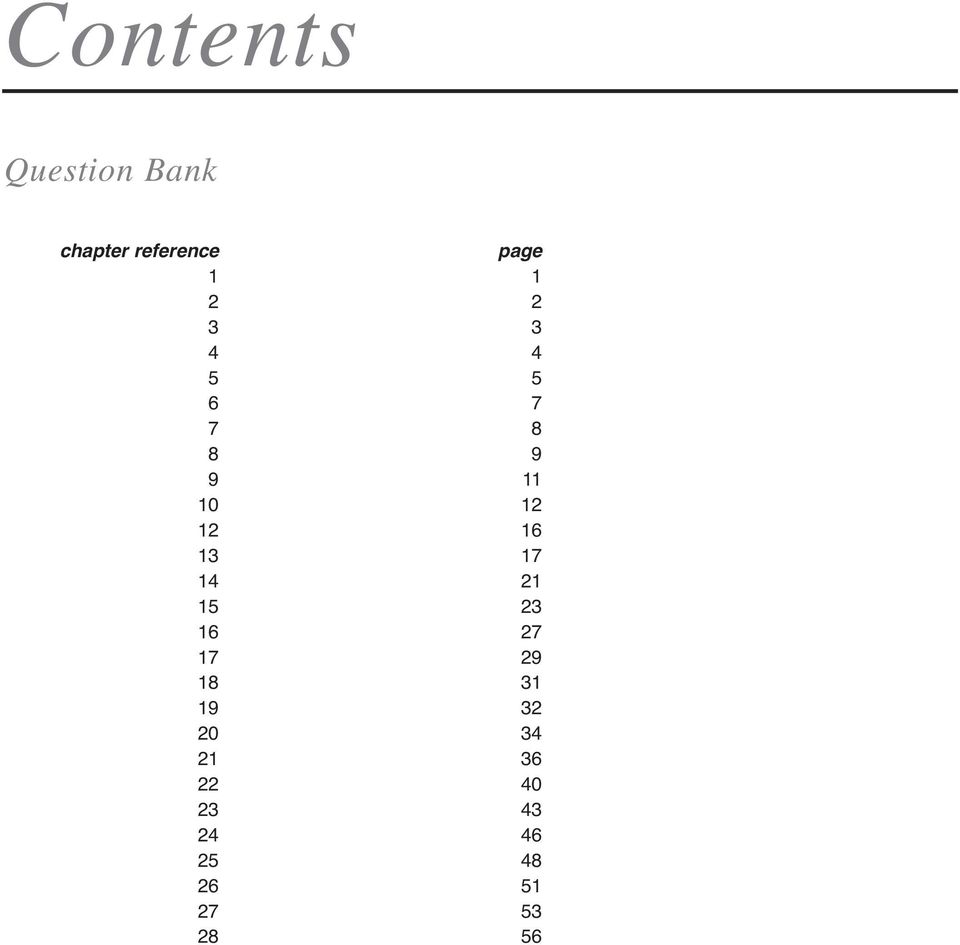
4 Contents Question Bank chapter reference page
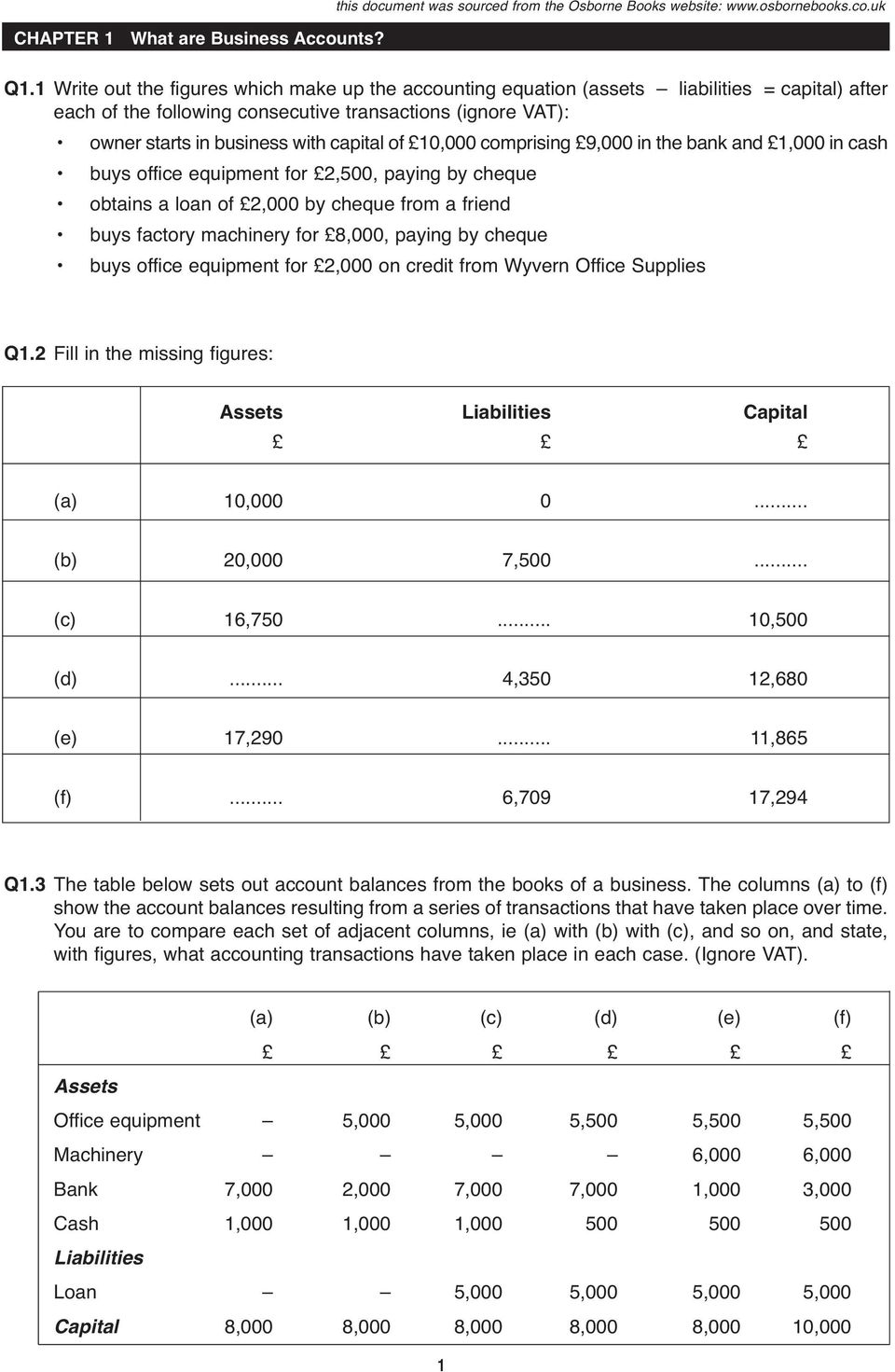
5 CHAPTER 1 What are Business Accounts? this document was sourced from the Osborne Books website: Q1.1 Write out the figures which make up the accounting equation (assets liabilities = capital) after each of the following consecutive transactions (ignore VAT): owner starts in business with capital of 10,000 comprising 9,000 in the bank and 1,000 in cash buys office equipment for 2,500, paying by cheque obtains a loan of 2,000 by cheque from a friend buys factory machinery for 8,000, paying by cheque buys office equipment for 2,000 on credit from Wyvern Office Supplies Q1.2 Fill in the missing figures: Assets Liabilities Capital (a) 10, (b) 20,000 7, (c) 16, ,500 (d)... 4,350 12,680 (e) 17, ,865 (f)... 6,709 17,294 Q1.3 The table below sets out account balances from the books of a business. The columns (a) to (f) show the account balances resulting from a series of transactions that have taken place over time. You are to compare each set of adjacent columns, ie (a) with (b) with (c), and so on, and state, with figures, what accounting transactions have taken place in each case. (Ignore VAT). (a) (b) (c) (d) (e) (f) Assets Office equipment 5,000 5,000 5,500 5,500 5,500 Machinery 6,000 6,000 Bank 7,000 2,000 7,000 7,000 1,000 3,000 Cash 1,000 1,000 1, Liabilities Loan 5,000 5,000 5,000 5,000 Capital 8,000 8,000 8,000 8,000 8,000 10,000 1
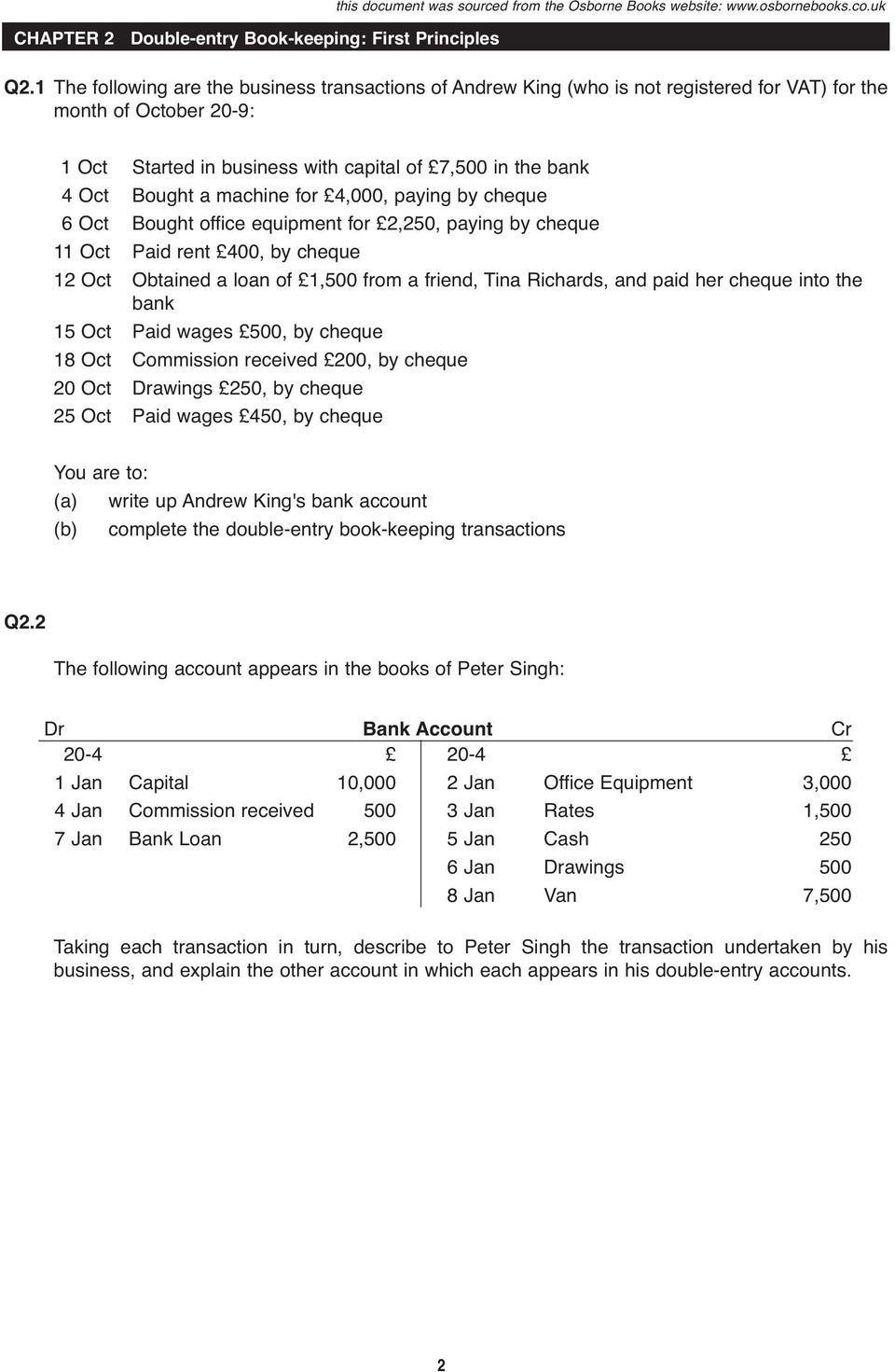
6 CHAPTER 2 Double-entry Book-keeping: First Principles this document was sourced from the Osborne Books website: Q2.1 The following are the business transactions of Andrew King (who is not registered for VAT) for the month of October 20-9: 1 Oct Started in business with capital of 7,500 in the bank 4 Oct Bought a machine for 4,000, paying by cheque 6 Oct Bought office equipment for 2,250, paying by cheque 11 Oct Paid rent 400, by cheque 12 Oct Obtained a loan of 1,500 from a friend, Tina Richards, and paid her cheque into the bank 15 Oct Paid wages 500, by cheque 18 Oct Commission received 200, by cheque 20 Oct Drawings 250, by cheque 25 Oct Paid wages 450, by cheque You are to: (a) write up Andrew King's bank account (b) complete the double-entry book-keeping transactions Q2.2 The following account appears in the books of Peter Singh: Dr Bank Account Cr Jan Capital 10,000 2 Jan Office Equipment 3,000 4 Jan Commission received Jan Rates 1,500 7 Jan Bank Loan 2,500 5 Jan Cash Jan Drawings Jan Van 7,500 Taking each transaction in turn, describe to Peter Singh the transaction undertaken by his business, and explain the other account in which each appears in his double-entry accounts. 2
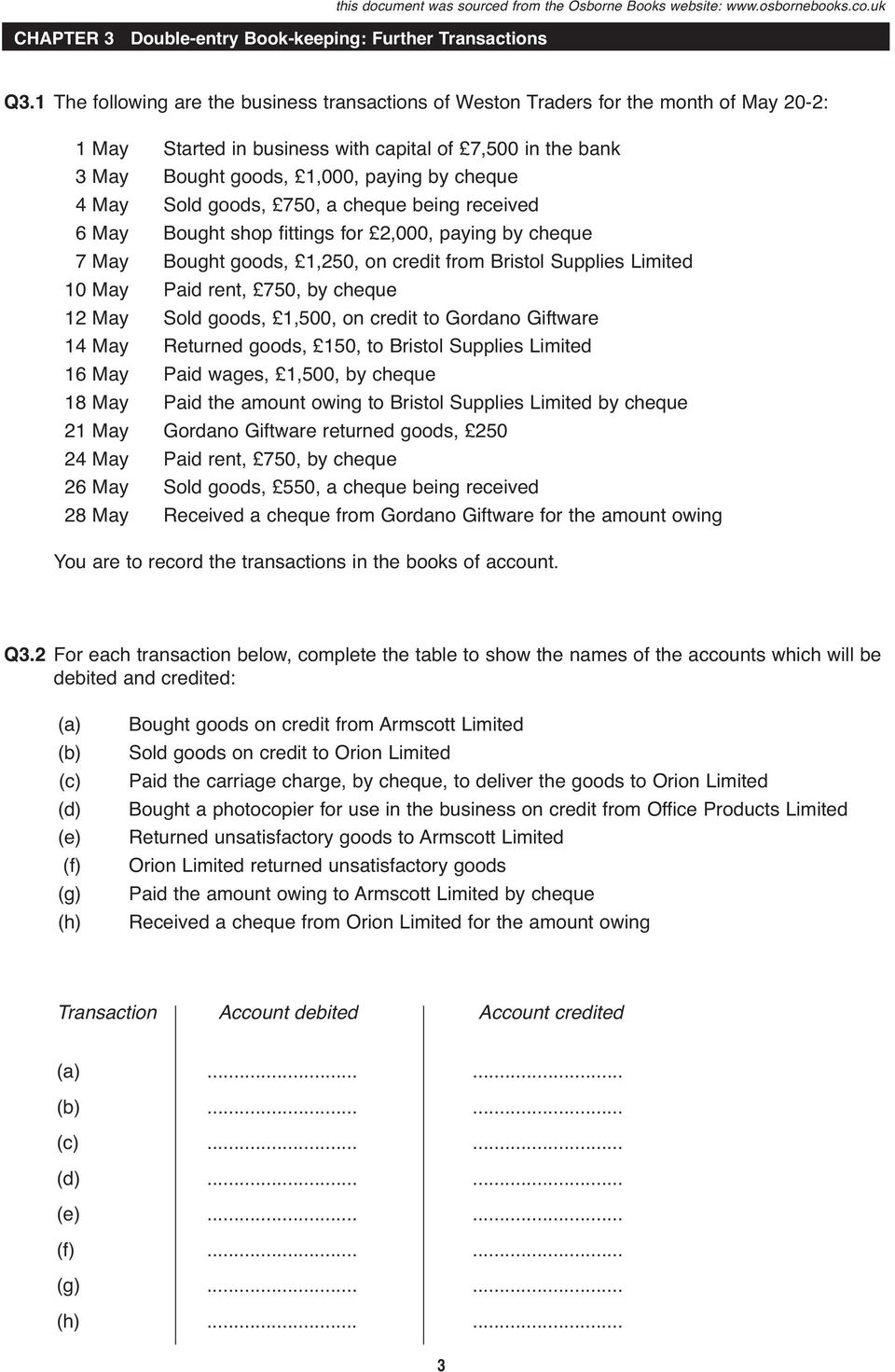
7 CHAPTER 3 Double-entry Book-keeping: Further Transactions this document was sourced from the Osborne Books website: Q3.1 The following are the business transactions of Weston Traders for the month of May 20-2: 1 May Started in business with capital of 7,500 in the bank 3 May Bought goods, 1,000, paying by cheque 4 May Sold goods, 750, a cheque being received 6 May Bought shop fittings for 2,000, paying by cheque 7 May Bought goods, 1,250, on credit from Bristol Supplies Limited 10 May Paid rent, 750, by cheque 12 May Sold goods, 1,500, on credit to Gordano Giftware 14 May Returned goods, 150, to Bristol Supplies Limited 16 May Paid wages, 1,500, by cheque 18 May Paid the amount owing to Bristol Supplies Limited by cheque 21 May Gordano Giftware returned goods, May Paid rent, 750, by cheque 26 May Sold goods, 550, a cheque being received 28 May Received a cheque from Gordano Giftware for the amount owing You are to record the transactions in the books of account. Q3.2 For each transaction below, complete the table to show the names of the accounts which will be debited and credited: (a) (b) (c) (d) (e) (f) (g) (h) Bought goods on credit from Armscott Limited Sold goods on credit to Orion Limited Paid the carriage charge, by cheque, to deliver the goods to Orion Limited Bought a photocopier for use in the business on credit from Office Products Limited Returned unsatisfactory goods to Armscott Limited Orion Limited returned unsatisfactory goods Paid the amount owing to Armscott Limited by cheque Received a cheque from Orion Limited for the amount owing Transaction Account debited Account credited (a) (b) (c) (d) (e) (f) (g) (h)
8 CHAPTER 4 Business Documents Q4.1 Study carefully the following document received by W Hoddle Limited: STATEMENT OF ACCOUNT F. RAMSEY & SON 31 NORTH STREET LIVERPOOL W Hoddle Ltd Blackpool Road Manchester 31 July 20-7 Date Reference Dr Cr Balance July 1 B/F Dr July July July 14 Cash & Disc July July July , Cash Discount 5% if paid within ONE month of this Statement (a) In the above transactions, who is the supplier of the goods? (b) Explain the transactions that gave rise to the entries dated (i) 12 July (ii) 14 July (iii) 20 July (c) If W Hoddle Ltd paid the above account on 18 August 20-7, how much cash discount did they receive? (d) Assume W Hoddle Ltd prepared a balance sheet on 31 July 20-7, state where, in the balance sheet, F Ramsey & Son's balance should have appeared. (e) In the ledger of F Ramsey & Son, show W Hoddle Ltd's account up to and including 14 July Q4.2 Compudisk sells computer disks and has a special sales offer. A box of ten disks normally sells at 8.00 (excluding VAT). Compudisk is offering a 20% trade discount for orders of ten boxes or more. It receives the following orders by (a) 20 boxes ordered by Osborne Electronics Limited (b) 50 boxes ordered by Helfield College (c) 5 boxes ordered by Jim Masters (d) 1,000 boxes ordered by Trigger Trading Limited (i) calculate in each case the total cost before discount the discount the cost after discount the VAT at the current rate the total cost (ii) Recalculate the totals for each order after allowing a cash discount of 2.5% for full settlement within 14 days. 4

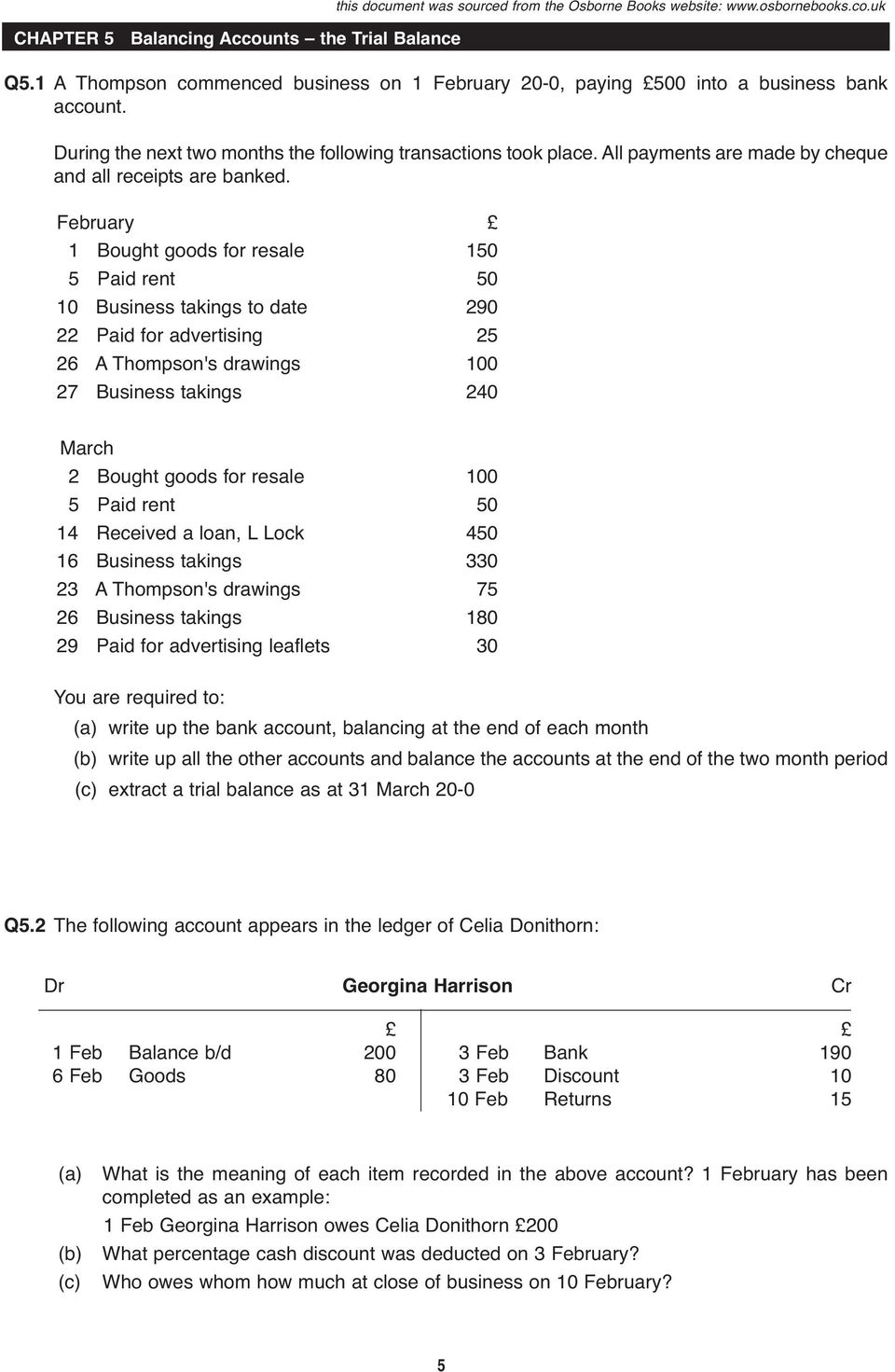
9 CHAPTER 5 Balancing Accounts the Trial Balance Q5.1 A Thompson commenced business on 1 February 20-0, paying 500 into a business bank account. During the next two months the following transactions took place. All payments are made by cheque and all receipts are banked. February 1 Bought goods for resale Paid rent Business takings to date Paid for advertising A Thompson's drawings Business takings 240 this document was sourced from the Osborne Books website: March 2 Bought goods for resale Paid rent Received a loan, L Lock Business takings A Thompson's drawings Business takings Paid for advertising leaflets 30 You are required to: (a) write up the bank account, balancing at the end of each month (b) write up all the other accounts and balance the accounts at the end of the two month period (c) extract a trial balance as at 31 March 20-0 Q5.2 The following account appears in the ledger of Celia Donithorn: Dr Georgina Harrison Cr 1 Feb Balance b/d Feb Bank Feb Goods 80 3 Feb Discount Feb Returns 15 (a) (b) (c) What is the meaning of each item recorded in the above account? 1 February has been completed as an example: 1 Feb Georgina Harrison owes Celia Donithorn 200 What percentage cash discount was deducted on 3 February? Who owes whom how much at close of business on 10 February? 5
10 Q5.3 Below are two ledger accounts in the books of Devenish Interiors. Study them carefully. Dr M Johnston Cr 1 Apr Balance b/d Apr Bank Apr Sales Apr Returns Apr Bank Apr Balance c/d May Balance b/d 90 Dr J Kelly Cr 7 Apr Returns 20 1 Apr Balance b/d Apr Bank Apr Purchases Apr Bank Apr Purchases Apr Discount received 5 20 Apr Returns Apr Balance c/d May Balance c/d 80 Required: (a) (b) (c) (d) (e) Explain the opening balance in the account of: (i) M Johnston (ii) J Kelly Which of the accounts is a debtor account on 30 April? Explain the 22 April entry in M Johnston s account. Explain the 15 April entries in J Kelly's account. What documents should have been received from J Kelly for 7 April and 20 April transactions? 6

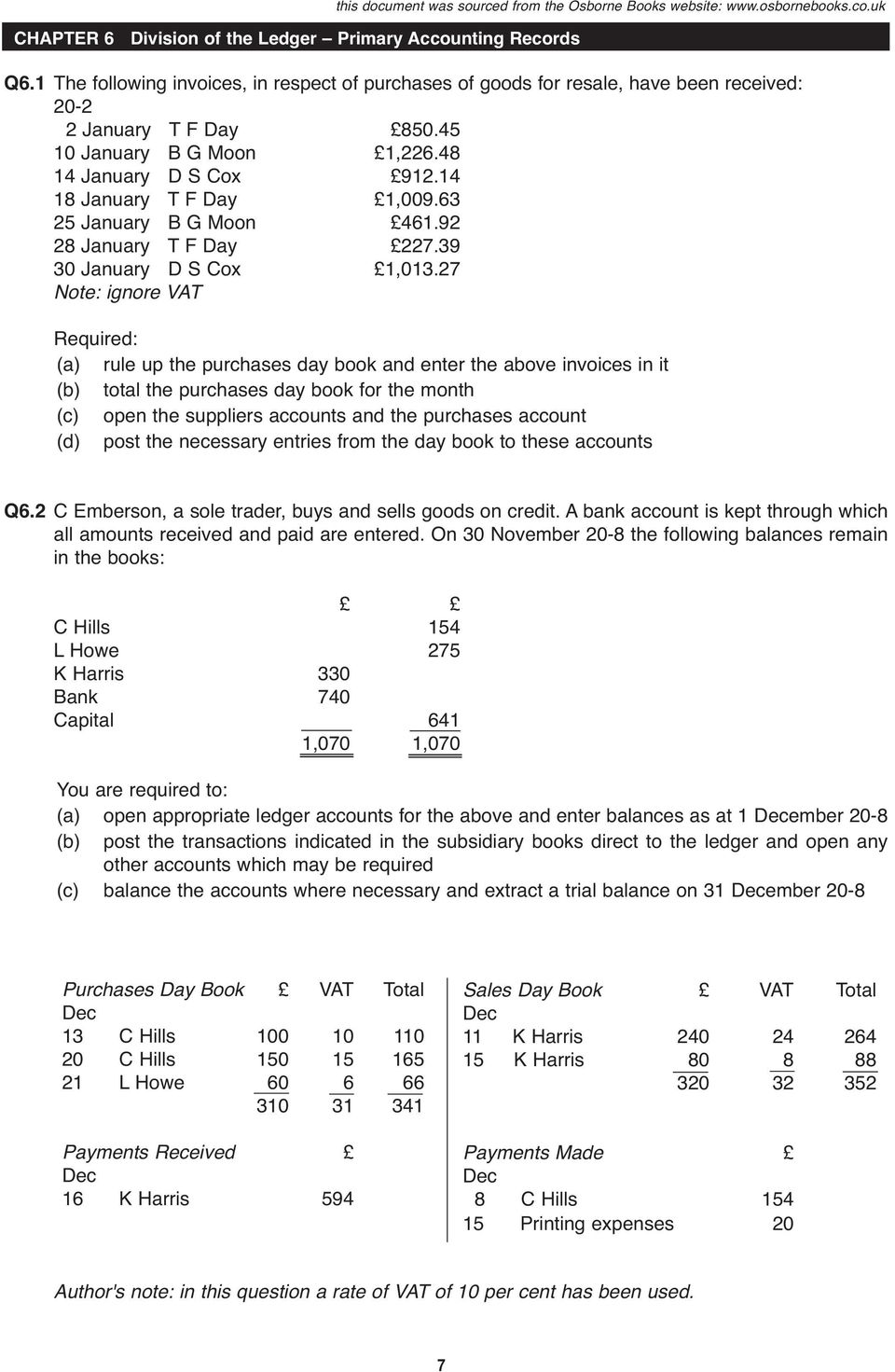
11 CHAPTER 6 Division of the Ledger Primary Accounting Records this document was sourced from the Osborne Books website: Q6.1 The following invoices, in respect of purchases of goods for resale, have been received: January T F Day January B G Moon 1, January D S Cox January T F Day 1, January B G Moon January T F Day January D S Cox 1, Note: ignore VAT Required: (a) rule up the purchases day book and enter the above invoices in it (b) total the purchases day book for the month (c) open the suppliers accounts and the purchases account (d) post the necessary entries from the day book to these accounts Q6.2 C Emberson, a sole trader, buys and sells goods on credit. A bank account is kept through which all amounts received and paid are entered. On 30 November 20-8 the following balances remain in the books: C Hills 154 L Howe 275 K Harris 330 Bank 740 Capital 641 1,070 1,070 You are required to: (a) open appropriate ledger accounts for the above and enter balances as at 1 December 20-8 (b) post the transactions indicated in the subsidiary books direct to the ledger and open any other accounts which may be required (c) balance the accounts where necessary and extract a trial balance on 31 December 20-8 Purchases Day Book VAT Total Dec 13 C Hills C Hills L Howe Payments Received Dec 16 K Harris 594 Sales Day Book VAT Total Dec 11 K Harris K Harris Payments Made Dec 8 C Hills Printing expenses 20 Author's note: in this question a rate of VAT of 10 per cent has been used. 7
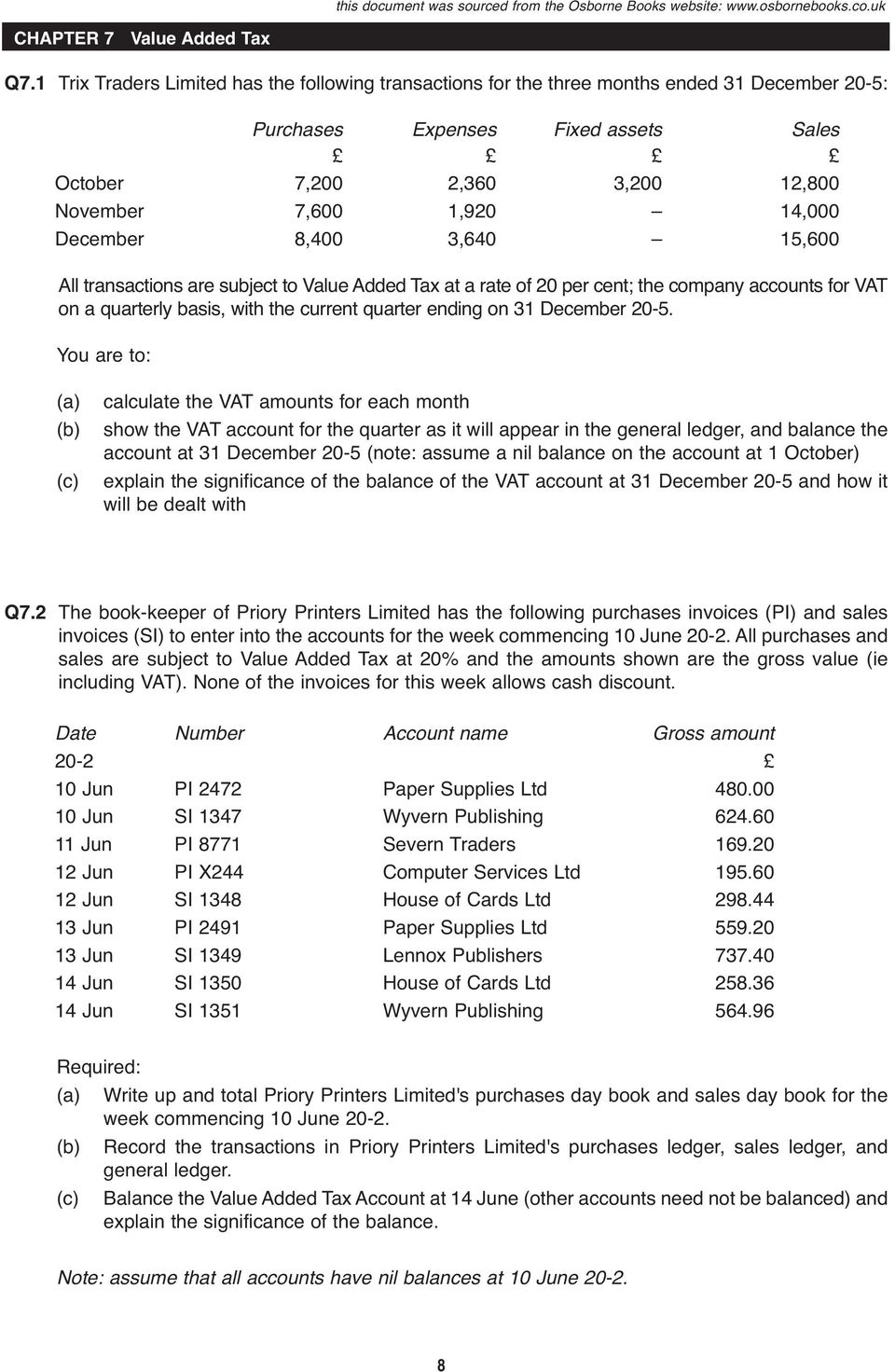
12 CHAPTER 7 Value Added Tax Q7.1 Trix Traders Limited has the following transactions for the three months ended 31 December 20-5: Purchases Expenses Fixed assets Sales October 7,200 2,360 3,200 12,800 November 7,600 1,920 14,000 December 8,400 3,640 15,600 All transactions are subject to Value Added Tax at a rate of 20 per cent; the company accounts for VAT on a quarterly basis, with the current quarter ending on 31 December You are to: (a) (b) (c) calculate the VAT amounts for each month show the VAT account for the quarter as it will appear in the general ledger, and balance the account at 31 December 20-5 (note: assume a nil balance on the account at 1 October) explain the significance of the balance of the VAT account at 31 December 20-5 and how it will be dealt with Q7.2 The book-keeper of Priory Printers Limited has the following purchases invoices (PI) and sales invoices (SI) to enter into the accounts for the week commencing 10 June All purchases and sales are subject to Value Added Tax at 20% and the amounts shown are the gross value (ie including VAT). None of the invoices for this week allows cash discount. Date Number Account name Gross amount Jun PI 2472 Paper Supplies Ltd Jun SI 1347 Wyvern Publishing Jun PI 8771 Severn Traders Jun PI X244 Computer Services Ltd Jun SI 1348 House of Cards Ltd Jun PI 2491 Paper Supplies Ltd Jun SI 1349 Lennox Publishers Jun SI 1350 House of Cards Ltd Jun SI 1351 Wyvern Publishing Required: (a) Write up and total Priory Printers Limited's purchases day book and sales day book for the week commencing 10 June (b) Record the transactions in Priory Printers Limited's purchases ledger, sales ledger, and general ledger. (c) Balance the Value Added Tax Account at 14 June (other accounts need not be balanced) and explain the significance of the balance. Note: assume that all accounts have nil balances at 10 June
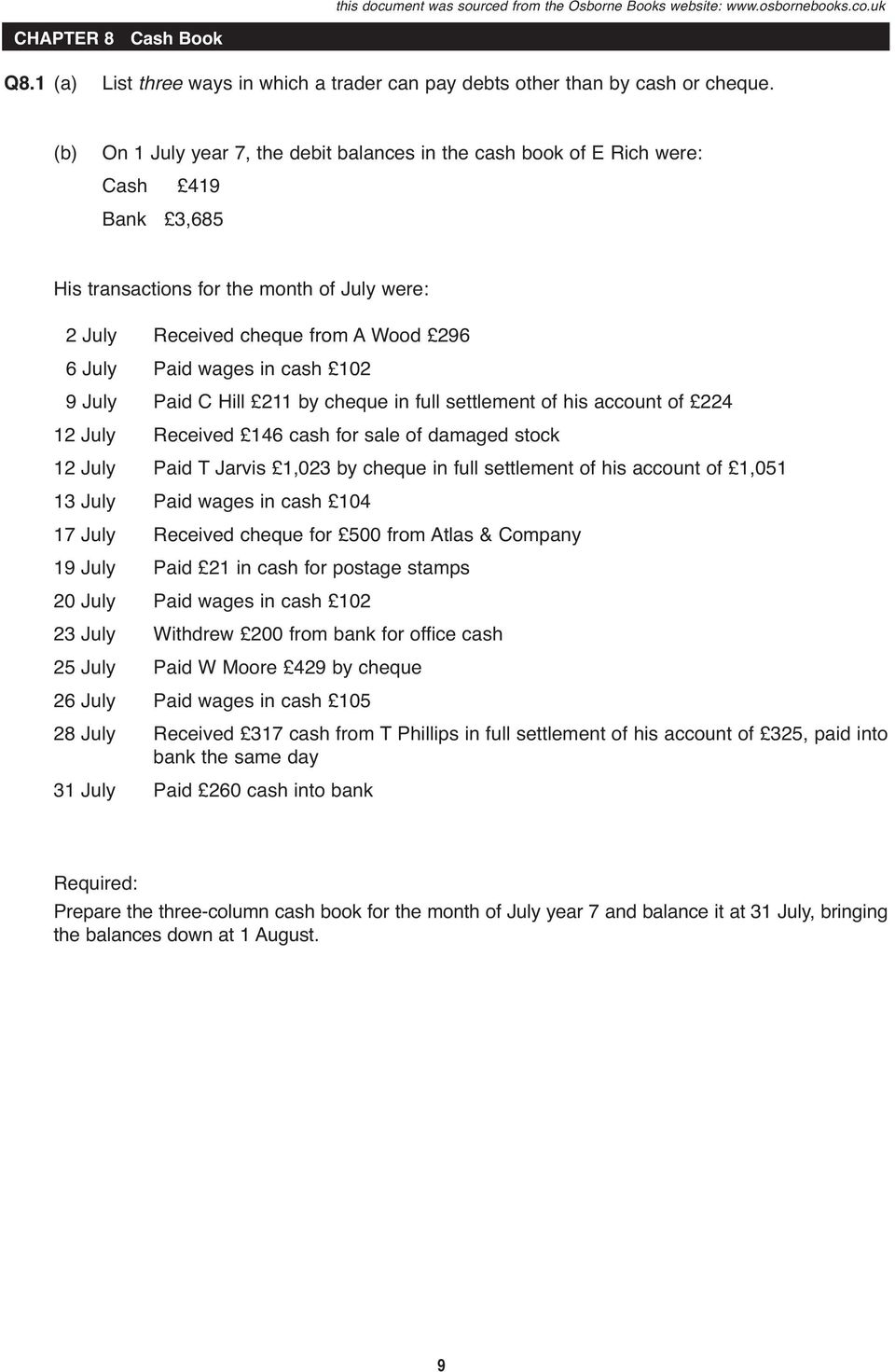
13 CHAPTER 8 Cash Book Q8.1 (a) List three ways in which a trader can pay debts other than by cash or cheque. (b) On 1 July year 7, the debit balances in the cash book of E Rich were: Cash 419 Bank 3,685 His transactions for the month of July were: 2 July Received cheque from A Wood July Paid wages in cash July Paid C Hill 211 by cheque in full settlement of his account of July Received 146 cash for sale of damaged stock 12 July Paid T Jarvis 1,023 by cheque in full settlement of his account of 1, July Paid wages in cash July Received cheque for 500 from Atlas & Company 19 July Paid 21 in cash for postage stamps 20 July Paid wages in cash July Withdrew 200 from bank for office cash 25 July Paid W Moore 429 by cheque 26 July Paid wages in cash July Received 317 cash from T Phillips in full settlement of his account of 325, paid into bank the same day 31 July Paid 260 cash into bank Required: Prepare the three-column cash book for the month of July year 7 and balance it at 31 July, bringing the balances down at 1 August. 9
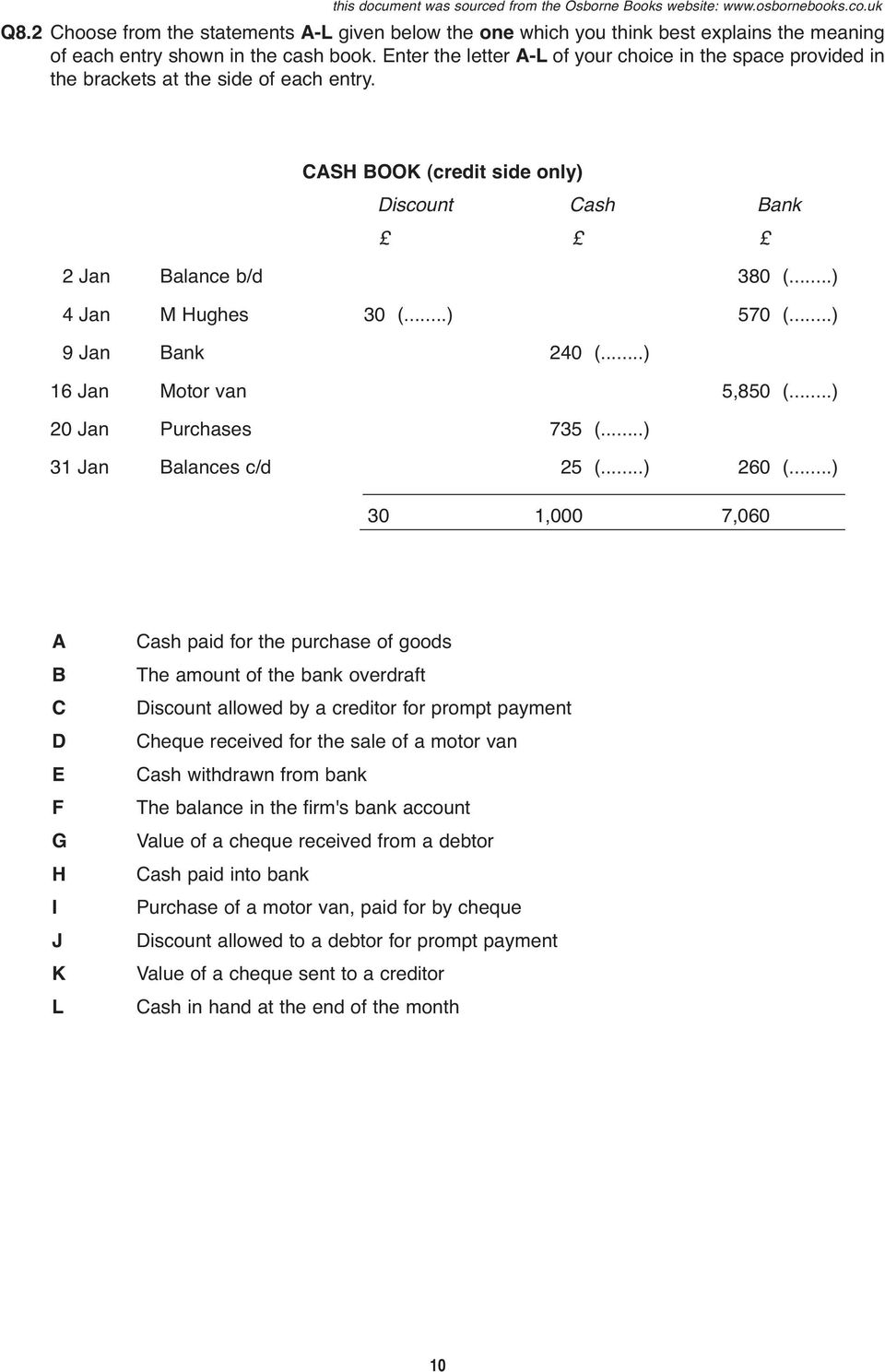
14 Q8.2 Choose from the statements A-L given below the one which you think best explains the meaning of each entry shown in the cash book. Enter the letter A-L of your choice in the space provided in the brackets at the side of each entry. CASH BOOK (credit side only) Discount Cash Bank 2 Jan Balance b/d 380 (...) 4 Jan M Hughes 30 (...) 570 (...) 9 Jan Bank 240 (...) 16 Jan Motor van 5,850 (...) 20 Jan Purchases 735 (...) 31 Jan Balances c/d 25 (...) 260 (...) 30 1,000 7,060 A B C D E F G H I J K L Cash paid for the purchase of goods The amount of the bank overdraft Discount allowed by a creditor for prompt payment Cheque received for the sale of a motor van Cash withdrawn from bank The balance in the firm's bank account Value of a cheque received from a debtor Cash paid into bank Purchase of a motor van, paid for by cheque Discount allowed to a debtor for prompt payment Value of a cheque sent to a creditor Cash in hand at the end of the month 10
15 CHAPTER 9 Petty Cash Book Q9.1 You operate a petty cash book with an imprest of 150. The following expenses, supported by vouchers, were paid out of the petty cash: Voucher Nos 1 3 February Postage February Travelling expenses February Cleaner's wages February Stationery February Postage February Travelling expenses February Cleaner's wages February Stationery February T B Collins, a creditor February Miscellaneous February Postage February Cleaner's wages At 1 February you had a balance of and received cash on that date to make up the figure to the imprest amount. Required: Draw up the petty cash book for the month of February, including the balancing and the amount paid on 1 March year 7 to make up the imprest figure. The analysis column headings are postage, travelling expenses, stationery, wages, miscellaneous and ledger. Q9.2 F Salmon keeps her petty cash book on the imprest system. The imprest figure was set at 350. On 1 November year 8 the balance of petty cash brought forward was 155. The following transactions took place during November year 8: Year 8 1 Nov Drew cash from the bank to restore the imprest 4 Nov Postage stamps 20 6 Nov Train fare reimbursed 25 9 Nov Petrol Nov Stationery Nov Bus fares 2 15 Nov Paid 16 to P Gates this was to refund an overpayment on his account in the sales ledger 16 Nov Stamps Nov Motor van repairs Nov Stationery Nov Petrol Nov Miscellaneous expenses Nov Parcel post charges Nov Travelling expenses 38 Required: Draw up F Salmon's petty cash book, using the following analysis columns: postage; travelling expenses; motor van expenses; stationery; miscellaneous expenses; ledger accounts. Balance the account at 30 November, bring down the balance of cash in hand at that date, and show the amount of cash drawn from the bank to restore the imprest on 1 December year 8. 11

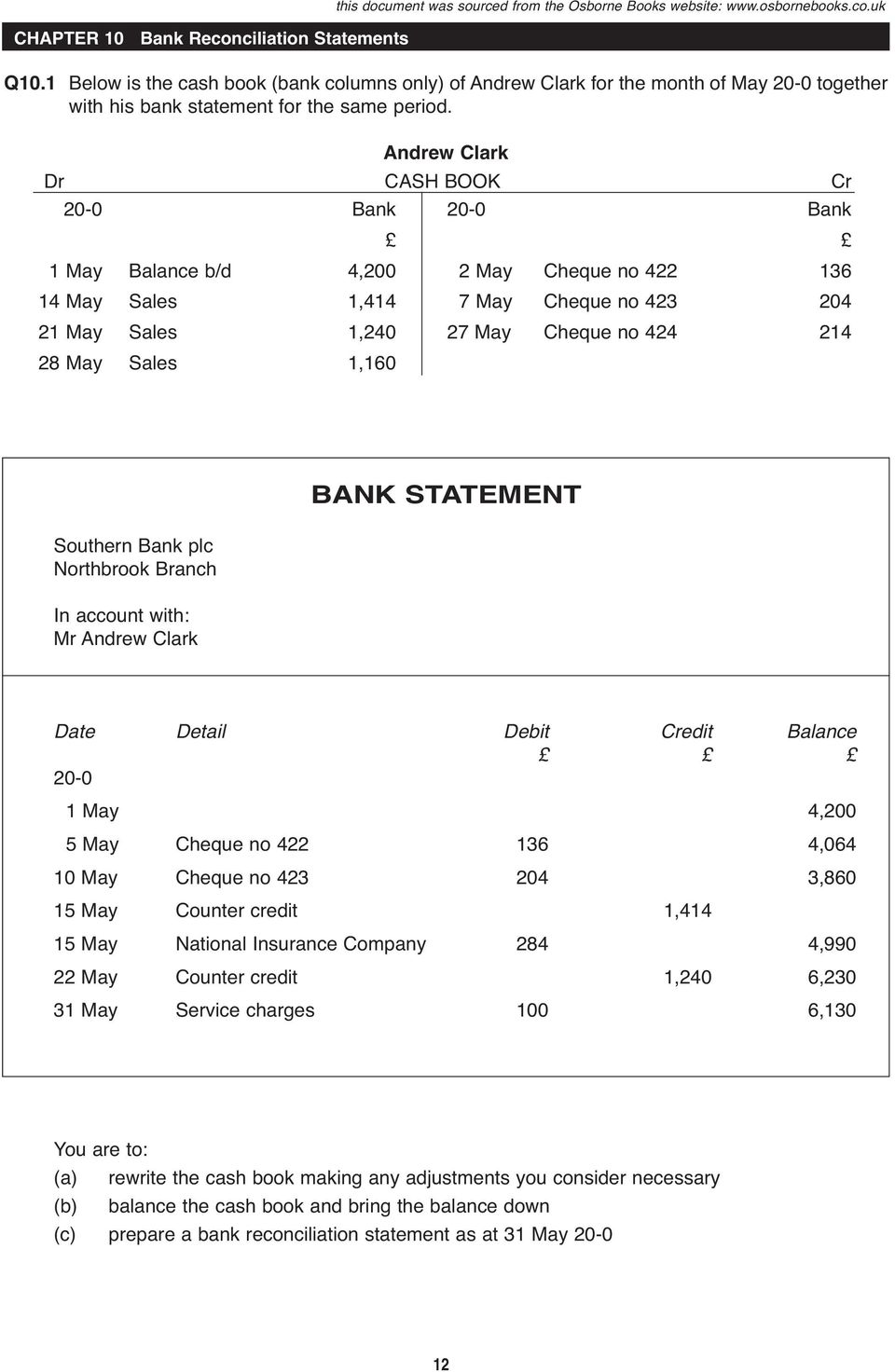
16 CHAPTER 10 Bank Reconciliation Statements this document was sourced from the Osborne Books website: Q10.1 Below is the cash book (bank columns only) of Andrew Clark for the month of May 20-0 together with his bank statement for the same period. Andrew Clark Dr CASH BOOK Cr 20-0 Bank 20-0 Bank 1 May Balance b/d 4,200 2 May Cheque no May Sales 1,414 7 May Cheque no May Sales 1, May Cheque no May Sales 1,160 Southern Bank plc Northbrook Branch In account with: Mr Andrew Clark BANK STATEMENT Date Detail Debit Credit Balance May 4,200 5 May Cheque no , May Cheque no , May Counter credit 1, May National Insurance Company 284 4, May Counter credit 1,240 6, May Service charges 100 6,130 You are to: (a) rewrite the cash book making any adjustments you consider necessary (b) balance the cash book and bring the balance down (c) prepare a bank reconciliation statement as at 31 May
17 Q10.2 Given below are the bank account and bank statement of C Cod for the month of May C Cod's Bank Account 1 May Balance May M Roe May Sales May Drawings May F Haddock May Cash May V Perch May E Skate May B Tench May British Gas May N Fish THE IZAAK WALTON BANK PLC STATEMENT OF ACCOUNT C Cod Pond Street Banktown 31 May 20-9 Date Detail Debit Credit Balance 1 May Balance (cr) 9 May May Sundries May May May Cheque May May Mortgage SO May May Charges You are to: (a) Starting with the final balance on the bank account, which you have to calculate, bring the bank account up-to-date by referring to the bank statement of account (b) Prepare a bank reconciliation statement for C Cod as on 31 May

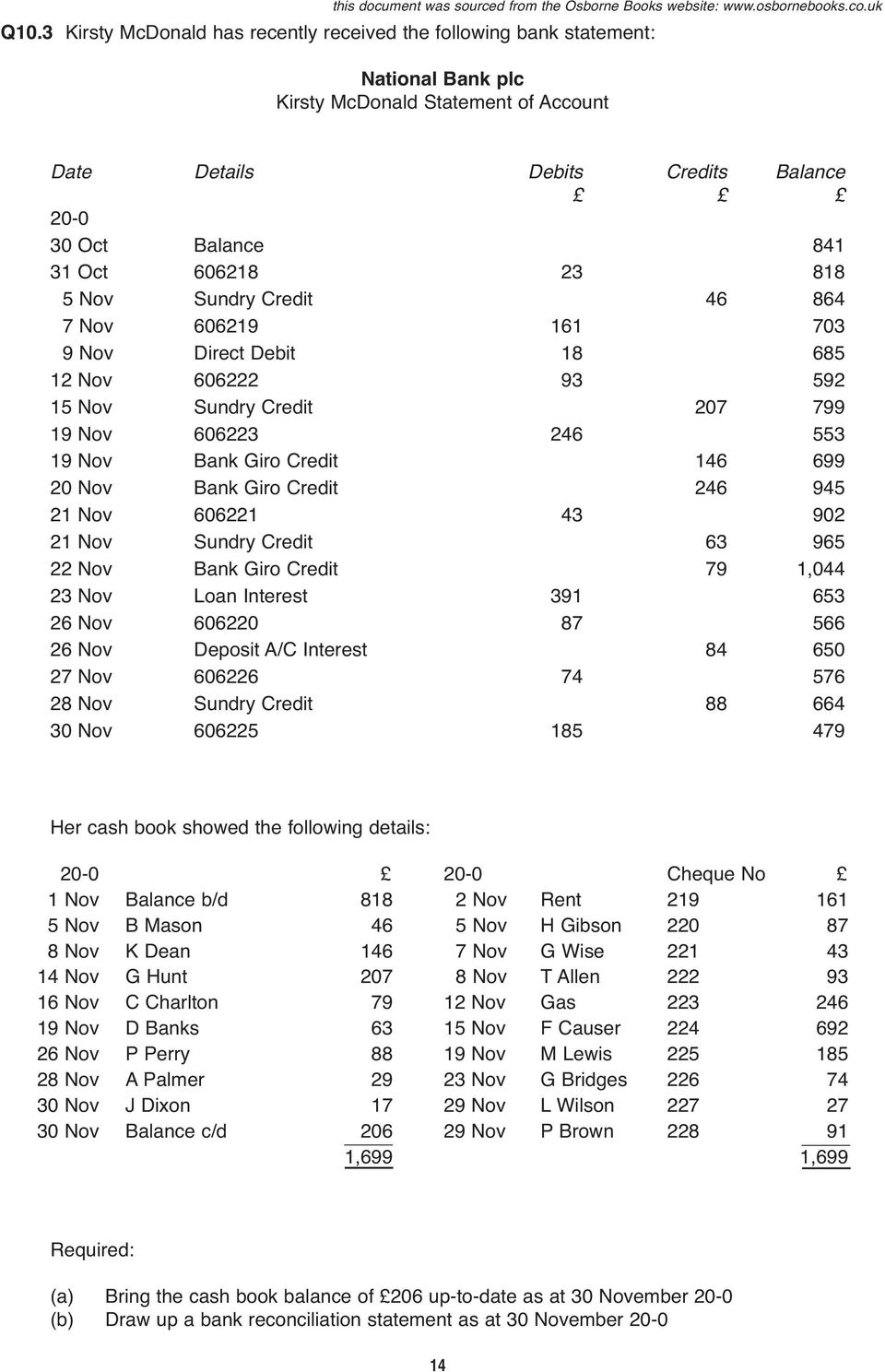
18 Q10.3 Kirsty McDonald has recently received the following bank statement: National Bank plc Kirsty McDonald Statement of Account Date Details Debits Credits Balance Oct Balance Oct Nov Sundry Credit Nov Nov Direct Debit Nov Nov Sundry Credit Nov Nov Bank Giro Credit Nov Bank Giro Credit Nov Nov Sundry Credit Nov Bank Giro Credit 79 1, Nov Loan Interest Nov Nov Deposit A/C Interest Nov Nov Sundry Credit Nov Her cash book showed the following details: Cheque No 1 Nov Balance b/d Nov Rent Nov B Mason 46 5 Nov H Gibson Nov K Dean Nov G Wise Nov G Hunt Nov T Allen Nov C Charlton Nov Gas Nov D Banks Nov F Causer Nov P Perry Nov M Lewis Nov A Palmer Nov G Bridges Nov J Dixon Nov L Wilson Nov Balance c/d Nov P Brown ,699 1,699 Required: (a) Bring the cash book balance of 206 up-to-date as at 30 November 20-0 (b) Draw up a bank reconciliation statement as at 30 November
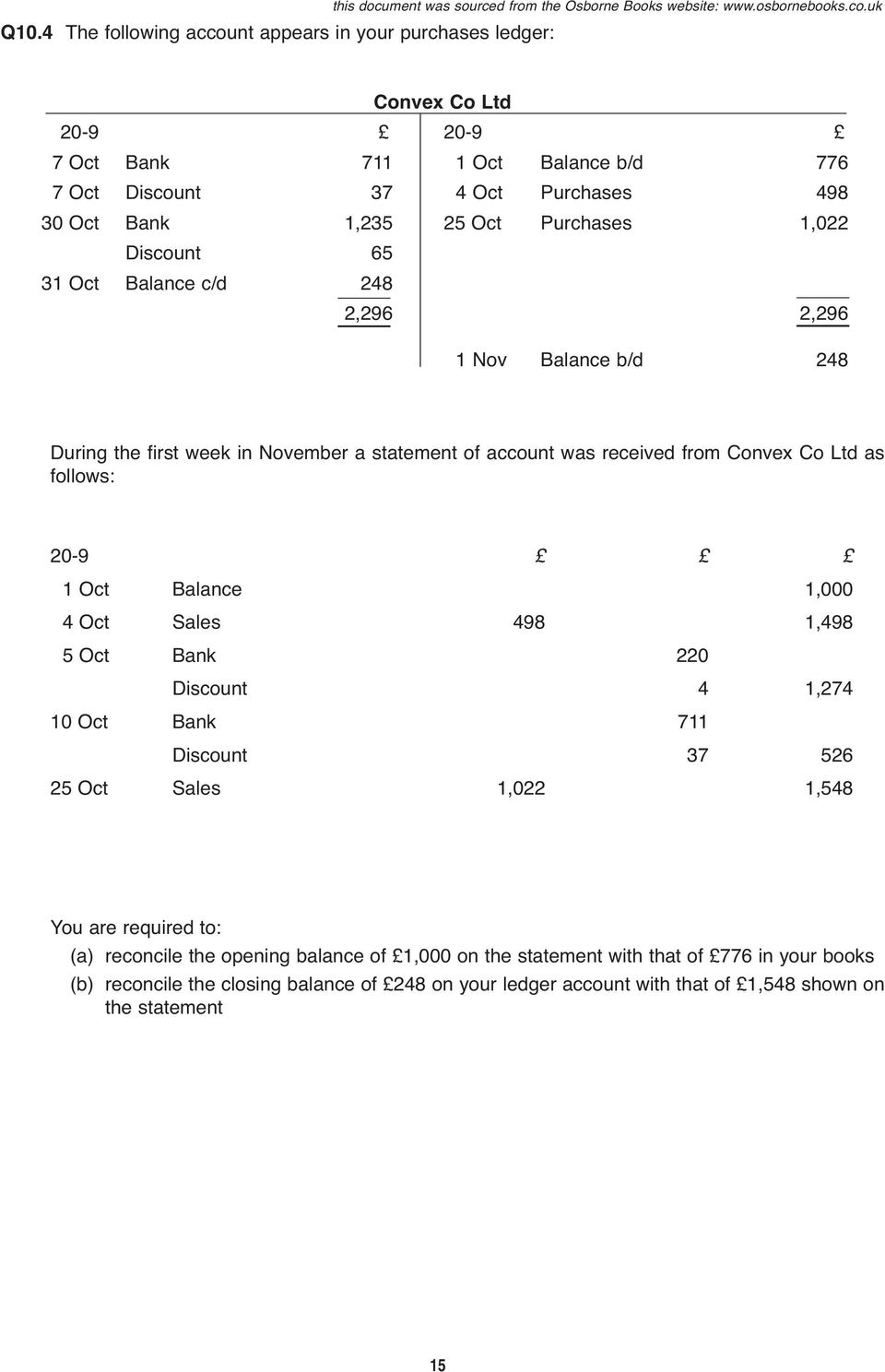
19 Q10.4 The following account appears in your purchases ledger: this document was sourced from the Osborne Books website: Convex Co Ltd Oct Bank Oct Balance b/d Oct Discount 37 4 Oct Purchases Oct Bank 1, Oct Purchases 1,022 Discount Oct Balance c/d 248 2,296 2,296 1 Nov Balance b/d 248 During the first week in November a statement of account was received from Convex Co Ltd as follows: Oct Balance 1,000 4 Oct Sales 498 1,498 5 Oct Bank 220 Discount 4 1, Oct Bank 711 Discount Oct Sales 1,022 1,548 You are required to: (a) reconcile the opening balance of 1,000 on the statement with that of 776 in your books (b) reconcile the closing balance of 248 on your ledger account with that of 1,548 shown on the statement 15
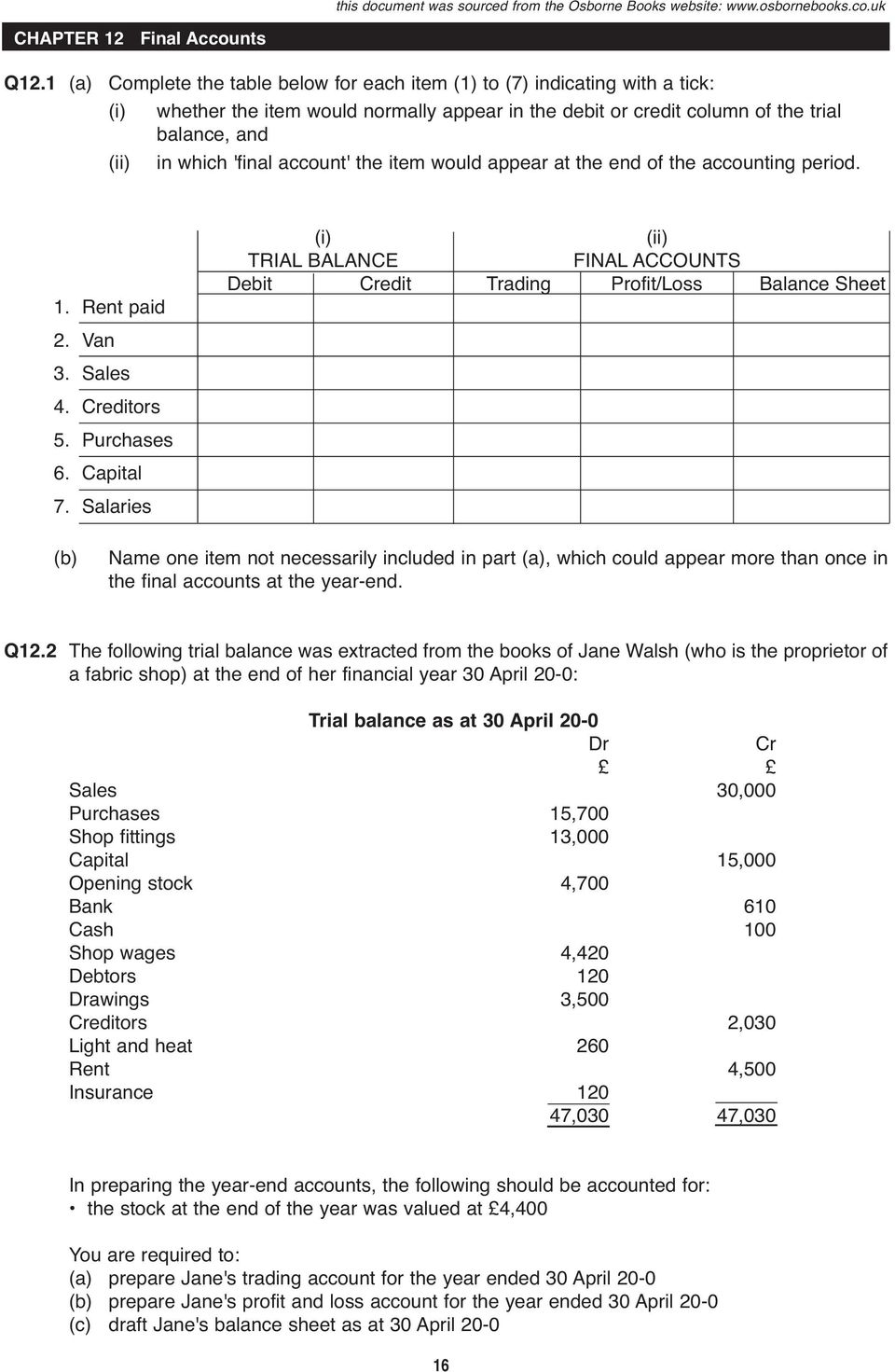
20 CHAPTER 12 Final Accounts Q12.1 (a) Complete the table below for each item (1) to (7) indicating with a tick: (i) whether the item would normally appear in the debit or credit column of the trial balance, and (ii) in which 'final account' the item would appear at the end of the accounting period. 1. Rent paid 2. Van 3. Sales 4. Creditors 5. Purchases 6. Capital 7. Salaries (i) (ii) TRIAL BALANCE FINAL ACCOUNTS Debit Credit Trading Profit/Loss Balance Sheet (b) Name one item not necessarily included in part (a), which could appear more than once in the final accounts at the year-end. Q12.2 The following trial balance was extracted from the books of Jane Walsh (who is the proprietor of a fabric shop) at the end of her financial year 30 April 20-0: Trial balance as at 30 April 20-0 Dr Cr Sales 30,000 Purchases 15,700 Shop fittings 13,000 Capital 15,000 Opening stock 4,700 Bank 610 Cash 100 Shop wages 4,420 Debtors 120 Drawings 3,500 Creditors 2,030 Light and heat 260 Rent 4,500 Insurance ,030 47,030 In preparing the year-end accounts, the following should be accounted for: the stock at the end of the year was valued at 4,400 You are required to: (a) prepare Jane's trading account for the year ended 30 April 20-0 (b) prepare Jane's profit and loss account for the year ended 30 April 20-0 (c) draft Jane's balance sheet as at 30 April
21 CHAPTER 13 Accruals and Prepayments this document was sourced from the Osborne Books website: Q13.1 The following trial balance was extracted from the books of Jane Osman who is the proprietor of a computer store, at the end of her financial year 31 March 20-2: TRIAL BALANCE as at 31 March 20-2 Dr Cr Sales 60,800 Purchases 31,400 Shop fittings 26,000 Capital 29,000 Opening Stock (1 April 20-1) 9,400 Bank 1,220 Cash 190 Shop wages 8,850 Debtors 230 Drawings 7,000 Creditors 4,550 Light and heat 520 Rent 8,500 Insurance 240 Sales returns ,350 94,350 In preparing the year-end accounts, the following should be accounted for: 1. the stock at the end of the year was valued at 8, there is an accrual on shop wages amounting to the insurance is paid in advance by 60 You are required to: (a) prepare Jane's trading account for the year ended 31 March 20-2 (b) prepare Jane's profit and loss account for the year ended 31 March 20-2 (c) draft Jane's balance sheet as at 31 March
22 Q13.2 Sandra Black operates a secretarial service to farmers and the following trial balance was extracted from her books on 31 May Income from clients 32,500 Commissions from other sources 800 Discounts received 150 Stationery 2,100 Wages 7,600 Equipment 4,500 Vehicles 6,500 Rent and rates 2,350 Vehicle expenses 2,000 Light and heat 800 Insurance 850 Telephone 280 Sundry expenses 175 Drawings 11,200 Debtors 760 Creditors 670 Bank overdraft 250 Cash in hand 175 Capital 4,920 39,290 39,290 Notes: (a) At 31 May 20-0 there is an unpaid telephone bill of 52 and an unpaid electricity bill of 45. (b) Business rates prepaid at 31 May 20-0 are 120. (c) On 31 May 20-0 there is an unused stock of stationery valued at 150. You are required to: Prepare a profit and loss account for Sandra Black for the year ended 31 May 20-0 and a balance sheet as at that date, showing clearly therein the value of her capital, fixed assets, current assets and current liabilities. 18
23 Q13.3 The trial balance of Bilton Potteries prepared after calculation of the gross profit is shown below: BILTON POTTERIES Trial balance as at 31 January 20-2 Debit Credit Capital 7,000 Premises 5,000 Bank 3,218 Debtors 434 Stock (31 January 20-2) 1,000 Creditors 870 Drawings 3,800 Insurance 450 Rent receivable 225 Rates 500 Wages 5,200 Gross profit for year-ended 31 January ,507 19,602 19,602 A detailed review by the accountant revealed that the following adjustments were outstanding: (i) Rates amounting to 100 had been paid in advance. (ii) Rent receivable of 75 was still outstanding at 31 January (iii) The insurance total included the payment of 50 for private house contents insurance. (iv) Wages owing amounted to 300. Requirements: (a) Open up the appropriate ledger accounts and post the above adjustments. Balance off these ledger accounts. (b) Prepare a profit and loss account for the year ended 31 January 20-2 and a balance sheet as at that date, after the above adjustments have been posted. 19
24 Q13.4 A Bush is a sole trader who occupies rented premises. The annual rental is 2,400 which he pays quarterly. His lease and financial year commenced on 1 August year 1. During his first financial year, A Bush made the following payments in respect of rent: Year 1 1 August November 600 Year 2 31 March August 600 He paid rates on the premises as follows: Year 1 31 August 75 for period 1 August to 30 September year 1 22 October 220 for period 1 October to 31 March year 2 Year 2 17 April 270 for period 1 April to 30 September year 2 He paid electricity bills as follows: Year 1 17 October 310 Year 2 21 January 390 Year 2 10 April 360 An electricity bill of 420 accrued due had not been paid. Required: (i) Open the following accounts and, for the year ended 31 July year 2, enter the payments and make the necessary year-end adjustments for prepayments or accruals. Enter the transfers to profit and loss account and bring down balances at 1 August year 2. (a) Rent payable (b) Rates (c) Electricity (ii) Show the relevant extracts covering the above items from the balance sheet of A Bush as at 31 July year 2. 20
25 CHAPTER 14 Depreciation of Fixed Assets this document was sourced from the Osborne Books website: Q14.1 Bert Greenwood bought a new vending machine for his business on 1 January 20-7 at a cost of 8,000. He intends to write off depreciation of the machine at the end of each business year which is 31 December. Greenwood however cannot decide whether to write off the depreciation by the straight-line method or the reducing balance method. Required: (a) Prepare the provision for depreciation of machinery account as it should appear for the years 20-7 and 20-8 under: (i) straight-line method at 12.5% per annum; (ii) reducing balance method at 15% per annum. (b) The balance sheet extracts for the years 20-7 and 20-8 showing the book value of the machinery after depreciation by the reducing balance method. Q14.2 From the following trial balance extracted from the books of Paulo Gavinci, restaurateur, you are required to prepare the trading and profit and loss account for the year ended 30 April 20-0 and the balance sheet as at that date. Trial balance as at 30 April 20-0 Dr Cr Capital 75,000 Fixtures and fittings 95,000 Delivery vehicle 8,000 Opening stock 2,000 Cash 450 Bank 4,300 Bank loan (long-term) 30,000 Purchases 190,250 Sales 300,000 Creditors 5,000 Wages 45,000 Drawings 25,000 Purchases returns 400 Rent 31,800 General expenses 17, , ,700 You should also take the following additional information into account: (a) Closing stock at 30 April 20-0 was 1,600 (b) Depreciation is to be provided as follows on a straight line basis: Fixtures and fittings 20% on cost Delivery vehicle 25% on cost (c) Paulo took goods for personal use amounting to 250 at cost and an adjustment needs to be made for this (d) Provide for: Rent prepaid 2,000 Wages accrued 1,000 21
26 Q14.3 Colin and Reena Tan have run a small road haulage firm since 20-5, when they started the business with three transit vans which cost 30,000 each in The accounts relating to the transit vans have been lost and you are required to prepare and update the accounts from the following details and information available: A charge of 20% depreciation has been charged on the vans using the reducing balance method. On 1 January 20-8, a further transit van was purchased at a cost of 48,000 and on 30 June one of the original vans was sold for 10,000. Depreciation is charged in the year of purchase but none in the year of sale. You are required to prepare: (a) vehicles account starting from 1 January 20-8; (b) provision for depreciation of vehicles/transit vans; (c) asset disposal account. Q14.4 The following table shows the cumulative effects of a succession of separate transactions on the assets and liabilities of a business: Transactions: A B C D E F G H I J Assets: Property Motor vans Stock Debtors Prepayments Bank Cash Liabilities: Capital Loan Creditors Accruals Required: Identify clearly and as fully as you can what transaction has taken place in each case. Do not copy out the table but use the reference letter for each transaction. 22
27 CHAPTER 15 Bad Debts and Provision for Bad Debts this document was sourced from the Osborne Books website: Q15.1 The following trial balance was extracted from the books of Paula Jones, a retail grocer, at the end of her financial year 31 March Trial balance as at 31 March 20-0 Dr Cr Capital 200,000 Debtors 6,000 Creditors 4,000 Drawings 38,000 Cash in hand 100 Bank 4,630 Sales 168,000 Purchases 96,000 Opening stock 6,400 Sales returns 1,000 Carriage inwards 400 Discount received 250 Discount allowed 380 Premises 187,000 Fixtures and fittings (at cost) 20,000 Provision for depreciation on fixtures 6,000 Rates 4,400 Insurance 1,200 Wages and salaries 22, , ,880 In preparing the year-end accounts, the following should be accounted for: 1. The closing stock was valued at 6, Wages and salaries due but not paid amount to 1, There is a prepayment on rates amounting to A debt amounting to 120 is considered irrecoverable 5. Depreciation on fixtures is to be provided at the rate of 10% per annum on cost You are required to: (a) prepare Paula's trading account for the year ended 31 March 20-0 (b) prepare Paula's profit and loss account for the year (c) draft Paula's balance sheet as at 31 March
28 Q15.2 The following trial balance was extracted from the books of Sandra Shenstone, a sole trader, as at the close of business on 30 June year 5: Dr Cr Capital account 6,400 Wages and salaries 6,800 Discounts allowed and received Purchases and sales 12,830 26,700 Rent 2,600 Bad debts written off 420 Drawings 2,450 Delivery van 1,800 Bank overdraft 2,200 Returns inwards 340 Office furniture and equipment, at cost 1,600 Van running expenses 780 Rates and insurance 760 Debtors and creditors 4,650 2,950 General office expenses 320 Stock, 1 July year 4 2,930 Cash in hand 50 38,590 38,590 The following adjustments are to be made: Provide for depreciation as follows: Delivery van 600 Office furniture and equipment 25% per annum on cost A provision of 2% of Debtors is to be created for doubtful debts Stock, 30 June year 5 3,160 Required: Prepare a trading and profit and loss account for the year ended 30 June year 5, together with a balance sheet at that date. 24
29 Q15.3 The following is the trial balance extracted from the ledger of Stamper, a sole trader who runs a shop, at 31 December 20-9: Capital 1 January ,500 Drawings 20,000 Sales 150,750 Purchases 112,800 Stock at 1 January ,600 Wages 12,610 Rent 2,500 Motor expenses 1,240 Motor vehicle: at cost 17,000 accumulated depreciation at 1 January ,000 Equipment: at cost 15,000 accumulated depreciation at 1 January ,500 Bank 900 Debtors 9,950 Creditors 8,100 Cash float 250 Insurance 1, , ,850 You are given the following additional information: 1. Stock at 31 December 20-9 was valued at 27, Rent of 500 (included in the figure of 2,500 above) was prepaid at 31 December Motor expenses of 140 are to be accrued at 31 December A bad debt of 200 is to be written off. 5. An invoice for insurance of 450 was wrongly recorded as purchases, and is included under purchases in the trial balance. 6. The motor vehicle is depreciated on the straight line basis assuming a life of four years and a residual value of 5,000; the equipment is depreciated on the reducing balance basis using an annual rate of 30%. Required: Prepare the trading and profit and loss account of Stamper for the year to 31 December 20-9 and the balance sheet at that date. 25
30 Q15.4 The following trial balance was extracted from the books of Percival Porteous at 31 May Trial balance as at 31 May 20-0 Capital 54,960 Drawings 8,280 Premises at cost 54,000 Sundry debtors and creditors 7,500 6,228 Opening stock 11,100 Salaries 5,280 Carriage inwards 2,190 Carriage outwards 2,340 Rates and insurance 2,790 Purchases and sales 102, ,185 Returns inwards and outwards 780 1,440 Advertising 1,041 Bad debts 240 Rent receivable 960 Office equipment at cost 6,000 Shop fittings at cost 18,000 Provision for depreciation: Office equipment 1,200 Shop fittings 4,800 Cash in hand 1,020 Bank overdraft 7,488 Provision for bad debts , ,561 You are given the following additional information: (i) Stock valued at 31 May ,600 (ii) Salaries due but unpaid 1,800 (iii) Rates and insurance prepaid 310 (iv) The provision for bad debts is to be adjusted to 5% of debtors outstanding on 31 May 20-0 (v) Depreciation is written off fixed assets as follows: Office equipment 10% per annum using the straight line basis Shop fittings 5% per annum using the reducing balance You are required to: Prepare Porteous's trading and profit and loss account for the year ended 31 May 20-0 showing clearly (a) the cost of goods sold (b) gross profit and net profit and the balance sheet as at 31 May 20-0, highlighting the working capital. 26
31 CHAPTER 16 The Extended Trial Balance Q16.1 The following trial balance has been extracted by the book-keeper of Matt Smith at 31 December 20-8: Dr Cr Stock at 1 January ,350 Purchases 114,472 Sales 259,688 Rates 13,718 Heating and lighting 12,540 Wages and salaries 42,614 Motor vehicle expenses 5,817 Advertising 6,341 Premises 75,000 Office equipment 33,000 Motor vehicles 21,500 Debtors 23,854 Bank 1,235 Cash 125 Capital 62,500 Drawings 12,358 Loan from bank 35,000 Creditors 14,258 Value Added Tax 5, , ,924 Note: stock at 31 December 20-8 was valued at 16,280 this document was sourced from the Osborne Books website: You are to prepare the figures for the final accounts of Matt Smith for the year ended 31 December 20-8, using the extended trial balance method. 27
32 Q16.2 The following trial balance has been extracted by the book-keeper of Jane Jones, who sells carpets, as at 31 December 20-9: Dr Cr Debtors 37,200 Creditors 30,640 Value Added Tax 4,280 Bank 14,640 Capital 50,500 Sales 289,620 Purchases 182,636 Stock at 1 January ,020 Wages and salaries 36,930 Heat and light 3,640 Rent and rates 11,294 Vehicles 20,000 Provision for depreciation on vehicles 4,000 Equipment 10,000 Provision for depreciation on equipment 1,000 Sundry expenses 1,690 Motor expenses 3,368 Drawings 26, , ,040 Notes at 31 December 20-9: stock was valued at 34,000 bad debts of 2,200 are to be written off and a provision for bad debts of 5% is to be created vehicles are to be depreciated at 20% per annum and equipment at 10% per annum (both using the reducing balance method) there are sundry expenses accruals of 270, and rates prepayments of 2,190 You are to prepare the figures for the final accounts of Jane Jones for the year ended 31 December 20-9, using the extended trial balance method. 28
33 CHAPTER 17 The Regulatory Framework of Accounting Q17.1 The following information relates to Maynard Autos Limited: this document was sourced from the Osborne Books website: Purchases Sales June July 20-1 September , December 20-1 February , April 20-2 May units 600 units 400 units You have been asked to value the stock: (i) using the FIFO method (ii) using the LIFO method Q17.2 A and B are in business, buying and selling goods for resale. Neither of them are accountants but A has read a book on stock control whereas B has purchased a software package for daily stock records. During September 20-9 the following transactions occurred: 1 September Balance brought forward: NIL 3 September Bought each 7 September Sold 180 units 8 September Bought each 14 September Sold 170 units 15 September Bought each 21 September Sold 150 units A prepares the stores ledger card using the LIFO method and B uses the same data to test the software package which uses the weighted average method of pricing. You are required to: (a) show the ledger cards as they would appear for each method (calculations should be made to two decimal places of 1.00); (b) comment on the effect on profits of using each method of valuing stock. 29
34 Q17.3 D Swift maintains manually prepared stock record cards for the recording of the receipts and issues of various items of stock held in the stores. You are required to: (i) draw up a stock record card showing the following rulings and headings: Item STOCK CARD Date Details Receipts Issues Balance Units Units Units Sep Balance (ii) record the following movements of the item of stock reference number DW/04 for the month of September The cost price of each item is 12 and there were 12 items in stock at 1 September Receipts 8 September Invoice no units 15 September Invoice no units 22 September Invoice no units Issues 6 September Issue Note no A237 8 units 17 September Issue Note no D units 24 September Issue Note no B units On making a physical stockcheck on 30 September 20-9, Swift discovered that there were 8 units in stock. Adjust the stock record card for this difference and give some explanation. 30
35 CHAPTER 18 The Journal Q18.1 On 1 May 20-0 the financial position of Carol Green was as follows: Freehold premises 45,000 Fixtures and fittings 12,500 Motor vehicles 9,500 Bank overdraft 2,800 Cash in hand 650 Stock in hand 1,320 F Hardy (a trade debtor) 160 A Darby (a trade creditor) 270 You are required to: make a journal entry for the above showing clearly the capital of Carol Green on 1 May Q18.2 W E Carryit set up in business as a haulage contractor on 1 November He decides to maintain his vehicle account at cost and to keep a separate provision for depreciation account. Vehicles are to be depreciated by 25% per annum using the reducing balance method. Depreciation is to be calculated on assets in existence at the end of each year, a full year's depreciation being charged in the year of purchase and none being charged in the year of disposal. 1 November 20-5 Bought lorry costing 12,000, paying by cheque. 6 December 20-6 Bought lorry costing 18,000, paying by cheque. 1 January 20-7 The lorry bought on 1 November 20-5 was written off in an accident; the insurance company paying 8,450 in full settlement of the claim. 7 March 20-8 A new lorry costing 28,000 was bought on credit from Supatruks Ltd; they allowing 13,500 (ie its book value) in part exchange for the lorry bought on 6 December The balance is to be paid in one year's time. You are required to: (a) prepare the vehicle accounts and provision for depreciation accounts for the years ended 31 October 20-6, 20-7 and 20-8, and to show how vehicles would have appeared in the balance sheet as at those dates. (b) give journal entries for the transactions which took place on 1 January 20-7 and 7 March Note: Disposal accounts are not required. 31
36 CHAPTER 19 Correction of Errors Q19.1 The Cashier extracts a trial balance which fails to agree; he then places the difference in a suspense account and tries to find the errors which have caused his trial balance to disagree. The following errors are found: (a) Discount allowed to Forest and Company entered as 35 debited to their account. (b) Purchases of goods for 910 from Drystone Brothers posted to their account in error as 700. (c) Sales day book had been overcast by 70. (d) Balance on Clair and Sons' account of 245 in the sales ledger extracted in error as 385. Show the suspense account after the above errors have been adjusted and the amount of the original error has been placed in the account. Q19.2 Sally Jones was not able to balance her trial balance at 30 April 20-0 so she opened a suspense account to balance the trial balance. Subsequently she discovered the following errors: 1. the sale proceeds of an old delivery van amounting to 700 were placed to the sales account 2. discount allowed amounting to 400 were entered as a credit balance in the trial balance 3. debtors amounting to 500 had not been included in the trial balance total You are required to: (a) make appropriate journal entries to rectify the errors (b) draft the suspense account after the errors have been corrected showing the original balance Sally also wishes to create a provision for bad debts for 500 and write off a bad debt for Simon Joseph for 250 Draft the journal entry for these items. 32
37 Q19.3 William Trent, in business as a dealer in hardware goods, found that his trial balance at 30 September year 12 did not agree and accordingly opened a suspense account. A subsequent search revealed the following errors or omissions: 1. Goods returned by F Mortimer 124 had been credited to his account and entered in the returns outwards book. 2. A cheque for 47 received from L Johnson had been dishonoured and posted in error from the cash book to the general expenses account. Trent had no intention as yet of treating the debt as irrecoverable. 3. Trent had taken goods, value 225 at cost, for his personal use: no entry had been made in the books. 4. A credit note for 850 in respect of a trade-in allowance obtained on one of the business motor vans had been incorrectly credited to both sales account and motor vans disposal account. 5. A payment by cheque of 45 for having the computer installation serviced had been posted to the computer asset account. Required: (i) Journal entries correcting these errors/omissions, including narrations. (ii) The suspense account Note: If no entry is required in respect of any item, state this as a note beneath the account. (iii) A statement, in the following form, showing the effect of each of these errors/omissions on the profit of the business: Profit under-stated Profit over-stated 33
38 CHAPTER 20 Control Accounts Q20.1 The sales ledgers of John Hine Limited were split into two sections and each section was balanced separately. Section 1 covered all dealings with food. Section 2 covered all dealings with clothing. On 1 January the sales ledger balances were: Section 1 84,200 debit Section 2 136,200 debit Section credit Section 2 1,260 credit During the twelve months to 31 December the books of original entry showed the following: Section 1 Section 2 Sales 678, ,285 Cash received from debtors 697, ,294 Returns inwards 3,475 1,226 Discount allowed 2, Bad debts written off 3,660 1,284 At 31 December the credit balances in the sales ledger were: Section Section 2 1,328 You are required to prepare control accounts for the two sections for the year ended 31 December and to carry down the balances as at that date. Q20.2 On 1 January 20-7, the balances in the bought ledger (purchases ledger) of John Matthews & Co, were 13,140. During the half-year ending 30 June 20-7, transactions had taken place which resulted as follows: Purchases 69,010 Cash paid to creditors 59,328 Discount receivable 2,472 Purchases returns 930 Interest charged by creditors 150 Transfers to credit accounts in sales ledger 220 Cash overpaid returned 20 (a) Prepare the bought ledger control account for the half-year. (b) Give two reasons for keeping such an account. 34
39 Q20.3 Rocker Ltd keeps control accounts for its sales and purchases ledgers which it balances at the end of each month. The balances on these accounts at 31 March 20-0 were: Debit Credit Purchases ledger ,298 Sales ledger 95, The following transactions and adjustments took place during April 20-0: Sales on credit 759,348 Purchases on credit 621,591 Cash sales 202,651 Cash purchases 7,985 Returns from credit customers 3,549 Returns to credit suppliers 4,581 Cash received from credit customers 703,195 Cash paid to credit suppliers 612,116 Discounts received 8,570 Discounts allowed 25,355 Bad debts written off 5,123 Provision for doubtful debts increased by 458 At 30 April 20-0, there were credit balances on the sales ledger totalling 161 and debit balances on the purchases ledger totalling 329. Required: Prepare the sales ledger control account and purchases ledger control account of Rocker Ltd for April 20-0, carrying down the balances as at 30 April Q20.4 Mr James Ip keeps both sales and purchases ledgers. From the following details relating to his debtors and creditors, write up the sales ledger control account and the purchases ledger control account for the month of May Explain why Mr Ip would prepare such control accounts and give two reasons for a credit balance on a customer's account May Sales ledger debit balances 9,134 Sales ledger credit balances 44 Purchases ledger credit balances 13,086 Purchases ledger debit balances May Transactions for the month: Sales (including cash sales of 2,794) 14,318 Purchases (including cash purchases of 3,122) 24,677 Cash received from debtors 970 Cheques received from debtors 9,564 Cheques paid out to creditors 10,532 Discount allowed 382 Discount received 532 Bad debts 250 Sales returns 200 Purchases returns 908 Dishonoured cheques 58 Transfer of a credit balance from the purchases ledger to the sales ledger 160 Sales ledger debit balances 9,226 Sales ledger credit balances 80 Purchases ledger credit balances 22,572 Purchases ledger debit balances
40 CHAPTER 21 Incomplete Records Q21.1 James Harvey runs a stationery supplies shop. He is convinced that one of his employees is stealing stationery. He asks you to calculate from the accounting records the value of stock stolen. The following information is available: sales for the year, 180,000 opening stock at the beginning of the year, 21,500 purchases for the year, 132,000 closing stock at the end of the year, 26,000 the gross profit margin achieved on all sales is 30 per cent You are to calculate the value of stock stolen (if any) during the year. Q21.2 Bill Brown took out a statement of his financial position on 1 April 20-8 which showed the following: Sundry creditors 8,505 Sundry debtors 7,200 Stock in trade 1,350 Cash and bank 450 Furniture and fittings 2,655 After one year, during which Bill Brown introduced additional capital of 500 and withdrew 2,250 for his own requirements, his position was: Sundry creditors 6,831 Sundry debtors 5,400 Stock in trade 840 Cash and bank 1,350 Furniture and fittings 2,390 Required: (a) statements of affairs to show Bill Brown's capital position as at 1 April 20-8 and his new capital position one year later. (b) a statement showing the profit or loss made by Bill Brown for the year. 36
41 Q21.3 Brian Withers runs a medium-sized family business as a general trader. He knows a great deal about selling but, sadly, very little about accounting. Brian is being very hard pressed to produce some trading results, and has asked your help in calculating his new profit or loss for the year to 30 April The only information available to you is a statement of his assets and liabilities at 1 May 20-7 and 30 April 20-8; details of these are given below: 1 May April 20-8 Cash at bank Stock in trade 6,400 6,700 Trade debtors 6,240 6,430 Trade creditors 1,330 1,450 Fixed assets 45,000 46,500 Insurance paid in advance Wages paid in arrears Loan from father 5,000 4,000 During the year Brian had taken monies from the business for his own private use to the value of 700 per month. During the financial year Brian had a small win on the football pools amounting to 2,000 which he paid into the business. You are required to: (a) prepare a statement of affairs at 1 May 20-7 (b) prepare a statement of affairs at 30 April 20-8 (c) (d) (e) calculate Brian's net profit or loss for the year give three advantages which a formal double-entry book-keeping system would have for Brian and his business explain why Brian should take account of payments in advance and payments in arrears 37
42 Q21.4 D Bradley, a retailer, does not keep any books of account, but does operate a business bank account. A summary of the bank statements for the year ending 30 June 20-5 is given below. Receipts from customers 22,820 Opening balance 2,025 Additional capital paid in 5,500 Payments to creditors 18,682 Electricity 1,825 Rent and rates 2,350 Motor van 2,400 Closing balance 1,038 28,320 28,320 During the year he paid expenses direct from cash received and these were estimated as 5,280 for wages and 1,250 for general expenses and D Bradley took drawings of 100 each week for himself. D Bradley supplied the following details of his assets and liabilities at the year-end for the years 30 June 20-4 and 20-5: Fixtures at cost 1,800 1,800 Motor van at cost 2,400 Stock 13,680 12,790 Debtors 4,250 4,925 Creditors 2,575 3,520 Accrued electricity Prepaid rates Cash in till Depreciation is to be provided at Fixtures 10% Motor van 25% You are required to prepare a trading and profit and loss account for the year ending 30 June 20-5 and a balance sheet as at 30 June
43 Q21.5 At 1 July year 6, the financial position of John Marcus, a dealer in fancy goods, was as follows: Fixtures and fittings: Capital account J Marcus 28,000 At cost 16,000 Trade creditors 3,050 Less aggregate depreciation 6,400 9,600 Electricity charges accrued 290 Stock-in-trade 12,400 Trade debtors 2,900 Prepayments (rates) 340 Balance at bank 6,100 31,340 31,340 Marcus does not keep a full set of account records but he was able to arrive at the following summarised data for the year which ended on 30 June year 7: 1. Sales for the year amounted to 117,460. Gross profit is 25% of sales. 2. Stock-in-trade, at cost, at 30 June year 7, has increased by 25% over the previous year. 3. Trade debtors at 30 June year 7 amounted to 5, Trade creditors at 30 June year 7 amounted to 4, Cash discounts for the year were as follows: allowed 720; received During the year he had acquired a motor van for 4,200 in cash. 7. Payments were made during the year as follows: Wages 12,680 Rent, rates, electricity 8, At 30 June year 7, electricity charges accrued were 260 and rent prepaid amounted to Marcus had written off bad debts amounting to 180 during the year. Additional information: Depreciation was to be provided as follows: Fixtures and fittings 10% on cost Motor van 25% on cost Marcus wished to make a provision of 5% of debtors for bad debts at 30 June year 7. No such provision had been made at 30 June year 6. Required: Prepare for John Marcus: (a) a trading and profit and loss account for the year ended 30 June year 7 (b) a balance sheet at 30 June year 7 Q21.6 John Amos Limited (Wholesalers) had a fire at their warehouse on 30 November, the greater part of the stock being destroyed. Some stock was able to be salvaged and this was valued at 6,800. The accounting records were kept in an office away from the fire and the accountant of John Amos was able to establish that in the last four months, sales were 251,200 and purchases 187,600. The stock records showed that on 1 August stock had amounted to 94,300. The average gross profit on turnover during the last two years had been 22%. The business was fully insured against fire. You are required to prepare the claim to be submitted to the insurance company in respect of stock destroyed by fire. 39
44 CHAPTER 22 Club and Society Accounts this document was sourced from the Osborne Books website: Q22.1 A group of young musicians intend to form a music society, meeting once a week commencing 1 September They present the following financial estimates for your consideration: 1. The club would expect 300 members, but only 50% of this target would be achieved in the first year. The membership fee would be 20 per annum. 2. They can hire a hall for 20 per meeting, plus 5 weekly for light and heat. 3. At the outset, they would need to buy stereo equipment costing 1, The equipment would be depreciated on a straight line basis over 4 years. 5. The annual premium for all risks insurance will be 90 payable on commencement. 6. Records costing 1,000 would be bought during the year. They would be treated as an expense of the society. 7. It is estimated that each member would spend an average of 40 per annum on light refreshments. It is hoped to sell the refreshments at twice the purchase price. You are required to: (a) Prepare an estimated receipts and payments account for the society's first year which would end on 31 August 20-1 (b) Draw up an estimated income and expenditure account for the year ending 31 August 20-1 (c) Draft the society's estimated balance sheet as at 31 August 20-1 Q22.2 The Secretary of the Greenroom Social Club issued the following receipts and payments account to members: Receipts and Payments Account for the year to 30 June Cash balance 1,620 Wages 15,300 Subscriptions 22,410 Secretary's salary 2,700 Bank loan 4,500 Rent of hall 900 Games' fees 270 Printing and postage 2,115 Drink machine receipts 936 Purchase of new chairs 3,240 Loss on dance 198 Cash balance 5,283 29,736 29,736 The Secretary gave the following information: Subscriptions included 180 from previous year, 72 received in respect of advance payment for next year, and that 225 was due but unpaid. Games' fees included 27 paid in advance for the following year's matches. The cleaner had not been paid 108 for the month of June and was to be paid this amount in July. Stationery purchased during the year and held in stock on 30 June was valued at 180. The furniture at 30 June was valued at 3,105 and this included what was purchased during the year. The accumulated fund at the previous 1 July was 1,800. You are required to prepare an income and expenditure account for the club for the year ended 30 June and a balance sheet at that date. 40
45 Q22.3 The assets and liabilities of the East Sutton Social Club as at 1 November 20-8 were: Cash held at bank 380; furniture and equipment 420; bar stock 120; rent owing on premises 30. The following is a summary of receipts and payments for the club for the year ended 31 October 20-9: Receipts Payments Balance 1 November Bar purchases 1,485 Subscriptions 1,420 Annual dance expenses 580 Annual dance 750 Rent of premises 840 Bar sales 2,040 Secretary's expenses 225 Purchase of furniture 200 Wages of caretaker 580 Balance 31 October ,590 4,590 The following information was also available: (i) Bar stock at 31 October 20-9 was 150 (ii) Rent for premises of 110 was owing at 31 October 20-9 You are required to: (a) calculate the accumulated fund at 1 November 20-8 (b) prepare an income and expenditure account for the year ended 31 October 20-9, showing clearly the profit/loss on the bar and the dance (c) prepare a balance sheet for the club as at 31 October
46 Q22.4 The honorary treasurer of the Capella Choir, a club for choral music enthusiasts, has prepared the following receipts and payments account for the year ended 31 May 20-8: Capella Choir Receipts and Payments Account for the year ended 31 May 20-8 Cash and bank balances b/f 410 Secretarial expenses 550 Members' subscriptions 1,480 Rent of rehearsal room 850 Donations 220 Other rehearsal expenses 350 Sales of concert tickets 2,680 Fees and expenses 2,870 Grants and subsidies 2,500 Purchase of music 1,300 Travelling expenses 490 Stationery and printing 670 Cash and bank balances c/f 210 7,290 7,290 The following valuations are also available: 1 June May 20-8 Subscriptions in arrears Subscriptions in advance Owing to suppliers of music Stocks of music, at valuation 6,160 7,100 Grants and subsidies receivable 950 1,400 Travelling expenses accrued Required: (a) Prepare a calculation of the accumulated fund of the Capella Choir as at 1 June (b) Draw up a summary subscriptions account for the year ended 31 May (c) Prepare calculations of the following: 1. the depreciation charge on music for the year ended 31 May 20-8, and 2. grants and subsidies for the year ended 31 May (d) Prepare the income and expenditure account for the Capella Choir for the year ended May 20-8 showing clearly the surplus or deficit for the year. 42
47 CHAPTER 23 Partnership Accounts Q23.1 Rexton, Sareeta and Sonia are in partnership, the capital invested in the partnership is 60,000, 35,000 and 20,000 respectively. During the financial year ended 30 June 20-9 the partnership earned a net profit of 38,000. The partners have agreed the following: (i) interest is to be allowed on capital at 12% per annum (ii) Sareeta and Sonia are to receive salaries of 10,000 and 8,600 respectively (iii) profits and losses are to be shared in the ratio of 4:3:1 The partners had the following balances in their current accounts as at 30 June 20-9: Rexton Sareeta Sonia 1,400 Cr 2,900 Dr 1,165 Dr During the year to 30 June 20-9, the partners withdrew the following amounts from the partnership: Rexton 6,300 Sareeta 4,700 Sonia 9,800 You are required to prepare the appropriation account for the partnership and show each of the partner's current accounts as at 30 June
48 Q23.2 D Brook and T Stream went into partnership on 1 January 20-2, each contributing 16,000 and 12,000 respectively as capital. They agreed to share profits and losses equally and for T Stream to transfer 2,000 annually from 31 December 20-2 from his current account at each year end and until such time as his capital is the same as D Brook, the first payment being due on 31 December Interest is to be allowed on capital at 10 per cent. The following trial balance was prepared on 31 December 20-2: Capital accounts D Brook 16,000 T Stream 12,000 Drawings D Brook 3,500 T Stream 3,000 Purchases and sales 48,200 72,620 Debtors and creditors 2,000 2,200 Premises 25,000 Equipment and fixtures 7,000 Bank 1,260 Salaries 8,420 Rates 2,100 Advertising 320 Carriage inwards 180 Motor van rental 1,260 Discount allowed and received Bad debts 210 Heating and lighting , ,300 The following information is available to complete the final accounts: stock as at 31 December ,280 a payment for advertising is due 60 rates were paid in advance to 30 June equipment and fixtures are to be depreciated by 20 per cent per annum T Stream is to be given a commission of 2 per cent of the sales figure for the year but this is not in the accounts You are required to prepare: (a) the partnership trading account for the year (b) the profit and loss account for the year (c) the appropriation account for the year (d) the current accounts for the year (e) a balance sheet of the partnership as at 31 December
49 Q23.3 Gore and Pryor are in partnership with a partnership agreement which provides for the following: (i) Commission of 2% of sales to Gore (ii) Salary of 2,000 per annum payable to Pryor (iii) Interest on partners' drawings: Gore 60; Pryor 50 (iv) Interest on capital at 10% per annum for each partner (v) Interest on Gore's loan at 12% per annum (vi) Profit or loss sharing ratio: Gore 60%; Pryor 40% The trial balance extracted from the partnership books at 31 December 20-9 was as follows: Dr Cr Premises 29,600 Equipment 5,000 Staff salaries 4,200 Administration expenses 7,200 Selling expenses 5,400 Bad debts written off 300 Provision for bad debts (1 January 20-9) 100 Debtors 3,800 Creditors 4,900 Stock (1 January 20-9) 8,500 Cash 820 Sales 92,000 Purchases 53,000 Carriage inwards 500 Gore Capital at 1 January ,000 Gore Current account at 1 January Gore Drawings 3,000 Pryor Capital at 1 January ,000 Pryor Current account at 1 January ,080 Pryor Drawings 2,500 Gore Loan account 7, , ,900 Notes: (i) Stock at 31 December 20-9 was valued at 7,000 (ii) Administration expenses paid in advance 400 and selling expenses outstanding at the year end 600 (iii) Provision for doubtful debts at the year end to be adjusted to 5% of debtors (iv) Depreciation is charged on the book value of the equipment at 1 January 20-9 at the rate of 20% per annum You are required to prepare from the information provided above, the (a) partnership trading and profit and loss account and appropriation account for the year ended 31 December 20-9 (b) partnership balance sheet in vertical format as at 31 December
50 CHAPTER 24 Changes in Partnerships this document was sourced from the Osborne Books website: Q24.1 Rose, Tulip and Crocus are in partnership sharing profits and losses one-seventh, two-sevenths and four-sevenths respectively. They are to dissolve the partnership and at the date of dissolution, the balances in the partnership books are: Sundry creditors 3,815 Stock 7,945 Sundry debtors 4,417 Premises 23,177 Loan from Crocus 2,450 Capital accounts Rose (credit) 9,170 Tulip (credit) 10,290 Crocus (credit) 12,432 Cash 2,618 On sale of the assets the amount realised was: Stock 7,812 Premises 21,000 Debtors 4,305 and the loan and all the creditors were paid off. You are required to close all the above accounts and give the amounts each partner received. 46
51 Q24.2 Alpha and Beta are in partnership. They share profits equally after Alpha has been allowed a salary of 4,000 pa. No interest is charged on drawings or allowed on current accounts or capital accounts. The trial balance of the partnership at 31 December 20-8 before adjusting for any of the items below, is as follows: Dr Cr Capital Alpha 30 Beta 25 Current Alpha 3 Beta 4 Drawings Alpha 4 Beta 5 Sales 200 Stock 1 January Purchases 103 Operating expenses 64 Loan Beta (10%) 10 Gamma (10%) 20 Land and buildings 60 Plant and machinery: cost 70 depreciation to 31 December Debtors and creditors Bank (i) Closing stock on hand at 31 December was 24,000. (ii) On 31 December Alpha and Beta agree to take their manager, Gamma, into partnership. Gamma's loan account balance is to be transferred to a capital account as at 31 December. It is agreed that in future Alpha, Beta and Gamma will all share profits equally. Alpha will be allowed a salary of 4,000 as before, and Gamma will be allowed a salary of 5,000 pa (half of what he received in 20-8 as manager, included in operating expenses). The three partners agree that the goodwill of the business at 31 December should be valued at 12,000, but is not to be recorded in the books. It is also agreed that land and buildings are to be revalued to a figure of 84,000 and that this revalued figure is to be retained and recorded in the accounts. (iii) Interest on the loan has not been paid. (iv) Included in sales are two items sold on 'sale or return' for 3,000 each. Each item had cost the business 1,000. One of these items was in fact returned on 4 January 20-9 and the other one was formally accepted by the customer on 6 January Required: (a) Submit with appropriately labelled headings and subheadings: (i) partners' capital accounts in columnar form; (ii) partners' current accounts in columnar form; (iii) trading, profit and loss and appropriation account for 20-8; (iv) balance sheet as at 31 December 20-8 (b) Write a brief note to Gamma, who cannot understand why his capital account balance seems so much less than those of Alpha and Beta. Explain to him the adjustments you have made. 47
52 CHAPTER 25 Manufacturing Accounts this document was sourced from the Osborne Books website: Q25.1 The balances shown below are from the books of the Protem Manufacturing Company as at 30 September year 9: Stocks at 1 October year 8: Raw materials 39,000 Work-in-progress at prime cost 8,100 Finished goods 51,930 Purchases of raw materials for the year 214,760 Sales 365,752 Returns outwards raw materials 1,350 Plant and machinery, at cost 93,000 Office equipment 19,800 Factory wages 33,560 Factory lighting and heating 13,700 power 7,600 rates and insurance 3,800 The following details are also available: 1. Stocks at 30 September year 9: Raw materials 43,630 Work-in-progress at prime cost 5,160 Finished goods 57, Factory lighting and heating expenses accrued at 30 September year Factory rates and insurance paid in advance at 30 September year Depreciation is to be provided on plant and machinery at the rate of 15% per annum on cost Required: Prepare the manufacturing and trading account of Protem Manufacturing Company for the year ended 30 September year 9. 48
53 Q25.2 Chesterton & Company is a manufacturer. At the end of their accounting year, 30 April 20-9, the following information was available: Stocks, 1 May 20-8: raw materials 17,500 finished goods 24,800 work-in-progress 15,270 Wages and salaries: factory direct 138,500 factory indirect 27,200 Purchases of raw materials 95,600 Power and fuel (indirect) 18,260 Sales 410,400 Insurance 3,680 Returns inwards (finished goods) 5,200 Stocks, 30 April 20-9 raw materials 13,200 finished goods 14,600 work-in-progress 15,700 Notes: The company's machinery cost 82,000 and the provision for depreciation on 1 May 20-8 was 27,000. Machinery is to be depreciated by 20% per annum using the reducing balance method. Fuel and power 390 is in arrears at 30 April 20-9; at the same date insurance 240 is prepaid. Insurance is to be allocated 5/8ths factory; 3/8ths administration Required: For Chesterton & Company (a) A manufacturing account for the year ended 30 April 20-9, showing clearly (i) cost of raw materials consumed (ii) prime cost (iii) total cost of production (b) A trading account for the year ended 30 April 20-9 showing clearly (i) cost of sales of finished goods (ii) gross profit 49
54 Q25.3 Makit is in business as a manufacturer and the following balances were extracted from his books on 31 October 20-9: Stocks at 1 November 20-8: Raw materials 2,400 Finished goods 16,750 Work-in-progress 4,500 Purchases raw materials 87,900 Manufacturing wages 94,000 Factory expenses 22,670 Rent and property insurance 6,780 Carriage on raw materials 650 Plant and machinery at cost 85,000 Office equipment at cost 9,500 Motor vehicles at cost 14,500 Provision for depreciation: Plant and machinery 22,000 Office equipment 3,400 Motor vehicles 4,500 Light and heat 6,000 Office salaries 22,000 Office expenses 7,800 Selling and distribution costs 28,000 Sales 300,000 Drawings 18,000 Cash in hand 780 Bank 8,680 Capital 89,280 Debtors 6,400 Creditors 5, , ,630 You are required to: Prepare the manufacturing, trading, profit and loss account for the year ended 31 October 20-9 and a balance sheet as at that date, after giving effect to the following adjustments: (i) The stocks on 31 October 20-9 were: Raw materials 2,870 Finished goods 14,600 Work-in-progress 4,750 (ii) Light and heat and rent and insurance are to be apportioned three-quarters to manufacturing account and one-quarter to profit and loss account. (iii) At 31 October 20-9 manufacturing wages of 600 were unpaid and rent had been prepaid by 380 (iv) Depreciation is to be written off fixed assets as follows: Plant and machinery 8,500 Fixtures and fittings 950 Vehicles 2,500 50
55 CHAPTER 26 Limited Company Financial Statements this document was sourced from the Osborne Books website: Q26.1 Swift Traders Limited has an authorised share capital of 200,000 ordinary shares of 1 each, of which 150,000 shares have been issued at a premium of 25p per share and are fully paid. On 1 November 20-8 the company's statement of financial position showed retained earnings of 12,890 and a general reserve of 22,760. For the year to 31 October 20-9 the company made a profit for the year of 52,000. During the year the directors: paid an ordinary dividend of 12 pence per share transferred 5,000 to general reserve You are required to: prepare the company's statement of changes in equity for the year ended 31 October 20-9 and the capital section of the statement of financial position as at that date. Q26.2 The authorised share capital of Highwood Co Ltd is 500,000 ordinary shares of 1 each. The following trial balance was extracted from the books of the company at the close of business on 31 December Issued share capital ( 1 ordinary shares) 200,000 Land 180,000 Fixtures and fittings at cost 70,000 Purchases and sales (revenue) 327, ,000 Trade receivables and trade payables 79,000 32,000 Provision for depreciation on fixtures and fittings 15,000 Wages and salaries 72,000 Returns inwards 7,000 General expenses 29,000 Interest on debentures, half-year to 30 June ,000 Insurance 5,000 Bad debts 2,000 Provision for doubtful debts 2,000 Inventories at 1 January ,000 Bank balance 3,000 Retained earnings at 1 January ,000 10% debentures 60,000 Ordinary dividends paid 30, , ,000 Additional information: 1. Inventories at 31 December 20-2 were valued at 29, Wages due amounted to 2, Insurance paid in advance amounted to 1, The provision for doubtful debts is to be increased to 3, The provision for depreciation on fixtures and fittings is to be increased by 10% of the cost price Required: (i) An income statement and a statement of changes in equity for the year ended 31 December 20-2 (ii) A statement of financial position as at 31 December 20-2 Note: Ignore taxation. 51
56 Q26.3 The following balances remain in the books after the completion of the profit and loss account of Maginn Company Ltd for the year ended 31 December Retained earnings at 1 January ,400 Profit for the year to 31 December ,720 Authorised Share Capital: 175,000 1 ordinary shares 175,000 Issued Share Capital: 150,000 1 ordinary shares 150,000 Land and buildings at cost 212,500 Office equipment at cost 6,750 Vehicles at cost 30,000 Provisions for depreciation at 31 December 20-9: Buildings 14,000 Office equipment 2,550 Vehicles 18,750 Share premium account 15,000 8% debentures 73,975 Dividends paid in the year to 31 December 20-9: Ordinary shareholders 17,500 General reserves 15,000 Trade receivables 60,375 Trade payables 38,900 Inventories at 31 December ,730 Expenses outstanding 1,365 Expenses prepaid 1,800 Bank balance 5,005 At 31 December 20-9 the directors wish to transfer 7,500 to general reserve. From the information provided, you are required to prepare: (a) Maginn Company Ltd's statement of changes in equity for the year ended 31 December 20-9 (b) the company's statement of financial position as at 31 December 20-9 Note: Ignore taxation 52
57 CHAPTER 27 Statement of Cash Flows Q27.1 The following are the statements of financial position of JC Limited for 20-3 and 20-4: STATEMENT OF FINANCIAL POSITION AS AT 30 SEPTEMBER Non-current Assets Machinery at cost 20,000 20,000 Less depreciation to date 11,000 13,500 9,000 6,500 Vehicles at cost 80, ,000 Less depreciation to date 25,000 40,000 55,000 60,000 64,000 66,500 Current Assets Inventories 22,500 33,000 Trade receivables 18,000 27,500 Bank 6,250 46,750 60,500 Less Current Liabilities Trade payables 14,250 25,350 Bank 9,600 14,250 34,950 Net Current Assets 32,500 25,550 96,500 92,050 Less Non-current Liabilities Bank loan 12,500 NET ASSETS 84,000 92,050 EQUITY Share capital 70,000 70,000 Retained earnings 14,000 22,050 TOTAL EQUITY 84,000 92,050 Note the following points: Extract from the income statement for 20-4: Profit from operations 25,800 Less Interest paid 2,250 Profit for the year 23,550 Ignore tax Dividends of 12,500 were paid in 20-3, and 15,500 in 20-4 You are to prepare a statement of cash flows for the year ended 30 September
58 Q27.2 The statements of financial position of Simplex Limited are shown below. STATEMENT OF FINANCIAL POSITION AS AT 31 DECEMBER Cost Dep'n Net Cost Dep'n Net Non-current Assets Land and buildings 100,000 10,000 90, ,000 12,000 88,000 Plant and equipment 51,400 8,400 43,000 70,300 14,300 56, ,400 18, , ,300 26, ,000 Current Assets Inventories 44,000 61,000 Trade receivables 28,000 32,000 Bank - 5,000 72,000 98,000 Less Current Liabilities Trade payables 23,000 27,500 Bank overdraft 6,500 - Tax liability 13,500 16,000 43,000 43,500 Net current assets 29,000 54, , ,500 Less Non-current Liabilities Debentures 30,000 40,000 NET ASSETS 132, ,500 EQUITY Share capital 110, ,000 Share premium 5,000 Retained earnings 22,000 28, , ,500 Note the following points: Extract from the income statement for 20-7: Profit from operations 46,250 Less Interest paid 3,750 Profit before tax 42,500 Less tax 16,000 Profit for the year 26,500 Dividends of 15,000 were paid in 20-6, and 20,000 in 20-7 You are to prepare a statement of cash flows for the year ended 31 December
59 Q27.3 Pancholi Limited s income statement for the year ended 31 December 20-3 and statements of financial position for 20-2 and 20-3 were as follows: INCOME STATEMENT FOR THE YEAR ENDED 31 DECEMBER Revenue 652 Cost of Goods Sold 349 Gross profit 303 Less Overheads: Wages and salaries 107 Depreciation charges 30 Administrative expenses Profit from operations 104 Less Finance costs 5 Profit before tax 99 Less Tax 22 PROFIT FOR THE YEAR 77 STATEMENT OF FINANCIAL POSITION AS AT 31 DECEMBER Non-current Assets Current Assets Inventories Trade receivables Cash and cash equivalents Less Current Liabilities Trade payables Tax liability Bank overdraft Net Current Assets Less Non-current Liabilities Loans and debentures 50 NET ASSETS EQUITY Share capital Share premium Retained earnings TOTAL EQUITY Note the following points: Dividends of 20,000 were paid in During the year there were no purchases or sales of non-current assets. REQUIRED (a) Prepare a statement of cash flows for Pancholi Limited for the year ended 31 December (b) Assess the statement of cash flows of Pancholi Limited from the point of view of the company s shareholders. 55
60 CHAPTER 28 Interpretation of Financial Statements this document was sourced from the Osborne Books website: Q28.1 The summarised statements of financial position of Ritt Ltd at the end of two consecutive financial years were as shown below. SUMMARISED STATEMENTS OF FINANCIAL POSITION AS AT 31 MARCH Non-current Assets (at written down values) 50 Premises Plant and equipment Vehicles Current Assets 86 Inventories Trade receivables Bank and cash Current Liabilities 72 Trade payables Tax liability Net Current Assets NET ASSETS 432 EQUITY 250 Ordinary share capital Retained earnings Total equity 332 Non-current liability: 7% debentures Revenue was 541,000 and 675,000 for the years ended 31 March 20-6 and 20-7 respectively. Corresponding figures for cost of goods sold were 369,000 and 481,000, respectively. At 31 March 20-5, retained earnings had totalled 21,000. Ordinary share capital was the same at the end of 20-5 as at the end of No dividends were paid in 20-6 and Required: (a) Calculate, for each of the two years, the ratios listed below: gross profit percentage net profit percentage asset turnover ratio return on net assets current assets/current liabilities quick assets/current liabilities (Calculations should be correct to one decimal place) (b) Comment on each of the figures you have calculated in (a) above, giving probable reasons for the differences between the two years. 56
CONTENTS. Kevin O Riordan 2000 ISBN 1841 31 3750. Folens Publishers, Hibernian Industrial Estate, Greenhills Road. Tallaght, Dublin 24.
 CONTENTS Chapter 2: Double-Entry Book-keeping and the Trial Balance... 1 Chapter 3: Profit Measurement and Balance Sheet Preparation... 5 Chapter 4: Value Added Tax and Statutory Deductions... 8 Chapter
The Journal Correcting errors, posting wages & dealing with bad debts
 The Journal Correcting errors, posting wages & dealing with bad debts Sales Returns for the month of September of 1,500 have been entered into the accounts as Sales Return Account Date Details p Date Details
SOLE TRADER FINAL ACCOUNTS
 6 SOLE TRADER FINAL ACCOUNTS CASE STUDY Starting out in business Olivia Boulton used to work as a buyer of kitchen and cookware goods for a large department store in central London. She was good at her
PREPARING FINAL ACCOUNTS. part
 15_1312MH_CH09 27/1/05 8:38 am Page 87 PREPARING part 3 FINAL ACCOUNTS 9 The final accounts of sole traders 10 Accounting principles, concepts and policies 11 Depreciation and fixed assets 12 Bad debts
Accruals and prepayments
 5 Accruals and prepayments this chapter covers... In the last chapter we have looked at the preparation of financial statements or final accounts using the extended trial balance, or spreadsheet, approach.
C02-Fundamentals of financial accounting
 Sample Exam Paper Question 1 The difference between an income statement and an income and expenditure account is that: A. An income and expenditure account is an international term for an Income statement.
Double entry bookkeeping
 ACCOUNTS PREPARATION I Double entry bookkeeping Introduction A sound knowledge of double entry underpins many of the learning outcomes and skills required for Accounts Preparation I. A sound understanding
Level 1 Book-keeping Solutions Booklet. For further information contact us: Tel. +44 (0) 8707 202909 Email. [email protected] www.lcci.org.
 Level 1 Book-keeping Solutions Booklet For further information contact us: Tel. +44 (0) 8707 202909 Email. [email protected] www.lcci.org.uk London Chamber of Commerce and Industry (LCCI) International
Mustafa Khuwaja - CAT Finalist
 1 Run through the Flashcards as often as you can during your final revision period. The day before the exam, try to go through the Flashcards again. You will be well on your way to passing your exams.
Accounts from Incomplete Records
 CHAPTER 9 Accounts from Incomplete Records LEARNING OBJECTIVES After studying the chapter, you will be able to: state the meaning of incomplete records; distinguish between Balance Sheet and Statement
FINANCIAL STATEMENTS-II
 MODULE - 3 15 FINANCIAL STATEMENTS-II You have learnt that Income Statement i.e. Trading & Profit and Loss Account and Position Statement i.e., Balance Sheet are two financial statements, which are prepared
Paper F3. Financial Accounting. Specimen Exam applicable from June 2014. Fundamentals Level Knowledge Module
 Fundamentals Level Knowledge Module Financial Accounting Specimen Exam applicable from June 2014 Time allowed: 2 hours This paper is divided into two sections: Section A ALL 35 questions are compulsory
UNIVERSITY EXAMINATIONS COURSE TITLE: FINANCIAL ACCOUNTING DATE: 19/08/2010
 KABARAK UNIVERSITY UNIVERSITY EXAMINATIONS /2010 ACADEMIC YEAR FOR THE DEGREE OF MASTER OF BUSINESS ADMINISTRATION COURSE CODE: ACCT 510 COURSE TITLE: FINANCIAL ACCOUNTING STREAM: DAY: TIME: MBA THURSDAY
(AA11) FINANCIAL ACCOUNTING BASICS
 All Rights Reserved ASSOCIATION OF ACCOUNTING TECHNICIANS OF SRI LANKA AA1 EXAMINATION - JANUARY 2016 (AA11) FINANCIAL ACCOUNTING BASICS Instructions to candidates (Please Read Carefully): (1) Time allowed:
Trading Profit and Loss Account
 Trading Profit and Loss Account Trading Account The trading account shows the income from sales and the direct costs of making those sales. It includes the balance of stocks at the start and end of the
CHAPTER 4. Final Accounts
 CHAPTER 4 Final Accounts Meaning Preparation of final account is the last stage of the accounting cycle. The basic objective of every concern maintaining the book of accounts is to find out the profit
Chart of Accounts - Sole Trader
 Chart of Accounts - Sole Trader The basic road map into any accounting system is the chart of accounts. It is this chart that helps establish the information that will be captured by your accounting system,
International Examinations. IGCSE Accounting Catherine Coucom
 International Examinations IGCSE Accounting Catherine Coucom PUBLISHED BY THE PRESS SYNDICATE OF THE UNIVERSITY OF CAMBRIDGE The Pitt Building, Trumpington Street, Cambridge, United Kingdom CAMBRIDGE UNIVERSITY
Process Accounts Payable and Receivable
 Process Accounts Payable and Receivable UNIT PURPOSE On successful completion of this unit the learner will be able to maintain financial records of a business using both manual accounting processes and
Grade 10 Accounting Notes SET 2: Basics Cash Retail Business Cash Transactions. Name: JCansfield Page 1 of 27
 Grade 10 Accounting Notes SET 2: Basics Cash Retail Business Cash Transactions Name: JCansfield Page 1 of 27 Accounting Cycle The Accounting cycle takes place over 12 months. We refer to this as the Financial
Paper 2 Accounting (Syllabus 2008)
 Section A- FINANCIAL ACCOUNTING 1. Which of the following is not a Fixed Asset? (a) Building (b) Bank balance (c) Plant (d) Goodwill [Hints: (b) Fixed asset is an asset held with the intention of being
UNIVERSITY OF CAMBRIDGE INTERNATIONAL EXAMINATIONS International General Certificate of Secondary Education
 *0018636067* UNIVERSITY OF CAMBRIDGE INTERNATIONAL EXAMINATIONS International General Certificate of Secondary Education ACCOUNTING 0452/13 Paper 1 October/November 2013 Candidates answer on the Question
FINAL ACCOUNTS FINAL ACCOUNTS AND THE TRIAL BALANCE
 12 FINAL ACCOUNTS For most businesses, the final accounts, which are produced at the end of each financial year, comprise: trading account profit and loss account balance sheet Final accounts can be presented
FINANCIAL ACCOUNTING
 FINANCIAL ACCOUNTING FORMATION 2 EXAMINATION - AUGUST 2012 NOTES: You are required to answer Question 1. You are also required to answer any three out of Questions 2 to 5. (If you provide answers to all
(a) (i) Marking Scheme: 1 mark for definition and 1 mark for example.
 T A S M A N I A N Accounting C E R T I F I C A T E Subject Code ACC5C O F E D U C A T I O N Question 1 T A S M A N I A N Q U A L I F I C A T I O N S A U T H O R I T Y (a) (i) Marking Scheme: 1 mark for
AS Accounting for AQA
 a n s w e r s t o s e l e c t e d q u e s t i o n s i n t h e t e x t b o o k AS Unit 1 Introduction to Financial Accounting 1 What is financial accounting? 1 2 Double-entry book-keeping: first principles
The Profit & Loss Account Accounting for Revenue & Expenses
 The Profit & Loss Account Accounting for Revenue & Expenses Chapter 3 Luby & O Donoghue (2005) Profit & Loss Account The main reason why people set up in business is to make a profit. The profit and loss
Accounting and Book-keeping Level 3
 Accounting and Book-keeping Level 3 8991-03-003 2012 Sample paper Candidate s name (Block letters please) Centre no Date Time allowed: 2 hours 30 minutes (plus 5 minutes' reading time) Note making is not
UNIVERSITY OF CAMBRIDGE INTERNATIONAL EXAMINATIONS International General Certificate of Secondary Education ACCOUNTING
 UNIVERSITY OF MRIGE INTERNTIONL EXMINTIONS International General ertificate of Secondary Education OUNTING 0452/01 Paper 1 Multiple hoice May/June 2006 dditional Materials: Multiple hoice nswer Sheet Soft
ACCOUNTING 1 (ACN101- M)
 1 ACCOUNTING 1 (ACN101- M) STUDY UNIT 1: THE NATURE AND FUNCTION OF ACCOUNTING DEFINITION: Accounting can be defined as the orderly & systematic recording of the monetary values of financial transactions
Accounts of the sole trader
 Unit 1 Accounts of the sole trader This unit consists of one section only: Section 1: Final accounts Section 1 Final accounts By the end of this section you should be able to: explain the position of a
CENTRE FOR CONTINUING EDUCATION BBA (AVIATION OPERATION)
 CENTRE FOR CONTINUING EDUCATION BBA (AVIATION OPERATION) BATCH: SEMESTER: NAME: ROLL NO: ASSIGNMENT 1 & 2 FOR BUSINESS ACCOUNTING BBCF 131 UNIVERSITY OF PETROLEUM & ENERGY STUDIES Assignment-1 Note: All
CHAPTER 10 Financial Statements NOTE
 NOTE In practice, accruals accounts and prepayments accounts are implied rather than drawn up. It is common for expense accounts to show simply a balance c/d and a balance b/d. The accrual or prepayment
We have so far studied accounting records of
 Accounts from Incomplete Records 11 LEARNING OBJECTIVES After studying this chapter, you will be able to : state the meaning and features of incomplete records; calculate profit or loss using the statement
6.3 PROFIT AND LOSS AND BALANCE SHEETS. Simple Financial Calculations. Analysing Performance - The Balance Sheet. Analysing Performance
 63 COSTS AND COSTING 6 PROFIT AND LOSS AND BALANCE SHEETS Simple Financial Calculations Analysing Performance - The Balance Sheet Analysing Performance Analysing Financial Performance Profit And Loss Forecast
Accounting Principles. Question Paper, Answers and Examiners Comments. Level 3 Diploma January 2013
 Accounting Principles Question Paper, Answers and Examiners Comments Level 3 Diploma January 2013 1 Copyright of the Institute of Credit Management Institute of Credit Management The Water Mill, Station
This stimulus material must be used for the June 2015 examination session.
 Oxford Cambridge and RSA June 2015 A2 GCE APPLIED BUSINESS F253/SM Constructing a Financial Strategy STIMULUS MATERIAL FOR ACADEMIC YEAR 2014 2015 *2709831348* SERIES 9 This stimulus material must be used
B. Division of Costs The purpose of a Manufacturing Account is to ascertain Cost of Production ( ).
 Manufacturing Accounts ( ) S5 Manufacturing Account/LWL A. Function of a Manufacturing Acccount For those businesses which deal with manufacturing products. It is common in today s business to act both
Level 2 Book-keeping & Accounts Solutions Booklet
 Level 2 Book-keeping & Accounts Solutions Booklet For further information contact us: Tel. +44 (0) 8707 202909 Email. [email protected] www.lcci.org.uk London Chamber of Commerce and Industry (LCCI)
Teacher s Manual Answers to X questions
 Teacher s Manual Answers to X questions Chapter 1 Introduction to Accounting None Chapter 2 The Accounting cycle 2.4X Refer to text Section 2.7 Chapter 3 The balance sheet and the accounting equation 3.2X
Glossary of Accounting Terms Peter Baskerville
 Glossary of Accounting Terms Peter Baskerville Account for or 'bring to account': An accounting phrase used to describe the recording of a financial transaction that is required under the generally accepted
Accounting Foundations
 1 Accounting Foundations Terry Marris June 2013 7 Unsold Stock Previously we have assumed that goods purchased for resale have all been sold by the end of the financial year. We see how unsold stock affects
Coimisiún na Scrúduithe Stáit State Examinations Commission. Leaving Certificate 2014. Marking Scheme. Accounting. Higher Level
 Coimisiún na Scrúduithe Stáit State Examinations Commission Leaving Certificate 2014 Marking Scheme Accounting Higher Level Note to teachers and students on the use of published marking schemes Marking
Financial Accounting Fundamentals (FAFN)
 POST EXM GUIE May 2001 Exam Financial ccounting Fundamentals (FFN) IM publishes a Question and nswer booklet for each paper of the May 2001 exam which is essential reading for students and tutors. The
Level 1 Certificate in Book-Keeping
 LCCI International Qualifications Level 1 Certificate in Book-Keeping Syllabus Effective for examinations to be held after 1 Jan 2008 For further information contact us: Tel. +44 (0) 8707 202909 Email.
MARK SCHEME for the October/November 2014 series 0452 ACCOUNTING. 0452/23 Paper 2, maximum raw mark 120
 CAMBRIDGE INTERNATIONAL EXAMINATIONS Cambridge International General Certificate of Secondary Education MARK SCHEME for the October/November series 0452 ACCOUNTING 0452/23 Paper 2, maximum raw mark 120
BUSINESS ACCOUNTS. sample documents. sourced from www.osbornebooks.co.uk
 BUSINESS ACCOUNTS sample documents sourced from www.osbornebooks.co.uk Sample documents document page invoice 3 statement 4 double-entry accounts 5 cash book 6 petty cash book 7 extended trial balance
SAMPLE QUESTION PAPER IN ACCOUNTANCY. Time: Three Hours Maximum Marks: 100
 SAMPLE QUESTION PAPER IN ACCOUNTANCY Time: Three Hours Maximum Marks: 100 Note: The question paper is divided into two sections A and B. Attempt all questions of Section A and any one question of Section
Chart of Accounts AA Corp Tax 0000-1020 / page 1. Sales. Income from participating interests. Income from other fixed asset investments
 0000-1020 / page 1 0000 Sales 0001 Sales type A 0002 Sales type B 0003 Sales type C 0004 Sales type D 0005 Sales type E 0006 Sales type F 0007 Sales type G 0008 Sales type H 0009 Sales type I 0100 UK sales
CHAPTER 4. Adjusting the accounts and preparing financial statements CONTENTS
 CHAPTER 4 Adjusting the accounts and preparing financial statements CONTENTS Demonstration problem 4.1 Adjusting entries and corrections 4.2 Adjusting centries and effect on financial statements 4.3 Adjusting
Studyguide.PK Accounts Revision Notes Page 1
 BOOKS OF ORIGINAL ENTRIES These are the books of first entry. The transactions are first recorded in these books before being entered in the ledger books. These books are also called as books of Prime
Bank reconciliation statements
 5 Bank reconciliation statements this chapter covers... this chapter covers... The preparation of bank reconciliation statements requires a knowledge of: bank statements - see page 69 simple cash book
Level 1/2/3 Award in Book- Keeping and Accounts (8991) Examination Support Guide
 Level 1/2/3 Award in Book- Keeping and Accounts (8991) Examination Support Guide www.cityandguilds.com December 2011 Version 8.0 About City & Guilds City & Guilds is the UK s leading provider of vocational
6. Show all your workings. icpar
 CERTIFIED PUBLIC ACCOUNTANT FOUNDATION LEVEL 1 EXAMINATION F1.3: FINANCIAL ACCOUNTING MONDAY: 10 JUNE 2013 INSTRUCTIONS: 1. Time Allowed: 3 hours 15 minutes (15 minutes reading and 3 hours writing). 2.
TRADING ACCOUNT (Horizontal Format) for the year ended. Particulars. Rs.
 Dr. To Opening Stock To Purchases Less: Returns outwards () To Frieght & Carriage To Customs & Insurance To Wages To Gas, Water & Fuel To Factory Expenses To Royalty on Production To Cargo Expenses To
GRAAD 12 NATIONAL SENIOR CERTIFICATE GRADE 12
 GRAAD 12 NATIONAL SENIOR CERTIFICATE GRADE 12 ACCOUNTING NOVEMBER 2010 MARKS: 300 TIME: 3 hours This question paper consists of 21 pages and an answer book of 19 pages. Accounting 2 DBE/November 2010 INSTRUCTIONS
Contents 2. Introduction 3. Final Accounts: Sole Trader 5. Introduction to Accounting Principles: The Cash Book 9. Classification of Expenditure 13
 Contents Contents 2 Introduction 3 Final Accounts: Sole Trader 5 Introduction to Accounting Principles: The Cash Book 9 Classification of Expenditure 13 Changing Asset Values 19 Ledger Entries and Adjustments:
MARK SCHEME for the October/November 2008 question paper 0452 ACCOUNTING. 0452/03 Paper 3, maximum raw mark 100
 www.xtremepapers.com UNIVERSITY OF CAMBRIDGE INTERNATIONAL EXAMINATIONS International General Certificate of Secondary Education MARK SCHEME for the October/November question paper 0452 ACCOUNTING 0452/03
Turnover between 320,000 and 13,000,000 ( 250,000) and ( 10,000,000)
 Accounts Information for General Traders Turnover between 320,000 and 13,000,000 ( 250,000) and ( 10,000,000) File Returns and Accounts Information online at www.revenue.ie Revenue On-Line Service Paper
Chapter 8 Adjustments to the Profit and Loss Account and Balance Sheet: 1
 Chapter 8 Adjustments to the Profit and Loss Account and Balance Sheet: 1 Questions 1. Joey s recent business phone bills are as follows: Period covered 1.11.X4 31.1.X5 661 1.2.X5 30.4.X5 776 1.5.X5 31.7.X5
Book of prime entry C H A P T E R. Chapter Introduction. Fundamentals of Financial Accounting
 Fundamentals of Financial Accounting C H A P T E R 2 Books of Prime Entry Chapter Introduction The ledger accounts of a business are the main source of information used to prepare the financial statements.
UNIVERSITY OF CAMBRIDGE INTERNATIONAL EXAMINATIONS 0452 ACCOUNTING. 0452/01 Paper 1 (Multiple Choice), maximum mark 40
 www.xtremepapers.com UNIVERSITY OF CAMBRIDGE INTERNATIONAL EXAMINATIONS International General Certificate of Secondary Education MARK SCHEME for the June 2004 question papers 0452 ACCOUNTING 0452/01 Paper
2006 VCE VET Financial Services GA 2: Written examination
 VCE VET Financial Services GA 2: Written examination GENERAL COMMENTS Students were well prepared for the VCE VET Financial Services examination, and a significant number achieved pleasing results. It
SEC Syllabus (2015) Accounting SEC SYLLABUS (2015) ACCOUNTING SEC 01 SYLLABUS
 SEC SYLLABUS (2015) ACCOUNTING SEC 01 SYLLABUS 1 Accounting SEC 01 Syllabus (not available in September) Paper 1 (2hrs) + Paper II (2 hrs) The aims of the syllabus are to enable students: 1. To understand
Paper 5- Financial Accounting
 Paper 5- Financial Accounting Academics Department, The Institute of Cost Accountants of India (Statutory Body under an Act of Parliament) Page 1 Paper 5- Financial Accounting Full Marks:100 Time allowed:
0452 ACCOUNTING 0452/02 Paper 2, maximum raw mark 90
 www.xtremepapers.com UNIVERSITY OF CAMBRIDGE INTERNATIONAL EXAMINATIONS International General Certificate of Secondary Education MARK SCHEME for the May/June 2009 question paper for the guidance of teachers
MARK SCHEME for the October/November 2011 question paper for the guidance of teachers 0452 ACCOUNTING. 0452/23 Paper 2, maximum raw mark 120
 www.xtremepapers.com UNIVERSITY OF CAMBRIDGE INTERNATIONAL EXAMINATIONS International General Certificate of Secondary Education MARK SCHEME for the October/November question paper for the guidance of
MARK SCHEME for the November 2005 question paper ACCOUNTING
 www.xtremepapers.com UNIVERSITY OF CAMBRIDGE INTERNATIONAL EXAMINATIONS International General Certificate of Secondary Education MARK SCHEME for the November 2005 question paper ACCOUNTING 0452/02 Paper
Accounting for Branches Including Foreign Branch Accounts
 9 Accounting for Branches Including Foreign Branch Accounts BASIC CONCEPTS Types of branches Dependent branches Independent branches Based on accounting point of view, branches may be classified as follows:
ACCOUNTS PRODUCTION OPEN SANS FONT FOR 2013 TAXCALC HUB AND ACCOUNTS PRODUCTION CHART OF ACCOUNTS - LIMITED COMPANY
 OPEN SANS FONT FOR 2013 TAXCALC HUB AND ACCOUNTS PRODUCTION CHART OF ACCOUNTS - LIMITED COMPANY Contents Sales 1 Other Operating Income 1 Income from Shares in Group Undertakings 1 Income from Participating
(AA11) FINANCIAL ACCOUNTING BASICS
 All Rights Reserved ASSOCIATION OF ACCOUNTING TECHNICIANS OF SRI LANKA AA1 EXAMINATION - JULY 2015 (AA11) FINANCIAL ACCOUNTING BASICS Instructions to candidates (Please Read Carefully): (1) Time: 02 hours.
Level 3 Accounting Solutions Booklet. For further information contact us: Tel. +44 (0) 8707 202909 Email. [email protected] www.lcci.org.
 Level 3 Accounting Solutions Booklet For further information contact us: Tel. +44 (0) 8707 202909 Email. [email protected] www.lcci.org.uk London Chamber of Commerce and Industry (LCCI) International
Department of Management Studies
 Department of Management Studies 1 BACHELOR OF MANAGEMENT STUDIES DEGREE PROGRAMME FINANCIAL & COST ACCOUNTING MCU 1206 DAY SCHOOL 01 15/08/2015 Content Unit Slides Time (hrs.) UNIT 01 INTRODUCTION TO
FINANCIAL STATEMENTS-I
 14 FINANCIAL STATEMENTS-I You have learnt the meaning of the financial statements and the need to prepare these for the business organisations. You have also learnt the format of these statements and the
Cash Book & Petty Cash Book
 Cash Book & Petty Cash Book 8 4 Karl is a sole trader who keeps full double entry accounting records including Sales, Purchases and Nominal Ledgers. Examiner s On 1 April 2003, balances in Karl s books
Large Company Limited. Report and Accounts. 31 December 2009
 Registered number 123456 Large Company Limited Report and Accounts 31 December 2009 Report and accounts Contents Page Company information 1 Directors' report 2 Statement of directors' responsibilities
Accounting. Financial Accounting: Published Final Accounts and Issues of Shares Pack [ADVANCED HIGHER] Anne Duff. abc
![Accounting. Financial Accounting: Published Final Accounts and Issues of Shares Pack [ADVANCED HIGHER] Anne Duff. abc](/thumbs/27/10928067.jpg "Accounting. Financial Accounting: Published Final Accounts and Issues of Shares Pack [ADVANCED HIGHER] Anne Duff. abc") Accounting Financial Accounting: Published Final Accounts and Issues of Shares Pack [ADVANCED HIGHER] Anne Duff abc The Scottish Qualifications Authority regularly reviews the arrangements for National
Accounting Financial Accounting: Published Final Accounts and Issues of Shares Pack [ADVANCED HIGHER] Anne Duff abc The Scottish Qualifications Authority regularly reviews the arrangements for National
Introduction to Accounts
 Introduction to Accounts Copyright statement Sage (UK) Limited, 2012. All rights reserved We have written this guide to help you to use the software it relates to. We hope it will be read by and helpful
MAINTAIN A GENERAL LEDGER. and PROCESS JOURNAL ENTRIES STUDENT MANUAL
 MAINTAIN A GENERAL LEDGER and PROCESS JOURNAL ENTRIES STUDENT MANUAL NAME: USING A TRANSACTION ANALYSIS CHART TO UNDERSTAND TRANSACTIONS Understanding transactions is fundamental to accounting. A transaction
Business Accounting. 2. A bank reconciliation statement is prepared to know the causes for the differances between:
 Business Accounting 1. Purchase Book records: a. All Cash Purchases b. All Credit Purchases c. Credit Purchase of goods in trade d. None of the above 2. A bank reconciliation statement is prepared to know
MARK SCHEME for the May/June 2011 question paper for the guidance of teachers 0452 ACCOUNTING. 0452/11 Paper 1, maximum raw mark 120
 www.xtremepapers.com UNIVERSITY OF CAMBRIDGE INTERNATIONAL EXAMINATIONS International General Certificate of Secondary Education MARK SCHEME for the May/June 2011 question paper for the guidance of teachers
ACCOUNTING AND BOOKKEEPING PRINCIPLES AND PRACTICE
 ACCOUNTING AND BOOKKEEPING PRINCIPLES AND PRACTICE Association of Accounting Technicians & David Willis www.mhhe.com/au/bookkeeping CHAPTER 1 INTRODUCTION LEARNING OUTCOME To gain background to accounting
Preparing cash budgets
 3 Preparing cash budgets this chapter covers... In this chapter we will examine in detail how a cash budget is prepared. This is an important part of your studies, and you will need to be able to prepare
BUSINESS BOOKKEEPING & ACCOUNTS Designed to produce bookkeeping and accounts personnel trained in the
 INTERNATIONAL DIPLOMA PROGRAM ON BUSINESS BOOKKEEPING & ACCOUNTS Designed to produce bookkeeping and accounts personnel trained in the MODERN PRACTICAL METHODS OF ACCOUNTING Trained and competent bookkeeping
INTERNATIONAL ACCOUNTING STANDARDS. CIE Guidance for teachers of. 7110 Principles of Accounts and. 0452 Accounting
 www.xtremepapers.com INTERNATIONAL ACCOUNTING STANDARDS CIE Guidance for teachers of 7110 Principles of Accounts and 0452 Accounting 1 CONTENTS Introduction...3 Use of this document... 3 Users of financial
0452 ACCOUNTING 0452/02 Paper 2, maximum raw mark 100
 www.xtremepapers.com UNIVERSITY OF CAMBRIDGE INTERNATIONAL EXAMINATIONS International General Certificate of Secondary Education MARK SCHEME for the October/November 2009 question paper for the guidance
Annual Qualification Review
 LCCI International Qualifications Level 2 Certificate in Book Keeping and Accounts Annual Qualification Review 2009 For further information contact us: Tel. +44 (0) 8707 202909 Email. [email protected]
Accounting (4305) IGCSE London Examinations IGCSE Accounting (4305) For examination in May and November 2006, 2007, 2008 November 2004, Issue 1
 IGCSE London Examinations IGCSE Accounting (4305) For examination in May and November 2006, 2007, 2008 November 2004, Issue 1 delivered locally, recognised globally Specification London Examinations IGCSE
Assessment Schedule 2013 Accounting: Prepare financial information for an entity that operates accounting subsystems (91176)
 NCEA Level 2 Accounting (91176) 2013 Page 1 of 7 Assessment Schedule 2013 Accounting: Prepare financial information for an entity that operates accounting subsystems (91176) Evidence Part A Question One
BOOKKEEPING WITH COMPUTERS
 BOOKKEEPING WITH COMPUTERS INTRODUCTION Whether manual or computerised, bookkeeping is essentially the same. Both methods use the same concept of DOUBLE ENTRY, i.e. Debits () and edits (). Double entry
Answer on Question #41857, Management, Other
 Answer on Question #41857, Management, Other Distinguish between Revenue Expenditure and capital expenditure. How are they treated while preparing the final accounts? If by mistake the accountant of a
Vol. 1, Chapter 3 - Accounting Adjustments
 Vol. 1, Chapter 3 - Accounting Adjustments Problem 1 1. ($20,000 2,000) 48 = $375 per month 2. Jan. 31 Depreciation Expense $375 Accumulated Depreciation Van $375 To record depreciation expense for January
GRAAD 12 NATIONAL SENIOR CERTIFICATE GRADE 12
 GRAAD 12 NATIONAL SENIOR CERTIFICATE GRADE 12 ACCOUNTING NOVEMBER 2013 MARKS: 300 TIME: 3 hours This question paper consists of 24 pages and an 18-page answer book. Accounting 2 DBE/November 2013 INSTRUCTIONS
SESSION 3: COMPANIES FINANCIAL STATEMENTS (THE BALANCE SHEET)
 SESSION 3: COMPANIES FINANCIAL STATEMENTS (THE BALANCE SHEET) KEY CONCEPTS: In this session we will look at: - The Balance Sheet - Notes to the Financial Statements Trading Business X-PLANATION THE BALANCE
How To Account For Credit Purchases In The European Currency Union
 7 Accounting for purchases and purchases returns this chapter covers... This chapter focuses on using the accounting system to record the details of purchases and purchases returns. Having looked in the
UNIVERSITY OF CAMBRIDGE INTERNATIONAL EXAMINATIONS International General Certificate of Secondary Education ACCOUNTING
 www.xtremepapers.com UNIVERSITY OF MRIGE INTERNTIONL EXMINTIONS International General ertificate of Secondary Education OUNTING 0452/01 Paper 1 Multiple hoice May/June 2005 dditional Materials: Multiple
ACCOUNTING 105 CONCEPTS REVIEW
 ACCOUNTING 105 CONCEPTS REVIEW A note from the tutors: This handout is designed to help you review important information as you study for your cumulative final exam. While it does cover many important
JOINT INSOLVENCY EXAMINATION BOARD
 JOINT INSOLVENCY EXAMINATION BOARD Joint Insolvency Examination Monday 3 November 2008 LIQUIDATIONS (3.5 hours) ANSWER ALL FOUR QUESTIONS QUESTIONS 1 AND 2 CARRY TWENTY MARKS EACH QUESTIONS 3 AND 4 CARRY
MONDAY, 18 MAY 9.00 AM 11.00 AM
 X09/11/01 NATIONAL QUALIFICATIONS 015 MONDAY, 18 MAY 9.00 AM 11.00 AM ACCOUNTING INTERMEDIATE Candidates should attempt four questions as follows: Question 1 and one other from Section A plus Question