
Bosch Group OIL HEATSLAVE
|
|
|
- Ada Perkins
- 10 years ago
- Views:
Transcription
1 Bosch Group OIL HEATSLAVE 12/14 15/19 20/25 CONVENTIONAL FLUE AND ROOM SEALED BF FLOOR STANDING COMBINATION BOILER FOR CENTRAL HEATING AND MAINS FED DOMESTIC HOT WATER INSTALLATION AND SERVICING INSTRUCTIONS BOILER OUTPUT Domestic Hot Water and Central Heating 12/14 MINIMUM 12 kw (41,000 Btu/h) MAXIMUM 14 kw (48,000 Btu/h) 15/19 MINIMUM 15 kw (51,000 Btu/h) MAXIMUM 19 kw (65,000 Btu/h) 20/25 MINIMUM 20 kw (68,000 Btu/h) MAXIMUM 25 kw (85,000 Btu/h) THESE INSTRUCTIONS APPLY TO UK MODELS ONLY THESE INSTRUCTIONS ARE TO BE LEFT WITH THE APPLIANCE

2 Contents 1. Installation Regulations...Page 2 2. General Information...Page 2 3. Technical Data...Page 4 4. Siting the Appliance...Page 6 5. Removal of the Cabinet...Page 6 6. Air Supply...Page 9 7. Flue...Page 9 8. Oil Supply...Page System Considerations...Page Sealed Primary System...Page Open Vent Primary System...Page Domestic Hot Water...Page Electrical...Page Functional Flow Charts...Page Installation...Page Commissioning...Page Users Instructions...Page Routine Cleaning and Inspection...Page Replacement of Parts...Page Short Parts List...Page Fault Finding...Page Installation Regulations 1.1 General installation information and advice may be obtained from the Oil Firing Technical Association for the Petroleum Industry (OFTEC). Training courses are also offered by OFTEC, leading to inclusion on their list of registered engineers. 1.2 The appliance should be installed by a competent person. The person installing the appliance should be aware of the Health and Safety at Work Act and take appropriate action to ensure that the regulations are adhered to. In order to give optimum efficiency and trouble free operation the appliance should be commissioned by a qualified engineer. OFTEC recommends the use of registered engineers for the commissioning of oil-fired burners. 1.3 The manufacturers notes must not be taken, in anyway, as overriding statutory obligations. 1.4 The compliance with a British Standard does not, of itself, confer immunity from legal obligations. In particular the installation of this appliance must be in accordance with the relevant requirements of the following British Standards and regulations in respect of the safe installation of equipment. BS 5410: part 1: 1997 Code of practice for Oil Fired Boilers. BS 799: part 5: 1987 Specification for Oil Storage Tanks. BS 7593: 1992 Code of Practice for treatment of water in domestic hot water central heating systems. BS 5449: part 1: 1990 Code of practice for Forced Circulation Hot Water and Central Heating for Domestic Premises. BS 7074: part 1: 1989 Application, selection and installation of expansion vessels and ancillary equipment for sealed water systems. BS 7671: IEE Wiring Regulations, current edition. The Building Regulations Part J England and Wales; Part F, Section III Scotland; Part L Northern Ireland. Local water company bye-laws. The Control of Pollution (Oil) Regulations. 1.5 To ensure that the installation will perform to the highest standards, the system and components should conform to those mentioned in the instructions. 2. General Information 2.1 These instructions cover both conventional flue (CF)/low level discharge (LLD) and room sealed balance flue (RS) appliances. 2.2 The Worcester Oil Heatslave range of appliances covered in these instructions have been designed to serve domestic central heating and mains pressure domestic hot water requirements, ranging from 12 kw to 25 kw. 2.3 The RS balanced flue appliance forms a fully room sealed system by surrounding the burner with a unique, fully sealed, push fit box. This causes the combustion air to be drawn through a factory sealed air duct formed at the rear and underside of the boiler. The sealed burner gives excellent acoustic noise reduction and alleviates the need for an air brick to be located in the boiler room. Because the balanced flue system does not rely on the cabinet panels to form the room seal, combustion readings can be taken from the flue outlet plate as on a conventional appliance, and the cabinet panels can be easily removed during installation thereby preventing any damage. 2.4 The boiler is factory set to the mid range output and can be altered, if necessary, by adjusting the burner as specified in tables 2 to 5. The low level discharge and room sealed models are only suitable for use with 28 second Kerosene heating oil. TE: It is a mandatory requirement of the building regulations that only 28 second kerosene is used on low level discharge flues. 2.5 The conventional flue 15/19 and 20/25 models may be converted to burn 35 second gas oil by changing the nozzle and burner setting as specified in Tables 3 and A colour co-ordinated twin channel programmer can be fitted to the facia panel. This is available from Worcester Heat Systems as an optional extra. 2.7 Principle appliance components. See Fig 3 and 4. Oil Fired Burner A fully automatic oil fired pressure jet burner is used to supply heat to the boiler. The burner can be set to the output requirements as detailed in Tables 2 to 5. Heatslave Tank The Heatslave tank is a heatbank containing 46 litres (10 gallons) of primary hot water. The tank temperature is controlled by the Domestic Hot water Control Thermostat and is variable between 55 C and 80 C. Domestic Hot Water Heat Exchanger A Water to Water heat exchanger is located on top of the Heatslave tank. Primary water is pumped from the Heatslave tank to the heat exchanger whenever there is a flow of domestic water through a hot water tap. The domestic water thereby extracts the heat from the heatbank giving mains pressure domestic hot water. The domestic hot water temperature can be increased by reducing the water flow rate at the tap and/or adjusting the Domestic Hot Water Control Thermostat to a higher setting. Diverter Valve A motorised diverter valve is located on the pump outlet. The valve is normally closed to the primary circuit and is powered open when there is a demand for central heating at a room thermostat or a demand for heat via the Central Heating Control Thermostat. Pump An integral circulating pump is incorporated within the appliance casing. This serves the functions of both the central heating circuit and the Heatslave tank. The pump is factory set to Setting 3. This should not be adjusted, since this would impair the domestic hot water performance. 2

3 Flow Switch The domestic mains water inlet is connected to a flow switch which detects when a domestic hot water tap has been opened. This activates the burner and pump when the Domestic Hot Water mode or the Central Heating and Domestic Hot Water mode is selected. If the Facia mounted operating switch or programmer (if fitted) is set to OFF or set to Heating On only, then only the pump will be activated. Pump Overrun A pump overrun facility has been incorporated into the control board which allows excess heat to be dissipated to the hot water circuit when there is a demand for central heating via the user operating switch (or programmer where fitted) or to the Heatslave tank. This prevents the possibility of the boiler overheating. Expansion Vessel A 12 litre expansion vessel is included within the appliance cabinet. Manual Reset Overheat Thermostat. See Figs. 3 and 4. An overheat thermostat is located on the underside of the electrical panel and is accessible by removing the cabinet front panel. If a boiler overheat condition arises, the burner will remain inoperative until the thermostat button is reset. 2.8 OPERATION The appliance is supplied with a facia mounted operating switch to allow the selection of hot water in the upper position or central heating and hot water in the lower position. Central Heating and Domestic Hot Water Mode The appliance will supply heat to the central heating system as required. The water supplied to the central heating circuit can be set to the desired temperature by adjusting the Central Heating Control thermostat. The Heatslave tank will maintain the temperature set on the Domestic Hot Water Control Thermostat. Demand by the Domestic Hot Water Control Thermostat or a demand for hot water at a tap or shower will override the central heating requirement for the period of the demand. This will generally have no significant effect on the average room temperature. When the dwelling and boiler are to be heated from cold, heating can be achieved more rapidly by turning the Domestic Hot Water Control Thermostat fully anti-clockwise for the duration of the warm up period. This will prevent the Heatslave tank taking priority for the tank warm up period of approximately 20 minutes. Domestic Hot Water Mode The Heatslave tank will maintain the temperature set on the Domestic Hot Water Control Thermostat. Central Heating Mode This mode only applies where a two channel programmer has been fitted to the system The appliance will operate as a conventional oil fired boiler. The water supplied to the central heating circuit can be set to the desired temperature by adjusting the Central Heating Control Thermostat. A demand for domestic hot water at a tap or shower will override the central heating requirement for the period of domestic hot water demand. This will allow any residual heat in the Heatslave tank to be utilised for domestic hot water purposes. TE: If the Heatslave tank is cold, then no domestic hot water will be obtained from the system. Off mode The central heating system will remain off unless there is a demand via the frost thermostat (when fitted), whereby the frost thermostat will activate the pump and burner until the demand is satisfied. The burner will remain inoperative in all other circumstances. If a demand for domestic hot water is made at a tap or shower, primary water will be pumped from the Heatslave tank through the domestic hot water heat exchanger. This will provide a limited output of domestic hot water depending on the amount of heat stored in the Heatslave tank. This function will be found useful during periods where it would be considered undesirable or uneconomical to keep the Heatslave tank constantly hot, but where there may be a demand for small quantities of domestic water for hand washing etc. This would include overnight periods and any periods of very low domestic hot water demand (eg during the summer months). In these circumstances the Heatslave tank can be charged up to maximum temperature once or twice a day as required using the programmer in the Domestic Hot Water mode and with the Domestic Hot Water Control Thermostat set to maximum. 3

4 Table 1 3. Technical Data SPECIFICATIONS Model 12/14 15/19 20/25 POWER SUPPLY 230V/240V 50 Hz 230V/240V 50 Hz 230V/240V 50 Hz HEATING FLOW 22mm 22mm 22mm HEATING RETURN 1in. BSP 1in. BSP 1in. BSP COLD WATER MAINS INLET 15mm 15mm 15mm DOMESTIC HOT WATER OUTLET 22mm 22mm 22mm CENTRAL HEATING VENT 1in. BSP 1in. BSP 1in. BSP CENTRAL HEATING MAKE-UP 1in. BSP 1in. BSP 1in. BSP FUEL LINE 10mm Compression 10mm Compression 10mm Compression FLUE REQUIREMENT CF 100mm (4in.) 100mm (4in.) 100mm (4in.) RS Balanced Flue Kit (Sec. 7.3) Balanced Flue Kit (Sec. 7.3) Balanced Flue Kit (Sec. 7.3) HEARTH TEMPERATURE Below 100 C Below 100 C Below 100 C PRIMARY WATER CAPACITY (TOTAL) 67 litres (14.7 gal.) 67 litres (14.7 gal.) 70.5 litres (15.57 gal.) MAXIMUM STATIC HEAD 30 m (98 ft.) 30 m (98 ft.) 30 m (98 ft.) MINIMUM STATIC HEAD 1 m (3.3 ft.) 1 m (3.3 ft.) 1 m (3.3 ft.) WEIGHT CF 130Kg (286lbs) 133Kg (293lbs) 145Kg (319lbs) RS 134Kg (295lbs) 137Kg (302lbs) 149Kg (328lbs) OVERALL APPLIANCE HEIGHT 855mm (33.7in) 855mm (33.7in) 855mm (33.7in) OVERALL APPLIANCE WIDTH 520mm (20.5in) 520mm (20.5in) 520mm (20.5in) OVERALL APPLIANCE DEPTH 600mm (23.6in) 600mm (23.6in) 600mm (23.6in) BURNER Electro Oil Inter B9 A Electro Oil Inter B9 B Electro Oil Inter B11C WATER SIDE RESISTANCE 10 C Difference 7 mbar 8 mbar 18 mbar WATER SIDE RESISTANCE 20 C Difference 3 mbar 6 mbar 12 mbar EXIT FLUE GAS MASS FLOW 28 kg/hr 35 kg/hr 46 kg/hr MAXIMUM DOMESTIC HOT WATER FLOW RATE 15 litres/min. 15 litres/min. Unrestricted (+ or - 15%) (+ or - 15%) 17 litres/min. (3.3 gallons/min.) (3.3 gallons/min.) (3.7 gallons/min.) recommended FLOW RESTRICTOR Lime Green Lime Green Not Required MAX. DOMESTIC HOT WATER TEMPERATURE RISE 37 C 40 C 40 C FOR 90 litres (20 gallons) DRAW OFF at 15 litres/min. at 15 litres/min. at 17 litres/min. MIN. INLET DOMESTIC WATER PRESSURE (DYNAMIC) 1.6 bar 1.6 bar 0.6 bar FOR MAXIMUM HOT WATER FLOW at 17 litres/min. CENTRAL HEATING CONTROL THERMOSTAT RANGE 55 C minimum Cut In to 82 C maximum Cut Out DOMESTIC HOT WATER CONTROL THERMOSTAT RANGE 55 C minimum Cut In to 80 C maximum Cut Out CENTRAL HEATING AND DOMESTIC HOT WATER CONTROL THERMOSTAT DIFFERENTIAL 5 C BOILER HIGH LIMIT THERMOSTAT SET POINT 95 ± 2 C MANUAL RESET OVERHEAT THERMOSTAT C Cut-out 4

5 12/14 Table 2. Electro Oil Inter B9A Burner (See Fig. 21) MINAL BOILER RATING AT RMAL OPERATING TEMPERATURE Pump Fuel Flow Flue Gas Approx. Appliance Fuel Nozzle Pressure Rate Temp. %CO 2 Air Input Output (p.s.i.) Kg/h l/h ( C)** Setting kw Btu/hr kw Btu/hr 28 Sec. Kerosene ES , , Sec. Kerosene ES , ,000 15/19 Table 3. Electro Oil Inter B9B Burner (See Fig. 21) MINAL BOILER RATING AT RMAL OPERATING TEMPERATURE Pump Fuel Flow Flue Gas Approx. Appliance Fuel Nozzle Pressure Rate Temp. %CO 2 Air Input Output (p.s.i.) Kg/h l/h ( C)** Setting kw Btu/hr kw Btu/hr 28 Sec. Kerosene ES , , Sec. Kerosene EH , , Sec. Kerosene ES , , Sec. Gas Oil* S , ,000 20/25 Table 4. Electro Oil Inter B11C Burner (See Fig. 22) Convential Flue Appliance (CF/LLD) MINAL BOILER RATING AT RMAL OPERATING TEMPERATURE Pump Fuel Flow Flue Gas Approx. Appliance Fuel Nozzle Pressure Rate Temp. %CO 2 Air Input Output (p.s.i.) Kg/h l/h ( C)** Setting kw Btu/hr kw Btu/hr 28 Sec. Kerosene EH , , Sec. Kerosene EH , , Sec. Kerosene EH , , Sec. Gas Oil* S , , Sec. Gas Oil* S , ,000 20/25 Table 5. Electro Oil Inter B11C Burner (See Fig. 22) RS Balanced Flue Appliance MINAL BOILER RATING AT RMAL OPERATING TEMPERATURE Pump Fuel Flow Flue Gas Approx. Appliance Fuel Nozzle Pressure Rate Temp. %CO 2 Air Input Output (p.s.i.) Kg/h l/h ( C)** Setting kw Btu/hr kw Btu/hr 28 Sec. Kerosene EH , , Sec. Kerosene EH , , Sec. Kerosene EH , ,000 * TE: For use on conventional flue only. ** TE: The flue gas temperature is measured in the gas sampling hole on the flue outlet plate. The probe should be inserted to a depth of 50mm and angled towards the flue outlet. The temperature measured is not an absolute flue gas temperature and is for general guidance purposes only! TE: The pump pressure given is for general guidance only as variations in nozzle output can be up to ± 15%. It is, therefore, essential that the air is adjusted to give the correct CO2 value. TE: The nozzle type used on 28 Sec. Kerosene outputs are nozzles calibrated specifically for use with 28 Sec. Kerosene which gives less variation in nozzle output than the standard 35 Sec. Gas Oil nozzles. However, if a 28 Sec. Kerosene nozzle is not available at servicing or commissioning it is appropriate to install a 35 Sec. Gas Oil nozzle providing the output, spray angle and pattern of the nozzle is the same as the 28 Sec. Kerosene nozzle (e.g EH may be replaced with a H). 5

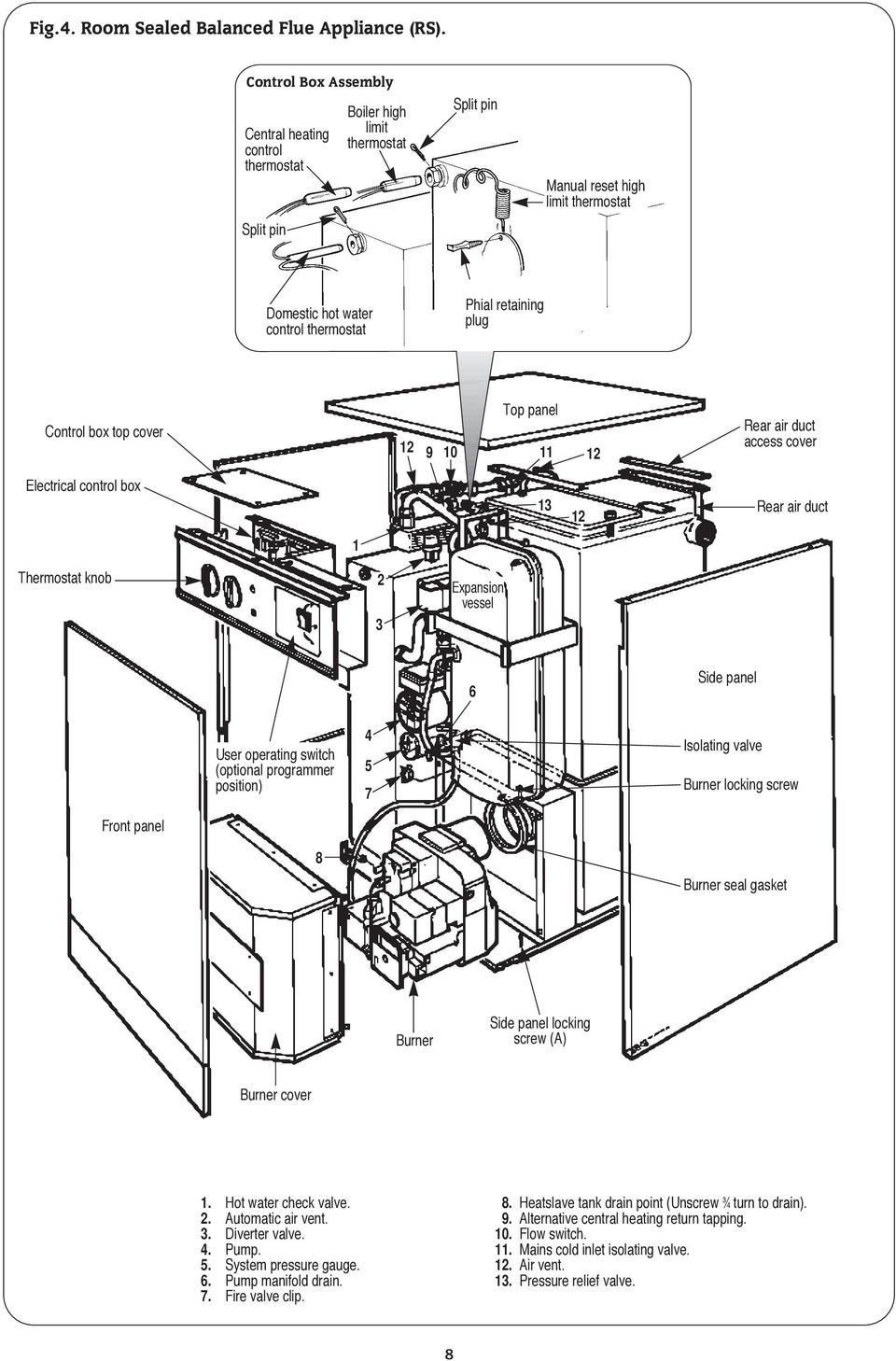
6 Fig. 1. Pipework Dimensions. 168mm 152mm 112mm 37mm FRONT VIEW REAR VIEW 738mm 769mm 809mm 813 mm 110mm 780mm 795mm Boiler 1 Boiler 8 1. Central heating return/cold feed (1" BSP). 6. Pressure relief discharge pipe. 2. Boiler vent (1" BSP). 7. Domestic hot water out (22mm copper). 3. Alternative central heating return tapping. 8. Heatslave tank drain. 4. Central heating flow (22mm compression). 9. Pump manifold drain. 5. Mains cold water in (15mm compression). Fig. 2. Principal Dimensions. 600 mm 92 mm 520 mm 184 mm Section The following clearances must be left to allow access for installation and servicing: (a) Above - 300mm (b) In front - 600mm (c) Right and left hand side - sufficient for panel removal and access to pipe connections where required. SIDE VIEW 780 mm 110 mm 57 mm 4. Siting the Appliance FRONT VIEW 4.1 The appliance is not suitable for external installation unless a suitable enclosure is provided The appliance should be positioned on a non combustible solid base as near to the flue location point as possible. Care should be taken to ensure that the appliance is level; use packing at the corners where necessary. 4.3 When fitting a LLD or RS model, the rear of the appliance must be positioned against an external wall such that the flue terminal can safely discharge the flue gases as described in 855 mm 6 5. Removal of the Cabinet See Figs. 3 and 4. For installation and servicing of the appliance the cabinet panels should be removed as follows: 5.1. Remove the cabinet top panel by lifting squarely upwards to release the four ball stud connections Remove the front panel by pulling the bottom of the panel forwards to release the ball studs and lifting the panel upwards and forwards to release it from its supporting ledge The side panels are removed by firstly following procedures 5.1 to 5.2 as described above, then remove screw (A) from the side panel base and the three screws located in the upper flange of each side panel. Ease the panel clear of the electrical control box and slide forwards to release from the locating lugs on the base plate. 5.4 The control box can be removed by undoing the four screws in the top access cover and then removing the wing nut on the underside of the control box. The thermostat phials should be carefully removed from the phial pocket, and the control box placed in a safe place taking care not to kink the thermostat capillary tubes. 5.5 On the RS balanced flue model, remove the burner box cover by pulling forwards to release the ball studs. This will be found easier by pulling on one side of the handle first to release two ball studs and then repeating on the other side. Take care not to pivot the remaining two ball studs too far around as this will cause damage to the spring clips.

7 Fig.3. Conventional Flue Appliance (CF/LLD). Control Box Assembly Central heating control thermostat Split pin Boiler high limit thermostat Split pin Manual reset high limit thermostat Domestic hot water control thermostat Phial retaining plug Top panel Control box top cover Electrical control box Thermostat knob 2 3 Expansion vessel Side panel 4 Front panel User operating switch (optional programmer position) 5 6 Burner locking screw Isolating valve 8 Burner seal gasket Burner Side panel locking screw (A) 1. Hot water check valve. 8. Heatslave tank drain point (Unscrew 3 Ú4 turn to drain). 2. Automatic air vent. 9. Alternative central heating return tapping. 3. Diverter valve. 10. Flow switch. 4. Pump. 11. Mains cold inlet isolating valve. 5. System pressure gauge. 12. Air vent. 6. Pump manifold drain. 13. Pressure relief valve. 7. Fire valve clip. 7

8 Fig.4. Room Sealed Balanced Flue Appliance (RS). Control Box Assembly Central heating control thermostat Split pin Boiler high limit thermostat Split pin Manual reset high limit thermostat Domestic hot water control thermostat Phial retaining plug Control box top cover Top panel Rear air duct access cover Electrical control box Rear air duct 1 Thermostat knob 2 3 Expansion vessel 6 Side panel User operating switch (optional programmer position) Isolating valve Burner locking screw Front panel 8 Burner seal gasket Burner Side panel locking screw (A) Burner cover 1. Hot water check valve. 8. Heatslave tank drain point (Unscrew 3 Ú4 turn to drain). 2. Automatic air vent. 9. Alternative central heating return tapping. 3. Diverter valve. 10. Flow switch. 4. Pump. 11. Mains cold inlet isolating valve. 5. System pressure gauge. 12. Air vent. 6. Pump manifold drain. 13. Pressure relief valve. 7. Fire valve clip. 8
9 6. Air Supply OPEN FLUE MODEL (CF/LLD) This includes conventional flue and standard low level and high level horizontal discharge kits. 6.1 In order to ensure clean and efficient combustion, an adequate supply of air must be delivered to the combustion chamber. To provide sufficient air, a suitable inlet should be provided into the room or space in which the appliance is situated, the size of which is detailed in Table 6. An air brick or other form of continuous air supply may have to be built into the installation in order to ensure an adequate supply of air. 6.2 If the appliance is to be installed in a confined space or compartment, two air vents are required, one at high level and one at low level. The minimum free area of each vent is given in Table 7 and depends whether the air is taken from another room or from outside the building. Where the air is taken from another room that room must contain an air inlet as described in There must be sufficient clearance around the appliance to allow proper circulation of ventilation air. The clearances required for installation and servicing will normally be adequate for ventilation. See Section 4.4. ROOM SEALED BALANCED FLUE MODEL (RS) 6.4 The appliance does not require a separate vent for combustion air. 6.5 Installation in cupboards or compartments require permanent vents for cooling purposes, one at high level and one at low level, either direct to outside air or to a room. Both vents must pass to the same room or be on the same wall to the outside wall to the outside air. The minimum air vent free area is given in Table There must be sufficient clearance around the appliance to allow proper circulation of ventilation air. The clearances required for installation and servicing will normally be adequate for ventilation. See Section 4.4. Table 6. Minimum Combustion Air Inlet Free Area for Open Flue appliances APPLIANCE AREA OF AIR INLET cm 2 in. 2 12/ / / Flue System A flue system must be provided in accordance with BS5410: Part 1 and the Building Regulations, part J, Section J Conventional Flue (CF). See Fig 5. Conventional Flue Diameters: 12/14 100mm (4in.) 15/19 100mm (4in.) 20/25 100mm (4in.) The boiler is fitted with a conventional flue locating spigot. The flue pipe fits into the spigot and should be correctly sealed with fire cement. TE: The flue size must never be reduced from the take-off diameter. An increase in flue size is permissible provided that the joint is sealed correctly. Fig. 5. Flue Installation. Where possible take the flue above the apex Ð if not above the apex an anti down-draught terminal is advisable. ALWAYS TAKE THE FLUE ABOVE THE EAVES Brick Chimney. Use of a flue liner is recommended. Flues must not be reduced from the boiler take off diameter. Use as few bends as possible. Use 135 Bends. Table 7. Minimum Air Vent Free Area for Open Flue appliances installed in a compartment. Fig. 6. Flue Installation (Rear Discharge). Appliance Ventilation to room or Ventilation to outside internal space model High Level Low Level High Level Low Level 12/14 154cm 2 231cm 2 77cm 2 154cm 2 15/19 209cm 2 314cm 2 105cm 2 209cm 2 20/25 275cm 2 413cm 2 138cm 2 275cm 2 FLUE GUARD 140 See Fig. 8 for flue terminating positions. Table 8. Minimum Air Vent Free Area for Room Sealed appliances installed in a compartment. Appliance Ventilation to room or Ventilation to outside internal space model High Level Low Level High Level Low Level 12/14 154cm 2 154cm 2 77cm 2 77cm 2 15/19 209cm 2 209cm 2 105cm 2 105cm 2 20/25 275cm 2 275cm 2 138cm 2 138cm mm 80 min. 9

10 Fig. 7. Room Sealed Balanced Flue Terminal Installation. X = 180 mm Maximum X (a) Rear Discharge 4" to 7" Single Skin Wall. For use with non-standard/single skin walls up to 182.mm thick. Where noise emission from the flue terminal is likely to be of concern, it is recommended that the standard 12 in. terminal is used and the appliance stood away from the wall to take up the extra terminal body length. X = 327 mm Maximum X 270 mm FLUE GUARD (b) Rear Discharge 7" to 12" Wall. For use in standard cavity walls and solid walls up to 327 mm thick. This terminal offers maximum noise reduction of the flue gases. This terminal is designed for use with the extension kit. 766 mm 340 mm (c) Rear Discharge Extension Kit 12" to 36" Wall. For use where the wall thickness exceeds 327.mm or where the appliance is to be stood away from the wall as shown. The system uses a standard 12 in. RS Flue Terminal and up to two extension kits, which simply bolt together. X One extension kit Ð X = 638 mm Maximum Two extension kits Ð X = 952 mm Maximum 10

11 M The flue should be vertical and contain as few bends as possible. Where bends are necessary, a maximum of two are permitted and 135 bends should be used. All brick and masonry chimneys should be lined with a suitable non-combustible material. They must be properly jointed and able to withstand the effects of the working temperature of the appliance and any condensate which may form. Down-draught conditions will adversely affect the operation of the appliance and must be avoided. Where possible, the flue should be extended beyond the apex of the roof and should always be taken beyond the eaves of the building. Where downdraught is experienced a suitable anti-down-draught terminal should be fitted to the flue termination. The natural flue draught must be checked. A suitable location for checking this is located in the flue outlet plate on top of the boiler. The draught should be no less than 0.75mm w.g and no greater than 5.1mm w.g. If a flue draught greater than 5.1 mm w.g is experienced a draught stabiliser should be fitted to the flue and adjusted to achieve a flue draught within the specified range. 7.2 Low Level Discharge (LLD) See Fig 6. The conventional flue appliance may be converted to discharge the products of combustion at low level. For this purpose a special flueless kit and associated ducting is available, allowing the conventional flue to be discarded. Detailed instructions for converting the appliance to low level discharge are supplied with the conversion kit. The flue spigot should be removed from the flue outlet plate by undoing the three retaining screws and the hole blanked off with the plate provided in the kit. TE: Under no circumstances may 35 Second Gas Oil be burned with this type of flue terminal arrangement. 7.3 Room Sealed Balance Flue Model (RS) The appliance is supplied ready for installation as a low level discharge balanced flue system by the simple addition of one of the flue terminal options shown in Fig.7. Details of the installation procedure are included in the Flue Terminal Installation Instructions supplied with the terminal kit. Alternatively, a range of room sealed balanced flue kits are available to convert the appliance to discharge the flue products to the left, right, at a higher level, or vertically up to a roof height of 4.5 metres. Fig. 8. Flue terminating positions for oil-fired appliances TE: The dimensions given are for general guidance only. Other surrounding buildings or objects may affect the clearance of combustion products. An alternative flue terminal position should be sought when there is any possibility of a nuisance being caused by inadequate dispersal of flue products. Terminals should be positioned so as to avoid products of combustion entering into buildings. Open Flue O N C.D. H.J. Window B A E G Flue Terminal F K F L Minimum Distance (mm) Terminal Position Open Low-Level Flue Discharge A Directly below an opening, air brick, window, etc.... Not allowed 600 B Horizontally to an opening, air brick, window, etc.... Not allowed 600 C Below a gutter or sanitary pipe... Not allowed 75 D Below eaves or a balcony... Not allowed 600 E From vertical sanitary pipework... Not allowed 75 F From an internal or external corner... Not allowed 300 G Above ground or balcony level... Not allowed 300 H From a surface facing the terminal... Not allowed 600 J From a terminal facing the terminal... Not allowed 1200 K Vertically from a terminal on the same wall... Not allowed 1500 L Horizontally from a terminal on the same wall... Not allowed 300 M Above an intersection with the roof Not applicable N From a vertical structure on the side of the terminal Not applicable O Above a vertical structure less than 750 mm from the side of the terminal Not applicable 11

12 7.4 Siting the flue terminal 1. The flue terminal must be located in a suitable position, as shown in Fig 8, such that products of combustion can be freely dispersed without the possibility of flue gases entering dwelling or that of a neighbouring dwelling. 2. Discharge of flue gases into carports or narrow passageways is not recommended. 3. The terminal must not cause obstruction nor the discharge cause a nuisance as a result of either flue gases or terminal noise. 4. If the terminal is fitted within 1 m of a plastic or painted gutter or within 500 mm of painted eaves then an aluminium or stainless steel shield at least 1 m long should be fitted to protect the surface. 5. If a terminal is fitted less than 2 metres above a surface to which people have access, fit a terminal guard as shown in Fig 9. A suitable guard is available from Worcester Heat Systems, Part number , or alternatively a proprietary terminal guard may be used provided it has the minimum dimensions shown in Fig 9. The guard should have suitable corrosion resistance due to the acidic content of the flue gases. 6. The terminal guard must be evenly spaced about the flue terminal and secured using screws, to allow access to the flue terminal. 7. In certain weather conditions a terminal may steam and siting where this could cause a nuisance should be avoided. 8. Take care to ensure that combustion products do not enter ventilated roof voids. 280 Fig. 9. Terminal guard Minimum dimensions. Terminal guard. See

13 8. Oil Supply Fig. 10. Oil Pump. (See Figs. 10, 11 and 12). 8.1 The oil storage tank must be installed in accordance with BS799: part 5. The tank should be arranged with a slope of 1 in 24 away from the outlet valve with a sludge cock at its lower end. 8.2 Do not use galvanised steel tanks or pipework for the oil supply system. 8.3 Do not use soldered joints in the oil supply pipework as this could cause a hazard in the case of a fire. 8.4 The burners on all appliances are supplied so as to be connected to a single pipe gravity feed system. Details of how to convert the burners to a double pipe sub-gravity feed system are shown in Fig If a single pipe system is employed, then the tank must be positioned such that the oil level does not exceed 4 metres above the level of the burner oil pump and in addition the oil level must be at least 0.3 metres above the level of the oil pump. Should it prove impossible to site the tank below the 4 metres maximum oil level head breaking device must be installed between the tank and the burner. 8.6 If a double pipe system is used then the maximum suction height allowable is 3.5 metres. 8.7 The oil supply pipe diameter can be determined using Tables 9 and 10 depending on whether a single or double pipe system is being installed. Selection of the correct pipe diameter will depend on the position of the oil storage tank relative to the burner and the length of pipe run. 8.8 The oil supply pipe should be laid as level as possible to avoid air pockets and unnecessary friction losses. 8.9 The following components should be fitted in the fuel line between the storage tank and burner. 1. A Manual isolating valve installed as close to the tank as possible. 2. A fire valve in accordance with BS799, Part 2 as shown in Fig 11. The fire valve should be fitted externally with a fire detection element located within the appliance case. Use of a capillary type valve will allow a neat and simple installation. A suitable valve is the KBB manufactured by Teddington Controls Limited. A spring clip has been provided behind the electrical panel on CF/LLD models, shown in Fig 3, and on the burner box on RS models, shown in Fig 4, to allow a fire valve element to be mounted. Alternatively a fusible link or electrical system may be used. Under no circumstances should a combination isolating/fire valve be used as the sole fire protection device. 3. A paper element filter complying with the requirements of BS799, Parts 2, 3 and 4 should be fitted in the fuel line between the fire valve and the isolating valve but not within the appliance casing. TABLE 9 Single Pipe Gravity Feed System MAXIMUM ALLOWABLE PIPE RUN HEAD (metres) (metres) 8 mm inside dia. pipe 10 mm inside dia. pipe (10 mm O.D. copper) (12 mm O.D. copper) A. Danfoss BFP 41. Cartridge filter 3 5 B. Danfoss BFP 11 Oil Pump. C. Suntec AS47C Oil Pump a 4 1 INLET 2 RETURN 3 BLEED AND PRESSURE GAUGE PORT 4 VACUUM GAUGE PORT 5 PRESSURE ADJUSTMENT 6 ZZLE OUTLET To convert to a double pipe system, remove plug 4a and insert the grub screw provided into the threaded hole. Connect flow and return pipes to (1) and (2). 2 To convert to a double pipe system: Remove the pump front cover, remove the changeover screw (A) nearest to ports 1 and 2, and the horseshoe washer underneath. Replace the changeover screw back into the threaded hole. Connect the flow and return pipes to 1 and 2. Note: When removing the pump front cover ensure that a suitable receptacle is placed below the pump to catch the oil residue A To convert to a double pipe system, remove the return port plug (2) and insert the grub screw (A) provided into the threaded hole (B). Connect flow and return pipes to (1) and (2). TABLE 10 Double Pipe Sub-Gravity Feed System MAXIMUM ALLOWABLE PIPE RUN HEAD (metres) (metres) 8 mm inside dia. pipe 10 mm inside dia. pipe (10 mm O.D. copper) (12 mm O.D. copper) B A 13

14 Fig. 11. Oil Supply. (a) Single pipe system Maximum oil level Sludge cock Oil tank Isolating valve Filter Tank raised 1 in 24 (40 mm per metre) Fire valve to BS 799 Part 2 Wall Fire detection element Paper element oil filter Isolating valve Burner H = 0.3 m (1 ft) minimum H = 4 m (13 ft) maximum (b) Double pipe system. Oil tank Isolating valve Non return valve Non return valve Fire valve to BS 799 Part 2 Wall Fire detection element Isolating valve Burner H = 3.5 m (11.5 ft) maximum Filter Paper element oil filter Sludge cock Tank raised 1 in 24 (40 mm per metre) Fig. 12. Oil Pipe Installation. (a) CF Bracket. (b) Single Pipe System. (c) Double Pipe System. Turn fully clockwise to isolate Isolating valve Pipe support bracket Turn fully clockwise to isolate Air bleed Isolating valve 10mm copper pipe Open grommet 10mm or 12mm copper pipe Flexible oil hose 10mm copper pipe Retaining clip Burner oil pump Burner oil pump Blind grommet Burner oil pump 1 Ú4" BSP female x 10/12mm compression coupling (not supplied) CF Appliance RS Appliance 14

15 9. System Considerations 9.1 The appliance incorporates a circulating pump. No other pump is required. The appliance will operate satisfactorily on a two-pipe small bore or micro bore system using thermostatically controlled radiator valves. 9.2 The appliance incorporates a three-port, two-way diverter valve which diverts the boiler output to the Heatslave tank in response to a demand from the Domestic Hot Water Control Thermostat or the flow switch. The valve is powered open in response to a demand from the Central Heating Control Thermostat or a room thermostat, and the boiler output is diverted to the heating circuit. If there is a demand from both the Heatslave tank and the central heating, the valve will give priority to the Heatslave tank. The central heating will therefore remain switched off for a short period of time. This delay will vary depending on the appliance output and the quantity of energy required to satisfy the domestic hot water demand. The Heatslave tank priority can be temporarily overridden to regain the central heating output by turning the Domestic Hot Water Thermostat fully anti-clockwise for the duration of the warm up period. This will prevent the Heatslave tank taking priority for the tank warm up period of approximately 20 minutes and may be found advantageous to give quicker heating to the dwelling when starting from cold. 9.3 A check valve is incorporated in the hot water primary circuit to prevent gravity circulation from the tank to the boiler. 9.4 When employing a central heating system where primary water flow may be prevented during a pump overrun situation (e.g. by using thermostatic radiator valves on all radiators), a bypass valve should be fitted between the flow and return pipes. 9.5 The pressure jet burner fitted to the appliance has full automatic control and there is no requirement for heat leak radiators. 9.6 It is strongly recommended that isolating valves are fitted to the central heating flow and return pipes. This will allow the boiler and Heatslave tank to be drained for service work without having to drain down the whole central heating circuit. 9.7 A drain point should be provided in the domestic hot water pipework at any point below the height of the domestic hot water heat exchanger. 9.8 Provision should be made to allow air to be vented from the domestic hot water pipework at any high points. Failure to vent the air will cause the flow switch to operate momentarily if a cold water tap is turned off rapidly. 9.9 Any unused boiler tappings should be plugged prior to filling The primary central heating system should be flushed and treated in accordance with recommendations of BS 7593: 1992 before the system is handed over to the user. 10. Sealed Primary System See Figs. 13 and The system must comply with the requirements of BS 7074:1 and BS 5449: A manual reset overheat thermostat is located on the underside of the electrical panel and is accessible by removing the cabinet front panel. If a boiler overheat condition arises the burner will remain inoperative until the thermostat button is reset. See Fig. 3 and The pressure relief valve operates at 3 bar (45 lb/in 2 ). The discharge must be directed away from the electrical components or where it might be a hazard to the user The pressure gauge, located in the pipe below the pump, indicates the system pressure which must be maintained The 12 litre expansion vessel is charged to 0.5 bar and is suitable for a static head of 5 metres (17.5 ft). The pressure can be increased for a static head greater than 5 metres (17.5 ft) With an initial system pressure of 0.5 bar, a system capacity of about 180 litres can be accommodated. Refer to BS 7074 Pt 1 for more information. Fig. 13. Sealed Primary System. Domestic cold water Note: The appliance mains cold water supply should be the first connection off the water main British Standard stop valve (Fixed spindle type) Water main Domestic hot water outlet Heating flow (22 mm) Mains cold isolating valve Flow switch Pressure relief valve Diverter valve Static head of system Heatslave tank Pump Expansion vessel To system filling device See Fig. 14 Heating return (22 mm) Pressure gauge Bypass valve to be fitted when thermostatic valves are fitted on all radiators 15

16 Fig. 14. System Filling and Make-Up. Heating Return Non return valve Worcester Combi-Fill System Non return valve Heating Return Auto Air Vent Non return valve Make up vessel Hose Union Test Cock Temporary Hose Stop Cock Heating Return Stop Cock Fill Point. Heating Return 300 mm (12 in.) min. above the highest point of the system METHOD 1 METHOD 2 Where the system volume exceeds the value given in Table 11 an additional expansion vessel, of suitable volume, should be fitted to the heating return pipework as close to the boiler as possible. TE: The values given in Table 11 are the total system volumes. The primary water capacity given in Table 1 should be deducted from the total system volume when calculating the volume for radiators, pipework etc The method of filling the appliance can be either method 1 or 2 shown in Fig 14. The filling point must be at low level and must never be a permanent direct fixing to the mains water supply Water loss must be replaced, see Fig 14. The connection should be made to the central heating return pipe as close to the appliance as possible The make-up vessel, where used, must be fitted with a nonreturn valve Repeated venting loses water from the system. It is essential that this water is replaced and the system pressure maintained Connections to the mains water supply must not be made without the authority of the local Water Company The appliance incorporates a circulating pump. No other circulating pump is required. The pump is factory set to the maximum setting (No: 3) and should not be altered as this would affect the domestic hot water performance Connections in the system must resist a pressure of up to 3 bar Radiator valves must conform to BS 2767 (10): Other valves used should conform to the requirements of BS Open Vent Primary System See Fig 15. The appliance is supplied ready for connection to a Sealed Water system. Where the appliance is to be used with an Open Vent System, the pressure relief valve may be removed and the tapping blanked off. If the relief valve is left in position, a discharge pipe should be fitted. The pipe must be directed away from the electrical components or where it might be a hazard to the user. Fig. 15. Open Vent Primary System. Domestic cold water Note: The appliance mains cold water supply should be the first connection off the water main British Standard stop valve (Fixed spindle type) Water main Heating flow (22 mm) 350 mm (14.0 in.) minimum Domestic hot water outlet Static head Mains cold isolating valve Flow switch Static head Heating vent (22 mm) Expansion cistern Minimum static head to be 1m (3ft) measured from the top surface of the appliance or the highest point in the heating system to the top of the water level in the expansion tank. Heatslave tank Boiler Diverter valve Pump Primary cold feed (15 mm) Heating return (22 mm) Bypass valve to be fitted when thermostatic valves are fitted on all radiators 16

17 The following points are for guidance only. The system installation should be carried out in accordance with BS Part The feed and expansion pipes must rise continuously from the appliance. The feed pipe must be at least 15mm diameter and the expansion pipe must be at least 22mm diameter. If access to the 1" BSP sockets on the right hand side of the boiler is difficult, use the alternative return connection on the boiler pipework. See Figs. 3 and 4. The cistern must be arranged to provide a minimum static head of 1 metre (3 ft) above the top of the appliance casing or the highest point in the heating circuit. See Fig Air in the appliance is expelled through the vent pipe or dissipated into the system, but manual air vents should be fitted at high points in the system. An automatic air vent is fitted to the Heatslave tank and manual air vents are included on high points in the appliance pipework The appliance incorporates a circulating pump. No other circulating pump is required. The pump is factory set to the maximum setting (No: 3) and should not be altered as this would affect the domestic hot water performance. TABLE 11 TOTAL SYSTEM VOLUME (Litres) Initial System Initial Charge Pressure (bar) Pressure (bar) Domestic Hot Water The following are general requirements and, if necessary, reference should be made to the local Water Company before fitting the appliance Mains Cold Water Inlet Devices capable of preventing the flow of expansion water must not be fitted unless separate arrangements have been made. An expansion vessel can be fitted within the casing of the appliance if necessary. The final 600mm of the mains cold water connection to the appliance should be made in copper tube only. The appliance is suitable for a mains cold water supply having a maximum pressure of up to 10 bar (145 lb/in 2 ). A pressure reducing valve must be fitted if the mains pressure exceeds 10 bar Domestic Hot Water Supply and Flow Regulation As with all mains fed systems, the flow rate of water obtainable from individual taps will vary in relation to the number of outlets operated simultaneously. The flow rate will depend on the cold mains supply pressure available to the property and the diameter and length of pipework making up the domestic water distribution system. When more than one outlet is used at once, starvation of water flow may occur at one or more outlets. Where this is a problem flow balancing valves or Ball-O-Fix valves should be installed at the appropriate outlets. The 12/14 and 15/19 appliances are fitted with a water flow restrictor. The maximum flow of domestic hot water available from the appliances is 15 litres/min (+ or - 15%) (3.3 gallons/min) and requires a minimum mains cold supply pressure of 1.6 bar (22 lb/in 2 ) to attain this level. The 20/25 appliance is not fitted with a flow restrictor and therefore the flow rate is only limited by the water supply pressure. This can be manually adjusted at the mains cold water inlet isolating valve. The maximum recommended domestic hot water flow rate from this appliance is 17 litres/min (3.7 gallons/min). The temperature of hot water drawn will vary with the flow rate at the taps and the appliance operating temperatures. It is usual that flow rates (and thus temperatures) are controlled at the tap, but if a more permanent setting is required, a mixing valve can be fitted. If there are long pipe runs to the taps or shower, it is suggested that they be insulated to prevent the rapid cooling of residual hot water in the pipes after the tap has been turned off. TE: The flow restrictor contained within the flow switch housing is plastic. Do not allow the housing to become hot during soldering operations Taps and Valves Hot and cold taps and mixing valves used with this appliance must be suitable for operating at a mains pressure of up to 10 bar (145 lb/in 2 ) Showers (Fixed Head Type) No anti-syphonage arrangements are necessary. Thermostatically controlled shower valves will give extra comfort and guard against the flow of water at too high a temperature Showers (Loose or Flexible Head Type) A loose head shower hose must be fixed so that the head cannot fall closer than 25mm (1 in) above the top edge of the bath to prevent its immersion in bath water. Alternatively the shower must incorporate or be fitted with an anti-syphonage device at the point of the flexible hose connections. Thermostatically controlled shower valves will give extra comfort and guard against the flow of water at too high a temperature Bidets The supply of hot and cold mains water direct to a bidet is permitted (subject to local Water Company requirements) provided that the bidet is of the over-rim flushing type. The outlet(s) should be shrouded and unable to have any temporary hand held spray attached. No anti-syphonage arrangements are necessary Use in Hard Water Areas In areas of exceptionally hard water supply, it is recommended that an In-line scale inhibitor be fitted. Installation should be strictly in accordance with the requirements of the local Water Company. An isolating valve to facilitate servicing should be incorporated. The water hardness may be determined using the standard test paper or by reference to the local Water Company. Further information may be obtained from Worcester Heat Systems Ltd. 17

18 13. Electrical Refer to Figs. 16, 17, 18 and The wiring between the appliance and the electrical supply shall comply with current IEE Wiring Regulations and any local regulations which apply To gain access to the mains connection point on the control board. 1. Isolate the mains electrical supply. 2. Remove the cabinet top panel by snatching squarely upwards. 3. Release the four screws securing the cover of the electrical control box Mains Supply Mains Supply-230/240V~ 50 Hz. External Fuse 5A. Internal Fuse 3.15A (20 mm). Quick Blow. LIVE-Brown, NEUTRAL-Blue, EARTH-Green/Yellow Mains Cable: 0.75mm 2 (24 x 0.20mm) to BS6500 Table 16. The method of connection to the appliance must allow complete isolation of the appliance, preferably via a double pole isolator with a contact separation of 3mm in all poles supplying the boiler and controls only. Fig. 16. Wiring Diagram. Earth Flow switch bl br gy X1 bl gy gy or bl bl br br X6 br g X7 X8 w X10 w gy bl pk pk br X9 X13 pk or y br Link X11 y y gy g bk pk y X12 X3 X4 Post purge unit connection br w g Link Boiler High Limit Thermostat or (1) (C) (3) r br w (1) Earth w (C) Domestic Hot Water Control Thermostat Central Heating Control Thermostat or or pk POWER ON Indicator light bk r pk g gy y Manual reset overheat thermostat y (C) (3) (1) pk y pk y LOCKOUT Indicator light Brown White White Mains Electrical Supply Brown Grey Operating Switch Facia Panel or bl gy br g Plug-in connector to burner control HOT WATER ADVANCE HEAT SYSTEMS OFF TWICE ONCE ON TUE PM OFF TWICE ONCE ON HEATING ADVANCE Motorised Diverter Valve Burner Control Options SELECT LOCK SET? SELECT Optional Programmer bl gy br PLUG-IN CONNECTOR bk y r gy pk g Pump E FAN MOTOR E N L gy bl br N E SATRONIC TF830.2B CONTROL BOX COLOUR CODE br Ð brown bl Ð blue gy Ð green and yellow r Ð red w Ð white y Ð yellow g Ð grey bk Ð black or Ð orange pk Ð pink 18

19 Fig. 17. Schematic Electrical Diagram. POWER ON INDICATOR LOCKOUT INDICATOR X9 (PIN 1) N FROST THERMOSTAT (IF FITTED) L RELAY 1 X2 X2 (PIN 1) DIVERTER END (PIN 5) 4 X8 SWITCH X8 LIVE SUPPLY 1 N RELAY 2 X1 (PIN 1) FUSE F1 3.15A QUICK BLOW brown X4 (PIN 3) OPERATING SWITCH or PROGRAMMER J@@@@@W&@@@@@1g 7@@@@@@@@@?@@@g?J@@@?@@@@@5?@@@L?f?7@@5?3@@@(Y?3@@1?f?@@@H?N@@@H??N@@@?f J@@@e?@@@f@@@Lf N X2 (PIN 4) grey X4 (PIN 1) white X2 (PIN 2) X4 (PIN 2) X2 (PIN 6) Link N X2 (PIN 3) ROOM THERMOSTAT (IF FITTED) 2 3 X3 (PIN 3) LIVE SUPPLY FOR POST PURGE UNIT N (PIN 4) X10 (PIN 3) (PIN 1) white white DOMESTIC HOT WATER CONTROL THERMOSTAT brown X10 (PIN 1) X6 (PIN 4) RELAY 3 N X6 blue (PIN 2) RELAY 4 WATER FLOW SWITCH N X11 (PIN 2) RESISTOR X13 (PIN 2) X13 (PIN 5) N X13 (PIN 3) X12 (PIN 4) X13 (PIN 1) pink orange brown grey yellow (1) (3) (C) (C) (3) (1) brown X7 (PIN 1) PUMP MOTORISED DIVERTER VALVE brown X8 (PIN 2) orange red grey red BURNER SNAP ON CONNECTOR (PIN 4) CENTRAL HEATING CONTROL THERMOSTAT BOILER THERMOSTAT MANUAL RESET OVERHEAT THERMOSTAT PLUG-IN CONNECTOR (PIN 2) Fig. 18. Room and Frost Thermostat Connections Fig. 19a. Facia Mounted Programmer Connections. Room Thermostat Neutral Switched Live Remove Link Terminal Block X2 on Control Board Terminal Block X4 on Control Board Blue Brown Pre-wired time clock terminal strip socket (Located in boiler electrical cover). Pre-wired time clock terminal strip plug (Connected to time clock leads). Frost Thermostat (Double Pole) Common Blue White Grey Brown White Grey Terminal Block X2 on Control Board HW CH Programmer 19

20 Fig. 19b. External Programmer Connections. Terminal Block X4 on Control Board bl br w g Neutral to programmer Live supply to programmer Switched domestic hot water from programmer Switched central heating from programmer The mains supply cable should be connected into the mains connection points on the control board marked L (Live), N (Neutral) and E (Earth) on the control board and securely held in the cable clamp located on the base of the electrical box. To secure the cable, remove the clamp retaining screw and pull its inner body out to allow the cable to be fed through. With the cable in position refit the screw and fully tighten to grip the cable. Feed the cable between the side panel and the boiler insulation jacket and route to the connection point avoiding any hot surfaces. The appliance must be earthed Facia Mounted Programmer (See Fig. 19a) A plug in, colour co-ordinated, 2 channel electronic programmer is available from Worcester Heat Systems. The programmer will give fully independent central heating (CH) and hot water (HW) programmes when the switch on the rear of the unit is set to P. Full instructions covering installation and operation of the programmer are included with the kit External Programmer (See Fig. 19b) A programmer offering time controlled central heating and domestic hot water or one which provides controlled central heating and switched domestic hot water is acceptable. Fitting an external programmer: Check that the electrical supply has been turned off and remove the facia panel as described in Section 19.2 (15). The external programmer must take its power supply from the appliance. See Fig 19b. The leads must be insulated as they operate at mains voltage. Pass the leads through the hole provided in the control box back panel and connect them to terminal block X4 to which the leads from the facia mounted switch are currently still connected. See Fig. 19b. Disconnect the grey lead from the terminal block and connect, in its place, the central heating control lead from the programmer. Disconnect the white lead from the terminal block and connect, in its place, the domestic hot water control lead from the programmer. Disconnect the brown lead from the terminal block and connect, in its place, a brown lead (live supply) to the programmer. The remaining connection in the block is the neutral connection for the programmer. Where an earth point is provided on the programmer then this should be wired to the appliance control box earth point on the X1 terminal block. Although inoperative, the facia mounted switch should be left in place. Remove the spade connectors from the user operating switch and discard the wires removed. Refit the facia and set the programmer. Check the operation of the appliance in response to the switching of the programmer External Thermostats If a room and/or frost thermostat is to be fitted, refer to Fig 18. The thermostats must be suitable for use on mains voltage. An optional earth point is provided on the X1 terminal block if required Safety Check In the event of an electrical fault after the installation of the appliance, the electrical system shall be checked for short circuits, fuse failure or incorrect polarity of connections. 20

21 14. Functional Flow Chart CENTRAL HEATING AND DOMESTIC HOT WATER MODE (HEATING ON and HOT WATER ON selected) Pump water to the Heatslave tank. Burner on. Pump on. Diverter valve off. Domestic hot water demand via tap or shower. Has the boiler high limit thermostat activated? Activate the pump overrun. Pump water to the Heatslave tank. Pump on. Diverter valve off. Burner off. Output to domestic hot water. Heatslave tank demand via domestic hot water thermostat. Has the boiler high limit thermostat activated? Activate the pump overrun. Pump water to the Heatslave tank. Pump on. Diverter valve off. Burner off. Pump water to the Heatslave tank. Burner on. Pump on. Diverter valve off. Central heating demand via room or frost thermostat. Has the boiler high limit thermostat activated? Boiler allowed to cool. Has the boiler high limit thermostat activated? Activate the pump overrun. Pump water to the central heating circuit. Pump on. Diverter valve on. Supply hot water to the central heating circuit. Pump on. Diverter valve on. Is there a demand to heat the boiler via the central heating thermostat? Supply hot water to the central heating circuit. Pump on. Burner on. Diverter valve on. 21
22 DOMESTIC HOT WATER MODE ONLY (HOT WATER ON selected) Domestic hot water demand via tap or shower. Pump water to the Has the boiler high limit thermostat activated? Heatslave tank. Burner on. Pump on. Diverter valve off. Output to domestic hot water. Activate the pump overrun. Pump water to the Heatslave tank. Pump on. Diverter valve off. Burner off. Has the boiler high limit thermostat activated? Activate the pump overrun. Pump water to the Heatslave tank. Pump on. Diverter valve off. Burner off. Heatslave tank demand via domestic hot water thermostat. Pump water to the Heatslave tank. Burner on. Pump on. Diverter valve off. Accumulate energy store in the Heatslave tank. Boiler allowed to cool. 22
23 CENTRAL HEATING MODE ONLY (HEATING selected on programmer) Domestic hot water demand via tap or shower. Has the boiler high limit thermostat activated? Is there a demand to heat the boiler via the central heating and room thermostats? Activate the pump overrun. Pump water to the Heatslave tank. Pump on. Diverter valve off. Burner off. Pump water to the Heatslave tank. Pump on. Diverter valve off. Burner on. Output to domestic hot water dependent on the quantity of hot water available in the Heatslave tank/boiler. Central heating demand via room or frost thermostat. Has the boiler high limit thermostat activated? Boiler allowed to cool. Has the boiler high limit thermostat activated? Activate the pump overrun. Pump water to the central heating circuit. Pump on. Diverter valve on. Supply hot water to the central heating circuit. Pump on. Diverter valve on. Is there a demand to heat the boiler via the central heating thermostat? Supply hot water to the central heating circuit. Pump on. Burner on. Diverter valve on. 23
24 OFF MODE (OFF selected) Domestic hot water demand via tap or shower. Pump on. Diverter valve off. Is there any residual heat in the Heatslave tank/ boiler? Domestic water remains cold. Limited domestic hot water output. 15. Installation 15.1 After unpacking the appliance it is recommended that all cabinet panels are removed, as described in Section 5, and stored in a safe place to avoid damage during installation and allow easy inspection for leaks after the system has been filled Remove the burner as described below and store in a safe place until the appliance is ready for commissioning. (a) Conventional Flue Appliance (CF/LLD). 1. Remove the electrical lead plug by depressing the two locking ears and pulling the plug downwards. 2. Remove the burner from the boiler by slackening the two M6 retaining screws located in the burner housing ring and pulling the burner clear. This will require the use of a 5mm allen key. (b) Room Sealed Balance Flue Appliance (RS). 1. Remove the burner box cover by pulling forwards to release the ball studs. This will be found easier by pulling on the one side of the handle first to release two of the ball studs and then repeating on the other side. Take care not to pivot the remaining two ball studs too far around as this will cause damage to the spring clips. 2. Remove the electrical lead plug by depressing the two locking ears and pulling the plug downwards. 3. Push the electrical lead grommet back through the burner surround box and feed the lead through the hole. 4. Remove the burner from the boiler by slackening the two M6 retaining screws located in the burner housing ring and pulling the burner clear. This will require the use of a 5mm allen key Flue System Installation Install the appliance flue system as described in Section Heating System Installation. 1. Plumb the boiler into the central heating system. 2. Check that all unused sockets have been plugged. 3. The following procedure should be used when filling the system: Set the diverter valve to the mid position by moving the manual lever to the left hand side and locking in position. Open all radiators and lockshield valves and remove and discard the automatic air vent cap on the Heatslave tank. Fill the system and check that air is being discharged from the automatic air vent. Vent each radiator in turn to remove the air from the system. Bleed any air from the appliance pipework using the manual air vents provided. When the system has been completely vented, turn the Domestic Hot Water Control Thermostat fully anti-clockwise and set the user operating switch to heating and hot water on. The pump will now operate and any remaining air can be purged from the system using the appropriate bleed points. Return the diverter valve lever to the normal right hand side position. 4. Check the boiler and all pipework connections for leaks Domestic Water Installation 1. Connect the incoming domestic water supply to the 15 mm compression isolating valve. 2. Connect the main domestic hot water supply pipe to the hot water outlet via a 22mm pipe, to ensure minimum pressure drop in the circuit. 3. Ensure that no air traps are formed in the pipe-work as this will cause the flow switch to bounce when a hot or cold tap is turned off rapidly. 4. See section 12 for further details. 24
25 15.6 Oil supply installation. (See Fig. 10 to 12). TE: Never route the oil supply pipe/hose directly below the combustion chamber base. (a) Double pipe system oil return pipe. When fitting an RS balanced flue appliance follow 1 to 11. When fitting a CF/LLD appliance follow step 1 and fit a bulkhead fitting to the bracket for the return pipe and continue from step Remove the isolating valve bulkhead fitting by unscrewing the locknut on the underside. 2. Remove the blind grommet from the fixed burner surround box and discard. 3. Replace the blind grommet with the open grommet supplied in the plastic bag. 4. Slacken the pipe retaining clip screw located directly below the grommet hole. When using 12mm copper pipe replace the clip with the larger one supplied. 5. Bend a piece of 10mm or 12mm copper tube (as selected) to the correct profile to allow the pipe to be fed down the side of the appliance. Make a slight chamfer on the end of the pipe to be fed through the grommet to facilitate easy insertion. 6. Lubricate the grommet hole with vaseline (or butter etc.) and slide the pipe through the hole, supporting the grommet on its underside to prevent it dislodging. 7. Feed the pipe through the retaining clip, allowing approximately 80mm of pipe to project beyond the clip, and tighten the retaining screw. Take care not to overtighten the screw! 8. Hold the pipe at the retaining clip and gently pull the pipe forward sufficiently to allow a compression to 1 4 inch BSP female fitting to be fitted for connection to the oil return flexible hose. 9. Connect the fitting to the pipe and fit a 1 4 inch BSP taper thread flexible hose, ensuring a good seal using PTFE tape or suitable oil sealing compound. The flexible hose should have a 1 4 inch BSP rotating union taper fitting at the other end with a 90 degree bend and 1 4 inch BSP nipple for connection to the oil pump. 10. Replace the isolating valve bulkhead fitting. 11. Fit the oil supply pipe as described in the following section. (b) Single pipe system oil supply pipe. 1. Bend a piece of 10mm or 12mm copper tube (as selected) to the correct profile to allow the pipe to be fed down the side of the appliance. The pipe may be routed either along the right or left hand side of the boiler as required. When using 12mm pipe fit a 12mm to 10mm compression coupling and connect to the valve with a short piece of 10mm pipe, otherwise connect directly to the valve. TE: Never use soldered joints on the oil supply pipes as this could cause a hazard in the case of a fire. 2. Route the pipe back to the oil supply tank ensuring that it is hard against the boiler, to allow installation of the side panel. 3. With the isolating valve in the correct orientation tighten the back-nut. 4. Turn the isolating cock fully clockwise to close the valve. 5. Open the main oil supply valve at the tank and check for any leaks. 6. Place a suitable container below the bulkhead fitting and open the valve. 7. Draw off at least 2.5 litres of oil until a steady flow of clear uncontaminated oil can be seen and turn off the isolating valve. TE: This method may not be possible on some installations where a sub-gravity system used. Where the problem arises bleed the system using the oil pump as described in Section 16 and remove and clean the oil pump filter to remove any debris collected as result of installation Replace the electrical control panel and side panels in reverse order to the removal procedure of Section 5 and connect the electrical supply as described in Section Commissioning the Appliance Ensure that no foreign matter is left in the system as this could cause damage to the appliance. Check that the electrical supply to the appliance is switched off Domestic Hot Water System Check that the mains water supply has been fully flushed out at installation When commissioning the appliance after initial installation follow the procedure from 16.3, otherwise remove the burner first as described in Section Appliance and System Preparation 1. After initial installation and checking for leaks, as previously described, drain down the system sufficiently to add a flushing agent. Flush the system in accordance with BS 7593: Fill the system using one of the methods described in Section 10, adding a suitable corrosion inhibitor in accordance with BS7593: Check that the pressure relief valve operates by turning the knob anti-clockwise until water is expelled from the discharge pipe. 4. Set the Expansion Vessel Pressure The charge pressure of the expansion vessel as despatched is 0.5 bar, which is equivalent to a static head of 5 metres (16.7 ft.). The charge pressure must not be less than the static head at the point of connection. See Figs 13 and 14. A Schraider type tyre valve is fitted to the expansion vessel to allow the charge pressure to be increased if necessary. 5. Set the System Pressure Fill the system until the pressure gauge shows 1.5 bar (21.5 lb./in 2 ) and check for water soundness. Release water from the system, using the pressure relief valve knob, until the System Design Pressure is obtained, up to a maximum of 1.5 bar. System Design Pressure in bar = Static Head of the System in bar TE: 1 bar is equivalent to 10.2 metres (33.5 ft) of water. Set the movable pointer giving a permanent record of the set system pressure. If the pressure indicated on the pressure gauge is greater than 2.5 bar when operating at the maximum central heating temperature, an extra expansion vessel must be fitted to the system as close as possible to the appliance central heating return connection. Refer to Section 10 for further information on system capacities. Any extra vessel fitted must be pressurised to the same figure as the integral vessel. If the expansion vessel fails then the specified replacement must be fitted Check the Burner 1. Check that the nozzle and electrode settings are correct for the relevant burner. See Figs 21 and Check that the nozzle lies central with the combustion head hole. 3. Check for any visible defects Replace the burner. 1. Connect the flexible oil supply hose to the isolating valve bulkhead fitting and tighten sufficiently to form a good seal. Where a double pipe system is being used fit the bypass plug, as described in Fig. 10 and connect the oil return pipe fitting. 2. With the sponge O-ring gasket around the burner blast tube insert the burner into the housing tube. Push the burner firmly forward to compress the gasket and tighten the two locking screws with a 5mm allen key. TE: It is important that a good seal is made between the burner and the boiler to prevent re-circulation of the flue gases from the combustion chamber to the burner inlet, or the room in the case of a CF/LLD appliance. 3. On the RS balanced flue model, feed the electrical lead back through the hole in the burner surround housing and fit the grommet into the hole ensuring a seal is made. 4. Re-connect the electrical lead plug into the control box. 25
26 16.6 Check the installation. 1. Check that the appliance is correctly wired as described in Section Check that all baffles are correctly located and the heatshield (20/25 model only) is correctly mounted as shown in Fig Check that the baffle retainer is correctly mounted (20/25 model only) as shown in Fig Check that the four thermostat phials are correctly located in the thermostat pockets positioned in the top front of the boiler and in the Heatslave tank. 5. Check that all of the air-ways to the burner are clear of any obstruction Fit a pressure gauge and manifold to the burner pump at the point indicated in Fig 10, or the pressure gauge port shown in Fig 22 on the 20/ Turn on the electricity to the appliance Bleed the burner (single pipe system only). Release the fuel bleed port on the manifold and place a suitable receptacle beneath. Turn on the Central Heating Control Thermostat. Set the operating switch (or programmer) to heating and hot water and allow the burner to run through to Lockout. Wait two minutes and reset the burner control box. Repeat the procedure at least three times or until a steady stream of oil, without air, is exhausted from the bleed port. Relock the bleed port Adjust the air shutter and pump pressure to the settings recommended in the appropriate Table 2 to 5. After a preignition period of approximately 15 seconds the burner should ignite. Flame sensing is carried out by means of a photocell mounted in the burner body. Should the boiler fail to establish a normal firing pattern (or should flame failure occur during running) the absence of a flame is sensed and the control box is monitored to a safe lockout condition and the burner is shut down. The Lockout indicator light on the appliance facia panel will illuminate indicating that the burner has gone to lockout. In this instance wait two minutes, remove the appliance front cover and press the red lockout reset button mounted on the burner control box. Another start sequence is then initiated. Repeat the procedure until a flame is established. TE: Persistent Lockout when running indicates a fault and a Service Engineer should be consulted Run the boiler for approximately three minutes and then switch off checking that there is no after-spurting from the nozzle. This can be detected by oil saturation on the blast tube. If after-spurting occurs, remove the burner from the boiler, unscrew the nozzle and while holding the burner in a vertical position, fill the nozzle holder with oil. Refit the burner and continue to run the boiler for three minute periods until afterspurting stops. TE: In order that after spurting is reduced to a minimum during the commissioning period it is recommended that a pressure gauge only is fitted on the external pressure gauge port on the Electro Oil B11 (see Fig. 22). Use of a T piece pressure gauge manifold will increase the oil line volume and hence increase the degree of after-spurting Run the boiler for a further 15 minute period and then finally fine tune the air shutter setting to give the CO 2 levels specified in the appropriate Table 2 to 5 less 0.5% CO 2. During this period some smoke will be emitted due to the burning of organic binder in the base insulation board. Smoke readings will therefore be inaccurate at this point. TE: A flue gas sampling point is located on the boiler top plate Check that the smoke reading is in the range 0-1. If this cannot be achieved check that the burner head is set correctly and the nozzle is in good condition Check that the flue gas temperature does not exceed the values specified in Tables 2 to 5. If the flue gas temperature is too high, check that the baffles are correctly located. If the baffles are correctly located then reduce the pump pressure since nozzle variations of up to + or-15% may occur Turn off the electrical supply to the appliance and isolate the oil supply to the burner. Remove the oil pressure gauge and manifold and re-fit the blanking plug. Check the oil system for 26 any signs of leakage On the RS balanced flue model re-fit the burner box cover by lining up the four ball studs, and the polarising pin in the top flange of the box, and firmly pushing forward. Check that the cover is properly seated by pressing forwards on the front top and then bottom face of the box to ensure a room seal is achieved. On the CF/LLD model fit the cabinet front panel Allow the burner to run for a further five minutes and then recheck the CO 2 level and adjust the air setting if required. With the burner cover/panel fitted as 16.16, repeat the previous test procedure and check that the smoke is in the range 0-1. Repeat the fine tuning procedure if found necessary Re-fit the blanking plug in the flue sampling hole Refit the cabinet top and front panels in reverse order to that described in Section Operation Turn on the electricity supply to the appliance Domestic Hot Water Mode Set the operating switch (or programmer) to off and fully open a hot tap. The pump should operate to allow primary water to flow to the Heatslave tank. The burner should not operate. Close the hot tap and set the Domestic Hot Water Control Thermostat to maximum and the operating switch (or programmer) to hot water on. The burner and pump should now operate to allow primary water to flow to the Heatslave tank. Set the Domestic Hot Water Control Thermostat to the minimum setting and wait for the burner and pump to switch off. The Heatslave tank will now be charged to its minimum energy level and is available for domestic hot water usage. Fully open a hot water tap. The burner and pump should now operate and hot water should be available at the hot tap. With a suitable measuring container, check the water flow rate. The 12/14 and 15/19 appliances should give a maximum flow rate of 15 litres/min (± 15%) (3.3 gallons/min) The 20/25 appliance has no flow restrictor and the maximum flow rate is dependent on the cold inlet supply pressure. This can be manually adjusted at the mains cold water inlet isolating valve. The maximum recommended flow rate for this model is 17 litres/min (3.7 gallons/min) Fully close the tap and check that the burner and pump switch off. TE: The burner fan will operate for a further period of 50 seconds when a low level discharge post purge unit is fitted. The pump may also remain on for a short period if the boiler high limit thermostat has tripped out and activated the pump overrun. Central Heating Mode Check that all of the radiator valves are open and set the room thermostat to maximum. Set the Central Heating Control Thermostat to maximum and turn the Domestic Hot Water Control Thermostat fully anti-clockwise. Set the operating switch (or programmer) to heating on and hot water on. The burner should ignite, the pump should operate and the diverter valve should open to allow primary water to flow to the central heating circuit. Check the system to ensure all of the radiators are heating up evenly. Balance the system so that the required temperature difference across the heating flow and return pipes is obtained relevant to the heating load. Set the Central Heating Control Thermostat (or room thermostat fitted) to minimum and check that the burner, pump and diverter valve switch off. Domestic Hot Water and Central Heating Mode Set the Central Heating Control Thermostat to maximum and turn the Domestic Hot Water Control Thermostat fully anticlockwise. Set the operating switch (or programmer) to heating on and hot water on. Set the room thermostat to maximum. The burner, pump and diverter valve should all operate allowing water to be pumped to the central heating circuit. Set the Domestic Hot Water Control Thermostat to maximum. The diverter valve should close and divert the flow to the the Heatslave tank.
27 16.20 Completion of Commissioning If the appliance is being passed over to the user immediately, refer to Section 17 and set the controls to the users requirements. If the appliance is to be left inoperative, set the operating switch (or programmer) to OFF. Turn off the oil supply at the isolating valve and switch off the electricity supply. If there is any possibility of the appliance and system being left inoperative during frost conditions then drain the appliance and system. 17. Users Instructions 17.1 Hand the Users Instructions to the user or purchaser for retention; instruct them in the efficient and safe operation of the appliance and the heating/hot water system Advise the user or purchaser of the precautions necessary to prevent damage to the system and to the heating/hot water system remaining inoperative during frost conditions Finally, advise the user that for continued efficient and safe operation of the appliance, it is important that adequate servicing is carried out by a qualified engineer at least once a year Worcester Heat Systems Limited will be pleased to discuss and offer a comprehensive maintenance contract. Set the system controls to the users requirements. 18. Routine Cleaning and Inspection 18.1 Routine Servicing To ensure efficient trouble free operation, the following should be carried out at least once a year for appliances using 28 second kerosene and twice a year for appliances using 35 second gas oil. IMPORTANT: Disconnect the electrical supply at the mains before commencing any servicing. Turn off the oil supply at the service cock. 1. Carry out a pre-service check and note any operational faults. 2. Check and clean the burner. 3. On the CF model check and clean the air intake grille located in the boiler room. 4. On the RS balanced flue model check and clean the air intake ducts at the rear and underneath the boiler and the air intake grille at the end of the terminal. 5. Check and clean the baffle retainer (20/25 model only). 6. Check and clean the baffles. 7. Check and clean the heat exchanger surface 8. Check the heatshield (20/25 model only) 9. Check the combustion chamber insulation board. 10. Check that the flue system is unobstructed and clean as necessary. 11. If the appliance has been installed in a compartment, check that the ventilation areas are clear. 12. Clean all oil filters. Some of the servicing points are covered more fully in the instructions following: 18.2 Pre-Service Check 1. Remove the cabinet front and top panels as described in Section On the RS balanced flue model remove the burner box cover as described in Section Operate the appliance and system. Note any faults which may need to be corrected during the service Clean the Burner 1. Remove the burner. (a) Isolate the electrical supply to the appliance (b) Isolate the oil supply at both the oil tank and the isolating valve situated above the burner. (see Fig. 3 and 4). (c) On the RS balanced flue model remove the burner box cover by pulling forwards to release the ball studs. This will be found easier by pulling on one side of the handle first to release two of the ball studs and then repeating on the other side. Take care not to pivot the remaining two ball studs too far around as this will cause damage to the spring clips. (d) Disconnect the electrical lead from the control box by depressing the two locking ears on the plug and pulling downwards. (e) On the RS balanced flue model feed the electrical lead back through the grommet seal to give sufficient play to allow withdrawal and inspection of the burner. (f) Slacken the two M6 burner locking screws and remove the burner. 4. Clean the fan impeller using the following procedure: Electro Oil Inter B9 Burner (a) Remove the two screws holding the combustion head in position and withdraw the combustion head and air guide collar (where fitted). (b) Remove the three remaining screws holding the front cover plate in position and withdraw the cover to expose the fan impeller. (c) Clean both sides of the fan impeller and remove any debris from the burner housing. (d) Check that the impeller rotates freely. (e) Clean the air inlet passage and check that the adjustment mechanism, operates freely. (f) Reassemble the components. Electro Oil Inter B11 Burner (a) Remove the acoustic fan inlet cover. (b) Remove the five screws holding the fan cowl in position and remove the cowl noting how the fan control flap is positioned. (c) Check that the air control flap pivots freely and ensure that the air path to the burner head is clear. (d) Clean both sides of the fan impeller and remove any debris from the burner housing. (e) Check that the impeller rotates freely. (f) Reassemble the components. 3. Remove the combustion head and thoroughly clean any deposits. Fig. 20. Mechanical Shut-off Valve Check Valve Nozzle Assembly 4. Inspection of Mechanical Shut-off Valve. (a) Remove the nozzle (b) Fasten an M5 screw, with a minimum length of 30mm, into the threaded hole (A) and pull the screw to withdraw the check valve. (c) Check that the nozzle holder is clear of any debris and clean if necessary. (d) Check that the three holes in the check valve are clear of any debris. Discard the check valve if the holes cannot be cleared or if the unit is defective and replace with a new one. (e) Replace in the reverse order. 5. It is strongly recommended that the oil atomising nozzle is replaced at each service. If this is not possible then remove and clean the integral filter. Under no circumstances should the nozzle be stripped into its component parts and never attempt to clean the nozzle tip. 6. Check the electrodes and reset if necessary as shown in Figs. 21 and 22. A 27
28 Fig. 21. Electro Oil Inter B9 Burner. (12/14 and 15/19 models). Combustion Head A 2 mm Spark gap mm Locking screw Combustion head Photocell 10 mm Adjusting disc Transformer Draught tube Nozzle Nozzle block Dimension Output Head Type A 12 PL 6/7/21.5/10 3 mm 14 PL 6/7/21.5/10 5 mm 15 PL 6/7/21.5/10 3 mm 17 PL 6/7/21.5/10 5 mm 19 PL 6/7/21.5/10 5 mm Pressure adjustment screw Oil pump Control box To adjust the nozzle position, undo the locking screw located at the rear of the nozzle line and rotate the adjusting disc one turn anti-clockwise to move forward by 1 mm. Pressure gauge port Air control indicator (4mm hexagonal head) Air adjustment screw Lockout reset button Fig. 22. Electro Oil Inter B11 Burner. (20/25 model). Combustion Head A 2 mm Spark gap mm Air adjustment screw (4 mm hexagonal head) Air control indicator Pressure gauge port Lockout reset button Photocell 10 mm Draught tube Nozzle Nozzle block Transformer Output Dimension Combustion Head kw A 20/25 PL 10/4/24/10 x 78 mm 5 mm Pressure adjustment screw Oil pump Control box 28
29 Fig. 23. Location of Boiler Flueway Baffles. (a) 12/14 (b) 15/19 (c) 20/25 Baffle retainer Baffle Baffle Heat shield 7. Replace the combustion head. Check that the nozzle lies central to the combustion head and the head settings are as shown in Figs. 21 and Withdraw the photocell from its housing and clean. 9. Remove and clean the oil pump internal filter using kerosene or white spirit. The internal filter is accessed by removing the oil pump cover on the Danfoss BFP 11 and Suntec AS47C and by unscrewing and withdrawing the cartridge on the Danfoss BFP 41 as indicated in Fig It is recommended that the standard flexible oil line is replaced at each yearly service to prevent the possibility of a leak due to ageing. 10. Reassemble the burner components. 11. Check the sponge O-ring seal located around the combustion head and replace if necessary. It is imperative that this seal is in good condition since failure will cause flue gases to be re-circulated into the burner inlet or the room in the case of a CF/LLD appliance Remove the paper element from the external oil filter and replace it. If the filter contains a washable element, thoroughly clean in kerosene or white spirit and reassemble into the filter Clean the air ducts. (RS balanced flue model only). 1. Remove the rear duct top cover. 2. Shine a light down the rear duct and inspect both the rear and under duct for any sign of debris and clean where necessary using a flexible hose connected to a vacuum cleaner. A short length of garden hose would be suitable for this purpose. 3. Replace the rear duct top cover. 4. Check the oil bleed holes are clear. These are located in the base of the burner cover box and bottom front face of the burner housing Clean the Boiler 1. Remove the boiler top access door by releasing the two M10 nuts, check the fibreglass rope seal and replace if necessary. 2. Remove and check the baffle retainer where fitted (20/25 model only.see Fig.23c). 3. Remove the baffles, clean and check their condition. Replace any baffles considered to be badly corroded. 4. Thoroughly clean all of the heat exchanger surfaces using a stiff wire brush and vacuum clean all loose debris from the combustion chamber. Take care not to damage the base insulation! 5. Remove and check the heat shield (20/25 model only).(see Fig.23c). 6. Check the condition of the combustion chamber base insulation and replace if there is any sign of significant damage. 7. Check and clean the flue system if necessary. 8. Replace the items in reverse order noting the baffle positions shown in Fig Check that a fire valve is fitted to the incoming oil line with the body located outside the premises and the detection element located within the appliance case. A fire valve clip is provided for this purpose as shown in Figs 3&4. Test the operation of the fire valve to ensure that the mechanism operates and that the oil supply is completely isolated. TE: The fire sensing element must be located on the top face of the burner surround box on RS balanced flue models, as shown in Fig.4, to allow quick detection of a dangerous situation Re-commission the Burner 1. Connect the flexible oil supply hose to the isolating valve bulkhead fitting and tighten sufficiently to form a good seal. Where a double pipe system is being used connect the oil return flexible hose to return pipe fitting. 2. With the sponge O-ring gasket around the burner blast tube insert the burner into the housing tube. Push the burner firmly forward to compress the gasket and tighten the two locking screws using a 5mm Allen key. TE: It is important that a good seal is made between the burner and the boiler to prevent re-circulation of the flue gases from the combustion chamber to the burner inlet, or the room in the case of a CF/LLD appliance. 3. On the RS balanced flue model feed the electrical lead back through the hole in the burner surround housing and fit the grommet into the hole ensuring a seal is made. 29
30 4. Reconnect the electrical lead plug into the control box. 5. Turn on the oil supply at the service cock. 6. Recommission the burner as described in Section Recommission the burner as described in Section Replacement of Parts WARNING Switch off the electricity, oil and water supplies before replacing any components. After the replacement of components, always check for soundness of connection of the above supplies where relevant and carry out functional checks as described in Section Component Access To replace components it will be necessary to remove one or more sections of the cabinet as described in Section Component Replacement 1. Burner For removal and servicing refer to Section Pump Check that the electrical supply has been turned off. Remove the appliance front panel and withdraw the burner to prevent water ingress. Turn off the isolating valves mounted on the outlet of the pump and the boiler body, and drain the residual water via the drain plug below the pump inlet. In most cases the pump may be replaced by simply removing and changing the motor/impeller assembly. This can be done by undoing the four screws holding the head to the body and pulling the head forwards. In cases where the pump body also needs replacing, undo the two union nuts and remove the pump from between the pipework. Note: A residue of water will remain in the pump. Remove the pump electrical cover and disconnect the electrical leads taking note of the wire positions. Replace the pump in reverse order TE: The direction flow indicator on the pump should point upwards and the speed adjustment should be set to maximum (No: 3) Open the valves and fill the system as described in Section Diverter Valve Check that the electrical supply has been turned off. Remove the appliance front, top panel and withdraw the burner to prevent water ingress. Drain the boiler and Heatslave tank. Turn off the isolating valve mounted on the boiler body, and drain the residual water via the drain plug below the pump inlet. The diverter valve has a removable head to make replacement easier. Remove the control box top cover. Remove the diverter valve connector plug at X8 on the control board. Remove the diverter valve heyco bush from the control box and withdraw the electrical lead. To gain access remove the electrical control box as described in Section 19.2 (11). To replace the diverter valve head slacken the screw holding the diverter valve cover and remove. Undo the two brass screws, remove the diverter valve head and fit a replacement in reverse order. To replace the complete diverter valve undo the diverter valve compression fitting connected to the central heating flow pipe. Undo the diverter valve compression fitting connected to the heatslave tank pipe and slacken the compression fitting on the heatslave tank. Undo the diverter valve inlet compression fitting and slacken the pump inlet union. Withdraw the diverter valve and fit replacement in reverse order. TE: A residue of water will remain in the diverter valve. Open the valves and fill the system as described in Section Heatslave Tank Check that the electricity and mains water supplies have been turned off. Remove the appliance front, top and left-hand side panel. Withdraw the burner to prevent water ingress. Drain the boiler and Heatslave tank. Remove the electrical control box as described in Section 19.2 (11). Remove the flow switch assembly and the domestic hot water heat exchanger as described in Sections 19.2 (8) and 19.2 (9) Undo the compression fitting connecting the diverter valve to the Heatslave tank and remove the M6 nut and bolt holding the Heatslave tank onto the appliance base. Remove the pressure relief valve as described in Section 19.2 (6). Move the tank slightly to the left to dislodge the diverter valve Fig. 24. Flow Switch Assembly. Proximity switch Flow switch body Pipe Ð Flow switch to water-to-water heat exchanger Pipe Ð Domestic inlet assembly Filter Regulator compression fittings Flow restrictor body Fibre washer 30
31 fitting from the tank. Raise the front end of the tank sufficiently to clear the base lip and withdraw the tank. Remove the remaining components from the tank and refit to the replacement tank. Fit a replacement tank in the reverse order. Open all valves and fill the system as described in Section Expansion Vessel Check that the electrical supply has been turned off. Remove the appliance front panel and withdraw the burner to prevent water ingress. Drain the boiler Undo the nut connecting the vessel flexible pipe to the boiler. Remove the vessel retaining bar by pulling upwards. Withdraw the vessel and replace in the reverse order. Open all valves and fill the system as described in Section Pressure Relief Valve Check that the electrical supply has been turned off. Remove the appliance front panel, top panel and withdraw the burner. Drain the boiler. Undo the compression fitting connecting the pipe to the relief valve. Undo the union nut on the right hand side and withdraw the relief valve, taking care not to lose the fibre washer seal. Fit a replacement valve in the reverse order. Open all valves and fill the system as described in Section System Pressure Gauge Check that the electrical supply has been turned off. Remove the appliance front panel and withdraw the burner. Drain the boiler. Turn off the isolating valves mounted on the outlet of the pump and the boiler body, and drain the residual water via the drain plug below the pump inlet. Unscrew the gauge from the pump inlet manifold. Fit a new gauge in the reverse order. Open all valves and fill the system as described in Section Domestic Hot Water Heat Exchanger Check that the electricity and mains water supplies have been turned off. Remove the appliance front panel, top panel and withdraw the burner to prevent water ingress. Drain the boiler and approximately 1 litre of water from the Heatslave tank using the drain point provided at the bottom front face of the tank. This will prevent excessive residual spillage from the pipework when disconnecting. Close the mains water isolating valve located on the flow switch inlet pipe. Undo the compression fitting connecting the flow switch to the isolating valve. Undo the union nut connecting the flow switch to the heat exchanger and remove the flow switch assembly. Drain the residual water from the hot water pipework and undo the union nut connecting the pipework to the heat exchanger. Undo the two remaining union nuts located on the domestic hot water heat exchanger. Take care not to lose any of the four tap washers and replace any which are damaged. Withdraw the heat exchanger and fit a replacement in the reverse order. Open all valves and fill the system as described in Section 16. TE: It may be advantageous to use a tap spanner when undoing the heat exchanger union nuts. 9. Flow Switch. (See Fig 24) Check that the electricity supply and mains water supplies are turned off. To replace the Flow Switch proceed as follows: TE: Do not replace individual components of the Flow Switch, it must be replaced as a whole unit. Remove the appliance front panel, top panel and withdraw the burner to prevent water ingress. Remove the control box top cover. Remove the proximity switch connector plug at X6 on the 31 control board. Remove the proximity switch Heyco bush from the control box and withdraw the electrical lead. Close the mains water isolating valve located on the flow switch inlet pipe and drain the residual water from the hot water pipework. Undo the nut connecting the flow switch to the domestic inlet pipe assembly. Undo the nut connecting the flow switch to the regulator compression fitting. TE: While undoing these nuts it is essential that the brass section of the flow switch body is used for holding and not the plastic moulding. Pull the nuts back and extract the flow switch assembly. Fit a new flow switch and new washers in the reverse order, ensuring that the flow switch body is tilted up at an angle of approximately 15 degrees with the plastic moulding towards the boiler body. To replace the flow restrictor (12/14 and 15/19 appliances only), remove the flow switch body as described above. The flow restrictor is now accessible in the end of the regulator compression fitting. Clean or replace the flow restrictor as required. To gain access to the filter, undo the nut connecting the domestic inlet pipe assembly and the isolating valve. Remove the domestic inlet pipe assembly. Clean or replace the filter as required. Reassemble the components in the reverse order. 10. Automatic Air Vent Check that the electrical supply has been turned off. Remove the appliance front panel, top panel and withdraw the burner to prevent water ingress. Remove the electrical control box as described in Section 19.2 (11). Drain the boiler and the heatslave tank.. Unscrew the automatic air vent and fit a new one in the reverse order. Fill the system as described in Section Electrical Control Box TE: It may be found easier to gain access to some components such as the diverter valve by removing the electrical control box as described here. Check that the electrical supply has been turned off. Remove the appliance front panel and top panel. Remove the fire valve if fitted to the fire valve clip provided on the back of the electrical control box. Remove the control box top cover by removing the four self tapping screws. Unscrew the wing nut holding the electrical control box base onto the support arm and remove the screw. Remove the split pins and phial retaining plug from the boiler and Heatslave tank thermostat phial pockets. Carefully withdraw the thermostat phials ensuring that the copper capillary tubes do not become kinked. Slacken the two self tapping screws on the underside of the electrical control box holding the facia panel in place. Remove the three self tapping screws holding the facia panel and electrical control box onto the side panels. Unplug the burner electrical harness from the underside of the control panel. Carefully withdraw the control box and temporarily seat in a suitable place such as the top of the boiler. Reasemble the electrical control box in reverse order 12. Thermostats Check that the electrical supply has been turned off. Remove the appliance front, top panel. Remove the electrical control box top cover by removing the four self tapping screws. CENTRAL HEATING CONTROL THERMOSTAT Remove the split pin from the thermostat phial pocket located on the front, left hand side of the boiler. Carefully withdraw the thermostat phial from the pocket.
32 Remove the heyco split bush and slide the copper capillary tube through the slot, freeing the capillary tube from the electrical control box. Remove the spade connectors and note the terminal positions of the various wires. See Fig 16. Pull the thermostat control knob off the spindle and remove the central clamping nut and washer. Remove the thermostat and replace with a new one using the reverse procedure. With the thermostat in position, the excess capillary must be coiled (without tight bends) and positioned so that it does not come into contact with any hot surface. When reassembling the split bush the slit should be positioned opposite to the slot on the electrical control box. The thermostat phial should be checked to ensure that it is clean and free of any debris that would otherwise cause poor thermal conduction when placed in the phial pocket. Ensure that the split pin is replaced to prevent the phial springing free of the pocket during operation. DOMESTIC HOT WATER CONTROL THERMOSTAT The domestic hot water thermostat phial is located on the front face of the Heatslave tank. In all other respects the removal procedure is the same as the central heating control thermostat. BOILER HIGH LIMIT THERMOSTAT The high limit thermostat phial is located in the same pocket as the central heating control thermostat. To remove the thermostat follow the same procedure as the central heating control thermostat, but to remove the body from the electrical control box, undo the two M4 screws located at the rear of the panel. TE: The high limit thermostat phial should be positioned in the phial pocket before the central heating control thermostat phial. MANUAL RESET OVERHEAT THERMOSTAT Remove the phial retaining plug from the thermostat phial pocket located next to the electrical control box support bracket. Carefully withdraw the thermostat phial from the pocket. Remove the heyco split bush and slide the copper capillary tube through the slot, freeing the capillary tube from the electrical control box. Remove the electrical spade connectors and undo the securing nut located on the underside of the electrical control box. Remove the thermostat and replace with a new one using the reverse procedure. With the thermostat in position, the excess capillary must be coiled (without tight bends) and positioned so that it does not come into contact with any hot surface. When reassembling the heyco split bush the slit should be positioned opposite to the slot on the electrical control box. The thermostat phial should be checked to ensure that it is clean and free from any debris that would otherwise cause poor thermal conduction when placed in the phial pocket. Ensure that the phial retaining plug is replaced to prevent the phial springing free of the pocket during operation. 13. Control Board Check that the electrical supply has been turned off. Remove the appliance front, top panel and the control box top cover. Remove the two screws holding the facia to the underside of the electrical control box and the two screws holding the facia to the side panels. Remove the wires from terminals X1 and X2 and unplug the wiring harness connectors. Gently prise back the support pillar locating tabs, one by one, and pull the control board clear. Withdraw the board from the control box. Fit a new control board in the reverse order. 14. Operating Switch Check that the electricity supply has been turned off. Remove the appliance front, top panel and the control box top cover. Remove the two screws holding the facia to the underside of the electrical control box and the two screws holding the facia to the side panels. Remove the MAINS ON and LOCKOUT indicator light connectors from terminals X9 and X11 on the control board. Remove the spade connectors from the domestic hot water central heating control thermostat and operating switch noting their positions. See Fig 16. Depress the operating switch locking tabs behind the facia and remove the operating switch and replace in reverse order. 15. Programmer (where fitted) Check that the electricity supply has been turned off. Remove the appliance front, top panel and the control box top cover. Remove the two screws holding the facia to the underside of the electrical control box and the two screws holding the facia to the side panels. Remove the MAINS ON and LOCKOUT indicator light connectors from terminals X9 and X11 on the control board. Remove the spade connectors from the domestic hot water and central heating control thermostat noting their positions. See Fig 16. Unplug the programmer from the control board and carefully remove the facia from the cabinet assembly. Remove the four pozi-drive screws holding the programmer to the housing and withdraw the programmer. Fit a replacement programmer in the reverse order having first set the switch on the rear of the unit to P. as described in the fitting instructions. Use only the specified programmer. Do not attempt to fit any other model or make. 16. Baffles For replacement of boiler baffles see Section Short Parts List Burner Components Electro Oil Part Manufacturers Reference Qty WHS Part No. Burner Control 1. Box Satronic TF830.2B Photocell Satronic MZ
33 21. Fault Finding LOCKOUT INDICATED BY RED LAMP ON CONTROL BOX To Re-set wait 2 minutes and press re-set button Ignition failure No oil delivery from nozzle. Check oil supply at oil pump. Air adjustment fault. CO2 should be as specified in tables 2 to 5. Flame detection fault. Burner motor fails to operate. Intermittent lockout. Pulsation on start. Oil at oil pump. No oil in tank. Check tank and replenish if necessary. No oil at oil pump. Filters or oil line blocked. Check filters from tank to boiler and clean if necessary. Photocell filmed over. Clean. Photocell faulty. Replace. Faulty control box. Replace if necessary. Bad electrical connection. Check control box connections. Extend flue above eaves, or if possible above roof apex or adjacent obstructions. Downdraught. Intermittent flame detection fault. See flame detection fault. Fit a downdraught cowl if flue cannot be extended. Air in pump. Bleed pump. Nozzle blocked. Replace nozzle. Faulty pump or faulty pump drive. Replace if necessary. Check electronic post purge unit where fitted to low level discharge systems. Check motor across mains supply. Control box fault. Replace if necessary. IGNITION FAILURE BURNER FAILS TO START PULSATION ON START Boiler does not respond to a call for heat. Electrode settings incorrect. See installation instructions. Faulty ignition transformer. Replace if necessary. Electrodes broken. Open circuit ignition. Electrical connections not properly made in control box. High tension leads faulty. Faulty control box. Replace control box. Boiler thermostat faulty. Check by linking out high limit and control thermostats. Programmer open circuit. Check by linking 8 and 9 on the connector. Faulty control box. Replace if necessary. HIGH SMOKE NUMBER Flue draught incorrect. Check flue draught. Combustion settings incorrect. Set up as in installation instructions. Faulty nozzle. Replace nozzle. Faulty nozzle. Replace nozzle. Air intake blocked. Check air intake is clear. Incorrect combustion settings. Readjust as in installation instructions. Oil pressure incorrect. Adjust to recommended pressure settings. Incorrect components used on combustion head. Check with installation instructions. Target wall incorrectly positioned or faulty (where fitted). FAULTY BOILER OPERATION OIL SMELLS Noisy operation. Boiling. Short cycling. Fumes on start-up. Blocked flue. Check flue with gauge. Oil soaked hearth. Odour in boiler room. Pump noise. Worn motor bearings. Replace motor. Fan out of balance. Replace fan. Faulty boiler thermostat. Replace if necessary. Short circuit boiler thermostat. Take out of circuit to check. Thermostat bulb not fully home in pocket. Ensure bulb is pushed fully home. Numerous lockouts. Cure the lockout condition. Faulty burner operation. Post purge control unit faulty. (Low level discharge models only). Air in pump. Worn pump. Replace. External controls not operating correctly. Boiler thermostat differential incorrect. Should be 5.5 C 5.0 C± ± 1.5 C. 2.0 C Boiler rating incorrect. If overrated heat load satisfied very quickly. Oil leaks pipe fittings. Take apart and remake if necessary. Leaks at tubing connectors. Ensure end of tubing is secure. 33
34 34
35 35
36 Bosch Group Worcester Heat Systems Limited, Cotswold Way, Warndon, Worcester WR4 9SW. Telephone: (01905) Fax: (01905) This booklet is accurate at the date of printing but will be superseded and should be disregarded if specifications and/or appearances are changed in the interests of continued improvement. All goods sold are subject to our official Conditions of Sale, a copy of which may be obtained on application a 03/98
DANESMOOR UTILITY 12/14, 15/19, 20/25, 26/32 WORCESTER BOSCH 50/70, 70/90, 90/110 OUTDOOR PACK
 DANESMOOR UTILITY 12/14, 15/19, 20/25, 26/32 WORCESTER BOSCH 50/70, 70/90, 90/110 FLOOR STANDING OIL-FIRED PRESSURE-JET BOILERS WHEN FITTED INSIDE OUTDOOR PACK INSTALLATION AND SERVICING INSTRUCTIONS IMPORTANT:
User's Instructions. Alpha HE CB25/33 and HE SY25
 User's Instructions Alpha HE CB25/33 and HE SY25 Wall Mounted, Fan Assisted, Room Sealed, Gas Fired, High Efficiency Condensing Boiler Range For Technical help or for Service call... ALPHA HELPLINE Tel:
GRANT. Vortex Condensing Oil Boilers. USER, INSTALLATION and SERVICING INSTRUCTIONS
 Part No. IRL 003 Rev. 02 May 2010 EFFICIENT HEATING SOLUTIONS GRANT Vortex Condensing Oil Boilers USER, INSTALLATION and SERVICING INSTRUCTIONS Indoor/Utility, System and Boiler House Models with outputs
Installation and User Instructions Unvented Electric Storage Water Heater Models: S10UNV, S15UNV.
 Installation and User Instructions Unvented Electric Storage Water Heater Models: S10UNV, S15UNV. MULTIPOINT Please read and understand these instructions before starting work. Please leave this leaflet
Alpha CD13R,18R and 24R
 Installation and Servicing Instructions Alpha CD3R,8R and 24R Wall Mounted, Fan Assisted, Room Sealed, Gas Fired, High Efficiency Condensing Regular Boiler Range For Technical help or for Service call...
Installation and Servicing Instructions. Alpha 240/280. Range of Wall Mounted, Fan Assisted, Room Sealed, Gas Fired Combination Boilers
 Installation and Servicing Instructions Alpha 240/280 Range of Wall Mounted, Fan Assisted, Room Sealed, Gas Fired Combination Boilers For Technical help or for Service call... ALPHA HELPLINE Tel: 0870
MULTIPOINT BF Gas Fired Balanced Flue Water Heater
 Please leave these instructions with the user MULTIPOINT BF Gas Fired Balanced Flue Water Heater User Operating, Installation and Servicing Instructions 6 720 607 090 GB (04.10) JS Natural Gas Main Multipoint
Elson Coral E. Open Vented Thermal Store providing mains pressure hot water heated by electricity. Installation, Servicing and User's Instructions
 Part No. 130009 Iss. 12 August 2004 Elson www.elsonhotwater.co.uk Open Vented Thermal Store providing mains pressure hot water heated by electricity Installation, Servicing and User's Instructions Read
HALSTEAD. Best db 30/40/50/60 HALSTEAD INSTALLATION & SERVICING INSTRUCTIONS FOR THE
 INSTALLATION & SERVICING INSTRUCTIONS FOR THE HALSTEAD CAST IRON HALSTEAD Best db 0/40/50/60 WALL MOUNTED FAN ASSISTED BOILER B R I T I S H M A D E B O I L E R S Best 0 G. C. No. 4 50 Best 40 G. C. No.
USER INSTRUCTIONS FOR GET PORTABLE 12k BTU AIR CONDITIONER MODEL No. GPACU12HR
 USER INSTRUCTIONS FOR GET PORTABLE 12k BTU AIR CONDITIONER MODEL No. GPACU12HR CONTENTS Introduction Safety Notes Identification of parts Installation instructions Operation instructions Maintenance Troubleshooting
Speedflow Undersink Unvented Water Heater. Models SF10K and SF15K. Instruction Manual
 Speedflow Undersink Unvented Water Heater Models SF10K and SF15K Instruction Manual Version 2.0 May 2009 Hyco SpeedFLOW UnVENTED WATER HEATER Models SF10K (10 Litres) and SF15K (15 Litres) 1. Introduction
UB1 AIR CONDITIONING UNIT INSTALLATION INSTRUCTIONS
 UB1 AIR CONDITIONING UNIT INSTALLATION INSTRUCTIONS INSTALLATION INSTRUCTIONS: Carefully read these instructions before installing your new air-conditioner. AUSTRALIAN AUTOMOTIVE AIR AL00500054E 1 Table
Electric Flow Boiler
 Electric Flow Boiler EHC offer the most comprehensive range of electric boilers in the market and with our wealth of knowledge and technical expertise we have designed the Slim Jim Electric Flow Boiler
SPARE PARTS EXPLODED VIEW GAS WALL BOILERS Model. CELTIC RSc b CUENOD. R8202395-02EN - Edition 02-21/04/2005
 CUENOD Instantaneous Gas Water Heaters Storage Gas Water Heaters SPARE PARTS EXPLODED VIEW GAS WALL BOILERS Model CELTIC RSc b R8202395-02EN - Edition 02-21/04/2005 Boilers Solar Panel 69214511 31 CELTIC
SF15K SF05KSS, SF10KSS
 Product Instruction Manual Speedflow SF05K, SF10K & SF15K SF05KSS, SF10KSS & SF15KSS Undersink unvented water heater V15.6/6 Version 3.2 Jan 2015 Thank you for purchasing a Hyco Speedflow unvented water
Baxi Combi 130 HE. User s Operating Instructions. Gas Fired Wall Mounted Condensing Combination Boiler
 User s Operating Instructions Baxi Combi 130 HE Gas Fired Wall Mounted Condensing Combination Boiler Please keep these instructions safe. Should you move house, please hand them over to the next occupier.
Coolflo Safe Touch Shower Mixing Valve ST20015CP
 Coolflo Safe Touch Shower Mixing Valve ST20015CP Installation and Maintenance Instructions In this procedure document we have endeavoured to make the information as accurate as possible. We cannot accept
Installation and Servicing Instructions. Eco. Wall Mounted, Fan Assisted, Room Sealed, Gas Fired, High Efficiency Condensing Combination Boiler
 Installation and Servicing Instructions Eco Wall Mounted, Fan Assisted, Room Sealed, Gas Fired, High Efficiency Condensing Combination Boiler For Technical help or for Service call... ALPHA HELPLINE Tel:
UNDERSTANDING CENTRAL HEATING SYSTEMS
 UNDERSTANDING CENTRAL HEATING SYSTEMS This advice guide is part of a series of free guides produced by the Association of Plumbing & Heating Contractors Ltd. which provide consumers with essential basic
This unit is a pump that will clear the waste from a domestic shower and washbasin, bath, washing machine, glass washer and a sink.
 1. Description This unit is a pump that will clear the waste from a domestic shower and washbasin, bath, washing machine, glass washer and a sink. The unit will start automatically. Please pay particular
Link-Up. Solid Fuel Association Guide to Central Heating. www.solidfuel.co.uk
 Solid Fuel Association Guide to Central Heating Link-Up Combining solid fuel with other central heating technologies using various methods ranging from a simple link-up to a fully integrated thermal store
Visage. Digital. Exposed with adjustable height head. Visage Digital exposed installation instuctions page 1
 Visage Digital Exposed with adjustable height head The Waste Electrical and Electronic Equipment (Producer Responsibility) Regulation 2004 This product is outside the scope of the European Waste Electrical
GREENSTAR HEATSLAVE 12/18, 18/25, 25/32
 8 716 106 253f 30/3/10 12:59 Page 1 USER INSTRUCTIONS & CUSTOMER CARE GUIDE FLOOR STANDING OIL FIRED CONDENSING COMBINATION BOILER CONVENTIONAL FLUE & ROOM SEALED FLUE GREENSTAR HEATSLAVE 12/18, 18/25,
Baxi Combi 80e & 105e
 Baxi Combi 8e & 15e Please keep these instructions safe. Should you move house, please hand them over to the next occupier. Gas Fired Wall Mounted Combination Boiler User s Operating Instructions Natural
Session 2: Hot Water Supply
 MEBS6000 Utility Services http://www.hku.hk/mech/msc-courses/mebs6000/index.html Session 2: Hot Water Supply Dr. Benjamin P.L. Ho Department of Mechanical Engineering The University of Hong Kong E-mail:
24CDi/28CDi/35CDi II RSF
 Bosch Group 24CDi/28CDi/35CDi II RSF WALL MOUNTED COMBINATION BOILER FOR CENTRAL HEATING AND MAINS FED DOMESTIC HOT WATER INSTALLATION AND SERVICING INSTRUCTIONS 24CDi 28CDi 35CDi II GC NUMBER (N.G) 47
Please also see 10 golden rules for correct Saniflo installation on www.saniflo.co.uk
 1. Description Sanicom is a lifting pump for wastewater used in commercial applications (restaurants, hairdressing salons, the catering industry etc.). The unit operates automatically, has a high performance
HEAVY DUTY STORAGE GAS
 Multi-Fin flue technology Flue damper saves energy Electronic controls HEAVY DUTY STORAGE GAS Dependability The Rheem heavy duty gas range is the work horse of the industry having proved itself over many
ecomax Instructions for use Wall hung room sealed fan assisted condensing boilers For the user
 For the user Instructions for use ecomax Wall hung room sealed fan assisted condensing boilers ecomax 63/ E ecomax 68/ E ecomax 6/ E ecomax 635 E ecomax 84/ E ecomax 88/ E ecomax 835 E GB Table of contents
Mikrofill Ethos Condensing combination boiler
 Mikrofill Ethos Condensing combination boiler Installation Instructions 24cc CE Mark No: 0201055 British Gas Service Listing G.C.No: 47-157-01 Mikrofill gas appliances comply with the requirements contained
Cooling Capacity CFM range @.5 in. w.c. (125 Pa)
 N8MXL Product Specifications 80% ECM Single Stage Heating Furnace EASIER TO SELL 80% AFUE Flame roll out sensors standard Category I venting Blocked vent switch 24 VAC humidifier terminal Electronic air
Baxi Combi Instant 80e & 105e. User s Operating Instructions. Gas Fired Wall Mounted Combination Boiler
 User s Operating Instructions Baxi Combi Instant 8e & 15e Gas Fired Wall Mounted Combination Boiler Please keep these instructions safe. Should you move house, please hand them over to the next occupier.
AquaNova. Water heater. Installation & Servicing Instructions THESE INSTRUCTIONS TO BE RETAINED BY USER
 AquaNova Water heater Installation & Servicing Instructions THESE INSTRUCTIONS TO BE RETAINED BY USER Vokèra is a licensed member of the Benchmark scheme which aims to improve the standards of installation
Operating instructions
 6302 6959 02/2006 GB For the user Operating instructions Logano G215 WS Oil and gas-fired boilers Please read thoroughly before use. Overview Regulations and directives Installation: 90/396/EEC gas appliance
AMBASSADOR (KITCHEN), COUNTRYMAN (OUTDOOR) & CONSUL (BOILERHOUSE) CONSENSING BOILERS SENATOR (KITCHEN) & COUNTRYMAN (OUTDOOR) COMBI CONSENSING BOILERS
 Page INTRODUCTION/WARRANTY 2 - WHAT IS A CONDENSING BOILER? 2 AMBASSADOR (KITCHEN), COUNTRYMAN (OUTDOOR) & CONSUL (BOILERHOUSE) CONSENSING BOILERS USER INSTRUCTIONS 3 - BOILER OPERATION 3 - SWITCHING THE
Response: The combi boiler. Response: The fit anywhere combi
 Response: The combi boiler The Ideal Response is a wall mounted, fanned flue combination boiler which serves a home's central heating system and delivers hot water on demand. It has been designed to be
1. Description. 2. List of Accessories included A B C F G H
 1. Description This unit is a pump that will clear the waste from a domestic shower and washbasin. The unit will start automatically. Please pay particular attention to the following: Possible danger to
GC 3 (PF) (THREE OVEN) GAS FIRED POWER FLUE COOKER
 GC 3 (PF) (THREE OVEN) GAS FIRED POWER FLUE COOKER Installation Instructions REMEMBER: when replacing a part on this appliance, use only spare parts that you can be assured conform to the safety and performance
ferroli Boiler Replacement Optimax HE- Modena HE
 ferroli Boiler Replacement Optimax HE- Modena HE Introduction The new Ferroli Modena 32C HE high efficiency condensing combination boiler is an ideal replacement for the Ferroli Optimax HE 31 C and the
-- ---- I u SYSTEM BOILER. Central Heating Faned Flue system. Installation. System 40. System 60. heygfj& AA
 -- ---- I u SYSTEM BOILER Central Heating Faned Flue system System 40 System 60 Installation Operating and instructions heygfj& v AA These instructions are suitable for the following boilers : Britony
Installation and Servicing Instructions
 Installation and Servicing Instructions Alpha Pro Tec 50, 70, 90 and 5 Wall Mounted, Fan Assisted, Gas Fired, High Efficiency Condensing System Boilers For Technical help or for Service call... ALPHA HELPLINE
User Guide and Important Warranty Information. Heatmax Combi HE Range. Condensing Combination Boiler
 You can rely on User Guide and Important Warranty Information Heatmax Combi HE Range Condensing Combination Boiler Please keep these instructions in a safe place. If you move house, please hand them over
plumbing products guide
 plumbing products guide radiator pipe guide & seals A significant development in the drive to reduce air leakage and heat loss. Installations such as that shown are all too common. The detail is poorly
This section gives you some helpful information and tips on running your home and the equipment in it.
 67 This section gives you some helpful information and tips on running your home and the equipment in it. Electricity Fuse board (electrical consumer unit) Make sure you know where your fuse board is and
SPARE PARTS EXPLODED VIEW GAS WALL BOILERS Model GENUS PREMIUM FS CUENOD. R8216470-01EN - Edition 01-26/10/2009
 Instantaneous Gas Water Heaters Storage Gas Water Heaters SPARE PARTS EXPLODED VIEW GAS WALL BOILERS Model R8216470-01EN - Edition 01-26/10/2009 Boilers CUENOD Renewable 3121488 12 EAA1...... 3124527 25
Laddomat 21-60 Charging unit
 Laddomat 21-60 Charging unit User and installation instructions NOTE! Diagrams in this brochure only describe connection principles. Each installation must be measured and carried out according to the
Visage. Digital. Digital diverter. Installation guide. Visage Digital diverter installation instructions Page 1
 Visage Digital Digital diverter TM Installation guide Visage Digital diverter installation instructions Page 1 Visage Digital diverter Visage Digital concealed with adjustable and fixed head Visage Digital
Description of functions
 Description of functions Laddomat 21 is designed to......allow the boiler to reach a high working temperature soon after firing....to preheat the cold tank water in the bottom of the boiler so that the
Installation and User Instructions Aquarius Undersink Vented Water Heaters Models: AU7/3, AU7/1, AU10/3, AU10/1.
 Installation and User Instructions Aquarius Undersink Vented Water Heaters Models: AU7/3, AU7/1, AU10/3, AU10/1. Please read and understand these instructions before starting work. Please leave this leaflet
Alpha InTec 30GS and 40GS
 Installation and Servicing Instructions Alpha InTec 30GS and 40GS Wall Mounted, Fan Assisted, Room Sealed, Gas Fired, High Efficiency Condensing Combination Boilers with a Passive Flue Gas Heat Recovery
How To Design A Gas Dryer
 Non Domestic Laundry Gas Appliance Installation Code of Practice Introduction This code of practice has been produced with the assistance of all Companies within the OPL sector of SLEAT because of the
Alpha InTec 12S, 18S, 28S
 Installation and Servicing Instructions Alpha InTec 2S, 8S, 28S Range of Wall Mounted, Fan Assisted, Room Sealed, Gas Fired, High Efficiency Condensing System Boilers For Technical help or for Service
Spare Parts List Activ A 25C Activ A 30C Activ A 35C Activ A 18S Activ A 25S Activ A 30S
 *1756202470* 17562.0247.0 REV3 06/09 2012 Spare Parts List Activ A 25C Activ A 30C Activ A 35C Activ A 18S Activ A 25S Activ A 30S Issue Table description Issue n. of pages Overall view 06/2009 1 C.h.
SHOWER WATER HEATER MODEL BS 35 / 45 / 60 BS 35 E / 45 E / 60 E OPERATION AND INSTALLATION INSTRUCTIONS
 SHOWER WATER HEATER MODEL BS 35 / 45 / 60 BS 35 E / 45 E / 60 E OPERATION AND INSTALLATION INSTRUCTIONS 2 This water heater must be installed (water and electrical installation), commissioned and serviced
Unvented water heater
 Unvented water heater 62 This product confirms to EU Directive 2002/96/EC. The symbol of the crossed waste paper basket on the appliance indicates that at the end of its working life the product should
2.0 Technical Details 2.1 Combi Sequence of Operation Flow Chart...17 2.2 Dimensions...18 2.3 Flue Options & Dimensions...23 2.4 Technical Data...
 Contents Page User Instructions...2 Combi Boiler Pre-Installation Requirements...4 1.0 General Information 1.1 Introduction...5 1.2 General Requirements...5 1.3 Combi General Requirements...6 1.4 Baffle
Operators manual Basic water heater
 Operators manual Basic water heater Isotemp Basic water heater has been designed and produced to ensure that your water heater will give long and trouble free operation for many years. It is important,
VOYAGER 570G. 744A Sprayer Control
 VOYAGER 570G 744A Sprayer Control U S E R M A N U A L U S E R M A N U A L Table of Contents CHAPTER 1 - INTRODUCTION...1 SYSTEM CONFIGURATIONS...1 KIT CONTENTS...3 CONTROL HOUSING ASSEMBLY...5 CHAPTER
Installation Instructions for AGA BF Gas Fired Cooker Models GC, GCB, GE and GEB
 Gas Fired Cookers Installation Instructions for AGA BF Gas Fired Cooker Models GC, GCB, GE and GEB FOR USE IN GB & IE PLEASE READ THESE INSTRUCTIONS BEFORE INSTALLING YOUR AGA Consumer Protection As responsible
Baxi Bahama 100 Gas Fired Wall Mounted Combination Boiler
 Baxi Bahama 100 Gas Fired Wall Mounted Combination Boiler Installation and Servicing Instructions BAXI Page 2 Natural Gas Baxi Bahama 100 G.C.Nº 47 075 02 Baxi Limited is one of the leading manufacturers
USERS GUIDE. LOGIC Combi 24, 30, 35. For installation guide see reverse of book
 USERS GUIDE LOGIC Combi 24, 30, 35 For installation guide see reverse of book When replacing any part on this appliance, use only spare parts that you can be assured conform to the safety and performance
Elson 10/15L Unvented Water Heater
 Elson 10/15L Unvented Water Heater Installation and User Instructions Model: EUV10, EUV15. Please read and understand these instructions before starting work. Please leave this leaflet with the user following
SIBIR MANUAL V110 KE. English page 5 RKE - 1D 822 70 66-02
 SIBIR MANUAL RKE - 1D V110 KE English page 5 822 70 66-02 2 1 A. Flue tube E. Adapter I. Thermostat B. Flue baffle F. Burner base J. Lever arm C. Control knob G. Lamp glass D. Fuel gauge H. Lamp glass
Portable Air Conditioner
 Portable Air Conditioner Owner's Manual Model:3 in 1 12,000 Btu/h Series 3 Please read this owner s manual carefully before operation and retain it for future reference. CONTENTS 1. SUMMARY...1 2. PORTABLE
Duo-tec Combi HE A Range. User s Operating Instructions & Important Warranty Information. Gas Fired Wall Mounted Condensing Combination Boiler
 User s Operating Instructions & Important Warranty Information Duo-tec Combi HE A Range Gas Fired Wall Mounted Condensing Combination Boiler Please keep these instructions in a safe place. If you move
Combi 30 HE. Installation & Service Instructions
 Installation & Service Instructions Combi 30 HE Please keep these instructions in a safe place. If you move house, please hand them over to the next occupier. Baxi Heating UK Ltd 2009 Natural Gas Main
Roof Top Air Conditioner INSTALLATION AND OPERATING INSTRUCTIONS
 Roof Top Air Conditioner INSTALLATION AND OPERATING INSTRUCTIONS Ducted System RECORD THIS UNIT INFORMATION FOR FUTURE REFERENCE: Model Number: Serial Number: Date Purchased: This manual must be read and
Replacement parts. WM97+ gas-fired water boiler Boiler Manual. OBTAIN PARTS ONLY THROUGH WEIL-McLAIN THE BOILER CONTAINS CERAMIC FIBER MATERIALS
 Replacement parts DO NOT SERVICE THE BOILER WITHOUT A WM97+ MAINTENANCE KIT AVAILABLE Failure to adhere to these guidelines can result in severe personal injury, death or substantial property damage. The
Unvented water heater
 Unvented water heater Description of water heater 1)Hot water outlet 2)Temperature and pressure relief valve (30 litre only) 3)Cold water inlet 4)Control cover 5)Regulation knob 6)Heating neon 1 4 5 6
SWIMMING POOL HEAT PUMP Owners Manual
 SWIMMING POOL HEAT PUMP Owners Manual This manual refers to the 17.0kw and 21.0kw models only. The heat pump unit is sold with a 1 year warranty. In addition there is a 2 year parts warranty on the compressor
USER INSTRUCTIONS FOR 10 LITRE PORTABLE DEHUMIDIFIER MODEL NO. DHMD102
 USER INSTRUCTIONS FOR 10 LITRE PORTABLE DEHUMIDIFIER MODEL NO. DHMD102 THANK YOU FOR CHOOSING YOUR NEW DEHUMIDIFIER. BEFORE USING THE UNIT READ THESE INSTRUCTIONS FULLY AND RETAIN THEM FOR FUTURE REFERENCE
Isotemp Basic, Slim/B & Slim Square
 Isotemp Basic, Slim/B & Slim Square Water heater Installation and operating instructions Indel Marine S.r.l. Zona Artigianale sn IT-61019 S. Agata Feltria (PU) Italy Tel. 39 0541 848 030 Fax 39 0541 848
Troubleshoot resources for homeowner http://waterheatertimer.org/troubleshoot-bosch-tankless-water-heater.html
 Troubleshoot resources for homeowner http://waterheatertimer.org/troubleshoot-bosch-tankless-water-heater.html Installation / Operating Instructions GOOD.BEETER>BOSCH Water Wizard 600 Continuous Flow Gas
ECOCIAT. Domestic hot water heat recovery unit
 Heat recovery unit Domestic hot water High energy efficiency with R410A Compact and quiet Scroll compressors Brazed-plate heat exchangers Heating Heat recovery ENVIRONMENTALLY HFC R410A PROTECTION DE FRIENDLY
BUILT-IN DISHWASHER INSTALLATION INSTRUCTIONS
 BUILT-IN DISHWASHER INSTALLATION INSTRUCTIONS PLEASE READ COMPLETE INSTRUCTIONS BEFORE YOU BEGIN LEAVE INSTALLATION INSTRUCTIONS AND USER'S GUIDE WITH OWNER ALL ELECTRIC WIRING AND PLUMBING MUST BE DONE
Factory owners must ensure the boiler is:
 Factory owners must ensure the boiler is: * Registered with the Boilers and Pressure Vessels Division, Labour Department * Examined by an appointed examiner and has a valid certificate of fitness * Supervised
Mynute 25 A. High efficiency system boiler. Users Instructions. Installation & Servicing Instructions THESE INSTRUCTIONS TO BE RETAINED BY USER
 Mynute 25 A High efficiency system boiler Users Instructions Installation & Servicing Instructions THESE INSTRUCTIONS TO BE RETAINED BY USER Vokèra is a licensed member of the Benchmark scheme which aims
Spare Parts List M96A.24SM/B M96A.28SM/B
 *16202390* 162.0239.0 REV5 14/04 2015 Spare Parts List M96A.24SM/B M96A.28SM/B Issue Table description Issue n. of pages Overall view 09/2008 1 C.h. return group and d.h.w. heat exchanger 09/2008 1 C.h.
HeatSource HS1800 Heater
 HeatSource HS1800 Heater Vehical Installation & Operating Instructions Propex Heatsource Ltd Unit 5, Second Avenue Buisness Park, Milbrook, Southampton, SO15 OLP Tel: 023 8052 8555 Fax: 023 8052 8800 Website:
Operating instructions
 6300 9681 02/2006 GB For the user Operating instructions Logano GE315 Boiler for oil-/gas-fired pressure jet burners Please read thoroughly before use. Operating instructions Logano GE315 Dear Customer,
THE BOILING WATER DISPENSER INSTALLATION & OPERATING INSTRUCTIONS
 THE BOILING WATER DISPENSER INSTALLATION & OPERATING INSTRUCTIONS Applied Energy Products Limited, Morley Way, Peterborough, PE2 9JJ, UK Telephone: +44 (0) 844 372 7761 / Fax: +44 (0) 84 372 7762 Website:
Oil and Coolant Circulating Heating System. Model - OCSM
 Oil and Coolant Circulating Heating System Model - OCSM Installation & Operation Manual 216280-000 REV 2 Identifying Your System The HOTSTART heating system is designed to heat fluids for use in marine
MANUAL INSTALLATION & SERVICING. Classic Slimline FF 230-260. Installers guide to central heating boilers. Wall hung, fanned flue, gas fired boiler
 INSTALLATION & SERVICING MANUAL Classic Slimline the wall hung boiler Wall hung, fanned flue, gas fired boiler FF 230-260 Installers guide to central heating boilers BOILERS Classic Slimline FF Data Badge:
Flue Options. Ace Finest Finest Gold Best 30/40/50/60 Best 80. Flue Options Flue Options Flue Options Flue Options
 Flue Options Ace Finest Finest Gold Best 30/40/50/60 Best 80 Flue Options Flue Options Flue Options Flue Options B r i t i s h M a d e B o i l e r s Halstead have been manufacturing boilers in the UK since
USERS GUIDE. LOGIC Heat 12, 15, 18, 24, 30. For installation guide see reverse of book
 USERS GUIDE LOGIC Heat 12, 15, 18, 24, 30 For installation guide see reverse of book When replacing any part on this appliance, use only spare parts that you can be assured conform to the safety and performance
INSTRUCTION MANUAL CIRRO MK 3/TYPE 2 MIST GENERATOR
 INSTRUCTION MANUAL CIRRO MK 3/TYPE 2 MIST GENERATOR INTRODUCTION The Cirro MK 3 is a fully professional mist generator for producing sufficient airborne reflection particles to enable effect lighting to
Gas Instantaneous Water Heater
 6 720 607 884 (2009/05) GB Installation Manual and Operating Instructions Gas Instantaneous Water Heater WR8..P... WR11..P... With piezo ignition and double safety system consisting of flue gas monitor
For installation guide see reverse of book
 USERS GUIDE LOGIC Combi 24, 30, 35 For installation guide see reverse of book When replacing any part on this appliance, use only spare parts that you can be assured conform to the safety and performance
Cooktop Low-Profile Ventilation Hoods
 INSTALLATION GUIDE Cooktop Low-Profile Ventilation Hoods Contents Wolf Cooktop Low-Profile Ventilation Hoods........ 3 Cooktop Low-Profile Hood Specifications.......... 4 Cooktop Low-Profile Hood Installation............
G26 Corp. 9721-L11 Revised 07-2001 LENNOXOEMPARTS.COM. Service Literature G26 SERIES UNITS
 Service Literature G26 SERIES UNITS G26 series units are high-efficiency upflow gas furnaces manufactured with DuralokPlust aluminized steel clamshell-type heat exchangers. G26 units are available in heating
Boiler & Pressure Vessel Inspection discrepancies and failures
 Boiler & Pressure Vessel Inspection discrepancies and failures Water Heaters / Pressure Vessels Pressure Vessels are inspected once every three years. This requires a test of A: safety relief devices B:
Select Radiators Installation Guide
 Select Radiators Installation Guide Table of Contents Informational Symbols...3 Before You Begin...4 Select Rough-In... 5 Connection Installation...6 Optional Piping Arrangements...7 Conventional Wall
High Output Boiler Systems
 High Output Boiler Systems Information for Dual System Link up methods For use in GB & IE (Great Britain and Republic of Ireland). This appliance has been certified for use in countries other than those
Oil - kerosene burners
 Installation, use and maintenance instructions Oil - kerosene burners One stage operation CODE MODEL TYPE 3747469 G0 474T5 90 (0) - 05/008 TECHNICAL FEATURES Thermal power output 95 3 kw 8 8 kg/h Fuel
Megalife Vented Cistern Fed Water Heater Installation manual
 Megalife Vented Cistern Fed Water Heater Installation manual SOLAR DIRECT INDIRECT Contents Section Page 1 Introduction... 2 2 General requirements... 4 3 Installation - general... 5 4 Installation - direct
Stove-boiler for solid fuels 12-30 KW Directions for use and assembling
 Stove-boiler for solid fuels 12-30 KW Directions for use and assembling February 7, 2012 Contents 1 Technical data 2 1.1 Boiler properties TEMY PLUS 12-30 KW......................... 3 1.2 On Product............................................
Installer s Guide 18-AH39D1-13
 18-AH39D1-13 Cased Aluminum "Convertible" Coils 4TXCA018BC3HC** 4TXCA024BC3HC** 4TXCB025BC3HC** 4TXCB026BC3HC** 4TXCB031BC3HC** 4TXCB032BC3HC** ALL phases of this installation must comply with NATIONAL,
One Year Warranty. Stock U.S. # of Volts Weight CONN. Height Dia. Watts # GAL. Elements INS. Inches NATURAL GAS* Six Year Warranty
 One Year Warranty ELECTRIC Stock U.S. # of Volts Weight CONN. Height Dia. Watts # GAL. Elements INS. Inches Fused Ceramic Shield tank lining is corrosion-resistant for years of dependability. Adjustable
Cooling system components, removing and installing
 Page 1 of 34 19-1 Cooling system components, removing and installing WARNING! The cooling system is pressurized when the engine is warm. When opening the expansion tank, wear gloves and other appropriate
80-115 80-140 80-180 95-199 95-260 70-360 65-400 65-500
 Release R.2.0 Uk 80-115 80-140 80-180 95-199 95-260 70-360 65-400 65-500 Installation User and Service Manual www.state-waterheaters.co.uk your installer Warning Read this manual carefully before first