
Unit/Lesson Plan Title: Transfer of Heat: Conduction. Integrated Subjects Math Grade Level(s) 5
|
|
|
- Donna Allen
- 10 years ago
- Views:
Transcription
1 Unit/Lesson Plan Title: Transfer of Heat: Conduction Primary Subject Physical Science Integrated Subjects Math Grade Level(s) 5 Length of Unit 2 weeks Research Sources Elementary Science with Vernier Unit Summary This unit works as an introduction to heat and heat transfer with a brief description and examples of each including conduction, radiation, and convection. The unit acts as a more in-depth study of heat transfer through conduction while experimenting with materials that can be used for conduction or insulation. The final activity is a design-your-own thermos experiment assessing students knowledge of conduction and insulation of materials. Key Vocabulary Heat Heat transfer Convection Conduction Radiation Temperature Insulation Thermometer Conductor Insulator NC Essential Standards For 5.P.3 Explain how the properties of some materials change as a results of heating Science and cooling. Commor Core Standards for 5.G.1 Graph points on the coordinate plane to solve real-world and mathematical Mathematics problems. 5.OA.3 Analyze patterns and relationships. 5.NBT.7 Perform operations with multi-digit whole numbers and with decimals to Common Core Standards for ELA & Literacy Essential Questions hundredths. 5.W.2 Write informative/explanatory text to examine a topic and convey ideas and information clearly. 5.W.3 Write narratives to develop real or imagined experiences or events using effective technique, descriptive details, and clear event sequences. Day 1: What is heat? What is cold? Day 2: How is heat transferred from object to object? Day 3: How is heat transferred through conduction? Day 4: Why aren t insulators good conductors of heat? Days 5, 6, 7, 8, and 9: What materials are better conductors or insulators?

2 Materials & Resources Day 1 food coloring ABC sheet 300mL of hot water 300mL of cold water Day 2 Heat Transfer Keynote Bill Nye the Science Guy: Heat found at 2 metal knives 2 plastic knives 2 tongue depressors 1 stick of butter 6 sugar cubes Day 3 Hot Coffee Experiment document Metal thermos Glass cup Styrofoam cup Hot coffee Blowing Bubbles Experiment document Glass bottles Bubbles solution or liquid dish soap Balloons 2 large containers ice water warm water Day small bowl Tape 1 ice cube (racing cube) An insulator for their racing cube, chosen from a variety of materials such as foil, plastic wrap, felt, styrofoam, newspaper, even containers of water at different temperatures, etc. styrofoam ice chest (optional)

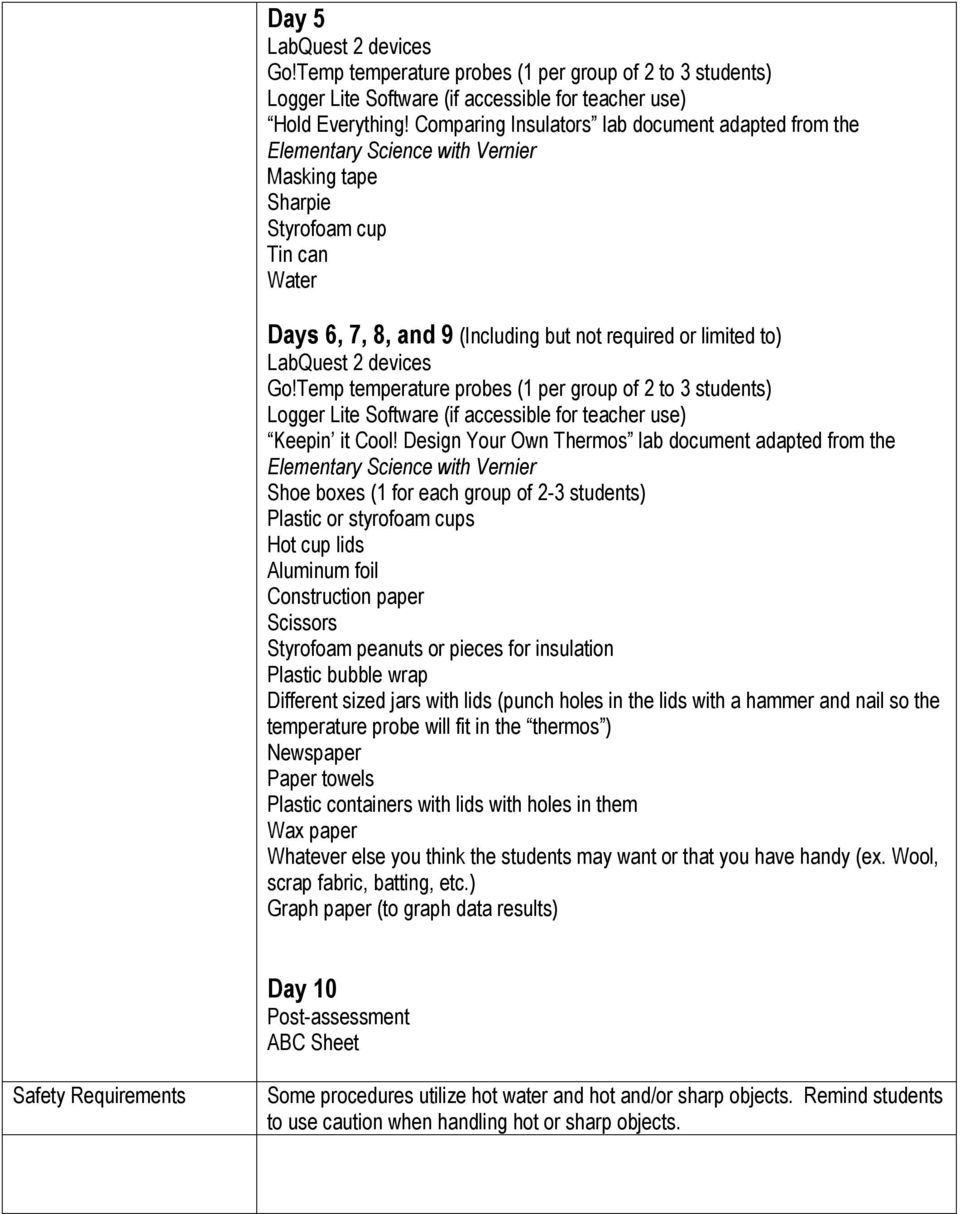
3 Day 5 LabQuest 2 devices Go!Temp temperature probes (1 per group of 2 to 3 students) Logger Lite Software (if accessible for teacher use) Hold Everything! Comparing Insulators lab document adapted from the Elementary Science with Vernier Masking tape Sharpie Styrofoam cup Tin can Water Days 6, 7, 8, and 9 (Including but not required or limited to) LabQuest 2 devices Go!Temp temperature probes (1 per group of 2 to 3 students) Logger Lite Software (if accessible for teacher use) Keepin it Cool! Design Your Own Thermos lab document adapted from the Elementary Science with Vernier Shoe boxes (1 for each group of 2-3 students) Plastic or styrofoam cups Hot cup lids Aluminum foil Construction paper Scissors Styrofoam peanuts or pieces for insulation Plastic bubble wrap Different sized jars with lids (punch holes in the lids with a hammer and nail so the temperature probe will fit in the thermos ) Newspaper Paper towels Plastic containers with lids with holes in them Wax paper Whatever else you think the students may want or that you have handy (ex. Wool, scrap fabric, batting, etc.) Graph paper (to graph data results) Day 10 Post-assessment ABC Sheet Safety Requirements Some procedures utilize hot water and hot and/or sharp objects. Remind students to use caution when handling hot or sharp objects.
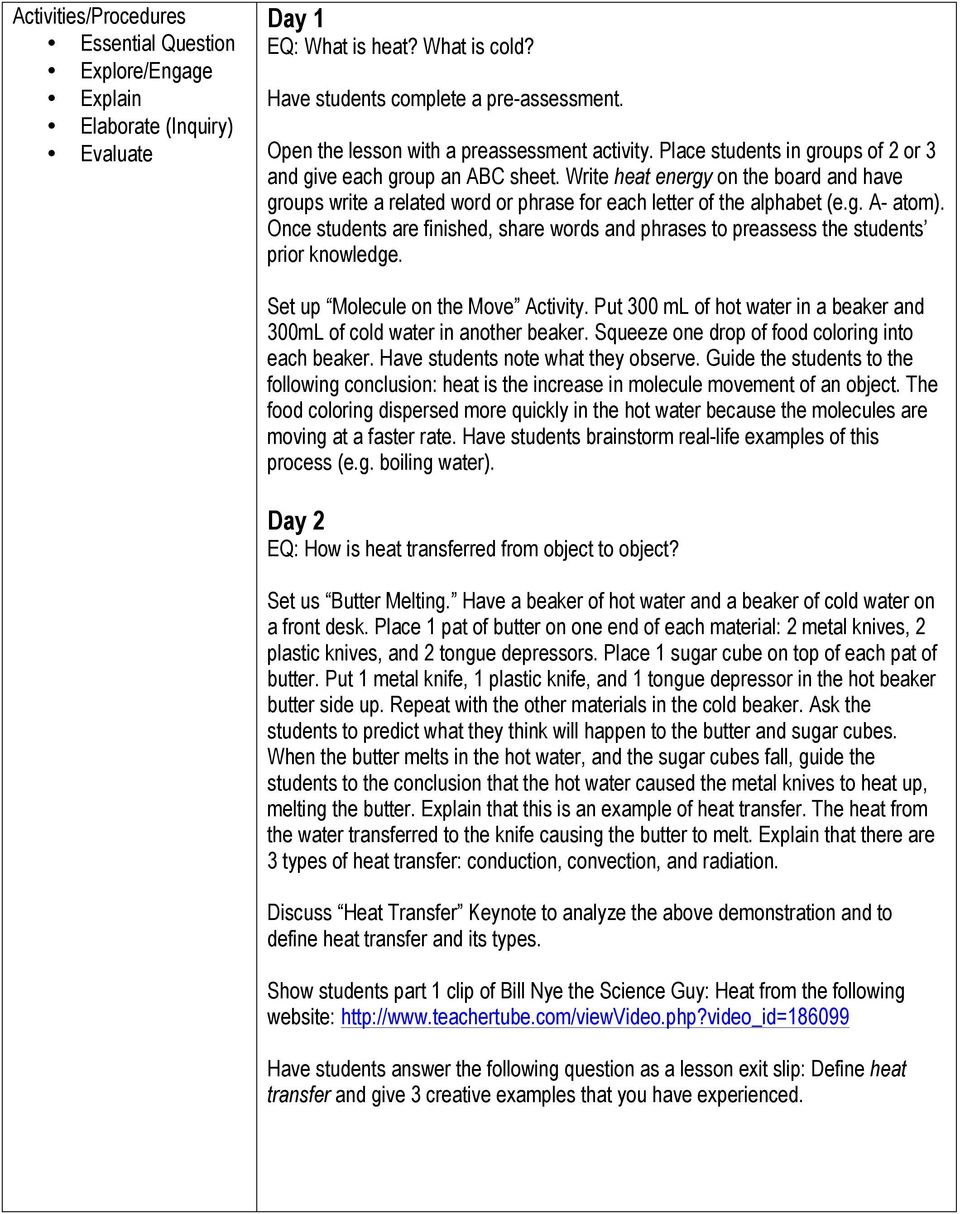
4 Activities/Procedures Essential Question Explore/Engage Explain Elaborate (Inquiry) Evaluate Day 1 EQ: What is heat? What is cold? Have students complete a pre-assessment. Open the lesson with a preassessment activity. Place students in groups of 2 or 3 and give each group an ABC sheet. Write heat energy on the board and have groups write a related word or phrase for each letter of the alphabet (e.g. A- atom). Once students are finished, share words and phrases to preassess the students prior knowledge. Set up Molecule on the Move Activity. Put 300 ml of hot water in a beaker and 300mL of cold water in another beaker. Squeeze one drop of food coloring into each beaker. Have students note what they observe. Guide the students to the following conclusion: heat is the increase in molecule movement of an object. The food coloring dispersed more quickly in the hot water because the molecules are moving at a faster rate. Have students brainstorm real-life examples of this process (e.g. boiling water). Day 2 EQ: How is heat transferred from object to object? Set us Butter Melting. Have a beaker of hot water and a beaker of cold water on a front desk. Place 1 pat of butter on one end of each material: 2 metal knives, 2 plastic knives, and 2 tongue depressors. Place 1 sugar cube on top of each pat of butter. Put 1 metal knife, 1 plastic knife, and 1 tongue depressor in the hot beaker butter side up. Repeat with the other materials in the cold beaker. Ask the students to predict what they think will happen to the butter and sugar cubes. When the butter melts in the hot water, and the sugar cubes fall, guide the students to the conclusion that the hot water caused the metal knives to heat up, melting the butter. Explain that this is an example of heat transfer. The heat from the water transferred to the knife causing the butter to melt. Explain that there are 3 types of heat transfer: conduction, convection, and radiation. Discuss Heat Transfer Keynote to analyze the above demonstration and to define heat transfer and its types. Show students part 1 clip of Bill Nye the Science Guy: Heat from the following website: Have students answer the following question as a lesson exit slip: Define heat transfer and give 3 creative examples that you have experienced.
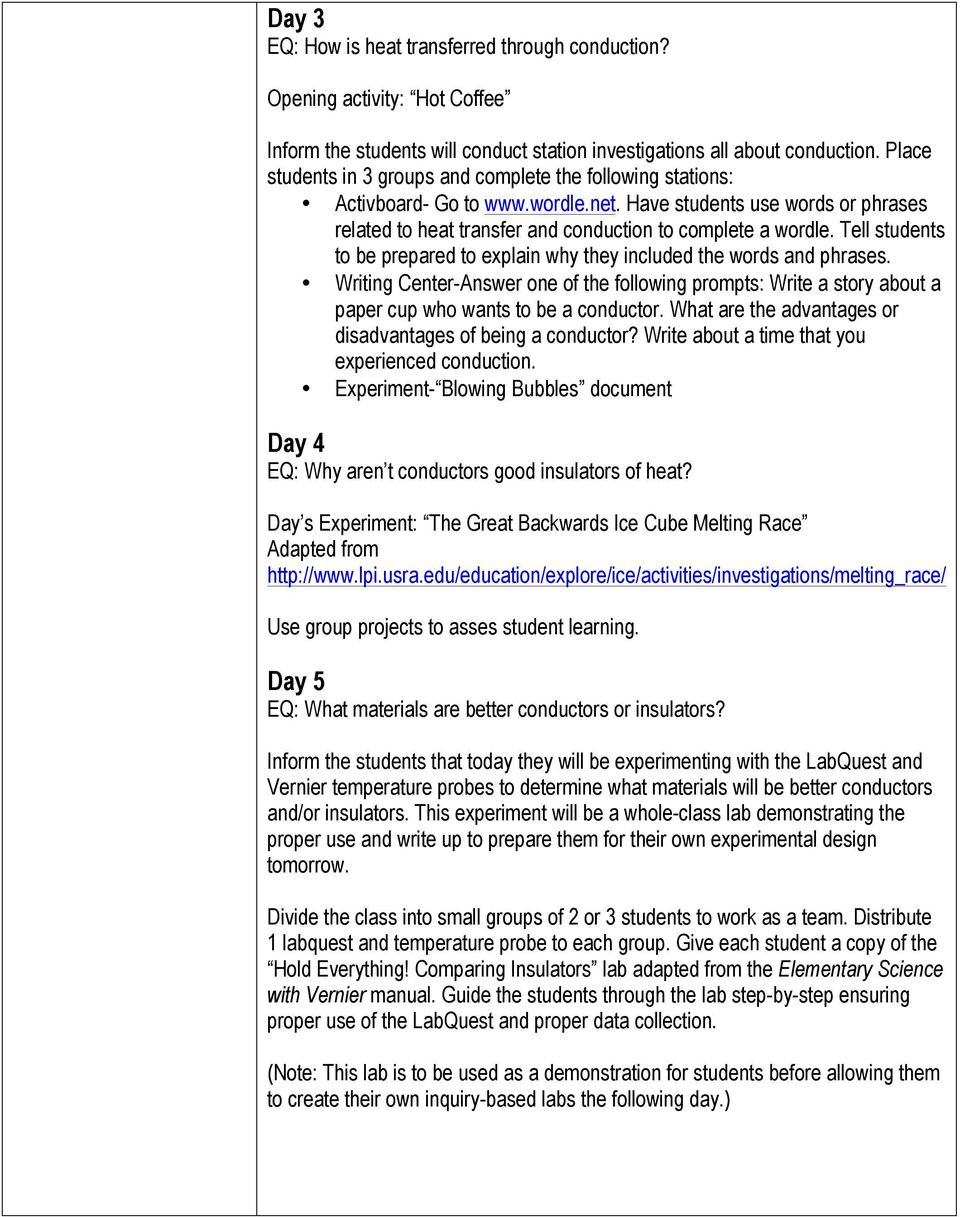
5 Day 3 EQ: How is heat transferred through conduction? Opening activity: Hot Coffee Inform the students will conduct station investigations all about conduction. Place students in 3 groups and complete the following stations: Activboard- Go to Have students use words or phrases related to heat transfer and conduction to complete a wordle. Tell students to be prepared to explain why they included the words and phrases. Writing Center-Answer one of the following prompts: Write a story about a paper cup who wants to be a conductor. What are the advantages or disadvantages of being a conductor? Write about a time that you experienced conduction. Experiment- Blowing Bubbles document Day 4 EQ: Why aren t conductors good insulators of heat? Day s Experiment: The Great Backwards Ice Cube Melting Race Adapted from Use group projects to asses student learning. Day 5 Inform the students that today they will be experimenting with the LabQuest and Vernier temperature probes to determine what materials will be better conductors and/or insulators. This experiment will be a whole-class lab demonstrating the proper use and write up to prepare them for their own experimental design tomorrow. Divide the class into small groups of 2 or 3 students to work as a team. Distribute 1 labquest and temperature probe to each group. Give each student a copy of the Hold Everything! Comparing Insulators lab adapted from the Elementary Science with Vernier manual. Guide the students through the lab step-by-step ensuring proper use of the LabQuest and proper data collection. (Note: This lab is to be used as a demonstration for students before allowing them to create their own inquiry-based labs the following day.)
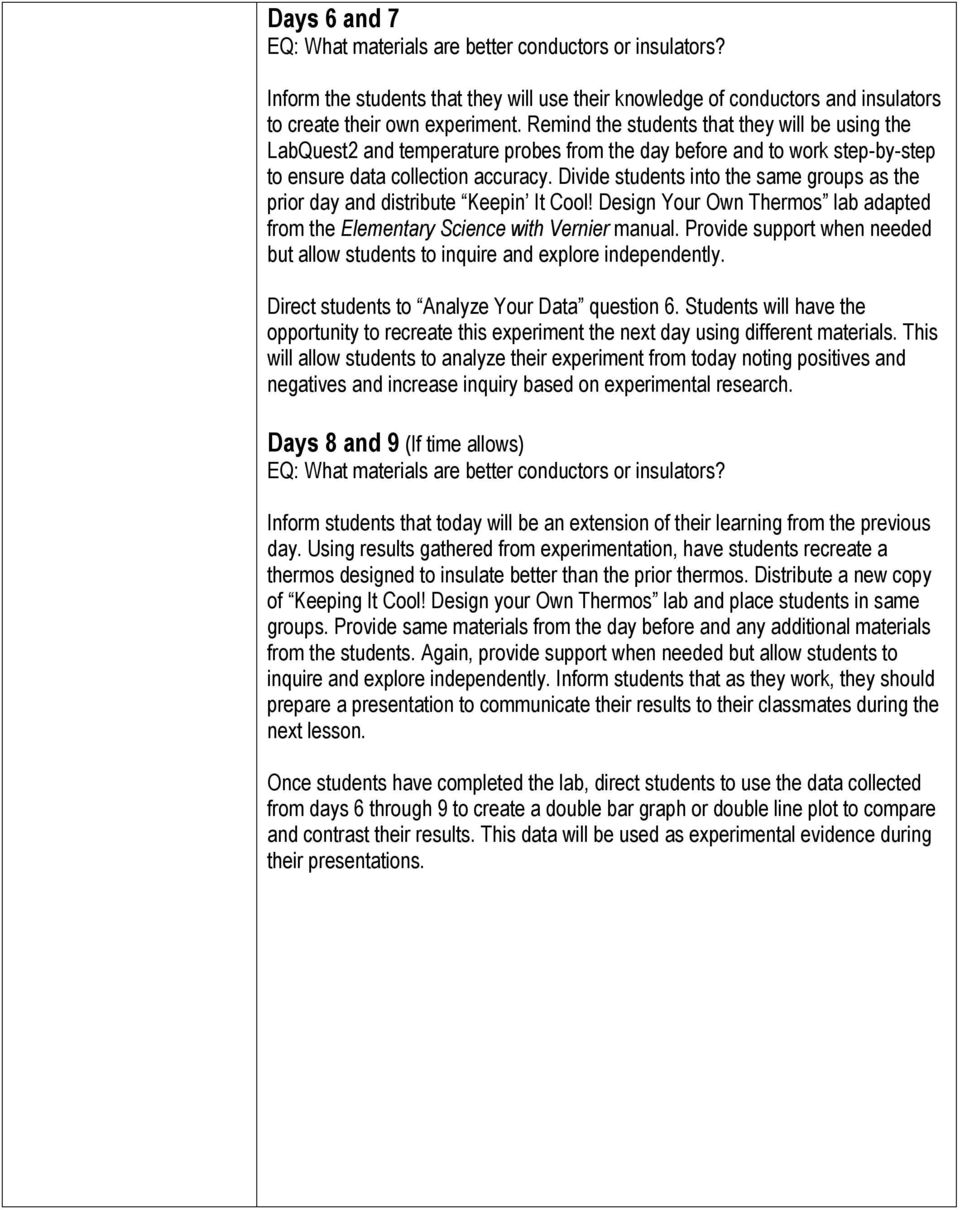
6 Days 6 and 7 Inform the students that they will use their knowledge of conductors and insulators to create their own experiment. Remind the students that they will be using the LabQuest2 and temperature probes from the day before and to work step-by-step to ensure data collection accuracy. Divide students into the same groups as the prior day and distribute Keepin It Cool! Design Your Own Thermos lab adapted from the Elementary Science with Vernier manual. Provide support when needed but allow students to inquire and explore independently. Direct students to Analyze Your Data question 6. Students will have the opportunity to recreate this experiment the next day using different materials. This will allow students to analyze their experiment from today noting positives and negatives and increase inquiry based on experimental research. Days 8 and 9 (If time allows) Inform students that today will be an extension of their learning from the previous day. Using results gathered from experimentation, have students recreate a thermos designed to insulate better than the prior thermos. Distribute a new copy of Keeping It Cool! Design your Own Thermos lab and place students in same groups. Provide same materials from the day before and any additional materials from the students. Again, provide support when needed but allow students to inquire and explore independently. Inform students that as they work, they should prepare a presentation to communicate their results to their classmates during the next lesson. Once students have completed the lab, direct students to use the data collected from days 6 through 9 to create a double bar graph or double line plot to compare and contrast their results. This data will be used as experimental evidence during their presentations.
7 Day 10 Administer post-assessment. Place students in groups of 2 or 3 and give each group an ABC sheet. Write heat energy on the board and have groups write a related word or phrase for each letter of the alphabet (e.g. A- atom). Once students are finished, share words and phrases to assess how their knowledge of heat and transfer has changed since day 1. Allow groups to communicate their results to find what materials created the best insulators and conductors of heat. Accommodations for Differentiated Instruction Cross-Curricular Integration Created by Supporting Documents Students will be read aloud the pre- and post-assessments if needed. Students will work in collaborative groups so that each student can equally contribute and support is given. Lab groups will be kept small so that everyone has a chance to participate. Extension activities are provided for student groups who complete activities early and need a challenge to keep them engaged. Writing prompt choices are given for student preference. All procedural directions are provided in a written format and can be delivered orally if needed. Math-Students will create a line graph and a double bar graph based off of data collected from experiment. Students will also calculate and solve problems with decimals to the hundredths place. Writing-Students will have the choice of self selecting a writing prompt. Prompt selections include both imaginative and expository. Jennifer Eagle [email protected] Leslie Hunsucker [email protected] Brittney Wagner [email protected] Preassessment, ABC Sheet, Hot Coffee Experiment, Dancing Penny Experiment, The Great Backwards Ice Cube Melting Race, Adapted Hold Everything! Comparing Insulators lab, Adapted Keepin it Cool! Design Your Own Thermos lab

Unit/Lesson Plan Title: Too Hot to Handle! Grade Level(s) 3. Research Sources
 Unit/Lesson Plan Title: Too Hot to Handle! Primary Subject Integrated Subjects Grade Level(s) 3 Length of Unit Research Sources Unit Summary Key Vocabulary NC Essential Standards For Science Energy/Energy
Bay Area Scientists in Schools Presentation Plan
 Bay Area Scientists in Schools Presentation Plan Lesson Name Heat Transfer: It s So Cool! Presenter(s) Kevin Metcalf, Sarika Goel, David Ojala, Melanie Drake, Carly Anderson Grade Level 3 Standards Connection(s)
Provided by TryEngineering - www.tryengineering.org
 Provided by TryEngineering - Lesson Focus Lesson focuses on the engineering behind keeping food and other items cool. Students work in teams to develop a system to make an insulated liquid container that
5.8 A Differentiate among forms of energy including light, heat, electrical, and solar energy. FORMS OF ENERGY
 GRADE 4 Unit 03: Forms of Energy 2010 TEKS 1998 TEKS Curriculum and Instruction Considerations 4.6 The student knows that energy exists in many forms and can be observed in cycles, patterns and systems.
Integrated Physics & Chemistry Supply List (2010)
 Integrated Physics & Chemistry Supply List (2010) Integrated Physics and Chemistry is a physical science course covering basic concepts found in chemistry and physics. Topics included in the study are
OBJECTIVES THE STUDENTS WILL: Participate in cooperative problem solving in a group setting.
 ICE CAPADES THE POWER OF INSULATION GRADE LEVEL: Upper Elementary/Middle School (High School with extensions) SUBJECT AREA: Sciences, Mathematics DURATION: Preparation time 30 minutes Activity time: One
Cold Stuff. Thomas Jefferson National Accelerator Facility - Office of Science Education http://education.jlab.org/
 Cold Stuff Cold Stuff What materials make good insulators? Problem Which substance makes the best insulator: cotton, air or steel wool? Research Answer the following True or False questions about insulators:
Learning outcomes. Students will be able to:
 Learning structure of the lesson The big picture This lesson is designed to exemplify an argumentation approach to practical work, using a predict-observe-explain framework. Students often think that some
Soaking Up Solar Energy
 Soaking Up Solar Energy Monica Laux Grade 8 Enriched and modified lab **Note, I am a special education teacher in 8 th grade Science using an inclusionary model. This lab has also been re-designed to differentiate
Melting ice Student sheet
 Melting ice Student sheet Predict Which ice cube will melt first? Observe Describe what you saw happen. Why? (Give a scientific explanation) Questions to think about: Why does ice melt? Why might one ice
Chapter 10: Temperature and Heat
 Chapter 10: Temperature and Heat 1. The temperature of a substance is A. proportional to the average kinetic energy of the molecules in a substance. B. equal to the kinetic energy of the fastest moving
Chillin Out: Designing an Insulator
 SHPE Jr. Chapter May 2015 STEM Activity Instructor Resource Chillin Out: Designing an Insulator Students learn about the three ways heat can be transferred from one object to another. They also learn what
Exploring Energy. Third - Fifth TEKS. Vocabulary
 Exploring Energy Third - Fifth TEKS Third Grade: 3.5A, 3.5B, 3.5C, 3.6A Fourth Grade: 4.5A, 4.5B, 4.6A, 4.6B, 4.6C Fifth Grade: 5.5A, 5.6A, 5.6B Vocabulary conductor, convection, conversions, electrical,
Lesson 7: Building an Insulated Water Bottle
 Lesson 7: Building an Insulated Water Bottle Overview Students investigate the insulating properties of a variety of materials. Using their knowledge of heat transfers, students design an insulated water
Mixing Warm and Cold Water
 Mixing Warm and Cold Water A Continuing Investigation of Thermal Pollution By Kevin White 1 Context: This lesson is intended for students conducting an ongoing study of thermal pollution. Perhaps, students
III. BACKGROUND KNOWLEDGE
 Chemistry: Phase Changes: Heat and Matter Grade Level: 5 Presented by: Gail Scott-Taylor, R.N. Harris Integrated Arts/Core Knowledge School Length of Unit: Seven lessons I. ABSTRACT Roll up your sleeves
Test Bank - Chapter 3 Multiple Choice
 Test Bank - Chapter 3 The questions in the test bank cover the concepts from the lessons in Chapter 3. Select questions from any of the categories that match the content you covered with students. The
Can Gases Act Like a Greenhouse?
 Can Gases Act Like a Greenhouse? Activity 1 Following a discussion that enables student to express what they already know about the greenhouse effect, students conduct a controlled experiment to confirm
Weather Under Pressure
 Primary Subject Integrated Subjects Grade Level Length of Unit Research Sources Science Math 5th 10 days Elementary Science with Vernier Book BrainPop www.areasonfor.com/site/1/docs/science_level_f_swt_lesson_20.pdf
High Flying Balloons
 Second Grade Science Design Brief High Flying Balloons Background: In our study of science we have been investigating the three stages of matter: solids, liquids and gases. You will use your knowledge
The Amazing Elephant Toothpaste! Lesson Overview
 The Amazing Elephant Toothpaste! Lesson Overview Students will investigate chemical change. Suggested Grade Levels: 3-8 Standards for Lesson Content Standard A: Science as Inquiry Content Standard B: Physical
SUGGESTED ACTIVITIES
 SUGGESTED ACTIVITIES (Thermal Energy) From Invitations to Science Inquiry 2 nd Edition by Tik L. Liem: Activity Page Number Concept Warm a Bottle by Shaking 184 Heat, Friction The Confused Bottles 206
Heat Energy FORMS OF ENERGY LESSON PLAN 2.7. Public School System Teaching Standards Covered
 FORMS OF ENERGY LESSON PLAN 2.7 Heat Energy This lesson is designed for 3rd 5th grade students in a variety of school settings (public, private, STEM schools, and home schools) in the seven states served
These are the plans to build your own Energy House.
 The experiments that you can do with the Energy House can be found at Design Coalition s website at www.designcoalition.org These are the plans to build your own Energy House. You build the Energy House
Chapter 4: Transfer of Thermal Energy
 Chapter 4: Transfer of Thermal Energy Goals of Period 4 Section 4.1: To define temperature and thermal energy Section 4.2: To discuss three methods of thermal energy transfer. Section 4.3: To describe
Pressure. Curriculum for Excellence. Weather and Climate Cross-curricular project Section 2. Background Information:
 Curriculum for Excellence Weather and Climate Cross-curricular project Section 2 Pressure Background Information: Air pressure is the force exerted by air particles. The air around us pushes on us and
Energetic Reactions: Ice Cream Experiment Teacher Guide
 Module Overview Heat transfer is an important part of many chemical reactions, but it is often not directly observed. In this module students conduct an experiment making homemade ice cream that requires
First Grade Unit A: PHYSICAL SCIENCE Chapter 1: Observing Solids, Liquids and Gases Lessons 1 to 5
 First Grade Unit A: PHYSICAL SCIENCE Chapter 1: Observing Solids, Liquids and Gases Lessons 1 to 5 Physical Science Overview Materials (matter) come in different forms. Water can be rain falling (liquid)
Paper Airplanes. Linsey Fordyce. Fall 2014. TEFB 413 Section # 504
 Model- Based Inquiry Learning Lesson Plan Paper Airplanes Linsey Fordyce Fall 2014 TEFB 413 Section # 504 1. BACKGROUND INFORMATION OF LESSON LESSON OBJECTIVES Students will investigate through model-
Partnerships Implementing Engineering Education Worcester Polytechnic Institute Worcester Public Schools Supported by: National Science Foundation
 Temperature: 6.D.3 Temperature and Heat Transfer Grade Level 6 Sessions Seasonality Instructional Mode(s) Team Size WPS Benchmarks MA Frameworks Key Words 1 Approximately 1.5 hours (10 minutes for cleanup)
Materials Activity 1: Group Discussion Series Poster Board for Driving Question Board KWL worksheet Scientific Method Chart
 Dry Forest Concepts Scientific data collect ion and presention. HCPS III Benchmarks SC6.1.1, SC6.1.2, SC6.2.1 MA6.9.1, MA6.11.1, MA6.12.1, MA6.13.1 LA6.1.1, LA6.4.1, LA6.4.2, LA6.5.2, LA6.6.1, LA6.6.2,
Solar Cooking. Design Challenge: Make a solar cooker that will heat a piece of hot dog. Be prepared to show your solar cooker to your class.
 First Grade Science Design Brief Solar Cooking Background: The sun gives us energy. It provides the earth with heat and light. It helps grow food, makes weather, and keeps living things alive. We can use
Solar Energy Fun Powered by the Sun
 Solar Energy Fun Powered by the Sun by Cathy Bellinghieri, 2 nd Grade Teacher/Science Coach and Leslie Gonzalez, 5 th Grade Teacher/Science Coach Gulfstream Elementary School Mail Code 2321 [email protected]
1/2/3. Finding out about the Water Cycle
 The Water Cycle 1/2/3. Finding out about the Water Cycle Aims: To enable pupils to learn and understand what happens at each stage of the Water Cycle To introduce specific vocabulary related to the Water
Hot Leaks. See how the temperature of liquids changes the way they flow.
 P h y s i c s Q u e s t A c t i v i t i e s Activity 2 1 Hot Leaks See how the temperature of liquids changes the way they flow. Safety: This experiment requires using the hot water tap and straight pins.
USING TECHNOLOGY FOR DATA COLLECTION
 USING TECHNOLOGY FOR DATA COLLECTION The advances in technology have provided a number of instruments for collecting and interpreting data. These include portable microscopes, electronic balances, ph meters,
Cloud Chamber Experiment
 Cloud Chamber Experiment Teachers Guide Page 1 of 8 Purpose: The Cloud Chamber experiment illustrates that though radiation cannot be detected with the senses, it is possible to observe the result of radioactive
Ontario Science and Technology Curriculum 1999 Strand: Matter and Materials Topic: Properties of Liquids and Solids Grade: 2
 Name: Ontario Science and Technology Curriculum 1999 Strand: Matter and Materials Topic: Properties of Liquids and Solids Grade: 2 All rights reserved Developed by T Tasker May be photocopied for classroom
Osmosis. Evaluation copy
 Osmosis Computer 5 In order to survive, all organisms need to move molecules in and out of their cells. Molecules such as gases (e.g., O 2, CO 2 ), water, food, and wastes pass across the cell membrane.
Pretend you are a water droplet in the water dome races. Give a detailed play-by-play account of what happens in your races.
 Water Writing to Learn Opportunities The following writing activities are intended for use after the science investigations, either as part of the student s notebook or separately. Students may refer to
PHOTOSYNTHESIS AND RESPIRATION
 PHOTOSYNTHESIS AND RESPIRATION STANDARDS: 3.2.10.B.3, 3.2.10.C.4 3.3.10.B.4 Westminster College INTRODUCTION Plants make sugar, storing the energy of the sun as chemical energy, by the process of photosynthesis.
Energy and Energy Transformations Test Review
 Energy and Energy Transformations Test Review Completion: 1. Mass 13. Kinetic 2. Four 14. thermal 3. Kinetic 15. Thermal energy (heat) 4. Electromagnetic/Radiant 16. Thermal energy (heat) 5. Thermal 17.
Session 1 What Is Matter? Properties and Classification of Matter
 Session 1 What Is Matter? Properties and Classification of Matter What is matter? This question at first seems simple matter is all around us. Yet how do we define it? What does a block of cheese have
Energy Transformation Lab
 Energy Transformation Lab Lab Response Page You will fill in the blanks with the energy form that matches that object. Use thermal instead of heat and radiant instead of light. You may double check your
Event Services. ssc-inc.com. SSC Recycling Manager, Rodd Pemble [email protected] 360.734.3490
 SSC appreciates the opportunity to provide service at your event. To better serve you, we have detailed info below on the wide range of event services we offer. For current rates, questions or to schedule
Grade 5 Standard 4 Unit Test Static Electricity
 Grade 5 Standard 4 Unit Test Static Electricity Multiple Choice 1. Two objects have collected static electricity with the same charge. What would the objects do when placed near each other? A. repel B.
Household Acids and Bases
 Household Acids and Bases GRADE LEVEL INDICATORS Experiment Demonstrate that the ph scale (0-14) is used to measure acidity and classify substances or solutions as acidic, basic, or neutral. 21 Develop
Wrap Up - Keep Warm. key message: If we insulate our homes, schools and offices we will need to use less heating and will save energy.
 key message: If we insulate our homes, schools and offices we will need to use less heating and will save energy. SESE Curriculum Link: Content Strand Energy and Forces Strand Unit Heat skill DEVELOPMENT:
Module 1, Lesson 3 Temperature vs. resistance characteristics of a thermistor. Teacher. 45 minutes
 Module 1, Lesson 3 Temperature vs. resistance characteristics of a thermistor 45 minutes Teacher Purpose of this lesson How thermistors are used to measure temperature. Using a multimeter to measure the
Cloud Unit. Materials Needed: The Cloud Book by Tomie de Poala See the seven activities below for materials need for each activity.
 Cloud Unit Submitted by: Lisa Johnson Van-Far Elementary (573)594-2731 E-mail: [email protected] Materials Needed: The Cloud Book by Tomie de Poala See the seven activities below for materials need
Solar Cooking. A Design and Technology project for Key Stage 2
 Solar Cooking A Design and Technology project for Key Stage 2 Project Sheet pg. 1 Objectives To learn about the problems which come with cooking in the developing world and how solar power can help. To
MULTIPLE CHOICE. Choose the one alternative that best completes the statement or answers the question.
 Sample Mid-Term 3 MULTIPLE CHOICE. Choose the one alternative that best completes the statement or answers the question. 1) If you double the frequency of a vibrating object, its period A) is quartered.
Scientific Experiments Using the Inquiry Activity Pendulums
 Scientific Experiments Using the Inquiry Activity Pendulums Prep Time: 30 minutes Class Time: 1 class period Word Wall Words: experiment, independent variable, controlled variable, dependent variables,
Photosynthesis Lesson Plan 1. Introduction to Photosynthesis (grade 4) Objectives:
 Photosynthesis Lesson Plan 1 Introduction to Photosynthesis (grade 4) Identify types of living things that use photosynthesis. Understand the concept of photosynthesis. Observe how flowers are grown. First
THE STUDY OF THE EFFECT OF DRY ICE ON THE TEMPERATURE OF WATER
 THE STUDY OF THE EFFECT OF DRY ICE ON THE TEMPERATURE OF WATER Justin Tunley Cary Academy ABSTRACT: The purpose of this study was to find out how much the temperature of water would change over time after
Chapter 6, Lesson 4: Temperature and the Rate of a Chemical Reaction
 Chapter 6, Lesson 4: Temperature and the Rate of a Chemical Reaction Key Concepts Reactants must be moving fast enough and hit each other hard enough for a chemical reaction to take place. Increasing the
Project-Based Learning Unit: Weather Grade Level: 2nd Teacher: Tracy Varner, Reeds Elementary Essential Question:
 Project-Based Learning Unit: Weather Grade Level: 2nd Teacher: Tracy Varner, Reeds Elementary Essential Question: How do weather changes affect me? Subquestions: 1. What is weather? 2. What are the kinds
Sunrise-Sunset Line Graphs
 Sunrise-Sunset Line Graphs Objectives To guide children as they analyze data from the sunrise-sunset routine; and to demonstrate how to make and read a line graph. www.everydaymathonline.com epresentations
Lesson Plan. The Northern Lights in a Bowl. Developed by: Laura Wright 2016 Iditarod Teacher on the Trail. Discipline / Subject:
 Lesson Plan The Northern Lights in a Bowl Developed by: Laura Wright 2016 Iditarod Teacher on the Trail Discipline / Subject: Language Arts and Science Topic: Mixtures and Solutions - Science Grade Level:
OIMB GK12 CURRICULUM
 6 th Grade 6 BEAUTIFUL BLUBBER EXPERIMENT Oregon Science Content Standards: 6.3 Scientific Inquiry: Scientific inquiry is the investigation of the natural world based on observations and science principles
Heat Transfer: Conduction, Convection, and Radiation
 Heat Transfer: Conduction, Convection, and Radiation Introduction We have learned that heat is the energy that makes molecules move. Molecules with more heat energy move faster, and molecules with less
Discover what you can build with ice. Try to keep ice cubes from melting. Create colored ice for painting
 Visit Moody Gardens this holiday season and check out the coolest exhibit around ICE LAND: Ice Sculptures. After your visit, try out these ice-related activities. Discover what you can build with ice Try
HEAT AND CONSERVATION OF ENERGY
 1 HEAT AND CONSERVATION OF ENERGY I. INTRODUCTION A. Overview of the Unit In this unit students develop a model for the conservation of energy that is built from a variety of investigations utilizing fairly
SEPARATION OF A MIXTURE OF SUBSTANCES LAB
 SEPARATION OF A MIXTURE OF SUBSTANCES LAB Purpose: Every chemical has a set of defined physical properties, and when combined they present a unique fingerprint for that chemical. When chemicals are present
Balloon Inside a Bottle
 Balloon Inside a Bottle What is Needed * One small party balloon * One small bottle. A 16 ounce pop bottle works well. What to Do Put approximately 1 tablespoon of water into the empty pop bottle. Then
Heat and Temperature: Teacher s Guide
 Heat and Temperature: Teacher s Guide Grade Level: 6-8 Curriculum Focus: Physical Science Lesson Duration: Two class periods Program Description Humans have always been feverish about temperature. But
Hands-On Labs SM-1 Lab Manual
 EXPERIMENT 4: Separation of a Mixture of Solids Read the entire experiment and organize time, materials, and work space before beginning. Remember to review the safety sections and wear goggles when appropriate.
Conservation of Momentum Greg Kifer
 SCIENCE EXPERIMENTS ON FILE Revised Edition 6.7-1 Conservation of Momentum Greg Kifer Topic Conservation of momentum Time 1 hour! Safety Please click on the safety icon to view the safety precautions.
Static Electricity Page 1. Static Electricity. Introduction: Structure of Atoms 2 Sample Curriculum, Materials Needed
 Static Electricity Page 1 Static Electricity Introduction: Structure of Atoms 2 Sample Curriculum, Materials Needed Experiment #1: Creating Static Charges 3 Experiment #2: Like Charges Repel and Unlike
Chapter 10 Temperature and Heat
 Chapter 10 Temperature and Heat What are temperature and heat? Are they the same? What causes heat? What Is Temperature? How do we measure temperature? What are we actually measuring? Temperature and Its
Multiple Choice For questions 1-10, circle only one answer.
 Test Bank - Chapter 1 The questions in the test bank cover the concepts from the lessons in Chapter 1. Select questions from any of the categories that match the content you covered with students. The
STANDARDS ADDRESSED IN THIS UNIT
 The following instructional plan is part of a GaDOE collection of Unit Frameworks, Performance Tasks, examples of Student Work, and Teacher Commentary. Many more GaDOE approved instructional plans are
Greatest Discoveries With Bill Nye: Chemistry Teacher s Guide
 Teacher s Guide Grade Level: 6 8 Curriculum Focus: Physical Science Lesson Duration: Two class periods Program Oxygen and Atoms Explore atomic and molecular structure and see how oxygen was first isolated.
Target Mole Lab. Mole Relationships and the Balanced Equation. For each student group Hydrochloric acid solution, HCl, 3 M, 30 ml
 elearning 2009 Introduction Target Mole Lab Mole Relationships and the Balanced Equation Publication No. A common chemical reaction used in chemistry class is zinc and hydrochloric In this lab, students
Chapter 2, Lesson 5: Changing State Melting
 Chapter 2, Lesson 5: Changing State Melting Key Concepts Melting is a process that causes a substance to change from a solid to a liquid. Melting occurs when the molecules of a solid speed up enough that
Investigation M3: Separating Mixtures into Component Parts
 Investigation M3: Separating Mixtures into Component Parts Goals: Use various methods to separate mixtures, make inferences from temperature/time graphs, and identify substances. 81 Activity M3.3: What
1 BPS Math Year at a Glance (Adapted from A Story of Units Curriculum Maps in Mathematics P-5)
 Grade 5 Key Areas of Focus for Grades 3-5: Multiplication and division of whole numbers and fractions-concepts, skills and problem solving Expected Fluency: Multi-digit multiplication Module M1: Whole
Commutative Property Grade One
 Ohio Standards Connection Patterns, Functions and Algebra Benchmark E Solve open sentences and explain strategies. Indicator 4 Solve open sentences by representing an expression in more than one way using
1. At which temperature would a source radiate the least amount of electromagnetic energy? 1) 273 K 3) 32 K 2) 212 K 4) 5 K
 1. At which temperature would a source radiate the least amount of electromagnetic energy? 1) 273 K 3) 32 K 2) 212 K 4) 5 K 2. How does the amount of heat energy reflected by a smooth, dark-colored concrete
Processes Within an Ecosystem
 Grade 7 Science, Quarter 1, Unit 1.1 Processes Within an Ecosystem Overview Number of instructional days: 23 (1 day = 50 minutes) Content to be learned Identify which biotic and abiotic factors affect
Danielle Abrahamson and Susan Michalek, Academy of Charter Schools, Denver, Colorado Four lessons over a period of five to seven days
 MATTER: Grade Level: Presented by: Length of Unit: ITS STATES AND PROPERTIES First Grade Danielle Abrahamson and Susan Michalek, Academy of Charter Schools, Denver, Colorado Four lessons over a period
Project 1.3.4 Renewable Insulation Example Teacher Notes
 Project 1.3.4 Renewable Insulation Example Teacher Notes Sample Data and Teacher Notes This guide is designed to provide sample calculations, background, and tips for the teachers performing this project
NUMBER CORNER YEARLONG CONTENT OVERVIEW
 August & September Workouts Calendar Grid Quilt Block Symmetries Identifying shapes and symmetries Calendar Collector Two Penny Toss Probability and data analysis Computational Fluency Mental Math Fluently
Teaming With Insects Materials List
 Level 1 Chapter 1 Activity 1 Activity 2 Activity 6 Chapter 2 Activity 8 Chapter 4 Activity 11 Activity 12 Insect pictures Drawing paper Rubber bands Pipe cleaners Construction paper Milk jug cap or bottle
Autoclave Safety. Autoclaves are sterilizers using high pressure and high temperature steam. The potential safety risks for the operators are:
 Autoclave Safety Purpose: Sterilization refers to the complete killing of all living organisms, including spores. Common sterilization techniques include the application of wet heat, dry heat, chemicals,
The electrical field produces a force that acts
 Physics Equipotential Lines and Electric Fields Plotting the Electric Field MATERIALS AND RESOURCES ABOUT THIS LESSON EACH GROUP 5 alligator clip leads 2 batteries, 9 V 2 binder clips, large computer LabQuest
Healthy Earth, Sick Earth
 Healthy Earth, Sick Earth Ashley Schopieray INTRODUCTION This lesson uses the book Planet Earth Gets Well by Madeline Kaplan to introduce students to concepts related to climate change and properly caring
Tune In to The Zula Patrol
 Family Take-Home Pages Dear Family, In school, your child has been studying Sky-High Science. Inspired by the award-winning public television program The Zula Patrol, this program helps your child: build
Students will be able to identify popping corn as a physical change.
 TO POP OR NOT TO POP THAT IS THE QUESTION. Written by Amy Rowley and Jeremy Peacock Annotation In this laboratory exercise, students will demonstrate science process skills as they use moisture content
Force and Motion: Ramp It Up
 Force and Motion: Grade Level: 4-5 Time: 3 class periods By: Carrie D. Perry (Bedford County Public Schools) Overview After watching an engaging video on Olympic alpine skiers, students then participate
The Water Cycle Now You See It, Now You Don t
 The Water Cycle Now You See It, Now You Don t Unit: Salinity Patterns & the Water Cycle l Grade Level: Elementary l Time Required: Introduction - 30 min. - Activity as groups 45min Wrap Up 20 min l Content
Green Heating. Pupil Research Brief. Teachers Notes. Syllabus Coverage Subject Knowledge and Understanding. Route through the Brief UPIL ESEARCHER
 R P UPIL ESEARCHER Green Heating I NITIATIVE Pupil Research Brief Teachers Notes Syllabus Coverage Subject Knowledge and Understanding all types of electromagnetic radiation form a continuous spectrum
Year 10 Investigation. What Makes Ice Melt Fastest? By Rebecca Hogan
 Investigation What Makes Ice Melt Fastest? MY WEBSITE: http://whatsubstancemeltsicefastest.weebly.com/ Nature of Investigation: What keeps us cool on hot days? What is used in our cool, refreshing beverages?