
Legal Notices. AccessData Corp.
|
|
|
- Abigayle Holmes
- 10 years ago
- Views:
Transcription
1
2

3 Legal Notices AccessData Corp. makes no representations or warranties with respect to the contents or use of this documentation, and specifically disclaims any express or implied warranties of merchantability or fitness for any particular purpose. Further, AccessData Corp. reserves the right to revise this publication and to make changes to its content, at any time, without obligation to notify any person or entity of such revisions or changes. Further, AccessData Corp. makes no representations or warranties with respect to any software, and specifically disclaims any express or implied warranties of merchantability or fitness for any particular purpose. Further, AccessData Corp. reserves the right to make changes to any and all parts of AccessData software, at any time, without any obligation to notify any person or entity of such changes. You may not export or re-export this product in violation of any applicable laws or regulations including, without limitation, U.S. export regulations or the laws of the country in which you reside AccessData Corp. All rights reserved. No part of this publication may be reproduced, photocopied, stored on a retrieval system, or transmitted without the express written consent of the publisher. AccessData Corp. 384 South 400 West Lindon, Utah U.S.A. ii Forensic Toolkit User Guide

4 AccessData Trademarks AccessData is a registered trademark of AccessData Corp. Distributed Network Attack is a registered trademark of AccessData Corp. DNA is a registered trademark of AccessData Corp. Forensic Toolkit is a registered trademark of AccessData Corp. FTK is a trademark of AccessData Corp. FTK Imager is a trademark of AccessData Corp. Known File Filter is a trademark of AccessData Corp. KFF is a trademark of AccessData Corp. LicenseManager is a trademark of AccessData Corp. Password Recovery Toolkit is a trademark of AccessData Corp. PRTK is a trademark of AccessData Corp. Registry Viewer is a trademark of AccessData Corp. Ultimate Toolkit is a trademark of AccessData Corp. Third-Party Trademarks All third-party trademarks are the property of their respective owners. iii

5 iv Forensic Toolkit User Guide
6 CONTENTS Preface Audience Handling Evidence Role of Forensic Toolkit Other AccessData Products Password Recovery Software Secure Deletion Tools Ultimate Toolkit Chapter 1 FTK Overview The Big Picture Acquiring and Preserving the Evidence Analyzing the Evidence Hashing Known File Filter Searching Presenting the Evidence What s New in FTK Chapter 2 Installing the Forensic Toolkit System Requirements Supported File Systems and Image Formats System Preparation Basic Installation Basic Install from CD Basic Install from Downloadable Files Upgrade Instructions Upgrading from CD Upgrading from Downloadable Files Uninstalling v

7 Chapter 3 Getting Started Starting FTK Using the Start Menu Using the Command Line Using the Case File Using the Dongle Using the FTK Startup Menu Overview Window Evidence and File Items File Status File Category Explore Window Graphics Window Window Search Window Indexed Search Live Search Bookmark Window Toolbar Components Viewer Toolbar Tree List Toolbar File List Toolbar File List Columns FTK Imager Using LicenseManager Starting LicenseManager Chapter 4 Starting a New Case Starting a Case Completing the New Case Form Entering Forensic Examiner Information Selecting Case Log Options Selecting Evidence Processes Refining the Case Refining the Index Managing Evidence Adding Evidence Editing Evidence Removing Evidence Refining Evidence vi Forensic Toolkit User Guide

8 Reviewing Case Summary Processing the Evidence Backing Up the Case Storing Your Case Files Recovering Evidence from a System Failure Chapter 5 Working with Existing Cases Opening an Existing Case Opening an Existing Case from a Different Location Opening a Case in Case Agent Mode (Read-only) Using the Case Agent Mode Manager Adding Evidence Completing the Add Evidence Form Selecting Evidence Processes Managing Evidence Refining the Index Reviewing Evidence Setup Processing the Evidence Viewing File Properties General Info File Source Info File Content Info Case-Specific Info Info Setting Up Multiple Temporary Files Chapter 6 Processing Evidence Using Bookmarks Creating a Bookmark Adding Files to a Bookmark Removing a Bookmark Creating Thumbnails Importing KFF Hashes Verifying Image Integrity Using Analysis Tools Using the Case Log Viewing the Case Log Adding Entries to the Case Log Copying Information from FTK Exporting Files Contents vii

9 Chapter 7 Searching a Case Conducting a Live Search Conducting an Indexed Search Single-Term Searches Multi-Term Searches Importing Search Terms Viewing Search Results Reloading a Search Query Wildcard Characters Indexed Search Options Documenting Your Search Results Copying Search Results to the Clipboard Using Copy Special to Document Search Results Bookmarking Search Results Chapter 8 Advanced Searching Searching the Main Viewer Searching the File List Columns Searching for Internet Keywords Viewing Internet Addresses Saving Internet Keyword Search Lists to the Case Bookmarking Internet Keyword Search Items Chapter 9 Data Carving Searching for Embedded and Deleted Files (Data Carving) Data Carving Files During Evidence Processing in a New Case Data Carving Files in an Existing Case Adding Carved Files to the Case Bookmarking Carved Files Chapter 10 Using Filters Applying an Existing Filter Using The File Filter Manager Modifying or Creating a Filter Deleting a Filter Chapter 11 Searching the Registry Starting Registry Viewer Launching Registry Viewer as a Separate Application Launching Registry Viewer from FTK Understanding the Registry Viewer Windows viii Forensic Toolkit User Guide
10 The Full Registry Window The Common Areas Window The Report Window Opening Registry Files Opening a Registry File in Registry Viewer Opening Registry Files within FTK Obtaining Protected Registry Files Using FTK Imager Working with Registry Evidence Adding Keys to the Common Areas Window Deleting Keys from the Common Areas Window Adding Keys to the Report Window Deleting Keys from the Report Window Searching for Specific Data Generating a Report Exporting a Word List Chapter 12 Decrypting EFS Understanding EFS Decrypting EFS Files and Folders Windows 2000 and XP Systems Prior to SP Windows XP SP1 or Later Viewing the Decrypted Files in FTK Chapter 13 Working with Reports Creating a Report Entering Basic Case Information Managing Bookmarks Selecting the Properties of Bookmarked Files Managing Thumbnails Selecting a File Path List Selecting a File Properties List Selecting the Properties of the File Properties List Adding Supplementary Files and the Case Log Selecting the Report Location Viewing and Distributing a Report Updating a Report Modifying a Report Modifying a Report in the Same FTK Session Modifying a Report in a Different FTK Session Contents ix

11 Chapter 14 Customizing FTK Customizing Fonts and Colors Customizing Columns Creating and Modifying Column Settings Deleting Column Settings Changing the Viewer Settings Changing Preferences Date and Time Format Options File Viewing Options Case Log Options Evidence Cache Size Temporary File Folder KFF Database Location Show Reminder when Exporting or Creating a Report with Filter Active. 247 Show Startup Dialog Chapter 15 Managing Licenses Managing Licenses With LicenseManager Starting LicenseManager LicenseManager Interface The Menu Bar The Toolbar The LicenseManager Window Opening and Saving Dongle Packet Files Viewing Product Licenses Adding and Removing Product Licenses Adding and Removing Product Licenses Remotely Adding a Product License Remotely Removing a Product License Remotely Updating Products Checking for Product Updates Downloading Product Updates Purchasing Product Licenses Sending a Dongle Packet File to Support Chapter 16 Troubleshooting Appendix A FTK Recognized File Types Document File Types Spreadsheet File Types x Forensic Toolkit User Guide

12 Database File Types Graphic File Types Multimedia File Types Message Programs Instant Messaging Programs Executable File Types Archive File Types Other Known File Types Appendix B Regular Expression Searching Understanding Regular Expressions Simple Regular Expressions Complex Regular Expressions Visa and MasterCard Numbers Predefined Regular Expressions Social Security Number U.S. Phone Number IP Address Going Farther with Regular Expressions Locating More Information on Regular Expressions Common Operators Appendix C Recovering Deleted Material FAT 12, 16, and NTFS ext ext Appendix D Program Files Appendix E Securing Windows Registry Evidence Understanding the Windows Registry Additional Considerations Registry Quick Find Chart System Information Networking User Data User Application Data Appendix F Corporate Information Registration License Agreement Contents xi

13 Subscriptions Technical Support Product Returns xii Forensic Toolkit User Guide

14 PREFACE Welcome to AccessData Forensic Toolkit (FTK TM ). FTK enables law enforcement and corporate security professionals to perform complete and thorough computer forensic examinations. FTK features powerful file filtering and search functionality and is recognized as the leading forensic tool for analysis. This chapter contains the following sections: Audience on page 2 Handling Evidence on page 2 Role of Forensic Toolkit on page 3 Other AccessData Products on page 3 1

15 Audience The Forensic Toolkit User Guide is written for law enforcement and corporate security professionals with the following competencies: Basic knowledge of and training in forensic policies and procedures Basic knowledge of and experience with personal computers Familiarity with the fundamentals of collecting digital evidence Understanding of forensic images and how to acquire forensically sound images Experience with case studies and reports Familiarity with the Microsoft Windows environment Handling Evidence Computer forensics involves the acquisition, preservation, analysis, and presentation of computer evidence. This type of evidence is fragile and can easily, even inadvertently, be altered, destroyed, or rendered inadmissible as evidence. Computer evidence must be properly obtained, preserved, and analyzed to be accepted as reliable and valid in a court of law. To preserve the integrity of case evidence, forensic investigators do not work on the original files themselves. Instead, they create an exact replica of the files and work on this image to ensure that the original files remain intact. To verify the files they are working on have not been altered, investigators can compare a hash of the original files at the time they were seized with a hash of the imaged files used in the investigation. Hashing provides mathematical validation that a forensic image exactly matches the contents of the original computer. Another important legal element in computer forensics is the continuity, or chain of custody, of computer evidence. The 2 Forensic Toolkit User Guide

16 chain of custody deals with who has supervised, acquired, analyzed, and controlled the evidence. Forensic investigators must be able to account for all that has happened to the evidence between its point of acquisition or seizure and its eventual appearance in court. There are many cases in which personnel trained in information technology have made incriminating computer evidence legally inadmissible because of their reckless or illconceived examinations. Only properly trained computer forensics specialists should obtain and examine computer evidence. Role of Forensic Toolkit When you acquire computer evidence, you can use FTK Imager TM to create an image of the source drives or files. You can also create a hash of the original image that you can later use as a benchmark to prove the validity of your case evidence. FTK Imager verifies that the image hash and the drive hash match when the image is created. After you create the image and hash the data, you can then use FTK to perform a complete and thorough computer forensic examination and create a report of your findings. For a big-picture view of FTK, see FTK Overview on page 5. Other AccessData Products In addition to FTK and FTK Imager, AccessData offers other industry-leading products. Preface 3

17 Password Recovery Software Secure Deletion Tools AccessData has been the leader in the field of commercial software decryption since AccessData has multiple tools available for password recovery: Password Recovery Toolkit TM (PRTK TM ) has a wide variety of individual password-breaking modules that can help you recover lost passwords. For more information about PRTK, see the AccessData Website ( Distributed Network Attack (DNA ) provides a new approach to recovering password-protected files. Rather than using a single machine, DNA uses machines across the network or across the world to conduct key space and dictionary attacks. For more information about DNA, see the AccessData Website ( WipeDrive is ideal when you want a complete Department of Defense (DoD) wipe done on a drive. With a rate of 1GB every three minutes, it is one of the fastest cleaning tools available and complies with DoD standards. For more information about WipeDrive, see the AccessData Website ( Ultimate Toolkit The most comprehensive AccessData product for forensic investigation is the Ultimate Toolkit TM. It includes all the PRTK recovery modules, a 100-client license for DNA, the Forensic Toolkit, WipeDrive, and a one-year upgrade subscription for all of the included products. For more information about the Ultimate Toolkit, see the AccessData Website ( 4 Forensic Toolkit User Guide

18 CHAPTER 1 FTK Overview This chapter provides a big-picture overview of how Forensic Toolkit (FTK) can be used to acquire, preserve, analyze, and present computer evidence. The chapter contains the following sections: The Big Picture on page 6 Acquiring and Preserving the Evidence on page 7 Analyzing the Evidence on page 8 Presenting the Evidence on page 10 What s New in FTK 1.71 on page 10 5

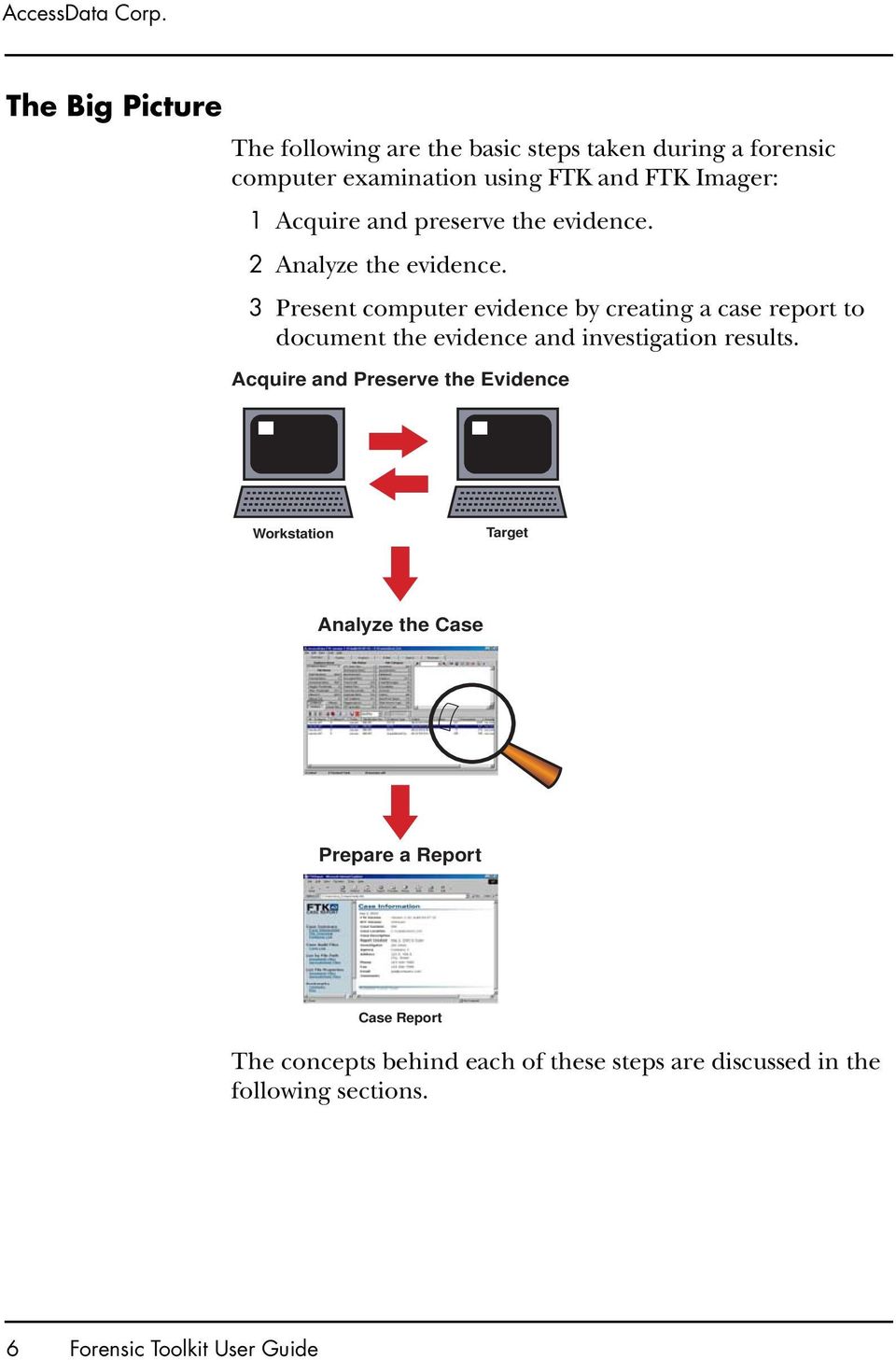
19 The Big Picture The following are the basic steps taken during a forensic computer examination using FTK and FTK Imager: 1 Acquire and preserve the evidence. 2 Analyze the evidence. 3 Present computer evidence by creating a case report to document the evidence and investigation results. Acquire and Preserve the Evidence Workstation Target Analyze the Case Prepare a Report Case Report The concepts behind each of these steps are discussed in the following sections. 6 Forensic Toolkit User Guide
20 Acquiring and Preserving the Evidence For digital computer evidence to be valid, it must be preserved in its original form. There are two ways to achieve this: by creating an image of the suspect drive using hardware devices or by using software applications. Hardware acquisition tools duplicate disk drives or allow readonly mode access to a hard drive. For more information about hardware tools, see Industry and Third-Party Contacts on page 321. Software acquisition tools create a forensically sound image that makes no changes to the data or information on the suspect hard drive. The forensic image must be identical in every way to the original. As a rule, no changes to the evidence should be made. FTK Imager is a software acquisition tool. It can be used to quickly preview evidence and, if the evidence warrants further investigation, create a forensically sound image of the disk. To prevent against accidental or intentional manipulation of evidence, FTK Imager makes a bit-by-bit duplicate image of the media. The forensic image is identical in every way to the original, including file slack and unallocated space or free space. For information about file slack and unallocated space, see the Glossary on page 329. FTK Overview 7

21 Analyzing the Evidence To analyze the evidence, FTK uses a variety of tools, including hashing, the Known File Filter TM (KFF TM ) database, and searching. Hashing Hashing a file or files refers to the process of generating a unique value based on a file s contents. Hash values are used to verify file integrity and identify duplicate and known files. (Known files are standard system files that can be ignored in your investigation as well as known illicit or dangerous files.) Two hash functions are available in FTK and FTK Imager: Message Digest 5 (MD5) and Secure Hash Algorithm (SHA-1). By default, FTK creates MD5 hashes. The hashing options are selected automatically by FTK based on the KFF databases that are available. For more information about KFF, see Known File Filter on page 9. The following graphic shows a sample file with a list of MD5 and SHA-1 hashes. Typically, you hash individual files to compare the results with a known database of hashes, such as KFF. However, you can also hash multiple files or an image to verify that the working copy is identical to the original. You can create hashes with FTK Imager or FTK. For information on creating hashes with FTK, see Selecting Evidence Processes on page Forensic Toolkit User Guide
22 Known File Filter Searching KFF is an FTK utility that compares file hashes against a database of hashes from known files. The purpose of KFF is to eliminate ignorable files (such as known system and program files) or to alert you to known illicit or dangerous files. It also checks for duplicate files. Files which contain other files, such as Zip and files with attachments, are called container files. When KFF identifies a container file as ignorable, FTK does not extract its component files. When KFF is used, the evidence is separated into ignored files (such as system files) and evidence that you continue to examine. KFF includes the HashKeeper database, which is updated periodically and is available for download on the FTK update page ( For information on defining the location of the KFF database, see KFF Database Location on page 247. With FTK, you can conduct a live search or an indexed search. A live search is a time-consuming process involving an item-byitem comparison with the search term. Live searches allow you to search non-alphanumeric characters and perform regular expression searches. Note: Regular expressions are mathematical statements that describe a data pattern such as a credit card or social security number. Regular expression searches allow you to find data items that conform to the pattern described by the expression. FTK provides several pre-defined regular expressions such as U.S. phone number, U.K. phone number, credit card number, social security number, and IP address. The indexed search uses the index file to find a search term. The index file contains all discrete words or number strings found in both the allocated and unallocated space in the case evidence. FTK Overview 9
23 Presenting the Evidence FTK uses dtsearch as its index search engine. dtsearch, one of the leading search tools available, can quickly search gigabytes of text. For more information on searching, see Searching a Case on page 147. For more information about dtsearch, see the AccessData Website ( FTK presents computer evidence by creating a case report and case log to document the evidence and investigation results. FTK uses the Report Wizard to create and modify reports. In the report, you can add bookmarks (information you selected during the examination), customize graphics references, select file listings, and include supplementary files and the case log. You can also export selected files with the report, such as bookmarked files and flagged graphics, so they are available with the report. The report is generated in HTML. The case log assists in documenting and logging activities during the investigation and analysis of a case. This information can be used as part of a report or to identify what has occurred if you are assigned to an investigation in progress. The case log is created automatically by the FTK and is called ftk.log. For information about creating a report, see Working with Reports on page 213. What s New in FTK 1.71 The following functionality been added to FTK 1.70: 10 Forensic Toolkit User Guide
24 CHAPTER 2 Installing the Forensic Toolkit This chapter explains how to install and upgrade Forensic Toolkit (FTK). The chapter is divided into the following sections: on page 11 Supported File Systems and Image Formats on page 13 System Preparation on page 14 Basic Installation on page 15 Upgrade Instructions on page 26 Uninstalling on page 29 11
25 System Requirements The computer you install FTK on must meet the following minimum system requirements: Hardware or Software Minimum Requirement Recommended Requirement Operating System Windows 2000, or XP Windows 2000, XP, or 2003 Processor 2 GHz or faster Intel Pentium IV, AMD Athlon, or equivalent Intel Core 2 Duo, or equivalent RAM 512 MB 2 GB Hard disk space 4 GB for program files Additional hard disk space for index storage 4 GB for program files Additional hard disk space for index storage Monitor SVGA (800 x 600) XGA (1024 x 768) or higher resolution USB Port Dongle shipped with FTK For additional information about the space required for indexes, use this table to estimate the disk space required to index different sizes of data: Evidence Size Work Space Index Size 8 GB 4 GB 2 GB 15 GB 7.5 GB 3.75 GB 30 GB 15 GB 7.5 GB 30+ GB 50% of the original 25% of the original For more information, see Conducting an Indexed Search on page Forensic Toolkit User Guide
26 Supported File Systems and Image Formats FTK can analyze the following types of file systems and image formats: File Systems FAT 12, FAT 16, FAT 32 NTFS Ext2, Ext3 Hard Disk Image Formats Encase SnapBack Safeback 2.0 and under Expert Witness Linux DD ICS Ghost (forensic images only) SMART CD and DVD Image Formats Alcohol (*.mds) CloneCD (*.ccd) ISO IsoBuster CUE Nero (*.nrg) Pinnacle (*.pdi) PlexTools (*.pxi) Roxio (*.cif) Virtual CD (*.vc4) Installing the Forensic Toolkit 13
27 System Preparation Before installing FTK, you should evaluate the workstation and its current software. A good understanding of the workstation and its configured devices will help ensure that FTK runs at its best. Consider the following: Role of the workstation Determine if it will be used as a regular user workstation, a forensic analysis workstation, or a password recovery workstation. Access policy Identify where the workstation will be located, who can access the information, and when the cases can be worked on. Hardware and software requirements For the hardware and software requirements, see on page 11. Application relationships Verify that the applications can work simultaneously. Do not run so many applications that you compromise overall performance. Network and Internet issues Determine if the workstation should be connected to a network or the Internet. Under normal circumstances, the forensic analysis workstation will not be connected to the Internet to avoid the possible tainting of evidence. System policies and procedures Check with your system administrator about any specific policies and procedures that may exist. 14 Forensic Toolkit User Guide
28 Basic Installation You can install FTK from a CD or from downloadable files available on the AccessData Website ( The installation is divided into three parts: Install the Forensic Toolkit: FTK and later will install in locations separate from FTK 1.6 or earlier. Your older versions of FTK and their cases will not be affected by installing FTK Warning: FTK has an upgraded database, increasing the limit on how many items a case can contain. This enhancement, however, renders FTK incompatible with earlier versions. Cases processed in earlier versions of FTK cannot be opened in FTK , and cases processed in cannot be opened in earlier FTK versions. FTK Imager is now a separate installation. Install the Known File Filter Library: Installs the Known File Filter (KFF) database, a utility that compares file hashes in your case against a database of hashes for known system and program files as well as known illicit and contraband files. To preserve work done on earlier versions of FTK, your KFF will be installed in the directory without overwriting any previously installed KFFs. To economize disk space, you may choose to manually delete older versions of your KFF. To point any version of FTK to the new KFF, go to the Tools menu, then type in the path in the Preferences dialog. For additional information about KFF, see Known File Filter on page 9. Launch Dongle Driver Setup: Installs the driver for either the USB or parallel port dongle. The dongle is required to use FTK and it should be stored in a secure location when not in use. Each part can be independently installed, although FTK and the dongle driver must be installed for FTK to work properly. Installing the Forensic Toolkit 15
29 Basic Install from CD Installing FTK from CD If you want to eliminate ignorable and duplicate files, and be alerted of known illicit or contraband files, you need to install KFF. For troubleshooting information on the FTK install, see Troubleshooting on page 263. The following sections review installing FTK, the dongle drivers, and KFF from CD. To install FTK from CD: 1 Insert the CD into the CD-ROM drive and click Install the Forensic Toolkit. If auto-run is not enabled, select Start, and then Run. Browse to the CD-ROM drive and select Autorun.exe. 2 Click Next on the Welcome screen. 3 Select I Accept the Terms of the License Agreement and then click Next. 4 Designate the program directory by doing one of the following: To accept the default directory, click Next. The default directory is c:\program Files\AccessData\AccessData Forensic Toolkit\. To specify a different directory, click Browse, select the location, and click OK. 5 Click Next. 6 Check the box to run FTK if you want it to automatically start after you complete the installation. If you check the box to run FTK but haven t installed the dongle drivers, you will receive an error message and FTK will not start. If you run FTK but haven t installed the KFF database, you will receive an error message at the end of the installation 16 Forensic Toolkit User Guide
30 saying that the KFF Hash Library is not found and certain features will be disabled. You can install the dongle drivers and KFF from the CD. For installation instructions, see Installing the Dongle Driver from CD on page 17 and Installing KFF from CD on page Check the box to run LicenseManager if you want it to automatically check for updates. LicenseManager automatically checks the AccessData Website for software updates. For more information on LicenseManager, see Managing Licenses on page 249. If LicenseManager is not installed, a warning is displayed. See Installing LicenseManager from CD on page 23 or Installing LicenseManager from Downloadable Files on page Click Finish. Installing the Dongle Driver from CD To install the dongle driver from CD: 1 Insert the CD into the CD-ROM drive and click Launch Dongle Driver Setup. If auto-run is not enabled, select Start, and then Run. Browse to the CD-ROM drive and select Autorun.exe. 2 Click Next to install the driver. 3 If you have a USB dongle, verify that it is not plugged in. If you have a parallel port dongle, verify that it is plugged in. Click Next after meeting the above conditions. 4 Designate the dongle driver directory by doing one of the following: To accept the default directory, click Next. The default directory is c:\program Files\AccessData\Dongle Driver\. Installing the Forensic Toolkit 17
31 Installing KFF from CD To specify a different directory, click Browse, select the location, and click OK. 5 Click Next. 6 If you have a USB dongle, plug it in. 7 Click Finish. To install KFF from CD: 1 Insert the CD into the CD-ROM drive and click Install the Known File Filter Library. If auto-run is not enabled, select Start, and then Run. Browse to the CD-ROM drive and select Autorun.exe. 2 Click Next on the Welcome screen. 3 Select I Accept the Terms of the License Agreement and then click Next. 4 Designate the KFF directory by doing one of the following: To accept the default directory, click Next. The default directory is c:\program Files\AccessData\AccessData Forensic Toolkit\Program\. To specify a different directory, click Browse, select the location, and click OK. Important: If you install KFF to another directory, you must indicate the new location in FTK Preferences. For more information, see KFF Database Location on page Click Next. 6 Click Finish. Basic Install from Downloadable Files FTK downloadable files are available from the AccessData Website ( To download the FTK program files: 18 Forensic Toolkit User Guide
32 Installing FTK from Downloadable Files 1 Go to the AccessData downloads page. 2 Under Forensic Toolkit, click Updates. 3 Download the program files you would like to install. If this is the first time you have installed FTK, download both FTK and the dongle driver. If you want to eliminate ignorable and duplicate files, and be alerted of known illicit or contraband files, you also need to download the KFF database. See the following sections for more information on installing FTK, the dongle drivers, and the KFF database from downloadable files. To install FTK from downloadable files: 1 On the Forensic Toolkit Download page, click FTKInstall.exe. 2 Save the FTK install file (FTKInstall-version.exe) to a temporary directory on your drive. 3 To launch the install program, go to the temporary directory and double-click the FTK install file (FTKInstallversion.exe). 4 Click Install. 5 Click Next on the Welcome screen. 6 Select I Accept the Terms of the License Agreement and then click Next. 7 Designate the program directory by doing one of the following: To accept the default directory, click Next. The default directory is c:\program Files\AccessData\AccessData Forensic Toolkit\. To specify a different directory, click Browse, select the location, and click OK. 8 Click Next. Installing the Forensic Toolkit 19
33 9 Check the box to run FTK if you want it to automatically start after you complete the installation. If you check the box to run FTK but haven t installed the dongle drivers, you will receive an error message and FTK will not start. If you run FTK but haven t installed the KFF database, you will receive an error message at the end of the installation saying that the KFF Hash Library is not found and certain features will be disabled. You can install the dongle drivers and KFF from the downloadable files. For installation instructions, see page Check the box to run LicenseManager if you want it to automatically check for updates. LicenseManager automatically checks the AccessData Website for software updates. For more information on LicenseManager, see Managing Licenses on page 249. If LicenseManager is not installed, a warning is displayed. See Installing LicenseManager from CD on page 23 or Installing LicenseManager from Downloadable Files on page Click Finish. Installing the Dongle Drivers from Downloadable Files To install the dongle drivers from downloadable files: 1 On the Forensic Toolkit Download page, click the dongle drivers install. 2 Save the dongle install file (dongle.exe) to a temporary directory on your drive. 3 To launch the install program, go to the temporary directory and double-click the dongle install file (dongle.exe). 4 Click Install. 5 Click Next to install the driver. 20 Forensic Toolkit User Guide
34 6 If you have a USB dongle, verify that it is not plugged in. If you have a parallel port dongle, verify that it is plugged in. Installing the Forensic Toolkit 21
35 7 Designate the dongle driver directory by doing one of the following: To accept the default directory, click Next. The default directory is c:\program Files\AccessData\Dongle Driver\. To specify a different directory, click Browse, select the location, and click OK. 8 Click Next. 9 If you have a USB dongle, plug it in. 10 Click Finish. Installing KFF from Downloadable Files To install KFF from downloadable files: 1 On the Forensic Toolkit Download page, click KFFInstall.exe. 2 Save the KFF install file (kffinstall.exe) to a temporary directory on your drive. 3 To launch the install program, go to the temporary directory and double-click the KFF install file (kffinstall.exe). 4 Click Next on the Welcome screen. 5 Select I Accept the Terms of the License Agreement and then click Next. 6 Designate the KFF directory by doing one of the following: To accept the default directory, click Next. The default directory is c:\program Files\AccessData\AccessData Forensic Toolkit\Program\. To specify a different directory, click Browse, select the location, and click OK. Important: If you install KFF to another directory, you must indicate the new location in FTK Preferences. For more information, see KFF Database Location on page Forensic Toolkit User Guide
36 Installing LicenseManager from CD 7 Click Next, then click Finish. LicenseManager lets you manage product and license subscriptions using a dongle or dongle packet file. For more information, see Using LicenseManager on page 55. To install LicenseManager: 1 Insert the CD into the CD-ROM drive and click Install LicenseManager. If auto-run is not enabled, select Start, and then Run. Browse to the CD-ROM drive and select Autorun.exe. 2 Click Next on the Welcome screen. Installing the Forensic Toolkit 23
37 3 Click Yes to accept the license agreement. 4 Designate the program directory: To accept the default directory, click Next. The default directory is C:\Program Files\AccessData\AccessData LicenseManager. 24 Forensic Toolkit User Guide
38 To specify a different location, click Browse, select the location, click OK, and the click Next. 5 If you want to launch LicenseManager after completing the installation, select Run LicenseManager. Installing LicenseManager from Downloadable Files You can start LicenseManager later by clicking Start, then Programs, then AccessData, then LicenseManager, and then LicenseManager. You can also start LicenseManager in FTK, by clicking Help, and then Launch LicenseManager. LicenseManager lets you manage product and license subscriptions using a dongle or dongle packet file. For more information, see Using LicenseManager on page 55. To install LicenseManager: 1 Go to the AccessData download page ( 2 On the download page, click LicenseManager. 3 Save the dongle installation file (LicenseManager.exe) to a temporary directory on your drive. Installing the Forensic Toolkit 25
39 4 To launch the installation program, go to the temporary directory and double-click the dongle installation file (LicenseManager.exe). 5 Click Install. Follow the same instructions for installing from CD beginning with Step 2 on page 23. Upgrade Instructions You do not have to upgrade FTK and KFF at the same time. For example, you can upgrade to a newer version of FTK without upgrading the KFF database. Upgrading from CD Upgrading FTK from CD Important: You do not need to upgrade the dongle drivers unless notified by AccessData. You can upgrade the version of FTK from a CD or from downloadable files available on the AccessData Website ( To be notified via when FTK upgrades are available, go to the Update Notification page on the AccessData Website ( For troubleshooting information on upgrading FTK, see Troubleshooting on page 263. Typically you will upgrade from downloadable files. If you want to upgrade from CD, contact AccessData. For contact information, see Technical Support on page 326. To upgrade FTK from CD: 1 Insert the CD into the CD-ROM drive and click Install the Forensic Toolkit. If auto-run is not enabled, select Start, and then Run. Browse to the CD-ROM drive and select Autorun.exe. 2 Select Install the Newer Version and click Next. 26 Forensic Toolkit User Guide
40 Upgrading KFF from CD 3 Check the box to run FTK if you want it to automatically start after you complete the installation. 4 Check the box to run LicenseManager if you want it to automatically check for updates. LicenseManager automatically checks the AccessData Website for software updates. For more information on LicenseManager, see Managing Licenses on page 249. If LicenseManager is not installed, a warning is displayed. See Installing LicenseManager from CD on page 23 or Installing LicenseManager from Downloadable Files on page Click Finish. If you have added your own hashes to the KFF database, see Upgrading a Customized KFF on page 29 for instructions on how to upgrade the KFF database without overwriting the hashes you have added. If you have not customized the KFF library, simply re-install the KFF from CD. To upgrade a basic KFF from CD: 1 Insert the CD into the CD-ROM drive and click Install the Known File Filter Library. 2 Select Replace My KFF with This Version and click Next. 3 Click Finish. Upgrading from Downloadable Files FTK downloadable files are available from the AccessData Website ( To download the FTK program files: 1 Go to the AccessData downloads page. 2 Under Forensic Toolkit, click Updates. Installing the Forensic Toolkit 27
41 Upgrading FTK from Downloadable Files 3 Download the program files you would like to install. To upgrade FTK from downloadable files: 1 On the Forensic Toolkit Download page, click FTKInstall.exe. 2 Save the FTK install file (FTKInstall-version.exe) to a temporary directory on your drive. 3 To launch the install program, go to the temporary directory and double-click the FTK install file (FTKInstallversion.exe). 4 Click Install. 5 Click Yes to All to replace all files. Note: Your custom column settings and filters are not overwritten. 6 In the install program, select Install the Newer Version and click Next. 7 Check the box to run FTK if you want it to automatically start after you complete the installation. 8 Check the box to run LicenseManager if you want it to automatically check for updates. LicenseManager automatically checks the AccessData Website for software updates. For more information on LicenseManager, see Managing Licenses on page 249. If LicenseManager is not installed, a warning is displayed. See Installing LicenseManager from CD on page 23 or Installing LicenseManager from Downloadable Files on page Click Finish. Upgrading KFF from Downloadable Files If you have customized the KFF library by adding your own hashes, you need to follow the instructions in Upgrading a 28 Forensic Toolkit User Guide
42 Customized KFF on page 29. These instructions will prevent the overwriting of the hashes you have added. If you have not customized the KFF library, simply re-install the KFF from the downloadable files. To upgrade a basic KFF from downloadable files: 1 On the Forensic Toolkit Download page, click KFFInstall.exe. 2 Save the KFF install file (kffinstall.exe) to a temporary directory on your drive. 3 To launch the install program, go to the temporary directory and double-click the KFF install file (kffinstall.exe). 4 Select Replace my KFF with This Version and click Next. 5 Click Finish. Upgrading a Customized KFF To upgrade a customized KFF: 1 On the Forensic Toolkit Download page, click kfflibrary.zip. 2 Save kfflibrary.zip to a temporary directory on your drive. 3 Extract ADKFFLibrary.hdb to the temporary directory. 4 Open FTK. 5 Click Tools, and then Import KFF Hashes. 6 Browse to the ADKFFLibrary.hdb file located in your temporary directory and click Open. The new and updated KFF files are added to your KFF library without overwriting your custom hashes. Uninstalling Use the Windows Add/Remove Programs utility to uninstall FTK, the dongle drivers, KFF database, and the LicenseManager. Installing the Forensic Toolkit 29
43 30 Forensic Toolkit User Guide
44 CHAPTER 3 Getting Started Before working in Forensic Toolkit (FTK), you should familiarize yourself with the FTK interface. The FTK interface contains six main windows, organized like tabbed pages, each with a particular focus or function. Most windows also contain a common toolbar and file list with columns. Note: Viewing large items in their native applications is often faster than waiting for them to be rendered in an FTK viewer. This chapter discusses the interface in the following sections: Starting FTK on page 32 Overview Window on page 34 Explore Window on page 39 Graphics Window on page 40 Window on page 41 Search Window on page 42 Bookmark Window on page 45 Toolbar Components on page 48 File List Columns on page 51 FTK Imager on page 54 Using LicenseManager on page 55 31
45 Starting FTK After you complete the installation, you can start FTK from the Start menu, from the command line, or by double-click the case file. Using the Start Menu Using the Command Line Select Start, then Programs, then AccessData, then Forensic Toolkit, and then Forensic Toolkit, or click the Forensic Toolkit shortcut on your desktop. You can also start FTK from the command line by typing the following command: path_to_ftk_program_file\ftk.exe Note: The default location for the FTK program is C:\Program Files\AccessData\AccessData Forensic Toolkit\Program\ftk.exe. To start FTK with existing case, type the following command at the command line: path_to_ftk_program_file\ftk.exe /OpenCase target_case_directory If you want to preserve evidence in a case but still allow other investigators to look at the case, you can also start FTK in Case Agent Mode by typing the following command at the command line: path_to_ftk_program_file\ftk.exe /CaseAgent If you want to open a specific case in Case Agent Mode, type the following command: path_to_ftk_program_file\ftk.exe /CaseAgent /OpenCase target_case_directory For more information on Case Agent Mode, see Opening a Case in Case Agent Mode (Read-only) on page 95. Important: Close down any virus scanner while running FTK and processing evidence. Virus scanners can slow FTK performance significantly. 32 Forensic Toolkit User Guide
46 Using the Case File FTK automatically launches the appropriate version for your case. Click the case file (name_of_case.ftk) in the case folder, and FTK will automatically open the case in the appropriate version. If the correct version isn t found, an error message will display. Using the Dongle AccessData provides a parallel or USB dongle with FTK. The dongle is a security compliance device that you insert into the parallel or USB port during installation. It maintains your FTK licensing and subscription information and is required to use FTK. For information on installing the dongle drivers, see Installing the Dongle Driver from CD on page 17 or Installing the Dongle Drivers from Downloadable Files on page 20. You can use the License Manager to monitor your FTK subscription. For more information, see Using LicenseManager on page 55. Using the FTK Startup Menu When you start FTK, the Simple Start menu appears with the following options: Start a new case For detailed information on starting a new case, see Starting a New Case on page 59. Open an existing case For detailed information on working with existing cases, see Working with Existing Cases on page 93. Preview evidence This option opens FTK Imager. For more information, see FTK Imager on page 54. Go directly to working in program Getting Started 33
47 This option opens FTK. Don t show this dialog on start-up again. Mark this option if you do not want the FTK Startup menu to appear when you start FTK. If you want the FTK Startup menu to appear after you have set it to not appear, click Tools, then Preferences, and then Show Startup Dialog. Overview Window The Overview window provides a general view of a case. Viewer Toolbar General Case Information Viewer File List Toolbar File List 34 Forensic Toolkit User Guide
48 Evidence and File Items You can see how many items exist in various categories, view lists of items, and look at individual files. The statistics for each category are automatically listed. Click the category button to see its associated file list. Category Actual Files All Items Checked Items Evidence Item File Item Filtered Filtered In Filtered Out Flagged Thumbnails Other Thumbnails Total File Items Description Filters out parsed files and only lists actual files in the case. For example, a file extracted from a Zip archive is filtered out. All items in the case. This includes files as well as embedded items such as attachments, files within Zip archives, and so forth. All items that are checked in any of the FTK windows. A physical drive, a logical drive or partition, or drive space not included in any partitioned virtual drive. Individual items added to the case such as text files, documents, graphics, OLE items, drive images, and so forth. Filters the items shown in the Overview window. Files included by the current filter. Files excluded by the current filter. Graphics you have flagged. Flagged graphics appear with a green button in the thumbnail view in the Graphics window. Graphics that have not been flagged. These graphics appear with a red button in the thumbnail view in the Graphics window. Total items in the case, which is not necessarily the number of files in the case because multiple items can be parsed out of one file. For example, a Zip archive can contain many items. Total File Items is the total items in the case unless Filtered is selected. Unchecked Items All items that are left unchecked. Getting Started 35
49 Category Unfiltered Description A filter that overrides normal filters. This filter is specific to the Overview window. File Status File Status covers a number of file categories that can alert you to problem files or help you narrow down a search. The statistics for each category are automatically listed. Click the category button to see the file list associated with it. Category Bad Extension Bookmarked Items Deleted Files Duplicate Items Description Files with an extension that does not match the file type identified in the file header, for example, a GIF image renamed as graphic.txt. Files that you bookmarked in FTK. Complete files or folders recovered from slack or free space. Any items that have an identical hash. Because the filename is not part of the hash, identical files may actually have different filenames. The primary item is the first one found by FTK. Encrypted Files Files that are encrypted or have a password. This includes files that have a read-only password; that is, they may be opened and viewed, but not modified by the reader. If the files have been decrypted with EFS and you have access to the user s login password, you can decrypt these files. See Decrypting EFS on page 209. Flagged Ignore From From Recycle Bin Files that are flagged to be ignored. All related files including messages, archives, and attachments. Files retrieved from the Windows Recycle Bin. 36 Forensic Toolkit User Guide
50 Category KFF Alert Files KFF Ignorable OLE Subitems Description Files identified by the HashKeeper Website as contraband or illicit files. Files identified by the HashKeeper and NIST databases as common, known files such as program files. Items or pieces of information that are embedded in a file, such as text, graphics, or an entire file. This includes file summary information (also known as metadata) included in documents, spreadsheets, and presentations. File Category File Category itemizes the files by function, for example, a word processing document, graphics, , executable (program file), or folder. The statistics for each category are automatically listed. Click the category button to see the file list associated with it. Category Archives Description Archive files include archive files, Zip, Stuffit,Thumbs.db thumbnail graphics, and other archive formats. For a complete list of archive file types recognized by FTK, see Archive File Types on page 279. Databases Includes databases from Access, Quicken, Microsoft Money, QuickBooks, and others. For a complete list of database file types recognized by FTK, see Database File Types on page 274. Documents Includes most word processing, HTML, WML, HDML, or text files. For a complete list of document file types recognized by FTK, see Document File Types on page 270. Getting Started 37
51 Category Message Description Includes messages from Outlook, Outlook Express, AOL, Netscape, Yahoo, Earthlink, Eudora, Hotmail, and MSN. For a complete list of message file types recognized by FTK, see on page 278. Executables Includes executables from Win32 executables and DLLs, OS/2, Windows VxD, Windows NT, JavaScript, and other executable formats. For a complete list of executable file types recognized by FTK, see Executable File Types on page 279. Folders Graphics Folders or directories that are located in the evidence. Includes the standard graphic formats like.tif,.gif,.jpeg, and.bmp. For a complete list of graphic file types recognized by FTK, see Graphic File Types on page 276. Multimedia Includes the multimedia formats such as: MP3, Flash, QuickTime, WAV, and MIDI. Important: This feature may not place every multimedia type, including supported types, in the Multimedia container. You should still search for any known multimedia types. For a complete list of graphic file types recognized by FTK, see Multimedia File Types on page 278. Other Known Type A miscellaneous category that includes audio files, help files, dictionaries, clipboard files, link files, etc. For a complete list of other file types recognized by FTK, see Other Known File Types on page 281. Slack/Free Space Spreadsheets Fragments of files that have not been completely overwritten. Includes spreadsheets from Lotus, Microsoft Excel, Quattro Pro, and others. For a complete list of spreadsheet file types recognized by FTK, see Spreadsheet File Types on page 273. Unknown Type File types that FTK cannot identify. 38 Forensic Toolkit User Guide
52 Explore Window The Explore window displays all the contents of the case files and drives. Viewer Toolbar Tree View Tree View Toolbar Viewer File List Toolbar File List The Explore window contains the following: Tree view: Lists directory structure of each evidence item, similar to the way one would view directory structure in Windows Explorer. An evidence item is a physical drive, a logical drive or partition, or drive space not included in any partitioned virtual drive. The List All Descendants option on the Tree View toolbar displays all the currently selected folder s files in the File List. Viewer: Displays the contents of the currently selected file. The Viewer toolbar allows you to choose different view formats. File List: Displays information about a file, such as filename, file path, and file type. For information about the toolbar options, see Toolbar Components on page 48. For information about the columns in the File List, see File List Columns on page 51. Getting Started 39
53 Graphics Window The Graphics window displays the case in photo-album style. Each graphic file is shown in a thumbnail view. If you select a graphic, it is displayed in the viewer. Thumbnail View Tree View Tree View Toolbar File List Toolbar File List Viewer Toolbar Viewer Beneath each thumbnail image is a button that can be clicked red or green. Flagging a graphic red or green is only relevant to the case report. When creating a report, you can choose to include all of the graphics in the case or only those graphics that are flagged green. To automatically mark all the thumbnails green, click the green button in the Tree View toolbar. Conversely, click the red button in the Tree View toolbar to automatically mark all the thumbnails red. In the Graphics window, only graphic files appear in the File List. This simplifies the process of working with graphics. For information about the toolbar options, see Toolbar Components on page 48. For information about the columns in the File List, see File List Columns on page Forensic Toolkit User Guide
54 Window The window displays mailboxes and their associated messages and attachments. The display is a coded HTML format. For the list of the supported applications, see on page 278. File List Toolbar File List Tree View Tree View Toolbar Viewer Toolbar Viewer Attachment List The File List references the subject line of the or the file attached to a message. For information about the toolbar options, see Toolbar Components on page 48. For information about the columns in the File List, see File List Columns on page 51. Getting Started 41
55 Search Window Through the Search window, you can conduct an indexed search or a live search. An indexed search is fast. A live search is more flexible. Search Tabs Search Form Search Results List Viewer Toolbar Viewer File List Toolbar File List The results of each search appear as a line item in the search results list. Click the plus icon (+) next to a search line to expand the search results. To view a specific item, select the file in the search results or file lists. All search terms are highlighted in the file. For information on searching, see Searching a Case on page 147. For information about the toolbar options, see Toolbar Components on page 48. For information about the columns in the File List, see File List Columns on page Forensic Toolkit User Guide
56 Indexed Search The following table describes the interface options on the Indexed Search tab. Interface Option Add Count Cumulative Operator: And Cumulative Operator: Or Edit Item Files Hits Import Indexed Words Options Remove All Remove Item Search Items Search Term field Description Adds the search term to Search Items. You can add multiple terms to one search. The number of times the indexed word is found in the case. This operator is specific to multi-term searches. FTK looks for items that contain all the search terms listed in the search list. This operator is specific to multi-term searches. FTK looks for items that contain any of the search terms listed in the search list. Allows you to edit the currently selected search term. The number of files the search term is found in. The number of times the search term is found in the case. Imports search terms from text files. This column displays the index. When a search term is entered in the search field, this column scrolls to display the term in the index. Options that allow you to broaden or narrow the search. Removes all search terms from the search list. Removes the currently selected search term from the search list. Lists the search terms. The field in which you enter the term you want to search for. View Cumulative Results Initiates a multi-term search. For more information, see Multi-Term Searches on page 157. View Item Results Initiates a single term search. For more information, see Single-Term Searches on page 154. Getting Started 43
57 Live Search The following table describes the interface options on the Live Search tab. Search Tabs Search Form Search Results List Viewer Toolbar Viewer File List Toolbar File List Interface Option Add ASCII Description Adds the search term to the search list. You can add multiple terms to one search. Searches any text in the same single-byte character set that your Windows version natively uses. For example, the English version of Windows uses the ISO character set; therefore, on English systems, you can find words in any ISO language. Note: For a listing of character sets used by common languages, visit Case Sensitive Delete Item Edit Item Searches for the term exactly as it is typed in the Search Term field. Deletes the currently selected search term from the search list. Allows you to edit the currently selected search term. 44 Forensic Toolkit User Guide
58 Interface Option Hexadecimal Max Hits Per File Regular Expression Description Searches in hexadecimal. It can be used to find embedded information that doesn t display in text. Lists the maximum number of search hits that will be returned in a search. Searches patterns in files, such as, any numbers that are in a phone number pattern. When selected, the arrow next to the Search Term field is activated. Clicking the arrow displays the predefined regular expressions and the option to edit the expressions. For regular expression syntax, see Regular Expression Searching on page 283. Reset Search Search Items Search Term field Text Type Unicode Clears all search terms from the search list. Searches all files or filtered files (depending on what you select) for the terms listed in Search Items. Lists the search terms. The field in which you enter the term you want to search for. Searches text. Lists what was selected under Item Type. Converts the ASCII/ISO text typed in the Search Term field to Unicode (the UCS-2 little endian form) and searches the Unicode version of the text. This search cannot be used to find Unicode text, because there is no way to type Unicode text in the Search Term field. So, while the Unicode search doesn't search any additional languages, it does let you find ASCII/ISO strings that are being stored in Unicode. Bookmark Window On the Bookmark window, you can view all the items you have bookmarked as important items in the case. You can also add comments and mark them for inclusion in the report. For Getting Started 45
59 more information about bookmarking, see Using Bookmarks on page 128. Bookmark List Bookmark Toolbar Bookmark Information Viewer Toolbar Viewer File List Toolbar File List The following table describes the interface options specific to the Bookmark window. Interface Option Bookmark Comment Bookmark Name Bookmarked Files Clear Changes Export Files File Path Filename Include in Report Description Displays comments included with a bookmark. Displays the name given to a bookmark when it was created. Number of bookmarked files. Resets the Include in Report and Export Files settings in the current bookmark. If checked, the files included in the bookmark are exported when a report is generated. Displays the paths of bookmarked files. Displays the bookmarked files filenames. If checked, includes the bookmark and its files in case reports. 46 Forensic Toolkit User Guide
60 Interface Option Remember File Position/Selection Description Remembers the highlighted text in the first bookmarked file and automatically highlights it when you return to the bookmark. The highlighted text also prints in the report. This option is disabled if there is more than one file in the bookmark. Save Changes Update to Current Position/Selection Saves the Include in Report and Export Files settings for the current bookmark. Use this option to change which text is highlighted in the bookmarked file. To change which text is highlighted in the bookmarked file: 1. Select the text you want highlighted when you return to the bookmark. 2. Click Update to Current Position/Selection. This option is disabled if there is more than one file in the bookmark. For information about the toolbar options, see Toolbar Components on page 48. For information about the columns in the File List, see File List Columns on page 51. Getting Started 47
61 Toolbar Components Viewer Toolbar The FTK interface contains several different toolbars. The following section lists the toolbars and their components. The Viewer toolbar, shown above, appears in each window. The following table identifies and describes the toolbar components: Component Description In the text field, enter the text string you want to search for in the viewer. To initiate the search, click the Find Next or Find Previous button. Searches backward in the current file. It highlights the previous instance of the search string in the viewer. This option does not search the previous file. Searches forward in the current file. It highlights the next instance of the search string in the viewer. This option does not search the next file. Displays the file in its native format. Typically, the file is viewed in Outside In (the viewer). However, FTK uses Internet Explorer to display HTML and graphics when possible. Displays the file in filtered text mode. Readable text is filtered out of binary files. Displays the file in the viewer in text format. 48 Forensic Toolkit User Guide
62 Component Description Displays the file in the viewer in hex format. Disables the viewer. Displays the file in the Outside In viewer. Outside In can display 270 different file formats. Uses embedded Internet Explorer to view the file. Tree List Toolbar The Tree List toolbar appears in the Explore, Graphics, , and Bookmark windows. The components of the toolbar vary in each window. The following table lists and describes all components: Component Description This option appears in the Explore, Graphics, and windows. If checked, File List displays contents of all folders or directories. This button is specific to the Graphics window. It marks all thumbnails green. When creating a report, you can choose to include all of the graphics in the case or only those graphics that are flagged green. The number next to the green button indicates how many thumbnails are marked. Getting Started 49
63 This button is specific to the Graphics window. It marks all thumbnails red. When creating a report, you can choose to include all of the graphics in the case or only those graphics that are flagged green. The number next to the red button indicates how many thumbnails are excluded. This button is specific to the Bookmark window. It displays bookmark names in the bookmark list. Bookmarked items are listed under their associated bookmark. This button is specific to the Bookmark window. It displays the filenames of bookmarked items in the bookmark list. Each item lists its associated bookmark. File List Toolbar The File List toolbar appears in each window. The following table identifies and describes the toolbar components: Component Description Checks all files in the current file list. Unchecks all files in the current file list. Unchecks all files in the case. Opens a page to select colors and fonts for FTK categories. For more information about changing colors and fonts, see Customizing Fonts and Colors on page Forensic Toolkit User Guide
64 Opens a page to create a new bookmark. Lists all items, including Zip contents, messages, and OLE streams. Lists only actual files. Opens File Filter Manager. Displays Off if no file filter is active. Displays On if a file filter is active. Drop-down list that contains different filters. Displays the File List column settings, including description of each column. Drop-down list that contains different column views. File List Columns The following table describes all available columns in the File List. The columns you actually see depend on what window and category you are in. Hint: When viewing data in the File List, use the type-down control feature to locate the information you are looking for. Select the first item in the list and then type the first letter of the what you are searching for. FTK will move down the list to the first file containing that letter. You can change which columns display, as well as the order of those columns. For more information, see Customizing Columns on page 239. Getting Started 51
65 Column Acc Date Alt Name Description Date the file was last accessed Item is an alternate name for an existing file in the case Usually, the alternate name refers to the MS-DOS filename (the 8.3 name) assigned to the file. Attachment Info Badxt BCC Category CC Children Cluster Cmp Cr Date Del Descendants Dup Date ed Enc Ext File Type attachment information Incorrect file extension Blind carbon copy field in an message File category based on file type Carbon copy field in an message Number of files in the folder or archive The first cluster of the file Compressed file Date and time the file was created Note: Date and time format options may be modified in FTK Preferences. For more information, see Changing Preferences on page 244. Deleted file Number of files in the folder or archive as well as its sub-folders Duplicate file of another file in the case Date field in an message File from archive, either message or attachment Encrypted or password-protected file File extension File type based on file content 52 Forensic Toolkit User Guide
66 Column Filename From Full Path Hash Set Header Hid Idx Item # KFF L-Size MD5 Hash Mod Date P-Size Recyc Recycle Bin Original Name RO Sector SHA-1 Hash Subject Sys To Description Filename without the path From field in an message Full path of the file Name of hash set containing matching hash File header (it only displays the first 8 bytes) Hidden file Indexed file Unique item number File matches a known file Logical file size; excludes file slack MD5 (128-bit) hash of the data Date and time the file was last modified Physical file size; includes file slack File recovered from the Recycle Bin Full path of the file before it was sent to the Recycle Bin Read-only file The logical sector (relative to the partition) where the file begins SHA-1 (160-bit) hash of the data subject System file To field in an message Getting Started 53
67 FTK Imager FTK Imager is a separate utility that is included with FTK. It allows you to Preview images and drives without having to add the evidence to the case. Create images. Convert images. Create hashes. View image, drive, file system, file and folder properties. To open FTK Imager, select File, and then FTK Imager. 54 Forensic Toolkit User Guide
68 Using LicenseManager LicenseManager lets you manage product licenses on a dongle or in a dongle packet file. With LicenseManager you can view license information, add or remove existing licenses to a dongle or dongle packet file, renew your subscription, purchase licenses, and send a dongle packet file to AccessData Technical Support. You can also check for product updates and download the latest product versions. Note: While using many of the features in LicenseManager requires having an Internet connection, you can manage licenses in a dongle packet file for a dongle that resides on a machine where you do not want to connect to the Internet (because of the need for forensic soundness). LicenseManager displays dongle information (including packet version and serial number) and licensing information for such products as FTK, PRTK, DNA, and Registry Viewer. The licensing information provides the following: Name of the program Subscription expiration date Number of DNA clients (if any) Latest version of the program Getting Started 55
69 Starting LicenseManager To start LicenseManager, click Help, then Launch LicenseManager, or Click Start, then Programs, then AccessData, then LicenseManager, and then LicenseManager. Note: LicenseManager.exe is located in the C:\Program Files\AccessData\Common Files\AccessData LicenseManager directory. When you start LicenseManager, it reads licensing and subscription information from your dongle. If you are using a dongle and LicenseManager either does not open or it displays the message "Dongle not Found." Make sure the dongle drivers are installed. For more information, see Installing the Dongle Driver from CD on page 17 or Installing the Dongle Drivers from Downloadable Files on page 20. Make sure the dongle is connected to the USB or parallel port. In LicenseManager, click File, then Reload from Dongle. If you do not have a dongle installed, LicenseManager lets you manage licenses using a dongle packet file. To open LicenseManager without a dongle installed: 1 Run LicenseManager by clicking Start, then Programs, then AccessData, then LicenseManager, and then LicenseManager. LicenseManager displays the message "Dongle not Found." 2 Click OK and browse for a dongle packet file to open. When you start LicenseManager, you are prompted whether to check the update site for the latest product versions. You can also choose not to be prompted to check for updates when starting LicenseManager. Note: If you disable displaying this prompt at startup, you cannot turn it back on. However, you can still check the update site for latest product versions by clicking AccessData, and then Check for Updates. 56 Forensic Toolkit User Guide
70 For more information about LicenseManager, see Managing Licenses on page 249. Getting Started 57
71 58 Forensic Toolkit User Guide
72 CHAPTER 4 Starting a New Case After you image the files or drives you want to examine, you are ready to start a new case. To simplify the process of starting a new case, Forensic Toolkit (FTK) uses the New Case Wizard. The following sections review the options in the New Case Wizard: Starting a Case on page 60 Entering Forensic Examiner Information on page 63 Completing the New Case Form on page 61 Selecting Case Log Options on page 64 Selecting Evidence Processes on page 66 Refining the Case on page 69 Refining the Index on page 74 Managing Evidence on page 78 Reviewing Case Summary on page 88 Processing the Evidence on page 89 59
73 Starting a Case You access the New Case Wizard by selecting File, and then New Case. If this is your first time opening FTK or if you have chosen to always display the FTK Startup screen, select Start a New Case and click OK. To start a new case, you must complete the following steps. Each step is discussed in detail in the following sections. 1 Enter basic case information. 2 Check what you want included in the case log. 3 Check the processes that you want run on the evidence. 4 Select the criteria for adding evidence to the case. 5 Select the criteria for creating the index. 6 Add the evidence. 7 Review your case selections. 8 Complete the wizard to launch the processing of evidence. 60 Forensic Toolkit User Guide
74 Completing the New Case Form The New Case form provides fields for basic case information, such as the case name and its investigator. To provide the new case information: 1 In the Investigator Name field, type the name of the investigator. The drop-down list contains the name of investigators that have been entered in prior cases. If the investigator has worked on other cases in FTK, select the name from the list. 2 In the Case Number field, enter the case number for reference. Starting a New Case 61
75 3 In the Case Name field, enter the name of the case. The name cannot contain the following characters: >? / : \ < The case name also becomes the name of the folder where all case information will be stored. 4 Next to the Case Path field, click Browse to select the path where the evidence will be stored. By default, all FTK cases are stored in that directory. 5 Verify that the Case Folder field lists the folder where you want the case to be stored. Each case is stored in a separate folder and should be kept distinct from other cases. The Case Folder field is based on the Case Name and Case Path fields. To make changes to the Case Folder, change the Case Name and Case Path fields. 6 (Optional) In the Case Description field, add information that will be helpful to the analysis of the case. This field is particularly useful if several people work on the case. This field is included in the report created at the end of the case investigation. For more information about the report, see Working with Reports on page Click Next. 62 Forensic Toolkit User Guide
76 Entering Forensic Examiner Information The Forensic Examiner Information form allows you to enter information about the forensic examiner. This information then appears on the Case Information page of the report To provide the forensic examinter information: 1 In the Agency/Company field, type the name of the agency or company. 2 In the Examiner s Name field, type the name of the examiner. The drop-down list contains the name of examiners that have been entered in prior cases. If the examiner has worked on other cases in FTK, select the name from the list. 3 In the Address field, enter the address for the agency/company. 4 In the Phone field, enter the phone number for the agency/company. Starting a New Case 63
77 Selecting Case Log Options 5 In the field, enter the examiner s address. 6 In the Comments field, enter any necessary comments. The Case Log Options form allows you to select which events you want FTK to log for the current case. FTK maintains a log file of FTK events such as bookmarking items, searches, and error messages for each case. The following table outlines the Case Log Options form: Option Bookmarking Events Case and Evidence Events Data Carving/Internet Searches Description Events related to the addition and modification of bookmarks. Events related to the addition and processing of file items when evidence is added or when using the Analysis Tools. Events related to data carving or Internet keyword searches that are performed during the case. 64 Forensic Toolkit User Guide
78 Option Error Messages Other Events Searching Events Description Events related to any errors encountered during the case. The following events: Copy special Exporting files Viewing items in the detached viewer Ignoring and unignoring files All search queries and resulting hit counts. The case log file is named ftk.log. This file is created automatically by FTK and is placed in the case folder, which is specified during the selection of the case name and case path. The case log can be used as part of a report or to identify what has occurred on the case if you are assigned to an investigation in progress. In the Case Log Options form: 1 Select what you want to include in the case log. 2 Click Next. You can also add entries to the case log. For more information, see Adding Entries to the Case Log on page 140. Starting a New Case 65
79 Selecting Evidence Processes The Evidence Processing Options form allows you to select which processes you want to perform on the current evidence. You only need to select those processes that are relevant to the evidence you are adding to the case. For example, if your case is primarily a graphics case, there is no need to index the evidence. Another factor that may determine which processes you select is time frame. If you are adding a large image to the case, it will take some time to create an index for that amount of information. If you are in a hurry, you can add the image to the case without creating the index. You can then return at a later time and index the image. For information on processing evidence after it is added to the case, see Using Analysis Tools on page Forensic Toolkit User Guide
80 The following table outlines the Evidence Processing Options form: Process Data Carve Description Carves data immediately after pre-processing. Select Carving Options and then select the file types you want to carve immediately. For more information on Data Carving, see Data Carving on page 177. Decrypt EFS Files Entropy Test Automatically locates and attempts to decrypt EFS encrypted files found on NTFS partitions with the case (requires Password Recovery Toolkit 5.20 or later). For more information on EFS, see Decrypting EFS on page 209. Determines if the data in unknown file types is compressed or encrypted. The compressed and encrypted files identified in the entropy test are not indexed. File Listing Database Full Text Index Creates a Microsoft Access (Jet) database containing a list of all files in the case. The attributes included are based on the Default File List Column Setting. This database can be recreated with custom column setting in Copy, and then Special. Indexes all keyboard-related characters in the case evidence. This process is the most time-consuming step in starting a new case. However, the index is required for data carving and Internet keyword searches. It also makes searching much more efficient. For more information about indexing, including disk space requirements, see Conducting an Indexed Search on page 152. HTML File Listing KFF Lookup Creates an HTML version of the File Listing. Using a database of hashes from known files, this option eliminates ignorable files, checks for duplicate files, and alerts you to known illicit or dangerous files. For more information about Known File Filter (KFF), see Known File Filter on page 9. Starting a New Case 67
81 Process MD5 Hash Description Creates a digital fingerprint based on the contents of the file. This fingerprint can be used to verify file integrity and to identify duplicate files. For more information about MD5 hashes, see Message Digest 5 on page 330. SHA-1 Hash Creates a digital fingerprint based on the contents of the file. This fingerprint can be used to verify file integrity and to identify duplicate files. This is the only process not checked by default. If you want FTK to create SHA-1 hashes, you must check the box. For more information about SHA-1 hashes, see Secure Hash Algorithm on page 330. Store Thumbnails Creates and stores thumbnails for all graphics in the case. This process speeds up the browsing of graphics in the Graphics window. Each thumbnail is about 4 KB per graphic file. In the Evidence Processing Options form: 1 Select the processes that you want to be run on the evidence. 2 Click Next. 68 Forensic Toolkit User Guide
82 Refining the Case The Refine Case form allows you to exclude certain kinds of data from the case. FTK contains five default exclusion templates: Include All Items Optimal Settings Emphasis Text Emphasis Graphics Emphasis The default templates cannot be modified. However, you can modify the default template settings. Note that your settings cannot be saved for future use, so be sure to document any settings that you want to re-use. AccessData strongly recommends that you include all items when adding evidence to a case. Important: After data is excluded from an evidence item, you cannot go back and add it to the case. An evidence item is a physical drive, a Starting a New Case 69
83 logical drive or partition, or drive space not included in any partitioned virtual drive. FTK does not allow you to add the same evidence item more than once. If you discover that you need data that was previously excluded, you must create a new case. Consequently, AccessData strongly recommends that you use the Include All Items template unless you are absolutely certain that you will not need any of the excluded items. The following tables outline the options in the Refine Case form: Template Options Template Emphasis Description Includes only related files. Excludes file slack, free space, KFF ignorable files, duplicate files, OLE streams, executables, and folders. Important: Using the Data Carving feature, it is possible to retrieve graphics, documents and other files from file slack; therefore, you may not want to exclude file slack or unallocated space from your cases. Graphics Emphasis Excludes file slack, KFF ignorable files, duplicate files, OLE streams, executables, folders, and other file types such as audio and unknown files. Important: Using the Data Carving feature, it is possible to retrieve graphics, documents, and other files from file slack; therefore, you may not want to exclude file slack or unallocated space from your cases. Include All Items Optimal Settings Text Emphasis Includes all categories of files of any file status from any location in the image. Created for smaller cases. Excludes KFF ignorable files, duplicate files, and executables. Excludes KFF ignorable files, duplicate files, graphics, and executables. 70 Forensic Toolkit User Guide
84 Unconditionally Add Options Option Extract Files from KFF Ignorable Containers Description Files within KFF ignorable containers. Note: A container is a file that contains other files such as Zip files, archives, TAR files, and so forth. Containers that are flagged ignorable by the KFF include Windows.cab files and known DOOM level packs. Files that are extracted from containers have a double angle bracket (>>) in their path name. For example, c:\my Documents\letters.zip>>letter1.doc. File Slack Free Space KFF Ignorable Files Data beyond the end of the logical file but within the area allocated to that file by the file system. Areas in the file system not currently allocated to any file but that could contain deleted file data. Files identified by the HashKeeper database as common, known files, such as program files. File Status Criteria Status Deletion Status Duplicate Files Status Encryption Status OLE Streams Description Allows you to exclude or include deleted items. Allows you to include or exclude duplicate files. Allows you to include or exclude files associated with . Allows you to exclude or include encrypted or password-protected files. Allows you to include or exclude OLE elements embedded in a file. Starting a New Case 71
85 File Type Criteria Category Archives Description Archive files include archive files, Zip, Stuffit,Thumbs.db thumbnail graphics, and other archive formats. For a complete list of archive file types recognized by FTK, see Archive File Types on page 279. Databases Includes databases from Access, Quicken, Microsoft Money, QuickBooks, and others. For a complete list of database file types recognized by FTK, see Database File Types on page 274. Documents Includes most word processing, HTML, WML, HDML, or text files. For a complete list of document file types recognized by FTK, see Document File Types on page Message Includes messages from Outlook, Outlook Express, AOL, Netscape, Yahoo, Earthlink, Eudora, Hotmail, and MSN. For a complete list of message file types recognized by FTK, see on page 278. Executables Includes executables from Win32 executables and DLLs, OS/2, Windows VxD, Windows NT, JavaScript, and other executable formats. For a complete list of executable file types recognized by FTK, see Executable File Types on page 279. Folders Graphics Folders or directories located on the image. Includes the standard graphic formats like.tif,.gif,.jpeg, and.bmp. For a complete list of graphic file types recognized by FTK, see Graphic File Types on page 276. Other Recognized A miscellaneous category that includes audio files, help files, dictionaries, clipboard files, etc. For a complete list of other file types recognized by FTK, see Other Known File Types on page Forensic Toolkit User Guide
86 File Type Criteria Category Spreadsheets Description Includes spreadsheets from Lotus, Microsoft Excel, Quattro Pro, and others. For a complete list of spreadsheet file types recognized by FTK, see Spreadsheet File Types on page 273. Unknown File types that FTK cannot identify. In the Refine Case form: 1 Select the default template that you want to use. See the "Template Options" table on page 70. Each template has different pre-defined settings; however, you can modify any of the default settings by selecting different options in the Refine Case form. 2 To modify the default options: 2a Select which items you want to unconditionally add to the case. See the "Unconditionally Add Options" table on page 71. Important: To use the data carving feature, you must add file slack and free space. For more information, see Data Carving on page b From the drop-down list, indicate whether you want to add items that satisfy BOTH the File Status and File Type criteria or items that satisfy EITHER the File Status or File Type criteria. 2c Select the File Status criteria. See the "File Status Criteria" table on page 71. 2d Select the File Type criteria. See the "File Type Criteria" table on page Click Next. Starting a New Case 73
87 Refining the Index The Refine Index form allows you to specify types of data that you do not want to index. You might choose to exclude data to save time and resources and to increase searching efficiency. 74 Forensic Toolkit User Guide Important: AccessData strongly recommends that you use the default index settings. Indexing can be quite time-consuming. However the index is required for data carving and Internet keyword searches. It also makes searching much more efficient. Generally AccessData recommends that you accept the default index settings to create the most efficient index possible. The index file is generated after the creation of a case; however, an evidence item can actually be indexed at any time. An evidence item is a physical drive, a logical drive or partition, or drive space not included in any partitioned virtual drive. For more information about indexing an evidence item, see Using Analysis Tools on page 135. The index file contains all discrete words or number strings found in both the allocated and unallocated space in the case evidence.
88 After an evidence item is indexed, it is merged into the existing index and can no longer be removed from the case. For more information about indexing, see Conducting an Indexed Search on page 152. The following tables outline the options in the Refine Index form: Unconditionally Index Options Option File Slack Free Space KFF Ignorable Files Description Data beyond the end of the logical file but within the area allocated to that file by the file system. Areas in the file system not currently allocated to any file but that could contain deleted file data. Files identified by the HashKeeper database as common, known files, such as program files. File Status Criteria Status Deletion Status Encryption Status Status Duplicate Files OLE Streams Description Allows you to exclude or include deleted items. Allows you to exclude or include encrypted or password-protected files. Allows you to include or exclude files associated with . Allows you to include or exclude duplicate files. Allows you to include or exclude OLE elements embedded in a file. Starting a New Case 75
89 File Type Criteria Category Archives Description Archive files include archive files, Zip, Stuffit,Thumbs.db thumbnail graphics, and other archive formats. For a complete list of archive file types recognized by FTK, see Archive File Types on page 279. Databases Includes databases from Access, Quicken, Microsoft Money, QuickBooks, and others. For a complete list of database file types recognized by FTK, see Database File Types on page 274. Documents Includes most word processing, HTML, WML, HDML, or text files. For a complete list of document file types recognized by FTK, see Document File Types on page Message Includes messages from Outlook, Outlook Express, AOL, Netscape, Yahoo, Earthlink, Eudora, Hotmail, and MSN. For a complete list of message file types recognized by FTK, see on page 278. Executables Includes executables from Win32 executables and DLLs, OS/2, Windows VxD, Windows NT, JavaScript, and other executable formats. For a complete list of executable file types recognized by FTK, see Executable File Types on page 279. Folders Graphics Folders and directories. Includes the standard graphic formats like.tif,.gif,.jpeg, and.bmp. For a complete list of graphic file types recognized by FTK, see Graphic File Types on page 276. Other Recognized A miscellaneous category that includes audio files, help files, dictionaries, clipboard files, etc. For a complete list of other file types recognized by FTK, see Other Known File Types on page Forensic Toolkit User Guide
90 File Type Criteria Category Spreadsheets Description Includes spreadsheets from Lotus, Microsoft Excel, Quattro Pro, and others. For a complete list of spreadsheet file types recognized by FTK, see Spreadsheet File Types on page 273. Unknown File types that FTK cannot identify. The Refine Index form has pre-defined settings; however, you can modify the default settings by selecting different options in the Refine Index form. To modify the default index settings in the Refine Index form: 1 Select the types of files that you want to index. 1a Select which items you want to unconditionally index. See the "Unconditionally Index Options" table on page 75. Important: To use the data carving feature, you must index file slack and free space. For more information, see Data Carving on page b From the drop-down list, indicate whether you want to index items that satisfy both the File Status and File Type criteria or items that satisfy either the File Status or File Type criteria. 1c Select the File Status criteria. See the "File Status Criteria" table on page 75. 1d Select the File Type criteria. See the "File Type Criteria" table on page Click Next. Starting a New Case 77
91 Managing Evidence As your investigation progresses, you will want to edit the information you entered for your evidence. Evidence is managed through the Add Evidence forms. The Add Evidence form allows you to perform the following functions: Add evidence. Remove evidence. Edit basic information about the evidence. Create parameters for adding evidence to the case. The following sections review each function. Adding Evidence Evidence added during the same session of the New Case Wizard is created as part of one complete case. For example, you can add evidence from multiple floppies, a ZIP disk, and a hard drive. 78 Forensic Toolkit User Guide
92 Note: To protect the integrity of case evidence, all items are added as read-only. You can add the same evidence item to multiple cases. An evidence item is a physical drive, a logical drive or partition, or drive space not included in any partitioned virtual drive. To add evidence to the case: 1 In the Add Evidence Case form, click Add Evidence. 2 Select one of the following evidence types and click Continue: Evidence Type Acquired Image of Drive Description A forensic image of a logical or physical drive. If the image is segmented, select the first segment. Important: All the image segments must be placed in a single directory for FTK to process them properly. For a list of supported image formats, see Supported File Systems and Image Formats on page 13. When you add evidence using this type, you can successfully move the evidence later if necessary. Contents of a Folder A specific folder, any accompanying sub-folders, and files. The contents of a folder are always added in logical form; that is, they do not include file slack or deleted files. When you add evidence using this type, you should find a a permanent location for this folder because this evidence cannot be moved later. Individual File A specific file. Individual files are always added in a logical form; that is, they do not include file slack. Note: If you export an encrypted file for decryption, you can use this option to add the decrypted file back to the case. When you add evidence using this type, you should find a a permanent location for this folder because this evidence cannot be moved later. Starting a New Case 79
93 Evidence Type Local Drive Description A logical or physical drive. If you are running FTK on Windows NT, 2000, or XP, make sure that you are logged in on an account with administrative rights. 3 Browse to and select the evidence. If you add an unidentified evidence item that is larger than 25 MB, it will be chunked into 25 MB pieces. 4 In the Evidence Information form, enter the following information and click OK: Information Field Comment Evidence Display Name Evidence Identification Name/Number Evidence Location Description Optional area for any additional information or clarification. The name used in FTK for the evidence item. The unique name or number by which this item will be known in the case. The same location that you selected when you added this item. If you move the item during the investigation, FTK will prompt you for the new location of the evidence when you load the case. Local Evidence Time Zone The time zone associated with the evidence. Local Evidence Time Zone is enabled when the evidence item is on the FAT file system. NTFS images store the created, accessed, and modified times in Universal Coordinated Time (UTC) (previously known as GMT or Greenwich Mean Time). The information and the evidence item is added to the File List. The file format and any refinements are also listed. For information about refining case evidence, see Refining Evidence on page Forensic Toolkit User Guide
94 Editing Evidence The Edit Evidence option allows you to modify the information you entered in the Evidence Information form. To modify the evidence information for a particular item: 1 Select an evidence item in the File List. 2 Click Edit Evidence. 3 Modify the information in the Evidence Information form. 4 Click OK. Removing Evidence Refining Evidence You can remove an item from the File List in the Add Evidence form only. You cannot remove an item from your case after it has been processed. The Refine Evidence-Advanced option allows you to exclude specific data from an individual evidence item. Note: You cannot refine evidence items after they are added to the case. This has to be done while adding the item. AccessData strongly recommends that you include all items when adding evidence to a case. Important: After data is excluded from an evidence item, you cannot go back and add it to the case. FTK does not allow you to add the same evidence item more than once. If you discover that you need data that was previously excluded, you must create a new case. Consequently, AccessData strongly recommends that you use include all items unless you are absolutely certain that you will not need any of the excluded items. To refine case evidence: 1 Select the evidence item in the File List. 2 Click Refine Evidence-Advanced. Starting a New Case 81
95 The Refine Case-Advanced menu is organized into three windows: Refine Evidence by File Status/Type Refine Evidence by File Date/Size Refine Evidence by File Path 3 Click the corresponding tab to access each window. 4 Define the refinements you want for the current evidence item. If you want to reset the menu to the default settings, click Reset to Defaults. 5 Click Next. The following sections review each window in the Refine Evidence-Advanced menu. 82 Forensic Toolkit User Guide
96 Refining Evidence File Status/Type The following tables outline the options in the Refine Evidence by File Status/Type window: Unconditionally Add Options Option File Slack Free Space KFF Ignorable Files Description Data beyond the end of the logical file but within the area allocated to that file by the file system. Areas in the file system not currently allocated to any file but that could contain deleted file data. Files identified by the HashKeeper database as common, known files, such as program files. Starting a New Case 83
97 File Status Criteria Status Deletion Status Encryption Status Status Duplicate Files OLE Streams Description Allows you to include or exclude deleted items. Allows you to include or exclude encrypted or password-protected files. Allows you to include or exclude files associated with . Allows you to include or exclude duplicate files. Allows you to include or exclude OLE elements embedded in a file. File Type Criteria Category Archives Description Archive files include archive files, Zip, Stuffit,Thumbs.db thumbnail graphics, and other archive formats. For a complete list of archive file types recognized by FTK, see Archive File Types on page 279. Databases Includes databases from Access, Quicken, Microsoft Money, QuickBooks, and others. For a complete list of database file types recognized by FTK, see Database File Types on page 274. Documents Includes most word processing, HTML, WML, HDML, or text files. For a complete list of document file types recognized by FTK, see Document File Types on page Message Includes messages from Outlook, Outlook Express, AOL, Netscape, Yahoo, Earthlink, Eudora, Hotmail, and MSN. For a complete list of message file types recognized by FTK, see on page Forensic Toolkit User Guide
98 File Type Criteria Category Executables Description Includes executables from Win32 executables and DLLs, OS/2, Windows VxD, Windows NT, JavaScript, and other executable formats. For a complete list of executable file types recognized by FTK, see Executable File Types on page 279. Folders Graphics Folders and directories. Includes the standard graphic formats like.tif,.gif,.jpeg, and.bmp. For a complete list of graphic file types recognized by FTK, see Graphic File Types on page 276. Other Recognized A miscellaneous category that includes audio files, help files, dictionaries, clipboard files, etc. For a complete list of other file types recognized by FTK, see Other Known File Types on page 281. Spreadsheets Includes spreadsheets from Lotus, Microsoft Excel, Quattro Pro, and others. For a complete list of spreadsheet file types recognized by FTK, see Spreadsheet File Types on page 273. Unknown File types that FTK cannot identify. Starting a New Case 85
99 Refining Evidence File Date/Size The following table outlines the options in the Refine Evidence by File Date/Size window: Refine Evidence by File Date/Size Exclusion Refine Evidence by File Date Description Check to make the addition of evidence items dependent on a date range that you specify. To refine evidence by file date: 1. From the drop-down list, select Created, Last Modified, or Last Accessed. 2. In the two date fields, enter the beginning and ending dates that you want. 86 Forensic Toolkit User Guide
100 Refine Evidence by File Date/Size Exclusion Refine Evidence by File Size Description Check to make the addition of evidence items dependent on a file size that you specify. To refine evidence by file size: 1. In the two size fields, enter the minimum and maximum sizes that you want. 2. In the drop-down list, select Bytes, KB, or MB. Refining Evidence File Path In the Refine Evidence by File Path window, mark the folders that you want to add to the case. The contents of any folders that are not marked will not be added to the case. Starting a New Case 87
101 Reviewing Case Summary The Case Summary form allows you to review the evidence directory, number of evidence items, and evidence processes that you selected during the New Case Wizard. If you want to change or review any selections, click Back to return to the appropriate form. After you make your changes, click Next to return to the Case Summary form. To accept the current settings and start the processing of the evidence, click Finish. 88 Forensic Toolkit User Guide
102 Processing the Evidence After you click Finish, the Processing Files form appears and displays the status of the processes you selected in the wizard. The Processing Files form allows you to select the interval for system status entries in the case log. You can also choose to log extended information. Extended information includes information about file identification, indexing, hashing, and rendering graphic thumbnails for each evidence item. The time required to complete the processes depends on the size of the evidence, the processor type, and the amount of available RAM. Because of the complexity and variance of evidence items, it is not possible to predict how much time it will take to execute and perform the various processes. However, as a benchmark statistic, a Pentium 1 system running at 133 Mhz with 128 MB of RAM will take 115 minutes to process a 500 MB image. A Pentium 4 system running at 1.6 Ghz with 256 MB of RAM will take eight minutes to process the same 500 MB image. The forensic workstation is heavily taxed while the evidence is being processed. Therefore, AccessData strongly recommends that you exit all other programs so that no other applications or processes are competing for system resources during file processing. Starting a New Case 89
103 Backing Up the Case Storing Your Case Files You can back up your case at any time during your evidence processing. In addition, you will be asked to back up the case before exiting FTK. To back up the case manually, click File, and then Backup Case and then select an empty directory where you want the backup to be created. Subsequent backups will be made to this directory unless another directory is specified. Storing your case file and evidence on the same drive substantially taxes you processors throughput. Your system slows as it saves and reads huge files. For desktop systems in laboratories, you can increase your processors speed by saving evidence files to a separate server. If you are taking the case out of the labratory, you may choose to compromise some processor speed for the convenience of having your evidence and case on the same drive. Recovering Evidence from a System Failure Processed data from which you gather evidence is saved in the DefaultCase folder. This folder is intended to be temporary, and will be erased each time you start an FTK session. You must save data you are processing to a named case folder. After your data has been assigned to a named case folder, it will not be erased each time you start the program. Do not process evidence without starting a case to which you can save it. If you have processed evidence, and FTK closes before you save it, you will need to follow these steps before restarting FTK to recover that data: 1 Before restarting FTK, locate your DefaultCase folder, and then either move it or rename it. WARNING! Do not restart FTK before either moving renaming the DefaultCase folder. If you restart FTK before either moving renaming the DefaultCase folder, the program will erase your data in order to provide the new session an empty DefaultCase folder. 90 Forensic Toolkit User Guide
104 2 Restart FTK. From the File menu, click Open Case. 3 Browse to the moved or renamed case folder. 4 Click the DefaultCase.ftk file to reopen. Starting a New Case 91
105 92 Forensic Toolkit User Guide
106 CHAPTER 5 Working with Existing Cases In working with cases, you might need to open an existing case, add evidence, or view the file properties. This chapter contains the following information: Opening an Existing Case on page 94 Adding Evidence on page 99 Opening a Case in Case Agent Mode (Read-only) on page 95 Viewing File Properties on page 119 Setting Up Multiple Temporary Files on page
107 Opening an Existing Case You can open an existing case from FTK or from the command line. To open an existing case from FTK: 1 In Forensic Toolkit (FTK), select File, and then Open Case. Or if you have chosen to always display the FTK Startup screen, select Open an Existing Case and click OK. 2 Select the case you want to open. Remember, all case files are named case.ftk. The case.ftk file for each case is stored in the applicable case folder. To open an existing case from the command line, type the following command at the command line: path_to_ftk_program_file\ftk.exe /OpenCase target_case_directory Opening an Existing Case from a Different Location If you have processed a case, then move the files to another location, FTK will prompt you to redirect the program to the new path. Important: Do not add the processed evidence to FTK; the program will reprocess the data. To open an existing case from a different location: 1 Start the FTK program, and select Open an Existing Case. The FTK program will not find the case data in the old location, and will prompt you to browse to the new location. 2 Click OK to browse to the new location, and then choose the case file. The FTK program will prompt you to make this new path the permanent path for this case. 3 Click Yes. The FTK program will automatically open the case from that location. 94 Forensic Toolkit User Guide
108 Opening a Case in Case Agent Mode (Read-only) You can open a case in Read-only mode so that evidence cannot be added or deleted. This is called Case Agent Mode. When FTK is in Case Agent Mode, the following occurs: No evidence can be added to the case. No items flagged with Ignore Status are displayed, including items within bookmarks. The Flagged Ignore container is always empty. The evidence item numbers displayed in the Overview window may not reflect the available files because files flagged with an Ignore Status are not displayed. The Ignore Status flag cannot be removed. A new case cannot be created from this case. The live search does not show files flagged with the Ignore Status. Index Search results does not display hits in files flagged with the Ignore Status. Note: The hit count displays the total hits; however the Results window does not display hits in ignored files. Therefore the number of hits in the Results window may be different than the total number of hits reported when you enter the search term. To open FTK in Case Agent Mode, type the following command: path_to_ftk_program_file\ftk.exe /CaseAgent If you want to open a specific case in Case Agent Mode, type the following command: path_to_ftk_program_file\ftk.exe /CaseAgent /OpenCase target_case_directory Note: The default location for the FTK program is C:\Program Files\AccessData\AccessData Forensic Toolkit\Program\ftk.exe. Using the Case Agent Mode Manager Case Agent Mode Manager has been enhanced to give forensic examiners more control over the FTK features that will be Working with Existing Cases 95
109 available to forensic investigators for a given FTK case. This feature set is configured by the forensic examiner in the Case Mode Manager. Case Agent Mode Manager has the following features: Password Protection: Case Agent Mode Manager is password-protected so that forensic examiners can control what FTK features forensic investigators have access to. If you administer FTK, you have the password needed to set these settings. If you are a forensic investigator using FTK, Case Agent Mode Manager has been customized for your work environment and it is unnecessary for you to access this tool. Reports: As the forensic examiner and FTK administrator, you can select to include the registry viewer reports, case log, all bookmarks, export all bookmarked files, exporting thumbnails of bookmarked graphics and listing certain file properties for bookmarks. Filters: An investigator using FTK in Case Agent Mode is not permitted to create custom filters. When an investigator creates a report or exports a report when a filter is applied, a warning will prompt him that he may be excluding important information due to the filter. Case Log Options: Case Agent Mode Manager allows you to determine which events are included in the case log while in Case Agent Mode. By default, Bookmarking Events, Searching Events, and Special Searches are selected. To set Case Agent settings: 1 Start FTK in Case Agent Mode. 2 Select Tools, and then Case Agent Mode Manager. 96 Forensic Toolkit User Guide
110 3 From the Features tab, select the FTK tools that will be available when FTK is in Case Agent Mode. 4 From the Logging tab, select the events to include in the case log when FTK is in Case Agent Mode. Working with Existing Cases 97
111 5 From the Report Wizard tab, select what Report Wizard options will be available to the investigator when FTK is in Case Agent Mode. 6 From the Password tab, set the password for the Case Agent Mode Manager. When you start Case Agent Mode Manager the next time, this is the password that will be used. 7 Click Apply. 98 Forensic Toolkit User Guide
112 Adding Evidence During the case investigation, you might need to add a file, folder, drive, or image to a case. FTK uses the Add Evidence Wizard to add evidence to a case. Note: When adding large evidence images such as large archives, you should set up the Temporary Files Manager settings before adding the large evidence images so that FTK can divide large images in to several folders to meet Microsoft folder limitations. For more information, see Setting Up Multiple Temporary Files on page 126. You can add the same evidence item to multiple cases. Remember to use your organization s policies and procedures in working with existing cases. To add evidence to a case, you must complete the following steps. Steps 3 7 are discussed in detail in the following sections. 1 Open the case to which you want to add evidence. Click File, and then Open. Select the case.ftk file for the appropriate case. For more information on opening a case, see Opening an Existing Case on page Click File, and then Add Evidence. The Add Evidence Wizard opens. 3 Enter the investigator s name. 4 Check the processes that you want run on the evidence. 5 Add the evidence. 6 Review your evidence selections. 7 Complete the wizard to launch the processing of evidence. Working with Existing Cases 99
113 Completing the Add Evidence Form The Add Evidence form provides information about the case investigator and other case basics. The Case Information and Description fields contain the data that you entered when you created the case. The only field you can modify in this wizard is the investigator s name. In the Investigator Name field, type the name of the investigator. The drop-down list contains the names of investigators that have been entered in prior cases. If the investigator has worked on other cases in FTK, select the name from the list. 100 Forensic Toolkit User Guide
114 Selecting Evidence Processes The Evidence Processing Options form allows you to specify how you want the evidence processed. These processes can shape the scope of your analysis and the outcome of your case. Many factors can affect which processes you decide to select. For example, if you have specific information available, you may not need to perform a full text index. Or, if you know that compression or encryption are not used, you may not need an entropy test. Working with Existing Cases 101
115 The following table outlines the Evidence Processing Options form: Process Data Carve Description Carves data immediately after pre-processing. The data carve is then accessed when the Data Carve option is selected. To select the type of file to carve, click Carving Options. Decrypt EFS Files Automatically locates and attempts to decrypt EFS encrypted files found on NTFS partitions within the case. Using this option requires AccessData Password Recovery Toolkit 5.20 or later to decrypt files. Entropy Test Determines if the data in unknown file types is compressed or encrypted. The compressed and encrypted files identified in the entropy test are not indexed. File Listing Database Creates a Microsoft Access database containing a list of all files in the case. The attributes included in the database are based on the Default File List Column Setting. You can recreate the database with custom column settings by selecting Copy, and then Special. Full Text Index Indexes all keyboard-related characters in the case evidence. This process is the most time-consuming step in adding evidence to a case. However, the index is required for data carving and Internet keyword searches. It also makes searching much more efficient. For more information about indexing, including disk space requirements, see Conducting an Indexed Search on page 152. HTML File Listing KFF Lookup Creates an HTML version of the File Listing Using a database of hashes from known files, this option eliminates ignorable files (such as known system and program files), checks for duplicate files, and alerts you to known illicit or dangerous files. For more information about KFF, see Known File Filter on page Forensic Toolkit User Guide
116 Process MD5 Hash Description Creates a digital fingerprint based on the contents of the file. This fingerprint can be used to verify file integrity and to identify duplicate files. For more information about MD5 hashes, see Message Digest 5 on page 330. SHA-1 Hash Creates a digital fingerprint based on the contents of the file. This fingerprint can be used to verify file integrity and to identify duplicate files. This process is not checked by default. If you want FTK to create SHA- 1 hashes, you must check the box. For more information about SHA-1 hashes, see Secure Hash Algorithm on page 330. Store Thumbnails Creates and stores thumbnails for all graphics in the case. This process speeds up the browsing of graphics in the Graphics window. Each thumbnail is about 4 KB per graphic file, so verify that you have space available. This process is not checked by default. If the evidence item is a graphic and you want to store its thumbnail, you must check the box. Managing Evidence In the Evidence Processing Options form: 1 Select the processes that you want to be run on the evidence. 2 Click Next. The Add Evidence form allows you to select the following functions: Add evidence. Remove evidence. Working with Existing Cases 103
117 Edit basic information about the evidence. Create parameters for adding evidence to the case. The following sections review each function. Adding Evidence Evidence added during the same session of the New Case Wizard is created as part of one complete case. For example, you can add evidence from multiple floppies, a ZIP disk, and a hard drive. Note: To protect the integrity of case evidence, all items are added as read-only. You can add the same evidence item to multiple cases. To add evidence to the case: 1 In the Add Evidence to Case form, click Add Evidence. 104 Forensic Toolkit User Guide
118 2 Select one of the following evidence types and click Continue: Evidence Type Acquired Image of Drive Description A forensic image of a logical or physical drive. If the image is segmented, select the first segment. Important: All the image segments must be placed in a single directory for FTK to process them properly. For a list of supported image formats, see Supported File Systems and Image Formats on page 13. Contents of a Folder A specific folder, any accompanying sub-folders, and files. The contents of a folder are always added in logical form; that is, they do not include file slack or deleted files. Individual File A specific file. Individual files are always added in a logical form; that is, they do not include file slack. Note: If you export an encrypted file for decryption, you can use this option to add the decrypted file back to the case. Local Drive A logical or physical drive. If you are running FTK on Windows NT, 2000, or XP, make sure that you are logged in on an account with administrative rights. 3 Browse to and select the evidence. If you add an unidentified evidence item that is larger than 25 MB, it will be chunked into 25 MB pieces. 4 In the Evidence Information form, enter the following information and click OK: Information Field Evidence Location Description The same location that you selected when you added this item. If you move the item during the investigation, FTK will prompt you for the new location of the evidence when you load the case. Working with Existing Cases 105
119 Information Field Evidence Display Name Evidence Identification Name/Number Comment Local Evidence Time Zone Description The name used in FTK for the evidence item. The unique name or number by which this item will be known in the case. Optional area for any additional information or clarification. Select the time zone for the evidence item. Local Evidence Time Zone is enabled when the evidence item is on the FAT file system. NTFS images store the created, accessed, and modified times in Universal Coordinated Time (UTC) (previously known as GMT or Greenwich Mean Time). Editing Case Evidence The information and the evidence item is added to the File List. The file format and any refinements are also listed. For information about refining case evidence, see Refining Evidence on page 107. The Edit Evidence option allows you to modify the information you entered in the Evidence Information form. To modify the Evidence Information for a particular item: 1 Select an evidence item in the File List. 2 Click Edit Evidence. 3 Modify the information in the Evidence Information form. 4 Click OK. 106 Forensic Toolkit User Guide
120 Removing Case Evidence The Remove Evidence option allows you to remove an evidence item from the File List. Important: You can remove an item only from the File List in the Add Evidence form. You cannot remove an item after it has been processed. To remove an evidence item from the File List, click Remove Evidence. Refining Evidence The Refine Evidence-Advanced option allows you to exclude specific data from an individual evidence item. Note: You cannot refine evidence items once they are added to the case. This must be done while adding the item. AccessData strongly recommends that you include all items when adding evidence to a case. Important: After data is excluded from an evidence item, you cannot go back and add it to the case. FTK does not allow you to add the same evidence item more than once. If you discover that you need data that was previously excluded, you must create a new case. Consequently, AccessData strongly recommends that you use include all items unless you are absolutely certain that you will not need any of the excluded items. To refine case evidence: 1 Select the evidence item in the File List. 2 Click Refine Evidence-Advanced. The Refine Case-Advanced menu is organized into three windows: Refine Evidence by File Status/Type Refine Evidence by File Date/Size Refine Evidence by File Path 3 Click the corresponding tab to access each window. Working with Existing Cases 107
121 4 Define the refinements you want for the current evidence item. If you want to reset the menu to the default settings, click Reset to Defaults. 5 Click Next. The following sections review each window in the Refine Evidence-Advanced menu. Refining Evidence by File Status/Type The following tables outline the options in the Refine Evidence by File Status/Type window: Unconditionally Add Options Option File Slack Description Data beyond the end of the logical file but within the area allocated to that file by the file system. 108 Forensic Toolkit User Guide
122 Unconditionally Add Options Option Free Space KFF Ignorable Files Description Areas in the file system not currently allocated to any file but that could contain deleted file data. Files identified by the HashKeeper database as common, known files, such as program files. File Status Criteria Status Deletion Status Duplicate Files Status Encryption Status OLE Streams Description Allows you to include or exclude deleted items. Allows you to include or exclude duplicate files. Allows you to include or exclude files associated with . Allows you to include or exclude encrypted or password-protected files. Allows you to include or exclude OLE elements embedded in a file. File Type Criteria Category Archives Description Archive files include archive files, Zip, Stuffit,Thumbs.db thumbnail graphics, and other archive formats. For a complete list of archive file types recognized by FTK, see Archive File Types on page 279. Databases Includes databases from Access, Quicken, Microsoft Money, QuickBooks, and others. For a complete list of database file types recognized by FTK, see Database File Types on page 274. Documents Includes most word processing, HTML, WML, HDML, or text files. For a complete list of document file types recognized by FTK, see Document File Types on page 270. Working with Existing Cases 109
123 File Type Criteria Category Message Description Includes messages from Outlook, Outlook Express, AOL, Netscape, Yahoo, Earthlink, Eudora, Hotmail, and MSN. For a complete list of message file types recognized by FTK, see on page 278. Executables Includes executables from Win32 executables and DLLs, OS/2, Windows VxD, Windows NT, JavaScript, and other executable formats. For a complete list of executable file types recognized by FTK, see Executable File Types on page 279. Folders Graphics Folders and directories. Includes the standard graphic formats like.tif,.gif,.jpeg, and.bmp. For a complete list of graphic file types recognized by FTK, see Graphic File Types on page 276. Other Recognized A miscellaneous category that includes audio files, help files, dictionaries, clipboard files, etc. For a complete list of other file types recognized by FTK, see Other Known File Types on page 281. Spreadsheets Includes spreadsheets from Lotus, Microsoft Excel, Quattro Pro, and others. For a complete list of spreadsheet file types recognized by FTK, see Spreadsheet File Types on page 273. Unknown File types that FTK cannot identify. 110 Forensic Toolkit User Guide
124 Refining Evidence by File Date/Size The following table outlines the options in the Refine Evidence by File Date/Size window: Refine Evidence by File Date/Size Exclusion Refine Evidence by File Date Description Check to make the addition of evidence items dependent on a date range that you specify. To refine evidence by file date: 1. From the drop-down list, select Created, Last Modified, or Last Accessed. 2. In the two date fields, enter the beginning and ending dates that you want. Working with Existing Cases 111
125 Refine Evidence by File Date/Size Exclusion Refine Evidence by File Size Description Check to make the addition of evidence items dependent on a file size that you specify. To refine evidence by file size: 1. In the two size fields, enter the minimum and maximum sizes that you want. 2. In the drop-down list, select Bytes, KB, or MB. Refining Evidence by File Path In the Refine Evidence by File Path window, mark the folders that you want to add to the case. The contents of any folders that are not marked will not be added to the case. 112 Forensic Toolkit User Guide
126 Refining the Index When you click Next in the Refine Case-Advanced form, FTK brings up the Refine Index-Advanced form. Note: The Refine Index-Advanced form only appears when you click Next in the Refine Case-Advanced form. It does not appear if you simply click Next in the Add Evidence form. The Refine Index form allows you to specify types of data that you do not want to index. You might choose to exclude data to save time and resources and to increase searching efficiency. Important: AccessData strongly recommends that you use the default index settings. Indexing can be quite time-consuming. However the index is required for data carving and Internet keyword searches. It also makes searching much more efficient. Generally AccessData recommends that you accept the default index settings to create the most efficient index possible. Working with Existing Cases 113
127 The index file is generated after the creation of a case; however, an evidence item can actually be indexed at any time. For more information about indexing an evidence item, see Using Analysis Tools on page 135. The index file contains all discrete words or number strings found in both the allocated and unallocated space in the case evidence. After an evidence item is indexed, it is merged into the existing index and can no longer be removed from the case. For more information about indexing, see Conducting an Indexed Search on page 152. The following tables outline the options in the Refine Index form: Unconditionally Index Options Option File Slack Free Space KFF Ignorable Files Description Data beyond the end of the logical file but within the area allocated to that file by the file system. Areas in the file system not currently allocated to any file but that could contain deleted file data. Files identified by the HashKeeper database as common, known files, such as program files. File Status Criteria Status Deletion Status Duplicate Files Status Encryption Status OLE Streams Description Allows you to include or exclude deleted items. Allows you to include or exclude duplicate files. Allows you to include or exclude files associated with . Allows you to include or exclude encrypted or password-protected files. Allows you to include or exclude OLE elements embedded in a file. 114 Forensic Toolkit User Guide
128 File Type Criteria Category Archives Description Archive files include archive files, Zip, Stuffit,Thumbs.db thumbnail graphics, and other archive formats. For a complete list of archive file types recognized by FTK, see Archive File Types on page 279. Databases Includes databases from Access, Quicken, Microsoft Money, QuickBooks, and others. For a complete list of database file types recognized by FTK, see Database File Types on page 274. Documents Includes most word processing, HTML, WML, HDML, or text files. For a complete list of document file types recognized by FTK, see Document File Types on page Message Includes messages from Outlook, Outlook Express, AOL, Netscape, Yahoo, Earthlink, Eudora, Hotmail, and MSN. For a complete list of message file types recognized by FTK, see on page 278. Executables Includes executables from Win32 executables and DLLs, OS/2, Windows VxD, Windows NT, JavaScript, and other executable formats. For a complete list of executable file types recognized by FTK, see Executable File Types on page 279. Folders Graphics Folders and directories. Includes the standard graphic formats like.tif,.gif,.jpeg, and.bmp. For a complete list of graphic file types recognized by FTK, see Graphic File Types on page 276. Other Recognized A miscellaneous category that includes audio files, help files, dictionaries, clipboard files, etc. For a complete list of other file types recognized by FTK, see Other Known File Types on page 281. Working with Existing Cases 115
129 File Type Criteria Category Spreadsheets Description Includes spreadsheets from Lotus, Microsoft Excel, Quattro Pro, and others. For a complete list of spreadsheet file types recognized by FTK, see Spreadsheet File Types on page 273. Unknown File types that FTK cannot identify. The Refine Index form has pre-defined settings; however, you can modify the default settings by selecting different options in the Refine Index form. In the Refine Index form: 1 To modify the default index settings, select the types of files that you want to index. 1a Select which items you want to unconditionally index. See the "Unconditionally Index Options" table on page 114. Important: To use the data carving feature, you must index file slack and free space. For more information, see Data Carving on page b From the drop-down list, indicate whether you want to index items that satisfy BOTH the File Status and File Type criteria or items that satisfy EITHER the File Status or File Type criteria. 1c Select the File Status criteria. See the "File Status Criteria" table on page d Select the File Type criteria. See the "File Type Criteria" table on page Click Next. When you click Next, FTK returns you to the Add Evidence form. 3 Click Next in the Add Evidence form. 116 Forensic Toolkit User Guide
130 Reviewing Evidence Setup The Case Summary form allows you to review the number of evidence items and evidence processes that you selected during the Add Evidence Wizard. If you want to change or review any selections, click Back to return to the appropriate form. After you make your changes, click Next to return to the Case Summary form. To accept the current settings and start the processing of the evidence, click Finish. Working with Existing Cases 117
131 Processing the Evidence After you click Finish, the Processing Files form appears and displays the status of the processes you selected in the wizard. The Processing Files form allows you to select the interval for system status entries in the case log. You can also choose to log extended information. Extended information includes information about file identification, indexing, hashing, and rendering graphic thumbnails for each evidence item. The time required to complete the processes depends on the size of the evidence, the processor type, and the amount of available RAM. Because of the complexity and variance of evidence items, it is not possible to predict how much time it will take to execute and perform the various processes. However, as a benchmark statistic, a Pentium 1 system running at 133 Mhz with 128 MB of RAM will take 115 minutes to process a 500 MB image. A Pentium 4 system running at 1.6 Ghz with 256 MB of RAM will take eight minutes to process the same 500 MB image. The forensic workstation is heavily taxed while the evidence is being processed. Therefore, AccessData strongly recommends that you exit all other programs so that no other applications or processes are competing for system resources during file processing. 118 Forensic Toolkit User Guide
132 Viewing File Properties To view a file s properties: 1 Highlight a file in the File List. 2 Select Tools, and then File Properties. The File Properties menu is organized into five information windows: General File Source File Content Case-specific (appears only when viewing file properties for e- mail messages and attachments) Click on the corresponding tab to access each window. Each window contains the following file information: Property Alias Description Typically, this field indicates the name and path of a recycled file before it was recycled. Recycled files are usually renamed to Dc1, Dc2, etc. Category The item s file type category. File type categories are Documents, Spreadsheets, Databases, Graphics, Message, Executables, Archives, Folders, Other Recognized, and Unknown. Extension The file extension. File Type The file type, such as an HTML file or a Microsoft Word 98 document. FTK uses the file header to identify each item s file type. Filename Item Number The name of the file. The unique number assigned to the item. Working with Existing Cases 119
133 Property Path Description The full file path. The unique information in each window is discussed in the following sections. General Info On the General Info window, you can view the following information: Property Accessed Compressed Created Hidden Logical Size Modified Physical Size Description The date that the file was last accessed. Yes or No, depending on if the file is a compressed file. The date that the file was created. Yes or No, depending on if the file is a hidden file. The logical file size. This value excludes file slack. The date that the file was last modified. The physical file size. This value includes file slack. 120 Forensic Toolkit User Guide
134 Property Read Only System Description Yes or No, depending on if the file is flagged read-only. Yes or No, depending on if the file is a system file. File Source Info On the File Source Info window, you can view the following information: Property Alternate Name Deleted Evidence Name Evidence Path Evidence Type Description Yes or No, depending on if a copy of an existing file has been given an alternate name. Usually, the alternate name refers to the MS-DOS filename (the 8.3 name) assigned to the file. Yes or No, depending on if the file was deleted. Name of the evidence item that the file belongs to. The full path that FTK uses to access the evidence files. The type of evidence item the file belongs to. For an acquired image or drive, this field identifies the associated file system (for example, FAT16, FAT32, or NTFS). Otherwise, it indicates if the evidence is an individual file or the contents of a folder. Working with Existing Cases 121
135 Property From From Recycle Bin From Zip File Starting Cluster Starting Sector Description Yes or No, depending on if the item is an item such as a message, archive, or attachment. Yes or No, depending on if the file was recovered from the Recycle Bin. Yes or No, depending on if the file is from a Zip file. The first cluster of the file. The logical sector (relative to the partition) where the file begins. File Content Info On the File Content Info window, you can view the following information: Property Children Descendants Duplicate Encryption Description The number of files in the folder or archive. The number of files and descendants in the folder or archive. Yes or No, depending on if another file matches the current file s hash. Yes or No, depending on if the file is encrypted. 122 Forensic Toolkit User Guide
136 Property File Header Hash Set KFF Status MD5 Hash Password SHA-1 Hash Description The first 8 bytes of the file header. The name of the hash set that contains a matching hash. Indicates if the file is identified by the KFF as an illicit or contraband file. The MD5 (16 bytes) hash of the file, if performed. Yes or No, depending on if the file has a password. This includes files that have a read-only password; that is, they may be opened and viewed, but not modified by the reader. The SHA-1 (20 bytes) hash of the file, if performed. Case-Specific Info On the Case-Specific Info window, you can view the following information: Property Alternate Name Description Yes or No, depending on if a copy of an existing file has been given an alternate name. Usually, the alternate name refers to the MS-DOS filename (the 8.3 name) assigned to the file. Working with Existing Cases 123
137 Property Bookmarks Check Status Deleted Duplicate File Extension Filter Status From Recycle Bin Ignore Status Indexing KFF Status MD5 Hash SHA-1 Hash Thumbnail Description Displays the number of bookmarks the item belongs to. Indicates if the item is currently checked in the File List. Yes or No, depending on if the item was deleted. Yes or No, depending on if another file matches the current file s hash. Indicates if the file extension matches the file header. Indicates if the item is currently filtered in or out. Yes or No, depending on if the item was recovered from the Recycle Bin. Indicates if the item is currently flagged to be ignored. Displays the type of indexing that was performed on the item. The available options are as follows: Full indicates that the evidence item was fully indexed. Name Only indicates that only the filename was indexed because the file type is one that FTK does not index, such as graphics. Not Yet indicates that you disabled indexing when you added the evidence item to the case. Indicates if the file is identified by KFF as an illicit or contraband file. Indicates if an MD5 hash was performed. Indicates if an SHA-1 hash was performed. If the item is a graphics file, this property indicates if the item is included in the report. If the item is flagged green, the Thumbnail property reads In Report. If the item is marked red, the Thumbnail property reads Not in Report. 124 Forensic Toolkit User Guide
138 Info The Info tab only appears in the File Properties menu if you are viewing messages or attachments. The information in the Info window varies, depending on if you are viewing an message or an attachment. If you are viewing an message, the Info window displays the following information: The message subject The date the message was sent Who sent the message Who received the message The copied recipients If you are viewing an attachment, the Info window indicates the attachment s corresponding mailbox file and message. Working with Existing Cases 125
139 Setting Up Multiple Temporary Files When FTK processes large evidence images, particularly those containing large archives, it requires significant disk space for creating and using temporary files. If the drive containing FTK's current temp folder fills to capacity while FTK is processing evidence, FTK will pause and prompt you to choose one (or more) alternate drives where temp files can be written. Temp files are deleted immediately after their use. Any stray files in the temp area are deleted when FTK is relaunched. If you are adding large evidence to a case, you can select a location for the temp files prior to adding the large evidence files using the Temporary Files Manager. 1 Click Tools, and then Preferences. 2 In the Temporary File Folder area, click the Browse button. 3 Click the Folder button, and then select the folder. The path and folder name appear in the Temporary Files Areas In Order of Use list. Folders are used in the order listed here. 4 To change the order of use, select the folder and click the Up or Down arrows to change the order. 5 Click OK. 126 Forensic Toolkit User Guide
140 CHAPTER 6 Processing Evidence After you add evidence to a case, you can process it by bookmarking and exporting files that are relevant to the case, verifying the image integrity, analyzing the evidence, and so forth. This chapter contains the information that you need to process your case. It includes the following: Using Bookmarks on page 128 Creating Thumbnails on page 131 Importing KFF Hashes on page 132 Verifying Image Integrity on page 133 Using Analysis Tools on page 135 Using the Case Log on page 137 Adding Entries to the Case Log on page 140 Copying Information from FTK on page 140 Exporting Files on page 143 Exporting the Word List on page
141 Using Bookmarks A bookmark contains a group of files that you want to reference in your case. Bookmarks help organize the case evidence by grouping related or similar files. For example, you can create a bookmark of graphics that contain similar images. The Bookmark window lists all bookmarks that have been created in the current case, as shown below: Creating a Bookmark To create a bookmark: 1 Select Tools, and then Create Bookmark. The Create New Bookmark form appears. 2 In the Bookmark Name field, enter the name of the bookmark. 3 (Optional) In the Bookmark Comment field, enter comments about the bookmark or its contents. 128 Forensic Toolkit User Guide
142 4 Click one of the following to specify which files to add to the bookmark: Option All Checked Items Description All items checked in all file lists. You can check files in multiple lists. All Currently Listed Items All Highlighted Items All items in the current file list. All items highlighted in the current file list. Items remain highlighted only as long as the same window is displayed. 5 If you want FTK to remember the highlighted text in the first file and automatically highlight it for you when you return to the bookmark, check Remember File Position/Selection. (The highlighted text will also print in the report.) Note: This option is disabled if there is more than one file in the bookmark. 6 Check Include in Report to include the bookmark in the report. 7 If you choose to include the bookmark in the report, you can check Export to export the bookmark s files with the report. 8 Click OK. Processing Evidence 129
143 Adding Files to a Bookmark To add files to a bookmark: 1 In a file list, highlight the file that you want to add to the bookmark. Shift+click to select multiple contiguous files. Ctrl+click to select multiple discontiguous files. 2 Right-click and select Add to Bookmark. The Add Files to Bookmark form appears and displays the filename and full path of the file you selected. 3 Do one of the following: To add to the last-used bookmark, go to Step 4. For convenience, FTK remembers the last-used bookmark. You can add several files to the bookmark without having to select the bookmark. To select a different bookmark or select several bookmarks, select the bookmarks to add the file to in the Bookmark Name column. Shift+click to select multiple contiguous bookmarks. Ctrl+click to select multiple discontiguous bookmarks. The Bookmark Comment column displays the comments entered when the bookmark was created. 4 Click OK. You can add checked files, highlighted files, and currently listed files to the last-accessed bookmark without having to select the bookmark from the Bookmark Name column. When you select additional files to add to a bookmark, FTK defaults to the last-accessed bookmark. 130 Forensic Toolkit User Guide
144 Removing a Bookmark Creating Thumbnails You can remove both a bookmark and individual files within bookmarks. To remove a bookmark or an individual file: 1 In the Bookmark window, expand the bookmark list and highlight the bookmark or file that you want to remove. 2 To remove a bookmark, right-click and select Delete Bookmark. 3 To remove a file, right-click and select Remove This File From the Bookmark. If you did not check the Store Thumbnails box when you added graphic files to the case, thumbnails aren t created before the graphics are viewed. Thumbnails can be created spontaneously the first time graphics are viewed, but the creation of the thumbnail slows the display of the graphic. To create the thumbnails after you have added the graphics to the case, click Tools, and then Prerender Thumbnails. The Prerender Thumbnails Processing Files form lists each graphic as it is being processed and reflects the overall process status. Processing Evidence 131
145 The Processing Files form also allows you to designate the interval at which you want the prerendering events logged to the case log. You can also choose to log extended information. Note: The extended information includes information about file identification, indexing, hashing, and rendering graphic thumbnails for each evidence item. Completing the processes may take some time, depending on the size of the evidence, the processor type, and the amount of available RAM. Importing KFF Hashes Using the Import KFF Hashes feature, you can import hashes from other databases or update the KFF database. Note: The HashKeeper database is updated periodically and is available for download on the FTK update page ( For specific instructions on updating the KFF database, see Upgrading a Customized KFF on page 29. To import hashes to the KFF database: 1 Click Tools, and then Import KFF Hashes. 2 Browse to and select one of the following file types: AccessData Hash Database (.hdb) FTK Imager Hash List (.csv) Hashkeeper Hash Set (.hke, hke.txt) 3 Designate the hash set s KFF Status as either Alert or Ignore. 4 When finished, click OK. The imported hash set is merged into the existing hash set and saved. Duplicate hashes are overwritten. 132 Forensic Toolkit User Guide
146 Verifying Image Integrity An image can be altered due to bad media or deliberate tampering. To validate the integrity of your case evidence, FTK allows you to determine if an image has changed from the original acquired image. This feature only works with images that store the hash within the image itself, such as EnCase and SMART images. To verify an image s integrity, FTK generates an hash of the current file and compares that to the hash of the original acquired image. To verify that an image has not changed: 1 Select Tools, and then Verify Image Integrity. The Verify Image Integrity menu appears. The Verify Image Integrity form contains the following information: Column Added Comment Evidence filename Description Date when image was added to the case. Additional information entered about the image when it was added to the case. The name of the image. Processing Evidence 133
147 Column Evidence Path Evidence Type Identification Investigator s Name Description The full path FTK uses to access the image file. The image format. The evidence number that was entered when the image was added to the case. The investigator assigned to the case. 2 In the Evidence Filename column, select the image and click Verify. 3 Click Yes to confirm. The Processing Files form appears and displays the status of the verification. The Processing Files form reflects the overall process status. The Processing Files form also allows you to designate the interval at which you want the verification events logged to the case log. You can also choose to log extended information. Note: The extended information includes information about file identification, indexing, and hashing. Completing the processes may take some time, depending on the size of the evidence, the processor type, and the amount of available RAM. 134 Forensic Toolkit User Guide
148 Using Analysis Tools If any evidence item is added to the case without being fully analyzed, you can run analysis processes at a later time. The Analysis Tools form allows you to generate hashes, compare hashes to the KFF database, or index files. The following tables outline the options in the Analysis Tools menu: Processes to Perform Process Entropy Test Description Determines if the data in unknown file types is compressed or encrypted. The compressed and encrypted files identified in the entropy test are not indexed. Processing Evidence 135
149 Processes to Perform Process Full Text Indexing Description Indexes all keyboard-related characters in the case evidence. This process is a time-consuming step. However, the index is required for data carving and Internet keyword searches. It also makes searching much more efficient. If you do not want to re-index items that have already been indexed, select Don t Re-index Previously Indexed Files. If you want to re-index all items in the case, select Re-index Files. For more information about indexing, including disk space requirements, see Conducting an Indexed Search on page 152. KFF Lookup Using a database of hashes from known files, this option eliminates ignorable files (such as known system or program files), checks for duplicate files, and alerts you to known illicit or dangerous files. If you do not want to recheck items that have already been checked, select Don t Recheck Previously Selected Files. If you want to recheck all items in the case, select Recheck Files. For more information about KFF, see Known File Filter on page 9. MD5 Hash Creates a digital fingerprint based on the contents of the file. This fingerprint can be used to verify file integrity and to identify duplicate files. For more information about MD5 hashes, see Message Digest 5 on page 330. SHA-1 Hash Creates a digital fingerprint based on the contents of the file. This fingerprint can be used to verify file integrity and to identify duplicate files. This is the only process not checked by default. If you want FTK to create SHA-1 hashes, you must check the box. For more information about SHA-1 hashes, see Secure Hash Algorithm on page Forensic Toolkit User Guide
150 Target Items Items to be Analyzed All Checked Items Description All items checked in all file lists. You can check files in multiple lists. All Currently Listed Items All Highlighted Items All items highlighted in the current file list. Items remain highlighted only as long as the same window is displayed. All items highlighted in the current file list. Items remain highlighted only as long as the same window is displayed. All Items All items checked in all file lists. You can check files in multiple lists. Using the Case Log To run these processes: 1 Select Tools, and then Analysis Tools. 2 Check the processes you want to perform. 3 Select the files to process. 4 Click OK. The Processing Files form appears and displays the status of the processes. The case log documents activities that occur on the case during its investigation and analysis. The case log file, ftk.log, is automatically created in the case folder when you start a new case. The contents of the case log depends on what you checked when you used the New Case Wizard. The Case Log Options Processing Evidence 137
151 form in the New Case Wizard allows you to determine which of the following events you want to record in the case log. Option Bookmarking Events Case and Evidence Events Data Carving/Internet Searches Error Messages Other Events Searching Events Description Events related to the addition and modification of bookmarks. Events related to the addition and processing of file items when evidence is added or when using the Analysis Tools at a later time. Events related to data carving or Internet keyword searches performed during the case. Events related to any error conditions encountered during the case. The following events: Using copy special feature Exporting files Viewing items in the detached viewer Ignoring and unignoring files All search queries and resulting hit counts. The case log also reflects the examiner s if that information is available. If no examiner s name is available, the investigator s name appears as the person who started the case. For more information about defining which events are logged to the case log, see Selecting Case Log Options on page 64. In addition to specific events, the case log can contain user entries. You can manually add information to the case log. For more information, see Adding Entries to the Case Log on page 140. The case log can be used to identify what has occurred on the case and it can be included in a case report. For information on viewing the case log, see Viewing the Case Log on page 139. For information on including the case log in a report, see Adding Supplementary Files and the Case Log on page Forensic Toolkit User Guide
152 Viewing the Case Log To view the case log: 1 Select Tools, and then View Case Log. 2 You can search for an event using the following options: Option Description In the text field, enter the string that you want to search for in the case log. Highlights the previous instance of the search string in the case log. Searches backward in the current file. Highlights the next instance of the search string in the viewer. Searches forward in the current file. Processing Evidence 139
153 Adding Entries to the Case Log During the case investigation and analysis, you can manually add information to the case log (ftk.log). You can add any information that you want included in the audit trail. To add an entry to the case log: 1 Select Tools, and then Add Case Log Entry. 2 In the Investigator s Name field, enter the name of the investigator or select the name from the drop-down list. 3 In the Case Log Entry field, enter the information that you want to add. 4 Click OK. Copying Information from FTK 140 Forensic Toolkit User Guide
154 The Copy Special form allows you to copy information about the files in your case. The file information can include any column item, such as filename, file path, file category and so forth. The data is copied in a tab-delimited format. In addition, the information about the files contained in the case can be exported to an MS Access Database that lists all the files in the case. The MS Access Database export can be customized to include slack files, image names, and OLEembedded items. MS Access Databases can be sorted in ascending or descending order by date. Note: If you want to copy the actual items, use the Export Files feature. For more information about exporting, see Exporting Files on page 143. To copy file information: 1 In the file list on any window, select the files that you want to copy information about. 2 Select Edit, and then Copy Special. 3 In the File Items to Copy list, select one of the following: Item All Checked Items Description All items checked in all file lists. You can check files in multiple lists. All Currently Listed Items All Highlighted Items All items in the current file list. All items highlighted in the current file list. Items remain highlighted only as long as the same window is displayed. All Items All items in the case. 4 In the Load from Stored Column Settings drop-down list, select the template that contains the file information that you want to copy. Processing Evidence 141
155 5 If you want to define a new column settings template: 5a Check or uncheck the Column Names, depending on which ones you want to include in the setting. You can click Select All or Unselect All to mark or unmark all the columns. 5b To change the order in which the columns appear in the File List, select a column name and click Move Up or Move Down. 5c To create a new column setting, click Save As, enter a name in the field, and click OK. 6 If you want to modify an existing template: 6a Click Columns. 6b Select the column setting you want to modify. 6c Modify the Column Settings form. 6d Click Save, and then Close. For more information about the Column Settings form, see Customizing Columns on page Under Copy Destination, select one of the following: Destination Clipboard Description Copies the selected data to the Windows Clipboard where it can be copied to another Windows application, such as an Excel spreadsheet. The maximum number of evidence items that can be copied is 10,000. File Copies information to a file. The default filename is ftkfileinfo.txt. Browse to and select the location for the information file. 142 Forensic Toolkit User Guide
156 Destination MS Access Database Description Creates an MS Access Database File based on the selected data. Browse to and select the location for the database file, then select the MS Access database Options including: Include Slack Files Include OLE-embedded items Include image name in filename Exporting Files 8 Do one of the following: For Clipboard and general File copies, click Copy. For MS Access Database copies, click Create Database. FTK allows you to export any evidence item. Files can be exported for additional processing or distribution to other parties. For example, encrypted files may be exported so you can decrypt them using Password Recovery Toolkit (PRTK). Processing Evidence 143
157 Similarly, registry files may be exported so you can analyze them using the Registry Viewer. (Neither PRTK or Registry Viewer can read files within an image.) Note: Bookmarked files and graphics can be automatically exported with reports. For more information about exporting files with a report, see Creating a Report on page 214. You can export folders while maintaining the original directory structure or you can export files while maintaining the directory structure (called Recursive File Export). To manually export files without maintaing the directory structure: 1 Select File, and then Export Files. 2 Select the files to export. Target Item All Checked Files Description All items checked in all file lists. You can check files in multiple lists. All Currently Listed Files All Files All items in the current file list. All items in the case. 144 Forensic Toolkit User Guide
158 Target Item All Highlighted Files Description All items highlighted in the current file list. Items remain highlighted only as long as the same window is displayed. The filenames and paths are displayed. 3 If you want to export attachments, check Include Attachments With Messages. 4 In the Destination Path field, browse to and select the location where you want to export the files. The default path is the \case_folder\report\export\ directory. 5 If you want to add the archive name to the filename, check Prepend Archive Name to filename. 6 If you want to add the item number after the filename, check Append Item Number to filename to Guarantee Uniqueness. 7 If you want to add an appropriate extension to a file that is missing an extension or has a bad extension, check Append Appropriate Extension to filename if Bad/Absent. 8 If you want to maintain message formats during the export, check Export Raw Messages Instead of Converting to HTML. 9 Click OK. To manually export files while maintaing the directory structure: 1 Select and highlight the files to export. 2 Right-click the files and then select Recursive File Export. Processing Evidence 145
159 3 Select the destination for these files. The Recursive Export dialog opens. 4 If you want to include the path of the exported file, click Yes. The recursive path will include everything from case name down to the file itself. If the path is too long, the file will still be dropped into the destination directory specified. It will not truncate long file paths to make them fit; you will get a case log entry indicating that the file name was too long and the destination path was not created. Recursive exported files have a Unique Item ID number appended to the filename to prevent them overwriting files with similar names. Exporting the Word List If you are using PRTK, you can export the case index to use as a dictionary in the password recovery process. To export the word list: 1 Select Tools, and then Export Word List. 2 Select the file and location that you want to write the word list to. The default filename is case_name.txt. 3 To add registry files, click Add Files and then select the registry files to add to the word list. This option is only available if you are using PRTK version 5.21a or later and you have Registry Viewer installed. 4 Click Save. 146 Forensic Toolkit User Guide
160 CHAPTER 7 Searching a Case Searching evidence for information pertaining to a case can be one of the most crucial steps in the examination. Forensic Toolkit (FTK) provides both live and indexed searches. This chapter contains the information that allows you to successfully search your case evidence: Conducting a Live Search on page 147 Conducting an Indexed Search on page 152 Documenting Your Search Results on page 166 In addition to basic searches, you can also do several types of advanced searches. See Advanced Searching on page 171 and Data Carving on page 177 for more information. Conducting a Live Search The live search is a time-consuming process involving an itemby-item comparison with the search term. A live search is flexible because it can find patterns of non-alphanumeric characters. Live search also supports regular expression searches. Regular expressions are mathematical statements that describe a data pattern such as a credit card or social security number. Regular expression searches allow you to find data items that conform to the pattern described by the expression. For more 147
161 information about regular expressions and syntax, see Regular Expression Searching on page 283. AccessData recommends live searching only if you do not have time to index the evidence. To perform a live search: 1 In the Search window, click Live Search. 2 In the Search Term field, enter the term you want to search for. You can also enter a regular expression in this field if the Regular Expression box is checked. For more information about regular expressions and syntax, see Regular Expression Searching on page In the Item Type column, specify if you want FTK to search in Text or Hexadecimal. 148 Forensic Toolkit User Guide
162 If you select Text, check any of the following search criteria: Text Search Criteria Criteria ASCII Description Searches any text in the same single-byte character set that your Windows version natively uses. For example, the English version of Windows uses the ISO character set; therefore, on English systems, you can find words in any ISO language. Note: For a listing of character sets used by common languages, visit Case Sensitive Searches for text matching the case (uppercase or lowercase) of the search string. If unchecked, FTK ignores case when searching a term. Regular Expression Searches patterns in files, such as any numbers that are in a phone number pattern. If you select Regular Expression, the arrow next to the Search Term field is activated. Click the arrow and select one of the following predefined regular expressions: U.S. Phone Number U.K. Phone Number Credit Card Number Social Security Number IP Address Click Edit Expressions to edit the expressions in a text editor. For more information about regular expressions and syntax, see Regular Expression Searching on page 283. Searching a Case 149
163 Text Search Criteria Unicode Converts the ASCII/ISO text typed in the Search Term field to Unicode (the UCS-2 little endian form) and searches the Unicode version of the text. This search cannot be used to find Unicode text because there is no way to type Unicode text in the Search Term field. So although the Unicode search doesn't search any additional languages, it does let you find ASCII/ISO strings that are being stored in Unicode. 4 Click Add to add the search term to the Search Items column. You can add as many terms as you want to the Search Items column. FTK searches for all terms listed in this column. After a term is added to the search list, you can click Edit Item to modify the term or Delete Item to remove the term. Click Reset to clear the search list. 5 In the Max Hits Per File field, enter the maximum number of times you want a search hit to be listed per file. The default is Click Search. The Filter Search Hits dialog appears. 150 Forensic Toolkit User Guide
164 7 In the Filter Search Hits dialog, select one of the following: Option All Files Checked Files Filtered Files Description Search all the files in the case. Search the checked files in the Explore, Graphics, , or Bookmark windows. Search files selected by a filter. Select the filter from the drop-down list. For information on creating a filter, see Modifying or Creating a Filter on page Click OK. The Live Search Progress dialog displays the progress of the search. You can choose to pause, resume, or cancel the search. 9 Click View Results to see the results. Searching a Case 151
165 When the search is complete, the search is added to the search results list. The results of each search appear as separate line items in the search results list. 10 Select the search results you want to see in the search or file lists. Search Line Click the plus icon (+) next to a search line to expand the search results. Individual search results are listed in the search and file lists. To view a specific item, select the file in the search results or file lists. All search results are highlighted in the file. If this search does not display the needed information, you can conduct several types of advanced searches. See Advanced Searching on page 171 and Data Carving on page 177 for more information. Conducting an Indexed Search The indexed search uses the index file to find the search term. Evidence items may be indexed when they are first added to the case or at a later time. For more information about indexing an evidence item, see Using Analysis Tools on page 135. The index file contains all discrete words or number strings found in both the allocated and unallocated space in the case evidence. It does not capture spaces or symbols, including the following:., : ; " # $ % ^ & = +. Note: The at symbol (@) can be included in Internet keyword searches. For more information see Searching for Internet Keywords on page Forensic Toolkit User Guide
166 FTK uses the search engine, dtsearch, to perform all indexed searches. For more information on performing searches using dtsearch, see the AccessData Website ( For a listing of the wildcard characters that may be used with dtsearch, see Wildcard Characters on page 161. In addition to performing searches within the case, you can also use the index as a dictionary for password recovery processes in the Password Recovery Toolkit (PRTK). You can export the index by selecting Tools, and then Export Word List. All evidence should be indexed so that the index is accurate and complete. To index evidence when it is added to the case, check the Full Text Index box on the Evidence Processing Options form. To index evidence after it is added to the case, select Tools, then Analysis Tools, and then Full Text Indexing. To generate the index file, FTK requires free space equivalent to approximately 50% of the total size of your evidence files. After they are generated, the index files are typically 25% of the total size of your evidence files. The following table illustrates the disk space required to index different sizes of data: Evidence Size Work Space Index Size 8 GB 4 GB 2 GB 15 GB 7.5 GB 3.75 GB 30 GB 15 GB 7.5 GB 30+ GB 50% of the original 25% of the original Searching a Case 153
167 Single-Term Searches To perform a single-term indexed search: 1 In the Search window, click Indexed Search. 2 In the Search Term field, enter the term you want to search for, including any wildcard characters. Note: For a listing of supported wildcard characters, see Wildcard Characters on page 161. For more information about supported search requests, see the AccessData Website ( As you type your search term in the field, the Indexed Words list scrolls to match the term. The Count column displays the number of times each indexed word is found in the case. 3 Click Add to add the search term to the search list. The Search Items column displays the number of hits and the number of files that contain the search term. When a term is added to the search list, you can click Edit Item to modify the term or Remove Item to remove the term. 154 Forensic Toolkit User Guide
168 4 To refine the search, click Options. For more information on the options in this menu, see Indexed Search Options on page In the Search Items column, select the index term you want to search. 6 Click View Item Results to initiate the search. The Filter Search Hits dialog appears. Searching a Case 155
169 7 In the Filter Search Hits dialog, select one of the following: Option All Files Checked Files Don t show this dialog again this session Description Search all the files in the case. Search the checked files in the Explore, Graphics, , or Bookmark windows. Disables the Filter Search Hits dialog for the current session. When you restart FTK or load another case, the Filter Search Hits dialog reappears. If you want the Filter Search Hits dialog to reappear in the current session, check Show Filter Search Hits Dialog for Each Session in the Search Options dialog. For more information, see Indexed Search Options on page 163. Filtered Files Search files selected by a filter. Select the filter from the drop-down list. For information on creating a filter, see Modifying or Creating a Filter on page Click OK. If FTK locates more than 200 kits, the Limit Search Hits dialog appears. You can limit the number of search hits that are highlighted per file. 156 Forensic Toolkit User Guide
170 Multi-Term Searches 9 Select the number of search hits to display per file. Check Apply to All to use your settings for all files. When the single item search is complete, the query is added to the query list. (Each query is listed separately.) To perform a multi-term indexed search: 1 In the Search window, click Indexed Search. 2 In the Search Term field, enter a term you want to search for, including any wildcard characters. Note: For a listing of supported wildcard characters, see Wildcard Characters on page 161. For more information about supported search requests, see the AccessData Website ( As you type your search term in the field, the Indexed Words list scrolls to match the term. The Count column displays the number of times the indexed word is found in the case. Searching a Case 157
171 3 Click Add to add a search term to the search list. The Search Items column lists the terms you have added to the search. It also displays the number of hits and the number of files that contain each search term as well as the cumulative results for all search terms. After a term is added to the search list, you can click Edit Item to modify the term or Delete Item to remove the term. 4 To refine the search, click Options. For more information on the options in this menu, see Indexed Search Options on page Define your search operators. 5a Click And to search for items containing all the terms. 5b Click Or to search for items containing any of the terms. 6 Click View Cumulative Results to initiate the search. The Filter Search Hits dialog appears. 158 Forensic Toolkit User Guide
172 7 In the Filter Search Hits dialog, select one of the following: Option All Files Checked Files Don t show this dialog again this session Description Search all the files in the case. Search the checked files in the Explore, Graphics, , or Bookmark windows. Disables the Filter Search Hits dialog for the current session. When you restart FTK or load another case, the Filter Search Hits dialog reappears. If you want the Filter Search Hits dialog to reappear in the current session, check Show Filter Search Hits Dialog for Each Session in the Search Options dialog. For more information, see Indexed Search Options on page 163. Filtered Files Searches filtered files. Select the filter from the drop-down list. For information on creating a filter, see Modifying or Creating a Filter on page Click OK. If FTK locates more than 200 kits, the Limit Search Hits dialog appears. You can limit the number of search hits that are highlighted per file. 9 Select the number of search hits to display per file. Check Apply to All to use your settings for all files. Searching a Case 159
173 Importing Search Terms Viewing Search Results When the cumulative search is complete, the query is added to the search results list. (Each query is listed separately.) In addition to individually adding index terms to the search list, you can also import search terms from text files. This is a quick and easy way to add multiple search terms to your indexed search list. Note: Text files containing search terms must only have one search term per line. To import search terms: 1 In the Search window, click Indexed Search. 2 Click Import. 3 Select the text file containing the search terms. Important: The text file must only contain one search term per line. 4 Select Yes or No to display terms that have zero hits. The terms are added to the search list. When you complete either a single term search or a multi-term search, the results of each search appear as separate line items in the search results list. For more information on searching, see Single-Term Searches on page 154 or Multi-Term Searches on page 157. Search Line 160 Forensic Toolkit User Guide
174 Reloading a Search Query Click the plus icon (+) next to a search line to expand the search results. Individual search results are listed in the search and file lists. To view a specific item, select the file in the search results or file lists. All search results are highlighted in the file. After you perform an indexed search, the search terms are removed from the search list. However, it is possible to reload the search terms from any query. To reload a query: 1 Select the query in the search results list. 2 Right-click and select Reload Search Query from the quick menu. All the search terms for the selected query are added to the search list. You can reload multiple queries at a time. Wildcard Characters dtsearch supports the following wildcard characters for indexed searches: Wildcard Description? Matches any single character. For example, appl? matches apply or apple. Matches any number of characters. For example, appl matches application. ~ Matches words that contain the same root. This is called stemming. For example, apply~ matches apply, applies, and applied. You can also select stemming by clicking Options and checking the appropriate box. Searching a Case 161
175 Wildcard Description % Matches words that have similar spellings. This is called a fuzzy search. For example, ba%nana matches banana and bananna. You can also select a fuzzy search by clicking Options and checking the appropriate box. # Matches words that sound the same. This is called a phonic search. For example, #smith matches smith and smythe. You can also select a phonic search by clicking Options and checking the appropriate box. & Matches words that have similar meaning. This is called a synonym search. For example, fast& matches quick. You can also select a synonym search by clicking Options and checking the appropriate box. ~~ Matches a numeric range. For example, 12~~24 matches 18. : Matches variable term weighting, for example, apple:4 w/5 pear:1. w/5 means within five words. 162 Forensic Toolkit User Guide
176 Indexed Search Options When you are conducting an indexed search, you can use the Options menu to refine the search. The following tables review the individual search options: Search Broadening Options Option Fuzzy Description Words that have similar spellings, such as raise and raize. Click the arrows to increase or decrease the number of letters in a word that can be different from the original search term. Phonic Stemming Synonym Words that sound the same, such as raise and raze. Words that contain the same root, such as raise and raising. Words that have similar meanings, such as raise and lift. Searching a Case 163
177 Search Limiting Options Option Created Between File Size Between Filename Pattern Description Beginning and ending dates for the creation of a file. 1. Check the box. 2. In the date fields, enter the beginning and ending dates that you want to search. Minimum and maximum file sizes, specified in KB. 1. Check the box. 2. In the size fields, enter the minimum and maximum size in KB of the files that you want to search. Limits the search to files that match the filename pattern. The pattern can include? to match a single character or to match zero or more characters. For example, if you set the filename pattern to?b, only files whose second letter is b are searched. To enter a filename pattern: 1. Check the box. 2. In the field, enter the filename pattern. Last Saved Between Beginning and ending dates for the last time a file was saved. 1. Check the box. 2. In the date fields, enter the beginning and ending dates that you want to search. 164 Forensic Toolkit User Guide
178 Search Results Options Option Max Files To List Description Maximum number of files that are listed in the results. The default is 10,000 and the maximum is 32,767. (The results are displayed in the search results list.) You can change the maximum number in the field. If you want to be prompted if there are more files than the specified maximum, check the box. Max Hits Per File Maximum number of hits per file. The default is 200. You can change the maximum number in the field. If you want to be prompted if there are more hits than the specified maximum, check the box. Miscellaneous Options Option Save as Permanent Defaults Show Filter Search Hits Dialog for Each Search Description Saves the current settings as your default search options. These options are applied to all searches. Displays the Filter Search Hits dialog every time you perform a search. If this option is not selected, the default values are assumed for every search. This is the default option; however, if you check Don t Show This Dialog Again This Session in the Filter Search Hits dialog, the Filter Search hits dialog does not appear again until you select this option again. See page 156 for more information on the Filter Search Hits dialog. When you select any options on the Search Option dialog, the Search Options button turns red to indicate that non-default options are applied. If you save these selections as the new permanent defaults, the button returns to its original color. Searching a Case 165
179 Documenting Your Search Results The following sections review the ways you can document the results of your Indexed and Live searches: Copying Search Results to the Clipboard on page 166 Using Copy Special to Document Search Results on page 167 Bookmarking Search Results on page 168 Copying Search Results to the Clipboard When you right-click in the search results list, the quick menu displays the following options: Copy to Clipboard (including all hits) Copy to Clipboard (visible information only) Copy to Clipboard (including all hits) copies all the information for all the searches to the clipboard. This means that even if a search line is not expanded, the results of that search are copied to the clipboard. Copy to Clipboard (visible information only) only copies the currently viewed information to the clipboard. This means that search results are not copied to the clipboard unless the search line is expanded. After the information is copied to the clipboard, it can be pasted into a text editor or word processing program and saved. Then this information can be added to the case report as an supplementary file. For more information, see Adding Supplementary Files and the Case Log on page Forensic Toolkit User Guide
180 Using Copy Special to Document Search Results The Copy Special feature allows you to copy specific information about files to the clipboard or a file. To copy information about the files in your search results: 1 In the search results list, highlight the search you want to document. 2 Select Edit, and then Copy Special. 3 In the File Items to Copy list, select All Highlighted Items. 4 In the Load from Stored Column Settings drop-down list, select the template that contains the file information that you want to copy. 5 If you want to define a new column settings template: 5a Check or uncheck the Column Names, depending on which ones you want to include in the setting. You can click Select All or Unselect All to mark or unmark all the columns. 5b To change the order that the columns appear in the File List, select a column name and click Move Up or Move Down. 5c To create a new column setting, click Save As, enter a name in the field, and click OK. 6 If you want to modify an existing template: 6a Click Columns. 6b Select the column setting you want to modify. 6c Modify the Column Settings form. 6d Click Save, and then Close. For more information about the Column Settings form, see Customizing Columns on page 239. Searching a Case 167
181 7 Under Copy Destination, select one of the following: Destination Clipboard Description Copies the selected data to the Windows Clipboard where it can be copied to another Windows application, such as an Excel spreadsheet. The maximum number of evidence items that can be copied is 10,000. File Copies information to a file. The default filename is ftkfileinfo.txt. Browse to and select the location for the information file. MS Access Database Creates an MS Access Database File based on the selected data. Browse to and select the location for the database file, then select the MS Access database Options including: Include Slack Files Include OLE-embedded items Include image name in filename Bookmarking Search Results 8 Do one of the following: For Clipboard and general File copies, click Copy. For MS Access Database copies, click Create Database. To keep track of the files that were returned in a particular search, you can bookmark the search results. You can create a bookmark from the search results list or the file list. To create a bookmark from the search results list: 1 Select the search you want to bookmark. 2 Right-click and select Bookmark Search Query Result from the quick menu. 168 Forensic Toolkit User Guide
182 3 In the Create New Bookmark form, enter the following: Interface Apply Bookmark To Bookmark Comment Bookmark Name Export Files Include In Report Remember File Position/Selection Description Displays the filename and path of the bookmarked file. Information you want to document about the bookmark. The name of the bookmark. If checked, the files included in the bookmark are exported when a report is generated. If checked, includes the bookmark and its files in case reports. Remembers the highlighted text in the first bookmarked file, and automatically highlights it when you return to the bookmark. The highlighted text also prints in the report. This option is available only if the first file in a bookmark is selected. 4 Click OK. To create a bookmark from the file list: 1 Select the files you want to include in the bookmark. 2 Click the bookmark icon or right-click and select Create Bookmark from the quick menu. 3 In the Create New Bookmark form, enter the following: Interface Apply Bookmark To Bookmark Comment Bookmark Name Export Files Include In Report Description Displays the filename and path of the bookmarked file. Information you want to document about the bookmark. The name of the bookmark. If checked, the files included in the bookmark are exported when a report is generated. If checked, includes the bookmark and its files in case reports. Searching a Case 169
183 Interface Remember File Position/Selection Description Remembers the highlighted text in the bookmarked file and automatically highlights it when you return to the bookmark. The highlighted text also prints in the report. This option is available only if the first file in a bookmark is selected. 4 Click OK. The bookmark now appears in the Bookmark window. 170 Forensic Toolkit User Guide
184 CHAPTER 8 Advanced Searching Forensic Toolkit (FTK) includes several advanced search features, such as searching file list columns and for Internet keywords. This chapter contains the following information about advanced searching: Searching the Main Viewer on page 172 Searching the File List Columns on page 172 Searching for Internet Keywords on page
185 Searching the Main Viewer If you want to search the file currently displayed in the main viewer, you can use the following options in the viewer toolbar: Note: These options are only available when viewing text-based items. Option Description In the text field, enter the string that you want to search for in the currently displayed item. Highlights the previous instance of the search string in the viewer. Searches backward in the current file. Does not search the previous file. Highlights the next instance of the search string in the viewer. Searches forward in the current file. Does not search the next file. Searching the File List Columns You can search for a term, such as a filename, in the File List. To search for a term: 1 Select Edit, and then Find File in List. 2 In the Find What field, enter the term that you want to find. 3 In the Column drop-down list, select the columns to search. 4 Click Find Next. The first match is highlighted in the File List. 5 Continue to click Find Next to locate all matches. 172 Forensic Toolkit User Guide
186 Searching for Internet Keywords The Internet keyword search finds Internet keywords, such as http, www, com, net, and org. You can search for both URL and e- mail related strings. Important: Evidence items must be indexed before you can perform an Internet keyword search. The following table outlines the URL search options: URL Option Description Searches for text that starts with Searches for text that starts with Searches for text that ends with.com.....org Searches for text that ends with.org.....net Searches for text that ends with.net.....[empty field] Searches for text that ends with the domain name that you enter in the box. The following table outlines the address search options: Address field] Description Searches for address that ends with.com. Searches for address that ends with.org. Searches for address that ends with.net. Searches for address that ends with the domain name that you enter in the box. Advanced Searching 173
187 To search for Internet keywords: 1 Select Tools, and then Internet Keyword Search. 2 Select the URL-related strings you want to search. 3 Select the related strings you want to search. Because the index only captures discrete words, you cannot search for full addresses, such as [email protected]. You must search for discrete components within the address. You can check options in both the URL and columns. 4 Click OK. Viewing Internet Addresses When the process is complete, the detached viewer appears with the Internet address search results. 174 Forensic Toolkit User Guide
188 The Internet Search Results window contains the following information: Column File Type Filename Description The type of file, for example, an message or an unknown file type. The filename. When a filename is not recoverable, the file is listed with a default name. Full Path Internet Address The full path of the file. Displays the full Internet address that contains the keyword being searched for. To view an item, select the Internet address you want to examine. The item containing the Internet address appears in the viewer with the address highlighted. You can save the entire list of Internet keywords or you can bookmark specific Internet addresses and save them to your case. See Saving Internet Keyword Search Lists to the Case on page 175 and Bookmarking Internet Keyword Search Items on page 176. Saving Internet Keyword Search Lists to the Case If you want to save an Internet Keyword Search List to the case: 1 In the Internet Search Results window, click Add List to Evidence. 2 Click OK. The list is saved as an HTML file to the case_name\attach folder. FTK names the file using the following date and time format: Web Scan YYYYMMDD-HHMMSS.htm. For example, Web Scan htm. Advanced Searching 175
189 The file is also added to the case and can be viewed in the Documents container in the Overview window. Bookmarking Internet Keyword Search Items If you want to bookmark an item containing Internet keywords: 1 Select an Internet Address. 2 Click Create Bookmark. 3 In the Create New Bookmark form, enter the following: Interface Bookmark Name Bookmark Comment Apply Bookmark To Remember File Position/Selection Description The name of the bookmark. Any additional information about the bookmark and file. Displays filename and path of the bookmarked file. Remembers the highlighted text in the bookmarked file and automatically highlights it when you return to the bookmark. The highlighted text also prints in the report. This option is available only if the first file in a bookmark is selected. Include In Report Export Files If checked, includes the bookmark and its files in case reports. If checked, the files included in the bookmark are exported when a report is generated. 4 Click OK. 176 Forensic Toolkit User Guide
190 CHAPTER 9 Data Carving Data carving is the ability to locate files that have been deleted or that are embedded in other files. This chapter contains the information that allows you to successfully locate deleted or embedded files: Searching for Embedded and Deleted Files (Data Carving) on page 178 Adding Carved Files to the Case on page 182 Bookmarking Carved Files on page
191 Searching for Embedded and Deleted Files (Data Carving) Because embedded items and deleted files contain information that may be helpful in forensic investigations, Forensic Toolkit (FTK) simplifies the process of recovering these items and adding them to the case. The data carving feature allows you to search for items, such as graphics embedded in other files. It also allows you to recover previously deleted files located in unallocated space. To recover embedded or deleted files, FTK searches the index for specific file headers. When it finds a file header for a recognized file type, FTK carves the file s associated data. FTK can find any embedded or deleted item as long as the file header still exists. You can data carve the following file types: Interface AOL/AIM Buddy Lists BMP Files Enhanced WIndows Metafiles (EMF) GIF Files HTML Files JPEG Files OLE Archive Files (Office Documents) PDF Files Description Searches for embedded AOL or AIM buddy lists. Searches for embedded or deleted BMP files. Searches for deleted EMF files. Searches for embedded or deleted GIF files. Searches for embedded HTML files. Searches for embedded or deleted JPEG files, even JPEG files embedded in other JPEG files. Searches for any embedded Microsoft Office document, such as PowerPoint slide shows, Excel spreadsheets, and Word doc files. Searches for embedded PDF files. Data carving can be done either during evidence processing (when a new case is added) or it can be done in an existing case. 178 Forensic Toolkit User Guide
192 Data Carving Files During Evidence Processing in a New Case You can select to data carve when a case is added by selecting Data Carve in the Process to Perform Screen during the New Case Wizard. FTK carves data immediately after preprocessing. Select Carving Options and then select the file types you want to carve immediately. Important: Full-text indexing must be enabled in order to see the Data Carve option. For more information, see Selecting Evidence Processes on page 66. When you select to data carve when creating a new case, FTK creates a cache for the carved data. If data is located, the cache is saved. To access the cache: 1 Select Tools, and then Data Carving. 2 Check the file types to carve. You can click Select All or Select None to speed up the selection process. 3 Click OK. When the process is complete, the detached viewer appears with the data carving results. A message appears if no data was located. Data Carving Files in an Existing Case When FTK finds embedded or previously deleted items, it displays them in a detached viewer. You can then review the items and determine if you want to add them back into the case. Important: Evidence items must be indexed before the data carving feature is available. The results of the data carving search are temporarily saved in the case cache directory. Each file type has its own temporary file, such as PDF_cache.dat and JPEG_cache.dat. Data Carving 179
193 To search for embedded and deleted files: 1 Select Tools, and then Data Carving. 2 Check the file types to carve. You can click Select All or Select None to speed up the selection process. 3 (Optional) Check the Automatically Add Carved Items to Case option. The the Minimum Image Size fields activate. 3a Specify a minimum size in pixels in which to disply images. The program will question you about minimum sizes over 480 pixels. 4 Click OK. 180 Forensic Toolkit User Guide
194 When the process is complete, the detached viewer appears with the data carving results. The Data Carving Results window contains the following information: Column Added to Case As Bookmarked File Type Filename Description The item s filename when it is added back to the case. Indicates if the file is bookmarked. The file type, such as GIF or PDF. The filename. When a filename cannot be recovered, FTK generates a filename based on the item s location. Full Path Offset Size (Bytes) The full path of the file. The logical position of the file in the evidence item. The size (in bytes) of the embedded file. Data Carving 181
195 Adding Carved Files to the Case To add a carved file to the case: 1 Select the files you want to add to the case. You can Shift+click to select multiple contiguous files. or Ctrl+click to select multiple discontiguous files. 2 Click Add Items to Case. 3 Click Yes to accept the default name. or Click No, enter a different name, and click OK. After a file is added to a case, FTK will not find it in subsequent data carving procedures. In other words, there is no redundancy. If a file is identified as case evidence, the data carving feature ignores it. The data carving feature only looks for files that are not individually identified in the body of evidence. 182 Forensic Toolkit User Guide
196 Bookmarking Carved Files After the files are added to the case, they are moved into their associated categories, such as documents or graphics, and are not distinguished from any other file. Therefore, if you want to track files that were retrieved using the data carving feature, you can create a bookmark. To bookmark a carved file: 1 Select the files you want to include in the bookmark and click Create Bookmark. Files must be added to the case before they can be bookmarked. See "Adding Carved Files to the Case" table on page In the Create New Bookmark form, enter the following: Interface Apply Bookmark To Bookmark Comment Bookmark Name Export Files Include In Report Remember File Position/Selection Description Displays the filename and path of the bookmarked file. Information you want to document about the bookmark. The name of the bookmark. If checked, the files included in the bookmark are exported when a report is generated. If checked, includes the bookmark and its files in case reports. Remembers the highlighted text in the bookmarked file and automatically highlights it when you return to the bookmark. The highlighted text also prints in the report. This option is available only if the file has text to select (such as an HTML file or Word), and only if the first file in a bookmark is selected. 3 Click OK. Data Carving 183
197 184 Forensic Toolkit User Guide
198 CHAPTER 10 Using Filters If you want to minimize the number of evidence items to examine, you can apply an existing filter or create a customized filter to exclude unwanted items. Forensic Toolkit (FTK) allows you to filter your case evidence by file status, type, size, and date parameters. This chapter contains the information that allows you to successfully filter your case evidence: Applying an Existing Filter on page 186 Using The File Filter Manager on page 186 Modifying or Creating a Filter on page 192 Deleting a Filter on page
199 Applying an Existing Filter FTK contains the following predefined filters: Filter ed Items Encrypted Files Graphic Files KFF Alert Files No Deleted No Duplicates No Ignorable No OLE Unfiltered Description Shows items such as messages, archive files, and attachments. Shows encrypted files that are possibly in all file types. Only shows graphic files. Shows KFF alert files that are possibly in all file types. Hides deleted items. Hides duplicate items. Hides duplicate items, KFF ignorable files, and files that were flagged ignorable. Hides items or pieces of information that were embedded in a file, such as text, graphics, or an entire file. Displays all items in the case. To apply an existing filter, use the Filter drop-down list on the File List toolbar, shown below: Filter Drop-Down List File Filter Manager Using The File Filter Manager The File Filter Manager allows you to create or modify file filters. To access this menu, select View, and then File Filter 186 Forensic Toolkit User Guide
200 Manager or click the File Filter Manager icon List toolbar. on the File The following sections review the categories in the File Filter Manager menu: Legend on page 188 File Status on page 188 File Type on page 189 File Size on page 191 File Date on page 191 Using Filters 187
201 Legend The Legend identifies the individual filter settings that can be selected for each item. Click an item in the Legend to apply the setting to all items in the File Status and File Type columns. The following table reviews the available filter settings: Icon Description Hide: Never shows files meeting selected criteria. If you click this icon in the Legend column, all file statuses and types are marked Hide. Show: Always shows files meeting selected criteria unless overridden by Hide. If you click this icon in the Legend column, all file statuses and types are marked Show. Conditional Hide: Doesn t show files meeting selected criteria unless overridden by Show. If you click this icon in the Legend column, all file statuses and types are marked Conditional Hide. Conditional Show: Shows selected criteria unless otherwise overridden. If you click this icon in the Legend column, all file statuses and types are marked Conditional Show. File Status The following table outlines the file status categories you can use to filter items in FTK. Item buttons toggle between filter settings; simply click an item button multiple times to rotate through the filter settings. Category Bad Extension Description Files with an extension that does not match the file type identified in the file header, for example, a GIF image renamed as graphic.txt. 188 Forensic Toolkit User Guide
202 Category Bookmarked Items Deleted Files Duplicate Items Description Files that you bookmarked in FTK. Complete files or folders recovered from slack or free space. Any items that have an identical hash. Because the filename is not part of the hash, identical files may actually have different filenames. The primary item is the first one found by FTK. The secondary item is any file that has an identical hash of the primary item. Encrypted Files Flagged Ignore From From Recycle Bin KFF Alert Files KFF Ignorable OLE Subitems Files that are encrypted or have a password. This includes files that have a read-only password. Files with a read-only password may be opened and viewed, but not modified by the reader. Files that you flagged to ignore. Files that were embedded in an message, such as an attachment. Files derived from the recycled/recycler file structure. Files identified by the current hash set as illicit or contraband files. Files identified by the HashKeeper database as common, known files, such as program files. Items or pieces of information that were embedded in a file, such as text, graphics, or an entire file. File Type The following table outlines the file types you can use to filter items in FTK. Using Filters 189
203 Item buttons toggle between filter settings; simply click an item button multiple times to rotate through the filter settings. Category Archives Description Archive files include archive files, Zip, Stuffit,Thumbs.db thumbnail graphics, and other archive formats. For a complete list of archive file types recognized by FTK, see Archive File Types on page 279. Databases Includes databases from Access, Quicken, Microsoft Money, Quickbooks, and others. For a complete list of database file types recognized by FTK, see Database File Types on page 274. Documents Includes most word processing, HTML, WML, HDML, or text files. For a complete list of document file types recognized by FTK, see Document File Types on page Messages Includes messages from Outlook, Outlook Express, AOL, Netscape, Yahoo, Earthlink, Eudora, Hotmail, and MSN. For a complete list of message file types recognized by FTK, see on page 278. Executable Files Includes executables from Win32 executables and DLLs, OS/2, Windows VxD, Windows NT, JavaScript, and other executable formats. For a complete list of executable file types recognized by FTK, see Executable File Types on page 279. Folders Graphics Folders and directories. Includes the standard graphic formats like.tif,.gif,.jpeg, and.bmp. For a complete list of graphic file types recognized by FTK, see Graphic File Types on page 276. Other Known Files A miscellaneous category that includes audio files, help files, dictionaries, clipboard files, etc. For a complete list of other file types recognized by FTK, see Other Known File Types on page Forensic Toolkit User Guide
204 Category Slack/Free Space Spreadsheets Description Fragments of files that have not been completely overwritten. Includes spreadsheets from Lotus, Microsoft Excel, Quattro Pro, and others. For a complete list of spreadsheet file types recognized by FTK, see Spreadsheet File Types on page 273. Thumbs.db Files Unknown Files Files used in Microsoft Windows to store caches for Windows Explorer's thumbnail view. File types that FTK cannot identify. File Size File Date To filter items by file size: You define the file size range you want to use to filter items. You determine if you want to measure file size using the logical or physical file size. Logical file size is the size of the file itself. Physical file size is the size of the clusters occupied by the file; that is, it includes the file and the file slack. FTK allows you to filter items by a specific range of file dates or by a specific number of days, weeks, months, or years. Because the operating system tracks multiple dates for a given item, FTK allows you to filter on different types of file dates. The following table identifies which file dates you can use to filter items in FTK: Option Accessed Created Description The date the file was last accessed. The date the file was created. Using Filters 191
205 Option Modified With Any Date Description The date the file was last modified. Any date. Modifying or Creating a Filter Custom file filters are saved in the FtkFileFilters.ini file. This file is located in the \AccessData\AccessData Forensic Toolkit\Program\ directory. Note: You can access your custom file filters on other machines by copying the FtkFileFilters.ini file to the computer s \AccessData\AccessData Forensic Toolkit\Program\ directory. This will, however, overwrite the custom file filters on the target machine. (This does not impact the default file filters.) To modify or create a filter: 1 Select View, and then File Filter Manager. or Click the File Filter Manager icon on the File List toolbar. 2 In the Selected Filter drop-down list, enter the name of your new filter. or Select the filter that you want to modify. 3 To filter by file status and type: 3a Click the button for each File Status item to rotate through the available filter settings. See page 188 for an explanation of each file status. 3b Click the button for each File Type item to rotate through the available filter settings. See page 189 for an explanation of each file type. 3c You can also click a filter setting in the Legend to unilaterally apply the setting to all items in the File Type and File Status columns. 192 Forensic Toolkit User Guide
206 Deleting a Filter 4 To filter by file size: 4a Click the File Size button to rotate through the available filter settings. 4b Determine if you want to measure file size using the Logical or Physical file size. Logical file size is the size of the file itself. Physical file size is the size of the clusters occupied by the file; that is, it includes the file and the file slack. 4c In the From field, select the minimum file size. 4d In the To field, select the maximum file size. 4e To filter by file date: 4f Click the File Date button to rotate through the available filter settings. 4g Select which file date you want to use to filter items. See page 191 for an explanation of each file date. 4h Select Between and enter the beginning and ending dates. or Select In The Last, enter the number in the box, and select Days, Weeks, Months, or Years. 5 If you are modifying an existing filter, click Save/Apply. or If you are creating a new filter, click Save As, enter the name, and click OK. You can delete a filter if you no longer need it. To delete a filter: 1 Select View, and then File Filter Manager. or Using Filters 193
207 Click the Filter Manager icon on the File List toolbar. 2 In the Selected Filter drop-down list, select the filter that you want to delete. 3 Click Delete. 194 Forensic Toolkit User Guide
208 CHAPTER 11 Searching the Registry The Windows Registry allows the Windows operating system to control hardware, software, user information, and the overall functionality of the Windows interface. Unlike Windows Registry Editor, which only displays the current system s registry, Registry Viewer lets you examine registry files from any system. Registry Viewer also provides access to a registry s protected storage, which contains passwords, usernames, and other information not accessible in Windows Registry Editor. This chapter contains the information that allows you to successfully search the registry for additional evidence to build your case evidence: Starting Registry Viewer on page 196 Understanding the Registry Viewer Windows on page 197 Opening a Registry File in Registry Viewer on page 200 Working with Registry Evidence on page 202 Searching for Specific Data on page 204 Generating a Report on page 206 Exporting a Word List on page 207 Detailed information on Registry Viewer functionality is available in the Registry Viewer help. Click Help, and then Help Topics. 195
209 Starting Registry Viewer You can run Registry Viewer as a separate application or you can launch it directly within Forensic Toolkit (FTK). Launching Registry Viewer as a Separate Application Launching Registry Viewer from FTK To run Registry Viewer as a separate application, select Start, then Programs, then AccessData, and then Registry Viewer, and then Registry Viewer. Integrating Registry Viewer with FTK allows you to seamlessly view registry files and create registry reports from within FTK. Any created reports are saved by default in the current FTK case file. Integration also allows you to extract and open registry files on the fly from hard drive images. FTK automatically creates a temporary registry file from the image and opens it in Registry Viewer; after you re finished, FTK deletes the temporary file. To run Registry Viewer from FTK: 1 In FTK, open an existing case by selecting File, and then Open Case. Or if you have chosen to always display the FTK Startup screen, select Open an Existing Case and click OK. 2 Select the case you want to open. 3 Select File, and then Registry Viewer to open Registry Viewer. 4 Select the registry file you want to view and then click View File. Note: If you have located registry files in the case in FTK, you can rightclick on a file and then select View in Registry Viewer. Registry Viewer automatically launches. 196 Forensic Toolkit User Guide
210 Understanding the Registry Viewer Windows The Full Registry Window. Registry Viewer has three viewing windows to help you obtain and report important registry information. All windows contain a hex viewer that displays a selected key s values in hexadecimal format. Note: For more information on the files that comprise the registry, see Securing Windows Registry Evidence on page 303. The Full Registry window shows all the contents of a registry file. From this window, you can select a keys or subkeys to add to a report. Registry Viewer opens one file at a time. Note: You can extend the Registry Viewer by dragging it to the right so that you can see the entire registry path. To view the Full Registry window, select View, and then Full Registry or click the Full Registry window button on the toolbar to open the Searching the Registry 197
211 The Common Areas Window The Common Areas window helps you quickly access those areas of a registry file most likely to contain important information. To view the Common Areas window, select View, and then Common Areas from the menu or click the toolbar. button on the Unlike the Full Registry window, which displays all the contents of a registry file, the Common Areas window only shows those keys that commonly contain information of forensic interest such as usernames, passwords, browser history, and so forth. Of course, the various files that make up the registry each contain different information; therefore, the keys that appear by default in the Common Areas window depend upon which registry file you open. 198 Forensic Toolkit User Guide
212 The Report Window The Report window displays the selected keys, allowing you to print only relevant information. After you have finished adding keys, you can generate a printable HTML report file containing all the selected keys and their associated information. If you integrate Registry Viewer with FTK, Registry Viewer uses the case report location defined in FTK as the default location for the generated report. To view the Report window, select View, and then Report from the menu, or click the button on the toolbar. Searching the Registry 199
213 Opening Registry Files Registry Viewer allows you to open and view archived Windows registry files. Note: Registry Viewer cannot open active Windows registry files. The following sections review different ways to open Windows registry files: Opening a Registry File in Registry Viewer on page 200 Opening Registry Files within FTK on page 201 Obtaining Protected Registry Files Using FTK Imager on page 201 Opening a Registry File in Registry Viewer To open a registry file in Registry Viewer: 1. Select File, and then Open or click the button. Note: Registry Viewer cannot open registry files within an image. You must export registry files from an image before they can be opened in Registry Viewer. 2. Select the registry file and then click Open. Or You can open a recently used file by selecting File, and then filename from the menu. The file opens in the Full Registry Window. You can open only one registry file at a time in Registry Viewer. If you want to open another file, you must first close the current file or run a second instance of Registry Viewer. You can run multiple instances of Registry Viewer. 200 Forensic Toolkit User Guide
214 Opening Registry Files within FTK To open a registry file from FTK, 1 Click File, and then Registry Viewer. FTK opens a Registry File List that includes all the registry files in the current body of evidence. Note: If the registry files are part of an image file, FTK automatically exports the registry files to a temporary registry file so they can be viewed in Registry Viewer. When you are finished, FTK deletes the temporary registry file. 2 Double-click a file in the Registry File List to open it in Registry Viewer. Or Click View File. You can also open registry files in FTK as follows: 1 Select an individual registry file in the file list. 2 Right-click, then select Registry Viewer from the quick menu. Obtaining Protected Registry Files Using FTK Imager The Windows operating system does not allow you to copy or save live registry files. Therefore, users have had to image their hard drive and then extract the registry files or boot their computer from a boot disk and copy the registry files from the inactive drive. FTK Imager provides a much easier solution. It bypasses the Windows operating system and allows you to copy registry files underneath the Windows file lock. To obtain the protected registry files using FTK Imager: 1 Launch FTK Imager. 2 Click File, and then Obtain Protected Files, or click the button on the toolbar. 3 Designate a destination directory and file options, then click OK. Searching the Registry 201
215 4 FTK Imager exports the selected files to the designated location. 5 Add the files to the case in FTK. 6 See Adding Evidence on page 99. Working with Registry Evidence 7 To open the registry files, click File, and then Registry Viewer or Right-click on a registry file in the file list, then select Registry Viewer. You can add keys to the Common Areas and Report windows. This section reviews how to manage keys within Registry Viewer: Adding Keys to the Common Areas Window on page 203 Deleting Keys from the Common Areas Window on page 203 Adding Keys to the Report Window on page 203 Deleting Keys from the Report Window on page Forensic Toolkit User Guide
216 Adding Keys to the Common Areas Window Once you add a key to the Common Areas window, Registry Viewer keeps track of each key you add, remembering them between registry files and between sessions. To add a key to the Common Areas window 1 Select View, and then Full Registry or click the button on the toolbar to open the Full Registry window. 2 In the registry tree, locate and select the key you want to add. 3 From the menu, select Edit, and then Add to Common Areas or click the button on the toolbar to add the selected key to Common Areas window. Deleting Keys from the Common Areas Window Adding Keys to the Report Window To delete keys from the Common Areas Window: 1 In the registry tree, locate and select the key you want to delete. 2 From the menu, select Edit. and then Remove from Common Areas or click the button on the toolbar to remove the selected key from Common Areas window. The Report window displays only those keys that you select to be added to a report. Registry Viewer lets you select keys in the Full Registry and Common Areas windows and add them to the Report window. Note: Keys added to the Report window are not saved between sessions or between registry files. To save a record of this information, you must generate a report file before closing the registry file or exiting Registry Viewer. Searching the Registry 203
217 To add keys to the Report window: 1 In the registry tree, locate and select the key you want to add. 2 From the menu, select Report, and then Add to Report with Children or click the button to add the selected key and all its subkeys to the Report window. Keys that have been added to a report are denoted by a checked folder icon in the Full Registry and Common Areas windows. After a report has been generated, it can be added to a case in FTK. When FTK reports are generated, the Registry Viewer reports can be included by checking the Include Registry Viewer Reports box in the Report Wizard s Report Location window. Deleting Keys from the Report Window Searching for Specific Data To remove a key from the Report window: 1 In the Report window, locate and select the key you want to remove. 2 From the menu, select Report, and then Remove from Report or click the button on the toolbar. Registry Viewer lets you perform live searches for specific information in a registry file. Note: Registry Viewer performs searches in the currently open window. Therefore, if you want to search the entire registry file, you must search from the Full Registry window. Likewise, if you want to search only in common areas, you must search from the Common Areas window, and so forth. 204 Forensic Toolkit User Guide
218 To search for specific data: 1 Open the window that contains the keys you want to search. 1a To open the Full Registry window, select View, and then Full Registry from the menu or click the button on the toolbar. 1b To open the Report window, select View, and then Report from the menu or click the button on the toolbar. 1c To open the Common Areas window, select View, and then Common Areas from the menu or click the button on the toolbar. 2 From the menu, select Edit, and then Find. 3 The Find dialog appears. 4 In the Find What field, enter the text string you want to search for. 5 Select the registry file areas you want to search. 5a Check the Keys box to search for the specified string in all key names. 5b Check the Values box to search for the specified string in all value names. 5c Check the Data box to search for the specified string in all value data. 6 Check the Match Whole String Only box to only find data that matches the entire specified string. 7 Click Find Next to search for the specified string. 8 When Registry Viewer finds a match to the specified string, it expands the registry tree and highlights the matching data. 9 To search for the next instance of the specified string, select Edit, and then Find from the menu and click Find Next again. Searching the Registry 205
219 Generating a Report After you have finished adding keys to the Report window, you can generate a printable HTML report file containing all the selected keys and their associated information. To generate a report file, 1 From the menu, select Report, and then Generate Report or click the button on the toolbar. 2 The Create Report dialog appears. 3 In the Report Title field, enter a name for the report file. 4 In the Report Location field, enter the location where you want to save the report file or click Browse to navigate to the desired location. 206 Forensic Toolkit User Guide
220 5 Check the View Report When Created box to automatically open the newly-created report file (*.htm) in your Internet browser. 6 Click OK to generate the report file. Registry Viewer uses the case report location defined in FTK as the default location for the generated report. Exporting a Word List Registry Viewer lets you create and export a word list containing all the strings in a registry file. The word list can then be used in PRTK as a dictionary for decoding passwords and pass phrases. When you export a word list, Registry Viewer searches the registry file for key values that are stored as strings. Each string it finds is exported into a text file as a separate line. Thus the resulting file contains a list of every string value in the registry. If you save or copy the word list file into the PRTK dictionary folder (\AccessData\Dictionaries), PRTK automatically adds it to its list of available user-defined dictionaries. PRTK can then use each line in the file as a possible password or pass phrase in a password recovery operation. For more information on PRTK user dictionaries or on password recovery, see the Password Recovery Toolkit User Guide. To export a word list: 1 From the menu, select Report, and then Export Word List. 2 The Export Word List dialog appears. 3 In the Filename field, enter a name for the word list file. The file (*.txt) is saved in plain-text format. 4 In the Path field, enter the location where you want to save the word list file or click Browse to navigate to the desired directory location. 5 The default path for word list files is \AccessData\Registry Viewer. 6 Click OK to export the word list. Searching the Registry 207
221 208 Forensic Toolkit User Guide
222 CHAPTER 12 Decrypting EFS Windows 2000 and XP Professional include the ability to encrypt files and folders. Forensic Toolkit (FTK) can break the file encryption so that additional evidence can be uncovered. This chapter contains the information that allows you to understand the Encrypting File System (EFS) and how FTK breaks the encryption: Understanding EFS on page 210 Decrypting EFS Files and Folders on page 210 Viewing the Decrypted Files in FTK on page
223 Understanding EFS EFS is built in to Windows 2000 and Windows XP Professional. It is not supported in Windows XP Home Edition. EFS can be used to encrypt files or folders. EFS files or folders can be viewed only by the user who encrypted them or by the user who is the authorized Recovery Agent. When the user logs in, encrypted files and folders are seamlessly decrypted and the files are automatically displayed. Note: There are certain files that cannot be encrypted, including system files, NTFS compressed files, and files in the C:\Windows_System_Root and its subdirectories. Decrypting EFS Files and Folders When evidence is added to a case and Decrypt EFS Files is selected in the New Case Wizard, FTK launches PRTK and decrypts EFS files. The following sections review the requirements to decrypt EFS files on Windows 2000 and XP systems. Windows 2000 and XP Systems Prior to SP1 Windows XP SP1 or Later FTK automatically decrypts EFS files on Windows 2000 systems and Windows XP systems prior to Service Pack 1. Simply select the Decrypt EFS Files option when adding evidence to a case and FTK will launch PRTK and decrypt the EFS files. For Windows XP systems with Service Pack 1 or later, FTK needs the user s or Recovery Agent s password before it can decrypt EFS files. Depending on what version of PRTK you have, there are different steps that need to be followed to decrypt EFS files. The Password Recovery Toolkit User Guide associated with the version of PRTK that you are running contains a chapter entitled "Specialized Password Recoveries." This chapter includes information on recovering EFS files. Follow the steps in this section to decrypt the files. 210 Forensic Toolkit User Guide
224 Viewing the Decrypted Files in FTK The decrypted information is displayed in the Explore window. The decrypted file is displayed as a subitem below the encrypted file, the metadata is displayed, and the full path name is displayed, including a note that shows that the file is decrypted. For example, if you have a decrypted file named Jupiter Statistics.xls, then Jupiter Statistics[decrypted].xls is listed as a child of Jupiter Statistics.xls in the File List. Decrypting EFS 211
225 212 Forensic Toolkit User Guide
226 CHAPTER 13 Working with Reports After you complete the case investigation, you can create a report that summarizes the relevant evidence of the case. The final report is in HTML format and is viewable in a standard Web browser. This chapter contains the following sections about reports: Creating a Report on page 214 Viewing and Distributing a Report on page 230 Updating a Report on page 232 Modifying a Report on page
227 Creating a Report You create a report with the Report Wizard. You access the Report Wizard by selecting File, and then Report Wizard. To create a report: 1 Enter basic case information. 2 Decide how to handle bookmarks. 3 Select the properties of bookmarks. 4 Decide how to handle graphic thumbnails. 5 Decide if you want a file path list. 6 Decide if you want a file properties list. 7 Select the properties of the file properties list. 8 Add supplementary files and the case log. 9 Add the Registry Viewer report or a custom graphic to the report and select the report location. Most of the steps are optional. Each step is discussed in detail in the following sections. 214 Forensic Toolkit User Guide
228 Entering Basic Case Information The Case Information form provides fields for basic case information, such as the investigator and the organization that analyzed the case. To provide basic case information: 1 If you want to include the investigator information, check the Include Investigator Information in Report box. 2 In the Agency/Company field, enter the name of the organization that analyzed the case. 3 In the Investigator Name field, type the name of the investigator. The drop-down list contains the name of investigators that have been entered in prior cases. If the investigator has worked on other cases in FTK, select the name from the list. 4 In the Address field, enter the investigator s address. 5 In the Phone field, enter the investigator s phone number. 6 In the Fax field, enter the investigator s fax number. Working with Reports 215
229 Managing Bookmarks 7 In the Address field, enter the investigator s address. 8 In the Comments field, enter the comments pertinent to the report. 9 Click Next. The Bookmarks-A form allows you to create a section in the report that lists the bookmarks that were created during the case investigation. You can also choose to not create a bookmark section. 216 Forensic Toolkit User Guide
230 The following sections explain the options in the Bookmarks- A form: Would you like to include a Bookmark section in the report? Option Yes, Include All Bookmarks Yes, Include Only Bookmarks Marked Include In Report Description Includes all bookmarks listed in the Bookmark window. Note: This option overrides individual bookmark settings. Includes only bookmarks that are specifically marked to include in the report. When you create a bookmark, you can check to include it in the report. If you decide later to include the bookmark in the report, you can check the box in the Bookmark window. No, Do Not Include a Bookmark Section Does not include bookmarks in the Bookmark section of the report. Note: This option overrides individual bookmark settings. A bookmark header still appears on the report; although, there is no content beneath the header. Would you like to include a thumbnail image for each bookmarked graphic file? Option Include Thumbnails of Bookmarked Graphics Export Full-Size Graphics and Link Them to the Thumbnails Description Includes a thumbnail for each bookmarked graphic under the Bookmarked Graphics section. Exports the bookmarked graphic files to the Report\Export\ directory. Also includes a thumbnail for each bookmarked graphic in the report that links to the full-size file. You cannot select this option unless you also choose to include the thumbnails. If you choose to not include a bookmark section, you can still select this option to export the graphic files. Include Thumbnail Summary of Bookmarked Graphic Displays each graphic bookmark as a thumbnail and path under the Bookmarked Graphics section. Working with Reports 217
231 Would you like to export the bookmarked files to the report? Option Yes, Export All Bookmarked Files Yes, Export Only Files from Bookmarks Marked Export to Report No, Do Not Export Bookmarked Files Description Exports all bookmarked files to the Report\Export\ directory. Note: This option overrides individual bookmark settings. Exports only bookmarked files that are checked to export. When you create a bookmark, you can check it to export its files. If you decide later to export the bookmarked files, you can check the box in the Bookmark window. Does not export bookmarked files, even if they are checked to be exported. Note: This option overrides individual bookmark settings. 10 Click Next. Selecting the Properties of Bookmarked Files The Bookmarks-B form allows you to select which file properties to include for each bookmarked file. If you chose to 218 Forensic Toolkit User Guide
232 not include a bookmark section, this form does not appear in the wizard. In the Bookmarks-B form: 1 Review the file properties to be included in the report. The scrolling list contains the property name and explanation for each file property. For more information about the file properties, see File List Columns on page If you want to modify the file property list, click Add/Remove File Properties. 3 In the Load from Stored Column Settings drop-down list, select the template that contains the file information that you want to include in the Bookmark section of the report. Working with Reports 219
233 4 If you want to define a new column settings template: 4a Check or uncheck the Column Names, depending on which ones you want to include in the setting. You can click Select All or Unselect All to mark or unmark all the columns. 4b To change the order in which the columns appear in the File List, select a column name and click Move Up or Move Down. 4c To create a new column setting, click Save As, enter a name in the field, and click OK. 5 If you want to modify an existing template: 5a Click Columns. 5b Select the column setting you want to modify. 5c Modify the Column Settings form. 5d Click Save, then Close, and then OK. For more information about the Column Settings form, see Customizing Columns on page Click Next. 220 Forensic Toolkit User Guide
234 Managing Thumbnails The Graphic Thumbnails form allows you to create a section in the report that displays thumbnail images of the case graphics. The following tables outline the options in the Graphic Thumbnails form: Would you like to include a separate section for graphic thumbnails? Option Yes, Include all Graphics in the Case Yes, Include Only Graphics Flagged Green in the Graphics View No, Do Not Include a Graphic Thumbnail Section Description Includes thumbnails for every graphic in the case. Includes thumbnails only for the graphics that are marked green in the Thumbnail view of the Graphics window. Does not include thumbnails for the graphics that are included in the report. Working with Reports 221
235 Arrangement Export Full-Size Graphics and Link Them to the Thumbnails Description If you include a Graphic Thumbnails section in the report, this option allows you to export and link to the thumbnails associated graphic files. Graphic Thumbnails Arrangement Arrangement Description 1 Per Row Displays thumbnails in one column. The file paths and names are displayed next to the thumbnail. 6 Per Row Displays thumbnails in six columns. If you want to group all the file paths and names together, check the Group All Filenames at End of Report box. If you do not check this box, each file path and name is displayed next to its thumbnail. Selecting a File Path List 7 Click Next. The List by File Path form allows you to create a section in the report that lists the file paths of files in selected categories. The List by File Path section simply displays the files and their file paths; it does not contain any additional information. However, you can export and link to the files in the File Path list by checking the Export to the Report box. 222 Forensic Toolkit User Guide
236 In the List by File Path form: 1 If you want to include the list, check the Include a List by File Path Section in the Report box. If you do not want to include the list, click Next. 2 If you want to include the MS Access database in the report, check the Include MS Access database in report box. 3 In the Categories of Lists that Can Be Included list, select which file categories to include in the list. For more information about the categories, see Getting Started on page 31. Check the Include in the Report box. The Include column of the selected categories changes to YES. 4 If you want to export and link to the files in the File Path list, check the Export to the Report box. Working with Reports 223
237 5 If you want to use a filter to manage which files appear in the File Path list, check the Apply a File Filter to the List box and select the filter from the Filter Name drop-down list. 6 Click Next. Selecting a File Properties List The List File Properties-A form allows you to create a section in the report that lists file properties for files in selected categories. Note: You designate which file properties will be listed for each file in the next step of the wizard. In the List File Properties form: 1 If you want to include the list, check the Include a List File Properties Section in the Report box. If you do not want to include the list, click Next. 224 Forensic Toolkit User Guide
238 2 If you want to include an MS Access database, check the Include MS Access database in Report box. 3 In the Categories of Lists to Be Included in the Report list, select which file categories to include in the list. For more information about the categories, see Getting Started on page Check the Include in the Report box. The Include column of the selected categories changes to YES. 5 If you want to export and link to the files in the File Properties list, check the Export to the Report box. 6 If you want to use a filter to manage which files appear in the File Properties list, check the Apply a File Filter to the List box and select the filter from the Filter Name dropdown list. 7 Click Next. Selecting the Properties of the File Properties List The List File Properties-B form allows you to select which file properties are displayed for files in the categories specified in the previous form. This form only appears if you chose to create the List File Properties section in the report. Working with Reports 225
239 In the List File Properties-B form: 1 From the List Categories column, select the category that you want to specify file properties for and review the properties listed for it. You can specify different file properties for each category. 2 In the Load from Stored Column Settings drop-down list, select the template that contains the file information that you want to include in the report. 226 Forensic Toolkit User Guide
240 3 If you want to define a new column settings template: 3a Check or uncheck the Column Names, depending on which ones you want to include in the setting. You can click Select All or Unselect All to mark or unmark all the columns. 3b To change the order in which the columns appear in the File List, select a column name and click Move Up or Move Down. 3c To create a new column setting, click Save As, enter a name in the field, and click OK. 4 If you want to modify an existing template: 4a Click Columns. 4b Select the column setting you want to modify. 4c Modify the Column Settings form. 4d Click Save, then Close, and then OK. For more information about the Column Settings form, see Customizing Columns on page Click Next. Adding Supplementary Files and the Case Log The Supplementary Files form allows you to add files such as hash lists or search results to the report. You can also add the case log to the report. The case log documents activities that occur on the case during its investigation and analysis. Working with Reports 227
241 In the Supplementary Files form: 1 If you want to add an supplementary file, click Add Files and browse to the file you want to include in the report. Files listed in the Supplementary Files window are copied to the report folder so they are available within the report. 2 If you want to remove a file, select the file in the Supplementary Files window and click Remove File. 3 If you want to add the case log to the report, check the Include Case Log in Report box. 4 Click Next. Note: The case log is best viewed through a text editor capable of large files. 228 Forensic Toolkit User Guide
242 Selecting the Report Location The Report Location form allows you to select the location of the report. You can also add a customized graphic, such as the logo of your organization, and include Registry Viewer reports. Note: For more information on Registry Viewer, see Securing Windows Registry Evidence on page 303. In the Report Location form: 1 In the Report Folder field, browse to and select the location for the report folder. The default location is the \case_name\report\ directory. The report consists of several files with default filenames. If you select a different directory, the directory must be empty. If you are exporting a large number of files, make sure that there is sufficient drive space in the destination directory. 2 If you have created reports in Registry Viewer, check the Include Registry Viewer Reports box to include those reports in your FTK case report. Working with Reports 229
243 3 If you want to include a custom graphic in the report, check the Custom Graphic for the Report box. Click Browse to select the graphic from the directory tree. The graphic appears at the top of the report s left frame. The recommended maximum width of the graphic is 183 pixels. 4 Select the language for the report from the Report Language drop-down list. 5 Click Finish. Viewing and Distributing a Report The report contains the information that you selected in the Report Wizard. An example of the main page of the report (index.htm) is shown above. When bookmarked for inclusion in the report, files appear in both raw data format and in HTML format depending on the file type. 230 Forensic Toolkit User Guide
244 Working with Reports 231
245 To view the report in FTK: Immediately after creating the report, click Yes to view the report. Select File, and then View Report. Browse to and select the \case_name\report\ directory. To view the report outside FTK, you can browse to the Report directory and open index.htm in your Web browser. To disseminate the report, you must include all the files within the case Report directory. To view the report, users can simply open index.htm in their browsers. If you are distributing the report via CD, copy the contents of the Report directory and burn the files to the root of the CD. This allows you to leverage the FTK report autorun. The autorun automatically launches the report s main page (index.htm) in the user s default browser when the CD is read on a Windows computer. Note: The Windows computer must be configured to automatically execute autorun files. Updating a Report If you have already created a report and then modify the case in any way, such as adding an evidence item, you need to update the report. When you update the report, only sections you originally included in the Report Wizard will be updated. For example, if you add a graphic to the case and you chose to add a thumbnail of all graphics in the Report Wizard, the update will add only the thumbnail of the new graphic. To update a report, select File, and then Update Report. You can select Update Report only if a report has been created. If you want to change the sections that you included in the report, see Modifying a Report on page Forensic Toolkit User Guide
246 Modifying a Report If you want to change any of the selections that you made in the Report Wizard, you can modify the report. You can modify reports in the same FTK session, or from a different FTK session. Note: To be in the same FTK session means that you haven t closed the case, you haven t exited FTK, and you haven t turned off the computer. Each option is discussed in the following sections. Modifying a Report in the Same FTK Session If you are in the same FTK session as the initial report creation, your report settings are still listed in the Report Wizard. You can modify the report by changing your listed selections. To modify the report: 1 Select File, and then Report Wizard. 2 Make the changes that you want as you complete the wizard. For instructions on using the wizard, see Creating a Report on page On the Report Location form, click Finish to overwrite the existing report with the new version. If you want to keep the existing report and create a new report, browse to and select a different report folder. You cannot simply rename the report file and keep it in the same directory because you cannot define the filenames. Working with Reports 233
247 Modifying a Report in a Different FTK Session If you are in a different FTK session from that in which the report was created, you need to create a new report. The existing Report Wizard settings are not listed by default. To modify the report: 1 Select File, and then Report Wizard. 2 Complete the wizard. For instructions on using the wizard, see Creating a Report on page On the Report Location form, click Finish if you want to overwrite the existing report with the new version. If you want to keep the existing report and create a new report, browse to and select a different report folder. 234 Forensic Toolkit User Guide
248 CHAPTER 14 Customizing FTK You can customize certain parts of the Forensic Toolkit (FTK) interface. You can also change some default settings, such as the temporary file location. The customization features are discussed in the following sections: Customizing Fonts and Colors on page 235 Customizing Columns on page 239 Changing the Viewer Settings on page 242 Changing Preferences on page 244 Customizing Fonts and Colors The Select Colors and Fonts form allows you to customize the fonts and font colors used to designate file status or file categories. Changing the font or color of a file status or category is an easy way to flag files of interest. The FTK font selections are hierarchical, so some selections override others. Items at the top of the form have the highest 235
249 priority while items at the bottom of the form have the lowest priority. All color and font settings are saved in the ftksettings.ini file. This file is located in the \AccessData\AccessData Forensic Toolkit\Program\ directory. 236 Forensic Toolkit User Guide
250 You can select the colors and fonts by clicking on the following icon on the File List toolbar, shown below: Fonts and Colors The following tables outline the file status and categories to which you can assign custom fonts and colors: File Status Alert Status Bookmarked Deleted Files Ignorable Status OLE Streams Recycled Files Description Files that are a KFF alert hash or encrypted or that have an incorrect extension. Files that you bookmarked in FTK. Complete files or folders recovered from slack or free space. Files that are a KFF ignorable hash or a duplicate file or that are marked ignorable. Items or pieces of information, such as text or graphics, that were embedded in a file or an entire file. Files retrieved from the Windows recycled/recycler file structure. Category Archives Description Archive files include archive files, Zip, Stuffit,Thumbs.db thumbnail graphics, and other archive formats. For a complete list of file types recognized by FTK, see Archive File Types on page 279. Databases Includes databases from Access, Quicken, Microsoft Money, QuickBooks, and others. For a complete list of database file types recognized by FTK, see Database File Types on page 274. Customizing FTK 237
251 Category Documents Description Includes most word processing, HTML, WML, HDML, or text files. For a complete list of document file types recognized by FTK, see Document File Types on page Messages Includes messages from Outlook, Outlook Express, AOL, Netscape, Yahoo, Earthlink, Eudora, Hotmail, and MSN. For a complete list of message file types recognized by FTK, see on page 278. Executable Files Includes executables from Win32 executables and DLLs, OS/2, Windows VxD, Windows NT, JavaScript, and other executable formats. For a complete list of executable file types recognized by FTK, see Executable File Types on page 279. Folders Graphics Folders and directories. Includes the standard graphic formats like.tif,.gif,.jpeg, and.bmp. For a complete list of graphic file types recognized by FTK, see Graphic File Types on page 276. Other File Types A miscellaneous category that includes audio files, help files, dictionaries, clipboard files, etc. For a complete list of other file types recognized by FTK, see Other Known File Types on page 281. Slack/Free Space Spreadsheets Fragments of files that have not been completely overwritten. Includes spreadsheets from Lotus, Microsoft Excel, Quattro Pro, and others. For a complete list of spreadsheet file types recognized by FTK, see Spreadsheet File Types on page 273. Unknown File Types File types that FTK cannot identify. 238 Forensic Toolkit User Guide
252 To customize the fonts and colors used to display file status or category: 1 Select View, and then Colors and Fonts. or Click the Colors and Fonts icon on the File List toolbar. 2 To change the default font: 2a Click Default Font. 2b In the Font dialog, select the font options you want to use as the general default display. 2c Click OK. 3 To change the font or color for a specific file status or category: 3a Click the file status or category button. 3b In the Font dialog, select the font options you want to use to display the current file status or category. 4 To reset the display font for any option, click the X button next to the option. 5 Click OK. Customizing Columns The Column Settings form allows you to modify existing column settings or create new column settings. Column settings define what information is displayed in the File List, and in what order it is displayed. Column settings also define what file information appears in the Bookmark and List File Properties sections of case reports. The File List properties also create a Microsoft Access (JET) database containing the files of the case. The attributes included are based on the column settings you choose. Customizing FTK 239
253 Using custom column settings, you can narrow the information provided in the File List and case reports. For example, if you are analyzing , you can choose to only display columns that are relevant to . Custom column settings are saved in the ftkcolumnsettings.ini file, located in the \AccessData\AccessData Forensic Toolkit\Program\ directory. Note: You can access your custom column settings on other machines by copying the ftkcolumnsettings.ini file to the computer s \AccessData\AccessData Forensic Toolkit\Program\ directory. This will, however, overwrite the custom column settings on the target machine. (This does not impact the default column settings.) 240 Forensic Toolkit User Guide
254 You can create and apply column settings by clicking on the following icons on the File List toolbar, shown below: Create Column Settings Note: You can apply a different column setting in each window. The column setting Preprocessing File Listing Database Column Setting is available when you select the File Listing Database option from the Processes to Perform dialog in the evidence wizard. With this setting, you can modify your columns and then return to your default set. To return to the default set of values, delete the entry from the column settings manager, and restart FTK. The Default File List Column Settings entry is applied again. Creating and Modifying Column Settings To modify or create a column setting: Select Column Settings 1 Select View, and then Column Settings. or Click on the Column Settings icon in the File List toolbar. Note: You cannot access the Column Settings form when viewing Evidence Items in the Overview window. 2 In the Loaded Column Setting drop-down list, select the column setting that you want to modify. or Select the column setting that you want to use as a baseline for your new column setting. 3 Mark the columns that you want to display in the File List. You can click Select All or Unselect All to quickly mark or unmark all the columns. Customizing FTK 241
255 Deleting Column Settings 4 Select a column name and click Move Up or Move Down to change the order that the columns appear in the File List. 5 Save your column setting: 5a To save your changes to an existing column setting, click Save. 5b To save your changes and immediately apply a column setting, click Save and Apply. Note: You can also apply the column setting from the Column Setting drop-down list on the File List toolbar. 5c To create a new column setting, click Save As, enter the column setting name, and click OK. 6 Click Close. To delete a column setting: 1 Select View, and then Column Settings. or Click on the Column Settings icon in the File List toolbar. Note: You cannot access the Column Settings form when viewing Evidence Items in the Overview window. 2 In the Loaded Column Setting drop-down list, select the column setting that you want to delete. 3 Click Delete, and then Close. Changing the Viewer Settings By default, the main viewer in FTK is set to view items as if they were in their native application. However, you can change the default to view items in hex, raw (text), or filtered views. You can also turn off the viewer to speed up FTK performance 242 Forensic Toolkit User Guide
256 because it can be time-consuming to load large files in the viewer. To change the viewer settings, select View, and then Viewer and select one of the following: Setting Built-in Viewer Filtered View Description Displays the file using the Outside In Viewer (built-in veiwer). Displays the file in filtered text mode. Readable text is filtered out of binary files. Hex View Internet Explorer Native View Raw View Viewer Off Displays the file in the viewer in hex format. Uses embedded Internet Explorer to view the file. Displays the file in the viewer as if in native format. Displays the file in the viewer in text format. Disables the viewer. Customizing FTK 243
257 To change the view, you can also click on the appropriate icon in the Viewer toolbar, shown below: Filtered View Viewer Off Built-in Viewer Native View Raw (Text) View Hex View Embedded Internet Explorer Changing Preferences To change FTK Preferences, click Tools, and then Preferences. On the Preferences form, you can change various options, such as how the date and time are displayed for evidence items or the location of a temporary file folder. Preference settings are saved in the ftksettings.ini file. This file is located in the \AccessData\AccessData Forensic Toolkit\Program\ directory. 244 Forensic Toolkit User Guide
258 Date and Time Format Options The following sections review the options on the Preferences form. The Date and Time Format Options determines what information FTK provides in evidence items time and date fields. The following table outlines the available options: Option Show Both Date and Time Show Date Only Description Displays both date and time (such as the creation and modification dates and times) for an evidence item in the appropriate file list columns. Displays only the date (such as the creation and modification dates) for an evidence item in the appropriate file list columns. Select this option if you only need to view the evidence dates. Show Time Only Displays only time (such as the creation and modification times) for an evidence item in the appropriate file list columns. You may select this option if the evidence is primarily from one day and you are investigating the times. Customizing FTK 245
259 File Viewing Options The File Viewing Options determines how FTK uses Internet Explorer to view files. The following table outlines the available options: Option Don t Use Internet Explorer Use Internet Explorer for HTML Only Use Internet Explorer When Possible Description Doesn t display any evidence items in the embedded Internet Explorer viewer. Only displays HTML files in the embedded Internet Explorer viewer. Displays evidence items in an embedded Internet Explorer viewer if the item can be displayed in a browser. This option is good for animated graphics. Case Log Options The Case Log Options determine what items are included in the case log. The following table outlines the available options: Option Bookmarking Events Case and Evidence Events Error Messages Other Misc Events Searching Events Description Events related to the addition and modification of bookmarks. Events related to adding and processing file items when evidence is added or related to using the Analysis Tools at a later time. Events related to any error conditions encountered during the case. The following events: Using the copy special feature Exporting files Viewing items in the detached viewer Ignoring and unignoring files All search queries and resulting hit counts. 246 Forensic Toolkit User Guide
260 Option Special Searches Description Events related to data carving or Internet keyword searches performed during the case. Evidence Cache Size Temporary File Folder KFF Database Location The evidence cache increases performance when viewing case files on a local drive. This setting determines how much RAM is allocated for the evidence cache. The temporary file folder stores temporary files, including files extracted from Zip and archives. The folder is also used as scratch space during text filtering and indexing. FTK frequently uses the temporary file folder. By default, the KFF database (ADKFFLibrary.hdb) installs to the FTK program folder (\AccessData\AccessData Forensic Toolkit\Program\). If you install the KFF database to another location, you must specify where to find it. The following table outlines the available options: Location FTK Program Folder Description The KFF database is placed in the same directory as the FTK program. This is the default setting. User-Specified Browse to and select the location for the KFF database. Show Reminder when Exporting or Creating a Report with Filter Active If you want to display a remider that there is an active filter applied to the case when you are exporting or creating a Customizing FTK 247
261 Show Startup Dialog report, check the Show Reminder When Exporting or Creating a Report with a Filter Active box. If you want the Startup dialog box to appear each time that you open FTK, check the Show Startup Dialog box. The Startup dialog includes the following options: Option Do Not Show This Dialog on Startup Go Directly to Working in Program Open an Existing Case Preview Evidence Start a New Case Description Disables the Startup dialog box on all subsequent openings of FTK. Opens FTK with no case loaded. Opens a window to browse to and select the case.ftk file for the case that you want to work on. Launches FTK Imager. Starts the New Case Wizard. 248 Forensic Toolkit User Guide
262 CHAPTER 15 Managing Licenses This chapter acquaints you with the LicenseManager interface and describes how to manage licenses and update products using LicenseManager. Note: While LicenseManager requires having an Internet connection to use some features, you can manage licenses in a dongle packet file for a dongle that resides on a machine where you do not want to connect to the Internet (because of the need for forensic soundness). For information about installing LicenseManager, see Installing LicenseManager from CD on page 23 and Installing LicenseManager from Downloadable Files on page 25. For information about starting LicenseManager see Starting LicenseManager on page 251. The chapter is divided into the following sections: Managing Licenses With LicenseManager on page 250 LicenseManager Interface on page 252 Opening and Saving Dongle Packet Files on page 255 Viewing Product Licenses on page 256 Adding and Removing Product Licenses on page 256 Adding and Removing Product Licenses Remotely on page 257 Updating Products on page 260 Purchasing Product Licenses on page 261 Sending a Dongle Packet File to Support on page
263 Managing Licenses With LicenseManager LicenseManager lets you manage product licenses on a dongle or in a dongle packet file. With LicenseManager, you can view license information, add or remove existing licenses to a dongle or dongle packet file, renew your subscription, purchase licenses, and send a dongle packet file to AccessData support. You can also check for product updates and download the latest product versions. Note: While LicenseManager requires having an Internet connection to use some features, you can manage licenses in a dongle packet file for a dongle that resides on a machine where you do not want to connect to the Internet (because of the need for forensic soundness). LicenseManager displays dongle information (including packet version and serial number) and licensing information for such products as FTK, PRTK, DNA, and Registry Viewer. The licensing information provides the following: Name of the program Subscription expiration date Number of DNA clients, if any Latest version of the program 250 Distributed Network Attack User Guide
264 Starting LicenseManager To start LicenseManager, click Help, then AccessData LicenseManager, or click Start, then Programs, then AccessData, then LicenseManager, and then LicenseManager. Note: LicenseManager.exe is located in the C:\Program Files\AccessData\Common Files\AccessData LicenseManager directory. When you start LicenseManager, it reads licensing and subscription information from your dongle. If you are using a dongle, and LicenseManager either does not open or display the message, Dongle Not Found: Make sure the dongle drivers are installed. For more information, see Installing the Dongle Driver from CD on page 17. Make sure the dongle is connected to the USB or parallel port. In LicenseManager, click File, and then Reload from Dongle. If you do not have a dongle installed, LicenseManager lets you manage licenses using a dongle packet file. To open LicenseManager without a dongle installed: 1 Run LicenseManager by clicking Help, then AccessData LicenseManager, or Start, then Programs, then AccessData, then LicenseManager, and then LicenseManager. LicenseManager displays the message, Dongle Not Found. 2 Click OK, then browse for a dongle packet file to open. When you start LicenseManager, you are prompted whether to check the update site for the latest product versions. You can also choose not to be prompted to check for updates when starting LicenseManager. Note: If you disable the option to display this prompt at startup, you cannot turn it back on. However, you can still check the update site for Managing Licenses 251
265 LicenseManager Interface latest product versions by clicking AccessData, and then Check for Updates within LicenseManager. The LicenseManager interface consists of the menu bar, toolbar, and options in the LicenseManager window. The following sections discuss each of these elements. The Menu Bar The menu bar in the LicenseManager interface lets you access product features. The following table provides descriptions of the items found in the LicenseManager menu bar: Menu Item AccessData Menu Description Add Existing License, Purchase Licenses, Check for Updates, and Finalize Removal. These pages all require an Internet connection. Add Existing License opens Web pages where you can add an unassociated license to your dongle or dongle packet file. For more information, see Adding and Removing Product Licenses on page 256. Purchase Licenses allows you to purchase new products and add them to your current dongle or dongle packet file. For more information, see Purchasing Product Licenses on page 261. The Check for Updates feature checks the AccessData Website and returns the current version numbers for each product. If there is a new version of License Manager, the Check for Updates feature also prompts you to update LicenseManager. Finalize Removal removes a license from a dongle packet file for a dongle that resides on a machine that is not connected to the Internet. For more information, see Adding and Removing Product Licenses Remotely on page Distributed Network Attack User Guide
266 Menu Item File Menu Help Menu View Menu Description Reload from Dongle, Read from File, Save to File, and Exit. The File menu lets you get license information on your dongle, open or save a dongle packet file (with a.pkt extension), or exit LicenseManager. About LicenseManager. The Help menu lets you view information about LicenseManager. Registration Info, Toolbar, and Status Bar. The View menu lets you view product subscriptions associated with your dongle or dongle packet file and subscriptions available to be associated with a dongle or dongle packet file (when connected to the Internet), and show or hide the toolbar and status bar. The Toolbar The LicenseManager toolbar, shown below, provides easy access to various functions in LicenseManager. The following table shows each toolbar icon and describes its associated function: Toolbar Icon Function Open an existing dongle packet file. Save the current dongle packet file. Managing Licenses 253
267 The LicenseManager Window The LicenseManager window displays dongle information for the current dongle packet file and licensing information for available AccessData products. The dongle information provides the following: Packet Version Serial Number Company Name (subscriber) The licensing information provides the following: Name of the program Subscription expiration date Number of DNA clients, if applicable Latest version of the program The following table provides descriptions of the items in the LicenseManager window: Option Company Name Description Displays the name of the company for the subscription. 254 Distributed Network Attack User Guide
268 Option Install Newest Versions Licensing Information Description Prompts whether to download the latest product installation program for the selected products. Displays product name, subscription expiration date, number of DNA clients, and product version for listed items. The Expiration Date displays expiration dates for product licenses associated with the dongle or dongle packet file. When connected to the Internet, clicking a listed version number under Latest Version prompts whether to download the installation program for the latest product version. Packet Version Refresh Dongle Displays the version of the dongle packet. When connected to the Internet, lets you update your dongle with the product license information in the AccessData Website database. Conversely, to display license information currently stored on the dongle, click File, and then Reload from Dongle. Remove From Dongle Lets you remove selected product licenses from the dongle or dongle packet file when connected to the Internet. (Clicking Remove From Dongle does not cancel product subscriptions.) You can register available (but unassociated) product licenses with another dongle or dongle packet file. To finalize the removal of a license in a dongle packet file for a dongle on another machine (where you cannot or do not want to connect to the Internet), click AccessData, and then Finalize Removal. Serial Number UTK Dongle or Beta Dongle Displays the unique number assigned to each dongle. Indicates whether the dongle is an Ultimate Toolkit (UTK) or a beta version. A UTK dongle is one where all products in the Ultimate Toolkit are on the dongle. Opening and Saving Dongle Packet Files You can open or save dongle packet files using LicenseManager. Managing Licenses 255
269 Viewing Product Licenses To open a dongle packet file: 1 Click File, and then Read From File. 2 Browse for a dongle packet file to open, then click Open. To save a dongle packet file: 1 Click File, and then Save to File. 2 Specify the folder and name of the.pkt file, then click Save. Note: When started, LicenseManager attempts to read licensing and subscription information from your dongle. If you do not have a dongle installed, LicenseManager lets you browse to open a dongle packet file. LicenseManager lets you view product license information for products registered (or associated) with your dongle or dongle packet file. To view product licenses that are associated with a dongle, click File, and then Reload From Dongle. To view all available product licenses that are or can be associated with a dongle (according to Website database), click View, and then Registration Info. Note: To synchronize your dongle with the product license information in the AccessData Website database, click Refresh Dongle. Adding and Removing Product Licenses On a computer with an Internet connection, LicenseManager lets you add or remove available product licenses on a dongle. Note: To move a product license from one dongle to another dongle, first remove the product license from a dongle, then add the product license to another dongle. To add (associate) a product license: 1 Click AccessData, and then Add Existing License. 2 On the Website page, select the product license you want to add. After an update file downloads and installs, then click OK. 256 Distributed Network Attack User Guide
270 3 Click Yes when the LicenseManager prompts, Were you able to associate a new product with this dongle? To remove (unassociate) a product license: 1 Mark the program whose license you want to remove, then click Remove From Dongle. 2 When prompted to remove the selected license from the dongle, click Yes. 3 Click OK. The message, Your license was successfully removed! appears. Adding and Removing Product Licenses Remotely While LicenseManager requires an Internet connection to use some features, you can add or remove licenses from a dongle packet file for a dongle that resides on a computer that does not have an Internet connection, such as a forensic lab computer. Note: If you cannot connect to the Internet, the easiest way to move licenses from one dongle to another is to physically move the dongle to a computer with an Internet connection, add or remove product licenses as necessary using LicenseManager, then physically move the dongle back to the original computer. However, if you cannot move the dongle due to organization policies or a need for forensic soundness then transfer the packet files and update files remotely. Essentially, to remotely add or remove product licenses, you must transfer the dongle packet file to a computer with an Internet connection so you can open the dongle packet file and add or remove product licenses. You must then copy and run the update file on the original computer where the dongle resides. Note: To remotely move a product license from one dongle to another dongle, first remove the product license from the dongle packet file on a computer with an Internet connection; copy and run the update file on the computer where the dongle you want to change resides; then add the unassociated product license to another dongle. Managing Licenses 257
271 Adding a Product License Remotely To remotely add (associate) a product license: 1 On the computer where the dongle resides: 1a Click File, and then Reload from Dongle in LicenseManager to read the dongle license information. 1b Save the dongle packet file to the local machine. 2 Copy the dongle packet file to a computer with an Internet connection. 3 On the computer with an Internet connection: 3a Open the copied dongle packet file in LicenseManager. 3b Click AccessData, and then Add Existing License. 3c Complete the process to add a product license on the Website page. 3d Click Yes when the LicenseManager prompts, Were you able to associate a new product with this dongle? When LicenseManager does not detect a dongle or the serial number of the dongle does not match the serial number in the dongle packet file, you are prompted to save the update file. 3e Save the update file to the local machine. 4 After the update file is downloaded, copy the update file to the computer where the dongle resides: 5 On the computer where the dongle resides: 5a Run the update file. 5b After an update file downloads and installs, click OK. 5c Click File, and then Reload From Dongle in LicenseManager to verify the product license has been added to the dongle. 258 Distributed Network Attack User Guide
272 Removing a Product License Remotely Note: On the computer with an Internet connection, click View, and then Registration Info in LicenseManager to see license information for associated and unassociated product licenses. To remotely remove (unassociate) a product license: 1 On the computer where the dongle resides: 1a Click File, and then Reload from Dongle in LicenseManager to read the dongle license information. 1b Save the dongle packet file to the local machine. 2 Copy the file to a computer with an Internet connection. 3 On the computer with an Internet connection: 3a Open the copied dongle packet file in LicenseManager. 3b Select the product license you want to unassociate, then click Remove From Dongle. 3c When prompted to remove the selected license from the dongle, click Yes. When LicenseManager does not detect a dongle or the serial number of the dongle does not match the serial number in the dongle packet file, you are prompted save the update file. 3d Click Yes to save the update file to the local computer. The Step 1 of 2 dialog details how to use the dongle packet file to remove the license from a dongle on another computer. 3e Save the update file to the local machine. 4 After the update file is downloaded, copy the update file to the computer where the dongle resides. 5 On the computer where the dongle resides: 5a Run the update file. Managing Licenses 259
273 Updating Products Checking for Product Updates 5b Click File, and then Reload From Dongle in LicenseManager to verify the product license is removed from the dongle. 5c Save the dongle packet file to the local machine. 6 Copy the file to a computer with an Internet connection. 7 On the computer with an Internet connection: 7a Open the copied dongle packet file in LicenseManager. 7b Click AccessData, and then Finalize Removal. Note: On the computer with an Internet connection, click View, and then Registration Info in License Manager to see license information for associated and unassociated product licenses. You can use LicenseManager to check for product updates and download the latest product versions. For more information on the general features of the subscription service, see the AccessData Website ( To check for product updates, click AccessData, and then Check For Updates. Note: When checking for updates, LicenseManager checks for an updated version of LicenseManager. If there is one, a prompt appears. When prompted whether to update LicenseManager, click Yes to download and install the latest product version of LicenseManager, or click No to update product version information for the products listed in the LicenseManager window. To determine whether you have the latest version of a product, check for updates, then in the product you want to verify, click Help, and then About and compare the product version with the latest version number listed in the LicenseManager window. 260 Distributed Network Attack User Guide
274 Downloading Product Updates To download a product update: 1 Ensure that LicenseManager displays the latest product information by clicking AccessData, and then Check For Updates. 2 Select a program you want to download, then click Install Newest Versions. You can also click a version number in the Latest Version column. 3 When prompted, click Yes to download the latest install program of the product. 4 Save the product update file. 5 If installing the update on a remote computer, copy the product update file to another computer. 6 Install the product update. For information about installing the product update, refer to the installation information for the product. For information about upgrading FTK, see Upgrade Instructions on page 26. Purchasing Product Licenses You can use LicenseManager to link to the AccessData Website where you can purchase products. To purchase a product, click AccessData, and then Purchase Licenses. Note: Once a product has been purchased and appears in the AccessData Website database, you can add the product license to a dongle or dongle packet file by clicking Refresh Dongle. Sending a Dongle Packet File to Support Send a dongle packet file only when specifically directed to do so by AccessData support. Managing Licenses 261
275 To send a dongle packet file: a dongle packet file to [email protected]. 262 Distributed Network Attack User Guide
276 CHAPTER 16 Troubleshooting This chapter contains solutions to the following commonly asked questions: Problem Cause Action I installed Forensic Toolkit (FTK) on a new machine and my dongle is not working. I downloaded the latest version of FTK on a new machine, but I cannot find the dongle drivers. The dongle driver is not installed on the new machine. The dongle driver is a separate download. Install the dongle driver on the new machine. For information on installing the dongle driver, see Installing the Dongle Driver from CD on page 17 or Installing the Dongle Drivers from Downloadable Files on page 20. On the FTK Download page, click the link to download the dongle drivers. For information on installing the dongle drivers, see Installing the Dongle Drivers from Downloadable Files on page
277 Problem Cause Action FTK cannot find the KFF library. FTK isn't extracting the files from a compressed drive. The KFF database file, ADKFFLibrary.hdb, is not in the same directory as ftk.exe. FTK cannot currently extract files from drives encrypted or compressed with programs like Double Space or Stacker. 1. Search the computer drive for ADKFFLibrary.hdb. 2. After finding ADKFFLibrary.hdb, copy it into the same directory as ftk.exe. By default, this directory is \AccessData\AccessData Forensic Toolkit\Program. If you want to keep KFF in a different directory: 1. In FTK, select Tools, and then Preferences. 2. In the KFF Database Location list, select User-Specified and browse to the location of ADKFFLibrary.hdb. Uncompress the drive before adding it to FTK. 264 Forensic Toolkit User Guide
278 Problem Cause Action FTK shuts down when it adds segmented image files to a case. I was looking at some evidence not assigned to a case when my system crashed. Can I recover that evidence? The segments are not in the same directory. Evidence is saved in a default case folder until you save it with a specific name. This folder is intended to be temporary, and will be erased when you start a new session of FTK. To put the segments in the same directory: 1. Verify that all the image files are in one directory. 2. In FTK, click File, and then Add Evidence. 3. On the Add Evidence to Case form, click Add Evidence and select the acquired image of the drive. 4. Select Acquired Image of Drive and then select the first image segment. The other segments are automatically added. Before you start another session of FTK, rename or move the defalt case folder. When you start FTK again, browse to the newly named case folder, and open the DefaultCase.ftk file. You should then save the data. Troubleshooting 265
279 Problem Cause Action FTK cannot find the evidence when opening a case. If the case is opened anyway, the evidence isn't viewable. FTK must always have access to the evidence files in order to display them. When evidence is added to FTK, the filenames, file types, and search information are the only items recorded in the case file (the index). When the evidence is moved, the way the evidence was added to the case affects whether or not it is viewable. Evidence that was added as an Acquired Image can be moved successfully and remains viewable. Evidence that was added as Contents of a Folder or Individual File should not be moved and will not be viewable if moved. See Adding Evidence on page 78. To view the evidence, keep the evidence in its original location or, when opening a case, browse to and select the new location. 266 Forensic Toolkit User Guide
280 Problem Cause Action FTK doesn t show any attachments for s. There are several ftkcrashvalue.txt files in my \AccessData\AccessData Forensic Toolkit\Program\ directory. The List All Descendants box in the Tree View toolbar must be checked in order to display attachments. Also, a filter that is applied to the File List may be filtering out the attachments. ftkcrashvalue.txt files are the FTK crash logs. If FTK crashes, it creates a crash file in the program directory. Check the List All Descendants box in the Tree View toolbar. Make sure a filter is not filtering out attachments in the File List. To view the properties of a filter: 1. Click View, and then File Filter Manager. 2. In the Selected Filter dropdown list, select the filter you want to check. 3. Review and change any necessary selections. For more information about the File Filter Manager, see Using The File Filter Manager on page 186. The contents of the crash files can be useful to AccessData Technical Support in determining what happened on your system. Troubleshooting 267
281 268 Forensic Toolkit User Guide
282 APPENDIX A FTK Recognized File Types This appendix lists the different file types that are recognized by Forensic Toolkit (FTK). The file type is a string in the document header that identifies the program used to create the document. FTK looks at the document headers to identify the file types. Because of the large number of recognized files types, use the Search function in the document viewer to quickly find what you are looking for. This appendix is divided into the following sections: Document File Types on page 270 Spreadsheet File Types on page 273 Database File Types on page 274 Graphic File Types on page 276 Executable File Types on page 279 Archive File Types on page 279 Other Known File Types on page
283 Document File Types 7-Bit Text Acrobat Portable Document Format (PDF) Ami Pro Document Ami Pro Snapshot Ami Professional AreHangeul CEO Word CEO Write CHTML (Compact HTML) Cyrillic (Ansi 1251) Cyrillic (KOI8-R) DEC DX 3.0 and lower DEC DX 3.1 DisplayWrite 4 DisplayWrite 5 Enable Word Processor 3.x Enable Word Processor 4.x Excel 2000 Save As... HTML FTDF Hana HDML (Handheld Device Markup Language) HTML - Central European HTML - Chinese Big5 HTML - Chinese EUC HTML - Chinese GB HTML - CSS HTML - Cyrillic (KOI8-R) HTML - Japanese EUC HTML - Japanese ShiftJIS HTML - Korean Hangul HTMLAG HTMLWCA Hypertext Document IBM DCA/RFT IBM FFT IBM Writing Assistant IchiTaro 3 IchiTaro 4 IchiTaro 8 Interchange File Format Text File Interleaf Interleaf (Japanese) JustWrite 1 JustWrite 2 Legacy Legacy Clip Lotus Manuscript 1 Lotus Manuscript 2 Lotus screen snapshot MacWrite II Mass 11 Mass 11 (Vax) 270 Forensic Toolkit User Guide
284 Matsu 4 Matsu 5 Microsoft Windows Write Microsoft Word 1 Document Microsoft Word 2 Document Microsoft Word 2000 Document Microsoft Word 3 Document (Mac) Microsoft Word 4 Document (DOS) Microsoft Word 4 Document (Mac) Microsoft Word 5 Document (DOS) Microsoft Word 5 Document (Japanese) Microsoft Word 5 Document (Mac) Microsoft Word 6 Document Microsoft Word 6 Document (DOS) Microsoft Word 6 Document (Mac) Microsoft Word 7 Document Microsoft Word 8 Document (Mac) Microsoft Word 97 Document Microsoft Word Document Microsoft Works (Windows) Microsoft Works 1 Microsoft Works 2 Microsoft Works 2 (Mac) MIFF MIFF 3 MIFF 3 (Japanese) MiFF 4 MIFF 4 (Japanese) MIFF 5 MIFF 5 (Japanese) MIFF 5.5 MIFF 6 MIFF 6 Japanese MS Works/Win 3 (Windows) MS Works/Win 4 MultiMate 3.6 MultiMate 4 MultiMate Advantage II MultiMate Note Navy DIF OfficeWriter P1 PC File Letter Perfect Works 1 PFS: First Choice 2.0 PFS: First Choice 3.0 PFS: WRITE A PFS: WRITE B Pocket Word PowerPoint 2000 Save As... HTML Professional Write 1 Professional Write 2 Professional Write PLUS Professional Write PLUS Clip Q&A Write Q&A Write 3 FTK Recognized File Types 271
285 Rainbow Rich Text Format Rich Text Format (Japanese) Samna Signature SmartWare II Sprint StarOffice Writer 5.2 TotalWord Unicode Text Document vcard Electronic Business Card Volkswriter Wang WangIWP WML - Chinese Big 5 WML - Chinese EUC WML - Chinese GB WML - CSS WML - Cyrillic 1251 WML - Cyrillic KOI8 WML - Japanese EUC WML - Japanese JIS WML - Japanese Shift JIS WML - Korean Hangul WML - Latin 2 Word 2000 Save As... HTML WORDMARC WordPad WordPerfect 4 Document WordPerfect 4.2 WordPerfect 5 WordPerfect 5 Asian WordPerfect 5 Mac WordPerfect 6.0 WordPerfect 6.0 Asian WordPerfect 6.0 Asian (Enh) WordPerfect 6.0 (Enh) WordPerfect 6.0 Mac WordPerfect 6.0 Mac (Enh) WordPerfect 6.1 WordPerfect 6.1 Asian WordPerfect 6.1 Asian (Enh) WordPerfect 6.1 (Enh) WordPerfect 6.1 Mac WordPerfect 6.1 Mac (Enh) WordPerfect 7 WordPerfect 7 Asian WordPerfect 7 Asian (Enh) WordPerfect 7 (Enh) WordPerfect 7 Mac WordPerfect 7 Mac (Enh) WordPerfect 8 WordPerfect 8 Asian WordPerfect 8 Asian (Enh) WordPerfect 8 (Enh) WordPerfect 8 Mac 272 Forensic Toolkit User Guide
286 WordPerfect 8 Mac (Enh) WordPerfect 9 WordPerfect 9 (Enh) WordPerfect 9 Mac (Enh) WordPerfect 9 Mac WordPerfect Document Word Pro Document Word Pro 96 Document Word Pro 97 Document WordStar 4 and lower WordStar 5 WordStar 5.5 WordStar 6 WordStar 7 WordStar 2000 WordStar for Windows WPF Encrypt WPF Unknown WPS Plus WWrite ChineseBig5 WWrite ChineseGB WWrite Hangeul WWrite Shift-JIS XHTMLB XML XyWrite / Nota Bene Spreadsheet File Types A Document Document Document Document Document Document Document Japanese Document Seal Document CEO Spreadsheet Enable SpreadSheet First Choice (Spreadsheet) Generic WKS format Lotus (FRM) Lotus Lotus Lotus OS/2 2 Lotus OS/2 Chart Lotus Symphony 1.0 Document Mac Works 2 (SS) Microsoft Excel 2 Worksheet Microsoft Excel 2000 Worksheet Microsoft Excel 3 Workbook Microsoft Excel 3 Worksheet FTK Recognized File Types 273
287 Microsoft Excel 4 Workbook Microsoft Excel 4 Workbook (Mac) Microsoft Excel 4 Worksheet Microsoft Excel 4 Worksheet (Mac) Microsoft Excel 5 Worksheet (Mac) Microsoft Excel 7 Worksheet Microsoft Excel 97 Worksheet Microsoft Excel Worksheet Microsoft Multiplan 4.x Mosaic Twin MS Works Spreadsheet MS Works/Win 3 (SS) MS Works/Win 4 (SS) MS Works/Win Spreadsheet PFS Plan PlanPerfect File Quattro Pro 4 Quattro Pro 7.0 Graph Quattro Pro 9 for Windows Quattro Pro Notebook Quattro Pro Notebook 1.0 Quattro Pro Notebook 1.0J Quattro Pro Notebook 3.0 (DOS) Quattro Pro Notebook 4.0 (DOS) Quattro Pro Notebook 5.0 Quattro Pro Notebook 5.5 (DOS) Quattro Pro Notebook 6.0 Quattro Pro Notebook 7.0 Quattro Pro Notebook 8.0 Smart SpreadSheet SuperCalc 5 VP Planner Database File Types Access 2 File Access 2 System File Access 2000 File Access 2000 System File Access 7 File Access 7 System File ACT 1 File ACT 1.1 File ACT 2 File ACT 3 File Approach 96 File Approach 97 File Ascend File CEO Database DataEase 4.x DataPerfect File DBase II File DBase III File 274 Forensic Toolkit User Guide
288 DBase IV/V File First Choice (Database) Framework III Mac Works 2 (DB) Microsoft Project98 Microsoft Works (DB) MS Jet 2 Database MS Jet 3 Database MS Jet 4 Database MS Jet Database MS Money 1 File MS Money 2 File MS Money 2000 File MS Money 3 File MS Money 4 File MS Money 5 File MS Money 98 File MS Money File MS Works Database MS Works/Win 3 (DB) MS Works/Win 4 (DB) MS Works/Win Database Organizer 1.1 File Organizer 2 File Organizer 3 File Organizer 4 File Quicken 5 File Quicken 6 File Quicken 98 File Quicken 99 File Paradox 3 Paradox 3.5 Paradox 4 Paradox Database File Paradox Script File Q&A Database Quickbooks 2 File Quickbooks 2000 File Quickbooks 3.1 File Quickbooks 5 File Quickbooks 6 File Quickbooks 99 File Quickbooks File Quicken 2000 File Quicken 2001 File Quicken 3 File Quicken 4 File Quicken File RBase 5000 RBase File 1 RBase File 3 RBase V Reflex 2.0 Database Smart DataBase FTK Recognized File Types 275
289 Graphic File Types Acrobat Portable Document Format (Mac) Adobe Illustrator Adobe Photoshop File Ami Professional Draw Animated Cursor Animatic Film File Animation AOL Art Files version 3.0 Apple Quicktime File AutoCAD Drawing Exchange File AutoCAD Drawing Interchange (DXF-ASCII) AutoCAD Drawing Interchange (DXF-Binary AutoCAD DWG 12 AutoCAD DWG 13 AutoCAD Native Drawing Format (DWG) AutoCAD Native Drawing Format 14 (DWG) Autodesk 3D Studio File Autodesk Animator File AutoShade (RND) Bentley Microstation DGN Bitmap File CALS Raster File Format Candy 4 CAS Fax File CCITT Group 3 Computer Graphic Metafile Corel Draw 2 Corel Draw 3 Corel Draw 4 Corel Draw 5 Corel Draw 6 Corel Draw 7 Corel Draw 8 Corel Draw 9 Corel Draw Clipart Cursor Cyber Paint Sequence File DrawPerfect File Dual PowerPoint 95/97 DXB Encapsulated PostScript (EPS) Enhanced Windows Metafile Excel 3 Chart Excel 4 Chart Excel 5 Chart Excel Chart Framemaker Freelance Freelance 96 GEM Bitmap (IMG) GEM IMG File GEM Metafile ComputerEyes Raw Data File 276 Forensic Toolkit User Guide
290 GIF File Graphic File Hanako 1 Hanako 2 Harvard Graphics Harvard Graphics 2.x Chart Harvard Graphics 3.x Chart Harvard Graphics Presentation Hewlett Packard Graphics Language HP Gallery IBM Graphics Data Format (GDF) IBM Picture Interchange Format Icon IGES Drawing Intel Digital Video File JiNG File (JPEG Network Graphics) JPEG File Interchange Format JPEG/JFIF File Kodak Flash Pix (FPX) Kodak Photo CD Lotus PIC Lotus screen snapshot Macintosh Picture 1 Macintosh Picture 2 MAC-Paint File Micrografx Designer (DRW) Micrografx File MIFFG MiNG File (Multiple-image Network Graphics) Multi-page PCX (DCX) NEOChrome Animation File OS/2 PM Metafile OS/2 Warp Bitmap Paintshop Pro (PSP) PCPAINT File PCX Paintbrush File PiNG File (Portable Network Graphics) Portable Bitmap (PBM) Portable Graymap (PGM) Portable Pixmap (PPM) PostScript PowerPoint 2000 PowerPoint 3 PowerPoint 3 (Mac) PowerPoint 4 PowerPoint 4 (Mac) PowerPoint 7 PowerPoint 97/98 Progressive JPEG Sun Raster File Targa File TIFF File Video Clip Visio 2000 Visio 4 Visio 5 FTK Recognized File Types 277
291 Windows DIB Windows Icon Windows Metafile WordPerfect Graphic (WPG) WordPerfect Graphic File WP Presentations WP Presentations 7 XBM - X-Windows Bitmap XPM - X-Windows Pixmap XWD - X-Windows Dump WordPerfect MAC SOFT Graphics Multimedia File Types AIFF ASF Audio Director AVI Flash MIDI MP3 MP4 QuickTime SMUS WAV WM WMA WMV 8SVX Message Programs FTK handles messages differently than other categories. FTK recognizes the source of the messages based on e- mail archives and special headers. Note: FTK includes extended support for AOL including buddy lists, global settings, user history, URL history, thumbnail extraction, and address book extraction. The following are supported applications: AOL Earthlink Eudora Hotmail Netscape Outlook Outlook Express Yahoo MSN 278 Forensic Toolkit User Guide
292 Instant Messaging Programs FTK can recover instant messaging chat logs and additional information such as buddy lists. The following are supported instant messaging applications: AOL Instant Messenger Yahoo Messenger Executable File Types Executable File Executable File (COM) JavaScript NT Executable File OS/2 Executable File Windows VxD Executable File Archive File Types File Type ARC Archive BestCrypt GOST/BLOWFISH BestCrypt GOST/DES BestCrypt GOST/GOST BestCrypt GOST/TWOFISH BestCrypt GOST/Unknown BestCrypt SHA/BLOWFISH BestCrypt SHA/DES BestCrypt SHA/GOST BestCrypt SHA/TWOFISH BestCrypt SHA/Unknown Additional Information Identified but not extracted by FTK. Identified but not extracted by FTK. Identified but not extracted by FTK. Identified but not extracted by FTK. Identified but not extracted by FTK. Identified but not extracted by FTK. Identified but not extracted by FTK. Identified but not extracted by FTK. Identified but not extracted by FTK. Identified but not extracted by FTK. Identified but not extracted by FTK. FTK Recognized File Types 279
293 File Type BestCrypt Unknown Key Generation CAB Archive Additional Information Identified but not extracted by FTK. Identified but not extracted by FTK. Archive GZIP Archive Jetico BestCrypt Container Identified but not extracted by FTK. Identified but not extracted by FTK. MS Exchange/Outlook Old Format PGP Secret Key Ring Identified but not extracted by FTK. OLE Archive OLE Embedded Object OLE Embedded Storage Container Outlook Express 5 Archive Outlook Express Archive PGP Disk 4.0 File PGP Disk File PGP Secret Key Ring Identified but not extracted by FTK. Identified but not extracted by FTK. Identified but not extracted by FTK. PK Zip Archive Self-Extracting Zip Archive Stuffit Archive Identified but not extracted by FTK. Thumb.db Thumbnail Graphics UNIX TAR Archive Identified but not extracted by FTK. Zip Archive 280 Forensic Toolkit User Guide
294 Other Known File Types 8 Bit Sample Voice Access File Access System File AccessData Recovery 5.0 Biographical Data AccessData Recovery 5.0 Biographical Dictionary AccessData Recovery 5.0 Dictionary AccessData Recovery 5.0 Hard Drive Dictionary AccessData Recovery 5.0 Password Data AccessData Recovery 5.0 Profile Data AccessData Recovery 5.0 Status Report ACT File Address Book Entry Appointment Approach Audio Clip Audio Director Audio Flash Contact Information Drive Free Space Folder Encapsulated PostScript File Envoy Envoy 7 Escher File Slack File System Slack Help File ICF Internet Cookie File Internet Explorer Link Files Journal Entry LZH Compress Microsoft Office Binder MIDI Sequence MPEG Version 1.0 MPEG Version 2.0 MPEG Version 2.5 QuickFinder Sample Music Scheduler File Self-Extracting LZH Shortcut FileSticky Note Task UNIX Compress Wave Sound Win95 Screensaver Settings Windows Clipboard File Windows Swap File WordPerfect 4.2 (Vax) WordPerfect Application Resource Library WordPerfect Block File FTK Recognized File Types 281
295 WordPerfect Calculator WordPerfect Calendar WordPerfect Character Map WordPerfect Column Block WordPerfect Dictionary WordPerfect Dictionary -- Rules WordPerfect Display Resource File WordPerfect Equation Resource WordPerfect External Spell Code Module WordPerfect External Spell Dictionary WordPerfect File Manager WordPerfect Graphic Driver WordPerfect Help File WordPerfect Hyph Lex Module WordPerfect Hyphenation Code Module WordPerfect Hyphenation Data Module WordPerfect InForms 1 WordPerfect Install Options WordPerfect Keyboard Definition WordPerfect Macro Editor WordPerfect Macro File WordPerfect Macro Resource WordPerfect Mouse Driver WordPerfect Notebook WordPerfect Office WordPerfect Overlay File WordPerfect Printer WordPerfect Printer Q Codes WordPerfect Printer Resource File WordPerfect Program Editor WordPerfect Rectangular Block WordPerfect Rhymer Pronunciation WordPerfect Rhymer Word File WordPerfect Scheduler WordPerfect Setup File WordPerfect Shell WordPerfect Spell Code Module -- Rules WordPerfect Spell Code Module -- Word List WordPerfect Thesaurus WordPerfect Unix Setup File WordPerfect Vax Keyboard Definition WordPerfect Vax Setup 282 Forensic Toolkit User Guide
296 APPENDIX B Regular Expression Searching Regular expressions allow forensics analysts to search through large quantities of text information for patterns of data such as the following: Telephone Numbers Social Security Numbers Computer IP Addresses Credit Card Numbers This data can be extracted because it occurs in known patterns. For example, credit card numbers are typically sixteen digits in length and are often stored in the following pattern or format: xxxx xxxx xxxx xxxx. This appendix explains the following: Understanding Regular Expressions on page 284 Predefined Regular Expressions on page 288 Going Farther with Regular Expressions on page
297 Understanding Regular Expressions Forensics analysts specify a desired pattern by composing a regular expression. These patterns are similar to arithmetic expressions that have operands, operators, sub-expressions, and a value. For example, the following table identifies the mathematical components in the arithmetic expression, 5/((1+2)*3): Component Example Operands 5, 1, 2, 3 Operators /, ( ), +, * Sub-Expressions (1+2), ((1+2)*3) Value Approximately Simple Regular Expressions Like the arithmetic expression in this example, regular expressions have operands, operators, sub-expressions, and a value. How these expressions are created and used is explained using simple expressions followed by more complex regular expressions. Note: Unlike arithmetic expressions which can only have numeric operands, operands in regular expressions can be any characters that can be typed on a keyboard, such as alphabetic, numeric, and symbolic characters. A simple regular expression can be made up entirely of operands. For example, the regular expression dress causes the search engine to return a list of all files that contain the sequence of characters d r e s s. The regular expression dress corresponds to a very specific and restricted pattern of text, that is, sequences of text that contain the sub-string dress. Files containing the words dress, address, dressing, and dresser, are returned in a search for the regular expression dress. 284 Forensic Toolkit User Guide
298 The search engine searches left to right. So in searching the regular expression dress, the search engine opens each file and scans its contents line by line, looking for a d, followed by an r, followed by an e, and so on. Complex Regular Expressions Visa and MasterCard Numbers Operators allow regular expressions to search patterns of data rather than specific values. For example, the operators in the following expression enables the FTK's search engine to find all Visa and MasterCard credit card numbers in case evidence files: \<((\d\d\d\d)[\ ]){3}\d\d\d\d\> Without the use of operators, the search engine could look for only one credit card number at a time. Note: The credit card expression discussion in this section is included in FTK and is used here primarily for the explanation of advanced regular expressions. The following table identifies the components in the Visa and MasterCard regular expression: Component Operands Example d, \, spacebar space Operators \d, \, <, ( ), [ ], {3}, \> Sub-Expressions (\d\d\d\d), ((\d\d\d\d)[\ ]) Value Any sequence of sixteen decimal digits that is delimited by three hyphens and bound on both sides by non-word characters (xxxx xxxx xxxx xxxx). As the regular expression search engine evaluates an expression in left-to-right order, the first operand it encounters is the backslash less-than combination (\<). This combination is also known as the begin-a-word operator. This operator tells the search engine that the first character in any Regular Expression Searching 285
299 search hit immediately follows a non-word character such as white space or other word delimiter. Tip: A precise definition of non-word characters and constituent-word characters in regular expressions is difficult to find. Consequently, experimentation by FTK users may be the best way to determine if the forward slash less-than (\<) and forward slash greater-than (\>) operators help find the data patterns relevant to a specific searching task. The hyphen and the period are examples of valid delimiters or non-word characters. The begin-a-word operator illustrates one of two uses of the backslash character (\), often called the escape character: the modification of operands and the modification of operators. On its own, the left angle bracket (<) would be evaluated as an operand, requiring the search engine to look next for a left angle bracket character. However, when the escape character immediately precedes the (<), the two characters are interpreted together as the begin-a-word operator by the search engine. When an escape character precedes a hyphen ( ) character, which is normally considered to be an operator, the two characters (\ ) require the search engine to look next for a hyphen character and not apply the hyphen operator (the meaning of the hyphen operator is discussed below). The next operator is the parentheses ( ). The parentheses group together a sub-expression, that is, a sequence of characters that must be treated as a group and not as individual operands. The next operator is the \ d. This operator, which is another instance of an operand being modified by the escape character, is interpreted by the search engine to mean that the next character in search hits found may be any decimal digit character from 0 9. The square brackets ([ ]) indicate that the next character in the sequence must be one of the characters listed between the brackets or escaped characters. In the case of the credit card expression, the backslash-hyphen-spacebar space ([\-spacebar space]) means that the four decimal digits must be followed by a hyphen or a spacebar space. 286 Forensic Toolkit User Guide
300 Other Variations on the Same Expression Next, the {3} means that the preceding sub-expression must repeat three times, back to back. The number in the curly brackets ({ }) can be any positive number. Finally, the forward slash greater-than combination (\ >), also know as the end-a-word operator, means that the preceding expression must be followed by a non-word character. Sometimes there are ways to search for the same data using different expressions. It should be noted that there is no oneto-one correspondence between the expression and the pattern it is supposed to find. Thus the preceding credit card regular expression is not the only way to search for Visa or MasterCard credit card numbers. Because some regular expression operators have related meanings, there is more than one way to compose a regular expression to find a specific pattern of text. For instance, the following regular expression has the same meaning as the preceding credit card expression: \<((\d\d\d\d)(\ )){3}\d\d\d\d\> The difference here is the use of the pipe, ( ) or union operator. The union operator means that the next character to match is either the left operand (the hyphen) or the right operand (the spacebar space). The similar meaning of the pipe ( ) and square bracket ([ ]) operators give both expressions equivalent functions. In addition to the previous two examples, the credit card regular expression could be composed as follows: \<\d\d\d\d(\ )\d\d\d\d(\ )\d\d\d\d(\ )\d\d\d\d\> This expression explicitly states each element of the data pattern, whereas the {3} operator in the first two examples provides a type of mathematical shorthand for more succinct regular expressions. Regular Expression Searching 287
301 Predefined Regular Expressions Social Security Number U.S. Phone Number FTK provides the following predefined regular expressions: U.S. Social Security Numbers U.S. Phone Numbers U.K. Phone Numbers IP Addresses Visa and MasterCard Numbers The Social Security Number, U.S. Phone Number, and IP Address expressions are discussed in the following sections. Note: The U.K. Phone Number expression is similar enough to the U.S. Phone Number that it does not warrant a separate discussion. The regular expression for Social Security numbers follows a relatively simple pattern: \<\d\d\d[\ ]\d\d[\ ]\d\d\d\d\> This expression reads as follows: find a sequence of text that begins with three decimal digits, followed by a hyphen or spacebar space. This sequence is followed by two more decimal digits and a hyphen or spacebar space, followed by four more decimal digits. This entire sequence must be bounded on both ends by non-word characters. The regular expression for U.S. phone numbers is more complex: ((\<1[\ \. ])?(\( \<)\d\d\d[\)\.\ / ]?)?\<\d\d\d[\.\ ]\d\d\d\d\> This expression demonstrates that regular expressions can be used to find more complex data patterns than simple credit card and Social Security number patterns. The first part of the above expression, ((\<1[\ \. ])?(\( \<)\d\d\d[\)\.\ / ]?)?, means, in effect, that an area code may or may not precede the 288 Forensic Toolkit User Guide
302 seven digit phone number. This meaning is achieved through the use of the question mark (?) operator. This operator requires that the sub-expression immediately to its left appear exactly zero or one times in any search hits. Therefore, the U.S. Phone Number expression finds telephone numbers with or without area codes. This expression also indicates that if an area code is present, a number one (1) may or may not precede the area code. This meaning is achieved through the sub-expression (\<1[\ \. ])?, which says that if there is a 1 before the area code, it will follow a non-word character and be separated from the area code by a delimiter (period, hyphen, or spacebar space). The next sub-expression, (\( \<)\d\d\d[\)\.\ / ]?, specifies how the area code must appear in any search hits. The \( \<) requires that the area code begin with a left parenthesis or other delimiter. (Note that the left parenthesis is, of necessity, escaped.) The initial delimiter is followed by three decimal digits, then another delimiter namely, a right parenthesis, a period, a hyphen, a forward slash, or a spacebar space. Lastly, the question mark (? ) means that there may or may not be one spacebar space after the final delimiter. The latter portion of this expression, \<\d\d\d[\.\ ]\d\d\d\d\>, requests a seven-digit phone number with a delimiter (period, hyphen, or spacebar space) between the third and fourth decimal digit characters. Note that typically, the period is an operator. It means that the next character in the pattern can be any valid character. To specify an actual period (.), the character must be escaped (\.). The backslash period combination is included in the expression to catch phone numbers delimited by a period character. Regular Expression Searching 289
303 IP Address An IP address is a 32-bit value that uniquely identifies a computer on a TCP/IP network, including the Internet. Currently, all IP addresses are represented by a numeric sequence of four fields separated by the period character. Each field can contain any number from 0 to 255. The following regular expression locates IP addresses: \<[1-2]?[0-9]?[0-9]\.[1-2]?[0-9]?[0-9]\.[1-2]?[0-9]?[0-9]\.[1-2]?[0-9]?[0-9]\> The IP Address expression requires the search engine to find a sequence of data with four fields separated by periods (.). The data sequence must also be bound on both sides by nonword characters. Note that the square brackets ([ ]) still behave as a set operator, meaning that the next character in the sequence can be any one of the values specified in the square brackets ([ ]). Also note that the hyphen ( ) is not escaped; it is an operator that expresses ranges of characters. Each field in an IP address can contain up to three characters. Reading the expression left to right, the first character, if present, must be a 1 or a 2. The second character, if present, can be any value 0 9. The square brackets ([ ]) indicate the possible range of characters and the question mark (?) indicates that the value is optional; that is, it may or may not be present. The third character is required; therefore, there is no question mark. However, the value can still be any number 0 9. Going Farther with Regular Expressions You can begin building your own regular expressions by experimenting with the default expressions in FTK. You can modify the default expressions to fine-tune your data searches or to create your own expressions. 290 Forensic Toolkit User Guide
304 Locating More Information on Regular Expressions Common Operators The World Wide Web contains many other reference materials and tutorials for regular expression searching. For example, the Website provides a regular expression for finding addresses. Keep in mind, however, that there is some variation among the search engines. Some of them differ in expression syntax, i.e., in the way that they form and use operands and operators. Tip: Regular expression operators are often referred to as metacharacters in the regular expression literature. See for a definitive reference on the syntax employed by Regex++, the regular expression search engine bundled with FTK. Note: The regular expression search engine used by FTK is called Regex++. It was created by Dr. John Maddock, a contributor to The following is a list of common operators: Operator Description + Matches the preceding sub-expression one or more times. For example, ba+ will find all instances of ba, baa, baaa, and so forth; but it will not find b. $ Matches the end of a line. * Matches the preceding sub-expression zero or more times. For example, ba* will find all instances of b, ba, baa, baaa, and so forth.? Matches the preceding sub-expression zero or one times. [] Matches any single value within the square brackets. For example, ab[xyz] will find abx, aby, and abz. A hyphen (-) specifies ranges of characters with the brackets. For example, ab[0-3] will find ab0, ab1, ab2, and ab3. You can also specify case specific ranges such as [a-r], or [B-M]. [^ftk] Matches any character except those bound by the [^ and the ]. Regular Expression Searching 291
305 Operator Description \< Matches the beginning of a word. In other words, the next character in any search hit must immediately follow a non-word character. \> Matches the end of a word. Matches either the sub-expression on the left or the right. For example, A u will requires that the next character in a search hit be A or u. \d Matches any decimal digit. \l Matches any lowercase letter. \s Matches any white space character such as a space or a tab. \u Matches any uppercase letter. \w Matches any whole word. ^ {n,m} {n} Matches the start of a line. Matches the preceding sub-expression at least n times, but no more than m times. Matches the preceding sub-expression n times. 292 Forensic Toolkit User Guide
306 APPENDIX C Recovering Deleted Material Forensic Toolkit (FTK) finds deleted files on the supported file systems by their file header. This appendix discusses how deleted files are recovered on the following file systems: FAT 12, 16, and 32 on page 294 NTFS on page 294 ext2 on page 295 ext3 on page
307 FAT 12, 16, and 32 When parsing FAT directories, FTK identifies deleted files by their names. In a deleted file, the first character of the 8.3 filename is replaced by the hex character 0xE5. The file's directory entry provides the files's starting cluster (C) and size. From the size of the file and the starting cluster, FTK computes the total number of clusters (N) occupied by the file. FTK then examines the File Allocation Table (FAT) and counts the number of unallocated clusters starting at C (U). FTK then assigns the recovered file [min (N, U)] clusters starting at C. If the deleted file was fragmented, the recovered file is likely to be incorrect and incomplete because the information that is needed to find subsequent fragments was wiped from the FAT system when the file was deleted. FTK uses the long filename (LFN) entries, if present, to recover the first letter of the deleted file's short filename. If the LFN entries are incomplete or absent, FTK uses an exclamation mark (! ) as the first letter of the filename. FTK does not search the volume free space for deleted directories that have been orphaned. An orphaned directory is a directory whose parent directory or whose entry in its parent directory has been overwritten. NTFS FTK examines the Master File Table (MFT) to find files that are marked deleted because the allocation byte in a record header indicates a deleted file or folder. FTK then recovers the file s data using the MFT record s data attribute extent list if the data is non-resident. If the deleted file's parent directory exists, the recovered file is shown in the directory where it originally existed. Deleted files whose parent directories were deleted are shown in their proper place as long as their parent directory's MFT entry has not been recycled. 294 Forensic Toolkit User Guide
308 ext2 ext3 FTK searches to find inodes that are marked deleted. The link count is zero and the deletion timestamp is nonzero. For each deleted inode, FTK processes the block pointers as it does for a normal file and adds blocks to the deleted file. However, if an indirect block is marked allocated or references an invalid block number, the recovered file is truncated at that point because the block no longer contains a list of blocks for the file that FTK is attempting to recover. FTK does not recover the filenames for files deleted on ext2 systems. Instead, deleted files are identified by inode number because ext2 uses variable-length directory entries organized in a linked list structure. When a file is deleted, its directory entry is unlinked from the list, and the space it occupied becomes free to be partially or completely overwritten by new directory entries. There is no reliable way to identify and extract completely deleted directory entries. FTK does not support recovering deleted files from ext3 volumes because ext3 zeroes out a file's indirect block pointers when it is deleted. Recovering Deleted Material 295
309 296 Forensic Toolkit User Guide
310 APPENDIX D Program Files The following table identifies key program files, their functions, and their locations. Filename Directory Location Function cache folder case.ftk case.idx efs folder Located in the case folder defined by the user when creating the case. The case folder defined by the user when creating the case. The case folder defined by the user when creating the case. Located in the case folder defined by the user when creating the case. This folder is used to store FTKINDEX files that direct Forensic Toolkit (FTK) on where to find items within a disk image. They do not contain any actual data from the disk image. The folder should not be moved or deleted. If you delete any of these files, it may render FTK unable to open the associated disk image. All case files are named case.ftk. The case.ftk file for each case is stored in the applicable case folder. All case index files are named case.idx. The case.idx file for each case is stored in the applicable case folder. This folder is used to store the keys for decrypting EFS files. This folder may not exist if Password Recovery Toolkit (PRTK) is not installed or if there are no EFS files in the case. For more information, see Decrypting EFS on page
311 Filename Directory Location Function ftk.log ftk.log ftkcolumnsettings.ini ftkcrashnvalue.txt The case folder defined by the user when creating the case. The case folder defined by the user when creating the case. \AccessData\AccessData Forensic Toolkit\Program \AccessData\AccessData Forensic Toolkit\Program ftk.log is the case log for the specified case. The case log file. When you create a new case, FTK automatically creates the ftk.log file. The case log documents activities that occur on the case during its investigation and analysis. When creating a new case, you define which events you want FTK to log for the current case. You can also manually add any information that you want included in the audit trail. The case log can be included in reports to identify what has occurred on the case. Custom column settings are saved in the ftkcolumnsettings.ini file. You can access your custom column settings on other machines by copying the ftkcolumnsettings.ini file to the computer s \AccessData\AccessData Forensic Toolkit\Program\ directory. This will, however, overwrite the custom column settings on the target machine. (This does not impact the default column settings.) For more information, see Creating and Modifying Column Settings on page 241. ftkcrashvalue.txt files are the FTK crash logs. If FTK crashes, it creates a crash file in the program directory. The contents of the crash files can be useful to AccessData Technical Support in determining what happened on your system. 298 Forensic Toolkit User Guide
312 Filename Directory Location Function ftkfilefilters.ini ftkfileinfo.txt ftksettings.ini index folder \AccessData\AccessData Forensic Toolkit\Program The case folder selected by the user during a Copy Special procedure. \AccessData\AccessData Forensic Toolkit\Program Located in the case folder defined by the user when creating the case. Custom file filters are saved in the ftkfilefilters.ini file. You can access your custom file filters on other machines by copying the ftkfilefilters.ini file to the computer s \AccessData\AccessData Forensic Toolkit\Program\ directory. This will, however, overwrite the custom file filters on the target machine. (This does not impact the default file filters.) For more information, see Modifying or Creating a Filter on page 192. If the user selects File as a copy destination during a Copy Special procedure, the file information is copied to the ftkfileinfo.txt file. The ftksettings.ini file contains the following: Preference settings Default case settings Default report settings Default export settings Indexed search options Default column settings Default file filters Color and font settings For more information, see Customizing Fonts and Colors on page 235 and Changing Preferences on page 244. This folder is used to store the dtsearch text index files. The folder should not be moved or deleted. Program Files 299
313 Filename Directory Location Function LicenseManager.exe regexlist.ini \AccessData\AccessData Forensic Toolkit\Program \AccessData\AccessData Forensic Toolkit\Program With LicenseManager you can view license information, add or remove existing licenses to a dongle or dongle packet file, renew your subscription, purchase licenses, and send a dongle packet file to AccessData Technical Support. You can also check for product updates and download the latest product versions. For more information, see Using LicenseManager on page 55. All regular expressions are saved in the regexlist.ini file. Four regular expressions are provided by default: U.S. Phone Number U.K. Phone Number Credit Card Number Social Security Number IP Address When you select the Edit Expressions option in the Live Search form, the regexlist.ini file is opened in Notepad. From Notepad, you can create, modify, or delete expressions from the regexlist.ini file. 300 Forensic Toolkit User Guide
314 Filename Directory Location Function registryviewer.exe ThumbIdx folder \AccessData\AccessData Forensic Toolkit\Program Located in the case folder defined by the user when creating the case. Registry Viewer allows you to view the contents of Windows operating system registry files. Unlike Windows Registry Editor, which only displays the current system s registry, Registry Viewer lets you examine registry files from any system. Registry Viewer also provides access to a registry s protected storage, which contains passwords, usernames, and other information not accessible in Windows Registry Editor. For more information, see Searching the Registry on page 195. This folder is used to store prerendered thumbnails. The folder should not be moved or deleted. For more information, see Creating Thumbnails on page 131. Program Files 301
315 302 Forensic Toolkit User Guide
316 APPENDIX E Securing Windows Registry Evidence This appendix contains information about the Windows Registry and what information can be gathered for evidence. This appendix includes the following sections: Understanding the Windows Registry on page 304 Registry Quick Find Chart on page
317 Understanding the Windows Registry For forensic work, registry files are particularly useful because they can contain important information such as Usernames and passwords for programs, , and Internet sites. A history of Internet sites accessed, including date and time. A record of Internet queries (i.e., searches performed on Internet search engines like Google, Yahoo, etc.). Lists of recently accessed files (e.g., documents, images, etc.). A list of all programs installed on the system. Registry Viewer allows you to view the contents of Windows operating system registries. Unlike the standard Windows Registry Editor, which only displays the current system s registry, Registry Viewer lets you examine registry files from any system. Registry Viewer also provides access to a registry s protected storage, which contains passwords, usernames, and other information not accessible in Windows Registry Editor. The files that make up the registry differ depending on the version of Windows. The tables below list the registry files for each version of Windows, along with their locations and the information they contain. 304 Forensic Toolkit User Guide
318 The following table describes each item on the Windows 9x registry files: Filename Location Contents system.dat \Windows Protected storage for all users on the system. Protected Storage is an access-restricted area of the registry that stores confidential user information including usernames and passwords for Internet Websites, passwords for Microsoft Outlook or Outlook Express, and a record of Internet queries (i.e., searches performed on Internet search engines like Google, Yahoo, etc.), including the time and date when they were performed. All installed programs, their settings, and any usernames and passwords associated with them System settings user.dat \Windows Note: If there are multiple user accounts on the system, each user has a user.dat file located in \Windows\profiles\us er account MRU (Most Recently Used) list of files. MRU Lists maintain a list of files so users can quickly re-access files. Registry Viewer allows you to examine these lists to see what files have been recently used and where they are located. Registry Viewer lists each program s MRU files in order from most recently accessed to least recently accessed. User preference settings (desktop configuration, etc. Securing Windows Registry Evidence 305
319 The following table describes each item on the Windows NT and 2000 registry files: Filename Location Contents Default \Winnt\system32\config System settings ntuser.dat \Documents and Settings\user account Note: If there are multiple user accounts on the system, each user has an ntuser.dat file. Protected storage for all users on the system. Protected Storage is an access-restricted area of the registry that stores confidential user information including usernames and passwords for Internet Websites, passwords for Microsoft Outlook or Outlook Express, and a record of Internet queries (i.e., searches performed on Internet search engines like Google, Yahoo, etc.), including the time and date when they were performed. All installed programs, their settings, and any usernames and passwords associated with them User preference settings (desktop configuration, etc.) SAM \Winnt\system32\config User account management and security settings Security \Winnt\system32\config Security settings Software \Winnt\system32\config All installed programs, their settings, and any usernames and passwords associated with them System \Winnt\system32\config System settings 306 Forensic Toolkit User Guide
320 The following table describes each item on the Windows XP registry files: Filename Location Contents ntuser.dat \Documents and Settings\user account Note: If there are multiple user accounts on the system, each user has an ntuser.dat file. Protected storage for all users on the system. Protected Storage is an access-restricted area of the registry that stores confidential user information including usernames and passwords for Internet Websites, passwords for Microsoft Outlook or Outlook Express, and a record of Internet queries (i.e., searches performed on Internet search engines like Google, Yahoo, etc.), including the time and date when they were performed. All installed programs, their settings, and any usernames and passwords associated with them User preference settings (desktop configuration, etc.) Default \Winnt\system32\config System settings SAM \Winnt\system32\config User account management and security settings Security \Winnt\system32\config Security settings Software \Winnt\system32\config All installed programs, their settings, and any usernames and passwords associated with them System \Winnt\system32\config System settings Securing Windows Registry Evidence 307
321 When you open one of the above files in Registry Viewer, a registry tree appears in the left pane of the Full Registry window. The tree is organized in a hierarchical structure, similar in appearance to the folder and file structure of the Windows file system. Each registry entry, denoted by a folder icon, is called a key. Some keys contain subkeys, which may in turn contain other subkeys. This is how Windows presents the registry to you and the applications that use it; however, this structure only exists while Windows is running. When you boot your machine, Windows pulls information from the system to create this virtual representation of the registry. When you select a key, the top right pane displays the key s value(s) or the information associated with that key. Each value has a name and a data type, followed by a representation of the value s data. The data type tells you what kind of data the value contains as well as how it is represented. For example, values of the REG_BINARY type contain raw binary data and are displayed in hexadecimal format. 308 Forensic Toolkit User Guide
322 The logical registry is organized into the following way: A hive is a discrete body of keys, subkeys, and values that is rooted at the top of the registry hierarchy. On Windows 9x systems, the registry hives are as follows: HKEY_CLASSES_ROOT (HKCR) HKEY_CURRENT_USER (HKU) HKEY_LOCAL_MACHINE (HKLM) HKEY_USERS (HKCU) HKEY_CURRENT_CONFIG (HKCC) HKEY_KYN_DATA (HKDD) HKEY_LOCAL_MACHINE and HKEY_USERS are the root hives. They contain information that is used to create the HKEY_CLASSES_ROOT, HKEY_CURRENT_USER, AND HKEY_CURRENT_CONFIG hives. HKEY_LOCAL_MACHINE is generated at startup from the System.dat file and contains all the configuration information for the local machine. For example, it might have one configuration if the machine is docked, and another if the Securing Windows Registry Evidence 309
323 machine is not docked. Based on the machine state at startup, the information in HKEY_LOCAL_MACHINE is used to generate HKEY_CURRENT_CONFIG and HKEY_CLASSES_ROOT. HKEY_USERS is generated at startup from the system User.dat files and contains information for every user on the system. Based on who logs in to the system, the information in HKEY_USERS is used to generate HKEY_CURRENT_USER, HKEY_CURRENT_CONFIG, and HKEY_CLASSES_ROOT. Keys and sub-keys are used to divide the registry tree into logical units off the root. When you select a key, Registry Editor displays the key s values; that is, the information associated with that key. Each value has a name and a data type, followed by a representation of the value s data. The data type tells you what kind of data the value contains as well as how it is represented. For example, values of the REG_BINARY type contain raw binary data and are displayed in hexadecimal format. The following table lists the possible data types: Data Type Name Description REG_BINARY Binary Value Raw binary data. Most hardware component information is stored as binary data and is displayed in hexadecimal format. REG_DWORD DWORD Value Data represented by a number that is 4 bytes long (a 32-bit integer). Many parameters for device drivers and services are this type and are displayed in binary, hexadecimal, or decimal format. Related values are DWORD_LITTLE_ENDIAN (least significant byte is at the lowest address) and REG_DWORD_BIG_ENDIAN (least significant byte is at the highest address). REG_EXPAND_SZ Expandable String Value A variable-length data string. This data type includes variables that are resolved when a program or service uses the data. 310 Forensic Toolkit User Guide
324 Data Type Name Description REG_FULL_RESOURC E_DESCRIPTOR Binary Value A series of nested arrays deigned to store a resource list used by a physical hardware device. This data is displayed in hexadecimal format as a Binary Value. REG_LINK Link A Unicode string naming a symbolic link. REG_MULTI_SZ Multi-String Value A multiple string. Values that contain lists or multiple values in a format that people can read are usually this type. Entries are separated by spaces, commas, or other marks. REG_NONE None Data with no particular type. This data is written to the registry by the system or applications and is displayed in hexadecimal format as a Binary Value. REG_QWORD QWORD Value Data represented by a number that is a 64-bit integer. REG_RESOURCE_LIST Binary Value A series of nested arrays designed to store a resource list used by a hardware device driver or one of the physical devices it controls. This data is detected by the system and is displayed in hexadecimal format as a Binary Value. REG_RESOURCE_ REQUIREMENTS_LIST Binary Value A series of nested arrays designed to store a device driver's list of possible hardware resources it or one of the physical devices it controls can use. This data is detected by the system and is displayed in hexadecimal format as a Binary Value. REG_SZ String Value A fixed-length text string. Additional Considerations If there are multiple users on a single machine, you must be aware of the following issues when conducting a forensic investigation: Securing Windows Registry Evidence 311
325 If there are individual profiles for each user on the system, you need to locate the User.dat file for the person who proceeds you. If all the users on the system are using the same profile, everyone s information is stored in the same User.dat file. Therefore, you will have to find other corroborating evidence because you cannot associate evidence in the User.dat file with a specific user profile. On Windows 9x systems, the User.dat file for the default user is used to create the User.dat files for new user profiles. Consequently, the User.dat files for new profiles can inherit a lot of junk. To access the Windows registry from an image of the suspect s drive, you can do any of the following: Boot the suspect s image to view his or her registry in Registry Editor. Mount a restored image as a drive, launch Registry Editor at the command line from your processing machine, export the registry files from the restored image, then view them in a third-party tool. Note: The problem with this method is that you can only view the registry as text. Registry Editor displays everything in ASCII so you can t see hex or binary values in the registry. Export the registry files from the image and view them in a third-party tool. Use AccessData Registry Viewer! Registry Viewer seamlessly integrates with FTK so you can view registry files within the image and generate reports. Registry Viewer shows everything you normally see in live systems using the Windows Registry Editor. However, unlike Registry Editor and other tools that use the Windows API, Registry Viewer decrypts protected storage information so you can view values in the Protected Storage System Provider key (PSSP). Registry Viewer also shows information that is normally hidden in null-terminated keys. 312 Forensic Toolkit User Guide
326 Seizing Windows Systems Information stored in the registry Internet Messenger sessions, Microsoft Office MRU lists, usernames and passwords for Internet Websites accessed through Internet Explorer, and so forth are temporarily stored in HKEY_CURRENT_USER. When the user closes an application or logs out, the hive s cached information is pulled out of memory and written to the user s corresponding User.dat file. Passwords and MRU lists are not saved unless these options are enabled. Important: Because normal seizure procedures require that you not alter the suspect machine in any way, you must be able to articulate why you closed any active applications before pulling the plug on the suspect s computer. Registry Quick Find Chart The following charts discuss common locations where you can find data of forensic interest in the registry. System Information on page 313 Networking on page 316 User Data on page 317 User Application Data on page 318 System Information Current Control Set System Select Identifies the which control set is current. Dynamic Disk System ControlSetXXX\Services\DMIO\ Boot Info\Primary Disk Group Identified the most recent dynamic disk mounted in the system. Event Logs System ControlSetXXX\Services\Eventlog Location of Event logs. Information File Location Description Securing Windows Registry Evidence 313
327 Last User Logged In Software Microsoft\Windows NT\ CurrentVersion\Winlogon Last user logged in - can be local or domain account. Logon Banner Message Software Microsoft\Windows\Current Version\Policies\System\Legal NoticeText This is a banner that users must click through to log on to a system. Logon Banner Message Software Microsoft\Windows\Current Version\Policies\System\Legal NoticeCaption User defined data. Logon Banner Title Software Microsoft\Windows\Current Version\Policies\System\Legal NoticeCaption User defined data. Mounted Devices System MountedDevices Database of current and prior mounted devices that received a drive letter. O\S Version Software Microsoft\Windows NT\ CurrentVersion Pagefile System ControlSetXXX\Control\ Session Manager\Memory Management Location, size, set to wipe, etc. Product ID Software Microsoft\Windows NT\ CurrentVersion Registered Organization Software Microsoft\Windows NT\ CurrentVersion This information is entered during installation, but can be modified later. Registered Owner Software Microsoft\Windows NT\ CurrentVersion This information is entered during installation, but can be modified later. Run Software Microsoft\Windows\Current Version\Run Programs that appear in this key run automatically when the system boots. Shutdown Time System ControlSetXXX\Control\Windows System shutdown time. 314 Forensic Toolkit User Guide
328 Time Zone System ControlSet001(or002)\Control\ TimeZoneInformation\Standard Name This information is entered during installation, but can be modified later. Securing Windows Registry Evidence 315
329 Networking Information File Location Description Map Network Drive MRU ntuser.dat Software\Microsoft\Windows\ CurrentVersion\Explorer\Map Network Drive MRU Most recently used list mapped network drives. TCP\IP data System ControlSetXXX\Services\ TCPIP\Parameters Domain, hostname data. TCP\IP Settings of a Network Adapter System ControlSetXXX\Services\ adapter\parameters\tcpip IP address, gateway information. Default Printer ntuser.dat Software\Microsoft\Windows NT\CurrentVersion\Windows Current default printer. Default Printer ntuser.dat \printers Current default printer. Local Users SAM Domains\Account\Users\ Names Local Groups SAM Domains\Builtin\Aliases\ Names Profile list Software Microsoft\Windows NT\CurrentVersion\ProfileList Local account security identifiers. Local account security identifiers. Contain user security identifier (only users with profile on the system). Network Map ntuser.dat 316 Forensic Toolkit User Guide
330 User Data Information File Location Description Run ntuser.dat Software\Microsoft\Windows\ CurrentVersion\Run Programs that appear in this key run automatically when the user logs on. Media Player Recent List ntuser.dat Software\Microsoft\Media Player\Player\ RecentFileList This key contains the user's most recently used list for Windows Media Player. O\S Recent Docs ntuser.dat Software\Microsoft\Windows\ CurrentVersion\Explorer\ RecentDocs MRU list pointing to shortcuts located in the recent directory. Run MRU ntuser.dat \Software\Microsoft\Windows\ CurrentVersion\Explorer\RunM RU MRU list of commands entered in the run box. Open And Save As Dialog Boxes MRU ntuser.dat \Software\Microsoft\Windows\ CurrentVersion\Explorer\ ComDlg32 MRU lists of programs\files opened with or saved with the open or save as dialog box(es). Current Theme ntuser.dat Software\Microsoft\Windows\ CurrentVersion\Themes Last Theme ntuser.dat Software\Microsoft\Windows\ CurrentVersion\Themes\Last Theme Desktop theme\wallpaper. Desktop theme\wallpaper. File Extensions\ Program Association ntuser.dat Software\Microsoft\Windows\ CurrentVersion\Explorer\ FileExts Identifies associated programs with file extensions. Securing Windows Registry Evidence 317
331 User Application Data Information File Location Description Word User Info ntuser.dat Software\Microsoft\office\ version\common\userinfo This information is entered during installation, but can be modified later. Word Recent Docs ntuser.dat Software\Microsoft\office\ version\common\data Microsoft word recent documents. IE Typed URL's ntuser.dat Software\Microsoft\Internet Explorer\TypedURLs Data entered into the URL address bar. IE Auto- Complete Passwords ntuser.dat \Software\Microsoft\ Internet Explorer\IntelliForms Web page auto complete passwords -Encrypted values. IE Auto- Complete Web Addresses ntuser.dat \Software\Microsoft\Protect ed Storage System Provider lists Web pages wherein autocomplete was utilized. IE Default Download Directory ntuser.dat Software\Microsoft\Internet Explorer Default download directory when utilizing Internet Explorer. Outlook Temporary Attachment Directory ntuser.dat Software\Microsoft\office\ version\outlook\security Location where attachments are stored when opened from outlook. AIM ntuser.dat Software\America Online\AOL Instant Messenger\CurrentVersion\ Users\username Word User Info ntuser.dat Software\Microsoft\office\ version\common\userinfo IM contacts, file transfer information, etc. This information is entered during installation, but can be modified later. ICQ ntuser.dat \Software\Mirabilis\ICQ\* IM contacts, file transfer information, etc. 318 Forensic Toolkit User Guide
332 MSN Messenger ntuser.dat Software\Microsoft\MSN Messenger\ListCache\.NET MessngerService\* IM contacts, file transfer information, etc. Kazaa ntuser.dat Software\Kazaa\* Configuration, search, download, IM data, etc. Yahoo ntuser.dat Software\Yahoo\Pager\ Profiles\* IM contacts, file transfer information, etc. Google Client History ntuser.dat Software\Google\NavClient\ 1.1\History Adobe ntuser.dat Software\Adobe\* Acrobat, Photo deluxe, etc. Securing Windows Registry Evidence 319
333 320 Forensic Toolkit User Guide
334 APPENDIX F Corporate Information This appendix contains information about AccessData and its products. This appendix includes the following sections: Registration on page 322 License Agreement on page 322 Subscriptions on page 326 Technical Support on page 326 Product Returns on page
335 Registration The AccessData product registration card can be found in the Forensic Toolkit (FTK) package. You need to completely fill out this card and return it to AccessData in the mail or via fax. The registration card is the only way of identifying you as a legitimate user. The card also protects you as a product user. AccessData will not administer technical support and upgrade eligibility until after the registration card for the product has been returned. If you want AccessData to keep a record of a special identification item for you, write the item in the PIN area of the registration card. Registrations can be sent via fax at or in the mail to AccessData Corporation at 384 South 400 West, Lindon, UT License Agreement BEFORE OPENING THE SEAL ON THIS PACKAGE, CAREFULLY READ THE TERMS AND CONDITIONS OF THIS SOFTWARE LICENSE ( LICENSE ) TO USE THE FORENSIC TOOLKIT INVESTIGATION SOFTWARE (FTK) DISKETTES ( DISKETTES ) AND ACCOMPANYING FTK USER DOCUMENTATION ( DOCUMENTATION ) CONTAINED IN THIS PACKAGE (COLLECTIVELY REFERRED TO AS YOU OR YOUR ) AND ACCESSDATA, INCLUDING ITS SUCCESSORS OR ASSIGNS (REFERRED TO AS LICENSOR ), AND IT SUPERSEDES ANY PRIOR PROPOSAL, REPRESENTATION, OR UNDERSTANDING BETWEEN THE PARTIES. IF YOU DO NOT WISH TO ENTER INTO THIS LICENSE, RETURN TO THE PLACE OF PURCHASE, ALONG WITH NONE OF THE SEALS BROKEN, FOR A REFUND OF THE PURCHASE PRICE LESS ANY APPLICABLE RETAILER HANDLING, RESTOCKING, OR SERVICE CHARGES. LICENSE GRANT. Licensor hereby grants to You, and You accept, a non-exclusive license to use the Diskettes, including the forensic investigation software contained therein in object- 322 Forensic Toolkit User Guide
336 code-only from ( Software ), and Documentation, only as authorized in this License. The Software may be used only on a single computer owned, leased, or otherwise controlled by You; or, in the event of the inoperability of that system, on a backup system selected by You. Concurrent use of the program on two or more systems is not authorized without the advance written consent of Licensor and the payment of additional license fees. You agree that You will not assign, sublicense, transfer, pledge, lease, rent, or share Your rights under this License. Upon loading the Software into Your system, You may retain the media for backup purposes. In addition, You may make one copy of the Software on a second set of media for the purpose of backup in the event that the original media is damaged or destroyed. Any such copies of the Software shall include Licensor s copyright and other proprietary notices. Except as authorized under this paragraph, no copies of the Program or any portions thereof may be made by You or any person under Your authority or control. LICENSOR S RIGHTS. You acknowledge and agree that the Program consists of proprietary, published and unpublished property of Licensor, protected under United States copyright law and trade secret laws of general applicability. You further acknowledge and agree that all right, title, and interest in and to the Program are and shall remain with Licensor. This License does not convey to you an interest in or to the Program, but only a limited right of use revocable in accordance with the terms of this License. LICENSE FEES. The license fees paid by You are paid in consideration of the licenses granted under this License. SOFTWARE INSTALLATION. It shall be Your sole responsibility to install and make operational the Software on Your system. In the event you need installation assistance, such services may be available from Licensor at an additional cost to You. TERM. This License is effective upon Your breaking of any of the seals on the package containing the Program, and shall continue until terminated. You may terminate this License at Corporate Information 323
337 any time by returning the entire Program, including the Media, Software and Documentation, and other paraphernalia and all copies thereof and extracts therefrom, to Licensor and by erasing all copies of the software that may be located on any systems owned or controlled by You or upon which You know a copy of the Software has been placed. Licensor may terminate this License upon the breach by You of any term hereof. Upon such termination by Licensor, You agree to immediately return to Licensor the entire Program, including the Diskettes, Software and Documentation, and all copies thereof and extracts therefrom, and to erase all copies of the Software that may be located on any systems owned or controlled by You or upon which You know a copy of the Software has been placed. LIMITED WARRANTY. Licensor warrants, for Your benefit alone, that the Diskettes in which the Software is embedded shall, for a period of sixty (60) days from the date of Your purchase of the Program (referred to as the Warranty Period ), be free from defects in material and workmanship. Licensor further warrants, for Your benefit alone, that during the Warranty Period the software shall operate substantially in accordance with the Documentation. If, during the Warranty Period, a defect in the Program diskettes or Software appears, You may return the Program to Licensor personally or by mail to AccessData, 384 South 400 West, Lindon, Utah 84042, with written instructions for replacement. YOU AGREE THAT THE FOREGOING CONSTITUTES YOUR SOLE AND EXCLUSIVE REMEDY FOR BREACH BY LICENSOR OF ANY WARRANTIES MADE UNDER THIS LICENSE. EXCEPT FOR THE WARRANTIES SET FORTH ABOVE, THE PROGRAM, DISKETTES, SOFTWARE AND DOCUMENTATION ARE LICENSED AS IS, AND LICENSOR DISCLAIMS ANY AND ALL OTHER WARRANTIES, WHETHER EXPRESS OR IMPLIED, INCLUDING, WITHOUT LIMITATION, ANY AND ALL IMPLIED WARRANTIES OF MERCHANTABILITY OR FITNESS FOR A PARTICULAR PURPOSE. 324 Forensic Toolkit User Guide
338 LIMITATION OF LIABILITY. LICENSOR S CUMULATIVE LIABILITY TO YOU OR ANY OTHER PARTY FOR ANY LOSS OR DAMAGES RESULTING FROM ANY CLAIMS, DEMANDS, OR ACTIONS ARISING OUT OF OR RELATING TO THIS LICENSE OR THE USE OF THE PROGRAM SHALL BE LIMITED TO REPLACEMENT OF THE PROGRAM AND, IN ANY EVENT, SHALL NOT EXCEED THE LICENSE FEE PAID TO LICENSOR FOR THE USE OF THE PROGRAM. IN NO EVENT SHALL LICENSOR BE LIABLE FOR ANY INDIRECT, INCIDENTAL, CONSEQUENTIAL, SPECIAL, OR EXEMPLARY DAMAGES OR LOST PROFITS OR ANY SIMILAR CLAIMS, EVEN IF LICENSOR HAS BEEN ADVISED OF THE POSSIBILITY OF SUCH DAMAGES. INDEMNIFICATION. You accept full legal responsibility for all forensic investigations performed through Your use of the Program. You agree to hold harmless and indemnify Licensor for any and all demands, claims, legal action and damages, including all attorney s fees and costs, against Licensor, which arise out of Your use of the Program. In any legal action regarding the indemnification contained in paragraph 7, the prevailing party shall be entitled to recover from the non-prevailing party all of its attorney s fees and costs. GOVERNING LAW. This License shall be construed and governed in accordance with the laws of the State of Utah. Any dispute arising out of or with respect to this License between You and Licensor shall be solely adjudicated by the competent Federal or State court situated in Salt Lake City, Utah. You and Licensor consent to the venue and jurisdiction of such court for purposes of any such dispute. SEVERABILITY. Should any court of competent jurisdiction declare any term of this License void or unenforceable, such declaration shall have no effect on the remaining terms hereof. NO WAIVER. The failure of either You or Licensor to enforce any rights granted hereunder or to take action against the other party in the event of any breach hereunder shall not be deemed a waiver by that party as to subsequent enforcement of rights or subsequent actions in the event of future breach. Corporate Information 325
339 Subscriptions A yearly subscription is now offered on all AccessData software. A subscription is good for one year from the date of purchase. The AccessData subscription service allows you to download updates from the AccessData Website at any time and to receive the CD-ROM updates that are released during the year. For more information on the general features of the subscription service, see the AccessData Website ( Technical Support AccessData offers free technical support on all of its software from 8:00 a.m. to 5:30 p.m. MST. Before receiving technical support, you must register your product with AccessData. For more information on registration, see Registration on page 322. The following table identifies the different ways to receive technical support. Phone Long distance: Local: Fax Website Product-specific FAQs that list common questions and their quick fixes. Online Support Form to submit for support. All support inquiries are typically answered within 24 hours. If there is an urgent need for support, contact AccessData via phone. Forensic Bulletin Board provides a forum to share questions and answers with other AccessData users. [email protected] 326 Forensic Toolkit User Guide
340 Product Returns AccessData has a strict return policy because of the nature of the products. The return policy of AccessData follows directly along with the license agreement. If the utility is unopened and AccessData has not sent an electronic copy of the program, it can be returned at any time within 30 days of purchase. Otherwise, no returns will be accepted unless the product is found to be defective. Corporate Information 327
341 328 Forensic Toolkit User Guide
342 GLOSSARY Cluster Evidence Item File Item File Slack Hashing Fixed-length blocks that store files. Each cluster is assigned a unique number by the computer operating system. A physical drive, a logical drive or partition, or drive space not included in any partitioned virtual drive. A file in the case. An evidence item can contain multiple file items. A file item can contain multiple file items, such as a Zip file that can contain many file items. Unused space. Operating systems store files in fixed-length blocks called clusters. Because few files are a size that is an exact multiple of the cluster size, there is typically unused space between the end of the file and the end of the last cluster used by that file. Generating a unique alphanumeric value based on a file s contents. The alphanumeric value can be used to prove that a file copy has not been altered in any way from the original. It is statistically impossible for an altered file to generate the same hash number. 329
343 Message Digest 5 A 128-bit digital fingerprint based on a file's content that was designed by Ron Rivest of RSA. Message Digest 5 (MD5) takes as input an arbitrary-length file and outputs a fixed-length number referred to as a hash or digest. The number is derived from the input in such a way that it is computationally infeasible to derive any information about the input from the hash. It is also computationally infeasible to find another file that will produce the same output. MD5 hashes are used by the KFF to identify known files. Secure Hash Algorithm A 160-bit digital fingerprint based on a file s content that was designed by the National Institute of Standards and Technology (NIST). Secure Hash Algorithm (SHA) takes as input an arbitrary-length file and outputs a fixed-length number referred to as a hash or digest. The number is derived from the input in such a way that it is computationally infeasible to derive any information about the input from the hash. It is also computationally infeasible to find another file that will produce the same output. FTK uses SHA-1. The KFF library contains some A hashes. Sector Thumbnail Unallocated Space During a low-level format, hard disks are divided into tracks and sectors. The tracks are concentric circles around the disk and the sectors are segments within each circle. For example, a formatted disk might have 40 tracks, with each track divided into 10 sectors. Physical sectors are relative to the entire drive. Logical sectors are relative to the partition. Smaller size version of graphic image. All the clusters on a drive that are not currently assigned to a file. Also called free space. Some of these clusters may still contain data from files that were deleted but have not yet been overwritten by other files. 330 Forensic Toolkit User Guide
344 INDEX A acquiring evidence 7 Add Evidence Wizard 99 adding carved files 182 entries to case log 140 evidence 78, 99, 103 files to bookmark 130 Internet Keyword Search List to case 175 keys to the Common Areas window 203 keys to the Report window 203 Analysis Tools 135 analyzing evidence 8 applying existing filter 186 archive file types 279 audience 2 audit files, including in report 227 B backing up case 90 bookmark adding files to 130 carved files 183 creating 128 explanation of 128 export files to report 216 including in report 216 Internet keywords 176 removing 131 selecting properties for report 218 window 45 C carved files adding 64, 67, 102, 179, 182 bookmarking 183 in existing case 179 case advanced searching 171, 177 entering information in a report 215 opening existing 94 processing of 89 processing of evidence 66, 101, 137 searching 147, 195 starting 60 Case Agent Mode 32, 95 Case Agent Mode Manager 95 case log 137 adding entries to 140 including in report 227 sample of 139 selecting content of 64, 246 viewing 139 case preferences 244 case.ftk 94, 99, 248, 297, 299, 301 changing viewer settings 242 cleaning drives 4 colors, customizing 235 columns, customizing 239 Common Areas window adding keys 203 deleting keys 203 common operators in regular expressions 291 competencies 2 complex regular expression
345 Copy Special 140, 141, 167 copying information from FTK 140 creating bookmark 128 filter 192 report 214 credit card number, searching 283, 285 customizing colors and fonts 235 column settings 239 D data carving 178 adding files to a new case 64, 67, 102, 179 in existing case 179 database file types 274 decrypted files automatically locating 67, 102 EFS 209 viewing 211 deleted material recovering 293 searching for 178 deleting filter 193 keys from the Common Areas window 203 keys from the Report window 204 Distributed Network Attack (DNA) 4 document file types 270 Dongle 33 dongle driver installing from CD 17 installing from downloadable files 20 dongle packet file opening and saving 255 sending to support 260 Dongle Viewer 55 dongleviewer.exe 300, 301 drive, cleaning of 4 dtsearch 9, 153 E editing evidence 81 EFS 209 decrypting files 67, 102, 210 understanding 210 viewing decrypted files 211 attachments not shown 267 file types 278 searching for address 173 window 41 embedded files, searching for 178 evidence acquiring 7 adding 78, 99, 103 analyzing 8 editing 81 excluding 69 excluding from index 74, 113 FAT 121 handling of 2 not found 266 not viewable 266 NTFS 121 presenting 10 preserving 2, 7 previewing 54 processing at later time 135 processing of 66, 101, 118, 137 refining 83 removing 81 evidence cache size 247 evidence items 35 examiner information, entering 63 excluding evidence 69 evidence from index 74, 113 executables file types 279 explore window 39 exporting bookmarked files to report 216 files 143 index 153 registry files 146 word list 146 word list in Registry Viewer 207 extracting files from compressed drive Forensic Toolkit User Guide
346 F FAT 121, 294 file category 37 File Filter Manager 186 file items 35 file list columns 51 including in report 222 searching columns 172 toolbar 50 file listing database 67, 102, 141, 143, 168, 223 file properties in report 224, 225 viewing 119 file status 36 file systems 13 file types archive 279 database 274 document 270 message 278 executables 279 graphic 276 instant messages message 279 known 281 list of recognized 269 spreadsheet 273 files, exporting 143 filter applying an existing 186 creating 192 deleting 193 modifying 192 using 185 Filter Search Hits dialog 151 fonts, customizing 235 forensic examiner information, entering 63 FTK Imager 54 opening a registry file 201 overview of 7 ftk.log 298 ftkcolumnsettings.ini 240, 298 ftkcrash files 298 ftkfilefilters.ini 192, 267, 299 ftkfileinfo.txt 299 ftksettings.ini 236, 244, 299 G generating a report in Registry Viewer 206 graphics file types 276 searching for 178 window 40 H handling evidence 2 hardware acquisition tools 7 hardware requirements for index 153 hash databases of 9, 132 importing KFF 132 overview of 8 sample of 8 Hashing 2 HashKeeper database 9, 132 HTML file listing 67, 102 I image adding segments to 265 formats 13 verifying integrity of 133 importing KFF hashes 132 index contents of 152 selecting 66, 101, 137 indexed search 43 conducting 152 installing dongle driver from CD 17 dongle driver from downloadable files 20 FTK from CD 16 FTK from downloadable files 19 KFF from CD 18 KFF from downloadable files 22 LicenseManager from CD 23 LicenseManager from downloadable files 25 Index 333
347 preparation for 14 troubleshooting 263 instant message file types 279 interface, understanding 31 Internet address viewing 174 Internet keywords 173 adding list to case 175 bookmarking 176 IP address, searching 283, 290 K key program files 297 KFF see Known File Filter Known File Filter 9 installing from CD 18 installing from downloadable files 22 location of 247 upgrading basic from CD 27 upgrading basic from downloadable files 29 upgrading customized from downloadable files 29 upgrading from CD 27 upgrading from downloadable files 28 L license agreement 322 LicenseManager 55 adding and removing licenses 256 installing from CD 23 installing from downloadable files 25 interface 252 managing licenses with 249 opening and saving dongle packet files 255 purchasing licenses 261 removing licenses remotely 257 sending packet to support 260 starting 251 updating products 260 using 250 viewing licenses with 256 licenses adding and removing 256 purchasing 261 viewing 256 live search 44 conducting 147 local evidence time zone 80, 106 M managing licenses 249 marking thumbnail 40 MD5 see Message Digest 5 Message Digest 5 8 selecting 66, 101, 137 Microsoft Access database creating 67, 102, 143 exporting files to 141 including in report 223 search results 168 modifying filter 192 report 233 N New Case Wizard 60 new features 10 NTFS 13, 80, 210, 294 decrypt EFS files 67, 102 evidence type 121 local time zone 106 O obtaining protected files 201 online support 326 opening existing case in Case Agent Mode 32, 95 with FTK 94 overview of FTK 6 overview window 34 P partition 334 Forensic Toolkit User Guide
348 evidence item 35, 74, 329 FAT 294 NTFS 13, 67, 80, 102, 106, 121, 294 password protection in Case Agent Mode 96 password recovery 4 Password Recovery Toolkit 153 overview of 4 preferences 244 Prerender Thumbnails 131 presenting evidence 10 preserving evidence 2, 7 previewing evidence 54 processing case 89 evidence 118 evidence at later time 135 product updating 260 product returns 327 program files 297 protected files, obtaining 201 PRTK see Password Recovery Toolkit R recovering deleted material 293 passwords 4 regexlist.ini 300 registration, product 322 registry file opening with FTK Imager 201 Registry Viewer 195, 304 adding keys to Common Areas window 203 deleting keys from the Common Areas window 203 exporting word list 207 generating a report 206 main window 197 Report window 203, 204 searching for specific data 204 starting 196 regular expression common operators 291 complex 285 explanation of 283 predefined 288 simple 284 using 147 removing bookmark 131 evidence 81 report creating 214 entering case information 215 file list in 222 including audit files in 227 including bookmarks in 216 including case log in 227 including graphic thumbnails in 221 including list of file properties in 224, 225 modifying 233 overview of 10 sample of 230 selecting bookmarked file properties 218 selecting location of 229 updating 232 viewing 230 Report window adding keys 203 deleting keys 204 Report Wizard 214 requirements hardware for index 153 requirements, minimum and recommended 12 returns, product 327 S search window 42 searching conducting indexed 152 conducting live 147 credit card number 283, 285 defining limits of 155, 158 deleted material 178 address 173 embedded files 178 file list columns 172 graphics 178 Index 335
349 importing terms 160 in viewer 172 interface of indexed 43 interface of live 44 Internet keywords 173 IP address 283, 290 main viewer 172 overview of 9 Registry Viewer for data 204 regular expressions 283 reloading query 161 social security number 283, 288 telephone number 283, 288 viewing results 160 Windows Registry 195 with wildcards 161 Secure Hash Algorithim selecting 66, 101, 137 securing registry evidence 303 segmented images, adding to case 265 setting multiple temp files 126 SHA-1 see Secure Hash Algorithim simple regular expression 284 social security number, searching for 283, 288 software acquisition tools 7 spreadsheet file types 273 starting case 60 case in Case Agent Mode 32, 95 FTK 32 LicenseManager 56 Registry Viewer 196 Startup Dialog box 248 subscription, product 326 support online 326 receiving technical 326 system preparation 14 requirements 12 T technical support 326 telephone number, searching for 283, 288 temp files, setting up multiple 126 thumbnail creating 66, 101, 131 including in report 221 marking 40 thumbnails prerender 131 time zone 80, 106 toolbar file list 50 tree list 49 viewer 48 tree list toolbar 49 troubleshooting 263 U U.K. telephone number, searching for 288 U.S. telephone number, searching for 288 Ultimate Toolkit 4 updating report 232 upgrading basic KFF from CD 27 basic KFF from downloadable files 29 customized KFF from downloadable files 29 FTK from CD 26 FTK from downloadable files 28 KFF from CD 27 KFF from downloadable files 28 user competencies 2 using File Filter Manager 186 filter 185 V verifying image integrity 133 viewer changing settings of 242 searching 172 toolbar 48 viewing case log 139 EFS files Forensic Toolkit User Guide
350 file properties 119 Internet address 174 report 230 Windows Registry 195 W What s New 10 wildcards 161 window bookmark explore 39 graphics 40 overview 34 Registry Viewer main window 197 Registry Viewer Report window 203, 204 search 42 Windows Registry file types 304 searching 195 securing evidence 303 viewing 195 Windows 9x file types 305 Windows NT and 2000 file types 306 Windows XP file types 307 WipeDrive 4 word list exporting in FTK 146 exporting in Registry Viewer 207 workstation, preparing 14 Index 337
351 338 Forensic Toolkit User Guide
VERITAS Backup Exec TM 10.0 for Windows Servers
 VERITAS Backup Exec TM 10.0 for Windows Servers Quick Installation Guide N134418 July 2004 Disclaimer The information contained in this publication is subject to change without notice. VERITAS Software
Installation Guide. Novell Storage Manager 3.1.1 for Active Directory. Novell Storage Manager 3.1.1 for Active Directory Installation Guide
 Novell Storage Manager 3.1.1 for Active Directory Installation Guide www.novell.com/documentation Installation Guide Novell Storage Manager 3.1.1 for Active Directory October 17, 2013 Legal Notices Condrey
Symantec Backup Exec TM 11d for Windows Servers. Quick Installation Guide
 Symantec Backup Exec TM 11d for Windows Servers Quick Installation Guide September 2006 Symantec Legal Notice Copyright 2006 Symantec Corporation. All rights reserved. Symantec, Backup Exec, and the Symantec
BillQuick Agent 2010 Getting Started Guide
 Time Billing and Project Management Software Built With Your Industry Knowledge BillQuick Agent 2010 Getting Started Guide BQE Software, Inc. 2601 Airport Drive Suite 380 Torrance CA 90505 Support: (310)
Full Disk Encryption Agent Reference
 www.novell.com/documentation Full Disk Encryption Agent Reference ZENworks 11 Support Pack 3 May 2014 Legal Notices Novell, Inc., makes no representations or warranties with respect to the contents or
Novell SUSE Linux Enterprise Virtual Machine Driver Pack
 SLES 10 Virtual Machine Drivers for Windows on Xen Novell SUSE Linux Enterprise Virtual Machine Driver Pack 10 September 10, 2007 SUSE DRIVERS FOR WINDOWS* ON XEN* www.novell.com Legal Notices Novell,
ACE STUDY GUIDE. 3. Which Imager pane shows information specific to file systems such as HFS+, NTFS, and Ext2? - Properties Pane
 ACE STUDY GUIDE *Note* All of the actual exam questions are in multiple choice format. This Study Guide is designed to cover all of the material on the exam, 1. FTK Imager supports the encryption of forensic
STATISTICA VERSION 9 STATISTICA ENTERPRISE INSTALLATION INSTRUCTIONS FOR USE WITH TERMINAL SERVER
 Notes: STATISTICA VERSION 9 STATISTICA ENTERPRISE INSTALLATION INSTRUCTIONS FOR USE WITH TERMINAL SERVER 1. These instructions focus on installation on Windows Terminal Server (WTS), but are applicable
A+ Guide to Software: Managing, Maintaining, and Troubleshooting, 5e. Chapter 3 Installing Windows
 : Managing, Maintaining, and Troubleshooting, 5e Chapter 3 Installing Windows Objectives How to plan a Windows installation How to install Windows Vista How to install Windows XP How to install Windows
Dell Statistica 13.0. Statistica Enterprise Installation Instructions
 Dell Statistica 13.0 2015 Dell Inc. ALL RIGHTS RESERVED. This guide contains proprietary information protected by copyright. The software described in this guide is furnished under a software license or
Server Installation Guide ZENworks Patch Management 6.4 SP2
 Server Installation Guide ZENworks Patch Management 6.4 SP2 02_016N 6.4SP2 Server Installation Guide - 2 - Notices Version Information ZENworks Patch Management Server Installation Guide - ZENworks Patch
TANDBERG MANAGEMENT SUITE 10.0
 TANDBERG MANAGEMENT SUITE 10.0 Installation Manual Getting Started D12786 Rev.16 This document is not to be reproduced in whole or in part without permission in writing from: Contents INTRODUCTION 3 REQUIREMENTS
Getting Started with. Ascent Capture Internet Server 5. 10300260-000 Revision A
 Ascent Capture Internet Server 5 Getting Started with Ascent Capture Internet Server 5 10300260-000 Revision A Copyright Copyright 2001 Kofax Image Products. All Rights Reserved. Printed in USA. The information
Symantec Backup Exec System Recovery Exchange Retrieve Option User's Guide
 Symantec Backup Exec System Recovery Exchange Retrieve Option User's Guide Symantec Backup Exec System Recovery Exchange Retrieve Option User's Guide The software described in this book is furnished under
Acronis Backup & Recovery 11.5 Quick Start Guide
 Acronis Backup & Recovery 11.5 Quick Start Guide Applies to the following editions: Advanced Server for Windows Virtual Edition Advanced Server SBS Edition Advanced Workstation Server for Linux Server
GUARD1 PLUS SE Administrator's Manual
 GUARD1 PLUS SE Administrator's Manual Version 4.4 30700 Bainbridge Road Solon, Ohio 44139 Phone 216-595-0890 Fax 216-595-0991 [email protected] www.guard1.com i 2010 TimeKeeping Systems, Inc. GUARD1 PLUS
Installation Instruction STATISTICA Enterprise Small Business
 Installation Instruction STATISTICA Enterprise Small Business Notes: ❶ The installation of STATISTICA Enterprise Small Business entails two parts: a) a server installation, and b) workstation installations
FAS Asset Accounting FAS CIP Accounting FAS Asset Inventory SQL Server Installation & Administration Guide Version 2011.1
 FAS Asset Accounting FAS CIP Accounting FAS Asset Inventory SQL Server Installation & Administration Guide Version 2011.1 2011 Sage Software, Inc. All rights reserved. Published by Sage 2325 Dulles Corner
Portions of this product were created using LEADTOOLS 1991-2009 LEAD Technologies, Inc. ALL RIGHTS RESERVED.
 Installation Guide Lenel OnGuard 2009 Installation Guide, product version 6.3. This guide is item number DOC-110, revision 1.038, May 2009 Copyright 1992-2009 Lenel Systems International, Inc. Information
Installing Windows XP Professional
 CHAPTER 3 Installing Windows XP Professional After completing this chapter, you will be able to: Plan for an installation of Windows XP Professional. Use a CD to perform an attended installation of Windows
CS SoftDent Practice Management Software Installation Guide for Client/Server Configurations
 DE1005-15 CS SoftDent Practice Management Software Installation Guide for Client/Server Configurations Notice Carestream Health, Inc., 2012. No part of this publication may be reproduced, stored in a retrieval
Network Administrator s Guide and Getting Started with Autodesk Ecotect Analysis
 Autodesk Ecotect Analysis 2011 Network Administrator s Guide and Getting Started with Autodesk Ecotect Analysis This document describes how to install and activate Autodesk Ecotect Analysis 2011 software
NETWRIX EVENT LOG MANAGER
 NETWRIX EVENT LOG MANAGER QUICK-START GUIDE FOR THE ENTERPRISE EDITION Product Version: 4.0 July/2012. Legal Notice The information in this publication is furnished for information use only, and does not
Third-party software is copyrighted and licensed from Kofax s suppliers.
 2006-2008 Kofax, Inc., 16245 Laguna Canyon Road, Irvine, California 92618, U.S.A. All right reserved. Portions 2002-2006 Kofax Development GmbH. Portions 1997-2006 Kofax Development UK Ltd. All Rights
Digital Forensics Tutorials Acquiring an Image with FTK Imager
 Digital Forensics Tutorials Acquiring an Image with FTK Imager Explanation Section Digital Forensics Definition The use of scientifically derived and proven methods toward the preservation, collection,
AccXES Account Management Tool Administrator s Guide Version 10.0
 AccXES Account Management Tool Administrator s Guide Version 10.0 701P41531 May 2004 Trademark Acknowledgments XEROX, AccXES, The Document Company, and the identifying product names and numbers herein
Ekran System Help File
 Ekran System Help File Table of Contents About... 9 What s New... 10 System Requirements... 11 Updating Ekran to version 4.1... 13 Program Structure... 14 Getting Started... 15 Deployment Process... 15
Introduction and Overview
 Inmagic Content Server Workgroup 10.00 Microsoft SQL Server 2005 Express Edition Installation Notes Introduction and Overview These installation notes are intended for the following scenarios: 1) New installations
VERITAS Backup Exec 9.1 for Windows Servers Quick Installation Guide
 VERITAS Backup Exec 9.1 for Windows Servers Quick Installation Guide N109548 Disclaimer The information contained in this publication is subject to change without notice. VERITAS Software Corporation makes
For Active Directory Installation Guide
 For Active Directory Installation Guide Version 2.5.2 April 2010 Copyright 2010 Legal Notices makes no representations or warranties with respect to the contents or use of this documentation, and specifically
Microsoft Dynamics GP. Engineering Data Management Integration Administrator s Guide
 Microsoft Dynamics GP Engineering Data Management Integration Administrator s Guide Copyright Copyright 2007 Microsoft Corporation. All rights reserved. Complying with all applicable copyright laws is
Diamond II v2.3 Service Pack 4 Installation Manual
 Diamond II v2.3 Service Pack 4 Installation Manual P/N 460987001B ISS 26APR11 Copyright Disclaimer Trademarks and patents Intended use Software license agreement FCC compliance Certification and compliance
User Manual. Onsight Management Suite Version 5.1. Another Innovation by Librestream
 User Manual Onsight Management Suite Version 5.1 Another Innovation by Librestream Doc #: 400075-06 May 2012 Information in this document is subject to change without notice. Reproduction in any manner
ZENworks 11 Support Pack 4 Full Disk Encryption Agent Reference. May 2016
 ZENworks 11 Support Pack 4 Full Disk Encryption Agent Reference May 2016 Legal Notice For information about legal notices, trademarks, disclaimers, warranties, export and other use restrictions, U.S. Government
AXIS Camera Station Quick Installation Guide
 AXIS Camera Station Quick Installation Guide Copyright Axis Communications AB April 2005 Rev. 3.5 Part Number 23997 1 Table of Contents Regulatory Information.................................. 3 AXIS Camera
StrikeRisk v6.0 IEC/EN 62305-2 Risk Management Software Getting Started
 StrikeRisk v6.0 IEC/EN 62305-2 Risk Management Software Getting Started Contents StrikeRisk v6.0 Introduction 1/1 1 Installing StrikeRisk System requirements Installing StrikeRisk Installation troubleshooting
UFR II Driver Guide. UFR II Driver Ver. 2.20 ENG
 UFR II Driver Guide UFR II Driver Ver. 2.20 Please read this guide before operating this product. After you finish reading this guide, store it in a safe place for future reference. ENG 0 Ot UFR II Driver
Imaging Computing Server User Guide
 Imaging Computing Server User Guide PerkinElmer, Viscount Centre II, University of Warwick Science Park, Millburn Hill Road, Coventry, CV4 7HS T +44 (0) 24 7669 2229 F +44 (0) 24 7669 0091 E [email protected]
Imaging License Server User Guide
 IMAGING LICENSE SERVER USER GUIDE Imaging License Server User Guide PerkinElmer Viscount Centre II, University of Warwick Science Park, Millburn Hill Road, Coventry, CV4 7HS T +44 (0) 24 7669 2229 F +44
STATISTICA VERSION 12 STATISTICA ENTERPRISE SMALL BUSINESS INSTALLATION INSTRUCTIONS
 STATISTICA VERSION 12 STATISTICA ENTERPRISE SMALL BUSINESS INSTALLATION INSTRUCTIONS Notes 1. The installation of STATISTICA Enterprise Small Business entails two parts: a) a server installation, and b)
Computer Requirements
 Installing Pro64 Network Manager It is recommended that you quit all running Windows applications before starting the Aviom Pro64 Network Manager installation process. Check the Aviom website (www.aviom.com)
Trademark Notice. Copyright Notice
 User s Guide Trademark Notice LinQ, SMART Board, Sympodium, Notebook, Bridgit, smarttech and the SMART logo are trademarks or registered trademarks of SMART Technologies Inc. in the U.S. and/or other countries.
Meridian 1 Meridian 1 Attendant PC LAN Interface Installation Guide
 Meridian 1 Meridian 1 Attendant PC LAN Interface Installation Guide Document Number: P0874391 Document Release: Standard 1.00 Date: November 1997 Year Publish FCC TM 1997 All rights reserved Printed in
Symantec Backup Exec System Recovery Granular Restore Option User's Guide
 Symantec Backup Exec System Recovery Granular Restore Option User's Guide Symantec Backup Exec System Recovery Granular Restore Option User's Guide The software described in this book is furnished under
Nexio Connectus with Nexio G-Scribe
 Nexio Connectus with Nexio G-Scribe 2.1.2 3/20/2014 Edition: A 2.1.2 Publication Information 2014 Imagine Communications. Proprietary and Confidential. Imagine Communications considers this document and
SYSTEM REQUIREMENTS...
 Contents INTRODUCTION... 1 BillQuick HR Setup Checklist... 2 SYSTEM REQUIREMENTS... 3 HARDWARE REQUIREMENTS... 3 SOFTWARE REQUIREMENTS... 3 Operating System Requirements... 3 Other System Requirements...
User Guide Replica Automatic Backup System
 User Guide Replica Automatic Backup System 2009 Seagate Technology Contents 1 Getting Started with the Seagate Replica Automatic Backup System...4 Replica s First Steps...4 Safely Disconnect...4 Using
Reporting for Contact Center Setup and Operations Guide. BCM Contact Center
 Reporting for Contact Center Setup and Operations Guide BCM Contact Center Document Number: NN40040-302 Document Status: Standard Document Version: 04.00 Part Code: N0060637 Date: June 2006 Copyright 2005
UNICORN 6.4. Administration and Technical Manual
 UNICORN 6.4 Administration and Technical Manual Page intentionally left blank Table of Contents Table of Contents 1 Introduction... 1.1 Administrator functions overview... 1.2 Network terms and concepts...
Guide to Installing BBL Crystal MIND on Windows 7
 Guide to Installing BBL Crystal MIND on Windows 7 Introduction The BBL Crystal MIND software can not be directly installed on the Microsoft Windows 7 platform, however it can be installed and run via XP
Education Software Installer 2011
 Education Software Installer 2011 Windows operating systems System administrator s guide Trademark notice SMART Notebook, SMART Document Camera, SMART Response, SMART Sync, SMART Classroom Suite, Senteo,
Core Protection for Virtual Machines 1
 Core Protection for Virtual Machines 1 Comprehensive Threat Protection for Virtual Environments. Installation Guide e Endpoint Security Trend Micro Incorporated reserves the right to make changes to this
Administration guide. Host software WinCCU Installation. Complete gas volume and energy data management
 Administration guide Host software WinCCU Installation Complete gas volume and energy data management Contents 1 Introduction... 1 Safety first... 1 Warning... 1 Typographic conventions... 1 Product versioning...
Acronis Backup & Recovery 11
 Acronis Backup & Recovery 11 Quick Start Guide Applies to the following editions: Advanced Server Virtual Edition Advanced Server SBS Edition Advanced Workstation Server for Linux Server for Windows Workstation
PRODUCT GUIDE. N u c l e u s D a t a R e c o v e r y. C o m P riv a t e L i m i t e d
 PRODUCT GUIDE Table of Contents 1. Introduction to Kernel SQL Password Recovery... 4 1.1 Using this Manual... 4 1.2 About Kernel SQL Password Recovery... 5 1.4 Who Should Use this Software?... 5 2. Getting
STATISTICA VERSION 11 CONCURRENT NETWORK LICENSE WITH BORROWING INSTALLATION INSTRUCTIONS
 data analysis data mining quality improvement web-based analytics Notes STATISTICA VERSION 11 CONCURRENT NETWORK LICENSE WITH BORROWING INSTALLATION INSTRUCTIONS 1. The installation of the Concurrent network
Novell ZENworks 10 Configuration Management SP3
 AUTHORIZED DOCUMENTATION Software Distribution Reference Novell ZENworks 10 Configuration Management SP3 10.3 November 17, 2011 www.novell.com Legal Notices Novell, Inc., makes no representations or warranties
Symantec AntiVirus Corporate Edition Patch Update
 Symantec AntiVirus Corporate Edition Patch Update Symantec AntiVirus Corporate Edition Update Documentation version 10.0.1.1007 Copyright 2005 Symantec Corporation. All rights reserved. Symantec, the Symantec
Charter Business Desktop Security Administrator's Guide
 Charter Business Desktop Security Administrator's Guide Table of Contents Chapter 1: Introduction... 4 Chapter 2: Getting Started... 5 Creating a new user... 6 Recovering and changing your password...
NetIQ Sentinel 7.0.1 Quick Start Guide
 NetIQ Sentinel 7.0.1 Quick Start Guide April 2012 Getting Started Use the following information to get Sentinel installed and running quickly. Meeting System Requirements on page 1 Installing Sentinel
SQL Server 2008 R2 Express Installation for Windows 7 Professional, Vista Business Edition and XP Professional.
 SQL Server 2008 R2 Express Installation for Windows 7 Professional, Vista Business Edition and XP Professional. 33-40006-001 REV: B PCSC 3541 Challenger Street Torrance, CA 90503 Phone: (310) 303-3600
Novell Identity Manager Resource Kit
 AUTHORIZED DOCUMENTATION Installation Guide for SUSE Linux Enterprise Server 10 SP2 Novell Identity Manager Resource Kit 1.2 August 17, 2009 www.novell.com Identity Manager Resource Kit 1.2 Installation
MAS 90. Installation and System Administrator's Guide 4WIN1010-02/04
 MAS 90 Installation and System Administrator's Guide 4WIN1010-02/04 Copyright 1998-2004 Best Software, Inc. All rights reserved. Rev 02 Contents Chapter 1 Introduction 1 How to Use This Manual 1 Graphic
FactoryTalk Gateway Getting Results Guide
 Performance and Visibility FactoryTalk Gateway Getting Results Guide Getting Results Guide Table of contents Chapter 1 Introduction Intended audience... 7 Where to find additional information... 7 Help...
Pcounter Web Report 3.x Installation Guide - v2014-11-30. Pcounter Web Report Installation Guide Version 3.4
 Pcounter Web Report 3.x Installation Guide - v2014-11-30 Pcounter Web Report Installation Guide Version 3.4 Table of Contents Table of Contents... 2 Installation Overview... 3 Installation Prerequisites
Lexia Network Installation Instructions
 Lexia Network Installation Instructions For Lexia Early Reading 3.x, Primary Reading 1.x, Foundation Reading 1.x, Strategies for Older Students 4.x, Cross-Trainer 1.x and Quick Reading Test 2.x (NOT for
Symantec Backup Exec 12.5 for Windows Servers. Quick Installation Guide
 Symantec Backup Exec 12.5 for Windows Servers Quick Installation Guide 13897290 Installing Backup Exec This document includes the following topics: System requirements Before you install About the Backup
Ascent Capture 5 Web Validation Server Getting Started with Ascent Capture Web Validation Server
 Ascent Capture 5 Web Validation Server Getting Started with Ascent Capture Web Validation Server 10300253-000 Revision A Copyright Copyright 2001 Kofax Image Products. All Rights Reserved. Printed in USA.
Sage 100 ERP. Installation and System Administrator s Guide
 Sage 100 ERP Installation and System Administrator s Guide This is a publication of Sage Software, Inc. Version 2014 Copyright 2013 Sage Software, Inc. All rights reserved. Sage, the Sage logos, and the
UNICORN 7.0. Administration and Technical Manual
 UNICORN 7.0 Administration and Technical Manual Page intentionally left blank Table of Contents Table of Contents 1 Introduction... 1.1 Administrator functions overview... 1.2 Network terms and concepts...
Inmagic ODBC Driver 8.00 Installation and Upgrade Notes
 Inmagic ODBC Driver 8.00 Installation and Upgrade Notes Thank you for purchasing the Inmagic ODBC Driver for DB/Text. This document is for new and upgrade customers. Use the Inmagic ODBC Driver to develop
How To Set Up A Virtual Pc Classroom Setup Guide For A Student Computer Course
 2824B: Implementing Microsoft Internet Security and Acceleration Server 2004 Microsoft Virtual PC Classroom Setup Guide Information in this document, including URL and other Internet Web site references,
GP REPORTS VIEWER USER GUIDE
 GP Reports Viewer Dynamics GP Reporting Made Easy GP REPORTS VIEWER USER GUIDE For Dynamics GP Version 2015 (Build 5) Dynamics GP Version 2013 (Build 14) Dynamics GP Version 2010 (Build 65) Last updated
Remote Management System
 RMS Copyright and Distribution Notice November 2009 Copyright 2009 ARTROMICK International, Inc. ALL RIGHTS RESERVED. Published 2009. Printed in the United States of America WARNING: ANY UNAUTHORIZED
NETWRIX WINDOWS SERVER CHANGE REPORTER
 NETWRIX WINDOWS SERVER CHANGE REPORTER INSTALLATION AND CONFIGURATION GUIDE Product Version: 4.0 March 2013. Legal Notice The information in this publication is furnished for information use only, and
Netwrix Auditor for Windows Server
 Netwrix Auditor for Windows Server Quick-Start Guide Version: 7.0 7/7/2015 Legal Notice The information in this publication is furnished for information use only, and does not constitute a commitment from
http://docs.trendmicro.com
 Trend Micro Incorporated reserves the right to make changes to this document and to the products described herein without notice. Before installing and using the product, please review the readme files,
Getting Started with ESXi Embedded
 ESXi 4.1 Embedded vcenter Server 4.1 This document supports the version of each product listed and supports all subsequent versions until the document is replaced by a new edition. To check for more recent
2.6.1 Creating an Acronis account... 11 2.6.2 Subscription to Acronis Cloud... 11. 3 Creating bootable rescue media... 12
 USER'S GUIDE Table of contents 1 Introduction...3 1.1 What is Acronis True Image 2015?... 3 1.2 New in this version... 3 1.3 System requirements... 4 1.4 Install, update or remove Acronis True Image 2015...
System Planning, Deployment, and Best Practices Guide
 www.novell.com/documentation System Planning, Deployment, and Best Practices Guide ZENworks Application Virtualization 9.0 February 22, 2012 Legal Notices Novell, Inc., makes no representations or warranties
MGC WebCommander Web Server Manager
 MGC WebCommander Web Server Manager Installation and Configuration Guide Version 8.0 Copyright 2006 Polycom, Inc. All Rights Reserved Catalog No. DOC2138B Version 8.0 Proprietary and Confidential The information
IBM Security QRadar Vulnerability Manager Version 7.2.1. User Guide
 IBM Security QRadar Vulnerability Manager Version 7.2.1 User Guide Note Before using this information and the product that it supports, read the information in Notices on page 61. Copyright IBM Corporation
Installation Guide for Workstations
 Installation Guide for Workstations Copyright 1998-2005, E-Z Data, Inc. All Rights Reserved. No part of this documentation may be copied, reproduced, or translated in any form without the prior written
Portions of this product were created using LEADTOOLS 1991-2010 LEAD Technologies, Inc. ALL RIGHTS RESERVED.
 Installation Guide Lenel OnGuard 2010 Installation Guide, product version 6.4. This guide is item number DOC-110, revision 1.045, May 2010 Copyright 1995-2010 Lenel Systems International, Inc. Information
In the same spirit, our QuickBooks 2008 Software Installation Guide has been completely revised as well.
 QuickBooks 2008 Software Installation Guide Welcome 3/25/09; Ver. IMD-2.1 This guide is designed to support users installing QuickBooks: Pro or Premier 2008 financial accounting software, especially in
DIGIPASS CertiID. Getting Started 3.1.0
 DIGIPASS CertiID Getting Started 3.1.0 Disclaimer Disclaimer of Warranties and Limitations of Liabilities The Product is provided on an 'as is' basis, without any other warranties, or conditions, express
CANON FAX L360 SOFTWARE MANUAL
 CANON FAX L360 SOFTWARE MANUAL Before You Begin the Installation: a Checklist 2 To ensure a smooth and successful installation, take some time before you begin to plan and prepare for the installation
SMART Classroom Suite 2011
 SMART Classroom Suite 2011 Windows operating systems System administrator s guide Trademark notice SMART Board, SMART Classroom Suite, SMART Notebook, SMART Response, SMART Sync, SMART Document Camera,
KofaxExpress. Installation Guide 3.1.0 2012-05-01
 KofaxExpress 3.1.0 Installation Guide 2012-05-01 2008-2012 Kofax, Inc., 15211 Laguna Canyon Road, Irvine, California 92618, U.S.A. All rights reserved. Use is subject to license terms. Third-party software
SHARP Digital Signage Software Pro PN-SS05 OPERATION MANUAL
 SHARP Digital Signage Software Pro PN-SS05 Version 4.1 OPERATION MANUAL Contents Introduction... 2 Precautions on Use...2 Trademarks...2 How to Read this Manual...3 Definitions...3 Installing/Launching...
Partner. Sage Pastel. Accounting. Installation Guide
 Sage Pastel Accounting Partner Installation Guide Sage Pastel: +27 11 304 3000 Sage Pastel Intl: +27 11 304 3400 www.pastel.co.za www.sagepastel.com [email protected] [email protected] Sage Pastel Accounting
Desktop Surveillance Help
 Desktop Surveillance Help Table of Contents About... 9 What s New... 10 System Requirements... 11 Updating from Desktop Surveillance 2.6 to Desktop Surveillance 3.2... 13 Program Structure... 14 Getting
Installation Instruction STATISTICA. Concurrent Network License with Borrowing Domain Based Registration
 Installation Instruction STATISTICA Concurrent Network License with Borrowing Domain Based Registration Notes: ❶ The installation of the Concurrent network version entails two parts: a) a server installation,
www.novell.com/documentation Server Installation ZENworks Mobile Management 2.7.x August 2013
 www.novell.com/documentation Server Installation ZENworks Mobile Management 2.7.x August 2013 Legal Notices Novell, Inc., makes no representations or warranties with respect to the contents or use of this
Spector 360 Deployment Guide. Version 7.3 January 3, 2012
 Spector 360 Deployment Guide Version 7.3 January 3, 2012 Table of Contents Deploy to All Computers... 48 Step 1: Deploy the Servers... 5 Recorder Requirements... 52 Requirements... 5 Control Center Server
HP ProtectTools Embedded Security Guide
 HP ProtectTools Embedded Security Guide Document Part Number: 364876-001 May 2004 This guide provides instructions for using the software that allows you to configure settings for the HP ProtectTools Embedded
Enterprise Vault Installing and Configuring
 Enterprise Vault Installing and Configuring Enterprise Vault 6.0 Legal Notice Copyright 2005 Symantec Corporation. All rights reserved. Symantec, the Symantec Logo, VERITAS, the VERITAS Logo, and Enterprise
Metalogix SharePoint Backup. Advanced Installation Guide. Publication Date: August 24, 2015
 Metalogix SharePoint Backup Publication Date: August 24, 2015 All Rights Reserved. This software is protected by copyright law and international treaties. Unauthorized reproduction or distribution of this