
Short Learning Programmes
|
|
|
- Kory Summers
- 10 years ago
- Views:
Transcription
1 Centre for Software Engineering (CENSE) School of Computing Short Learning Programmes Learn without limits. centre for software engineering

2 1. Contents Short Learning Programmes 1.1 DATABASE DESIGN DATABASE IMPLEMENTATION INTRODUCTION TO VISUAL BASIC.NET PROGRAMMING C++ PROGRAMMING INTRODUCTION TO JAVA PROGRAMMING DESIGNING & IMPLEMENTING TELECOMMUNICATION NETWORKS COMPUTER NETWORKS INTERNET AND WEB DESIGN DEVELOPING WEB APPLICATIONS WITH PHP APPLIED PROJECT MANAGEMENT IN AN INFORMATION TECHNOLOGY ENVIRONMENT INFORMATION TECHNOLOGY IN ELECTRONIC-COMMERCE INTRODUCTION TO INFORMATION SECURITY APPLIED INFORMATION SECURITY ADVANCED INFORMATION SECURITY INTRODUCTION TO INFORMATION TECHNOLOGY BASED SUPPLY CHAIN MANAGEMENT STRATEGIC INFORMATION SYSTEMS PLANNING IN PRACTICE RESEARCH IN INFORMATICS IN PRACTICE INTRODUCTION TO VISUAL C SHARP.NET PROGRAMMING MOBILE TECHNOLOGY IN TEACHING AND LEARNING INFORMATION AND COMMUNICATION TECHNOLOGY IN EDUCATION ROBOTICS IN EDUCATION BASICS DISTRICT HEALTH INFORMATION SYSTEM2 FOUNDATION GENERAL INFORMATION DOCUMENTS TO BE SUBMITTED ON REGISTRATION COMPLETING THE REGISTRATION FORM STUDENT NUMBERS...34 STUDY MATERIAL...34 CANCELLATION...36 OTHER GENERAL MATTERS REGISTRATION FOR SHORT LEARNING PROGRAMMES STEPS TO BE FOLLOWED WHEN REGISTERING FOR THE SHORT COURSES AT THE CENTRE FOR SOFTWARE ENGINEERING FEES...38 GENERAL...38 METHOD OF PAYMENT FOR SHORT COURSES...38 PRESCRIBED FEES FOR CONTACT INFORMATION DEPARTMENT OF EXAMINATIONS...42 AEGROTAT AND SPECIAL EXAMS PROVISIONAL EXAMINATION DATES CODES THAT NEED TO BE FILLED IN ON THE REGISTRATION FORM...44 LIST OF PHYSICAL DISABILITIES LIST OF COUNTRY OF NATIONALITIES LIST OF POPULATION GROUPS...47 LIST OF HOME LANGUAGES...47 LIST OF OCCUPATIONS...48 LIST OF ECONOMIC SECTORS...48 LIST OF PREVIOUS ECONOMIC ACTIVITIES LIST OF EXAMINATION CENTRES...49 COURSE NAME, QUALIFICATION CODE AND COURSE CODES FOR THE SHORT COURSES OFFERED BY THE CENTRE FOR SOFTWARE ENGINEERING...58

3 Preface There is always a huge demand for education and training in various aspects of Information Technology. There are several reasons for this. In a country where there is serious unemployment even amongst matriculants and people with tertiary qualifications, people are realising more and more that it is essential to have marketable skills. One sector of the job market where it is possible to get employment is in software development. Even when a person is fortunate enough to have a job, promotion opportunities may depend on the Information Technology related skills and the qualifications that he or she has. On the other hand, not everyone can afford to study full-time and most students would like to get at least some qualification quite quickly so that their careers can benefit as soon as possible. Furthermore, many employees find themselves in the computer industry without formal qualifications. They typically received in-service training in the technology of the day, which becomes obsolete within a short period of time. Enterprises are aware of this, and prefer that employees are educated in the fundamentals of the discipline. It is also very important that the qualifications are recognised as having been awarded by a reputable institution that is wellknown throughout South Africa and beyond our borders. The short courses offered by the Centre for Software Engineering (CENSE) at the University of South Africa cater for these. These courses are all prepared by and presented by well-qualified, experienced UNISA lecturers. All of these short courses include practical work requiring the students to work on a computer. In addition students are required to take examinations. A variety of short learning programmes (SLPs), using various modes of study, are presented. The first mode of study uses the traditional form of distance education that UNISA has so much experience in presenting. It is largely paper-based so that students in remote areas can participate easily. Study material is posted to the students and they send their completed assignments back to UNISA where the lecturers mark them, giving as much guidance in the form of comments as is possible. Additional lecturer support is via or telephone. Students using this study mode need to make their own arrangements to have access to suitable computers and software in order to complete the practical work. The second mode of study makes use of the Internet for all aspects of the course. This is known as Web-based study. Once again the student has the convenience of not having to leave home for classes but all the study material is delivered via the Internet, assignments are submitted via the Internet and less formal communication between lecturer and student or between groups of students is done using . This mode of study is ideal for students who have access to the Internet and want the benefits of fast communication, which allows for a feeling of being more in touch with the lecturer and classmates. The short learning programmes do not require the same entrance qualifications as usual UNISA formal qualifications programmes. The minimum requirement is a matric, Standard 10 or Grade 12 certificate. For this reason no SLP course will count as credit towards any formal qualification (e.g. a degree). Modules for short courses (i.e. CENSE modules) and formal offerings cannot be credited across or interchangeably. It is also necessary to have a certain amount of practical experience using a personal computer in a Windows environment for tasks like word processing. It is important to note that Short Learning Programmes are by nature short. They are not formal qualifications. Please note that UNISA is a public higher education institution established in terms of the Higher Education Act (101/1997), and does not have or require a provider registration number at the Department of Education or SAQA. Short learning programmes at UNISA are approved by the Executive Committee of Senate and offered by virtue of the Institutional Statute of the University of South Africa. UNISA s short learning programmes are not registered with SAQA. However, in order to place the contents of a short learning programme in perspective, the outcomes are indicated in relation to the equivalency of the number of National Qualifications Framework (NQF) credits and the level of the specific short learning programme in UNISA s view. 1

4 Short Learning Programmes 1.1 DATABASE DESIGN Course Code CSDB1DX (Credits of Module 12) Qualification Code Equivalent to NQF Level 5 Purpose Target Group Syllabus/Course Content Admission Requirements Kind of Assessment Course Duration Tuition Method Course Fees Course Leader The goal of this short course is to provide an introduction to conceptual database design. Conceptual databases are designed where basic concepts are introduced and students get the opportunity to apply these concepts. The target group for this course are people without any prior knowledge of databases, or persons who are end users of databases but have never been involved in designing a database, or lastly, persons who may have used tools to build database applications, but who lack the conceptual background on relational databases and knowledge as to how to optimise the design of relational tables for an application. Theoretical and practical database design structured as follows: The database environment Fundamentals of data modelling Relational model Normalisation of database tables Advanced data modelling Senior Certificate or equivalent NQF level 4 qualification. We assume that you have previously passed a computer literacy course or have end-user experience in using computers and the Microsoft Windows environment. Formative assessment: and examination admission will comply with UNISA s formative assessment rules and policies. Formative assessment: Students are expected to complete a total of two assignments. Summative assessment: The theoretical examination can be written at any of the UNISA examination centres.. Distance learning only: The distance teaching model of UNISA will be used in offering this course. R4 200 (full course fees payable on registration). The course fees include all the study material. The prescribed textbook is: Database Principles fundamentals of design, implementation, and management. Coronel, C; Morris, S; Rob, P; & Crockett, K nd Edition ISBN: Publisher: Cengage Learning EMEA Prof Ernest Mnkandla 2

5 1.2 DATABASE IMPLEMENTATION Course Codes CSDB2D3 (Credits of Module 12) Qualification Code Equivalent to NQF Level 5 Purpose Target Group Syllabus/Course Content Admission Requirements Kind of Assessment Course Duration Tuition Method 7554X The purpose of this short course is to provide an introduction to practical aspects of conceptual database design. This covers the implementation of databases in a software package where students learn the skills of creating databases, forms, reports, queries and maintaining databases. The target group for this course are people without any prior knowledge of databases, or persons who are end users of databases but have never been involved in designing a database, or lastly, persons who may have used tools to build database applications, but who lack the conceptual background on relational databases and knowledge as to how to optimise the design of relational tables for an application. Setting up and using relational databases Maintaining and querying databases SQL language Practical work using Microsoft Access Creating a user interface for a database Senior Certificate or an equivalent NQF level 4 qualification. We assume that you have previously passed a computer literacy course or have end-user experience in using computers and the Microsoft Windows environment. Formative assessment and examination admission will comply with UNISA s formative assessment rules and policies. Formative assessment: Students are expected to complete a total of practical assignments. Summative assessment: The practical examination can be done in Pretoria only, at the UNISA computer laboratory.. Distance learning only: The distance teaching model of UNISA will be used in offering this course. Students must have access to their own personal computer running Microsoft Windows and the Microsoft Access 2010 package. The practical examination is done ONLY in PRETORIA. Course Fees Course Leader NB: Students who cannot travel to Pretoria for the examination would not be able to enrol for the short course. R4 200 (full course fees payable on registration). The course fees include all study material: prescribed book and tutorial letters, but NOT the Microsoft Access 2010 software required for the practical work. The prescribed textbook is: Gary B Shelly, Philip J Pratt, Mary Z Last. Microsoft Access 2010: Comprehensive. International Edition, Course Technology, Cengage Learning. ISBN-13: Prof Ernest Mnkandla 3

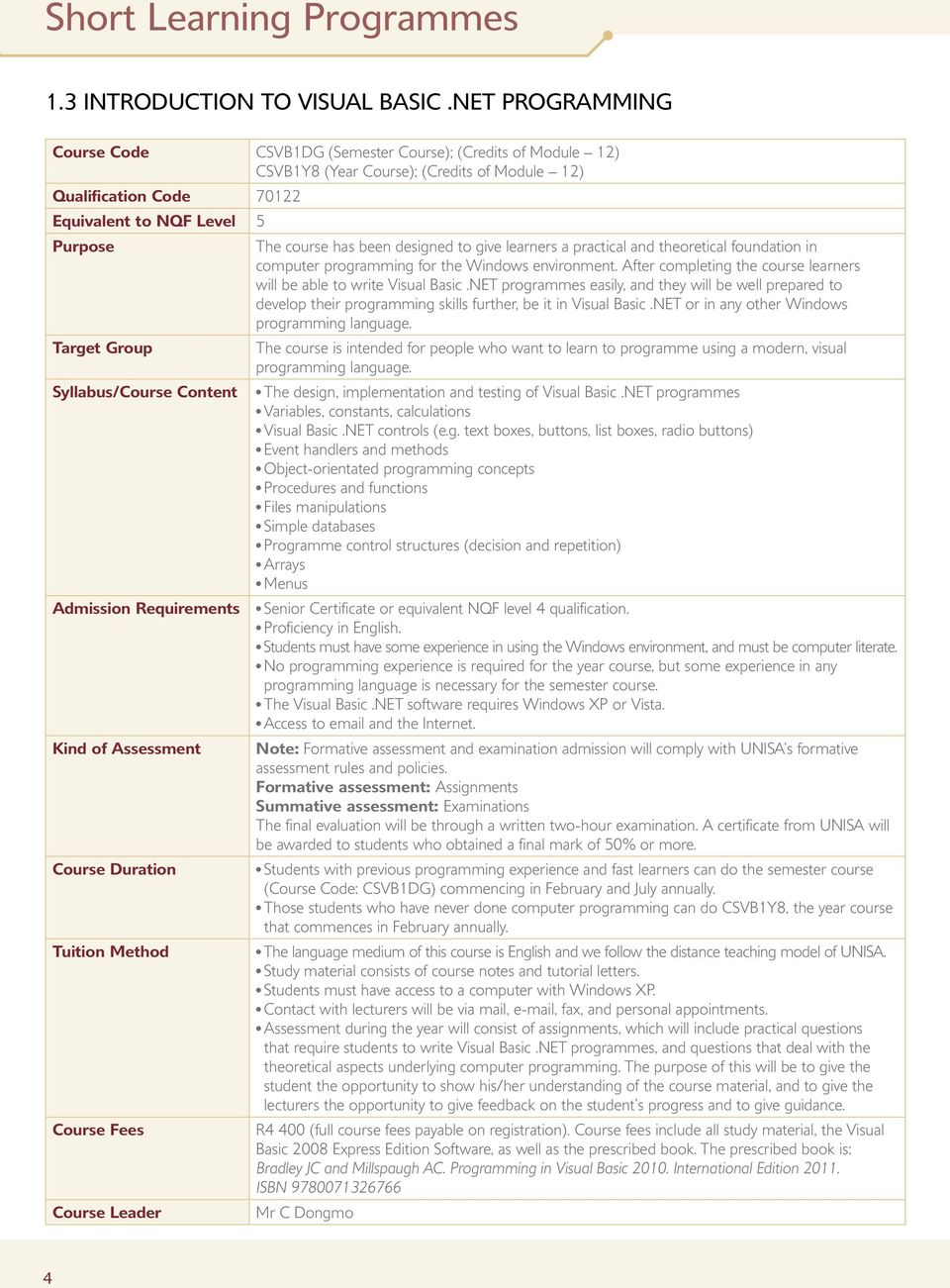
6 Short Learning Programmes 1.3 INTRODUCTION TO VISUAL BASIC.NET PROGRAMMING Course Code CSVB1DG (Semester Course); (Credits of Module 12) CSVB1Y8 (Year Course); (Credits of Module 12) Qualification Code Equivalent to NQF Level 5 Purpose The course has been designed to give learners a practical and theoretical foundation in computer programming for the Windows environment. After completing the course learners will be able to write Visual Basic.NET programmes easily, and they will be well prepared to develop their programming skills further, be it in Visual Basic.NET or in any other Windows programming language. Target Group The course is intended for people who want to learn to programme using a modern, visual programming language. Syllabus/Course Content The design, implementation and testing of Visual Basic.NET programmes Variables, constants, calculations Visual Basic.NET controls (e.g. text boxes, buttons, list boxes, radio buttons) Event handlers and methods Object-orientated programming concepts Procedures and functions Files manipulations Simple databases Programme control structures (decision and repetition) Arrays Menus Admission Requirements Senior Certificate or equivalent NQF level 4 qualification. Proficiency in English. Students must have some experience in using the Windows environment, and must be computer literate. No programming experience is required for the year course, but some experience in any programming language is necessary for the semester course. The Visual Basic.NET software requires Windows XP or Vista. Access to and the Internet. Kind of Assessment Note: Formative assessment and examination admission will comply with UNISA s formative assessment rules and policies. Formative assessment: Assignments Summative assessment: Examinations The final evaluation will be through a written two-hour examination. A certificate from UNISA will be awarded to students who obtained a final mark of 50% or more. Course Duration Students with previous programming experience and fast learners can do the semester course (Course Code: CSVB1DG) commencing in February and July annually. Those students who have never done computer programming can do CSVB1Y8, the year course that commences in February annually. Tuition Method The language medium of this course is English and we follow the distance teaching model of UNISA. Study material consists of course notes and tutorial letters. Students must have access to a computer with Windows XP. Contact with lecturers will be via mail, , fax, and personal appointments. Assessment during the year will consist of assignments, which will include practical questions that require students to write Visual Basic.NET programmes, and questions that deal with the theoretical aspects underlying computer programming. The purpose of this will be to give the student the opportunity to show his/her understanding of the course material, and to give the lecturers the opportunity to give feedback on the student s progress and to give guidance. Course Fees R4 400 (full course fees payable on registration). Course fees include all study material, the Visual Basic 2008 Express Edition Software, as well as the prescribed book. The prescribed book is: Bradley JC and Millspaugh AC. Programming in Visual Basic International Edition ISBN Course Leader Mr C Dongmo 4
7 5 5

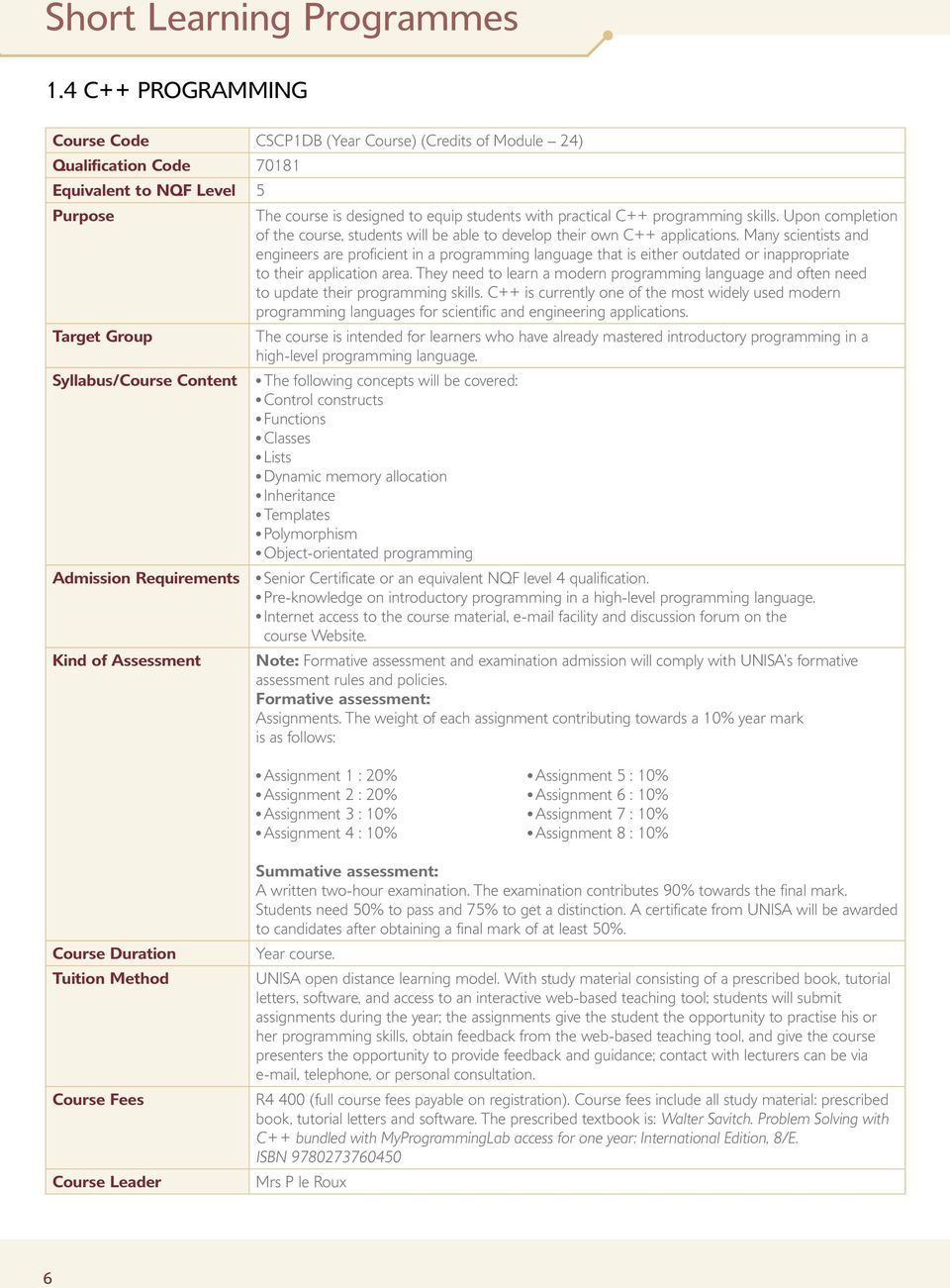
8 Short Learning Programmes 1.4 C++ PROGRAMMING Course Code CSCP1DB (Year Course) (Credits of Module 24) Qualification Code Equivalent to NQF Level 5 Purpose Target Group Syllabus/Course Content Admission Requirements Kind of Assessment The course is designed to equip students with practical C++ programming skills. Upon completion of the course, students will be able to develop their own C++ applications. Many scientists and engineers are proficient in a programming language that is either outdated or inappropriate to their application area. They need to learn a modern programming language and often need to update their programming skills. C++ is currently one of the most widely used modern programming languages for scientific and engineering applications. The course is intended for learners who have already mastered introductory programming in a high-level programming language. The following concepts will be covered: Control constructs Functions Classes Lists Dynamic memory allocation Inheritance Templates Polymorphism Object-orientated programming Senior Certificate or an equivalent NQF level 4 qualification. Pre-knowledge on introductory programming in a high-level programming language. Internet access to the course material, facility and discussion forum on the course Website. Note: Formative assessment and examination admission will comply with UNISA s formative assessment rules and policies. Formative assessment: Assignments. The weight of each assignment contributing towards a 10% year mark is as follows: Assignment 1 : 20% Assignment 5 : 10% Assignment 2 : 20% Assignment 6 : 10% Assignment 3 : 10% Assignment 7 : 10% Assignment 4 : 10% Assignment 8 : 10% Course Duration Tuition Method Course Fees Course Leader Summative assessment: A written two-hour examination. The examination contributes 90% towards the final mark. Students need 50% to pass and 75% to get a distinction. A certificate from UNISA will be awarded to candidates after obtaining a final mark of at least 50%. Year course. UNISA open distance learning model. With study material consisting of a prescribed book, tutorial letters, software, and access to an interactive web-based teaching tool; students will submit assignments during the year; the assignments give the student the opportunity to practise his or her programming skills, obtain feedback from the web-based teaching tool, and give the course presenters the opportunity to provide feedback and guidance; contact with lecturers can be via , telephone, or personal consultation. R4 400 (full course fees payable on registration). Course fees include all study material: prescribed book, tutorial letters and software. The prescribed textbook is: Walter Savitch. Problem Solving with C++ bundled with MyProgrammingLab access for one year: International Edition, 8/E. ISBN Mrs P le Roux 6
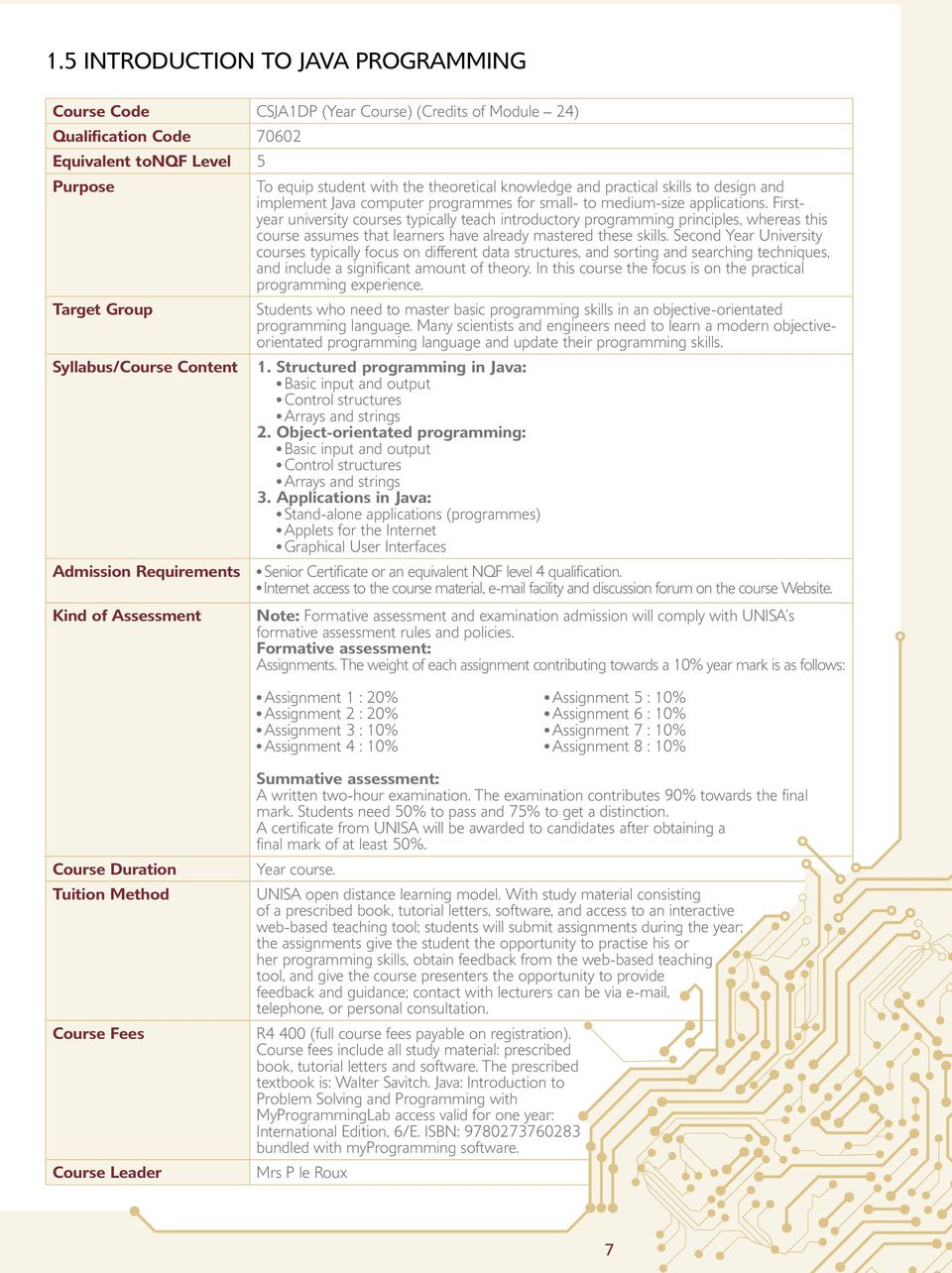
9 1.5 INTRODUCTION TO JAVA PROGRAMMING Course Code CSJA1DP (Year Course) (Credits of Module 24) Qualification Code Equivalent tonqf Level 5 Purpose Target Group Syllabus/Course Content Admission Requirements Kind of Assessment To equip student with the theoretical knowledge and practical skills to design and implement Java computer programmes for small- to medium-size applications. Firstyear university courses typically teach introductory programming principles, whereas this course assumes that learners have already mastered these skills. Second Year University courses typically focus on different data structures, and sorting and searching techniques, and include a significant amount of theory. In this course the focus is on the practical programming experience. Students who need to master basic programming skills in an objective-orientated programming language. Many scientists and engineers need to learn a modern objectiveorientated programming language and update their programming skills. 1. Structured programming in Java: Basic input and output Control structures Arrays and strings 2. Object-orientated programming: Basic input and output Control structures Arrays and strings 3. Applications in Java: Stand-alone applications (programmes) Applets for the Internet Graphical User Interfaces Senior Certificate or an equivalent NQF level 4 qualification. Internet access to the course material, facility and discussion forum on the course Website. Note: Formative assessment and examination admission will comply with UNISA s formative assessment rules and policies. Formative assessment: Assignments. The weight of each assignment contributing towards a 10% year mark is as follows: Assignment 1 : 20% Assignment 5 : 10% Assignment 2 : 20% Assignment 6 : 10% Assignment 3 : 10% Assignment 7 : 10% Assignment 4 : 10% Assignment 8 : 10% Course Duration Tuition Method Course Fees Course Leader Summative assessment: A written two-hour examination. The examination contributes 90% towards the final mark. Students need 50% to pass and 75% to get a distinction. A certificate from UNISA will be awarded to candidates after obtaining a final mark of at least 50%. Year course. UNISA open distance learning model. With study material consisting of a prescribed book, tutorial letters, software, and access to an interactive web-based teaching tool; students will submit assignments during the year; the assignments give the student the opportunity to practise his or her programming skills, obtain feedback from the web-based teaching tool, and give the course presenters the opportunity to provide feedback and guidance; contact with lecturers can be via , telephone, or personal consultation. R4 400 (full course fees payable on registration). Course fees include all study material: prescribed book, tutorial letters and software. The prescribed textbook is: Walter Savitch. Java: Introduction to Problem Solving and Programming with MyProgrammingLab access valid for one year: International Edition, 6/E. ISBN: bundled with myprogramming software. Mrs P le Roux 7
10 Short Learning Programmes 1.6 DESIGNING & IMPLEMENTING TELECOMMUNICATION NETWORKS Course Code CSTC1WW (A Web-based Course) (Semester Course) (Credits of Module 12) CSTC1DB (A Correspondence Course) (Semester Course) (Credits of Module 12) Qualification Code Equivalent to NQF Level 5 Purpose Data communications and computer networks are vital in today s business world. This course balances technical and practical everyday aspects of data communications for future business managers, computer programmers, and system designers needing a thorough understanding of basic features, operations, and limitations of different types of computer networks. This course offers full coverage of wireless technologies, industry convergence, compression techniques, network security, LAN technologies, VoIP, and error detection and correction. Target Group This course is intended for people who want to learn about telecommunication as well as those who want to formalise their Computer Network knowledge. Syllabus/Course Content Introduction The Internet Data Networks Signal Fundamentals The Media Local Networks: Part 1 Local Networks: Part II Making Connections Multiplexing and Compression Detecting and Correcting Errors Other Networks Security Design and Management of Networks Admission Requirements Senior Certificate or an equivalent NQF qualification Kind of Assessment Note: Formative assessment and examination admission will comply with UNISA s formative assessment rules and policies. Formative assessment: Two assignments throughout the semester. Summative assessment: One written examination at the end of the semester. Course Duration. Tuition Method This course has two modes, namely a web-based mode and a correspondence mode. Students can follow any one of these two modes but cannot interchange between the modes as the semester proceeds. MODE 1: Web-based course This course is presented in a paperless, web-based mode. Students require a permanent address as well as a personal Internet connection, which may be at home or from work. An Internet Café solution is not a suitable Internet connection, since most of these types of connections do not allow for PDF readable formats, which is the basic format of all electronic notes of this course. Course notes are made available on the web and the download of the material is the responsibility of the student. Contact with the lecturer will be via mail, , fax and personal consultation (by appointment). MODE 2: Correspondence course This course is presented in a paper-based format. Students require a permanent postal address from where students can collect the course notes that will be sent to them. Having an address and temporary Internet access through an Internet Café or a friend can be beneficial but is not compulsory. Contact with the lecturer will be via mail, , fax and personal consultation (by appointment). Course Fees Web-based course: R3 400 (full course fees payable on registration). The course fees include the textbook. Correspondence: R3 600 (full course fees payable on registration). The course fees include the textbook as well as the tutorials. The prescribed book is: Curt M White. Fundamentals of Networking and Data Communications. ISBN Number: th Edition (International Edition). Year: Publisher: Course Technology, Cengage Learning. Course Leader Ms H Abdullah 8

11 1.7 COMPUTER NETWORKS Course Code CSNW1W8 and CSNW2WA (A Web-based Course) (Year Course) (Total Credits 24) CSNW1DJ and CSNW2DL (A Correspondence Course) (Year Course) (Total Credits 24) Qualification Code Equivalent to NQF Level 5 Purpose This course provides students with the fundamentals in protocols, topologies, hardware, and network design. After exploring TCP/IP, Ethernet, wireless transmission, and security concepts, as well virtual networks, students can increase their knowledge with the practical on-the job stories, review questions, hands-on projects, and case projects. The emphasis on real-world problem solving provides students with the tools they need to succeed in any computing environment. Target Group This course is suitable for students who need to learn the technical skills and industry know-how required to begin an exciting career installing, configuring, and troubleshooting computer networks. Syllabus/Course Content MODULE 1 An Introduction to Networking Networking Standards and the OSI Model Transmission Basics and Networking Media Introduction to TCP/IP Protocols Topologies and Ethernet Standards Network Hardware, Switching, and Routing Wide Area Networks Admission Requirements Kind of Assessment Course Duration MODULE 2 Wireless Networking In-Depth TCP/IP Networking Virtual Networking and Remote Access Network Security Voice and Video Over IP Troubleshooting Network Problems Ensuring Integrity and Availability Network Management 1. General Matriculation certificate or equivalent qualification. Intermediate level experience in using computers and computer networks OR an introductory course in computer or telecommunication networks. 2. Web-based course: Permanent address. Permanent Internet connection from home or work (NOT at an Internet Café). 3. Correspondence course: Postal address. Access to the Internet is desirable but not compulsory. Note: Formative assessment and examination admission will comply with UNISA s formative assessment rules and policies. Formative assessment: Two assignments per module throughout the year. Summative assessment: One written examination per module in October/November. Year course. 9

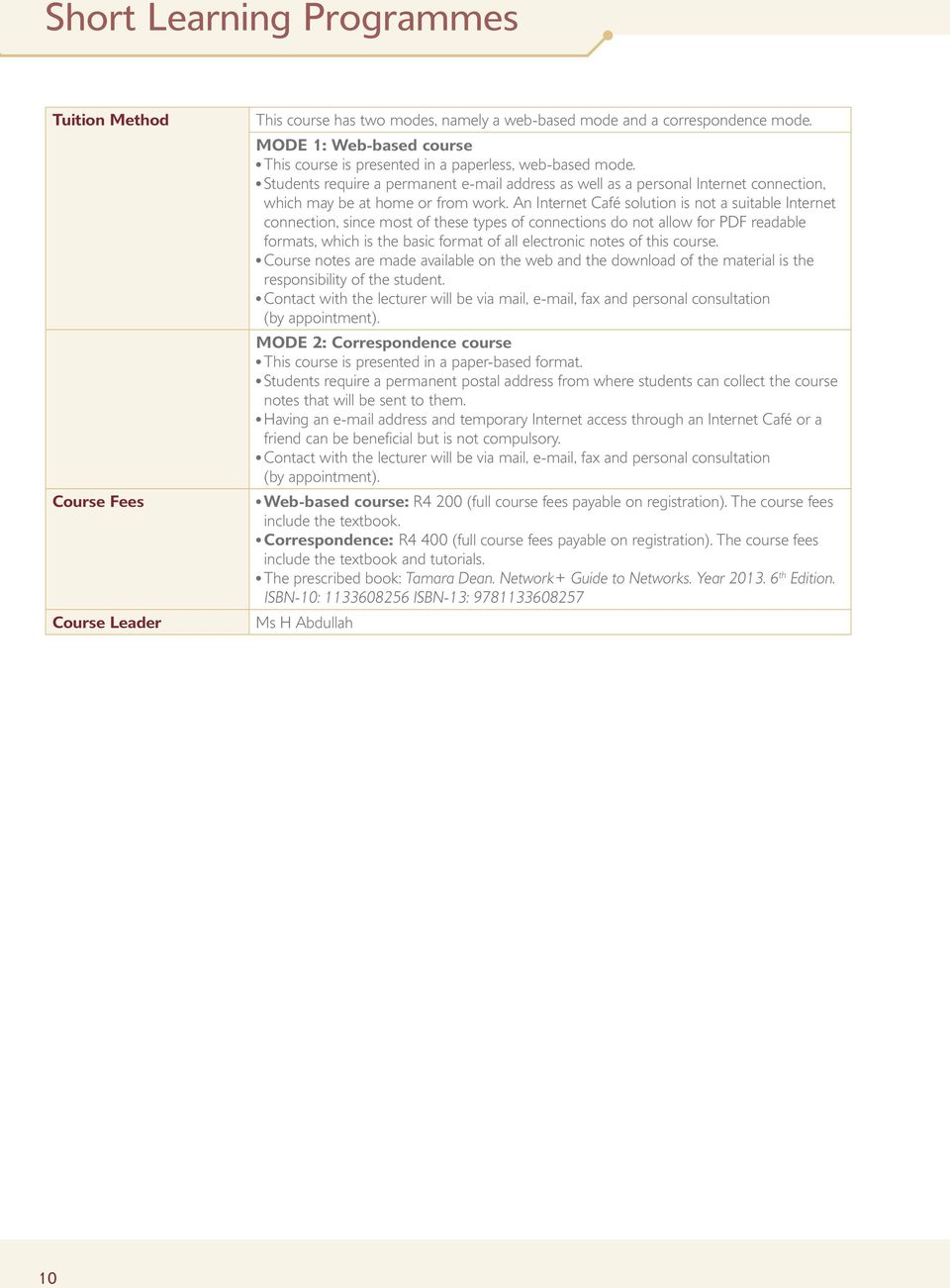
12 Short Learning Programmes Tuition Method Course Fees Course Leader This course has two modes, namely a web-based mode and a correspondence mode. MODE 1: Web-based course This course is presented in a paperless, web-based mode. Students require a permanent address as well as a personal Internet connection, which may be at home or from work. An Internet Café solution is not a suitable Internet connection, since most of these types of connections do not allow for PDF readable formats, which is the basic format of all electronic notes of this course. Course notes are made available on the web and the download of the material is the responsibility of the student. Contact with the lecturer will be via mail, , fax and personal consultation (by appointment). MODE 2: Correspondence course This course is presented in a paper-based format. Students require a permanent postal address from where students can collect the course notes that will be sent to them. Having an address and temporary Internet access through an Internet Café or a friend can be beneficial but is not compulsory. Contact with the lecturer will be via mail, , fax and personal consultation (by appointment). Web-based course: R4 200 (full course fees payable on registration). The course fees include the textbook. Correspondence: R4 400 (full course fees payable on registration). The course fees include the textbook and tutorials. The prescribed book: Tamara Dean. Network+ Guide to Networks. Year th Edition. ISBN-10: ISBN-13: Ms H Abdullah 10
13 11

14 Short Learning Programmes 1.8 INTERNET AND WEB DESIGN Course Code CSIW1DT (A Web-based Course) (Semester Course) (Credits of Module 12) Qualification Code Equivalent to NQF Level 5 Purpose This course focuses on important client-side and some server-side interaction aspects of the Internet. The aim is to empower the user to interact with the Internet in an effective and efficient manner, and to provide practical training in the design and creation of usable Web pages. At the end of this course, users will understand and be able to explain common terminology associated with the Internet. They will be able to use a variety of tools to help them design and publish Web pages that are both engaging and usable. Even though this is an intermediate level course (you will be expected to do only introductory client-side programming), you will be given meaningful exposure to more advanced topics such as HTML hand-coding, CSS (Cascading Style Sheets), JavaScript programming, designing Web pages and sites with good usability, and graphics file formats, their manipulation and preparation. Target Group Syllabus/Course Content Admission Requirements Kind of Assessment Course Duration Tuition Method Course Fees Course Leader As a follow-up course, we recommend the Developing web applications with PHP short course. This course will allow you to develop more advanced and dynamic websites. The relative novice with general Windows skills who wishes to gain the skills to use the Internet as a communications and research medium and publish his/her own Web pages, whether for personal or commercial use. Introduction to web development How to code, test, and validate a web page How to use HTML to structure a web page How to use CSS to format the elements of a web page How to use CSS for page layout How to work with links, lists, images, tables and forms How to add audio and video to your website How to use jquery to enhance your website How to deploy a website on a server Senior Certificate or an equivalent NQF level 4 qualification Internet access Note: Formative assessment and examination admission will comply with UNISA s formative assessment rules and policies. Formative assessment: Written assignments and practical exercises. Summative assessment: The development of a static website. This REPLACES a sit-down examination. That is, you submit a working website, which we mark.. The web-based distance teaching model of UNISA is used in offering the course. The Internet (www, , discussion forum, etc.) forms a major part of the teaching and delivery mechanisms of this course. Telephone and support from lecturers is also available. Study material is available in English only. R4 400 (full course fees payable on registration). The prescribed textbook Murach s HTML5 and CSS3. Zak Ruvalcaba and Anne Boehm. Published December ISBN and the study CDROM are included in the course fee. The CD contains all the applications you require to complete this course. You do not have to buy any additional textbooks or programmes. Note: This course does not support MAC environments, but some of the software is available for MAC. Ultimately you only require a text editor and a browser. Prof T M van der Merwe 12

15 1.9 DEVELOPING WEB APPLICATIONS WITH PHP Course Code CSDW1WS Qualification Code Equivalent tonqf level 5 Purpose Target Group Syllabus/Course Content Admission Requirements With the rapid development of the Internet and the World Wide Web there is an increasing demand for developers with the skills to do more advanced manipulation of Web data. Students involved in static Web development environments reach a plateau in manipulating the Web content. At this stage, they seek opportunities to enhance their skill set with regard to dynamic Web development. The aim of the PHP course is to provide the student with tools and techniques to develop more dynamic Web-based applications, centred on the manipulation of data stored in online databases. The target group for this course are students who successfully completed introductory courses in Web-design, E-Commerce, or XML with the need to gain from more advanced Web development content. The target group furthermore includes entrepreneurs involved in self-start business that has pre-knowledge on the development of static Web-based applications. In line with modern practices, we make use of a variety of carefully-selected open-sourced material and a free handbook to present this course. This approach allows us to source the latest material without being reliant on publishers, thereby keeping the cost of this course down. Where possible, we license such material from the authors and offer it to you offline on a Compact Disk. The course does have a free prescribed book, which is meant as a desktop companion in-course and a useful reference post-course. - Introduction to PHP - Getting Started with Variables - Conditional Logic - Working with HTML Forms - Programming Loops - Arrays in PHP - String Manipulation - Functions - Security Issues - Working with Files - Date and Time Functions - PHP and MySQL - MySQL Databases - User Authentication Senior Certificate or an equivalent NQF level 4 qualification.pre-knowledge on the development of static Web-based applications (HTML). Internet access to the course material, facility and discussion forum on the course Website. 13

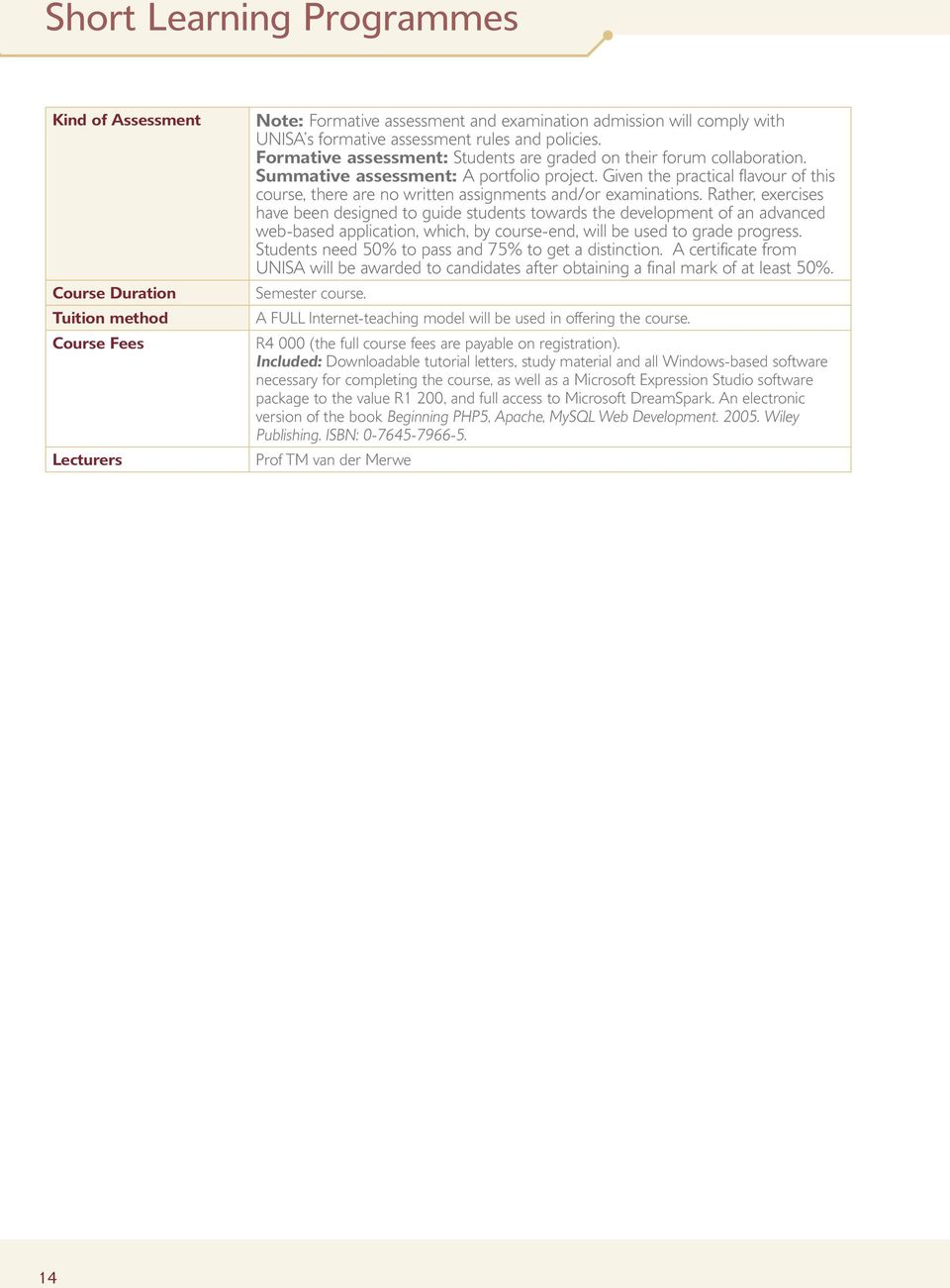
16 Short Learning Programmes Kind of Assessment Course Duration Tuition method Course Fees Lecturers Note: Formative assessment and examination admission will comply with UNISA s formative assessment rules and policies. Formative assessment: Students are graded on their forum collaboration. Summative assessment: A portfolio project. Given the practical flavour of this course, there are no written assignments and/or examinations. Rather, exercises have been designed to guide students towards the development of an advanced web-based application, which, by course-end, will be used to grade progress. Students need 50% to pass and 75% to get a distinction. A certificate from UNISA will be awarded to candidates after obtaining a final mark of at least 50%.. A FULL Internet-teaching model will be used in offering the course. R4 000 (the full course fees are payable on registration). Included: Downloadable tutorial letters, study material and all Windows-based software necessary for completing the course, as well as a Microsoft Expression Studio software package to the value R1 200, and full access to Microsoft DreamSpark. An electronic version of the book Beginning PHP5, Apache, MySQL Web Development Wiley Publishing. ISBN: Prof TM van der Merwe 14
17 1.10 APPLIED PROJECT MANAGEMENT IN AN INFORMATION TECHNOLOGY ENVIRONMENT Course Code Course Code: CSPM1DR (Semester Course) (Credits of Module 12) Qualification Code Equivalent to NQF Level 5 Purpose This course on software project management is intended for first-time project managers and project managers wanting to expand and formalise their knowledge. The course aims to provide students with the basic skills, knowledge and competence to effectively understand and manage information technology projects. There is a need for a project management course focusing specifically on the management of Information Technology (IT) projects. Most similar courses focus less on IT, form part of a curriculum for a formal qualification, and are less skills-orientated. Given the growth of the IT industry, a need exists for computer specialists, as well as project managers, to gain a practical and theoretical foundation for managing IT projects, as this area has been grossly neglected over time. Target Group Syllabus/Course Content There is a definite need for courses that do not require the employee to interrupt their work schedule for an extended period to obtain a formal qualification. This certificate course fills this need as it focuses on sensitising the prospective student on concepts, techniques and strategies available to the IT project manager. This course is intended for the following target market: Project managers working within an Information Technology environment looking for a certified qualification; General project managers who also want to focus on the management of Information Technology related projects; and Persons working within an Information Technology related environment and wishing to broaden their career path to include project management of IT projects. Each topic below will be approached specifically from an Information Technology perspective. The context of the management of information technology projects: the environment, project management framework, process groups and knowledge areas. The information technology project management profession: its history, professional organisations such as the Project Management Institute (PMI), certification, ethics. Information technology project integration management: the strategic planning process, the project charter, the project management plan, as well as project execution, management and monitoring. Software project scope management, requirements elicitation, the work breakdown structure and change control. Software project time management: activity scheduling, various tools and techniques, activity duration estimation and schedule management. Software project cost management: cost management principles, concepts, types of cost estimates and methods. Software project risk management: qualitative risk analysis, risk management plan, risk monitoring and controlling. Case studies are used to illustrate software project management techniques and project management software assisting project management tasks are delineated. 15

18 Short Learning Programmes Admission Requirements Kind of Assessment Course Duration Tuition Method Course Fees Course Leader The following are required: Matriculation certificate qualification. Experience in an Information Technology environment or exposure to project management practice is recommended. Note: Formative assessment and examination admission will comply with UNISA s formative assessment rules and policies. Formative assessment will be based on two written assignments. Summative assessment includes a two-hour written exam at the end of the period. A UNISA certificate will be awarded to a candidate who obtains a final mark of at least 50%.. The ODL model of UNISA is applicable. In particular the following will be used: Tutorial letters and additional tutorial material necessary for the module Telephone, support and the Internet Consultations and solutions of material Study material will be in English only R4 400 (full course fees payable on registration). The course fees include all study material: prescribed book and tutorial letters. The prescribed book is: Kathy Schwalbe. Managing Information Technology Projects. 6 th Edition, ISBN: Prof E Kritzinger 16

19 1.11 INFORMATION TECHNOLOGY IN ELECTRONIC-COMMERCE Course Code CSEC1D9 (A Web-based Course) (Semester Course) (Credits of Module 24) Qualification Code Equivalent to NQF Level 5 Purpose Target Group Syllabus/Course Content Admission Requirements Kind of Assessment Course Duration Tuition Method Course Fees Course Leader To equip students with the theoretical knowledge and practical information technology skills to enable them to understand and create the infrastructure needed to do business over the internet utilising the World Wide Web (www), and thus be active developers of Electronic-Commerce interfaces and participants in the emerging Electronic Business market. Persons who are already in the information technology field, but wish to become more knowledgeable in its use in electronic-commerce applications. The Internet and the Web: Infrastructure for electronic-commerce Web-based tools for electronic-commerce Electronic-commerce Software Security threats to electronic-commerce Implementing security for electronic-commerce Electronic payment systems Strategies for marketing, sales and promotion Strategies for purchasing and support activities Strategies for web auctions, virtual communities and web portals The environment of electronic-commerce: international, legal, ethical and tax issues Business plans for implementing electronic-commerce Senior Certificate or an equivalent NQF level 4 qualification; mastered basic information technology concepts, which include the Internet and Web design; experience in using computers and the Microsoft Windows operating system environment is of utmost importance. Due to the teaching model followed (web-based) and the practical nature of the course, each student MUST have functional Internet access and an account. In our experience an Internet Café connection is not sufficient. Note: Formative assessment and examination admission will comply with UNISA s formative assessment rules and policies. Formative assessment: Students will complete 2 compulsory assignments during the course of the semester. Summative assessment: The final assessment for the module consists of the configuration of an on-line shopping cart. Students need 50% to pass and 75% to get a distinction. A certificate from UNISA will be awarded to candidates after obtaining a final mark of at least 50%.. A FULL Internet-teaching model will be used in offering the course. R4 400 (full course fees are payable on registration). The prescribed book, Gary P Schneider. E-Business. ISBN: th International Edition (Paperback), is included in the course fees. Mr JC Mentz 17

20 Short Learning Programmes 1.12 INTRODUCTION TO INFORMATION SECURITY Course Code CSIS1DF (Semester Course) (Credits of Module 12) Qualification Code Equivalent tonqf Level 5 Purpose Target Group Syllabus/Course Content Admission Requirements Kind of Assessment Course Duration Tuition Method Course Fees Course Leader The aim of this course is to equip students with a sound knowledge of the underlying principles of information security and to provide them with the skills needed to analyse and evaluate information security problems. This course provides a sound and proper foundation for people with little or no Information Security background. This course covers an introduction to the following Information Security issues: Security in General Information Security Password Security Virus Awareness Data Storage & Backup Computer Ethics Office Discipline Hardware Security Social Engineering Security in the Banking Environment Solicitation Malicious software Fraud schemes Extortion Illegal activities Preventative measures An Overview of Information Security Plan The 5 pillars of Information Security Senior Certificate or an equivalent NQF level 4 qualification. Students must be computer-literate and familiar with the Microsoft Windows environment; access to the Internet is a necessity. Note: Formative assessment and examination admission will comply with UNISA s formative assessment rules and policies. Formative assessment: Assignments Summative assessment: Two-hour written examination. UNISA open distance learning with a textbook and additional material: students will be expected to cover the work by working through the prescribed textbook and additional material; tutorial letters: the lecturers will provide additional tutorial matter necessary to aid understanding of the course content; assignments: students will be required to complete assignments that will form an inherent part of their preparation for the examination; telephone and support: this will be the preferred means of communication; the internet: it will provide an additional way of communicating to the lecturers and submitting assignments. R4 000 (full course fees payable on registration). The course fees include all study material. Mark Ciampa. Security Awareness Applying practical security in your world. ISBN: th Edition. Course Technology. Cengage Learning. Prof E Kritzinger 18

21 1.13 APPLIED INFORMATION SECURITY Course Code CSIS02D (Semester Course) (Credits of Module 12) Qualification Code Equivalent to NQF Level 6 Purpose Target Group Syllabus/Course Content Admission Requirements Kind of Assessment Course Duration Tuition Method Course Fees Course Leader The purpose of this unit is to empower students with the necessary skills and knowledge regarding the technical counter measures of addressing cyber security risks and threats within a business environment. These skills and knowledge will assist students within their working environment to contribute to the growth of an Information Security society as well as the enrichment of the overall Information Security Body of Knowledge within the industry, government and education sector. This course is intended for intermediate users who want to increase their understanding of information security and cyber-related issues and business processes within industry. The course covers all of the need-to-know information about the technical and managerial countermeasures needed to secure a business environment and how to detect and avoid security attacks. Specific topic coverage includes: Define information security. Define key terms and critical concepts of information security. Describe the information security roles of professional within an organisation. Demonstrate that organisations have a business need for information security. Differentiate between laws and ethics. Define managements roles in information security. Explain information security s connection to the business plan. NQF level 5 qualification within the Information Security field or Successfully completed the Short Course in Information Security (CSIS1DF) at UNISA. Note: Formative assessment and examination admission will comply with UNISA s formative assessment rules and policies. Formative assessment: Assignments Summative assessment: Two-hour written examination. UNISA open distance learning with a textbook and additional material: students will be expected to cover the work by working through the prescribed textbook and additional material; tutorial letters: the lecturers will provide additional tutorial matter necessary to aid understanding of the course content; assignments: students will be required to complete assignments that will form an inherent part of their preparation for the examination; telephone and support: this will be the preferred means of communication; the internet: it will provide an additional way of communicating to the lecturers and submitting assignments. R4 200 (full course fees payable on registration). The course fees include all study material. Michael E. Whitman; Herbert J. Mattord. Principles of Information Security ISBN th International Edition. Prof E Kritzinger 19
22 Short Learning Programmes 1.14 ADVANCED INFORMATION SECURITY Course Code CSIS03D (Credits of Module 12) Qualification Code Equivalent to NQF Level 7 Purpose The purpose of this unit is to empower students with the advance knowledge and skills regarding the body of knowledge of Information Security. The main aim of this course is to ensure enrolled students understand the technical aspects regarding information security within an industry environment. Target Group This course is intended for more advanced users who want to improve their understanding of information security issues and practices especially on technical aspects needed within industry. Syllabus/ Course Content Cryptography Programme Security Operating Systems Data mining Network Security Administering Security Cyber Security Admission Requirements NQF level 6 qualification within the Information Security field or Successfully completed the Short Course in Applied Information Security (CSIS02D) at UNISA. Kind of Assessment Note: Formative assessment and examination admission will comply with UNISA s formative assessment rules and policies. Formative assessment: Assignments Summative assessment: Written examination Course Duration to be offered from Semester 2/2015 (July 2015). Tuition Method The UNISA open and distance learning method will be followed. Learning material will consist of online readings, workbooks, tutorial letters, a prescribed book and a range of supporting material from the web. At least one compulsory assignment will need to be completed per module. Feedback will ensure interaction with learners and this may be reinforced through the use of online discussion sessions and other similar tools. Course Fees R4 400 (full course fees payable on registration). The course fees include all study material, inclusive of the textbook: Charles P. Pfleeger (Author), Shari Lawrence Pfleeger (Author).Security in Computing, 4th Edition Hardcover. ISBN-13: Course Leader Prof E Kritzinger 20
23 1.15 INTRODUCTION TO INFORMATION TECHNOLOGY BASED SUPPLY CHAIN MANAGEMENT Course Code CSSC1DT (Credits of Module 12) Qualification Code Equivalent to NQF level 7 Purpose This unit standard provides participants with an understanding of how information technology influences the core functions and processes of supply chain management. It will be useful for students interested in examining ways in which their organisations can gain competitive advantage by improving their supply chain performance. Target Group Individuals with or without a managerial background who require a detailed understanding of the basic principles and practice of IT-based supply chain management. It is suitable for professionals in an IT-based operations or purchasing position who are not familiar with Supply Chain Management. Syllabus/Course Content Understanding the Information Technology Based Supply Chain. Building Blocks, Performance Measures, Decisions in Supply Chain Management (SCM) in the context of Information Technology. Building Blocks of Supply Chain Network Performance Measures. Decisions in the Supply Chain World. Models for Supply Chain Decision-Making. Supply Chain Inventory Management in the context of Information Technology. Economic Order Quantity Models. Reorder Point Models. Multi-echelon Inventory Systems. Mathematical Foundations of Supply Chain Solutions in the context of Information Technology. Use of Stochastic Models and Combinatorial Optimisation in: - Supply Chain Planning. - Supply Chain Facilities Layout. - Capacity Planning. - Inventory Optimisation. - Dynamic Routing and Scheduling Understanding the internals of industry best practice solution Internet Technologies and Electronic Commerce in SCM. - Relation to ERP. - E-procurement, e-logistics, Internet Auctions. - E-markets Electronic business process optimisation. - Business objects in SCM. Admission Requirements NQF level 6 qualification. If an applicant does not possess the required qualifications for enrolment, the Centre for Software Engineering may consider admission on the basis of seniority and appropriate experience in exceptional cases. A letter of substantiation should accompany such an application. Kind of Assessment Note: Formative assessment and examination admission will comply with UNISA formative assessment rules and policies. Formative assessment: Continuous assessment by means of assignments. Summative assessment: Final assessment by means of a written examination. Course Duration. 21
24 Short Learning Programmes Tuition Method Course Fees Course Leader Electronic/Distance Education Prescribed textbook and additional material: Learners will be expected to work through the prescribed textbook as well as additional study material that will be supplied. Tutorial letters: Learners will be provided with tutorial matters necessary for the understanding of the course contents as well as the completion of required assignments. Online-material: Additional support material will be made available to students on the course website. Workshops: In certain circumstances practical workshops may be organised whenever necessary. Telephone and support: This will be the preferred means of communication. The Internet: It will be used as an additional communication medium between the lecturer (feedback and assignment memorandums) and the learners (assignment submission). R4 400 (full course fees payable on registration). Prescribed textbook: Chopra & Meindl. Supply Chain Management Strategy. 5th Global Edition. ISBN: Dr P Mkhize 22
25 1.16 STRATEGIC INFORMATION SYSTEMS PLANNING IN PRACTICE Course Code CSSP1DH (Credits of Module 12) Qualification Code Equivalent tonqf level 5 Purpose Target Group Syllabus/Course Content Admission Requirements Kind of Assessment Course Duration The module is designed to provide insights into the way in which technical aspects in the modern computing environment in organisations may be used and changed into knowledge for use in key managerial decisions, in order to obtain and sustain a competitive advantage in the new economy. It aims to equip practitioners with the expertise in strategic planning for the IS/IT Departments in general, and in regard to the complexities concerning the implementation of such a plan, that it aligns with the organisation s strategic business plan. Within an organisation, such people are able to provide sound business advice, guidance and support at a strategic planning level to a range of people to ensure that such plan is accepted and communicated to all stakeholders. The module is appropriate for practitioners who advise and assist their Informatics Department management to prepare and present a well-planned, coordinated and organised strategic plan. The information age: Changing the face of the modern business. Business initiatives: The competitive advantage offered by ICTs. Databases and data warehouses: The analytics-driven organisation. Business intelligence, decision support; Artificial intelligence considerations. E-business and E-commerce. System development lifecycles. Infrastructure, Cloud computing, metrics, Business continuity planning. Social media, ethical and legal implications, Industry guidelines for cyber- and information security. Emerging trends, Technology innovation. The following are required: Matriculation certificate qualification. Prior experience: Although a Matric qualification is required, students will benefit most if they already have some prior industry IT management experience. Writing skills: The ability to write academic assignments. Study skills: The ability to study independently through the medium of written tuition material. Note: Formative assessment and examination admission will comply with UNISA formative assessment rules and policies. Formative assessment will be based on two written assignments. Summative assessment includes a written exam at the end of the period. A UNISA certificate will be awarded to a candidate who obtains a final mark of at least 50%.. 23
26 Short Learning Programmes Tuition Method Course Fees Course Leader The ODL model of UNISA is applicable. In particular the following will be used: Prescribed material: The course fee includes all prescribed material tutorial letters and prescribed book. Tutorial letters: Students will be provided with tutorial material necessary for the understanding of the course contents as well as the completion of required assignments. IT Management Workshops: Practical workshops may be organised should the need arise. Telephone and support: This will be the preferred means of communication. The Internet: It will be used as an additional communication medium between the lecturers (for feedback on assignments) and the students (assignment submission). Forum and myunisa support will be used. R4 200 (full course fees payable on registration). The course fee includes all study material, including the textbook: Haag, S & Cummings, M Management information systems for the Information Age. 9th edition. McGraw-Hill Irwin. ISBN Additional study material will be provided should the need arise. Prof JA van der Poll 24
27 25
28 Short Learning Programmes 1.17 RESEARCH IN INFORMATICS IN PRACTICE Course Code CSRI1DM (Credits of Module 12) Qualification Code Equivalent to 7 NQF level Purpose This course is intended for Informatics students and practitioners wishing to embark on research in a specific topic, typically at postgraduate level. It will be useful for students interested in understanding the methodological and conceptual issues involved in conducting Informatics research. Target Group Professionals in the Informatics and Computer Science area who are not familiar with research and reporting processes and individuals with an undergraduate background in the field, as well as those moving into postgraduate and normal research areas. Syllabus/Course Content Problem conceptualisation and specification: Introduction; Preparing for the Project Experience; Ethics; Research Fraud; Research Processes (Qualitative or Quantitative approach); How projects benefit all; Evaluation of Problems; Ensuring that the problem has the potential to be solved. Tools for Evaluating the Research: Estimation sheet project; Tools of research; The problem statement; Flow-charting the problem statement; Discussion of research project details; Project Ideas. Research purposes, objectives and questions: Writing detailed research purposes and objectives; Analyse and evaluate library websites; Writing detailed research questions/hypotheses; Writing definitions; Creating sub-problems; Importance of the study into context; Detailed Limitations of the study; Focus, issues terminology. Data criteria, and research methodology and Data collection methods: Explaining what data is; Types of data; Data criteria; Integrity; Connecting data and variables; Discuss how data can be collected; Survey; Delphi; Focus groups; Laboratory; Field; Observations; Interviews; Construction of the Instrument. Population and Sampling: Criteria for population; Calculation of Sample; Evaluation of sample; Sampling methods; Managing the sample; Motivating the sample; Ensuring that the sample is reliable and will supply responsible results. Review of literature Keywords: Check and confirm; Identify and use tools to be used to search for literature; Ensure reliable information that is used for literature; Identify and apply how to read articles; Apply academic writing; Creation of a Concept matrix; How to conduct a detailed literature review; Ensure that references are in the correct format. Research Questions and Instrument design: Identification of Research Questions and Acid test; Can the problem be broken down into smaller parts? Subsidiary research questions; Discuss the key components of research data to be used; Draft a letter to go with the instrument. 26
29 Syllabus/Course Content continued Research Methodology: Discuss different ways to present the instrument development; The evaluation of data collection and decided upon; Ensuring that the data collected will help answer the research questions/hypotheses; Measure criteria; Bias; Statistical tests. Support tools and proposal/report: Project management and the application of project management to research; Time management and the possibility of using aged data; Relationship between time management and project management in research; Layout of the proposal; Use of templates to ensure that it is in the required format; Proposal with detailed problem statement. Mini-literature review, objectives, research methodology and research questions; Completed article that meets with Accredited Journal requirements. Admission Requirements Kind of Assessment Course Duration Tuition Method Course Fees Lecturer Design and Methodology and data discussion: Differences between research methodology and research design; Explanations of where each one fits in; The role of research design; Challenges of differentiating between research design and research methodology; Types of research design; Generation of graphs, tables, statistical tests. An appropriate B Degree or equivalent qualification. Note: Formative assessment and examination admission will comply with UNISA formative assessment rules and policies. Formative assessment: Continuous assessment by means of assignments. Students are required to complete assignments such as a proposal that forms an integral part of a portfolio which will be examined. Summative assessment: A final Research Proposal that could be further developed aimed at a research publication.. The ODL model of UNISA is applicable. The following will be used: Prescribed material: Course material consists of a study guide, available in English only. Tutorial letters: Students will be provided with tutorial material necessary for the understanding of the course contents as well as the completion of required assignments. Telephone and support: This will be the preferred means of communication. The Internet: It will be used as an additional communication medium between the lecturers (for feedback on assignments) and the students (assignment submission). Forum and myunisa support will be used. R3 800 (payable on registration). Prof JA van der Poll 27
30 Short Learning Programmes 1.18 INTRODUCTION TO VISUAL C SHARP.NET PROGRAMMING Course Code CSCN01D Qualification Code (Module Credits 12) Equivalent tonqf level 5 Purpose Target Group Syllabus/Course Content Admission Requirements Kind of Assessment Course Duration Tuition Method Course Fees Lecturers This module gives to both experienced programmers and beginners, insight to the relatively new programming language C#. On completion of this module, the student is expected to be familiar with the.net environment and various object-orientated and event-driven programming techniques. The learner is exposed to the design of real-life application in a short period of time (rapid application development). Individuals with or without programming background. Junior developers and professionals not familiar with C#. The syllabus is a combination of different types of knowledge (concepts, processes, contexts), skills and values, and includes the following: Using GUI objects and the Visual Studio IDE Programming Fundamentals: Variables, Procedures and Functions Decision Making: If then and Case statements Looping: For Loop and While Loops Data Structures: Arrays and Strings Using Classes and Objects Files Exception Handling Senior Certificate or Equivalent NQF Level 4 Qualification Proficiency in English Students must be computer literate Note: Formative assessment and examination admission will comply with UNISA s formative assessment rules and policies. Formative assessment: Learners will be required to complete assignments, which will form an inherent part of their preparation for the examination. Summative assessment: Final assessment by means of a 2-hour written examination. A certificate from UNISA will be awarded to candidates after obtaining a final mark of at least 50%.. The course is offered using the ODL model of UNISA: The textbook and additional material: Learners will be expected to work through the prescribed textbook as well as additional study material that may be required. Tutorial Letters: Learners will be provided with tutorial matters necessary for the understanding of the course contents as well as the completion of required assignments. Software: Learners will be required to download the required software for completion of practical works. Online-material: Additional support material will be made available to students on the course website. Telephone and support: This will be the preferred means of communication. The Internet: It will be used as an additional communication tool between the learner (feedbacks and assignments memos) and the students (Assignment Submission). Study material will be in English only. R4 200 (full course fees are payable on registration). The course fees include all study material: Prescribed book and tutorial letters. The prescribed book is: Douglas Bell and Mike Parr. C# for Students. Revised Edition ISBN: Mr L Aron 28
31 1.19 MOBILE TECHNOLOGY IN TEACHING AND LEARNING Course Code CSMT01E Qualification Code (Module Credits 12) Equivalent to NQF level 5 Purpose Target Group Syllabus/Course Content Admission Requirements The main purpose of empowering the person with knowledge and skills to use mobile learning is: To introduce the educator to the unique affordances of mobile technology in the educational context; To empower the person in educational situations to harness the unique affordances of mobile technologies in an effective and efficient manner; To critically investigate mobile technology and applications for their usefulness in a given educational context. People who wish to gain skills in the use of mobile devices to enhance teaching and learning. Applicants require basic mobile phone, Windows and Internet skills. A teaching qualification is recommended but not mandatory. Orientation and awareness Definition and examples of mobile devices used in teaching and learning. For example the types of devices (e.g. Smartphone, feature phone, low end). Best practices in using mobile devices (Mobiquette) Ethical and legal considerations in using mobile devices (Creative Commons etc.) Cost Exploration of mobile technologies in teaching and learning Services: Short Message Service, Media Message Service, BlackBerry Messenger Applications (examples could change to keep up with technology trends): Twitter, Facebook, WhatsApp, Mxit Practical implementation of the use of mobile technologies in teaching and learning in a specific context Assessment of the students teaching and learning context Development of a mobile technology teaching and learning profile consisting of appropriate services and applications Exploration of the educators roles and responsibilities in the ethical use of technology Identify ethical issues in the use of mobile technology in education Identify issues in their own context of using mobile technology in education Senior Certificate or an equivalent NQF level 4 qualification Internet access Mobile phone (Smartphone with Internet access) A teaching qualification is recommended but not mandatory Kind of Assessment Course Duration Tuition Method Course Fees Lecturers Note: Formative assessment and examination admission will comply with UNISA s formative assessment rules and policies. Formative assessment: will be used in the feedback on assignments. Summative assessment: will be implemented in the evaluation of a portfolio. A certificate from UNISA will be awarded to candidates after obtaining a final mark of at least 50%.. The UNISA open and distance method for blended learning will be followed. Study material will be provided according to the model for blended learning. At least one compulsory assignment has to be submitted for evaluation and feedback. Feedback will ensure interaction with learners and this may be reinforced through the use of online discussion sessions and social media technologies. R4 000 (full course fees are payable on registration). The study material will be provided according to the model for blended learning. Ms D van Heerden 29
32 Short Learning Programmes 1.20 INFORMATION AND COMMUNICATION TECHNOLOGY IN EDUCATION Course Code CSIT1ED (Module Credits 12) Qualification Code Equivalent to NQF level 5 Purpose Target Group Syllabus/Course Content The purpose of empowering people to use technology in teaching is decomposed into three objectives: To introduce the educator to a useful variety of technologies in education; To empower the educator to interact with a selection of representative technologies in an effective and efficient manner; and finally To foster an appreciation of current and future technologies for their usefulness in a given context. People who wish to gain skills in the use of technology to empower themselves to ride the wave of technological opportunities and challenges in education. Orientation and awareness of available ICT resources Available ICT resources that can be used to extend the learning beyond the classroom and normal contact hours Identify the available ICT technologies that the teacher has access to Identify the available ICT technologies that the learners have access to Examples: internet, mobile technology, ebooks, etc. Exploration of technology teaching resources ICT technologies that can be used to develop resources for use in the classroom. Examples: Google Apps, open sources, arend.co, Cool projects by Microsoft, Discovery School by Discovery Channel, Education Site of National Geographic, The Shoa History links, Khan Academy, itools as portal to 2nd language learning. Practical implementation in their context of use Develop course material using various ICT available resources, including: Working with images screen capturing tolls, editing images, creating videos Working with audio finding, sharing, creating, subscribing Working with video finding, sharing, creating, subscribing Multiple-choice assessment tools Examples: PPT, MindMap (Freeplane), Screen capturing tools, video (cellphones, digital cameras), podcasts (Audacity/WebQuests), ebooks. Twitter: #edchatsa Uploading and sharing of developed resources Examples: YouTube, Twitter, Facebook, blogs, Wikis, Google docs, slide share sites, Dropbox, Google Apps, WA, Mxit, etc.) Exploration of the roles and responsibilities of educators in promoting the ethical use of technology Creative commons: Ethical and security aspects (creative commons) regarding the use of ICT technology in the classroom (security, passwords, authoring tools, plagiarism) Identify issues in their own context of using technology in education Admission Requirements Kind of Assessment Course Duration Tuition Method Course Fees Lecturers Senior Certificate or an equivalent NQF level 4 qualification. Applicants require basic Windows and Internet skills and Internet access. A teaching qualification is recommended but not mandatory. Formative assessment: will be used in the feedback on assignments. Summative assessment: will be implemented in the evaluation of a portfolio.. The UNISA open and distance method for blended learning will be followed. Study material will be provided according to the model for blended learning. At least one compulsory assignment has to be submitted for evaluation and feedback. Feedback will ensure interaction with learners and this may be reinforced through the use of online discussion sessions and social media technologies. R4 000 (full course fees are payable on registration). The study material will be provided according to the model for blended learning. Ms R van der Merwe 30
33 1.21 ROBOTICS IN EDUCATION BASICS Course Code CSR0B1E (Module Credits 12) Qualification Code Equivalent to NQF level 5 Purpose Target Group Syllabus/Course Content Admission Requirements Kind of Assessment Course Duration Tuition Method Course Fees Lecturers Qualifying students (educators and community leaders) will be equipped to coach learners in robotics. Students are equipped to teach the basics of robotics in education (programming, technology and pedagogy) in terms of knowledge, skills and values, as part of the COURSE Robotics in Education. These competencies contribute to the development of science, engineering and technology in communities in Southern Africa, Africa and globally. The module is interactive, online and practical. The student must participate in online discussions, connect to the Internet weekly, submit learning-unit tasks, and submit a portfolio as evidence of learning for a non-venue based examination. The student is required to have access to robotic equipment (MindStorms or EV3), a computer and the NXT-G software. Educators and community leaders who require the relevant knowledge and skill to present robotics in education. Currently there is no formal module where this knowledge and skill are presented, taught and explored in a comprehensive, coherent and structured format. The syllabus of this short learning programme includes: The awareness of the educational resources available for the teaching of robotics. The implementation of structures and concepts required for the building of robots, specifically robot chassis, attachments (both passive and powered), gears and sensors. The implementation of the programming and programming concepts required to programme a robot, specifically the move and motor, switch, motor and subroutines. The research and application of the pedagogy for the application of robotics in education in the promoting of science, engineering and technology amongst learners, based on the current literature. The credit calculation is based on the assumption that the student who enrols is competent (on NQF4) terms of the following outcomes or learning areas: The student is in possession of a certified National Senior Certificate, with English as a subject. Applicants require basic computer literacy skills and internet access. The student is competent in language, numeracy and communication skills. The student has the ability to learn from written material in English, which is the language of tuition. The student has the ability to communicate what has been learnt comprehensibly through a range of media (including digital). The student takes responsibility to manage learning and the learning environment. A teaching qualification is recommended, however, not mandatory. Note: Formative assessment and examination admission will comply with UNISA s formative assessment rules and policies. Formative assessment: will be used in the submission and evaluation of the assignment for each of the four learning units. Summative assessment: will be implemented in the evaluation of the portfolio and a 2-hour written examination. A certificate from UNISA will be awarded to candidates after obtaining a final mark of at least 50%.. The UNISA open and distance method of blended learning will be followed. The study material will be provided according to the blended learning approach. Each learning unit requires a compulsory assignment for evaluation and feedback. This feedback will ensure that interaction between students and course facilitators occurs. This will be reinforced through a learning environment and social media. R3 300 (the full course fees are payable on registration).the study material will be provided according to the model for blended learning. Mrs PM Gouws 31
34 Short Learning Programmes 1.22 DISTRICT HEALTH INFORMATION SYSTEM2 FOUNDATION Course Code CSDHIS2 (Module Credits 12) Qualification Code Equivalent to NQF Level 5 Purpose Target Group Syllabus/Course Content The purpose of this module is to provide the qualifying student with basic knowledge, skills and applied competencies in the DHIS2 software. The module is intended mainly for people working in the public health environment as data capturers and health information officers and it aims to develop skills required for optimising the quality of DHIS data. It is the first step for individuals seeking a grounded introduction to health informatics for developing a career as health information practitioners. The module is a joint project between UNISA & HISP. People working in the public health environment as data capturers Health information officers People who wish to gain skills in the use of District Health Information System Individuals seeking a grounded introduction to health informatics Introduction to routine health information systems in a public healthcare environment Health information management-related concepts (see glossary) The purpose of RHIS Functions of RHIS Stakeholders/users of data information Different kinds of data/information needed by health planners and decision makers Sources of data/information Importance of data and RHIS in monitoring public healthcare Legal and ethical requirements Data and Information Quality Data quality principles/dimensions Approaches to improve data quality Admission Requirements Kind of Assessment Basic use of the DHIS2 software ICT-based Health Information Systems DHIS2 Overview DHIS2 Data Entry and Basic Reporting DHIS2 Data Entry DHIS2 Basic Reporting Senior Certificate or an equivalent NQF level 4 qualification, Internet access. Mobile phone (Smartphone with Internet access). A teaching qualification is recommended but not mandatory. Formative assessment: Self-assessment activities (not submitted for marking) Two assignments (10%) each = 20% of final marks Portfolio (50% of the final mark) Activities performed in the DHIS2 training database Summative assessment: Venue-based examination contributes (30% of final mark) 2-hour paper for 100 marks Course Duration. Tuition Method Online tuition using myunisa and DHIS database for practical assignment. Course Fees R3 500 Course Leader Prof Alfred Coleman 32
35 Acknowledgements 1. Acknowledgement of HISP This course was developed jointly with the support of the Health Information System Programme (HISP) South Africa and was partially funded by the Department of Health and Human Services/Centres for Disease Control (CDC). Its contents are solely the responsibility of the authors and do not necessarily represent the official views of CDC. 2. Acknowledgement of Free State Department of Health The Department of Health (Free State province) is hereby acknowledged for allowing its provincial data to be used for demonstration and training purposes. It is important to note that the data does not represent the current state of affairs in the province and therefore cannot be used to infer the quality of information or healthcare services provided by the Free State Department of Health. 33
36 Short Learning Programmes 1.23 GENERAL INFORMATION DOCUMENTS TO BE SUBMITTED ON REGISTRATION The following documents must be submitted on registration (No registration will be processed without the supporting documents): The duly completed and signed Registration Form (Registration Form enclosed in this brochure and available on the web page A copy of your photo-page of ID Document or Passport. A copy of your Matric/Senior/Standard 12 Certificate or Higher Education Certificate COMPLETING THE REGISTRATION FORM All the information must be completed on the registration form. Please print clearly in block letters. The information regarding first names, surname, and ID number must be correct. Your study material will be couriered to a physical address where there is someone during the day to receive the study material package. When completing the form, please use block letters and black ink. Physical disability: A list with the codes and associated disability is provided in Section of this brochure. Country of Nationality: A list with the code and associated nationality is provided in Section of this brochure. Population Group: A list with the codes and associated population is provided in Section of this brochure. Home Language: A list with the code and associated home language is provided in Section of this brochure. Occupation: A list with the code and associated occupation is provided in Section of this brochure. Economic Sector: A list with the code and associated economic sector is provided in Section of this brochure. Previous Economic Activity: A list with the codes and associated previous economic activities are provided in Section of this brochure. Examination Centre: A list with the code and associated examination centre is provided in Section of this brochure. Course and Qualification Codes: A list of course and qualification codes is provided in Section of this brochure STUDENT NUMBERS Student numbers for certificate courses differ from the student numbers issued for formal qualifications. It can take up to 10 working days before a student number is issued and registered on the Student System. STUDY MATERIAL Study material will be COURIERED by the Centre for Software Engineering as soon as registration has been processed, i.e. student number has been issued and proof of payment has been received. Please remember when completing the COURIER ADDRESS on the registration form that there must be someone during the day at that address to receive the study material package. You must also give a contact number where the couriers can contact you. 34
37 35
38 Short Learning Programmes CANCELLATION Students may cancel their registrations until 15 March (for the year, as well as the Semester 1 short courses starting in February) until 15 August (for the Semester 2 short courses starting in July) The application for cancellation must be in writing and addressed to: The Centre Coordinator, Centre for Software Engineering, UNISA Science Campus, GJ Gerwel Building 3-06, Private Bag X6, Florida, In such case you will forfeit 50% of the full course fees that was paid on registration in respect of each short course cancelled. There will be NO REFUND for cancellation after 15 March (for all courses commencing in February), and after 15 August (for all courses commencing in July) OTHER GENERAL MATTERS STUDENT CARDS: Short Learning Programme students are not entitled to a student card. UNISA LIBRARY. Short course students may make use of the UNISA Library. For enquiries please phone With ALL correspondence/ s/faxes you must include your NAME, STUDENT NUMBER, and COURSE CODE in the subject line REGISTRATION FOR SHORT LEARNING PROGRAMMES Registration can be done: 1. IN PERSON at the Centre for Software Engineering, GJ Gerwel Building, 3 rd Floor, Room 06, UNISA Science Campus, Cnr Christiaan de Wet Road and Pioneer Avenue, Florida Park 2. BY DOWNLOADING AND FAXING THROUGH THE RELEVANT DOCUMENTS: DOWNLOAD FORM FROM OUR WEBSITE: go to Registration Procedure download the registration form complete the form print the form that is generated fax it through to / together with a photocopy of the photo-page of your ID document or Passport and a copy of your Matric, Senior or Higher Education Certificate OR the documentation through to [email protected] 3. USE REGISTRATION FORM PROVIDED IN THIS BROCHURE: complete the registration form and fax it through to / together with a photocopy of the photo-page of your ID document or Passport, as well as a copy of your Matric, Senior or Higher Education Certificate or the documentation to [email protected] PLEASE NOTE: Do not register online on the main UNISA Registration website. It does not allow online registration for short learning programmes. If you do register on this site, your registration will be discarded without informing you. Do not use your formal qualification student number to register for the short learning programmes.. Important Information: By signing your registration form, you declare, inter alia, that you undertake to comply strictly with the rules and regulations of the Centre for Software Engineering and UNISA specified in this brochure and on the UNISA website. 36
39 STEPS TO BE FOLLOWED WHEN REGISTERING FOR THE SHORT COURSES AT THE CENTRE FOR SOFTWARE ENGINEERING 1. Complete the registration form for the Centre for Software Engineering. You will find the registration form on our web page on the Registration Procedure link, as well as at the back of this brochure. 2. FAX through the completed registration form, a photocopy of the photo page of your ID document and a copy of your Matric/Senior/Standard 12 Certificate or Higher Education Certificate to: / NO REGISTRATION WILL BE PROCESSED WITHOUT THE SUPPORTING DOCUMENTS. 3. Bring the registration form, photocopy of the photo-page of your ID document as well as a copy of your Matric/ Senior/Standard 12 Certificate or Higher Education Certificate in PERSON to the Centre for Software Engineering, GJ Gerwel Building, 3rd Floor, Room 06, UNISA Science Campus, Cnr Christiaan de Wet Road and Pioneer Avenue, Florida Park. NO REGISTRATION WILL BE PROCESSED WITHOUT THE SUPPORTING DOCUMENTS. Or 4. the relevant registration documentation to [email protected] 5. You will receive a student number that is issued specifically for the short courses the student number starts with a 7. The student number will be ed and posted to you. The issuing of student numbers can take up to 10 working days. 6. As soon as you receive your student number, payment can be done into the bank account of UNISA at any STANDARD BANK; banking details on page Once payment is received your study material will be couriered to you. PLEASE NOTE: The following documents must be submitted when registering for a Short Learning Programme: Completed and signed registration form Copy of ID document/passport Copy of Matric/Senior/Standard 12 Certificate or Higher Education Certificate NO REGISTRATION WILL BE PROCESSED WITHOUT THE SUPPORTING DOCUMENTS AS STATED ABOVE. 37
40 Short Learning Programmes 1.25 FEES GENERAL 1. As soon as you have received your student number the full course fees are payable in order to be registered. 2. Levy on students in foreign countries: A levy is also payable in addition to the full course fees payable on registration for students residing in and/or writing examinations in foreign countries. The levy for foreign students is not transferable and also not refundable. You pay the foreign levy on each course that you are registered for. Students who, after registration, change their postal address to a foreign address or examination centre to a foreign examination centre will be liable to immediately pay the foreign levy. The foreign levy is as follows: CATEGORY A: African countries s: R Year courses: R CATEGORY B: Rest of the World s: R Year courses: R The course fees include registration, examinations, study material, and also, for most of the courses, the textbook. 4. The fee for a supplementary, special and aegrotat examination is NOT included in the course fees (R210.00). 5. The fee for the remarking of an examination script is NOT included in the course fees (R370.00). 6. The fee for rechecking of marks (mark audit) is NOT included in the course fees (R160.00). Registration periods: For courses starting in February: 1 December until 15 January For courses starting in July: 1 May until 15 June The final date for payment of the full course fees for registration will be: For courses starting in February: 15 February For courses starting in July: 15 July NO late registrations or payments will be accepted METHOD OF PAYMENT FOR SHORT COURSES PLEASE NOTE: No cash or cheques will be accepted at any of the offices of the University. Cash must be paid into the bank account of UNISA at any STANDARD BANK or can be done by an electronic bank transfer. UNISA is a PRE-APPROVED BENEFICIARY (select from your bank s list of pre-approved beneficiaries). PAYMENT DETAILS 1. INDIVIDUAL STUDENTS ONLY (UNISA student deposits) CASH/CHEQUE DEPOSITS (No cash or cheques will be accepted at the UNISA offices. Cash or cheques can, however, still be paid into the bank account of the University at any Standard Bank branch in South Africa.) 38
41 BENEFICIARY UNISA STUDENT DEPOSITS BANK STANDARD BANK ACCOUNT NR 096R BRANCH CODE REFERENCE Your STUDENTNR (starting with a 7) for example NB: Leave one space open between student number (starting with a 7) and allocation ELECTRONIC FUND TRANSFERS UNISA is a pre-approved beneficiary (select from your bank s list of pre-approved beneficiaries) REFERENCE Your STUDENTNR for example NB: Leave one space open between student number (starting with a 7) and allocation CREDIT CARD PAYMENTS (Credit cards are restricted to Visa and MasterCard) The preferred method of payment for national or international students is via the UNISA website. The web payment link is as follows: REFERENCE Your STUDENTNR for example NB: Leave one space open between student number (starting with a 7) and allocation 2. CORPORATE CLIENTS/BULK PAYMENTS BENEFICIARY UNISA BANK STANDARD BANK ACCOUNT NR BRANCH CODE REFERENCE COMPANY NAME NB: A list of students with student numbers and proof of payment should be ed to [email protected] NB: Leave one space open between allocation and Company Name 3. FOREIGN STUDENTS BENEFICIARY UNISA BANK STANDARD BANK ACCOUNT NR BRANCH CODE SWIFT CODE SBZAZAJJ REFERENCE Your STUDENTNR for example NB: Leave one space open between student number (starting with a 7) and allocation PLEASE NOTE: Do not use the student number that was issued for your formal qualification as part of your reference as your payment will not be correctly allocated and therefore indicated as outstanding on our records. Please use the allocation number and not any other allocation number as part of the deposit reference. The short learning programme s student number starts with a 7. When making payment, just remember that STUDENT NUMBER refers to YOUR student number. 39
42 Short Learning Programmes PRESCRIBED FEES FOR 2015 Course Name Course Option Qualification Course Code Course Fee Code SEMESTER COURSES Database Design Open Distance Learning CSDB1DX R Database Implementation Open Distance Learning 7554X CSDB2D3 R Introduction to Internet and Web Design ODL Web-based CSIW1DT R Developing Web Applications with PHP ODL Web-based CSDW1WS R Designing & Implementing Telecommunication Networks Information Technology in Electronic- Commerce Introduction to Visual Basic.NET Programming Applied Project Management in an Information Technology Environment Introduction to Information Security Applied Information Security Advanced Information Security Research in Informatics in Practice Strategic Information Systems Planning in Practice Introduction to Information Technology Based Supply Chain Management Introduction to Visual C Sharp.NET Programming Information and Communication Technology in Education Mobile Technology in Teaching and Learning Robotics in Education Basics District Health Information System2 Foundation ODL Web-based Open Distance Learning ODL Web-based Open Distance Learning Open Distance Learning Open Distance Learning Open Distance Learning Open Distance Learning Open Distance Learning Open Distance Learning Open Distance Learning Open Distance Learning ODL Web-based ODL Web-based ODL Web-based Open Distance Learning using myunisa and DHIS database for practical assignment CSTC1WW R CSTC1DB R CSEC1D9 R CSVB1DG R CSPM1DR R CSIS1DF R CSIS02D R CSIS03D R CSRI1DM R CSSP1DH R CSSC1DT R CSCN01D R CSIT1ED R CSMT01E R CSROB1E R CSDHIS2 R
43 Course Name Course Option Qualification Course Code Course Fee Code YEAR COURSES Introduction to JAVA Programming ODL Web-based CSJA1DP R Year course C++ Programming ODL Web-based Year course CSCP1DB R Computer Networks Pease note the following: ODL Web-based Year course Open Distance Learning Year course CSNW1W8 (Module 1); CSNW2WA (Module 2) CSNW1DJ (Module 1); CSNW2DL (Module 2) R R R R The levy payable by students in foreign countries must be paid on registration in addition to the full course fees payable on registration. CATEGORY A: African countries s: R Year courses: R CATEGORY B: Rest of the World s: R Year courses: R Students who, after registration, change their postal address to a foreign address or examination centre will be liable to immediately pay the foreign levy applicable. The levy for foreign students is not transferable and also not refundable. This rule also applies to the change of address from foreign countries to South Africa. Bank deposits and electronic transfers can only be done if you already have a student number (student numbers for short learning programmes start with a 7 ). This student number differs from the student number for formal qualifications. EXAMINATIONS The pass mark for the examination is 50. Examinations for the first semester are during May/June with the supplementary examinations being written in October/November. Examinations for the second semester are during October/November with the supplementary examinations being written in May/June. Examinations for the year courses are during October/November with the supplementary examinations being written in January/February of the next year. Where a student qualifies for a supplementary examination, it should be noted that if the examination date or time clashes with another examination, the supplementary examination will lapse. There is a prescribed examination fee payable when writing a supplementary examination. If the supplementary fee is not paid, the examination marks will not be released. The supplementary examination fees are neither refundable nor transferable (even if the student is absent from all or some of his/her examinations) (R210.00). 41
44 Short Learning Programmes If a student did not pass the examination and do not qualify for a supplementary examination, the student can register again, but have to pay the full course fee again. IMPORTANT A student s study units for each year must be selected in such a manner that the examination dates do not clash. Examination dates cannot be changed at the request of a student. A student can register for more than one qualification (short course) at a time, just as long as the examination dates do not clash CONTACT INFORMATION DEPARTMENT OF EXAMINATIONS address: [email protected] AEGROTAT AND SPECIAL EXAMS An aegrotat or special examination may be granted only in terms of Rule G9 in the General Information and Rules. The specific study unit for which an aegrotat examination is requested, must be indicated in the application. Candidates must have obtained examination admission in respect of the relevant study unit. Aegrotat Examinations Each application for an aegrotat examination must be accompanied by a satisfactory medical certificate issued by a Medical Practitioner registered with the SA Medical and Dental Council. The medical certificate must specify the nature, the commencing date and the duration of the illness, and declare that for health reasons it was impossible or undesirable for the candidate to sit for the examination on the day(s) concerned. illness on the day or immediately prior to or during the examination. You must ensure that the dates on your medical certificate correspond with your examination dates. Your student number must appear on all documents. Special Examinations personal circumstances such as work commitments, serious illness or death of a relative during the examination period. Your application for an aegrotat / special examination must be accompanied by a medical certificate or other documentary evidence giving FULL details as to why the candidate was prevented from writing the examination. The prescribed examination fee must accompany the application. Applications must be submitted WITHIN 10 DAYS of the date on which the examination was written to the following address. The Registrar (Academic) PO Box 392 UNISA 0003 Or via [email protected] This application must be submitted not later than 10 days after the date on which you should have written the examination. Late or incomplete applications will not be considered. Supplementary examination fees are not refundable or transferable (even if the student is absent from all or some of his/her examinations) (R210.00). No alternative dates or times can be arranged in cases where examination dates or times clash PROVISIONAL EXAMINATION DATES You will find the examination dates for 2015 on the myunisa web page as from beginning of December on the Examinations link. 42
45 UNISA OFFICIAL BOOKSELLERS Tel: Tel: Tel: / Tel: ; /
46 Short Learning Programmes COMPLETION OF REGISTRATION FORM 1.27 CODES THAT NEED TO BE FILLED IN ON THE REGISTRATION FORM LIST OF PHYSICAL DISABILITIES Please note that Code 02 and 03 Disabilities cannot register for the short learning programmes offered by the Centre for Software Engineering. Code Disability 01 No disability 02 Visually impaired: blind 03 Visually impaired: not blind. Find it difficult to read printed text. CANNOT study through reading. Need help, such as audio cassettes, enlarge print, computer discs for computers with voice synthesisers. 04 Visually impaired: not blind. CAN study through reading. Do not need study material on audio cassette. 05 Hearing disability: study material on audio cassette should be transcribed 06 Deaf 07 Dyslexia and other similar learning disabilities 08 Communication and speech problems, such as stuttering 09 Cerebral palsied 10 Paraplegic 11 Quadriplegic 12 Epilepsy 13 Muscular/skeletal/joint/limb deficiencies/diseases, such as polio, muscular dystrophy 14 Other neurological diseases, such as multiple sclerosis 15 Cardiovascular diseases, such as heart diseases, blood pressure 16 Kidney and blood deficiencies 17 Stroke/brain disorders 18 Mental health problems/mental disorders/phobia/chemical imbalance 19 Diabetes 20 Serious chronic diseases 21 Multiple disabilities 22 Disabilities not mentioned 23 Wheelchair 44
47 LIST OF COUNTRY OF NATIONALITIES Select your country of nationality from the undermentioned list and enter the corresponding code on your registration form. Code Country of Nationality Code Country of Nationality 1007 Algeria 1414 Burkina Faso 1015 South Africa 1422 Cameroon 1112 Ivory Coast 1430 Cape Verde 1120 Namibia 1499 Central African Republic 1139 Botswana 1457 Chad 1147 Lesotho 1465 Djibouti 1155 Swaziland 1473 Egypt 1163 Zambia 1481 Equatorial Guinea 1171 Zimbabwe 149X Eritrea 118X Malawi 1503 Ethiopia 1198 Mauritius 1511 Sudan 1201 Mozambique 152X Togo 121X Kenya 1538 Sierra Leone 1228 Zaire 1546 Tunisia 1236 Tanzania 1562 Western Sahara 1244 Madagascar 1600 Gambia 1252 Seychelles 1708 Ghana 1260 Reunion 1805 Guinea 1279 Angola 1902 Guinea-Bissau 1287 Uganda 1929 Libya 1295 Burundi 1937 Mali 1317 Comores 1945 Mauritania 1341 Congo 1953 Morocco 135X Gabon 1961 Niger 1384 Liberia 197X Nigeria 1392 Rwanda 1988 Senegal 1406 Benin 2003 Cuba 2011 Argentina 2542 Netherlands Antilles 202X Brazil 2550 Nicaragua 2038 Bolivia 2569 Panama 2046 Chile 2577 Paraguay 2054 Colombia 2585 Peru 2062 Dominica 2593 Puerto Rico 2070 Dominican Republic 2607 Saint Lucia 2089 Ecuador 2704 Saint Vincent 2119 Anguilla 2801 St Kitts and Nevis 2127 Antigua and Barbuda 2909 Suriname 2135 Aruba 2917 Trinidad and Tobago 2143 Bahamas 2925 Turks and Caicos 2151 Barbados 2933 Uruguay 216X Belize 2941 Venezuela 2178 Bermuda 295X Virgin Islands (British) 2186 Cayman Islands 2968 Virgin Islands (US) 2194 Costa Rica 3018 Israel 2208 USA 3026 Armenia 2216 Canada 3034 Azerbaijan 45
48 Short Learning Programmes LIST OF COUNTRY OF NATIONALITIES Code Country of Nationality Code Country of Nationality 2232 Guyana 3042 Bahrain 2240 El Salvador 3050 Georgia 2259 Greenland 3077 India 2267 Grenada 3085 Indonesia 2275 Guadeloupe 3107 Hong Kong 2283 Guatemala 3123 Taiwan 2291 Haiti 3131 Japan 2305 French Guiana 314X Malaysia 2402 Honduras 3158 Bangladesh 250X Jamaica 3166 Brunei 2518 Martinique 3174 Cambodia 2526 Mexico 3182 China 2534 Montserrat 3204 Iran 3212 Iraq 4049 Greece 3220 Kazakhstan 4057 Ireland 3239 Jordan 4065 Italy 3247 Kuwait 4073 Netherlands 3255 Kyrgyzstan 4081 Portugal 3263 Laos 409X Spain 3271 Lebanon 4103 Switzerland 328X Macau 4111 United Kingdom 3301 Maldives 412X Germany 3409 Mongolia 4138 Cyprus 3506 Nepal 4146 Andorra 3514 Oman 4154 Belarus 3522 Pakistan 4162 Bosnia 3530 Philippines 4170 Bulgaria 3549 Qatar 4189 Croatia 3557 Russia 4200 San Marino 3565 Saudi Arabia 4219 Slovakia 3573 Singapore 4227 Czech Republic 3581 South Korea 4235 Denmark 359X Sri Lanka 4243 Estonia 3603 Syria 4251 Faroe Islands 3611 Tajikistan 426X Finland 362X Thailand 4286 Gibraltar 3638 Turkmenistan 4294 Guernsey 3646 United Arab Emirates 4340 Vatican City 3654 Uzbekistan 4359 Yugoslavia 3662 Vietnam 4405 Hungary 3670 Yemen 4448 Turkey 4006 Albania 4456 Ukraine 46
49 Code Country of Nationality Code Country of Nationality 4014 Austria 4502 Iceland 4022 Belgium 4529 Jersey 4030 France 4537 Latvia 4545 Liechtenstein 5231 Western Samoa 4553 Lithuania 5193 Tongo 4561 Luxembourg 5207 Tuvalu 457X Macedonia 5215 Vanuatu 4588 Malta 5223 Wallis and Futuna 4596 Moldova 5126 Micronesia 460X Monaco 5134 Nauru 4707 Norway 5142 New Caledonia 4804 Poland 5150 Norfolk Island 4901 Romania 5169 Palau 4995 Slovenia 5177 Papua New Guinea 5010 Australia 5029 New Zealand 5053 Cook Islands 5185 Solomon Islands 5061 Fiji 9997 No Information LIST OF POPULATION GROUPS Code Race Group 1007 White/Chinese 2003 Coloured 300X African 4006 Indian 9008 Other Foreign National LIST OF HOME LANGUAGES Code Language Code Language A Afrikaans SH Shona B Afrikaans/English SS Southern Sotho E English SP Spanish F French SW Swati D German TS Tsonga/Shangaan GR Greek TW Tswana HE Hebrew VE Venda IT Italian XH Xhosa NB Ndebele ZU Zulu ND Ndonga OA Other African languages NS Northern Sotho OF Other foreign languages 47
50 Short Learning Programmes LIST OF OCCUPATIONS Code Occupation Code Occupation Accountant/Auditor Technical Worker (Other) Architect/Quantity Surveyor Manager/Administrator Computer Specialist 0300X Sales Worker 0104X Engineer Clerical or Related Worker Farm Management Advisor Craftsman or Related Worker Forester/Conservationist Operator (Except Transport) Home Management Advisor Operative (Transport) Jurist Labourer (Except Farm) Librarian/Archivist Farmer/Farm Manager Mathematician Farm Labourer/Farm Foreman Life/Physical Scientist Prison Service Worker Ops Research/Systems Analyst Fireman Personnel Officer Police Officer/Detective Medical Doctor/Dentist, etc Citizen Force Member Nurses, Dieticians, etc Permanent Force Member Health Technologist/Technician National Service Trainee Religious Worker 1107X Protection Service (Other) 0118X Social Scientist Service Worker (Other) Social/Recreation Worker Housewife Lecturer/Professor Full-time Student at UNISA 0121X Teacher (Primary/Secondary) Full-time Student (Elsewhere) Engineering/Science Tech Occupation not classified Technician (Other) Unemployed Vocational Counsellor Retired Writer/Artist/Musician Occupation Unknown Research Worker not classified LIST OF ECONOMIC SECTORS Code Economic Sector Code Economic Sector Agriculture, Forestry and Fisheries Personal Services Business and Repair Services Professional and related services 0300X Construction Public Administration, Public Primary Education Service, Provincial Administration, City Secondary Education Councils, Municipalities Tertiary Education Transportation, Communication Entertainment and Recreational and Other Public Utilities Finance, Insurance and Real Estate Welfare and Non-profit 1110X Hospital and Health Services Membership Organisations Manufacturing Wholesale and Retail Trade Cultural & Sporting Activity Research and Development Post and Telecommunication Entertainment Services Electricity, Gas, Water, Steam Not Applicable/Unknown 48
51 LIST OF PREVIOUS ECONOMIC ACTIVITIES Code Economic Sector Code Economic Sector 01 University student 05 Secondary School student 02 Technikon student 06 Working in labour force 03 Higher Education College student 07 Unemployed 04 Technical College student 08 Enrolled foreign post-second 98 Other Activity 99 Unknown activity LIST OF EXAMINATION CENTRES (FOR A COMPLETE LIST PLEASE CONSULT THE REGISTRATION PAGES ON THE myunisa WEBSITE: The student must indicate the nearest examination centre to his/her home, by indicating the code of one of these on the registration form. By signing the application form, the student undertakes, inter alia, to write his/her examinations at this approved venue. Dual examination venues will not be permitted. (A) (B) (C) (D) Republic of South Africa Other countries in Africa Overseas countries Prisons and detention barracks The CODE and CENTRE of the examination centre of your choice must be entered on the registration form (Exam centre of preference). The new code and examination centre must also be given if, during the year, you request that your examination centre be changed. PLEASE NOTE: You can change the examination centre until 31 March for exams written in May/June and until 31 August for exams written in October/November. If you change your examination centre to overseas you will also have to pay the levy for foreign countries. PLEASE NOTE THAT you may later be requested by the University to write your examination(s) at a centre other than that of your choice, but only if the University should find it necessary for you to do so for specific reasons. 49
52 Short Learning Programmes (A) SOUTH AFRICA Gauteng Code Centre 3407X Alberton Alberton: West New Redruth Alberton Helenic Centre Benoni Brakpan Bronkhorstspruit Carletonville Cullinan Daveyton Germiston Hammanskraal Johannesburg (Ormonde) Krugersdorp (Greek Church) Krugersdorp (PP Church) Nigel Olifantsfontein Pretoria (Hall C) Pretoria Heartfelt Arena 3102X Randfontein Randburg Roodepoort (only students residing in Roodepoort) Soweto Springs (Hellenic Centre) Vanderbijlpark Vereeniging Westonaria Witpoortjie Mpumalanga Code Centre Amersfoort Arabie Balfour Barberton Bethal Carolina Delmas Elukwatini Ermelo Evander Groblersdal Hendrina Kabokweni KaNyamazane KwaMhlanga Lydenburg Malelane Middelburg Mkhuhlu Mlumati Nelspruit Piet Rietief Praktisser (Burgersfort) Sabie Siyabuswa Skukuza Standerton Steelpoort Volkrust White River Witbank North West Code Centre 3701X Brits Christiana Delareyville Fochville Klerksdorp Lehurutshe Lichtenburg Mafikeng Mogwase Orkney 4511X Potchefstroom Rustenburg Saulspoort 4461X Schweizer-Reneke Soshanguve Taung College Ventersdorp Vryburg Wolmaranstad Zeerust Limpopo Code Centre Acornhoek Bela Bela Bopedi-Bapedi 4220X Ga Kgapane Giyani Groothoek Hospital Hoedspruit Jane Furse Hospital Lebowakgomo Letaba (Tivumbeni) Limburg Lephalale (Ellisras) Makhado (Louis Trichardt) 4301X Messina (Musina) Modimolle (Nylstroom) Modjadji 50
53 Limpopo Code Centre Mokopane (Potgietersrus) Mookgopong (Naboomspruit) Mpudulle Penge Phalaborwa Polokwane (Pietersburg) 4315X Senwabarwana (Bochum) Soekmekaar Thabazimbi Thohoyandou Free State Code Centre Bethlehem Bloemfontein Bothaville Bultfontein 5111X Ficksburg Frankfort Heilbron Harrismith Jan Kempdorp Koffiefontein Kroonstad Ladybrand Lindley Odendaalsrus Parys 5030X Petrus Steyn Reitz Sasolburg Senekal Springfontein Steynsburg Thaba Nchu 4721X Theunissen Viljoenskroon Virginia 5223X Vrede Welkom Wepener Winburg Witsieshoek/Qwa-Qwa Zastron KwaZulu-Natal Code Centre Balgowan 3021X Dundee Durban Chatsworth Durban Ethekwini Durban (DLI Hall) KwaZulu-Natal Code Centre Durban (Hellenic Centre) Durban Jewish Club Durban Mount Edgecombe 0748X Durban North Conference Durban Natal Tamil 2628X Durban Ntuzuma Hall B 2595X Durban Pinetown Durban (Regional office disabled students) 2595X Durban Pinetown Methodist Durban Telkom Learning Centre Empangeni Eshowe Greytown Estcourt Illovo Beach Ixopo Kokstad (DR Church) Ladysmith Mkuze Mtubatuba Nkandla Newcastle Pietermaritzburg Pongola Port Shepstone Richards Bay Richmond Stanger Tongaat Ulundi Umzinto Underberg Utrecht Vryheid Wild Coast Sun Eastern Cape Code Centre Aberdeen Adelaide Alexandria Aliwal North Barkly East Burgersdorp Butterworth Cathcart Cradock Dordrecht 2001X East London Cambridge Town Hall East London First City Baptist Church 2161X Elliot Engcobo 51
54 Short Learning Programmes Eastern Cape continued Code Centre Fort Beaufort Goedemoed Graaff Reinet Grahamstown Idutywa Jansenville Jeffreys Bay Joubertina King Williams Town Kirkwood 8221X Lady Frere Lohatla Lusikisiki 2211X Maclear Matatiele Middelberg Mthatha 1821X Port Alfred Port Elizabeth Port Elizabeth (Walmer) Queenstown Somerset East Steytlerville Ugie Uitenhage Willowmore Northern Cape Code Centre 7764X Alexander Bay 0510X Brandvlei Carnarvon Calvinia Colesberg De Aar Douglas Garies 1611X Hartswater Hopetown Kakamas Kathu Kimberley Kleinsee Kuruman Lime Acres 1513X Pofadder Port Nolloth Postmasburg Prieska Richmond Springbok Sutherland Upington 1415X Victoria West Williston Western Cape Code Centre Athlone Beaufort West Bellville South Hall Belhar Sports Centre Bredasdorp Caledon Cape Town Kraaifontein Cape Town Muizenberg Cape Town Wynberg Cape Town (Parow) Ceres Citrusdal Clanwilliam George Goodwood Sports Club Goodwood N1 City Grassy Park 6985X Helderstroom Hermanus Knysna Ladismith Laingsburg Malmesbury (DR Church) Milnerton Moorreesburg 0801X Mossel Bay Oudtshoorn Paarl Piketberg Porterville Prince Albert 0541X Riversdale Robertson 0443X Somerset West Stellenbosch Strand Swellendam Touwsriver Uniondale 0331X Vredenburg Vredendal 0491X Worcester 52
55 (B) OTHER COUNTRIES IN AFRICA Code Centre ALGERIA Algiers ANGOLA 8400X Luanda BOTSWANA Dukwi Refugee Camp, Sowa Town Francistown Gaborone Jwaneng Lobatsi Maun BURUNDI Bujumbura CAMEROON Yaounde DEMOCRATIC REPUBLIC OF THE CONGO Kinshasa EGYPT Cairo ETHIOPIA Addis Ababa EQUATORIAL GUINEA Malabo GABON 9112X Libreville GHANA Accra KENYA Nairobi (Kenya College of Accountancy) Nairobi (Inoorero University) Egerton University LESOTHO Maseru MALAWI Blantyre 8803X Lilongwe MALI Bamako MOZAMBIQUE 9997X Maputo MAROCCO Rabat NAMIBIA Gobabis Karasburg Katima-Mulilo Keetmanshoop 8929X Khorixas Lüderitz 7781X Mariental Okahandja Oranjemund Oshakati/Ongwediva Otjiwarongo Outjo Rosh Pinah Rundu Swakopmund Tsumeb Walvisbaai Windhoek NIGERIA Lagos RWANDA Kigali SENEGAL 8512X Dakar SIERRA LEONE Freetown SUDAN Khartoum SWAZILAND Big Bend 8705X Matsapha TANZANIA 53
56 Short Learning Programmes (C) OVERSEAS Dar es Salaam UGANDA Kampala ZAMBIA Kitwe 8896X Livingstone Lusaka ZIMBABWE Bulawayo Harare Code Centre Arab Emirates (United) Abu Dhabi Dubai Argentina Buenos Aires Australia Adelaide Brisbane Canberra Melbourne 9059X Perth Sydney Austria Vienna Bahrain (Persian Gulf) Manamah Belgium Brussels Bermuda Bermuda Brazil Brasilia Sao Paolo Bulgaria Sofia Canada Calgary, Alberta Charlottetown, Prince Edward Island Fredericton, New Brunswick Halifax, Nova Schotia Happy Valley, Goose Bay, NL Kingston, Jamaica Montreal, Quebec Ottawa Regina, Saskatchewan Saskatoon Toronto Vancouver Victoria, British Columbia Winnipeg, Manitoba Yukon Caynan Islands Cayman Chile Santiago China Beijing Shanghai China-Taiwan Taipei Cuba Havana Cyprus Nicosia Denmark 9031X Copenhagen Finland Helsinki France Paris Germany Berlin Frankfurt Köln Munich Greece Athens Hong Kong Hong Kong Hungary Budapest Iceland Reykjavik India Mumbai Indonesia Jakarta India Iran 9076X Tehran Ireland Dublin Israel Tel Aviv Italy 9045X Milan Rome Japan Tokyo Jordan Amman 54
57 Kazakhstan Astana Korea Seoul Kuwait Kuwait Madagaskar Antananarivo Malaysia Kuala Lumpur Mauritius Reduit Rodrigues Island Mexico Mexico City Netherlands Rotterdam New Zeeland Auckland Christchurch Dunedin Wellington Norway 9014X Oslo Oman 9918X Muscat Pakistan Islamabad Peru Lima Phillipines Manila Poland 9093X Warsaw Portugal Lisbon Qatar Doha Russian Federation Moscow Saudi Arabia Jeddah Riyadh Seychelles Mahé Singapore Singapore Spain Madrid Sweden Stockholm Switzerland Geneva Thailand Bangkok Turkey Ankara Istanbul Ukraine Kiev United Arab Emirates Abu Dhabi Dubai United Kingdom London USA Anchorage, Alaska Atlanta, Georgia Bentonville Arkansas Chicago Daly City, San Francisco Delaware, Newark Denver City, Colorado Fresno, California Greenville, Ohio Idano, Boise Jackson, Mississippi Lawton, Oklahoma Los Angeles Menomonie, Wisconsin New York Norfolk, Virginia Orlando, Florida 9269X Piscataway, New Jersey Salt Lake City, Utah San Diego, California 9336X St Louis, Missouri Washington DC Venezuela Caracas Vietnam Hanoi 55
58 Short Learning Programmes (D) PRISONS & DETENTION BARRACKS NB: Centres at prisons and detention barracks are ONLY for prisoners, and NOT for the staff of the prison or for other students. Code Centre Allandale (Paarl) Atteridgeville 4007X Barberton Baviaanspoort Bethal Boksburg Brandvlei Maximum Buffeljags Prison Butterworth De Aar Devon Douglas Drakenstein (Medium B) Durban (Male) Durban (Female) Dwarsrivier East London (Medium C) Ebongweni C-Maximum (Kokstad) Ekuseni (Youth Development Centre) 3925X Ermelo 2905X Eshowe Estcourt Fort Beaufort Gaborone George Glencoe 2127X Goedemoed Grahamstown Goodwood Groenpunt (Vereeniging) Grootfontein Grootvlei Harrismith Harare Hardap (Mariental, Namibia) Heidelberg Helderstroom Helderstroom Maximum Johannesburg (Project 2) (Female) Johannesburg (Project 3) (Diepkloof) Johannesburg (Medium A) Johannesburg (Medium B) 1642X Kimberley King William s Town Klerksdorp Kokstad (Medium) Code Centre Kroonstad Krugersdorp Kuruman Kutama-Sinthumule Max (Lephalale) Ladysmith (KwaZulu-Natal) 3214X Leeuhof (Vereeniging) Leeuwkop (Medium A) 3312X Leeuwkop (Medium B) Leeuwkop (Medium C) Leeuwkop Maximum Lichtenburg Losperfontein (Brits) 4332X Louis Trichardt Lusikisiki Mafikeng Malmesbury (New Prison) Mangaung Maximum Mauritius Mdantsane Middelburg (Eastern Cape) Middelburg (Mpumalanga) Middledrift Modderbee Mogwase Mount Fletcher Mount Frere Mthatha 3083X Ncome Nelspruit Nigel Obiqua Prison, Tulbach Port Elizabeth (Female) Pietermaritzburg Polokwane Pollsmoor Potchefstroom Pretoria Local Pretoria Maximum Pretoria Central Pretoria (Female) Prince Albert Qalakabusha (Empangeni) 1723X Rooigrond Rustenburg 5710X Sasolburg Sekhukhuni 56
59 5092X Senekal 2760X Sevontein St Albans Maximum Standerton Swakopmund Umzinto Upington (Male) Voorberg Waterval-Utrecht Wellington Windhoek Central Witbank Worcester Zonderwater B 57
60 Short Learning Programmes COURSE NAME, QUALIFICATION CODE AND COURSE CODES FOR THE SHORT COURSES OFFERED BY THE CENTRE FOR SOFTWARE ENGINEERING Course Name Course Option Qualification Course Code Course Fee Code SEMESTER COURSES Database Design Open Distance Learning CSDB1DX R Database Implementation Open Distance Learning 7554X CSDB2D3 R Introduction to Internet and Web Design ODL Web-based CSIW1DT R Developing Web Applications with PHP ODL Web-based CSDW1WS R Designing & Implementing ODL Web-based CSTC1WW R Telecommunication Networks Open Distance Learning CSTC1DB R Information Technology in Electronic- ODL Web-based CSEC1D9 R Commerce Introduction to Visual Basic.NET Open Distance Learning CSVB1DG R Programming Applied Project Management in an Open Distance Learning CSPM1DR R Information Technology Environment Introduction to Information Security Open Distance Learning CSIS1DF R Applied Information Security Open Distance Learning CSIS02D R Advanced Information Security Open Distance Learning CSIS03D R Research in Informatics in Practice Open Distance Learning CSRI1DM R Strategic Information Systems Planning in Open Distance Learning CSSP1DH R Practice Introduction to Information Technology Open Distance Learning CSSC1DT R Based Supply Chain Management Introduction to Visual C Sharp.NET Open Distance Learning CSCN01D R Programming Information and Communication ODL Web-based CSIT1ED R Technology in Education Mobile Technology in Teaching and Learning ODL Web-based CSMT01E R Robotics in Education Basics ODL Web-based CSROB1E R District Health Information System2 Open Distance Learning CSDHIS2 R Foundation using myunisa and DHIS database for practical assignment YEAR COURSES Introduction to Visual Basic.NET Open Distance Learning CSVB1Y8 R Programming Year course Introduction to JAVA Programming ODL Web-based CSJA1DP R Year course C++ Programming ODL Web-based CSCP1DB R Year course Computer Networks ODL Web-based Year course CSNW1W8 (Module 1) CSNW2WA (Module 2) R R Open Distance Learning Year course CSNW1DJ (Module 1) CSNW2DL (Module 2) R R
61 REGISTRATION FORM Centre for Software Engineering 1. Please complete this form in block letters. All the information requested MUST be completed. 2. Registration will only be completed once your student number has been issued, and you have paid the full course fees. 3. FAX the completed registration form as well as a photocopy of ID document or passport and a copy of your Matric or Higher Education Certificate to / or BRING the documentation to the CENSE Offices, GJ Gerwel Building, Floor 3, Room 05, Cnr Christiaan de Wet Road and Pioneer Avenue, UNISA Science Campus, Florida, or the documentation to [email protected] 4. The Centre retains the right to refuse any application without giving any reasons. 5. For the relevant codes you will have to refer to SECTION 5: REGISTRATION CODES of the brochure when completing the registration form. STUDENT NUMBER (to be issued by CENSE): Course Code (see 5.1.9): Qualification Code (see 5.1.9): Surname: Initials: Title (Dr/Mr/Mrs): First Names: Maiden or Previous Surname: Date of Birth: Male Language for Gender Correspondence (Mark with X) Y Y M M D D Female (Mark with X) Identity Number (RSA) / Passport number (Foreigner): Physical Disability (see 5.1.1): How did you hear about the course? Telephone: Home: Work: Code & Number Cellphone Number: Fax Number: Address (please PRINT clearly) Exam Centre: (see 5.1.8): Code: Name: Country of Nationality (see 5.1.2): Population Group (see 5.1.3): Home Language (see 5.1.4): Occupation (see 5.1.5): Economic Sector (see 5.1.6): Previous Economic Activity (see 5.1.7): Postal Address of Student: Physical Address of Student Afrikaans English COURIER ADDRESS (COMPULSORY): Please note that your study material will be couriered to you. There must be someone during the day at the address to receive the study material. We also need a contact number where the couriers can contact you. CONTACT NUMBER: Declaration and Understanding: I declare that all the particulars furnished by me on this form are true and correct, and I undertake to comply with the rules, regulations and decisions of the University and the Centre, and any amendments thereto, which may be applicable to in general and to the field of study for which I am registered. I undertake to protect the copyright of the University and under no circumstances to make the study material available for use by any other person. I understand that this signed contract is binding and that I am responsible for the payment of the course fees in full. In the case that my credit card is not honoured by the bank my registration will not be processed. STUDENT S SIGNATURE: DATE: 59
62 Short Learning Programmes IMPORTANT INFORMATION TO NOTE: UNISA is a public higher education institution established in terms of the Higher Education Act (101/1997), and does not have or require a provider registration number at the Department of Education or SAQA. Short learning programmes at UNISA are approved by the Executive Committee of Senate and offered by virtue of the Institutional Statute of the University of South Africa. UNISA s short learning programmes are not registered with SAQA. However, in order to place the contents of a short learning programme in perspective, the outcomes are indicated in relation to the equivalency of the number of National Qualifications Framework (NQF) credits and the level of the specific short learning programme in UNISA s view. The short learning programmes do not require the same entrance qualifications as usual UNISA formal qualifications. The minimum requirement is a matric, Standard 10 or Grade 12 Certificate. For this reason no SLP course will count as credit towards any formal qualification (e.g. a degree/diploma). Registration periods: For courses starting in February: 1 December until 15 January For courses starting in July: 1 May until 15 June The final date for payment of the full course fees for registration will be: For courses starting in February: 15 February For courses starting in July: 15 July NO late registrations or late payments will be accepted PLEASE do not register online on the main UNISA Registration website. It currently does not allow online registration for short learning programmes. Do not use your formal qualification student number to register for the short courses. No cash or cheques will be accepted at any of the offices of the University. Cash can, however, still be paid into the bank account of the University at any Standard Bank branch. By signing your registration form, you declare, inter alia, that you undertake to comply strictly with the rules and regulations of the Centre for Software Engineering and UNISA specified in this brochure and on UNISA s website. FINANCIAL AID: You may contact EDULOAN at or sms EDU to or visit 60
63 61
64 For more information you can contact us at: Tel no: (011) / 9139 Fax no: / [email protected] Web: Physical address: GJ Gerwel Building, Floor 3, Office 05 Cnr Christiaan de Wet Road and Pioneer Avenue UNISA Science Campus Florida centre for software engineering
Short Learning Programmes 2013
 Short Learning Programmes 2013 College of Science, Engineering and Technology Learn without limits. university of south africa 002 Introduction 2 Centre for Software Engineering 4 CONTENTS Short Course
For more information you can contact us at: Tel no: (012) 429 6089 Fax no: 012 429 6771 E-mail: [email protected] Web: http://cs-cert.unisa.ac.
 This brochure contains information about the Short Learning Programmes offered by the Centre for Software Engineering in the College of Science, Engineering and Technology at the University of South Africa.
COMPUTER SCHOOL. Computer Programming. Build your future the INTEC way
 COMPUTER SCHOOL Computer Programming Build your future the INTEC way Contents Launch your career 1 Introduction to Programming 2 Introduction to Visual Basic.Net 3 Visual Basic.NET Dev.Windows Applications
138 To satisfy a prerequisite, the student must have earned a letter grade of A, B, C or CR in the prerequisite course, unless otherwise stated.
 Computer Science and Information Systems: Information Technology - Networking CSIT 131 Word (1) (Formerly CSIS 127) Word word processing software. Prepares individuals who are seeking to become a Microsoft
Computer Science Course Descriptions Page 1
 CS 101 Intro to Computer Science An introduction to computer science concepts and the role of computers in society. Topics include the history of computing, computer hardware, operating systems, the Internet,
Computer Information Systems (CIS)
 Computer Information Systems (CIS) CIS 113 Spreadsheet Software Applications Prerequisite: CIS 146 or spreadsheet experience This course provides students with hands-on experience using spreadsheet software.
COMPUTER SCHOOL. Computer Networking. Work anywhere in the world. Build your future the INTEC way
 COMPUTER SCHOOL Computer Networking Work anywhere in the world Build your future the INTEC way Launch your Introductory Computer Career the INTEC way! Why do a Computer course with INTEC? In today s world,
MSc Information Technology - E521
 MSc Information Technology - E521 1. Aims and Objectives This conversion programme targets non-engineering graduates with a view of preparing them for the employment market where up-to-date IT skills represent
Course Descriptions. preparation.
 Course Descriptions CS 101 Intro to Computer Science An introduction to computer science concepts and the role of computers in society. Topics include the history of computing, computer hardware, operating
Diploma in Information Technology Network Intergration Specialist COURSE INFORMATION PACK
 Diploma in Information Technology COURSE INFORMATION PACK REGISTRATION AND ACCREDITATION Prestige Academy (Pty) Ltd is a widely recognized and credible institution. Prestige Academy is registered with
Diploma of Website Development
 Diploma of Website Development Program Description The BHCK Diploma of Website Development provides the skills and knowledge for a graduate to design, build and manage websites as an independent web developer
Information and Communications Technology Courses at a Glance
 Information and Communications Technology Courses at a Glance Level 1 Courses ICT121 Introduction to Computer Systems Architecture This is an introductory course on the architecture of modern computer
9-12 An exploratory level course that provides an exposure to. careers and issues in information technology. Students
 Course Course Name 27101 Introduction to Information Technology 27102 Computer Software Applications 27120 Introduction to Programming Languages 27122 Programming Essentials-Visual Basics Grade 9-12 An
DIPLOMA IN GRAPHIC WEB DESIGN AND WEB DEVELOPMENT COURSE INFO PACK
 Registered as a Private Higher Education Institution with the Department of Higher Education and Training in South Africa under the Higher Education Act 1997 Registration Nr. 2001/HE07/005 DIPLOMA IN GRAPHIC
INFOCOMM & DIGITAL MEDIA (IT NETWORK AND SYSTEM ADMINISTRATION)
 PART TIME DIPLOMA IN INFOCOMM & DIGITAL MEDIA (IT NETWORK AND SYSTEM ADMINISTRATION) Introduction This Course is designed to equip students with a good working knowledge in IT networking and system administration
Diploma in Information Technology Network Integration Specialist COURSE INFO PACK
 Registered as a Private Higher Education Institution with the Department of Higher Education and Training in South Africa under the Higher Education Act 1997 Registration Nr. 2001/HE07/005 Diploma in Network
TYLER JUNIOR COLLEGE School of Continuing Studies 1530 SSW Loop 323 Tyler, TX 75701 1.800.298.5226 www.tjc.edu/continuingstudies/mycaa
 TYLER JUNIOR COLLEGE School of Continuing Studies 1530 SSW Loop 323 Tyler, TX 75701 1.800.298.5226 www.tjc.edu/continuingstudies/mycaa Education & Training Plan CompTIA N+ Specialist Program Student Full
Obtain Professional Master of Computing From EIC in London
 Obtain Professional Master of Computing From EIC in London Professional Maser in E-Commerce In this program, you will learn to design, create, document and implement computer programs in three languages.
Computer Network Engineering
 208 Computer Network Engineering Degrees, Certificates and Awards Associate in Science: Certificate of Achievement: Skills Competency Award: Cisco Networking Associate Program Description The field of
ASSOCIATE IN ARTS DEGREE-60 UNITS
 + A Course of Study for a Major in Computer Science A.A. Degree & Certificate Programs The field of computer science leads to a variety of careers that all require core computer science skills. These skills
Bachelor of Information Technology (Incorporating Diploma in Information Technology (Levels 5 and 6)
 Bachelor of Information Technology (Incorporating Diploma in Information Technology (Levels 5 and 6) Programme Structure STAGE ONE This stage makes up the Diploma in Information Technology (Level 5) 120
MBL Master of Business Leadership
 MASTER OF BUSINESS LEADERSHIP (MBL) Managers at senior and top level will enhance their global and professional perspective as well as their strategic leadership skills in order to lead and change their
One LAR Course Credits: 3. Page 4
 Course Descriptions Year 1 30 credits Course Title: Calculus I Course Code: COS 101 This course introduces higher mathematics by examining the fundamental principles of calculus-- functions, graphs, limits,
UNIVERSITY OF SOUTH AFRICA
 UNIVERSITY OF SOUTH AFRICA DEPARTMENT OF HEALTH STUDIES INFORMATION CONCERNING THE DEGREES FOR THE HONOURS BACHELOR OF ARTS IN HEALTH STUDIES MASTER OF ARTS IN HEALTH STUDIES MASTER OF PUBLIC HEALTH AND
Course Bachelor of Information Technology majoring in Network Security or Data Infrastructure Engineering
 Course Bachelor of Information Technology majoring in Network Security or Data Infrastructure Engineering Course Number HE20524 Location Meadowbank OVERVIEW OF SUBJECT REQUIREMENTS Note: This document
Education & Training Plan IT Network Professional with CompTIA Network+ Certificate Program with Externship
 Testing Services and Programs 1200 N. DuPont Highway Dover, DE 19901 https://www.desu.edu/academics/mycaa Contact: Amystique Harris-Church 302.857.6143 [email protected] Education & Training Plan IT Network
How To Get A Degree In Project Management From Cranefield College
 MASTER S DEGREE IN PROGRAMME MANAGEMENT (MComPM) PROSPECTUS ACADEMIC QUALIFICATIONS OVERVIEW ACADEMIC QUALIFICATIONS Project, Programme, Portfolio, and Value Chain Management have become a key knowledge
Web Foundations Series Internet Business Associate
 Web Foundations Series Internet Business Associate Internet Business Associate prepares students to work effectively in today's business environment. In this course, you will learn about the tasks involved
Education & Training Plan IT Network Professional with CompTIA Network+ Certificate Program with Externship
 University of Texas at El Paso Professional and Public Programs 500 W. University Kelly Hall Ste. 212 & 214 El Paso, TX 79968 http://www.ppp.utep.edu/ Contact: Sylvia Monsisvais 915-747-7578 [email protected]
Bachelor of Science in Business Administration - Information Systems and Technology Major
 Bachelor of Science in - Information Systems and Technology Major Ling Li, Chair Li Xu, Information Technology Area Coordinator Roya Ardalan, Chief Discipline Advisor The information systems and technology
Computer Information Systems
 Computer Information Systems Technology 93 Computer Information Systems Location: Patterson Campus - Bldg. E Program Information The Computer Information Systems department at is progressive and innovative
UNIVERSITY OF SOUTH AFRICA
 UNIVERSITY OF SOUTH AFRICA DEPARTMENT OF HEALTH STUDIES INFORMATION CONCERNING POST GRADUATE PROGRAMMES HONOURS BACHELOR OF ARTS IN HEALTH STUDIES POSTGRADUATE DIPLOMA IN PUBLIC HEALTH MASTER OF PUBLIC
Information Technology Division
 151 xxx Introduction to IT Division The Higher Colleges of Technology offers one of UAEÕ s largest selections of Information Technology programs. Students study Diploma, Higher Diploma and Bachelor Degree
Faculty of Engineering, the Built Environment and Information Technology Technology for tomorrow
 Faculty of Engineering, the Built Environment and Information Technology If you want to be at the forefront of what s happening in engineering, construction or IT, then stick around because NMMU is where
BIT Course Description
 BIT Course Description Introduction to Operating Systems BTEC 101 This course follows a systematic approach to operating systems explaining why they are needed and what they do. Topics include the basic
Course Descriptions. CS 101 Intro to Computer Science
 Course Descriptions CS 101 Intro to Computer Science An introduction to computer science concepts and the role of computers in society. Topics include the history of computing, computer hardware, operating
BUSINESS Institutional (ILO), Program (PLO), and Course (SLO) Alignment
 BUSINESS Institutional (ILO), Program (PLO), and Course (SLO) Program: Computer Information Systems Number of Courses: 21 Date Updated: 09.18.2014 Submitted by: Kurt Hull, ext. 3775 Ana Milosevic, ext.
CTI Higher Certificate in Information Systems (Engineering)
 CTI Higher Certificate in Information Systems (Engineering) Module Descriptions 2015 CTI is part of Pearson, the world s leading learning company. Pearson is the corporate owner, not a registered provider
WEB PAGE DESIGN AND DEVELOPMENT 2 COURSE CODE: 5033 (COURSE NAME CHANGES TO ADVANCED WEB DESIGN AND DEVELOPMENT IN 2016-17)
 WEB PAGE DESIGN AND DEVELOPMENT 2 COURSE CODE: 5033 (COURSE NAME CHANGES TO ADVANCED WEB DESIGN AND DEVELOPMENT IN 2016-17) COURSE DESCRIPTION: This advanced course is designed to provide students with
At least 2 GCE A Level Passes and credit in Mathematics at Ordinary level. Mature candidates will also be considered on a case-by-case basis.
 Diploma in Web & Multimedia Development LC201 1. Objectives This course offers web and multimedia development skills which are focused on internet technologies such as the design and implementation of
ADVANCED CERTIFICATE IN PROJECT MANAGEMENT. (AdvCertPM) PROSPECTUS
 ADVANCED CERTIFICATE IN PROJECT MANAGEMENT (AdvCertPM) PROSPECTUS ACADEMIC QUALIFICATIONS OVERVIEW ACADEMIC QUALIFICATIONS Project, Programme, Portfolio, and Value Chain Management have become a key knowledge
Information Technology
 COMPUTER SCHOOL Information Technology Build your future the INTEC way Welcome to INTEC Computer School Information Systems play a critical part in any business. In many organisations the computer systems
Information Systems and Tech (IST)
 California State University, San Bernardino 1 Information Systems and Tech (IST) Courses IST 101. Introduction to Information Technology. 4 Introduction to information technology concepts and skills. Survey
Bachelor of Business Administration (NQF 7) (3 Years) CHE (HEQF) Accredited Qualification SAQA ID: 88921
 Bachelor of Business Administration (NQF 7) (3 Years) CHE (HEQF) Accredited Qualification SAQA ID: 88921 1. 1. Bachelor of Business Administration (NQF 7) (3 Years) The PC Training & Business College (Pty)
DIABLO VALLEY COLLEGE CATALOG 2014-2015
 COMPUTER SCIENCE COMSC The computer science department offers courses in three general areas, each targeted to serve students with specific needs: 1. General education students seeking a computer literacy
COMPUTER SCIENCE (AS) Associate Degree, Certificate of Achievement & Department Certificate Programs
 A Course of Study for COMPUTER SCIENCE (AS) Associate Degree, Certificate of Achievement & Department Certificate Programs The field of computer science leads to a variety of careers that all require core
Information Technology Studies
 Information Technology Studies Information Technology (T/V) Information Technology (T/V) Computer Operations (A/V) Structured Workplace Learning (A/V) Business Administration (A/V) The Information Technology
Diploma in Business and Information Management Diploma in Computer Forensics Diploma in Web Technologies
 Diploma in Business and Information Management Diploma in Computer Forensics Diploma in Web Technologies PROGRAMME STRUCTURE Aims & Objectives Business and Information Management This course aims to provide
CAREERS IN INFORMATION TECHNOLOGY COURSES TO SUPPORT YOUR CV, CURRENT JOB OR PROMOTION SUMMARY OF OUR COURSES:
 CAREERS IN INFORMATION TECHNOLOGY Most people don t realise how exciting, challenging, diverse and rewarding a career in IT can be. IT is a fast-paced and ever-changing environment where innovation is
Diploma in Business and Information Management Diploma in Computer Forensics Diploma in Information Technology Diploma in Web Technologies
 Diploma in Business and Information Management Diploma in Computer Forensics Diploma in Information Technology Diploma in Web Technologies PROGRAMME STRUCTURE Aims & Objectives Business and Information
Diploma in Logistics Management
 FACULTY OF MANAGEMENT Developing Future-fit Leadership Diploma in Logistics Transport and Supply Chain CONTINUING EDUCATION PROGRAMME 2015 UNIVERSITY OF JOHANNESBURG TRANSPORT AND SUPPLY CHAIN MANAGEMENT
Information Technology Career Field Pathways and Course Structure
 Information Technology Career Field Pathways and Course Structure Courses in Information Support and Services (N0) Computer Hardware 2 145025 Computer Software 145030 Networking 2 145035 Network Operating
NC DIGITAL MEDIA COMPUTING
 SCHOOL OF COMPUTING NC DIGITAL MEDIA COMPUTING NC COMPUTING: TECHNICAL SUPPORT (LEVEL 5&6) NC COMPUTER ARTS & ANIMATION NQ COMPUTING SOFTWARE DEVELOPMENT HND 3D COMPUTER ANIMATION HNC COMPUTING HND INFORMATION
Retail Management. The emphasis of these topics are on the practical application of the theory and it is suitable for all types of retailers.
 Retail Management Course in Introduction to Retailing Qualification code: 71722 This course has been designed to accommodate those employees who need to know the basic skills of retailing. The emphasis
4.1 CD 301 - BSc (Hons) Information Technology (Diploma to Degree Upgrade 1.5 Years Part Time)
 4.1 CD 301 - BSc (Hons) Information Technology (Diploma to Degree Upgrade 1.5 Years Part Time) 1. OBJECTIVES This Programme is geared towards producing computer professionals, with a thorough understanding
Higher Certificate Programmes Degree Programmes Honours Programmes Postgraduate Diploma Programmes
 Higher Certificate Programmes Degree Programmes Honours Programmes Postgraduate Diploma Programmes www.mancosa.co.za accredited affordable accessible PROSPECTUS 2015 Have a look around Making a career
IT3503 Web Development Techniques (Optional)
 INTRODUCTION Web Development Techniques (Optional) This is one of the three optional courses designed for Semester 3 of the Bachelor of Information Technology Degree program. This course on web development
COMPUTER APPLICATIONS AND WEB TECHNOLOGIES
 CREDIT PROGRAMS / COURSE DESCRIPTIONS Plus six units from the following: COMPUTER APPLICATIONS AND WEB TECHNOLOGIES Associate in Science Degree and Certificate of Achievement: Computer Applications The
126.47. Web Design (One Credit), Beginning with School Year 2012-2013.
 126.47. Web Design (One Credit), Beginning with School Year 2012-2013. (a) General requirements. Students shall be awarded one credit for successful completion of this course. This course is recommended
D1DLMQ. Diploma in Logistics Management FACULTY OF MANAGEMENT. Transport and Supply Chain Management. Developing Future-fit Leadership
 FACULTY OF MANAGEMENT Developing Future-fit Leadership Diploma in Logistics Management Transport and Supply Chain Management CONTINUING EDUCATION PROGRAMME D1DLMQ 2016 UNIVERSITY OF JOHANNESBURG TRANSPORT
The University s course specification template has been developed to fulfil three main functions; it shall act:
 LONDON METROPOLITAN UNIVERSITY Course Specification BSc BIT The University s course specification template has been developed to fulfil three main functions; it shall act: as a source of information for
Web Hosting & Maintenance
 The Further Education and Training Awards Council (FETAC) was set up as a statutory body on 11 June 2001 by the Minister for Education and Science. Under the Qualifications (Education & Training) Act,
Henley MBA by Flexible Learning For students entering in 2012/3. Relevant QAA subject Benchmarking group(s): Programme length:
 Henley MBA by Flexible Learning For students entering in 2012/3 Awarding Institution: Teaching Institution: Relevant QAA subject Benchmarking group(s): Faculty: Programme length: Date of specification:
E-Business Technologies ms320 (2012/13) - Course Outline -
 E-Business ms320 (2012/13) - Course Outline - Objective Lecturer The objective of this course is to develop an enhanced knowledge among students of the potential of information technology to enable E-Business.
Information Management & Design Course Descriptions Contact Drew Hunt at [email protected] for more information
 Information Management & Design Course Descriptions Contact Drew Hunt at [email protected] for more information IMD 100 Introduction to Information Systems (3) Essential computer concepts and terminology
Bachelor of Information Technology (Network Security)
 Bachelor of Information Technology (Network Security) Course Structure Year 1: Level 100 Foundation knowledge subjects SEMESTER 1 SEMESTER 2 ITICT101A Fundamentals of Computer Organisation ITICT104A Internetworking
PELLISSIPPI STATE TECHNICAL COMMUNITY COLLEGE MASTER SYLLABUS CIW JAVASCRIPT FUNDAMENTALS WEB 2300
 PELLISSIPPI STATE TECHNICAL COMMUNITY COLLEGE MASTER SYLLABUS CIW JAVASCRIPT FUNDAMENTALS WEB 2300 Class Hours: 3.0 Credit Hours: 3.0 Laboratory Hours: 0.0 Revised: Spring 08 NOTE: This course is not designed
Human Resources Management & Development
 BUSINESS SCHOOL Human Resources Management & Development Build your future the INTEC way NQF Agent Programme INTEC Programme Career Programme Career Booster Career Starter Job Creator Self Enrichment Programme
Study with Milpark College to become a HUMAN RESOURCES ADMINISTRATOR
 CAPE TOWN CAMPUS: Tel: (021) 673-9100 Fax: (021) 673-9111 2 nd Floor, Sunclare Building, Corner Dreyer & Protea Roads, Claremont JOHANNESBURG CAMPUS: Tel: (011) 718-4000 Fax: (011) 718-4001 Corner Main
PCCC PCCC Course Description
 Course Description CIS 101 Computer Concepts and Applications 3 credits (formerly Introduction to Computers and Information Processing) Introduces a variety of topics in computers and computing including
SCHOOL OF LANGUAGES AND COMMUNICATION STUDIES RULES
 SCHOOL OF LANGUAGES AND COMMUNICATION STUDIES RULES SLC1. DEFINITIONS AND EXPLANATIONS (TC\13 " B1 Definitions and Explanations) Discipline: Programme: Qualification: Syllabus: Compulsory ancillary module:
Computing. Third Level Courses Higher Diploma in Computing
 Computing Third Level Courses Higher Diploma in Computing Certified Courses Microsoft Office Specialist (MOS) Certification CISCO IP Networking CCENT CISCO CCNA Routing and Switching CISCO IT Essentials
COMPUTER SCIENCE (AS) Associate Degree, Certificate of Achievement & Department Certificate Programs
 A Course of Study f COMPUTER SCIENCE (AS) Associate Degree, Certificate of Achievement & Department Certificate Programs The field of computer science leads to a variety of careers that all require ce
Higher Certificate Programmes Degree Programmes Honours Programmes Postgraduate Diploma Programmes
 Higher Certificate Programmes Degree Programmes Honours Programmes Postgraduate Diploma Programmes www.mancosa.co.za accredited affordable accessible PROSPECTUS 2015 Have a look around Making a career
UNIVERSITY OF SOUTH AFRICA
 UNIVERSITY OF SOUTH AFRICA DEPARTMENT OF HEALTH STUDIES INFORMATION CONCERNING THE DEGREES FOR THE HONOURS BACHELOR OF ARTS IN HEALTH STUDIES MASTER OF ARTS IN HEALTH STUDIES MASTER OF PUBLIC HEALTH AND
CAREER OPPORTUNITIES
 CAREER OPPORTUNITIES After the graduation, students can select three different paths. Students should have at least GPA 2.7 to get into the first two types of job. To apply for academic positions in the
Progress Record. Course 21 (V) Associate of Applied Science in Computer Information Technology and Systems Management
 Progress Record Study your lessons in the order listed below. As graded examinations are returned to you, enter your grade in the space below. Set a schedule for yourself then watch your progress. Course
Computer Network Engineering
 226 Computer Network Engineering Computer Network Engineering Degrees, Certificates and Awards Associate in Science: Computer Network Engineering Certificate of Achievement: Computer Network Engineering
Postgraduate Diploma in Health Informatics
 Postgraduate Diploma in Health Informatics PGDipHealInf Introduction Health informatics deals with the evaluation and effective use of computer systems, software and electronic information in the healthcare
COMPUTER SCIENCE/ COMPUTER NETWORKING AND TECHNOLOGIES (COSC)
 COMPUTER SCIENCE/ COMPUTER NETWORKING AND TECHNOLOGIES (COSC) Computer Science (COSC) courses are offered by the School of Information Arts and Technologies within the Yale Gordon College of Liberal Arts.
Marketing Programmes
 Marketing Programmes Short Course in Customer Service Management Qualification code: 71641 ln many industries competing products are fairly similar, making it difficult for the individual firm to establish
Mandan Public Schools. Information Technology Curriculum
 Mandan Public School District Career and Technical Education Mandan Public Schools Information Technology Curriculum 2004 Table of Contents Information Technology Table of Contents...1 Information Technology
HTML5. Turn this page to see Quick Guide of CTTC
 Programming SharePoint 2013 Development Courses ASP.NET SQL TECHNOLGY TRAINING GUIDE Visual Studio PHP Programming Android App Programming HTML5 Jquery Your Training Partner in Cutting Edge Technologies
MiraCosta College Computer Studies Department ~
 MiraCosta College Computer Studies Department ~ CSIT: Computer Studies and Information Technology Course Catalog Effective Fall 2010 (pending final approval) Table of Contents CSIT Courses... 3 CSIT 100:
Bachelor of Information Technology
 Bachelor of Information Technology Detailed Course Requirements The 2016 Monash University Handbook will be available from October 2015. This document contains interim 2016 course requirements information.
CCA CYBER SECURITY TRACK
 CCA CYBER SECURITY TRACK 2013-2014 CCA Advanced Cyber Security Track A detailed description of the advanced cyber security track. Courses to be offered in the CCA Advanced Cyber Security Track 2013-2014
City of Dublin Education & Training Board. Programme Module for. Mobile Technologies. leading to. Level 6 FETAC. Mobile Technologies 6N0734
 City of Dublin Education & Training Board Programme Module for Mobile Technologies leading to Level 6 FETAC Version 3 1 Introduction This programme module may be delivered as a standalone module leading
ASSOCIATE OF APPLIED BUSINESS IN COMPUTER INFORMATION TECHNOLOGY FOR OFFICE PROFESSIONALS
 ASSOCIATE OF APPLIED BUSINESS IN COMPUTER INFORMATION TECHNOLOGY FOR OFFICE PROFESSIONALS ASSOCIATE OF APPLIED BUSINESS IN COMPUTER INFORMATION TECHNOLOGY FOR OFFICE PROFESSIONALS Program Overview This
BCOM HONOURS LOGISTICS MANAGEMENT
 EMENT G A N A ment FM e g O a Y n T L a U FAC stics M ent i g o L s r agem onou BCom H d Supply Chain Man rt an Transpo 2016 UJ_BComHONS_LOGISTICS.indd 1 UNIVERSITY OF JOHANNESBURG TRANSPORT AND SUPPLY
How To Get A Masters Degree In Management At University Of Bromford
 Faculty of Management and Law Programme Specification Programme title: Master of Science in Finance, Accounting and Management Academic Year: 2015-2016 Degree Awarding Body: Final and interim award(s):
INFORMATION TECHNOLOGY
 INFORMATION TECHNOLOGY START HERE. More than 70,000 futures have started at Kirkwood... Yours can be one of them! Get a great start here in an information technology-related field, then go straight into
Table 1: Stage 1, Semester 1
 Module List Tables 1 to 4 list the modules of the programme Table 1: Stage 1, Semester 1 ELEK1101 Physical Computing 1 COMP1201 COMP1101 PC Hardware & Security 11 DTEC1101 Digital Age Technology 1 PROJ1101
International Program for Bachelor of Science (Software Engineering) College of Arts, Media and Technology, Chiang Mai University
 Responsible Units: International Program for Bachelor of Science (Software Engineering) College of Arts, Media and Technology, Chiang Mai University 1. Name of the Program Bachelor of Science Program in
DOCTOR OF PHILOSOPHY DEGREE. (PhD) PROSPECTUS
 DOCTOR OF PHILOSOPHY DEGREE (PhD) PROSPECTUS ACADEMIC PROGRAMMES QUALIFICATIONS OVERVIEW ACADEMIC QUALIFICATIONS Project and Programme management has become one of the key techniques in the management