
Open Joint Stock Company Russian Helicopters and its subsidiaries
|
|
|
- Claud Dorsey
- 10 years ago
- Views:
Transcription
1 Independent auditor s report on the consolidated financial statements of Open Joint Stock Company Russian Helicopters and its subsidiaries for the year ended March 2014

2 Independent auditor's report Open Joint Stock Company Russian Helicopters and its subsidiaries Contents Page Statement of management s responsibilities for the preparation and approval of the consolidated financial statements 3 Independent auditor s report 4 Consolidated statement of comprehensive income 6 Consolidated statement of financial position 7 Consolidated statement of changes in equity 8 Consolidated statement of cash flows 11 Notes to the consolidated financial statements 13 2

3

4 Ernst & Young LLC Sadovnicheskaya Nab., 77, bld. 1 Moscow, , Russia Tel: +7 (495) (495) Fax: +7 (495) ООО «Эрнст энд Янг» Россия, , Москва Садовническая наб., 77, стр. 1 Тел.: +7 (495) (495) Факс: +7 (495) ОКПО: Independent auditor s report To the Shareholders and Board of Directors of Open Joint Stock Company Russian Helicopters We have audited the accompanying consolidated financial statements of Open Joint Stock Company Russian Helicopters and its subsidiaries ("the Group"), which comprise the consolidated statement of financial position as at, and the consolidated statement of comprehensive income, consolidated statement of changes in equity and statement of cash flows for the year then ended, and a summary of significant accounting policies and other explanatory information. Audited entity s responsibility for the consolidated financial statements Management of the audited entity is responsible for the preparation and fair presentation of these consolidated financial statements in accordance with International Financial Reporting Standards, and for such internal control as management determines is necessary to enable the preparation of consolidated financial statements that are free from material misstatement, whether due to fraud or error. Auditor s responsibility Our responsibility is to express an opinion on the fairness of these consolidated financial statements based on our audit. We conducted our audit in accordance with the federal standards on auditing effective in the Russian Federation and International Standards on Auditing. Those standards require that we comply with ethical requirements and plan and perform the audit to obtain reasonable assurance whether the consolidated financial statements are free from material misstatement. An audit involves performing audit procedures to obtain audit evidence about the amounts and disclosures in the consolidated financial statements. The audit procedures selected depend on the auditor s judgment, including the assessment of the risks of material misstatement of the consolidated financial statements, whether due to fraud or error. In making those risk assessments, the auditor considers internal control relevant to the preparation and fair presentation of the consolidated financial statements in order to design audit procedures that are appropriate in the circumstances, but not for the purpose of expressing an opinion on the effectiveness of the entity s internal control. An audit also includes evaluating the appropriateness of accounting policies used and the reasonableness of accounting estimates made by management of the audited entity, as well as evaluating the overall presentation of the consolidated financial statements. We believe that the audit evidence we have obtained is sufficient and appropriate to provide a basis for our audit opinion. A member firm of Ernst & Young Global Limited 4

5

6

7

8 Consolidated statement of changes in equity (in millions of Russian Roubles) Notes Share capital Additional paid-in capital Retained earnings Actuarial losses on defined benefit plans Total equity attributable to the shareholders Noncontrolling interests Balance at 1 January 95 8,414 12,355 (19) 20,845 9,594 30,439 Profit for the period 5,273 5,273 1,706 6,979 Other comprehensive loss (13) (13) (13) Total comprehensive income for the year 5,273 (13) 5,260 1,706 6,966 Dividends 28 (425) (425) Increase in ownership in subsidiaries: OAO Kazan Helicopter Plant (1,701) (1,701) (2,672) (4,373) OAO Rostvertol (1,217) (1,049) OAO Arsenyev Aviation Company PROGRESS (328) (328) 240 (88) OAO Kamov (22) (22) 22 OAO Ulan-Ude Aviation Plant (571) (571) (1,540) (2,111) Decrease in ownership in subsidiaries: OAO Kazan Helicopter Plant ,419 2,101 Put options granted to the holders of non-controlling interests in: OAO Kazan Helicopter Plant (1,012) (1,012) (2,240) (3,252) OAO Ulan-Ude Aviation Plant (838) (838) (2,457) (3,295) OAO Arsenyev Aviation Company PROGRESS (82) (82) (144) (226) Balance at 95 8,414 13,924 (32) 22,401 2,286 24,687 * The comparative information reflects adjustments made in connection with adoption of IAS 19R Employee Benefits by the Group (Note 5). Total* The notes on pages 13 to 81 are an integral part of these consolidated financial statements. 8

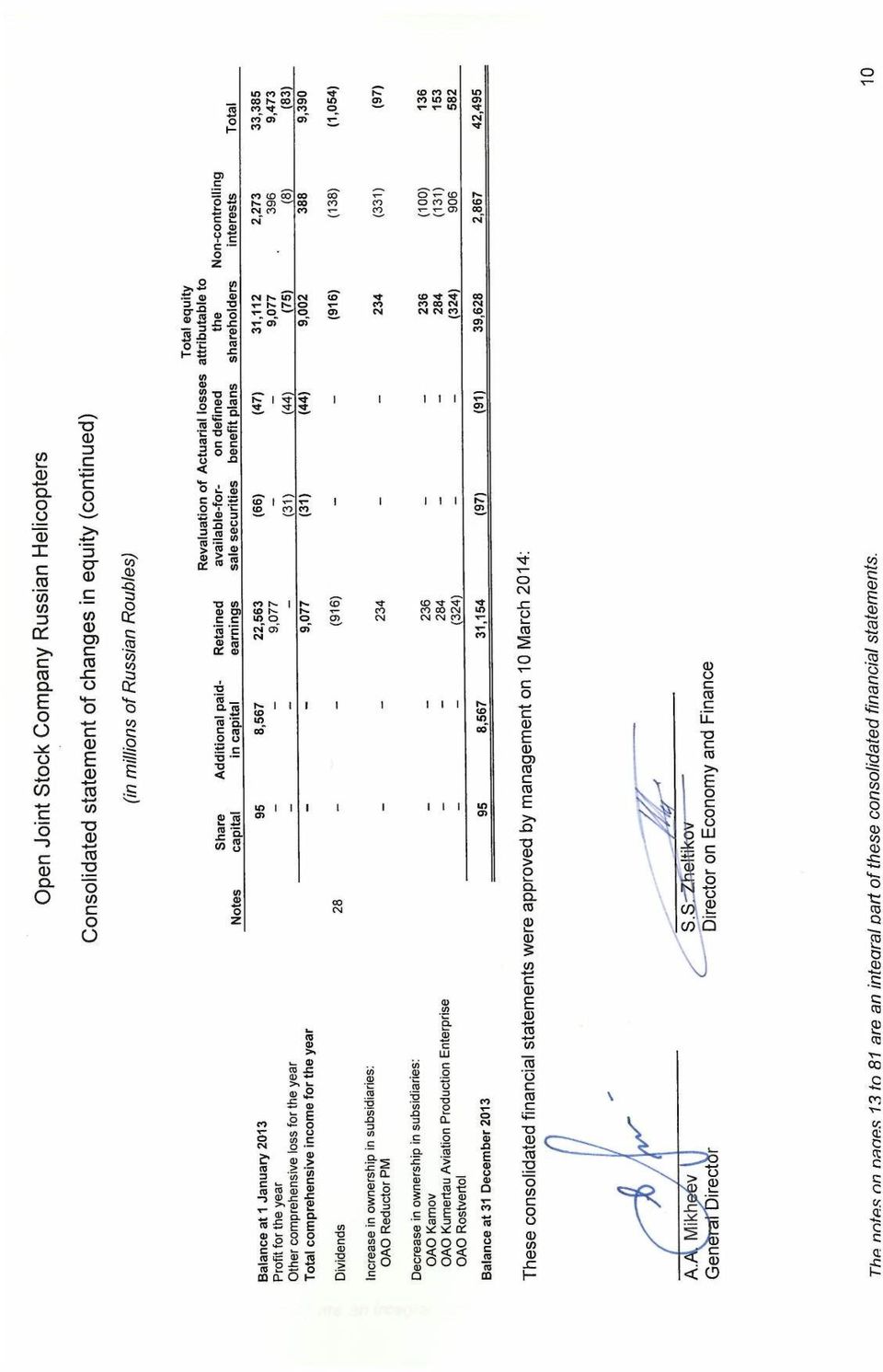
9 Consolidated statement of changes in equity (continued) Notes Share capital (in millions of Russian Roubles) Additional paidin capital Retained earnings Revaluation of available-forsale securities Actuarial losses on defined benefit plans Total equity attributable to the shareholders Non-controlling interests Balance at 1 January 95 8,414 13,924 (32) 22,401 2,286 24,687 Profit for the year 9,088 9, ,352 Other comprehensive loss for the year (66) (15) (81) (6) (87) Total comprehensive income for the year 9,088 (66) (15) 9, ,265 Dividends 28 (949) (949) (72) (1,021) Increase in ownership in subsidiaries: OAO Reductor PM (171) (45) OAO Kazan Helicopter Plant (277) (277) (555) (832) Decrease in ownership in subsidiaries: OAO Arsenyev Aviation Company PROGRESS OAO Kamov (166) 136 Assets contributed to the Group s subsidiaries by OAO OPK Oboronprom: OAO Kumertau Aviation Production Enterprise Unexercised and expired put options granted to the holders of non-controlling interests in: OAO Kazan Helicopter Plant OAO Arsenyev Aviation Company PROGRESS Balance at 95 8,567 22,563 (66) (47) 31,112 2,273 33,385 * The comparative information reflects adjustments made in connection with adoption of IAS 19R Employee Benefits by the Group (Note 5). Total* The notes on pages 13 to 81 are an integral part of these consolidated financial statements. 9

10
11 Consolidated statement of cash flows (in millions of Russian Roubles) * * Notes Operating activities Profit for the year 9,473 9,352 6,979 Adjustments to reconcile profit for the year to net cash flows: Income tax expense 5,075 2,877 2,966 Finance income and costs, net 12 4,547 4,067 3,725 Depreciation and amortisation 4,863 4,417 3,169 Impairment of property, plant and equipment, goodwill and intangible assets 15, Foreign exchange losses/(gains), net 1,181 (1,207) 618 Change in allowance for doubtful receivables 517 (24) 41 Write-down of inventories to net realizable value Change in provisions and retirement obligations 448 1, Loss on disposal of property, plant and equipment Gain on disposal of a subsidiary 7 (179) Loss from associates Other 32 27,967 22,070 19,687 Movements in working capital: Increase in inventories (6,853) (5,304) (5,941) Increase/(decrease) in amounts due from customers under construction contracts 994 (10,480) (55) (Increase)/decrease in trade receivables (10,003) (2,666) 936 (Increase)/decrease in prepayments and other receivables (4,259) 8,785 (9,241) Decrease/(increase) in other taxes receivable 54 1,073 (318) (Decrease)/increase in trade payables (282) 554 (9) Increase/(decrease) in advances received and other payables 6,859 (1,713) 7,799 Increase/(decrease) in amounts due to customers under construction contracts 12,623 (11,858) 579 Increase/(decrease) in provisions and other employee benefit obligations 137 (227) (650) Increase in other taxes payable Cash generated from operating activities 27,421 1,119 12,919 Interest paid (5,798) (5,659) (5,169) Government grants compensation of finance costs 453 1, Income tax paid (5,494) (4,889) (4,171) Net cash generated from / (used in) operating activities 16,582 (7,897) 4,368 * The comparative information reflects adjustments made in connection with adoption of IAS 19R Employee Benefits by the Group (Note 5). The notes on pages 13 to 81 are an integral part of these consolidated financial statements. 11

12

13 Notes to the consolidated financial statements for the year ended (in millions of Russian rubles, unless otherwise indicated) 1. General information Open Joint Stock Company Russian Helicopters (the "Company") was established on 9 January 2007 as a wholly-owned subsidiary of OAO OPK Oboronprom ("Oboronprom"), a Russian statecontrolled aerospace holding company. The Company was founded with the aim to fully consolidate, manage and commercialise the Russian helicopter industry, which had remained fragmented since the disintegration of the Soviet Union. In December 2010, the Company became the legal holding company of as detailed below (the "Group"). The Group is the producer of civil and military helicopters and military missile systems and includes engineering centres and production plants which produce the full spectrum of helicopters under the Mi, Ka and Ansat brands. The Group products are sold in the Russian Federation and internationally. The most significant production, engineering and service operations of the Group are incorporated within the Russian Federation. The head office of the Company is located at: 12 Krasnopresnenskaya naberezhnaya, Moscow, , Russian Federation. 13

14 1. General information (continued) The entities included in the Group are as follows: Entity and its location Nature of business Effective ownership interest and voting rights, % (1) (2) (1) (2) (1) (2) Group subsidiaries OAO Kazan Helicopter Plant (Kazan) OAO Rostvertol (Rostov-on-Don) OAO Ulan-Ude Aviation Plant (Ulan-Ude) OAO Kumertau Aviation Production Enterprise (Kumertau) OAO Arsenyev Aviation Company PROGRESS (Arsenyev) OAO MIL Moscow Helicopter Plant (Moscow) OAO KAMOV (Moscow) OAO Stupino Machine Production Plant (Stupino) OAO Reductor-PM (Perm) ZAO Ulan-Ude Blade Plant (Ulan-Ude) OAO Helicopter Innovation Industrial Company (Ulan-Ude) OAO Novosibirsk Aircraft Repair Plant (Novosibirsk) OAO Helicopter Service Company (Moscow) Producer of helicopters: Mi-8, Mi-17, Ansat Producer of helicopters: Mi-24, Mi-26, Mi-28, Mi Producer of helicopters: Mi-8, Mi Producer of helicopters: Ka-28, Ka-31, Ka-32, Ka Producer of helicopters: Ka-50, Ka-52, producer of military missile systems Engineering centre (for helicopters brand Mi) Engineering centre (for helicopters brand Ka) Producer of helicopter allied products (for helicopter brands Mi and Ka) Producer of helicopter allied products (for helicopter brands Mi and Ansat) Producer of helicopter allied products (for helicopter brand Mi) Producer of helicopter allied products (for helicopter brand Mi) Helicopter repair and maintenance services (for helicopter brand Mi) Supplier of materials and spare parts ZAO Avia Company Rostvertol-Avia (Rostov-on-Don) Helicopter services supplier OOO Purchase and Logistic Center of the Helicopter Industry (Moscow) Supplier of materials and spare parts OOO Mezhdunarodnie Vertoletnie Programmy (Moscow) Holding company Joint ventures ZAO HeliVert (Moscow) Producer of helicopters AW Group associates ZAO Activnye Operatsyi (Moscow) Holding company (1) Effective ownership interest. (2) Voting rights. 14

15 2. Significant accounting policies Statement of compliance The consolidated financial statements have been prepared in accordance with International Financial Reporting Standards ("IFRS"). These consolidated financial statements are presented in Russian Roubles ("RUB"), unless otherwise indicated. The entities of the Group maintain their accounting records in Russian Rouble in accordance with the laws, accounting and reporting regulations of the Russian Federation, where the majority of the Group s entities are incorporated. Basis of presentation The consolidated financial statements have been prepared on the historical cost basis except as disclosed in the accounting policy below. Basis of consolidation The Group controls an investee when it is exposed, or has rights, to variable returns from its involvement with the investee and has the ability to affect those returns through its power over the investee. Thus, the Group controls an investee if and only if the investor has all the following: (a) power over the investee; (b) exposure, or rights, to variable returns from its involvement with the investee; and (c) the ability to use its power over the investee to affect the amount of the investor's returns. Income and expenses of subsidiaries acquired or disposed of during the year are included in the consolidated statement of comprehensive income from the effective date of acquisition and up to the effective date of disposal, as appropriate. Total comprehensive income or loss of subsidiaries is attributed to the owners of the Company and to the non-controlling interests even if this results in the non-controlling interests having a deficit balance. When the Group grants put options to non-controlling interest shareholders of a subsidiary, the shares subject to the put, are accounted for as acquired. Financial liabilities in respect of put options are recorded at fair value at the time of entering into the options, and are subsequently re-measured to fair value with the change in fair value recognised in the statement of comprehensive income. The financial statements of the subsidiaries are prepared for the same reporting period as the parent company, when necessary; adjustments are made to the financial statements of subsidiaries to bring their accounting policies into line with those used by the Group. All intra-group transactions, balances, income and expenses are eliminated in full on consolidation. Business combinations with third parties Acquisitions of subsidiaries and businesses from third parties are accounted for using the acquisition method. The consideration transferred in each business combination is measured at aggregate acquisitiondate fair value of the assets given, liabilities incurred or assumed and equity instruments issued by the Group, if any, in exchange for control of the acquiree. Acquisition-related costs are recognised in profit or loss as incurred. 15

16 2. Significant accounting policies (continued) Business combinations with third parties (continued) When the consideration transferred by the Group in a business combination includes any assets or liabilities resulting from a contingent consideration arrangement, they are measured at the acquisition-date fair value and included in the consideration transferred in a business combination. Subsequent changes in the fair value of the contingent consideration are adjusted against the cost of the acquisition when they are qualify as measurement period adjustments arising from additional information obtained during the measurement period, which cannot exceed twelve months from the acquisition date, about facts and circumstances that existed at the acquisition date. Contingent consideration classified as equity is not measured at subsequent reporting dates and its subsequent settlement is accounted for within equity. Contingent consideration classified as an asset or liability is measured at subsequent reporting dates in accordance with the relevant IFRSs. When business combination is achieved in stages, the Group s previously held equity interest in the acquiree is measured to fair value at the acquisition date (i.e. the date when the Group obtains control) and the resulting gain or loss, if any, is recognised in profit or loss. Amounts arising from the interests in the acquiree prior to the acquisition date that have previously been recognised in other comprehensive income are reclassified to profit or loss where such treatment would be appropriate if that interests were disposed of. the acquisition date, the acquiree s identifiable assets acquired and the liabilities, meeting the recognition criteria of IFRS 3, are recognised at their fair value, except that: deferred tax assets or liabilities and liabilities or assets related to employee benefit obligations are recognised and measured in accordance with IAS 12 Income Taxes and IAS 19 Employee Benefits, respectively; liabilities or equity instruments related to share-based payment transactions of the acquiree or share-based payment transactions of the Group entered into to replace share-based payment transactions of the acquiree are measured in accordance with IFRS 2 Share-based Payment at the acquisition date; and assets (or disposal group) that are classified as held for sale in accordance with IFRS 5 Non-current Assets Held for Sale and Discontinued Operations are measured in accordance with IFRS 5. Goodwill is measured as the excess of the sum of consideration transferred, the amount of any non-controlling interests in the acquiree, and the fair value of the acquirer s previously held equity interest in the acquiree (if any) over the net of the acquisition-date amount of identifiable assets acquired and the liabilities assumed. If the net of the acquisition-date amounts of the identifiable assets acquired and liabilities assumed exceeds the sum of the consideration transferred, the amount of any non-controlling interests in the acquiree and the fair value of the acquirer s previously held interest in the acquiree. Then the Company reassess whether it has correctly identified and measured all the assets acquired and all liabilities assumed, if after such reassessment excess is confirmed it is recognised in profit or loss as bargain purchase gain after additional analysis. Non-controlling interests, identified separately from the Group s equity, may be initially measured either: (i) at fair value; or (ii) at the non-controlling interests share of the acquiree s identifiable net assets. The choice of measurement basis is made on a transaction-by-transaction basis. Subsequent to acquisition, the non-controlling interests carrying amount is the amount at initial recognition, plus the non-controlling interests share of changes in equity. Total comprehensive income is attributable to non-controlling interests even if this results in the non-controlling interests having a deficit balance. 16

17 2. Significant accounting policies (continued) Changes in the Group s ownership interests in existing subsidiaries Changes in the Group s ownership interests in subsidiaries that do not result in the Group losing control over the subsidiaries are accounted for as equity transactions. The carrying amount of the Group s interests and the non-controlling interests are adjusted to reflect the changes in their relative interests in the subsidiaries. Any difference between the amount by which the noncontrolling interests are adjusted and the fair value of the consideration paid or received is recognised directly in equity and attributed to the shareholder of the Company. When the Group loses control over a subsidiary, the profit or loss on disposal is calculated as the difference between: (i) the aggregate of the fair value of the consideration received and the fair value of any retained interest, and (ii) the previous carrying amount of the assets (including goodwill), less liabilities of the subsidiary and any non-controlling interests. Amounts previously recognised in other comprehensive income in relation to the subsidiary are accounted for (i.e. reclassified to profit or loss or transferred directly to retained earnings) in the same manner as would be required if the relevant assets or liabilities are disposed of. The fair value of any investment retained in the former subsidiary at the date when control is lost is regarded as the fair value on initial recognition for subsequent accounting under IAS 39 Financial Instruments: Recognition and Measurement or, when applicable, the cost on initial recognition of an investment in an associate or a jointly controlled entity. Goodwill Goodwill arising on an acquisition of a business as described in paragraphs Business combinations with third parties above is carried at cost as established at the acquisition date less accumulated impairment loss, if any. For the purpose of impairment testing, goodwill is allocated to each of the Group s cash-generating units (or groups of cash-generating units) that are expected to benefit from the synergies of the combination. A cash-generating unit to which goodwill has been allocated is tested for impairment annually, or more frequently when there is an indication that the unit may be impaired. If the recoverable amount of the cash-generating unit is less than its carrying amount, the impairment loss is allocated first to reduce the carrying amount of any goodwill allocated to the unit and then to the other assets of the unit pro rata to the carrying amount of each asset in the unit. Impairment losses, if any, for goodwill are recognised directly in profit or loss and are not reversed in subsequent periods. On disposal of a subsidiary, the attributable amount of goodwill is included in the determination of the profit or loss on disposal. Investments in associates An associate is an entity over which the Group has significant influence. Significant influence is the power to participate in the financial and operating policy decisions of the investee, but is not control or joint control over those policies. 17

18 2. Significant accounting policies (continued) Investments in associates (continued) The results and assets, and liabilities of associates are incorporated in these consolidated financial statements using the equity method of accounting, except when the investment is classified as held for sale and accounted for in accordance with IFRS 5 Non-current Assets Held for Sale and Discontinued Operations. Under the equity method, investments in associates are carried in the consolidated statement of financial position at cost as adjusted for post-acquisition changes in the Group s share of the net assets of the associate, less any impairment in the value of individual investments. Losses of an associate in excess of the Group s interest in that associate (which includes any long-term interests that, in substance, form part of the Group s net investment in the associate) are recognised only to the extent that the Group has incurred legal or constructive obligations or made payments on behalf of the associate. Any excess of the cost of acquisition over the Group s share of the net fair value of the identifiable assets, liabilities and contingent liabilities of the associate at the date of acquisition is recognised as goodwill. The goodwill is included within the carrying amount of the investment and is assessed for impairment as part of that investment. Any excess of the Group s share of the net fair value of the identifiable assets, liabilities and contingent liabilities over the cost of acquisition is recognised when determining the Group s share in profit or loss of the associate in the period when the associate was acquired The requirements of IAS 39 are applied to determine whether it is necessary to recognise any impairment loss with respect to the Group s investment in an associate. When necessary, the entire carrying amount of the investment (including attributable goodwill) is tested for impairment in accordance with IAS 36 Impairment of Assets as a single asset by comparing its recoverable amount (higher of value in use and fair value less costs to sell) with its carrying amount. Any impairment loss recognised forms part of the carrying amount of the investment. Any reversal of that impairment loss is recognised in accordance with IAS 36 to the extent that the recoverable amount of the investment subsequently increased. Where a Group entity transacts with an associate of the Group, profits and losses are eliminated to the extent of the Group s interest in the relevant associate. Non-current assets held for sale Non-current assets and disposal groups are classified as assets held for sale if their carrying amount will be recovered principally through a sale transaction rather than through continuing use. This condition is regarded as met only when the sale is highly probable and the asset (or disposal group) is available for immediate sale in its present condition. Management must be committed to the sale, which should be expected to qualify for recognition as a completed sale within one year from the date of classification. Non-current assets (or disposal group) classified as held for sale are measured at the lower of their previous carrying amount and fair value less costs to sell. Foreign currency transactions The functional currency of the Company and its subsidiaries registered and operating on the territory of the Russian Federation is the Russian Rouble ("RUB"). Transactions in currencies other than the functional currency ("foreign currencies") are recorded at the exchange rates prevailing at the dates of the transactions. each reporting date monetary assets and liabilities denominated in foreign currencies are translated at the exchange rates prevailing at that date. Non-monetary items carried at historical cost are translated at the exchange rate prevailing on the date of transaction. Non-monetary items carried at fair value are translated at the exchange rate prevailing on the date on which the most recent fair value was determined. Exchange differences arising from changes in exchange rates are recognised in the statement of comprehensive income. 18

19 2. Significant accounting policies (continued) Foreign currency transactions (continued) Exchange rates for the currencies in which the Group transacts were as follows: Closing exchange rates at the yearend RUB 1 U.S. Dollar ("USD") Euro Average exchange rates for the year ended RUB 1 U.S. Dollar ("USD") Euro Revenue recognition The Group derives revenue from the sale of manufactured helicopters, helicopter repair and maintenance services, research and development works and manufacturing of other products, such as helicopter spare parts. Revenue is recognised to the extent that it is probable that the economic benefit arising from the ordinary activities of the Group will flow to the Group, it can be measured reliably, and that the recognition criteria as stated below have been met. Revenue is measured at the fair value of the consideration received or receivable after deducting any discounts, rebates and value added tax. Revenue from helicopter manufacturing The Group accounts its helicopter manufacturing business as construction contracts with customers. Where the outcome of a construction contract can be estimated reliably, revenue and costs are recognised by reference to the stage of completion of the contract activity at the end of the reporting period, measured based on the proportion of contract costs incurred for work performed to date relative to the estimated total contract costs. Variations in contract work, claims and incentive payments are included to the extent that the amount can be measured reliably and its receipt is considered probable. Where the outcome of a construction contract cannot be estimated reliably (for example during the early stages of a construction contract), contract revenue is recognised to the extent of contract costs incurred when it is deemed probable they will be recoverable and contract costs are recognised as expenses in the period in which they are incurred. When it is probable that total contract costs will exceed total contract revenue, the total expected loss is recognised as an expense immediately. The Group presents the amount due from customers under the construction contracts as an asset and the amount due to customers under the construction contracts as a liability in the statement of financial position. The amount due from customers is the amount of construction costs incurred plus recognised profits less the sum of recognised losses and progress billings for all construction contracts in progress for which costs incurred plus recognised profits (less recognised losses) exceed progress billings. The amount due to customers is the amount of construction costs incurred plus recognised profits less the sum of recognised losses and progress billings for all construction contracts in progress for which progress billings exceed costs incurred plus recognised profits (less recognised losses). The Group is required to export its military helicopters through OAO Rosoboronexport ("Rosoboronexport"). Rosoboronexport charges a commission for this service. The Group recognises the commission expense upon revenue recognition and records the commission fee within Selling, general and administrative expenses. 19

20 2. Significant accounting policies (continued) Revenue recognition (continued) Revenue from helicopter repair and maintenance services, and research and development works Revenue from contracts to provide these services is recognised by reference to the stage of completion of the contract at the end of the reporting period, determined based on the proportion of contract costs incurred for work performed to date relative to the estimated total contract costs. Revenue from manufacturing of other products Revenue from the sale of goods is recognised when all the following conditions are satisfied: the Group has transferred to the buyer the significant risks and rewards of ownership of the goods; the Group retains neither continuing managerial involvement to the degree usually associated with ownership nor effective control over the goods sold; the amount of revenue can be measured reliably; it is probable that the economic benefits associated with the transaction will flow to the Group; and the costs incurred or to be incurred in respect of the transaction can be measured reliably. The transfer of risks to the buyer is based on the shipping conditions, and is generally at the time of shipment. Dividend and interest income Dividend income from investments is recognised when the shareholder s right to receive payment has been established (provided that it is probable that the economic benefits will flow to the Group and the amount of revenue can be measured reliably). Interest income is recognised when it is probable that the economic benefits will flow to the Group and the amount of revenue can be measured reliably. Interest income is accrued on a time basis, by reference to the principal outstanding and at the effective interest rate applicable, which is the rate that exactly discounts estimated future cash receipts through the expected life of the financial asset to that asset s net carrying amount on initial recognition. Leases Leases are classified as finance leases whenever the contract terms of the lease transfer substantially all of the risks and rewards of ownership to the lessee. All other leases are classified as operating leases. Operating lease the Group as lessor Rental and sub-rental income from operating leases is recognised on a straight-line basis over the term of the relevant lease. Initial direct costs incurred in negotiating and arranging lease are added to the carrying amount of the leased asset and recognised in profit or loss on a straight-line basis over the lease term. 20

21 2. Significant accounting policies (continued) Leases (continued) Operating lease the Group as lessee Operating lease payments are recognised as an expense on a straight-line basis over the lease term, except where another systematic basis is more representative of the time pattern in which economic benefits from the leased asset are consumed. Contingent rentals arising under operating leases are recognised in profit or loss in the period in which they are incurred. Finance lease the Group as lessee Assets held under finance leases are recognised as assets of the Group at their fair value at the inception date of the lease or, if lower, at present value of the minimum lease payments. The corresponding liability to the lessor is included in the statement of financial position as a finance lease obligation. Lease payments are apportioned between finance costs and reduction of the lease obligation so as to achieve a constant rate of interest on the remaining balance of the liability. Finance costs are charged directly to profit or loss. Borrowing costs Net borrowing costs directly attributable to the acquisition, construction or production of qualifying assets, which are assets that necessarily take a substantial period of time to get ready for their intended use or sale, are added to the cost of those assets, until they are substantially ready for their intended use or sale. All other finance costs are recognised as an expense in the year in which they are incurred. Income tax Income tax represents the sum of the income tax currently payable (recoverable) and deferred tax expense (income). Current income tax Current income tax has been computed in accordance with the Russian Federation tax law. Income tax currently payable is based on taxable profit for the year, which differs from profit as reported in the statement of comprehensive income/(loss) as it excludes items of income or expense that are taxable or deductible in other years or excludes items that are not taxable or deductible. The Group s liability for current tax is calculated using enacted tax rates by the end of the reporting period. Deferred tax Deferred tax is recognised on differences between the carrying amounts of assets and liabilities in the financial statements and the corresponding tax bases used in the computation of taxable profit and calculated on an entity basis. Deferred tax assets arising from tax losses are recognised as an asset only where there was assurance beyond any reasonable doubt that future taxable income would be sufficient to allow the benefit of the loss to be realised. Deferred tax liabilities are generally recognised for all taxable temporary differences, and deferred tax assets are generally recognised for all deductible temporary differences to the extent that it is probable that taxable profits will be available against which deductible temporary differences can be utilised. Such tax assets and liabilities are not recognised if the related temporary difference arises from the initial recognition (other than in a business combination) of other assets and liabilities in a transaction that affects neither the taxable profit nor the accounting profit. In addition to that, deferred tax liabilities are not recognised if the related tax difference arises from recognition of goodwill. 21
22 2. Significant accounting policies (continued) Income tax (continued) Deferred tax liabilities are recognised for taxable temporary differences associated with investments in subsidiaries and associates, except where the Group is able to control the reversal of the temporary difference and it is probable that the temporary difference will not reverse in the foreseeable future. Deferred tax assets arising from deductible temporary differences associated with such investments and interests are only recognised to the extent that it is probable that there will be sufficient taxable profits against which to utilise the benefits of the temporary differences and they are expected to reverse in foreseeable future. The carrying amount of deferred tax assets is reviewed at each reporting date and reduced to the extent that it is no longer probable that sufficient taxable profits will be available to allow all or part of the asset to be recovered. Deferred tax assets and liabilities are measured at the rates that are expected to apply in the period in which the liability is settled or the asset realised. The measurement of deferred tax liabilities and assets reflects tax consequences that would follow from the manner in which the Group expected, at the end of the reporting period, to recover or settle the carrying amount of its assets and liabilities. Deferred tax assets and deferred tax liabilities are offset if a legally enforceable right exists to set off current tax assets against current income tax liabilities and the deferred taxes relate to the same taxable entity and the same taxation authority. Property, plant and equipment Property, plant and equipment is stated at cost, net of accumulated depreciation and/or accumulated impairment losses, if any. Such cost includes the cost of replacing part of the property, plant and equipment and borrowing costs for long-term construction projects if the recognition criteria are met. Financial result from disposal of an item of property, plant and equipment is determined by comparing the proceeds from disposal with the carrying amount of the asset, and is recognised within Other operating expenses in the consolidated statement of comprehensive income/(loss). Depreciation Depreciation is recognised in profit or loss (unless it is included in the carrying amount of another asset) on a straight-line basis over the estimated useful lives of each part of an item of property, plant and equipment. Leased assets are depreciated over the shorter of the lease term and their useful lives unless it is reasonably certain that the entities of the Group will obtain ownership by the end of the lease term. Land is not depreciated. The estimated useful lives of major classes of property, plant and equipment are as follows: Buildings Machinery and equipment Transport Other assets years 7-35 years 2-40 years 2-25 years The estimated useful lives, residual values, and depreciation method are reviewed at each reporting date, with the effect of any changes in estimate accounted for on a prospective basis. 22
23 2. Significant accounting policies (continued) Intangible assets Intangible assets acquired separately Separately acquired intangible assets are recorded at cost less accumulated amortisation and accumulated impairment losses. These intangible assets primarily represent various purchased software. Amortisation is charged on a straight-line basis over their estimated useful lives which are: Purchased software Other 2-10 years 2-5 years The estimated useful lives and amortisation method are reviewed at each reporting date, with the effect of any changes in estimate accounted for on a prospective basis. Internally-generated intangible assets Costs for self-initiated research and development activities are assessed as to whether they qualify for recognition as internally-generated intangible assets. Apart from complying with the general requirements for and initial measurement of an intangible asset, qualification criteria are met only when technical as well as commercial feasibility can be demonstrated and cost can be measured reliably. It must also be probable that the intangible asset will generate future economic benefits and that it is clearly identifiable and allocable to a specific product. Further to meeting these criteria, only such costs that relate solely to the development phase of a self-initiated project are capitalised. Any costs that are classified as part of the research phase of a self-initiated project are expensed as incurred. If the research phase cannot be clearly distinguished from the development phase, the respective project related costs are treated as if they were incurred in the research phase only. Capitalised development costs are generally amortised over the estimated number of units produced. In case the number of units produced cannot be estimated reliably, capitalised development costs are amortised over the estimated useful life. Amortisation of capitalised development costs is recognised in Cost of sales. Internally-generated intangible assets are reviewed for impairment annually when the asset is not yet in use and whenever events or changes in circumstances indicate that the carrying amount may not be recoverable. Intangible assets acquired in a business combination Intangible assets acquired in a business combination and recognised separately from goodwill are initially recognised at their fair value at the acquisition date (which is regarded as their cost). Subsequent to initial recognition, intangible assets acquired in a business combination are reported at cost less accumulated amortisation and impairment loss, on the same basis as intangible assets that are acquired separately. 23
24 2. Significant accounting policies (continued) Impairment of tangible and intangible assets excluding goodwill each reporting date, the Group reviews the carrying amounts of its tangible and intangible assets to determine whether there is any indication that those assets have suffered an impairment loss. If any such indication exists, the recoverable amount of the asset is estimated in order to determine the extent of the impairment loss (if any). Where the assets do not generate cash flows that are independent from other assets, the Group estimates the recoverable amount of the cashgenerating unit (group of units) to which the assets belong. Recoverable amount is the higher of fair value less costs to sell or value in use. In assessing value in use, the estimated future cash flows are discounted to their present value using a pre-tax discount rate that reflects current market assessments of the time value of money and the risks specific to the asset. If the recoverable amount of an asset (or cash-generating unit) is estimated to be less than its carrying amount, the carrying amount of the asset (cash-generating unit) is reduced to its recoverable amount. An impairment loss is recognised immediately in the consolidated statement of comprehensive income. Where an impairment loss subsequently reverses, the carrying amount of the asset (cashgenerating unit) is increased to the revised estimate of its recoverable amount, but so that the increased carrying amount does not exceed the carrying amount that would have been determined had no impairment loss been recognised for the asset (cash-generating unit) in prior years. A reversal of an impairment loss is recognised immediately in the consolidated statement of comprehensive income. Inventories Inventories are stated at the lower of cost or net realisable value. The cost of inventories is determined on the weighted average basis and includes all costs in bringing the inventory to its present location and condition. Costs of production in process and finished goods include the purchase costs of raw materials and conversion costs such as direct labour and an allocation of fixed and variable production overheads. Raw materials are valued at purchase cost inclusive of freight and other shipping costs. Net realisable value represents the estimated selling price for inventories less estimated costs to completion and selling costs. Where appropriate, the impairment charged to reduce the carrying amount of inventories to their net realizable value and included in the consolidated statement of comprehensive income as Cost of sales. Cash and cash equivalents Cash and cash equivalents is comprised of cash balances, cash deposits and highly liquid investments with original maturities of three months or less, that are readily convertible to known amounts of cash and are subject to an insignificant risk of changes in value. 24
25 2. Significant accounting policies (continued) Financial assets Financial assets are initially measured at fair value plus transaction costs. Financial assets of the Group are classified into the following specific categories: (i) available-forsale ("AFS"), (ii) held-to-maturity, and (iii) loans and receivables. The classification depends on the nature and purpose of the financial asset and is determined at the time of initial recognition. Effective interest method The effective interest method is a method of calculating the amortised cost of a financial instrument and allocating interest income or expense over the relevant period. The effective interest rate is the rate that exactly discounts estimated future cash receipts or payments through the expected life of the instrument, or where appropriate, a shorter period to the net carrying amount on initial recognition. AFS financial assets AFS financial assets are stated at fair value. The fair value for AFS financial assets with standard terms and conditions that are traded in active market is determined based on quoted market prices. If the market for AFS financial assets is not active, the fair value is determined by using a valuation technique. Gain and losses arising from changes in fair value are recognised in the consolidated statement of comprehensive income in other comprehensive income and accumulated in the investments revaluation reserve. Where the investment is disposed of or determined to be impaired, the cumulative gain or loss on revaluation previously accumulated in the investment revaluation reserve is reclassified to profit or loss. Dividends on AFS equity instruments are recognised in profit or loss when the Group s right to receive the dividends is established. Held-to-maturity investments Promissory notes with fixed or determinable payments and fixed maturity dates for which the Group has the positive intent and ability to hold to maturity are classified as held-to-maturity investments. Held-to-maturity investments are recorded at amortised cost less accumulated impairment losses, if any. Interest income is recognised using the effective interest method. Loans and receivables Trade receivables, loans, and other receivables that have fixed or determinable payments that are not quoted in an active market are classified as loans and receivables. Loans and receivables are measured at amortised cost using effective interest method, except for short-term receivables when the recognition of interest would be immaterial. 25
26 2. Significant accounting policies (continued) Financial assets (continued) Impairment of financial assets Financial assets are assessed for indicators of impairment at the end of each reporting period. Financial assets are considered to be impaired when there is objective evidence that the estimated future cash flows of the investment have been affected as a result of one or more loss events that occurring after initial recognition of the financial asset. In the case of equity investments classified as available-for-sale, objective evidence would include a significant or prolonged decline in the fair value of the investment below its cost. Significant is evaluated against the original cost of the investment and prolonged against the period in which the fair value has been below its original cost. When there is evidence of impairment, the cumulative loss measured as the difference between the acquisition cost and the current fair value, less any impairment loss on that investment previously recognised in the income statement is removed from other comprehensive income and recognised in the income statement. Impairment losses on equity investments are not reversed through the income statement; increases in their fair value after impairment are recognised directly in other comprehensive income. For other financial assets objective evidence of impairment could include: significant financial difficulty of the counterparty; default or delinquency in interest or principle payments; or it becoming probable that the counterparty will enter bankruptcy or financial re-organisation. For financial assets carried at amortised cost, the amount of the impairment is the difference between the asset s carrying amount and the present value of estimated future cash flows, discounted at the original effective interest rate. The carrying amount of the financial asset is reduced by the impairment loss directly for all financial assets with the exception of trade and other receivables where the carrying amount is reduced through the use of an allowance account. When trade and other receivables are uncollectible, they are written off against the allowance account. Subsequent recoveries of amounts previously written off are credited against the allowance account. Changes in the carrying amount of the allowance account are recognised in profit or loss. In the case of debt instruments classified as available for sale, impairment is assessed based on the same criteria as financial assets carried at amortised cost. However, the amount recorded for impairment is the cumulative loss measured as the difference between the amortised cost and the current fair value, less any impairment loss on that investment previously recognised in profit or loss. Future interest income continues to be accrued based on the reduced carrying amount of the asset, using the rate of interest used to discount the future cash flows for the purpose of measuring the impairment loss. The interest income is recorded as part of finance income. If, in a subsequent year, the fair value of a debt instrument increases and the increase can be objectively related to an event occurring after the impairment loss was recognised in profit or loss, the impairment loss is reversed through profit or loss. 26
27 2. Significant accounting policies (continued) Financial assets (continued) Derecognition of financial assets The Group derecognises a financial asset only when the contractual rights to the cash flows from the asset expire; or it transfers the financial asset and substantially all the risks and rewards of ownership of the asset to another entity. If the Group neither transfers nor retains substantially all the risks and rewards of ownership and continues to control the transferred asset, the Group recognises its retained interest in the asset and an associated liability for amounts it may have to pay. If the Group retains substantially all the risks and rewards of ownership of a transferred financial asset, the Group continues to recognise the financial asset and also recognises a collateralised borrowing for the proceeds received. Financial liabilities Financial liabilities, including loans and borrowings, are initially measured at fair value, net of transaction costs. Financial liabilities are subsequently measured at amortised cost using the effective interest method, with interest expense recognised on an effective yield basis. Derecognition of financial liabilities The Group derecognises financial liabilities when, and only when, the Group s obligations are discharged, cancelled or they expire. Provisions and contingencies Provisions Provisions are recognised when the Group has a present obligation (legal or constructive) as a result of a past event, it is probable that the Group will be required to settle the obligation, and a reliable estimate can be made of the amount of the obligation. The amount recognised as a provision is the best estimate of the consideration required to settle the present obligation at the reporting date taking into account the risks and uncertainties surrounding the obligation. Where a provision is measured using the cash flows estimated to settle the present obligation, its carrying amount is the present value of those cash flows. When some or all of the economic benefits required to settle a provision are expected to be recovered from a third party, the receivable is recognised as an asset if it is virtually certain that reimbursement will be received and the amount of the receivable can be measured reliably. Onerous contracts Present obligations arising under onerous contracts are recognised and measured as a provision. An onerous contract is considered to exist where the Group has a contract under which the unavoidable costs of meeting the obligations under the contract exceed the economic benefits expected to be received under such contract. 27
28 2. Significant accounting policies (continued) Provisions and contingencies (continued) Warranty provisions The Group provides warranties in connection with the sale of helicopters. The Group generally warrants its new helicopters to be free from defects in materials and workmanship appearing within one to three and a half years from the date of delivery or during the first three hundred to one thousand hours of operation, whichever event occurs first. The warranty provision is recorded at the time when helicopters are shipped to customer based on the best estimate of the expected future costs. The warranty expense is included within Selling, general and administrative expenses in the statement of comprehensive income. Contingencies Contingent liabilities are not recognised in these consolidated financial statements unless they are arise as a result of a business combination. Contingencies attributable to specific events are disclosed unless the possibility of an outflow or resources embodying economic benefit is remote. Contingent assets are not recognised in these consolidated financial statements but are disclosed when an inflow of economic benefits is probable. Government grants Deferred income attributable to the grants obtained from the Government is not recognised until there is a reasonable assurance that the Group will comply with the conditions attaching to them and that the grants will be receivable. The Group receives Government grants for partial compensation of development costs capitalised within intangible assets and recognises the amounts of government grants received as a deduction from the full amount of development costs incurred. As part of such supporting programs the Government also compensates for a portion of overhead expenses associated with the execution and monitoring of such projects, which are presented within selling, general and administrative expenses. Government grants that are receivable as compensation for overhead expenses already incurred are recognised in profit or loss in the period in which they become receivable, and are recorded within Government grants. The Group receives Government grants for compensation of finance costs on borrowings used by the Group for helicopter manufacturing and research and development expenses. Government grants that are receivable as compensation for finance costs already incurred are recognised in profit or loss in the period in which they become receivable, and are recorded as an offset of the Finance costs. Employee benefit obligations Employee benefits provided by the Group include salaries, bonuses, anniversary payments, monthly payments and other compensation and benefits (i.e. transport, welfare, etc.), a one-time payment upon death, a one-time payment on retirement of the employee as well as contributions to the state and non-state pension funds. Remuneration to employees in respect of services rendered during the reporting period, including accruals for vacation and bonuses and the related social security taxes, as well as other short term benefits are recognised as an expense in the period when they are incurred. 28
29 2. Significant accounting policies (continued) Employee benefit obligations (continued) Defined contribution plans The Group s entities are legally obliged to make defined contributions to the Russian Federation State Pension Fund, a defined contribution plan. The Group s contributions to the Russian Federation State Pension Fund are recorded as an expense over the reporting period based on the related employee service rendered. Defined benefit plans The Group s entities operate a number of unfunded defined benefit plans for its employees. Under these plans employees are entitled to the following payments: a one-time payment upon death that equals actual funeral expenses but is limited to twice monthly employee s monthly salary; a one-time payment on retirement, which is generally in line with the employee s base salary at the date of retirement. For defined benefit plans, the cost of providing benefits is determined using the Project Unit Credit Method, with actuarial valuations being carried out as at, and. Actuarial gains and losses are recognised in other comprehensive income and are not reclassified subsequently to profit or loss. Expected returns on plan assets are no longer recognised in profit or loss, instead, there is a requirement to recognize interest on the net defined benefit liability (asset) in profit or loss calculated using the discount rate applied to measure the defined benefit obligation. Unvested past service costs are recognised in profit or loss at the earlier of when the defined benefit plan is changed or when the related restructuring costs or termination benefits are recognised. Dividends Dividends and the related taxes are recognised as a liability in the period in which they have been declared and become legally payable. Dividends may only be paid out of legally distributable accumulated profits, which are based on the amounts available for distribution in accordance with the applicable legislation and as reflected in the standalone statutory financial statements of the Group entities. These amounts may differ significantly from the amounts calculated on the basis of IFRS. When the Group accounts granted put options to non-controlling interest shareholders of a subsidiary as liability, any dividends paid to the other shareholders are recognised as Finance cost of the Group, unless they represent a repayment of the liability. Changes in accounting policies and disclosures New and amended standards and interpretations New standards and interpretations, as well as amendments to the existing standards and interpretations, adopted by the Group for the first time The accounting policies adopted in the preparation of the consolidated financial statements are consistent with those followed in the preparation of the Group s annual financial statements for the year ended, except for adoption of new standards and amendments to standards and interpretations effective for annual periods beginning on 1 January. 29
30 2. Significant accounting policies (continued) Changes in accounting policies and disclosures (continued) The Group applies a number of new standards, amendments and interpretations to the existing standards which require restating the data in the previous financial statements. They include IFRS 10 Consolidated Financial Statements, IFRS 11 Joint arrangement, IAS 19 Employee Benefits (revised ), IFRS 13 Fair Value Measurement, amendments to IAS 1 Presentation of Financial Statements and some others. However, not all these standards have impact on the Company s financial position or performance. The effect of adoption of these amendments is disclosed below. IAS 1 Presentation of Items of Other Comprehensive Income (Amendments) The amendments to IAS 1 change the grouping of items presented in other comprehensive income. Items that could be reclassified to profit or loss at a future point in time would be presented separately from items that will never be reclassified (for example, actuarial gains and losses on defined benefit plans and revaluation of land and buildings). This amendment affects presentation in the financial statements only and has no impact on the Group s financial position or performance. In these consolidated financial statements the Group made retrospective restatement of comparative financial information due to first-time adoption of a number of new standards and voluntarily provided comparative information to the statement of financial position, statement of comprehensive income, statement of changes in equity and statement of cash flows as at and for the year then ended, including related notes. IAS 32 Tax Effect of Distributions to Holders of Equity Instruments (Amendment) Amendment to IAS 32 Financial Instruments: Presentation clarifies that income taxes arising from distributions to equity holders are accounted for in accordance with IAS 12 Income Taxes. The amendment eliminates existing income tax requirements from IAS 32 and requires entities to apply IAS 12 to any income tax arising from distributions to equity holders. The amendment had no impact on the Group s consolidated financial statements. IAS 19 Employee Benefits (revised ) (IAS 19R) IAS 19R includes a number of amendments to the accounting for defined benefit plans. In particular, the revised standard provides that actuarial gains and losses are recognised in other comprehensive income and are not subsequently reclassified to profit or loss; expected returns on plan assets are no longer recognised in profit or loss, instead, there is a requirement to recognize interest on the net defined benefit liability (asset) in profit or loss calculated using the discount rate applied to measure the defined benefit obligation; unvested past service costs are recognised in profit or loss at the earlier of when the defined benefit plan is changed or when the related restructuring costs or termination benefits are recognised. Other amendments relate to new disclosures, such as, quantitative sensitivity disclosures. The effect of adoption of IAS 19R is explained in Note 5. 30
31 2. Significant accounting policies (continued) Changes in accounting policies and disclosures (continued) IFRS 7 Financial Instruments: Disclosures Offsetting Financial Assets and Financial Liabilities (Amendments) These amendments require an entity to disclose information about rights to set-off financial instruments and related arrangements (for example, collateral agreements). The disclosures will provide users with information that is useful in evaluating the effect of netting arrangements on the entity s financial position. The new disclosure requirements apply to all recognised financial instruments that are set off in accordance with IAS 32. The disclosures also apply to recognised financial instruments that are subject to an enforceable master netting arrangement or similar agreements, irrespective of whether they are set off in accordance with IAS 32. As financial instruments have not been set off by the Group in accordance with IAS 32 and the Group does not have netting arrangements within the scope of the amendment, the amendment had no impact on the Group s consolidated financial statements. IFRS 10 Consolidated Financial Statements, IAS 27 Separate Financial Statements IFRS 10 establishes a single control model that applies to all entities including special purpose entities. IFRS 10 replaces the portion of IAS 27 Consolidated and Separate Financial Statements that addresses the accounting for consolidated financial statements. The standard also introduces guidance on the issues raised in SIC-12 Consolidation Special Purpose Entities. IFRS 10 changes the definition of control so that the investor is considered to have control over an investee when the investor is entitled to variable benefit from the investment or is exposed to the risk of change in the investment, and may affect the benefit as a result of its authority for the investee. As defined in IFRS 10, the investor has control over the investee only when the following conditions are met: (a) the investor has authority for the investee; (b) the investor is entitled to variable benefit from the investment or is exposed to the risk of change in the investment; (c) the investor is able to use its authority to affect the variable benefit from the investment. IFRS 10 did not have an effect on the Group s consolidated financial statements. IFRS 11 Joint Arrangements and IAS 28 Investments in Associates and Joint Ventures IFRS 11 replaces IAS 31 Interests in Joint Ventures and SIC-13 Jointly-controlled Entities Non-monetary Contributions by Venturers. IFRS 11 removes the option to account for jointly controlled entities (JCEs) using proportionate consolidation. Instead, jointly controlled entities that meet the definition of a joint venture under IFRS 11 must be accounted for using the equity method. This standard was effective for the joint venture of the Group, established in the reporting period. IFRS 12 Disclosure of Interests in Other Entities IFRS 12 sets out the disclosure requirements relating to the entities that have interests in subsidiaries, joint arrangements, associates and structured entities. The disclosures are shown in Note 41. IFRS 13 Fair Value Measurement IFRS 13 Fair Value Measurement provides a single source of fair value measurement for use across IFRS. IFRS 13 does not change when an entity is required to use fair value, but rather provides guidance on how to measure fair value under IFRS when fair value is required or permitted. The application of IFRS 13 has not material impacted on fair value measurements carried out by the Company. IFRS 13 also requires specific disclosures of fair value, some of which replace existing disclosure requirements in other standards, including IFRS 7 Financial Instruments: Disclosures. Some of these disclosures are binding for the consolidated financial statements. The disclosures are provided by the Group in Note
32 3. Critical accounting judgements and key sources of estimation uncertainty In the application of the Group s accounting policies, management is required to make judgements, estimates and assumptions about the carrying amounts of assets and liabilities that are not readily apparent from other sources. The estimates and associated assumptions are based on historical experience and other factors that are considered relevant. Actual results may differ from these estimates. The key assumptions concerning the future and other key sources of estimation uncertainty at the reporting date, that have a significant risk of causing a material adjustment to the carrying amounts of assets and liabilities within the next financial year are discussed below. Revenue recognition on construction contracts As described in the revenue recognition policy, the Group accounts for construction projects using the percentage of completion method. Critical to the correct application of this method are the accuracy of estimates of the financial outcome at completion, as well as the determination of the extent of progress towards completion. In estimating the percentage of completion, the Group compares the estimated total cost of the project to the costs incurred to date. The total estimated cost is based on historical experience for similar projects, the remaining effort to complete the contract, and various other assumptions. The Group has not historically had significant changes in its estimates of total costs during a project. To the extent there is such a change, the amount of revenue and costs recognised in future periods may vary and if the total estimated costs exceed the total revenue a loss would be recorded at the time such loss is revealed. Valuation of trade and other receivables Trade receivables and other receivables are stated at their net realisable value after deducting the Group s best estimate of probable credit losses related to these assets. In estimating the level of probable credit losses, management considers a number of factors, including current overall economic conditions, industry-specific economic conditions and historical and anticipated customer performance. Uncertainties regarding changes in the financial condition of customers, either adverse or positive, could impact the amount and timing of any additional allowances for doubtful accounts that may be required. This may have a negative impact on the financial results if additional losses occur that were not anticipated in prior periods. Inventory valuation Inventory consists of finished goods, work-in-progress and raw materials which are stated at lower of cost or net realisable value. In assessing the net realisable value of its inventory, management estimates the net realisable value of finished goods and work-in-progress based on various assumptions including current market prices. each reporting date, the Group evaluates its inventory balance for excess quantities and obsolescence and, if necessary, records an impairment to reduce inventory for obsolete and slowmoving raw materials and spare parts. This allowance requires assumptions related to future inventory use. These assumptions are based on inventory ageing, forecasted consumer demands, and technological obsolescence. Any changes in the estimates may impact the amount of the impairment for inventory that may be required. 32
33 3. Critical accounting judgements and key sources of estimation uncertainty (continued) Useful economic life and residual value of property, plant and equipment The Group s property, plant and equipment are depreciated using the straight-line method over their estimated useful lives which are based on management s business plans and operational estimates. The factors that could affect the estimation of the useful economic life of property, plant and equipment and its residual value include the following: changes in asset utilisation rates; changes in maintenance technology; changes in regulations and legislation; and unforeseen operational issues. Any of the above could affect prospective depreciation of property, plant and equipment and their carrying and residual values. Management annually reviews the appropriateness of assets useful economic lives. The review is based on the current condition of the assets and the estimated period during which they will continue to bring economic benefit to the Group. Any change in estimated useful life or residual value is recorded on a prospective basis from the date of the change. Development costs Development costs are capitalised in accordance with the accounting policy. Initial capitalisation of costs is based on management s judgement that technological and economic feasibility is confirmed, usually when a product development project has reached a defined milestone according to an established project management model. In determining the amounts to be capitalised, management makes assumptions regarding the expected future cash generation of the project, discount rates to be applied and the expected period of benefits. Impairment of non-financial assets Management reviews the carrying amounts of assets to determine whether there is any indication that those assets are impaired. In making the assessment for impairment, assets that do not generate independent cash flows are allocated to an appropriate cash-generating unit (group of units). The assessment of whether there are indicators of a potential impairment are based on various assumptions including market conditions, asset utilisation and the ability to utilise the asset for alternative purposes. If an indication of impairment exists, the Group estimates the recoverable value (greater of fair value less cost to sell and value in use) and compares it to the carrying value, and records impairment to the extent the carrying value is greater. The value in use is based on estimated future cash flows that are discounted to their present value using a pre-tax discount rate. The estimated future cash flows require management to make a number of assumptions including customer demand and industry capacity, future growth rates and the appropriate discount rate. Any change in these estimates may result in impairment in future periods. 33
34 3. Critical accounting judgements and key sources of estimation uncertainty (continued) Fair value of financial instruments When the fair value of financial assets and financial liabilities recorded in the statement of financial position cannot be derived from active markets, their fair value is determined using valuation techniques including the discounted cash flow model. The inputs to these models are taken from observable markets where possible, but where this is not feasible, a degree of judgement is required in establishing fair values. The judgements include considerations of inputs such as liquidity risk, credit risk and volatility. Changes in assumptions about these factors could affect the reported fair value of financial instruments. Employee benefit obligations The Group s recognition of the unfunded retirement benefit obligations for defined benefit plans depends on a number of significant actuarial assumptions relating to: discount rate; inflation; projected salary and pension increase; mortality rates; and participants turnover rate. These assumptions are determined based on the current market conditions, historical information and through consultation with the Group s actuaries. Changes in the key assumptions can have a significant impact of on the projected benefit obligations, funding requirements and periodic pension costs incurred. Warranty provision The Group provide warranties related to its manufacture and repair of helicopters and aviation equipment and record a warranty provision at the time of sale. Estimated warranty costs represent the contractual warranty, which provides against any defects in materials and workmanship appearing within one to three and a half years from the date of delivery, or during the first three hundred to one thousand hours of operation (whichever event occurs first). Warranty provisions are estimated based on historical claims statistics, the warranty period, the average time-lag between faults occurring and claims to the Group and anticipated changes in quality indexes, future expectations. Differences between actual warranty claims and the estimated claims will impact the recognised expense and provisions in future periods. Refunds from suppliers, that decrease the Group s warranty costs, are recognised to the extent these are considered to be certain. If actual results are not consistent with the assumptions and estimates used, the Group may be exposed to additional adjustments that could materially, either positively or negatively, impact the Group s profit. Adjustments to the Group s profit have historically not been material. 34
35 3. Critical accounting judgements and key sources of estimation uncertainty (continued) Contingencies Legal contingencies Legal proceedings covering a wide range of matters are pending or threatened in various jurisdictions against the Group. Periodically, the status of each significant loss contingency is reviewed to assess the potential financial exposure. The Group records provisions for pending litigation when it determines that an unfavourable outcome is probable and the amount of loss can be reasonably estimated. Due to the inherent uncertain nature of litigation, the ultimate outcome or actual cost of settlement may materially vary from estimates. Provisions are based on the best information available at the time. As additional information becomes available, the potential liability related to pending claims and litigation is reassessed and, if required, estimates are revised. Such revisions in estimates could have a material impact on the future results of the Group. Tax contingencies The Group is subject to income tax and other taxes in accordance with the legislation of the Russian Federation. Significant judgement is required in determining the provision for income tax and other taxes due to the complexity of the tax legislation in the Russian Federation. There are a number of transactions and calculations for which the ultimate tax determination is uncertain. The Group recognises liabilities for anticipated tax inspection issues based on management s estimates of whether it is probable that additional taxes will be due. Where the final tax outcome of these matters is different from the amounts that were initially recorded, such differences will impact the amount of tax and tax provisions in the period in which such determination is made. Recognition of deferred tax assets Deferred tax assets are assessed each period for recoverability and adjusted, as necessary, based on whether it is probable the Group will generate sufficient profits in future periods to utilise the assets. Various factors are considered in assessing the probability of future utilisation including past operating results, operational plans, expiration of tax losses carry-forwards and tax planning strategies. If the actual results differ from these estimates or if these estimates are adjusted in future periods, the result of operations may be impacted in those periods. 4. Standards issued but not yet effective The standards and interpretations that are issued, but not yet effective, up to the date of issuance of the Group s financial statements are disclosed below. The Group intends to adopt these standards, if applicable, when they become effective. IFRS 9 Financial Instruments IFRS 9 as issued reflects the first phase of the IASBs work on the replacement of IAS 39 and applies to classification and measurement of financial assets and financial liabilities as defined in IAS 39. Moreover, in accordance with the last amendments, entities have the right to apply changes regarding the issuer s own credit risk separately, without applying other provisions of the standard. The key changes introduced to the standard in November are discussed below. Own credit risk As part of the amendments, the changes introduced also enable entities to change the accounting for liabilities that they have elected to measure at fair value, before applying any of the other requirements in IFRS 9. This change in accounting would mean that gains caused by a worsening in an entity s own credit risk on such liabilities are no longer recognised in profit or loss. 35
36 4. Standards issued but not yet effective (continued) IFRS 9 Financial Instruments (continued) IFRS 9 Effective Date The IASB decided that a mandatory date of 1 January 2015 would not allow sufficient time for entities to prepare to apply the new Standard. Accordingly, the IASB decided that a new date should be decided upon when the entire IFRS 9 project is closer to completion. The amendments made to IFRS 9 in November remove the mandatory effective date from IFRS 9. However, entities may still choose to apply IFRS 9 immediately. The Group will evaluate the impact of the new Standards and amendments thereto on the amounts disclosed in its consolidated financial statements and including all stages, when the final Standard is issued. Investment companies (Amendments to IFRS 10, IFRS 12 and IAS 27) The amendments become effective for annual periods beginning on or after 1 January 2014 and provide an exception from the consolidation requirement for entities that meet the definition of an investment entity under IFRS 10. The exception requires investment entities to account for subsidiaries at fair value through profit or loss. The amendments are not expected to be applied for the Group, since none of the Group s entities qualifies to be an investment entity under IFRS 10. IFRIC Interpretation 21 Levies (IFRIC Interpretation 21) IFRIC 21 clarifies that an entity should recognize a liability for a levy when the activity that triggers payment, occurs. For a levy that is triggered upon reaching a minimum threshold, the interpretation clarifies that no liability should be recognised before the specified minimum threshold is reached. IFRIC 21 becomes effective for annual periods beginning on or after 1 January IFRIC 21 is not expected to impact the Group s financial position or performance. Annual improvements to IFRS, Annual Improvements to IFRS The omnibus of amendments to IFRS relating to eight issues considered through the annual improvements process of IFRS in The following amendment are included: IFRS 2 Share-based Payment: Clarification of the definition of vesting conditions; IFRS 3 Business Combinations: Accounting for contingent consideration in a business combination; IFRS 8 Operating Segments: Aggregation of operating segments; IFRS 8 Operating Segments: Reconciliation of the total of the reportable segments assets to the entity s assets; IFRS 13 Fair Value Measurement: Short-term receivables and payables; IAS 16 Property, Plant and Equipment: Revaluation method proportionate restatement of accumulated depreciation; IAS 24 Related Party Disclosures: Key management personnel; IAS 38 Intangible Assets: Revaluation method proportionate restatement of accumulated amortisation. These amendments are not expected to impact the Group s financial position or performance. 36
37 4. Standards issued but not yet effective (continued) Annual improvements to IFRS, - Annual Improvements to IFRS - The omnibus of amendments to IFRS relating to four issues considered through the annual improvements process of IFRS in -. The following amendment are included: IFRS 1 First-time Adoption of International Financial Reporting Standards: Meaning of effective IFRSs; IFRS 3 Business Combinations: Scope of exception for joint ventures; IFRS 13 Fair Value Measurement: Scope of paragraph 52 (portfolio exception); IAS 40 Investment Property: Clarifying the interrelationship of IFRS 3 and IAS 40 when classifying property as investment property or owner-occupied property. Annual improvements to IFRS, - These amendments are not expected to impact the Group s financial position or performance. Amendments to IAS 19 Defined Benefit Plans: Employee Contributions (Amendments to IAS 19) These amendments refer to the accounting for employee contributions or third party contribution set out in the formal terms of a defined benefit plan. These amendments are intended to simplify accounting of employee contributions if the amount of the contributions is independent of the number of years of service, such as employee contributions that represent a fixed percentage of salary. The amendments become effective on 1 July 2014, with early adoption permitted. 5. Restatement of comparative information in the financial statements made by the Group 5.1. Application of IAS 19R IAS 19R has been applied retrospectively. As a result, unvested past service costs can no longer be deferred and recognised over the future vesting period. Until, the Group s unvested past service costs were recognised as an expense on a straight-line basis over the average period until the benefits became vested. With the transition to IAS 19R, past service costs are recognised immediately if the benefits have vested immediately following the introduction of, or changes to, a pension plan. The revised standard provides that actuarial gains and losses are recognised in other comprehensive income as incurred. In the prior reporting periods the Group used the "corridor approach". According to this approach actuarial gains and losses that exceed 10 per cent of the present value of the Group s defined obligations at the end of the prior year are amortised over the expected average remaining working lives of the participating employees Reclassification of items of comparative information in the financial statements The Group reclassified certain prior period amount of Cost of sales and Selling, general and administrative expenses in the consolidated statement of comprehensive income for the year ended and to conform to the presentation of these items in the consolidated statement of comprehensive income for the year ended. 37
38 5. Restatement of comparative information in the financial statements made by the Group (continued) 5.2. Reclassification of items of comparative information in the financial statements (continued) The effect of application of IAS 19 and reclassification is presented in the table below: Consolidated statement of financial position As previously reported Restatement As restated Deferred tax assets Non-current assets 48, ,611 Total assets 140, ,172 Retained earnings and other reserves 13,948 (56) 13,892 Total share capital of the Company 22,457 (56) 22,401 Non-controlling interests 2,291 (5) 2,286 24,748 (61) 24,687 Retirement benefits liability Non-current liabilities 38, ,649 Total liabilities 115, ,485 Total equity and liabilities 140, ,172 Consolidated statement of comprehensive income for the year ended As previously reported Restatement 5.1 Restatement 5.2 As restated Cost of sales (63,261) (9) (2,378) (65,648) Gross profit 40,677 (9) (2,378) 38,290 Selling, general and administrative expenses (25,501) 2,378 (23,123) Operating profit 14,755 (9) 14,746 Profit before income tax 9,954 (9) 9,945 Income tax (2,969) 3 (2,966) Profit for the period 6,985 (6) 6,979 tributable to: The shareholders of the Company 5,274 (1) 5,273 Non-controlling interests 1,711 (5) 1,706 38
39 5. Restatement of comparative information in the financial statements made by the Group (continued) 5.2. Reclassification of items of comparative information in the financial statements (continued) Consolidated statement of financial position As previously reported Restatement As restated Deferred tax assets Non-current assets 53, ,975 Total assets 154, ,869 Retained earnings and other reserves 22,596 (146) 22,450 Total share capital of the Company 31,258 (146) 31,112 Non-controlling interests 2,293 (20) 2,273 33,551 (166) 33,385 Retirement benefits liability Non-current liabilities 37, ,010 Total liabilities 121, ,484 Total equity and liabilities 154, ,869 Consolidated statement of comprehensive income for the year ended As previously reported Restatements 5.1 Restatements 5.2 As restated Cost of sales (79,888) (109) (2,704) (82,701) Gross profit 45,861 (109) (2,704) 43,048 Selling, general and administrative expenses (30,656) 2,704 (27,952) Operating profit 15,214 (109) 15,105 Profit before income tax 12,338 (109) 12,229 Income tax (2,896) 19 (2,877) Profit for the period 9,442 (90) 9,352 tributable to: The shareholders of the Company 9,163 (75) 9,088 Non-controlling interests 279 (15) Segment information The Group has three reportable segments, the results of which are reported on a quarterly basis and reviewed by the General Director of the Company (the "chief operating decision maker" or "CODM"). These internal reports are prepared on the same basis as the accompanying consolidated financial statements. The reporting segments are as follows: Helicopters segment includes manufacturing of helicopters; Services and support segment includes manufacturing of spare parts for helicopters and providing of helicopter repair and maintenance services; Research and development segment includes the provision of research and development works mostly related to helicopter engineering and design. 39
40 6. Segment information (continued) In addition, the Group has various other operations that are not reported separately and has certain corporate costs that are not included in the reportable segments. These are included as reconciling item between the total reportable segments and the consolidated results Segment revenues The following is the analysis of the Group s revenue for the years ended, and : Commercial Commer- Commer- Military Total Military cial Total Military cial Total Helicopters 101,817 13, ,767 92,039 6,940 98,979 69,063 12,976 82,039 Services and maintenance 4,131 11,256 15,387 10,127 8,229 18,356 6,216 8,776 14,992 Research and development Other 5,328 1,696 7,024 6,497 1,754 8,251 5,057 1,090 6,147 Total 111,320 26, , ,695 17, ,749 80,459 23, ,938 The segment revenue reported above represents revenue generated from external customers only. During the years ended, and, inter-segmented sales were RUB 21,069 million, RUB 16,913 million and RUB 12,251 million, respectively. Inter-segment revenue primarily consists of sales of semi-products and research and development services for helicopters production Segment operating results The measure of segment profitability separately reported to the CODM for purposes of allocating resources and assessing segment performance is measured based on segment adjusted EBITDA, which the Group defines as segment operating profit adjusted to exclude depreciation and amortization, loss on disposal of property, plant and equipment and impairment on property, plant and equipment, goodwill and intangibles assets and to include the Group s share of financial results of associates and joint ventures. Since adjusted EBITDA is not a standard measure under IFRS, the Group s definition of adjusted EBITDA may differ from that of other companies. 40
41 6 Segment information (continued) 6.2 Segment operating results (continued) The following represents the analysis of operating results measured by adjusted EBITDA and its reconciliation to the pre-tax operating profit/(loss) and profit/(loss) for the years ended, and : Adjusted EBITDA Helicopters 23,169 15,284 14,313 Services and maintenance 2,999 4,171 3,529 Research and development (716) (417) (654) Other 852 1, Total adjusted EBITDA 26,304 20,714 17,948 Amortization of property, plant and equipment and intangible assets (4,863) (4,417) (3,169) Loss on disposal of property, plant and equipment (378) (569) (228) Impairment allowance for property, plant and equipment, goodwill and intangible assets (787) (639) (263) Loss from associates Operating profit per IFRS financial statements 20,614 15,105 14,746 Finance income Finance costs (5,184) (4,387) (3,938) Share in results of associates (338) (16) (458) Foreign exchange (loss)/gain, net (1,181) 1,207 (618) Profit before income tax per IFRS financial statements 14,548 12,229 9, Major customers During the years ended, and, the Group s most significant customers are state-controlled bodies, such as the Ministry of Defence and the Ministry of Emergency Situations of the Russian Federation. The Russian Federation state-controlled entities represent significantly more than 10% of the Group s consolidated revenue for each of the years presented. Please also refer to Note 8 for further details in regard of other largest customers and countries where they are located Other segment information Substantially all assets and production, management and administrative facilities of the Group are located in the Russian Federation. Revenue by geographical regions is disclosed in Note 8. 41
42 7. Business combinations and changes in ownership Acquisition of subsidiaries during the years ended, and ZAO Avia Company Rostvertol-Avia ("Rostvertol-Avia") On 31 March, Rostvertol, a subsidiary of the Group, acquired 95% interest in Rostvertol-Avia, a helicopter services provider, for consideration of RUB 620 million. Cash consideration was paid in This acquisition was accounted for using the acquisition method. The Group determined the fair value of identifiable assets, liabilities and contingent liabilities of the acquired company at the date of acquisition. The purchase price allocation for the acquisition is as follows: Fair value Assets Property, plant and equipment 440 Inventories 175 Trade receivables 67 Prepayments and other receivables 5 Other taxes receivable 1 Cash and cash equivalents 20 Total assets 708 Liabilities Trade payables 192 Obligations under finance leases 16 Deferred tax liabilities 18 Total liabilities 226 Net assets at the date of acquisition 482 Add: goodwill 163 Total consideration, including: 645 Cash consideration 620 Fair value of previously held interest in Rostvertol 25 Total consideration 645 Less: Fair value of previously held interest in Rosvertol (25) Less: Cash and cash equivalents acquired (20) Net cash outflow on acquisition of subsidiary 600 Rosvertol Avia contributed RUB 274 million of revenue and RUB 38 million of profit before tax from the date of acquisition to. There is no available information under IFRS in order to determine the impact this acquisition would have had if occurred at the beginning of the period. ZAO Sanatory Zor ka ("Zor ka") On 31 March, Rostvertol, a subsidiary of the Group, acquired an additional 98% interest in Zor ka, health resort in Touapse, for consideration of RUB 130 million, increasing its ownership to 100%. Cash consideration was paid in This acquisition was accounted for using the acquisition method. This acquisition was accounted for using the acquisition method. The Group has determined the fair value of identifiable assets, liabilities and contingent liabilities of the acquired company at the date of acquisition. The major Zor ka s asset is land, the amounts of acquired goodwill, other assets acquired and liabilities assumed are insignificant. 42
43 7. Business combinations and changes in ownership (continued) Disposal of subsidiaries in, and ZAO HeliVert ("HeliVert") On 27 May, LLC International Helicopter Programs, Group s subsidiary, sold 50% interest in share capital of ZAO HeliVert, enterprise assembling AW139 helicopters, for cash consideration of RUB 10 thousand to AgustaWestland S.p.A.. The Group recognised RUB 179 million from disposal of ZAO HeliVert in Other operating expense. Since 27 May, ZAO HeliVert has been a joint venture with AgustaWestland S.p.A. and is recognised under the equity method. 8. Revenue By customer destination Russian Federation 63,314 64,358 53,250 Asia 45,424 30,717 23,072 Other CIS countries 11,585 15,702 11,083 America 13,715 8,457 9,714 Europe 2, ,408 Africa 695 6,180 1,373 Others Total 138, , ,938 The following is an analysis of the Group s largest customers excluding the Government of the Russian Federation (revenue from each customer exceeding 10% of total revenue) mainly represented by Government or state-controlled entities, which are located in the following countries: India (presented within Asia above) 22,587 18,147 12,712 China (presented within Asia above) 13,981 Less than 10% Less than 10% 9. Cost of sales Cost of production, including: Raw materials and manufacturing supplies 60,217 57,349 45,396 Payroll and related social taxes 16,323 15,602 13,655 Depreciation and amortisation 4,136 3,706 2,656 Production services 3,981 3,260 2,514 Energy and utilities 1,504 1,628 1,252 Other 3,184 2, Total cost of production 89,345 83,773 66,189 Increase in work in progress and finished goods (1,309) (1,072) (541) Total cost of sales 88,036 82,701 65,648 43
44 10. Selling, general and administrative expenses Commission fees 11,365 9,720 9,681 Payroll and related social taxes 6,842 6,657 4,943 Professional services 1,793 2,085 1,540 Depreciation and amortisation Transport expenses 1,051 1,476 1,132 Repair and maintenance expenses 965 1,310 1,162 Advertising expenses Insurance expenses Taxes other than income tax Warranty expenses Bank charges Impairment of accounts receivable 517 (24) 41 Other 1,992 1,763 1,302 Total 28,537 27,322 22, Other operating income and expenses Other operating income Gain on disposal of inventory Income from operating leases Reversal of provision for litigations 457 Total Other operating expenses Loss on disposal of property, plant and equipment Charity Maintenance of the local infrastructure facilities Other Total 1,744 1, Finance income and finance costs Finance income Interest income on financing provided Dividends Other income Total
45 12. Finance income and finance costs (continued) Finance costs Interest expense on loans and borrowings 6,022 5,131 5,161 Interest expense on obligations under finance leases Dividend related to the shares subject to the mandatory offers 309 Interest expense on pension liabilities Total interest expense 6,141 5,596 5,285 Less: amounts included in the cost of qualifying assets (504) (354) (558) Less: Government grants compensation of finance costs (453) (855) (789) Total finance costs 5,184 4,387 3,938 The interest rate used to determine the amount of borrowing costs eligible for capitalization was 11% (: 9.81%, : 11%), which is effective interest rate of the borrowings. 13. Income tax expense Current income tax expense 6,173 3,270 4,578 Adjustments in respect of current income tax of previous years 47 (13) (37) Total current income tax expense 6,220 3,257 4,541 Deferred tax: Relating to origination and reversal of temporary differences (1,145) (380) (1,575) Total income tax expense 5,075 2,877 2,966 The corporate income tax rate in the Russian Federation, the primary location of the Group s production entities, for the years ended, and was 20% (15.5% in the Perm region where Reductor-PM is located). A reconciliation between the statutory income tax rate and the effective rate was as follows: Profit before income tax 14,548 12,229 9,945 Income tax expense computed at statutory income tax rate of 20% 2,910 2,446 1,989 Adjustments due to: Adjustments in respect of current income tax of previous years 383 (13) (37) Effect of income tax preferences in Kazan, Perm and Ulan-Ude (37) (405) (36) Net change in unrecognised and unutilised tax losses Expenses not deductible for tax purposes Income not taxable for tax purposes (50) (63) (113) Income tax on dividends 160 Total income tax expense 5,075 2,877 2,966 45
46 14. Property, plant and equipment Land and buildings Machinery and equipment Motor vehicles Construction-inprogress Other Total Cost 1 January 18,070 10,832 2,124 2,469 5,258 38,753 Additions 800 1, ,289 6,788 10,709 Transfers 2,274 2, (5,085) Acquisitions of subsidiaries Disposals (104) (332) (118) (228) (116) (898) 21,170 14,305 2,553 4,261 6,845 49,134 Additions 639 1, ,770 8,284 Transfers 1,836 3, (5,580) Disposals (80) (288) (136) (528) (23) (1,055) 23,565 19,402 2,980 4,404 6,012 56,363 Additions 545 1, ,927 8,626 Transfers 398 2, (3,346) Disposal of subsidiaries (123) (3) (95) (221) Disposals (131) (235) (26) (305) (632) (1,329) 24,377 22,816 3,932 5,353 6,961 63,439 Accumulated depreciation and impairment 1 January (4,239) (2,212) (437) (743) (7,631) Depreciation charge (739) (1,058) (184) (751) (2,732) Disposals Impairment (263) (263) (5,225) (3,102) (574) (1,446) (10,347) Depreciation charge (908) (1,514) (361) (950) (3,733) Disposals Reversal of impairment 2 2 (6,116) (4,476) (894) (2,167) (13,653) Depreciation charge (867) (1,954) (234) (1,081) (4,136) Disposal of subsidiaries Disposals Impairment (130) (88) (14) (63) (60) (355) (7,072) (6,369) (1,125) (3,001) (60) (17,627) Carrying value 15,945 11,203 1,979 2,815 6,845 38,787 17,449 14,926 2,086 2,237 6,012 42,710 17,305 16,447 2,807 2,352 6,901 45,812 As at, and, construction-in-progress included advances issued for acquisition of property, plant and equipment in the amounts of RUB 2,611 million, RUB 1,351 million and RUB 1,973 million, respectively. 46
47 14. Property, plant and equipment (continued) Certain property, plant and equipment have been pledged to secure bank loans and borrowings granted to the Group: Carrying value of property, plant and equipment 3,020 2,327 1,788 The Group leases machinery and equipment and transport under a number of finance lease agreements. the end of the term of the lease the Group obtains ownership of the assets or has an option to purchase leased assets at a beneficial price. Finance leases obligations are secured by the lessors title to the leased assets. Carrying value of leased property, plant and equipment 1,100 1,124 1, Goodwill Balance at beginning of the year 1,076 1, Acquired on the acquisition of subsidiaries (Note 7) 163 Impairment (133) Balance at end of the year 943 1,076 1,076 Allocation of goodwill to cash-generating units The carrying value of goodwill was allocated to the following separate cash generating units: OAO Ulan-Ude Aviation Plant ZAO Avia Company Rostvertol-Avia OAO Novosibirsk Aircraft Repair Plant OAO Reduktor-PM Total 943 1,076 1,076 As at, and the Group conducted an assessment of the recoverable amount of goodwill (Note 17). 47
48 16. Intangible assets Capitalised development costs Purchased software and other Total Cost 1 January 3, ,599 Additions 4, ,633 Government grants received (2,364) (2,364) Disposals (40) (40) 5, ,828 Additions 5, ,716 Government grants received (1,643) (1,643) Disposals (179) (94) (273) 8, ,628 Additions 8, ,407 Government grants received (1,935) (1,935) Disposals (34) (130) (164) Disposal of subsidiaries (91) (91) 14,841 1,004 15,845 Accumulated amortisation 1 January (490) (111) (601) Amortisation charge (321) (116) (437) Disposals 7 7 (811) (220) (1,031) Amortisation charge (424) (260) (684) Disposals Impairment (Note 17) (641) (641) (1,869) (388) (2,257) Amortisation charge (558) (169) (727) Disposals Impairment (Note 17) (299) (299) (2,726) (511) (3,237) Carrying value 4, ,797 6, ,371 12, ,608 Capitalised development costs comprise the internally-generated intangible assets (including those which were not in use as at ) which are primarily consisted of Mi-38, Mi-171, Ka-62, Ka-226T and other helicopter development projects. The Group has performed an impairment test for intangible assets not yet in use as at (Note 17). 48
49 17. Impairment testing The Group performed impairment testing for goodwill and intangible assets not in use (capitalised R&D costs) as at on Cash Generating Unit (CGU) level. As at, the carrying value of goodwill and development costs not yet in use was allocated to CGUs as presented in the table below: Cash generating unit Goodwill Intangible assets, incl. not yet in use OAO Ulan-Ude Aviation Plant ( Ulan-Ude ) 775 1,058 ZAO Avia Company Rostvertol-Avia ("Rostvertol-Avia") 163 OAO Novosibirsk Aircraft Repair Plant ( NARZ ) 133 OAO Kumertau Aviation Production Enterprise ( KUMAP ) 2,740 OAO Arsenyev Aviation Company PROGRESS ( Progress ) 3,339 OAO Kazan Helicopter Plant ( KHP ) 1,453 Others 5 3,596 Individual assets not allocated to CGU 228 Impairment (133) (299) Total ,115 Ulan-Ude, Rostvertol-Avia, NARZ, KHP As at, the recoverable amounts of the CGUs, including allocated goodwill and intangible assets not in use, have been determined on a basis of value in use calculations for which the most significant estimates and assumptions are as follows: Cash flows were projected based on the budgeted amounts approved by senior management; Growth rate estimates Growth rates in terminal period are based on published industry research and analysis of the specific environment of CGUs; A pre-tax discount rate was determined by adjusting the Weighted Average Cost of Capital for the risks specific to the respective CGUs; Raw materials price inflation Estimates are obtained from published indices. Forecast figures are used if data is publicly available otherwise past actual raw material price movements are used as an indicator of future price movements; Production volumes/capacity Estimated production volumes are based on detailed development plans agreed by management as part of the long-term planning process including forecasts on production of new types of the models which, inter alia, depends on outcome of certain tendering procedures. A summary of the most significant assumptions used in the calculation of value in use is presented below: Forecasting period, years Discount rate, % Discount rate, % Ulan-Ude, KHP Rostvertol-Avia NARZ
50 17. Impairment testing (continued) Ulan-Ude, Rostvertol-Avia, NARZ, KHP (continued) During impairment testing, the Group measures probability of execution of a number of contracts. As at, the probability of cash inflows under these contracts reduced indicating potential impairment of certain CGUs. As a result, the Group recognised impairment of goodwill as at for CGU OAO Novosibirsk Aircraft Repair Plant (NARZ). As at, the value in use of NARZ was measured using the discounted cash flows model. As at, updated cash flow projections reflect reducing probability of cash inflows under certain contracts. For these purposes, pre-tax discount rate of 15.7% ( : 15.0%) was used. Progress, KUMAP, the most significant estimates and assumptions used in value in use calculations are as follows: Cash flow projections cover period corresponding to remaining weighted average useful lives of property, plant and equipment. For two-year period following cash flow projections were based on existing backlogs and financial budgets approved by management, after the two-year period flat production volumes were assumed. A pre-tax discount rate was determined by adjusting the Weighted Average Cost of Capital for the risks specific to the respective CGUs; Raw materials price inflation Estimates are obtained from published indices. Forecast figures are used if data is publicly available otherwise past actual raw material price movements are used as an indicator of future price movements; Production volumes/capacity Estimated production volumes are based on detailed production plans agreed by management as part of the long-term planning process including forecasts on production of new types of the models which, inter alia, depend on outcome of certain tendering procedures. EBITDA is planned EBITDA, defined on the basis of past experience. A summary of the most significant assumptions used in the calculation of value in use is presented below: Forecasting period, years Discount rate, % EBITDA, % KUMAP Progress During impairment testing, the Group considers the probability of favourable, for the Group, outcome of certain ongoing tendering procedures. As at, the probable results from current tenders (from the Group s perspective) indicate potential impairment. As a result, the Group recognised impairment as at for CGU OAO Kumertau Aviation Production Enterprise (KUMAP). As at, the value in use of KUMAP was measured using the discounted cash flows model. As at, updated cash flow projections reflect reducing probability of favourable results of current tenders. For these purposes, pre-tax discount rate of 15.4% ( : 14.9%) was used. 50
51 17. Impairment testing (continued) Results of impairment testing The impairment testing of KUMAP indicated that the carrying value of the CGU, including property, plant and equipment and allocated intangible assets, exceeded the recoverable amount calculated as value in use, by RUB 579 million. Impairment loss related to intangible assets of RUB 299 million and property, plant and equipment of RUB 280 million was recognised in the statement of comprehensive income for the year ended. Sensitivity analysis Since evaluated recoverable amount of KUMAP equals its carrying value adjusted for impairment, unfavourable changes of key assumptions used in the model may result in greater impairment loss. Key assumptions related to recoverable amount are considered below: pre-tax discount rate was adjusted to reflect current market assessment risks related to KUMAP, based on average weighted cost of capital. Further changes of discount rate may be necessary to reflect changes in risks and changes in average weighted cost of capital. Production volumes/capacity Estimated production volumes are based on detailed production plans agreed by management, including forecasts on production of new types of the models which, inter alia, depend on outcome of certain current tenders. Reviewed indicators reflect the effect of changes in management estimates related to a number of tenders. As a result of the tests, there have been no impairments recognised as at, and management believes that no reasonably possible change in the key assumptions underlying the recoverable amounts of CGUs (Progress, KHP, Ulan-Ude, Rostvertol-Avia), would cause the carrying values of these CGUs, including development costs, to exceed their recoverable amounts. 18. Investments in associates and joint ventures ZAO HeliVert (joint venture) ZAO Activnye Operatsyi (associate) OAO AKB Zarechye (associate) OAO AKB Doncombank (associate) 1 January (Loss from) / share in profit (466) - 8 (458) Disposal of investments (168) (133) (301) Loss (16) (16) Loss (319) (19) (338) Additional share issue ZAO HeliVert (HeliVert) In September, HeliVert had an additional issue of shares in the amount of RUB 570 million. Carrying value of investments totalled RUB 251 million as at. Total 51
52 19. Trade receivables Trade receivables, including 19,948 11,230 8,025 Trade receivables of Russian Ministry of Defence under State Armament Program 9,795 1,148 Less: Allowance for doubtful receivables (247) (339) (362) Total trade receivables, including 19,701 10,891 7,663 Long-term trade receivables Short-term trade receivables 19,383 10,734 7,475 The Group s ageing of trade receivables is presented as follows: Past due, but not impaired: 1 month months months to 1 year Thereafter Total past due but not impaired Due in: 1 month 8, , months 4,172 3,622 1,581 3 months to 1 year 6,866 6,503 4,322 Thereafter Total 19,701 10,891 7,663 Included in the trade receivables as at, and were receivables with amounts of RUB 146 million, RUB 430 million and RUB 111 million, respectively, that were past due but not included in allowance for doubtful trade receivables. The Group does not hold any collateral over these balances. Management of the Group believes that these amounts are recoverable in full. The following is movement in the allowance for doubtful trade accounts receivable: Balance at beginning of the year Allowance for doubtful debt recognised/(reversed) (74) Amounts written-off as uncollectible (138) (148) (105) Balance at end of the year , and, other long-term trade receivables were measured at amortised cost using the weighted average discount rate of 8%, 8% and 13%, respectively. The Group does not hold any collateral over these balances. 52
53 20. Prepayments and other receivables Advances paid to suppliers of inventories and services Non-financial assets Advances paid to suppliers of inventories and services 24,548 23,163 30,521 Prepaid commission fee 1, ,553 Total non-financial assets 26,420 23,556 33,074 Long-term advances issued 2, ,337 Short-term advances issued 24,054 22,587 30,737 During the year ended, the Group recognised RUB 122 million of impairment of advances issued (: RUB 32 million; : RUB 62 million). During the year ended, the Group reversed RUB 58 million of impairment of advances issued (: RUB 170 million; : RUB 143 million). As at, and, the Group five largest balances in advances paid to suppliers of inventories and services represented 28%, 30% and 30% of the total balance, respectively, and were presented as follows: Name of counterparty Supplier location OAO Radiopribor, Vladivostok Russian Federation 1,304 2,078 3,583 OAO Klimov Russian Federation 1,857 1,855 1,067 Motor Sich Ukraine 1,214 1, OAO Korporatsiya Fazotron NIIR Russian Federation 1, ,368 OAO Rosoboronexport Russian Federation 1, , Other receivables Financial assets 7,453 6,812 9,305 Other receivables 3,189 2,071 1,280 Less: Allowance for doubtful receivables (379) (298) (309) Total financial assets 2,810 1, During the year ended, the Group recognised RUB 106 million of impairment of other trade receivables (: RUB 48 million; : RUB 240 million). During the year ended, the Group reversed RUB 25 million of impairment of trade receivables (: RUB 59 million; : RUB 44 million). 53
54 21. Other financial assets Bank deposits Loans issued Promissory notes Other 4 Total ,022 Total non-current other financial assets Total current other financial assets Available-for-sale securities Ownership, % OAO TVTz * OAO OPK Oboronprom (due to issuance of shares, ownership was 0.62% in ) OAO AKB Zarechye OAO AKB Doncombank OAO AKB MMB Bank of Moscow NPF KHP 32 Other Various Total * Preferred non-voting shares., the Group acquired remaining 95% interest in Rostvertol-Avia and 98% interest in Zor ka, increasing its ownership to 100% (Note 8). In, the Group recognised loss on revaluation of available for sales securities in amount of RUB 49 million and related deferred tax effect in amount of RUB 10 million in the statement of comprehensive income (: RUB 90 million and RUB 18 million, respectively). 54
55 23. Deferred tax assets and liabilities Recognised in profit or loss Disposal of subsidiary Recognised in equity Recognised in profit or loss Recognised in equity Recognised in profit or loss Recognised in equity Acquisitions (Note 8) 2010 Inventories 5,199 (103) 240 5, ,220 2,093 2,127 Tax losses carried forward Accounts receivable (252) 265 (977) 1, ,120 Loans and leases payable 9 (55) 64 (41) Other financial assets Deferred tax assets 5, (12) 10 5,482 (103) 18 5,567 2,293 3,274 Property, plant and equipment and intangible assets (3,173) (33) (18) (3,122) 95 (3,217) 36 (18) (3,235) Accounts payable (1,437) (1,743) (2,323) 74 3 (2,400) Prepayments and other receivables (1,513) 795 (2,308) (461) (1,847) (556) (1,291) Other financial assets 274 (274) (272) (2) Deferred tax liabilities (6,123) 1, (7,173) (7,661) (718) 3 (18) (6,928) Net deferred tax liabilities (504) 1, (1,691) (2,094) 1,575 3 (18) (3,654) 55
56 23. Deferred tax assets and liabilities (continued) Certain deferred tax assets and liabilities have been offset in accordance with the Group s accounting policy. The following is the analysis of the deferred tax balances (after offset) as they are presented in the consolidated statement of financial position: Deferred tax assets Deferred tax liabilities (1,402) (2,382) (2,400) Net deferred tax liabilities (504) (1,691) (2,094) The aggregated amounts of temporary differences associated with undistributed earnings of subsidiaries and associates were presented as follows: Subsidiaries 24,353 12,988 7,845 24,353 12,988 7,845 As at, and, no deferred tax liabilities have been recognised in respect of these differences because management believes that the Group is in the position to control the timing of reversal of such differences and it is probable that such differences will not reverse in the foreseeable future. Unrecognised differences relate to subsidiaries registered on the territory of the Russian Federation. As at, and, the Group recognised deferred tax assets on unused tax losses carried forward in the amount RUB nil, RUB nil and RUB 10 million, respectively. The accumulated unused tax losses carried forward of the certain Group s subsidiaries which were available for offset against future taxable income and for which no deferred tax assets were recognised are presented as follows: OAO Russian Helicopters 1, OAO KAMOV OAO Kumertau Aviation Production Enterprise OAO Arsenyev Aviation Company PROGRESS 153 OAO Novosibirsk Aircraft Repair Plant Total 1, Deferred tax assets in regard of unused tax losses carried forward were not recognised as it is not probable that future taxable profit will be available against which the unused tax losses can be utilised. The unused tax losses will expire during the period up to
57 24. Inventories Materials (at cost or net realisable value) 28,137 23,855 19,947 Work-in-progress (at cost or net realisable value) 7,582 6,519 4,996 Finished goods (at cost or net realisable value) Total inventories at the lower of cost and net realisable value 36,431 30,840 25,860 In, RUB 825 million (: RUB 824 million, : RUB 515 million) were expensed to write down inventions to net realisable value. In, RUB 286 million (: RUB 500 million, : RUB 139 million) were reversed as expenses to write down inventions to net realisable value. Certain inventories have been pledged to secure bank loans and borrowings granted to the Group: Carrying amount of inventories Construction contracts Construction costs incurred plus recognised profits less recognised losses to date 35,966 34,624 26,857 Less: progress billings (45,636) (30,676) (45,247) (9,670) 3,948 (18,390) Recognised and included in the consolidated financial statements as: Amounts due from customers under construction contracts 15,876 16,871 6,391 - including amounts due from the Ministry of Defence under the State Armament Program 3,820 2,321 Amounts due to customers under construction contracts (25,546) (12,923) (24,781) - including amounts due to the Ministry of Defence under the State Armament Program (6,820) (1,704) (13,795) (9,670) 3,948 (18,390) 57
58 25. Construction contracts (continued) In, in connection with the State Armament Program of the Russian Federation ("the State Armament Program") the Group s subsidiaries entered into long-term contracts with the Ministry of Defence of the Russian Federation ("the Ministry of Defence") to produce and deliver military helicopters over the period of Under these contracts, the substantial portion of amounts due from the Ministry of Defence is deferred and paid on or after the 4-year period following the delivery dates. Under the Program the Group s subsidiaries entered into credit facility agreements linked to the aforementioned long-term contracts with certain state-owned banks. Cash receipts from the Ministry of Defence under the long-term agreements will only be used to reduce the outstanding balances of the credit line facilities. Obligations under these credit line facilities are fully secured by the guaranties provided by the Ministry of Finance of the Russian Federation ("the Ministry of Finance"). The Group will be relieved from any obligations to pay the outstanding balances of the credit line facilities if the Ministry of Defence defaults or delays payments beyond the credit line facilities tenors and the amounts due under the credit line facilities, as secured by the guarantees, will be paid by the Ministry of Finance. As the credit line facilities are linked to the helicopters construction contracts and are automatically and not at discretion of the Group, settled when funds are transferred from the Ministry of Defence under construction contracts, the proceeds from such credit lines represent, in substance, advances received. Interest expenses incurred on these credit line facilities are fully reimbursed by the Ministry of Defence. Amounts due to the Ministry of Defence under the State Armament Program are comprised of the following: Amounts drawn down under credit line facilities under the State Armament Program 92,616 59,465 30,739 Amounts billed under the State Armament Program (84,172) (53,906) (9,575) Amounts due from customers under the State Armament Program construction contracts (1,624) (3,855) (7,369) Amounts due to customers under the State Armament Program construction contract (advances received) 6,820 1,704 13,795 As at, and the amounts drawn down under the credit line facilities under the State Armament Program are as follows: Bank Currency Rate, % Balance Rate, % Balance Rate, % Balance OAO Bank VTB, related party RUB , , ,058 OAO Sberbank, related party RUB , , ,962 Vnesheconombank, related party RUB 7 2, , Total 92,616 59,465 30,739 58
59 26. Other taxes Other taxes receivable VAT receivable 5,761 5,811 6,891 Other Total 5,822 5,876 6,949 Other taxes payable VAT payable 1,857 1,696 1,012 Personal income tax and social taxes Property tax Other Total 2,681 2,555 1, Cash and cash equivalents Current bank accounts, including RUB-denominated 7,113 5,835 5,431 USD-denominated 3,206 1,062 1,676 Euro-denominated 173 1, Bank deposits, including RUB-denominated 5,522 2,207 4,365 Euro-denominated USD-denominated 221 Other cash and cash equivalents Bank deposits 16,024 10,710 12,036 Bank Currency Rate, % Balance Rate, % Balance Rate, % Balance OAO Bank VTB RUB OAO Sberbank of the Russian Federation RUB , OAO AKB Zarechye RUB OAO Promstroybank Euro ZAO AKB Novikombank RUB 6.9 1, ОАО Gazprombank RUB ,500 OAO Bank VTB USD ОАО Rosselkhozbank RUB ОАО AK BaikalBank RUB 8 2,000 ОАО NK Bank RUB 7.3 1,000 ОАО Nomos-Bank RUB Other RUB Total 5,522 2,723 4,397 All bank deposits classified as cash and cash equivalents have an original maturity of less than three months. 59
60 28. Equity Ordinary shares Number of shares Share capital (RUB '000) Number of shares Share capital (RUB '000) Number of shares Share capital (RUB '000) Balance at beginning of the year 95,273,116 95,273 94,994,000 95,000 94,994 95,000 Share split 94,899,006 Additional shares issued on 11 September (see below) 279, Balance at end of the year 95,273,116 95,273 95,273,116 95,273 94,994,000 95,000 The share capital of the Company as at consists of 95,273,116 (: 95,273,116, : 94,994,000) authorised, issued and outstanding common shares with par value of RUB 1. On 21 March, the Company completed a split of its ordinary shares. The Company s ordinary shares have a par value of RUB 1 and carry one vote per share on the shareholders meetings and entitle the holder to receive dividends, which are subject for approval at a shareholder s meeting. During the Company issued 279,116 additional ordinary shares with par value RUB 1. All shares were acquired by Oboronprom. As a consideration for the additional shares that were issued, Oboronprom transferred 46,350 ordinary shares of KUMAP, a Group s subsidiary. Consideration of RUB 153 million paid by Oboronprom for the ordinary shares of KUMAP was reflected as an increase in additional paid-in capital as at. During the years ended, and, the Group s entities declared the following dividends attributable to non-controlling interests: Entity name OAO Kazan Helicopter Plant OAO Ulan-Ude Aviation Plant 282 OAO Stupino Machine Production Plant OAO Reductor-PM OAO MIL Moscow Helicopter Plant 10 OAO Rostvertol Total Dividends and retained earnings During the year ended, the amounts of dividends of RUB nil related to the shares subject to the mandatory offers for buy-out are recognised as interest expense (: RUB 308 million; : RUB nil). The Group declared dividends attributable to the shareholder of the Company for the year in the amount of RUB 916 million (: RUB 489 million) of RUB 9.61 per share and interim dividends for the year in the amount of RUB 460 million (: RUB nil). 60
61 28. Equity (continued) Earnings per share Earnings per share for the years ended, and were calculated based on the weighted average number of the Company s ordinary shares outstanding during the respective periods. Weighted average number of shares for the years ended 2010 and 2009 was adjusted to reflect the split of the Company s ordinary shares at the beginning of the earliest period presented. Weighted average number of the Company s ordinary shares 95,273,116 95,078,882 94,994,000 The amounts of net profit used for calculation of basic and diluted earnings per share for the years ended, and are the same as the amount of profit attributable to the Company s shareholders recognised in the consolidated statement of comprehensive income for respective periods. 29. Loans and borrowings Interest rate Rate, % Balance Rate, % Balance Rate, % Balance Secured bank loans, including RUB-denominated OAO Sberbank, related party Fixed , , ,455 Vnesheconombank, related party Various , , ,381 OAO Alfa Bank Fixed , , ,830 OAO Gazprombank, related party Various , , ,143 OAO Bank VTB, related party Fixed , , ,816 ZAO AKB Novikombank Fixed , , ,388 OAO AKB Rossia Fixed 10 1,696 OAO AKB Rosbank Fixed , ,500 ZAO KB Nats Invest Prom Bank Fixed OAO AKB Zarechye, related party Fixed OAO AKB Ural FD Fixed Others Various ,873 USD-denominated OAO AKB Rosbank Fixed 4 2,278 OAO Bank VTB, related party Fixed 5 5,853 OAO Sberbank, related party Fixed , , ,862 Vnesheconombank, related party Various 5 1,181 OAO Promsvyazbank Fixed OAO Gazprombank, related party Fixed OAO Alfa Bank Fixed OAO Bank Saint Petersburg Fixed ,610 Others Various Euro-denominated OAO Bank Saint Petersburg Fixed 8 2, ,875 OAO Sberbank, related party Various , OAO Gazprombank, related party Fixed OAO AKB Rosbank Fixed 7 1,402 Others Fixed
62 29. Loans and borrowings (continued) Interest rate Rate, % Balance Rate, % Balance Rate, % Balance Unsecured bank loans and borrowings, including RUB-denominated OAO Sberbank, related party Fixed 8-9 5, , ,518 OAO Bank VTB, related party Various , , OAO Alfa Bank Fixed OAO Gazprombank, related party Various ,322 Mustoe Limited, related party Fixed OAO OPK Oboronprom, related party Fixed OAO Metkombank Fixed Others Fixed USD-denominated OAO VTB, related party Fixed 6 5, ,576 OAO Rosoboronexport, related party Fixed Mustoe Limited, related party Fixed Euro-denominated OAO Stankoimport, related party Various Accrued interest N/A Long-term bonds Fixed ,869 Total 82,118 77,998 54,460 Non-current portion of loans and borrowings 47, ,142 Current portion repayable in one year and shown under current liabilities 34, ,318 The bank loans are subject to certain covenants. These covenants impose restrictions in respect of certain transactions and financial ratios, including, but not limited to restrictions in respect of indebtedness and profitability. Certain loan agreements have minimum revenue metrics that Group s entities must achieve each year and minimum cash amounts that must pass through the bank current accounts of the respective Group s subsidiaries each month. The Group is in compliance with all covenants stipulated in loan agreements. The maturity profile of loans and borrowings is as follows: Due in one month 600 2, Due from one to three months 833 4, Due from three to twelve months 33,004 36,485 17,922 Total current portion repayable in one year 34,437 43,558 19,318 Due in the second year 16,432 15,116 18,453 Due in the third year 8,652 14,455 2,472 Due in the fourth year 1,434 3,013 9,371 Due in the fifth year and further 21,163 1,856 4,846 Total non-current portion of loans and borrowings 47,681 34,440 35,142 Total 82,118 77,998 54,460 62
63 29. Loans and borrowings (continued) Certain numbers of shares of the Group s subsidiaries have been pledged to secure bank loans and borrowings granted to the Group: OAO KAMOV 1,360,447,119 1,360,447,119 1,360,447,119 OAO Kazan Helicopter Plant 69,870,671 69,870,671 33,200,000 OAO Ulan-Ude Aviation Plant 31,666,919 31,666, Obligations under finance leases Minimum lease payments Present value of minimum lease payments Due within one year Due in the second year Due in the third year Due in the fourth year Due in the fifth year and further Less: future finance charges (84) (106) (204) N/A N/A N/A Present value of lease obligations Total current portion of obligations under financial leases Total non-current portion of obligations under financial leases The Group leases property, plant and equipment under a number of finance lease agreements. The average lease term is 42 months. All leases are on a fixed repayment basis. 31. Retirement benefits liabilities Defined contribution plan During the years ended, and, the entities of the Group made the following contributions to the Russian Federation State Pension Fund: Contributions to the Russian Federation State Pension Fund 4,050 3,464 3,124 63
64 31. Retirement benefits liabilities (continued) Defined benefit plans All of the Group s entities operate unfunded defined benefit plans for qualifying employees, in particular: lump-sum retirement or disability benefits; periodic (quarterly) or other lifelong benefits to retired employees; non-state pension benefits to the retired employees; anniversary benefits for employees; payments upon death of employees and pensioners (retired employees); payments upon death of relatives of employees and pensioners (retired employees); Defined benefit plans expose the Group to such actuarial risks as interest rate risk, longevity risk and payroll risk. In and, neither curtailment nor final settlements occurred under any plan. The actuarial valuation of the Group s defined benefit obligations as at, and was performed by an independent actuary. IAS 19R was applied retrospectively from 1 January. Revaluation of defined benefit obligation (asset) is recognised in other comprehensive income but not in profit or loss. Past service cost is recognised directly in profit or loss. Amounts recognised in profit or loss in respect of defined benefit plan are presented as follows: Net interest expense on defined benefit plan Other Postemployment employee long-term benefits benefits Total Other Postemployment employee long-term benefits benefits Current service cost Net interest under net obligation (asset) under defined benefit plan Revaluation of net obligation (asset) under defined benefit plan Recognised past service costs Other actuarial adjustments Net interest expense on defined benefit plan Total 64
65 31. Retirement benefits liabilities (continued) Defined benefit plans (continued) Changes in the present value of the defined benefit plan obligations are presented below: Other Postemployment employee long-term benefits benefits Total Other Postemployment employee long-term benefits benefits 1 January Current service cost Interest cost Past service cost Actuarial (gains)/losses arising from changes in demographic assumptions 83 (4) 79 (93) 6 (87) Actuarial (gains)/losses arising from changes in finance assumptions (138) (14) (152) (32) (4) (36) Experience adjustments Other actuarial adjustments Payments made (43) (35) (78) (30) (9) (39) , Changes in the fair value of the defined benefit plan assets are presented below: Other Postemployment employee long-term benefits benefits Total Other Postemployment employee long-term benefits benefits 1 January Interest income Employer contributions Payments made (43) (35) (78) (30) (9) (39) Revaluation of net obligation (asset) under defined benefit plan The effect of IAS 19R on the consolidated statement of financial position is presented below: Other Postemployment employee long-term benefits benefits Total Other Postemployment employee long-term benefits benefits Net obligations at 1 January (621) (48) (669) (434) (14) (448) Net expense through profit or loss (264) (123) (387) (197) (43) (240) Revaluation of net obligation (asset) under defined benefit plan (55) (55) (20) (20) Employer contributions Net obligations at (897) (136) (1,033) (621) (48) (669) Total Total Total 65
66 31. Retirement benefits liabilities (continued) Defined benefit plans (continued) Key actuarial assumptions used to measure the obligations are presented below: Discount rate 8.00% 7.20% Wage growth rate 7.00% 7.50% Inflation / Expected post-retirement benefits increase 5.50% 6.00% Mortality Sensitivity analysis RF mortality table adjusted for 80% RF mortality table Calculation of defined benefit plan obligations is sensitive to significant actuarial assumptions. The table below presents the effect of changes in respective actuarial assumptions on the defined benefit plan obligations as at the specified date: -1% +1% Discount rate 53 (49) Wage growth rate (13) 14 Inflation / expected post-retirement benefits increase (38) 42 Employee turnover rate 19 (18) Postemployment benefits Other long-term employee benefits Postemployment benefits Other long-term employee benefits Total Total Funding Group entities operate unfunded defined benefit plans for qualifying employees Group intends to make a contribution to the defined benefit Average weighted term of defined benefit plan obligations at the reporting date was the following:
67 32. Provisions Warranty provision Contract losses provision Litigations and claims Total 1 January ,403 Increase in provision Provision utilised (497) (29) (91) (617) ,271 Increase in provision Provision utilised (364) (480) (844) Increase in provision Provision utilised (860) (117) (977) The amounts of short-term and long-term provisions, as presented in the consolidated statement of financial position, are as follows: Long-term provisions Short-term provisions , Advances received Non-financial liabilities Advances received 12,330 7,551 9,673 Total non-financial liabilities 12,330 7,551 9,673 Financial liabilities Advances received from Oboronprom in relation to future contribution to share capital of the Group s subsidiaries 1, Total financial liabilities 1, Total advances received 13,661 8,253 9,962 67
68 34. Other payables Non-financial liabilities Payroll payable 1,921 1,708 1,068 Unused vacation accrual 1,488 1,331,854 Total non-financial liabilities 3,409 3,039 1,922 Financial liabilities Accrued liabilities under put options granted to the holders of non-controlling interests in Group s subsidiaries 6,768 Dividends payable Other payables 6,995 5,063 4,245 Total financial liabilities 7,038 5,572 11,066 Total other payables 10,447 8,611 12, Non-cash transactions The following non-cash transactions were excluded from investing activities presented in the cash flows statement: Non-cash investing activities Property, plant and equipment acquired under finance lease agreements Property, plant and equipment contributed to the share capital of AAC Progress by Oboronprom 133 Total non-cash investing activities Fair value of financial instruments The estimated fair values of certain financial instruments have been determined using valuation technique based on available market information or other valuation methodologies that require considerable judgement in interpreting market data and developing estimates. Accordingly, the estimates applied are not necessarily indicative of the amounts that the Group could realise in a current market exchange. The use of different assumptions and estimation methodologies may have a material impact on the estimated fair values. The estimated fair values of short-term financial assets and liabilities, which include cash and cash equivalents, trade receivables, promissory notes, loans receivable, bank deposits, short-term borrowings, trade payables, approximated their carrying values due to the short-term nature of these instruments. The fair values of long-term financial assets, which include promissory notes, loans receivable and bank deposits, are estimated in the context of the significance of outstanding balances at the reporting date. 68
69 36. Fair value of financial instruments (continued) Detailed in the following table are the carrying and fair values of the Group s financial assets and liabilities: Carrying value Fair value Carrying value Fair value Carrying value Fair value Financial assets Cash and cash equivalents 16,024 16,024 10,710 10,710 12,036 12,036 Short-term trade receivables 19,383 19,383 10,734 10,734 7,475 7,475 Long-term trade receivables Other receivables 2,810 2,810 1,773 1, Bank deposits Available-for-sale securities Loans issued Promissory notes Other financial assets ,114 40,114 24,864 24,864 22,627 22,627 Financial liabilities Loans and borrowings 82,118 81,440 77,998 77,263 54,460 53,484 Obligations under finance leases Trade payables 4,358 4,358 6,208 6,208 5,462 5,462 Other payables 6,995 6,995 5,063 5,063 11,013 11,013 Valuation techniques 93,671 92,993 89,629 88,894 71,515 70,539 The fair value of financial liabilities for which the carrying value did not approximate fair value was determined in accordance with generally accepted pricing models based on discounted cash flow analysis using interest rates from observable current market conditions. As at, and, discount rates used to determine fair value of long-term RUB denominated loans and borrowings were 9.83%, 10.04% and 10.15%, respectively, the fair value of long-term USD denominated borrowings were calculated by using a discount rate of 6.30%, 6.43% and 6.5%, respectively, and the fair value of long-term EURO-denominated borrowings were calculated by using a discount rate of 7.51%, 7.66% and 7.75%, respectively. The fair value of RUB-denominated Eurobonds was determined using market discount rate of %. The Group defines the discount rate as weighted-average interest rate of borrowings obtained by the Group s subsidiaries from commercial banks. Management believes these discount rates represent the interest rates, which would be payable by the Group on similar loan facilities at the end of each reporting period presented. 69
70 36. Fair value of financial instruments (continued) Valuation techniques (continued) The following table provides an analysis of financial instruments that are measured at fair value and divided into three valuation level based on the degree to which the fair value is observable. Level 1 quoted market price: financial instruments derived from quoted prices (unadjusted) in active markets for identical instruments in active markets. Level 2 valuation technique using observable inputs: financial instruments with quoted market prices for similar instruments in active markets or quoted market prices for similar instruments in inactive markets or financial instruments valued using models where all significant inputs are observable in the market. Level 3 valuation technique with significant unobservable inputs: financial instruments valued using valuation techniques where one or more significant inputs are unobservable. As at, and and during the years then ended, the Group had no financial instruments categorised as Level 2, accordingly such information is not presented. Level 1 Level 3 Level 1 Level 3 Level 1 Level 3 Available-for-sale securities Reconciliation of fair value measurements of Level 3 financial instruments The Group carries available-for-sale securities representing investments in unlisted equity securities classified as Level 3 within the fair value hierarchy. A reconciliation of the beginning and closing balances including movements is summarised below: OAO TVTz Rostvertol OAO OPK Oboronprom OAO AKB Zarechye OAO AKB Doncombank NPF KHP Other Total Gains or losses recognised in other comprehensive income (71) (19) (90) Purchases 2 2 Sales (32) (32) Gains or losses recognised in other comprehensive income (29) (17) (3) (49) Purchases Sales Fair value would not significantly vary if one or more of the inputs were changed. 70
71 37. Capital management The management of the Group reviews the capital structure on a regular basis. Based on the results of this review, the Group takes steps to balance its overall capital structure through the payment of dividends, new share issuances and share buy-backs as well the issuance of new debt or the redemption of existing debt. The management of the Group is monitoring capital on the basis of the gearing ratio, and to ensure that the ratio is not more than 3.0. This ratio is calculated as net debt divided by equity attributable to the shareholders. Net debt is determined as total loans and borrowings (Note 29) and obligations under finance leases (Note 30) less cash and cash equivalents (Note 27), as shown in the consolidated statement of financial position. Loans and borrowings 82,118 77,998 54,460 Obligations under finance leases Less: cash and cash equivalents (16,024) (10,710) (12,036) Net debt 66,294 67,648 43,004 Equity attributable to the shareholder of the Company 39,628 31,112 22,401 Gearing ratio The Group s policy of capital management (that was introduced at the end of the financial year) is based on a net debt to adjusted EBITDA ratio. The management of the Group is planning to monitor the ratio on a regular basis to ensure that the ratio is not more than 5.0. Adjusted EBITDA is calculated in the same way as defined in Note 6 Segment information. The monitoring process is going to be performed based on the results as presented in the consolidated financial statements and for individual Group entities. Adjusted EBITDA 26,304 20,714 17,948 Net debt 66,294 67,648 43,004 Net debt / Adjusted EBITDA Related parties Related parties include parent of the Company and key management personnel, entities over which Group s key management personnel exercises significant influence and entities under common ownership and control of the Government of the Russian Federation. In the ordinary course of their business, the Group s entities enter into various sale, purchase and service transactions with related parties. These transactions are primarily with state bodies of the Russian Federation or other Government controlled entities. These transactions are effected on terms that are not always applicable to third party transactions. The Group has received loans from and made deposits with related parties, the terms of which are disclosed in the related notes to these consolidated financial statements. Transactions between the Group s entities, which are related parties, have been eliminated in full in these consolidated financial statements and are not disclosed in this note. 71
72 38. Related parties (continued) Financial guarantees and secured loans As at, and, the related parties (Oboronprom and certain banks) provided guarantees in the amount of RUB 30,421 million, RUB 26,523 million and RUB 23,252 million, respectively, for certain bank loans of the Group s entities. The Group had the following significant transactions and balances with the Government of the Russian Federation, parties under control of the Government of the Russian Federation and other related parties (as defined below). Accounts receivable Advances paid Cash and deposits Other investments Group 1 18,204 11,621 3,950 17,690 15,200 19,471 6,944 5,828 7, Group ,618 2,581 1, Group Total 18,671 11,898 3,995 17,851 15,237 19,503 9,562 8,409 9, Accounts payable Advances received, including State Armament Program Loans and borrowings, financial liabilities and obligations under finance lease Group 1 8,699 7,097 5,618 14,491 12,826 22,416 62,661 63,204 36,401 Group Group Total 8,791 7,167 5,719 14,495 12,832 22,418 62,679 63,455 36,653 72
73 38. Related parties (continued) Financial guarantees and secured loans (continued) As at, and, the Group recognised an impairment allowance against accounts receivable from related parties in the amounts of RUB 175 million, RUB 146 million and 50 million, respectively. The expense/(gain) recognised during the reporting period for bad debt or doubtful debts due from related parties equals to RUB 29 million (: RUB 96 million, : RUB (58) million). Sales of goods and services, including State Armament Program Purchases of goods and services Finance costs Interest income Group 1 57,176 59,150 49,187 31,054 33,146 22,765 3,280 2,848 2, Group Group Total 57,256 59,374 49,266 31,381 33,630 23,154 3,282 2,870 2, Group 1 consists of the Government of the Russian Federation and other entities under common control of the Government of the Russian Federation. Group 2 consists of entities over which the Group s management exercises significant influence. Group 3 consists of associates of the Group. 73
74 38. Related parties (continued) Remuneration of the Group s key management personnel During the years ended, and, key management personnel of the Group (who are considered to be the General Director, Deputy General Directors, Directors of key departments and Members of the Board of Directors of the Company) received compensation of RUB 141 million, RUB 142 million and RUB 114 million, respectively. Key management personnel received only short-term employee benefits. Contracts to exercise powers of the sole executive body The Group took over the powers of the sole executive body of ОАО 356 ARZ, ОАО 810 ARZ, ОАО 319 ARZ (these entities are controlled by the Government of the Russian Federation) based on contracts dated October, however the Group has no control over such entities under IFRS 10 Consolidated Financial Statements. 39. Risk management activities The main risks inherent to the Group s operations are those related to liquidity risk, credit risk, currency risk and interest rate risk. A description of the Group s risks and management policies in relation to these risks follows. Liquidity risk Liquidity risk is the risk that the Group will not be able to settle all liabilities as they fall due. The Group s liquidity position is carefully monitored and managed. The Group manages liquidity risk by maintaining adequate cash reserves, by continuously monitoring forecasted and actual cash flows and matching the maturity profiles of financial assets and liabilities. The Group prepares a twelve months financial plan to determine whether the Group has sufficient cash to meet expected operational expenses, financial obligations and investing activities as they arise. The Group monitors its risk to a shortage of funds using a recurring liquidity planning tool. The Group s objective is to maintain a balance between continuity of funding and flexibility through the use of bank overdrafts, bank loans, debentures, preference shares and finance leases. The Group s policy is that not more than 60% of borrowings should mature in the next 12-month period. 38% of the Group s debt will mature in less than one year at (: 54%, : 35%) based on the carrying value of borrowings reflected in the financial statements. The Group assessed the concentration of risk with respect to refinancing its debt and concluded it to be low. Presented below is the maturity profile of the Group s loans and borrowings (maturity profiles for obligations under finance leases are presented in Note 30) based on contractual undiscounted cash flows, including interest, based on the earliest date on which the Group may be required to pay. To the extent that interest is based on a floating rate, the undiscounted amount is derived from interest rate at the reporting date. Accrued liabilities under voluntary and mandatory offers made by the Company to the Group s subsidiaries (Notes 7 and 34) are due in three months. 74
75 39. Risk management activities (continued) Liquidity risk (continued) The maturity profiles of loans and borrowings, as well as Group s trade payables are presented as follows: One to three months Due in Three to twelve months Second to fifth years Thereafter Total Past due One month Principal 81, ,262 45,070 5,353 Interest 18, ,062 4,586 10,323 2,269 Trade payables 4, ,225 1, , ,406 3,120 36,668 55,620 7,622 Principal 77,745 2,440 4,380 35,096 31,718 4,111 Interest 12, ,046 3,967 6, Trade payables 6, ,258 4,093 96, ,760 6,684 43,156 38,370 4,621 Principal 54, ,922 33,141 2,000 Interest 10, ,889 5, Trade payables 5, ,250 1,682 1,830 70, ,255 2,903 22,641 39,099 2,421, and, the Group did not have any issued financial guarantees. Credit risk Credit risk is the risk that a customer may default or not meet its obligations to the Group on a timely basis, leading to financial losses of the Group. A majority of the Group s relationships with counterparties have been ongoing for many years and in many cases the counterparties are Government controlled entities of the Russian Federation or other countries. As such, the Group has not historically performed a formal credit rating analysis. Additionally, a majority of the Group s export sales are overseen through the Group s related party, Rosoboronexport, a monopoly agent, controlled by the Government of Russian Federation specifically for the oversight of export sales of military and related products. The Group does not typically establish credit limits as majority of the contracts are entered into by the Group s companies on a prepayment basis, except for certain of its agreements with the Ministry of Defence of the Russian Federation. No interest is charged on trade receivables. An allowance for trade receivables is established based on the estimated irrecoverable amounts from the sale of goods, determined by reference to past default experience, but generally the Group has fully provided for all trade receivables over 365 days, unless they relate to a contract whereby the agreement allows payment later than this point., and, the weighted average age of trade receivables was 94 days, 81 days and 49 days, respectively. 75
76 39. Risk management activities (continued) Credit risk (continued) As at, and, the Group five largest customers represented 86%, 70% and 71% of the total balance of trade receivables, respectively, and is presented as follows: Name of counterparty Customer location The Ministry of Defence of Russian Federation Russian Federation 9,795 4,097 2,725 The Ministry of Internal Affairs of Russian Federation Russian Federation 1,082 The Ministry of Defence of India India 4, China National Republic China 1,178 The Ministry of Defence of the Republic of Azerbaijan Azerbaijan 1,160 DP Aero-Kamov LLC Russian Federation 867 AVIC International Holding Corporation China 357 The Ministry of Defence of Indonesia Republic of Indonesia 892 Genetechma Finance Limited Cyprus 670 China National Machinery Import China 553 OOO Avia Company Skol Russian Federation ,567 7,592 5,283 The maximum exposure to credit risk arising from the Group s financial assets is presented as follows: Cash 16,024 10,710 12,036 Trade and other receivables 22,511 12,664 8,633 Deposits Loans issued Promissory notes Total 39,306 24,049 21,687 Foreign currency risk Foreign currency risk is the risk that the financial results of the Group will be adversely impacted by changes in exchange rates to which the Group is exposed. The Group undertakes transactions denominated in foreign currencies and consequently is exposed to foreign currency risk. Approximately 47% of its sales are denominated in USD and 5% of its sales are denominated in Euro, 10% of its purchases are denominated in USD and 2% of its purchases are denominated in Euro, 22% of its borrowings are denominated in USD and 2% are denominated in Euro. The Group does not have formal arrangements to mitigate foreign currency risk. However, management of the Group believes that the foreign currency risk is partly mitigated for the Group by the situation where approximately 53% of total sales of the Group are denominated in foreign currencies that reduce negative impact of changes in exchange rates for the Group foreign currencies borrowings and purchases, denominated mostly in USD. The Group does not currently use derivative instruments to manage exchange rate exposures. 76
77 39. Risk management activities (continued) Foreign currency risk (continued) The carrying amounts of the Group s monetary assets and liabilities denominated in currencies other than its functional currency were as follows: USD Euro USD Euro USD Euro Assets Cash and cash equivalents 3, ,357 1,262 1, Other financial assets Trade and other receivables 17, ,175 1,786 6,645 2,669 Total assets 21, ,599 3,048 8,469 3,156 Liabilities Trade and other payables (5,243) (623) (3,782) (2,405) (3,612) (839) Obligations under finance leases (67) (120) (152) (330) (59) Loans and borrowings (17,935) (1,446) (12,530) (4,104) (10,253) (4,763) Total liabilities (23,178) (2,136) (16,432) (6,661) (14,195) (5,661) Total net (liability)/asset position (2,158) (1,246) (3,833) (3,613) (5,726) (2,505) The table below details the Group s sensitivity to a devaluation of the RUB against USD and Euro by 10%, which management believes is an appropriate measure in the current market conditions and which would impact its operations. USD-impact Euro-impact (Loss)/profit, net of tax (216) (383) (573) (125) (361) (245) In case of an appreciation of RUB against USD and Euro, results of the sensitivity analysis will be opposite to those presented above. Interest rate risk Interest rate risk is the risk that changes in floating interest rates will adversely impact the financial results of the Group. The Group manages this risk through analysis of current interest rates, performed by the Group s treasury function. If there are significant changes in market interest rates management may consider refinancing of a particular financial instrument on more favourable terms. 40. Commitments and contingencies Contractual commitments In the course of carrying out its operations and other activities, the Group enters into various agreements which require the Group to invest in or provide financing to specific projects. In the opinion of the Group s management, these commitments are entered into under standard terms, which are representative of each project s feasibility and should not result in unreasonable losses for the Group. 77
78 40. Commitments and contingencies (continued) Contractual commitments (continued) Capital commitments The Group s capital commitments including both contractual commitments and future capital expenditures provided in the annual budget for the year ending 2014 amount to RUB 6,314 million for property, plant and equipment and RUB 8,198 million for development costs. Operating leases: Group as a lessee The majority of land plots on which the Group s production facilities are located are owned by the state. The Group therefore leases the land through operating lease agreements, which expire in various years through According to the terms of the lease agreements rent fees are revised annually by reference to an order issued by the relevant local authorities. The Group s entities have a renewal option at the end of each lease period and an option to buy land at any time at a price established by the local authorities. The Group also leases other property, plant and equipment. The respective lease agreements have an average life of 1 to 6 years and generally do not have a renewal option at the end of the term. There are no restrictions placed upon the Group by entering into these agreements. Future minimum rental expenses under non-cancellable operating leases are as follows: Due within one year 226 Due from second to fifth year 213 Due thereafter Total 439 Social commitments The Group contributes to the maintenance and upkeep of the local infrastructure and the welfare of its employees. This includes making contributions to the development and maintenance of housing, hospitals, transport services, recreation and other social needs in the geographical areas in which the Group operates. Litigation The Group has a number of claims and litigations relating to sale and purchases of goods and services. Management believes that none of these claims, individually or in aggregate, will have a material adverse impact on the Group. Operating environment Russia continues economic reforms and development of its legal, tax and regulatory frameworks as required by a market economy. The future stability of the Russian economy is largely dependent upon these reforms and developments and the effectiveness of economic, financial and monetary measures undertaken by the government. The Russian economy is vulnerable to market downturns and economic slowdowns elsewhere in the world. The global financial crisis has resulted in uncertainty regarding further economic growth, availability of financing and cost of capital, which could negatively affect the Group s future financial position, results of operations and business prospects. Management believes it is taking appropriate measures to support the sustainability of the Group s business in the current circumstances. 78
79 40. Commitments and contingencies (continued) Tax contingencies in the Russian Federation Major part of the Group s business activity is carried out in the Russian Federation. Russian tax legislation as currently in effect is vaguely drafted and is subject to varying interpretations, selective and inconsistent application and changes, which can occur frequently, at short notice and may apply retrospectively. Fiscal periods remain open and subject to review for a period of three calendar years immediately preceding the year in which the decision to conduct a tax review is taken. Under certain circumstances, the tax authorities may review earlier accounting periods. All group entities apply similar tax accounting principles. Effective from 1 January, a number of changes were made to the Tax Code RF: new tax control principles for controlled transactions were implemented for income tax purposes: they extend qualification criteria (basis) for related parties; amend the list of controlled transactions; establish a list of price control methods; change requirements to justify selected pricing methods; introduce rules to notify the Federal Tax Service of the Russian Federation (RF FTS) on controlled transactions and obligation to submit to the RF FTS special documents on controlled transactions. In, the Group measured its tax liabilities under controlled transactions based on actual transaction prices. The Group takes regular measures to comply with the Russian tax legislation on controlled transactions. Management believes that its interpretation of the tax legislation and industry practice is appropriate and the Group s tax positions will be sustained. The Group s interpretation of the Russian tax legislation on controlled transactions and Group s activities may be challenged and tax authorities may dispute previously qualified transactions and tax accounting methods, which may result in additional taxes, fines and penalties charged on the Group (appr. RUB 500 million). Insurance expenses The Group s entities do not have full coverage for property damage, business interruption and third party liabilities. Losses from business interruption and third party liabilities could have a material adverse effect on the Group s operations and financial position. 41. Partially owned subsidiaries with significant non-controlling interest Below is consolidated financial information for each of the Group s subsidiaries that have noncontrolling interests that are material to the Group (before elimination of intra-group transactions): Mil Helicopters SMPP Rostvertol KUMAP Non-current assets 8,677 7, ,163 11,358 2,031 1,849 Current assets 5,656 4,325 2,001 1,514 23,820 14,754 12,436 8,821 14,333 11,688 2,803 2,115 38,983 26,112 14,467 10,670 Non-current liabilities 2,687 1, ,709 5,518 12,746 3,064 Current liabilities 10,228 8, ,126 10,922 4,548 9,181 12,915 10,190 1, ,835 16,440 17,294 12,245 Total equity 1,418 1,498 1,751 1,286 12,148 9,672 (2,827) (1,575) tributable to: The shareholders of the Group 1,058 1,121 1, ,229 8,898 (2,567) (1,575) Non-controlling interests , (260) 79
80 41. Partially owned subsidiaries with significant non-controlling interest (continued) Mil Helicopters SMPP Rostvertol KUMAP Revenue 6,307 5,552 3,150 2,729 33,564 25,892 4,765 6,327 Profit for the period (51) (507) ,057 1,864 (1,405) 624 Other comprehensive income Total comprehensive income (51) (507) ,057 1,864 (1,405) 624 tributable to noncontrolling interests (13) (128) (129) Dividends paid to noncontrolling interests Net cash flows from / (used in): - operating activities (11,010) (15,499) (5,874) investing activities (206) (535) (262) (81) (2,648) (2,394) (68) (66) - financing activities (48) 16,052 18,560 6, Net increase/(decrease) in cash and cash equivalents 741 (29) (23) 81 2, The above subsidiaries are registered in the Russian Federation, which is the principal place of their business. 42. Events subsequent to the reporting date State Armament Program construction contracts After the end of the reporting period the Group drew down RUB 6,387 million under the credit line facilities secured by the Ministry of Finance of the Russian Federation and repaid the debt of RUB 495 million. 80
81
Note 2 SIGNIFICANT ACCOUNTING
 Note 2 SIGNIFICANT ACCOUNTING POLICIES BASIS FOR THE PREPARATION OF THE FINANCIAL STATEMENTS The consolidated financial statements have been prepared in accordance with International Financial Reporting
G8 Education Limited ABN: 95 123 828 553. Accounting Policies
 G8 Education Limited ABN: 95 123 828 553 Accounting Policies Table of Contents Note 1: Summary of significant accounting policies... 3 (a) Basis of preparation... 3 (b) Principles of consolidation... 3
Open Joint Stock Company HALOPOLYMER. Consolidated Financial Statements for the Year Ended 31 December 2011
 Open Joint Stock Company HALOPOLYMER Consolidated Financial Statements for the Year Ended TABLE OF CONTENTS Page STATEMENT OF MANAGEMENT S RESPONSIBILITIES FOR THE PREPARATION AND APPROVAL OF THE CONSOLIDATED
Lenta Limited and subsidiaries Consolidated financial statements. For the year ended 31 December 2014
 Consolidated financial statements For the year ended Contents Page Statement of management s responsibilities for the preparation and approval of the consolidated financial statements for the year ended...2
Principal Accounting Policies
 1. Basis of Preparation The accounts have been prepared in accordance with Hong Kong Financial Reporting Standards ( HKFRS ). The accounts have been prepared under the historical cost convention as modified
Acal plc. Accounting policies March 2006
 Acal plc Accounting policies March 2006 Basis of preparation The consolidated financial statements of Acal plc and all its subsidiaries have been prepared in accordance with International Financial Reporting
Residual carrying amounts and expected useful lives are reviewed at each reporting date and adjusted if necessary.
 87 Accounting Policies Intangible assets a) Goodwill Goodwill represents the excess of the cost of an acquisition over the fair value of identifiable net assets and liabilities of the acquired company
KOREAN AIR LINES CO., LTD. AND SUBSIDIARIES. Consolidated Financial Statements
 Consolidated Financial Statements December 31, 2015 (With Independent Auditors Report Thereon) Contents Page Independent Auditors Report 1 Consolidated Statements of Financial Position 3 Consolidated Statements
Consolidated financial statements of MTY Food Group Inc. November 30, 2015 and 2014
 Consolidated financial statements of MTY Food Group Inc. Independent auditor s report...1 2 Consolidated statements of income... 3 Consolidated statements of comprehensive income... 4 Consolidated statements
SIGNIFICANT GROUP ACCOUNTING POLICIES
 SIGNIFICANT GROUP ACCOUNTING POLICIES Basis of consolidation Subsidiaries Subsidiaries are all entities over which the Group has the sole right to exercise control over the operations and govern the financial
Summary of Significant Accounting Policies FOR THE FINANCIAL YEAR ENDED 31 MARCH 2014
 46 Unless otherwise stated, the following accounting policies have been applied consistently in dealing with items which are considered material in relation to the financial statements. The Company and
Notes to the Consolidated Financial Statements
 1. General The Company is a public limited company incorporated in Hong Kong and its shares are listed on The Stock Exchange of Hong Kong Limited (the Stock Exchange ). The address of the registered office
EXPLANATORY NOTES. 1. Summary of accounting policies
 1. Summary of accounting policies Reporting Entity Taranaki Regional Council is a regional local authority governed by the Local Government Act 2002. The Taranaki Regional Council group (TRC) consists
Transition to International Financial Reporting Standards
 Transition to International Financial Reporting Standards Topps Tiles Plc In accordance with IFRS 1, First-time adoption of International Financial Reporting Standards ( IFRS ), Topps Tiles Plc, ( Topps
ANNUAL FINANCIAL RESULTS FOR THE YEAR ENDED 31 JULY 2014 FONTERRA ANNUAL FINANCIAL RESULTS 2014 A
 ANNUAL FINANCIAL RESULTS FOR THE YEAR ENDED 31 JULY 2014 FONTERRA ANNUAL FINANCIAL RESULTS 2014 A CONTENTS DIRECTORS STATEMENT 1 INCOME STATEMENT 2 STATEMENT OF COMPREHENSIVE INCOME 3 STATEMENT OF FINANCIAL
The consolidated financial statements of
 Our 2014 financial statements The consolidated financial statements of plc and its subsidiaries (the Group) for the year ended 31 December 2014 have been prepared in accordance with International Financial
ANNUAL FINANCIAL RESULTS
 ANNUAL FINANCIAL RESULTS For the year ended 31 July 2013 ANNUAL FINANCIAL RESULTS 2013 FONTERRA CO-OPERATIVE GROUP LIMITED Contents: DIRECTORS STATEMENT... 1 INCOME STATEMENT... 2 STATEMENT OF COMPREHENSIVE
Consolidated financial statements
 Summary of significant accounting policies Basis of preparation DSM s consolidated financial statements have been prepared in accordance with International Financial Reporting Standards (IFRS) as adopted
TCS Financial Solutions Australia (Holdings) Pty Limited. ABN 61 003 653 549 Financial Statements for the year ended 31 March 2015
 TCS Financial Solutions Australia (Holdings) Pty Limited ABN 61 003 653 549 Financial Statements for the year ended 31 March 2015 Contents Page Directors' report 3 Statement of profit or loss and other
SAMPLE MANUFACTURING COMPANY LIMITED CONSOLIDATED FINANCIAL STATEMENTS. Year ended December 31, 2011
 SAMPLE MANUFACTURING COMPANY LIMITED CONSOLIDATED FINANCIAL STATEMENTS Year ended SAMPLE MANUFACTURING COMPANY LIMITED CONSOLIDATED FINANCIAL STATEMENTS For the year ended The information contained in
MATRIX IT LTD. AND ITS SUBSIDIARIES CONSOLIDATED FINANCIAL STATEMENTS
 CONSOLIDATED FINANCIAL STATEMENTS AS OF DECEMBER 31, 2013 CONSOLIDATED FINANCIAL STATEMENTS AS OF DECEMBER 31, 2013 NIS IN THOUSANDS INDEX Page Auditors' Reports 2-4 Consolidated Statements of Financial
In addition, Outokumpu has adopted the following amended standards as of January 1, 2009:
 1. Corporate information Outokumpu Oyj is a Finnish public limited liability company organised under the laws of Finland and domiciled in Espoo. The parent company, Outokumpu Oyj, has been listed on the
OJSC Rosinter Restaurants Holding. Consolidated financial statements
 Consolidated financial statements For the year ended December 31, 2012 Consolidated financial statements For the year ended December 31, 2012 TABLE OF CONTENTS Independent auditors' report Consolidated
Preliminary Final report
 Appendix 4E Rule 4.3A Preliminary Final report AMCOR LIMITED ABN 62 000 017 372 1. Details of the reporting period and the previous corresponding period Reporting Period: Year Ended Previous Corresponding
International Accounting Standard 12 Income Taxes. Objective. Scope. Definitions IAS 12
 International Accounting Standard 12 Income Taxes Objective The objective of this Standard is to prescribe the accounting treatment for income taxes. The principal issue in accounting for income taxes
ATS AUTOMATION TOOLING SYSTEMS INC. Annual Audited Consolidated Financial Statements
 Annual Audited Consolidated Financial Statements For the year ended March 31, 2014 MANAGEMENT S RESPONSIBILITY FOR FINANCIAL REPORTING The preparation and presentation of the Company s consolidated financial
International Accounting Standard 12 Income Taxes
 EC staff consolidated version as of 21 June 2012, EN IAS 12 FOR INFORMATION PURPOSES ONLY International Accounting Standard 12 Income Taxes Objective The objective of this Standard is to prescribe the
Shin Kong Investment Trust Co., Ltd. Financial Statements for the Years Ended December 31, 2014 and 2013 and Independent Auditors Report
 Shin Kong Investment Trust Co., Ltd. Financial Statements for the Years Ended, 2014 and 2013 and Independent Auditors Report INDEPENDENT AUDITORS REPORT The Board of Directors and stockholder Shin Kong
The statements are presented in pounds sterling and have been prepared under IFRS using the historical cost convention.
 Note 1 to the financial information Basis of accounting ITE Group Plc is a UK listed company and together with its subsidiary operations is hereafter referred to as the Company. The Company is required
Indian Accounting Standard (Ind AS) 12. Income Taxes
 Indian Accounting Standard (Ind AS) 12 Contents Income Taxes Paragraphs Objective Scope 1 4 Definitions 5 11 Tax base 7 11 Recognition of current tax liabilities and current tax assets 12 14 Recognition
Volex Group plc. Transition to International Financial Reporting Standards Supporting document for 2 October 2005 Interim Statement. 1.
 Volex Group plc Transition to International Financial Reporting Standards Supporting document for 2 October 2005 Interim Statement 1. Introduction The consolidated financial statements of Volex Group plc
Sri Lanka Accounting Standard LKAS 12. Income Taxes
 Sri Lanka Accounting Standard LKAS 12 Income Taxes CONTENTS paragraphs SRI LANKA ACCOUNTING STANDARD-LKAS 12 INCOME TAXES OBJECTIVE SCOPE 1 4 DEFINITIONS 5 11 Tax base 7 11 RECOGNITION OF CURRENT TAX LIABILITIES
OJSC PhosAgro. Consolidated Financial Statements for the year ended 31 December 2012
 Consolidated Financial Statements for the year ended 31 December 2012 Contents Auditors Report Consolidated Statement of Comprehensive Income 5 Consolidated Statement of Financial Position 6 Consolidated
STATEMENT BY THE BOARD
 Financial Statements 1 FINANCIAL STATEMENTS STATEMENT BY THE BOARD In our opinion, (a) the accompanying consolidated financial statements of Info-communications Development Authority of Singapore (the
136 ST ENGINEERING / ABOVE & BEYOND
 136 ST ENGINEERING / ABOVE & BEYOND Independent auditors report Members of the Company Singapore Technologies Engineering Ltd Report on the financial STATEMENTS We have audited the accompanying financial
Significant Accounting Policies
 Apart from the accounting policies presented within the corresponding notes to the financial statements, other significant accounting policies are set out below. These policies have been consistently applied
Summary of significant accounting policies
 1 (14) Summary of significant accounting policies The principal accounting policies applied in the preparation of Neste's consolidated financial statements are set out below. These policies have been consistently
AVTOVAZ GROUP INTERNATIONAL FINANCIAL REPORTING STANDARDS CONSOLIDATED FINANCIAL STATEMENTS AND INDEPENDENT AUDITORS REPORT
 INTERNATIONAL FINANCIAL REPORTING STANDARDS CONSOLIDATED FINANCIAL STATEMENTS AND INDEPENDENT AUDITORS REPORT Consolidated Financial Statements and Independent Auditors Report Contents Section page number
Income Taxes STATUTORY BOARD SB-FRS 12 FINANCIAL REPORTING STANDARD
 STATUTORY BOARD SB-FRS 12 FINANCIAL REPORTING STANDARD Income Taxes This version of the Statutory Board Financial Reporting Standard does not include amendments that are effective for annual periods beginning
NOTES TO THE FINANCIAL STATEMENTS
 NOTES TO THE FINANCIAL STATEMENTS 1 SIGNIFICANT ACCOUNTING POLICIES (a) Statement of compliance These financial statements have been prepared in accordance with all applicable Hong Kong Financial Reporting
Consolidated Statement of Financial Position Sumitomo Corporation and Subsidiaries As of March 31, 2016 and 2015. Millions of U.S.
 Consolidated Statement of Financial Position Sumitomo Corporation and Subsidiaries As of March 31, 2016 and 2015 ASSETS Current assets: Cash and cash equivalents 868,755 895,875 $ 7,757 Time deposits 11,930
NOTES TO THE ANNUAL FINANCIAL STATEMENTSNOTE
 NOTES TO THE ANNUAL FINANCIAL STATEMENTSNOTE Notes to the ANNUAL FINANCIAL STATEMENTS 19 1. SUMMARY OF SIGNIFICANT ACCOUNTING POLICIES The principal accounting policies adopted in the preparation of these
AGROLIGA GROUP PLC. REPORT AND CONSOLIDATED FINANCIAL STATEMENTS 31 December 2011
 REPORT AND CONSOLIDATED FINANCIAL STATEMENTS 31 December 2011 REPORT AND CONSOLIDATED FINANCIAL STATEMENTS 31 December 2011 CONTENTS PAGE Board of Directors and other Officers 1 Report of the Board of
ACCOUNTING POLICIES. for the year ended 30 June 2014
 ACCOUNTING POLICIES REPORTING ENTITIES City Lodge Hotels Limited (the company) is a company domiciled in South Africa. The group financial statements of the company as at and comprise the company and its
Türkiye İş Bankası A.Ş. Separate Financial Statements As at and for the Year Ended 31 December 2015
 Türkiye İş Bankası A.Ş. Separate Financial Statements As at and for the Year Ended 2015 29 April 2016 This report includes 93 pages of separate financial statements together with their explanatory notes.
POLICY MANUAL. Financial Management Significant Accounting Policies (July 2015)
 POLICY 1. Objective To adopt Full Accrual Accounting and all other applicable Accounting Standards. 2. Local Government Reference Local Government Act 1995 Local Government (Financial Management) Regulations
ARABIAN SCANDINAVIAN INSURANCE COMPANY P.L.C.
 ARABIAN SCANDINAVIAN INSURANCE COMPANY P.L.C. Financial statements and independent auditor s report for the year ended 31 December 2012 ARABIAN SCANDINAVIAN INSURANCE COMPANY P.L.C. Contents Pages Independent
ANNUAL FINANCIAL RESULTS
 ANNUAL FINANCIAL RESULTS Directors Statement The directors of Air New Zealand Limited are pleased to present to shareholders the Annual Report* and financial statements for Air New Zealand and its controlled
NOTES TO THE FINANCIAL STATEMENTS For the financial year ended 31 March 2012
 For the financial year ended 31 March These notes form an integral part of and should be read in conjunction with the accompanying financial statements. 1. GENERAL The Company, Singapore Telecommunications
RELIANCE INDUSTRIES (MIDDLE EAST) DMCC 1. Reliance Industries (Middle East) DMCC Reports and Financial Statements for the year ended 31 December 2014
 RELIANCE INDUSTRIES (MIDDLE EAST) DMCC 1 Reliance Industries (Middle East) DMCC Reports and Financial Statements for the year ended 31 December 2014 2 RELIANCE INDUSTRIES (MIDDLE EAST) DMCC Independent
2 This Standard shall be applied by all entities that are investors with joint control of, or significant influence over, an investee.
 International Accounting Standard 28 Investments in Associates and Joint Ventures Objective 1 The objective of this Standard is to prescribe the accounting for investments in associates and to set out
 Consolidated statement of total comprehensive income For the Years Ended 31 December 2013 and 2012 2013 2012 Note w 000 w 000 Revenue 4 71,514 46,007 Cost of sales 5 (31,273) (21,926) Gross profit 40,241
FINCA International, Inc. Consolidated Financial Statements as of and for the Years Ended December 31, 2013 and 2012, and Independent Auditors Report
 FINCA International, Inc. Consolidated Financial Statements as of and for the Years Ended December 31, 2013 and 2012, and Independent Auditors Report FINCA INTERNATIONAL, INC. TABLE OF CONTENTS INDEPENDENT
WWW.SIEMENS.COM/AR/CONSOLIDATED- FINANCIAL-STATEMENTS
 The Consolidated Financial Statements are prepared in accordance with International Financial Reporting Standards (IFRS) as adopted by the European Union (EU), the supplementary requirements of German
Consolidated Financial Statements. FUJIFILM Holdings Corporation and Subsidiaries. March 31, 2015 with Report of Independent Auditors
 Consolidated Financial Statements FUJIFILM Holdings Corporation and Subsidiaries March 31, 2015 with Report of Independent Auditors Consolidated Financial Statements March 31, 2015 Contents Report of Independent
Acerinox, S.A. and Subsidiaries. Consolidated Annual Accounts 31 December 2014. Consolidated Directors' Report 2014. (With Auditors Report Thereon)
 Acerinox, S.A. and Subsidiaries Consolidated Annual Accounts 31 December 2014 Consolidated Directors' Report 2014 (With Auditors Report Thereon) (Free translation from the original in Spanish. In the event
Summary of Certain Differences between SFRS and US GAAP
 Summary of Certain Differences between and SUMMARY OF CERTAIN DIFFERENCES BETWEEN AND The combined financial statements and the pro forma consolidated financial information of our Group included in this
NAS 09 NEPAL ACCOUNTING STANDARDS ON INCOME TAXES
 NAS 09 NEPAL ACCOUNTING STANDARDS ON INCOME TAXES CONTENTS Paragraphs OBJECTIVE SCOPE 1-4 DEFINITIONS 5-11 Tax Base 7-11 RECOGNITION OF CURRENT TAX LIABILITIES AND CURRENT TAX ASSETS 12-14 RECOGNITION
Mood Media Corporation
 Consolidated Financial Statements Mood Media Corporation For the year ended 1 INDEPENDENT AUDITORS REPORT To the Shareholders of Mood Media Corporation We have audited the accompanying consolidated financial
Independent Auditor s Report To the Shareholders and the Board of Directors of PJSC EMAlliance
 PJSC EMAlliance Consolidated financial statements prepared in accordance with IFRS for the year ended 2010 together with Independent Auditor s Report Contents Independent Auditor s Report... 3 Statement
JOINT STOCK COMPANY "SAVINGS BANK "BELARUSBANK" Consolidated Financial Statements
 JOINT STOCK COMPANY "SAVINGS BANK "BELARUSBANK" Consolidated Financial Statements Year ended 31 December 2012 Together with Independent Auditors' Report "Savings Bank "Belarusbank" Consolidated financial
VASSETI (UK) PLC CONSOLIDATED FINANCIAL STATEMENTS FOR THE SIX MONTHS ENDED 30 JUNE 2013
 CONSOLIDATED FINANCIAL STATEMENTS FOR THE SIX MONTHS ENDED 30 JUNE 2013 INTERIM MANAGEMENT REPORT (UNAUDITED) FOR THE 6 MONTHS ENDED 30 JUNE 2013 1. Key Risks and uncertainties Risks and uncertainties
SAMPLE MANUFACTURING COMPANY LIMITED CONSOLIDATED FINANCIAL STATEMENTS. Year ended December 31, 2012
 SAMPLE MANUFACTURING COMPANY LIMITED CONSOLIDATED FINANCIAL STATEMENTS Year ended SAMPLE MANUFACTURING COMPANY LIMITED CONSOLIDATED FINANCIAL STATEMENTS For the year ended The information contained in
VITAFOAM NIGERIA PLC UNAUDITED INTERIM IFRS FINANCIAL STATEMENTS AS AT 30 JUNE 2015
 UNAUDITED INTERIM IFRS FINANCIAL STATEMENTS AS AT 30 JUNE 2015 1 UNAUDITED INTERIM IFRS FINANCIAL STATEMENTS AS AT 30 JUNE 2015 C O N T E N T S Page Statement of Financial Position Group & Company 3 Statement
Consolidated Financial Statements Notes to the Consolidated Financial Statements for Fiscal Year 2014
 171 The most important exchange rates applied in the consolidated financial statements developed as follows in relation to the euro: Currency Average rate Closing rate Country 1 EUR = 2014 2013 2014 2013
Joint Stock Company Chelyabinsk Pipe-Rolling Plant. Consolidated Financial Statements for the Year Ended 31 December 2014 and Auditor s report
 Joint Stock Company Chelyabinsk Pipe-Rolling Plant Consolidated Financial Statements for the Year Ended 2014 and Auditor s report TABLE OF CONTENTS STATEMENT OF MANAGEMENT S RESPONSIBILITIES FOR THE PREPARATION
Notes to the Financial Statements
 These notes form an integral part of and should be read in conjunction with the accompanying financial statements. 1. General The Company is a public limited company domiciled and incorporated in Singapore.
OMAN INSURANCE COMPANY P.S.C. AND SUBSIDIARIES. Consolidated financial statements and independent auditor s report for the year ended 31 December 2013
 OMAN INSURANCE COMPANY P.S.C. AND SUBSIDIARIES Consolidated financial statements and independent auditor s report for the year ended 31 December 2013 OMAN INSURANCE COMPANY P.S.C. AND SUBSIDIARIES Contents
Annual Report 2009 Financial Information
 Annual Report 2009 Financial Information Financial Information 2009 Contents 01 Chief Executive Officer and Chief Financial Officer s Responsibility Statement 02 2009 Consolidated Financial Statements
JGAAP-IFRS comparison. English version 3.0 [equivalent of Japanese version 4.0]
![JGAAP-IFRS comparison. English version 3.0 [equivalent of Japanese version 4.0]](/thumbs/24/3831703.jpg "JGAAP-IFRS comparison. English version 3.0 [equivalent of Japanese version 4.0]") - comparison English version 3.0 [equivalent of Japanese version 4.0] Contents Contents... 2 Introduction... 3 Presentation of Financial Statements, Accounting Policies, Changes in Accounting Estimates
- comparison English version 3.0 [equivalent of Japanese version 4.0] Contents Contents... 2 Introduction... 3 Presentation of Financial Statements, Accounting Policies, Changes in Accounting Estimates
NOTES TO THE COMPANY FINANCIAL STATEMENTS
 FINANCIAL S 78 79 80 81 82 CONSOLIDATED INCOME CONSOLIDATED OF COMPREHENSIVE INCOME CONSOLIDATED OF FINANCIAL POSITION CONSOLIDATED OF CONSOLIDATED OF CHANGES IN EQUITY 83 NOTES TO THE CONSOLIDATED FINANCIAL
Financials. Ahold Annual Report 2014 63. Financials
 at a glance Financials Annual Report 2014 63 Financials Financial statements 64 Consolidated income statement 65 Consolidated statement of comprehensive income 66 Consolidated balance sheet 67 Consolidated
The acquisition method of accounting is used to account for business combinations by the group.
 ABN 79 114 456 781 Summary of Significant Accounting Policies Basis of Preparation Huon produce general purpose financial statements which are been prepared in accordance with the Corporations Act 2001,
Investments in Associates and Joint Ventures
 International Accounting Standard 28 Investments in Associates and Joint Ventures In April 2001 the International Accounting Standards Board (IASB) adopted IAS 28 Accounting for Investments in Associates,
D. Consolidated Financial Statements
 Consolidated 254 D.1 Consolidated Statements of Income 255 D.2 Consolidated Statements of Comprehensive Income 256 D.3 Consolidated Statements of Financial Position 257 D.4 Consolidated Statements of Cash
AL FUJAIRAH NATIONAL INSURANCE COMPANY P.S.C. Independent auditor s report and financial statements for the year ended 31 December 2013
 AL FUJAIRAH NATIONAL INSURANCE COMPANY P.S.C. Independent auditor s report and financial statements for the year ended 31 December 2013 Al Fujairah National Insurance Company P.S.C. Independent auditor
IFrS. Disclosure checklist. July 2011. kpmg.com/ifrs
 IFrS Disclosure checklist July 2011 kpmg.com/ifrs Contents What s new? 1 1. General presentation 2 1.1 Presentation of financial statements 2 1.2 Changes in equity 12 1.3 Statement of cash flows 13 1.4
Acerinox, S.A. and Subsidiaries. Consolidated Annual Accounts 31 December 2013. Consolidated Directors' Report 2013. (With Auditors Report Thereon)
 Acerinox, S.A. and Subsidiaries Consolidated Annual Accounts 31 December 2013 Consolidated Directors' Report 2013 (With Auditors Report Thereon) (Free translation from the original in Spanish. In the event
CONSOLIDATED INCOME STATEMENT for the year ended 31st December
 CONSOLIDATED INCOME STATEMENT for the year ended 31st December HK$ million Notes 2012 2011 Group turnover 5 4,105 3,493 Share of turnover of jointly controlled entities 5 1,644 1,532 5,749 5,025 Group
(Amounts in millions of Canadian dollars except for per share amounts and where otherwise stated. All amounts stated in US dollars are in millions.
 Notes to the Consolidated Financial Statements (Amounts in millions of Canadian dollars except for per share amounts and where otherwise stated. All amounts stated in US dollars are in millions.) 1. Significant
CSCBANK S.A.L. (FORMERLY CREDITCARD SERVICES COMPANY S.A.L.)
 CSCBANK S.A.L. (FORMERLY CREDITCARD SERVICES COMPANY S.A.L.) CONSOLIDATED FINANCIAL STATEMENTS AND INDEPENDENT AUDITORS REPORT YEAR ENDED DECEMBER 31, 2010 CSCBANK S.A.L. (FORMERLY CREDITCARD SERVICES
OAO GAZPROM IFRS CONSOLIDATED FINANCIAL STATEMENTS 31 DECEMBER 2012
 IFRS CONSOLIDATED FINANCIAL STATEMENTS 31 DECEMBER 2012 Independent Auditor s Report To the Shareholders and Board of Directors of OAO Gazprom We have audited the accompanying consolidated financial statements
AO UniCredit Bank. Consolidated Financial Statements Year ended 31 December 2014
 AO UniCredit Bank Consolidated Financial Statements Year ended 31 December 2014 CONTENTS Page STATEMENT OF MANAGEMENT S RESPONSIBILITIES FOR THE PREPARATION AND APPROVAL OF THE CONSOLIDATED FINANCIAL STATEMENTS
Fiat Group Consolidated Financial Statements
 Fiat Group 120 Income Statement 121 Statement of Comprehensive Income 122 Statement of Position 124 Statement of Cash Flows 125 Statement of Changes in Equity 126 Income Statement pursuant to Consob Resolution
International Accounting Standard 21 The Effects of Changes in Foreign Exchange Rates
 International Accounting Standard 21 The Effects of Changes in Foreign Exchange Rates Objective 1 An entity may carry on foreign activities in two ways. It may have transactions in foreign currencies or
Samsung Life Insurance Co., Ltd. Separate Financial Statements March 31, 2013 and 2012
 Separate Financial Statements Index Page(s) Report of Independent Auditors 1-2 Separate Financial Statements Statements of Financial Position 3 Statements of Comprehensive Income 4 5 Statements of Changes
Financial statements: contents
 Section 5 Financial statements 115 Financial statements: contents Consolidated financial statements Independent auditors report to the members of Pearson plc 116 Consolidated income statement 123 Consolidated
Non-Banking Credit Organization Closed Joint-Stock Company National Settlement Depository
 Non-Banking Credit Organization Closed Joint-Stock Company National Settlement Depository Financial Statements for the year ended 31 December 2011 NON-BANKING CREDIT ORGANIZATION CLOSED JOINT-STOCK COMPANY
Brussels, March 2014 Summary of significant accounting policies
 Brussels, March 2014 Summary of significant accounting policies Tessenderlo Chemie NV (hereafter referred to as the "company"), the parent company, is domiciled in Belgium. The consolidated financial statements
Example Consolidated Financial Statements. International Financial Reporting Standards (IFRS) Illustrative Corporation Group 31 December 2010
 Example Consolidated Financial Statements International Financial Reporting Standards (IFRS) Illustrative Corporation Group 1 Introduction 2010 The preparation of financial statements in accordance with
RANBAXY EGYPT COMPANY (L.L.C.) FINANCIAL STATEMENTS FOR THE YEAR ENDED 31 MARCH 2015 TOGETHER WITH AUDITOR S REPORT
 FINANCIAL STATEMENTS FOR THE YEAR ENDED 31 MARCH 2015 TOGETHER WITH AUDITOR S REPORT Translation of Auditor s report AUDITOR S REPORT TO THE SHAREHOLDERS OF Report on the Financial Statements We have audited
Rabobank Group. Consolidated Financial Statements 2005. prepared in accordance with International Financial Reporting Standards
 Rabobank Group Consolidated Financial Statements 2005 prepared in accordance with International Financial Reporting Standards Rabobank Group Consolidated Financial Statements 2005 This publication, the
NOTES TO THE CONSOLIDATED FINANCIAL STATEMENTS
 1 GENERAL INFORMATION COSCO Pacific Limited (the Company ) and its subsidiaries (collectively the Group ) are principally engaged in the businesses of managing and operating container terminals, container