
Financial Industry Competency Standards (FICS) Life Insurance: Underwriting Job Family
|
|
|
- Allen Woods
- 10 years ago
- Views:
Transcription
1 Financial Industry Standards (FICS) Life Insurance: Underwriting Job Family
2 Contents Understanding the Standards Overview of the FICS Framework and Key Components 03 Standards 09 Range and Context 17 Classes of Insurance and Applicable Laws and Regulations 19 Understanding the Certification Requirements Certification Reference Table 21 Understanding the Training and Assessment Requirements Assessment Matrix Job Role IV 23 Job Role V / VI 26 Curriculum and Learning Outcomes Table 29 Appendices 49 The Institute of Banking and Finance Page 2 of 51 All Rights Reserved Version 1.0

3 Overview of the FICS Framework and Key Components COMPETENCY TYPES COMPETENCYFRAMEWORK Industry Working Groups Responsible for setting industry segments competency standards JOB FAMILY Technical (Occupational) Competencies Technical (Industry) Competencies Unit 1 Unit 2 Unit 3 Unit 4 Unit 5 Unit 6 Unit 7 Element 1 Element 2 Element 3 Element 4 Element 5 Element 6 Element 7 Definition of performance criteria, range & context, evidence sources, and curriculum & learning outcomes for each competency element Element 8 Element 9 Element 10 Element 11 Element 12 Element 13 Element 14 Job Roles Level 6 Level 5 Level 4 Level 3 Level 2 Level 1 Operates in an environment that comprises largely non-routine, unpredictable and complex work activities with personal autonomy, accountability and supervisory responsibilities. Operates in an environment that comprises largely routine, procedural and non-complex work activities with limited personal autonomy, accountability and supervisory responsibilities. Degree of Level 6 Level 5 Level 4 Level 3 Level 2 Level 1 For assigning degree of competency only for nonroutine, unpredictable and complex work activities For assigning degree of competency only for routine, procedural and non-complex work activities 1.1 Job Family Job Families used in the FICS framework refer to occupational groups or clusters of closely-related occupations or jobs that capture the essence of an underlying business function. For example, The Life / General Insurance industry segment will have Job Families such as Claims Handling and Underwriting while the Financial Market industry segment will have Job Families such as Trading and Research. The Institute of Banking and Finance Page 3 of 51 All Rights Reserved Version 1.0
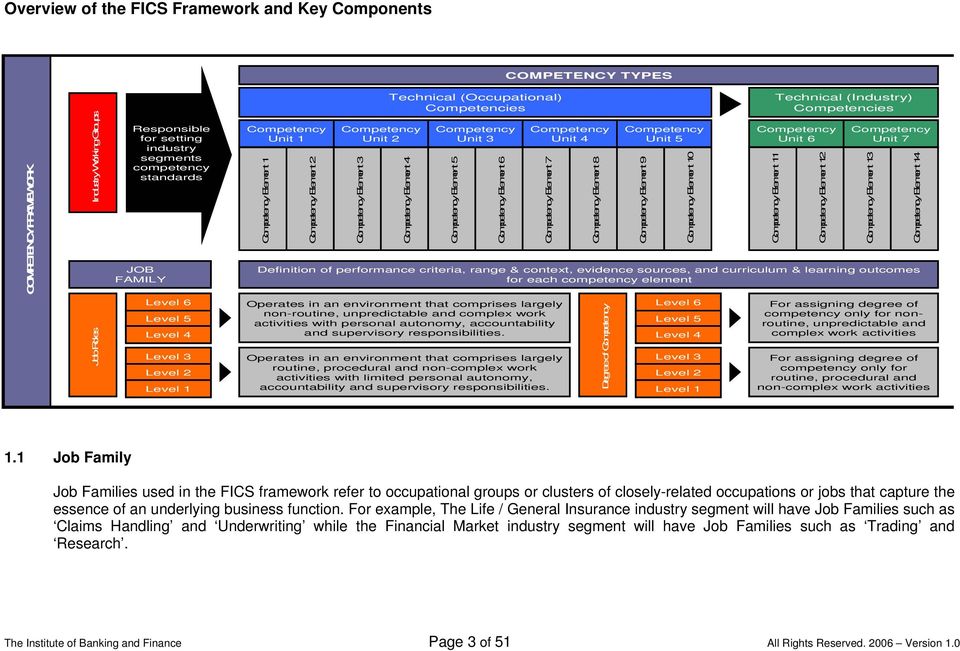
4 1.2 Job Roles For the FICS framework, competencies and their related certifications will be based on job roles rather than on job titles. Job roles will capture the essence of what must be done and how it should be done to achieve the required level of performance, and more importantly, the use of roles allows for overlap in responsibilities. Job titles on the other hand, tend to be narrowly defined and vary widely across organisations. The range and context in which the various job roles are performed can differ within a particular segment or job family. These can be classified into two broad work contexts: Job Role I / II / III In an environment that comprises largely routine, procedural and non-complex work activities with limited personal autonomy, accountability and supervisory responsibilities. Job Role IV / V / VI In an environment that comprises largely non-routine, unpredictable and complex work activities with personal autonomy, accountability and supervisory responsibilities. It should be noted that not all six job roles will be used. Each job family or segment will apply only the range of job roles relevant to that job family or segment. Broad guidelines for the six job roles are set out in Appendix 1: Guidelines on Roles and Responsibilities. The progressive scale of the job roles under the FICS framework also takes into account the role of a Specialist with management responsibilities. Such a role will be categorized as Job Role V according to the guidelines. 1.3 Type The FICS framework adopts two broad categories or types of competencies, namely Technical (Occupational) and Technical (Industry) Competencies. a. Technical (Occupational) Occupational competencies refer to competencies that are very specific to a particular job role. It includes primarily knowledge and skills required to perform a particular job or occupation. However, it may also include unique intellectual competencies or personal attributes if they are considered core competencies required to perform that particular occupation or role. As an illustration, the occupational competencies required of a trader in the financial markets industry segment will be distinct from that required of a private banker in the wealth management industry segment. The Institute of Banking and Finance Page 4 of 51 All Rights Reserved Version 1.0

5 b. Technical (Industry) 1.4 Unit Technical competencies refer to technical or job-related capabilities in performing a specific job. Industry competencies refer to the common competencies relevant across jobs within the industry. Some examples of this type of competencies are: Knowledge of legal and regulatory systems and requirements Industry Code of Ethics / Conduct A Unit refers to a cluster of broadly-related job functions / processes or capabilities for technical competencies and related behaviours or traits demonstrated for generic competencies. Each unit has its corresponding degree of competency for a particular experience level. 1.5 Element Elements are sub-divisions of a competency unit which describe a work activity or a behavioural demonstration that makes up a Unit. A few Elements is grouped together under one Unit. 1.6 Degree of For common competency units across various job roles, the degree of competency provides some measure to distinguish the standards expected between a junior role and more senior roles. For instance, for a common unit of competency such as product knowledge, the depth and breadth of knowledge expected of a junior job role will be less than that of a senior job role. The two broad work contexts that different degrees of competency are to be demonstrated as set out below: An environment that comprises only non-routine, unpredictable and complex work activities. An environment that comprises only routine, procedural and non-complex work activities. Broad definitions of the six degrees of competency are set out in Appendix 2: Definitions on Degrees of. The Institute of Banking and Finance Page 5 of 51 All Rights Reserved Version 1.0

6 Note: The degrees of competency are not intended to be perfectly matched to a particular job role. For instance, while a Job Role VI Business Unit Head operates in a largely non-routine, unpredictable and complex work context, a core competency unit for that role may involve a routine activity. In this case, the appropriate degree of competency for that routine activity will be Degree Performance Criteria Performance Criteria states what has to be achieved, in precise qualitative terminologies, in order to meet the requirements of the competency unit and its elements through a series of sub-tasks which is indicative of the performance. 1.8 Range and Context Range and Context provides an overview of the type of contexts or circumstances in which the performance criteria applies. It gives further references to the specific areas or terms highlighted in the Performance Criteria, such as type of customers, range of products and the process concerned. 1.9 Certification Reference Table Certification Reference Table provides information to the candidate, training provider and/or assessment service provider on the: Types of job roles available within the particular job family Responsibilities of each job role units applicable for each job role Certification requirements Recertification requirements For Certification Requirements, in addition to obtaining all Statements of Attainment (passing all competency units), and having the minimum number of years of relevant working experience, we have also set the requirement for a minimum of one-year experience in a job-related role in order to be awarded an Industry Certification. This one-year job role-related experience does not prevent candidates from passing their competency assessments. Rather, it is to ensure that candidates possess the appropriate professional work experience prior to using his professional designation. The Institute of Banking and Finance Page 6 of 51 All Rights Reserved Version 1.0
7 1.10 Assessment Matrix Assessment Matrix provides information to the candidate and/or assessment service provider on the: Recommended Assessment Methodology Assessment instruments Evidence Guide This matrix shows the combination of assessment methodologies that could be used to address both the knowledge-dominant and skills-dominant competency units of a job role. The assessment is against a set of prescribed competency units or standards and implies that assessors judge candidates on what they know and actually do in absolute terms rather than relative to the performance of other candidates. A key outcome of this process is the collection and evaluation of the evidence of performance. a. Recommended Assessment Methodology The recommended assessment methodology is intended as reference for assessment service providers in developing their assessment programmes. Written Test or Examination is recommended for more knowledge-dominant competencies while Individual assessment is for more skills-dominant competencies. b. Assessment Instruments Assessment Instruments refer to the means of gathering valid, reliable and sufficient evidence to support the demonstration of a competency in accordance with the performance criteria. c. Evidence Sources Evidence Sources are supporting information to guide Assessors in identifying the types of documentary evidence or observable work activities / behaviours through which proof of competent against respective competency unit can be obtained. Examples of evidence sources applicable to the wealth management industry segment may include income tax or salary records, loan documents, title deeds, Memorandum & Articles and financial statements. The Institute of Banking and Finance Page 7 of 51 All Rights Reserved Version 1.0
8 1.11 Curriculum and Learning Outcomes Table The table identifies the scope of knowledge and skills required for a candidate to demonstrate competence in the specific work activity. Reference can also be made to the Range and Context developed for the competency unit where applicable Learning Outcomes are statements that specify what the candidate is expected to be able to do upon completion of the programme. Typically, each learning outcome statement begins with the phrase "The candidate should be able to " In developing the curriculum, financial training providers should refer to learning outcome statements to ascertain the depth and breadth of the training coverage expected of the programme. As for assessment service providers, they could also refer to the learning outcome statements as a guide, for example. Operative verb used in LOS Identify State Define Calculate Explain Describe Discuss Outline Distinguish Recommend Justify Critique Evaluate The focus of the assessment Knowledge and comprehension Application and analysis Synthesis and evaluation For better understanding of the description of these operative verbs used in the LOS, please refer to Appendix 3: Description of Operative Verbs Used in Learning Outcome Statements. The Institute of Banking and Finance Page 8 of 51 All Rights Reserved Version 1.0

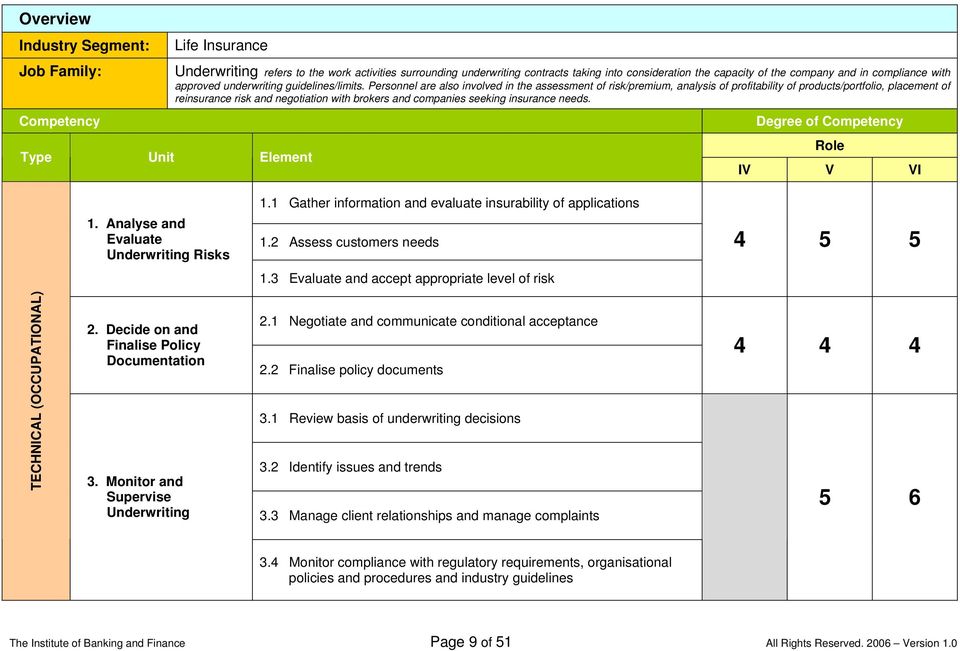
9 Overview Industry Segment: Job Family: Life Insurance Type Unit Element Underwriting refers to the work activities surrounding underwriting contracts taking into consideration the capacity of the company and in compliance with approved underwriting guidelines/limits. Personnel are also involved in the assessment of risk/premium, analysis of profitability of products/portfolio, placement of reinsurance risk and negotiation with brokers and companies seeking insurance needs. Degree of Role IV V VI 1.1 Gather information and evaluate insurability of applications 1. Analyse and Evaluate Underwriting Risks 1.2 Assess customers needs Evaluate and accept appropriate level of risk TECHNICAL (OCCUPATIONAL) 2. Decide on and Finalise Policy Documentation 3. Monitor and Supervise Underwriting 2.1 Negotiate and communicate conditional acceptance 2.2 Finalise policy documents 3.1 Review basis of underwriting decisions 3.2 Identify issues and trends 3.3 Manage client relationships and manage complaints Monitor compliance with regulatory requirements, organisational policies and procedures and industry guidelines The Institute of Banking and Finance Page 9 of 51 All Rights Reserved Version 1.0
10 Overview Industry Segment: Job Family: Life Insurance Type Unit Element Underwriting refers to the work activities surrounding underwriting contracts taking into consideration the capacity of the company and in compliance with approved underwriting guidelines/limits. Personnel are also involved in the assessment of risk/premium, analysis of profitability of products/portfolio, placement of reinsurance risk and negotiation with brokers and companies seeking insurance needs. Degree of Role IV V VI TECHNICAL (INDUSTRY) 4. Acquire and Apply Life Insurance Industry and Product Knowledge 5. Comply with Life Insurance Legislations, Regulations and Industry Codes of Practice 4.1 Demonstrate understanding of general principles of insurance and insurance products 4.2 Keep abreast of changes and developments in the life insurance industry and product knowledge 5.1 Identify and comply with legislative, regulatory and industry requirements 5.2 Keep abreast of changes of relevant laws and regulations and understand its implications The Institute of Banking and Finance Page 10 of 51 All Rights Reserved Version 1.0

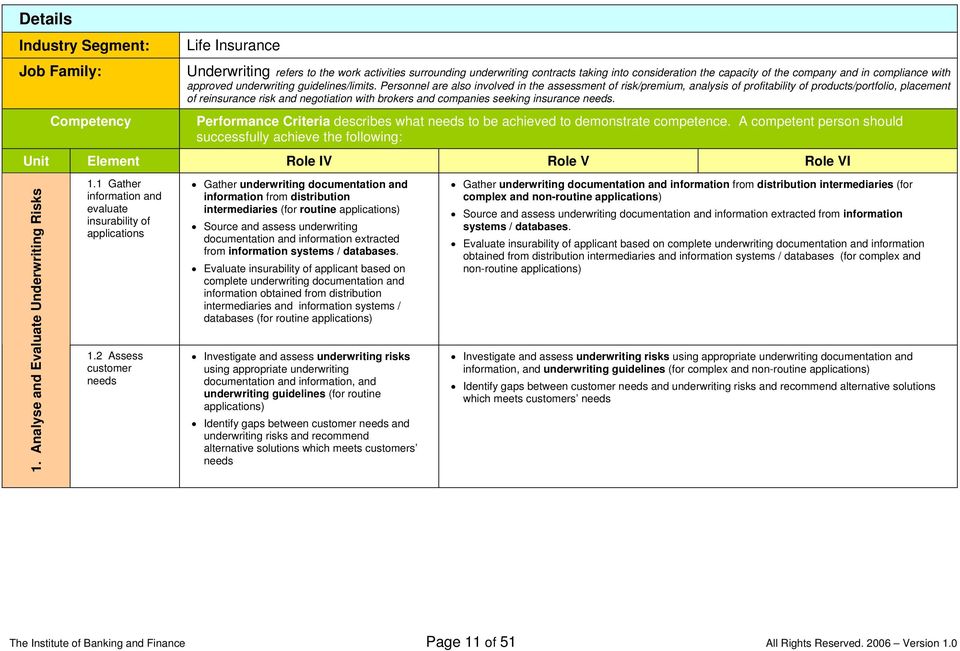
11 Details Industry Segment: Job Family: Life Insurance Underwriting refers to the work activities surrounding underwriting contracts taking into consideration the capacity of the company and in compliance with approved underwriting guidelines/limits. Personnel are also involved in the assessment of risk/premium, analysis of profitability of products/portfolio, placement of reinsurance risk and negotiation with brokers and companies seeking insurance needs. Performance Criteria describes what needs to be achieved to demonstrate competence. A competent person should successfully achieve the following: Unit Element Role IV Role V Role VI 1. Analyse and Evaluate Underwriting Risks 1.1 Gather information and evaluate insurability of applications 1.2 Assess customer needs Gather underwriting documentation and information from distribution intermediaries (for routine applications) Source and assess underwriting documentation and information extracted from information systems / databases. Evaluate insurability of applicant based on complete underwriting documentation and information obtained from distribution intermediaries and information systems / databases (for routine applications) Investigate and assess underwriting risks using appropriate underwriting documentation and information, and underwriting guidelines (for routine applications) Identify gaps between customer needs and underwriting risks and recommend alternative solutions which meets customers needs Gather underwriting documentation and information from distribution intermediaries (for complex and non-routine applications) Source and assess underwriting documentation and information extracted from information systems / databases. Evaluate insurability of applicant based on complete underwriting documentation and information obtained from distribution intermediaries and information systems / databases (for complex and non-routine applications) Investigate and assess underwriting risks using appropriate underwriting documentation and information, and underwriting guidelines (for complex and non-routine applications) Identify gaps between customer needs and underwriting risks and recommend alternative solutions which meets customers needs The Institute of Banking and Finance Page 11 of 51 All Rights Reserved Version 1.0
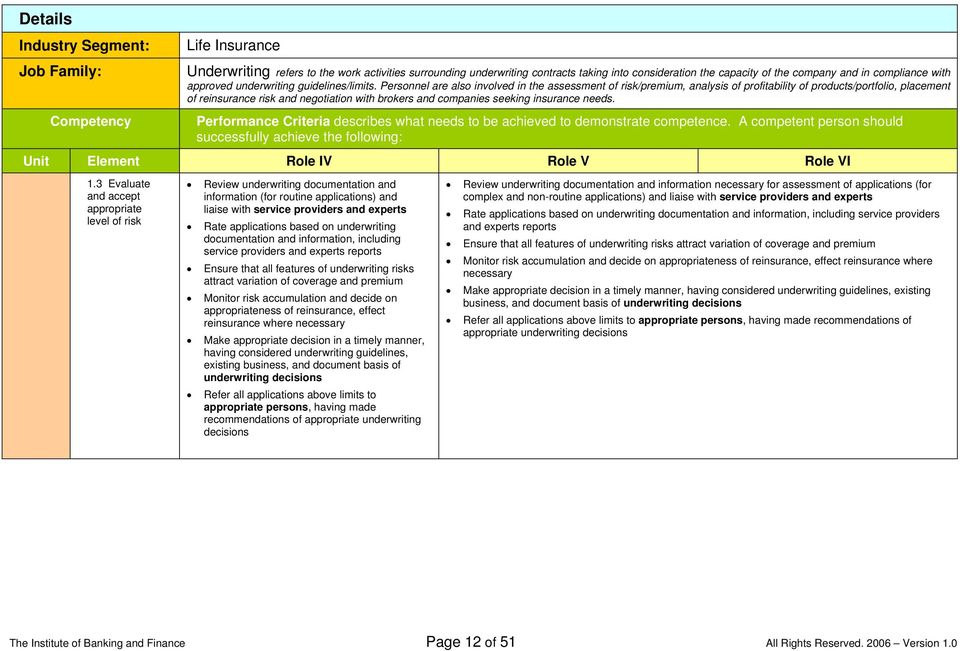
12 Details Industry Segment: Job Family: Life Insurance Underwriting refers to the work activities surrounding underwriting contracts taking into consideration the capacity of the company and in compliance with approved underwriting guidelines/limits. Personnel are also involved in the assessment of risk/premium, analysis of profitability of products/portfolio, placement of reinsurance risk and negotiation with brokers and companies seeking insurance needs. Performance Criteria describes what needs to be achieved to demonstrate competence. A competent person should successfully achieve the following: Unit Element Role IV Role V Role VI 1.3 Evaluate and accept appropriate level of risk Review underwriting documentation and information (for routine applications) and liaise with service providers and experts Rate applications based on underwriting documentation and information, including service providers and experts reports Ensure that all features of underwriting risks attract variation of coverage and premium Monitor risk accumulation and decide on appropriateness of reinsurance, effect reinsurance where necessary Make appropriate decision in a timely manner, having considered underwriting guidelines, existing business, and document basis of underwriting decisions Refer all applications above limits to appropriate persons, having made recommendations of appropriate underwriting decisions Review underwriting documentation and information necessary for assessment of applications (for complex and non-routine applications) and liaise with service providers and experts Rate applications based on underwriting documentation and information, including service providers and experts reports Ensure that all features of underwriting risks attract variation of coverage and premium Monitor risk accumulation and decide on appropriateness of reinsurance, effect reinsurance where necessary Make appropriate decision in a timely manner, having considered underwriting guidelines, existing business, and document basis of underwriting decisions Refer all applications above limits to appropriate persons, having made recommendations of appropriate underwriting decisions The Institute of Banking and Finance Page 12 of 51 All Rights Reserved Version 1.0
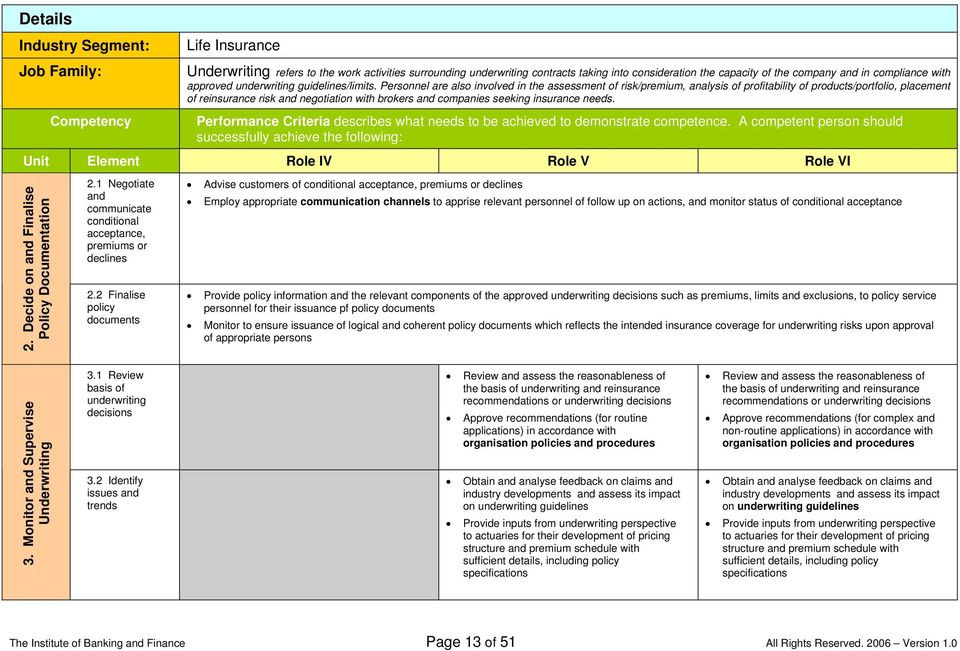
13 Details Industry Segment: Job Family: Life Insurance Underwriting refers to the work activities surrounding underwriting contracts taking into consideration the capacity of the company and in compliance with approved underwriting guidelines/limits. Personnel are also involved in the assessment of risk/premium, analysis of profitability of products/portfolio, placement of reinsurance risk and negotiation with brokers and companies seeking insurance needs. Performance Criteria describes what needs to be achieved to demonstrate competence. A competent person should successfully achieve the following: Unit Element Role IV Role V Role VI 2. Decide on and Finalise Policy Documentation 2.1 Negotiate and communicate conditional acceptance, premiums or declines 2.2 Finalise policy documents Advise customers of conditional acceptance, premiums or declines Employ appropriate communication channels to apprise relevant personnel of follow up on actions, and monitor status of conditional acceptance Provide policy information and the relevant components of the approved underwriting decisions such as premiums, limits and exclusions, to policy service personnel for their issuance pf policy documents Monitor to ensure issuance of logical and coherent policy documents which reflects the intended insurance coverage for underwriting risks upon approval of appropriate persons 3. Monitor and Supervise Underwriting 3.1 Review basis of underwriting decisions 3.2 Identify issues and trends Review and assess the reasonableness of the basis of underwriting and reinsurance recommendations or underwriting decisions Approve recommendations (for routine applications) in accordance with organisation policies and procedures Obtain and analyse feedback on claims and industry developments and assess its impact on underwriting guidelines Provide inputs from underwriting perspective to actuaries for their development of pricing structure and premium schedule with sufficient details, including policy specifications Review and assess the reasonableness of the basis of underwriting and reinsurance recommendations or underwriting decisions Approve recommendations (for complex and non-routine applications) in accordance with organisation policies and procedures Obtain and analyse feedback on claims and industry developments and assess its impact on underwriting guidelines Provide inputs from underwriting perspective to actuaries for their development of pricing structure and premium schedule with sufficient details, including policy specifications The Institute of Banking and Finance Page 13 of 51 All Rights Reserved Version 1.0
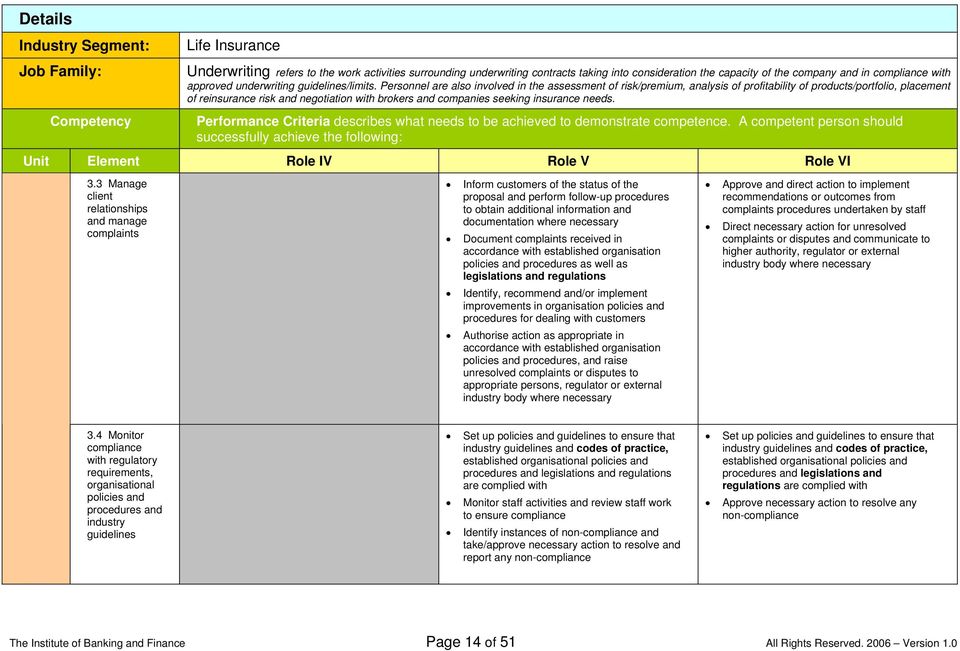
14 Details Industry Segment: Job Family: Life Insurance Underwriting refers to the work activities surrounding underwriting contracts taking into consideration the capacity of the company and in compliance with approved underwriting guidelines/limits. Personnel are also involved in the assessment of risk/premium, analysis of profitability of products/portfolio, placement of reinsurance risk and negotiation with brokers and companies seeking insurance needs. Performance Criteria describes what needs to be achieved to demonstrate competence. A competent person should successfully achieve the following: Unit Element Role IV Role V Role VI 3.3 Manage client relationships and manage complaints Inform customers of the status of the proposal and perform follow-up procedures to obtain additional information and documentation where necessary Document complaints received in accordance with established organisation policies and procedures as well as legislations and regulations Identify, recommend and/or implement improvements in organisation policies and procedures for dealing with customers Authorise action as appropriate in accordance with established organisation policies and procedures, and raise unresolved complaints or disputes to appropriate persons, regulator or external industry body where necessary Approve and direct action to implement recommendations or outcomes from complaints procedures undertaken by staff Direct necessary action for unresolved complaints or disputes and communicate to higher authority, regulator or external industry body where necessary 3.4 Monitor compliance with regulatory requirements, organisational policies and procedures and industry guidelines Set up policies and guidelines to ensure that industry guidelines and codes of practice, established organisational policies and procedures and legislations and regulations are complied with Monitor staff activities and review staff work to ensure compliance Identify instances of non-compliance and take/approve necessary action to resolve and report any non-compliance Set up policies and guidelines to ensure that industry guidelines and codes of practice, established organisational policies and procedures and legislations and regulations are complied with Approve necessary action to resolve any non-compliance The Institute of Banking and Finance Page 14 of 51 All Rights Reserved Version 1.0
15 Details Industry Segment: Job Family: Life Insurance Underwriting refers to the work activities surrounding underwriting contracts taking into consideration the capacity of the company and in compliance with approved underwriting guidelines/limits. Personnel are also involved in the assessment of risk/premium, analysis of profitability of products/portfolio, placement of reinsurance risk and negotiation with brokers and companies seeking insurance needs. Performance Criteria describes what needs to be achieved to demonstrate competence. A competent person should successfully achieve the following: Unit Element Role IV Role V Role VI 4. Acquire and Apply Life Insurance Industry and Product Knowledge 4.1 Demonstrate understanding of general principles of insurance and insurance products 4.2 Keep abreast of changes and developments in the life insurance industry and product knowledge Acquire a generic understanding of the life/general insurance industry Identify the products applicable to the industry and work activity Apply the knowledge of principles of general insurance and general insurance products to work effectively within the insurance industry Seek out and attend appropriate Continuing Certification Requirement programs, updates or other relevant materials to keep abreast of developments and trends Acquire a generic understanding of the financial services industry Identify the products applicable to the industry and work activity Apply the knowledge of principles of general insurance and general insurance products to work effectively within the insurance industry Identify changes and developments in the financial services industry and its products and services on an ongoing basis and apply any identified changes as appropriate to work activities Review industry trends and update knowledge on products and services pertaining to the general insurance services industry Seek out and attend appropriate Continuing Certification Requirement programs, updates or other relevant materials to keep abreast of developments and trends Acquire a generic understanding of the financial services industry Identify the products applicable to the industry and work activity Apply the knowledge of principles of general insurance and general insurance products to work effectively within the insurance industry Identify changes and developments in the financial services industry and its products and services on an ongoing basis and apply any identified changes as appropriate to work activities Review industry trends and update knowledge on products and services pertaining to the general insurance industry Seek out and attend appropriate Continuing Certification Requirement programs, updates or other relevant materials to keep abreast of developments and trends The Institute of Banking and Finance Page 15 of 51 All Rights Reserved Version 1.0

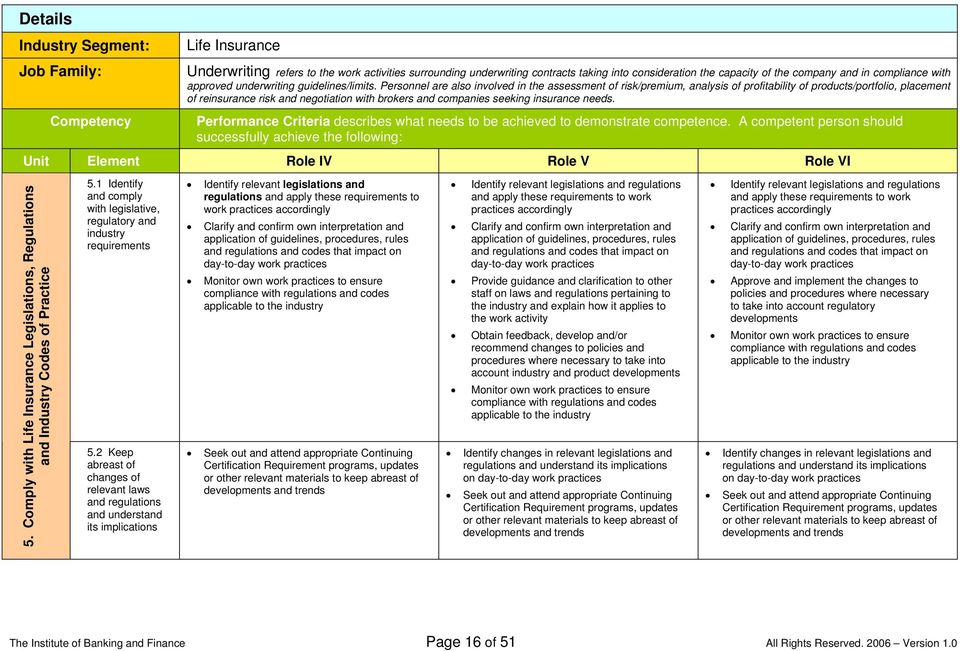
16 Details Industry Segment: Job Family: Life Insurance Underwriting refers to the work activities surrounding underwriting contracts taking into consideration the capacity of the company and in compliance with approved underwriting guidelines/limits. Personnel are also involved in the assessment of risk/premium, analysis of profitability of products/portfolio, placement of reinsurance risk and negotiation with brokers and companies seeking insurance needs. Performance Criteria describes what needs to be achieved to demonstrate competence. A competent person should successfully achieve the following: Unit Element Role IV Role V Role VI 5. Comply with Life Insurance Legislations, Regulations and Industry Codes of Practice 5.1 Identify and comply with legislative, regulatory and industry requirements 5.2 Keep abreast of changes of relevant laws and regulations and understand its implications Identify relevant legislations and regulations and apply these requirements to work practices accordingly Clarify and confirm own interpretation and application of guidelines, procedures, rules and regulations and codes that impact on day-to-day work practices Monitor own work practices to ensure compliance with regulations and codes applicable to the industry Seek out and attend appropriate Continuing Certification Requirement programs, updates or other relevant materials to keep abreast of developments and trends Identify relevant legislations and regulations and apply these requirements to work practices accordingly Clarify and confirm own interpretation and application of guidelines, procedures, rules and regulations and codes that impact on day-to-day work practices Provide guidance and clarification to other staff on laws and regulations pertaining to the industry and explain how it applies to the work activity Obtain feedback, develop and/or recommend changes to policies and procedures where necessary to take into account industry and product developments Monitor own work practices to ensure compliance with regulations and codes applicable to the industry Identify changes in relevant legislations and regulations and understand its implications on day-to-day work practices Seek out and attend appropriate Continuing Certification Requirement programs, updates or other relevant materials to keep abreast of developments and trends Identify relevant legislations and regulations and apply these requirements to work practices accordingly Clarify and confirm own interpretation and application of guidelines, procedures, rules and regulations and codes that impact on day-to-day work practices Approve and implement the changes to policies and procedures where necessary to take into account regulatory developments Monitor own work practices to ensure compliance with regulations and codes applicable to the industry Identify changes in relevant legislations and regulations and understand its implications on day-to-day work practices Seek out and attend appropriate Continuing Certification Requirement programs, updates or other relevant materials to keep abreast of developments and trends The Institute of Banking and Finance Page 16 of 51 All Rights Reserved Version 1.0
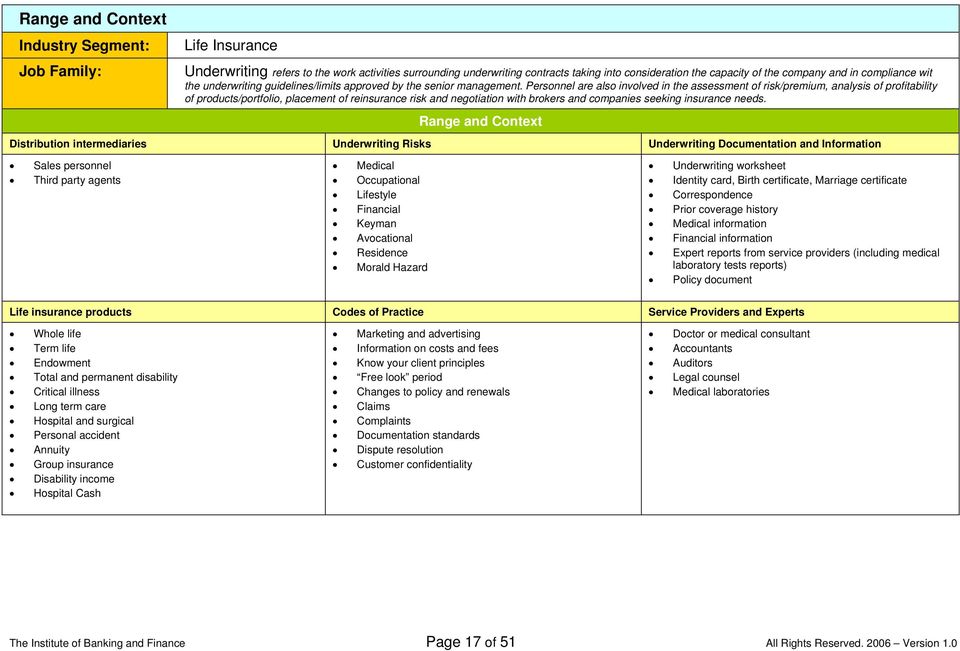
17 Range and Context Industry Segment: Job Family: Life Insurance Underwriting refers to the work activities surrounding underwriting contracts taking into consideration the capacity of the company and in compliance wit the underwriting guidelines/limits approved by the senior management. Personnel are also involved in the assessment of risk/premium, analysis of profitability of products/portfolio, placement of reinsurance risk and negotiation with brokers and companies seeking insurance needs. Range and Context Distribution intermediaries Underwriting Risks Underwriting Documentation and Information Sales personnel Third party agents Medical Occupational Lifestyle Financial Keyman Avocational Residence Morald Hazard Underwriting worksheet Identity card, Birth certificate, Marriage certificate Correspondence Prior coverage history Medical information Financial information Expert reports from service providers (including medical laboratory tests reports) Policy document Life insurance products Codes of Practice Service Providers and Experts Whole life Term life Endowment Total and permanent disability Critical illness Long term care Hospital and surgical Personal accident Annuity Group insurance Disability income Hospital Cash Marketing and advertising Information on costs and fees Know your client principles Free look period Changes to policy and renewals Claims Complaints Documentation standards Dispute resolution Customer confidentiality Doctor or medical consultant Accountants Auditors Legal counsel Medical laboratories The Institute of Banking and Finance Page 17 of 51 All Rights Reserved Version 1.0
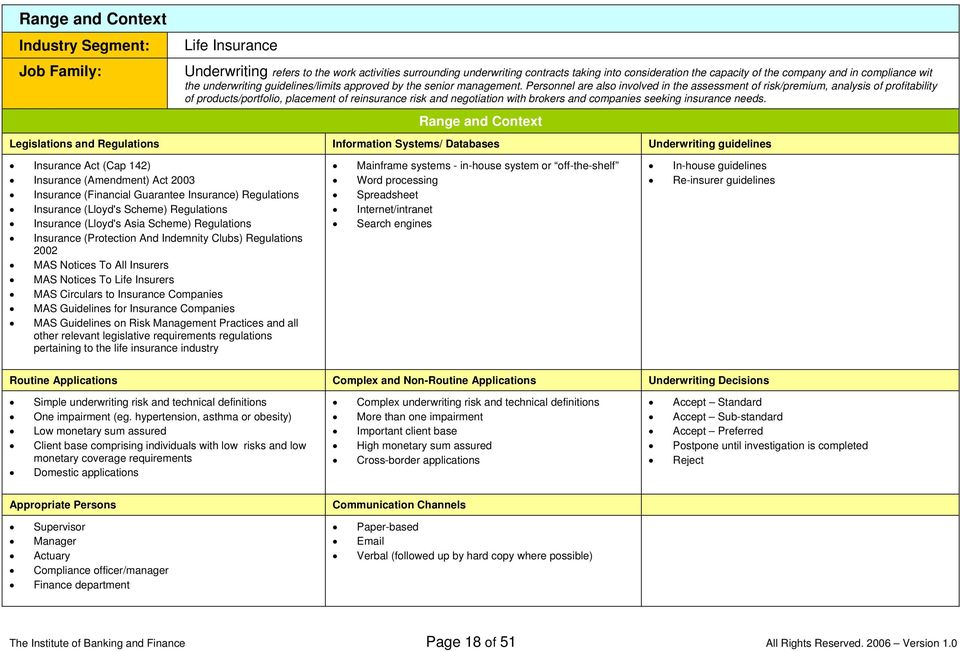
18 Range and Context Industry Segment: Job Family: Life Insurance Underwriting refers to the work activities surrounding underwriting contracts taking into consideration the capacity of the company and in compliance wit the underwriting guidelines/limits approved by the senior management. Personnel are also involved in the assessment of risk/premium, analysis of profitability of products/portfolio, placement of reinsurance risk and negotiation with brokers and companies seeking insurance needs. Range and Context Legislations and Regulations Information Systems/ Databases Underwriting guidelines Insurance Act (Cap 142) Insurance (Amendment) Act 2003 Insurance (Financial Guarantee Insurance) Regulations Insurance (Lloyd's Scheme) Regulations Insurance (Lloyd's Asia Scheme) Regulations Insurance (Protection And Indemnity Clubs) Regulations 2002 MAS Notices To All Insurers MAS Notices To Life Insurers MAS Circulars to Insurance Companies MAS Guidelines for Insurance Companies MAS Guidelines on Risk Management Practices and all other relevant legislative requirements regulations pertaining to the life insurance industry Mainframe systems - in-house system or off-the-shelf Word processing Spreadsheet Internet/intranet Search engines In-house guidelines Re-insurer guidelines Routine Applications Complex and Non-Routine Applications Underwriting Decisions Simple underwriting risk and technical definitions One impairment (eg. hypertension, asthma or obesity) Low monetary sum assured Client base comprising individuals with low risks and low monetary coverage requirements Domestic applications Complex underwriting risk and technical definitions More than one impairment Important client base High monetary sum assured Cross-border applications Accept Standard Accept Sub-standard Accept Preferred Postpone until investigation is completed Reject Appropriate Persons Communication Channels Supervisor Manager Actuary Compliance officer/manager Finance department Paper-based Verbal (followed up by hard copy where possible) The Institute of Banking and Finance Page 18 of 51 All Rights Reserved Version 1.0
19 Classes of Insurance and Applicable Laws and Regulations Industry Segment: Job Family: Life Insurance Underwriting refers to the work activities surrounding underwriting contracts taking into consideration the capacity of the company and in compliance wit the underwriting guidelines/limits approved by the senior management. Personnel are also involved in the assessment of risk/premium, analysis of profitability of products/portfolio, placement of reinsurance risk and negotiation with brokers and companies seeking insurance needs. Life Law and regulations Applicable for ALL Roles Insurance Act (Cap 142) Insurance (Amendment) Act 2003 Life Insurance Association (LIA) Guidelines, eg. Code of Life Insurance Practice (COLIP) Applicable to Roles IV, V and VI Insurance (Financial Guarantee Insurance) Regulations Insurance (Lloyd's Scheme) Regulations Insurance (Lloyd's Asia Scheme) Regulations Insurance (Protection And Indemnity Clubs) Regulations 2002 MAS Notices To All Insurers MAS Notices To Life Insurers MAS Circulars to Insurance Companies MAS Guidelines for Insurance Companies MAS Guidelines on Risk Management Practices and all other relevant legislative requirements regulations pertaining to the life insurance industry. Securities and Futures Act Financial Advisers Act Central Provident Fund Act Contract (Rights of Third Party) Act Cap 53B Estate Duty Act Trustee Act GST Act Bankruptcy Act Conveyancing and Law of Property Act Intestate Succession Act Applicable to Roles V and VI Income Tax Act The Institute of Banking and Finance Page 19 of 51 All Rights Reserved Version 1.0

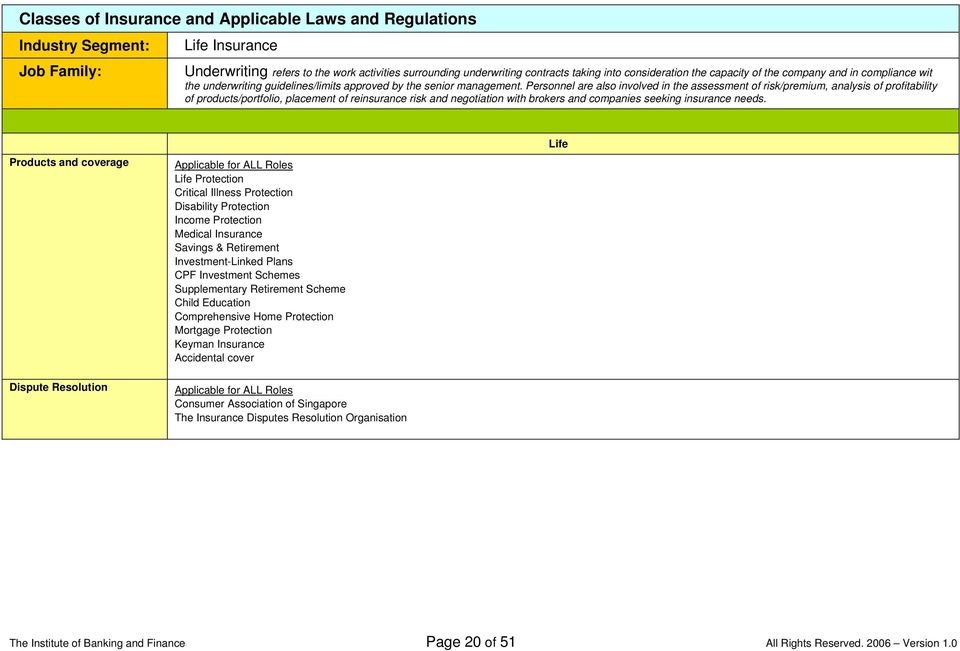
20 Classes of Insurance and Applicable Laws and Regulations Industry Segment: Job Family: Life Insurance Underwriting refers to the work activities surrounding underwriting contracts taking into consideration the capacity of the company and in compliance wit the underwriting guidelines/limits approved by the senior management. Personnel are also involved in the assessment of risk/premium, analysis of profitability of products/portfolio, placement of reinsurance risk and negotiation with brokers and companies seeking insurance needs. Products and coverage Applicable for ALL Roles Life Protection Critical Illness Protection Disability Protection Income Protection Medical Insurance Savings & Retirement Investment-Linked Plans CPF Investment Schemes Supplementary Retirement Scheme Child Education Comprehensive Home Protection Mortgage Protection Keyman Insurance Accidental cover Life Dispute Resolution Applicable for ALL Roles Consumer Association of Singapore The Insurance Disputes Resolution Organisation The Institute of Banking and Finance Page 20 of 51 All Rights Reserved Version 1.0
21 Certification Reference Table Industry Segment: Job Family: Life Insurance Underwriting refers to the work activities surrounding underwriting contracts taking into consideration the capacity of the company and in compliance wit the underwriting guidelines/limits approved by the senior management. Personnel are also involved in the assessment of risk/premium, analysis of profitability of products/portfolio, placement of reinsurance risk and negotiation with brokers and companies seeking insurance needs. Role IV Role V Role VI Responsibility Responsible for performing a limited specialist and support role in an underwriting operation. Possesses some personal accountability, decision-making authority and risk management skills but has limited bottom-line responsibility. Operates in an environment which is largely non-routine, unpredictable and complex Responsible for managing the day-to-day underwriting operations. Responsible for managing underwriting staff. Administers and manages adherence to the underwriting department budget. Performs a specialist function in dealing with complex and non-routine underwriting proposals. Possesses a high degree of personal accountability, decision-making authority and risk management skills Operates in an environment which is largely non-routine, unpredictable and complex Responsible for setting the strategic direction for the underwriting department. Has tactical and bottom line responsibility for the underwriting department. Responsible for aligning the underwriting department objectives with overall corporate goals. Possesses a significant degree of personal accountability, decision-making authority and risk management skills Operates in an environment which is largely non-routine, unpredictable and complex Units 1. Analyse and evaluate underwriting risks. 2. Decide on and finalise policy documentation. 3. Not applicable. 4. Acquire and apply life insurance industry and product knowledge. 5. Comply with life insurance legislations, regulations and industry codes of practice. 1. Analyse and evaluate underwriting risks. 2. Decide on and finalise policy documentation. 3. Monitor and supervise underwriting. 4. Acquire and apply life insurance industry and product knowledge. 5. Comply with life insurance legislations, regulations and industry codes of practice. 1. Analyse and evaluate underwriting risks. 2. Decide on and finalise policy documentation. 3. Monitor and supervise underwriting. 4. Acquire and apply life insurance industry and product knowledge. 5. Comply with life insurance legislations, regulations and industry codes of practice. The Institute of Banking and Finance Page 21 of 51 All Rights Reserved Version 1.0
22 Certification Reference Table Industry Segment: Job Family: Certification Requirements In order to be awarded a financial services industry certification, the following is required: Life Insurance Underwriting refers to the work activities surrounding underwriting contracts taking into consideration the capacity of the company and in compliance wit the underwriting guidelines/limits approved by the senior management. Personnel are also involved in the assessment of risk/premium, analysis of profitability of products/portfolio, placement of reinsurance risk and negotiation with brokers and companies seeking insurance needs. Role IV Role V Role VI Minimum of 1 year of experience in the role that touches all areas of the competencies required for the Role IV designation Minimum of 2 years of total relevant working experience Statements of Attainment must be obtained for all competency units to receive the industry certification All Statements of Attainment are valid for a period of two years from the date of completion of the assessment Minimum of 1 year of experience in the role that touches all areas of the competencies required for the Role V designation Minimum of 5 years of total relevant working experience Statements of Attainment must be obtained for all competency units to receive the industry certification All Statements of Attainment are valid for a period of two years from the date of completion of the assessment Minimum of 1 year of experience in the role that touches all areas of the competencies required for the Role VI designation Minimum of 8 years of total relevant working experience Statements of Attainment must be obtained for all competency units to receive the industry certification All Statements of Attainment are valid for a period of two years from the date of completion of the assessment Re-certification Requirements Undertake re-certification every 3 years At least 18 credit hours of Continuing Certification Requirements per annum in the relevant field Undertake re-certification every 3 years At least 18 credit hours of Continuing Certification Requirements per annum in the relevant field Undertake re-certification every 3 years At least 18 credit hours of Continuing Certification Requirements per annum in the relevant field The Institute of Banking and Finance Page 22 of 51 All Rights Reserved Version 1.0
23 Assessment Matrix Industry Segment: Life Insurance Job Family: Underwriting Job Role: IV Assessment Evidence Guide Type Unit Rec d Methodology Instruments Examples of evidence that provide guidance on whether competency standards are met. 1. Analyse and Evaluate Underwriting Risks Individual Assessment Workplace Assessment (WPA): Workplace or an assessment centre under simulated or actual workplace condition (covers on-the-job and off-the-job training component). Assessment methods to be used include (i) observation of candidate s performance; (ii) review of documentary evidence; (iii) feedback on candidate s performance; (iv) evidence of attendance of relevant courses; and (v) interview. Estimated Assessment Time: 1.5 hrs Observation of candidate analysing and evaluating underwriting risks on-the-job or in a simulation. Performance track records, appraisal reports, testimonials or work documents. TECHNICAL (OCCUPATIONAL) Only one of the three instruments required for assessment OR OR Recognition of Prior Learning (RPL): Gives formal recognition of competencies that a person has acquired through formal training, work experience and/or life experience. Assessment methods to be used include (i) documentary review e.g. CV, supervisor report, testimonials, membership of relevant bodies, etc; (ii) 3rd party reports; (iii) Supervisor s report; and (iv) interview. Estimated Assessment Time: 1.0 hr Facilitated Training and Assessment (FTA): Classroom training and assessment covering off-the-job training component. Assessment methods to be used include (i) case studies; (ii) presentations; (iii) discussions; (iv) written tests/exercises; (v) role play; (vi) simulation; and (vii) interview. Estimated Assessment Time: 1.5 hrs Verbal responses from candidate relating past experiences of analysing and evaluating underwriting risks. Observation of candidates analysing and evaluating underwriting risks in training or in a simulation. 2. Decide on and Finalise Policy Documentation Individual Assessment Workplace Assessment (WPA): Workplace or an assessment centre under simulated or actual workplace condition (covers on-the-job and off-the-job training component). Assessment methods to be used include (i) observation of candidate s performance; (ii) review of documentary evidence; (iii) feedback on candidate s performance; (iv) evidence of attendance of relevant courses; and (v) interview. Estimated Assessment Time: 1.5 hrs Observation of candidate deciding on and finalising policy documentation on-the-job or in a simulation. Performance track records, appraisal reports, testimonials or work documents. The Institute of Banking and Finance Page 23 of 51 All Rights Reserved Version 1.0
24 Assessment Matrix Industry Segment: Life Insurance Job Family: Underwriting Job Role: IV Assessment Evidence Guide Type Unit Rec d Methodology Instruments Examples of evidence that provide guidance on whether competency standards are met. Only one of the three instruments required for assessment OR Recognition of Prior Learning (RPL): Gives formal recognition of competencies that a person has acquired through formal training, work experience and/or life experience. Assessment methods to be used include (i) documentary review e.g. CV, supervisor report, testimonials, membership of relevant bodies, etc; (ii) 3rd party reports; (iii) Supervisor s report; and (iv) interview. Estimated Assessment Time: 1.0 hr Verbal responses from candidate relating past experiences of deciding on and finalising policy documentation. OR Facilitated Training and Assessment (FTA): Classroom training and assessment covering off-the-job training component. Assessment methods to be used include (i) case studies; (ii) presentations; (iii) discussions; (iv) written tests/exercises; (v) role play; (vi) simulation; and (vii) interview. Estimated Assessment Time: 1.5 hrs Observation of candidates deciding on and finalising policy documentation in training or in a simulation. 3. Monitor and Supervise Underwriting Not Applicable Not Applicable Not Applicable TECHNICAL (INDUSTRY) 4. Acquire and Apply Life Insurance Industry and Product Knowledge 5. Comply with Life Insurance Legislations, Regulations and Industry Codes of Practice Written Test or Examination Written Test or Examination Written questioning to ensure relevant knowledge and application of skills using written or computer-based tests. Format could take the form of multiple choice questions, short questions, case studies or essay questions. Estimated Assessment Time: 1.5 hrs Written questioning to ensure relevant knowledge and application of skills using written or computer-based tests. Format could take the form of multiple choice questions, short questions, case studies or essay questions. Estimated Assessment Time: 1.5 hrs Written responses from candidate demonstrating application of financial services and life insurance industry and product knowledge. Written responses from candidate demonstrating application of financial services and life insurance legislations, regulations and industry codes of practice. The Institute of Banking and Finance Page 24 of 51 All Rights Reserved Version 1.0
25 Assessment Matrix Industry Segment: Life Insurance Job Family: Underwriting Job Role: IV Assessment Evidence Guide Type Unit Assessment Guide: Rec d Methodology Instruments Competencies should be evidenced through a variety of assessment instruments and over a period of time to ensure validity, reliability and consistency of performance. All performance criteria, curriculum and learning outcomes are to be achieved across the range of competency units. Assessment should be undertaken within the context of the underwriting job family and may be combined with a cluster of related competency units as listed below: Examples of evidence that provide guidance on whether competency standards are met. Estimated Assessment Time for full assessment Individual Assessment (Technical Occupational) 1. Analyse and Evaluate Underwriting Risks 2. Decide on and Finalise Policy Documentation Examination (Technical Industry) 4. Acquire and Apply Life Insurance Industry and Product Knowledge 5. Comply with Life Insurance Legislations, Regulations and Industry Codes of Practice Total Estimated Assessment Time 3.0 hrs (WPA) 2.0 hrs (RPL) 3.0 hrs (FTA) 3.0 hrs 5.0 to 6.0 hrs The Institute of Banking and Finance Page 25 of 51 All Rights Reserved Version 1.0
26 Assessment Matrix Industry Segment: Life Insurance Job Family: Underwriting Job Role: V, VI Assessment Evidence Guide Type Unit Rec d Methodology Instruments Examples of evidence that provide guidance on whether competency standards are met. 1. Analyse and Evaluate Underwriting Risks Individual Assessment Workplace Assessment (WPA): Workplace or an assessment centre under simulated or actual workplace condition (covers on-the-job and off-the-job training component). Assessment methods to be used include (i) observation of candidate s performance; (ii) review of documentary evidence; (iii) feedback on candidate s performance; (iv) evidence of attendance of relevant courses; and (v) interview. Estimated Assessment Time: 1.5 hrs Observation of candidate analysing and evaluating underwriting risks on-the-job or in a simulation. Performance track records, appraisal reports, testimonials or work documents. TECHNICAL (OCCUPATIONAL) Only one of the three instruments required for assessment OR OR Recognition of Prior Learning (RPL): Gives formal recognition of competencies that a person has acquired through formal training, work experience and/or life experience. Assessment methods to be used include (i) documentary review e.g. CV, supervisor report, testimonials, membership of relevant bodies, etc; (ii) 3rd party reports; (iii) Supervisor s report; and (iv) interview. Estimated Assessment Time: 1.0 hr Facilitated Training and Assessment (FTA): Classroom training and assessment covering off-the-job training component. Assessment methods to be used include (i) case studies; (ii) presentations; (iii) discussions; (iv) written tests/exercises; (v) role play; (vi) simulation; and (vii) interview. Estimated Assessment Time: 1.5 hrs Verbal responses from candidate relating past experiences of analysing and evaluating underwriting risks. Observation of candidates analysing and evaluating underwriting risks in training or in a simulation. 2. Decide on and Finalise Policy Documentation Individual Assessment Workplace Assessment (WPA): Workplace or an assessment centre under simulated or actual workplace condition (covers on-the-job and off-the-job training component). Assessment methods to be used include (i) observation of candidate s performance; (ii) review of documentary evidence; (iii) feedback on candidate s performance; (iv) evidence of attendance of relevant courses; and (v) interview. Estimated Assessment Time: 1.5 hrs Observation of candidate deciding on and finalising policy documentation on-the-job or in a simulation. Performance track records, appraisal reports, testimonials or work documents. The Institute of Banking and Finance Page 26 of 51 All Rights Reserved Version 1.0
27 Assessment Matrix Industry Segment: Life Insurance Job Family: Underwriting Job Role: V, VI Assessment Evidence Guide Type Unit Rec d Methodology Instruments Examples of evidence that provide guidance on whether competency standards are met. Only one of the three instruments required for assessment OR Recognition of Prior Learning (RPL): Gives formal recognition of competencies that a person has acquired through formal training, work experience and/or life experience. Assessment methods to be used include (i) documentary review e.g. CV, supervisor report, testimonials, membership of relevant bodies, etc; (ii) 3rd party reports; (iii) Supervisor s report; and (iv) interview. Estimated Assessment Time: 1.0 hr Verbal responses from candidate relating past experiences of deciding on and finalising policy documentation. OR Facilitated Training and Assessment (FTA): Classroom training and assessment covering off-the-job training component. Assessment methods to be used include (i) case studies; (ii) presentations; (iii) discussions; (iv) written tests/exercises; (v) role play; (vi) simulation; and (vii) interview. Estimated Assessment Time: 1.5 hrs Observation of candidates deciding on and finalising policy documentation in training or in a simulation. TECHNICAL (OCCUPATIONAL) 3. Monitor and Supervise Underwriting Individual Assessment Only one of the three instruments required for assessment Workplace Assessment (WPA): Workplace or an assessment centre under simulated or actual workplace condition (covers on-the-job and off-the-job training component). Assessment methods to be used include (i) observation of candidate s performance; (ii) review of documentary evidence; (iii) feedback on candidate s performance; (iv) evidence of attendance of relevant courses; and (v) interview. Estimated Assessment Time: 1.5 hrs OR Recognition of Prior Learning (RPL): Gives formal recognition of competencies that a person has acquired through formal training, work experience and/or life experience. Assessment methods to be used include (i) documentary review e.g. CV, supervisor report, testimonials, membership of relevant bodies, etc; (ii) 3rd party reports; (iii) Supervisor s report; and (iv) interview. Estimated Assessment Time: 1.0 hr Observation of candidate monitoring and supervising underwriting on-the-job or in a simulation. Performance track records, appraisal reports, testimonials or work documents. Verbal responses from candidate relating past experiences of monitoring and supervising underwriting. The Institute of Banking and Finance Page 27 of 51 All Rights Reserved Version 1.0
28 Assessment Matrix Industry Segment: Life Insurance Job Family: Underwriting Job Role: V, VI Assessment Evidence Guide Type Unit Rec d Methodology Instruments Examples of evidence that provide guidance on whether competency standards are met. OR Facilitated Training and Assessment (FTA): Classroom training and assessment covering off-the-job training component. Assessment methods to be used include (i) case studies; (ii) presentations; (iii) discussions; (iv) written tests/exercises; (v) role play; (vi) simulation; and (vii) interview. Estimated Assessment Time: 1.5 hrs Observation of candidates monitoring and supervising underwriting in training or in a simulation. TECHNICAL (INDUSTRY) 4. Acquire and Apply Life Insurance Industry and Product Knowledge 5. Comply with Life Insurance Legislations, Regulations and Industry Codes of Practice Written Test or Examination Written Test or Examination Written questioning to ensure relevant knowledge and application of skills using written or computer-based tests. Format could take the form of multiple choice questions, short questions, case studies or essay questions. Estimated Assessment Time: 1.5 hrs Written questioning to ensure relevant knowledge and application of skills using written or computer-based tests. Format could take the form of multiple choice questions, short questions, case studies or essay questions. Estimated Assessment Time: 1.5 hrs Written responses from candidate demonstrating application of financial services and insurance industry and product knowledge. Written responses from candidate demonstrating application of financial services and insurance legislations, regulations and industry codes of practice. Assessment Guide: Competencies should be evidenced through a variety of assessment instruments and over a period of time to ensure validity, reliability and consistency of performance. All performance criteria, curriculum and learning outcomes are to be achieved across the range of competency units. Assessment should be undertaken within the context of the underwriting job family and may be combined with a cluster of related competency units as listed below: Estimated Assessment Time for full assessment Individual Assessment (Technical Occupational) 1. Analyse and Evaluate Underwriting Risks 2. Decide on and Finalise Policy Documentation 3. Monitor and Supervise Underwriting Examination (Technical Industry) 4. Acquire and Apply Life Insurance Industry and Product Knowledge 5. Comply with Life Insurance Legislations, Regulations and Industry Codes of Practice Total Estimated Assessment Time 4.5 hrs (WPA) 3.0 hrs (RPL) 4.5 hrs (FTA) 3.0 hrs 6.0 to 7.5 hrs The Institute of Banking and Finance Page 28 of 51 All Rights Reserved Version 1.0
29 Curriculum and Learning Outcomes Table Industry Segment: Life Insurance Job Family: Underwriting Unit: 1. Analyse and evaluate underwriting risks Degree of : 4 Applicable for Role(s) IV Curriculum and Learning Outcomes: 1. Gather Information and Evaluate Insurability of Applications Gather underwriting information Describe the elements of valid contract and outline the procedures relating to applications/quotations and their legal significance. Describe the role of distribution intermediaries in the underwriting process. Outline the key underwriting criteria for each type of life insurance products and how it determines the underwriting information required. Explain the consequences of inaccurate or incomplete disclosure of material fact by the clients or distribution intermediaries. Identify the sources and uses of information systems / databases for extracting and evaluating information for risk assessment purposes. Identify the information deficiencies for risk assessment purposes, describe methods to obtain material facts. Explain the importance of constructing a file system comprising of information/documentation pertaining to client information request. Identify insurable interest Explain the requirements that must be met to ascertain insurable interest for each type of insurance. Explain the importance of the existence of insurable interest and its role in anti-selection of illicit/fraudulent applications. Describe the evidence required to validate the relationship between the insured and policy owner and the existence of insurable interest. Outline the financial underwriting principles and practices and the identification of potential anti-selection. Discuss the financial underwriting principles and practices and the identification of potential anti-selection State the sources of information and data for research on financial information and data Evaluate the insurance application and answer the question Does it make sense? Describe organisational policies and procedures State the organisational policies and procedures to establish the existence of insurable interest and evaluate underwriting information to establish insurable interest for routine applications. Explain the importance of authority limits as an operational control in underwriting. Identify complex and non-routine applications which fall outside the scope of authority as defined by existing company policies and procedures. Describe the procedures to escalate complex and non-routine applications to higher authority. 2. Assess Customer Needs Identify insurable risk Explain the elements required for insurable risk to exist, including the following criteria: arise from a pure risk, definable, calculable, not occur to many people simultaneously and not intentional. Evaluate client needs Outline the financial and non-financial information required for the assessment of clients insurance needs, including retirement and estate planning needs. Explain the key considerations, including tax considerations, for the evaluation of clients insurance needs. The Institute of Banking and Finance Page 29 of 51 All Rights Reserved Version 1.0
30 Curriculum and Learning Outcomes Table Industry Segment: Life Insurance Job Family: Underwriting Unit: 1. Analyse and evaluate underwriting risks Degree of : 4 Applicable for Role(s) IV Curriculum and Learning Outcomes: 2. Assess Customer Needs (continued) Evaluate client needs (continued) Identify and justify the proposed risk coverage for routine applications which meet clients insurance requirements. Discuss the appropriate communication approach to recommend and justify the proposed policy cover to the customer. 3. Evaluate and Accept Appropriate Level of Risk Assess underwriting risks Discuss the approaches for identification of risks and its limitations. Discuss the approaches for investigation of risk, including use of insurance databases, information systems / databases to locate and extract relevant information. Explain the significance of moral and physical hazard to underwriting, and describe how they can be manifested; and discuss the methods to detect and remedy these hazards. Describe the principles of occupational and avocational risks, and how they impact the underwriting decision. Describe the structure and functions of the body system and the interrelationship between the functions, including cells, muscle-skeletal, cardiovascular, respiratory, digestive, genito-urinary and nervous system and the endocrine glands, eyes, ears, skin, heart and blood vessels. Discuss the causes of diseases, including consideration of genetics, lifestyle, occupational, recreational and geographical factors. Explain methods of investigation and diagnosis of diseases of the body system. Describe the features the diseases, outline the alternative treatment and management and discuss the implications of these matters on underwriting. Identify the relevant information, including information on impairment and drugs. Outline the normal values for common laboratory tests, basic electrocardiographical patterns and interpret medical reports for its significance to underwriting decisions. Assess variation of policy terms Explain the significance of claims, including that of severity and frequency of claims and claims loss ratio, on underwriting terms and premiums. Explain the scope of cover provided under a standard policy terms, including operative clause and other clause, exclusions, conditions, extensions and policy limits. Explain the meaning and significance of common policy exceptions and conditions to underwriting process. Explain the distinction between warranties, conditions and representations. Explain the concepts of pre-existing condition, the rationale of waiting periods and enrolment eligibility for health insurance. Describe the acceptance terms and explain its importance to life, health and disability underwriting. Discuss the assessment and rating of life, group life, permanent health and dread diseases insurance coverage. The Institute of Banking and Finance Page 30 of 51 All Rights Reserved Version 1.0
31 Curriculum and Learning Outcomes Table Industry Segment: Life Insurance Job Family: Underwriting Unit: 1. Analyse and evaluate underwriting risks Degree of : 4 Applicable for Role(s) IV 3. Evaluate and Accept Appropriate Level of Risk (continued) Assess variation of premiums Discuss the use of different methods of determining premium rates, based on judgement, manual or based on merits of the application. Describe the basis of premium calculations and imposition of additional premium or restrictions for routine coverage and the mechanism of loading when extra risks are assessed. Explain the use of underwriting information, such as height/weight, blood pressure and other anatomical information, in the calculation of extramortality morbidity charges. Describe underwriting guidelines Explain the purpose/importance of underwriting guidelines. Explain the rationale behind the development of the components of the underwriting guidelines. Describe organisational policies and procedures Identify complex and non-routine applications which fall outside the scope of authority as defined by existing company policies and procedures. Employ the procedures to escalate complex and non-routine applications to higher authority. The Institute of Banking and Finance Page 31 of 51 All Rights Reserved Version 1.0
32 Curriculum and Learning Outcomes Table Industry Segment: Life Insurance Job Family: Underwriting Unit: 1. Analyse and evaluate underwriting risks Degree of : 5 Applicable for Role(s) V, VI Curriculum and Learning Outcomes: 1. Gather Information and Evaluate Insurability of Applications Gather underwriting information Describe the elements of valid contract and outline the procedures relating to applications/quotations and their legal significance. Describe the role of distribution intermediaries in the underwriting process. Outline the key underwriting criteria for each type of life insurance products and how it determines the underwriting information required. Explain the consequences of inaccurate or incomplete disclosure of material fact by the clients or distribution intermediaries. Identify the sources and uses of information systems / databases for extracting and evaluating information for risk assessment purposes. Identify the information deficiencies for risk assessment purposes, describe methods to obtain material facts. Explain the importance of constructing a file system comprising of information/documentation pertaining to client information request. Identify insurable interest Explain the requirements that must be met to ascertain insurable interest for each type of insurance. Explain the importance of the existence of insurable interest and its role in anti-selection of illicit/fraudulent applications. Describe the evidence required to validate the relationship between the insured and policy owner and the existence of insurable interest. Discuss the financial underwriting principles and practices and the identification of potential anti-selection State the sources of information and data for research on financial information and data Evaluate the insurance application and answer the question Does it make sense? Describe the various components of financial underwriting consideration, including but not limited to : - minimum income levels - age group - identify of owner vs. beneficiary - net worth - financial commitments and solvency - keyman risk - buy-sell / buy-out - business entities (sole proprietor, partnership, company, trust etc) Discuss the elements of financial statement analysis: - use of ratios - performance assessment - return on investment - operating profit - gross margin - asset utilisation - valuation Interpret and evaluate financial information to form a decision on the insurability of the applicant Discuss the various formulas and guidelines typically used in the financial underwriting process, eg. factor times for income replacement, keyman coverage, estate conservation, loan coverage, buy/sell etc. Describe organisational policies and procedures State the organisational policies and procedures to establish the existence of insurable interest and evaluate underwriting information to establish insurable interest for complex and non-routine applications. The Institute of Banking and Finance Page 32 of 51 All Rights Reserved Version 1.0
33 Curriculum and Learning Outcomes Table Industry Segment: Life Insurance Job Family: Underwriting Unit: 1. Analyse and evaluate underwriting risks Degree of : 5 Applicable for Role(s) V, VI 1. Gather Information and Evaluate Insurability of Applications (continued) Describe organisational policies and procedures (continued) Explain the importance of authority limits as an operational control in underwriting. Identify complex and non-routine applications which fall outside the scope of authority as defined by existing company policies and procedures. Describe the procedures to escalate complex and non-routine applications to higher authority. 2. Assess Customer Needs Identify insurable risk Explain the elements required for insurable risk to exist, including the following criteria: arise from a pure risk, definable, calculable, not occur to many people simultaneously and not intentional. Evaluate client needs Outline the financial and non-financial information required for the assessment of clients insurance needs, including retirement and estate planning needs. Explain the key considerations, including tax considerations, for the evaluation of clients insurance needs. Identify and justify the proposed risk coverage for complex and nonroutine applications which meet clients insurance requirements. Discuss the appropriate communication approach to recommend and justify the proposed policy cover to the customer. 3. Evaluate and Accept Appropriate Level of Risk Review underwriting information State the acceptable sources of underwriting information and describe methods of determining the reliability of services providers and experts specific to the insurance coverage contemplated. Outline the circumstances where expert reports are required and the practical considerations in obtaining the reports, including the cost and the operational procedures. Discuss the role of actuaries, services providers and experts in the evaluation of risk in the underwriting process. Outline the considerations involved in appointing service providers and experts including the legal implications for insurers in the underwriting process. Describe the use and purpose of expert reports in the risk assessment process. Assess underwriting risks Discuss the approaches for identification of risks and its limitations. Discuss the approaches for investigation of risk, including use of insurance databases, information systems / databases to locate and extract relevant information. Explain the significance of moral and physical hazard to underwriting, and describe how they can be manifested; and discuss the methods to detect and remedy these hazards. Discuss the assessment of underwriting risks, including consideration of expert reports and other underwriting criteria, which should be factored into underwriting decisions. The Institute of Banking and Finance Page 33 of 51 All Rights Reserved Version 1.0
34 Curriculum and Learning Outcomes Table Industry Segment: Life Insurance Job Family: Underwriting Unit: 1. Analyse and evaluate underwriting risks Degree of : 5 Applicable for Role(s) V, VI 3. Evaluate and Accept Appropriate Level of Risk (continued) Assess underwriting risks (continued) Describe the principles of occupational and avocational risks, and how they impact the underwriting decision. Describe the ways in which statistics are employed in the assessment of underwriting risks. Describe the structure and functions of the body system and the interrelationship between the functions, including cells, muscle-skeletal, cardiovascular, respiratory, digestive, genito-urinary and nervous system and the endocrine glands, eyes, ears, skin, heart and blood vessels. Discuss the causes of diseases, including consideration of genetics, lifestyle, occupational, recreational and geographical factors. Explain methods of investigation and diagnosis of diseases of the body system. Describe the features the diseases, outline the alternative treatment and management and discuss the implications of these matters on underwriting. Explain the requirements for expert evidence, including medical examiner s reports, private medical attendant s reports and identify situations where additional medical tests are required. Identify the relevant information, including information on impairment and drugs. Describe the commonly encountered diseases, the inter-relationship between the diseases, typical impairment and drugs. Outline the normal values for common laboratory tests, basic electrocardiographical patterns and interpret medical reports for its significance to underwriting decisions. Assess variation of policy terms Explain the significance of claims, including that of severity and frequency of claims and claims loss ratio, on underwriting terms and premiums. Explain the scope of cover provided under a standard policy terms, including operative clause and other clause, exclusions, conditions, extensions and policy limits. Explain the meaning and significance of common policy exceptions and conditions to underwriting process. Explain the distinction between warranties, conditions and representations. Explain the concepts of pre-existing condition, the rationale of waiting periods and enrolment eligibility for health insurance. Describe the acceptance terms and explain its importance to life, health and disability underwriting. Discuss the assessment and rating of life, group life, permanent health and dread diseases insurance coverage. Assess variation of premiums Discuss the use of different methods of determining premium rates, based on judgement, manual or based on merits of the application. Describe the basis of premium calculations and imposition of additional premium or restrictions for non-routine coverage and the mechanism of loading when extra risks are assessed. Discuss the factors determining risk price, including internal and external benchmarking, technical rating techniques and use of industry statistics. Discuss the effects of the following on risk pricing, namely: expenses, intermediary remuneration and competitor analysis. The Institute of Banking and Finance Page 34 of 51 All Rights Reserved Version 1.0
35 Curriculum and Learning Outcomes Table Industry Segment: Life Insurance Job Family: Underwriting Unit: 1. Analyse and evaluate underwriting risks Degree of : 5 Applicable for Role(s) V, VI 3. Evaluate and Accept Appropriate Level of Risk (continued) Assess variation of premiums (continued) Analyse and discuss practical pricing considerations. Explain the use of underwriting information, such as height/weight, blood pressure and other anatomical information, in the calculation of extramortality morbidity charges. Assess reinsurance needs Describe risk accumulation, the importance of monitoring accumulation and the approaches for controlling exposure. Explain the purpose of reinsurance and how reinsurance enables the spreading of risk and provides risk capacity. Explain the main features/characteristics and premium computation of each reinsurance approach and evaluate appropriate use of each approach. Explain the application of reinsurance to life insurance and discuss the suitability of each life reinsurance approaches including coinsurance approach, facultative obligatory approach and insurance approach. Discuss the factors influencing purchase of reinsurance coverage, including insurer s assets, profile of portfolio risk, portfolio size, loss patterns, gross exposure and net exposure in relation to financial resources, reinsurer premiums and risk of disputes and reinsurer failures. Describe underwriting guidelines Explain the purpose/importance of underwriting guidelines. Explain the rationale behind the development of the components of the underwriting guidelines. Describe organisational policies and procedures Formulate an appropriate pricing decision for insurance applications in accordance with organisational policies and procedures, and in consideration of information sourced and assessed. Identify complex and non-routine applications which fall outside the scope of authority as defined by existing company policies and procedures. Employ the procedures to escalate complex and non-routine applications to higher authority. Recognise operational deficiencies in the risk management process, and identify appropriate corrective actions. Monitor work practices and continually apprise staff of established work practices to ensure compliance with existing operational guidelines. The Institute of Banking and Finance Page 35 of 51 All Rights Reserved Version 1.0
36 Curriculum and Learning Outcomes Table Industry Segment: Life Insurance Job Family: Underwriting Unit: 2. Decide on and Finalise Policy Documentation Degree of : 4 Applicable for Role(s) IV, V, VI Curriculum and Learning Outcomes: 1. Negotiate and Communicate Conditional Acceptance Outline the roles and responsibilities of service providers and experts in the customer acceptance process. Outline the procedures for communicating conditional acceptance to policy service personnel for issuance of policy documents. Outline the requirements relating to cancellation rights (cooling-off periods) Describe the elements required for effective communication channels to ensure compliance with pre-defined implementation timeline. Explain the importance of keeping clients apprised of the progress of the policy issuance process and describe the appropriate means of communication, including written, verbal, interpersonal and other presentation skills/techniques. Critique existing client servicing standards, and identify appropriate measures to improve standards. Explain the importance of the relations between communication of underwriting decisions and customer retention. 2. Finalise Policy Documents Upon completion, candidates should be able to: Outline the legal significance of the policy documents, including cover notes, policies and certificates of insurance applications. Outline the procedures for issuance of policy documents and describe the underwriter s involvement (which may include the delivery of approved insurance proposition to policy service personnel for issuance of policy documents). Establish and maintain effective communication channels and working relationship with policy service personnel to ensure proper oversight in the policy issuance and other client relation activities. The Institute of Banking and Finance Page 36 of 51 All Rights Reserved Version 1.0
37 Curriculum and Learning Outcomes Table Industry Segment: Life Insurance Job Family: Underwriting Unit: 3. Monitor and Supervise Underwriting Degree of : 5 Applicable for Role(s) V Curriculum and Learning Outcomes: 1. Review Basis of Underwriting Decisions Explain the approaches to and importance of auditing in maintaining working practices of implementation and operation of underwriting guidelines and organisational policies and procedures. Describe the common inaccuracies and inconsistencies in routine underwriting propositions. Explain the control procedures to identify inaccuracies and inconsistencies in underwriting propositions. Describe the methods of monitoring that work practices are in compliance with applicable rules and guidelines. Explain the use of authority limits as an operational control in underwriting. Recommend appropriate remedial actions or strategies to minimise breaches in operational policies and procedures in the underwriting process. 2. Identify Issues and Trends Explain the importance of liaison between underwriting and claims personnel. Explain the importance of monitoring the risk management and loss control process on a regular basis. Identify the key operational underwriting processes and procedures that impact the risk management and loss control process. Explain the principles of risk accumulation in the management of exposure. Explain the basic factors influencing the market cycle. 3. Manage Client Relationships and Manage Complaints Critique existing customer servicing standards, and identify appropriate measures to improve standards. Explain the importance of the relations between underwriting and customer retention. Explain the common types of customer complaints in the underwriting process, including communication of declines and conditional acceptance. Describe the typical policies pertaining to the handling of customer complaints in relation to underwriting (eg. collation of facts and documentary evidences, etc.) Distinguish and identify the appropriate courses of action in the management of routine customer expectations/complaints in relation to routine underwriting. Justify recommendations and employ appropriate corrective actions in the management of customer relations. Evaluate investigative outcomes and take appropriate actions to resolve disputes, including liaison with higher authority. Appraise and critique existing management of customer complaints/expectations, and state suggested action/recommendation for consideration by higher authority. Explain the arbitration process and the ways in which it can be utilized. The Institute of Banking and Finance Page 37 of 51 All Rights Reserved Version 1.0
38 Curriculum and Learning Outcomes Table Industry Segment: Life Insurance Job Family: Underwriting Unit: 3. Monitor and Supervise Underwriting Degree of : 5 Applicable for Role(s) V 4. Monitor Compliance with Regulatory Requirements, Organisational Policies and Procedures and Industry Guidelines Explain the codes of practice as defined by organisational and regulatory guidelines. Describe the appraisal system to evaluate the performance of staff in the conduct of their roles. Discuss how non-compliance with pre-defined guidelines are identified and reported. Outline the typical organisational procedures to effect corrective actions for non-compliance eg. training, counselling, etc. The Institute of Banking and Finance Page 38 of 51 All Rights Reserved Version 1.0
39 Curriculum and Learning Outcomes Table Industry Segment: Life Insurance Job Family: Underwriting Unit: 3. Monitor and Supervise Underwriting Degree of : 6 Applicable for Role(s) VI Curriculum and Learning Outcomes: 1. Review Basis of Underwriting Decisions Explain the approaches to and importance of auditing in maintaining working practices of implementation and operation of underwriting guidelines and organisational policies and procedures. Describe the common inaccuracies and inconsistencies in complex and non-routine underwriting propositions. Explain the control procedures to identify inaccuracies and inconsistencies in underwriting propositions. Describe the methods of monitoring that work practices are in compliance with applicable rules and guidelines. Explain the use of authority limits as an operational control in underwriting. Recommend appropriate remedial actions or strategies to minimise breaches in operational policies and procedures in the underwriting process. 2. Identify Issues and Trends Discuss the importance and impact of underwriting strategy on performance and profitability. Explain the interrelationship between underwriting, claims, pricing, profitability and solvency. Explain the importance of liaison between underwriting and claims personnel. Discuss the considerations for the establishment of criteria for variation of policy, including use of excesses, deductibles, loading and incentives. Explain the importance of monitoring the risk management and loss control process on a regular basis. Identify the key operational underwriting processes and procedures that impact the risk management and loss control process. Describe the risk management program, and analyse the impact of the changes in risk variables. Discuss the relevant information, techniques and tools for monitoring the underwriting performance, and including consideration of expense ratios, claims analysis and assessment of underwriting performance. Discuss how the information derived from monitoring may be used in the formulation and implementation of organisational and operational strategies. Discuss how potential negative impacts on portfolios are identified and the strategies available to mitigate the impact. Explain the principles of risk accumulation in the management of exposure. Explain the basic factors influencing the market cycle. Identify and discuss the implications of internal and external factors on underwriting, including prevailing market conditions, on features of policy coverage, limits, market position, customer retention and areas of new business growth. Discuss the recent medical and life insurance development and its impact on underwriting. The Institute of Banking and Finance Page 39 of 51 All Rights Reserved Version 1.0
40 Curriculum and Learning Outcomes Table Industry Segment: Life Insurance Job Family: Underwriting Unit: 3. Monitor and Supervise Underwriting Degree of : 6 Applicable for Role(s) VI 3. Manage Client Relationships and Manage Complaints Critique existing customer servicing standards, and identify appropriate measures to improve standards. Explain the importance of the relations between underwriting and customer retention. Explain the common types of customer complaints in the underwriting process, including communication of declines and conditional acceptance. Describe the typical policies pertaining to the handling of customer complaints in relation to underwriting (eg. collation of facts and documentary evidences, etc.) Distinguish and identify the appropriate courses of action in the management of complex and non-routine customer expectations/complaints in relation to complex and non-routine underwriting. Justify recommendations and employ appropriate corrective actions in the management of customer relations. Evaluate investigative outcomes and take appropriate actions to resolve disputes, including liaison with higher authority. Appraise and critique existing management of customer complaints/expectations, and state suggested action/recommendation for consideration by higher authority. Explain the arbitration process and the ways in which it can be utilized. Describe process for authorisation of action to resolve customer disputes and complaints. Critique the handling of overall management of client relationships and complaints process. 4. Monitor Compliance with Regulatory Requirements, Organisational Policies and Procedures and Industry Guidelines Explain the codes of practice as defined by organisational and regulatory guidelines. Describe the appraisal system to evaluate the performance of staff in the conduct of their roles. Discuss how non-compliance with pre-defined guidelines are identified and reported. Outline the typical organisational procedures to effect corrective actions for non-compliance eg. training, counselling, etc. State the method of approval of action to resolve non-compliance. The Institute of Banking and Finance Page 40 of 51 All Rights Reserved Version 1.0
41 Curriculum and Learning Outcomes Table Industry Segment: Life Insurance Job Family: Underwriting Unit: 4. Acquire and Apply Life Insurance Industry and Product Knowledge Degree of : 4 Applicable for Role(s) IV Curriculum and Learning Outcomes: 1. Demonstrate Understanding of General Principles of Insurance and Insurance Products Financial Services Industry and Knowledge - Discuss generic understanding of the financial services industry knowledge including economic and political climate impacting the financial services industry. - Provide an overview of the Singapore Financial System and its major functions and the roles of major players and participants in the financial services industry. - Describe the Legislative and Regulatory Structure governing the financial services industry. - Explain the role of the Government and the Monetary Authority of Singapore in - regulation, taxation, monetary policy, etc. - Determine the performance level of and the inter-relationship between each of the industry segments such as Consumer Banking, Financial Markets, Investment Banking, Corporate Banking, Investment Management and Securities and Futures, and the typical products and services offered by them - Describe the current state and trends in financial services industry from a global perspective. Insurance Market and its Relation to the Financial Services Environment - Outline the way in which the insurance market is structured in Singapore. - Outline the way in which the insurance market is structured globally. - State the main distinguishing features of the different types of insurers, re-insurers and intermediaries. - State the various methods and channels for distribution of insurance products. - Describe the types of customers (personal, commercial) and discuss the insurance needs of each of these customers. Types of Insurance - Identify the various life insurance products. - Outline the key features and types of coverage provided within the main classes of life insurance. (see details in Appendix) 2. Keep Abreast of Changes and Developments in the Life Insurance Industry and Product Knowledge Identify changes and developments in the life insurance industry and its products and services on an ongoing basis and apply any identified changes as appropriate to work activities Review industry trends and update knowledge on products and services pertaining to the life insurance industry Seek out and attend appropriate professional development programs, updates or other relevant materials to keep abreast of developments and trends The Institute of Banking and Finance Page 41 of 51 All Rights Reserved Version 1.0
42 Curriculum and Learning Outcomes Table Industry Segment: Life Insurance Job Family: Underwriting Unit: 4. Acquire and Apply Life Insurance Industry and Product Knowledge Degree of : 5 Applicable for Role(s) V Curriculum and Learning Outcomes: 1. Demonstrate Understanding of General Principles of Insurance and Insurance Products Financial Services Industry and Knowledge - Discuss generic understanding of the financial services industry knowledge including economic and political climate impacting the financial services industry. - Provide an overview of the Singapore Financial System and its major functions and the roles of major players and participants in the financial services industry. - Describe the Legislative and Regulatory Structure governing the financial services industry. - Explain the role of the Government and the Monetary Authority of Singapore in - regulation, taxation, monetary policy, etc. - Determine the performance level of and the inter-relationship between each of the industry segments such as Consumer Banking, Financial Markets, Investment Banking, Corporate Banking, Investment Management and Securities and Futures, and the typical products and services offered by them. - Describe the current state and trends in financial services industry from a global perspective. - Describe recommendations made to organisational policies and procedures to take into account the impact of trends and developments in the financial services and life insurance industry on the organisation. - Identify recommendations made by, and feedback obtained from subordinates and peers with regards to proposed changes to organisational policies and procedures, and describe the action taken, explaining the reasons why. Insurance Market and its Relation to the Financial Services Environment - Outline the way in which the insurance market is structured in Singapore. - Outline the way in which the insurance market is structured globally. - State the main distinguishing features of the different types of insurers, re-insurers and intermediaries. - State the various methods and channels for distribution of insurance products. - Describe the types of customers (personal, commercial) and discuss the insurance needs of each of these customers. Types of Insurance - Identify the various life insurance products. - Outline the key features and types of coverage provided within the main classes of life insurance. (see details in Appendix) 2. Keep Abreast of Changes and Developments in the Life Insurance Industry and Product Knowledge Identify changes and developments in the life insurance industry and its products and services on an ongoing basis and apply any identified changes as appropriate to work activities. Review industry trends and update knowledge on products and services pertaining to the life insurance industry. Seek out and attend appropriate professional development programs, updates or other relevant materials to keep abreast of developments and trends. The Institute of Banking and Finance Page 42 of 51 All Rights Reserved Version 1.0
43 Curriculum and Learning Outcomes Table Industry Segment: Life Insurance Job Family: Underwriting Unit: 4. Acquire and Apply Life Insurance Industry and Product Knowledge Degree of : 6 Applicable for Role(s) VI Curriculum and Learning Outcomes: 1. Demonstrate Understanding of General Principles of Insurance and Insurance Products Financial Services Industry and Knowledge - Discuss generic understanding of the financial services industry knowledge including economic and political climate impacting the financial services industry. - Provide an overview of the Singapore Financial System and its major functions and the roles of major players and participants in the financial services industry. - Describe the Legislative and Regulatory Structure governing the financial services industry. - Explain the role of the Government and the Monetary Authority of Singapore in - regulation, taxation, monetary policy, etc. - Determine the performance level of and the inter-relationship between each of the industry segments such as Consumer Banking, Financial Markets, Investment Banking, Corporate Banking, Investment Management and Securities and Futures, and the typical products and services offered by them - Describe the current state and trends in financial services industry from a global perspective. - Describe recommendations made to organisational policies and procedures to take into account the impact of trends and developments in the financial services and life insurance industry on the organisation. - Identify recommendations made by, and feedback obtained from subordinates and peers with regards to proposed changes to organisational policies and procedures, and describe the action taken, explaining the reasons why. - Describe how recommended changes to policies and procedures are approved and implemented Insurance Market and its Relation to the Financial Services Environment - Outline the way in which the insurance market is structured in Singapore. - Outline the way in which the insurance market is structured globally. - State the main distinguishing features of the different types of insurers, re-insurers and intermediaries. - State the various methods and channels for distribution of insurance products. - Describe the types of customers (personal, commercial) and discuss the insurance needs of each of these customers. Types of Insurance - Identify the various life insurance products. - Outline the key features and types of coverage provided within the main classes of life insurance. (see details in Appendix) 2. Keep Abreast of Changes of Relevant Laws and Regulations and Understand its Implications Identify changes and developments in the life insurance industry and its products and services on an ongoing basis and apply any identified changes as appropriate to work activities Review industry trends and update knowledge on products and services pertaining to the life insurance industry Seek out and attend appropriate professional development programs, updates or other relevant materials to keep abreast of developments and trends The Institute of Banking and Finance Page 43 of 51 All Rights Reserved Version 1.0
44 Curriculum and Learning Outcomes Table Industry Segment: Life Insurance Job Family: Underwriting Unit: 5. Comply with Life Insurance Legislations, Regulations and Industry Codes of Practice Degree of : 4 Applicable for Role(s) IV Curriculum and Learning Outcomes: 1. Identify and Comply with Legislative, Regulatory and Industry Requirements Regulatory Framework - Outline the approach of the MAS in supervising institutions and individuals authorisation and licensing, regulated activities and investment products, discipline and enforcement, training and competence requirements. - State the regulations and legislation applicable to the financial services industry in Singapore Securities and Futures Act, Financial Advisers Act, Banking Act, Insurance Act, MAS Act, MAS Notices, MAS Guidelines and Circulars, Companies Act, Anti-Money Laundering Regulations, etc. - Identify trends and developments in the regulatory framework in current terms. - Discuss how these trends and developments in the regulatory framework affect the life insurance industry. Legal Principles - Describe the functions of insurance regulations, administrative rules and statutory requirements. - Explain the law of contract, tort and the concept of agency. - Discuss the application of the following legal principles to insurance business. insurable interest utmost good faith indemnity proximate clause subrogation contribution misrepresentation and non-disclosure warranties and conditions assignment etc. Legislation Specific to Insurance - Discuss the impact of the following legislative and regulatory requirements: Insurance Act (Cap 142) and its amendments MAS Notices To All Insurers MAS Circulars to Insurance Companies MAS Guidelines for Insurance Companies - Discuss the various international laws and regulations impacting on the insurance business (see details in Appendix) 2. Keep Abreast of Changes of Relevant Laws and Regulations and Understand its Implications Describe how knowledge on the regulatory and legal environment is shared with subordinates and peers, including how guidance is provided to other staff where necessary. Explain how knowledge on the regulatory and legal environment is kept updated to keep abreast of developments and trends. Seek out and attend appropriate training programs, updates or other relevant materials to keep abreast of developments and trends. The Institute of Banking and Finance Page 44 of 51 All Rights Reserved Version 1.0
45 Curriculum and Learning Outcomes Table Industry Segment: Life Insurance Job Family: Underwriting Unit: 5. Comply with Life Insurance Legislations, Regulations and Industry Codes of Practice Degree of : 5 Applicable for Role(s) V Curriculum and Learning Outcomes: 1. Identify and Comply with Legislative, Regulatory and Industry Requirements Regulatory Framework - Outline the approach of the MAS in supervising institutions and individuals authorisation and licensing, regulated activities and investment products, discipline and enforcement, training and competence requirements. - State the regulations and legislation applicable to the financial services industry in Singapore Securities and Futures Act, Financial Advisers Act, Banking Act, Insurance Act, MAS Act, MAS Notices, MAS Guidelines and Circulars, Companies Act, Anti-Money Laundering Regulations, etc. - Identify trends and developments in the regulatory framework in current terms. - Discuss how these trends and developments in the regulatory framework affect the life insurance industry. - Describe recommendations made to organisational policies and procedures to take into account the impact of trends and developments in the regulatory framework and life insurance regulations on the organisation. - Identify recommendations made by, and feedback obtained from subordinates and peers with regards to proposed changes to organisational policies and procedures, and describe the action taken, explaining the reasons why. Legal Principles - Describe the functions of insurance regulations, administrative rules and statutory requirements. - Explain the law of contract, tort and the concept of agency. - Discuss the application of the following legal principles to insurance business. insurable interest utmost good faith indemnity proximate clause subrogation contribution misrepresentation and non-disclosure warranties and conditions assignment etc. Legislation Specific to Insurance - Discuss the impact of the following legislative and regulatory requirements: Insurance Act (Cap 142) and its amendments MAS Notices To All Insurers MAS Circulars to Insurance Companies MAS Guidelines for Insurance Companies - Discuss the various international laws and regulations impacting on the insurance business (see details in Appendix) The Institute of Banking and Finance Page 45 of 51 All Rights Reserved Version 1.0
46 Curriculum and Learning Outcomes Table Industry Segment: Life Insurance Job Family: Underwriting Unit: 5. Comply with Life Insurance Legislations, Regulations and Industry Codes of Practice Degree of : 5 Applicable for Role(s) V 2. Keep Abreast of Changes of Relevant Laws and Regulations and Understand its Implications Describe how knowledge on the regulatory and legal environment is shared with subordinates and peers, including how guidance is provided to other staff where necessary. Explain how knowledge on the regulatory and legal environment is kept updated to keep abreast of developments and trends. Seek out and attend appropriate training programs, updates or other relevant materials to keep abreast of developments and trends. The Institute of Banking and Finance Page 46 of 51 All Rights Reserved Version 1.0
47 Curriculum and Learning Outcomes Table Industry Segment: Life Insurance Job Family: Underwriting Unit: 5. Comply with Life Insurance Legislations, Regulations and Industry Codes of Practice Degree of : 6 Applicable for Role(s) VI Curriculum and Learning Outcomes: 1. Identify and Comply with Legislative, Regulatory and Industry Requirements Regulatory Framework - Outline the approach of the MAS in supervising institutions and individuals authorisation and licensing, regulated activities and investment products, discipline and enforcement, training and competence requirements. - State the regulations and legislation applicable to the financial services industry in Singapore Securities and Futures Act, Financial Advisers Act, Banking Act, Insurance Act, MAS Act, MAS Notices, MAS Guidelines and Circulars, Companies Act, Anti-Money Laundering Regulations, etc. - Identify trends and developments in the regulatory framework in current terms. - Discuss how these trends and developments in the regulatory framework affect the life insurance industry. - Describe recommendations made to organisational policies and procedures to take into account the impact of trends and developments in the regulatory framework and life insurance regulations on the organisation. - Identify recommendations made by, and feedback obtained from subordinates and peers with regards to proposed changes to organisational policies and procedures, and describe the action taken, explaining the reasons why. - Describe how recommended changes to policies and procedures are approved and implemented Legal Principles - Describe the functions of insurance regulations, administrative rules and statutory requirements. - Explain the law of contract, tort and the concept of agency. - Discuss the application of the following legal principles to insurance business. insurable interest utmost good faith indemnity proximate clause subrogation contribution misrepresentation and non-disclosure warranties and conditions assignment etc. Legislation Specific to Insurance - Discuss the impact of the following legislative and regulatory requirements: Insurance Act (Cap 142) and its amendments MAS Notices To All Insurers MAS Circulars to Insurance Companies MAS Guidelines for Insurance Companies - Discuss the various international laws and regulations impacting on the insurance business (see details in Appendix) The Institute of Banking and Finance Page 47 of 51 All Rights Reserved Version 1.0
48 Curriculum and Learning Outcomes Table Industry Segment: Life Insurance Job Family: Underwriting Unit: 5. Comply with Life Insurance Legislations, Regulations and Industry Codes of Practice Degree of : 6 Applicable for Role(s) VI 2. Keep Abreast of Changes of Relevant Laws and Regulations and Understand its Implications Describe how knowledge on the regulatory and legal environment is shared with subordinates and peers, including how guidance is provided to other staff where necessary. Explain how knowledge on the regulatory and legal environment is kept updated to keep abreast of developments and trends. Seek out and attend appropriate training programs, updates or other relevant materials to keep abreast of developments and trends. The Institute of Banking and Finance Page 48 of 51 All Rights Reserved Version 1.0
49 Appendix 1: Guidelines on Roles and Responsibilities Role Job Responsibility Work Context I II III IV V VI Responsible for performing a limited range of work activities under immediate supervision comprising basic tasks undertaken at the entry-level. Typically no collaboration with co-workers. No supervisory responsibilities. Minimal personal accountability and decision-making authority, with no risk mgmt or bottom-line responsibility. Responsible for performing a broad range of work activities. Limited collaboration with co-workers. Some supervisory responsibilities. Limited individual responsibility, personal accountability, decision-making authority, risk mgmt but no bottom-line responsibility. Responsible for performing a diverse range of work activities. Some collaboration with co-workers. High level of supervisory responsibilities. Some individual responsibility, personal accountability, decision-making authority, risk mgmt but no bottom-line responsibility. Responsible for performing a limited range of work activities. Limited collaboration with co-workers and supervisors. May have some supervisory responsibilities. Limited individual responsibility, personal accountability, decision-making authority, risk mgmt and may have limited bottom-line responsibility. Responsible for performing a broad range of work activities, and also role of a Specialist performing professional work. Some collaboration with co-workers and superiors. High level of supervisory responsibilities for a specific activity or a group of related activities. However, supervisory responsibilities could be limited for a Specialist role. Substantial degree of individual responsibility, personal accountability, decision-making authority, risk mgmt and bottomline responsibility. Responsible for performing a diverse and often demanding range of work activities. This role typically has tactical (administering budgets and managing staff) as well as strategic (setting strategic direction and aligning the Unit s objectives and risk profile with corporate goals) responsibilities. High level of collaboration with co-workers. Supervisory responsibilities for day-to-day operations of a business unit. High degree of individual responsibility, personal accountability, decision-making authority, risk mgmt and fully responsible for business unit s bottom-line. Operates in an environment that comprises largely routine, procedural and non-complex work activities with limited personal autonomy, accountability and supervisory responsibilities. Operates in an environment that comprises largely non-routine, unpredictable and complex work activities with personal autonomy, accountability and supervisory responsibilities. The Institute of Banking and Finance Page 49 of 51 All Rights Reserved Version 1.0
50 Appendix 2: Definitions on Degrees of Degree Descriptors 1 Demonstrate competence at an entry level in the context of routine, procedural and predictable work activities. 2 Demonstrate competence at an intermediate level in the context of routine, procedural and predictable work activities. 3 Demonstrate competence at an advance level in the context of routine, non-complex and predictable work activities. 4 Demonstrate competence at a foundation level in the context of non-routine, complex and predictable work activities. 5 Demonstrate competence at a proficient level in the context of non-routine, complex and unpredictable work activities. 6 Demonstrate competence at an expert level in the context of non-routine, complex and unpredictable work activities. The Institute of Banking and Finance Page 50 of 51 All Rights Reserved Version 1.0
51 Appendix 3: Description of Operative Verbs Used in Learning Outcome Statements Analyze: To study or determine the nature and relationship of the parts of by analysis. Appraise: To judge and analyze the worth, significance, or status of. Arrange: To put into a proper order or into a correct or suitable sequence, relationship, or adjustment. Calculate: To ascertain or determine by mathematical processes. Cite: To quote by way of evidence, authority, or proof. Classify: To arrange in classes; to assign to a category. Comment: To observe, remark, or express an opinion or attitude concerning what has been seen or heard about the subject at hand. Compare: To examine the character or qualities of, for the primary purpose of discovering resemblances. Compute: To determine, especially by mathematical means. Conclude: To make a decision about; to reach a logically necessary end by reasoning. Construct: To create by organizing ideas or concepts logically and coherently. Contrast: To compare in respect to differences. Convert: To change from one form or function to another. Create: To produce or bring about by a course of action or imaginative skill. Define: To set forth the meaning of; specifically, to formulate a definition of. Demonstrate: To prove or make clear by reasoning or evidence; to illustrate and explain, especially with examples. Describe: To transmit a mental image, an impression, or an understanding of the nature and characteristics of. Design: To conceive or plan out in the mind. Determine: To come to a decision as the result of investigation or reasoning; to settle or decide by choice among alternatives or possibilities. Differentiate: To mark or show a difference in; to develop different characteristics in. Discuss: To discourse about through reasoning or argument; to present in detail. Distinguish: To perceive a difference in; to separate into kinds, classes, or categories. Draft: To draw up, compose, prepare, frame. Estimate: To judge the value, worth, or significance of. Evaluate: To determine or fix the value of; to determine the significance or worth of, usually by careful appraisal and study. Explain: To give the meaning or significance of; to provide an understanding of; to give the reason for or cause of. Formulate: To put into a systematized statement or expression; to prepare according to a formula. Give: To yield or furnish as a product, consequence, or effect; to offer for the consideration, acceptance, or use of another. Identify: To establish the identity of; to show or prove the sameness of. Illustrate: To make clear, especially by giving examples or instances. Indicate: To point out or point to with more or less exactness; to show or make known with a fair degree of certainty. Infer: To derive as a conclusion from factors or premises. Interpret: To explain or tell the meaning of; to present in understandable terms. Judge: To form an opinion about through careful weighing of evidence and testing of premises. Justify: To prove or show to be valid, sound, or conforming to fact or reason; to furnish grounds or evidence for. List: To enumerate. Match: To pair up or put in a set as possessing equal or harmonizing attributes. Modify: To make minor changes to give a new orientation to or to serve a new end. Name: To mention or identify by name. Order: To put in order; to arrange. Outline: To indicate the principal features or different parts of. Predict: To declare in advance; to foretell on the basis of observation, experience, or reason. Prepare: To put into written form; to draw up. Present: To offer or convey by way of message; to furnish or provide. Recommend: To bring forward as being fit or worthy; to indicate as being one s choice for something or as otherwise having one s approval or support. Record: To set down in writing; to make an answer. Relate: To show or establish logical or causal connection between. Respond: To say or write something in return; to make an answer. Review: To make a formal or official examination of the state of; to go over or examine critically or deliberately. Revise: To make a new, amended, improved, or up-todate version of. Show: To set forth in a statement, account, or description; to make evident or clear. Solve: To find a solution for a problem. State: To express in words. Summarize: To tell in or reduce to a summary. Support: To provide with verification, corroboration, or substantiation. The Institute of Banking and Finance Page 51 of 51 All Rights Reserved Version 1.0
Recognition of Prior Learning (RPL) Kit. BSB50607 Diploma of Human Resources Management
 Recognition of Prior Learning (RPL) Kit BSB50607 Diploma of Human Resources Management Applicant: Date: Diploma of Human Resources Management RPL Kit 1 Applicant declaration: I have completed the following
BSB50613 Diploma of Human Resources Management. Course Overview
 BSB50613 Diploma of Human Resources Management Course Overview Table of Contents Table of Contents... 1 1. Welcome... 2 1.1 VECCI Team... 2 2. BSB50613 Diploma of Human Resources Management... 2 2.1 Program
BSB40812 Certificate IV in Frontline Management
 BSB40812 Certificate IV in Frontline Management Course information and vocational outcomes This nationally accredited qualification reflects the role of individuals who take the first line of management
Recognition of Prior Learning (RPL) BSB40515 Certificate IV in Business Administration
 Recognition of Prior Learning (RPL) BSB40515 Certificate IV in Business Administration What is RPL? RPL recognises that you may already have the skills and knowledge needed to meet national competency
Requirements made under the Intermediaries Byelaw
 Chapter 2 Requirements made under the Intermediaries Byelaw Section 1 Delegated Underwriting Registers of coverholders and registered binding authorities Part B of the Intermediaries Byelaw Format and
BSB50615 Diploma of Human Resources Management. Course Overview
 BSB50615 Diploma of Human Resources Management Course Overview Table of Contents Table of Contents... 1 1. Welcome... 2 1.1 VCCI Team... 2 2. BSB50615 Diploma of Human Resources Management... 2 2.1 Program
FNSASICN503A Provide Tier 1 personal advice in general insurance
 FNSASICN503A Provide Tier 1 personal advice in general insurance Revision Number: 1 FNSASICN503A Provide Tier 1 personal advice in general insurance Modification History Not applicable. Approved Page 2
BSB51915 Diploma of Leadership and Management. Course Overview
 BSB51915 Diploma of Leadership and Management Course Overview Table of Contents Table of Contents... 1 1. Welcome... 2 1.1 The Victorian Chamber Team... 2 2. BSB51915 Diploma of Leadership and Management...
EDI Level 3 NVQ in Customer Service
 EDI Level 3 NVQ in Customer Service Candidate Pack Effective from: 1 August 2006 Accreditation Number: 100/6105/8 Subject code : N2263 ASNC1235 Vision Statement Our vision is to contribute to the achievements
Revision Number: 1. FNSMCA301A Collect debts
 Revision Number: 1 FNSMCA301A Collect debts FNSMCA301A Collect debts Modification History Not applicable. Unit Descriptor Unit descriptor This unit describes the performance outcomes, skills and knowledge
Disposal Schedule for Functional records of Retirement Benefits Fund. Disposal Authorisation No. 2416
 Disposal Schedule for Functional records of Retirement Benefits Fund Disposal Authorisation No. 2416 TABLE OF CONTENTS INTRODUCTION Page 4 Archives legislation Page 4 Schedule elements and arrangement
Employability Skills Summary
 s Summary Monday, 22 November 2010 10:55 AM Version 1.2 s Summary Page 2 Table of Contents BSB10107 Certificate I in Business... 3 BSB20107 Certificate II in Business... 4 BSB30107 Certificate III in Business...
Candidate name: Assessor name:
 Candidate name: Assessor name: 2014 RTO Advice Group Pty Ltd If you have any enquiries please contact us at [email protected] or on 1300 676 870. Visit www.eduworks.com.au to view our product range.
Assessment Strategy for. Audit Practice, Tax Practice, Management Consulting Practice and Business Accounting Practice.
 Assessment Strategy for Audit Practice, Tax Practice, Management Consulting Practice and Business Accounting Practice December 2013 Introduction This Assessment Strategy has been designed to apply to qualifications
QCF. Residential childcare. Centre Handbook
 QCF Residential childcare Centre Handbook OCR Level 3 Diploma for Residential Childcare (England) Entry code 10405 OCR Level 5 Diploma in Leadership and Management for Residential Childcare (England) Entry
Revision Number: 1. FNSFMB402A Provide finance and mortgage broking services
 Revision Number: 1 FNSFMB402A Provide finance and mortgage broking services FNSFMB402A Provide finance and mortgage broking services Modification History Not applicable. Unit Descriptor Unit descriptor
HR WSQ Qualifications. Certified HR Professional Programmes
 Human Resource WSQ HR WSQ Qualifications WSQ ADVANCED CERTIFICATE IN HUMAN RESOURCES 4 core + 4 Elective Units CORE UNITS Analyse and present research information (Level 3) Ensure compliance with relevant
BSBMKG506B Plan market research
 BSBMKG506B Plan market research Revision Number: 1 BSBMKG506B Plan market research Modification History Not applicable. Unit Descriptor Unit descriptor This unit describes the performance outcomes, skills
FINANCIAL SERVICES TRAINING PACKAGE FNB99
 FINANCIAL SERVICES TRAINING PACKAGE FNB99 This is Volume 12 of a 13-volume set. This volume should not be used in isolation but in the context of the complete set for the Financial Services Training Package.
Level 2 NVQ in Warehousing and Storage (1009)
 Level 2 NVQ in Warehousing and Storage (1009) Candidate logbook QCA number - 500/4022/4 www.cityandguilds.com June 2008 Version 1.0 About City & Guilds City & Guilds is the UK s leading provider of vocational
FNSIBK605A Manage insurance brokerage service performance
 FNSIBK605A Manage insurance brokerage service performance Revision Number: 1 FNSIBK605A Manage insurance brokerage service performance Modification History Not applicable. Unit Descriptor Unit descriptor
Diploma of Financial Services (Financial Planning)
 Examination Booklet Diploma of Financial Services (Financial Planning) Module 2: Risk Management and Insurance Planning Practice Exam (2009/2010 Financial Year) This is a closed book exam. Time allowed
CP14 ISSUE 5 DATED 1 st OCTOBER 2015 BINDT Audit Procedure Conformity Assessment and Certification/Verification of Management Systems
 Certification Services Division Newton Building, St George s Avenue Northampton, NN2 6JB United Kingdom Tel: +44(0)1604-893-811. Fax: +44(0)1604-893-868. E-mail: [email protected] CP14 ISSUE 5 DATED 1 st OCTOBER
Teaching the Business Management Study Design 2010 2014
 Teaching the Business Management Study Design 2010 2014 Key Knowledge and Key Skill Changes This document will address some of the key changes to the key knowledge and key skills statements in the 2010
How To Get A Project Manager Diploma
 Self Assessment Checklist & Questions Diploma in Management RPL Portfolio BSB51107 Diploma of Management RPL Portfolio Self-Assessment Checklist and Questions Self Assessment Checklist & Questions Diploma
QUAๆASSURANCE IN FINANCIAL AUDITING
 Table of contents Subject Page no. A: CHAPTERS Foreword 5 Section 1: Overview of the Handbook 6 Section 2: Quality Control and Quality Assurance 8 2. Quality, quality control and quality assurance 9 2.1
SCHEDULE 3 Generalist Claims 2015
 SCHEDULE 3 Generalist Claims 2015 Nominal Insurer And Schedule 3 (Claims) Page: 1 of 23 Contents Overview... 3 1. Scope of Services... 4 1.1 Claims Services... 4 1.2 Claims Process... 5 1.3 Assessment
Forms and Templates. Recognition of Prior Learning Initiative CHC30113
 Recognition of Prior Learning Initiative Forms and Templates RPL Assessment Toolkit for CHC30113 Certificate III in Early Childhood Education and Care CHC30113 CERTIFICATE III Effective July 2013 Commonwealth
RESPONSE TO FEEDBACK RECEIVED CONSULTATION PAPER ON REVIEW OF PARTICIPATING LIFE INSURANCE BUSINESS
 RESPONSE TO FEEDBACK RECEIVED CONSULTATION PAPER ON REVIEW OF PARTICIPATING LIFE INSURANCE BUSINESS 1 INTRODUCTION 1.1 On 22 February 2005, MAS issued a consultation paper on proposals to enhance the management
Workplace Guide. Recognition of Prior Learning Initiative CHC50113. RPL Assessment Toolkit for CHC50113 Diploma of Early Childhood Education and Care
 Recognition of Prior Learning Initiative Workplace Guide RPL Assessment Toolkit for CHC50113 Diploma of Early Childhood Education and Care CHC50113 DIPLOMA Effective July 2013 Commonwealth of Australia
Minimum Competency Requirements
 Minimum Competency Requirements July 2006 Table of Contents Introduction 2 Legal Background 2 To whom will the Requirements apply? 3 Regulated firm 4 Retail financial products 5 Who is a consumer? 7 Advice
BSB40507 Certificate IV in Business Administration
 BSB40507 Certificate IV in Business Administration Course information and vocational outcomes This nationally accredited qualification reflects the role of individuals who use well-developed administrative
INTERNATIONAL ASSOCIATION OF INSURANCE SUPERVISORS PRINCIPLES FOR THE CONDUCT OF INSURANCE BUSINESS
 Principles No. 3 INTERNATIONAL ASSOCIATION OF INSURANCE SUPERVISORS PRINCIPLES FOR THE CONDUCT OF INSURANCE BUSINESS December 1999 Table of Contents Definitions... 1 I. Background... 2 II.... 3 Principle
BSB50215 Diploma of Business Release Number 1. Online Flexible Delivery
 BSB50215 Diploma of Business Release Number 1 Online Flexible Delivery Course Guide Course BSB50215 Diploma of Business Release Number & Currency 1 - Current Course Description This qualification would
Human Resources Management Program Standard
 Human Resources Management Program Standard The approved program standard for Human Resources Management program of instruction leading to an Ontario College Graduate Certificate delivered by Ontario Colleges
PROFESSORSHIP OF PSYCHOLOGY (HUMAN COMPUTER INTERACTION)
 PROFESSORSHIP OF PSYCHOLOGY (HUMAN COMPUTER INTERACTION) Duties of the Post: In accordance with the University s strategic objective as a research led institution, the duties of all academic staff will
Insurer audit manual
 Insurer audit manual Disclaimer This publication may contain work health and safety and workers compensation information. It may include some of your obligations under the various legislations that WorkCover
MU 47/11 (AMENDED 9 JAN 12) - LIA MINIMUM STANDARD FOR CONTINUING PROFESSIONAL DEVELOPMENT OF LIFE INSURANCE REPRESENTATIVES (W.E.F.
 Members' Undertaking No. 47 Amended 9 January 2012 To: Ordinary and associate members MU 47/11 (AMENDED 9 JAN 12) - LIA MINIMUM STANDARD FOR CONTINUING PROFESSIONAL DEVELOPMENT OF LIFE INSURANCE REPRESENTATIVES
CMFAS M9 Life Insurance And Investment Linked Policies
 CMFAS M9 Life Insurance And Investment Linked Policies Module Description: The objectives of this module are to provide candidates with the knowledge on and understanding of traditional life insurance
CHECKLIST ISO/IEC 17021:2011 Conformity Assessment Requirements for Bodies Providing Audit and Certification of Management Systems
 Date(s) of Evaluation: CHECKLIST ISO/IEC 17021:2011 Conformity Assessment Requirements for Bodies Providing Audit and Certification of Management Systems Assessor(s) & Observer(s): Organization: Area/Field
Release: 1. FNSILF302A Process a life insurance application
 Release: 1 FNSILF302A Process a life insurance application FNSILF302A Process a life insurance application Modification History Release Release 1 Comments This Unit of Competency first released with FNS10
Property, Stock and Business Agents Act 2002. Director General s Guidelines for Continuing Professional Development.
 Property, Stock and Business Agents Act 2002 Director General s Guidelines for Continuing Professional Development 14 October 2013 NSW Fair Trading NSW Office of Finance & Services 13 22 20 www.fairtrading.nsw.gov.au
Forms and Templates. Recognition of Prior Learning Initiative CHC50113
 Recognition of Prior Learning Initiative Forms and Templates RPL Assessment Toolkit for CHC50113 Diploma of Early Childhood Education and Care CHC50113 DIPLOMA Effective July 2013 Commonwealth of Australia
Governance Toolkit. Insurance Management Framework. Version 1: 1 March 2014 THIS TOOLKIT PROUDLY SUPPORTED BY
 Insurance Management Framework Version 1: 1 March 2014 THIS TOOLKIT PROUDLY SUPPORTED BY Purpose of the Governance Toolkits AIST has developed the Governance Toolkits to assist Trustees with maintaining
BSB51915 Diploma of Leadership and Management. Release Number 2. Online Flexible Delivery
 BSB51915 Diploma of Leadership and Management Release Number 2 Online Flexible Delivery Course Guide Course BSB51915 Diploma of Leadership and Management Release Number & Currency 2 Current. Course Description
ICAS4134C Provide first-level remote help desk support
 ICAS4134C Provide first-level remote help desk support Release: 1 ICAS4134C Provide first-level remote help desk support Modification History Not Applicable Unit Descriptor Unit descriptor This unit defines
Submission to the Review of the General Insurance Code of Practice
 Submission to the Review of the General Insurance Code of Practice 1 July 2009 Mr A.O. Libke Administrative Officer GPO Box 1705 Brisbane QLD 4001 Ph. 07 3229 6663 Email [email protected] Executive
BSB51107 DIPLOMA OF MANAGEMENT
 BSB51107 DIPLOMA OF MANAGEMENT SELF ASSESSMENT QUESTIONS AND CHECKLIST From the BSB07 Business Services Training Package Contact CCWT: Level 4, 699 George Street (Near Ultimo Road) Sydney NSW 2000 Phone:
BSB41015 Certificate IV in Human Resources. Unit Descriptions & Evidence Required to Demonstrate Competency
 BSB41015 Certificate IV in Human Resources Unit Descriptions & Evidence Required to Demonstrate Competency Agenda Course Description... 3 BSBHRM403 (Core) Support performance management process... 4 BSBHRM404
Certificate IV in Property Services (Real Estate) CPP40307. Unit Descriptions & Evidence Required to Demonstrate Competency
 Certificate IV in Property Services (Real Estate) CPP40307 Unit Descriptions & Evidence Required to Demonstrate Competency Agenda Course Description... 3 Pathways Information... 3 Entry Requirements...
Role Activity Grade 5 PAS Professional Officer
 Role Activity Grade 5 PAS Generic Post Job Title: Market Insight Officer Title: Reporting to: Head of Market Insight School/ External & Community Relations Department: Job Family: Professional and Administrative
Guidelines for Financial Institutions Outsourcing of Business Activities, Functions, and Processes Date: July 2004
 Guidelines for Financial Institutions Outsourcing of Business Activities, Functions, and Processes Date: July 2004 1. INTRODUCTION Financial institutions outsource business activities, functions and processes
Competence Requirements for Audit Professionals
 Education Committee Exposure Draft April 2005 Comments are requested by July 15, 2005 Proposed International Education Standard for Professional Accountants Competence Requirements for Audit Professionals
IQ Level 3 NVQ Diploma in Management (QCF) Specification
 IQ Level 3 NVQ Diploma in Management (QCF) Specification Regulation No: 600/6699/4 Page 1 of 94 IQB/0.2/115 Version 1.0 10/10/2012 Author CZ Contents Page Introduction... 4 About this Qualification (Description,
BSB50215 Diploma of Business. Release Number 1. Online Flexible Delivery
 BSB50215 Diploma of Business Release Number 1 Online Flexible Delivery Course Guide Course BSB50215 Diploma of Business Release Number & Currency 1 Current. Course Description This course is designed to
FNS41512 Certificate IV in Life Insurance
 FNS41512 Certificate IV in Life Insurance Release 2 FNS41512 Certificate IV in Life Insurance Modification History Release Release 2 Release 1 Comments This version released with FNS10 Financial Services
Internal Audit Standards
 Internal Audit Standards Department of Public Expenditure & Reform November 2012 Copyright in material supplied by third parties remains with the authors. This includes: - the Definition of Internal Auditing
Qualification Outline
 Qualification Outline Certificate IV in Project Management Practice BSB41513 Get it done. Get it done well Web: www.kneedeep.com.au/certification.html Phone: +61 8 7127 4885 Email: [email protected]
Practice Educator Professional Standards for Social Work
 Practice Educator Professional Standards for Social Work Revised version May 2012, transition starts from September 2012 These Practice Educator Professional Standards (PEPS) set out requirements at two
Organisational Psychology
 Organisational Psychology 2013 Field Placement Manual TABLE OF CONTENTS CONTACT DETAILS... 3 PLACEMENTS OVERVIEW... 4 SUPERVISION... 7 PLACEMENT PREPARATION... 9 PROFESSIONAL GUIDELINES... 11 PLACEMENT
Mortgage Broker Qualifying Standards (MBQS)
 OBJECTIVES A. Compliance and Consumer Protection A1 Recognize the impact of regulation and legislation on the mortgage industry A1.1 Recognize requirements related to financial reporting and other reporting
1. The Application Process
 Criteria for Approving New Mortgage Associate Education Programs and Mortgage Brokerage Education Programs under The Mortgage Brokerages and Mortgage Administrators Act (the Criteria ) The Saskatchewan
Release: 1. CPPDSM4080A Work in the real estate industry
 Release: 1 CPPDSM4080A Work in the real estate industry CPPDSM4080A Work in the real estate industry Modification History Not Applicable Unit Descriptor Unit descriptor This unit of competency specifies
DIPLOMA OF MANAGEMENT BSB51107 or DIPLOMA OF HUMAN RESOURCES MANAGEMENT-BSB50615. Study Support materials for
 DIPLOMA OF MANAGEMENT BSB51107 or DIPLOMA OF HUMAN RESOURCES MANAGEMENT-BSB50615 Study Support materials for Develop and Manage Performance Management Processes - BSBHRM512 STUDENT HANDOUT Elements and
MERCHANT NAVY OFFICERS PENSION FUND STATEMENT OF INVESTMENT PRINCIPLES
 MERCHANT NAVY OFFICERS PENSION FUND STATEMENT OF INVESTMENT PRINCIPLES Introduction The main purpose of the MNOPF is the provision of pensions for Officers in the British Merchant Navy on retirement at
Group Life Assurance. Technical Guide. Group Life Assurance for Death in Service Benefits under Registered Occupational Pension Schemes
 Group Life Assurance Group Life Assurance for Death in Service Benefits under Registered Occupational Pension Schemes Technical Guide This Technical Guide does not constitute contractual Terms Registered
Joint PhD Programs Guidelines
 Joint PhD Programs Guidelines Contents: PART A - Overview PART B - Overarching Joint PhD Agreement template to be prepared initially PART C - Checklist to be used in developing a Joint PhD Program for
VET Quality Framework audit report of Enrich Training
 VET Quality Framework audit report of Enrich Training Prepared for APAC Renewal registration as a national VET regulator (NVR) registered training organisation (RTO) Legal name of RTO Enrich Training Date/s
Private Health Insurance Code of Conduct
 Private Health Insurance Code of Conduct July 2014: Version 5 CONTENTS PART A: GENERAL 1 1. INTRODUCTION 1 1.1 Introduction 1 1.2 Compliance 1 2. OUR COMMITMENT UNDER THE CODE 2 3. PRIVATE HEALTH INSURANCE
Audit report VET Quality Framework Continuing registration as a national VET regulator (NVR) registered training organisation
 Audit report VET Quality Framework Continuing registration as a national VET regulator (NVR) registered training organisation ORGANISATION DETAILS Organisation s legal name Trading name/s REGIONAL TRAINING
PSPPROC506A Plan to manage a contract
 PSPPROC506A Plan to manage a contract Revision Number: 2 PSPPROC506A Plan to manage a contract Modification History PSPPROC506A Release 2: PSPPROC506A Release 1: Unit Descriptor Layout adjusted. No changes
UNIT SUMMARY BSB51107: DIPLOMA IN MANAGEMENT 8 units, comprising 5 core units & 3 elective units required for the qualification
 1 UNIT SUMMARY BSB51107: DIPLOMA IN MANAGEMENT 8 units, comprising 5 core units & 3 elective units required for the qualification UNIT CODE Group A units BSBCUS501C BSBFIM501A BSBINM501A BSBLED501A UNIT
COURSE INFORMATION BSB61015 Advanced Diploma of Leadership and Management
 COURSE INFORMATION BSB61015 Advanced Diploma of Leadership and Management What is the Australian Qualifications Framework? The Australian Qualifications Framework (AQF) establishes the quality of Australian
Supplementary Financial Services Guide
 Supplementary Financial Services Guide Dated 27 July 2015 This Supplementary Financial Services Guide (SFSG) supplements Version. February 2015 of the Crowe Horwath Financial Advice Pty Ltd Financial Services
Purpose of this Assessor Guide 3 Units in this Assessor Guide 3 Instructions to Assessor 3 Safety 3 Australian Qualifications Framework 4
 BSB07: Business Services Training Package Table of Contents Purpose of this 3 Units in this 3 Instructions to Assessor 3 Safety 3 Australian Qualifications Framework 4 Employability Skills 5 Mapping of
GUIDANCE NOTE ON OUTSOURCING
 GN 14 GUIDANCE NOTE ON OUTSOURCING Office of the Commissioner of Insurance Contents Page I. Introduction.. 1 II. Application...... 1 III. Interpretation.... 2 IV. Legal and Regulatory Obligations... 3
2010 IISA PROGRAMMES IN LIFE INSURANCE AT NQF5 SYLLABUS. (Purpose, Objective and Learning Outcomes) Offered by the. Centre for Business Management
 2010 IISA PROGRAMMES IN LIFE INSURANCE AT NQF5 SYLLABUS (Purpose, Objective and Learning Outcomes) Offered by the Centre for Business Management at UNISA In association with Insurance Institute of South
Mandatory Provident Fund Schemes Authority COMPLIANCE STANDARDS FOR MPF APPROVED TRUSTEES. First Edition July 2005. Hong Kong
 Mandatory Provident Fund Schemes Authority COMPLIANCE STANDARDS FOR MPF APPROVED TRUSTEES First Edition July 2005 Hong Kong Contents Glossary...2 Introduction to Standards...4 Interpretation Section...6
Recognition of Prior Learning
 SCOUTS AUSTRALIA INSTITUTE OF TRAINING-(SAIT) Candidate Information Guide Recognition of Prior Learning SAIT Candidates Information Guide - February 2016 Page 1 of 16 Issued by Scouts Australia Institute
Human Services Quality Framework. User Guide
 Human Services Quality Framework User Guide Purpose The purpose of the user guide is to assist in interpreting and applying the Human Services Quality Standards and associated indicators across all service
CPP30411 Certificate III Security Operations Recognition of Prior Learning & Current Competency Kit. Evidence Matrix and Collation Report
 CPP30411 Certificate III Security Operations Recognition of Prior Learning & Current Competency Kit Evidence Matrix and Collation Report Applicant Name Date of Application Personal &Organisational details
Registered Secondary teachers RPL APPLICATION TAE40110 CERTIFICATE IV IN TRAINING AND ASSESSMENT: ONLINE
 Registered Secondary teachers RPL APPLICATION TAE40110 CERTIFICATE IV IN TRAINING AND ASSESSMENT: ONLINE Name of applicant: Postal address: Phone: Fax: Email: Declaration I declare that the information
Revision Number: 1. BSBFIA302A Process payroll
 Revision Number: 1 BSBFIA302A Process payroll BSBFIA302A Process payroll Modification History Not applicable. Unit Descriptor Unit descriptor This unit describes the performance outcomes, skills and knowledge
Release: 1. CPPDSM4055A Maintain asset management system
 Release: 1 CPPDSM4055A Maintain asset management system CPPDSM4055A Maintain asset management system Modification History Not Applicable Unit Descriptor Unit descriptor This unit of competency specifies
Training and Human Resources Manager
 UNITED STATES BANKRUPTCY COURT SOUTHERN DISTRICT OF CALIFORNIA Training and Human Resources Manager Job Summary This position is located in the Administrative Section of the United States Bankruptcy Court
Recognition of Prior Learning (RPL) Kit. BSB51107 Diploma of Management
 Recognition of Prior Learning (RPL) Kit BSB51107 Diploma of Management Applicant: Date: Diploma of Management RPL Kit 1 Applicant declaration: I have completed the following RPL application kit and acknowledge