
REHABILITATION OF EXECUTIVE DISORDERS
|
|
|
- Blanche Parsons
- 10 years ago
- Views:
Transcription
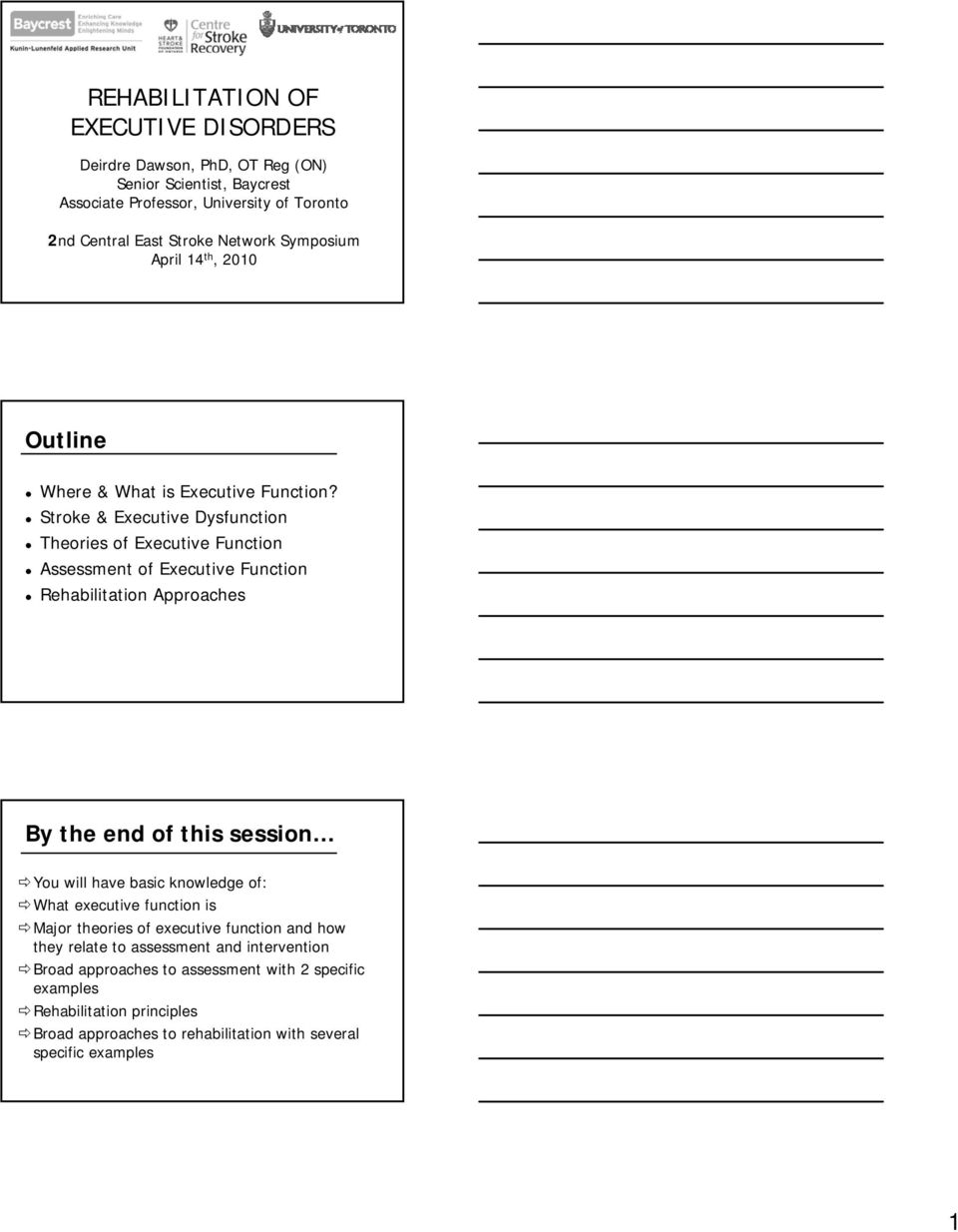
1 REHABILITATION OF EXECUTIVE DISORDERS Deirdre Dawson, PhD, OT Reg (ON) Senior Scientist, Baycrest Associate Professor, University of Toronto 2nd Central East Stroke Network Symposium April 14 th, 2010 Outline Where & What is Executive Function? Stroke & Executive Dysfunction Theories of Executive Function Assessment of Executive Function Rehabilitation Approaches By the end of this session You will have basic knowledge of: What executive function is Major theories of executive function and how they relate to assessment and intervention Broad approaches to assessment with 2 specific examples Rehabilitation principles Broad approaches to rehabilitation with several specific examples 1
2 Middle Cerebral Artery Anterior Communicating Artery What What are the skills of a Chief Executive Officer (CEO)? Executive Skills Planning Judgment Time sense Goal setting Monitoring Working memory Initiation Response inhibition Task persistence Generative thinking High level attention Awareness 2

3 Executive Function Integrative cognitive functions that determine goal-directed and purposeful behaviour and are superordinate in the orderly executive of daily life functions Cicerone et al., 2000 Sustained Attention to Response Test Robertson, Manly et al., 1997 A vigilance task predictive of everyday attentional failures and action slips in people with brain injuries and normal control participants Respond to all targets, withhold to rare targets (e.g., respond to every digit except 3 ) Task goal must be endogenously activated Arousal (cingulate/noradrenergic system) Goal representation (right prefrontal) Theories of Executive Dysfunction What is going on? Why are people making these errors? 3

4 The default mode * Actions are driven by immediate gratification and environmental triggers Behaviour is poorly modulated by context / experience There is a need for a buffer between stimulus and action * Mesulam, 2002 The default mode * To overcome this, executive control needs to be re-established Use of top-down approaches (internally driven,metacognitive strategies) Use of bottom-up strategies (externallybased cueing systems) * Mesulam, 2002 Assessment Standardized cognitive assessments Important, but often neglected outcomes of stroke are neuropsychological sequels, which occur in nearly half of stroke survivors (Dennis, O Rourke, Lewis, Sharpe, & Warlow,2000). Everyday life assessments 4

5 Sachdev et al., 2004, Neurology, 62, Value of Standardized Tests Strong psychometric properties Aid in diagnosis Provide a detailed profile of cognitive impairments Are modestly predictive of function Using New (to you) Standardized Tests Read & digest test manual Has the test been normed for your population? How good is the normative data? Is the test valid? Reliable? Familiarize self with test materials Pilot on several healthy controls Pilot on several patients /clients ideally be observed by experienced test giver and get feedback Interpret according to the manual. 5

6 Assessment of Executive Dysfunction Conundrum Executive dysfunction manifests itself in the unstructured, novel circumstances experienced in day-to-day life. Assessment & rehabilitation for executive dysfunction takes place almost exclusively in controlled, structured environments. International Classification of Functioning (WHO, 2000) cognitive, affective impairments Daily Life Performance Multiple Errands Test Original version by Shallice & Burgess (1991) 2 versions: Shopping Mall & Hospital Version Performance: correlates well with performance on executive function tests in samples of people with ABI; correlates well with other measures of daily life allows clinicians to make inferences about strategies and errors made in real-life and use these data to inform treatment Most recent version: Dawson et al., Arch Phys Med & Rehab,
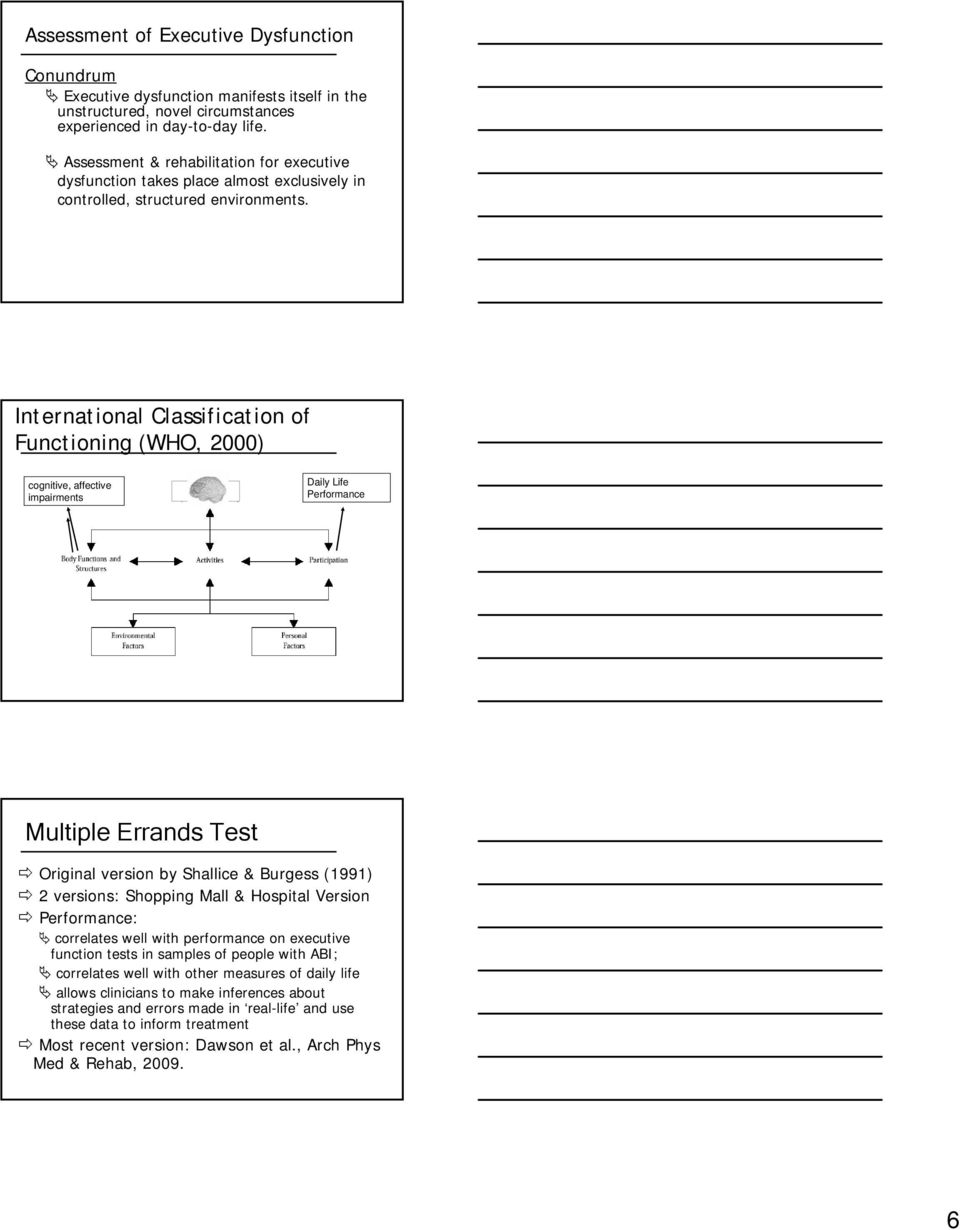
7 Multiple Errands Test Multiple Errands Test in ABI 10 Stroke 8 Control Tasks complete Errors Time? for Help 7

8 Considerations for rehabilitation Compensation vs remediation Outcomes are congruent with the intervention if intervening at the impairment level, changes cannot and should not be expected at the participation level (Wilson, 2002) Generalization does not just happen Client s goals are central Self-efficacy, coping, locus of control, optimism impact cognition and real-world performance Categories of Interventions Environmental Modifications Task-specific training Meta-cognitive training Process specific training Reduce distractions check lists Cueing devices Random alerting tones e.g., verbal self-instruction e.g., CO-OP limited evidence for generalization to daily life Training for Energization Timer/alarm watch Task-planner with built-in rest periods, reinforcement Symbol or cue card in work area 8

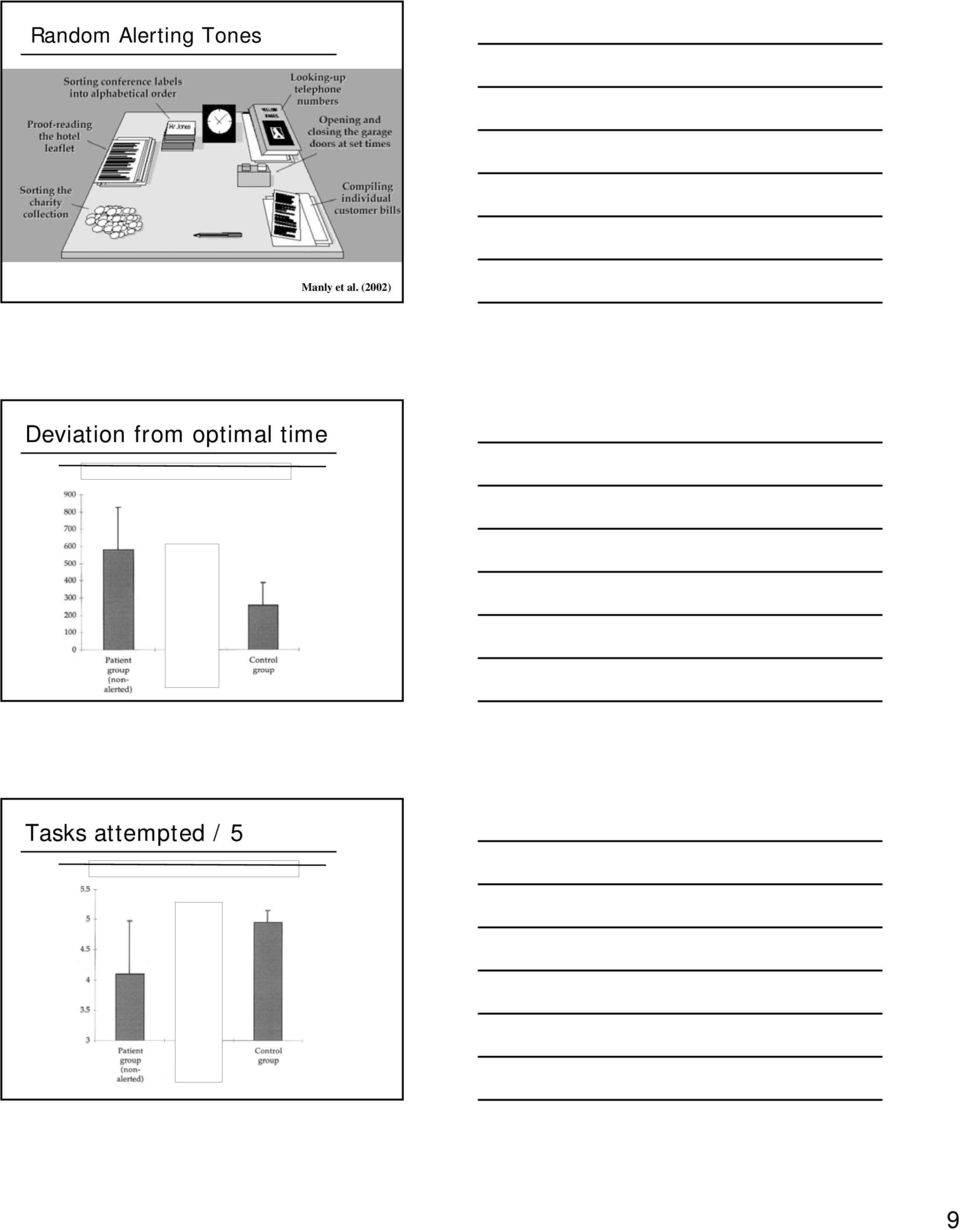
9 Random Alerting Tones Manly et al. (2002) Deviation from optimal time Tasks attempted / 5 9
10 Self-instructional Techniques self-talk Development of scripts to guide behaviour Overt rehearsal and training on steps Fading out of vocalization (if possible) Inner speech serves as action regulator Assists with self-regulation Problem-solving / Meta-cognitive Training Goal management Training (Levine 2002) Stop Define List Learn Do Check CO-OP (Dawson 2009) Goal Plan Do Check WSTC (Lawson & Rice, 1989) What should I be doing? Select a strategy. Try the strategy. Check the strategy. Problem-Solving (von Cramon, 1990) Orient to problem Define problem Generate alternatives Make a decision Do it. Verify the solution 10

11 CO-OP Used to overcome performance break-down participant is guided to use a meta-cognitive problem solving strategy* across self-identified functional goals * GOAL -PLAN -DO -CHECK Originally designed for use with children with DCD Currently showing promise in older adults with traumatic brain injury and stroke (Dawson et al., 2009; McEwen et al., 2009) Key elements of CO-OP participant active in identifying treatment goals task is observed to identify performance problems within the context of the global strategy therapists guide participants to discover domain specific strategies that will solve their performance problems, to make a plan significant others (SO) are involved to reinforce use of global and domain-specific strategies CO-OP Session Details Each session: review how participant has or could have used global strategy (goal-plan-do-check) in daily activities follow-up on homework train 2 goals / session review the goal develop and/or do plan collaborate with participant to identify specific strategies at places where performance breaks down assign homework and talk about use in other places 11
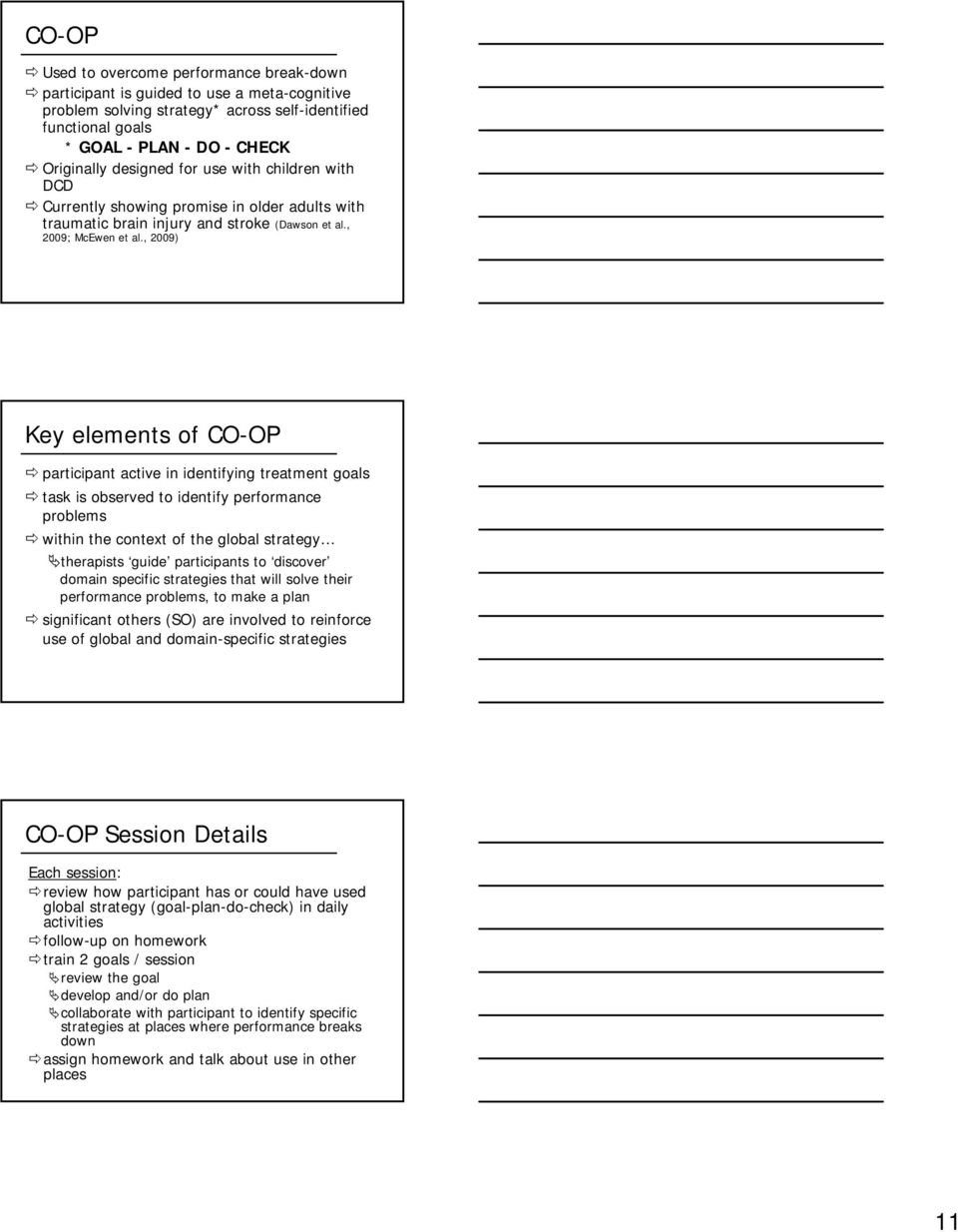
12 Evidence for efficacy of intervention Evidence for task-specific effects: Performance improvement met criterion in self-report and significant other report on trained goals (COPM); Evidence of generalization: Performance improvement met criterion in self-report and significant other report on untrained goals (COPM). Results: Performance Criterion Met Trained Goals Untrained Goals Self So Self So Sam 2 / 3 3 / 3 1 / 3 2 / 3 Jane 3 / 3 3 / 3 2 / 3 1 / 3 Gray 2 / 3 3 / 3 1 / 1 0 / 1 TOTAL 7 / 9 9 / 9 4 / 7 3 / 7 Goal Examples Jane: to schedule activities so they are balanced across the week Domain-specific strategies: purchase and make routine, use of purse-size daytimer Sam: make a menu, shop, cook the meal Domain-specific strategies: use of check-lists SOs to refer Sam to strategies rather than doing 12
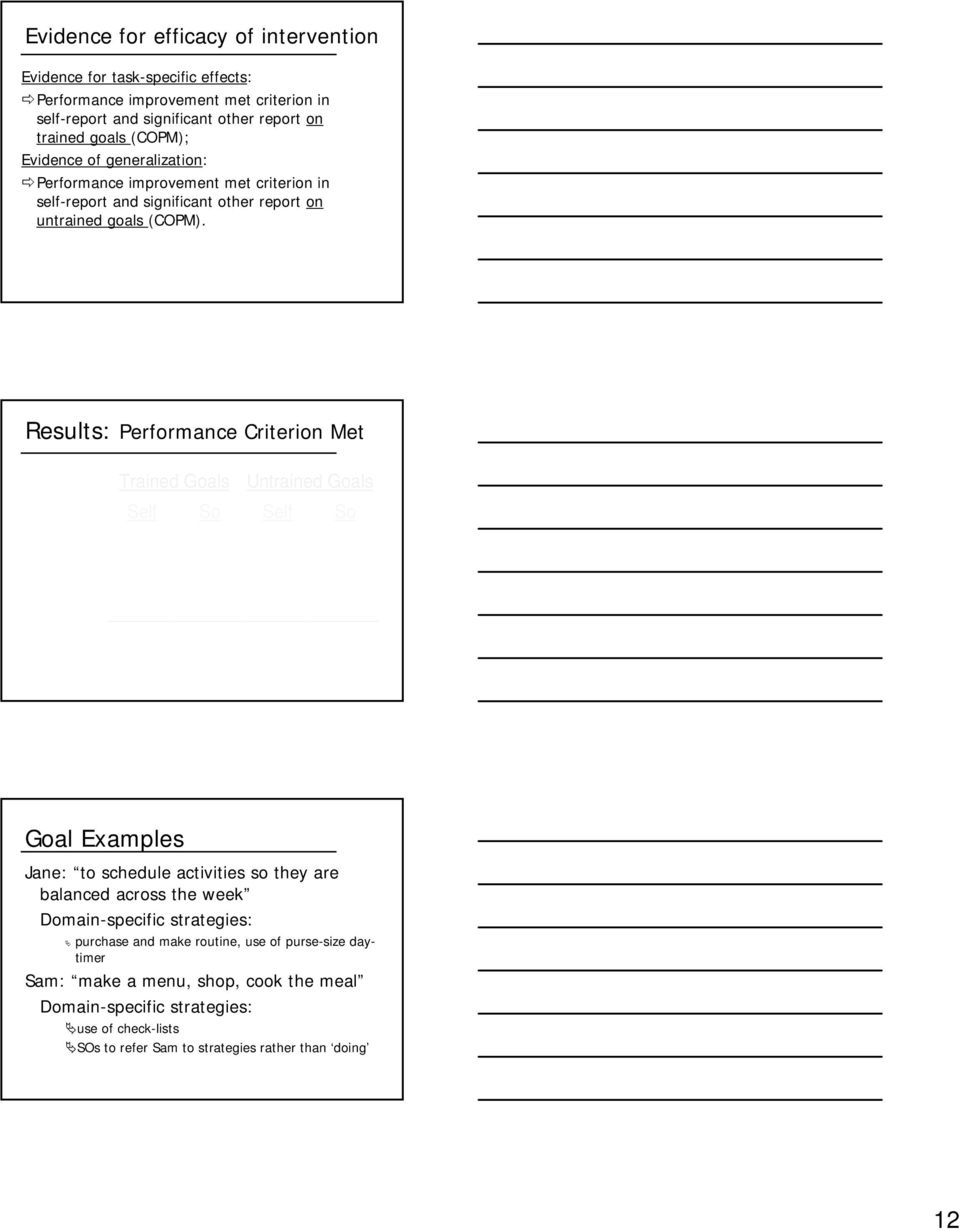
13 Goal Setting: COPM Canadian Occupational Performance Measure: Problem Definition a. Do you need to? If yes to either a,b, or c b. Do you want to? c. Are you expected to? d. Can you? And no to either d,e, or f e. Do you? f. Are you satisfied with the way you? COPM: Scoring How important is it to you to be able to do this activity? not able able to do it to do at all extremely well How would you rate the way you do this activity now? not able able to do it to do at all extremely well How satisfied are you with the way you do this activity now? not able able to do it to do at all extremely well A Helpful Resource 13

14 Summary Executive dysfunction occurs following stroke and is related to worse functional outcomes; Assessments of cognitive processes and the impact of executive function on real life are helpful; Research supports several types of intervention as having real-world impact. 14

COMPUTER-ADMINISTERED COGNITIVE REMEDIATION IN A FRAME OF HOLISTIC NEUROPSYCHOLOGICAL REHABILITATION: FORAMENREHAB PROGRAMS
 COMPUTER-ADMINISTERED COGNITIVE REMEDIATION IN A FRAME OF HOLISTIC NEUROPSYCHOLOGICAL REHABILITATION: FORAMENREHAB PROGRAMS Koskinen Sanna K Sarajuuri Jaana M Käpylä Rehabilitation Centre Nordenskiöldinkatu
Cognitive Rehabilitation of Blast Traumatic Brain Injury
 Cognitive Rehabilitation of Blast Traumatic Brain Injury Yelena Bogdanova, PhD VA Boston Healthcare System Rehabilitation Research & Development Boston University School of Medicine IOM Committee on Cognitive
www.projectlearnet.org WHAT IS COGNITIVE INTERVENTION/REHABILITATION?
 Tutorial: Cognitive Intervention/Rehabilitation (See Tutorials on Cognition; Transfer/Generalization; Instructional Routines; Attention; Memory and Memory Problems; Organization; Problem Solving; Concrete
Potential Application of Lifelogging Technology (SenseCam) in Rehabilitation
 Potential Application of Lifelogging Technology (SenseCam) in Rehabilitation Dr Fergus Gracey, Consultant Clinical Neuropsychologist Lara Harris, Louise Head, Kate Psaila, Cat Ford Oliver Zangwill Centre
The Executive Function Task Application Model (EFTAM): development and application
 The Executive Function Task Application Model (EFTAM): development and application Charlie Chung 1, Alex Pollock 2, Tanya Campbell 3, Brian Durward 4 1 Occupational Therapy, NHS Fife, Dunfermline 2 Nursing
MEDICAL POLICY SUBJECT: COGNITIVE REHABILITATION. POLICY NUMBER: 8.01.19 CATEGORY: Therapy/Rehabilitation
 MEDICAL POLICY SUBJECT: COGNITIVE REHABILITATION PAGE: 1 OF: 5 If the member's subscriber contract excludes coverage for a specific service it is not covered under that contract. In such cases, medical
James F. Malec, PhD, ABPP-Cn, Rp Professor & Research Director PM&R, Indiana University School of Medicine Rehabilitation Hospital of Indiana
 James F. Malec, PhD, ABPP-Cn, Rp Professor & Research Director PM&R, Indiana University School of Medicine Rehabilitation Hospital of Indiana Indianapolis, IN Professor Emeritus of Psychology, Mayo Clinic,
The Planning and Execution Assistant and Trainer (PEAT) The challenge of impaired executive functions
 The Journal of Head Trauma Rehabilitation, April 1997 The Planning and Execution Assistant and Trainer (PEAT) Richard Levinson, Attention Control Systems, Inc. Introduction Meet PEAT, the Planning and
Cognitive Rehabilitation Evidence- Based Practices. Cynthia Griggins, PhD Neuropsychologist, Neurological Institute UHCMC
 1 Cognitive Rehabilitation Evidence- Based Practices Cynthia Griggins, PhD Neuropsychologist, Neurological Institute UHCMC 2 What is Cognitive Rehab? Goal: ameliorate injury-related cognitive deficits
EpicRehab, LLC To re c ogniz e a nd de v e lop the v a l u e in e a c h of us.
 EpicRehab, LLC To re c ogniz e a nd de v e lop the v a l u e in e a c h of us. ABSTRACT Title: Situational Assessment as a Measure of Work-Related Executive Function Principal Investigator: Leonard N.
A New Vision of Rehabilitation Recovering cognitive abilities with Dynavision
 June 15, 2010 A New Vision of Rehabilitation Recovering cognitive abilities with Dynavision Occupational therapists are constantly striving to find the evidence-based interventions that will help clients
Visual spatial search task (VISSTA): a computerized assessment and training program
 Visual spatial search task (VISSTA): a computerized assessment and training program A Bar-Haim Erez¹, R Kizony², M Shahar³ and N Katz¹ 1 School of Occupational Therapy, Hebrew University & Hadassah, Jerusalem
Behaviour Management: Partnering To Bridge The Continuum. Presented by: Nancy Boaro, MN, CNN(C), CRN(C) Karey-Anne Fannon, BA, BST, RRP.
 Behaviour Management: Partnering To Bridge The Continuum Presented by: Nancy Boaro, MN, CNN(C), CRN(C) Karey-Anne Fannon, BA, BST, RRP Objectives Review some of the behaviours exhibited by patients with
Integrated Neuropsychological Assessment
 Integrated Neuropsychological Assessment Dr. Diana Velikonja C.Psych Neuropsychology, Hamilton Health Sciences, ABI Program Assistant Professor, Psychiatry and Behavioural Neurosciences Faculty of Health
Cognitive behavioral therapy (CBT) may improve the home behavior of children with Attention Deficit/Hyperactivity Disorder (ADHD).
 ADHD 4 Cognitive behavioral therapy (CBT) may improve the home behavior of children with Attention Deficit/Hyperactivity Disorder (ADHD). CITATION: Fehlings, D. L., Roberts, W., Humphries, T., Dawe, G.
Sarah Levin Allen, Ph.D., CBIS Executive Director, Brain Behavior Bridge Assistant Professor, Philadelphia College of Osteopathic Medicine Pediatric
 Sarah Levin Allen, Ph.D., CBIS Executive Director, Brain Behavior Bridge Assistant Professor, Philadelphia College of Osteopathic Medicine Pediatric & NJ School Neuropsychologist www.brainbehaviorbridge.com
RESTORATIVE TECHNIQUES IN COGNITIVE REHABILITATION: PROGRAM DESIGN AND CLINICAL BENEFITS
 RESTORATIVE TECHNIQUES IN COGNITIVE REHABILITATION: PROGRAM DESIGN AND CLINICAL BENEFITS In the treatment of traumatic brain injury, cognitive rehabilitation is an intervention that seeks to improve cognitive
Memory Rehabilitation in Early Dementia. Diana Golvers Clinical Psychologist Central Dementia Service
 Memory Rehabilitation in Early Dementia Diana Golvers Clinical Psychologist Central Dementia Service Loss of Memory in AD Memory impairment earliest manifestation of AD and other dementias Major impact
Citation: Robertson, I.H., Gray, J.M., Pentland, B., & Waite, L.J. (1990). Microcomputerbased
 A computer-based cognitive rehabilitation program, involving scanning training twice a week for 7 weeks, did not improve cognitive function in patients with unilateral left visual neglect. Prepared by:
Executive Function Capacities:
 Executive Function Capacities: It s not not knowing what to do; it s knowing to do what you know. Lisa A. Perkins, Psy. D. Westport Public Schools Questions about Your Executive Function Capacities? How
The Role of Neuropsychological Testing in Guiding Decision- Making Related to Dementia
 The Role of Neuropsychological Testing in Guiding Decision- Making Related to Dementia By Scott Knight, Director, SLR Diagnostics & Assessments, a division of Sibley & Associates Inc., and Konstantine
Cognitive Rehabilitation Task Force
 Cognitive Rehabilitation Task Force March 2, 2011 April 15, 2011 This report was compiled and authored by Lynn Janssen in partnership with the ACBI Cognitive Rehabilitation Task Force with the support
School-based Interventions for Executive Function Following Childhood Traumatic Brain Injury
 School-based Interventions for Executive Function Following Childhood Traumatic Brain Injury Erica Fornaris, M.Ed. Spring 2016 Abstract Childhood TBI EF Interventions Positive Behavior The goal of this
EMOTIONAL AND BEHAVIOURAL CONSEQUENCES OF HEAD INJURY
 Traumatic brain injury EMOTIONAL AND BEHAVIOURAL CONSEQUENCES OF HEAD INJURY Traumatic brain injury (TBI) is a common neurological condition that can have significant emotional and cognitive consequences.
Behavior Rating Inventory of Executive Function BRIEF. Interpretive Report. Developed by. Peter K. Isquith, PhD, Gerard A. Gioia, PhD, and PAR Staff
 Behavior Rating Inventory of Executive Function BRIEF Interpretive Report Developed by Peter K. Isquith, PhD, Gerard A. Gioia, PhD, and PAR Staff Client Information Client Name : Sample Client Client ID
Information for Applicants
 Graduate Studies in Clinical Psychology at the University of Victoria Information for Applicants Program Philosophy and Mission Our CPA-accredited graduate program in clinical psychology is based on the
Occupational Therapy Treatment for People with Cognitive Limitations: Position paper
 Occupational Therapy Treatment for People with Cognitive Limitations: Position paper Background The purpose of a position paper is to present the professional stance regarding a given topic. The Senior
Cognitive Orientation to daily Occupational Performance (CO-OP) Polatajko & Mandich, 2010
 Cognitive Orientation to daily Occupational Performance (CO-OP) Polatajko & Mandich, 2010 1 Goal of the Presentation An introduction to this task oriented / occupation based aproach Create: A general understanding
Time is Function. Company LOGO. what we ve learned. I m hoping today has been an opportunity to take time out from the constancy of work and get your.
 Time is Function Company LOGO what we ve learned I m hoping today has been an opportunity to take time out from the constancy of work and get your. [email protected] July 2012 in the next
CRITICALLY APPRAISED PAPER (CAP)
 CRITICALLY APPRAISED PAPER (CAP) FOCUSED QUESTION Does a neurocognitive habilitation therapy service improve executive functioning and emotional and social problem-solving skills in children with fetal
Executive Functions: Developing an Independent Learner NOVEMBER 12, 2014 KATHLEEN BRUNSWICK, MA JEFFREY A. DETESO, PH.D.
 Executive Functions: Developing an Independent Learner NOVEMBER 12, 2014 KATHLEEN BRUNSWICK, MA JEFFREY A. DETESO, PH.D. What do Independent Learners Look Like? Independent Learner Characteristics 1) Curious
Part 1 Cognition and the Occupational Therapy Process
 Part 1 Cognition and the Occupational Therapy Process Part 1 delineates and describes the practice of occupational therapy in relation to the needs of people with cognitive impairments. It consists of
Critical Review: The efficacy of cognitive rehabilitation approaches for recovery of memory impairments following stroke
 Copyright 2007 by Coulas, V. Critical Review: The efficacy of cognitive rehabilitation approaches for recovery of memory impairments following stroke Coulas, V. M.Cl.Sc. (SLP) Candidate School of Communication
Brief, Evidence Based Review of Inpatient/Residential rehabilitation for adults with moderate to severe TBI
 Brief, Evidence Based Review of Inpatient/Residential rehabilitation for adults with moderate to severe TBI Reviewer Peter Larking Date Report Completed 7 October 2011 Important Note: This brief report
Behavior Rating Inventory of Executive Function - Adult Version BRIEF-A. Interpretive Report. Developed by
 Behavior Rating Inventory of Executive Function - Adult Version BRIEF-A Interpretive Report Developed by Peter K. Isquith, PhD, Robert M. Roth, PhD, Gerard A. Gioia, PhD, and PAR Staff Client Information
Paying Attention to Executive Functioning. Charlene J Barva PhD RPsych Calgary Board of Education. Kelly Schwartz PhD RPsych University of Calgary
 This edition of Getting Schooled focuses on Executive Functioning. Drs. Barva, Schwartz and Zwiers have provided us with an overview of Executive Functioning that includes assessment considerations and
Metacognitive Strategies for Adolescents with an FASD Marnie Hutchison, MEd Jacqueline Pei, PhD Kimberly Kerns, PhD Carmen Rasmussen, PhD Kennedy
 Metacognitive Strategies for Adolescents with an FASD Marnie Hutchison, MEd Jacqueline Pei, PhD Kimberly Kerns, PhD Carmen Rasmussen, PhD Kennedy Denys Jennifer MacSween Learning Objectives 1. Gain an
Rehabilitation of Learning Disabilities in Finland 11.3.2014
 Rehabilitation of Learning Disabilities in Finland 11.3.2014 Johanna Nukari, Neuropsychologist Rehabilitation Foundation [email protected] 4.3.2014 1 Topics of the presentation On the concept
Neuropsychological Assessment and Rehabilitation: Person Centered Principles and Methods
 Neuropsychological Assessment and Rehabilitation: Person Centered Principles and Methods Presented at The Brain Injury Association of Pennsylvania Annual Conference on June 23, 2009. Presenters Mick Sittig,
National Stroke Association s Guide to Choosing Stroke Rehabilitation Services
 National Stroke Association s Guide to Choosing Stroke Rehabilitation Services Rehabilitation, often referred to as rehab, is an important part of stroke recovery. Through rehab, you: Re-learn basic skills
Executive. Presented by Patti Jenks Principal, ASSETS High School
 Executive Function Presented by Patti Jenks Principal, ASSETS High School 4 Major Lobes of the Brain Another look inside. How does the brain work? Parietal Lobe - orientation, calculation, certain types
Executive Function Remediation/Compensation Strategies
 Executive Function Remediation/Compensation Strategies In general: Osmosis won t work; teach the skills Keep in mind the concept of plasticity, the brains ability, through effort, positive reinforcement,
Outpatient Neurological Rehabilitation Victoria General Hospital. Pam Loadman BSC.P.T., MSc. Physiotherapist
 Outpatient Neurological Rehabilitation Victoria General Hospital Pam Loadman BSC.P.T., MSc. Physiotherapist OPN - overview Who we see: Inclusion criteria Diagnoses Who we are: Clinicians involved What
The PEDS Model of Child Neuropsychological Rehabilitation
 The PEDS Model of Child Neuropsychological Rehabilitation Jonathan Reed, Katie Byard and Howard Fine Recolo UK Ltd Introduction When a child suffers a traumatic brain injury (TBI) or a brain injury as
Attention & Memory Deficits in TBI Patients. An Overview
 Attention & Memory Deficits in TBI Patients An Overview References Chan, R., et.al.. (2003). Are there sub-types of attentional deficits in patients with persisting post- concussive symptoms? A cluster
Attention, memory and learning and acquired brain injury. Vicki Anderson. Jamie M. Attention & learning: an information processing model
 Attention, memory and learning and acquired brain injury Vicki Anderson Jamie M. Childhood acquired amnesia Attention & learning: an information processing model MANAGEMENT Organising, problem solving
Occupational Therapy in Cognitive Rehabilitation
 Occupational Therapy in Cognitive Rehabilitation Connie MS Lee Occupational therapist Queen Mary Hospital Hong Kong Cognition Cognition refers to mental processes that include the abilities to concentrate,
TORONTO STROKE FLOW INITIATIVE - Inpatient Rehabilitation Best Practice Recommendations Guide (updated January 23, 2014)
 TORONTO STROKE FLOW INITIATIVE - Inpatient Rehabilitation Best Practice Guide (updated January 23, 2014) Objective: To enhance system-wide performance and outcomes for persons with stroke in Toronto. Goals:
Neuropsychological assessment clinic
 Neuropsychological assessment clinic Information for families and professionals Ealing child and adolescent mental health service Learning disabilities (CAMHS-LD) August 2014 What is a neuropsychological
The Handbook of Clinical Neuropsychology
 Oxford Scholarship Online You are looking at 1-10 of 44 items for: keywords : Church of God psyclin psyneu The Handbook of Clinical Neuropsychology John Marshall Jennifer Gurd and Udo Kischka (eds) Item
Executive Function and Student Success Karen Boutelle Associate Director [email protected]
 Executive Function and Student Success Karen Boutelle Associate Director [email protected] What do successful students do? Learn academic content And This workshop will help you: Explore and develop
Recovering from a Mild Traumatic Brain Injury (MTBI)
 Recovering from a Mild Traumatic Brain Injury (MTBI) What happened? You have a Mild Traumatic Brain Injury (MTBI), which is a very common injury. Some common ways people acquire this type of injury are
THE COGNITIVE REHABILITATION Task Force of the
 REVIEW ARTICLE (META-ANALYSIS) Evidence-Based Cognitive Rehabilitation: Updated Review of the Literature From 2003 Through 2008 Keith D. Cicerone, PhD, Donna M. Langenbahn, PhD, Cynthia Braden, MA, CCC-SLP,
Functional Treatment Ideas
 I n t e r n a t i o n a l C l i n i c a l E d u c a t o r s, i n c. Functional Treatment Ideas and Strategies In Adult Hemiplegia s e c o n d e d i t i o n By Jan Davis, MS, OTR/L Video Registration No.
Frequently Asked Questions
 Frequently Asked Questions Business Office: 598 Airport Boulevard Suite 1400 Morrisville NC 27560 Contact: [email protected] Phone: 888.750.6941 Fax: 888.650.6795 www.cognitrax.com Diseases of the
Discharge planning. Rehabilitation Center at Scripps Memorial Hospital Encinitas. Discharge Planning. General rehab diagnosis
 Discharge planning with Case Managers Paul Kelsey R.N., C.C.M Joan Wilson R.N.,C.R.R.N.,C.C.M Rehabilitation Center at Scripps Memorial Hospital Encinitas Discharge Planning There are no EASY rehab patients
Recommended Practices For Assessment, Diagnosis and Documentation of Learning Disabilities
 LEARNING DISABILITIES ASSOCIATION OF ONTARIO Recommended Practices For Assessment, Diagnosis and Documentation of Learning Disabilities Diagnosis of Learning Disabilities Accurate diagnosis of learning
CURRICULUM VITAE. JEAN TAYLOR, B.Sc.(Hons. Kin.) Registered Kinesiologist PROFESSIONAL EXPERIENCE
 CURRICULUM VITAE JEAN TAYLOR, B.Sc.(Hons. Kin.) Registered Kinesiologist PROFESSIONAL EXPERIENCE ABI Clinical Consultant ABI Transitional Living Program August 2013 to Present Design, develop and implement
Importance, Selection and Use of Outcome Measures. Carolyn Baum, PhD, OTR, FAOTA Allen Heinemann, PhD, ABPP (RP), FACRM
 Importance, Selection and Use of Outcome Measures Carolyn Baum, PhD, OTR, FAOTA Allen Heinemann, PhD, ABPP (RP), FACRM Objectives 1. Understand the Changing Medical System and the Changing Focus of Assessments
Cognitive Rehabilitation A service user`s journey
 Cognitive Rehabilitation A service user`s journey Dr Ena Lavelle, Consultant in Rehabilitation Psychiatry Dublin South/South West Mental Health Services Acknowledgements: Ms. Susan Kehoe, Senior Occupational
Strategies to Address Weak Executive Functioning Skills. Melissa Trautman, M.S. Ed Southeast ASD Regional Coordinator mtrautman@esu6.
 Strategies to Address Weak Executive Functioning Skills Melissa Trautman, M.S. Ed Southeast ASD Regional Coordinator [email protected] 402-761-3341 Agenda What is Executive Functioning (EF) Definition
A Virtual Reality Environment for Prospective Memory Training
 A Virtual Reality Environment for Prospective Memory Training Antonija Mitrovic 1,*, Moffat Mathews 1, Stellan Ohlsson 2, Jay Holland 1, Audrey McKinlay 3, Scott Ogden 1, Anthony Bracegirdle 1, Sam Dopping-Hepenstal
Early Response Concussion Recovery
 Early Response Concussion Recovery KRISTA MAILEY, BSW RSW, CONCUSSION RECOVERY CONSULTANT CAREY MINTZ, PH.D., C. PSYCH., PRACTICE IN CLINICAL NEUROPSYCHOLOGY FOR REFERRAL: Contact Krista Mailey at (204)
Montreal Cognitive Assessment (MoCA) as Screening tool for cognitive impairment in mtbi.
 Montreal Cognitive Assessment (MoCA) as Screening tool for cognitive impairment in mtbi. Suresh Kumar, M.D. AUTHOR Director of: Neurology & Headaches Center Inc. Neurocognitve &TBI Rehabilitation Center
Woods Traumatic Brain Injury Symposium
 Woods Traumatic Brain Injury Symposium Veterans Health Affairs (VHA) Polytrauma/Traumatic Brain Injury (TBI) System of Care Philadelphia, PA September 28, 2013 VHA/Polytrauma/TBI Program: Presenters Keith
Executive Functions. what are they how do they affect your child how can you help your child who has vulnerable EF skills. Joyce M.
 Executive Functions what are they how do they affect your child how can you help your child who has vulnerable EF skills Joyce M. Ball 4/29/09 Let s see what we know about EF. What does executive functioning
Icanho. Brain injury rehabilitation service. Stowmarket, Suffolk
 Icanho Brain injury rehabilitation service Stowmarket, Suffolk Contents Welcome to Icanho Icanho provides highly specialised, community-based rehabilitation for adults with acquired brain injury, including
Occupational Therapy Assisting STARK STATE COLLEGE OF TECHNOLOGY
 Occupational Therapy Assisting STARK STATE COLLEGE OF TECHNOLOGY Presented by The OTA class of Spring 2010 What is Occupational Therapy? Occupation: Activity in which one engages Therapy: Treatment of
ABA AND RDI. Therapy vs. RDI Life Style ABA
 AND Therapy vs. Life Style Typically with parents hire a staff to work with their child. These therapists work with the child during scheduled therapy times. If parents work with their child, they need
Executive dysfunction after brain injury
 Executive dysfunction after brain injury Introduction Executive dysfunction is a term for the range of cognitive, emotional and behavioural difficulties which often occur after injury to the frontal lobes
Good Samaritan Inpatient Rehabilitation Program
 Good Samaritan Inpatient Rehabilitation Program Living at your full potential. Welcome When people are sick or injured, our goal is their maximum recovery. We help people live to their full potential.
What is rehabilitation?
 Maximising rehabilitation potential in people living with dementia Aims for today What the current research evidence tell us about rehabilitation approaches for people with dementia Approaches to maximise
Manifesto for Acquired Brain Injury Rehabilitation
 Manifesto for Acquired Brain Injury Rehabilitation For further information please contact: Chloë Hayward UKABIF Executive Director PO Box 355 Plymouth PL3 4WD Tel: 01752 601318 Email: [email protected]
INTERPROFESSIONAL LEARNING OBJECTIVES FOR STROKE CARE INTRODUCTION
 INTERPROFESSIONAL LEARNING OBJECTIVES FOR STROKE CARE INTRODUCTION Supporting Interprofessional Education through Shared Learning Opportunities APRIL 2007 Interprofessional Learning Objectives for Stroke
Employment after Traumatic Brain Injury. Living with Brain Injury
 Employment after Traumatic Brain Injury Living with Brain Injury This brochure was developed for friends, family members, and caregivers of persons with brain injury. It also may be used in discussions
USING TELE-REHABILITATION TO ADDRESS EXECUTIVE DYSFUNCTION AND TO PROMOTE COMMUNITY INTEGRATION AFTER TRAUMATIC BRAIN INJURY: A PILOT STUDY
 USING TELE-REHABILITATION TO ADDRESS EXECUTIVE DYSFUNCTION AND TO PROMOTE COMMUNITY INTEGRATION AFTER TRAUMATIC BRAIN INJURY: A PILOT STUDY By Edith Man Wai Ng A thesis submitted in conformity with the
Family Focused Therapy for Bipolar Disorder (Clinical Case Series) Participant Information Sheet
 Family Focused Therapy for Bipolar Disorder (Clinical Case Series) Participant Information Sheet Study Title: Family Focused Therapy for Bipolar Disorder: A Clinical Case Series) We would like to invite
A modified version of the Task Force Report will be published in Archives of Physical Medicine and Rehabilitation
 Cognitive Rehabilitation for Traumatic Brain Injury and Stroke: Updated Review of the Literature from 1998 through 2002 with Recommendations for Clinical Practice Report of the Cognitive Rehabilitation
Smart Isn t Everything: The Importance of Neuropsychological Evaluation for Students and Individuals on the Autism Spectrum
 Smart Isn t Everything: The Importance of Neuropsychological Evaluation for Students and Individuals on the Autism Spectrum Ilene Solomon, Ph.D., Spectrum Services The decision to have a child or adolescent
DEFINITIONS OF AREAS OF COMPETENCE
 DEFINITIONS OF AREAS OF COMPETENCE All Registered Psychologist or Psychological Associate members of the Psychological Association of Manitoba (regardless of their areas of demonstrated competence), are
Helping your child with Non-verbal Learning Disability
 Helping your child with Non-verbal Learning Disability What is non-verbal learning disability? Non-verbal learning disability (NVLD) is a term used to describe a pattern of strengths and weaknesses in
Overview. Neuropsychological Assessment in Stroke. Why a Neuropsychologist. How to make a referral. Referral Questions 11/6/2013
 Overview Neuropsychological Assessment in Stroke Brandon Ally, PhD Department of Neurology What is Neuropsychology Stroke Specific Neuropsychology Neuropsychological Domains Case Study What is Neuropsychology?
Rehabilitation Therapies
 Bluebonnet Medical Rehabilitation Hospital Rehabilitation Therapies 512-444-4835 or 800-252-5151 www.texasneurorehab.com Austin, Texas What Sets Us Apart Rehabilitation Therapies Physical Therapy - Neuromuscular
Clinical Medical Policy Cognitive Rehabilitation
 Benefit Coverage Outpatient cognitive rehabilitation is considered to be the most appropriate setting for members who have sustained a traumatic brain injury or an acute brain insult. Covered Benefit for
TORONTO STROKE FLOW INITIATIVE - Outpatient Rehabilitation Best Practice Recommendations Guide (updated July 26, 2013)
 Objective: To enhance system-wide performance and outcomes for persons with stroke in Toronto. Goals: Timely access to geographically located acute stroke unit care with a dedicated interprofessional team
Module V. Neuropsychological Assessments. "The Impact"
 Module V. Neuropsychological Assessments "The Impact" Module V - Neurological Assessments Page 2 of 22 Instructions to This Module: - If you have questions we encourage you to talk to your supervisor or
Why study clinical neuropsychology?
 University Leiden, The Netherlands Master (MSc) in Clinical Neuropsychology [email protected] www.neuropsychologie.leidenuniv.nl Why study clinical neuropsychology? You are interested in: brain/behavior