
PSA 2015 Step by Step Guide is published by Assistance Software. All rights reserved. No part of this publication may be Projects reproduced.
|
|
|
- Reginald Wade
- 10 years ago
- Views:
Transcription
1 Step by Step Guide PSA 2015 Module BAFPA Methodology 4.2 & Budget 4.3 Project sales forecast 4.4 Project & Resource planning 4.5 Utilization Sheet 4.6 CRM Appointments and Group calendar 4.7 Programs PSA 2015 (Release ) PSA 2015 Step by Step Guide is published by Assistance Software. All rights reserved. No part of this publication may be reproduced. The 1 information contained in this guide is provided without any express, statutory, or implied warranties. Assistance Software will not be held liable for any damages caused or alleged to be caused either directly or indirectly by this guide. (C) Copyright 2015 Assistance Software

2 Module 4. Contents... 1 INTRODUCTION... 5 MODULE 4. PROJECTS... 6 Overview BAFPA METHODOLOGY... 8 THE BAFPA METHODOLOGY... 8 THREE LEVELS OF PROJECT MANAGEMENT PROJECTS AND BUDGET INTRODUCTION What you will learn in this section PROJECTS AND BUDGET Introduction Exercise 1: Create a T&M and Fixed Fee project with Products Step 1: Create your project Step 2: Create your budget (and estimated profitability) Step 3: Finalize your project Exercise 2: Create a Fixed Fee project Step 1: Create your project Step 2: Create your budget (and estimated profitability) Step 3: Finalize your project Exercise 3: Create a T&M (daily rate) project Step 1: Create your project Step 2: Create your budget Step 3: Finalize your project Exercise 4: Create a Recurring project Step 1: Create your project Step 2: Define your recurring amounts Step 3: Finalize your project

3 Exercise 5: Create a direct sales project Step 1: Create your project Step 2: Relate the CRM products to your project Step 3: Finalize your project Exercise 6: Create an internal project Step 1: Create your project Exercise 7: Copy a project Step 1: Create your project Step 2: Create your budget (and estimated profitability) Step 3: Finalize your project PROJECT FORECAST INTRODUCTION What you will learn in this section PROJECT FORECAST Introduction Exercise 1: Generate the Forecast of a T&M project Exercise 2: Generate the Forecast of a Fixed Fee project Exercise 3: Generate the Forecast of a recurring project Exercise 4: View your Forecast in the overall Forecast grid of PSA PROJECT AND RESOURCE PLANNING INTRODUCTION What you will learn in this section PROJECT AND RESOURCE PLANNING Introduction Exercise 1: Create a project with Project Item Activities Step 1: Create your Project Step 2: Generate your budget and sales forecast Step 3: Assign a project item activity to a single resource Step 4: Assign a project item activity to multiple resources Step 5: Assign a project item activity to a CRM team Step 6: Modify the assignment of a project item activity Step 7: Set a project item activity as tentative
4 Step 8: Generate the estimated profitability of your project Step 9: Finalize your project UTILIZATION SHEET INTRODUCTION What you will learn in this section UTILIZATION SHEET Introduction Exercise 1: Understand the Utilization Sheet Exercise 2: Assign an activity from the Utilization Sheet Step 1: Assign an activity from a CRM Team to a resource Step 2: Modify the activity of a resource in order to assign it to another resource Exercise 3: Make use of the Bing Maps functionality in the Utilization sheet CRM APPOINTMENTS AND GROUP CALENDAR INTRODUCTION What you will learn in this section CRM APPOINTMENTS AND GROUP CALENDAR Introduction Exercise 1. Schedule a resource directly from your project PROGRAMS INTRODUCTION What you will learn in this section PROGRAMS Introduction Exercise 1. Create a program
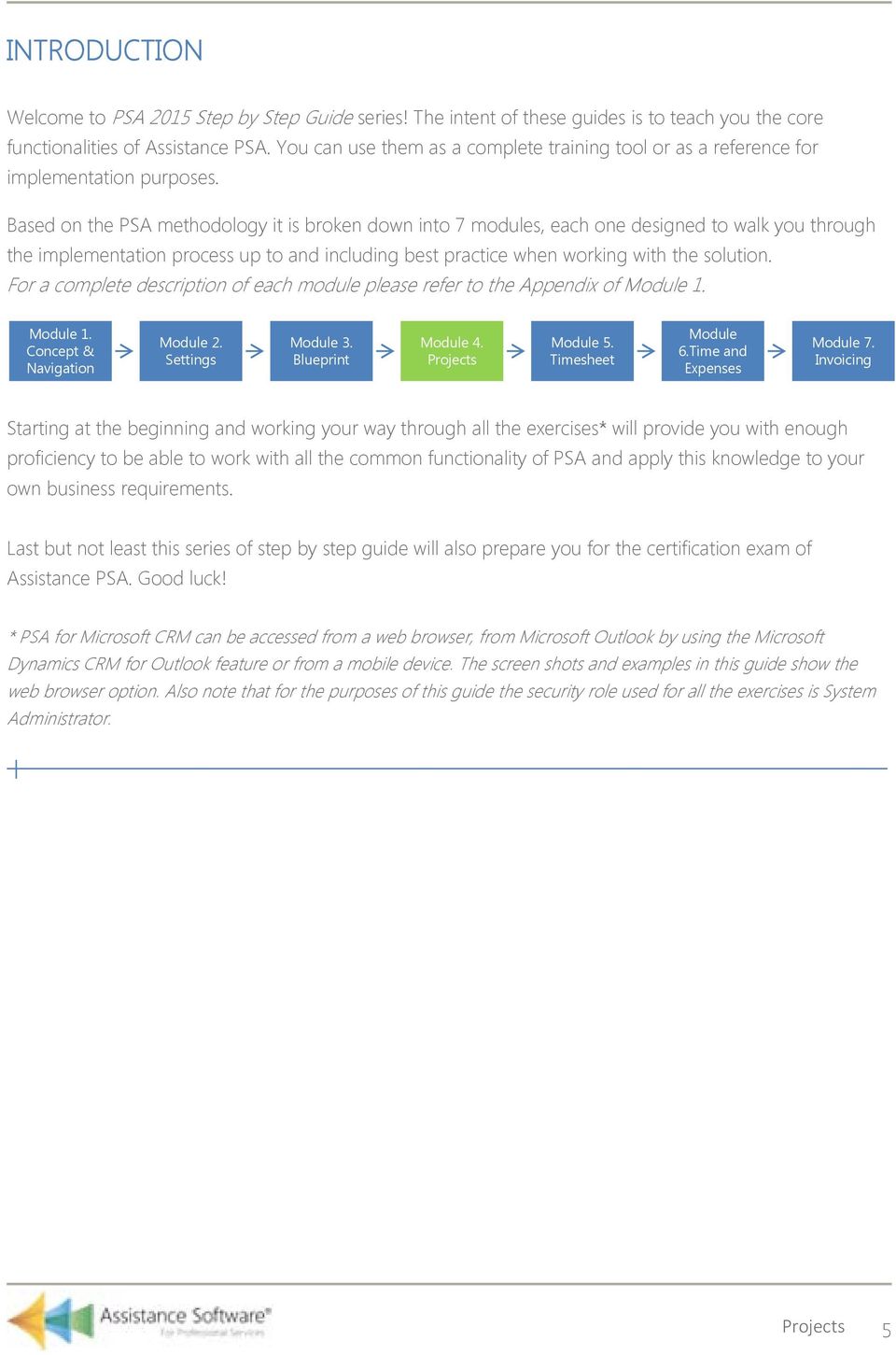
5 INTRODUCTION Welcome to PSA 2015 Step by Step Guide series! The intent of these guides is to teach you the core functionalities of Assistance PSA. You can use them as a complete training tool or as a reference for implementation purposes. Based on the PSA methodology it is broken down into 7 modules, each one designed to walk you through the implementation process up to and including best practice when working with the solution. For a complete description of each module please refer to the Appendix of Module 1. Module 1. Concept & Navigation Module 2. Settings Module 3. Blueprint Module 4. Module 5. Timesheet Module 6.Time and Expenses Module 7. Invoicing Starting at the beginning and working your way through all the exercises* will provide you with enough proficiency to be able to work with all the common functionality of PSA and apply this knowledge to your own business requirements. Last but not least this series of step by step guide will also prepare you for the certification exam of Assistance PSA. Good luck! * PSA for Microsoft CRM can be accessed from a web browser, from Microsoft Outlook by using the Microsoft Dynamics CRM for Outlook feature or from a mobile device. The screen shots and examples in this guide show the web browser option. Also note that for the purposes of this guide the security role used for all the exercises is System Administrator. 5
6 MODULE 4. PROJECTS Overview This step by step guide is the fourth of the series and covers the creation of different types of projects, with a focus on Assistance PSA s BAFPA methodology (Budget, Agreement, Forecast, Planning and Actuals) and the three levels of project management available in the solution. The guide also includes the creation of Programs. In this module you will: Have an understanding of the BAFPA methodology of Assistance PSA and the three levels of project management of the solution Create Define your Project s budget Generate your Project s forecast Create Project and resource planning Work with the Utilization Sheet Work with CRM appointments Create Programs 6

7 4.1 BAFPA METHODOLOGY PSA 2015 Step by Step Guide 4.1: The BAFPA Methodology 7

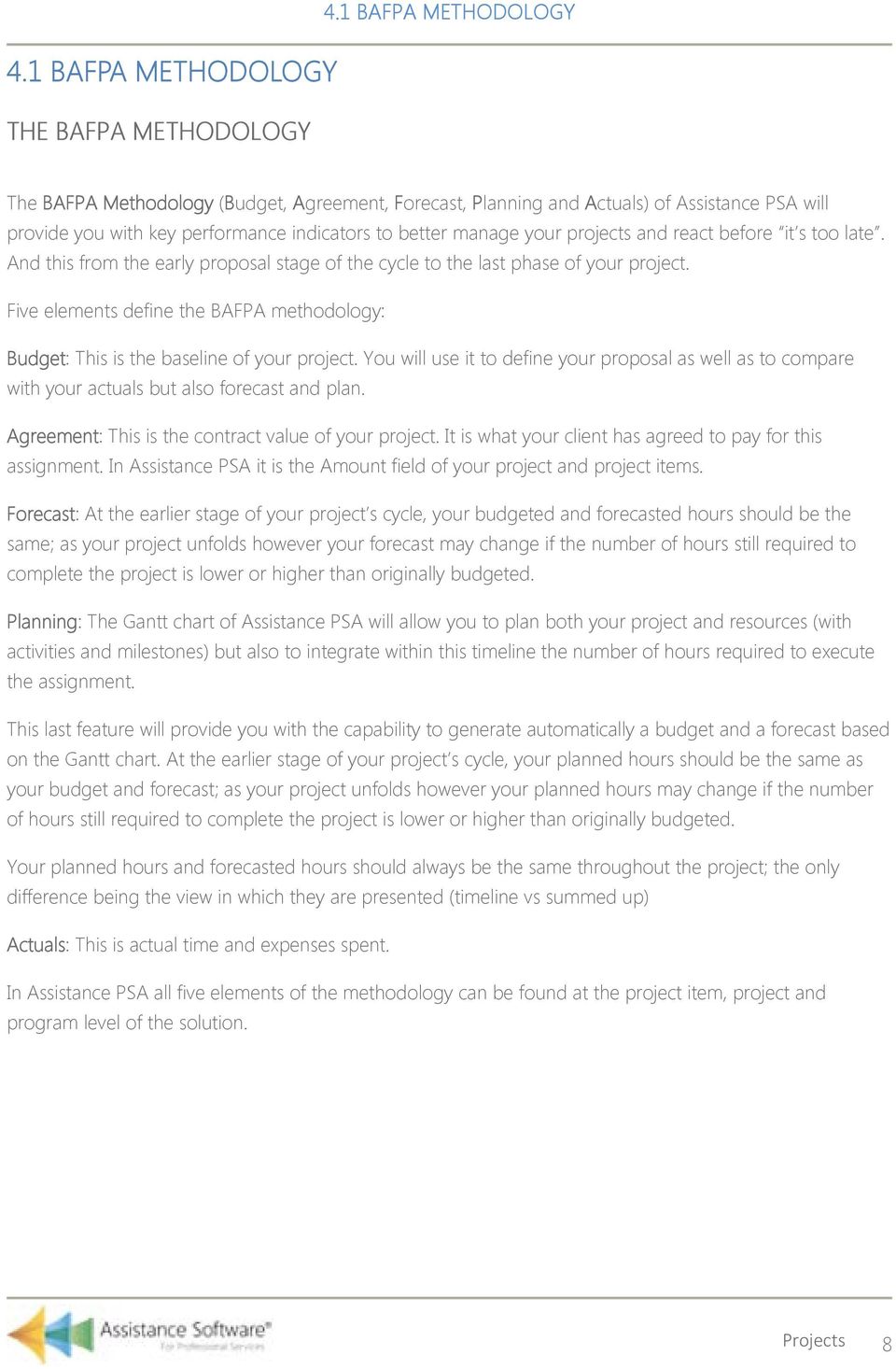
8 4.1 BAFPA METHODOLOGY THE BAFPA METHODOLOGY 4.1 BAFPA METHODOLOGY The BAFPA Methodology (Budget, Agreement, Forecast, Planning and Actuals) of Assistance PSA will provide you with key performance indicators to better manage your projects and react before it s too late. And this from the early proposal stage of the cycle to the last phase of your project. Five elements define the BAFPA methodology: Budget: This is the baseline of your project. You will use it to define your proposal as well as to compare with your actuals but also forecast and plan. Agreement: This is the contract value of your project. It is what your client has agreed to pay for this assignment. In Assistance PSA it is the Amount field of your project and project items. Forecast: At the earlier stage of your project s cycle, your budgeted and forecasted hours should be the same; as your project unfolds however your forecast may change if the number of hours still required to complete the project is lower or higher than originally budgeted. Planning: The Gantt chart of Assistance PSA will allow you to plan both your project and resources (with activities and milestones) but also to integrate within this timeline the number of hours required to execute the assignment. This last feature will provide you with the capability to generate automatically a budget and a forecast based on the Gantt chart. At the earlier stage of your project s cycle, your planned hours should be the same as your budget and forecast; as your project unfolds however your planned hours may change if the number of hours still required to complete the project is lower or higher than originally budgeted. Your planned hours and forecasted hours should always be the same throughout the project; the only difference being the view in which they are presented (timeline vs summed up) Actuals: This is actual time and expenses spent. In Assistance PSA all five elements of the methodology can be found at the project item, project and program level of the solution. 8
9 4.1 BAFPA METHODOLOGY This diagram illustrates the flow of the BAFPA Methodology. Step 1. Assignment You have engaged with a (potential) client for a specific mandate. Step 2. Project team & planning You consult with the people that will deliver the services to establish a Budget and a Forecast based on a preliminary planning. Ex: Budget $50,000 - Forecast $50,000. At this point in time your budget always equals your forecast because your project is not yet started. Step 3. Agreement You present a proposal to your client based on your Budget and ultimately come to an Agreement. Ex: Fixed Fee at $60,000. Step 4. Work in progress You start executing the project and the Actuals come in. Ex: $10,000. Step 5. Team meeting You review your Project's Planning (what's left to do) with your project team members and adjust the Forecast accordingly; the Budget remains unchanged as it represents your baseline. Ex: Forecast is now at $80,000 which represents $30,000 more than budgeted. This is bad news since your project is Fixed Fee; if nothing is done now you will end up with a negative result on this project. Step 6. Take action You discuss with your team the actions to be taken to rectify the situation. 9

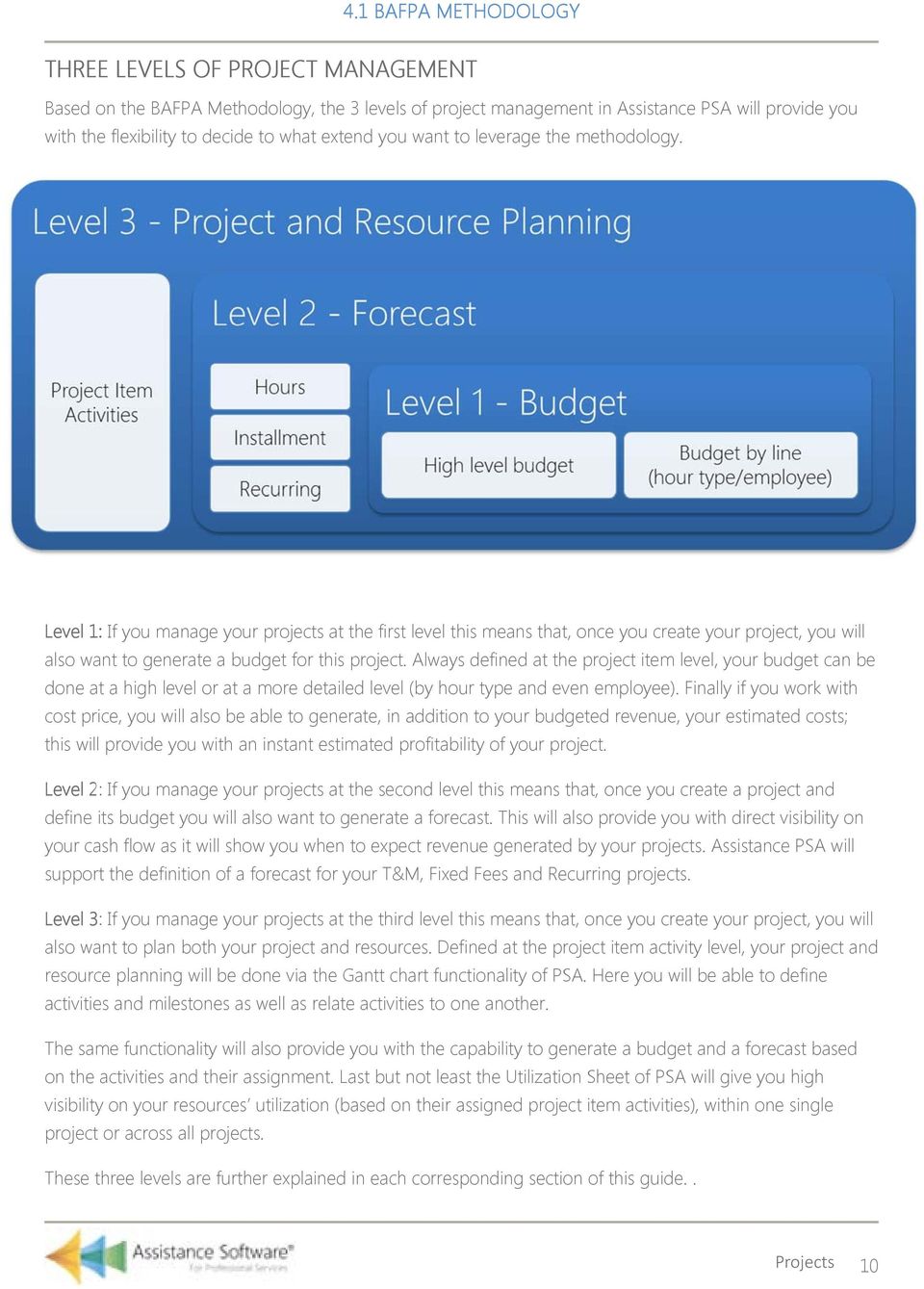
10 4.1 BAFPA METHODOLOGY THREE LEVELS OF PROJECT MANAGEMENT Based on the BAFPA Methodology, the 3 levels of project management in Assistance PSA will provide you with the flexibility to decide to what extend you want to leverage the methodology. Level 1: If you manage your projects at the first level this means that, once you create your project, you will also want to generate a budget for this project. Always defined at the project item level, your budget can be done at a high level or at a more detailed level (by hour type and even employee). Finally if you work with cost price, you will also be able to generate, in addition to your budgeted revenue, your estimated costs; this will provide you with an instant estimated profitability of your project. Level 2: If you manage your projects at the second level this means that, once you create a project and define its budget you will also want to generate a forecast. This will also provide you with direct visibility on your cash flow as it will show you when to expect revenue generated by your projects. Assistance PSA will support the definition of a forecast for your T&M, Fixed Fees and Recurring projects. Level 3: If you manage your projects at the third level this means that, once you create your project, you will also want to plan both your project and resources. Defined at the project item activity level, your project and resource planning will be done via the Gantt chart functionality of PSA. Here you will be able to define activities and milestones as well as relate activities to one another. The same functionality will also provide you with the capability to generate a budget and a forecast based on the activities and their assignment. Last but not least the Utilization Sheet of PSA will give you high visibility on your resources utilization (based on their assigned project item activities), within one single project or across all projects. These three levels are further explained in each corresponding section of this guide.. 10
11 4.2 PROJECTS & BUDGET PSA 2015 Step by Step Guide 4.2: & Budget 11

12 4.2 PROJECTS AND BUDGET INTRODUCTION 4.2 PROJECTS & BUDGET Level 3 - Project and Resource Planning Level 2 - Forecast Project Item Activities Hours Installment Recurring Level 1 - Budget High level budget Budget by line (hour type/employee) Assistance PSA will provide you with 3 levels of project management, based on the BAFPA Methodology. This section will focus on the creation and management of your projects at the first level, i.e. with the definition of a budget. What you will learn in this section. In this section you will learn how to: Create projects. Define a high level budget for your projects. Define a budget by line and generate the estimated profitability of your projects. 12

13 4.2 PROJECTS & BUDGET PROJECTS AND BUDGET Introduction Level 3 - Project and Resource Planning Level 2 - Forecast Project Item Activities Hours Installment Recurring Level 1 - Budget High level budget Budget by line (hour type/employee) Level 1 Budget. If you manage your projects at the first level this means that, once you create your project, you will also want to generate a budget for this project. Always defined at the project item level, your budget can be done at a high level or by Line. High level: this option will allow you to enter a bulk budget amount for each one of your project items. In this case the amount will represent your budgeted revenue (Budget selling amount). Budget by line: this option will allow you to enter a budget by hour type or by hour type/employee for each one of your project items. This will provide you with the possibility to compare actual with budgeted hours for a better management of your project. If you have defined a cost price at the hour type or employee* level, you will also be able to generate, in addition to your budgeted revenue, your estimated costs; this will provide you with an instant estimated profitability of your project, allowing you to adjust your project as early as the proposal phase. *Only once you have specified a resource in your budget lines. 13

14 4.2 PROJECTS & BUDGET Exercise 1: Create a T&M and Fixed Fee project with Products. Scenario: You need to create a project which has T&M and Fixed Fees elements as well as CRM Products. Project A : This project consists of implementing Assistance PSA and will require that you use the Sure Step Elements template and the project type Software implementation. The project manager will be billed at a special rate of 250$/hour. The training material is billable with a 10% mark-up (as defined at the template level). No mileage will be invoiced. You will first do a budget at a high level; Item Contract type Budget High Level Requirements T&M (hourly rate) Configuration & testing T&M (hourly rate) Training Fixed fee Training material Expenses Billable Project management T&M (hourly rate) 22, Travel Expenses Fixed Fee Licenses Products And then adjust it with a budget by line. Item Contract type Budget by Line Requirements T&M (hourly rate) Consultant: 40 hours Configuration & testing T&M (hourly rate) Consultant: 80 hours Training Fixed fee Consultant: 32 hours Training material Expenses Billable Training guides: $10/guide Project management T&M (hourly rate) Project Manager: 80 hours Travel Expenses Fixed Fee 2 $ Travel Expenses Fixed Fee 10 days of daily allowance Licenses Products & The Amount field of each project item will be as follow: Item Contract type Amount Requirements T&M (hourly rate) Will be updated with actual time booked Configuration & testing T&M (hourly rate) Will be updated with actual time booked Training Fixed fee Training material Expenses Billable Will be updated with actual expenses booked Project management T&M (hourly rate) Will be updated with actual time booked Travel Expenses Fixed Fee Licenses Products & Follow the detailed steps below to create this project and its budget. 14

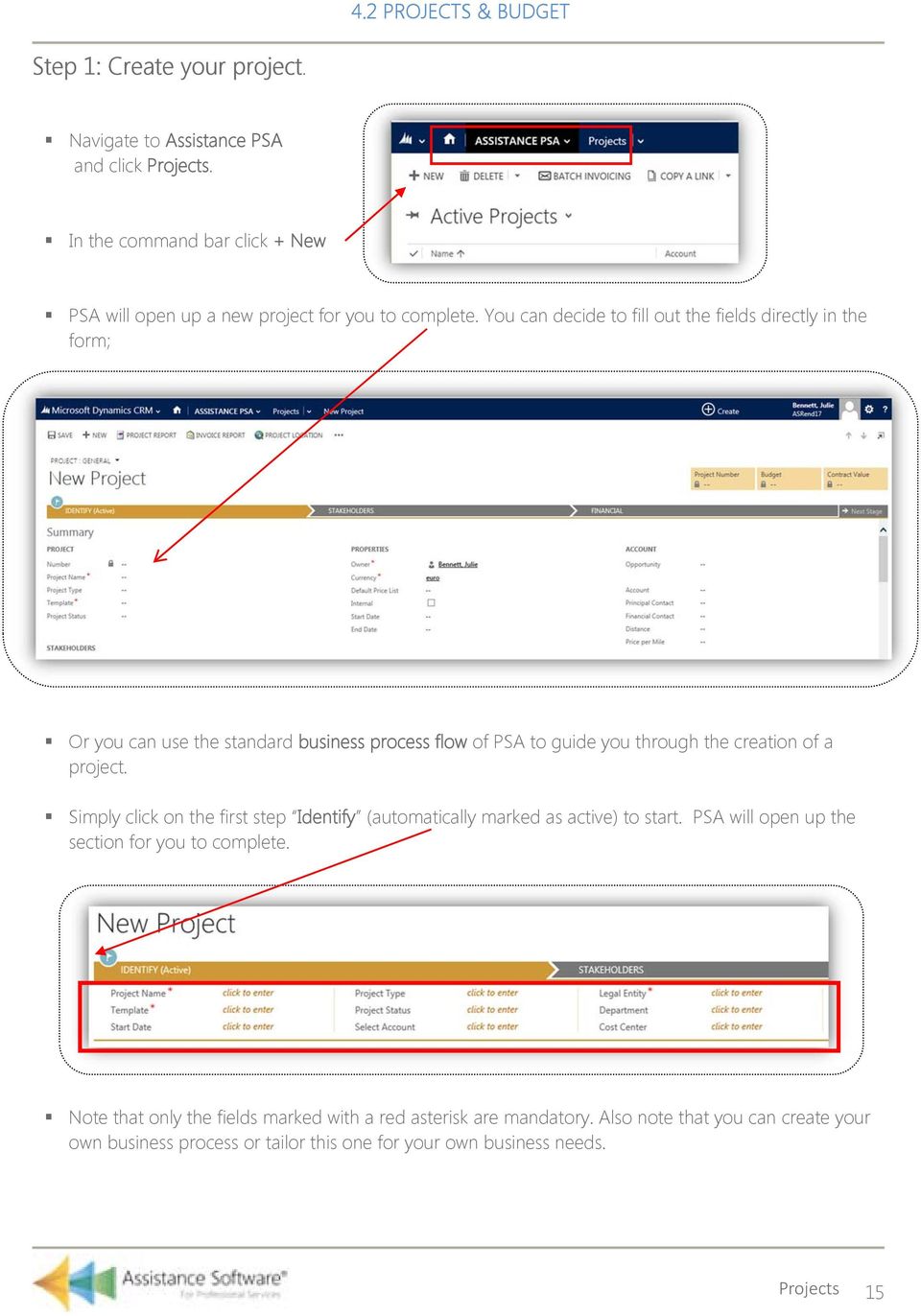
15 4.2 PROJECTS & BUDGET Step 1: Create your project. Navigate to Assistance PSA and click. In the command bar click + New PSA will open up a new project for you to complete. You can decide to fill out the fields directly in the form; Or you can use the standard business process flow of PSA to guide you through the creation of a project. Simply click on the first step Identify (automatically marked as active) to start. PSA will open up the section for you to complete. Note that only the fields marked with a red asterisk are mandatory. Also note that you can create your own business process or tailor this one for your own business needs. 15
16 4.2 PROJECTS & BUDGET Now go ahead with the creation of your project To navigate from one field to another simply press the Tab key or click in each field. 1. Project name: Give a name to your project (this field is mandatory). Enter: Project A PSA Implementation. 2. Template: This field is mandatory and is especially important as it will automatically create the breakdown structure of your project in the item section. Click the look up button to display the list of templates you have created and select the one specific to this project (Sure Step Elements). Note that once your project is saved, you no longer have the option to change your template. 3. Start Date: Enter the start date of your project. You can type in the date or use the dropdown calendar. 4. Project type: Click the look up button to display the list of project types you have created and select the one specific to this project (Software Implementation). 5. Project status: Click the look up button to display the list of project status you have created and select 10. Proposal. 6. Select Account: Select the account of the project. 7. Legal Entity: Select the entity related to this project (Assistance Software USA). This field is mandatory. 8. Cost center: You can also select a cost center; in this case choose PSA Consulting. Once you are done with the completion of this first step, go to the command bar and hit Save. 16

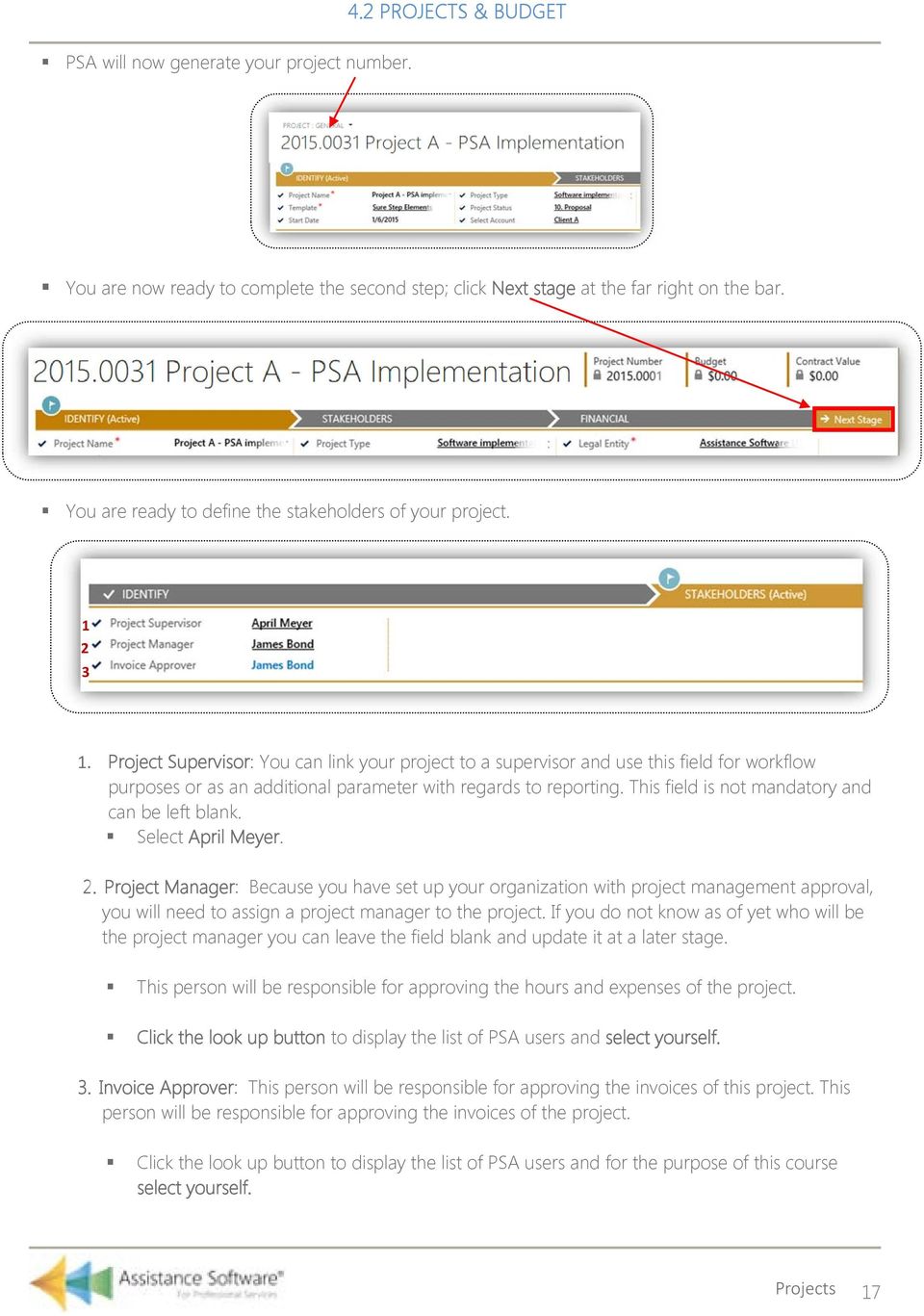
17 4.2 PROJECTS & BUDGET PSA will now generate your project number. You are now ready to complete the second step; click Next stage at the far right on the bar. You are ready to define the stakeholders of your project Project Supervisor: You can link your project to a supervisor and use this field for workflow purposes or as an additional parameter with regards to reporting. This field is not mandatory and can be left blank. Select April Meyer. 2. Project Manager: Because you have set up your organization with project management approval, you will need to assign a project manager to the project. If you do not know as of yet who will be the project manager you can leave the field blank and update it at a later stage. This person will be responsible for approving the hours and expenses of the project. Click the look up button to display the list of PSA users and select yourself. 3. Invoice Approver: This person will be responsible for approving the invoices of this project. This person will be responsible for approving the invoices of the project. Click the look up button to display the list of PSA users and for the purpose of this course select yourself. 17
18 4.2 PROJECTS & BUDGET Once you are done click Next stage again; PSA will automatically save your data. You are now in the Financial step of the business process flow Currency: The currency displayed by default here is the one set up in CRM. Leave the field as is. 2. Hourly Rate Group: You will not use a rate group for this project, leave the field blank. 3. Price List: You are able to select here a default CRM Price list for this project. Since you will be using CRM Products in this project go ahead and select PSA default. Note that this CRM price list has already been created in the training environment. 4. Briefing done, (contract) Sent, (contract) Signed: You are still at the proposal (opportunity) stage of your project, leave these three fields at No. Once you are done, you can hide the business process flow by clicking on the bottom right arrow section (PSA will automatically save the information). All the information that you have entered is now in the Summary section of the project screen. 18

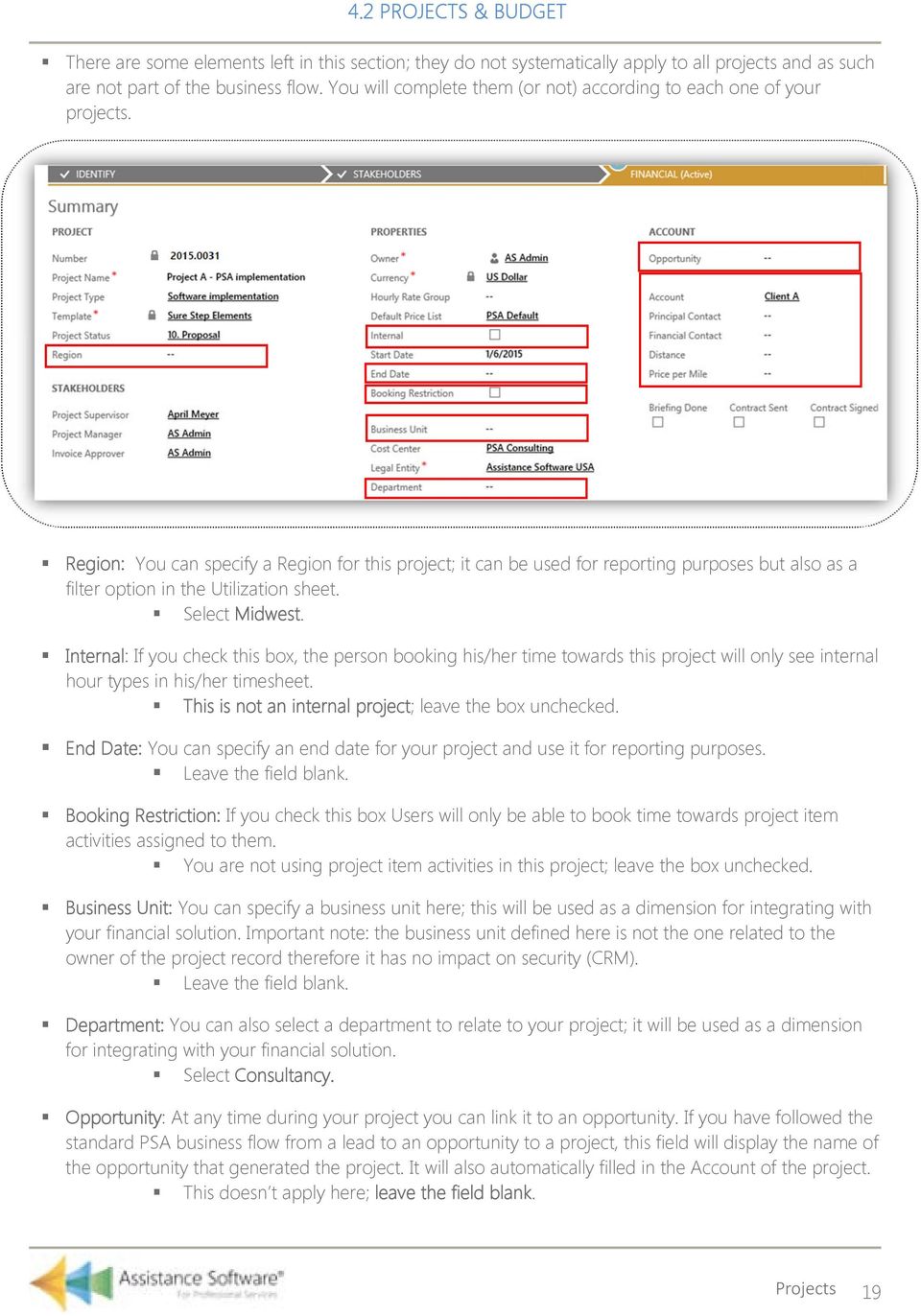
19 4.2 PROJECTS & BUDGET There are some elements left in this section; they do not systematically apply to all projects and as such are not part of the business flow. You will complete them (or not) according to each one of your projects. Region: You can specify a Region for this project; it can be used for reporting purposes but also as a filter option in the Utilization sheet. Select Midwest. Internal: If you check this box, the person booking his/her time towards this project will only see internal hour types in his/her timesheet. This is not an internal project; leave the box unchecked. End Date: You can specify an end date for your project and use it for reporting purposes. Leave the field blank. Booking Restriction: If you check this box Users will only be able to book time towards project item activities assigned to them. You are not using project item activities in this project; leave the box unchecked. Business Unit: You can specify a business unit here; this will be used as a dimension for integrating with your financial solution. Important note: the business unit defined here is not the one related to the owner of the project record therefore it has no impact on security (CRM). Leave the field blank. Department: You can also select a department to relate to your project; it will be used as a dimension for integrating with your financial solution. Select Consultancy. Opportunity: At any time during your project you can link it to an opportunity. If you have followed the standard PSA business flow from a lead to an opportunity to a project, this field will display the name of the opportunity that generated the project. It will also automatically filled in the Account of the project. This doesn t apply here; leave the field blank. 19
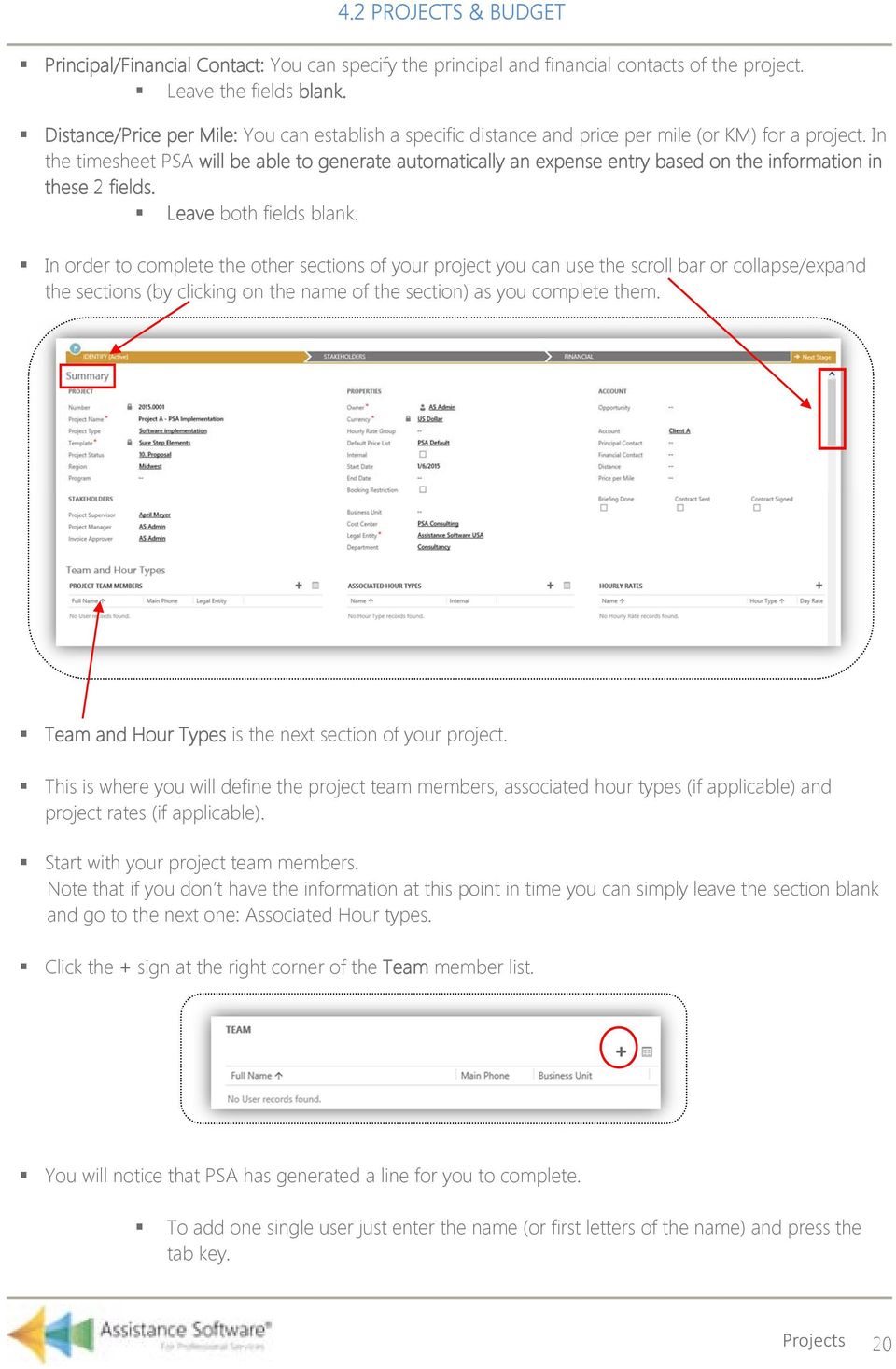
20 4.2 PROJECTS & BUDGET Principal/Financial Contact: You can specify the principal and financial contacts of the project. Leave the fields blank. Distance/Price per Mile: You can establish a specific distance and price per mile (or KM) for a project. In the timesheet PSA will be able to generate automatically an expense entry based on the information in these 2 fields. Leave both fields blank. In order to complete the other sections of your project you can use the scroll bar or collapse/expand the sections (by clicking on the name of the section) as you complete them. Team and Hour Types is the next section of your project. This is where you will define the project team members, associated hour types (if applicable) and project rates (if applicable). Start with your project team members. Note that if you don t have the information at this point in time you can simply leave the section blank and go to the next one: Associated Hour types. Click the + sign at the right corner of the Team member list. You will notice that PSA has generated a line for you to complete. To add one single user just enter the name (or first letters of the name) and press the tab key. 20
21 4.2 PROJECTS & BUDGET To add multiple users at the same time click the magnifying glass and scroll to the bottom of the list (the list shows all the recently selected names) until you see Look Up More Records; click this option. Check the name of the team members (select yourself and 2 other users). Click Select. And Hit the Add button to confirm your selection. PSA will bring you back to the project screen and display the list of the project team members you have selected. Note that you can come back at any given time during the project to add or withdraw people from this list. Also note that the person identified as the project manager is automatically considered by PSA to be a project team member (from a timesheet stand-point) and doesn t have to be added to the Team section in order to be able to book time towards the project. 21
22 4.2 PROJECTS & BUDGET Your project team is now completed, go to the next section Associated Hour Types. If you had defined associated hour types at the project template level, they would show up here and you could either leave them as is or override them. If you did not define associated hour types at the project template level you can still add hour types at the project level. When hour types are found in the Associated Hour Types section of a Project then the hour type selection in a time entry for this project will be restricted to the hour types selected in the Associated Hour Types. For the purpose of this guide you will leave this section blank for all your projects. If your project has specific rates now is the time to create them. Project rates will overrule rate groups, account and standard rates. Remember that if no project rates are created, PSA will then use the next available rates (ref: rate hierarchy in module 3 Blueprint). The creation of your Project rates is also done in the Team and Hour Types section of the project. To create a rate simply click the + sign. PSA will open up a quick create form with the same fields as when you created your standard rates
23 4.2 PROJECTS & BUDGET Providing you with the same flexibility of creating an hourly rate structure per hour type, employee or a combination of both. You want to create a project rate specific to the hour type Consultant. 1. Project: By default your project is already displayed in the first field. Go to the next field. 2. Hour Type: Select the hour type Project Manager. 3. Employee: Leave this field blank; this rate is not specific to an employee. 4. Account: Leave this field blank; this rate is not specific to an account. 5. Cost price per unit: Leave this field blank: you want PSA to apply the standard rates. 6. Transfer Price per unit: Leave this field blank: you want PSA to apply the standard rates. 7. Day Rate: Leave this field blank; this rate is not a Day Rate. 8. Selling Price per Unit: Enter a selling hourly rate of $ Reference: This field will enable you to enter an alternative description, at the project level, for your hour type should you need to have one more applicable for the client of this project (to be displayed on your invoice). For the purpose of this guide we will leave this field blank for all project rates. Once you are done, click Save. Your project rate is now displayed in the Rates section. If you need to create additional project rates simply click the + sign again. From now on whenever a team member books time towards this project using the hour type Project Manager PSA will apply a selling rate of $250/hour. PSA will apply the standard rates defined in the PSA tables for the cost and transfer rates of the employee booking the time. 23
24 4.2 PROJECTS & BUDGET Financial is the next section of your project. The first 2 sub-sections Financial and Actuals will be automatically updated as your project unfolds; at this point in time no information is displayed here since no data has been entered in the project. Note: The fields Revenue Recognition and Financial Status are to be completed only if you have installed Assistance Financials. For more details please refer to the training documentation related to the solution. The third section Fees will allow you to define specific fees (ex: daily allowance) to be both budgeted and booked as an expense on your project. To create a Fee simply click the + sign. PSA will open up a quick create form for you to complete with the information related to the fee. Project: This field is automatically populated with the project name. Leave it as is. Item: Select the project item to which you want to relate this fee. Select Travel. Name: Give a name for this fee. Enter Daily allowance. 24
25 4.2 PROJECTS & BUDGET Reference: As with rates you can specify here an alternative description for your fee should you need to have one more applicable for the client of your project (to be displayed on your invoice). Leave this field blank; you will budget and track your daily allowance but will not invoice the client these fees. Cost Price Per Unit/Transfer Price per Unit/Selling price per Unit: As with rates you can specify three prices for this fee. Enter 75$ for both the cost and selling prices per unit. Once you are done, hit Save. Your project rate is now displayed in the Rates section. If you need to create additional project rates simply click the + sign again. This fee is now available for budgeting and actual expense booking. 25
26 4.2 PROJECTS & BUDGET Step 2: Create your budget (and estimated profitability). Scroll down to the Details section of your project; it is located right below Financial. This is the heart of your project. You will find here your project structure with its different phases and items. It will also be populated as the project unfolds with actuals (hours/expenses/invoices). At this point in time you want to define the budget of your project (via its project items). To do so you have 3 options: Enter a high level budget amount for each project item. Create a detailed budget for each project item based on hour types and possibly resources (if wanted). Create a detailed budget for each project item based on the project item activities of the Gantt chart. For the purpose of this exercise we will focus on the first 2 options (the Gantt chart is further explained in the section 4.5 Project and Resource planning). Step 2A: High level budget Double-click on the project item Requirements (note that you will not create a budget for Pre-Sales since this item is not billable to the client and you do not know how much time it will require). In the next screen you will recognize some of the fields of your project template item. You want to define a high level budget amount for this item. Enter $5,000 in the Budget field. 26
27 4.2 PROJECTS & BUDGET To go to the next item simply click the down arrow located at the far right of your project item screen. In the next project item enter the budget field: $12,000. Now enter the following amount for each one of your other project items respectively: Training: $ Training material: $ Project Management: $ Travel: $ Licenses: $60000 Once you are done with the project item Licenses, force the auto-save and click on the project link to go back to the project screen. Scroll down to the item section. You will see the column Budget updated with the values you have entered. Note: the column Estimated Result displays the same amounts as the Budget column since no estimated costs have been calculated. This is only possible via budget line entries (see below related exercise). You have one more project item in your structure and it is located on the next page of your Items section; click the blue arrow in order to display it. 27
28 4.2 PROJECTS & BUDGET Your last project item is related to Non Billable entries; as with the Pre-sales project item you will not define a budget for this item nor will you invoice it. Now click on the blue back arrow located at the bottom right of the items section to go back to the first page. Step 2B: Budget by Line You want to refine your budget at a greater detail level; to do so you will create a budget by line. In the navigation bar click the dropdown menu of your project and click Budget. PSA will bring you to a grid where you will find your different budget elements (project item, employee, hour type, Fee, Product, quantity, etc. note that this guide doesn t cover the use of equipment). Click the + Sign to enter your first budget line. 28
29 4.2 PROJECTS & BUDGET PSA will display a pop-up window for you to select a project item for this budget line. Select Requirements and click Ok. Back in the grid PSA will create a line for you to complete under this project item. You can specify a different description here (to replace the standard New Budget). Click in the field and enter Consultancy hours. (Note that you can copy the description for future lines with CTRL+ C) Although you have selected your project team members the list is not yet confirmed, you will not specify them as of yet at the budget line level. Go directly to the Hour Type column and hit the look-up button. In the new pop-up window select Consultant and click Ok. PSA will automatically display in the grid the corresponding rate for this hour type. Your last step is to specify the budgeted number of hours for this line. Go to the corresponding cell and enter
30 4.2 PROJECTS & BUDGET PSA will update the line accordingly and save the line automatically. It will also update the totals at the bottom of the grid. Now click the + Sign and go ahead with the creation of the following budget lines; Configuration & testing: Consultancy hours - 80 hours Consultant Training: Consultancy hours - 32 hours - Consultant Project management: PM hours - 80 hours - Project manager You have completed the creation of your budgeted hours; you will now budget your expenses. Click the + Sign. Select the project item Training material and enter the following description: 65 Training guides. Enter 65 in the quantity field and $10 in the Selling price per unit field. PSA will automatically calculate the value of the budget line and save the entry. Click the + Sign again to enter your next item. 30
31 4.2 PROJECTS & BUDGET This is also an expense item. Select the project item Travel Enter the following description: 2 trips Enter a Quantity of 2 and $1750 in the Selling price field. Click the + Sign to add another budget line to your travel project item. Select the project item Travel Enter the following description: 10 days allowance Select the Fee Daily allowance and the Quantity of 10. PSA will not display a sub-total of both budget lines for this project item. Click the + Sign for your last budget lines. This time it is related to the licenses and server required on this project. You will select a project item defined as Products and you will add CRM Products to the budget line. Select the project item Licenses and enter the following description: Basic on premise. Select the Price List PSA Default and the product Basic on premise and enter a quantity of 100 For the next and last budget line, select the project item Licenses and enter the following description: Server. Select the Price List PSA Default, the product Server and enter a quantity of 1. You have created all of your budget lines. The grid will offer you the following additional options: X Sign: if you need to delete a budget line, highlight the line and click the X Sign. 31
32 4.2 PROJECTS & BUDGET Retrieve records: This option will refresh the data of the grid.. Export to Excel: This option will allow you to export to Excel. Update from Gantt: If you are budgeting at the Gantt chart level, this option will update the budget lines with the information of the Gantt (this is the subject of a separate exercise in the section 4.5 Project and Resource planning). Finally you can also collapse the project items to only display the total budget per item. Go back to the Project s main screen (click on the project s name in the navigation bar). And scroll down to the Details section. You will see that the high level budget amounts have been updated with your detailed budget line entries. Note that the values of the column Estimated Result are still the same as the values in the Budget column. This is due to the fact that your hour types are defined with a selling price rate* only and that no costs were defined for your budgeted expenses; the only exception being your travel item which included a daily allowance fee already defined with a cost rate. *If your cost price are defined at the hour types level this step will automatically provide you with the estimated profitability of your project. 32
33 Step 2C: Budget by Line with resources. 4.2 PROJECTS & BUDGET You want to calculate the estimated profitability of your project. To do so you will now integrate costs to your budget lines. For your hours this will require that you select a resource for each budget line (since you have defined the cost price at the employee level). For your expenses it will simply requires that you enter a value in the cost price column. Go back to your Budget grid. Go to the first item (1.1.0 Requirements) and click the look-up button of the resource column; select April Meyer. Note that the list will only display the project s team member. You will notice that PSA has updated the budget line with a cost price and cost amount. Enter the following cost prices to your budget lines: Requirements: select April Meyer.* Training: select April Meyer.* Project Management: select yourself as the project manager: Training material: add a cost price of $ Travel: add a cost price of $1750. *If you have multiple budget lines to assign to one resource you will want to make use of the function Change multiple records of CRM. See Note at the end of this sub-section. Once you are done go back to the project screen and navigate to the Details section. You will now see the Estimated Result of your project based on budget versus Estimated Cost of each project item. 33
34 4.2 PROJECTS & BUDGET Note on how to assign multiple budget lines to one single resource. If you need to assign multiple budget lines to one resource you can make use of the function Change multiple records of CRM. To do so however you will go to the Budget section of your project s main screen. It is located right after the Invoices section on the project form. You will find here all the budget lines you have created. Note that you can also add budget lines from here with the + Sign button. Click the Grid icon. In the next screen, change the view for Budget Project Sub Grid View. Change the view for Budget Project Sub Grid View; you will see all the details of your budget lines. Select the three budget lines with the hour type Consultant and in the local command bar click Edit. 34
35 Select April Meyer in the Employee field. 4.2 PROJECTS & BUDGET And click Change. PSA will update the budget lines according to the cost price of the resource. The budget grid will also display this change (since it is the same data but with a different user interface). 35
36 4.2 PROJECTS & BUDGET Step 3: Finalize your project You have reached an agreement (based on your budget) with your client and are now ready to finalize your project. In the Summary section (or via the business process flow) of your project update the following fields: Project status: change to 20. Active Briefing done, contract sent and signed: Check the three boxes. Go to the Items section; you need to update the Amount field of each one of your project items since this is the value that PSA will always invoice to the client. You will never invoice the Pre-Sales project item therefore you will always leave the Amount field blank. Double-click on the next project item Requirements in order to open the project item. This is a T&M project item and as such PSA will invoice the project on time actually worked; this is why the Amount field is locked. 36
37 4.2 PROJECTS & BUDGET Use the right down arrow to go to the next project item. This is also a T&M project item; navigate to the next project item defined as a Fixed Fee ( Training). This time you will update the Amount field with the contract value; you will round up your budget to $5,000. Now go to the next project item (using the down arrow); PSA will automatically save the change. This item is defined as Billable Expenses which means that PSA will invoice the actual expenses booked. As with a T&M project item the Amount field is locked. Notice here the mark-up of your item (it comes from your project template); once you start booking expenses PSA will automatically apply a mark-up of 10%. Go to the next project item. 37
38 4.2 PROJECTS & BUDGET This item (4.1.0 Project management) is defined as Time & Material, use the down arrow to go to the next item Travel is defined as Expenses Fixed Fee and will be treated the same as a Fixed Fee (hours). Enter $4500 in the field Amount. Go to the last project item. This item is defined as Products; the Amount field will be automatically populated with the sum of the products selected in the corresponding section of the screen. Close the Budget section and scroll down to Products. Click the + sign and add the following products to this item Licenses Basic on premises Licenses - 1 Server license 38
39 4.2 PROJECTS & BUDGET Once you are done with all your products, refresh your screen (F5 key). You will see the Amount field updated with the sum of all your products. The field To be Invoiced will also be automatically updated. You have completed all your project items, go back to the project screen by clicking the project name in the Project field of your item. Back in your project screen the Items section will now display updated with the information you have just entered. 39
40 4.2 PROJECTS & BUDGET Scroll to the right; the only project item that is currently available for booking time is Pre-Sales (Active is set to Yes). Your project has now started and you want both the Requirements project item and Project management item to be available for time entry. Click the Grid icon. In the next screen, select Requirements and Project management and click Edit. In the Change Multiple Records screen, check the box Active And click Change. 40
41 4.2 PROJECTS & BUDGET Back in the previous screen, you will see Yes displayed in the Active column of the two project items. You have completed the creation of this project, in the command bar click +New in order to create the next one. 41
42 4.2 PROJECTS & BUDGET Exercise 2: Create a Fixed Fee project and modify the project template Scenario: You need to create a Fixed Fee project and modify the project template. Project F : This project consists of implementing the HR solution of Assistance PSA. You will use the Sure Step Elements template but will need to make the following modifications: Change the T&M project items to fixed fees Change the Expenses billable to Expenses Fixed Fee Delete both project items Travel and Licenses. There are no project rates to create but you will use the rate group RATES No mileage will be charged to the client. The financial contract is established as follows: Item Contract type Amount Budget by line Requirements Fixed Fee hours consultant Configuration & testing Fixed Fee hours consultant Training Fixed fee hours consultant Training material (to be renamed Training expenses) Expenses Fixed Fee 900 Training room rental 450$/day for 2 days Project management Fixed Fee hours Project manager Travel Expenses Fixed Fee This item needs to be deleted from the project Licenses Products This item needs to be deleted from the project. Follow the detailed steps below to create this project and its budget. 42
43 4.2 PROJECTS & BUDGET Step 1: Create your project. Navigate to Assistance PSA and click. In the command bar click + New In the PSA will open up a new project for you to complete. Click on the first step Identify of the Business Process flow start. PSA will open up the section for you to complete. Now go ahead with the creation of your project. (To navigate from one field to another simply press the Tab key or click in each field). 1. Project name: Give a name to your project (this field is mandatory). Enter: Project F HRM Implementation. 2. Template: This field is mandatory and is especially important as it will automatically create the breakdown structure of your project in the item section. Click the look up button to display the list of templates you have created and select the one specific to this project (Sure Step Elements). Note that once your project is saved, you no longer have the option to change your template. 3. Start Date: Enter the start date of your project. You can type in the date or use the dropdown calendar. 4. Project type: Click the look up button to display the list of project types you have created and select the one specific to this project (Software Implementation). 43
44 4.2 PROJECTS & BUDGET 5. Project status: Click the look up button to display the list of project status you have created and select 10. Proposal. 6. Select Account: Select the account of the project. 7. Legal Entity: Select the entity related to this project (Assistance Software USA). This field is mandatory. 8. Cost center: You can also select a cost center; in this case choose PSA Consulting. Once you are done with the completion of this first step, go to the command bar and hit Save. PSA will now generate your project number. You are now ready to complete the second step; click Next stage at the far right on the bar. You are ready to define the stakeholders of your project Project Supervisor: You can link your project to a supervisor and use this field for workflow purposes or as an additional parameter with regards to reporting. This field is not mandatory and can be left blank. Select April Meyer. 2. Project Manager: Because you have set up your organization with project management approval, you will need to assign a project manager to the project. If you do not know as of yet who will be the project manager you can leave the field blank and update it at a later stage. This person will be responsible for approving the hours and expenses of the project. Click the look up button to display the list of PSA users and select yourself. 44
45 4.2 PROJECTS & BUDGET 3. Invoice Approver: This person will be responsible for approving the invoices of this project. This person will be responsible for approving the invoices of the project. Click the look up button to display the list of PSA users and for the purpose of this course select yourself. Once you are done click Next stage again; PSA will automatically save your data. You are now in the Financial step of the business process flow Currency: The currency displayed by default here is the one set up in CRM. Leave the field as is. 2. Hourly Rate Group: Select the rate group RATES Price List: You will not be using CRM Products in your project. Leave the field blank. 4. Briefing done, (contract) Sent, (contract) Signed: You are still at the proposal (opportunity) stage of your project, leave these three fields at No. Once you are done, hide the business process flow by clicking on the bottom right arrow section (PSA will automatically save the information). All the information that you have entered is now in the Summary section of the project screen. 45
46 4.2 PROJECTS & BUDGET There are some elements left in this section; they do not systematically apply to all projects and as such are not part of the business flow. You will complete them (or not) according to each one of your projects. Region: You can specify a Region for this project; it can be used for reporting purposes but also as a filter option in the Utilization sheet. Select New York (Parent Region New York). Internal: If you check this box, the person booking his/her time towards this project will only see internal hour types in his/her timesheet. This is not an internal project; leave the box unchecked. End Date: You can specify an end date for your project and use it for reporting purposes. Leave the field blank. Booking Restriction: If you check this box Users will only be able to book time towards project item activities assigned to them. You are not using project item activities in this project; leave the box unchecked. Business Unit: You can specify a business unit here; this will be used as a dimension for integrating with your financial solution. Important note: the business unit defined here is not the one related to the owner of the project record therefore it has no impact on security (CRM). Leave the field blank. Department: You can also select a department to relate to your project; it will be used as a dimension for integrating with your financial solution. Select Consultancy. Opportunity: At any time during your project you can link it to an opportunity. If you have followed the standard PSA business flow from a lead to an opportunity to a project, this field will display the name of the opportunity that generated the project. It will also automatically filled in the Account of the project. This doesn t apply here; leave the field blank. 46
47 4.2 PROJECTS & BUDGET Principal/Financial Contact: You can specify the principal and financial contacts of the project. Leave the fields blank. Distance/Price per Mile: You can establish a specific distance and price per mile (or KM) for a project. In the timesheet PSA will be able to generate automatically an expense entry based on the information in these 2 fields. Leave both fields blank. Your next step is to define your project s team members. Select yourself and April Meyer. There are no associated hour types or specific project rates (in addition to the group rates) to define for this project; leave both sections blank. Go to the Financial Section. At this point in time no information is displayed here since no data has been entered in the project. This will change, however, as the project unfolds. There is no specific fee to define for this project; leave the section blank. Now scroll down to the Details section (Items); you need to modify the project items. Click the Grid icon. 47
48 4.2 PROJECTS & BUDGET In the next screen check all the project items that are T&M and click Edit. In the next screen select Fixed Fee and click Change. Back in the previous screen check the project item Travel and Licenses. Click Delete Project Item. 48
49 4.2 PROJECTS & BUDGET PSA will ask that you confirm the deletion of the item; click Delete. You have one last modification to do; select the project item Training material and click Edit. PSA will open the project item; modify the description to Training Expenses and remove the in the Expense Mark-up field. Save your changes and change the item type to Expenses Fixed Fee. 49
50 4.2 PROJECTS & BUDGET Once you are done, click the project name; this will bring you back to the Project screen. Scroll down to the Details section; you will see your project structure updated with the changes you have made. Step 2: Create your budget (and estimated profitability). Remain in the Details section of your project. At this point in time you want to define the budget of your project (via its project items). To do so you have 3 options: Enter a high level budget amount for each project item. Create a detailed budget for each project item based on hour types and possibly resources (if wanted). Create a detailed budget for each project item based on the project item activities of the Gantt chart. For the purpose of this exercise we will focus on the second option (for detail on the first option please refer to the first exercise; for detail on the third option please refer to the section 4.5 Project and Resource planning of this guide). 50
51 4.2 PROJECTS & BUDGET Step 2B-C: Budget by Line (with hour types and resources) Your project s team members are already confirmed; you will create your budget lines with an hour type and a resource. This will provide you with the estimated profitability of your project. In the navigation bar click the dropdown menu of your project and click Budget. PSA will bring you to a grid where you will find your different budget elements (project item, employee, hour type, Fee, Product, quantity, etc. Note that this guide doesn t cover the use of equipment). Click the + Sign to enter your first budget line. PSA will display a pop-up window for you to select a project item for this budget line. Select Requirements and click Ok. Back in the grid PSA will create a line for you to complete under this project item. You can specify a different description here (to replace the standard New Budget). Click in the field and enter Consultancy hours. (Note that you can copy the description for future lines with CTRL+ C) Now click the look-up button of the Employee column. 51
52 4.2 PROJECTS & BUDGET PSA will display the list of the project s team members. And select April Meyer. And click Ok. Go to the Hour Type column and hit the look-up button. In the new pop-up window select Consultant and click Ok. PSA will automatically display in the grid the corresponding rates for this hour type and resource. Your last step is to specify the budgeted number of hours for this line. Go to the corresponding cell and enter 40. PSA will update the line accordingly and save it automatically. Now click the + Sign and go ahead with the creation of the following budget lines; Project item Description Resource Hour Type Quantity Cost / Selling prices Configuration & Consultancy testing hours Training Consultancy hours April Meyer Consultant 200 Automatically defined by hour type and res. April Meyer Consultant 16 Automatically defined by hour type and res. 52
53 4.2 PROJECTS & BUDGET Training expenses Rental of training room Project management Consultancy hours n/a n/a 2 450$ for both cost and selling prices. Yourself Consultant 200 Automatically defined by hour type and res. You have completed the creation of your budgeted hours; you will now budget your expenses. Click the + Sign. You have created all of your budget lines. Go back to the Project s main screen (click on the project s name in the navigation bar). And scroll down to the Details section. You will now see the Estimated Result of your project based on budget versus Estimated Cost of each project item; providing you with the estimated profitability of your project. Note that due to the nature of the items you have not specified any budget for your Pre-Sales phase as well as for your Non Billable items. 53
54 4.2 PROJECTS & BUDGET Step 3: Finalize your project. You have reached an agreement (based on your budget) with your client and are now ready to finalize your project. In the Summary section (or via the business process flow) of your project update the following fields: Project status: change to 20. Active Briefing done, contract sent and signed: Check the three boxes. Go to the Items section; you need to update the Amount field of each one of your project items since this is the value that PSA will always invoice the client. Note that with Fixed Fees PSA will still track the time and expenses booked towards the items but only invoice the value entered in the Amount field. You will never invoice the Pre-Sales project item therefore you will always leave the Amount field blank. Go to the next item. Double-click project item Requirements to open the item. You will see the budget field already populated with the budget line. Now specify the contract amount of that project item. Enter 7, in the Amount field. Once you are done use the down arrow to navigate to the next project item; PSA will automatically save the amount. Go ahead and define the amount of each project item according to the scenario: 54
55 4.2 PROJECTS & BUDGET Configuration & Testing: 32, Training: 2, Training expenses: Project Management: 42,000 Once you are done go back to the Details section of your project s main screen in order to do a final review of your project s Amounts. Scroll to the right; the only project item that is currently available for booking time is Pre-Sales (Active is set to Yes). Your project has now started and you want all the project items to be available for time entry. Click the Grid icon of the Details section. 55
56 4.2 PROJECTS & BUDGET In the next screen, click the check mark located in the header of the grid; all your items will automatically be selected. Now click Edit. In the Change Multiple Records screen, check the box Active And click Change. Back in the previous screen, you will see Yes displayed in the Active column of all your project items. You have completed the creation of this project, in the command bar click +New in order to create the next one. 56
57 4.2 PROJECTS & BUDGET Exercise 3: Create a T&M (daily rate) project Scenario: You need to create a T&M project based on daily rates. Project B : This project is a consultancy mandate related to Operations Improvements. Select Assistance Software EMEA and the cost center Enterprise Consulting. You will be both the project manager and invoice approver for this project. There are no special rates for this project. The financial contract is established as follows: Item Contract type Amount Budget Consultancy T&M (Daily rate) Actual 20 days Analyst Expenses Expenses billable Actual $500 This project will be set at 20. Active and you will check all three boxes for Briefing done, Sent and Signed. Follow the detailed steps below to create this project and its budget. Step 1: Create your project. Start by completing the General and Financial sections (Team & Rates) of your project according to the scenario. Relate this project to the legal entity Assistance Software EMEA and define yourself as project manager and invoice approver. Note that this time the project status will be set to 20. Active from the start. You will also check the boxes Briefing done, Sent and Signed of the Financial step of the business process flow. There are no group rate or project rate for this project; you will use the standard rates. You will be the team member on this project and will leave the Fee section blank. Step 2: Create your budget. Navigate to the Details section of your project. Your next step is to define the budget of your project items. 57
58 4.2 PROJECTS & BUDGET In the navigation bar click the dropdown menu of your project and click Budget. PSA will bring you to a grid where you will find your different budget elements (project item, employee, hour type, Fee, Product, quantity, etc. note that this guide doesn t cover the use of equipment). Click the + Sign to enter your first budget line. PSA will display a pop-up window for you to select a project item for this budget line. Select Consultancy and click Ok. Back in the grid PSA will create a line for you to complete under this project item. You can specify a different description here (to replace the standard New Budget). Click in the field and enter Consultancy hours. Now click the look-up button of the Employee column and select yourself. Go to the Hour Type column and hit the look-up button. In the new pop-up window select Analyst and click Ok. It is very important that you select an hour type that is defined with a daily rate; if it isn t PSA won t find the rate and display a value of $0. PSA will automatically display in the grid the corresponding rates for this hour type and resource. Your last step is to specify a quantity; in this case it will represent a number of days. Enter 20. Note the cost price at the employee level; it is also based on a daily rate. If your employee doesn t have a daily cost rate PSA will apply a zero value to the entry. 58
59 4.2 PROJECTS & BUDGET Now click the + Sign and go ahead with the creation of your budget for your project s expenses. Select Expenses, enter Expenses in the description field, 1 in the quantity field and 500 for both the cost price and selling price. You have completed the creation of your budget lines. Go back to the Project s main screen (click on the project s name in the navigation bar). And scroll down to the Details section. You will now see the Estimated Result of your project based on budget versus Estimated Cost of each project item; providing you with the estimated profitability of your project. Step 3: Finalize your project. The status of this project is already set at 20. Active and, since your project items are respectively set as T&M (daily rate) and Billable, you will not be able to enter a value in the Amount field; it will be done automatically as time/expenses are booked. Both project items are already set as Active (as defined in the project template) and available for entry. This is what you want; leave them as is. You have completed the creation of this project, click +New in order to create the next one. 59
60 Exercise 4: Create a Recurring project 4.2 PROJECTS & BUDGET Scenario: You need to create a recurring project in order to manage and invoice your maintenance contracts. Project C : This project is a support contract for Client B. It is a recurring contract billable each month at a rate of 1500$/month with no end date. This project is related to Assistance Software USA. You will be the project manager for the purpose of approving the time booked towards your fixed fees and T&M project items. There are no special rates for this project. The financial contract is established as follows: Item Contract type Amount Budget Support contract Recurring Actual invoice Leave blank Services in agreement Fixed Fee Leave blank Leave blank Services billable T&M (hourly rate) Actual Leave blank You will need to create an additional recurring item to your project structure in order to invoice your annual SLA s. Item Contract type Amount Budget Annual SLA Recurring (with CRM Products) Actual invoice Leave blank Follow the detailed steps below to create this project and the recurrence pattern of your project items.. Step 1: Create your project. Start by completing the General section of your project according to the specificities of the scenario. Follow the same steps as the previous project. Relate this project to the legal entity Assistance Software USA and define yourself as project manager and invoice approver. Note that this time the project status will also be set to 20. Active from the start. You will also check the boxes Briefing done, Sent and Signed of the Financial step of the business process flow. There are no group rate or project rate for this project; you will use the standard rates for the support hours booked on your Fixed Fee and T&M project items. You do not know as of yet who will be the team members on this project so you will leave the section blank. 60
61 Step 2: Define your recurring amounts 4.2 PROJECTS & BUDGET Navigate to the Details section of your project. You will not define a budget here but will instead specify the recurring amount of your support contract. Open the first project item; this is a Recurring project item With this item type, PSA will allow you to create an amount to be invoiced on a recurring basis. In order to do so, however, you must define the recurrence section of the item. 61
62 4.2 PROJECTS & BUDGET Scroll down to the Recurrence section Price List/Product/Quantity: If you are using CRM Products to invoice your support fees (ex: SLA based on the number of licenses) you will first complete this section by selecting the Price list, Product and Quantity. PSA will display by default the Price Per Unit (PPU). This is not the case here; leave these fields blank. 2. Every x Months : This field will define the billing frequency of your item. Enter 1 ; your fees are invoiced every month. 3. Start Date/End Date: Enter a start date but leave the end date blank. There is no termination date for your maintenance contract. 4. Recurring: You will notice that once you have entered a start date, PSA has automatically checked this box. You can, if you want, deactivate this item at any time by unchecking the box. This is particularly useful in the case of a cancelled contract. For the purpose of this exercise, leave the box checked. 5. Occurrences: If you will only invoice an item a specific number of times, you can enter that number in the occurrence field. This is not the case here leave the field blank. 6. Recurring Amount: Enter the value of your recurring item, $1500. If you are using CRM products, you will need to leave this field blank; PSA will automatically calculate the recurring amount based on the Products price and quantity. 7. Contract Value: The contract value will be automatically calculated by PSA as soon as you save your data. Go ahead and click the disk to save your changes (bottom right of the screen). 62
63 4.2 PROJECTS & BUDGET You can see that the Contract Value field has been automatically updated by PSA. The value represents one year of recurring revenue. Your project item is now defined. A final note with regards to the General section of this project item. Amount: This field will be automatically updated as your invoice your project. Estimated Amount: This field remains your internal estimate. Leave it blank, your recurring revenues will show in the Sales Forecast overview of PSA (Ref: exercise on Sales Forecast). Click on the Project link to go back to the previous screen. In the Details section, click the + sign. PSA You will open up a new window. 63
64 4.2 PROJECTS & BUDGET You will recognize the familiar fields of the project item. Project: this field is already populated with the name of the project. Leave it as is. Item ID: Enter Item Group: Select In Agreement Item Name: Enter Annual support Active: Leave this box unchecked. You do not want people to book time towards this item. Exclude Item from Prj Prc Complete: Check this box. Item Type: Select Recurring Tax Group: Select VAT 19.6% Allow Booking Hours: Leave this box unchecked; you do not want people to book time towards this item. Now save this new project item. And scroll down to the Recurrence section. Price List: Select PSA Default Product: Select SLA Basic Quantity: Enter
65 4.2 PROJECTS & BUDGET Once you click the field Every x Months, PSA will display the following message: Click OK And continue with the completion of the other fields. Every x Months: Enter 12 Start date: Select the first of the current month and leave the End Date blank. Now force the Auto-Save of CRM. Recurring Amount: PSA will automatically calculate the yearly Recurring Amount. Contract Value: PSA will automatically calculate the Contract Value for a year. Once you are done, click the project link to go back to the project screen. You have two other project items; they are defined as Fixe Fee and T&M respectively. Since they are related to support it is not possible for you to estimate a budget here; leave their budget blank. Step 3: Finalize your project. The status of this project is already set at 20. Active. You will not enter any value in the Amount field of each one of your project items since: Your recurring items will be automatically updated every time you invoice them. Your Fixed Fee item will allow you to track time spent to support your client but will never be invoiced. Your T&M item will be automatically updated as your resources book time towards it. Both project items are already set as Active (as defined in the project template) and available for time entry. This is what you want; leave them as is. You have completed the creation of this project, click +New in order to create the next one. 65
66 Exercise 5: Create a direct sales project 4.2 PROJECTS & BUDGET Scenario: You need to create a project to manage your direct sales with CRM products. Project SD : This is a direct sales project that you will create to invoice CRM Products sold to a client. This project is related to Assistance Software EMEA. You will be the project manager for information purposes only. There is no budget for this type of project (direct sales). You will select the Price List PSA Default in the business process flow (financial stage). Item Contract type Amount Products Licenses Products Will be updated with the value of the CRM Products. 100 Basic 200 Essentials 1 server Follow the detailed steps below to create this project. Step 1: Create your project. Start by completing the General section of your project according to the specificities of the scenario. Relate this project to the legal entity Assistance Software EMEA and define the status as 20. Active. You will also select yourself as project manager (for information purposes only) and invoice approver. Finally leave the boxes Briefing done, Sent and Signed of the Financial step of the business process flow unchecked. This project is a direct sale therefore you will not define team members, project rates or budget lines. Step 2: Relate the CRM products to your project This project is a direct sale therefore you will not define team members, project rates or budget lines. You want to invoice the products immediately. Scroll down to the Details section of the project screen. Double-click on the project item to open the record and scroll down to the Products section. 66
67 4.2 PROJECTS & BUDGET Click the + sign and in the next screen select: Price List: PSA Default (this is a standard CRM price list that has been created for the purpose of this exercise in the training env.) Product: Basic on premise Quantity: 100 Once you are done save your entry and follow the same steps to add the remaining products to this same item (they are all related to the PSA Default price list). 200 Essentials on premise 1 Server Once you are done with all your products, refresh your screen (F5 key). You will see the Amount field updated with the sum of all your products. The field To be Invoiced will also be automatically updated. 67
68 4.2 PROJECTS & BUDGET Now click the project link to go back to your project screen. Both the Financial and the Details sections are displaying the total value of your products.in the Amount and To be Invoiced fields. Step 3: Finalize your project. This order is ready to be invoiced; there is no other element to define here. You have completed the creation of this project, click +New in order to create the next one.. 68
69 Exercise 6: Create an internal project 4.2 PROJECTS & BUDGET Scenario: You need to create a project to manage your internal hours. Project D : This is an internal project that will capture administrative time and leave time for your organization. You will be the project manager for the purpose of approving time and expenses entries. There are no financial contracts for this project. Item Contract type Amount Estimated Amount Administration Fixed fee Leave blank Leave blank Training Fixed fee Leave blank Leave blank Vacation Fixed fee Leave blank Leave blank Sick days Fixed fee Leave blank Leave blank Travel Expenses fixed fee Leave blank Leave blank Other Expenses fixed fee Leave blank Leave blank Follow the detailed steps below to create this project. Step 1: Create your project. Start by completing the General section of your project according to the specificities of the scenario.. Relate this project to the legal entity Assistance Software USA and define yourself as the project manager. Remember to check the box Internal as you only want to use internal hour types for this project. 69
70 4.2 PROJECTS & BUDGET This project is related to internal hours and you do not have any budget to define here; leave the Items section as is. All project items are already set as Active (as defined in the project template) and available for time entry. This is what you want; leave them as is. You have completed the creation of your internal project; click + New to create your last project. 70
71 4.2 PROJECTS & BUDGET Exercise 7: Copy a project Scenario: You need to create a project that is very similar to an existing one; you will leverage the copy functionality of Assistance PSA to create the project. Project F02 : This project is very similar to Project F HRM implementation that you created earlier on (Exercise 2: Create a Fixed Fee project and modify the project template). You will copy the project and only make one change: the account will be Client A. Follow the detailed steps below to create this project and its budget. Step 1: Create your project. In the grid view of the entity select the project you wish to copy. Click the ellipses button and hit Copy Project PSA will open up a pop-up window and ask that you specify which elements you wish to copy of the existing project; by default it will have selected them all. You want to copy everything but the Account; uncheck the box and leave the rest of the selection as is. Enter a description in the Project Name: Project 02 Impl. HR. And enter the start date of this project. Hit Accept. 71
72 4.2 PROJECTS & BUDGET PSA will create your new project and open the record in a new window. Close the Copy pop-up window. Since this is a new project PSA will leave the project status, cost center and departments field for you to complete. Project status: Enter 20. Active Cost center: Select Enterprise Consulting Department: choose Consultancy Now go to the Account and select Client A. You will also check the boxes Briefing Done, Contract Sent and Contract Signed. In the Financials section of the project select the team members of the project: Select yourself and April Meyer (or another resource if you are April Meyer). And leave the Rates box empty (you will use the rate group already defined). 72
73 4.2 PROJECTS & BUDGET Step 2: Create your budget (and estimated profitability). Navigate to the Details section of your project. You budget was automatically generated in the copy process (as requested by you). Note that PSA will copy the budget lines therefore your original project must also be define with budget lines. You can make any changes (hour type, quantity, resources, and amount) by clicking the budget lines. This is not necessary here, leave this section as is. Step 3: Finalize your project. The values in the Amount column correspond to your contract with your client and the status of your project is set to 20. Active. You only have one step left to perform and that is to make available for timesheet entry your project items (with the exception of Non Billable). Note that although the project items of the original project were all set as active, in the copy process PSA unchecks the functionality of all of them, leaving you with the decision to make them available for timesheet entry or not at the time of creation of the new project. Click the Grid icon of the Details section. 73
74 4.2 PROJECTS & BUDGET In the next screen, click the check mark located in the header of the grid; all your items will automatically be selected. Now click Edit. In the Change Multiple Records screen, check the box Active And click Change. Back in the previous screen, you will see Yes displayed in the Active column of all your project items. You have completed the creation of this project. 74
75 4.3 PROJECT FORECAST PSA 2015 Step by Step Guide 4.3: Project forecast 75
76 4.3 PROJECT FORECAST 4.3 PROJECT FORECAST INTRODUCTION Level 3 - Project and Resource Planning Level 2 - Sales Forecast Project Item Activities Hours Installment Recurring Level 1 - Budget High level budget Budget by line (hour type/employee) Assistance PSA will provide you with 3 levels of project management, based on the BAFPA Methodology. This section will focus on the creation and management of your projects at the second level, i.e. with the definition of a forecast. What you will learn in this section. In this section you will learn how to: Generate the forecast of a T&M project. Generate the Forecast of a Fixed Fee project. Generate the Forecast of a Recurring project. View the forecast in the Forecast grid of Assistance PSA. 76
77 4.3 PROJECT FORECAST PROJECT FORECAST Introduction Level 3 - Project and Resource Planning Level 2 - Forecast Project Item Activities Hours Installment Recurring Level 1 - Budget High level budget Budget by line (hour type/employee) Level 2 Sales Forecast. If you manage your projects at the second level this means that, once you create a project and define its budget you will also want to generate a forecast. This will also provide you with direct visibility on your cash flow as it will show you when to expect revenue generated by your projects. Assistance PSA will support forecast for your T&M, Fixed Fees and Recurring projects. In the case of T&M projects and Fixed Fee projects your forecast can be done at a high level (for when at the proposal stage for example) or it can be based on your project s budgeted hours. As with your budget lines you will be able to forecast by hour type and/or by employee (at the project item but also at the project level). If you work with Project Item Activities you will be able to leverage the Gantt chart and automatically generate your forecast based on your planned hours (for more details see section 4.3 Project and Resource Planning). At the earlier stage of your project s cycle, your budget and forecast should be the same; as the project unfolds however your forecast may evolve (according to the forecasted hours to complete) whilst your budget remains the same (as your baseline). Your forecasted revenue for T&M projects will be based on forecasted hours. For your Fixed Fee projects the forecasted revenue will be based on the Amounts (field) of your project item and will be defined according to the invoicing scheme of your project (either based on specific terms or on estimated completion date of your milestones). In the case of Recurring projects you will be able to forecast based on the recurring value and pattern of your contracts. 77
78 4.3 PROJECT FORECAST In addition to providing you with a forecast functionality at the project level, Assistance PSA will also provide you with a grid where it will display the forecast of all your projects. This will give you great visibility on your cash flow as well as sales pipeline (for your projects still at the proposal stage). Finally in the PSA Settings you can decide if you want your forecast to be based on a monthly or weekly basis (for all projects). Exercise 1: Generate the Forecast of a T&M project. Scenario: You have created a T&M project and defined its budget. Your next step now is to generate its forecast. Project A PSA Implementation: You will start with a high level forecast and then create one with a greater level of detail. The detailed forecast will be based on your project s budget* with hour types and employees as defined below: Employee Hour type Probability 1 st month 2 nd month Yourself Project Manager hours 40 hours Select another user Consultant hours 50 hours Select another user Consultant hours 32 hours *At the earlier stage of your project s cycle, the budget and forecast should be the same; as the project unfolds however your forecast may evolve (according to the forecasted hours to complete) as your budget remains the same (as your baseline). Follow the detailed steps below to create your project s forecast. Step 1: Generate the Forecast of a T&M project Open Project A and go to the Navigation bar, click the dropdown menu of your project and select Forecast. PSA will open up the section. 78
79 4.3 PROJECT FORECAST The + sign will allow you to create a forecast line. The X sign will allow you to delete a selected line. 2. From/To: By default PSA will display 13 months starting the current month; you can change the period by using the dropdown calendar. Leave the selection as is. 3. Type: Click the dropdown arrow: Forecast (Input Hours): This option will allow you to enter your forecast based on hours. Forecast (Amount): This option will display the monetary value of your forecasted hours. It will also allow you to enter your forecast at a high level if you do not wish to specify the number of hours and hour types (ex: at the early stage of a proposal when you only want visibility on your sales pipeline). 4. Filter Time and Materials: this option is used in the overall Forecast grid (see exercise 5) of PSA. It will allow you to exclude forecasted hours/amounts of Fixed Fee project items. 5. Refresh records: This option will refresh the data of the grid. 6. Export to Excel: This option will allow you to export to Excel. You will start by entering a high level forecast (without any resource or hour type); Select Forecast (Amount). Click the + Sign. PSA will create a new line for you to complete. 1. Employee/Hour Type/Project Item: These two fields will allow you to select an employee/hour type for your forecast line. You wish to enter a high level forecast amount; you will leave both fields blank. 79
80 4.3 PROJECT FORECAST 2. Probability: PSA has automatically set the probability for this forecast to occur to 100% but you can change the number if you need to. Leave it as is. 3. Months (column of): You will enter here your forecasted amounts for the next 2 months. Click the cell of the first month and enter 20,000. Hit the tab key and in the next month enter 20,000. In the Total Amount column you will see the total value of this forecast line. At the bottom of the grid you will see the totals of all the lines for the column Total Amount and each month. Now change the type to Forecast (Hours). PSA will display a lock next to the months where you have entered a monetary value as an indicator that a high level forecast was defined for these 2 months. It will also prevent you from entering a number of hours for this line of forecast. Once you know more about the number of hours of this project and the resources involved, you will come back here to delete this line and enter a forecast at a greater level of detail. This is now the case: Select the forecast line and hit the X button on the header of the grid. PSA will now delete and remove the line. Select the Type Forecast Hours and click the + Sign to enter your detailed forecast lines. 80
81 4.3 PROJECT FORECAST PSA will create a new line for you to complete. You will select an employee and an hour type for each forecast line and leave the project item column blank. Note that you can also select just an employee or an hour type per line. Go ahead with the creation of your forecast lines: Use the look-up button to select yourself and then the hour type Project Manager. You will leave the probability at 100% and forecast 40 hours for the first month and 40 hours for the second month. Click the + Sign again to enter your second line of forecast. This time select another user with the hour type Consultant. You will leave the probability at 100% and forecast 40 hours for the first month and 50 hours for the second month. Click the + sign for your last line of forecast. Select another user with the hour type Consultant. You will leave the probability at 100% and forecast 30 hours for the first month and 32 hours for the second month. At the bottom of the grid you will see the sum of each month. Now change the type to Forecast (Amount). PSA will display the value of your forecasted hours. It will also display a lock next to each forecasted amount as an indicator that it comes from a calculation based on hours; this will also prevent you from overriding the amount from this grid. At the bottom of the grid you will see the sum of each month. 81
82 4.3 PROJECT FORECAST If you need to modify/update your forecasted hours, simply select the Type Forecast (Hours). And change the value of hours directly in the grid (45 hours instead of 40). PSA will automatically update the value of these hours in the Forecast (Amount); $6,750 vs $6,000. You have completed the forecast of your project. 82
83 4.3 PROJECT FORECAST Exercise 2: Generate the Forecast of a Fixed Fee project. Scenario: You have created a Fixed Fee project and defined its budget. Your next step now is to generate its forecast. Project F HRM Implementation: You will start by forecasting the breakdown of hours per month based on your budget. This will give you an insight on the forecasted hours of your resources. Employee Hour type Probability 1 st month 2 nd month 3 rd month Yourself Project manager hours 100 hours 50 hours Resource 1 Consultant From a revenue stand-point this is a fixed fee project which means that your forecasted revenue will be based on the Amounts (contract values) defined at the project item level. In this case the revenue will be forecasted according to the invoicing scheme of your project; note that it can be defined with specific terms or based on the estimated completion date of your milestones. In this exercise you will define the three following installments: 1. Deposit 20% (be invoiced upon signature of your contract tomorrow s date) 2. Mid Project 50% (to be invoiced 2 months from today) 3. Final installment 30% (to be invoiced 4 months from today) Follow the detailed steps below to create your project s forecast. Step 1: Generate the Forecast of a fixed fee project. Open Project F and go to the Navigation bar. You will start with the forecast hours of your resources: Follow the same steps as the first exercise (T&M hourly rates) and define your forecasted hours. Employee Hour type Probability 1 st month 2 nd month 3 rd month Yourself Project manager hours 100 hours 50 hours Resource 1 Consultant
84 4.3 PROJECT FORECAST Once you are done go back to the navigation bar and select Invoice Scheme. PSA will open up the section. You will start with the definition of your first installment: A deposit 20% due tomorrow. Click the + sign. PSA will now retrieve all the Fixed Fee items of your project In the header you fill find the following fields: 1. Term: PSA will also automatically sequence this instalment as the first one. 2. Description: Enter a description : Deposit 20%. 3. Due Date: Specify the estimated due date here; enter tomorrow s date. 84
85 4.3 PROJECT FORECAST 4. On hold: If you check this box PSA will put this instalment on hold and exclude it from any billing cycle. The status of this project is set to 20.Active you do not want to exclude the project from any billing cycle: leave the box unchecked. 5. Prognosis: If you check this box you will mark this installment as a prognosis. This is not the case here: leave the box unchecked. 6. Probability: You can enter a probability percentage for an instalment marked as a Prognosis. As with the sales forecast of a T&M project the probability percentage will have an impact in the Sales Forecast grid of PSA, i.e. 50% will display 50% of the value of the installment. If you do not enter any value in this field and have checked the box Prognosis, PSA will then exclude the installment in the overall Sales Forecast grid (since there is no probability for this revenue to occur). Leave the field with the 0 value; the installment is not set as a Prognosis there will be not impact the sale forecast grid. In the grid section you will find all the fixed fee items (hours and expenses) of your project with their respective Amounts Other Installment: This column will display the value of any other installments already defined for this project item. 2. % of Amount: Enter the % of the Amount PSA should calculate for this first installment. Note that you can also leave this column blank and enter a specific amount in the next column. Enter 20 (for 20%) on every line STARTING with Requirements and ending with Project management. You will leave the project items with a zero amount blank. 3. This Installment: If you have entered a % in the previous column PSA will display the value of that percentage. If no % has been specified, you must enter an amount here. 4. Remaining Amount: PSA will display the remaining value of the Fixed Fee. Once you are done, click Save and New to define the 2 nd installment. 85
86 4.3 PROJECT FORECAST Once again PSA will automatically sequence the installment. It will also display the amount of the previous installment and the remaining amount at this point. Enter a description, ex: Mid project 50% Select the due date, ex : 2 months from now. Put the installment on hold (the due date may change depending on how the project unfolds), leave the Prognosis box unchecked and the Probability at 0. Now enter 50 in the column % of Amount for all the items. Once you are done click Save & New to define the 3 rd and final installment. Enter a description, ex: Final installment 30% Select the due date, ex: 4 months from now. Put the installment on hold (the due date may change depending on how the project unfolds), leave the Prognosis box unchecked and the Probability at 0. 86
87 4.3 PROJECT FORECAST And enter 30 in the column % of Amount for all the items. Once you are done click Save & Close. PSA will now display the forecasted revenue for this project according to its billing milestones. Note that this forecasted revenue will also appear in the overall Forecast grid of PSA (see corresponding exercise). At the bottom you will also find the total amount for all your installments. If you need to delete a line, simple select it and click the X button on the header of the grid. If you need to modify a line, simply select the line, right mouse click and click Edit. Note that you can also add and delete a line here. Ex: As your project unfolds you will come back here and will uncheck the box On hold of your second installment once the due date is confirmed. 87
88 4.3 PROJECT FORECAST If the expected due dates of the billing milestones should change, simply select the first installment that should be changed: ex: Deposit 20% Right mouse click and select Move Due Date; PSA will open up a new window. You can enter a number in the field Move up Days and PSA will calculate the New Due Date automatically. Enter 5 days. You could also enter a New Due Date and once you click OK, PSA will automatically calculate how many days this represents. Once you have entered the number of days (or the new Due date), you can choose to move all installments from this due date and later. Check the corresponding box; you want all the installments to have their due date moved. And click OK. PSA will update the due date of your installments accordingly. You have completed the forecast of your project 88
89 4.3 PROJECT FORECAST Exercise 3: Generate the Forecast of a recurring project. Scenario: You have created a recurring project for your maintenance contract and want to generate its sales forecast. Project C Support contract: The sales forecast of your recurring projects are automatically generated upon the definition of your recurring item. Follow the detailed steps below to validate your project s recurring items.. Step 1: Generate the Forecast of a recurring project. Open Project C Support contract, go to the Details section and open the first recurring project item. In the project item screen navigate to the Recurrence section. You will see that the box Recurring is checked. This box is automatically checked when you create the recurrence of the project item and enter a start date. The Recurring box will include this project item in the batch invoicing as well as it will automatically generate the forecast of the project item. To display the forecast of this project go to the Sales Forecast grid of Assistance PSA (ref next exercise). 89
90 4.3 PROJECT FORECAST Exercise 4: View your Forecast in the overall Forecast grid of PSA. Scenario: You have generated the forecast of your different projects. You will now view them in the Forecast grid of Assistance PSA. Follow the detailed steps below to view the overall sales forecast of your projects. Step 1: View your forecast in the overall Forecast grid of PSA Under Assistance PSA click Sales Forecast. In the header select the legal entity(ies) and department(s) you wish to display. Select All for both parameters. Now select the forecast type Installment. Modify the From/To dates to include the installments you have just created and refresh the screen. PSA will now display all the forecasted revenues based on the billing milestones of your Fixed Fee projects. Now change the Forecast type to Recurring Items (note that you can also display both your recurring and installment forecasts within the same grid). 90
91 4.3 PROJECT FORECAST You can also specify the recurrence pattern to only display specific recurring projects (monthly, annually, etc.). Leave the parameter blank. Modify the From /To dates to include the Support contract you have defined and refresh the screen. Next to each month PSA will display the value of the corresponding invoice when it is generated. Now change the Forecast type to Forecast (Input Hours); you want to see the forecasted hours for your T&M and Fixed Fee projects. Finally change the Forecast type to Forecast (Money). PSA will display the value of your forecasted hours. Note: if the probability of a forecast line was set to a different % than 100, PSA will pro-rate the value of the hours based on that percentage. If you check the box Filter Time and Materials PSA will only display T&M projects. One final note: all forecast types are exportable to Excel. 91
92 4.4 PROJECT & RESOURCE PLANNING PSA 2015 Step by Step Guide 4.4: Project & resource planning 92
93 4.4 PROJECT & RESOURCE PLANNING 4.4 PROJECT AND RESOURCE PLANNING INTRODUCTION Level 3 - Project and Resource Planning Level 2 - Forecast Project Item Activities Hours Installment Recurring Level 1 - Budget High level budget Budget by line (hour type/employee) Assistance PSA will provide you with 3 levels of project management, based on the BAFPA Methodology. This section will focus on the creation and management of your projects at the third level, i.e. with project and resource planning. What you will learn in this section. Create a project with PIA and generate/modify the Gantt chart Generate automatic Budget lines from the Gantt chart Generate automatic Sales Forecast entries from the Gant chart Activate the alert feature of your project item activities Update the % of completion of your project item activities 93
94 4.4 PROJECT & RESOURCE PLANNING PROJECT AND RESOURCE PLANNING Introduction Level 3 - Project and Resource Planning Level 2 - Forecast Project Item Activities Hours Installment Recurring Level 1 - Budget High level budget Budget by line (hour type/employee) Level 3 Project and Resource planning. If you manage your projects at the third level this means that, once you create your project, you will also want to plan both your project and resources. Defined at the project item activity level, your project and resource planning will be done via the Gantt chart functionality of PSA. Here you will be able to define activities and milestones as well as relate activities to one another. The same functionality will also provide you with the capability to generate a budget and a forecast based on the activities and their assignment. And when hours are booked towards the project item activities they will be displayed in the Gantt chart with the balance of hours planned vs hours worked. This is also where the alerts defined in the PSA Settings will come into play as visual KPI s on the health of your project. Finally the Utilization Sheet of PSA will give you high visibility on your resources utilization, within one single project or across all projects. It will also allow you to assign project item activities directly from the sheet (this functionality is further explained in Section 4.4 Utilization Sheet of this guide). 94
95 4.4 PROJECT & RESOURCE PLANNING Exercise 1: Create a project with Project Item Activities. Scenario: You need to create a project and will use the Gantt chart for project and resource planning. You will select the Sure Step Elements template and legal entity Assistance Software USA. You will define yourself as the project and invoice approver. There will be no group or project rates, you want to use the standard rates. You also have the following agreement with regards to mileage: it is established at $0.55/mile (same as your default settings) with a distance set at 100 miles/trip. You will make the following updates (IN BOLD IN THE TABLE) to the Gantt chart: Item Project item activities Duration Hour type Hours Resource Requirements Configuration & testing Gather business 15 days Consultant 120 April Meyer requirements Conduct fit gap analysis (predecessor Gather 7 days Consultant 90 April Meyer (55 hrs) James Bond (35 hrs) business requirements) Deliver Fit Gap Analysis 0 (milestone) n/a n/a n/a Initial configuration 15 days Consultant 120 April Meyer Training Training prep 5 days Consultant 40 CRM Team: Training Training 7 days Consultant 56 CRM Team: Training Project Project management 60 days Project Manager 480 Yourself Management Project plan 3 days Project Manager 16 Yourself You will also create one new project item activity which will occur once the Initial configuration is done. This project item activity will be marked as tentative as it will be confirmed at a later stage of the project. Item Configuration & testing Project item activities Duration Hour type Hours Resource Iteration 1 5 days Consultant 40 n/a You will also establish the following budget lines and amounts for your fixed fee, expenses and Product: Item Contract type Budget by Line Amount Training Fixed Fee Generated by Gantt chart $14, Training material Expenses Billable Training guides: $10/guide Will be updated automatically as the project unfolds Travel Expenses Fixed Fee 2 $1750 and 10 days of $4,500. daily allowance Licenses Products 100 Basic and 1 server Will be updated when the Products are added to the item. 95
96 4.4 PROJECT & RESOURCE PLANNING This project is due to start the first of this month and is related to software implementation. You are the project manager (and invoice approver) and will require 2 additional resources on this project. There are no specific rates to create here. You will assign some activities to yourself, to the other 2 team members of this project but also to your Trainer team since you are not able at this moment to plan for all your required resources. 96
97 Step 1: Create your Project 4.4 PROJECT & RESOURCE PLANNING Go to the module of Assistance PSA and click + New. Now go ahead with the creation of your project. Complete the three stages of the business process flow. IDENTIFY stage: Enter Project E PSA & HRM impl. in the name field and select the project template Sure Step Elements. Enter today s date in the Start date field, define the project type as Software Implementation and the status as Proposal. Select an account and Assistance Software USA as the legal entity. Leave the department and cost center fields blank. Now save your project and click Next Stage. STAKEHOLDERS stage: Leave the Project supervisor field blank and select yourself as the Project Manager and Invoice Approver. Click Next Stage. FINANCIAL stage: Leave the FINANCIAL stage as is. You need to update the project with the Region and with the mileage agreement: Region: enter Northeast Distance: Enter 100. Price per Mile: Your contract specifies the same price as in your PSA settings ($0.55), leave this field blank, PSA will take the default value in its calculation. You have completed the Summary section of your project; identify the project team members (yourself and 2 other users) but leave the rates section blank; you will use the standard rates. Now scroll down to the very last section of your project screen. You want to make use of the Bing Maps functionality of the Utilization Sheet. Expand the section System. Enter Newark in the City field and USA in the Country field. Once you are done navigate to the Items section of the project screen. 97
98 4.4 PROJECT & RESOURCE PLANNING Step 2: Generate your budget and sales forecast. The Estimated Amounts of your project items related to hours will be calculated via the Gantt chart. Go to the Navigation bar, click the down menu next to your project name and select Gantt chart. Once you ve clicked on the Gantt chart section, PSA will automatically generate the Gantt based on your project item activities and the start date of your project. Click the Zoom to fit icon in order to display the whole chart in the right section of the Gantt. 98
99 4.4 PROJECT & RESOURCE PLANNING At this point in time you want to generate a budget without assigning any project item activities to a resource or to a CRM team. You need however to modify the number of hours of some activities as well as their duration (in bold in the table). Item Project item activities Duration Hour type Hours Requirements Project Management Gather business 15 days Consultant 120 requirements Conduct fit gap analysis 7 days Consultant 90 (predecessor Gather business requirements) Deliver Fit Gap Analysis 0 (milestone) n/a n/a Project management 60 days Project Manager 480 To do so simply double-click on the field you wish to modify and type in (or use the key arrow on your keyboard to increase/decrease the number of days/hours) the information. You will notice, as you make your modifications, red marks in the grid, they indicate that changes have been made in the Gantt that haven t been saved yet. Click the Save icon located at the top right of the Gantt chart. Note that it is not necessary to save each time you make a change to the Gantt chart however it is recommended that you save on a regular basis the modifications you make. You also need to create a new project item activity under the project item Configuration. Select the item and hit the + sign on the header of the Gantt chart. 99
100 4.4 PROJECT & RESOURCE PLANNING Now go ahead with the creation of this project item activity (see below). Item Configuration & testing Project item activities Duration Hour type Hours Resource Iteration 1 5 days Consultant 40 n/a Once you are done save this new project item activity. Now right mouse click, select Actions and click Update All from Gantt ; you want to update both your budget as well as your Sales Forecast. The following message will appear; click Yes. Note that you an also update your budget and forecast separately via the header of your Gantt. In the navigation bar click the dropdown menu of your project and click Budget. 100
101 4.4 PROJECT & RESOURCE PLANNING You will see budget line automatically generated from the Gantt chart (the description will also indicate the origin of the budget line).. Navigate to your project s main screen and go to the Details section; here you will see the Budget column updated with the Gantt automatic calculation. Now go to the Navigation bar, click the down menu next to your project name and select Forecast. You will see the Forecast updated with the automatic calculation. 101
102 4.4 PROJECT & RESOURCE PLANNING PSA will have generated a forecast based on the hours defined in the Gantt chart. It will have also automatically updated the probability column to 100% for all the entries in order to generate the forecast based on the value of these hours. Step 3: Assign a project item activity to a single resource. In the right section of the Gantt chart double click on the bar activity Gather Business Requirements. PSA will open up the PIA. Go to the Resources tab. To assign the PIA to a resource click Add new; PSA will generate a line for you to complete. 102
103 4.4 PROJECT & RESOURCE PLANNING You can use the dropdown arrow or type in the first letter(s) of the resource s name. Select yourself Note that if you click the dropdown menu PSA will first display the CRM teams and then the resources in alphabetical order. Once you have selected the resource simply click OK. PSA will keep the hour type displayed in the left section of the Gantt chart as well as it will assign the number of hours to the resource. Note that in the case of multiple resources you will need to specify the hour type for each resource as well as their respective number of hours. Back in the Gantt chart, you will see the name of the resource displayed. Hit the Save button. Now go ahead and assign the following project item activities to their respective resource. 103
104 4.4 PROJECT & RESOURCE PLANNING Item Project item activities Duration Hour type Hours Resource Configuration & testing Project management Initial configuration 15 days Consultant 120 April Meyer Project management 60 days Project Manager 480 Yourself Project plan 3 days Project Manager 16 Yourself Step 4: Assign a project item activity to multiple resources. In the right section of the Gantt chart double click on the bar activity Conduct fit gap analysis. Go to the Resources tab, click Add new and select the first resource (April Meyer). Select the hour type Consultant and enter 55 hours. Click Add new again and this time select James Bond. Select the hour type Consultant and enter 35 hours. Click OK. Note that the hour type of both resources do not have to be the same; they can be different (ex: April could be a senior consultant and James a consultant). Back in the Gantt chart you will now see the two names next to the PIA; save your change. 104
105 4.4 PROJECT & RESOURCE PLANNING Step 5: Assign a project item activity to a CRM team. In the right section of the Gantt chart double click on the bar activity Training Prep.. Go to the Resources tab, click Add new and select Training (CRM Team). Select the hour type Consultant, enter 40 hours and click OK. Note that you can t assign a project item activity to multiple CRM teams; a PIA can only be assigned to one CRM team. Back in the Gantt chart save your change and execute the same steps for the project item activity Training. Item Project item activities Duration Hour type Hours Resource Training Training 7 days Consultant 56 Training01 Step 6: Modify the assignment of a project item activity. To modify the assignment of a project item activity simply select (using the dropdown menu) another resource or team in lieu of the originally assigned resource and update the hour type and hours accordingly. 105
106 4.4 PROJECT & RESOURCE PLANNING The button Remove is to be used only if a resource must be removed and not replaced with another resource. Step 7: Set a project item activity as tentative. In the Gantt chart, select the PIA Iteration one and right mouse click. Click View in CRM. PSA will open up the project item activity in the standard CRM form. Scroll down and check the box Tentative. Save the change (bottom right of the screen) and use the back arrow of your browser to go back to the Gantt chart Back in the Gantt chart, assign this activity to your CRM Team Training. 106
107 4.4 PROJECT & RESOURCE PLANNING Step 8: Generate the estimated profitability of your project. Now that you ve assigned your project item activities to their respective resources and team you will once more generate your budget and sales forecast in order to get the estimated profitability of your project. Note that if you have set up your cost rates at the hour type level, you will already have gotten this information the first time you ran your budget and sales forecast. Right mouse click, go to Actions and click Update All from Gantt. Now go to the Budget of your project. You will now see your estimated costs. A PIA (project item activity) that hasn t been assigned to a resource will display SYSTEM in the Employee column and will not have a Cost price/amount. A PIA that has been assigned to a CRM team will appear blank in the Employee column and will not have a Cost price/amount. Now create the budget entries for your remaining project items (Expenses and Products). 107
108 4.4 PROJECT & RESOURCE PLANNING Click the + Sign to create your first budget line related to expenses. Select the project item Training material.. Enter the following description: 65 Training guides Specify the quantity of 65. Enter $10 in both the Cost Price per Unit and Selling Price per Unit fields. Your next budget line is also related to an expense item. Select the project item Travel Enter the following description: 2 trips Enter 2 in the Quantity field. And enter $1750 in both the Cost price and Selling price fields Finally budget the following Products: Select the project item Licenses Enter the following description: Basic on prem. Select the price list PSA Default Select the product Basic Enter 100 in the Quantity field. Select the project item Licenses Enter the following description: Server. Select the price list PSA Default Select the product Server Enter 1 in the Quantity field. You have now completed your budget and are ready to finalize your project. Step 9: Finalize your project. You have reached an agreement (based on your budget) with your client and are now ready to finalize your project. In the Summary section (or via the business process flow) of your project update the following fields: Project status: change to 20. Active Briefing done, contract sent and signed: Check the three boxes. 108
109 4.4 PROJECT & RESOURCE PLANNING Go to the Details section; you need to update the Amount field of each one of your Fixed Fee project items since this is the value that PSA will invoice the client. Note that you will never invoice the Pre-Sales and Other project items therefore you will leave the Amount field blank for both items. Double-click on the item Training: Enter $14,500 in the Amount field. Go to the project item Travel Enter $4500 in the Amount field. You will also add the following CRM products to your project item Licenses; this will allow you to invoice them immediately. Go to the Products section of the item and use the + Sign to add CRM products to this item. 109
110 4.4 PROJECT & RESOURCE PLANNING Enter 100 Basic licenses (using the PSA Default price list) And 1 server (again using the PSA Default price list) Once you are done go back to the Details section in order to do a final review of your project s Amounts. Scroll to the right; the only project item that is currently available for booking time is Pre-Sales (Active is set to Yes). 110
111 4.4 PROJECT & RESOURCE PLANNING Your project has now started and you want all the project items to be available for time entry. Click the Grid icon of the Details section. In the next screen, click the check mark located in the header of the grid; all your items will automatically be selected. Now click Edit. 111
112 4.4 PROJECT & RESOURCE PLANNING In the Change Multiple Records screen, check the box Active And click Change. Back in the previous screen, you will see Yes displayed in the Active column of all your project items. You have completed the creation of your project. You have also generated a budget and sales forecast based from your project s plan and resources assignment. Your next step is to go to the Utilization Sheet (see next section). 112
113 4.5 UTILIZATION SHEET PSA 2015 Step by Step Guide 4.5: Utilization sheet 113
114 4.5 UTILIZATION SHEET 4.5 UTILIZATION SHEET INTRODUCTION Level 3 - Project and Resource Planning Level 2 - Forecast Project Item Activities Hours Installment Recurring Level 1 - Budget High level budget Budget by line (hour type/employee) Assistance PSA will provide you with 3 levels of project management, based on the BAFPA Methodology. This section will focus on the creation and management of your projects at the third level (with project and resource planning) more specifically on the Utilization Sheet functionality. What you will learn in this section. Understand the Utilization sheet (header, sections and parameters) Assign an activity from the queue to a specific resource Modify the activity of a resource in order to assign it to another resource 114
115 4.5 UTILIZATION SHEET UTILIZATION SHEET Introduction Level 3 - Project and Resource Planning Level 2 - Forecast Project Item Activities Hours Installment Recurring Level 1 - Budget High level budget Budget by line (hour type/employee) Level 3 Project and Resource planning. If you manage your projects at the third level this means that, once you ve created your project, you will also want to plan both your project and resources. Defined at the project item activity level, your project and resource planning will be done via the Gantt chart functionality of PSA. Here you will be able to define activities and milestones as well as relate activities to one another. The same functionality will also provide you with the capability to generate a budget and a forecast based on the activities and their assignment. And when hours are booked towards the project item activities they will be displayed in the Gantt chart with the balance of hours planned vs hours worked. This is also where the alerts defined in the PSA Settings will come into play as visual KPI s on the health of your project. Finally the Utilization Sheet of PSA will give you high visibility on your resources utilization, within one single project or across all projects. It will also allow you to assign project item activities directly from a CRM team to a single resource as well as change the assignment of a resource to another resource. 115
116 4.5 UTILIZATION SHEET Exercise 1: Understand the Utilization Sheet. Scenario: You have created a project and updated the project item activities of your Gantt chart; you want to validate your planning. Follow the detailed steps below. Step 1: Display the Utilization Sheet Under Assistance PSA click Utilization Sheet In order to display the utilization of your resources you must first define the header of the sheet: You can either filter on Business Unit/CRM Team/Users or on Legal Entity/Department/User. 1. In your filter on Business Unit/Team/User: You must first select the Business unit you wish to display. To do so simply click the dropdown menu and check the box of the business unit you wish to display. You can then restrict your selection by specifying a CRM team. And further restrict it by specifying the users you wish to display. If you wish to see all the users within the selected Business Unit, select the Business Unit and leave both filters Team and User as is. PSA will automatically select them all. 2. In your filter on Legal Entity/Department/User: You must first select the Legal Entity you wish to display. To do so simply click the dropdown menu and check the box of the Legal Entity you wish to display. You can then decide to restrict your selection by specifying a Department. And further restrict your selection by specifying the users you wish to display. If you wish to see all the users within the selected Legal Entity, select the Legal Entity and leave both filters Department and User as is. PSA will automatically select them all. 116
117 4.5 UTILIZATION SHEET 3. You wish to display all of your resources within the Business Unit except for Beheerder. Leave the Business Unit filter checked, specify All in the Team filter. And select the following resources in the User filter: April Meyer, AS Admin and James Bond Region: You can also specify one or multiple Regions; in this case PSA will display all the resources related to the selected Region(s). Note that you must select each region individually, selecting only a parent region will not include the regions below. Select Chicago and Midwest 3. Hour Type: If you select an hour type here PSA will only display the Users who have this hour type in their related hour types. Leave this filter option blank; you do not want to restrict the selection based on an hour type. 4. View: The Utilization Sheet shows the number of hours per day. 5. Activity Status: You can display PIA s that are set as Tentative and/or In Progress and/or Completed OR with all three statuses. By default PSA will display all PIA S, leave the selection as is. The status of a Project Item Activity that is not set at Tentative or Completed is automatically considered in progress. 117
118 4.5 UTILIZATION SHEET 6. From/To: By default PSA will display 6 weeks starting from today s date. Leave the selection as is. Once you have defined the header of the Utilization Sheet, click Retrieve Data. PSA will now display the information To be Scheduled: If you expand this section you will see the CRM Teams (Queues) to which project item activities have been assigned. 2. Name/Hour Type: Next to the name of the resource PSA will display the Default Hour type of the resource. By default PSA will sum up and collapse the detail of each project item activities by user. To see the detailed information, simply click on the collapse/expand arrow next to the user s name. PSA will then display all the project item activities related to the users and show their respective number of utilized hours as well as their level of utilization. Note that the level of utilization is based on the CRM work schedule of the users and the Hours Planned in the Gantt chart. The colors will indicate the following information: Grey - Highly underutilized ( 0.5) : indicates less than 50% of utilization Purple - Underutilized ( 0.8) : indicates less than 80% of utilization 118
119 4.5 UTILIZATION SHEET Green - Good utilization (0.8-1) : indicates between 80% and 100% of utilization Yellow - Over-utilized (1.-1.2): indicates between 100% and 120% Red - Highly over-utilized ( 1.2): indicates higher than 120% Light pink- Leave: Indicates that the user is not available (ex: PTO). If you right-mouse click and select Grouping/ group by Project. PSA will display the information by. And you will also be able to expand each project to see their users with their respective assignment by project. 119
120 4.5 UTILIZATION SHEET Exercise 2: Assign an activity from the Utilization Sheet. Scenario: You have created a project and updated the project item activities of your Gantt chart; you want to reassign activities from your CRM team to individuals and make some changes of the assignments of project item activities to some of your resources. Project item activities Initial assignment New assignment Gather business requirements User 1 User 2 Conduct fit gap analysis User 1 User 2 Training prep Team: Training User 1 Training Team: Training User 1 Follow the detailed steps below. Step 1: Assign an activity from a CRM Team to a resource. Expand the To be Scheduled section of the Utilization sheet. Expand the team Training PSA will show you the projects and their respective region (if any); allowing you to see where the project is located. If you expand the you will then see the project item activities with their related hour type. If you hover your mouse over an activity, you will see its start and end date. 120
121 4.5 UTILIZATION SHEET You can also double-click on the project item activity; PSA will then open the CRM record in another tab. You want to assign the project item activity Training Prep to one of your resource. Select the activity and drag it over the name of the user. Note that you can select multiple activities with the standard Microsoft Windows keys SHIFT + and CTRL+). - Drop the activity once you see a green circle next to Drag to an Employee. PSA will update the Utilization sheet and display this activity under the user. In order to refresh the To be Scheduled section simply hide the section and open it again. 121
122 4.5 UTILIZATION SHEET Step 2: Modify the activity of a resource in order to assign it to another resource. Double-click on the activity of a resource. PSA will open up the CRM record in another tab. In the extended menu of the command bar select Assign. Use the look-up function to select another user and click Assign. Make sure that the project item activity has been saved and close the window. Back in the Utilization sheet, click Retrieve Data in order to refresh the screen and expand the user to which you have assigned this project item activity. You will find under his/her name the re-assigned activity. 122
123 4.5 UTILIZATION SHEET Exercise 3: Make use of the Bing Maps functionality in the Utilization sheet. Scenario: You want to view the location of a project and compare it with the location of the resources selected in the Utilization Sheet. This will allow you to decide to which resource you should assign the project item activity of this project. Follow the detailed steps below. Step 1: Make use of the Bing Maps functionality in the Utilization sheet. Expand the To be Scheduled section of the Utilization sheet. Expand the team Training Right mouse click over the last project you have created (Project E). And click Show Map PSA will open up a new tab and bring you to Bing Maps. Note that you need to be a registered user of Bing Maps in order to benefit from this functionality. The location of your resources will be indicated with a blue full circle. Note that it is based on the address of your resources defined in the CRM user screen) The location of your project will be indicated with a red full circle. Note that it is based on the address of the section System of your project screen. 123
124 4.5 UTILIZATION SHEET Hoover your mouse over the closest blue circle of your project s location (red circle); PSA will display the name of this resource (James Bond). Note that if you hoover your mouse over the red circle, PSA will display the name of the project. Click back on the tab of your PSA session. Expand the project s activities and, with the SHIFT + key select all three project item activities and assign them all to James Bond. 124
125 4.6 CRM APPOINTMENTS PSA 2015 Step by Step Guide 4.5: CRM Appointments and Group calendar 125
126 4.6 CRM APPOINTMENTS 4.6 CRM APPOINTMENTS AND GROUP CALENDAR INTRODUCTION In addition to your project and resources planning (Gantt chart) you can also leverage CRM appointments within your projects and make use of Assistance PSA s Group Calendar. What you will learn in this section. In this section you will learn how to: Schedule a resource via the Group Calendar and your project. 126
127 4.6 CRM APPOINTMENTS CRM APPOINTMENTS AND GROUP CALENDAR Introduction In addition to your project and resources planning (Gantt chart) you can also leverage CRM appointments within your projects and make use of Assistance PSA s Group Calendar. This will provide the project manager with visibility on his/her resources CRM appointments as well as it will allow him/her to schedule a CRM appointment from the project (ex: Kick off meeting). This CRM appointment in turn will show up in the Outlook calendar of the individual (once it is synchronized with CRM) and be available for Outlook retrieval from the Timesheet of the resource. Note that any Outlook appointments tracked in CRM will also appear in the Group Calendar. And if you related an Outlook appointment to a project it will also appear in the activity list of this project (once it is synchronized with CRM). Exercise 1. Schedule a resource directly from your project. You have just completed the creation of a project and want to schedule the kick off meeting in your employee s calendar. Appointment Attendees Duration Date & time Status meeting Yourself and 1 2 hours Next week Monday person Workshop session April Meyer 4 hours Next week Thursday Follow the detailed steps below to schedule your resources. STEP 1: Schedule a resource via the Group Calendar Open Project E go to the Navigation bar and click Group Calendar screen change 127
128 4.6 CRM APPOINTMENTS PSA will open up the section and show all the appointments created in CRM and Outlook (if they are tracked in CRM) of the users listed on the left pane. 1 2 Business Unit/ Team /User: By default, PSA will display the Project team members only however if you uncheck the option you will have the possibility to select users of a specific CRM team within a specific Business Unit. Leave the option to show only the project team members checked Calendar: By default, PSA will display the current month but you can narrow down the view by Week or Day. You will also find at the bottom of the grid additional options to magnify or restrict the view selected Leave the view as is You want to schedule your resources for the kick-off meeting of your project: double-click anywhere in the Group calendar. 128
129 You will now see the CRM appointment form. 4.6 CRM APPOINTMENTS Required: Select the people who need to attend this Kick off meeting. 2. Subject: Enter a description for the appointment (Kick off meeting). 3. Regarding: Select this project. This information will carry over into your Outlook calendar and will follow when performing the Outlook retrieval of your appointments into your Timesheet. 4. Project Item: Select Project management. This information will also carry over into your Outlook calendar and will follow when performing the Outlook retrieval of your appointments into your Timesheet. 5. Start/End time & Duration: By default today s date will be displayed. Enter the actual day, time and duration of this appointment. (Next Monday from 9:00am to 11:00am - 2 hours long). Once you are done click Save and close the window. Once you are done refresh your Group calendar screen: Your new appointment is now displayed in the Group Calendar. 129
130 4.6 CRM APPOINTMENTS If you hoover your mouse over the appointment, you will see the description, duration and date of the appointment. This appointment will now also show up in the Workplace (Activity list) of both resources as well as in their Outlook calendar (once it is synchronized with CRM). It will be then available for Outlook retrieval in their Timesheet. STEP 2: Schedule a resource via the Activities of your project You can also schedule people directly via the project. On the navigation bar, click the dropdown menu of your project and go to Activities. You will find here your newly created appointment (kick-off meeting). Click + New Activity to schedule another appointment. 130
131 4.6 CRM APPOINTMENTS In the pop-up window select Appointment and click OK In the Appointment screen you will notice that the Regarding field is already populated with the project name. Now go ahead with the creation of this new appointment. This time it is related to a workshop session of 4 hours to be attended by April Meyer and yourself Friday of next week. Once you are done, Save your appointment and close the window. This appointment will also be displayed in the Group Calendar (once you refresh the screen). 131
132 4.7 PROGRAMS PSA 2015 Step by Step Guide 4.7: Programs 132
133 4.7 PROGRAMS 4.7 PROGRAMS INTRODUCTION In Assistance PSA you can create Programs to group together a series of projects. This will allow you to analyze and report on multiple projects as well as to invoice multiple projects on one single invoice. Program 1 Project A Project B Project C What you will learn in this section. In this section you will learn how to: Create a program. 133
134 4.7 PROGRAMS PROGRAMS Introduction In Assistance PSA you can create Programs to group together a series of projects. This will provide you with: The different KPI s of each project summed up at the program level. Overall Gantt chart displaying all projects of the program. Overall forecast grid displaying all projects of the program. Possibility to invoice multiple projects on one single invoice. Examples of Programs: Programs can be used as an additional level in your project structure, ex: for a more complex and long term project that you want to split into sub-projects with different project managers. Or. Programs can also be used to group together different types of projects, ex: an internal program to identify the portfolio of projects of a specific sector within the organization. Or. Programs can simply be used to group a series of projects together for specific reporting or billing needs. Exercise 1. Create a program. You want to group together two specific projects for reporting and billing purposes; to do so you will create a program and link these two projects to the program. to group together Project A This project was created in the first exercise of section 4.2 & budget. Project HRM Initiative You will need to create this project as a pre-requisite to this exercise. See below. Pre-requisite: Create a copy of Project A. In order to execute this exercise you will need to create a copy of Project A. Create an exact copy of Project A but with a different name: HRM Initiative, and a different starting date (Push the date 10 days from the original project A). Define the project status as 20. Active and check all three boxes for briefing done, sent and signed. Define a forecast with: 1. yourself, hour type project manager, 40 hours in the first month and 40 hours in the second month. 2. Another user, hour type consultant, 70 hours in the first month and 82 hours in the second month. Leave the probability at 100% for all forecast lines. Go in the project and check the box Active of all the project items except for Licenses. Once you have completed the pre-requisite of this exercise follow the detailed steps below to create your program. 134
135 4.7 PROGRAMS Step 1: Create a program Navigate to Assistance PSA and click Program. In the command bar click + New. In the next screen start by completing the General section of the Program Program name: Give a name to your program. Enter: PSA HRM implementation. 2. Program Number: This field is locked as PSA will generate itself the program number based on what you have defined in the PSA Settings record. 3. Legal Entity: You can specify a legal entity here; this field is used for filtering and reporting purposes only. Select: Assistance Software USA. 4. Type: Click the look up button to display the list of program types you have created. Select Software Implementation. 5. Program Manager: You can define a program manager here; this field is used for filtering and reporting purposes only. Select yourself. 6. Status: Click the look up button to display the list of program status you have created. Select 20. Active. 135
136 4.7 PROGRAMS Now save your program: go to the command bar and hit Save. PSA will now generate your program number. Navigate to the tab and click the + sign at the far right. Use the look up function to add both Project A PSA Implementation and Project A - HRM Initiative. You will now see the general and financial information of both projects displayed. Once you are done, hit the key F5 to refresh your screen. 136
137 4.7 PROGRAMS Scroll down to the other tabs of the screen; you will see the financial information of both projects summed up at the program level. Once time and expenses are booked towards the projects they will also show up here. Go to the navigation bar and in the dropdown menu of your program click the Gantt chart. PSA will show the first level as your program and the second one as your project. 137
138 4.7 PROGRAMS You can collapse or expand the structure and make any modification to the Gantt chart from here. For the purpose of this exercise leave the Gantt as is. Go back to the navigation bar and in the dropdown menu of your program click Sales Forecast. Here again you will see both your projects forecasted hours and the monetary value of these hours. You can, if you want, modify the information displayed here; leave the forecast as is. Go back to your program s main screen. You will want to bill both projects on one single invoice. Go to Summary Invoicing and expand the tab. Check the box Summary Invoicing; this will indicate to PSA that you want to invoice these projects via their program. 138
139 4.7 PROGRAMS For the purpose of this exercise select yourself as the Invoice Approver (it will grant you the same approval rights as with project invoices). Select the account you will invoice for this program. Leave the contact field blank; this is for information purposes only. You have completed the creation of your program and made it available for invoicing. Step 2: Update your project screen with the field Program If you are familiar with CRM you can add the field Program to the General Form of your projects. By doing so you will be able to link a project to a program at the creation (or after) of a project. You will need to have the sufficient rights to modify a form in CRM. For more details on this feature please please refer to Microsoft CRM resources. 139
INTRODUCTION... 4 MODULE 5. TIMESHEET... 5. Overview... 5 5.1 TIMESHEET CALENDAR VIEW... 7 INTRODUCTION... 7. What you will learn in this section...
 Step by Step Guide PSA 2015 Module 5 5.1 calendar view 5.2 by line 5.3 Instant Time Entry PSA 2015 (Release 2.3.0.243) PSA 2015 Step by Step Guide is published by Assistance Software. All rights reserved.
Module 2 Settings. PSA 2015 Step by Step Guide. 2.1 Organization & Financials (basic) 2.2 PSA settings 2.3 PSA security roles 2.
 PSA 2015 Step by Step Guide Module 2 2.1 Organization & Financials (basic) 2.2 PSA settings 2.3 PSA security roles 2.4 PSA users PSA 2015 (Release 2.3.0.243) PSA 2015 Step by Step Guide is published by
Module 7 Invoicing. Step by Step Guide PSA 2015. 7.1 Single project invoicing 7.2 Batch invoicing projects 7.3 Program invoicing 7.
 Step by Step Guide PSA 2015 Module 7 7.1 Single project invoicing 7.2 Batch invoicing projects 7.3 Program invoicing 7.4 Invoice approval PSA 2015 (Release 2.3.0.243) PSA 2015 Step by Step Guide is published
Module 1 Concept & Navigation
 PSA 2015 Step by Step Guide Module 1 Concept & Navigation 1.1 Vision and Concept 1.2 Navigation PSA 2015 (Release 2.3.0.243) PSA 2015 Step by Step Guide is published by Assistance Software. All rights
Module A2 Item Activities, Gantt Chart and Utilization Sheet. A2.1 Project item activities A2.2 Gantt chart A2.3 Utilization sheet
 Module A2 Item Activities, Gantt Chart and Utilization Sheet A2.1 Project item activities A2.2 Gantt chart A2.3 Utilization sheet 1 Assistance PSA: Advanced Functionalities Welcome to the Advanced Functionalities
Module A2 Item Activities, Gantt Chart and Utilization Sheet
 Module A2 Item Activities, Gantt Chart and Utilization Sheet A2.1 Project item activities A2.2 Gantt chart A2.3 Utilization sheet 1 Module 1. Project item activities, Gantt Chart & Utilization Sheet Contents...
Release Notes Assistance PSA 2015 Summer Release
 Release Notes Assistance PSA 2015 Summer Release (August 2015) Advanced Opportunity Management The Microsoft Dynamics CRM Opportunity functionality has been extended with Assistance PSA functionality.
Chapter 1 Concept & Navigation
 Financials The Manual Chapter 1 Concept & Navigation 1.1 Vision and Concept 1.2 Navigation FINANCIALS (Release 1.0.0.7) Financials The Manual is published by Assistance Software. All rights reserved. No
Introduction to Microsoft Project 2010
 Introduction to Microsoft Project 2010 This document provides an introduction in using Microsoft Project 2010. Microsoft Project is a project management application that contains a set of tools to help
Increase your Performance with the PSA Suite for Microsoft Dynamics CRM
 Increase your Performance with the PSA Suite for Microsoft Dynamics CRM With the PSA Suite you will increase your Performance and you will have insight in all the major Key Performance Indicators of your
DarwiNet Client Level
 DarwiNet Client Level Table Of Contents Welcome to the Help area for your online payroll system.... 1 Getting Started... 3 Welcome to the Help area for your online payroll system.... 3 Logging In... 4
Microsoft Outlook 2007 Calendar Features
 Microsoft Outlook 2007 Calendar Features Participant Guide HR Training and Development For technical assistance, please call 257-1300 Copyright 2007 Microsoft Outlook 2007 Calendar Objectives After completing
Project Management within ManagePro
 Project Management within ManagePro This document describes how to do the following common project management functions with ManagePro: set-up projects, define scope/requirements, assign resources, estimate
Implementing Mission Control in Microsoft Outlook 2010
 Implementing Mission Control in Microsoft Outlook 2010 How to Setup the Calendar of Occasions, Not Doing Now List, Never Doing Now List, Agendas and the Vivid Display In Outlook 2010 Handout Version 3
Online School Payments (OSP) User Guide
 Online School Payments (OSP) User Guide November, 2013 OSP User Guide Table of Contents Overview...3 Site Information...3 Login to Portal...4 Activity Setup...6 OSP Activity Setup Form...6 Add Activity...7
Time & Attendance Manager Basics
 Time & Attendance Manager Basics Handout Manual V03261272136EZ18CMB2 2012 ADP, Inc. ADP s Trademarks The ADP Logo, ADP Workforce Now, and ezlabormanager are registered trademarks of ADP, Inc. In the Business
ICP Data Entry Module Training document. HHC Data Entry Module Training Document
 HHC Data Entry Module Training Document Contents 1. Introduction... 4 1.1 About this Guide... 4 1.2 Scope... 4 2. Step for testing HHC Data Entry Module.. Error! Bookmark not defined. STEP 1 : ICP HHC
OSP User Guide. 1 P a g e
 Online School Payments (OSP) User Guide February, 2014 OSP User Guide Table of Contents Overview...3 Site Information...3 Login to Portal...4 Activity Setup...6 OSP Activity Setup Form...6 Add Activity...7
for Sage 100 ERP Business Insights Overview Document
 for Sage 100 ERP Business Insights Document 2012 Sage Software, Inc. All rights reserved. Sage Software, Sage Software logos, and the Sage Software product and service names mentioned herein are registered
ELECTRO-MECHANICAL PROJECT MANAGEMENT
 CHAPTER-9 ELECTRO-MECHANICAL PROJECT MANAGEMENT Y K Sharma,SDE(BS-E), 9412739241(M) E-Mail ID: [email protected] Page: 1 Electro-mechanical Project Management using MS Project Introduction: When
Studio Designer 80 Guide
 Table Of Contents Introduction... 1 Installation... 3 Installation... 3 Getting started... 5 Enter your company information... 5 Enter employees... 6 Enter clients... 7 Enter vendors... 8 Customize the
Non-Profit Solution for Microsoft Dynamics CRM
 Non-Profit Solution for Microsoft Dynamics CRM 1 Non-Profit Solution for Microsoft Dynamics CRM Users Guide Table of Contents Introduction... 2 Overview... 2 Default Objects... 2 Screen Elements... 3 Required
Appointment Scheduler
 EZClaim Appointment Scheduler User Guide Last Update: 11/19/2008 Copyright 2008 EZClaim This page intentionally left blank Contents Contents... iii Getting Started... 5 System Requirements... 5 Installing
Title: SharePoint Advanced Training
 416 Agriculture Hall Michigan State University 517-355- 3776 http://support.anr.msu.edu [email protected] Title: SharePoint Advanced Training Document No. - 106 Revision Date - 10/2013 Revision No. -
Microsoft Project Server 2010 Project Manager s Guide for Project Web App
 Microsoft Project Server 2010 Project Manager s Guide for Project Web App Copyright This document is provided as-is. Information and views expressed in this document, including URL and other Internet Web
Accounts Payable Workflow Guide. Version 11.2
 Accounts Payable Workflow Guide Version 11.2 Copyright Information Copyright 2013 Informa Software. All Rights Reserved. No part of this publication may be reproduced, transmitted, transcribed, stored
Timeless Time and Expense Version 3.0. Copyright 1997-2009 MAG Softwrx, Inc.
 Timeless Time and Expense Version 3.0 Timeless Time and Expense All rights reserved. No parts of this work may be reproduced in any form or by any means - graphic, electronic, or mechanical, including
OVERVIEW. Microsoft Project terms and definitions
 PROJECT 2003 DISCLAIMER: This reference guide is meant for experienced Microsoft Project users. It provides a list of quick tips and shortcuts for familiar features. This guide does NOT replace training
TheFinancialEdge. Fast! Guide
 TheFinancialEdge Fast! Guide 101811 2011 Blackbaud, Inc. This publication, or any part thereof, may not be reproduced or transmitted in any form or by any means, electronic, or mechanical, including photocopying,
Universal Tracking Application Reference and Training Guide
 Universal Tracking Application Reference and Training Guide Software Version: 4.21 Guide Version: 2.7 Universal Tracking Application Reference and Training Guide Reference and Training Guide All Trademarks
QUICK START GUIDE RESOURCE MANAGERS. Last Updated: 04/27/2012
 QUICK START GUIDE RESOURCE MANAGERS Last Updated: 04/27/2012 Table of Contents Introduction... 3 Getting started... 4 Logging into Eclipse... 4 Setting your user preferences... 5 Online help and the Eclipse
Plugin for Microsoft Dynamics CRM 2013-2015 For On Premise and Online Deployments. User Guide v. 2.3 April 2015
 Plugin for Microsoft Dynamics CRM 2013-2015 For On Premise and Online Deployments User Guide v. 2.3 April 2015 Contents 1. Introduction... 3 1.1. What s new in 2.3?... 3 2. Installation and configuration...
ACCOUNT RECEIVABLES TABLE OF CONTENTS
 ACCOUNT RECEIVABLES TABLE OF CONTENTS 1. SETUP CUSTOMER...2 2. CUSTOMER LISTING...6 3. CUSTOMER INVOICE...7 4. CUSTOMER INVOICE LISTING...12 5. ENTER CREDITS / REFUNDS...14 6. CUSTOMER CREDITS LISTING...20
Supply Chain Finance WinFinance
 Supply Chain Finance WinFinance Customer User Guide Westpac Banking Corporation 2009 This document is copyright protected. Apart from any fair dealing for the purpose of private study, research criticism
INTERCALL ONLINE Administrator Invoices User Guide
 INTERCALL ONLINE Administrator Invoices User Guide Access your invoices online, set up new billing accounts and view or edit existing billing accounts. With InterCall Online, also monitor and analyze your
Microsoft Office Access 2007 which I refer to as Access throughout this book
 Chapter 1 Getting Started with Access In This Chapter What is a database? Opening Access Checking out the Access interface Exploring Office Online Finding help on Access topics Microsoft Office Access
Intellect Platform - Tables and Templates Basic Document Management System - A101
 Intellect Platform - Tables and Templates Basic Document Management System - A101 Interneer, Inc. 4/12/2010 Created by Erika Keresztyen 2 Tables and Templates - A101 - Basic Document Management System
Kuali Requisition Training
 Kuali Requisition Training From the Kuali Main Menu, click Requisition to start the process of creating a requisition. This Guide covers the tabs that are needed to create a requisition. When creating
Appendix A How to create a data-sharing lab
 Appendix A How to create a data-sharing lab Creating a lab involves completing five major steps: creating lists, then graphs, then the page for lab instructions, then adding forms to the lab instructions,
Microsoft Project 2007 Level 2: Working with Resources and Managing a Project
 Microsoft Project 2007 Level 2: Working with Resources and Managing a Project By Robin Peers Robin Peers, 2008 ABOUT THIS CLASS In Microsoft Project 2007 Level 1: Creating Project Tasks, the focus was
OSP Quick Start Guide
 OSP Quick Start Guide Table of Contents Notes...1 Overview...1 Site Information...2 Login to Portal...2 Activity Setup...3 Add Activity...3 Activity Lookup...4 Edit Activity...4 Remove Activity...4 View
1. Introduction. P2O is automatically loaded when you open Ms Project (2010 or 2013). The add-in can be found under the M5 Tools menu. 2.
 1. Introduction Project 2 Outlook (P2O) will help Microsoft Project users to improve project communication by exporting MS Project tasks and information to MS Outlook Task or Appointments. Users don t
Microsoft Dynamics CRM Clients
 Microsoft Dynamics CRM Clients A user can work with Microsoft Dynamics CRM in two ways: By accessing the Microsoft Dynamics CRM application using Microsoft Internet Explorer, Google Chrome, FireFox, and
PSA Suite for Microsoft Dynamics CRM License Matrix
 In the following license matrix you will find the user capabilities divided by license type. This new License structure is applicable from July 2015. Overview Capabilities by License Type * All prices
Using Microsoft Office to Manage Projects
 (or, Why You Don t Need MS Project) Using Microsoft Office to Manage Projects will explain how to use two applications in the Microsoft Office suite to document your project plan and assign and track tasks.
Sample- for evaluation purposes only! Advanced QuickBooks. TeachUcomp, Inc. A Presentation of TeachUcomp Incorporated. Copyright TeachUcomp, Inc.
 A Presentation of TeachUcomp Incorporated. Copyright TeachUcomp, Inc. 2012 Advanced QuickBooks TeachUcomp, Inc. it s all about you Copyright: Copyright 2012 by TeachUcomp, Inc. All rights reserved. This
Outlook Tips & Tricks. Training For Current & New Employees
 Outlook Tips & Tricks Training For Current & New Employees The workshop will help build the necessary skills needed to begin using Microsoft Outlook 2010. The participant will learn how to create e-mail
Scheduling Guide Revised August 30, 2010
 Scheduling Guide Revised August 30, 2010 Instructions for creating and managing employee schedules ADP s Trademarks The ADP Logo is a registered trademark of ADP of North America, Inc. ADP Workforce Now
How To Create A Powerpoint Intelligence Report In A Pivot Table In A Powerpoints.Com
 Sage 500 ERP Intelligence Reporting Getting Started Guide 27.11.2012 Table of Contents 1.0 Getting started 3 2.0 Managing your reports 10 3.0 Defining report properties 18 4.0 Creating a simple PivotTable
Project Management with Enterprise Architect
 Project Management with Enterprise Architect Enterprise Architect is an intuitive, flexible and powerful UML analysis and design tool for building robust and maintainable software. This booklet explains
Welcome to MaxMobile. Introduction. System Requirements. MaxMobile 10.5 for Windows Mobile Pocket PC
 MaxMobile 10.5 for Windows Mobile Pocket PC Welcome to MaxMobile Introduction MaxMobile 10.5 for Windows Mobile Pocket PC provides you with a way to take your customer information on the road. You can
Recruiter s Resource Guide
 Recruiter s Resource Guide First Edition 1.29.2015 Contents Section One Recruiting... 3 Accessing Team Georgia Careers... 4 My Setup Preferences... 5 Creating a Requisition... 6 Approving a Requisition...
Quick Start Program Advanced Manual ContactWise 9.0
 Quick Start Program Advanced Manual ContactWise 9.0 Copyright 2010 GroupLink Corporation. All Rights Reserved. ContactWise is a registered trademark of GroupLink Corporation. All other trademarks are the
Time & Expense Entry WalkThrough
 PRACTICE CS Time & Expense Entry WalkThrough Version 2014.x.x TL 27573a (01/16/2015) Copyright Information Text copyright 2004-2015 by Thomson Reuters. All rights reserved. Video display images copyright
IRIS Practice Management
 Chapter Four IRIS Practice Management IRIS Software Group Contents 1 Introduction... 3 1.1 A review of the last chapter... 3 1.2 What s in this chapter... 3 1.3 IRIS Practice Management Overview... 3 1.4
Project Management WalkThrough
 PRACTICE CS Project Management WalkThrough version 2014.x.x TL 27715a (1/16/15) Copyright Information Text copyright 2004 2015 by Thomson Reuters. All rights reserved. Video display images copyright 2004
Excel Database Management Microsoft Excel 2003
 Excel Database Management Microsoft Reference Guide University Technology Services Computer Training Copyright Notice Copyright 2003 EBook Publishing. All rights reserved. No part of this publication may
Time & Attendance Supervisor Basics for ADP Workforce Now. Automatic Data Processing, LLC ES Canada
 Time & Attendance Supervisor Basics for ADP Workforce Now Automatic Data Processing, LLC ES Canada ADP s Trademarks The ADP Logo, ADP, ADP Workforce Now and IN THE BUSINESS OF YOUR SUCCESS are registered
Learn About Analysis, Interactive Reports, and Dashboards
 Learn About Analysis, Interactive Reports, and Dashboards This document supports Pentaho Business Analytics Suite 5.0 GA and Pentaho Data Integration 5.0 GA, documentation revision February 3, 2014, copyright
Creating and Using Forms in SharePoint
 Creating and Using Forms in SharePoint Getting started with custom lists... 1 Creating a custom list... 1 Creating a user-friendly list name... 1 Other options for creating custom lists... 2 Building a
CHAPTER 11: SALES REPORTING
 Chapter 11: Sales Reporting CHAPTER 11: SALES REPORTING Objectives Introduction The objectives are: Understand the tools you use to evaluate sales data. Use default sales productivity reports to review
Migrating to Microsoft Exchange with Outlook 2007 and Outlook Web Access
 Migrating to Microsoft Exchange with Outlook 2007 and Outlook Web Access Jeff Pankin Information Services and Technology This document will focus on key differences when moving to Exchange using Outlook
EMPLOYEE MANUAL. ESS 4.1.4.2 Document Version 1.0
 EMPLOYEE MANUAL ESS 4.1.4.2 Document Version 1.0 TABLE OF CONTENTS 1 ESS PRE REQUISITES... 4 2 INTRODUCTION... 5 2.1 What is ESS?... 5 3 LOGGING ONTO ESS... 6 3.1 Employee Login... 6 4 Using ESS... 7 4.1
Welcome to the topic on Master Data and Documents.
 Welcome to the topic on Master Data and Documents. In this topic, we will look at master data in SAP Business One. After this session you will be able to view a customer record to explain the concept of
Outlook Email. User Guide IS TRAINING CENTER. 833 Chestnut St, Suite 600. Philadelphia, PA 19107 215-503-7500
 Outlook Email User Guide IS TRAINING CENTER 833 Chestnut St, Suite 600 Philadelphia, PA 19107 215-503-7500 This page intentionally left blank. TABLE OF CONTENTS Getting Started... 3 Opening Outlook...
AbleBridge: Project Management 2013 v7.1.0
 AbleBridge: Project Management 2013 v7.1.0 Plugins have been restructured to better support running as an admin and performance. Installation and Configuration process have been updated to be quick and
This document is provided "as-is". Information and views expressed in this document, including URLs and other Internet Web site references, may
 This document is provided "as-is". Information and views expressed in this document, including URLs and other Internet Web site references, may change without notice. Some examples depicted herein are
Manager. User. Guide
 Meeting Manager Room7 User Guide Copyright 2008, NetSimplicity Software 8 th Edition, MRM 7.8 User Guide June 2008 Written for Meeting Room Manager 7.8 Written by Barry Shanko ActiveX, Internet Explorer,
Accounts Payable Workflow Guide. Version 12.0
 Accounts Payable Workflow Guide Version 12.0 Copyright Information Copyright 2014 Informa Software. All Rights Reserved. No part of this publication may be reproduced, transmitted, transcribed, stored
FAST Travel System. Guide: Creating Expense Reports
 FAST Travel System Guide: Creating Expense Reports Purpose: To provide instructions on how to create an Expense Report (ER) in FAST 9.2 Travel module. Definition: Expense Report submission entered into
BillQuick 2009 Quick Start Tutorial
 Time Billing and Project Management Software Built With Your Industry Knowledge BillQuick 2009 Quick Start Tutorial For Accountants BQE Software, Inc. 2601 Airport Drive Suite 380 Torrance CA 90505 Support:
ProperSync 1.3 User Manual. Rev 1.2
 ProperSync 1.3 User Manual Rev 1.2 Contents Overview of ProperSync... 3 What is ProperSync... 3 What s new in ProperSync 1.3... 3 Getting Started... 4 Installing ProperSync... 4 Activating ProperSync...
formerly Help Desk Authority 9.1.2 Quick Start Guide
 formerly Help Desk Authority 9.1.2 Quick Start Guide 2 Contacting Quest Software Email: Mail: Web site: [email protected] Quest Software, Inc. World Headquarters 5 Polaris Way Aliso Viejo, CA 92656 USA www.quest.com
PSW Guide. Version 4.7 April 2013
 PSW Guide Version 4.7 April 2013 Contents Contents...2 Documentation...3 Introduction...4 Forms...5 Form Entry...7 Form Authorisation and Review... 16 Reporting in the PSW... 17 Other Features of the Professional
Decision Support AITS University Administration. Web Intelligence Rich Client 4.1 User Guide
 Decision Support AITS University Administration Web Intelligence Rich Client 4.1 User Guide 2 P age Web Intelligence 4.1 User Guide Web Intelligence 4.1 User Guide Contents Getting Started in Web Intelligence
Training Manual. Version 6
 Training Manual TABLE OF CONTENTS A. E-MAIL... 4 A.1 INBOX... 8 A.1.1 Create New Message... 8 A.1.1.1 Add Attachments to an E-mail Message... 11 A.1.1.2 Insert Picture into an E-mail Message... 12 A.1.1.3
User Manual for Web. Help Desk Authority 9.0
 User Manual for Web Help Desk Authority 9.0 2011ScriptLogic Corporation ALL RIGHTS RESERVED. ScriptLogic, the ScriptLogic logo and Point,Click,Done! are trademarks and registered trademarks of ScriptLogic
FOR WINDOWS FILE SERVERS
 Quest ChangeAuditor FOR WINDOWS FILE SERVERS 5.1 User Guide Copyright Quest Software, Inc. 2010. All rights reserved. This guide contains proprietary information protected by copyright. The software described
Utilities. 2003... ComCash
 Utilities ComCash Utilities All rights reserved. No parts of this work may be reproduced in any form or by any means - graphic, electronic, or mechanical, including photocopying, recording, taping, or
Staff Management WalkThrough
 PRACTICE CS Staff Management WalkThrough version 2014.x.x TL 27718a (1/16/2015) Copyright Information Text copyright 2004 2015 by Thomson Reuters. All rights reserved. Video display images copyright 2004
Business Portal for Microsoft Dynamics GP 2010. Project Time and Expense User s Guide
 Business Portal for Microsoft Dynamics GP 2010 Project Time and Expense User s Guide Copyright Copyright 2010 Microsoft. All rights reserved. Limitation of liability This document is provided as-is. Information
Value Line Investment Survey Online
 Value Line Investment Survey Online User s Guide Welcome to Value Line Investment Survey Online. This user guide will show you everything you need to know to access and utilize the wealth of information
NHA. User Guide, Version 1.0. Production Tool
 NHA User Guide, Version 1.0 Production Tool Welcome to the National Health Accounts Production Tool National Health Accounts (NHA) is an internationally standardized methodology that tracks public and
Rehab Notes Management System
 Rehab Time The Rehab Time module is integral to determining staff productivity and practice profitability. It is designed to function as a time clock. Each staff member simply logs in and punches in/out
Administration. Welcome to the Eastwood Harris Pty Ltd MICROSOFT PROJECT 2010 AND PMBOK GUIDE FOURTH EDITION training course presented by
 Welcome to the Eastwood Harris Pty Ltd MICROSOFT PROJECT 2010 AND PMBOK GUIDE FOURTH EDITION training course presented by Paul E Harris Administration Evacuation Timings, meals and facilities Mobile phones
Welcome to the ProfilesFx Online Help System!
 Welcome to the ProfilesFx Online Help System! The Client Profiles Financial System (ProfilesFx) Help System was designed to provide assistance in navigating the many features of our software. Providing
TheFinancialEdge. Reports Guide for General Ledger
 TheFinancialEdge Reports Guide for General Ledger 101514 2014 Blackbaud, Inc. This publication, or any part thereof, may not be reproduced or transmitted in any form or by any means, electronic, or mechanical,
Creating Dashboards for Microsoft Project Server 2010
 Creating Dashboards for Microsoft Project Server 2010 Authors: Blaise Novakovic, Jean-Francois LeSaux, Steven Haden, Microsoft Consulting Services Information in the document, including URL and other Internet
End User Training Guide
 End User Training Guide October 2013 2005-2013 ExpenseWire LLC. All rights reserved. 1 expensewire.com Use of this user documentation is subject to the terms and conditions of the applicable End- User
Microsoft Project 2013 Guide to Task and Resource Planning
 Starting a Project The Microsoft Project 2013 Start screen Double click Blank Project, select a Recent project, or click Open Other Projects to work on a saved project stored on disk or on SkyDrive. To
Mac Outlook Calendar/Scheduler and Tasks
 Introduction Schedule an event and/or meeting. Schedule all-day and recurring events. Assign tasks to another user and use special shortcut keys. Contents Introduction Contents Calendar View Edit an appointment
Contents COMBO SCREEN FOR THEPATRON EDGE ONLINE...1 TICKET/EVENT BUNDLES...11 INDEX...71
 Combo Screen Guide 092311 2011 Blackbaud, Inc. This publication, or any part thereof, may not be reproduced or transmitted in any form or by any means, electronic, or mechanical, including photocopying,
Federal Program Office (FPO) User Manual
 Federal Program Office (FPO) User Manual System Navigation NOAA Grants Online Program Management Office August 2015 Table of Contents Overview... 5 Accessing Grants Online... 5 Grants Online Navigation
How To Use Netsuite With Openair
 NetSuite OpenAir/NetSuite Integration Guide October 17, 2015 2015 NetSuite, Inc. NetSuite OpenAir/NetSuite Integration Guide November 12, 2015 This document is the property of NetSuite Inc., and may not
User Guide to the Budget Process
 User Guide to the Budget Process 2/12/2015 Contents 1. Adaptive Insights... 2 2. Browsers... 2 3. Nomenclature... 3 4. Logging into Adaptive Insights... 3 5. User Security - Roles and Levels... 4 6. What
Microsoft Outlook Tips & Tricks
 Microsoft Outlook Tips & Tricks Columbia College Technology Services Table of Contents Creating an email signature Page 1 Handling attachments Page 1 Sending an attachment Opening an attachment Page 2
TOPS v3.2.1 Calendar/Scheduler User Guide. By TOPS Software, LLC Clearwater, Florida
 TOPS v3.2.1 Calendar/Scheduler User Guide By TOPS Software, LLC Clearwater, Florida Document History Version Edition Date Document Software Trademark Copyright First Edition Second Edition 02 2007 09-2007
TRAINING GUIDE. Timesheet Administration
 TRAINING GUIDE Timesheet Administration Timesheet Administration The Timesheet allows you to track the hours you work and edit hours worked by yourself and the employees you supervise. In addition, you