
NIKE Case Study Solutions
|
|
|
- Berenice Kennedy
- 10 years ago
- Views:
Transcription
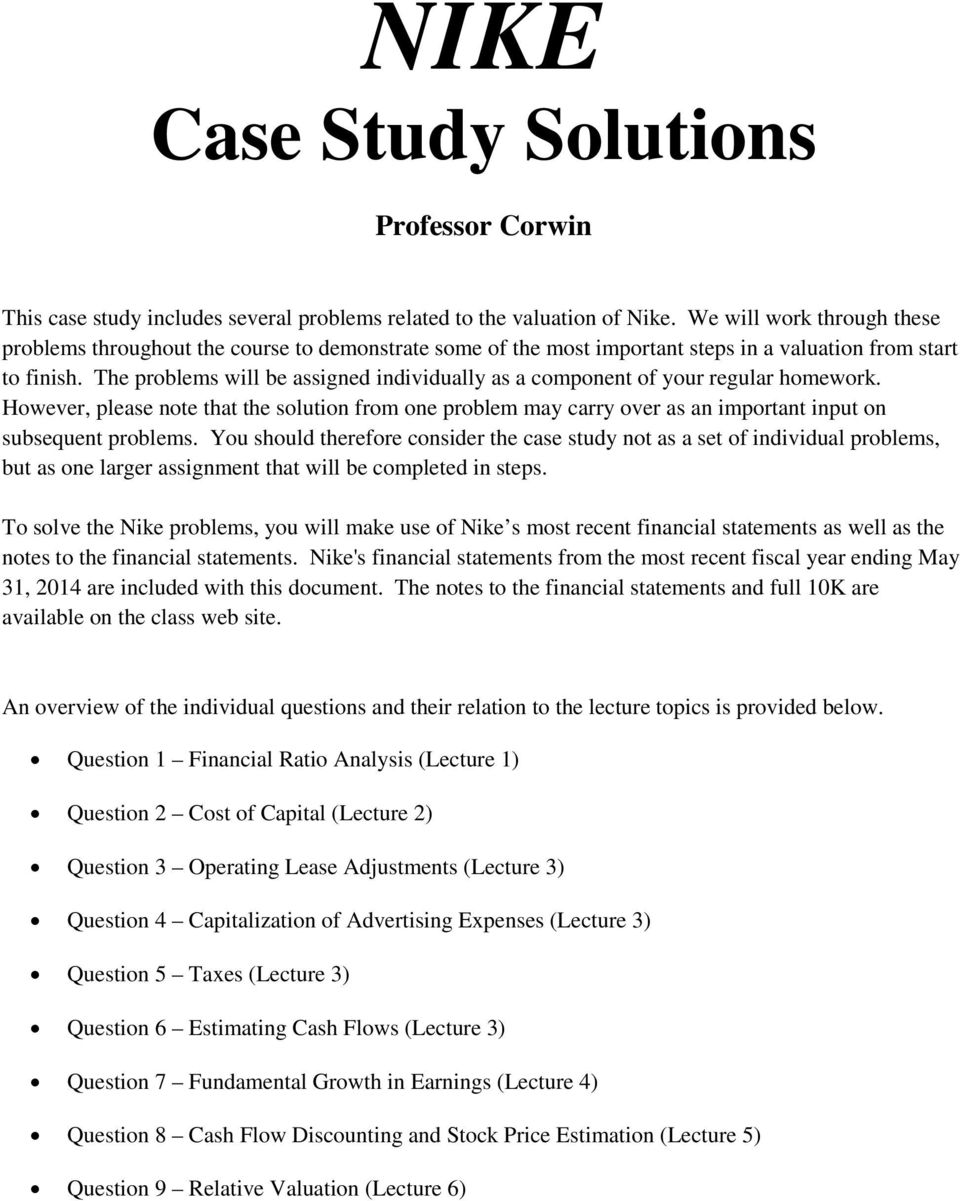
1 NIKE Case Study Solutions Professor Corwin This case study includes several problems related to the valuation of Nike. We will work through these problems throughout the course to demonstrate some of the most important steps in a valuation from start to finish. The problems will be assigned individually as a component of your regular homework. However, please note that the solution from one problem may carry over as an important input on subsequent problems. You should therefore consider the case study not as a set of individual problems, but as one larger assignment that will be completed in steps. To solve the Nike problems, you will make use of Nike s most recent financial statements as well as the notes to the financial statements. Nike's financial statements from the most recent fiscal year ending May 31, 2014 are included with this document. The notes to the financial statements and full 10K are available on the class web site. An overview of the individual questions and their relation to the lecture topics is provided below. Question 1 Financial Ratio Analysis (Lecture 1) Question 2 Cost of Capital (Lecture 2) Question 3 Operating Lease Adjustments (Lecture 3) Question 4 Capitalization of Advertising Expenses (Lecture 3) Question 5 Taxes (Lecture 3) Question 6 Estimating Cash Flows (Lecture 3) Question 7 Fundamental Growth in Earnings (Lecture 4) Question 8 Cash Flow Discounting and Stock Price Estimation (Lecture 5) Question 9 Relative Valuation (Lecture 6)
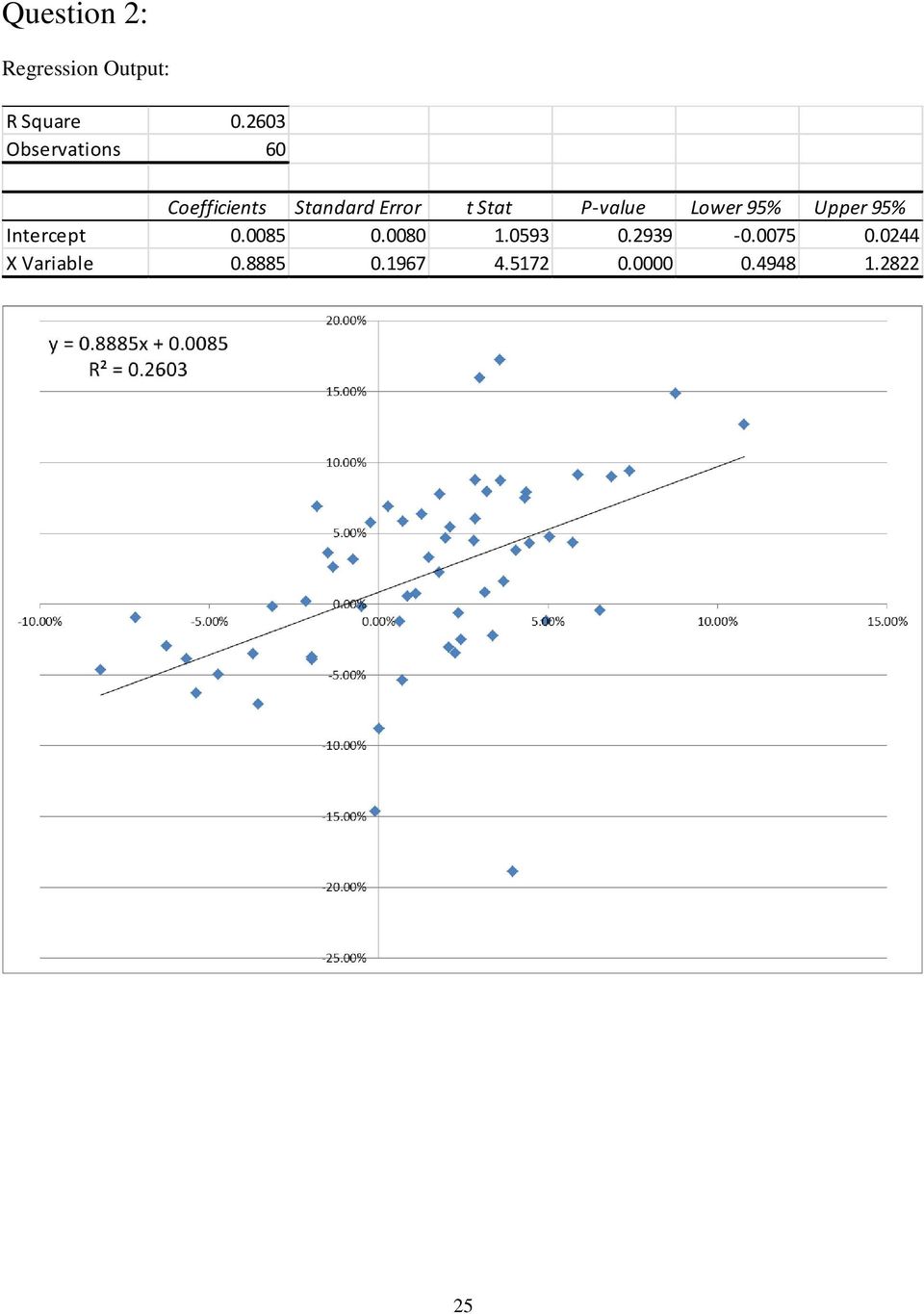
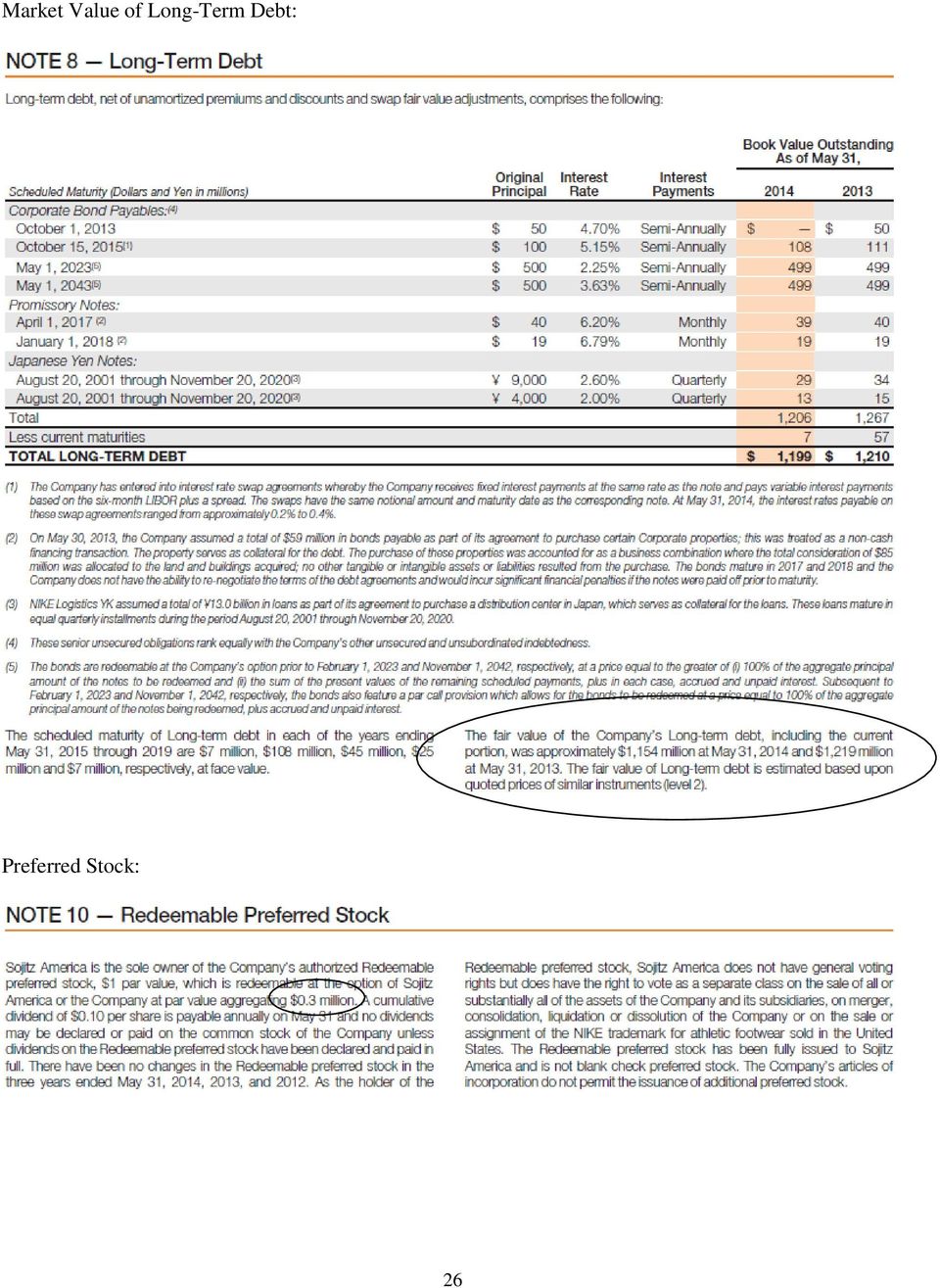
2 2. Cost of Capital In this problem, you will calculate the cost of equity and weighted average cost of capital for Nike as of May 31, Be sure to explain any assumptions you make to arrive at your answers. a. Collect monthly return data for both Nike and the S&P 500 Index for the 60-month period ending in May Using this data, estimate the Beta for Nike based on a market model (CAPM) regression. Using this Beta estimate, calculate the cost of equity (K e ) for Nike based on the CAPM model. Note that you must choose an appropriate risk-free rate and market risk premium to use in the CAPM equation. Briefly explain your choice for each of these variables. I will assume that the risk-free rate equals the 10-year Treasury Yield as of 5/31/14, or 2.48%. The market model regression using 60-months of returns for Nike and the S&P gives a Beta estimate of (see the attached graph). I will use a market risk premium of 4.5%. This estimate reflects both the historical equity risk premium relative to U.S. Treasury Bonds and the implied equity premium calculations we discussed in class. Using this information, the cost of equity can be calculated as: K e = 2.48% (4.5%) = 6.48% Note that for the past several years, monetary policy has resulted in Treasury yields that are unusually low. At the same time, the risk premium on equities has been unusually high. While yields have increased recently and the risk premium has probably come down, we could consider starting with a temporarily high market risk premium to be consistent with the unusually low riskfree rate. We would then adjust both numbers toward normalized (e.g., historical average) value over time. b. Assume that the value of Nike s operating lease debt is $2,437 million and the firm s employee stock options have an after-tax value of $1,789 million. Estimate the market value of debt and the market value of equity for Nike as of May 31, Use the firm's A+ rating and the default spreads provided in the course notes to estimate the firm's cost of debt (K d ). Using these estimates and your answer to (a), calculate the weighted average cost of capital (WACC) for Nike. Assume a marginal tax rate of 24.4%. The default spread table provided in the class notes gives a 10-year default spread of 72 basis points for A+ rated corporate bonds. Note that I use the 10-year spread to be consistent with my use of the 10-year Treasury. Combining this with the risk-free rate from (a) gives a cost of debt equal to 3.20% (2.48% %). According to Nike s most recent 10K, the book value of total debt for the firm is $1,373 million ( ). However, in the Notes to the Consolidated Financial Statements, Nike estimates the market value of long-term debt (including current installments) to be $1,154 million. Combining this with the firm's short-term debt (notes payable) valued at $167 million gives a total market value for debt of $1,321 million. Using methods we will discuss in Lecture 3, I find that the debt value of Nike's operating leases equals $2,437 million (details provided in the appendix). Together, this gives a total adjusted market value of debt equal to $3,758 million. Nike's shares outstanding include 178 million class A shares and 692 million class B shares. Treating these shares as identical and multiplying by the stock price as of May 31, 2014 ($76.91) gives a total equity market value of $66,912 million. To this, we must add the after-tax value of employee stock options (which will be discussed in more detail in Lecture 5), or $1,789 million. 4

3 This gives an adjusted market value of equity equal to $68,701 million. Note that in addition to stock options, Nike has awarded some restricted stock shares to employees. These shares are already accounted for in shares outstanding and do not need to be valued separately. Finally, note that Nike has a small amount (about $300,000) of preferred stock that is owned by a company called Sojitz America. If this were an important component of the firm s capital structure, we could add a third term to the WACC formula reflecting the weight in preferred stock times the cost of preferred stock (the preferred stock yield). Since this component is very small for Nike, I will ignore it in my WACC calculation. Ignoring the adjustments for operating lease debt and employee stock options, the weighted average cost of capital (WACC) is calculated as: WACC = 6.48% + (3.20%)(1.244) = 6.40% After incorporating operating lease debt and employee stock options, the weighted average cost of capital (WACC) is calculated as: WACC = 6.48% + (3.20%)(1.244) = 6.27% Again, note that these values would change if we choose to normalize the market risk premium, the risk-free rate, or both. See the Appendix for additional details related to this solution. 5

4 Question 2: Regression Output: R Square Observations 60 Coefficients Standard Error t Stat P-value Lower 95% Upper 95% Intercept X Variable
5 Market Value of Long-Term Debt: Preferred Stock: 26
Homework Solutions - Lecture 2
 Homework Solutions - Lecture 2 1. The value of the S&P 500 index is 1286.12 and the treasury rate is 3.43%. In a typical year, stock repurchases increase the average payout ratio on S&P 500 stocks to over
Chapter 13, ROIC and WACC
 Chapter 13, ROIC and WACC Lakehead University Winter 2005 Role of the CFO The Chief Financial Officer (CFO) is involved in the following decisions: Management Decisions Financing Decisions Investment Decisions
FINC 3630: Advanced Business Finance Additional Practice Problems
 FINC 3630: Advanced Business Finance Additional Practice Problems Accounting For Financial Management 1. Calculate free cash flow for Home Depot for the fiscal year-ended February 1, 2015 (the 2014 fiscal
The Weighted Average Cost of Capital
 The Weighted Average Cost of Capital What Does "Cost of Capital" Mean? "Cost of capital" is defined as "the opportunity cost of all capital invested in an enterprise." Let's dissect this definition: Opportunity
Homework Solutions - Lecture 4
 Homework Solutions - Lecture 4 1. Estimate fundamental growth in EBIT for Nike based on the firm s reinvestment rate and ROC in the most recent year. Be sure to incorporate any necessary adjustments made
PRACTICE EXAM QUESTIONS ON WACC
 Dr. Sudhakar Raju Financial Statements Analysis (FN 6450) PRACTICE EXAM QUESTIONS ON WACC 1. The return shareholders require on their investment in a firm is called the: a. dividend yield. B. cost of equity.
Things to Absorb, Read, and Do
 Things to Absorb, Read, and Do Things to absorb - Everything, plus remember some material from previous chapters. This chapter applies Chapter s 6, 7, and 12, Risk and Return concepts to the market value
Financial Formulas. 5/2000 Chapter 3 Financial Formulas i
 Financial Formulas 3 Financial Formulas i In this chapter 1 Formulas Used in Financial Calculations 1 Statements of Changes in Financial Position (Total $) 1 Cash Flow ($ millions) 1 Statements of Changes
Stock Valuation: Gordon Growth Model. Week 2
 Stock Valuation: Gordon Growth Model Week 2 Approaches to Valuation 1. Discounted Cash Flow Valuation The value of an asset is the sum of the discounted cash flows. 2. Contingent Claim Valuation A contingent
CHAPTER 12 RISK, COST OF CAPITAL, AND CAPITAL BUDGETING
 CHAPTER 12 RISK, COST OF CAPITAL, AND CAPITAL BUDGETING Answers to Concepts Review and Critical Thinking Questions 1. No. The cost of capital depends on the risk of the project, not the source of the money.
( ) ( )( ) ( ) 2 ( ) 3. n n = 100 000 1+ 0.10 = 100 000 1.331 = 133100
 Mariusz Próchniak Chair of Economics II Warsaw School of Economics CAPITAL BUDGETING Managerial Economics 1 2 1 Future value (FV) r annual interest rate B the amount of money held today Interest is compounded
Forecasting and Valuation of Enterprise Cash Flows 1. Dan Gode and James Ohlson
 Forecasting and Valuation of Enterprise Cash Flows 1 1. Overview FORECASTING AND VALUATION OF ENTERPRISE CASH FLOWS Dan Gode and James Ohlson A decision to invest in a stock proceeds in two major steps
Chapter 11 Calculating the Cost of Capital
 Chapter 11 Calculating the Cost of Capital (def) - Cost of obtaining money to fund asset purchase - use as estimate of r (discount rate) If we can earn more than the cost of capital (r) from a project
Midland Energy/Sample 2. Midland Energy Resources, Inc.
 Midland Energy Resources, Inc. Midland Energy Resources, Inc. is a global energy company that operates in oil and gas exploration and production (E&P), refining and marketing (R&M), and petrochemicals.
Models of Risk and Return
 Models of Risk and Return Aswath Damodaran Aswath Damodaran 1 First Principles Invest in projects that yield a return greater than the minimum acceptable hurdle rate. The hurdle rate should be higher for
Chapter 17 Does Debt Policy Matter?
 Chapter 17 Does Debt Policy Matter? Multiple Choice Questions 1. When a firm has no debt, then such a firm is known as: (I) an unlevered firm (II) a levered firm (III) an all-equity firm D) I and III only
Paper F9. Financial Management. Friday 6 December 2013. Fundamentals Level Skills Module. The Association of Chartered Certified Accountants
 Fundamentals Level Skills Module Financial Management Friday 6 December 2013 Time allowed Reading and planning: Writing: 15 minutes 3 hours ALL FOUR questions are compulsory and MUST be attempted. Formulae
Leverage. FINANCE 350 Global Financial Management. Professor Alon Brav Fuqua School of Business Duke University. Overview
 Leverage FINANCE 35 Global Financial Management Professor Alon Brav Fuqua School of Business Duke University Overview Capital Structure does not matter! Modigliani & Miller propositions Implications for
DUKE UNIVERSITY Fuqua School of Business. FINANCE 351 - CORPORATE FINANCE Problem Set #4 Prof. Simon Gervais Fall 2011 Term 2.
 DUK UNIRSITY Fuqua School of Business FINANC 351 - CORPORAT FINANC Problem Set #4 Prof. Simon Gervais Fall 2011 Term 2 Questions 1. Suppose the corporate tax rate is 40%. Consider a firm that earns $1,000
Practice Exam (Solutions)
 Practice Exam (Solutions) June 6, 2008 Course: Finance for AEO Length: 2 hours Lecturer: Paul Sengmüller Students are expected to conduct themselves properly during examinations and to obey any instructions
The Cost of Capital. Chapter 10. Cost of Debt (r d ) The Cost of Capital. Calculating the cost of obtaining funds for a project
 The Cost of Capital Chapter 10 (def) - Cost of obtaining money to fund asset purchase - use as estimate of r (discount rate) If we can earn more than the cost of capital (r) from a project than company
Expected default frequency
 KM Model Expected default frequency Expected default frequency (EDF) is a forward-looking measure of actual probability of default. EDF is firm specific. KM model is based on the structural approach to
COST OF CAPITAL Compute the cost of debt. Compute the cost of preferred stock.
 OBJECTIVE 1 Compute the cost of debt. The method of computing the yield to maturity for bonds will be used how to compute the cost of debt. Because interest payments are tax deductible, only after-tax
Bonds, Preferred Stock, and Common Stock
 Bonds, Preferred Stock, and Common Stock I. Bonds 1. An investor has a required rate of return of 4% on a 1-year discount bond with a $100 face value. What is the most the investor would pay for 2. An
CHAPTER 14 COST OF CAPITAL
 CHAPTER 14 COST OF CAPITAL Answers to Concepts Review and Critical Thinking Questions 1. It is the minimum rate of return the firm must earn overall on its existing assets. If it earns more than this,
Financial Management
 Mock Examination : ACCA Paper F9 Financial Management Session : June 2014 Prepared by : Mr Ian Lim Your Contact Number : I wish to have my script marked by the lecturer and collect the marked script at
Time allowed Formulae Sheet, Present Value and Annuity Tables are on
 Fundamentals Level Skills Module Financial Management Friday 15 June 2012 Time allowed Reading and planning: Writing: 15 minutes 3 hours ALL FOUR questions are compulsory and MUST be attempted. Formulae
Finance 3130 Corporate Finiance Sample Final Exam Spring 2012
 Finance 3130 Corporate Finiance Sample Final Exam Spring 2012 True/False Indicate whether the statement is true or falsewith A for true and B for false. 1. Interest paid by a corporation is a tax deduction
HHIF Lecture Series: Discounted Cash Flow Model
 HHIF Lecture Series: Discounted Cash Flow Model Alexander Remorov University of Toronto November 19, 2010 Alexander Remorov (University of Toronto) HHIF Lecture Series: Discounted Cash Flow Model 1 / 18
WEB APPENDIX. Calculating Beta Coefficients. b Beta Rise Run Y 7.1 1 8.92 X 10.0 0.0 16.0 10.0 1.6
 WEB APPENDIX 8A Calculating Beta Coefficients The CAPM is an ex ante model, which means that all of the variables represent before-thefact, expected values. In particular, the beta coefficient used in
Equity Market Risk Premium Research Summary. 12 April 2016
 Equity Market Risk Premium Research Summary 12 April 2016 Introduction welcome If you are reading this, it is likely that you are in regular contact with KPMG on the topic of valuations. The goal of this
APPENDIX D: CALCULATION OF EVA FOR A HYPOTHETICAL SIMULCASTER. As noted in the text, we calculated EVA for a hypothetical simulcaster in five steps,
 APPENDIX D: CALCULATION OF EVA FOR A HYPOTHETICAL SIMULCASTER As noted in the text, we calculated EVA for a hypothetical simulcaster in five steps, which are summarized below. Step 1: Identify firms with
INTERVIEWS - FINANCIAL MODELING
 420 W. 118th Street, Room 420 New York, NY 10027 P: 212-854-4613 F: 212-854-6190 www.sipa.columbia.edu/ocs INTERVIEWS - FINANCIAL MODELING Basic valuation concepts are among the most popular technical
Test3. Pessimistic Most Likely Optimistic Total Revenues 30 50 65 Total Costs -25-20 -15
 Test3 1. The market value of Charcoal Corporation's common stock is $20 million, and the market value of its riskfree debt is $5 million. The beta of the company's common stock is 1.25, and the market
Contribution 787 1,368 1,813 983. Taxable cash flow 682 1,253 1,688 858 Tax liabilities (205) (376) (506) (257)
 Answers Fundamentals Level Skills Module, Paper F9 Financial Management June 2012 Answers 1 (a) Calculation of net present value (NPV) As nominal after-tax cash flows are to be discounted, the nominal
Napoli Pizza wants to determine its optimal capital structure
 Napoli Pizza wants to determine its optimal capital structure ABSTRACT Brad Stevenson Daniel Bauer David Collins Keith Richardson This case is based on an actual business decision that was made by a small,
Estimating Beta. Aswath Damodaran
 Estimating Beta The standard procedure for estimating betas is to regress stock returns (R j ) against market returns (R m ) - R j = a + b R m where a is the intercept and b is the slope of the regression.
SAMPLE FACT EXAM (You must score 70% to successfully clear FACT)
 SAMPLE FACT EXAM (You must score 70% to successfully clear FACT) 1. What is the present value (PV) of $100,000 received five years from now, assuming the interest rate is 8% per year? a. $600,000.00 b.
Value of Equity and Per Share Value when there are options and warrants outstanding. Aswath Damodaran
 Value of Equity and Per Share Value when there are options and warrants outstanding Aswath Damodaran 1 Equity Value and Per Share Value: A Test Assume that you have done an equity valuation of Microsoft.
Module 1: Corporate Finance and the Role of Venture Capital Financing TABLE OF CONTENTS
 1.0 FINANCING PRINCIPLES Module 1: Corporate Finance and the Role of Venture Capital Financing Financing Principles 1.01 Introduction to Financing Principles 1.02 Capitalization of a Business 1.03 Capital
Equity Valuation. Lecture Notes # 8. 3 Choice of the Appropriate Discount Rate 2. 4 Future Cash Flows: the Dividend Discount Model (DDM) 3
 Equity Valuation Lecture Notes # 8 Contents About Valuation 2 2 Present-Values 2 3 Choice of the Appropriate Discount Rate 2 4 Future Cash Flows: the Dividend Discount Model (DDM) 3 5 The Two-Stage Dividend-Growth
BUSINESS FINANCE (FIN 312) Spring 2008
 BUSINESS FINANCE (FIN 312) Spring 2008 Assignment 3 Instructions: please read carefully You can either do the assignment by yourself or work in a group of no more than two. You should show your work how
The Tangent or Efficient Portfolio
 The Tangent or Efficient Portfolio 1 2 Identifying the Tangent Portfolio Sharpe Ratio: Measures the ratio of reward-to-volatility provided by a portfolio Sharpe Ratio Portfolio Excess Return E[ RP ] r
VALUATION JC PENNEY (NYSE:JCP)
 VALUATION JC PENNEY (NYSE:JCP) Prepared for Dr. K.C. Chen California State University, Fresno Prepared by Sicilia Sendjaja Finance 129-Student Investment Funds December 15 th, 2009 California State University,
Cost of Capital and Corporate Refinancing Strategy: Optimization of Costs and Risks *
 Cost of Capital and Corporate Refinancing Strategy: Optimization of Costs and Risks * Garritt Conover Abstract This paper investigates the effects of a firm s refinancing policies on its cost of capital.
Chapter 22 Credit Risk
 Chapter 22 Credit Risk May 22, 2009 20.28. Suppose a 3-year corporate bond provides a coupon of 7% per year payable semiannually and has a yield of 5% (expressed with semiannual compounding). The yields
Econ 330 Exam 1 Name ID Section Number
 Econ 330 Exam 1 Name ID Section Number MULTIPLE CHOICE. Choose the one alternative that best completes the statement or answers the question. 1) If during the past decade the average rate of monetary growth
] (3.3) ] (1 + r)t (3.4)
![] (3.3) ] (1 + r)t (3.4)](/thumbs/39/18539117.jpg "] (3.3) ] (1 + r)t (3.4)") Present value = future value after t periods (3.1) (1 + r) t PV of perpetuity = C = cash payment (3.2) r interest rate Present value of t-year annuity = C [ 1 1 ] (3.3) r r(1 + r) t Future value of annuity
Present value = future value after t periods (3.1) (1 + r) t PV of perpetuity = C = cash payment (3.2) r interest rate Present value of t-year annuity = C [ 1 1 ] (3.3) r r(1 + r) t Future value of annuity
USING THE EQUITY RESIDUAL APPROACH TO VALUATION: AN EXAMPLE
 Graduate School of Business Administration - University of Virginia USING THE EQUITY RESIDUAL APPROACH TO VALUATION: AN EXAMPLE Planned changes in capital structure over time increase the complexity of
DCF and WACC calculation: Theory meets practice
 www.pwc.com DCF and WACC calculation: Theory meets practice Table of contents Section 1. Fair value and company valuation page 3 Section 2. The DCF model: Basic assumptions and the expected cash flows
Chapter 11. Topics Covered. Chapter 11 Objectives. Risk, Return, and Capital Budgeting
 Chapter 11 Risk, Return, and Capital Budgeting Topics Covered Measuring Market Risk Portfolio Betas Risk and Return CAPM and Expected Return Security Market Line CAPM and Stock Valuation Chapter 11 Objectives
Paper F9. Financial Management. Friday 7 December 2012. Fundamentals Level Skills Module. The Association of Chartered Certified Accountants
 Fundamentals Level Skills Module Financial Management Friday 7 December 2012 Time allowed Reading and planning: Writing: 15 minutes 3 hours ALL FOUR questions are compulsory and MUST be attempted. Formulae
Topics in Chapter. Key features of bonds Bond valuation Measuring yield Assessing risk
 Bond Valuation 1 Topics in Chapter Key features of bonds Bond valuation Measuring yield Assessing risk 2 Determinants of Intrinsic Value: The Cost of Debt Net operating profit after taxes Free cash flow
Cost of Capital and Project Valuation
 Cost of Capital and Project Valuation 1 Background Firm organization There are four types: sole proprietorships partnerships limited liability companies corporations Each organizational form has different
Estimating Cost of Capital. 2. The cost of capital is an opportunity cost it depends on where the money goes, not where it comes from
 Estimating Cost of Capal 1. Vocabulary the following all mean the same thing: a. Required return b. Appropriate discount rate c. Cost of capal (or cost of money) 2. The cost of capal is an opportuny cost
International Glossary of Business Valuation Terms*
 40 Statement on Standards for Valuation Services No. 1 APPENDIX B International Glossary of Business Valuation Terms* To enhance and sustain the quality of business valuations for the benefit of the profession
Cost of Capital, Valuation and Strategic Financial Decision Making
 Cost of Capital, Valuation and Strategic Financial Decision Making By Dr. Valerio Poti, - Examiner in Professional 2 Stage Strategic Corporate Finance The financial crisis that hit financial markets in
CHAPTER 8. Problems and Questions
 CHAPTER 8 Problems and Questions 1. Plastico, a manufacturer of consumer plastic products, is evaluating its capital structure. The balance sheet of the company is as follows (in millions): Assets Liabilities
Asymmetry and the Cost of Capital
 Asymmetry and the Cost of Capital Javier García Sánchez, IAE Business School Lorenzo Preve, IAE Business School Virginia Sarria Allende, IAE Business School Abstract The expected cost of capital is a crucial
Module 1: Corporate Finance and the Role of Venture Capital Financing TABLE OF CONTENTS
 1.0 ALTERNATIVE SOURCES OF FINANCE Module 1: Corporate Finance and the Role of Venture Capital Financing Alternative Sources of Finance TABLE OF CONTENTS 1.1 Short-Term Debt (Short-Term Loans, Line of
Weighted Average Cost of Capital For an Apartment Real Estate Investment Trust
 Weighted Average Cost of Capital For an Apartment Real Estate Investment Trust Presented by Lawrence A. Souza Director of Research Professor of Real Estate Finance and Development San Francisco State University
A Test Of The M&M Capital Structure Theories Richard H. Fosberg, William Paterson University, USA
 A Test Of The M&M Capital Structure Theories Richard H. Fosberg, William Paterson University, USA ABSTRACT Modigliani and Miller (1958, 1963) predict two very specific relationships between firm value
Paper F9. Financial Management. Friday 6 June 2014. Fundamentals Level Skills Module. The Association of Chartered Certified Accountants.
 Fundamentals Level Skills Module Financial Management Friday 6 June 2014 Time allowed Reading and planning: Writing: 15 minutes 3 hours ALL FOUR questions are compulsory and MUST be attempted. Formulae
Fundamentals Level Skills Module, Paper F9
 Answers Fundamentals Level Skills Module, Paper F9 Financial Management June 2008 Answers 1 (a) Calculation of weighted average cost of capital (WACC) Cost of equity Cost of equity using capital asset
Finding the Right Financing Mix: The Capital Structure Decision
 Finding the Right Financing Mix: The Capital Structure Decision Aswath Damodaran Stern School of Business Aswath Damodaran 1 First Principles Invest in projects that yield a return greater than the minimum
The cost of capital. A reading prepared by Pamela Peterson Drake. 1. Introduction
 The cost of capital A reading prepared by Pamela Peterson Drake O U T L I N E 1. Introduction... 1 2. Determining the proportions of each source of capital that will be raised... 3 3. Estimating the marginal
SOLUTIONS. Practice questions. Multiple Choice
 Practice questions Multiple Choice 1. XYZ has $25,000 of debt outstanding and a book value of equity of $25,000. The company has 10,000 shares outstanding and a stock price of $10. If the unlevered beta
CAPITALIZATION/DISCOUNT
 Fundamentals, Techniques & Theory CAPITALIZATION/DISCOUNT RATES CHAPTER FIVE CAPITALIZATION/DISCOUNT RATES I. OVERVIEW Money doesn t always bring happiness People with ten million dollars are no happier
CFS. Syllabus. Certified Finance Specialist. International benchmark in Finance profession
 CFS Certified Finance Specialist Syllabus International benchmark in Finance profession Certified Finance Specialist Summary: This award will provide candidates the opportunity to gain advanced level knowledge
COST OF CAPITAL. Please note that in finance, we are concerned with MARKET VALUES (unlike accounting, which is concerned with book values).
 COST OF CAPITAL Cost of capital calculations are a very important part of finance. To value a project, it is important to discount the cash flows using a discount rate that incorporates the debt-equity
Chapter 14. Web Extension: Financing Feedbacks and Alternative Forecasting Techniques
 Chapter 14 Web Extension: Financing Feedbacks and Alternative Forecasting Techniques I n Chapter 14 we forecasted financial statements under the assumption that the firm s interest expense can be estimated
Paper F9. Financial Management. Friday 7 June 2013. Fundamentals Level Skills Module. The Association of Chartered Certified Accountants.
 Fundamentals Level Skills Module Financial Management Friday 7 June 2013 Time allowed Reading and planning: Writing: 15 minutes 3 hours ALL FOUR questions are compulsory and MUST be attempted. Formulae
MBA 8230 Corporation Finance (Part II) Practice Final Exam #2
 MBA 8230 Corporation Finance (Part II) Practice Final Exam #2 1. Which of the following input factors, if increased, would result in a decrease in the value of a call option? a. the volatility of the company's
Review for Exam 3. Instructions: Please read carefully
 Review for Exam 3 Instructions: Please read carefully The exam will have 25 multiple choice questions and 5 work problems. You are not responsible for any topics that are not covered in the lecture note
A Review of Cross Sectional Regression for Financial Data You should already know this material from previous study
 A Review of Cross Sectional Regression for Financial Data You should already know this material from previous study But I will offer a review, with a focus on issues which arise in finance 1 TYPES OF FINANCIAL
Discounted Cash Flow Valuation: Basics
 Discounted Cash Flow Valuation: Basics Aswath Damodaran Aswath Damodaran 1 Discounted Cashflow Valuation: Basis for Approach Value = t=n CF t t =1(1+r) t where CF t is the cash flow in period t, r is the
Final Exam MØA 155 Financial Economics Fall 2009 Permitted Material: Calculator
 University of Stavanger (UiS) Stavanger Masters Program Final Exam MØA 155 Financial Economics Fall 2009 Permitted Material: Calculator The number in brackets is the weight for each problem. The weights
Consolidated Financial Summary For the third quarter of the fiscal year ending March 31, 2009
 Monex Group, Inc. Consolidated Financial Summary under Japanese GAAP for the third quarter of the fiscal year ending March 31, 2009 (April 1, 2008-December 31, 2008) This is an English translation of Japanese
The Internal Rate of Return Model for Life Insurance Policies
 The Internal Rate of Return Model for Life Insurance Policies Abstract Life insurance policies are no longer seen solely as a means of insuring life. Due to many new features introduced by life insurers,
Cashflow, Free Cashflow, and Proforma Forecasting
 Cashflow, Free Cashflow, and Proforma Forecasting Proforma Forecasting Models Proforma forecasting models are designed to use the balance sheet and income statement from a corporation from a number of
Chapter 9. The Valuation of Common Stock. 1.The Expected Return (Copied from Unit02, slide 39)
 Readings Chapters 9 and 10 Chapter 9. The Valuation of Common Stock 1. The investor s expected return 2. Valuation as the Present Value (PV) of dividends and the growth of dividends 3. The investor s required
How To Calculate The Cost Of Capital Of A Firm
 Sample Problems Chapter 10 Title: Cost of Debt 1. Costly Corporation plans a new issue of bonds with a par value of $1,000, a maturity of 28 years, and an annual coupon rate of 16.0%. Flotation costs associated
Course Outline. BUSN 6020/1-3 Corporate Finance (3,0,0)
 Course Outline Department of Accounting and Finance School of Business and Economics BUSN 6020/1-3 Corporate Finance (3,0,0) Calendar Description Students acquire the knowledge and skills required to effectively
Understanding and Implementing the Income Approach
 Understanding and Implementing the Income Approach Charles A. Wilhoite, Managing Director, Willamette Management Associates Daniel M. Lynn, Principal, Deloitte Financial Advisory Services, LLP September
Using the Bloomberg terminal for data
 Using the Bloomberg terminal for data Contents of Package 1.Getting information on your company Pages 2-31 2.Getting information on comparable companies Pages 32-39 3.Getting macro economic information
Web Extension: Financing Feedbacks and Alternative Forecasting Techniques
 19878_09W_p001-009.qxd 3/10/06 9:56 AM Page 1 C H A P T E R 9 Web Extension: Financing Feedbacks and Alternative Forecasting Techniques IMAGE: GETTY IMAGES, INC., PHOTODISC COLLECTION In Chapter 9 we forecasted
STUDENT CAN HAVE ONE LETTER SIZE FORMULA SHEET PREPARED BY STUDENT HIM/HERSELF. FINANCIAL CALCULATOR/TI-83 OR THEIR EQUIVALENCES ARE ALLOWED.
 Test III-FINN3120-090 Fall 2009 (2.5 PTS PER QUESTION. MAX 100 PTS) Type A Name ID PRINT YOUR NAME AND ID ON THE TEST, ANSWER SHEET AND FORMULA SHEET. TURN IN THE TEST, OPSCAN ANSWER SHEET AND FORMULA
Methodological Tool. Draft tool to determine the weighted average cost of capital (WACC) (Version 01)
 Page 1 Methodological Tool Draft tool to determine the weighted average cost of capital (WACC) (Version 01) I. DEFINITIONS, SCOPE, APPLICABILITY AND PARAMETERS Definitions For the purpose of this tool,
a) The Dividend Growth Model Approach: Recall the constant dividend growth model for the price of a rm s stock:
 Cost of Capital Chapter 14 A) The Cost of Capital: Some Preliminaries: The Security market line (SML) and capital asset pricing model (CAPM) describe the relationship between systematic risk and expected
Practice Bulletin No. 2
 Practice Bulletin No. 2 INTERNATIONAL GLOSSARY OF BUSINESS VALUATION TERMS To enhance and sustain the quality of business valuations for the benefit of the profession and its clientele, the below identified
EMBA in Management & Finance. Corporate Finance. Eric Jondeau
 EMBA in Management & Finance Corporate Finance EMBA in Management & Finance Lecture 5: Capital Budgeting For the Levered Firm Prospectus Recall that there are three questions in corporate finance. The
Tax-adjusted discount rates with investor taxes and risky debt
 Tax-adjusted discount rates with investor taxes and risky debt Ian A Cooper and Kjell G Nyborg October 2004 Abstract This paper derives tax-adjusted discount rate formulas with Miles-Ezzell leverage policy,
Reeve Warren Duchac. James M. Reeve. Professor Emeritus of Accounting University of Tennessee, Knoxville
 Reeve Warren Duchac 10e James M. Reeve Professor Emeritus of Accounting University of Tennessee, Knoxville Carl S. Warren Professor Emeritus of Accounting University of Georgia, Athens Jonathan E. Duchac
WACC and APV. The Big Picture: Part II - Valuation
 WACC and APV 1 The Big Picture: Part II - Valuation A. Valuation: Free Cash Flow and Risk April 1 April 3 Lecture: Valuation of Free Cash Flows Case: Ameritrade B. Valuation: WACC and APV April 8 April
Employee Options, Restricted Stock and Value. Aswath Damodaran 1
 Employee Options, Restricted Stock and Value 1 Basic Proposition on Options Any options issued by a firm, whether to management or employees or to investors (convertibles and warrants) create claims on
Net revenue 785 25 1,721 05 5,038 54 3,340 65 Tax payable (235 58) (516 32) (1,511 56) (1,002 20)
 Answers Fundamentals Level Skills Module, Paper F9 Financial Management December 2013 Answers 1 (a) Calculating the net present value of the investment project using a nominal terms approach requires the
Web Appendix OPERATIONALIZATION OF CUSTOMER METRICS FOR NETFLIX AND VERIZON WIRELESS
 1 Web Appendix OPERATIONALIZATION OF CUSTOMER METRICS FOR NETFLIX AND VERIZON WIRELESS Netflix reports all required customer metrics (profit contribution, acquisition cost, retention cost, and retention
Lecture 15: Final Topics on CAPM
 Lecture 15: Final Topics on CAPM Final topics on estimating and using beta: the market risk premium putting it all together Final topics on CAPM: Examples of firm and market risk Shorting Stocks and other
Paper F9. Financial Management. Thursday 10 June 2010. Fundamentals Level Skills Module. The Association of Chartered Certified Accountants
 Fundamentals Level Skills Module Financial Management Thursday 10 June 2010 Time allowed Reading and planning: Writing: 15 minutes 3 hours ALL FOUR questions are compulsory and MUST be attempted. Formulae