
Electricity Network Performance Report 2012/13
|
|
|
- Oliver Martin
- 10 years ago
- Views:
Transcription
1 Electricity Network Performance Report 2012/13
2 Electricity Network Performance Report Contents INTRODUCTION PROFILE Overview Capital works program NETWORK MANAGEMENT Overview Network Complaints Customer Service Standards Reporting NETWORK PLANNING Overview Design Planning Criteria Compliance Reporting Demand Management ASSET MANAGEMENT Overview Technical Service Standards Quality of Supply Distribution Reliability Transmission Reliability NETWORK SAFETY Overview Public Reportable Safety Incidents Worker Reportable Safety Incidents Major Incident Reports CUSTOMER INSTALLATIONS Reports against Customer Installation Safety Plans Customer Installation Shock Reports CONTESTABLE WORKS SCHEME BUSH FIRE RISK MANAGEMENT Monthly and Quarterly Reporting Process Capital and Replacement Programs Communicating with Customers Liaison and consultation with Fire Services and others PUBLIC ELECTRICAL SAFETY AWARENESS Key Issues PESAP Programs POWER LINE CROSSINGS OF NAVIGABLE WATERWAYS Risk Assessment Water Crossing Program Progress New Crossings Water Crossing Incidents Water Crossing Incident Management i

3 11 COO DECLARATION ATTACHMENT A: DISTRIBUTION RELIABILITY OF SUPPLY: DEFINITIONS AND NOTES ATTACHMENT B: TRANSMISSION RELIABILITY: NETWORK INDICES ATTACHMENT C: SAFETY ATTACHMENT D: DEFINITIONS ATTACHMENT E: FEEDERS WHICH EXCEEDED INDIVIDUAL FEEDER STANDARDS ATTACHMENT F: GUIDELINES FOR THE REPORTING OF DEMAND MANAGEMENT ii
4 Introduction This report represents Ausgrid s Electricity Network Performance Report for the 2012/13 financial year. The report has been prepared in accordance with the Electricity Supply (Safety and Network Management) Regulation 2008 and follows the outline provided by the NSW Department of Trade and Investment, Regional Infrastructure and Services. The report is designed to report actual performance in the 2012/13 financial year, against the criteria and key performance indicators established in the Network Management Plan. This report therefore complements the Plan and details Ausgrid s performance with respect to: Network Management Network Planning Asset Management Network Safety Customer Installations Accredited Service Provider Scheme Bushfire Risk Management Public Electrical Safety Awareness Compliance with the NSW Maritime electricity industry code Crossings of NSW Navigable Waters. 22 November
5 1 Profile 1.1 Overview Ausgrid s distribution network covers 22,275 square kilometres from Waterfall in Sydney s south to Auburn in western Sydney and the upper Hunter Valley in the north. Ausgrid supplies electricity to 1.6 million customers in Sydney, the Central Coast and the Hunter Region in NSW. Its electricity network powers large and small businesses, as well as major industry including mining, shipping, tourism, manufacturing and agriculture. This report focuses on the performance of Ausgrid s network business which is responsible for the distribution of electricity within our network area (Figure 1). Figure 1 Ausgrid s Network Area 22 November

6 Ausgrid s principal activities include: the ownership and management of assets which make up the electricity distribution network the distribution of electricity to customers through our distribution network infrastructure related construction and maintenance services a range of other services including street lighting, customer connections, safety check ups, energy reviews, metering and 24 hour electrical repairs. Ausgrid s distribution network includes: a sub-transmission system of 33kV, 66kV and 132kV assets a high voltage distribution system of 5kV, 11kV and 22kV assets a low voltage distribution system of 240V and 415V assets over 40,000km of overhead lines and underground cables. These assets are referred to throughout the report as the network. Ausgrid s network customers are therefore customers who are connected to this network of assets. Table 1.1 sets out operator statistics in relation to Ausgrid's network. Table 1.1 Distributor Statistics Number at end of 2011/12 Number at end of 2012/13 Distribution Customer Numbers (Total) 1,627,948* 1,642,353 Distribution Customer Numbers Sydney East Region 321,360* 326,028 Distribution Customer Numbers Sydney South Region 479,182* 485,836 Distribution Customer Numbers Sydney North Region 386,135* 388,924 Distribution Customer Numbers Newcastle Region 200,493* 199,759 Distribution Customer Numbers Central Coast Region 158,668* 158,045 Distribution Customer Numbers Lower Hunter Region 52,695* 53,679 Distribution Customer Numbers Upper Hunter Region 29,415* 30,082 Maximum Demand (Aggregated System MW) 5,149 5,659 Feeder Numbers CBD 56** 55** Feeder Numbers Urban 1,751 1,733 Feeder Numbers Short Rural Feeder Numbers Long Rural 4 4 Energy Received by Dist Network to Year End (GWh) 30,463* 27,401 Energy Distributed to Year End (Residential) (GWh) 8,892* 8,527 Energy Distributed to Year End (Non-Residential Including un-metered supplies) (GWh) 20,453* 17,789 Energy Distributed to Year End (GWh) 29,345* 26,316 System Loss Factor (%) 3.67%* 3.96% 22 November

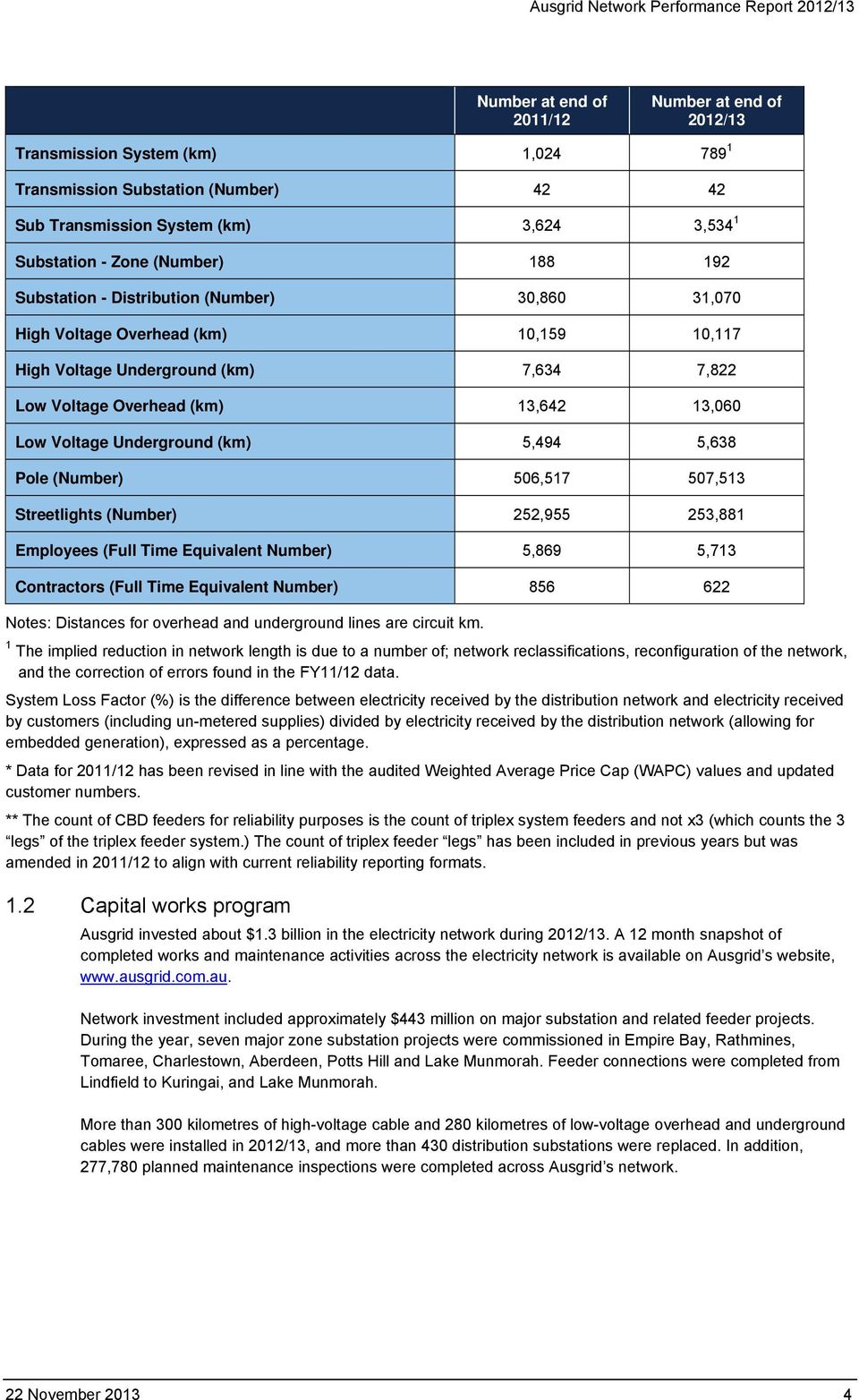
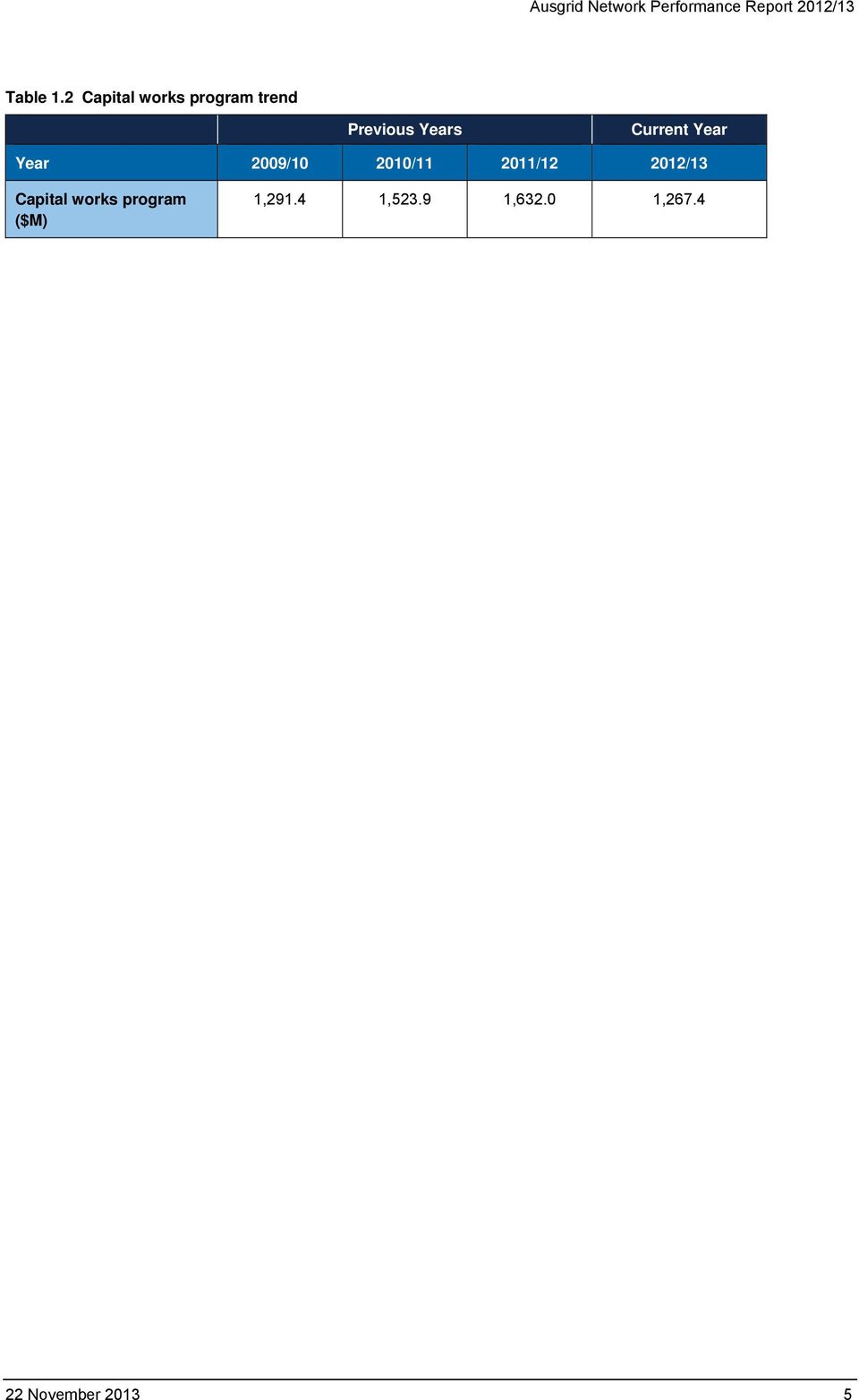
7 Number at end of 2011/12 Number at end of 2012/13 Transmission System (km) 1, Transmission Substation (Number) Sub Transmission System (km) 3,624 3,534 1 Substation - Zone (Number) Substation - Distribution (Number) 30,860 31,070 High Voltage Overhead (km) 10,159 10,117 High Voltage Underground (km) 7,634 7,822 Low Voltage Overhead (km) 13,642 13,060 Low Voltage Underground (km) 5,494 5,638 Pole (Number) 506, ,513 Streetlights (Number) 252, ,881 Employees (Full Time Equivalent Number) 5,869 5,713 Contractors (Full Time Equivalent Number) Notes: Distances for overhead and underground lines are circuit km. 1 The implied reduction in network length is due to a number of; network reclassifications, reconfiguration of the network, and the correction of errors found in the FY11/12 data. System Loss Factor (%) is the difference between electricity received by the distribution network and electricity received by customers (including un-metered supplies) divided by electricity received by the distribution network (allowing for embedded generation), expressed as a percentage. * Data for 2011/12 has been revised in line with the audited Weighted Average Price Cap (WAPC) values and updated customer numbers. ** The count of CBD feeders for reliability purposes is the count of triplex system feeders and not x3 (which counts the 3 legs of the triplex feeder system.) The count of triplex feeder legs has been included in previous years but was amended in 2011/12 to align with current reliability reporting formats. 1.2 Capital works program Ausgrid invested about $1.3 billion in the electricity network during 2012/13. A 12 month snapshot of completed works and maintenance activities across the electricity network is available on Ausgrid s website, Network investment included approximately $443 million on major substation and related feeder projects. During the year, seven major zone substation projects were commissioned in Empire Bay, Rathmines, Tomaree, Charlestown, Aberdeen, Potts Hill and Lake Munmorah. Feeder connections were completed from Lindfield to Kuringai, and Lake Munmorah. More than 300 kilometres of high-voltage cable and 280 kilometres of low-voltage overhead and underground cables were installed in 2012/13, and more than 430 distribution substations were replaced. In addition, 277,780 planned maintenance inspections were completed across Ausgrid s network. 22 November
8 Table 1.2 Capital works program trend Previous Years Current Year Year 2009/ / / /13 Capital works program ($M) 1, , , , November
9 2 Network Management 2.1 Overview In line with the Electricity Supply (Safety and Network Management) Regulation 2008, Ausgrid is required to prepare, implement and publish a Network Management Plan. The Plan is available at The Plan contains high level design, construction, operation and maintenance principles to manage network assets. It also incorporates principles applied to asset utilisation in the areas of safety, reliability, quality of supply and risk management. The Plan has four chapters which are outlined below. Chapter 1: Network Safety and Reliability sets out a framework for Ausgrid s network to provide a safe and reliable, supply of electricity. This chapter details how Ausgrid: manages its assets and sets out the basis for network investment plans investments provides reference to standards and protocols identifies areas of the network that require development. Ausgrid s network planning meets legislative, licence compliance and regulatory requirements and wider organisational objectives and business responsibilities. These include meeting customer expectations for a safe and reliable supply of electricity; managing safety, environmental and security risks associated with network infrastructure; and managing the financial performance of the business. To deliver these objectives, the Network Management Plan focuses on: 1. Maintaining compliant infrastructure Maintaining compliant infrastructure includes managing safety, environmental and infrastructure security risk. The environmental, safety and asset security obligations applicable to the network and services Ausgrid provides as a distributor are taken into account to develop Ausgrid s network management strategies. 2. Network performance Overall network performance is impacted by performance of individual assets, growth in demand, the number of new customer connections required and the extent of any imbalance between overall growth in demand for electricity and available supply. In meeting these two primary objectives Ausgrid targets its investment expenditure to ensure network performance and compliance outcomes are achieved efficiently and prudently along with all regulatory and other obligations. While the network performance and customer outcomes associated with the planning processes are stipulated in the Design, Reliability and Performance Licence Conditions, fault level management is not included in this document. The term fault level relates to how much energy can potentially be released during various fault scenarios - and this parameter varies across the network. Ensuring the fault rating of network assets is not exceeded is a significant asset integrity and safety issue, in addition to customer outcomes associated with faults. Management of fault levels is a critical element of the planning process and is an investment driver. During 2012/13, managing Ausgrid s library of network standards involved issuing four new standards and modifying a further 51 existing standards with an additional 60 changes of a minor nature. All network 22 November
10 standards are displayed on an intranet platform for access across Ausgrid and publicly available standards are also published on the Ausgrid website. Chapter 2: Customer Installation Safety addresses the management of safety in customer premises to the point of connection between the customer s electrical installation and the Ausgrid network. Each year work is undertaken on electrical installations at thousands of customer properties throughout our distribution area. Ausgrid has responsibility for maintaining the distribution network, including the poles and wires required for connection of customer installations. All new and existing electrical work within a customer s electrical installation remains the responsibility of the customer and their installing electrical contractor (contractor). Customers need to employ licensed electrical contractors for any new or modified electrical work. Accredited Service Providers (ASPs) connecting customer installations to our electricity network need to be authorised by Ausgrid. In preparation of the Customer Installation Safety Plan we have taken into account the NSW Codes of Practice: Service and Installation Rules, and the Installation Safety Management Code of Practice. There are no departures from these Codes, unless to adopt a higher safety standard. As required we also advise that customers operating electrical installations are subject to the requirements of the Service and Installation Rules of NSW and Ausgrid s local requirements. Issues, initiatives and achievements relating to Ausgrid s customer installations during 2012/13 are outlined in Chapter 6 of this report. Chapter 3: Public Electrical Safety Awareness aims to warn the public of hazards associated with electricity, particularly in relation to our network. It is based on an assessment of risks associated with the system and an analysis of any accidents or incidents. Ausgrid s approach to public safety focuses on: risk assessment and risk reduction education and communication hazard response and procedures. The Public Electrical Safety Awareness Plan outlines Ausgrid s commitment to safety and our responsibilities under the Electricity Supply (Safety and Network Management) Regulation The plan details: Ausgrid s approach to safety and potential hazards associated with the transmission and distribution of electricity how at risk groups are identified precautions to avoid electrical incidents. Programs are designed to create greater awareness of electrical safety amongst the public and targeted groups, based on an analysis of safety incidents involving Ausgrid s network and relevant data sources. To communicate our safety message we use a number of communication tools and media to reach the at risk groups including TV, radio and print advertisements, education kits, personal presentations, bill inserts, printed material and the web. A range of safety initiatives and programs undertaken over the past year are outlined in Chapter 9 of this report. Chapter 4: Bushfire Risk Management describes a management framework that when correctly implemented will: ensure public safety 22 November
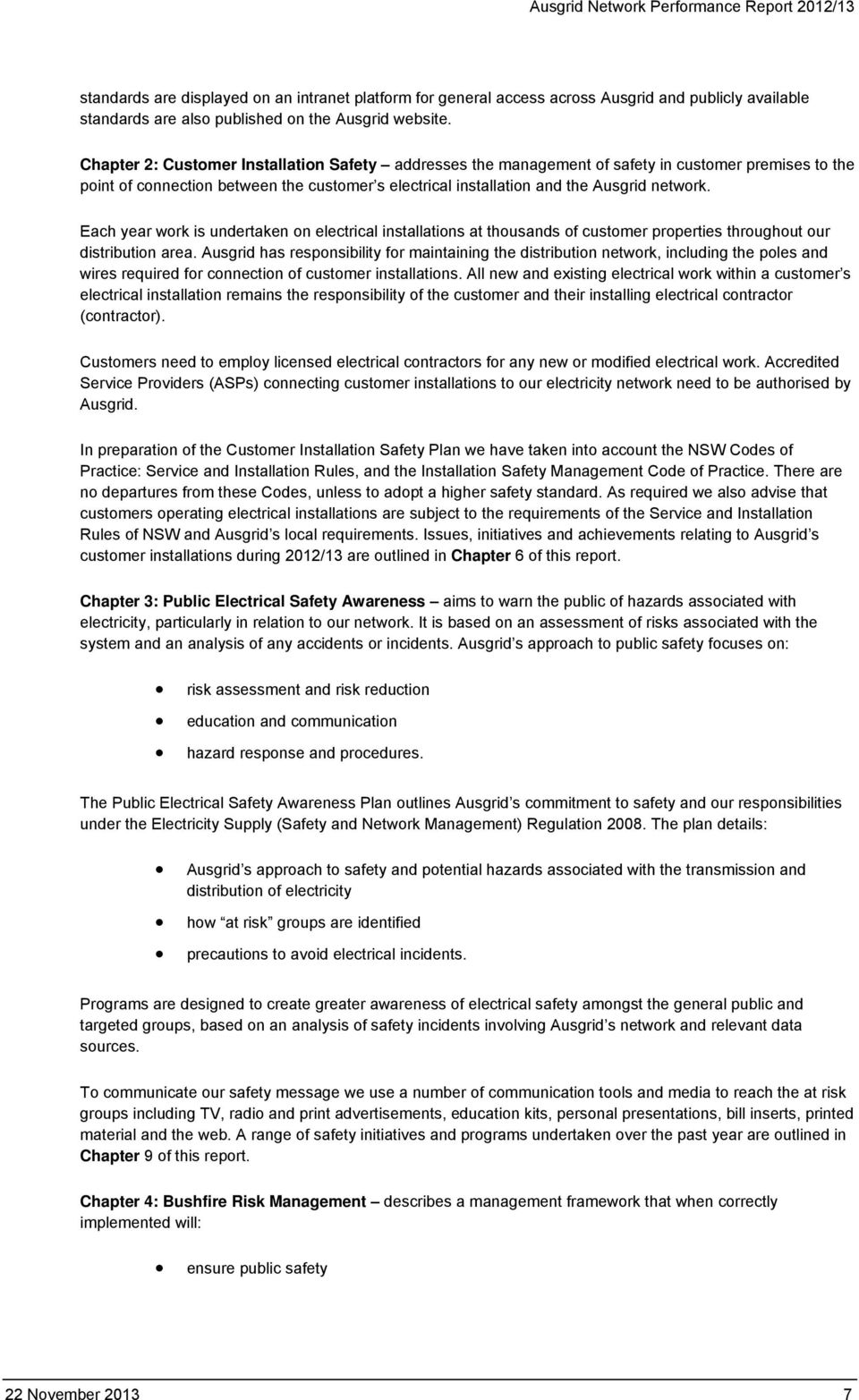
11 establish standards for vegetation management near electricity lines (particularly in bushfire prone areas) reduce interruptions to supply that are related to vegetation minimise the possibility of fire ignition by electricity lines and associated equipment. Ausgrid has an obligation to manage bushfire risks as they relate to our network. We do this by ensuring our assets are safe and are properly designed, constructed and maintained. We also provide information to owners of private power lines and our customers, describing the obligations associated with private power lines, so that they can do the same. This chapter outlines the procedures, standards, codes and guidelines Ausgrid applies to construction, operation and management of our network to achieve these objectives. It also provides an overview of Ausgrid s bushfire risk management strategies in relation to key stakeholders including: landowners and occupiers local government government agencies emergency services. The Bushfire Risk Management Plan also outlines how we inform customers of their obligation to share bushfire prevention responsibilities with us to ensure privately owned overhead power lines are kept free of vegetation and are inspected, tested and maintained at regular intervals. Details of initiatives undertaken in the last year to improve systems to manage bushfire risk within Ausgrid s network area are outlined in Chapter 8 of this report. 2.2 Network Complaints Table 2.1 Complaint Performance Data Previous Years Current Year Year 2008/ / / / /13 Complaints Total 1,409 1,121 1,420 1,471 1,973 Complaints per 1,000 Distribution Customers Complaints regarding Vegetation Management Table 2.2 Network Complaint Investigations Completed 2012/13 Number Number Valid * Voltage Current 0 0 Other Quality 14 1 Reliability Safety 0 0 * A complaint is valid where non-compliance with published service and network standards occurs. 22 November
12 2.3 Customer Service Standards Reporting Table 2.3 Customer Service Standards 2012/13 Data Payments Given Based on Interruption Duration (Total Number) Claims Not Paid Based on Interruption Duration (Total Number) Payments Given Based on Interruption Frequency (Total Number) Claims Not Paid Based on Interruption Frequency (Total Number) Metropolitan Non-Metropolitan November

13 3 Network Planning 3.1 Overview Ausgrid carries out planning at the strategic and project level, driven by prudent, strategic decisions which consider the capital investment required and the delivery of individual projects. Ausgrid s network planning approach is outlined in the Network Management Plan and is consistent with the principles of the NSW Government s Total Asset Management system. Drivers of investment include asset condition, capacity, reliability, customer connections and ensuring the safety and security of the network. Ausgrid is required to comply with service standards in the Design, Reliability and Performance licence conditions imposed by the NSW Minister for Energy. The licence conditions facilitate the delivery of a safe and reliable supply of electricity. The AEMC s report following their review of the NSW licence conditions is currently with the Government for consideration, and we are providing ongoing support to both this, and the associated national review. Ausgrid s Electricity Network Operation Standards detail objectives for maintaining quality electricity supply. Capital investment requirements in the subtransmission network are forecast in line with investment drivers across 25 network areas. Ausgrid also has three transmission plans: Sydney Metropolitan, Central Coast and Lower Hunter, which focus on the transmission network linking TransGrid s bulk supply points to subtransmission substations. The spatial demand forecast is a critical process which supports planning, development of the capital program and the regulatory submission. The current forecast is the first full implementation of a new forecasting application and enhanced process, developed to provide greater efficiency and accuracy, and specifically including weather correction and load normalisation, broad-based demand management, and econometric growth projections. 3.2 Design Planning Criteria Compliance Reporting The design planning criteria contained within the licence conditions set input standards to be used in planning the network, requirements for load forecasting and contingency planning methodologies intended to achieve operational outcomes. The design planning criteria applicable to Ausgrid s network are set out below. The implications of the design planning criteria contained in the licence conditions, and the accompanying notes, are explained in detail in Ausgrid s Network Management Plan. Design Planning Criteria Network Element Load Type Forecast Demand or Expected Demand Security Standard Customer Interruption Time Sub-transmission Line CBD Any N-2 6 < 1hr for 2 nd credible Nil for 1 st credible contingency contingency Urban & Non- Urban Urban & Non- Urban 10 MVA N-1 1 < 1 minute < 10 MVA N 2 Best practice repair time 22 November
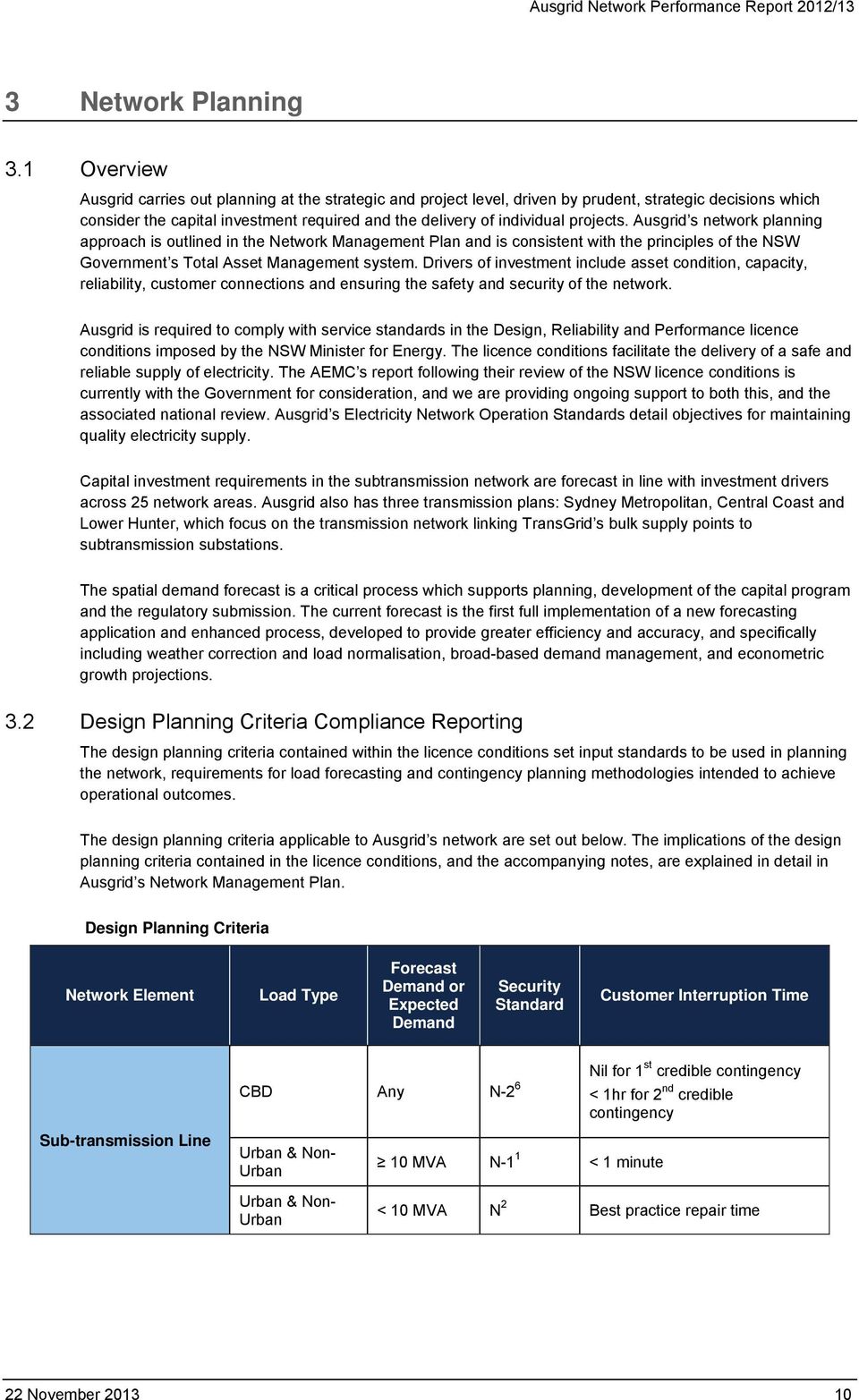
14 Network Element Load Type Forecast Demand or Expected Demand Security Standard Customer Interruption Time Sub-transmission Substation Zone Substation Distribution Feeder Distribution Substation CBD Any N-2 6 < 1hr for 2nd credible Nil for 1st credible contingency contingency Urban & Non- Urban Any N-1 < 1 minute CBD Any N-2 6 < 1hr for 2nd credible Nil for 1st credible contingency contingency Urban & Non- Urban Urban & Non- Urban 10 MVA N-1 1 < 1 minute < 10 MVA N 2 Best practice repair time CBD Any N-1 3 Nil Urban Any N-1 4 < 4 Hours 5 Non-Urban Any N Best practice repair time CBD 1 Any N-1 3 Nil Urban & Non- Urban Any N 7 Best practice repair time 1 For a Sub-transmission line Overhead and Zone substation: (a) under N-1 conditions, the forecast demand is not to exceed the thermal capacity for more than 1% of the time i.e. a total aggregate time of 88 hours per annum, up to a maximum of 20% above the thermal capacity under N-1 conditions. (b) under N conditions, a further criterion is that the thermal capacity is required to meet at least 115% of forecast demand. For a Sub-transmission line Underground, any overhead section may be designed as if it was a Sub-transmission line Overhead, providing the forecast demand does not exceed the thermal capacity of the underground section at any time under N-1 conditions. 2 Under N conditions, thermal capacity is to be provided for greater than 115% of forecast demand. 3 The actual security standard is an enhanced N-1. For a second coincident credible contingency on the CBD triplex system, restricted essential load can still be supplied. 4 By 30 June 2014, expected demand is to be no more than 80% of feeder thermal capacity (under system normal operating conditions) with switchable interconnection to adjacent feeders enabling restoration for an unplanned network element failure. By 30 June 2019, expected demand is to be no more than 75% of feeder thermal capacity. In order to achieve compliance, feeder reinforcement projects may need to be undertaken over more than one regulatory period. In those cases where a number of feeders form an interrelated system (such as a meshed network), the limits apply to the average loading of the feeders within one system. 5 The timeframe is expected only, and is based on the need to carry out the isolation and restoration switching referred to in note 4. This standard does not apply to interim / staged supplies, i.e. prior to completion of the entire development or to excluded interruptions outside the control of the licence holder. 6 In the CBD area, N-2 equivalent is achieved by the network being normally configured on the basis of N-1 with no interruption of supply when any one line or item of electrical apparatus within a substation is out of service. The licence holder must plan the CBD network to cater for two credible contingencies involving the loss of multiple lines or items of electrical apparatus within a substation, by being able to restore supply within 1 hour. Restoration may be via alternative arrangements (e.g. 11kV interconnections). 22 November

15 7 Urban distribution substations shared, or available to be shared, by multiple customers are ly expected to have some level of redundancy for an unplanned contingency (e.g. via low voltage manual interconnection to adjacent substations enabling at least partial restoration) Design Planning Criteria Compliance Reporting Our Compliance Plan Ausgrid has established planning processes that reflect the licence design criteria which are applied to each of the transmission, sub-transmission, distribution and low voltage areas of the network. Major projects are planned through a geographically based Area Planning approach that integrates replacement and growth planning and establishes forward plans to meet licence conditions. Ausgrid completed a comprehensive review of all distribution feeders in January 2013, and has identified projects that will bring all distribution feeders into compliance. Projects are prioritised for delivery based on considerations such as scope, delivery time, cost, load at risk, and likelihood of the risk. Ausgrid has set utilisation targets for distribution substations which maintain loading within the cyclic rating in accordance with the requirements of the licence conditions Progress Against Our Plan Whilst Ausgrid has made progress during 2012/13 against our plan to comply with the licence conditions, we have a significant challenge ahead. Ausgrid has a large program of investments for the period which is driven by the need to systematically replace a large number of ageing network assets as well as the requirement to meet the mandatory licence conditions. Whilst Ausgrid has completed all planning required to meet the Design Planning Criteria by 30 June 2014, the practicalities of delivery timing will mean that some elements will remain outside the design criteria beyond that date. This includes a number of distribution feeders, two City CBD zones which will not meet the criteria in summer 2015/16 and one 33kV feeder which will be retired by winter Network Elements Not Complying with the Design Planning Criteria on 1 July 2013 On 1 July 2013, Ausgrid was required to comply with the Design Planning Criteria for any new network element where planning for that network element commenced after 1 December Existing elements need to be compliant with the design planning criteria by 1 July Whilst most existing network elements are forecast to meet the Design Planning Criteria by 1 July 2014 as required, there are some network elements that currently do not meet the requirements of Schedule 1. Table 3.1 Sub-Transmission Lines and Substations and Zone Substations Not Complying with the Design Planning Criteria on 1 July 2013 Element including Location, Customer Numbers, Element Length/Capacity City Central 132/11kV CBD zone, 22,763 customers, 128MVA secure capacity City South 132/11kV CBD zone, 24,864 customers, 130MVA secure capacity Dalley St 132/11kV CBD zone, 12,710 customers, 123MVA secure capacity Description of Non- Compliance and Reason Forecast to be non compliant in Summer 2012/13, 2013/14 and 2014/15 under N-2 conditions Forecast to be non compliant in Summer 2012/13, 2013/14 and 2014/15 under N-2 conditions Forecast to be non compliant in Summer 2012/13 under N-2 conditions Proposed Remedial Actions and Timetable Transfer load at 11kV to new Belmore Park and City North zones by summer 2015/16 Transfer load at 11kV to new Belmore Park zone by summer 2015/16 Transfer load at 11kV to new City North zone by summer 2013/14 22 November

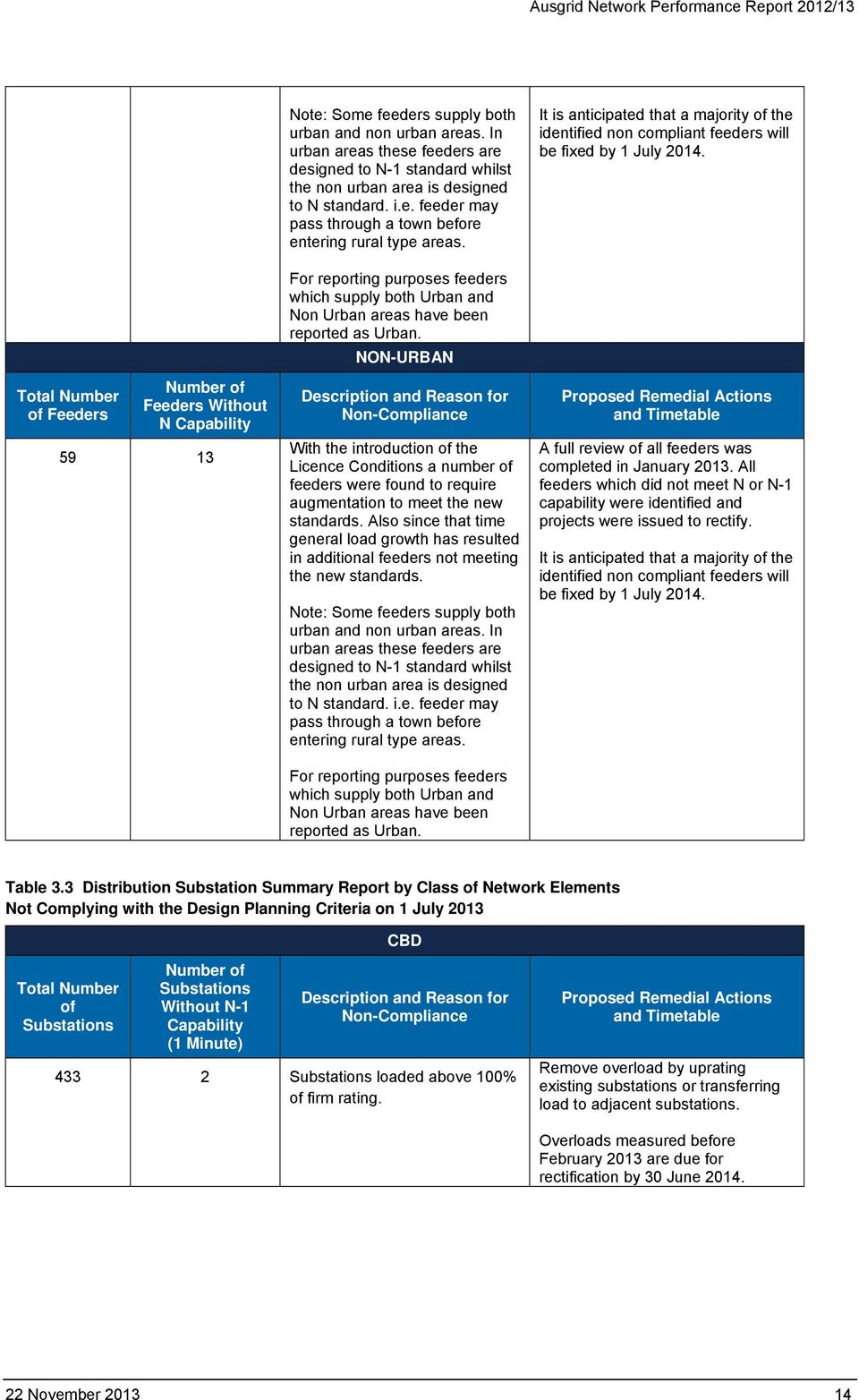
16 Element including Location, Customer Numbers, Element Length/Capacity Leichhardt 33/11kV ZS, 12,435 customers, 36.5MVA secure capacity Tarro 33/11kV, 6,507 customers, 22.9 secure capacity 33kV feeder 542 (Kuringai STS to St Ives ZS), 1.9km, 28.9MVA cyclic rating 33kV feeder 345 (Bunnerong North to Sydney Airport ZS), 8.3km, 16.2MVA cyclic rating 33kV feeder 396 (1) and 396 (2) (Surry Hills STS to Paddington ZS), 3.9km and 5.2km, 15.5MVA cyclic rating 33kV feeder S10/3 (Warringah STS tee Kangaroo Point terminal tee Balgowlah ZS), 2.5km, 37.1MVA cyclic rating Description of Non- Compliance and Reason Forecast to be non compliant in Summer 2012/13, 2013/14 and Winter 13 under N-1 conditions Forecast to be non compliant in Summer 2012/13 under N- 1 conditions due to time over firm requirements Forecast to be non compliant in Summer 2012/13 and 2013/14 under N-1 conditions Forecast to be non compliant in Summer 2012/13, 2013/14, 2014/15 under N-1 conditions Forecast to be non compliant Winter 2012, 2013 and 2014 under N-1 conditions Forecast to be non compliant in Winter 2013 under N-1 conditions Proposed Remedial Actions and Timetable Transfer load at 11kV to Camperdown zone in early 2014 to meet compliance by July 2014 and then conversion to 132/11kV operation in 2016 Transfer load at 11kV to Thornton zone in 2013 to meet compliance by summer 2013/14 Feeder 542 constraint addressed by load transfers within the zone to other transformer groups in 2013 Cable scheduled for replacement in Compliance managed by working with customer to transfer load between Sydney Airport and International Terminal substations in the event of an outage of 33kV feeder 359 at peak loads, resulting in no interruptions. Feeder 396 constraint addressed by load transfer from Rose Bay to Waverley zone and ultimately converting Rose Bay to 132/11kV zone in 2014 by winter 2015 Feeder S10/3 constraint addressed by load transfer at 11kV from Harbord zone to Balgowlah North zone in 2013 Table 3.2 Distribution Feeder Summary Report by Class of Network Elements Not Complying with the Design Planning Criteria on 1 July 2013 CBD Total Number of Feeders Number of Feeders Without N-1 Capability (1 Minute) Description and Reason for Non-Compliance Proposed Remedial Actions and Timetable Not applicable Not applicable URBAN Total Number of Feeders Number of Feeders Without N or N-1 Capability 2, Description and Reason for Non-Compliance With the introduction of the Licence Conditions a number of feeders were found to require augmentation to meet the new standards. Also since that time load growth has resulted in additional feeders not meeting the new standards. Proposed Remedial Actions and Timetable A full review of all feeders was completed in January All feeders which did not meet N or N-1 capability were identified and projects were issued to rectify. 22 November

17 Total Number of Feeders Number of Feeders Without N Capability Note: Some feeders supply both urban and non urban areas. In urban areas these feeders are designed to N-1 standard whilst the non urban area is designed to N standard. i.e. feeder may pass through a town before entering rural type areas. For reporting purposes feeders which supply both Urban and Non Urban areas have been reported as Urban. NON-URBAN Description and Reason for Non-Compliance With the introduction of the Licence Conditions a number of feeders were found to require augmentation to meet the new standards. Also since that time load growth has resulted in additional feeders not meeting the new standards. Note: Some feeders supply both urban and non urban areas. In urban areas these feeders are designed to N-1 standard whilst the non urban area is designed to N standard. i.e. feeder may pass through a town before entering rural type areas. For reporting purposes feeders which supply both Urban and Non Urban areas have been reported as Urban. It is anticipated that a majority of the identified non compliant feeders will be fixed by 1 July Proposed Remedial Actions and Timetable A full review of all feeders was completed in January All feeders which did not meet N or N-1 capability were identified and projects were issued to rectify. It is anticipated that a majority of the identified non compliant feeders will be fixed by 1 July Table 3.3 Distribution Substation Summary Report by Class of Network Elements Not Complying with the Design Planning Criteria on 1 July 2013 CBD Total Number of Substations Number of Substations Without N-1 Capability (1 Minute) Description and Reason for Non-Compliance Substations loaded above 100% of firm rating. Proposed Remedial Actions and Timetable Remove overload by uprating existing substations or transferring load to adjacent substations. Overloads measured before February 2013 are due for rectification by 30 June November
18 URBAN and NON-URBAN Total Number of Substations Number of Substations Without N Capability Description and Reason for Non-Compliance 31, Substations loaded above 100% of firm rating. Proposed Remedial Actions and Timetable Remove overload by uprating existing substations, transferring load to adjacent substations via augmentation, installing new low voltage distributors or new distribution substations. Overloads measured before February 2013 are due for rectification by 30 June Note: the Licence Condition for existing network elements does not take effect until 1 July Reporting should only be in relation to Clause 14.1 of the Licence Conditions i.e. for new network elements. 3.3 Demand Management Demand and capacity forecasts for the electricity supply system are identified through the planning process, and published in the Distribution Annual Planning Report (DAPR) on the Ausgrid website. When forecasts indicate that a network need for demand related investment is required, Ausgrid will investigate and where viable, develop and implement demand management (DM) projects to maintain network reliability. The DM investigation is comprised of five separate stages: Stage 1: Identify network need for demand related investment Demand management options are considered during the network planning process either as part of the development of potential credible options for individually identified network needs, or as part of the integrated consideration of potential credible options in Area Plan reviews. Stage 2: Conduct demand management screening test for credible non-network solutions Each potential network investment is screened to determine if it is reasonable to expect that a demand management or non-network solution could allow for a deferral or avoidance of the network investment. The screening test is a desktop study used to establish Ausgrid s expectation of whether non-network options are technically and economically feasible. If the screening test concludes that it is reasonable to defer the proposed network infrastructure project, a Non-network options report will be issued and the options investigation process will be initiated. Stage 3: Conduct demand management investigation including community consultation The investigation process seeks to identify potential cost effective demand management options that could defer the network investment, and to identify the size, timing and budget costs of these feasible options. Based on the demand reduction requirements in the demand management screening test, the investigation stage identifies potential non-network solutions to achieve the demand reductions. Options are identified using Ausgrid s existing knowledge, via public consultation, field visits to customer sites and discussions with major customers. The investigation identifies the amount of demand reductions available and the likely cost of each non-network option identified. Stage 4: Select preferred non-network option, where viable and cost effective Any feasible DM options are considered for development alongside network augmentation options. Stage 5: Implement demand management solution If a feasible DM option is determined to be the most economical solution, it is implemented with clear deliverables in terms of demand reduction, timing and cost. 22 November

19 A more detailed summary of this DM process is provided on Ausgrid s website. Table 3.4 Demand Management Projects Implemented During 2012/13* Description of Demand Management Project Implemented Peak Demand Reduction (kva) PV of Costs of Demand Management Project PV of Total of Capital Expenditure Deferment plus Op Ex Savings Individual large projects Sub-totals Consolidated projects Sub-totals Totals * Ausgrid continued implementation of two demand management projects in 2012/13 at Medowie and North West Pennant Hills which have been reported in previous years. There were no new projects approved in this reporting year. Explanatory notes for Table 3.5: Reports are required for large projects reported individually and for small projects reported collectively. Optionally, small projects may be individually listed, but must not be counted again in the consolidated report. Small projects could conveniently be grouped into headings such as: Customer Negotiations (Demand Reduction) or Installation of Local Generator etc. A large project is defined as proposed network expansions or augmentations, which would cost in excess of $500,000. Such large projects may be at zone substation level. Demand reductions should relate to permanent reductions only, and are the figures for the reporting year. Table 3.5 Demand Management Investigations in 2012/13 Found Non-Viable** 1 Description of Potential Demand Management Project Beresfield Zone Substation Investigated and Reason for Non-viability PV of Costs of Investigations The DM investigation was initiated. This investigation is still in progress. $3,454 2 Jannali Zone Feeders 2 & 9 The screening test was completed and concluded that DM would not be a cost effective option to enable deferral of the supply side project. $2,807 (est) Homebush Bay Zone Additional Transformer South Greenacre Park Zone Development Darling Harbour Zone Development The screening test was completed and concluded that DM would be a cost effective option to enable deferral of the supply side project. However due to a subsequent change in the demand forecast, the demand reductions were no longer required. $16,265 The screening test was completed and concluded that DM would not be a cost effective option to enable deferral of the supply side project. $2,974 The screening test was completed and concluded that DM would not be a cost effective option to enable deferral of the supply side project. $2,641 ** In 2012/13 Ausgrid changed the process by which demand management options are considered in the network planning process, with DM Screening Tests now primarily integrated into the Area Plan reviews. In future years Ausgrid will limit reporting in this table to DM Investigations conducted in Stage 3 of the process described above. 22 November

20 4 Asset Management 4.1 Overview Ausgrid s philosophy is that an integrated asset management system forms the backbone of an effective service delivery program. Ausgrid believes that through the integration of all facets of asset management, including design, procurement, maintenance activities, renewals/replacements, capital investment, condition monitoring and continuous improvement, it will deliver its business and strategic objectives. These objectives are established and documented in the Network Maintenance Plan. The service delivery program is essential to preserve the engineering integrity of assets and their continued fitness for use within the electrical system. This will enable Ausgrid to meet its commercial obligations and statutory responsibilities under the Electricity Safety Act and Occupational Health and Safety Regulation. The asset management strategies, models and processes adopted by Ausgrid are consistent with the elements of a total asset management system as identified in the NSW Government s Total Asset Management (TAM) Manual. 4.2 Technical Service Standards Electricity delivered by Ausgrid s network has particular characteristics including some interruptions to supply caused when power lines are damaged by storms, bushfires and accidents. Ausgrid s objective is to achieve the best possible overall quality and reliability of our electricity network, given the condition and utilisation of network assets and the funding available to maintain and augment the electricity network. In addition, Ausgrid makes all reasonable and practicable efforts to ensure that in any financial year, it meets the targets set by NSW Trade & Investment, in respect to reliability standards, quality standards and individual feeder standards. The NSW Code of Practice - Electricity Service Standards 1 provides a framework for supplying electricity customers on the Distribution Network. Ausgrid s technical document Electricity Network Operation Standards 2 (ENOS) sets out Ausgrid s standards for Network Reliability and Quality of Supply that customers can expect from Ausgrid s network. Further technical information relating to service standards of Ausgrid s network and supply commitments can be found on the Ausgrid website or through the Ausgrid Contact Centre on Quality of Supply Overview It is not possible to supply a customer with the idealised voltage and current due to the physical nature of the network and the characteristics of the customers loads. Ausgrid s objective is to achieve the best possible overall supply quality of our electricity network, given the condition and utilisation of existing network assets, within the funding available to maintain and augment the electricity network. The National Electricity Rules require the Distribution Network Service Providers to establish Planning levels for a range of Supply Quality parameters. At Ausgrid, monitoring for supply quality is undertaken by a number of means including fixed meters at Distribution Substations, random Power Quality (PQ) surveys at customer premises and participation in the Long Term National Power Quality Survey conducted by the University of Wollongong Performance Data Results from the Ausgrid Low Voltage Network Power Quality Survey In 2012/13, Ausgrid began its new Standards based Supply Quality monitoring project, the Ausgrid Low Voltage Network Power Quality Survey. Ausgrid monitored 206 randomly selected Low Voltage customer sites for one week using temporarily installed power quality meters. These meters meet the highest accuracy November

21 requirements (Class A) as specified in AS/NZS As this is the first year of the survey, year on year comparison will not be possible until the next reporting period. The sites were evaluated for compliance against the relevant standards: Range of Supply Voltage AS Voltage Unbalance AS/NZS Harmonic Content of the Voltage Waveform AS/NZS Voltage Fluctuations (Flicker) AS/NZS Of the 206 sites, five sites were excluded due to insufficient data. The following sections describe the performance of the 201 sites to the relevant standards: a) Range of Supply Voltage AS which is written to a nominal low voltage supply of 230V, states that the 99th percentile (V99%) of the 10 minute average voltage readings for a 1 week survey should be less than 253 Volts and that the 1st percentile (V1%) of the 10 minute average voltage readings for a one week survey should be greater than 216 Volts. In the survey all sites complied with the V1% limit and approximately 70% of sites complied with the V99% limit. The high V99% figure is a consequence of the network being historically designed for a nominal 240V range. Based on the survey results, a relatively small drop in peak voltages of around 1.5% (based on 230V) would enable Ausgrid to meet a probabilistic planning level of at least 95% of the network delivering voltage within the AS compliance range. Ausgrid s 230V migration program is progressively delivering a voltage range reduction using adjustments of zone substation voltage regulation settings and distribution substation tap changes. The benefits of this program should begin to be seen in the reporting period with the expectation that a higher percentage of the LV sites will meet the limits. b) Voltage Unbalance Voltage unbalance is a condition in which the three phase voltages differ in amplitude and/or are displaced from their normal 120 degrees phase relationship. The results of the survey show that voltage unbalance for all measured sites with three phase connection were under the Compatibility Level of 3% as specified in AS/NZS The compatibility level is a reference value for trouble-free operation of items of equipment connected to the network. All measured sites were compliant for Voltage Unbalance. c) Harmonic Content of the Voltage Waveform Harmonics are sinusoidal voltages having frequencies that are whole multiples of the frequency at which the network is designed to operate (50 Hz). Total Harmonic Distortion is a measure of the harmonics in the supply voltage and is the sum of the powers of all harmonic voltages present compared to the fundamental (50Hz) voltage. 22 November
22 The results of the survey show that the Total Harmonic Distortion (THD) was at or below 3.6% against the Compatibility Level of 8% THD for Low Voltage as specified in AS/NZS All measured sites were compliant for THD. d) All individual harmonics apart from the 15th harmonic (i.e. 750 Hz) were compliant. For the 15th harmonic, about 30% of measured sites were above the 0.3% compatibility level in AS/NZS (maximum recorded level was 0.5%). This is not seen as a significant issue in terms of causing trouble for equipment operation and it may be appropriate for the compatibility level to be increased - noting that New Zealand has chosen a higher limit of 1.8% as the Compatibility Level for the 15th Harmonic. Voltage Fluctuations (Flicker) Short Term Flicker (PST) The results of the survey show that the majority (approximately 95%) of sites met the Short Term (PST) compatibility level for flicker of 1.0. Long Term Flicker (PLT) The results of the survey show that just over 90% of sites met the Long Term compatibility level (PLT) for flicker of 0.8. Long term flicker (PLT) is higher than short term flicker (PST) due to the lower limit against which it is assessed (0.8 versus 1.0). Inspection of the results show that a number of the sites with high levels of Flicker were in proximity of an Electric Arc Furnace (EAF) that is injecting high levels of Flicker onto the network. Ausgrid is planning to investigate potential mitigation methods for reducing the flicker from the EAF, however no issues have been reported by customers in relation to the EAF Results from Distribution Monitoring and Control Program (DM&C) A set of 1 week s data (recorded in April 2013) for a sample set of 1090 Distribution Transformers was analysed for Voltage performance, and was compared with data gathered from 225 Distribution Transformers in April For Voltage, the results indicate on average, there has been a 1 Volt drop in the Median and 99th percentile values between 2012 and 2013 measured data. Over time, as Ausgrid progresses its plan to reduce the average network voltage from around 250V to around 240V, a corresponding reduction will be observed in these readings. 4.4 Distribution Reliability Overview This report has been prepared in accordance with the Design, Reliability and Performance licence conditions imposed by the Minister for Energy and Utilities on 1 December 2007 and the standards issued by the Steering Committee on National Regulatory Reporting Requirements (SCNRRR). Two related indices are applied when reporting reliability. The first, SAIDI, is commonly referred to as the Reliability Index and represents the average number of customer minutes lost by all network customers. SAIFI represents the average number of interruptions for all customers. The following notes relate to the reporting system issues outlined in Note 1 Attachment A to this report. 22 November
23 The classification of Ausgrid s approximately 2,100 high voltage distribution feeders into the categories CBD, Urban, Short Rural and Long Rural is reviewed at the start of each annual reporting period. To cater for augmentation work through the year new feeders are classified at the time of commissioning. Reliability reporting uses the IEEE methodology for defining Major Event Days as outlined in the Design, Reliability and Performance licence conditions (Major Event Day is defined in Attachment A, see page 49) There are three instances where Ausgrid departs from the Definitions detailed in Attachment A to this report departures in relation to Notes 2 and 3 of Table A.1 Reliability Measures, and in regard to the calculation for the Major Event Day Threshold (Tmed): 1. Note 2 Ausgrid measures and records customers affected and the customer base on a daily basis. Reliability performance indices are calculated on a daily basis rather than using the average of the number of customers at the beginning and the end of the reporting period. The daily calculation method provides a more representative customer performance at the time of the event. 2. Note 3 Ausgrid does not exclude inactive accounts. There are natural time delays in updating customer account details into the real-time Outage Management System, particularly where Ausgrid relies on information from other electricity Retailers. Ausgrid considers the recording of reliability performance for all active premises (whether the premise is vacant or not) to be a practical administrative outcome. This action has little effect on reported reliability performance. The inclusion of vacant premises increases both the customers affected (numerator) and the customer base (denominator) of the Indices calculations. 3. In regard to the calculation for the Major Event Day Threshold (Tmed), the Design, Reliability and Performance Licence Conditions review working group had agreed, in March 2010, that the Tmed calculation should be consistent with the Australian Energy Regulator (AER) Tmed calculation method. The Design, Reliability and Performance Licence Conditions require (Schedule 6) that Planned Outages be included in the daily SAIDI dataset for calculation of the Tmed value. The AER requires (STPIS definitions November 2009) that Planned Outages be excluded from the daily SAIDI dataset for calculation of the Tmed value. This agreed change to the Tmed calculation has not yet been amended in the Design, Reliability and Performance Licence Conditions document. However, Ausgrid has applied this change to the 2010/11, 2011/12 and 2012/13 reliability performance reporting to ensure consistency with the AER reliability performance reporting definitions, as agreed with the Minister s Office Organisational Performance (Normalised) Trend Table 4.1 Organisational Performance Trends (Normalised) Previous Years Current Year Year 2008/ / / / /13 SAIDI SAIFI The data in Table 4.1 representing SAIDI and SAIFI is also shown graphically below in Figure November
24 Figure 2 Organisational Performance Trends (Normalised) Global SAIDI Performance (IEEE) Global SAIFI Performance (IEEE) / / / / / / / / / / Comment on Performance The 2012/13 performance for both SAIDI and SAIFI was the best result in the last five years and has been trending downwards over this period. This year s results can be attributed to the Regulatory Works Program as well as favourable weather conditions. There were two Major Event Days for 2012/13, firstly on 10 August, 2012 (6.03 SAIDI for the day) and secondly on 23 February, 2013 (5.80 SAIDI for the day). Both events were predominantly due to strong wind storms impacting the entire Ausgrid Network. The historical reliability performance has been re-calculated using the more accurate OMS connectivity data and a consistent application of the current exclusion rules across all years. As a consequence reliability figures are different from figures provided in past reports Organisational Detailed Performance Current Year Reliability data sets for SAIDI and SAIFI are reported for the whole organisation and feeder categories in Table 4.2. Table 4.2 Organisational Detailed Performance 2012/13 Sustained Interruption Data Sets Whole Organisation and Feeder Category Category ORG* CBD Urban Short Rural Long Rural Customer Numbers 1 1,642,951 30,363 1,417, ,590 2,620 SAIDI Overall Planned Unplanned Normalised SAIFI Overall Planned Unplanned Normalised Notes: *ORG Refers to the average performance of the organisation overall. 22 November
25 1 Customer numbers as at the end of June 2013 for the purposes of reliability indices only. Refer to Table 1.1 for the total of customers served. 2 Overall performance represents the total performance experienced by our customers, irrespective of cause or origin of the fault. 3 Planned and Unplanned performance is the Distribution Network Interruptions (DNI) that have all the excluded interruptions removed, except for Major Event days, as defined in Attachment A, in accordance with the "Steering Committee on National Regulatory Reporting Requirements" (SCNRRR) standards i.e. excludes TransGrid and load shedding events, Emergency Services instructed events, momentary interruptions and interruptions caused by a customer installation failure. 4 Normalised Distribution Network (NDN) performance is the DNI performance with the Major Event Days excluded, and represents the events that Ausgrid is expected to manage and be responsible for. The Major Event Days that have been excluded are defined in Table November
26 4.4.4 Reliability Report against Standards Table 4.3 CBD Feeder Performance (Normalised) Trend Previous Years Current Year Year 2008/ / / / /13 SAIDI SAIFI Actual Target Actual Target Table 4.4 Urban Feeder Performance (Normalised) Trend Previous Years Current Year Year 2008/ / / / /13 SAIDI SAIFI Actual Target Actual Target Table 4.5 Rural Short Feeder Performance (Normalised) Trend Previous Years Current Year Year 2008/ / / / /13 SAIDI SAIFI Actual Target Actual Target Table 4.6 Rural Long-Feeder Performance (Normalised) Trend Previous Years Current Year Year 2008/ / / / /13 SAIDI SAIFI Actual Target Actual Target Comment on Performance All feeder category performances were compliant against the Reliability Standards for 2012/13. CBD performance increased from previous years due to cable fault in pit in the CBD. Both Urban and Short Rural feeders continued to improve. Long Rural was similar to the previous year. There are so few feeders in this category that results can fluctuate dramatically year to year. 22 November
27 Excluded Events Table 4.7 Excluded Interruptions for 2012/13 Date of Event 23/07/ /08/ /08/ /12/ /01/ /01/ /02/2013 Description of Event Transmission / Bulk Supply Major Event Day (The Major Event Day was predominantly due to a strong wind storm impacting the entire Ausgrid network) Load Shed - Other Auth. Request Load Shed - Other Auth. Request Load Shed - Other Auth. Request Load Shed - Other Auth. Request Major Event Day (The Major Event Day was predominantly due to a strong wind storm impacting the entire Ausgrid network) Number of Customers Interrupted Maximum Duration of Interruption (minutes) Effect of Event on SAIDI Figure (minutes) , ,295 4, Performance against Individual Feeder Standards Basis for Exclusion Transmission / Bulk Supply Exceeds Tmed 2.69 Load Shed - Other Auth. Request Load Shed - Other Auth. Request Load Shed - Other Auth. Request Load Shed - Other Auth. Request Exceeds Tmed 2.69 The performance objectives for organisational average performances for each feeder category are not sufficient to identify when customers on a particular feeder experience unsatisfactory reliability performance. For this reason, SAIDI and SAIFI criteria (after excluded interruptions are disregarded) act as a trigger for investigation and exception reporting purposes. The objective of this section is to ensure that feeders performing unsatisfactorily (i.e. outside of the performance criteria for that feeder type) are reported publicly and their performance tracked until performance is again satisfactory. The figures contained in Table 4.8 represent the Ministerially-imposed Licence Conditions for each feeder type. Table 4.8 Individual Feeder Standards for Exception Reporting Specified in the Licence Conditions Applicable to your Organisation Feeder Categories Category CBD Urban Short Rural Long Rural SAIDI SAIFI Performance outside this range results in the following actions: 22 November
28 (a) immediate investigation of the causes for each feeder exceeding the individual feeder standards; (b) by the end of the quarter following the quarter in which the feeder first exceeded the standard, complete an investigation report identifying the causes and action required to improve the performance; (c) complete any operational actions identified in the investigation report to improve the performance of each feeder to the individual feeder standards by the end of the third quarter following the quarter in which each feeder first exceeded the individual feeder standards; and (d) where the investigation report identifies actions, other than operational actions, required to improve the performance of each feeder to the individual feeder standards, develop a project plan, including implementation timetable, and commence its implementation by the end of the second quarter following the quarter in which the feeder first exceeded the individual feeder standards. Table 4.9 Individual Feeder Performance against the Standard Summary Feeder Type CBD Urban Short Rural Long Rural Feeders (Total Number each Type) Feeders that Exceeded the Standard During the Year (Total Number) Feeders Not Immediately Investigated (Total Number) Feeders Not Subject to a Completed Investigation Report by Due Date (Total Number) Feeders Not Having Identified Operational Actions Completed by Due Date (Total Number) Feeders Not Having a Project Plan Completed by Due Date (Total Number) 55 1, As required in clause 16.2 (b) and (c) of the Licence Conditions, each feeder currently exceeding the Individual Feeder Standard is analysed and an investigation report identifying the causes and, as appropriate, any action required to improve the poor performance is reported in the next quarterly performance report. All actions required were completed in the relevant timeframes. Overall, the percentage of poor performing feeders in each feeder category is relatively low. Ausgrid has an ongoing reliability improvement program in place. The program targets those feeders that have exceeded or are approaching the Individual Feeder Standards as outlined in Schedule 3 of the Design, Reliability and Performance Licence Conditions. 22 November
29 4.5 Transmission Reliability Transmission Reliability Performance Data Table 4.10 Transmission Circuit Availability (%) Trend Previous Years Current Year Objective 2008/ / / / / There has been a slight increase in circuit availability from the previous year s result. As in recent years, the transmission availability this year was heavily influenced by the large number of outages associated with major capital build programs such as the 132kV isolator and circuit breaker replacement programs, as well as relay replacements at various sites and the transfer of 132kV feeders to the new TransGrid Beaconsfield busbar. Table 4.11 Network Reliability Trend Previous Years Current Year Objective 2008/ / / / /13 Network Reliability (Off Supply Event Numbers) Table 4.12 Outage (Un-Planned) Average Duration (Minutes) Trend Previous Years Current Year Objective 2008/ / / / /13 3,279 2,291 3,497 5,810 4,734 This year s average unplanned outage duration was shorter than last year, though still significant. Major contributors to this year s unplanned duration were a number of 132kV oil insulated cable failures and their long duration repair times. The most notable of these has been the repair of a leak in oil filled cable 90W, which took more than four months. Table 4.13 Connection Point Interruptions (Unplanned) 2012/13 Connection Point Interruption Number Interruption Duration Total (Minutes) NIL NIL NIL Note: This table provides a listing of customer connection points off supply events. Table 4.14 Connection Point Numbers 2012/13 Number of Connection Points (Total Number) 20 Year Ausgrid has seven transmission customers supplied from 20 connection points. 22 November
30 5 Network Safety 5.1 Overview Ausgrid is committed to workplace and public safety. To meet our objectives in this regard, as well as relevant legislative and regulatory compliance requirements, we have implemented a number of safety programs and initiatives, both in relation to the safe operation of the network and workplace safety. These programs are summarised below in an extract from our Network Management Plan Safe operation of the network Ausgrid has identified safety as a key network risk. To manage this, Ausgrid has undertaken strategic risk analysis of the types of hazardous events that may occur. Ausgrid has identified various broad categories of risk relating to the safe operation of the network. At a strategic level, these are addressed in our duty of care plans. The planned programs of work documented in our duty of care plans are a key organisational safeguard against network safety risk. In addition to these planned asset-related programs of work, Ausgrid has implemented various procedures and processes at an operational level for enhancing network safety, including: an Incident Management System for managing network incidents and network emergencies that enable rapid response to hazardous situations formal safety procedures and systems applicable when working on or near the network. This has both network safety and workplace safety implications Workplace Safety Ausgrid has workplace safety obligations to its staff and contractors under the Work Health and Safety Act 2011 (NSW) (WHS Act) and the Work Health and Safety Regulation 2011 (NSW) (WHS Regulation). Successful implementation of workplace safety processes and procedures also has an impact, more ly, on network safety and contributes to the safe operation of the network. Ausgrid has numerous policies and procedures in place to ensure safe work practices. Ausgrid conducts programs to identify workplace safety risks and implements initiatives to address these risks to ensure ongoing compliance with its workplace safety obligations, and consistent application of its commitment to safety. Ausgrid s Workplace Health and Safety Management System is called Be Safe. The Be Safe Management System has two key objectives: the health, safety and welfare of all staff while they are at work ensuring that people other than our staff are not exposed to unacceptable risks to their health and safety in connection with Ausgrid s network operations. The principal document in the Be Safe Management System is the Be Safe Policy. The Be Safe Policy articulates the organisation s commitments to health and safety through in the areas of: Leadership Making health and safety part of all business decisions Awareness and Measurement Training, Protection and Investigations. Ausgrid s safety objectives are to ensure that those working on or near the network are competent to do so, and can do so in the intended safe manner; and compliance with the WHS Act and WHS Regulation, which require employers such as Ausgrid to identify foreseeable hazards, assess the risks of these hazards and eliminate or control these risks and review these controls. 22 November
31 Ausgrid also publishes a Public Electrical Safety Awareness Plan to educate the public, the construction industry and emergency services of the risks of working near network assets and the requirement for people working near those assets to be appropriately qualified and authorised (where required). Ausgrid has the following processes in place to meet these objectives: hazard assessment forms and safe work method statements have been developed in consultation with staff - external parties (such as Accredited Service Providers and contractors) are required to develop their own procedures and forms to submit to Ausgrid competency-based training (based on relevant national training packages and in accordance with the principle outlined in Section 7 of the National Electricity Network Safety Code ENA NENS ) induction training for all new employees (both employees and contractors) is carried out in accordance with our Quality, Safety, Health and Environmental Management System accreditation of service providers undertaking contestable work meets Code of Practice Contestable Works standards (and other applicable schemes) administered by the Office of Fair Trading reporting of accidents and incidents as specified by NSW DTIRIS under the Significant Electrical Network Incidents reporting system (including those required under the Electricity (Consumer Safety) Regulation 2006) reporting of customer installation incidents to the Office of Fair Trading (in accordance with the Electricity (Consumer Safety) Act 2004). 5.2 Public Reportable Safety Incidents During 2011/12, the Industry Safety Steering Committee endorsed the implementation of a new SENI reporting scheme which took effect from 1 April The result is a change in the definitions, and reporting format of incidents to a new spreadsheet format. The change in definitions, which involves the inclusion of near miss incidents, results in a significant increase in the quantity of data analysed and reported. Ausgrid reported 143 Reportable Safety Incidents involving the public in 2012/13, as summarised in Table 5.1. Although this figure is larger in quantity, a comparison of incidents of the same significance as those reported in previous years, shows that the results are comparable. Of the 143 Public Reportable Safety Incidents, only one incident involving contact with the electrical network resulted in an injury. This incident is described in further detail in These Serious Electricity Network Incidents (SENI) are analysed by Ausgrid to form the development of its Public Electricity Safety Awareness Plan and campaigns to address the most significant issues for public safety such as preventing contact with overhead conductors and underground network assets. Ausgrid continues its efforts to reduce these occurrences through the Public Electrical Safety Awareness Campaign which utilises a range of topical media releases and a variety of advertising mediums to alert the public to the risks involved when in proximity to the electricity network. Table 5.1 Public Reportable Safety Incidents Previous Years Year 2008/ / /11 July 2011 March 2012 April 2012 June 2012 Current Year 2012/13 Non-Fatal Fatal November
32 5.2.1 Incident 1 Rose Bay 20 July 2012 A public electrician received flash burns due to a short circuit that occurred while carrying out work on a private residence at Bayview Hill Road. He was not an ASP but was attempting to connect a new house main at the Point of Attachment (POA). The electrician was transported to hospital in an ambulance but was not admitted having only received minor flash burns. The service cable was then repaired by Ausgrid staff. 5.3 Worker Reportable Safety Incidents During 2011/12, the Industry Safety Steering Committee endorsed the implementation of a new SENI reporting scheme which took effect from 1 April The result is a change in the definitions, and reporting format of incidents to a new spreadsheet format. The change in definitions, which involves the inclusion of near miss incidents, results in a significant increase in the quantity of data analysed and reported. Ausgrid reported 63 Reportable Safety Incidents involving s in 2012/13, as summarised in Table 5.2. Although this figure is larger in quantity, a comparison of incidents of the same significance as those reported in previous years, shows that the results are comparable. Of the 63 Worker Reportable Safety Incidents, three incidents involving contact with the electrical network resulted in an injury. These incidents are described in further detail in to Table 5.2 Worker, contractor and ASP Reportable Safety Incidents Previous Years Year 2008/ / /11 July 2011 March 2012 April 2012 June 2012 Current Year 2012/13 Workers Contractors ASPs Incident 1 Lidcombe 10 October 2012 An ASP, while identifying a Low Voltage cable, removed a Low Voltage cap from an energised cable, and shorted it with a knife. The ASP received minor burns and was taken to hospital. The ASP Company notified WorkCover of the incident Incident 2 Epping 8 December 2012 An arc flash occurred, resulting in a fire when an Ausgrid employee (district operator) was in the process of racking in an 11kV circuit breaker at Epping. The site was made electrically safe by staff, and the fire brigade managed the fire. The employee received minor burns to his hand that was treated by first aid Incident 3 Epping 7 May 2013 A Contractor working for Ausgrid at Epping Zone substation jack hammered into a live 11kV underground cable, causing an arc flash. The contractor received treatment in hospital and was released on the same day. Ausgrid made the cable and site safe, prior to repairs being carried out. 5.4 Major Incident Reports Ausgrid s Incident Management System (IMS) provides an organisation wide system for managing all types and severity of incidents. The IMS documents the procedures followed by Ausgrid in terms of reporting major and high severity incidents to the Minister for Energy, as required under the Design, Reliability and Performance licence conditions. The IMS does this by linking definitions of incident severity to the licence conditions and by stipulating the reporting timeframes by incident severity. 22 November
33 During 2012/13 there were two major incidents which required the Minister for Energy to be notified in accordance with the Design, Reliability and Performance licence conditions. These incidents are outlined below: Incident 1 Regents Park Depot Staff Eye Injury Monday 4 February 2013 Major Incident A major incident was declared when an Ausgrid staff member received a serious eye injury as a result of a fragment of an electrical conduit becoming embedded in his eye while he was working near Regents Park depot Incident 2 Apprentice Motor Mechanic Hand Injury Monday 24 June 2013 Major Incident A major incident was declared when an Ausgrid motor apprentice sustained a serious hand injury while he was working in the engine compartment on an elevated Work Platform (EWP). 22 November
34 6 Customer Installations From January 2000, Ausgrid has maintained a computer database (SAP CCS) for recording installation work notified by electrical contractors. The database is also used for selecting work on an audit basis for inspection. Submission of a NSW Fair Trading Certificate of Compliance Electrical Work (CCEW) form for notification has been required since January The purpose of the installation inspection is to verify compliance of electrical contractors work with AS/NZS Wiring Rules, the Service and Installation Rules of NSW and any other relevant standards. Ausgrid s installation inspection audit process targets electrical contractors whose previous work has been found to contain major safety breaches (major defects) as detailed in the Code of Practice for Installation Safety Management. Electrical contractors with higher major defect rates are inspected more often. The reliability of the data collected and reported using SAP CCS has been verified by external audit of Ausgrid s previous annual Electricity Network Performance Reports. Consistent with previous years, the major causes of customer electric shocks in the reporting period fell into three specific categories Failure of Part of Installation (more specifically insufficient insulation resistance), Water Damage or Ingress, and faulty neutral connections. Ausgrid has continued an extensive program to replace all at risk aged service lines, and carrying out neutral integrity tests at targeted customer installations in conjunction with the Sydney Water mains replacement program. 6.1 Reports against Customer Installation Safety Plans Table 6.1 Installation Inspections Trend Previous Years Current Year Year 2008/ / / / /13 Number of Notifications (CCEW) 45,093 47, ,291 58,364 55,156 Number of Inspections 14,396 20,110 57,859 25,258 15,814 Installation Inspection Rate (%) 31.93% 42% 64% 43.28% 28.67% Major Safety Defect Rate (%) 7.39% 5.3% 2.92% % 4.07% Safety Breach Notices Issued (%) 18.67% 13% 8.62% % 17.53% Number of Warnings Issued Reports to Fair Trading (No.) Number of Audits by Distributor The number of safety breach notices issued for was changed from 2.36% to align with the new reporting procedure used in for defect notices, using SAP customised reporting. 2 The number of major safety breach notices issued in using the new SAP customised reporting (2.89%) was comparable to previous reporting method, so no change was needed. There has been a further decrease (5.5%) in the number of CCEW notifications of electrical installation work from electrical contractors (in addition to a 35% decrease in ). This is due to a reduction of solar installations attributed to the solar credits changing to a one times multiplier, as well as a down turn in the construction and building industry. In late 2012 Ausgrid reviewed the defect rate associated with solar installations and it had decreased to a level comparable with other installation work. As a result, solar installation inspections were then carried out on an audit basis similar to other domestic and commercial installation work. 22 November
35 The trends in 2012/13 continue to indicate that electrical contractors are only submitting notifications when the electrical installation work is associated with contestable service work. Ausgrid has however observed an increase in Fair Trading NSW electrical contractor compliance investigations. The number of notifications for Level 2 Service Provider contestable work (NOSW) has decreased slightly by 3.33% from the previous year. This decrease is also attributed to the changes to the solar multiplier and downturn in building activity. The major defect rate of 4.1% is slightly higher than last year (4.0%) but considerably lower than previous periods. Ausgrid has continued to assist NSW Fair Trading with their electrical contractor compliance campaigns by providing CCEW notification data when requested as part of our Memorandum of Understanding for mutual cooperation on electrical installation safety matters. The number of referrals to Fair Trading NSW has increased from 14 to 18 and it has been evident that NSW Fair Trading has increased its electrical contractor compliance activities under the Home Building Act and Electricity (Consumer Safety) Act. Ausgrid has requested that NSW Fair Trading re-establish the quarterly DNSP review meetings to allow Ausgrid, Endeavour and Essential to work with them under the formalised MOU to address electrical contractor compliance issues and the failure of electrical contractors to submit CCEWs to DNSPs as required under the Electricity (Consumer Safety) Regulation. Ausgrid is also conducting targeted inspections (unannounced) of specific large developments like shopping centres and unit blocks, concentrating on the electrical contractor s compliance with Australian Standards as well as the submission of CCEWs for new electrical work. Ausgrid is represented on related Australian Standards committees such as AS/NZS3000, AS/NZS 3002, AS2067 and AS/NZS3017, as well as on the Service and Installation Rules of NSW committee to ensure the focus on customer installation safety is maintained and improved. Ausgrid has worked closely with the Clean Energy Council (CEC the peak solar industry body across Australia) on all matters relating to solar inspections and presented at their annual ATRAA 2012 Solar Installers conference and Professional Development Day. Ausgrid and Sydney Water continue to jointly fund the testing of each installation neutral connection impacted by their water main replacement program. Suspected faults are investigated by Ausgrid staff and rectified where necessary. Ausgrid is also making arrangements to conduct post water main replacement tests and convert older direct earthed installations to the current MEN (Multiple Earthed Neutral) earthing. In 2012 Ausgrid enhanced the SAP CCS database to allow more accurate reporting on installation inspection trends, defect history and work loads. The enhancements have built in validations that ensure users enter the correct data, which will significantly reduce human error in data entry. The data is now retrievable from the inspection service order which allows for reports to be accurate to the day of the report and will not be affected by any backlogs in completing work. 6.2 Customer Installation Shock Reports Table 6.2 Customer Installation Shock Reports Trend Previous Years Current Year Year 2008/ / / / /13 Shocks on Customer's Premises (Number Reported) Note: Shocks found to be caused by static electricity are to be included in the report. During 2012/13, there were two fatalities where the probable cause was electrocution whilst working on a customer s electrical installation. One was as a result of electrical work being carried out by an unqualified person, which resulted in contact with live exposed conductors at a distribution board. The other was as a 22 November
36 result an arc flash when an earthed wire came into contact with a live busbar at a 1000 Amp distribution board which an electrician was working on. A third electrical fatality was attributed to suicide. There was a 19.5% decrease in the number of electric shocks reported this year compared to 2011/12. Ausgrid continues to run a public electricity safety awareness program and advertising campaigns highlighting the inherent dangers of electricity and precautions that should be taken. An analysis of customer installation shock investigations in 2012/13 follows similar trends to previous years. 19.2% of reported shocks had no apparent cause at the time of Ausgrid s investigation. For the remaining 80.8% of investigations the dominant causes were: Failure of Part of Installation (23%), Defective Neutral on Service Line (11.5%) and faulty consumer s mains (8.6%). NSW Fair Trading reviewed The Electricity (Consumer Safety) Act 2004 in 2011 but there has been no amendments resulting from the review as yet. Ausgrid submitted comments and suggested changes which included mandating the fitting of Residual Current Devices (RCD s) on power circuits at existing installations and regular safety inspections of the electrical wiring. 22 November
37 7 Contestable Works Scheme Table 7.1 Contestable Works Trend Previous Years Current Year Year 2008/ / / / /13 Category Int Ext Int Ext Int Ext Int Ext Int Ext Network Work (Level 1) Project approvals Projects inspected by the DNSP No. of projects with initial major defects Customer Connection Work (Level 2) Notifications (NOSW) Projects inspected by the DNSP No. with initial major defects 5,426 53,015 4,742 59,057 12,041 94,463 8,340 63,971 3,023 66,878 1,763 16,542 2, ,401 56,345 1,877 25, Network Design Work (Level 3) Designs Certified Note: Int refers to contestable work done by the distributor s ASP entity and Ext refers to work done by independent ASPs. Distributors may provide additional information if available that will provide a clarification of procedures and practices they have adopted in administering the Contestable Works scheme. Notification refers to a notice from an ASP to the Distributor of work being carried out. An analysis of the contestable works trends in 2012/13 shows a slight decrease (2.6%) in the total number of project notifications associated with Level 1 contestable work compared to and an 8.3% decrease in certified designs submitted by Level 3 ASPs. This decrease can be attributed to a downturn in commercial development work and building activity. Figures obtained for Level 2 contestable work show a slight (3.3%) decrease in the total number of notifications (NOSW) compared to The small decrease in Level 2 activity can be attributed to the reduction in the connection of new solar installations due to the reduction of the multiplier and subsequent reduction in the associated contestable metering work. Level 1 Contestable Work The ratio of Level 1 work being carried out by external ASPs compared to internal ASPs has remained steady in 2012/13. Only four contestable projects were carried out by internal (Ausgrid) service providers in the period. Ausgrid found it necessary to implement disciplinary/corrective action on 17 occasions as a result of unsafe practices by external ASPs. Ausgrid facilitated the ASP Safety Forum with increased attendance throughout 2012/13. Eighteen Level 1 ASP companies attended and ran these forums. 22 November
38 Ausgrid provides important information to Level 1 ASP s via safety alerts, and notifications of changes to Network Standards. These included potential safety hazards associated with inadequate excavation procedures, working on live low voltage, using machinery near live mains, working with 33kV underground cables and using sub contracted staff to carry out contestable work. There was one network related safety incident involving a Level 1 ASP that resulted in one loss time injury. Level 2 Contestable Work Ausgrid carried out 20,115 inspections of Level 2 completed work for compliance with the standards. This is a 27.7% decrease from 2011/12 due to a trial reduction in the inspection rate for domestic and commercial audit inspections as well as the closure of the NSW Solar Bonus Scheme. Ausgrid also carried out 449 safety compliance audits of Level 2 work in progress. Ausgrid conducted 59 corrective/disciplinary interviews, and 11 Level 2 ASP authorisations were suspended for non-compliance or failure to renew authorisation by the annual date. This is a significant decrease on last year which was then attributed to the high number of new, inexperienced Level 2 ASPs entering the industry to do solar metering work. With the downturn in solar metering work, a high number of these inexperienced ASPs have since left the industry. NSW Trade & Investment is continuing its review of the Accreditation Scheme and adopting the recommendations of the Better Regulation Office (BRO). Ausgrid is a member of the advisory panel carrying out the review. Table 7.2 External Level 2 ASP Compliance Statistics Previous Years Current Year Year 2008/ / / / /13 Number of new authorisations plus baseline audit Number of re-authorisations Number of in-field Level 2 safety audits Number of disciplinary investigations/interviews Number of ASP suspensions November
39 8 Bush Fire Risk Management Ausgrid s Bushfire Risk Management strategies are intended to: ensure public safety establish standards for vegetation management near electricity lines (particularly in bushfire prone areas) reduce interruptions to electricity supply that are related to vegetation minimise the possibility of fire ignition by electricity lines and associated equipment. The Bushfire Risk Management Plan forms part of Ausgrid s consolidated Network Management Plan, which was updated as required under the Electricity Supply (Safety and Network Management) Regulation The Bushfire Risk Management Plan was last reviewed June 2012, as part of the Network Management Plan review. The Bushfire Risk Management Plan contains further details of how we manage bushfire risk. Ausgrid continues to identify bushfire prone areas from bushfire prone land maps certified by the Commissioner for the Rural Fire Service. Ausgrid has a formal agreement in place with the Rural Fire Service (RFS) to use these maps to identify our assets in these bushfire prone areas these are updated annually before the bushfire season so the appropriate asset inspections can be completed. The latest update to these maps occurred in 2013, following the receipt from the RFS. Refer to Table 8.2 for details of the initiatives that Ausgrid has undertaken in the last year to improve systems used to manage bushfire risk within our network area. Table 8.1 Bushfire risk management Previous Years Current Year Year 2008/ / / / /13 Assets in bush fire prone areas checked by pre-summer inspection % Private lines in bush fire prone areas checked by presummer inspection % Fire ignitions by network assets (Number) 100% 100% 100% 100% 100% See Note 1 See Note 1 See Note 1 See Note 1 See Note Complaints from the public regarding preparation for the bush fire season (Number) Not discernable, see Note 2. Not discernable, see Note 2. Not discernable, see Note 2. Not discernable, see Note 2. Not discernable, see Note 2. Note 1: Bushfire risk management for electrical equipment is a shared responsibility between Ausgrid and all landowners/occupiers who are customers in our distribution area. Ausgrid inspects, tests and maintains the assets we own. However, it is the responsibility of landowners/occupiers to ensure their electrical installations are free from defects that could cause fire or other hazards. Customers are responsible for keeping private overhead powerlines free of vegetation, and must ensure appropriate trees are planted in areas that are close to powerlines. Customers are also responsible for inspecting, testing and maintaining their powerlines and poles at regular intervals the same way we do. 22 November
40 Ausgrid uses the Service and Installation Rules of NSW to determine the delineation of private electrical installations from network assets. Our requirements for the inspection and maintenance of private aerial mains are detailed in our publication ES1 Customer Connection Information, our Standard Form Customer Connection Contract and the Network Standards referenced in ES1. Under the Electricity Supply (Safety and Network Management) Regulation 2008, we have taken into account the Industry & Investment NSW Code of Practice (Electricity) Service and Installation Rules of NSW, October 2006, as amended July The Service and Installation Rules of NSW are prepared in accordance with the Code of Practice. Comprehensive information on Private Lines is not currently held by Ausgrid in our information systems as they are not Ausgrid assets. Note 2: The majority of the preparations on Ausgrid's network for the bushfire season relate to the clearing of vegetation. Ausgrid has adopted a vegetation strategy designed to maintain vegetation safety clearances at all times, which requires vegetation clearing to be undertaken throughout the entire year, not just at times of preparation for the bushfire season. As our systems record all vegetation related inquiries and complaints, it is not possible to provide an accurate estimate of those that relate specifically to works undertaken in preparation for the bushfire season. Table 8.2 Initiatives used to manage bushfire risk within Ausgrid s network area Initiative Description 1 Ausgrid has continued its monthly reporting process throughout 2012/13 with additional focus on high priority outstanding corrective works that pose a genuine risk in bushfire areas. 2 Ausgrid has established capital and replacement programs to remove equipment with known failure modes that may initiate bushfires during equipment failure. 3 Ausgrid distributes bushfire risk management information which outlines customers obligations regarding safety management of their electrical installations. 4 Ausgrid has actively participated in NNSW reviews of activities relating to bushfire risk and the inspection and treatment of private lines. 5 Continued liaison with Rural Fire Service, NSW Fire Brigade, councils and other authorities The following sections provide further information on the initiatives described above. 8.1 Monthly and Quarterly Reporting Process Pre-bushfire season patrols of poles, lines and associated apparatus are undertaken annually in accordance with Ausgrid s Technical Maintenance Plan. The outcomes of these inspections including defects, maintenance and rectification works are captured in Ausgrid s integrated Asset Management System. Ausgrid has continued its monthly reporting process to Senior Management on outstanding corrective work in bushfire prone areas. Table 8.3 provides a summary of the number of defects identified and rectified under the 2012/13 Preventative Maintenance program in bushfire prone areas. Please note that not all tasks identified during 2012/13 will be of such high priority that they need to be completed prior to the end of the year. 22 November
41 Table 8.3 Bushfire prone areas Bushfire risk corrective maintenance 2012/13 Number of defects Central Coast Upper Hunter Lower Hunter Newcastle Sydney North Sydney South Outstanding pre 2012/13 Identified in 2012/13 Rectified in 2012/13 Outstanding and due or overdue end 2012/ ,142 1,647 3,004 2,449 1, ,033 1,439 2,724 2,521 1, ,151 1, Note 1: The regions reported in the table above are based upon Ausgrid s Field Services depot areas, and cover all of the bushfire affected regions. Note 2: In some regions a number of the defects identified in the previous year were rectified during 2012/13. Note 3: Due to differing defect priorities, not all defects identified during the 2012/13 year fall due within the 2012/13 year. The table above will not directly summate as a result. Note 4: High priority defects detected during 2012/13 but not yet rectified by 30 June 2013 are expected to be rectified prior to the 2013/14 bushfire season. Note 5: The Sydney East region is not considered to be bushfire prone and is excluded from the table. 8.2 Capital and Replacement Programs Ausgrid has continued its low voltage spreader capital programme to reduce the likelihood that low voltage overhead power lines will cause bushfires. If overhead power lines clash together, the resulting arcing has the potential to cause a fire - low voltage spreaders are used to prevent power lines clashing and therefore significantly reduce the likelihood of fire. Ausgrid installed an additional 161 low voltage spreaders this year, 67 of these in bushfire-prone areas. The Ausgrid Replacement plan for the 2009/14 regulatory period also includes: replacement of over 40 kilometres of steel overhead mains per year much of this will be replaced with new covered conductor replacement of over 500 air break switches per year with new air break switches with enclosed load-break contacts which contain any arcing produced during switching operations replacement of over 130 oil-filled reclosers and sectionalisers with modern gas-filled equipment replacement of over 22,000 low voltage services per year continuation of the overhead mains access track refurbishment programme which benefits Ausgrid as well as the RFS during times of bushfire by providing improved access to fight fires as well as carry out repairs to restore electricity supply replacement of defined types of insulators known to be at end-of-life on 132kV lines. 8.3 Communicating with Customers During 2012/13, Ausgrid distributed a brochure to targeted landowners located in bushfire prone areas in the Hunter, Central Coast and North Sydney regions. Titled Your power lines: safety and bushfire prevention, the brochure outlines: 22 November
42 contact details (phone and website) for the NSW Rural Fire Service to enable the customer to assess whether their property is located within a bushfire prone area the demarcation between Ausgrid s network and private power lines the responsibilities of the landowners with respect to the ownership of private poles and mains what to look for with respect to the inspection of private poles and mains a reference to the Ausgrid website for contact details of companies which employ qualified pole inspectors, authorised tree trimmers and licensed electrical contractors who can inspect or repair private power lines. Further information on how we communicate risk with our customers is outlined in our Public Electrical Safety Awareness Program. 8.4 Liaison and consultation with Fire Services and others Ausgrid continues to build strong relationships with the RFS and NSW Fire Brigade, as well as maintaining relationships with local councils, National Parks and Wildlife Service and other stakeholders. Ausgrid participates in Regional Bushfire Management Committees across its supply area. These forums give focus to parts of our network that need a higher priority of protection in the event of a bushfire, as well as providing feedback to Ausgrid from the other authorities and local councils of assets that have an impact on the other authorities operating effectively. 22 November
43 9 Public Electrical Safety Awareness Ausgrid is committed to increasing awareness amongst the public of electrical safety. This commitment is demonstrated through the development and implementation of a Public Electrical Safety Awareness Plan (PESAP). This section describes the PESAP program in 2012/ Key Issues The PESAP program is designed to highlight the risks associated with the distribution of electricity on the network s assets (i.e. power lines and substations) and to educate the public about how to avoid dangerous situations. The risks outlined in PESAP have been identified as hazardous since electricity was first distributed and continue to be the core issues that pose the greatest risk to the public. These issues require ongoing communication, education and awareness to reduce the risk of injury. 9.2 PESAP Programs Outlined in Table 9.1 are the PESAP programs implemented by Ausgrid during 2012/13, including the description of the target market, the key messages and a description of each program, the medium through which it was delivered and an analysis of the program. Ausgrid monitors the programs and electrical safety incidents and adapts its programs as required to continue to reduce the likelihood of incidents occurring. The broad nature of electrical safety and the low number of Serious Electrical Network Incidents (SENIs) makes it difficult to statistically analyse the effectiveness of the programs. Table 9.1 PESAP Program 2012/13 Overhead powerlines safety Target Group Tradespeople, outdoor s, truck drivers, machinery operators, construction s, scaffolders, painters etc. General community. Messages Have up-to-date maps/diagrams showing the location of power lines on the property/worksite, also indicating safe traffic paths. Ensure operators are aware of the height and reach of their machinery in both stowed and working positions. Assign a competent safety observer to each work team to guide machinery movements near overhead power lines. Where possible, provide ground barriers and make overhead power lines at ground level. Program Overview Lower all machinery to the transport position when relocating every time. Work away from power lines not towards. Ensure maintenance of machinery and activities are carried out well away from power lines. Power line heights vary so do a visual inspection before passing under or near them. Set-up or build structures well away from power lines. Ausgrid s Overhead Power line Safety campaign specifically targets outdoor s/tradies to raise awareness of the dangers associated with overhead power lines and educate them on safe behaviours and work practices. The campaign comprised of 3 radio advertisements, 6 radio live reads, and online banners. Analysis The campaign ran in April and May Radio is a key medium for this target group as it is present on building sites and in vehicles. An overhead power line safety message is included in our monthly radio safety campaign. 22 November
44 Underground cables Target Group Trades people, outdoor s, machinery operators, construction s, scaffolders, painters etc. General community. Messages Always Dial Before You Dig. Make sure that you have the latest cable plan available. Keep a copy of the cable plan on site at all times. Make sure the excavation work is conducted or directed by staff who are trained to read the plan. Hand dig until the exact location of the cable has been established. Have on site at all times a first aid kit and a person trained in resuscitation. Wear protective clothing, including safety footwear and safety helmet. Have emergency contact numbers on site. Set up safety barriers, witches hats and warning lights to reduce the risk of injury to the public. Comply with all WorkCover requirements and codes. Program Overview Ausgrid s underground cable safety program incorporates an awareness campaign which specifically targets outdoor s/tradies to raise awareness of the dangers associated with digging and working near underground cables. The campaign comprises of 3 radio advertisements, radio live reads and online banners. Analysis The campaign ran in July and August Radio is a key medium for this target group as it is present on building sites and in vehicles. An underground cable safety message is included in our monthly radio safety campaign. Electricity safety for school students Target Group Children from Kindergarten to Year 10. Messages Play in open spaces away from electricity poles, towers and power lines. Stay away from electricity substations and power equipment. Never put a metal object in a toaster or power point. Program Overview Electricity Safety Week Know what to do in an emergency. Keep water away from electrical appliances and power cords. If you see a dangerous situation tell an adult. Ausgrid provides registered primary schools with a pack containing electricity safety activities for Kindergarten to Year 6 students, prizes, posters, stickers and merit certificates. Stage 3 Electricity and Safety Unit Ausgrid developed a Stage 3 Electricity and Safety Unit and Electrical Resource Kit which aligns with best practice teaching principles and the NSW Department of Education and Training (DET) physical phenomena curriculum. New Smartboard lessons were developed and launched by the Minister for Education in August High School Electricity Resource In conjunction with the NSW DET, a microsite based on the science curriculum was developed and branded EnergyAustralia. The site provides students with the information they require to complete a mandatory science assignment on electricity. Analysis 98% of primary schools in Ausgrid s network area registered to participate in Electricity Safety Week in The Electricity Unit and resource kits are provided to schools in Ausgrid s network area on request. 87% of high schools in the Ausgrid network area registered for the High School Electricity Resource support pack. 22 November
45 Substation and electrical safety Target Group Children living and playing near substations. Messages Don t enter a substation. Don t try to retrieve anything that has gone over a substation fence call us and we ll get it for you. Call Ausgrid if you see anyone climbing over fences. Obey substation warning signs. Be aware of electrical dangers. Program Overview Analysis This safety message is a key component of all Ausgrid education programs. A key message in Electricity Safety Week, Electricity and Safety Unit and High School Electricity Resource promotional materials and posters. Do-it-yourself (DIY) Target Group Home renovators, home handymen, men aged years. Messages Don t mess with electricity you re out of your league. Do-it-yourself (DIY) electrical work is not only dangerous, it s illegal. Always contact a licensed electrical contractor. Program Overview The NRL continuous call partnership delivers a strong vehicle for an extended DIY Electrical Safety campaign with a broad reach to our target audience in Sydney, Central Coast, Newcastle and the Upper Hunter. The campaign includes live reads and pre-recorded advertisements. The campaign comprises of 3 radio advertisements and radio live reads. Analysis NRL continuous call ratings in 2012 continue to dominate weekend listening. The campaign ran in March Radio is a key medium for this target group. A DIY electrical safety message is included in our monthly radio safety campaign. Storm safety Target Group General community. Messages Keep a battery-powered torch and radio handy. Clear your yard of loose items and prune trees. Unplug sensitive electrical devices. Listen to your radio for power restoration updates and safety advice. Be careful of electrical hazards hidden in storm debris. Always assume fallen power lines are live. Program Overview Extended communications program with emphasis on ongoing preparedness messaging via Australian Traffic Network runs from November to March each year. Analysis A radio campaign was launched in November 2012 and continued until February Fallen powerlines Target Group General community. Messages Assume fallen power lines are live. Stay well clear and contact Ausgrid on Program Overview Covered in Ausgrid s Storm Safety and Electricity Safety for Students Campaigns. 22 November
46 Analysis Results from Ausgrid s Electrical Safety Survey 2012 showed a high understanding of dangers associated with fallen power lines. Christmas people decorating their homes with festive lights Target Group General community. Messages Use lights and other electrical equipment designed for external use. Check lights for damage before use. Don t overload power points or boards. Switch off lights overnight and when leaving the house. Program Overview Analysis Radio advertising ran in December 2012, the key Christmas decoration period. Advertising runs early December to coincide with seasonal risks. Bushfire risk management Target Group Private Pole Owners. Messages If your property has private power lines you have a legal obligation to ensure these power lines and poles do not cause a fire or other hazard. Private pole owners are responsible for inspecting, testing and maintaining their power lines regularly and making sure they are free of vegetation. Program Overview Ausgrid distributes bush fire risk management information to customers in our network area via direct mail, newspaper advertisements and the corporate website. The information outlines the customer s obligations regarding safety management of their electrical installations. Analysis Safety and Bushfire Prevention brochure sent to over 36,400 properties in bushfire designated zones in the Hunter, Central Coast and North Sydney areas. Tombstone style newspaper advertisements were included in all suburban and metro newspapers coverage up to 1.4 million customers to meet the requirement for broad coverage across Ausgrid s network area. Radio advertisements and live reads ran on regional stations Additional sources of Information A significant amount of information and downloads relating to preventing and managing electrical hazards is on Ausgrid s website Additional PESAP Initiatives In addition to the programs and campaigns outlined in the 2012/13 Public Electrical Safety Awareness Plan program, Ausgrid undertook the additional programs outlined in Table 9.2 during the year. Table 9.2 Additional PESAP Initiatives Additional Program Young males aged raise awareness of the high risk to life when acting irresponsibly Emergency Services personnel electrical hazard awareness Description and Rationale The unbranded, viral media based campaign which was run in May & June 2012 in the Newcastle area was extended through to August Further campaign activity is planned for the forthcoming year in the Sydney area. Electrical Hazard Awareness for Emergency Services DVD distributed to NSW Emergency Services Organisations. 22 November
47 10 Power Line Crossings of Navigable Waterways Electricity cables and wires which cross navigable waters can pose a safety hazard to the people who use the waterways. The most significant potential hazards are posed by live overhead electricity crossings. Masts, crane jibs, aerials and the like may contact the overhead electricity cables and anchors may become entangled with submarine cables. Such events may cause damage to the vessel, serious injury to the occupants and even death. Another consequence is damage to the electricity infrastructure and loss of supply. Due to the inherent dangers NSW Maritime have introduced an electricity industry code Crossings of NSW Navigable Waters. This code was introduced in December 2008 and requires a risk management approach to the planning, installation, maintenance and modification of crossings. The aim of the risk assessment is to ensure that foreseeable risks associated with crossings, particularly those relating to navigation safety, are as low as reasonably practicable and that appropriate steps are taken to prevent fatalities and injuries to people and / or damage to property and interruption to the supply of electricity Risk Assessment Ausgrid ensures that all new electricity crossings of navigable waterways include a risk management assessment, conducted to a standard equal or better than AS/NZW 4360:2004 Risk Management. Where the risk assessment indicates that a proposed overhead crossing poses an intolerable risk which cannot be removed, the crossing is redesigned as a submarine crossing. Ausgrid has completed a full survey and risk assessment of all existing power line crossings of navigable waterways as required by the code. A total of 47 water crossings were assessed as having either an extreme or high risk and required risk treatments to reduce the risk to an acceptable level Water Crossing Program Progress The total number of overhead and submarine power line water crossings recorded in Ausgrid Geographical Information Systems as at 30 June 2013 is shown in the following table. Table 10.1 Power Line Crossings of Navigable Waterways Summary Existing at 30/6/2013 (Number) New since 30/6/2012 (Number) Incidents (Number)* Remedial Action Completed (Number)# Crossings Identified as Requiring Conversion to Submarine Crossings (Number) Overhead Crossings 270 (including 26 dual circuit OH crossings) Submarine Crossings Bridge Crossings * Description of incident to be given below. # Description of the modification carried out including sign replacement to be given below. Ausgrid currently has a program of work underway to implement the required risk treatments identified in each risk assessment as required by the code. The program involves the upgrade of warning signs to comply with the code and a design review of all 47 intolerable and high risk water crossings. Ausgrid has updated the signage associated with the majority of its navigable waterway crossings to show the maximum vessel clearance heights, as required by the New Australian Standard AS Crossing of 22 November
48 Waterways by Electricity Infrastructure. Additional advisory warning signs have also been installed at public launching sites within 5km of these water crossings. In 2012/13 the risk mitigation design work for most of the Extreme and High risk water crossings was completed and work commenced on implementing these designs. The crossings for which risk mitigation work has been completed are shown in Table 10.2 below. Table 10.2 Risk Mitigation work completed in 2012/13 Crossing EA126 EA200A EA201B EA218 EA283 EA447 EA470 EA472 EA484 EA494 EA495 Crossing reconstructed to increase height Description of Work Maximum sag of conductors reassessed at lower maximum operating temperature which now gives code-compliant safe clearance Maximum sag of conductors reassessed at lower maximum operating temperature which now gives code-compliant safe clearance Crossing removed Reconstructed in conjunction with adjacent new bridge works which now prevent access by vessels New signage only was required Conductors retensioned to increase height Originally 33/11kV crossing - underbuilt 11kV mains have now been removed Crossing reconstructed to increase height New signage only was required New signage only was required Two crossings were identified as requiring conversion to a submarine (or underbore) crossing to reduce the risk. A third crossing is also planned to be converted to an underbore, however, this is primarily due to other business drivers New Crossings In 2012/13 five new crossings were installed. Although these are categorised as submarine they were actually installed under-bores of the waterways. This method of installation is inherently Low risk. The crossings are: new 132kV submarine (under-bored) crossing of Cooks River: feeder 91H-2, Thornley Ave Pine Ave, Undercliffe new 132kV submarine (under-bored) crossing of Cooks River: feeder 906, Thornley Ave Pine Ave, Undercliffe new 132kV submarine (under-bored) crossing of Wolli Creek: feeder 91H-2, Unwin St Lusty St, Undercliffe new 132kV submarine (under-bored) crossing of Wolli Creek: feeder 907, Unwin St Lusty St, Undercliffe new 33kV submarine (under-bored) crossing of Salt Pan Creek, Gow Street, Padstow Water Crossing Incidents In 2012/13, there were no incidents associated with waterway crossings. 22 November
49 10.5 Water Crossing Incident Management All incidents, including those involving power line crossings, are managed through Ausgrid s Incident Management System. Our Incident Management System details the requirement to notify NSW Maritime s relevant Regional Manager within 24 hours of any incident involving a vessel and a crossing and which results in fatality or serious injury to any person. This is in accordance with a Protocol between Ausgrid and NSW Maritime for incident reporting and analysis. Inspection and maintenance of Ausgrid s power line crossings, including waterway crossing signs and their associated support structures, is performed in accordance with Ausgrid s Network Maintenance Plan. The Plan describes the inspection and maintenance activities required on these assets, as determined by the Maintenance Requirements Analysis process. The resulting inspection and maintenance program has been developed in accordance with industry best practice and is a combination of Patrols for Line Inspection, Pole and Steel Towers and Structures, base line examination of pole structures and vegetation management activities. Typically the inspection patrols for line inspection and pole inspection are based on a five yearly inspection cycle. These two inspection programs are offset by five years and as a result the crossings are visited at a minimum of every 2.5 years +/- the latitude for the respective tasks. This is further enhanced by the Vegetation Management Program which is aimed at keeping vegetation at the required clearances at all times. 22 November
50
51 ATTACHMENT A: Distribution Reliability of Supply: Definitions and Notes Note 1: Where a distributor is unable to report in accordance with these definitions (e.g. estimating customer numbers interrupted where distributors information systems do not provide connectivity data that links individual customers to the part of the physical network necessary to accurately calculate reliability measures), this must be noted in the annual report, together with a report on plans and expected timeframe to fix the problem. Where exact data is not available, estimates should be made together with the methodology for making estimates. Where appropriate, estimated reliability ranges could be provided. Note 2: The following definitions and notes are in accordance with the Design, Reliability and Performance Licence Conditions imposed on distributors by the Minister for Energy and Utilities on 1 August 2005 and revised in December The report outline is the implementation of this reporting framework, with some necessary additions, by I & I NSW for this annual Electricity Network Performance Report required under the Electricity Supply (Safety and Network Management) Regulation A Distribution Network is a system of electricity lines and associated equipment at nominal voltages of up to and including 132kV, used for the distribution of electricity. The distribution network ly ends where the service line connects to the customer s electrical installation. For an overhead service line, this is ly at the first connection on the customer s property. For an underground service line, this is ly at either the pit or pillar located near the property boundary or at the first connection on the customer s property. The distribution network for this purpose does not include the meter, service fuses or other service equipment on the customer s side of the consumer s terminals. Note: A distribution network does not include assets operating as part of the South-East Australian interconnected transmission network. A Distribution Customer means a metered entity who receives electricity supply at a point of connection from a distribution network and who has been assigned a unique National Metering Identifier (NMI) or an agreed point of supply otherwise. See Note 3 below. Reliability Measures Index SAIDI System Average Interruption Duration Index SAIFI System Average Interruption Frequency Index MAIFI e Momentary Average Interruption Frequency Index Definition The sum of the duration of each sustained customer interruption (in minutes), divided by the total number of distribution customers. SAIDI excludes momentary interruptions. The total number of sustained customer interruptions, divided by the total number of distribution customers. SAIFI excludes momentary interruptions (one minute or less duration). The number of momentary interruption events (faults) per year (of 1 minute or less) divided by the number of customers (averaged over the financial year) of that licence holder. In calculating MAIFIe, each reclose operation of an automatic reclose device is not counted as a separate interruption. The successful automatic restoration of supply after any number of reclose attempts (1, 2, 3, 4 etc) is counted as one Momentary Incident (MAIFIe). The operations of a number of reclose devices in series due to a transient fault should thus be combined and counted as one event. The relevant clauses of scheduled interruptions may be applied. 22 November
52 Notes 1. A customer interruption is any loss of electricity supply to a customer associated with an outage of any part of the electricity supply network of more than 0.5 seconds, including outages affecting a single premise. The customer interruption starts when recorded by equipment such as SCADA or, where such equipment does not exist, at the time of the first customer call relating to the network outage. An interruption may be planned or unplanned. Each individual customer interruption is assigned to the high voltage feeder that carries the supply of electricity to that customer. 2. The number of distribution customers is calculated as the average of the number of customers at the beginning of the reporting period and the number of customers at the end of the reporting period. 3. Un-metered Street Lighting supplies are excluded. Inactive accounts are excluded. Reliability Data Sets Sustained Interruptions Title Overall interruptions Planned interruptions only Unplanned interruptions Normalised Notes Data Set All sustained interruptions including transmission, directed load shedding, planned and unplanned. Excludes: Transmission outages, and directed load shedding. Further excludes those outages which are defined as excluded interruptions. 1. Distribution network interruptions are disaggregated into planned and unplanned interruptions. Planned interruptions are those for which the required notice has or should have been given. 2. Normalised interruptions are calculated by subtracting allowable excluded interruptions from unplanned interruptions. 3. Details of all events which result in excluded interruptions, including the overall SAIDI impact (distribution unplanned), are to be reported. 4. Sustained Interruption means an interruption of a duration in excess of one minute. 5. The following types of interruptions (and no others) are excluded interruptions: (a) (b) an interruption of a duration of one minute or less an interruption resulting from: (i) load shedding due to a shortfall in generation (ii) a direction or other instrument issued under the National Electricity Law, Energy and Utilities Administration Act 1987, the Essential Services Act 1988 or the State Emergency and Rescue Management Act 1989 to interrupt the supply of electricity (iii) automatic shedding of load under the control of under-frequency relays following the occurrence of a power system under-frequency condition described in the Power System Security and Reliability Standards made under the National Electricity Rules (iv) a failure of the shared transmission system (c) a planned interruption 22 November
53 (d) (e) any interruption to the supply of electricity on a licence holder s distribution system which commences on a major event day an interruption caused by a customer s electrical installation or failure of that electrical installation. 6. Major Event Day The following material is reprinted with permission from IEEE Std , IEEE for Electric Power Distribution Reliability Indices, by IEEE. The IEEE disclaims any responsibility or liability resulting from the placement and use in the described manner. Explanation and Purpose The following process ( Beta Method ) is used to identify major event days which are to be excluded from the reliability standards and individual feeder standards. Its purpose is to allow major events to be studied separately from daily operation, and in the process, to better reveal trends in a daily operation that would be hidden by the large statistical effect of major events. A major event day under the Beta Method is one in which the daily total system (i.e. not on a feeder type basis) SAIDI value ( daily SAIDI value ) exceeds a threshold value, TMED. The SAIDI is used as the basis of determining whether a day is a major event day since it leads to consistent results regardless of utility size and because SAIDI is a good indicator of operational and design stress. In calculating the daily total system SAIDI, any interruption that spans multiple days is deemed to accrue on the day on which the interruption begins. That is, all minutes without supply resulting from an interruption beginning on a major event day are deemed to have occurred in the major event day, including those minutes without supply occurring on following days. Determining a major event day The major event day identification threshold value T MED is calculated at the end of each financial year for each distributor for use during the next financial year as follows: (a) (b) (c) (d) (e) (f) (g) (h) Collect daily SAIDI values (Exclude transmission and directed load shedding but include planned outages.) for the last five financial years. If fewer than five years of historical data are available, use all available historical data for the lesser period. Only those days that have a daily SAIDI value will be used to calculated the TMED (i.e. days that did not have any interruptions are not included). Take the natural logarithm (In) of each daily SAIDI value in the data set. Find α (Alpha), the average of the logarithms (also known as the log-average) of the data set. Find β (Beta), the standard deviation of the logarithms (also knows as the log-standard deviation) of the data set. Complete the major event day threshold TMED using the following equation: TMED = e(α + 2.5β) Any day with daily SAIDI value greater than the threshold value TMED which occurs during the subsequent financial year is classified as a major event day. Treatment of a major event day To avoid doubt, a major event day, and all interruptions beginning on that day, are excluded from the calculation of a distributor s SAIDI and SAIFI in respect of all of its feeder types. 22 November
54 Feeder Classifications Feeder category CBD Urban Short Rural Long Rural Description A feeder supplying predominantly commercial, high-rise buildings, supplied by a predominantly underground distribution network containing significant interconnection and redundancy when compared to urban areas. A feeder, which is not a CBD feeder, with actual maximum demand over the reporting period per total feeder route length greater than 0.3 MVA/km. A feeder which is not a CBD or Urban feeder with total feeder route length less than 200 km. A feeder which is not a CBD or Urban feeder with total feeder route length greater than 200 km. Notes 1. Short Rural feeders may include feeders in urban areas with low load densities. 2. Back up feeders should be given the same classification as the normal supply feeder. 22 November
55 ATTACHMENT B: Transmission Reliability: Network Indices A Transmission Network is a system of electricity lines and associated equipment operating at nominal voltages of 220 kv and above plus: (a) (b) any part of a network operating at nominal voltages between 66 kv and 220 kv that operates in parallel to and provides support to the higher voltage transmission network any part of a network operating at nominal voltages between 66 kv and 220 kv that is not referred to in paragraph (a) but is deemed by the AER to be part of the transmission network. Indices: Transmission Circuit Availability (%) Transmission circuit availability is measured as a percentage of the total possible circuit hours that would be available if no outages of circuits occurred. % Availability = 1 Sum (Number of transmission circuit outage hours) Total possible circuit hours available Circuits include regulated overhead lines and underground transmission cables. Number of transmission circuit outage hours means in relation to each circuit, the number of hours during each reporting period in which a circuit was unavailable because of planned, un-planned, forced and emergency outages. Total possible circuit hours available is the number of circuits multiplied by 8760 hours. System Reliability (Un-Planned Off Supply Event Numbers) System reliability is measured by numbers of off supply events, either as: OR Measure A: Number of events per annum greater than 0.05 up to 0.40 system minutes; and Measure B: Number of events per annum greater than 0.40 system minutes; System minutes = (Total MWh unsupplied x 60) Measure C: Total number of events per annum. MW peak demand MWh unsupplied is the energy not supplied during the off supply period. Where restoration or loss of supply is multi-staged, the total MWh unsupplied is the sum of MWh unsupplied over the various stages until restoration of full supply. MW peak demand means the maximum aggregated electricity demand recorded at entry points to the TransGrid transmission network and interconnector connection points during the year. Note: 1. TransGrid will report Measures A & B 2. Ausgrid will report Measure C. Outage (Un-Planned) Duration Average (Minutes) Measure = Aggregate minutes duration of all unplanned plant outages Number of unplanned plant outage events 22 November
56 The summation of all the unplanned outage duration times for the reporting period, divided by the number of unplanned plant outage events during the period, where: Outage duration time for an item of plant starts when an outage occurs and ends when TransGrid either returns the item to service or the item is repaired, switching instructions are completed and the item is ready for energisation. Unplanned Off Supply Events for Transmission Connection Points (Number and Duration) Operators are to provide a tabulated list of off supply events. Exclusions Outage data does not include transient outages of less than one minute; outages caused by a third party; force majeure events. Long duration outages are capped, Ausgrid at 14 days and TransGrid at 7 days. Connection Point The agreed point of supply established between Network Service Provider(s) and another Registered Participant, Non- Registered Customer or franchise customer. Note: 1. The definition for Connection Point is taken from the National Electricity Rules and the terms within the definition have the meanings defined in that Code. 2. The connection points for the Ausgrid distribution network are not to be included. 22 November
57 ATTACHMENT C: Safety Annual Reporting of Accidents and Incidents Dept Record number Date of incident Party involved Details of incident Corrective action 7 2/07/2012 Public A member of the public, while cutting down a tree for fire wood, contacted the overhead service mains, pulling it to the ground. No injuries were reported. The mains were made safe and then repaired. 8 3/07/2012 Worker An employee was in an EWP while standing a pole. The pole was then turned 180 degrees resulting in the cross arm striking the employee in the back. 9 7/07/2012 Worker A near miss was reported after an employee was standing a pole when a wire was caught between borer, and the pole resulting in the wire being cut and falling between live LV mains. No treatment for the injury was required. Wire recovered to the head of pole 10 9/07/2012 Public 11 11/07/2012 Public 12 13/07/2012 Public 13 13/07/2012 Public 14 13/07/2012 Public 15 16/07/2012 Public A public, while cutting down a tree, contacted the street lighting mains, pulling it to the ground. No injuries were reported. A member of the public, while driving a truck, contacted the service wire and disconnected it from the customer point of attachment pulling it to the ground. No injuries were reported. A public, while painting at a factory, contacted and damaged the service to the factory with their scissor lift. Tarapolis had been applied to the service strands but the scissor lift still contacted the copper. No injuries were reported. A member of the public, while driving an unknown vehicle, contacted the Optus cable which then proceeded to wrap itself around the customer service wire, breaking the cross arm on the service main and disconnecting it from the customer point of attachment. No injuries were reported. A public, while excavating on a footpath, damaged a street light cable. A member of the public, while driving an unknown vehicle, contacted the service wire and damaged the service wire so it was hanging low. No injuries were reported. The street light mains were made safe and repaired. The service was made safe and then repaired. The service was made safe and then repaired. The service was made safe and then repaired. The cable was disconnected for repairs. The service was made safe and then repaired. 22 November
58 Dept Record number Date of incident Party involved Details of incident Corrective action 16 18/07/2012 Worker An employee cut two low voltage aerial bundled cable phases together, resulting in a low voltage phase to phase short. The employee had an understanding that the low voltage had been de-energised since the customers had been notified of the network interruption. Note: the employee was still treating the cable as live /07/2012 Worker An employee was discovered working on Distribution Substation S49631 (Onslow Erina) which was under an equipping permit. The work should have been done under an access permit since S49631 had already been connected to the high voltage network. Site was made safe and supervisor was notified. Work ceased and correct permit issued /07/2012 Public 19 24/07/2012 Public 20 24/07/2012 Public 21 25/07/2012 Public A public electrician received flash burns while carrying out work on a private residence at Bayview Hill Road. He was not an Accredited Service Provider (ASP). He was attempting to connect a new house main at the Point Of attachment (POA) while the service was alive. It appears that, after he had connected the neutral and while preparing the active wire, the neutral termination block came free of the housing which resulted in a short circuit across phases. A public, while boring a hole for a fence, damaged an 11kV cable. No injuries were sustained by the. A member of the public, while driving an unknown vehicle, contacted the service wire, pulling it to the ground. No injuries were reported. A member of the public, while driving an unknown vehicle, contacted the service wire and damaged the service wire so it was hanging low. No injuries were reported. He was transported to hospital in an ambulance but not admitted to hospital as he had only received minor flash burns. The service cable was repaired by Ausgrid staff. The cable was repaired and returned to service. The service was made safe and then repaired. The service was made safe and then repaired /07/2012 Contractor Ausgrid s Alliance partner, during excavation for the installation of cable ducting, struck a 33kV feeder, damaging the gas filled cable. No injuries were sustained by the contractor. The feeder did not trip but was taken out of service for inspection (no major damage reported) /07/2012 Public 24 26/07/2012 Public 25 26/07/2012 Public A member of the public, while driving a truck, contacted the overhead service mains, pulling it to the ground. No injuries were reported. A member of the public, while driving a truck, contacted the service wire, damaging service mains including the post. No injuries were reported. A public, while moving an excavator in the yard of an equipment hire firm contacted the service wire, pulling it to the ground. No injuries were reported. The mains were made safe and then repaired. The service was made safe and then repaired. The service was made safe and then repaired. 22 November
59 Dept Record number Date of incident Party involved Details of incident Corrective action 26 27/07/2012 Contractor A contractor, during excavation for the installation of cable ducting, struck a HV cable. No injuries were sustained by the contractor. The cable was repaired and returned to service /07/2012 Accredited Service Provider 28 30/07/2012 Public During ASP works to complete pot holing for existing underground cables, a LV cable was struck by the ASP (Connect Engineering) using a crow bar. The ASP involved was not injured, and reported seeing a flash, and hearing an explosion. A public, while excavating, damaged a LV cable. No injuries were sustained by the. Incident investigation has been conducted by the ASP company, with a review of investigation report to be completed by Ausgrid. The cable was repaired and returned to service /07/2012 Contractor During the removal of a HV transformer bushing at Willoughby STS, a crane contractor acting as the dogman on site was struck on the lower abdomen by the bushing, when the knot on the sling shifted. At the time, the bushing was in the process of being lowered, and lay down. The contractor did not receive an injury and the incident has been investigated. 30 3/08/2012 Public 31 6/08/2012 Public 32 7/08/2012 Public A public, while drilling through a masonry wall, damaged a service cable. The drill bit melted as a result of coming in contact with the service cable. No injuries were sustained by the. A member of the public, while backing a truck in a driveway, contacted the overhead service mains, and caused a service fuse to blow. No injuries were reported. A member of the public, while driving a truck loaded with a container onto a building site, contacted the service wire and disconnected the service wire at the point of attachment, pulling the service wire to the ground. No injuries were reported. The cable was repaired and returned to service. The mains were made safe and then repaired. The service was made safe and then repaired. 33 8/08/2012 Worker During the replacement of a HV fuse, an employee was struck on the wrist by a falling fuse, after failing to successfully place the fuse into the carrier with a link stick. The employee completed works on site and then applied ice to the bruising back at the depot. 34 9/08/2012 Public A public, while boring under a private driveway, struck an 11kV feeder. No injuries were sustained by the. The cable was repaired and returned to service /08/2012 Worker An employee, while excavating for a new power pole, struck an 11kV cable as well as damaging a neighbouring LV cable. The staff member had changed from hand digging to the use of an Auger, following a change in supervision. All work ceased and the site was made safe. An investigation is being undertaken for this incident with regard to the identification of underground services. 22 November
60 Dept Record number Date of incident Party involved Details of incident Corrective action 36 10/08/2012 Public A public, while removing a redundant concrete sewer junction pit with an excavator, damaged an 11kV underground cable. The cable was repaired and returned to service /08/2012 Worker An employee used the incorrect tool (rattle gun) to tension an IPC. This resulted in an improper service connection that was reported later by the customer /08/2012 Worker An employee, while hand digging to install a new street light pole, struck a LV cable, resulting in a flash and blown distributor fuse. A Dial Before You Dig plan had been done and was on site. The IPC was then replaced using the correct tool and technique. The work was immediately stopped, and District Operators contacted to isolate the circuit, and make safe. The cable was repaired and returned to service /08/2012 Public 40 16/08/2012 Public 41 17/08/2012 Public 42 19/08/2012 Public 43 21/08/2012 Public 44 21/08/2012 Public A public, while tree trimming for a resident, dropped a tree branch on LV mains resulting in the mains clashing, and blown LV fuses. The tree trimmer fell as a result of being startled by the clashing mains, sustaining one confirmed broken ankle. A member of the public, while driving a truck, contacted the overhead service and street lighting mains, pulling both to the ground. No injuries were sustained by the driver. Fallen LV mains caused a grass fire at a property, damaging 4000 square metres of grass. There was no significant property damage, and no injuries to the public. A member of the public, while driving a truck with a raised tipper tray, contacted the overhead service mains. No injuries were sustained by the driver. Vandals set fire to a distribution substation, burning the kiosk to the ground. A public, while excavating, damaged the insulation on an 11kV cable. No injuries were sustained by the. The LV mains did not require repair and were returned to service. Both mains were made safe then repaired. The mains were made safe and repaired. There was no damage to the mains. Kiosk was replaced. The cable was repaired and returned to service /08/2012 Worker An overhead work crew, while in the process of proving 11kV overhead mains as de-energised, for an access permit issue, identified that the Top Tronic HV detector used was defective, even after the self test function of the detector indicated that it was working normally. The work crew immediately took the detector out of service, and used an alternate correctly functioning unit to continue. No injury or damage occurred, but this scenario had a high potential for injury or damage. Subsequent to the completion of the work, all Top Tronic High Voltage detectors were immediately withdrawn from service, and a safety alert has been released. 22 November
61 Dept Record number Date of incident Party involved Details of incident Corrective action 46 22/08/2012 Public 47 22/08/2012 Public 48 23/08/2012 Public 49 24/08/2012 Public 50 25/08/2012 Public A public, while excavating, struck the earth cable and earthing rods to two distribution kiosks. No injuries were sustained by the. A member of the public, while driving a truck, contacted the overhead service mains, pulling it to the ground, and causing a service fuse to blow. No injuries were sustained by the driver. A public, while operating a crane, contacted the neutral wire of a service main to a house. No injuries were sustained by the, or members of the public. A member of the public, while driving an unknown vehicle, contacted the service wire, pulling it to the ground and causing a distributor substation fuse to blow. No injuries were reported. A public, while excavating for Sydney Water, damaged a LV cable. No injuries were sustained by the. Damage to earth cable and earthing rods were repaired. The mains were made safe and then repaired. The power was isolated to the house and the service cable was repaired. The service was made safe and then repaired. The cable was repaired, and returned to service /08/2012 Worker An employee access permit recipient, following completion of works to terminate a 33kV UGOH, removed access permit earths, and then placed the permit on transfer. This issue was then identified by the operator. The incident is currently under investigation /08/2012 Public Copper theft occurred at Leightonfield Zone Substation, with parts of the earthing system stolen. No injuries were reported. Earth cable damage was rectified or replaced /08/2012 Worker An employee, lowered a span of LV ABC to within 100mm of a communications cable during its replacement work, and left it in that position for a number of days, resulting in communications company staff being able to come within 500mm of live LV. No injuries were reported /08/2012 Worker An employee, during installation of ABC, made live a section of ABC that was still on the ground. The LV ABC was rectified. The cable was then pulled up and terminated following a worksite discussion /08/2012 Accredited Service Provider An employee, following a test on a cable for a new LV pillar, discovered that there had been an incorrect isolation of customer services by the ASP (Salem Power Engineering services Pty Ltd). Ausgrid employees found that the service fuses had not been withdrawn by the ASP, despite assurances from the ASP that the services were isolated. Services were then properly isolated with the cable passing its test afterwards. Incident investigation is being conducted by the ASP company, with a review of investigation report to be completed by Ausgrid. 22 November
62 Dept Record number Date of incident Party involved Details of incident Corrective action 56 30/08/2012 Worker An employee, during the excavation of a trench for a new 33kV cable, contacted an 11kV underground cable. No persons were injured, and there was no loss of supply /08/2012 Worker An employee reported that transformer works at Hurstville North Zone Substation, were being carried out without adequate isolation. It was identified that an 11kV bus coupler had not been isolated. 58 2/09/2012 Contractor An Alliance partner, during the excavation for the installation of 11kV cable ducting, struck a 33kV feeder, damaging the gas filled cable and tripping the feeder. No injuries were sustained by the contractor. The cable damage was assessed and no repairs were required. The cable was covered to ensure there were no further risks. Work ceased on site until the isolations was corrected. The feeder is out of service for repairs. 59 6/09/2012 Public 60 7/09/2012 Public A member of the public, while driving a truck with a high load, contacted the overhead service mains, pulling it to the ground. No injuries were reported. A member of the public, while driving a truck, contacted the service wire and disconnected it from the customer point of attachment pulling it to the ground. No injuries were reported. The mains were made safe and then repaired. The service was made safe and then repaired. 61 5/09/2012 Worker An Ausgrid employee, cancelled an access permit as the permit recipient prior to adequate backfilling of an excavation for a cable joint. When the district operator discovered the inadequate back filling, restoration of the cable was stopped until the excavation had been properly backfilled /09/2012 Public 63 18/09/2012 Public 64 18/09/2012 Public 65 25/09/2012 Public A public, while excavating for Leightons Construction on the M2 motorway extension project, damaged an 11kV cable. No injuries were reported. A member of the public, while driving a truck, contacted the Optus cable, which caused the neutral and A phase to clash and burn down. The truck drove away without stopping. The Optus cable was below the minimum height of 5.5 metres. No injuries were reported. A member of the public, while driving heavy machinery, contacted the 33kV mains. The damage to the feeder was discovered after a patrol of the feeder following a suspected lightning strike. No injuries were reported. A member of the public, while driving a truck, contacted the Optus cable, which caused the neutral and C phase to clash and burn down. It is not known if the Optus cable was above the minimum height. No injuries were reported. The cable was made safe and then repaired. The mains were made safe and then repaired. The 33kV feeder was repaired and warning signs erected at the location. The mains were made safe and then repaired. 22 November
63 Dept Record number Date of incident Party involved Details of incident Corrective action 66 24/09/2012 Public A member of the public, while driving a truck, contacted the service wire at two premises. The service mains were disconnected from the customer points of attachment pulling them to the ground. No injuries were reported. The service mains were made safe and then repaired /09/2012 Worker An employee, while in the process of commissioning a new service cable via a pillar, crossed the phase and neutral connections. The service cable was tested and repaired after the cross between phase and neutral was found /08/2012 Accredited Service Provider 69 8/09/2012 Public 70 22/09/2012 Public 71 24/09/2012 Public 72 26/09/2012 Public 73 26/09/2012 Public 74 26/09/2012 Public 75 3/10/2012 Public 76 12/09/2012 Public 77 12/09/2012 Public An ASP (Australian Power Services), whilst constructing a new HV UGOH and OH mains, failed to re-instate the OH Access permit Earths at the completion of their works as per the Electrical Safety Rules. A public, while excavating, damaged a LV cable. No injuries were reported. A public, while drilling/boring to install a conduit on a construction site, damaged an 11kV feeder and pilot cable. No injuries were reported. A public, while excavating for a new wall, exposed the earth rods on a kiosk distribution substation, damaging the earthing cable. No injuries were reported. A member of the public, while driving a truck, contacted the service cable, damaging B and C phase cables. No injuries were reported. A public, while excavating, damaged a service cable. No injuries were reported. A public, while excavating the foundations for a retaining wall, damaged an 11kV cable. No injuries were reported. A member of the public, while driving a truck transporting an excavator, contacted the service wires, pulling it to the ground. No injuries were reported. A member of the public, while driving a truck, contacted the service wires, causing the substation fuses to blow. No injuries were reported. A member of the public, while driving a truck, contacted the Optus cable, which caused the B and C phase to clash and sustain damage. No injuries were reported. The ASP immediately stopped all work onsite. Ausgrid operator then re-tested and instructed Ausgrid line s to reinstate the Access Permit Earths so that work could continue. Ausgrid is conducting an investigation into this incident. The cable was repaired, and returned to service. The feeder and pilot cables were repaired, and returned to service. Damage to earth cable and earthing rods were repaired. The service was made safe and then repaired. The service was made safe and then repaired. The mains were made safe and then repaired. The service was made safe and then repaired. The service was made safe and then repaired. The service was made safe and then repaired. 22 November
64 Dept Record number Date of incident Party involved Details of incident Corrective action 78 13/09/2012 Public A public, while trimming a tree, cut through a service wire with a chainsaw. No injuries were reported. The service was made safe and then repaired /09/2012 Worker An operating error occurred during the isolation of the auxiliary transformers at Aberdeen Zone substation for oil sampling. The error involved the operation of the incorrect earth switch on a Ring Main Unit, resulting in the earthing of a live 11kV feeder. No injuries were reported. A senior operator was sent to the site to correct the isolation and earthing. The limited operating authority for this employee has been suspended while the investigation is in progress /09/2012 Public 81 8/10/2012 Accredited Service Provider 82 10/10/2012 Accredited Service Provider 83 10/10/2012 Accredited Service Provider 84 4/10/2012 Public 85 4/10/2012 Public 86 26/09/2012 Public An 11kV mains failed, falling onto a house and into a swimming pool. The house had been extended and a swimming pool installed without consideration of the location of the existing 11kV feeder. As a result of the residential works, a steel mains replacement project to rectify the issue was planned to occur in February No injuries were reported. An ASP (MPDI), while conducting pot holing with an excavator, hit and damaged an 11kV feeder. No injuries were reported. An ASP (Westside UG power), while identifying a LV cable, removed a LV cap from an energised cable, and shorted it with a knife. The ASP received minor burns and was taken to hospital. An ASP (Connect Engineering) was witnessed by an Ausgrid Compliance Officer working on a live pole substation when they are not permitted to. A member of the public, while driving a truck with a high load, contacted the Optus cable, which became tangled in LV mains and causing the mains to burn down. It is not known if the Optus cable was above the minimum height. No injuries were reported. A public, while excavating with a jack hammer, damaged a service cable. No injuries were reported. A member of the public contacted Ausgrid's Contact Centre to report a broken neutral on their POA. The Contact Centre then assigned the job incorrectly to EnergyFix, instead of an Ausgrid Emergency Services Officer (EmSO). This job was then not attended for a number of days. The repairs were made to the conductor, and the conductor re-erected. The incident is under investigation, and the replacement works are now being accelerated. An incident investigation is being conducted by the ASP company, with a review of investigation report to be completed by Ausgrid. The ASP company has notified WorkCover and is completing a report for Ausgrid. Ausgrid is also conducting its own investigation. The safety breach was issued to the ASP and the was suspended. Incident investigation is being conducted by the ASP company. Ausgrid is also conducting its own investigation. The mains were made safe and then repaired. The service was made safe and then repaired. The EnergyFix contractor immediately contacted Ausgrid and an EmSO was urgently dispatched to the property. The EmSO made the installation safe. An investigation into this incident is in progress. 22 November
65 Dept Record number Date of incident Party involved Details of incident Corrective action 87 5/10/2012 Worker An employee, while working in a distribution substation, shorted the 'C' phase of a distribution cable against the neutral busbar when pulling the disconnected neutral away from the switchboard. This caused a short circuit, blowing the associated distributor fuse. There were no injuries to the employee. 88 5/10/2012 Worker Employees cut into a live LV street light cable with a pair of battery cutters. This caused an explosion and damage to the cutters but no injuries to the employees. The employees believed the cable to be de-energised /10/2012 Worker An employee cut into an incorrectly identified live 11kV underground cable. There were no injuries to the employee. The distribution substation was isolated by an Ausgrid operator. Repairs and modifications were then completed at the substation. Work ceased immediately and the incident is being investigated. Work ceased immediately and the incident is being investigated /10/2012 Public 91 11/10/2012 Accredited Service Provider A public, while hammering a star picket into the ground, damaged a service cable. No injuries were reported. An ASP (Wilken Services) whilst installing new conduits into an existing Ausgrid cable pit, damaged the structure of the pit wall, causing the pit wall to collapse onto cables inside the pit. Minor damage was found on lead sheath of one cable. The new conduits form part of a greater streetscape upgrade project being carried out by Ford Civil Contracting. No injuries were reported. The service was made safe and then repaired. Cable jointers were called to inspect the pit, and remove the concrete rubble from the cables. All contractors at the worksite were advised that the pit should not be entered into or work to occur near it until rectification works are completed by Ausgrid. Ausgrid are meeting with the ASP contractor and the builder to discuss the safety issues with the construction of these works /10/2012 Contractor An Ausgrid contractor (Active Tree Services), while cutting down a tree, brought down a 22kV feeder, resulting in a bushfire. No injuries were reported. The feeder was made safe and repaired following mitigation of the bushfire danger /10/2012 Public 94 17/10/2012 Public 95 16/10/2012 Public A member of the public, while driving a truck, contacted the Telstra and service cables. No injuries were reported. A member of the public, while slewing tree debris with a crane, dropped a tree branch on a service main, causing damage to the cross arm on pole. No injuries were reported. A member of the public, while driving a truck, brought down the service wires. No injuries were reported. The service was made safe and then repaired. The service was made safe and then repaired. The service was made safe and then repaired /10/2012 Contractor An Ausgrid contractor (Subakette), while cable laying, damaged an underground customer service with a shovel. No injuries were reported. The service was made safe and then repaired /10/2012 Public A member of the public, while driving a truck, damaged service wires after the The service was made safe and then repaired. 22 November
66 Dept Record number Date of incident Party involved Details of incident Corrective action truck hit an overhead Optus cable /10/2012 Public A public, while operating a crane on a building site, came in contact with an 11kV overhead feeder, causing the feeder to trip and damaging the feeder. No injuries were reported. The feeder was made safe and then repaired /10/2012 Worker An employee, while boring a hole for a condemned pole replacement, damaged a 33kV feeder. A DBYD was completed for this job. The damage occurred when the staff switched from hand digging to the use of a borer, after reaching a depth of 1m with no sign of the cable. No injuries were reported /10/2012 Contractor The Energised alliance, while working as part of a work party to replace an asbestos joint on an 11kV underground feeder at Lindfield, was discovered by a District Operator to be still working on the cable after the access permit had been cancelled /10/2012 Worker An Ausgrid District Operator, while performing a planned isolation at Darling Harbour ZS, opened a 132kV isolator that was under load due to an error in communication of the transformer switch status. The feeder was made safe and then repaired. All work on site was stopped for a safety discussion. The works areas were made prior to the District Operator continuing his work. An investigation into this incident has been completed /10/2012 Public A distribution pillar caught fire outside the Lakes Hotel, causing property damage to the hotel. NSW Fire & Rescue attended the fire and allowed site access following the remediation of the asbestos issues from the damaged hotel awning. Supply to the pillar was isolated, and the pillar was later replaced /10/2012 Contractor An Ausgrid contractor, while excavating, hit a service cable that had not been laid to Ausgrid standards. The service was made safe and then repaired /10/2012 Public 105 2/11/2012 Public 106 5/11/2012 Public 107 2/11/2012 Public A member of the public, while cutting down a tree, contacted the overhead service main with the tree, pulling it to the ground. No injuries were reported. A public, while lifting the tray on the truck, contacted the overhead service main, bringing it to the ground. No injuries were reported. A public, while excavating on footpath, damaged a LV cable. No injuries were reported. A public, while post hole digging for a newly erected fence, cut two street light cables. No injuries were reported. The service was made safe and then repaired. The service was made safe and then repaired. The cable was made safe and then repaired. The cables were made safe and then repaired. 22 November
67 Dept Record number Date of incident Party involved Details of incident Corrective action 108 4/09/2012 Public /08/2012 Public /11/2012 Public /11/2012 Public /11/2012 Public /11/2012 Public /11/2012 Public A public, while operating a crane, backed into a 33/11kV pole, breaking the pole. No injuries were reported. A public, while operating an excavator, hit a pillar box. No injuries were reported. A public, while cutting a tree, caused a branch to fall onto a service wire. This caused the service cables to clash, resulting in 'A' phase to fall to the ground. No injuries were reported. A public, while excavating to install gas pipes, dug up a service cable. The service cable had been previously installed by an ASP but found not been done to industry standards (e.g. incorrect depth, no markers). No injuries were reported. A public, while excavating to lay new NBN cables, hit 11kV feeder cables and caused the feeder panel protection to operate. No injuries were reported. A public, while driving in a metal spike into the ground, hit an 11kV feeder cables. No injuries were reported. A public, while operating an excavator, damaged a LV service cable. No injuries were reported. The pole was made safe and then repaired. The pillar box was made safe and then repaired. The service was made safe and then repaired. The service was made safe and then repaired. The cable was made safe and then repaired. The cable was made safe and then repaired. The service cable was made safe and then repaired /11/2012 Worker An employee, while erecting a streetlight bracket, slewed the bucket on the EWP against 415V street mains, pushing two phases together which then resulted in a flash/arc. No injuries were reported. All work was stopped and the mains were checked for damage. Work was able to continue /11/2012 Public 117 7/12/2012 Public 118 7/12/2012 Public A public, while operating an excavator, contacted distribution wires, causing mid span burns and fuse operation. No injuries were reported. A vandal set fire to a distribution substation, resulting in the substation being destroyed. No injuries were reported. A public (contractor for NBN roll-out), while operating a direction borer, damaged an underground 11kV cable. No injuries were reported. Site made safe and then repaired. Site made safe and substation was replaced. Site made safe and then repaired /12/2012 Worker An employee reported that a LV distributor was energised into a new substation at Freshwater that had works in progress under an equipping permit. Site was made safe, danger tags were applied, and access permits were issued for further works. 22 November
68 Dept Record number Date of incident Party involved Details of incident Corrective action 120 8/12/2012 Worker An arc flash occurred, resulting in a fire when an employee (district operator) was in the process of racking in an 11kV circuit breaker at Epping. Site was made electrically safe by staff, and the fire brigade managed the fire. The employee received minor burns to his hand that was treated by first aid /11/2012 Public /12/2012 Public A member of the public caused a rubbish fire next to a distribution substation, resulting in damaged kiosk housing. No injuries were reported. A public, while preparing for concreting, drove a reinforcement bar into the ground with a sledge hammer and damaged an 11kV cable. No injuries were reported, however the was taken to RPA Hospital as a precaution. Site made safe and then the substation was repaired. The cable was made safe and then repaired /12/2012 Contractor A contractor, while Ausgrid staff were performing high voltage testing within Marrickville zone substation, passed under a roped off section of the substation which defined the high voltage test area and where there was exposed live HV test equipment /12/2012 Worker A cut live LV cables while removing cables in duct lines for an ASP job at Martin Place. The short sealed ends of the cable made it difficult to identifying the cable by lamping techniques. No injuries were reported. The contractor was stopped by standby staff positioned around the perimeter of the test area and the incident was reported to the Contractor's site manager. The incident is under investigation. The site was made safe and the cable was cut away in the next cable pit /12/2012 Public /12/2012 Public 127 4/01/2013 Public 128 8/01/2013 Public /01/2013 Public A member of the public, while removing grass from the base of an Ausgrid underground pillar, placed one hand on the top of the pillar and received a shock. A high resistance connection within the pillar had melted the pillar cover, exposing live terminals. The member of the public was advised by Ausgrid staff to seek medical assessment as a precaution. The person attended their local hospital where they received an ECG but were not admitted to the hospital. A member of the public, while cutting down gum trees on their property, brought down some 11kV mains. No injuries were reported. A public, while trimming trees, caused the mains to clash because of the fallen branches, resulting in blown LV fuses. No injuries were reported. A member of the public received an electric shock while touching a pole UGOH cover. The cover was tested and measured to have 230V potential. The member of the public did not go to hospital or seek medical treatment. A public, while cutting down a tree, brought down service mains. No injuries were reported. The defective pillar was made safe and then was later replaced. The mains were made safe and then repaired. The mains were inspected but no damage was sustained. Ausgrid staff remained on site until the mains were isolated and the UGOH repaired. The service mains were made safe and mains were repaired 22 November
69 Dept Record number Date of incident Party involved Details of incident Corrective action /01/2013 Public /01/2013 Public A public, while cutting down a tree, brought down 11kV mains, tripping the feeder. No injuries were reported. A member of the public, while digging footings to replace a retaining wall, jack hammered into an 11kV feeder cable that was in the easement of his property. No injuries were sustained. The mains were made safe and then repaired. The cable was made safe and then repaired /01/2013 Contractor A contractor, while cutting concrete within Wallsend depot, damaged the sheath of 415V cable which supplies the Admin building. There was no electrical flash or operation of the protection due to the cable contact. No injuries were sustained. The cable was made safe and then repaired. The incident is under investigation /01/2013 Public /01/2013 Public /01/2013 Public A public, while operating the boom on a concrete truck, contacted the 11kV mains, causing the feeder to trip. Burn marks on the ground suggested a flash over on the tyres. No injuries were sustained. A public, while excavating for Jemena, struck a LV cable causing an interruption to the distribution substation. No injuries were reported. A public, while demolishing a garage with an excavator, pulled down a service cable. No injuries were reported. The mains were inspected and then repaired. The cable was made safe and then repaired. The service mains were made safe and mains were repaired /01/2013 Worker A, while carrying out LV changeover work in an EWP at Croydon, had his harness caught on the connector of the service tail, resulting in clashing mains and a LV flash. No injuries were reported. The mains were made safe and then repaired. The incident is under investigation /01/2013 Public 138 4/02/2013 Public Worker 139 5/02/2013 Public Worker /02/2013 Public Worker A public (security guard) reported that he received an electric shock from a perimeter fence on a construction site in Killara. Investigations showed that the fence was energised due to damage caused by the installation of a fence post, to an underground cable. A public, while tree trimming in Camperdown, damaged service mains. No injuries were reported. A public, while excavating in Mt Hutton as part of road works, damaged a low voltage underground cable. No injuries were reported. A public, while installing a sign post in Cherrybrook, damaged a low voltage underground cable. No injuries were reported. The cable was made safe and then repaired. The service mains were made safe and then repaired. The cable was made safe and then repaired. The cable was made safe and then repaired. 22 November
70 Dept Record number Date of incident Party involved Details of incident Corrective action /02/2013 Public Worker /02/2013 Public Worker A public, while excavating to replace kerb and guttering at Greenacre, damaged link box cross bonding leads for the underground 132kV Feeder 296 (Potts Hill - Bankstown). No injuries were reported. A public, while core hole drilling at Meadowbank, damaged a high voltage cable. No injuries were reported. The damaged area was made safe and then repaired. The cable was made safe and then repaired /02/2013 Worker An employee, while replacing overhead low voltage distributors at Wyoming, lowered a live conductor, causing a flash between the conductor and a Telstra Pillar. No injuries were reported /02/2013 Worker An employee, while performing an induced high voltage transformer winding test at Kincumber, received a low voltage shock from the portable generator used for testing /02/2013 Worker An employee, while excavating a blocked spare conduit at Rutherford, contacted an underground low voltage cable. No injuries were reported. Staff immediately stopped work and made safe. An investigation into this incident is in progress. The employee was taken to hospital for an ECG test. Test result was clear and the employee returned to normal duties on the following day. The cable was made safe and then repaired /02/2013 Public Worker A public, while excavating for a building site at Auburn, damaged an underground low voltage cable. No injuries were reported. The cable was made safe and then repaired /02/2013 Worker A staff member, whilst excavating for a low voltage cable fault at Padstow, struck an adjacent low voltage distributor that had been previously installed without cover tiles on top. No injuries were reported. The cable was made safe and then repaired /03/2013 Public /03/2013 Public /03/2013 Public 151 7/03/2013 Public 152 7/03/2013 Public A member of the public reported that he was struck by a piece of wood, which had broken off a pole at Barnsley. The member of the public advised that he had pain in his shoulder and neck. A public hit an underground low voltage cable with a directional drill at Mona Vale. The public was taken to hospital as a precaution. A public, while constructing a concrete pit at Wallsend, exposed and moved energised 11kV and low voltage cables. A public, while excavating at Millfield, made contact with overhead service wires, damaging the customer's point of attachment. No injuries were reported. A public, while tree trimming in Stanmore, damaged service mains. No injuries were reported. Pole condition checked by staff and made safe. The member of the public was advised to seek medical advice if required. The cable was made safe and then repaired. The cable was made safe and then repaired. The damaged mains were made safe and then repaired. The damaged mains were made safe and then repaired. 22 November
71 Dept Record number Date of incident Party involved Details of incident Corrective action 153 1/03/2013 Public A public, whilst installing a fence at Alexandria, contacted a low voltage cable. No injuries were reported. The damaged cable was made safe and then repaired /03/2013 Worker A staff member, whilst preparing to undo a cover panel to the back of an isolated and earthed circuit breaker, noticed that the taped off area had a different I.D number to the access permit. On further inspection, the Area Operator had taped off the right circuit breaker cable panel but the I.D number required was on a live circuit breaker cable beside the taped off one /03/2013 Public /03/2013 Public /03/2013 Public /03/2013 Public /03/2013 Public 160 2/04/2013 Public A public, whilst excavating at Monterey, moved LV cable from easement. Nil injuries were reported. A public, whilst excavating at a construction site at Bondi, ran over an exposed cable, causing sparking and a small explosion. No injuries were reported. A member of the public whilst stealing street light cables and covers at Pelaw Main, knocked over pillar box. No injuries were reported. A member of the public, rolled car back onto a pillar box at Anna Bay. Nil injuries were reported. A public, whilst excavating at Shortland, came into contact with 11kV mains. No injuries were reported. A public, whilst excavating at Malabar, came into contact with in service HV feeder cable, causing a flash. No injuries were reported. The cable was made safe and then repaired. The cable was made safe and then repaired. The area was made safe and items replaced / repaired. Removed car from pillar, replaced pillar base, turret & service fuse. The cable was made safe and then repaired. The cable was made safe and then repaired /04/2013 Contractor A contractor, whilst being supervised by Ausgrid staff, cut through the power circuit whilst core drilling in the Control Room at Mosman. No injuries were reported /03/2013 Contractor A contractor working under the supervision of Ausgrid, while dismantling scaffolding in a distribution substation at Neutral Bay, caused a flash over on the low voltage board as a result of dropped materials. Nil injuries were reported /04/2013 Worker Staff working at Rozelle STS, were in the vicinity of arcing between a 132kV Circuit Breaker and the switchyard fence, caused by a phase to earth fault from a joint failure on the feeder 90V (City Central - Rozelle). Nil injuries were reported. The cable was made safe and then repaired. Staff stopped work and exited the substation. The site has been made safe for repairs. Staff stopped work and reported the incident. Incident is currently under investigation. 22 November
72 Dept Record number Date of incident Party involved Details of incident Corrective action 164 6/04/2013 Public A public, whilst excavating at Rozelle, severed LV cables. No injuries were reported. The cable was made safe and the incident is under investigation /04/2013 Contractor A contractor working for Ausgrid, while carrying out under boring at Metford, damaged a LV cable. No injuries were reported /04/2013 Worker A (overhead line crew), while working at Northbridge, connected a premise in reverse polarity. No injuries were reported. The cable was made safe and then repaired. The service connection was made safe and then repaired /04/2013 Public 168 9/04/2013 Public Worker /04/2013 Accredited Service Provider /04/2013 Public /04/2013 Public /04/2013 Public /04/2013 Public /04/2013 Public /04/2013 Public /04/2013 Public A public, whilst undertaking a building demolition at Top Ryde, damaged live service cables. No injuries were reported. A public, while tree trimming in Wahroonga, damaged service wires. No injuries were reported. An ASP (Poles & Underground), while excavating in Redfern, damaged an underground LV cable. No injuries were reported. A public, while excavating at Auburn, damaged street light cables. No injuries were reported. A public, while boring at Balcolyn, damaged an underground LV cable. No injuries were reported. A public, while tree trimming in Lindfield, damaged overhead service wires. No injuries were reported. A member of the public, while tree trimming in Kurri Kurri, damaged overhead service wires. No injuries were reported. A public, while excavating at North Ryde, damaged an underground LV cable. No injuries were reported. A member of the public, while tree trimming in Mosman, damaged service wires. No injuries were reported. A public, while excavating at Ramsgate Beach, damaged service wires. No injuries were reported. The cable was made safe and then repaired. The damaged mains were made safe and then repaired. The cable was made safe and then repaired. The cable was made safe and then repaired. The cable was made safe and then repaired. The damaged mains were made safe and then repaired. The damaged mains were made safe and then repaired. The cable was made safe and then repaired. The damaged mains were made safe and then repaired. The damaged mains were made safe and then repaired. 22 November
73 Dept Record number Date of incident Party involved Details of incident Corrective action /04/2013 Public 178 5/04/2013 Public /04/2013 Public A public, while boring at Scone, damaged service wires. No injuries were reported. A public, while boring at Soldier's Point, damaged an underground LV cable. No injuries were reported. A public, while tree trimming in Arncliffe, damaged overhead service wires. No injuries were reported. The damaged mains were made safe and then repaired. The cable was made safe and then repaired. The damaged mains were made safe and then repaired /05/2013 Contractor A Contractor working for Ausgrid at Epping Zone substation jack hammered into a live 11kV underground cable, causing an arc flash. Received treatment in hospital and has returned to work /05/2013 Worker A Worker contacted live equipment whilst working within a CBD distribution substation, causing an arc flash. Employee did not receive any injuries and has returned to work with no lost time. The cable was made safe and then repaired. The area was made safe, and repairs required carried out /05/2013 Public General /04/2013 Public /04/2013 Public Worker /04/2013 Public Worker 186 7/05/2013 Public Worker /05/2013 Public /05/2013 Public /05/2013 Public A member of the public, while driving a truck at Mosman, collided with a pole. The pole snapped and fell, damaging the truck and created a wires down hazard in the immediate vicinity. A member of the public, while tree trimming in Woodberry, damaged overhead service wires. No injuries were reported. A public, while boring at Wyoming, damaged an underground service cable. No injuries were reported. A public, while removing a tree in Nelson Bay, damaged a streetlight and connections. No injuries were reported. A public, while excavating at Avoca Beach, damaged an underground 11kV feeder. No injuries were reported. A public, while undertaking works at St Ives, cut live service cables to a premise. No injuries were reported. A member of the public, conducting works at their premises at St Ives, cut into a service wire in a steel termination enclosure, with an angle grinder. A public excavating at Willoughby, damaged an underground service cable. No injuries were reported. The area was made safe, and repairs to the overhead network were carried out. The damaged mains were made safe and then repaired. The cable was made safe and then repaired. The area was made safe, and repairs required carried out. The cable was made safe and then repaired. The cable was made safe and then repaired. The area was made safe, and repairs required carried out. The cable was made safe and then repaired. 22 November
74 Dept Record number Date of incident Party involved Details of incident Corrective action /04/2013 Public /05/2013 Public Worker A public removing trees in Cardiff brought down service mains. No injuries were reported. A public excavating at Revesby, came into contact with a LV cable. No injuries were reported. The area was made safe, and repairs required carried out. The cable was made safe and then repaired /05/2013 Contractor A contractor working for Ausgrid at Cammeray struck an underground HV cable whilst excavating. No injuries were reported. The cable was made safe and then repaired /05/2013 Public /05/2013 Public A public excavating at Stanmore, struck LV cables with a shovel, causing a flashover. The public was taken to hospital as a precaution. No injuries were reported. A public tree trimming at Riverview, damaged services wires. No injuries were reported. The area was made safe, and repairs required carried out. The damaged mains were made safe and then repaired /05/2013 Contractor A contractor working for Ausgrid using a drill rig for earthing installation at North Ryde struck an underground HV cable. Worker was taken to hospital for a precautionary ECG. No injuries were reported /05/2013 Worker A installing a neutral cable at a meter terminal caused a short circuit between c phase and neutral terminals. The service fuse blew as a result but no injuries were reported /05/2013 Worker A phase to neutral short occurred due to damaged heat shrinking that had been damaged while distribution cables were being cut by a Worker, at Bondi. The cable was made safe and then repaired. The area was made safe, and repairs required carried out. The area was made safe, and repairs required carried out /06/2013 Public /05/2013 Public /05/2013 Public Worker 201 3/06/2013 Public Worker A public excavating at Burwood, damaged LV cables. The date the damage was caused is unknown, but the resulting water ingress caused the cable to fail on the date reported. No injuries were reported. A public installing a post for a guard rail at Westleigh struck HV cables. No injuries were reported. A public excavating at Chatswood, exposed and pulled out earth cables. No injuries were reported. A public excavating at Alexandria, damaged a street light cable. No injuries were reported. The area was made safe, and repairs required carried out. The cable was made safe and then repaired. The cable was made safe and then repaired. The cable was made safe and then repaired. 22 November
75 Dept Record number Date of incident Party involved Details of incident Corrective action 202 4/06/2013 Public Worker 203 5/06/2013 Public A public excavating at Strathfield, struck a HV cable. No injuries were reported. A member of the public mowing their lawn at Menai struck and damaged a steel pillar. After investigation it was found that the insulation / screening was not fitted in correct position allowing steel casing to come into contact with live connection when hit by lawnmower. No injuries were reported. The cable was made safe and then repaired. The area was made safe, and repairs required carried out /06/2013 Worker A excavating at Empire Bay, struck a live LV distributor. No injuries were reported. The area was made safe, and repairs required carried out /06/2013 Public General A member of the public tree trimming at Cremorne, damaged service wires. No injuries were reported. The damaged mains were made safe and then repaired /06/2013 Worker A excavating for a new pole as part of a network upgrade at Camberwell, struck LV mains. No injuries were reported. The area was made safe, and repairs required carried out /06/2013 Public 208 4/06/2013 Public /06/2013 Public /06/2013 Public /06/2013 Public /06/2013 Public A public excavating at Sedgefield, damaged 11kV mains. No injuries were reported. An unknown Public trenching at Burwood, caused pole to lean towards the road, lowering the mains below statutory level. No injuries were reported. A public tree trimming at Wahroonga, damaged services wires. No injuries were reported. An unauthorised, unknown member of the public entered distribution substation S9001 at Kurnell and removed the LV board and damaged HV cables. A battery operated ankle grinder was found on site. This action caused an outage reported to Ausgrid. Ausgrid staff observed external telecommunications staff from Service Stream Essential Network Services, working above live mains in an EWP without approval. A public excavating at Pyrmont, damaged LV cables. No injuries were reported. The area was made safe, and repairs required carried out. The area was made safe, and repairs required carried out. The damaged mains were made safe and then repaired. Ausgrid staff responded and made area safe. Work was stopped and an Ausgrid representative contacted the business to discuss the incident. The area was made safe, and repairs required carried out. 22 November
76 ATTACHMENT D: Definitions D1 Network Safety Context ASP: A person contracted directly by a distribution customer to undertake contestable services, includes distributor employees or contractors carrying out contestable services. Contestable Service: Means: (a) (b) any service provided for the connection of customers to the electricity network, and any service comprising work relating to an extension of an electricity network or an increase in the capacity of an electricity network. Distributor: Means the owner, controller or operator of an electricity distribution network. Distributor Contractor: Means persons employed by contractors or sub-contractors engaged by a Distributor to carry out work for the Distributor in any capacity. ASPs when contracted by the distributor to carry out network work shall be included in this category. Distributor Employee: Means a person engaged by a Distributor under a contract of employment or apprenticeship. This may include permanent, part-time, casual or temporary staff. Network Worker: Means persons employed or contracted by the Distributor (includes Distributor Employees and Network Contractors). D2 Public: Means persons other than Network Workers and ASPs. Customer Installations Context Audit is defined as a review of the distributor s system of ensuring compliance with Legislation, Standards and Service and Installation Rules, installations, installing contractors and inspectors, as a check on the operation of installation safety management systems. Major Safety Breach in a customer s installation occurs when an inspection or test of an electrical installation by or for the distributor detects a serious departure from the SAA Wiring Rules presenting an immediate danger to life, health or property. At least one of the following would be present: Exposed live parts Earthing system defects Insufficient insulation resistance Overloaded equipment Inadequate protection Incorrect polarity Unsuitable equipment. Customer Installation Shock is defined as any electric shock reported to the distributor as received by a person on a customer s premises and not involving the electricity supply network. Note: A shock received as a result of a faulty network neutral connection is to be reported as a Network Incident/Accident. Faulty neutral connections at the point of attachment or customer s switchboard are considered to not involve the electricity supply network and therefore should be included here. Inspection is defined as being an especially careful examination by a person representing the distributor who has sufficient knowledge and experience. It may include testing where appropriate, of completed Authorised Work to ensure it complies with the Service and Installation Rules and the distributor s network standards and specifications. Inspections are ly carried out on an audit basis in accordance with the past performance results of the installing contractor. 22 November
77 ATTACHMENT E: Feeders which exceeded individual feeder standards CBD Feeder Category Feeder Name Location Customer Count km Date of First Non- Compliance SAIDI Present SAIFI Present SAIDI at First Non- Compliance SAIFI at First Non- Compliance Description of Non-Compliance and Reason Remedial Actions Proposed or Taken Including Timetable ZN4990:PA55 56GHJ CITY CENTRAL Dec Monitor ZN263:PA33 34KLM DALLEY ST Mar Monitor Urban Feeder Category Feeder Name Location Customer Count km Date of First Non- Compliance SAIDI Present SAIFI Present SAIDI at First Non- Compliance SAIFI at First Non- Compliance Description of Non-Compliance and Reason Remedial Actions Proposed or Taken Including Timetable ZN15002:PA6 NARRABEEN Mar ZN129:PA19 HUNTERS HILL Jun ZN15005:PA4 BELROSE Sep ZN2635:PA5 EPPING 9 4 Dec ZN9700:PA20 KIRRAWEE Dec ZN10999:PA11 KOGARAH Dec ZN901:PA19 SURRY HILLS Dec ZN14144:PA4 WAMBERAL Dec Performance Corrected Performance Corrected Performance Corrected Performance Corrected Performance Corrected Performance Corrected Performance Corrected Monitor 22 November
78 Feeder Name Location Customer Count km Date of First Non- Compliance SAIDI Present SAIFI Present SAIDI at First Non- Compliance SAIFI at First Non- Compliance Description of Non-Compliance and Reason Remedial Actions Proposed or Taken Including Timetable ZN15005:PA10 BELROSE Mar ZN15005:PA8 BELROSE Mar ZN931:PA26 DARLINGHUR ST Mar ZN15012:PA8 KILLARNEY Mar ZN1788:PA14 MATRAVILLE Mar ZN342:PA26 PADDINGTON Mar ZN965:PA42 PENNANT HILLS Mar ZN2400:PA22 BEROWRA Jun ZN3425:PA28 ZN15006:PA9 CASTLE COVE DEE WHY WEST Jun Jun ZN12580:PA16 ERINA Jun :11897 GATESHEAD Jun ZN847:PA44 HORNSBY Jun ZN1788:PA11 MATRAVILLE Jun Frequency over Frequency over Frequency over Frequency over Frequency over Performance Corrected Feeder inspected, vegetation report issued Performance Corrected Feeder inspected, vegetation report issued Performance Corrected Monitor Performance Corrected Performance Corrected Monitor Performance Corrected Performance Corrected Performance Corrected Performance Corrected Performance Corrected 22 November
79 Feeder Name Location Customer Count km Date of First Non- Compliance SAIDI Present SAIFI Present SAIDI at First Non- Compliance SAIFI at First Non- Compliance Description of Non-Compliance and Reason Remedial Actions Proposed or Taken Including Timetable ZN4545:PA17 202:34260 ZN965:PA26 MEADOWBAN K NEWCASTLE CBD 33 PENNANT HILLS Jun Jun Jun ZN195:PA9 PYMBLE Jun :29880 RUTHERFOR D Jun ZN3154:PA12 ST IVES Jun ZN3154:PA5 ST IVES Jun ZN36300:PA11 BALGOWLAH NORTH Jun ZN15005:PA12 BELROSE Sep ZN2635:PA21 EPPING Sep ZN12580:PA1 ERINA Sep ZN847:PA15 HORNSBY Sep ZN9252:PA12 JANNALI Sep :8692 JEWELLS Sep ZN965:PA43 PENNANT HILLS Sep Frequency over Frequency over Frequency over Frequency over Frequency over Monitor Performance Corrected Performance Corrected Performance Corrected Performance Corrected Performance Corrected Performance Corrected Performance Corrected Performance Corrected Performance Corrected Performance Corrected Feeder inspected, vegetation report issued Performance Corrected Performance Corrected Performance Corrected 22 November
80 Feeder Name Location Customer Count km Date of First Non- Compliance SAIDI Present SAIFI Present SAIDI at First Non- Compliance SAIFI at First Non- Compliance Description of Non-Compliance and Reason Remedial Actions Proposed or Taken Including Timetable ZN195:PA30 PYMBLE Sep ZN901:PA8 SURRY HILLS Sep ZN80:PA32 CHATSWOOD Sep ZN12610:PA13 LONG JETTY Sep ZN15005:PA2 BELROSE Dec ZN2400:PA26 BEROWRA Dec ZN3155:PA44 DOUBLE BAY Dec :81541 TOMAREE Dec ZN13000:PA11 LAKE MUNMORAH Dec ZN2400:PA21 BEROWRA Mar ZN12580:PA10 ERINA Mar :80926 ZN1290:PA12 KURRI KURRI kV LEIGHTONFIE LD 43 4 Mar Mar ZN12610:PA18 LONG JETTY Mar Frequency over Monitor Performance Corrected Performance Corrected Performance Corrected Performance Corrected Feeder inspected, vegetation report issued Performance Corrected Reliability project completed. Performance Corrected Monitor Feeder inspected, vegetation report issued Monitor Feeder inspected, vegetation report issued Feeder inspected, vegetation report issued 22 November
81 Feeder Name Location Customer Count km Date of First Non- Compliance SAIDI Present SAIFI Present SAIDI at First Non- Compliance SAIFI at First Non- Compliance Description of Non-Compliance and Reason Remedial Actions Proposed or Taken Including Timetable ZN15013:PA2 238:34144 TERREY HILLS THORNTON Mar Mar ZN188:PA18 ZETLAND 96 1 Mar ZN12570:PA22 AVOCA Mar :8089 CARRINGTO N Jun ZN10994:PA4 MORTDALE Jun ZN342:PA15 PADDINGTON Jun ZN35500:PA28 TOP RYDE Jun Frequency over Frequency over Feeder inspected, vegetation report issued Feeder inspected, reliability project issued Monitor Monitor Performance under review Performance under review Performance under review Performance under review Short Rural Feeder Category Feeder Name Location Customer Count km Date of First Non- Compliance SAIDI Present SAIFI Present SAIDI at First Non- Compliance SAIFI at First Non- Compliance Description of Non-Compliance and Reason Remedial Actions Proposed or Taken Including Timetable 510:48164 WALLALONG Sep :18146 NEWDELL Mar ZN14143:PA17 SOMERSBY Mar :82578 BRANDY HILL Mar Frequency over Frequency over Performance Corrected Feeder investigated, Monitor Performance Corrected Performance Corrected 22 November
82 Feeder Name Location Customer Count km Date of First Non- Compliance SAIDI Present SAIFI Present SAIDI at First Non- Compliance SAIFI at First Non- Compliance Description of Non-Compliance and Reason Remedial Actions Proposed or Taken Including Timetable 513:48056 SINGLETON Jun :82662 MOONAN Jun Frequency over Performance under review Performance under review Long Rural Feeder Category Feeder Name Location Customer Count km Date of First Non- Compliance SAIDI Present SAIFI Present SAIDI at First Non- Compliance SAIFI at First Non- Compliance Description of Non-Compliance and Reason Remedial Actions Proposed or Taken Including Timetable 806:82656 MOONAN Mar Feeder was a temporary configuration, now 2 SR feeders. This feeder no longer exists Feeder investigated. 22 November
83 ATTACHMENT F: Guidelines for the reporting of Demand Management Demand Management Projects and Negotiation Outcomes to be Reported: Projects that have been investigated by the distributor in response to expected network constraints and which have either been approved for implementation (Table 3.5) or determined to be non viable (Table 3.6) Projects are to be reported once only (in the year in which implementation commenced) Projects are only to be reported if they have resulted in an actual reduction in demand on the network. Where reductions are not permanent, the expected duration of the reduction must be indicated Negotiations with existing or new customers which result in actual reductions in the customer s demand requirements may be reported as a Negotiation Outcome Capacitor installations located either at the customer s premises or on the network may be reported as they will provide a reduction in kva demand, and will also provide loss reduction. Reporting is only permitted, however, where the installation occurs as a direct result of intervention by the distributor Expenditure on Frequency Injection (FI) control systems may be reported if the installation does achieve real demand reduction results. For example simple replacement of time clocks with an FI system may perhaps more appropriately be regarded as simply continuation of the status quo and be without any overall additional demand reduction and would not be reported. Demand Management Activities not to be Reported: Network configuration changes (e.g. alter feeder open points) are not to be reported, as negligible demand reduction and expenditure is likely to occur Acceptance of additional risk and therefore deferring projects does not reduce demand, and is not to be reported Discussions which reduce the stated demand of the customer by the clarification of loading information, but do not change the type or size of actual equipment to be connected are not DM and should not be reported Investigations which have not progressed to approval or rejection are not to be reported in this report (information on these may be required in other forums). Costs and Benefits, Reporting Format: Costs and benefits to be reported in Present Value (PV) terms using Treasury guidelines and best estimates of years of deferment, and expected savings Capital deferral and operating expenditure savings are to be combined. Operating expenditure savings are ly small relative to capital deferral and can be negative where projects are deferred and older assets must be maintained Where the period of deferment is altered due to external causes, i.e. change in economic conditions, then no alteration in reporting is required. However, a new strategy which further extends the period of deferment of a particular project, may be reported, list only the additional incremental savings Projects which continue over several years are to be reported in Table 3.5 in one year only (preferably in the year of commencement of implementation). All costs which are estimated to be incurred in the future should be included in the PV figure for costs of the strategy Some projects may have benefits which are difficult to quantify. These intangible benefits should be described in qualitative terms. Reporting on Non-viable Projects: A number of investigations may not proceed. These are also to be reported in line with the obligations to carry out DM investigations before investing in network expansion. They give an indication of the level of DM activity being undertaken. 22 November
Customer Installation Safety Plan. March 2015
 Customer Installation Safety Plan March 2015 Document History Issue No. Date Approved By Summary of Changes 1 June 2014 Chief Engineer Updated and revised in line with requirement for biennial review under
Electricity Network Performance Report New South Wales. Endeavour Energy Annual Report 2013/14
 Electricity Network Performance Report New South Wales Endeavour Energy Annual Report 2013/14 November 2014 Contents 1.0 Profile... 6 1.1 Overview... 6 1.2 Capital Works Program... 12 2.0 Network Management...
COMPLIANCE REVIEW OF 2006/07 ASSET MANAGEMENT PLAN. Top Energy Limited
 PB ASSOCIATES COMPLIANCE REVIEW OF 2006/07 ASSET MANAGEMENT PLAN Prepared for PB Associates Quality System: Document Identifier : 153162 Top Energy Final Report Revision : 2 Report Status : Final Date
Electricity Networks Service Standards: An Overview
 Electricity Networks Service Standards: An Overview A Report for the NSW Department of Premier and Cabinet 2 September 2014 Final Report HoustonKemp.com Report Author/s Ann Whitfield Tom Graham Contact
ESB Networks Response. ERGEG Consultation. Voltage Quality Regulation in Europe
 NETWORKS ESB Networks Response to ERGEG Consultation on Voltage Quality Regulation in Europe Date: 22 February 2007 Distribution System Operator ESB Networks Page 1 of 12 Contents 1.0 INTRODUCTION...3
Ausgrid s Policy on Public Lighting - Contestable Projects. AUSPL CONPOL01 September 2012
 Ausgrid s Policy on Public Lighting - Contestable Projects AUSPL CONPOL01 September 2012 Ausgrid s Policy on Public Lighting - Contestable Projects September 2012 Contents 1 OBJECTIVE... 3 2 SCOPE AND
Audit Report Rottnest Island 2015 Network Quality and Reliability of Supply Performance Audit - Operation of Compliance Monitoring Systems
 ABN 20 009 454 111 Rottnest Island 2015 Network Quality and Reliability of Supply Performance Audit - Operation of Compliance Monitoring Systems Telephone: +61 8 9260 0003 Fax: +61 8 9225 7447 E-Mail:
Attachment 20.27 SA Power Networks: Network Program Deliverability Strategy
 Attachment 20.27 SA Power Networks: Network Program Deliverability Strategy Network Program Deliverability Strategy 2015-20 Regulatory Control Period SA Power Networks www.sapowernetworks.com.au Internal
2017 19 TasNetworks Regulatory Proposal Expenditure Forecasting Methodology
 2017 19 TasNetworks Regulatory Proposal Expenditure Forecasting Methodology Version Number 1 26 June 2015 Tasmanian Networks Pty Ltd (ACN 167 357 299) Table of contents 1 Introduction... 1 2 Meeting our
Agenda do Mini-Curso. Sérgio Yoshio Fujii. Ethan Boardman. [email protected]. [email protected]
 Agenda do Mini-Curso Sérgio Yoshio Fujii [email protected] Ethan Boardman [email protected] Agenda do Mini-Curso Sistemas de Distribuição (DMS) Characteristics of Distribution Network
Company Policy MANAGEMENT OF OVERHEAD PRIVATE AND SHARED MAINS. Page 1 of 11
 MANAGEMENT OF OVERHEAD PRIVATE AND SHARED MAINS Page 1 of 11 MANAGEMENT OF OVERHEAD PRIVATE AND SHARED MAINS 2015 Contents 1.0 POLICY STATEMENT... 3 2.0 PURPOSE... 4 3.0 REFERENCES... 4 4.0 DEFINITIONS...
EDB Information Disclosure Requirements Information Templates for Schedules 11a 13
 EDB Information Disclosure Requirements Information Templates for Schedules 11a 13 Disclosure Date 31 March 2015 Start Date (first day) 1 April 2015 Templates for Schedules 11a 13 (Asset Management Plan)
VOLUME 1 FINAL. Energex. Distribution Annual Planning Report. 2014 / 2015 to 2018 / 2019. Energex DAPR 2014/15 2018/19 Volume 1
 VOLUME 1 FINAL Energex Distribution Annual Planning Report 2014 / 2015 to 2018 / 2019 Energex DAPR 2014/15 2018/19 Volume 1 Version Control Version Date Description 1.0 30/09/2014 Final version for publication
2016 2020 Price Reset. Appendix H Service target performance incentive scheme
 Appendix H Service target performance incentive scheme April 2015 Table of contents 1 SERVICE TARGET PERFORMANCE INCENTIVE SCHEME... 3 1.1 Reliability of supply targets... 3 1.2 SAIFI definition... 5 1.3
Attachment 20.64 SA Power Networks: Asset Management Plan 3.2.01 Substation Transformers 2014 to 2025
 Attachment 20.64 SA Power Networks: Asset Management Plan 3.2.01 Substation Transformers 2014 to 2025 ASSET MANAGEMENT PLAN 3.2.01 SUBSTATION TRANSFORMERS 2014 TO 2025 Published: October 2014 SA Power
NETWORK OUTPUT MEASURES METHODOLOGY Authors: National Grid, SP Transmission Limited, Scottish Hydro Electric Transmission Limited
 NETWORK OUTPUT MEASURES METHODOLOGY Authors: National Grid, SP Transmission Limited, Scottish Hydro Electric Transmission Limited TABLE OF CONTENTS 1.0 Purpose and Scope...2 1.1 Methodology Purpose...2
Non-Network Options Report
 Non-Network Options Report Kangaroo Island Submarine Cable 12 April 2016 SA Power Networks www.sapowernetworks.com.au Disclaimer This Non-Network Options Report has been prepared in accordance with Clause
APRIL 2014 ELECTRICITY PRICES AND NETWORK COSTS
 APRIL 2014 ELECTRICITY PRICES AND NETWORK COSTS 1 WHAT MAKES UP THE RETAIL ELECTRICITY BILL? Retail electricity bills are made up of a number of components: Wholesale costs reflecting electricity generation
POWER NETWORKS. 2014-15 Electricity Network Tariffs and Charges and Future Price Trends
 POWER NETWORKS 2014-15 Electricity Network Tariffs and Charges and Future Price Trends August 2014 Power and Water Corporation Table of Contents 1 Business Characteristics... 3 2 2014 Network Price Determination...
Electricity network services. Long-term trends in prices and costs
 Electricity network services Long-term trends in prices and costs Contents Executive summary 3 Background 4 Trends in network prices and service 6 Trends in underlying network costs 11 Executive summary
Pricing Methodology 1. 1 July 2009 to 30 June 2014. April 2010
 Pricing Methodology 1 1 July 2009 to 30 June 2014 April 2010 1 TransGrid s Pricing Methodology as approved by the Australian Energy Regulator ( AER ). This document outlines the pricing methodology that
Scorecard - Oakville Hydro Electricity Distribution Inc.
 Scorecard - Oakville Hydro Electricity Distribution Inc. 9/24/215 Performance Outcomes Performance Categories Measures 21 211 212 213 214 Trend Industry Distributor Target Customer Focus Services are provided
Electricity Service Standards
 CODE OF PRACTICE Electricity Service Standards Revised August 2015 Contents 1. Preface... 1 Format... 1 2. Application and Objectives... 2 3. Service Standards... 3 3.1 General... 3 3.2 Particular... 3
BC Hydro. Electric Distribution System Cost of Service Study
 BC Hydro Electric Distribution System Reimer Consulting Group Inc. Arnie Reimer May 7, 2010 Table of Contents 1. Executive Summary... 3 2. BC Hydro Electric Distribution System... 4 2.1. General Description...
16 West Coast Regional Plan
 16 West Coast Regional Plan 16.1 Regional overview 16.2 West Coast transmission system 16.3 West Coast demand 16.4 West Coast generation 16.5 West Coast significant maintenance work 16.6 Future West Coast
Smart Grids. MIECF Conference April 2011
 Smart Grids MIECF Conference April 2011 Introduction Introduction to Ausgrid s Smart Grid Program Overview of the Smart Grid, Smart City initiative Details on each application area for the project Smart
Ausgrid Network Pricing Proposal For the Financial Year Ending June 2013. May 2012
 Ausgrid Network Pricing Proposal For the Financial Year Ending June 2013 May 2012 Table of Contents PART 1 APPROACH TO PRICE SETTING 1. INTRODUCTION AND OVERVIEW... 4 2. BACKGROUND... 6 3. PRICING METHODOLOGY...
Contractor Connect Scheme Electrical Contractor and Worker Handbook
 Contractor Connect Scheme Electrical Contractor and Worker Handbook January 2016 Document release information Document number 13553681 Document title Revision status Contractor Connect Scheme handbook
FIXED CHARGE: This is a cost that goes towards making the service available, including
 ELECTRICITY BILL COMPONENTS FIXED CHARGE: This is a cost that goes towards making the service available, including installation and maintenance of poles, power lines and equipment, and 24-hour customer
Power System Operation Procedure: Short Term Projected Assessment of System Adequacy (ST PASA)
 ELECTRICITY INDUSTRY ACT ELECTRICITY INDUSTRY (WHOLESALE ELECTRICITY MARKET) REGULATIONS 2004 WHOLESALE ELECTRICITY MARKET RULES Power System Operation Procedure: Short Term Projected Assessment of System
Executive summary 2. 1 Introduction 4
 Flexible Networks for a Low Carbon Future Future Network Monitoring Strategy September 2015 Contents Executive summary 2 Glossary 3 1 Introduction 4 2 Fundamental principles of monitoring 5 2.1 LCT monitoring
Distribution Annual Reporting RIN, 2014-15. Basis of preparation
 Distribution Annual Reporting RIN, 2014-15 Basis of preparation CONTACT This document is the responsibility of the Strategy and Stakeholder Relations Group within Tasmanian Networks Pty Ltd (ABN 24 167
Last revised: September 1, 2014 TRANSMISSION FUNCTION TITLES AND JOB DESCRIPTIONS
 Last revised: September 1, 2014 TRANSMISSION FUNCTION TITLES AND JOB DESCRIPTIONS EVP, Chief Operations Officer, has primary responsibility for the overall planning, operations and control of the transmission
Asset Management Plan
 2013 Asset Management Plan www.topenergy.co.nz INTRODUCTION Introduction It gives me great pleasure to present Top Energy s 2013-2023 Network Asset Management Plan (AMP). The 2013 plan follows on from
Daily Daily Network Network Network Energy Rates Step Rates Capacity. Price Rates Rates
 Excludes GST Effective from 1 July 2010 Tariff Class Daily Daily Network Network Network Energy Rates Step Rates Capacity Capacity Price Rates Rates No. Network Price DLF Access Non-ToU Time of Use (ToU)
Phase Attribute Identification using GPS Technology
 Phase Attribute Identification using GPS Technology Date 11 June 2009 John Sinclair Power Quality Manager Slide 1 Topics of Discussion Remote Phase Identification How it works Principals of operation Benefits
Electric Field Operations Organization
 NSTAR Electric Transmission Function Job Summaries Electric Field Operations Organization Vice President, Electric Field Operations (Transmission) This position has primary responsibility for the planning,
Tasmanian Transmission Revenue Proposal
 Tasmanian Transmission Revenue Proposal An overview for Tasmanian electricity consumers Regulatory control period 1 July 2014 30 June 2019 Tasmanian Networks Pty Ltd About TasNetworks We are Tasmania s
How To Allocate Costs In The Ntraven Tt
 Power Networks Cost Allocation Method (Public Version) Version: 2.0 Last Updated: August 2013 Table of Contents Structure of this document... 1 1 Introduction and regulatory requirements... 2 1.1 Requirements
STATEMENT OF CHARGING METHODOLOGY FOR USE OF ELECTRICITY NORTH WEST LIMITED S ELECTRICITY DISTRIBUTION NETWORK
 STATEMENT OF CHARGING METHODOLOGY FOR USE OF ELECTRICITY NORTH WEST LIMITED S ELECTRICITY DISTRIBUTION NETWORK This statement is effective from 1 April 2010 This statement is approved by the Gas and Electricity
>Distribution Annual Planning Report 2015
 >Distribution Annual Planning Report 2015 For Public Release December 2015 DISCLAIMER Essential Energy is registered as a Distribution Network Service Provider. This Distribution Annual Planning Report
TRAFFIC MANAGEMENT PLAN
 TRAFFIC MANAGEMENT PLAN For: The construction and operation of a Photovoltaic (PV) Facility in Dabenoris, South Africa Prepared for: Alternative Energy Solutions (Pty) Ltd PO Box 4939 Tygervalley, South
Economic Benchmarking of Electricity Network Service Providers
 Economic Benchmarking of Electricity Network Service Providers Report prepared for Australian Energy Regulator 25 June 2013 Denis Lawrence and John Kain Economic Insights Pty Ltd 10 By St, Eden, NSW 2551,
The Electrical Safety Regulation (pre and post 1 January 2014)
 The Electrical Safety Regulation (pre and post 1 January 2014) The following table provides an overview comparison between the Electrical Safety Regulation 2002 (the ESR 2002) current as at 1 July 2013
REVIEW OF ELECTRICITY (CONSUMER SAFETY) ACT 2004 ISSUES PAPER
 REVIEW OF ELECTRICITY (CONSUMER SAFETY) ACT 2004 ISSUES PAPER April 2010 HOW TO MAKE A SUBMISSION Written submissions are invited to this Issues Paper. Please send submissions by email to: [email protected]
Committee on the Northern Territory s Energy Future. Electricity Pricing Options. Submission from Power and Water Corporation
 Committee on the Northern Territory s Energy Future Electricity Pricing Options Submission from Power and Water Corporation October 2014 Power and Water Corporation 1. INTRODUCTION On 21 August 2014, the
NETWORK OUTPUT MEASURES CONSULTATION
 NETWORK OUTPUT MEASURES CONSULTATION Great Britain s electricity transmission network transmits high-voltage electricity from where it is produced to where it is needed throughout the country. It broadly
Tech Talk. Smart metering update Successful rollout. Connection Standards newsletter December 2013. Contents. To all Registered Electrical Contractors
 BLEED BLEED Connection Standards newsletter December 2013 Contents Smart metering update Successful rollout Flexible pricing A major benefit of the smart meter program Business flexible pricing New residential
NETWORK OUTPUT MEASURES METHODOLOGY Authors: National Grid, SP Transmission PLC, Scottish Hydro Electric Transmission Limited
 NETWORK OUTPUT MEASURES METHODOLOGY Authors: National Grid, SP Transmission PLC, Scottish Hydro Electric Transmission Limited TABLE OF CONTENTS 1.0 Purpose and Scope...2 1.1 Methodology Purpose...2 2.0
Ergon Energy Demand Management Plan 2015-16
 Ergon Energy Demand Management Plan 2015-16 July 2015 Contents 1. Executive Summary... 4 2. Background... 6 2.1 Document Purpose... 6 2.2 Legislative compliance... 7 3. Introduction... 8 3.1 Demand Management
Portland General Electric Company P.U.C. Oregon No. E-18 Original Sheet No. C-1 RULE C CONDITIONS GOVERNING CUSTOMER ATTACHMENT TO FACILITIES
 P.U.C. Oregon No. E-18 Original Sheet No. C-1 RULE C CONDITIONS GOVERNING CUSTOMER ATTACHMENT TO FACILITIES 1. Acceptance of Electricity Service By establishing or requesting a POD or by continuing an
Review of Electricity Distribution Network Minimum Service Standards and Guaranteed Service Levels to apply in Queensland from 1 July 2010
 Final Decision Review of Electricity Distribution Network Minimum Service Standards and Guaranteed Service Levels to apply in Queensland from 1 July 2010 April 2009 Level 19, 12 Creek Street Brisbane Queensland
Energex Customer Charter. For residential and small business customers
 Energex Customer Charter For residential and small business customers Contents 1. The Energex Customer Charter 1 Energex is your electricity distributor 1 Where is the Energex network? 1 Access to information
Actual capital expenditure during the current regulatory period. Project summary
 1 Actual capital expenditure during the current regulatory period. Project summary This document provides a summary of the capital expenditure on large capital projects during the current regulatory period.
Asset Management Strategy
 Asset Management Strategy ElectraNet Corporate Headquarters 52-55 East Terrace, Adelaide, South Australia 5000 PO Box, 7096, Hutt Street Post Office, Adelaide, South Australia 5000 Tel: (08) 8404 7966
Connecting to the network information pack Version 2
 Connecting to the network information pack Version 2 Updated: Contents 1.0 What is a new connection or connection alteration?... 3 2.0 Connection enquiry... 3 3.0 Connection application... 3 3.1 Processing
aaca NCSA 01 The National Competency Standards in Architecture aaca Architects Accreditation Council of Australia PO Box 236 Civic Square ACT 2608
 aaca NCSA 01 The National Competency Standards in Architecture aaca Architects Accreditation Council of Australia PO Box 236 Civic Square ACT 2608 NCSA 01 Competency Based Assessment in Architecture THE
Lifecycle Strategy DISPOSAL AND DIVESTMENT
 Lifecycle Strategy DISPOSAL AND DIVESTMENT Document 07/10/2013 Page 1 of 19 C O P Y R I G H T 2013 T R A N S P O W E R N E W Z E A L A N D L I M I T E D. A L L R I G H T S R E S E R V E D This document
Network Price List (excludes GST)
 Network Price List (excludes GST) Effective from 1 July 2007 Monthly Monthly Monthly Network Network Network Energy Rates Step Rates Demand Capacity Capacity Price Network Price DLF Access Rates Rates
Rule change request. 18 September 2013
 Reform of the distribution network pricing arrangements under the National Electricity Rules to provide better guidance for setting, and consulting on, cost-reflective distribution network pricing structures
Network Risk Assessment Guideline
 Network Risk Assessment Guideline Network Risk Assessment Guideline Table of Contents Revision history... ii 1. Purpose and Scope... 1 2. Definitions, Abbreviations and Acronyms... 1 3. References... 2
PA PUC AERS & Metropolitan Edison Company Site Visit
 PA PUC AERS & Metropolitan Edison Company Site Visit October 26, 2010 Scott Lowry Director-Operation Services, Met-Ed Andrew Zulkosky Manager-Engineering, Met-Ed Curt Christenson Manager-York Customer
ICM Project Station Infrastructure and Equipment
 EB 0 00 Schedule B. ( pages) ICM Project Station Infrastructure and Equipment (THESL) EB 0 00 Schedule B. I EXECUTIVE SUMMARY 0. Project Description Many Municipal Substations (MS) located outside of downtown
Scorecard - Tillsonburg Hydro Inc.
 Scorecard - Tillsonburg Hydro Inc. 9/18/215 Performance Outcomes Performance Categories Measures 21 211 212 213 214 Trend Industry Distributor Target Customer Focus Services are provided in a manner that
SAFETY OF SOLAR PANEL INSTALLATIONS IN VICTORIA REPORT
 SAFETY OF SOLAR PANEL INSTALLATIONS IN VICTORIA REPORT July 2010 Table of Contents Executive Summary... 3 Glossary of Acronyms and Phrases.....4 Introduction...5 Background 6 Electricity safety requirements
Release: 1. ICTPMG4152A Manage the delivery of network infrastructure
 Release: 1 ICTPMG4152A Manage the delivery of network infrastructure ICTPMG4152A Manage the delivery of network infrastructure Modification History Not Applicable Unit Descriptor Unit descriptor This unit
ENA Customer Guide to Electricity Supply
 ENA Customer Guide to Electricity Supply Energy Networks Association Limited ENA Customer Guide to Electricity Supply August 2008 DISCLAIMER This document refers to various standards, guidelines, calculations,
Asset Management Plan. A 10-year management plan for Orion s electricity network from 1 April 2014 to 31 March 2024
 Asset Management Plan A 10-year management plan for Orion s electricity network from 1 April 2014 to 31 March 2024 Front cover: A team from Connetics installs 11,000 volt and 400 volt cables into a supply
National Electricity Amendment (Network Support Payments and Avoided TUoS for Embedded Generators) Rule 2011
 RULE DETERMINATION National Electricity Amendment (Network Support Payments and Avoided TUoS for Embedded Generators) Rule 2011 Commissioners Pierce Henderson Spalding 22 December 2011 JOHN PIERCE Chairman
Jemena Electricity Networks (Vic) Ltd
 Jemena Electricity Networks (Vic) Ltd 2016-20 Electricity Distribution Price Review Regulatory Proposal Attachment 7-2 Asset management framework and governance Public 30 April 2015 Jemena Electricity
Electricity Industry Code. made under the Electricity Act 1994
 Electricity Industry Code made under the Electricity Act 1994 Seventeenth Edition: approved 16 July 2014 effective 25 July 2014 This Seventeenth Edition of the Electricity Industry Code pursuant to section
Becoming an Electricity Retailer
 Becoming an Electricity Retailer RDANI is investigating renewable energy options in our region, with the view to improving business competitiveness through lower energy costs, minimising the carbon tax
Service & Installation Rules 2014
 Victorian Electricity Distributors Service & Installation Rules 2014 These Service & Installation Rules form the following Distributors Reasonable Technical Requirements for the connection of electrical
Networks. ESB Networks Ltd Basis of Charges for Connection to the Distribution System. Commercial and Customer Asset Management ESB Networks Ltd.
 Networks ESB Networks Ltd Basis of Charges for Connection to the Distribution System Revision Date: 14/01/20010 Revision No.: 1 Document No: DOC-10129-AXQ Issued by: ESB Networks Ltd Approved by : CER
Supply Standards: Electricity Supply Standard July 2011 4 JULY 2011 ISSUE 6 UNCLASSIFIED UNCONTROLLED COPY IF PRINTED
 s: Electricity Supply Standard July 2011 4 JULY 2011 ISSUE 6 OPERATIONAL PROCEDURE - s: Electricity PREPARED BY: Power Quality Manager AUTHORISED BY: General Manager Network Support DOCUMENT NUMBER: -
Generation Interconnection System Impact Study Report. For. PJM Generation Interconnection Request Queue Position X1-114.
 Generation Interconnection System Impact Study Report For PJM Generation Interconnection Request Queue Position X1-114 Sandyston January 2012 Preface The intent of the System Impact Study is to determine
Updated SCER Demand Side Participation Program December 2013
 Updated SCER Demand Side Participation Program December 2013 The Standing Council on Energy and Resources (SCER) has adopted this framework to guide its demand side participation (DSP) work. The framework
AusNet Electricity Services Pty Ltd. Tariff Structure Statement 2017-20
 AusNet Electricity Services Pty Ltd Submitted: 26 October 2015 About AusNet Services AusNet Services is a major energy network business that owns and operates key regulated electricity transmission and
RCP2 Portfolio Overview Document
 RCP2 Portfolio Overview Document Portfolio: Expenditure Class: Base Capex Expenditure Category: Grid Replacement & Refurbishment As at date: 15 November 2013 Expenditure Forecast Real 2012/13 NZ$ (m) 2015-2016
Network Price List and Explanatory Notes
 Essential Energy Network Price List (Excluding GST) Effective 1 July 2014 Tariff Code Obsolete tariffs on same rate Description Network Energy Energy Energy Energy Energy Energy Energy Peak Shoulder OffPeak
ASSET MANAGEMENT STRATEGY Approved
 Approved Document TP.TG 01.01 30/10/2014 Approved Transpower New Zealand Limited 2014. All rights reserved. Page 1 of 25 C O P Y R I G H T 2014 T R A N S P O W E R N E W Z E A L A N D L I M I T E D. A
Accessing Buildings to Install Telecommunications Facilities
 Australia s regulator for broadcasting, the internet, radiocommunications and telecommunications www.acma.gov.au Accessing Buildings to Install Telecommunications Facilities The Australian Communications
DEVELOPERS HANDBOOK. Develop, Design and Construct Work
 DEVELOPERS HANDBOOK Develop, Design and Construct Work Table of Contents 1. Purpose... 1 2. Definitions, Abbreviations and Acronyms... 1 3. References... 1 4. Scope... 1 5. Description of Eligible DD&C
Document No Amendment No Approved By Approval Date Review Date NS112 DESIGN STANDARDS FOR INDUSTRIAL AND COMMERCIAL DEVELOPMENTS
 Network Standard NETWORK Document No Amendment No Approved By Approval Date Review Date : : : : : NW000-S0041 1 Chief Engineer 26/10/2015 13/04/2018 NW000-S0041 NS112 DESIGN STANDARDS FOR INDUSTRIAL AND
8 Operation of the Emergency Call Answering Service
 8 Operation of the Emergency Call Answering Service 8.1 All emergency calls made in the State are handled by the Emergency Call Answering Service (ECAS). The ECAS is operated from three centres, located