
Price Reset. Appendix H Service target performance incentive scheme
|
|
|
- Megan Fox
- 10 years ago
- Views:
Transcription
1 Appendix H Service target performance incentive scheme April 2015
2 Table of contents 1 SERVICE TARGET PERFORMANCE INCENTIVE SCHEME Reliability of supply targets SAIFI definition MAIFI Quality of supply targets Major event day threshold Incentive rates Revenue at risk... 8 Page 2 of 9

3 1 This appendix sets out how we propose the Service Target Performance Incentive Scheme (STPIS) will apply for the regulatory control period. We propose that the STPIS apply in accordance with the STPIS Guideline 1, subject to the following exceptions: the incentive rates for the reliability parameters are calculated based on the relevant Value of Customer Reliability (VCR) values from Australian Energy Market Operator s (AEMO) 2014 report; 2 the reliability targets for unplanned System Average Interruption Duration Index (SAIDI), unplanned System Average Interruption Frequency Index (SAIFI), for each network segment, are calculated based on the historical five year average performance over the period adjusted to account for the deterioration in network performance that will occur as a result of the significant reduction in the VCR used for network planning purposes and the STPIS incentive rates; unplanned SAIFI be defined to exclude outages of less than three minutes duration, consistent with the Australian Energy Market Commission (AEMC) recommendations; the Momentary Average Interruption Frequency Index (MAIFI) is not included in the STPIS; capping total revenue at risk for all s-factor parameters to +/- 2.5 per cent, based on: +/- 2 per cent for reliability parameters; and +/- 0.5 per cent for customer service parameters. This appendix also addresses: section 23 of the Regulatory Information Notice issued to CitiPower under Division 4 of Part 3 of the NEL; and the requirements in schedule 6.1 of the Rules. 1.1 Reliability of supply targets Our proposed targets for unplanned SAIDI and unplanned SAIFI are calculated for each of the following network segments: Central Business District (CBD); and urban We have no rural short or rural long zones within our network area. For each network segment and reliability metric (SAIDI and SAIFI), the targets are calculated by: first, calculating the historical average performance over the five regulatory years, inclusive. The historical average is calculated by excluding the impact of excluded events, which are identified in accordance with clause 3.3 and appendix D of the STPIS Guideline; 1 2 AER, Electricity distribution network service providers,, Final decision November AEMO, Value of Customer Reliability Review, September Page 3 of 9

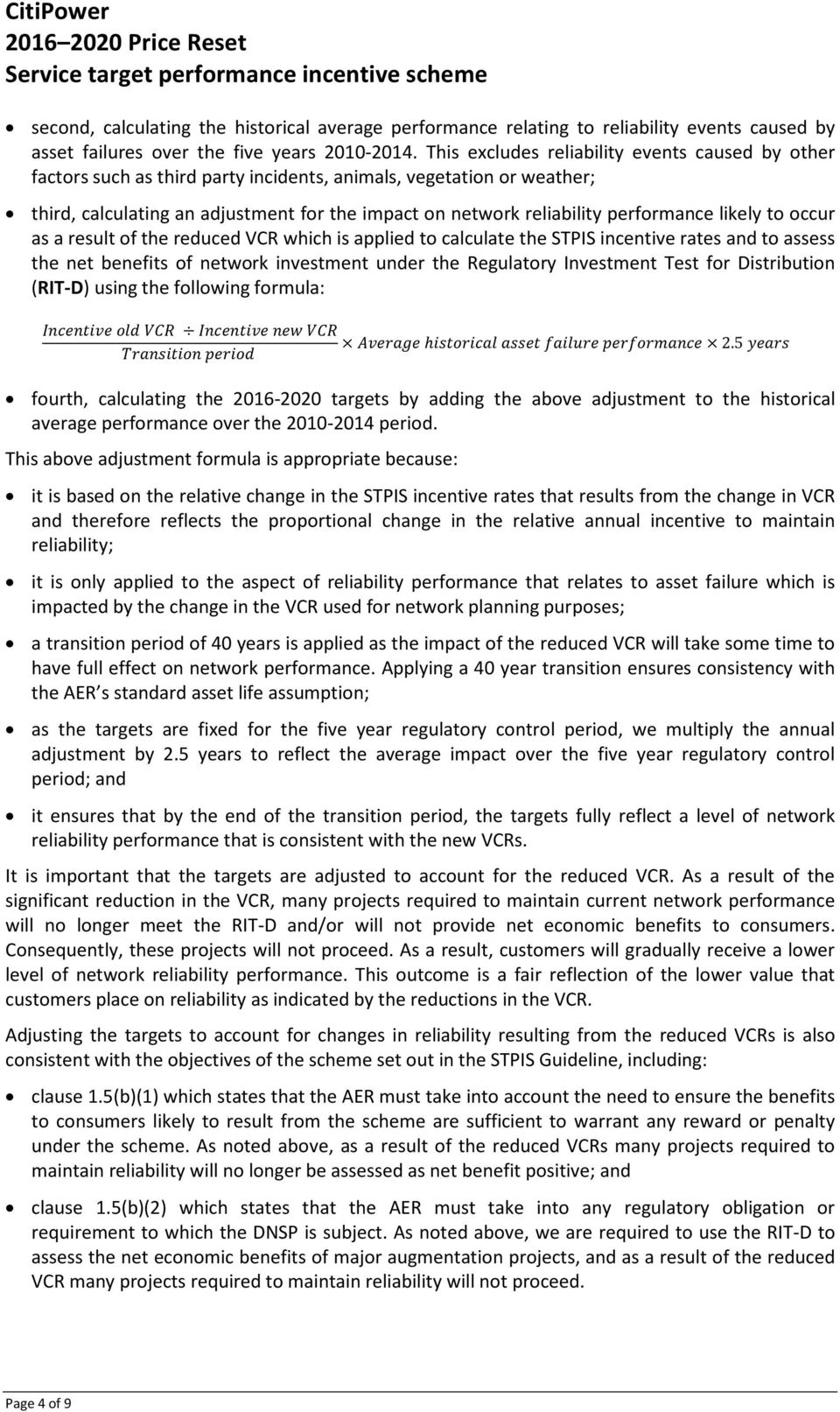
4 second, calculating the historical average performance relating to reliability events caused by asset failures over the five years This excludes reliability events caused by other factors such as third party incidents, animals, vegetation or weather; third, calculating an adjustment for the impact on network reliability performance likely to occur as a result of the reduced VCR which is applied to calculate the STPIS incentive rates and to assess the net benefits of network investment under the Regulatory Investment Test for Distribution (RIT-D) using the following formula: IIIIIIIIIIIIIIIIII oooooo VVVVVV IIIIIIIIIIIIIIIIII nnnnnn VVVVVV AAAAAAAAAAAAAA hiiiiiiiiiiiiiiiiii aaaaaaaaaa ffffffffffffff pppppppppppppppppppppp 2.5 yyyyyyyyyy TTTTTTTTTTTTTTTTTTTT pppppppppppp fourth, calculating the targets by adding the above adjustment to the historical average performance over the period. This above adjustment formula is appropriate because: it is based on the relative change in the STPIS incentive rates that results from the change in VCR and therefore reflects the proportional change in the relative annual incentive to maintain reliability; it is only applied to the aspect of reliability performance that relates to asset failure which is impacted by the change in the VCR used for network planning purposes; a transition period of 40 years is applied as the impact of the reduced VCR will take some time to have full effect on network performance. Applying a 40 year transition ensures consistency with the AER s standard asset life assumption; as the targets are fixed for the five year regulatory control period, we multiply the annual adjustment by 2.5 years to reflect the average impact over the five year regulatory control period; and it ensures that by the end of the transition period, the targets fully reflect a level of network reliability performance that is consistent with the new VCRs. It is important that the targets are adjusted to account for the reduced VCR. As a result of the significant reduction in the VCR, many projects required to maintain current network performance will no longer meet the RIT-D and/or will not provide net economic benefits to consumers. Consequently, these projects will not proceed. As a result, customers will gradually receive a lower level of network reliability performance. This outcome is a fair reflection of the lower value that customers place on reliability as indicated by the reductions in the VCR. Adjusting the targets to account for changes in reliability resulting from the reduced VCRs is also consistent with the objectives of the scheme set out in the STPIS Guideline, including: clause 1.5(b)(1) which states that the AER must take into account the need to ensure the benefits to consumers likely to result from the scheme are sufficient to warrant any reward or penalty under the scheme. As noted above, as a result of the reduced VCRs many projects required to maintain reliability will no longer be assessed as net benefit positive; and clause 1.5(b)(2) which states that the AER must take into any regulatory obligation or requirement to which the DNSP is subject. As noted above, we are required to use the RIT-D to assess the net economic benefits of major augmentation projects, and as a result of the reduced VCR many projects required to maintain reliability will not proceed. Page 4 of 9
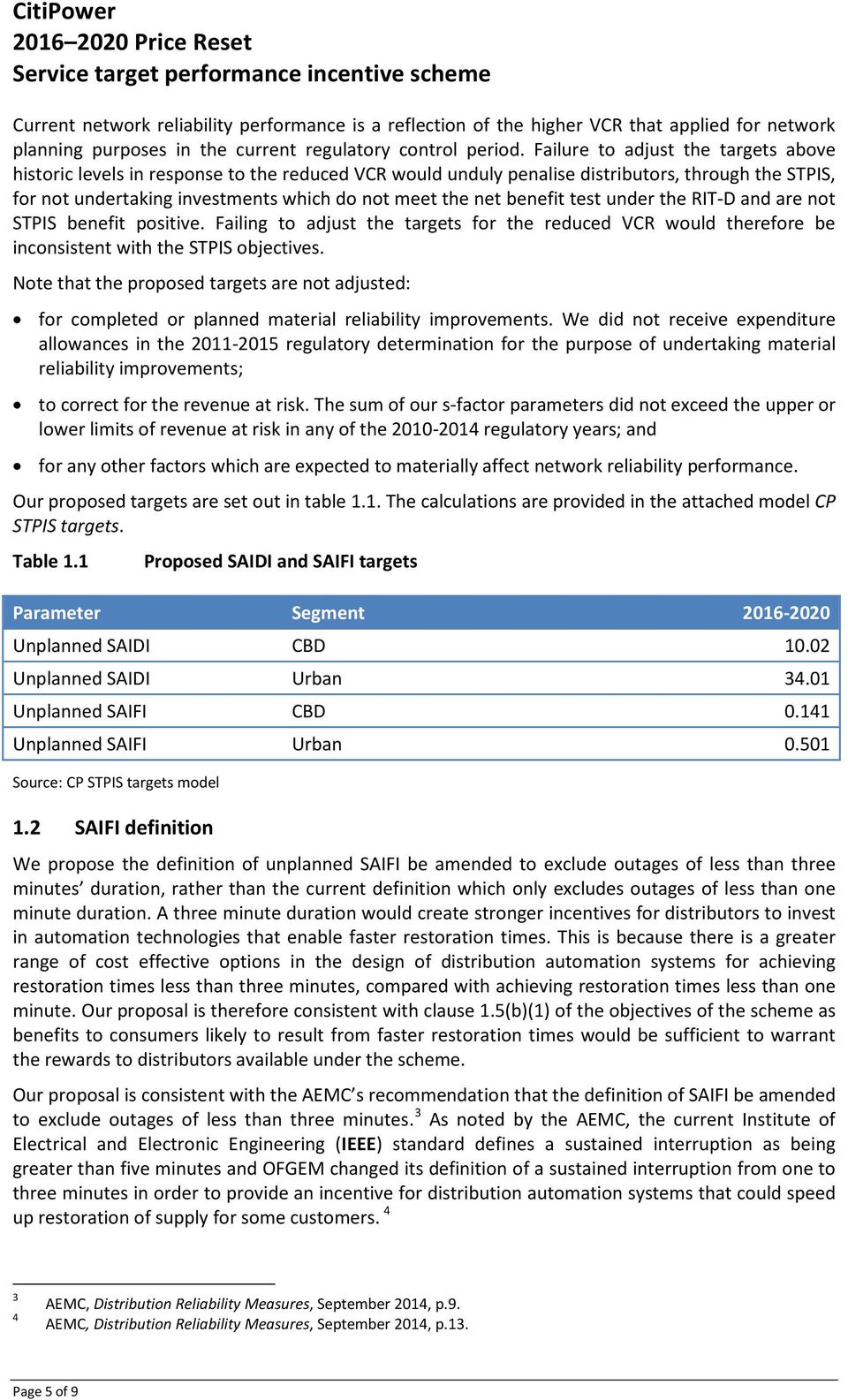
5 Current network reliability performance is a reflection of the higher VCR that applied for network planning purposes in the current regulatory control period. Failure to adjust the targets above historic levels in response to the reduced VCR would unduly penalise distributors, through the STPIS, for not undertaking investments which do not meet the net benefit test under the RIT-D and are not STPIS benefit positive. Failing to adjust the targets for the reduced VCR would therefore be inconsistent with the STPIS objectives. Note that the proposed targets are not adjusted: for completed or planned material reliability improvements. We did not receive expenditure allowances in the regulatory determination for the purpose of undertaking material reliability improvements; to correct for the revenue at risk. The sum of our s-factor parameters did not exceed the upper or lower limits of revenue at risk in any of the regulatory years; and for any other factors which are expected to materially affect network reliability performance. Our proposed targets are set out in table 1.1. The calculations are provided in the attached model CP STPIS targets. Table 1.1 Proposed SAIDI and SAIFI targets Parameter Segment Unplanned SAIDI CBD Unplanned SAIDI Urban Unplanned SAIFI CBD Unplanned SAIFI Urban Source: CP STPIS targets model 1.2 SAIFI definition We propose the definition of unplanned SAIFI be amended to exclude outages of less than three minutes duration, rather than the current definition which only excludes outages of less than one minute duration. A three minute duration would create stronger incentives for distributors to invest in automation technologies that enable faster restoration times. This is because there is a greater range of cost effective options in the design of distribution automation systems for achieving restoration times less than three minutes, compared with achieving restoration times less than one minute. Our proposal is therefore consistent with clause 1.5(b)(1) of the objectives of the scheme as benefits to consumers likely to result from faster restoration times would be sufficient to warrant the rewards to distributors available under the scheme. Our proposal is consistent with the AEMC s recommendation that the definition of SAIFI be amended to exclude outages of less than three minutes. 3 As noted by the AEMC, the current Institute of Electrical and Electronic Engineering (IEEE) standard defines a sustained interruption as being greater than five minutes and OFGEM changed its definition of a sustained interruption from one to three minutes in order to provide an incentive for distribution automation systems that could speed up restoration of supply for some customers AEMC, Distribution Reliability Measures, September 2014, p.9. AEMC, Distribution Reliability Measures, September 2014, p.13. Page 5 of 9
6 1.3 MAIFI We propose that MAIFI should not apply for the regulatory control period. As noted above, there are few cost effective technical solutions available for us to improve MAIFI (particularly based on the current definition of less than one minute) and those solutions that are available have already been taken up. The new technologies which are available for improving short duration interruptions enable interruptions to be reduced to less than three minutes but not less than one minute. Irrespective of how it is defined, the inclusion of MAIFI in the STPIS only acts to undermine the positive incentive to improve SAIFI. It is not efficient to completely eliminate all outages, therefore customers interests are best promoted by creating positive incentives for distributors to invest in the available technologies which minimise outage duration. This is best achieved through the exclusion of MAIFI from the STPIS. Our proposal is consistent with the STPIS objectives, in particular clauses 1.5(b)(1) and 1.5(b)(7), this is because removing MAIFI from the scheme ensures that the incentive rate for SAIFI improvements is directly aligned with consumers willingness to pay for improved reliability performance, based on the VCRs used to calculate the SAIFI incentive rates. Currently the incentive for SAIFI improvements is less than the benefits to customers due to the partially offsetting MAIFI disincentive. The exclusion of MAIFI is also consistent with the AER s Framework and Approach paper and the AER s Draft Decision for NSW/ACT electricity distribution networks. 1.4 Quality of supply targets We propose to continue applying the telephone answering service parameter as a part of the customer service component of the STPIS. This parameter is considered a stable measure of performance when assessing customer service. The proposed telephone answering target is calculated in accordance with section of the STPIS Guideline as follows: the target is calculated as the historical average performance over the past five regulatory years, 2010 to 2014 inclusive; and the target is adjusted by removing from the historical performance data the impact of excluded events, which are identified in accordance with clause 3.3 and appendix D of the STPIS Guideline. We do not propose any additional exclusions. The telephone answering target is not adjusted: for completed or planned material customer service improvements. We did not receive expenditure allowances in the regulatory determination for the purpose of undertaking material customer service improvements; to correct for the revenue at risk: the sum of our s-factor parameters did not exceed the upper or lower limits of revenue at risk in any of the regulatory years; the individual s-factor parameter for telephone answering did not exceed that upper or lower limit of revenue at risk in any of the regulatory years; the sum of all customer service s-factor parameters did not exceed the upper or lower limit of revenue at risk in any of the regulatory years; and Page 6 of 9

7 for any other factors which are expected to materially affect network reliability performance. Our proposed telephone answering target is per cent. We do not propose including any other quality of supply parameters in the scheme. 1.5 Major event day threshold We have determined the 2016 Major Event Day (MED) threshold in accordance with appendix D of the STPIS Guideline, subject to the following exceptions: using the five years of daily unplanned SAIDI data from 2010 to 2014, as the 2015 data is not available; and applying a 2.5 beta parameter in accordance with the STPIS Guideline. The MED threshold is therefore calculated as follows: five years of daily raw unplanned SAIDI over the period 2010 to 2014 inclusive; excluding days where the unplanned SAIDI daily value is less than zero; transforming the daily unplanned SAIDI data based on a 2.5 beta parameter; estimating alpha as the average of the transformed daily unplanned SAIDI data; estimating beta as the standard deviation of the daily unplanned SAIDI data; and calculating the MED threshold as e (α+2.8β). The calculations are provided in the attached model, CP STPIS targets. Our proposed 2016 MED threshold is 3.20 SAIDI minutes. For the regulatory years 2017 to 2020, we will recalculate the MED threshold in accordance with the STPIS Guideline using the most recent five years of unplanned SAIDI data and a 2.5 beta parameter. 1.6 Incentive rates SAIDI and SAIFI incentive rates Our proposed incentive rates for unplanned SAIDI and unplanned SAIFI for each network segment are calculated in accordance with clause and Appendix B of the STPIS Guideline; subject to the following exception: the VCR for each network segment is: ο CBD network segment $46,984 ($/kwh) based on AEMO s national aggregate commercial sector VCR of $44,720 ($/kwh) plus two years of inflation; 5 and ο urban network segment - $41,500 ($/kwh) based on AEMO s state aggregate VCR (excluding direct connects) for Victoria of $39,500 ($/kwh) plus two years of inflation. 6 It is appropriate to apply the relevant AEMO VCR values in the STPIS as these are the most up to date estimates and are consistent with the VCRs that are now being used by us for network planning purposes. Applying the AEMO VCR values is consistent with the objectives of the STPIS, in particular: 5 6 AEMO, Value of Customer Reliability Review, September 2014, p. 2. AEMO, Value of Customer Reliability Review, September 2014, p. 30. Page 7 of 9
8 -clause 1.5 (b)(1) of the STPIS Guideline which states that the AER must take into account the need to ensure the benefits to consumers likely to result from the scheme are sufficient to warrant any reward or penalty under the scheme; and clause 1.5(b)(6) of the STPIS Guideline which states that the AER must take into account the willingness of the customer or end user to pay for improved performance in the delivery of services. In accordance with the STPIS Guideline, our proposed incentive rates for unplanned SAIDI and unplanned SAIFI are calculated for each network segment as follows: the proportion of the VCR applied to unplanned SAIDI and unplanned SAIFI is determined by applying the weightings set out in Table 1 of the STPIS Guideline. We do not propose any alterative weighting; and the formulae specified in appendix B of the STPIS Guideline based on: o the targets set out in Table 1.1; o o the average of the annual smoothed revenue requirement for the regulatory control period as set out in chapter 13; and the average annual energy consumption by network segment over the regulatory control period as provided in the attached model, CP STPIS incentive rates. The resulting incentive rates are set out in Table 1.2. The calculations are provided in the attached model CP STPIS incentive rates. Table 1.2 Our proposed incentive rates Parameter Segment Unplanned SAIDI CBD Unplanned SAIDI Urban Unplanned SAIFI CBD Unplanned SAIFI Urban Telephone answering Network Source CP STPIS incentive rates model Customer service incentive rates Our proposed telephone answering incentive rate is per cent per unit, in accordance with clause (a)(1) of the STPIS Guideline. 1.7 Revenue at risk Our proposed revenue at risk is capped at +/- 2.5 per cent based on: a cap on the reliability components of +/- 2 per cent of annual revenue; and a cap on the telephone answering services parameter of +/- 0.5 per cent of annual revenue. Our proposed aggregate revenue at risk is lower than the default set out in the STPIS Guideline. We are consistently the most reliable distribution network in the National Electricity Market (NEM), as demonstrated in figure 3.4 of Our track record chapter. We are also the distributor with the Page 8 of 9

9 greatest proportion of CBD network area in the NEM. As a CBD network we are expected to deliver, and have delivered, highly reliable supply to our customers. It is increasingly difficult to economically justify any further reliability improvements, especially in light of the lowering VCR rates. Variation in future network performance across years will therefore be primarily driven by external and weather related events which are not sufficient to trigger the MED threshold. As these events are external to management control and are not cost effective to mitigate against (i.e. placing more powerlines underground to protect from storms), we consider that it is necessary to limit the potential rewards and penalties awarded under the scheme for reliability related events to 2.5 per cent of revenue. A larger revenue at risk could lead to undue gains and losses that are not reflective of true improvements to or degradation of the underlying reliability of the network. We note that clause 2.5(b)of the STPIS Guideline states that a distributor may propose a different revenue at risk where this would satisfy the objectives of the scheme specified in clause 1.5. The objectives of the scheme include that the AER must take into account the need to ensure that the benefits to consumers likely to result from the scheme are sufficient to warrant any reward or penalty under the scheme (clause 1.5(b)(1)). As noted above, we do not consider that there would be net benefits to consumers for us to further invest in network reliability as the costs to do so would far exceed the benefits. We therefore consider that capping the revenue at risk in relation to the reliability component of the STPIS is consistent with the objectives of the scheme. We also consider that rewards or penalties of more than two per cent of revenue for the reliability component of the STPIS are not warranted and would not be consistent with the objectives of the scheme. Page 9 of 9
Review of Electricity Distribution Network Minimum Service Standards and Guaranteed Service Levels to apply in Queensland from 1 July 2010
 Final Decision Review of Electricity Distribution Network Minimum Service Standards and Guaranteed Service Levels to apply in Queensland from 1 July 2010 April 2009 Level 19, 12 Creek Street Brisbane Queensland
PRELIMINARY DECISION CitiPower distribution determination 2016 20
 PRELIMINARY DECISION CitiPower distribution determination 2016 20 Attachment 8 Corporate income tax October 2015 8-0 Attachment 8 Corporate income tax CitiPower determination 2016 20 Commonwealth of Australia
VICTORIAN ELECTRICITY DISTRIBUTION NETWORK SERVICE PROVIDERS ANNUAL PERFORMANCE REPORT 2010
 VICTORIAN ELECTRICITY DISTRIBUTION NETWORK SERVICE PROVIDERS ANNUAL PERFORMANCE REPORT 2010 May 2012 Commonwealth of Australia 2012 This work is copyright. Apart from any use permitted by the Copyright
Electricity Networks Service Standards: An Overview
 Electricity Networks Service Standards: An Overview A Report for the NSW Department of Premier and Cabinet 2 September 2014 Final Report HoustonKemp.com Report Author/s Ann Whitfield Tom Graham Contact
Electricity distribution service quality. Metrics and objectives: A literature survey
 Electricity distribution service quality Metrics and objectives: A literature survey August 2012 For further information about this response please contact: Luke Berry Principal Engineroom Infrastructure
Rule change request. 18 September 2013
 Reform of the distribution network pricing arrangements under the National Electricity Rules to provide better guidance for setting, and consulting on, cost-reflective distribution network pricing structures
APPROVED AMENDED PRICING METHODOLOGY FOR PRESCRIBED SHARED TRANSMISSION SERVICES FOR 1 JULY 2014 TO 30 JUNE 2019.
 APPROVED AMENDED PRICING METHODOLOGY FOR PRESCRIBED SHARED TRANSMISSION SERVICES FOR 1 JULY 2014 TO 30 JUNE 2019 DATE: 15 May 2015 Contents 1 Executive Summary... 6 1.1 Introduction... 6 1.2 Pricing Structure...
Distribution Annual Reporting RIN, 2014-15. Basis of preparation
 Distribution Annual Reporting RIN, 2014-15 Basis of preparation CONTACT This document is the responsibility of the Strategy and Stakeholder Relations Group within Tasmanian Networks Pty Ltd (ABN 24 167
National Electricity Amendment (Network Support Payments and Avoided TUoS for Embedded Generators) Rule 2011
 RULE DETERMINATION National Electricity Amendment (Network Support Payments and Avoided TUoS for Embedded Generators) Rule 2011 Commissioners Pierce Henderson Spalding 22 December 2011 JOHN PIERCE Chairman
Economic Benchmarking of Electricity Network Service Providers
 Economic Benchmarking of Electricity Network Service Providers Report prepared for Australian Energy Regulator 25 June 2013 Denis Lawrence and John Kain Economic Insights Pty Ltd 10 By St, Eden, NSW 2551,
2014 Residential Electricity Price Trends
 FINAL REPORT 2014 Residential Electricity Price Trends To COAG Energy Council 5 December 2014 Reference: EPR0040 2014 Residential Price Trends Inquiries Australian Energy Market Commission PO Box A2449
Approaches to setting electric distribution. reliability standards and outcomes. January 2012. Serena Hesmondhalgh William Zarakas Toby Brown
 Approaches to setting electric distribution reliability standards and outcomes January 2012 Serena Hesmondhalgh William Zarakas Toby Brown The Brattle Group, Ltd. Halton House 20-23 Holborn London EC1N
2017 19 TasNetworks Regulatory Proposal Expenditure Forecasting Methodology
 2017 19 TasNetworks Regulatory Proposal Expenditure Forecasting Methodology Version Number 1 26 June 2015 Tasmanian Networks Pty Ltd (ACN 167 357 299) Table of contents 1 Introduction... 1 2 Meeting our
Possible future retail electricity price movements: 1 July 2012 to 30 June 2015
 ELECTRICITY PRICE TRENDS FINAL REPORT Possible future retail electricity price movements: 1 July 2012 to 30 June 2015 22 March 2013 Reference: EPR0029 Electricity price trends report EMBARGO until 22 March
Network Capability Proposal
 28 January 2015 South Australia s electricity transmission specialist Network Capability Proposal Stakeholder Round Table Simon Appleby, SM Regulation & Land Development Bill Jackson, Pricing Manager Brad
Generator Optional. Timeline including the next steps. A practical example. Potential benefits of OFA? Key implications. How might OFA work?
 Generator Optional Firm Access Rights Australian Energy Market Commission announces terms of reference for detailed design work On the 6 March 2014, the Australian Energy Market Commission (AEMC) released
Smart Grid, Smart City
 Smart Grid, Smart City National Cost Benefit Assessment 27 November, 2014 Smart Energy Forum Newcastle Institute for Energy and Resources Bob Bosler, Senior Consultant, Energeia Ranelle Cliff, Senior Project
Pricing Methodology 1. 1 July 2009 to 30 June 2014. April 2010
 Pricing Methodology 1 1 July 2009 to 30 June 2014 April 2010 1 TransGrid s Pricing Methodology as approved by the Australian Energy Regulator ( AER ). This document outlines the pricing methodology that
APRIL 2014 ELECTRICITY PRICES AND NETWORK COSTS
 APRIL 2014 ELECTRICITY PRICES AND NETWORK COSTS 1 WHAT MAKES UP THE RETAIL ELECTRICITY BILL? Retail electricity bills are made up of a number of components: Wholesale costs reflecting electricity generation
AER Issues Paper Tariff Structure Statement Proposals Victorian Electricity Distribution Network Service Providers
 20 January 2016 Australian Energy Regulator GPO Box 520 Melbourne VIC 3001 Via email: [email protected] AER Issues Paper Tariff Structure Statement Proposals Victorian Electricity Distribution Network
Energex. Statement of expected price trends. 1 July 2014 to 30 June 2015. -1-2014/15 Statement of expected price trends
 Energex Statement of expected price trends 1 July 2014 to 30 June 2015-1- 2014/15 Statement of expected price trends Version control Version Date Description 1.0 16 June 2013 Published on Energex s website
Establishing Regulatory Incentives To Raise Service Quality in Electricity Networks
 Establishing Regulatory Incentives To Raise Service Quality in Electricity Networks Author Rolf Adam June 2011 Cisco Internet Business Solutions Group (IBSG) Cisco IBSG 2011 Cisco and/or its affiliates.
Agenda do Mini-Curso. Sérgio Yoshio Fujii. Ethan Boardman. [email protected]. [email protected]
 Agenda do Mini-Curso Sérgio Yoshio Fujii [email protected] Ethan Boardman [email protected] Agenda do Mini-Curso Sistemas de Distribuição (DMS) Characteristics of Distribution Network
CitiPower 2016 Pricing Proposal
 CitiPower 2016 Pricing Proposal This page is intentionally left blank. 2 CitiPower 2016 Pricing Proposal Table of Contents 1 INTRODUCTION... 5 1.1 Our business...7 1.2 Network and metering tariffs...8
Attachment 20.64 SA Power Networks: Asset Management Plan 3.2.01 Substation Transformers 2014 to 2025
 Attachment 20.64 SA Power Networks: Asset Management Plan 3.2.01 Substation Transformers 2014 to 2025 ASSET MANAGEMENT PLAN 3.2.01 SUBSTATION TRANSFORMERS 2014 TO 2025 Published: October 2014 SA Power
NETWORK OUTPUT MEASURES CONSULTATION
 NETWORK OUTPUT MEASURES CONSULTATION Great Britain s electricity transmission network transmits high-voltage electricity from where it is produced to where it is needed throughout the country. It broadly
Seven-Year Electric Service Reliability Statistics Summary
 Oregon Investor-owned Utilities Seven-Year Electric Service Reliability Statistics Summary 2007-2013 June 2014 Report available at http://[email protected] (Click on Safety, then click on Reports ) Information
COMPLIANCE REVIEW OF 2006/07 ASSET MANAGEMENT PLAN. Top Energy Limited
 PB ASSOCIATES COMPLIANCE REVIEW OF 2006/07 ASSET MANAGEMENT PLAN Prepared for PB Associates Quality System: Document Identifier : 153162 Top Energy Final Report Revision : 2 Report Status : Final Date
Cost-effective Distribution Reliability Improvement Using Predictive Models
 Cost-effective Distribution Reliability Improvement Using Predictive Models Dr. Julio Romero Agüero Sr. Director, Distribution Quanta Technology Raleigh, NC [email protected] 919-334-3039 Table
Electricity network services. Long-term trends in prices and costs
 Electricity network services Long-term trends in prices and costs Contents Executive summary 3 Background 4 Trends in network prices and service 6 Trends in underlying network costs 11 Executive summary
Network Risk Assessment Guideline
 Network Risk Assessment Guideline Network Risk Assessment Guideline Table of Contents Revision history... ii 1. Purpose and Scope... 1 2. Definitions, Abbreviations and Acronyms... 1 3. References... 2
Power of choice review - giving consumers options in the way they use electricity
 FINAL REPORT Power of choice review - giving consumers options in the way they use electricity 30 November 2012 Reference: EPR0022 Final Report Inquiries Australian Energy Market Commission PO Box A2449
Updated SCER Demand Side Participation Program December 2013
 Updated SCER Demand Side Participation Program December 2013 The Standing Council on Energy and Resources (SCER) has adopted this framework to guide its demand side participation (DSP) work. The framework
AEMC Electricity Price Trends report released
 AEMC Electricity Price Trends report released AUSTRALIAN ENERGY MARKET COMMISSION LEVEL 5, 201 ELIZABETH STREET SYDNEY NSW 2000 T: 02 8296 7800 E: [email protected] W: WWW.AEMC.GOV.AU The Australian Energy
2013 Residential Electricity Price Trends
 FINAL REPORT 2013 Residential Electricity Price Trends 13 December 2013 Reference: EPR0036 Final Report Inquiries Australian Energy Market Commission PO Box A2449 Sydney South NSW 1235 E: [email protected]
Network Pricing Trends
 Network Pricing Trends Queensland Perspective 20 January 2015 Foreword This report has been prepared for Infrastructure Partnerships Australia (IPA). Its purpose is to help build community understanding
AusNet Electricity Services Pty Ltd. Tariff Structure Statement 2017-20
 AusNet Electricity Services Pty Ltd Submitted: 26 October 2015 About AusNet Services AusNet Services is a major energy network business that owns and operates key regulated electricity transmission and
Business Area Distribution
 Business Area Distribution David Ringmar Director Network Strategy and Development Vattenfall Capital Markets Day, Solna, 27 May 2015 Facts and figures Business Area Distribution Vattenfall s total lenght
Electric Distribution System Owner (Wire Owner) Service Quality and Reliability Performance, Monitoring, and Reporting Rules
 Rule 002 (Formerly EUB Directive 002) Electric Distribution System Owner (Wire Owner) Service Quality and Reliability Performance, Monitoring, and Reporting Rules The Alberta Utilities Commission (AUC/Commission)
Scorecard - Tillsonburg Hydro Inc.
 Scorecard - Tillsonburg Hydro Inc. 9/18/215 Performance Outcomes Performance Categories Measures 21 211 212 213 214 Trend Industry Distributor Target Customer Focus Services are provided in a manner that
Assessment Schedule 2014 Economics: Demonstrate understanding of macro-economic influences on the New Zealand economy (91403)
 NCEA Level 3 Economics (91403) 2014 page 1 of 10 Assessment Schedule 2014 Economics: Demonstrate understanding of macro-economic influences on the New Zealand economy (91403) Assessment criteria with Merit
CUSTOMER EXPERIENCE PLAN Executive Summary
 At the core of the 2012 strategy are five strategic focus areas that prescribe a suite of people, process and technology oriented solutions. These areas are: Operations To ensure satisfied customers through
Cost Allocation Method
 Cost Allocation Method Ergon Energy Corporation Limited Document Summary Version: 4.0 Status: AER Approved Version History and Date of Issue Version Date Issued Summary of Changes 1.0 March 2009 Initial
Security Annex for Firewalls Additional Terms for Firewall Service
 CONTENTS 1 Glossary of Terms & Definitions... 2 2 Service Description... 2 2.1 Firewall Service and Next Generation Firewall Service... 2 2.2 Roaming SSL Access Services... 2 2.3 DMZ Services... 3 2.4
THE INSURANCE BUSINESS (SOLVENCY) RULES 2015
 THE INSURANCE BUSINESS (SOLVENCY) RULES 2015 Table of Contents Part 1 Introduction... 2 Part 2 Capital Adequacy... 4 Part 3 MCR... 7 Part 4 PCR... 10 Part 5 - Internal Model... 23 Part 6 Valuation... 34
DESIGNING AN EMISSIONS STANDARD FOR AUSTRALIA
 55 DESIGNING AN EMISSIONS STANDARD FOR AUSTRALIA 5 The Authority proposes a standard that would apply from 2018 and be designed with a simple set of features to promote environmental effectiveness, policy
Australian Energy Market Commission
 Australian Energy Market Commission Level 6, 201 Elizabeth Street Sydney NSW 2000 PO Box A2449, Sydney South NSW 1235 P 02 8296 7800 F 02 8296 7899 E [email protected] ABN 49 236 270 144 www.aemc.gov.au
Queensland s Unsustainable Electricity Pricing Methodology
 Queensland s Unsustainable Electricity Pricing Methodology Submission to the QCA and Queensland Government in relation to the 2011-12 BRCI Electricity Price Determination 10 February 2011 Page 1 of 12
International Electricity Price Comparison
 NSWIC NEW SOUTH WALES IRRIGATORS COUNCIL PO Box R1437 Royal Exchange NSW 1225 Tel: 02 9251 8466 Fax: 02 9251 8477 [email protected] www.nswic.org.au ABN: 49 087 281 746 Briefing Note International Electricity
Non-Network Options Report
 Non-Network Options Report Kangaroo Island Submarine Cable 12 April 2016 SA Power Networks www.sapowernetworks.com.au Disclaimer This Non-Network Options Report has been prepared in accordance with Clause
Retail Operating Costs A REPORT PREPARED FOR THE ECONOMIC REGULATION AUTHORITY OF WESTERN AUSTRALIA. March 2012
 Retail Operating Costs A REPORT PREPARED FOR THE ECONOMIC REGULATION AUTHORITY OF WESTERN AUSTRALIA March 2012 Frontier Economics Pty. Ltd., Australia. i Frontier Economics March 2012 Public Retail Operating
PUBLIC UTILITIES COMMISSIO~t~ Docket No. DE 15-
 Th~NALZZ~ Exhibit STATE OF NEW HAMPSHIRE t~~eeee BEFORE THE FROM FILE PUBLIC UTILITIES COMMISSIO~t~ Liberty Utilities (Granite State Electric) Corp. dibla Liberty Utilities Calendar Year 2014 Reliability
August 2000. A Review of the Development of Competition in the Industrial and Commercial Gas Supply Market
 August 2000 A Review of the Development of Competition in the Industrial and Commercial Gas Supply Market Executive summary This document explains the conclusions of Ofgem s 1999 review of the development
OSA Metrics and 2014 Incentive Compensation Board of Trustees Contract Oversight Committee Meeting
 OSA Metrics and 2014 Incentive Compensation Board of Trustees Contract Oversight Committee Meeting December 17, 2014 OSA Performance Metrics Goal: 1 st quartile industry performance Categories: Cost Management
5th CEER Benchmarking Report on the Quality of Electricity Supply
 5th CEER Benchmarking Report on the Quality of Electricity Supply Energy Regulators......working through the Council of European Energy Regulators (CEER), aim to create wellfunctioning and competitive
Clean Energy Council submission to Queensland Competition Authority Regulated Retail Electricity Prices for 2014-15 Interim Consultation Paper
 Clean Energy Council submission to Queensland Competition Authority Regulated Retail Electricity Prices for 2014-15 Interim Consultation Paper Executive Summary The Clean Energy Council (CEC) supports
Attachment 20.27 SA Power Networks: Network Program Deliverability Strategy
 Attachment 20.27 SA Power Networks: Network Program Deliverability Strategy Network Program Deliverability Strategy 2015-20 Regulatory Control Period SA Power Networks www.sapowernetworks.com.au Internal
ENERGY RETAILERS COMPARATIVE PERFORMANCE REPORT PRICING 2012-13
 ENERGY RETAILERS COMPARATIVE PERFORMANCE REPORT PRICING December 2013 An appropriate citation for this paper is: Essential Services Commission 2013, Energy retailers comparative performance report pricing,
Ausgrid Network Pricing Proposal For the Financial Year Ending June 2013. May 2012
 Ausgrid Network Pricing Proposal For the Financial Year Ending June 2013 May 2012 Table of Contents PART 1 APPROACH TO PRICE SETTING 1. INTRODUCTION AND OVERVIEW... 4 2. BACKGROUND... 6 3. PRICING METHODOLOGY...
Capital Adequacy: Advanced Measurement Approaches to Operational Risk
 Prudential Standard APS 115 Capital Adequacy: Advanced Measurement Approaches to Operational Risk Objective and key requirements of this Prudential Standard This Prudential Standard sets out the requirements
AER Submission. Competition Policy Review Draft Report
 AER Submission Competition Policy Review Draft Report November 2014 1 Introduction The AER is Australia s national energy regulator and an independent decision-making authority. Our responsibilities are
Review of Electricity Customer Switching
 ISSUES PAPER Review of Electricity Customer Switching 3 December 2013 Submissions due 24 December 2013. Reference: EPR0038 Issues Paper Inquiries Australian Energy Market Commission PO Box A2449 Sydney
Causes of residential electricity bill changes in Victoria, 1995 to 2014. prepared for: Victorian Electricity Distribution Businesses
 Causes of residential electricity bill changes in Victoria, 1995 to 2014 prepared for: Victorian Electricity Distribution Businesses DISCLAIMER This report has been prepared for the Victorian Electricity
Scorecard MD&A - General Overview
 Scorecard MD&A - General Overview In 2014, Essex Powerlines Corporation has exceeded all performance targets except for the Net Annual Peak Demand Savings. Essex has seen improvement in some areas from
Jemena Electricity Networks (Vic) Ltd
 Jemena Electricity Networks (Vic) Ltd 2016-20 Electricity Distribution Price Review Regulatory Proposal Attachment 7-2 Asset management framework and governance Public 30 April 2015 Jemena Electricity
Scorecard - Oakville Hydro Electricity Distribution Inc.
 Scorecard - Oakville Hydro Electricity Distribution Inc. 9/24/215 Performance Outcomes Performance Categories Measures 21 211 212 213 214 Trend Industry Distributor Target Customer Focus Services are provided
AusNet Transmission Group Pty Ltd
 AusNet Transmission Group Pty Ltd Transmission Revenue Review 2017-2022 Appendix 3A: Stakeholder Engagement Forums Summaries Submitted: 30 October 2015 First Stakeholder Forum Summary Transmission Revenue
Information Requirements: Business Plan. Trinidad & Tobago Electricity Commission
 Information Requirements: Business Plan June 01, 2011 May 31, 2016 Trinidad & Tobago Electricity Commission November 2010 This document is one of a series of discussion papers exploring a specific aspect
Levy Consultation 2010/11. Accident Compensation Corporation. Work Levy Rates for Employers and Self-Employed People
 Levy Consultation 2010/11 Accident Compensation Corporation Work Levy Rates for Employers and Self-Employed People Your chance to have your say on what you pay Deadline for Submissions 5.00 pm, 10 November