
Ergon Energy Demand Management Plan
|
|
|
- Marjorie Brittney Flowers
- 10 years ago
- Views:
Transcription
1 Ergon Energy Demand Management Plan July 2015
2 Contents 1. Executive Summary Background Document Purpose Legislative compliance Introduction Demand Management Program Demand Management Summary Demand Management value Peak demand Power quality Reliability Changing Demand Management Environment Demand forecasting Probabilistic planning and Safety Net Existing challenges Emerging challenges Demand Management Strategy Demand side engagement capabilities Network Capacity Incentive Map Trade Ally Network Product development Demand response mechanism Demand Management Plan Demand Management Plan Maintenance programs Contracting demand programs Forecast future constraint programs Safety net programs Targeted broad-based programs Summary Appendix A. DM Project Summaries Appendix B. Definitions, acronyms and abbreviations Definitions Acronyms and abbreviations Ergon Energy Demand Management Plan
3 Table of tables Table 1 Demand management forecast operational expenditure... 4 Table 2 Demand management targets... 5 Table 3 Electricity Regulation 2006 requirements... 7 Table 4 - Demand management forecast expenditure Table 5 - DMIA forecast expenditure Table 6 - Demand management forecast demand Table 7 Maintenance programs Table 8 Contracting demand programs Table 9 - Network constraint forecast programs Table 10 - Network constraint forecast targets Table 11- Safety net potential program Table 12 - Safety net demand management forecasts Table 13 - Broad based and regional Table 14 - Broad-based and regional MVA targets Table of figures Figure 1 - Geographic peak demand Figure 2 - System demand forecast Figure 3 - Tennyson NCIM Figure 4 - Demand Response Automation Server Ergon Energy Demand Management Plan
4 1. Executive Summary The document represents Ergon Energy s Demand Management Plan for including our forecasted demand management targets for the regulatory control period (commencing on 1 July 2015 and ending on 30 June 2020). Ergon Energy remains committed to demand management as a key capability for avoiding the construction of network infrastructure through reducing network risks while supporting an increase in asset utilisation. This commitment is demonstrated by our delivery of 139MVA of demand reductions over the regulatory control period deferring $664 million of network investments. We also recognise that our customers needs and expectations are changing. Technology like solar photovoltaic is now far more common and we expect that by 2020 there will be a range of new customer technologies that we need to support and interact with. As our focus changes to support these emerging consumer choices as well as manage our network, our demand management program is developing new and innovative capabilities to help us better manage our network, interact with our customers and supporting downward pressure on energy costs. In order to manage network needs and our customers expectations we are forecasting an (operational expenditure) investment of $48.2 million in demand management over the 2015 to 2020 regulatory control period as listed in Table 1 and Table 2, consisting of: $22.3 million targeting an additional reduction in demand of 50.2MVA, $18.5 million supporting committed programs providing 41MVA of demand response, and; $7.3 million of Demand Management Innovation Allowance (DMIA) and program management. In the financial year we are forecasting an investment of $9.5M that consists of: $5.1 million to support the 41MVA of committed works, $2.9 million targeting 8.6MVA of new demand management contracts, and; $1.5 million of investment in DMIA, program innovations and program support. Table 1 Demand management forecast operational expenditure DM Portfolio Total Committed works 5,132 4,295 3,270 3,029 2,848 18,574 Contracting demand phase 1,892 1, ,777 Maintenance/operational phase 3,240 3,240 2,940 2,729 2,648 14,797 Planned programs 2,946 3,800 4,595 5,285 5,680 22,306 Network Constraint targeted programs 2,246 2,950 3,545 4,035 4,280 17,056 Safety net risk mitigation ,000 Broad-based and mass market ,250 Demand Management Innovation Allowance 1,000 1,000 1,000 1,000 1,000 5,000 Program Management ,375 Total 9,553 9,570 9,340 9,789 10,003 48,255 Ergon Energy Demand Management Plan
5 Table 2 Demand management targets Additional Demand Targets (MVA) Total Targeted Broad-based Programs Safety net risk mitigation Network Constraint targeted programs Total Additional Demand The forecasted demand management program targets are below the previous control period achievements due to two key reasons: 1. A lower growth forecast for the period compared to which results in lower capital expenditure and consequently lower demand management requirements; and 2. The implementation of the new probabilistic planning criteria and safety net measures resulting in higher levels of residual risk in the network and a shift in focus from Sub-transmission to distribution demand management programs. Other major changes reflected in the demand management program include: Continued Network Tariff Reform introducing new tariffs and price signals providing greater opportunity to work with customers to encourage demand management; Risk mitigation activities of actively working to reduce risk in growth areas prior to specific constraints occurring thus lowering the cost demand activities and reducing demand forecasts; The inclusion of Safety Net into the demand management program to ensure service levels can be maintained through managing outage impacts. The Safety Net is not specific about how these targets are to be achieved which enables far greater use of non-network solutions, particularly demand management and embedded generation; Implementation of several key capabilities to increase our capacity and reduce our demand management costs, including flexible incentive payment process (FIPP), the customer demand management portal (Portal), the network capacity incentive map (NCIM) and continued development of the trade ally network (TAN) concept; and, The development of a demand response automation capability to enable us to interact more freely with our end customers enabling higher levels of consumer participation in demand management activities. Across the 2015 to 2020 period we are expecting to see continual change within the usage and behaviours of Ergon Energy s customers and as a result how our organisation needs to respond in order to support their aspirations. Demand management will continue to play an active role in supporting both the network and the needs of our customers in this regard. Further details of the Demand Management program and future strategic plans are provided herein. Ergon Energy Demand Management Plan
6 2. Background Ergon Energy, as a Queensland Government-owned corporation, supplies electricity to around 700,000 customers across a vast operating area of over one million square kilometres around 97% of the state of Queensland from the expanding coastal and rural population centres to the remote communities of outback Queensland and the Torres Strait. We are all about delivering on our purpose 'to provide safe, reliable, efficient and sustainable energy solutions to support our customers and the Queensland economy'. To make this happen, Ergon Energy has around 4,500 employees and a $10.6 billion asset base. Ergon Energy's electricity network consists of approximately 150,000 kilometres of power lines and one million power poles, along with associated infrastructure such as major substations and power transformers. This is a vast coverage area and in order to fulfil its corporate purpose, Ergon Energy invests in electrical infrastructure and increasingly in demand management to meet the growing needs of regional Queensland. This investment must support the maximum energy demand of our customers, whenever and where-ever it occurs. The maximum or peak demand, typically only occurs for a few hours each year resulting in significant investment for a small duration of time. 2.1 Document Purpose This document is the Ergon Energy Demand Management Plan for , which aims to provide our stakeholders with details of our forecast demand management (DM) activities and insights into our expected demand management program over the next 5 years while meeting our legislative requirements. Its purpose is to: a) highlight the demand management activities planned by Ergon Energy including the defining of strategies, targets, budgeted programs and specific initiatives for the financial year ; b) inform the broader market of Ergon Energy s demand management objectives, goals and proposed programs for the financial year ; c) enable the market to participate in solving network load factor and localised network shortfall issues; d) inform Ergon Energy s regulatory submissions, with the next pricing proposal addressing the five year period starting July 2015; and, e) comply with Clause 127C(1) of the Electricity Regulation 2006 (Regulation) which requires that Ergon Energy prepare a Demand Management Plan for each financial year. Ergon Energy Demand Management Plan
7 2.2 Legislative compliance This Demand Management Plan satisfies the various regulatory requirements, as set out in the table below. Table 3 Electricity Regulation 2006 requirements Section Requirement Reference 127C(1) Ergon Energy must, for each financial year, prepare a Demand Management Plan. (this document) This document satisfies this requirement 127C(2)(a) 127C(2)(a)(i) 127C(2)(a)(ii) 127C(2)(a)(iii) 127C(2)(b) 127C(2)(b)(i) 127C(2)(b)(ii) 127C(2)(b)(iii) 127C(4) Ergon Energy must include its long-term strategy for demand management (the strategy) in the plan. The strategy must include the principles intended to guide the achievement of the strategy. The strategy must include a description of existing and planned programs for demand management for the next 5 financial years. The strategy must include any identified opportunities to achieve the strategy. Ergon Energy must include the proposed initiatives to be carried out under the strategy in in the plan. Each proposed initiative for must include a description of that initiative. Each proposed initiative for must include a forecast of the capital and operating costs that Ergon Energy reasonably considers will be the likely costs for the year. Each proposed initiative for must include Ergon Energy s performance targets for the initiative. Ergon Energy must on or before 30 April 2015 give the regulator a copy of the Demand Management Plan. Section 5 Section 5 Sections 6.1, 6.4 Sections 5.1, 5.2 Section 6.1 Section 8 Section 6.2, 6.3 Section 6.4 As agreed, Ergon Energy delivered a Preliminary Demand Management Plan by 30 April This report represents the revised Demand Management Plan (agreed to be delivered by 20 July 2015) following the AER s Preliminary Determination. Ergon Energy Demand Management Plan
8 3. Introduction To fulfil our corporate purpose Ergon Energy manages electrical infrastructure to meet the growing needs of regional Queensland. Where necessary, Ergon Energy invests in electrical infrastructure to ensure that our customers can access energy in an efficient manner, this includes taking into account embedded generation (including solar PV). In order to ensure that any infrastructure investment is prudent and efficient Ergon Energy examines many options surrounding any proposed investment, including demand management. Demand management - working with our customers to influence their energy usage in order to reduce or avoid the need for investment in infrastructure - has become a business as usual part of our approach. The three main drivers of infrastructure investment that demand management impacts are: 1. Peak demand - to ensure that the peak or maximum demand electricity needs of our customers can be met whenever and wherever it occurs; 2. Power quality ensuing that the quality of supply meets regulatory standards; and, 3. Reliability the measure of the continuous supply of electricity to a customer, or the number of outages that a customer may experience. Peak demand occurs when there is a large demand for energy from customers simultaneously on the network. Typically, these events are driven by temperature (heating/cooling) or large commercial and industrial customers. While the overall system peak demand highlights the network wide impacts and the economy more broadly, Ergon Energy can experience localised peak demand events due to localised temperature or economic conditions. These types of localised conditions are particularly noticeable across Ergon Energy s network due to the vast geographical size of the network and the wide variety of climatic zones the network covers. Power quality covers a range of network issues that impact the quality of the electricity delivered to our customers and can include power factor, voltage changes and harmonics. In cases, such as power factor, demand management can be a valuable economic alternative to a network solution, by increasing the efficiency of the energy used by the end customer. Reliability issues can occur for many reasons, network element failure, and vegetation or weather events such as the recent Tropical Cyclone Marcia. Demand management has a role to play in mitigating the risk associated with reliability in order to support a reduction in infrastructure investment. While customer attitudes to reliability have changed in recent years it remains a key component of our purpose. Supporting the reliable supply of electricity to customers, by improved fault restoration or reducing the impacts of a fault, is an increasing focus of our Demand Management program. Ergon Energy faces many challenges in ensuring that we meet our customers energy, power quality and reliability expectations in a prudent and efficient manner across the vast distances of our network. Our investment in demand management is one way that we can support our customers, manage our risk and efficiently invest in infrastructure. Ergon Energy Demand Management Plan
9 3.1 Demand Management Program Ergon Energy s future demand management activities are based on the success of demand activities to date. Ergon Energy achieved the regulatory control period target of 122MVA in June 2014 a full 12 months ahead of target and achieved 139MVA of demand reductions for the period. The program has successfully aided in the forecast deferral of $664 million of capital investment highlighting the value of the program. The performance of the Demand Management Program will be published in the Demand Management Outcomes Report on the completion of the financial year Demand Management Summary The demand management program is on target to deliver the forecast demand reductions for , highlights of the program from this financial year include: The South Mackay program, which utilised the NCIM (Network Capacity Incentive Map); Trade Ally Network (TAN) and market delivery mechanisms to achieve demand reductions. The program is significant as it underlines the success that this new method of interacting with the market can achieve and establishes the process for the future demand management program; The delivery of key demand management programs including, Gordonvale, St George, and Moranbah as well as Malanda and Kingaroy which are all well progressed in the implementation phase and expected to deliver their demand targets in the next three months; and The development of the portal and Flexible Incentive Payment Process (FIPP) system. These two systems will enable third parties to assist Ergon Energy to drive down the costs for managing payments for demand management and will not only simplify incentivising the market, but also support the mapping concept with easier communications channels to market. These successes pave the way for a successful demand management program over the next regulatory control period Demand Management value The value of demand management for Ergon Energy includes both direct investment deferral for short term value and longer term risk mitigation for longer term deferral, as summarised below. Capital deferment and investment timing. By using demand management we can manage load and defer the need to invest in network infrastructure optimising both investment and cash-flow. Investment decisions are made on the basis of forecast demand growth in an area. Forecasts always carry an element of risk, by using demand management these risks can be managed until the investment need is better understood, thus optimising the final solution. Management of risk. A key change in our planning practices is the change from N-1 planning to a risk based planning methodology. Traditionally the network has been designed to meet the maximum peak demand based on a set of design criteria or security standards, usually N-1. The use of a risk based methodology, combined with a safety net to ensure a minimum service standard, helps reduce the need for infrastructure investment whilst maintaining appropriate reliability. This approach is underpinned by a robust risk management and analysis approach in which demand management is an increasingly useful tool. Ergon Energy Demand Management Plan
10 A reduction in outage costs. We aim to provide a safe, reliable energy supply to our customers, but it is inevitable that some outages will occur. Demand management can reduce the economic impact of such network outages by reducing the amount of load impacted or amount of capacity available for restoration. Asset utilisation. As previously noted the distribution network is designed to meet the peak that only occurs for a few hours every year. Demand management is used to help reduce the peaks and fill the valleys by encouraging shifting of demand to lower network utilisation times. The end result is a network that is better utilised, creating more efficient use of the existing asset base and supporting the reduction in energy costs for consumers. The transition of the demand management program from pure peak demand management to asset utilisation is something that is evolving over time. Third-party value. As the demand management program expands and contracts demand for network management it creates opportunities and enables third parties to provide customers a mechanism to access value in the wholesale national electricity market. Enabling this value for third-parties and customers increases the overall value of demand management and decreases the costs for Ergon Energy to access demand management services in the future. While the above are all benefits that Ergon Energy can extract from demand management, there are three main categories which demand management will be used to support, defer or avoid, further investments. These categories are peak demand, power quality and reliability. 3.3 Peak demand Peak demand issues that trigger demand management activities generally occur in a geographic location and at specific times. These peak demand events are created by several factors coinciding, such as: location of energy use timing of energy use weather conditions, either locally or across the state economic conditions, either locally or across the state network elements and the network capacity available The key consideration with peak demand is ensuring that we have enough capacity to meet the demand when and where it occurs. This creates a level of risk in the forward planning of network investments as the network infrastructure must be in place and commissioned for any potential future peak demand event. The most significant impact on any demand management activities are the timing, location and duration of peak demand as demonstrated by Figure 1 - Geographic peak demand. Ergon Energy Demand Management Plan

11 Heat wave in Cairns causing peak demand issues Network element failure in Mackay causing peak demand issues Remaining network has, no peak demand issues Figure 1 - Geographic peak demand 3.4 Power quality Power quality issues that demand management may be able to address are generally broken into two broad categories: Power factor Voltage Several power factor projects have been delivered by Ergon Energy s demand management program in the past including the Kingaroy and Toowoomba programs. These programs were measured on the demand reduction (MVA reduction) values in order to support a reduction in network investment. Such programs in the future may be measured on their improvement in power factor and improvement in power quality rather than the straight MVA reduction. The introduction of kva tariffs is a large incentive and opportunity to engage with our customers to improve their power factor and costs, while supporting an improvement in our network performance. Apart from the power factor projects the demand management program has not directly performed any other voltage improvement projects to date. However as customers install more energy related technologies into their home, such as solar PV (photovoltaic), smart inverters and energy storage, there may be opportunities to work with our customers in improving power quality as part of future programs. While these two new demand investment opportunities may not deliver a direct capacity improvement measureable in MVA, they have the ability to support a reduction in capital expenditure, as such, provided they can be delivered with a positive net present value they will be considered for inclusion in future demand management activities. 3.5 Reliability Maintaining a high standard of reliability at an efficient cost is a high priority for Ergon Energy and our customers. Reliability in the simplest form is; how long and often an outage occurs at a customer s premise. High reliability comes at a cost of investment, typically in infrastructure or maintenance, which ultimately results in increases in the price of electricity. Reliability has been Ergon Energy Demand Management Plan

12 the subject of significant research by Australian Energy Market Operator (AEMO) and has resulted in the development of the Value of Customer Reliability (VCR). The VCR mechanism enables a methodology of measuring the economic impact of outages and therefore supports a measurable method to compare investment versus risk. Demand Management can be used to reduce the amount of priority load lost during an outage and provide additional network capacity for restoration after an event as an alternative to infrastructure. The demand management program over the coming years will explore opportunities to help improve reliability in areas where there is value for deferring network investment. The Safety Net implementation has already been a large part of this journey. 4. Changing Demand Management Environment There have been some significant changes to Ergon Energy s operating conditions over the past 12 months, with ongoing changes forecast over the coming regulatory control period. Ergon Energy are actively changing the demand management program, systems and processes in order to ensure the demand management program remains effective in this changing environment. 4.1 Demand forecasting Ergon Energy s infrastructure augmentation expenditure program is heavily influenced by the forecasted increase in customer maximum demand and the resulting network upgrade or investment requirements. For the regulatory control period Ergon Energy are forecasting a demand growth that is close to the low growth demand scenario as highlighted below in Figure 2, resulting in a low capital investment forecast for the coming period. This low capital investment forecast will be supported by our DM activities in order to maintain network risks at appropriate levels. Figure 2 - System demand forecast Ergon Energy Demand Management Plan
13 Forecasting plays the fundamental role of establishing demand growth therefore dictating network risks and potential investment areas. As demand management is a risk mitigation strategy, it needs to be appropriately captured within forecasting to ensure it is appropriately considered. In order to accurately account for demand management activities Ergon Energy s Substation Investment Forecasting Tool (SIFT) has the ability to accept demand management as a negative block load. In order for SIFT to accurately account for demand management activities the system must account for the complexity of demand management contracts e.g. comparing a single diesel generator contracted for 10 hours per annum over 3 years versus 1000 residential houses moving to tariff 33 for pool pump load control. Ergon Energy are developing more sophisticated feedback mechanisms to support SIFT enabling our forecasting teams to more accurately account for the demand management programs and the associated impact on forecasts. This will enable us to better predict the long term demand management program s impact on demand, which is especially important for programs that are broader in their application, such as residential PeakSmart air-conditioning programs. 4.2 Probabilistic planning and Safety Net The implementation of the Safety Net and probabilistic based planning methodologies in Queensland has moved planning activities from an input to an output based standard. This enables Ergon Energy flexibility in assessing risk in the network and managing customer outcomes as opposed to implementing specific network topologies. Probabilistic planning enables Ergon Energy to operate parts of the network at higher levels of utilisation and potentially over the traditional N-1 capacity threshold, taking into account the likelihood of a network failure, peak demand at that instance, the energy that cannot be supplied to customers and the time frame to repair a potential fault. These changes have two opposing impacts on demand management: The probabilistic planning allows for operation of the network over the traditional N-1 capacity threshold, reducing the level of redundancy. Typically the lower levels of redundancy in the network occur at the lower voltages (11kV and 33kV distribution elements), which has resulted in the need for the demand management program to focus on localised network elements with very specific and reliable solutions. An outcome based planning approach requires greater management of risk and contingencies. Demand management is a very effective risk mitigation activity for load based network risk. As the need for demand management to manage risk within the distribution network increases so too will the number of demand management initiatives, reducing the size of each individual initiative and driving new approaches to contracting and managing the demand. In order to ensure that the risk of probabilistic planning does not result in significant outages to our customers Ergon Energy operates within the safety net which is a minimum outage time during a contingency event. Demand management interventions, including embedded generation, are playing an increasing role in meeting safety net provisions. Ergon Energy Demand Management Plan
14 4.3 Existing challenges Key risks that have been identified in past Demand Management Plans are still applicable for the demand management period. During this time Ergon Energy expects to see a continued growth in: PV installations. As incentives have reduced over recent times the installation of PV systems has decelerated. However the growth of PV systems in residential environment remains strong with the average size of systems increasing; Air-conditioners. While air-conditioning systems are starting to reach saturation levels throughout our supply territory there is still growth in the air-conditioning market, with a 8% forecast of customers purchasing an additional air-conditioner and 3% of customers purchasing their first air-conditioner over the next 5 years. An added risk to this has been a decrease in the percentages of customers using inefficient temperature setting, from 53% to 46% on the hottest summer day; 1 and As mentioned in section 3.3, localised growth continues to be a key contributor to the demand management program with localised growth resulting in constraints on various network elements. 4.4 Emerging challenges The two main emerging challenges and opportunities for Ergon Energy are the increased consumer interest in residential energy storage (residential battery systems) and rate of electric vehicle uptake. Both of these challenges are still emerging and although they are not forecast to significantly impact Ergon Energy in the coming 12 months, they pose such a risk and opportunity that strategies need to be in place to ensure our customers can access these technologies in an appropriate manner. Residential energy storage - As the Solar Bonus Scheme Feed in Tariff reduces, we expect to see an uptake in consumers installing energy storage devices such as batteries, representing a significant opportunity and risk. The opportunity is to encourage consumers to install batteries that mitigate the network peak demand thus providing a significant demand management tool. If customer energy storage is installed in such a way as to minimise peak demand, it has the potential to significantly drive down infrastructure investment and hence energy costs for all customers; and Electric Vehicles - While the uptake of electric vehicles is slow and is expected to remain so for the immediate future, electric vehicles present such a significant risk that they require consideration early in the adoption cycle. Electric vehicles have the potential to create localised increases in peak demand, therefore we must have strategies to encourage customers to connect and charge electric vehicles in a way that improves network utilisation and hence has a downward pressure on customer prices. 1 Colmar Brunton. (2014). Queensland Household Energy Survey. Brisbane: Colmar Brunton. Ergon Energy Demand Management Plan
15 This changing environment highlights the future risks and opportunities for Ergon Energy across the distribution network that require management, together with implementation of new business processes such as asset utilisation improvement and new risk based planning methodologies. Rather than responding reactively to disruptive technologies, we are preparing for disruptive technology adoption ensuring that operational processes are in place to activate as required, to maximise any potential benefits. 5. Demand Management Strategy Ergon Energy s demand management strategy over the coming regulatory control period builds on the previous demand management strategy and aims to increase the capabilities of demand management to enable further support of reduced network risks. Our strategy is to engage earlier in the risk cycle with low cost proactive demand management programs and create the opportunity for customers to engage earlier with us to ease network risks. As the demand profile in an area grows and the risk increases the demand management program will increase activities and incentives to increase the demand benefits. This process continues as the network solution is developed, whereby the demand management program value can increase to include direct asset deferral and offer customers higher incentives. This continual demand management process will enable our forecasting teams to develop an understanding of the impacts of demand management programs; our planning teams to increase knowledge of the demand capability embedded in an area; our customers to realise longer term value from demand activities; and, finally our market supplier s surety over the length and time of available incentives. This type of demand management is expected to increase the numbers of service providers, customers and products used in the delivery of demand management. 5.1 Demand side engagement capabilities Ergon Energy s vision for delivering demand management is through market enablement. The energy services market continues to grow and in the future, we expect the energy services market to be able to deliver demand opportunities efficiently. The market enablement mechanism is already in the pilot phase with the EmPower South Mackay project, and includes a number of initiatives such as NCIM and market engagement via the establishment and operation of the TAN. We are also investing in initiatives to support market delivery enablement and to increase the size and activity of a demand management market by Developing preapproved products that can be actively used by the market to supply demand management solutions; Investing in systems and processes to reduce the barriers for customers and suppliers to participate in the demand management market; Examining regulatory arrangements and working with regulators and governments on barriers that may be removed to enable a more active demand market; Working with other demand purchasers, retailers, aggregators, and transmission companies to ensure the full value of demand management is available for customers; Ergon Energy Demand Management Plan
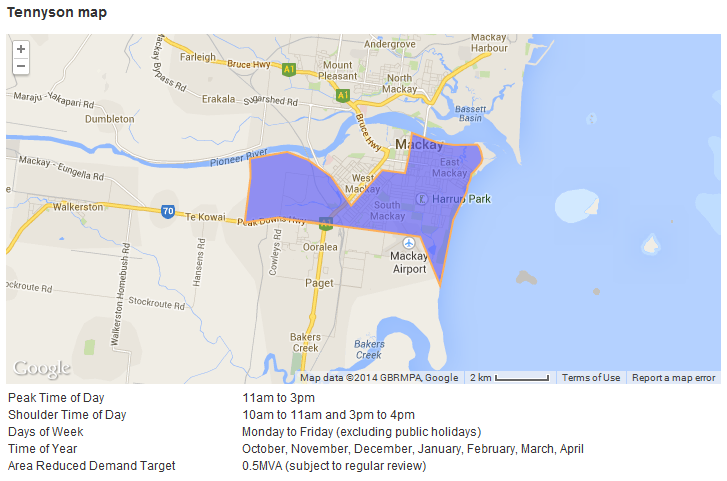
16 Working in partnership with research institutions and international technology providers such as the Guided Innovation Alliance within the Queensland University of Technology, ARENA and others to focus on key priorities for the electricity distribution sector; and, Developing internal capabilities to manage an active demand market and remove barriers for demand suppliers to access incentives and accelerate their demand management activities Network Capacity Incentive Map The network incentive capacity map (NCIM) is a market communication tool that engages the market to identify the value, location, and metrics related to a Demand Management Program of works. The NCIM, example shown in Figure 3 - Tennyson, is in use with the South Mackay program, and published on Ergon Energy s external website. As can be seen the NCIM identifies, the exact location and timing of the constraint and any customer in the map catchment area can access incentives. Figure 3 - Tennyson NCIM The NCIM s main function is to inform the market of the location of a program the timing of the program the economic value of the program the metrics around the program Informing the market should enable an increased number of vendors supplying demand services an increase in competition driving down cost to supply innovation in the market, once the market is established and informed high levels of engagement with third parties Ergon Energy Demand Management Plan
17 Ergon Energy is developing the capability to expand and publish the NCIM map across Queensland, to highlight all the network areas of constraint and risk to provide better market information Trade Ally Network The Trade Ally Network (TAN) is an active group of preapproved suppliers of services or products that can support demand management products or services. The purpose of the TAN is to ensure there is a ready-made market of appropriately qualified vendors and suppliers that can offer products to a customer base. Using already developed market capabilities reduces the need for Ergon Energy to duplicate these services and capabilities to achieve demand reductions. The TAN are provided with information, collateral and other marketing support tools to help them seek, find, and engage with customers willing to undertake demand reduction initiatives. Currently the TAN consists of over 40 companies that range in capabilities from lighting experts to air conditioning design experts, to power factor equipment suppliers, to finance companies. This relationship enables a capable market; provides suppliers with opportunities for business development, and enables customer choice. Frequently customers have pre-existing relationships with TAN members that further reduce barriers for customer participation in demand markets. The combination of dynamic planning, NCIM and the TAN create the foundation of a market-based solution for delivering demand management. 5.2 Product development In order to support our demand partners and customers we are developing a range of standardised products for which there will be a defined range of requirements to enable the product to be eligible for incentive payments. This will enable our TAN partners to develop their own systems, process and products to further create value for our customers and ensure that the demand management program continues to deliver benefits. These standardised products will be supported by FIPP which, when combined with the NCIM, portal and TAN enables us to efficiently and quickly process incentive payments. Products for development will vary over time as market forces and customer requirements change, but the following list of 10 product areas will be our key focus over the period: 1. Air Conditioning Peak Smart; 2. T33 controlled loads (pool pumps, HW storage etc); 3. T12 (non-control price signal tariff); 4. Call Off Load; 5. Customer Embedded Generation; 6. Network Embedded Generation; 7. Power Factor Correction; 8. C&I Demand Management; 9. SWER delivery mechanism; and 10. Customer IES. Ergon Energy Demand Management Plan

18 Effective development and management of these products will be instrumental in ensuring effective market deliver of demand management. 5.3 Demand response mechanism The future success of the Demand Management strategy will be dependent upon the creation of the capabilities that enable the program to manage a higher number of demand initiatives effectively. The increase in distribution network demand management programs is forecast to increase the numbers of customer contracts and demand programs, and to decrease the average size of contracted demand. As this demand gets contracted there will be an increasing requirement to automate the management of the contracted demand, therefore Ergon Energy have invested in a Demand Response Automation Server (DRAS), (see Figure 4 - Demand Response Automation Server). The DRAS enables significant strategic capabilities to efficiently target, operate, measure, verify and control this increasing number of demand contracts automatically. The DRAS will enable active demand management for Ergon Energy into the future by allowing interactions with market participants in an automated seamless manner with clear interface rules. As customers become more sophisticated in their energy use and new technologies, such as when batteries evolve, the interactions Ergon Energy has with our suppliers of demand become more complex. The DRAS forms part of our future of demand management and will be integrated with other network management tools allowing Ergon Energy to interact with our customers on a regular basis to actively shape the demand profiles of the network. Figure 4 - Demand Response Automation Server Ergon Energy Demand Management Plan
19 Ergon Energy Demand Management Plan
20 6. Demand Management Plan We have developed our Demand Management Plan for based on our Australian Energy Regulator (AER) proposal for the regulatory control period. The AER s final determination will have significant influence on all aspects of Ergon Energy s operational and capital expenditure including demand management activities. Not-withstanding the uncertainty surrounding the final funding for the regulatory control period, Ergon Energy are forecasting a total demand management expenditure of $43.2M as detailed in Table 4, including Demand Management Incentive Allowance (DMIA) (Table 5). Table 4 - Demand management forecast expenditure DM Portfolio Total Committed works 5,132 4,295 3,270 3,029 2,848 18,574 Contracting demand phase 1,892 1, ,777 Maintenance/operational phase 3,240 3,240 2,940 2,729 2,648 14,797 Planned programs 2,946 3,800 4,595 5,285 5,680 22,306 Network Constraint targeted programs 2,246 2,950 3,545 4,035 4,280 17,056 Safety net risk mitigation ,000 Broad-based and mass market ,250 Program Management ,375 Total 9,553 9,570 9,340 9,789 10,003 43,255 In addition to $43.2M of demand management activities Ergon Energy forecast a DMIA expenditure of $1M per year over the 5 years as detailed in Table 5. While DMIA is separate to the demand management expenditure, it is administered and managed by the demand management program as it provides a key resource for Ergon Energy to conduct research and investigation into innovative techniques for managing demand. Although budgeted for separately, DMIA is highlighted in this Demand Management Plan for completeness. Table 5 - DMIA forecast expenditure Demand Management Innovation Allowance Total ($'000 ) DMIA forecast expenditure 1,000 1,000 1,000 1,000 1,000 5,000 Ergon Energy Demand Management Plan
21 Ergon Energy forecast expenditure over the period will result in an additional 50.2MVA of demand reductions across Ergon Energy s coverage area as detailed in Table 6 in addition to the 41MVA of committed demand that was contracted in the period. Table 6 - Demand management forecast demand Additional Demand Targets (MVA) Total Targeted Broad-based Programs Safety net risk mitigation Network Constraint targeted programs Total Additional Demand Demand Management Plan Ergon Energy s Demand Management plan includes the following programs forecast to continue into or commence in : Maintenance programs - programs which are no longer contracting new demand but which have demand under management, e.g. contracted diesel generator; Committed works - programs which are forecast to commence or continue into ; Forecast future constraint programs, programs which are forecast to commence based on constraint identification; Safety net programs - aligning with the application of the new safety net planning criteria; Broad based and regional programs - supporting a reduction in forecast network risk by mitigating the demand growth in an area; Smart network programs - creating future strategic capabilities for the demand management program; and, Program management - which includes a range of activities, such as measurement and verification, reporting, feasibility studies and other activities not directly associated with a program. Ergon Energy Demand Management Plan
22 6.2 Maintenance programs Maintenance programs are programs where the demand targets have been reached and the existing demand is available to Ergon Energy under a continuing contract. Such programs include demand response contracts through customer or network embedded diesel generation. Our current maintenance and contracting programs support approximately 41MVA 2 of contracted demand. Table 7 Maintenance programs Maintenance/operational phase Total 3 Mt Peter (Gordonvale) Dingo/Duringa Mt. Isa DR Alpha ,000 Malanda DR Moranbah DR ,230 Barcaldine 1,840 1,840 1,840 1,840 1,840 9,200 Total 3,240 3,240 2,940 2,729 2,648 14, Contracting demand programs Contracting demand programs are programs that will be continuing to contract demand or commencing operation in the coming control period. This may consist of programs that already have a level of demand under contract and will be continuing to contact additional demand or programs transferred from previous smart network programs. Table 8 Contracting demand programs Contracting demand phase Total Your Power QLD ESC Bohle Industrial Area EmPower Mackay ,133 Cannonvale ,068 Kingaroy Power Factor Mackay North ADMD Phase 2 Calculator Total 1,892 1, ,777 2 Forecasted as at the end of FY 2014/15 at the time of Demand Management Plan creation 3 Forecast expenditure does not include any expenditure previously incurred 4 Alpha is currently under review, the forecast is based on previous operational costs. 5 Includes feeders of Blacks Beach, Rural View, Eimeo and Bucasia as listed in Preliminary Demand Management Plan Ergon Energy Demand Management Plan
23 6.4 Forecast future constraint programs Ergon Energy s forward planned programs of work for and beyond are subject to change as network needs and demand changes across our network. With the added implications of the new planning criteria, Safety Net and the AER determination Ergon Energy will continue to revise the forward programs of works to ensure that the program continues to provide value. The forecasted network constraint program is detailed below in Table 9. It contains a list of network risk areas where demand management is likely to form some part of the solution for easing the network risk. Many of these areas contain some elements of network risk related to safety net, reliability and capacity and the solutions will continue to be developed in conjunction with new planning standards. Table 9 - Network constraint forecast programs Forecast programs Total North Mackay ,600 Charleville ,600 Ooralea Gracemere ,698 Charters Towers Alpha Harvey Bay ,000 Feeder program ,250 Single Wire Earth Return ,255 Others ,445 1,985 2,005 7,283 Total 2,246 2,950 3,545 4,035 4,280 17,056 The others that are currently under review for inclusion in the demand management program include, among others: Charlton, Tukura, Broxburn, Kunawarra, Bundaberg Port, Yarranlea, Hervey Bay (Pialba), Bargara, Avoca, Kingaroy, Emerald, Lower Burnett, Burnett Heads. These sites all have varying network influences on the risk that is in the area and will be reviewed in line with the application of the new planning criteria. 6 Includes feeders of Blacks Beach, Rural View, Eimeo and Bucasia as listed in Preliminary Demand Management Plan 7 Charleville may include the surrounding towns of Charleville, Quilpie, St George and Cunnamulla, however it is dependent on the application of Safety Net. Ergon Energy Demand Management Plan
24 The forecast demand reduction targets for the above programs are detailed below in Table 10. Table 10 - Network constraint forecast targets Forecast demand reduction (MVA) Total North Mackay Charleville Ooralea Gracemere Charters Towers Alpha Harvey Bay Feeder program Single Wire Earth Return Others Total Safety net programs The forecast financial expenditure on safety net demand management is listed below in Table 11. The safety net expenditure does not include any site preparation for embedded generation nodes and specifically considers only the operational costs of demand management for supporting safety net. Safety net was developed for low probability high impact events and we are forecasting that in any one year, on average, we would only expect one significant safety net event which would require the deployment of safety-net generation support. While our forecast safety net risk exposure supported by demand management is 16.6MVA, one safety net event per year would result in a forecasted deployment of 6.5MVA of demand management over the 5 years. It is important to note that safety net is a new planning and operational standard as such Ergon Energy will continue to revise the program in line with prudent operating practice. Table 11- Safety net potential program Total Safety net forecast expenditure Safety net risk mitigation ,000 The demand forecast for demand requirement to support safety net is listed below in Table 12. Table 12 - Safety net demand management forecasts Safety forecast demand reduction (MVA) Total Safety net risk mitigation Ergon Energy Demand Management Plan
25 6.6 Targeted broad-based programs Our targeted broad based regional programs are detailed below in Table 13. These programs are based on supporting our existing constraint and targeted programs and where possible, the two programs will work in unison. The targeted broad based programs follow on from previous broad based and residential programs, with future programs aiming to include small to medium business as well as residential programs. Table 13 - Broad based and regional Forecast program expenditure Total Demand mapping Tariff Switching Peak smart ,300 Education Total ,250 The new MVA targets for the broad-based and regional programs are shown below in Table 14. The education program does not have any specific targets as they are focused on community engagement and education of customers, suppliers and the general market. These program are considered important to enable broad based programs, however it is hard to quantify the exact demand savings associated with an educational program as such no specific demand reduction is forecast. Table 14 - Broad-based and regional MVA targets Targeted Broad based demand targets (MVA) Total Tariff switching PeakSmart Total Ergon Energy Demand Management Plan
26 7. Summary Ergon Energy s Demand Management Plan for is forecasting an investment of $9.5 million that consists of: $5.1 million to support the 41MVA of committed works; $2.9 million targeting 8.6MVA of new demand management contracts; and, $1.5 million of investment in DMIA, program innovations and program support. While some uncertainty exists for our demand management plan, as the AER final determination is not due to be released until 31 October 2015, we are not forecasting any significant changes over the coming period and expect to continue with our demand management investments as forecast. We plan to continue to deliver demand management outcomes that support a reduction in infrastructure investment helping to ease the pressure on energy costs for our customers. Our strategy remains innovate our demand management program, work with market participants, customers and suppliers to deliver efficient demand management outcomes. Ergon Energy Demand Management Plan
27 8. Appendix A. DM Project Summaries Moranbah Network Support PROJECT PHASE Development Implementation Finalisation Indicates current phase Description / Scope A non-network alternative was sought to optimise the timing of the delivery of this project and manage the associated demand related risks. A network support agreement was developed and included support for the existing network as well as ensuring that an extra 6MVA of load did not occur on the network prior to commissioning of the new plant. This project has been underway since 2012 and has successfully secured the necessary operational demand to maintain network security and manage the network risk. Aims / Hypothesis To contract 10 MVA of network support via embedded generation to ensure that: The network security is maintained; The additional substantial load does not occur on the network, and, There is appropriate time to determine the substation upgrade requirements and timeline. Deliverables & Outcomes No additional demand is to be contracted for the FY period, and Deliverables for FY are to monitor and evaluate contracted demand performance. Performance Targets Maintain existing approved contracts for the continued operation of the 10MVA of demand response. Ergon Energy Demand Management Plan
28 Dingo/Duaringa Network Support PROJECT PHASE Development Implementation Finalisation Indicates current phase Description / Scope The BW220 feeder between Dingo and Duaringa experiences large voltage drops at times of peak demand. This project sought to identify and contract embedded generation between Dingo and Duaringa to reduce load and therefore provide voltage support during times of peak demand. This project has been underway since 2014 and has successfully secured the necessary operational demand to reduce load and manage the network risk. Aims / Hypothesis To contract 75kVA of load reduction during times of peak demand to ensure that: The network security is maintained, and Voltage drops are maintained within the regulatory requirements. Deliverables & Outcomes No additional demand is to be contracted for the FY period, and Deliverables for FY are to monitor and evaluate contracted demand performance. Performance Targets Maintain existing approved contract for the continued operation of the 100kVA customer embedded generator. Ergon Energy Demand Management Plan
29 Empower Mackay PROJECT PHASE Development Implementation Finalisation Indicates current phase Description / Scope South Mackay 33/11kV zone substation has two 20MVA transformers and supplies the South Mackay commercial/industrial area and surrounding residential rural loads. Whilst the recent significant mining induced growth has reduced it is expected that from summer customer load shedding will be required for a transformer contingency at SOMA during the summer daytime peak. Aims / Hypothesis The aim of the NNA program in South Mackay is to cost effectively deliver MVA reductions and manage the load at risk by providing a lower cost engagement model with market participants for demand side solutions. The new method of engagement for this project is through the publication of a Network Capacity Incentive Map to market participant and end users. This identifies the market areas in which Ergon Energy is prepared to offer incentives for both demand management and demand response. Deliverables & Outcomes Continued promotion of program and engagement with the market participants in order to deliver the required peak demand savings. Evaluation of incentive take-up and values. Performance Targets Deliver the demand reduction target of 3.65MVA for FY Ergon Energy Demand Management Plan
30 Planella PROJECT PHASE Development Implementation Finalisation Indicates current phase Description / Scope There are four feeders supplied by the Planella 33/11 kv zone substation located in Mackay s northern beaches region, Black s Beach, Rural View, Eimeo and Bucasia. These feeders supply an area that is predominantly residential and experiences residential evening peak demands predominantly during summer. Augmentation works are likely to be required to address the peak load unless NNA reductions can be introduced commencing in Aims / Hypothesis The aim of this project is to develop and submit a Gate 3 business case for approval of a 5 year NNA reduction program commencing in Deliverables & Outcomes Develop and submit a Gate 3 business case for approval to commence the NNA project in 2015/16. Performance Targets Deliver a peak demand reduction of 150 kva for FY Ergon Energy Demand Management Plan
31 Mt Isa DM Project PROJECT PHASE Development Implementation Finalisation Indicates current phase Description / Scope The Duchess Road load growth was forecast at approximately 4.3% p.a., and was to exceed its N-1 rating of 47.6 MVA in summer The loads supplied by Duchess Road Zone Substation have been identified as a mix of residential, commercial and industrial, with significant thermal load. Peak loads occur in summer, with daily peaks lasting from approximately 10am to 9pm. This project involves Ergon Energy implementation of network embedded generation, customer embedded generation and working with participants on their side of the meter by recognising innovative ways of reducing demand through a targeted program. Aims / Hypothesis The aims of the initiative are to: Reduce distribution network demand by 2MVA; Work with customers behind the meters to look at a mix of over the horizon solutions, with customers to own the projects; and, Secure Network Support Agreements for Network and Customer Embedded Generation. Deliverables & Outcomes No new recruitment activities planned Monitor and evaluate contract execution Performance Targets Maintain existing approved contracts for the continued operation of the 2MVA of demand response. Ergon Energy Demand Management Plan
32 Malanda DM Project PROJECT PHASE Development Implementation Finalisation Indicates current phase Description / Scope The Atherton Tablelands area covers an area from Millaa Millaa and Ravenshoe in the south to Lake Tinaroo in the North and West to Herberton. Atherton is the major centre in the area and the area is supplied from Atherton, Evelyn and Ravenshoe 66/22 kv Zone substations. The Atherton Zone Substation 22 kv network feeders under investigation are Peeramon, Malanda and Tarzali these supply the centres of Malanda and Yungaburra with the major connection in the area (9-10 GWh pa of annual energy consumption and approx. 2MVA of maximum demand). Malanda Milk is the largest customer on the Malanda feeder and due to the size of the load (>1.4MVA), can cause voltage swings on the feeder particularly when coming on and off line. The Malanda Milk factory is in the process of installing a 1.4 MVA parallel generator on their site. It was identified that the generator could be contracted through a Network Support Agreement to reduce voltage swings and to support adjacent feeders during times of outage. Aims / Hypothesis The objective of this project is to move to the delivery phase of a customer embedded Call On Generation site at Malanda Milk in They will be engaged to reduce the voltage fluctuations due to the impact of the major customers and to provide network support during times of constraint on adjacent feeders. Deliverables & Outcomes Delivery of 1.4MVA of network support via customer embedded generation at Malanda Milk Factory; Monitor the Network Support Agreement with Malanda Milk Factory to utilise the 1.4 MVA generation for the NNA contingency; and, Ongoing management of NNA contingency. Performance Targets MVA of NNA demand response via Customer Embedded Generation contracted in a Network Support Agreement within project budget. Ergon Energy Demand Management Plan
33 Gordonvale DM Project PROJECT PHASE Development Implementation Finalisation Indicates current phase Description / Scope There was approximately $17.5 million in sub transmission and distribution works planned until 2018 for the staged construction of a new feeder tie between the Edmonton zone substation and Gordonvale switching station. A switching station is also proposed at Meringa. Entering into a network support agreement with Mulgrave Sugar Mill at Gordonvale could achieve 2.47MVA in peak demand reductions. This will allow the deferral of the above mentioned network capital expenditure by 3 years. Aims / Hypothesis The objective of this project is to move to deliver the customer embedded Call On Generation site in 2015/16 in order to reduce provide network support during times of constraint on adjacent network. Deliverables & Outcomes Delivery of 2.47MVA of network support via customer embedded generation at Mulgrave Sugar Mill; Monitor the Network Support Agreement with Mulgrave Sugar to utilise the 2.47 MVA generation for the NNA contingency; and, Ongoing management of NNA contingency. Performance Targets MVA of NNA demand response via Customer Embedded Generation contracted in a Network Support Agreement within project budget. Ergon Energy Demand Management Plan
34 Bohle Industrial Area DM Project PROJECT PHASE Development Implementation Finalisation Indicates current phase Description / Scope There is a significant opportunity to defer the Mt Saint John zone substation construction if 5.5MVA of coincident peak demand reduction is achieved through a Customer Demand Management (CDM) program being implemented with commercial and industrial customers. In this project, Ergon Energy upon evaluation of a customer premise identifies a value proposition suitable to each customer and subsequently offers an incentive to implement the onsite changes to achieve Ergon goals within the set timeframes to defer the zone substation construction. This project is part of the Townsville Energy Sense Communities Program. Aims / Hypothesis The aim of this project is to reduce peak demand, thereby deferring the proposed Mt St John zone substation by two years (an investment of over $30 million). A CDM Program reduces peak demand through a cooperative approach with the consumers on their side of the meter. To achieve this reduction customers are evaluated and introduced to: Alternate energy use patterns through use of management systems (e.g. Building Management Systems); and, Proven technology implementation opportunities (e.g. more energy efficient equipment, lights, air conditioning etc.) Deliverables & Outcomes Measurable reductions in Customer demand on the distribution network in North/West Townsville area. Project management of the customer installation of energy conservation measures. Measurement and Verification of measures installed on customer sites. Call off load and Customer Embedded generation initiatives. Expand project scope to include DM on residential customers. Performance Targets Deliver demand reduction of 1MVA. Ergon Energy Demand Management Plan
35 Cairns Northern Beaches DM Project PROJECT PHASE Development Implementation Finalisation Indicates current phase Description / Scope In May 2010, Asset Management prepared an investigation into Non-Network Alternative (NNA) options at Cairns Northern Beaches (CNB). The area is presently supplied from the 22kV Kewarra Beach switching station, by three 22kV tie feeders (Cook 1, 2 & 3) from Kamerunga 132/22kV substation and comprises approximately half of the load on the Kamerunga substation. The goal of the CNB Investigation was to defer an estimated $50M of capital investment into the proposed new Smithfield 132/22kV Zone Substation and 132kV feeders. The CNB Investigation reported the Smithfield zone substation was scheduled to be commissioned by summer in order to accommodate demand growth in the CNB area and avoid breach of the N-1 security requirement on the Kamerunga 132/22kV substation (forecast to occur in ). Subsequent application of the new energy at risk planning criteria has seen a modification to the original requirement for demand management in the CNB area has reduced immediate need for demand management. Aims / Hypothesis Initially the aim of this project was for Ergon Energy to contract demand reductions with large customers in the Cairns Northern Beaches region to defer the need to construct the Kamerunga 132/22kV substation which is required to meet N-1 planning criteria. Given a number of localised projects including CARE program, and forecast revisions has meant the timing of the deferral has been postponed. Some delays with the former projects have given impetus to again look at the deferral timing. The CNB project scope has been modified to investigate the potential for generation ready node (GRN) at the Kewarra Beach Switching Station. The remainder of the DM requirement has been retired for the time being until a final decision is made on the major project for the area- Aquis integrated Resort. Deliverables & Outcomes Project scope change to investigate GRN at Kewarra Beach Switching Station. Reduction of deliverable DM due to the uncertainty of the Northern Beaches development. Performance Targets Monitor greenfield developments and alter program if necessary. Deliver feasibility investigation into GRN Ergon Energy Demand Management Plan
36 Your Power QLD Project PROJECT PHASE Development Implementation Finalisation Indicates current phase Description / Scope Your Power Queensland (YPQ) is the public visualisation of the Energy Information Portal and is a website for Queensland householders: Promoting energy issues specific to the Ergon Energy network and educate interested customers on the benefits of implementing demand management and energy conservation measures; Providing consistent, independent advice and messages in relation to energy issues to limit customer exposure to incorrect advice or advice that is incompatible with Ergon Energy s priorities; Establish Ergon Energy as an authority on energy matters and encourage customers to approach Ergon Energy to participate in demand management and energy conservation initiatives; and Positively influence customer electricity use and behaviour to reduce peak demand and overall electricity consumption thereby benefiting them and the Ergon Energy network. YPQ was developed in conjunction with ENERGEX and all information on the website delivers a consistent, Queensland view of customer information and solutions that can benefit all customers and the network distributors alike. Due to changes in requirements around web sites, Ergon Energy s own website YPQ is being disbanded and the information converted to Ergon.com.au to maximise the benefit of the information. YPQ funding will be transferred over time to support the ongoing educational demand management program. Deliverables & Outcomes Covert the YPQ content to Ergon.com.au. Transform the Ergon.com.au demand pages to create a valuable consumer experience. Performance Targets To transfer all relevant YPQ information to ergon.com.au Transform the ergon.com.au customer experience and add innovative customer engagement features like the demand map. Ergon Energy Demand Management Plan
37 Cannonvale Project PROJECT PHASE Development Implementation Finalisation Indicates current phase Description / Scope The need for demand reduction at Cannonvale is risk associated with potential greenfield block load growth of some 355 new residential blocks. The area has the potential for significant step change block load growth in the next AER period The greenfield risk is all located in the areas served by these three feeders and there is limited possibility of establishing a 4th feeder from the Cannonvale Zone Substation. While the Cannonvale ZS has available capacity the area is feeder constrained with access for any more feeders from the ZS likely to be costly and difficult, as a result any additional capacity in the area would be difficult and costly. In October 2014, a business case was approved to implement a demand management project in Cannonvale, targeting 300kVa of demand reduction or off-set, over 5 years. Aims / Hypothesis The Cannonvale Demand Management project has 2 key aims: To manage the risk associated with the potential greenfield load growth in Cannonvale area by utilising enabling the market to support modification of the load profile; and, To develop and prove strategic capabilities of market interaction and development of products for increasing network utilisation and demand reduction. Deliverables & Outcomes Implement and review residential and commercial program. Implement greenfield education and incentive program. Performance Targets kVA demand reduction Ergon Energy Demand Management Plan
38 Alpha Project PROJECT PHASE Development Implementation Finalisation Indicates current phase Description / Scope Currently Alpha is supplied by a single, 22kV feeder from Barcaldine which supports the Alpha township and 9 Single Wire Earth Return schemes around the area. Electrical growth in the shire is limited, with the main electrical growth due to an increased utilisation of electrical appliances, such as air-conditioners. Issues of voltage fluctuation exist on the main backbone that supplies Alpha at peak times due to the length of the feeder and loads. The voltage fluctuations are currently managed by an embedded generation node that supports the voltage in times of high usage. There exists an opportunity for a holistic approach to the voltage fluctuations on the Alpha feeder by utilising a range of embedded generation, demand management and other network solutions. Aims / Hypothesis Implement a hybrid demand management, network and embedded generation solution to improve the power quality for the Alpha township and surrounding area. Investigate opportunities for reduced operation of the generation in order to reduce the long term operational costs. Performance Targets Develop a gate 3 business case for a hybrid solution to improve the power quality issues on the Alpha feeder. Investigate the demand management opportunities available in Alpha to support a hybrid solution. Ergon Energy Demand Management Plan
39 Barcaldine Network Support PROJECT PHASE Development Implementation Finalisation Indicates current phase Description / Scope Currently there is a network support agreement between EECL and EEQ to provide network support services to the Barcaldine and Clermont bulk supply points during planned and unplanned outages. This network support contact is to be renewed in order to maintain access to the 20MVA of embedded generation for network support purposes. Given the loads in the region, the application of the new safety net and existing network capacity the re-contracting of the existing network support agreement provides appropriate security of supply for the region. Aims / Hypothesis To re-negotiate the existing network support contract for a further 5 years and enable the existing network support demand to be available to the network for an appropriate time. Deliverables & Outcomes No additional demand is to be contracted. Deliverables for FY are to monitor and evaluate contracted demand performance. Performance Targets Maintain existing approved contracts for the continued operation of the demand response. Ergon Energy Demand Management Plan
40 Charters Towers Project PROJECT PHASE Development Implementation Finalisation Indicates current phase Description / Scope The Charters Towers Weir SWER is approximately 479km long supporting 115 customers and is located to the north east of Charters Towers. The SWER suffers from voltage and power quality issues related to peak demand generally in summer having exceeded capacity limits in previous hot summers. While there is some power quality issues on the SWER it has good reliability. The load is highest on the peak days in summer, with a load that peaks at around 8PM. The SWER will be one of the locations where the Grid Utility Support System (GUSS) batteries will be installed over the coming year. A demand management program combined with the GUSS batteries aims to reduce the power quality issues on the SWER and defer any need to augment the line for the foreseeable future. If the demand management program can successfully remove the power quality constraint from the line the GUSS may be relocated to another SWER. Aims / Hypothesis Perform demand management to support the installation of utility owned batteries and defer any augmentation needs on the SWER. Monitor the SWER and GUSS performance for potential future re-deployment of GUSS to other locations. Deliverables & Outcomes Develop a Gate 3 business case for demand management activities on the SWER. Develop an ongoing SWER program to support the continued reduction on the SWER. Engage third parties to deliver the demand reductions on the SWER. Install monitoring equipment to quantify the demand reduction performance and battery system operation Performance Targets Approved Gate 3 business case 50kVA demand reduction Ergon Energy Demand Management Plan
41 Tariff Switching PROJECT PHASE Development Implementation Finalisation Indicates current phase Description / Scope Tariffs form a significant part of sending a price signal to our customers about the impacts of peak demand. Over recent years there several new retail tariffs approved by the Queensland Consumer Association (QCA) which are able to be implemented in regional Queensland. These tariffs, while new, offer some customer groups the opportunity to save costs on their electricity bill in return for reducing their impact on peak demand. As these tariffs are new there is often a lack of consumer awareness of the tariff, its costs and potential to save consumers money. This project will create awareness of the tariff opportunities that exist, and encouraging customers to explore tariffs as a way to save on energy costs. The project will develop information on new tariffs with the aim of educating our customers on new tariffs and the opportunities they may provide for reducing energy costs. Aims / Hypothesis The aims of this program are to: - Increase customer awareness of tariff options; - Enable consumers to switch to more economical tariffs; and, - Educate consumers about the advantages of other tariffs. Deliverables & Outcomes Develop an education and incentive program to support customer who wish to change tariffs. Performance Targets Develop Gate 3 business case for a tariff switching program. Ergon Energy Demand Management Plan
42 Education Project PROJECT PHASE Development Implementation Finalisation Indicates current phase Description / Scope Customer awareness of peak demand and the issues that peak demand creates is an important precursor to demand management activities. Education and understanding surrounding peak demand supports consumer understanding and helps remove barriers for incentivised demand management activities. As the demand management program continues to evolve it will aim to engage customers earlier in the peak demand constraint cycle. This will support low cost interventions such as behavioural changes and tariff switching and support the creation of peak demand awareness and community involvement. Aims / Hypothesis The education project aims to: - Educate customers on a range of peak demand issues; - Inform customers of simple behavioural changes that may reduce peak demand; - Create an environment where, if needed, incentive based programs can be readily accepted; and, - Inform customers about opportunities for costs savings when they are at decision points in housing modifications or plans. Deliverables & Outcomes Develop an education strategy for demand management. Investigate delivery opportunities for education programs. Work with existing delivery mechanisms, Your Power Queensland, Tariff switching providing a holistic education program for consumers. Performance Targets Develop a Gate 3 business case for demand management education. Ergon Energy Demand Management Plan
43 Safety Net PROJECT PHASE Development Implementation Finalisation Indicates current phase Description / Scope The safety net program of works supports the implementation of the new probabilistic planning criteria and the safety net minimum service standards. The implementation of the safety net and probabilistic based planning methodologies in Queensland moves from an input to an output based standard. This enables Ergon Energy flexibility in assessing risk in the network and managing customer outcomes as opposed to implementing specific network topologies. The safety net program of works is to initiate interventions to enable Ergon Energy to meet the safety net requirements across the network. Implementation of safety net initiatives is forecast to consist mainly of embedded generation, network embedded generation nodes and customer generation contracts. As safety net is outcomes based planning any safety net program is likely to be a hybrid solution consisting of some network response as well as demand management solutions. Aims / Hypothesis To develop a safety net demand management program that enables the criteria to be met across the Ergon Energy network. To develop demand interventions that support safety net interventions. Develop demand/network hybrid solutions for achieving safety net requirements. Deliverables & Outcomes Investigate all safety net risk areas for the application of a demand management solution as part of the safety net response. Performance Targets Develop a Gate 3 business case for a demand management safety net program. Commence deployment of safety net interventions. Ergon Energy Demand Management Plan
44 9. Appendix B. Definitions, acronyms and abbreviations Definitions Term Broad-based demand management Definition Initiatives that aim to reduce demand across the network, rather than at specific points on the network. N-1 A system which has the capability to withstand a credible single contingency involving an outage of the largest and most critical system element (transformer, feeder etc.) without an interruption to supply of greater than one minute. Photovoltaic (PV) Solar panel generation POE Probability of Exceedance. 10POE, Peak load forecast which has a 10% probability of being exceeded in any year (i.e. a forecast likely to be exceeded only once every 10 years), based on normal expected growth rates and temperature corrected starting loads. 50PoE Forecast Peak load forecast which has a 50% probability of being exceeded in any year (i.e. forecast likely to be exceeded only once every two years). Portal Targeted/Network Constraint demand management Time of Use (ToU) Zone Substation (ZS) The customer demand management portal Initiatives that aim to address specific network constraints by reducing demand on the network at the location and time of the constraint. A tariff that has a differing charge that is dependent on the time of day Zone Substation, A site incorporating equipment that provides control and voltage transformation from the sub-transmission or transmission network to the distribution network. Acronyms and abbreviations Acronym or Abbreviation AEMO AER C&I DM Definition Australian Energy Market Operator Australian Energy Regulator Commercial and Industrial customers Demand Management Ergon Energy Demand Management Plan
45 Acronym or Abbreviation DMIA DRAS DRPR EV FIPP FiT NCIM NNA PV SIFT TAN ToU VCR Definition Demand Management Innovation Allowance Demand Response Automation Server Demand Reduction Potential Review Electric Vehicles Flexible Incentive Payment Process Feed in Tariff Network Capacity Incentive Map Non Network Alternative Photo Voltaic (Ergon Energy s) Substation Investment Forecasting Tool Trade Ally Network Time of Use Value of Customer Reliability Ergon Energy Demand Management Plan
Ergon Energy Demand Management Overview 2015-2020
 Ergon Energy Demand Management Overview 2015-2020 Abstract: This document comprises an overview of Ergon Energy s proposed demand management activities for the regulatory control period 2015 to 2020. As
2017 19 TasNetworks Regulatory Proposal Expenditure Forecasting Methodology
 2017 19 TasNetworks Regulatory Proposal Expenditure Forecasting Methodology Version Number 1 26 June 2015 Tasmanian Networks Pty Ltd (ACN 167 357 299) Table of contents 1 Introduction... 1 2 Meeting our
APRIL 2014 ELECTRICITY PRICES AND NETWORK COSTS
 APRIL 2014 ELECTRICITY PRICES AND NETWORK COSTS 1 WHAT MAKES UP THE RETAIL ELECTRICITY BILL? Retail electricity bills are made up of a number of components: Wholesale costs reflecting electricity generation
Clean Energy Council submission to Queensland Competition Authority Regulated Retail Electricity Prices for 2014-15 Interim Consultation Paper
 Clean Energy Council submission to Queensland Competition Authority Regulated Retail Electricity Prices for 2014-15 Interim Consultation Paper Executive Summary The Clean Energy Council (CEC) supports
Electricity network services. Long-term trends in prices and costs
 Electricity network services Long-term trends in prices and costs Contents Executive summary 3 Background 4 Trends in network prices and service 6 Trends in underlying network costs 11 Executive summary
Committee on the Northern Territory s Energy Future. Electricity Pricing Options. Submission from Power and Water Corporation
 Committee on the Northern Territory s Energy Future Electricity Pricing Options Submission from Power and Water Corporation October 2014 Power and Water Corporation 1. INTRODUCTION On 21 August 2014, the
Updated SCER Demand Side Participation Program December 2013
 Updated SCER Demand Side Participation Program December 2013 The Standing Council on Energy and Resources (SCER) has adopted this framework to guide its demand side participation (DSP) work. The framework
Rule change request. 18 September 2013
 Reform of the distribution network pricing arrangements under the National Electricity Rules to provide better guidance for setting, and consulting on, cost-reflective distribution network pricing structures
Cost Allocation Method
 Cost Allocation Method Ergon Energy Corporation Limited Document Summary Version: 4.0 Status: AER Approved Version History and Date of Issue Version Date Issued Summary of Changes 1.0 March 2009 Initial
The Virtual Power Station - achieving dispatchable generation from small scale solar
 The Virtual Power Station - achieving dispatchable generation from small scale solar John K Ward, Tim Moore, Stephen Lindsay CSIRO Energy Technology, Newcastle, NSW 24 Australia Keywords: forecasting,
COMPLIANCE REVIEW OF 2006/07 ASSET MANAGEMENT PLAN. Top Energy Limited
 PB ASSOCIATES COMPLIANCE REVIEW OF 2006/07 ASSET MANAGEMENT PLAN Prepared for PB Associates Quality System: Document Identifier : 153162 Top Energy Final Report Revision : 2 Report Status : Final Date
AusNet Electricity Services Pty Ltd. Tariff Structure Statement 2017-20
 AusNet Electricity Services Pty Ltd Submitted: 26 October 2015 About AusNet Services AusNet Services is a major energy network business that owns and operates key regulated electricity transmission and
Asset Management Strategy
 Asset Management Strategy ElectraNet Corporate Headquarters 52-55 East Terrace, Adelaide, South Australia 5000 PO Box, 7096, Hutt Street Post Office, Adelaide, South Australia 5000 Tel: (08) 8404 7966
Tasmanian Transmission Revenue Proposal
 Tasmanian Transmission Revenue Proposal An overview for Tasmanian electricity consumers Regulatory control period 1 July 2014 30 June 2019 Tasmanian Networks Pty Ltd About TasNetworks We are Tasmania s
Response to Queensland Distribution Network Service Providers Regulatory Proposals. Queensland Council of Social Service
 Response to Queensland Distribution Network Service Providers Regulatory Proposals Queensland Council of Social Service August 2009 Introduction Queensland Council of Social Service (QCOSS) is the peak
National Electricity Amendment (Network Support Payments and Avoided TUoS for Embedded Generators) Rule 2011
 RULE DETERMINATION National Electricity Amendment (Network Support Payments and Avoided TUoS for Embedded Generators) Rule 2011 Commissioners Pierce Henderson Spalding 22 December 2011 JOHN PIERCE Chairman
CANEGROWERS submission to the 30-year electricity strategy
 Submission addressed to: Department of Energy and Water Supply Sent by email: [email protected] CANEGROWERS submission to the 30-year electricity strategy Summary In this submission measures
Economic Concepts for Pricing Electricity Network Services A Report for the Australian Energy Market Commission
 Economic Concepts for Pricing Electricity Network Services A Report for the Australian Energy Market Commission 21 July 2014 Project Team Adrian Kemp Oliver Nunn Martin Chow Stephanie Gainger NERA Economic
Jemena Electricity Networks (Vic) Ltd
 Jemena Electricity Networks (Vic) Ltd 2016-20 Electricity Distribution Price Review Regulatory Proposal Attachment 7-2 Asset management framework and governance Public 30 April 2015 Jemena Electricity
Western Australian Feed-In Tariff Discussion Paper
 Western Australian Feed-In Tariff Discussion Paper OVERVIEW In September 2008, the incoming State Government announced its intention to introduce a feed-in tariff as part of the Liberal Plan for Environmental
Submission to the Queensland Competition Authority. Regulated Retail Electricity Prices 2013-14 Transitional Issues & Cost Components and Other Issues
 Submission to the Queensland Competition Authority Transitional Issues & Cost Components and Other Issues January 2013 Queensland Farmers Federation Ltd. A.C.N. 055 764 488 A.B.N. 44 055 764 488 PO Box
Energex. Statement of expected price trends. 1 July 2014 to 30 June 2015. -1-2014/15 Statement of expected price trends
 Energex Statement of expected price trends 1 July 2014 to 30 June 2015-1- 2014/15 Statement of expected price trends Version control Version Date Description 1.0 16 June 2013 Published on Energex s website
Smart meters: Removing regulatory barriers and maintaining consumer safety for a market-led roll out of smart meters in New South Wales
 Smart meters: Removing regulatory barriers and maintaining consumer safety for a market-led roll out of smart meters in New South Wales The NSW Government is committed to a voluntary, market-led roll out
Electricity Distribution Business. Pricing Methodology
 Electricity Distribution Business Pricing Methodology Effective 1 April 2015 1. GLOSSARY Commerce Commission (Commission) EDB Electricity Authority (EA) Responsible for the regulation of EDBs as provided
Tech Talk. Smart metering update Successful rollout. Connection Standards newsletter December 2013. Contents. To all Registered Electrical Contractors
 BLEED BLEED Connection Standards newsletter December 2013 Contents Smart metering update Successful rollout Flexible pricing A major benefit of the smart meter program Business flexible pricing New residential
VOLUME 1 FINAL. Energex. Distribution Annual Planning Report. 2014 / 2015 to 2018 / 2019. Energex DAPR 2014/15 2018/19 Volume 1
 VOLUME 1 FINAL Energex Distribution Annual Planning Report 2014 / 2015 to 2018 / 2019 Energex DAPR 2014/15 2018/19 Volume 1 Version Control Version Date Description 1.0 30/09/2014 Final version for publication
Asset Management Policy March 2014
 Asset Management Policy March 2014 In February 2011, we published our current Asset Management Policy. This is the first update incorporating further developments in our thinking on capacity planning and
NETWORK OUTPUT MEASURES METHODOLOGY Authors: National Grid, SP Transmission Limited, Scottish Hydro Electric Transmission Limited
 NETWORK OUTPUT MEASURES METHODOLOGY Authors: National Grid, SP Transmission Limited, Scottish Hydro Electric Transmission Limited TABLE OF CONTENTS 1.0 Purpose and Scope...2 1.1 Methodology Purpose...2
Australian Energy Market Commission
 Australian Energy Market Commission Level 6, 201 Elizabeth Street Sydney NSW 2000 PO Box A2449, Sydney South NSW 1235 P 02 8296 7800 F 02 8296 7899 E [email protected] ABN 49 236 270 144 www.aemc.gov.au
Response to the Energy White Paper Issues Paper PREPARED BY EMC ENGINEERING FOR THE AUSTRALIAN GOVERNMENT DEPARTMENT OF INDUSTRY
 Response to the Energy White Paper Issues Paper PREPARED BY EMC ENGINEERING FOR THE AUSTRALIAN GOVERNMENT DEPARTMENT OF INDUSTRY i P a g e www.energym adeclean.com CONTENTS
Network Risk Assessment Guideline
 Network Risk Assessment Guideline Network Risk Assessment Guideline Table of Contents Revision history... ii 1. Purpose and Scope... 1 2. Definitions, Abbreviations and Acronyms... 1 3. References... 2
Queensland Australia Smart Grid Trials
 Queensland Australia Smart Grid Trials Grahame Foulger Director SmartGrid Partners [email protected] +61419502980 Company or Institution Logo 4 th International Conference on Integration
RE: South Australian Policy for New and Replacement Electricity Meters, Discussion Paper, January 2014
 3 April 2014 Department of Manufacturing, Innovation, Trade, Resources and Energy Energy Markets and Programs Division GPO Box 1264 ADELAIDE SA 5001 RE: South Australian Policy for New and Replacement
Power of choice review - giving consumers options in the way they use electricity
 FINAL REPORT Power of choice review - giving consumers options in the way they use electricity 30 November 2012 Reference: EPR0022 Final Report Inquiries Australian Energy Market Commission PO Box A2449
ROADS ALLIANCE ASSET MANAGEMENT COMMUNIQUÉ AUGUST 2010 LOCAL GOVERNMENT ASSOCIATION OF QUEENSLAND LTD
 ROADS ALLIANCE ASSET MANAGEMENT COMMUNIQUÉ AUGUST 2010 LOCAL GOVERNMENT ASSOCIATION OF QUEENSLAND LTD Contents 4 Glossary 6 Background 9 Purpose of Communiqué 9 Australian and State Government Drivers
COTTON AUSTRALIA LIMITED
 Ms Sophie Dunstone Committee Secretary Select Committee on Electricity Prices GPO Box 854 CANBERRA ACT 2601 September 14 2012 Dear Ms Dunstone Re: Select Committee on Electricity Prices Thank you for the
November 2013. www.apvi.org.au. Background
 APVI Response to the Australian Energy regulator s Issues Paper on Regulation of alternative energy sellers under the National Energy retail Law, Oct 2013 November 2013 Background The Australian Energy
AER Issues Paper Tariff Structure Statement Proposals Victorian Electricity Distribution Network Service Providers
 20 January 2016 Australian Energy Regulator GPO Box 520 Melbourne VIC 3001 Via email: [email protected] AER Issues Paper Tariff Structure Statement Proposals Victorian Electricity Distribution Network
Appendix 10: Improving the customer experience
 Appendix 10: Improving the customer experience Scottish Water is committed to delivering leading customer service to all of our customers. This means we deliver the following activities: We will ensure
FACT SHEET. NEM fast facts:
 (NEM) operates on one of the world s longest interconnected power systems, stretching from Port Douglas in Queensland to Port Lincoln in South Australia and across the Bass Strait to Tasmania a distance
PAYMENT SERVICE PROVIDER ACCESS
 PAYMENT SERVICE PROVIDER ACCESS Widening access and choice February 2016 A Bacs white paper 1 FOREWORD This is an exciting time for the financial services industry. As the market evolves, Bacs is keen
Executive summary 2. 1 Introduction 4
 Flexible Networks for a Low Carbon Future Future Network Monitoring Strategy September 2015 Contents Executive summary 2 Glossary 3 1 Introduction 4 2 Fundamental principles of monitoring 5 2.1 LCT monitoring
Network Pricing Trends
 Network Pricing Trends Queensland Perspective 20 January 2015 Foreword This report has been prepared for Infrastructure Partnerships Australia (IPA). Its purpose is to help build community understanding
Economic Benchmarking of Electricity Network Service Providers
 Economic Benchmarking of Electricity Network Service Providers Report prepared for Australian Energy Regulator 25 June 2013 Denis Lawrence and John Kain Economic Insights Pty Ltd 10 By St, Eden, NSW 2551,
European Distribution System Operators for Smart Grids. Position paper on Electric Vehicles Charging Infrastructure
 European Distribution System Operators for Smart Grids Position paper on Electric Vehicles Charging Infrastructure European Distribution System Operators for Smart Grids Position paper on ELECTRIC VEHICLES
EXECUTIVE SUMMARY. Key observations. AEMO to include rooftop PV generation in annual forecasting reports
 EXECUTIVE SUMMARY Key observations The key observations for rooftop PV forecasts detailed in this report are: The NEM has experienced a rapid uptake of rooftop PV over the last four years, with total estimated
Smart Grid, Smart City
 Smart Grid, Smart City National Cost Benefit Assessment 27 November, 2014 Smart Energy Forum Newcastle Institute for Energy and Resources Bob Bosler, Senior Consultant, Energeia Ranelle Cliff, Senior Project
The South Staffordshire and Shropshire Health Care NHS Foundation Trust Digital Strategy 2014 2019
 The South Staffordshire and Shropshire Health Care NHS Foundation Trust Digital Strategy 2014 2019 Peter Kendal Associate Director for Information Management and Technology Development 01/12/2014 1 Page
Attachment 20.27 SA Power Networks: Network Program Deliverability Strategy
 Attachment 20.27 SA Power Networks: Network Program Deliverability Strategy Network Program Deliverability Strategy 2015-20 Regulatory Control Period SA Power Networks www.sapowernetworks.com.au Internal
The Asset Management Landscape
 The Asset Management Landscape ISBN 978-0-9871799-1-3 Issued November 2011 www.gfmam.org The Asset Management Landscape www.gfmam.org ISBN 978-0-9871799-1-3 Published November 2011 This version replaces
Australian Remote Renewables: Opportunities for Investment
 Australian Remote Renewables: Opportunities for Investment The largely untapped remote clean energy market and funding support available from the Australian Government creates an attractive opportunity
ActewAGL Distribution Submission to the Australian Energy Regulator for the period 2016-2021
 CONSUMER SUMMARY ActewAGL Distribution Submission to the Australian Energy Regulator for the period 2016-2021 The Gas Network - Our 5 Year Plan Inside Our 2016-21 Plan What makes up your gas bill? Our
TEC Capital Asset Management Standard January 2011
 TEC Capital Asset Management Standard January 2011 TEC Capital Asset Management Standard Tertiary Education Commission January 2011 0 Table of contents Introduction 2 Capital Asset Management 3 Defining
Energy Procurement Practice Guide
 EnergyProof Broadacre Energy Procurement Practice Guide 2013 AgriFood Skills Australia Ltd. All rights reserved This is an AgriFood Skills Australia Ltd project developed in partnership with Energetics
Review of the Energy Savings Scheme. Position Paper
 Review of the Energy Savings Scheme Position Paper October 2015 Contents Executive summary... 3 Energy Savings Scheme Review Report package... 3 Expanding to gas... 3 Target, penalties and duration...
Ausgrid Network Pricing Proposal For the Financial Year Ending June 2013. May 2012
 Ausgrid Network Pricing Proposal For the Financial Year Ending June 2013 May 2012 Table of Contents PART 1 APPROACH TO PRICE SETTING 1. INTRODUCTION AND OVERVIEW... 4 2. BACKGROUND... 6 3. PRICING METHODOLOGY...
Western Australia and the Northern Territory are not connected to the NEM, primarily due to the distance between networks.
 Australia has one of the world s longest alternating current (AC) systems, stretching from Port Douglas in Queensland to Port Lincoln in South Australia and across the Bass Strait to Tasmania a distance
2013 Residential Electricity Price Trends
 FINAL REPORT 2013 Residential Electricity Price Trends 13 December 2013 Reference: EPR0036 Final Report Inquiries Australian Energy Market Commission PO Box A2449 Sydney South NSW 1235 E: [email protected]
AER Submission. Competition Policy Review Draft Report
 AER Submission Competition Policy Review Draft Report November 2014 1 Introduction The AER is Australia s national energy regulator and an independent decision-making authority. Our responsibilities are
Smart Grid Overview How the smart grid will give customers the tools to create the new future for electricity use.
 Smart Grid Overview How the smart grid will give customers the tools to create the new future for electricity use. Presentation to California Municipal Utilities Association Paul Lau Assistant General
Clean Energy Council submission to the Australian Energy Regulator. Regulation of alternative energy sellers under the National Energy Retail Law
 Clean Energy Council submission to the Australian Energy Regulator Regulation of alternative energy sellers under the National Energy Retail Law Executive Summary This submission supports the framework
Page 1 of 24. To present the Asset Management Policy 2014 for Council adoption.
 Page 1 of 24 COMMUNITY AND SERVICES SPECIAL COMMITTEE REPORT 9 DECEMBER 2104 AGENDA ITEM 6.1 ASSET MANAGEMENT POLICY 2014 REVIEW Director: Manager: Ian Butterworth Director Infrastructure and Engineering
Submission to the Queensland Department of Energy and Water Supply
 Submission to the Queensland Department of Energy and Water Supply The 30-year electricity strategy December, 2013 1 Cotton Australia Cotton Australia is the key representative body for the Australian
Realising the benefits of smart meters for consumers and industry
 Realising the benefits of smart meters for consumers and industry ERAA smart meter Working Paper 1 Suite 3, Level 5, 189 Kent Street Sydney NSW 2000 T (02) 8241 1800 E [email protected] www.eraa.com.au
NECAQ Sustainability Program The Business Case
 NECAQ Sustainability Program The Business Case Key messages Energy efficiency is a fundamental element in the progression towards a future low-carbon economy. Actions to increase energy efficiency can
Understanding the impact of the connected revolution. Vodafone Power to you
 Understanding the impact of the connected revolution Vodafone Power to you 02 Introduction With competitive pressures intensifying and the pace of innovation accelerating, recognising key trends, understanding
HIGHWAY INFRASTRUCTURE ASSET MANAGEMENT STRATEGY
 HIGHWAY INFRASTRUCTURE ASSET MANAGEMENT STRATEGY 16 November 2015 Highway Infrastructure Asset Management Strategy Contents Introduction 1.0 The Need for Asset Management 1.1. Background 1.2. Aims and
Procurement Strategy 2013-2017 Delivering Social Value for our Community
 Procurement Strategy 2013-2017 Delivering Social Value for our Community Making Bath & North East Somerset an even better place to live, work and visit 1 Picture courtesy of Bath & News Media Group Our
STRATEGIC ASSET MANAGEMENT AT THE PORT OF MELBOURNE
 STRATEGIC ASSET MANAGEMENT AT THE PORT OF MELBOURNE by by Domenic (Mick) Lo Bianco 1 and Barry Giddings 2 ABSTRACT The objective of this paper is to discuss the Port of Melbourne s journey and experiences
Everything you should know about smart meters
 Everything you should know about smart meters And getting them to work for you Our goal is to help you to understand and get the most out of your smart meter 2 Contents 4 Smart meters and you 5 Your electricity
Attached is the 2015-16 business plan for Transport Services for consideration by OPCC. (Please see attached)
 Financial Performance Programme 2014-15 Report to: the Office of the Police and Crime Commissioner for Essex Report from: Essex Police Meeting Date: 21 st May 2015 Topic: Transport Services 15-16 Business