
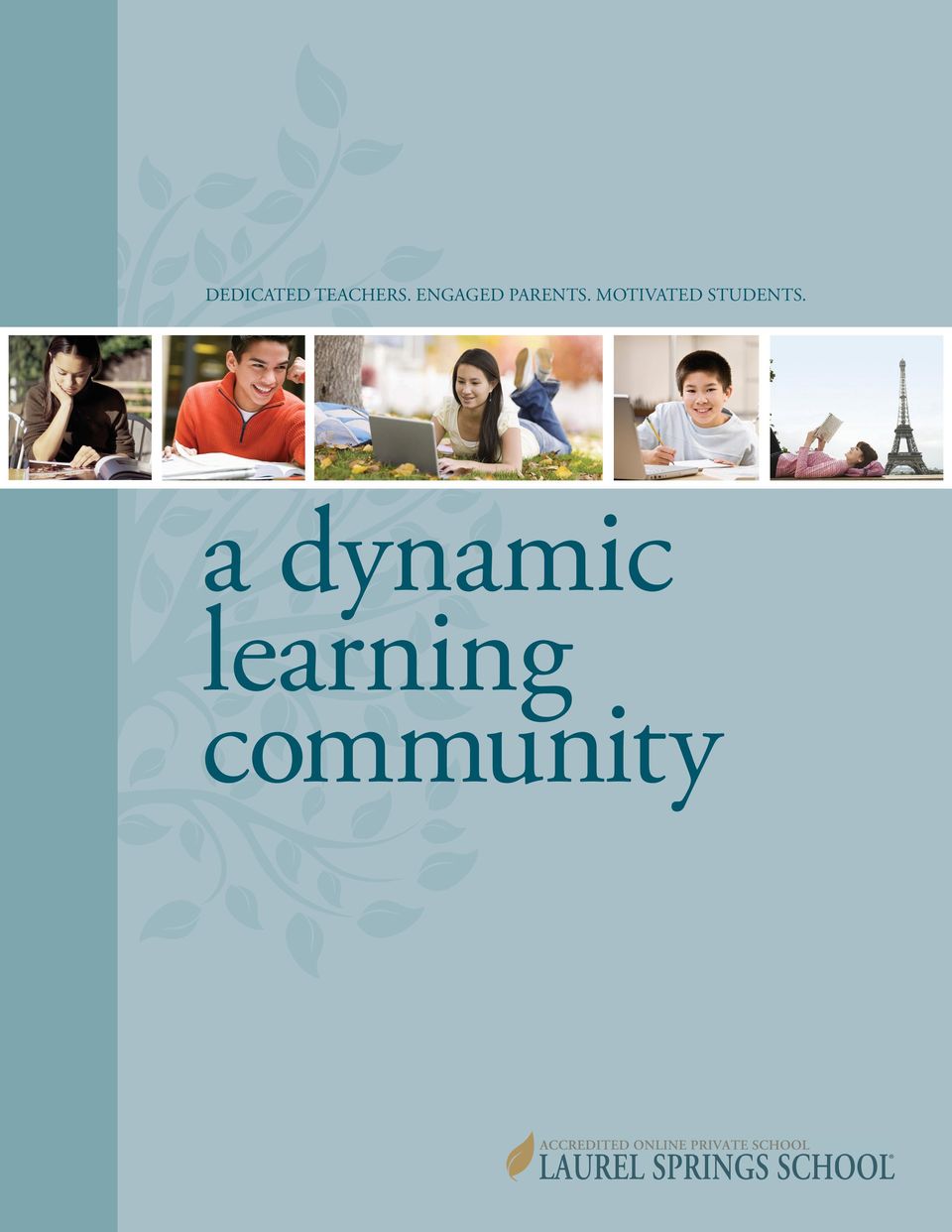
DEDICATED TEACHERS. ENGAGED PARENTS. MOTIVATED STUDENTS. a dynamic learning community
|
|
|
- Nathan O’Connor’
- 10 years ago
- Views:
Transcription
1 DEDICATED TEACHERS. ENGAGED PARENTS. MOTIVATED STUDENTS. a dynamic learning community
2 welcome TO LAUREL SPRINGS SCHOOL I m so pleased to share the unique Laurel Springs experience with you. Our school is different from many other schools, in that we believe that a classroom is not a prerequisite for college. I value the strong connection that our school makes with its families, and am pleased to have the opportunity to share the history and vision of Laurel Springs with you. With more than 20 years in the field of distance learning, our accredited private school ensures that children in kindergarten through grade 12 receive an excellent education. Laurel Springs offers all the benefits of a private college preparatory school with the flexibility to meet each student s needs. As the Head of School, I believe that to continue providing the quality education that sets us apart, we must continue to understand, value, and foster the individual strengths of our students; adapt our instruction to their unique learning styles; and always strive to deliver our curriculum in the most meaningful context for every student. Laurel Springs has a long tradition of preparing students for college and for full participation in the world. We also hold true to our mission of supporting and encouraging each student s development as an individual. Committed to becoming the best school possible, we are driven by the question: What is right thing for the students? An important aspect of the Laurel Springs experience is service learning. Encouraging our students in compassionate participation in the world is as fundamental to our mission as the pursuit of excellence. We want our students to be global citizens as well as good students, athletes, artists, actors wherever their talents and interests lie. We are looking for students who have great ideas, and are not intimidated by meaningful exploration. Laurel Springs is a place for the motivated student who wants to try new things, learn in new ways, and experience a dynamic academic program. Our students are fully supported by caring teachers and staff while staying connected to a global community of learners. This is an authentic learning community. We use tools of all kinds to extend our reach into the world. 21st century communication skills are integral to our mission of educating our students to become responsible, self-sufficient adults who can advocate for themselves and pursue their dreams. We have an outstanding faculty who are with us because of the depth of their knowledge and their passion to teach, but most importantly because of their love for working with young people. While I am proud to be the head of Laurel Springs School, I am even prouder that all members of the Laurel Springs community students, colleagues, parents, and alumni work hard and well together to make this School better every day. I m especially proud of our students, in all their variety, with all their incredible talents, their capacity for hard work, and their concern for others. I am delighted that you are taking the time to learn about Laurel Springs School, but there is no substitute for attending one of our Virtual Open House sessions and giving our faculty the opportunity to tell you about our school. Please visit the Admission tab on our website to find out about our next Open House event. I encourage you to get in touch with us to find out how Laurel Springs can meet your child s needs. Warmly, Darby Carr Head of School 2
3 contents TABLE OF The Laurel Springs Experience... 4 Social Life and Community Elementary and Middle School Grades K High School aratory Program K 12 Course Catalog & Descriptions Elementary and Middle School High School Our school meets the highest standards of excellence. Laurel Springs is a private school accredited by the Western Association of Schools and Colleges (WASC), AdvancED, and the Southern Association of Colleges and Schools Council on Accreditation and School Improvement (SACS CASI). Our accreditation ensures that Laurel Springs students receive reciprocity of credits, courses, and grade-level placements with schools and universities around the world. Our accredited status validates the equivalency of diplomas and certificates to other accredited schools and universities and indicates that our curriculum and teachers are meeting state and U.S. standards. Laurel Springs School is committed to providing a fine education to all of its students. As part of that commitment, Laurel Springs makes its programs, facilities, and services available on a non-discriminatory basis, including to students with disabilities. Please view our policy on the About Us page of our website laurelsprings.com 3/2014
4 experience THE LAUREL SPRINGS Our premier online school honors each child s individual learning style. Laurel Springs School is an accredited private online school, offering programs for students in grades K 12. With a catalog of over 240 courses, including Advanced Placement (AP), Honors and elective courses designed to develop 21st century skills, Laurel Springs has an outstanding record of placing its graduates into the selective colleges and universities of their choice. The Laurel Springs difference is in the relationships students have with their admissions coordinators, teachers, counselors, and peers. Our students receive individually graded assignments, attention to their unique learning styles, expert college counseling services, and access to real-time school events and clubs. Laurel Springs combines all the benefits of a traditional private school with the flexibility of distance learning. Our personalized approach is mastery-based and asynchronous, meaning that students have the opportunity to move faster or slower through the material, depending on their individual skills and knowledge. This approach allows students the ability to adapt their schedules to accommodate their other interests. We provide many opportunities for students to connect with teachers, peers, and support staff. For example, students can access immediate academic assistance in LSS Live, an online classroom staffed by teachers. Our Academic Department Chairs hold virtual office hours every day, making themselves available for questions. Additionally, students can reach out to our Student Services staff in their virtual office for help with time management, organization, and other issues central to student success. Founded in 1991 by Marilyn Mosley Gordanier and a dedicated group of educators, Laurel Springs continues its mission to honor each child s unique style of learning, support students to achieve their academic goals and foster their personal interests and talents. At Laurel Springs, students are treated as individuals, not a collective. Marina Goggin CLASS OF

5 our leadership The Laurel Springs philosophy and curriculum was created by our highly skilled experts in distance learning, curriculum design, instruction and assessment have created a wealth of tools that help ensure teachers are building the right skills at each stage, in a manner appropriate for each student s individual learning style. Darby Carr Head of School Darby Carr joined Laurel Springs in 2011 with over 15 years of experience in education. Ms. Carr s experience includes serving as Head of School for an international distance learning program, as well as Chief Administrative Officer and Principal for a charter school. She is a member of the International Association for K-12 Learning (inacol), Academy of International Schools Heads (AISH), Association of International Educators (NAFSA), and Association for the Advancement of International Education (AAIE). She holds a B.A. from Bates College in Psychology/Economics. Dr. Linda Grobman Chief Academic Offi cer Dr. Grobman is an experienced educator with a strong background in school administration and operations, instructional design, principal certification and team development. Dr. Grobman earned her doctorate from the University of Pennsylvania and her Superintendent s Letter of Eligibility from Arcadia University. She graduated from Pennsylvania State University with a Bachelor of Science in Elementary Education and Special Education. During her career, Linda has been a teacher, a special education supervisor, a preschool and elementary school principal, a middle school principal, an academic officer and a regional superintendent in a large school district. Marilyn Mosley Gordanier, M.Ed. Founder Marilyn Mosley Gordanier has more than 35 years of experience in education. Since founding Laurel Springs in 1991, she has led the school to become a premier provider of customized distance learning for grades K 12. Ms. Mosley Gordanier was nominated for a Nobel Earth Prize and is the president of the United National Global 500 Environmental Forum. She participates in the Captain Planet Foundation as a member of the Board of Directors, and serves on the STEM Education Working Group for the Clinton Global Initiative. Stephanie Fyfe, M.Ed. Director of Partnerships Stephanie Fyfe began her career as a teacher in brick and mortar and online environments before transitioning into management roles overseeing Education, Student Services, and Partnership Divisions. Her eight years of experience in secondary education includes strategic implementation of blended learning initiatives across the U.S. and Internationally. Stephanie has a B.A. in English from Colby College, and a M.Ed. with a focus on Educational Leadership from North Central University laurelsprings.com

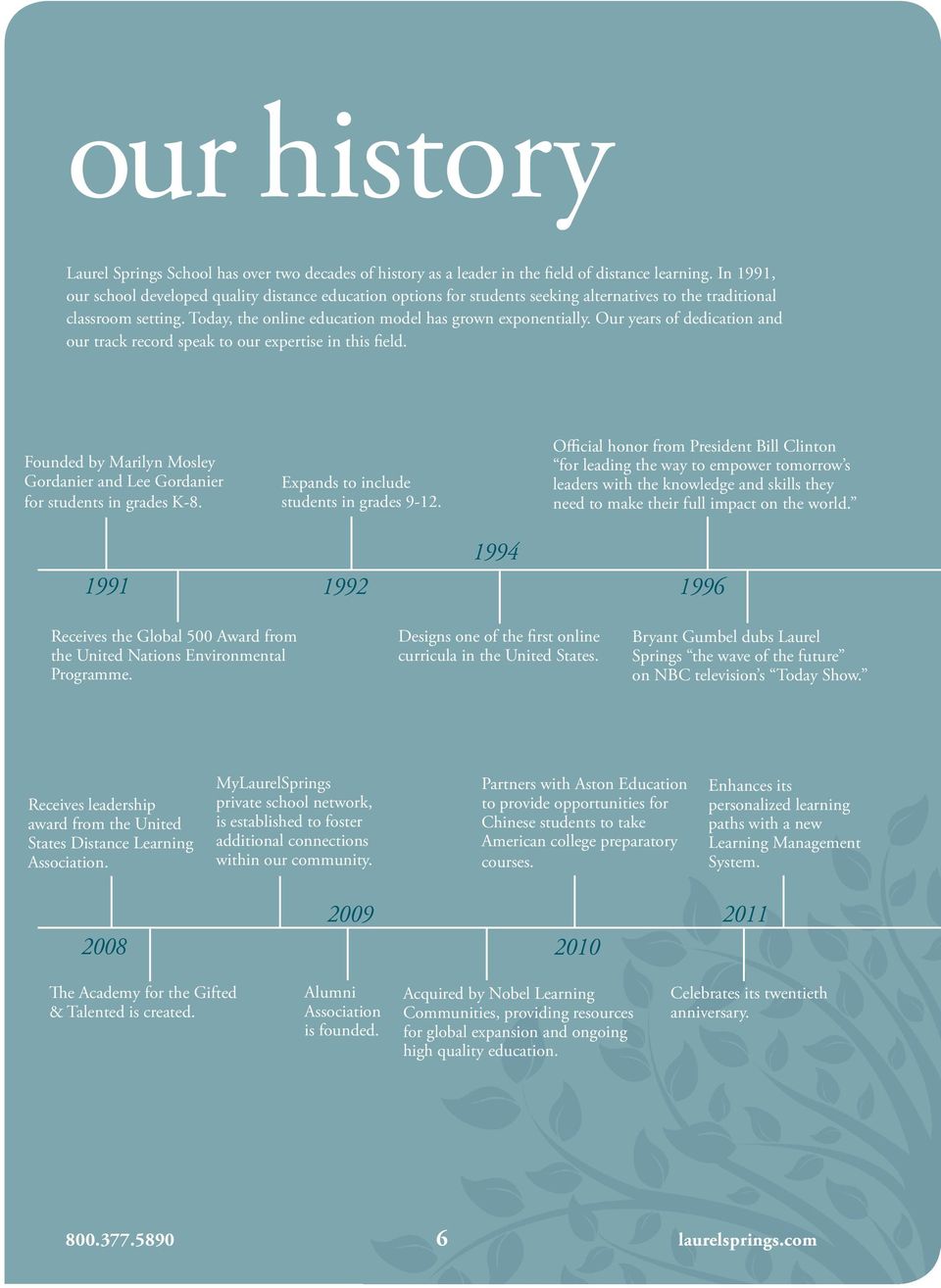
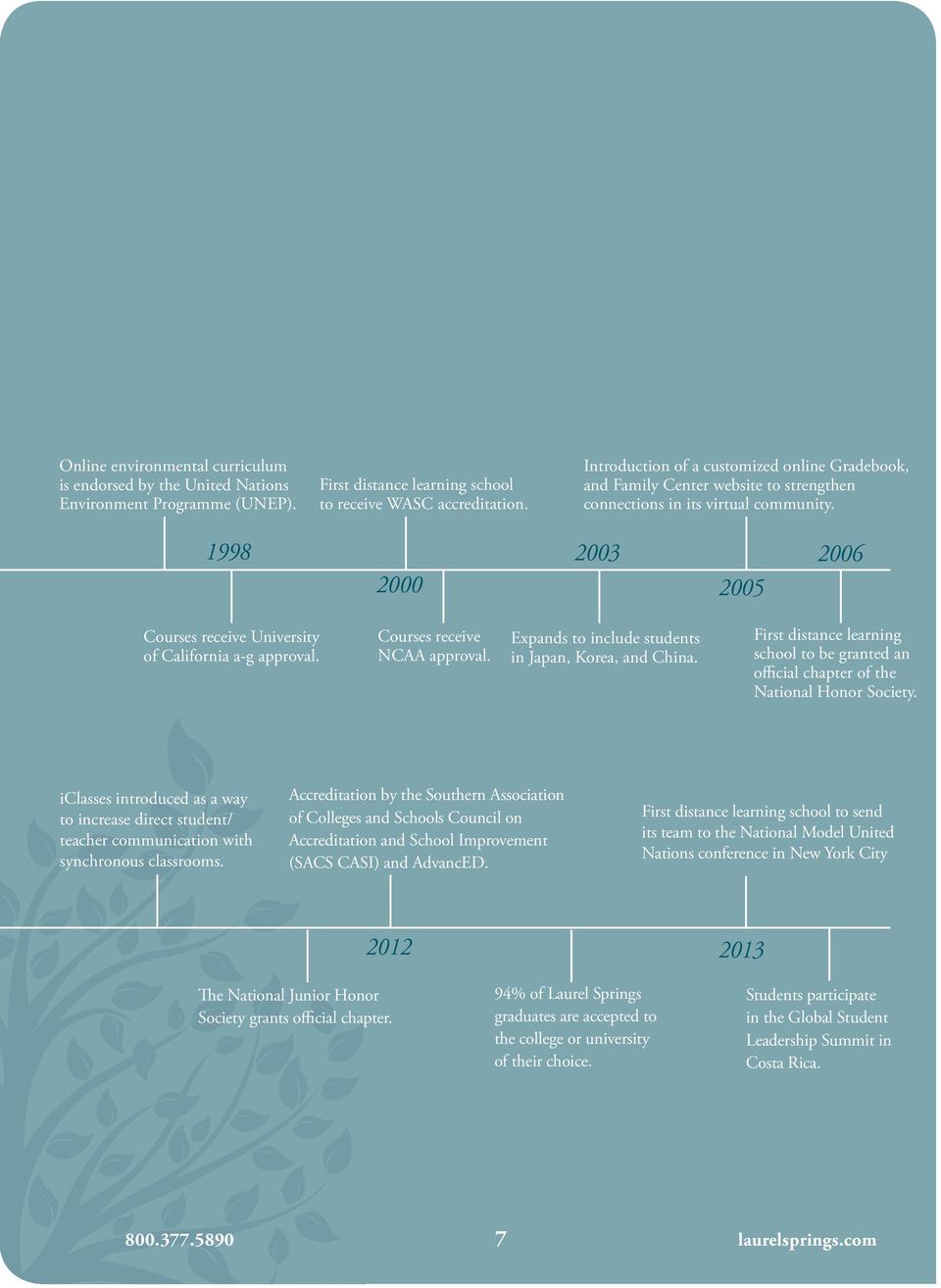
6 our history Laurel Springs School has over two decades of history as a leader in the field of distance learning. In 1991, our school developed quality distance education options for students seeking alternatives to the traditional classroom setting. Today, the online education model has grown exponentially. Our years of dedication and our track record speak to our expertise in this field. Founded by Marilyn Mosley Gordanier and Lee Gordanier for students in grades K-8. Expands to include students in grades Official honor from President Bill Clinton for leading the way to empower tomorrow s leaders with the knowledge and skills they need to make their full impact on the world Receives the Global 500 Award from the United Nations Environmental Programme. Designs one of the first online curricula in the United States. Bryant Gumbel dubs Laurel Springs the wave of the future on NBC television s Today Show. Receives leadership award from the United States Distance Learning Association. MyLaurelSprings private school network, is established to foster additional connections within our community. Partners with Aston Education to provide opportunities for Chinese students to take American college preparatory courses. Enhances its personalized learning paths with a new Learning Management System The Academy for the Gifted & Talented is created. Alumni Association is founded. Acquired by Nobel Learning Communities, providing resources for global expansion and ongoing high quality education. Celebrates its twentieth anniversary. 6
7 environmental curriculum is endorsed by the United Nations Environment Programme (UNEP). First distance learning school to receive WASC accreditation. Introduction of a customized online Gradebook, and Family Center website to strengthen connections in its virtual community Courses receive University of California a-g approval. Courses receive NCAA approval. Expands to include students in Japan, Korea, and China. First distance learning school to be granted an official chapter of the National Honor Society. iclasses introduced as a way to increase direct student/ teacher communication with synchronous classrooms. Accreditation by the Southern Association of Colleges and Schools Council on Accreditation and School Improvement (SACS CASI) and AdvancED. First distance learning school to send its team to the National Model United Nations conference in New York City The National Junior Honor Society grants official chapter. 94% of Laurel Springs graduates are accepted to the college or university of their choice. Students participate in the Global Student Leadership Summit in Costa Rica. 7
8 admissions Our admissions coordinators are here to help. Laurel Springs is different from traditional schools and other online schools. We are committed to understanding your family s unique educational needs and providing you with personal service as you progress through our admissions process. Laurel Springs School offers rolling admissions options, which means that students are not tied to a traditional academic calendar for enrollment purposes. The admissions process is an opportunity for our staff to learn about the student s needs, interests, educational goals and learning style. The process includes the following steps: 1. Families are assigned an admissions coordinator to guide them through the enrollment process. 2. A Laurel Springs admissions coordinator speaks with the family to understand the student s needs, gathers pertinent data from the parent and student and presents an overview of our course offerings. 3. Our admissions coordinator identifies courses and/or grade-level programs that would potentially meet the student s needs. 4. Upon agreement to move forward with transcript assessment and academic planning (if Laurel Springs will be the school of record), parents pay a registration fee as the next step in the admissions process. 5. Students are encouraged to take a Learning Styles Profile assessment and are asked to complete any additional assessments that are necessary for proper course and grade-level placement. 6. After reviewing the Learning Styles Profile, assessment results, and records from previous school(s), a Laurel Springs academic team member creates an individualized academic plan for the prospective full-time student. 7. Once the tuition payment and signed Enrollment Agreement form have been received, a welcome letter is sent to the family, teachers are assigned to the student and the student is granted access to the learning management system (LMS). The newlyenrolled student may begin coursework immediately. Request for Student Records In order to process an enrollment, our admissions office requires report cards or transcripts for students entering 7th and 8th grades. For students entering high school, official transcripts are required before enrollment can be completed. These documents can be faxed to Please complete the Request for Student Records form from our website and mail to the student s previous school(s). If you have questions, please contact us at to speak with the Registrar s Office laurelsprings.com

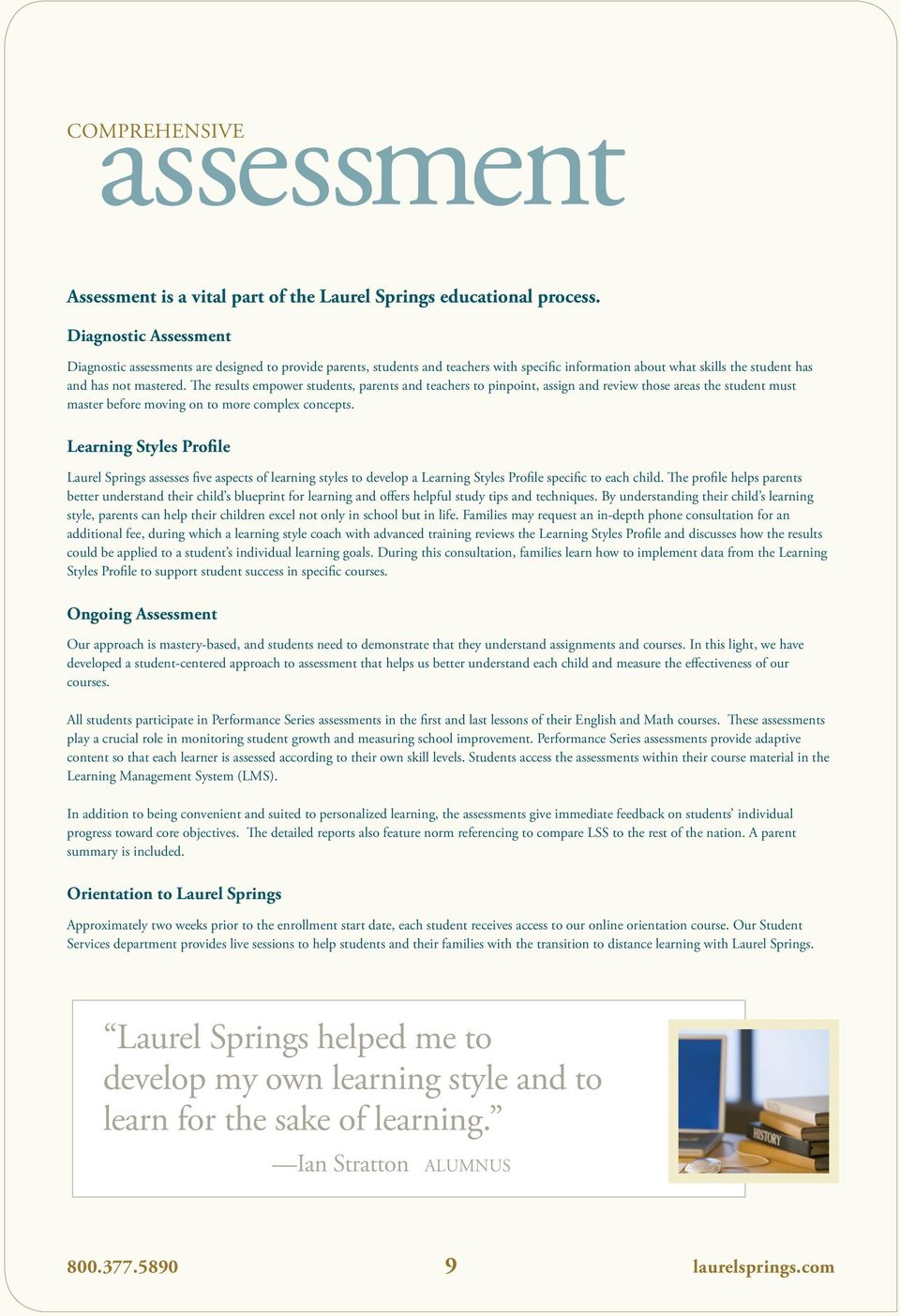
9 assessment COMPREHENSIVE Assessment is a vital part of the Laurel Springs educational process. Diagnostic Assessment Diagnostic assessments are designed to provide parents, students and teachers with specific information about what skills the student has and has not mastered. The results empower students, parents and teachers to pinpoint, assign and review those areas the student must master before moving on to more complex concepts. Learning Styles Profile Laurel Springs assesses five aspects of learning styles to develop a Learning Styles Profile specific to each child. The profile helps parents better understand their child s blueprint for learning and offers helpful study tips and techniques. By understanding their child s learning style, parents can help their children excel not only in school but in life. Families may request an in-depth phone consultation for an additional fee, during which a learning style coach with advanced training reviews the Learning Styles Profile and discusses how the results could be applied to a student s individual learning goals. During this consultation, families learn how to implement data from the Learning Styles Profile to support student success in specific courses. Ongoing Assessment Our approach is mastery-based, and students need to demonstrate that they understand assignments and courses. In this light, we have developed a student-centered approach to assessment that helps us better understand each child and measure the effectiveness of our courses. All students participate in Performance Series assessments in the first and last lessons of their English and Math courses. These assessments play a crucial role in monitoring student growth and measuring school improvement. Performance Series assessments provide adaptive content so that each learner is assessed according to their own skill levels. Students access the assessments within their course material in the Learning Management System (LMS). In addition to being convenient and suited to personalized learning, the assessments give immediate feedback on students individual progress toward core objectives. The detailed reports also feature norm referencing to compare LSS to the rest of the nation. A parent summary is included. Orientation to Laurel Springs Approximately two weeks prior to the enrollment start date, each student receives access to our online orientation course. Our Student Services department provides live sessions to help students and their families with the transition to distance learning with Laurel Springs. Laurel Springs helped me to develop my own learning style and to learn for the sake of learning. Ian Stratton ALUMNUS 9
10 Kai s story A PASSION FOR THE GAME Kai is a middle school student living near Osaka, Japan. He enrolled in Laurel Springs seeking opportunities to improve his understanding in English and Math. Jerome, Kai s father, says, We picked Laurel Springs for the flexibility, because Kai is not held to a strict schedule. Laurel Springs is able to differentiate curriculum for him and has been very supportive. Kai s teacher says, Kai is very creative and dedicated to making progress in his studies. He has found an academic rhythm that works well for him. One of Kai s passions is the game of Go. The rules of Go are far simpler than chess, but it is said that Go is more challenging than chess to master. The game has been played for more than two thousand years. In addition to his studies at Laurel Springs, Kai attends a special Go training school. Kai plays games against other children as well as professional players; each game can last for more than four hours. When he plays against professional players, Kai says, I feel kind of nervous, but I like playing against them because they do interesting things on the board. A typical day for Kai consists of walking his dog in the morning before focusing on his academic coursework. Then, he travels by train to his Go school in the afternoons. Kai s favorite subject is math, because it is like Go; it is all about patterns. Kai feels connected to his teachers because of Laurel Springs asynchronous approach and is able to attend live classes and have virtual meetings with teachers when necessary laurelsprings.com

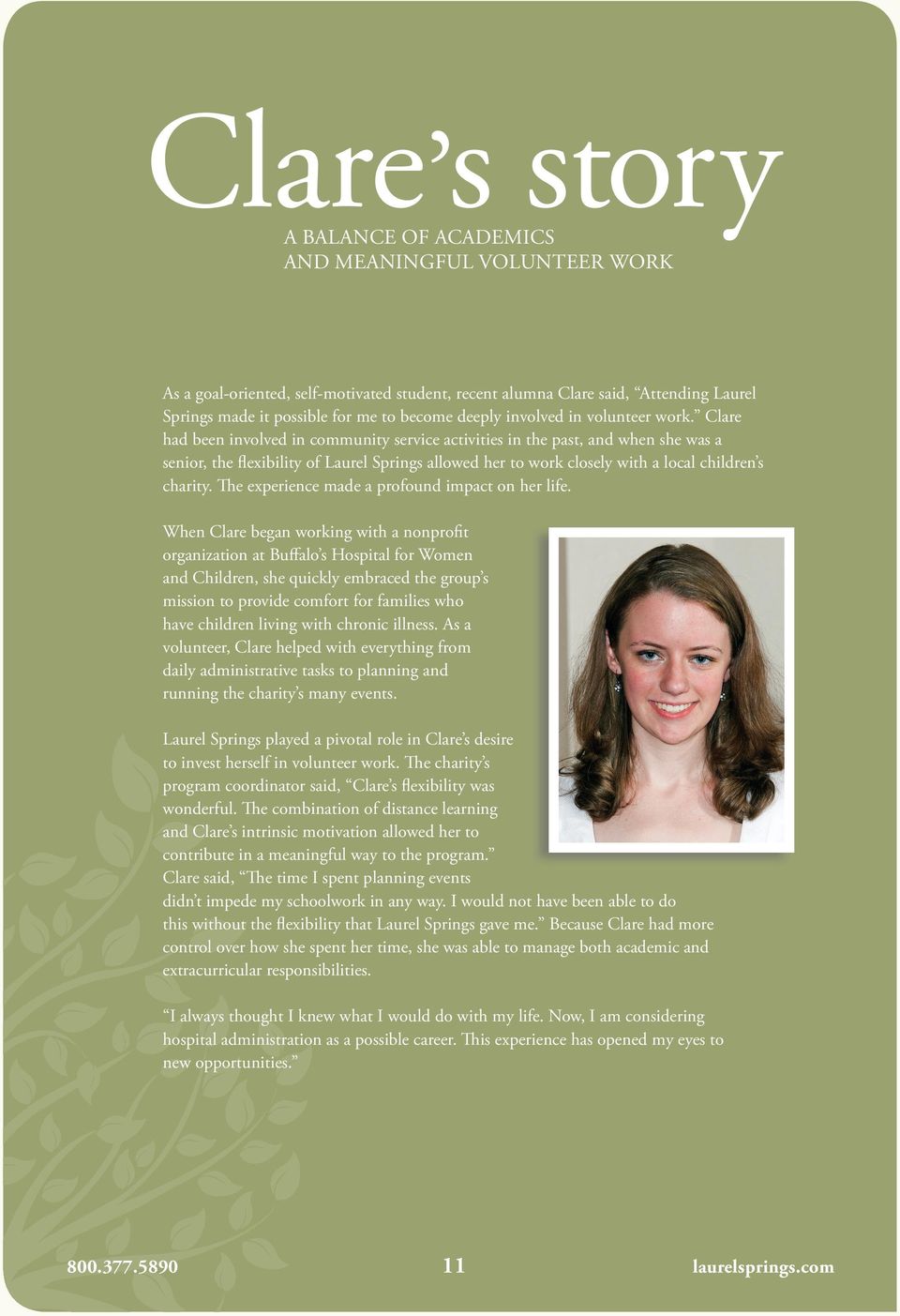
11 Clare s story A BALANCE OF ACADEMICS AND MEANINGFUL VOLUNTEER WORK As a goal-oriented, self-motivated student, recent alumna Clare said, Attending Laurel Springs made it possible for me to become deeply involved in volunteer work. Clare had been involved in community service activities in the past, and when she was a senior, the flexibility of Laurel Springs allowed her to work closely with a local children s charity. The experience made a profound impact on her life. When Clare began working with a nonprofit organization at Buffalo s Hospital for Women and Children, she quickly embraced the group s mission to provide comfort for families who have children living with chronic illness. As a volunteer, Clare helped with everything from daily administrative tasks to planning and running the charity s many events. Laurel Springs played a pivotal role in Clare s desire to invest herself in volunteer work. The charity s program coordinator said, Clare s flexibility was wonderful. The combination of distance learning and Clare s intrinsic motivation allowed her to contribute in a meaningful way to the program. Clare said, The time I spent planning events didn t impede my schoolwork in any way. I would not have been able to do this without the flexibility that Laurel Springs gave me. Because Clare had more control over how she spent her time, she was able to manage both academic and extracurricular responsibilities. I always thought I knew what I would do with my life. Now, I am considering hospital administration as a possible career. This experience has opened my eyes to new opportunities laurelsprings.com
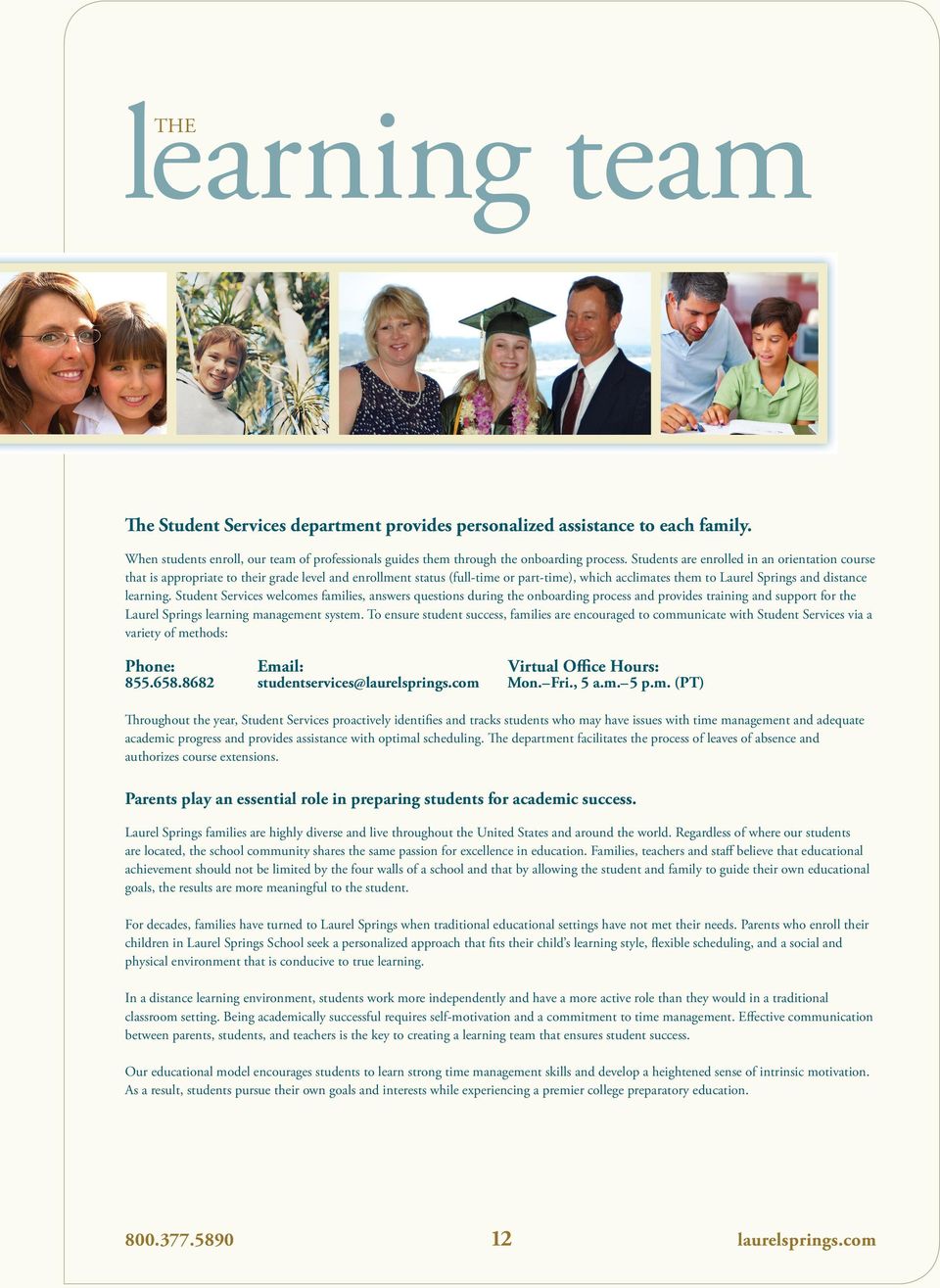
12 learning team THE The Student Services department provides personalized assistance to each family. When students enroll, our team of professionals guides them through the onboarding process. Students are enrolled in an orientation course that is appropriate to their grade level and enrollment status (full-time or part-time), which acclimates them to Laurel Springs and distance learning. Student Services welcomes families, answers questions during the onboarding process and provides training and support for the Laurel Springs learning management system. To ensure student success, families are encouraged to communicate with Student Services via a variety of methods: Phone: Virtual Office Hours: [email protected] Mon. Fri., 5 a.m. 5 p.m. (PT) Throughout the year, Student Services proactively identifies and tracks students who may have issues with time management and adequate academic progress and provides assistance with optimal scheduling. The department facilitates the process of leaves of absence and authorizes course extensions. Parents play an essential role in preparing students for academic success. Laurel Springs families are highly diverse and live throughout the United States and around the world. Regardless of where our students are located, the school community shares the same passion for excellence in education. Families, teachers and staff believe that educational achievement should not be limited by the four walls of a school and that by allowing the student and family to guide their own educational goals, the results are more meaningful to the student. For decades, families have turned to Laurel Springs when traditional educational settings have not met their needs. Parents who enroll their children in Laurel Springs School seek a personalized approach that fits their child s learning style, flexible scheduling, and a social and physical environment that is conducive to true learning. In a distance learning environment, students work more independently and have a more active role than they would in a traditional classroom setting. Being academically successful requires self-motivation and a commitment to time management. Effective communication between parents, students, and teachers is the key to creating a learning team that ensures student success. Our educational model encourages students to learn strong time management skills and develop a heightened sense of intrinsic motivation. As a result, students pursue their own goals and interests while experiencing a premier college preparatory education laurelsprings.com
13 coaches ACADEMIC Academic coaches partner with students to help them achieve their goals. At Laurel Springs, we believe that a positive learning experience is a result of open and ongoing communication, regular submission of work, and a partnership between students, parents or other academic coaches, teachers, and staff. Home support for students is necessary for success in distance learning, whether it is ensuring work is completed, engaging with students teachers to discuss progress, or assisting with time management and scheduling. Laurel Springs teachers and staff work with families throughout to share knowledge of best practices and provide guidance for an optimal learning experience. A child s academic coach can be a parent, tutor, or other caring adult, and is an integral part of student success. Academic coaches are expected to take active roles in students education at Laurel Springs. Academic coaches are expected to provide support and guidance for the student, access their student s online gradebook to assess progress, coordinate with the student regarding time management, and communicate regularly with the student s teachers. As part of the student onboarding process, academic coaches are strongly encouraged to review the orientation course, which has valuable information for student success at Laurel Springs. The confines of a classroom are eliminated. This allows us to encourage an attitude of exploration as a form of education. Laurel Springs Parent laurelsprings.com

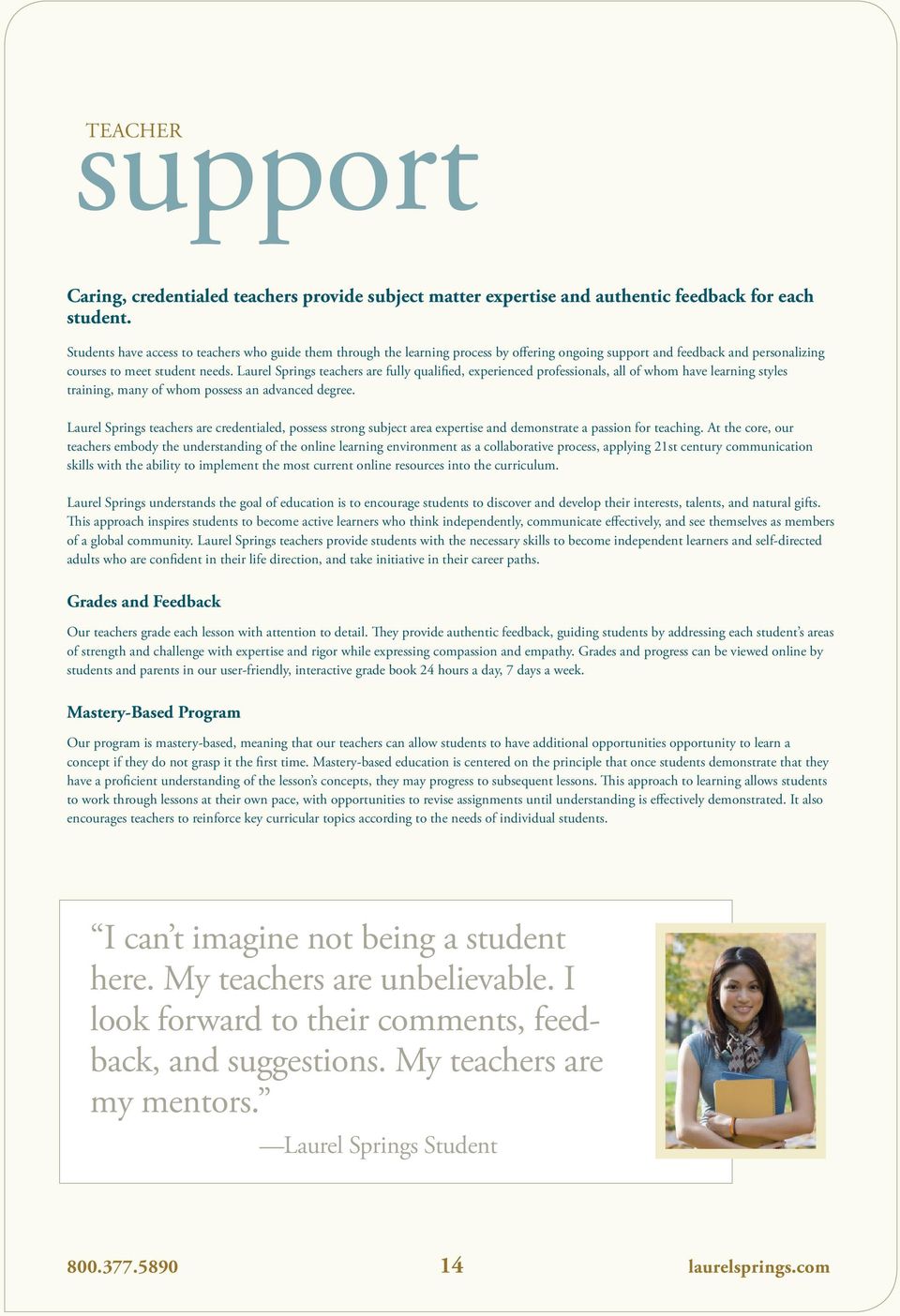
14 support TEACHER Caring, credentialed teachers provide subject matter expertise and authentic feedback for each student. Students have access to teachers who guide them through the learning process by offering ongoing support and feedback and personalizing courses to meet student needs. Laurel Springs teachers are fully qualified, experienced professionals, all of whom have learning styles training, many of whom possess an advanced degree. Laurel Springs teachers are credentialed, possess strong subject area expertise and demonstrate a passion for teaching. At the core, our teachers embody the understanding of the online learning environment as a collaborative process, applying 21st century communication skills with the ability to implement the most current online resources into the curriculum. Laurel Springs understands the goal of education is to encourage students to discover and develop their interests, talents, and natural gifts. This approach inspires students to become active learners who think independently, communicate effectively, and see themselves as members of a global community. Laurel Springs teachers provide students with the necessary skills to become independent learners and self-directed adults who are confident in their life direction, and take initiative in their career paths. Grades and Feedback Our teachers grade each lesson with attention to detail. They provide authentic feedback, guiding students by addressing each student s areas of strength and challenge with expertise and rigor while expressing compassion and empathy. Grades and progress can be viewed online by students and parents in our user-friendly, interactive grade book 24 hours a day, 7 days a week. Mastery-Based Program Our program is mastery-based, meaning that our teachers can allow students to have additional opportunities opportunity to learn a concept if they do not grasp it the first time. Mastery-based education is centered on the principle that once students demonstrate that they have a proficient understanding of the lesson s concepts, they may progress to subsequent lessons. This approach to learning allows students to work through lessons at their own pace, with opportunities to revise assignments until understanding is effectively demonstrated. It also encourages teachers to reinforce key curricular topics according to the needs of individual students. I can t imagine not being a student here. My teachers are unbelievable. I look forward to their comments, feedback, and suggestions. My teachers are my mentors. Laurel Springs Student laurelsprings.com
15 services TEACHER Keeping in Touch and Providing Support Teachers keep in frequent contact with students and parents, responding to questions through our interactive grade book, phone, , video conferencing, and virtual classrooms. Teachers set the learning tone through a welcome letter and video when a student enrolls in a course. This personal introduction allows the teacher to connect with the student, setting up guidelines for communication, and offering support for student success. In order to support the learning and strategies for student success, the student s teachers also keep in contact with each other. Live Support and Interaction A live support virtual class room is available so that students can receive help in their coursework from a Laurel Springs teacher. Our school hosts the LSS Live virtual classroom which provides synchronous, academic guidance for all students and families. Synchronous, online, content-specific iclasses are provided on a weekly basis per content area to enrich student learning in a group setting, giving students the opportunity to interact with each other virtually. With students in more than 60 countries, this approach inspires our students to become active learners who think independently, communicate effectively, and see themselves as members of a global community. Personalization All Laurel Springs teachers offer personalization of our curriculum to meet the individual needs of each student by enhancing assignments to better suit a student s unique learning style. An example of personalization would be when a student has read an assigned book the previous year. In this case, the teacher may let the student substitute another book of equal or greater academic content value, and an appropriate assessment will be created by the teacher for the student to demonstrate mastery and insight of the key ideas. A teacher can change a certain amount of the course in this personalization process. This is not an elimination of parts of the course, but rather an alternative delivery or assignment which maintains the integrity and standards of the course. Customization When a family desires a more substantial change to the curriculum, customization is available. This process is initiated by families contacting their Admissions Coordinator who arranges for a consultation with our Customization Manager. The student s learning style profile results and supporting assessment data are reviewed, taking students interests and learning necessities into consideration, culminating in the creation of a specialized learning plan by the Customization Manager. The learning plan clearly states the academic plan for enrollment in each course. Due to the additional resources that are applied, an additional fee is involved for customized courses laurelsprings.com

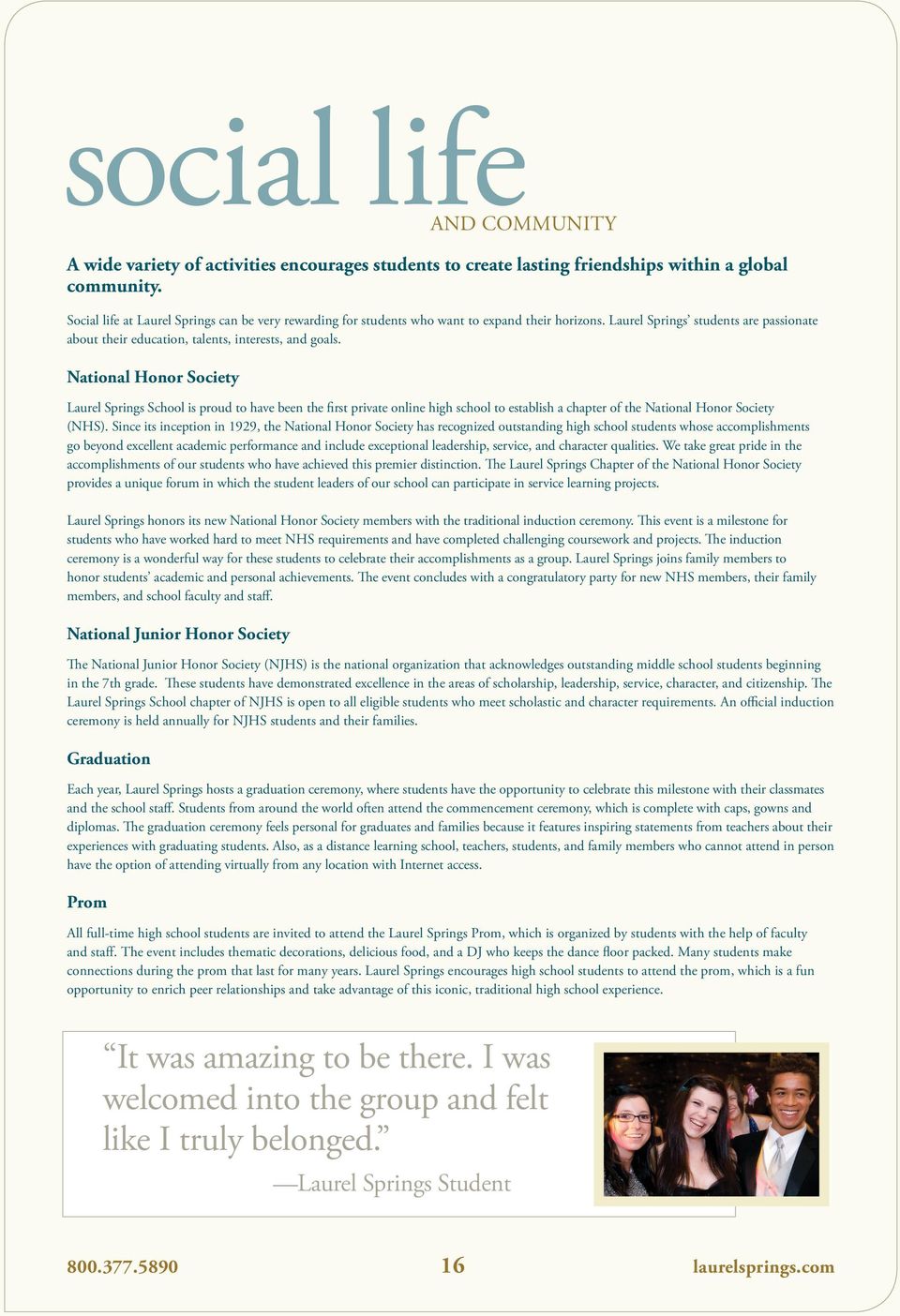
16 social life AND COMMUNITY A wide variety of activities encourages students to create lasting friendships within a global community. Social life at Laurel Springs can be very rewarding for students who want to expand their horizons. Laurel Springs students are passionate about their education, talents, interests, and goals. National Honor Society Laurel Springs School is proud to have been the first private online high school to establish a chapter of the National Honor Society (NHS). Since its inception in 1929, the National Honor Society has recognized outstanding high school students whose accomplishments go beyond excellent academic performance and include exceptional leadership, service, and character qualities. We take great pride in the accomplishments of our students who have achieved this premier distinction. The Laurel Springs Chapter of the National Honor Society provides a unique forum in which the student leaders of our school can participate in service learning projects. Laurel Springs honors its new National Honor Society members with the traditional induction ceremony. This event is a milestone for students who have worked hard to meet NHS requirements and have completed challenging coursework and projects. The induction ceremony is a wonderful way for these students to celebrate their accomplishments as a group. Laurel Springs joins family members to honor students academic and personal achievements. The event concludes with a congratulatory party for new NHS members, their family members, and school faculty and staff. National Junior Honor Society The National Junior Honor Society (NJHS) is the national organization that acknowledges outstanding middle school students beginning in the 7th grade. These students have demonstrated excellence in the areas of scholarship, leadership, service, character, and citizenship. The Laurel Springs School chapter of NJHS is open to all eligible students who meet scholastic and character requirements. An official induction ceremony is held annually for NJHS students and their families. Graduation Each year, Laurel Springs hosts a graduation ceremony, where students have the opportunity to celebrate this milestone with their classmates and the school staff. Students from around the world often attend the commencement ceremony, which is complete with caps, gowns and diplomas. The graduation ceremony feels personal for graduates and families because it features inspiring statements from teachers about their experiences with graduating students. Also, as a distance learning school, teachers, students, and family members who cannot attend in person have the option of attending virtually from any location with Internet access. Prom All full-time high school students are invited to attend the Laurel Springs Prom, which is organized by students with the help of faculty and staff. The event includes thematic decorations, delicious food, and a DJ who keeps the dance floor packed. Many students make connections during the prom that last for many years. Laurel Springs encourages high school students to attend the prom, which is a fun opportunity to enrich peer relationships and take advantage of this iconic, traditional high school experience. It was amazing to be there. I was welcomed into the group and felt like I truly belonged. Laurel Springs Student 16
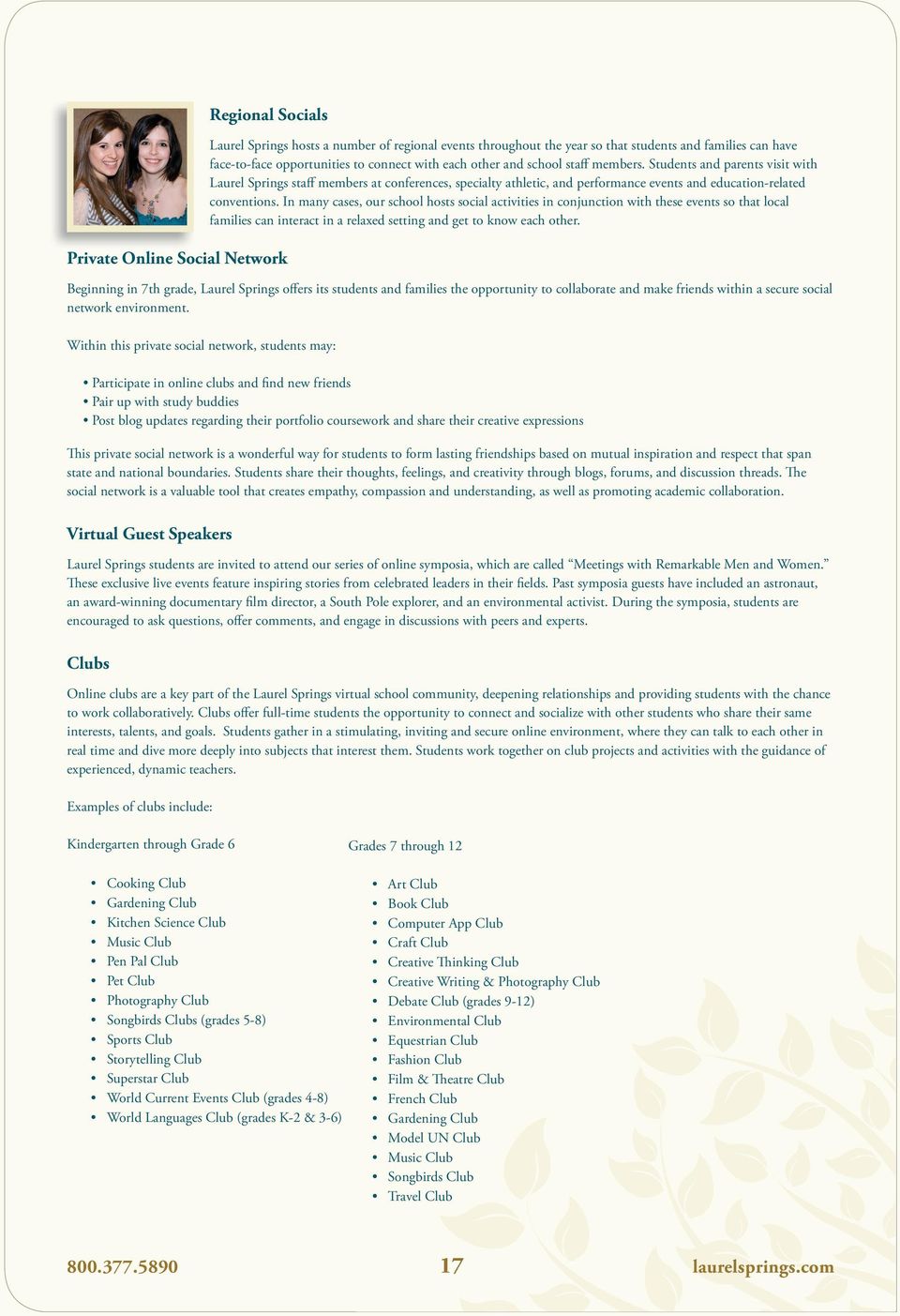
17 Regional Socials Private Social Network Laurel Springs hosts a number of regional events throughout the year so that students and families can have face-to-face opportunities to connect with each other and school staff members. Students and parents visit with Laurel Springs staff members at conferences, specialty athletic, and performance events and education-related conventions. In many cases, our school hosts social activities in conjunction with these events so that local families can interact in a relaxed setting and get to know each other. Beginning in 7th grade, Laurel Springs offers its students and families the opportunity to collaborate and make friends within a secure social network environment. Within this private social network, students may: Participate in online clubs and find new friends Pair up with study buddies Post blog updates regarding their portfolio coursework and share their creative expressions This private social network is a wonderful way for students to form lasting friendships based on mutual inspiration and respect that span state and national boundaries. Students share their thoughts, feelings, and creativity through blogs, forums, and discussion threads. The social network is a valuable tool that creates empathy, compassion and understanding, as well as promoting academic collaboration. Virtual Guest Speakers Laurel Springs students are invited to attend our series of online symposia, which are called Meetings with Remarkable Men and Women. These exclusive live events feature inspiring stories from celebrated leaders in their fields. Past symposia guests have included an astronaut, an award-winning documentary film director, a South Pole explorer, and an environmental activist. During the symposia, students are encouraged to ask questions, offer comments, and engage in discussions with peers and experts. Clubs clubs are a key part of the Laurel Springs virtual school community, deepening relationships and providing students with the chance to work collaboratively. Clubs offer full-time students the opportunity to connect and socialize with other students who share their same interests, talents, and goals. Students gather in a stimulating, inviting and secure online environment, where they can talk to each other in real time and dive more deeply into subjects that interest them. Students work together on club projects and activities with the guidance of experienced, dynamic teachers. Examples of clubs include: Kindergarten through Grade 6 Cooking Club Gardening Club Kitchen Science Club Music Club Pen Pal Club Pet Club Photography Club Songbirds Clubs (grades 5-8) Sports Club Storytelling Club Superstar Club World Current Events Club (grades 4-8) World Languages Club (grades K-2 & 3-6) Grades 7 through 12 Art Club Book Club Computer App Club Craft Club Creative Thinking Club Creative Writing & Photography Club Debate Club (grades 9-12) Environmental Club Equestrian Club Fashion Club Film & Theatre Club French Club Gardening Club Model UN Club Music Club Songbirds Club Travel Club laurelsprings.com
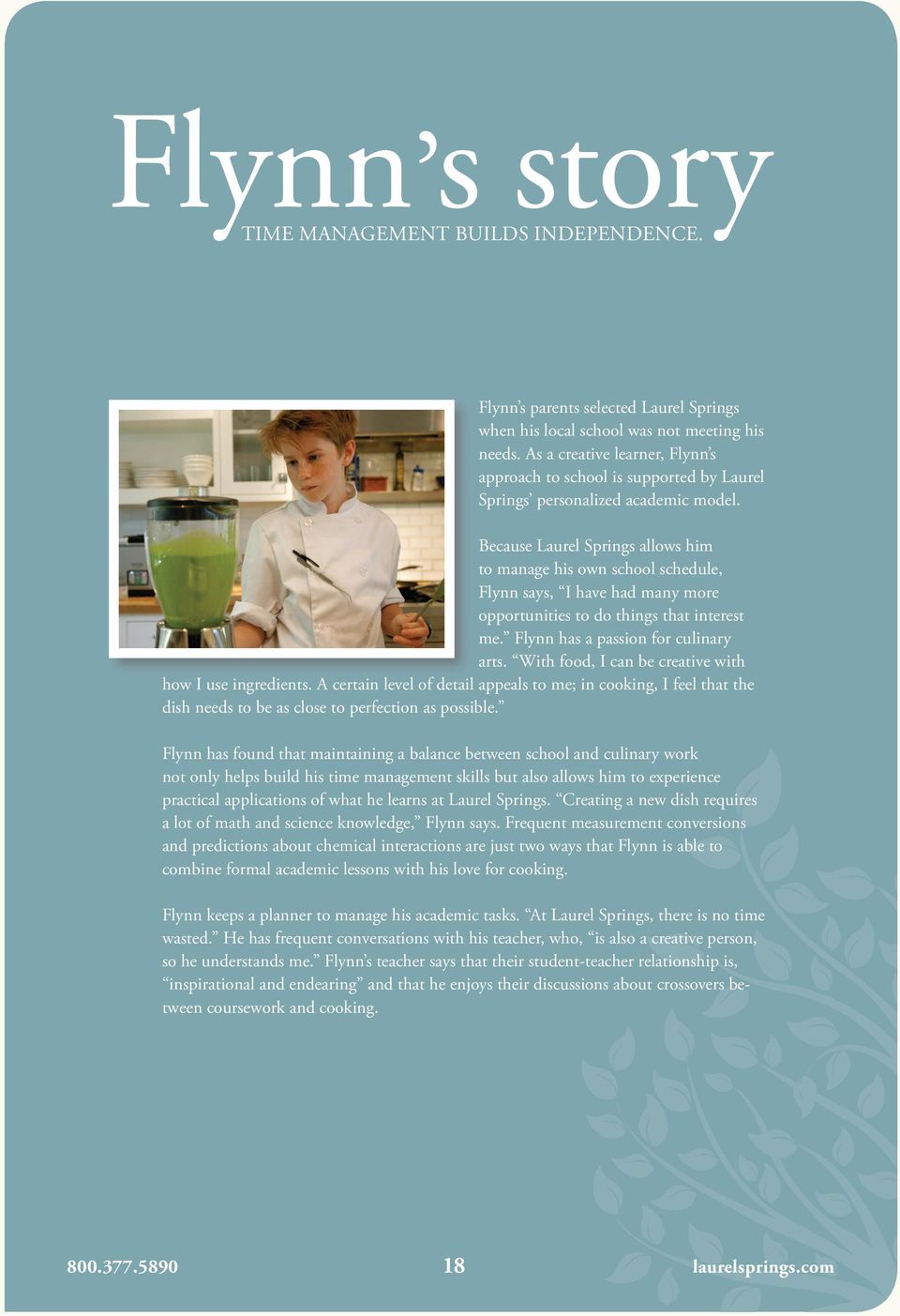
18 Flynn s story TIME MANAGEMENT BUILDS INDEPENDENCE. Flynn s parents selected Laurel Springs when his local school was not meeting his needs. As a creative learner, Flynn s approach to school is supported by Laurel Springs personalized academic model. Because Laurel Springs allows him to manage his own school schedule, Flynn says, I have had many more opportunities to do things that interest me. Flynn has a passion for culinary arts. With food, I can be creative with how I use ingredients. A certain level of detail appeals to me; in cooking, I feel that the dish needs to be as close to perfection as possible. Flynn has found that maintaining a balance between school and culinary work not only helps build his time management skills but also allows him to experience practical applications of what he learns at Laurel Springs. Creating a new dish requires a lot of math and science knowledge, Flynn says. Frequent measurement conversions and predictions about chemical interactions are just two ways that Flynn is able to combine formal academic lessons with his love for cooking. Flynn keeps a planner to manage his academic tasks. At Laurel Springs, there is no time wasted. He has frequent conversations with his teacher, who, is also a creative person, so he understands me. Flynn s teacher says that their student-teacher relationship is, inspirational and endearing and that he enjoys their discussions about crossovers between coursework and cooking laurelsprings.com
19 Constance s story LAUREL SPRINGS TEACHERS ARE HER MENTORS. Constance s family sought a school that would allow flexibility without sacrificing quality academics. After examining many options, they felt that Laurel Springs was, the best of the best. Constance is focused on honing her many talents and sharing her Native American heritage. In addition to excelling in her classes at Laurel Springs, Constance also immerses herself in activities where she has a hands-on, creative role. Currently a high school student, she has been pursuing her academic studies with Laurel Springs since 5th grade. Writing makes me more appreciative of the creativity and thought behind amazing literature, such as Beowulf and The Iliad. Constance and her older sister wrote a play about growing up between two cultures. The play was selected to be performed at a national Native American festival. Her literature teacher said that Constance is, thoroughly engaged with the material and enthusiastic about learning and writing. Constance said, I can t imagine not being a student here. My teachers are unbelievable. I look forward to their feedback, suggestions and comments more than the grade on any given lesson. I have more of a personal relationship with them through that direct communication than I would if I were in a traditional classroom with many other students. I stay in touch with previous teachers and look to them as mentors laurelsprings.com

20 school ELEMENTARY & MIDDLE Laurel Springs provides excellence in curriculum and instruction for elementary and middle school students. In partnership with parents and academic coaches, Laurel Springs nurtures each child s natural creativity and love of learning, setting the stage for future academic success. At Laurel Springs, we take your children s interests, abilities, talents, and style of learning into consideration when supporting their learning process. Whether your family is moving or traveling, your local school is not meeting your child s needs, or you wish to play a more active role in your child s education, Laurel Springs gives you the peace of mind and support of an accredited private school. We offer extensive options to our full-time students for a complete private school experience: Admissions coordinator services Learning styles profile & ongoing assessment All textbook and online course materials Student support services through our LSS Live site Virtual classrooms with live class sessions Symposia with guest speakers Interactive learning management system Mentoring program for 7th and 8th grade students Course-specific diagnostic assessments Parent support services Monthly department newsletter communications Virtual clubs and regional social events Regional face-to-face events Flexible, asynchronous, mastery-based learning Personalized approach based on learning style Teacher support services Options for meeting your teacher on a one-to-one virtual basis National Junior Honor Society for students in 7th & 8th grades Mentoring Program Laurel Springs Link Crew Connections is a mentoring program that connects 7th and 8th grade mentees with high school mentors to provide a network of support. Students who choose to participate in Link Crew are assigned a high school student mentor based upon their specific goals and needs. Mentors provide support, guidance, assistance, and friendship to help middle school students as they prepare for their transition to high school Students who participate in Link Crew feel a sense of involvement and community. 20

21 programs EXCEPTIONAL FOR YOUNG STUDENTS Elementary School, Grades K 5 The early years are a time for exploration, emotional growth, physical development, and fun. In elementary school, we nurture the natural love of learning with caring teachers and stimulating curriculum. Our project- based elementary curriculum, which is available to all students in kindergarten through 5th grade, integrates classic literary themes across all subject areas. Beginning in the 4th grade, students can begin taking text-based courses, and in 5th grade, students have the additional option of online courses. Laurel Springs also offers a variety of virtual clubs for our Kindergarten through 6th grade students. This opportunity gives them a chance to share interests and interact with classmates once a month with a teacher providing an exciting learning experience sharing their passion for the club s theme. Laurel Springs students emerge from the K 5 program with the foundation necessary to handle more challenging middle school work. Middle School, Grades 6 8 As students progress into their middle school years, our college prep program builds self-esteem and lays the groundwork for high school. Students in 6th through 8th grades can select project-based, text-based, or online courses or may choose a combination of curriculum options as needed to create an optimal learning experience. In addition, Laurel Springs offers opportunities for students to participate in our Gifted & Talented Academy starting in 6th grade. Beginning in 7th grade, students are eligible to join our online social network. The middle school counselor plays a key role in keeping students focused and on track, supporting academic success. National Junior Honor Society The National Junior Honor Society (NJHS) was founded to acknowledge outstanding middle school students. This program honors students who have demonstrated excellence in the areas of scholarship, leadership, service, character, and citizenship. The Laurel Springs chapter of NJHS is open to all eligible students, beginning in 7th grade, who meet scholastic and character requirements. NJHS not only recognizes students for their accomplishments but challenges them to continue their achievements through active involvement in school activities and community service. This allows us, as parents, to encourage an attitude of exploration as a form of education. Laurel Springs Parent 21
22 academicofferings Choose a combination of online and textbook-based curriculum that fits your student s needs. Project-Based Curriculum Package (K 8th Grade) This exciting curriculum is based on award-winning classic literature and hands-on projects. The curriculum integrates language arts, math, social studies, health, science, and the arts around major themes. By integrating the subjects the content becomes more relevant and approachable. Students are encouraged to explore concepts and areas of interest in depth with this platform. This curriculum helps develop student interest and individual needs. Innovative projects and activities are included in the schedule. Students take ownership and pride conducting the exciting activities and experiments. The package of materials includes an easy to follow manual with all subjects and weekly schedule which guides students and parents through an entire academic year. Textbook-Based Curriculum (4th 8th Grade) Our textbook-based curriculum addresses the reading and writing processes with attention to the tremendous learning capacity inherent in each child. The books have been carefully selected because of the advanced content and appealing learning opportunity each provides. This welcoming curriculum provides thorough syllabus and quality material for each course. A detailed outline including objectives for each week is also included with the course. Captivating benchmarks and discussion topics are comprised throughout the year. Text based curriculum is sure to meet a variety of scheduling and individual needs. The student is provided the material in a manner that will develop a thorough understanding of the concepts. Curriculum (5th 8th Grade) courses in core subjects for grades 5 8 combine the dynamic interactivity of the web with online assignments and assessments for understanding. Courses are delivered via our learning management system (LMS) and use interactive electronic textbooks. The schedule and sources are carefully selected. Students who select our online curriculum enjoy the full benefits of our LMS, which include: studentto-student interaction through discussion boards, access to multimedia resources within courses, and further development of 21st century skills. Children have a variety of unique learning styles and this curriculum can be adapted to the various dispositions and modalities of each of our students. The learner can expect to participate in interactive web activities, view movie clips, and take online quizzes and assessments. This curriculum is sure to address the individual needs of our students and provide a rich and valuable learning experience. 22
23 tuition & fees Tuition includes full enrollment, all course materials, and our one-on-one teacher services. Each enrolled child receives a learning style profile, placement assessment, standardized testing for grades 4 8, and the full support of a private school. K-8 Project-Based Curriculum Tuition Grade K Semester (package) $1,700 $2,100 Full Year (package) $2,300 $3, Textbook-Based and 5-8 Curriculum Tuition Textbook-Based/ Core Course World Language Health & PE Semester (single course) $625 $250 $150 Full Year (single course) $850 $500 $300 Middle school students (grades 6-8) are eligible to take up to 2 high school course for high school credit. High school course pricing is applicable. Additional Fees World Language can be added for an additional fee. Customization offerings enable teachers to develop a learning plan aligned to a student s specific goals and learning styles. A monthly processing fee applies if a payment plan is chosen. Shipping fees and applicable taxes may apply. Registration Fee The annual registration fee of $250 per full-time enrollment and $100 per part-time enrollment includes a Learning Styles Profile interpretation, a standards-based placement assessment in Math and Language Arts, and an academic plan. Tuition Discounts School of Record/ Full-time families are eligible to receive a 10% tuition discount for sibling or active military enrollments. Discounts may not be combined. Payment Options and Refund Policies We accept major credit cards: Visa, MasterCard, Discover, or American Express. Laurel Springs offers a payment plan of 25%, 40% or 50% down and monthly payments, or you may pay in full. A monthly fee applies if a payment plan is chosen. We are dedicated to providing students with a premier college preparatory education. In order to ensure the smooth progression of coursework and the maintenance of transcripts, our policies and refunds clearly define the respective responsibilities of Laurel Springs School and our students. Please review the most current policies on our website. *Prices and courses are subject to change without notice. Check our website for the latest information laurelsprings.com
24 gifted talented & ACADEMY The Gifted & Talented Academy offers a premier college preparatory experience for gifted children in grades With more than 20 years of distance learning experience, we provide the one-on-one teacher support, challenging courses, and customized curriculum that gifted students need. Our Academy students are placed in the most appropriate courses for their learning level, regardless of their chronological age. The ideal candidate has a proven record of academic excellence, high achievement in areas of personal interest beyond academics, strong test results, and recommendations from teachers and mentors. The Academy provides a wide variety of educational options, including Honors and AP courses. All curricula are customizable for the specific needs and abilities of each child. Academy teachers have a high level of flexibility to accommodate a student s academic needs and learning style. The Academy Project is an opportunity for each student to conduct in-depth research in an area of particular interest. The development of superior writing and research skills is an important aspect of this program component. Our Academy students present their research through an original piece of writing or through an exhibition, such as a film, photography collection, or the creation of a website. Some examples of past Academy Project topics include endangered species, autism, Irish dancing, bone injuries, and dog training. Students are encouraged to explore an area of interest to them. The Academy s series of symposia on advanced topics feature guest speakers who are experts in their fields. Academy students work independently and with their teachers and also collaborate with like-minded peers through online discussions, seminars, and classes. The Academy offers virtual classroom experiences and the advantage of working in intimate small groups so students build peer relationships and feel supported by both peers and teachers. The Academy program coordinator holds conferences with families to stay current with each student s progress and individual needs. These conferences discuss academic plans, course choices, support options, and other program components. A dedicated Academy school counselor is assigned to each student. This school counselor helps students create a long-term academic plan that includes coursework to best fit individual needs and abilities. The Academy s 12-month enrollment period offers increased flexibility. Additionally, students can opt to stagger courses according to their own schedule and preferences. The Academy teacher group is a small cohort of teachers with specialized training and experience in gifted education. They are trained to create unique learning paths within their courses, enabling students to pursue greater depth and breadth in the content area, based on individual needs. Academy teachers specialize in the art of differentiated instruction for various types of gifted learners. One-on-one communication is the basis for an educational dialogue that encourages students to move beyond what they could achieve in a traditional setting. 24
25 counselor SCHOOL SERVICES School counselors provide important support for full-time students in middle and high school. Academic Planning The academic plan is the result of a collaborative process between the family, admissions office, placement team, and school counseling department. The process ensures that students specific needs and goals are addressed to help them attain academic success. The academic plan recommends carefully-tailored placement options based on the student s talents, skills, and educational experiences. The counseling department reviews the proposed academic plan and makes adjustments or recommendations for course selection (including honors or AP curriculum, as well as courses approved by NCAA or University of California) to meet the student s goals. Middle School Counseling Using a developmental approach, the middle school counselor strives to empower students to obtain their personal, social, and academic goals through the enhancement of student, parent and staff connections, and increased opportunities for student socialization. Counselors address the academic, personal, and social needs of students, collaborate with the student s teachers, write recommendation letters, and help students and their families prepare for high school. Middle school counseling services also include advising students and providing resources in regards to career exploration and development, providing support, and assisting students with their academic success by providing resources on time management. The middle school counselor also collaborates with the high school counseling team to address important topics throughout the year through informational webinars. Working together with the high school team helps promote a smooth transition into high school. The middle school counselor play a key role in keeping students focused on academic success. In preparation for high school, 8th graders receive academic and college guidance to ensure they are on track to achieve their post-secondary goals. In their last year of middle school, students also receive a high school academic plan. High School Counseling Our high school counselors teach grade-level specific seminar courses, which are a key component to the college prep process. These courses introduce students to college and life planning, preparing for standardized tests, writing skills, decision-making strategies, time management, and academic integrity. Our school counselors help students build a four-year success plan aligned with their future goals, review graduation credits and transcripts, and serve as a resource for financial aid or scholarship information. Additionally, school counselors assist families with college entrance exam preparation and testing accommodation requests. High school counselors compose letters of recommendation for college admissions applications. For students who have specialized college plans, our high school counselors provide advice tailored to these goals. Student athletes receive guidance about NCAA eligibility and academic plans appropriate to their plans to play college-level sports. For students who plan to apply to a public California university, school counselors assist with specific coaching about approved courses. The high school counseling team delivers a series of live webinars each year on topics of interest to high school students and their families. Examples of webinar features include: planning for success in high school, time management, college admissions planning, cyberbullying, and NCAA eligibility. 25
26 Shai s story HELPING CHILDREN WITH THEIR OWN LEARNING EXPERIENCES Laurel Springs is dedicated to providing its students with premier teacher services. Shai Gaines, a Laurel Springs teacher for five years, holds a Master s degree in education and teaches students in grades K 8. Student-centered distance learning is the most insightful experience I have ever come across in the education system. It allows parents and students to have more control over the way in which they learn. I am the subject matter expert when families need support, and children help guide their own educational experiences. Strong relationships with her students and their families are a focus for Shai. I want to know my students before we work together academically. Shai interacts with her families via phone and and also hosts virtual classes. She feels that as the home mentors, parents are her partners in education. Shai, whose roster includes gifted students, feels that age should not limit a child s potential; she strives to quickly identify a child s gaps and then help them to learn the skills that they need. Her feedback on student assignments is, affirmation of progress and identification of what can be done better in the future. One parent whose children take classes with Shai said, She is the most positive, encouraging teacher that any of my kids have had. They beam as they read her comments on their assignments. I see a legitimate positive attitude about schoolwork in my kids because of what she has done for them this year laurelsprings.com
27 Christian s story SPARKING STUDENTS INTEREST IN SCIENCE My first love is teaching. If students say they are not interested in science or math, it may be because their interest has not yet been awakened. I try to stimulate their interest in these fields and help them find their talents and skills. Christian Tourenne, who holds a Doctorate in Physical Chemistry, teaches Advanced Placement classes in Math and Science. He is a seasoned educator who also has significant business experience with practical applications of the subjects he teaches. As an undergraduate student, Christian encountered a teacher who explored how scientists research and develop theories. He triggered my interest in science. All students should have a teacher who makes a great impression on them and who can lead them into a career. Christian has more than 20 years of teaching experience at the high school and university level, but he also spent years working as a product manager for a software company that developed visualization programs with medical and geological applications. This additional experience of applied math and science is a profound asset to Tourenne and his Laurel Springs students. A recent Laurel Springs alumna said, I never really enjoyed science before, but he made it so interesting. In fact, I was so fascinated by the last topic we discussed, that after the class was over, I looked for more information about it. Because of Dr. Tourenne, I now have a deep interest in physics laurelsprings.com
28 high school COLLEGE PREPARATORY PROGRAM Laurel Springs prepares students to enter the college of their choice. Laurel Springs is an accredited, private online high school that offers a complete selection of core academic and elective courses required for graduation and admission to college. We emphasize critical thinking throughout our high school courses so that students are prepared for the rigor of college-level academics. The Laurel Springs difference is in the relationships students cultivate with teachers, counselors, admissions coordinators, and peers. Laurel Springs combines all the benefits of a traditional private school with the flexibility of personalized distance learning. We offer extensive options to our full-time students for a complete private high school experience: Admissions coordinator services Advanced Placement (AP) courses All textbook and online course materials Clubs and community College and life planning seminar College prep courses Course-specific diagnostic assessments Diagnostic assessment for placement Electives, including World Language courses Expert school counseling services Interactive Learning Management System Learning Styles Profile & ongoing assessment NCAA and University of CA a-g courses National Honor Society Parent support services Personalized learning approach Prom & Graduation ceremony Records and transcripts Regional face-to-face events Asynchronous, mastery-based learning Student support services & virtual office hours Symposia with guest speakers Teacher support services Virtual classroom providing live academic assistance Our high school academics and counseling services prepare students for successful experiences in college and beyond, ensuring that they have essential 21st century skills of time management and self-advocacy. 28
29 academics HIGH SCHOOL Our school offers exceptional course and curriculum options for the college-bound student. Student-teacher interaction makes our courses dramatically different from other online high schools. Students participate in a consistent dialogue with their teachers about coursework. At Laurel Springs, our teachers grade each assignment individually and provide specific feedback and insights into how students can improve their work. Our mastery-based learning model allows teachers to make corrections and suggestions to students during the lessons and to ask for revisions, so that students may improve their understanding of subject matter. Our approach to education is dynamic, including: Innovative learning activities Multiple authentic assessment opportunities Diagnostic, standards-based proficiency testing and Honors Courses Laurel Springs offers online and textbook-based curriculum options. Our online high school courses combine the interactivity of the web with on- and off-line assignments. Our courses feature materials carefully chosen for their academic quality and suitability for a wide range of learning styles. College prep courses have been thoughtfully designed so that successful completion prepares students for college-level courses at the most demanding colleges and universities. In addition, our school provides a wide range of Honors courses which meet the needs of college-bound students seeking a challenging academic curriculum in a distance learning environment. The Honors program takes college prep courses to the next level by focusing on critical thinking, research and writing skills, and creative application of ideas. University of California a-g Approved Courses Since 1998, Laurel Springs School has offered University of California a-g approved courses. The University of California and Board of Regents have a set of rigorous criteria by which they evaluate courses for approval. If upon enrollment, you know that your child plans to apply to a University of California college, please tell your admissions coordinator so that your child s academic plan may be created with attention to UC standards. NCAA-Approved Courses Most college athletic programs are regulated by the National Collegiate Athletic Association (NCAA), an organization with rules and regulations on eligibility, recruiting, and financial aid. Many Laurel Springs core courses are NCAA Division I approved. Not all online high schools have NCAA-approved courses, due to the high academic expectations associated with NCAA approval. Laurel Springs has a variety of resources to educate students about NCAA procedures. Please contact our School Counseling Department to learn more about NCAA eligibility laurelsprings.com
30 possibilities COURSES DESIGNED FOR LIMITLESS Part-time, Summer, and Single Course Enrollments As an accredited school, Laurel Springs has an excellent track record of providing college prep courses to students who need to address issues of scheduling and availability. Whether students wish to take World Language or AP courses that are not offered at their school, or want to get ahead by taking courses during the summer, Laurel Springs offers flexible, high-quality courses that meet students academic needs. Our staff has decades of experience working with students primary school to ensure that credits from Laurel Springs courses are transferred to the student s high school transcript. Laurel Springs is the perfect fit for students who wish to combine online, studentcentered courses with their primary school s academic program. Advanced Placement Courses Our school provides a wide variety of Advanced Placement (AP) courses, enabling students to take college- level courses and exams and earn college credit or placement while still in high school. Advanced Placement programs emphasize vocabulary development, critical thinking, problem solving, expository writing, and research. Excellent AP exam scores enable many Laurel Springs graduates to be exempt from entry level courses in college. Advanced Placement courses include a series of live exam prep sessions in April. Laurel Springs Advanced Placement courses include the following titles: AP Art History AP Biology AP Calculus AB AP Calculus BC AP Chemistry AP Computer Science AP English Language & Composition AP English Literature & Composition AP European History AP Environmental Science AP French AP Macroeconomics AP Microeconomics AP Psychology AP Physics AP Spanish AP Statistics AP U.S. Government & Politics AP U.S. History AP World History laurelsprings.com
31 graduation REQUIREMENTS High school students can create a course of study personalized for their interests and goals. To earn a college prep academic diploma, students must complete 23.5 credits of academic and elective courses. Students earn one credit (one year) for each 36-week course. Full-Time Student Status Full-time students must take at least four courses per year, with three of those in core subjects. Semester students must take at least two credits per semester, with 1.5 of those in core subjects. The remaining credits may be earned as elective courses. In order to graduate in four years, students must take an average of six courses per year. Laurel Springs students work closely with our seasoned school counselors in order to ensure that graduation requirements are met Course Requirements The recommendations shown below provide a foundation from which students may begin planning for their high school course selection. College admissions policies and academic requirements vary widely. The sample course requirements and recommendations are not specific to any particular college or university. Our school counselors help tailor the course list to match a student s specific goals. SUBJECT English Math Social Studies Science Fine Arts World Language Physical Education Health Electives TOTAL Track 1 Minimum requirements for admissions into moderately selective colleges YEARS CREDITS * *Includes a one-year lab Track 2 Upper-level requirements in preparation for admission into more selective colleges YEARS CREDITS * *Includes a two-year lab Math must include, at a minimum, Algebra 1, Geometry, Algebra 2 or higher-level Math. World Language must be two years of the same language. Grade-level specific high school seminars (.5 credits) are required for each year of enrollment. Personal Project Portfolios are available to earn elective credit. 31
32 progressions HIGH SCHOOL COURSE Laurel Springs high school students are provided with recommended academic plans to help them achieve their goals for college and career. The following course progressions in the core subject areas are used as a guide for families to understand how their children could progress through high school. These course progressions can be adapted to suit each student s unique abilities and needs. In addition, these progressions are only intended to demonstrate one option on path for graduation. Most high school courses carry NCAA and University of California approval; please contact your admissions coordinator to learn more. 12th English 9th 10th World Literature 11th American Literature or AP Language & Composition British Literature or AP Literature & Composition English Fundamentals 12th Social Studies 9th 10th World History 11th American History or AP US History Economics and Government or AP US Government & Politics and AP Macroeconomics World Cultures Geography 12th 11th Pre-Calculus or AP Calculus Math 10th Algebra 2 or Pre-Calculus 9th Geometry or Algebra 2 Algebra 1 or Geometry 12th 11th Physics or AP Physics Science 10th Chemistry or AP Chemistry 9th Biology or Chemistry Earth Science or Biology 9th - (H) Earth Science/ (H) Oceanography (NCAA approved) laurelsprings.com
33 collegeacceptance Laurel Springs graduates are accepted at highly selective colleges and universities. We have an outstanding record of helping students fulfill their academic and career ambitions. Ninety-four percent of our graduates are accepted to the colleges of their choice. Laurel Springs students have enrolled at the following colleges and universities. American University American University Cairo American University Paris Amherst College Arizona State University Auburn University Bard College Bennington College Berklee College of Music Brandeis University Bryn Mawr College California Institute of the Arts California Polytechnic State University Carleton College Clemson University College of William and Mary Columbia University Connecticut College Dartmouth College Drew University Drexel University Duke University Emerson University Emory University Eugene Land College The New School for Liberal Arts Fashion Institute of Technology Florida State University Fordham University George Mason University George Washington University Georgetown University Hampshire College Harvard University Hofstra University Hunter College Johns Hopkins University Juilliard School Leicester University U.K. Lewis and Clark College Loyola Marymount University Loyola University New Orleans Manhattan School of Music Manhattanville College Mount Holyoke College New England Conservatory New York University Northwestern University Occidental College Ohio State University Otis College of Art and Design Pennsylvania State University Pepperdine University Princeton University Purdue University Randolph-Macon College Rice University Sarah Lawrence College Scripps College Smith College St. John s College Stanford University Stetson University Swarthmore College Syracuse University Tulane University The Ohio State University University of Arizona University of California All Campuses University of Colorado University of Connecticut University of Edinburgh U.K. University of Florida University of Georgia University of Illinois University of Kansas University of Kentucky University of Maryland University of Massachusetts University of Miami University of Michigan University of Oregon University of Pennsylvania University of Southern California University of Texas, Austin University of Utah University of Virginia University of Washington Vassar College Virginia Commonwealth University Virginia Polytechnic Institute Washington State University Willamette University Yale University I pursued rigorous advanced academic classes at a pace that worked well for me. Skylar Morton CLASS OF
34 tuition & fees Tuition costs for full-time enrollment vary based on grade level and courses selected and can range from approximately $6,000 $8,000 for the entire school year. Below are examples of tuition for various full-time programs. Example 6 Courses 4 Courses 4 Courses 2 Honors Courses 2 AP Courses Full Time $5,940 $6,340 $7,040 High school tuition fees are priced per course for one semester or a full year. Course Type Honors, Lab Personal Project, Advanced Placement or World Language PE Portfolios Semester $690 $790 $300 $990 Full Year $990 $1,190 $500 $1,540 Additional Fees Grade-level specific high school seminars are required high school courses for a fee of $700. Seniors pay a $350 senior matriculation services fee. This fee is paid at the onset of the senior year and covers the costs of services associated with matriculation and graduation from Laurel Springs school, including academic records and transcripts, letters of recommendation, financial aid verification, and diploma. Customization offerings enable teachers to develop a learning plan aligned to a student s specific goals and learning styles. A monthly processing fee applies if a payment plan is chosen. Shipping fees and applicable taxes may apply. Registration Fee The annual registration fee of $250 for full-time enrollment and $100 for part-time enrollment includes a Learning Styles Profile interpretation, a standards-based placement assessment for Math and Language Arts, and an academic plan. Tuition Discounts School of Record/ Full-time families are eligible to receive a 10% tuition discount for sibling or active military enrollments. Discounts may not be combined. Payment Options and Refund Policies We accept major credit cards: Visa, MasterCard, Discover, or American Express. Laurel Springs offers a payment plan of 25%, 40% or 50% down and monthly payments, or you may pay in full. A monthly fee applies if a payment plan is chosen. We are dedicated to providing students with a premier college preparatory education. In order to ensure the smooth progression of coursework and the maintenance of transcripts, our policies and refunds clearly define the respective responsibilities of Laurel Springs School and our students. Please review the most current policies on our website. *Prices and courses are subject to change without notice. Check our website for the latest information. 34
35 LAUREL SPRINGS SCHOOL course catalog FOR GRADES K 12 35
36 French 2 () The adventure continues as students take the base of vocabulary that they learned in Elementary French I and expand their knowledge so that they can have access to a world of culture and excitement unlocked by their new skills. Interactive activities and increasing game challenges make this course a sure favorite, while the rigorous underlying preparation gives a strong intermediate skill set in the language. elementary & middle school COURSE OFFERINGS kindergarten Project-Based Curriculum Package The Project-Based Kindergarten program integrates English, math, social studies, science, and physical education/health. The program follows the California State Education Standards for these subjects. The program includes seven award-winning literature books, each complete with a comprehensive curriculum, weekly lessons, and projects. Themes integrated into the subjects are friendship, families, communities, safety, and transportation. Children learn phonetics and beginning reading skills using the Merrill Skilltext books of Going Places and Bibs. Children practice beginning writing skills in D Nealian, which offers an easy transition to cursive in primary grades. To support parents in teaching early reading skills, the curriculum includes Reading & Writing Where it All Begins, Reading Games for Young Children, Teacher s Editions of Going Places and Bibs, and a set of alphabet flash cards. Singapore Math forms the foundation of the math program. The Home Instructors Guide, textbooks, and workbooks are accompanied by a set of math manipulatives. The program encourages students to think mathematically by asking questions and using activities that help them to see mathematical patterns and relationships in everyday life. Students solve problems in a variety of ways in order to understand the way mathematical processes work. By focusing on mathematical understanding, the program aims to help students develop logical thinking and problem-solving skills; this includes using and applying mathematics to practical, real-life situations, as well as within the discipline of mathematics itself. The science program is based on the book Quick and Easy Science Fun, which provides a variety of science experiments to teach concepts appropriate for kindergarten. German 1 () Studies show that early exposure to foreign languages produces long-term cognitive and academic benefits. Elementary-aged students have a unique ability to absorb language and to learn pronunciation. This course is highly visual, story and activity based that will have students loving German. Games in the course make learning fun. Unique powerspeak 12 approach also allow students to tell the stories themselves. This course is not just an introduction to German, it s an adventure. German 2 () The adventure continues as students take the base of vocabulary and adventure that they learned via games and stories in Elementary German I and expand their knowledge so that they can have access to a world of culture and excitement unlocked by their new skills. Interactive activities and increasing game challenges make this course a sure favorite, while the rigorous underlying preparation gives a strong intermediate skill set in the language. Latin 1 () Latin can help students understand vocabulary and improve their own English grammar. This course uses our unique, vibrant gaming and multimedia course design to make elementary students feel welcome and comfortable in the world of the classics. Latin also gives elementary students a sense of the reach of history. Latin may be a dead language, but not for students in this course. Games, modern content, multimedia exercises, and engaging stories together make this Latin experience vibrant and alive. Additional Materials Elective Portfolio (Text) Record and document your elective program (includes teacher service) $90 Foreign Language Through Fairy Tales (Text) Spanish, French, or Chinese (parent guided with no teacher review) $150 How do you make learning a foreign language fun and easy? Simple through fairy tales! Each level is based on a familiar fairy tale that starts out in English, then morphs into the language being taught. An entertaining audio CD is included with original music and narration to assist with pronunciation. Children will learn 20+ words in each fairy tale. Choose Spanish, French, or Chinese. The language package comes with levels 1 through 3 and an assignment portfolio to track student progress. Elective Courses Spanish 1 () Studies show that early exposure to foreign languages produces long-term cognitive and academic benefits. Elementary-aged students have a unique ability to absorb language and to learn pronunciation. This course is highly visual, story and activity based that will have students loving Spanish. Games in the course make learning fun. Unique powerspeak 12 approach also allow students to tell the stories themselves. This course is not just an introduction to Spanish, it s an adventure. Spanish 2 () The adventure continues as students take the base of vocabulary that they learned in Elementary Spanish I and expand their knowledge so that they can have access to a world of culture and excitement unlocked by their new skills. Interactive activities and increasing game challenges make this course a sure favorite, while the rigorous underlying preparation gives a strong intermediate skill set in the language. French 1 () Elementary-aged students have a unique ability to absorb language and to learn pronunciation. This course is highly visual, story and activity based that will have students loving French. Games in the course make learning fun. Unique powerspeak 12 approach also allow students to tell the stories themselves. This course is not just an introduction to French, it s an adventure laurelsprings.com
37 1st grade Project-Based Curriculum Package Laurel Springs School believes it is important to approach students in ways that make sense to them. Children 4 8 years of age generally think of the world, school, subjects, and coursework as part of one great big experience. With that in mind, we have developed a curriculum for grades K 3 that integrates the subjects and focuses on meaningful projects that are engaging to students. Academic skills are woven into these larger learning experiences, whereby students learn in the context of meaningful and interesting topics. The 1st grade project-based curriculum is aligned to the California State Standards for Education in Language Arts, Math, Social Studies, Science, Health, and P.E. The curriculum manual brings all books and resources together into weekly sets of activities and tasks spread across all the subjects, tying themes and skills together where they naturally connect. Weekly lesson plans give instructions on how to approach the lessons, what to focus on, and all the activities and lessons to complete each week. Each weekly lesson also includes a checklist for organizing and making sure assignments have been completed, before sending your child s work to his or her teacher. Elective Courses Spanish 1 () Studies show that early exposure to foreign languages produces long-term cognitive and academic benefits. Elementary-aged students have a unique ability to absorb language and to learn pronunciation. This course is highly visual, story and activity based that will have students loving Spanish. Games in the course make learning fun. Unique powerspeak 12 approach also allow students to tell the stories themselves. This course is not just an introduction to Spanish, it s an adventure. Spanish 2 () The adventure continues as students take the base of vocabulary and adventure that they learned via games and stories in Elementary Spanish I and expand their knowledge so that they can have access to a world of culture and excitement unlocked by their new skills. Interactive activities and increasing game challenges make this course a sure favorite, while the rigorous underlying preparation gives a strong intermediate skill set in the language. French 1 () Studies show that early exposure to foreign languages produces long-term cognitive and academic benefits. Elementary-aged students have a unique ability to absorb language and to learn pronunciation. This course is highly visual, story and activity based that will have students loving French. Games in the course make learning fun. Unique powerspeak 12 approach also allow students to tell the stories themselves. This course is not just an introduction to French, it s an adventure. French 2 () The adventure continues as students take the base of vocabulary and adventure that they learned via games and stories in Elementary French I and expand their knowledge so that they can have access to a world of culture and excitement unlocked by their new skills. Interactive activities and increasing game challenges make this course a sure favorite, while the rigorous underlying preparation gives a strong intermediate skill set in the language. German 1 () Studies show that early exposure to foreign languages produces long-term cognitive and academic benefits. Elementary-aged students have a unique ability to absorb language and to learn pronunciation. This course is highly visual, story and activity based that will have students loving German. Games in the course make learning fun. Unique powerspeak 12 approach also allow students to tell the stories themselves. This course is not just an introduction to German, it s an adventure. German 2 () The adventure continues as students take the base of vocabulary and adventure that they learned via games and stories in Elementary German I and expand their knowledge so that they can have access to a world of culture and excitement unlocked by their new skills. Interactive activities and increasing game challenges make this course a sure favorite, while the rigorous underlying preparation gives a strong intermediate skill set in the language. Latin 1 () Latin can help students understand vocabulary and improve their own English grammar. This course uses our unique, vibrant gaming and multimedia course design to make elementary students feel welcome and comfortable in the world of the classics. Latin also gives elementary students a sense of the reach of history. Latin may be a dead language, but not for students in this course. Games, modern content, multimedia exercises, and engaging stories together make this Latin experience vibrant and alive. Additional Materials Elective Portfolio (Text) Record and document your elective program (includes teacher service) $90 Foreign Language Through Fairy Tales (Text) Spanish, French, or Chinese (parent guided with no teacher review) $150 How do you make learning a foreign language fun and easy? Simple through fairy tales! Each level is based on a familiar fairy tale that starts out in English, then morphs into the language being taught. An entertaining audio CD is included with original music and narration to assist with pronunciation. Children will learn 20+ words in each fairy tale. Choose Spanish, French, or Chinese. The language package comes with levels 1 through 3 and an assignment portfolio to track student progress. Al Abacus Math Card Games (Portfolio) (Parent guided with no teacher review) $170 This is a comprehensive math games kit with over 300 games possible for all levels. The kit comes with cards, abacus, fraction game board, and instruction manual. This program is great for performing, inventing, relating/inspiring, picture and hands on learners, and for families to play together. This set will enhance problemsolving skills as well as memorizing math facts and operations. Parents can record student progress in the included portfolio. (This package can be used for multiple school years as original purchase will contain grade levels 1-8). 37
38 2nd grade Project-Based Curriculum Package Laurel Springs School believes it is important to approach students in ways that make sense to them. Children 4 8 years of age generally think of the world, school, subjects, and coursework as part of one great big experience. With that in mind, we have developed a curriculum for grades K 3 that integrates the subjects and focuses on meaningful projects that are engaging to students. Academic skills are woven into these larger learning experiences, whereby students learn in the context of meaningful and interesting topics. The 2nd grade project-based curriculum is aligned to the California State standards for Education in Language Arts, Math, Social Studies, Science, Health, and P.E. The curriculum manual brings all books and resources together into weekly sets of activities and tasks spread across all the subjects, tying themes and skills together where they naturally connect. Weekly lesson plans give instructions on how to approach the lessons, what to focus on, and all the activities and lessons to complete each week. Each weekly lesson also includes a checklist for organizing and making sure assignments have been completed, before sending your child s work to his or her teacher. Elective Courses Spanish 1 () Studies show that early exposure to foreign languages produces long-term cognitive and academic benefits. Elementary-aged students have a unique ability to absorb language and to learn pronunciation. This course is highly visual, story and activity based that will have students loving Spanish. Games in the course make learning fun. Unique powerspeak 12 approach also allow students to tell the stories themselves. This course is not just an introduction to Spanish, it s an adventure. Spanish 2 () The adventure continues as students take the base of vocabulary and adventure that they learned via games and stories in Elementary Spanish I and expand their knowledge so that they can have access to a world of culture and excitement unlocked by their new skills. Interactive activities and increasing game challenges make this course a sure favorite, while the rigorous underlying preparation gives a strong intermediate skill set in the language. French 1 () Studies show that early exposure to foreign languages produces long-term cognitive and academic benefits. Elementary-aged students have a unique ability to absorb language and to learn pronunciation. This course is highly visual, story and activity based that will have students loving French. Games in the course make learning fun. Unique powerspeak 12 approach also allow students to tell the stories themselves. This course is not just an introduction to French, it s an adventure. French 2 () The adventure continues as students take the base of vocabulary and adventure that they learned via games and stories in Elementary French I and expand their knowledge so that they can have access to a world of culture and excitement unlocked by their new skills. Interactive activities and increasing game challenges make this course a sure favorite, while the rigorous underlying preparation gives a strong intermediate skill set in the language. German 1 () Studies show that early exposure to foreign languages produces long-term cognitive and academic benefits. Elementary-aged students have a unique ability to absorb language and to learn pronunciation. This course is highly visual, story and activity based that will have students loving German. Games in the course make learning fun. Unique powerspeak 12 approach also allow students to tell the stories themselves. This course is not just an introduction to German, it s an adventure. German 2 () The adventure continues as students take the base of vocabulary and adventure that they learned via games and stories in Elementary German I and expand their knowledge so that they can have access to a world of culture and excitement unlocked by their new skills. Interactive activities and increasing game challenges make this course a sure favorite, while the rigorous underlying preparation gives a strong intermediate skill set in the language. Latin 1 () Latin can help students understand vocabulary and improve their own English grammar. This course uses our unique, vibrant gaming and multimedia course design to make elementary students feel welcome and comfortable in the world of the classics. Latin also gives elementary students a sense of the reach of history. Latin may be a dead language, but not for students in this course. Games, modern content, multimedia exercises, and engaging stories together make this Latin experience vibrant and alive. Additional Materials Elective Portfolio (Text) Record and document your elective program (includes teacher service) $90 Foreign Language Through Fairy Tales (Text) Spanish, French, or Chinese (parent guided with no teacher review) $150 How do you make learning a foreign language fun and easy? Simple through fairy tales! Each level is based on a familiar fairy tale that starts out in English, then morphs into the language being taught. An entertaining audio CD is included with original music and narration to assist with pronunciation. Children will learn 20+ words in each fairy tale. Choose Spanish, French, or Chinese. The language package comes with levels 1 through 3 and an assignment portfolio to track student progress Al Abacus Math Card Games (Portfolio) (Parent guided with no teacher review) $170 This is a comprehensive math games kit with over 300 games possible for all levels. The kit comes with cards, abacus, fraction game board, and instruction manual. This program is great for performing, inventing, relating/inspiring, picture and hands on learners, and for families to play together. This set will enhance problemsolving skills as well as memorizing math facts and operations. Parents can record student progress in the included portfolio. (This package can be used for multiple school years as original purchase will contain grade levels 1-8). Link-Up to Math: Multiplication Facts (Portfolio) (Parent guided with no teacher review) $125 A complete program for memorizing the multiplication facts with no stress or hassle all the facts are set to rhyming songs and 18 lesson plans guide the parent or home teacher in coaching their students to successful memorizing. This program is for all modalities: auditory listening and verbal, visual print and picture, tactilekinesthetic hands-on, whole body, sketching, and writing. Plus it s fun! It comes complete with a CD of songs, laminated lyric cards, blank cards for sketching, and lesson plans. Parents can record student progress in the included portfolio laurelsprings.com
39 3rd grade Project-Based Curriculum Package Laurel Springs School believes it is important to approach students in ways that make sense to them. Children 4 8 years of age generally think of the world, school, subjects, and coursework as part of one great big experience. With that in mind, we have developed a curriculum for grades K 3 that integrates the subjects and focuses on meaningful projects that are engaging to students. Academic skills are woven into these larger learning experiences, whereby students learn in the context of meaningful and interesting topics. The 3rd grade project-based curriculum is aligned to the California State Standards for Education in Language Arts, Math, Social Studies, Science, Health, and P.E. The curriculum manual brings all books and resources together into weekly sets of activities and tasks spread across all the subjects, tying themes and skills together where they naturally connect. Weekly lesson plans give instructions on how to approach the lessons, what to focus on, and all the activities and lessons to complete each week. Each weekly lesson also includes a checklist for organizing and making sure assignments have been completed, before sending your child s work to his or her teacher. Elective Courses Spanish 1 () Studies show that early exposure to foreign languages produces long-term cognitive and academic benefits. Elementary-aged students have a unique ability to absorb language and to learn pronunciation. This course is highly visual, story and activity based that will have students loving Spanish. Games in the course make learning fun. Unique powerspeak 12 approach also allow students to tell the stories themselves. This course is not just an introduction to Spanish, it s an adventure. Spanish 2 () The adventure continues as students take the base of vocabulary and adventure that they learned via games and stories in Elementary Spanish I and expand their knowledge so that they can have access to a world of culture and excitement unlocked by their new skills. Interactive activities and increasing game challenges make this course a sure favorite, while the rigorous underlying preparation gives a strong intermediate skill set in the language. French 1 () Studies show that early exposure to foreign languages produces long-term cognitive and academic benefits. Elementary-aged students have a unique ability to absorb language and to learn pronunciation. This course is highly visual, story and activity based that will have students loving French. Games in the course make learning fun. Unique powerspeak 12 approach also allow students to tell the stories themselves. This course is not just an introduction to French, it s an adventure. French 2 () The adventure continues as students take the base of vocabulary and adventure that they learned via games and stories in Elementary French I and expand their knowledge so that they can have access to a world of culture and excitement unlocked by their new skills. Interactive activities and increasing game challenges make this course a sure favorite, while the rigorous underlying preparation gives a strong intermediate skill set in the language. German 1 () Studies show that early exposure to foreign languages produces long-term cognitive and academic benefits. Elementary-aged students have a unique ability to absorb language and to learn pronunciation. This course is highly visual, story and activity based that will have students loving German. Games in the course make learning fun. Unique powerspeak 12 approach also allow students to tell the stories themselves. This course is not just an introduction to German, it s an adventure. German 2 () The adventure continues as students take the base of vocabulary and adventure that they learned via games and stories in Elementary German I and expand their knowledge so that they can have access to a world of culture and excitement unlocked by their new skills. Interactive activities and increasing game challenges make this course a sure favorite, while the rigorous underlying preparation gives a strong intermediate skill set in the language. Latin 1 () Latin can help students understand vocabulary and improve their own English grammar. This course uses our unique, vibrant gaming and multimedia course design to make elementary students feel welcome and comfortable in the world of the classics. Latin also gives elementary students a sense of the reach of history. Latin may be a dead language, but not for students in this course. Games, modern content, multimedia exercises, and engaging stories together make this Latin experience vibrant and alive. Additional Materials Elective Portfolio (Text) Record and document your elective program (includes teacher service) $90 Foreign Language Through Fairy Tales (Text) Spanish, French, or Chinese (parent guided with no teacher review) $150 How do you make learning a foreign language fun and easy? Simple through fairy tales! Each level is based on a familiar fairy tale that starts out in English, then morphs into the language being taught. An entertaining audio CD is included with original music and narration to assist with pronunciation. Children will learn 20+ words in each fairy tale. Choose Spanish, French, or Chinese. The language package comes with levels 1 through 3 and an assignment portfolio to track student progress. Al Abacus Math Card Games (Portfolio) (Parent guided with no teacher review) $170 This is a comprehensive math games kit with over 300 games possible for all levels. The kit comes with cards, abacus, fraction game board, and instruction manual. This program is great for performing, inventing, relating/inspiring, picture and hands on learners, and for families to play together. This set will enhance problemsolving skills as well as memorizing math facts and operations. Parents can record student progress in the included portfolio. (This package can be used for multiple school years as original purchase will contain grade levels 1-8). Link-Up to Math: Multiplication Facts (Portfolio) (Parent guided with no teacher review) $125 A complete program for memorizing the multiplication facts with no stress or hassle all the facts are set to rhyming songs and 18 lesson plans guide the parent or home teacher in coaching their students to successful memorizing. This program is for all modalities: auditory listening and verbal, visual print and picture, tactilekinesthetic hands-on, whole body, sketching, and writing. Plus it s fun! It comes complete with a CD of songs, laminated lyric cards, blank cards for sketching, and lesson plans. Parents can record student progress in the included portfolio. Link-Up to Writing with Spelling (Portfolio) (Parent guided with no teacher review) $265 Link-Up to Writing with Spelling is for everyone. It enhances skills in reading, comprehension, writing and spelling. Lesson plans for up to 72 weeks make writing fun for even the most reluctant writers. The course focuses on observation, brainstorming and organization skills. Parents can record student progress in the included portfolio. (Note, Link-Up s syllabus breaks it down into 18 weeks for Part 1 and 36 weeks for Part 2, parents can accelerate this to do the whole program in 1 year, however, it is not necessary. Part 1: Laying the Foundation contains pre-writing activities and positive learning experiences. Includes instruction on word and picture mapping, blank cards to get started mapping and laminated reference card. Part 2: Building on the Foundation Blueprints for Paragraphs and Reports Part 2 guides students step by step in writing sentences, paragraphs, and then reports, utilizing the information mapping approach taught in Part 1. Part 3: Spelling: Weird words Is for visual picture and tactile-kinesthetic learners for whom spelling does not make sense! Materials include blank cards for students to make their own word Link-Ups, laminated reference cards and lesson plans for 18 weeks. This program is for students who can spell phonetically but don t get the weird words, such as though, friend, said, was, does, etc. 39
40 4th grade Project-Based Curriculum Package Fourth graders receive six award-winning classical literature books (e.g. Island of the Blue Dolphins and James and the Giant Peach), each complete with a comprehensive teaching curriculum; three additional workbooks/puzzles in language arts; a fourth grade reading skills text; and two literature books that combine the study of ecology with that of our largest state, Alaska. California history and geography (and those of other states) are integrated into the literature as well as other guided activities. For math, parents receive the very comprehensive Saxon series (much admired and used by homeschooling families) or Prentice Hall envisions Math. Science uses a book that includes plenty of opportunities for hands-on activities. Projectbased includes: Reading Comprehension Book 2, Bite of the Gold Bug, By the Great Horn Spoon!, Fourth Grade Science, Grammar and Writing Skills, Read and Understand Nonfiction, Island of the Blue Dolphins, James and the Giant Peach, Problem of the Week: Grades 3-4, Matilda, Saxon Math Grade 4 or envisions Math, Swimmer, Writing Fun and Fantasies. Textbook-Based Curriculum English (Text) English for 4th grade takes the reader on a wide variety of adventures to solve mysteries, meet interesting characters, travel to distant places, learn about animals, and go to the furthest reaches of the imagination in fantasy. Students will also use the related workbooks, read books independently, perform hands-on projects, and continue to develop your grammar, spelling, and vocabulary skills. Social Studies (Text) California Studies (History for California students) Fourth grade history is based upon the Houghton Mifflin Social Studies Series. It can be completed in 36 weeks and covers all California Social Studies Standards and Topics for the fourth grade. Students will learn to analyze and compare critical events and their impact on society while studying California s geography; the state s early history; significant economic, agricultural, industrial, social, and political events; as well as the structures of our federal, local, and state government. States and Regions (History for students in other states) Fourth grade history is based upon the Houghton Mifflin Social Studies Series. It can be completed in 36 weeks and covers the various regions of our country from their early beginnings through their most important contributions to our shared history. The course covers our land and its resources, the economy, the people and the biographies of significant individuals, as well as our place in the world. Students will learn to think critically, analyze, and compare events and apply these skills in written evaluations and time lines. Math (Text) Students select either Math 4S or Math 4E Math 4S (Text) This method is designed to make learning math a fun process, one that is fairly easy to understand and retain. Every skill the student studies is reviewed periodically in chapter exercises and tests so it is not forgotten and can be used for life. Concepts such as addition, subtraction, multiplication, division, fractions, and decimals are just some of the topics the student will study, and all lessons cover and encompass the national math standards 4th grade students are expected to master by year s end. Math 4E (Text) Math 4E is a 36-week course and is broken into 20 topics, all aligned with California s academic content standards. Students will review the various mathematical operations of addition, subtraction, multiplication, and division, then continue with more advanced operations. The topics covered include all the strands of mathematics: geometry, algebra, fractions, decimals, measurement, data and graphs, and probability. Each chapter begins with a review section, contains a series of sequential lessons on the topic, and concludes with a review lesson, test prep, and reteaching pages. Each chapter is also interspersed with problem-solving activities for real-life application. Science (Text) Fourth grade science focuses on basic science literacy in the physical life and Earth sciences. Life science covers cells to ecosystems, plants and animals, and basic life processes. Earth science introduces the history of the Earth, features of the Earth s surface and interior, the solar system, water, and weather. Physical science introduces the concepts of the properties and changes of matter, forms of energy, and electricity and magnetism. Students are required to explore the use of the scientific method through a wide range of activities and experiments. Art (Text) Our art text is a wonderful and varied art experience for 4th graders. Students will explore a wide range of artistic styles and concepts in this engaging and colorful text filled with enriching and enjoyable activities. Health/P.E. Portfolio (Text or ) The Fourth Grade Health and Physical Education Portfolio combines a semester of P.E. with a semester of health, all in a fun workbook format. Students choose their own physical education activities while completing worksheets on the human body. Some of the health topics covered include: self-esteem, friends, growing up, emotions, importance of rest and sleep, nutrition, safety, families, and effects of tobacco. Elective Courses Spanish 1 () Studies show that early exposure to foreign languages produces long-term cognitive and academic benefits. Elementary-aged students have a unique ability to absorb language and to learn pronunciation. This course is highly visual, story and activity based that will have students loving Spanish. Games in the course make learning fun. Unique powerspeak 12 approach also allow students to tell the stories themselves. This course is not just an introduction to Spanish, it s an adventure. Spanish 2 () The adventure continues as students take the base of vocabulary and adventure that they learned via games and stories in Elementary Spanish I and expand their knowledge so that they can have access to a world of culture and excitement unlocked by their new skills. Interactive activities and increasing game challenges make this course a sure favorite, while the rigorous underlying preparation gives a strong intermediate skill set in the language. French 1 () Studies show that early exposure to foreign languages produces long-term cognitive and academic benefits. Elementary-aged students have a unique ability to absorb language and to learn pronunciation. This course is highly visual, story and activity based that will have students loving French. Games in the course make learning fun. Unique powerspeak 12 approach also allow students to tell the stories themselves. This course is not just an introduction to French, it s an adventure. French 2 () The adventure continues as students take the base of vocabulary and adventure that they learned via games and stories in Elementary French I and expand their knowledge so that they can have access to a world of culture and excitement unlocked by their new skills. Interactive activities and increasing game challenges make this course a sure favorite, while the rigorous underlying preparation gives a strong intermediate skill set in the language. German 1 () Studies show that early exposure to foreign languages produces long-term cognitive and academic benefits. Elementary-aged students have a unique ability to absorb language and to learn pronunciation. This course is highly visual, story and activity based that will have students loving German. Games in the course make learning fun. Unique powerspeak 12 approach also allow students to tell the stories themselves. This course is not just an introduction to German, it s an adventure. German 2 () The adventure continues as students take the base of vocabulary and adventure that they learned via games and stories in Elementary German I and expand their knowledge so that they can have access to a world of culture and excitement unlocked by their new skills. Interactive activities and increasing game challenges make this course a sure favorite, while the rigorous underlying preparation gives a strong intermediate skill set in the language laurelsprings.com
41 Latin 1 () Latin can help students understand vocabulary and improve their own English grammar. This course uses our unique, vibrant gaming and multimedia course design to make elementary students feel welcome and comfortable in the world of the classics. Latin also gives elementary students a sense of the reach of history. Latin may be a dead language, but not for students in this course. Games, modern content, multimedia exercises, and engaging stories together make this Latin experience vibrant and alive. Additional Materials Elective Portfolio (Text) Record and document your elective program (includes teacher service) $120 Foreign Language Through Fairy Tales (Text) Spanish, French, or Chinese (parent guided with no teacher review) $150 How do you make learning a foreign language fun and easy? Simple through fairy tales! Each level is based on a familiar fairy tale that starts out in English, then morphs into the language being taught. An entertaining audio CD is included with original music and narration to assist with pronunciation. Children will learn 20+ words in each fairy tale. Choose Spanish, French, or Chinese. The language package comes with levels 1 through 3 and an assignment portfolio to track student progress. Al Abacus Math Card Games (Portfolio) (Parent guided with no teacher review) $170 This is a comprehensive math games kit with over 300 games possible for all levels. The kit comes with cards, abacus, fraction game board, and instruction manual. This program is great for performing, inventing, relating/inspiring, picture and hands on learners, and for families to play together. This set will enhance problemsolving skills as well as memorizing math facts and operations. Parents can record student progress in the included portfolio. (This package can be used for multiple school years as original purchase will contain grade levels 1-8). Link-Up to Math: Multiplication Facts (Portfolio) (Parent guided with no teacher review) $125 A complete program for memorizing the multiplication facts with no stress or hassle all the facts are set to rhyming songs and 18 lesson plans guide the parent or home teacher in coaching their students to successful memorizing. This program is for all modalities: auditory listening and verbal, visual print and picture, tactilekinesthetic hands-on, whole body, sketching, and writing. Plus it s fun! It comes complete with a CD of songs, laminated lyric cards, blank cards for sketching, and lesson plans. Parents can record student progress in the included portfolio. Link-Up to Writing with Spelling (Portfolio) (Parent guided with no teacher review) $265 Link-Up to Writing with Spelling is for everyone. It enhances skills in reading, comprehension, writing and spelling. Lesson plans for up to 72 weeks make writing fun for even the most reluctant writers. The course focuses on observation, brainstorming and organization skills. Parents can record student progress in the included portfolio. (Note, Link-Up s syllabus breaks it down into 18 weeks for Part 1 and 36 weeks for Part 2, parents can accelerate this to do the whole program in 1 year, however, it is not necessary. Part 1: Laying the Foundation contains pre-writing activities and positive learning experiences. Includes instruction on word and picture mapping, blank cards to get started mapping and laminated reference card. Part 2: Building on the Foundation Blueprints for Paragraphs and Reports Part 2 guides students step by step in writing sentences, paragraphs, and then reports, utilizing the information mapping approach taught in Part 1. Part 3: Spelling: Weird words Is for visual picture and tactile-kinesthetic learners for whom spelling does not make sense! Materials include blank cards for students to make their own word Link-Ups, laminated reference cards and lesson plans for 18 weeks. This program is for students who can spell phonetically but don t get the weird words, such as though, friend, said, was, does, etc. 41
42 5th grade Project-Based Curriculum Package Fifth grade includes six award-winning classical literature books (e.g. The Lion, the Witch and the Wardrobe and A Wrinkle in Time), each complete with a comprehensive teaching curriculum. A reading skills text and a grammar workbook are provided to continue language skill development. American history and geography are learned concurrently with literature, a unit on the geography of the United States, and several units on various eras in U.S. history. For math, parents receive the very comprehensive Saxon series that includes substantial opportunities for drill and practice or Prentice Hall envisions Math. Science is comprised of The Private Eye/Thinking by Analysis that includes a jeweler s loupe to examine the world and an introduction to astronomy that uses The Magic School Bus Lost in the Solar System. Project-based includes: A Wrinkle in Time; Caddie Woodlawn; Discovering the World of Geography; Kids Discover (four booklets); Dear Dr. Henshaw; Grammar and Writing Skills; Estimation; The Lion, the Witch and the Wardrobe; Literature Answer Packet; The Magic School Bus Lost in the Solar System; The Private Eye (science set w/loupe); The Shark Beneath the Reef; The Sign of the Beaver; Sounder; Saxon Math Grade 5 or envisions Math; Thank You Jackie Robinson; and Reading Comprehension Book 3. Textbook-Based Curriculum English (Text) Reading Expeditions, Workbook, Practice Workbook This course continues the State of California-recommended Houghton Mifflin Reading series. The anthology of carefully selected pieces captures student interest with adventures, mysteries, memorable characters, and prompts that spark creative thinking. Related workbooks develop grammar, spelling, and vocabulary skills, while written reports, oral presentations, hands-on projects, and independent readings appeal to the full spectrum of learning styles and dispositions. Social Studies (Text) United States History Early Years The course begins with the geography of America. It continues with a study of the first Americans and their early tribal societies and civilizations. It continues with the first European explorers and their interactions with native people. The heart of the course focuses on the transition from a British colony to an independent nation based on the Declaration of Independence and the U.S. Constitution. The course also covers the Civil War and industrialization. The course concludes with chapters on immigration and the United States today. Math (Text) Students select either Math 5S or Math 5E, Math 5S (Text) Math 5S covers a study of percentages, beginning geometry, the number line, problem solving, metric measurement, estimating, money, graphs, probability, decimals, fractions, negative numbers, and more. Math 5S tests and answers are included. Math 5E (Text) In this course, students will review the various mathematical operations and properties; write and solve algebraic equations, expressions, and patterns; work with fractions, decimals, ratios, and percentages; study geometry and measurements; learn to use integers and number lines; graph data; answer probability questions; and put their math skills to practical use by constructing and solving a wide variety of word problems. Science (Text) Throughout the year, students will learn to think and act like scientists by learning a wide array of topics from cell structures to planets. This course is driven by investigation, and students will have many opportunities to design and implement their own experiments. Weekly assignments may include reading from the textbook, answering questions, conducting an experiment, or completing a quick Insta-Lab. Students will receive a lab kit and manual along with their textbook and course syllabus. Additional materials will be necessary for some of the labs, but most materials are readily available in your home or in a local store for minimal cost. Web-Based Curriculum English () English 5 consists of six thematic units divided into six lessons per unit. The sixth lesson of each unit is a Milestone assignment designed for the purpose of allowing students a time of reflection followed by the assessment of skills covered in the previous five lessons. Throughout the course, assignments have been carefully and deliberately created to meet the learning needs of all students. This course continues English language development at the 5th grade level. The focus is on building vocabulary, learning and using spelling and grammar rules, reading and comprehending a variety of materials in various genres, and improving writing skills. This year, special emphases are given to reading and evaluating informational materials, improving organizational and study skills, recognizing and understanding the parts of speech, refining usage of punctuation, analyzing and comparing form and voice across genres, and writing paragraphs and short essays. Social Studies () United States History Early Years The course begins with the geography of America. It continues with a study of the first Americans and their early tribal societies and civilizations. It continues with the first European explorers and their interactions with native people. The heart of the course focuses on the transition from a British colony to an independent nation based on the Declaration of Independence and the U.S. Constitution. The course also covers the Civil War and industrialization. The course concludes with chapters on immigration and the United States today. Math 5E () In this course, students will review the various mathematical operations and properties; write and solve algebraic equations, expressions, and patterns; work with fractions, decimals, ratios, and percentages; study geometry and measurements; learn to use integers and number lines; graph data; answer probability questions; and put their math skills to practical use by constructing and solving a wide variety of word problems. Science () 5th Grade Science uses Harcourt s online California Science textbook to introduce a wide array of topics from cell structures to planets. Throughout the year, students will learn to think and act like scientists. Not only will students learn about many of life s wonders, but they will also get the chance to learn about some influential scientists of today. This course is driven by investigation, and students will have many opportunities to design and implement their own experiments. These investigations will aid in comprehension and will give students the chance to explore science as opposed to only reading about the concepts. Weekly assignments may include reading from the textbook, answering questions, conducting an experiment, or completing a quick Insta-Lab. Students will receive a lab kit and manual along with their online textbook and syllabus access. Additional materials will be necessary for some of the labs, but most materials are readily available in your home or in a local store for minimal cost. Health/P.E. Portfolio (Text or ) The Fifth Grade Health and Physical Education Portfolio combines a semester of P.E. with a semester of health, all in a fun workbook format. Students choose their own physical education activities while completing worksheets on the human body. Some of the health topics covered include: abuse, feelings, first aid, childhood diseases, illness, safety, eyes, and tooth care. Elective Courses Spanish 1 () Studies show that early exposure to foreign languages produces long-term cognitive and academic benefits. Elementary-aged students have a unique ability to absorb language and to learn pronunciation. This course is highly visual, story and activity based that will have students loving Spanish. Games in the course make learning fun. Unique powerspeak 12 approach also allow students to tell the stories themselves. This course is not just an introduction to Spanish, it s an adventure. Spanish 2 () The adventure continues as students take the base of vocabulary and adventure that they learned via games and stories in Elementary Spanish I and expand their knowledge so that they can have access to a world of culture and excitement unlocked by their new skills. Interactive activities and increasing game challenges make this course a sure favorite, while the rigorous underlying preparation gives a strong intermediate skill set in the language laurelsprings.com
43 French 1 () Studies show that early exposure to foreign languages produces long-term cognitive and academic benefits. Elementary-aged students have a unique ability to absorb language and to learn pronunciation. This course is highly visual, story and activity based that will have students loving French. Games in the course make learning fun. Unique powerspeak 12 approach also allow students to tell the stories themselves. This course is not just an introduction to French, it s an adventure. French 2 () The adventure continues as students take the base of vocabulary and adventure that they learned via games and stories in Elementary French I and expand their knowledge so that they can have access to a world of culture and excitement unlocked by their new skills. Interactive activities and increasing game challenges make this course a sure favorite, while the rigorous underlying preparation gives a strong intermediate skill set in the language. German 1 () Studies show that early exposure to foreign languages produces long-term cognitive and academic benefits. Elementary-aged students have a unique ability to absorb language and to learn pronunciation. This course is highly visual, story and activity based that will have students loving German. Games in the course make learning fun. Unique powerspeak 12 approach also allow students to tell the stories themselves. This course is not just an introduction to German, it s an adventure. German 2 () The adventure continues as students take the base of vocabulary and adventure that they learned via games and stories in Elementary German I and expand their knowledge so that they can have access to a world of culture and excitement unlocked by their new skills. Interactive activities and increasing game challenges make this course a sure favorite, while the rigorous underlying preparation gives a strong intermediate skill set in the language. Latin 1 () Latin can help students understand vocabulary and improve their own English grammar. This course uses our unique, vibrant gaming and multimedia course design to make elementary students feel welcome and comfortable in the world of the classics. Latin also gives elementary students a sense of the reach of history. Latin may be a dead language, but not for students in this course. Games, modern content, multimedia exercises, and engaging stories together make this Latin experience vibrant and alive. Link-Up to Writing with Spelling (Portfolio) (Parent guided with no teacher review) $265 Link-Up to Writing with Spelling is for everyone. It enhances skills in reading, comprehension, writing and spelling. Lesson plans for up to 72 weeks make writing fun for even the most reluctant writers. The course focuses on observation, brainstorming and organization skills. Parents can record student progress in the included portfolio. (Note, Link-Up s syllabus breaks it down into 18 weeks for Part 1 and 36 weeks for Part 2, parents can accelerate this to do the whole program in 1 year, however, it is not necessary. Part 1: Laying the Foundation contains pre-writing activities and positive learning experiences. Includes instruction on word and picture mapping, blank cards to get started mapping and laminated reference card. Part 2: Building on the Foundation Blueprints for Paragraphs and Reports Part 2 guides students step by step in writing sentences, paragraphs, and then reports, utilizing the information mapping approach taught in Part 1. Part 3: Spelling: Weird words Is for visual picture and tactile-kinesthetic learners for whom spelling does not make sense! Materials include blank cards for students to make their own word Link-Ups, laminated reference cards and lesson plans for 18 weeks. This program is for students who can spell phonetically but don t get the weird words, such as though, friend, said, was, does, etc. Additional Materials Elective Portfolio (Text) Record and document your elective program (includes teacher service) $120 Foreign Language Through Fairy Tales (Text) Spanish, French, or Chinese (parent guided with no teacher review) $150 How do you make learning a foreign language fun and easy? Simple through fairy tales! Each level is based on a familiar fairy tale that starts out in English, then morphs into the language being taught. An entertaining audio CD is included with original music and narration to assist with pronunciation. Children will learn 20+ words in each fairy tale. Choose Spanish, French, or Chinese. The language package comes with levels 1 through 3 and an assignment portfolio to track student progress. Decimals, Fractions, Measurements and Percents (Text) (Parent guided with no teacher review) $40 each Al Abacus Math Card Games (Portfolio) (Parent guided with no teacher review) $170 This is a comprehensive math games kit with over 300 games possible for all levels. The kit comes with cards, abacus, fraction game board, and instruction manual. This program is great for performing, inventing, relating/inspiring, picture and hands on learners, and for families to play together. This set will enhance problemsolving skills as well as memorizing math facts and operations. Parents can record student progress in the included portfolio. (This package can be used for multiple school years as original purchase will contain grade levels 1-8). Link-Up to Math: Multiplication Facts (Portfolio) (Parent guided with no teacher review) $125 A complete program for memorizing the multiplication facts with no stress or hassle all the facts are set to rhyming songs and 18 lesson plans guide the parent or home teacher in coaching their students to successful memorizing. This program is for all modalities: auditory listening and verbal, visual print and picture, tactilekinesthetic hands-on, whole body, sketching, and writing. Plus it s fun! It comes complete with a CD of songs, laminated lyric cards, blank cards for sketching, and lesson plans. Parents can record student progress in the included portfolio. 43
44 6th grade Project-Based Curriculum Package Language arts in 6th grade includes seven award-winning classical literature books (e.g. The Cay and The Summer of the Swans), each complete with a comprehensive teaching curriculum, answer books for the comprehension questions, and a grammar workbook. Ancient history is studied concurrently through literature, workbook activities, and a wide variety of options for independent research. For math, parents receive the very comprehensive Saxon series that includes substantial opportunities for drill and practice (much admired and used by homeschooling families) or Prentice Hall Math. Science concentrates on the study of Earth and space with both a text/workbook and plenty of opportunity for independent research. Project-based includes: Ancient Civilizations, The Cay, Earth and Space Science Internet and Workbook, The Golden Goblet, Grammar and Writing Skills, Homesick, Johnny Tremain, Literature Answer Packet, Maroo of the Winter Caves, Problem of the Week Grades 5 6, Saxon Math Grade 6 or Prentice Hall Math, The Summer of the Swans, The Witch of Blackbird Pond, World Geography, Science Tutor: Earth and Space Grade 6. Textbook-Based Curriculum English (Text) Literature This course is divided into six units, each introduced and guided by award-winning contemporary authors who present students with literary concepts and discuss different writing processes using their own works as models. At the end of each unit, a Milestone Lesson is given to assess students comprehension, literary analysis skills, and proper grammar usage. Social Studies (Text) Ancient Civilization Sixth grade World History, Ancient Civilization focuses on many places around the world. Students will discover the places where ancient civilizations began, how geography influenced early cultures, and how early cultures have helped shape the world today. Some of the main places students will study are Mesoamerica, Rome, Greece, China, India, Eastern Mediterranean, Mesopotamia, Egypt, and Kush. These are key places where ancient people created the first complex societies, cities, governments, and empires. Math (Text) Students select either Math 6S, Math 6E, or Math 6P Math 6S (Text) Math 6S offers practice in decimals, fractions, money, linear measurement, perimeter, area, volume, place value, percentages, ratios, unit conversion, probability, angle measurement, and more. Math 6S tests and answers are included. Math 6E (Text) In this course, students will review the various mathematical operations and properties; write and solve algebraic equations, expressions, and patterns; work with fractions, decimals, ratios, and percentages; study geometry and measurements; learn to use integers and number lines; graph data; answer probability questions; and put their math skills to practical use by constructing and solving a wide variety of word problems. Math 6P (Text) This course is designed to provide students with a pedagogically sound math program. Each lesson is designed so that students have multiple opportunities to practice the concepts and skills introduced. Along with the textbook, students benefit from the use of a CD-ROM containing an interactive textbook with videos, practice activities, and self-check quizzes that give students immediate feedback. Students will also enjoy the many extra resources suggested throughout the course, which provide them with multiple methods of learning the concepts. Topics covered include: decimals, fractions, geometry, equations, proportions, measurement, and data analysis. Overall, this program will foster independent thinking and problem solving and will prepare students for Pre-Algebra. Science (Text) Earth Science Earth Science explores the systems of Earth and how those systems function as an integrated whole. Topics include: rocks, minerals, and soil; erosion; earthquakes and volcanoes; and weather and climate, ecosystems, and energy. The course contains a combination of reading, review questions, research, experiments, projects, and tests. It is a challenging and thorough course which utilizes a beautifully illustrated and well-organized textbook. Web-Based Curriculum English () Literature This course is divided into six units, each introduced and guided by award-winning contemporary authors who present students with literary concepts and discuss different writing processes using their own works as models. At the end of each unit, a Milestone Lesson is given to assess students comprehension, literary analysis skills, and proper grammar usage. Social Studies () Ancient Civilization Students in grade six expand their understanding of History, Civics and Government, Geography, Economics, and Individuals, Society, and Culture by studying the people and events that ushered in the dawn of the major Western and non-western ancient civilizations. Geography is of special significance in the development of the human story. Students will have the opportunity to explore civilizations by learning about the history, culture, citizenship, economy, religions, and, government of the different cultures present at that time. In so doing, the students will learn utilize math, science, technology, and critical thinking skills in daily learning. Students analyze the interactions among the various cultures, emphasizing their enduring contributions and the link between or World today and these ancient worlds. Math () Students select either Math 6E or Math 6P Math 6E () In this course, students will review the various mathematical operations and properties; write and solve algebraic equations, expressions, and patterns; work with fractions, decimals, ratios, and percentages; study geometry and measurements; learn to use integers and number lines; graph data; answer probability questions; and put their math skills to practical use by constructing and solving a wide variety of word problems. Math 6P () This course is designed to provide students with a pedagogically sound math program. Each lesson is designed so that students have multiple opportunities to practice the concepts and skills introduced. Along with the textbook, students benefit from the use of a CD-ROM containing an interactive textbook with videos, practice activities, and self-check quizzes that give students immediate feedback. Students will also enjoy the many extra resources suggested throughout the course, which provide them with multiple methods of learning the concepts. Topics covered include: decimals, fractions, geometry, equations, proportions, measurement, and data analysis. Overall, this program will foster independent thinking and problem solving and will prepare students for Pre-Algebra. Science () Earth Science Earth Science explores the systems of Earth and how those systems function as an integrated whole. Topics include rocks, minerals and soil; erosion; earthquakes and volcanoes; and weather and climate, ecosystems, and energy. The course contains a combination of reading, review questions, research, experiments, projects, and tests. Health/P.E. Portfolio (Text or ) The Sixth Grade Health and Physical Education Portfolio combines a semester of P.E. with a semester of health, all in a fun workbook format. Students choose their own physical education activities while completing worksheets on the human body. Some of the health topics covered include: puberty, HIV-AIDS, exercise, nutrition, dental health, preventing and treating injuries, sunburns, cancer, bites and stings, safety, poison prevention, and evaluating good health information on the Internet. Elective Courses Spanish 1 () Studies show that early exposure to foreign languages produces long-term cognitive and academic benefits. Elementary-aged students have a unique ability to absorb language and to learn pronunciation. This course is highly visual, story and laurelsprings.com
45 activity based that will have students loving Spanish. Games in the course make learning fun. Unique powerspeak 12 approach also allow students to tell the stories themselves. This course is not just an introduction to Spanish, it s an adventure. Spanish 2 () The adventure continues as students take the base of vocabulary and adventure that they learned via games and stories in Elementary Spanish I and expand their knowledge so that they can have access to a world of culture and excitement unlocked by their new skills. Interactive activities and increasing game challenges make this course a sure favorite, while the rigorous underlying preparation gives a strong intermediate skill set in the language. French 1 () Studies show that early exposure to foreign languages produces long-term cognitive and academic benefits. Elementary-aged students have a unique ability to absorb language and to learn pronunciation. This course is highly visual, story and activity based that will have students loving French. Games in the course make learning fun. Unique powerspeak 12 approach also allow students to tell the stories themselves. This course is not just an introduction to French, it s an adventure. French 2 () The adventure continues as students take the base of vocabulary and adventure that they learned via games and stories in Elementary French I and expand their knowledge so that they can have access to a world of culture and excitement unlocked by their new skills. Interactive activities and increasing game challenges make this course a sure favorite, while the rigorous underlying preparation gives a strong intermediate skill set in the language. German 1 () Studies show that early exposure to foreign languages produces long-term cognitive and academic benefits. Elementary-aged students have a unique ability to absorb language and to learn pronunciation. This course is highly visual, story and activity based that will have students loving German. Games in the course make learning fun. Unique powerspeak 12 approach also allow students to tell the stories themselves. This course is not just an introduction to German, it s an adventure. German 2 () The adventure continues as students take the base of vocabulary and adventure that they learned via games and stories in Elementary German I and expand their knowledge so that they can have access to a world of culture and excitement unlocked by their new skills. Interactive activities and increasing game challenges make this course a sure favorite, while the rigorous underlying preparation gives a strong intermediate skill set in the language. Latin 1 () Latin can help students understand vocabulary and improve their own English grammar. This course uses our unique, vibrant gaming and multimedia course design to make elementary students feel welcome and comfortable in the world of the classics. Latin also gives elementary students a sense of the reach of history. Latin may be a dead language, but not for students in this course. Games, modern content, multimedia exercises, and engaging stories together make this Latin experience vibrant and alive. Latin 2 () Students with a beginning foundation in Latin will see their skills soar through compelling lessons that give them access to content so interesting that they forget they are learning Latin. This unique learning methodology, which relies heavily on games and stories, works effectively to take students from a tentative understanding of Latin basics to a greater level of sophistication. This course concentrates on students ability to articulate more and more complex thoughts and to understand authentic native language from a variety of enticing sources. Mandarin Chinese 1 () A multimedia, game-based approach makes this introductory Mandarin Chinese course different from traditional approaches to language learning. Advanced teaching techniques are used to turn compelling adventures and activities into rigorous lessons in grammar and vocabulary. This course provides a solid foundation for reading, speaking, writing, and understanding Mandarin Chinese and cultivates a passion for the language through exposure to culture and dynamic experiences of real people and real places. Mandarin Chinese 2 () Students with a beginning foundation in Mandarin Chinese will see their skills soar through compelling lessons that give them access to content so interesting that they forget they are learning Mandarin Chinese. This unique learning methodology, which relies heavily on games and stories, works effectively to take students from a tentative understanding of Mandarin Chinese basics to a greater level of sophistication. This course concentrates on students ability to articulate more and more complex thoughts and to understand authentic native language from a variety of enticing sources. Middle School Photography: Drawing with Light () Semester A picture is worth a thousand words. Photographs play an important role in our world today. We photograph to preserve memories, document events, and create artistic works. This course introduces students to the basics of photography, including camera functions and photo composition. Students will learn what it takes to create a good photograph and how to improve photographs of animals, people, and vacations. They will also begin working with their photographs using photo-editing software. Through a variety of assigned projects, students will engage their creativity by photographing a range of subjects and learning to see the world through the lens of their cameras. Environmental Science Kids4Earth (Includes teacher service) $525 semester / $750 year The Environmental Science Program, Kids4Earth, offers students opportunities to learn about, and to take action on, a wide range of environmental issues in order to become productive, environmentally-minded citizens. The program features Global 500 Laureates who have won world recognition from The United Nations Environment Programme (UNEP) for their outstanding achievements in bringing about environmental awareness and change. During this course, students will learn that they can and do make a difference through their actions. They will receive practical advice for enhancing the environment from the laureates, and they will be offered numerous cross-cultural and leadership opportunities in the form of Eco-Activities that protect, preserve, and support the environment. Laureates from around the world will reach out and share their knowledge and experience. Students will be introduced to fascinating information about our planet and the myriad of life forms that call it home. The first semester focuses on the living earth, terrestrial and aquatic. The second semester focuses on life at home in the universe, the history of life on earth, the geological time scale, great turning points in earth history, atmospheric history, and mass extinctions. Throughout the course, students will discover the many ways they can establish a positive way into the future through ecological designs, protection of life on earth, and stewardship of the atmosphere, oceans, and ecosystems. Endorsed by UNEP, Kid s4earth is aligned to National NAAEE Standards for environmental education for Grades 5 8 and the California Life Science Standards for 7th Grade. Additional Materials Elective Portfolio (Text) Record and document your elective program (includes teacher service) $120 Foreign Language Through Fairy Tales (Text) Spanish, French, or Chinese (parent guided with no teacher review) $150 How do you make learning a foreign language fun and easy? Simple through fairy tales! Each level is based on a familiar fairy tale that starts out in English, then morphs into the language being taught. An entertaining audio CD is included with original music and narration to assist with pronunciation. Children will learn 20+ words in each fairy tale. Choose Spanish, French, or Chinese. The language package comes with levels 1 through 3 and an assignment portfolio to track student progress. Decimals, Fractions, Measurements and Percents (Text) (Parent guided with no teacher review) $40 each Al Abacus Math Card Games (Portfolio) (Parent guided with no teacher review) $170 This is a comprehensive math games kit with over 300 games possible for all levels. The kit comes with cards, abacus, fraction game board, and instruction manual. This program is great for performing, inventing, relating/inspiring, picture and hands on learners, and for families to play together. This set will enhance problemsolving skills as well as memorizing math facts and operations. Parents can record student progress in the included portfolio. (This package can be used for multiple school years as original purchase will contain grade levels 1-8). Link-Up to Math: Multiplication Facts (Portfolio) (Parent guided with no teacher review) $125 A complete program for memorizing the multiplication facts with no stress or hassle all the facts are set to rhyming songs and 18 lesson plans guide the parent or home teacher in coaching their students to successful memorizing. This program is for all modalities: auditory listening and verbal, visual print and picture, tactilekinesthetic hands-on, whole body, sketching, and writing. Plus it s fun! It comes complete with a CD of songs, laminated lyric cards, blank cards for sketching, and lesson plans. Parents can record student progress in the included portfolio. 45
46 6th grade Continued 7th grade Link-Up to Writing with Spelling (Portfolio) (Parent guided with no teacher review) $265 Link-Up to Writing with Spelling is for everyone. It enhances skills in reading, comprehension, writing and spelling. Lesson plans for up to 72 weeks make writing fun for even the most reluctant writers. The course focuses on observation, brainstorming and organization skills. Parents can record student progress in the included portfolio. (Note, Link-Up s syllabus breaks it down into 18 weeks for Part 1 and 36 weeks for Part 2, parents can accelerate this to do the whole program in 1 year, however, it is not necessary. Part 1: Laying the Foundation contains pre-writing activities and positive learning experiences. Includes instruction on word and picture mapping, blank cards to get started mapping and laminated reference card. Part 2: Building on the Foundation Blueprints for Paragraphs and Reports Part 2 guides students step by step in writing sentences, paragraphs, and then reports, utilizing the information mapping approach taught in Part 1. Part 3: Spelling: Weird words Is for visual picture and tactile-kinesthetic learners for whom spelling does not make sense! Materials include blank cards for students to make their own word Link-Ups, laminated reference cards and lesson plans for 18 weeks. This program is for students who can spell phonetically but don t get the weird words, such as though, friend, said, was, does, etc. Project-Based Curriculum Package Language arts in 7th grade includes seven award-winning classical literature books (e.g. The Incredible Journey and The Hobbit), each complete with a comprehensive teaching curriculum, answer books for the comprehension questions, and a grammar book that effectively combines humor with the study of grammar. World cultures are studied concurrently through literature and a variety of options for independent research. For math, parents receive the very comprehensive Saxon series that includes substantial opportunities for drill and practice. Science includes teacher and student texts on biology theory, a book of experiments, and options for intensive biology research/study projects. Project-based includes: A Girl Named Disaster, Biology for Every Kid, Biology Literacy Series w/teacher Guide,The Door in the Wall, Grammar and Writing Skills, The Hobbit, The Incredible Journey, Literature Answer Packet, Roll of Thunder, Hear My Cry, Saxon Math: Grade 7, Where the Red Fern Grows, and Year of Impossible Goodbyes. Textbook-based Curriculum English (Text) Literature This course is divided into six units, each introduced and guided by award-winning contemporary authors who present students with literary concepts and discuss different writing processes using their own works as models. At the end of each unit, a Milestone Lesson is given to assess students comprehension, literary analysis skills, and proper grammar usage. Social Studies (Text) Medieval and Early Modern Times Dynamic changes occurred throughout the world from 400 to Laurel Springs addresses those changes through study of the geography, culture, economics, governing structures, belief systems, and scientific discoveries of the times. Each chapter begins with a story out of the civilization s culture, and study continues with readings of primary source material, graphs and maps, and time lines along with an excellent textbook, which reinforces reading comprehension and key test-taking skills. Math (Text) Students select either Math 7S, Math 7P, or Pre-Algebra Math 7S (Text) Math 7S offers an incremental approach to mathematics. Students receive practice in word problems, fractions, decimals, percentages, geometry, perimeter, circumference, area, volume, ratios, proportion, exponents, scientific notation, signed numbers, mean, median, mode, sales tax, solving equations, and more. Math 7S tests and answers are included. Math 7P (Text) This course is designed to provide students with a pedagogically sound math program. Each lesson is designed so that students have multiple opportunities to practice the concepts and skills introduced. Along with the textbook, students benefit from the use of a CD-ROM containing an interactive textbook with videos, practice activities, and self-check quizzes that give students immediate feedback. Students will also enjoy the many extra resources suggested throughout the course, which provide them with multiple methods of learning the concepts. Topics covered include: decimals, fractions, geometry, equations, proportions, measurement, and data analysis. Overall, this program will foster independent thinking and problem solving and will prepare students for Pre-Algebra. Pre-Algebra (Text) Pre-Algebra provides students with a solid preparation for algebra and geometry. Students will build on previously developed arithmetic skills to expand their algebraic thinking skills. Students will cover topics including solving equations and inequalities containing fractions and decimals, ratios, linear functions, graphing, spatial thinking, finding area and volume of geometric figures, and right triangles. The program also provides numerous opportunities to assess basic skills along with abundant remediation and intervention activities found throughout the course. Students have access to practice exercises and will also utilize many online resources, which will help to solidify the concepts covered throughout the course. Science (Text) Life Science This course uses a beautifully designed, engaging textbook. Students complete lab exercises, study real-world applications, and keep a science journal to learn the fundamental concepts of life science. Topics covered include: the characteristics of living things, fundamentals of biochemistry, history of life on Earth, cells, evolution and heredity, plants, the animal kingdom, and the human body. Web-Based Curriculum English () Literature This course is divided into six units, each introduced and guided by award-winning contemporary authors who present students with literary concepts and discuss different writing processes using their own works as models. At the end of each unit, a Milestone Lesson is given to assess students comprehension, literary analysis skills, and proper grammar usage. Social Studies () World History & Cultures Students will be taken through the disciplines of word history, landform and geography, money and economics, the powers and parallels of political science, sociology, and anthropology. Through hands-on tutorials and interaction with animation that brings this history to life, students will acquire the skills necessary to study and understand world cultures, while examining their unique physical features using state-of-the-art electronic geographic tools. Beginning with the mysteries of the ancient empires of the Americas, students will discover and understand the fall of the Roman Empire, the rise of the Franks in Europe, and uncover the enchanting Kingdom of Ghana. Students will be taken through Revolutionary Europe, then to the Industrial Revolution, Nationalism and Imperialism, and on to World Wars I and II. They ll discover the wonders of Colonial India, become informed about the United Nations as a peacekeeping and political force, the politics of the war in Vietnam, and past and current issues in the Middle East. Finally, they ll discover modern Africa and understand its history, to end with a broad but compelling introduction to the Information and Space Ages. Math () Students select either Math 7S or Pre-Algebra Math 7S () Math 7S offers an incremental approach to mathematics. Students receive practice in word problems, fractions, decimals, percentages, geometry, perimeter, circumference, area, volume, ratios, proportion, exponents, scientific notation, signed numbers, mean, median, mode, sales tax, solving equations, and more. Math 7S tests and answers are included laurelsprings.com
47 Pre-Algebra () Pre-Algebra provides students with a solid preparation for algebra and geometry. Students will build on previously developed arithmetic skills to expand their algebraic thinking skills. Students will cover topics including solving equations and inequalities containing fractions and decimals, ratios, linear functions, graphing, spatial thinking, finding area and volume of geometric figures, and right triangles. The program also provides numerous opportunities to assess basic skills along with abundant remediation and intervention activities found throughout the course. Students have access to practice exercises and will also utilize many online resources, which will help to solidify the concepts covered throughout the course. Science () Students select either Life Science or Environmental Science Life Science Life Science covers a broad range of subject matter. Students study the scientific method; properties of light; cell structure, function, processes, and energy; genetics and heredity; agricultural technology and genetic engineering; evolution and classification of organisms; geology, plate tectonics, seismology, and geotechnical engineering; viruses, bacteria, protist, and fungi; the structure and function of plants; fossil fuels; invertebrates; vertebrates; and the structure and function of the human body, including the skeletal and muscular systems, circulation and respiration, the nervous system, the endocrine system, human reproduction, and the long-term effects of drug and alcohol abuse. The course contains a combination of reading, review questions, research, experiments, projects, and tests. It is a challenging and thorough course which utilizes a beautifully illustrated and wellorganized textbook. Environmental Science Kids4Earth The Environmental Science Program, Kids4Earth, offers students opportunities to learn about, and to take action on, a wide range of environmental issues in order to become productive, environmentally-minded citizens. The program features Global 500 Laureates who have won world recognition from The United Nations Environment Programme (UNEP) for their outstanding achievements in bringing about environmental awareness and change. During this course, students will learn that they can and do make a difference through their actions. They will receive practical advice for enhancing the environment from the laureates, and they will be offered numerous cross-cultural and leadership opportunities in the form of Eco-Activities that protect, preserve, and support the environment. Laureates from around the world will reach out and share their knowledge and experience. Students will be introduced to fascinating information about our planet and the myriad of life forms that call it home. The first semester focuses on the living earth, terrestrial and aquatic. The second semester focuses on life at home in the universe, the history of life on earth, the geological time scale, great turning points in earth history, atmospheric history, and mass extinctions. Throughout the course, students will discover the many ways they can establish a positive way into the future through ecological designs, protection of life on earth, and stewardship of the atmosphere, oceans, and ecosystems. Endorsed by UNEP, Kid s4earth is aligned to National NAAEE Standards for environmental education for Grades 5 8 and the California Life Science Standards for 7th Grade. Health/P.E. Portfolio (Text or ) The Seventh Grade Health and Physical Education Portfolio combines a semester of P.E. with a semester of health, all in a fun workbook format. Students choose their own physical education activities while completing worksheets on the human body. Some of the health topics covered include: human senses, systems of the body, and proper care of the growing body. Elective Courses Spanish 1 () Studies show that early exposure to foreign languages produces long-term cognitive and academic benefits. Elementary-aged students have a unique ability to absorb language and to learn pronunciation. This course is highly visual, story and activity based that will have students loving Spanish. Games in the course make learning fun. Unique powerspeak 12 approach also allow students to tell the stories themselves. This course is not just an introduction to Spanish, it s an adventure. Spanish 2 () The adventure continues as students take the base of vocabulary and adventure that they learned via games and stories in Elementary Spanish I and expand their knowledge so that they can have access to a world of culture and excitement unlocked by their new skills. Interactive activities and increasing game challenges make this course a sure favorite, while the rigorous underlying preparation gives a strong intermediate skill set in the language. French 1 () Studies show that early exposure to foreign languages produces long-term cognitive and academic benefits. Elementary-aged students have a unique ability to absorb language and to learn pronunciation. This course is highly visual, story and activity based that will have students loving French. Games in the course make learning fun. Unique powerspeak 12 approach also allow students to tell the stories themselves. This course is not just an introduction to French, it s an adventure. French 2 () The adventure continues as students take the base of vocabulary and adventure that they learned via games and stories in Elementary French I and expand their knowledge so that they can have access to a world of culture and excitement unlocked by their new skills. Interactive activities and increasing game challenges make this course a sure favorite, while the rigorous underlying preparation gives a strong intermediate skill set in the language. German 1 () Studies show that early exposure to foreign languages produces long-term cognitive and academic benefits. Elementary-aged students have a unique ability to absorb language and to learn pronunciation. This course is highly visual, story and activity based that will have students loving German. Games in the course make learning fun. Unique powerspeak 12 approach also allow students to tell the stories themselves. This course is not just an introduction to German, it s an adventure. German 2 () The adventure continues as students take the base of vocabulary and adventure that they learned via games and stories in Elementary German I and expand their knowledge so that they can have access to a world of culture and excitement unlocked by their new skills. Interactive activities and increasing game challenges make this course a sure favorite, while the rigorous underlying preparation gives a strong intermediate skill set in the language. Latin 1 () Latin can help students understand vocabulary and improve their own English grammar. This course uses our unique, vibrant gaming and multimedia course design to make elementary students feel welcome and comfortable in the world of the classics. Latin also gives elementary students a sense of the reach of history. Latin may be a dead language, but not for students in this course. Games, modern content, multimedia exercises, and engaging stories together make this Latin experience vibrant and alive. Latin 2 () Students with a beginning foundation in Latin will see their skills soar through compelling lessons that give them access to content so interesting that they forget they are learning Latin. This unique learning methodology, which relies heavily on games and stories, works effectively to take students from a tentative understanding of Latin basics to a greater level of sophistication. This course concentrates on students ability to articulate more and more complex thoughts and to understand authentic native language from a variety of enticing sources. Mandarin Chinese 1 () A multimedia, game-based approach makes this introductory Mandarin Chinese course different from traditional approaches to language learning. Advanced teaching techniques are used to turn compelling adventures and activities into rigorous lessons in grammar and vocabulary. This course provides a solid foundation for reading, speaking, writing, and understanding Mandarin Chinese and cultivates a passion for the language through exposure to culture and dynamic experiences of real people and real places. Mandarin Chinese 2 () Students with a beginning foundation in Mandarin Chinese will see their skills soar through compelling lessons that give them access to content so interesting that they forget they are learning Mandarin Chinese. This unique learning methodology, which relies heavily on games and stories, works effectively to take students from a tentative understanding of Mandarin Chinese basics to a greater level of sophistication. This course concentrates on students ability to articulate more and more complex thoughts and to understand authentic native language from a variety of enticing sources. Middle School Photography: Drawing with Light () Semester A picture is worth a thousand words. Photographs play an important role in our world today. We photograph to preserve memories, document events, and create artistic works. This course introduces students to the basics of photography, including camera functios and photo composition. Students will learn what it takes to create a good photograph and how to improve photographs of animals, people, and vacations. They will also begin working with their photographs using photo-editing software. Through a variety of assigned projects, students will engage their creativity by photographing a range of subjects and learning to see the world through the lens of their cameras. 47
48 8th grade 7th grade Continued Additional Materials Elective Portfolio (Text) Record and document your elective program (includes teacher service) $150 Foreign Language Through Fairy Tales (Text) Spanish, French, or Chinese (parent guided with no teacher review) $150 How do you make learning a foreign language fun and easy? Simple through fairy tales! Each level is based on a familiar fairy tale that starts out in English, then morphs into the language being taught. An entertaining audio CD is included with original music and narration to assist with pronunciation. Children will learn 20+ words in each fairy tale. Choose Spanish, French, or Chinese. The language package comes with levels 1 through 3 and an assignment portfolio to track student progress. Decimals, Fractions, Measurements and Percents (Text) (Parent guided with no teacher review) $40 each Al Abacus Math Card Games (Portfolio) (Parent guided with no teacher review) $170 This is a comprehensive math games kit with over 300 games possible for all levels. The kit comes with cards, abacus, fraction game board, and instruction manual. This program is great for performing, inventing, relating/inspiring, picture and hands on learners, and for families to play together. This set will enhance problemsolving skills as well as memorizing math facts and operations. Parents can record student progress in the included portfolio. (This package can be used for multiple school years as original purchase will contain grade levels 1-8). Link-Up to Math: Multiplication Facts (Portfolio) (Parent guided with no teacher review) $125 A complete program for memorizing the multiplication facts with no stress or hassle all the facts are set to rhyming songs and 18 lesson plans guide the parent or home teacher in coaching their students to successful memorizing. This program is for all modalities: auditory listening and verbal, visual print and picture, tactilekinesthetic hands-on, whole body, sketching, and writing. Plus it s fun! It comes complete with a CD of songs, laminated lyric cards, blank cards for sketching, and lesson plans. Parents can record student progress in the included portfolio. Link-Up to Writing with Spelling (Portfolio) (Parent guided with no teacher review) $265 Link-Up to Writing with Spelling is for everyone. It enhances skills in reading, comprehension, writing and spelling. Lesson plans for up to 72 weeks make writing fun for even the most reluctant writers. The course focuses on observation, brainstorming and organization skills. Parents can record student progress in the included portfolio. (Note, Link-Up s syllabus breaks it down into 18 weeks for Part 1 and 36 weeks for Part 2, parents can accelerate this to do the whole program in 1 year, however, it is not necessary. Part 1: Laying the Foundation contains pre-writing activities and positive learning experiences. Includes instruction on word and picture mapping, blank cards to get started mapping and laminated reference card. Part 2: Building on the Foundation Blueprints for Paragraphs and Reports Part 2 guides students step by step in writing sentences, paragraphs, and then reports, utilizing the information mapping approach taught in Part 1. Part 3: Spelling: Weird words Is for visual picture and tactile-kinesthetic learners for whom spelling does not make sense! Materials include blank cards for students to make their own word Link-Ups, laminated reference cards and lesson plans for 18 weeks. This program is for students who can spell phonetically but don t get the weird words, such as though, friend, said, was, does, etc. Project-Based Curriculum Package Language arts for 8th graders includes six award-winning classical literature books (e.g. The Yearling and Anne Frank: Diary of a Young Girl), each complete with a comprehensive teaching curriculum, an answer book for the comprehension questions, and a grammar workbook. American history includes the excellent, often irreverent and funny, Don t Know Much About History, and a wide selection of research and hands-on projects. Parents receive the very comprehensive Saxon Math series that includes substantial opportunities for drill and practice (much admired and used by homeschooling families) or Prentice Hall Algebra 1. The science curriculum uses three introductory texts, Biology, Physics and Chemistry, accompanied by workbooks. Project-based includes: Across Five Aprils, Anne Frank: The Diary of a Young Girl, The Call of the Wild, Don t Know Much About History, Language Arts: Grade 8, Literature Answer Packet, My Brother Sam Is Dead, Saxon Math Grade 8 or Prentice Hall Algebra 1, Walk Two Moons, The Yearling, Science By The Grade, and Grade 8 Elements and Periodic Table. Textbook-Based Curriculum English (Text) Literature This 36-week long course is aligned with California s academic content standards and covers a broad range of subject matter. Students study vocabulary, grammar, essay structures and composition, poetry, short stories, myths, speeches, drama, listening and writing techniques, a little journalism and advertising, various authors and literary genre (fiction and nonfiction), as well as some creative writing. Social Studies (Text) United States History Eighth grade United States history focuses on the political, cultural, and social development of the United States. The course begins with a brief review of early exploration and settlement, beginning with the prehistoric migration of Asiatic tribes and concluding with the arrival of European settlers. The English colonies are investigated through their interactions with Native Americans, their English rulers, and other economic trading partners. Conflicts with Britain and Enlightenment ideas led to the American Revolution, and the course examines both the broader implications of the war on the United States and the pivotal events and people involved. Independence leads to an examination of the U.S. Constitution and the Bill of Rights. Western expansion, beginning with the Lewis & Clark expedition, is examined with a clear portrayal of the positive economic results it had on the country and the negative impact it had on Native American people and the environment. The course continues with the causes and results of the Civil War, immigration, industrialization, progressive reform, and foreign policy. Math (Text) Students select either Pre-Algebra or Algebra 1 Pre-Algebra (Text) Pre-Algebra provides students with a solid preparation for algebra and geometry. Students will build on previously developed arithmetic skills to expand their algebraic thinking skills. Students will cover topics including solving equations and inequalities containing fractions and decimals, ratios, linear functions, graphing, spatial thinking, finding area and volume of geometric figures, and right triangles. The program also provides numerous opportunities to assess basic skills along with abundant remediation and intervention activities found throughout the course. Students have access to practice exercises and will also utilize many online resources, which will help to solidify the concepts covered throughout the course. Algebra 1 (Text) Students develop an organized approach to solving a wide variety of algebraic problems using symbols, methodologies, and language necessary to properly communicate and analyze the concepts of algebra. Students gain comfort in conventional systems while strengthening their own intuitive development with problem-solving and critical-thinking skills. Topics include: basic operations, properties, functions, expressions, monomials, polynomials, factoring, algebraic fractions, variables, roots, radicals, quadratic equations, and word problems. Students are tested periodically and review material as needed to demonstrate their mastery of the course content. Prerequisite: Pre-Algebra laurelsprings.com
49 Science (Text) Physical Science In this visually appealing, comprehensive textbook, students will learn about physical science, which encompasses a broad range of phenomena, generally focusing on nonliving things. How does a ball bounce? Is yeast alive or not? Which way do comet tails point? Can you make a shadow disappear? What happens when you breathe on a mirror? Can water and oil mix? What makes an object move in a circle? These are only a few questions that students will learn the answers to. Web-Based Curriculum English () Literature Eighth grade English is a literature-based language arts course. English language skills are taught in context through the study of works by award-winning authors such as Ray Bradbury and Gary Soto. The course contains six genre units: fiction and nonfiction, short stories, types of nonfiction, poetry, drama, and themes in American literature. Each unit is introduced by an author, whose experience and talent guide students into a deeper appreciation and understanding as they read, write, and explore the possibilities of the genre. Built in benchmarks guarantee standards mastery and learning success. The online version uses an E-textbook, as well as links to vocabulary exercises and biographical videos of the authors. Social Studies () United States History Eighth grade United States history focuses on the political, cultural, and social development of the United States. The course begins with a brief review of early exploration and settlement, beginning with the prehistoric migration of Asiatic tribes and concluding with the arrival of European settlers. The English colonies are investigated through their interactions with Native Americans, their English rulers, and other economic trading partners. Conflicts with Britain and Enlightenment ideas led to the American Revolution, and the course examines both the broader implications of the war on the United States and the pivotal events and people involved. Independence leads to an examination of the U.S. Constitution and the Bill of Rights. Western expansion, beginning with the Lewis & Clark expedition, is examined with a clear portrayal of the positive economic results it had on the country and the negative impact it had on Native American people and the environment. The course continues with the causes and results of the Civil War, immigration, industrialization, progressive reform, and foreign policy. Math () Students select either Pre-Algebra or Algebra 1 Pre-Algebra () Pre-Algebra provides students with a solid preparation for algebra and geometry. Students will build on previously developed arithmetic skills to expand their algebraic thinking skills. Students will cover topics including solving equations and inequalities containing fractions and decimals, ratios, linear functions, graphing, spatial thinking, finding area and volume of geometric figures, and right triangles. The program also provides numerous opportunities to assess basic skills along with abundant remediation and intervention activities found throughout the course. Students have access to practice exercises and will also utilize many online resources, which will help to solidify the concepts covered throughout the course. Algebra 1 () Students develop an organized approach to solving a wide variety of algebraic problems using symbols, methodologies, and language necessary to properly communicate and analyze the concepts of algebra. Students gain comfort in conventional systems while strengthening their own intuitive development with problem-solving and critical-thinking skills. Topics include: basic operations, properties, functions, expressions, monomials, polynomials, factoring, algebraic fractions, variables, roots, radicals, quadratic equations, and word problems. Students are tested periodically and review material as needed to demonstrate their mastery of the course content. Prerequisite: Pre-Algebra Science () Physical Science In this online course, students will learn about physical science, which encompasses a broad range of phenomena, generally focusing on nonliving things. How does a ball bounce? Is yeast alive or not? Which way do comet tails point? Can you make a shadow disappear? What happens when you breathe on a mirror? Can water and oil mix? What makes an object move in a circle? These are only a few questions that students will learn the answers to. Health/P.E. Portfolio (Text or ) The Eighth Grade Physical Education and Health Portfolio combines a semester of P.E. with a semester of health, all in a fun workbook format. Students choose their own physical education activities while studying important health topics appropriate to the 8th grade. Elective Courses Spanish 1 () Studies show that early exposure to foreign languages produces long-term cognitive and academic benefits. Elementary-aged students have a unique ability to absorb language and to learn pronunciation. This course is highly visual, story and activity based that will have students loving Spanish. Games in the course make learning fun. Unique powerspeak 12 approach also allow students to tell the stories themselves. This course is not just an introduction to Spanish, it s an adventure. Spanish 2 () The adventure continues as students take the base of vocabulary and adventure that they learned via games and stories in Elementary Spanish I and expand their knowledge so that they can have access to a world of culture and excitement unlocked by their new skills. Interactive activities and increasing game challenges make this course a sure favorite, while the rigorous underlying preparation gives a strong intermediate skill set in the language. French 1 () Studies show that early exposure to foreign languages produces long-term cognitive and academic benefits. Elementary-aged students have a unique ability to absorb language and to learn pronunciation. This course is highly visual, story and activity based that will have students loving French. Games in the course make learning fun. Unique powerspeak 12 approach also allow students to tell the stories themselves. This course is not just an introduction to French, it s an adventure. French 2 () The adventure continues as students take the base of vocabulary and adventure that they learned via games and stories in Elementary French I and expand their knowledge so that they can have access to a world of culture and excitement unlocked by their new skills. Interactive activities and increasing game challenges make this course a sure favorite, while the rigorous underlying preparation gives a strong intermediate skill set in the language. German 1 () Studies show that early exposure to foreign languages produces long-term cognitive and academic benefits. Elementary-aged students have a unique ability to absorb language and to learn pronunciation. This course is highly visual, story and activity based that will have students loving German. Games in the course make learning fun. Unique powerspeak 12 approach also allow students to tell the stories themselves. This course is not just an introduction to German, it s an adventure. German 2 () The adventure continues as students take the base of vocabulary and adventure that they learned via games and stories in Elementary German I and expand their knowledge so that they can have access to a world of culture and excitement unlocked by their new skills. Interactive activities and increasing game challenges make this course a sure favorite, while the rigorous underlying preparation gives a strong intermediate skill set in the language. Latin 1 () Latin can help students understand vocabulary and improve their own English grammar. This course uses our unique, vibrant gaming and multimedia course design to make elementary students feel welcome and comfortable in the world of the classics. Latin also gives elementary students a sense of the reach of history. Latin may be a dead language, but not for students in this course. Games, modern content, multimedia exercises, and engaging stories together make this Latin experience vibrant and alive. Latin 2 () Students with a beginning foundation in Latin will see their skills soar through compelling lessons that give them access to content so interesting that they forget they are learning Latin. This unique learning methodology, which relies heavily on games and stories, works effectively to take students from a tentative understanding of Latin basics to a greater level of sophistication. This course concentrates on students ability to articulate more and more complex thoughts and to understand authentic native language from a variety of enticing sources. 49
50 will learn 20+ words in each fairy tale. Choose Spanish, French, or Chinese. The language package comes with levels 1 through 3 and an assignment portfolio to track student progress. 8th grade Continued Mandarin Chinese 1 () A multimedia, game-based approach makes this introductory Mandarin Chinese course different from traditional approaches to language learning. Advanced teaching techniques are used to turn compelling adventures and activities into rigorous lessons in grammar and vocabulary. This course provides a solid foundation for reading, speaking, writing, and understanding Mandarin Chinese and cultivates a passion for the language through exposure to culture and dynamic experiences of real people and real places. Mandarin Chinese 2 () Students with a beginning foundation in Mandarin Chinese will see their skills soar through compelling lessons that give them access to content so interesting that they forget they are learning Mandarin Chinese. This unique learning methodology, which relies heavily on games and stories, works effectively to take students from a tentative understanding of Mandarin Chinese basics to a greater level of sophistication. This course concentrates on students ability to articulate more and more complex thoughts and to understand authentic native language from a variety of enticing sources. Middle School Photography: Drawing with Light () Semester A picture is worth a thousand words. Photographs play an important role in our world today. We photograph to preserve memories, document events, and create artistic works. This course introduces students to the basics of photography, including camera functions and photo composition. Students will learn what it takes to create a good photograph and how to improve photographs of animals, people, and vacations. They will also begin working with their photographs using photo-editing software. Through a variety of assigned projects, students will engage their creativity by photographing a range of subjects and learning to see the world through the lens of their cameras. Environmental Science Kids4Earth (Includes teacher service) $525 semester / $750 year The Environmental Science Program, Kids4Earth, offers students opportunities to learn about, and to take action on, a wide range of environmental issues in order to become productive, environmentally-minded citizens. The program features Global 500 Laureates who have won world recognition from The United Nations Environment Programme (UNEP) for their outstanding achievements in bringing about environmental awareness and change. During this course, students will learn that they can and do make a difference through their actions. They will receive practical advice for enhancing the environment from the laureates, and they will be offered numerous cross-cultural and leadership opportunities in the form of Eco-Activities that protect, preserve, and support the environment. Laureates from around the world will reach out and share their knowledge and experience. Students will be introduced to fascinating information about our planet and the myriad of life forms that call it home. The first semester focuses on the living earth, terrestrial and aquatic. The second semester focuses on life at home in the universe, the history of life on earth, the geological time scale, great turning points in earth history, atmospheric history, and mass extinctions. Throughout the course, students will discover the many ways they can establish a positive way into the future through ecological designs, protection of life on earth, and stewardship of the atmosphere, oceans, and ecosystems. Endorsed by UNEP, Kids4Earth is aligned to National NAAEE Standards for environmental education for Grades 5 8 and the California Life Science Standards for 7th Grade. Decimals, Fractions, Measurements and Percents (Text) (Parent guided with no teacher review) $40 each Al Abacus Math Card Games (Portfolio) (Parent guided with no teacher review) $170 This is a comprehensive math games kit with over 300 games possible for all levels. The kit comes with cards, abacus, fraction game board, and instruction manual. This program is great for performing, inventing, relating/inspiring, picture and hands on learners, and for families to play together. This set will enhance problemsolving skills as well as memorizing math facts and operations. Parents can record student progress in the included portfolio. (This package can be used for multiple school years as original purchase will contain grade levels 1-8). Link-Up to Math: Multiplication Facts (Portfolio) (Parent guided with no teacher review) $125 A complete program for memorizing the multiplication facts with no stress or hassle all the facts are set to rhyming songs and 18 lesson plans guide the parent or home teacher in coaching their students to successful memorizing. This program is for all modalities: auditory listening and verbal, visual print and picture, tactilekinesthetic hands-on, whole body, sketching, and writing. Plus it s fun! It comes complete with a CD of songs, laminated lyric cards, blank cards for sketching, and lesson plans. Parents can record student progress in the included portfolio. Link-Up to Writing with Spelling (Portfolio) (Parent guided with no teacher review) $265 Link-Up to Writing with Spelling is for everyone. It enhances skills in reading, comprehension, writing and spelling. Lesson plans for up to 72 weeks make writing fun for even the most reluctant writers. The course focuses on observation, brainstorming and organization skills. Parents can record student progress in the included portfolio. (Note, Link-Up s syllabus breaks it down into 18 weeks for Part 1 and 36 weeks for Part 2, parents can accelerate this to do the whole program in 1 year, however, it is not necessary. Part 1: Laying the Foundation contains pre-writing activities and positive learning experiences. Includes instruction on word and picture mapping, blank cards to get started mapping and laminated reference card. Part 2: Building on the Foundation Blueprints for Paragraphs and Reports Part 2 guides students step by step in writing sentences, paragraphs, and then reports, utilizing the information mapping approach taught in Part 1. Part 3: Spelling: Weird words Is for visual picture and tactile-kinesthetic learners for whom spelling does not make sense! Materials include blank cards for students to make their own word Link-Ups, laminated reference cards and lesson plans for 18 weeks. This program is for students who can spell phonetically but don t get the weird words, such as though, friend, said, was, does, etc. Additional Materials Elective Portfolio (Text) Record and document your elective program (includes teacher service) $150 Foreign Language Through Fairy Tales (Text) Spanish, French, or Chinese (parent guided with no teacher review) $150 How do you make learning a foreign language fun and easy? Simple through fairy tales! Each level is based on a familiar fairy tale that starts out in English, then morphs into the language being taught. An entertaining audio CD is included with original music and narration to assist with pronunciation. Children 50
51 K 6th grade online clubs Cooking Club: Club members will share recipes with others, and learn new cooking skills. Gardening Club: Club members will learn how to start, maintain and harvest their own gardens. Students will be able to share their results via images and video and learn techniques for taking care of all kinds of plants. Kitchen Sink Science Club: Club members will enjoy many ways to connect with science in their everyday lives. Students will be given labs and exploration ideas to see science in action. We will meet monthly to share experiences and results. Music Club: Club members love, create, or are simply curious about music. Members will celebrate, educate, support, inspire, create, listen to, and express our love of the spirit of music. This year we will be exploring ideas of how sound, song, and community are experienced in music. Pen Pal Club: Our Pen Pal Club provides kids with an opportunity to meet other Laurel Springs students around the world, and maybe in their own home towns. It is a time to relax, share information, trade stories, and make new friends. Pet Club: The Pet Club is for pet owners and non-owners. We will explore all aspects of pets with loads of information, news, pictures, jokes, and topics of interest. Members will meet other students with pets, and have a show and tell about your pet segment. We will also help locate community service opportunities, and learn about wild animals and why they may not be the best pet option. Photography Club: The Photography Club is for students who share a love of capturing the world around them in images. A fancy camera is not necessary. Members will learn the basic skills of photography through mini-lessons and by putting skills into practice. Students will choose a topic each month around which to focus their photos, and then share and discuss them in the live meeting. Students will also have the chance to play photography games. Picasa and other websites have the basic editing tools that will be introduced. This will be a process-focused group encouraging a love of photography. We will have fun learning together! Songbirds Club (grades 5-12): The Songbirds club is open to students who aspire to perform, record, and share their music. Our goal is to enjoy the musical offerings of each participant, give constructive feedback when it is invited, as well as learn techniques associated with recording, performance, voice, lyricism, and instrument arrangement. Moreover, we will also explore ideas of sound, song, and genres of music, as well as collaborate on creating pieces of music together. Sports Club: The Sports Club will explore a variety of sports; keep update on scores and favorite teams, as well as discuss sports that members are involved with. Ready, set, go! Story Telling Club: This club will combine storytelling skills and creative writing. Students will read their stories live in a virtual class. Club members will learn storytelling etiquette, and explore writing a creative story. Superstar Club: The club will highlight the great volunteer activities in which our students are presently engaged. Club members will share their experiences and inspire others to use their free time to help others. World Current Events Club (grades 4-8): Students will explore current events taking place around the world and will share their thoughts, feelings and reactions to said events. This club s primary focus is to help promote a World View. World Language Club (grades K-2 and 3-6): Members will meet once a month and explore world cultures. Come visit countries and cities; discover places and life around the world, from local cuisine to arts, family life, and landscapes. Let s travel and be globe trotters together. 7&8th grade online clubs Art Club: Students look at various types of artwork, share their own art, and put together a virtual art newsletter to be shared with the school via our private social network. Book Club: Club members are encouraged to explore new genres and a variety of authors. Students will lead book discussions, respond to posts in the Book Club forum, have read-a-thons, and debate topics and authors. Computer App Club: Students often know a lot of very useful apps for keeping calendars, staying in touch, getting homework help, and having fun. Students can come to share new apps they ve found or heard about, and learn how to create apps of our own. Cooking Club: Students will share recipes, learn cooking techniques, tips and more. Craft Club: Club members will learn about the historical and cultural backgrounds surrounding knitting, crochet, needle point, embroidery and weaving along with other hand crafts. Learn the basics of each craft, work on projects and present finished projects. Creative Thinking Club: Club members will have an opportunity to think outside the box. We will have a variety of creative exercises during the meetings and will also complete some tasks individually and report back on our results. Creative Writing and Photography Club: Club members make up the staff of the LSS Vision and Voices Magazine published at the end of each semester. The club is for students who enjoy writing and reading poetry, fiction and nonfiction and submitting photography to be published. Environment Club: This club is for Laurel Springs students who love nature and the Earth, and seeks to find a closer connection with the Earth and the environment, both as individuals and as a human community. Equestrian Club: Members of this club will have a love for horses and/or riding. It will be for beginners to experienced riders. Students will participate in discussions, exhibit their performances, develop and participate in group projects. Fashion Club: Club members will explore the fashion world, keep up on the latest trends, and share their own original designs and get feedback/support from other fashionistas. Film and Theater Club: Club members have an interest in stage theatre or the art of filmmaking. We will discuss and learn various aspects of theatre and film including character development, script/screen writing, and presentation. French Club: Club members are French students who would like to use the skills already acquired in the language, and enjoy a discovery journey of France, its landscapes and all aspects of its culture. Gardening Club: Club members will learn how to start, maintain and harvest their own gardens. Students will be able to share their results via images and video and learn techniques for taking care of all kinds of plants. Model United Nations Club: The Model UN club engages in an authentic simulation of the United Nations system by learning about the UN system, the skills of debate, compromise, conflict resolution and negotiation. Learn about the workings of world diplomacy through the lens of current events. Music Club: Club members create and enjoy music. Our goal is to celebrate, educate, support, inspire, create, listen to, and express our love of the spirit of music. Songbirds Club: The Songbirds club is open to students who aspire to perform, record, and share their music. Learn techniques associated with recording, performance, voice, lyricism, and instrument arrangement. Also explore ideas of sound, song, and genres of music, as well as collaborate on creating pieces of music together. Sports Business Club: This club will offer its members a new way of looking at sports- from the business side, rather than the player s side. The purpose is to let students know and learn about alternate opportunities in the sports industry for those who want to be involved, but not necessarily play the sport. Travel Club: Club members will have the chance to share their personal travels and pictures, exchange advice and travel tips and explore other places to visit in the future. World Current Events Club: Students will explore current events taking place around the world and will share their thoughts, feelings and reactions to said events. This club s primary focus is to help promote a World View. 51
52 high school COURSE OFFERINGS English SUBJECTS AT-A-GLANCE Available as either semester or full year unless noted. grade 9 grade 10 grade 11 grade 12 English Fundamentals Honors English Fundamentals World Literature Honors World Literature Integrated World Literature 10 American Literature Honors American Literature Integrated American Literature 11 Comparative Literature British Literature Honors British Literature Integrated British Literature 12 Shakespearean Literature (Semester) Honors Shakespearean Literature (Semester) Drama Literature (Semester) Honors Drama Literature (Semester) Advanced Placement English grades 11 thru12 AP English Language & Composition AP English Literature & Composition grade 9 English Fundamentals (Text) English Fundamentals is a literature-based language arts development course. Students learn fundamental skills in reading, writing, and thinking, based on the reading and analysis of high quality works of fiction and nonfiction by the greatest authors of the past and present. Each of the textbook s 12 units centers on a genre to ensure a well-rounded grounding in reading comprehension and the craft of writing. Exercises emphasize basic areas for developing language arts skills including reading for information and appreciation, writing in multiple genres, revising and editing one s work, building vocabulary, and creating rich and varied sentences. Each lesson begins with a thematic question or big idea based on some aspect of human nature that is explored through the reading. Students also engage in a variety of deeper learning activities from reading and writing essays and a formal research paper to writing poetry, creating collages, and creating multimedia presentations. Text/ Text/ Text/ Text/ Text Text/ Text/ Text Text Text/ Text Text English Fundamentals () Students will learn comprehensive English skills to help them effectively make the transition from a middle school to a high school English student. The first semester of the course focuses on comprehensive writing mechanics skills and the essay writing process (descriptive, reflective, and research essays are written), as well as formal letter writing and technical writing skills. In the second semester, students read from a broad selection of literature, including mythologies, short stories, folktales, poetry, speeches, a novel, and a play. Students learn vocabulary and etymology in the context of their reading. They write extensively (creative folktale, sonnet, interview, speech, and a comparison/contrast essay) using the comprehensive skills learned in Semester one. Honors English Fundamentals (Text) Honors English Fundamentals is a literature-based language arts development course. Students learn fundamental skills in reading, writing, and thinking, based on the reading and analysis of high quality works of fiction and nonfiction by the greatest authors of the past and present. Each of the textbook s 12 units centers on a genre to ensure a well-rounded grounding in reading comprehension and the craft of writing. Exercises emphasize basic areas for developing language arts skills including reading for information and appreciation, writing in multiple genres, revising and editing one s work, building vocabulary, and creating rich and varied sentences. Students also engage in a variety of deeper learning activities from reading and writing essays and a formal research paper to writing poetry, creating collages, and creating multimedia presentations. The course also includes four full-length readings Pride and Prejudice, Fahrenheit 451, To Kill a Mockingbird, and Romeo and Juliet which are discussed for their thematic content. As an honors level course, students are required to complete several papers of 1500 words or more. Students are also challenged to analyze the readings and synthesize information to express their own ideas about them. Honors English Fundamentals () Students will focus on a variety of higher level literature and will be expected to use comprehensive and analytical English skills to read and interpret the literature. Vocabulary and writing is taught in the context of the required reading. Students will read from a broad selection of literature, including mythologies, short stories, folktales, poetry, speeches, and a novel. Students learn vocabulary and etymology in the context of their reading. They will write and read extensively to prepare them for further Honors and/or Advanced Placement courses. grade 10 World Literature (Text) Students strengthen skills in reading, writing, and thinking, based on the reading and analysis of high quality works of fiction and nonfiction by celebrated authors from around the world. Each of the textbook s 12 units centers on a different approach to the study of literature to ensure a well-rounded grounding in the discipline of English. Exercises emphasize fundamental areas for developing language arts skills, including reading for information and appreciation, writing in multiple genres, revising and editing one s work, building vocabulary, and creating rich and varied sentences. The course also includes four full-length readings Lord of the Flies, Things Fall Apart, Antigone, and The Little Prince which are discussed for their thematic content. Students also engage in a variety of deeper learning activities, from reading and writing essays and a formal research paper to writing poetry, authoring children s books, and creating playbills. World Literature () World Literature takes students around the globe and across time to study the culture, history, and artistic endeavors of many peoples. Students engage in a wide variety of activities, including practicing writing strategies, essays, creative writing, vocabulary and grammar practice, standardized test practice, speeches and presentations, hands-on art projects, and plenty of personal response. In addition to reading widely in the course anthology, students will read longer works from many cultures, keep reading journals, and do creative book-related activities. The World Literature course focuses on the skills students need in preparation for college. Honors World Literature (Text) Students strengthen skills in critical reading, writing, and thinking, based on the reading and analysis of high quality works of fiction and nonfiction by celebrated authors from around the world. Each of the textbook s 12 units centers on a different approach to the study of literature to ensure a well-rounded grounding in the discipline of English. Exercises emphasize fundamental areas for developing language arts skills including reading for information and appreciation, writing in multiple genres, revising and 52
53 editing one s work, building vocabulary, and creating rich and varied sentences. The course also includes six full-length readings Lord of the Flies, Things Fall Apart, In the Time of the Butterflies, The Sound of Waves, Antigone, and The Little Prince which are discussed for their thematic content. Students also engage in a variety of deeper learning activities from reading and writing essays and a formal research paper to writing poetry, authoring children s books, and creating playbills. Honors World Literature () Students strengthen skills in critical reading, writing, and thinking, based on the reading and analysis of high quality works of fiction and nonfiction by celebrated authors from around the world. Each of the textbook s 12 units centers on a different approach to the study of literature to ensure a well-rounded grounding in the discipline of English. Exercises emphasize fundamental areas for developing language arts skills including reading for information and appreciation, writing in multiple genres, revising and editing one s work, building vocabulary, and creating rich and varied sentences. The course also includes six full-length readings Lord of the Flies, Things Fall Apart, In the Time of the Butterflies, The Sound of Waves, Antigone, and The Little Prince which are discussed for their thematic content. Students also engage in a variety of deeper learning activities from reading and writing essays and a formal research paper to writing poetry, authoring children s books, and creating playbills. Integrated World Literature 10 (Text) This course integrates the reading and writing components of a college prep English course with the parallel concepts and themes studied in World History. Readings, research, and projects for both courses focus on similar themes and broad ideas, giving the student a rich experience of exploring history through literature and literature through history. Throughout the course, students choose from among a list of milestone projects to complete, including essays, research reports, timelines, biographies, poems, and art-related activities. grade11 American Literature (Text) Students will explore the American literary canon, from Native American and colonial authors to contemporary social criticism. As part of the course, students study the historical and biographical context for literary texts, key literary terms and concepts, and vocabulary and etymology. Students also write a 1500-word paper to conclude each unit. Genres addressed include the persuasive essay, the reflective essay, the comparison-contrast essay, the biographical narrative, the literary analysis, and the research paper. In addition to assigned readings from the textbook, students also read four full-length literary works and complete a milestone assessment for each independent reading assignment. This course is designed to meet California Academic Content Standards for 11th grade. American Literature () American Literature surveys U.S. literary movements and authors from the early 16th to the late 20th century. The course follows historical movements from Native American and Puritan documents through literature dealing with the theme of civil rights. Through these studies, students develop critical thinking, reading, and writing analysis skills. Students read a wide variety of authors, from Edgar Allen Poe, Henry David Thoreau, and Walt Whitman in the first semester, to Ray Bradbury, Shirley Jackson, and Alice Walker in the second semester. Students are encouraged to make connections on personal, historical, and cultural levels. Focus on literary elements, language and vocabulary workshops, and culminating projects, round out the scope of this full year course. Honors American Literature (Text) Students will explore the American literary canon, from Native American and colonial authors to contemporary social criticism. As part of the course, students study the historical and biographical context for literary texts, key literary terms and concepts, and vocabulary and etymology. Students also write a 1500-word paper to conclude each unit. Genres addressed include the persuasive essay, the reflective essay, the comparison-contrast essay, the biographical narrative, the literary analysis, and the research paper. In addition to assigned readings from the textbook, students also read four full-length literary works and complete a milestone assessment for each independent reading assignment. This course is designed to meet California Academic Content Standards for 11th grade English, UC b: English Admission Requirements, and UC Honors Level Course Requirements. Honors American Literature () Honors American Literature exposes students to a rich assortment of American thought, progressing from Native American works to the modern age, focusing on the major writers and time periods, and including poets, playwrights, novelists and essayists. Students learn to understand authors in relation to their historical setting, gathering biographical information and writing literary essays, research papers, and personal responses. The course also includes grammar and vocabulary work. Integrated American Literature 11 (Text) This course integrates the reading and writing components of a college prep English course with the parallel concepts and themes studied in American History. The course takes a fresh approach to American history by looking at how average, everyday citizens participated in and changed the course of history in America. Readings, research, and projects for both courses focus on similar themes and broad ideas, giving the student a rich experience of exploring history through literature and literature through history. Throughout the course, students choose from among a list of milestone projects to complete, including essays, research reports, timelines, biographies, poems, and art-related activities. Comparative Literature (Text) Comparative Literature emphasizes the reading and analysis of eight renowned works of fiction and drama. Students analyze how the cultural and historical context of each text impacts its themes, plot, characterization, and other literary conventions. In addition, students will learn about voice, tone, as elements of narration, and write several papers of various lengths. By studying a wide a range of literary styles and eras, students will learn to produce different effects through the use of written language. They will have opportunities to express ideas while experimenting with different forms of communication, such as audio, video, drawings, and song. grade 12 British Literature (Text) In British Literature, students explore the British literary canon, from Beowulf to post-colonial writers, such as Anita Desai. As part of the course, students study the historical and biographical context for literary texts, key literary terms and concepts, and vocabulary and etymology. Students also write a 1500-word paper to conclude each unit. Genres addressed include the comparison-contrast essay, the cause-and-effect essay, the persuasive essay, narrative fiction, the biographical narrative, and the research paper. In addition to assigned readings from the textbook, students also read four full-length literary works and complete a milestone assessment for each independent reading assignment. This course is designed to meet California Academic Content Standards for 12th grade English. British Literature () You are about to begin an adventure involving not only the history of literature written in the British Isles, but an adventure into the history of Great Britain, its people and its language. Have you ever wondered why the English language has become the most universally spoken language in the world? If you are a student in the United States, you may be inclined to believe that English is the dominant language because the United States is the dominant world power in this century. If you live in the United Kingdom, you may believe English is so ubiquitous because the British Empire once dominated much of the globe. If you are a linguist, you might observe that English is a language rich in vocabulary; one that offers a multitude of choices on how to say just about anything. Think about it: How many words can you come up with that mean something like the word happy? Content. Ecstatic. Joyful. Rapturous. Pleased. Glad. We could go on... The course will cover 5 British literary periods: The Anglo-Saxons to the Renaissance, The Age of Shakespeare, The 17th and 18th Centuries, The 19th Century, and The Modern Era. Students will examine why the English language is so rich and why it has such a deep bench when it comes to words. To begin, students will look at the history of the British before anything that we would recognize as English was spoken. The first three lessons of British Literature may feel more like a history class than an English class to you; but have faith! Students will read voraciously in the lessons to come laurelsprings.com
54 English Honors British Literature (Text) In Twelfth Grade Honors English, students explore the British literary canon, from Beowulf to post-colonial writers such as Anita Desai. As part of the course, students study the historical and biographical context for literary texts, key literary terms and concepts, and vocabulary and etymology. Students also write a word paper to conclude each unit. Genres addressed include the comparisoncontrast essay, the cause-and-effect essay, the persuasive essay, narrative fiction, the biographical narrative, and the research paper. In addition to assigned readings from the textbook, students also read six full-length literary works and complete a milestone assessment for each independent reading assignment. As an honors level course, 12th Grade Honors English contains more reading questions requiring a high level of critical thinking, more writing assignments, and a heavier reading load than the standard version. This course is designed to meet California Academic Content Standards for 12th grade English. UC Honors Approved NCAA Approved Integrated British Literature 12 (Text) This course integrates the reading and writing components of a college prep 12th grade Literature course with the parallel concepts and themes studied in Economics and American Government. Readings, research, and projects for both courses focus on similar themes and broad ideas, giving the student a rich experience of exploring economics and history through literature while presenting key skills in economics and history. Throughout the course, students choose from among a list of milestone projects to complete, including essays, research reports, timelines, biographies, poems, and art-related activities. Shakespearean Literature () Semester Students will read and analyze a variety of the works of William Shakespeare. They will learn about the literary, historical, and biographical contexts of Shakespeare s works. Students will understand the plots and themes presented in the readings, as well as their implications for both Shakespeare s time and the present day. Background information on the history of Elizabethan times and the theatre provides guidance and a foundation as students progress through the course. Students will also have short grammar exercises throughout the lessons, write the letter in the persona of a Shakespearean character, and create a PowerPoint presentation, and write a short essay on theme. NCAA Approved Honors Shakespearean Literature () Semester Students will read and analyze a variety of the works of William Shakespeare. They will delve into the literary, historical, and biographical contexts of Shakespeare s works and analyze themes presented in the readings, as well as their implications for both Shakespeare s time and the present day. Research into the history of Elizabethan times and the theatre will provide guidance and a foundation as students progress through the course. Among other writing assignments, students will write their own dramatic play using one of Shakespeare s themes, and write a sonnet in Shakespearean fashion. NCAA Approved Drama Literature () Semester Drama in Literature begins with a look at the origins of drama in the western world. Students learn about the theatre of ancient Greece, reading two key tragedies, Oedipus Rex and Antigone. Students visit Shakespearean England and learn about the playwright himself, the era in which he wrote and about the Globe Theatre, reading The Tempest. Victorian England is the next stop, where Oscar Wilde takes the stage. Students study Wilde s writing in the context of his complicated life. Students visit the Existentialist theatre, again focusing on the social context and philosophical underpinnings of the drama; they learn about the absurdist movement. The course culminates with a write your own original play assignment. NCAA Approved Continued Honors Drama Literature () Semester Honors Drama Literature gives students a broad view of the evolution of drama in western culture from ancient Greece up through the 20th Century, with stops at such milestones as Shakespeare, Chekhov, Wilde and Dorothy Parker. Students learn about the historical settings of each dramatic work and learn vocabulary alongside each lesson. Students will demonstrate critical thinking skills in their reading and writing as they study each literary time period and the implications of each period. NCAA Approved AP English grades AP English Language & Composition () In AP English Language and Composition, students will be challenged to effectively read and analyze a challenging and complex variety of texts: novels, essays, letters, speeches, and images. The course focus is primarily on expository, analytical, and argumentative writing. Students will read widely and reflect on their readings through extensive discussion, analysis, and writing. Students will explore the depth and breadth of the English language in both the writing of others, and in their own writing. In order to write an effective essay, and analyze the works of others, this course will cultivate the use and importance of language, including syntax, imitation, word choice, and tone. They will be required to write both formally and informally. In preparation for the AP exam, students will write expository, analytical, argumentative, and synthesis essays. Informal writing processes will help them to write with increasing complexity, voice, and sophistication. This course is considered the equivalent of a college-level composition course; students will be held to rigorous expectations, and high standards of accountability. At the end of the course, they will be prepared for not only the AP exam, but any situation which requires them to think critically, communicate clearly, and analyze multiple (sometimes conflicting) viewpoints. As an AP course, the level of rigor is equivalent to that required of students in a college freshman or sophomore course in this area of study. The course has been audited and approved by the College Board, the governing body for AP Courses and prepares students for the College Board examination for English Language and Composition. Prerequisite: A or B in English UC Honors Approved NCAA Approved AP English Literature & Composition () AP English Literature and Composition provides students with an experience equivalent to an entry level college literature course. Employing a wide range of quality literature, students will read critically, ask pertinent questions about what they have read, recognize assumptions and implications, and evaluate ideas. Students will gain the skills to analyze literature in both excerpts and whole works; their focus will be on identifying and analyzing theme, plot, point of view, characterization, setting, tone, mood, atmosphere, and style. Students will be guided through (working towards independence) close readings of texts. They will learn to identify and discuss the use of literary devices, and the effect the devices have on the text and on the purpose and interpretation of the text. Students will be asked to write essays which stem from an effective thesis, have organizational structure, discuss the prominent features of a text, show insight, and use effective and purposeful diction and syntax. Students will have the opportunity to read and write with each lesson. They will access a variety of multimedia, participate in interactive activities, and refine their writing skills with each assignment as they strive to asses and improve their literary understanding and analysis skills. Students enrolled in AP Literature and Composition are expected to make a commitment to a rigorous curriculum of literary analysis and composition. As an AP course, the level of rigor is equivalent to that required of students in a college freshman or sophomore course in this area of study. The course has been audited and approved by the College Board, the governing body for AP Courses and prepares students for the College Board examination for English Literature and Composition. Prerequisite: A or B in English UC Honors Approved NCAA Approved 54
55 social studies SUBJECTS AT-A-GLANCE Available as either semester or full year unless noted. grade 9 grade 10 grade 11 grade 12 grades 9 thru12 World Cultures Geography Honors World Cultures Geography World History Honors World History Integrated World History 10 American History Honors American History Integrated American History 11 Government (Semester) Honors Government (Semester) Economics (Semester) Integrated Economics 12 (Semester) Integrated Government 12 (Semester) Psychology Sociology (Semester) Honors Philosophy & Ethics (Semester) (Grades 11 & 12) Advanced Placement Social Studies AP U.S. History grades 11 AP World History AP European History thru12 AP U.S. Government & Politics (Semester) AP Microeconomics (Semester) AP Macroeconomics (Semester) AP Psychology (Semester) grade 9 World Cultures Geography (Text) In this World Cultures-Geography textbook-based course, Laurel Springs School students explore and investigate planet earth s physical and human geography continent by continent, nation by nation, culture by culture, and people by people laying the foundation for future history courses in high school and college. The five themes of geography construct the educational framework for examination. Location, place, human-environment interaction, movement, and region frame each lesson as students discover geographic, economic, cultural and historical interconnectedness.the course introduces the location of regions focusing on physical characteristics, including absolute and relative location, climate, and significant geographical features. The exploration continues with consideration of each region from a cultural, economic, and political perspective, closely examining the human impact on each region from these viewpoints, as well as the impact of human activities on the environments of each region and globally. Text/ Text Text/ Text/ Text Text/ Text/ Text Text/ Text Text/ Text Text Text Text 55 World Cultures Geography () Explore the planet continent by continent, nation by nation, culture by culture, people by people. In this World Cultures-Geography course, Laurel Springs School students examine a broad range of geographical perspectives covering all of the major regions of the world. Using up to date, compelling online resources and activities, each region will be reviewed in a similar structure in order for students to more clearly see the similarities and differences between each region. Specifically, the course will explore where each region is located along with its physical characteristics, including absolute and relative location, climate, and significant geographical features. The exploration will then continue on to look at each region from a cultural, economic, and political perspective, closely examining the human impact on each region from these perspectives as well as how human activities impact the environments of the region. Honors World Cultures Geography (Text) In this Honors World Cultures-Geography textbook-based course, Laurel Springs School use the college preparatory text and honors level supplemental texts to explore and investigate planet earth s physical and human geography continent by continent, nation by nation, culture by culture, and people by people laying the foundation for future history courses in high school and college. Honors level analysis, critical thinking and writing assignments are added to the basics of this course utilizing a well-documented historical demonstration of the complex connection of varied civilizations. The five themes of geography construct the educational framework for examination. Location, place, human-environment interaction, movement, and region frame each lesson as students discover geographic, economic, cultural and historical interconnectedness.the course introduces the location of regions focusing on physical characteristics, including absolute and relative location, climate, and significant geographical features. The exploration continues with consideration of each region from a cultural, economic, and political perspective, closely examining the human impact on each region from these viewpoints, as well as the impact of human activities on the environments of each region and globally. grade 10 World History (Text) Students discover World History through extensive exploration of the cultures of the ancient civilizations through profiling in today s modern world with all its various complexities. In between, students compare, contrast, and analyze the Middle Ages, the Renaissance and Reformation, the Age of Exploration and Enlightenment, Asian and Middle Eastern Empires, the Monarchies of Europe, the Scientific and Industrial Revolutions, the American and French Revolutions, the Reign of Napoleon, European Nationalism, Colonialism, Changing Empires and Latin American Independence, the great World Depression, World Wars I and II, the Russian Revolution, the Cold War, Communist China, the Struggle for Southeast Asian Independence, Pacific Rim Economies, Modern Africa, the Middle East, Latin America, Europe, and the United States. The course focuses on interconnected international/historical themes, independent student analysis, and document-based research and investigation covering a broad historical spectrum of the world s economies and political alliances. Discussion boards also allow for students to share and view critical thinking on a variety of historical topics. World History () World History encourages students to use multimedia to establish a chronology and understanding of influential historical events. By examining traditionally underrepresented perspectives, students also learn to question traditional historical accounts and form their own understanding of world history. Topics covered include the beginning of civilization, civilization of the Mediterranean world, the world in transition, the emergence of modern nations, the development of the industrial society, and world wars in the 20th Century. Weekly compositions in response to the readings utilize creative writing, analysis, critical thinking and independent research. Honors World History (Text) Students in this Honors World History course will explore and analyze the social and cultural, as well as the political and economic, aspects of key civilizations in world history. Engaging in a variety of instructional methods - primary source materials, art interpretation, graphs, and map exercises - students will draw on different skill sets to a deep understanding of the connections, patterns, and themes in history. The text is rich, varied, and full of informative photographs. This intense and challenging course focuses on delving and discovering underlying causes of world events as well as their lasting impact. The main goal of the World Civilizations textbook, and this course, is to present a global history from the very beginnings of agriculture and herding to the present. Students will view the
56 social studies Continued main periods of human history through the lens of global contact. As with all human endeavors, nothing in history happens in isolation, and the text acknowledges this concept by prompting students to consider the reverberating impacts of historical events both on the national scale and on the ordinary human level. Honors World History () Students in the Honors World History course will use multimedia to establish a chronology and understanding of influential historical events. By examining traditionally underrepresented perspectives, students also learn to question traditional historical accounts and form their own understanding of world history. Topics covered include the beginning of civilization, civilization of the Mediterranean world, the world in transition, the emergence of modern nations, the development of the industrial society, and world wars in the 20th Century. Weekly compositions in response to the readings utilize creative writing, critical thinking, analysis, and independent research. Web inquiries, primary and secondary source readings, discussions and projects are also part of the curriculum for retention of essential historical information, important historical figures and historical perspectives. Integrated World History 10 (Text) This course integrates the concepts and themes studied in World History with the reading and writing components of a college prep English course. Readings, research, and projects for both courses focus on similar themes and broad ideas, giving the student a rich experience of exploring history through literature and literature through history. Throughout the course, students choose from among a list of milestone projects to complete, including essays, research reports, timelines, biographies, poems, and art-related activities. grade11 American History (Text) Students focus on the key events in the life and times of America beginning with the exploration and migration to North and South America as many cultures blend and diversify to settle on the land. Through in depth writing assignments, discussions and exams that promote retention of information and mastery, the course then moves through the American Revolution, the founding of the United States, through both world wars and the Cold War. It addresses journey of the modern Civil Rights and Women s Rights movements, and the Vietnam War. As the course makes its way to modern times, the most recent struggles both at home and abroad are addressed, taking us to the issues that confront present-day global America. Prerequisite: One year high school Social Studies American History () Students focus on the political, cultural, and social development of the United States through extensive writing, multiple discussion boards, and in depth projects. There is a brief review of early exploration and settlement, concluding with the arrival of European settlers. Through higher level thinking, students will explore conflicts with Britain, and Enlightenment ideas leading to the American Revolution. The course examines both the broader implications of the war on the United States and the pivotal events and people involved. Students will explore the importance of the Bill of Rights and its impact on their citizenship. Additionally, students will explore the effects of European migration on Native American Cultures. The course continues with the causes and results of the Civil War, immigration, industrialization, progressive reform, and foreign policy. Finally, students will examine the effects of the Vietnam War, the presidencies of Ford, Carter, Reagan, Bush, and Clinton. Prerequisite: One year high school Social Studies Honors American History (Text) Students enrolled in Honors American History engage in an in-depth study of the significant events in the history of the United States. The course begins with a detailed review of how North and South America were settled, then delves deeply into the American Revolution and the founding of the United States. Students will move through both world wars and the Cold War making applications to the overall American story, rather than focusing on chronological events. This course will not only address controversial issues such as the Civil Rights and Women s Rights movements, as well as the Vietnam War, but will put historical events into context and explore lasting impacts on present-day America. Making their way through to modern times, students discover the current administration, the most recent struggles both at home and abroad are researched, examining the issues that confront present-day America. Students will write a college-style research paper investigating topics of personal interest and will obtain factual information about history while developing critical thinking skills that will remain valuable throughout their lifetime. Prerequisite: One year high school Social Studies UC Honors Approved NCAA Approved Honors American History () Students explore the political, cultural, and social, development of the United States through extensive writing, multiple discussion boards, and in depth projects, with the add rigor in the areas of critical thinking, essay writing and analytical exploration of specific topics.. There is a brief review of early exploration and settlement, concluding with the arrival of European settlers. Through higher level thinking, students will explore conflicts with Britain, and Enlightenment ideas leading to the American Revolution. The course examines both the broader implications of the war on the United States and the pivotal events and people involved. Students will explore the importance of the Bill of Rights and its impact on their citizenship. Additionally, students explore the effects of European migration on Native American Cultures. The course continues with the causes and results of the Civil War, immigration, industrialization, progressive reform, and foreign policy. Finally, students will examine the effects of the Vietnam War, the Civil Rights Movement and its leaders on Modern America. Prerequisite: One year high school Social Studies UC Honors Approved NCAA Approved Integrated American History 11 (Text) This course integrates the concepts and themes studied in American History with the reading and writing components of a college prep English course. The course takes a fresh approach to American history by looking at how average, everyday citizens participated in and changed the course of history in America. Readings, research, and projects for both courses focus on similar themes and broad ideas, giving the student a rich experience of exploring history through literature and literature through history. Throughout the course, students choose from among a list of milestone projects to complete, including essays, research reports, timelines, biographies, poems, and art-related activities. grade 12 Government (Text) Semester Students begin with an overview of the role of government, comparing different forms of government from the ancient Greek polis to the modern Japanese constitutional monarchy. Continuing with an understanding of the history of American government, students evaluate the Constitutional Convention and the U.S. Constitution. Each branch of government - the executive, the legislative, and the judicial - is discussed and the relationship of each to the others is explored and analyzed. The role and rights of citizens in a democracy is discussed and historical events such as the Civil Rights Movement are covered. The course then looks at the American political system and how it affects governmental action. State and local governments are then explored. The course concludes with comparing different systems from capitalism to communism and the role of government in international relations as well as the Acquisition of 21st Century skills in preparation for college and career. Government () Semester Students are introduced to an overview of American government. Beginning with an overview of the types and roles of government and then exploring legal philosophies behind the various forms of government. The role and rights of citizens in a democracy are also discussed and historical events such as the Civil Rights Movement are covered. Students engage in the American political system and the effects of governmental action. State, local, and tribal governments are explored. Students will complete a Personal Service Project in the community. This course houses several discussion boards that allow students interact by discussing pertinent laurelsprings.com
57 topics. Studies include: the roots of democracy, the judiciary system and the law, interest groups in government, Supreme Court cases, civil rights and individual liberties. Vast resources make this course informative and engaging, with unlimited websites to explore. Students can combine this course with Economics to make a full-year course. Honors Government (Text) Semester This advanced American Government course covers the foundations of American government, political parties and the Fourth Estate, interest groups, the electoral process, the three branches of our federal government, comparative international political and economic systems, and the foundations of state and local government. Through in-depth milestone assignments, students will critically analyze the election process, public policy, and foreign affairs, as well as becoming involved with a personal service project. Economics (Text) Semester Economics is a multi-dimensional program designed to help students of all abilities achieve fundamental understanding of core economic principles. Students will learn key concepts, based on California s History-Social Science Standards and Framework. Topics include economic systems, supply, demand, prices, market structure, labor, banking, GDP, taxes, and international trade. The concepts presented in the text are supported by a variety of activities to help students apply their new knowledge to the real world. UC Approved Elective NCAA Approved Economics () Semester This is a multidimensional program designed to help students of all abilities achieve fundamental understanding of core economic principles. Students will learn key concepts, based on Social Science Standards and Framework. Topics include economic systems, supply, demand, prices, market structure, labor, banking, GDP, taxes, and international trade. The concepts presented in the text are supported by a variety of activities to help students apply their new knowledge to the real world. UC Approved Elective NCAA Approved Integrated Economics 12 (Text) Semester Integrated Government 12 (Text) Semester This course integrates the concepts and themes studied in Economics and American Government with the reading and writing components of a college prep 12th grade Literature course. Readings, research, and projects for both courses focus on similar themes and broad ideas, giving the student a rich experience of exploring economics and history through literature while presenting key skills in economics and history. Throughout the course, students choose from among a list of milestone projects to complete, including essays, research reports, timelines, biographies, poems, and art-related activities. grades 9-12 Psychology (Text) This course teaches students the fundamental concepts of psychology. During the one-year course, students explore the following topics: the science of psychology, the biological basis of behavior, sensation and perception, states of consciousness, learning, memory, cognition and mental abilities, motivation and emotion, life-span development, personality, stress and health psychology, psychological disorders, therapies, and social psychology. Through course activities and resources, students acquire learning skills in critical analysis, research methods, and academic writing. Included are weekly thought-provoking, open-ended questions answered in essay and discussion form. Students complete four milestone projects, a midterm, and a final exam. NCAA Approved Sociology (Text) Semester In this course, students explore the fundamental concepts of sociology through real life models. During the one-semester course, students explore the following major topics: The Sociological Perspective, Social Groups, Social Control, Social Inequality, Social Institutions, and Social Change. At the end of each unit, students complete a milestone project. There is a final exam at the end of the course. Students will delve into what makes us human and how human societies grow, change, and differ. The course explores a wide range of human social phenomenon such as marriage, religion, and terrorism. It also compares different social phenomenon across cultures. NCAA Approved grades Honors Philosophy & Ethics () Semester Students examine in-depth the role of philosophy past, present and future. Upon completion of the course, students can expect to better understand the basic history of the various schools of thought, appreciate various methods for understanding and challenging logical and analytical arguments, and personally explore their own philosophical orientation on many current topics. Imperative ethical and philosophical questions will be examined and analyzed such as: Does right change over time, or depending on circumstances? Which is more powerful, truth or beauty? What is a white lie? Is there a correlation between legal and ethical? Should a behavior be allowed if nobody has a problem with it? Which right is more important, that of the community, or the individual? Is it more honorable to be true to your nature, or to overcome it? Students have the opportunity to respectfully debate views with classmates within a virtual discussion board. NCAA Approved AP social studies grades AP U.S. History () The history of our nation can be vast in subject matter. In this AP US History course, Laurel Springs School students chart the progress of the U.S. from a colonial nation through a new order and onto a new century, utilizing sound 21st Century creative and critical thinking learning skills, quizzes, short videos, traditional teaching methods and engaging reflections. Students personalize and own a piece of our nation s history, assess historical primary and secondary sources weighing the evidence presented to arrive at informed conclusions. Students learn to think like historians: evaluating sources and interpretations, developing thesis statements, supporting their interpretations with evidence, and communicating their conclusions persuasively. Students gain an appreciation for how historic events have shaped our modern political, social, cultural, and economic life. As an AP course, the level of rigor is equivalent to that required of students in a college freshman or sophomore course in this area of study. The course has been audited and approved by the College Board, the governing body for AP Courses and prepares students for the College Board examination for United States History. Prerequisite: A or B in Social Studies UC Honors Approved NCAA Approved AP World History () AP World History covers the history of the world from 600 C.E. to the present with an introduction unit on the period before (covering around 8000 B.C.E. to 600 C.E.). Students will be introduced to and understand patterns of change and the connections between the various world cultures throughout this time period, as well as global experiences of humanity and be able to apply that knowledge to their growth and development as world citizens. This course offers a wide variety of instructional activities, including objective exams, debates, simulations, threaded-board discussions, a trial, document based questions and research assignments. First semester topics range from the development of human history from prehistoric times through the Enlightenment. Second semester topics cover the rise of the Ottoman Empire to the present. As an AP course, the level of rigor is equivalent to that required of students in a college freshman or sophomore course in this area of study. The course has been audited and approved by the College Board, the governing body for AP courses and prepares students for the College Board examination in World History. Prerequisite: A or B in Social Studies NCAA Approved AP European History () Available Fall of 2014 Taking the AP European History course at Laurel Springs School is an inquiry through time discovering the social, economic, cultural, intellectual, political and diplomatic history of Modern Europe and its place in the history of the world from the fall of Constantinople to the fall of the Berlin wall and the Soviet Union. Because this is an AP course the level of rigor is equivalent to that required of students in a college freshman or sophomore Modern European History course. Through the use of writing assignments, online discussions and document based questions, students will learn of the major periods, ideas, movements, trends, and themes that characterize European history from approximately 1450-the high Renaissance-to the present. It is important that students possess critical thinking and writing skills as this course will give students the opportunity to build on those 57
58 social studies Continued skills analyzing historical events and expressing an understanding of this analysis in extensive written assignments. The text below will be the only required text in this course, however, different textbooks have different focuses. Some are offer superior information on political history, others on social history. There will be additional reading suggestions via text and online that will allow for an expansion of information if desired by the student. As an AP course, the level of rigor is equivalent to that required of students in a college freshman or sophomore course in this area of study. The course has been audited and approved by the College Board, the governing body for AP Courses and prepares students for the College Board examination for European History. Prerequisite: A or B in Social Studies NCAA Approved by using the economic tools of fiscal and monetary policy. As an AP course, the level of rigor is equivalent to that required of students in a college freshman or sophomore course in this area of study. The course has been audited and approved by the College Board, the governing body for AP Courses and prepares students for the College Board examination for Macroeconomics. Prerequisite: Algebra 2 UC Honors Approved UC Elective Approved NCAA Approved AP Psychology () Semester The complex nature of human beings is explored in-depth in Laurel Springs School s AP Psychology course. This course is a survey of psychology that introduces students to the major topics of the field, the terminology and methodology of psychology, as well as the historical and current understanding of human behavior and thought-processes. Beginning with the concept of thinking like a Psychologist, students learn to analyze human experiences and to apply what they have learned to the world around them utilizing vast educational resources, including a multitude of assignments, games, self-checks, quizzes, reflections, discussions, videos and document based questions. Because this is an AP course, the level of rigor is equivalent to that required of students in a college freshman or sophomore course in this area of study. The course has been audited and approved by the College Board, the governing body for AP Courses and prepares students for the College Board examination for Psychology. Prerequisite: Biology UC Honors Approved UC Elective Approved NCAA Approved AP U.S. Government & Politics () Semester From an analytical perspective, Laurel Springs AP US Government and Politics presents American politics. This multi-modality course uses thought provoking visual images, discussions, video animation, as well as a traditional text to introduce ideals, institutions, and processes that direct the daily operations of our government and shapes our public policies. Building on basics, students will explore a variety of theoretical perspectives and explanations to interpret and analyze the political landscape to develop a better understanding of the strengths and weaknesses of our system of government. This is an AP course; the level of rigor is equivalent to that required of students in a college freshman or sophomore course in this area of study. The course has been audited and approved by the College Board, the governing body for AP Courses and prepares students for the College Board examination for US Government and Politics. Prerequisite: American History UC Honors Approved NCAA Approved AP Microeconomics () Semester Students taking this course will examine concepts such as supply and demand, factors of production, roles of labor and management, the relationship between the environment and the economy, and the impact of the government on individual decision making processes. Including the timely subject of the stock market as an investment option and tracing various stocks through the semester using the Wall Street Journal and the Internet as resources. Utilizing quizzes, discussions, document based questions and other activities, the focus of the course is to prepare students for the College Board AP exam. As an AP course, the level of rigor is equivalent to that required of students in a college freshman or sophomore course in this area of study. The course has been audited and approved by the College Board, the governing body for AP Courses and prepares students for the College Board examination for Microeconomics.. Prerequisite: Algebra I UC Honors Approved UC Elective Approved NCAA Approved AP Macroeconomics () Semester Living in a global community in the 21st Century, the AP Macroeconomics course at Laurel Springs School is an emphasis on how the economic system works as a whole. The primary course objective is the study of the determinants of the aggregate level of economic activity in a global economy. Attention focuses on the demand for output by households (consumption spending), businesses (investment spending), government spending, and trade with the rest of the world (net exports), as well as the roles played by fiscal and monetary policies. In addition, coverage centers on the problems of inflation, unemployment, federal budget deficits, and stimulating economic growth. Through multi-modality assignments including discussions, text book readings, and document based questions to develop critical thinking and writing skills, students will study how the economy is measured by using concepts such as gross domestic product (GDP) and other indicators. Concepts such as inflation, unemployment, world trade patterns, and the role of the Federal Reserve Bank will be examined. Engaging in decision-making processes, students create an environment where high employment and a higher standard of living are achievable laurelsprings.com
59 math SUBJECTS AT-A-GLANCE Available as either semester or full year unless noted. grades 9-12 (Prerequisites) Algebra 1 Pre-Algebra Text/ Honors Algebra 1 A or B in Pre-Algebra Text/ Geometry Algebra 1 Text/ Honors Geometry Algebra 1 Text/ Advanced Applied Mathematics grades 9 12 Algebra 1 (Text or ) Students develop an organized approach to solving a wide variety of algebraic problems utilizing the symbols, methodologies and language necessary to properly communicate and analyze the algebraic concepts covered in this course. Concepts covered include: basic operations, properties, functions, expressions, set theory, monomials, polynomials, factoring, algebraic fractions, variables, roots, radicals, quadratic equations and word problems. Students are tested periodically and review material as needed to succeed with mastery of the content. This course moves along rather rapidly, provides in-depth coverage of course topics, and requires strong problem-solving skills. Prerequisite: Pre-Algebra Algebra 1 & Geometry Text Algebra 2 Algebra 1, Geometry Text/ Honors Algebra 2 Teacher rec., A or B in Algebra 1 & Geometry Trigonometry Algebra 1 & 2, Geometry Text Text/ Trigonometry (Semester) Algebra 1 & 2, Geometry Honors Trigonometry (Semester) Algebra 1 & 2, Geometry Pre-Calculus Algebra 1 & 2, Geometry Text Pre-Calculus (Semester) Algebra 1 & 2, Geometry Honors Pre-Calculus Algebra 1 & 2, Geometry Text/ Calculus Algebra 1 & 2, Geometry, and Pre-Calculus grades Advanced Placement Math AP Calculus AB AP Calculus BC AP Statistics Algebra 1 & 2, Geometry, Precalculus with Trig Algebra 1 & 2, Geometry, Pre-Calculus with Trigonometry (Recommended), AP Calculus AB Two years of high school Algebra Text/ Text/ 59 Honors Algebra 1 (Text or ) Honors Algebra 1 emphasizes abstraction and critical thinking in mathematics. Students will develop an organized approach to solving a wide variety of algebraic problems utilizing the symbols, methodologies, and language necessary to properly communicate and analyze the algebraic concepts in this course. The basic operations and properties of mathematics build the foundation for the introductory statistics, laws of exponents and radical and rational expressions. This course will provide a foundation to the symbolic language of mathematics by solving equations containing unknown values. Problem solving is emphasized in single and multiple step equation solving and through graphical representations of functions. The students will solve systems of linear equations by elimination, substitution, and matrices. In preparation for advanced algebra, the students are introduced to quadratic functions and polynomials with an emphasis on factoring and graphing. This course has an increased pace with an emphasis on higher order thinking skills that impact increasingly complex applications. Strong problem solving skills are required to be successful in Honors Algebra 1. Prerequisite: A or B in Pre-Algebra Geometry (Text) Geometry balances an investigative approach to geometry with an emphasis on helping students develop the ability to reason deductively. The text, Discovering Geometry, gives the course an effective and engaging framework for learning mathematics. Students are introduced to the skills and concepts of geometry through real-world examples and using mini-investigations that lead students through each step of the reasoning process they must master. Students make their own conjectures and must justify them through proofs and real life examples. Algebra skills are reintroduced and students have ample opportunity to apply their knowledge of algebra to the study of geometry. Students are asked to complete exercises and explorations to offer them ample practice, demonstrating their mastery of the course. The students are assessed with Quizzes and Chapter Tests with a substantial review before these assessments Prerequisite: Algebra 1 Geometry () Geometric concepts and their real world applications are presented through a variety of textual explanations and applications, all of which illustrate the practical uses of geometry as well as its mathematical and theoretical relevance. The course builds upon the current algebraic skills and thinking of the student by introducing deductive and inductive reasoning. The concept of one dimension is demonstrated through segments and distance which progresses to angles, angle pairs, parallel and perpendicular lines, and graphing in two and three dimensional space. The properties of right triangles, circles, and general polygons are introduced, leading to the concepts of the area and volume of prisms, cylinders, cones, and pyramids. In this process, the skills of spatial visualization, congruence and similarity, and being able to prove geometric and algebraic theorems are created. The thorough instruction in geometric principles and applications will assure that students who succeed in this course will emerge with a firm foundation and are ready to begin learning advanced mathematics. Prerequisite: Algebra 1 Honors Geometry (Text or ) Honors Geometry balances an investigative approach to geometry with an emphasis on helping students develop the ability to reason deductively. Students are introduced to the skills and concepts of geometry through real-world examples and using mini-investigations that lead students through each step of the reasoning process they must master. Geometric concepts and their real-world applications are presented through a variety of textual explanations, application problems, video tutorials, and investigations. The real world component is demonstrated through student created assessments. The practical use of geometry, as well as its mathematical and theoretical relevance is emphasized throughout the course. Students make their own conjectures and must justify them through two column and indirect proofs. Algebra skills are reintroduced and students have ample opportunity to apply their knowledge of algebra to the study of geometry, creating a solid level of geometric thinking. Prerequisite: Algebra 1 Advanced Applied Mathematics (Text) Advanced Applied Mathematics focuses on basic mathematics including problem solving, sets, logic, real numbers, algebra, geometry, statistics, and probability. Critical thinking concepts like inductive and deductive reasoning spur interest while consumer and business math, along with graphs, stimulates creative solutions. This textbook s writing style enables students to easily apply mathematical theories in working out important issues facing them every day; furthermore, presenting math ideas through related trivia, appropriate examples, relevant graphics, as well as video lectures supports different student learning styles, giving opportunities for deeper understanding. Prerequisite: Algebra 1 & Geometry
60 math Algebra 2 (Text or ) Students develop an organized approach to solving a variety of higher-level algebraic problems utilizing the symbols, methodologies, and language necessary to properly communicate and analyze the algebraic concepts covered in this course. In addition, students will master conventional systems while strengthening their intuitive development with problem-solving and critical thinking skills. The focus is on polynomial, rational, and radical relationships, trigonometric functions, modeling with functions, and inferences and conclusions from data. The course builds upon linear relationships, leading to quadratic, polynomial, exponential, logarithmic, and rational functions. The algebraic concepts are applied to conic sections, trigonometric functions and identities, and probability and statistics with an emphasis on binomial and normal distributions. Students are tested periodically and are encouraged to review material on a regular basis to succeed with mastery of the content. Requirement: Student will need graphing calculator TI-83, TI-84 Plus or TI-89. Prerequisite: Algebra 1, Geometry Honors Algebra 2 (Text or ) Honors Algebra 2 requires that the student apply real world situations to the algebraic terminology and concepts, demonstrated in student created assessments. Students develop an organized approach to solving a variety of higher-level algebraic problems utilizing the symbols, methodologies, and language necessary to properly communicate and analyze the algebraic concepts covered in this course. In addition, students will master conventional systems while strengthening their intuitive development with problem-solving and critical thinking skills. The focus is on polynomial, rational, and radical relationships, trigonometric functions, modeling with functions, and inferences and conclusions from data. The course builds upon linear relationships, leading to quadratic, polynomial, exponential logarithmic, and rational functions. The algebraic concepts are applied to conic sections, trigonometric functions and identities, and probability and statistics with an emphasis on binomial and normal distributions. Students are tested periodically and are encouraged to review material on a regular basis to succeed with mastery of the content. Requirement: Student will need graphing calculator TI-83, TI-84 Plus or TI-89. Prerequisite: A or B in Algebra 1 and Geometry Trigonometry (Text) This course provides a thorough grounding in the discipline s fundamentals, including right triangle trigonometry, the six trigonometric functions, radian measure, graphing and inverse functions, identities, equations, complex numbers, polar coordinates, and logarithms. Prerequisite: Algebra 1 & 2, Geometry Trigonometry () Semester This course provides a thorough grounding in the discipline s fundamentals, including right-triangle trigonometry, the six trigonometric functions, radian measure, graphing and inverse functions, identities, equations, complex numbers, polar coordinates, and logarithms. This one semester course prepares students for Pre-Calculus for their second semester. Prerequisite: Algebra 1 & 2, Geometry Honors Trigonometry () Semester Honors Trigonometry provides a thorough grounding in the discipline s fundamentals, including right-triangle trigonometry, the six trigonometric functions, radian measure, graphing and inverse functions, identities, equations, complex numbers, polar coordinates, and logarithms. The mastery of the student s trigonometric knowledge is demonstrated through an ongoing portfolio in which the student provides real life examples to illustrate the key terms of the unit. This one semester course prepares students for Pre-Calculus for their second semester. Prerequisite: Algebra 1 & 2, Geometry Continued Pre-Calculus (Text) The course contains an in-depth coverage of trigonometry, logarithms, analytical geometry, and upper-level algebraic concepts. It provides for long-term practice with the fundamental concepts and skills of pre-calculus mathematics. It is designed to teach the concepts and skills necessary for students to succeed in calculus and in disciplines that are mathematically based, such as chemistry and physics. There is an emphasis on multiphase calculations, translations and applied mathematics, problem solving, and the development of productive thought patterns which will support students in the social sciences as well. Students who complete this course will be much more successful in calculus and other advanced mathematics. Prerequisite: Algebra 1 & 2, Geometry Pre-Calculus () Semester Pre-Calculus contains an in-depth coverage of trigonometry, logarithms, analytical geometry and upper-level algebraic concepts. It provides for long-term practice with the fundamental concepts and skills of pre-calculus mathematics. It is designed to teach the concepts and skills necessary for students to succeed in calculus and in disciplines that are mathematically based, such as chemistry and physics. There is an emphasis on multiphase calculations, translations and applied mathematics, problem solving and the development of productive thought patterns which will support students in the social sciences as well. Topics include: linear, quadratic, exponential, logarithmic, radical, polynomial, and rational functions; systems of equations, trigonometric ratios and functions, inverse trigonometric functions, vectors, laws of cosine and sine, polar functions, and notation and arithmetic of complex numbers. Students who complete this course will be much more successful in calculus and other college level mathematics courses Requirement: Student will need graphing calculator TI-83, TI-84 Plus or TI-89. Prerequisite: Algebra 1 & 2, Geometry Honors Pre-Calculus (Text) The main objective of this course is to introduce the student to advanced topics in mathematics and to prepare the student for taking the AP Calculus exam the following year. This course will cover the fundamental concepts of polynomials, exponential, logarithmic and trigonometric functions, inverse functions, analytic geometry, polar coordinates, complex numbers, vectors, determinants, sequences, series, matrices, limits and continuity. The course places a strong emphasis on critical thinking skills and verbal and written communication methods for solving problems. The use of technology, such as the graphing calculator, is highly integrated into the course and the textbook to allow all students to see the solution from a graphical perspective and to accommodate those with different learning styles. Additionally, connections are made throughout the Pre- Calculus course to calculus, art, history, and a variety of other fields related to mathematics. Requirement: Student will need graphing calculator TI-83, TI-84 Plus or TI-89. Prerequisite: Algebra 1 & 2, Geometry NCAA Approved Honors Pre-Calculus () The main objective of this course is to introduce the student to advanced topics in mathematics and to prepare the student for taking the AP Calculus exam the following year. This course will cover the fundamental concepts of polynomials, exponential, logarithmic and trigonometric functions, inverse functions, analytic geometry, polar coordinates, complex numbers, vectors, determinants, sequences, series, matrices, limits and continuity. The course places a strong emphasis on critical thinking skills and verbal and written communication methods for solving problems. The use of technology, such as the graphing calculator, is highly integrated into the course and the textbook to allow all students to see the solution from a graphical perspective and to accommodate those with different learning styles. Additionally, connections are made throughout the Pre-Calculus course to calculus, art, history, and a variety of other fields related to mathematics. Requirement: Student will need graphing calculator TI-83, TI-84 Plus or TI-89. Prerequisite: Algebra 1 & 2, Geometry NCAA Approved Calculus (Text) The goal of the course is to introduce students to Calculus so they may apply the concepts in other courses involving graphing of functions and optimizations. This course focuses on applications instead of proofs and derivations of differentiation and integration rules. Students will be able to compute and analyze mathematical problems in the following subject areas: analysis of graphs, limits of functions, asymptotes, continuity, derivatives, concept of a derivative, derivative at a point, derivative as a function, second derivatives, applications of derivatives, computation of derivatives, power functions, exponential functions, logarithmic functions, trigonometric functions, inverse trigonometric functions, sum rule, product rule, quotient rule, chain rule, implicit and explicit differentiation, techniques of integration, indefinite integrals, definite integrals, the fundamental theorem 60
61 of calculus, and various applications of integration. The course will also cover advanced topics such as differential equations and functions of several variables. Requirement: Student will need graphing calculator TI-83, TI-84 Plus or TI-89. Prerequisite: Algebra 1 & 2, Geometry, and Pre-Calculus UC Honors Approved NCAA Approved Calculus () The goal of this course is to introduce students to Calculus so they may apply the concepts in other courses involving graphing of functions and optimizations. This course focuses on applications instead of proofs and derivations of differentiation and integration rules. Students will build the foundation of Calculus by analyzing graphs and calculating limits of functions. The concepts of continuity and derivative as a rate of change will lead to the computation of derivatives using the sum rule, product rule, quotient rule, chain rule, and implicit differentiation. The derivatives of all functions are introduced which include power functions, exponential functions, logarithmic functions, trigonometric functions, and inverse trigonometric functions. These derivatives are applied to the solving of real world situations. The course continues with techniques of integration, indefinite integrals, definite integrals, the fundamental theorem of calculus, and various applications of integration. Students are assessed periodically and encouraged to review material on a regular basis to succeed with the mastery of the content. Requirement: Student will need graphing calculator TI-83, TI-84 Plus or TI-89. Prerequisite: Algebra 1 & 2, Geometry, and Pre-Calculus UC Honors Approved NCAA Approved AP Statistics () AP Statistics gives students hands-on experience collecting, analyzing, graphing, and interpreting real-world data. Statistics is used to find trends, patterns, and differences in all sorts of fields. The average temperature in January, the batting averages for all professional baseball players, the validity of election polls, and the efficacy of prescription drugs are only a few examples of the many ways we use statistics. Students will also learn to effectively design and analyze research studies by reviewing and evaluating real research examples taken from daily life. As an AP course, the level of rigor is equivalent to that required of students in a college freshman or sophomore course in this area of study. The course has been audited and approved by the College Board, the governing body for AP Courses and prepares students for the College Board examination for Statistics. Prerequisite: Algebra 2 or Pre-Calculus UC Honors Approved NCAA Approved AP math grades AP Calculus AB (Text or ) AP Calculus AB is a comprehensive introduction to calculus that is comparable to a one semester college-level course. The material is challenging and corresponds with the syllabus of the College Board Advanced Placement Program. The course is mainly concerned with developing understanding of the concepts of calculus and applications to many areas of study including science, business, and engineering. The course emphasizes problems that are being expressed graphically, numerically, and algebraically. Students will build the foundation of Calculus by analyzing graphs and calculating limits of functions. The concepts of continuity and derivative as a rate of change will lead to the computation of derivatives using the sum rule, product rule, quotient rule, chain rule, and implicit differentiation. The derivatives of all functions are introduced which include power functions, exponential functions, logarithmic functions, trigonometric functions, and inverse trigonometric functions. These derivatives are applied to the solving of real world situations. The course continues with techniques of integration, indefinite integrals, definite integrals, the fundamental theorem of calculus, and various applications of integration. Students will need to be very proficient in the applications of the graphing calculators as it will be used extensively and required for 2 sections of the AP Calculus AB Exam. Students will need graphing calculator TI-83, TI-84 PLUS or TI-89. As an AP course, the level of rigor is equivalent to that required of students in a college freshman or sophomore course in this area of study. The course has been audited and approved by the College Board, the governing body for AP Courses and prepares students for the College Board examination for Calculus AB. Requirement: Student will need graphing calculator TI-83, TI-84 Plus or TI-89. Prerequisite: Algebra 1 & 2, Geometry, Pre-Calculus with Trigonometry UC Honors Approved NCAA Approved AP Calculus BC () This course is the equivalent of an introductory college-level calculus course. In this course, students study functions, limits, derivatives, integrals, and infinite series. Calculus helps scientists, engineers, and financial analysts understand the complex relationships behind real-world phenomena. Students learn to evaluate the soundness of proposed solutions and apply mathematical reasoning to realworld models. Students also learn to understand change geometrically and visually (by studying graphs of curves), analytically (by studying and working with mathematical formulas), numerically (by seeing patterns in sets of numbers), and verbally. Students prepare for the AP Exam and further studies in science, engineering, and mathematics. Requirement: Student will need graphing calculator TI-83, TI-84 Plus or TI-89. Prerequisite: Algebra 1 & 2, Geometry, Pre-Calculus with Trigonometry (Recommended), AP Calculus AB NCAA Approved 61
62 science SUBJECTS AT-A-GLANCE Available as either semester or full year unless noted. grades 9-12 non-lab courses (Prerequisites) Earth Science Text Earth Science (Semester) Honors Earth Science (Semester) Oceanography (Semester) Honors Oceanography (Semester) Physical Science Successful completion of Algebra II, Geometry also recommended grades 9-12 with lab courses Lab Kits purchased separately. Text/ Biology LAB 8th/9th grade Physical Science Text/ Honors Biology LAB A in Science & 8th/9th Physical Science Text/ Chemistry LAB Biology with Lab & Algebra 1 Text/ Chemistry Virtual LAB Biology with Lab & Algebra 1 Text Honors Chemistry LAB A in Biology with Lab, Algebra 1 Physics LAB Biology, Chemistry, Algebra 1 and Geometry grades Advanced Placement Science AP Biology LAB Success in Biology, Chemistry & Algebra 1 Text AP Chemistry LAB Algebra 2 and Chemistry Text/ AP Physics B LAB AP Environmental Science Successful completion of Algebra 2 and Trigonometry with one year of Physics Successful completion of Honors or advanced level high-school science courses Text/ grades 9 12 non-lab courses Earth Science (Text) Earth Science is an introductory science course that covers a broad range of topics relating to the materials and processes that identify and define Earth. Topics studied include Earth s resources, glaciers, earthquakes and volcanoes, geology, the ocean floor and ocean life, weather systems and climate, the sun and the solar system, and many more. This course takes a broad look at the topics related to the scientific study of the earth by focusing not only on the scientific facts and theories, but also on the role of human activity in the shaping of the earth and the earth s systems. Earth Science encourages students to engage with the material through a wide variety of hands-on assignments that address multiple learning styles. NCAA Approved Earth Science () Semester Students learn the critical importance of scientific developments in today s world through gaining basic knowledge of Earth science. Topics include early Earth, geological history, fossils, minerals and rocks, plate tectonics, earthquakes, volcanoes, the carbon and nitrogen cycles, the atmosphere, the ozone layer, the greenhouse effect, weather, climate, air and ocean circulation patterns, the solar system, our galaxy and beyond. Historical achievements in the field of Earth science and consideration of potential future developments contribute to students learning and personal development. Students have the opportunity to engage in independent research on subjects of students interest. The course includes a wealth of informative and dynamic websites. NCAA Approved Honors Earth Science () Semester Students learn the critical importance of scientific developments in today s world through gaining basic knowledge of earth science. Topics include early Earth, geological history, fossils, minerals and rocks, plate tectonics, earthquakes, volcanoes, the Carbon and Nitrogen cycles, the atmosphere, the ozone layer, the greenhouse effect, weather, climate, air and ocean circulation patterns, the solar system, our galaxy, and beyond. Historical achievements in the field of earth science and consideration of potential future developments contribute to students learning and personal development. Students have the opportunity to engage in independent research on subjects of students interest. The course includes a wealth of informative and dynamic web sites. NCAA Approved Oceanography () Semester Students explore the many aspects of oceanography and the influences they have upon the ocean as a whole. Topics of study include ocean geography, surveying, tidal interaction, ocean life and ecology, the water cycle, sea ice, seawater chemistry, and research. The course is supplemented by a nautical literary theme, with quotes from writers on how they were inspired by the ocean. The course concludes with a 1200 word research report on a topic of the student s choosing. NCAA Approved Honors Oceanography () Semester Honors Oceanography explores all the fundamental principles and concepts of oceanography. Topics of study include: ocean geography, surveying, tidal interaction, ocean life and ecology, the water cycle, sea ice, seawater chemistry and research. As an Honors course, topics also venture more deeply into the interrelation of ocean currents and plate tectonics, the physics of the revolving Earth and how weather and tidal actions are affected by it. Finally, the course also looks at life in the oceans and examines challenges confronting ocean life today, like global warming and pollution. NCAA Approved Physical Science (Text) Physical Science examines the elements that compose and the forces that govern the physical world. The disciplines involved in the study of these topics are chemistry and physics. This class explores their basics. Student s responsibilities include: keeping a Science Journal, reading, writing and math, current events, lab assignments, and a term paper. Prerequisite: Successful completion of Algebra II, Geometry also recommended NCAA Approved laurelsprings.com
63 Physical Science () This course provides students with instruction in the nature of science, including scientific processes, the scientific method, and scientific inquiry. It covers safety in the lab and the field, principles for conducting experiments, and the need for scientific communication. The course then covers the atomic nature of matter, classification of the elements, the periodic table, acids, and bases. Next, students are introduced to energy. They learn what energy is and the various forms of energy. They explore energy transformations and specifically discuss the production of electricity. The course discusses energy in motion, with emphasis on defining work, power, velocity, acceleration, forces, and gravity. Students learn about Newton s laws of motion and simple machines and have the opportunity to design their own machine using the basic principles of physics. Finally, the course discusses the composition and structure of the universe, the life cycles of stars, and space exploration. Prerequisite: Successful completion of Algebra II, Geometry also recommended NCAA Approved grades 9 12 with lab courses Biology LAB (Text) Students learn the fundamental concepts of biology: the nature of life, basic chemistry, animal maintenance, plant maintenance, reproduction and development, genetics, evolution, diversity of living things and ecology. Through investigations and activities, students gain firsthand experience with learning skills and processes such as observing, classifying, identifying, measuring, inferring, hypothesizing, interpreting and predicting. The course includes weekly thought-provoking, openended problems answered in essay form. Students complete a semester term paper on a chosen topic. Must purchase Lab Kit separately, at an additional cost, from Order: Biology Lab Kit LabPaq: BK-101 Prerequisite: 8th or 9th grade Physical Science NCAA Approved Biology LAB () This course is an introduction to general biology and scientific inquiry. It will include the fundamental principles of living organisms, including physical and chemical properties of life, cellular organization and function, the transfer of energy through metabolic systems, cellular reproduction, the classification of living things, and the six kingdoms of life. The main focus is to present biological information in an understandable and straightforward way that will capture the students interest and deal with current issues and concepts. Prerequisite: 8th or 9th grade Physical Science NCAA Approved Honors Biology LAB (Text) Honors Biology offers a research- and writing-intensive version of our regular Biology course. During this course, students learn the fundamental concepts of biology: the nature of life, basic chemistry, animal maintenance, plant maintenance, reproduction and development, genetics, evolution, diversity of living things and ecology. Through investigations and activities, students gain firsthand experience with such learning skills and processes as observing, classifying, identifying, measuring, inferring, hypothesizing, interpreting and predicting. The course includes weekly thought-provoking lesson activities and short-answer essays. Students complete a term paper on a chosen topic in the second semester. Must purchase Lab Kit separately, at an additional cost, from Order: Biology Lab Kit LabPaq: BK-1 Prerequisite: A in Science and 8th or 9th grade Physical Science NCAA Approved Honors Biology LAB () Honors Biology offers a research and writing-intensive version of our regular biology course. During this one-year course students learn the fundamental concepts of biology: the nature of life, animal maintenance, plant maintenance, reproduction and development, genetics, evolution, diversity of living things, and ecology. Through investigations and activities, students gain firsthand experience with such learning skills and processes as observing, classifying, identifying, measuring, inferring, hypothesizing, interpreting, and predicting. It includes weekly thoughtprovoking lesson activities and short-answer essays. Students complete a semester term paper on a chosen topic. Must purchase Lab Kit separately, at an additional cost, from Order: Biology Lab Kit LabPaq: BK-1 Prerequisite: A in Science and 8th or 9th grade Physical Science NCAA Approved Chemistry LAB (Text) This course offers a study of Chemistry for students pursuing a technical career or college entrance. Our course is extremely thorough. Main topics include Phases, Atomic and Molecular Models, Polarity, Solutions, Ionic Bonding, Stoichiometry, Acids and Bases, Le Chatelier s Principle, The Mole, Nuclear Reactions, Periodic Table, Isomers, Molecular Orbitals, Chemical Reactions, Energy and Change, Osmosis, Entropy, Reaction Rates, and more. Must purchase Lab Kit separately, at an additional cost, from Order: Chemistry Lab Kit LabPaq: CK-101 Prerequisite: Biology w/lab and Algebra 1 NCAA Approved Chemistry Virtual LAB (Text) This course offers a study of Chemistry for students pursuing a technical career or college entrance. Our course is extremely thorough. Main topics include Phases, Atomic and Molecular Models, Polarity, Solutions, Ionic Bonding, Stoichiometry, Acids and Bases, Le Chatelier s Principle, The Mole, Nuclear Reactions, Periodic Table, Isomers, Molecular Orbitals, Chemical Reactions, Energy and Change, Osmosis, Entropy, Reaction Rates, and more. This course also takes advantage of interactive, computer-based, virtual labs. Prerequisite: Biology w/lab and Algebra 1 NCAA Approved Chemistry LAB () This chemistry course covers the basic principles of chemistry. It begins by reviewing concepts introduced in physical science classes, including physical and chemical properties of matter, classifications of matter, and basic atomic structure. This course delves deeper into understanding how to use the periodic table to predict reactions, how elements form compounds, and how compounds interact with each other in chemical reactions. This course also introduces students to factors that affect chemical reactions, including rates of reactions, thermodynamics and equilibrium of reactions, and chemical kinetics. Chemical quantities like molar mass and the mole are introduced, along with stoichiometry and the arithmetic of chemistry. Different types of chemistry are introduced and their significance is explained. These genres of chemistry include nuclear chemistry, electrochemistry, acid and base chemistry, and organic chemistry as it applies to biological systems. Students also gain a greater understanding of physical chemistry by learning the properties of solids, liquids, and gases, and the theories describing their behaviors in systems. This course also offers a greater understanding of scientific methods and processes with a strong focus on laboratory experiments. Optional Chemistry Lab Kit Order: E-Science KCDLACHEM at an additional cost from Prerequisite: Biology w/lab and Algebra 1 NCAA Approved Honors Chemistry LAB (Text) This course offers an intensive, Honors-level study of Chemistry for students preparing for college or a technical career. Our course is extremely thorough. Main topics include Phases, Atomic and Molecular Models, Polarity, Solutions, Ionic Bonding, Stoichiometry, Acids and Bases, Le Chatelier s Principle, The Mole, Nuclear Reactions, The Periodic Table, Isomers, Molecular Orbitals, Chemical Reactions, Energy and Change, Osmosis, Entropy, Reaction Rates, and more. Must purchase Lab Kit separately, at an additional cost, from Order: Chemistry Lab Kit LabPaq: CK-S Prerequisite: A in Biology with Lab in addition to completion of Algebra 1 NCAA Approved Physics LAB () The goal of physics is to describe the physical world using a small number of basic assumptions, concepts, and equations. In this course, emphasis is placed on relating physics to the everyday world. Students explore the concepts involved with motion in one- and two-dimensions, forces, work and energy, momentum and collisions, circular motion and gravitation. They recognize the importance of the laws of thermodynamics. Students learn the characteristics of waves and describe the behavior of waves with emphasis on light and sound. They understand the relationship between electricity and magnetism. Finally, the students gain a simple understanding of atomic physics. Approximately 40% of the course involves virtual laboratory investigations. Some activities will require ordinary household items such as rulers, meter sticks, balls or marbles, string, paper and pencils. Part 1 focuses on understanding motion. Students learn kinematic equations and apply them to various situations. They explore forces, work and energy and apply these concepts in the special case of circular motion. Heat and the laws of thermodynamics are covered. Part 2 focuses on waves, in particular sound and light. The course then moves to understanding electricity and magnetism and the relationship between the two. It concludes with a basic exploration of atomic physics.. Prerequisite: Biology, Chemistry, Algebra 1 and Geometry Co-requisite: Algebra 2 NCAA Approved 63
64 science Continued AP science grades AP Biology LAB () This course guides students to a deeper understanding of biological concepts including the diversity and unity of life, energy and the processes of life, homeostasis, and genetics. Students learn about regulation, communication, and signaling in living organisms, as well as interactions of biological systems. Students carry out a number of learning activities, including readings, interactive exercises, extension activities, hands-on and virtual laboratory experiments, and practice assessments. These activities are designed to help students gain an understanding of the science process and critical-thinking skills necessary to answer questions on the AP Biology Exam. As an AP course, the level of rigor is equivalent to that required of students in a college freshman or sophomore course in this area of study. The course has been audited and approved by the College Board, the governing body for AP Courses and prepares students for the College Board examination for Biology. Prerequisite: Success in Biology, Chemistry, Algebra 1 NCAA Approved AP Chemistry LAB (Text) The purpose of Advanced Placement Chemistry is to provide a college level course in chemistry and to prepare the student to seek credit and/or appropriate placement in college chemistry courses. The course is designed to meet the recommendations of the College Board s Revised AP Chemistry Curriculum and is structured around the six big ideas articulated in the AP Chemistry Curriculum Framework. A special emphasis will be placed on the seven science practices, which capture important aspects of the work that scientists engage in, with learning objectives that combine content with inquiry and reasoning skills. Students are engaged in hands-on laboratory work, integrated throughout the course that accounts for more than 25% of the class time. With teacher guidance, students explore chemistry, perform hands-on labs, and engage with a suite of virtual labs. A variety of assessments are delivered at regular intervals to monitor learning progress. The course scope and rigor will prepare students for the College Board AP Chemistry Exam and further educational pursuits. The two-semester, 36 week, course meets College Board requirements. Must purchase Lab Kit separately, at an additional cost, from Order: AP Chemistry LabPaq: CK-S This LabPaq includes 20 experiments and is used with full-year college chemistry courses and honorslevel high school courses such as those offered by Laurel Springs. It includes a lab manual and required chemicals, equipment and supplies. Prerequisite: Algebra 2 and Chemistry NCAA Approved AP Chemistry LAB () AP Chemistry builds students understanding of the nature and reactivity of matter. After studying chemical reactions and electrochemistry, students move on to understand how the chemical and physical properties of materials can be explained by the structure and arrangements of the molecules and the forces between those molecules. Students will examine the laws of thermodynamics, molecular collisions, and the reorganization of matter in order to understand how changes in matter take place. Finally, students will explore chemical equilibria, including acid-base equilibria. The equivalent of an introductory college-level biology course, AP Chemistry prepares students for the AP exam and for further study in science, health sciences, or engineering. The AP Chemistry course provides a learning experience focused on allowing students to develop their critical thinking skills and cognitive strategies. Frequent no- and low-stakes assessments allow students to measure their comprehension and improve performance as they progress through each activity. Students regularly engage with primary source materials, allowing them to practice the critical reading and analysis skills that they will need in order to pass the AP exam and succeed in a college chemistry course. Students will perform hands-on labs that give them insight into the nature of science and help them understand chemical concepts, as well as how evidence can be obtained to support those concepts. Students will also complete several virtual lab studies where they form hypotheses; collect, analyze, and manipulate data; and report their findings and conclusions. During both virtual and traditional lab investigations and research opportunities, students summarize their findings and analyze others findings in summaries, using statistical and mathematical calculations when appropriate. Summative tests are offered at the end of each unit as well as at the end of each semester, and contain objective and constructed response items. Robust scaffolding, rigorous instruction, relevant material and regular active learning opportunities ensure that students can achieve mastery of the skills necessary to excel on the AP exam. This course has been authorized by the College Board to use the AP designation. Must purchase Lab Kit separately, at an additional cost, from Prerequisite: Algebra 2 and Chemistry NCAA Approved AP Physics B LAB (Text) The Advanced Placement Physics course is a mathematically rigorous course, designed specifically to prepare students for the AP Physics B exam. Physics is the most fundamental branch of all sciences, and one of the most enjoyable to study. This course provides a systematic introduction to the main principles of physics and emphasizes the development of conceptual understanding and problemsolving ability, using algebra, trigonometry and, rarely, calculus. The equivalent of an introductory college-level course, AP Physics B prepares students for the AP Exam and for further study in science and engineering. AP Physics B covers five general areas: Newtonian mechanics, thermal physics, electricity and magnetism, waves and optics, and atomic and nuclear physics. As an AP course, the level of rigor is equivalent to that required of students in a college freshman or sophomore course in this area of study. The course has been audited and approved by the College Board, the governing body for AP Courses and prepares students for the College Board examination for Physics. Must purchase Lab Kit separately, at an additional cost, from Order: AP Physics LabPaq: PK-S Physics LabPaq-S combines the experiments from Physics LabPaq-1 and Physics LabPaq-2 and contains 24 laboratory assignments. It is normally used with first-year college and high school honorslevel courses in physics and contains a lab manual plus all the basic equipment and supplies needed to complete the manual s experiments. Prerequisite: Algebra and trigonometry (grade B or better) or concurrent enrollment in Pre- Calculus w/trigonometry. Successful completion of first year physics (grade B or better) recommended. Requirement: Student will need a TI-83 or TI-84 Plus calculator. NCAA Approved AP Physics B LAB () AP Physics is a yearlong introduction to the algebra-based major areas of physics mechanics, fluids, waves, optics, electricity, magnetism, and modern physics (atomic and nuclear). Students learn to think like scientists: making predictions based on observations, writing hypothesis, designing and completing experiments, and reaching conclusions based on the analysis of data derived from these experiments. Students apply the concepts of physics to their everyday experiences and current events and issues in science and engineering. The course provides opportunities for guided inquiry and student-centered learning to foster critical thinking skills. As an AP course, the level of rigor is equivalent to that required of students in a college freshman or sophomore course in this area of study. The course has been audited and approved by the College Board, the governing body for AP Courses and prepares students for the College Board examination for Physics. Must purchase Lab Kit separately, at an additional cost, from Order: AP Physics E-Science lab kit KCDLAPHY Prerequisite: Successful completion of Algebra II and Trigonometry with one year of Physics Requirement: Student will need a TI-83 or TI-84 Plus calculator. NCAA Approved AP Environmental Science () AP Environmental Science is a yearlong examination of the interrelationships of the natural world. Students identify and analyze environmental problems and their effects, and evaluate the effectiveness of proposed solutions. Students learn to think like environmental scientists: making predictions based on observations, writing hypothesis, designing and completing field studies and experiments, and reaching conclusions based on the analysis of data derived from these experiments. Students apply the concepts of environmental science to their everyday experiences and current events and issues in science, politics, and society. The course provides opportunities for guided inquiry and student-centered learning to foster critical thinking skills. As an AP course, the level of rigor is equivalent to that required of students in a college freshman or sophomore course in this area of study. The course has been audited and approved by the College Board, the governing body for AP Courses and prepares students for the College Board examination for Environmental Science. Must purchase Lab Kit separately, at an additional cost, from Quality Science Labs by ing [email protected]. Lab kit ID#KCDLAPEN Prerequisite: Successful completion of honors or advanced level high-school science courses NCAA Approved 64
65 world language SUBJECTS AT-A-GLANCE Available as either semester or full year unless noted. grades 9-12 Spanish 1 Spanish 2 Spanish 3 French 1 French 2 French 3 German 1 German 2 Latin 1 Latin 2 Mandarin Chinese 1 Mandarin Chinese 2 grades Advanced Placement World Language AP Spanish AP French Additional purchase: Spanish Resource Dictionary, $45 Additional purchase: French Resource Dictionary, $45 Spanish Spanish 1 (Text) Spanish 1 is an introductory course in learning academic Spanish. It is also the foundation course for Spanish 2 and Spanish 3 text. Spanish 1 is a college requirement course. Beginning verb conjugation and grammar as well as basic vocabulary is emphasized. The Spanish 1 course includes CDs for pronunciation and conversational skills. Two practice workbooks support the standard-based Spanish 1 textbook. An optional supportive website is available to students using the Internet. Spanish 2 (Text) Realidades Spanish 2 includes a thorough review of the material learned in Realidades Spanish. The course is comprehensive, standards-based, and college preparatory. The content balances grammar with oral and written communication and vocabulary. The course also combines learning the Spanish language with an appreciation for various aspects of Hispanic cultures around the world. Students will also improve their fluency in speaking Spanish, while they learn how to conjugate irregular & reflexive verbs, possessive adjectives & pronouns, and will be able to use both the preterite and imperfect tenses while describing action in the past. Prerequisite: High School Spanish 1 Text/ Text/ Text/ Text/ Text/ Text/ Spanish 3 (Text) Realidades Spanish 3 reviews and builds upon both Realidades Spanish 1 and Realidades Spanish 2. Realidades Spanish 3 is a comprehensive, standards-based, college preparatory Spanish course; the curriculum balances grammar and communication skills and conceptual learning with cultural and practical information. Students continue to develop their fluency in the use of vocabulary, regular and irregular verbs, and more advanced grammatical forms. Prerequisite: High School Spanish 1 & 2 Spanish 1 () Students begin their introduction to Spanish by focusing on the four key areas of foreign language study: listening, speaking, reading, and writing. The course represents an ideal blend of language learning pedagogy and online learning. Each unit consists of a new vocabulary theme and grammar concept, reading and listening comprehension activities, speaking and writing activities, multimedia cultural presentations, and interactive activities and practices which reinforce vocabulary and grammar. There is a strong emphasis on providing context and conversational examples for the language concepts presented in each unit. Students should expect to be actively engaged in their own language learning, become familiar with common vocabulary terms and phrases, comprehend a wide range of grammar patterns, participate in simple conversations and respond appropriately to basic conversational prompts, analyze and compare cultural practices, products, and perspectives of various Spanish-speaking countries, and take frequent assessments where their language progression can be monitored. The course has been carefully aligned to national standards as set forth by ACTFL (the American Council on the Teaching of Foreign Languages). Spanish 2 () Students continue their study of Spanish by further expanding their knowledge of key vocabulary topics and grammar concepts. Students not only begin to comprehend listening and reading passages more fully, but they also start to express themselves more meaningfully in both speaking and writing. Each unit consists of a new vocabulary theme and grammar concept, reading and listening comprehension activities, speaking and writing activities, multimedia cultural presentations, and interactive activities and practices which reinforce vocabulary and grammar. There is a strong emphasis on providing context and conversational examples for the language concepts presented in each unit. Students should expect to be actively engaged in their own language learning, understand common vocabulary terms and phrases, use a wide range of grammar patterns in their speaking and writing, participate in conversations and respond appropriately to conversational prompts, analyze and compare cultural practices, products, and perspectives of various Spanish-speaking countries, and take frequent assessments where their language progression can be monitored. By semester 2, the course is conducted almost entirely in Spanish. The course has been carefully aligned to national standards as set forth by ACTFL (the American Council on the Teaching of Foreign Languages). Prerequisite: High School Spanish 1 Spanish 3 () Students further deepen their understanding of Spanish by focusing on the three modes of communication: interpretive, interpersonal, and presentational. Each unit consists of a variety of activities which teach the students how to understand more difficult written and spoken passages, to communicate with others through informal speaking and writing interactions, and to express their thoughts and opinions in both formal and informal spoken and written contexts. Students should expect to be actively engaged in their own language learning, use correct vocabulary terms and phrases naturally, incorporate a wide range of grammar concepts consistently and correctly while speaking and writing, participate in conversations covering a wide range of topics, respond appropriately to conversational prompts, analyze and compare cultural practices, products, and perspectives of various Spanishspeaking countries, read and analyze important pieces of Hispanic literature, and take frequent assessments where their language progression can be monitored. The course is conducted almost entirely in Spanish. The course has been carefully aligned to national standards as set forth by ACTFL (the American Council on the Teaching of Foreign Languages). Prerequisite: High School Spanish 1 & 2 Spanish Resource Dictionary Larousse Spanish-English Dictionary, 501 Verbs $45 65
66 world language Continued French French 1 (Text) The Discovering French Nouveau! program offers superior instruction for high school students who wish to master first (French Bleu) and second year (French Blanc) French. This program integrates a textbook and activity workbook to help maximize and develop strategies for reading, writing and speaking skills. Photos, illustrations and text provide the student with many opportunities to learn about not only France and its people but many other Francophone cultures. All aspects of daily life are covered and the student will learn about meeting people, ordering food, going out with friends, planning vacations and much more. French 2 (Text) The Discovering French Nouveau! program offers superior instruction for high school students who wish to master second year (French Blanc) French. This program integrates a textbook and activity workbook to help maximize and develop strategies for reading, writing and speaking skills. Photos, illustrations and text provide the student with many opportunities to learn about not only France and its people but many other Francophone cultures. All aspects of daily life are covered and the student will learn about meeting people, ordering food, going out with friends, planning vacations and much more. Prerequisite: High School French 1 French 3 (Text) The Discovering French Nouveau! program offers superior instruction for high school students who wish to master third year (French Rouge) French. This program integrates a textbook and activity workbook to help maximize and develop strategies for reading, writing and speaking skills. Photos, illustrations and text provide the student with many opportunities to learn about not only France and its people but many other Francophone cultures. All aspects of daily life are covered and the student will learn about meeting people, ordering food, going out with friends, planning vacations and much more. This program includes a textbook and activity workbook as well as personal phone instruction with a teacher and is a level C teacher service course. Prerequisite: High School French 2 French 1 () Students begin their introduction to French with fundamental building blocks in four key areas of world-language study: listening comprehension, speaking, reading, and writing. The extensive use of authentic materials (video, audio, images or texts) allows for a contextualized and interactive presentation of the vocabulary and the linguistic structures. Students are actively engaged in completing taskbased activities individually and collaboratively while formulating and testing hypotheses about different aspects of the target language. The materials and the activities engage students in such a way that they learn to develop the necessary metacognitive strategies to be successful both in the processing of the authentic input and in negotiating meaning to reach mutual understanding with other speakers. Cultural information relevant to Francophone countries and communities and cross-cultural reflections permeate the materials from beginning to end. French 2 () Students continue their study of French by further expanding their knowledge of key vocabulary topics and grammar concepts. Students not only begin to comprehend listening and reading passages more fully, but they also start to express themselves more meaningfully in both speaking and writing. Each unit consists of a new vocabulary theme and grammar concept, reading and listening comprehension activities, speaking and writing activities, multimedia cultural presentations, and interactive activities and practices which reinforce vocabulary and grammar. There is a strong emphasis on providing context and conversational examples for the language concepts presented in each unit. Students should expect to be actively engaged in their own language learning, understand common vocabulary terms and phrases, use a wide range of grammar patterns in their speaking and writing, participate in conversations and respond appropriately to conversational prompts, analyze and compare cultural practices, products, and perspectives of various French-speaking countries, and take frequent assessments where their language progression can be monitored. By semester 2, the course is conducted almost entirely in French. The course has been carefully aligned to national standards as set forth by ACTFL (the American Council on the Teaching of Foreign Languages). Prerequisite: High School French 1 French 3 () Students further deepen their understanding of French by focusing on the three modes of communication: interpretive, interpersonal, and presentational. Each unit consists of a variety of activities which teach the students how to understand more difficult written and spoken passages, to communicate with others through informal speaking and writing interactions, and to express their thoughts and opinions in both formal and informal spoken and written contexts. Students should expect to be actively engaged in their own language learning, use correct vocabulary terms and phrases naturally, incorporate a wide range of grammar concepts consistently and correctly while speaking and writing, participate in conversations covering a wide range of topics, respond appropriately to conversational prompts, analyze and compare cultural practices, products, and perspectives of various French-speaking countries, read and analyze important pieces of literature, and take frequent assessments where their language progression can be monitored. The course is conducted almost entirely in French. The course has been carefully aligned to national standards as set forth by ACTFL (the American Council on the Teaching of Foreign Languages). Prerequisite: High School French 2 French Resource Dictionary Larousse French-English Dictionary, 501 Verbs $45 German German 1 () Students begin their introduction to German by focusing on the four key areas of foreign language study: listening, speaking, reading, and writing. The course represents an ideal blend of language learning pedagogy and online learning. Each unit consists of a new vocabulary theme and grammar concept, reading and listening comprehension activities, speaking and writing activities, multimedia cultural presentations, and interactive activities and practices which reinforce vocabulary and grammar. There is a strong emphasis on providing context and conversational examples for the language concepts presented in each unit. Students should expect to be actively engaged in their own language learning, become familiar with common vocabulary terms and phrases, comprehend a wide range of grammar patterns, participate in simple conversations and respond appropriately to basic conversational prompts, analyze and compare cultural practices, products, and perspectives of various German-speaking countries, and take frequent assessments where their language progression can be monitored. The course has been carefully aligned to national standards as set forth by ACTFL (the American Council on the Teaching of Foreign Languages). German 2 () Students continue their study of German by further expanding their knowledge of key vocabulary topics and grammar concepts. Students not only begin to comprehend listening and reading passages more fully, but they also start to express themselves more meaningfully in both speaking and writing. Each unit consists of a new vocabulary theme and grammar concept, reading and listening comprehension activities, speaking and writing activities, multimedia cultural presentations, and interactive activities and practices which reinforce vocabulary and grammar. There is a strong emphasis on providing context and conversational examples for the language concepts presented in each unit. Students should expect to be actively engaged in their own language learning, understand common vocabulary terms 66
67 and phrases, use a wide range of grammar patterns in their speaking and writing, participate in conversations and respond appropriately to conversational prompts, analyze and compare cultural practices, products, and perspectives of various German-speaking countries, and take frequent assessments where their language progression can be monitored. By semester 2, the course is conducted almost entirely in German. The course has been carefully aligned to national standards as set forth by ACTFL (the American Council on the Teaching of Foreign Languages). Prerequisite: High School German 1 Latin Latin 1 () Since mastering a classical language presents different challenges from learning a spoken world language, students learn Latin through ancient, time-honored, classical language approaches which include repetition, parsing, written composition, and listening exercises. These techniques, combined with a modern multimedia approach to learning grammar, syntax, and vocabulary, provide students with a strong foundation for learning Latin. Each unit consists of a new vocabulary theme and grammar concept, reading comprehension activities, writing activities, multimedia culture, history, and mythology presentations, and interactive activities and practices which reinforce vocabulary and grammar. There is a strong emphasis on engaging with authentic classical Latin through weekly encounters with ancient passages from such prestigious authors as Virgil, Ovid, and Lucretius. The curriculum concurs with the Cambridge school of Latin; therefore, students will learn ancient high classical styles of pronunciation and grammar in lieu of generally less sophisticated medieval styles, making it possible for students to comprehend the most Latin from the widest range of time periods. Students should expect to be actively engaged in their own language learning, become familiar with common vocabulary terms and phrases, comprehend a wide range of grammar patterns, understand and analyze the cultural and historical contexts of the ancient sources they study, and take frequent assessments where their language progression can be monitored. The course has been carefully aligned to national standards as set forth by ACTFL (the American Council on the Teaching of Foreign Languages). Latin 2 () Students continue their introduction to Latin with fundamental building blocks in four key areas of foreign language study: listening comprehension, speaking, reading, and writing. The course consists of 180 lesson days formatted in an intuitive calendar view, which can be divided into two 90-day semesters and represents an ideal blend of language learning pedagogy and online learning. As students begin the course, they construct their own Avatar that accumulates Avatar bucks by performing well on course tasks to use to purchase items (virtual clothing, gadgets, scenery, etc.) at the Avatar store. Each week consists of a new vocabulary theme and grammar concept, a notable ancient myth in Latin, numerous interactive games reinforcing vocabulary and grammar, reading and listening comprehension activities, speaking and writing activities, and cultural presentations covering significant aspects of Roman culture or their modern-day manifestations, and assessments. The course has been carefully aligned to national standards as set forth by ACTFL (the American Council on the Teaching of Foreign Languages). Prerequisite: Latin 1 Mandarin Chinese Mandarin Chinese 1 () Students begin their introduction to Chinese by focusing on the four key areas of foreign language study: listening, speaking, reading, and writing. The course represents an ideal blend of language learning pedagogy and online learning. Each unit consists of a new vocabulary theme and grammar concept, reading and listening comprehension activities, speaking and writing activities, multimedia cultural presentations, and interactive activities and practices which reinforce vocabulary and grammar. There is a strong emphasis on providing context and conversational examples for the language concepts presented in each unit. Both Chinese characters and pinyin are presented together throughout the course and specific character practices are introduced after the first quarter. Students should expect to be actively engaged in their own language learning, become familiar with common vocabulary terms and phrases, comprehend a wide range of grammar patterns, participate in simple conversations and respond appropriately to basic conversational prompts, analyze and compare cultural practices, products, and perspectives of various Chinese-speaking regions, and take frequent assessments where their language progression can be monitored. The course has been carefully aligned to national standards as set forth by ACTFL (the American Council on the Teaching of Foreign Languages). Mandarin Chinese 2 () Students continue their study of Chinese by further expanding their knowledge of key vocabulary topics and grammar concepts. Students not only begin to comprehend listening and reading passages more fully, but they also start to express themselves more meaningfully in both speaking and writing. Each unit consists of a new vocabulary theme and grammar concept, reading and listening comprehension activities, speaking and writing activities, multimedia cultural presentations, and interactive activities and practices which reinforce vocabulary and grammar. There is a strong emphasis on providing context and conversational examples for the language concepts presented in each unit. Character recognition and practice are a key focus of the course and students are expected to learn several characters each unit. However, pinyin is still presented with characters throughout the course to aid in listening and reading comprehension. Students should expect to be actively engaged in their own language learning, understand common vocabulary terms and phrases, use a wide range of grammar patterns in their speaking and writing, participate in conversations and respond appropriately to conversational prompts, analyze and compare cultural practices, products, and perspectives of various Chinese-speaking regions, and take frequent assessments where their language progression can be monitored. The course has been carefully aligned to national standards as set forth by ACTFL (the American Council on the Teaching of Foreign Languages). Prerequisite: High School Chinese 1 AP world language grades AP Spanish () AP Spanish is an immersion course, meaning the course is conducted almost entirely in Spanish. The tips and grammar tutorials are a mix of Spanish and English to aid in the student s comprehension of the material since this is an online course. The course is divided into ten units. Each semester includes four content units and one semester review and test. The last unit of the second semester is a review specifically for the AP Exam. Each unit is based on an overall theme, and highlights a specific country or region of the Hispanic world. Each unit is divided into three lessons and a unit wrap-up. Each lesson contains approximately ten to twelve activities. Although this course is completely online, you will have a teacher who will be available to answer any questions you might have regarding the course and the content. The teacher will also be correcting your assignments and any audio or essay submissions. As an AP course, the level of rigor is equivalent to that required of students in a college freshman or sophomore course in this area of study. The course has been audited and approved by the College Board, the governing body for AP Courses and prepares students for the College Board examination for Spanish. Prerequisite: 3-4 years of Spanish or native fluency UC Honors Approved NCAA Approved AP French () Our online AP French Language course is an advanced language course in which students acquire proficiencies that expand their cognitive, analytical and communicative skills. The AP French Language course prepares them for the AP French exam. It uses as its foundation the three modes of communication (Interpersonal, Interpretive and Presentational) as defined in the Standards for Foreign Language Learning in the 21st Century. The course is designed as an immersion experience requiring the use of French exclusively. The online learning coach only uses French to communicate with students. In addition, all the reading, listening, speaking and writing is in French. The course teaches language structures in context and focuses on the development of fluency to convey meaning. Students explore culture in both contemporary and historical contexts to develop an 67
68 languagecontinued world awareness and appreciation of cultural products, practices, and perspectives. The course contains a forum where students share their own opinions and comments and comment on other students posts. The course makes great use of the Internet for updated and current materials. As an AP course, the level of rigor is equivalent to that required of students in a college freshman or sophomore course in this area of study. The course has been audited and approved by the College Board, the governing body for AP Courses and prepares students for the College Board examination for French. Prerequisite: 3-4 years of French or native fluency UC Honors Approved NCAA Approved 68
69 fine arts SUBJECTS AT-A-GLANCE Available as either semester or full year unless noted. grades 9-12 Term(s) Art Appreciation Full Year Text Art Appreciation Semester Art History Ancient to Modern 1 or 2 semesters Music Appreciation Full Year Music Appreciation: The Enjoyment of Listening grades 9 12 Art Appreciation (Text) This Art Appreciation course, based on California s Content Standards for the Visual Arts, covers the essential skills and knowledge in the areas of art criticism, art history, and the four basic components of perception, creative expression, historical and cultural heritage, and evaluation. The course explores art, beginning with ancient cave paintings, and progresses in time across cultures through early civilizations, such as Sumeria and Egypt, to Greek and Roman art, art of Asia, Native American art, African art through the history of European art, and finally into the 20th century and present-day art movements. Art Appreciation includes several projects including studio art options that offer students experiences with a variety of art media and artistic styles. Art Appreciation () Semester This one-semester course will introduce learners to the various forms of the visual arts, such as painting, sculpture, film, and more. Students will learn how to look at a work of art, identify and compare key characteristics in artworks, and understand the role art has played throughout history. Through hands-on activities, virtual museum tours, discussion, and research, learners will develop an overall appreciation for the art they encounter in their daily lives. Semester grades Advanced Placement Fine Arts AP Art History 1 or 2 semesters Art History Ancient to Modern () First semester begins with a general discussion of art and the place of art in the development of human civilization. It introduces man s earliest reflective art form cave paintings and moves forward in time to the art of early civilizations of the Middle East. The course then moves into an exploration of Roman and Greek art. Students then explore the art of India, China, and Japan. From there we jump across the Pacific Ocean to America to investigate the art of early American civilizations and societies. Then we travel across the Atlantic Ocean to learn about African art. The final leg of the journey takes us to the Middle East and Europe to explore Islamic art and early Christian-influenced art: Byzantine, Romanesque, and Gothic. The second semester of Art History begins with a study of the Renaissance period in European art, one of the most fertile and creative artistic times in human history. Students study works by the masters of the time: da Vinci, Michelangelo, Raphael, and others. The course follows European art through the rich Baroque and Rococo periods, comparing the styles from different countries. Moving closer to modern historical eras, students learn about how Romanticism impacted art as well as the development of Impressionism. Late 19th and early 20th century developments from surrealism to cubism are explored. Finally, modern art, including art of the United States and Mexico is explored. Students are inspired to create a few simple art projects based on the styles and movements they have studied. Web resources from the greatest museums in the world are accessed including the Guggenheim, the Met, and the Louvre. Music Appreciation () Music Appreciation is a streamlined course that introduces students to the history, theory, and genres of music, from the most primitive surviving examples through the classical to the most contemporary in the world at large. The course is offered in a two-semester format: The first semester covers primitive musical forms and classical music. The second semester presents the rich modern traditions, including: jazz, gospel, folk, soul, blues, Latin rhythms, rock and roll, and hip-hop. The course explores the interface of music and social movements and examines how the emergent global society and the Internet are bringing musical forms together in new ways from all around the world. Students complete either a performance practicum or a listening practicum throughout the course. The performance practicum requirement can be met by participation in supervised instrumental or vocal lessons, participation in a church or community choir, community musical performances, or anything that is structured to meet at regular intervals and legitimately provides opportunities for students to build vocal and/or instrumental skills. The listening practicum requires students to listen to a variety of music genres and comment. Parents or guardians will be required to validate their children s regular participation in the chosen performance or listening practicum. Music Appreciation: The Enjoyment of Listening () Semester Music is part of everyday lives and reflects the spirit of our human condition. To know and understand music, we distinguish and identify cultures on local and global levels. This course will provide students with an aesthetic and historical perspective of music, covering a variety of styles and developments from the Middle Ages through the Twentieth First Century. Students will acquire basic knowledge and listening skills, making future music experiences more informed and satisfying. AP fine arts grades AP Art History () The focus of this course is to encourage, engage and enhance student understanding of a variety of artistic forms and genres, ranging from visual expression painting, sculpture, architectural techniques to historical themes and the development of specific cultural genres. As students navigate the material, they ll be encouraged to develop their own critical eye through a progressive application of visual analysis and experiential assignments which provide insights into issues such as the fundamental function of artistic expression, as well as social impacts. Prior knowledge of Art History or artistic training are not required in order to effectively take part in this course, as it s designed to be a doorway for all levels of experience and academic interest. As an AP course, the level of rigor is equivalent to that required of students in a college freshman or sophomore course in this area of study. The course has been audited and approved by the College Board, the governing body for AP Courses and prepares students for the College Board examination for Art History. Additionally, students can fulfill the Fine Arts entrance requirement for the University of California system by taking this Advanced Placement Fine Arts course, and passing the College Board s AP Fine Arts exam with a score of 3 or higher. Honors 69
70 health& physical education physical education Physical Education Portfolio () Choose any sport or exercise program, including but not limited to aerobics, baseball, basketball, football, ice skating, martial arts, mountain biking, tennis, equestrian training, skiing, surfing, or dance. In order to receive credit, you will document your activities in our online learning system or in our secure online community site called MyLaurelSprings by creating a blog. Students will be required to comment on other students blogs. At the end of the course, students will have the opportunity to make a live presentation about their program to an audience of their peers. Meets Elective Graduation Requirements SUBJECTS AT-A-GLANCE Available as either semester or full year unless noted. grades 9-12 Term(s) Health Semester Text/ Physical Education Portfolio 1 or 2 semesters health Health (Text) Semester Health is concerned with helping the student learn to respect and care for him or herself. Following the National Health Education standards as well as California and Ohio state standards, this course covers such health concerns as alcohol, tobacco, and other drugs; mental and emotional health; injury prevention and personal safety; nutrition; and personal health and physical activity. Our text uses an eye-catching design and many tools to engage the student in the topics. Meets Elective Graduation Requirements Health () Semester This course presents students with a clear look at the health issues facing humanity today. Students learn that preventive health care can and should be practiced every day by every person. This wellness concept is expanded to include the idea that health is our most precious possession and that nutrition, exercise, good health care, a positive attitude, a healthy environment, and, most of all, knowledge are crucial factors in promoting good health and longevity. Students begin by evaluating their own level of health and move into discoveries about health risks, nutritional needs, exercise, drugs, self-care, environment, and safety. This is a hands-on course where students can learn to take charge of their own health. The course includes a wealth of high quality, up-todate Internet resources. Meets Elective Graduation Requirements 70
71 Law & Order: Introduction to Legal Studies Semester Marine Science Semester electives SUBJECTS AT-A-GLANCE Available as either semester or full year unless noted. All courses meet elective graduation requirements unless stated as. grades 9-12 Anthropology I: Uncovering Human Mysteries Anthropology II: More Human Mysteries Uncovered Semester Semester AP Computer Science (11 & 12 ) Full Year Archaeology: Detectives of the Past Semester Art Journal Semester Text Astronomy: Exploring the Universe Semester Basic Algebra Full Year Text Calligraphy Semester Text Cartooning Animals Semester Text Consumer Math Full Year Creative Writing Full Year Text Creative Writing Semester Criminology: Inside the Criminal Mind Semester Digital Photography I: Creating Images with Impact! Digital Photography II: Discovering Your Creative Potential Semester Semester Drawing Animals Quarter Text Drawing People Semester Text English Composition Full Year Text Forensic Science I: Secrets of the Dead Semester Forensic Science II: More Secrets of the Dead Semester General Math 87 Full Year Text General Math Workbooks Full Year Text Grammar & Composition Full Year Gothic Literature: Monster Stories Semester Great Minds in Science: Ideas for a New Generation Semester Health Science: The Whole Individual Semester High School Seminar (Required) Semester History of the Holocaust Semester Hospitality & Tourism: Traveling the Globe Semester Human Geography: Our Global Identity Semester International Business: Global Commerce in the 21st Century Semester Introduction to Geometry Full Year Text Mythology & Folklore: Legendary Tales Semester Painting Semester Text Peer Counseling Semester Personal & Family Finance Semester Personal Project Portfolio 1 or 2 Semester Personal Psychology I: The Road to Self-Discovery Personal Psychology II: Living in a Complex World Anthropology I: Uncovering Human Mysteries () Semester The aim of anthropology is to use a broad approach to gain an understanding of our past, present and future, and in addition address the problems humans face in biological, social and cultural life. This course will explore the evolution, similarity and diversity of humankind through time. It will look at how we have evolved from a biologically and culturally weak species to one that has the ability to cause catastrophic change. Exciting online video journeys to different areas of the anthropological world are just one of the powerful learning tools utilized in this course. Anthropology II: More Human Mysteries Uncovered () Semester Anthropology has helped us better understand cultures around the world and through different time period. This course continues the study of global cultures and the ways that humans have made sense of their world. We will examine some of the ways that cultures have understood and gave meaning to different stages of life and death. The course will also examine the creation of art within cultures and examine how cultures evolve and change over time. Finally, we will apply the concepts and insights learned from the study of anthropology to several cultures found in the world today. Semester Semester Philosophy: The Big Picture Full Year Practical Math Full Year Text Pre-Algebra Full Year Text/ Public Speaking Semester Real Life 101: Life Skills Semester 1 Text Real Life 101: Life Management Semester 2 Text Real Life 102: Economics Semester 1 Text Real Life 102: Money Management Semester 2 Text Real World Parenting Semester Social Problems I: A World in Crisis Semester Social Problems II: Your Social Life Semester Sociology I: The Study of Human Relationships Semester Sociology II: Your Social Life Semester Sports & Entertainment Marketing Semester Student Mentoring Portfolio Full Year The Undiscovered Artist Quarter Text Veterinary Science: Care of Animals Semester Video Production Semester Vocabulary for the SAT Full Year Text/ World Mythology Full Year World Religions: Exploring Diversity Semester laurelsprings.com
72 electives Continued AP Computer Science grades () Full Year AP Computer Science A focuses on object-oriented programming methodology with a concentration on problem solving and algorithm development. It also addresses the study of data structures, design, and abstraction. Students who choose AP Computer Science A should have successfully completed Algebra II as well as some previous programming experience, a basic understanding of networks, and knowledge of the responsible use of computer systems (including system reliability, privacy, legal issues, intellectual property, and the social and ethical ramifications of computer use). To complete the assignments, students need consistent access to a computer system with updated technology. As an AP course, the level of rigor is equivalent to that required of students in a college freshman or sophomore course in this area of study. The course has been audited and approved by the College Board, the governing body for AP Courses and prepares students for the College Board examination for Computer Science A. Honors Archaeology: Detectives of the Past () Semester George Santayana once said, Those who cannot remember the past are condemned to repeat it. The field of archeology helps us to better understand the events and societies of the past that have helped to shape our modern world. This course focuses on this techniques, methods, and theories that guide the study of the past. Students will learn how archaeological research is conducted and interpreted, as well as how artefacts are located and preserved. Finally, students will learn about the relationship of material items to culture and what we can learn about past societies from these items. Art Journal (Text) Semester Art Journal is a second-semester accompaniment to Journal Writing, or it can stand alone as a singular semester course. Recommended for students with a strong interest in pursuing art studies, Art Journal explores theoretical and conceptual artistic elements best suited for students with some art background. It combines personal experience with artistic expression in writing and drawing by encouraging daily reflection on various themes, culminating in a final report. Astronomy: Exploring the Universe () Semester Why do stars twinkle? Is it possible to fall into a black hole? Will the sun ever stop shining? Since the first glimpse of the night sky, humans have been fascinated with the stars, planets, and universe that surrounds us. This course will introduce students to the study of astronomy, including its history and development, basic scientific laws of motion and gravity, the concepts of modern astronomy, and the methods used by astronomers to learn more about the universe. Additional topics include the solar system, the Milky Way and other galaxies, and the sun and stars. Using online tools, students will examine the life cycle of stars, the properties of planets, and the exploration of space. Basic Algebra (Text) Full Year 10 Key Workbooks and Answer Books Students master basic algebraic concepts in an informal, nonthreatening and self-directed format. The 10 workbooks allow students to master content before proceeding to more complex problems. Concepts covered include: integers, rational numbers, exponents, variables, terms, order of operations, word problems, polynomials, factoring, sets, graphing, roots, coordinates and equation of a line. Calligraphy (Text) Semester Calligraphy offers a beginner s workshop in learning the art of beautiful writing. The course starts by teaching students how to select the proper pen and hold it correctly, then moves on to training the writer to listen to his or her creative side. Learn to produce unique gifts, stationery and invitations that will be valued by your friends and family. Both Italic and Gothic styles are studied. Cartooning Animals (Text) Semester From drawing simple animals to villains, this course teaches the basics of how to draw cartoons for comic strips and other art-related activities. Students learn how basic elements of shading and coloring can make their own action figures pop right off the page! Learn how using a triangle and T-square, effective wrist movements and art supplies can help round out your budding artist skills. This is a fun course for the creative student. Consumer Math () Full Year This comprehensive review and study of arithmetic skills apply to both personal and vocational business opportunities. Topics include whole numbers, fractions, percentages, basic statistics, and graphs. Practical applications in finance, taxes, budgeting, banking and home ownership are provided. Creative Writing (Text) Full Year While using proper grammar, punctuation and spelling is important, each student must also develop the writer within. Creative Writing is designed to encourage students to appreciate the joy of writing and heal from past negative experiences with writing. This is an excellent course for students who want an opportunity to express themselves through the written word. The course focuses on all aspects of writing, from personal writing to narrative and expository writing, and culminates with a full term paper. Creative Writing () Semester This is a friendly, student-centered course, written for all skill levels, that fosters creative writing in a variety of forms. Students explore journal writing, poetry, fiction and nonfiction such as letter writing and technical writing. Criminology: Inside the Criminal Mind () Semester In today s world, crime and deviant behavior rank at or near the top of many people s concerns. In this course, we will study the field of Criminology the study of crime. We will look at possible explanations for crime from the standpoint of psychological, biological and sociological perspectives, explore the categories and social consequences of crime, and investigate how the criminal justice system handles not only criminals, but also their misdeeds. Why do some individuals commit crimes why others do not? What aspects in our culture and society promote crime and deviance? Why are different punishments given for the same crime? What factors from arrest to punishment help shape the criminal case process? Digital Photography I: Creating Images with Impact! () Semester Have you ever wondered how photographers take such great pictures? Have you tried to take photographs and wondered why they didn t seem to capture that moment that you saw with your eyes? The Digital Photography I course focuses on the basics of photography, including building an understanding of aperture, shutter speed, lighting, and composition. Students will be introduced to the history of photography and basic camera functions. Students will use the basic techniques of composition and camera functions to build a portfolio of images, capturing people, landscapes, close-up, and action photographs. Digital Photography II: Discovering Your Creative Potential () Semester In today s world, photographs are all around us, including in advertisements, on websites, and hung on our walls as art. Many of the images that we see have been created by professional photographers. In this course, we will examine various aspects of professional photography, including the ethics of the profession, and examine some of the areas that professional photographers may choose to specialize in, such as wedding photography and product photography. We will also learn more about some of the most respected professional photographers in history and we will learn how to critique photographs in order to better understand what creates an eye catching photograph. Drawing Animals (Text) Quarter Term Share your love of animals by learning to draw the wonderful critters with whom you are sharing your life. Using proper tools and techniques, drawing realistic animals can be accessible and fun for all students of art, from the elementary scribbler to the accomplished artist. Take this course and learn to draw animals, both exotic and familiar, through the use of shapes and shading. Learn how paying close attention to details will help you see variations in facial features, fur and skin textures and muscle movements. By learning the techniques for background details, you can create nature drawings that will be cherished by family and friends for years to come. 72
73 Drawing People (Text) Semester This course offers step-by-step instruction on how to draw real people and still life. The course begins with exploration of measurement and proportions, then teaches students to create perspective using cubes, lines and cylindrical objects. Assignments teach students how to use diverse media, including pencil, chalk and charcoal, to draw individual facial features and full facial portraits. Students also learn to draw a wide variety of expressions. The course curriculum is extremely flexible and can be adapted to offer in-depth, detailed instruction in drawing techniques or an informal introduction to the joys of using art for personal expression. English Composition (Text) Full Year English Composition is an excellent course for introducing 9th and 10th grade students to higher level critical-thinking and writing skills. The course focuses on learning basic grammatical and punctuation skills and also provides an opportunity for self-expression through the book Writing for 100 Days. The grammar work provides an important foundation for learning to write. This course would not be appropriate for a child already turned off to school or learning. Forensic Science I: Secrets of the Dead () Semester Fingerprints. Blood spatter. DNA analysis. The world of law enforcement is increasingly making use of the techniques and knowledge from the sciences to better understand the crimes that are committed and to catch those individuals responsible for the crimes. Forensic science applies scientific knowledge to the criminal justice system. This course focuses on some of the techniques and practices used by forensic scientists during a crime scene investigation (CSI). Starting with how clues and data are recorded and preserved, the student will follow evidence trails until the CSI goes to trial, examining how various elements of the crime scene are analyzed and processed. Forensic Science II: More Secrets of the Dead () Semester Although the crime scene represents the first step in solving crimes through forensic science, the crime laboratory plays a critical role in the analysis of evidence. This course focuses on the analysis of evidence and testing that takes place within this setting. We will examine some of the basic scientific principles and knowledge that guides forensic laboratory processes, such as those testing DNA, toxicology, and material analysis. Techniques such as microscopy, chromatography, odontology, entomology, mineralogy, and spectroscopy will be examined. General Math 87 (Text) Full Year General Math (Saxon 87) provides an incremental approach to mathematics with practice in word problems, fractions, decimals, percentages, geometry, perimeter, circumference, area, volume, ratios, proportion, exponents, scientific notation, signed numbers, mean, median, mode, sales tax, solving equations and more. General Math Workbooks (Text) Full Year Key to Fractions, Decimals, Percentages and Measurement Students are introduced to basic mathematics in an informal, nonthreatening, self-directed format. The 11 workbooks allow students to master content before proceeding to more complex concepts. This course is perfect for the student who has difficulty with math. Great Minds in Science: Ideas for a New Generation () Semester Is there life on other planets? What extremes can the human body endure? Can we solve the problem of global warming? Today, scientists, explorers, and writers are working to answer all of these questions. Like Edison, Einstein, Curie, and Newton, the scientists of today are asking questions and working on problems that may revolutionize our lives and world. This course focuses on 10 of today s greatest scientific minds. Each unit takes an in-depth look at one of these individuals, and shows how their ideas may help to shape tomorrow s world. Health Science: The Whole Individual () Semester Will we ever find a cure for cancer? What treatments are best for conditions like diabetes and asthma? How are illnesses like meningitis, tuberculosis, and the measles identified and diagnosed? Health sciences provide the answers to questions such as these. In this course, students will be introduced to the various disciplines within the health sciences, including toxicology, clinical medicine, and biotechnology. They will explore the importance of diagnostics and research in the identification and treatment of diseases. The course presents information and terminology for the health sciences and examines the contributions of different health science areas. High School Seminar() Semester Required Course As part of our college prep program, each high school student will take part in grade-level specific college and life seminars. These courses introduce students to the importance of college and life planning, preparation for standardized tests, writing skills, decision-making strategies, time management and academic integrity all within a delivery that is appropriate for their grade level. Students are given access to online resources that allow them to explore personal interests and learning styles; take PSAT, SAT and ACT practice tests; research financial aid options and review the college and career options that best fit their needs and goals. Each year, students will receive.5 credit for these required courses, and they will continue to develop their preparation throughout all four years of high school. Freshman Seminar focuses on the transition into high school, exploring interests, getting involved and goal setting. The students homeroom teacher will serve as a guide through the course, supporting personal and academic growth both in managing their current Laurel Springs experience and examining life after high school. Sophomore Seminar focuses on academic planning, standardized testing timelines and preparation, career exploration and developing areas of personal interest. The students homeroom teacher will serve as a guide through the course, supporting personal and academic growth both in managing their current Laurel Springs experience and examining life after high school. Junior Seminar focuses on academic planning, the college admission process, standardized testing options and taking the appropriate actions to successfully prepare for senior year. The students homeroom teacher will serve as a guide through the course, supporting personal and academic growth both in managing their current Laurel Springs experience and examining life after high school. Senior Seminar focuses on college applications, financial aid, career resources and graduation. The students homeroom teacher will serve as a guide through the course, supporting personal and academic growth both in managing their current Laurel Springs experience and examining life after high school. Grammar and Composition () Full Year This course is designed for the student who needs extra help in mastering communication skills and fundamental principles of grammar and usage. The course focuses on teaching the composition concepts in the Traits of Writing pioneered by the Northwest Regional Education Laboratories. Grammar is taught as a tool for improving communication rather than as a pure focus of study. Oral Communication and research skills are included. Although there is some literature study in the course, it is not the focus. The course emphasizes diagnosis of student writing needs and targeting individualized needs for improvement. Gothic Literature: Monster Stories () Semester From vampires to ghosts, these frightening stories have influenced fiction writers since the 18th century. This course will focus on the major themes found in Gothic literature and demonstrate how the core writing drivers produce, for the reader, a thrilling psychological environment. Terror versus horror, the influence of the supernatural, and descriptions of the difference between good and evil are just a few of the themes presented. By the time students have completed this course, they will have gained an understanding of and an appreciation for the complex nature of dark fiction. 73 History of the Holocaust () Semester Holocaust education requires a comprehensive study of not only times, dates, and places, but also the motivation and ideology that allowed these events. In this course, students will study the history of anti-semitism; the rise of the Nazi party; and the Holocaust, from its beginnings through liberation and the aftermath of the tragedy. The study of the Holocaust is a multi-disciplinary one, integrating world history, geography, American history, and civics. Through this in-depth, semesterlong study of the Holocaust, high school students will gain an understanding of the ramifications of prejudice and indifference, the potential for governmentsupported terror, and they will get glimpses of kindness and humanity in the worst of times. Hospitality & Tourism: Traveling the Globe () Semester With greater disposable income and more opportunities for business travel, people are traversing the globe in growing numbers. As a result, hospitality and tourism is one of the fastest growing industries in the world. This course will introduce students to the hospitality and tourism industry, including hotel and restaurant management, cruise ships, spas, resorts, theme parks, and other areas. Student will learn about key hospitality issues, the development and management of tourist locations, event planning, marketing, and environmental issues related to leisure and travel. The course also examines some current and future trends in the field.
74 electives Continued Human Geography: Our Global Identity () Semester How do language, religion, and landscape affect the physical environment? How do geography, weather, and location affect customs and lifestyle? Students will explore the diverse ways in which people affect the world around them and how they are affected by their surroundings. Students will discover how ideas spread and cultures form, and learn how beliefs and architecture are part of a larger culture complex. In addition to introducing students to the field of Human Geography, this course will teach students how to analyze humans and their environments. International Business: Global Commerce in the 21st Century () Semester From geography to culture Global Business is an exciting topic in the business community today. This course is designed to help students develop the appreciation, knowledge, skills, and abilities needed to live and work in a global marketplace. It takes a global view on business, investigating why and how companies go international and are more interconnected. The course further provides students a conceptual tool by which to understand how economic, social, cultural, political and legal factors influence both domestic and cross-border business. Business structures, global entrepreneurship, business management, marketing, and the challenges of managing international organizations will all be explored in this course. Students will cultivate a mindfulness of how history, geography, language, cultural studies, research skills, and continuing education are important in both business activities and the 21st century. Introduction to Geometry (Text) Full Year Eight Key Workbooks and Answer Books Students master basic mathematics in an informal, nonthreatening and self-directed format. The workbooks allow students to master content before proceeding to more complex problems. The hands-on activities utilize tools developed by Greek mathematicians over 2,000 years ago to help students understand geometric concepts. Geometric concepts covered include: lines, angles, triangles, perpendiculars, parallels, chords, tangents, circles, similar polygons and perimeter. Ideal for students who learn through hands-on activities. Law & Order: Introduction to Legal Studies () Semester Every society has laws that its citizens must follow. From traffic laws to regulations on how the government operates, laws help provide society with order and structure. Our lives are guided and regulated by our society s legal expectations. Consumer laws help protect us from faulty goods; criminal laws help to protect society from individuals who harm others; and family law handles the arrangements and issues that arise in areas like divorce and child custody. This course focuses on the creation and application of laws in various areas of society. By understanding the workings of our court system, as well as how laws are actually carried out, we become more informed and responsible citizens in our communities and of our nation. Marine Science () Semester (Available Fall of 2014) As students explore oceans and the method that underpins the scientific process, they will begin to better understand the complexity, fragility and resilience of marine ecosystems and the role organisms, including humans, play. After an introductory exploration of the sea, students will investigate principles of ocean literacy, energetics and food web dynamics. A foundation of oceanography sets the stage for a survey of marine organisms, followed by a detailed study of select marine animals. In addition, students will be introduced to pressing environmental issues and how humans have impacted ecosystems, often without being aware of their actions. As the semester progresses, the interdependency of society and the aquatic systems that have shaped human evolution will become clear as students begin to understand how we have historically managed to coexist with nature and live sustainably. Important biological principles will be addressed and critical scientific methodology is explored. 74 Mythology & Folklore: Legendary Tales () Semester Mighty heroes. Angry gods and goddesses. Cunning animals. Since the first people gathered around fires, mythology and folklore has been used as a way to make sense of humankind and our world. Beginning with an overview of mythology and different kinds of folklore, students will journey with ancient heroes as they slay dragons and outwit gods, follow fearless warrior women into battle, and watch as clever monsters outwit those stronger than themselves. They will explore the universality and social significance of myths and folklore, and see how these are still used to shape society today. Painting (Text) Semester This innovative art course gives students a fresh introduction to the fundamentals of painting. Learn to begin a painter s sketchbook, take notes on interesting ideas and immerse yourself in the world of painting. You will gain new insights on painting styles while developing your own unique style. This is a great course for the beginner or the intermediate artist. Peer Counseling () Semester Helping people achieve their goals is one of the most rewarding of human experiences. Peer counselors help individuals reach their goals by offering them support, encouragement, and resource information. This course explains the role of a peer counselor, teaches the observation, listening, and emphatic communication skills that counselors need, and provides basic training in conflict resolution, and group leadership. Not only will this course prepare you for working as a peer counselor, but the skills taught will enhance your ability to communicate effectively in your personal and work relationships. Personal & Family Finance () Semester How do our personal financial habits affect our financial future? How can we make smart decisions with our money in the areas of saving, spending, and investing? This course introduces students to basic financial habits such as setting financial goals, budgeting, and creating financial plans. Students will learn more about topics such as taxation, financial institutions, credit, and money management. The course also addresses how occupations and educational choices can influence personal financial planning, and how individuals can protect themselves from identity theft. Personal Project Portfolio () Semester or Full Year We believe that life and learning are one and the same. At Laurel Springs, students may receive elective credit for a wide range of life experiences, including research, tutorials, workshops, seminars, conferences, private classes, religious studies, community service, courses taken at a local college, etc. The Personal Project Portfolio is an opportunity for students to design an elective and delve deeply into a subject of personal interest. It allows students to express creativity and expand thinking skills. In order to receive credit, students must document their activities in our online learning system or in our secure online community site called MyLaurelSprings by creating a blog. Students will be required to comment on other students blogs. At the end of the course, students will have the opportunity to make a live presentation about their project to an audience of their peers. Each Personal Project Portfolio earns 10 units of credit for every 36 weeks of participation at three hours per week. Eighteen weeks of participation at three hours per week earns five units of credit. Personal Psychology I: The Road to Self-Discovery () Semester Self-knowledge is the key to self-improvement! More than 800,000 high school students take psychology classes each year. Among the different reasons, there is usually the common theme of self discovery! Sample topics include the study of infancy, childhood, adolescence, perception and states of consciousness. Amazing online psychology experiments dealing with our own personal behavior are featured within this course. Personal Psychology II: Living in a Complex World () Semester Enrich the quality of your life by learning to understand the actions of others! Topics include the study of memory, intelligence, emotion, health, stress and personality. This courses features exciting online psychology experiments involving the world around us. Philosophy: The Big Picture () Semester This course will take you on an exciting adventure that covers more than 2,500 years of history! Along the way, you ll run into some very strange characters. For example, you ll read about a man who hung out on street corners, barefoot and dirty, pestering everyone he met with questions. You ll learn about another eccentric who climbed inside a stove to think about whether he existed. Despite their odd behavior, these and other philosophers of the Western world are among the most brilliant and influential thinkers of all time. As you learn about these
75 great thinkers, you ll come to see how and where many of the most fundamental ideas of Western Civilization originated. You ll also get a chance to ask yourself some of the same questions these great thinkers pondered. By the time you ve closed the book on this course, you will better understand yourself and the world around you from atoms to outer space and everything in between.. Practical Math (Text) Full Year This high school class is appropriate for students who need to catch up before taking algebra or who want to focus on practical uses for mathematics. The books and syllabus talk about life after high school and applications for mathematics in everyday and working situations. Steck-Vaughn s Math Skills for the Workforce series includes: Whole Numbers, Fractions, Decimals and Percents, Measurement, Geometry and Algebra. Pre-Algebra (Text or ) Full Year Pre-Algebra provides students with a solid preparation for algebra and geometry. Students will build on previously developed arithmetic skills to expand their algebraic thinking skills. Students will cover topics including solving equations and inequalities containing fractions and decimals, ratios, linear functions, graphing, spatial thinking, finding area and volume of geometric figures, and right triangles. The program also provides numerous opportunities to assess basic skills along with abundant remediation and intervention activities found throughout the course. Students have access to practice exercises and will also utilize many online resources, which will help to solidify the concepts covered throughout the course. Public Speaking () Semester The art of public speaking is one which underpins the very foundations of Western society. This course examines those foundations in both Aristotle and Cicero s views of rhetoric, and then traces those foundations into the modern world. Students will learn not just the theory, but also the practice of effective public speaking, including how to analyze the speeches of others, build a strong argument, and speak with confidence and flair. By the end of this course, students will know exactly what makes a truly successful speech and will be able to put that knowledge to practical use. ReaLife 101: The Life Success Formula (Text) Semester Semester One: Life Skills Students will learn to recognize and overcome common obstacles to success and will be introduced to the concepts of positive thinking, winning attitudes, developing effective goals and habits, dealing with peer pressure, using money wisely, making their own luck and more. This course takes students through the books Cool Stuff They Should Teach in School and Masters of Success. ReaLife 101: The Life Success Formula (Text) Semester Semester Two: Life Management This course takes students through the Life Strategies for Teens book and workbook. Students will learn the Life Laws that lead to success and the Loser Laws that keep people from being successful. Topics explored include: self-esteem, relationships, behaviors that produce positive outcomes, defining priorities and turning dreams into goals. ReaLife 102: The Money Formula (Text) Semester Semester One: Economics This course teaches economics from a real-life perspective. Students will work with the book Rich Dad Poor Dad for teens to develop financial intelligence. This course will cover the concepts of financial freedom, working to learn, how to make money work for you, how to manage your money, how to manage your debt, money-making opportunities for teens and how to get a financial head start. Students will also learn what it s like to work at minimum wage jobs from the book Nickel & Dimed. ReaLife 102: The Money Formula (Text) Semester Semester Two: Money Management This course teaches the practical, hands-on aspects of money management, including setting money goals, saving, budgets, checking accounts, credits cards, taxes, inflation, mortgages, insurance and money-earning options. Students will also learn about investment options such as stocks, bonds, real estate and mutual funds and how to get started with little money. The books used for this course I Want To Be Rich!...A Teenager s Modem to Money and How To Use Money Wisely Workbook give plenty of practice in real-life money management. Real World Parenting () Semester What is the best way to care for children and teach them self-confidence and a sense of responsibility? Parenting involves more than having a child and providing food and shelter. Learn what to prepare for, what to expect, and what vital steps parents can take to create the best environment for their children. Parenting roles and responsibilities, nurturing and protective environments for children, positive parenting strategies, and effective communication in parent/child relationships are some of the topics covered in this course. Social Problems I: A World in Crisis () Semester Students will become aware of the challenges faced by social groups, as well as learn about the complex relationship among societies, governments and the individual. Each unit is focused on a particular area of concern, often within a global context. Possible solutions at both the structural level as well as that of the individual will be examined. Students will not only learn more about how social problems affect them personally, but begin to develop the skills necessary to help make a difference in their own lives and communities, not to mention globally. Social Problems II: Crisis, Conflicts & Challenges () Semester The Social Problems II course continues to examine timely social issues affecting individuals and societies around the globe. Students learn about the overall structure of the social problem as well as how it impacts their lives. Each unit focuses on a particular social problem, including racial discrimination, drug abuse, the loss of community, and urban sprawl, and discusses possible solutions at both individual and structural levels. For each issue, students examine the connections in the global arena involving societies, governments and the individual. Sociology I: The Study of Human Relationships () Semester The world is becoming more complex. How do your beliefs, values and behavior affect the people around you and the world in which we live? Students will examine social problems in our increasingly connected world, and learn how human relationships can strongly influence and impact their lives. Exciting online video journeys to an array of areas in the sociological world are an important component of this relevant and engaging course. Sociology II: Your Social Life () Semester Sociology is the study of people, social life and society. By developing a sociological imagination students will be able to examine how society itself shapes human action and beliefs and how in turn these factors re-shape society itself! Fascinating online videos journeys will not only inform students, but motivate them to still seek more knowledge on their own. Sports and Entertainment Marketing () Semester Have you ever wished to play sports professionally? Have you dreamed of one day becoming an agent for a celebrity entertainer? If you answered yes to either question, then believe it or not, you ve been fantasizing about entering the exciting world of sports and entertainment marketing. Although this particular form of marketing bears some resemblance to traditional marketing, there are many differences as well including a lot more glitz and glamour! In this course, you ll have the opportunity to explore basic marketing principles and delve deeper into the multi-billion dollar sports and entertainment marketing industry. You ll learn about how professional athletes, sports teams, and well known entertainers are marketed as commodities and how some of them become billionaires as a result. If you ve ever wondered about how things work behind the scenes of a major sporting event such as the Super Bowl or even entertained the idea of playing a role in such an event, then this course will introduce you to the fundamentals of such a career. Student Mentoring Personal Project Portfolio () Full Year Laurel Springs Link Crew Student Mentoring Program Do you want to make a difference? Do you remember some of the difficulties of being in middle school? If so, mentor a middle school student by joining Link Crew! The Laurel Springs Link Crew is a mentoring program that connects middle school and high school students. We walk you through the mentoring process, give you the necessary training and support to help you feel comfortable and confident, and send you on your way to become a great mentor. Mentors provide support, guidance, and friendship to their student mentees. High school Link Crew members act as big brothers or sisters and earn credits toward the community service hours needed for NHS requirements and/or your scholastic portfolio. The program runs for approximately nine months, from October through June. Mentors serve as peer support for middle school students and offer tips, tools, and encouragement that reduce stress and promote confidence. Mentors are distinguished, caring, and responsible students of the Laurel Springs community and possess good communication skills. In order to be considered for the Laurel Springs Link Crew Mentoring program, eligible students must be referred by a Laurel Springs teacher, admissions coordinator, or other staff member, have attended LSS for at least one year, and are in good academic standing. The Link Crew Program supports the ongoing achievement of schoolwide learning goals by providing the personal support and assistance necessary to promote student engagement, development, and achievement laurelsprings.com
76 The Undiscovered Artist (Text) Quarter Term Do you have an inner artist yearning for self-expression? Have you scribbled in secret only to hide your creations from public view? If you answered yes to either of these questions, this is the course for you! Using the book Drawing for the Artistically Undiscovered, this nine-week course gently guides you through fun, creative projects that take the fear of failure out of art. You, too, can experience the triumphs of the artistically gifted! Veterinary Science: The Care of Animals () Semester As animals play an increasingly important role in our lives, scientists have sought to learn more about their health and well-being. Taking a look at the pets that live in our homes, on our farms, and in zoos and wildlife sanctuaries, this course will examine some of the common diseases and treatments for domestic animals. Toxins, parasites, and infectious diseases impact not only the animals around us, but at times we humans as well! Through veterinary medicine and science, the prevention and treatment of diseases and health issues is studied and applied. World Religions: Exploring Diversity () Semester Throughout the ages, religions from around the world have shaped the political, social, and cultural aspects of societies. This course focuses on the major religions that have played a role in human history, including Buddhism, Christianity, Confucianism, Hinduism, Islam, Judaism, Shintoism, and Taosim. Students will trace the major developments in these religions and explore their relationships with social institutions and culture. The course will also discuss some of the similarities and differences among the major religions and examine the connections and influences they have. Video Production() Semester This dynamic multimedia course will introduce students to the fundamental principles and mechanics of filmmaking. Working through the 18-lesson structure, you will be exploring the various facets of professional videography: cinematography and lighting, editing basics, pre-production and planning, rules of composition, diegetic and non-diegetic sound and the art of visual storytelling. A variety of assignments will allow aspiring auteurs to not only get their feet wet with various field exercises and Milestone movie projects but to also gain an understanding of what goes on behind the scenes through applied critical thinking and problem solving. In order to successfully complete assignments for the Video Production course, students must own or have ready access to the following: a video camera (virtually any digital camcorder will do, from recreational models such as the Sony Flip to a commercial-grade HD model such as the Canon Vixia) and editing software: for either Mac (Final Cut, imovie or Adobe Premiere) or PC (AVID, Windows Movie Maker or Adobe Premiere/ Elements). Vocabulary for the SAT (Text) Full Year This elective course is designed to increase students vocabulary and reading comprehension as they prepare to take the ACT and SAT exams. Listening to a CD with 13 original, hip songs, using more than 250 ACT/SAT words, students practice drills with these same words in dozens of exercises included in the accompanying McGraw-Hill text. They also work their way through the Sadlier-Oxford text as they master hundreds of words, plus their classic roots, synonyms, antonyms and other grammatically related components. In addition, students have access through the course to interactive Internet games, puzzles and online dictionaries, which they can use to further supplement their studies. This course can be taken for a full year or as a one- semester course. This course requires the use of a CD player to listen to the music and a scanner to scan and your work to your teacher. Vocabulary for the SAT () Full Year This elective course is designed to increase students vocabulary as they prepare to take the ACT and SAT exams. Working with over 200 vocabulary words that are most commonly used on the SAT exam, the students will master hundreds of words, plus their classic roots, synonyms, antonyms, and other grammatically related components. Students will create connections, practice word usage, and create study guides to later help them in preparing for the SAT and ACT. In addition, students have access to interactive Internet Games, Puzzles, and Dictionaries, which they can use to further supplement their studies. World Mythology () Full Year In World Mythology, students will explore creation myths, trickster tales and hero journeys from all around the globe. Each lesson will examine a different myth in an integrated study of history, culture, literature and the arts. From ancient Egypt to the Aztec empire, the Chinese to the Celts, students will study how myths are used and interpret their meanings. They will build on fundamental reading comprehension and analytic skills as they journey through museum exhibitions, visit archaeological digs and listen to traditional storytellers. World Mythology is an engaging English course for students who have not enjoyed English courses and for students who like to use their imaginations laurelsprings.com
77 9 12th grade online clubs Clubs for high school offer Laurel Springs School students the opportunity to socialize with other students who share the same interests, talents, and goals. Students gather in a stimulating and inviting online environment where they can talk to each other in real time and dive more deeply into subjects that interest them, all under the guidance of experienced, dynamic teachers. Clubs meet once a month on a pre-assigned day and time. Students continue to work together throughout each month on club projects and activities. Art Club Students look at various types of artwork, share their own art, and put together a virtual art newsletter to be shared with the school via our private social network. Book Club Students will choose books for the club to read each Fall. Club members are encouraged to explore new genres and a variety of authors. Students will lead book discussions, respond to posts in the Book Club forum, have read-a-thons, and debate topics and authors. Computer App Club Computer, iphone, ipad, tablets, etc. all have a huge range of apps that are used and created these days. Students often know a lot of very useful apps for keeping calendars, staying in touch, getting homework help, and having fun. Students can come to share new apps they ve found or heard about, and maybe even learn how to create apps of our own. Cooking Club: Students will share recipes, learn cooking techniques, tips and more. Craft Club Club members will learn about the historical and cultural backgrounds surrounding knitting, crochet, needle point, embroidery and weaving along with other hand crafts. In addition, students will learn the basics of each craft, work on projects in each area, and present finished projects as student interest determines. Creative Thinking Club Club members will have an opportunity to think outside the box. We will have a variety of creative exercises during the meetings and will also complete some tasks individually and report back on our results. Creative Writing, Poetry, and Photography Club Club members make up the staff of the Laurel Springs Vision and Voices Magazine published at the end of each semester. The club is for students who enjoy writing and reading poetry, fiction and non-fiction and submitting photography to be published. Through peer editing and a monthly meeting, come and improve your creativity and craft. Debate Club Club members are provided with a topic, and take either the pro or con position. They are given a few minutes to do some research, gather their arguments, and then debate the topic until consensus is reached. Environment Club This club is for Laurel Springs students who love nature and the Earth, and seeks to find a closer connection with the Earth and the environment, both as individuals and as a human community. Equestrian Club Members of this club will have a love for horses and/or riding. It will be for beginners to experienced riders. There will be no requirements except for the shared love of horses. Students will participate in discussions, exhibit their performances, develop and participate in group projects. The Equestrian Club is a place for Laurel Springs students to share their love of horses, without the stress of competition! Fashion Club Club members will explore the fashion world, keep up on the latest trends, and share their own original designs and get feedback/support from other fashionistas. Film and Theater Club Club members have an interest in stage theatre or the art of filmmaking. We will discuss and learn various aspects of theatre and film including character development, script/screen writing, and presentation. Expertise or previous experiences are not pre-requisites for this club; whether you re just starting out or already on your way, your participation is encouraged! French Club Club members are French students who would like to have a real experience of French, France, and the French-speaking world in a very interactive environment. Our goal is to use the skills already acquired in the language, and enjoy a discovery journey of France, its landscapes and all aspects of its culture. Gardening Club Club members will learn how to start, maintain and harvest their own gardens. Students will be able to share their results via images and video and learn techniques for taking care of all kinds of plants. Model United Nations Club The Model UN club engages in an authentic simulation of the United Nations system by learning about the UN system, the skills of debate, compromise, conflict resolution and negotiation. Model UN team members have fun learning about the workings of world diplomacy through the lens of current events. Music Club Club members create and enjoy music. Our goal is to celebrate, educate, support, inspire, create, listen to, and express our love of the spirit of music. Songbird Club The Songbirds club is open to students who aspire to perform, record, and share their music. Our goal is to enjoy the musical offerings of each participant, give constructive feedback when it is invited, as well as learn techniques associated with recording, performance, voice, lyricism, and instrument arrangement. Moreover, we will also explore ideas of sound, song, and genres of music, as well as collaborate on creating pieces of music together. Sports Business Club This club will offer its members a new way of looking at sports- from the business side, rather than the player s side. The purpose is to let students know and learn about alternate opportunities in the sports industry for those who want to be involved, but not necessarily play the sport. Travel Club Club members will have the chance to share their personal travels and pictures, exchange advice and travel tips. They will also get to explore other places they may like to visit in the future laurelsprings.com
78 OFFICE LOCATIONS 302 West El Paseo Road Ojai, CA West Chester Pike West Chester, PA MAILING ADDRESS P. O. Box 1440 Ojai, CA P P F 2012 Laurel Springs School
School & Program Guide. A Family Centered Public Cyber Charter School
 School & Program Guide A Family Centered Public Cyber Charter School 1 ccaeducate.me CCA: A Family Service Organization With An Expertise In Education Each and every child can learn, and Commonwealth Charter
Educational Practices REFERENCE GUIDE. Aligned to the AdvancED Standards for Quality Schools
 Educational Practices REFERENCE GUIDE Aligned to the AdvancED Standards for Quality Schools Table of Contents Introduction... 3 Purpose and Direction... 4 Governance and Leadership... 5 Duties of the Governing
How To Get A Good Education In Minnesota
 A partner school of K 12, the leader in K 12 online education Welcome Dear Minnesota families, VIBE Academy is a public school using an innovative model to provide your child with the best education possible.
Best Virtual School Solution for Students
 Best Virtual School Solution for Students Background K12 Inc. (NYSE: LRN), a technology-based education company, is the nation s largest provider of proprietary curriculum and online education programs
NWVA. A partner school of K 12, the leader in K 12 online education. North Wasco Virtual Academy. Exceptional Online Education for Grades K-12
 NWVA North Wasco Virtual Academy Exceptional Online Education for Grades K-12 A partner school of K 12, the leader in K 12 online education Welcome Dear North Wasco School District families, North Wasco
FLEXIBLE. ACCREDITED. ONLINE. WELCOME TO KEYSTONE.
 FLEXIBLE. ACCREDITED. ONLINE. WELCOME TO KEYSTONE. Flexible learning starts at Keystone. The Keystone School offers flexible education programs for high school and middle school students that help each
FULL TIME SCHOOL COMPREHENSIVE PROGRAM K12 CURRICULUM POWERED BY
 FULL TIME SCHOOL COMPREHENSIVE PROGRAM POWERED BY K12 CURRICULUM Curriculum, Technology, and Services to Help Your District s Online Learning Program Thrive WE CAN HELP YOU PERSONALIZE LEARNING FOR EACH
Educational Practices Reference Guide. Aligned to the Advance ED Standards for Quality Schools
 Aligned to the Advance ED Standards for Quality Schools February 2010 Table of Contents Page Number Introduction 3 Vision and Purpose 4 Governance and Leadership Duties of the Governing Authority 4 Role
Strategic Plan. What our school can be. Program, goals, and strategies. Approved 2007
 Strategic Plan Approved 2007 Program, goals, and strategies What our school can be Letter from The Head of School Dear Friends, When I first arrived at The Catherine Cook School as the new permanent head,
Tips for Choosing a TESOL Master s Program
 Tips for Choosing a TESOL Master s Program Whether you are just breaking into the TESOL field or have already been in the profession for some time, a great way to increase your knowledge and expand your
How To Get A Good Grade At K12 Online High School
 instruction and support. Flexible choices. THE K12 DIFFERENCE IS OUR COMPREHENSIVE, STUDENT-CENTERED APPROACH. Combining our patented, world-renowned curriculum with highly skilled teachers, a caring support
A partner school of K 12, the leader in K 12 online education
 A partner school of K 12, the leader in K 12 online education Welcome Dear Tri Cities Area families, Three Rivers Homelink is a public school using an innovative model to provide your child with the best
ELON M.Ed. Master of Education at Elon University. www.elon.edu/med
 ELON M.Ed. Master of Education at Elon University www.elon.edu/med Empowering Dedicated Teachers to Become Inspired Leaders You teach because you love learning. You re determined to ignite that same passion
Santa Susana High School Counseling: Preparing for a Brighter Future: College Handbook Author: Miss Jillian Bischoff/Counselor
 Santa Susana High School Counseling: Preparing for a Brighter Future: College Handbook Author: Miss Jillian Bischoff/Counselor Putting the College Process into Perspective The primary focus of your early
Executive Summary. Arizona Virtual Academy. Ms. Cindy Wright Carter, Director 99 E Virginia Ave Ste 200 Phoenix, AZ 85004-1195
 Ms. Cindy Wright Carter, Director 99 E Virginia Ave Ste 200 Phoenix, AZ 85004-1195 Document Generated On March 26, 2014 TABLE OF CONTENTS Introduction 1 Description of the School 2 School's Purpose 3 Notable
Finding and Supporting Educators Through Distance Learning
 Finding and Supporting Educators Through Distance Learning Peggy E. Gaskill A Nontraditional Approach One of the lessons the nation is learning as we look to overcome an impending large-scale teacher shortage
TOOL KIT for RESIDENT EDUCATOR and MENT OR MOVES
 Get to Know My RE Observe Collect Evidence Mentor Moments Reflect Review Respond Tailor Support Provide Provide specific feedback specific Feedback What does my RE need? Practice Habits Of Mind Share Data
Where Children Learn How To Learn
 S C H O O L 275 PINNACLE ROAD I ROCHESTER, NEW YORK 14623 WWW.NORMANHOWARD.ORG I 585.334.8010 THE NORMAN HOWARD SCHOOL I N D E P E N D E N T, C O - E D U C A T I O N A L School for Students with Learning
THE HALSTROM DIFFERENCE
 WHAT S SO DIFFERENT ABOUT HALSTROM? THE HALSTROM DIFFERENCE 1 ONE-TO-ONE INSTRUCTION s classrooms consist of only one student and one teacher. At, you will benefit from quality, personalized one-to-one
Virtual Learning Solutions
 Virtual Learning Solutions Partnering with Districts to Seamlessly Integrate Virtual School Programs High-Quality Curriculum Flexible LMS Effective Instructional Model Comprehensive Services Increase Access
TENNESSEE STATE BOARD OF EDUCATION
 Alternative Education Program Model/Standards Standard 1.0: Mission An exemplary alternative education program operates with a clearly stated mission, a formal set of standards, and a plan for program
NC TEACHER EVALUATION PROCESS SAMPLE EVIDENCES AND ARTIFACTS
 STANDARD I: ELEMENT A: Teachers demonstrate leadership Teachers lead in their classroom Developing Has assessment data available and refers to it to understand the skills and abilities of students Accesses
505-3-.05 GEORGIA TEACHER ACADEMY FOR PREPARATION AND PEDAGOGY (GaTAPP)
 Effective July 3, 2014 505-3-.05 GEORGIA TEACHER ACADEMY FOR PREPARATION AND PEDAGOGY (GaTAPP) (1) PURPOSE. This rule states specific content standards and requirements for approving nontraditional preparation
Build relationships with teachers and friends who support your college aspirations
 Full Checklist 9th Grade Make sure your classes are considered college prep Build relationships with teachers and friends who support your college aspirations Get involved in activities inside and outside
Mcensal School of Fashion Design Prospectus
 Mcensal School of Fashion Design Prospectus 0 Raising fashion standards www.msf.co.ke www.facebook.com/mcensal school of fashion www.twitter.com/mcensal school of fashion www.youtube.com./mcensal school
Byram Hills School District. School Counseling (Guidance) Plan for Grades K 12. NYS Commissioner s Regulations Part 100.2(j)
 1 Byram Hills School District School Counseling (Guidance) Plan for Grades K 12 NYS Commissioner s Regulations Part 100.2(j) Shared Mission The mission of the Byram Hills K 12 school counseling program
Criteria for Approval of Online Providers and Courses to Satisfy UC Subject ( a-g ) Requirements
 Criteria for Approval of Online Providers and Courses to Satisfy UC Subject ( a-g ) Requirements Approved by BOARS Articulation & Evaluation Subcommittee on July 27, 2006 Approved by BOARS on October 6,
Alignment of State Standards and Teacher Preparation Program Standards
 Alignment of State Standards and Teacher Preparation Program Standards Hilda Medrano Jaime Curts The University of Texas Pan American (UTPA), at the most southern tip of South Texas is located about 20
SCHOOL OF SCIENCE AND TECHNOLOGY COLLEGE COUNSELING
 The college admission process is an integral part of the total experience of a SST education. The Department of College and Career Counseling (DCCC) recognizes the vast diversity in students and families,
Cooperating Teacher s Role
 Student Teaching in Elementary School Education Program Brandeis University Waltham, MA 02454 Brandeis student teachers are given the opportunity to teach classes and groups of students, design curriculum
B.A. in Education Specialization: Early Childhood Education (P-3) Student Handbook
 B.A. in Education Specialization: Early Childhood Education (P-3) Student Handbook Rowan University College of Education Teacher Education Department 1 Table of Contents Program Description 3 ECED Program
GUIDELINES FOR GRADUATE COURSES OFFERED FOR PROFESSIONAL DEVELOPMENT OF SCHOOL PERSONNEL
 GUIDELINES FOR GRADUATE COURSES OFFERED FOR PROFESSIONAL DEVELOPMENT OF SCHOOL PERSONNEL Rationale: Professional development takes many forms, including such activities as workshops, courses, conferences,
~Empowering and Motivating for Today and Tomorrow~
 Lindsay Unified School District Mission Statement ~Empowering and Motivating for Today and Tomorrow~ - Adopted by Lindsay Unified School Board: May 21, 2007 Mission: Empowering and Motivating for Today
SC Cyber Academy. South Carolina Public Charter School District
 South Carolina Public Charter School District SC Cyber Academy School Mission: The educational mission of Cyber Academy of South Carolina (CASC) is to provide an individualized standards-based education
Alabama School of Fine Arts
 ASFA has a unique mission unlike any other public school in Alabama or most other states. ASFA exists exclusively for students who wish to pursue an extraordinary passion in one of six specialty areas
INTERNATIONAL GRADUATE SCHOOL OF BUSINESS MBA IS AN MBA RIGHT FOR YOU?
 INTERNATIONAL GRADUATE SCHOOL OF BUSINESS MBA IS AN MBA RIGHT FOR YOU? THE MBA THAT S S AHEAD OF OF THE THE REST REST Is an MBA right for me? Over the years we ve helped thousands answer this question.
If you d prefer to receive an application via mail, contact us at 209.946.2558.
 Applying is Easy. You can apply online to University of the Pacific (and learn what s required in your application) at http://web.pacific.edu/x16059.xml If you d prefer to receive an application via mail,
100+ Practice Questions for Teacher Interviews
 100+ Practice Questions for Teacher Interviews Bonus Report How To Get A Teaching Job Practice Questions for Teacher Interviews with Answer Suggestions 1. What made you decide to become a teacher? Many
Memphis School of Excellence
 Memphis School of Excellence Tuition-Free Exemplary College Preparatory School Excellence & Equity in Science & Education www.sememphis.org Mission: The mission of the Memphis School of Excellence (MSE)
OFF-CAMPUS MASTER S PROGRAMS M.Ed. in Educational Leadership. The Head, Hand, and Heart of School Leadership. Degree Requirements:
 M.Ed. in Educational Leadership This program is for experienced classroom teachers who have an inner passion for facilitating student achievement and school improvement. These educators will find the graduate
Transitional Kindergarten Parent Engagement Toolkit
 Transitional Kindergarten Parent Engagement Toolkit A Parent Outreach and Communications Resource for School Districts and Local Education Agencies Implementing Transitional Kindergarten The Kindergarten
Vice President for Enrollment Management
 75 College Avenue, Greenville, Pennsylvania 16125 724-589-2000 www.thiel.edu Vice President for Enrollment Management Search Prospectus Oct. Nov. 2013 www.thiel.edu/vpem_search Vice President for Enrollment
MASTER OF EDUCATION IN INSTRUCTIONAL TECHNOLOGY Student Handbook
 MASTER OF EDUCATION IN INSTRUCTIONAL TECHNOLOGY Student Handbook Overview The Graduate School Department of Education Online Student Handbook is intended to serve as a general guide for current and prospective
THE FRAMEWORK FOR INSTRUCTIONAL COACH ENDORSEMENT GUIDELINES PENNSYLVANIA DEPARTMENT OF EDUCATION
 THE FRAMEWORK FOR INSTRUCTIONAL COACH ENDORSEMENT GUIDELINES PENNSYLVANIA DEPARTMENT OF EDUCATION TABLE OF CONTENTS Definition of an Endorsement Certificate... 3 Introduction to Instructional Coach Endorsement
College Counselor. Who we are, and who we want! About the Paulo Freire School
 College Counselor Who we are, and who we want! Do you embody the three F s? Fast- Paced, Fun and Focused? At the Paulo Freire Charter School, we set high expectations to ensure that all of our students
kaplan University to help you Succeed
 kaplan University Real-World Knowledge and Skills to help you Succeed LETTER FROM THE PRESIDENT CELEBRATING 75 YEARS: A LEGACY OF INNOVATION IN HIGHER EDUCATION In 1937, the founding campus of Kaplan University
This sample chapter is for review purposes only. Copyright The Goodheart-Willcox Co., Inc. All rights reserved.
 This sample chapter is for review purposes only. Copyright The Goodheart-Willcox Co., Inc. All rights reserved. 2 BECOMING A TEACHER Key Terms teaching academies teacher education programs grants job shadowing
INSTRUCTIONAL TECHNOLOGY
 INSTRUCTIONAL TECHNOLOGY Department of Computer Science and Information Technology Program Contact Information Yefim Kats, Ph.D., Department Chair and Graduate Program Coordinator Program Offerings Master
Section Two: Ohio Standards for the Teaching Profession
 12 Section Two: Ohio Standards for the Teaching Profession 1 Teachers understand student learning and development and respect the diversity of the students they teach. Teachers display knowledge of how
Vernon Park Primary School. Teaching and Learning Policy
 Vernon Park Primary School Teaching and Learning Policy The school s approach to teaching and learning is based upon the school vision: At Vernon Park Primary School we aim to provide all children, parents,
Coastal Carolina University Catalog 2004/2005 ADMISSIONS
 ADMISSIONS 25 ADMISSION INFORMATION The Office of Admissions is committed to marketing the University and attracting students who seek to attend a comprehensive liberal arts institution. As a team, we
THE CHEADLE COLLEGE THE CHEADLE COLLEGE. college guide
 college guide ambitious to be an outstanding college within its community, and for its community. STUDENTS BETWEEN lessons Our grades have improved every year for the past five years The Cheadle College
BERGENFIELD PUBLIC SCHOOL DISTRICT PUBLIC RELATIONS PLAN 2016-2021
 BERGENFIELD PUBLIC SCHOOL DISTRICT PUBLIC RELATIONS PLAN 2016-2021 Approved by the Bergenfield Board of Education December 21, 2015 Table of Contents Introduction... 3 Rationale... 4 Public Relations Goals...
North Carolina Professional Teaching Standards
 North Carolina Professional Teaching Standards For every student in North Carolina, a knowledgeable, skilled compassionate teacher...a star in every classroom. As Approved by the State Board of Education
GRADUATE SCHOOL OF EDUCATION AND HUMAN DEVELOPMENT
 GRADUATE SCHOOL OF EDUCATION AND HUMAN DEVELOPMENT Dean M.J. Feuer Senior Associate Dean C.A. Kochhar-Bryant Associate Dean for Research and External Relations M.B. Freund Administrative Dean and Chief
Teacher Certification
 100% online coursework Self-paced program Approved by the Texas Education Agency/State Board for Educator Certification Low upfront cost Teacher Certification Course Catalog www.etools4education.com Main
We are looking for bright, creative and energetic leaders to join us as we help shape the future of education in Delaware.
 MOT Charter is a small school on a mission to provide a cutting edge learning experience to motivated learners. Teachers at MOT Charter have a passion for learning and are an integral part of a school
The mission of the Graduate College is embodied in the following three components.
 Action Plan for the Graduate College Feb. 2012 Western Michigan University Introduction The working premises of this plan are that graduate education at WMU is integral to the identity and mission of the
Executive Summary. Houston Learning Academy-Stafford. Ms. Diana Monn 3964 Bluebonnet Stafford, TX 77477
 Ms. Diana Monn 3964 Bluebonnet Stafford, TX 77477 Document Generated On March 7, 2013 TABLE OF CONTENTS Introduction 1 Description of the School 2 School's Purpose 6 Notable Achievements and Areas of Improvement
The search for a Visionary and Inspirational leader. for PRESIDENT of Lorain County Community College
 The search for a Visionary and Inspirational leader for PRESIDENT of Lorain County Community College The District Board of Trustees and the Presidential Search Advisory Committee invite nominations and
Executive Summary. James Madison High School. Lisa Prince Rutsky, Principal 6625 The Corners Parkway, Suite 500 Norcross, GA 30092
 Lisa Prince Rutsky, Principal 6625 The Corners Parkway, Suite 500 Norcross, GA 30092 Document Generated On April 29, 2014 TABLE OF CONTENTS Introduction 1 Description of the School 2 School's Purpose 5
ONE-OF-A-KIND, DIGITAL LEARNING SOLUTION FOR SCHOOLS & STUDENTS.
 ONE-OF-A-KIND, DIGITAL LEARNING SOLUTION FOR SCHOOLS & STUDENTS. I have truly enjoyed all of the great service that Odysseyware Academy [is] able to provide. I know you deliver on ALL fronts. You re the
ONLINE LEARNERS: Matching the Right Option to the Right Student
 ONLINE LEARNERS: Matching the Right Option to the Right Student "Every child has a different learning style and pace. Each child is unique, not only capable of learning but also capable of succeeding."
CPC Certified Professional CoaCh training Program
 Participant Manual CPC Certified Professional CoaCh training Program ICF Accredited Coach Training Program 142 Contact Learning Hours 110 3rd Avenue North, Suite 102 Certified Professional CoaCh training
Master of Science. Doctor of Education
 Master of Science in Administration and Preliminary Administrative Services Credential Doctor of Education in Educational Leadership, Administration, and Policy for change Dr. Robert R. Barner Academic
Executive Leadership for Successful Schools
 Program Contact: Susan Korach Email: [email protected] Morgridge Office of Admissions: [email protected] http://www.du.edu/education Executive Leadership for Successful Schools at DPS A Partnership between
SUNY Empire State College Information Presentation
 At SUNY Empire State College, we pride ourselves on seeing our students as individuals. We recognize that everyone s needs and goals are different, and we respect those differences. 10/10/2014 1 Working
Internship Guide. M.Ed. in Special Education
 Internship Guide M.Ed. in Special Education Together We Shape the Future College of Education Qatar University Draft - December 2007 The conceptual framework of the College of Education at Qatar University
TENNESSEE STATE BOARD OF EDUCATION
 TENNESSEE STATE BOARD OF EDUCATION HIGH SCHOOL POLICY 2.103 ELEMENTS OF SCHOOL-WIDE REFORM The following policy will be effective beginning with the ninth grade class entering high school during the 2009-2010
K 12 PARTNER PROGRAM FOR FULL-TIME ONLINE EDUCATION
 K 12 PARTNER PROGRAM FOR FULL-TIME ONLINE EDUCATION Curriculum, Technology, and Services to Help Your District s Online Learning Program Thrive Online Learning Solutions for Schools and Districts YOUR
College Prep Summer Programs For High School Students
 College Prep Summer Programs For High School Students IN STATE: UCLA Summer Scholars http://www.summer.ucla.edu/financialaid/hsscholarship.cfm 4/1/2013 A limited number of full and partial scholarships
A Movement for Inspired Teaching.
 SANFORD INSPIRE HANDBOOK A Movement for Inspired Teaching. Changing Lives. Transforming Tomorrow. TEACH INSPIRED. LEARN INSPIRED. LIVE INSPIRED. Every child deserves not one, not two, but many inspirational
Welcome to The Keystone School!
 Keystone is absolutely amazing! I get to travel the world while completing high school, and I can do my homework anywhere I please. Over the last year, I have had the opportunity to go back packing at
open bigger doors with the UTSA Executive MBA
 open bigger doors with the UTSA Executive MBA open bigger doors with the UTSA Executive MBA Welcome! MESSAGE FROM the Dean I invite you to join us at The University of Texas at San Antonio College of Business.
Encourage students interest in computer science, game design, engineering and art with ProjectFUN!
 2014 Encourage students interest in computer science, game design, engineering and art with ProjectFUN! Letter from the President Dear Parents and Students, Welcome to the 19th year of DigiPen s ProjectFUN
Conceptual Framework. A. Overview and Conceptual framework
 Conceptual Framework A. Overview and Conceptual framework 1. Institutional Historical context and unique characteristics When Mankato Normal School was founded in 1868, it served 27 students. In 1921,
The information in this guide has been compiled based on what last year s class said they needed. This guide is also based on lessons they learned
 The information in this guide has been compiled based on what last year s class said they needed. This guide is also based on lessons they learned from their freshman year and captures their advice to
The Elementary Education Program Brandeis University Waltham, MA 02454
 The Elementary Education Program Brandeis University Waltham, MA 02454 The Brandeis Education Program seeks to prepare teachers with a strong liberal arts background who possess the knowledge, point of
First Steps. We re glad you re here. First steps: The 2NAU partnership programs are:
 Welcome to Northern Arizona University and to a great college career. Wherever you live you are supported by the entire NAU community while pursuing your degree. There is no better time to learn about
College of Education and Allied Studies
 College of Education and Allied Studies CALIFORNIA STATE UNIVERSITY, EAST BAY We are the future of the East Bay. Building the region s economic base as well as the vitality of its citizens, the College
SMART. NIMBLE. COMPASSIONATE. PREPARED. SMART. Strategic NIMBLE. Plan COMPASSIONATE. 2013-2017 PREPARED.
 SMART. NIMBLE. COMPASSIONATE. PREPARED. SMART. Strategic NIMBLE. Plan COMPASSIONATE. 2013-2017 PREPARED. SMART. NIMBLE. COMPASSIONATE. PREPARED. SMART. Achieving NIMBLE. the Business COMPASSIONATE. University
Join Spark & lead a proven program that s poised for growth. PROGRAM COORDINATOR Spark Bay Area San Francisco/Oakland/Bayview
 Work differently. Join Spark. Are you ready to work for a different type of nonprofit? Spark offers rewarding careers for hardworking professionals who want to bridge the opportunity gap for underserved
Executive Summary. Cleveland Early College High School
 Cleveland County School System Mrs. Holly Robinson, Principal 137 S Post Rd Shelby, NC 28152-6224 Document Generated On December 10, 2013 TABLE OF CONTENTS Introduction 1 Description of the School 2 School's
Master of Science in Early Childhood Education Singapore, 2005 2006
 Master of Science in Early Childhood Education Singapore, 2005 2006 Offered by RTRC Asia in Collaboration with Wheelock College s Center for International Education, Leadership, and Innovation Background
Excellence in Our Schools
 South Colonie Central School District Excellence in Our Schools www.southcolonieschools.org www.southcolonieschools.org An enriched and expansive academic program High School Level u While all students
The Wisconsin Global Education Achievement Certificate
 Tony Evers, PhD, State Superintendent The Wisconsin Global Education Achievement Certificate The policy offers a Wisconsin Global Education Achievement Certificate to Global Scholars graduating high school
Department of Mathematics and Computer Sciences
 Department of Mathematics and Computer Sciences DEGREES Learning Technologies (MS) Instructional Design and Technology (MS) CERTIFICATES Learning Technologies Virtual Worlds in Education Instructional
Leadership in public education
 Leadership in public education Policy direction overview Discussion paper three Great educational leaders transform the lives of young people and enrich our whole community. They are the exceptional men
Executive Summary. Primavera Online High School. Maveonien Creamer 2471 N Arizona Ave Chandler, AZ 85225-1384
 Maveonien Creamer 2471 N Arizona Ave Chandler, AZ 85225-1384 Document Generated On March 25, 2015 TABLE OF CONTENTS Introduction 1 Description of the School 2 School's Purpose 4 Notable Achievements and
Management Fundamentals in Healthcare Organizations
 Management Fundamentals in Healthcare Organizations University of Minnesota School of Public Health LEARNING MODEL The learning model underlying the Management Fundamentals Certificate is an application
Building the Future, One Child at a Time
 Natick Public Schools 13 East Central Street Natick, Massachusetts 01760 FAX (508) 647-6506 Peter Sanchioni, Ph.D. Superintendent (508) 647-6500 Building the Future, One Child at a Time Anna P. Nolin Assistant
How To Teach Your Children To Be Successful
 Engaging students. Inspiring success. Admissions Personalized, not standardized. One of the most important decisions you make is choosing where your child attends school. At Norfolk Collegiate, we understand
6 th year Special Education. 1. History, Development and Expectations
 1. History, Development and Expectations 6 th year Special Education a. The 6 th year certificate program in Special Education was developed in the late 1990 s to offer students who were seeking additional,