
International Expert Report
|
|
|
- Owen Barton
- 10 years ago
- Views:
Transcription
1 International Expert Report
2

3 REPORT OF THE HIGH-LEVEL EXPERT COMMITTEE TO THE LEADING GROUP ON INNOVATIVE FINANCING FOR AGRICULTURE, FOOD SECURITY AND NUTRITION International Expert Report 2012
4 Members of the high-level expert Committee participated in their personal capacity. The opinions expressed in this document are the sole responsibility of the high-level expert Committee. Reproduction and translation for non-commercial purposes are authorized, provided the source is acknowledged and the publisher is given prior notice and sent a copy. Execution : DGM
5 TABLE OF CONTENTS Report Criteria relative to resources Criteria relative to the utilization of funds Additional considerations for the selection of innovating mechanisms Potential mechanisms to attract new resources Possible mechanisms from the multi-criteria analysis Risk management tools and innovating credit mechanisms Public-private partnerships Subsidy scheme for inputs for small scale producers Mechanisms for catalyzing private investment in innovation systems (AMC and pull mechanisms) Migrants remittances Innovative financing for agriculture, food security and nutrition 3

6 a) Taxes (in volunteer states, but mandatory within states adhering to the mechanism)...42 b) Voluntary contributions d) Migrants remittances and diaspora investment in agriculture c) Mechanisms for mobilizing diaspora funds for migrants investments a) Providing guarantees...45 b) Supporting market instruments a) Loan guarantees for bank agricultural lending...46 b) Social Stock Exchange...47 c) Public warehousing system...47 d) Collateral management...48 e) Public-private partnerships for rural infrastructure...48 f) Structured demand...49 g) Risk management tools...49 h) Awards Innovative financing for agriculture, food security and nutrition

7 EXECUTIVE SUMMARY This report is the result of a collective work carried out by the high-level expert Committee and a writing team commissioned by the Task Force on Innovative Financing for agriculture, food security and nutrition created by the Leading Group on Innovative Financing for Development at its 9th plenary session in Mali (Bamako) in June The report includes an analysis of the need for tural, food security and nutrition sector, a critical review of existing and possible mechanisms and a proposed selection of avenues for the development of such mechanisms on the basis of the expertise of a high-level Committee of experts, literature review, meetings with relevant professional actors and an on-line consultation on the Global Forum on food security and nutrition (FSN Forum) 1. The setting up of the Task Force on Innovative Financing for agriculture, food security and nutrition responds to current and future crucial challenges faced by the international community regarding food insecurity and malnutrition and is Development Goal (MDG 1) (reduction of extreme poverty and hunger by half by 2015). With almost 870 million chronically undernourished people in , the number of hungry people in the world remains unacceptably high. Given the current trends in world population growth, particularly in developing countries, the global demand for food is expected to increase by 60 percent by Meeting this challenge and allowing developing countries to ensure food security and nutrition imply an important investment in the agricultural sector (i.e., 50 percent more than the current level according to FAO 3 tional annual investment of USD 11.8 billion is needed to implement at scale the priority nutrition- series 4 and endorsed by the Scaling Up Nutrition (SUN) movement 5, according to the World Bank 6 ). These investments need to be as well combined with efforts across cross-cutting sectors such as economic empowerment (especially women and young people), education, health, water sanitation and hygiene, etc. Although they are progressing, budgets for food security, including agriculture and nutrition components, in developing countries are severely constrained. Regarding the agriculture side, the has increased in recent years, with higher amounts allocated to emerging middle income countries compared to Sub-Saharan Africa and less developed countries. The challenge is all the more important in Sub-Saharan Africa, the continent where population growth will be the highest, where yields have tended to stagnate 1- FSN Forum : 3- Idem 4- The Lancet (January 2008) Maternal and Child Undernutrition, Special Series 5- SUN movement: 6- Horton and al. (2010) Scaling Up Nutrition, What will it cost? Washington DC: World Bank Innovative financing for agriculture, food security and nutrition 5

8 in recent years, and where climate change may have a negative impact on agricultural productivity. Regarding the nutrition side, worldwide efforts and investments need to be stepped-up to tackle undernutrition rates, in particular in Sub-Saharan Africa and in Southern Asia where rates remain high. In 2011, an estimated 165 million children ing of chronic undernutrition) and more than 90% of them live in Africa and Asia. Considering wasting, an estimated 52 million were affected, that means they are at substantially increased risk of severe acute malnutrition and death. Seventy percent of them live in Asia, most in South- Central Asia (2011, UNICEF-WHO-The World Bank). 7 Despite recent efforts, it is unlikely that the international community will be able to levy the needed funds out of traditional resources, which tend to be restricted and more unpredictable in times of crisis. Alternative resources such as ment to traditional ODA, are urgently needed for agriculture, food security and nutrition. In addition to public funding to address the public good dimension of food security, agricultural development requires high levels of private investments, as most actors in the sector are private parties. There are strong indications that private investment still lays way behind its potential in most developing countries (and particularly in Africa), because investors and banks show little interest for a sector associated with high climatic, price and counterpart risks, and market cooperatives are potentially relevant providers of to partner with investors. Some innovative tools have been piloted to address these constraints, but still need to be developed and scaled up. mentary resources to ODA and national budgets, as well as innovative mechanisms to catalyze private investment) are essential to achieve food security and nutrition objectives. To maximize their contribution to food security objectives, these much as possible, be targeted on food production and supply, as well as family farming with a nutrition or nutrition-sensitive (applying the Food and Agriculture Organization of the United Nations (FAO) related guiding principles 8 ). Therefore to nutrition might be further explored. To be fully effective, such mechanisms should have a global scope, complement traditional ODA, and generate Knowing that a number of agricultural development institutions are already involved in a variety mechanisms, the high-level expert Committee came to the conclusion that there is a clear need for coordination of such interventions, promotion of such tools and upscale existing projects, and for a forum where experiences can be shared and evaluated, and where new innovative mech- proposal for an Innovative Facility for the promo- and nutrition is then highly recommended. In addition to this proposed Innovative Facility, the report presents two large categories of innova- for generating new resources 2) Mechanisms for catalyzing private investment. The idea is not to push for a single mechanism but to encourage the development of multiple options on the basis of global, regional, bilateral, national or local initiatives. While the proposed mechanisms are not necessarily global in scope, the search for international mobilization has driven the expert Committee to suggest mechanisms likely to federate largely. (to be decided at the national level in industrialized, emerging or developing transaction, supported by several European food security in developing countries; a tax on fats and sugar products, already existing in some countries (USA) could be partially used countries and a tax on fertilizers in developed and emerging countries has also been 7- UNICEF-WHO-World Bank (2012) Joint Child Malnutrition Estimates. 8- FAO (2012) Synthesis of Guiding Principles on Agriculture Programming for Nutrition 6 Innovative financing for agriculture, food security and nutrition

9 proposed by NEPAD as a mean to develop fertilizer consumption in Africa through smart subsidies. which could be apply- employees and/or by food and nutrition correlated industries. Lotteries can also be considered (a part of the lottery proceeds in security projects in developing countries). in the European Union Emissions Trading System (EU ETS). The sale of GHG emission rights linked to the creation of carbon markets in a growing number actions aiming at increasing resilience to climate change in developing countries, which addresses a number of food security issues. represent considerable ing countries, estimated at USD 400 billion annually, an amount comparable to three times net ODA. Remittances can be considered both well as existing private capital that may be channeled into agriculture. such as index-based weather insurance, compensate the subscriber for a production loss when a reference index, for instance rainfall level, is not reached; and guarantee funds, which reduce banking risks by granting a partial guarantee on a bank s loan portfolio. such as warehouse receipts, which permit use of stocks as collateral for credit and prove to be an effective way with appropriate help leverage funds from the private sector development of agriculture and value chains. Efforts should be focused on building resilient on agricultural inputs required investment. The already mentioned NEPAD proposal considers a harmonized fertilizer subsidy scheme for sub-saharan States, based on common good management principles and an African Fertilizer Financing Mechanism (AFFM). Such a scheme is expected to increase (Sub-Saharan Africa has the lowest use of fertilizer in the world), thus reversing the current alarming trend in soil fertility depletion and fostering a considerable increase in food production. Input subsidy programmes linked to would require lower subsidies and simultane- services in agriculture. can also be considered as existing capital that may be channeled into agriculture. The FAO rapid appraisals in 9 indicate that investment of remittances in agriculture is between 3 and 10 percent. Innovative schemes are needed to expand investments in agriculture, food security and nutrition projects in developing countries. There is also large scope for developing dissemination of technical innovations (a crucial factor for agricultural growth and improved nutrition) through innovating mechanisms catalyzing private investment into innovation systems: (based on ex-post incentives to 10 (guaranteeing to innovating enterprises a minimum market and thereby reducing the risk related to market failures) are promising avenues to be developed 11. In addition, 12 are also an interesting tool to promote innovation in service delivery, especially for delivery of SUN 9- Bangladesh, Ecuador, Gambia, The Grenadines, Guinea, India, Jamaica, Kenya, Nepal, Peru, The Philippines, Senegal, St. Vincent, Tonga, and Zambia. 10- Already successfully used in the health sector for vaccine production. and locally produced ready-to-use foods (RUFs), which also leads to delivery cost cut and development of local businesses. Innovative financing for agriculture, food security and nutrition 7

10 from the existing new initiatives, the proposed Innovative Facility would have the advantage of being an inclusive partnership whose governance structure would involve numerous interested development actors, such as representatives of partner countries, donor agencies, civil society organizations, local authorities and the private sector and private foundations. It should therefore be an important constituent part of future The high-level expert Committee also suggest recommendations to the Leading Group to be taken in order to materialize the proposals contained in the report: 1) to support the establishment of a multi-stakeholders platform for the coordination of research and dissemination of ture, food security and nutrition, whose name could be The Innovative Facility for Agriculture, Food Security and Nutrition (IFAFSN), 2) to initiate the work of the IFAFSN by launching one or several work streams selected from the following options proposed in the report: Advanced market commitments (AMC) dedicated to agricultural inputs and nutritional products. Public-Private partnership to catalyze private investment in the agricultural and food value ways to systemize an integrated scheme for school feeding with supply from small local producers). for agriculture, food security and nutrition. Innovative schemes and partnerships to lev- towards agricultural investment. Voluntary contributions (dedicated lotteries for example). Taxes on fats and sugar products (for both over and undernutrition-oriented purposes) and on fertilizers. 8 Innovative financing for agriculture, food security and nutrition

11 COMMITTEE MEMBERS Director of the Centre for Development Research (ZEF) and Professor in the department for Economic and Technological Change, Bonn Director of the Policy and Programme Development Support Division, FAO, Roma Responsible for the National Strategy of Agriculture and Rural Formulation process at the Malian Ministry of agriculture, Bamako Director of the Statistics and Studies for Development division, IFAD, Roma Senior Fellow, The Brookings Institution President of the Global Development Network, New Delhi for development, Roma Programme Manager, Policies, Markets & ICT at the Technical centre for Agricultural and rural cooperation ACP-EU (CTA), The Hague Global head for small and medium enterprises and business at the International Finance Cooperation (IFC), Washington and, France and, IFAD Germany FAO France FAO and GLG Consultant Innovative financing for agriculture, food security and nutrition 9

12 INTRODUCTION popular concept used by numerous actors in various ways and still subject to debates. In this promoted by the Leading Group on Innovative Financing for Development. According to the Leading Group, these mechanisms are innovative in three ways: (1) by their stable and predictable collection mode; (2) they are complementary to ODA; (3) by the multilateral management of mobilized nisms rely on new partnerships between a wide range of stakeholders: countries of diverse levels of development, local authorities and private sectors. rity and nutrition focusing on three points: How they bring new resources as compared to traditional ODA (innovating by resources); How they catalyze private investment through adequate catalyzing tools (innovating by use); And how they promote new approaches for the scaling-up of innovative tools. gories to further characterise these mechanisms: market mechanisms (auctioning of resources with quotas with the use of a fraction of it for development, e.g. CO 2 auctioning in Germany); way resources are allocated over time (IFFIm tion) or create economic incentives (AMCs Advanced Market Commitments); taxes based on globalized activities generally set up by a group of countries in a coordinated way and with a joint management (air-ticket citizen contribution from individuals, companies or consumers (RED initiative, GAVI Matching Fund, Lotteries) with sometimes the participation of States in various ways (tax incentives, The World Food Summit Plan of Action, from the World Food Summit in 1996 embraces the four pillars of food security, as follows: The of food focuses on the "supply side" of food security and is determined by the level of food production, stock levels and trade; The to food requires an adequate livelihoods allowing persons to have the economic means to purchase food (income) taking into account food prices; 10 Innovative financing for agriculture, food security and nutrition

13 The of food (or food quality) focuses on the nutritious and safe side of food; The deals with the fact that at all times, availability, accessibility and quality should be ensured. Unfavorable cli- instability (civil unrest), economic factors (unemployment, rising food prices) could be factors of food insecurity. All four dimensions must be applied simultaneously to achieve all the objectives of food security. Food insecurity is not only an agricultural production problem, but concerns food access and poverty alleviation. Strategies to eliminate food insecurity have to combine efforts across other sectors. Since its introduction, the concept of food security has been constantly expanded and revised to incorporate the best observable realities at micro and macro levels, explaining that millions of people still suffer from food insecurity and malnutrition in all its forms, especially in developing countries, in rural and urban areas. FAO/AGN, March The concept of nutrition security emphasizes these four pillars and stresses especially accessibility (physical, social and economic) and quality criteria (safe and nutritious food, in respect to dietary needs and preferences). More impor- non-food factors of nutrition. Food security should be considered in quantitative, but also in qualitative terms encompassing therefore nutrition, which is increasingly regarded as one of its important components. Nutritional issues have been incorporated into this concept, but it is only recently that the concept of nutrition security has actually been elevated to the same merged. Innovative financing for agriculture, food security and nutrition 11

14 REPORT Global food supply will have to increase dramatically in order to meet the world demand. By 2050 the world s population will reach 9.1 billion, 34 percent higher than today, in particular in developing countries. This population growth, combined with increasing per capita meat consumption, will require a 60 percent increase in global food and feed production 13. The food crisis has led to further investigations and studies on the causes of food insecurity (transmission of price increases, prospective studies on supply and demand for food...) showing that price volatility was likely to continue, with negative effects on food security, particularly for developing countries that are net importers of cereals 14. The challenge for developing countries will therefore be considerable to avoid increasing dependency on food imports and food aid. Most of the growth in food demand will come from developing countries, and this is also where the greatest production capacity potential lies. This will in particular require large scale improvements in agriculture and rural areas of developing countries. This must be guided by projections that show that 90 percent of the necessary production increases (80 percent in developing countries) will need to come from increases in yields and cropping intensity and only 10 percent (20 percent in developing countries) from expansion of arable land 15. Among developing countries, Africa is the world region where the challenge will require most efforts. Africa lags behind as concerns productivity gains on major crops and food dependency. The region is facing severe threats as concerns the maintenance of soil fertility, (already low to start with, because of the nature of the soil) because of a fragile environment, increasing land pressure and very low adoption of effective soil conservation practices. Fertilizer consumption is only 9 kg/ha/year (in nutrient content), against 140 kg in average in developed countries. Meanwhile, Sub-Saharan Africa is the region where population growth will be highest, where hunger index is alarming and which will be most likely the most affected by climate change. 14- FAO Cereal supply and demand brief : FAO: Feeding the World, Eradicating Hunger, Innovative financing for agriculture, food security and nutrition

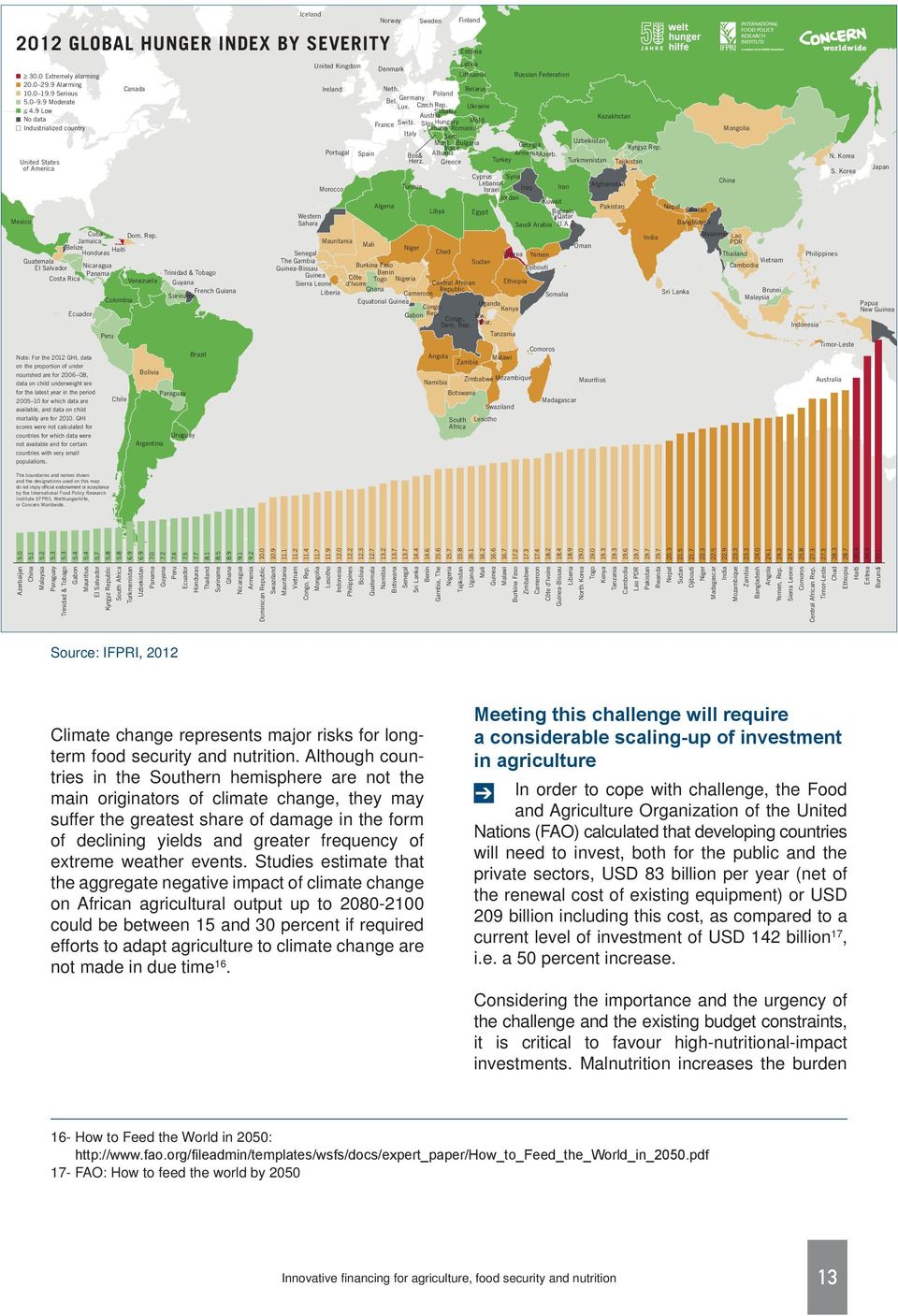
15 United States of America Mexico Cuba Jamaica Belize Honduras Haiti Guatemala El Salvador Nicaragua Panama Costa Rica Peru Venezuela Trinidad & Tobago Guyana French Guiana Suriname Paraguay Uruguay Iceland 2012 GLOBAL HUNGER INDEX BY SEVERITY > 30.0 Extremely alarming Alarming Serious Moderate < 4.9 Low No data Industrialized country Ecuador Note: For the 2012 GHI, data on the proportion of under nourished are for , data on child underweight -are for the latest year in the period for which data are available, and data on child mortality are for GHI scores were not calculated for countries for which data were not available and for certain countries with very small populations. Colombia Chile Canada Dom. Rep. Bolivia Argentina Brazil Western Sahara United Kingdom Ireland Portugal Morocco Norway Denmark Neth. Belarus Poland Germany Bel. Lux. Czech Rep. Ukraine Slovakia Austria Switz. Mold. France Slov. Hungary Croatia Romania Italy Serb. Mont. Bulgaria Mace. Spain Bos.& Albania Herz. Greece Algeria Tunisia Sweden Libya Namibia Zambia South Africa Finland Estonia Latvia Lithuania Turkey Cyprus Syria Lebanon Israel Iraq Jordan Egypt Tanzania Malawi Zimbabwe Mozambique Lesotho Swaziland Russian Federation Georgia ArmeniaAzerb. Kuwait Iran Bahrain Qatar Saudi Arabia U.A.E. Mauritania Mali Niger Senegal Chad Eritrea Yemen The Gambia Sudan Burkina Faso Guinea-Bissau Djibouti Benin Guinea Côte Togo Nigeria Sierra Leone d'ivoire Central African Ethiopia Ghana Republic Liberia Cameroon Somalia Equatorial Guinea Uganda Congo, Kenya Gabon Rep. Congo, Rw. Dem. Rep. Bur. Angola Botswana Comoros Madagascar Uzbekistan Turkmenistan Oman Mauritius Kazakhstan Afghanistan Pakistan Kyrgyz Rep. Tajikistan India Nepal Sri Lanka Bhutan Bangladesh Mongolia China Myanmar Lao PDR Thailand Cambodia Vietnam Brunei Malaysia Indonesia Philippines N. Korea S. Korea Timor-Leste Australia Japan Papua New Guinea The boundaries and names shown and the designations used on this map do not imply official endorsement or acceptance by the International Food Policy Research Institute (IFPRI), Welthungerhilfe, or Concern Worldwide. Azerbaijan China Malaysia Paraguay Trinidad & Tobago Gabon Mauritius El Salvador Kyrgyz Republic South Africa Turkmenistan Uzbekistan Panama Guyana Peru Ecuador Honduras Thailand Suriname Ghana Nicaragua Armenia Dominican Republic Swaziland Mauritania Vietnam Congo, Rep. Mongolia Lesotho Indonesia Philippines Bolivia Guatemala Namibia Botswana Senegal Sri Lanka Benin Gambia, The Nigeria Tajikistan Uganda Mali Guinea Malawi Burkina Faso Zimbabwe Cameroon Côte d Ivoire Guinea-Bissau Liberia North Korea Togo Kenya Tanzania Cambodia Lao PDR Pakistan Rwanda Nepal Sudan Djibouti Niger Madagascar India Mozambique Zambia Bangladesh Angola Yemen, Rep. Sierra Leone Comoros Central African Rep. Timor-Leste Chad Ethiopia Haiti Eritrea Burundi Source: IFPRI, 2012 Climate change represents major risks for longterm food security and nutrition. Although countries in the Southern hemisphere are not the main originators of climate change, they may suffer the greatest share of damage in the form of declining yields and greater frequency of extreme weather events. Studies estimate that the aggregate negative impact of climate change on African agricultural output up to could be between 15 and 30 percent if required efforts to adapt agriculture to climate change are not made in due time 16. In order to cope with challenge, the Food and Agriculture Organization of the United Nations (FAO) calculated that developing countries will need to invest, both for the public and the private sectors, USD 83 billion per year (net of the renewal cost of existing equipment) or USD 209 billion including this cost, as compared to a current level of investment of USD 142 billion 17, i.e. a 50 percent increase. Considering the importance and the urgency of the challenge and the existing budget constraints, it is critical to favour high-nutritional-impact investments. Malnutrition increases the burden 16- How to Feed the World in 2050: 17- FAO: How to feed the world by 2050 Innovative financing for agriculture, food security and nutrition 13
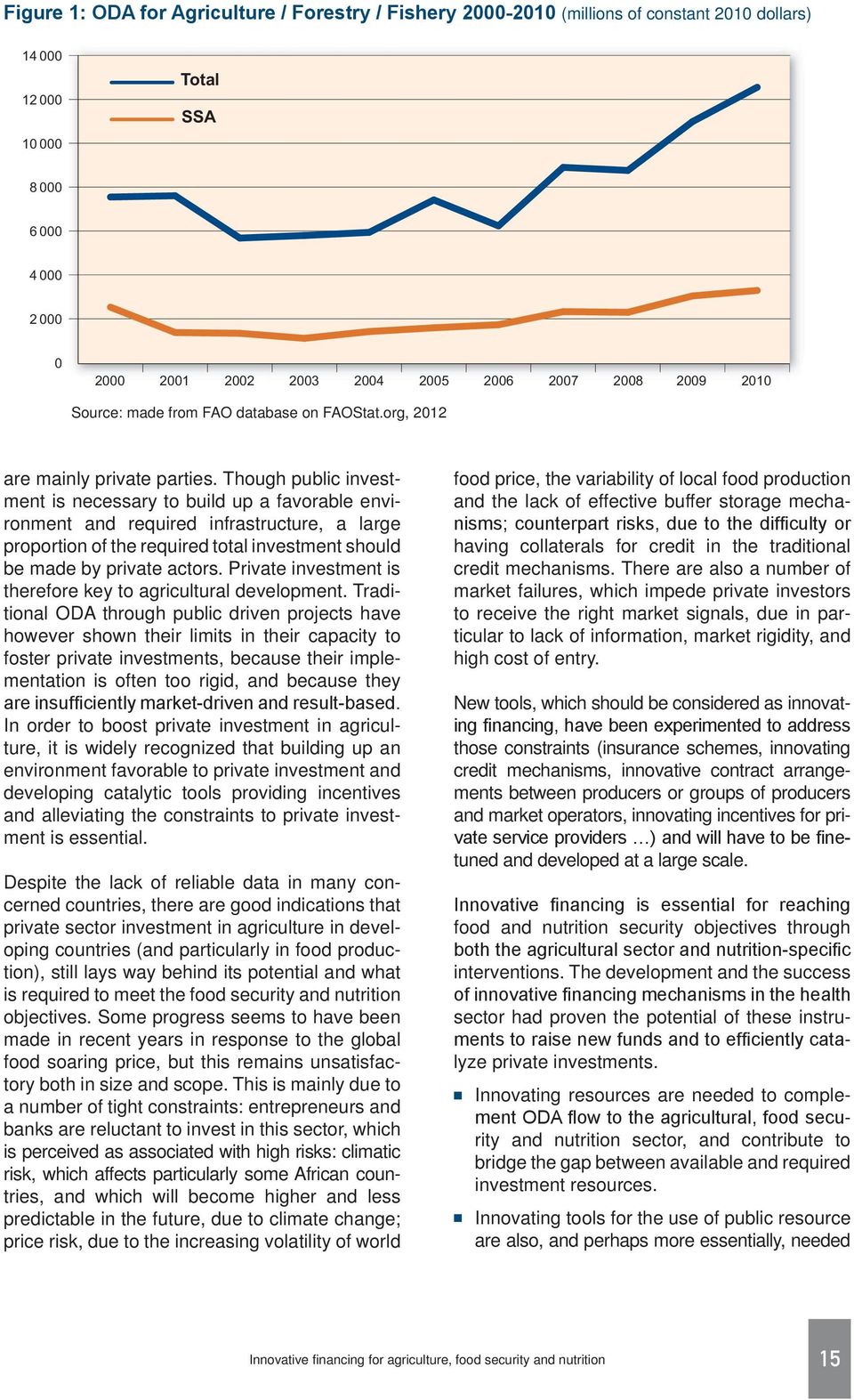
16 of disease in developing countries, adding to the human and economic impact of diseases such as tuberculosis, malaria and HIV/AIDS 18. Every year, malnutrition contributes to 3.5 million pre- According to World Bank the impact of poor maternal and child nutrition is lasting with consequences reaching beyond health, as it may reduce the economic output of countries by 2-3 percent annually. Investment in nutrition is a base line to human and economic development. Helping the developing countries, and particularly Africa, to meet this challenge, is a major and urgent responsibility for the world community. - tural growth are essential to achieving MDG 1 (reduction of extreme poverty and hunger by half by ), as extreme poverty is essentially a rural phenomenon: Three quarter of the world s poor live in rural areas and more than 80 percent of the poor depend either directly or indirectly on agriculture to make their livelihoods. Many studies support the evidence that agriculture can make substantial contributions to economic development and poverty alleviation in the least developed countries. According to NEPAD, the agricultural productivity must raise by at least 6 per cent a year to achieve MDG 1. Although less directly than other sectors as environment or health, food and nutrition security should be considered as global public goods: food security is clearly a prerequisite for health, which is conditioned by the eradication of malnutrition; hunger and food insecurity can be responsible for public unrest and political instability, as recently shown in a number of developing countries, and are a threat to peace; reducing hunger and extreme poverty are also a condition for limiting uncontrolled massive migrations. Efforts should enhance agricultural models able tious food and to serve food security and better nutrition focusing on Sub-Saharan African countries (SSA) and less developed countries (LDCs). The capacity of the poorest developing their budgetary resources is limited. Member states of the African Union committed themselves, in the 2003 Maputo declaration, to increase their budget allocation to the agricultural sector up to 10% by 2008, and although progress has been made, this objective is still not achieved. In ten years, the global ODA for agriculture, forest in 2010, an increase of 66% mainly due to the crisis of But the increase in ODA for agriculture is much lower in Sub Saharan Africa (SSA), where it rose only from USD 2.5 to 3.3 billion (30% in ten years), while the needs are greatest. Despite recent efforts, it is very unlikely that the donors community will be able to source the in a situation of budget crisis in most developed countries, even though the need to re-invest in agriculture is nowadays widely recognized by the donors community as well as by developing countries. Moreover, ODA resources tend, in times long term projects. Private investment is key to agricultural development, but severely constrained. Unlike other sectors as education or health, which deal essentially with public goods, the actors involved in the agricultural sector (farmers, agri- 18- In addition, malnourished infants and young children who survive to adulthood have an increased risk of developing obesity including measles and malaria. The estimated proportions of deaths in which undernutrition is an underlying cause are roughly similar for diarrhea (61 per cent), malaria (57 per cent), pneumonia (52 per cent), and measles (45 per cent). 19- After 2015 the new global goals still will include food security 14 Innovative financing for agriculture, food security and nutrition

17 (millions of constant 2010 dollars) Total SSA Source: made from FAO database on FAOStat.org, 2012 are mainly private parties. Though public investment is necessary to build up a favorable environment and required infrastructure, a large proportion of the required total investment should be made by private actors. Private investment is therefore key to agricultural development. Traditional ODA through public driven projects have however shown their limits in their capacity to foster private investments, because their implementation is often too rigid, and because they In order to boost private investment in agriculture, it is widely recognized that building up an environment favorable to private investment and developing catalytic tools providing incentives and alleviating the constraints to private investment is essential. Despite the lack of reliable data in many concerned countries, there are good indications that private sector investment in agriculture in developing countries (and particularly in food production), still lays way behind its potential and what is required to meet the food security and nutrition objectives. Some progress seems to have been made in recent years in response to the global food soaring price, but this remains unsatisfactory both in size and scope. This is mainly due to a number of tight constraints: entrepreneurs and banks are reluctant to invest in this sector, which is perceived as associated with high risks: climatic risk, which affects particularly some African countries, and which will become higher and less predictable in the future, due to climate change; price risk, due to the increasing volatility of world food price, the variability of local food production and the lack of effective buffer storage mecha- having collaterals for credit in the traditional credit mechanisms. There are also a number of market failures, which impede private investors to receive the right market signals, due in particular to lack of information, market rigidity, and high cost of entry. New tools, which should be considered as innovat- those constraints (insurance schemes, innovating credit mechanisms, innovative contract arrangements between producers or groups of producers and market operators, innovating incentives for pri- tuned and developed at a large scale. food and nutrition security objectives through interventions. The development and the success sector had proven the potential of these instru- lyze private investments. Innovating resources are needed to comple- rity and nutrition sector, and contribute to bridge the gap between available and required investment resources. Innovating tools for the use of public resource are also, and perhaps more essentially, needed Innovative financing for agriculture, food security and nutrition 15
18 to catalyze private investment and alleviate the constraints on its development, using innovating more effective delivery mechanisms (more result based and market oriented, and with a higher leverage effect on private investment) than the traditional ones. - traditional resources are necessary to improve the public goods required for agricultural development and to source incentives for private investments, innovating resources and delivery mechanisms are essential to bridge the investment gap and to catalyze private investment. In order to maximize their contribution the food mechanisms should, as much as possible, be targeted on food production and supply 20, on family farming and nutritional issues. bers of the Food Security Taskforce and by the much as they seem, through a preliminary assess- - mechanisms: those innovating by the resource market and migrants savings), and those innovating by the use (pull mechanisms, mechanisms for and presented in annex, some may have proved their suitability, or may seem promising, to other sectors, but do not necessarily corre- security sector. Others may raise issues of or compliance to the Paris declaration principles on the effectiveness of aid. In order to select the mechanisms to be considered for recommendation to the Leading Group, an analysis was conducted on two sets of criteria: criteria for resource innovating mechanisms and criteria for innovating use mechanisms. The Leading Group on Innovative Financing for Development created in 2006, suggested Although this discussion, it reveals some fundamental charac- to have: essential for agricultural development because interventions are on the long run. Financing resources must be predictable over the time frame required by agricultural development projects, so as to make possible a planning of activities. This criterion requires that resources must be tion mechanisms clearly formulated and applied by all contributors. Innovat- ODA. Meanwhile, ODA can serve as a catalyst for attracting private resources which would otherwise not be invested in agriculture. This criterion calls for mechanisms implying in their management and utilization of resources the civil society and private sector as well as contributors. in order to avoid the risk for the new resources to be reallocated to other sectors than the one it was originally designed for Innovative financing for agriculture, food security and nutrition

19 This is certainly one of the most discriminating criteria. Inno- success if potential contributors are not convinced of the interest of their contribution. The selected mechanisms must be relatively easy and fast to set up. The methods of collection and transfer of resources and the control of utilization must be transpar- concept stage or when the mechanism has not been experimented in other sectors. This is an essential criterion for the selection of future requirements of the agricultural sector in the developing countries. The transaction cost for leverage funds should be mini- Currently operating mechanisms show high on air tickets, more than 30% for some philanthropic mechanisms). Innovative mechanisms should addresses the constrains of agricultural develop- in terms of food security and income generation, in particular for the poorest populations, in a long term perspective. These mechanisms should This criterion is essential for those mechanisms aiming at catalyzing local and foreign private investment to the agricultural sector. Innovating mechanisms are ideally expected to be more effective in terms of governance and disbursement capacity than traditional ones. The inclusion of the private sector in the management of mechanisms should contribute to ensuring effectiveness. There is a need to scale-up pilot projects with have demonstrated, on a small scale, that a range of solutions were available to improve food security. 22. The ownership of these mecha- lation is fundamental and their integration in the agricultural and food security policies and agricultural development program is essential. In a concern of aid effectiveness, it is necessary to avoid as much as possible the creation of new structures which compete with the existing ones, locally or at the international level. The risk of making the aid architecture more complex, especially at the international level, and the risk of duplication at the local level should be taken into consideration in the selection of delivery mechanisms. resources, and through their use. The robustness of a mechanism is all the higher when it has positive externalities both on the resource side and on the fund utilization side. For instance, the tion and which is used for environment improvement projects, is an example of such a win-win mechanism. involve new contributing actors (the Northern farmers organization, insurance companies, agro-food industry). They will be brought to donors be parties at stake in the management 22- Ownership, alignment, harmonization, management centered on the outcome, mutual responsibility. Innovative financing for agriculture, food security and nutrition 17

20 of the funds. This could engender new ways of governance through such co-management and collective decision making. In the same manner, the combination of innovating tools, for example those relating to agricul- storage, makes necessary the coordination of different actors (bankers, insurers, small scale processing companies, producers) for the articulated use of such innovating mechanisms. Such partnerships are expected to foster new and more effective modes of governance. (presented in appendix 1) on the basis of the abovementioned criteria is summarized on the two following tables. (new resources) Small rate taxation on fertilizers and pesticides consumption in G20 countries Weak (but remains to be assessed) possible opposition of agricultural lobbies in the exporting countries Strong Strong (feasibility already studied); the management organization is already existing; good control and harmonization through the mechanism Average: can be implemented only by a limited number of countries, provided the main exporting countries adhere Strong (reduce pollution in the over using countries; contributing States are those more from food price increment) High (250 MM) Strong impact on agricultural income and food security (fertilizer effect) demonstrated; effectiveness of the distribution system Excise duty on tobacco consumption in Southern countries prevention of addiction and conversion of cultivation Weak: transfer of funds between Southern countries; targeting a small number of producing countries, possible resistance from consuming countries Strong Weak (importance of smuggling) Strong (tax can be decided at the national level mechanisms in each country) Positive aspect: reduces tobacco consumption in the South; negative aspect: the payers are the poor consumers of the South; can be improved if developed countries also contribute Weak: strong global potential, but the mobilization on food security is targeted on a limited number of producing countries Weak (main impact on the public health; impact on food security in a few countries, but no positive impact on agricultural income) on the Sales of the emission quotas instead of free distribution for countries having adopted a domestic carbon emission limitation system Strong (but only in the EU, where exists a carbon market; depending on the climate agenda negotiations) Weak (volatility of the carbon market) Strong (mechanism already existing for tax collection) Strong (each EU Member State can organize its contribution as it wishes) Strongly win-win: contribution to a global public good; Northern countries contribute to mitigate climate change impact, which they are to a large extent responsible for, in developing countries weak (competition with other uses of funds for environment; link required with adaptation to the climatic change) Neutral (depending on the mechanism for utilization of resources) 18 Innovative financing for agriculture, food security and nutrition
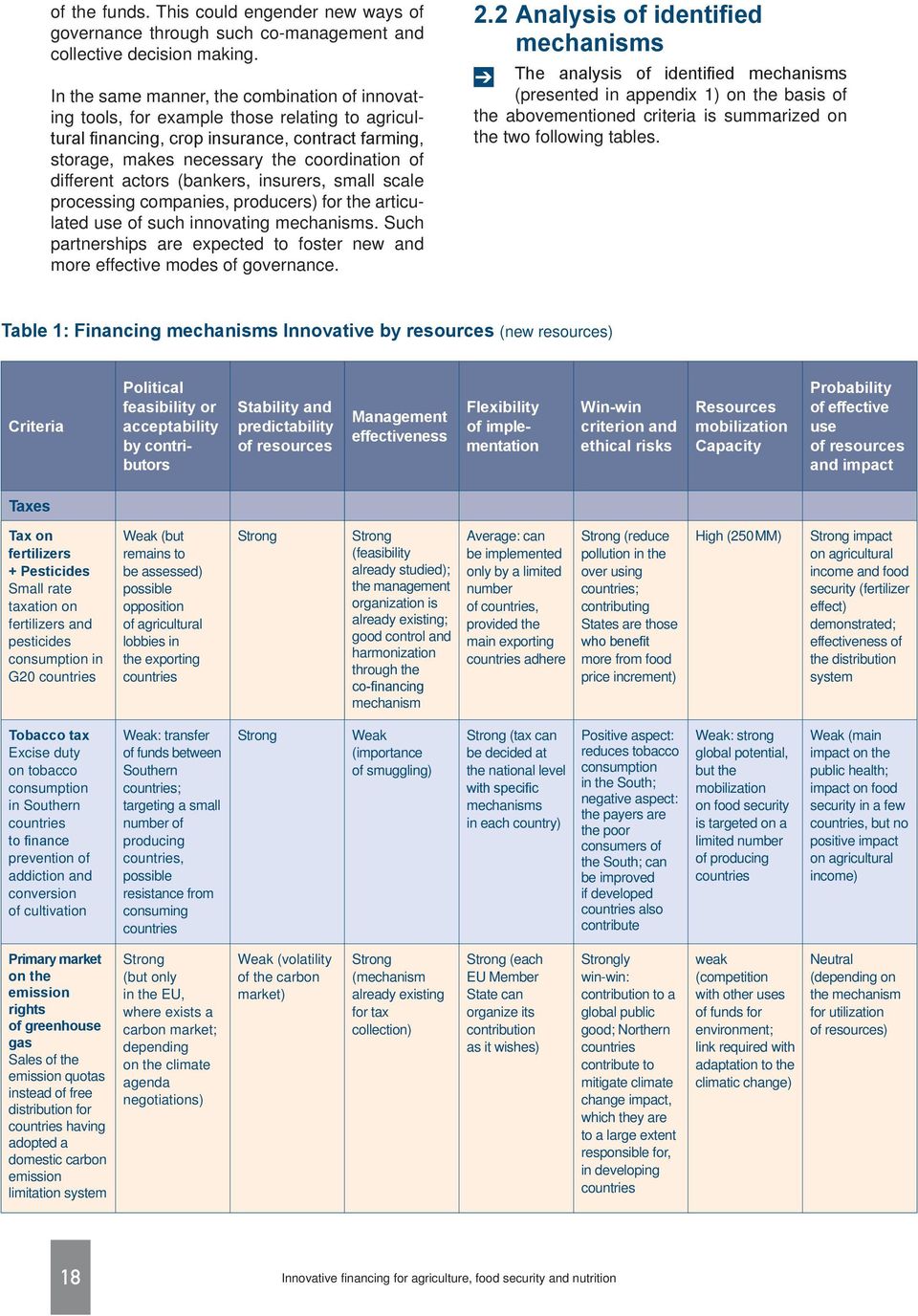
21 Applied on soft drinks (and eventually fat food) in the North nutrition projects in the South Average (support from WHO but would face strong lobbies) Strong products that should be taxed) Strong (tax can be decided at the national level with mechanisms in each country) Win-win as it improves nutrition in Northern and Southern countries Weak (competition with other utilizations of funds in countries where taxes are collected) Main impact on nutrition partly food security In general, to reach an international consensus and to justify targeting on agriculture) Strong Weak (needs relative complicated system for tax; risk of market distortion) Very weak (taxes must be implemented at global level according to harmonized methods in order to avoid market distortion) Win-win, in as much as the tax contributes to reduce negative externalities Strong but risk of targeting towards other sectors more closely related to the concept of global public goods Neutral (depending on the mechanism for the utilization of resources; no new actors) Food security label for brands devoting a percentage of their margin to food security projects Strong (no foreseeable opposition) Weak (depends on the marketing success of the brand) Weak (high promotion cost of labels; need for a strict control of the utilization of brands) Strong (can be implemented at the State level or among group of states) Equitable, in as much as consumers of the North contribute to development in the South Weak Weak; positive aspect: new actors (so far as the holders of brands decide on their actions of development; negative aspect: risk of diversion towards marketing and visible rather than development effective actions) Using national lotteries incomes food security and nutrition Rather weak; runs up against the national monopoly in many countries; Strong, once the system is launched Strong (if based on the existing lotteries) Strong (can be implemented at the country level or among group of countries) Equitable as much as the contributions comes from the consumers from the North, but risk to encourage the addiction to gambling Rather strong (WFP estimate incomes of 400 M at the world level), but no insurance that the funds will not be targeted to other sectors Neutral: depends on the mechanism for the use of resources; no entry of new actors) Using the round up difference to contribute to a fond for food security No political feasibility problem, but doubts on acceptability by banks customers Strong, despite uncertainty on the volume of funds generated at the beginning (which will certainly be stable afterwards) Average: need for a system for control on sums collected by the banks Strong: works even if a limited number of banks participate Strong: equitable as far as banks customers from the North in the South; however the mechanism is more related to solidarity than on a win-win partnership Very uncertain but probably weak Weak: intervention of banks ensures effectiveness in the management and the distribution of funds, but they are likely to be concentrated on sectors having most impact in terms of communication Innovative financing for agriculture, food security and nutrition 19
22 Bonds guaranteed by donor countries market for food security and nutrition projects Weak to average: the mechanisms implie that donor States must make new debts (or guarantee debts) which is a problematic in the current economic situation Strong: could plan resources on a 20 years period, if donor countries accept to commit themselves Average: the management is entrusted to an independent institution (the GAVI for health), which adds supplementary bureaucracy Strong (even a limited number of countries can take part) Not relevant Weak: no complementarity to ODA in the long term, but allow to mobilize funds more rapidly Weak to average: food security requires long term commitment rather than quick disbursement Developing countries issue bonds to their emigrants for a fund dedicated to food security Very weak; not adapted to African poor countries: increases governments indebtedness, risk of insolvency, exchange rate risk, lack of government, low contribution capacity of migrants Weak (depend on the success of bond emissions; regularity not ensured) Weak; the guarantee for repayment implies complex implementation Strong, as the mechanism is implemented at national level Less equitable: risks are borne by fact of supporting the and the risk of the migrants, who constitute a poor migrants, who a poor population in the migration countries Weak for Africa (low contribution capacity of migrants) Neutral: Governments decide on allocation of funds; no new actor Bonds guaranteed by developing countries and/or donors sold on outcome-based service delivery Weak to average: need long-term commitment from developing countries and/or donors Strong (if countries accept to commit themselves) Strong: the management could be hosted by existing independent institution to avoid supplementary bureaucracy Strong (even a limited number of countries can take part) Neutral Strong leverage capacity (return comparable to commercial ones, with the advantages of public guarantee) Strong: the outcome-based mechanism creates strong incentives to reach result and maximize impact if the expected outcomes are adequately targeted 20 Innovative financing for agriculture, food security and nutrition
23 Advances Market Commitments are contracts between donors and an innovating entrepreneur to secure a new market or to strengthen developing markets (minimum quantity at a given price). Pull mechanism consists in providing ex post an award to innovation dissemination May concern innovation for agriculture, food security and nutrition; involvement of private actors should result in accelerated adoption of innovations Cannot be known in advance for AMC (public contribution known ex post) Strong: new mechanisms which have not yet been developed for agriculture in African countries To reach local ownership, these mechanisms must be open to local developers or partnerships between local and international actors Delivery of a produce in a bounded warehouse against a receipt which can be used as collateral for a credit Strong, though indirect: contributes to limit price volatility, therefore reduces price risk; facilitates development of contract farming; incentive for food crops Strong leverage effect on bank inventory credit There are many projects in this area, which need to be up scaled; to avoid duplications, one should work on existing mechanisms Yes, if local existing actors are involved, if local capacities are strengthened, and if projects are integrated within national and regional development plans to invest in agricultural infrastructure or services farmers Strong, especially for irrigated crops; contributes to develop small farmers production under contract farming with a nucleus estate; strong impact on countries Average: infrastructure farmers are partially borne by public investors Clearly complementary: PPPs are on of the pillars of the Comprehensive African Agriculture Development Plan Strong: increases technology transfers from new actors (agribusinesses investing in PPP). But requires well organized states which can deal at arms length with private investors Index insurance for climatic hazards and reinsurance funds to reduce agricultural risk Strong: incentive to increased quality input usage; agribusiness investments Strong: risk management helps development of bank credit and private investment in agriculture No problem, as such tools are only developed at an experimental stage, in particular in Africa Yes, if local actors agribusiness) are involved and if local capacities are strengthened To reduce banking risk by granting a partial repayment guarantee to banks Strong impact, through and development of contract farming Strong: guarantee funds reduce banks reluctance No problem, as existing mechanisms are far from meeting the needs; would contribute to strengthening existing banking systems Yes, if local actors (banks, and if local capacities are strengthened Targeted on food production and poor farmers to promote crop Strong and rapid impact: increasing fertilizer applications results in immediate gains in yields Average: subsidy rates need to be high in order to impact consumption; but subsidies facilitates credit as it increases borrowers solvency; the leverage effect can be all the more important if subsidy resources Strong, if the mechanism is harmonizing existing schemes at the regional or continental level, and if it is compatible with private input distribution Yes, as the mechanism would be complementary to the systems already in use in some African countries Innovative financing for agriculture, food security and nutrition 21
24 Strong (no foreseen opposition) Strong, given the USD 20 billion of remittances being invested currently the scope for effectiveness is high. new cost-effective mechanisms to do this at scale and/or tailoring existing mechanism to the needs and opportunities of working with remittance recipients. There are also clear illustrations of niche markets for export to the diaspora. Builds on existing practice, but seeks to enhance its impact through capacity building and partnership. Strong, as it builds on activities currently being undertaken by remittance recipients. The funds come from their family members, resulting in a strong social/moral obligation to use them to their greatest effect. Strong (no foreseen opposition) Strong, this has proven to be viable and scalable with limited donor funds. When taken to scale this effect is greatly enhanced. Strong, especially as a local-level intervention. Partnership with private institutions such as cooperatives and MFIs is essential and reaching out government are essential when operating at scale. Spillover effects will enhance non migration investments as well. Strong, remittance senders resources are to be invested in their communities of origin, which has proven to be a key driver of interest on the sending side. On the receiving side, family members are part of the community and can monitor that funds are being spent as intended. This chapter presents the proposed innovating mechanisms selected by the highlevel expert Committee for further consideration by the Leading Group on Innovating Financing for Development. It includes mechanisms for new resources, and mechanisms for catalyzing private investments in the food value chain and creation of a coordination entity, an Innovative in agriculture, food security and nutrition, as a global platform for developing new tools for catalyzing private investment. (to be decided at the national level in industrialized, emerging or developing transaction, supported by several European food security in developing countries; a tax on fats and sugar products, already existing in some countries (USA) could be partially used tries and a tax on fertilizers in developed and emerging countries has also been proposed by NEPAD as a mean to develop fertilizer consumption in Africa through smart subsidies. 22 Innovative financing for agriculture, food security and nutrition
25 which could be apply- employees and/or by food and nutrition correlated industries. Lotteries can also be considered (a part of the lottery proceeds in security projects in developing countries). represent considera- oping countries, estimated at USD 400 billion annually, an amount comparable to three times net ODA. Remittances can be considered ing as well as existing private capital that may of new resources for development include; tion of diaspora resources for development through diaspora bonds, which corresponds in the European Union Emissions Trading System (EU ETS). During the third trading period of the European Emission Trading System starting in 2013, it is expected that about half of the emission allowances will be auctioned, thus generating revenues for European Union member states. Member states may decide to use part of this income 23 for climate change mitigation and adaptation, including programmes for resilience to climate change in developing countries, which are the most affected although not the main actors of climate change. Such programmes could include support for climate resilient and sustainable agricultural development and food security in countries and regions vulnerable to the effects of climate change. Other countries around the world adopting emission trading schemes and auctioning allowances could opt for a similar approach. Among those possible mechanisms, the multi-criteria analysis conducted in chapter 2 of this report suggests that three mechanisms deserve special attention, as they obtain the highest rating: the tax on fertilizers proposed by NEPAD, the sale of GHG emission rights and the development impact bonds. A feasibility study has been made on a possible fertilizer tax, followed by a proposal for implementation carried out by NEPAD. The source of funds would be a tax on fertilizer use in the G20 countries or in a number of them. Fertilizers should be taxed at the retail level whether the fertilizer is locally produced or imported. Since the tax will be largely if not entirely transferred to farmers through an increase in the retail price, it will have to be acceptable to the farming community. Therefore, the tax would have to be: (a) widely adopted by small so that it will only marginally affect farm income (it should be less than 0.5% of the value of a bag of fertilizer). According to the feasibility study, a tax of 0.1% of fertilizer consumption in G20 countries would yield USD 100 million a year, as would yield a 0.3% tax on fertilizer consumption in all OECD countries. According to the NEPAD proposal, the tax would fertilizers in sub-saharan African countries (see a detailed description of the proposed subsidy scheme in section 3.2.3). The cost of such a program would roughly equal the annual proceeds of the tax. Other utilizations could also be considered, beyond the fertilizers subsidy scheme proposed by NEPAD. The EU decision to sell by auction (instead of distributing for free) GHG allocations to the energy sector from 2013 on will generate between 20 to 35 billion Euros of additional revenues for the member states of EU 15. Following the example of Germany, who decided since 2008 to sell these emission allocations and to partly use the gram, including in developing countries, some member states, who can decide freely on the use of these new resources, indicated that they intend to devote up to 50 percent of these resources to climate change mitigation and adaptation, including development cooperation. 23- As Germany has done already. Innovative financing for agriculture, food security and nutrition 23
26 A part of these resources could be used for investing in agriculture and food security projects in developing countries, as agricultural pressure on deforestation and participates to climate change mitigation at the global level. Projects aiming at increasing resilience to climate change in developing countries, such an irrigation projects or research on drought resistant varieties could also be considered. Although the complementarity of these new resources to traditional ODA can be questioned, there are strong arguments in favor of such a mechanism: The EU ODA funds amounted in 2007 to only 0,4 percent of GDP, whereas the EU pledged to increase it to 0,7 percent by 2015, which recession, through regular tax revenues. The mechanism to meet its pledge. The mechanism is fair in its principle: Northern countries are to a large extent responsible for climate change, as their per capita emission of GHG is overwhelmingly higher than in developing countries; it is therefore fair that they contribute to build up resilience to climate change in developing countries. The mechanism can help reaching a consensus on climate change agenda currently under discussion within the United Nations. The mechanism is, in some aspects, a winwin relationship: climate change mitigation in developing countries is a contribution to the ting also to donor countries. This mechanism is therefore recommended for consideration by member states of the EU. In order to minimize management costs, it could also be recommended that member states pool their resources into a common fund for climate change mitigation and adaptation in developing countries. This move could also induce other countries and regions to auction their quotas instead of giving them away for free. Australia, New Zealand, several states in the USA and Japan have also emissions trading schemes which could be partly the world might also implement this approach in the future. Development Impact Bonds (DIBs) are an interesting tool to channel new resources and prom- interventions. DIBs are a family of outcomes- tors fully or partly pay for services to be delivered that improve social outcomes. Numerous variations are possible but the basic principle is that investors would be remunerated with a return by donor agencies and/or host country governments, if evidence shows that social outcomes have improved. This approach seeks to shift attention, incentives and accountability to results, as payments are made in proportion to the programme s success. This approach intends to strengthen incentives for the innovation and the necessary adaptation to deliver successful outcomes. DIBs are inspired by Social Impact Bonds (SIBs), initially developed by Social Finance with the in September SIBs had permitted to raise GBP 5 million from 17 social investors to fund social support to 3,000 short-sentence male prisoners. They have also permitted to explore the potential to use outcome-based funds to support a wide range of outcomes for target populations with complex needs. Compared to traditional approaches, this inno- - the Center for Global Development (CGD) and Social Finance 24, including: Creating incentives to focus on achieving and measuring outcomes; Enabling donors to fund outcomes while leav- ment solutions that work; Leveraging support of the private sector to delivery 24 Innovative financing for agriculture, food security and nutrition
27 Creating mechanisms for coordinating government, private sector investors and nongovernment service providers; Transferring risk from public sector to enable earlier intervention and innovation; and Providing upfront funding to service providers enabling them to more easily participate in results-based contracts. investment in agricultural and food value chains more attractive and to reduce the high level of risks associated to agricultural investments. These tools are, for most of them, widely used in developed countries and have proven however be considered as innovations to be adapted and developed at an extent meeting the and particularly in sub-saharan Africa, where they still are at a early stage. Based on a review of available experiences and existing literature, the most promising mechanisms are the following: Risk management tools to reduce the risk on bank credit and investments in agricultural activities; Innovating credit mechanisms providing the lender with improved collateral guarantees, tural value chains; Public-private partnerships; Smart subsidies for the dissemination of innovating technologies and agricultural inputs Pull mechanisms, aimed at attracting private Migrant remittances represent considerable countries, estimated at USD 400 billion annually, an amount comparable to three times net ODA. 25 Greater availability of risk management tools catalyze private sector funding for agriculture. to a number of risks, in particular: the price of the crop may be less than anticipated, resulting in a revenue that is too low to permit loan reimbursement; weather events may have led to loss of (part of) the crop; there are obstacles preventing the delivery of the crop to the buyer, be it in the country or abroad (e.g., an export ban); the borrower may be unable to operate (e.g., due to civil strife) or may decide to default; the buyer may fail to pay; or government intervention may lead to non-reimbursement of loans (e.g., currency controls). There are risk management instruments for all of these risks, though their availability in developing countries is patchy. All of these instruments are worth attention, but in one area, there has been good progress over the past decade which should be consolidated and scaled-up in the future: market-based weather risk management. Traditional crop insurance schemes, based on very costly to administer in developing countries; this problem, as well as some other problems of traditional insurance (such as moral hazard and adverse selection) can be avoided with marketbased weather risk management. In western countries, a large range of instruments is now readily available. They are based on weather indices such as rainfall and temperature, rather than actual farm losses. They can be used to protect against catastrophic risks, or to protect against normal, day-to-day operational risks. Agricultural banks can bundle weather risk management with their loan packages (for example, loans are forgiven if there is a drought, and the bank claims its money back from an insurance company), or they can insist that lenders take out weather insurance with the eventual claims payable to the bank, or they can insure their agricultural loan portfolio against weather-related default risk. 25- Surveys conducted for, and projects undertaken by FAO, the IDB, IFAD and IOM suggest that around 5 percent of these funds are directly invested into agriculture. There are probably ways to better leverage remittances investments towards food security projects, and a number of immigration countries are currently cooperating with countries of origin to develop such projects. Such process could be included into a co-development scheme, i.e., matching those funds with public resources. Innovative financing for agriculture, food security and nutrition 25
28 Index insurance for climatic hazards (which compensates the subscriber for production loss when a reference index, for instance rainfall level, is not reached) is one of the ways explored by a number of international institutions to reduce agricultural risk in Africa, where such risk is a food security (and indirectly, a major reason for banks reluctance to lend to agriculture). Pilot projects have started in a number of East and Southern African countries (Malawi, Ethiopia, Kenya, and Tanzania) and are underway in West Africa. Scaling-up these pilots requires a considerable and expensive work of detailed weather data collection in all African countries with climatic risks. In addition, the idea of reinsurance mechanism has been launched by the Thomas More Insti- proposes the creation of reinsurance funds to cover the natural risks, in order to enhance the operating capacity of the insurance companies. The reinsured risks could concern in priority those which affect the productive capacity of the poorest countries. Reinsurance funds can be public or private. The risk coverage could be at the level of individual subscribers or at national level. Several initiatives can be considered as belonging to this type of tools: the Global Index Insurance Facility for the creation of an index insurance system for ACP countries, supported by the EU; the Caribbean Catastrophe risk Insurance Facility, to reduce hurricane risks and earthquake in the Caribbean islands. Price risks can also, under certain circumstances, be addressed by price insurance schemes based on future markets tools. The potential scope for developing such schemes in the African context is still under study, and more analytical work and testing is still needed to design sustainable and effective tools which could be developed at a large scale. - the perception of excessive risks, is one of the major drawbacks for agricultural development in the developing countries, and especially in Africa. The idea to reduce banking risk by granting a partial guarantee to banks, designed to cover a portion of the risk without relieving the banks from their credit responsibility, has been tried and launched at different occasions in the agricultural credit sector in developing countries. This instrument has been widely and very suc- ing activities in transition countries. In developing countries, the existing devices (for example the ARIZ fund launched by AFD or the AGRA/Standard bank initiative for guaranteeing credit to fertilizer distributors) are far from meeting the needs. The creation of an umbrella mechanism at the to which could participate private investors (for example, manufacturers of inputs or agricultural equipments), and which would provide a partial types with high impact on food security and small farmers, thus appears to be a promising way. Credit guarantee schemes usually imply on one tions, who extend credit to farmers or agribusinesses and, on the other side, a guarantee provider (which can be a development bank, a central bank or a specialized institution like ARIZ), who takes a share of the default risk on a given portfolio, usually against a guarantee fee. The guarantee provider needs a guarantee fund to cover the possible loss in case the default rate exceeds the guarantee fee. Credit backed by a security in the inventory is a well known mean to secure storage and marketing credits and contributes to lower the interest rate 26, while being quite easy of use once the system has been put in place. This mechanism is yet developed to a very limited extent, at least for food crops, in Africa, due partly to the lack of reputable warehousing companies, the lack of - more elaborated form, the mechanism consists for the producers in storing their products in a warehouse against the delivery of a warehouse receipt. The products can be used as collateral for a credit by a bank or a micro-credit institution. The credit is repaid when the product is sold or withdrawn from the warehouse. This type of 26- In India, the developing country with the most experience with farmers using this instrument, the interest rate can drop of 1.5 to 2 percent below the usual rate. 26 Innovative financing for agriculture, food security and nutrition
29 credit can be sophisticated and combined with sales, insurance, sale contract indicating that payment has to be made to the bank which has extended a credit to the producer. Such combinations of mechanisms contribute to seasonal secure credit and make it more accessible to farmers. 27 Farming contracts can link producers (usually small scale producers) and agribusiness: according to such contracts, the agribusiness provides the producers with agricultural inputs on a credit basis and with technical advises, against the producers commitment to sell the produce to the agribusiness. This type of contracts, which is commonly used for some export commodities be combined with other innovative tools to reduce risks and facilitate seasonal credit. In such contracts, the selling price is usually set in advance contract), which reduces the price risk for the farmer. The agribusiness can, for internationally quoted commodities, hedge on the future commodity market to reduce its own price risk. For a commercial bank, extending seasonal credit to farmers through such contracts is much less risky than ordinary credit: the agribusiness can usually guarantee the credit, and the farming contract can include a bank domiciliation clause, by which the payment of the produce is made to the farmer s bank account, on which the bank can deduct the repayment of the credit. 27- An outgrower scheme is an elaborate contact farming arrangement, emanating from a nucleus a lead farm or a processor (also called technical operator) which provides outgrowers with technical support often including a credit component. Innovative financing for agriculture, food security and nutrition 27
30 Services Enterprises to Farmers Organisations" (Entreprises de services aux organisations professionnelles, or ESOP in French). 28 Innovative financing for agriculture, food security and nutrition
31 In order to scale up risk management tools and to consider the creation of regional funds for the include regional stakeholders: development banks, States, ODA agencies, REC, Development Agen- tions). All stakeholders would contribute to the capital of the funds. The objective of the Funds is to attract private investment for value chains (targeting small producers and nutrition-sensitive approach), for instance increasing the availability of locally pro- food through: developing banks and insurance companies involvement in the sector; mitigating agriculture and price risks through crop insurance schemes and credit guarantees; developing already tested new credit mechanisms (warehouse receipt system, contract farming, combination of loan-insurance-forward contract...). The fund could provide credit guarantees and subsidies to participating banks and insurance companies: guarantee funds for innovative insurance products (crop insurance, weather index-based insurance...); guarantee (on a risk sharing or on a risk tranching basis) banks portfolios including innovative banking products; subsidies for: insurance premiums, information systems for insurance, dissemination of information on innovative banking and insurance products. the Funds activities would be mainly small scale farmers, farmers organizations, and small and medium agribusiness. The principle is that any partner wishing to participate in the system provides a counterpart. For example: In return for accessing guarantees and subsidies on premiums, insurance companies have to contribute to the Fund and to ensure the dissemination of innovative insurance tools, whose list and characteristics are determined by the Fund management. Similarly, banks are to contribute to the Fund - return for accessing the Guarantee Fund. States willing to give their country s banks and insurers access to the Fund, commit to contribute to the Fund and to implement legal instruments required to make a better use of innovative banking and insurance products. They also commit to participate in setting up information systems required for index-based insurance. Regional Economic Communities commit to contribute to the Fund, to harmonize the credit and insurance legislations of participating countries, and to ensure the free movement of food chains development. Regional banks commit to contribute to the Fund and to support the promotion of innovative banking and insurance products through ture sector. Fund and would match the contributions of the private sector (banks and insurance) and The contributors to the Funds could be insurance companies and banks in developed and developing countries, development banks, States, ODA, regional institutions, Development Agencies. The Fund could be co-chaired by donors and recipients (POs and SMEs). It could be managed by an international organization and/or a continental or regional development bank. Innovative financing for agriculture, food security and nutrition 29
32 There are several innovative ways to stimulate private sector investments in rural infrastructure. One is entirely private (although government policies have to permit the mechanism): an entrepreneur can use off take contracts with foreign buyers (e.g., for fruits and vegetables with a supermarket chain) to obtain funds which permits the construction of the infrastructure needed to produce, process and transport the fruits and vegetables (this has been done, for example, in Zambia). Others require a more active role of the government, in the form of public-private partnerships (PPP). Through PPP governments can leverage funds from the private sector to invest in agricultural farmers. The private investor, usually an agribusiness, is compensated either by subsidy or a by a long term lease agreement or a levy the proceeds of which pay back over time a part of the initial investment. Such PPPs can easily be used for the construction of irrigation schemes (including, for instance, a nucleus rice company and small scale out growers) or storage facilities. It can also be used for a variety of projects: for the provision of services to small farmers by an agro-industry, within the framework of contract farming arrangements; for the construction and operation of wholesale markets. In particular, governments and aid agencies may consider certain innovative forms of Build-Own- Operate contracts. One good example is a structure used in the renewable energy sector. Private entrepreneurs apply for the right to build the plant. Milestones and a budget are agreed on. On the back of this public-private agreement, the entrepreneur raises the necessary funds for construction. Once the construction is completed, the plant is bought by the government, permitting the entrepreneur to reimburse his loans; and then, the plant is leased back to the entrepreneur who can operate it, with possible purchase at a nominal price after some years on the condition that the entrepreneur meets pre-agreed performance criteria. PPPs are strongly encouraged by the CAADP tural infrastructure, but their development is severely constrained by the lack of soft loans available for such investments. 30 Innovative financing for agriculture, food security and nutrition
33 29 The NEPAD has recently called for the establishment of a fertilizer subsidy scheme (see A key component of any strategy to increase agricultural productivity among smallholder farmers in Africa must be to increase smallholder use of productivity-increasing inputs such as fertilizers through improved access to input markets. Soil Innovative financing for agriculture, food security and nutrition 31
34 fertility is central to crop growth and fertilizers are an important way to maintain or increase soil fertility on agricultural lands. There is evidence that no country in the world has been able to expand agricultural growth rates and eliminate hunger without increasing fertilizer use. However, fertilizer use levels in Africa are the lowest in the world at 9 kg/ha, compared to the world average of more than 100 kg/ha and almost 200 kg/ha in the Green Revolution countries of Asia. Sub- Saharan Africa consumes only 0.7% of world production of fertilizers, as against 20% for northern countries and 50% for the three following countries: China, India and Brazil. Consequently, the agricultural production increases in SSA mainly through expansion of land culti- increased use of fertilizers. African farmers are mining the soils by extracting more nutrients from the soils than they replenish through the use of fertilizers. African governments are very cognizant of the importance of increasing fertilizer use levels in Africa. In June 2006, the Africa Fertilizer Summit was convened to identify the key constraints to increased fertilizer use in Africa and reach a consensus on an action plan. The outcome of the Fertilizer Summit was the Abuja Declaration on Fertilizers for an African Green Revolution which set a national fertilizer target of at least 50 kg/ha by 2015 and delineated measures and actions required at the national and regional level to achieve this target. Resolution 5 of the Abuja Declaration calls for African Union Member States to improve farmers access to fertilizer, by granting, with the support of Africa s Development Partners, targeted subsidies in favour of the fertilizer sector, with special attention to poor farmers. Currently, over 10 African countries have fertilizer subsidy programs. These programs have improved smallholder access to fertilizers and had a positive impact on yields and production. However, the potential impact of these programs is stymied by inability to go to scale due to lack of suf- design and implementation of these programs needs to be more closely aligned with the stated objectives. There is a need for concerted action at the highest levels to support the implementation of the continentally endorsed fertilizer policy for Africa through concrete action to catalyze its implementation with a substantive cash infusion. There is also a need to harmonize policies, in order to avoid smuggling in neighboring coun- ing schemes, in order to maximize its impact on food security. The subsidy program proposed by NEPAD would - evant where regional economic institutions have adopted a common fertilizer subsidy policy. Co- be adapted according to the budget of the individual member states to ensure that the poorest countries will be able to participate in the program. The subsidy programs would be designed and implemented at the discretion of individual member states, taking into account their particular needs and realities. Participating countries would adhere to the following guidelines: The distribution of fertilizers for the subsidy program will be conducted by private distribution networks, not the Ministry of Agriculture or a development organizations. The subsidy will be designed to provide direct support to farmers to access the subsidized fertilizers from the private sector; this will be done through the distribution of vouchers directly to targeted farmers. For example, tar- criteria such as areas or/and incomes to ben- should be growing food crops. However, this requirement can be posed as a general rule and left to the discretion of each member state. A continental ceiling or upper limit for the subsidy will be arrived at by negotiation between representatives of the G20 countries and member states. The actual subsidy rate will be chosen by individual countries, but must fall below the continental ceiling. The subsidy will be time-bound for a 10 year period and gradually reduced over this period. Guidelines for the progressive reduction will be negotiated between representatives of the G20 countries and member states. The actual phase out rates will be chosen by individual countries, but must be aligned with the provided guidelines. 32 Innovative financing for agriculture, food security and nutrition
35 cost of national subsidy programs (during the ing thereafter) is proposed for less developed countries (LDCs) in SSA and this level is 40% for middle-income countries (MICs). This level LDCs, whereas for the MICs the level of co- ing of 40% for MICs has been assumed in the calculation of funding requirements. The subsidy program should utilize national subsidized portion of the vouchers to the private distributors. This will provide some guarantee of professionalism and transparency, and may help to develop linkages between banks and agribusinesses. The distribution of vouchers will be the responsibility of national agricultural authorities (ministries of agriculture), but should be co-managed by representative national farmers' organizations. Member states should exhibit tangible progress in the implementation of the Abuja Declaration on Fertilizers agenda (increase in number of agro-dealers, removal of tariffs on facilities, establishment and implementation of regulatory measures, etc.) to be eligible to participate in the program. Education and information programs for sustainable fertilizer use and its alternatives should be considered. The valuation of the program is based on the assumption that LDCs (which represent 55% of at 60% and the MICs 40%, and on the assumption consistent with the objectives of the program that the contractual export crops and agro-industrial crops are generally excluded. Additionally, the subsidy rate will be digressive from 50% to 25% of the price. Based on these assumptions, the total cost (which depends largely on the willingness of member states to join the program) Innovative financing for agriculture, food security and nutrition 33
36 would be USD 960 million over 10 years, averaging USD 100 million a year. According to NEPAD, an adequate conduit for the disbursement and management of the funds is the African Fertilizer Financing Mechanism. Resolution 11 of the Abuja Declaration on Fertilizers called for the establishment of an African Ferti- various measures and activities delineated by the Declaration. A Secretariat for the AFFM was established at the African Development Bank in 2007 and a Governing Council was established in 2009 which includes representatives from the African Ministers of Agriculture, AFREXIMBANK, AGRA, UNECA, IFA and 2 regional farmers organizations and is chaired by the Commissioner of Rural Economy and Agriculture of the African Union Commission. However, the fund is not yet operational as it has a shortfall of USD 4.5 million below the required legal threshold (USD 10 million). However, given the amount of funds being pro- for fertilizers, the selection of the AFFM as the institutional mechanism for the receipt and disbursement of the funds for the subsidy program is possible. The AFFM Secretariat could then provide annual reports on the disbursement of accordance with the auditing and reporting requirements of the African Development Bank (AfDB). Increasing agricultural productivity in developing countries relies heavily on the dissemination of technical innovation (improved soil and pest management techniques, more productive or better adapted varieties, improved veterinary value chains relies also heavily on the dissemination of technologies adapted to the local context and to smallholders agriculture for post harvest and processing. Fundamental and adaptive research is, in developing countries, predominantly done by publicfunded research institutions: in Africa, private agricultural research accounts for only 2 percent of the global funding of agricultural research 30. Public-funded research is obviously an important component of the innovation system, but it cannot by itself meet the investment gap. It often also results in a lack of linkage between research and innovation development or dissemination, and in the innovation. Private sector is therefore essential for the dissemination of innovation. Private entrepreneurs are however reluctant to venture into marketing of innovation technologies, because of a number of market and coordination failures impeding the establishment of commercial markets for agricultural innovation in developing countries: Failure of the market to capture the social value of such innovations; to anticipate the market response and for delaying it, because consumers lack information; Coordination failures, in particular failures of individual market actors to take decisions that, them. In order to address those shortcomings, agricultural development institutions have traditionally used push mechanisms (ex ante provision of incentives for private sector innovations), such as competitive grants linked to calls for proposals, subsidies to innovative technology dissemination or product development partnerships. By contrast, pull mechanisms, which correspond to ex post incentives to innovation linked to advantage of being more result-based, and therefore likely to be more effective. Another option for incentives to innovation is the Advance Market Commitment, already developed for the production of vaccines, and which aims at reducing market risks. The G20 Development Working Group report to the 2011 summit in Cannes makes an explicit reference to Pull Mechanisms and Advance Market Commitments (AMC) in agriculture. It calls for an initiative in this area and for the development of pilots. Those inno- leverage a maximum of private investment in innovation systems with a minimum of public funds, while ensuring a more effective use of these resources. 30- IFPRI, Innovative financing for agriculture, food security and nutrition
37 The AG Results initiative launched by a number of countries in 2012, with the World Bank acting as interim secretariat, is a response to the G20 call as regards pull mechanisms. The concept is currently under development and testing through three pilots. Once these pilots are implemented and evaluated, new funding will be necessary, beyond the USD 100 million already committed for the pilot phase, to scale up the program. The proposed Innovative Facility (see section 3.3) could take over the continuation of the program, in close cooperation with the World Bank s interim secretariat. Contrarily to pull mechanisms, the concept of AMC applied to innovation in agriculture has not yet been investigated nor tested. In its original design for the development of an anti-pneumococcal vaccine adapted to Africa, the operation principle of the mechanism was the following: a donor (or a pool of donors) signs a contract with pneumococcal vaccine). The laboratory commits itself to develop the vaccine according to the quantity on a target market at a given maximum price for a period of 10 years (both price and the donor provides a market guarantee to the laboratory: if the laboratory sells less than a quantity of products corresponding to its breakeven point, the donor buys the difference at the contractual price. In this way, the laboratory is guaranteed against market failures, and ensured that he will sell enough vaccines to cover its development cost. The donor s guarantee is used only if the market turns out to be smaller cial engineering of the mechanism is more complex than its basic principle: it includes donors contributions, a guaranty from the World Bank on future donors commitments, subsidies for the purchase of vaccines by targeted countries and private contributions. Preliminary analyses show that: The concept, as it was designed initially for human vaccines, could be easily adapted to the development of veterinarian vaccines, provided the market is made of public veterinary services or public funded (for vaccines sold through private channels, marketing promotion services would be needed, and the market guarantee given to the laboratory might act as a disincentive for laboratories to invest in marketing). The concept would have a very limited interest for plant breeding, for a variety of reasons: large-scale private plant breeders would probably not be interested as plant varieties are, in most developing countries, not liable to intellectual property rights, except GM varieties, and, in some cases, hybrids (in this regard, such a mechanism would provide a strong incentives for large-scale breeders to develop hybrids or GM varieties, which do not necessarily correspond to the needs of small farmers as it obliges them to renew their seeds every season). Public research institutes (like WARDA, which developed the new variety NERICA rice) would not either be interested, as these institutes are more in demand of pre- ket guarantee (which is not relevant, as the new variety is a public good). The AMC mechanism would however be very useful to secure the market of a private seed producer (who has to produce seeds one year before marketing them, and takes therefore a market risk) or a company who wants to develop and market an innovative on-farm or processing equipment. AMC would guarantee the company a minimum market for a period of time corresponding to the delay required to build up a stable market for the product. Through such a mechanism, the market risk would be considerably reduced during the start up period. This would be a strong incentive for entrepreneurs to invest into innovation development. It would also considerably facilitate access to bank credit, ment period is secured. One can thus imagine the following system: In order to access an AMC contract, the innovation developer would be required to produce a business plan showing the initial investment cost, the production and marketing cost and the sales forecast for the innovative product over a start up period (which could be for instance 5 years). The selling price is determined in the contract and calculated in such a way as to cover the Innovative financing for agriculture, food security and nutrition 35
38 investment cost at the end of the start up period. If the cumulated sales stand below the sales forecast during the start up period, the company is compensated for the gap (or the AMC donor buys the unsold quantity). In this way, the company s income is secured during the start up period. If the company sells more products than antic- At the end of the start up period, the company is assumed to have built up its market and does not need market guarantee anymore. Such a mechanism would most likely be less costly in public funds than traditional push mechanisms. It would also present the advantage of securing bank credit to innovation. It is all the more effective that the product developed is really innovative and requires prior investment in research and development. It does however projects and close monitoring during implemen- plies to contract conditions and that he/she is not responsible for a lower market than expected. the adaptation of innovative AG Result and AMC following options: AG Result could be applied to increase the in selected areas. A standard or proportional prize would reward organizations that are able to demonstrate they reached this outcome This scheme was proposed by the World Bank (Agricultural Pull Mechanism (AGPM) Initiative pilot ideas for nutrition, 2011). 36 Innovative financing for agriculture, food security and nutrition
39 AMC mechanism would be useful to enhance ready-to-use food (both therapeutic and preventive) and to overcome the dissuasive costs of quality standards management. The mechanism would support productions which ensures numerous advantages, including: pushing up the production capacities; stimulating the innovation (innovative formula with local and non-allergenic components, economical and environment-friendly packaging, etc.); developing local businesses and supplementary outlet for local value chain; decreasing transport and delivery costs (air freight of ready-to-use therapeutic food increases the landed cost by 100 per cent and see freight by 10 per cent 32 ) and reducing pollution; the management of malnutrition at country level. Similarly to the system for innovation in agriculture, local producers would be required to present a business plan in order to access AMC contracts. As said in section 3.1.1, remittances in for agricultural development represent also existing capital that only needs to be channeled into this area. Interventions to promote the investment of remittances and diaspora investment consist of developing innovative models of migrant remittances to entrepreneurs and smallholder farmers investing in agriculture (approximately USD 20 billion worldwide), and ii) to mobilize new sources of diaspora investment in agriculture, food security and nutrition projects in developing countries. The impact of their amount increased through collaboration between public and private diaspora actors, and their counterparts in developing nations both within a co-development framework (i.e., matching these funds with public resources) and through public facilitation of private investment. The development of food production and supply, in view of improving food security and nutrition and reducing rural poverty, relies to a large extent on private investment, in complement to ODA. Alleviating, through innovating mechanisms, the constraints which hamper private investment and bank credit to agriculture and providing incentives to attract new investors are therefore crucial for the development of agriculture and the improvement of food security in less developed countries, particularly in Africa. Although a number of institutions (the World Bank, already involved in the pilot development of such siderable additional efforts to promote such tools, upscale existing projects and develop shared approaches in the agricultural development community. There is also a clear need to co-ordinate the interventions of the various institutions interested by the development of such tools and to build up a forum where experiences can be discussed and evaluated, and new innovating mechanisms designed. The creation of an entity in charge of ture is therefore recommended. The mission of the Innovative Facility would be tural development focused on family farmers, food security and nutrition improvement projects Africa, particularly affected by food security prob- the constraints limiting local or international private investment in agricultural and animal production value chains or providing incentives for such investments, hence having a catalytic effect on their development. This would cover the all range of innovating tools described in the previous sections. The Innovative Facility would have two main activi- 32- UNICEF, Komrska, J. (2012), Increasing Access to Ready-to-use Therapeutic Foods. Innovative financing for agriculture, food security and nutrition 37
40 design and evaluation and coordination of inno- ticipate in projects aimed at developing innovative the agricultural and animal production value chains. As a think tank, the Innovative Facility would: studied and tested (for instance AMC mechanisms); Follow up the implementation of innovative mechanisms and propose design improvements through building on experience; Foster a collective and coordinated approach among development institutions on innovating ing, and network with all concerned institutions so as to share experiences, develop common ing tools; and Identify, on a continuous basis, new possible mechanisms, through, for instance, calls for innovating proposals. agency for such projects. The objective of the Innovative Facility is indeed not to duplicate with already developing, although on a too limited rather to act as a catalyst for the up scaling of the core activities of the Innovative Facility could tions, projects or project components aiming at aging the investments of those institutions in such tools and creating a strong incentive for these institutions to include such tools in their project portfolios. The Innovative Facility could also take participations in the capital of agencies involved in the implementation of innovating loans to catalyze their activities. In all cases, eli- ditioned by the fact that considered investments Although this list is not limitative, the Innovative on the following tools (described in the previous sections): The Innovative through patient capital, in public-private partnership enterprises with strong impact on small farmers, such as irrigation schemes or Fund could take the form of a participation in the capital of the entity implementing the partnership (with a sale back of the shares when the project starts to generate income), eventually taking on some of the mezzanine-level risks of a project (based on the concept of risk tranching), or through long term soft loans. The Innovative Facility could catalyze the development of credit guarantee schemes in several ways: it could participate in the capital of existing or new guarantee providing entities, thus enhancing 38 Innovative financing for agriculture, food security and nutrition
41 credit guarantee schemes set up by development projects, through grants or soft loans, or a mix of both types of resources, depending opment project (for instance, a credit line World Bank or IFAD for the collective purchase by farmers groups of processing equipment could be backed by a guarantee scheme the project). In all cases, the credit guarantee scheme would have to comply to strict eligibility criteria: to minimum standards in terms of good gov- capacity; The guaranteed portfolio would have to rectly to family farmers. In conformity with its proposed mandate, the Inno- including the development of an insurance directly or indirectly to family farmers, both for the front end investment (insurance scheme engineering, preliminary data collection, setting up of pilots) and for the subsidization of the insurance premiums. The Innova- innovation systems in agriculture, in particular the Pull mechanisms and Advance Market Commitment (AMC) mechanisms, which appear to be a promising tool for involving private actors and private investment into the dissemination of agricultural and animal production innovation. The Innovative Facility could be innovating in two ways: it would mobilize innovating resources in order to promote innovating tools. Two types of resources could be considered: Non reimbursable contributions: such contributions could be granted through traditional ODA mechanisms (contributions from voluntary States, international development institutions) or they could also be collected through innovative resource mechanisms, such as a cial transactions, a tax on fertilizers and eventually pesticides consumption in developed countries, lotteries, contributions from the private sector. Long term loans with a low interest rate (for instance 20-to-30-year loans at an interest or private investors (patient capital). A number in particular at the World Economic Forum 33, their interest in participating in innovating approaches to foster agricultural development in Africa, both on the ground of their social accountability and because they consider that Africa will become a major food market in the future. It is participating in the Facility through long term soft accounts, provided this gives them a right to participate in the governance of the Facility, and provided their intervention has enough visibility to serve their image in the public at large. Such a mix of resources, combining grants and borrowed capital on soft conditions, would allow mechanisms. The Innovative Facility would be operated by a able to the governing board and to the public at large, and whose mission would be to contribute to the elaboration of new innovative mechanisms Facility, to monitor, follow up and evaluate ongoing projects, and, more generally, to use the Facility effectively under the guidance of its governing board. The institutional status of the Facility remains open: it could be integrated into existing institutions; it could also be an independent international public-private institution with a governing board, composed, for instance, of contributors, and an advisory council, made of internationally recognized food security experts. 33- Putting the new vision for Agriculture into action ; a report by the World Economic Forum s New vision for agriculture initiative; Innovative financing for agriculture, food security and nutrition 39
42 The creation of such an Innovative Facility would be a very positive contribution to the promotion tural and food security: it would bring new resources for the development of such tools, allowing an up scaling from a yet experimental scale to large scale and a clear signal of the interest borne by the ing in agriculture; it would have a strong leverage effect on other development institutions; it would improve the dialogue and mutual understanding within development institutions and between these institutions, local authorities and the private sector on investment strategies for agricultural value chains in developing countries; it would create incentives for innovation on a continuous basis by calling for innovative proposals from public and private actors; it would make possible a collective and coordinated approach (which is presently lacking) thus allowing to pool expertise and to draw shared lessons from experience. 40 Innovative financing for agriculture, food security and nutrition
43 RECOMMENDATIONS After several months of studies, the inter- the rationale for the promotion of innovative tion and came to the conclusion that this report mittee also discussed various ways in which new funding for such efforts could be mobilized. A list which includes new instruments and new instruments. Such mechanisms may complement each other and stand at various stages of expertise and would necessitate separate work streams to further explore their potential and feasibility. In this context, in order to pursue the work initi- security and nutrition, the international Committee of experts recommends to the Members of the Leading Group on Innovating Financing for Development: whose name could be the Innovative Facility for Agriculture, Food Security and Nutrition (IFAFSN). Beyond its coordination function, the objective of the IFAFSN would be the design and operationali- A recommended next step could be to discuss the term of reference of such a facility. on agricultural inputs and nutritional products; Public-private partnership to catalyze private investment in the agricultural and food value ways to systemize an integrated scheme for school feeding with supply from small local producers); for agriculture, food security and nutrition; Innovative schemes and partnerships to lev- and diaspora capital towards agricultural investment; Voluntary contributions (dedicated lotteries, for examples); Taxes on fats and sugar products (for both over and under nutrition-oriented purposes) and on fertilizers. Innovative financing for agriculture, food security and nutrition 41
44 APPENDIX See section The idea of the tax on tobacco which would be applied both in Northern and Southern countries (where addiction to tobacco is a growing public health problem) has been supported by the WHO. A development institution has developed a proposal on this line. The tax on tobacco would consist in an excise duty on tobacco consumption in Southern countries. The proceeds of the tax, eventually supplemented by solidarity contributions coming from Northern countries, would be tion and the conversion of the tobacco cultivation towards food crops in Sub-Saharan Africa. The be the large scale African tobacco producing countries (Malawi, Zimbabwe, Zambia, Tanzania and Mozambique). See chapter This idea has been evoked by some experts. soft drinks in Northern countries. The proceeds of projects meant to improve nutrition in Southern countries. cial transactions, which is currently debated in international fora. The feasibility of such taxes has been studied in details by the Leading Group, to the extent that a more detailed analysis in this report does not seem useful. All these taxes as a global public good, as well as health or education. Shipping and aviation fuel taxes (global bunker fuel tax) as has been proposed by Bill Gates report to the G20 (November 2011) could also be considered. Furthermore, it could be proposed a tax on internet sports bettings, and on luxury tourism, high-end hotels, cruising, catering business and/or food processing industry. 42 Innovative financing for agriculture, food security and nutrition
45 Some experts have suggested an innovating experience, a voluntary labeling indicating that against AIDS. One could imagine the creation of a food security label: the brands (distributors brands, large agro-food brands, Fast Food brands) would commit themselves to participate in the countries by devoting to it a percentage of their margin; in turn, they could use the food security label to brand their products and communicate tions, thus improving their image (for example through socially responsible company saving scheme 34 ). ing of development or for international solidarity was implemented in the United Kingdom, and in Belgium. Some international organizations support the idea of creating a world lottery (global lotto) on this model. It could also be considered that existing lotteries in some countries contribute voluntarily to a fund for the development of food security, agriculture and nutrition in developing countries. The idea is supported by the report on innovat- could be applied in the food security sector. Some Northern banks could, for instance, propose to their customers to round up to the nearest currency unit their expenditure paid by credit cards, using the difference to contribute to a fund for improvement of food security and nutrition in Southern countries. public aid commitment from donor countries. payments from donor countries to the Facility. This system permits developing countries to rap- report Governments of developing countries would issue bonds for sale to their emigrants for a Fund dedicated to educational sector development. The report estimates that emigrants will subscribe in a spirit of solidarity and patriotism. The fact the bonds interest is paid in local currency is also seen as an advantage by the report. An international institution could guarantee the repayment and the payment of interest of the bonds, and could also participate in the management of the Fund. Migrant remittances involve the transfer of money to family members in developing nations. Especially when processed through a bank, the regu- leveraged in order to securitize the incoming can raise funds on the international bank or bond market to set up a local investment fund. Securitization has been undertaken in Central America with support from the World Bank and has been used in a few African countries, e.g. to set up a USD 40 million agricultural investment fund in Ghana, but there is much scope for expansion. This mechanism, implemented in the health function as follows: a public-private institution, market. These bonds are guaranteed by long term 34- Leading Group on Innovative Finance (May 2012) «Innovative financing for agriculture, food security and nutrition 43
46 See section See section See section The Africa Agriculture Trade and Investment Fund 35 (AATIF) by KfW and Deutsche Bank provide loans, guarantees and, to a limited extent, also equity to experienced private sector enterprises and farmers located in Africa. It encourages the engagement of private investors that look for more risky investment opportunities. public resources can help encourage diaspora tive or individual projects for agricultural modernization (creation of irrigated schemes, etc.), for agro-industrial processing or for the development of services to agriculture in their village or region of origin. As diaspora investors have a strong link with their community of origin, and particularly with their family members in that community, both remittances and diaspora invest- and community development, even during times of crisis when other investors are unwilling to invest. They could also be collected through innovative resource mechanisms, such as a part of the pro- a tax on fertilizers and eventually pesticides consumption in developed countries, lotteries, contributions from the private sector. See section See section (which can be combined with a fertilizers tax in G20 countries) See section Various development institutions are interested - diaspora investors to invest in their home communities. These projects have consisted of both fully market-oriented interventions, as well as projects of a more philanthropic nature. In the food security and nutrition sector, technical assistance can be provided to remittance recipient entrepreneurs and farmers to encourage the adoption of best practices, matching funds with 44 Innovative financing for agriculture, food security and nutrition
47 There are many innovative ways to cata- Broadly, these different methods can be divided into several categories. facilities that cover part of the risk of certain agri- the returns on his money-at-risk, making more risk coverage, a fairly high leverage (5-10 times the guaranty facility) has proven possible. But while a 50 percent guarantee makes it possible for certain transactions to reach the risk-reward benchmark of banks, it does not necessarily incentivize banks to enter into areas where they feel they cannot estimate risk. For this reason, it is worthwhile to consider adding a small, revolving risk fund guaranteeing a much higher part of exposure, e.g., 90 percent. This stimulates banks to be innovative; when they are more familiar with the loan structure, they can then move it to the 50 percent guarantee facility, freeing up new capacity to innovate. Provide and support innovative mechanisms that remove country risks for international local bank to raise relatively low-cost and long-term funds on the international capital market in order to create a domestic agricultural investment fund. This can be through the strengthening of existing sovereign risk insurance facilities (the power sector has interesting examples of possible modalities), but it can also be by leveraging existing payment Develop innovative Public-Private Partnerships for rural infrastructure, using structures that permit investors to raise funds from bank or the bond market for the initial risky phase of construction, while the government takes over long-term funding once the construction phase is completed. Create facilities through which funding automatically becomes available if certain triggers are hit (e.g., food prices exceed a certain level, or a drought occurs). Such facilities (called Risk Transfer market) are used in the private sector to ensure that in case of a crisis, the company has immediate access (within a day) to extra funds without having to negotiate these with a bank. In the case of food security, a facility of this nature has been debated in the context of the Marrakesh Decision on Measures Concerning the Possible Negative Effects of the Reform Programme on Least- Developed and Net Food-Importing Developing Countries, to enable these countries to maintain normal levels of food imports even in the case of global price spikes. By strengthening the institutional infrastructure: Build and strengthen institutions that permit and thus make it easier for farmers to get exchanges, electronic warehouse receipt sys- extension services (e.g., livestock vaccination and other veterinary services integrated with ance facilities/companies (including for weather insurance), public warehousing companies (which offer the public the opportunity to store their goods and obtain a loan against this collateral), and collateral management and credit support companies (which manage risks on rary control over a borrower s warehouse in Build a legal and regulatory framework that ments like the Rural Credit Note system in Brazil, where farmers can, for example, pay input providers with a I owe you note, secured by their future production, which the Innovative financing for agriculture, food security and nutrition 45
48 such paper on the capital market). Help structure food value chains from farm to fork. For example, there are large and fastgrowing urban markets in Africa, whose food needs are now predominantly supplied from abroad. If this urban demand could be structured properly, it can provide the incentives for farmers and others to invest in increasing their production. It should also be noted that relatively large gains in food security can be achieved quite rapidly in this area, given the current exceedingly high post-harvest losses throughout the developing world. In this component, due care has to be given to the importance of optimizing the contribution of food production to nutrition; incentives may be needed so that the food that is ultimately sold to consumers provides optimal nutrition (e.g. by the widespread introduction of varieties high in vitamins and minerals). tures that permit farmers to move up the value cooperative partnership in which farmers gradually obtain ownership of an agricultural processing or service company. Help restructure (by funding and backstopping guarantees) the delivery of inputs and services to farmers; e.g., rather than trying to stimulate direct demand for fertilizers, pesticides etc., these could be provided as a service by village-level companies, which are paid a percentage of the production increase above an initial baseline. Build institutions and mechanisms through which putative investors and those in need of funding for agricultural production and value chains can come together. This ranges from crowd funding platforms to an electronic bond Stock Exchange. By providing incentives: for example by opening discount windows with Central Banks, or with an organization like the IFC, where banks can easily and tural loans. Discount windows of this nature were important in the development of agricul- America over a century ago. Provide incentives for innovation, such as monetary awards, for example for productivityenhancing or risk-reducing new varieties, or for new software applications that can enhance Pool mechanisms securing future demand. This can be for agricultural innovations, or if the proper institutional conditions are in place, in terms of structured demand for farmers crops. Several of these possibilities are further elaborated below, with a discussion of how the proposed Catalytic Fund could work towards their realization. due to the perception of excessive risks, is one of the major hindrances to agricultural development in developing countries, and especially in Africa. The idea to reduce banking risk by granting a partial guarantee to banks, designed to cover a portion of the risk without relieving the banks from their credit responsibility, has been tried and launched at different occasions in the agricultural credit sector in developing and transition countries. The existing devices (for example the ARIZ fund launched by AFD or the AGRA /Standard bank initiative for guaranteeing credit to fertilizer distributors) are far from meeting the needs. The creation of an umbrella mechanism at the to which could participate private investors (for example, manufacturers of inputs or agricultural equipments), and which would provide a partial types with high impact on food security and small farmers, thus appears to be a promising way. The Innovative Fund could catalyze the development of credit guarantee schemes in several ways: it could participate in the capital of existing or new guarantee providing entities, thus enhancing their antee schemes set up by development projects, through grants or soft loans, or a mix of both types - 46 Innovative financing for agriculture, food security and nutrition
49 by a development project (for instance, a credit as World Bank or IFAD for the collective purchase by farmers groups of processing equipment could by the Fund and operated by the project). In all cases, the credit guarantee scheme would have to comply to strict eligibility criteria: to minimum standards in terms of good gov- capacity; farmers. A stock exchange matches supply of capital with demand for capital, in a manner that (the recipient of the funds), and which optimizes returns for society. Traditional stock exchanges they enable investors to identify companies conditions so that they can restrict their investments to such companies. But the time may have come for a new kind of exchange, a Social Stock Exchange, which puts social/environ- exchange of this nature would greatly contribute to providing capital for agricultural initiatives and for agriculture-related infrastructure projects. According to indications of investors, hundreds of billions of dollars would be available for investment through a Social Stock Exchange. The Catalytic Fund could move this concept into stock exchange which will raise capital for social businesses globally. Most of the work involved would be to create the necessary supporting institutional infrastructure the exchange itself can be easily created by the private sector. Such supporting infrastructure would include companies that help viable pro-poor initiatives that are social enterprises which are able to meet the exchange; and rating agencies which would so that investors can make informed decisions. A public warehousing system allows farmers and others to temporarily store goods in a professionally-managed warehouse, and then obtain a loan against this collateral. Because the loan is secured against physical collateral which is in turn guaranteed by a reputable warehousing company, the interest rate can be low (in India, the developing country with the most experience with farmers using this instrument, it is percent below the usual rate), and the procedures very light Innovative financing for agriculture, food security and nutrition 47
50 (in India, a farmer can deliver one or more bags into the warehouse, and without much additional procedures or even having to discuss with a currently mostly restricted to ports, where they import crops. While projects to improve public warehousing are underway in a number of countries, the Fund could catalyze and scale up this work. There are essentially three elements: cre- that they enact legislation, rules and regulation that permits public warehousing companies to operate properly; educate the private sector, ties could kick-start their involvement); and support the development of warehousing companies, so that they can build an upcountry presence. The latter can take the form of a long-term real estate investment trust that would enable the renovation of existing warehouses and if necessary, the construction of new ones; and support tion of an electronic warehouse receipt system. others bring their goods to the warehouse. collateral manager (also called a credit support company) to secure the goods at the borrower s ing. The collateral manager guarantees the trans- collateral manager itself is either well-capitalized or has extensive insurance coverage, this per- - - and in Africa it has been used to revive, for example, Côte d Ivoire s cotton sector after it had ground to a standstill following civil strife in the late 2000s. The main obstacle to its greater deployment is the scarcity of reputable collateral management companies. The Fund could catalyze their creation and banks) the creation of such companies, and by the warehouse receipt contracts which such companies issue for the goods they have under management. There are several innovative ways to stimulate private sector investments in rural infrastructure. One is entirely private (although government policies have to permit the mechanism): an entrepreneur can use offtake contracts with foreign buyers (e.g., for fruits and vegetables with a supermarket chain) to obtain long- funds which permits the construction of the infrastructure needed to produce, process and transport the fruits and vegetables (this has been done, for example, in Zambia). Others require a more active role of the government, in the form of public-private partnerships (PPP). Through PPPs, Governments can leverage funds from the private sector to invest in agricul- small farmers. The private investor, usually an agribusiness, is compensated either by subsidy ment or by a long term lease agreement or a levy the proceeds of which pay back over time a part of the initial investment. Such PPPs can easily be used for the construction of irrigation schemes (including, for instance, a nucleus rice company and small scale outgrowers) or storage facilities. It can also be used for provision of services to small farmers by an agro-industry, within the framework of contract farming arrangements. In particular, governments and aid agencies may consider certain innovative forms of Build-Own- Operate contracts. One good example is a structure used in the renewable energy sector. Private entrepreneurs apply for the right to build the plant. Milestones and a budget are agreed on. On the back of this public-private agreement, the entrepreneur raises the necessary funds for construction. Once the construction is completed, the plant is bought by the government, permitting the entrepreneur to reimburse his loans; and then, the plant is leased back to the entrepreneur who can operate it, with possible purchase at a nominal price after some years on the condition that the entrepreneur meets pre-agreed performance criteria. 48 Innovative financing for agriculture, food security and nutrition
51 The Catalytic Fund can stimulate the development of such PPPs by promoting awareness of the different models (including by developing blueprints), funding demonstration proof-of-concept facilities for PPPs. Farmers willingness to invest in raising their production, or in starting new crops, is much improved if they can be sure of a ready market for their produce, at a fair price. Without such demand in place, innovative farmers would run a large risk that they would have to dispose of their a buyer at all. Linking farmers through the market, through contract farming or value chains, is one way to reduce market risk. But there are other ways. World food programme (WFP) s P4P scheme is one example: even if WFP were not to offer forward contracts (which it does), it would be motivating for farmers to know that WFP is a systematic, regular buyer which buys in a way with which farmers are able to relate (e.g., through warehouse receipts). But WFP is not the only large, regular buyer: different parts of the government are also in this category (e.g., the army, the prison system, hospitals, the school feeding programme, the food reserve agency...), as are large processors and organized retailers (e.g., supermarkets, retail cooperatives). If all of those buyers could be brought to make their purchases through one common platform (such as a commodity exchange), this would act as a magnet for smallholders who are able to grow for the market. Having such an organized market also improves price information, and greatly improves the bankability of agricultural producers and processors. There are successful examples of this approach in Latin America. The Fund can play a catalytic role in structuring commodity exchanges to governments which way; help convince governments to route their purchases of bulk commodities through the exchange (which also would remove corruption in purchasing programmes); work with the commodity exchange(s) to bring other large buyers into the platform; then work with the exchange and farmers groups to help them bulk their commodities for delivery onto the platform; and work with banks (including eventually through guaran- and processing of commodities which can be delivered onto the platform. Greater availability of risk management tools thus catalyze private sector funding for agricul- exposed to a number of risks, in particular: the price of the crop may be less than anticipated, resulting in a revenue that is too low to permit loan reimbursement; weather events may have led to loss of (part of) the crop; there are obstacles preventing the delivery of the crop to the buyer, be it in the country or abroad (e.g, an export ban); the borrower may be unable to operate (e.g., due to civil strife) or may decide to default; the buyer may fail to pay; or government intervention may lead to non-reimbursement of loans (e.g., currency controls). There are risk management instruments for all of these risks, though their availability in developing countries is patchy. All of these instruments deserve the attention of the Catalytic Fund, but in one area, there has been good progress over the past decade which could be consolidated through Fund support: market-based weather risk management. Traditional crop insurance schemes, based on very costly to administer in developing countries; this problem, as well as some other problems of traditional insurance (such as moral hazard and adverse selection) can be avoided with marketbased weather risk management. In western countries, a large range of instruments is now readily available. They are based on weather indices such as rainfall and temperature, rather than actual farm losses. They can be used to protect against catastrophic risks, or to protect against normal, day-to-day operational risks. Agricultural banks can bundle weather risk management with their loan packages (for example, loans are forgiven if there is a drought, and the bank claims its money back from an insurance company), or they can insist that lenders take out weather insurance with the eventual claims payable to the bank, or they can insure their agricultural loan portfolio against weather-related default risk. Innovative financing for agriculture, food security and nutrition 49
52 Index insurance for climatic hazards (which compensates the subscriber for production loss when a reference index, for instance rainfall level, is not reached) is one of the ways explored by a number of international institutions to reduce agricultural risk in Africa, where such risk is a food security (and indirectly, a major reason for banks reluctance to lend to agriculture). Pilot projects have started in a number of East and Southern African countries (Malawi, Ethiopia, Kenya, Tanzania) and are underway in West Africa. Scaling-up these pilots requires a considerable and expensive work of detailed weather data collection in all African countries with climatic risks. In addition, the idea of reinsurance mechanism has been launched by the Thomas More Insti- proposes the creation of reinsurance funds to cover the natural risks, in order to enhance the operating capacity of the insurance companies. The reinsured risks could concern in priority those which affect the productive capacity of the poorest countries. Reinsurance funds can be public or private. The risk coverage could be at the level of individual subscribers or at national level. Several initiatives can be considered as belonging to this type of tools: the Global Index Insurance Facility for the creation of an index insurance system for ACP countries, supported by the EU; the Caribbean Catastrophe risk Insurance Facility, to reduce hurricane risks and earthquake in the Caribbean islands. Price risks can also, under certain circumstances, be addressed by price insurance schemes based on future markets tools. The potential scope for developing such schemes in the African context is still under study, and more analytical work and testing is still needed to design sustainable and effective tools which could be developed at a large scale. In conformity with its proposed mandate, the development of an insurance scheme linked to family farmers, both for the front end investment (insurance scheme engineering, preliminary data collection, setting up of pilots) and for the subsidization of the insurance premiums. The Advances Market Commitments (AMC) mechanism was conceived in 2005 in the health sector, for the development of an affordable pneumococcal vaccine adapted to Africa. The principle of the mechanism is as follows: a donor (or a pool of donors) contracts with a vaccine producer to develop the vaccine and to supply it on a targeted market at a given maximum price, these two constraints (period and price) a market for the product, through guaranteeing the producer that he will be able to sell a minimum quantity at the given price: if sales are and the vaccine developer (this threshold is calculated so as to allow the vaccine developer to cover his development and production cost), the donor substitutes to the market and buys himself the product. The donor intervenes only when the - mechanism is complex, combining public contributions, a World Bank guarantee, subsidies on the price of vaccines and private contributions. This mechanism could be adapted to the agriculture, food security or nutrition sector. Along the same line, the pool mechanism concept (renamed AG results) has been developed for the sector of innovation in agriculture under the aegis of the World Bank, which ensures the secretariat of an initiative supported by Canada, USA, Australia and the Bill Gates Foundation. It consists in awarding ex post to research and innovation dissemination The steering committee of the Initiative decided in 2012 to carry out pilot projects, concerning, in min A enhanced varieties of maize and reduction jects of this nature, to stimulate private sector research and development across a range of agricultural bottlenecks, from farm to fork. This could involve not just the large innovations referred to above, but also smaller, practical innovations such as the development of new mobile applications that can boost farmers incomes. 50 Innovative financing for agriculture, food security and nutrition
53 In 2007 and 2008, the world experienced food prices spikes not seen since the end of the Second World War, which threatened the affordability of basic staples for millions of consumers. The food price crisis triggered riots in more than 40 countries. It was a stark reminder of the direct and immediate link between food security and peace and security. The world can ill afford to under-invest in agriculture as happened in the last two decades. While the food price crisis of 2007/2008 was exacerbated by short-term developments such as crop failures in major cereal producing countries and increased fertilizer and transport costs it was of the world supply to keep pace with growing demand. Years of disinvestment in agriculture resulted in declining or stagnant agricultural productivity in developing countries which in turn meant that food production could not keep up with increasing demand and that poor farmers could not cover their own food needs. The share of developing countries spending on agriculture declined in the 1980s to 3 percent in recent years. Similarly the share of ODA to agriculture declined from around 20 to four percent between 1980 and It is therefore not surprising that while the demand for cereals rose 2 to 3 percent per annum, agricultural productivity in developing countries declined from 3 percent per annum in the 1970s to 1-2 percent in the 1990s. Since 2010, prices for basic commodities are rising again. The depletion of global agriculture stocks has removed the needed shock absorber to avoid sudden imbalances between supply and demand. As a result, any further shocks resulting from climate change or other factors can quickly result in price hikes and food shortages that threaten global food security. Future food crises could be more severe, given current projections for population growth and the consequent growth in demand for food. On current trends, the world s population is projected to grow from 6.8 million to 9.3 billion by Most of the growth will take place in developing countries Africa, Asia and Latin America. Feeding 9.3 billion will require that overall global food production grow by 70 percent. For developing countries, meeting the growing demand for food will require that production double by This will pose a major challenge, particularly for farmers in developing countries. The investments required in developing countries to support this expansion in agricultural output amount to an average annual net investment of USD 83 billion in This total includes investment needs in primary agriculture and necessary downstream services such as storage and processing facilities, but does not include public goods like roads, large scale irri- are also needed. beyond traditional bilateral and multilateral fundraising and spending mechanisms, are required to help meet this need for increased agricultural investment and enable farmers to raise their productivity and their own investment in agriculture through value chain approaches. The Leading Group on Innovative Financing for Development, during the Plenary Sessions of 22 December 2010 in Tokyo, Japan, and June in Bamako, Mali considered food security and the importance of the problems facing many developing countries was recognized by all. The overall objective of the Leading Group Task Force for Agriculture is to explore options for towards Innovative financing for agriculture, food security and nutrition 51
54 - in other words, - contribute to food security, nutrition and efforts, be they innovative or traditional, however must be put in context: agricultural productivity and food security are largely driven, from smallholders to global commodities companies. play a, and should only be deemed successful if it has an impact on the activities and behaviors of national and local actors. Two broad types of mechanisms will be considered: (1) Expansion/creation of mechanisms that catalyze private investment across the agricultural value chain private actors in the agricultural value chain, the use of traditional ODA funding may achieve sig- other investors, for example diasporas, to invest in smallholders and small and medium enterprises (SMEs), and to support development of national (2) Extension of citizen contributions and solidarity taxes to agricultural development. These innovative sources of funding are most promising to support humanitarian goals associated with agriculture. A clear-cut example would be to allocate part of funds from levies on currency transactions also for innovative uses in agriculture as is proposed for the health and education sectors. The Task Force on Innovative Financing for Agriculture assisted by an international Committee of experts will review existing and mechanisms and new ideas with a view to allo- nutrition and food security: anisms and proposals and determination of potential applicability to food security, nutrition and sustainable agricultural development; nisms for agriculture based on their nature, e.g. innovation in source, innovation in use, public-only innovation, private only innovation, public-private innovation; proposals) are truly complementary and not Ensure where appropriate that a more direct and visible link exists between the new which they are allocated; mechanisms based on thematic viability and potential impact and ensure that inter alia the following aspects are covered in details: 2. Operational aspects and management; 3. Focus on the most vulnerable countries and people; 4. Accountability; 5. Traceability; 6. Governance; 7. Fiscal Aspects; 8. Legal environment; 9. Potential partners and roles. might be most applicable to agriculture, food security and nutrition? What could be new and suitable (internationally acceptable, easy to implement) innovative for food security and sustainable agriculture? constraints/drawbacks of such instruments? resource mobilisation of such instruments? How to ensure that new resources are truly complementary and not simply substitute exist- How to establish a more direct and visible link programmes to which they are allocated? potential participants, including IFIs, global funds and civil society (NGOs and private sector)? 52 Innovative financing for agriculture, food security and nutrition
55 channels to ensure accountability, traceability and governance, and to make this kind of ear- ment and the legal environment? Under Malian presidency, State members of the Leading Group, UN (FAO, IFAD, WFP), World Bank, civil society (associations of local governments, associations of NGOs, Foundations, agricultural research institutions). The international high-level expert Committee will start activities in April A draft report will be presented to the Task Force in October 2012 in order to elaborate a synthesis with recommendations; the Task Force will submit both documents to the Plenary Session of the Leading Group in February The Task force will be assisted by a small group of high-level experts (8 to 10). The experts will be chosen by consensus by the participating countries on the basis of their competence in agricultural sciences, agricultural - The expenses of the Committee of experts will be covered through voluntary contributions by task force members who could eventually make available national experts, unless they are covered by their employer. Experts will liaise through electronic means and video-conference. Meetings of the Task Force and of the Committee of experts will take place in participating countries upon their invitation. The Leading Group Permanent Secretariat will ensure support to the Task Force and to the committee of experts with the involvement of interested UN agencies. Innovative financing for agriculture, food security and nutrition 53
56 FAO, 2010, Technical and Operational Review of Selected Innovative Financing Proposals for - Banque mondiale, 2007, Ouedraogo, A., Gentil, D, 2008, Ed. CIF Karthala, histoires et innovations. Fonds pour l'innovation en micro-assurance, Matul, M., McCord, M. J., Phily, C., Harms, J., 2009, Initiative NEPAD-OCDE Dahou, K., Omar, AECOM/FADQDI, 2010, OCDE, 2009,. WFP & IFAD, 2011, - FAO, 2011, - World Bank, 2009, Global forum on food security and nutrition, 2012,. IFAD, 2011,. IFC, 2011, World Bank, 2011, Mechanism Initiative. IFAD, 2011, Innovations in Financing Food IFAD, 2012, Conclusions of the Technical Roundtable on - Modalities. IFAD, 2012, The FFR Brief: Five years of the Financing Facility for Remittances. Miller C., 2011, technical note,. IFAD and WFP, 2011, opment, 2010,. Épargne sans frontière, 2011, Revue TFD n 104, ment. Institut Thomas More, AU/NEPAD, 2011, -. Centre for Global Development, 2005, Kremer, M., Website at the following link : pour le développement, 2011, Comment mettre. 54 Innovative financing for agriculture, food security and nutrition
57 - World Bank, 2012, IDS Research reports, 2011, a review of the evidence. AFD, 2011, Document de travail N 113, warrantage. AFD, 2012, - Center for Global Development and Social Finance, 2012,. Action Against Hunger, 2012, Using%20Innovative%20Financing%20to%20 End%20Undernutrition.pdf Action Against Hunger & Institute of Development Studies (IDS), 2012,. resources/aid%20for%20nutrition%20low%20 World Bank, 2010, Horton, S. and al. The Lancet, 2008, Special Series: Maternal and FAO, 2012,. UNICEF-WHO-World Bank, 2012, Joint Child FAO, IFAD and WFP, -. William R Cline 2007, -. Innovative financing for agriculture, food security and nutrition 55
58 56 Innovative financing for agriculture, food security and nutrition
59
60 Permanent Leading Group Secretariat
Proforma Cost for international UN Volunteers for UN Partner Agencies for 2016. International UN Volunteers (12 months)
 Proforma Cost for international UN Volunteers for UN Partner Agencies for 2016 Country Of Assignment International UN Volunteers (12 months) International UN Youth Volunteers (12 months) University Volunteers
Bangladesh Visa fees for foreign nationals
 Bangladesh Visa fees for foreign nationals No. All fees in US $ 1. Afghanistan 5.00 5.00 10.00 2. Albania 2.00 2.00 3.00 3. Algeria 1.00 1.00 2.00 4. Angola 11.00 11.00 22.00 5. Argentina 21.00 21.00 42.00
Countries Ranked by Per Capita Income A. IBRD Only 1 Category iv (over $7,185)
 Page 1 of 5 Note: This OP 3.10, Annex C replaces the version dated September 2013. The revised terms are effective for all loans that are approved on or after July 1, 2014. Countries Ranked by Per Capita
Eligibility List 2015
 The Global Fund adopted an allocation-based approach for funding programs against HIV/AIDS, TB and malaria in 2013. The Global Fund policy states that countries can receive allocation only if their components
FDI performance and potential rankings. Astrit Sulstarova Division on Investment and Enterprise UNCTAD
 FDI performance and potential rankings Astrit Sulstarova Division on Investment and Enterprise UNCTAD FDI perfomance index The Inward FDI Performance Index ranks countries by the FDI they receive relative
HEALTHIEST COUNTRIES 1 to 40
 BLOOMBERG RANKINGS THE WORLD'S HEALTHIEST COUNTRIES HEALTHIEST COUNTRIES 1 to 40 1 Singapore 89.45% 92.52% 3.07% 2 Italy 89.07 94.61 5.54 3 Australia 88.33 93.19 4.86 4 Switzerland 88.29 93.47 5.17 5 Japan
Action required The Committee is requested to take note of the position of 2010 11 income and expenditure as of 30 September 2010.
 INTERNATIONAL LABOUR OFFICE Governing Body 309th Session, Geneva, November 2010 Programme, Financial and Administrative Committee GB.309/PFA/1 PFA FOR INFORMATION FIRST ITEM ON THE AGENDA Programme and
GLOBAL. 2014 Country Well-Being Rankings. D Social (% thriving) E Financial (% thriving) F Community (% thriving) G Physical (% thriving)
 0 0 GLOBAL 0 Country Rankings 0 0 0 0 0 0 0 0 0 0 0 0 0 0 0 0 0 : >0.0% 0.% 0.0% 0.% 0.0% 0.% 0.0% 0.0% A Country s global rank B in three or more elements of well-being C (% thriving) D (% thriving) E
Guidelines for DBA Coverage for Direct and Host Country Contracts
 Guidelines for DBA Coverage for Direct and Host Country Contracts An Additional Help document for ADS Chapter 302 New Reference: 06/14/2007 Responsible Office: OAA/P File Name: 302sap_061407_cd48 BACKGROUND:
OFFICIAL NAMES OF THE UNITED NATIONS MEMBERSHIP
 OFFICIAL NAMES OF THE UNITED NATIONS MEMBERSHIP Islamic Republic of Afghanistan Republic of Albania People s Democratic Republic of Algeria Principality of Andorra Republic of Angola Antigua and Barbuda
Population below the poverty line Rural % Population below $1 a day % Urban % Urban % Survey year. National %
 2.7 International the the Afghanistan.................... Albania 2002 29.6 19.8 25.4...... 2002 a
Appendix A. Crisis Indicators and Infrastructure Lending
 Appendix A. Crisis Indicators and Infrastructure Lending APPENDIX A Table A.1. Crisis Indicators (Case Study Countries) Country % as Share of GDP Share of in Bank Crisis Severity Score (principal factor
International Fuel Prices 2012/2013
 International Fuel Prices 212/213 8 th Edition Published by International Fuel Prices 212/213 8 th Edition Disclaimer Findings, interpretation and conclusions expressed in this document are based on the
Consolidated International Banking Statistics in Japan
 Total (Transfer Consolidated cross-border claims in all currencies and local claims in non-local currencies Up to and including one year Maturities Over one year up to two years Over two years Public Sector
UNHCR, United Nations High Commissioner for Refugees
 Belgium 22 Jul 1953 r 08 Apr 1969 a Belize 27 Jun 1990 a 27 Jun 1990 a Benin 04 Apr 1962 s 06 Jul 1970 a Bolivia 09 Feb 1982 a 09 Feb 1982 a Bosnia and Herzegovina 01 Sep 1993 s 01 Sep 1993 s Botswana
מדינת ישראל. Tourist Visa Table
 Updated 22/06/2016 מדינת ישראל Tourist Visa Table Tourist visa exemption is applied to national and official passports only, and not to other travel documents. Exe = exempted Req = required Press the first
Mineral Industry Surveys
 4 Mineral Industry Surveys For information contact: Robert L. Virta, Asbestos Commodity Specialist U.S. Geological Survey 989 National Center Reston, VA 20192 Telephone: 703-648-7726, Fax: (703) 648-7757
Fiscal Rules and Fiscal Responsibility Frameworks for Growth in Emerging and Low-Income Countries
 Fiscal Affairs Department Effects of Good Government, by Ambrogio Lorenzetti, Siena, Italy, 1338-39 Fiscal Rules and Fiscal Responsibility Frameworks for Growth in Emerging and Low-Income Countries Martine
States Parties to the 1951 Convention relating to the Status of Refugees and the 1967 Protocol
 States Parties to the 1951 Convention relating to the Status of Refugees and the 1967 Protocol Date of entry into force: 22 April 1954 (Convention) 4 October 1967 (Protocol) As of 1 October 2008 Total
INSTRUCTIONS FOR COMPLETING THE USAID/TDA DEFENSE BASE ACT (DBA) APPLICATION
 INSTRUCTIONS FOR COMPLETING THE USAID/TDA DEFENSE BASE ACT (DBA) APPLICATION Full Name of Insured or Company and Complete Mailing Address: This is whoever has the contract with USAID. Generally, it is
INDEX FOR RISK MANAGEMENT RESULTS 2015
 INDEX FOR RISK MANAGEMENT RESULTS 2015 INFORM 2015 INFORM MEASURES THE RISK OF HUMANITARIAN CRISES AND DISASTERS IN 191 COUNTRIES COUNTRY RISK 3 YR TREND Afghanistan 7.88 æ Albania 2.61 à Algeria 4.64
Outsource International Ltd
 Providing global technology solutions for: Carriers Systems Integrators Resellers Outsource Manufacturers International Ltd Government agencies Financial sector Global Technology Solutions Providing global
LIST OF RESOLUTIONS ADOPTED BY THE GENERAL ASSEMBLY AT ITS SIXTY-EIGHTH SESSION ON THE RECOMMENDATION OF THE THIRD COMMITTEE
 LIST OF AT THE LEVEL OF THE THIRD COMMITTEE ITEM 27: SOCIAL DEVELOPMENT ITEM 27 (a) Implementation of the outcome of the World Summit for Social Development and of the twenty-fourth special session of
Citizens of the following nationalities are exempted from holding a visa when crossing the external borders of the SCHENGEN area:
 WEB SUMMIT BULLETIN VISA The VISA requirement to cross the external borders of the SCHENGEN area it is one of the most important procedural steps for all those participants in the next Web Summit that
New Technologies and services - Cable Television
 New Technologies and services - Cable Television WORLD: AFRICA provide service Angola Benin Botswana Burkina Faso Burundi applications. Cameroon The relevant licence must be obtained. Cape Verde Central
Entrance Visas in Brazil (Updated on July 08, 2014)
 Ministry of External Relations Immigration Division Padip Holders of diplomatic passports Pasof Holders of official or service passports Entrance Visas in Brazil (Updated on July 08, 2014) Caption Vitem
Migration and Remittances: Top Countries
 Migration and Remittances: Top Countries Top Immigration Countries a, 010 number of immigrants, millions United States b Russian Federation b Germany b Saudi Arabia b Canada b United Kingdom b Spain b
How To Calculate The Lorenz Curve
 FACT SHEET 1. Overview 1.1 Developed by an Italian statistician Corrado in the 1910s, is commonly used to indicate income inequality in a society. is a number which has a value between zero and one. As
Cisco Global Cloud Index Supplement: Cloud Readiness Regional Details
 White Paper Cisco Global Cloud Index Supplement: Cloud Readiness Regional Details What You Will Learn The Cisco Global Cloud Index is an ongoing effort to forecast the growth of global data center and
AFR EUR MENA NAC SACA SEA WP
 250000 200000 Millions (USD) 150000 100000 50000 0 AFR EUR MENA NAC SACA SEA WP India China USA Russian Federation Brazil Germany Pakistan Japan Indonesia Mexico Bangladesh Egypt France Italy Turkey Thailand
Senate Committee: Education and Employment. QUESTION ON NOTICE Budget Estimates 2015-2016
 Senate Committee: Education and Employment QUESTION ON NOTICE Budget Estimates 2015-2016 Outcome: Higher Education Research and International Department of Education and Training Question No. SQ15-000549
INDEX FOR RISK MANAGEMENT
 INDEX FOR RISK MANAGEMENT RESULTS 2016 WELCOME Welcome to the INFORM (Index for Risk Management) 2016 global results report. INFORM is a way to understand and measure the risk of humanitarian crises and
Technical & Trade School Lines World Report
 Brochure More information from http://www.researchandmarkets.com/reports/1836899/ Technical & Trade School Lines World Report Description: TECHNICAL & TRADE SCHOOL LINES WORLD REPORT The Technical & Trade
The World Market for Medical, Surgical, or Laboratory Sterilizers: A 2013 Global Trade Perspective
 Brochure More information from http://www.researchandmarkets.com/reports/2389480/ The World Market for Medical, Surgical, or Laboratory Sterilizers: A 2013 Global Trade Perspective Description: This report
Expression of Interest in Research Grant Applications
 INTERNATIONAL CENTRE FOR GENETIC ENGINEERING AND BIOTECHNOLOGY THE ACADEMY OF SCIENCES FOR THE DEVELOPING WORLD UNITED NATIONS EDUCATIONAL, SCIENTIFIC AND CULTURAL ORGANIZATION ICGEB-TWAS-UNESCO/IBSP Joint
Poorest Countries of the World: Projections upto 2018
 Poorest Countries of the World: Projections upto 2018 By Dunya News http://www.dunyanews.tv Author: Anis uddin Shiekh ([email protected]) December 2013 Copyright Dunya News 1 Introduction Poverty
Global Online Business Intelligence Masterfile
 Size of Universe Cost Source Min Order Quantity 5,000 Update Frequency 6,074,363 Names USD 150.00 /M Addresses (Business Addresses Only) USD 175.00 /M Addresses (Named Executives) USD 150.00 /M Addresses
Directory & Mailing List Publisher Lines World Report
 Brochure More information from http://www.researchandmarkets.com/reports/1836438/ Directory & Mailing List Publisher Lines World Report Description: DIRECTORY & MAILING LIST PUBLISHER LINES WORLD REPORT
EMERGENCIES 911 ABROAD
 EMERGENCIES 911 ABROAD If you re in an emergency situation abroad, you ll need to know how to contact the police, an ambulance, or even the fire department. Not every county uses 911 as its emergency contact
INTERNATIONAL AIR SERVICES TRANSIT AGREEMENT SIGNED AT CHICAGO ON 7 DECEMBER 1944
 State INTERNATIONAL AIR SERVICES TRANSIT AGREEMENT SIGNED AT CHICAGO ON 7 DECEMBER 1944 Entry into force: The Agreement entered into force on 30 January 1945. Status: 130 Parties. This list is based on
LIST OF PAYMENT FOR VISA AND SECURITY BOND PAYMENT FOR VISA ( RM )
 LIST OF AND COUNTRY FOR Afghanistan 20 2000 Albania 20 2000 Algeria 20 2000 Angola 20 1500 Antigua and Bermuda - 2000 Argentina 20 2700 Armenia 20 2000 Australia - 1500 Austria ( Vienna ) 20 1500 Azerbaijan*
(b) the details of those who have been given asylum of other country, country-wise during the last three years
 Annexure Table indicating country-wise data on asylum seekers (LS Starred Q No. 232 for answer on 5.8.2015 on Political Asylum ) S.No. Name of Country (a) the total number of Indians who have sought political
Appendix 1: Full Country Rankings
 Appendix 1: Full Country Rankings Below please find the complete rankings of all 75 markets considered in the analysis. Rankings are broken into overall rankings and subsector rankings. Overall Renewable
Dial 00-800-0010, when prompted to enter calling number, enter 800-544-6666 American Samoa 1-800-544-6666 Number can be dialed directly Angola 0199
 National Financial Services International Calling Instructions Albania 00-800-0010 Dial 00-800-0010, when prompted to enter American Samoa 1-800-544-6666 Number can be dialed directly Angola 0199 Dial
Entrance Visas in Brazil (Updated on November, 24, 2015)
 Ministry of External Relations Immigration Division Padip Holders of diplomatic passports Pasof Holders of official or service passports Entrance Visas in Brazil (Updated on November, 24, 2015) Caption
ISO is the world s largest developer of voluntary international
 The ISO Survey 2005 ISO and The ISO Survey ISO is the world s largest developer of voluntary international standards for business, government and society. Its portfolio at the beginning of June 2006 comprised
Time Warner Cable Date: 03/03/2014. Phone Product Management. BCP Standard International Rates
 Afghanistan $1.070 $1.100 Afghanistan Albania $1.040 $1.230 Albania Algeria $0.490 $0.560 Algeria Andorra $0.460 $0.750 Andorra Angola $1.440 $1.520 Angola Anguilla $0.570 $0.690 Anguilla Antarctica $3.010
LOCAL: INTRALATA RATES: COLLECT: PER CALL SERVICE CHARGE: $.75; PER MINUTE CHARGE: $.07 DEBIT: PER CALL SERVICE CHARGE: $.60; PER MINUTE CHARGE: $.
 RATE INFORMATION SHEET LOCAL: (COLLECT: PER CALL SERVICE CHARGE: $.75; CALL RATE $.25 unlimited (~otal $1.00) DEBIT: $.80 INTRALATA RATES: COLLECT: PER CALL SERVICE CHARGE: $.75; PER MINUTE CHARGE: $.07
Per Minute Rate Unlimited North America
 AT&T U-verse Calling Calling Rates Rates do not include taxes, fees, surcharges. Call destinations and rates are subject to change. An additional per minute rate for international calls terminating on
KYOTO PROTOCOL STATUS OF RATIFICATION
 KYOTO PROTOCOL STATUS OF RATIFICATION Notes: R = Ratification At = Acceptance Ap = Approval Ac = Accession 1. ALBANIA ----- 01/04/05 (Ac) 30/06/05 2. ALGERIA ---- 16/02/05 (Ac) 17/05/05 3. ANTIGUA AND
VoIP Phone Calling Rates
 Afghanistan Default $0.52 Albania Default $0.24 Albania Mobile $0.71 Algeria Default $0.17 Algeria Mobile $0.86 Andorra Default $0.09 Andorra Mobile $0.48 Angola Default $0.21 Angola Mobile $0.24 Anguilla
CORRELATES OF CORRUPTION
 CORRELATES OF CORRUPTION BO ROTHSTEIN SÖREN HOLMBERG WORKING PAPER SERIES 2011:12 QOG THE QUALITY OF GOVERNMENT INSTITUTE Department of Political Science University of Gothenburg Box 711, SE 405 30 GÖTEBORG
Lebara Unlimited Plan
 AFGHANISTAN $0.05 $0.19 ALBANIA $0.35 $0.43 ALGERIA $0.28 $0.38 AMERICAN SAMOA $0.15 $0.15 ANDORRA $0.07 $0.44 ANGOLA $0.25 $0.35 ANGUILLA $0.33 $0.33 ANTARCTICA $1.39 $0.00 ANTIGUA AND BARBUDA $0.25 $0.25
What Can I Do With the Data?
 Profile of GMAT Testing: Report Five-Year Summary, TY2011 TY2015 November 2015 Globally, nearly 1.3 million Graduate Management Admission Test (GMAT ) exams have been taken over the past five years by
International Talk & Text
 International Talk & Text Use your voice plan minutes to call landlines in over 50 countries, including Mexico, Canada and the Dominican Republic Unlimited text messaging to any cell phone in over 200
TWC Phone Service International Rate Table Comparison
 Afghanistan $0.35 $0.35 Included* Included* $1.07 $1.10 Albania $0.15 $0.24 $1.04 $1.23 $1.04 $1.23 Algeria $0.17 $0.36 $0.49 $0.56 $0.49 $0.56 Andorra $0.05 $0.22 $0.46 $0.75 $0.46 $0.75 Angola $0.18
Faster voice/data integration for global mergers and acquisitions
 Global agility in technology solutions. sm Faster voice/data integration for global mergers and acquisitions >The InTech Group, Inc. Worldwide in-country technical resources for newly merged companies
JAMAICAN IMMIGRATION DEPARTMENT VISA REQUIREMENTS FOR JAMAICANS TRAVELLING OVERSEAS AND FOREIGNERS COMING TO JAMAICA
 JAMAICAN IMMIGRATION DEPARTMENT VISA REQUIREMENTS FOR JAMAICANS TRAVELLING OVERSEAS AND FOREIGNERS COMING TO JAMAICA COUNTRY ENTRY VISA Foreigners coming to Jamaica AFGHANISTAN Prior to arrival (pta) ALBANIA
New Zealand =============================== Standard Courier NZD$5.00 Rural Delivery Courier NZD $5.00 + $4.50 = $9.50. Australia (Zona A)
 New Zealand =============================== Standard Courier NZD$5.00 Rural Delivery Courier NZD $5.00 + $4.50 = $9.50 Australia (Zona A) Option 1: Airmail economy - 2-6 working days, no tracking NZD $11.50
Fall 2015 International Student Enrollment
 Fall 2015 International Student Enrollment Prepared by The Office of International Affairs Nova Southeastern University Nova Southeastern University International Student Statistics Fall 2015 International
The Effective Vaccine Management Initiative Past, Present and Future
 EVM setting a standard for the vaccine supply chain The Effective Vaccine Management Initiative Past, Present and Future Paul Colrain TechNet meeting Dakar, Senegal, February 2013 February 2013 TechNet
Contact Centers Worldwide
 A Contact Centers Worldwide Country Tel.no. Supported lang. Contact Center Albania Algeria 852 665 00 +46 10 71 66160 Angola 89900 +34 91 339 2121 (Port) and Portuguese +34 913394044 +34 913394023 (Por)
List of Agreements on Mutual Visa Exemption. Between the People s Republic of China and Foreign Countries
 List of Agreements on Mutual Visa Exemption Between the People s Republic of China and Foreign Countries (In alphabetical order of foreign countries) Last Update: May 9, 2015 No. Foreign Country Passport
Brandeis University. International Student & Scholar Statistics
 1 Brandeis University International Student & Scholar Statistics 2014 2 TABLE OF CONTENTS OVERVIEW OF INTERNATIONAL STUDENT & SCHOLAR POPULATION 3 DETAILED INFORMATION ON INTERNATIONAL STUDENT POPULATION
Withholding Tax Rates 2016*
 Withholding Tax Rates 2016* International Tax Updated March 2016 Jurisdiction Dividends Interest Royalties Notes Albania 15% 15% 15% Algeria 15% 10% 24% Andorra 0% 0% 5% Angola 10% 15% 10% Anguilla 0%
Global Education Office University of New Mexico MSC06 3850, Mesa Vista Hall, Rm. 2120 Tel. 505 277 4032, Fax 505 277 1867, geo@unm.
 Global Education Office University of New Mexico MSC06 3850, Mesa Vista Hall, Rm. 220 Tel. 505 277 4032, Fax 505 277 867, [email protected] Report on International Students, Scholars and Study Abroad Programs
Adobe Creative Cloud Availability
 Adobe Availability Countries/Regions for teams for teams United States Afghanistan Albania Algeria Andorra Angola Anguilla Antigua & Barbuda Argentina Armenia Aruba Australia Austria Azerbaijan Bahamas
THE ADVANTAGES OF A UK INTERNATIONAL HOLDING COMPANY
 THE ADVANTAGES OF A UK INTERNATIONAL HOLDING COMPANY Ideal Characteristics for the Location of an International Holding Company Laurence Binge +44 (0)1372 471117 [email protected] www.woolford.co.uk
1.1 LIST OF DAILY MAXIMUM AMOUNT PER COUNTRY WHICH IS DEEMED TO BEEN EXPENDED
 1 SUBSISTENCE ALLOWANCE FOREIGN TRAVEL 1.1 LIST OF DAILY MAXIMUM AMOUNT PER COUNTRY WHICH IS DEEMED TO BEEN EXPENDED Albania Euro 97 Algeria Euro 112 Angola US $ 322 Antigua and Barbuda US $ 220 Argentina
Standard Virgin Mobile Rates
 Standard Virgin Mobile National Out of Bundle * National Landlines National Mobiles National Texts Data per MB Calls to UPC Customer Care (1908) Voicemail 10c per text 1c per MB International ** UK Landlines
Ensure that the HRTWS is included in the Declaration of the Post-2015 Development Agenda
 Ensure that the HRTWS is included in the Declaration of the Post-2015 Development Agenda SOCIAL MEDIA STRATEGY SHEET Join us for a weeklong Twitter campaign (Monday 27 April- Friday 1 May) Campaign background:
MAGNITUDE OF COUNTERFEITING AND PIRACY OF TANGIBLE PRODUCTS: AN UPDATE. November 2009
 MAGNITUDE OF COUNTERFEITING AND PIRACY OF TANGIBLE PRODUCTS: AN UPDATE November 2009 The growing importance of intellectual property (IP) in knowledge-based economies has generated concerns about the potential
CONVENTION FOR THE SUPPRESSION OF UNLAWFUL SEIZURE OF AIRCRAFT SIGNED AT THE HAGUE ON 16 DECEMBER 1970
 CONVENTION FOR THE SUPPRESSION OF UNLAWFUL SEIZURE OF AIRCRAFT SIGNED AT THE HAGUE ON 16 DECEMBER 1970 Entry into force: The Convention entered into force on 14 October 1971. Status: 185 Parties. This
MC/INF/310. Original: English 27 September 2013 103RD SESSION REPORT ON HUMAN RESOURCES MANAGEMENT
 Original: English 27 September 2013 INFORMATION INFORMACIÓN 103RD SESSION REPORT ON HUMAN RESOURCES MANAGEMENT. Page 1 REPORT ON HUMAN RESOURCES MANAGEMENT Introduction 1. This report provides an overview
Monthly Report on Asylum Applications in The Netherlands and Europe
 Asylum Trends Monthly Report on Asylum Applications in The Netherlands and Europe November 2013 2014 November 2014 Colophon Title Subtitle Author Asylum Trends Monthly Report on Asylum Applications in
EMEA BENEFITS BENCHMARKING OFFERING
 EMEA BENEFITS BENCHMARKING OFFERING COVERED COUNTRIES SWEDEN FINLAND NORWAY ESTONIA R U S S I A DENMARK LITHUANIA LATVIA IRELAND PORTUGAL U. K. NETHERLANDS POLAND BELARUS GERMANY BELGIUM CZECH REP. UKRAINE
SPRINT CALL HOME PREPAID CALLING CARD
 Domestic Dial-1 Calling Dollar Increments Price Per Unit $10 and $20 $0.59 The same per minute rates apply when the card is refreshed. International Calling The cost per call is based on a $0.59 cost per
List of tables. I. World Trade Developments
 List of tables I. World Trade Developments 1. Overview Table I.1 Growth in the volume of world merchandise exports and production, 2010-2014 39 Table I.2 Growth in the volume of world merchandise trade
CONVENTION ON INTERNATIONAL CIVIL AVIATION SIGNED AT CHICAGO ON 7 DECEMBER 1944
 State CONVENTION ON INTERNATIONAL CIVIL AVIATION SIGNED AT CHICAGO ON 7 DECEMBER 1944 Entry into force: The Convention entered into force on 4 April 1947. Status: 191 parties. This list is based on information
Praise for Directory of Global Professional Accounting and Business Certifications
 Brochure More information from http://www.researchandmarkets.com/reports/2214904/ Directory of Global Professional Accounting and Business Certifications Description: Praise for Directory of Global Professional
Gäller från 2015-06-01
 Alla priser är i kronor per minut inklusive moms. Vissa specialnummer/nät i en del destinationer har annat pris än standardpriserna nedan. Var i världen man ringer från har ingen betydelse på priset, bara
NINETY-EIGHTH SESSION
 Original: English 15 October 2009 NINETY-EIGHTH SESSION REPORT ON HUMAN RESOURCES MANAGEMENT Page i CONTENTS Page I. INTRODUCTION..... 1 II. IOM STAFF.... 1 New Director of HRM. 1 Vacancies and placements...
COMMISSION IMPLEMENTING DECISION. of 24.5.2016
 EUROPEAN COMMISSION Brussels, 24.5.2016 C(2016) 3040 final COMMISSION IMPLEMENTING DECISION of 24.5.2016 amending Commission Implementing Decision C(2015) 8936 of 15.12.2015 on the financing of humanitarian
Summary of GAVI Alliance Investments in Immunization Coverage Data Quality
 Summary of GAVI Alliance Investments in Immunization Coverage Data Quality The GAVI Alliance strategy and business plan for 2013-2014 includes a range of activities related to the assessment and improvement
International calls Standard rates without a calling plan
 If you don t select or already have a call plan, the standard call charges from UK landlines to international landlines across the world are shown below. To save money on international calls as well as
Only available to Business Complete customers who disconnect their Local service with MCI.
 Long Distance Complete for Business International Calling Plan Only available to Business Complete customers who disconnect their Local service with MCI. Discounted rates 24 hours a day, 7 days a week
Company Overview. Global Recovery Alliance AG specializes in international credit management & medical debt collection.
 Company Overview Global Recovery Alliance AG specializes in international credit management & medical debt collection. Global Recovery Alliance provides a single point of contact for American, Canadian
CONTENTS THE UNITED NATIONS' HIGH COMMISSIONER FOR REFUGEES (UNHCR)
 CONTENTS HIGH COMMISSIONER FOR REFUGEES (UNHCR) 1. INTRODUCTION...2 2. UNHCR HANDBOOK...2 3. CONTACT WITH UNHCR...2 4. UNHCR DATABASE...3 5. UNHCR HEADQUARTERS...3 ANNEX A. LIST OF STATES PARTY TO THE
From Wikipedia, the free encyclopedia http://en.wikipedia.org/wiki/gini_coefficient
 Gini coefficient From Wikipedia, the free encyclopedia http://en.wikipedia.org/wiki/gini_coefficient Graphical representation of the Gini coefficient The Gini coefficient is a measure of inequality of
Raveh Ravid & Co. CPA. November 2015
 Raveh Ravid & Co. CPA November 2015 About Us Established in 1986 by Abir Raveh, CPA & Itzhak Ravid, CPA 6 Partners, 80 employees Located in Tel Aviv, Israel wide range of professional services highly experienced
MCI Business Complete Unlimited
 MCI Business Complete Unlimited Only available in areas where MCI offers Local Service and customers must be enrolled in corresponding MCI Business Complete Local Product to receive benefits of this plan.
Cities THE GLOBAL CREATIVITY INDEX 2015
 Cities THE GLOBAL CREATIVITY INDEX 2015 The Cities Project at the Martin Prosperity Institute focuses on the role of cities as the key economic and social organizing unit of global capitalism. It explores
89% 96% 94% 100% 54% Williams 93% financial aid at Williams. completion statistics $44,753 76% class of 2013 average four-year debt: $12,749
 financial aid at Average - $, financial aid is comprehensive, covering books, health insurance, study abroad costs, travel, and personal expenses % % % % cost met by average % of with demonstrated need
Taxation Determination
 Page status: legally binding Page 1 of 8 Taxation Determination Fringe benefits tax: reasonable amounts under section 31G of the Fringe Benefits Tax Assessment Act 1986 for food and drink expenses incurred
World Health organization/ International Society of Hypertension (WH0/ISH) risk prediction charts
 World Health organization/ International Society of Hypertension (WH0/ISH) risk prediction charts (charts in colour) 2 1. Introduction 2. Instructions on how to use WHO/ISH (World Health Organization/International
World Health Organization (WHO) estimates of tuberculosis incidence by country, 2014
 World Health Organization (WHO) estimates of tuberculosis incidence by country, 2014 Definition of high incidence With reference to the National Institute for Health and Clinical Excellence (NICE) recommendations
These are our call rates from your home phone line to:
 Call rates These are our call rates from your home phone line to: International calls Information Services Operator Services Satellite calls You can find local, national and directory services call rates