
Business Plan 2011/ /15
|
|
|
- Lorena Edwards
- 10 years ago
- Views:
Transcription
1 Transport for London Business Plan 2011/ /15 MAYOR OF LONDON Transport for London

2 2 Transport for London > Business Plan 2011/ /15

3 Contents Message from the Mayor 4 Commissioner s foreword 6 Delivering the Mayor s Transport Strategy 9 Efficient and effective business operations 24 Crossrail 26 London Underground and London Rail 32 Surface Transport 48 Financing TfL s plans 72 Note that totals in the tables may appear to be incorrect due to rounding 3

4 Message from the Mayor This is Transport for London s (TfL s) first Business Plan since the Government s deficitbusting Spending Review of last year. Happily, this is not a document punctuated by phrases like de-scoping or down-sizing or any other weasely euphemisms for swingeing cutbacks. Instead, it is a bold and confident plan for investing in London s future. In my negotiations with Government I drew three lines in the sand: London must have the transport investment it needs - in particular Crossrail and the Tube upgrades Our comprehensive bus network had to be protected Fare and taxpayers must get even more value for money from transport services Many people told me that I would have to sacrifice either Crossrail or the Tube upgrades, that fare concessions would have to go and that bus services would need to be cut. In short, I was told that London would need to endure significant pain. But, through tough negotiations and the support of Londoners, business and a wide range of other stakeholders, our case for the Capital prevailed. Crossrail will be built, the Tube upgrades will be progressed as fast as possible and the bus service has been protected. New investment in London s rail network will continue, including further improvements to TfL s London Overground network, and my cycling revolution continues apace. I was able to hold fare rises in line with what I promised prior to the Spending Review. And, crucially in these difficult economic times, I protected in full concessionary fares for the most vulnerable. I am determined also to further improve the reliability and resilience of the Tube and our roads, including making driving in London a more predictable and smoother experience. I know how important reducing the burden of congestion is to Londoners, particularly for thousands of families living in the suburbs. That is why we have reviewed thousands of traffic signal timings, trialled innovative countdown technology and committed to rip out signals where they could be replaced by an alternative type of crossing. We are also working with industry and partners to improve the coordination of roadworks and pursuing a lane rental scheme that would ease the scourge of roadworks. With the 2012 Games on the horizon we have an extra incentive to ensure congestion is eased on our roads. Much like an Olympic athlete you have to build up to these things so we have put in a lot of hard work, there is a lot more to come and we are committed to making sure our roads flow as smoothly as possible when the world comes to London next year. 4

5 We are, of course, playing our part in tackling the unsustainable levels of debt this Government was left to face. The reduction in our core grant means an eight per cent reduction in our spending power overall. As we announced at the time, this means that some of our programmes have been scaled back and others will have to find new streams of funding. TfL s efficiency drive has stepped up yet another gear. We have revised our savings target from 5bn to an even more staggering 7.6bn, and will ensure that this is delivered while protecting front line services. This Business Plan tells the story of how we will further modernise that system to support both London s position as a world-leading city and the UK s wider economic prosperity. Boris Johnson Mayor of London and Chairman of Transport for London The transformation of London s transport infrastructure and our efforts to drive down unnecessary costs will not distract us from other equally important tasks. The London 2012 Games will be a triumph for our city and Londoners are already benefiting from an early legacy of major improvements to transport. More than anywhere else in the country, London relies on a reliable and efficient transport system. In 2010 London won the argument over transport spending because it is the engine of the UK economy and because TfL has a long history of effective delivery. 5
6 Commissioner s foreword The next four years will be among the busiest and most exciting in the history of London s transport network. We are meeting ever increasing demand across the Tube, buses, London Overground, trams, Docklands Light Railway (DLR) and the strategic road network, while delivering the largest programme of investment in London s transport system for 80 years. This is happening at the same time as a radical efficiency drive and preparing for the 2012 Games, when the eyes of the world will be on London. Our day-to-day job is operating a reliable and efficient transport system, getting people into work, children to school and giving Londoners and visitors easy access to the city s services and attractions. The Tube is busier than at any time in its 148 year history the system is on course to carry 1.1 billion passengers this year. There are nearly as many journeys on the Tube as there are across the entire UK rail network and, with around 2.2 billion passengers, London s buses account for nearly half of all bus journeys in the entire country. At the same time, operational performance has continued its long-standing trend of improvement. On the Tube, we are on course to run around 70 million train kilometres this year, up 27 per cent on 15 years ago; we are operating over 95 per cent of our scheduled services; and delays caused by infrastructure failures are down by 40 per cent. The work described in this plan will further improve operational performance and further increase train kilometres as the Tube upgrades come on stream. We will also continue to use the range of tools at our disposal to further improve the reliability of the road network. This includes maximising the operational effectiveness of London s 6,000 sets of traffic signals and continuing to press the case for a lane rental scheme, which we regard as vital to reducing disruption from roadworks and smoothing traffic flows. With demand forecast to grow yet further, continued investment in the capacity and reliability of the transport system remains absolutely vital for London and the UK economy. The Tube upgrades and Crossrail represent the backbone of the investment programme. Together, they will increase TfL s rail transport capacity by 30 per cent. The Tube upgrades mean modern signalling, operating more trains and further improving reliability. They also mean new trains (airconditioned in the case of the Metropolitan, Hammersmith & City, Circle and District lines), new power systems, replacement track and renewal of other life-expired infrastructure, some of which dates back to the 1920s and 1930s. 6

7 Now that we have freed London from the scandalously costly, disruptive and wasteful Tube Public Private Partnership (PPP), we will move forward with the programme more effectively and at reduced cost and disruption to passengers. In particular, we will complete the Jubilee line upgrade, having quickly got to grips with the mess left by the PPP arrangements. Newer, faster trains are being introduced on the Victoria line that will increase capacity on our busiest line by 20 per cent. On London Overground, the orbital rail route in London will be completed with the final phase linking Surrey Quays and Clapham Junction by the end of Crossrail is making great progress, with major tunnelling contracts let and significant progress at work sites across London. We are two years in advance of the rest of the public sector in delivering massive efficiency savings. We will save some 7.6bn over the course of this plan and in future years and have already secured a third of these savings. This includes a fundamental review of our back office and corporate functions to make us more efficient, ensuring that we can protect the front line services on which the people of London rely. Transport planning for the London 2012 Games is well advanced. Some 6.5bn of investment in an area which was once seen as a weakness for London as a host city now makes it a core strength. New transport infrastructure serving Stratford, the Olympic Park and London as a whole, is either already complete or will open in 2011, delivering a substantial transport legacy well ahead of the Games. The Games are the equivalent of hosting 26 simultaneous world championships. Quite simply, this means that the transport system will be very much busier than normal and all of London s communities and businesses will be affected. We have already begun an extensive programme of engagement with businesses and will step up our information and travel advice for passengers and road users as we get closer to the Games to ensure that this is managed effectively. In short, we will support a spectacular London 2012 Games while keeping London moving, with the transport improvements already delivered benefiting London and the UK for decades to come. Peter Hendy Commissioner Transport for London 7

8 8 Transport for London > Business Plan 2011/ /15

9 Delivering the Mayor s Transport Strategy The Mayor s Transport Strategy (MTS), published in May 2010, sets out the transport improvements necessary to support the Capital s growth over the period to 2031, and realise the Mayor s vision for London as the best big city on earth. This Business Plan explains how TfL intends to implement that strategy over the period covered by its new funding settlement with Government. It defines the projects and programmes to be delivered, how they will be funded, and outcomes to be achieved. The Business Plan is focused on the six MTS goals: Supporting economic development and population growth Enhancing the quality of life for all Londoners Improving the safety and security of all Londoners Improving transport opportunities for all Londoners Reducing transport s contribution to climate change and improving its resilience Supporting the delivery of the London 2012 Olympic and Paralympic Games and its legacy Supporting economic development and population growth London is the engine of the UK s economy, and is driving the UK s recovery from the deepest recession in recent history. Despite the economic downturn, passenger volumes are at record levels. With London s employment forecast in the MTS to grow by around 750,000, and population by around 1.25 million by 2031, the transport system needs to accommodate this growth sustainably to keep London moving and retain its global competitiveness. High Speed Two will place further demands on the system once operational, in particular with regard to onward distribution from the proposed London stations. TfL is continuing its major programme of investment to increase capacity and improve reliability across the network. Key initiatives include: Crossrail, which will increase London s rail capacity by 10 per cent, relieving congestion on many Tube and rail lines, and reducing journey times between the Capital s key economic centres Replacing life-expired track, rolling stock and signalling systems across the Tube network. Once complete, the upgrade programme will have delivered a capacity increase of around 30 per cent 9

10 Major schemes to relieve congestion at some of London s busiest stations, including key interchanges with Crossrail and the Thameslink programme such as Bond Street, Tottenham Court Road and Farringdon A 50 per cent increase in DLR capacity through network extensions and expanding trains, from two to three cars, due for completion in summer 2011 The Capital s bus network is vital to support growth and employment, particularly in Outer London town centres. The bus network has grown by around 40 per cent over the last decade and usage has gone up by around 60 per cent. Overall network kilometres operated will remain broadly constant over the Business Plan. impact on journey time reliability and the disruption caused by roadworks. As a result, over the course of the Business Plan period, journey time reliability is planned to be improved by 1.4 per cent from current forecast levels of 88.6 per cent. This will result in 10,000 more road journeys a day being completed on time. More than 80 per cent of passenger journeys are made on the Capital s road network, and almost all freight movement into and out of the city is by road. The efficient management, operation and maintenance of London s strategic road network is therefore of significant economic importance. In addition to schemes at specific locations, such as Bounds Green on the A406, TfL will contribute to smoothing traffic flow by further reviewing signal timings and removing unnecessary signals, rolling out dynamic traffic signal technology to 50 per cent of signals sites by 2014, and working with partners to tackle the disruption caused by roadworks. TfL is also working with the Department for Transport (DfT) to implement a lane rental system for works promoters needing to dig up the busiest roads at the busiest times, which would have a significant 10

11 Table 1 Key performance indicators: supporting economic development and population growth Units Plan projections 2011/ / / /15 Service volume London Underground: train kilometres Million London Buses: bus kilometres Million Docklands Light Railway: train kilometres Million London Overground: train kilometres Million London Trams: train kilometres* Million Passenger journeys London Underground Million 1,133 1,180 1,205 1,245 London Buses Million 2,304 2,307 2,334 2,348 Docklands Light Railway Million London Overground Million London Trams Million Dial-a-Ride Million Reliability London Underground: excess journey time Mins London Underground: lost customer hours Million London Buses: excess wait time Mins Docklands Light Railway: on-time performance Per cent London Overground: passenger performance measure Per cent TfL road network: journey time reliability (morning peak) Per cent TfL road network: serious and severe disruption (planned and unplanned events) Hours TfL road network: percentage of carriageway in state of good repair** Per cent *Excludes the impact of the proposed additional tram capacity. **The State of Good Repair (SOGR) on red routes has been adversely affected by recent severe winters. Future levels of investment in carriageway resurfacing have been reviewed and amended accordingly, but it will take a number of years to return fully to previous SOGR levels. 11

12 Enhancing the quality of life for all Londoners London s public transport system plays a fundamental role in enhancing quality of life in the Capital, by increasing mobility and providing access to employment, education, leisure, healthcare and other services. Crossrail and the Tube upgrade programme will reduce overcrowding and improve reliability, journey time and quality by introducing more comfortable, airconditioned trains, with better customer information and high standards of customer care. There will be further improvements in information provided to bus passengers, with real-time arrival information available over the internet and mobile phones for all 19,000 bus stops during Upgraded Countdown signs will be provided at 2,500 key bus stops. The iconic New Bus for London will be introduced, with the first five prototype vehicles due to enter service in early TfL s website is already extremely popular with the travelling public, with nearly eight million unique users per month. New developments during the Business Plan period will include improvements to key areas such as live travel news, Oyster information, and the service accessed by mobile smartphone users. TfL will also continue its policy of making its data openly available to developers, enabling private sector development of applications and other products. Journeys by public transport, walking and cycling all help reduce the number of private vehicles on the roads, contributing to a cleaner environment. The Mayor has set out his vision for a cycling revolution, and the number of cycle journeys is constantly growing. Key measures to promote healthier active travel include: The extension of Barclays Cycle Hire to East London in spring 2012, the completion of a programme of 12 Barclays Cycle Superhighways by 2015, 66,000 new cycle parking spaces by 2012, and working with the police and other partners to improve the safety of cyclists The extension of Legible London, a map-based pedestrian information system that provides high-quality and consistent information to help people navigate the Capital on foot, already installed at all Barclays Cycle Hire docking stations The completion by 2012 of a number of Better Streets flagship schemes, designed to make streets and public spaces safer, encourage walking and cycling, and enhance the quality of the local environment TfL is also introducing a series of measures over the next few years to improve air quality, including extending the Low Emission Zone (LEZ) to larger vans and minibuses in 2012, broadly doubling the impact of the earlier phases in reducing pollution. It is also working with partners to identify and implement a range of measures targeting local areas with particular problems. 12

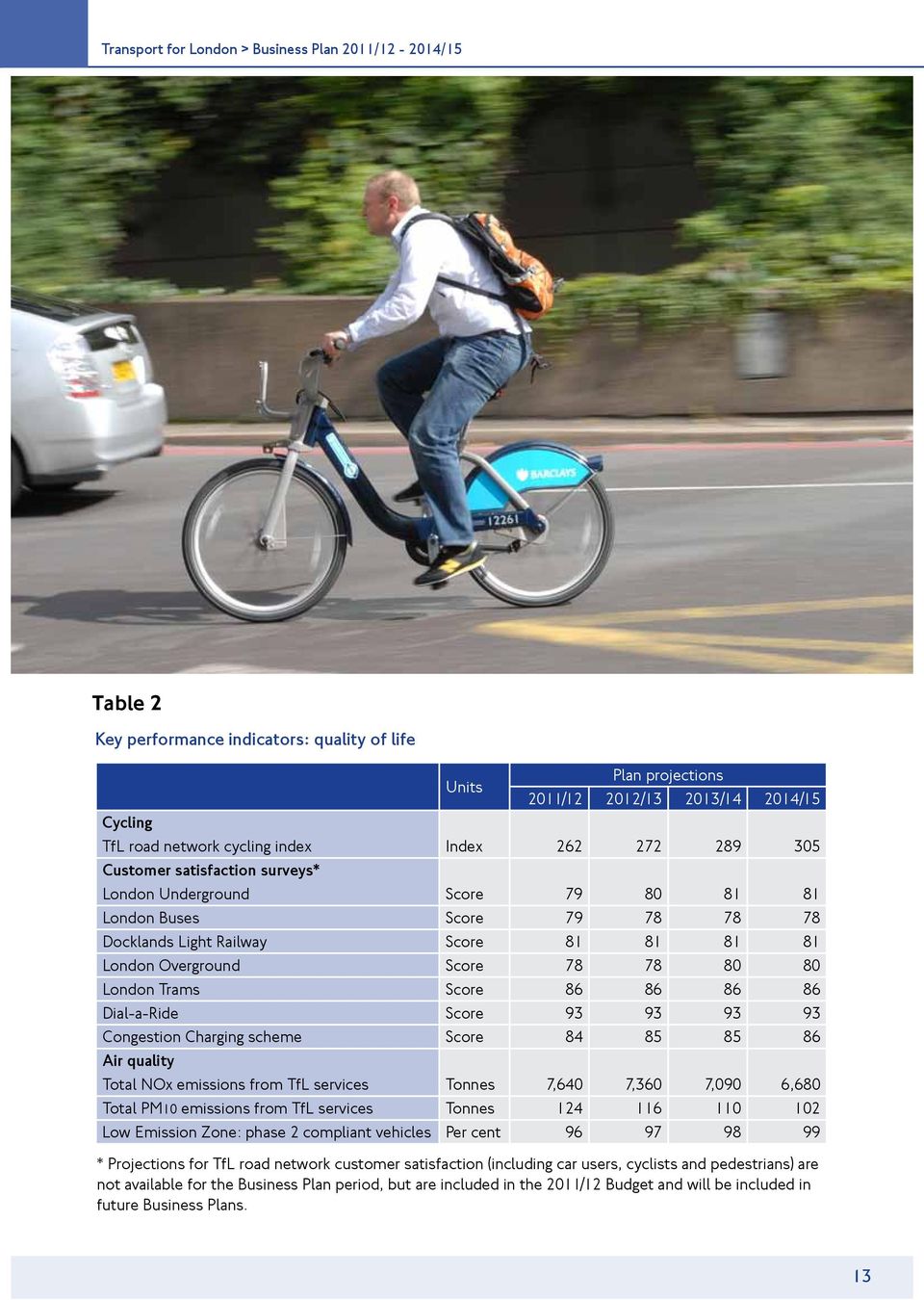
13 Table 2 Key performance indicators: quality of life Units Plan projections 2011/ / / /15 Cycling TfL road network cycling index Index Customer satisfaction surveys* London Underground Score London Buses Score Docklands Light Railway Score London Overground Score London Trams Score Dial-a-Ride Score Congestion Charging scheme Score Air quality Total NOx emissions from TfL services Tonnes 7,640 7,360 7,090 6,680 Total PM10 emissions from TfL services Tonnes Low Emission Zone: phase 2 compliant vehicles Per cent * Projections for TfL road network customer satisfaction (including car users, cyclists and pedestrians) are not available for the Business Plan period, but are included in the 2011/12 Budget and will be included in future Business Plans. 13
14 Improving the safety and security of all Londoners London s public transport network remains a safe, low-crime environment. Levels of crime are at their lowest since records began more than six years ago. In the last three years, overall crime has fallen by 30 per cent on the buses and 20 per cent on the Tube. Violent crime has fallen by 19 per cent on the buses and 15 per cent on the Tube, and surveys show that confidence in personal security, which impacts the use of public transport, has improved. The new trains being introduced on the Victoria and sub-surface lines will have CCTV in every carriage, station upgrades will include improvements to CCTV and communication systems, and all buses are fitted with on-bus CCTV. In addition, TfL will: Work with the London Transport Community Safety Partnership to deliver the actions set out in The Right Direction, the Mayor s strategy to improve transport safety and security in London to 2013, which covers public transport, cycling, road safety and walking. TfL will publish a Community Safety Plan setting out its actions over the next year Work to achieve the most effective structure and deployment of police resources, including establishing additional strategic hub locations, strengthening police capability and improving TfL s ability to respond to additional policing and security challenges, such as those presented by London

15 Further improve the safety of cabs and travelling at night, building on the Safer Travel at Night initiative, and measures to combat illegal touting TfL is committed to work in partnership with the police, boroughs and other stakeholders to ensure further improvements in safety and security, including road safety In 2011, TfL will publish its new Road Safety Plan for London, setting out how a continued reduction in casualties should be achieved based on three themes: making it safer for cycling, walking and motorcycling, in support of the Mayor s cycling revolution; partnership working; and managing speeds. TfL will report annually on progress to achieve further reductions in road casualties in London. Road safety has also improved, with the number of fatalities and serious injuries falling in all categories except cycling, where there has been a slight increase but in a period that has seen a far greater rise in the numbers taking up cycling. Table 3 Key performance indicators: safety and security Units Plan projections 2011/ / / /15 London Underground and Docklands Light Railway: recorded crime per million passenger journeys No London Buses: recorded crime per million passenger journeys No Londoners whose use of public transport is significantly affected by crime and disorder concerns Per cent Cumulative reduction in killed and seriously injured Londonwide (from base) Per cent
16 Improving transport opportunities for all Londoners TfL s aim is to address the barriers physical, communication or financial that may deter people from using the transport network and ensure that development of the network supports London s regeneration aspirations. Both Crossrail and Phase 2 of the East London line extension to Clapham Junction, which will complete London s orbital railway in 2012, will open up new transport and employment opportunities to some of the Capital s most deprived areas. TfL will continue to work closely with the Greater London Authority (GLA), boroughs and other stakeholders to develop opportunity area planning frameworks, to ensure the appropriate level of transport capacity and connectivity is provided to support the growth targets set out in the London Plan. Further planned accessibility improvements include: All new central London Crossrail stations will be step-free, meaning that 93 per cent of all passenger trips on Crossrail will both start and end at a station with step-free access Step-free access schemes are being introduced as part of all major Tube station developments at key locations including Victoria and Tottenham Court Road. The number of step-free access stations on London Overground will increase from 18 to 20 by 2012/13 Wide-aisle gates will be installed at a further 60 stations, making travel easier for disabled passengers and those with pushchairs or luggage. In addition, frontline staff will be deployed to areas where they can be of greatest assistance to customers Much has been and is continuing to be done to make services accessible to all. More than 90 per cent of Londoners live within 400 metres of a bus stop, and the Capital s entire fleet of more than 8,000 buses (except Heritage Routemasters) are accessible for mobility-impaired people, providing vital links for vulnerable groups. DLR and Croydon Tramlink services are all accessible from street to carriage. On the streets, more than twothirds of signalised pedestrian crossings are accessible to disabled people. 16

17 Reducing transport s contribution to climate change and improving its resilience The MTS confirms that transport will be required to contribute to a target of reducing London s carbon dioxide (CO2) emissions by 60 per cent by 2025 from a 1990 base. Ground-based transport accounts for about 22 per cent of London s CO2 emissions. TfL is taking action in a variety of ways. By providing a fast, safe and reliable public transport service, and investing in sustainable modes, such as walking and cycling, TfL aims to ensure a real alternative to private car journeys is available, contributing to modeshift and a reduction in emissions. Measures being taken by TfL to reduce the environmental impact of the services it provides include: Trialling 56 diesel-electric hybrid buses with 300 in service by the end of In addition, the New Bus for London will be hybrid Eight zero-emission hydrogen hybrid buses will be introduced on route RV1, which runs from Covent Garden to the Tower of London Energy-efficiency measures on all new rolling stock, including utilising regenerative braking, which recycles up to 25 per cent of energy, and trialling a range of energyefficient and renewable energy measures at stations to showcase the CO2 and cost reduction possibilities TfL is supporting the Mayor s programme to encourage car clubs and electric vehicles, including through supporting the installation of 1,300 charging points across London by 2013 As a result of TfL s measures, it is expected that CO2 levels per passenger-kilometre on TfL s services will have decreased by 2015 TfL recently reviewed the risks of climate change impacting on its assets and services, for example through increased temperatures or flooding. These risks are considered as part of the investment planning process and inform strategies to maintain and renew TfL s assets, including rolling stock, infrastructure and the bus fleet. Table 4 Key performance indicators: climate change Plan projections Units 2011/ / / /15 CO 2 per passenger-kilometre from TfL services Grammes
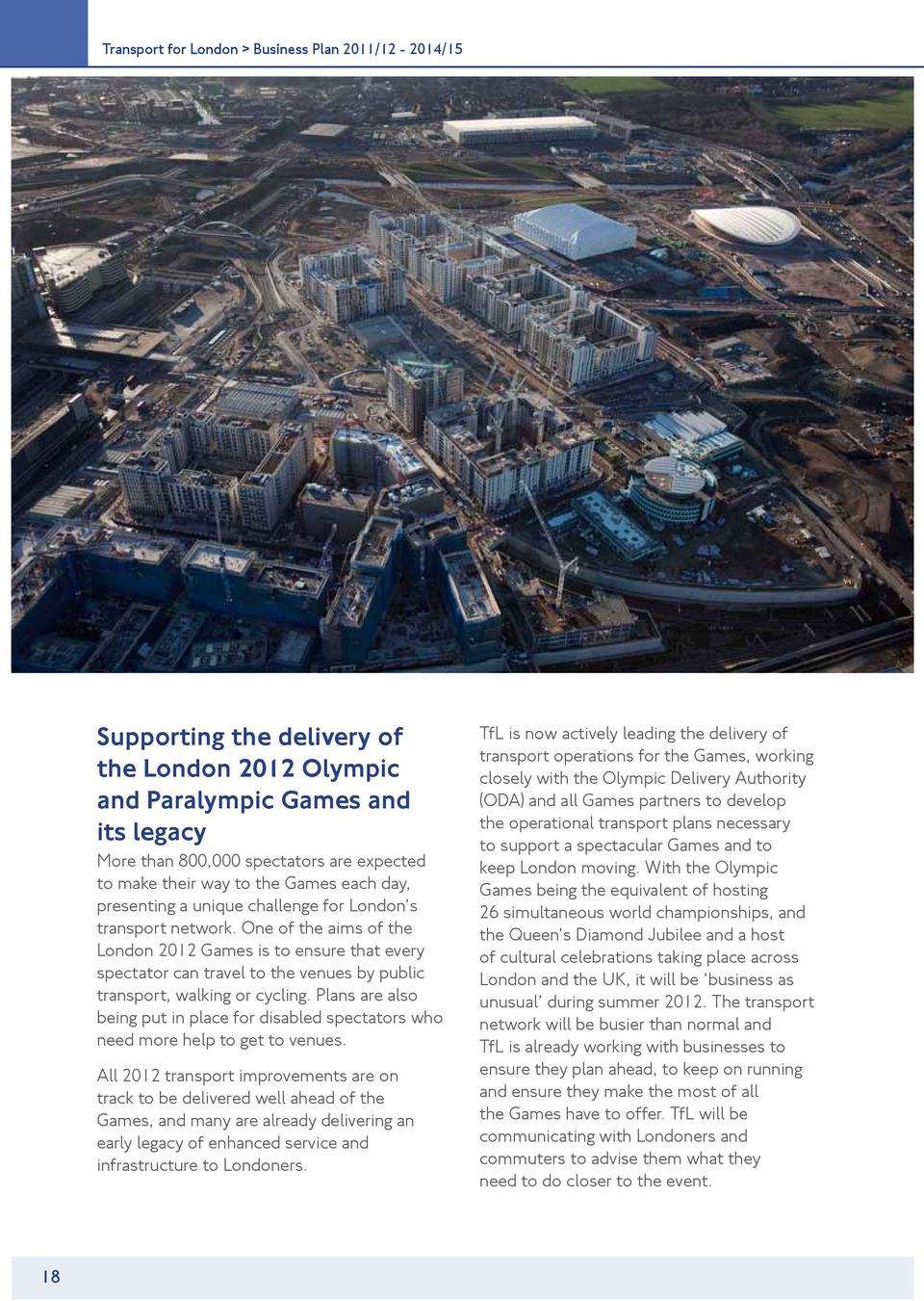
18 Supporting the delivery of the London 2012 Olympic and Paralympic Games and its legacy More than 800,000 spectators are expected to make their way to the Games each day, presenting a unique challenge for London s transport network. One of the aims of the London 2012 Games is to ensure that every spectator can travel to the venues by public transport, walking or cycling. Plans are also being put in place for disabled spectators who need more help to get to venues. All 2012 transport improvements are on track to be delivered well ahead of the Games, and many are already delivering an early legacy of enhanced service and infrastructure to Londoners. TfL is now actively leading the delivery of transport operations for the Games, working closely with the Olympic Delivery Authority (ODA) and all Games partners to develop the operational transport plans necessary to support a spectacular Games and to keep London moving. With the Olympic Games being the equivalent of hosting 26 simultaneous world championships, and the Queen s Diamond Jubilee and a host of cultural celebrations taking place across London and the UK, it will be business as unusual during summer The transport network will be busier than normal and TfL is already working with businesses to ensure they plan ahead, to keep on running and ensure they make the most of all the Games have to offer. TfL will be communicating with Londoners and commuters to advise them what they need to do closer to the event. 18
19 TfL is confident it will meet the Games transport challenge, and also help deliver a behavioural legacy from which future generations will benefit. To help achieve this TfL is overseeing infrastructure schemes, improvements to greenway routes for cyclists and pedestrians, and leading the delivery of transport operations outlined below: The upgrade of the Jubilee line, delivering 33 per cent additional capacity Step-free access and interchange at Green Park and step-free access at Southfields Major work at Stratford Regional station including a second platform for the Central line, a reopened subway, new step-free access lifts and two new ticket halls in partnership with Westfield s Stratford City shopping centre DLR extension from Canning Town to Stratford International New trains and signalling on the extended London Overground network Three-car capacity increase on the DLR network Extension of Barclays Cycle Hire to east London Enhanced walking and cycling routes into the Olympic Park and improvements to Greenwich and Tower piers for river services 19

20 Getting to the Games The aim is for all spectators to get to the Games by public transport, or by walking or cycling. TfL is leading the delivery of transport operations and is working with other transport providers to achieve this, by integrating plans with those of National Rail, including Javelin services. For example, there will be no planned engineering works on the Tube or National Rail during the Games. The Jubilee, Central, Hammersmith & City and District lines, London Overground and the DLR all serve the Olympic Park and will be critical to transport customers to the Games. Lines will have a third peak on days when the Olympic Stadium is in use. This provides an increase in the frequency of trains in the evening to transport spectators home when the events finish. An increase in the evening train frequency will also be made during the Paralympics. All lines will close later throughout the Olympic Games, ensuring that everyone can take full advantage of the night-time activities taking place across London. In addition to the investment at Stratford, West Ham will have a temporary walking route to connect the District and Hammersmith & City lines directly to the Greenway, the main walking route to the Olympic Park for spectators arriving from the south. To help achieve the aim of 100 per cent of spectators to access venues by public transport, walking or cycling, TfL is managing enhancements to routes for cyclists and pedestrians, linking the Olympic Park and River Zone venues across a number of London s boroughs. Supporting this is an Active Travel Programme to promote cycling and walking and encourage Londoners and visitors to adopt these forms of travel. To ensure journey times are maintained and that passengers have reliable trips across the road network, TfL is working with utilities companies and boroughs to minimise planned roadworks during the Games and implementing temporary road space management schemes. 20

21 These include: Olympic Route Network and Paralympic Route Network (ORN/PRN) The aim is to ensure that journey times for athletes and the people who make the Games happen remain reliable across the network, that journey times required by the Host City Contract on the ORN/PRN are delivered, and that events are run and incidents are responded to in a timely and effective manner on the network. Road events TfL has a responsibility for delivering the road closures to facilitate the road events such as the marathons and road cycling, planning and managing movements in central London. Movement management The road events and other Games-related activities will bring thousands of people to the streets of London. Movement management aims to ensure that pedestrians and spectators are able to move around in central London in safety and that access is maintained to premises for those living or working in the area. Games family transport TfL staff have been seconded to the London Organising Committee of the Olympic Games (LOCOG) transport team to procure, plan and contract manage Games family transport services for 26,000 athletes and team officials, 26,000 media and 1,500 technical officials. Locking in legacy Millions of Londoners are already benefiting from a transport legacy before the Games begin. On behalf of the Mayor, TfL is developing, in partnership with the six host boroughs, the Olympic and Paralympic Transport Legacy Action Plan, for publication later this year. This will help ensure that the transport legacy supports convergence : the aspiration that within 20 years, the communities who host the 2012 Games will have the same social and economic chances as their neighbours across the Capital. 21
22 22
23 Figure A Delivery schedule summary for key TfL infrastructure schemes This diagram sets out the planned delivery timetable for key TfL infrastructure schemes supporting delivery of the MTS, which are funded and for which significant activity is planned during the period of this Business Plan. Financial year 2011/ / / /15 Crossrail London Underground Line upgrades - Jubilee line - Victoria line - Northern line - Sub-surface railway* signalling upgrade - Sub-surface railway* rolling stock upgrade - Deep Tube - first prototype for the new train - Piccadilly and Bakerloo lines Congestion relief and station upgrade schemes - Green Park step-free access - Tottenham Court Road congestion relief scheme - Paddington (Hammersmith & City line) congestion relief scheme - Bond Street congestion relief scheme - Victoria congestion relief scheme - Bank congestion relief scheme London Overground - East London line 13 additional trains - East London line Phase 2 extension to Clapham Junction - North London line station upgrades (44 stations) Docklands Light Railway - DLR extension to Stratford International - DLR 3-car capacity increase Cable Car - Cable Car between the Greenwich Peninsula and the Royal Docks London Buses - New Bus for London (five prototype buses in service) - Hydrogen hybrid buses on RV1 route (Covent Garden - Tower of London) (tbc) Countdown 2: real-time service information via web and mobile phones - Dial-a-Ride vehicle replacement London Streets and Surface infrastructure - SCOOT - roll-out to 1,000 sites - A406 Bounds Green - A406 Henlys Corner - installing signalised pedestrian crossings - Tottenham Hale - Blackwall Tunnel northbound refurbishment - LEZ extension - Installation of 1,300 electric vehicle charging points Cycling - 12 Barclays Cycle Superhighways - Extension of Barclays Cycle Hire to East London Other projects - Future Ticketing Programme 2015 *Sub-surface railway includes the District, Circle, Hammersmith & City and Metropolitan lines. 23
24 Efficient and effective business operations TfL successfully made the case for a Spending Review settlement that secured key outcomes such as Crossrail and the Tube upgrade. A key element of TfL s case was that TfL has led the public sector in its efforts to improve value for money, year on year. Starting with the sharing of finance and Human Resources (HR) transactional services across the TfL Group, the programme has since grown to incorporate successive reviews of TfL s operations and costs. This represents an ambitious cost reduction programme that covers all areas of TfL, with a particular focus on back office and support function. The savings target has grown to 7.6bn, net of implementation costs, over the period to 2017/18. Around one third of the 7.6bn target has already been secured through initiatives that have already been implemented, for example: Integrating Metronet with London Underground (LU), saving 1,000 roles Packaging nearly 100 separate maintenance service contracts into four main contracts, generating economies of scale, reducing administrative costs and increasing competition The re-letting of the Congestion Charge and Oyster ticketing contracts The removal of 800 operational roles in LU and deployment of front-line staff to more visible roles, while avoiding compulsory redundancies. This follows the success of Oyster in enabling a reduction in ticket office opening hours and the rationalisation of operational management structures Bus network contract savings contributing to a 40 per cent reduction in bus subsidy by 2014/15 compared with 2008 forecast with overall network kilometres operated remaining broadly constant Accommodation savings, including a move to cheaper locations and a reduction in desk capacity by more than 1,300 workstations during 2010/11 Reductions in marketing spend A two-year pay freeze for senior managers The reduction in funding following the Spending Review necessitates further action, including a 20 per cent saving in non-operational staff costs (in addition to pre-existing savings programmes) if vital investment is to continue as planned. To ensure that this stretching target is met, the Commissioner has launched a fundamental review of TfL s structure. Project Horizon is looking to streamline decision-making and eliminate duplication, improve accountabilities and adopt new and flexible ways of working, to ensure that TfL is well placed to protect front-line services and deliver further value for money. Implementation is planned for later this year. 24
25 Table 5 Savings targets ( m) Prior years 2011/12 Budget 2012/ / / / /18 Total 2009/ /18 London Underground ,694 4,215 Surface Transport ,904 Corporate and Group-wide ,762 London Rail Total Gross Savings ,017 1,038 1,123 3,086 8,011 Less one-off (378) implementation costs Total Net Savings 7,633 The remainder of the target comprises several hundred costed initiatives, all of which are either under way or planned, for example: London Underground A reduction of around 800 back office roles following a review of support services Use of more efficient maintenance practices to drive down unit costs Capital programme savings, in part by taking advantage of the flexibility offered by the acquisition of Tube Lines to maximise synergies between the line upgrade programmes Surface Transport Reduced staffing levels following an organisational redesign in the Better Routes and Places Directorate Better commercial exploitation of assets through developing roadside space for advertising on the Transport for London Road Network (TLRN) Reduced bus service monitoring costs through the use of technology delivered under the ibus programme Introducing pan-london road maintenance contracts, in partnership with the boroughs Corporate and Group-wide Savings in HR through moving to a single HR function, developing a strategic resourcing function to help drive the continued reductions in temporary workers and consultants, and developing a talent management capability to reduce recruitment costs Continued disposal of surplus office space Commercial savings from all parts of the organisation, particularly through better coordination of TfL s buying requirements in key categories Reducing the cost of customer contact centres, including through the use of natural language technology Although undoubtedly challenging, the determined leadership and culture of cost-consciousness across TfL means the organisation can be confident that the savings target will be delivered. Savings achieved will continue to be reported publicly, as part of TfL s quarterly Operational and Financial Reports. 25
26 Crossrail Go-ahead for the vital Crossrail project was secured by the Mayor under the October 2010 Spending Review. Crucial to London s future, Crossrail will generate an estimated 42bn boost for the UK economy. The project supports the goals set out in the MTS in three important respects. It will: Support sustainable economic development and population growth by increasing transport capacity and reducing congestion on the existing transport network Improve transport journey-time savings through connectivity Bring wider benefits such as regeneration and enhanced accessibility (particularly for people with restricted mobility), and through reducing car journeys, leading to fewer road accidents and environmental improvements The new railway will link the Outer suburbs east and west of London with fast, frequent, high-capacity services to the City, the West End, Heathrow Airport and Docklands. Crossrail benefits Outer and Inner boroughs and also provides a new river crossing in east London, benefiting the Thames Gateway and south east London. A total of 21km of new tunnels will be built. New central London stations will integrate with LU at Paddington, Bond Street, Tottenham Court Road, Farringdon, Liverpool Street and Whitechapel. There will be also new stations at Canary Wharf, Custom House and Woolwich. Following a review of plans undertaken as part of the Spending Review, services will begin in phases, with the first new trains coming into passenger service by the end of 2016 on existing Network Rail suburban services into Liverpool Street station. Crossrail services will start operating in the central tunnel section during Figure B Crossrail route map and frequency diagram Route map Taplow Slough Iver Maidenhead Burnham Langley West Drayton Hayes & Harlington Heathrow Southall Hanwell West Ealing Ealing Broadway Bond Street Farringdon Whitechapel Acton Paddington Tottenham Liverpool Main Line Court Road Street Stratford Canary Wharf Maryland Forest Gate Custom House Manor Park Woolwich Ilford Abbey Wood Goodmayes Romford Seven Kings Chadwell Heath Gidea Park Harold Wood Brentwood Surface line Tunnel Portal (tunnel entrance and exit) Shenfield Frequency diagram Shenfield Maidenhead 6 Paddington Whitechapel 12 4 West Drayton Abbey Wood 12 Trains per hour Heathrow Canary Wharf 26
27 Supporting London s growth and relieving congestion London s existing transport network is already highly congested, particularly during peak periods, with further growth in population and employment exacerbating conditions. Crossrail will expand London s rail network capacity by 10 per cent the biggest single increase in the Capital s transport capacity since 1945 and reduce crowding by up to 60 per cent on many Underground lines, as well as on DLR and Southeastern train services. Crossrail will have a broader impact on the Capital too, supporting growth and regeneration and making it a more attractive place in which to live, work and do business. More than 35 per cent of the future employment growth in London is expected to occur in areas served by Crossrail and it will provide more than 1.5 million additional people with quick, direct access to the heart of the Capital (Figure C below). Furthermore, Crossrail will support economic growth across London, increasing earnings for individuals and businesses that are not directly on the route, as set out in the Mayor s proposals for a new Community Infrastructure Levy (CIL). Figure C 27
28 Improving connections and reducing journey times Crossrail will significantly improve connections between different parts of the transport network across London and the South East. Crossrail will link with nine Underground lines as well as the DLR, Overground and a number of National Rail services, particularly at Paddington and Liverpool Street stations. It will directly connect Outer London suburbs to central London without the need to change trains, leading to shorter journey times and improved accessibility. Table 6 Crossrail - impacts on example journey times Example journeys 2010 existing journey time Crossrail journey time Slough to Tottenham Court Road 55 minutes 36 minutes Ilford to Bond Street 35 minutes 22 minutes Heathrow to Liverpool Street 55 minutes 36 minutes City/Liverpool Street to Abbey Wood 40 minutes 22 minutes Paddington to Canary Wharf 30 minutes 17 minutes An artist s impression of Whitechapel Crossrail station 28
29 Wider benefits All new Crossrail stations in central London will have step-free access from street level to the Crossrail platforms, and 30 of the 38 stations will be step-free. It is estimated that 93 per cent of all passenger trips on the new link will start and end at a station with stepfree access. The new trains will meet or exceed current accessibility requirements, with wide doors and aisles, plenty of handles and dedicated spaces for wheelchairs. All Crossrail stations will be well lit, CCTV monitored and staffed throughout the day to provide a safe and secure environment. It is also expected to reduce the need for car trips to central London, Canary Wharf and Heathrow, reducing pressure on road traffic by two per cent overall across London. As a result, London s total carbon emissions will be reduced by more than 1,300 tonnes a year, contributing to the wider goal of reducing carbon emissions in the Capital. Improvements to the wider public realm at Crossrail stations will include better pavements, crossings and cycling facilities. Joint urban realm planning studies will be carried out with local authorities. Crossrail s construction will support regeneration in places such as Ealing, Whitechapel, Custom House, Woolwich and Stratford. Crossrail implementation Construction of the Crossrail project officially began on 15 May 2009 with the start of building works at the Canary Wharf station. Enabling works in a number of locations across London have commenced. Crossrail is currently in the middle of the procurement stage for the main works. Main tunnelling contracts were awarded in December 2010, and tunnelling starts in Tender processes are under way for rolling stock, depot works and other central section works such as stations. Work on stations and tracks on the existing surface railway which will be served by Crossrail will be carried out by Network Rail. The exact start and duration will vary. At the peak of construction, between 2013 and 2015, up to 14,000 people will be employed on the project. The construction of Crossrail will generate waste and excavated material, mainly from the tunnels, with the remainder arising from demolition and construction activities. Crossrail is committed to reduce, reuse and recycle waste and has committed to halving the amount of construction, demolition and excavation waste going to landfill by Crossrail has adopted an objective to remove, where reasonably practicable, excavated material by rail and water transport and to import construction materials by rail. Current projections show that on a tonne per kilometre basis, 85 per cent of excavated material will be transported by rail and river. Crossrail has carried out flood risk modelling for 2100 to establish flood design levels for stations, portals and shafts. Plans to mitigate these risks include raising entry or egress levels, raising track, or extending portal walls. Where there is still some residual flood risk at certain points then appropriate active flood protection measures and procedures have been identified, such as flood gates and stop logs. 29
30 An artist s impression of Paddington Crossrail station Crossrail funding As part of the Comprehensive Spending Review, more than 1bn in project savings has been identified through station and engineering improvements and a more efficient construction timetable. Crossrail is the responsibility of Crossrail Ltd (CRL), a wholly owned subsidiary of TfL, and is jointly sponsored by TfL and the Department for Transport (DfT). Crossrail is fully funded within TfL s Business Plan. This is set out, including the DfT s funding commitment, in Table 7. The remainder of the construction cost will be met by third-party finance, including from Network Rail. 3.5bn of debt raised by the GLA, as well as providing a direct contribution to the project during the construction period. The Mayor is also expecting to raise almost 600m in contributions from property development, through a new Section 106 policy implemented during 2010, as well as from the CIL to be applied to developments across the Capital, primarily in Central London and Docklands. Around 440m is expected to be raised through sale of surplus land and property developments on top of the new stations. The Mayor introduced a Business Rate Supplement in 2010/11 of two pence in the pound. This will support the cost of servicing 30
31 Table 7 Crossrail financial summary ( m) Prior years 2011/12 Budget 2012/ / / / /19 Total 2008/ /19 Income (0) (0) (0) (0) (0) Operating expenditure (0) (0) (1) (1) (11) (901) (914) Net operating expenditure (0) (0) (1) (1) (11) (457) (469) Sponsors funding commitment (2,246) (1,205) (1,904) (2,247) (2,002) (2,652) (12,257) Cash required (incl. Crossrail train operations) (2,246) (1,205) (1,905) (2,248) (2,013) (3,109) (12,727) Funded by: External funding sources of which: 1,394 1,390 2,059 2,068 1,693 1,638 10,242 --DfT committed funding ,205 1,123 1, ,119 --GLA funding (incl. Crossrail Business Rate Supplement) 1, (0) 4,103 --Developer contributions (0) Sale of surplus land (0) (0) (0) (0) (0) Cash funding from TfL Group 852 (185) (154) ,471 2,485 Total funding 2,246 1,205 1,905 2,248 2,013 3,109 12,727 31
32 London Underground and London Rail London Underground The growth of London and its economy means the Tube carries ever more passengers and must seek continual improvements in reliability and volume of service to support them. This in turn means that ongoing investment in London s transport infrastructure is vital for the Capital and the wider UK economy. In the past year more than 1.1 billion journeys were made on the Underground; the busiest year in the Tube s 148-year history. An even greater number of trips will be made in 2011 and this impressive increase is occurring despite the recent recession. To support this growth, it is critical that life-expired systems are renewed. As a result, investment during the period of this Business Plan is in: Upgrades to trains and stations to replace life-expired assets and increase capacity Improving the condition of the core assets (track, civil infrastructure, lifts, escalators and stations) to increase reliability and allow the benefits from the upgrades to be realised To enable this essential investment to continue in the face of reduced funding, substantial new programmes of operational cost savings have been developed. For the first time in years, total income is forecast to exceed operating expenditure by the end of the Business Plan period, unlocking investment which will help produce a fast, frequent and reliable train service that provides the capacity needed for London to grow. 32
33 Upgrades As the world s oldest metro system, the Tube has infrastructure that dates back to the 1860s and some signalling equipment that is almost 90 years old. In recent years, LU has made substantial progress in its programme to replace life-expired equipment. This offers the opportunity to take advantage of modern technology and increase the network s capacity to meet future demands. Line upgrades are at the heart of the Underground s transformation. The Jubilee line will be completed in Next to be completed in 2012 will be the Victoria line. This will be followed in later years by the Northern and sub-surface lines (Circle, District, Hammersmith & City and Metropolitan lines). Across the network new trains and signalling systems will allow more frequent services and quicker, more comfortable journeys. Work has also begun on designing the next generation of lowenergy, high-capacity Tube trains for the Piccadilly, Bakerloo and Central lines. Together the line upgrades will provide the transformation of the Underground, increasing capacity by 30 per cent. This represents the greatest investment in LU in its history, and provides as much additional space as building three more Jubilee lines. The scale of the task to upgrade the Tube unfortunately means some disruption to services, often at weekends. TfL s acquisition of Tube Lines in 2010 allows greater flexibility in how the works are carried out, which should lead to significantly reduced levels of passenger disruption. In addition, TfL will consider other options such as extended closures, involving part of a line being closed for a period of weeks to accelerate works and allow it to be undertaken more efficiently. In such cases, TfL will always seek to ensure that alternative travel arrangements are available. 33
34 Jubilee line upgrade Due for completion: 2011 Tube Lines failure to meet the original contractual date was a significant driver for TfL s purchase of the company. Following the acquisition, which also brought to an end the complexity and inefficiency of the Public Private Partnership (PPP), TfL has finally been able to move the upgrade project forward so that it is now a realistic, credible, well-organised scheme now nearing completion. This upgrade involves replacing the signalling and train control system, allowing more trains to run. Trains now operate on a large part of the line under the control of the new signalling system. Taking advantage of the upgraded assets, new timetables will be introduced incrementally to increase capacity by 33 per cent equivalent to 5,000 more passengers an hour and reduce journey times by 22 per cent. Victoria line upgrade Due for completion: 2012 The Victoria line is receiving its first major investment in 40 years, with original train and signalling equipment being replaced by modern, reliable technology. More than half of the new train fleet is already in use. These trains are faster and have greater capacity, better ventilation and CCTV in every carriage. By the end of 2011, all new trains will have been delivered and journey times will start to be reduced, with enhancements to service being introduced in stages. On completion the upgrade will have: More trains running during peak hours (rising from 27 to 33 trains an hour) Improved ventilation throughout the line by replacing fans at 13 vent shafts Better accessibility with dedicated wheelchair spaces and level access at most stations These improvements will bring faster and more comfortable travel, with journey times reduced by 16 per cent and capacity increased by 21 per cent. 34
35 Northern line upgrade Due for completion: 2014 The Northern line is the busiest and most complex on the network, carrying more than 800,000 passengers a day. When TfL acquired Tube Lines it decided to delay the Northern line upgrade. This partly reflected the delayed programme LU inherited from Tube Lines on the Jubilee line, but it also enabled TfL to build on experience gained from the Jubilee programme, and will result in substantially fewer closures and less disruption for passengers. As part of the upgrade, a new control centre, computerised signalling and Automatic Train Control system will be installed, using technology similar to that on the Jubilee line. These improvements will enable trains to run closer together and at higher speeds, reducing journey times by 18 per cent and increasing capacity by 20 per cent. A further scheme is under development to increase service frequency and line capacity through a simplified service pattern and use of additional trains. This would provide greater congestion relief to the most crowded sections of the line. Preparatory works to enable this improvement are due to begin in Sub-surface railway: District, Circle, Hammersmith & City and Metropolitan lines Due for completion: 2018 The sub-surface upgrade is the largest part of the investment in the Underground. It consists of 191 new trains, a new computercontrolled signalling system, a single-service control centre to replace the current multiple locations, power upgrades and extensive train depot improvements. Serving all four lines, the trains have walkthrough carriages and, for the first time on the Tube, air-conditioning in all carriages. The new trains are initially being operated on the Metropolitan line, which is expected to have its existing fleet replaced by the end of The Circle, Hammersmith & City and District lines will follow and be completed by On the Circle and Hammersmith & City lines, trains will be longer than today s vehicles with an additional carriage, increasing capacity by 17 per cent. In addition, they will be fitted with CCTV throughout and better customer information systems. The new signalling will allow the trains to run more frequently and with reduced journey times, as well as enabling a more reliable service by replacing life-expired equipment. The new signalling contract will be signed in 2011, allowing this critical phase of the project to start. Deep Tube programme: Piccadilly and Bakerloo lines First prototype for the new train will be delivered in 2015 TfL s acquisition of Tube Lines has created the opportunity for a joint approach to the Piccadilly and Bakerloo line upgrades which should deliver substantial savings. A common design will be used for trains on both lines, reducing their cost and lessening passenger disruption. 35
36 Passengers will travel in more capacious trains that use less energy and emit less heat using technological developments now becoming standard in the industry. Being more energyefficient, the trains will reduce the investment required in power upgrades and lower the quantity of CO2 emitted. They will also be more accessible and, as with the new subsurface line trains, passengers will be able to walk through them, extending capacity. A prototype for the new train will be delivered in 2015 and the first full fleet replaced by the end of the decade. The question of whether to replace the Piccadilly or Bakerloo line fleet first is now being considered. This design will also be used to replace the fleets on the Central and Waterloo & City lines, reducing costs through common components and maintenance. To ensure both lines continue to operate reliably until the introduction of new trains and signalling under the Deep Tube programme, small-scale life-extension works are planned for the Bakerloo and Piccadilly line rolling stock fleets. The Piccadilly line signalling control system, based at Earl s Court, dates from the 1960s and it is increasingly expensive to maintain. The system will be gradually replaced by a new control centre at Hammersmith by 2014, reducing the risk of disruption to services. Figure D Line upgrades W&C 25 Jubilee 33 First new train All new trains Victoria 21 Northern 20 % Percentage increase in peak hour passenger capacity Line upgrades First new train All new trains Hammersmith & City 65 Circle 65 First new train All new trains Metropolitan 27 RoadFirst new train All new trains District 24 Piccadilly (date tbc) Bakerloo (date tbc) Central (tbc) Full 'sub-surface' lines upgrade complete by 2018; some of these lines may be completed earlier dates tbc
37 Core asset renewal Reliable core assets are at the root of all the improvements resulting from the line upgrades. TfL s investment will lead to track, bridges, tunnels, lifts and escalators that are reliable and fit for purpose and cause fewer delays. The Business Plan contains a steady, sustainable programme of renewal. By 2015, disruption to passengers journeys will have decreased by 18 per cent. Power LU is working to establish new ways of sourcing de-centralised and renewable energy. New processes are being put into place that can help LU work with energy companies under the Government s current Feed in Tariff rules. It is also exploring possible partnerships with local energy providers in London. The reduction in funding for TfL has forced a change to the scope and speed of station improvements. The most important work will still be carried out, and almost all stations will see some enhancement by However, TfL will focus on the key improvements in CCTV, communications equipment and building fabric that keep stations safe and operable. 37
38 Customer experience At the heart of TfL s investment in the Tube is a commitment to customer service. This Business Plan sets out the capital investment plans that are vital to support a more reliable service and allow growing demand to be accommodated. TfL continues to focus on providing consistently high standards of service to Tube passengers, concentrating on timely information, personal security and personal service where required. Technology can provide the opportunity to improve service at a reduced cost. Ticketing technology improvements, for instance, will speed up passengers journeys as they spend less time purchasing fares. As demand for ticket office has fallen, staff are being deployed to station areas where they can more directly assist passengers and provide the best possible service. The result will be improved customer service and reduced costs. LU s customer satisfaction levels are already at a record high. The investment in assets and focus on customer care will see this improve further. 38
39 An artists s impression of Bressenden Place at Victoria station Station capacity Extensive improvements are needed at certain key stations and interchanges to relieve congestion and increase capacity. These are critical to the functioning of the Underground as an integrated network, both for existing passenger flow and for future increases in demand. The stations funded within the Business Plan are those with the most pressing need. There will remain stations where congestion can impede reliable service. TfL recognises that, as volumes increase, a continuous programme to relieve congestion at the busiest stations will be necessary, subject to available funding. Major work will take place during the Business Plan period at the following stations to increase capacity and reduce overcrowding. Victoria A new ticket hall will be built beneath Bressenden Place and the existing ticket hall will also be rebuilt to provide greater capacity. The upgrade work will improve the interchange between the Victoria, District and Circle lines and allow step-free access from the street to all Tube platforms. Nine new escalators to the Victoria line will be installed. Victoria station will remain open throughout the works. Although some disruption is inevitable, TfL will provide information to ensure customers are updated about the works and can make alternative plans when this is necessary. The new northern ticket hall will open in 2016 and the full scheme will be completed in This programme will ensure that benefits from the upgrade to the Victoria line, where capacity will be increased by 21 per cent, are fully realised. 39
40 Artists s impressions of the interior and exterior of Tottenham Court Road station Paddington (Hammersmith & City) This scheme provides a new ticket hall, extra staircase and lifts for step-free access from street to both platforms. This trebling of capacity, due for completion in 2014, will meet the increased demand for the Hammersmith & City line now that the service frequency has doubled between Paddington and Hammersmith. This will also support the enhancements from the Network Rail station redevelopment, Crossrail and wider Paddington-region development. Tottenham Court Road Work to rebuild Tottenham Court Road station is well under way. Surrounding properties have been demolished and excavation and piling is in progress. This is already an important interchange station and will become even busier when the Northern line upgrade is finished and Crossrail services begin. Once completed, passengers per day using the station will increase from 150,000 to 200,000. To supplement these developments, significant improvements in capacity must be made. Plans include a new ticket hall six times larger than at present, with separate escalators to the Northern line, more space in congested areas and step-free access from street to all platforms. The work also involves other escalator improvements and a new public piazza at St. Giles Circus. The new ticket hall will be operational from 2016, and the full scheme will be completed by
41 Bank The growth in traffic to the City as the economy recovers has resulted in Bank station becoming increasingly crowded, particularly at the Northern line platforms. With space constrained, it is a challenge to provide new capacity while maintaining service. A plan, similar to past works at Euston station, is in place to widen the platforms and concourse to provide extra capacity for the Northern line and relieve some severely congested areas. Additional step-free access and improvements to signage and customer information will be completed by A new entrance, with street to platform step-free access, will be constructed for the Waterloo & City line at Walbrook Square by 2015 as part of the planned office development above the station. This will reduce journey times for passengers and reduce overcrowding in the existing ticket halls. Bond Street Work is under way at Bond Street to relieve congestion caused by increasing demand for the Jubilee and Central lines (and interchange between them). This project also prepares the station for Crossrail, which, once opened, will further increase the demand for Tube services. The scheme will provide capacity for an expected increase in passenger numbers (from 155,000 to 225,000 passengers a day) once Crossrail is running. The scheme includes new escalators, a new interchange passageway, a new entrance and ticket hall and step-free access to all platforms. TfL has purchased the property that stands on the site for these works and demolition has begun. Throughout the works there will be the minimum possible disruption to passengers and access to Oxford Street. Work will be completed by Figure E Station upgrades Major station upgrades King s Cross St. Pancras Tottenham Court Road Paddington Bond Street Victoria Bank
42 Third-party station schemes In addition to the network-critical schemes specified above a number of other significant projects are being carried out in partnership with third parties. The Thameslink programme will provide step-free access and an expanded ticket-office at Farringdon station. At Blackfriars, the Underground station is currently closed for a complete rebuild. It is due to re-open this year with step-free access to both platforms. As part of the wider development of Cannon Street National Rail station and Cannon Place, the LU ticket hall and station entrance are being modernised. Step-free access is being provided between National Rail, street, ticket hall and platform (westbound only). Work will be completed by ( m) 2011/12 Budget Accessibility TfL continues to focus on improving the accessibility of the Underground, including the number of step-free, platform-to-street Underground stations, with the total reaching 65 in Green Park, a key Olympic interchange station, will become step-free from street level to all platforms this year. Further step-free access projects will be completed as part of wider schemes to reduce cost and disruption. As the line upgrade programme continues, improvements are being made to minimise the gap between train and platform. In addition, around a further 60 stations will receive the wide-aisle ticket gates that make travel easier for disabled passengers and those with pushchairs or luggage. Table 8 London Underground and Tube Lines income, operating and capital expenditure plan 2012/ / /15 Total 2011/ /15 Income Traffic revenue 1,909 2,094 2,253 2,446 8,702 Secondary revenue Total income 2,099 2,299 2,471 2,679 9,547 Operating expenditure (incl. third-party contributions) Operating expenditure (1,895) (1,910) (2,000) (2,048) (7,854) Tube Lines operating expenditure (428) (450) (458) (441) (1,777) Total operating expenditure (2,323) (2,360) (2,458) (2,489) (9,631) Net operating expenditure (225) (62) (84) Capital expenditure (incl. third-party contributions) Capital expenditure (1,087) (1,164) (1,232) (1,144) (4,627) Tube Lines capital expenditure (385) (254) (216) (190) (1,045) Net capital expenditure (1,472) (1,418) (1,448) (1,334) (5,672) Net expenditure (1,696) (1,479) (1,436) (1,144) (5,755) 42
43 London Rail Following the completion of work to expand the London Rail network, focus will be on completing outstanding projects and improving its quality and reliability. This will enable the network to play an integral part in serving the London 2012 Olympic and Paralympic Games. The programme of capital works remaining includes: The completion of a portfolio of capital projects on the DLR The completion of London Overground s orbital network The development of a cable car to span the River Thames TfL has been working with the train operating companies, such as Southern Railways as part of its new franchise agreement, investing approximately 4m in providing additional customer benefits. These include station staffing throughout traffic hours, deep cleaning of stations, and continuing to fund extra cycle parking at stations. On behalf of the DfT, TfL is managing the installation of ticket gates at some National Express East Anglia stations. TfL is continuing to enable small schemes of cycle parking and service information improvements elsewhere. 43
44 London Overground Major improvements include line extensions, new trains and upgraded track, signalling systems and stations. The East London line, North London Railway and the Overground is being transformed into an orbital network for London, linking 20 of the Capital s 33 boroughs. A part of these works was completed in February 2011, with the East London line extension to Highbury and Islington, which allows direct services to the North London line from South London via the City and Dalston. The completion of the Overground s orbital route will be by the end of 2012, when the East London line Phase 2 will provide a new link from Surrey Quays to the South London line. This will enable Overground services to operate to Clapham Junction and provide passengers with alternative links to reach key locations in Inner London without transferring in the centre of the Capital. This project will be partly funded by the DfT. New rolling stock Sixty-five new trains are being introduced on the London Overground network. These will have air-conditioning, CCTV, wheelchair bays, audio-visual improvements and regenerative braking. On the North London line, 24 new trains have entered service and are being converted into four-car units, increasing capacity by a third. The East London line will have a further 13 trains by 2012 to support the London Overground service improvements resulting from the new extensions. Upgrades for Overground stations On-site works have started at all 44 North London line stations selected for upgrade. The completion date is December Improvements include: CCTV covering station areas, ticket halls, entrances, subways, footbridges and Help points Upgrading the customer information system to provide real-time train departure information compliant with Equalities legislation on each platform and in ticket halls or entrances Tube-style Help points on all platforms and within ticket halls or station entrances Refurbishment of ticket halls, entrances, platforms, canopies, footbridges and subways All improvements will incorporate antivandalism and anti-graffiti measures. 44
45 Docklands Light Railway By 2015, the number of passengers using the DLR is expected to grow from the current 77 million to almost 104 million. A total of 55 new carriages are now in service, expanding trains from two to three cars and increasing capacity by 50 per cent. To allow for longer trains, the network is being upgraded and platforms lengthened. Three-car services began in February 2010 and the DLR will have three-car capability across the whole network by summer Part of this work, which has funding support from the ODA, is the east route between Custom House and Beckton. This will enable three-car trains to serve London ExCel, an important Olympic venue, as well as supporting the regeneration of important development sites along the route. The ODA is also part-funding the extension of the DLR to Stratford International. Construction is progressing at all stations along the new route and the extension is scheduled to open in summer Croydon Tramlink Croydon Tramlink is planning to run more services by leasing up to 10 additional trams. Companies have been invited to submit proposals to supply the new trams, which would increase service frequency on the busiest route, between central Croydon and Elmers End. An infrastructure project will be carried out to modify the track and stations to allow the new trams to run on the network. 45
46 An artists s impression of the North Greenwich Cable Car station Cable car TfL is progressing a package of river crossings, the first of which is a cable car connecting the Greenwich Peninsula with the Royal Docks. The service will make it easier for pedestrians and cyclists to cross the Thames in east London. Crossings will take around five minutes and the cable cars will carry about two million passengers per year. 46
47 Table 9 London Rail income, operating and capital expenditure plan ( m) 2011/12 Budget 2012/ / /15 Total 2011/ /15 Income DLR London Overground London Trams Other income (0) Total income Operating expenditure (incl. third-party contributions) DLR (131) (144) (137) (139) (550) London Overground (176) (171) (177) (182) (706) London Trams (23) (23) (22) (23) (91) LR development and HQ (11) (8) (8) (8) (35) Other operating expenditure 1 (1) (2) (2) (2) Total operating expenditure (338) (347) (345) (353) (1,384) Net operating expenditure (133) (113) (83) (67) (396) Capital expenditure (incl. third-party contributions) DLR (48) (16) (10) (9) (83) London Overground (106) (9) (0) (0) (116) London Trams (2) (3) (3) (3) (11) Other capital expenditure (27) (17) (0) (0) (44) Net capital expenditure (184) (45) (13) (12) (253) Net expenditure (317) (158) (96) (79) (649) 47
48 Surface Transport Surface Transport provides and manages a broad range of sustainable travel services and choices, including buses, walking and cycling. It also balances conflicting demands for street space and is responsible for maintaining and improving the TLRN. This includes delivering the Mayor s smoothing traffic flow agenda. London Buses London s buses now carry more than 2.2 billion passengers a year more than at any time since There has been a 40 per cent growth in bus kilometres since Approximately 94 per cent of London residents live within 400 metres of a bus service and all buses (except Heritage Routemasters) are wheelchair accessible. Maintaining excellent service quality continues to be a high priority, with excess waiting times currently at the lowest levels on record. A number of measures have been introduced to make the system easier to use, including accessible buses and bus stops, simplified ticketing, better passenger information and enhancements to driver training. In addition, the ibus project has provided on-board announcements of the next stop, a particular benefit for visually or hearing impaired people. 48
49 Bus network development The network is kept under continuous review. Extensive passenger research and stakeholder engagement means the network is able to continue meeting changing travel needs. This includes adaptations to developments such as new homes, shopping centres and leisure attractions, as well as supporting other transport projects such as Crossrail. The consultation process has been further improved all significant proposals for changing bus services are now placed online by TfL for comment before final decisions are made. Future priorities are to maintain a simple, reliable network, that is easy to use and offers good geographical coverage, attractive frequencies and adequate capacity. 49
50 Bus fleet development Improvements to passenger comfort and safety have been steadily introduced. These include better seat layouts, air-cooling systems, on-bus CCTV and outward-opening exit doors to create more internal space. Engine emission standards, already ahead of legal requirements, will be further improved by the continued introduction of dieselelectric hybrid buses. Currently 106 are in operation following an initial trial of 56 buses. TfL plans to have 300 hybrid buses in use by the end of 2012, after receiving grants of 13m from the DfT s Green Bus Fund. Furthermore, the UK s first zero-emission bus route will be created during Eight zero-emission hydrogen hybrid buses will be introduced on route RV1, which runs from Covent Garden to the Tower of London. The route passes through some of the Capital s most polluted areas, so its conversion to hydrogen power will help to improve London s air quality. The Mayor s pledge to withdraw bendy buses has been completed on five routes. The remaining seven routes will be converted by the end of The pace of the roll-out of hybrid buses beyond 2012 will depend on availability of further funding and the rate at which hybrid vehicle production costs fall as volumes increase. TfL will work closely with bus operators and manufacturers to maximise the number of hybrids introduced after
51 Bus subsidy London s bus network has seen an increase in services of around 40 per cent since 1999/2000 with transformed reliability and accessibility. Usage has grown by nearly 60 per cent over the period. London also offers some of the most valuable travel concessions in the UK, including the Freedom Pass and concessions for children, young people and other defined groups. The systems for planning and delivering the network ensure good value for money. The Mayor and TfL have consistently sought to protect the improved services and the wide range of concessions by: Continuing to ensure good value and cost control Accepting the need for fares to make a somewhat greater contribution to the cost of providing services, with an assumption that fares will rise annually by the level of the Retail Price Index (RPI) plus two per cent, while protecting concessions By taking these steps, bus subsidy in 2014/15 is now planned to be more than 40 per cent below the level which had been projected in the 2008 Business Plan. Fares income is now planned to cover around four-fifths of the cost of providing the service, with overall network kilometres operated remaining broadly constant. Figure F Bus subsidy Bus subsidy m / / / / / /15 Autumn 2008 Business Plan Autumn 2009 Business Plan Latest forecast 51
52 New Bus for London The project to design and develop the New Bus for London, which will be a hybrid bus, has moved beyond the mock-up stage and into final detailed design. During 2011, an engineering test vehicle will be completed and undergo extensive systems and endurance testing. Following this, the first prototype will be delivered to TfL towards the end of 2011 for driver training and route familiarisation. The next five prototype vehicles will enter service in early
53 Passenger information The latest generation of bus Countdown signs will be in place by 2012, providing real-time bus arrival information to passengers at around 2,500 key bus stops. Passengers will also be able to access personalised bus arrival predictions for all 19,000 bus stops in London via the internet and mobile phones. Both text message and internet services are scheduled to be available in The introduction of ibus technology allows real-time bus tracking for service control and emergency response coordination. The audio-visual, on-bus displays and announcements provide details of the next stop and final destination, and the technology also improves the bus arrival information provided on Countdown signs. Service quality Passengers top priority is the overall time their journey takes, including waiting time and service reliability. Quality Incentive Contracts have been very successful in improving and maintaining reliability. Other measures such as bus-only roads, bus lanes and selective vehicle detection at traffic signals, help ensure services run more smoothly. TfL will continue to work with the boroughs, the Metropolitan Police Service and others to identify critical locations for bus priority, adopt appropriate measures to maintain reliability and ensure bus priorities are enforced. 53
54 Accessibility TfL and the London boroughs will continue to improve the accessibility of the Capital s streets and public spaces, including bus stops and pedestrian crossings. In the case of bus stops this can involve adjustments to kerb height, footway depth and length of bus stop clearway, installing enforceable clearway signage and de-cluttering of the footway. Dial-a-Ride vehicles The Dial-a-Ride fleet will benefit from the introduction of replacement low-floor minibuses during These will replace the oldest vehicles in the existing fleet and ensure compliance with the new LEZ requirements coming into force in January The new vehicles will be of the same specification as the existing models that have proved popular with Dial-a-Ride passengers. Victoria Coach Station Victoria Coach Station operates the major London coach terminus which supports all forms of coach activities, including scheduled express and commuter services, day tours, coach holidays and private hire. It aims to provide a modern and high standard of facilities for an estimated 10 million passengers passing through the coach station each year. 54
55 London Streets London s 13,000km of roads are a key strategic transport asset. Of the 28 million journey stages undertaken by Londoners every day in 2009, more than 80 per cent were made on the road network, including: More than 10 million by car and motorcycle 6 million by bus 6 million walking trips 0.5 million by cycle 0.4 million by taxi TfL is responsible for the TLRN, also known as red routes. The network comprises 580km of the busiest main roads carrying more than 30 per cent of London s traffic. Through the Traffic Management Act, TfL also has a strategic responsibility and specific powers to coordinate works and ensure the free flow of traffic on the wider Strategic Road Network (SRN) of borough-maintained roads. TfL is also responsible for maintaining, managing and operating all of London s 6,000 traffic signals, and for real-time operational control of the road network through the London Streets Traffic Control Centre and the London Streets Tunnels Operations Centre. Both centres help reduce the likelihood of disruption and minimise delays through initiating the earliest possible response to any incident or event on the network. 55
56 Maximising the efficient and reliable operation of the road network On the road network, TfL will focus on maximising the efficient and reliable operation of the 23 road corridors that relate to the London-wide strategic transport corridors identified in the MTS. Improvements will be considered which aim to relieve congestion and smooth traffic flow. Smoothing traffic flow The key measure for smoothing traffic flow is journey time reliability, which is planned to rise slightly over the Business Plan period despite projected future traffic and population growth. TfL has developed a methodology for reporting performance on the London-wide TLRN corridors and is developing a similar measure of reliability for the wider Strategic Road Network (SRN) related to the subregional highway corridors in the MTS plans. Key initiatives include: Equipping more traffic signal sites with Split-Cycle Offset Optimisation Technique (SCOOT) dynamic traffic signal control technology to increase junction efficiency. Half of London s traffic signals will be controlled by SCOOT by 2014 Carrying out 1,000 signal timing reviews a year to reduce the stop/start delays at traffic signals Removing unnecessary traffic signals Traffic enforcement In recent years, TfL has successfully increased compliance on its 580km network of roads through enforcement. Now the emphasis is being placed on compliance through improved communication with drivers and clearer signage. A Driver s Charter is in place with four central themes: TfL will make it easier for drivers to understand the rules Where a penalty is issued TfL will make the process as simple as possible If TfL makes a mistake it will apologise and cancel the penalty Under the charter, warning notices rather than penalty charges will be issued for new offences and challenges 56
57 Minimising the impact of planned interventions Planned works and special events account for around a quarter of all serious and severe traffic disruption on the TLRN. The vast majority of these works are undertaken by either the highway authority or public utility roadworks. TfL has set itself targets to reduce both the overall number of roadworks on the TLRN and the amount of serious and severe traffic disruption they cause. Key actions include: Working jointly with major utility companies to develop and implement a voluntary code of conduct on roadworks to reduce the amount of work undertaken at peak traffic times, provide better public information on roadworks, and reduce the amount of time they take Introducing and developing the London Roadworks Permit Scheme, which requires any organisation wishing to dig up a road to obtain a formal permit from the relevant highway authority. So far TfL and 18 boroughs are operating the scheme and a further seven boroughs are scheduled to introduce it in 2011/12 TfL is also working with the DfT to develop and implement a lane rental system for works promoters needing to dig up the busiest roads at the busiest times, which when introduced is expected to have a significant impact on journey time reliability and disruption measures. Minimising disruption from unplanned events Incidents and events such as emergencies, road traffic accidents, breakdowns, road defects and burst water mains are responsible for around 74 per cent of serious and severe traffic disruption on the road network as a whole. More than 10,000 unplanned events are recorded and managed by the London Streets Traffic Control Centre every year in London. In improving response times and ensuring the effective management of incidents when they occur, TfL has set itself a target to reduce the level of disruption caused by such events. Actions include: Working across Surface Transport and with key stakeholders to minimise the occurrence of unplanned events, such as collapsed manhole covers, road traffic collisions, vehicle breakdowns, and overheight vehicles stopping traffic at Blackwall Tunnel Responding to incidents on the network as quickly as possible, for example road accident investigations, burst water mains and other utility emergencies, plus managing adverse weather events such as snow and flooding Managing traffic effectively around incidents while they are ongoing, for example through on the ground traffic management resources (police and highway contractors) and pro-actively using traffic signal systems and technology to minimise delays 57
58 Asset management Carriageways and footways assets The 580km of red routes include 2,500 lane kilometres of carriageways, 1,200km of footways, 1,800 structures, 13 tunnels, traffic control equipment, lighting, drainage and green estate. TfL maintains these assets cost-effectively to meet customer expectations, maximise operational effectiveness and minimise asset-related risks. All red route assets are regularly inspected and tested as necessary. Inspection and testing data are used to identify and prioritise maintenance based on risks (to safety, service and the environment) and affordability. The State of Good Repair (SOGR) on red routes has been adversely affected by recent severe winters. Future levels of investment in carriageway resurfacing have been reviewed and amended accordingly, but it will take a number of years to return fully to previous SOGR levels. Bridges and tunnels The highway structures on red routes range from Victorian river crossings to modern underpasses and footbridges. Maintaining and refurbishing them on busy roads presents specific challenges, as they can be complex and time consuming. A network of drains, gullies and pumping stations serve the red routes. With London experiencing wetter winters and more extreme weather, leading to flooding incidents, programmes of work are in place to improve capacity and reliability of the red route drainage assets. Around 1,800 highway structures are owned and maintained by TfL. In accordance with national guidelines, regular inspections are carried out to identify potential repairs, which are prioritised on a risk basis. The London Streets Tunnel Operations Centre control and communications system will be modernised and expanded, and additional safety systems introduced within and on the approaches to key tunnels. This includes the closure systems installed in Blackwall Tunnel (northbound) and a new incident detection system to be implemented as part of the Blackwall Tunnel northbound refurbishment. This will allow early detection and response to incidents and help reduce network disruption. The major refurbishment of Blackwall Tunnel (northbound) began in February 2010 and will improve its safety systems, ventilation, fire detection, lighting, communications and road surface. The project is due to be completed by December one year ahead of schedule. There are more than 40,000 lighting units on red routes, including new and emerging street-lighting technologies, such as LEDs and central management systems for dimming and trimming lighting levels. TfL has developed a strategy that will make best use of these technologies to reduce energy consumption and minimise maintenance costs. 58
59 Traffic signals assets TfL will continue to maintain and modernise the traffic control equipment and systems that are crucial to the network s effective management. This work will continue both on street and in back-end systems. The approach for prioritising assets for modernisation is being further developed, moving away from an age-based approach and placing greater focus on condition and importance of location. Pan-London contract development In collaboration with the boroughs, TfL has identified opportunities for savings across London in the procurement of highway maintenance and management services. TfL is leading on the development of a new highways common specification and condition contract, for use London-wide. This work is funded by Capital Ambition, the Project Board is chaired by TfL and is sponsored by the Chief Executive of the London Borough of Ealing. New contracts are expected to commence in
60 Improving the network Major schemes A number of major schemes continue to be developed and implemented to improve the network and deliver significant local improvements. These improvements vary between schemes but include smoothing traffic flow, improving public transport, facilitating walking and cycling, enhancing the streetscape, improving safety and accessibility, protecting and enhancing the natural environment and supporting wider regeneration. - Bounds Green The A406 Bounds Green Road to Green Lanes improvement scheme will create a safer and better environment for all road users. It will include carriageway widening, with more than one kilometre of new dual carriageway, enhanced signalised junctions, environmental improvements and a landmark footbridge. These improvements will result in smoother traffic flow and safer crossing facilities, and will stimulate regeneration of the area. Construction will be complete by Henlys Corner The Henlys Corner scheme will see the installation of signalised pedestrian crossings across all arms of the junction. The scheme also includes alteration of the traffic signals to smooth traffic flow and improvements will be made to the cycle network in the area. The scheme will be completed by Tottenham Hale TfL is working to change the existing one-way gyratory system at Tottenham Hale to twoway working. This project will simplify access for local residents and businesses, and improve the interchange between public transport modes. Better facilities for pedestrians and cyclists will also be installed and a larger bus station and new public square created at Tottenham Hale station, opening up the local area to residents and local businesses further. The full scheme will be completed by summer This scheme will support the London Borough of Haringey s masterplan for the area by acting as a catalyst for regeneration, opening up new development land, improving the area s image through public realm improvements, reducing community severance and catering for transport demand from the new housing developments. - Elephant and Castle The Southern roundabout at Elephant and Castle is being removed as part of a wider improvement scheme for the area. This scheme improves facilities for cyclists and pedestrians by widening footways, providing crossings, shared space, cycle lanes, advanced stop lines and additional trees. - A12 Zetland Street/Lochnagar Street This scheme involves the introduction of a new signal-controlled junction at Zetland Street/Lochnagar Street. New links will be created across the A12, including a pedestrian route to the new Langdon Park DLR station. The scheme is critical to the entire regeneration strategy for the Lower Lea Valley area. 60
61 - East London Transit East London Transit (ELT) is an initiative seeking to improve transport links in Ilford, Dagenham and Barking. The first phase of the ELT has already completed. The second phase runs from Barking town centre to Barking Riverside and is due to be completed in TLRN capital programme This programme consists of a series of integrated infrastructure improvements to the TLRN highway and surrounding urban realm. These will help to meet the Mayor s priorities on cycling, bus priority, accessibility, road safety and walking. Public Realm schemes Public realm schemes make streets and public spaces safer, and create a city in which people can enjoy being outdoors. They improve accessibility and connections between places and modes of travel, encourage walking and cycling, and enhance the quality of the local environment. - Better Streets schemes By 2012, a number of Better Streets flagship schemes will have been completed by the boroughs with TfL s support. These include Piccadilly two-way working (general traffic allowed both ways), Leicester Square and Wimbledon town centre. - Euston Circus Euston Circus is at the junction of Tottenham Court Road, Hampstead Road and Euston Road, in the London Borough of Camden. The Euston Underpass runs underneath it. Currently Euston Circus is dominated by vehicular traffic, which poses a significant obstacle to pedestrians and cyclists. This scheme will turn the junction into a more unified public space which creates a better balance for all users. Working with London boroughs and other partners TfL continues to provide funding to London s boroughs, predominantly through Local Implementation Plans, to enable the MTS to be implemented across the Capital. Funding is allocated to boroughs for corridor and neighbourhood programmes, smarter travel programmes, replacement of life-expired traffic signals, road and bridge renewals and major scheme developments. River crossings TfL is progressing a package of river crossings in east London to help reduce congestion, provide greater resilience and support economic development of the area. The cable car (see page 46) is part of the river crossings package of programmes. 61
62 Managing travel demand Active travel TfL s Education and Training Programme aims to encourage people to change their behaviour by promoting more active and sustainable travel, and support reduced car use through travel planning advice and tools for businesses, schools and residents. Under the programme, 93 per cent of London schools now have a travel plan, resulting in an average 6.5 per cent drop in the proportion of car journeys to schools. TfL will continue to seek to reduce car use and increase adoption of active travel modes, especially in areas where congestion or vehicle collision rates are high. It will also work with the London Organising Committee for the Olympic and Paralympic Games to launch the Olympic Active Travel Programme in Car clubs The car clubs budget for 2011/12 and 2012/13 has been confirmed and bidding advice to the London boroughs issued including pioneering research undertaken by TfL which shows the market potential for car clubs. This research will help support the case for further expansion and inform borough officers regarding the most suitable locations for future bay implementation. Congestion Charging Congestion Charging remains effective in reducing the traffic volume in central London. In line with the Mayor s commitment to implement easier and fairer ways for people to pay the charge, automated payment the most consistently requested improvement was introduced in January Those registering to pay by CC Auto Pay avoid the risk of forgetting to pay and incurring a penalty charge. The registration fee is 10 a year. Auto Pay users benefit from a 1 discount on the standard charge rate compared with alternative payment methods. Residents are also able to pay daily via Auto Pay, as opposed to weekly through other methods. The Mayor will continue to keep the level of the Congestion Charge and its effectiveness under review. Any changes would be subject to consultation. Freight TfL continues to work with freight operators to improve road safety and cut pollution. The London Freight Plan sets out ways for freight operators to reduce fuel use, emissions and CO2 levels by 10 per cent by The Freight Operator Recognition Scheme helps benchmark operators efficiency and offers guidance on improving safety and performance, with advice about low-carbon vehicles. Improving freight sustainability and reducing undesirable kerbside activity, for example loading or unloading when it is unlawful or unsafe to do so, will help to alleviate congestion on London s streets and reduce the impact on other road users. Promoting smarter freight management through the GLA Group and London boroughs with delivery and service plans, and through publications such as TfL s Kerbside Loading Guidance and the Freight Environmental Review System, will help minimise freight s impact on congestion. 62
63 Figure G Barclays Cycle Superhighways - Indicative routes map Muswell Hill to City (A1) 12 West Hendon to Marble Arch (A5) 11 1 Tottenham to City (A10) ENFIELD Park Royal to Hyde Park (A40 - borough roads) 10 2 Ilford to Aldgate (A118 - A11) BARNET HARROW HARINGEY 1 WALTHAM FOREST REDBRIDGE 2 HAVERING HILLINGDON 10 BRENT CAMDEN ISLINGTON 12 HACKNEY 3 BARKING & DAGENHAM CITY OF WESTMINSTER EALING KENSINGTON & CHELSEA CITY 4 2 TOWER HAMLETS 3 NEWHAM 4 3 Barking to Tower Gateway (A13) HAMMERSMITH & FULHAM SOUTHWARK 9 HOUNSLOW 8 5 GREENWICH BEXLEY 4 Woolwich to London Bridge (A206 - A200) Hounslow to Hyde Park (A4 - borough roads) 9 RICHMOND UPON THAMES WANDSWORTH 7 LAMBETH LEWISHAM 5 Lewisham to Victoria (A20 - A202) Wandsworth to Westminster (A A A3212) 8 KINGSTON UPON THAMES MERTON 6 BROMLEY 6 Penge to City (Borough roads) SUTTON CROYDON Route open Due to open summer 2011 Merton to City (A24 - A3) 7 Planned future route subject to consultation Kilometres Version Cycling and walking Cycling TfL is seeking to increase cycle trips by 400 per cent by 2026, against the 2001 baseline, taking cycling s overall modal share from two to five per cent. Barclays Cycle Superhighways The first two of 12 planned Barclays Cycle Superhighways opened in July 2010, giving cyclists safer, faster, direct and continuous routes along recognised commuter roads. The routes will all include a variety of features such as a blue surface, bespoke signage, a trial of road side safety mirrors and information to encourage people to cycle. A comparison of the total number of cyclists using the two pilot Barclays Cycle Superhighways, on the A24 and A13, during October 2010 and the same roads in 2009 shows an increase of 70 per cent. A further two routes will be completed in summer 2011 and the rest of the programme will be completed by February
64 Barclays Cycle Hire The Barclays Cycle Hire scheme, introduced in summer 2010, fulfils a Mayoral manifesto pledge to introduce a cycle hire network to London. It will improve journey times over short distances and is environmentally sustainable. The project will provide 400 cycle docking stations, 6,000 bikes and supporting infrastructure all within an area of 44 square kilometres in central London. The scheme recorded one million trips within 10 weeks, and in December 2010, it was extended to casual users. Since it s launch there have been over 2.9 million cycle hires and there are more than 100,000 registered members. The second phase of the scheme will expand and intensify the network, increasing capacity by 2,000 bicycles and approximately 200 docking stations. It will cover an additional area to the east of the existing network, taking in the whole of Tower Hamlets and part of Hackney. Go live is planned for spring Cycle parking By 2012, TfL will work to reach the Mayor s manifesto commitment to provide 66,000 new cycle parking spaces. Additional spaces will be provided by TfL, the London boroughs, other partners, the private sector and through the planning process. The locally led programmes will seek to unlock the potential to increase cycle trips in Outer London where car use is traditionally higher. 64
65 Biking Boroughs TfL will work with London s Outer boroughs to progress the Biking Boroughs initiative. There is considerable potential for cycling in Outer London where almost half of all car trips are shorter than two miles and public transport is often not as comprehensive as in Inner or central London. The Biking Boroughs programme encourages cycling through improvements in infrastructure, in combination with promotion, training and behavioural change activities. It also involves working with partners such as the police, healthcare providers, schools and workplaces to ensure a consistent and integrated approach. In particular the programme can help to reduce local congestion, improve air quality and contribute to healthier, more active residents. Walking Through the Mayor s Making Walking Count programme TfL will make London an easier city to travel around by foot. The programme aims to increase walking s overall modal share of transport to 25 per cent by 2031 through better information, active travel programmes (see Active travel page 62), and physical improvements to the urban realm. One such walking programme is the delivery of more Key Walking Routes. A Key Walking Route connects key destinations, like bus/rail/ tube stations and town centres in a local area, through a series of investments to create an attractive and coherent route. They are funded through boroughs Local Implementation Plan programmes. In addition to Key Walking Routes, all boroughs are also investing in smaller scale local projects that make walking easier and more pleasant. Further walking programmes include the delivery of the Strategic Walk Network a 350 mile network of leisure walking routes in London. Six of the seven routes will be delivered and opened in 2011/12. The newest Jubilee Greenway route is due to be opened in 2012 in celebration of the Queens Diamond Jubilee and 2012 Games. 65
66 Legible London Legible London is a map-based pedestrian information system that provides high-quality and consistent information to help people navigate the Capital on foot. It is now operating in central London, including at all Barclays Cycle Hire docking stations, and will be extended across the four host Olympic boroughs ahead of the 2012 Games. A further five boroughs have committed to introduce Legible London by April TfL is working to realise Legible London as the default pedestrian map for walking journeys across London. This will ensure wayfinding information will be provided to the same standard throughout the TfL public transport network. Pedestrian Countdown Trials of Pedestrian Countdown will continue during 2011/12. This system, running at eight trial sites, tells pedestrians at traffic signals how long they have left to cross the road once the green man symbol disappears. The results of the trial will be published and initial preparations will begin for a possible roll-out. The system has the potential to improve safety and smooth traffic flow for the benefit of all road users. TfL will also be considering other traffic signal innovations aimed at maximising efficiency and reliability of the road network. TfL will continue to improve traffic information services through the development of traffic alerts, helping road users to improve their journeys by avoiding disruption. 66
67 River services TfL licenses private boat operators to run passenger services from eight TfL-owned piers on the River Thames. It will continue to maintain the piers and oversee the Woolwich Ferry operation during the period of this Plan. A River Concordat group comprising Port of London Authority, boat operators, boroughs and other interested parties is looking at ways to develop passenger transport on the river and integrate services with other modes, such as pier signage, greater pier provision in central London and acceptance of Oyster pay as you go on boats. A detailed audit of 23 piers from Wandsworth to Woolwich Arsenal has been conducted, examining access points, interchanges and signage. The audit identified the lack of visibility of the piers at street level and along the river as a concern. The audit resulted in a two-stage approach to making improvements. Phase one ( quick wins ) focused on six high priority piers, addressing signage gaps between local interchanges and nearby piers as well as signage in Waterloo and Charing Cross rail stations. A new illuminated flag was installed as a pilot at Blackfriars Pier featuring the new River Bus brand for commuter services. Phase two will look at expanding the use of the new pier flag at all piers as well as looking at implementing signage improvements to the rest of the River Concordat piers. The project complements the Legible London wayfinding initiative. The audit also pointed to a lack of visibility of the piers at street level and along the river. To remedy this, a pilot exercise has been carried out at Blackfriars Pier with a new river logo branding and larger flag. The next stage will be to adopt the new flag and signage improvements at all piers. 67
68 Licensed taxis and private hire vehicles With their door-to-door service for businesses, visitors and residents, London s 22,500 taxis and 50,000 private hire vehicles make a significant contribution to the Capital s economy. TfL has a commitment to maintain the standards of the services and ensure they meet London s needs. TfL is responsible for safety aspects and for licensing and regulating the drivers, vehicles and operators. It is reviewing the options for modernising driver and operator licensing to improve services and reduce operating costs. TfL is committed to ensuring these licensing systems maintain value for money and avoid imposing unnecessary costs on the operators and their customers. 68
69 Reducing emissions In December 2010, the Mayor published an Air Quality Strategy to cut emissions from London s transport network. It will introduce a series of measures in the next few years, to curb emissions such as age limits for taxis and private hire vehicles; and a pilot of retrofit technologies to bring older buses up to the Euro 1V standard for nitrogen oxide (NO X ) In addition, in the first trial of its kind in the UK, dust suppressant machines will be used to remove dust from roads. The Mayor has an extremely challenging target reducing London s CO2 emissions 60 per cent from the 1990 level by His approach to reducing CO2 emissions from ground-based transport is three-fold: mode shift to low-carbon means of travelling, such as walking, cycling and public transport; improved operational efficiency and enabling the development and deployment of lowcarbon vehicles, technology and energy. Low Emission Zone The aim of the Low Emission Zone (LEZ) is to improve quality of life by reducing harmful traffic emissions in the Greater London area. It is estimated that extending the LEZ to larger vans and minibuses in 2012 will save around 80 tonnes of emissions between 2010 and Most of the savings are expected to be achieved beforehand as a result of early compliance with the emissions standards and immediately following implementation. Extending the LEZ to larger vans and minibuses is also expected to save around 1,200 tonnes of NO X by TfL estimates that the changes to the LEZ will broadly double the impact of the earlier phases in reducing particulate matter pollution in the Capital. 69
70 Electric vehicles TfL is supporting the Mayor s programme to encourage electric vehicles. There are estimated to be 2,100 electric vehicles currently in use in the Capital and the Mayor is seeking to increase this to 100,000 as soon as possible. TfL will help by supporting the installation of at least 1,300 charging points across London by These will be installed by a consortium consisting of the boroughs and private partners. There are currently 104 electric charging points in the Capital and more will be introduced using Plugged in Places grant funding from the DfT and Local Implementation Plan match funding. TfL funding is also being extended to the boroughs to assist them in implementing charging points on their roads. The Source London network will create a single visual identity for electric driving across the Capital, and allow members to charge their vehicles at any one of these public charging points for an annual membership fee. Currently electric vehicle drivers have to register in each separate borough they want to use charge points in. In preparation for this new network a website has also been launched providing a one-stop shop of information on electric vehicles, including charge point locations across the city. With Source London launched in spring 2011 drivers will be able to sign up for the scheme online. TfL is also supporting the purchase of electric vehicles across London through the electric vehicle framework contract. Local authorities can use the framework to procure vehicles from manufacturers that have met the requirements, without undertaking a lengthy and expensive procurement exercise. 70
71 Table 10 Surface Transport income, operating and capital expenditure plan ( m) 2011/12 Budget 2012/ / /15 Total 2011/ /15 Income Bus network 1,360 1,425 1,510 1,594 5,888 Congestion Charge, LEZ and enforcement ,198 Other income Total income 1,715 1,794 1,880 1,956 7,346 Operating expenditure (incl. third-party contributions) Bus network contracts (1,747) (1,825) (1,898) (1,998) (7,467) Bus network infrastructure, operations and support (91) (86) (85) (87) (349) Dial-a-Ride and Assisted Transport Services (48) (49) (50) (52) (199) London Streets (198) (214) (191) (195) (797) Better Routes and Places (182) (167) (165) (123) (637) Congestion Charge, LEZ and enforcement (269) (289) (292) (301) (1,151) Other operating expenditure (109) (99) (74) (73) (355) Total operating expenditure (2,644) (2,728) (2,756) (2,828) (10,955) Net operating expenditure (929) (934) (876) (871) (3,609) Capital expenditure (incl. third-party contributions) London Streets (125) (98) (91) (82) (396) Better Routes and Places (38) (39) (44) (36) (157) Congestion Charge, LEZ and enforcement (6) (3) (3) (7) (19) Other capital expenditure (51) (23) (23) (21) (118) Net capital expenditure (220) (162) (161) (146) (690) Net expenditure (1,150) (1,096) (1,036) (1,017) (4,299) 71
72 Financing TfL s plans TfL s activities are funded from six main sources: Government grants, which have been agreed to 2014/15 following the 2010 Spending Review Prudential borrowing (the amount and profile of which also forms part of TfL s settlement with Government) Income from fares and the Congestion Charging scheme Secondary income sources, such as advertising and property rental Third-party funding for specific projects Sales of property and other assets These are described in more detail below. TfL s overall financial plans are set out in Table11, which covers operating expenditure and sources of revenue funding, such as fares income and the general grant, plus capital expenditure and sources of capital funding, such as borrowing and capital grants. The Business Plan is financially balanced: planned funding sources are sufficient to meet planned expenditure. In-year differences between expenditure and funding are managed through transfers to or from TfL s cash reserves. The key changes since the 2009 Business Plan are: TfL s revised funding settlement following the 2010 Spending Review, and TfL s response to the funding cut The acquisition by TfL of Tube Lines, described on page 33 Figure H TfL s sources of funding and income 70 Per cent of total incomes and grants / / / /15 Fare income, congestion charge and enforcement income Government grants Other income and grants 72
73 Table 11 TfL funding, income, operating and capital expenditure plan TfL operating plan ( m) 2011/12 Budget TfL capital plan 2012/ / /15 Total 2011/ /15 Fares income 3,468 3,747 4,018 4,319 15,552 Congestion Charge, LEZ and enforcement income ,198 Other operating income ,335 Interest income Total income 4,067 4,379 4,691 4,994 18,132 Operating costs (incl. third-party contributions) (5,693) (5,793) (5,914) (6,036) (23,437) Debt interest (304) (332) (350) (369) (1,355) Group items (71) (44) (44) Total operating expenditure (6,068) (6,170) (6,244) (6,353) (24,835) Net operating expenditure (2,001) (1,790) (1,553) (1,359) (6,704) General grant 1,943 1,922 1,795 1,476 7,136 Overground grant GLA precept Other revenue grants (0) (0) 97 Total revenue grants 1,989 2,038 1,829 1,510 7,366 Surplus/(deficit) to fund capital plan (12) ( m) 2011/12 Budget 2012/ / /15 Total 2011/ /15 Capital expenditure (2,023) (1,714) (1,698) (1,513) (6,947) Third-party contributions - capital Net capital expenditure (1,949) (1,677) (1,655) (1,506) (6,788) Crossrail sponsors funding commitment (1,205) (1,904) (2,247) (2,002) (7,359) Crossrail funding sources 1,390 2,059 2,068 1,693 7,210 Net Crossrail contribution (179) (309) (149) Net capital expenditure (incl. Crossrail contribution) (1,764) (1,522) (1,834) (1,816) (6,937) Funded by: Operating surplus/(deficit) from above (12) Investment grant ,574 Metronet grant (0) 960 Other capital grants (0) 58 Sales of property and other assets Working capital released/(created) (124) (56) 9 (49) (221) Net borrowing, other financing and reserve movements* 546 (28) ,597 Total 1,764 1,522 1,834 1,816 6,937 *Excluding Crossrail Sponsor Funding Account. 73
74 The 2010 Spending Review Following the election of the new Government in May 2010, and the Chancellor s Emergency Budget the following month, the 2010 Spending Review was announced to Parliament on 20 October, covering the period to 2014/15. This replaced TfL s 2007 settlement. The Spending Review was conducted against one of the most challenging public spending environments seen since the Second World War and against the widely acknowledged need to make significant cuts to public spending across the board. The Mayor and TfL mounted a vigorous defence of the importance of continuing to invest in London s transport infrastructure in order to secure the Capital s, and therefore the UK s, economic recovery. The Government accepted these arguments and responded with a Spending Review settlement that, although much reduced from the 2007 settlement, allowed investment in key projects and frontline services to be maintained. Key outcomes include: Delivery of the full scope of Crossrail, following a review undertaken by Crossrail management to optimise the approach to construction The line upgrades and major station congestion relief projects on the Tube, which once complete will generate a 30 per cent increase in capacity The protection of the overall bus network mileage, which has seen growth of around 40 per cent since the start of the decade Continued investment in cycling, including the eastwards expansion of Barclays Cycle Hire and completion of 12 Barclays Cycle Superhighways by 2015 In addition, the January 2011 fares increase was confirmed at RPI plus two per cent (in line with TfL s planning assumption), concessionary bus fares for children and other groups were protected and, following public consultation, the Western Extension of the Congestion Charging zone was removed. TfL s revised settlement amounted to a reduction in funding of 2.2bn over the four years of the settlement compared with TfL s 2007 settlement; which in real terms represents a grant reduction of 21 per cent by 2014/15. The Mayor was able to announce in broad terms on 20 October how TfL proposed to absorb this cut: More than one-third of the cut (around 800m) is being absorbed by fare revenues rebounding strongly from the significant downturn seen in 2009, together with previously identified cost savings Around 300m will be saved in the London Underground capital programme, including through the revised approach to the line upgrades (set out on page 35) and a deferral of certain works to improve the condition of stations and civil assets 74
75 Around 300m will be saved in Surface Transport through focusing resources on core priorities of the bus network, streets infrastructure and cycling More than 1bn will be saved over the life of the Crossrail project through a more efficient approach to construction. These savings are shared with the DfT as co-sponsor Finally, further challenging savings and efficiencies are planned across TfL, as described on page 24, including through the fundamental review of TfL s organisation currently under way The impact of the above has now been fully reflected in this updated Business Plan. TfL s Spending Review settlement letter is published on TfL s website. As well as confirming that Crossrail will go ahead, the DfT s financial contribution and the borrowing to be undertaken by the GLA, the settlement sets out, in Annex B, the key Investment Programme milestones that TfL expects to achieve, which are now reflected in TfL s Business Plan. Government grants Under TfL s settlement, the Transport Grant, provided under the GLA Act 1999, comprises two elements: an investment grant, which supports delivery of the investment programme; and a general grant, to support TfL s operating activities. Further grants received from the DfT are: A capital grant paid to TfL in lieu of debt that would have been raised by the former Metronet companies during the second period of the Public Private Partnership (PPP) The Overground grant, paid to support London Overground services on the national rail network A 24m grant to partially fund the costs of the East London line extension to Clapham Junction Grants for other specific projects 75
76 TfL borrowing TfL s settlement also places a limit on the amount of borrowing that can be undertaken by TfL or its subsidiaries, which must be contained within the following profile: Table 12 m (cash) 2011/ / / /15 Borrowing TfL s borrowing programme reflects two key principles: Borrowing must be for capital purposes only to support TfL s Investment Programme (and not to fund operations) The level of borrowing must be prudent TfL borrows from a variety of sources, based on considerations such as the cost of borrowing, market conditions and the level of flexibility offered. Sources of borrowing include: A 5bn Medium Term Note programme, created in 2004 and updated in 2010, which saw TfL become the first UK local authority to raise medium to long term finance through the issuance of bonds independently of Government A 2bn Commercial Paper programme created in 2010, which saw TfL become the first UK local authority to raise short-term finance through the issuance of a three-month paper independently of Government The European Investment Bank, with loans linked to specific infrastructure projects The Public Works Loans Board Finance leasing arrangements, used for specific assets such as rolling stock and extensions to the DLR A 200m bank overdraft facility, to ensure sufficient liquidity is available at all times TfL believes its proposed levels of borrowing remain affordable and consistent with prudent financial management, which is reflected in TfL s strong credit ratings. (See Table 13). Table 13 Transport for London credit ratings, March 2011 Credit rating Fitch Moody s Standard & Poor s Short term F-1+ P-1 A-1+ Long term AA+ Aa1 AA+ Outlook Stable Stable Stable 76
77 Fares income TfL s fares revenue projections are based on the autumn 2010 forecast for the London economy undertaken by GLA Economics, which forecasts annual growth in Gross Value Added of 2.4 per cent in 2011 and 2.9 per cent in 2012, with healthy growth continuing in subsequent years. The actual fares decision is taken each autumn by the Mayor based on a number of considerations, including the need to ensure that fares make an appropriate financial contribution towards the cost of providing transport services and investing in London s transport infrastructure, in line with the MTS. This Business Plan maintains the assumption that fares will increase at RPI plus two per cent each January, based on RPI the previous July. This helps ensure that fares income keeps track of underlying cost growth and that TfL s borrowing is financially sustainable in the medium term. Passenger demand The London economy, and ridership on the Tube, rebounded more strongly than expected in the 2009 Business Plan. The consequent improvement in TfL s fare revenues reduced the impact of the grant cut following the Spending Review. Passenger journeys are projected to continue growing strongly, with cumulative growth of around 13 per cent in Tube journeys expected by 2014/15 as additional capacity becomes available. Bus journey growth is projected to be lower, at around three per cent by 2014/15. These projections are, however, closely linked to the performance of the London economy, and this represents a key financial risk to the Business Plan. The Freedom Pass, which is provided and paid for by London s borough councils for older people and people who are registered as disabled, will remain valid at all times on TfL services. TfL will continue to provide concessions for children, young people and other defined groups. 77
78 Future Ticketing Programme TfL continues to develop ways of making payment for travel faster and more convenient on London s transport network through simplified ticketing systems. The next step will be the acceptance of contactless (debit and credit) payment cards. From spring 2012, passengers will be able to pay for their single bus fares by touching a contactless-enabled card on readers on London s 8,000 buses. The cost of the journey will be directly debited from their bank account so they will no longer need to keep track of and top up a pay as you go Oyster card. Using the new system, passengers will be able to save time and have the convenience of paying for their journey without having to buy a ticket. This pay as you go option will be extended to Tube, London Overground, DLR, tram and National Rail services in London later in Oyster will continue to be available for customers who have season tickets or who do not have a contactless-enabled debit or credit card. But with 20 million contactless payment cards forecast to be in circulation in the UK by the end of 2011, this method of paying for travel is expected to be widely adopted over the next few years. Smartcards issued by other organisations that comply with the ITSO specification will be accepted on the Oyster system. At present these cards are mostly issued under the English National Concessionary Travel Scheme but it is expected that other organisations will issue such cards in the future. Passengers with these cards will need to load a valid ticket on to them at an appropriate ITSO ticket retailer before travelling. 78
79 Congestion Charge income The Business Plan already takes into account the removal of the Western Extension of the Congestion Charging zone, which took place in December 2010, together with the increase in the charge and introduction of payment by account (known as Auto Pay). The Mayor will continue to keep the level of the charge and its effectiveness under review. Any future increases will be subject to consultation. Secondary income TfL has consistently sought to maximise its income from secondary sources such as advertising and property rental, and through commercial partnerships and sponsorship arrangements with other organisations. Third-party funding for specific projects Third-party contributions are planned for a variety of specific projects. TfL has agreed a series of transport improvements in support of the Olympic Transport Plan with the ODA. The improvements are contained in a memorandum of understanding and include: Schemes that were pre-existing at the time London was awarded the 2012 Games, such as the Northern and Jubilee line upgrades New schemes to which the ODA is contributing financially, for example the Olympic Route Network, the extension of the DLR to Stratford International, the addition of a third carriage to DLR trains and walking routes in the vicinity of the Olympic Park ODA-funded enhancements for transport operations during the 2012 Games National Rail for the East London line station enhancement work at Crystal Palace The total ODA contribution to TfL for these works is 356m. In February 2010, TfL and the ODA updated the cost estimates for the transport operations budget during the Games to 87m including 8m of operating projects. In addition, the Business Plan assumes funding will be received from: BAA to help fund Heathrow Terminals 1, 2 and 3 Underground station redevelopment Growth Area Fund and Community Infrastructure Funds for improvements and regeneration towards improvements including Tottenham Hale Gyratory Home and Communities Agency towards the ELT project EU via the European Core Grant Agreement for Hydrogen Fuel Cell buses DfT s Green Bus Fund for hybrid buses and the Congestion Relief Fund for TLRN congestion improvments In addition, under Section 106 of the Town and Country Planning Act 1990, property developers are legally obliged to fund any improvements required to the transport network as a result of specific developments. 79
80 Sales of property and other assets TfL seeks to exploit and extract value from its property portfolio to support its investment in infrastructure. Over the period to 2014/15, TfL s Business Plan assumes disposal receipts of around 300m. In developing its portfolio TfL simultaneously seeks to advance Mayoral policy objectives within the London Plan such as creating new homes, addressing sustainability and quality design standards. Crossrail similarly seeks to optimise the over-station development opportunities, which are targeted to produce development receipts of around 440m by 2018/19. This sum is part of TfL s funding commitment to the Crossrail Project. Key risks The previous Business Plan identified a number of key risks, including the PPP periodic review, which has been resolved by the acquisition of Tube Lines by TfL. In this updated plan, key risks include: The future performance of the economy and its effect on fares and secondary income. Weaker economic growth could have a significant impact on passenger demand. A further risk would be a sustained period of high inflation or marked increase in the cost of borrowing A total of 7.6bn of efficiencies and other cost savings that are assumed in this updated Business Plan. This includes significant underlying initiatives involving organisational change and restructuring Delivery of milestones set out in TfL s Spending Review settlement to cost and time TfL s plans to sell property and other assets. These are dependent on market conditions and may have legislative requirements which would be subject to securing appropriate Parliamentary time Unexpected events or acts of terrorism that could have a larger impact than the reserves included in the Business Plan to cover such attacks TfL will manage these and other risks by regularly reviewing the assumptions underpinning the Business Plan and, where appropriate, adopting risk-specific mitigation strategies such as financial investments to limit TfL s exposure. 80
81 Risk management processes In implementing the Business Plan, TfL has to understand the possible risks and ensure appropriate actions and resources are in place to manage them and mitigate any possible impact. The management of safety risks is at the core of TfL s operations. TfL has a well established, structured approach to the management of Health, Safety and Environment (HSE) based on HSE Management Systems and continuous improvement. TfL reports annually on its HSE performance. To improve its reporting TfL will produce a single combined HSE report in 2011/12. TfL will also begin reporting against a new safety performance measure in 2011/12, major injuries per million hours, that will include staff, contractor and customer major injuries associated with the public transport network. In future years targets will be set to ensure that the rate of injury continues to fall. TfL has a strategic risk management policy that is approved by TfL s Audit Committee. Risk management is the responsibility of all managers within TfL. The top risks to the Business Plan objectives are identified through a process that includes direct input from all Chief Officers, and risks are regularly reviewed throughout the year by the directorlevel Risk Management Group. Information on TfL s risk management activity is reported to the TfL Audit Committee, and mitigations are monitored by TfL s Internal Audit department. Strategic risks are managed through the annual business planning and associated in-year reporting and monitoring processes. TfL seeks to maintain a General Fund balance of 150m (and a minimum cash balance of 250m), to protect it from the short-term effects which may arise from the crystallisation of specific risks, and to ensure liquidity. Should there be a significant call on the General Fund, provision would be made in future years budgets to rebuild the reserve to this target level. 81
82 TfL s rail transport network at 2015 Chesham Amersham Uxbridge Heathrow Terminals 1, 2, 3 Bakerloo Central Circle District Hammersmith & City Jubilee Hillingdon Heathrow Terminal 5 Metropolitan Chalfont & Latimer West Ruislip Ickenham Ruislip Gardens South Ruislip Chorleywood Northolt Greenford Hounslow East Heathrow Terminal 4 Rickmansworth Northern Piccadilly Victoria Waterloo & City DLR Perivale Cable Car Hanger Lane London Overground London Tramlink Rayners Lane Watford Croxley South Harrow Sudbury Hill Sudbury Town Alperton Park Royal North Ealing Ealing Broadway Ealing Common Northfields Boston Manor Osterley South Ealing Hounslow Central Hounslow West Hatton Cross Ruislip Moor Park Ruislip Manor Eastcote Northwood Northwood Hills Pinner Acton Central South Acton Acton Town Chiswick Park West Harrow West Acton Interchange stations Step-free access between platform and the street National Rail Riverboat services Tramlink Airport North Harrow Turnham Green Watford High Street Gunnersbury Kew Gardens Richmond Watford Junction Bushey Carpenders Park Hatch End Headstone Lane Kenton Northwick Park South Kenton North Wembley Wembley Central Stonebridge Park Harlesden Willesden Junction North Acton Harrow & Wealdstone Kilburn Park Shepherd s Bush Market Stamford Brook East Acton Maida Vale Warwick Avenue Goldhawk Road Hammersmith Ravenscourt Park Preston Road Wembley Park Kensal Rise Kensal Green Queen s Park Royal Oak Westbourne Park White City Wood Lane Kensington (Olympia) West Kensington West Brompton Fulham Broadway Parsons Green Putney Bridge East Putney Southfields Wimbledon Park Wimbledon Brondesbury Park Dundonald Road Mill Hill East Edgware Stanmore Burnt Oak Canons Park Colindale Queensbury Hendon Central Kingsbury Brent Cross Golders Green Gospel Neasden Oak Hampstead Hampstead Heath Dollis Hill Finchley Road Willesden Green & Frognal Kentish Belsize Park Town West Kilburn West Hampstead Chalk Farm Brondesbury Finchley Road Camden Town Swiss Cottage Kilburn South Mornington High Road Hampstead St. John s Wood Crescent Paddington Ladbroke Grove Latimer Road Shepherd s Bush Barons Court Holland Park Earl s Court Merton Park Edgware Road Bayswater Queensway Notting Hill Gate High Street Kensington Gloucester Road Imperial Wharf Morden Hyde Park Corner Knightsbridge South Kensington Marylebone Edgware Road Lancaster Gate Clapham Junction Marble Arch Sloane Square Bond Street Victoria Pimlico Wandsworth Road Clapham High Street Clapham North Balham Tooting Bec Tooting Broadway Colliers Wood South Wimbledon Phipps Bridge Baker Street Regent s Park Green Park St. James s Park Vauxhall Oval Stockwell Clapham Common Clapham South Mitcham Great Portland Street Warren Street Oxford Circus Piccadilly Circus Westminster Euston Charing Cross Waterloo Goodge Street Beddington Lane Euston Square Russell Square Tottenham Court Road Leicester Square Lambeth North Kennington Camden Road Elephant & Castle Denmark Hill Brixton Ampere Way King s Cross St. Pancras High Barnet Totteridge & Whetstone Woodside Park West Finchley Finchley Central East Finchley Highgate Archway Kentish Town Farringdon Holborn Covent Garden Temple Embankment Southwark Blackfriars Tufnell Park Chancery Lane Mansion House Borough Reeves Corner Wandle Park River Thames Queen s Road Peckham Peckham Rye Crouch Hill Upper Holloway Holloway Road Caledonian Road Angel Barbican Cannon Street Moorgate St. Paul s Bank Centrale Arsenal Caledonian Road & Barnsbury Old Street Monument London Bridge Crystal Palace West Croydon Wellesey Road Cockfosters Oakwood Southgate Arnos Grove Bounds Green Wood Green Turnpike Lane Manor House Highbury & Islington Liverpool Street Aldgate Tower Hill Fenchurch Street Bermondsey Harringay Green Lanes Seven Sisters Finsbury Park Canonbury Dalston Junction Haggerston New Cross Gate Brockley Forest Hill Sydenham Anerley Hoxton Shoreditch High Street Aldgate East Shadwell Tower Gateway Rotherhithe Honor Oak Park Penge West Norwood Junction Lebanon Road Canada Water Surrey Quays Tottenham Hale Dalston Kingsland Hackney Central Bethnal Green Whitechapel Walthamstow Queen s Road Stepney Green Limehouse Wapping New Cross Arena Woodside South Tottenham Blackhorse Road Westferry Canary Wharf Heron Quays South Quay Crossharbour Mudchute Island Gardens Birkbeck Harrington Road Blackhorse Lane Addiscombe Homerton Mile End Avenue Road Walthamstow Central Pudding Mill Lane Bow Church Leyton Midland Road Stratford International Beckenham Road Blackwall West India Quay Greenwich Deptford Bridge Elverson Road Epping Theydon Bois Debden Loughton Buckhurst Hill Leytonstone Devons Road Langdon Park All Saints East Poplar India Elmers End Gravel Hill Hackney Wick Bow Road Harrowon-the-Hill Bromleyby-Bow Leyton Beckenham Junction North Greenwich for The O2 Cutty Sark for Maritime Greenwich Lewisham Fieldway Roding Valley Woodford South Woodford Snaresbrook Wanstead Leytonstone High Road Stratford Stratford High Street Abbey Road West Ham Star Lane Canning To w n Chigwell Redbridge West Silvertown Plaistow Pontoon Dock Wanstead Park Royal Victoria New Addington Grange Hill Gants Hill Hainault Fairlop Barkingside Newbury Park Woodgrange Park Barking East Ham Upton Park Upney Custom House for ExCeL Prince Regent London City Airport Becontree Royal Albert Beckton Park Cyprus Woolwich Arsenal Elm Park Dagenham East Dagenham Heathway Gallions Reach Beckton King George V Upminster Upminster Bridge Hornchurch Morden Road Belgrave Walk Mitcham Junction Therapia Lane Waddon Marsh Church Street George Street East Croydon Sandilands Lloyd Park Coombe Lane Addington Village King Henry s Drive 82
83 Metropolitan TfL s rail transport network at 2019 Chesham Amersham Uxbridge West Drayton To Maidenhead Heathrow Terminals 1, 2, 3 Bakerloo Central Circle District Hammersmith & City Jubilee Northern Hillingdon Chalfont & Latimer West Ruislip Ruislip Gardens South Ruislip Hayes & Harlington Heathrow Terminal 5 Ickenham Chorleywood Northolt Greenford Southall Hounslow East Heathrow Terminal 4 Rickmansworth Piccadilly Victoria Waterloo & City Crossrail DLR Perivale Hanwell Cable Car Hanger Lane London Overground London Tramlink Rayners Lane Watford Croxley South Harrow Sudbury Hill Sudbury Town West Ealing Alperton Park Royal North Ealing Ealing Broadway Ealing Common Northfields Boston Manor Osterley South Ealing Hounslow Central Hounslow West Hatton Cross Ruislip Moor Park Ruislip Manor Eastcote Northwood Northwood Hills Pinner Acton Central South Acton Acton Town Chiswick Park West Harrow West Acton Interchange stations Step-free access between platform and the street National Rail Riverboat services Tramlink Airport North Harrow Turnham Green Watford High Street Gunnersbury Kew Gardens Richmond Watford Junction Bushey Carpenders Park Hatch End Headstone Lane Kenton Northwick Park South Kenton North Wembley Wembley Central Stonebridge Park Harlesden Willesden Junction Acton Main Line North Acton Harrow & Wealdstone Kilburn Park Shepherd s Bush Market Stamford Brook East Acton Maida Vale Warwick Avenue Goldhawk Road Hammersmith Ravenscourt Park Preston Road Wembley Park Kensal Rise Kensal Green Queen s Park Royal Oak Westbourne Park White City Wood Lane Kensington (Olympia) West Kensington West Brompton Fulham Broadway Parsons Green Putney Bridge East Putney Southfields Wimbledon Park Wimbledon Brondesbury Park Dundonald Road Mill Hill East Edgware Stanmore Burnt Oak Canons Park Colindale Queensbury Hendon Central Kingsbury Brent Cross Golders Green Gospel Neasden Oak Hampstead Hampstead Heath Dollis Hill Finchley Road Willesden Green & Frognal Kentish Belsize Park Town West Kilburn West Hampstead Chalk Farm Brondesbury Finchley Road Camden Town Swiss Cottage Kilburn South Mornington High Road Hampstead St. John s Wood Crescent Paddington Ladbroke Grove Latimer Road Shepherd s Bush Barons Court Holland Park Earl s Court Merton Park Edgware Road Bayswater Queensway Notting Hill Gate High Street Kensington Gloucester Road Imperial Wharf Morden Hyde Park Corner Knightsbridge South Kensington Marylebone Edgware Road Lancaster Gate Clapham Junction Marble Arch Sloane Square Bond Street Victoria Pimlico Wandsworth Road Clapham High Street Clapham North Balham Tooting Bec Tooting Broadway Colliers Wood South Wimbledon Phipps Bridge Baker Street Regent s Park Green Park St. James s Park Vauxhall Oval Stockwell Clapham Common Clapham South Mitcham Great Portland Street Warren Street Oxford Circus Piccadilly Circus Westminster Euston Goodge Street Charing Cross Waterloo Beddington Lane Euston Square Russell Square Tottenham Court Road Holborn Leicester Square Lambeth North Kennington Camden Road Elephant & Castle Denmark Hill Brixton Ampere Way King s Cross St. Pancras High Barnet Totteridge & Whetstone Woodside Park West Finchley Finchley Central East Finchley Highgate Archway Kentish Town Farringdon Covent Garden Temple Embankment Southwark Chancery Lane Blackfriars Tufnell Park Mansion House Borough Reeves Corner Wandle Park River Thames Queen s Road Peckham Peckham Rye Crouch Hill Upper Holloway Holloway Road Caledonian Road Angel Barbican Cannon Street Moorgate St. Paul s Bank Centrale Arsenal Caledonian Road & Barnsbury Old Street Monument Crystal Palace West Croydon Wellesey Road Cockfosters Oakwood Southgate Arnos Grove Bounds Green Wood Green Turnpike Lane Manor House Liverpool Street London Bridge Highbury & Islington Aldgate Tower Hill Fenchurch Street Bermondsey Harringay Green Lanes Seven Sisters Finsbury Park Canonbury Dalston Junction Haggerston New Cross Gate Brockley Forest Hill Sydenham Anerley Hoxton Shoreditch High Street Aldgate East Shadwell Tower Gateway Rotherhithe Norwood Junction Lebanon Road Canada Water Surrey Quays Honor Oak Park Penge West Tottenham Hale Dalston Kingsland Hackney Central Bethnal Green Walthamstow Queen s Road Stepney Green Whitechapel Limehouse Wapping New Cross Arena Woodside South Tottenham Blackhorse Road Westferry Canary Wharf Heron Quays South Quay Crossharbour Mudchute Island Gardens Birkbeck Harrington Road Blackhorse Lane Addiscombe Homerton Mile End Avenue Road Walthamstow Central Pudding Mill Lane Bow Church Leyton Midland Road Stratford International Beckenham Road Blackwall West India Quay Greenwich Deptford Bridge Elverson Road Epping Theydon Bois Debden Loughton Buckhurst Hill Leytonstone Devons Road Langdon Park All Saints East Poplar India Elmers End Gravel Hill Hackney Wick Bow Road Harrowon-the-Hill Bromleyby-Bow Leyton Beckenham Junction North Greenwich for The O2 Cutty Sark for Maritime Greenwich Lewisham Fieldway Roding Valley Woodford South Woodford Snaresbrook Wanstead Leytonstone High Road Stratford Canning To w n Maryland Stratford High Street Abbey Road West Ham Star Lane Chigwell Redbridge Forest Gate West Silvertown Plaistow Wanstead Park Royal Victoria Pontoon Dock New Addington Grange Hill Gants Hill Hainault Fairlop Barkingside Newbury Park Ilford Manor Park Woodgrange Park Barking East Ham Upton Park London City Airport Seven Kings Upney Custom House for ExCeL Prince Regent King George V Goodmayes Becontree Royal Albert Chadwell Heath Beckton Park Cyprus Woolwich Arsenal Romford Elm Park To Shenfield Gidea Park Dagenham East Dagenham Heathway Gallions Reach Beckton Woolwich Harold Wood Upminster Upminster Bridge Hornchurch Abbey Wood Morden Road Belgrave Walk Mitcham Junction Therapia Lane Waddon Marsh Church Street George Street East Croydon Sandilands Lloyd Park Coombe Lane Addington Village King Henry s Drive 83
84 Transport for London Windsor House Victoria Street London SW1H 0TL tfl.gov.uk March
CROSSRAIL The Midtown Business Club. Ian Lindsay Land and Property Director
 CROSSRAIL The Midtown Business Club Ian Lindsay Land and Property Director Crossrail Header here enabling max London 30 characters to grow High Capacity Metro Railway 14.8bn cost 42bn net benefit 118 km
Crossrail Property Impact Study
 Executive Summary Crossrail Property Impact Study October 2012 gva.co.uk Crossrail Property Impact Study 2012 Executive Summary Executive Summary The Crossrail Vision Farringdon Crossrail Station, Eastern
CROSSRAIL MOVING LONDON FORWARD. Simon Bennett
 CROSSRAIL MOVING LONDON FORWARD Simon Bennett Introduction Europe s largest infrastructure project 14.8bn funding 38 stations 9 new stations 42 km new tunnels 8 million cubic metres of spoil 140 main works
2014/15 Performance Measures and Targets
 Surface Transport Panel Date: 9 April 2014 Item 6: formance Measures and Targets This report will be considered in public 1 Summary 1.1 The purpose of this paper is to provide the Panel with an overview
Why build the Silvertown Tunnel?
 Why build the Silvertown Tunnel? Over the last 30 years east London has changed with the redevelopment of former industrial areas into major commercial and residential districts. The development of Canary
Newham, London. Local Economic Assessment. 2010 to 20279. Newham - Economic Development
 Newham, London Local Economic Assessment Newham - Economic Development 2010 to 20279 8. 7BLooking Forward: Planned Investment And The Scale Of Opportunity Summary Newham has the potential to attract approximately
Fares Policy In London: Impact on Bus Patronage
 Fares Policy In London: Impact on Bus Patronage Agenda Introduction to Transport for London Overview of Bus Patronage in London Changes in Policy and patronage since 2000 Fares Strategy Ticketing Strategy
This document is part of a series of Building a Stronger South Australia policy initiatives from the Government of South Australia.
 3. Public Transport This document is part of a series of Building a Stronger South Australia policy initiatives from the Government of South Australia. 1. Future Fund 2. Jobs and Skills 3. Public Transport
London 2012 Travel Demand Management Chris HANLEY
 Chris HANLEY Abstract Travel Demand Management (sometimes referred to as Transport Demand Management or Transport Mobility Management) can be defined as the application of strategies to reduce demand on
Transport for London. Projects and Planning Panel
 Agenda Item 5 Transport for London Projects and Planning Panel Subject: Project Monitoring Project s Date: 9 January 2014 1 Purpose 1.1 To present to the Panel the forward approval programme for projects
TfL and Network Rail s consultation on Crossrail 2 Response from London First
 TfL and Network Rail s consultation on Crossrail 2 Response from London First The online consultation (including background material) can be accessed via the following link. http://www.tfl.gov.uk/corporate/projectsandschemes/27405.aspx
May 2015. The Right Direction. The Mayor s Strategy for improving transport safety, security and reliability in London 2015-2017 Executive Summary
 May 2015 The Right Direction The Mayor s Strategy for improving transport safety, security and reliability in London 2015-2017 Executive Summary Greater London Authority May 2015 Published by Greater London
NFC in Transport for London
 NFC in Transport for London Setting a context for the role of NFC technology in TfL s ticketing strategy Brian Dobson 1 Contents Context: about Transport for London The current Oyster contactless smartcard
Demand for Long Distance Travel
 Demand for Long Distance Travel April 2011 Demand for long distance travel 1 Structure of this paper 1.1 This paper is structured as follows: Section 2 sets out past trends in the demand for long distance
Ranks Action Plan 2015
 Section 1 Text Ranks Action Plan 2015 MAYOR OF LONDON 2 Foreword The Capital s taxis are iconic, recognised by Londoners and visitors alike as being part of the city s fabric. Around 70 million taxi journeys
Chapter 13 Route Window C11 Isle of Dogs station. Transport for London
 Chapter 13 Route Window C11 Isle of Dogs station ISLE OF DOGS STATION 13 Route Window C11 Isle of Dogs station Introduction 13.1 The Crossrail Line lies completely in tunnel through this section, just
Seamless journeys from door to door. www.bettertransport.org.uk
 Seamless journeys from door to door www.bettertransport.org.uk Seamless journeys from door to door If public transport is to offer a real and attractive alternative to cars, it needs to offer the same
Customer Satisfaction Index 2014
 Customer Satisfaction Index 01 Contents Executive summary Customer satisfaction methodology Initiatives to improve customer satisfaction November 01 results Overall train network Overall bus regions Overall
The Mersey Gateway Project
 The Mersey Gateway Project The Mersey Gateway Project is a major scheme to build a new six-lane toll bridge over the River Mersey in the north west of England. It will link the towns of Runcorn and Widnes
London Underground Environment Strategy
 London Underground Environment Strategy 2008 2013 mayor of london Transport for London Contents Introduction 3 London Underground Environment strategy 4 Managing environmental impacts 5 Embedding environment
1. What are the major economic and social challenges facing London and its commuter hinterland over the next two to three decades?
 Royal Borough of Greenwich Response to the National Infrastructure Commission call for evidence 1. What are the major economic and social challenges facing London and its commuter hinterland over the next
Transport for London. Projects and Planning Panel. The Future of London s Ticketing Technology
 Agenda Item 4 Transport for London Projects and Planning Panel Subject: The Future of London s Ticketing Technology Date: 26 February 2014 1 Purpose 1.1 The panel requested an update on the future of London's
Roads Task Force - Technical Note 10 What is the capacity of the road network for private motorised traffic and how has this changed over time?
 Roads Task Force - Technical Note 10 What is the capacity of the road network for private motorised traffic and how has this changed over time? Introduction This paper forms one of a series of thematic
TfL s Contactless Ticketing: Oyster and Beyond Transport for London. Lauren Sager Weinstein Head of Oyster Development
 TfL s Contactless Ticketing: Oyster and Beyond Transport for London Lauren Sager Weinstein Head of Oyster Development September 2009 Contents Introduction to TfL Why a TfL Smartcard? Oyster Delivered:
Health, Safety and Environment report
 Health, Safety and Environment report 2012/13 MAYOR OF LONDON Transport for London Contents 4 Message from the Commissioner 6 About this report 10 Health, Safety and environment management in TfL 12 Occupational
Managing Extreme Weather at Transport for London. ARCC Assembly - 12 June 2014 Helen Woolston, Transport for London Sustainability Coordinator
 Managing Extreme Weather at Transport for London ARCC Assembly - 12 June 2014 Helen Woolston, Transport for London Sustainability Coordinator Slide list (wont show) Long Term Climate Change 1. What TfL
Bedford s Network Management Strategy (2011 2021) November 2010
 Bedford s Network Management Strategy (2011 2021) November 2010 Page 1 of 13 1. Introduction 1.1. The Bedford Borough Council Network Management Strategy has been developed to support local and national
PERFORMANCE REPORT Quarter 2 2014/15
 PERFORMANCE REPORT Quarter 2 2014/15 CONTENTS 1. RELIABILITY... 3 2. NETWORK DISRUPTION... 9 3. TRAFFIC VOLUMES... 15 4. TRAFFIC SPEEDS... 17 5. ROAD SAFETY... 18 6. ASSET AVAILABILITY... 19 7. STATE OF
The Impact of Crossrail
 Prepared by the City of London Corporation The Impact of Crossrail Secondary research briefing paper This paper brings together a range of secondary sources which assess the likely impact of Crossrail.
Around 33 million journeys are currently made on Metrolink every year. This is forecast to increase to 44 million journeys by 2019.
 1. Introduction Transport for Greater Manchester oversees transport and travel across Greater Manchester, home of the UK s largest regional economy outside London and a diverse population of over 2.7 million
Cycle Strategy 2006 2011
 Cycle Strategy 2006 2011 TABLE OF CONTENTS 1 INTRODUCTION... 1 2 POLICY BACKGROUND... 2 3 BACKGROUND... 6 4 MAIN OBJECTIVES... 8 5 TARGETS... 9 6 THE CYCLE NETWORK... 10 7 CONCLUSION... 13 Appendix A:
Construction Logistics Plan Guidance
 Construction Logistics Plan Guidance For planners MAYOR OF LONDON Transport for London Section 1 Introduction Contents Section 1 Introduction 3 Section 2 Policy background 6 Section 3 Typical contents
GETTING TO GOLDSMITHS, UNIVERSITY OF LONDON
 GETTING TO GOLDSMITHS, UNIVERSITY OF LONDON This document has useful information about getting to Goldsmiths University where the 20 th ENCATC Annual Conference, Networked Culture will be held from 12-14
37,005 SQ FT HEADQUARTERS OFFICE
 37,005 SQ FT HEADQUARTERS OFFICE 02 INTRODUCTION OFFICE SPACE THAT S AS INDIV UAL AS YOUR BUSINESS id Maidenhead is a new landmark Grade A self-contained office building located on a premium Thames Valley
Thameslink new Class 700 trains
 Thameslink new Class 700 trains Your questions answered 1. When will the new trains enter service? The first trains are expected to enter passenger service in spring 2016 on the existing Bedford to Brighton,
WEST YORKSHIRE BUS STRATEGY
 WEST YORKSHIRE BUS STRATEGY Phase 1 Consultation on Vision and Principles Introduction and Purpose There is a statutory requirement for the West Yorkshire Combined Authority (WYCA) to produce a Local Transport
The Mobility Opportunity Improving urban transport to drive economic growth
 , CEO Infrastructure & Cities Sector, Siemens The Mobility Opportunity Improving urban transport to drive economic growth Answers for infrastructure and cities. We are in the "urban millennium" Population
3.2 Our customers and users tell us that they want four things:
 Safety, Accessibility and Sustainability Panel Date: 7 July 2015 Item: TfL s Customer Strategy and Action Plan This paper will be considered in public 1. Summary 1.1 To provide the panel with an overview
GTR (Govia Thameslink Railway)
 GTR (Govia Thameslink Railway) The new franchise UK s biggest ever rail franchise; 22% of all passenger train services Thameslink identity restored for services running through central core; Great Northern
Central London ongestion charging
 Transport for London Central London ongestion charging Impacts monitoring Fourth Annual Report, June 2006 Overview MAYOR OF LONDON Transport for London 2006 All rights reserved. Reproduction permitted
Getting around London
 Getting around London Improving health worldwide www.lshtm.ac.uk What we will cover: Different types of ticket Student discount Underground Bus London Overground Cycling and walking Taxis Transport for
Transport for London workforce report. July 2011
 Transport for London workforce report July 2011 1 Contents Page 4 Foreword 5 Introduction 6 Transport for London 7 Mayor s equality framework 8 London s diversity 9 Who works for TfL? 10 All TfL staff
www.pwc.co.uk Crossrail 2 Funding and financing study
 www.pwc.co.uk Crossrail 2 Funding and financing study 27 November 2014 Important notice This document has been prepared for Transport for London (TfL) in accordance with the terms of Call-Off Contract
Our journey to a low carbon economy. Sustainable travel in Greater Manchester
 Our journey to a low carbon economy Sustainable travel in Greater Manchester 2 Transport for Greater Manchester Greater Manchester has a vision of placing sustainable commuting and business travel at the
East London River Crossings: Assessment of Need
 East London River Crossings: Assessment of Need Date: October 2012 CONTENTS 1. Strategic context... 3 2. Purpose of this report... 7 3. Background... 8 4. Statutory planning context... 12 5. Population,
Quarter 1 2014/15 (1 April 30 June 2014)
 Transport for London 2014/2015 Crime statistics bulletin Quarter 1 2014/15 (1 April 30 June 2014) Transport for London Crime and anti-social behaviour quarterly statistics bulletin Quarter 3 2012/13 (1
Health, Safety and Environment Report
 Health, Safety and Environment Report 213/14 MAYOR OF LONDON Transport for London Message from the Commissioner Contents Message from the Commissioner 3 About this report 4 Health, safety and environment
Linking housing markets. The effect of Crossrail on housing markets in London. Crossrail. London
 Linking housing markets he effect of Crossrail on housing markets in London Crossrail London LINKING REPOR ILE HOUSING MARKES EX RESULS HERE Contents Crossrail _ 04 Summary _ 06 A Cataylst For Change _
Passenger Rail Service Satisfaction. 2014-15 Quarter 2 Statistical Release. 18 December 2014. Responsible Statistician: Dr Fazilat Dar
 Passenger Rail Service Satisfaction 2014-15 Quarter 2 Statistical Release 18 December 2014 Responsible Statistician: Dr Fazilat Dar 020 7282 3705 Further information Media Enquiries: 020 7282 2094 Contents
The New Mobility: Using Big Data to Get Around Simply and Sustainably
 The New Mobility: Using Big Data to Get Around Simply and Sustainably The New Mobility: Using Big Data to Get Around Simply and Sustainably Without the movement of people and goods from point to point,
Investing in Smart Cities
 Investing in Smart Cities The European Investment Bank (EIB) is the financial arm of the European Union (EU) and is owned by its 28 Member States. Founded in 1958, it operates in the 28 EU Member States
Transport Mobility Management: Small Changes - Big Impacts
 Transport Mobility Management: Small Changes - Big Impacts Understanding TMM in the Urban Context Damian PRICE and Amy LEATHER Abstract Although Transport Mobility Management (TMM) is still considered
The UK Rail Industry: A Showcase of Excellence
 The UK Rail Industry: A Showcase of Excellence 1 The UK Rail Industry: A Showcase of Excellence Today, nearly 20% of all European passenger journeys take place within the UK The UK Rail Industry: A Showcase
Guildford Station Regeneration
 Welcome Thank you for taking the time to view our proposals for the redevelopment of Guildford station. We have now submitted a planning application and would like to hear what you think of our plans.
Vision for Salisbury Quality Bus Partnership. 25 July 2012
 Vision for Salisbury Quality Bus Partnership 25 July 2012 Vision for Salisbury Quality Bus Partnership Signed on 25 July 2012 Sir Christopher Benson J.P., D.L. Chairman... Salisbury Vision Partnership
TRANSPORT FOR LONDON BOARD CROXLEY RAIL LINK PROPOSED TRANSPORT AND WORKS ACT ORDER
 AGENDA ITEM 8 TRANSPORT FOR LONDON BOARD SUBJECT: CROXLEY RAIL LINK PROPOSED TRANSPORT AND WORKS ACT ORDER DATE: 7 DECEMBER 2011 1 PURPOSE AND DECISION REQUIRED 1.1 The purpose of this paper is to update
Finance and Policy Committee. Date: 14 October 2014. Item 17: TfL Energy Purchasing 2017 to 2020. This paper will be considered in public.
 Finance and Policy Committee Date: 14 October 2014 Item 17: TfL Energy Purchasing 2017 to 2020 This paper will be considered in public 1 Summary 1.1 This paper: (a) reviews the current purchasing strategy
1. The consultation seeks views on the vision, targets and measures for improving road safety in Great Britain for the period beyond 2010.
 Executive Summary 1. The consultation seeks views on the vision, targets and measures for improving road safety in Great Britain for the period beyond 2010. 2. We have made good progress in reducing road
Innovations in London s transport: Big Data for a better customer experience
 Innovations in London s transport: Big Data for a better customer experience Lauren Sager Weinstein Head of Analytics, Customer Experience Transport for London November 2015 Today s presentation agenda
TRANSPORT COMMITTEE INVESTIGATION INTO TAXI AND PRIVATE HIRE SERVICES IN LONDON
 TRANSPORT COMMITTEE INVESTIGATION INTO TAXI AND PRIVATE HIRE SERVICES IN LONDON London Assembly Member and Chair of the Transport Committee Caroline Pidgeon MBE has written to the LPHCA with regard to
APPENDIX B - PL1 Homes that meet people s needs and aspirations
 APPENDIX B - PL1 Homes that meet people s needs and aspirations Decent and accessible homes are vital to all. Our focus on providing affordable homes is being progressed primarily through the Affordable
3 Rail and Underground Operating Costs and Productivity Trends
 Finance and Policy Committee Date: 14 October 2014 Item 9: Benchmarking and Financial Planning at TfL This paper will be considered in public 1 Summary 1.1 This paper presents an overview of how TfL is
University of Glasgow Strategic Travel Plan 2010 2015
 University of Glasgow Strategic Travel Plan 2010 2015 Jess Bailey Travel Plan Specialist Viola Retzlaff University of Glasgow Document Control Date Reviewed: March 2010 Version Number: 1 Author/Revised
Traffic Management During Construction
 Traffic Management During Construction The construction of Dublin Port Tunnel couldn t begin until a traffic management plan had been developed and agreed to facilitate construction of the Tunnel and to
Welcome to our proposal for Greenwich Peninsula
 Welcome to our proposal for Greenwich Peninsula To Blackwall Tunnel To O2 Arena To Charlton/Woolwich Proposed IKEA Store N To A2/Kent 0 10 20 40 60m site plan of the proposed ikea store IKEA is proposing
Queen Elizabeth Olympic Park
 Queen Elizabeth Olympic Park London s New Horizon London s most exciting development opportunity in a generation 1 7 4 2 5 8 3 6 9 Image courtesy of Rail images 9 8 5 7 2 6 4 1. Canary Wharf 2. London
Climate Change Adaptation for London s Transport System
 Climate Change Adaptation for London s Transport System Helen Woolston London Climate Change Partnership, 1 Contents This presentation will cover: London Climate Change Partnership Climate Change Adaptation
Parking Management. Index. Purpose. Description. Relevance for Large Scale Events. Options. Technologies. Impacts. Integration potential
 Parking Management Index Purpose Description Relevance for Large Scale Events Options Technologies Impacts Integration potential Implementation Best Cases and Examples 1 of 13 Purpose Parking planning
SKY BET CHAMPSIONSHIP PLAY-OFF SATURDAY 28 TH MAY 2016
 SKY BET CHAMPSIONSHIP PLAY-OFF SATURDAY 28 TH MAY 2016 Travel Plan Wembley Stadium will be hosting the Sky Bet Championship Play-Off Final on Saturday 28 th May 2016. Kick off will be at 17:00, with this
Stratford, London E15
 Freehold Multi Let Office Investment 4 Cam Road, London E15 Regeneration is one of London s most accessible locations and has undergone significant redevelopment. the shard the city Olympic stadium westfield
Santander Cycle Hire. Presentation by: David Eddington Cycle Hire Operations Manager Transport for London
 Santander Cycle Hire Presentation by: David Eddington Cycle Hire Operations Manager Transport for London Cycle Hire a new means of transport Addressing these barriers to cycling Access to a cycle Storage
HIGHWAYS ENGLAND STRATEGIC BUSINESS PLAN 2015-2020
 HIGHWAYS ENGLAND STRATEGIC BUSINESS PLAN 2015-2020 Contents 1. Introduction Strategic Road Network Roads Investment Strategy The Performance Specification 2. Summary 3. What we will do Modernise Maintain
Background information for the Transport Committee s report on river services
 Background information for the Transport Committee s report on river services This document contains information received during the Transport Committee s work on river services. Contents: Page number:
Your guide to fares and tickets within Zones 1-6
 Transport for London Your guide to fares and tickets within Zones 1-6 2 January 2009 until further notice Information correct at time of going to print. November 2008. F&T (Zones 1-6)/Jan/2009 Bus, Tube,
one of your best resources
 Think of us as one of your best resources Safe, efficient and flexible workforce transportation solutions Connecting people with people We re always going your way Greyhound. The original. Greyhound Resources
MELBOURNE METRO RAIL NEWSLETTER
 Commercial Rd MELBOURNE METRO RAIL NEWSLETTER SHAPING MELBOURNE S RAIL FUTURE Welcome to the first edition of Melbourne Metro Rail News. This newsletter will keep you up-to-date on progress of the Melbourne