
Country Briefing & Treasury Practices
|
|
|
- Blaze Barrett
- 10 years ago
- Views:
Transcription
1 Country Briefing & Treasury Practices Mexico July 2010

2 I n d e x Executive Summary I. Economic and Political Brief II. Foreign Relations Trade III. Mexican Financial System IV. Liquidity V. Cash Concentration/ZBA VI. Investment Instruments VII. Tax System VIII. Overview of Payment Systems in Mexico IX. Electronic Banking X. Cash Management Services by Sector XI. Scotiabank Mexico - Global Transaction Banking Related Links of Interest Glossary Bibliography Contacts Disclaimer Conclusion *Click on the topics 2

3 E x e c u t i v e S u m m a r y Today, Mexico s economy is wide open to foreign investment. Controls over deficit spending and a moderation in foreign debt are accomplishments that are building the confidence of foreign investors. The banking sector is relatively healthy. The working population is young and growing. Since 1999, there have been no limits on foreign investment in the commercial banking sector. The insurance sector, however, remains closed as it is subject to an investment ceiling of 49%. As a result of the enactment of NAFTA, Mexico offers incentives to foreign companies that are looking to gain an strategic foothold on the North American continent. Mexico enjoys free trade agreements with more than 40 countries. The most recent one was signed with Japan in September 2004 and makes Mexico the only country in the world to have free-trade agreements with the European Union, the United States and Japan. The free-trade agreement with the EU, in force since Oct. 1, 2000, makes it easier for the EU countries to improve their market share and increase their investments in the face of the impact of NAFTA and competition with Asian products. The Mexican peso is a fully convertible, free-floating currency and there are no exchange controls. Local and foreign currency accounts are available to resident and non-resident entities. Accounts held by resident and non-resident entities in Mexican pesos and US dollars may participate in cash concentration structures. It is possible (and is currently the practice of a variety of companies in different industries in Mexico) to include accounts held by different legal entities from the same group in a single cash concentration structure, although it is a more common market practice in Mexico to concentrate balances from accounts which are held by the same legal entity. There are local and federal taxes. Local taxes are under the domain of each state, and federal taxes are applied nationwide. Federal taxes include corporate, withholding, and other taxes. 3
4 All payment instruments, excluding checks, have increased in both value and volume in Mexico over the last couple of years. There is a clear sign that companies are using less checks and more electronic payments, although the use of checks is still a common practice, particularly for companies that prefer the controls provided by check payments, as in more conservative types of companies in which the payment is not released unless an appropriate signature is provided. Investment options and services available in Mexico consist of the stock market and money market. A combination of financial instruments issued by the government, banks, and private companies can offer attractive yields. Scotiabank Global Transaction Banking services in Mexico offers Cash Management, Trade Finance and Correspondent Banking solutions for companies with business interests in Mexico. 4

5 I. E c o n o m i c a n d P o l i t i c a l B r i e f GDP The impact of the U.S. recession on Mexico was greater than expected in In addition, the swine flu outbreak also served to weaken the service sector even more. Signs of growth, however, can be seen for With the impact of the recovery of the industrial sector in the U.S., the Mexican economy is expected to grow 4.2% this year and generate 470,000 jobs. The industrial market sector will make up a good part of this expected growth since it is closely tied to the same sector in the U.S. However, while there is no progress in the structural reforms anticipated in Mexico, including fiscal, energy and labor reforms, the Mexican economy will remain vulnerable to the world economic situation, and especially the U.S. INFLATION AND THE EXCHANGE RATE Given the economy s recovery as a result of fiscal measures adopted to maintain order in public finances, the rate of inflation is expected to ebb significantly in 2010 to an end-of-year rate of 5.50%. Beyond that, inflation should begin to assume a downward trajectory in The exchange rate will fundamentally depend upon changes in the perception of global markets. A moderation in the decline in the value of the peso can be expected at some point during the year once the developed economies begin to withdraw monetary and fiscal stimuli which will, as a result, limit flows available to developing countries such as ours. PUBLIC FINANCES Although actions are being taken to limit the growth of the deficit, the root of the problem has not been corrected due to structural weaknesses in the government s income. A more profound reform in public finances that would significantly expand the tax base, providing more sustainable resources to the public sector which could be used as a tool for development, is still lacking. This reform is currently on the agenda of the Congress for this year. The public deficit is estimated to be at 2.8% of GDP in

6 BALANCE OF PAYMENTS Regarding the current account, the recession and decline in the exchange rate have corrected previously high imbalances and, in 2010 it is estimated that the deficit will be moderate at 1.2% of GDP which will not pose a financial risk. Regarding the capital account, a slight improvement in the flow of foreign direct investment is expected, along with a shortage in the flow of financial capital to Mexico. POLITICAL ENVIRONMENT The ruling PAN party, (conservative right), lost ground in the recent mid-term elections. The PAN lost seats in the lower house of Congress, while the PRI, (center right), now holds the majority at 47%. The PVEM (green party), together with the PRI, represent the majority opposition. The PAN recuperated a 29% share in Congress and the PRD (left, center party) now holds 14%. With these results, President Felipe Calderon can no longer ban budget spending. In addition, the mid-term election results have complicated plans for structural fiscal reforms planned by the Executive Branch. The mid-term elections suggest that the race for the Presidency in 2012 is an open question and will probably depend on the economic recovery in the next two years. The year 2010 will be politically difficult, given that there will be elections in various states where 10 new governors will be appointed. Given this environment and electoral pressures, it is difficult to envision significant successes in structural reforms, and as such, the status quo is expected to continue. However, if some of the important reforms are implemented, the micro-economic environment could change significantly. Moody s: S&P: Fitch Ratings: Baa1/Stable BBB+/Negative BBB+/Negative Source: Scotiabank Economic Study Group & Bloomberg, July,

7 COUNTRY INDICATORS /1 Negative sign for over valuation /2 Not including non-recurring income /p Projected as of the indicated date Updated data can be found at 7

8 This document, created by the Department of Economic Studies, Planning and Strategy, is exclusively directed at individuals living in Mexico. The sole purpose of this published report is to provide information and analysis based upon credible sources, whose accuracy, however, is not guaranteed. The opinions, estimates and projections contained herein reflect the personal views of economists and analysts at Scotiabank, but not the opinion of the organization on any particular part thereof. Said opinions may be modified in accordance with changing economic, political and social conditions and should not be considered unilateral declarations of willingness, nor be interpreted as, an offer, suggestion or invitation to purchase or sell anything of value or as an offer, invitation or suggestion for purchasing the services of Scotiabank Inverlat. Compensation for the analysts that created this report depends, among other factors, upon the profitability and the profits generated in all areas of Scotiabank Inverlat, but not from one particular line of business or area of business in particular. Compensation for the analysts is not related to any recommendation in particular. Their compensation depends upon, among other factors, the quality of the estimates and recommendations contained in this document. The issuers of securities described in this report do not provide compensation to the analysts. Some parts of Grupo Financiero Scotiabank Inverlat can make investments on their own in the securities described in this report. Scotiabank Inverlat or business units of Grupo Financiero Scotiabank Inverlat may have business relations with the issuers of securities mentioned in this report including issuing agents, structuring agents, common representatives, financial consultants, financial services, etc. The management of Economic Studies to which some of the economists and analysts that created this report belong, is an entity that is independent of the business units, including the operations and investments areas of the bank, and the area of Economic Studies does not receive remuneration from any areas of the business or receive direction from them that might affect in any way the opinions contained in this document. This document may not be photocopied or used on any electronic medium or be reproduced on any medium or through any method either partially or completely. It may also not be cited or distributed without previous authorization of the management of Economic Studies and Strategic Planning at Grupo Financiero Scotiabank Inverlat, S.A. de C.V. The services of the Scotia Inverlat Casa de Bolsa are not available to individuals in the U.S. except for major institutional investors or registered broker dealers. 8

9 I I. F o r e i g n R e l a t i o n s / T r a d e Mexico has historically sought to maintain its interests abroad and has followed the principles of nonintervention and self-determination. In its efforts to revitalize its economy and open up to international competition, Mexico has searched for closer relations with the U.S., Eastern Europe, and the Pacific Basin. Former President Vicente Fox and the current President Felipe Calderon have actively promoted international human rights and democracy and looked to increase Mexico s participation in international affairs. Mexico actively participates in several international organizations; it has been elected to a place on the UN Security Council for the period 2009 to Mexico is a strong supporter of the United Nations and the Organization of American States and also pursues its interests through a number of ad hoc international bodies. Mexico s principal imports are: agricultural products, machinery, and automotive parts for assembly and steel products. The main export products are chemicals, coffee, cotton, fruit and vegetables, oil and gas. The key countries for exports and imports are: EXPORTS % IMPORTS % USA CANADA GERMANY SPAIN 80.5% 3.6% 1.4% 1.0% USA CHINA JAPAN KOREA 48.0% 13.9% 4.9% 4.7% Source: Secretaría de Economía (Mexican Economic Ministry) 9
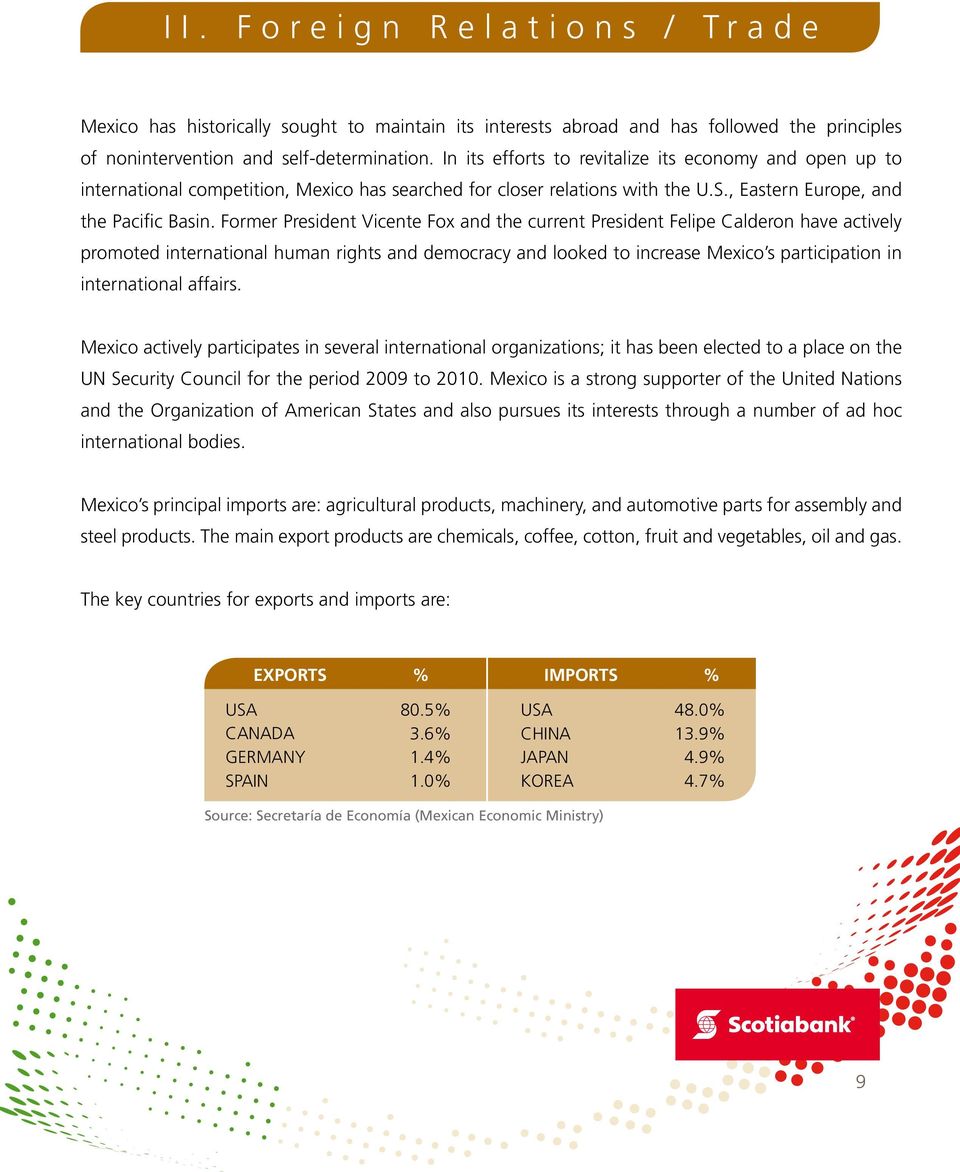
10 Mexico is highly dependent on exports to the U.S., which represent more than a quarter of the country s GDP. EXPORTS Oil: Non-Oil: Manufacturing: Agriculture: Mining: 17.40% 82.60% 79.10% 2.90% 0.60% IMPORTS Intermediate goods: 71.80% Consumer goods: 15.50% Capital goods: 12.70% Source: The main Mexican entities, which help to control and facilitate foreign trade, are: Secretaría de Economía: Ministry of the Economy. SEMARNAT: Ministry of Environment and Natural Resources. BANCOMEXT: Bank for Foreign Trade (Export Credit Agency). ANIERM: National Association of Importers and Exporters of the Mexican Republic. PROMEXICO: Mexican Government institution in charge of strengthening Mexico s participation in the international economy. COMCE: Mexican Enterprise Council of Foreign Trade, Investment and Technology. The Ministry of Economy is the main regulatory entity for trade finance transactions. In Mexico, an import license is required for 145 of the 1,200 items subject to general tariffs. In the case of temporary imports of intermediate goods for export industries and raw materials, import licenses are exempt. 10
11 I I I. M e x i c a n F i n a n c i a l S y s t e m MEXICAN FINANCIAL SYSTEM REGULATORY ENTITIES CNBV National Banks Commission Secretaría de Hacienda y Crédito Público Ministry of Finance CNSF National Guarantee and Insurance Commission Banco de México Central Bank of Mexico CONSAR National Pension Funds Commission CONDUSEF National Commission for Protection of users of Financial Services TRANSACTIONAL ENTITIES Banks Exchange Houses Factoring Houses Stockbrokers Indeval Credit Bureau MEX-DER Clearing Houses Insurance Companies Mutual Funds Societies Leasing Companies SIEFORES AFORES (Pesion Funds Entities) PROCESAR (National Database Manager Entities) Source: 11

12 Mexico has a very stable and well-capitalized banking system, consisting of a central bank and six types of banking institutions: public development banks, public credit institutions, private commercial banks, private investments banks, savings and loan associations, and mortage banks. Other components of the financial system include securities market institutions, development trust funds, insurance companies, credit unions, factoring companies, mutual funds and bonded warehouses. As a result of a period of privatization and consolidation in the early 2000s, the banks are primarily large, foreign-owned entities. There are currently 27 financial groups, 31 multiple banks, 6 development banks, 36 financial companies with limited operations, and 73 representative offices of foreign banks. The banking system falls under the control and regulatory supervision of the Ministry of Finance and Public Credit (Secretaria de Hacienda y Credito Publico) which is primarily responsible for the day-today supervision of banks operating in Mexico and shares regulatory duties over the banking sector. The central bank of Mexico is known as Banco de Mexico (Banxico). It is responsible for the control of monetary policy and is the overall regulator of both financial services and payment systems. It is similar to the Federal Reserve in the United States as it is the lender of last resort to financial institutions and the provider of treasury services to the federal government. 12
13 I V. L i q u i d i t y ACCOUNT TYPES The Mexican peso (MXP) is a fully convertible, free-floating currency and there are no exchange controls. Local and foreign currency accounts are available to resident and non-resident entities. All non-resident entities are required to register any foreign currency accounts held in Mexico with the banking authorities. Whether held by residents or non-residents, local currency accounts are not convertible into foreign currency. However, there are generally no lifting fees 1 on transfers between resident and non-resident accounts. Banks are allowed to pay interest on any account, but in practice, they rarely pay interest on current (demand deposit) accounts, and if they do, the interest payment is generally much lower than the interest paid by an investment instrument. Short Term Borrowing There is a wide range of short-term borrowing options available in Mexican financial markets. Interest rates are based on interbanking money market rates, but additional fees or restrictions may be imposed. OVERDRAFTS Overdrafts are available to both resident and non-resident entities, but can be an expensive financing tool, as interest may be charged at more than twice the rate on the reference rate: CETE (Certificados de Tesorería de la Federación) treasury bills. It also depends on each Banking relationship and the particular client s credit profile and their bank s appetite for providing the credit line. BANK LINES OF CREDIT/LOANS Credit lines are available to both resident and non-resident entities for working capital and long-term purposes. The most common type of working capital loans are revolving short-term loans of 28 days or more (Credito Revolvente). 1 In international banking, a lifting fee is often charged when money is moved from a resident account (one held by a domestic entity) to a non-resident account (one held by a non-local entity). The general rationale is that when money is in a resident account, it is under the control of the local monetary authority and thus part of the country s money supply. When moved to a non-resident account, it leaves the control of local authorities (effectively crossing the country s border) and a fee may be charged for that transaction. 13
14 BANKERS ACCEPTANCES (BA) In Mexico, this type of instrument is rarely used for short-term funds. Rates are based on the CETES (treasury bills) or TIIE (Mexican benchmark interbank money market) rate. COMMERCIAL PAPER (CP) Commercial paper is mostly issued by large companies and non-financial institutions with very strong credit ratings. TIIE or CETES are used as reference rates with tenors for up to 360 days. These are normally offered at a discount through dealers and provide a quick source of low-cost and shortterm financing for large and active companies in the market. SUPPLIER CREDIT Depending on the relationship between companies and their suppliers, supplier credit may vary from days after delivery. There are some highly specialized relationships in which a suppliermanaged replenishment program is established, in which the supplier maintains and tracks the inventory of materials it provides to a customer, and as the inventory is used, the supplier bills the customer for the items and replenishes the supply. TRADE BILLS - DISCOUNTED Banks will often discount trade bills for up to 90 days with recourse, but this form of financing is most commonly used by small exporters. The most popular terms are 45 days. INTER-COMPANY BORROWING Parent companies commonly finance their subsidiaries by extending supplier credit. Additionally, foreign owned subsidiaries in Mexico may also obtain access to USD funding through inter-company loans. The use of a cash concentration product (ZBA) facilitates this process, as funding is sent via the parent to be disbursed through a core account (master account) which may establish limits on the funds it provides to the related accounts. FACTORING Factoring involves the sale of receivables to a company that specializes in financing and managing receivables. This is another alternative for obtaining liquidity. 14

15 V. C a s h C o n c e n t r a t i o n / Z B A ( Z e r o B a l a n c e A c c o u n t s ) Banking solutions in Mexico continues to support the trend towards centralized treasury operations. The zero-balance account (ZBA) structure is increasingly being used by resident and non-resident entities holding accounts in MXN and USD as a cash-concentration strategy. Accounts in different legal entities may form part of the ZBA structure. All these transactions can be considered intercompany loans. This is why it is a more common market practice to include accounts held by the same legal entities. Companies find it useful to consolidate all their cash management operations (collections, investments, payments) and use a ZBA structure to assist them in managing their local balances and funds disbursements through an automated process, either at a bank or several banks. If companies maintain accounts at 2 or 3 banks, they may concentrate their funds into their main ZBA bank, which typically acts as the disbursement bank, as well. Surplus balances can be invested in higher-yield investment instruments to maximize interest. In addition, the ZBA structure reduces resources required to monitor and transfer funds to cover disbursements. Through the ZBA concentration structure, corporate treasury operations can effectively manage the cash position of their Mexican affiliates. Corporate treasury can also reduce the costs of multiple wire transfers to local affiliates in Mexico by having to fund only one core account. Notional pooling is not allowed in Mexico, although some financial institutions offer specific complementary products, allowing clients to calculate positive and negative balances. 15

16 V I. I n v e s t m e n t I n s t r u m e n t s The following are typical investment options and services available in Mexico: Investment advice for treasury instruments (Money Market accounts and Mutual Funds) Capital markets portfolio management Liquidity and stock buy-back programs for companies listed on the Mexican stock market Investment in international markets Dedicated institutional investor services Savings account consulting and management Pension and retirement funds management Stock-option plans for executives of publicly traded companies Trust fund investment consulting Rick management advisory services using derivatives Professional investment banking consulting Public equity placements Public and private debt placements Mergers and acquisitions advisory services Funding for working capital, expansion in national and international markets Foreign currency exchange services Stock market, economic and political analysis Other investment options include instruments issued by companies from different economic sectors (industry, commercial, services) and some Mexican public entities like state and municipal governments. These instruments include: Commercial paper Promissory notes Medium- and long-term debt Asset-backed securities 16

17 MONEY MARKET The money market is made up of a combination of financial instruments issued by the government, banks, and public companies that offer attractive yields. In these type of investment instruments, a company can choose the term and the type of paper (subject to availability). GOVERNMENT BONDS Instruments issued by the Mexican Federal Government through SHCP (Secretaría de Hacienda y Crédito Público) and auctioned by Banco de México, include: CETES: Mexican Treasury Bills Bonds: Mexican Government Development Bonds Udibonos: Mexican Government Development Bonds denominated in investment units UMS: Coupon bonds issued by the Federal Government quoted in US dollars Pics: Highway indemnity notes issued in investment units BPAs: Federal Government Coupon bonds issued by IPAB & Banco de México in Cetes BREMs: Federal Government Coupon bonds issued by Banco de México BANK INSTRUMENTS: Instruments issued by or guaranteed by Mexican banks or other Mexican financial institutions. PRLVs: zero-coupon notes Udipagare: zero-coupon notes indexed to investment units CDs: Certificates of Deposit BAs: Bankers Acceptances Term Deposits 17

18 V I I. T a x S y s t e m In Mexico, the tax regime is classified as follows: a) Taxes b) Social Security Payments c) Rights and Benefits contributions Taxes must be paid by individuals and juridical persons (companies) that are fiscal residents in Mexico, meaning that they are established in Mexico and their main source of total income (+50%) comes from the Mexican territory or when their main business center is established in Mexico. There are local and federal taxes. Local taxes are on the domain of each state, and federal taxes are applied over the country. Federal taxes can be divided into: I. Corporate Taxes II. Withholding Tax III. Other Taxes I. CORPORATE TAXES In Mexico, taxes are paid in monthly advanced installments and annual payments. The calendar year is from Jan. 1st to Dec. 31st for annual payments and they must be paid during the month of March following the fiscal year. The monthly provisional payments, in which anticipated monthly tax payments are made with regards to the definitive tax payment, must be done every 17th day of the following month after which a tax declaration was presented. The taxes that residents must prepare are: A. INCOME TAX (ISR: Impuesto sobre la Renta) This tax must be paid on income earned in Mexico, subtracting some tax-free income and allowed expenses, according to the law. The rate is 30%. Fiscal loses can be counterbalanced for a 10-year period. 18

19 B. CORPORATE TAX SINGLE RATE (IETU: Impuesto Empresarial a Tasa Única) This is a complementary tax from the above-mentioned tax. This tax must be paid according to the real income earned and paid expenses with some exceptions in the Income Tax in terms of its calculation. The rate is 17.5% as of The amount of this tax must be compared with the Income Tax, and the higher amount of both is the one paid. II. WITHHOLDING TAX Some items like interest and dividends are subject to withholding tax, which can be deducted from the annual payment. Interests 0.85% annual over main 4.9%,10% or 28% over capital or investment that generates the interest. interests (according to the country tax regime from where the resident came from). Dividens Stock Technical assistance Withholding Tax Residents in Mexico Does not apply. Exempt as long as the law s requirements are met. Does not apply. Residents Abroad Does not apply. Exempt as long as the law s requirements are met. 25% or the rate established on the double rasste Country Agreement. 19

20 III. OTHER TAXES VALUE-ADDED TAX (IVA: Impuesto al Valor Agregado): This tax must be paid on the consumption of products or services obtained in Mexico or through imports or exports. The rate is 16% nationwide or 11% in the border zones. In some cases, a rate of 0% may be applied or the tax does not apply. CASH DEPOSIT TAX (IDE: Impuesto sobre Depósitos en Efectivo): The Cash Deposit Tax (IDE) has a rate of 3%, which is applied to cash deposits exceeding the monthly amount of $15,000 in one or many accounts of the same beneficiary, and is collected by financial institutions on the last day of the month. However, the tax is collected on time deposits exceeding the amount of $15,000 when made with a financial institution. In case a company buys a cashier check at a bank branch with cash, the tax will be calculated on the value of this document and charged at the moment it is purchased. Amounts deposited in the name of individuals and entities through electronic and account transfers, securities or any other document or system within the system of financial institutions are not considered cash deposits. SPECIAL TAX FOR PRODUCTION & SERVICES (IEPS: Impuesto Especial sobre Producción y Servicios) This tax is related to some kinds of services and production by sectors or imports. The rate can be 25% up to 160% on a case-by-case basis. 20

21 V I I I. O v e r v i e w o f t h e P a y m e n t S y s t e m s i n M e x i c o All payment instruments, excluding checks, grew in Mexico in 2008 by both value and volume. This is a clear sign that companies are using less checks and more electronic payments. However the use of checks is still a common practice, particularly for companies that prefer the controls that checks provide as in more conservative types of companies in which the payment is not released until there is a signature. It is common practice to have dual authorizations on both checks and electronic payments, and many companies have implemented check protection features (positive pay). Checks still represent an important proportion of payment volumes overall and cash is still the main method of payment for low-value payments. In terms of value, same-day high-value credit transfers account for the largest proportion of payments, while credit and debit cards represent the highest percentage in terms of volume. TRANSACTION PAYMENT TRENDS 21
22 Payroll payments are processed mostly with payroll cards, although some companies still pay in cash on site. There are different payroll cards available, including a debit card commonly referred to as a store value card (Monedero) in which the employee does not have to open a bank account. It has the benefit of being able to withdraw funds with no cost at the bank issuing the card, as well as at point-of-sale terminals. Funds may also be withdrawn at other banks ATMs for an extra fee. Other payroll products include opening checking accounts. Banks offer different packages, which may include checkbooks; Internet access; preferred rates on loans, mortgages and cars; and also special interest rates on investments. Tax payments are mostly processed via credit transfers, particularly pensions, taxes and social security. Electronic Payment systems in Mexico are classified into two groups: HIGH VALUE High-value payments are made on the same day. They were originally developed to liquidate operations in the financial markets, obligations in other payments systems, and to finance the liquidity obligations of financial intermediaries. Thus, the payment amounts processed can be quite high. High-value payment systems in Mexico are: SPEI: The main channel through which banks process high-value, same-day transactions between themselves and their clients. SIDV: A system for liquidating purchase and sale transactions on different investment instruments through the Mexican stock exchange. SIAC: Operates in the current accounts that the banks have in the Central Bank. This is the channel through which the Central Bank (Banco de México) provides liquidity to the banks. It still functions as a payments system. Note: Banco de México operates the SIAC and SPEI systems, while INDEVAL operates the SIDV system. 22
23 LOW VALUE (SICAM) This is a deferred payments system where settlement takes place on a next-day basis. Companies utilize this payment system for commercial payments, payroll and other non-urgent payments or those, which can be programmed. The average payment amount is usually low. Checks, electronic transfers, payroll, direct debits, and bankcards are the type of payments included in this channel. Since June 2003, all checks are truncated and their images exchanged by CECOBAN s (SICAM s operator) Images Exchange Clearinghouse, before being processed. The Cámara de Compensación Electrónica processes the compensation of these payments, except for credit cards. CECOBAN operates the registry system and check compensation, electronic transfer of funds and direct debits, and the Central Bank liquidates them through the SIAC system. There are two types of bankcards: debit and credit. Both of them are used as a payment method in businesses, which have point-of-sale (POS) terminals, and additionally to consult balances and withdraw cash at ATMs. There are two card processors: PROSA and E-Global, both of which are connected to each other. The compensation of operations is done via PROSA and the actual liquidation of the transaction is done through a commercial bank. INTERBANK CROSS-BORDER PAYMENTS Interbank cross-border payments can be made via SIAC s participation in the multilateral clearing system of the Latin American Integration Association, which includes participants from Argentina, Bolivia, Brazil, Chile, Colombia, the Dominican Republic, Ecuador, Paraguay, Peru, Uruguay and Venezuela. Mexico has clearing arrangements with Costa Rica, El Salvador, Guatemala, Honduras and Nicaragua. 23
24 CROSS-BORDER PAYMENTS Most cross-border payments are sent via the SWIFT network and settlement takes place via accounts at correspondent banks. USD-denominated credit transfers from the USA to Mexico can also be made via the US FedACH s Directo a Mexico service, with funds available the next day. Incoming and Outgoing Payment/ Wire Transfers For many years in general terms, banks in Mexico have absorbed fees charged by foreign correspondent banks in the processing of hard currency incoming and outgoing payments which are conducted via foreign correspondent Banks. It should be stated that the accepted practice of most Correspondent Banks is the deduction of these charges from the transfer proceeds such that the beneficiary receives an amount net of the charge. It is equally important to note generally talking Mexican bank s standard charge which represents the cost of the outgoing payment transfer will continue and the aforementioned service charge is not levied by the Mexican bank but rather at the Correspondent Bank level. This practice is commonly known as bene deduct. 24
25 I X. E l e c t r o n i c B a n k i n g Using Electronic Banking in Mexico is the most common way for processing payments and reviewing collections and general information on-line. Usually the Electronic Banking Platforms are web-based and offer seamless access to an expanding array of corporate banking services through a single application, allowing customers to be more efficient, flexible and in control of their banking transactions. Since April 2007, the Internet Banking systems in Mexico requires a second authentication device for all the monetary transactions. This regulation has the purpose of increasing the safety and security in the use of Internet banking in Mexico. The electronic banking system requires real time data on information that is updated every 24-hours for payments and authorizations, payments that can be exported and/or imported manually or with ERP interfaces that can meet customers needs. Today, Electronic Banking applications are a complementary channel for large companies and an added Host-to-Host solution for collections and reconciliation purposes. This new method of Cash Management includes centralization, encryption, multiple-level authorizations and local and regional shared service centers, in addition to a complex solutions list. The centralization and sophistication of Cash Management solutions represent an opportunity for the Mexican market, and with this change, corporations are reducing the number of Electronic Banking Systems and increasing the interfaces between the ERPs and Banks for payroll services, collections and reconciliation. Regarding consumer uses of electronic banking, it has increased by 200% during the last 5 years, becoming the second payment method after credit cards and cash. 25
26 X. C a s h M a n a g e m e n t S e r v i c e s b y S e c t o r (Classified under the criterion of Scotiabank) PYME sector (SME-Small & Medium Enterprises) The typical criteria used in Mexico to define a small- or medium-size company (typically referred to as PYME which in Spanish is Pequeña y Mediana Empresa ) is the following: 1. Number of employees: < 50 employees 2. Annual sales: < MXP 50 million 3. Financial requirements: < MXP 5 million Note: The above information may vary from bank to bank, although it is believed that the above data is the standard in the banking industry. The main advantage of PYME companies is their dynamics, as they are able to make quick decisions and actions. Typically, the owner of the company is involved in and in charge of the business and looks for quality in customer service. At the banking service level, PYME companies are served by bank branches and specialized account managers in this segment with products tailored towards meeting the specific needs of these companies. A PYME requires banking services that are easy to obtain and operate, and that help the company optimize its management at a reasonable cost with secure means of access. The financial services typically used by PYMEs are: a) Checking accounts b) Internet banking c) Payroll d) Point of sale terminals e) Financing 26
27 COMMERCIAL BANKING Segmentation is based upon the following criteria: 1. Annual sales: > MXP 50 million and < MXP 1,000 million 2. Financial requirements: > MXP 5 million Note: These criteria may vary from bank to bank. The companies that are included in the criteria described above are served by Relationship Managers specialized in this segment, in which the financial and service needs of companies are more complex, and sometimes require special developments or tailor-made solutions with a higher degree of specialization. The main financial services that are required by these types of companies in the Commercial Banking area are: a) Checking accounts b) Investments c) Internet banking d) Payroll e) Large payments to providers f) Collections g) Financing (working capital, import/export) h) Foreign exchange transactions CORPORATE SECTOR These clients are typically identified by the following criteria: 1. Annual sales: > MXP 1 billion 2. Subsidiaries of multinational companies 3. Other companies that may not meet above criteria, but that represent high potential growth Note: These criteria may vary from bank to bank. Large companies make payments to vendors/suppliers mostly electronically, although they may still issue checks for small nonrecurring payments. 27
28 The cash management services that large companies require overall are: a) Checking accounts and Zero Balance accounts b) Internet Banking and Host-to-Host connectivity c) Robust supplier payment platforms with flexibility to process same-day and programmed payments, and also providing detailed information on payments d) On-line billing e) Collections products, including direct debit and also collections through branches f) Payroll products, as indicated above, including stored value card and different ascending products (with checkbook, internet banking, etc.) g) Integration of different file formats (SAP, EDI) with the internet banking platform h) Foreign exchange transactions i) Financing (working capital, import/export) FEDERAL GOVERNMENT DEPARTMENTS AND DEPENDENCIES Clients in this sector require a high degree of specialization and tailor-made solutions in most cases, in order to manage their cash flow. These clients generally process many transactions and require different channels to receive their deposits and process their payments. Such channels include bank branches, the Internet, ATMs, special armored vehicles that move cash (in Spanish it is known as traslado de valores ), as well as point-of-sale terminals. The most important sources of deposits are: 1. Federal tax payments 2. Social security payments to employees and employers The social security payments are done by the IMSS: Instituto Mexicano Del Seguro Social (Mexican Social Security Institution) through the SUA : Sistema Único de Autodeterminación. IMSS is the largest social security institution in Latin America. Its function is to take care of individual and collective well-being in Mexico and it is a critical part of the wealth redistribution system in the country. To receive these important cash deposits, clients require special checking accounts based on interest arrangements to compensate lower or no cash management fees through account balances. 28
29 STATE AND MUNICIPAL GOVERNMENTS These sectors are currently under development, as they are exploring the making of their internal systems (ERPs) automatic. These clients require access channels mainly to collect taxes. They establish contracts with banks and convenience stores in order to have more collection options in addition to their offices where they receive payments. Taxes that are collected are from individuals and companies, and they include: a) Tenencia : Automobile ownership taxes b) Predial : Real estate taxes c) Penalties and surcharges d) License fees e) 2% payroll tax f) Water bills which make up the largest part of collections These clients perform many transactions, particularly payments to beneficiaries in programs, which the federal government establishes. The cash management products that these clients use include the following: a) Checking accounts with special check books b) Zero balance account structures c) Host-to-Host Connectivity d) Collections (with receipts, direct debit, referenced, and without receipts) e) Electronic account statements f) Stored Value Cards g) Electronic payments h) ATMs i) Payroll j) Internet banking 29
30 X I. S c o t i a b a n k M e x i c o - G l o b a l T r a n s a c t i o n B a n k i n g Scotiabank Mexico is a member of the Scotiabank Group and is one of the largest banks in Mexico with over 623 branches and over 1,453 ATMs throughout the country. It offers an extensive range of cash management, business and wholesale banking services to individuals, commercial and corporate clients throughout the country. Scotiabank is one of the top 10 best performing banks in the world, according to Oliver Wyman s 2009 annual shareholder performance index rating, and is the 8th largest bank in North America by market capitalization (March 2009). 30
31 Other recent awards include: Recognized in 2009, in the Top 50 of the World s Safest Banks by Global Finance magazine In 2009, Scotiabank Mexico was ranked among the 50 Best Companies to Work for in Mexico by The Great Place to Work Institute for the sixth year in a row In 2009, Grupo Scotiabank Mexico was recognized as one of the 35 Best Companies to Work for Women in Mexico by The Great Place to Work Institute As part of the Scotiabank Group (Canada), Scotiabank offers access to international markets thanks to its direct presence in over 50 countries and broad coverage with more than 2,000 bank branches, affiliates and affiliated companies in North, Central and South America, the Caribbean, Europe and Asia, as well as a vast network of correspondent banks. CASH MANAGEMENT PRODUCTS Based on the traditional cash flow of each company, Scotiabank Mexico develops a group of products focused on typical needs and with sufficient flexibility to personalize them for each customer. This flexibility allows us to generate the right solution combining the proper set of products and services for our clients. 31
32 Scotia Collections Scotiabank Mexico offers flexible collections that provide companies with an efficient service that is timely, with accurate information, automatic controls, and different options to carry out collections. Scotia Collections meets the need for collections information, focus, and operations management with 5 types of services: Scotia Collections with / without Receipt (con/sin recibo) Scotia Direct Debit Collections (domiciliada) Scotia Collection Interact Online (Cobranza Lite) Scotia Collection via Referenced Deposit (Depósito Referenciado) Merchant Card Services Provides state-of-the-art point-of-sale systems to reduce cash handling risk, and automated deposit of VISA, MasterCard and AMEX sales with next-business-day availability of funds. Scotia Payments Our clients can send us a single file of all disbursements with payments settled by direct deposit to any Mexican Financial Institution or suppliers and can pick up cashier s checks at any Scotiabank branch that offers the following types of Payments: Supplier payments Federal tax payments SUA payments 32
33 (Scotia Protection) Check Protection and Positive Pay Minimizes the risk of check fraud, forgery, alteration and theft through online protection with check verification, reconciliation and cancellation of items issued throughout the country: Providing an electronic file specifying details about outstanding, paid, settled and protected checks Specifying check parameters and protected fields Facilitating online transmission of issued check fields Reducing reconciliation time Check Stop payments are registered immediately and applied in the event they are reported as lost or stolen Bill Presentment Offers suppliers an easy way to obtain payment remittance information, details of new and outstanding invoices and perform online inquiries 365 days a year. Scotia Treasury (ZBA) Helps our clients optimize and control their financial resources through Zero Balance Account structures with disbursement and collections. It is not necessary to transfer resources to/from branches or different accounts, as funds are received on-line through collections accounts and credited to the concentration account. Additionally, payments are automatically funded from the concentration account into the payables accounts, and the establishment of daily and/or budgetary limits helps our clients control cash expenditures. We have seen how our ZBA products are a useful tool for planning, expense-controls, payment, and funds-concentration for our clients who need to budget projects and expenses, etc. 33
34 Scotia Nomina (Payroll) This is the ideal tool for performing in a secure and convenient way all of your transactions for payroll payments, savings and pension funds, as well as travel expenses and other payments for your employees. Scotiabank has four different payroll products in the market, from a stored-value card for hourly/high turnover employees, to a Scotia Premium account with many benefits, including protection services in your home. Scotia Card Monedero The key characteristic of the Scotiabank Mexico s Electronic Wallet is the exclusive ability of customers to register, replace and cancel any kind of card according to the needs of the customer s personnel rotation. It also eliminates unnecessary visits to bank branches. Transactions may be carried out in large numbers by sending electronic files, or, individually and online, where you can also check the card transactions and directly settle any possible inquiries from your employees. Let Scotiabank draw on our network of branches and offices around the globe to provide you with comprehensive, integrated trade finance and correspondent banking services. 34
35 TRADE FINANCE With over 150 years of experience in international trade finance, we can be your end-to-end supply chain financing partner, helping to facilitate international trade, minimizing trade risk or protecting import and export flows. We can provide seamless domestic and cross-border solutions including specialized vendor programs, cross-border buyer credits and subsidiary financing. As part of Scotiabank Group (Canada), Scotiabank offers access to international markets thanks to its direct presence in over 50 countries and broad coverage with more than 2,000 bank branches, affiliates and affiliated companies in North, Central and South America, the Caribbean, Europe and Asia, as well as a vast network of correspondent banks worldwide. Our international offices together with our North American specialists, can introduce you to a wide variety of solutions for: Importing and Exporting. Importing: We can work with you to reduce the risk of not receiving the exact goods you have ordered and paid for. Our import services are designed to minimize the uncertainties and risks associated with crossborder trade and help you to maintain tighter control through: Import Letters of Credit: enable you to define the exact conditions under which your supplier will be paid: Specify shipping and payment dates, and request third party inspections to ensure that the goods you receive are the ones you ordered. For greater convenience, you can prepare and submit Letters of Credit 24 hours a day, 7 days a week securely through our web-based TRADEEXPRESS elite service. Open Account: If you have an established relationship with your suppliers and wish to reduce the total processing time and costs associated with letters of credit and documentary collections, consider using our open account payment service. 35
36 Scotiabank s electronic TRADEXPRESS elite service is ideal for any size importer/exporter who is looking to manage their transactions over the Internet. TRADEXPRESS elite offers fully automatic, secure processing of the following: Import and Export Letters of Credit Purchase Order processing and automatic Letter of Credit (LC) preparation Automated Open Account processing Standby Letters of Credit/Letters of Guarantee Transferable Letters of Credit Letters of Direction Discrepancy notification (import and export LCs) DocPrep interface allowing download of data from related LCs to TRADEEXPRESS ExportDoc Direct Collections Comprehensive reporting - over 50 reports are available online - from transaction histories to outstanding LCs, with amounts and charges sorted by category Exporting: Whether you are a new or established exporter, we can help you arrange financing for your export sales: Export Letters of Credit Foreign Documentary Collections TRADEXPRESS ExportDoc Service Cross-Border Letters of Credit Direct Collections Structured Trade and Foreign Buyer s Credits Vendor Programs Subsidiary Financing EDC Agreement-as is. ACE Program The ACE Program is a joint effort between Scotiabank and EDC to provide competitive long-term credit facilities to import capital goods, spare parts, and services from Canada. 36
37 CORRESPONDENT BANKING Among other solutions, this unit has developed a specific business model to assist companies referred by correspondent banks in the opening of checking accounts for resident and non-resident companies in Mexico. These accounts have the capability of receiving and sending payments. Companies from different industries (from financial services to automotive) can benefit from this model. Scotiabank has the expertise to serve companies from any part in the world, as our existing clients come from Canada, the USA, Spain, France, Italy and Germany, among other countries. Our correspondent-banking network is integrated by more than 500 banks, allowing us to receive ongoing business referrals which are referred to Scotiabank by one of them. Requirements for Non-resident accounts: 1. The company must be referred by one of our correspondent banks. 2. The documents required for the account opening are quite normal and easy to gather for an international company, which runs a business in Mexico. The main requirements are: a. Copy of proof of address b. Copy of the company s legal documents (articles of incorporation, board resolution) duly stamped with an apostille and notarized c. Legal representatives official IDs d. Copy of tax payment for the last year e. The filling out of internal forms for Scotiabank s compliance purposes f. Introduction letter from Correspondent Bank 37
38 Main features Scotiabank offers: 1. Accounts are available in Mexican Pesos and US Dollars and do not bear interest 2. The means of access is exclusively online (no check books provided) 3. Straightforward implementation of the interactive access system 4. With our online banking access Scotia en Linea (also available in English) you can manage your company s accounts within the privacy of your home or office, 24/7, 365 days a year for balance inquiry and transfers programming 5. Bilingual support from our specialists 9:00-7:00 pm CT (central time), 5 days a week 6. Wide variety of Cash Management solutions, to meet company s needs and optimize your treasury processes Our Correspondent Banking team has received several recognitions for excellent service in assisting the needs of foreign banks and institutions doing business in Mexico. 38
39 R e l a t e d L i n k s o f I n t e r e s t Managing in Mexico at Scotiabank Scotiabank México (Home page) On-line Rates of Mexico Market at Scotiabank Economic Studies articles/analysis of Scotiabank Mexico The Ministry of Finance of Mexico (Home page) Central Bank of Mexico (Home page) The Mexico Ministry of the Economy (Home page) Doing Business en Mexico (World Bank and IFC) ICC International Chamber of Commerce (Home page) BANCOMEXT (Home page) 39
40 G l o s s a r y Attributable Income: Income that results from the business activity carried out by the Mexican permanent establishment; income from goods and personal and real property sold in Mexico by the home office or by any permanent establishments in other countries; and income obtained by the headquarters or any establishments abroad, in the proportion that the permanent establishment has participated in the expenses incurred to obtain the income. Bankers Acceptances (BAs): A time draft on which the drawer bank has provided its acceptance, and often used to finance the import, export or domestic shipment of goods. May also be used along with Letters of Credit (L/Cs) requiring a time draft drawn on a bank. Cash Concentration (ZBA): The concentration of funds from collections accounts into a core account, as well as the funding of payables accounts from the core account. Provides the benefit of automating and consolidating funds at a master account level. CECOBAN (Centro de Computo Bancario): Owned by a consortium of around 28 banks and 24 regional branches. Clearing channel that supports the processes of check compensation and funds transfers (debit and credit), and typically used for low value, high volume transactions. The equivalent of ACH in the USA. Commercial Paper (CP) Mostly issued by large companies and non-banking financial institutions with strong credit quality and ratings, using TIIE or CETEs as the reference rates. Tenor is up to 360 days, and it is normally offered at a discount through dealers. It provides a quick source of low-cost shortterm financing for large companies, which are active in the market. Factoring: Factoring involves the outright sale of receivables to a factor a company that specializes in the financing and management of receivables. In most financing arrangements, the buyer of the receivables has no recourse to the seller. Fixed base: Applies from A fixed base is equivalent to a permanent establishment and is subject to the same tax treatment but refers to income earned from fees and independent professional services provided in Mexico by non-residents. 40
41 Corporate Single Tax Rate (IETU): Impuesto empresarial de tasa fija) for its acronym in Spanish. This tax must be paid by companies and persons living in national territory. as foreigners with permanent business activities in Mexico. The tax will be paid according to the income obtained, no matter the place where the income was generated (specifically for: selling fix assets, independent services and temporary rent of assets). Lifting fees: Tax that companies may be required to pay when moving funds out of a country. These fees are charged when funds are transferred from a resident (known as domestic) account to a non-resident (or foreign account). North American Free Trade Agreement (NAFTA): Also known as TLCAN (Tratado de Libre Comercio de América del Norte), is an agreement that was signed by the governments of the United States, Canada, and Mexico creating a trilateral trade bloc in North America. The agreement came into force on January 1, Notional Pooling: Any excess funds in the accounts of a company or its subsidiaries that are used to offset any deficits in other accounts of the parent or subsidiaries. This type of pooling arrangement is offered for a variety of currencies and is commonly known as notional pooling because no actual funds are transferred. This service is NOT available in Mexico, although some banks may offer specific tools to monitor balances. 41
42 SICAM (Sistema de Cámaras): Net settlement system that clears paper-based and electronic payments, including checks, non-urgent electronic credit transfers and direct debits. Owned by the central bank, but operated by CECOBAN. SPEI (Sistema de Pagos Electrónicos Interbancarios): The main channel through which banks process high value, same day transactions between themselves and their clients. Supplier-managed replenishment program: In this type of program, the supplier maintains and tracks the inventory of materials it provides to its customers, and as the inventory is used, the supplier bills the customers for the items and replenishes the supply. Time draft: A time draft is a draft payable on a specified future date that must be accepted by the importer before the collecting bank may release documents. 42
43 B i b l i o g r a p h y 1. - Article supplied by Deloitte & Touche and Business Monitor, Banxico Cecoban; CIA The World Factbook Mexico 5. - Economist.com, Country Briefings: Mexico 6. - Graziadio Business Report A Journal of Relevant Information and Analysis, Pepperdine University; Commercial Banking and Treasury Management in Mexico 7. - Moody s 8. - National Banking and Securities Commission of Mexico and Essentials of Treasury Management, Second Edition Deloitte Touche Tohmatsu International Tax and Business Guide-Mexico 43
44 C o n t a c t s Global Transaction Banking Head - Mexico Salvador Cruz Cerrillo 52 (55) [email protected] Cash Management Commercial, States and Municipalities Claudia Macías García 52 (55) [email protected] Cash Management Corporate and Federal Government Bárbara Silva Ibarra 52 (55) [email protected] Trade Finance José Manuel Suárez 52 (55) [email protected] Correspondent banking Antonio del Campo Zamora 52 (55) [email protected] Economic Studies and Strategic Planning Scotiabank Mexico Mario Correa 52 (55) [email protected] 44
45 D i s c l a i m e r This document was prepared exclusively for Scotiabank clients to assist in the evaluation of, on a preliminary basis, certain products or services that may be provided by Scotiabank. This document contains information that is confidential and property of Scotiabank, which may only be used in order to evaluate the products and services described herein and may not be disclosed to any other person. Neither this document nor any of its contents may be used for any other purpose without Scotiabank s prior written consent. Scotiabank makes no representations as to the legal, regulatory, tax or accounting implications of the matters referred to in this document. Neither Scotiabank nor any of its directors, officers, employees or agents shall incur any liability in respect of the contents of this document or any matters referred to herein, or discussed as a result of this document. This document is for discussion and informational purposes only. Commentary and graphics referring to economic matters will be completed at the end of March of the present year. 45
46 C o n c l u s i o n During the last ten years, commercial banking and cash/treasury management in Mexico have undergone substantial changes. While the economy is still largely cash-based on the consumer side, on the commercial side, businesses have embraced both technology and electronic transactions. The Mexican financial sector has implemented significant new systems for managing transactions and financial information, and large companies have availed themselves of modern technology in the treasury area. One area of future concern is the slow progress of anti-money laundering efforts in Mexico, but at least progress is being made. Overall, for today s treasury professional, the Mexican banking market may offer a few new challenges, but many familiar products and services will be readily available. 46
47
Dealer. Línea Integral Autos Car Line Program. Autos (LIA): Línea Integral. The Wholesale Plan: The Retail Plan: Inventory 0 % Inventory Sales
 Automotive Sector Introduction Grupo Bancolombia is the financial partner for the Automotive Sector in Colombia and has a comprehensive portfolio designed according to your needs and those of agents that
9. Thüringer Außenwirtschaftstag
 9. Thüringer Außenwirtschaftstag 12. November 2015 Anke Bülow und Carsten Gnoth Business & Corporate Banking Sachsen, Sachsen-Anhalt, Thüringen WF JPM HSBC BAML SAN Citi Lloyds BNP Credit Suisse DB UniCredit
 1 Regional Bank Regional banks specialize in consumer and commercial products within one region of a country, such as a state or within a group of states. A regional bank is smaller than a bank that operates
COMPANY PRODUCTS AND SERVICES
 COMPANY PRODUCTS AND SERVICES THE WORLD IS WAITING. 1 1 Santander Group. With more than 150 years in the business, Santander has become one of the world's largest financial groups. This has been based
CHAPTER 9: BANKING DOING BUSINESS IN GREATER PHOENIX, U.S.A. 9.1: THE U.S. BANKING SYSTEM 9.2: ESTABLISHING A U.S. BANK ACCOUNT
 CHAPTER 9: BANKING 9.1: THE U.S. BANKING SYSTEM Unlike banks in many countries, U.S. banks are not government-owned and managed. They provide deposit facilities for the general public, provide loans for
The Healthcare and Health Tourism. Sector
 The Healthcare and Health Tourism Sector Introduction For Bancolombia being an ally of healthcare institutions means to accompany, advise, and offer alternatives to make your projects become a reality.
Receivables Management Solutions
 Receivables Management Solutions Unlock trapped liquidity, reduce costs and make collections more predictable Citi Transaction Services Latin America and Mexico Citi Transaction Services Latin America
BALANCE SHEET AND INCOME STATEMENT
 BANCOLOMBIA S.A. (NYSE: CIB; BVC: BCOLOMBIA, PFBCOLOM) REPORTS CONSOLIDATED NET INCOME OF COP 1,879 BILLION FOR 2014, AN INCREASE OF 24% COMPARED TO 2013. Operating income increased 23.8% during 2014 and
EP Asia Small Companies Fund EP Latin America Fund EP China Fund Each a series of Investment Managers Series Trust
 EP Asia Small Companies Fund EP Latin America Fund EP China Fund Each a series of Investment Managers Series Trust Supplement dated June 30, 2015, to the Summary Prospectus dated March 5, 2015, and the
Trends, News and Events that are Shaping the AML Arena in Latin America
 Trends, News and Events that are Shaping the AML Arena in Latin America Presented by: Octavio Betancourt- Managing Director 1 MoneyLaundering.com 15 th Annual International Anti-MoneyLaundering Conference
Web. Chapter FINANCIAL INSTITUTIONS AND MARKETS
 FINANCIAL INSTITUTIONS AND MARKETS T Chapter Summary Chapter Web he Web Chapter provides an overview of the various financial institutions and markets that serve managers of firms and investors who invest
INTERNATIONAL FACTORING
 INTERNATIONAL FACTORING November 3, 2011 1 L. Gabriel Segura President and founding officer of CVCredit Inc, a Miami-based company which focuses in USA-domestic and international factoring services. Nine
GFNORTE 4Q13 Results. Conference Call January 31 st, 2014.
 GFNORTE 4Q13 Results Conference Call January 31 st, 2014. Material Events Grupo Financiero Banorte advanced the payment of ordinary dividends corresponding to the first semester of 2014. The Ordinary General
Agribusiness. Sector
 Agribusiness Sector Introduction Specialized interest and knowledge of your business is the best guarantee of a broad array of financial solutions that Grupo Bancolombia* places at your disposal. The backing
i T-bill (dy) = $10,000 - $9,765 360 = 6.768% $10,000 125
 Answers to Chapter 5 Questions 1. First, money market instruments are generally sold in large denominations (often in units of $1 million to $10 million). Most money market participants want or need to
Monetary Policy Outlook in a Negative Rates Environment Mr. Javier Guzmán Calafell, Deputy Governor, Banco de México J.P. Morgan Investor Seminar
 Mr. Javier Guzmán Calafell, Deputy Governor, Banco de México J.P. Morgan Investor Seminar Washington, DC, 15 April 2016 Outline 1 External Conditions 2 Macroeconomic Policy in Mexico 3 Evolution and Outlook
READING 1. The Money Market. Timothy Q. Cook and Robert K. LaRoche
 READING 1 The Money Market Timothy Q. Cook and Robert K. LaRoche The major purpose of financial markets is to transfer funds from lenders to borrowers. Financial market participants commonly distinguish
Mexican Tax Law. Value Added Tax (VAT) is assessed on the consummation within the Mexican territory of the following types of transactions:
 Mexican Tax Law By: Benjamin C. Rosen [email protected] Last Update: September 2006 INTRODUCTION Mexican companies (including subsidiaries of foreign companies), as well as permanent establishments
account statement a record of transactions in an account at a financial institution, usually provided each month
 GLOSSARY GLOSSARY Following are definitions for key words as they are used in the financial life skills resource. They may have different or additional meanings in other contexts. A account an arrangement
Chapter 3 - Selecting Investments in a Global Market
 Chapter 3 - Selecting Investments in a Global Market Questions to be answered: Why should investors have a global perspective regarding their investments? What has happened to the relative size of U.S.
Ternium Announces First Quarter 2015 Results
 Sebastián Martí Ternium - Investor Relations +1 (866) 890 0443 +54 (11) 4018 2389 www.ternium.com Ternium Announces First Quarter 2015 Results Luxembourg, April 29, 2015 Ternium S.A. (NYSE: TX) today announced
4Q15. Management Discussion & Analysis and Complete Financial Statements
 4Q15 Management Discussion & Analysis and Complete Financial Statements CONTENTS 03 Management Discussion & Analysis 05 Executive Summary 15 Income Statement and Balance Sheet Analysis 16 18 22 25 28 33
CUBAN FOREIGN INVESTMENT LEGISLATION
 CUBAN FOREIGN INVESTMENT LEGISLATION Decree Law 50 of 1982 ( Decree Law 50 ) was Cuba s first foreign investment act authorizing the formation of international joint-ventures with foreign investors. In
IN THIS REVIEW, WE HAVE ARRANGED OUR BUSINESSES AROUND OUR TWO DISTINCT CUSTOMER
 Review of TD s businesses REVIEW OF TD S BUSINESSES PROFILES OF TD S BUSINESSES TODAY IN THIS REVIEW, WE HAVE ARRANGED OUR BUSINESSES AROUND OUR TWO DISTINCT CUSTOMER BASES RETAIL AND WHOLESALE TO SHOW
INVESTMENT DICTIONARY
 INVESTMENT DICTIONARY Annual Report An annual report is a document that offers information about the company s activities and operations and contains financial details, cash flow statement, profit and
Daily Income Fund Retail Class Shares ( Retail Shares )
 Daily Income Fund Retail Class Shares ( Retail Shares ) Money Market Portfolio Ticker Symbol: DRTXX U.S. Treasury Portfolio No Ticker Symbol U.S. Government Portfolio Ticker Symbol: DREXX Municipal Portfolio
nstitutional (economic) units, industries and sectors are the main components of economy.
 2. Sectors of Economy I nstitutional (economic) units, industries and sectors are the main components of economy. The economy is divided into domestic economy and the rest of the world. The domestic economy
Asia Market Intelligence Thailand
 Asia Market Intelligence Thailand Presence HSBC s history in Thailand dates back to 1865, when the Bank appointed an agent in Bangkok. In 1888, a representative office opened in Bangkok, becoming the first
2Q15 Consolidated Earnings Results
 2Q15 Consolidated Earnings Results IFRS September 2015 Disclaimer Grupo Aval Acciones y Valores S.A. ( Grupo Aval ) is an issuer of securities in Colombia and in the United States, registered with Colombia
Virtual Stock Market Game Glossary
 Virtual Stock Market Game Glossary American Stock Exchange-AMEX An open auction market similar to the NYSE where buyers and sellers compete in a centralized marketplace. The AMEX typically lists small
IAA 2015 Santander Support to the Automotive Sector in Mexico
 IAA 2015 Santander Support to the Automotive Sector in Mexico September 2015 Santander Group: one of the world s leading banks 2 Founded in 1857 regional bank since 1985 No. 6 in Spain No. 152 worldwide
lesson six banking services supplemental materials 04/09
 lesson six banking services supplemental materials 04/09 banking terms account Money deposited with a financial institution for investment and/or safekeeping purposes. assets Items of monetary value (e.g.,
Your vision. Let s make it happen.
 Your vision. Let s make it happen. CORPORATE AND INVESTMENT BANKING CAPITAL MARKETS COMMERCIAL BANKING TRANSACTION BANKING TRADE FINANCE Creating opportunities Strength and stability, far and wide Scotiabank
Basic Investment Terms
 Because money doesn t come with instructions.sm Robert C. Eddy, CFP Margaret F. Eddy, CFP Matthew B. Showley, CFP Basic Investment Terms ANNUITY A financial product sold by financial institutions pay out
Pursuant to Article 88 item 2 of the Constitution of the Republic of Montenegro I hereby issue the
 Pursuant to Article 88 item 2 of the Constitution of the Republic of Montenegro I hereby issue the DECREE PROMULGATING THE LAW ON FOREIGN CURRENT AND CAPITAL TRANSACTIONS (Official Gazette of Montenegro
2. Definitions of Terms
 PUBLIC DEBT LAW I. GENERAL PROVISIONS 1. Subject of the Law Article 1 This Law regulates conditions, manner and procedure under which the Republic of Serbia (hereinafter referred to as: the Republic) may
Fewer net errors and omissions, that is a new format of the balance of payments
 Fewer net errors and omissions, that is a new format of the balance of payments The size of net errors and omissions in the balance of payments decreased from 4.4% to 2.3% of GDP. This resulted from data
Lecture Notes on MONEY, BANKING, AND FINANCIAL MARKETS. Peter N. Ireland Department of Economics Boston College. [email protected]
 Lecture Notes on MONEY, BANKING, AND FINANCIAL MARKETS Peter N. Ireland Department of Economics Boston College [email protected] http://www2.bc.edu/~irelandp/ec261.html Chapter 2: An Overview of the Financial
Flow of Funds Data Dictionary
 Flow of Funds Data Dictionary October 2003 This version of documentation is preliminary and does not necessarily represent the current Global Insight (formerly DRI WEFA) database. The availability of specific
Latin America s s Foreign Debt
 Latin America s s Foreign Debt Causes and Effects Internal Causes of the Debt Overvalued currency associated with ISI Returns on projects in future, but payments now: Debt trap Populist economic policies:
The IBM 401(k) Plus Plan. Invest today for what you hope to accomplish tomorrow
 The IBM 401(k) Plus Plan Invest today for what you hope to accomplish tomorrow The IBM 401(k) Plus Plan Dollar-for-dollar company match, automatic company contributions, broad range of investment options
MEXICAN TAX BILL FOR 2016
 MEXICAN TAX BILL FOR 2016 On September 8, 2015, the President sent to Congress the Tax Bill where some proposals are made to change current Mexican tax legislation. The main proposals are the following:
Putting You and Your Business First
 Putting You and Your Business First A guide to your new business accounts and services FirstMerit puts you and your business first. FirstMerit can make a true difference when it comes to helping you build
Service Tariffs Guide
 Service Tariffs Guide Subscribe in Al Ahly Murattabat programs & Enjoy numerous benefits and special offers Account Charges Current Accounts Opening an individual / joint account EGP 25 Cash loans Auto
Flashcards for Chapter 6 Introduction to Working Capital Management [ ]
![Flashcards for Chapter 6 Introduction to Working Capital Management [ ]](/thumbs/26/8471578.jpg "Flashcards for Chapter 6 Introduction to Working Capital Management [ ]") Flashcards for Chapter 6 Introduction to Working Capital Management [ ] [Type the abstract of the document here. The abstract is typically a short summary of the contents of the document. Type the abstract
Flashcards for Chapter 6 Introduction to Working Capital Management [ ] [Type the abstract of the document here. The abstract is typically a short summary of the contents of the document. Type the abstract
Service Charges and Fees
 Service Charges and Fees 1. Personal Banking Service Charges 1 2. Sabadell Online Banking Service Charges 4 3. Electronic Banking Transaction Charges 5 4. Business Banking Service Charges 7 5. International
Flow of Funds Accounts of the United States
 June 5, 2008 Flow of Funds Accounts of the United States Annual Flows and Outstandings 2005-2007 Board of Governors of the Federal Reserve System, Washington D.C. 20551 Table of Contents Flows Levels Title
Answers to Concepts in Review
 Answers to Concepts in Review 1. (a) In the money market, short-term securities such as CDs, T-bills, and banker s acceptances are traded. Long-term securities such as stocks and bonds are traded in the
Disbursement Processing Tools for Success
 Disbursement Processing Tools for Success Alexandra ( Alex ) Keene Group Product Manager Jim Jezowski Product Sales Specialist Agenda Payment methods benefits / disadvantages Solutions to address payment
Reading the balance of payments accounts
 Reading the balance of payments accounts The balance of payments refers to both: All the various payments between a country and the rest of the world The particular system of accounting we use to keep
LAW ON FOREIGN CURRENCY TRANSACTIONS. ( Official Herald of the Republic of Serbia, Nos. 62/2006 and 31/2011) I GENERAL PROVISIONS
 LAW ON FOREIGN CURRENCY TRANSACTIONS ( Official Herald of the Republic of Serbia, Nos. 62/2006 and 31/2011) The present Law shall govern: I GENERAL PROVISIONS Article 1 1) payments, collections and transfers
American Funds Insurance Series. New World Fund. Summary prospectus Class 2 shares May 1, 2015
 American Funds Insurance Series New World Fund Summary prospectus Class 2 shares May 1, 2015 Before you invest, you may want to review the fund s prospectus and statement of additional information, which
Taxation of Cross-Border Mergers and Acquisitions
 KPMG INTERNATIONAL Taxation of Cross-Border Mergers and Acquisitions Panama kpmg.com 2 Panama: Taxation of Cross-Border Mergers and Acquisitions Panama Introduction The signing of several Free Trade Agreements
CMA Affinity Program Offers
 CMA Affinity Program Offers Union Bank is proud to partner with the California Medical Association to serve the unique financial needs of your practice, your staff, and yourself. We approach our customer
Webster Opportunity Checking. $16.95 (or $11.95 with Direct Deposit 2 )
 Fee Schedule for Consumer Accounts A Guide to Your Account At, we re committed to helping you find the right account to meet your needs. We ve prepared the following Account Guide to make sure you understand
Interest Checking Earn interest on higher checking balances and pay no monthly service fee as long as minimum balance is maintained. $100.
 Today, more than ever, managing your personal finances can be a challenging experience whether it s covering your day-to-day living expenses, buying a home, or saving for your retirement. At BankFinancial,
Corporate System Resolution Corporate Credit Unions Frequently Asked Questions (FAQs)
 1 Corporate System Resolution Corporate Credit Unions Frequently Asked Questions (FAQs) 1. What does this FAQ cover? This document covers the background and an overview on how corporates have historically
ROYAL MALAYSIAN CUSTOMS GOODS AND SERVICES TAX GUIDE
 ROYAL MALAYSIAN CUSTOMS GOODS AND SERVICES TAX GUIDE ON COMMERCIAL BANKING CONTENTS INTRODUCTION... 1 Overview of Goods and Services Tax (GST)... 1 OVERVIEW GENERAL OPERATIONS OF THE INDUSTRY... 1 GST
Daily Income Fund Retail Class Shares ( Retail Shares )
 Daily Income Fund Retail Class Shares ( Retail Shares ) Money Market Portfolio Ticker Symbol: DRTXX U.S. Treasury Portfolio No Ticker Symbol U.S. Government Portfolio Ticker Symbol: DREXX Municipal Portfolio
Mexico Trade and Economic Overview (June 2015)
 Mexico Trade and Economic Overview (June 2015) 1. Economic performance The Mexican economy is highly concentrated in services, accounting for 62% of GDP, then industry 34% and agriculture only 4%. Mexico
The Economic Impact of a U.S. Slowdown on the Americas
 Issue Brief March 2008 Center for Economic and Policy Research 1611 Connecticut Ave, NW Suite 400 Washington, DC 20009 tel: 202-293-5380 fax:: 202-588-1356 www.cepr.net The Economic Impact of a U.S. Slowdown
How To Understand The Relationship Between Free Trade And Meat Production In Mexico
 FREE TRADE AND MEXICO S MEAT SECTOR September 27, 2012 Contents I. Trade Agreements signed by Mexico II. Benefits of Foreign Trade III. External Challenges of Foreign Trade IV. Foreign Trade and the Mexican
Why a Floating Exchange Rate Regime Makes Sense for Canada
 Remarks by Gordon Thiessen Governor of the Bank of Canada to the Chambre de commerce du Montréal métropolitain Montreal, Quebec 4 December 2000 Why a Floating Exchange Rate Regime Makes Sense for Canada
Appendix. Debt Position and Debt Management
 Appendix Debt Position and Debt Management BUDGET '97 BUILDING ALBERTA TOGETHER Table of Contents Debt Position and Debt Management... 349 The Consolidated Balance Sheet and Net Debt... 350 Liabilities...
asset classes Understanding Equities Property Bonds Cash
 NEWSLETTER Understanding asset classes High return Property FIND OUT MORE Equities FIND OUT MORE Bonds FIND OUT MORE Cash FIND OUT MORE Low risk High risk Asset classes are building blocks of any investment.
The IBM 401(k) Plus Plan. Invest today for what you hope to accomplish tomorrow
 The IBM 401(k) Plus Plan Invest today for what you hope to accomplish tomorrow The IBM 401(k) Plus Plan Dollar-for-dollar company match, automatic company contributions, broad range of investment options
CREDIBLE RELIABLE CONNECTED
 MALTA 2 CREDIBLE RELIABLE CONNECTED ALTER DOMUS Malta ALTER DOMUS Alter Domus is a leading European provider of Fund and Corporate Services, dedicated to international private equity & infrastructure houses,
Answers to Concepts in Review
 Answers to Concepts in Review 1. An investment is any asset into which funds can be placed with the expectation of preserving or increasing value and earning a positive rate of return. An investment can
Consolidated Balance Sheets March 31, 2001 and 2000
 Financial Statements SEIKAGAKU CORPORATION AND CONSOLIDATED SUBSIDIARIES Consolidated Balance Sheets March 31, 2001 and 2000 Assets Current assets: Cash and cash equivalents... Short-term investments (Note
Chapter 2. Practice Problems. MULTIPLE CHOICE. Choose the one alternative that best completes the statement or answers the question.
 Chapter 2 Practice Problems MULTIPLE CHOICE. Choose the one alternative that best completes the statement or answers the question. 1) Assume that you borrow $2000 at 10% annual interest to finance a new
Annual Borrowing Plan
 20154 Bosnia and Herzegovina Federation of Bosnia and Herzegovina Federal Ministry of Finance Annual Borrowing Plan 2016 January 2016 www.fmf.gov.ba INTRODUCTION In order to increase transparency, fiscal
LAW ON FOREIGN EXCHANGE OPERATIONS
 LAW ON FOREIGN EXCHANGE OPERATIONS This Law shall govern: (CONSOLIDATED) 1 I. BASIC PROVISIONS Article 1 1) payments, collections and transfers between residents and non-residents in foreign means of payment
Ministry Of Finance VAT Department. VAT Guidance for Financial Services Version 4: June 09, 2015
 Ministry Of Finance VAT Department VAT Guidance for Financial Services Version 4: June 09, 2015 Introduction This guide is intended to provide businesses offering financial services with information about
Service Charges and Fees
 Service Charges and Fees Service Charges and Fees Content 1. Personal Product Types and Service Charges 2. Personal Banking Service Charges and Fees 3. ATM and Debit Card Transaction Charges 4. Business
Colombia Regulation. 2.1 Type of funds. Collective portfolios. According to the Colombian legislation, the main types of investment funds are:
 Colombia Regulation FUNDS AND FUND MANAGEMENT 2010 2.1 Type of funds According to the Colombian legislation, the main types of investment funds are: Collective portfolios A collective portfolio is a mechanism
Fee Schedule for Business Accounts A Guide to Your Webster Account
 Fee Schedule for Business Accounts A Guide to Your Webster Account At Webster, we re committed to helping you find the right account to meet your needs. We ve prepared the following Account Guide to make
United Kingdom. From: OECD Banking Statistics: Methodological Country Notes 2010
 From: OECD Banking Statistics: Methodological Country Notes 2010 Access the complete publication at: http://dx.doi.org/10.1787/9789264089907-en United Kingdom Please cite this chapter as: OECD (2011),
SPDR Wells Fargo Preferred Stock ETF
 SPDR Wells Fargo Preferred Stock ETF Summary Prospectus-October 31, 2015 PSK (NYSE Ticker) Before you invest in the SPDR Wells Fargo Preferred Stock ETF (the Fund ), you may want to review the Fund's prospectus
COMMERCIAL AND SMALL BUSINESS PRODUCTS AND SERVICES COMMERCIAL AND SMALL BUSINESS DEPOSITS
 COMMERCIAL AND SMALL BUSINESS PRODUCTS AND SERVICES COMMERCIAL AND SMALL BUSINESS DEPOSITS Money Market Checking Sweep Accounts A checking account for businesses that want to earn current money market
Or What makes Canadian Banking different?
 CANADIAN BANKING Sharing a Border Or What makes Canadian Banking different? Ray Kohler Senior Relationship Manager, US Markets RBC Royal Bank 1 Agenda Understand the basic differences between Canadian
In 2012, GNP in constant prices increased by 1.8% compared with 2011.
 8 Economy In 2012, GNP in constant prices increased by 1.8% compared with 2011. The building and construction sector fell by 7.7% in value added terms in 2012 compared to 2011. Manufacturing industry decreased
Deutsche Bank Research. The Pacific Alliance. A bright spot in Latin America May 2014. Deutsche Bank Research
 The Pacific Alliance A bright spot in Latin America May 2014 Agenda 1 2 3 What is it about? Combined strengths Challenges ahead 1 What is it about? A next generation free trade agreement Mexico Colombia
Money Market Funds Helping Businesses Manage Cash Flow
 Money Market Funds Helping Businesses Manage Cash Flow Since its inception, the U.S. Chamber s Center for Capital Markets Competitiveness (CCMC) has led a bipartisan effort to modernize and strengthen
Business Planner. Your small business planning guide
 Business Planner Your small business planning guide What s Inside the TD Canada Trust Business Planner Glossary...4 Your Business Profile What your business does or intends to do and your competitive advantage
Information. Canada s Life and Health Insurers. Canada s Financial Services Sector. Overview
 Information Canada s Life and Health Insurers Canada s Financial Services Sector September 2002 Overview Canada s life and health insurance industry comprises 120 firms, down from 163 companies in 1990,
BEST FORMS OF MONEY TRANSFER AND PAYMENT CONDITIONS
 BEST FORMS OF MONEY TRANSFER AND PAYMENT CONDITIONS BEST FORM FOR MONEY TRANSFER FORMS OF MONEY TRANSFER INTRODUCTION: Sending or receiving money for either payment of salaries, settlement of business
U.S. Taxation of Foreign Investors
 PART OF THE LEHMAN TAX LAW KNOWLEDGE BASE SERIES United States Taxation Of Investors U.S. Taxation of Foreign Investors Non Resident Alien Individuals & Foreign Corporations By Richard S. Lehman Esq. TAX
Financial Performance
 Fundamental Value: $5.27 Market Price: $11.71 1 52 Week Range: $3.40 to $11.78 Recommendation: SELL 2 Symbol: JMMB Shares Outstanding: 1,463,386,752 units Market Value of Shares Outstanding: $17,136,258,865.92
LAW ON FOREIGN CURRENT AND CAPITAL OPERATIONS I BASIC PROVISIONS
 Law on Foreign Current and Capital Operations In accordance with Article 88 Item 2 of the Constitution of the Republic of Montenegro I hereby pass the ENACTMENT ON PROCLAMATION OF THE LAW ON FOREIGN CURRENT
ECON 4311: The Economy of Latin America. Debt Relief. Part 1: Early Initiatives
 ECON 4311: The Economy of Latin America Debt Relief Part 1: Early Initiatives The Debt Crisis of 1982 severely hit the Latin American economies for many years to come. Balance of payments deficits and
Finding sources of capital. Secured and unsecured borrowing Selling equity Government programs Frequently overlooked sources
 Finding sources of capital BusineSS Coach series Secured and unsecured borrowing Selling equity Government programs Frequently overlooked sources Business Coach series The fundamentals of finance The situation
Financial Overview INCOME STATEMENT ANALYSIS
 In the first half of 2006, China s economy experienced steady and swift growth as evidenced by a 10.9% surge in GDP. In order to prevent the economy from getting overheated and to curb excess credit extension,
INDUSTRIAL-ALLIANCE LIFE INSURANCE COMPANY. FIRST QUARTER 2000 Consolidated Financial Statements (Non audited)
 INDUSTRIAL-ALLIANCE LIFE INSURANCE COMPANY FIRST QUARTER 2000 Consolidated Financial Statements (Non audited) March 31,2000 TABLE OF CONTENTS CONSOLIDATED INCOME 2 CONSOLIDATED CONTINUITY OF EQUITY 3 CONSOLIDATED