
July 6, (1) CHAPTER 11
|
|
|
- Doreen Dawson
- 10 years ago
- Views:
Transcription
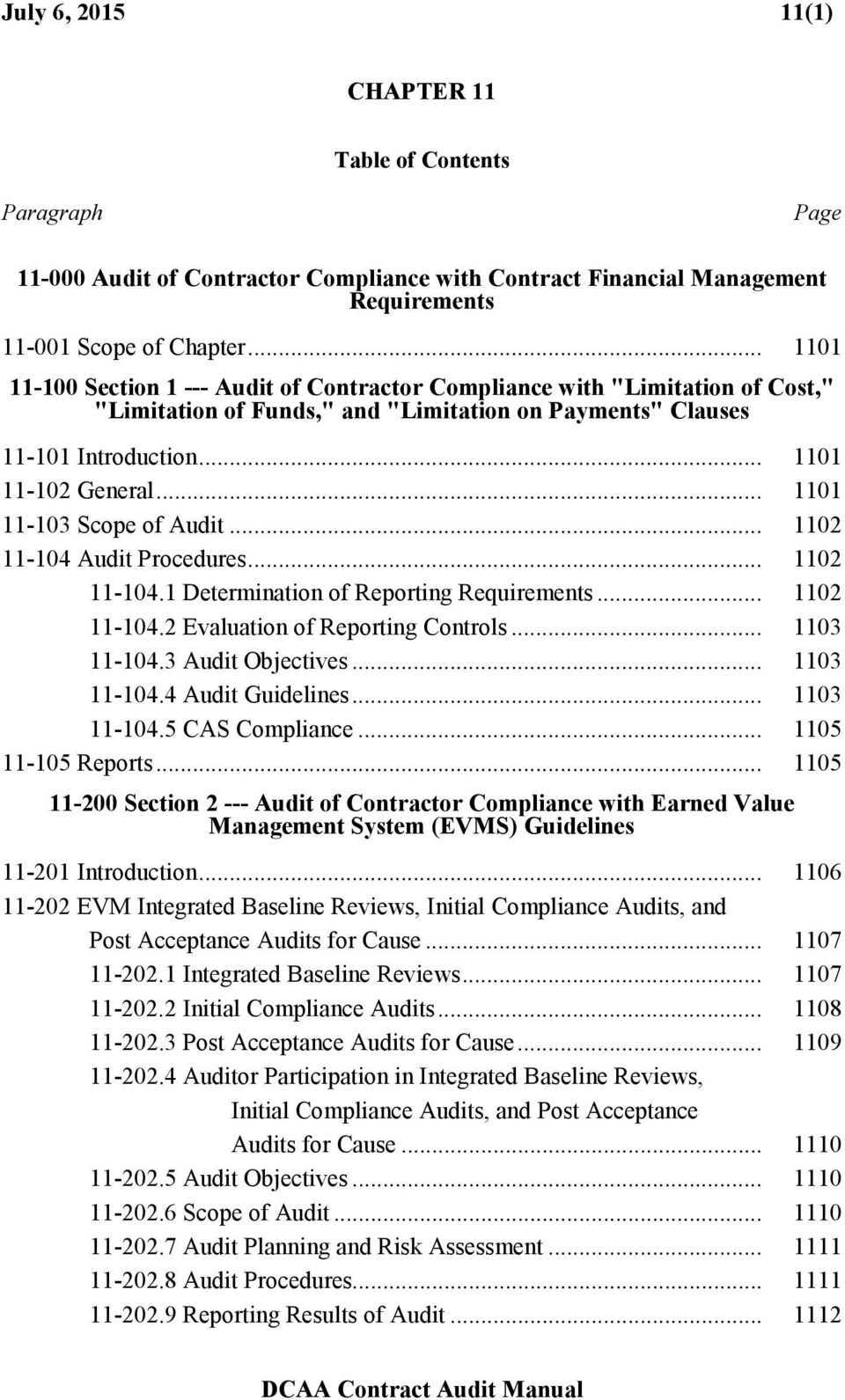
1 July 6, (1) CHAPTER 11 Table of Contents Paragraph Page Audit of Contractor Compliance with Contract Financial Management Requirements Scope of Chapter Section Audit of Contractor Compliance with "Limitation of Cost," "Limitation of Funds," and "Limitation on Payments" Clauses Introduction General Scope of Audit Audit Procedures Determination of Reporting Requirements Evaluation of Reporting Controls Audit Objectives Audit Guidelines CAS Compliance Reports Section Audit of Contractor Compliance with Earned Value Management System (EVMS) Guidelines Introduction EVM Integrated Baseline Reviews, Initial Compliance Audits, and Post Acceptance Audits for Cause Integrated Baseline Reviews Initial Compliance Audits Post Acceptance Audits for Cause Auditor Participation in Integrated Baseline Reviews, Initial Compliance Audits, and Post Acceptance Audits for Cause Audit Objectives Scope of Audit Audit Planning and Risk Assessment Audit Procedures Reporting Results of Audit
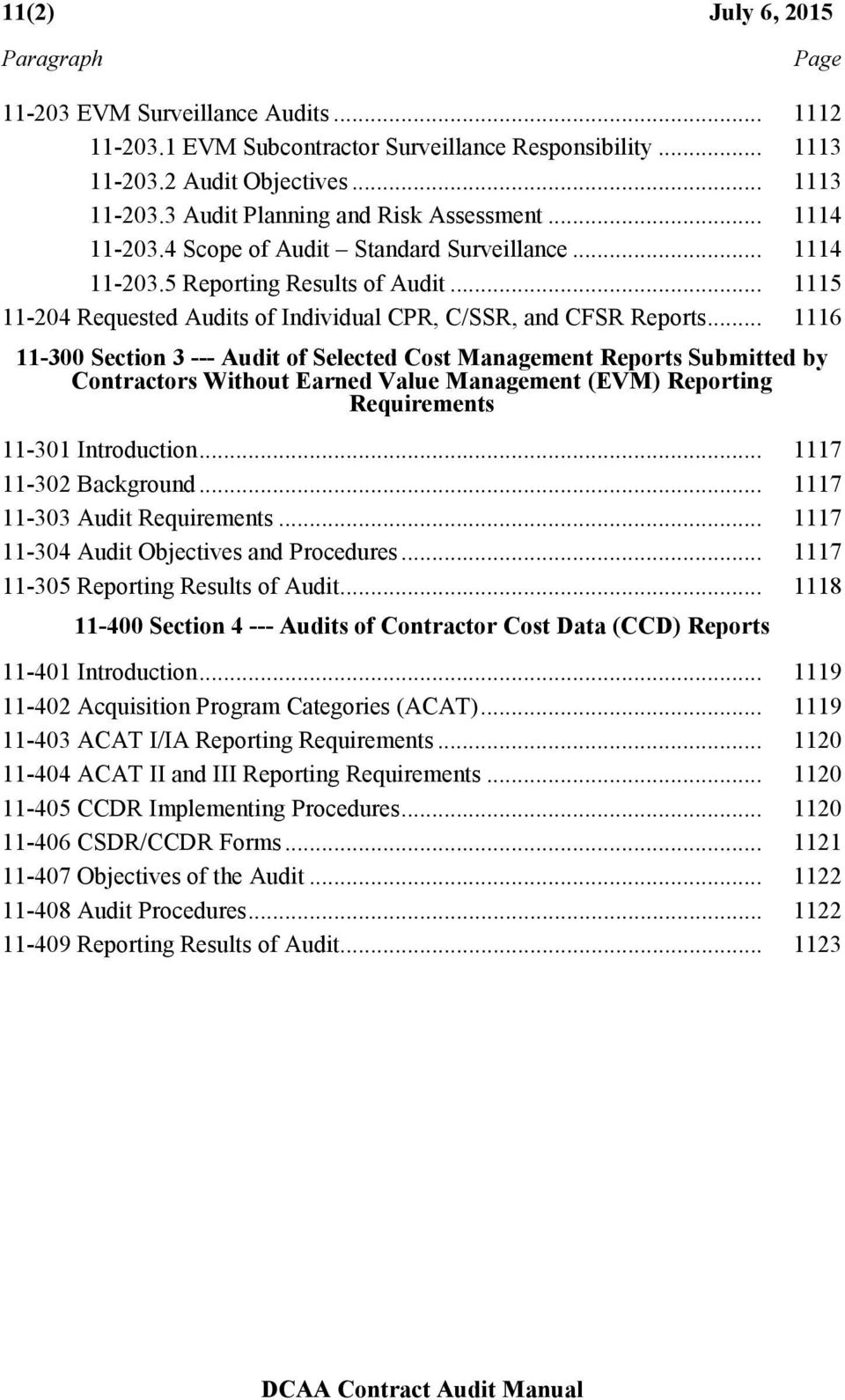
2 11(2) July 6, 2015 Paragraph Page EVM Surveillance Audits EVM Subcontractor Surveillance Responsibility Audit Objectives Audit Planning and Risk Assessment Scope of Audit Standard Surveillance Reporting Results of Audit Requested Audits of Individual CPR, C/SSR, and CFSR Reports Section Audit of Selected Cost Management Reports Submitted by Contractors Without Earned Value Management (EVM) Reporting Requirements Introduction Background Audit Requirements Audit Objectives and Procedures Reporting Results of Audit Section Audits of Contractor Cost Data (CCD) Reports Introduction Acquisition Program Categories (ACAT) ACAT I/IA Reporting Requirements ACAT II and III Reporting Requirements CCDR Implementing Procedures CSDR/CCDR Forms Objectives of the Audit Audit Procedures Reporting Results of Audit
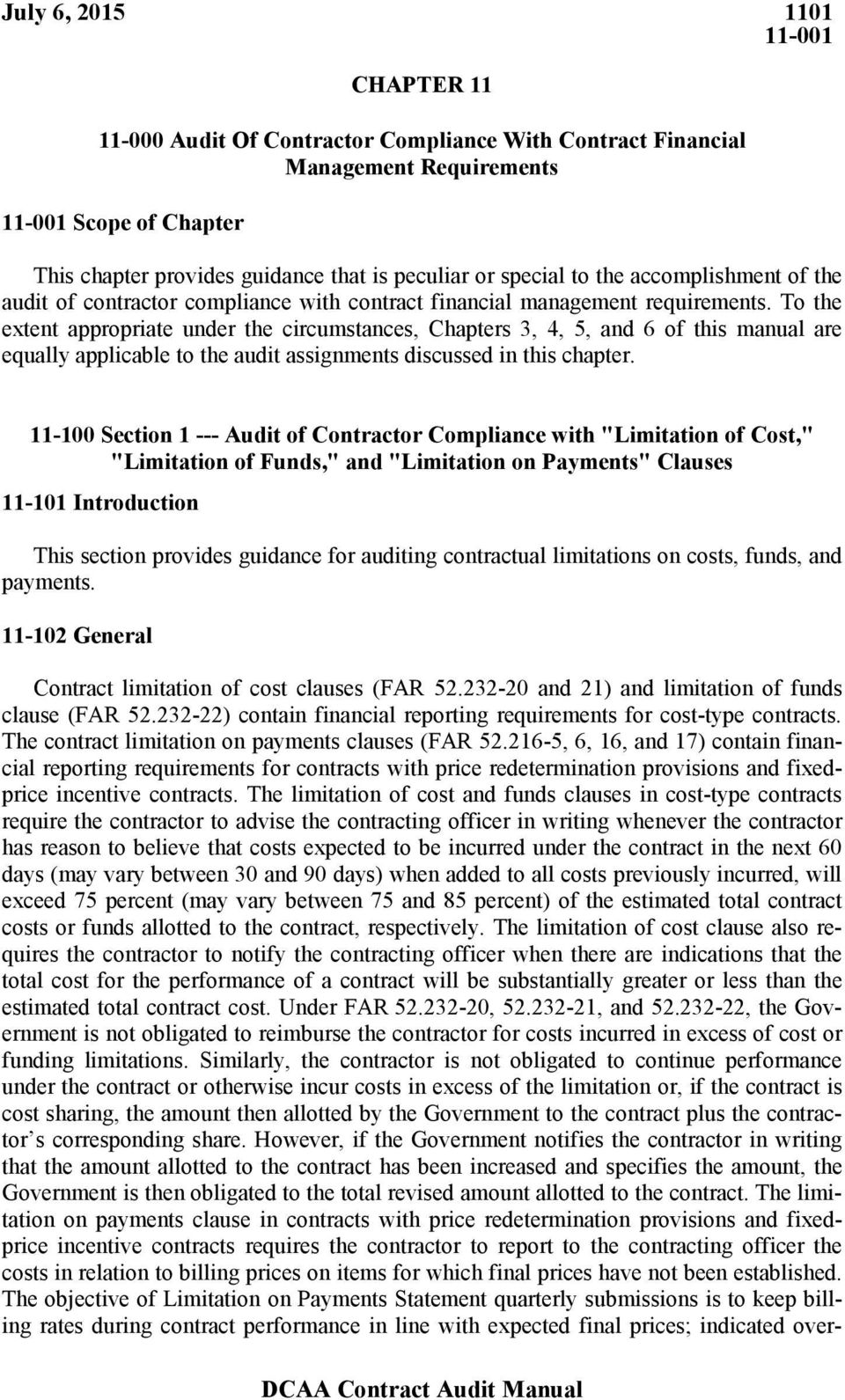
3 July 6, CHAPTER Audit Of Contractor Compliance With Contract Financial Management Requirements Scope of Chapter This chapter provides guidance that is peculiar or special to the accomplishment of the audit of contractor compliance with contract financial management requirements. To the extent appropriate under the circumstances, Chapters 3, 4, 5, and 6 of this manual are equally applicable to the audit assignments discussed in this chapter Section Audit of Contractor Compliance with "Limitation of Cost," "Limitation of Funds," and "Limitation on Payments" Clauses Introduction This section provides guidance for auditing contractual limitations on costs, funds, and payments General Contract limitation of cost clauses (FAR and 21) and limitation of funds clause (FAR ) contain financial reporting requirements for cost-type contracts. The contract limitation on payments clauses (FAR , 6, 16, and 17) contain financial reporting requirements for contracts with price redetermination provisions and fixedprice incentive contracts. The limitation of cost and funds clauses in cost-type contracts require the contractor to advise the contracting officer in writing whenever the contractor has reason to believe that costs expected to be incurred under the contract in the next 60 days (may vary between 30 and 90 days) when added to all costs previously incurred, will exceed 75 percent (may vary between 75 and 85 percent) of the estimated total contract costs or funds allotted to the contract, respectively. The limitation of cost clause also requires the contractor to notify the contracting officer when there are indications that the total cost for the performance of a contract will be substantially greater or less than the estimated total contract cost. Under FAR , , and , the Government is not obligated to reimburse the contractor for costs incurred in excess of cost or funding limitations. Similarly, the contractor is not obligated to continue performance under the contract or otherwise incur costs in excess of the limitation or, if the contract is cost sharing, the amount then allotted by the Government to the contract plus the contractor s corresponding share. However, if the Government notifies the contractor in writing that the amount allotted to the contract has been increased and specifies the amount, the Government is then obligated to the total revised amount allotted to the contract. The limitation on payments clause in contracts with price redetermination provisions and fixedprice incentive contracts requires the contractor to report to the contracting officer the costs in relation to billing prices on items for which final prices have not been established. The objective of Limitation on Payments Statement quarterly submissions is to keep billing rates during contract performance in line with expected final prices; indicated over-
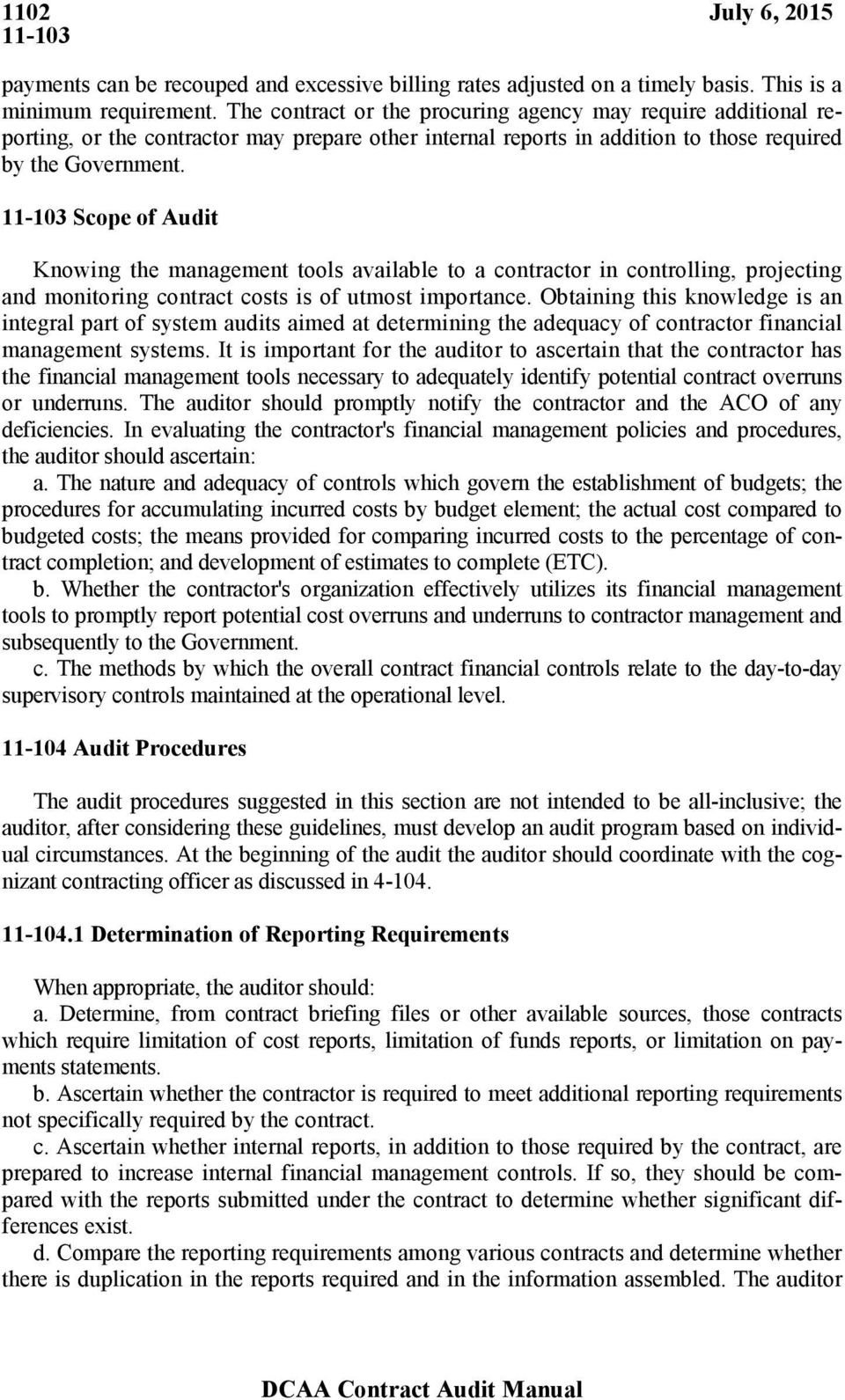
4 1102 July 6, payments can be recouped and excessive billing rates adjusted on a timely basis. This is a minimum requirement. The contract or the procuring agency may require additional reporting, or the contractor may prepare other internal reports in addition to those required by the Government Scope of Audit Knowing the management tools available to a contractor in controlling, projecting and monitoring contract costs is of utmost importance. Obtaining this knowledge is an integral part of system audits aimed at determining the adequacy of contractor financial management systems. It is important for the auditor to ascertain that the contractor has the financial management tools necessary to adequately identify potential contract overruns or underruns. The auditor should promptly notify the contractor and the ACO of any deficiencies. In evaluating the contractor's financial management policies and procedures, the auditor should ascertain: a. The nature and adequacy of controls which govern the establishment of budgets; the procedures for accumulating incurred costs by budget element; the actual cost compared to budgeted costs; the means provided for comparing incurred costs to the percentage of contract completion; and development of estimates to complete (ETC). b. Whether the contractor's organization effectively utilizes its financial management tools to promptly report potential cost overruns and underruns to contractor management and subsequently to the Government. c. The methods by which the overall contract financial controls relate to the day-to-day supervisory controls maintained at the operational level Audit Procedures The audit procedures suggested in this section are not intended to be all-inclusive; the auditor, after considering these guidelines, must develop an audit program based on individual circumstances. At the beginning of the audit the auditor should coordinate with the cognizant contracting officer as discussed in Determination of Reporting Requirements When appropriate, the auditor should: a. Determine, from contract briefing files or other available sources, those contracts which require limitation of cost reports, limitation of funds reports, or limitation on payments statements. b. Ascertain whether the contractor is required to meet additional reporting requirements not specifically required by the contract. c. Ascertain whether internal reports, in addition to those required by the contract, are prepared to increase internal financial management controls. If so, they should be compared with the reports submitted under the contract to determine whether significant differences exist. d. Compare the reporting requirements among various contracts and determine whether there is duplication in the reports required and in the information assembled. The auditor
5 July 6, should consider the possibility of the contractor using reports required by one military department, command, or Service to satisfy the needs of all contracting officers Evaluation of Reporting Controls When appropriate, the auditor should: a. Evaluate the contractor's procedures applicable to the budgetary controls of individual contracts and compare the estimated cost of individual tasks and departments in the cost estimate with the budgeted funds. b. Ascertain and evaluate for each division (or plant) the internal procedures for controlling the financial status of Government contracts and determine the source of the reported incurred costs and the basis for ETC. The auditor also should determine the extent and frequency of supervisory reviews of the status reports and whether explanations are required when there are significant deviations from the budget. c. Ascertain and evaluate the manner in which revised ETC, in terms of engineering and production manhours, relate to the production control schedules and engineering manpower schedules at specific work centers. d. Evaluate the documentation flow of the financial status reports from the various sources to the finance manager responsible for preparing the overall financial report for the assigned project. e. Evaluate the controls exercised by the finance manager, including: (1) the manner in which the source data are reviewed for reliability, (2) the basis for changes to the source data, and (3) a determination of the extent to which requests for explanations from operations responsible for the source data are made relative to causes of potential cost overruns or underruns Audit Objectives The audit objectives are: (1) to determine whether the contractor has complied with the reporting requirements contained in the contract clause and (2) whether the financial data contained in the contractor's reports and statements are reasonable and consistent with the data presented in other required Government reports and/or claims Audit Guidelines The audit guidelines which are applicable to the minimum reporting requirements in are as follows: a. Ascertain whether the contractor is submitting reports required by its contracts. Compare these reports with the contractor's internal financial reports for consistency. b. Evaluate limitation of cost reports. The limitation of cost clause requires the contractor to provide the contracting officer advance notice whenever the total cost incurred on the contract will exceed a specified percentage of, or will be greater or substantially less than, the estimated cost specified in the contract. The contractor must submit a revised

6 1104 July 6, estimate of the total cost of performing the contract as part of the notification. Limitation of cost reports should be evaluated using the following guidance: (1) Evaluate the contractor's revised EAC using the guidance in f. (2) Ascertain whether the limitation of cost reports in successive periods reflect significant cost underruns or overruns. (3) Ascertain whether the contracting officer has obtained contractor explanations for overruns when continuous overruns have occurred over an extended period. (4) When continuous underruns are projected over an extended period, and when the overall estimated contract price has not been reduced, the auditor should ask the contracting officer why. (5) When individual contracts indicate continuous significant cost overruns or underruns, the auditor should evaluate this condition in relation to the price established at the time of award. If it is determined that consistent overruns or underruns resulted from defective initial pricing, the contracting officer should be so advised. c. Evaluate limitation of funds reports. The limitation of funds clause requires the contractor to provide the contracting officer advance notice whenever the total cost incurred on the contract will exceed a specified percentage of the funds currently allotted or, for cost sharing contracts, this amount plus the contractor's corresponding share. This notice must include an estimate of the amount of additional funds required to continue performance for the period specified in the contract. Limitation of funds reports should be evaluated using the guidance in b above. d. Evaluate limitation on payments statements. Limitation on payments (LOP) statements must be submitted quarterly, in accordance with the provisions of FAR , 6, 16, or 17. The primary objectives of LOP statements are to provide for recoupment of overpayments and to indicate a need for a reduction in billing prices. These conditions become apparent when the contractor is underrunning targets used to establish billing prices. Overruns are indicated when estimated final prices exceed invoice amounts. This indicates possible need for increased billing prices and/or revision of liquidation rates. The general objective is to keep billing prices in line with expected final prices during contract performance. Progress payments and LOP statements should be evaluated at the same time. Even though a request for audit may specify a particular document, auditors should try to identify both submissions with comparable cutoff dates for direct comparison and reconciliation. Evaluate LOP statements and reconcile them to progress payment requests using the following guidance: (1) The auditor should determine that costs related to delivered items are the same as the amounts excluded from costs shown as a basis for unliquidated progress payments (Item 20a of the progress payment request). (2) The price of items invoiced should be the same as Item 21a on the progress payment request when both submissions have the same cutoff date. (3) The EACs used to prepare LOP statements and progress payment requests should be the same. The most current estimates should always be used. EACs should be evaluated using the guidance in CAM e. (4) The auditor should assure the comparability of contract items used in computations required by the various subsections of the Limitation of Payments Statement. In all instances, cost data should relate to supplies and services delivered and accepted. (5) The auditor should determine the methods used by the contractor to identify actual costs of delivered and invoiced items. Understatement of this amount usually results in an

7 July 6, overpayment of progress payments by overstating the costs eligible for progress payments applicable to undelivered and uninvoiced items. (6) The auditor should ascertain whether the contractor makes prompt refunds or adjustments when cost underruns are indicated in the performance of fixed-price redeterminable contracts CAS Compliance The auditor should determine if reporting practices comply with CAS 401, "Consistency in Estimating, Accumulating, and Reporting" (See Chapter 8) Reports Reports will be furnished in response to specific requests for evaluations in this area. Audit reports will be prepared in accordance with When there is reason to recommend correction of a substantial deficiency, a special report will promptly be initiated by the auditor even if there is no request from a contracting officer. Other deficiencies may be included in periodic reports on the overall system of accounting and internal control.

8 1106 July 6, Section Audit of Contractor Compliance with Earned Value Management System (EVMS) Guidelines Introduction a. This section provides guidance for auditing contractor management systems on selected contracts. The mandatory guidelines that must be met by the contractor are prescribed in DoDI , Operation of the Defense Acquisition System, and DFARS 234.2, and , Earned Value Management System (EVMS). As stated in DFARS (b) System Criteria, the contractor shall use: (1) An Earned Value Management System that complies with the EVMS guidelines in the American National Standards Institute/Electronic Industries Alliance Standard 748, EVMS (ANSI/EIA-748); and (2) Management procedures that provide for generation of timely, reliable and verifiable information for the Contract Performance Report (CPR) and the Integrated Master Schedule (IMS) required by CPR and IMS data items of the contract. b. In December 1996, the Under Secretary of Defense (Acquisition, Technology and Logistics) (USD(AT&L)) accepted industry guidelines for Earned Value Management (EVM) replacing the DoD Cost/Schedule Control System Criteria (C/SCSC). The guidelines represent the framework for an integrated management system that provides for: (1) planning the timely performance of work, (2) budgeting resources, (3) accounting for costs and measuring actual performance against plans, and (4) replanning resources needed to complete the contract when significant deviations from plans are identified. A contractor's management system must meet 32 guidelines organized into the following five major categories: Organization; Planning, Scheduling and Budgeting; Accounting Considerations; Analysis and Management Reports; and Revisions and Data Maintenance. Detailed uniform guidance for implementing the guidelines and conducting systems audits is provided in the Earned Value Management Implementation Guide (EVMIG). The EVMIG may be accessed through the DCAA Intranet under Audit Tools, EVMS. c. Effective April 6, 2005, DoDI required EVM compliance on cost or incentive contracts, subcontracts, or work agreements valued at or greater than $20 million. Cost or incentive contracts, subcontracts, or work agreements valued at or greater than $50 million require compliance with the EVM guidelines and an earned value management system that has been formally validated and accepted by the cognizant contracting officer. Application of EVM on cost or incentive contracts valued at less than $20 million is left to the discretion of the program manager based on cost benefit analysis. Application of EVM on firm-fixed price contracts requires a waiver from the Milestone Decision Authority based on a business case analysis. For contracts awarded prior to April 6, 2005, the previous DoDI (5000.2) was in effect; therefore, the auditor must refer to the specific terms of the contract to determine which EVM requirements are applicable to the contract. d. General responsibilities of the auditor during EVMS implementation and surveillance are delineated in the EVMIG, which supplements and elaborates on the provisions

9 July 6, of DoDI Auditors should support DCMA EVMS reviews by performing an independent EVMS audit in accordance with the DCAA approved audit programs, considering risks identified by DCMA. Auditors should participate in EVMS reviews when (1) the contracting officer requests the audit services, (2) the audit covers a management approved EVM system, (3) the EVM system contains sufficient data for testing; (4) the auditor sets the scope of audit, and (5) an audit report is issued covering all significant findings. Auditors are not considered part of a review team where the contractor representatives may also be participating. However, auditors should attend the entrance conference and other conferences, and attend and/or conduct cost account manager interviews. Auditors should also participate in exit conferences to communicate the audit results, and gain an understanding of the deficiencies identified by DCMA. e. The Defense Contract Management Agency (DCMA) is the DoD Executive Agent responsible for the implementation of EVM on DoD contracts. DoD components are required to implement earned value effectively and notify DCMA of their EVMS focal point. f. Since DoD s C/SCSC are considered to be equivalent to EVMS guidelines, contractors previously approved cost/schedule control systems are considered to be acceptable under the EVMS guidelines. Accordingly, contractors with acceptable cost/schedule control systems under C/SCSC are not required to demonstrate that their management systems meet the EVMS guidelines, and are not subject to the initial compliance audit procedures outlined in EVM Integrated Baseline Reviews, Initial Compliance Audits, and Post Acceptance Audits for Cause Integrated Baseline Reviews The Integrated Baseline Review (IBR) is a joint assessment conducted by the Government and the contractor following contract award to verify the technical content of the Performance Measurement Baseline (PMB) and the accuracy of the related resources (budgets) and schedules. The IBR will be conducted within six months of contract award. An IBR will also be conducted when work on a production option of a development contract begins or, at the discretion of the program manager, when a major modification to an existing contract significantly changes the existing PMB. The IBR is a streamlined approach to assessing the PMB on new contracts. The IBR is conducted under the assumption that the contractor is using an accepted EVMS internally for program management, and that there is a thorough and effective Government surveillance program ongoing at the contractor s facility. Therefore, this audit is not as comprehensive as the initial compliance and post-acceptance audits of the contractors EVMS. Accordingly, audit assistance will not usually be requested. However, when any part of the system is not clearly understood, the assistance of the auditor may be desired. If the assistance of the auditor is needed, the program manager will notify the cognizant FAO as soon as possible. The auditor will be responsive to the program manager for evaluation of those accounting and/or financial aspects of the contractor's system.
10 1108 July 6, Initial Compliance Audits a. DFARS , Earned Value Management System, requires the contractor to be prepared to demonstrate that its management system complies with the EVMS guidelines. The initial compliance audit is conducted by a DoD compliance review team whose leader is appointed by the DCMA EVM Center. The team generally includes a DCAA auditor; however, see d regarding DCAA participation on an EVM review team. The DCAA auditor will generally conduct an independent review of selected guidelines and cost performance reports. The DCMA team lead should advise the auditor of the estimated start date and furnish the auditor with relevant EVMS information pertaining to the contractors system as soon as it is available. A contractor s EVMS that has been accepted for application to another contract of the same type (e.g., development or production), at the same facility, will not be required to undergo an initial compliance audit. b. The DCMA compliance review team will make an initial visit to the contractor s facility to provide an early dialogue between the review team and the contractor on the compliance review process, set review expectations and identify areas of noncompliance and potential problems with the contractor s EVMS processes and procedures. This initial review of the system includes a contractor demonstration (walk-through) of the design and operation of their system, and an explanation of applicable reports. Even as early as the initial visit, if DCMA identifies non-compliance with contractor s EVMS they will be documented and will require action on the part of the contractor. Any noted deficiencies are documented in a DCMA Discrepancy Report and issued to the contractor via a Corrective Action Request (CAR) for correction by the contractor via a Corrective Action Plan (CAP). At the end of the initial visit, the team develops a schedule for the compliance review process which includes the contractor s self assessment and DCMA s Readiness Assessment. DCAA should attend the initial visit. The system demonstration and the development of the compliance review schedule will assist in preparing for DCAA s audit at the readiness assessment phase. c. The contractor is required to conduct a self assessment of its EVMS system. This self assessment provides the contractor the opportunity to assess its EVMS compliance to the ANSI/EIA 748 EVMS Guidelines, and to determine its readiness for demonstrating a fully integrated and compliant system to the Government team. In parallel to the contractor s self assessment, DCMA requests a contractor data call and independently reviews the contractor s data during the DCMA Readiness Assessment phase of the compliance review process. d. The review team (DCMA and DCAA) will conduct an independent examination of the contractor records and information to ascertain compliance with the EVMS guidelines and document its findings. Prior to the Readiness Assessment, DCMA will request DCAA audit assistance. DCAA s EVMS initial audit should begin as soon as practicable following the receipt of the DCMA request. Any noted deficiencies identified in the Readiness Assessment will be documented in a DCMA CAR which will result in a contractor required CAP. The CAP will include the results from the DCAA audit report. e. After the Readiness Assessment review and verification of the completed CAP, the review team will conduct the validation review to determine compliance with the ANSI/EIA-748 EVMS Guidelines. During the validation review, the contractor will provide an overview briefing to familiarize the team with the proposed EVMS and identify any changes to the EVMS since the Readiness Assessment. If necessary, the team will
11 July 6, evaluate any changes to the baseline since the Readiness Assessment. The team will evaluate, on a sampling basis, performance measurement data to verify the adequacy of the contractor s controls and accuracy of management reporting information. The team may conduct interviews of selected contractor personnel to verify that the EVMS is fully implemented and being used in the management of the contract. A compliance review report will be issued by DCMA 45 days after completion of the review which will include the results from the DCAA audit report. At this point in the process, DCAA s audit report may be a follow-up audit based on conditions identified in the readiness assessment phase, an initial audit report if not involved in the readiness assessment phase, or not required because the DCAA report at the readiness assessment phase determined the contractor was compliant with the guidelines under DCAA cognizance. f. After the successful completion of an initial compliance audit, an advance agreement between the Government and the contractor is executed, which specifies the contractor will maintain and use the accepted EVMS as an integral management process on current, as well as, future contracts. The agreement should be incorporated into each contract requiring the application of the EVMS guidelines. The agreement is signed by the ACO and a contractor representative at a commensurate level, e.g., the division manager may sign the agreement when the EVMS is used throughout the corporation s division. In addition, a Memorandum of Agreement (MOA) may be executed between the Program Management Office (PMO) and the Contract Management Office (CMO). The MOA identifies key Government EVMS individuals and establishes the working relationships between the PMO and CMO. Auditors should not sign advance agreements or MOAs. The auditing standard of independence precludes DCAA from entering into most agreements. If the CMO insists on the FAO entering into an advance agreement or MOA, the FAO should send the proposed agreement or MOA and background material through the regional office to Headquarters, ATTN: PPS, for coordination before executing the agreement or MOA Post Acceptance Audits for Cause After the initial acceptance of a contractor s EVMS, no further audits for system acceptance will be conducted unless there is a specific need determined by the Government. A post acceptance audit may occur when conditions warrant, e.g., solving a major system application problem identified by the program manager or a surveillance monitor. The scope and conduct of the audit will focus on the system processes affected by the problem. The audit will be scheduled based on written Government notification to the contractor. The review team director will be selected by the CMO EVMS monitor and the review team will be composed of the appropriate EVMS Government surveillance personnel needed to address the identified problem. DCMA will request a DCAA audit when the conditions identified relate to aspects of DFARS under DCAA s cognizance. The review is similar to an initial compliance audit, and the EVMIG should be used when compliance with specific guidelines is required. The review director will issue a report within 45 days after completion of the review; which will include the results from the DCAA audit report.
12 1110 July 6, Auditor Participation in Integrated Baseline Reviews, Initial Compliance Audits, and Post Acceptance Audits for Cause Upon receipt of a specific request, the FAO will assign an auditor to be a member of the IBR, initial compliance audit, or post acceptance audit for cause team. Auditors assigned to these teams should be familiar with the EVMIG and have appropriate training in EVMS guidelines. Prior to the audit, auditors should become thoroughly familiar with the contractor's EVMS by reviewing the contractor's system description and analyzing cost management reports for the contract under audit, if applicable Audit Objectives The auditor's primary objective is to audit the accounting system and related financial data to determine whether the management control system complies with the EVMS guidelines assigned and is being implemented on the contracts with EVM requirements. Auditors should perform the majority of the field work in advance of the DCMA review team visit in order to provide the management approved draft statement of conditions and recommendations or final audit report to the DCMA review chief by the end of the review team visit. As members of an EVMS guidelines review team, auditors should participate in meetings and cost account/functional manager interviews during the DCMA review team on-site visit. The auditor s responsibilities include: (1) reviewing the contractor s policy and procedures for compliance with certain aspects of EVMS guidelines and contractor provisions, and (2) reviewing selected cost performance reports to determine the data contained in the reports is timely, reliable and verifiable information to the contractor s books and records Scope of Audit a. The DCAA audit team is responsible for the preparation and execution of a detailed audit program for select EVMS guidelines and the accuracy of the contract performance reports. The selected guidelines are based on requests, as well as agreements DCAA has with various agencies, for example, the DCAA/DCMA Memorandum of Understanding (MOU) established in June Auditors should also assess whether deficiencies disclosed in audits of forward pricing rates or business system reports on are likely to affect the contractor's EVMS. If the contractor has other contracts requiring an approved EVMS, the auditor should also determine if deficiencies being reported in EVMS surveillance reports (11-203) have an impact on the contract under audit. b. The auditor is responsible for advising the DCMA review chief, on the areas audited, whether the management system meets the requirements of the EVMS guidelines. Unresolved disagreements between the auditor and DCMA review chief should be referred to the regional office and, when necessary, to DCAA Headquarters, ATTN: PPS. c. If the auditor becomes aware of significant accounting or financial aspects of the contractor's EVMS that have not been reviewed during the IBR, initial compliance audit, or post acceptance audit for cause, thereby resulting in an incomplete review of the system, the circumstances should be immediately brought to the attention of the team chief

13 July 6, and documented in the DCAA files. Comments on these matters should also be included in the audit report together with statements regarding their expected impact on the system and related reporting of contract performance. d. An EVMS is intended for contractor use in managing contracts and for Government use in monitoring contract performance. Application of the provisions of DoDI should not result in the development or use of two systems, one for the contractor's internal use and the second merely to satisfy the intent of the guidelines. Evidence of intended or actual parallel operation should be fully evaluated and the results discussed with other members of the EVMS guidelines review team. e. Unrestricted access to all data affecting contract costs, both direct and indirect, including budgets and operating forecasts, is necessary to properly audit an EVMS. If the contractor refuses access to required data, the auditor will advise the DCMA review chief and the CMO EVMS monitor and enlist their aid in obtaining the information ( ) Audit Planning and Risk Assessment Audit planning will include a contractor system demonstration and walk-through by the applicable contractor personnel of the various processes that ensure compliance with the DFARS EVMS system criteria. The contractor demonstration, which is performed during the risk assessment, is an essential element for obtaining and documenting the understanding of the relevant internal controls. Audit planning is discussed in detail in CAM Audit Procedures a. Select those tests and other auditing procedures that are necessary to adequately complete the work assigned. These procedures will include tests to verify that the management control system meets the guidelines for the areas assigned. Make maximum use of permanent file information and knowledge of audit staff to avoid duplication of effort. However, auditors should conduct sufficient tests of the assigned guidelines during each EVMS guidelines review to confirm that the management control system has in fact been implemented on the contract being audited. b. In evaluating whether a contractor's management control system complies with the guidelines, the auditor should conduct audit procedures similar to those performed during surveillance of the EVMS guidelines ( ). Guidelines which DCAA is commonly asked to evaluate include: Planning, Scheduling and Budgeting Guideline 13; all of the Accounting Considerations Guidelines (16, 17, 18, 19, 20, and 21); and Revisions and Data Maintenance Guideline 30. See Part II of the EVM Intent Guide for a narrative description of each EVMS guideline which identifies the intent of the guideline and typical system attributes for compliance with the guideline. The team members should use the EVM Intent Guide, as necessary in the examination of contractor management control systems to ensure compliance with the guidelines. The EVM Intent Guide includes a restatement of guidelines, followed by the related system characteristics expected to be part of an acceptable EVMS. Auditors will need to perform specific audit steps to verify that the expected system characteristics are present in the contractor s EVMS.
14 1112 July 6, Reporting Results of Audit a. The compliance audit report should be prepared in accordance with and provide clear statements of the scope of the audit and any deficiencies noted, together with recommendations for their correction. Auditors should provide general coordination on the status of audits but should not share draft audit results until the working papers are complete and the results of audit have been reviewed by DCAA management. The FAO will retain the detailed working papers covering DCAA's part of the audit. Working papers supporting the auditor's conclusions regarding compliance or significant deficiencies with specific guidelines will be documented in all instances and will include a record of the conclusions which have been furnished to the DCMA review chief. Reported deficiencies should be identified to specific guidelines or the contractor's system description whenever possible. The auditor's report should be formally issued prior to the EVMS guidelines review team exit conference with the contractor. However, if the final report is not ready to be issued, the review team should already have the management approved draft statement of conditions and recommendations that they received when the draft results were provided to the contractor for comments. b. Provide Headquarters, ATTN: PPS, with a copy of each report which meets any of the following criteria: (1) Discloses significant discrepancies in a contractor's EVMS. (2) Discloses significant restrictions on the audit caused by a denial of access to records EVM Surveillance Audits a. After government acceptance of the contractor's management control system, surveillance by the Contract Management Office (CMO) and DCAA is performed to ensure that the contractor's system continues to comply with the EVMS guidelines and produces valid and timely data. Surveillance is also performed to ensure that any proposed or actual changes to the EVMS comply with the guidelines and are reflected in the contractor's system description. Surveillance includes review of continued compliance with the EVM guidelines, as well as, verifying, tracing, and evaluating the information contained in the reports submitted to DoD procuring components. In the event deficiencies are disclosed, or if there is an indication of an adverse effect on contract performance because of such deficiencies, discuss the deficiencies with the contractor and notify the CMO EVMS monitor. b. Surveillance is required for all contract efforts that require the implementation of EVM compliance with ANSI/EIA-748, regardless of whether a formal system validation is required. Part II, Section of the EVMIG provides that surveillance on nonvalidated EVM systems (i.e. for contracts valued at or greater than $20 million or more but less than $50 million) is conducted in the same manner as for validated systems. Basic auditor responsibilities during surveillance audits are summarized in Part II, Section of the EVMIG. The auditor s responsibilities include: (1) reviewing the contractor s policy and procedures for compliance with selected EVMS guidelines and contractor provisions, and
15 July 6, (2) reviewing selected cost performance reports to determine if the reports contain timely, reliable and verifiable information, and that they tie to the contractor s books and records EVM Subcontractor Surveillance Responsibility It is the prime contractor's responsibility to accept and maintain surveillance of subcontractor EVMS. However, there are unique situations when a subcontractor EVMS will be accepted and/or surveillance will be performed by a DoD component rather than a prime contractor. This may occur when: a. the subcontractor, for competitive reasons, refuses the prime contractor access to its books and records; b. the subcontractor is performing multiple contracts containing EVMS reporting requirements under more than one prime contractor; or c. the subcontractor may be functioning as a prime contractor on an accepted EVMS Audit Objectives The objectives of the system surveillance audit are to ensure that the contractor's management control system continues to provide valid and timely management information and continues to comply with the selected EVMS guidelines as prescribed by DFARS Reconciliations of the external cost management reports (Contract Performance Report (CPR) and Contract Funds Status Report (CFSR)) are to ensure the costs recorded in the accounting system properly flow into the EVM system. The cost management reports typically generated by a contractor s EVMS include: a. Contract Performance Report (CPR) The objective of the CPR (DD Form 2734) is to provide data to Government system managers that may be used by them to: (1) evaluate contract performance, (2) identify actual and potential problem areas having significant cost impact, and (3) respond to requests for program status information on major weapon/support system acquisitions. To permit this type of management control, the CPR requires, among other things: information on cost and schedule performance by work breakdown structure and functional cost categories, actual manpower utilization versus the budgeted plan, and narrative comments explaining major cost and schedule variances, as well as an identification of significant problems and action contemplated for their resolution. The CPR is submitted monthly unless otherwise provided for in the contract. b. Contract Funds Status Report (CFSR) The objective of the CFSR (DD Form 1586) is to provide information about contract funding requirements for specifically designated programs to assist the system manager in: (1) updating and forecasting contract fund requirements, (2) planning and decision making on changes in the fund requirements, (3) developing fund requirements and budget estimates in support of approved programs, and

16 1114 July 6, (4) determining funds in excess of contract needs and available for deobligation. The CFSR is normally prepared quarterly and submitted within 25 calendar days after the cut-off date or the number of days specified in the contract. Under unusual circumstances monthly reporting may be required Audit Planning and Risk Assessment Audit planning will include a contractor system demonstration and walk-through by the applicable contractor personnel of the various processes that ensure compliance with the DFARS EVMS system criteria. The contractor demonstration, which is performed during the risk assessment, is an essential element for obtaining and documenting the understanding of the relevant internal controls. Audit planning is discussed in detail in CAM Scope of Audit Standard Surveillance a. System surveillance may consist of either a detailed evaluation, encompassing all of the EVM guidelines assigned to DCAA, or may be limited to the guidelines related to the specific risk factor identified. b. In evaluating the compliance with the EVM guidelines, the auditor should consider the system characteristics related to the guidelines, as contained in the EVM Intent Guide. c. The auditor should consider the testing performed in related business system audits when determining the testing required in the system surveillance audit. The testing performed in the related internal control audits should be used, to the extent possible, in determining the contractor s continued compliance with the EVM guidelines under review. d. If the contractor s system has changed since the last surveillance audit, the auditor should evaluate the changed policies and procedures for continued compliance with the EVM guidelines under review. e. For all system surveillance audits, the auditor should select a sample of contracts to test to ensure the contractor has followed through with the implementation of the guidelines on contracts. f. A universe of contracts containing EVM requirements (DFARS ) should be developed based on: (1) data obtained from the contractor, (2) data obtained from the CMO/ACO, (3) briefing contract provisions, specifically the Contract Data Requirements List (CDRL), DD Form 1423, or (4) a combination of the data sources. g. The auditor should coordinate with the ACO to identify any sensitive, high risk, or high visibility contracts. h. The sample of contracts should reflect high-risk or sensitive contracts, including contracts where problems were identified in prior year testing. The auditor should determine the extent of testing of report data and select the specific reports to be tested under the selected contracts based on the results of the audit risk assessment.
17 July 6, Reporting Results of Audit a. The surveillance audit report should be prepared in accordance with and provide clear statements of the scope of the audit and any deficiencies noted, together with recommendations for their correction. Comments should also be provided regarding the results of discussions with the contractor's representative on significant deficiencies/weaknesses disclosed. To ensure that all pertinent data have been considered, the audit findings and recommendations will be discussed with the CMO EVMS monitor prior to issuance of the report. To accomplish this, auditors will meet with the CMO EVMS monitor to discuss the results of the audit and should provide draft statement of conditions and recommendations to the CMO EVMS monitor when the draft results are provided to the contractor for comments. Systemic EVMS significant deficiencies/weaknesses should be highlighted in the report. The report should be issued in a timely manner to ensure report recommendations may be acted on appropriately. The report should be addressed to the principal cognizant ACO. A copy of the report will be provided directly to the CMO EVMS monitor, the affected program office(s), and the FLA(s) where applicable. A copy of each report meeting any of the criteria stated in b above will also be provided to Headquarters, ATTN: PPS. b. When applicable, surveillance reports should include a reference to reports issued on the results of system audits (see f) that had an impact on or were affected by the EVMS. c. Significant deficiencies/weaknesses being reported in surveillance reports should also be reported in audit reports in an appendix on Other Matters on proposals expected to result in contracts covered by DFARS clause , Earned Value Management Systems. d. When significant deficiencies/weaknesses are disclosed while performing audits of related business systems or forward pricing rates, the auditor will assess whether the deficiencies are likely to have a material effect on the reliability of the contractor's EVMS and provide comments in the related report on the system or forward pricing rates. The auditor should immediately evaluate the impact of these deficiencies on the contractor's EVMS data for specific contracts and, where material, provide the details in a Business System Deficiency Report ( ). e. Continued availability of information supporting earned values, incurred costs, and estimates to complete is necessary to perform proper surveillance of EVMS. In the event access to required contractor data is withheld or unduly restricted, follow the procedures in When denial is continued, each surveillance report should include appropriate modification of the scope and opinion statements, with identification of the data being denied and its relationship to system surveillance requirements. If internal management budgets and forecast data are not made available during the surveillance audit, the auditor should qualify the audit. When applicable, the CAC should establish uniformity in necessary report qualifications to ensure consistency within corporate structures when more than one corporate segment is subject to EVMS requirements.
18 1116 July 6, Requested Audits of Individual CPR, C/SSR, and CFSR Reports Periodically, contracting officers may request audits of individual cost reports submitted by EVM-covered contractors. Auditors should use the procedures set forth in d, modified as appropriate, to evaluate the individual report submissions. Reports on individual CPR, C/SSR, or CFSR submissions should be prepared in accordance with
19 July 6, Section Audit of Selected Cost Management Reports Submitted by Contractors Without Earned Value Management (EVM) Reporting Requirements Introduction This section provides audit procedures and guidance for auditing contractor management control systems, and the related cost reports (Contract Performance Reports (CPRs), and Contract Fund Status Reports (CFSRs)) at contractors who do not have contracts containing earned value management (EVM) reporting requirements. Audit guidance for contractors with EVM reporting requirements is contained in Background a. The Office of the Secretary of Defense and the military departments have developed a variety of management systems for use in the acquisition process. These systems provide the Government with the ability to obtain timely and valid cost, funding, schedule, and related management information for use in contract performance analysis and program control. Under DoD Directive and DoD Instruction , cost management reporting using the CPR and CFSR is no longer mandatory, but rather at the discretion of the contracting officials at contractors who do not have contracts containing EVM reporting requirements. DCAA audit effort related to the CPR and CFSR at contractors who do not have contracts containing EVM reporting requirements primarily involves the evaluation of contractor s compliance with contractual requirements and financial records to validate the accuracy and propriety of reported data in the CPRs and CFSRs. b. The audit of a contract and the briefing of its provisions (see 3-300) will disclose whether the contract incorporates CPR or CFSR reporting requirements. (1) Contract Performance Report (CPR). The objective of the CPR (DD Form 2734) is discussed in b(1). (2) Contract Funds Status Report (CFSR). The objective of the CFSR (DD Form 1586) is discussed in b(2) Audit Requirements Audits of individual CPR or CFSR reports will be requested by the contracting officer. The contracting officer may also request an audit prior to the award of a contract under which CPR or CFSR requirements are contemplated to determine if the contractor's management system and procedures are adequate and reliable for CPR or CFSR purposes, and will also consider the contractor's procedures for accumulating and reporting actual costs (cumulative expenditures for CFSR) and for estimating contract completion costs Audit Objectives and Procedures a. Where an audit of the contractor s management system and procedures relative to CPRs and CFSRs is required and based on a specific request from the contracting officer evaluate the contractor s policies and procedures for developing and reporting actual and projected costs in the CPRs and CFSRs to ensure the system will produce accurate data that complies with contractual reporting requirements. The objective of the audit is to evaluate the contractor s compliance with contractual requirements for submitting CPR or

20 1118 July 6, CFSR data. This includes evaluating the contractor s policies and procedures for the accumulation and reporting of CPR and/or CFSR data and to test the accuracy and reliability of the financial data contained in the contract cost reports prepared from the contractor system. b. Use the procedures at d to perform audits of individual CPR or CFSR reports requested by the contracting officer. Also use the procedures at d to selectively test financial data contained in the CPRs and/or CFSRs submitted by the contractor, based on the risk assessment described in a Reporting Results of Audit a. An audit report will be prepared: (1) on each audit of contractor management system and procedures requested by the contracting officer, and (2) in response to the request of the contracting officer for audits of individual CPRs or CFSRs. b. Audit reports will be prepared in accordance with and provide clear statements of the scope of the audit and any deficiencies noted, together with recommendations for their correction. To ensure that all pertinent data have been considered, the audit findings and recommendations will be discussed with the requestor and the ACO prior to issuance of the report. c. Audit reports will be addressed to the activity requesting the audit with a copy to the ACO. A copy of the report will be provided to the affected program office(s), and the FLA(s), where applicable. d. When an audit of a CFSR submission discloses that a loss is anticipated for a fixedprice contract, the auditor will ascertain whether the contractor is entitled to progress payments. If so, the auditor should make sure that the indicated rate of loss disclosed in the CFSR audit is appropriately applied by the contractor for purposes of computing its progress payment request.

21 July 6, Section Audits of Contractor Cost Data (CCD) Reports Introduction The Contractor Cost Data (CCD) reporting system, along with the software resources data reporting (SRDR) system are collectively referred to as the cost and software data reporting (CSDR) system. The CSDR is the DoD system for collecting actual costs and software data and related business data. The resulting repository serves as the primary contract cost and software data repository for most DoD resource analysis efforts. CSDR data is collected and stored in a central repository, the Defense Automated Cost Information Management System (DACIMS), maintained by Defense Cost and Resource Center (DCARC). The DACIMS is accessed through the DCARC Knowledge Portal and is available to authorized DoD users. DoD Instruction (DoDI) makes CCD reporting and SRDR mandatory. DoD Components use the data collected in the CSDR system to: (1) prepare acquisition and life cycle cost estimates for major system milestone reviews which are presented to the Defense Acquisition Board (DAB) and the component acquisition executive; (2) develop independent Government contract cost estimates in support of cost and price analyses; (3) develop estimates to support analysis of alternatives, cost as an independent variable, and long-range planning efforts. CCDRs focus on the collection of actual costs that are subdivided into standard categories for cost estimating purposes. SRDRs supplement these costs with software metrics that provide a better understanding and improved estimating of software-incentive programs; and (4) provide a means to facilitate estimating and analysis of indirect contract costs on programs. When the contract meets the requirements for CCD reporting per DoDI , the following DFARS clauses are applicable: DFARS , Notice of Cost and Software Data Reporting System, will be included in the Request for Proposal. This clause requires the contractor to have a process for accurate CCD reports. DFARS , Cost and Software Data Reporting System, will be in the contract. For compliance with DFARS the contractor shall have management procedures that provide for generation of timely and reliable information for the CCD reports. Detailed guidance related to CCD reporting and SRDRs is contained in DoDM M 1, the Cost and Software Data Reporting (CSDR) Manual. DCAA is responsible for audits of the CCD reports and compliance with DFARS , Cost and Software Data Reporting System Acquisition Program Categories (ACAT) DoDI specifies CCD reporting requirements based on a contract s designated ACAT. a. ACAT I applies to: (1) all major defense acquisition programs (MDAP) that are estimated by the Under Secretary of Defense (Acquisition, Technology, and Logistics) to require an eventual total research, development, test, and evaluation (RDT&E) expenditure of more than $365 mil-
22 1120 July 6, lion, or an eventual total procurement expenditure of more than $2.190 billion in constant fiscal year 2000 dollars and (2) other programs designated as ACAT I due to special interest. b. ACAT IA applies to: (1) all major automated information systems (MAIS) that are estimated by the DoD Component Head to require program costs (all appropriations) in any single year in excess of $32 million, total program acquisition costs in excess of $126 million, or total life-cycle costs in excess of $378 million in constant fiscal year 2000 dollars, and (2) other programs designated as ACAT IA due to special interest. c. ACAT II applies to: (1) all major systems not meeting the criteria for ACAT I, but estimated by the DoD Component Head to require an eventual total expenditure for RDT&E of more than $140 million, or an eventual total procurement expenditure of more than $660 million in constant fiscal year 2000 dollars; and (2) other programs designated as ACAT II due to special interest. d. ACAT III applies to programs not meeting the criteria for ACAT I, IA, or II ACAT I/IA Reporting Requirements Unless waived by the Office of the Director of Cost Assessment and Program Evaluation (CAPE), CCD reports are required for all major contracts and subcontracts, regardless of contract type, for ACAT I and IA programs and pre-mdap and pre-mais programs subsequent to Milestone A approval, valued at more than $50 million in then-year dollars. CCD reporting is not required for contracts priced below $20 million in then-year dollars. The CCD reporting requirement on high-risk or high-technical-interest contracts priced between $20 and $50 million in then-year dollars is left to the discretion of the DoD program manager with the approval of the CAPE. CCD reporting is not required for procurement of commercial systems, or for non-commercial systems bought under competitively awarded, firm fixed-price contracts, as long as competitive conditions continue to exist, and provided the DoD program manager requests and obtains approval for a reporting waiver from the CAPE ACAT II and III Reporting Requirements For ACATs II and III programs, CCD reporting, requirements are left to the discretion of the DoD components CCDR Implementing Procedures To implement CCD reporting, the procuring activity must prepare a program Cost and Software Data Reporting (CSDR) Plan showing the proposed collection of cost data by work breakdown structure for each program being reported, the required CCD report forms, and the frequency with which reports are required. The approved CCD reporting requirements are included in the Request for Proposal (RFP). In response to the RFP, the contractors submit a draft contract CSDR plan for negotiation with the DoD program office. The final plan is submitted to the DCARC for coordination of the approval by the CAPE prior to contract award. The approved CSDR plan is included in the contract and the required CCD report
23 July 6, forms are incorporated in the contract by inclusion in the Contract Data Requirements List (CDRL) CSDR/CCDR Forms a. All CSDR plans (i.e., programs and contracts) use DD Form This is a government document which summarizes all CSDR requirements for the entire program by the three acquisition phases (i.e. System Development & Demonstration (SDD), Low- Rate Initial Production (LRIP), and Full-Rate Production (FRP)). The Program Manager has primary responsibility for submission of the plan to the DCARC at least 60 days prior to RFP release or 180 days before the overarching integrated product team conducts it program review, whichever is earlier. b. There are four DD forms for CCD reporting (1921, , and ). Contracts with RFPs released after October 2011 must use May 2011 Forms and Data Item Descriptions (DID). Prior to October 2011, review the contract for the appropriate version of the CCDR forms. The contractor may elect to use the latest forms but is not required to. A third form, the Plant-Wide Data Report (DD ) was deleted as a CCDR requirement as of December 31, The DD was replaced with forward pricing rate data now submitted to the DCARC by DCMA. (1) The Cost Data Summary Report (DD Form 1921) and the Contract Work Breakdown Structure (CWBS) Index and Dictionary (DI-MGMT-81334) are required on all ACAT I contracts and subcontracts that meet the reporting thresholds. They capture all CWBS elements at the levels specified in the CAPE approved CSDR plan. They provide summary level cost data, cumulative to date and estimated at completion, with a breakout of recurring and nonrecurring costs. This report is submitted as a program estimate in response to the RFP, and as the contract specifies. (2) The Functional Cost-Hour Report (DD Form ) contains a functional breakout (e.g. engineering and manufacturing) and a cost element breakout (e.g. direct labor and material) within functional categories. A breakout is required for recurring and nonrecurring costs. This report is submitted as a program estimate in response to the RFP, and as the contract specifies. (3) The Progress Curve Report (DD Form ) captures recurring costs on lot or unit data for Cost Working-Group Integrated Product Team selected contract work breakdown structure elements on programs of high risk, high technical interest, high value, or high quantity. Any element requiring this form will also require DD Form (4) The Contractor Business Data Report (DD Form ) is used by contractors to submit: (1) direct and indirect actual cost data on Government contracts and (2) proposed direct and indirect cost data in response to Government solicitations. The contractor prepares the report on the basis of its estimating and accounting systems, although some data may have to be reclassified to ensure a common data base for estimating costs within DoD. The report is required for inclusion on any contract that meets the criteria specified in DoD Instruction or under other conditions specified for a particular contractual effort. The report should include: (a) Detailed information on major DoD programs, including equivalent units, buyer, and direct cost, hours and manpower data by function; for example engineering and
24 1122 July 6, manufacturing. It also contains direct cost, hours and manpower data by function for other DoD, other Government, and commercial effort. (b) Indirect cost data by function. (c) Actual costs for the current year and prior year and estimated costs for three or more future years Objectives of the Audit The auditor is required to evaluate the contractor s compliance with DFARS , Cost and Software Data System, and verify the accuracy of the data reported in contractor s CCD reports (DD Forms 1921, , , and ) to the contract and to the contractor s books and records and to evaluate the reasonableness of the contractor s estimates at completion (EAC) Audit Procedures a. Methods for auditing data in support of a price proposal should not be changed because of CCD reporting formats; however, the auditor should point out problems caused by business system deficiencies and how it affects the CCD reports to the contracting officer and DCARC. Forms submitted at the time of contract award become the baseline for DoD data bank purposes and measuring contract performance. Failure to identify and correct major deficiencies would negate the purpose of the CCD reporting by making comparison of data meaningless. b. Contractors are required to submit initial electronic CCD reports on an exception basis as determined by ODS DDCA (Deputy Director, Cost Assessment). Typically, initial reports will only be required when the contractor has not previously demonstrated the capability to produce the required reports. The initial CCD report forms (DD Forms 1921, , and ) are required to be marked initial and must contain EACs for each reporting element to the extent the data is available within the contractor s earned value management system (EVMS). c. The DCARC performs a validation for acceptance or rejection based on the reports compliance with the OSD CAPE-approved contract CSDR plan. If the DCARC finds the CCD reports to be acceptable, the program manager, contractor and other interested parties (including the cognizant DCAA FAO) are notified by a formal acceptance memorandum. If the DCARC finds the CCD reports to be unacceptable, the interested parties are notified by a formal rejection memorandum. d. The DCARC may request an audit of the first CCD report submission that includes actual costs under a contract. The DCARC will request other audits of individual CCD report submissions as necessary. The DCARC would like to be invited to the CCD report audit entrance conference and walk-through; however, the auditor should not delay the entrance conference based on the availability of the DCARC representative. e. For contracts requested by DCARC for review, auditors should obtain an understanding of the CCD reporting requirements by reviewing the CSDR plan and the Contract Data Requirements List (CDRL) items incorporated in the contract. f. Auditors should consider the results of other evaluations, such as business systems or earned value management surveillance audits, in planning the audit. This will provide effective audit coverage to accomplish the objectives of the CCD reporting audit.
25 July 6, g. The auditor should verify the contractor s reported incurred to date costs, hours, and unit or lot cost to the contractor s accounting system and other supporting documentation, where applicable. Request technical assistance, as necessary, to verify the contractor s classification of cost as recurring or nonrecurring, classification of costs by functional area, and estimates of unit or lot cost, where applicable. h. Evaluate the contractor s reported estimate at completion. The evaluation should assure that it is the "best estimate" without regard to established ceilings or contract price, and that the contractor has properly considered currently authorized work plus any additional directed work for which execution or negotiation of amendments is pending. This also includes work not formally included in the contract price. Request technical assistance, as necessary, to evaluate the reported estimate at completion. i. The auditor should ensure the contractor s CCD reports are prepared in accordance with the requirements of the CSDR Manual and the appropriate DIDs. j. The prime contractor is required to: (1) flow-down CSDR requirements to all subcontractors at all tiers that meet reporting thresholds; (2) direct subcontractors and lower-tier subcontractors to submit their CCD reports directly to the DCARC; (3) report on work performed by all subcontractors at price (including profit or fee); and (4) identify each direct-reporting subcontractor by name, city, state, and subcontract price. Where flow-down requirements are applicable, the prime auditor should coordinate assist audits with the cognizant FAO as needed. k. Compare CCD reporting data with similar contractor information in other financial management reports, such as Contract Funds Status Reports and Contract Performance Reports, if applicable, for agreement or reconcilability. l. The CCD report audit will include evaluating contractor compliance with report due dates as established in the CDRL. Discuss deficiencies in meeting due dates with the contracting officer so that corrective action can be taken Reporting Results of Audit a. An audit report will be prepared using the format contained in The report will state whether the CCD reports evaluated are accurate and supported by the contractor s books and records. b. To ensure that all pertinent data have been considered, the auditor will discuss audit findings with the contractor and contracting officer before the report is issued. Note that significant errors in detailed report data (e.g., specific WBS element or functional category) should be reported even if total reported cost is accurate, as the detailed CCD reporting data is used to develop the cost estimates discussed in
26 1124 July 6, c. All audit reports will be issued to the DCARC, with a copy to the administrative contracting officer, the affected program office(s) and the FLA(s), where applicable. The DCARC s address follows: Defense Cost and Resource Center th Street Suite 220 Arlington, VA 22202
Government Contracting and Earned Value Management (EVM)
 Government Contracting and Earned Value Management (EVM) Ida Davis, EVP, PMP, MBA Earned Value Manager DynPort Vaccine Company LLC, A CSC Company Note: This presentation is the property of DynPort Vaccine
Department of Defense INSTRUCTION
 Department of Defense INSTRUCTION NUMBER 7640.02 April 15, 2015 IG DoD SUBJECT: Policy for Follow-Up on Contract Audit Reports References: See Enclosure 1 1. PURPOSE. This instruction reissues DoD Instruction
Master Document Audit Program. Version 1.5, dated September 2015 B-01 Planning Considerations
 Activity Code 11070 Version 1.5, dated September 2015 B-01 Planning Considerations Accounting System Audit Audit Specific Independence Determination Members of the audit team and internal specialists consulting
INSTRUCTION NUMBER 7640.02 August 22, 2008
 Department of Defense INSTRUCTION NUMBER 7640.02 August 22, 2008 IG DoD SUBJECT: Policy for Follow-up on Contract Audit Reports References: See Enclosure 1 1. PURPOSE. This Instruction: a. Reissues DoD
Master Document Audit Program. Version 7.4, dated November 2006 B-1 Planning Considerations. Purpose and Scope
 Activity Code 24010 B-1 Planning Considerations Estimating System Survey (ICR) Purpose and Scope The major objectives of this audit are to: Evaluate the adequacy of and the contractor s compliance with
Activity Code 12500 Material Management and Accounting System (MMAS) Version 9.10, dated September 2015 B-1 Planning Considerations
 Activity Code 12500 Material Management and Accounting System (MMAS) Version 9.10, dated September 2015 B-1 Planning Considerations Audit Specific Independence Determination Members of the audit team and
INTERNAL CONTROL MATRIX FOR AUDIT OF BILLING SYSTEM CONTROLS Version No. 4.2 August 2006
 INTERNAL CONTROL MATRIX FOR AUDIT OF BILLING SYSTEM CONTROLS Version No. 4.2 August 2006 1. MANAGEMENT REVIEWS The contractor should have policies and procedures for periodic monitoring of the billing
DEFENSE CONTRACT AUDIT AGENCY DEPARTMENT OF DEFENSE 8725 JOHN J. KINGMAN ROAD, SUITE 2135 FORT BELVOIR, VA 22060-6219
 DEFENSE CONTRACT AUDIT AGENCY DEPARTMENT OF DEFENSE 8725 JOHN J. KINGMAN ROAD, SUITE 2135 FORT BELVOIR, VA 22060-6219 IN REPLY REFER TO PSP 730.8.B.1/2010-003 February 18, 2011 11-PSP-003(R) MEMORANDUM
Review of Audits Issued by the Defense Contract Audit Agency in FY 2012 and FY 2013
 Report No. DODIG-2014-109 Inspector General U.S. Department of Defense SEPTEMBER 8, 2014 Review of Audits Issued by the Defense Contract Audit Agency in FY 2012 and FY 2013 INTEGRITY EFFICIENCY ACCOUNTABILITY
How To Write Ansi/Eia Evm System Acceptanceance Guide
 National Defense Industrial Association (NDIA) Program Management Systems Committee (PMSC) ANSI/EIA 748 Earned Value Management System Acceptance Guide Working Release For User Comment January 23, 2006
How To Audit A Government Contractor
 Activity Code 17740 Version 6.11, dated November 2015 B-1 Planning Considerations Preaward Survey of Prospective Contractor Accounting System Audit Specific Independence Determination Members of the audit
DCAA Perspective: Key Subcontracting Practices for Maintaining Approved Business Systems Accounting System and Estimating System
 DCAA Perspective: Key Subcontracting Practices for Maintaining Approved Business Systems Accounting System and Estimating System Breakout Session A Alfred J. Massey, Western Region, Special Programs Manager,
DEPARTMENT OF DEFENSE Defense Contract Management Agency INSTRUCTION. Small Business Process
 DEPARTMENT OF DEFENSE Defense Contract Management Agency INSTRUCTION Small Business Process Contracts Directorate DCMA-INST 119 OPR: DCMA-AQS 1. PURPOSE. This Instruction: a. Reissues and updates DCMA
Post Award Accounting System Audit at Nonmajor Contractors
 Activity Code 17740 B-1 Planning Considerations Post Award Accounting System Audit at Nonmajor Contractors To provide general guidance for the audit of the adequacy and suitability of nonmajor contractor
UNIT 34: COST ACCOUNTING STANDARDS
 UNIT CERTIFICATION Statement of Completion has satisfactorily completed training in the duty of this Unit under the conditions described below and in accordance with the overall standard(s) for this Unit.
Master Document Audit Program. Business System Deficiency Report Assignment. Version No. 1.3, dated June 2014 B-1 Planning Considerations
 Activity Code 11090 B-1 Planning Considerations Business System Deficiency Report Assignment Audit Specific Independence Determination Members of the audit team and internal specialists consulting on this
Evaluation of Defense Contract Management Agency Actions on Reported DoD Contractor Business System Deficiencies
 Inspector General U.S. Department of Defense Report No. DODIG-2016-001 OCTOBER 1, 2015 Evaluation of Defense Contract Management Agency Actions on Reported DoD Contractor Business System Deficiencies INTEGRITY
DATA ITEM DESCRIPTION Title: Integrated Program Management Report (IPMR) Number: DI-MGMT-81861 Approval Date: 20120620
 DATA ITEM DESCRIPTION Title: Integrated Program Management Report (IPMR) Number: DI-MGMT-81861 Approval Date: 20120620 AMSC Number: D7549 Limitation: DTIC Applicable: No GIDEP Applicable: No Preparing
Master Document Audit Program. Activity Code 19404 Compliance Audit CAS 404 Version 5.15, dated November 2015 B-1 Planning Considerations
 Activity Code 19404 Compliance Audit CAS 404 B-1 Planning Considerations Audit Specific Independence Determination Members of the audit team and internal specialists consulting on this audit must complete
DOECAA Spring Conference Presentation. Cost Reimbursement Contracting Issues - DOE Proposed Business System Rule
 DOECAA Spring Conference Presentation Cost Reimbursement Contracting Issues - DOE Proposed Business System Rule Mary Karen Wills, CPA Director/Leader, BRG Government Contracts 2014 Berkeley Research Group
Post Award Accounting System Audit at Nonmajor Contractors
 Activity Code 17741 Version 3.1, dated November 2015 B-01 Planning Considerations Post Award Accounting System Audit at Nonmajor Contractors Audit Specific Independence Determination Members of the audit
Strategic Implications of the New DFARS Business System Rule Co-presented by Venable LLP and Argy, Wiltse & Robinson June 12, 2012
 Strategic Implications of the New DFARS Business System Rule Co-presented by Venable LLP and Argy, Wiltse & Robinson June 12, 2012 1 Panelists Robert A. ( Rob ) Burton, Partner, Venable LLP A 30-year veteran
Incurred Cost Submissions - It's Not Too Early!
 Incurred Cost Submissions - It's Not Too Early! March 28, 2013 David Eck and Todd W. Bishop Dixon Hughes Goodman LLP Agenda Treat Incurred Cost Submissions like a Project Why an Incurred Cost Submission?
PAC 730.3.B.03/2012-07 April 24, 2014 14-PAC-005(R) MEMORANDUM FOR REGIONAL DIRECTORS, DCAA HEADS OF PRINCIPAL STAFF ELEMENTS, HQ, DCAA
 DEFENSE CONTRACT AUDIT AGENCY DEPARTMENT OF DEFENSE 8725 JOHN J. KINGMAN ROAD, SUITE 2135 FORT BELVOIR, VA 22060-6219 IN REPLY REFER TO PAC 730.3.B.03/2012-07 April 24, 2014 14-PAC-005(R) MEMORANDUM FOR
THE UNDER SECRETARY OF DEFENSE 3010 DEFENSE PENTAGON WASHINGTON, DC 20301 3010
 THE UNDER SECRETARY OF DEFENSE 3010 DEFENSE PENTAGON WASHINGTON, DC 20301 3010 ACQUlsmON, TECHNOLOGY AND LOG ISTICS AUG 1 0 2011 MEMORANDUM FOR SECRETARIES OF THE MILITARY DEPARTMENTS CHAIRMAN OF THE JOINT
Master Document Audit Program. Version 1.14, dated November 2015
 Activity Code 11010 Billing Audit Version 1.14, dated November 2015 Audit Specific Independence Determination Members of the audit team and internal specialists consulting on this audit must complete the
PAS 730.3.B.2.4 April 24, 2012 12-PAS-012(R)
 DEFENSE CONTRACT AUDIT AGENCY DEPARTMENT OF DEFENSE 8725 JOHN J. KINGMAN ROAD, SUITE 2135 FORT BELVOIR, VA 22060-6219 IN REPLY REFER TO April 24, 2012 MEMORANDUM FOR REGIONAL DIRECTORS, DCAA DIRECTOR,
IT Baseline Management Policy. Table of Contents
 Table of Contents 1. INTRODUCTION... 1 1.1 Purpose... 2 1.2 Scope and Applicability... 2 1.3 Compliance, Enforcement, and Exceptions... 3 1.4 Authority... 3 2. ROLES, RESPONSIBILITIES, AND GOVERNANCE...
MEMORANDUM OF UNDERSTANDING Between Defense Contract Audit Agency and Department of Homeland Security
 MEMORANDUM OF UNDERSTANDING Between Defense Contract Audit Agency and Department of Homeland Security 1. PURPOSE This memorandum sets forth an understanding of contract audit coverage and related audit
October 14, 2015 5(1)
 October 14, 2015 5(1) Paragraph CHAPTER 5 Table of Contents 5-000 Audit of Policies, Procedures, and Internal Controls Relative to Accounting and Management Systems Page 5-001 Scope of Chapter... 501 5-100
DCAA Our Role. Laura Cloyd-Hall, CPA, MBA John D. Mollohan II, CPA, CFE. Page 1. DCAA 1965-2015: Celebrating 50 Years of Excellence
 DCAA Our Role Laura Cloyd-Hall, CPA, MBA John D. Mollohan II, CPA, CFE DCAA 1965-2015: Celebrating 50 Years of Excellence Page 1 Topics About DCAA Typical DCAA Audits for Small Businesses Basic Roles of
Master Document Audit Program. Activity Code 19500 Cost Impact Statement (Price Adjustment) Version 4.17, dated April 2016 B-1 Planning Considerations
 Activity Code 19500 Cost Impact Statement (Price Adjustment) Version 4.17, dated April 2016 B-1 Planning Considerations Audit Specific Independence Determination Members of the audit team and internal
CONTACT: 1. Proposed rule BDO GOVERNMENT CONTRACTING PRACTICE GUIDANCE ON THE PROPOSED DOE BUSINESS SYSTEM RULE
 BDO GOVERNMENT CONTRACTING PRACTICE GUIDANCE ON THE PROPOSED DOE BUSINESS SYSTEM RULE By Eric Sobota, Kelley Doran and Barron Avery Contractors that work for the Department of Energy (DOE) under agreements
FOREWORD. Page 2 of 88
 FOREWORD Earned Value Management (EVM) is one of the DoD s and industry's most powerful program management tools. Government and industry program managers use EVM to assess cost, schedule and technical
MEMORANDUM OF UNDERSTANDING Between Defense Contract Audit Agency and Department of Homeland Security
 MEMORANDUM OF UNDERSTANDING Between Defense Contract Audit Agency and Department of Homeland Security 1. PURPOSE This memorandum sets forth an understanding of contract audit coverage and related audit
DEFENSE CONTRACT AUDIT AGENCY GUIDE FOR DETERMINING ADEQUACY OF CONTRACTOR INCURRED COST PROPOSAL
 Instructions: This form should be completed for each proposal submission and maintained in the permanent file. Adequacy reviews of contractor incurred cost proposals include verification for completeness
CHAPTER 8. Table of Contents
 July 29, 2015 8(1) Paragraph CHAPTER 8 Table of Contents 8-000 Cost Accounting Standards Page 8-001 Scope of Chapter... 801 8-100 Section 1 --- Overview - Cost Accounting Standards Board (CASB) Rules and
Monitoring Subcontracts. The views expressed in this presentation are DCAA's views and not necessarily the views of other DoD organizations
 Monitoring Subcontracts The views expressed in this presentation are DCAA's views and not necessarily the views of other DoD organizations Subcontracts What should a contractor know about subcontracting:
October 15, 2015 1(1) CHAPTER 1. Table of Contents
 October 15, 2015 1(1) CHAPTER 1 Table of Contents Paragraph Page 1-000 Introduction To Contract Audit 1-001 Scope of Chapter... 101 1-100 Section 1 --- Establishment and Responsibilities of DCAA 1-101
Preaward Survey of Prospective Contractor Accounting System
 Activity Code 17740 B-1 Planning Considerations Preaward Survey of Prospective Contractor Accounting System Purpose and Scope The major objectives of this audit are to obtain an understanding of the accounting
January 2004 5(1) CHAPTER 5. Table of Contents
 January 2004 5(1) Paragraph CHAPTER 5 Table of Contents 5-000 Audit of Policies, Procedures, and Internal Controls Relative to Accounting and Management Systems Page 5-001 Scope of Chapter... 501 5-100
Master Document Audit Program. Activity Code 19409 Compliance Audit CAS 409 Version 5.16, dated November 2015 B-1 Planning Considerations
 Activity Code 19409 Compliance Audit CAS 409 B-1 Planning Considerations Audit Specific Independence Determination Members of the audit team and internal specialists consulting on this audit must complete
Accounting System Requirements
 Accounting System Requirements Further information is available in the Information for Contractors Manual under Enclosure 2 The views expressed in this presentation are DCAA's views and not necessarily
February 3, 2016 12(1) CHAPTER 12
 February 3, 2016 12(1) CHAPTER 12 Table of Contents Paragraph Page 12-000 Auditing Contract Termination, Delay/Disruption, and Other Price Adjustment Proposals or Claims 12-001 Contract Terminations and
INSTALLATION REPORT OF AUDIT
 INSTALLATION REPORT OF AUDIT F2010-0034-FCI000 Impresa Contract Implementation 309th Maintenance Wing Hill AFB UT Hill Area Audit Office 8 March 2010 Executive Summary INTRODUCTION OBJECTIVES In January
DCAA Contract Audit Manual
 D(1) APPENDIX D Table of Contents Paragraph Page D-000 Technical Specialist Assistance D-001 Scope... D1 D-100 Section 1 --- Deciding Whether Technical Specialist Assistance is Needed D-101 General...
Master Document Audit Program
 Activity Code 11510 B-1 Planning Considerations Information Technology General System Controls Audit Specific Independence Determination Members of the audit team and internal specialists consulting on
Position Classification Standard for Industrial Property Management Series, GS-1103. Table of Contents
 Position Classification Standard for Industrial Property Management Series, GS-1103 Table of Contents SERIES DEFINITION... 2 EXCLUSIONS... 2 OCCUPATIONAL INFORMATION... 3 TITLES... 4 PART I - INDUSTRIAL
EVM Contract Requirements Toolkit
 Center for Earned Value Management To make Naval Acquisition the Standard of Excellence in Government EVM Contract Requirements Toolkit Director, Center for Earned Value Management March 2008 Notice: The
What Exactly is an Acceptable Accounting System?
 What Exactly is an Acceptable Accounting System? Kristen Soles, CPA Member Stephanie Widzinski, CPA Senior Manager September 27, 2012 Agenda Review DFARS Business System Rule What Agency is Responsible
Presented by: James Concannon, MSA FAC C Level III Contracting Officer
 Presented by: James Concannon, MSA FAC C Level III Contracting Officer The primary document that establishes policies and procedures for acquisition by all Executive Agencies. It is the over-riding authority
INTERNAL CONTROL MATRIX FOR AUDIT OF ESTIMATING SYSTEM CONTROLS Version No. 3.2 June 2006. 31-d Page 1 of 7
 INTERNAL CONTROL MATRIX FOR AUDIT OF ESTIMATING SYSTEM CONTROLS Version No. 3.2 June 2006 Control Objectives Example Control Activities Audit Procedures 1. INTERNAL AUDITS Management should periodically
Defense Contract Audit Agency NAVAIR Small Business Aviation Technology Conference
 Defense Contract Audit Agency NAVAIR Small Business Aviation Technology Conference November 29-30, 2006 t Defense Contract Audit Agency Established in 1965 Separate Agency of the Department of Defense
MAAR 13 Purchase Existence and Consumption
 Activity Code 10320 B-1 Planning Considerations MAAR 13 Purchase Existence and Consumption Audit Specific Independence Determination Members of the audit team and internal specialists consulting on this
DEFENSE CONTRACT AUDIT AGENCY CHECKLIST FOR DETERMINING ADEQUACY OF CONTRACTOR INCURRED COST PROPOSAL
 Instructions: This form should be completed for each proposal submission and maintained in the permanent file. Adequacy reviews of contractor incurred cost proposals include an assessment for completeness
Department of Defense MANUAL
 Department of Defense MANUAL NUMBER 5000.04-M-1 November 4, 2011 CAPE SUBJECT: Cost and Software Data Reporting (CSDR) Manual References: See Enclosure 1 1. PURPOSE. This Manual: a. Reissues DoD 5000.04-M-1
DEPARTMENT OF DEFENSE Defense Contract Management Agency INSTRUCTION. Novation, Change-of-Name, and Business Combination (Restructuring) Agreements
 DEPARTMENT OF DEFENSE Defense Contract Management Agency INSTRUCTION Novation, Change-of-Name, and Business Combination (Restructuring) Agreements Contracts Directorate DCMA-INST 132 CPR: DCMA-AQ 1. PURPOSE.
Master Document Audit Program. Version 1.8, dated November 2015. B-01 Planning Considerations
 Activity Code 11060 Control Environment Version 1.8, dated November 2015 B-01 Planning Considerations Audit Specific Independence Determination Members of the audit team and internal specialists consulting
Master Document Audit Program. or Interviews. Version 3.21, dated April 2016 B-1 Planning Considerations
 Activity Code 10310 Version 3.21, dated April 2016 B-1 Planning Considerations Non-Major Contractors Labor Floor Checks or Interviews Audit Specific Independence Determination Members of the audit team
Defense Logistics Agency INSTRUCTION
 Defense Logistics Agency INSTRUCTION DLAI 2105 Effective May 13, 2013 SUBJECT: Earned Value Management (EVM) Systems Performance, Oversight, and Governance Referenses: (a) DLA Instruction 2105, Earned
Earned Value Management Systems Application Guide
 National Defense Industrial Association Integrated Program Management Division Earned Value Management Systems Application Guide May 4, 2011 Revision 1* National Defense Industrial Association (NDIA) 2111
Contractor Purchasing System Review (CPSR)
 Contractor Purchasing System Review (CPSR) Presentation References FAR 44.3 and DFARS 244.3 -- Contractors Purchasing Systems Reviews Consent to Subcontract FAR 44.2 2 What is a CPSR Contractor purchasing
GAO DEFENSE CONTRACT AUDITS. Actions Needed to Improve DCAA's Access to and Use of Defense Company Internal Audit Reports
 GAO United States Government Accountability Office Report to the Committee on Armed Services, U.S. Senate December 2011 DEFENSE CONTRACT AUDITS Actions Needed to Improve DCAA's Access to and Use of Defense
CHAPTER 12 INTER-ENTITY TRANSACTIONS
 CHAPTER 12 INTER-ENTITY TRANSACTIONS 1. INTRODUCTION. a. Purpose. The chapter establishes the principles and procedures of financing and accounting for costs of work performed by one DOE office or site/facility
Cost and Software Data Reporting (CSDR) Manual
 DoD 5000.04 M 1 Cost and Software Data Reporting (CSDR) Manual April 18, 2007 Cost Analysis Improvement Group FOREWORD This Manual reissues DoD 5000.4-M-1 (Reference (a)) pursuant to the authority of DoD
Appendix D Glossary Of Terms
 Appendix D Glossary Of Terms The notational style used in this glossary is to begin the definition of each defined term with a new paragraph beginning with the term in UPPERCASE. Any word or phrase used
Contractor Purchasing System Review (CPSR) Guidebook
 DEPARTMENT OF DEFENSE (DOD) Contractor Purchasing System Review (CPSR) Guidebook November 02, 2015 DEFENSE CONTRACT MANAGEMENT AGENCY (DCMA) This revision supersedes all previous versions. Table of Contents
Uncompensated Overtime
 Uncompensated Overtime 1 Table of Contents Risk Assessment Research and Planning Risk Assessment Labor System Entrance Conference Preliminary Analytical Procedures Audit Team Brainstorming for Fraud Risk
The Devil is in the Details Compliance with the Business Systems Rule
 Metropolitan Area Corporate Counsel Association WMACCA Conference on Ethics and Compliance for Government Contractors The Devil is in the Details Compliance with the Business Systems Rule April 1, 2014
The Changing Government Contractor Environment
 The Changing Government Contractor Environment 1 Federal Government Contracting DCAA FY 2014 Report to Congress DCAA Audit Guidance Business systems Federal regulatory rule changes State Contracting (Dept.
September 16, 2015 6(1) CHAPTER 6
 September 16, 2015 6(1) CHAPTER 6 Paragraph Table of Contents 6-000 Incurred Costs Audit Procedures Page 6-001 Scope of Chapter... 601 6-100 Section 1 --- Introduction to Incurred Cost Audit Objectives
October 20, 2015 9(1)
 October 20, 2015 9(1) CHAPTER 9 Paragraph Table of Contents Page 9-000 Audit of Cost Estimates and Price Proposals 9-001 Scope of Chapter... 901 9-002 Related Audit Guidance... 901 9-003 The Total Audit
Master Document Audit Program. Version 4.7, dated November 2015 B-1 Planning Considerations
 Activity Code 10110 Version 4.7, dated November 2015 B-1 Planning Considerations A-133 Audit Audit Specific Independence Determination Members of the audit team and internal specialists consulting on this
Department of Defense Inspector General OAIG-Audit Policy and Oversight ATTN: APO, Suite 11D28 4800 Mark Center Drive Alexandria, VA 22350-1500
 Additional Copies To obtain additional copies of the final report, visit www.dodig.mil/audit/reports or contact the Office of the Assistant Inspector General for Audit Policy and Oversight at (703) 604-8760
DCAA Audit R 4 Rights to Records, Requirements & Remedies
 San Diego Chapters Present DCAA Audit R 4 Rights to Records, Requirements & Remedies A Seminar with Panel Discussion and Audience Participation February 18, 2009 This Morning s Agenda 8:30 Introduction
Property Management System (GPMS)
 Property Management System (GPMS) Business System Overview Sep 20, 2013 Marcia D. Whitson, CPPM, CF NPMA National President DFARS 252.242-7005 Contractor Business Systems DoD Business Systems Rule - Clarifies
Defense Contract Audit Agency: What Do They Do and How Does It Affect ME as a Resource Manager? (Breakout #63)
 Defense Contract Audit Agency: What Do They Do and How Does It Affect ME as a Resource Manager? (Breakout #63) Pat Fitzgerald Director Defense Contract Audit Agency The views expressed in this presentation
3-0127 ADMINISTRATION & FINANCE August 2010 FEDERAL PROPERTY MANAGEMENT STANDARDS
 [ FEDERAL PROPERTY MANAGEMENT STANDARDS 3-0127 ADMINISTRATION & FINANCE August 2010 1.01 The Director of Budget Operations through the Associate Vice President for Administration and Finance is designated
Contractor Purchasing System Reviews (CPSRs)
 Contractor Purchasing System Reviews (CPSRs) San Diego Chapter on February 17, 2010 Panel members: Carl DeWoody Dan Kearney Lil Smith Jim Southerland Facilitator: Maurice Caskey 1 Outline Introduction
CHAPTER 23. Contract Management and Administration
 Date Issued: June 12, 2009 Date Last Revised: September 28, 2015 CHAPTER 23. Contract Management and Administration Table of Contents CHAPTER 23. Contract Management and Administration... 23-1 23.1 Policy...
Material Transfers and Material Management and Accounting System (MMAS)
 Material Transfers and Material Management and Accounting System (MMAS) The Scenario Risk Assessment-Research and Planning: The auditor was assigned an audit of major contractor MIL s Material Management
DOD's Business Systems Rule: The Challenge Measuring Government Contractor Compliance Against Subjective Criteria and Perceived Risks
 DOD's Business Systems Rule: The Challenge Measuring Government Contractor Compliance Against Subjective Criteria and Perceived Risks Breakout Session #: B04 Presented by: Michael E. Steen, CPA Date: July
Appendix 1 CJC CONTRACT MANAGEMENT POLICIES AND PROCEDURES. Criminal Justice Commission Contract Management Policies and Procedures
 CJC CONTRACT MANAGEMENT POLICIES AND PROCEDURES SNYOPSIS: The CJC was created by a Palm Beach County ordinance in 1988. It has 21 public sector members representing local, state, and federal criminal justice
TREASURY INSPECTOR GENERAL FOR TAX ADMINISTRATION
 TREASURY INSPECTOR GENERAL FOR TAX ADMINISTRATION The Internal Revenue Service September 14, 2010 Reference Number: 2010-10-115 This report has cleared the Treasury Inspector General for Tax Administration
Thompson Publishing Group, Inc. Audio Conference June 6, 2006 Troubleshooting Subrecipient Monitoring: Review of Pass-Through Entity Responsibilities
 What is Monitoring? A definition from the Department of Health and Human Services Grants Policy Directive: Monitoring - A process whereby the programmatic and business management performance aspects of
Department of Defense INSTRUCTION
 Department of Defense INSTRUCTION NUMBER 5100.64 March 30, 2006 Certified Current as of December 3, 2010 GC, DoD SUBJECT: DoD Foreign Tax Relief Program References: (a) DoD Directive 5100.64, "DoD Foreign
Supplement 1 Federal Acquisition Regulation (FAR) Government Contract Provisions
 General Terms and Conditions of Purchase Supplement 1 Federal Acquisition Regulation (FAR) Government Contract Provisions 1. When the products or services furnished are for use in connection with a U.S.
Department of Defense INSTRUCTION
 Department of Defense INSTRUCTION NUMBER 3204.01 August 20, 2014 USD(AT&L) SUBJECT: DoD Policy for Oversight of Independent Research and Development (IR&D) References: See Enclosure 1 1. PURPOSE. This