
Sustainable fleet management guide
|
|
|
- Chad Ramsey
- 10 years ago
- Views:
Transcription
1 Transport for London Sustainable fleet management guide MAYOR OF LONDON Transport for London
2 Contents Foreword Introduction... 4 What is the guide?... 4 Who this guide is for?... 4 Why is it important?... 4 How to use this guide Developing a sustainable fleet management strategy... 7 Principles of sustainable fleet management... 7 The sustainable fleet management process... 9 Stage 1 Assessing current performance Vehicles and the environment Air quality Climate change and carbon emissions Managing mileage and fuel Step1 Monitoring and setting targets Step 2 Managing and reducing mileage Step 3 Managing and improving fuel efficiency Vehicle and fuel technology Latest technology petrol and diesel vehicles Electric and hybrid vehicles Gas vehicles Biofuels Future technologies Comparing the technologies Choosing a fleet Assessing the options Incentives to help make the switch Incentives for staff to use the preferred vehicles Page 2 of 46
3 Foreword Advances in vehicle technology, communications systems and management techniques provide us with a great opportunity to develop a transport network that is sustainable and adaptable to the demands of the 21 st century, with improved journey time reliability, fewer accidents, reduced congestion and a better environment. Fleet managers have a pivotal role in delivering these benefits. As major purchasers of new vehicles you are central to the adoption of newer, cleaner technologies into the vehicle fleet. As coordinators of business travel, deliveries and services you can help to improve vehicle use, reduce congestion, improve journey time reliability and save your business money. As providers of driver training you can also improve safety, while reducing emissions and saving fuel. This guide is intended to assist with the process of implementing sustainable fleet management, and help identify current strengths and weaknesses, and priority areas for improvement. It has a particular focus on cleaner fuels and technologies, and how to select those best suited to individual operational needs. In 2012, along with many European cities, parts of London still do not meet EU targets for the most harmful pollutants affecting health and everyday quality of life, and further reductions in emissions from road transport will have to be achieved. The measures described in this guide will help the fleet industry play its part in delivering these improvements while achieving benefits for a range of businesses, including: Reduced fuel and vehicle costs Improved operational performance Money and time savings through more efficient travel policies and practices Reduced emissions that contribute to air quality and climate change Improved reputation which, in turn, can lead to competitive advantage Clearly, there is no one-size-fits-all solution. Different solutions will benefit some employers more than others, but there are very real savings to be made as shown by the examples in this guide. By working together we believe we can positively influence the transport choices made and deliver a fit for purpose solution that will reduce the impacts of your fleet on your bottom line and the environment. Iain Macbeth Business Engagement Programme Manager Page 3 of 46

4 1. Introduction What is the guide? This guide provides practical advice to fleet managers on how to implement sustainable fleet management practices that contribute to environmental targets and reduce transport costs. This guide illustrates how a sustainably managed fleet can: Minimise fuel costs and optimise carbon dioxide (CO2) based tax liabilities Adopt efficient journey planning techniques to reduce mileage, minimise exposure to congestion and make more efficient use of company transport Adopt new, low emission, vehicle technologies and fuels that are most appropriate for individual business needs Reduce accidents and associated risks and costs through improved driver performance, and provide a safer fleet as part of health and safety responsibilities Support corporate sustainability goals, for example, under ISO and other environmental reporting requirements Provide a competitive edge by demonstrating environment credentials in a market where these are becoming increasingly important to clients Who this guide is for This guide is designed to help those who have managerial or financial control over a fleet of vehicles. This could range from the fleet manager to the company secretary, department secretary or facilities manager. It will prove particularly helpful to those organisations with fleets of light duty vehicles (cars and vans). Why is it important? Fleet vehicles are an essential part of the transport system and vital to successful business operations. However, fleet operators are under growing pressure from rising fuel costs, congestion and the need to reduce environmental impacts. The need to meet national targets for reductions in greenhouse gas (GHG) emissions from commercial vehicles requires further efficiency improvements as poor air quality continues to be a problem in urban areas like London requiring measures such as the Low Emission Zone (LEZ). The advice in this guide can therefore help your business respond to: Rising fuel costs Compliance with environmental regulations and emission-based restrictions on vehicles such as the LEZ Increased pressure on employers to take responsibility for the health and safety of employees while driving on company business Page 4 of 46

5 Meeting the requirements of environmental management systems, for example, ISO Demands from customers for improved environmental performance and reporting Up to one in three road crashes involves a vehicle being driven for work Every week, this results in around 200 work-related deaths or serious injuries For the majority of people the most dangerous thing they do at work is drive on the public highway Department for Transport (DfT) How to use this guide The remainder of this guide provides information and advice on how to implement the principles of sustainable fleet management. Section 2 describes the basic principles and processes of establishing a sustainable fleet management strategy Section 3 provides an overview of the main environmental impacts of vehicles Section 4 describes the methods for managing vehicle fuel and mileage Section 5 describes the vehicle and fuel technologies available to help reduce emissions Section 6 describes how procurement processes can be adapted to improve the environmental performance of the vehicle fleet Additional information and tools are available on the Transport for London (TfL) website at tfl.gov.uk/businessoffers Some of the topics mentioned in this guide are covered in more detail in other TfL guidance, in particular: Smarter Working Sustainable business travel In addition, TfL s Freight Operator Recognition Scheme (FORS) and its associated freight micro-site provides advice for operators of light and heavy goods vehicles at tfl.gov.uk/fors Appendix 2 provides additional sources of guidance on the topics discussed. Page 5 of 46
6 Corporate environmental reporting An increasing number of organisations are publishing environmental data alongside financial data as part of their corporate reporting process in annual reports and environmental statements. This is being driven by shareholders, suppliers and customers demanding greater openness on the environmental impact of business, and is an aspect of lending criteria by financiers. Climate change and GHG emissions are a key reporting area for environmental management systems and many organisations are reporting carbon footprints of their products for the benefit of consumers and whole life reporting costs. Transport emissions are generally a significant element of these carbon footprints. More information on environmental and GHG reporting can be found at Page 6 of 46
7 2. Developing a sustainable fleet management strategy Principles of sustainable fleet management A sustainable fleet management strategy is one that aims to reduce environmental impacts through a combination of cleaner vehicles and fuels, fuel-efficient operation and driving; and by reducing the amount of road traffic it generates. In doing so the fleet minimises fuel and vehicle costs and improves the safety and the welfare of employees while reducing its exposure to the problems of congestion. The strategy will also help you to meet the requirements of other policies within your organisation; for example, business efficiency, health and safety, equalities and inclusion, and corporate social responsibility (CSR). Increasingly, businesses are measuring and reporting their carbon emissions, including those arising from their transport activity known as Scope 3 emissions. This is discussed in more detail later in the guide. A sustainable fleet strategy is based on three key types of measure: Transport demand management aim to reduce the miles driven. Look at whether trips are necessary, and consider if they can be combined and whether the optimum routes are being used. By examining current practices, significant mileage savings can be made, thereby reducing fuel and mileage costs, emissions and even the size of a fleet Cleaner fuels and technologies aim to use the lowest emission vehicles appropriate to their role. With existing diesel and petrol vehicles, use the smallest, most efficient vehicle appropriate for the job. Explore new, low emission technologies such as electric vehicles (EVs) or sustainably produced biofuels that may be suitable Efficient vehicle use ensure that vehicles are being used as efficiently as possible and using the least amount of fuel. The key areas here are driver performance and vehicle maintenance, as both have a significant impact on fuel. Reducing fuel use will cut emissions and running costs Page 7 of 46
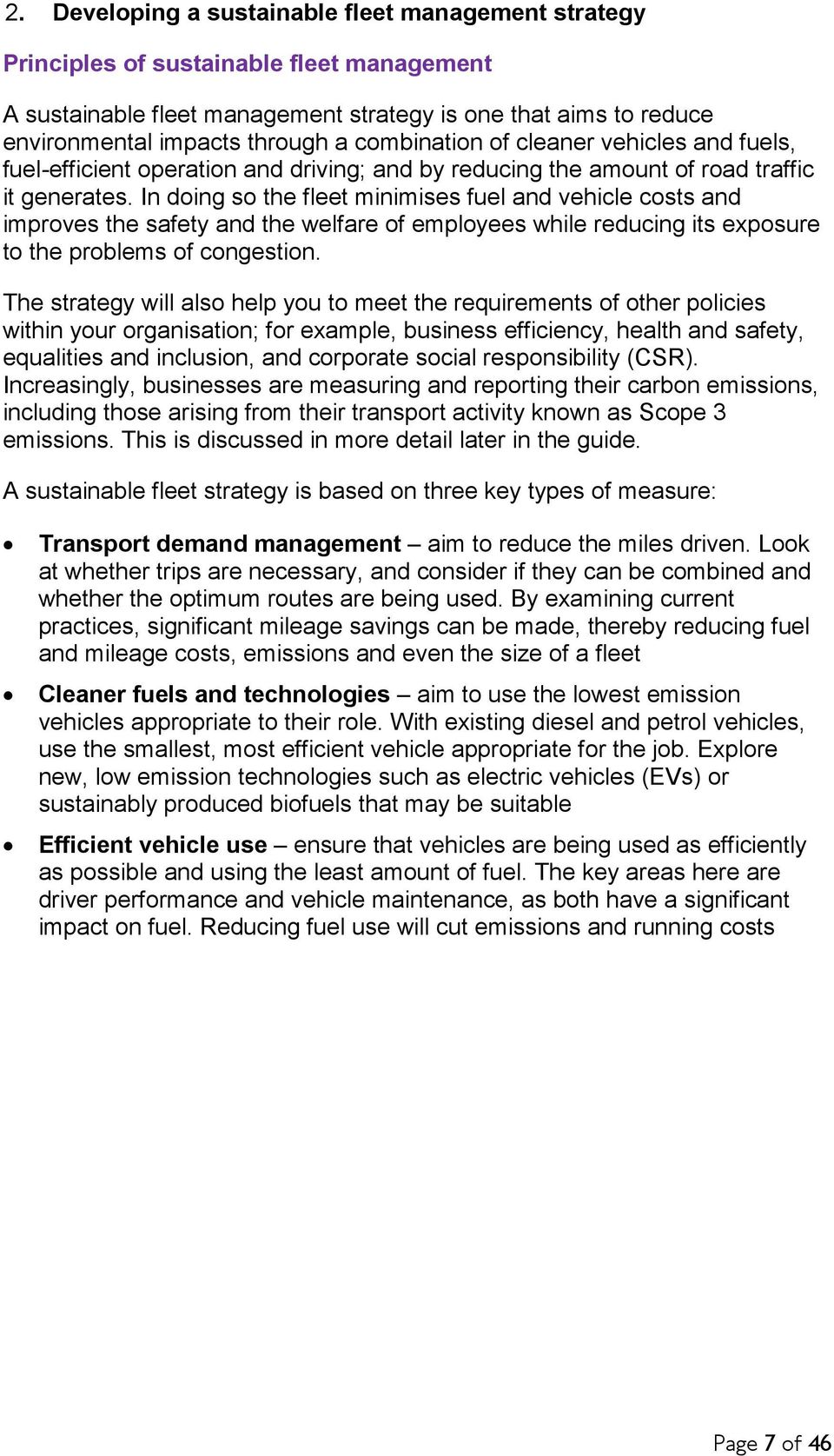
8 Central to sustainable fleet management is the principle that you can t manage what you don t measure. The different measures are all based upon ongoing monitoring and target setting to ensure that performance is assessed and continuously improved, as illustrated in Figure 1. Transport demand management Monitoring and target setting Optimise operations and vehicle use Procure efficient and low emission vehicles Figure 1: Transport demand management Sustainable fleet management has implications for many areas of business management, for example: Vehicle procurement and specification Business travel policies Company car allocation policies Heath, safety and environmental policies Logistics management Supply chain management and distribution Management and scheduling of sales staff, service calls etc Page 8 of 46

9 The sustainable fleet management process The process of establishing a sustainable fleet management strategy is summarised in Figure 2. Stage 1 Stage 2 Stage 3 Stage 4 Stage 5 Stage 6 Assess current performance Define business needs Identify opportunties for improvements Gain business and individual buy-in Implementation Ongoing monitoring and review Figure 1: Stages in developing a sustainable fleet strategy Stage 1 Assessing current performance The first stage in developing the strategy is to gain a thorough understanding of current fleet operations and costs, existing business policies and processes. This stage ensures you have the data to develop an informed fleet strategy. The sustainable fleet management checklist in Appendix 1 provides a simple template to take you through the process of information gathering under the following areas: What existing fleet policies do you have? What monitoring do you undertake? What measures do you undertake to minimise vehicle mileage? What do you do to encourage fuel efficient vehicle use? What do you do to ensure you use the cleanest and most efficient vehicles and fuels? Working through the checklist can help identify those actions that are already being taken and potential opportunities for further improvement. Page 9 of 46

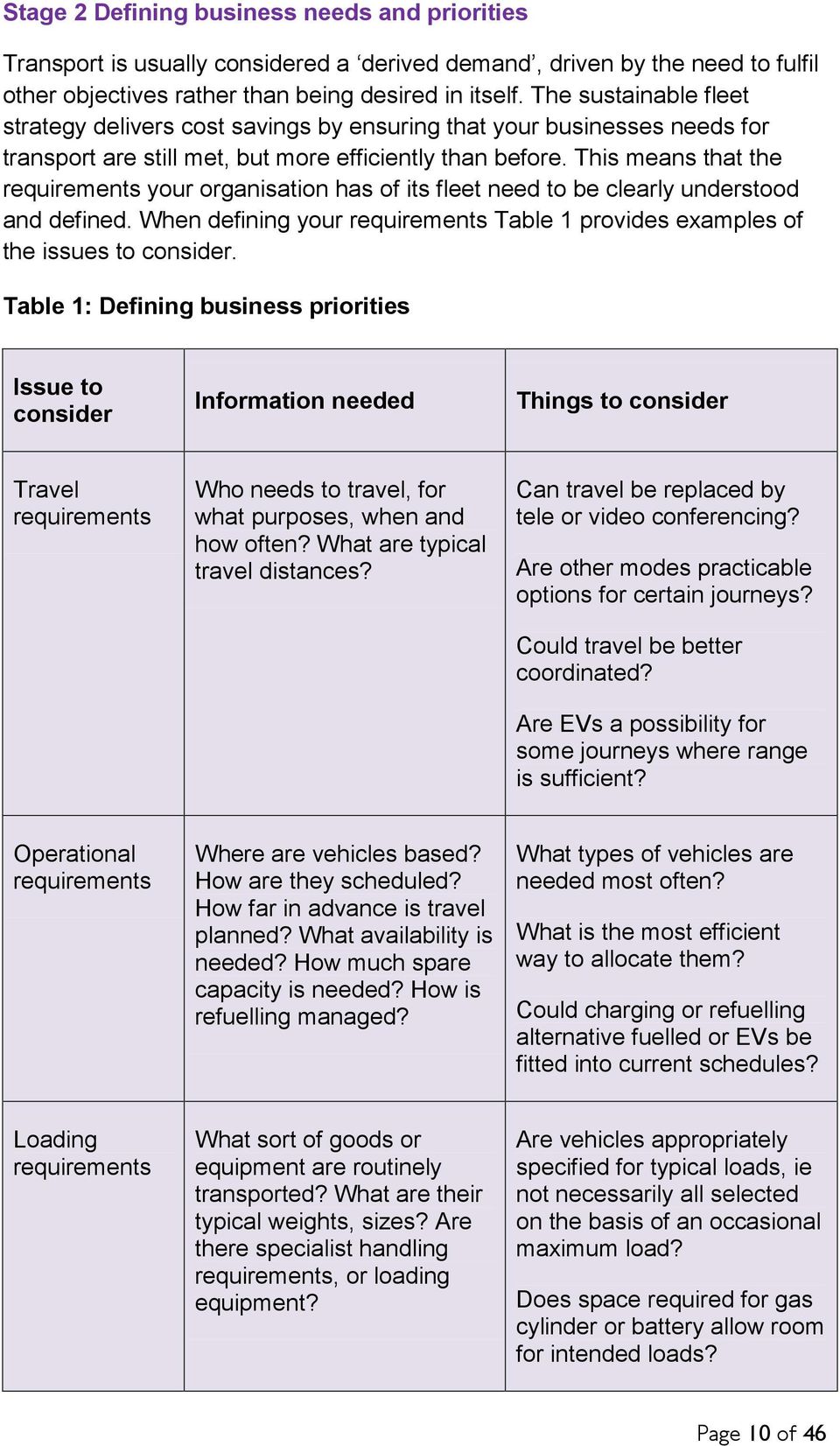
10 Stage 2 Defining business needs and priorities Transport is usually considered a derived demand, driven by the need to fulfil other objectives rather than being desired in itself. The sustainable fleet strategy delivers cost savings by ensuring that your businesses needs for transport are still met, but more efficiently than before. This means that the requirements your organisation has of its fleet need to be clearly understood and defined. When defining your requirements Table 1 provides examples of the issues to consider. Table 1: Defining business priorities Issue to consider Information needed Things to consider Travel requirements Who needs to travel, for what purposes, when and how often? What are typical travel distances? Can travel be replaced by tele or video conferencing? Are other modes practicable options for certain journeys? Could travel be better coordinated? Are EVs a possibility for some journeys where range is sufficient? Operational requirements Where are vehicles based? How are they scheduled? How far in advance is travel planned? What availability is needed? How much spare capacity is needed? How is refuelling managed? What types of vehicles are needed most often? What is the most efficient way to allocate them? Could charging or refuelling alternative fuelled or EVs be fitted into current schedules? Loading requirements What sort of goods or equipment are routinely transported? What are their typical weights, sizes? Are there specialist handling requirements, or loading equipment? Are vehicles appropriately specified for typical loads, ie not necessarily all selected on the basis of an occasional maximum load? Does space required for gas cylinder or battery allow room for intended loads? Page 10 of 46
11 Traffic conditions What sort of locations do vehicles mostly operate in, eg in urban centres, the suburbs, motorways? Which fuel/vehicle combination is most appropriate for the circumstances, in terms of emissions performance, air quality, fuel economy etc? Corporate policies and priorities What else does your organisation expect of its fleet, eg cost saving targets? Corporate image? Safety improvements? The review of business policies undertaken in Stage 1 is key to this What are the implications for vehicle specification? What performance indicators do you need to focus on? The environmental drivers for a vehicle fleet will be set by corporate sustainability priorities, operating location and legislation. Examples of drivers and policies that will influence targets and priorities include: Table 2: Defining environmental priorities Climate change Air quality Corporate fuel use and carbon reduction targets Operating within an Air Quality Management Area Environmental management and reporting systems such as the Eco- Management and Audit Scheme (EMAS) and ISO Operating in the LEZ Reporting under national indicators on carbon emissions or corporate environmental reporting Environmental management and reporting systems such as EMAS and ISO Understanding these will enable you to ensure that vehicles are fit for purpose but not over-specified; that unnecessary travel is not undertaken without compromising service delivery; and that new technologies can deliver their intended environmental benefits while still being suitable for your operational requirements, for example, in terms of range and carrying capacity. Page 11 of 46

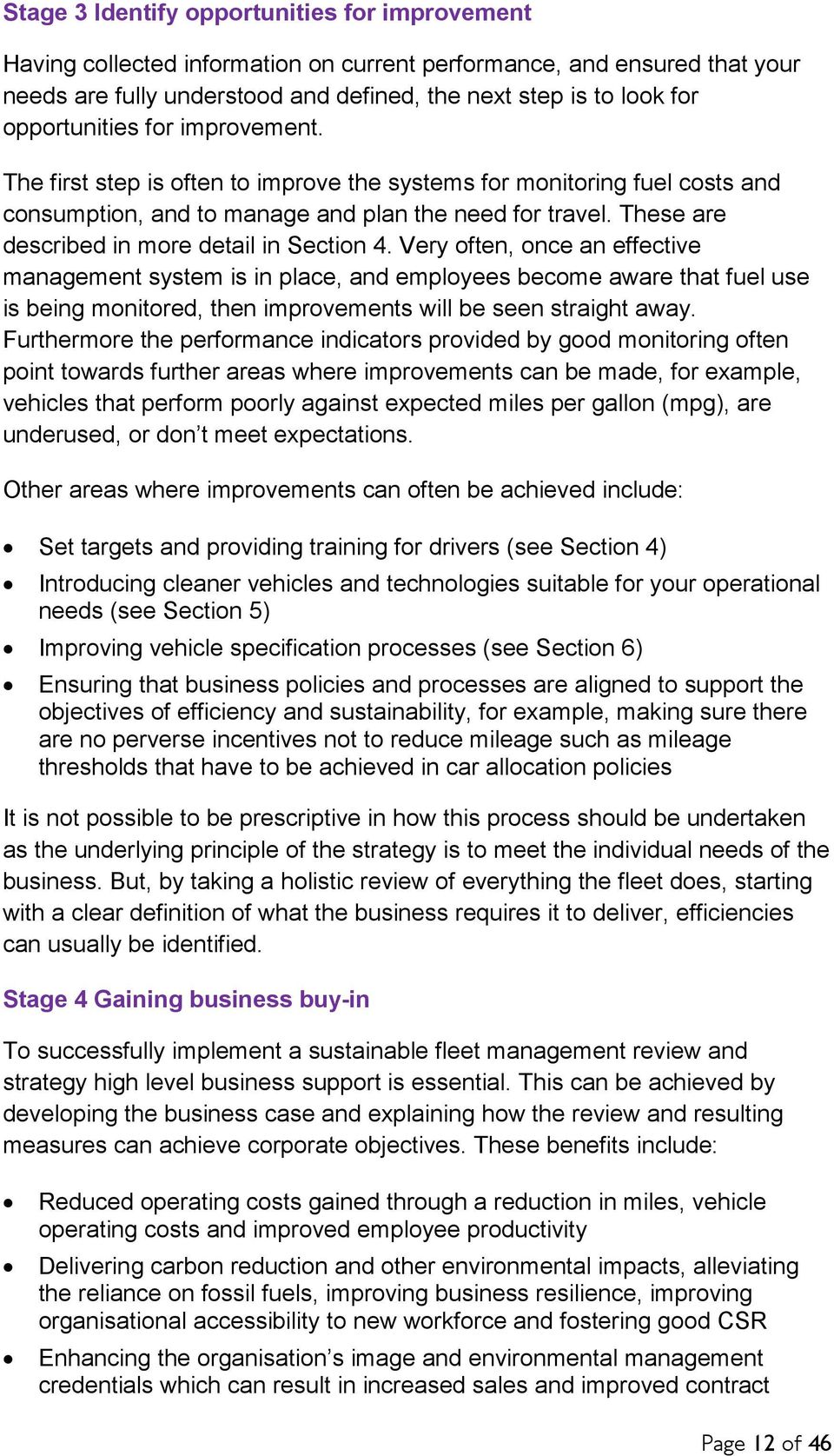
12 Stage 3 Identify opportunities for improvement Having collected information on current performance, and ensured that your needs are fully understood and defined, the next step is to look for opportunities for improvement. The first step is often to improve the systems for monitoring fuel costs and consumption, and to manage and plan the need for travel. These are described in more detail in Section 4. Very often, once an effective management system is in place, and employees become aware that fuel use is being monitored, then improvements will be seen straight away. Furthermore the performance indicators provided by good monitoring often point towards further areas where improvements can be made, for example, vehicles that perform poorly against expected miles per gallon (mpg), are underused, or don t meet expectations. Other areas where improvements can often be achieved include: Set targets and providing training for drivers (see Section 4) Introducing cleaner vehicles and technologies suitable for your operational needs (see Section 5) Improving vehicle specification processes (see Section 6) Ensuring that business policies and processes are aligned to support the objectives of efficiency and sustainability, for example, making sure there are no perverse incentives not to reduce mileage such as mileage thresholds that have to be achieved in car allocation policies It is not possible to be prescriptive in how this process should be undertaken as the underlying principle of the strategy is to meet the individual needs of the business. But, by taking a holistic review of everything the fleet does, starting with a clear definition of what the business requires it to deliver, efficiencies can usually be identified. Stage 4 Gaining business buy-in To successfully implement a sustainable fleet management review and strategy high level business support is essential. This can be achieved by developing the business case and explaining how the review and resulting measures can achieve corporate objectives. These benefits include: Reduced operating costs gained through a reduction in miles, vehicle operating costs and improved employee productivity Delivering carbon reduction and other environmental impacts, alleviating the reliance on fossil fuels, improving business resilience, improving organisational accessibility to new workforce and fostering good CSR Enhancing the organisation s image and environmental management credentials which can result in increased sales and improved contract Page 12 of 46
13 tendering process; improving financial reporting processes; and environmental reporting of CO 2 impact to clients and supply chain Much of sustainable fleet management is simply good business practice, so can be justified on its own commercial merits. Improving fleet performance on purely commercial or cost efficiency grounds almost always involves better fuel economy and lower emissions, so the environmental gains are a bonus. In many cases, environmental factors such as the LEZ in London can form the ideal stimulus to review a fleet policy and examine the improvements that can be made. Once senior management has signified support of the programme this will enable you to formulate an appropriate strategy for review and later a communications plan for engagement with the wider workforce. This engagement, whether one-on-one or within focus groups will enable you to deliver a solution that is practical and fit for purpose. Stage 5 Implementation Implementation of the strategy involves putting into practice the measures identified in the earlier stages. The rest of this guide provides detailed guidance on individual measures that might be included, for example, TfL s FORS programme and freight micro-site. See Appendix 2 for a longer list. All of the solutions outlined are likely to need tailoring to your organisation s business requirements to achieve the best outcomes. Stage 6 Ongoing monitoring and review The fleet management strategy should be a living document, regularly reviewed and updated in the light of changing requirements and new experience. The monitoring processes that are central to sustainable fleet management will help you identify where the opportunities for future savings lie, and will also show which cost saving measures prove most effective, so you can decide whether to continue or change your approach. Key elements that should be reviewed are: Periodic review and revision of the fleet checklist Review business needs and drivers, for example, to take account of any changes in customer requirements, or new legislation or regulation Review your monitoring and data collection processes: are they providing the information you need? Are administrative costs acceptable? Ensure regular reviews of performance of new vehicles, or new technologies that have been trialled, to ensure they are meeting expectations and are appropriate for your business needs Page 13 of 46

14 3. Vehicles and the environment Road vehicles are likely to be a key element of an organisation s transport requirements. However, the reliance of these vehicles on fossil fuels such as petrol and diesel gives rise to poor air quality and the associated health impact, and carbon emissions which contribute to climate change. Vehicles also contribute to noise pollution, which can affect people s health and quality of life. Air quality Reducing pollution from traffic is one of the top public priorities in terms of improving the quality of the environment according to the Greater London Authority s (GLA s) Annual London Survey The key environmental concerns are: Nitrogen oxides (NOx), the generic term for nitric oxide (NO) and nitrogen dioxide (NO2), are formed by a reaction between nitrogen and oxygen gases in the air during combustion. Further reactions of NOx with other atmospheric factors can lead to the formation of other pollutants such as ozone and acid rain Fine particles, referred to as particulate matter or PM10 and PM2.5. Road traffic is the greatest contributor to these as a result of engine emissions and tyre and brake wear. A study for the GLA estimated that fine particles could be involved in more than 4,000 deaths in London each year2 Boris Johnson, Mayor of London published his Air Quality Strategy (MAQS) in 2010, with the overarching aim of reducing air pollution in London. The strategy incorporates policies and proposals for improving air quality and measures include the reduction of vehicle emissions by encouraging sustainable travel behaviour. By working in partnership with employers and fleet managers, our joint actions can make a real difference, and even relatively small changes can have positive impacts on business profitability, the environment and air quality. 1 Annual London Survey, 2011 Greater London Authority, 2 Report on estimation of mortality impacts of particulate air pollution in London, Dr Brian G Miller, GLA, 2010 Page 14 of 46

15 The key theme of the MAQS that relate to transport and businesses are: Encouraging sustainable travel behaviours such as walking and cycling, smarter driving Promoting technological change and cleaner (low emission) vehicles Retrofitting existing vehicles with particulate traps Tackling specific pollution hotspots and improving air quality through a package of local measures Reducing emissions from the public transport fleet with low emission buses Emissions control schemes such as additions to the LEZ and no engine idling enforcement In terms of low emission vehicles, the strategy is encouraging businesses to use vehicles with more stringent Euro emission standards and adopt new technologies such as EVs. The LEZ is one of the primary air quality mechanisms reducing emissions from heavier vehicles in London. Currently, heavy goods vehicles (HGVs), buses and coaches are required to meet an agreed standard (Euro III standard for PM) to drive within the LEZ without charge. From 3 January 2012 enhancements were made to the scheme, including increasing the standard for HGVs, buses and coaches to Euro IV and expanding the scheme to include larger vans, minibuses and other specialist diesel vehicles which will have to meet the Euro III standard. To find out what vehicles are affected by the LEZ, visit Climate change and carbon emissions Scientific consensus is that climate change is driven by increases in manmade GHG emissions, of which CO 2 is the most dominant 3. Transport currently accounts for 22 per cent of total CO 2 emissions in London, and 72 per cent of this is from road traffic. 4 To reduce the impact of climate change it has been estimated that there needs to be a reduction in global emissions of at least 50 per cent on 1990 levels by The UK Government has acted upon this by setting itself a legally binding target of an 80 per cent cut by 2050, with an interim target of a 34 per cent cut by Individual businesses are contributing towards these targets by setting their own targets for reduction and reporting their carbon emissions, for example, the Scope 3 emissions that include business transport. Many 3 The other important ones are methane (CH 4) and nitrous oxide (N 2O). 4 Mayor s Transport Strategy (May 2010) 5 See Intergovernmental panel on climate change reports Page 15 of 46

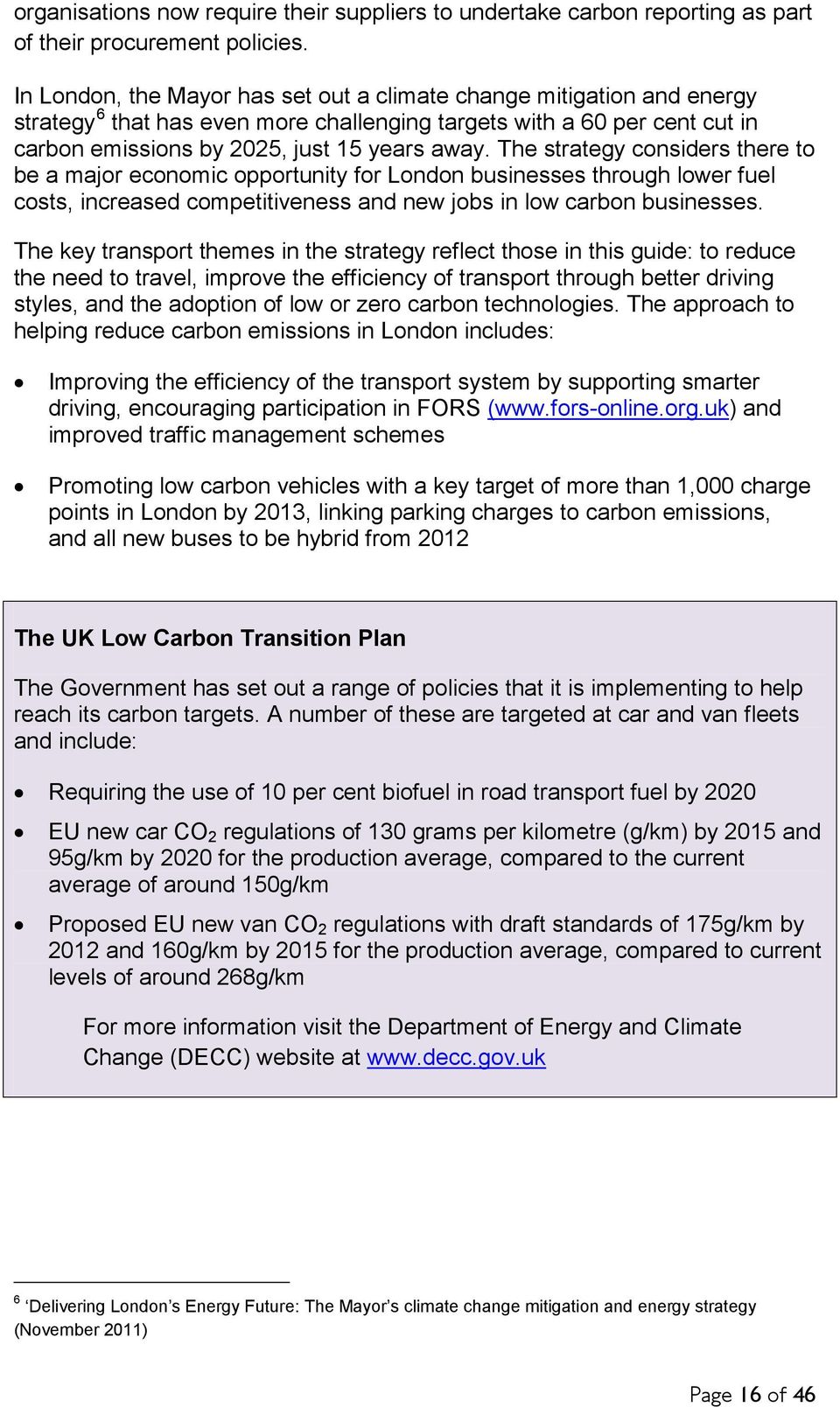
16 organisations now require their suppliers to undertake carbon reporting as part of their procurement policies. In London, the Mayor has set out a climate change mitigation and energy strategy 6 that has even more challenging targets with a 60 per cent cut in carbon emissions by 2025, just 15 years away. The strategy considers there to be a major economic opportunity for London businesses through lower fuel costs, increased competitiveness and new jobs in low carbon businesses. The key transport themes in the strategy reflect those in this guide: to reduce the need to travel, improve the efficiency of transport through better driving styles, and the adoption of low or zero carbon technologies. The approach to helping reduce carbon emissions in London includes: Improving the efficiency of the transport system by supporting smarter driving, encouraging participation in FORS ( and improved traffic management schemes Promoting low carbon vehicles with a key target of more than 1,000 charge points in London by 2013, linking parking charges to carbon emissions, and all new buses to be hybrid from 2012 The UK Low Carbon Transition Plan The Government has set out a range of policies that it is implementing to help reach its carbon targets. A number of these are targeted at car and van fleets and include: Requiring the use of 10 per cent biofuel in road transport fuel by 2020 EU new car CO 2 regulations of 130 grams per kilometre (g/km) by 2015 and 95g/km by 2020 for the production average, compared to the current average of around 150g/km Proposed EU new van CO 2 regulations with draft standards of 175g/km by 2012 and 160g/km by 2015 for the production average, compared to current levels of around 268g/km For more information visit the Department of Energy and Climate Change (DECC) website at 6 Delivering London s Energy Future: The Mayor s climate change mitigation and energy strategy (November 2011) Page 16 of 46
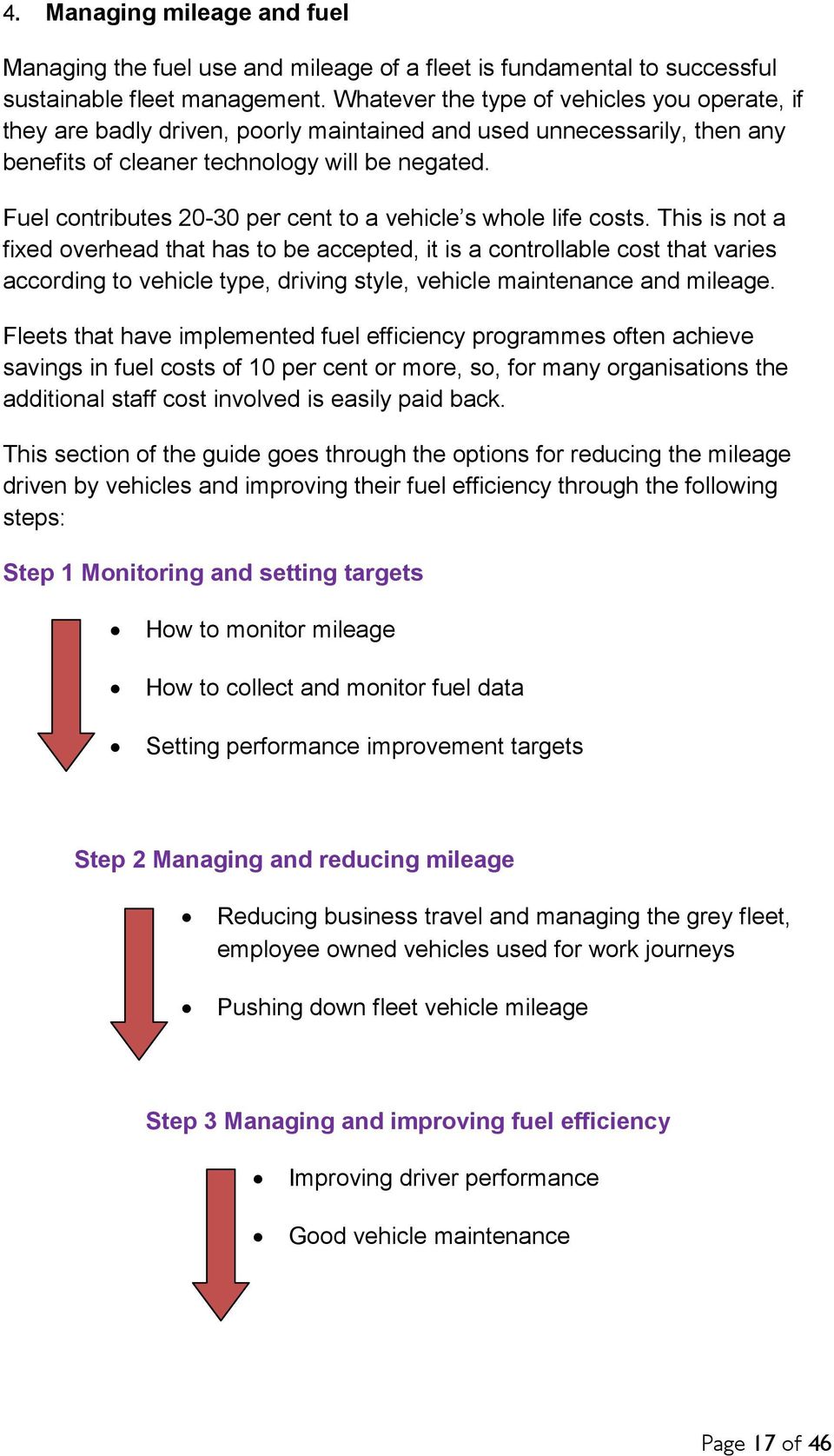
17 4. Managing mileage and fuel Managing the fuel use and mileage of a fleet is fundamental to successful sustainable fleet management. Whatever the type of vehicles you operate, if they are badly driven, poorly maintained and used unnecessarily, then any benefits of cleaner technology will be negated. Fuel contributes per cent to a vehicle s whole life costs. This is not a fixed overhead that has to be accepted, it is a controllable cost that varies according to vehicle type, driving style, vehicle maintenance and mileage. Fleets that have implemented fuel efficiency programmes often achieve savings in fuel costs of 10 per cent or more, so, for many organisations the additional staff cost involved is easily paid back. This section of the guide goes through the options for reducing the mileage driven by vehicles and improving their fuel efficiency through the following steps: Step 1 Monitoring and setting targets How to monitor mileage How to collect and monitor fuel data Setting performance improvement targets Step 2 Managing and reducing mileage Reducing business travel and managing the grey fleet, employee owned vehicles used for work journeys Pushing down fleet vehicle mileage Step 3 Managing and improving fuel efficiency Improving driver performance Good vehicle maintenance Page 17 of 46
18 Step1 Monitoring and setting targets It is only by monitoring fuel consumption and mileage that an organisation can understand where and how fuel is being used and what mileage is taking place, and so identify where savings can be made. How to monitor mileage The starting point is to understand a fleet s mileage patterns and then compare this with identified business or operational requirements. This will enable you to identify underused vehicles or high mileage drivers and question whether there are more cost effective and efficient methods of carrying out core business activity. The following areas should be monitored as a minimum: Business travel mileage company cars usage to and from meetings and places of employment Grey fleet mileage business trips driven by staff using their own cars Operational fleet mileage vehicle use as an aspect of undertaking the core business function Fuel monitoring Key to maximising the performance of vehicles and minimising their fuel consumption is establishing a system for monitoring the fuel economy based on miles per gallon (mpg) of individual vehicles and drivers. The two determinants of fuel economy must be captured on a regular basis distance covered and volume of fuel used. Armed with this data it is possible to compare the performance of vehicles and drivers, and identify opportunities for efficiency improvements. There are many ways in which fuel and mileage data can be captured and analysed. For smaller fleets of up to 25 vehicles, manual systems and the use of simple spreadsheets may suffice. Using fuel cards can also help as most suppliers will provide fuel economy reports as part of their service. For larger fleets there are numerous providers of fleet and fuel management software packages, which have monitoring functionality. Page 18 of 46
19 There are also a number of free tools available from government-funded advice programmes including: An mpg diagnostic and online benchmarking tool from TfL s FORS programme A fleet performance management tool developed by the DfT s former Freight Best Practice programme A fuel monitoring spreadsheet tool for up to 25 vans from the Business Link Van Best Practice programme Information on where these can be obtained is given in Appendix 2. Building up a database of mpg figures provides evidence of underperforming vehicles and drivers, allowing corrective action to be taken. For example, drivers/vehicles that consistently underperform their fuel economy benchmark can be identified for training or maintenance. This process also helps to identify possible fuel theft. Setting performance improvement targets Establishing clear objectives and targets is essential to help focus on the most important areas for reducing a fleet s emissions and costs. For example, it may be that opportunities for reducing mileage are limited but there is plenty of scope for improving driver performance. In this case an objective to improve the fleet s fuel economy would be appropriate. A key challenge in achieving any objective is to gain support and commitment from those who are responsible for transport and travel in the organisation, from all managers through to drivers. Setting targets helps to focus attention on what is important and quantify the benefit of what is achievable. Targets can also be used as an effective means of devolving accountability throughout the company. For example, targets relating to fuel costs, mpg and mileage can be set at a company wide level or for departments, teams or even individuals. Table 3 highlights a range of performance indicators for which targets should be considered. Page 19 of 46

20 Table 3: Example key performance indicators Key performance area Fuel Mileage Key performance indicators (KPIs) Fleet wide average mpg and fuel cost in pence per mile (ppm) Department/team wide average mpg and fuel ppm Individual driver mpg and fuel ppm Total fleet wide mileage Department/team wide mileage Individual driver mileage Total miles per employee Total miles per 1,000 of turnover Depending on the needs of an individual fleet, a performance monitoring system might use additional indicators such as maintenance, accidents, emission standards, penalty notices, or vehicle use; as well as the indicators based on fuel and mileage. The previously mentioned fleet performance management tool allows the user to select up to 30 KPIs in the following groups: Cost Operational Service Compliance Maintenance Environmental Gathering fuel consumption data and producing fuel consumption performance indicators is a necessary step in corporate reporting of carbon emissions from transport, and supports Scope 3 reporting requirements. Page 20 of 46

21 Step 2 Managing and reducing mileage When considering mileage reduction options it is helpful to focus on two areas: Reducing the need to travel by car, by finding alternatives Reducing wasted mileage by improved planning, routing and scheduling Reducing the need to travel Employee travel by car to meetings and training, for example, can be a major part of an organisation s travel activity but choice of travel for business purposes is often completely unregulated. Organisations should aim to reduce the amount of business car mileage whether in company cars or by grey fleet. Grey fleet is the terminology for all vehicles used by employees that are not owned or leased by the company. Implementing a sustainable business travel policy is helpful for setting out guidelines for employees on arranging meetings and the travel options available. A useful principle to adopt is that of a travel hierarchy, which sets out a decision making process to minimise travel and its impacts, such as: Does there need to be an in person meeting? Will an audio or web conference meet the business need? Can a more sustainable mode of travel be used such as walking, cycling or public transport? Is there a low emission pool or car club vehicle available? Can the journey be shared with a colleague? What is the best time for the meeting to minimise journey disruption? To make sure employees are able to make the most rational transport choice it is necessary to ensure that there are no perverse incentives for drivers to maintain high mileage, for example, minimum business mileage thresholds in car allocation policies. Page 21 of 46
22 Many organisations have developed policies on sustainable business travel as part of a wider examination of employee travel. Further guidance is available from TfL s guide to sustainable business travel (see Appendix 2). Pertemps fuel efficiency monitoring Following a fleet review, recruitment company Pertemps developed organisation-wide systems to accurately measure and manage business journeys and actual fuel consumption. Previously employees were reimbursed for their business mileage via HM Revenue & Custom s (HMRC s) approved fuel reimbursement rates. This was replaced with a system of payment for actual private fuel used, using company fuel cards and in-house software to monitor all mileage and fuel transactions. This allows the company to charge employees for their private mileage fuel costs, and encourages employees to purchase cheaper fuel and drive more efficiently. The new system provides detailed reporting on the fuel efficiency achieved by each vehicle, enabling comparisons to be made with the manufacturer s official mpg for the vehicle. In addition, with a large number of similar cars in the fleet, it is easy to make comparisons of operational efficiency. With a fleet of 300 cars, each covering 10,000 miles per annum, a saving of 90,000 a year in fuel costs alone was possible. In addition, because of increased driver awareness of costs and fuel efficiency, an additional 12,000 per annum or five per cent saving was also achieved. The system has also resulted in a reduction of average annual mileage from 20,000 to 15,000 miles per car, both business and private. Page 22 of 46
23 Grey fleet The term grey fleet refers to vehicles that are used for business purposes but which are not owned or leased by the employer. The grey fleet poses financial, environmental and health and safety concerns, such as: Cost effectiveness other forms of car use (eg lease, pool or hire) may be cheaper and lump sum and mileage payments can often be much higher than real costs of use, thereby incentivising unnecessary car travel The grey fleet usually has higher emissions compared to lease, hire or pool cars due to age of vehicle, maintenance schedule and lack of control over engine size Potential for failure in compliance with the Health and Safety at Work Act 1974 (Sections 2 and 3) and the Management of Health and Safety at Work Regulations 1999 (Driving at work: Managing work-related road safety) Lack of grey fleet management exposes organisations to a risk of litigation and prosecution under the Corporate Manslaughter Act 2007 in the event of an accident, or even legal action as a result of driver stress. More than 34 per cent of organisations responded in a DfT survey7 that they do not have basic procedures for checking the driving licences and insurance of grey fleet drivers. Even when checks are undertaken by organisations those involved often do not understand the employer s legal obligations and the impact of not identifying risk indicators from the information provided, for example, business usage on insurance, driving licence clear of points and showing present employee address, valid MOT certificate, duration since driving test. Organisations with significant amounts of grey fleet travel should audit usage. Software tools are available to manage the record keeping process, and ensure that organisations are complying with legislation by assessing risk and implementing practicable steps as appropriate. For example: alternative forms of provision, implementing measures to reduce total mileage and providing advanced driver training/smarter driver training for those identified as higher risk. For further information, visit 7 DfT Road Research Report No. 51; Health and Safety Executive Statement, 1996; Arval, The Grey Fleet, August 2007 Page 23 of 46
24 Reducing wasted mileage The use of technology is fundamental to reducing wasted mileage. Accurate route planning using satellite navigation systems can avoid traffic jams and find the most efficient route, while computerised routing and scheduling software packages will help with the most efficient way of planning vehicle movements. Increasingly fleets are turning to onboard telematics systems that offer a number of potential advantages including: Enabling real time routing and scheduling of vehicles Eliminating unauthorised private use of vehicles Eliminating unnecessary detours on route to the job Identifying vehicle inefficiencies due to speeding, harsh driving and excessive idling Telematics systems can provide a large pool of information regarding vehicle use and driver behaviour. However, it is important that this data is analysed in order that action can be taken and efficiencies realised. It is also recommended when establishing new supplier or customer relationships that first-hand knowledge is obtained on the location and accessibility, as well as parking/unloading information at premises; often the most direct route is not always the most appropriate. Plumbers increase efficiency through vehicle tracking Pimlico Plumbers in London has fitted all of its vehicles with state-of-the-art tracking devices. These devices allow the company to have up-to-date information about the location of all employees when a new job comes in. This means it is possible to route the nearest available employee to that job, saving fuel and time for the organisation. It also enables the monitoring of driver behaviour, allowing the organisation to take action and eliminate hard braking, accelerating and speeding. Finally, the system means that drivers can be routed to avoid traffic jams thereby reducing vehicle emissions. Page 24 of 46
25 Step 3 Managing and improving fuel efficiency There are two key aspects to improving fuel efficiency: driver performance and vehicle maintenance. Driver performance Other than the type of vehicle used, the driver is the single biggest factor affecting fuel costs and emissions. Speeding, harsh acceleration, harsh braking and idling are all driver behaviours that increase fuel consumption and can have an impact on PM and NO x emissions. Each of these behaviours is also likely to increase the risk of accidents and vehicle wear and tear, including increased tyre and brake wear. Anything that modifies poor driver behaviour is likely to reap significant benefits in terms of reduced fuel costs, accidents and insurance premiums, and reduced vehicle wear and tear. All of the following approaches should be considered to try and influence driver behaviour: Raise awareness Assess and train drivers Incentivise improved performance Smarter driving (eco-driving) techniques Eco-driving is a method of driving that reduces fuel consumption, Scope 3 GHG emissions and accident rates 8. Organisations can reduce fuel bills by up to 10 per cent 9 and reduce insurance and maintenance costs by encouraging the following: Making sure cars are serviced regularly and tyres inflated to the correct pressures Driving at an appropriate speed to reduce CO2 emissions and fuel consumption Avoiding engine idling Avoiding carrying unnecessary weight in your vehicle Anticipating what is happening on the road ahead to avoid sharp breaking or fast acceleration Page 25 of 46
26 Drivers should be made aware of their responsibilities with respect to safe and fuel efficient driving. For example, driving for good fuel economy could feature in driver handbooks, team briefings and internal newsletters. For ideas on what information to communicate, TfL has a section on smarter driving tips on its website at The most effective way of raising and maintaining awareness is to circulate fuel economy information to drivers. This can be done privately via line managers or publicly in the form of driver league tables. Whatever method is used the key issue is that drivers are engaged on fuel monitoring. This fact alone is likely to encourage better practices among staff. Driver feedback helps save fuel PHS Datashred gained accreditation for its fleet through participation in FORS, TfL s programme to help freight operators improve their safety, become more efficient and more environmentally friendly. As a result, PHS Datashred developed a new fleet transport policy and implemented driver-monitoring technology across its fleet of vehicles. This enables the company to monitor driver behaviour in real time and provides regular feedback on driver behaviour allowing one-to-one feedback as appropriate. It is estimated that the software has resulted in fuel savings of around 10 per cent and has contributed to a reduction in accidents. In addition to raising awareness, companies are advised to take a proactive approach and assess and train their drivers. With safety in mind, drivers should be risk assessed and those deemed as most at risk considered for training. Driver risk can be assessed using computer-based driver profiling tools and other indicators such as license points, accidents, mpg and frequency of tyre changes. TfL s FORS programme offers its members a free trial of a driver profiling system. As part of the passenger carrying vehicle (PCV) and large goods vehicle (LGV) Driver Certificate of Professional Competence (CPC), drivers must complete 35 hours of approved periodic training every five years. There is some freedom for drivers and/or employers to select courses from a wide range of those available. In the UK, the syllabus covers: safe and fuel efficient driving; legal requirements; and health and safety, service and logistics. 10 This means that there is scope for employers to encourage their drivers, or stipulate by way of company policy, to undertake smarter/eco-driving courses 10 Page 26 of 46
27 as an essential selection from the range of accredited courses. Companies can monitor which of their drivers have attended a CPC course on smarter driving to ensure that they are all as fuel efficient as possible and fuel and maintenance costs should fall. Skanska train to save Having taken advantage of the Energy Saving Trust s Green Fleet Review, Skanska, the project development and construction group, has reduced its total fleet operating costs by up to 20 per cent. One of the biggest wins is improving employee driving by putting them through additional safe and environmentally friendly driver training. Monitoring indicates that average performance figures of trained drivers (in all fields) includes a 14 per cent fuel consumption reduction; 56 per cent reduction in driver faults; 34 per cent reduction in the number of gear changes; and 1.5 per cent reduction in journey time. Currently the 30 large vehicle drivers have been trained and there are plans to roll out further training for other drivers (vans and company cars) in the near future. In addition to addressing driver behaviour, Skanska is using GPS tracking equipment to improve journey planning, further increase driver efficiency, prevent speeding and enable monitoring. Some fleet vehicles will also be fitted with speed limiting devices to prevent speeds above 65mph. There is clear evidence of the benefits of training. To ensure savings can be sustained day-in, day-out relies on ongoing engagement either through feedback of individual performance, driver league tables or by incentivising individual or team performance. Incentives can range from the more formal annual bonus award for all drivers and/or teams who meet pre-determined mpg targets to occasional competitions for outcomes like the most improved driver of the month. There are many providers of driver training with a focus on safety. Although they may not explicitly cover driving for good fuel economy many of the principles are the same. TfL s FORS programme places equal focus on fuel economy. Page 27 of 46
28 A full list of training providers is available on the Occupational Road Safety Alliance website at Many driver training organisations now provide training to the SAFED safe and fuel efficient driving standard developed by DfT, with separate standards for vans and large goods vehicles. The Driving for Better Business website provides further information with case studies demonstrating the benefits of driver training at Vehicle maintenance Vehicles with under-inflated tyres, badly out of tune engines or damaged bodywork will use more fuel than those in good condition. Between regular services, deteriorating performance can be identified by monitoring fuel economy allowing any corrective action to be taken before the next planned service. Poor maintenance can also compromise vehicle safety and increase the risk of accidents. Possibly the most overlooked issue but one of the easiest to rectify is maintaining correct tyre pressures. Maintaining correct pressures are important for several reasons: Fuel economy under inflation decreases fuel economy significantly Tyre life under or over inflation increases wear Safety under or over inflation affects grip and braking To ensure that maintenance problems do not occur, organisations should have a strict servicing and maintenance schedule for their vehicles in compliance with manufacturers guidelines. Drivers should conduct daily or weekly physical vehicle checks to ensure that issues such as low tyre pressure or broken lights are identified early. Again, engagement is required to explain the benefits of why they are being asked to undertake checks. This will promote ownership of the issue and will alleviate complacency. It is recommended that all checks are recorded and audited by an appointed fuel champion to avoid complacency and inadequate checks. It is also important that any noticed faults are quickly rectified and not left until the next routine service. The previously mentioned fleet performance management tools developed by DfT and for TfL s FORS programme can assist with monitoring maintenance as well. Page 28 of 46
29 5. Vehicle and fuel technology This section sets out the key information needed when considering adopting cleaner fuels and vehicles. The four main vehicle and fuel technologies covered are: Latest technology petrol and diesel vehicles these technologies are now meeting ever tighter Euro emissions standards and reduced CO2 emissions Electric and hybrid vehicles these cover pure battery EVs, hybrid vehicles, plug-in hybrids, hybrid assists and range extenders Gas vehicles the main gas vehicles are those powered by liquefied petroleum gas (LPG) and natural gas Biofuels fuel delivered from organic feedstock such as bioethanol blends for petrol vehicles, biodiesel blends for diesel vehicles and biomethane for use in natural gas vehicles In addition, there are fuel cell technology and hydrogen vehicles. Latest technology petrol and diesel vehicles Significant improvements in a vehicle fleet can be made simply by updating the fleet with newer petrol and diesel vehicles. Taking into account the increasing popularity of diesel over petrol, an average new car in 2012 uses around 15 per cent less fuel than a comparable one 10 years ago. The exhaust emissions associated with poor air quality have also been significantly reduced. These emissions are controlled by legislation known as Euro standards and currently all light duty vehicles must conform to Euro 5 legislation. Every five years the standards become progressively stricter and Euro 6 will come into force in When comparing diesel and petrol vehicles, diesel have better fuel economy and produce less CO 2, however emissions affecting air quality (NO x and PM) are higher. Capital costs for diesel are slightly higher than petrol, but the running costs are lower. Traditionally higher mileage vehicles have been diesel because of better fuel economy and lower running costs. Petrol vehicles on the other hand are more common for lower mileage use and can be more appropriate in urban areas where air quality is an issue. Modern diesel vehicles are typically fitted with a particulate filter to reduce tailpipe emissions, however these need to be periodically regenerated to remove the trapped particles. This requires maintaining a high temperature, so diesel vehicles fitted with one can be less suited to short journeys in slow moving traffic. Page 29 of 46
30 Electric and hybrid vehicles EVs use a battery to store electrical energy and are powered using an electric motor. Most can be recharged by plugging into a standard electrical socket, although faster charging will require dedicated fast charging equipment to be installed. Range is still a significant limiting factor, however with many vehicles now able to exceed 100 miles on a charge a high proportion of trips can realistically be undertaken. Hybrid vehicles combine a petrol or diesel engine with an electric motor and battery. The batteries are continually recharged by the engine or from energy generated during braking. A new variant of the hybrid is the plug-in hybrid which is fitted with a larger battery that can also be charged from an external supply. Another new variant are range extenders : these are essentially EVs but with a small generator to charge the battery if its state of charge drops below a certain level. Hybrid conversions are also available for some vans. Hybrid assist kits involve fitting an energy storage device (a battery or capacitor) which is linked to the transmission (via a drive belt or direct engine connection). London Electric 10 Ten companies which have already introduced commercial EVs into their fleet have agreed to work with the Mayor of London to support further uptake in the Capital. These are: Amey, DHL, Marks & Spencer, Royal Mail, Sainsbury s, Tesco, TNT, Go-Ahead, Speedy and UPS. For more information, visit: The GLA has also pledged to lead by example and has agreed to convert 1,000 of its fleet vehicles to electric by Page 30 of 46
31 Environmental performance of EVs and hybrids EVs give zero tailpipe emissions at the point of use. If electricity is provided from renewable sources, almost zero fuel lifecycle emissions are possible. Even when standard tariffs are used fuel lifecycle CO 2 emissions are reduced by up to 40 per cent. Although lifecycle emissions of nitrogen and sulphur oxides can increase when power-station emissions are taken into account, these usually occur well away from urban centres. Hybrids improve fuel economy and reduce CO 2 emissions by around per cent (compared to petrol); their fuel efficiency is therefore similar to diesel. Local pollutants are also significantly reduced compared to petrol and diesel operation. With very high fuel economy (100+ mpg), plug-in hybrids offer even greater emissions benefits (depending on driving mode) and are zero emission in electric-only mode. Recent research by the Low Carbon Vehicle Partnership 11 into full vehicle lifecycle assessment of emissions indicated that the level of CO 2 resulting from production of an EV, hybrid or plug-in hybrid vehicle is higher than for a conventionally-fuelled vehicle, but that whole life CO 2 production is per cent lower. GreenTomatoCars Just do it! GreenTomatoCars (GTC) is a London taxi company that has placed green issues at the core of its business. Starting with only four petrol hybrids in March 2006, the company now operates a fleet of more than 120 cars. From the outset, GTC has only used petrol hybrids, with the latest models achieving an impressive 60-65mpg with CO2 emissions of only around 105g/km that s a reduction of more than 50 per cent compared to a black cab. GTC is also keen to adopt the latest technology and is assessing the benefits of 100mpg plug-in hybrids, which have been commercially available since While the company s investment in hybrids has increased its capital costs, these have been more than offset by lower fuel costs and enhanced capital allowances. GTC s advice to other businesses thinking of using hybrids? Just do it! 11 See Reports and Studies Page 31 of 46
32 Electric Vehicles in London EVs are one of the technologies expected to play a major role in reducing transport emissions in the Capital. The Mayor s Electric Vehicle Delivery Plan 12 for London sets out plans to make the city the EV capital of Europe, with 100,000 EVs on London s streets as soon as possible, supported by1,300 charge points by These ambitions are part of the Mayor s Transport Strategy, the Climate Change Mitigation and Energy Strategy, and the Air Quality Strategy. The Electric Vehicle Delivery Plan, to be delivered in partnership with the London boroughs, central Government and the private sector, includes major investment in: EVs: With commitment to operating 1,000 EVs in the GLA fleet by 2015 and encouraging their procurement by businesses and commercial fleet operators Charging infrastructure: With commitment to installing 22,500 workplace charge points, 2,000 car park charge points and 500 on-street charge points across the Capital by The aim is that, by 2015, every Londoner will, on average, live within one mile of a charge point. EV users will be able to sign up to Source London 13, a pan-london scheme using publicly accessible charge points, paying a flat registration fee with charge point electricity free at the point of use Incentives, marketing and communications: Including guaranteeing discounts on the Congestion Charge for EVs, commitment to working with the boroughs on parking incentives, encouraging the uptake of EVs through car clubs and delivery of the Source London website TfL is leading implementation of the Electric Vehicle Delivery Plan in consultation with the London Electric Vehicle Partnership, which draws together representatives from utility companies, vehicle manufacturers, the GLA Group, public sector organisations and infrastructure suppliers. 12 An Electric Vehicle Delivery Plan for London, GLA, May Page 32 of 46
33 Gas vehicles There are two main gas fuels from fossil sources: liquefied petroleum gas (LPG) and compressed natural gas (CNG) which is largely methane. LPG is the most common of the gaseous fuels and is generally used in cars and light commercial vehicles. In the UK most vehicles are bi-fuel, with both gas and petrol fuelling systems, allowing vehicles to run on either as necessary. Natural gas is more typically used in HGVs and buses, although some car and light commercial manufacturers offer this as an option. In light duty vehicles, the fuel is usually stored as a compressed gas (CNG) and the vehicles are in bi-fuel form so they can run on either CNG or petrol. As the space required for the gas cylinder is greater than an equivalent petrol or diesel tank, this can reduce the carrying capacity of some vehicles. Heavy duty vehicles are more often produced as dedicated gas vehicles or in dual-fuel form which uses both gas and diesel in a diesel engine. Sometimes they can also store the fuel as liquefied natural gas (LNG) which allows more fuel to be stored and increases range. An alternative to fossil methane is biomethane produced from the thermal or biological treatment of organic material such as food or agricultural waste. It is a renewable fuel and is used in the same way as NG. Environmental performance LPG and CNG have similar CO 2 emissions to diesel vehicles, with CNG perhaps a little lower. The exception to this is biomethane which can reduce CO 2 emissions compared to diesel by some per cent. One of the main benefits of these fuels, compared to diesel, is much lower NO x and PM emissions which can be reduced by per cent. Gas vehicles are much quieter to operate in an urban environment compared to diesel. This can be particularly important for late night or early morning deliveries. Page 33 of 46
34 Electric and biomethane vehicles top Camden s fleet list The London Borough of Camden s fleet policy identifies a clear vehicle hierarchy based on the lowest polluting vehicles taking into account NO x, PM 10 and CO 2 emissions. Top of the list are electric and biomethane vehicles. Camden s choice of biomethane vehicles builds on a trial which demonstrated a 66 per cent CO 2 saving compared to diesel, and emissions of NO x and PM 53 per cent and 30 per cent lower than Euro 6 emission levels. In terms of costs, gas vehicles cost some 5,000 more than an equivalent diesel, but fuel costs were around 30 per cent less. This meant the vehicles would pay back in three to four years. The success of the trial has prompted Camden to procure 13 biomethane vans. This complements two electric and two hybrid vans, retro fitting hybrid assist technology to 20 diesel vehicles, one flexi-fuel car and one hydrogen fuel cell bicycle. Biofuels Biofuels are renewable transport fuels made from organic materials. The main liquid biofuels are biodiesel and bioethanol. There is also a gaseous biofuel, biomethane, which is discussed in the gas vehicles section above. Biodiesel is derived from natural vegetable oils either as virgin or waste cooking oils. Typically it is used as a five per cent mix in the UK with conventional diesel, with no engine modification required. Bioethanol is an alcohol-based fuel made through the fermentation of crops such as sugar beet or wheat. It is typically used in a five to 10 per cent blend with conventional petrol. Higher percentage blends can be used by specially designed flexible fuel vehicles (FFVs) that are able to use any blend of bioethanol. FFVs required to use higher blends of bioethanol are beginning to come on to the UK market. Following the introduction of the Government s Renewable Transport Fuels Obligation biodiesel and bioethanol are being introduced into standard fuels up to levels of five per cent and so are commonly used by most petrol and diesel vehicles For more information see information on the DfT website at Page 34 of 46
35 London Borough of Islington runs on waste oil In order to meet emissions targets, Islington Council is working closely with several organisations to reduce the carbon footprint of its vehicle fleet. The first is an organisation providing waste collection services for the borough. It has procured four pilot 26 tonne recycling and refuse vehicles which are now in operation and run on 100 per cent biodiesel from used vegetable oil. The second is an organisation producing biodiesel for the council s fleet by processing used cooking oil sourced from local companies and authority enterprises. Due to the success of the four pilot biodiesel vehicles, Islington is now looking to roll out further vehicles using 100 per cent recycled vegetable oil. The biodiesel fuel is used at no additional cost to the council and is reducing CO 2 emissions by about 90 per cent when used in 100 per cent blend and compared to fossil diesel. In addition, the fuel reduces particulate emissions by up to 60 per cent, is non-toxic and biodegradable. Environmental performance Sustainably produced biodiesel reduces CO 2 emissions by around 50 per cent and this rises to around 90 per cent for waste vegetable oil. For bioethanol emissions reductions can vary from 30 per cent to around 70 per cent. It is important to note that the lifecycle emission impacts of biofuels are highly variable and dependent upon how and where they are produced. Where fuel crops are grown on land cleared from forestry, for example, or where large amounts of artificial fertilisers or agricultural fuel are needed, then the lifecycle carbon impact can be worse than for fossil fuels. There are also concerns about the impact of biofuel production on biodiversity, and also on food prices and availability in poor countries if biofuel production displaces food crops. It is therefore important to be sure about the source of biofuel. The impact on air quality emissions is also variable. Biodiesel can significantly reduce PM emissions compared to diesel by as much as 60 per cent, but tends to slightly increase NO x emissions, which should be taken into account if Page 35 of 46
36 the vehicles operate in areas where NO 2 is the main air quality problem. Bioethanol is very similar to the emissions performance of petrol. Future technologies Other fuels being developed for transport use include hydrogen, which can be used in a converted petrol engine or to power a fuel cell. This is an electrochemical device that converts the energy stored in chemical form (usually hydrogen) directly into electrical energy, water and heat. Like battery-evs, fuel cell vehicles are zero tailpipe emission at point of use. Currently the most economical source of hydrogen is from steam-methane reforming using NG. So unless other sources become plentiful and economic, these vehicles will still depend on fossil fuels. Several demonstration vehicles are under test around the world, including a trial of hydrogen fuel cell buses in London 15. However, hydrogen is not yet significantly used in commercial fleets and there are practical difficulties with storage and availability of fuel before it becomes a practicable proposition for most fleets. Comparing the technologies A cost, emissions and operating range comparison of the main vehicle technology options discussed in this section is shown in Table 4. Camden Council has published a study into the lifecycle emissions from different vehicle fuels and technologies which provides more detailed information 16. The costs of the different options are significantly influenced by the tax treatment and incentives such as grants and tax allowances available. A summary of these is given as part of the discussion of vehicle procurement in Section 6. It is important to note that the technologies are changing rapidly, so information on the relative costs, operational and environmental performance, tax treatment and incentives can become quickly out-of-date. A selection of government and industry websites is provided in Appendix 2 to help the reader find the latest information on the options available. 15 Vehicle and fuel infrastructure development in the Capital is being coordinated by the London Hydrogen Partnership. For more information, visit 16 See Life Cycle Analysis of Vehicle Fuels and Technologies, Ecolane, Available from Page 36 of 46
37 Table 4: Vehicle technology comparisons at a glance Fuel Vehicle price Fuel cost CO 2 NO x PM Vehicle range Vehicle capacity Diesel O O O O O O O Petrol O Electric Hybrid Plug-in hybrid Hybrid assist LPG O CNG Biomethane Biodiesel O O * O O (B30) Bioethanol (E85) * O Key: O same as diesel, worse than diesel, better than diesel Notes: NO x and PM comparisons are made on the basis of vehicle (tailpipe) emissions. * Lifecycle comparison assumes sustainable methods of biofuel production. # Takes account of space required for gas cylinders or batteries. Significant variation between models. The RAC Foundation s recent findings from its report on the Brighton to London Future Car Challenge concluded: First and foremost there is currently no clear winner in the battle for the title most eco-friendly car. Electric vehicles used the least amount of energy and, along with hydrogen fuel cell vehicles, produced zero emissions from the exhaust, but fared less favourably in terms of overall CO 2 emissions compared to certain hybrids. And although diesel vehicles were generally the least efficient, the best ones were able to stand up against their hybrid and electric counterparts, underlining the fact that there is still considerable potential for improvement of conventionally-powered vehicles. RAC Foundation May 2011 report: Shades of Green which low-carbon cars are the most eco-friendly? Available from Page 37 of 46
38 6. Choosing a fleet Investing in new technologies can be a significant and complex decision. This section will help with the process of deciding what would work best for your organisation and business requirements. Information is provided on the support and incentives available to help make the switch to cleaner fuels and technologies. Assessing the options In assessing the technology options three key issues need to be considered: Environmental priorities Operational requirements Lifecycle costs These help identify which of the available vehicles are fit for purpose. The sifting process is shown schematically in Figure 3. Set your environmental priorities Identify available vehicles fit for purpose Assess life-cycle costs Rank solutions by cost and sustainability Review operational requirements Figure 2: Selecting vehicles to meet business and environmental priorities Irrespective of which fuel or technology is chosen, the basic principles of a sustainable fleet procurement policy are: Specify the smallest, most fuel-efficient vehicle appropriate for the required task, as larger vehicles will tend to cost more and use more fuel Aim to get the vehicles with the best fuel economy and lowest CO2 emissions in any given class Page 38 of 46
39 Aim to get vehicles with the best Euro standards available some manufacturers will bring out vehicles compliant with new Euro standards before the legal obligation date Consider new technologies such as start-stop systems that reduce engine idling this will significantly improve fuel consumption in urban areas Defining requirements The process of defining operational requirements and priorities is an important early stage in the development of a sustainable fleet policy and is discussed in Section 2. The purpose of this exercise is to make sure that the uses to which vehicles will be put are thoroughly understood so that the most suitable can be identified. The table below provides examples of requirements and their implications for vehicle selection. Table 5: Defining operational requirements for vehicles Example Implications Large carrying capacity required Fuel storage or battery space may limit potential to use gas or EVs Significant long distance motorway travel Range and fuel economy likely to mean conventional diesel is the best compromise. Look for the best in class Significant running in urban centres or the LEZ Low emissions is a priority, hybrid, EV or gas fuel potentially suitable High mileage with significant urban operation Trip lengths and access to charge points may rule out EV but hybrid or gas should be considered Urban-based operations with multiple trips per day from a central base Potentially good opportunity for EV if total daytime mileage is within battery range Table 4 at the end of Section 5 can be used to identify the most appropriate category of vehicles based on range, emissions or cost. Page 39 of 46
40 Assessing the costs Having identified the vehicles that meet the requirements, it is important that the cost of the vehicles be assessed in relation to how they will be operated. Use whole life costing 17 that considers both capital and operating costs (including fuel costs, maintenance cost, road tax, congestion charges, parking fees etc). This will allow you to capture the benefits of vehicles that may be more expensive to purchase but have significant operation cost savings over their lifetime. Make sure the various financial incentives that are available nationally and locally to support the uptake of these new technologies are accounted for, as discussed below. Ranking the solutions The available technologies should be ranked against environmental criteria and whole life costs. Include in this ranking the existing vehicle choices and see how they compare. It should be possible to improve the environmental performance of a fleet and reduce its costs compared to any existing vehicles. If this is not the case, there should be a clear picture of the environmental benefits that could be achieved and at what additional costs. There may be other benefits that make this additional cost worthwhile such as improving sustainability credentials and using this to win more business. Incentives to help make the switch There is a strong commitment from the Government and the Mayor of London to introduce these new vehicles and fuels to reduce carbon emissions and improve air quality. A number of financial incentives are in place to help reduce capital and operational costs and encourage organisations to use these new vehicles and fuels. The key incentives available are listed in Table See for example Page 40 of 46
41 Table 6: Incentives for cleaner vehicles and fuels Purchase incentives For enhanced capital allowances for EVs and cars below 110 g/km CO 2, go to For plug-in car grants for EVs up to 5,000 per vehicle, visit inable/olev/ Company car tax is banded by a vehicle s CO 2 emissions. A calculator is available at s.htm Operating incentives Vehicle Excise Duty (VED) banded by vehicle CO 2 emissions, visit Reduced fuel duty is levied on road gas fuels and biofuels. Electricity for transport use is exempt from duty. For current rates, go to Congestion Charge discounts for the lowest emitting vehicles (currently electric and plug-in hybrid vehicles and the cleanest gas vehicles), are available at Parking charges are related to vehicle CO 2 emissions in some local authority areas, also some provide free parking and charging for EVs For compliance with the LEZ in London, go to Incentives for staff to use the preferred vehicles Many organisations are providing incentives to encourage staff to use low emission vehicles. Some of the incentives schemes include: CO2 caps on company car lists Alternative fuel vehicle options on company car lists Cash back schemes for people opting for smaller, more fuel efficient vehicles Priority parking for low emission vehicles Reduced cost parking permits for low emission vehicles Car loan schemes linked to vehicle CO2 emissions Private car mileage rates linked to CO 2 emissions Before implementing any incentive scheme it is important to check the current HM Revenue & Customs (HMRC) position on travel expenses, incentives, vehicle and fuel taxation. Page 41 of 46
42 Appendix 1 Sustainable fleet management checklist The sustainable fleet management checklist is introduced in Section 2 as a tool to help you assess the current situation in your organisation. The checklist poses a number of questions on corporate polices and the information you currently use to monitor fleet performance. Examples are given of how these might be answered, and space is provided for you to record your assessment. Table 7: Sustainable fleet management checklist Business policies. Do you... Example Your organisation Have an environmental fleet policy? Have a health and safety policy that covers fleet vehicles and use of private vehicles? Carry out environmental reporting? Have other sustainable transport policies or strategies? Fleet performance monitoring. Do you Know how much you spend on fuel? Monitor vehicle and business mileage? This might be part of the corporate environmental policy Could include standard checks on licences and insurance together with frequency of checks, defensive driver training and restrictions on grey fleet use ISO 14001, Scope 3 carbon emission reporting A workplace travel plan, business travel strategy, or delivery and servicing plan Fuel card invoices Vehicle mileage through service reports, business mileage through mileage claims Page 42 of 46
43 Monitor fuel economy for each vehicle? Set mileage and fuel economy performance targets? Mileage reduction. Do you... Use trip planning or routing software? Offer incentives for walking, car sharing, cycling and using public transport for business trips? Use video and audio conferencing for business meetings? Use vehicle telematics to monitor and track vehicles? Efficient vehicle use. Do you... Have a driver handbook with advice on how to save fuel? Analysis of fuel card data For example, compare recorded mpg with official mpg figures from Vehicle Certification Agency (VCA) Scheduling systems can greatly reduce wasted mileage while providing better journey time predictability and ability to respond to unexpected disruption For example, a passenger rate for cars and a cycle mileage rate This could be part of a sustainable business travel strategy This can both help with fuel and mileage monitoring and improve vehicle scheduling and planning for traffic disruption. For example, using the greener driving tips from the TfL website Provide smarter driver training (or ecodriving) for your staff? For example, SAFED Page 43 of 46
44 Provide feedback and incentives for good driver performance? This could make use of FORS monitoring tools Use a scheduled service and maintenance plan for your vehicles? Use a vehicle check list for drivers? Clean fuels and technologies. Do you... Use the most fuel efficient and/or smallest vehicle fit for purpose? Include Euro emission standards and CO2 levels in vehicle specifications? Cap CO2 emissions or offer alternative fuels for company cars? Incentivise those who use their own car for business trips (grey fleet) to use low CO2 or alternative fuel cars? Have alternative fuel vehicles such as electric or gas in your fleet? Could use FORS monitoring tools and indicators For example using lists based on CO2 and whole life costing For example, using a small fleet for operating within the LEZ or Congestion Charge zone Page 44 of 46
45 Appendix 2: Further information and help The sections below provide links to more information on the sustainable fleet management measures set out in this guide. TfL is pleased to assist with additional enquiries, these should be ed to Fleet and fuel management For more on TfL s Freight Operators Recognition Scheme (FORS), which supports efficient distribution in London, visit tfl.gov.uk/fors Business Link Advice for your business on environment, transport and fuel as well as guidance on consumption Freight Best Practice Programme, guidance and tools from the DfT s former programme is available from the Welsh Government at Energy Saving Trust energy advice for car and van fleets is available at Department for Environment Food and Rural Affairs (Defra) offers guidance on how to measure and report your greenhouse gas emissions, go to Driver safety and training The Health and Safety Executive (HSE) provides advice on employer responsibilities for work-related road safety at ORSA, the Occupational Road Safety Alliance can provide links to training providers at The Driving for Better Business programme provides information, case studies and networking opportunities at TfL s FORS programme can help with driver profiling and training, visit tfl.gov.uk/fors Low emission vehicles and fuels Source London for more on the electric vehicle charging network, go to Low Carbon Vehicle Partnership for more information, go to Energy Saving Trust information on cleaner fuels is available at CENEX for more on the Government supported agency to promote low carbon fuels in the UK, go to
46 Newride for information on EVs and charge points in London, visit Incentive schemes and exemptions London Low Emission Zone for more information, visit tfl.gov.uk/roadusers/lez/ For exemptions for low emission vehicles from the London Congestion Charge, visit tfl.gov.uk/roadusers/congestioncharging/ HMRC for more on enhanced capital allowances for low CO 2 vehicles, go to HMRC for information on CO 2 linked company car tax, go to DfT for more on grants and support for ultra low carbon vehicles, visit Travel demand management TfL guidance and support on sustainable business travel is available at tfl.gov.uk/businessoffers For the National Business Travel Network, go to DfT information on travel plans can be found at Policy documents An Electric Vehicle Delivery Plan for London, Greater London Authority, May 2009 is available at The Mayor s Air Quality Strategy (2010) is available at Delivering London s Energy Future: the Mayor s climate change mitigation and energy strategy (2011) is available at Page 46 of 46
Van fleet management guide. cut business costs through improved van fleet management
 cut business costs through improved van fleet management Contents Business case 02 Getting started: setting benchmarks 03 Van choice 04 Van management 07 Introduction Vans are the workhorse of our economy.
mileage management a guide for fleet managers
 mileage management a guide for fleet managers Contents Introduction 3 Benefits of mileage management 4 Getting started: auditing mileage 5 Strategies for reducing mileage 7 Managing change 10 How to overcome
carbon footprinting a guide for fleet managers
 carbon footprinting a guide for fleet managers Introduction For some organisations, carbon footprinting is perceived to be about reducing emissions purely for environmental reasons. But it is primarily
Fleet CO2 and Efficient Mobility
 Fleet CO2 and Efficient Mobility CONTENTS An evolving policy landscape Vehicle selection, technology and alternative fuels Driver behaviour and eco-driving training Efficient maintenance arval.co.uk An
Effective Fuel Management. How to minimise fuel spend - both now, and in the future. WHITE PAPER
 Effective Fuel Management How to minimise fuel spend - both now, and in the future. WHITE PAPER Table of contents 2. Executive summary 3. Establishing a fuel policy 3. Choosing the right cars for your
Carbon emissions. A practical guide for fleet operators and drivers. Photography by Bob McCaffrey on Flickr
 Carbon emissions A practical guide for fleet operators and drivers Photography by Bob McCaffrey on Flickr Road haulage carbon emissions With the Government highly-focused on reducing the UK s carbon emission
The Adoption of Vehicle Tracking Systems
 The Adoption of Vehicle Tracking Systems Incorporating findings from the DigiCore Vehicle Tracking Survey DigiCore White Paper 2010 Copyright 2010 DigiCore Ltd. All rights reserved. Synopsis Adoption
Fleet Alliance is a leading UK fleet management provider offering contract hire, leasing and a complete range of fleet solutions products.
 The all-round fleet solution Fleet Audit CONSULTANCY Funding Products Green Fleet & Whole Life Cost Competitive Tendering Flexi Hire Fleet Management & Support Accident Management FLEET SOLUTIONS Driver
GREENING THE FLEET STAFF TRAVEL OPTIONS
 ITEM NO: 5 Report To: ENERGY PANEL Date: 3 September 2009 Reporting Officer: Robin Monk - Assistant Executive Director Technical and Property Services Paul Jennings Engineering Operations Manager Subject:
Reduce your fleet costs in nine simple steps
 Reduce your fleet costs in nine simple steps 75% of fleets expect their costs to rise in 2010. 1 Running a cost efficient fleet is therefore more important than ever in order to keep your expenditure under
CarWise. Advice to reduce the. cost of your motoring
 2+ CarWise Advice to reduce the cost of your motoring Are YOU wasting money? 2+ Are your motoring costs going up? A car is expensive to run, but there are lots of easy ways that you can cut the costs,
GE Capital. Fleet Policy. A step-by-step guide to writing your fleet policy. Key Solutions Thought Leadership
 GE Capital Fleet Policy A step-by-step guide to writing your fleet policy Key Solutions Thought Leadership A step by step guide to writing a fleet policy Any organisation that runs a company car or van
Green Fleet Review. Royal Berkshire Fire and Rescue Service. by Karl Anders. March 2011 GFR/1011/094
 Green Fleet Review Royal Berkshire Fire and Rescue Service by Karl Anders March 2011 GFR/1011/094 Contents Section Page Introduction 5 Part One Key Findings and Recommendations 7 Carbon Footprint Summary
ECO Stars Fleet Recognition Scheme Improving Local Air Quality Through Operator Engagement
 ECO Stars Fleet Recognition Scheme Improving Local Air Quality Through Operator Engagement Mark Cavers, Transport & Travel Research Ltd and Ann Beddoes, Barnsley Metropolitan Borough Council [email protected]
Fuel and fleet management guide
 Fuel and fleet management guide Transport for London, October 2006 Contents 1. Introduction 2 2. Overview of vehicles and the environment 6 3. The decision making process 9 4. Define your requirements
Managing Grey Fleet travel. A management briefing from Alphabet.
 Managing Grey Fleet travel. A management briefing from Alphabet. A growing number of organisations have introduced professional procedures and policies to manage their employees use of private cars for
Best Practice Procurement Guidance. Rachel Field and Chris Coyle, Coventry City Council
 Best Practice Procurement Guidance Rachel Field and Chris Coyle, Coventry City Council COVENTRY CITY COUNCIL Local Fleet Perspective on Carbon Reduction from Road Transport Chris Coyle - Fleet & Integrated
PTE/16/29. Place Scrutiny Committee 14 June 2016. Air Quality and Car Emissions. Report of the Head of Planning, Transportation and Environment
 PTE/16/29 Place Scrutiny Committee 14 June 2016 Air Quality and Car Emissions Report of the Head of Planning, Transportation and Environment 1. Background/Introduction At County Council in December 2015
Track Your Fleet to Improve Fleet Driver Behavior (And Boost Productivity and Profitability)
 Track Your Fleet to Improve Fleet Driver Behavior (And Boost Productivity and Profitability) A state-of-the-art fleet telematics system can be a powerful tool for helping a business s fleet management
Vehicle Replacement & Fleet Utilisation Policy To be considered as part of the overarching Fleet Strategy. Submitted: 29 September 2013
 Vehicle Replacement & Fleet Utilisation Policy To be considered as part of the overarching Fleet Strategy Submitted: 29 September 2013 To be Reviewed: September 2015 VERSION: AUTHOR: OWNER: v2.3 Barry
Driver Card. Driver Helpline. Your. Your
 Your Driver Card Dispatched before the delivery of the new vehicle, the driver card features a helpline number, your customer identification number (where applicable) and details of any additional service
Clean Up Your Fleet. Introducing a practical approach to cleaner, more efficient fleet operation
 Clean Up Your Fleet Introducing a practical approach to cleaner, more efficient fleet operation The value of clean fleet management Reduce air pollution from your fleet Reduce greenhouse gas emissions
LEASE CAR POLICY AND PROCEDURE
 LEASE CAR POLICY AND PROCEDURE Lease Car Policy & Procedure Page: Page 1 of 16 Recommended by Approved by Executive Management Team Board of Directors Approval date 4 May 2011 Version number 1.4 Review
4. The role of fleets and fleet managers Role of REC?
 4. The role of fleets and fleet managers Role of REC? 79% 5% 44% To grow by 50% by 2010 over 1998 Role of Fleets - Changing operating environment: national, local government incentives, disincentives -
Green Fleet Policy Ordinance
 Green Fleet Policy Ordinance Section 1 Basis for ordinance 1. The total energy bill in for the City and/or County of was $ million and in projected to increase by percent to about $ million by. 2. Public
Key Solutions Thought Leadership
 GE Capital How to Cut fleet costs A practical guide to looking at ways to reduce fleet costs Key Solutions Thought Leadership Welcome 2012 has brought renewed impetus to the subject of cutting fleet costs.
29082012_WF_reporting_bro_UK. www.tomtom.com/telematics
 29082012_WF_reporting_bro_UK www.tomtom.com/telematics T E L E M AT I C S WEBFLEET Reporting Let s drive business WEBFLEET Reporting Difficult business decisions are much more straightforward with TomTom
Managing A Vehicle Fleet In Australia
 Safety First Managing A Vehicle Fleet In Australia CONTENTS Introduction 3 Statistics 4-5 Protecting Your People 6-7 Protecting Your Business 8-9 Work Health and Safety Act 10-11 Page 2 Introduction This
23042012_WORKsmart_ECO_bro_UK. WORKsmart -Eco. Protecting the environment and your bottom line. Let s drive business. www.tomtom.
 23042012_WORKsmart_ECO_bro_UK WORKsmart -Eco Protecting the environment and your bottom line www.tomtom.com/business Let s drive business Content 2 How green is your business? 3 Optimise vehicle utilisation
Vehicle Monitoring THE FLEET MANAGER THAT NEVER SLEEPS. vehicle-monitoring.co.uk
 Vehicle Monitoring THE FLEET MANAGER THAT NEVER SLEEPS vehicle-monitoring.co.uk Total real-time fleet visibility and detailed driver behaviour analysis will help deliver operational efficiencies, cost
REDUCING THE CARBON FOOTPRINT OF FREIGHT MOVEMENT THROUGH ECO-DRIVING
 REDUCING THE CARBON FOOTPRINT OF FREIGHT MOVEMENT THROUGH ECO-DRIVING Kanok Boriboonsomsin June 25, 2015 1 TRANSFORMING THE TRANSPORTATION SYSTEM R E S E A R C H Producing state of knowledge white papers
4. The role of fleets and fleet managers
 4. The role of fleets and fleet managers 79% 5% 44% To grow by 50% by 2010 over 1998 Role of Fleets - Changing operating environment: national, local government incentives, disincentives - Economies of
Key Solutions CO₂ assessment
 GE Capital Key Solutions CO₂ assessment CO₂ emissions from company car fleets across Europe s major markets between 2008 and 2010 www.gecapital.eu/fleet Contents Introduction and key findings Reduction
How To Reduce No 2 Emissions In Nordic Cities
 Summary: NO 2 emission from the fleet of vehicles in major Norwegian cities Challenges and possibilities towards 2025 TØI Report 1168/2011 Author(s): Rolf Hagman, Karl Idar Gjerstad and Astrid H. Amundsen
TELEMATICS ESSENTIALS THE TOP LINE
 ESSENTIALS THE TOP LINE LeasePlan s Telematics Essentials is the ideal solution for a business keen to manage the core fleet cost: mileage. It s the easiest way to get accurate, HMRC compliant reports
Driving at Work: Managing Work-Related Road Safety Guide
 In September 2003, the Health and Safety Executive published a guide called 'Driving at Work: Managing work-related road safety' guide. The guide highlights the legal responsibilities of companies, large
London Underground Environment Strategy
 London Underground Environment Strategy 2008 2013 mayor of london Transport for London Contents Introduction 3 London Underground Environment strategy 4 Managing environmental impacts 5 Embedding environment
A fleet manager s guide to plug-in vehicles. learn how plug-in vehicles can work for you
 learn how plug-in vehicles can work for you Contents Types of plug-in vehicles 02 The business case for plug-in vehicles 03 Charging modes and types 04 Practicalities of running plug-in vehicles 05 Plugged-in
Arval Consulting. Understanding your fleet and reducing cost
 Arval Consulting Understanding your fleet and reducing cost Understanding your fleet and reducing your costs As you know, running a fleet of company vehicles, whether perk cars or workhorse vans, is a
Flexi Hire. Accident. Management. Fleet. Insurance
 CONSULTANCY The all-round fleet solution Funding Products Green Fleet & Whole Life Cost Fleet Audit Competitive Tendering Fleet Management & Support Flexi Hire Accident Management FLE Fleet Insurance E
QUICK GUIDE GREEN FLEET INITIATIVES. Saving the Environment and Your Budget. Green Fleet Initiatives: Saving the Environment and Your Budget
 QUICK GUIDE GREEN FLEET INITIATIVES Saving the Environment and Your Budget 1 Green Fleet Initiatives Saving the Environment and Your Budget Approximately 10% of the world s greenhouse gases stem from fossil
Commercial vehicles and CO 2
 Commercial vehicles and European Automobile Manufacturers Association ACEA position Fuel Efficiency is Market Driven Fuel efficiency is one of the most important competitive factors in developing and selling
GO GREEN AND SAVE GREEN
 Wireless Fleet Management Cuts Emissions While Reducing Operating Costs Table of Contents 3 Executive Summary 3 Section I. Introduction 4 Section II. The Solution Wireless Fleet Management with Diagnostic
BEST PRACTICES & RECOMMENDATIONS FOR OPTIMIZING YOUR FUEL MANAGEMENT PROGRAM
 WHITE PAPER WINTER 2015 BEST PRACTICES & RECOMMENDATIONS FOR OPTIMIZING YOUR FUEL MANAGEMENT PROGRAM WWW.MERCHANTSFLEETMANAGEMENT.COM 1.866.6LEASES 1.866.653.2737 OVERVIEW In our ever-evolving landscape,
Lease Car Scheme Policy and Conditions of Use
 Lease Car Scheme Policy and Conditions of Use Subject: Employee Benefits Date of implementation: Draft Version 2.2 10.08.06 Date of review: Person responsible for policy Implementation and review: Policy
Lease Car Scheme Managers Guide
 NHS Fleet Lease Car Scheme Managers Guide The administration of the scheme is outsourced to a specialist management company (Knowles Associates) who provides quotations, scheme management, driver support
How To Manage Your Eet
 The exclusive Australian TomTom distributor. At last, businesses have a single technology partner to deal with. Fleet Tracking. Get your eet working for you. Forum Fleet is TomTom s exclusive Australian
Five Ways to Reduce Fuel Consumption Using GPS Tracking
 Fleet management technology is changing the way fleet managers look at vehicle fuel consumption. Every fleet, big or small, must pay for fuel. The challenge is to consume it in the most effective way possible.
Welcome to the Future of Fleet Management & Vehicle Tracking Business Transformation Today
 Welcome to the Future of Fleet Management & Vehicle Tracking Business Transformation Today Supporting Compliance Delivering Savings A New Approach to Fleet Management wwwblackboxtelematicscouk Blackbox
How effective information management helps fleet managers reduce operational risk and enhance commercial performance
 How effective information management helps fleet managers reduce operational risk and enhance commercial performance October 2015 www.alcumusgroup.com Managing risk in the transport and logistics sector
INTRODUCTION Transform Travel
 Climate Change Strategy 2007 The following Climate Change Strategy was prepared by FirstGroup in March 2007 at the financial year end 2006/07. It is a starting point to setting out our commitment to support
GO GREEN AND SAVE GREEN
 GO GREEN AND SAVE GREEN Wireless Fleet Management Cuts Emissions While Reducing Operating Costs In the News_White Papers_2 Go Green and Save Green White Paper_v032211 Table of Contents 3 3 4 7 9 Executive
Green Fleet Policy PURPOSE
 PURPOSE The purpose of this policy is to document the process for purchasing and managing the City s diverse vehicle fleet, which include both vehicles and heavy equipment, in a manner that minimizes greenhouse
A GUIDE TO MACK TELEMATICS
 A GUIDE TO MACK TELEMATICS Have you ever wondered how you can possibly manage and monitor all your drivers needs when they re out on the road? Historically, fleet managers have had no way to keep up to
University of Glasgow Strategic Travel Plan 2010 2015
 University of Glasgow Strategic Travel Plan 2010 2015 Jess Bailey Travel Plan Specialist Viola Retzlaff University of Glasgow Document Control Date Reviewed: March 2010 Version Number: 1 Author/Revised
Sustainable Development Strategy
 Sustainable Development Strategy Our vision and strategy: A railway fit for the future 2013 2024 Document Ref: SBPT204 Version 0.71 Executive summary Network Rail exists to generate outstanding value for
FLEET ROAD RISK POLICY
 FLEET ROAD RISK POLICY SGPilliner U:\PolicieandProcedures\FleetRoadRiskPolicy\FleetRoadRiskPolicy040903 1 Fleet Road Risk Policy. 1.0 Introduction. Carmarthenshire County Council is committed to manage
Introduction. How company cars are taxed. Calculating the cash equivalent
 Introduction Company cars remain a popular employment-related benefit despite the generally high income tax charges on them. The tax charge on company cars cars provided to employees by their employers
CORPORATE TRAVEL PLAN. Key Messages
 CORPORATE TRAVEL PLAN Key Messages Version 1.0 December 2010 Not protectively marked The aims and benefits of the corporate travel plan Our travel plan is a strategic management tool aimed at better managing
GREEN FLEET STRATEGY AND PURE ELECTRIC VEHICLE FEASIBILITY PROGRAM
 COMMITTEE OF THE WHOLE OCTOBER 25, 2011 GREEN FLEET STRATEGY AND PURE ELECTRIC VEHICLE FEASIBILITY PROGRAM Recommendation The Manager of Environmental Sustainability and the Commissioner of Community Services,
Sustainable Supply Chain Policy
 Sustainable Supply Chain Policy 1. Contents Page 2. Introduction & Purpose 1 3. Definitions 1 4. Benefits of a Sustainable approach to the Supply Chain 2 5. Operational Context 2 6. Elements & Principles
Construction Logistics Plan Guidance
 Construction Logistics Plan Guidance For planners MAYOR OF LONDON Transport for London Section 1 Introduction Contents Section 1 Introduction 3 Section 2 Policy background 6 Section 3 Typical contents
GREEN SUPPLY CHAIN OVERVIEW
 GREEN SUPPLY CHAIN OVERVIEW INTERVIEW WIH ABRIE DE SWARDT, MARKETING DIRECTOR 1. Why are green/sustainable supply chains causing such a buzz in the industry at the moment? Climate change reached the top
For Employers Driving at Work Policy
 For Employers Driving at Work Policy Road Safety You may already have a driving for work policy within your health and safety policy or as a separate document. If you do, it may be useful to check that
CARBON MANAGEMENT PERFORMANCE
 CARBON MANAGEMENT PERFORMANCE Report from: Director of Environment & Culture Wards affected County-wide. Purpose To introduce the national indicators on climate change and outline the major sources of
How driver behaviour can impact your business
 How driver behaviour can impact your business How s my driving? Traditionally, businesses that run a fleet of vehicles have had to rely on feedback, whether it s positive or negative, from members of the
Level 2 Award in Safe Driving at Work
 Level 2 Award in Safe Driving at Work Student notes (sample) www.britsafe.org Membership Training Qualifications Audit and Consultancy Audit and Policy Consultancy and Opinion Policy Awards and Opinion
Greening Fleets. A roadmap to lower costs and cleaner corporate fleets
 Greening Fleets A roadmap to lower costs and cleaner corporate fleets Rising energy costs and climate change are dual challenges facing businesses today. These challenges are particularly salient for corporate
Attached is the 2015-16 business plan for Transport Services for consideration by OPCC. (Please see attached)
 Financial Performance Programme 2014-15 Report to: the Office of the Police and Crime Commissioner for Essex Report from: Essex Police Meeting Date: 21 st May 2015 Topic: Transport Services 15-16 Business
The Audi Fleet Manager s Guide to the web July 2012
 The Audi Fleet Manager s Guide to the web July 2012 Audi Fleet supports Business The internet has become integral to all our working lives and it provides a wealth of information for the fleet manager.
ELECTRIC VEHICLES: THE PORTLAND WAY
 ELECTRIC VEHICLES: THE PORTLAND WAY THE PORTLAND STRATEGY AT A GLANCE 1. Adopt and update policies to facilitate the transition to the use of electric vehicles (EVs) in Portland: a. Streamline electrical
Sustainability and Environmental Review. Introduction
 Sustainability and Environmental Review Introduction Edmundson Electrical Ltd is a long established privately owned company with an unrivalled reputation in the marketplace and with a unique culture that
Overview of the Heavy-Duty National Program. Need to Reduce Fuel Consumption and Greenhouse Gases from Vehicles
 Submitted by United States of America Informal document WP.29-155-11 (155 th WP.29, 15-18 November 2011, agenda item 14) United States of America Environmental Protection Agency and National Highway Traffic
City of Toronto Consolidated Green Fleet Plan
 City of Toronto Consolidated Green Fleet Plan 2014-2018 The severity of impact on our communities will depend in large part on our ability to adopt effective green technologies and practices to reduce
Business Critical Fleet Management. The specialist service for fleets that are core to business.
 Business Critical Fleet Management. The specialist service for fleets that are core to business. Introduction Introducing Business Critical Fleet Management. Procuring, maintaining and managing your business
Proactive Driver Performance Management Keeps Fuel Efficiency on Track
 Case Study Proactive Driver Performance Management Keeps Fuel Efficiency on Track Company: Location: Featured Vehicles: Fuel Type: Fleet Size: Thorntons plc Alfreton, Derbyshire Tractor units, semi-trailers,
salary sacrifice schemes for cars: decision maker s guide
 salary sacrifice schemes for cars: decision maker s guide The decision maker s guide Introduction Salary have attracted increased levels of interest from fleets and the media over the past couple of years.
Contents How fleet tracking works 1. Things you should know 2-3. Economic downturn 4. Benefits for different areas 5-6 of the business
 Contents How fleet tracking works 1 Things you should know 2-3 Economic downturn 4 Benefits for different areas 5-6 of the business Factors preventing the 7-9 implementation of vehicle tracking Corporate
A Guide to Buying a Car or Van
 A Guide to Buying a Car or Van In this guide, aimed at companies and fleets, we list the important factors to take into account when specifying the vehicle you need for the job. Checklists are included