
8/4/2015 Sphere Sphere US
|
|
|
- Rafe Briggs
- 10 years ago
- Views:
Transcription
1 Sphere Guide

2 8/4/2015 Sphere Sphere US 2015 Blackbaud, Inc. This publication, or any part thereof, may not be reproduced or transmitted in any form or by any means, electronic, or mechanical, including photocopying, recording, storage in an information retrieval system, or otherwise, without the prior permission of Blackbaud, Inc. The information in this manual has been carefully checked and is believed to be accurate. Blackbaud, Inc., assumes no responsibility for any inaccuracies, errors, or omissions in this manual. In no event will Blackbaud, Inc., be liable for direct, indirect, special, incidental, or consequential damages resulting from any defect or omission in this manual, even if advised of the possibility of damages. In the interest of continuing product development, Blackbaud, Inc., reserves the right to make improvements in this manual and the products it describes at any time, without notice or obligation. All Blackbaud product names appearing herein are trademarks or registered trademarks of Blackbaud, Inc. All other products and company names mentioned herein are trademarks of their respective holder

3 Contents OVERVIEW 1 Automatic 2 Confirmations 3 Simple Confirmations 3 Advanced Confirmations 4 Notifications 4 Viral Marketing 5 Friends Asking Friends s 5 Spread the Word 6 to a Friend s 7 Forward to a Friend s 7 Bulk 8 Overview 9 Sequential s Overview 9 enewsletter Overview 10 Campaign Manager s 11 Campaigns 11 Mailings 12 Receivers Overview 13 Understanding Receivers 13 Understanding Sequential Receivers 14 Understanding enewsletter Receivers 15 Understanding Campaign Manager Receivers 15 Content 15 Testing and Scheduling an Mailing 16 Testing an Before Distribution 16 Scheduling an for Distribution 16 Custom Schedule Privilege Groups 17 Funtional Accss Type: Send Test 17 Functional Access Type: Approve 18 How Sphere Sends s 20 Identify Receivers and Merge Content 21 Send to Addresses and Receive Status Updates 21 Success Codes 21 Soft and Hard Failure Codes 21 Hard Bounce Failures 22 Hard Bounce Unknown User 22 Hard Bounce Bad Domain 23 Hard Bounce Address Error 24 Hard Bounce Closed Account 25

4 Soft Bounce Failures 25 Soft Bounce Inactive/Disabled Account 26 Soft Bounce Mailbox Full 26 Soft Bounce Greylist 27 Block Failures 27 Block Spam Complaints 28 Block Blacklist 29 Block ISP Block 30 Block Content Block 31 Block URL Block 31 Block Excess Traffic 33 Block Security Violation/Virus 34 Block List Management 34 Block Authentication 35 Technical Failures 36 Too Busy 36 Data Format Error 36 Network Error 37 Other Error 37 Determine Whether to Resend to Addresses 37 Delivery 38 Suppression 38 Authentication 39 Whitelisting 40 Throttling 40 Opt-In 40 Suppression 40 Kintera Blacklist 41 Kintera Blacklist Address Query 44 Reviewing a Kintera Blacklist Address Query List 44 Opt-Out Forms 45 Opt-Out /eNewsletter Form 47 Opt-Out All s Form 48 Adding an Opt-Out Form to a Campaign 48 Reporting 49 Report Statistics 49 Powered by Blackbaud Logo in Bulk s 60 Activity Records Overview 62 Activity Record Field Table 63 Activity Name Tables 65 Historical Activity Records 65 Historical Activity Record Sequences 67 Current Activity Records 67 Current Activity Record Sequences 73 Campaigns, Campaign Manager, and Mailings 74

5 Campaign Manager versus Campaigns 74 Mailings versus Mailings 74 HOW-TO 75 Campaigns 75 Sequential Campaigns 101 enewsletter Campaigns 104 Event Template Campaigns 109 Suppressed Addresses 114 and enewsletter Reports 117 Options 119 Forms 132 FREQUENTLY ASKED QUESTIONS 151 Permission Marketing 151 List Management 152 System/Processing 153 Suppression 153 Reporting 154 Powered by Blackbaud logo FAQs 155 Opt-Out Forms FAQs 155 Activity Records 155

6

7 chapter 1 Overview Automatic 2 Bulk 8 Campaigns, Campaign Manager, and Mailings 74 Unlike regular where you are limited by the number of messages you can send to your supporters because of your service provider s restrictions or regulations, Sphere is designed to handle the capacity or volume of s normally generated during fundraising. Additionally, it has automatic capabilities built-in that enable you to enrich your supporters experience, while giving them the tools that will help you to reach new supporters. Sphere enables you to communicate with your supporters, and allows your supporters to distribute your messages to potential supporters. addresses are added to your database when you import them, or when supporters submit them to your organization through an initiative. Sphere uses the addresses for confirmations and bulk s. When supporters distribute your messages to potential supporters, the addresses of their contacts are not added to your database. The following figure illustrates the ways addresses are added to Sphere and the types of s Sphere sends: With Sphere you can:

8 2 CHAPTER 1 Get your message to supporters faster and cheaper because you are not limited by the speed or capabilities of the regular postal system. Reach potential supporters and increase fundraising. Communicate with new and existing supporters. Track communications and responses to them Advertise services and programs to generate or maintain interest in your organization s mission. Retain your existing supporters and interact with new or potential supporters. Send confirmations to supporters when you receive information through a form and eliminate manual paper receipts. Automatic Sphere generates an automatic when a supporter performs an activity in an online initiative (event) that requires the system to acknowledge the activity. Automatic s include: Confirmations to supporters for donations and registrations Notifications to Sphere administrators when supporters submit information Viral Marketing when supporters send messages through Sphere to raise money for your organization, or to promote your cause Sending automatic s to supporters involves the following high level steps: Create the initiative. Enable the field on initiative forms. If necessary, create the advanced confirmation. If necessary, enable the notification checkbox. If necessary, enable the Spread the Word option. Sphere processes information for automatic s according to supporter actions. When a supporter submits information through a form, Sphere enters the information into the contact database and merges it into an E- mail message. The message is then sent to the address from the form. The form submission may also trigger a notification which is sent to an address you specify. When Sphere sends Friends Asking Friends and Spread the Word s it uses addresses supporters enter into a form, but does not store the addresses in your contact database.

9 OVERV IEW 3 Confirmations Confirmations are s Sphere sends when supporters submit information to your organization. If a supporter provides you with an address through a form, Sphere automatically sends the supporter a confirmation . The uses a default message unless you create a custom message for your initiative. We refer to default confirmations as simple confirmations, and custom confirmations as advanced confirmations. Simple Confirmations Simple confirmations are automatic s Sphere sends to supporters when they complete the field on a form and submit contact information. Simple confirmations are available for every online initiative in Sphere and you do not need to create them because they use templates which are stored in your account s Confirmations Library. For information about the Confirmations Library, see the Libraries and Templates section of the help file. The templates contain text and merge fields which are relevant to each type of Sphere form. You can disable confirmations through the initiative, but we do not recommend doing so because supporters expect to receive them. The figure below is an example of a simple confirmation.

10 4 CHAPTER 1 Advanced Confirmations Advanced confirmations are automatic s Sphere sends to supporters when they complete the field on a form and submit contact information. Advanced confirmations are available for most online initiatives in Sphere and are based on custom messages you create for the initiative. You use the Content Editor to create a template for the layout of the message and to insert merge fields. Sphere stores the template in the Confirmations Library. where you can review and update it.for information about the Confirmations Library, see the Libraries and Templates section of the help file. Enable an advanced confirmation through the initiative by clicking the Advanced Confirmation Setup link. If you do not enable advanced confirmations, Sphere sends simple confirmations. The figure below is an example of an advanced confirmation. Notifications notifications are automatic s Sphere sends to you when supporters submit contact information through a form. notifications are available for most online initiatives in Sphere and you do not need to create them because they use a standard template. Enable notifications when you create the initiative if you want to receive an each time a supporter submits information through a form. The following figure is an example of an notification.
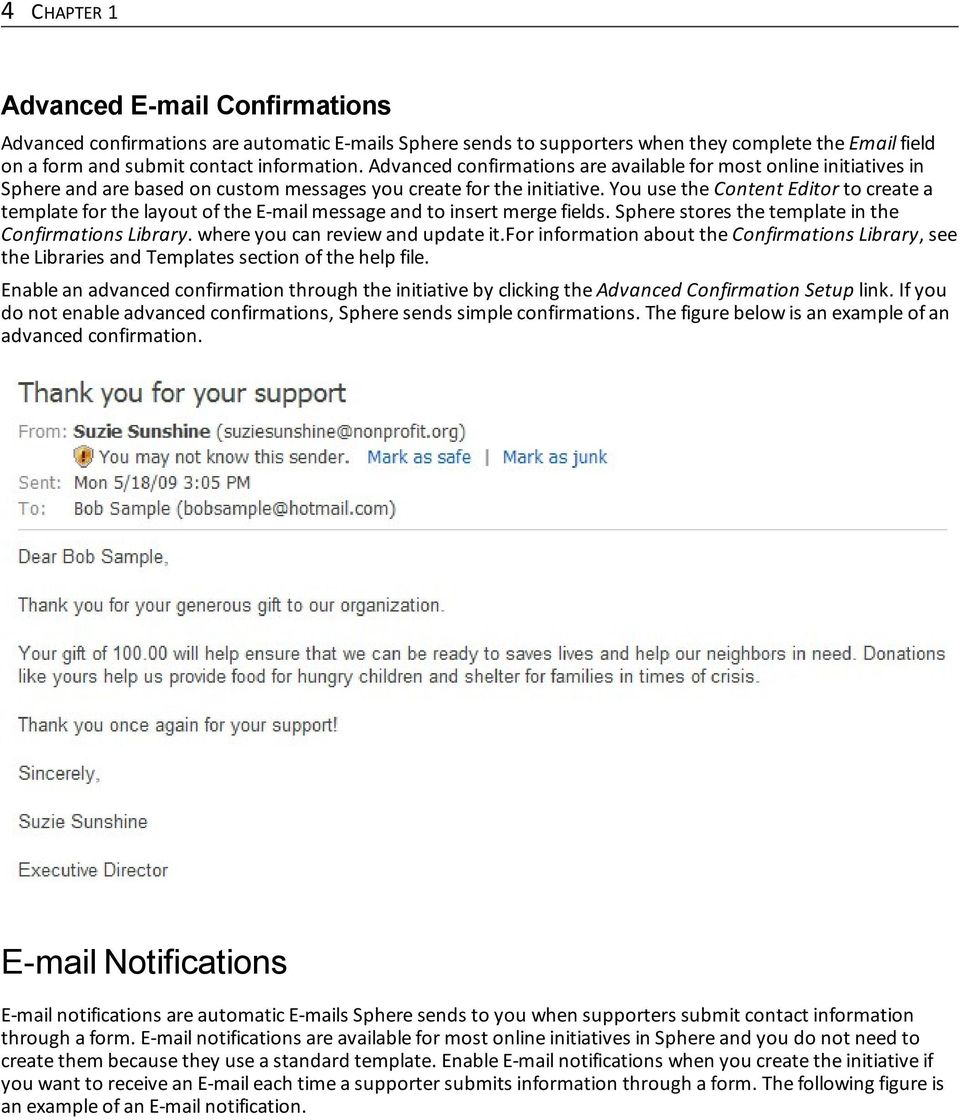
11 OVERV IEW 5 Sphere enables you to create a custom notification by using an advanced confirmation for the initiative and then adding your address to the Send Copy of to field in the Content Editor. You receive the same the supporter receives which allows you to review new information without accessing Sphere. Consider using notifications when you need to take an action after a supporter provides information (for example, send a brochure, make a phone call, and so on). Do not use them as a substitute for running regular reports for an initiative because the s may not always reach you. Viral Marketing Viral marketing is when your supporters send messages to personal contacts to raise money for your organization or to promote your cause. Supporters access a form through a Web site and enter address information. Sphere then sends an to the specified address and also includes a link to the Web site where supporters access the form. Friends Asking Friends s A Friends Asking Friends is an automatic that your supporters can send to their friends, families, or others they choose. Friends Asking Friends s are available for online fundraising initiatives such as Thon and Gala. After supporters register for your event, they can log into the headquarters section of the Web site to access an center form and send messages to personal contacts. If you create templates while setting up an initiative and make them available in the center, registrants can personalize them, or create their own. Sphere automatically inserts a link to the supporter s fundraising Web site when it sends the . Sphere only saves a registrant s personal contact in the database if the contact submits information to you through a form. The figure below is an example of a Friends Asking Friends .

12 6 CHAPTER 1 Spread the Word A Spread the Word is an automatic Sphere sends when supporters access a Spread the Word form through a fundraising Web site and use the form to promote your cause by sending messages to personal contacts. Spread the Word forms are available when you create fundraising initiatives, and when you create Advocacy action items. The figure below is an example of a Spread the Word .

13 OVERV IEW 7 When you set up the initiative, you enter text for the s Sphere will send (for example, I think this is a great cause you should learn more about, and so on). After a supporter accesses the form and enters a personal contact s address, Sphere sends a message to the contact which contains your text and a link to the Web site where supporters access the form. Sphere only saves a supporter s personal contact in the database if the contact submits information to your organization through a form. to a Friend s An to a Friend is similar to a Spread the Word , except it is sent from a CMS Web site form instead of a form in an event Web site. Sphere automatically sends this when supporters access an to a Friend form through a Web site and use it to promote your cause by sending messages to personal contacts. The figure below is an example of an to a Friend . When you set up a CMS Web site you can add HTML code to the site s Kintera Template File (KTF) which adds a link to the form within the Web site layout. When you add the to a Friend form you can use the Sphere version or you can modify it by creating custom page content, confirmation content, and a wrapper. After a supporter accesses the form and enters a personal contact s address, Sphere sends a message to the contact which contains text and a link to the Web site. Sphere only saves a supporter s personal contact in the database if the contact submits information to your organization through a form. Forward to a Friend s A Forward to a Friend is an automatic that your supporters can send to their friends, families, or others they choose. Sphere sends Forward to a Friend s when supporters access a Forward to a Friend form through an mailing and use it to promote your cause by sending messages to personal contacts. You create Forward to a Friend forms via Communications > Mail Specific Features > Forward This Form and then create a hyperlink to the forms when you create content for mailings. The figure below is an example of a Forward to a Friend . When creating the form, you enter text for the s Sphere will send (for example, I think you might be interested in this , and so on). After a supporter receives the mailing, accesses the form, and enters a personal contact s address, Sphere sends a message to the contact. The message contains your text and a
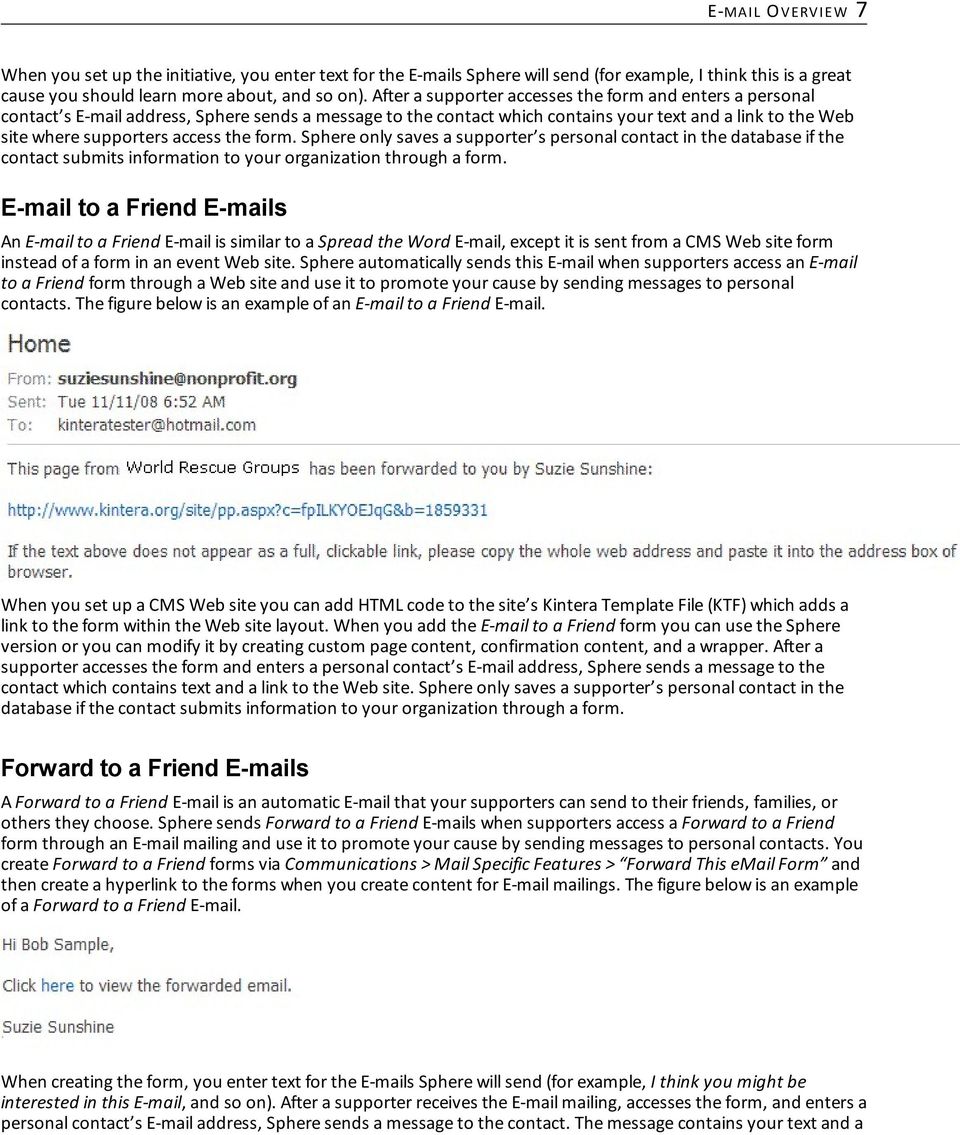
14 8 CHAPTER 1 link to the Web page version of the content. Sphere only saves a supporter s personal contact in your database if the contact submits information to your organization through a form. Use Forward to a Friend to preserve content. Forwarding an directly from a receiver s provider can cause corruption in the content s HTML code and can alter the look and feel of the message. Bulk Bulk s are those you generate and send to your supporters by creating messages for groups of supporters who exist in your database. Using bulk is more effective than using your local service provider because Sphere s system is designed to send large numbers of s simultaneously and it conforms to sending standards for high volume senders. Sphere eliminates the need for you to manage changes in the industry so you can focus on your content and delivery strategies. You have a number of options for sending bulk including using: - when you need to search in your database to find individuals or organizations (referred to as receivers) to whom you will send bulk s enewsletter - when supporters are signed up as receivers Sequential s - when you want to send a series of s and filter the receivers for each mailing according to actions from previous s Campaign Manager when you are sending an appeal to a prospect list you associate with a Campaign Manager campaign. For information about Campaign Manager, see the Campaign Manager section of the help file. Custom events - when you are sending s to individuals associated with a custom event Sending bulk s to supporters involves the following high level steps: Create a campaign which is a folder for messages with related content. Create a mailing which is the method you choose to send a message through a campaign. Identify the receivers by searching for contacts in the database, reviewing an existing group of subscribers, or entering their information in the database if they are prospects. Define the by using Sphere s built in Content Editor to create or import the message you will send to supporters. Test and schedule the mailing by sending sample s to yourself or other designated contacts within your organization to preview mail content, and then indicating when to send the . Sphere finds the contacts in your database who are receivers and merges your content with their addresses. The system searches the list of receivers to find addresses it should remove and automatically suppresses them from the receivers. Sphere suppresses addresses when receivers unsubscribe, when addresses fail delivery attempts, and when receivers report messages as SPAM. The merge process creates files which Sphere sends to receiving mailing systems. During the sending process, receiving mail systems provide codes to indicate message delivery status. Sphere tracks the codes and provides them through reports available for each mailing. Sphere also tracks and reports actions supporters take when

15 OVERV IEW 9 they receive messages. You can use reports to measure the success of your mailings, and target contacts for future mailings. To ensure message delivery, use opt-in (a term used when you provide a supporter the option to receive bulk E- mail. The subscriber is choosing to be added to an list by accepting the organization s terms of service) methods when you build your contact database, and regularly review reports so you can remove contacts who continually do not open messages and who do not have valid addresses. Overview enables you to use Advanced Search to find receivers in the database, define content, and then schedule a time to send your message. For example, if you are hosting an event and need to provide information to registrants, you use to search for them. You also use when the receivers you need are not subscribers of the same enewsletter campaign. For example, if you need to send a message to subscribers who typically receive weekly updates as well as to subscribers who receive monthly updates, you could use to include both groups in one mailing. When you search for receivers, you can include any contact with an address from your contact database in the search criteria. Since you should only send messages to contacts who opt-in 1 to receive them, and recipients do not subscribe to receive messages, you should first consider which contacts have an interest in the message content. To understand your receivers interests, use trackable links in s and then review reports of the receivers who clicked the links. You can also search for receivers based on previous actions such as registrations and donations, or with source codes you attach to your marketing efforts. Using entails completing the following high level steps: Create or select an existing campaign Select a mailing type Create a receiver list with a query Define content Test and schedule the mailing View the report Sequential s Overview Sequential s enables you to send a series of s and filter the receivers for each mailing according to actions from previous s. For example, you can send an request for donations and have Sphere automatically remove supporters who make donations from subsequent messages. Select existing supporters in your database using Advanced Search, define content, and then schedule a time to send your message for the first mailing. Follow the same procedures to create subsequent mailings. However, before you select the receivers select the filter criteria. 1 A term used when you provide a supporter the option to receive bulk . The subscriber is choosing to be added to an list by accepting the organization s terms of service.

16 10 CHAPTER 1 When you search for receivers, you can include any contact with an address from your contact database in the search criteria. Since you should only send messages to contacts who opt in 1 to receive them, and Sequential s recipients do not subscribe to receive messages, you should consider which contacts have an interest in the message, and also use filtering options that exclude receivers who do not open messages or click links. Using Sequential s entails completing the following high level steps: Create or select an existing campaign Create an initial mailing Create a receiver list with a query for the initial mailing Define content for the initial mailing Test and schedule the initial mailing Create the second mailing Select filter criteria for the second mailing s receivers Define content for the second mailing s receivers Test and schedule the second mailing enewsletter Overview enewsletter enables you to define content and schedule a time to send your message to supporters who sign up as receivers. For example, you can offer to send periodic program updates to supporters who donate. To do this, you would create an enewsletter campaign, and then provide the option to sign up for it on the donation form. Supporters sign up to receive enewsletter messages through forms by selecting enewsletter campaign names. We refer to the process of signing up as subscribing and opting-in. You can create an enewsletter Subscription Form and add it to your Web site, or add enewsletters to forms when you create them. Sphere will automatically add supporters who sign up to the enewsletter receiver lists. When you provide the option for supporters to sign up for enewsletters, you should select double opt-in which requires them to click a confirmation link to complete their subscriptions. We require opt-in and highly recommend using double opt-in because many systems track and block senders who deliver which is reported by users as SPAM, and who send messages to invalid addresses. Using enewsletter entails completing the following high level steps: 1 A term used when you provide a supporter the option to receive bulk . The subscriber is choosing to be added to an list by accepting the organization s terms of service.

17 OV ERV IEW 11 Create or select an existing enewsletter campaign Add the enewsletter to a form and allow supporters to subscribe to it Select a mailing type Define enewsletter content Test and schedule the enewsletter mailing View the enewsletter report Campaign Manager s Campaign Manager enables you to use or Sequential s to create appeals and automatically identify receivers using a prospect list you associate with a Campaign Manager campaign. For example, if you are running a disaster relief campaign and targeting donors from previous disaster fundraising efforts as prospective donors for your current campaign, you could use through Campaign Manager to send messages to those supporters and associate their actions with the campaign. You only use Campaign Manager to send s when the s are for Campaign Manager campaigns. When you create an appeal in Campaign Manager, you also create an campaign or a Sequential s campaign. Using Campaign Manager to send s entails completing the following high level steps: Create or select an existing Campaign Manager campaign Add a prospect list to the Campaign Manager campaign Select an appeal category Create the appeal, and then depending on the type of appeal you select, follow the appropriate procedures For information about Campaign Manager, see the Campaign Manager section of the help file. Campaigns An campaign is a grouping of messages with related content. Depending on where you are in Sphere, an campaign has different names. In... An Campaign is referred to as... and Sequential s Campaign enewsletter enewsletter

18 12 CHAPTER 1 Campaign Manager Appeal Group related mailings into logical campaigns so supporters understand the types of messages they will receive. This is important because all Sphere campaign mailings contain a receiver opt-out link so supporters can unsubscribe from future messages in the campaign. For example, if you plan to send multiple messages for an event, create an campaign and then use it to send all the related mailings. This way, supporters who do not wish to receive more information about the event can unsubscribe from all of the messages. Note: A receiver opt-out link is also available if you want to provide the option for supporters to unsubscribe from all future mailings from your account. Consider supporters who opt-out from one campaign when you create another. If you create similar campaigns and use the same groups of mailing receivers for each, you send messages to supporters who do not wish to receive them. This frustrates supporters and causes them to unsubscribe from mailing content multiple times, to unsubscribe from all future mailings from your account, or to report your messages as SPAM to service providers. Mailings After creating an campaign, send messages to supporters using mailings. Choose any of the following mailing types depending on the content you want to send. Single mailing allows you to send a one time message to targeted recipients. You use this mailing type when you need to send one message to each receiver in a group you identify. For example, you can send event participants an announcement for an upcoming meeting. This mailing type is available when you use , enewsletter, and through Campaign Manager. Split mailing with random distribution allows you to send a one time message to a group of recipients that Sphere randomly splits into subgroups. You use this mailing type when you want to compare the effectiveness of more than one version of mailing content. For example, you can identify a group of receivers, create two versions of a donation request, and have Sphere randomly choose the receivers for each version so you can determine which one is the most effective. This mailing type is available when you use , enewsletter, and through Campaign Manager. Split mailing with custom distribution allows you to send a one time message to a group of recipients that you split into subgroups. You use this mailing type when you want to change sections of content for different groups within your list of receivers. For example, you can create regional subgroups for your receivers and provide a list of upcoming events in the mailing content specific to each area. This mailing type is available when you use , enewsletter, and through Campaign Manager. Recurring mailing allows you to automatically schedule messages you plan to send more than once. You use this mailing type when you need to send mailing content at regular intervals to a group of receivers you identify with one query. For example, you can create a mailing which searches daily for new donors and then sends them a welcome . This mailing type is available when you use , enewsletter, and through Campaign Manager. Sequential mailing allows you to send s based on criteria from previous mailing actions within a campaign s sequence. You use this mailing type when you want to send more than one mailing and filter the receivers for each mailing in the series. For example, you can send an request for donations

19 OV ERV IEW 13 and have Sphere automatically remove supporters who make donations from subsequent messages. This mailing type is available when you use Sequential s and Sequential s through Campaign Manager. enewsletter mailing allows you to send messages using single mailing, split mailing with random distribution, split mailing with custom distribution, or recurring mailing types when supporters subscribe to receive content from your organization. You use this mailing type when you are sending content related to an enewsletter campaign. For example, you can use the single mailing type to send enewsletter mailings to supporters who subscribe to receive periodic program updates. This mailing type is available when you use enewsletter. Receivers Overview A receiver is a contact you identify when completing the required steps to send an mailing, and ultimately the recipient of your message. A group of receivers can be referred to as a receiver list, and also as a receiver base. The way you generate receivers is based on whether you use , Sequential s, enewsletter, or Campaign Manager. When you build your contact database, consider how you plan to send bulk s to your supporters. s are most effective when you communicate with contacts who wish to receive your messages. When you add address information, make the contacts aware they will receive message content from your organization (also known as being opted-in) by allowing supporters to sign up as receivers of your organization s enewsletter campaigns when they complete forms on your Web site. You can also direct supporters to use your enewsletter Subscription Form. When supporters sign up for enewsletters, use double opt-in and require them to click a confirmation link to complete their subscriptions. We recommend opt-in because many systems track and block senders who deliver which is reported by users as SPAM 1 and who to deliver to invalid addresses. Understanding Receivers receivers are the contacts you select when completing the required steps to send an mailing. You create an receiver list with a query by searching the database using Advanced Search which contains the following folders: Contacts search for contacts using information associated with a contact record including profile data, financial transactions, segmentation, and constituencies Members search for contacts using membership contact information including membership type, start date, and membership expiration date Communities search for contacts associated with online Sphere initiatives including registrants, 1 Unsolicited on the Internet.

20 14 CHAPTER 1 donors, and team leaders Saved Queries search for contacts using previously saved criteria Communications search for contacts from previous mailings or subscriber bases Use Advanced Search to preview the list of contacts you are targeting. The preview lists the first 500 contacts that meet the search criteria, and includes a record count of the total number of records included in the receiver base. The actual mailing will only send s to the records which contain an address and are not suppressed by our suppression logic. Understanding Sequential Receivers Sequential s receivers are the contacts you select when completing the required steps to send Sequential s mailings. Create a Sequential s receiver list with a query for the first mailing in the campaign by searching the database using Advanced Search. Before you access Advanced Search for subsequent mailings, select filter criteria from previous mailing actions. For example, you can send an request for donations and have Sphere automatically remove supporters who make donations from subsequent messages. Advanced Search contains the following folders: Contacts search for contacts using information associated with a contact record including profile data, financial transactions, segmentation, and constituencies Members search for contacts using membership contact information including membership type, start date, and membership expiration date Communities search for contacts associated with online Sphere initiatives including registrants, donors, and team leaders Saved Queries search for contacts using previously saved criteria Communications search for contacts from previous mailings or subscriber bases Filter criteria contains the following groups: Based on initial mailing filter contacts using actions taken after receiving the first mailing in the series Based on previous mailing filter contacts using actions taken after receiving the most recent mailing in the series Use Advanced Search to preview the list of contacts you are targeting. The preview will filter based on the previous mailing actions you indicate, and then list the first 500 remaining contacts that meet the search criteria. The preview includes a count of the total number of records included in the receiver base, but the actual mailing will only send s to the records which contain an address and are not suppressed by our suppression logic.

21 OV ERV IEW 15 Understanding enewsletter Receivers enewsletter receivers (also known as subscribers) are the contacts who subscribe to receive enewsletter mailings. Create receiver lists by allowing supporters to sign up through forms when you add your enewsletter campaigns to them, or when you direct supporters to use your enewsletter Subscription Form. When you create enewsletter mailings, you can review the list of subscribers by clicking the Subscribers ( ) icon in the campaign mailing list Subscriber column. The list will display current subscribers, but the mailing will only send s to addresses not suppressed by our suppression logic. A subscriber can unsubscribe from an enewsletter by selecting one of the unsubscribe options contained in a mailing. You also have the option to remove a subscriber from an enewsletter by selecting Delete from the enewsletter campaign s Subscriber Base. Each method prohibits a contact from subscribing to the enewsletter again. Understanding Campaign Manager Receivers Campaign Manager receivers are the contacts you select when completing the required steps to create a Campaign Manager appeal mailing. Create a Campaign Manager receiver list by associating a prospect list with the campaign. The prospect list, which is generated from the Static List Library, is automatically inserted as a link for the query criteria in the Receivers column. If you do not use a prospect list, you can create a receiver list using Advanced Search. Advanced Search contains the following folders: Contacts search for contacts using information associated with a contact record including profile data, financial transactions, segmentation, and constituencies Members search for contacts using membership contact information including membership type, start date, and membership expiration date Communities search for contacts associated with online Sphere initiatives including registrants, donors, and team leaders Saved Queries search for contacts using previously saved criteria Communications search for contacts from previous mailings or subscriber bases Click the name of the prospect list to open the Advanced Search tool and preview the list of targeted contacts. The preview lists the first 500 contacts that meet the search criteria, and includes a record count of the total number of records included in the receiver base. The actual mailing will only send s to the records which contain an address and are not suppressed by our suppression logic. For information about Campaign Manager, see the Campaign Manager section of the help file. Content content is the header and body information you define when completing the required steps to send an mailing.
22 16 CHAPTER 1 The header consists of the Subject Line, From Name, From , and Reply To fields. You can customize these fields so that recipients can immediately see the mailing is from your organization. This is important because recipients who do not recognize senders are more likely to report to their service providers that messages are SPAM. For the body, you can create content in HTML and Text formats. If a recipient s provider accepts HTML formatted messages, the recipient will see the content in a Web page. If the provider accepts text formatted messages, the recipient will see a plain text file without HTML or images. Use the Content Editor to create content using one of the following methods: Define new content Load an existing template from the Template Library Load existing content from the Mail Content Library Import files from another HTML editor such as Adobe Dreamweaver or Microsoft FrontPage You can store content in your account by saving it to the Mail Content Library, or by creating a template within the Template Library. Testing and Scheduling an Mailing Testing and scheduling are the final steps before you send a bulk mailing. Testing an Before Distribution Send a test to yourself or other designated contacts within your organization from the Schedule Mail page to preview mail content before sending it to the entire receiver list. You may want to enter addresses for multiple providers to preview how the content will appear at each destination. For each test, an HTML and a text version is sent along with a SPAM score report. Note: If you use a merge field in the content, the test mailings will show the default value you select and not merged data from a contact record (for example, if the merge field is Last Name, you will see the field Last Name instead of the recipient's last name). If the test s show the default value, then you can be assured that the mail merge value is properly configured. Scheduling an for Distribution When you schedule a mailing, you designate a time for Sphere to begin merging the receivers with the content. When the merge process is complete, the data is sent to a queue where it waits to be distributed through Sphere's message transfer agent (MTA) 1. Many factors can affect the time it takes to send an including throttling 2, limitations for service providers, receiver list query complexity, and combined account volume. 1 A program which sends files from one system to another. 2 The process of restricting the number of concurrent connections Sphere makes with service providers when sending bulk messages.
23 OV ERV IEW 17 Custom Schedule Privilege Groups Create custom schedule privilege groups if more than one person is responsible for testing and approving messages. When you create a privilege group, you specify the functional access rights that will apply to all users you assign to the group. Funtional Accss Type: Send Test Configure , Sequential , and enewsletter functional access for users who will send test messages by providing full access rights to Send Test and restricting access rights for Approve. The following figure displays the Privilege Group page when you assign Send Test access to a privilege group: Users you assign to the test group will see the following on the Schedule Mail page:
24 18 CHAPTER 1 Functional Access Type: Approve For users who only approve and schedule final messages, configure , Sequential , and enewsletter functional access by providing full access rights to Approve and removing access to Send Test. The following figure shows the Privilege Group page when you assign Approve access to a privilege group:
25 Users you assign to the approval group will see the following on the Schedule Mail page: OV ERV IEW 19
26 20 CHAPTER 1 Note: Sphere does not display Preview Content for split mailings with custom distribution. Users with approval access can only click Next. How Sphere Sends s Sphere follows three main steps to send automatic and bulk s: Identify receivers and merge content with addresses Send messages to the addresses and receive notifications of the messages sent statuses Determine whether to resend messages
27 OV ERV IEW 21 Identify Receivers and Merge Content For automatic s, Sphere identifies receivers and merges content according to supporter actions. When a supporter submits information through a form, Sphere enters the information into the contact database and merges relevant fields (for example, first name, last name, amount received, and so on) into a confirmation message which is sent to the address specified on the form. The confirmation uses a default message unless you create a custom message for your initiative. The form submission may also trigger a notification which uses a standard template and is sent to an address you specify. When a supporter sends automatic viral marketing s, Sphere uses the addresses supporters enter into a Web site form to merge with content but does not store the addresses in your contact database. For example, if a registrant for a fundraising event sends a Friends Asking Friends to a family member, the family member s address is not stored in your database as a contact. You will not able to identify the family member as a receiver for bulk s unless the person makes a donation or registers. The viral marketing message to the contact contains standard or custom text and a link to the Web site where supporters access the form. For bulk s, Sphere finds the contacts in your database that you identify as mailing receivers, removes E- mail addresses that meet system criteria for suppression, and then merges your custom mailing content with the remaining addresses. Send to Addresses and Receive Status Updates The merge process for automatic and bulk s creates files which Sphere transfers to a message transfer agent (MTA) 1 which physically transfers the files to service providers using multiple IP addresses 2. Many factors determine the time it takes for a merged file to leave the Sphere system including throttling limitations for service providers, and combined volume for accounts sending . Sphere can send up to 500,000 E- mails per hour. During the sending process, receiving mail systems provide codes to indicate message delivery status and signal whether or not Sphere should try to send s to the addresses again. Sphere tracks the codes and provides them through reports available for each mailing. Sphere receives three types of codes success, soft failure, and hard failure. Success Codes Success codes inform our system when the service provider accepts the message. Large service providers often accept messages in bulk from senders they trust, and then determine if the addresses are valid. For example, if Sphere sends a large number of s to Hotmail at one time, Hotmail will accept all the messages and then send individual messages to inboxes (for example, [email protected]). For bulk E- mails, Sphere may initially receive a code indicating a successful delivery, but later the service provider could send a failure message. Soft and Hard Failure Codes If there is a problem with the intended address, the service provider will send Sphere a soft or hard failure code. For bulk s, Sphere places the codes into failure reason categories. Problems which are not permanent are assigned to soft failure reason categories (for example, mailbox is full, inactive account, network error, and so on), and problems that are permanent are assigned to hard failure reasons categories (for example, unknown user, address error, closed account, and so on). The actual codes Sphere receives are combinations of 1 A program which sends files from one system to another. 2 Identifiers for a computer which send information via the Internet
28 22 CHAPTER 1 numbers and text. The figure below shows an example failure code and the failure reason category to which it is added: Hard Bounce Failures The is permanently undeliverable due to address or domain errors or status. Possible Cause Hard Bounces occur for multiple reasons, such as address errors, bad domain names, unknown users and closed accounts. Examine the specific Failure Types to determine the likely causes. Suggested Actions Invalidate the records immediately and remove them from your list. Contact the recipient for replacement or corrected address. Note: We automatically place, after the first instance, all addresses which hard fail on the blacklist so they are suppressed from future mailings. Hard Bounce Unknown User The address is valid for the domain but nonexistent. Generally, this means the account has been closed for some time. Possible Cause Stale Data: Your list may contain a high number of undeliverable records if it has not been recently mailed to or too much time has elapsed between data capture and mailing. This is an important data point to review as it is one of the main reasons incoming messages are blocked by some of the major ISPs. Suggested Actions While mail frequency should be adjusted for customer preference and value, review all segments of your list on a regular basis to ensure brand visibility, continuity of communication and address deliverability. Set standards for the first communication after data capture (5 to 10 days). This action will also reduce the likelihood of complaint. If mailing to an "old" segment, do a test before full deployment. Deploy the mailing slowly to avoid spikes in Unknown User failures. Possible Cause Poor Data Capture: You may not be adequately validating addresses at the point of data capture. Suggested Actions Send a follow up to new customers to confirm opt-in permission and validate deliverability of address provided. If bounces for specific reasons that may indicate an invalid or inactive account, remove address and contact customer for new/corrected address.
29 OV ERV IEW 23 Require double entry of addresses to minimize typographical errors. Perform Address Correction (hygiene) to correct common misspellings on major domains before adding large quantities of new records to your list. Send confirmation on corrected records. Possible Cause Unreliable Data Source: You may be introducing undeliverable records to your list because of unreliable data sources (list rental, affiliate, etc.) A high incidence of tale, inaccurate or fictitious data suggests a problem. Suggested Actions Know your data sources. Investigate their data compilation and management practices. Confirm consent and deliverability before incorporating third party names into your list. Perform Address Correction (hygiene) to correct common misspellings on major domains before adding large quantities of new records to your list. Send confirmation on corrected records. Contact the recipient for replacement address. Hard Bounce Bad Domain The has a domain name that is invalid or no longer exists. Possible Cause Stale Data: Your list may contain a high number of undeliverable records if it has not been recently mailed or too much time has elapsed between data capture and mailing. This is an important data point to review as it is one of the main reasons incoming messages are blocked by some of the major ISPs. Suggested Actions While mail frequency should be adjusted for customer preference and value, review all segments of your list on a regular basis to ensure brand visibility, continuity of communication and address deliverability. If mailing to an "old" segment, do a test before full deployment. Deploy the mailing slowly to avoid spikes in Unknown User failures. Possible Cause Poor Data Capture: You may not be adequately validating addresses at the point of data capture. Suggested Actions Send a follow up to new customers to confirm opt-in permission and validate deliverability of address provided. If bounces for specific reasons that may indicate an invalid or inactive account, remove address and contact customer for new/corrected address.
30 24 CHAPTER 1 Require double entry of addresses to minimize typographical errors. Perform Address Correction (hygiene) to correct common misspellings on major domains before adding large quantities of new records to your list. Send confirmation on corrected records. Possible Cause Unreliable Data Source: You may be introducing undeliverable records to your list because of unreliable data sources (list rental, affiliate, etc.) A high incidence of stale, inaccurate or fictitious data suggests a problem. Suggested Actions Know your data sources. Investigate their data compilation and management practices. Confirm consent and deliverability before incorporating third party names into your list. Perform Address Correction (hygiene) to correct common misspellings on major domains before adding large quantities of new records to your list. Send confirmation on corrected records. Contact the recipient for replacement address. Hard Bounce Address Error The address has a format or syntax error (multiple or sign). Possible Cause Poor Data Capture: You may not be adequately validating addresses at the point of data capture. Suggested Actions Send a follow up to new customers to confirm opt-in permission and validate deliverability of address provided. If bounces for specific reasons that may indicate an invalid or inactive account, remove address and contact customer for new/corrected address. Require double entry of addresses to minimize typographical errors. Perform Address Correction (hygiene) to correct common misspellings on major domains before adding large quantities of new records to your list. Send confirmation on corrected records. Possible Cause Unreliable Data Source: You may be introducing undeliverable records to your list because of unreliable data sources (list rental, affiliate, etc.) A high incidence of tale, inaccurate or fictitious data suggests a problem. Suggested Actions Know your data sources. Investigate their data compilation and management practices. Confirm consent and deliverability before incorporating third party names into your list. Perform Address Correction (hygiene) to correct common misspellings on major domains before adding
31 OV ERV IEW 25 large quantities of new records to your list. Send confirmation on corrected records. Contact the recipient for replacement address. Hard Bounce Closed Account The address is valid for the domain, but is now closed or suspended. Possible Cause Address Change: At 33% address churn per year, closed accounts is a major cause of list attrition. Suggested Actions Given the rate of address churn, customer reactivation should be a key component of any communication program. This highlights the need to continually maintain good list hygiene and mailing practices. Consider a relationship with the recipient and nurture it appropriately. Request second/back-up address or new/better one as standard part of your data capture and ongoing communications. Contact the recipient for replacement address if now closed. Possible Cause Stale Data: Your list may contain a high number of closed accounts if it has not been recently mailed or too much time has elapsed between data capture and mailing. This is an important data point to review as it is one of the main reasons incoming messages are blocked by some of the major ISPs. Suggested Actions While mail frequency should be adjusted for customer preference and value, review all segments of your list on a regular basis to ensure brand visibility, continuity of communication and address deliverability. If mailing to an "old" segment, do a test before full deployment. Deploy the mailing slowly to avoid spikes in Unknown User failures. Soft Bounce Failures Your is temporarily undeliverable due to mailbox status, etc. Possible Causes Soft bounces occur for multiple reasons, including mailbox over limit conditions and inactive accounts. Examine the specific Failure Types to determine the likely causes. Suggested Actions Resend records that fail for temporary conditions. Invalidate records only if the same result is received on subsequent mailings over at least 30 days. Contact the recipient for replacement or corrected address.
32 26 CHAPTER 1 Note: Some soft bounces are added to the Kintera blacklist based on a number of factors and after a specific number of attempts dependent on the specific soft bounce code. Some specific soft bounce codes never result in an being placed on the suppression list as these are not a result of a problem with the address. Soft Bounce Inactive/Disabled Account The recipient s account is inactive or temporarily disabled. Possible Cause Delinquency or Dispute: The recipient may not have paid his subscription fee or is involved in dispute with the ISP. Suggested Action Resend and monitor acceptance. Possible Cause Temporary Condition: The recipient may not have checked due to access reasons (vacation, travel). Suggested Action Resend and monitor acceptance. Possible Cause Infrequent Use: The ISP may have flagged the recipient s account as inactive due to no activity. Watch for it to appear as a Hard Bounce/Closed in future mailings. Suggested Action Consider Inactive failures as a warning sign. Request a second/back-up address or new/better one. Attempt contact with customer through alternate means. Possible Cause Address Change: The recipient may have abandoned this address. Watch for it to appear as a Hard Bounce/Closed in future mailings. Suggested Action Contact the recipient for replacement address if reported Closed in subsequent mailings. Soft Bounce Mailbox Full The recipient s mailbox is full or has exceeded its allowed storage. Possible Cause Temporary Condition: The recipient may have received unusually high volume or has not checked his account for a while (vacation, travel). Suggested Action Resend and monitor acceptance.
33 OV ERV IEW 27 Possible Cause Infrequent Use: With consumers averaging three accounts, a full mailbox may signify that you re mailing to one of lesser importance. Suggested Action Consider Full Mailbox failures as a warning sign. Attempt contact with customer through alternate means and request new/better one. Possible Cause Address Change: The recipient may have abandoned this address. Watch for it to appear as a Hard Bounce/Closed in future mailings. Suggested Action Contact the recipient for replacement address if reported Closed in subsequent mailings. Soft Bounce Greylist The was greylisted, a type of temporary block to combat spam. Note: The receiving domain is not refusing the . You re being tested to see whether you will retry delivery. Spammers will not. Possible Cause Greylisting: This is a technique used by smaller ISPs and corporate domains. Suggested Action Resend and monitor acceptance. Block Failures The was intentionally refused by the receiving ISP or domain. Blocks occur when the receiving server refuses the connection, refuses to accept the during the connection, or returns the undelivered after several delivery attempts. Note: This may be the result of other campaigns sent from other clients and not directly related to the specific campaign/mailing under review. However, should you see these types of failures, please note the best practices outlined in this section to minimize these occurrences in future mailings. Possible Causes Blocks occur for multiple reasons, including the receiver s use of a blacklist or other filter, as well as the spam complaint rate or bounce rates for specific bounce codes. The specific Failure Reasons can help determine the likely causes. Suggested Actions If the block is from one of the major ISPs, our Network Operations team will work to take the appropriate corrective action and seek to have the block removed with the ISP. No action is required by the client. When the block is placed by a secondary or lesser known domain, consider the percentage of s
34 28 CHAPTER 1 being delivered to it and if additional action is needed notify us for further assistance. Block Spam Complaints The was blocked because of recipient complaints that s sent through the IP address are unwanted (spam). This may be the result of other campaigns sent from other clients and not directly related to the specific campaign/mailing under review. Possible Cause Low Engagement: Recipients may not be engaged with your organization (no/low opens or clicks). Inactivity directly correlates to complaint. Suggested Actions Conduct separate reactivation mailings to inactive recipients. Purge non-respondents from your list. Identify inactive customers from regular mailing programs who have not opened or clicked in the past 6 months. Send those customers a separate reminding them of the relationship allowing them to opt out if they no longer wish to continue the relationship. Provide opportunities in subsequent regular mailings for 30 more days to re-engage. For those who did NOT opt-out and those with activity in the subsequent campaigns continue normal mailings. Permanently remove those users who have not had click activity during this window, sending a final we are sorry to see you go that gives the user a final chance to opt back in to the mailing program. Possible Cause High/Low Frequency: Recipients may be associating your with spam if you re mailing too frequently or not frequently enough to prompt recall of permission to send to the address. Suggested Actions Review your sending cadence and reset it consistent with customer expectations. Ensure that the recipient understands what they are signing up to receive including the frequency (possibly the day and time) of when they can expect to receive the . Offer choice to recipients on both frequency and content. Possible Cause Poor Relevance: Recipients may associate your with spam if not targeted appropriately or if the content is not relevant to their preferences. Suggested Actions
35 OV ERV IEW 29 Tighten your targeting criteria and associate your content with preferences. Develop feedback mechanisms to confirm relevance. Provide the recipient with sample s/newsletters that can be reviewed during the sign-up process. Allow recipients to update their profile with added information used to increase the relevance of content. Possible Cause Weak Branding: Recipients may not realize that the is from you if your branding is weak. Suggested Action Use consistent; prominent branding in your From Address, From Name and Subject Line. Possible Cause Weak Permission: Recipients may not associate your with permission granted to you or a third party (list rental, affiliate programs). Suggested Actions Use more explicit methods to obtain and disclose permission such as using the double opt-in feature on forms. Investigate permission practices of affiliates. Send follow- up message to confirm consent before incorporating third party names into your list. Provide permission statements to remind recipients why they re getting your in prominent locations on all messages sent. For example, you may want to provide a sentence or two describing how the end user subscribed to your mailing list. Reconfirm permission and/or track other indicators of sustained interest (response, purchase, donation, etc.). Possible Cause Inadequate Complaint Management: Recipients who have opted to not receive mailings from one campaign are included in the receiver base for another similar one. Suggested Action Build campaigns and newsletters with related topics and content to help constituents identify which they would like to receive. Build the proper /eNewsletter template structure to ensure opt-out processes for specific s and campaigns are handled in the proper hierarchical fashion. Block Blacklist The was blocked because the domain name or IP address is on an external blacklist.
36 30 CHAPTER 1 Possible Cause High Spam Complaints: Your may be generating a high rate of spam complaints. See Block/Spam Complaint for likely causes. Suggested Action See Block/Spam Complaint for suggested actions. Possible Cause Spam Trap Hits: Your may have been caught in spam traps used to identify spammers. Spam traps are addresses that once belonged to recipients but were at some point closed or are intentionally published on websites. Rather than reissuing the addresses to other recipients, the ISP will mark them as traps to identify senders who attempt to send unsolicited to the addresses multiple times. Suggested Actions Know your data sources and keep your organization s list management practices updated and active. Investigate their compilation and management practices. Confirm consent before incorporating third party names into your list. Clean your list as part of your normal management practices. We take a proactive approach in helping to identify and suppress known bad addresses to help reduce the issue of being blocked when sending future mailings. Possible Cause Inadequate Complaint Management: Recipients who have opted to not receive mailings from one campaign are included in the receiver base for another similar one. Suggested Actions Build campaigns and newsletters with related topics and content to help constituents identify which they would like to receive. Build the proper /eNewsletter template structure to ensure opt-out processes for specific s and campaigns are handled in the proper hierarchical fashion. Block ISP Block The was blocked because your domain name or IP address is on an ISP internal blacklist. Possible Cause High Spam Complaints: Your may be generating a high rate of spam complaints. See Block/Spam Complaint for likely causes. Suggested Action See Block/Spam Complaint for suggested actions. Possible Cause
37 OV ERV IEW 31 Poor List Management: Your may be generating high failure rates that are associated with spam or poor list management practices. See Block/List Management for likely causes. Suggested Action See Block/List Management for suggested actions. Block Content Block The was blocked because some aspect of the content triggered a spam filter. Note: There are hundreds of spam filters. Most have low penetration and no appreciable impact on your deliverability. Others may have broader impact depending on usage at the domains on your list. Possible Causes The may have triggered a spam filter due to: Prohibited words or phrases Too many HTML tags Too many images Too many different font styles, sizes or colors Suggested Action Content Review: Send the content through the spam score test in the schedule area of the mailing. Based on the score, re-examine your templates, adjusting the language, style and HTML as much as possible without sacrificing effectiveness. Note: ISPs rely less on content blocks than has traditionally been the case. The move has been made to rely more heavily on other factors including the sender s overall reputation in monitoring whether is accepted and sent to the recipient s inbox or junk mail folder. Block URL Block The was blocked because one or more of the URLs in the is associated with spam complaints. This may be the result of other campaigns sent from other clients and not directly related to the specific campaign/mailing under review. Possible Cause- Poor URL Usage: URLs are being used too broadly. The practices of affiliates or others may be impacting your reputation. Suggested Actions
38 32 CHAPTER 1 Segregate your URLs. Use distinct URLs for each class of mail (transactional, commercial, newsletter, etc). Verify URL is not being used in other perceived as spam (other divisions, affiliates). Investigate underlying cause of problem URLs. Possible Cause Low Engagement: Recipients may not be engaged with you (no/low opens or clicks). Inactivity directly correlates to complaint. Suggested Actions Conduct separate reactivation mailings to inactive recipients. Purge non-respondents from your list. Identify inactive customers from regular mailing programs who have not opened or clicked in the past 6 months. Send those customers a separate reminding them of the relationship allowing them to opt out if they no longer wish to continue the relationship. It is advised that this type of list maintenance correspondence be sent in low volumes through a separate internal IP address if possible. Provide opportunities in subsequent regular mailing for 30 more days to re-engage. For those who did NOT opt-out and those with activity in the subsequent campaigns continue normal mailings. Permanently remove those users who have not had click activity during this window, sending a final we are sorry to see you go that gives the user a final chance to opt back in to the mailing program. Possible Cause High/ Low Frequency: Recipients may be associating your with spam if you re mailing too frequently or not frequently enough to prompt recall of permission to send to the address. Suggested Actions Review your sending cadence and reset it consistent with customer expectations. Ensure that the recipient understands what they are signing up to receive including the frequency (possibly the day and time) of when they can expect to receive the . Offer choice to recipients on both frequency and content. Possible Cause Poor Relevance: Recipients may associate your with spam if not targeted appropriately or if the content is not relevant to their preferences. Suggested Actions Tighten your targeting criteria and associate your content with preferences. Develop feedback mechanisms to confirm relevance.
39 OV ERV IEW 33 Provide the recipient with sample s/newsletters that can be reviewed during the sign-up process. Allow recipients to update their profile with added information used to increase the relevance of content. Possible Cause Weak Branding: Recipients may not realize that the is from you if your branding is weak. Suggested Action Use consistent, prominent branding in your From Address, From Name and Subject Line. Possible Cause Weak Permission: Recipients may not associate your with permission granted to you or a third party (list rental, affiliate programs). Suggested Actions Use more explicit methods to obtain and disclose permission such as using the double opt-in feature on forms. Investigate permission practices of affiliates. Send follow- up message to confirm consent before incorporating third party names into your list. Provide permission statements to remind recipients why they re getting your in prominent locations on all messages sent. For example, you may want to provide a sentence or two describing how the end user subscribed to your mailing list. Reconfirm permission and/or track other indicators of sustained interest (response, purchase, donation, etc.). Possible Cause Inadequate Complaint Management: Recipients who have opted to not receive mailings from one campaign are included in the receiver base for another similar one. Note: We ares connected to many of the top ISPs feedback loop programs enabling us to manage and automate spam complaint suppression of specific addresses known to have complained about a specific mailing. Suggested Actions Build campaigns and newsletters with related topics and content to help constituents identify which they would like to receive. Build the proper /eNewsletter template structure to ensure opt-out processes for specific s and campaigns are handled in the proper hierarchical fashion. Block Excess Traffic The volume is exceeding the receiving mail server s limits or capacity. Possible Cause
40 34 CHAPTER 1 Sending Too Much/Too Fast: We may be exceeding the receiving domain s traffic thresholds. Sending too much/too fast is associated with spamming and can result in temporary or permanent blocks. Suggested Action We maintain proper throttling with the ISPs in an attempt to eliminate this issue The Network team maintains awareness of these types of issues so domain controls can be considered for the receiver mail server (speed throttling, connection limits). Block Security Violation/Virus The was blocked because of a security policy violation. Possible Cause Sender Identity Problem: Your identifying information can t be verified (reverse DNS or valid From and Reply To addresses). Suggested Action Update your DNS entries. Validate your From and Reply To addresses to be sure they actually exist. Possible Cause Excess Volume: Your cumulative daily volume exceeds the number of s allowed. (Some smaller domains limit inbound volume to protect their servers from Spam). Suggested Action Determine incidence (percent block) and importance of domain. If warranted, spread volume over multiple days. Block List Management The was blocked because Unknown User failures reached an unacceptably high level. Possible Cause Stale Data: Your list may contain a high number of undeliverable records if it has not been recently mailed to or too much time has elapsed between data capture and mailing. This is an important data point to review as it is one of the main reasons incoming messages are blocked by some of the major ISPs. Suggested Actions While mail frequency should be adjusted for customer preference and value, review all segments of your list on a regular basis to ensure brand visibility, continuity of communication and address deliverability. Set standards for the first communication after data capture (5 to 10 days). This action will also reduce the likelihood of complaint. If mailing to an old segment, do a test before full deployment. Deploy the mailing slowly to avoid spikes in Unknown User failures. Possible Cause
41 OV ERV IEW 35 Poor Data Capture: You may not be adequately validating addresses at the point of data capture. Suggested Actions Send a follow up to new customers to confirm opt-in permission and validate deliverability of address provided. If bounces for specific reasons that may indicate an invalid or inactive account, remove address and contact customer for new/corrected address. Require double entry of addresses to minimize typographical errors. Perform Address Correction (hygiene) to correct common misspellings on major domains before adding large quantities of new records to your list. Send confirmation on corrected records. Possible Cause Unreliable Data Source: You may be introducing undeliverable records to your list because of unreliable data sources (list rental, affiliate, etc.) A high incidence of stale, inaccurate or fictitious data suggests a problem. Suggested Actions Know your data sources. Investigate their data compilation and management practices. Confirm consent and deliverability before incorporating third party names into your list. Perform Address Correction (hygiene) to correct common misspellings on major domains before adding large quantities of new records to your list. Send confirmation on corrected records. Contact the recipient for replacement address. Possible Cause Failure to Invalidate: You may not have invalidated previously identified Unknown User failures and removed them from your list. Suggested Action Verify that Unknown User failures identified have been properly invalidated and removed from your list. If not, immediately do so. Block Authentication Authentication prevents unauthorized people from forging your address or domains. Senders publish a record identifying the servers authorized to send for a domain. Upon the receipt of , the receiving domain checks the record against data in the header to be sure that the sending server (IP address) and domain name match. Possible Cause Your identifying information cannot be verified via a SPF or Sender ID record because of a bad record or no record at all. Your DomainKeys signature has not been properly configured in your and DNS servers, or is not configured at all. Suggested Actions
42 36 CHAPTER 1 If you are the system administrator for the domain in question, check to make sure that the authentication record for that domain lists the particular server as authorized to send on its behalf. Technical Failures The to this address or domain can t be delivered because of technical difficulties. Technical failures occurred during the attempt to connect with a receiving server. Possible Cause Technical failures occur for multiple reasons, including server down or overload conditions and network or DNS errors. Examine the specific Failure Types to determine the likely causes. Suggested Actions Invalidate records only if the same result is received on subsequent mailings over at least 30 days. Contact the recipient for replacement or corrected address. Too Busy The can t be accepted because the receiving mail server is temporarily overwhelmed with delivery attempts. Possible Cause High Traffic: The receiving mail server is being overwhelmed with traffic. Suggested Action Retry or resend later and monitor acceptance. Data Format Error The is being rejected because of formatting issues. Possible Cause Lengthy Subject Line: Your subject line may violate the receiving domain s length restrictions. Suggested Action Shorten the subject line. Possible Cause Prohibited Characters: The message may contain prohibited formatting or characters. Smaller domains may not accept foreign language characters. Suggested Action Review From, Subject and message content itself for any unusual formatting or characters, retry delivery. Possible Cause
43 OV ERV IEW 37 Invalid Headers: The headers in your mail may be incorrectly formatted. Suggested Action Review From, Subject and message content itself for any unusual formatting or characters, retry delivery. Network Error The connection to the receiving mail server was lost during delivery. Possible Cause Server Down: The receiving mail server may have gone down or timed out. Suggested Action Retry or resend and monitor acceptance. Possible Cause Routing Issues: There may have been routing issues between us and the receiving mail server. Suggested Action Retry or resend and monitor acceptance. Other Error The failed for other technical reasons that are typically low incidence and can not be interpreted or categorized based on feedback from the receiving domain. Possible Cause Failures for unknown reasons are typically due to new bounce codes implemented by the ISPs that have not yet been categorized. Suggested Action If incidences of receiving new bounce codes are reached, attempts will be made to properly categorize these codes and have them placed in the appropriate bounce categories for future mailings. If you see multiple instances of a specific code over the course of several mailings, please contact us for further investigation. Determine Whether to Resend to Addresses Sphere tracks failure codes and adds addresses to an internal suppression list (the Kintera Blacklist) for bulk s because many service providers block senders who deliver large numbers of messages at one time to invalid addresses. Suppression is not necessary for automatic s since Sphere sends them one at a time or in small groups. When Sphere receives failure codes for automatic s, it does not place the codes into failure reason categories. After Sphere places a bulk failure code into a category, it determines how many more times to send messages to the address before considering the address invalid. Sphere counts the failures and automatically suppresses addresses as they reach the specific limits for each failure category. If Sphere receives a
44 38 CHAPTER 1 success code for an address with previous failures, Sphere automatically removes the count of failures until it receives another one. The number of times Sphere attempts to deliver future mailings to an address depends on the soft failure category: When failure codes indicate the failure is not related to the address, Sphere always attempts to deliver future mailings (for example, if the service provider blocks the delivery). When the failure codes indicate the failure is related to the address but could be temporary, Sphere allows a specific number of future attempts for each category (for example, after receiving five consecutive failure codes indicating a mailbox is full, Sphere will not send a sixth message). Sending additional times could result in the service provider blocking the message. When the failure codes indicate the failure is technical and not related to Sphere s sending system, Sphere allows a specific number of future attempts. Also, Sphere automatically resends the current message up to four times over a given period of time after sending the initial message in an attempt to receive a success code (for example, after receiving a failure code indicating an service provider s system is busy, Sphere resends the current message if the resend does not result in a success code, Sphere allows six future attempts for other mailings). When the failure codes indicate the failure is permanent, Sphere automatically suppresses the address from future mailings (for example, the service provider indicates the address is for an unknown user). Delivery Delivery refers to the connection Sphere makes with an service provider when sending an message. Many factors determine if a delivery connection will result in a message reaching an intended supporter because service providers use combinations of tools to protect their receivers from unwanted message deliveries known as SPAM. The following describes the ways Sphere helps messages reach your receivers. Suppression When messages fail delivery, Sphere suppresses addresses which are not valid by categorizing and tracking the bounce codes service providers send to Sphere. If a message consecutively fails delivery, Sphere adds the addresses to the Kintera Blacklist which prevents s from being sent because the addresses are no longer valid according to the service providers. This process helps Sphere to maintain a favorable reputation with the service providers since many track and block senders who attempt to deliver to invalid addresses. Sphere suppresses addresses when receivers report messages as SPAM. If the service provider offers a feedback loop program 1, Sphere will receive SPAM reports notifying it to stop sending s to invalid addresses. This process helps Sphere to maintain a favorable reputation with 1 An notification agreement between Sphere and an service provider in which the service provider agrees to inform Sphere when a receiver reports a message is SPAM. Sphere automatically suppresses the address from future mailings from the organization.
45 OV ERV IEW 39 service providers since many track and block senders who deliver which is reported by receivers as SPAM 1. Sphere also suppresses addresses when receivers request to no longer receive messages from specific campaigns or from an organization. This process helps Sphere to maintain CAN-SPAM 2 compliance which requires all bulk mailings to contain the option for a receiver to opt-out of receiving future messages from an organization. Authentication Sphere authenticates all s sent using the Sender Policy Framework 3 (SPF) authentication standard, which allows service providers to use the Domain Name System (DNS) 4 to verify that a sender is legitimate by checking which servers are authorized to send mail on behalf of an domain (for example, nonprofit.org). Sphere s SPF record includes all of its servers because receiving systems see Kintera.com as the sending domain. This means when Sphere sends an E- mail to an service provider which checks its SPF record during the delivery process, the service provider will accept the message because Sphere is a legitimate sender. Sphere also authenticates all s sent using the DomainKeys Identified Mail 5 (DKIM) authentication standard which digitally signs an message with a private key that an service provider can match with a public key that Sphere lists in the DNS. When Sphere sends an to an service provider which checks Sphere s domain key record during the delivery process, the service provider will accept the message because Sphere is a legitimate sender. Sphere indicates to systems that are compliant with the Domain-based Message Authentication, Reporting, and Conformance (DMARC) method that Sphere is sending on behalf of website users. This occurs when users enter addresses from DMARC compliant providers to send Friends Asking Friends, Advocacy, Spread the Word, Memorial & Tribute, and ecard messages. As a result, DMARC compliant systems accept mail when they have policies that instruct other DMARC compliant systems to reject mail when messages with their addresses do not originate from their servers. For example, Yahoo! and AOL are both DMARC compliant systems. When a user with a Yahoo! address uses Sphere to send Friends Asking Friends messages to AOL addresses, AOL sees the Yahoo! did not originate from Yahoo!, but accepts it because Sphere indicates it is sending on behalf of the Yahoo! 1 Unsolicited on the Internet. 2 Refers to the U.S. CAN-SPAM Act of 2003 (Controlling the Assault of Non-Solicited Pornography and Marketing Act) which establishes requirements for senders of bulk , describes penalties for those who send SPAM and companies whose products are advertised in SPAM, and gives receivers the right to be removed from senders mailing lists. 3 An authentication standard which allows service providers to use the Domain Name System (DNS) to verify that a sender is legitimate by checking which servers are authorized to send mail on behalf of an domain. 4 Describes the system that translates Internet domain names into Internet Protocol (IP) addresses. 5 An authentication standard which digitally signs an message with a private key that an service provider can match with a public key listed in the Domain Name System (DNS).
46 40 CHAPTER 1 user. Whitelisting Sphere maintains whitelist status with the major service providers such as America Online (AOL), Hotmail, and Yahoo! because of the volume of messages sent through the system. Whitelists are lists of approved senders that service providers maintain to filter legitimate senders from SPAM when messages are sent in large quantities. When service providers do not recognize bulk senders, they block messages without reviewing authentication. They use this method to quickly reduce the number of SPAM s they process. This means that because Sphere has whitelist status, the bulk s it sends are not flagged by service providers as SPAM. Throttling Sphere throttles the number of messages it sends to service providers based on the specifications each service provider uses. Throttling restricts the number of concurrent connections Sphere makes with service providers when sending bulk messages. This process helps Sphere to maintain a favorable reputation with service providers because many block senders who deliver messages and disregard the quantity of messages the receiving system can accept at one time. Opt-In Sphere supports opt-in and double opt-in through forms, enabling supporters to sign up to receive bulk s (opt-in) and verify a subscription after signing up to receive bulk s (double opt-in). You can add enewsletter campaigns to forms so that supporters can sign up for message content, as well as send supporters an with a link to confirm their subscriptions. When you use these options, you help Sphere maintain a favorable reputation with service providers because many track and block senders who deliver that is reported by users as SPAM, as well as those who send messages to invalid addresses. Suppression suppression is the process of removing addresses from a list of receivers. Sphere suppresses addresses for bulk s because many service providers block senders who deliver large numbers of messages at one time to receivers who do not want the s, and to addresses that do not exist. Suppression is not necessary for automatic s since Sphere sends them one at a time or in small groups. Sphere automatically searches the list of receivers for bulk mailings and suppresses addresses for the following reasons: A receiver clicks the Remove yourself from this mailing link in a Sphere mailing. This action associates a Sphere database identification number for the mailing s campaign to the address so future mailings from the campaign are not sent to the address. This suppression does not affect other campaign mailings from the organization or from other organizations which send through Sphere. This means if the same supporter s address exists in your Sphere database and another Sphere account s database, the address is not suppressed from the other account s mailings as a result of this suppression. A receiver clicks the Remove yourself from all mailings from (the name of the organization) link in a
47 OV ERV IEW 41 Sphere mailing. This action associates a Sphere database identification number for the organization to the address so future mailings from the organization are not sent to the address. This suppression does not affect mailings from other organizations which send through Sphere. This means if the same supporter s address exists in your Sphere database and another Sphere account s database, the address is not suppressed from the other account s mailings as a result of this suppression. You remove a receiver from an enewsletter subscriber base by selecting Delete from the enewsletter campaign s Subscriber Base. The address is on the Kintera Blacklist a suppression list of addresses which fail delivery a consecutive number of times This suppression affects mailings from other organizations which send E- mail through Sphere because delivery failures are calculated across all Sphere accounts and not specifically to yours. A receiver reports a message from your organization as SPAM. This action generates a notification from the receiver s service provider to Sphere when the service provider offers a feedback loop program. These agreements help senders build positive relationships with service providers to avoid future message blocking. This suppression does not affect mailings from other organizations which send through Sphere. This means if the same supporter s address exists in your Sphere database and another Sphere account s database, the address is not suppressed from the other account s mailings as a result of this suppression. The value of the Do not field in the receiver s contact record is Yes. The value of the Deceased field in the receiver s contact record is Yes. Note: While a Yes value for the Do not field will suppress an address from s sent through your account, it is not the same as the Remove yourself from all mailings from (the name of the organization) suppression which occurs when a receiver clicks a link in an . This means if a receiver clicks the Remove yourself from all mailings from (the name of the organization) link, the field value of the Do not field will not change to Yes. Kintera Blacklist The Kintera Blacklist is a suppression list of addresses which fail delivery a consecutive number of times, and is one of several types of suppression 1 we use. The numbers of times delivery can fail depends on the failure categories (see table below) assigned to the bounce codes service providers send Sphere when messages are sent: When failure codes indicate the failure is not related to the address, Sphere always attempts to deliver future mailings (for example, if the service provider blocks the delivery). When the failure codes indicate the failure is related to the address but could be temporary, Sphere allows a specific number of future attempts for each category (for example, after receiving five consecutive failure codes indicating a mailbox is full, Sphere will not send a sixth message). Sending 1 An automatic process Sphere uses to remove addresses from a list of bulk receivers.
48 42 CHAPTER 1 additional times could result in the service provider blocking the message. When the failure codes indicate the failure is technical and not related to Sphere s sending system, Sphere allows a specific number of future attempts. Also, Sphere automatically resends the current message up to four times over a given period of time after sending the initial message in an attempt to receive a success code (for example, after receiving a failure code indicating an service provider s system is busy, Sphere resends the current message if the resend does not result in a success code, Sphere allows six future attempts for other mailings). When the failure codes indicate the failure is permanent, Sphere automatically suppresses the address from future mailings (for example, the service provider indicates the address is for an unknown user). Sphere counts the failures and automatically suppresses addresses as they reach the specific limits for each failure category Sphere permanently suppresses the addresses because according to the service providers they are no longer valid. Additional attempts to deliver to them could result in the service providers blocking all Sphere s. Delivery failures are calculated across all Sphere accounts and not specifically to yours. For example, if you and another Sphere account send a total of five messages to an address and each message fails delivery because the receiver s mailbox is full, Sphere will automatically add the address to the Kintera Blacklist because five is the maximum number of attempts it will make for that failure category. The next time either account includes the address in a bulk receiver list, Sphere will suppress it before sending the message. In some instances, an address which was invalid becomes valid again. For example, if a supporter s inbox was full but you receive confirmation from the supporter that the inbox is now clear, you can contact Technical Support and remove the address from the Kintera Blacklist. We require that you contact Technical Support because you need to provide verification that the address is valid. This requirement helps to protect all bulk users. Failure Category Spam Complaint Blacklist ISP Block Content Block URl Block Excess Traffic Failure Type Soft Fail Soft Fail Soft Fail Soft Fail Soft Fail Soft Fail # of Consecutive Failures Triggering Kintera Blacklist Suppression Never Never Never Never Never Never
49 OV ERV IEW 43 Security Violation/Virus Open Relay List Mgt Authentication Other User Initiated Block Unknown User Bad Domain Address Error Closed Acct Other Mailbox Full Inactive/Disabled Acct Greylist Server Too Busy Other Soft Fail Soft Fail Soft Fail Soft Fail Soft Fail Soft Fail Hard Fail Hard Fail Hard Fail Hard Fail Hard Fail Soft Fail Soft Fail Soft Fail Soft Fail Soft Fail Never Never Never Never Never Never
50 44 CHAPTER 1 Data Format Error Network Error Other Receiver Error User Initiated Action Other Network of Configuration Error Unknown Soft Fail Soft Fail Soft Fail Soft Fail Soft Fail Soft Fail Soft Fail Kintera Blacklist Address Query Sphere enables you to use the Query tool to search your CRM database for all addresses on the Kintera Blacklist. The list you generate includes all Kintera Blacklist addresses in your account, and can display Blacklist Date and the Blacklist Reason. The Blacklist Date field shows the date Sphere suppressed the address, and Blacklist Reason shows the final Sphere failure category for the delivery failure that caused the E- mail address to be suppressed. The failure category is a group Sphere assigns to service providers hard and soft failure codes to help you understand the codes meanings. Sphere allows specific numbers of delivery attempts for failure codes that indicate future delivery attempts to an address might be successful, and immediately suppresses addresses that receive permanent failure codes. For example, Sphere will immediately suppress an address if the service provider sends a hard failure code indicating the address does not exist, but will send a specific number of additional messages to an address if the service provider sends a soft failure code indicating the mailbox is full. See Kintera Blacklist for a complete list of failure categories and the number of delivery attempts Sphere allows for each. Note: Sphere displays the final failure category for addresses suppressed during and after January All other addresses display Unknown/Unknown for Blacklist Reason. Reviewing a Kintera Blacklist Address Query List After generating a list of addresses on the Kintera Blacklist, determine a strategy for reviewing, updating, or deleting the addresses from your CRM database. See hard failure categories and soft failure categories for suggested actions for each failure category.
51 OV ERV IEW 45 Incorporate ongoing maintenance into your Blacklist strategy that includes regularly reviewing individual mailing reports and contacting supporters with invalid addresses by phone or regular mail to obtain current information. Updating your database after each mailing will keep the number of addresses listed in Kintera Blacklist address queries to a minimum. Note: For addresses suppressed before January 2008 that display the blacklist reason Unknown/Unknown, follow your organization s invalid address strategy. Since we calculate delivery failures across all Sphere accounts and not specifically to your account, the Kintera Blacklist may include addresses in your CRM database that are not associated with mailings from your account. Periodically generate Kintera Blacklist address queries, in addition to reviewing individual mailing reports, so that you can update or delete addresses suppressed because of delivery attempts made by other organizations using Sphere. Opt-Out Forms The U.S. CAN-SPAM Act of 2003 requires that all bulk mailings provide recipients the option to unsubscribe (optout) from receiving future messages. Therefore, bulk messages you send from Sphere enable receivers to click a link in the content and then complete a form to unsubscribe from receiving your organization s mailings. When you send additional mailings, Sphere automatically suppresses the receivers addresses so that you do not need to manually remove them from the list of receivers. There are two types of forms available: Unsubscribe from a specific campaign Unsubscribe from all campaigns For each opt-out type, Sphere provides a standard form with a default configuration that contains the form s title, help and online confirmation text, and a text box for the receiver to enter the address where the message was delivered. An example of a standard form is below.
52 46 CHAPTER 1 You can configure the forms by changing text, displaying enewsletters to which the receiver might want to subscribe, or providing a link to another form that receivers can use to update their addresses. Sphere displays enewsletters because they enable supporters to sign up to receive mailings, whereas other types of E- mail campaigns require the person sending a mailing to identify the receivers. The default setting link uses the account s Modify Your Profile Form, but you can select another form if necessary. The following figure shows a form that uses configuration options:
53 OV ERV IEW 47 Opt-Out /eNewsletter Form All Sphere bulk s contain a link to an Opt-Out /eNewsletter Form that enables receivers to opt-out of the specific campaign from which the mailing was sent. The figure below displays an example of the link:
54 48 CHAPTER 1 You can create multiple forms and include different messages and enewsletter options in each so that when you build a campaign you can select one that is appropriate for the group s receivers. For example, if you send E- mails to supporters subscribed to receive messages about dogs, you might want to provide other dog enewsletter options on the campaign s opt-out form. If you do not create or configure an Opt-Out E- mail/enewsletter Form, Sphere uses a standard form with the default configuration. The following figure shows an example of Opt-Out /eNewsletter Form options that displays in a campaign s New Group window: Opt-Out All s Form Sphere bulk s can contain a link to the Opt-Out All s Form if you enable the option when you create the messages campaign. Receivers use the form to unsubscribe from all bulk messages from your organization. Note: Receivers who unsubscribe from all of your organization s bulk s will continue to receive Sphere automatic s. The figure below displays an example of the link: Sphere provides one Opt-Out All s Form in your account. If you do not change the form, Sphere uses the default configuration when you add the option to a campaign. Adding an Opt-Out Form to a Campaign When you create a campaign, in the New Group window, add: An Opt-Out /eNewsletter Form by selecting the one you want to use for Unsubscribe me from this mailing The Opt-Out All s Form by selecting the Unsubscribe me from all mailings in this account check box.
55 OV ERV IEW 49 Reporting Sphere enables you to view real time reports for bulk and Friends Asking Friends so that you can measure the success of your mailings and initiatives. Reports for bulk mailings include information about the contacts you select for your message, the contacts Sphere suppresses, and message delivery results that receiving mail systems provide during the sending process. Sphere also tracks and reports actions supporters take when they receive messages (for example, clicks to links in a message). Bulk mailing details for individual campaigns are available via the campaign in two formats: Mailing reports are for individual mailings Campaign reports are cumulative reports for all the mailings within a campaign Other types of reports can show information from more than one bulk campaign or fundraising initiative and are available via Control > Report Center and Control > Reports > Communication in multiple formats: Account Level Communications Reports show detailed bulk statistics for multiple campaigns. Mail Groups reports show highlights of bulk statistics for multiple campaigns FAF Activities reports show statistics for Friends Asking Friends s enewsletter Activities reports show contacts who subscribe to, and unsubscribe from, campaigns Note: Although the menu is titled enewsletter Activities, the report also includes addresses from campaigns. Use information from reports to plan strategies for updating your database, to create future messages, and to motivate your fundraising participants. For bulk s, contact supporters with invalid addresses by phone or postal mail and obtain current information. Consider removing supporters from your receiver lists who have valid addresses but have a history of not opening messages, and then use custom messaging to target contacts who click on trackable links. s are most effective when you communicate with contacts who wish to receive your messages, and when you understand your supporters interests. For Friends Asking Friends s, view the number of registrants who send messages and encourage them to follow up with additional s. Monitoring fundraising activities throughout the course of an initiative helps you raise more money and increase awareness for your cause. The Report Statistics table displays the categories for individual mailing, campaign, and Account Level Communications reports. Report Statistics Use the chart below to learn how Sphere calculates and displays report statistics.
56 50 CHAPTER 1 Report Label Description Calculation Display Total Records in Query/Subscriber Base The number and percentage of supporter records in the receiver query or subscriber base before Sphere removes E- mail addresses that meet suppression criteria. Not applicable Mailing Report Campaign Report Total Records Containing Blank Address Field The number and percentage of supporter records in the receiver query or subscriber base that do not contain a value for the field. Percentage based on: (Total Blank Addresses)/ (Total Records in Query/Subscriber Base) * 100 Mailing Report Total Addresses in Query/Subscriber Base The number and percentage of supporter records in the receiver query or subscriber base that contain a value for the field. Percentage based on: (Total Addresses in Query/Subscriber Base)/(Total Records in Query/Subscriber Base) * 100 Mailing Report Campaign Report Total Incomplete Double Opt-In Records The number and percentage of supporter records in the receiver query or subscriber base without a double opt-in confirmation. A value for this category is only available when you configure the campaign to require subscription verification. Percentage based on: (Total Incomplete Double Opt-In)/ (Total Records in Query/Subscriber Base) * 100 Mailing Report Total Addresses Suppressed The number and percentage of all addresses in the receiver query that meet suppression criteria. Suppression reasons include: the Kintera Blacklist, SPAM complaints, account level unsubscribe requests, campaign level unsubscribe requests, Do not values in contact records, Percentage based on: (Total Addresses Suppressed)/(Total Addresses in Query/Subscriber Base) * 100 Mailing Report Campaign Report Account Level Communications Report
57 OV ERV IEW 51 Deceased values in contact records, and duplicate addresses. The list counts E- mails that meet multiple suppression criteria only once. Total Mailable Addresses The number and percentage of addresses after suppression. Percentage based on: (Total Mailable Addresses)/( Total Addresses in Query/Subscriber Base) * 100 Mailing Report Campaign Report Account Level Communications Report Total s Sent Successfully The number and percentage of addresses with successful deliveries. Success statuses indicate receiving mail systems accept messages from Sphere. They do not reflect inbox delivery since service providers and individual receivers control inbox filters. Percentage based on: (Total s Sent Successfully)/(Total Mailable Addresses) * 100 Mailing Report Campaign Report Account Level Communications Report Total s Waiting to be Sent The number and percentage of addresses without delivery attempts. The time it takes for this number to reach zero depends on a number of factors including the size of the receiver list, the number of database merge fields in your content, and ISP throttling. Percentage based on: (Total s Waiting to be Sent )/(Total Mailable Addresses) * 100 Mailing Report Total s Deferred The number and percentage of addresses with technical soft failures not related to Sphere (for example, an service provider s system is busy, the service provider is having network prob- Percentage based on: (Total s Deferred)/ (Total Mailable Addresses) * 100 Mailing Report
58 52 CHAPTER 1 lems, and so on). According to industry best practices, Sphere makes up to four additional attempts over a period of time to successfully send the E- mails before moving them to the Total s Soft Failed category. Total s Hard Failed The number and percentage of addresses with permanent failures (for example, address misspellings, closed accounts, and so on). According to industry best practices, Sphere automatically suppresses the addresses from future mailings by adding them to the Kintera Blacklist. Percentage based on: (Total s Hard Failed)/(Total Mailable Addresses) * 100 Mailing Report Campaign Report Account Level Communications Report Total s Soft Failed Total s Suppressed by Kintera s Blacklist The number and percentage of addresses with temporary failures (for example, an mailbox is full, an account is inactive, an service provider blocks a message, and so on). According to industry best practices, Sphere uses the addresses for future mailings specific numbers of times since a future delivery may be successful. The number and percentage of addresses Sphere suppresses because of previous delivery failures. The numbers of times Sphere attempts to deliver to addresses which fail depends on the reas- Percentage based on: (Total s Soft Failed) /(Total Mailable Addresses) * 100 Percentage based on: (Total s Suppressed by Kintera's Blacklist)/ (Total Addresses Suppressed) * 100 Mailing Report Campaign Report Mailing Report Account Level Communications Report
59 OV ERV IEW 53 Total s Suppressed due to Spam Complaint ons for failure. The number and percentage of addresses Sphere suppresses because of previous SPAM reports to service providers. Percentage based on: (Total s Suppressed due to Spam Complaint) /(Total Addresses Suppressed) * 100 Mailing Report Account Level Communications Report Total Unsubscribes - Account Level The number and percentage of addresses Sphere suppresses because of previous requests to opt-out of all mailings from the account. Percentage based on: (Total Unsubscribes - Account Level)/ (Total Addresses Suppressed) * 100 Mailing Report Account Level Communications Report Total Unsubscribes - Campaign/Newsletter The number and percentage of addresses Sphere suppresses because of previous requests to opt-out of all mailings from the or enewsletter campaign. Percentage based on: (Total Unsubscribes - Campaign/Newsletter)/(Total Addresses Suppressed) * 100 Mailing Report Account Level Communications Report Total s Flagged as Do Not The number and percentage of addresses Sphere suppresses because the value of the Do Not field in the contact record is Yes. Percentage based on: (Total s Flagged as Do Not )/(Total Addresses Suppressed) * 100 Mailing Report Account Level Communications Report Total s Deduped The number and percentage of addresses Sphere suppresses because the value of the field is the same for more than one contact record. Percentage based on: (Total s Deduped)/ (Total Addresses Suppressed) * 100 Mailing Report Account Level Communications Report Total Deceased The number and percentage of addresses Sphere suppresses because the value of the Deceased field in the contact record is Yes. Percentage based on: (Total Deceased)/(Total Addresses Suppressed) * 100 Mailing Report Account Level Communications Report Total s that Resulted in Clicks to Link (s) If you embed links in the content, this category shows the number and percentage of E- mails within which the receivers Percentage based on: (Total s that Resulted in Clicks to Link(s)) /(Total s Sent Suc- Mailing Report Campaign Report
60 54 CHAPTER 1 click the links. If a specific tracking link within the same is clicked more than once, it still counts as one click. cessfully) * 100 Total s that Did Not Result in Clicks to Link(s) Total HTML s Opened If you embed links in the content, this category shows the number and percentage of E- mails within which the receivers did not click the links. The number and percentage of HTML formatted s receivers opened. If the same is opened more than once, it still counts as one open. Sphere does not track the number of receivers who open s formatted as text because the functionality is not part of the system design. Percentage based on: (Total s that Did Not Result in Clicks to Link(s))/(Total s Sent Successfully) * 100 Percentage based on: (Total HTML s Opened)/(Total s Sent Successfully) * 100 Mailing Report Campaign Report Mailing Report Campaign Report Account Level Communications Report Total HTML s Opened that Did Not Result in Clicks to Link (s) If you embed links in the content, this category shows the number and percentage of HTML formatted s receivers opened but did not click the links. If the same is opened more than once, it still counts as one open. Sphere does not track the number of receivers who open s formatted as text because the functionality is not part of the system design. Percentage based on: (Total HTML s Opened that Did Not Result in Clicks to Link(s))/ (Total s Sent Successfully) * 100 Mailing Report Campaign Report Web site Address: Total Clicks If you embed links in the content, this category shows the number and percentage of E- mails within which the receivers click the specific link. If a spe- Percentage based on: (Total Clicks)/(Total s Sent Successfully) * 100 Mailing Report
61 OV ERV IEW 55 Web site Address: Total Unique View cific tracking link within the same is clicked more than once, it counts as multiple clicks. If you embed links in the content, this category shows the number and percentage of E- mails within which the receivers click the specific link. If a specific tracking link within the same is clicked more than once, it still counts as one click. Percentage based on: (Total Unique View)/ (Total s Sent Successfully) * 100 Mailing Report Advocacy Take Action Tracks the number and percentage of receivers who use the mailing to take advocacy actions on your Advocacy initiative Web site. Percentage based on: (Advocacy Take Action)/ (Total s Sent Successfully) * 100 Mailing Report Forward Tracks the number and percentage of receivers who forward your using the Forward to a Friend form when you add a link to the form in a mailing. Percentage based on: ( Forward)/(Total s Sent Successfully) * 100 Mailing Report Total View from Forwarded s Tracks the number and percentage of s new receivers open when an original receiver forwards the message. Percentage based on: (Total Views from Forwarded s)/(Total s Sent Successfully) * 100 Mailing Report Forward Subscription Tracks the number and percentage of receivers who subscribe to an enewsletter after opening a forwarded message. Percentage based on: ( Forward Subscription)/(Total s Sent Successfully) * 100 Mailing Report Spam Complaints Tracks the number and per- Percentage based on: Mailing Report
62 56 CHAPTER 1 centage of receivers who report that the is SPAM. This action generates a notification from the receiver s service provider to Sphere when the service provider offers feedback loop programan notification agreement between Sphere and an service provider in which the service provider agrees to inform Sphere when a receiver reports a message is SPAM. Sphere automatically suppresses the address from future mailings from the organization. 1. (Spam Complaints)/ (Total s Sent Successfully) * 100 Account Level Communications Report Unsubscribe All Tracks the number and percentage of receivers who use the mailing to unsubscribe from all future mailings from your organization. Percentage based on: (Unsubscribe All)/(Total s Sent Successfully) * 100 Mailing Report Unsubscribe Campaign Tracks the number and percentage of receivers who use the mailing to unsubscribe from all future mailings from the E- mail or enewsletter campaign. Percentage based on: (Unsubscribe Campaign) /(Total s Sent Successfully) * 100 Mailing Report Visit Website Tracks the number and percentage of receivers who use the mailing to visit your Web site pages. Percentage based on: (Visit Website)/(Total s Sent Successfully) * 100 Mailing Report Total Dollars Raised Lists the amount of money from all gifts (including donations, recurring gifts, and pledges) registrations, and merchandise Sum based on dollars from all gifts (donations, recurring gifts, and pledges), registrations, Mailing Report Campaign Report 1
63 OV ERV IEW 57 you track through the mailings sent during the date range you select. and merchandise you track through the mailings sent during the date range you select. Account Level Communications Report Total Dollars Raised: Gifts/Donations Lists the amount of money from all gifts (including donations, recurring gifts, and pledges) you generate when receivers donate through your Single Step Donation, or Multi-Step Donation initiative Web sites. Sum based on dollars from all gifts (donations, recurring gifts, and pledges) you track through the mailings sent during the date range you select. Mailing Report Account Level Communications Report Total Dollars Raised: Registrations Lists the amount of money from all registrations you generate when receivers register through your Registration, Multiple Registration, or fundraising initiative Web sites. Sum based on all registrations you track through the mailings sent during the date range you select. Mailing Report Account Level Communications Report Total Dollars Raised: Merchandise Lists the amount of money from all merchandise purchases you generate when receivers purchase merchandise through your Auction, Ecommerce, or Opportunity Drawing initiative Web sites. Sum based on all merchandise you track through the mailings sent during the date range you select. Mailing Report Account Level Communications Report Total Number of Transactions The number of transactions in the Total Raised category Not applicable. Mailing Report Campaign Report Account Level Communications Report Total Number of Transactions: Gifts/Donations The number of gifts (including donations, recurring gifts, and pledges) in the Total Dollars Raised: Gifts/Donations category. Not applicable. Mailing Report Account Level Communications Report
64 58 CHAPTER 1 Total Number of Transactions: Registrations The number of registrations in the Total Dollars Raised: Registrations category. Not applicable. Mailing Report Account Level Communications Report Total Number of Transactions: Merchandise The number of merchandise purchases in the Total Dollars Raised: Merchandise category. Not applicable. Mailing Report Account Level Communications Report Average Value Per The average amount of money you generate with each you send through the mailings during the date range you select. Average based on (Total Dollars Raised)/(Total s Sent Successfully). For Account Level Communications Reports, the average is from all mailings you send including messages that do not contain links to initiatives. Mailing Report Campaign Report Account Level Communications Report Average Value Per Gifts/Donations The average amount of gift money (including donations, recurring gifts, and pledges) you generate with each you send through the mailings during the date range you select. Average based on (Total Dollars Raised: Gifts/Donations)/(Total s Sent Successfully). For Account Level Communications Reports, the average is from all mailings you send including messages that do not contain links to Single Step Donation, or Multi-Step Donation initiative Web sites. Mailing Report Account Level Communications Report Average Value Per Registrations The average amount of registration money you generate with each you send through the mailings during the date range you select. Average based on (Total Dollars Raised: Registrations)/(Total s Sent Successfully). For Account Level Com- Mailing Report Account Level Communications Report
65 OV ERV IEW 59 Average Value Per Merchandise The average amount of merchandise money you generate with each you send through the mailings during the date range you select. munications Reports, the average is from all mailings you send including messages that do not contain links to Registration, Multiple Registration, or fundraising initiative Web sites. Average based on (Total Dollars Raised: Merchandise)/( Total s Sent Successfully). For Account Level Communications Reports, the average is from all mailings you send including messages that do not contain links to Auction, Ecommerce, or Opportunity Drawing initiative Web sites. Mailing Report Account Level Communications Report Name The name of the campaign E- mail mailing. Not applicable Campaign Report Date Updated The date and time you update the campaign report. You can update mailing reports up to six months after the dates you send them. Not applicable Campaign Report Total Mailings The number of mailings sent during the date range you select. Not applicable Account Level Communications Report Top Performers: Campaign/eNewsletter with highest # of donations The names of the three campaigns or enewsletters with the highest number of donations received as a result of the mailings you sent during the date range you select. Not applicable Account Level Communications Report
66 60 CHAPTER 1 Top Performers: Campaign/eNewsletter with highest $ of donations The names of the three campaigns or enewslettters with the highest dollar amount of donations received as a result of the mailings you sent during the date range you select. Not applicable Account Level Communications Report Top Performers: Campaign/eNewsletter Mailing with highest # of donations The names of the three campaign or enewsletter mailings with the highest number of donations received as a result of the mailings you sent during the date range you select. Not applicable Account Level Communications Report Top Performers: Campaign/eNewsletter Mailing with highest $ of donations The names of the three campaign or enewslettter mailings with the highest dollar amount of donations received as a result of the mailings you sent during the date range you select. Not applicable Account Level Communications Report % Unknown Users The percentage of Unknown Users hard failure category codes received as a result of the mailings you sent during the date range you select. Percentage based on (Number of Unknown Users)/( Total Mailable Addresses) Account Level Communications Report Click Through Rate (Click at least 1 link) If you embed links in the content, this category shows the number of s within which the receivers click at least one link. If a specific tracking link within the same is clicked more than once, it still counts as one click Rate based on (Total s that Resulted in Clicks to Link(s))/(Total s Sent Successfully) Account Level Communications Report Powered by Blackbaud Logo in Bulk s The Powered by Blackbaud logo is an image Sphere adds to HTML-formatted bulk content. Administrators can enable or disable the Powered by Blackbaud logo via Control > Administration > Organization Setup > View Edit Org Info.
67 OV ERV IEW 61 Note: Sphere accounts created after July 2009 automatically use the logo, and other accounts can manually enable it. You can also disable the image at any time. The logo appears at the bottom of content, at the following locations, when you send test s or E- mails to supporters: Communications > Communications > Sequential s Communications > enewsletter Control > Campaign Manager > Appeals Communities > Special Events > Friends Asking Friends > House Party or Meeting Event Communities > Special Events > Friends Asking Friends > Sign Up Event Communities > Special Events > Friends Asking Friends > Team Event Communities > Special Events > Friends Asking Friends > Individual Event Communities > Special Events > Friends Asking Friends > Gift Registry Communities > Special Events > Friends Asking Friends > Honor Site Communities > Special Events > Friends Asking Friends > Build Your Own Event (Custom FAF) Communities > Special Events > Golf An example of HTML-formatted content with the Powered by Blackbaud logo is below:
68 62 CHAPTER 1 Activity Records Overview An activity record displays bulk information in a receiver s contact record so that you can access and query mailing details for each supporter. Sphere populates the activities from individual mailing reports, tracks changes, and automatically updates the activity records. The activity record field table describes each of the fields that are available within an activity record. Note: A delay exists between the time activities occur and when Sphere updates the supporter s contact record. Therefore, mailing reports and activity records will differ for a period of time after the mailing is sent. activity records include information about: Message delivery status that receiving mail systems provide during the sending process (for example, soft failure or hard failure) Actions supporters take when they receive messages (for example, clicks to links) Certain activity records change names when a receiving mail system updates a delivery code, or when a supporter interacts with the message. For example, Sent Successfully might change to Soft Failure if a receiving mail system initially accepts a message but later determines the destination mailbox is full, and HTML
69 OV ERV IEW 63 Opened will change to Clicked after a receiver opens a message and clicks a link. Other activity records do not change names and provide additional information about supporter actions. For example, User Action: Donation displays in addition to Clicked when a receiver clicks a link and then makes a donation. The activity name tables list the activity names, and describe how each populates in a contact record. Note: activity records are available in a supporter s record for six months after a message is sent. activity records enable you to search for a specific status or action and then remove addresses from your CRM database or identify supporters for targeted messages. For example, you might choose to delete E- mail addresses for supporters with the activity record User Action: Spam Complaint, or send follow up thank you messages to supporters with User Action: Donation. Note: Although Sphere automatically suppresses addresses when supporters report your messages as SPAM and when addresses fail delivery a consecutive number of times, we recommend you periodically remove these addresses. Incorporate ongoing maintenance into your list strategy that includes contacting supporters by phone or postal mail to obtain current information. Use Advanced Search to create activity queries so that you can: Generate the results and view a list of supporters with the activities you selected, or delete E- mail addresses. To delete addresses, download the list, clear the addresses from the file, and then import blank values to overwrite the existing data. Save to the Query Library and add the search criteria to the Saved Queries > Dynamic Query folder in Advanced Search. Dynamic queries automatically update the most recent results when you use them in an receiver base. For example, you might want to suppress addresses for supporters who have a history of not opening messages. Save as a contact list and add the query results to the Saved Queries > Static List Library folder in Advanced Search. Static lists save the current results so that you can reuse them. For example, you might identify specific receivers who do not open messages and then target them in a reactivation campaign. Tip: We recommend you use Advanced Search instead of Query tool so that the query is available when you create receiver lists via Communications > or Communications > Sequential s. Note: Select Campaign Sent, Bounce, Read, or ENewsletter Sent to show activity records created before July 29, Activity Record Field Table Use the table below to learn the activity record fields and their values. Field Name Activity Name Field Value Describes the message delivery status or supporter action resulting from the message. The E- mail activity name tables list the E- mail activity names, and describe
70 64 CHAPTER 1 how each populates in a contact record. Appeal Category When the activity name is Campaign Sent, the field displays Regular Mail Campaign, Sequential s Campaign, or Advocacy to describe the campaign type. Appeal Code Displays the appeal code if the E- mail was sent as part of a Campaign Manager campaign. Appeal Name Displays the appeal name if the E- mail was sent as part of a Campaign Manager campaign. The appeal name is the same as the E- mail campaign name that displays in the Subject field. Appeal Status Appeal Type Campaign Code Campaign Name Campaign Type Displays Active or Inactive for the appeal status if the was sent as part of a Campaign Manager campaign. When the activity name is Campaign Sent, the field displays Send by , Custom Split Default Mailing, Split Mailing Sub Mailing, or Recurring Mailing Child to describe the mailing type. Displays the campaign code if the was sent as part of a Campaign Manager campaign. Displays the campaign name if the was sent as part of a Campaign Manager campaign. Displays the campaign type (for example, annual, endowment, or capital) if the was sent as part of a Campaign Manager cam-
71 OV ERV IEW 65 paign. Campaign Year Date Date Created Description Mailing Campaign Name Owner Reference Source Code Source Code Name Subject Displays the campaign year if the was sent as part of a Campaign Manager campaign. Displays the date the activity was added to the contact record. Displays the date the activity was generated. Displays the or enewsletter mailing name. Displays the or enewsletter mailing name. Displays System to indicate Sphere generated the activity record. Displays the Text link so that you can use it to see the text of the message. Displays the source code if one is associated with the mailing. Displays the source code name if one is associated with the mailing. Displays the or enewsletter campaign name. Activity Name Tables Use the tables below to learn Sphere activity record names, their meanings, and their display criteria. The historical and current activity record sequence images show how activity names change when recipients interact with the messages. Historical Activity Records On July 29, 2010, an update was made to Sphere activity records so that detailed information about bulk s is available in supporters records. As a result, the activity names below are no longer in use. Include the historical names in searches and queries if you need to access records created before the change. Activity Definition Display Criteria
72 66 CHAPTER 1 Name Campaign Sent enewsletter Sent Read Bounce An mailing was sent, and the supporter has not opened the message. An enewsletter mailing was sent, and the supporter has not opened the message. An or enewsletter mailing was successfully delivered, and the supporter opened the message. An or enewsletter mailing was sent, but during the sending process the receiving mail system provided a code indicating the message was undeliverable. The first activity status in the activity record sequence when an mailing is sent. The name changes to Read if the supporter opens the message. The first activity status in the activity record sequence when an enewsletter mailing is sent. The name changes to Read if the supporter opens the message. The second activity status in the activity record sequence when a mailing is sent successfully. Overwrites Campaign Sent or Enewsletter Sent after the supporter opens the message. The first activity status in the activity record sequence when a mailing is not sent successfully.
73 OV ERV IEW 67 Historical Activity Record Sequences Current Activity Records Activity Name Sent Successfully Definition The receiving mail system provided a code indicating an or enewsletter mailing was successfully received, but the supporter has not yet opened the message. Display Criteria The first activity status in the activity record sequence when an mailing is sent successfully. If the message is delivered in HTML format, the name changes to HTML Opened when the supporter opens the message. If the message is delivered in text format, the name changes to Clicked
74 68 CHAPTER 1 HTML Opened Clicked An HTML format or enewsletter mailing was successfully delivered to the supporter s inbox and the supporter opened the message. Sphere does not track when receivers open text format s, so HTML Opened is not a text display status. An or enewsletter mailing was successfully delivered to the supporter s inbox. The supporter opened the message and clicked on at least one of the links in the . when the supporter opens the message and clicks a link. The status HTML Opened is not available for text format messages. The second activity status in the activity record sequence when a HTML format mailing is sent successfully. Overwrites Sent Successfully after the supporter opens an HTML format message. The second activity status in the activity record sequence if a text format mailing is sent successfully, the supporter opens the message, and the supporter clicks a link. It overwrites Sent Successfully because the status Opened is not available for text format E- mail messages. The third activity status in the activity record sequence when a HTML format mailing is sent successfully. It overwrites HTML Opened after the supporter opens an HTML format message and clicks a link.
75 OV ERV IEW 69 Hard Failure Soft Failure Blacklisted An or enewsletter mailing was sent, but during the sending process the receiving mail system provided a code indicating a permanent failure (for example, an address error, closed account, and so on). Sphere adds addresses that hard fail to the Kintera Blacklist, and then includes a Blacklisted activity record in the supporter s contact record. An or enewsletter mailing was sent, but during the sending process the receiving mail system provided a code indicating a temporary failure (for example, the mailbox is full, the account is inactive, and so on). An or enewsletter mailing was sent and failed delivery a consecutive number of times. The numbers of times delivery can fail depends on the failure categories assigned to the bounce codes providers send Sphere when mes- The first activity status in the activity record sequence when a mailing is not sent successfully. The first activity status in the activity record sequence when a mailing is not sent successfully. The second activity status when a receiving mail system initially accepts a message, but later determines the message is undeliverable. In these instances it overwrites Sent Successfully. The activity record displays in addition to Hard Failure, or Soft Failure. It does not overwrite another activity name.
76 70 CHAPTER 1 User Action: Spam Complaint User Action: Forwarded User Action: Donation sages are sent. Sphere adds Blacklisted to the supporter s contact record after processing the suppression. An or enewsletter mailing was successfully delivered and the supporter reported the message as SPAM. Sphere suppresses the E- mail address from all future bulk s and also adds an UnSubcribe ALL activity record. An or enewsletter mailing was successfully delivered and the supporter opened the message. In the same session, the supporter clicked the Forward to a Friend form link, and forwarded the mailing. You must add the Forward to a Friend form link to a mailing for Sphere to track this activity. An or enewsletter mailing was successfully delivered and the supporter opened the message. In the same session, the supporter clicked a link to a Single Step Don- The activity record displays in addition to Sent Successfully, HTML Opened, or Clicked. It does not overwrite another activity name. The activity record displays in addition to Clicked. It does not overwrite another activity name. The activity record displays in addition to Clicked. It does not overwrite another activity name.
77 OV ERV IEW 71 User Action: Registration User Action: Merchandise enewsletter Subscription ation or Multi-Step Donation initiative and made a donation. You must add a donation link to the mailing for Sphere to track this activity. An or enewsletter mailing was successfully delivered and the supporter opened the message. In the same session, the supporter clicked a link to a Registration, Multiple Registration, or fundraising initiative Web site and completed a registration. An or enewsletter mailing was successfully delivered and the supporter opened the message. In the same session, the supporter clicked a link to an Ecommerce or fundraising initiative Web site, and purchased merchandise. A supporter was subscribed to an enewsletter campaign. Supporters can subscribe in the following ways: A Sphere administrator adds the supporter to an enewsletter subscriber base The activity record displays in addition to Clicked. It does not overwrite another activity name. The activity record displays in addition to Clicked. It does not overwrite another activity name. The activity record displays independently from other E- mail activities. It does not overwrite another activity name.
78 72 CHAPTER 1 Unsubscribe E- mail/enewsletter Unsubscribe ALL The supporter completes the enewsletter Subscription Form The supporter selects an enewsletter campaign subscription while completing a Sphere form A supporter was unsubscribed from an or enewsletter campaign. Supporters are unsubscribed from campaigns in the following ways: A Sphere administrator removes the supporter from an enewsletter subscriber base The supporter clicks the Remove yourself from this mailing link in a Sphere E- mail mailing A supporter was unsubscribed from all bulk E- mails from your organization. Supporters are unsubscribed from all E- mails in the following ways: The supporter clicks the Remove yourself from all mailings from (the name of the organization) link in a Sphere mailing The supporter reports the message as SPAM. The activity record displays independently from other E- mail activities if a Sphere administrator removes the supporter from an enewsletter subscriber base. The activity record displays in addition to Clicked if the supporter clicks the Remove yourself from this mailing link in a Sphere E- mail mailing. It does not overwrite another activity name. The activity record displays in addition to Clicked if the supporter clicks the Remove yourself from all mailings from (the name of the organization) link in a Sphere mailing. The activity record displays in addition to User Action: Spam Complaint if the supporter reports the message as SPAM. It does not overwrite another activity name.
79 OV ERV IEW 73 Sphere suppresses the E- mail address from all future bulk s and also adds an User Action: Spam Complaint activity record. Note: Although Sphere suppresses an address when the value of the Do not field is Yes, the Unsubscribe ALL activity record does not appear in the supporter s contact record. Current Activity Record Sequences
80 74 CHAPTER 1 Campaigns, Campaign Manager, and Mailings An campaign is when you create an using Sphere , which you can then send to a group of receivers in the database. An campaign is not the same as a campaign that you create using Campaign Manager. Additionally, the mailing you create as a result of using Sphere is different from a mailing created with Sphere s Mailings. Campaign Manager versus Campaigns A campaign you create through Campaign Manager is a time limited endeavor to meet a specific goal in order to fund or promote a project from which you can create appeals. A campaign that you create using Sphere is essentially a folder structure for storing groups of individual messages that you will later send to supporters using different mailing methods. Mailings versus Mailings An mailing is the method you choose to send a message electronically to supporters through an campaign. A mailing you create via Communications > Mailings is a file you send to supporters using the regular postal system.
81 chapter 2 How-to Campaigns 75 Sequential Campaigns 101 enewsletter Campaigns 104 Event Template Campaigns 109 Suppressed Addresses 114 and enewsletter Reports 117 Options 119 Forms 132 The procedures included in this section address all functionality. Campaigns This section includes detailed procedures to create campaigns and mailings. } Create an campaign Use this procedure to create an campaign. Organize individual mailings with related content into campaigns (also referred to as enewsletters within Communications > enewsletter). After you create the campaign, create mailings. Prerequisites Virtual accounts are created if you plan to use them A Campaign Manager campaign is created if you are associating this campaign with the Campaign Manager Starting point: You are logged into Sphere. 1. Select Communications > Click New.
82 76 CHAPTER 2 3. In the New Group window, perform the following steps: a. For Name of Group, enter a name for the campaign. This name will appear in the campaign list. You can enter up to 250 characters in this field. b. For Event Virtual Account, select which virtual accounts will have access to the campaign. The system s default settings are already selected. c. For Group Description, enter a brief description. d. For Campaign Purpose, select the reason for the campaign mailings. Sphere uses the purpose you select for benchmark reports. e. The Owner Name field shows the name of the user who is logged into Sphere. f. For Campaign Name, select a campaign. When you select a campaign, you automatically create an appeal within the Campaign Manager which uses the name of the campaign entered in the Name of Group field as the name of the appeal. g. ForInitiative Type, select the type of initiative you are associating with the campaign. h. For Initiative, select the initiative. If you associate an initiative with the campaign, the receiver list search folder will default to display the corresponding contacts. i. The Enable check box is selected by default to automatically add organizational address information to the footer of the campaign s mailings. j. Select the Populate from account address checkbox to pull your account s organizational contact information into the footer of the . Complete any required fields which do not automatically populate. Contact Name shows the name of the user who is logged into Sphere. Note: The U.S. CAN-SPAM Act of 2003 requires that all bulk mailings contain the physical mailing address of the sender. The address footer feature is defaulted to the enabled status to automatically insert your organizational information. If you disable it, you are required by law to manually add the information to your content or to the custom footer. For example: Mailing Address: Non Profit Organization, P.O. Box 123, San Diego, CA, k. For Custom Footer, enter text to appear above the default footer. l. For Select Footer Links, make your selection as follows (you can select more than one option): i. The Unsubscribe me from this mailing check box is selected by default. This allows recipients to unsubscribe from future mailings for this campaign. If you configured an Opt-Out /eNewsletter Form, select the one you want to use. Otherwise, Sphere will use the default form. ii. iii. Note: The U.S. CAN-SPAM Act of 2003 requires that all bulk mailings provide recipients with a method to opt out of future messages to the address. Therefore, you cannot disable the Unsubscribe me from this mailing option. Select the Unsubscribe me from all mailings for this account check box to allow recipients to unsubscribe from all future mailings from your account. If you configured an Opt-Out All s Form, Sphere will use the options you selected. Otherwise, Sphere will use the default configuration. Tip: Always include the footer links Unsubscribe me from this mailing and Unsubscribe me from all mailings for this account to allow recipients to opt out of subsequent mailings from a specific campaign or all s from your account. Select the Modify my profile check box to allow recipients to update their own contact
83 HOW-TO 77 iv. information using the Modify My Profile form. This feature helps keep your supporter data current. Select the Add From address to address book check box to allow recipients to add the sender address to their address book. This adds a message to the bottom of messages, encouraging your supporters to add the sender to their list of safe senders. This feature helps the to arrive in the recipient s inbox and not the bulk mail folder. m. Click Save. The campaign mailing page appears so that you can create individual messages. } Create an mailing Use this procedure to create individual mailings within an or enewsletter campaign. Prerequisites An campaign or enewsletter campaign is already created Starting point: You are logged into Sphere. The or enewsletter page is displayed. If not, select Communications > (or enewsletter). Select the type of mailing you would like to create: Single mailing Split mailing Recurring mailing Sequential mailing enewsletter mailing } Create a single mailing Use this procedure to create and send a single mailing. You typically use this type of mailing to send a one time message to targeted recipients within a campaign. Prerequisites An campaign or enewsletter campaign is already created Source codes are created if you plan to use them Starting point: You are logged into Sphere. The or enewsletter page is displayed. If not, select Communications > (or enewsletter).
84 78 CHAPTER 2 1. Highlight the campaign s name from the list and select Manage. 2. Click New. 3. In the New window, perform the following steps: a. For Type, select Single Mailing. b. For Name, enter a name for the mailing. c. For Source Code, enter a source code or click the search icon (the magnifying glass) to select a code. d. For Description, enter a brief description. e. The Owner field shows the name of the user who is the owner of the mailing. f. Select the Do not allow more than one to be sent to the same address in case of duplicates check box to suppress duplicates. g. For Mailing Purpose, select the reason for the mailing. If you do not select a purpose, Sphere assigns the campaign purpose to the mailing. h. Click Save. The mailing is added to the or enewsletter campaign mailing list. 4. Click Receiver. TheAdvanced Search tool s query window appears 5. Create a receiver list for the new mailing. 6. Click Content. TheContent Editor appears. 7. Define content for the mailing. 8. Click Schedule. TheSchedule Mail page appears. 9. Test and schedule the mailing. } Create a receiver list with a query Use this procedure to create a receiver list with a query using the Advanced Search tool. Prerequisites An campaign, enewsletter campaign, or a direct mailing campaign is already created An mailing or a direct mail mailing is already created Starting point: You are logged into Sphere. The , enewsletter, or direct mail campaign mailing page is displayed and the Receivers column contains a Receiver button for the mailing. If not, select Communications > (or enewsletter) or Communications > Mailings, then highlight the campaign s name from the campaign list and select Manage. 1. Click Receiver. 2. In the Advanced Search tool s query window, open the folders in Available Items to select the fields you
85 HOW-TO 79 want to use for your criteria. 3. For each field click Add and refine the query criteria in the Edit Criteria window. Use And/Or operators when adding multiple conditions to the query. The query is built as a logical expression. For a contact record to be included in the receiver base, the record must meet the conditions set. For example: If you specify the criteria for participants in Event One And Event Two, a receiver must be in both events to meet your criteria. If you want the criteria to be for participants in either event, use the Or operator. Note: You can edit receiver bases after generating the lists. Tip: To create more powerful queries, use the parenthesis operators to avoid ambiguity in constructing conditions for the query. We recommend that you use the parenthesis operators only if you understand how logical expressions are constructed. 4. Click Preview to review the records and verify targeted contacts display in the query results. A window appears listing up to 500 contacts that meet the criteria. The Record Count field above the individual records shows the total number of records included in the receiver base. Note: Although the preview will list all the contact records that meet your criteria, if the receiver list is used in the or enewsletter features, the actual mailing will only send s to the records which contain an address and are not suppressed by our suppression logic. Additionally, if there are duplicate s for different records, the preview will include these in the list count, but we will only send one per unique address (unless the Do not allow more than one to be sent to the same address in case of duplicates check box is not selected when the mailing is created). This means your reports may not match the number in the preview. 5. Click Save to save the query. The Save Query window opens to enable you to save complicated work in progress. 6. Click Submit to accept the default query name the system assigns, or enter a new name. 7. In the Advanced Search tool query window, click Save to Query Library. The Save to Query Library window opens so that you can specify the name of the query being saved in the Saved Queries > Dynamic Query Library folder. These queries are dynamic and will update when the is sent (for example, scheduled mailings will update the receiver base when the mailing is sent). 8. When you are satisfied with the query, click Done to save your receiver base and close the Advanced Search tool. 9. In the Save Query window, perform the following steps: a. Enter a name for the query (or accept the default name). This is for internal use and shows in the campaign mailing list. b. Click Submit. The campaign mailing page appears so that you can continue to build the mailing. Note: If you included a special flag in any batch imports, the Advanced Search tool can easily include these contacts in a receiver base.
86 80 CHAPTER 2 } Define content Use this procedure to define the mail content including the name, subject, and sender information for your . Prerequisites An campaign or enewsletter campaign is already created An mailing is already created Starting point: You are logged into Sphere. The or enewsletter campaign mailing page is displayed and the Content column contains a Content button for the mailing. If not, select Communications > (or enewsletter), then highlight the campaign s name from the campaign list and select Manage. 1. Click Content. The Content Editor opens 2. For Subject Line, enter the mailing subject line. This is the information that will appear in the Subject line of the recipient s application. 3. For From Name, enter the sender s name. This name will appear in the From field of the message. The field automatically includes the name of the person logged into Sphere. You can change this name if necessary (for example, you may want to include the event director s first and last name). 4. For From , enter the sender s address. This address will appear as the sending address of the message. The field automatically includes the address of the person logged into Sphere. You can change this address if necessary (for example, you may want to include the event director s address). 5. For Reply to , enter the address the recipient will reply to when replying to the . This address will appear in the To field of the reply message. The field automatically includes the address of the person logged into Sphere. You can change this address if necessary (for example, you may want to include the event director s address). 6. In the blank space area, create the content. This content will appear as the body of the message. 7. Insert any graphics. 8. If necessary, personalize the If necessary, insert links to other Web pages. 10. Click Preview to view the HTML version of the content. A window displaying the HTML version of the content appears. 11. Review the content, and then close the window to return to the Content Editor. 12. Click Text. Note: Some users may only be able to view text-only s and those that are using an older version of AOL, specifically AOL 5.0, will need to have images removed from the . Before you finish creating your content, make sure you complete the HTML and Text sections. 13. In the Convert HTML window, perform the following steps:
87 HOW-TO 81 a. Select the Convert HTML to Text checkbox. b. Click Submit. A text only version of the content appears in the Content Editor. 14. Edit the content so that it will display without graphics and hyperlinks. If you click Save in the HTML editor window before populating the Text section, you will be prompted to generate text content from HTML. If you do not click OK the system will not automatically convert the HTML. The text version will be blank unless you opt to have the HTML converted. Once the Text section is populated, make sure that any changes made in the HTML mode are transferred to the other version since changes to one version will not affect the other. Note: Because text only messages do not provide hyperlinks to Web site addresses, you may want to add a statement in the content such as, if this link is not clickable, copy and paste the link into your Web browser. 15. Click Preview to view the text version of the content. A window displaying the text version of the content appears. 16. Review the content, and then close the window to return to the Content Editor. 17. Click Save. 18. In the Save Content window, perform the following steps: a. Enter a name for the content (or accept the default name). b. Click Save. This defines the name of your content. This is for internal use and appears in the campaign mailing list. 19. Click Finish. Tip: If you are not creating completely new mailing content, we recommend that you use content from th Content Library or the Template Library since these saved areas preserve the HTML code. Duplicating existing mailings can cause corruption in the code and can alter the look and feel of the message content. Note: If you plan to reuse this content for future mailings, save it to the Mail Content Library by clicking Add to Library. The file will be saved in Control > Administration > Tools > Mail Group Cleanup > Mail Content. 20. Click Save in the Save Confirm window. The campaign mailing page appears displaying a link with the name of the content. } Create content with existing content Use this procedure to create mail content with existing content by using a template from the Template Library, content from the Mail Content Library, or from an external HTML editor. Prerequisites An campaign or enewsletter campaign is already created An mailing is already created content is created
88 82 CHAPTER 2 An template is saved to the Template Library if you plan to use one content is saved to the Mail Content Library if you plan to reuse it An HTML file is created using an editor such as Adobe Dreamweaver or Microsoft FrontPage, and is locally saved if you plan to use one Starting point: You are logged into Sphere. The or enewsletter campaign mailing page is displayed and the Content Editor is open. If not, select Communications > (or enewsletter), highlight the campaign s name from the list, select Manage, and then click Content for the mailing you are sending. To add a template to the Template Library 1. Click Template. After clicked, you will access the Template Library. 2. Highlight the template name and click PreviewTemplate to preview the various template options. You can select a Sphere template or upload your own template. 3. Select the template, and then click Select. The Content Editor will automatically create the HTML and text versions from the template. If you modify the HTML content after loading it into the editor, you must also update the text version. 4. Edit the template if needed. Your changes will only be for this specific mailing, and not the actual template. To create content using content from the Mail Content Library 1. Select the name of the content you are using from the Load Existing Template Content menu. The selections for the Content menu refer to content previously saved to the Mail Content Library. 2. In the pop up window, confirm that you want to load existing content. The Content Editor will automatically load the HTML and text versions from the original content. If changes are made to the HTML content after loading it into the editor, you will need to make those changes in the text version as well. To create content by importing files from another HTML editor such as Adobe Dreamweaver or Microsoft FrontPage 1. Click Import Text or HTML File. Note: You should not import a website because code styles used to create them are often not in a format service providers can interpret and display. 2. Click Browse to locate the file. 3. Click Submit Text to import the file.
89 HOW-TO In the pop-up window, click No to indicate you do not want to import images with the file, and click Cancel in the Warning Security pop-up window. Sphere does not currently import images associated with HTML files, instead you must insert them separately. Note: HTML files created from a Microsoft Word document contain complex programming code that can make an unreadable from some systems. Install the Office HTML Filter to create simplified HTML from your Word document. Once installed, the Word toolbar will contain an icon for the World Wide Web. Use it to save your document in a filtered format and remove Microsoft Word specific tags. } Insert an image into content Use this procedure to include an image in an message. When using an image, upload the image into the Image Library instead of copying and pasting it into the Content Editor. Prerequisites An campaign or enewsletter campaign is already created An mailing is already created content is created An image is saved to the Image Library if you are not using a locally saved image Starting point: You are logged into Sphere. The or enewsletter campaign mailing page is displayed and the Content Editor window is open. If not, select Communications > (or enewsletter), highlight the campaign s name from the list, select Manage, and then click Content for the mailing you are sending. To insert a previously saved image from the Image Library in an 1. In the Content Editor, click the Image icon in the toolbar. Pause the mouse cursor over an icon to see its name. 2. In the Picture window that opens, perform the following steps: a. For Images Folder, select an image folder. b. For Account Images, select an image. c. Click Submit. Once you insert an image, you can move or resize it. To insert a locally saved image in an
90 84 CHAPTER 2 1. In the Content Editor, click the Image icon in the toolbar. Pause the mouse cursor over an icon to see its name. 2. In the Picture window that opens, perform the following steps: a. Click Browse to locate the image. b. For Name the image, enter a name to identify the image in the Image Library. Use names that will help you easily locate the image later (for example, 2008 Logo, Director photo, and so on). c. For Select an image folder, select an image folder.this is where the image will be stored in the Image Library via Control > Administration > Tools > Image Library. 3. Click Upload. 4. Click Submit. After you insert an image, you can move or resize it. Tip: Keep a balanced ratio of images to text so you avoid triggering spam filters (for example, one image with enough text to equal the size of the image creates a 50/50 ratio). Images should include your organization s logo to ensure recipients recognize you as the sender. Resize all graphics to consume minimal space within the . } Insert database data into content Use this procedure to personalize an with the recipient s personal or organization information, custom fields, and/or transaction values. Prerequisites An campaign or enewsletter campaign is already created An mailing is already created content is created Starting point: You are logged into Sphere. The or enewsletter campaign mailing page is displayed and the Content Editor is open. If not, select Communications > (or enewsletter), highlight the campaign s name from the list, select Manage, and then click Content for the mailing you are sending. 1. In the Content Editor, click the Profile Fields icon in the toolbar. Pause the mouse cursor over an icon to see its name. 2. In the Database Field window, select one of the following two options: a. Select Option 1: Simple Profile Merge to merge in a single data field from a contact profile record: i. First, select Standard Profile Fields or Custom Profile Fields, then select the database field for your content.
91 HOW-TO 85 ii. iii. For Else (if unable to merge data for recipient) Show Text, enter alternate text. This value will replace blank fields for contact records that do not have data for the field. Click Submit to include the field in the Content Editor. The field will appear within double brackets. b. Select Option 2: Dynamic Merge to merge conditional content that varies based on criteria set for database fields. Set the criteria following this example: If the specified field meets criteria X, Then perform Y, Else perform Z. Complete the Option 2 fields as follows: i. For the IF statement, select the specific database fields and then the criteria (for example, IF Standard Profile Fields, State (state), equals). ii. iii. iv. In the text box below the IF statement, enter the information that will be pulled from the database to populate the field specified in the IF statement (for example, if you want to pull data for all contacts who live in California you would type CA). For the THEN DISPLAY statement, select one of the following options: Click Show Text and then enter the information that will display when the condition is met (for example, if you want to inform residents of California that the nearest location for your event is San Diego, you would type San Diego). Click Profile Merge and then select the field to display. Click Add to insert the statement in the CONDITIONAL STATEMENT(S) text box. Note: Add as many conditional statements as you need. v. To modify a conditional statement, click it in the text box and then click Edit. Make changes to any of the conditional fields, and then click Add. To delete a conditional statement, click it in the text box, click Delete, and then confirm you want to delete the statement. vi. vii. viii. For the ELSE statement, select one of the following options: Click Show Text and then enter the text to display if the IF condition is not met (for example, if you merge San Diego for contacts in California, you could type contact us for your local event when a contact does not meet the California condition. The conditional statement would be IF State equals CA, THEN San Diego, ELSE contact us for your local event). Click Profile Merge and then select the field to display if the IF condition is not met. Click Submit. Verify that the DYNAMIC MERGE field is inserted in the Content Editor. It will appear within double brackets. } Insert Web site links in an Use this procedure to insert a link to another Web page into your content. You can make the link trackable so that your report will display those contacts who click the link. Prerequisites An campaign or enewsletter campaign is already created An mailing is already created
92 86 CHAPTER 2 content is created Source codes are created if you plan to use them Segments are created if you plan to use them Starting point: You are logged into Sphere. The or enewsletter campaign mailing page is displayed and the Content Editor is open. If not, select Communications > (or enewsletter), highlight the campaign s name from the list, select Manage, and then click Content for the mailing you are sending. 1. In the Content Editor, highlight the text for which you want to create a hyperlink and then click the Hyper Link icon in the toolbar. Pause the mouse cursor over an icon to see its name. 2. In the Hyperlink window that opens, specify the type of link to establish, configure the link, and then specify whether to track the link by performing the following steps: Step 1. Establish Link: a. For Link Type make your selection as follows Select Add Your Own to point the link to an external URL address. Select Module Link to point the link to an existing initiative (event) created elsewhere in Sphere; and then for Quick Link, select the specific initiative. Select Webpage Link to point the link to an existing Web page from Sphere s Stand-alone Webpages section; and then for Quick link, select the specific Web page. Select Mail Specific Link to point the link to forms created in Sphere s Mail Specific Features section and then for Quick Link, select the specific form. The following is list of available selections: Unsubscribe from this mailing Links to your account s subscription form where users can unsubscribe from all future s from this mail campaign. Unsubscribe from all mailings Links to your account s subscription form where users can unsubscribe from all future s from your account. Modify your Profile Links to the Modify your Profile form in Communications > Mail Specific Features > Modify your Profile Form where users can update their profile information. Forward this Links to a Forward this form in Communications > Mail Specific Features > Forward this Form where users can forward the to friends and family in a format which preserves the message s HTML code. View as Web Page Links to a web page version of the content.
93 HOW-TO 87 Step 2. Configure Link: Select Web Feature Link to select a page from a Sphere CMS site. For Quick Link, click Select to open a window from which you can select the CMS site a. For Hyper Link, you only need to enter a Web address if you selected Add your Own for Link Type in Step 1. For all other selections the hyperlink URL will be populated automatically in this field. b. For Link Text, the text you highlighted in the Content Editor is displayed. You can update the text to indicate the link (for example, Click here, Learn More, or Event Name Website) or use the existing text. c. Select the External Link check box if the link is not Sphere generated (that is, if you added your own link). d. For Target Frame, select Same Window if you would like the new page to display in the same window as the message, or New Window if you would like the new page to display in a separate window. Note: The selection you make for Target Frame only applies to links when you preview content within the Content Editor. After an is sent, new pages always display in a separate window. Step 3. Track the Link: a. Select the Make this link trackable check box if you would like the link to be tracked in the mailing report each time it is clicked. b. For Tracking Name, enter a tracking name for the link in the mailing report. c. For Auto Segmentation, select a segmentation category. By associating a link to segmentation, you are allowing the system to automatically add any contact that clicks on the link to the segmentation member list. d. For Source Code, select the Use default check box if you would like to use the mailing s source code with this link. This option is only available if you added a source code when you created the mailing. e. For Enter Source Code, enter a source code or click the search icon (the magnifying glass) to select a code. f. For Autofill Form, select the Enable check box to allow the form to populate the recipient s profile information. 3. Click Submit. The Content Editor window appears and shows the new link. To ensure activation, click Preview from the Content Editor then click on the link in the resulting browser window. After you verify the hyperlink, close the preview page to continue creating content. } Test and schedule an Mailing Use this procedure to test and schedule an mailing. After defining the receiver base and mail content, send a test of the mailing and then schedule the for delivery. s can be sent immediately or in the future.
94 88 CHAPTER 2 You may want to set up event mailings associated with a campaign all at once and schedule all of the s to be sent in the future. Use a dynamic receiver base for future mailings so that new supporters will be included. Prerequisites: An campaign or enewsletter campaign is already created An mailing is already created A receiver base is defined content is created Starting point: You are logged into Sphere. The or enewsletter, campaign mailing page is displayed and the Schedule column contains a Schedule button for the mailing. If not, select Communications > (or enewsletter), highlight the campaign s name from the list and select Manage. 1. Click Schedule, or (if modifying) the selected date. 2. For Mail Configuration, click Send HTML with alternate text (Recommended) or Send text only ( without graphics and hyperlinks may not appear). Note: When using Send HTML with alternate text, both the HTML and text versions will be sent. The E- mail recipient s client server decides which version to show to the recipient, depending on the file format it can accept. Use Send text only if you want to send only one version of the content without graphics and hyperlinks. 3. For Send a Test Mailing, enter the destination address for the test . You may want to enter E- mail addresses for multiple applications to preview how the content will appear in each. For each test, an HTML and a text version is sent. If the You have No Send Test access rights message is displayed, skip this step and proceed to step Click Send Test. The campaign mailing page appears and the Schedule column contains the Schedule button for the mailing. 5. Click Schedule after receiving and reviewing the test s. 6. For Preview Content, click the sample image for HTML and Text to preview the that will be sent to recipients. If the You have No Approve access rights message is displayed, you do not need to perform the remaining procedures. Instead, coordinate with the user responsible for approving s to schedule the mailing. 7. Select the Approved check box for HTML and Text after you preview the test s. 8. Click Next. The Schedule this Mailing page opens 9. For Schedule this Mailing, select the date and time to schedule the and click Submit, or click Send
95 HOW-TO 89 Now if you want to send the immediately. Note: When you schedule and send the it will be sent to all recipients in the receiver list. If you schedule the to be sent in the future, its status will be Scheduled in the campaign mailing list. You can change the receiver base and mail content at any time before sending the . After sending the , its status will change to Closed. Tip: If you want the message to be read at a business location during work hours, send it Tuesday through Thursday. 10. If you want to be reminded to check the report for the mailing, then for Schedule a Reminder for this Mailing select the reminder date and click Add. You will receive an on the date you specify. Note: Scheduling a reminder date will help you to remember to review the reports so you can determine whether to follow up with another . } Create a split mailing There are two split mailing options: Split mailing with random distribution Split mailing with custom distribution } Create a split mailing with random distribution Use this procedure to create and send a split mailing with random distribution. You typically use this type of mailing for direct marketing. Sphere will randomly assign recipients to subgroups who will receive your content allowing you to view reports on the responsiveness of the different content to understand and compare the effectiveness of your messaging. Prerequisites An campaign or enewsletter campaign is already created Source codes are created if you plan to use them Starting point: You are logged into Sphere. The or enewsletter page is displayed. If not, select Communications > (or enewsletter) 1. Highlight the campaign s name from the or enewsletter campaign list and select Manage. 2. Click New. 3. In the New window, perform the following steps: a. For Type, select Split Mailing with random distribution. b. For Name, enter a name for the mailing. c. For Source Code, enter a source code or click the search icon (the magnifying glass) to select a code.
96 90 CHAPTER 2 d. For Description, enter a brief description. Note: The search icon is only available when the campaign is not used to create an appeal with the Campaign Manager. e. The Owner field shows the name of the user who is the owner of the mailing. f. Select the Do not allow more than one to be sent to the same address in case of duplicates check box to suppress duplicates. g. For Mailing Purpose, select the reason for the mailing. If you do not select a purpose, Sphere assigns the campaign purpose to the mailing. h. Click Save. The mailing is added to the or enewsletter campaign mailing list. 4. Click Receiver. The Advanced Search tool s query window appears. 5. Create a base receiver list for the new mailing. 6. Click Distribute. 7. In the Mailing Distribution window, perform the following steps: a. For How many groups do you wish to distribute for this mailing, enter the number of groups you are creating. b. For brief description, enter a brief description for the groups. For example: If you wish to send two versions of your message so that you can report on the responsiveness of the different content to understand and compare the effectiveness of your messaging, you could describe the first group as Group A and the second as Group B. The descriptions appear as the names for the receiver lists and help you distinguish between the various distributions. c. For % distribution, enter the percentage of recipients from the base receiver list you created in step 5 who will receive each message version. For example: If you wish to send two versions of your message, you would specify two groups and send the first version to 50 percent of your receiver list and the second version to the remaining 50 percent. d. Click Distribute. The or enewsletter campaign mailing list appears where the new distributions are listed in the Receivers column. You can preview the supporters associated with each group by clicking on the description of the distribution. The Mailing Name column lists the names of the new groups which include the name of the base mailing and a numeric value for each distribution. The Mailing Name column also displays the required items marking indicating which steps for the new mailings you must complete before they can be sent 8. Define content for each distribution group. 9. Test and schedule the mailing for each distribution group. 10. View reports to compare the effectiveness of each version of the mailing. } Create a split mailing with custom distribution Use this procedure to create and send a split mailing with custom distribution. You typically use this type of mailing when you want to provide a section of dynamic content to targeted recipients. This tool also facilitates collaboration with other users to create the dynamic content. Prerequisites
97 HOW-TO 91 An campaign or enewsletter campaign is already created Source codes are created if you plan to use them Starting point: You are logged into Sphere. The or enewsletter page is displayed. If not, select Communications > (or enewsletter). 1. Highlight the campaign s name from the or enewsletter campaign and select Manage. 2. Click New. 3. In the New Mailing window, perform the following steps: a. For Type, select Split Mailing with custom distribution. b. For Name, enter a name for the mailing. c. For Source Code, enter a source code or click the search icon (magnifying glass) to select a code. The search icon is only available when the campaign is not used to create an appeal with the Campaign Manager feature d. For Description, enter a brief description. e. The Owner field shows the name of the user who is the owner of this mailing. f. Select the Do not allow more than one to be sent to the same address in case of duplicates check boxto suppress duplicates. g. For Mailing Purpose, select the reason for the mailing. If you do not select a purpose, Sphere assigns the campaign purpose to the mailing. h. Click Save. The mailing is added to the or enewsletter campaign mailing list. 4. Click Receiver. The Advanced Search tool s query window appears 5. Create a receiver list. You will create a base receiver list and then choose custom distribution lists for the split mailing. 6. Click Content Layout. 7. Create a content template to use for each of the custom distributions. The template defines which fields can be edited in the custom distributions. 8. Create content for the custom distributions by updating the template fields. 9. Submit content for approval. 10. Test and schedule the mailing. } Create a split mailing with custom distribution receiver list Use this procedure to create receiver lists for a split mailing with custom distribution. First create a base receiver list, and then choose custom distribution lists for the split mailing. Prerequisites
98 92 CHAPTER 2 An campaign or enewsletter campaign is already created A split mailing with custom distribution is already created Source codes are created if you plan to use them Starting point: You are logged into Sphere. The or enewsletter campaign mailing page is displayed and the Receiver column contains a Receivers button for the custom distribution mailing. If not, select Communications > (or enewsletter), then highlight the campaign s name from the list and select Manage. To create the base receiver list 1. Click Receiver.The Advanced Search tool s query window opens. 2. Create a receiver list from which the custom distribution lists will be generated. To create the custom distribution receiver lists 1. Click Distribute. 2. In the Custom Distribution page perform the following steps: a. Click Edit to name the mailing for the custom distribution. b. In the Change Sub-Mailing Name window, perform the following steps: i. For Name, enter the name for the custom distribution mailing. Enter a name which will help you to distinguish between the various distributions. ii. iii. For Marketing Source Code, select a source code. Click Save. c. Click Define to choose a group of receivers from the base receiver list for the custom distribution mailing. d. Create a receiver list for the custom distribution mailing. e. Click Add Another Recipient Group to define another custom distribution mailing.additional groups increase the number of targeted messages you can send through the split mailing. f. Create as many custom distribution mailings as you need. Note: Sphere will create a default group of receivers for the remaining contacts who do not meet the criteria for the custom distribution mailings. For example: If you wish to send one version of your message to recipients in your database who have donated and another to those who have participated in events, you would create a query to include all contacts with addresses and then create two subgroups one for donors and
99 HOW-TO 93 another for participants. Sphere would then calculate the remaining contacts not associated with either custom category and assign them to the default group. g. Click Distribute.The campaign mailing list appears. Note: Sphere will not filter the custom distribution receiver lists through the base receiver list until you click Distribute. 3. Create a content template for the split custom distribution mailings. } Create a content template for a split mailing with custom distribution Use this procedure to create a content template for a split mailing with custom distribution. The template is used for all of the custom distributions and defines which fields you can edit through the Dynamic Content Editor in the custom distributions. Prerequisites An campaign or enewsletter campaign is already created A split mailing with custom distribution is already created A split mailing with custom distribution receiver list is created Starting point: You are logged into Sphere. The or enewsletter campaign mailing page is displayed, and the Content column contains a Content Layout button for the custom distribution mailing. If not, select Communications > (or enewsletter), then highlight the campaign s name from the list and select Manage. 1. Click Content Layout. The Content Editor opens 2. Perform the following steps to customize the HTML version of the content: a. Define content that will be used in each custom distribution mailing. b. Highlight the desired text for which you want to create a field and click the Text Template icon in the toolbar. Pause the mouse cursor over an icon to see its name. The Text Template icon enables you to create a text field within the content which can differ in each custom distribution mailing c. In the Template Text window, perform the following steps: i. For Field Name, enter a name for the field. Add names to help you easily identify the type of content to add (for example, donation_text, event_information, and so on). Do not enter spaces within field names, use underscores where you want to insert them instead. ii. iii. For Instruction Text, enter instructions for other users to update the field in each custom distribution mailing. This section is important when multiple users collaborate to create the dynamic content. Click Submit. The text template field is inserted into the content. d. Highlight an image for which you want to create a field and select the Image Template icon in the
100 94 CHAPTER 2 toolbar. Pause the mouse cursor over an icon to see its name. The Image Template icon enables you to create an image field within the content which can differ in each custom distribution mailing. e. In the Template Image window, perform the following steps: i. For Field Name, enter a name for the field. Add names to help you easily identify the type of image to add (for example, event_logo, volunteer_photo, and so on). Do not enter spaces within field names, use underscores where you want to insert them instead. ii. iii. iv. For Width, enter the width for the image in pixels. The width of an image for should be less than 600 pixels so that it displays properly in the receiver s application. For Height, enter the height for the image in pixels. For Instruction Text, enter instructions for other users to update the field in each custom distribution mailing. This section is important when multiple users collaborate to create the dynamic content. v. Click Submit. The image template field is inserted into the content. f. Highlight a block area and select the Block Template icon in the toolbar (a block area can consist of a large section of text, several images, or a combination of text and images). Pause the mouse cursor over an icon to see its name. The Block Template icon enables you to create a block field within the content which can differ in each custom distribution mailing. g. In the Template Block window, perform the following steps: i. For Field Name, enter a name for the field. Add names to help you easily identify the type of block to add (for example, left_ side_promotional_section, letter_from_the_editor, and so on). Do not enter spaces within field names, use underscores where you want to insert them instead. ii. iii. iv. For Width, enter the width for the block in pixels. The width of a block for should be less than 600 pixels so that it displays properly in the receiver s client. For Height, enter the height for the block in pixels. ForInstruction Text, enter instructions for other users to update the field in each custom distribution mailing. This section is important when multiple users collaborate to create the dynamic content. v. Click Submit. The block template field is inserted into the content. 3. Click Preview to view the HTML version of the content. A window displaying the HTML version of the content appears. 4. Review the content, and then close the window to return to the Content Editor. 5. In the Content Editor, perform the following steps to customize the text version of the content: Note: Some users may only be able to view text-only s and those that are using an older version of AOL, specifically AOL 5.0, will need to have images removed from the . Before you finish creating your content, make sure you complete the HTML and text sections. a. Click Text. b. Click Convert HTML to Text. A text only version of the content appears in the Content Editor c. Edit the content so that it will display without graphics and hyperlinks.
101 HOW-TO 95 Note: Because text only messages do not provide hyperlinks to Web site addresses, you may want to add a statement in the content such as, if this link is not clickable, copy and paste the link into your Web browser. I If you click Save in the HTML editor window before populating the Text section, you will not be prompted to generate text content from HTML. If you do not click Convert HTML to Text the system will not automatically convert the HTML. The text version will be blank unless you opt to have the HTML converted. Once the Text section is populated, make sure that any changes made in the HTML mode are transferred to the other version since changes to one version will not affect the other. 6. Click Preview to view the text version of the content. A window displaying the text version of the content appears. 7. Review the content, and then close the window to return to the Content Editor. 8. Click Save. 9. Close the Content Editor. The campaign mailing page appears displaying a link with the name of the content template. Sphere automatically generates the name of the content template. 10. Create content for the custom distributions by updating the template fields. } Create content for a split mailing with custom distribution Use this procedure to insert content into fields you define in the split mailing with custom distribution content template. Prerequisites An campaign or enewsletter campaign is already created A split mailing with custom distribution is already created A split mailing with custom distribution receiver list is already created A split mailing with custom distribution content template is already created Starting point: You are logged into Sphere. The or enewsletter campaign mailing page is displayed, and the Content column contains Content buttons for the custom distribution mailings. If not, select Communications > (or enewsletter), then highlight the campaign s name from the list and select Manage. 1. Click Content. The Dynamic Content Editor opens. 2. Perform the following steps to customize the mailing using the HTML view: a. For View Content, click HTML. b. For Edit template fields, select a field and click Edit. c. In the text box, enter the appropriate information for the field you selected (for example, if the field
102 96 CHAPTER 2 is FirstName, enter the name). d. Click Update This Field. Note: Update all the fields defined in the template. 3. Perform the following steps to customize the mailing using the Text view: a. For View Content, select Text. b. For Edit template fields, select a field. c. Click Edit. d. Enter your mailing content into the editor. e. Click Update This Field. Note: Changes to fields in the text version also update the HTML version. 4. Click Save Content. 5. In the Save Content window, perform the following steps: a. For Content Name, enter a name for the content (or accept the default name). This defines the name of your custom distribution mailing. This is for internal use and shows in the campaign mailing list. b. For Subject, enter the custom distribution mailing subject line. This is the information that will appear in the Subject line of the recipient s application. c. For From Name, enter the sender s name. This name will appear in the From field of the message.the field automatically includes the name of the person logged into Sphere. You can change this name if necessary (for example, you may want to include the event director s first and last name). d. For From , enter the sender s address. This address will appear as the sending address of the message. The field automatically includes the address of the person logged into Sphere. You can change this address if necessary (for example, you may want to include the event director s address). e. For Reply To , enter the address the recipient will reply to when replying to the . This address will appear in the To field of the reply message. The field automatically includes the address of the person logged into Sphere. You can change this address if necessary (for example, you may want to include the event director s address). f. Click Save. 6. Close the Dynamic Content Editor. The campaign mailing list appears displaying a link with the name of the content. 7. Insert content for each custom distribution mailing, including the default group. 8. Submit content for approval. } Submit content for approval Use this procedure to submit split mailing with custom distribution content for approval after modifying the mailing template fields for the intended audience. This step is important when multiple users collaborate to create the dynamic content. Prerequisites
103 HOW-TO 97 An campaign or enewsletter campaign is already created A split mailing with custom distribution is already created A split mailing with custom distribution receiver list is already created A split mailing with custom distribution content template is already created Split mailing with custom distribution content is already created Starting point: You are logged into Sphere. The or enewsletter campaign mailing page is displayed, and the Status column contains Under Construction links for the custom distribution mailings. If not, select Communications > (or enewsletter), then highlight the campaign s name from the list and select Manage. 1. Click Under Construction in the Status column. 2. In the Update Status window, complete the following steps: a. Click Submitted. b. Click Save. Verify that the Status column displays Submitted for the custom distribution mailing. 3. In the Content column, click the content name link to open the mailing content in the Dynamic Content Editor. 4. Preview the content to make sure it is what you want. 5. Close the Dynamic Content Editor. 6. In the Status column, click Submitted. 7. In the Update Status window, complete the following steps: a. Click Approved. b. Click Save. Verify that the Status column displays Approved. Note: Submit as many custom distribution mailings for approval as you need. If you are approving the content, you do not need to click Submitted, simply click Approved. 8. Test and schedule the split mailing with custom content. } Test and schedule a split mailing with custom distribution Use this procedure to test the custom distribution mailings before you send them to recipients, and then schedule when the mailings are to be sent to recipients. Prerequisites
104 98 CHAPTER 2 An campaign or enewsletter campaign is already created A split mailing with custom distribution is already created A split mailing with custom distribution receiver list is already created A split mailing with custom distribution content template is already created Split mailing with custom distribution content is already created The split mailing with custom distribution content is already approved Starting point: You are logged into Sphere. The or enewsletter campaign mailing page is displayed, and the Status column contains Approved links for each of the custom distribution mailings. If not, select Communications > or (enewsletter), then highlight the campaign s name from the list and select Manage. 1. Click Schedule or (if modifying) the selected date. 2. For Mail Configuration, click Send HTML with alternate text (Recommended) or Send text only ( without graphics and hyperlinks may not appear). Note: When using Send HTML with alternate text, the HTML and text versions will be sent. The recipient s client server decides which version to show to the recipient, depending on the file format it can accept. 3. For Send a Test Mailing, enter the destination address for the test . You may want to enter E- mail addresses for multiple applications to preview how the content will appear in each. For each custom distribution mailing, an HTML and a text version is sent. If the You have No Send Test access rights message is displayed, skip this step and proceed to step 7 4. Click Send Test. 5. Click OK in the pop-up window. The campaign mailing page appears and the Schedule column contains the Schedule button for the mailing. 6. Click Schedule after receiving and reviewing the test s. 7. Click Next. The Schedule this Mailing page opens. If the You have No Approve access rights message is displayed, you do not need to perform the remaining procedures. Instead, coordinate with the user responsible for approving s to schedule the mailing. 8. For Schedule this Mailing, select the date and time to schedule the and click Submit, or click Send
105 HOW-TO 99 Now if you want to send the immediately. Note: When you schedule and send the it will be sent to all recipients in the receiver list. If you schedule the to be sent in the future, its status will be Scheduled in the campaign mailing list. You can change the receiver base and mail content at any time before sending the . After sending the , its status will change to Closed. Tip: If you want the message to be read at a business location during work hours, send it Tuesday through Thursday. 9. If you want to be reminded to check the report for the mailing, then for Schedule a Reminder for this Mailing select the reminder date and click Add. The date you select displays for Reminder Dates. You will receive an on the date you specify. Note: Scheduling a reminder date will help you to remember to review the reports so you can determine whether to follow up with another . } Create recurring mailings Use this procedure to create and send recurring mailings. You typically use this type of mailing to automatically schedule messages you plan to send more than once. Prerequisites An campaign or enewsletter campaign is already created Source codes are created if you plan to use them Starting point: You are logged into Sphere. The or enewsletter page is displayed. If not, select Communications > (or enewsletter). 1. Highlight the campaign s name from the or enewsletter campaign list and select Manage. 2. Click New. 3. In the New window, perform the following steps: a. For Type, click Recurring Mailing. b. For Name, enter a name for the mailing. c. For Source Code, enter a source code or click the search icon (the magnifying glass) to select a code. The search icon is only available when the campaign is not used to create an appeal with the Campaign Manager feature. d. For Description, enter a brief description. e. The Owner field shows the name of the user who is the owner of the mailing. f. Select the check box for Do not allow more than one to be sent to the same address in case of duplicates to suppress duplicates. g. For Mailing Purpose, select the reason for the mailing. If you do not select a purpose, Sphere
106 100 CHAPTER 2 assigns the campaign purpose to the mailing. h. Click Save. The mailing is added to the or enewsletter campaign mailing list. 4. Click Receiver. The Advanced Search tool s query page appears. 5. Create a receiver list for the new mailing. 6. Click Content. The Content Editor appears. 7. Define content for the mailing. 8. Click Schedule. The Schedule Mail page appears. 9. Schedule the recurring mailing. } Test and schedule recurring mailings Use this procedure to test and schedule recurring mailings. After defining the receiver base and mail content, send a test of the mailing and then schedule the s for delivery. You can send recurring s immediately or in the future. Prerequisites An campaign or enewsletter campaign is already created A recurring mailing is already created A receiver base is defined content is created Starting point: You are logged into Sphere. The or enewsletter campaign mailing page is displayed and the Schedule column contains a Schedule button for the mailing. If not, select Communications > (or enewsletter), highlight the campaign s name from the list and select Manage. 1. Click Schedule, or (if modifying) the selected date. 2. For Mail Configuration, click Send HTML with alternate text (Recommended) or Send text only ( without graphics and hyperlinks may not appear). Note: When using Send HTML with alternate text, the HTML and text versions will be sent. The recipient s client server decides which version to show to the recipient, depending on the file format it can accept. 3. For Send a Test Mailing, enter the destination address for the test . You may want to enter E- mail addresses for multiple applications to preview how the content will appear in each. For each test, an HTML and a text version is sent. If the You have No Send Test access rights message is displayed, skip this step and proceed to step Click Send Test. The campaign mailing page appears and the Schedule column contains the Schedule
107 HOW-TO 101 button for the mailing. 5. Click Schedule after receiving and reviewing the test s. 6. For Preview Content, click the sample image for HTML and Text to preview the that will be sent to recipients. If the You have NO Approve access rights message is displayed, you do not need to perform the remaining procedures. Instead, coordinate with the user responsible for approving s to schedule the mailing. 7. Select the Approved checkbox for HTML and Text after you preview the test s. 8. Click Next. The Schedule this Mailing page opens. 9. Perform the following steps to schedule the recurring mailing: a. For Send to, click one of the options to determine which recipients from the receiver base will receive the recurring messages. b. For Check for new users who meet criteria, click one of the options and specify how often (or when) the database will check for new recipients and then perform the following steps: i. For Starting, select the date the recurring mailings will begin. ii. For Ending, specify when the recurring mailings will end. 10. Click Save. The recurring s will be sent at 12:00 a.m. on the dates specified. Note: Recurring s appear as Recurring in the or enewsletter campaign mailing list. You can change the receiver base, mail content, or schedule any time between occurrences. After sending all of the recurring mailings, the status will change to Closed. Sequential Campaigns This section includes detailed procedures to create sequential campaigns and mailings. } Create a sequential campaign Use this procedure to create a campaign for a group of sequential mailings. After you create the campaign, create the mailings. Prerequisites Virtual accounts are created if you plan to use them A Campaign Manager campaign is created if you are associating this campaign with the Campaign Manager Starting point: You are logged into Sphere. 1. Select Communications > Sequential s. 2. Click New.
108 102 CHAPTER 2 3. In the New Group window, perform the following steps: a. For Name of Group, enter a name for the campaign. This name will appear in the campaign list. You can enter up to 250 characters in this field. b. For Event Virtual Account, select which virtual accounts will have access to the campaign. The system s default settings are already selected. c. For Group Description, enter a brief description. d. For Campaign Purpose, select the reason for the campaign mailings. Sphere uses the purpose you select for benchmark reports. e. The Owner Name field shows the name of the user who is logged into Sphere. f. For Campaign Name, select a campaign. When you select a campaign, you automatically create an appeal within the Campaign Manager which uses the name of the campaign entered in the Name of Group field as the name of the appeal. g. ForInitiative Type, select the type of initiative you are associating with the campaign. h. For Initiative, select the initiative. If you associate an initiative with the campaign, the receiver list search folder will default to display the corresponding contacts. i. The Enable check box is selected by default to automatically add organizational address information to the footer of the campaign s mailings. j. Select the Populate from account address checkbox to pull your account s organizational contact information into the footer of the . Complete any required fields which do not automatically populate. Contact Name shows the name of the user who is logged into Sphere. Note: The U.S. CAN-SPAM Act of 2003 requires that all bulk mailings contain the physical mailing address of the sender. The address footer feature is defaulted to the enabled status to automatically insert your organizational information. If you disable it, you are required by law to manually add the information to your content or to the custom footer. For example: Mailing Address: Non Profit Organization, P.O. Box 123, San Diego, CA, k. For Custom Footer, enter text to appear above the default footer. l. For Select Footer Links, make your selection as follows (you can select more than one option): i. The Unsubscribe me from this mailing check box is selected by default. This allows recipients to unsubscribe from future mailings for this campaign. If you configured an Opt-Out /eNewsletter Form, select the one you want to use. Otherwise, Sphere will use the default form. ii. iii. Note: The U.S. CAN-SPAM Act of 2003 requires that all bulk mailings provide recipients with a method to opt out of future messages to the address. Therefore, you cannot disable the Unsubscribe me from this mailing option. Select the Unsubscribe me from all mailings for this account check box to allow recipients to unsubscribe from all future mailings from your account. If you configured an Opt-Out All s Form, Sphere will use the options you selected. Otherwise, Sphere will use the default configuration. Tip: Always include the footer links Unsubscribe me from this mailing and Unsubscribe me from all mailings for this account to allow recipients to opt out of subsequent mailings from a specific campaign or all s from your account. Select the Modify my profile check box to allow recipients to update their own contact
109 HOW-TO 103 iv. information using the Modify My Profile form. This feature helps keep your supporter data current. Select the Add From address to address book check box to allow recipients to add the sender address to their address book. This adds a message to the bottom of messages, encouraging your supporters to add the sender to their list of safe senders. This feature helps the to arrive in the recipient s inbox and not the bulk mail folder. 3. Click Save. The campaign mailing page appears so that you can create individual sequential messages. } Create a sequential mailing Use this procedure to create and send sequential mailings. Sequential mailings send s based on criteria from previous mailings in the sequence. Create the sequential campaign before creating the sequential mailings. Prerequisites Virtual accounts are created if you plan to use them A campaign is created if you are creating an appeal with the Campaign Manager Source codes are created if you plan to use them Starting point: You are logged into Sphere. 1. Select Communications > Sequential s. 2. Create a sequential campaign, or highlight an existing campaign name and select Manage. 3. Click New to create the first in the sequential series. 4. In the New window, perform the following steps: a. For Name, enter a name for the mailing. b. For Source Code, enter a source code or click the search icon (the magnifying glass) to select a code. The search icon is only available when the sequential campaign is not used to create an appeal with the Campaign Manager. c. For Description, enter a brief description. d. The Owner field shows the name of the user who is the owner of the mailing. e. Select the check box for Do not allow more than one to be sent to the same address in case of duplicates to suppress duplicates. f. For Mailing Purpose, select the reason for the mailing. If you do not select a purpose, Sphere assigns the campaign purpose to the mailing. g. Click Save. The mailing is added to the campaign mailing list. 5. Click Receiver. The Advanced Search tool s query page appears. 6. Create a receiver list for the mailing. 7. Click Content. The Content Editor appears. 8. Define content for the mailing.
110 104 CHAPTER 2 9. Click Schedule. The Schedule Mail page appears. 10. Schedule the first mailing in the series. 11. Repeat steps 3 to 10 to create the next in the series. Note: When you perform step 5, in the Edit Criteria window select which recipients will receive the next mailing. When done, click OK. a. Continue to create the receiver list from the Query window if you want to further refine the criteria. For example, you can select in the Edit Criteria page that you want to send the mailing to recipients who received the initial mailing and clicked on links. Then in the Query window, you can also filter for recipients who registered for an event. The sequential mailing would only be sent to individuals who received the initial mailing, clicked on links, and registered for an event. 12. Create as many sequential mailings as you need. enewsletter Campaigns This section includes detailed procedures to create enewsletter campaigns and mailings. } Create an enewsletter campaign Use this procedure to create an enewsletter campaign. Organize individual enewsletter mailings with related content into campaigns. Use enewsletters when you want to allow recipients to subscribe through a form to receive the mailings. Prerequisites Virtual accounts are created if you plan to use them Tokens are created if you plan to use them Starting point: You are logged into Sphere. 1. Select Communications > enewsletter. 2. Click New. 3. In the Start A New enewsletter window, perform the following steps: a. For enewsletter Name, enter a name for the enewsletter campaign. This name will appear in the enewsletter campaign list. You can enter up to 250 characters in this field. b. For enewsletter Description, enter a brief description. c. For Campaign Purpose, select the reason for the campaign mailings. Sphere uses the purpose you select for benchmark reports. d. For Event Virtual Accounts, select which virtual accounts will have access to the campaign. The system s default settings are already selected. e. For Private Campaign, select the Check if you want this campaign to be private check box
111 HOW-TO 105 to suppress the enewsletter from the enewsletter Subscription Form. f. For Token Type, select a token from the list. SelectControl > Administration > Tools > Benefit Library > Token Benefit to create tokens. g. For Number of tokens for signing up for this newsletter, enter the number of tokens recipients will receive for signing up for the enewsletter. h. The Enable check box is selected by default to automatically add organizational address information to the footer of the campaign s mailings. i. Select the Populate from account address checkbox to pull your account s organizational contact information into the footer of the . Complete any required fields which do not automatically populate.contact Name shows the name of the user who is logged into Sphere. Note: The U.S. CAN-SPAM Act of 2003 requires that all bulk mailings contain the physical mailing address of the sender. The address footer feature is defaulted to the enabled status to automatically insert your organizational information. If you disable it, you are required by law to manually add the information to your content or to the custom footer. For example: Mailing Address: Non Profit Organization, P.O. Box 123, San Diego, CA, j. For Custom Footer, enter text that will appear above the default footer. k. For Select Footer Links, make your selection as follows (you can select more than one option): i. The Unsubscribe me from this mailing check box is selected by default. This allows recipients to unsubscribe from future mailings for this enewsletter campaign. If you configured an Opt-Out /eNewsletter Form, select the one you want to use. Otherwise, Sphere will use the default form. ii. iii. iv. Note: The U.S. CAN-SPAM Act of 2003 requires that all bulk mailings provide recipients with a method to opt out of future messages to the address. Therefore, you cannot disable the Unsubscribe me from this mailing option. Select the Unsubscribe me from all mailings for this account check box to allow recipients to unsubscribe from all future mailings from your account. If you configured an Opt-Out All s Form, Sphere will use the options you selected. Otherwise, Sphere will use the default configuration. Tip: Always include the footer links Unsubscribe me from this mailing and Unsubscribe me from all mailings for this account to allow recipients to opt out of subsequent mailings from a specific campaign or all s from your account. Select the Modify my profile check box to allow recipients to update their own contact information using the Modify My Profile form. This feature helps keep your supporter data current. Select the Add From address to address book check box to allow recipients to add the sender address to their address book. This adds a message to the bottom of messages, encouraging your supporters to add the sender to their list of safe senders. This feature helps the to arrive in the recipient s inbox and not the bulk mail folder. l. Click Save. The enewsletter campaign mailing page appears so that you can create individual enewsletter messages.
112 106 CHAPTER 2 } Create an enewsletter mailing Use this procedure to create and send an enewsletter mailing. Use enewsletter mailings to send messages to subscribers who request to receive targeted content from the organization. Prerequisites An enewsletter campaign is already created Source codes are created if you plan to use them Starting point: You are logged into Sphere. The enewsletter page is displayed. If not, select Communications > enewsletter. 1. Highlight the enewsletter campaign s name from the enewsletter list and select Manage. 2. Click New. 3. In the New window, perform the following steps: a. For Type, select the type of mailing you are sending. b. For Name, enter a name for the mailing. c. For Source Code, enter a source code or click the search icon (the magnifying glass) to select a code. d. For Description, enter a brief description. e. The Owner field shows the name of the user who is the owner of this mailing. f. Select the check box for Do not allow more than one to be sent to the same address in case of duplicates to suppress duplicates. g. For Mailing Purpose, select the reason for the mailing. If you do not select a purpose, Sphere assigns the campaign purpose to the mailing. h. Click Save. The mailing is added to the enewsletter campaign mailing list. Note: You can review the list of subscribers by clicking the Subscribers (people) icon in Subscriber column. 4. Click Content. The Content Editor appears. 5. Define content for the mailing. 6. Click Schedule. The Schedule Mail page appears. 7. Test and schedule the enewsletter mailing. } Create an enewsletter subscriber base Use this procedure to add recipients to an enewsletter subscriber base. In accordance with industry best practice standards, you should create a subscriber base via a form which allows recipients to opt-in to receive your message content. When a supporter uses a Sphere form to indicate interest in an enewsletter, we automatically processes and handles the request. All other subscription methods require that you manually add the individual to the subscriber list.
113 HOW-TO 107 Prerequisites An enewsletter campaign is already created An enewsletter Subscription Form is created if you are using one The enewsletter Sign-up Add On feature is added to a form if you are using it Starting point: You are logged into Sphere. The enewsletter campaign list is displayed with the name of the enewsletter. If not, select Communications > enewsletter. 1. Complete and use the enewsletter Subscription Form or enable the enewsletter Sign-Up Add On feature on a Sphere form and post on your Web site. 2. Allow recipients to opt-in to receive message content from your organization. } Add an individual receiver to the subscriber base Use this procedure to add individual recipients to an enewsletter subscriber base. Prerequisites An enewsletter campaign is already created Starting point: You are logged into Sphere. The enewsletter campaign list is displayed with the name of the enewsletter. If not, select Communications > enewsletter. 1. Highlight the enewsletter s name from the list and select Subscriber Base. 2. Click Add Subscribers. 3. In the resulting window, clicksearch Individual. 4. For Search For Individual Subscribers, perform the following steps: a. Specify the search criteria for the individual you are adding (for example, Last Name Contains). b. Click Search. After the search process completes, you will see a list of individuals meeting your specified search criteria. c. Select the check box for the individual you want to add to the subscriber base. d. Click Add Subscribers. e. Verify that the contact is added to the list of subscribers. Note: A supporter is added to the list if the contact record contains an address, and if the E- mail address is not already included in the subscriber base.
114 108 CHAPTER 2 } Create a subscriber list using a contact list query Use this procedure to add recipients to a subscriber base using a query. Prerequisites Supporter contact records are already created A legacy query exists if you are using one A contact list exists if you are using one An enewsletter campaign is already created Starting point: You are logged into Sphere. The enewsletter campaign list is displayed with the name of the enewsletter. If not, select Communications > enewsletter. 1. Highlight the enewsletter s name from the list and select Subscriber Base. 2. Click Add Subscribers By Contact List. The Contact Lists page opens. 3. Select the check box for the contact list you are using and click Add to Subscriber Base. The Subscriber Base page appears. Verify that the contacts are added to the list of subscribers. } Create a subscriber list using an existing subscriber base Use this procedure to add recipients from an existing subscriber base to another subscriber list. Prerequisites An enewsletter campaign is already created A separate enewsletter campaign including subscribers already exists Starting point: You are logged into Sphere. The enewsletter campaign list is displayed with the name of the enewsletter. If not, select Communications > enewsletter. 1. Highlight the enewsletter s name from the list and select Subscriber Base. 2. Click Add Subscribers. 3. In the resulting window, perform the following steps: a. ForLoad Existing Subscriber Base, click the name of an existing subscriber list you want to use. b. Click Load Subscribers. Verify that the contacts are added to the list of subscribers.
115 HOW-TO 109 Note: Supporters are added to the list if the contact records contain addresses, and if the E- mail addresses are not already included in the subscriber base. Event Template Campaigns This section includes detailed procedures to create Event Template campaigns and mailings. } Create an Event Template campaign Event templates allow you to create campaigns and mailings so event administrators do not need to configure them. When you create the templates, you determine the content and schedules for mailings you want event contacts such as participants, team leaders, and donors to receive. For example, you can create a template mailing to thank participants for their participation, and schedule delivery the day after the event. Use this procedure to create the event template campaign. After you create the campaign, create mailings and then distribute the campaign and the mailings to the accounts in which the events appear. The campaign appears under Communications > in the destination accounts. From the destination accounts, you can test the mailings before you send them to supporters. Note: You can distribute a template to the account in which you create the campaign if the event appears in it. For example, if your organization only uses one account, you create and distribute templates in the same account. Prerequisites Event groups are created and events are associated with the groups if you are using them Starting point: You are logged into Sphere. 1. Select Communications > Event Templates. 2. Click New Campaign Template. 3. In the New Campaign Template window, perform the following steps: a. For Name of Template, enter a name for the campaign. This name will appear in the campaign list. You can enter up to 250 characters in this field. b. For Template Distribution, select whether to distribute the template campaign to all events associated with an event group or specific events and then select the group or events. Note: Organizations use event groups to apply website templates or group hierarchy structures to multiple events. For example, a national office might create a Spring Season 2012 event group and associate a website template with the group. When local administrators create their events, they select the event group and inherit the group template so the websites have the same look and feel. c. For Template Description, enter a brief description. d. For Campaign Purpose, select the reason for the campaign mailings. Sphere uses the purpose you select for benchmark reports. e. The Owner Name field shows the name of the user who is logged into Sphere. f. Select the Use System Event Mailing Templates checkbox to use pre-defined system default
116 110 CHAPTER 2 s. The default messages are best practice s which span a typical event lifecycle. When you use the default s, they appear on the campaign mailing page so you can review and edit them. g. Select the Populate from destination account address checkbox to pull the organizational contact information from the accounts in which the events appear into the footer of the . h. For Custom Footer, enter text to appear above the default footer. i. For Select Footer Links, make your selection as follows (you can select more than one option): i. The Unsubscribe me from this mailing check box is selected by default. This allows recipients to unsubscribe from future mailings for this campaign. ii. iii. iv. Note: The U.S. CAN-SPAM Act of 2003 requires that all bulk mailings provide recipients with a method to opt out of future messages to the address. Therefore, you cannot disable the Unsubscribe me from this mailing option. Select the Unsubscribe me from all mailings for this account check box to allow recipients to unsubscribe from all future mailings from your account. If you configured an Opt-Out All s Form, Sphere will use the options you selected. Otherwise, Sphere will use the default configuration. Tip: Always include the footer links Unsubscribe me from this mailing and Unsubscribe me from all mailings for this account to allow recipients to opt out of subsequent mailings from a specific campaign or all s from your account. Select the Modify my profile check box to allow recipients to update their own contact information using the Modify My Profile form. This feature helps keep your supporter data current. Select the Add From address to address book check box to allow recipients to add the sender address to their address book. This adds a message to the bottom of messages, encouraging your supporters to add the sender to their list of safe senders. This feature helps the to arrive in the recipient s inbox and not the bulk mail folder. j. Click Save. The campaign mailing page appears so that you can create individual template mailings. } Create a mailing template Use this procedure to create and send an Event Template mailing. You create mailings to communicate with event contacts such as participants, team leaders, and donors throughout the event lifecycle. For example, you can create a template mailing to thank participants for their participation, and schedule delivery the day after the event. Prerequisites An Event Template campaign is already created Starting point: You are logged into Sphere. The Event Template page is displayed. If not, select Communications > Event Templates.
117 HOW-TO Highlight the campaign s name from the list and select Manage. 2. Click New Mailing Template. 3. In the New window, perform the following steps: a. For Type, select the mailing frequency. To send a one time mailing, select Single Mailing. To automatically schedule messages you plan to send more than once, select Recurring Mailing. b. For Description, enter a brief description. c. The Owner field shows the name of the user who is the owner of the mailing. d. Select the Do not allow more than one to be sent to the same address in case of duplicates check box to suppress duplicates. e. For Mailing Purpose, select the reason for the mailing. If you do not select a purpose, Sphere assigns the campaign purpose to the mailing. f. Click Save. The mailing is added to the campaign mailing list. 4. Click Receiver. 5. In the Select Template Mailing Receivers window, identify the event contacts in the destination accounts who will receive the message. To send the mailing to donors or participants from the current event, select an option under Current Event. Tip: If you plan to send the mailing a specific period of time after participants register, we recommend you use the recurring mailing type when you create the mailing. Then when you schedule the mailing, check for new users who meet the criteria at the same interval you select in this screen. For example, if you specify that you want to send the mailing to all participants 7 days after their registration dates, schedule a weekly recurring mailing to check for new registrants who meet this criteria. To send the mailing to participants from previous events in the destination accounts, select an option under Prior Event(s). To specify that administrators in the destination accounts must use the Advanced Search tool to identify recipients, select the option under Custom Query. 6. Click Save. The campaign mailing page appears displaying a receiver query link. 7. Click Content. The Content Editor appears. 8. Define content for the mailing. 9. Click Schedule. The Schedule Mail page appears. 10. Schedule the single or recurring mailing. 11. Click Distribute or (if modifying) Update. 12. In the Distribute Template Mailing window, click Distribute to send the mailing to the destination accounts. Note: To distribute changes to a mailing that already appears in destination accounts, click Update in the Distribute column. From the Update Template Mailing window, select whether to update the date
118 112 CHAPTER 2 and time for mailings that use the template schedule, mailing components for mailings without modifications from local administrators, or all mailings. When you select the option to update all mailings, you overwrite modifications made my local administrators. } Schedule a single mailing template Use this procedure to schedule an Event Template mailing. After you specify the recipients and mail content, indicate the approval status and schedule the mailing for delivery. Sphere sends the mailing after you distribute it to the destination accounts. Note: To test the mailing, distribute it and then log into a destination account. Navigate to Communications > , highlight the template campaign name, and click Manage. In the Schedule column, click Schedule or the link that appears. On the Schedule Mail page, enter a destination address for the test under Send a Test Mailing and click Send Test. For more information about the Schedule Mail page in the destination account, see Test and schedule an mailing. Prerequisites: An Event Template campaign is already created. A single Event Template mailing is already created and the recipients are identified. content is created. Starting point: You are logged into Sphere. The Event Template campaign mailing page is displayed and the Schedule column contains a Schedule button for the mailing. If not, select Communications > Event Templates, highlight the campaign s name from the list and select Manage. 1. Click Schedule, or (if modifying) the selected date. 2. For Approval Status, select whether administrators in the destination accounts must review the mailing before it is sent. Note: If you are modifying the schedule, the approval options are disabled. Select Require Approval if you require administrators to review the mailing. When you select this option, the Schedule button appears on the campaign mailing page in the destination accounts after you distribute the mailing. To confirm the schedule, administrators must test the mailing, approve it, and click Submit next to the specified date and time. If the template changes after it is approved, Sphere ignores the modifications and sends the mailing according to the schedule. Select Approved if you do not require administrators to review the mailing. When you select this option, a link indicating the scheduled date and time appears on the campaign mailing page in destination accounts after you distribute the mailing. Administrators can click the link, test the
119 HOW-TO 113 mailing, and update the schedule if necessary. If the template changes before the scheduled date and time, Sphere distributes the modifications to the destination accounts. 3. For Schedule this Mailing, select the date to send the mailing and click Submit. After you distribute the mailing, the schedule you indicate appears in the destination accounts. Select Fixed Date to specify a date and time. Select Variable Date to use the event dates in the destination accounts for the schedule. You can send the mailing on the event dates or specify a number of days before or after the events. 4. If you want to be reminded to check the report for the mailing, then for Schedule a Reminder for this Mailing select the reminder date and click Add. You will receive an on the date you specify. Note: Scheduling a reminder date will help you to remember to review the reports so you can determine whether to follow up with another Click the mailing name in the breadcrumb. You return to the campaign mailing page so you can distribute the mailing. } Schedule a recurring mailing template Use this procedure to schedule a recurring Event Template mailing. After you specify the recipients and mail content, indicate the approval status and schedule the mailing for delivery. Sphere sends the mailing after you distribute it to the destination accounts. Note: To test the mailing, distribute it and then log into a destination account. Navigate to Communications > , highlight the template campaign name, and click Manage. In the Schedule column, click Schedule or the link that appears. On the Schedule Mail page, enter a destination address for the test under Send a Test Mailing and click Send Test. For more information about the Schedule Mail page in the destination account, see Test and schedule recurring mailings. Prerequisites: An Event Template campaign is already created. A recurring Event Template mailing is already created and the recipients are identified. content is created. Starting point: You are logged into Sphere. The Event Template campaign mailing page is displayed and the Schedule column contains a Schedule button for the mailing. If not, select Communications > Event Templates, highlight the campaign s name from the list and select Manage. 1. Click Schedule, or (if modifying) Recurring. 2. For Approval Status, select whether administrators in the destination accounts must review the mailing before it is sent. Note: If you are modifying the schedule, the approval options are disabled.
120 114 CHAPTER 2 Select Require Approval if you require administrators to review the mailing. When you select this option, the Schedule button appears on the campaign mailing page in the destination accounts after you distribute the mailing. To confirm the schedule, administrators must click the button, test the mailing, approve it, and click Save for the specified intervals. If the template changes after it is approved, Sphere ignores the modifications and sends the mailing according to the schedule. Select Approved if you do not require administrators to review the mailing. When you select this option, Recurring appears in the Schedule column on the campaign mailing page in destination accounts after you distribute the mailing. Administrators can click the button, test the mailing, and update the schedule if necessary. If the template changes before the scheduled date and time, Sphere distributes the modifications to the destination accounts. 3. For Schedule this Mailing, specify how often to send the mailing. a. For Send to, click one of the options to determine which recipients from the recipient base will receive the recurring messages. b. For Check for new users who meet criteria, click one of the options and specify how often (or when) the database will check for new recipients and then perform the following steps: i. For Starting, select the date the recurring mailings will begin. ii. For Ending, specify when the recurring mailings will end. 4. Click Save. You return to the campaign mailing page. Suppressed Addresses This section includes detailed procedures to view suppressed addresses. } View suppressed addresses Use this procedure to view suppressed addresses, which entails performing the following steps: 1. View unsubscribed address report. 2. View address suppressions for a mailing. 3. Suppress an address through a contact record. } View unsubscribed address report Use this procedure to view a report that contains unsubscribe activities for and enewsletter campaigns. When an recipient clicks on an opt-out link in a Sphere generated or enewsletter, the address is automatically suppressed from future mailings and is included in the report. Prerequisites An campaign or enewsletter campaign is already created An mailing is already delivered
121 HOW-TO 115 Starting point: You are logged into Sphere. 1. Select Control > Reports > Communication > enewsletter Activities. The Default Report:eNewsletter activities page appears. Note: Although the menu is titled enewsletter Activities, the report also includes addresses that were unsubscribed from campaigns. 2. For Select Transaction Date Range, select a date range to include in the report. 3. For Customize Report, select the criteria by which the report will be generated (for example, Contains Yahoo). Note: If you want to filter for recipients who unsubscribed from an or enewsletter campaign, select Transaction Type for the first criteria filter, and then for the remaining criteria filters select Select From and Unsubscribe From Newsletter. 4. Click Add. 5. Add as many filters as you need. 6. Click Next. 7. For Choose columns to display, click the check boxes for the columns you want the report to display. Note: The Subscription column displays the name of the or enewsletter campaign, and the Transaction Type column displays the action taken by the user. 8. For Show Columns from left to right, in the following order, click Top, Up, Down, or Bottom to specify how the report columns will be arranged. 9. For Sorting Preference, select the order by which the results will be sorted. 10. Click Finish. 11. For Report Preparation, select one of the following two options: a. Click Yes Continue using Kintera Sphere and be notified via when the report is ready to receive an notification after the report generates. i. For Report Name, enter a name for the report (for example, Monthly Unsubscribe Report). Access the report via Control > Reports > My Reports. ii. iii. iv. For Notification, enter the address where the notification will be sent. For Message, enter a notification message. For Report Format, select the report file format. v. Click Run Report. The Report is Submitted for Background Processing page appears. You will receive notification when the report is generated. Continue working in Sphere until you receive the notification .
122 116 CHAPTER 2 b. Click No Run the report immediately and wait for it to complete to view the results when they generate. i. Click Run Report. The enewsletter activities Report page appears with the results. } View address suppressions for a mailing Use this procedure to view address suppressions for a specific mailing. Prerequisites An campaign or enewsletter campaign is already created An mailing is already delivered Starting point: You are logged into Sphere. The or enewsletter campaign mailing page is displayed with the name of the mailing. If not, select Communications > (or enewsletter), highlight the campaign s name from the list and select Manage. 1. Highlight the mailing name and select Reports. The Report Summary page appears. 2. Click Update Report to update the report with the current statistics. 3. In the resulting pop-up window, click Update Report. 4. Close the pop-up window and wait for the system to update the report. Tip: Always note the result date and time (for example, Results as of 5/1/ :00:00 PM) to ensure you are viewing the most recent report. This information appears in the field titled Report Summary. Note: The time it takes for the new report to appear will vary depending on the amount of data which needs to process, network speed, and so on. 5. Click View Report for any field under Suppression Statistics in the report to view more information regarding the suppressed address. } Suppress an address through a contact record Use this procedure to suppress an address, or view an existing suppression, through a contact record. When you suppress an address through a contact record, the address is not included in Sphere generated or enewsletter mailings. Prerequisites A supporter contact record is already created Starting point: You are logged into Sphere.
123 HOW-TO 117 A supporter contact record Summary page is displayed. If not, select Contacts > Individuals (or Organizations), search for the supporter, highlight Manage for the record you want to view, and select Manage Contact. To suppress an address through a contact record 1. Select the Profile tab. 2. Select the Personal tab. 3. Click Edit. 4. Select the Do not check box. 5. Click Save. To view an address suppression through a contact record 1. Select the Profile tab. 2. Select the Personal tab. 3. For Do not , if the value is Yes, the contact is suppressed. If the value is No, the contact is not suppressed. and enewsletter Reports This section includes a detailed procedure to view or enewsletter reports. } View or enewsletter reports Use this procedure to view or enewsletter reports. You can view reports for all campaign mailings in one aggregate report, or for each individual mailing. Campaign reports help you compare the successes of mailings within the same campaign, and individual mailing reports show the success of a specific mailing. Prerequisites An campaign or enewsletter campaign is already created An mailing is already delivered Starting point: You are logged into Sphere. The or enewsletter campaign list is displayed. If not, select Communications > (or enewsletter). To view or enewsletter reports
124 118 CHAPTER 2 1. Highlight the name of the or enewsletter campaign and select Report. 2. Click Update Report to update the report with the most current statistics. 3. In the resulting pop-up window, click Update Report. 4. Close the pop-up window and wait for the system to update the report. Note: The time it takes for the new report to appear will vary depending on the amount of data which needs to process, network speed, and so on. Tip: Always note the date and time in the Date Updated column to ensure you are viewing the most recent report. To view an individual mailing report 1. Highlight the name of the or enewsletter campaign and selectmanage. The campaign mailing list appears. 2. Highlight the name of the closed mailing and selectreports. TheReport Summarypage appears. 3. ClickUpdate Reportto update the report with the most current statistics. 4. In the resulting pop-up window, clickupdate Report. 5. Close the pop-up window and wait for the system to update the report. Note: The time it takes for the new report to appear will vary depending on the amount of data which needs to process, network speed, and so on. Tip: Always note the result date and time (for example, Results as of 5/1/ :00:00 PM) to ensure you are viewing the most recent report. This information appears in the field titledreport Summary. 6. ClickExportto format thereport Summarypage statistics into an Excel spreadsheet. 7. ClickGraphics Reportto view thereport Summarypage statistics in the form of a chart. 8. ClickView Reportfor any field in thereport Summaryto view more information regarding the addresses. Note: TheTotal s Hard Failedreport enables you to select check boxes next to addresses that fail, and then clear them from the associated supporter records by selectingclear. Sphere clears the addresses from the supporter records associated with the receiver list, and not other records with the same address. Tip: If you want to create receiver lists for additional mailings using the results from the one you are viewing, you can clickview Reportand then save the list to yourcontact List Library. For example, if you want to resend the to receivers who did not click links in the , you would clickview Reportnext tototal HTML s Opened that Did Not Result in Clicks to Link(s), and then complete thesave this listfield with the name of the list for the next mailing s receivers. To view recurring mailing reports 1. Highlight the name of the or enewsletter campaign and selectmanage.the campaign mailing list appears. 2. Highlight the name of the recurring mailing and selectview Occurrences.TheOccurrencespage appears.
125 HOW-TO Click the name of the mailing for which you want to view reports. 4. ClickUpdate Reportto update the report with the most current statistics. 5. In the resulting pop-up window, clickupdate Report. 6. Close the pop-up window and wait for the system to update the report. 7. ClickExportto format thereport Summarypage statistics into an Excel spreadsheet. 8. ClickGraphics Reportto view thereport Summarypage statistics in the form of a chart. 9. ClickView Reportfor any field in thereport Summaryto view more information regarding the addresses. Options This section includes procedures for advanced options. } Add templates to the Template Library Use this procedure to add templates to the Template Library. Use the Template Library to store and preserve content designs so that they are available for and enewsletter mailings. We recommend this method instead of copying content because the process of copying content can cause corruption in the design code and can alter the look and feel of the message content. The feature also enables users in multi-tier accounts to access templates created by national and/or regional chapters. After you add templates to the Template Library, you can make changes to the template at any time, as well as create new template categories. Prerequisites An HTML file is created using an editor such as Adobe Dreamweaver or Microsoft FrontPage, and is locally saved if you plan to use one Starting point: You are logged into Sphere. The Template Library list is displayed. If not, select Communications > Mail Specific Features > Template Library. } To add a template to the Template Library 1. Click New. 2. In the New Template window, perform the following steps: a. For Template Name, enter a name for the template (for example, Spring Fundraiser, Donation Drive, Volunteer Newsletter, and so on). b. For Description, enter a brief description. c. For Category, select a category (for example, if the template will be used for fundraising E-
126 120 CHAPTER 2 mails, select Registration and Fundraising Templates). The Template Library stores default Sphere template categories in addition to your organization s user defined categories. d. Click Submit.TheContent Editorappears. 3. Define content, or import content. 4. Verify that the template is added to the Template Library list. Note: For customers who have multi-tiered Sphere accounts, all of your child accounts can access categories and content created at the parent level. } To modify an existing template Note: You can only save changes to custom templates in this section. Make changes to Sphere default templates when you create individual mailings and save the changes to th Content Library. 1. In thetemplate Librarypage, highlight the name of a custom template. 2. SelectEdit. The Content Editor appears. 3. Make the necessary changes. } To create a custom template category 1. In the Template Library page, click New Category. 2. In the Create New Category window, perform the following steps: a. For Category Name, enter a name for the category (for example, Thank You s). b. For Category Description, enter a brief description for the category. c. ClickSave. You can select the category when you add a new template to the Template Library. } Remove saved mailing information Use this procedure to remove saved receiver queries, receiver lists, and mail content from your account. Access saved information is accessed from the Mail Campaign Cleanup page. Prerequisites The receiver query you want to remove is already saved in the Query Library The receiver list you want to remove is already saved in the Contact List Library The mail content you want to remove is already saved in the Mail Content Library Starting point: You are logged into Sphere. The Mail Campaign Cleanup page is displayed. If not, select Control > Administration > Tools > Mail Group Cleanup.
127 HOW-TO 121 To remove a saved receiver query 1. Select the check box for the query you want to remove. Note: You can save queries to the Query Library by using the Save to Query Library feature in the Advanced Search tool. 2. Click Delete. 3. In the pop-up window, confirm that you want to remove the query. 4. Verify that the query is removed from the list. To remove a saved receiver list 1. In the Mail Campaign Cleanup page, click Receiver Lists. Note: You can save contact lists to the Contact List Library by using the Save as List feature in the Advanced Search tool. 2. Select the check box for the receiver list you want to remove. 3. Click Delete. 4. In the pop-up window, confirm that you want to remove the receiver list. 5. Verify that the receiver list is removed from the list. To remove saved mail content 1. In the Mail Campaign Cleanup page, click Mail Content. Note: You can save mail content to the Mail Content Library by using the Add to Library feature in the Content Editor when creating a mailing. This content is separate from the templates saved in the Template Library. 2. Select the check box for the mail content you want to remove. 3. Click Delete. 4. In the pop-up window, confirm that you want to remove the mail content. 5. Verify that the mail content is removed from the list. } Find and remove Kintera Blacklist addresses Find and remove Kintera Blacklist addresses by performing the following steps: 1. Create a Kintera Blacklist address query 2. Run the query 3. Save the query results and configuration 4. Download the query results 5. Remove the addresses from the query results file 6. Delete addresses
128 122 CHAPTER 2 } Create a Kintera Blacklist address query Use this procedure to create a query for all Kintera Blacklist addresses in your CRM database. Prerequisites An mailing is already delivered Starting point: You are logged into Sphere. The Queries page is displayed. If not, select Control > Query. 1. Click New, and then select All Contacts Query. 2. In the Filter page, select search fields as follows: a. In Available Fields for Search, expand the Contacts, Profile, Personal/Organization, and folders. b. Click Blacklist Reason. c. Click Add to open the Edit Criteria window. d. For Blacklist Reason, select Not Empty. e. Click OK to add the field to the Search Criteria. f. Click Blacklist Date. g. Click Add to open the Edit Criteria window. h. For Blacklist Date, select Not Empty if you want a list of all Kintera Blacklist addresses in the database, or select > and then enter the search date for addresses added to the list after the specified date. Enter the date information in the format shown or click the Calendar icon to select the date. i. Click OK. j. Verify the query statement shows Blacklist Reason Not Empty And Blacklist Date Not Empty E:mail: Blacklist Date > the specified date). k. Click Next. 3. In the Output page, perform the following steps: a. In Available Fields for Output, expand the Contacts, Profile, Personal Organization, and Identifiers folders. b. Click Supporter ID. c. Click Add. d. Expand the folder. e. Click Blacklist Reason, and then click Add. f. Click Blacklist Date, and then click Add. g. Add any other fields you want the output to display. h. Click , and then click Add.
129 HOW-TO 123 Note: Add last so that you do not need to format the columns if you use the file to delete the addresses from the CRM database. i. Click Next. Note: Although the Query tool enables you to select 2 and 3 as output fields, the Blacklist Reason is only available for In the Sort New All Contacts Query page perform the following steps: a. For Sort By, select the field to be sorted first, and then specify whether the sort should be in Ascending or Descending order. b. For Then By, select the next field you want to be sorted, and then select whether the sort should be in Ascending or Descending order. c. For Then By, select the final field to be sorted, and then select whether the sort should be in Ascending or Descending order. d. Click Next or Finish to run the query and then save the results. Tip: The query results provide the first 40,000 records on the Blacklist. If you need to generate more, export the list, sort the results by Supporter ID and then use the last number to create another search. Before you complete step 2, open the Contacts > Profile > Personal/Organization and Identifiers folders, click Supporter ID, click Add, select >, and then enter the last Supporter ID. The new query results will not include records from the first group. Note: After generating a list of addresses on the Kintera Blacklist, determine a strategy for reviewing, updating, or deleting the addresses from your CRM database. See hard failure categories and soft failure categories for suggested actions for each failure category. } Run The Query The query will run and the message Your results are processing will be displayed. The query should take no more than 2 minutes to process. The actual time depends on the complexify of the query and the number of results requested. If the query is successful, the Results page appears to show the results of the query, in the sort order you specified. See Use returned query results to learn what you can do with the returned results. If the query is not processed within 2 minutes, it will timeout and the Notification and Save Options page will display, enabling you to save the query results and configuration. While the query is in process, you can run one more query concurrently without being automatically sent to the Notification and Save Options page. } Use returned query results Use this procedure to view saved queries and query results, and to download query results so that you can view the data returned as a result of the query. To view saved queries 1. Select Control > Query. 2. In the Queries page, click Saved Queries for View. Note: The Queries page opens in Saved Queries view by default. To view saved query results
130 124 CHAPTER 2 1. In the Queries page, click Saved Query Results. To download query results 1. In the Queries page, click Saved Query Results for View. 2. In the Results Name column, highlight the query result you want to download and then click Download. 3. In the File Download dialog box, perform the following steps: a. Click Open to open the open the query results in Microsoft Excel. The query results will be saved in comma separated value (CSV) format. You may need to adjust the columns in the Excel spreadsheet to view all fields in the query results. b. Click Save to open the Save As dialog box, and then select the location where to save the query results. The file will be saved in CSV format. Close the Download complete dialog box after the CSV file has been saved. c. Click Cancel if you do not want to download the query results. } Save query results and configuration Use this procedure to save query results and configuration. 1. In the Notification and Save Options page, perform the following steps: a. For Save Results, make the following selections: Click Do not save if you do not want to save the query results. Click Save if you want to save the query results, and then in Results Name enter the name by which the query will be saved. Click Save and when results are readyto save the results and receive an when the query is processed, if it was not possible to process the query because of its size or other reason. In Results Name, enter the name by which the query results will be saved. When the query is processed, it will be sent to you (based on the Sphere login address) using the address on record. An address is required. b. For Save Query Configuration, make your selection as follows: Click Do not save if you do not want to save your query configuration. If you do not save the configuration and you want to run the query again, you will need to reconfigure your search criteria, output fields, sort order, and so on. Click Save if you want to save your query configuration. In Results Name, enter the name by which the query configuration will be saved. Click Save as new if this was an existing query that you modified. The original saved configuration will not be modified, and a new query configuration will be saved. When you click Save as new, complete the following fields:
131 HOW-TO 125 For Query Name, enter the name by which you want to save the query configuration. For Description, enter a brief description for the query. This information is for your own use. Query Type shows the type of query you conducted. This is the type you selected in step 1. Owner shows your name (the current person logged into Sphere). Virtual Accounts shows the virtual accounts that can be provided access to this query. 2. Click Save. } Remove addresses from the query results file Use this procedure to remove addresses from the CSV file you download after creating and generating a query. After you remove the addresses in the file, delete them from your CRM database by importing blank values for the existing addresses. You typically use this procedure to remove large numbers of addresses at one time. Prerequisites A Kintera Blacklist query is already processed and you have downloaded the CSV file and saved it to your computer, or an Activities query is already created and you have generated and downloaded the results in CSV format. Starting point: The query results CSV file is open in Microsoft Excel. 1. In the column, click the first address you want to remove (delete). To select more than one address, drag-select all the addresses. Note: Do not remove the column header in the first row. Otherwise, you will not be able to identify the field when you attempt to delete the addresses from your CRM database. 2. Right click in the column and select Delete. The Delete window appears, and defaults to Shift cells left. 3. Click OK. 4. Click Save. 5. In the pop-up window, click Yes. 6. Delete the addresses from your CRM database. You can keep the CSV file open while you delete the addresses, or close Microsoft Excel. } Delete addresses Use this procedure to remove addresses from your CRM database after you run a query. Completing these steps involves importing blank values for the existing addresses. You typically use this procedure to remove large numbers of addresses at one time. Prerequisites
132 126 CHAPTER 2 A Kintera Blacklist query is already processed and you have downloaded the CSV file, or an Activities query is already created and you have generated and downloaded the results in CSV format. The addresses are removed from the query results file. Starting point: You are logged into Sphere. The Import Center page is displayed. If not, select Control >Import Center. 1. Click New Import. A six-page Import Wizard appears to guide you through the import process. Complete each step as follows: 2. For Step 1 of 6, perform the following steps: a. For Category, select Constituents Profile. b. For Template, select Individual. The page updates, and Sphere Headers Preview shows a list of record headers for the template. c. Click Next. 3. For Step 2 of 6, perform the following steps: a. For Source File Location, click Browse to search for and select the query results CSV file, and then click Upload to load the records into the Import Center. Note: The CSV file must not include empty rows, as they will be counted in the error threshold and may unnecessarily cause the import to fail. b. In Source Data Preview, verify that you want to clear the addresses from these records. Note: You cannot edit the CSV file while it is in preview mode. If you need to make changes, cancel the import, open the file and make the changes, resave the file in CSV format, and then create a new import. c. Click Next. 4. For Step 3 of 6, perform the following steps: a. For Step One, select Supporter ID. b. For Step Two, map the headers in the query results CSV file to fields in the template as follows. i. For Source File Fields, click Identifiers: Supporter ID. ii. iii. iv. For Sphere Database Fields, click Supporter ID (supporter_id). Click Add Mapping to add the field to the Import Mapping list box. For Source File Fields, click . v. For Sphere Database Fields, click ( _address). vi. Click Add Mapping.
133 HOW-TO 127 vii. Note: You can map other fields from the query results CSV file, but they are not necessary for removing addresses. Click Next. 5. For Step 4 of 6, perform the following steps: a. Select the Blank Default Value overwrites Sphere value check box. Note: If you do not select the check box, Sphere will not overwrite the existing addresses with a blank value and the addresses will remain in database. b. Click Next. 6. For Step 5 of 6, perform the following steps: a. Select Update Existing Sphere records. b. Select the Put the import on hold check box, and then enter a number in the text box if you want to terminate the import if a specified number of records fail the initial validation. Note: It is not likely that any of the records will fail validation because the file you are importing is from Sphere. c. If you want to be notified via when the validation completes, select Send notification and then enter the address where the is to be sent. d. Click Next. 7. For Step 6 of 6, perform the following steps: a. Preview the data to make sure it is what you want to change. b. For Import Name, enter a name for the import file. A link will be added to the Results field of the Import Files tab so that you can easily access and view/save the file. c. For Import Description, enter a brief description. d. Click Finish. The Import Files page appears. The system will validate the structure of the import file to make sure it conforms to an expected structure. Once this is completed, the system will send an (if applicable) to the specified address in Step 6. If the file passes this initial validation, the data in the file will be validated. If successful, the data will be imported into the appropriate fields in the CRM database. During these validation stages, the system will post the appropriate status on the Import Files tab of the Import Center page. } Create an activity query using advanced search Use this procedure to create an Advanced Search query for supporters with specific activity records. After you create the query, save the query so you can use the results in an receiver base or generate the results and use them to delete addresses from the CRM database. Prerequisites An mailing is already sent Starting point: You are logged into Sphere.
134 128 CHAPTER 2 The Find Individuals or Find Organizations page is displayed. If not, select Contacts > Individuals (or Organizations). 1. Click Advanced Search. The Advanced Search query window appears. 2. In Available Items, expand the Contacts and Activities folders. 3. Click Activity Name. 4. Click Add to open the Query Editor window. 5. For Select Based on the Fields Below, perform the following: a. For Activity Name, select an operator. b. Click the book icon to open the Choose Values window. c. Select the check boxes next to the names of the activities you want to include in the search. Use the activity name tables to learn the activities that are specific to bulk . Note: Select Campaign Sent, ENewsletter Sent, Read, or Bounce to show activities created before July 29, d. Click OK to add the activity names. 6. For Additional Filters, perform the following: a. Select the Custom Defined and Pre-defined Activity Subject check box if you want to filter by E- mail campaign, and then perform the following: i. Select Equals if you are searching for activities from a specific campaign, or Is One of if you are searching for activities from multiple campaigns. ii. Enter Campaign :, and then the name of the campaign. Separate multiple campaigns with a comma. b. Select the Custom Defined and Pre-defined Activity Description check box if you want to filter by mailing, and then perform the following: i. Select Equals if you are searching for activities from a specific mailing, or Is One of if you are searching for activities from multiple mailings. ii. Enter Mailing :, and then the name of the mailing. Separate multiple mailings with a comma. Note: Add a space between the campaign or mailing name and the colon. c. Select the Activity Count check box if you want to filter by the number of activities in a supporter s record, and then perform the following: i. Select an operator. ii. Enter a number. d. Select the Activity Date check box if you want to filter by date, and then perform the following: i. Select an operator. ii. Enter the date information, or click the calendar icon to select the date. 7. Click OK. The page refreshes and the criteria are added to Query. 8. Add additional fields to the query as necessary.
135 HOW-TO Generate the search results and remove addresses from the CRM database, or save the query so you can use the results in an receiver list. } Generate activity query results and delete addresses Perform the following steps to see the results of an Advanced Search activity query, and to delete the list s addresses from your CRM database. For example, if you generate a list that shows supporters with the E- mail activity record User Action: Spam Complaint, you can remove the address information from your database. Note: Although Sphere automatically suppresses addresses when supporters report your messages as SPAM and when addresses fail delivery a consecutive number of times, we recommend you periodically remove these addresses. Incorporate ongoing maintenance into your list strategy that includes contacting supporters by phone or postal mail to obtain current information. 1. Generate and download Advanced Search query results 2. Remove addresses from the query results 3. Delete the addresses } Generate and download Advanced Search query results Use this procedure to generate and download Advanced Search results so that you can view the data returned as a result of the query. Prerequisites An Advanced Search query is already created Starting point: You are logged into Sphere. The Find Individuals:Advanced Search or Find Organizations: Advanced Search page is displayed and search criteria appear under Query. If not, select Contacts > Individuals (or Organizations), click Advanced Search, and then enter search criteria. 1. Click Run Query. The page refreshes and the query results display in a list. 2. Click Choose Columns to select the fields to download. 3. In the Choose Columns window that appears, perform the following: a. For Saved Column Sets, select an existing group of fields or use the default. b. For Fields, expand the folders containing the fields you want to display. Click the check boxes next to the field names to add them to Display Order. Note: If you will use the results to delete addresses from your CRM database, be sure to select the Supporter ID and fields. c. For Sort By and Then By, select the fields that will determine the order by which the results will be sorted. For example, if you select First Name for Sort By and Last Name for Then By, Sphere will list
136 130 CHAPTER 2 the supporters in order of first name and use last name as the next sorting option when supporters have the same first name. d. For Display Order, click a field name and then click Top, Up, Down, or Bottom to specify how the export columns will be arranged. Note: Include at the bottom of the display so you do not need to format the columns if you will use the file to delete addresses from the CRM database. e. Click Submit. The page refreshes and displays the fields in the search results list. 4. Click Export XLS or Export CSV. Note: If you will use the results to delete addresses, select Export CSV. The Export window appears with a message explaining that the export is processing. A link to the file will display when it is available. Note: You can click Close if you want to access the file at a later time via Control > Report > My Reports. 5. Right click the Contact Search Export link and select Save Target As. The Save As window appears. 6. Select the location where to save the query results and click Save. The file will be saved in XLS or CSV format so you can open it as an Excel spreadsheet. 7. Close the Download Complete dialog box. 8. In the Export window, click Save Activity if you want to create a new export activity for each contact. 9. In the Save Activity Log window, complete the following: a. For Activity Type, select Export. b. For Subject, enter text to help you identify the export (for example, June Export List). c. For Description, enter a brief description. d. Click OK. A message appears explaining the request is processing. e. Click Close. You return to the search results list. } Save an Advanced Search query Use this procedure to save Advanced Search query criteria to the Query Library, or to save the results as a contact list. After you save the query, you can use the results in an receiver list. Prerequisites An Advanced Search query is already created Starting point: You are logged into Sphere. The Find Individuals: Advanced Search or Find Organizations: Advanced Search page is displayed and search criteria appear under Query. If not, select Contacts > Individuals (or Organizations), click Advanced Search, and then enter search criteria. To save to the Query Library
137 HOW-TO Click Save to Query Library. The Save to Query Library window appears. 2. For Library Name, enter a name that will help you identify the query. Note: Sphere displays the date and time the query was last modified when you access the query, enabling you to reuse query names if necessary. 3. Click Submit.The page refreshes and displays the saved query. 4. Verify the query is added to the Query Library by performing the following: a. In Available Items, expand the Saved Queries folder. b. Click Dynamic Query Library. c. Click Add to open the Select a Dynamic Query item window. d. Verify the query name displays in the list.. If the list is long, search for it or click a page number. To save as a contact list 1. Click Save As List. The Contact List New List Name window appears. 2. For List Properties, complete the following: a. For List Name, enter a name that will help you identify the results. Note: Sphere displays the date and time the list was last modified when you access the results, enabling you to reuse list names if necessary. b. For Description, enter a brief description. c. For Owner, click the magnifying glass to open the Search Users window, and then perform the following: i. Search for a user. ii. Select the user s name from the list. You return to the Contact List New List Name window. The user displays as the owner of the list. 3. For Contact List Virtual Accounts, select which virtual accounts will have access to the list. The system s default settings are already selected. 4. Click Save. A message appears explaining that the import is processing. When it is complete, the message will refresh and specify the number of records processed. 5. Click Close. You return to the Find Individuals: Advanced Search or Find Organizations: Advanced Search page. 6. Verify the list is saved by performing the following: a. In Available Items, expand the Saved Queries folder. b. Click Static List Library.
138 132 CHAPTER 2 c. Click Add to open the Select a Static List item window. d. Verify the query name displays in the list. If the list is long, search for it or click a page number. Note: The list is also available via Contacts > Database Management > Contacts Lists. } Enable or disable the Powered by Blackbaud logo Use this procedure to enable or disable the Powered by Blackbaud logo that Sphere adds to HTML-formatted bulk content. The Powered by Blackbaud logo indicates that your organization is sending messages through an industry-leading provider and that delivery conforms to high volume sending standards. Sphere accounts created after July 2009 automatically use the logo, and other accounts can manually enable it. You can also disable the image at any time. Prerequisites You have access to the account or Virtual Account Starting point: You are logged into Sphere. If you are using Virtual Accounts, you are logged in as administrator. The Organization Setup: View Organization Detail page is displayed. If not, select Control > Administration > Organization Setup > View/Edit Org Info. To enable the Powered by Blackbaud logo 1. Click Edit. 2. For Enable Powered by Blackbaud Logo for Bulk Mail, click Yes. 3. Click Save. To disable the Powered by Blackbaud logo 1. Click Edit. 2. For Enable Powered by Blackbaud Logo for Bulk Mail, click No. 3. Click Save. Forms This section includes detailed information about forms. } Configure and use the Modify your Profile Form Use this procedure to configure and use the Modify your Profile Form. First set up the form, and then enable the Modify my profile link in an or enewsletter campaign. Prerequisites
139 HOW-TO 133 An campaign or enewsletter campaign is already created Starting point: You are logged into Sphere. The Event Website Creation Checklist page is displayed. If not, select Communications > Mail Specific Features > Modify your Profile Form. Step 1: Set up the form 1. Click Form Layout. The Form Layout - Step 1 of 1page appears. 2. Configure the form's layout. 3. In the Event Website Creation Checklist page, click Form Customization. The Customize Forms page appears. 4. Click Select for the Web site form you want to customize, and then customize the form. 5. Update and preview the form. 6. Activate the event page to make the form available on the Internet for your site visitors. Step 2: Enable the form in an or enewsletter campaign 1. Select Communications > (or enewsletter). 2. Highlight the campaign s name and select Properties. 3. Select the Modify my profile check box. This will enable the Modify my profile footer link in the campaign s mailings. Note: After you send a mailing through the campaign, recipients will have the option to click the Modify my profile link to access the Modify your Profile Form. } Configure and use the enewsletter Subscription Form Use this procedure to configure and use the enewsletter Subscription Form. First set up the form, and then ad the form to a Web site. Prerequisites An enewsletter campaign is already created A CMS site is already created Starting point: You are logged into Sphere. The Event Website Creation Checklist is displayed. If not, select Communications > Mail Specific Features > enewsletter Subscription Form. Step 1: Set up the form
140 134 CHAPTER 2 1. Click Form Layout. The Form Layout - Step 1 of 1page appears. 2. Configure the form's layout. 3. In the Event Website Creation Checklist page, click NPO Notification. The Notification Settings page appears. 4. For Address, enter the address of the person who will receive a notification when a subscriber completes the form. 5. Select the Send me notification for new contacts check box to enable notification s. 6. Click Finish. The Event Website Creation Checklist page appears so you can continue to build the form. 7. Verify that NPO Notification contains a check mark. 8. Click Form Customization. The Customize Forms page appears. 9. Click Select for the Web site form you want to customize, and then customize the form. 10. Update and preview the form. 11. Activate the event page to make the form available on the Internet for your site visitors. Note: The form will include a list of enewsletters from the enewsletter campaign mailing list. enewsletter campaigns you indicate are private when you create them are suppressed from the list. Step 2: Add the form to a Web site 1. Select Content > Content Management System. The Content Management System page appears. 2. Highlight the name of the Web site and click Manage Website. The CMS Website window appears. 3. Select the Content Management tab. 4. Click Folder to display the folder view of the Web site. 5. Click New. 6. Select Webpages. Wait for the page to load. 7. On the Properties tab, perform the following steps: a. For Title, enter a title for the Web page. b. For Link Location, click Select. Note: Do not click Cancel in the pop-up message that appears. c. In the sidebar, click to expand a Web site area in the site structure. d. Highlight a Web site area and then select one of the following options: Select Place Above, to insert the Web page above the highlighted page within the site s navigational structure. Select Make Child, to insert the Web page within the highlighted page s navigational structure. Select Place Below, to insert the Web page below the highlighted page within the site s navigational structure. The link location you selected will be added to the Link Location field 8. Select the Content tab and then perform the following steps:.
141 HOW-TO 135 a. Define content for the Web page. b. Insert a hyperlink to the enewsletter Subscription Form into the Web page content. 9. Click Create to save your content. 10. Select the Publish Immediately check box to publish the Web page content to your CMS site. 11. Preview the site to make sure the form is added to the site. } Create and use the Forward This Form Use this procedure to create, configure, and use a Forward This Form. First set up the form, and then enable the Forward this link in an or enewsletter mailing. After the mailing is sent, a receiver can click the link to complete the Forward This Form. Sphere will send an containing a link to the original content to any address entered into the form. Prerequisites A campaign is created if you are associating the form with the Campaign Manager Funds are created if you do not plan to use the Sphere Default Fund Source codes are created if you plan to use them An campaign or enewsletter campaign is already created Starting point: You are logged into Sphere. The Forward This Form page is displayed. If not, select Communications > Mail Specific Features > Forward This Form. Step 1: Create an initiative (event) 1. Click New. 2. Configure the Complete Initiative Information page. Step 2: Configure a Forward This Form 1. In the Forward This Form page, highlight the initiative and select Website Info. 2. In the Event Creation Checklist, perform the following steps: a. Click Form Layout. The Form Layout Step 1 of 1 page appears. b. Configure the form's layout. c. In the Event Website Creation Checklist page, click Form Information. The Form Information Step 1 of 2 page appears. d. Complete the page as follows:
142 136 CHAPTER 2 i. For Title, enter a title for the form. ii. iii. iv. For Subject, enter the information that will be displayed in the Subject line of the sent to the person who receives the forwarded . For Read-only text to be added to the , enter the message that will be sent to the person who will receive the forwarded . Click Next. The Form Information Step 2 of 2 page appears. e. Complete the page as follows: i. For Header, Header Text, Body Text, 1st Line, 2nd Line, Background, and Button, click the color box to display the color settings window. ii. iii. iv. Click a color in the color palette. The color value is added to the Hex Value text box, and a sample of the color is displayed in the preview box. Click Select. For Form Border, select the style for the form s border (0 indicates no border and 3 is a thick border). v. For Back Ground Image, import an image if necessary. vi. Click Preview to display the form. vii. After you preview the form, click Finish. The Event Website Creation Checklist appears. f. Update and preview the form. g. Activate the event page to make the form available on the Internet for your site visitors. Step 3: Add the form to an or enewsletter mailing. 1. Add the link to or enewsletter mailing content. } Configure the Complete Initiative Information page for a Forward This Form Use this procedure to configure the Complete Initiative Information page for a Forward This Form. The goal fields can be related to an associated event. They will be seen by individuals with login capabilities to the Sphere account and not by recipients and receivers of forwarded content. Prerequisites A campaign is created if you are associating the form with the Campaign Manager tool Funds are created if you do not plan to use the Sphere Default Fund Source codes are created if you plan to use them Starting point: You are logged into Sphere. TheComplete Initiative Information page is displayed. If not, select Communications > Mail Specific Features > Forward This Form, and click New.
143 HOW-TO In the Complete Initiative Information page, perform the following steps: a. For Name, enter a name for the form Web site. b. The Owner field shows the name of the user who is the owner of the form Web site. c. For Description, enter a brief description. d. For Event Record Access, select which virtual accounts will have access to the form. The system s default settings are already selected. e. For Event Goal, enter the total amount of money (in U.S. dollars) you plan to collect from donors for the related event. f. For Corporate Sponsorship Goal, enter the amount of money you plan to collect from organizations that will support the related event. g. For Participant/Walter Income Goal, enter the amount of money you plan to collect from walkers or others participating in the related event. h. For # of Team Captains Goals, enter the total number of people you plan to sign on as team captains for the related event. i. For # of Participants Goal, enter the total number of people you plan to sign on as participants in the related event. j. For Campaign, select the campaign to which you want to associate the event. k. For Fund, select the fund that you are associating this form with. If you did not create a fund, you can use the Sphere default fund. l. For Source Code, if you created event source codes and you want to assign a code to this event to track activities on the Web site, select it. m. For Alternate Event ID, enter an alternate ID for the event, if you have one. Sphere automatically assigns the event an ID when you create it in the CRM database. 2. Click Submit. 3. In the page that appears, click Finish. The new event will be included in the Forward This Form list. } Configure a form's layout Use this procedure to configure an initiative's look and feel (layout). Prerequisites The initiative is already created If you plan to add an image to the form, the image is already saved in the image library If you plan to use a custom cookie on the form, the custom cookie is enabled If you plan to insert specific text in the form, an HTML file is already created and saved in a local folder on your computer Starting You are logged into the account or Virtual Account.
144 138 CHAPTER 2 point: The Form Layout Step 1 of 1 page is displayed. If not, click Form Layout from the Website Creation Checklist page. 1. Select one of the following options: a. Click Single Web Page Layout to create a one page form which can include a logo, title, and description. i. Click Import a logo to add an image to the top of the form. ii. iii. iv. For Title for Form, enter a title (or accept the default name). This title will appear at the top of the form. For Form Description, enter a brief description. Click Save. The Event Website Creation Checklist page appears so you can continue to build the form. v. Verify that Form Layout contains a check mark. vi. Update and preview the form in a browser window. b. Click Pre-Defined Website Template Layout to create the form within a four page Web site template. i. Click Select Template. The Website Template Gallery page opens. ii. iii. iv. Click select for the template you want to use. You will see a small image (thumbnail) of the image you selected in the Form Layout Step 1 of 1 page for your current template. For Title A, enter a title for the form Web site Home page (for example, Keep Your Profile Current). The title will appear on the left side of the form. For SubHeader B, enter the text that will appear below the text you entered in the above step (for example, Update Your Preferences). v. For Body C, enter text for the body of the form Web site Home page. vi. vii. viii. ix. Click Save. The Event Website Creation Checklist page appears so you can continue to build the form. Verify that Form Layout contains a check mark. Update and preview the form in a browser window. Click the initiative's name in the Web site template. x. Make sure the form is what you want. c. Click Custom Web Page Layout to create a Web page and embed the form in the page. Note: This option is available if you use the custom cookie. i. Click New Page. ii. In the New Webpage window, perform the following steps: For Webpage Name, enter a name for the Web page. For Description, enter a brief description
145 HOW-TO 139 iii. iv. For Event Record Access, select which virtual accounts will have access to the campaign. The system s default settings are already selected The Owner Name field shows the name of the user who is the owner of this Web page. Click Submit. The Content Editor appears. In the Content Editor, perform the following steps: Define content for the Web page. Click HTML at the bottom corner of the Content Editor to view the content in source mode. Press Enter on the keyboard to insert a new line in the HTML view. Enter <ContentForm /> into the Web page HTML code where you want the form to appear. Click Save. Click Finish. In the pop-up window, click OK.The Form Layout Step 1 of 1 page appears. Note: You can edit the new Web page by clicking Edit Page in theform Layout Step 1 of 1 page. You can also edit the page via Content > Stand-alone Webpages. Click Save. The Event Website Creation Checklist page appears so you can continue to build the form. v. Verify that Form Layout contains a check mark. vi. Update and preview the form in a browser window. d. Click Imported HTML File Layout to import an HTML file and insert the form within it. Note: This option is available to clients who use the custom cookie. i. Click Import HTML File. ii. iii. iv. In the Import a HTML File window, perform the following steps. Click Browse and then locate the file you want to import. Click Submit HTML to import the file. Before you upload the file, enter <ContentForm /> into the Web page HTML code where you want the form to appear and save it in.html format. Click Save. The Event Website Creation Checklist page appears so you can continue to build the form. Verify that Form Layout contains a check mark. v. Update and preview the form in a browser window. } Add a Forward This Form to mailing content Use this procedure to insert a Forward This Form into or enewsletter mailing content. Prerequisites An campaign or enewsletter campaign is already created An mailing is already created content is created
146 140 CHAPTER 2 A Forward This Form is already created Source codes are created if you plan to use them Segments are created if you plan to use them Starting point: You are logged into Sphere. The or enewsletter campaign mailing page is displayed and the Content Editor is open. If not, select Communications > (or enewsletter), highlight the campaign s name from the list, select Manage, and then click Content (or the name of the link to your content) for the mailing you are sending. 1. In the Content Editor, highlight the text for which you want to create a hyperlink and then click the Hyper Link icon in the toolbar. Pause the mouse cursor over an icon to see its name. 2. In the Hyperlink window that opens, specify the type of link to establish, configure the link, and then specify whether to track the link by performing the following steps: Step 1 Establish Link a. For Link Type, select Mail Specific Link. b. For Quick Link, select Forward this , and then select the name of the form you are using. Step 2 Configure Link a. For Hyperlink, the URL of the Forward This Form is populated automatically in this field. b. For Link Text, the text you highlighted in the Content Editor is displayed. You can update the text to indicate the link (for example, Forward to a Friend, Share This Newsletter) or use the existing text. c. Do not select the External Link check box since the link is Sphere generated. d. For Target Frame, select Same Window if you would like the new page to display in the same window as the message, or New Window if you would like the new page to display in a separate window. Step 3 Track the Link a. The Make this link trackable check box is selected by default. b. For Tracking Name, enter a tracking name for the link in the mailing report (for example, Forward this link). c. For Auto Segmentation, select a segmentation category. By associating a link to segmentation, you are allowing the system to automatically ad any contact that clicks on the link to the segmentation member list. d. For Source Code, select the Use default check box if you would like to use the mailing s source code
147 HOW-TO 141 with this link. This option is only available if you added a source code when you created the mailing. e. For Enter Source Code, enter a source code or click the search icon to select a code from the list. f. For Autofill Form, select the Enable check box to allow the form to populate the recipient s profile information. 3. Click Submit. The Content Editor window appears and shows the new link. To ensure activation, click Preview from the Content Editor then click the link in the resulting browser window. After you verify the hyperlink, close the preview page to continue creating content. } Create, configure, and test an "Opt-out_ /eNewsletter" form Use this procedure to create, configure, and test an Opt-Out /eNewsletter Form that enables mailing receivers who choose to opt-out from an or enewsletter campaign to also subscribe to enewsletters that more closely match their interests or change their address information. Prerequisites Communications is enabled for the account You have functional access to Mail Specific Features An enewsletter campaign is already created if you are enabling subscription options Starting point: You are logged into Sphere. Step 1: Create the form 1. Select Communications > Mail Specific Features > Opt-Out /eNewsletter Form. The Opt-Out E- mail/enewsletter Form page appears. 2. Click New. The Complete Form Info page appears. 3. Configure the Complete Form Info page. Step 2: Configure the form 1. Highlight the form s name from the list and select Website Info. The Event Website Creation Checklist page appears. 2. Click Form Layout. The Form Layout Step 1 of 1 page appears. 3. Configure the form s layout. 4. Click Form Content. The Content page appears. 5. Configure the form s content. 6. Click Form Customization. The Customize Forms page appears. 7. Customize the Opt-Out form. Step 3: Test the form (including updating, previewing, and activating)
148 142 CHAPTER 2 1. In the Event Website Creation Checklist, click Preview for Actions. 2. Click Update Your Event Now, and confirm that you want to update the form. 3. For Web address, click Go. 4. Click OK in the pop up window that appears. The form opens in a browser window. 5. Preview the form to make sure you are satisfied with it. 6. When done, close the browser and return to the Event Website Creation Checklist page. 7. For Friendly web address, click Edit to open the Create Friendly URL page. 8. Enter your friendly URL in the text box, if necessary, and then click Submit. The and.kintera.org/ are already entered for you. You only need to specify the address and page to open (for example, You would supply the and myunsubscribe.htm information. If the friendly URL is successfully accepted, you will see the following message displayed: Congratulations, your friendly URL is 9. Click Webinfo Checklist in the Breadcrumb. 10. Verify that Friendly web address now contains your friendly URL. You are now ready to activate the site so that it is available for you to use with and enewsletter campaigns. 11. For Actions, click Activate. 12. Click Update Your Event Now, and confirm that you want to update the form. 13. Open a browser window and test the URL. You may need to wait a few minutes before you can view the site. 14. Add the form to , enewsletter, or Sequential campaigns. } Configure the complete form information page for an Opt-Out form Use this procedure to configure the Complete Form Info page for an Opt-Out /eNewsletter Form. Prerequisites Communications is enabled for the account You have functional access to Mail Specific Features Starting point: You are logged into Sphere. The Complete Form Info page is displayed. If not, select Communications > Mail Specific Features > Opt-Out E- mail/enewsletter Form. 1. Click New. 2. For Name, enter a name for the form (for example, Event Campaign Opt-Out Form). 3. The Owner field shows the name of the user who is the owner of the form. 4. For Description, enter a brief description.
149 HOW-TO For Event Virtual Accounts, select the Virtual Accounts that will have access to the form. The (System) Administrator Virtual Account and (System) My Records Virtual Accounts are selected by default and cannot be deselected. 6. Click Submit. The new form appears in the form list. } Configure Opt-Out form content Use this procedure to configure the information that will display in an Opt-Out /eNewsletter Form or Opt-Out All s Form when receivers click the unsubscribe link from an or enewsletter mailing. Note: In addition to the basic configuration which provides receivers the ability to unsubscribe from the current campaign, you can enable enewsletter subscription options that might better match their interests, and include a link to a form that enables receivers to update their address information. Prerequisites If you are configuring the Opt-Out /eNewsletter Form, the Complete Form Info page is already configured If you are enabling subscription options, an enewsletter campaign is already created Starting point: You are logged into the account or Virtual Account. The Content page is displayed. If not, perform the following: For the Opt-Out /eNewsletter Form, select Communications > Mail Specific Features > Opt-Out /eNewsletter Form, highlight the name of the form, select Website Info, and then click Form Content. For the Opt-Out All s Form, select Communications> Mail Specific Features > Opt-Out All s Form and then click Form Content. Step 1: Configure basic information 1. For Opt-Out Header, enter the form s name or accept the default. The name will appear at the top of the form. 2. For Opt-Out Message, keep the default text or enter your specific information.the text appears at the top of the form and instructs receivers how to unsubscribe. Step 2: Configure optional information 1. For Opt-Out Options, select the Enable check box if you want to add enewsletter subscription options, or a link to a form that enables receivers to update their address information. If you deselect the check box, the Title, and Options fields below will be grayed out. 2. For Title, enter a name for the options section that will appear on the form, or accept the default title. 3. For Options, perform the following steps:
150 144 CHAPTER 2 a. Select the Alternate enewsletter(s) check box if you are adding enewsletter subscription options, and then, if necessary, enter the appropriate text in Alternate enewsletter(s) Help Text. b. Click Add enewsletter. c. In the resulting Add enewsletter window, perform the following steps: i. Select the check boxes for the enewsletters you are adding to the form. If the list is long, search for it or click the first letter of its name. ii. Click Apply to add your selections to the form. iii. Click Finish to return to the Form Contentpage.The enewsletter you selected appear for Currently Selected enewletter option(s). If you want to delete an enewletter, click delete next to its name. d. Select the Profile Management check box if you are adding a link to a form that enables receivers to update their address information and then, select the form you want to use. If you do not want to use the Modify Your Profile Form, select Webfeature Link. In the resulting Hyperlink window, perform the following steps: i. For Link Type, make your selection as follows: Select Module Link to point the link to an existing initiative (event) created elsewhere in Sphere; and then for Quick Link, select the specific initiative. Select Webpage Link to point the link to an existing Web page from Sphere s Standalone Webpages section; and then for Quick Link, select the specific Web page. Select Web Feature Link to select a page from a Sphere CMS site. For Quick Link, click Select to open a window from which you can select the CMS site. Note: Add Your Own is not an option. Instead, use one of the selections above. ii. Click Submit to return to the Form Content page. Step 3: Configure confirmation information 1. For Confirmation Message, enter text receivers will see after completing the form, or accept the default text. Step 4: Save your changes 1. Click Save to accept the changes and return to the Event Website Creation Checklist. 2. Verify that Form Content contains a check mark. } Customize Forms Use this procedure to customize initiative forms. Prerequisites The initiative is already created
151 HOW-TO 145 Starting point: You are logged into the account or Virtual Account. The Customize Forms page is displayed. If not, click Form Customization from the Website Creation Checklist page. Step 1: Select the form you want to customize 1. Click Select for the form you want to customize. The fields for the selected form appear. Notice the following buttons: Standard Profile Fields and Custom Profile Fields. These represent field groups or categories on the form. When you click a field group, the form fields in that group will be displayed. For example, if you click Standard Profile Fields, the standard profile form fields (such as name, address, and phone number) will be displayed. If you click All, you will see the form fields for all field groups on one page Note: If you are configuring an Opt-Out form, the Add-Ons page displays instead of Field Selection. Therefore, proceed to Step 3 to continue customizing the form. 2. Customize fields in the form as described below. Step 2: Customize form fields 1. Click All if you want to display all fields on one page one, or click one of the field groups (Standard Profile Fields or Custom Profile Fields) to only display the fields for that group. 2. Customize the fields as follows: Click Inactive if you do not want a field to appear on the form. Click Active if you want a field to appear on the form. Click Required if you want to make an active field mandatory. An asterisk (*) will appear next to the field s name to indicate it is required. Visitors who are completing the form must complete all required fields. Note: Some form fields (for example, Last Name) are system required fields, and you cannot change their settings. Click Read-only to make an active field on a form read-only. Visitors will not be able to enter information in read-only fields. An example of a read-only field is if visitors are registering for an event and have to pay a registration fee, you could have a read-only field that you populate with the currency (such as USD). When they enter the registration fee, your Currency field would be populated with USD automatically. Note: There are many form fields where you will not be allowed to change their Read-only settings. Data Type shows the type of information the field will accept. For example, a visitor can enter text in a text box, select an item from a menu, select a check box, or click an option using a radio button. Click Set Default to establish a default for a field. In the resulting window, enter the default information you want to appear in the form field. For example, if you want the default for the field Title in Standard Profile Fields to always be Mr., then you would select Mr. in the resulting window. 3. After you complete the fields, click Save & Preview to see what the form will look like. 4. Make any adjustments and then click Save & Done. The Customize Forms page appears. 5. Customize form Add-On fields as described below. Step 3: Customize form Add-On fields
152 146 CHAPTER 2 1. In the Customize Forms page, click Add-Ons. In the Add-Ons page, you will enable fields that automatically place supporters in segments or allow them to select the segments to which they want to belong when they purchase products. You can select one or the other, but not both. You will also provide supporters the opportunity to sign up for enewsletters. 2. To allow supporters to select the segments to which they want to belong, complete Segmentation Selection as follows: a. Click Hierarchical Tree Structure (3 segmentation level limit) to show the Your Interest Area section on the form. The segments will be indented under the segment categories. Or click Column Structure (unlimited segmentation levels) to show the Your Interest Area section on the form. The segments will not be indented under the segment categories. b. Expand the segment category you want to add to the form, and then select the check box for the segment to add it to the Display Order for Segment Categories text box. c. If you want to change the order the segment categories appear on the form, select a category in the Display Order for Segment Categories text box and then click Top, Move Up, Move Down, or Bottom to change its order. 3. To automatically place supporters in segments, complete Auto-Segmentation as follows: a. Expand the segment category you want to add to the form. b. Select the check box for the segment to add it to the Display Order for Segment Categories text box. 4. For enewsletter Sign-Up, make your selection as follows: Note: If you are configuring an Opt-Out form, enewsletter Sign-Up and Field Order and Label Text are not available. Therefore, proceed to Step 5 to continue customizing the form. Click Inactive for an enewsletter if you do not want the enewsletter to be added to the form. Click Active if you want to add the enewsletter to the form. The Subscribe to our enewsletter section will be added to the form, and the enewsletter will be listed as an option for supporters to select if they wish to subscribe to it. 5. Click Save & Preview to see what the fields will look like on the form. Note: If you selected Auto-Segmentation, the Your Interest Area section will not be added to the form. 6. Make any adjustments and then click Save & Done. The Customize Forms page appears. 7. Customize the order by which fields appear on the form, and the text displayed for the fields as described below. Step 4: Customize the order fields appear on the form and the text displayed 1. In the Customize Forms page, click Field Order and Label Text. 2. For Form Description, enter any information you want to add to the beginning of the form (for example, what the form is for). 3. For Form Title, enter the title you want to be displayed at the top of the form. 4. For Supporter Fields, use the default text or enter the label you want to appear above the personal information fields on the form. 5. For Section Options, make your selection as follows:
153 HOW-TO 147 a. Select the Insert Line Separator check box if you want to separate each area on the form with a horizontal line, and then specify the line s length by percentage (25% is a short line that is centered on the form, and 100% extends the line across the length of the form). b. Select the Insert Line Breaks check box if you want to add spaces after the horizontal line, and then select the number of spaces. This is mostly for aesthetics. 6. For Section Note, enter a note that will appear below the section label. For example for Personal Information, the note will appear below the Personal Information label. 7. Organize the personal information fields in the text box using Top, Move Up, Move Down, or Bottom to change their order. 8. Perform steps 4 to 7 for all other sections in the form, as applicable. The title for step 4 will be labeled accordingly in the other sections. 9. Click Save & Preview to see what the form will look like. 10. Make any adjustments and then click Save & Done. 11. Select the color and style as described below. Step 5: Select form color and style 1. In the Customize Forms page, click Color and Style. 2. Click the color box underneath the area name you want to customize and perform the following steps: a. In the resulting window, click the color or type the hex value and click Select. b. Preview the color in the Sample Form section of the page. c. Change as many colors as you need. 3. For Form Align Position select left, center or right to specify the form s page alignment. 4. For Form Width, click or ++ to expand or contract the width of the form, or type in the percentage of the page you want to use. If you use 100% the header will expand across the entire Web page. 5. For Form Border, click 0, 1, 2, or 3 to specify the border width. 6. For Field Position, select the distance the fields will display from the form s left side. 7. For Label Align Position, select Left to align the field labels with the form s border or Right to align the labels with the field text boxes. 8. For Text Box Size, specify the length of the field text boxes. 9. For Header Font, SubHeader Font, and Body Text Font, select the fonts and font sizes for each. 10. For Back Ground Image, click Import a image to import a background image file. 11. Click Save & Done. 12. Specify confirmation delivery as described below. Step 6: Specify confirmation delivery 1. In the Customize Forms page, click Confirmation. Note: If you are configuring an Opt-Out form, Confirmation is not available. Instead, proceed to Step Select the Do not send confirmation for this form check box if you do not want to send a confirmation when supporters complete this form.
154 148 CHAPTER 2 Note: Confirmation s contain important information, so carefully consider selecting this check box. 3. Click Save. Step 7: Return to the initiative 1. Click Webinfo Checklist in the Breadcrumb. 2. In the Event Website Creation Checklist, verify that Customize Forms contains a check mark. } Create, configure, and test the "opt-out all s" form Use this procedure to create, configure, and test the Opt-Out All s Form that enables mailing receivers who choose to opt-out from all your organization s mailings to also subscribe to enewsletters that more closely match their interests or change their address information. Prerequisites Communications is enabled for the account You have functional access to Mail Specific Features An enewsletter campaign is already created Starting point: You are logged into Sphere. Step 1: Configure the form 1. Select Communications > Mail Specific Features > Opt-Out All s Form. 2. Click Form Layout. 3. Configure the form s layout. 4. Click Form Content. 5. Configure the form s content. 6. Click Form Customization. 7. Customize the Opt-Out form. Step 2: Test the form (including updating, previewing, and activating) 1. In the Event Website Creation Checklist, click Preview for Actions. 2. Click Update Your Event Now, and confirm that you want to update the form. 3. For Web address, click Go. 4. Click OK in the pop up window that appears. 5. Preview the form to make sure you are satisfied with it. 6. When done, close the browser and return to the Event Website Creation Checklist page. 7. For Friendly web address, click Edit to open the Create Friendly URL page. 8. Enter your friendly URL in the text box, if necessary, and then click Submit.
155 HOW-TO 149 The and.kintera.org/ are already entered for you. You only need to specify the address and page to open (for example, You would supply the and myunsubscribe.htm information. If the friendly URL is successfully accepted, you will see the following message displayed: Congratulations, your friendly URL is 9. Click Webinfo Checklist in the Breadcrumb. 10. Verify that Friendly web address now contains your friendly URL. You are now ready to activate the site so that it is available for you to use with and enewsletter campaigns. 11. For Actions, click Activate. 12. Click Update Your Event Now, and confirm that you want to update the form. 13. Open a browser window and test the URL. You may need to wait a few minutes before you can view the site. 14. Add the form to , enewsletter, or Sequential campaigns.
156 150 CHAPTER 2
157 chapter 3 Frequently Asked Questions Permission Marketing 151 List Management 152 System/Processing 153 Suppression 153 Reporting 154 Powered by Blackbaud logo FAQs 155 Opt-Out Forms FAQs 155 Activity Records 155 The following are frequently asked questions about . Permission Marketing The following are FAQs for Permission Marketing: What are opt-in and double opt-in? Opt-in A term used when you provide a supporter the option to receive bulk . The subscriber is choosing to be added to an list by accepting the organization s terms of service. Double opt-in A term used when you provide a supporter the option to verify subscriptions after signing up to receive bulk . Sphere sends an for each subscription that includes a confirmation link to the address the supporter uses to sign up. What is our permission marketing policy? Sphere recommends you use opt-in and double opt-in through forms, so that you enable supporters to sign up to receive bulk s (opt-in) and verify a subscription after signing up to receive bulk s (double opt-in). You can add enewsletter campaigns to forms so that supporters can sign up for message content, as well as send supporters an with a link to confirm their subscriptions. When you use these options, you help Sphere maintain a favorable reputation with service providers because many track and block senders who deliver that is reported by users as SPAM, as well as those who send messages to invalid addresses. What are our recommendations for sign-up best practices?
158 152 CHAPTER 3 1. Provide a clear and concise way for supporters to opt-in to receive s regarding specific information 2. Verify subscriptions by using double opt-in when adding any new supporters to a communication 3. Provide a clear understanding of the information they are opting in to receive by making example newsletters/communications available 4. Provide a clear understanding of the timing and volume of the s they will be receiving 5. Ask for relevant information initially, but don t overwhelm the supporter with questions and form information 6. Provide the ability for the supporter to include preferences and update their profile 7. Create an ongoing dialog with the supporter to continually modify their profile and mailing preferences 8. See additional information under List Management. What are our opt-out policies? Sphere supports opt-out according to the rules and regulations outlined in the CAN SPAM Act of We require that you adhere to the laws provided in this Act when sending communications through Sphere. List Management The following are FAQs for List Management: What are Blackbaud s list management guidelines? We recommend that you regularly review reports and contact supporters with invalid addresses by phone or postal mail and obtain current information. Consider removing supporters from your receiver lists who have valid addresses but have a history of not opening messages, and then use custom messaging to target contacts who click on trackable links. s are most effective when you communicate with contacts who wish to receive your messages, and when you understand your supporters interests. What is Blackbaud s position on building on an receiver base? When you build your contact database, consider how you plan to send bulk s to your supporters. s are most effective when you communicate with contacts who wish to receive your messages. When you add address information, make the contacts aware they will receive message content from your organization (also known as being opted-in) by allowing supporters to sign up as receivers of your organization s enewsletter campaigns when they complete forms on your Web site. You can also direct supporters to use your enewsletter Subscription Form. When supporters sign up for enewsletters, use double opt-in and require them to click a confirmation link to complete their subscriptions. Although you can import addresses and then query for them when you create receiver lists, we recommend opt-in because many systems track and block senders who deliver which is reported by users as SPAM 1 and who attempt to deliver to invalid addresses. What are Blackbaud s recommendations for removing addresses from the database? If there is a problem with an intended address when Sphere attempts to deliver a message, the service provider will send Sphere a soft or hard failure code. For bulk s, Sphere places the codes into failure 1 Unsolicited on the Internet.
159 FREQU EN TLY ASKED QU ESTION S 153 reason categories. Problems which are not permanent are assigned to soft failure reason categories (for example, mailbox is full, inactive account, network error, and so on), and problems that are permanent are assigned to hard failure reasons categories (for example, unknown user, address error, closed account, and so on). Sphere lists the addresses and the failure reasons in mailing report Total s Hard Failed and Total s Soft Failed categories. Review the reports for each mailing you send and delete hard failures from your database. You do not need to delete addresses with soft failures, instead use the suggested actions found in Soft Bounce Failures. System/Processing The following are FAQs for System/Processing: If an delivery is not successful, does Sphere resend the message? If so, how many attempts are made? When delivery failure codes indicate a failure is technical and not related to Sphere s sending system, Sphere automatically resends the current message up to four times over a given period a time. Does Blackbaud throttle s to ISPs to ensure proper delivery rates? Sphere throttles the number of messages it sends to service providers based on the specifications each service provider uses. Throttling restricts the number of concurrent connections Sphere makes with service providers when sending bulk messages. This process helps Sphere to maintain a favorable reputation with service providers because many block senders who deliver messages and disregard the quantity of messages the receiving system can accept at one time. Why is there a delay in sending after selecting Send Now? Sphere finds the contacts in your database that you identify as mailing receivers, removes addresses that meet system criteria for suppression, and then merges your custom mailing content with the remaining addresses. The merge process for automatic and bulk s creates files which Sphere transfers to a message transfer agent (MTA) 1 which physically transfers the files to service providers using multiple IP addressesidentifiers for a computer which send information via the Internet 2. Many factors determine the time it takes for a merged file to leave the Sphere system including throttling limitations for service providers, and combined volume for accounts sending . What is Sphere s delivery speed? Sphere can send up to 500,000 s per hour. Many factors determine the time it takes for an to leave the Sphere system including throttling limitations for service providers, and combined volume for accounts sending . Suppression The following are FAQs for Suppression: When does Sphere suppress an address from a mailing? 1 A program which sends files from one system to another. 2
160 154 CHAPTER 3 A receiver clicks the Remove yourself from this mailing link in a Sphere mailing. This action associates a Sphere database identification number for the mailing s campaign to the address so future mailings from the campaign are not sent to the address. This suppression does not affect other campaign mailings from the organization or from other organizations which send through Sphere. This means if the same supporter s address exists in your Sphere database and another Sphere account s database, the address is not suppressed from the other account s mailings as a result of this suppression. A receiver clicks the Remove yourself from all mailings from (the name of the organization) link in a Sphere mailing. This action associates a Sphere database identification number for the organization to the address so future mailings from the organization are not sent to the address. This suppression does not affect mailings from other organizations which send through Sphere. This means if the same supporter s address exists in your Sphere database and another Sphere account s database, the address is not suppressed from the other account s mailings as a result of this suppression. You remove a receiver from an enewsletter subscriber base by selecting Delete from the enewsletter campaign s Subscriber Base. The address is on the Kintera Blacklist a suppression list of addresses which fail delivery a consecutive number of times. This suppression affects mailings from other organizations which send E- mail through Sphere because delivery failures are calculated across all Sphere accounts and not specifically to yours. A receiver reports a message from your organization as SPAM. This action generates a notification from the receiver s service provider to Sphere when the service provider offers a feedback loop program. These agreements help senders build positive relationships with service providers to avoid future message blocking. This suppression does not affect mailings from other organizations which send through Sphere. This means if the same supporter s address exists in your Sphere database and another Sphere account s database, the address is not suppressed from the other account s mailings as a result of this suppression. The value of the Do not field in the receiver s contact record is Yes. The value of the Deceased field in the receiver s contact record is Yes. Note: While a Yes value for the Do not field will suppress an address from s sent through your account, it is not the same as the Remove yourself from all mailings from (the name of the organization) suppression which occurs when a receiver clicks a link in an . This means if a receiver clicks the Remove yourself from all mailings from (the name of the organization) link, the field value of the Do not field will not change to Yes. Reporting The following are FAQs for Reporting: What do the report statistics represent (report breakdown)? The Report Statistics table describes each category Sphere displays in mailing, campaign, and Account Level Communications reports. How do I ensure I have the most current reporting metrics?
161 FREQU EN TLY ASKED QU ESTION S 155 To get the most up to date information, click Update at the top of the report before refreshing the page to review the latest statistics. Why are my metrics changing a few days after the campaign was sent? During the sending process, receiving mail systems provide codes to indicate message delivery status and signal whether or not Sphere should try to send s to the addresses again. Sphere tracks the codes and provides them through reports available for each mailing. Sphere receives three types of codes success, soft failure, and hard failure. Some codes are synchronous so Sphere receives them during the sending process. For example, if you attempt to send an to an address that does not exist, the receiving mail system might immediately provide a synchronous hard failure code. Other codes are asynchronous, which means Sphere receives them after the delivery attempt is made. For example, if you attempt to send a message to a valid address the receiving E- mail system might initially accept the message and provide a synchronous success code, but later determine the receiver s mailbox is full and send an asynchronous soft failure code. Sphere displays the most recent message statuses when you update mailing reports. Powered by Blackbaud logo FAQs Why do bulk s I send use the Powered by Blackbaud logo? Sphere adds the logo to HTML-formatted bulk s if it is enabled in your account. If your account was created after July 2009, the logo is automatically enabled. If not, an administrator enabled it via Control > Administration > Organization Setup > View Edit Org Info. Why should I use the Powered by Blackbaud logo on my bulk s? The Powered by Blackbaud logo indicates that your organization is sending messages through an industryleading provider and that delivery conforms to high volume sending standards. How can I remove the Powered by Blackbaud logo? An administrator can disable the image via Control > Administration > Organization Setup > View Edit Org Info. Opt-Out Forms FAQs Why do I only have the option to add enewsletters to opt-out forms? Sphere displays enewsletters because they enable supporters to sign up to receive mailings, whereas other types of campaigns require the person sending a mailing to identify the receivers. Will supporters who unsubscribe from my organization s s, receive confirmation s for transactions made through my Web sites? Receivers who unsubscribe from your organization s bulk s will continue to receive Sphere automatic E- mails. Activity Records Why do my mailing reports not match activity records in supporter contact records? A delay exists between the time activities occur and when Sphere updates the supporter s contact record. mailing reports and activity records will differ for some time after the mailing is sent. Note: Activity records generated by are only stored for six months.
162 156 CHAPTER 3
Anchor s Email Marketing Glossary and Common Terms
 Anchor s Email Marketing Glossary and Common Terms A/B Split Test: A method used for testing the response of sending two different email campaigns to two equal segments of an email list. Marketers can
Smart E-Marketer s Guide
 30 insider tips to maximise your email deliverability rate 30 insider tips Step 1. Ensure the domain you use for sending emails is configured to enable authentication (SPF / Sender ID/ DomainKeys). Step
Blackbaud Sphere & The Raiser s Edge Integration Guide
 Blackbaud Sphere & The Raiser s Edge Integration Guide 101311 Blackbaud Sphere 2011 Blackbaud, Inc. This publication, or any part thereof, may not be reproduced or transmitted in any form or by any means,
EMAIL CAMPAIGNS...5 LIST BUILDER FORMS...
 Basic User Guide Table of Contents INTRODUCTION...1 CAMPAIGNER FEATURES...1 WHO SHOULD READ THIS GUIDE?...1 GETTING STARTED...2 LOGGING IN TO CAMPAIGNER...2 DASHBOARD...3 Modify Your Dashboard...4 EMAIL
Blackbaud Communication Services Overview of Email Delivery and FAQs
 Blackbaud Communication Services Blackbaud Communication Services Overview of Email Delivery and FAQs Email Delivery through your Blackbaud Solutions Blackbaud Communication Services can send large numbers
Top 40 Email Marketing Terms You Should Know
 1601 Trapelo Road Phone 781-472-8100 Suite 246 Fax 781-472-8101 Waltham, MA 02451 www.constantcontact.com Top 40 Email Marketing Terms You Should Know If you have ever felt out of your depth in a discussion
EVERYTHING YOU NEED TO KNOW ABOUT EMAILCONDUCTOR
 EVERYTHING YOU NEED TO KNOW ABOUT EMAILCONDUCTOR (AND THEN SOME...) General Information EmailConductor is a mature application now in its seventh major release, and is being used by more than 60 financial
Top 25 Email Marketing Terms You Should Know. Email Marketing from Constant Contact
 Email Marketing from Constant Contact Top 25 Email Marketing Terms You Should Know Constant Contact, Inc. 1601 Trapelo Road, Suite 329 Waltham, MA 02451 www.constantcontact.com If you have ever felt out
Friends Asking Friends 2.94. New Features Guide
 Friends Asking Friends 2.94 New Features Guide 8/10/2012 Friends Asking Friends 2.94 Friends Asking Friends US 2012 Blackbaud, Inc. This publication, or any part thereof, may not be reproduced or transmitted
MCH Channel_e Email Best Practices for Marketers
 MCH Channel_e Email Best Practices for Marketers Best Practices for Marketers Communicating with your prospects and customers through email is a popular channel that provides almost immediate response.
By the end of this section, you will be able to: Create an Email Campaign Link Email Campaign to Interest Category. Populate Initial Campaign Audience
 Email Campaigns Overview...2 EXERCISE 4.1: View an Email Message...3 Review: Constituent360 Groups...4 Key Concept: Email Campaigns...6 Email Campaigns...8 Email Calendar...9 Creating a New Campaign...
Email Marketing Features
 Email Marketing Features JPC s Email Marketer includes everything you need to create, send and track professional HTML emails. It is fullyfeatured email marketing software which has been developed by marketing
TABLE OF CONTENTS. Creating an Account Why Use enewsletters. Setting Up an enewsletter Account. Create/Send Logging In.
 ENEWSLETTER GUIDE TABLE OF CONTENTS Creating an Account Why Use enewsletters Setting Up an enewsletter Account 3 3 Create/Send Logging In Saved Drafts Creating a New Campaign Adding Content to a New Campaign
Email Marketing System Options
 System Options Different Systems for Different Users We run various different types of systems for different users based on their email marketing requirements. If you have your own email marketing system
Email Deliverability: Optimizing Your Email Marketing Strategy. Version 1.0.08: September 7, 2008 Presented by: Angela McKay CRM Business Analyst
 : Optimizing Your Email Marketing Strategy Version 1.0.08: September 7, 2008 Presented by: Angela McKay CRM Business Analyst Version 1.0.08 Table of Contents Table of Contents... 2 About this Document...
G-Lock WPNewsman WordPress Plugin Reviewer s Guide
 G-Lock WPNewsman WordPress Plugin Reviewer s Guide 1 Table of Contents This document is your reviewer's guide for G-Lock WPNewsman WordPress Plugin. It is designed to provide you with information you need
5 tips to improve your email database. An Experian Data Quality white paper
 5 tips to improve your email database An Experian Data Quality white paper While many marketers spend significant time and effort optimizing content and debating the timing of each campaign, marketers
Reports and KPIs Guide
 Reports and KPIs Guide 012511 Enterprise CRM, version 2.9 US 2011 Blackbaud, Inc. This publication, or any part thereof, may not be reproduced or transmitted in any form or by any means, electronic, or
INTERSPIRE EMAIL MARKETER
 INTERSPIRE EMAIL MARKETER Interspire Pty. Ltd. User s Guide Edition 1.3 April 2009 3 About This User s Guide How to Use This User s Guide This user s guide describes Interspire Email Marketer s Graphical
Email Marketing Features
 Email Marketing Features intouch Email Marketer is a true all-in-one communications platform and includes everything you need to create, send and track professional HTML emails, autoresponders, surveys,
How to Increase Your Email Marketing Recovery Rate
 Email Marketing Ambition Digital Carly Rodgers Open Rates The number of email opens divided by the total number of emails sent Open Rates Q. 1 What open rates do you experience? Click Through Rates The
E-Mail Campaign Manager 2.0 for Sitecore CMS 6.6
 E-Mail Campaign Manager 2.0 Marketer's Guide Rev: 2014-06-11 E-Mail Campaign Manager 2.0 for Sitecore CMS 6.6 Marketer's Guide User guide for marketing analysts and business users Table of Contents Chapter
The Essential Email Marketing Glossary
 By Ryan P. M. Allis ASP - Application Service Provider. ASP s provide internet based software. Access - Database software. Part of the Microsoft Office Suite. Organizations often store customer data in
Best Practices for Email Marketing With imodules
 Best Practices for Email Marketing With imodules Overview Communication is fundamental in building valuable relationships with your constituents. Emails can be up to 20 times more cost effective and generate
Email Marketing Glossary of Terms
 Email Marketing Glossary of Terms A/B Testing: A method of testing in which a small, random sample of an email list is split in two. One email is sent to the list A and another modified email is sent to
Cloud Services. Email Anti-Spam. Admin Guide
 Cloud Services Email Anti-Spam Admin Guide 10/23/2014 CONTENTS Introduction to Anti- Spam... 4 About Anti- Spam... 4 Locating the Anti- Spam Pages in the Portal... 5 Anti- Spam Best Practice Settings...
SCORECARD EMAIL MARKETING. Find Out How Much You Are Really Getting Out of Your Email Marketing
 EMAIL MARKETING SCORECARD Find Out How Much You Are Really Getting Out of Your Email Marketing This guide is designed to help you self-assess your email sending activities. There are two ways to render
Blackbaud Merchant Services Web Portal Guide
 Blackbaud Merchant Services Web Portal Guide 06/11/2015 Blackbaud Merchant Services Web Portal US 2015 Blackbaud, Inc. This publication, or any part thereof, may not be reproduced or transmitted in any
Best Practice Data Collection for Marketers
 Best Practice Data Collection for Marketers 15 ways to streamline your sign up process For more information please contact [email protected] or call +44 (0)1865 24 24 25 1 Best Practice Data Collection
Software Solutions Digital Marketing Business Services. Email Marketing. What you need to know
 Software Solutions Digital Marketing Business Services Email Marketing What you need to know Contents Building Your Email List 1 Managing Your Email List. 2 Designing Your Emails 3 Branding Your Emails.....
INBOX. How to make sure more emails reach your subscribers
 INBOX How to make sure more emails reach your subscribers White Paper 2011 Contents 1. Email and delivery challenge 2 2. Delivery or deliverability? 3 3. Getting email delivered 3 4. Getting into inboxes
TheFinancialEdge. Reports Guide for Accounts Receivable
 TheFinancialEdge Reports Guide for Accounts Receivable 041813 2013 Blackbaud, Inc. This publication, or any part thereof, may not be reproduced or transmitted in any form or by any means, electronic, or
Best Practices: How To Improve Your Survey Email Invitations and Deliverability Rate
 Best Practices: How To Improve Your Survey Email Invitations and Deliverability Rate Below, you will find some helpful tips on improving your email invitations and the deliverability rate from a blog post
Batch and Import Guide
 Batch and Import Guide 020411 Enterprise CRM, version 2.9 US 2011 Blackbaud, Inc. This publication, or any part thereof, may not be reproduced or transmitted in any form or by any means, electronic, or
Sage Accountants Business Cloud Advanced Features Guide
 Sage Accountants Business Cloud Advanced Features Guide VERSION 1.0 September 2013 Contents Adding custom fields to address books 3 Creating dynamic content 5 Using dynamic content in your campaigns 9
2.91 New Features Guide
 2.91 New Features Guide 08/31/2011 Blackbaud Enterprise CRM 2.91 New Features US 2011 Blackbaud, Inc. This publication, or any part thereof, may not be reproduced or transmitted in any form or by any means,
The Raiser s Edge & Microsoft Office Integration Guide
 The Raiser s Edge & Microsoft Office Integration Guide 013112 2012 Blackbaud, Inc. This publication, or any part thereof, may not be reproduced or transmitted in any form or by any means, electronic, or
ONCONTACT MARKETING AND CAMPAIGN USER GUIDE V8.1
 ONCONTACT MARKETING AND CAMPAIGN USER GUIDE V8.1 OnContact Marketing Guide v8.1 Contents Marketing Dashboard... 2 Marketing Dashboard Panels... 2 Campaign Record... 3 Field Descriptions... 3 Products Tab...
Deliverability Best Practices by Tamara Gielen
 Deliverability Best Practices by Tamara Gielen Hello, my name is Tamara Gielen Blogger Community manager Speaker Independent consultant Trainer Based in Belgium 2010 Tamara Gielen BVBA all rights reserved
SMTPSWITCH MAILER V6 FEATURES
 SMTPSWITCH MAILER V6 FEATURES 22 Powerful Features Packed in a Single Email Marketing/Bulk Mailing Program! Easy and Advanced WYSIWYG/HTML Editing SMTPSwitch Mailer has a powerful built-in WYSIWYG editor
DST EMAIL. Product FAQs. Thank you for using our products. DST UK www.dstsystems.co.uk
 EFFECTIVE PERSONALISED PRINT AND E-COMMUNICATION SOLUTIONS DESIGNED WITH YOU IN MIND DSTSYSTEMS.CO.UK DST EMAIL Product FAQs version 01 Thank you for using our products. DST UK www.dstsystems.co.uk DST
1. Introduction...3 2. Email Deliverability-Benchmarks...4 2.1. Working with Your Service Provider...4 2.2. Email sent...4 2.3. Email delivered...
 1. Introduction...3 2. Email Deliverability-Benchmarks...4 2.1. Working with Your Service Provider...4 2.2. Email sent...4 2.3. Email delivered...4 2.4. Bounces....4 2.5. Email unsubscribe requests....5
emarketing Manual- Creating a New Email
 emarketing Manual- Creating a New Email Create a new email: You can create a new email by clicking the button labeled Create New Email located at the top of the main page. Once you click this button, a
Email Marketing Features
 Email Marketing Features ECampaign101 Email Marketer is a true all in one communications platform and includes everything you need to create, send and track professional HTML emails, autoresponders, surveys,
Deliverability Counts
 Deliverability Counts 10 Factors That Impact Email Deliverability Deliverability Counts 2015 Harland Clarke Digital www.hcdigital.com 1 20% of legitimate commercial email is not being delivered to inboxes.
Veeam MarketReach User Guide. Automate Your Marketing. Grow Your Business.
 Veeam MarketReach User Guide Automate Your Marketing. Grow Your Business. March, 2013 Contents PART 1. INTRODUCTION 3 What is Veeam MarketReach? 3 PART 2. ENTERING VEEAM MARKETREACH 3 Who can access Veeam
EmailCampaigns. Product Use Guide. Copyright LeadFormix Inc. All Rights Reserved
 EmailCampaigns Product Use Guide Copyright LeadFormix Inc. All Rights Reserved 1 Email Campaign User Manual... 3 2 Special Features of Email Campaign... 7 3 Monitoring Email Campaigns: What our clients
SimplyCast emarketing Email User Guide
 SimplyCast emarketing Email User Guide Email User Guide Page 1 Contents 1. Email Overview... 3 2. Features Overview... 3 3. Email Editor Features... 8 4. How to Create an Email Campaign?... 5 5. Additional
Email Marketing. User Guide. July 2012. Welcome to AT&T Website Solutions SM
 July 2012 Email Marketing User Guide Welcome to AT&T Website Solutions SM We are focused on providing you the very best web hosting service including all the tools necessary to establish and maintain a
emarketer system Benefits
 emarketer system Impart media s emarketer system, our all-in-one email marketing software, includes everything you need to create, send, track and profit from email marketing. As well as newsletters, the
How to create an email template
 How to create an email template Templates are created the same way as you would for any other content page for an html or text email. By checking the box next to the Name this Content field on the Create
AppShore Premium Edition Campaigns How to Guide. Release 2.1
 AppShore Premium Edition Campaigns How to Guide Release 2.1 Table of Contents Campaigns Overview...3 How to create a Campaign Message...3 How to create a List...5 How to relate a Message to a List...6
012612 2012 Blackbaud, Inc. This publication, or any part thereof, may not be reproduced or transmitted in any form or by any means, electronic, or
 Gift Records Guide 012612 2012 Blackbaud, Inc. This publication, or any part thereof, may not be reproduced or transmitted in any form or by any means, electronic, or mechanical, including photocopying,
Pinpointe User s Guide
 Pinpointe User s Guide Edition 2.1 October 2008 About This User s Guide How to Use This User s Guide This user s guide describes Pinpointe s Graphical User Interface (GUI). It shows you how to use each
Target Analytics Guide
 Target Analytics Guide 020212 2007 Blackbaud, Inc. This publication, or any part thereof, may not be reproduced or transmitted in any form or by any means, electronic, or mechanical, including photocopying,
How To Create A Campaign On Facebook.Com
 Seriously powerful email marketing, made easy Table of Contents DOTMAILER QUICK START GUIDE... 3 Main Screen... 4 Getting Started... 6 STEP 1: CAMPAIGN SETTINGS... 7 STEP 2: CAMPAIGN CONTENT... 8 Editing
IBM Unica emessage Version 8 Release 6 February 13, 2015. User's Guide
 IBM Unica emessage Version 8 Release 6 February 13, 2015 User's Guide Note Before using this information and the product it supports, read the information in Notices on page 403. This edition applies to
The Raiser s Edge Mobile Application Guide
 The Raiser s Edge Mobile Application Guide 040313 2013 Blackbaud, Inc. This publication, or any part thereof, may not be reproduced or transmitted in any form or by any means, electronic, or mechanical,
020112 2008 Blackbaud, Inc. This publication, or any part thereof, may not be reproduced or transmitted in any form or by any means, electronic, or
 Point of Sale Guide 020112 2008 Blackbaud, Inc. This publication, or any part thereof, may not be reproduced or transmitted in any form or by any means, electronic, or mechanical, including photocopying,
ECN Spec. Sheet. Knowledge Marketing s Integrated Marketing Platform Delivers: Customer Lifecycle Marketing. Centralized Data Technology
 ECN Spec. Sheet Knowledge Marketing s Integrated Marketing Platform Delivers: Customer Lifecycle Marketing Centralized Data Technology Turnkey Email Marketing Direct Marketing Services Search Engine Marketing
You ve got. Best practices for email deliverability. Microsoft Dynamics Marketing
 You ve got Best practices for email deliverability Microsoft Dynamics Marketing Table of Contents Summary & author introduction Getting into the inbox with grace If you don t know, now you know: terms
How to Engage Your Contacts Using Email Marketing
 How to Engage Your Contacts Using Email Marketing We will be starting at 2:00 pm EST. Use the Question Pane in GoToWebinar to Ask Questions! CHAT WITH US: 1 Using the question pane shown above 2 Use the
How To Use Blackbaud Netcommunity 6.25.1.2.2
 Update and New Features Guide 020211 Blackbaud NetCommunity 2011 Blackbaud, Inc. This publication, or any part thereof, may not be reproduced or transmitted in any form or by any means, electronic, or
CiviCRM for The Giving Circle. Managing Mailings
 CiviCRM for The Giving Circle Managing Mailings By Leo D. Geoffrion & Ken Hapeman Technology for the Public Good Saratoga Springs, NY Version 1.2 5/27/2013 Table of Contents 1. Introduction... 2 2. Sending
Table of Contents. Table of Contents 3
 User Guide EPiServer 7 Mail Revision A, 2012 Table of Contents 3 Table of Contents Table of Contents 3 Introduction 5 About This Documentation 5 Accessing EPiServer Help System 5 Online Community on EPiServer
Marketing and Query Guide
 Marketing and Query Guide 111011 2011 Blackbaud, Inc. This publication, or any part thereof, may not be reproduced or transmitted in any form or by any means, electronic, or mechanical, including photocopying,
020112 2009 Blackbaud, Inc. This publication, or any part thereof, may not be reproduced or transmitted in any form or by any means, electronic, or
 Reports Guide 020112 2009 Blackbaud, Inc. This publication, or any part thereof, may not be reproduced or transmitted in any form or by any means, electronic, or mechanical, including photocopying, recording,
ONCONTACT MARKETING AND CAMPAIGN USER GUIDE V8.1
 ONCONTACT MARKETING AND CAMPAIGN USER GUIDE V8.1 OnContact Marketing Guide v8.1 Contents Marketing Dashboard... 2 Marketing Dashboard Panels... 3 Campaign Record... 3 Field Descriptions... 3 Products Tab...
An Email Delivery Report for 2012: Yahoo, Gmail, Hotmail & AOL
 EmailDirect is an email marketing solution provider (ESP) which serves hundreds of today s top online marketers by providing all the functionality and expertise required to send and track effective email
TheFinancialEdge. Reports Guide for General Ledger
 TheFinancialEdge Reports Guide for General Ledger 101514 2014 Blackbaud, Inc. This publication, or any part thereof, may not be reproduced or transmitted in any form or by any means, electronic, or mechanical,
Data Health Center Guide
 Data Health Center Guide 102215 2015 Blackbaud, Inc. This publication, or any part thereof, may not be reproduced or transmitted in any form or by any means, electronic, or mechanical, including photocopying,
Create an Email Campaign. Create & Send Your Newsletter
 Create an Email Campaign Create & Send Your Newsletter Free Easy Fast -1- Create an Email Campaign 1 For sending a newsletter or a bulk email, you need to create an Email Campaign, click on the CAMPAIGN
The Power of Email Marketing
 The Power of Email Marketing Connect. Inform. Grow. Copyright 2008 Constant Contact Inc. Introduction This presentation has three parts Connect, Inform, and Grow Connecting to build customer relationships
Query and Export Guide
 Query and Export Guide 011712 2012 Blackbaud, Inc. This publication, or any part thereof, may not be reproduced or transmitted in any form or by any means, electronic, or mechanical, including photocopying,
PARTNER EMAIL GUIDELINES
 PARTNER EMAIL GUIDELINES The guidelines listed below are required pursuant to the Agreement entered into between Criteo and the Partner. Any breach of these guidelines except the last section related to
Sage E-marketing White Paper
 Sage E-marketing White Paper Your Guide to Email Marketing A Cost-Effective Way to Reach Your Customers and Prospects Executive Summary............................. 3 Part One:....................................
eprism Email Security Suite
 FAQ V8.3 eprism Email Security Suite 800-782-3762 www.edgewave.com 2001 2012 EdgeWave. All rights reserved. The EdgeWave logo is a trademark of EdgeWave Inc. All other trademarks and registered trademarks
Copyright 2011 Smart VA Ltd All Rights Reserved.
 Copyright 2011 Smart VA Ltd All Rights Reserved. No part of this guide may be reproduced or transmitted in any form whatsoever, electronic, or mechanical, including photocopying, recording, or by any informational
EMAIL MARKETING MODULE OVERVIEW ENGINEERED FOR ENGAGEMENT
 PLATFORM PEOPLE STRATEGY EMAIL MARKETING MODULE OVERVIEW ENGINEERED FOR ENGAGEMENT Contents p1 E-Newsletter Overview p2 E-Newsletter Sample p3 Forward Article p4 p5 p6 p7 Print Article Read More Subscription
Managing Letters and Emails with Event Software Online
 Managing Letters and Emails with Event Software Online You can communicate with your supporters using printed letters, PDF documents, or email. Your existing templates, letters, and pictures can now be
Mastering the JangoMail Messages Tool
 JangoMail Tutorial Mastering the JangoMail Messages Tool With JangoMail, you can compose and send your messages from the section labeled, Messages. Start by clicking Messages in the navigation bar. Click
The Anatomy of Email Delivery
 The Anatomy of Email Delivery Bill Pease, Chief Scientist Convio Outline Email Delivery Overview What is email deliverability? How does it vary across ISPs? Who is responsible for email delivery? What
A Whitepaper of Email Marketing Questions and Answers Email Marketing 101: Tips to Maximize Email Results
 A Whitepaper of Email Marketing Questions and Answers Email Marketing 101: Tips to Maximize Email Results Page 0 of 8 Introduction This document summarizes the questions that were asked during the session
StarterPak: HubSpot and Dynamics CRM Lead and Contact Synchronization
 StarterPak: HubSpot and Dynamics CRM Lead and Contact Synchronization Version 1.1 2/10/2015 Important Notice No part of this publication may be reproduced, stored in a retrieval system, or transmitted
Spambrella SaaS Email Encryption Enablement for Customers, Domains and Users Quick Start Guide
 August 22, 2013 Spambrella SaaS Email Encryption Enablement for Customers, Domains and Users Quick Start Guide Spambrella and/or other noted Spambrella related products contained herein are registered
Microsoft and Windows are either registered trademarks or trademarks of Microsoft Corporation in the United States and/or other countries.
 2001 2014 EdgeWave. All rights reserved. The EdgeWave logo is a trademark of EdgeWave Inc. All other trademarks and registered trademarks are hereby acknowledged. Microsoft and Windows are either registered
The Power of Email Marketing
 The Power of Email Marketing Connect. Inform. Grow. Copyright 2008 Constant Contact Inc. Introduction This presentation has three parts Connect, Inform, and Grow Connecting to build customer relationships
How to Manage Your Email List Effectively
 How to Manage Your Email List Effectively A short guide by MailWheel 1 Discover What s Inside After you ve acquired enough email addresses and created your opt-in and opt-out forms, you are probably wondering:
Software User s Guide
 Software User s Guide by About This User s Guide How to Use This User s Guide This user s guide describes the email software s Graphical User Interface (GUI). It shows you how to use each screen in the
MIDDLE EAST POST BOX. - Opt-In Direct Marketing -
 Best Practice is a management idea which asserts that there is a technique, method, process, activity, incentive or reward that is more effective at delivering a particular outcome than any other. The