
Deltek Vision 7.1. Technical Installation Guide
|
|
|
- Antony Ray
- 10 years ago
- Views:
Transcription
1 Deltek Vision 7.1 Technical Installation Guide October 2, 2013

2 While Deltek has attempted to verify that the information in this document is accurate and complete, some typographical or technical errors may exist. The recipient of this document is solely responsible for all decisions relating to or use of the information provided herein. The information contained in this publication is effective as of the publication date below and is subject to change without notice. This publication contains proprietary information that is protected by copyright. All rights are reserved. No part of this document may be reproduced or transmitted in any page or by any means, electronic or mechanical, or translated into another language, without the prior written consent of Deltek, Inc. This edition published October Deltek, Inc. Deltek s software is also protected by copyright law and constitutes valuable confidential and proprietary information of Deltek, Inc. and its licensors. The Deltek software, and all related documentation, is provided for use only in accordance with the terms of the license agreement. Unauthorized reproduction or distribution of the program or any portion thereof could result in severe civil or criminal penalties. All trademarks are the property of their respective owners. Technical Installation Guide ii

3 Contents Overview... 1 Adding Custom Notes to This Guide... 5 If You Need Assistance... 6 Customer Services... 6 Customer Care Connect Site... 6 Additional Documentation... 7 Chapter 1: Before You Begin Deployment Questions to Ask Before You Begin Reporting Services Deployment Decisions Non-Supported Environments Technical Considerations Supported Databases SQL Server Reporting Services 2008 R2 and Invoices Windows Server 2008 R2 and Server-Side Printing NET Architecture Platform Virtualization Multiple Languages Chapter 2: Installation Information and Deployment Model Checklists About the Vision Installation Programs Download Manager Deltek Vision Install Prepare Utility Prerequisite Installation Checklists Chapter 3: Download Vision and Initiate Setup Before You Begin Downloading Deltek Products using Deltek Software Manager Accessing DSM from within Deltek Customer Care Connect Chapter 4: One Server Installation Prerequisites About Your Vision Database Install Vision on One Server Chapter 5: Two Server Installation Important Information to Know Before You Begin Configuration 1, Part 1: Database and Report Installation About Your Database Technical Installation Guide iii
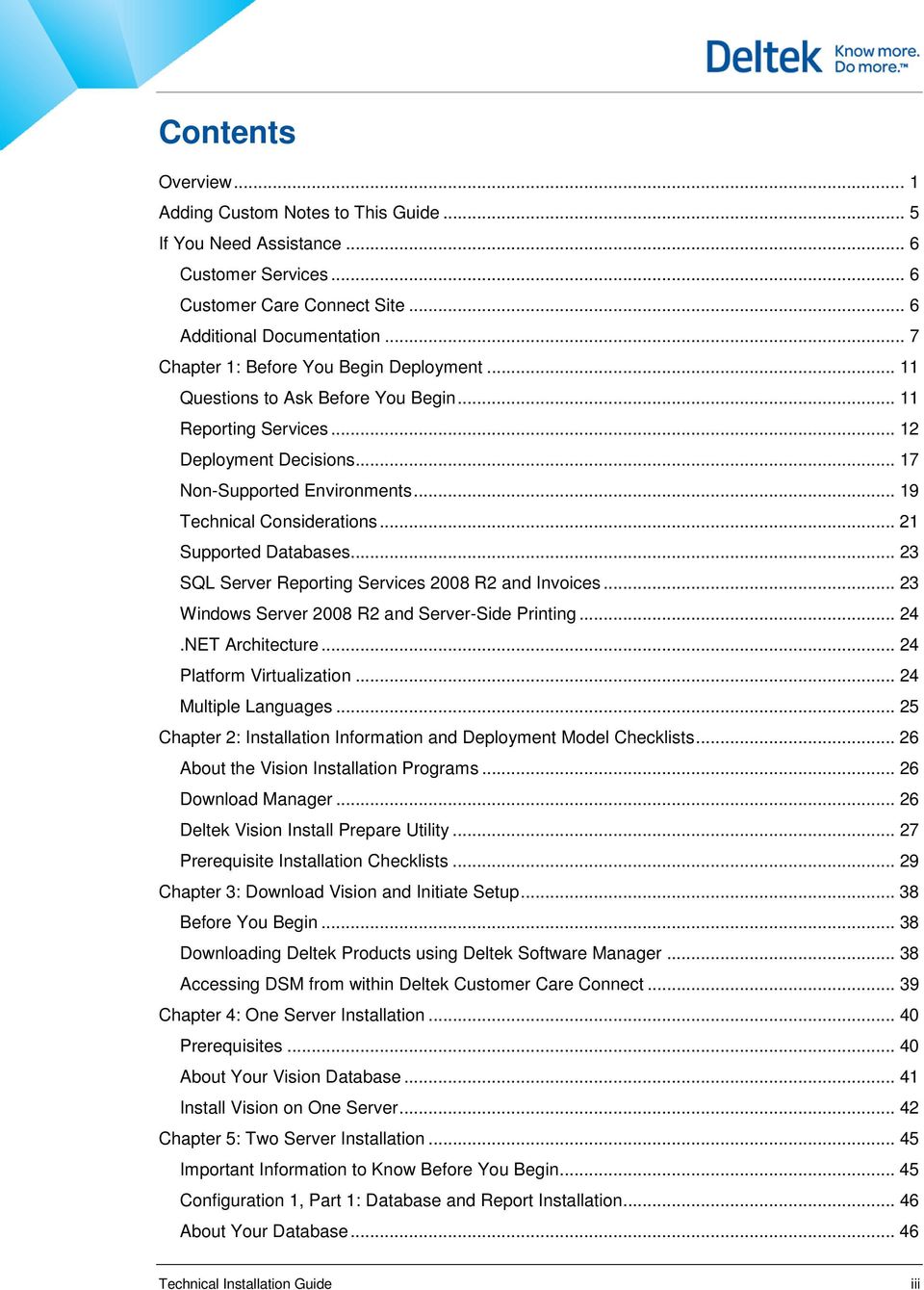
4 Important Information about Setting up the Vision Database Tier Configuration 1, Part 2: Web/Application and Process Server Installation of Two Server Installation Important Vision Setup Information Procedure for Web/Application and Process Server Installation of Two Server Installation Configuration 2, Part 1: Database Server Installation About Your Vision Database Important Information about Setting up the Vision Database Tier Configuration 2, Part 2: Web/Application, Report, and Process Server Installation of Two Server Installation Chapter 6: Install on Three or More Servers Step 1: Install the Database Tier Step 2: Install the Report Server Step 3: Install the Web/Application Server Step 4: Install the Process Server Install Secondary/Backup Servers on Additional Machines Chapter 7: Upgrade from a Prior Version of Vision Chapter 8: Troubleshoot Vision Sending Files to Deltek Troubleshoot Vision Tier Installation Messages Chapter 9: Verify Post Installation Chapter 10: Utilities Installation Appendix A: Microsoft Internet Information Server (IIS) Installation on Windows Server 2008/2008R2/ Appendix B: Options When Converting a Database during Installation Appendix C: Connect to Reporting Service Web Service SQL Server Report Server Configuration Tool Error Connecting to Reporting Services Appendix D: How to Configure Microsoft SQL Server Reporting Services Important Information about Configuring Report Services Appendix E: Printing in Vision 7.x Printing to Local Printers on End-User Workstations Printing to Network Printers installed on the Web Server Installing Network Printers on the Vision Web Server Report Server Web Service Access Report Server Database Access Launch Deltek Vision Weblink Launch Deltek Vision Application and Refresh Report Printers Technical Installation Guide iv
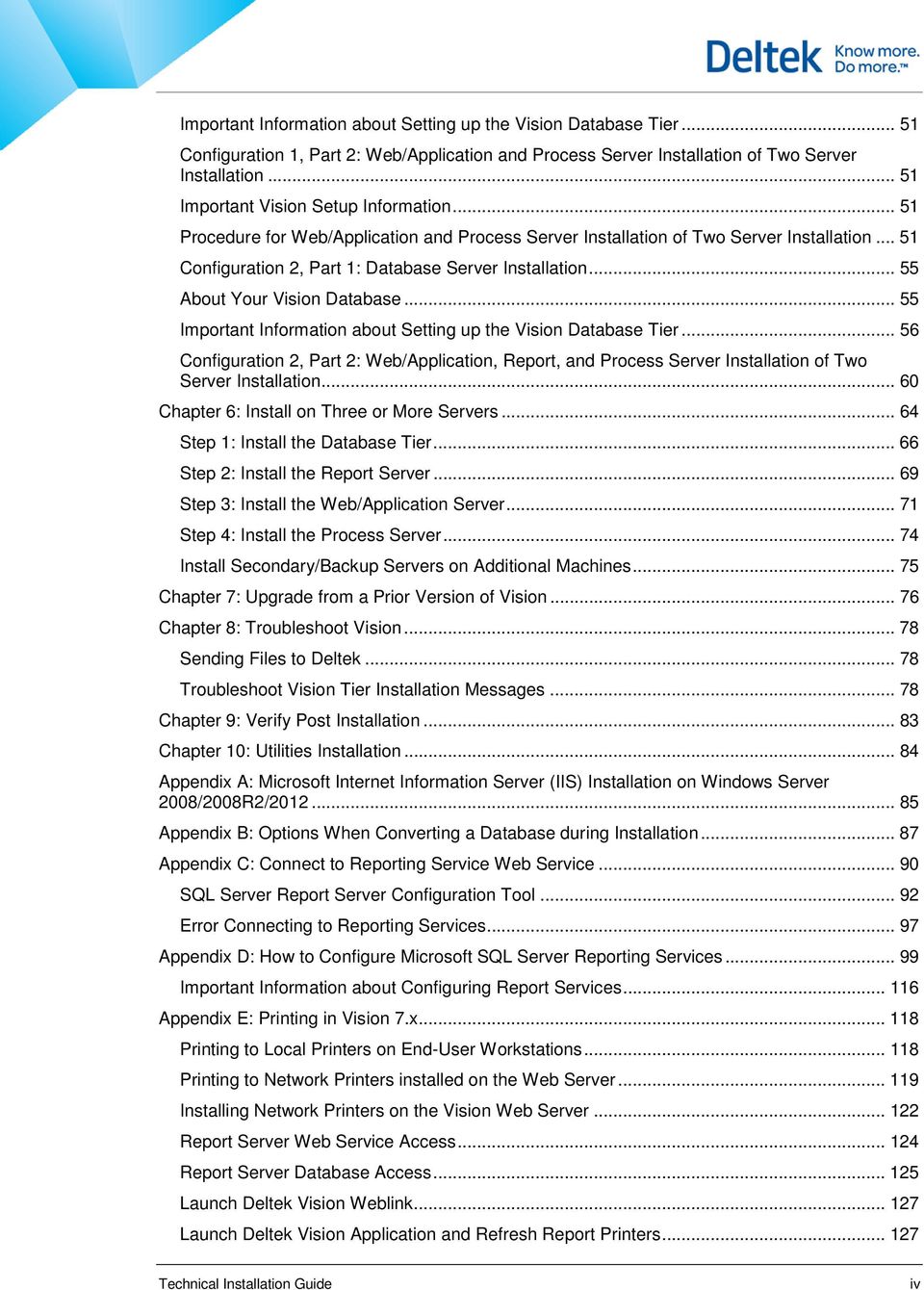
5 Appendix F: Load Standard Vision Reports Connection Errors Identify the Error Technical Installation Guide v

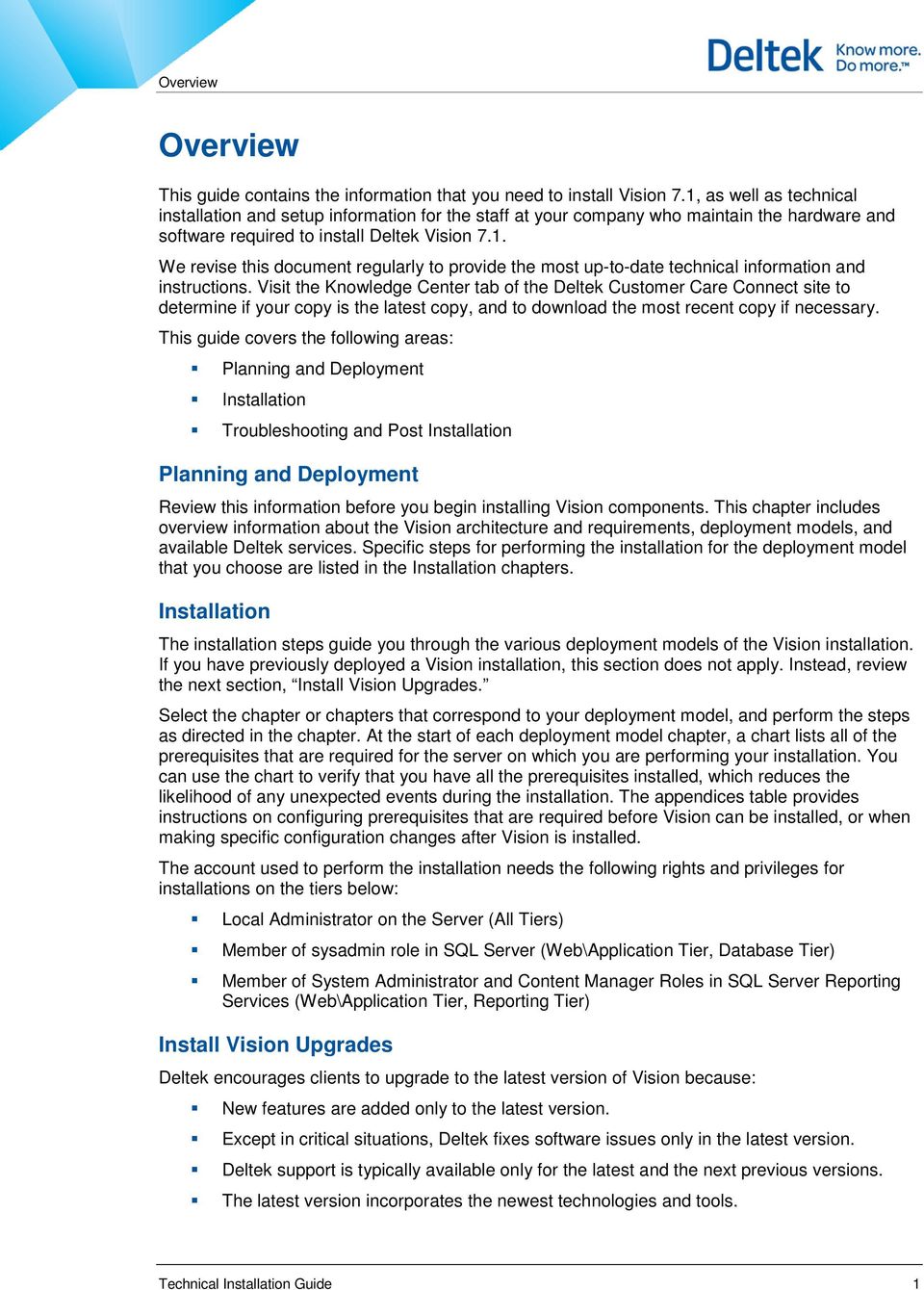
6 Overview Overview This guide contains the information that you need to install Vision 7.1, as well as technical installation and setup information for the staff at your company who maintain the hardware and software required to install Deltek Vision 7.1. We revise this document regularly to provide the most up-to-date technical information and instructions. Visit the Knowledge Center tab of the Deltek Customer Care Connect site to determine if your copy is the latest copy, and to download the most recent copy if necessary. This guide covers the following areas: Planning and Deployment Installation Troubleshooting and Post Installation Planning and Deployment Review this information before you begin installing Vision components. This chapter includes overview information about the Vision architecture and requirements, deployment models, and available Deltek services. Specific steps for performing the installation for the deployment model that you choose are listed in the Installation chapters. Installation The installation steps guide you through the various deployment models of the Vision installation. If you have previously deployed a Vision installation, this section does not apply. Instead, review the next section, Install Vision Upgrades. Select the chapter or chapters that correspond to your deployment model, and perform the steps as directed in the chapter. At the start of each deployment model chapter, a chart lists all of the prerequisites that are required for the server on which you are performing your installation. You can use the chart to verify that you have all the prerequisites installed, which reduces the likelihood of any unexpected events during the installation. The appendices table provides instructions on configuring prerequisites that are required before Vision can be installed, or when making specific configuration changes after Vision is installed. The account used to perform the installation needs the following rights and privileges for installations on the tiers below: Local Administrator on the Server (All Tiers) Member of sysadmin role in SQL Server (Web\Application Tier, Database Tier) Member of System Administrator and Content Manager Roles in SQL Server Reporting Services (Web\Application Tier, Reporting Tier) Install Vision Upgrades Deltek encourages clients to upgrade to the latest version of Vision because: New features are added only to the latest version. Except in critical situations, Deltek fixes software issues only in the latest version. Deltek support is typically available only for the latest and the next previous versions. The latest version incorporates the newest technologies and tools. Technical Installation Guide 1
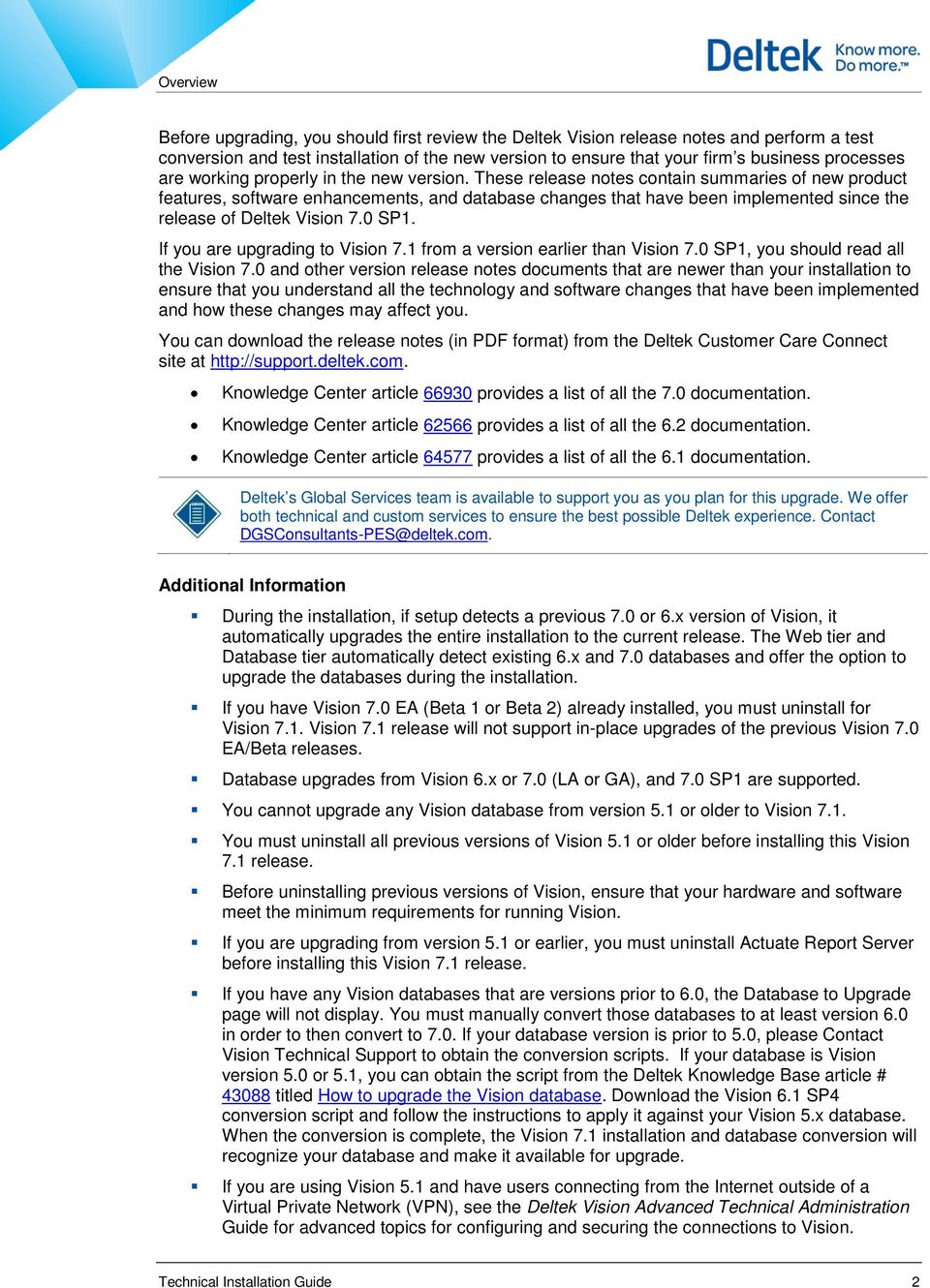
7 Overview Before upgrading, you should first review the Deltek Vision release notes and perform a test conversion and test installation of the new version to ensure that your firm s business processes are working properly in the new version. These release notes contain summaries of new product features, software enhancements, and database changes that have been implemented since the release of Deltek Vision 7.0 SP1. If you are upgrading to Vision 7.1 from a version earlier than Vision 7.0 SP1, you should read all the Vision 7.0 and other version release notes documents that are newer than your installation to ensure that you understand all the technology and software changes that have been implemented and how these changes may affect you. You can download the release notes (in PDF format) from the Deltek Customer Care Connect site at Knowledge Center article provides a list of all the 7.0 documentation. Knowledge Center article provides a list of all the 6.2 documentation. Knowledge Center article provides a list of all the 6.1 documentation. Deltek s Global Services team is available to support you as you plan for this upgrade. We offer both technical and custom services to ensure the best possible Deltek experience. Contact [email protected]. Additional Information During the installation, if setup detects a previous 7.0 or 6.x version of Vision, it automatically upgrades the entire installation to the current release. The Web tier and Database tier automatically detect existing 6.x and 7.0 databases and offer the option to upgrade the databases during the installation. If you have Vision 7.0 EA (Beta 1 or Beta 2) already installed, you must uninstall for Vision 7.1. Vision 7.1 release will not support in-place upgrades of the previous Vision 7.0 EA/Beta releases. Database upgrades from Vision 6.x or 7.0 (LA or GA), and 7.0 SP1 are supported. You cannot upgrade any Vision database from version 5.1 or older to Vision 7.1. You must uninstall all previous versions of Vision 5.1 or older before installing this Vision 7.1 release. Before uninstalling previous versions of Vision, ensure that your hardware and software meet the minimum requirements for running Vision. If you are upgrading from version 5.1 or earlier, you must uninstall Actuate Report Server before installing this Vision 7.1 release. If you have any Vision databases that are versions prior to 6.0, the Database to Upgrade page will not display. You must manually convert those databases to at least version 6.0 in order to then convert to 7.0. If your database version is prior to 5.0, please Contact Vision Technical Support to obtain the conversion scripts. If your database is Vision version 5.0 or 5.1, you can obtain the script from the Deltek Knowledge Base article # titled How to upgrade the Vision database. Download the Vision 6.1 SP4 conversion script and follow the instructions to apply it against your Vision 5.x database. When the conversion is complete, the Vision 7.1 installation and database conversion will recognize your database and make it available for upgrade. If you are using Vision 5.1 and have users connecting from the Internet outside of a Virtual Private Network (VPN), see the Deltek Vision Advanced Technical Administration Guide for advanced topics for configuring and securing the connections to Vision. Technical Installation Guide 2
8 Overview Database and Web Server installations create a deltekvisionxx.sql (where xx is your version of Vision) file in the \program files\deltek\vision\databases\scripts folder that can be used to manually upgrade a 6.x database to the existing version. To convert your database manually, create a backup of your database before you run the database conversion using the Deltekvisionxx.sql script file (where xx is your version of Vision). Do not run the UnicodeDeltekVisionxx.sql or other script files unless directed to do so by Customer Care. If you plan to convert your Vision database to Unicode, see the Vision Help documentation for the appropriate steps. Troubleshooting and Post-Installation This chapter provides information about the files to send when contacting Deltek if problems occur during installation, as well as common installation errors and suggested solutions. It also provides information about how to verify a successful Vision installation by logging on to and launching Vision successfully. Appendices This guide contains the following appendices, which provide detailed installation information for specific application prerequisites and for changes to the Vision configuration after setup Appendix Title Description A B C D Microsoft Internet Information Server (IIS) Installation Options When Converting a Database During Installation How to Identify your Reporting Service Web Service Connection Information Microsoft SQL Server Reporting Services Configuration Steps Provides instructions for enabling IIS on Windows Server. Provides information about additional database upgrade options that may occur during the Database Server or Web Server installations. Provides instructions for identifying the Reporting Service Web Service URLs for SQL Server Reporting Services when setup is unable to identify them automatically. Provides instructions for configuring Microsoft SQL Server Reporting Services (prerequisite before Vision can be installed on the Web or Report Servers). Technical Installation Guide 3
9 Overview Appendix Title Description E Printing in Vision Discusses the various methods for printing in Vision. This includes steps for: Saving printout to PDF files Printing to local printers on end-user computers without printing to PDF Printing to network printers that are installed directly on the Web Server. This appendix also includes instructions for modifying the Deltek Vision weblink entries from the default Vision local accounts to domain accounts in order to use network printers for Vision Batch jobs. Steps include creating accounts, assigning local policies, and adding role memberships. F Load Standard Vision Reports Provides instructions for loading standard Vision reports to the report server. This appendix also explains how to identify and resolve connection errors in loading reports. Technical Installation Guide 4

10 Adding Custom Notes to This Guide Adding Custom Notes to This Guide If you would like to add custom notes to this guide that are specific to your company, Adobe Reader X provides this ability. If you do not already use Adobe Reader X, you can download it here free from Adobe. To add a custom note using Adobe Reader X, complete the following steps: 1. On the Reader toolbar, click Comment at far right. 2. In the Annotations pane that displays, click Sticky Note. The cursor changes to match the button. 3. Position the cursor at the location in the guide where you want the note to appear, and click. A note icon is inserted at the location and a text box pops up. 4. Enter your information in the text box. 5. Continue adding notes as needed. 6. Save the document. Deltek recommends that you save the document to a slightly different filename so as to keep the original from being overwritten. When reading the document, cursor over a note icon to see the information. Double-click a note icon to edit the information. Technical Installation Guide 5

11 If You Need Assistance If You Need Assistance If you need assistance installing, implementing, or using Vision, Deltek makes a wealth of information and expertise readily available to you. Customer Services For over 20 years, Deltek has maintained close relationships with client firms, helping with their problems, listening to their needs, and getting to know their individual business environments. A full range of customer services has grown out of this close contact, including the following: Extensive self-support options through the Customer Care Connect Web portal. Phone and support from Customer Care analysts Technical services Consulting services Custom programming Classroom, on-site, and Web-based training Find out more about these and other services from the Customer Care Connect site. Customer Care Connect Site The Deltek Customer Care Connect site is a support Web portal for Deltek customers who purchase an Ongoing Support Plan (OSP). The following are some of the many options you have at the Customer Care Connect site: Download the latest versions of your Deltek products Search Deltek s knowledge base Ask questions, exchange ideas, and share knowledge with other Deltek customers through the Deltek Connect Customer Forums Display or download product information, such as release notes, user guides, technical information, and white papers Submit a support case and check on its progress Transfer requested files to a Customer Care analyst Use Quick Chat to submit a question to a Customer Care analyst online Subscribe to Deltek communications about your Deltek products and services Receive alerts of new Deltek releases and hot fixes If you need assistance using the Customer Care Connect site, the online help available on the site provides answers for most questions Technical Installation Guide 6

12 If You Need Assistance Access Customer Care Connect To access the Customer Care Connect site, complete the following steps: 1. Go to 2. Enter your Customer Care Connect Username and Password. 3. Click Log In. If you do not have a username and password for the Customer Care Connect site, contact your firm s Vision Administrator. If you forget your username or password, you can click the Account Assistance button on the login screen for help. Additional Documentation Deltek Vision includes an online help system that contains conceptual, procedural, and tab/fieldlevel documentation. Click Help» Contents on the Vision toolbar to access the online help. In addition to the online help system, Deltek provides user guides and quick reference cards (in PDF format) to help you install and use the Vision application. You can download user guides and quick reference cards from the Deltek Customer Care Connect site. Deltek Vision Guides Deltek Vision Getting Started and Concepts Guides Deltek Vision Getting Started Guide Deltek Vision Concepts Guide This guide contains information about the Vision Web interface and all the Vision applications, with tips for navigating through the system, using the dashboard, and finding and opening records. This guide describes the concepts underlying the basic accounting, project control, and customer relationship management (CRM) functions of the Vision application. Deltek Vision Installation and Implementation Guides Deltek Vision Advanced Technical Administration Guide Deploying Deltek Vision at a Hosting Provider Deltek Vision Implementation Guide This guide provides IT staff and system administrators with instructions for installing and configuring advanced technical components of Vision. This guide contains instructions for deploying Deltek Vision at a hosting provider. This guide contains information about configuring and setting up Vision applications and features. Technical Installation Guide 7

13 If You Need Assistance Deltek Vision Guides Deltek Vision Migration Guides Deltek Advantage to Deltek Vision Migration Guide Deltek FMS to Deltek Vision Migration Guide Deltek Sema4 to Deltek Vision Migration Guide This guide contains information about migrating from Advantage to Vision, including the steps in the migration process and an overview of Vision features. This guide contains information about migrating from FMS to Vision, including the steps in the migration process, discussions of the key migration decisions, and procedures for verifying the converted data. This guide contains information about migrating from Sema4 to Vision, including the steps in the migration process and an overview of Vision features. Deltek Vision Quick Reference Cards Deltek Vision Quick Reference Cards Quick reference cards provide snapshots of specific business processes or Vision forms, with tips for entering data and using application toolbars. The following quick reference cards are available: Accounts Payable (Create a Voucher from a Purchase Order) Create Client from Vendor Utility Dashboard Desktop and Microsoft Office Integration Expense Report Navigation Tree Designer Project Planning Purchasing (Create a Standard Purchase Order) Resource Management (Generic Resource Assignments and Resource Utilization) Screen Designer SF330 Proposals Template Based s Timesheet User Options Visualization Deltek Vision Document Management Guide Deltek Vision Document Management Installation Guide This guide contains detailed information on the prerequisites, general configuration, and installation procedures required to use the Vision Document Management application. Technical Installation Guide 8

14 If You Need Assistance Deltek Vision Guides Deltek Vision Interface to Microsoft Project Deltek Vision Interface to Microsoft Project 2010 This guide describes how the manual scheduling feature in Microsoft Project 2010 impacts the two-way interface between Deltek Vision and Microsoft Project Deltek Vision Performance Management Guides Deltek Vision Installation Guide for Performance Management (Analysis Cubes and Performance Dashboards) Deltek Vision Performance Management Content and Functionality Overview This guide provides instructions on how to install and configure the following components of the Deltek Vision Performance Management module: Analysis Cubes Performance Management Dashboards This guide provides an overview of Vision Performance Management functionality and the pre-built visualizations that are included with it. Deltek Vision Reporting Guides Deltek Vision Custom Reports and Microsoft SQL Server Reporting Services Deltek Vision Microsoft SQL Server Reporting Services Licensing FAQ This guide provides instructions for creating, delivering, and generating Vision custom reports with Microsoft SQL Server Reporting Services and its report writing tools. This guide explains the Microsoft SQL Server Reporting Services licensing implications for Vision. Deltek Vision Connect for Microsoft Outlook Guides Deltek Vision Connect for Microsoft Outlook Installation Guide Deltek Vision Customizing Configuration Settings for Connect for Microsoft Outlook Deltek Vision Connect for Microsoft Outlook Frequently Asked Questions This guide contains an overview of Vision Connect for Microsoft Outlook, as well as technical installation, setup, and maintenance information. This guide was formerly named: Deltek Vision Connect for Microsoft Outlook Presets Configuration Guide The guide is intended for system administrators, IT staff, or custom developers. It provides instructions on how to create presets to: configure default behavior for converting Microsoft Outlook contacts; control the display of the Synchronization Control Panel when issues occur during synchronization; and implement default and custom synchronization filters. This document contains frequently asked questions (FAQs) on topics regarding deployment, customization, environment, usage, and functionality. Technical Installation Guide 9

15 If You Need Assistance Deltek Vision Guides Deltek VisionXtend Guides Deltek VisionXtend Web Services and APIs for Deltek Vision Deletk VisionXtend Testing the Vision Web APIs / Web Services This guide explains how to use the Deltek VisionXtend platform to integrate Vision with other applications, access web services, implement data validation routines, and establish workflow procedures using the Microsoft.NET Framework. This guide provides basic information about testing Vision APIs using soapui. Deltek Vision Navigator Guides Deltek Vision Navigator Installation Guide This guide contains technical installation, setup, and maintenance information for Vision Navigator. Deltek Vision Project Connect Guides Deltek Vision Project Connect Installation and Administration Guide Deltek Vision Project Connect User s Guide for Microsoft Project 2010 Deltek Vision Project Connect User s Guide for Microsoft Project 2007 This guide contains detailed information on installing and administering Project Connect for integrating Microsoft Project with Deltek Vision. This guide contains information for integrating for integrating Microsoft Project 2010 with Deltek Vision. This guide contains information for integrating for integrating Microsoft Project 2007 with Deltek Vision. Technical Installation Guide 10

16 Chapter 1: Before You Begin Deployment Chapter 1: Before You Begin Deployment Before you begin deployment, it is important to understand the following: Reporting Services Deployment Decisions Hardware Requirements Supported Databases Platform Virtualization.NET Architecture Questions to Ask Before You Begin Before you install Vision, you should understand the Vision architecture, your deployment options, and the Vision recommended hardware requirements. Please see the following documents, which are available from the Knowledge Center tab of the Deltek Customer Care Connect site. Deltek Product Support Compatibility Matrix Guide Deltek Vision/GovWin CM 7.1 Technical Overview and System Requirements You should also answer the following questions before you install Vision: How many concurrent users do you expect to use Vision? Do your servers meet the recommended hardware and software requirements? Do you have the correct versions and Service Packs of Microsoft SQL Server and Reporting Services installed and configured for Vision? Do you have the prerequisites installed on each of your Vision servers? Did you review the prerequisite steps in the Appendices for reporting services and IIS? Do your client workstations meet the recommended hardware and software requirements? Will you be deploying Vision in an intranet or Internet scenario? Will Vision be accessed from a single location or from multiple locations? Will you be converting an existing Deltek Advantage, Deltek Award, Deltek CRM and Proposals, or Deltek Sema4 database to Vision? Does your technical staff need additional training on Microsoft Internet Explorer, Microsoft Windows Server, Microsoft Internet Information Server, or Microsoft SQL Server? Database upgrades from Vision 6.x, 7.0 (LA or GA), and 7.0 SP1 are supported. Technical Installation Guide 11
17 Chapter 1: Before You Begin Deployment Reporting Services Vision 7.1 uses Microsoft SQL Server Reporting Services as the Report Management and delivery platform. There are several things to consider when you migrate to Vision 7.1: SQL Server Reporting Services is not installed as part of the Vision installation. Setup requires that SQL Server Reporting Services be already installed and configured in order to connect to the Report Server. The next section provides links to Microsoft documentation that you can use in addition to the Microsoft documentation installed with your SQL Server installation. See Appendix C for related information. Vision 7.1 now supports SQL Server 2008 Business Intelligence Development Studio (BIDS). The SQL 2005 Reporting Services design tools (BIDS) are not supported with Vision 7.1. If you have Microsoft Visual Studio 2010 installed on your BIDS development machine, Microsoft Visual Studio 2010 does not support Business Intelligence Development Studio Integration Services, Report Services and Analysis Services projects for SQL Server 2008 and SQL Server 2008 R2. To work around this issue, you can install Visual Studio 2008 on the same machine as Visual Studio 2010, and then open the Business Intelligence Development Studio projects in Visual Studio See the following Microsoft link for details: Microsoft SQL Server Reporting Services and Custom Reports The software requirements for creating Vision custom reports with Microsoft SQL Server Reporting Services have changed. To create custom Vision reports, use either of the following: Vision 7.1 supports Microsoft SQL Server 2012 Standard and Enterprise editions for the core database and reporting services requirements of Vision. However, SQL Server 2012 is not yet supported for Vision custom reports created with SQL Server 2012 s report writing tools Report Builder 3.0 and SQL Server Data Tools (formerly called Business Intelligence Development Studio). Report Builder 2.0 Report Builder 2.0 is available in Microsoft SQL Server 2008 SP1. See for more information. Report Builder 1.0 is no longer supported for creating Vision custom reports. Microsoft Business Intelligence Development Studio 2008 (also known as BIDS 2008 or Report Designer 2008) BIDS 2005 is no longer supported for creating Vision custom reports. Copying Template Files When you create custom reports on your workstation with BIDS 2008, you must copy the.rdl template files to the following location on your workstation: C:\Program Files\Microsoft Visual Studio 9.0\Common7\IDE\PrivateAssemblies\ProjectItems\ReportProject instead of this location: C:\Program Files\Microsoft Visual Studio 8\Common7\IDE\PrivateAssemblies\ProjectItems\ReportProject Technical Installation Guide 12

18 Chapter 1: Before You Begin Deployment Modifying Custom Properties In BIDS 2008, you can now modify custom properties in a report on the Properties window of the report. In the Properties list, navigate to CustomProperties. Click the ellipsis button to open the Custom Properties dialog box. Custom Reports Created with Microsoft SQL Server Reporting Services 2005 You must use BIDS 2008 to upgrade custom reports that were created with SSRS 2005 before you can use the reports in Vision 7.1. Before you upgrade custom reports, Deltek recommends that the creator of the custom reports (Deltek Consulting Services, Deltek partners, or the person at your company) review the reports to ensure that there are no Vision framework changes that need to be applied within the report Business Objects. The Deltek Consulting Services Group can provide assistance with reports that contain custom Business Objects. Contact them at [email protected] for more information. The following Vision database tables had a name change in Vision 7.1 if you are migrating from Vision 6.x installations. You must update your report queries with the new table names, or you will receive errors when you run these reports. Vision 6.x Table Name CFGCountry CFGCurrency CFGPhoneFormat CFGEnabledCurrencies InfoCenterTabHeadings ReportPrinters CFGCountry Vision 7.1 Table Name FW_CFGCountry FW_CFGCurrency FW_CFGPhoneFormat FW_CFGEnabledCurrencies FW_InfoCenterTabHeadings FW_ReportPrinters FW_CFGCountry After you address framework issues, upgrade the 2005 custom reports. To do this, open them in BIDs 2008 and resave the RDLs. For custom reports that were created with the SQL 2005 Reporting Services design tools (BIDS), do not open the report (.rdl) file directly with the SQL Server 2008 BIDS. Instead, follow the recommended sequence of steps below. To upgrade your custom reports after you address any Vision framework changes, complete the following steps: 1. Open and convert the project file (.rptproj) to Visual Studio / Visual Source Safe If you do not have the project file (.rptproj) for the custom report, open a new project, and add the RDL file into the project. 2. Open the report file (.rdl) in designer mode. 3. Save the report file (.rdl). Technical Installation Guide 13

19 Chapter 1: Before You Begin Deployment There are many table and schema changes in the Vision 7.1 database that may cause your custom reports not to work properly after you upgrade them to match the SQL 2008 BIDS version supported by Vision 7.1 Deltek recommends that you rebuild your custom reports using the Vision 7.1 reports as a template to ensure that your reports work correctly. The Deltek Consulting Services Group can provide more assistance with custom reports if you need it. Contact them at [email protected] for more information. Custom Invoice Templates and Other Custom Forms Created with Microsoft SQL Server Reporting Services 2005 You must use BIDS 2008 to upgrade custom invoice templates and other custom reports used for Deltek forms (such as Purchase Order forms, Purchase Requisition forms, and Request for Price Quotes) that were created with SSRS You must upgrade them before you can use them in Vision 7.1. The information in the previous section titled Custom Reports Created with Microsoft SQL Server Reporting Services 2005 section also applies for invoice templates and other custom Deltek forms. Refer to that section for information on how to upgrade invoice templates and other custom forms. Overview of Reporting Services Microsoft SQL Server Reporting Services is a server-based reporting platform that you can use to create and manage tabular, matrix, graphical, and free-form reports that contain data from relational and multidimensional data sources. You view and manage the reports over a World Wide Web-based connection. Reporting Services includes the following core components: A complete set of tools that you can use to create, manage, and view reports A Report Server component that hosts and processes reports in a variety of formats (Output formats include HTML, PDF, TIFF, Excel, CSV, and more.) An API that allows developers to integrate or extend data and report processing in custom applications, or create custom tools to build and manage reports The reports that you build can be based on relational or multidimensional data from SQL Server, Analysis Services, Oracle, or any Microsoft.NET data provider such as ODBC or OLE DB. You can create tabular, matrix, and free-form reports. You can also create ad-hoc reports that use predefined models and data sources. In Reporting Services, URLs are used to access the Report Server Web service and Report Manager. Before you can use either application, you must configure at least one URL each for the Web service and Report Manager. Reporting Services provides default values for both application URLs that work well in most deployment scenarios, including side-by-side deployments with other Web services and applications. Reporting Services uses a SQL Server database for internal storage. The database is a required component; it is used to store reports, session data, resources, and server metadata. The migration to this new tool includes the following benefits: Ease of Deployment and Management SSRS is embedded in SQL Server, the database many firms already use. This streamlines deployment and updates and provides a platform for delivery of new functionality for years to come. Industry Leading Platform SSRS is a leading Business Intelligence (BI) platform. Better Technology Alignment with Vision SSRS aligns well with the rest of the Microsoft centric technology strategy for Vision. Technical Installation Guide 14

20 Chapter 1: Before You Begin Deployment How to Obtain Information about Reporting Services The best way to learn about Reporting Services and how to configure it is through the Microsoft documentation included with your SQL Server (Books Online, Microsoft Labs, and so on). The following links provide steps for configuring Reporting Services. Select your version of SQL Server. Configuring SQL Server Reporting Services (How-to Topics): Reporting Services Overview and Tutorials: Reporting Services Demos, Videos, Virtual Labs, Webcasts: Microsoft SQL Server Edition Important Notes Owners of SQL Server Workgroup Edition and SQL Server Express Edition with Advanced Services (SQL Server Express) should note the following: The report server database must be hosted on the local Machine running the SQL Server Database Engine instance. You cannot use a remote SQL Server instance to host the report server database. Data sources used in a report must also be SQL Server databases that run on the local machine running the SQL Server Database Engine instance. You cannot use remote data sources or other data source types. To use additional data source types, you must use a different edition of Reporting Services. This means that your Vision database must reside on the same machine where you Report Server databases reside. You will either use the Single Server Deployment Model or Configuration 1 of the Two Server Deployment Model. Information for Owners of SQL Server Standard or Enterprise Edition If you decide to split the Report Server (web service) from the database server hosting the report server database, you need an additional Microsoft SQL Server license. See Error! Reference source not found. for links to Microsoft SQL Server licensing related to SQL Server Reporting Services. Report Server scale-out deployment is only available in Microsoft SQL Server Enterprise Edition. A scale-out deployment refers to an installation configuration that has multiple report server instances sharing a single report server database. The following Microsoft link lists the features supported by the editions of SQL Server 2008, Microsoft SQL Server 2008 R2, and Microsoft SQL Server Click Other Versions and select the version that you are using: Information for Owners of SQL Server Express Edition Deltek no longer ships the MSDE/SQL Express Management Console because the SQL Server Management Studio is now included with the SQL Express installations. Although the SQL Express Edition does not provide a way to schedule the automatic maintenance and backup of your database, Microsoft has provided documentation and Open Source tools for creating a Technical Installation Guide 15

21 Chapter 1: Before You Begin Deployment scheduled backup and maintenance plan for SQL Express. The links below provide the details for performing those activities. Refer to these sites for guidance on implementing these tools in your environment. The Microsoft hosted Open Source Project site ( provides a Project/Tool for SQL Express users named ExpressMaint ( that can be used to create the maintenance plans. This project maintains two utilities for automating the backup and maintenance of databases for SQL Server 2005/2008/2008R2 Express Edition. They are based on the sqlmaint application that came with SQL Server 2000 but were updated for SQL Server 2005/2008/2008R2. Microsoft also provides documentation for manually creating a Windows scheduled task to work with SQL Stored Procedures for automating the daily backup and maintenance plans. Schedule and Automate Backups of SQL Server Databases in SQL Server Express: Automate Maintenance Tasks with SQL Server Express: ce The Microsoft MSDN article also references another site that includes free tools for creating scheduled jobs. You can use those tools with the information in the KB article. SQL Server Backup, Integrity Check, and Index and Statistics Maintenance: Deltek recommends completing the following activities on your database daily: 1. Check Database Integrity: ce#checkdb 2. Reorganize/Rebuild Indexes/Update Statistics: ce#indexstats 3. Back up your database(s): If you are implementing SQL Server Express Edition, Deltek requires that you use SQL Server Express Edition with Advanced Services as the Database and Report Server for your Vision implementation. The SQL Server Express Edition with Advanced Services contains the Database Engine and Reporting Services required for managing the database and running reports. The other SQL Express Edition installers do not have all the components needed to support Deltek Vision. Direct Links for SQL Server 2012 SP1 Express with Advanced Services Installers from Microsoft Microsoft has several variations of the SQL Express installation.download the appropriate SQL Server Express with Advanced Services installation package that matches your Operating System platform (32-bit/x86 or 64-bit/x64). For your convenience and to avoid confusion, this document provides the direct links for the SQL Server 2012 SP1 Express Edition with Advanced Services installation packages. Click the following link to access the download page: Technical Installation Guide 16
22 Chapter 1: Before You Begin Deployment When you open this download page, there are only two installations that can be used with Vision. The product name is SQL Server 2012 SP1 Express Edition with Advanced Services, and there is a download for each Operating System platform: 32-bit/x86 or 64-bit/x64. You must download the installation that matches your specific database server operating system. For example, install the 32-bit/x86 on a 32/x86 system only, and the 64-bit/x64 on a 64-bit system only. You cannot mix the operating system types. Use these links for the two downloads: 64-bit / x64 Installation for 64-bit Operating Systems: A CD69/SQLEXPRADV_x64_ENU.exe (1.9 GB) 32-bit / x86 Installation for 32-bit Operating Systems: A CD69/SQLEXPRADV_x86_ENU.exe (1.9 GB) After you install SQL Server Express, Deltek recommends that you download and install the following cumulative update package 1 (CU1) for SQL Server 2012 Service Pack 1 from Microsoft: The following Microsoft link provides information on prerequisite requirements, release notes, installation guide and other helpful links for performing the SQL Server Express installation of SQL Server: Report Server Licensing Requirements The method you use to deploy your Report Server depends on the edition and licenses you own for your Microsoft SQL Server Database. If you plan to host your Reporting Services Web Service on a separate machine from the Reporting Services Report Server Database, you must determine whether your SQL Server edition and licenses purchased can support this deployment. The following Microsoft link (Microsoft SQL Server licensing page) describes the licensing options available with SQL Server and Reporting Services: Deployment Decisions Review the following details about the deployment models and logical tiers available for Vision. Vision Deployment Models There are three different models used to deploy Vision. The model you choose depends on your firm s needs in regard to size, cost considerations, security requirements, and fault tolerance. Model One Server Description You install all tiers on a single server. Firms choose this model if all users are at a single location and will only access Vision in the office or over a Virtual Private Network (VPN) connection into the corporate network. Infrastructure security is not a concern with this model because all application use is internal to the organization. This model is designed for small firms (fewer than 20 employees) without technical staff or plans to use Vision Server-to-Server Synchronization. Technical Installation Guide 17
23 Chapter 1: Before You Begin Deployment Model Two Servers Three or More Servers Description Begin with Chapter 3 for steps to download and launch the Vision installation. For detailed installation steps, see Chapter 4. You install on at least two physical tiers. Your purchased licenses and edition of SQL Server determine your two-server deployment configuration. Configuration 1 Typically, one server will have the Report Server tier and Database Server tier residing on the same server and the web, application, and process server on another server. Configuration 1 may be the recommended method for firms with a single SQL Server license. Infrastructure security is not necessarily a concern in this model, because all application use is internal to the organization. This model is designed for small to medium-sized firms ( employees) that may or may not have in-house IT staff and do not plan to use Vision Server-to-Server Synchronization. Configuration 2 Some firms may also have the database server as the dedicated server, with the other server acting as the report, application, and Web servers. Based on these variations, this model suits firms where all users are at a single location and will only be accessing Vision in the office or over a Virtual Private Network (VPN) connection into the corporate network. Begin with Chapter 3 for steps for downloading and launching the Vision installation. For detailed installation steps, see Chapter 5. You install on three or more physical tiers. This scenario offers a database server, one or more report servers, one or more Web/application servers, and possibly one or more Process servers. This model is designed for large firms (150 or more employees) with multiple locations that will use Vision on an internal Wide Area Network (WAN). There might be additional report, Web/application, or Process servers required for load balancing, performance, security, or fault tolerance. This model is designed for firms with complex deployment requirements. Firms deploying this model should have in-house technical staff proficient in firewall management. Begin with Chapter 3 for steps for downloading and launching the Vision installation. For detailed installation steps, see Chapter 6. Changes to your Existing Vision Deployment Models If your firm previously deployed a two-tier deployment with the Database Server on one machine, and the Web\Application\Report Tier on another machine, you now have the option of two alternative configurations (configuration 1 or 2 in the preceding table) for deploying a two tier installation. Your SQL Server Edition and purchased licenses determine your two-server deployment configuration. WorkGroup and SQL Server Express Editions require that the Report Server database used by Reporting Services and any external data sources (Vision database) reside on the same machine. If you have either of these editions a single server deployment model or the two server model, Configuration 2 is the option you will migrate to. See page 46 for more information. Technical Installation Guide 18
24 Chapter 1: Before You Begin Deployment Standard and Enterprise Edition support having the Vision database on a separate database server than the server hosting the Reporting Services Report Server Database. This will allow deployments on two or more tiers. For these editions, review the license information and links above to determine if you have the appropriate number of SQL Server licenses. Vision 7.1 uses the Microsoft SQL Reporting Services WinForm report viewer control to render reports. This control requires a direct connection to the server running the SQL Reporting Services web service over Port 80. Your report server (and possibly your database server if they are installed on the same machine) will be directly exposed to the internet, which poses a security risk to your data. It also requires an external FQDN so that the report server can be resolved by the external users. A reverse proxy that uses Microsoft s Application Request Routing (ARR) extension for IIS 7.0/7.5 in Windows Server 2008/2008R2 allows the direct forwarding of requests through the Vision web server to the reporting services web service with responses back to your Internet clients. See the Deltek Vision Advanced Technical Administration Guide for information. Vision Logical Tiers Requirements Various parts of the Vision application are distributed to logical tiers for performance, scalability, and security purposes. These logical tiers are distinct technologies required to run Vision, such as report server software, or Web server software. They may or may not be hosted on the same machine. The method that you use to distribute Vision s logical tiers across physical tiers, or actual machines, depends on your firm s needs. Chapter 2 provides brief technical description and requirements for each logical tier. For current hardware and software requirements, see the Deltek Product Support Compatibility Matrix document, which is available from the Knowledge Center tab of the Deltek Customer Care Connect site. Non-Supported Environments The following are non-supported environments for Vision 7.1: Vision does not support using Microsoft Windows XP, Widows Vista, or Windows 7 for production server installation. Vision is not compatible with Microsoft Windows 95, 98, ME, 2000, or NT 4.0 as a client or server Operating System. Vision no longer supports Microsoft SQL Server 2000 or Microsoft SQL Server Vision no longer supports Windows 2000 Server or Windows Server Vision no longer supports Microsoft Office 2003 or earlier versions. Vision no longer supports Actuate. You cannot perform a Single Server deployment on the Microsoft Small Business Server. Only the Vision database tier or report tier can be installed on this server. You cannot install any Vision tier on the Microsoft ISA server, or any other softwarebased firewall (except Windows firewall). Technical Installation Guide 19
25 Chapter 1: Before You Begin Deployment You cannot install any Deltek Vision tier on any server with Microsoft Terminal Services (Application Mode Only) running. Terminal Services in remote administration is fully supported. You cannot install any Vision tier on a Domain Controller. You cannot install any Vision tier on any version of Microsoft Exchange Server. You cannot install any Vision tier (except Document Management) on any version of SharePoint Server. Vision is not compatible with Microsoft Project Importing and/or exporting to Microsoft Project 2003 from the Planning application will produce an error. Platform Virtualization is a new technology that allows multiple operating systems and platforms to run simultaneously as separate virtual machines on a single set of server hardware. See Deltek s Virtualization Statement, available on the Deltek Customer Care Connect site, for limitations of support for virtualized deployments. Microsoft s Application Request Routing (ARR) 3.0 is not supported in Windows Server 2012 because at the time of release of Vision 7.1, ARR 3.0 was still in Microsoft Beta. Technical Installation Guide 20
26 Chapter 1: Before You Begin Deployment Technical Considerations The following are technical considerations for Vision 7.1: Technical Consideration Running multiple versions of Vision Microsoft.NET Framework 3.5 SP1 64-bit processing Windows Server versions SQL 2012 Availability Groups Microsoft SQL Server Database Engine and Reporting Services and Analysis Services Description Vision 7.0 SP1 and earlier versions of Vision cannot be run at the same time on the same Web/Application server. Microsoft.NET Framework 3.5 SP1 must be installed on the following: All client workstations running Deltek Vision. The servers hosting the Vision Application and the Process servers. Vision supports 64-bit processing for: All Vision logical tiers (web/application, database, and report tiers) The client tier (Windows 7, Windows Vista, and Windows XP) Vision supports the following Windows Server versions: Windows Server 2012 Document Management is not supported on Windows Server 2012 because SharePoint 2010 is not yet supported on Windows Server Windows Server 2008 R2 Service Pack 1 SP1 Windows Server 2008 SP2 Although Vision 7.1 supports SQL 2012, it does not yet support SQL 2012 Availability Groups. If you install Vision 7.1 to a SQL Server that is configured with Availability Groups and you add your Vision database to that Availability Group, you may see a Use Availability Groups check box on the General tab in Vision Weblink. Do not select this check box. Vision support for SQL 2012 Availability Groups, specifically Read-Only Routing, will be announced at a future date. Vision supports the following versions of Microsoft SQL Server Database Engine and Reporting Services: Microsoft SQL Server 2012 SP1 + CU1 Microsoft SQL Server 2008 R2, SP2 + CU1 Microsoft SQL Server 2008, SP3 + CU6 Microsoft SQL Server 2008, SP2 Technical Installation Guide 21
27 Chapter 1: Before You Begin Deployment Technical Consideration Microsoft SQL Server Reporting Services Microsoft SQL Server Analysis Services Windows Server with IIS Microsoft Windows Microsoft Internet Explorer Description Microsoft SQL Server Reporting Services: Must be installed and configured before you run the Vision installation. Follow the Microsoft documentation for your installation. Are supported in Native Mode configuration only. The SharePoint Integrated Mode is not supported. This is supported in Multidimensional Mode only. The Tabular Mode introduced with SQL 2012 is not supported. Vision supports: Windows Server 2012 with IIS 8.0 Windows Server 2008 with IIS 7.0 Windows Server 2008 R2 with IIS 7.5 Vision can be run as a client on any of the following: Microsoft Windows XP (SP3) Microsoft Windows Vista (SP2) Microsoft Windows 7 SP1 Microsoft Windows 8 Vision can be run with Microsoft Internet Explorer versions 10.0, 9.0, 8.0, and 7.0. Microsoft Office 2010 Vision supports the 32-bit version of Microsoft Office Microsoft Office 2010 is also supported for use with Vision Connect for Microsoft Outlook. Microsoft Project Vision Document Management Vision is compatible with: Microsoft Project 2010 Microsoft Project 2007 Vision supports the following for Document Management: Microsoft SharePoint Server 2010 SP1 Microsoft SharePoint Foundation Server 2010 SP1 Microsoft SharePoint Server 2007 SP3 Microsoft SharePoint Services 3.0 SP3 Technical Installation Guide 22
28 Chapter 1: Before You Begin Deployment Technical Consideration Description Document Management is not supported on Windows Server Vision Connect for Microsoft Outlook Vision Connect for Microsoft Outlook: Is not supported with Microsoft Windows 8. Is supported with Microsoft Office Supported versions are the most current, actively tested technologies used to deploy Vision. Compatible versions are recent technologies that have been tested for deploying Vision. However, these are not actively being tested but are believed to be compatible with Vision. For a full explanation of compatible versus supported versions, see the Deltek Product Support Compatibility Matrix document that you can download at the Deltek Customer Care Connect site. Known Issues with the Vision 7.1 Installation If you are upgrading from a 6.x version of Vision and you use Microsoft SQL Server Session State that is located in a database other than your Vision database, see KB article # for additional instructions. During the Vision upgrade process, the SessionState table is renamed. However, if the table is not located in the Vision transaction database, it will not be renamed. You must manually rename the table using the instructions in the KB article. Full List of Supported SQL Server Software For a full list of Microsoft SQL Server releases (R), service packs (SP), and cumulative updates (CU) that Vision supports, see the Deltek Product Support Compatibility Matrix. You can download this PDF file at the Deltek Customer Care Connect site. Supported Databases A Microsoft SQL Server 2008, 2008 R2, or 2012 database engine is required to run Vision. The Microsoft SQL Server edition you choose to install is dependent on the number of employees who will use Vision. For firms with fewer than 50 employees (five concurrent users), Vision supports Microsoft SQL Server Express Edition with Advanced Services. For firms with more than 50 employees (six or more concurrent users), Vision supports Microsoft SQL Server. The machine on which you install Microsoft SQL Server depends on your firm s deployment model. SQL Server Reporting Services 2008 R2 and Invoices If you are using Vision 7.1 with Microsoft SQL Server Reporting Services (SSRS) 2008 R2, your invoices will print with extra space in the header when the top margins are expanded. This is a known issue with Microsoft SSRS 2008 R2 and Deltek is working with Microsoft to resolve this issue. This issue does not occur in previous versions of Microsoft SSRS Technical Installation Guide 23
29 Chapter 1: Before You Begin Deployment If you plan to upgrade to Microsoft SSRS 2008 R2, please carefully review your invoice templates, and wherever possible, reduce the top margins in the Vision Invoice Template Editor to prevent the extra space issue from occurring. Windows Server 2008 R2 and Server-Side Printing If you deploy Vision 7.1 with Windows Server 2008 R2, you must complete the following to configure server-side printing: Configure the DeltekVisionAppPool Identity (IIS) and the Report Server Windows Username (Report Server tab of Weblink) to be the same domain account. This must also match the domain account profile where your network printers are installed on the Vision web/application server. If you need assistance using the Customer Care Connect site, the online help available on the site provides answers for most questions..net Architecture Vision s server-side architecture uses Microsoft s.net framework..net is Microsoft s name for a set of software technologies developed to connect information, people, systems, and devices. See for more information..net allows Deltek developers and your in-house IT staff to extend Vision's workflow capabilities by calling outside Web services from within Vision. For example, you can send real-time, updated project information from Vision to an external collaboration Web site so that your clients can view current project information. Or you can automatically update your employee self-service system when employee information is changed in Vision. The.NET framework gives you the power to extend Vision s reach by developing applications that integrate with Vision, calling Web services from within Vision, and communicating with Vision through mobile devices. The Vision installer that contains the download manager requires that you install at least Microsoft.NET Framework 3.5 (SP1) on the Vision tier before you begin the Vision installation. If Microsoft.NET Framework 3.5 (SP1) is not detected, the installation halts and you must install it before you can run the Vision installation. Since all of the tiers require Microsoft.NET Framework 3.5 (SP1), confirm that all the prerequisites for that tier are correctly installed. Deltek s main client application is deployed using the ClickOnce technology, which requires Microsoft.NET Framework 3.5 SP1. You can download the Microsoft.NET Framework 3.5 SP1 from this link: Platform Virtualization Deltek recognizes the growing use of virtual environments by our customers. Virtual environment software, such as VMware, resides in the hardware layer underneath the operating system. Customers use it to partition a single server into a multiple server/multiple operating system environment. Deltek s product development makes limited use of virtualized environments at this time. Technical Installation Guide 24
30 Chapter 1: Before You Begin Deployment See Deltek s Virtual Environments Statement on the Deltek Customer Care Connect site for more information. Multiple Languages Vision 7.1 allows you to install a blank Vision database in either English (United States) or English (International) on your database server. Databases with multiple languages other than English are not supported with Vision 7.1 New Installations For customers installing Vision for the first time, the installation routine includes a step in which you select the English language database version English (United States) or English (International) that you want to use for the installation. The database you select determines the language that subsequently displays in the Vision application user interface. Upgrades from Previous Versions of Vision For customers upgrading from a previous version of Vision (other than 6.0), the database conversion routine checks the pre-6.0 custom label spellings for the words labor and check, and then converts the database based on the custom label spellings. Language Options The Vision client deployment includes options for selecting the following language versions when you run the application: English (United States or International). The other languages French (Canada or France), Spanish, Dutch (Netherlands), and German are not supported with Vision 7.1. Technical Installation Guide 25
31 Chapter 2: Installation Information and Deployment Model Checklists Chapter 2: Installation Information and Deployment Model Checklists This chapter contains installation checklists to help you properly set up the machine or machines where you will install Vision software. About the Vision Installation Programs The Vision installation program downloaded from the Deltek Distribution site is used to install the Vision software and any of the following deployment models: One Server Deployment Model Two Server Deployment Model One database/report server and one web/application/process server (configuration 1); or One database server and one web/application/process/report server (configuration 2) Three or More Server Deployment Model (any supported combination of web/application, report, process server, and database tier) Additional Vision Process Server tiers Download Manager The Vision installation uses a Download Manager to manage the size of the installation download file. The Download Manager allows prerequisite third party applications and required additional Vision files to be downloaded and installed on the Vision tier only when necessary. Examples of third party applications are Microsoft XML 4.0 (SP2), Microsoft SQL XML 4.0 (SP1), and Solid PDF Converter. Examples of additional Vision files are the Blank Database, the Sample Database, and the help files. These files are not part of the Vision download file but are called from a remote FTP server when they are required for successful completion of the installation. The Download Manager is a Winform application that requires previous installation of the Microsoft.NET Framework 2.0 on the Vision tier. Install Microsoft.NET 3.5SP1, instead of.net 2.0 since the.net 3.5SP1 installation also installs.net 2.0 and.net 3.0 and is required on all Vision tiers. You can download the Microsoft.NET Framework 3.5 SP1 here: If your Vision tier has internet connectivity, proceed to the Prerequisite Installation Checklists. If your Vision tier does not have internet connectivity, see the following procedures for downloading your Vision installation and prerequisite files. Technical Installation Guide 26
32 Chapter 2: Installation Information and Deployment Model Checklists Deltek Vision Install Prepare Utility Use the Deltek Vision Install Prepare Utility (DeltekVisionInstallPrepareUtility.exe) for the following scenarios: The Vision Server does not have access to the internet Setup is unable to finish because the download manager is unable to download prerequisites needed for the installation to continue. The Deltek Vision Install Prepare Utility is a self-extracting tool that downloads the prerequisites that are required for use by the installation from a machine other than the installation server. The process is a combination of two steps: You extract the setup files from the DeltekVision71.exe file and You use the InstallPrepare Utility to download the files and place them into the extracted folder. When you are ready to install Vision, you launch the extracted setup.exe file and it automatically finds the downloaded files in the root of the folder where the setup.exe is located and does not try to download the prerequisites. File Extraction for Multi-Tier Deployments Previous Vision 6.x releases included an extract option that allowed you to extract the setup.exe and the installation package to a central location that could then be used to launch the setup for multi-tier deployments. For cases where the Deltek Server did not have internet access and the prerequisite components had to be downloaded prior to running setup, you could use the extract option to save the setup files to a central location. Then, you could use the DeltekVisionInstallPrepare utility to download the prerequisite files and store them in the same folder as the extracted setup.exe. If you prefer to extract the files manually, you can launch the installer using a command line that will extract the setup.exe file along with the rest of the installation into a folder named Disk1. When you launch the installer, you must specify a destination folder and the Disk1 folder will be created within it. The most common case for this is when the server that you are performing the installation on does not have access to the internet and you must use the DeltekInstallPrepareUtility to download the prerequisite files for the installation. The downloaded files will need to be placed into the uncompressed Disk1 folder with the setup.exe file that were extracted. To extract the files manually, complete the following: 1. Download the DeltekVision71.exe installer. 2. Copy the file to a local folder. 3. At a DOS prompt, run the following command line: DeltekVision71.exe/extract_all:c:\destinationfolder The /extract_all is the flag that tells the installer to extract the contents of the installation. The c:\destinationfolder is the syntax for specifying the location to extract the contents of the installer. The following example assumes that the DeltekVision71.exe file was downloaded and saved into a folder named C:\Media and will also be extracted into the same folder: DeltekVision71.exe /extract_all:c:\media Technical Installation Guide 27
33 Chapter 2: Installation Information and Deployment Model Checklists After the extraction is complete, the C:\Media folder will contain a Disk 1 subfolder. Copy any downloaded prerequisite files into the folder and launch the setup.exe file. Download Files and Place in Extracted Folder To use the Deltek Vision Install Prepare Utility, complete the following steps: 1. On a machine that has access to the Internet, perform the steps to extract the setup.exe and other Vision setup files. By default, the extracted files are created in a folder named Disk1 in the folder where the command line stated to extract the files. 2. Obtain the DeltekVisioninstallPrepareUtility.exe file from a Vision Technical Services support representative. 3. Launch the DeltekVisioninstallPrepareUtility.exe on the same machine and it automatically extracts its contents into the folder in which you saved the.exe file. 4. Change the Path to Save/Extract location to point to the Disk1folder that was created when you ran the extract all switch. This extracts the files and allows it to download the prerequisite components into the same folder in which the setup.exe file is located. 5. Select the type of installation you plan to perform in the Download all components for drop-down list. The utility automatically selects the prerequisites required for the installation you have selected. 6. Click the Download Components button to download the files into the Vision Setup folder. 7. On the Vision web servers, follow the steps for your deployment model running the extracted setup.exe file. Technical Installation Guide 28
34 Chapter 2: Installation Information and Deployment Model Checklists Prerequisite Installation Checklists One Server Deployment Model Because the one server deployment model involves installing all Vision tiers on one server, you install all prerequisite software listed below on that same server. Check off each step as completed. A summary table of the prerequisites is included at the start of each section during the installation steps. To deploy on one server, complete the following steps: 1. Install Windows Server 2008 SP2, or Windows Server 2008 R2 SP1, or Windows Server Install Internet Explorer 7.0 or higher. 3. Install Microsoft Internet Information Services (IIS) 7.0/7.5/8.0 with ASP.NET enabled. See Appendix A: Microsoft Internet Information Server (IIS) Installation on Windows Server 2008/2008 R2/2012 for procedural information. Complete one of the following actions: If you are using Microsoft SQL Server 2012, Standard and enterprise editions, install and configure Service Pack 1 from the Microsoft download site ( plus Cumulative Update 1 (CU1) for SP1 from the Microsoft website ( ). If you are using SQL Server 2008, install Microsoft SQL Server 2008 (SP3) - ( plus Cumulative Update package 6 for SQL Server 2008 Service Pack 3 (CU6) - ( from the Microsoft website. If you are using SQL Server 2008 R2, install Microsoft SQL Server 2008 R2 SP2 ( plus Cumulative Update 1 (CU1) ( ) for SQL Server 2008 R2 SP2 from the Microsoft website: If your firm profile is small enough to support using Microsoft SQL Server Express Edition with Advanced Services, you must use this as the Database and Report Server for your Vision implementation. The Express Edition with Advanced Services contains the Database Engine and Reporting Services required for managing the database and running reports. Microsoft has several variations of the SQL Express installation. Download the appropriate SQL Server Express with Advanced Services installation package that matches your Operating System platform (32-bit/x86 or 64- bit/x64). For your convenience and to avoid confusion, this document provides the direct links for the SQL Server 2012 SP1 Express Edition with Advanced Services installation packages. Click the following link to access the download page: Use these links for the two downloads: 64-bit / x64 Installation for 64-bit Operating Systems: A CD69/SQLEXPRADV_x64_ENU.exe (1.9 GB) 32-bit / x86 Installation for 32-bit Operating Systems: Technical Installation Guide 29
35 Chapter 2: Installation Information and Deployment Model Checklists A CD69/SQLEXPRADV_x86_ENU.exe (1.9 GB) Enable the TCP/IP and Shared Memory Network Protocols in SQL Server Configuration Manager on the Microsoft SQL Server. All network protocols are installed by SQL Server Setup, but may or may not be enabled. Use SQL Server Configuration Manager to enable TCP/IP and Shared Memory to allow Vision to connect to the database. For details, see the article on Microsoft's website titled "How to: Enable or Disable a Server Network Protocol (SQL Server Configuration Manager)" Verify the name of your SQL Server Instance. The default installation uses the Server Name for the connection and installs as an instance named "MSSQLSERVER" Sometimes, Microsoft SQL Server is installed using an instance name other than the default (MSSQLSERVER). The SQL Server Express Edition installer from Microsoft installs as the named instance SQLEXPRESS. If you do not know the name of your SQL Server Instance (used for connecting to the SQL Server) or you are unable to connect to your database server after installation, see the article on Microsoft's website titled "How to: Determine Whether the Database Engine Is Installed and Started" - When connecting to the Default SQL Server Database Engine instance, you use the name of your Database server. SQL Server automatically maps the Default Instance of the Database Engine to the Server Name when accepting connections. When connecting to a named instance of SQL Server Database Engine, you must specify the name of the SQL Server plus the instance in the connection in the format of SERVERNAME\INSTANCENAME For example, if your SQL Server is named SQLSERVER1 and you installed to an instance named SQL2008, you would specify the server connection information in the format of SQLSERVER1\SQL If you experience connection errors to your database or report server and have verified the previous steps, verify that Windows (or your) firewall is not blocking access to the SQL Server Database Engine and Reporting Services. See the following Microsoft links for detailed steps: How to: Configure a Windows Firewall for Database Engine Access Configure Reporting Services. (To configure printing to network printers for Vision batch jobs after Vision is installed, see Appendix E: Printing in Vision 7.x.) 7. Install Microsoft.NET Framework 3.5 (SP1). You can download the Microsoft.NET Framework 3.5 SP1 from this link: How to: Configure a Firewall for Report Server Access Two Server Deployment Model The two server deployment model offers two possible configurations: Configuration 1 The report server and database server reside on the same server and the web, application, and process server on another server Technical Installation Guide 30
36 Chapter 2: Installation Information and Deployment Model Checklists Configuration 2 You install the web, application, and report tier on one server, and the database tier on a separate server You perform a different set of steps for each server. A summary table of the prerequisites is included at the start of each section during the installation steps. Refer to the Web, Application, and Report Tier Checklist to install prerequisites on your Web, application, and report server machine. Refer to the Database Tier checklist (the second checklist below) to install prerequisites on your database server. Configuration 1 Database and Report Tier Checklist 1. Install Windows Server 2008 SP2, or Windows Server 2008 R2 SP1, or Windows Server Install Internet Explorer version 7.0 or higher. 3. Complete one of the following actions: If you are using Microsoft SQL Server 2012, Standard and Enterprise editions, install and configure Service Pack 1 from the Microsoft download site ( plus Cumulative Update 1 (CU1) for SP1 from the Microsoft website: ( If you are using SQL Server 2008, install Microsoft SQL Server 2008 (SP3) - ( plus Cumulative Update package 6 for SQL Server 2008 Service Pack 3 (CU6) - ( from the Microsoft website. If you are using SQL Server 2008 R2, install Microsoft SQL Server 2008 R2 SP2 ( plus Cumulative Update 1 (CU1) ( ) for SQL Server 2008 R2 SP2 from the Microsoft website: If your firm profile is small enough to support using Microsoft SQL Server Express Edition with Advanced Services, you must use this as the Database and Report Server for your Vision implementation. The Express Edition with Advanced Services contains the Database Engine and Reporting Services required for managing the database and running reports. Microsoft has several variations of the SQL Express installation. Download the appropriate SQL Server Express with Advanced Services installation package that matches your Operating System platform (32-bit/x86 or 64- bit/x64). ). For your convenience and to avoid confusion, this document provides the direct links for the SQL Server 2012 SP1 Express Edition with Advanced Services installation packages. Click the following link to access the download page: Use these links for the two downloads: 64-bit / x64 Installation for 64-bit Operating Systems: A CD69/SQLEXPRADV_x64_ENU.exe (1.9 GB) 32-bit / x86 Installation for 32-bit Operating Systems: A CD69/SQLEXPRADV_x86_ENU.exe (1.9 GB) Technical Installation Guide 31
37 Chapter 2: Installation Information and Deployment Model Checklists 4. Enable the TCP/IP and Shared Memory Network Protocols in SQL Server Configuration Manager on the Microsoft SQL Server. All network protocols are installed by SQL Server Setup, but may or may not be enabled. Use SQL Server Configuration Manager to enable TCP/IP and Shared Memory to allow Vision to connect to the database. For details, see the article on Microsoft's website titled "How to: Enable or Disable a Server Network Protocol (SQL Server Configuration Manager)" Verify the name of your SQL Server Instance. The default installation uses the Server Name for the connection and installs as an instance named "MSSQLSERVER" Sometimes, Microsoft SQL Server is installed using an instance name other than the default (MSSQLSERVER). The SQL Server Express Edition installer from Microsoft installs as the named instance SQLEXPRESS. If you do not know the name of your SQL Server Instance (used for connecting to the SQL Server) or you are unable to connect to your database server after installation, see the article on Microsoft's website titled "How to: Determine Whether the Database Engine Is Installed and Started" - When connecting to the Default SQL Server Database Engine instance, you use the name of your Database server. SQL Server automatically maps the Default Instance of the Database Engine to the Server Name when accepting connections. When connecting to a named instance of SQL Server Database Engine, you must specify the name of the SQL Server plus the instance in the connection in the format of SERVERNAME\INSTANCENAME For example, if your SQL Server is named SQLSERVER1 and you installed to an instance named SQL2008, you would specify the server connection information in the format of SQLSERVER1\SQL If you experience connection errors to your database or report server and have verified the previous steps, verify that Windows (or your) firewall is not blocking access to the SQL Server Database Engine and Reporting Services. See the following Microsoft links for detailed steps: How to: Configure a Firewall for Report Server Access - How to: Configure a Windows Firewall for Database Engine Access Configure Reporting Services. To configure printing to network printers for Vision batch jobs, see Appendix E: Printing in Vision 7.x. Configuration 1 Web Application and Process Tier Checklist 1. Install Windows Server 2008 SP2, or Windows Server 2008 R2 SP1, or Windows Server Install Internet Explorer version 7.0 or higher. 3. Complete one of the following actions: If you are using Microsoft SQL Server 2012 SP1+CU1 ( ) Standard and Enterprise editions, install and configure. If you are using SQL Server 2008, install Microsoft SQL Server 2008 (SP3) - ( plus Cumulative Update package 6 for SQL Server 2008 Service Pack 3 (CU6) - ( from the Microsoft website. Technical Installation Guide 32
38 Chapter 2: Installation Information and Deployment Model Checklists If you are using SQL Server 2008 R2, install Microsoft SQL Server 2008 R2 SP2 ( plus Cumulative Update 1 (CU1) ( ) for SQL Server 2008 R2 SP2 from the Microsoft website: If your firm profile is small enough to support using Microsoft SQL Server Express Edition with Advanced Services, you must use this as the Database and Report Server for your Vision implementation. The Express Edition with Advanced Services contains the Database Engine and Reporting Services required for managing the database and running reports. Microsoft has several variations of the SQL Express installation. Download the appropriate SQL Server Express with Advanced Services installation package that matches your Operating System platform (32-bit/x86 or 64- bit/x64). For your convenience and to avoid confusion, this document provides the direct links for the SQL Server 2012 SP1 Express Edition with Advanced Services installation packages. Click the following link to access the download page: Use these links for the two downloads: 64-bit / x64 Installation for 64-bit Operating Systems: A CD69/SQLEXPRADV_x64_ENU.exe (1.9 GB) 32-bit / x86 Installation for 32-bit Operating Systems: A CD69/SQLEXPRADV_x86_ENU.exe (1.9 GB) 4. Install Microsoft.NET Framework 3.5 (SP1). You can download the Microsoft.NET Framework 3.5 SP1 from this link: 5. Configure Reporting Services. (To configure printing to network printers for Vision batch jobs after Vision is installed, see Appendix E: Printing in Vision 7.x.) 6. If you experience connection errors to your database or report server and have verified the previous steps, verify that Windows (or your) firewall is not blocking access to the SQL Server Database Engine and Reporting Services. See the following Microsoft links for detailed steps: How to: Configure a Firewall for Report Server Access - How to: Configure a Windows Firewall for Database Engine Access - Configuration 2 Database Tier Checklist 1. Install Windows Server 2008 SP2, or Windows Server 2008 R2 SP1, or Windows Server Install Internet Explorer version 7.0 or higher. 3. Complete one of the following actions: If you are using Microsoft SQL Server 2012 SP1+CU1 ( ) Standard and Enterprise editions, install and configure. Technical Installation Guide 33
39 Chapter 2: Installation Information and Deployment Model Checklists If you are using SQL Server 2008, install Microsoft SQL Server 2008 (SP3) - ( plus Cumulative Update package 6 for SQL Server 2008 Service Pack 3 (CU6) - ( from the Microsoft website. If you are using SQL Server 2008 R2, install Microsoft SQL Server 2008 R2 SP2 ( plus Cumulative Update 1 (CU1) ( ) for SQL Server 2008 R2 SP2 from the Microsoft website: If your firm profile is small enough to support using Microsoft SQL Server Express Edition with Advanced Services, you must use this as the Database and Report Server for your Vision implementation. The Express Edition with Advanced Services contains the Database Engine and Reporting Services required for managing the database and running reports. Microsoft has several variations of the SQL Express installation. Download the appropriate SQL Server Express with Advanced Services installation package that matches your Operating System platform (32-bit/x86 or 64- bit/x64). For your convenience and to avoid confusion, this document provides the direct links for the SQL Server 2012 SP1 Express Edition with Advanced Services installation packages. Click the following link to access the download page: Use these links for the two downloads: 64-bit / x64 Installation for 64-bit Operating Systems: A CD69/SQLEXPRADV_x64_ENU.exe (1.9 GB) 32-bit / x86 Installation for 32-bit Operating Systems: A CD69/SQLEXPRADV_x86_ENU.exe (1.9 GB) Configuration 2 Web Application and Report Tier Checklist 1. Install Windows Server 2008 SP2, or Windows Server 2008 R2 SP1, or Windows Server Install Internet Explorer version 7.0 or higher. 3. Complete the following: If your operating system is Windows Server 2008 or Windows Server 2008 R2, install Microsoft Internet Information Services (IIS) 7.0/7.5/8.0 with ASP.NET enabled. See Appendix A: Microsoft Internet Information Server (IIS) Installation on Windows Server 2008/2008 R2/2012 for procedural information. 4. Install and configure Microsoft SQL Server 2008 SP3 + CU6 ( ), Microsoft SQL Server 2008 R2 SP2 + CU1 ( ), or Microsoft SQL Server 2012 SP1+CU1 ( ) Standard and Enterprise editions. 5. Configure Reporting Services. (To configure printing to network printers for Vision batch jobs after Vision is installed, see Appendix E: Printing in Vision 7.x for procedural information.) 6. Install Microsoft.NET Framework 3.5 (SP1). You can download the Microsoft.NET Framework 3.5 SP1 from this link: Technical Installation Guide 34
40 Chapter 2: Installation Information and Deployment Model Checklists Three or More Servers Installation Checklist Because the three or more servers deployment model involves installing the Web and application tier on one server, the report tier on a second server, and the database tier on a third server, you perform a different set of steps to install prerequisites on each server. A summary table of the prerequisites is included at the start of each section during the installation steps. Refer to the following for additional information: Web and Application Tier Checklist to install prerequisites on your Web and application servers. Report Tier Checklist to install prerequisites on your report server. Database Tier Checklist to install prerequisites on your database server. Process Server Tier Checklist to install prerequisites on your database server. Check off each step as you complete it. Web and Application Tier 1. Install Windows Server 2008 SP2, or Windows Server 2008 R2 SP1, or Windows Server Install Internet Explorer version 7.0 or higher. 3. If your operating system is Windows Server 2008 or Windows Server 2008 R2, install Microsoft Internet Information Services (IIS) 7.0/7.5/8.0 with ASP.NET enabled. See Appendix A: Microsoft Internet Information Server (IIS) Installation on Windows Server 2008/2008 R2/2012 for procedural information. 4. Install Microsoft.NET Framework 3.5 (SP1). You can download the Microsoft.NET Framework 3.5 SP1 from this link: 5. Configure Reporting Services. (To configure printing to network printers for Vision batch jobs after Vision is installed, see Appendix E: Printing in Vision 7.x.) Report Tier 1. Install Windows Server 2008 SP2, or Windows Server 2008 R2 SP1, or Windows Server Install Internet Explorer version 7.0 or higher. 3. Install and configure Microsoft SQL Server 2008 SP3 + CU6 ( ), Microsoft SQL Server 2008 R2 SP2+ CU1 ( ), or Microsoft SQL Server 2012 SP1+CU1 ( ) Standard and Enterprise editions. 4. Use SQL Server Configuration manager to ensure that the "TCP/IP" and "Shared Memory" protocols are enabled on your Report Server database server. 5. Configure Reporting Services. (To configure printing to network printers for Vision batch jobs after Vision is installed, see Appendix E: Printing in Vision 7.x.) Database Tier 1. Install Windows Server 2008 SP2, or Windows Server 2008 R2 SP1, or Windows Server Install Internet Explorer version 7.0 or higher. Technical Installation Guide 35
41 Chapter 2: Installation Information and Deployment Model Checklists 3. Complete one of the following actions: 4. Complete one of the following actions: If you are using Microsoft SQL Server 2012 SP1+CU1 ( ) Standard and Enterprise editions, install and configure. If you are using SQL Server 2008, install Microsoft SQL Server 2008 (SP3) - ( plus Cumulative Update package 6 for SQL Server 2008 Service Pack 3 (CU6) - ( from the Microsoft website. If you are using SQL Server 2008 R2, install Microsoft SQL Server 2008 R2 SP2 ( plus Cumulative Update 1 (CU1) ( ) for SQL Server 2008 R2 SP2 from the Microsoft website: If your firm profile is small enough to support using Microsoft SQL Server Express Edition with Advanced Services, you must use this as the Database and Report Server for your Vision implementation. The Express Edition with Advanced Services contains the Database Engine and Reporting Services required for managing the database and running reports. Microsoft has several variations of the SQL Express installation. Download the appropriate SQL Server Express with Advanced Services installation package that matches your Operating System platform (32-bit/x86 or 64- bit/x64). For your convenience and to avoid confusion, this document provides the direct links for the SQL Server 2012 SP1 Express Edition with Advanced Services installation packages. Click the following link to access the download page: Use these links for the two downloads: 64-bit / x64 Installation for 64-bit Operating Systems: A CD69/SQLEXPRADV_x64_ENU.exe (1.9 GB) 32-bit / x86 Installation for 32-bit Operating Systems: A CD69/SQLEXPRADV_x86_ENU.exe (1.9 GB) 5. Enable the TCP/IP and Shared Memory Network Protocols in SQL Server Configuration Manager on the Microsoft SQL Server. All network protocols are installed by SQL Server Setup, but may or may not be enabled. Use SQL Server Configuration Manager to enable TCP/IP and Shared Memory to allow Vision to connect to the database. For details, see the article on Microsoft's website titled "How to: Enable or Disable a Server Network Protocol (SQL Server Configuration Manager)" Verify the name of your SQL Server Instance. The default installation uses the Server Name for the connection and installs as an instance named "MSSQLSERVER" Sometimes, Microsoft SQL Server is installed using an instance name other than the default (MSSQLSERVER). The SQL Server Express Edition installer from Microsoft installs as the named instance SQLEXPRESS. If you do not know the name of your SQL Server Instance (used for connecting to the SQL Server) or you are unable to connect to your database server after installation, see the article on Microsoft's website titled "How to: Determine Whether the Database Engine Is Installed and Started" - Technical Installation Guide 36
42 Chapter 2: Installation Information and Deployment Model Checklists When connecting to the Default SQL Server Database Engine instance, you use the name of your Database server. SQL Server automatically maps the Default Instance of the Database Engine to the Server Name when accepting connections. When connecting to a named instance of SQL Server Database Engine, you must specify the name of the SQL Server plus the instance in the connection in the format of SERVERNAME\INSTANCENAME For example, if your SQL Server is named SQLSERVER1 and you installed to an instance named SQL2008, you would specify the server connection information in the format of SQLSERVER1\SQL If you experience connection errors to your database or report server and have verified the previous steps, verify that Windows (or your) firewall is not blocking access to the SQL Server Database Engine and Reporting Services. See the following Microsoft links for detailed steps: How to: Configure a Windows Firewall for Database Engine Access - Process Server Tier 1. Install Windows Server 2008 SP2, or Windows Server 2008 R2 SP1, or Windows Server Install Microsoft.NET Framework 3.5 (SP1). You can download the Microsoft.NET Framework 3.5 SP1 from this link: How to: Configure a Firewall for Report Server Access Technical Installation Guide 37
43 Chapter 3: Download Vision and Initiate Setup Chapter 3: Download Vision and Initiate Setup This chapter provides informational and procedural details about the process to download Vision and initiate setup. Before You Begin Review the following information before you begin the download process. Vision 7.1 cannot be installed side by side on the same Web/application or report servers as any previous version. If you have a Vision 5.1 or prior installation, you must remove that installation and Actuate before you install Vision 7.1. Before installing Vision 7.1, you must uninstall all previous versions of Actuate. Vision does not install on a server that has Actuate installed. If Actuate is detected, Vision cancels the installation. If you are upgrading from a prior version of Vision, the installation process will detect the existence of the previous 6.x version and will launch the Upgrade Wizard to upgrade the existing version. If you have a Vision 5.1 or prior installation, you must remove that installation and Actuate before you install Vision 7.1. If you are running live on Vision 5.x or 6.x and want to test Vision 7.1, do not convert your live database. Make a backup of your database, restore it as Vision71 (or any name you choose), and run the conversion utility on that database. Your database version must already be at Vision 6.0 or newer to convert it to Vision 7.1. The Vision 6.x to Vision 7.1 conversion is an in-place conversion. If you have any Vision databases that are versions prior to 6.0, the Database to Upgrade page will not display. Those databases must be manually converted to at least version 6.0 in order to be converted to 7.1. Contact Vision Technical Support to obtain the conversion scripts if you have a Vision database version prior to 5.0. If your database is at least at Vision version 5.0 or 5.1 you can obtain the script yourself. Logon to the Deltek Customer Care website for the KB article # titled "How to upgrade the Vision database" Download the Vision 6.1 SP4 conversion script and follow the instructions to apply it against your Vision 5.x database. Once the conversion is complete, the Vision 7.1 installation and database conversion will recognize your database and make it available for upgrade. Vision 7.1 is not compatible with Microsoft Windows 95, 98, Me, NT 4.0, or Windows Downloading Deltek Products using Deltek Software Manager Use Deltek Software Manager (DSM) to download complete Deltek products, hot fixes, and subreleases. You can access DSM directly or through the Deltek Customer Care Connect site. When you access DSM directly, you are prompted to log on before you can access the application. If you access DSM from within the Deltek Customer Care Connect site, you do not have to log on since you are already logged in to the Customer Care Connect site. Technical Installation Guide 38
44 Chapter 3: Download Vision and Initiate Setup Accessing DSM from within Deltek Customer Care Connect To access Deltek Software Manager from within Deltek Customer Care Connect, complete the following steps: 1. In your Web browser, go to 2. Enter your Customer Care Connect Username and Password, and click Log In. 3. When the Customer Care Connect site displays, click the Product Downloads tab. You are automatically logged in Deltek Software Manager. 4. To select the folder where you want to download Deltek products, click Settings above the right pane of Deltek Software Manager. When you log on for the first time, Deltek Software Manager asks you to select a default folder where Deltek products are to be downloaded. 5. Use the Settings dialog box to specify the folder where you want to download Deltek products, and click OK. You can change this folder anytime on the Settings dialog box. 6. In the left pane of Deltek Software Manager, expand the Deltek product that you want to download, if it is not already expanded. 7. Select the product type that you want to download. Your options are Complete, HotFix, and Sub-Release. 8. In the table, select the check box that corresponds to the Deltek product that you want to download. The right pane displays a message stating that the product has been added to the download queue. To view the items in the download queue, click View Download Queue at the bottom of the left pane. 9. Click Download at the bottom of the left pane. Deltek Software Manager downloads the product to the folder that you selected. 10. Proceed to the chapter that describes the type of installation that you are performing: One Server Installation When you select the One Server option on the Number of Deltek Vision Servers form, you install all servers (database, Web/application, and report) on a single machine. Two Server Installation Because the two server deployment model involves two sets of configurations (Configuration 1), installing the DB and Report Server on one machine and the Web/Application on another machine or (Configuration 2), installing the Web, application, and report tier on one server, and the database tier on a separate server, you perform a different set of steps for each server. Three or More Servers Installation When you select the Three or more Servers option on the Number of Deltek Vision Servers form, you install any combination of a database server, one or more report servers, one or more Web/application servers and one or more process servers, each on its own machine. DSM Documentation and Troubleshooting Refer to the following links for additional information: Deltek Software Manager online help Deltek Software Manager tutorial Troubleshooting Deltek Software Manager Technical Installation Guide 39
45 Chapter 4: One Server Installation Chapter 4: One Server Installation This chapter provides instructions for installing all Vision tiers on one server for firms who use the One Server deployment model. One server deployment is suitable for demonstration purposes or for small firms. When you choose the One Server deployment model, you install all Vision tiers (Web, Application, Process Server, Report, and Database) on the same machine. You may want to install all Vision tiers on the same server if your deployment needs are simple; for example, if you are installing Vision on a test machine. For more information about the various deployment options available, see Vision Deployment Models on page 17 for more information. Prerequisites The following prerequisites are recommended before performing the Single Server (All Tiers) Installation. Setup will not complete without the following components: Software Prerequisites Database Server Report Server - Reporting Services 3 Web/ Application Server 1 Process Server 2 Microsoft Windows Server 2012 Microsoft Windows Server 2008 SP2 Microsoft Windows Server 2008 R2 SP1 Yes Yes Yes Yes Yes Yes Yes Yes Yes Yes Yes Yes Microsoft SQL Server 2008 SP3 + CU6 ( ) Microsoft SQL Server 2008 R2 SP2+ CU1 ( ) Microsoft SQL Server 2012 SP1+CU1 ( ) Standard and Enterprise editions Yes Yes Yes Yes Yes Yes Microsoft.NET Framework 3.5 (SP1) Yes Yes Technical Installation Guide 40
46 Chapter 4: One Server Installation The following prerequisites are optional before performing the Single Server (All Tiers) Installation. They are supplied by the Deltek Download Manager during software installation: Software Prerequisites Database Server Report Server (Reporting Services) Web/Application Server Process Server Microsoft XML 4.0 (SP2) Services Microsoft SQLXML 4.0 (SP1) Yes Yes Yes Yes 4 Yes 4 1 IIS is required with ASP.NET enabled 2 IIS is not required on the Process Server Only Machine 3 Microsoft Internet Information Services (IIS) is not required for SQL Server 2008 Reporting Services 4 If installing on a Windows Server x64 (64-bit) platform, you may need to download and install Microsoft SQL XML 4.0 SP1 on your Web Application Server if you encounter an error in the Vision Planning client application. About Your Vision Database The steps in this chapter explain how to install all tiers, including the database tier. The method you use to create your Vision database file during installation depends on whether you are installing Vision for the first time or upgrading from a previous Deltek product. This section provides information about creating or locating your Vision database. Installing Vision for the First Time During installation, you must select the Blank Database option. Do not select the Restore from converted database option. Migrating from Deltek Advantage, Award, or CRM and Proposals To migrate, complete the following steps: 1. Install the Deltek Advantage to Deltek Vision, Deltek Award to Deltek Vision, or Deltek CRM and Proposals to Deltek Vision migration utility. 2. Install the Vision software. Do not select the Restore database or Blank Database options during database tier installation. During Vision database tier installation, you will need your Microsoft SQL Server, or Microsoft SQL Server Express Edition username and password. 3. Run the Deltek Advantage to Deltek Vision migration utility, Deltek Award to Deltek Vision migration utility, or the Deltek CRM and Proposals to Deltek Vision migration utility. Migrating from Sema4 Deltek s Data Migration group converts your Sema4 data to create your database backup file (.BAK). For instructions on migrating from Deltek Sema4 to Deltek Vision, contact your Deltek consultant. In all of the preceding scenarios, you can install a Sample Database along with your new or converted database. Technical Installation Guide 41
47 Chapter 4: One Server Installation Install Vision on One Server To install Vision tiers on one server, complete the following steps: 1. Follow the steps on page 38 to download the file. The Download Manager checks to determine if any third-party applications are required. See page 26 for details about the Download Manager. Setup displays the prerequisites dialog. 2. Review to ensure your environment meets all prerequisites and click Next to continue. 3. Click Next on the Welcome dialog box. The License Agreement page displays. 4. Read the agreement and select I accept the terms of the license agreement if you agree. Click Next. The Choose Destination Location page displays. 5. Select one of the following actions: Click Next to accept the destination displayed on the form. Click Browse, select an alternate destination, and click Next. If you do not have at least 1GB of free space in the Destination location, Vision displays an error message. Change the path to select a folder with over 1GB of free space and click Retry. 6. Select One Server. All server components (database, web/application process and report) are installed on one server. 7. Click Next. Vision displays the Reports to Load form. 8. Select the language to load. The Vision installation includes options for selecting the version of English United States English or International English. The other languages Dutch, French (Canada), French (France), German, and Spanish are not supported with Vision Click Next. Setup checks your Microsoft SQL Server Reporting Services configuration. Setup uses the default Report Server URL when it checks the configuration of Microsoft SQL Reporting Services on the Web Server to the Reporting Services Web Service. If it is unable to make a connection to the Reporting Service Web Service page, setup displays an error message to explain that it is unable to make the connection and then displays the Specify Report Server and Report Server URL Information form. After your configuration is verified, the Database Server (MSSQL) Setup Connection page displays. 10. Set the options as follows: Database Server Enter the name of the database server. SQL Username Enter a Microsoft SQL database server Login/username that is a member of the SQL Server SysAdmin Role. The default sysadmin account for SQL Server is sa. If you use the SQL Server Username and Password, ensure that the server security is configured to support Mixed Mode. SQL Password Enter the password associated with this SQL Username. Windows Integrated Select this check box. Selecting this option means that if you are logged on to the server with the appropriate administrative rights, you can be authenticated to your SQL server via your Windows Account. Your current Windows account must also be a member of the sysadmin role in the Microsoft SQL Server to perform the installation. If you use integrated authentication, ensure that your current logged in account is a member of the sysadmin role in SQL Server. SQL Server 2008 and higher versions installed on Windows Server 2008 or higher Operating Systems Technical Installation Guide 42
48 Chapter 4: One Server Installation do not add members of the local administrator s group to the SQL Server Sysadmin role by default. 11. Click Next. The Databases to Restore page displays. 12. Select the database that you would like to restore, if any. The database that you select determines the language that displays in the Vision user interface. Vision 7.1 supports only English (United States) and English (International) databases. Databases with multiple languages other than English are not supported. No Selection (no boxes checked) If you already have a Vision database or previous Sample database, you can click Next without making a selection to get to the next page of choosing the database to upgrade if the setup detects it. Blank Database (Vision US) If there are any existing Vision 6.x databases that you would like to upgrade to 7.0 on the database server you specified in step 10, do not select Blank Database. You can upgrade an existing 5.x or 6.x database in the next step. If you don t have an existing Vision database, select this option to start a new Vision database. Blank Database (Vision English International) Blank database for English Language installations outside of the United States. Select this option to start a new Vision database if you are using an English Language installation and are outside the United States. Sample Database (VisionDemo71) Select this option to install the Vision sample database. It is helpful to have this database installed for troubleshooting purposes. If you already previous version of the Sample Database, the following options are available: Do not select Sample Database. The setup will detect supported previous versions of databases (including the Sample database) and give you the opportunity to upgrade your Sample database. In most cases any previous versions of the Sample database may have the Vision database version number in its name (for example, VisionDemo51). If that is the case, when you convert a previous version demo database to Vision 7.1 the version it is upgraded to will no longer match the version number in its name. You can perform one of the following: Rename the database on the SQL Server and in Weblink after the installation to reflect the correct version number or Delete the previous version s Sample database on your SQL Server before continuing, and then choose to restore the Sample database. Deltek recommends this option for Vision 7.1 If the installation program cannot connect to the database using the username/password you entered, a message asking you to try again displays when you click Next. Resolve this connection issue before continuing with the installation. 13. Click Next. If Vision detects an existing database, the Database to Upgrade page displays. See Appendix B: Options When Converting a Database during Installation, for information. If Vision does not detect an existing database, the Databases Available for Logon page displays. 14. Click Next to continue. The Specify Web Site page displays. This page displays only if your Web server contains multiple Web sites. If you do not have multiple Web sites on your Web server, proceed to step 19. Technical Installation Guide 43
49 Chapter 4: One Server Installation 15. Select the Web site to which you will install Vision, and then click Next. The Error Reporting page displays. 16. Select Automatically send fatal error reports to Deltek, then click Next. The Start Copying Files page displays. 17. Review the installation settings and click Next to begin installation. The location of the installation Log that tracks all the steps performed during the installation. The installation directory Where you installed Vision. The Setup Type and the option chosen If you are performing a multi-server installation, this information is handy to use to know what your next option to choose when performing the installation on your other servers. Information about the Database Server such as: The Database Server Name The Database Login used to perform the installation on the database server Any Vision logins and passwords created in SQL Server during the installation. This information can be used when configuring Weblink. Deltek recommends that you change at the passwords from their defaults and/or change the login name. Any databases that you will be restoring or upgrading are listed When finished, the Installation Wizard displays a success notice. 18. Click Finish to complete the installation. Review the installation log to check for errors in the installation. The installation creates a logs subfolder located in the Vision installation location that contains the installation log as well as conversion log files created for each database that may have been upgraded during the installation. If you upgraded any databases during the installation process, verify that a conversion log for that database (filename contains the database name) was created and it does not contain any errors (search for the word msg without the quotes in the log file ). If you find any errors, contact Deltek Customer Care with the contents of the log file. If there are any errors during the installation process, you must confirm that your reports were loaded successfully. Go to the \ProgramFiles\Deltek\Vision\Logs folder and review the latest version of the file named DeltekVisionCMD_xx-XX.log (xx-xx represents the language of your loaded reports). Reload your reports if they are not in the log file. Technical Installation Guide 44
50 Chapter 5: Two Server Installation Chapter 5: Two Server Installation This model is designed for small to medium-sized firms who may not have a technical staff. For more information about the various deployment options available, see Vision Deployment Models on page 29. There are two methods for installing Vision across two servers: Configuration 1: Install the database and report components on one server machine and the Web/application and process server components on a separate server machine. Firms with one SQL Server license use this configuration. Firms typically use Method 2 if all users are at a single location and only access Vision in the office or over a VPN connection into the corporate network. Infrastructure security is not necessarily a concern in this model because all application use is internal to the organization. This method is designed for small to medium-sized firms who may not have a technical staff. For more information about available deployment options, see Vision Deployment Models in Chapter 1, on page 17. Configuration 2: Install the database component on one server machine and the Web/application, process server, and report components on a separate server machine. Configuration 1 has the Reporting Services installed on a separate server from the Database Engine. If you decide to split the Report Server (web service) from the database server hosting the report server database, you need an additional Microsoft SQL Server license. See the licensing section of this document for links to Microsoft SQL Server licensing related to SQL Server Reporting Services. Important Information to Know Before You Begin Before installing Vision tiers across two servers, you must install a certain set of prerequisite software required for the tiers being installed on the Vision servers. See Chapters 1 and 2 for a list of non-supported environments, technical considerations for information on installing prerequisite software on two servers. The table below lists the prerequisite requirements for the installation and a list of the components that are downloaded and installed during the installation process by the installer. Only the Vision database and or Report tier can be installed on this server. You cannot install any Vision tier on the Microsoft ISA server, or any software-based firewall. You cannot install any Vision tier on any server with Microsoft Terminal Services (Application Mode Only) running or if Server 2008 R2 configured as a Remote Desktop Session Host Server. Terminal Services in remote administration is fully supported. You cannot install any Vision tier on a domain controller. You cannot install any Vision tier on a Microsoft Exchange Server. You cannot install any Vision tier (except Document Management) on any version of SharePoint Server.Microsoft.NET Framework 3.5 SP1 is required prior to running the Vision installation on any machine running the Vision Web/Application or the Process Server Tiers Microsoft.NET Framework 2.0 is required prior to running the Vision installation on the Database or Report Server Tiers. If the setup does not detect Microsoft.NET Framework 2.0, then setup will exit. See the Download Manager section on page 26 if you have not yet installed Download Manager. Technical Installation Guide 45
51 Chapter 5: Two Server Installation Generally, Microsoft.NET Framework 2.0 is already installed on all tiers since it is installed with Microsoft.NET 3.5SP1 (a prerequisite requirement for the Web\Application and Process Server machines), and is also installed as part of the Microsoft SQL Server 2008 Setup routine when the Database Server and Report Server components are installed. Microsoft.NET Framework 2.0 is required on any machine that you will be running the DeltekVisionInstallPrepareUtility.exe for those scenarios where the Vision Server does not have access to the internet and setup is unable to finish. This happens because the Download Manager is unable to download prerequisites needed for the installation to continue. This is required by the DeltekVisionInstallPrepareUtility.exe. Configuration 1, Part 1: Database and Report Installation Prerequisites Refer to the following prerequisites before installing the database and report servers. Software Prerequisites Database Server Report Server 1 (Reporting Services) Microsoft Windows Server 2012 Yes Yes REQUIRED Setup will not complete if these are not detected Microsoft Windows Server 2008 SP2 Yes Yes Microsoft Windows Server 2008 R2 SP1 Yes Yes Microsoft SQL Server 2008 R2 SP2 + CU1 ( ) Yes Yes Microsoft SQL Server 2008 SP3 + CU6 ( ) Microsoft SQL Server 2012 SP1+CU1 ( ) Standard and Enterprise editions Yes Yes Yes Yes Microsoft.NET Framework 3.5 (SP1) Yes Yes OPTIONAL Supplied by Deltek Download Manager during Installation Microsoft XML 4.0 (SP2) Services Microsoft SQLXML 4.0 (SP1) Yes Yes 1 Microsoft Internet Information Services (IIS) is not required for SQL Server 2008 Reporting About Your Database Deltek recommends that you install the database server first. In this configuration, because the Database and Report Server Tiers are on the same machine, this step must be performed before the installation of Vision on your Vision Web Server. Technical Installation Guide 46
52 Chapter 5: Two Server Installation Installing Vision for the First Time During installation, you must select the Blank Database option. Do not choose the Restore from converted database option. Migrating from Deltek Advantage, Award, or CRM and Proposals To migrate, complete the following steps: 1. Install the Deltek Advantage to Deltek Vision, Deltek Award to Deltek Vision, or Deltek CRM and Proposals to Deltek Vision migration utility. 2. Install the Vision software. Do not select the Restore database or Blank Database options during database tier installation. During Vision database tier installation, you will need your Microsoft SQL Server, or Microsoft SQL Server Express Edition username and password. 3. Run the Deltek Advantage to Deltek Vision migration utility, Deltek Award to Deltek Vision migration utility, or the Deltek CRM and Proposals to Deltek Vision migration utility. Migrating from Sema4 Deltek s Data Migration group converts your Sema4 data to create your database backup file (.BAK). For instructions on migrating from Deltek Sema4 to Deltek Vision, contact your Deltek consultant. Procedure to Install the Database and Report Server To install the database and report server, complete the following steps: 1. Follow the steps on page 38 to download the file. The Download Manager checks to determine if any third-party applications are required. See page 26 for details about the Download Manager. Setup displays the prerequisites dialog. 2. Review to ensure your environment meets all prerequisites and click Next to continue. The Welcome dialog displays. 3. Click Next. The License Agreement page displays. 4. Review the agreement and click the I accept the terms of the license agreement option if you agree. Click Next to proceed. The Choose Destination Location page displays. 5. Complete one of the following actions: Click Next to accept the destination displayed on the form. Click Browse, select an alternate destination, and click Next. If you do not have at least 1GB of free space in the Destination location, Vision displays an error message. Change the path to select a folder with over 1GB of free space and click Retry. The Number of Vision Servers page displays. Technical Installation Guide 47
53 Chapter 5: Two Server Installation 6. Select Two Servers and click Next. The Two tier role of server page displays. Configuration 1 Configuration 2 7. Select the Database/Report option and click Next. The Database Server (MSSQL) Setup Connection page displays. Setup checks for Microsoft.NET Framework 3.5 (SP1) before displaying the Database Server Setup Connection form. If it does not detect it, then setup exits. 8. Enter the following: Database Server Enter the name of the database server. SQL Username Enter a Microsoft SQL database server Login/username that is a member of the SQL Server SysAdmin Role. The default sysadmin account for SQL Server is sa. If you use the SQL Server Username and Password, ensure that the server security is configured to support Mixed Mode. SQL Password Enter the password associated with this SQL Username. Windows Integrated Selecting this option means that if you are logged onto the server with the appropriate administrative rights, you can be authenticated to your SQL server via your Windows account. Your current Windows account must also be a member of the sysadmin role in the Microsoft SQL Server to perform the installation. If you are using integrated authentication, ensure that your current logged in account is a member of the sysadmin role in SQL Server. SQL Server 2008 and higher versions installed on Windows Server 2008 or higher Operating Systems do not add members of the local administrator s group to the SQL Server Sysadmin role by default. You must make sure your connection is configured correctly before you can continue. If the installation program cannot connect to the database using the username/password you entered, when you click Next, the following message displays asking you to try again. Technical Installation Guide 48
54 Chapter 5: Two Server Installation 9. Click OK, correct the problem, and continue. 10. Click Next. The Databases to Restore page displays: 11. Select the database to restore, if any. The database that you select determines the language that displays in the Vision user interface. Vision 7.1 supports only English (United States) and English (International) databases. Databases with multiple languages other than English are not supported. No Selection (no boxes checked) If you already have a Vision database or previous Sample database, you can click on Next without making a selection to get to the next page of choosing the database to upgrade if the setup detects it. Blank Database (Vision - US) If there are any existing Vision 6.x databases that you would like to upgrade to 7.1 on the database server you specified in step 10, do not select Blank Database. You can upgrade an existing 5.x or 6.x database in the next step. If you don t have an existing Vision database, select this option to start a new Vision database. Blank Database (Vision English International) Blank database for English Language installations outside of the United States. Select this option to start a new Vision database if you are using an English Language installation and are outside the United States. Sample Database (VisionDemo71) Select this option to install the Vision sample database. It is helpful to have this database installed for troubleshooting purposes. If you already previous version of the Sample Database, the following options are available: Do not select Sample Database. The setup will detect supported previous versions of databases (including the Sample database) and give you the opportunity to upgrade your Sample database. In most cases any previous versions of the Sample database may have the Vision database version number in its name (For example, VisionDemo51). If that is the case, when you convert a previous version demo database to Vision 7.1 the version it is upgraded to will no longer match the version number in its name. You can perform one of the following: Rename the database on the SQL Server and in Weblink after the installation to reflect the correct version number or Delete the previous version s Sample database on your SQL Server before continuing and then choose to restore the Sample database. Deltek recommends this option for Vision Click Next to continue. The Checking configuration of Microsoft SQL Reporting Services message displays. Setup uses the default Report Server URL when it first checks the configuration of Microsoft SQL Reporting Services on the Web Server to the Reporting Services Web Service. If it is unable to make a connection to the Reporting Service Web Service page, setup displays an error message to explain that it is unable to make the connection and will display the Specify Report Server and Report Server URL Information form. See Appendix C: Connect to Reporting Service Web Service for additional information. Continue to the next step when the connection is complete. 13. Setup now checks for Vision databases. If you migrated from another product and restored and/or upgraded your database to this release version prior to running setup, the setup process will detect the versions Technical Installation Guide 49
55 Chapter 5: Two Server Installation of your database and will skip to the Databases Available for Logon displayed in Step 16 of this procedure. Otherwise, the setup process checks your SQL Server for Vision Databases version 6.0 or higher that is available for upgrade. See Appendix B: Appendix B: Options When Converting a Database during Installation for additional information. 14. Click Next. The Error Reporting page displays: 15. Select Automatically send fatal error reports to Deltek, then click Next. The Start Copying Files page displays. 16. Review the installation settings. The information on the page is also logged in the Installation Log but can be saved for a quick reference of what was performed. It contains information such as: The location of the installation Log that tracks all the steps performed during the installation. The installation directory, where you installed Vision. The Setup Type and the option chosen If you are performing a multi-server installation, it is good to know what options were chosen when performing the installation on your other servers. In this scenario, Dual Server with the (Web/Application/Report Tier) Options were selected. Information about the Web/Application/Report Server Configurations such as: 17. Click Next. Web Site, Virtual Directory, Virtual Directory Security Mode Any Local accounts that were created for the setup including their Password. Report Server Name and Report Server URL. List of Databases that will be converted. List of databases that will appear in the weblink after the installation. 18. Review the installation log to check for errors in the installation. The installation creates a logs subfolder located in the Vision installation location that contains the installation log as well as conversion log files created for each database that may have been upgraded during the installation. If you upgraded any databases during the installation process, verify that a conversion log for that database (filename contains the database name) was created and it does not contain any errors (search for the word msg without the quotes in the log file. If you find errors, contact Deltek Customer Care with the contents of the log files. If there are any errors during the installation process, you must confirm that your reports were loaded successfully. Go to the \ProgramFiles\Deltek\Vision\Logs folder and review the latest version of the file named DeltekVisionCMD_xx-XX.log (xx-xx represents the language of your loaded reports). Reload your reports if they are not in the log file. You successfully installed the Database and Report Server tiers on the current server. Proceed to the next section to install the Web/Application and Process Servers on a second server machine. Technical Installation Guide 50
56 Chapter 5: Two Server Installation Important Information about Setting up the Vision Database Tier During installation of the database tier, the Vision backup device is created on the database server to allow end users to perform ad hoc database backups before major data changes or processes take place. To back up the database, select Utilities» Backup Database from the Vision Applications menu. Configuration 1, Part 2: Web/Application and Process Server Installation of Two Server Installation Follow these steps to install the Vision Web\Application\Process Server tier on one server. During installation, you will be prompted for database information, such as database host name or IP address and Report Server information such as the Report Server Name, and Report Server URL. You must have this information to perform the following installation. Refer to the following prerequisites before installing the web/application and process servers. Prerequisites Software Prerequisites Web/Application Server 1 Process Server 2 Microsoft Windows Server 2012 Yes Yes REQUIRED Setup will not complete if these are not detected Microsoft Windows Server 2008 SP2 Yes Yes Microsoft Windows Server 2008 R2 SP1 Yes Yes Microsoft.NET Framework 3.5 (SP1) Yes Yes Microsoft XML 4.0 (SP2) Services Yes Yes OPTIONAL Supplied by Deltek Download Manager during Installation Microsoft SQLXML 4.0 (SP1) Yes 1 IIS is required with ASP.NET enabled. 2 IIS is not required on the Process Server Only Machine. Important Vision Setup Information Microsoft.NET Framework 3.5 SP1 is required prior to running the Vision installation in this configuration. Procedure for Web/Application and Process Server Installation of Two Server Installation For a two server installation, complete the following steps: Technical Installation Guide 51
57 Chapter 5: Two Server Installation 1. Follow the steps on page 38 to download the file. The Download Manager checks to determine if any third-party applications are required. See page 26 for details about the Download Manager. Setup displays the prerequisites dialog. 2. Review to ensure your environment meets all prerequisites and click Next to continue. The Welcome dialog displays. 3. Click Next. The License Agreement page displays. 4. Complete one of the following actions: Click Next to accept the destination displayed on the form. Click Browse, select an alternate destination, and click Next. If you do not have at least 1GB of free space in the Destination location, Vision displays an error message. Change the path to select a folder with over 1GB of free space and click Retry. The Number of Vision Servers page displays. 5. Select Two Servers and click Next. The Two tier role of server page displays. Configuration 1 Configuration 2 6. Select the language for the reports to load. English US is the default. The Vision installation routine includes options for selecting the version of English United States English or International English. The other languages Dutch, French (Canada), French (France), German, and Spanish are not supported with Vision The Database Server (MSSQL) Setup Connection page displays. Setup checks for Microsoft.NET Framework 3.5 (SP1) before displaying the Database Server Setup Connection form. If it does not detect it, then setup exits. 8. Enter the following: Database Server Enter the name of the database server. SQL Username Enter a Microsoft SQL database server Login/username that is a member of the SQL Server SysAdmin Role. The default sysadmin account for SQL Server is sa. If you use the SQL Server Username and Password, ensure that the server security is configured to support Mixed Mode. Technical Installation Guide 52
58 Chapter 5: Two Server Installation SQL Password Enter the password associated with this SQL Username. Windows Integrated Selecting this option means that if you are logged onto the server with the appropriate administrative rights, you can be authenticated to your SQL server via your Windows account. Your current Windows account must also be a member of the sysadmin role in the Microsoft SQL Server to perform the installation. If you are using integrated authentication, ensure that your current logged in account is a member of the sysadmin role in SQL Server. SQL Server 2008 and higher versions installed on Windows Server 2008 or higher Operating Systems do not add members of the local administrator s group to the SQL Server Sysadmin role by default. 9. Make sure your connection is configured correctly before you continue. If the installation program cannot connect to the database using the username/password you entered, when you click Next, the following message displays asking you to try again. 10. Click OK, correct the problem, and continue. The Checking configuration of Microsoft SQL Reporting Services box displays. 11. Setup uses the default Report Server URL when it first checks the configuration of Microsoft SQL Reporting Services on the Web Server to the Reporting Services Web Service. If it is unable to make a connection to the Reporting Service Web Service page, setup will return an error message with the reason it is unable to make the connection and will display the Specify Report Server and Report Server URL Information form. See Appendix C: Connect to Reporting Service Web Service for additional information. Continue to the next step when the connection is complete. Setup now checks for Vision databases. If you migrated from another product and restored and/or upgraded your database to this release version prior to running setup, the setup process will detect the versions of your database and will skip to the Databases Available for Logon displayed in Step 12 of this procedure. Otherwise, the setup process checks your SQL Server for Vision Databases version 6.0 or higher that are available for upgrade. See Appendix B: for additional information. 12. Click Next. The Databases Available for Logon screen displays. Select the databases you want to make available to your end users on the Vision logon form. The list displayed here includes: The databases you have selected to upgrade, along with their current version number (if any were selected). The sample database (if restored or upgraded). The blank database (if you restored). Any Vision 7.1 databases already previously restored or converted on your database server. You must select at least one database. You can use WebLink after installation to add or remove new databases. Technical Installation Guide 53
59 Chapter 5: Two Server Installation This page does not display if you do not have more than one database or did not choose to upgrade any databases and there is only one existing Vision 7.1 database. 13. Click Next to continue. If your Web server contains multiple Web sites, the Specify Web Site page displays. If you do not have multiple Web sites on your server, continue to step Select the Web site to which you will install Vision and click Next. The Error Reporting page displays. 15. Select Automatically send fatal error reports to Deltek, then click Next. The Start Copying Files page displays. 16. Review the installation settings. The information in the page is also logged in the Installation Log but can be saved for a quick reference of what was performed. It contains information such as: The location of the installation Log that tracks the steps performed during the installation. The installation directory where you installed Vision. The Setup Type and the option chosen. If you are performing a multi server installation, this information is handy to use to know what options were chosen when performing the installation on your other servers. In this Scenario, Dual Server with the (Web/Application/Report Tier) Options were selected. Information about the Web/Application/Report Server Configurations such as: Web Site, Virtual Directory, Virtual Directory Security Mode Any Local accounts that were created for the setup including their Password. Report Server Name and Report Server URL. List of Databases that will be converted. List of databases that will appear in the weblink after the installation. 17. Click Next. 18. Review the installation log to check for errors in the installation. The installation creates a logs subfolder located in the Vision installation location that contains the installation log as well as conversion log files created for each database that may have been upgraded during the installation. If you upgraded any databases during the installation process, verify that a conversion log for that database (filename contains the database name) was created and it does not contain any errors (search for the word msg without the quotes in the log file. If you find errors, contact Deltek Customer Care with the contents of the log files. If there are any errors during the installation process, you must confirm that your reports were loaded successfully. Go to the \ProgramFiles\Deltek\Vision\Logs folder and review the latest version of the file named DeltekVisionCMD_xx-XX.log (xx-xx represents the language of your loaded reports). Reload your reports if they are not in the log file. You successfully installed the Web/Application and Process Server tiers on the current server. Technical Installation Guide 54
60 Chapter 5: Two Server Installation Configuration 2, Part 1: Database Server Installation Deltek recommends that you install the database server first. If you do not want to install the database server first and prefer to install the other tiers first, the setup for the other tiers will require that you know the database server host name or IP address, and have the Microsoft SQL Server user name and password, before you can begin installing the other tiers. Prerequisites Refer to the following prerequisites before performing the Database Server Only Installation: REQUIRED Setup will not complete if these are not detected Software Prerequisites Microsoft Windows Server 2012 Microsoft Windows Server 2008 SP2 Microsoft Windows Server 2008 R2 SP1 Microsoft SQL Server 2008 R2 SP2+ CU1 ( ) Microsoft SQL Server 2008 SP3 + CU6 ( ) Microsoft SQL Server 2012 SP1+CU1 ( ) Standard and Enterprise editions Database Server Yes Yes Yes Yes Yes Yes OPTIONAL Supplied by Deltek Download Manager during Installation Microsoft XML 4.0 (SP2) Services Yes Microsoft SQLXML 4.0 (SP1) Yes 1 1 If installing on a Windows Server x64 (64-bit) platform, you may need to download and install Microsoft SQL XML 4.0 SP1 on your Web Application Server if you encounter an error in the Vision Planning client application. During the Vision database tier installation, you must be logged on the database server with an account that has local administrator privileges to perform the installation. In addition, the account must either be a member of the sysadmin role in SQL Server or you will need your Microsoft SQL Server, or Microsoft SQL Server Express Edition SA account and password or another SQL Server Login account username and password that is a member of the sysadmin role. This is required because the installation checks for existing Vision databases, creates and assigns a SQL Server Security login with access to the Vision database and creates a SQL Server agent job that performs a nightly backup and maintenance of the Vision database. If you have not yet enabled SQL Server to allow remote connections, Deltek recommends that you run the Microsoft SQL Server Configuration Manager and verify that the SQL Server Network Configuration properties has at least TCP/IP enabled. This is required to allow connections to the SQL Server. If you are unfamiliar with these steps, consult your Microsoft SQL Server documentation for guidance. About Your Vision Database The method you use to create your Vision database depends on if you are installing Vision for the first time or if you are migrating from another product. Refer to the scenario below that most Technical Installation Guide 55
61 Chapter 5: Two Server Installation closely matches your business model. Note that in each of these scenarios you can also install a sample database along with your new or converted database. Install Vision for the First Time During installation, you must select the Blank Database option. Do not choose the Restore from converted database option. Migrate from Deltek Advantage, Award, or CRM and Proposals To migrate, complete the following steps: 1. Install the Deltek Advantage to Deltek Vision, Deltek Award to Deltek Vision, or Deltek CRM and Proposals to Deltek Vision migration utility. 2. Install the Deltek Vision software. Do not select the Restore database or Blank Database options during database tier installation. During Deltek Vision database tier installation, you will need your Microsoft SQL Server, or Microsoft SQL Server Express Edition username and password. 3. Run the Deltek Advantage to Deltek Vision migration utility, Deltek Award to Deltek Vision migration utility, or the Deltek CRM and Proposals to Deltek Vision migration utility. Migrate from Sema4 Deltek s Data Migration group converts your Sema4 data to create your database backup file (.BAK). For instructions on migrating from Deltek Sema4 to Deltek Vision, contact your Deltek consultant. Important Information about Setting up the Vision Database Tier During installation of the database tier, the Vision backup device is created on the database server to allow end users to perform ad hoc database backups before major data changes or processes take place. To back up the database, select Utilities» Backup Database from the Vision main menu. Procedure to Install the Database Server for a Two Server Vision Installation To install the database server, complete the following steps: 1. Follow the steps on page 38 to download the file. The Download Manager checks to determine if any third-party applications are required. See page 26 for details about the Download Manager. 2. Review to ensure your environment meets all prerequisites and click Next to continue. The Welcome dialog displays. 3. Click Next. The License Agreement page displays. 4. Review the agreement and click the I accept the terms of the license agreement option if you agree. Click Next to proceed. The Choose Destination Location page displays. 5. Click Next to accept the default destination folder for the installation, or click Browse to browse to and select a different location. Technical Installation Guide 56
62 Chapter 5: Two Server Installation 6. If you do not have at least 1GB of free space in the Destination location, Vision displays an error message. Change the path to select a folder with over 1GB of free space and click Retry. 7. Click Next. The Number of Vision Servers page displays. 8. Select Two Servers and click Next. The Two tier role of server page displays. Configuration 1 Configuration 2 9. Select the Database only option and click Next. The Database Server (MSSQL) Setup Connection page displays. 10. Enter the following: Database Server Enter the name of the database server. SQL Username Enter a Microsoft SQL database server Login/username that is a member of the SQL Server SysAdmin Role. The default sysadmin account for SQL Server is sa. If you use the SQL Server Username and Password, ensure that the server security is configured to support Mixed Mode. SQL Password Enter the password associated with this SQL Username. Windows Integrated Selecting this option means that if you are logged onto the server with the appropriate administrative rights, you can be authenticated to your SQL server via your Windows account. Your current Windows account must also be a member of the sysadmin role in the Microsoft SQL Server to perform the installation. If you are using integrated authentication, ensure that your current logged in account is a member of the sysadmin role in SQL Server. SQL Server 2008 and higher versions installed on Windows Server 2008 or higher Operating Systems do not add members of the local administrator s group to the SQL Server Sysadmin role by default. 11. You must make sure your connection is configured correctly before you can continue. If the installation program cannot connect to the database using the username/password you entered, when you click Next, the following message displays asking you to try again. Technical Installation Guide 57
63 Chapter 5: Two Server Installation 12. Click OK, correct the issue, and continue. 13. Click Next. The Databases to Restore page displays. 14. Select the database you want to restore, if any. The database that you select determines the language that displays in the Vision user interface. Vision 7.1 only supports English (United States) and English (International) databases. Databases with multiple languages other than English are not supported. No Selection (No Boxes checked) If you already have a Vision database or previous Sample database, you can click on Next without making a selection to get to the next page of choosing the database to upgrade if the setup detects it. Blank Database (Vision US) If there are any existing Vision 6.x databases that you would like to upgrade to 7.1 on the database server you specified in step 9, do not select Blank Database. You can upgrade an existing 5.x or 6.x database in the next step. If you don t have an existing Vision database, select this option to start a new Vision database. Blank Database (Vision English International) Blank database for English Language installations outside the United States of America. Select this option to start a new Vision database if you are using an English Language installation and are outside the United States. Sample Database (VisionDemo71) Select this option to install the Vision sample database. It is sometimes helpful to have this database installed for troubleshooting purposes. If you already previous version of the Sample Database, the following options are available: Do not select Sample Database. The setup will detect supported previous versions of databases (including the Sample database) and give you the opportunity to upgrade your Sample database. In most cases any previous versions of the Sample database may have the Vision database version number in its name (For example, VisionDemo51). If that is the case, when you convert a previous version demo database to Vision 7.1 the version it is upgraded to will no longer match the version number in its name. You can perform one of the following: Rename the database on the SQL Server and in Weblink after the installation to reflect the correct version number or Delete the previous version s Sample database on your SQL Server before continuing, and then choose to restore the Sample database. Deltek recommends this option for Vision Click Next. If Vision detects an existing database, the Database to Upgrade page displays. See Appendix B: Options When Converting a Database during Installation for additional information. If Vision does not detect an existing database, the Error Reporting page displays. Technical Installation Guide 58
64 Chapter 5: Two Server Installation 16. Select Automatically send fatal error reports to Deltek, then click Next. The Start Copying Files page displays. 17. Review and save the installation settings. This page contains the following information: The location of the installation Log that tracks all the steps performed during the installation. The installation directory where you installed Vision. The Setup Type and the option chosen if you are performing a multi server installation, this information is handy to use to know what your next option to choose when performing the installation on your other servers. Information about the Database Server such as: Database Server Name Database Login used to perform the installation on the database server Any Vision logins and passwords created in SQL Server during the installation. This information can be used when configuring Weblink. It is recommended that you change at least the passwords from their defaults and/or the login name as well. Any databases that you will be restoring or upgrading will be listed 18. Click Next to begin installation of the database server as part of a two server installation. 19. Review the installation log to check for errors in the installation. The installation creates a logs subfolder located in the Vision installation location that contains the installation log as well as conversion log files created for each database that may have been upgraded during the installation. If you upgraded any databases during the installation process, verify that a conversion log for that database (filename contains the database name) was created and it does not contain any errors (search for the word msg without the quotes in the log file. If errors are found, contact Deltek Customer Care with the contents of the log files. 20. Install the Web/Application, Report, and Process Servers on a second server machine. See Configuration 2: Step 2 - Web/Application, Report, and Process Server Installation of Two Server Installation. Technical Installation Guide 59
65 Chapter 5: Two Server Installation Configuration 2, Part 2: Web/Application, Report, and Process Server Installation of Two Server Installation Prerequisites Refer to the following prerequisites before performing the Web/Application, Report, and Process Server Installation: Software Prerequisites Report Server (Reporting Services) 3 Web/ Application Server 1 Process Server 2 Microsoft Windows Server 2012 Yes Yes Yes REQUIRED Setup will not complete if these are not detected Microsoft Windows Server 2008 SP2 Yes Yes Yes Microsoft Windows Server 2008 R2 SP1 Microsoft SQL Server 2008 SP3 + CU6 ( ) Yes Yes Yes Yes Microsoft SQL Server 2008 R2 SP2+ CU1 ( ) Microsoft SQL Server 2012 SP1+CU1 ( ) Standard and Enterprise editions Microsoft.NET Framework 3.5 (SP1) Yes Yes Yes 3 Yes Yes OPTIONAL Supplied by Deltek Download Manager during Installation Microsoft XML 4.0 (SP2) Services Yes Yes Microsoft SQLXML 4.0 (SP1) Yes 4 1 IIS is required with ASP.NET enabled. 2 IIS is not required on the Process Server Only Machine. 3 Microsoft Internet Information Services (IIS) is not required for SQL Server 2008 Reporting Services 4 If installing on a Windows Server x64 (64-bit) platform, you may need to download and install Microsoft SQL XML 4.0 SP1 on your Web Application Server if you encounter an error in the Vision Planning client application. Follow these steps to install the Vision Web\Application\Report\Process Server Tiers on one server. During installation, you will be prompted for database information, such as database host name or IP address. You must have this information to perform the following installation. Important Vision Setup Information Microsoft.NET Framework 3.5 (SP1) is required prior to running the Vision installation in this configuration. Setup will not continue if it is unable to detect this. Technical Installation Guide 60
66 Chapter 5: Two Server Installation Procedure to Install the Web\Application\Report\Process Server To install the process server tiers, complete the following steps: 1. Follow the steps on page 38 to download the file. The Download Manager checks to determine if any third-party applications are required. See page 26 for details about the Download Manager. Setup displays the prerequisites dialog. 2. Review to ensure your environment meets all prerequisites and click Next to continue. The Welcome dialog displays. 3. Click Next. The License Agreement page displays. 4. Review the agreement and click the I accept the terms of the license agreement option if you agree. Click Next to proceed. The Choose Destination Location page displays. 5. Do one of the following: Click Next to accept the destination displayed on the form. Click Browse, select an alternate destination, and click Next. If you do not have at least 1GB of free space in the Destination location, Vision displays an error message. Change the path to select a folder with over 1GB of free space and click Retry. The Number of Vision Servers page displays. 6. Select Two Servers and click Next. The Two tier role of server page displays. 7. Click the Web/Application Report Process option. The Reports to Load page displays. 8. Select the language for the reports to load. Select the language for the reports to load. English US is the default. The Vision installation routine includes options for selecting the version of English United States English or International English. The other languages Dutch, French (Canada), French (France), German, and Spanish are not supported with Vision Click Next to continue. The Database Server (MSSQL) Setup Connection page displays. 10. Enter the following: Database Server Enter the name of the database server. SQL Username Enter a Microsoft SQL database server Login/username that is a member of the SQL Server SysAdmin Role. The default sysadmin account for SQL Server is sa. If you use the SQL Server Username and Password, ensure that the server security is configured to support Mixed Mode. SQL Password Enter the password associated with this SQL Username. Windows Integrated Selecting this option means that if you are logged onto the server with the appropriate administrative rights, you can be authenticated to your Technical Installation Guide 61
67 Chapter 5: Two Server Installation SQL server via your Windows account. Your current Windows account must also be a member of the sysadmin role in the Microsoft SQL Server to perform the installation. If you are using integrated authentication, ensure that your current logged in account is a member of the sysadmin role in SQL Server. SQL Server 2008 and higher versions installed on Windows Server 2008 or higher Operating Systems do not add members of the local administrator s group to the SQL Server Sysadmin role by default. 11. You must make sure your connection is configured correctly before you can continue. If the installation program cannot connect to the database using the username/password you entered, when you click Next, the following message displays asking you to try again. 12. Click OK, correct the issue, and continue. 13. Click Next to continue. The Checking configuration of Microsoft SQL Reporting Services page displays. 14. Setup uses the default Report Server URL when it first checks the configuration of Microsoft SQL Reporting Services on the Web Server to the Reporting Services Web Service. If it is unable to make a connection to the Reporting Service Web Service page, setup will return an error message with the reason it is unable to make the connection and will display the Specify Report Server and Report Server URL Information form. See Appendix C: Connect to Reporting Service Web Service for additional information. Continue to the next step when the connection is complete. 15. Setup checks for Vision databases. If you migrated from another product and restored and/or upgraded your database to this release version prior to running setup, the setup process will detect the versions of your database and will skip to the Databases Available for Logon displayed in Step 12 of this procedure. Otherwise, the setup process checks your SQL Server for Vision Databases version 6.0 or higher that are available for upgrade. See Appendix B: for more information. If you want to upgrade a database, select the database and click Next. The setup process will display the Databases Available for Logon form. 16. Select the databases you want to make available to your end users on the Vision logon form. The list displayed here includes: The databases you have selected to upgrade, along with their current version number (if any were selected). The sample database (if restored or upgraded). The blank database (if you restored). Technical Installation Guide 62
68 Chapter 5: Two Server Installation Any Vision 7.1 databases already previously restored or converted on your database server. You must select at least one database. You can use WebLink after installation to add or remove new databases. This page does not display if you did not choose to upgrade any databases and there is only one existing Vision 7.1 database. 17. Click Next to continue. The Specify Web Site page displays only if your Web server contains multiple Web sites. 18. Select the Web site on which you will install Vision and click Next. The Error Reporting page displays. 19. Select Automatically send fatal error reports to Deltek, then click Next. The Start Copying Files page displays. 20. Review the installation settings. The information in the page is also logged into the Installation Log but can be saved for a quick reference of what was performed. It contains information such as: The location of the installation log of all the steps performed during the installation. The installation directory where you installed Vision. The Setup Type and the option chosen if you are performing a multi server installation, this information is handy to use to know what options were chosen when performing the installation on your other servers. In this Scenario, Dual Server with the (Web/Application/Report Tier) Options were selected. Information about the Web/Application/Report Server Configurations such as: 21. Click Next. Web Site, Virtual Directory, Virtual Directory Security Mode Any Local accounts that were created for the setup including their Password. Report Server Name and Report Server URL. List of Databases that will be converted (if any were chosen). List of databases that will appear in the weblink after the installation. 22. Review the installation log to check for errors. The installation creates a logs subfolder in the Vision installation location that contains the installation log as well as conversion log files created for each database that may have been upgraded during the installation. If you upgraded any databases during the installation process, verify that a conversion log for that database (filename contains the database name) was created and it does not contain any errors (search for the word msg without the quotes in the log file. If errors are found, contact Deltek Customer Care with the contents of the log files. If there are any errors during the installation process, you must confirm that your reports were loaded successfully. Go to \ProgramFiles\Deltek\Vision\Logs folder and review the latest DeltekVisionCMD_xx-XX.log (xx-xx represents the language of your loaded reports). Reload your reports if they are not in the log file. You successfully installed the Web/Application, Report and Process Server tiers on the current server. Technical Installation Guide 63
69 Chapter 6: Install on Three or More Servers Chapter 6: Install on Three or More Servers The three or more servers installation model is designed for large firms who have multiple locations and will use Vision on an internal Wide Area Network (WAN). There might be additional report, application, or Web servers required for load balancing, performance, security, or fault tolerance reasons. This model best suits firms with complex deployment requirements. Firms deploying this model must have proficient firewall management. For more information about the various deployment options available, see Vision Deployment Models on page 26 for more information. For an installation that uses three or more servers, you can install any combination of the following: A single database server One or more report servers One or more Web/application servers One or more process servers, each on its own machine. You must also select the appropriate tier or tiers on each individual server. To install these items, complete the following steps in order as they are listed below: 1. Set up your database server. 2. Set up your report server. 3. Set up your Web/application server. 4. Set up a separate process server (if desired). When you install a Web/application server, a process server is also installed by default. You can, optionally, install as many standalone process servers as you would like, on separate machines. This chapter is divided into three sections: Install the Database Tier Install the Report Tier on a Second Server Install the Web and Primary Application Tiers on a Third Server You must install the Web/Application tier as the last step. The installation program needs to validate report server credentials and configuration as part of the Web/application tier installation. When you install the Web/application tier, a process server is also installed. If your firm wants to run multiple report, application, or Web servers on additional machines, contact your Deltek Technical Services representative for instructions. Technical Installation Guide 64
70 Chapter 6: Install on Three or More Servers Refer to the following prerequisites before installing each of the servers. Software Prerequisites Database Server Report Server (Reporting Services) Web/ Application Server 1 Process Server 2 REQUIRED Setup will not complete if these are not detected Microsoft Windows Server 2012 Microsoft Windows Server 2008 SP2 Microsoft Windows Server 2008 R2 SP1 Microsoft SQL Server 2008 SP3 + CU6 ( ) Yes Yes Yes Yes Yes Yes Yes Yes Yes Yes Yes Yes Yes Yes Microsoft SQL Server 2008 R2 SP2+ CU1 ( ) Microsoft SQL Server 2012 SP1+CU1 ( ) Standard and Enterprise editions Yes Yes Yes Yes Microsoft.NET Framework 3.5 (SP1) Yes Yes OPTIONAL Supplied by Deltek Download Manager during Installation Microsoft XML 4.0 (SP2) Services Microsoft SQLXML 4.0 (SP1) Yes Yes Yes Yes Yes 3 1 IIS is required with ASP.NET enabled. 2 IIS is not required on the Process Server Only Machine. 3 If installing on a Windows Server x64 (64-bit) platform, you may need to download and install Microsoft SQL XML 4.0 SP1 on your Web/Application Server if you encounter an error in the Vision Planning client application. Technical Installation Guide 65
71 Chapter 6: Install on Three or More Servers Step 1: Install the Database Tier Deltek recommends that you first install the database server. If you do not want to install the database server first, but you know the database server host name or IP address, and the Microsoft SQL Server username and password, you can start by installing the report tier. Follow the instructions in Step 2: Install the Report Server on page 69. You must install the Web/Application tier last, because that installation program validates database and report tier information during installation. About Your Database The method you use to install your Vision database server depends on whether you are installing Vision for the first time, or upgrading from a previous Deltek product. Install Vision for the first time During installation, you choose the Blank Database option. Migrate from Deltek Advantage, Award, or CRM and Proposals 1. Install the Deltek Advantage to Deltek Vision, Deltek Award to Deltek Vision, or Deltek CRM and Proposals to Deltek Vision migration utility. 2. Install the Deltek Vision software. Do not select the Restore database or Blank Database options during database tier installation. During Deltek Vision database tier installation, you will need your Microsoft SQL Server, or Microsoft SQL Server Express Edition username and password. 3. Run the Deltek Advantage to Deltek Vision migration utility, Deltek Award to Deltek Vision migration utility, or the Deltek CRM and Proposals to Deltek Vision migration utility. Migrate from Sema4 Deltek s Data Migration group converts your Sema4 data to create your database backup file (.BAK). For instructions on migrating from Deltek Sema4 to Deltek Vision, contact your Deltek consultant. Install the Database Server for Three or More Servers To install the database server for three or more servers, complete the following steps: 1. Follow the steps on page 38 to download the file. The Download Manager checks to determine if any third-party applications are required. See page 26 for details about the Download Manager. Setup displays the prerequisites dialog. 2. Review to ensure your environment meets all prerequisites and click Next to continue. The Welcome dialog displays. 3. Click Next. The License Agreement page displays. 4. Review the agreement and click the I accept the terms of the license agreement option. Click Next. The Choose Destination Location page displays. 5. Complete one of the following: Click Next to accept the destination displayed on the form. Click Browse, select an alternate destination, and click Next. Technical Installation Guide 66
72 Chapter 6: Install on Three or More Servers If you do not have at least 1GB of free space in the Destination location, Vision displays an error message. Change the path to select a folder with over 1GB of free space and click Retry. 6. The Number of Vision Servers page displays. 7. Select Three or more Servers and click Next. The Select Server role page displays. 8. Select Database Server and click Next. The Database Server (MSSQL) Setup Connection page displays. 9. Enter the following: Database Server Enter the name of the database server. SQL Username Enter a Microsoft SQL database server Login/username that is a member of the SQL Server SysAdmin Role. The default sysadmin account for SQL Server is sa. If you use the SQL Server Username and Password, ensure that the server security is configured to support Mixed Mode. SQL Password Enter the password associated with this SQL Username. Windows Integrated Selecting this option means that if you are logged onto the server with the appropriate administrative rights, you can be authenticated to your SQL server via your Windows account. Your current Windows account must also be a member of the sysadmin role in the Microsoft SQL Server to perform the installation. If you are using integrated authentication, ensure that your current logged in account is a member of the sysadmin role in SQL Server. SQL Server 2008 and higher versions installed on Windows Server 2008 or higher Operating Systems do not add members of the local administrator s group to the SQL Server Sysadmin role by default. If you encounter errors connecting to the database, see Chapter 2: Installation Information and Deployment Model Checklists for additional connection information. 10. Make sure your connection is configured correctly before you continue. If the installation program cannot connect to the database using the username/password you entered, when you click Next, the following message displays asking you to try again. 11. Click OK, correct the problem, and continue. 12. Click Next to continue. The Databases to Restore page displays. Technical Installation Guide 67
73 Chapter 6: Install on Three or More Servers 13. Select the database you want to restore, if any. The database that you select determines the language that displays in the Vision user interface. Vision 7.1 only supports English (United States) and English (International) databases. Databases with multiple languages other than English are not supported. No Selection (No Boxes checked) If you already have a Vision database or previous Sample database, you can click on Next without making a selection to get to the next page of choosing the database to upgrade if the setup detects it. Blank Database (Vision US) If there are any existing Vision 6.x databases that you would like to upgrade to 7.1 on the database server you specified in step 8, do not select Blank Database. You can upgrade an existing 5.x or 6.x database in the next step. If you don t have an existing Vision database, select this option to start a new Vision database. Blank Database (Vision English International) Blank database for English Language installations outside the US. Select this option to start a new Vision database if you are using an English Language installation and are outside the US. Sample Database (VisionDemo71VisionDemo71) Select this option to install the Vision sample database. It is sometimes helpful to have this database installed for troubleshooting purposes. If you already previous version of the Sample Database, the following options are available: Do not select Sample Database. The setup will detect supported previous versions of databases (including the Sample database) and give you the opportunity to upgrade your Sample database. In most cases any previous versions of the Sample database may have the Vision database version number in its name (For example, VisionDemo51). If that is the case, when you convert a previous version demo database to Vision 7.1 the version it is upgraded to will no longer match the version number in its name. You can perform one of the following: Rename the database on the SQL Server and in Weblink after the installation to reflect the correct version number, or Delete the previous version s Sample database on your SQL Server before continuing, then choose to restore the Sample database. Deltek recommends this option for Vision Click Next to continue. 15. Setup now checks for Vision databases. If you migrated from another product and restored and/or upgraded your database to this release version prior to running setup, the setup process will detect the versions of your database. Otherwise, the setup process checks your SQL Server for Vision Databases version 6.0 or higher that is available for upgrade. See Appendix B: for additional information. 16. Click Next. The Error Reporting page displays. 17. Select Automatically send fatal error reports to Deltek, then click Next. The Start Copying Files page displays. Technical Installation Guide 68
74 Chapter 6: Install on Three or More Servers 18. Review the installation settings. The information on the page should be saved. It contains information such as: The location of the installation Log that tracks all the steps performed during the installation. The installation directory where you installed Vision. The Setup Type and the option chosen if you are performing a multi server installation, this information is handy to use to know what your next option to choose when performing the installation on your other servers. Information about the Database Server such as: Database Server Name Database Login used to perform the installation on the database server Any Vision logins and passwords created in SQL Server during the installation. This information can be used when configuring Weblink. It is recommended that you change at least the passwords from their defaults and/or the login name as well. Any databases that you will be restoring or upgrading will be listed 19. Click Next to begin installation of the database server as part of a three or more server installation. 20. Review the installation log to check for errors in the installation. The installation creates a logs subfolder located in the Vision installation location that contains the installation log as well as conversion log files created for each database that may have been upgraded during the installation. If you upgraded any databases during the installation process, verify that a conversion log for that database (filename contains the database name) was created and it does not contain any errors (search for the word msg without the quotes in the log file. If errors are found, contact Deltek Customer Care with the contents of the log files. 21. Proceed to the next section to perform Step 2: Install the Report Server on page 69. Important Information about Setting up the Vision Database Tier During installation of the database tier, the Vision backup device is created on the database server to allow end users to perform ad hoc database backups before major data changes or processes take place. To back up the database, select Utilities» Backup Database from the Vision Applications menu. Proceed to the next section to install your report server onto a separate machine. Step 2: Install the Report Server To install the report server for a three-server or more installation, complete the following steps: 1. Follow the steps on page 38 to download the file. The Download Manager checks to determine if any third-party applications are required. See page 26 for details about the Download Manager. Setup displays the prerequisites dialog. Technical Installation Guide 69
75 Chapter 6: Install on Three or More Servers 2. Review to ensure your environment meets all prerequisites and click Next to continue. The Welcome dialog displays. 3. Click Next. The License Agreement page displays. 4. Review the agreement and click the I accept the terms of the license agreement option if you agree. Click Next to proceed. The Choose Destination Location page displays. 5. Complete one of the following: Click Next to accept the destination displayed on the form. Click Browse, select an alternate destination, and click Next. 6. If you do not have at least 1GB of free space in the Destination location, Vision displays an error message. Change the path to select a folder with over 1GB of free space and click Retry. 7. The Number of Vision Servers page displays. 8. Select Three or more Servers and click Next. The Select Server role page displays. 9. Select Report Server and click Next. The Checking configuration of Microsoft SQL Reporting Services page displays. 10. Setup uses the default Report Server URL when it first checks the configuration of Microsoft SQL Reporting Services on the Web Server to the Reporting Services Web Service. If it is unable to make a connection to the Reporting Service Web Service page, setup will return an error message with the reason it is unable to make the connection and will display the Specify Report Server and Report Server URL Information form. See Appendix C: Connect to Reporting Service Web Service for additional information. Setup will continue to the next step when the connection is complete. If setup detects a version that is supported but lower than the recommended supported version of Microsoft SQL Server Reporting Services, then it will display a warning message along with the recommended version and will continue. 11. The Start Copying Files page displays. Technical Installation Guide 70
76 Chapter 6: Install on Three or More Servers Important Information about Configuring Report Services If you will be using the server-side printing functionality of Vision, see Appendix E: Printing in Vision 7.x for instructions on where and how to configure the account. If you configured the Report Server Service Account to be a domain account, Reporting Services will use Kerberos Authentication by default. You must ensure that you have created an SPN for the account. To configure an SPN, complete the steps in this Microsoft link: Alternatively, you can configure the RSReportServer.config file with the following XML structure that specifies NTLM only. This is for deployments that do not support Kerberos or to work around Kerberos authentication errors (HTTP 401 errors) : <AuthenticationTypes> <RSWindowsNTLM/> </AuthenticationTypes> For details about Kerberos related authentication issues, see the following Microsoft documentation: Review the installation settings and click Next to begin installation of a report server, as part of a three or more server installation. 13. If you want to install additional report servers, repeat these steps on any machine where you want to install additional report servers. Ensure that your SQL Server Edition and number of licenses support multiple report servers. 14. Proceed to the next section to install your Web/Application server on a separate machine. 15. You must install the Vision tiers in this order when performing a three or more servers installation: Install your database server first (instructions: page 65). Then install your report server (instructions: page 69), and finally, install your Web/application server (instructions: page 71) and stand-alone process servers (optional - instructions: page 74). Step 3: Install the Web/Application Server To install the web\application server for a three-servers or more installation, complete the following steps: 1. Follow the steps on page 38 to download and launch the setup file. 2. Click OK to continue. The Welcome page displays. 3. Click Next. The License Agreement page displays. 4. Review the agreement and click the I accept the terms of the license agreement option if you agree. Click Next to proceed. The Choose Destination Location page displays. 5. Complete one of the following: Click Next to accept the destination displayed on the form. Click Browse, select an alternate destination, and click Next. Technical Installation Guide 71
77 Chapter 6: Install on Three or More Servers If you do not have at least 1GB of free space in the Destination location, Vision displays an error message. Change the path to select a folder with over 1GB of free space and click Retry. The Number of Vision Servers page displays. 6. Select Three or more Servers and click Next. The Select Server role page displays. 7. Select Web/Application Server and click Next. The Reports to Load page displays. 8. Select the language to load. The Vision installation routine includes options for selecting the version of English United States English or International English. The other languages Dutch, French (Canada), French (France), German, and Spanish are not supported with Vision Click Next to continue. 10. The Database Server Setup Connection page displays. 11. Enter the following: Database Server Enter the name of the database server. SQL Username Enter a Microsoft SQL database server Login/username that is a member of the SQL Server SysAdmin Role. The default sysadmin account for SQL Server is sa. If you use the SQL Server Username and Password, ensure that the server security is configured to support Mixed Mode. SQL Password Enter the password associated with this SQL Username. Windows Integrated Selecting this option means that if you are logged onto the server with the appropriate administrative rights, you can be authenticated to your SQL server via your Windows account. Your current Windows account must also be a member of the sysadmin role in the Microsoft SQL Server to perform the installation. If you are using integrated authentication, ensure that your current logged in account is a member of the sysadmin role in SQL Server. SQL Server 2008 and higher versions installed on Windows Server 2008 or higher Operating Systems do not add members of the local administrator s group to the SQL Server Sysadmin role by default. 12. You must make sure your connection is configured correctly before you can continue. If the installation program cannot connect to the database using the username/password you entered, when you click Next, the following message displays asking you to try again. 13. Click OK, correct the problem, and continue. 14. The Specify Report Server and Port Information page displays if setup is unable to detect the Report Server. 15. Enter the following report server information: Technical Installation Guide 72
78 Chapter 6: Install on Three or More Servers Report Server Enter the host name of the server where you installed your Vision report server. Report Server URL Setup auto-completes the Report Server URL based on the Server name you enter into the Report Server field and the Instance (If you specified an Instance name). Setup uses the default Report Server URL when it first checks the configuration of Microsoft SQL Reporting Services on the Web Server to the Reporting Services Web Service. If it is unable to make a connection to the Reporting Service Web Service page, setup will return an error message with the reason it is unable to make the connection and will display the Specify Report Server and Report Server URL Information form. See Appendix C: Connect to Reporting Service Web Service for additional information. Continue to the next step when the connection is complete. When your configuration is verified, the Database Server (MSSQL) Setup Connection page displays. 16. When you are finished, click Next. The Databases Available for Logon page displays. 17. Select the databases you want to make available to your end users on the Vision logon form. The list displayed here includes: Databases you have selected to upgrade The sample database (if you chose to restore that) The blank database (if you chose to restore that) Any Vision 7.1 databases already previously restored on your database server. You must select at least one database. New databases can be added and databases can be removed via WebLink after installation. This page does not display if you did not choose to upgrade any databases and there is only one existing Vision 7.1 database. If you encounter errors connecting to the database, see Chapter 4: One Server Installation for additional connection information. 18. Click Next. The Error Reporting page displays. 19. Select Automatically send fatal error reports to Deltek, then click Next. The Start Copying Files page displays. 20. Review the installation settings and click Next to begin installation of a Web/application server, as part of a three or more servers installation. 21. Review the installation log to check for errors in the installation. The installation creates a logs subfolder located in the Vision installation location that contains the installation log as well as conversion log files created for each database that may have been upgraded during the installation. If you upgraded any databases during the installation process, verify that a conversion log for that database (filename contains the database name) was created and it does not contain any errors (search for the word msg without the quotes in the log file. If errors are found, contact Deltek Customer Care with the contents of the log files. Technical Installation Guide 73
79 Chapter 6: Install on Three or More Servers If there are any errors during the installation process, you must confirm that your reports were loaded successfully. Go to \Program Files\Deltek\Vision\Logs folder and review the latest DeltekVisionCMD_xx-XX.log (xx-xx represents the language of your loaded reports). Reload your reports if they are not in the log file. 22. Repeat the steps in this section on any machine where you would like to install additional Web/application servers, or proceed to the next section to install a stand-alone process server onto a separate machine. 23. You must install the Vision tiers in this order when performing a three or more servers installation: Install your database server first (instructions: page 65). Then, install your report server (instructions: page 69), and finally, install your Web/application server (instructions: page 71) and stand-alone process servers (optional - instructions: page 74). Step 4: Install the Process Server To install the process server for a three-servers or more installation, complete the following steps: 1. Follow the steps on page 38 to download the file. The Download Manager checks to determine if any third-party applications are required. See page 26 for details about the Download Manager. Setup displays the prerequisites dialog. 2. Review to ensure your environment meets all prerequisites and click Next to continue. The Welcome dialog displays. 3. Click Next. The License Agreement page displays. 4. Review the agreement and click the I accept the terms of the license agreement option if you agree. Click Next to proceed. The Choose Destination Location page displays. 5. Complete one of the following: Click Next to accept the destination displayed on the form. Click Browse, select an alternate destination, and click Next. The Number of Vision Servers page displays. 6. Select Three or more Servers and click Next. The Select Server role page displays. 7. Click Next to continue. 8. If IIS is enabled on the server, the following message displays. Click OK to continue 9. Browse to the databases.enc file (located on the Web Server) and click Next. Technical Installation Guide 74
80 Chapter 6: Install on Three or More Servers 10. Setup displays the warning message that the Process Server should be updated if you change your entries in Weblink on the Web Server. Click OK to continue. The Error Reporting page displays. 11. Select Automatically send fatal error reports to Deltek, then click Next. The Start Copying Files page displays. 12. Review the installation log to check for errors in the installation. The installation creates a log subfolder located in the Vision installation location that contains the installation log. If errors are found, contact Deltek Customer Care with the contents of the log files. If there are any errors during the installation process, you must confirm that your reports were loaded successfully. Go to \ProgramFiles\Deltek\Vision\Logs folder and review the latest DeltekVisionCMD_xx-XX.log (xx-xx represents the language of your loaded reports). Reload your reports if they are not in the log file. Install Secondary/Backup Servers on Additional Machines If your firm requires additional Web, application, report, or process servers to handle user load, you can install additional servers on as many machines as needed. Contact Deltek Customer Care for information about installing additional Web/application or report servers. Technical Installation Guide 75
81 Chapter 7: Upgrade from a Prior Version of Vision Chapter 7: Upgrade from a Prior Version of Vision If you are upgrading from a prior version of Vision 6.x, the installation process will detect the existence of the previous 6.x version and will launch the Upgrade Wizard to upgrade the existing version. Also, the Web tier and Database tier will automatically detect existing 6.x databases and offer the option to upgrade the databases during the installation. During the installation process, setup will attempt to automatically connect to the report server to load the Vision reports. If it is unable to make a connection, see Appendix C: Connect to Reporting Service Web Service for troubleshooting steps. Perform the following steps to update your Vision 6.x. Setup will perform an in-place upgrade to the existing installation and databases. Depending on your deployment model, Deltek recommends performing the installation on the tiers in the following order: 1. Database Server 2. Report Server 3. Web Server 4. Process Server To launch the setup process, complete the following steps: 1. Perform the steps in Chapter 3: Download Vision and Initiate Setup. 2. Follow the steps on page 38 to download the file. The Download Manager checks to determine if any third-party applications are required. See page 26 for details about the Download Manager. 3. Click OK to continue. Setup will detect the previous Vision 6.x existing installation and will launch the upgrade wizard. If you have a Vision 5.1 or prior installation, you must remove that installation and Actuate before you install Vision 7.1. Vision 7.1 supports upgrades from Vision 7.0 (LA or GA) but does not support upgrades from the 7.0 EA (Beta) versions. 4. Review to ensure your environment meets all prerequisites and click Next to continue. The Welcome dialog displays. 5. If you are deploying on a web tier installation, the Reports to Load page displays. Select the reports to load and click Next to continue. Otherwise, proceed to the next step. 6. Complete one of the following: If you are installing on the database server tier only, skip this step. If you are installing on the process server only, proceed to step 10. If you are installing in a deployment that has either the Web or Report Server or both, the Report Server connection page displays, with the report server and report server URL connection information. Update the information and click Next to continue. See the section on identifying your Report Server configuration. 7. Setup verifies that your server meets the recommended prerequisite requirements for Vision. If your report or database server tier does not have all the recommended requirements, the installation displays a warning message but will allow you to continue. Technical Installation Guide 76
82 Chapter 7: Upgrade from a Prior Version of Vision Click OK to continue. If you are installing on a Report Server Tier only, proceed to Step 10 to begin the upgrade and file installation process; otherwise, setup continues to the next step. 8. The Database Server connection screen displays. Enter the Database Credentials and click Next to continue. 9. Enter the following: Database Server Enter the name of the database server. SQL Username Enter a Microsoft SQL database server Login/username that is a member of the SQL Server SysAdmin Role. The default sysadmin account for SQL Server is SA. If you use the SQL Server Username and Password, ensure that the server security is configured to support Mixed Mode. SQL Password Enter the password associated with this SQL Username. Windows Integrated Selecting this option means that if you are logged onto the server with the appropriate administrative rights, you can be authenticated to your SQL server via your Windows account. Your current Windows account must also be a member of the sysadmin role in the Microsoft SQL Server to perform the installation. If you are using integrated authentication, ensure that your current logged in account is a member of the sysadmin role in SQL Server. SQL Server 2008 and higher versions installed on Windows Server 2008 or higher Operating Systems do not add members of the local administrator s group to the SQL Server Sysadmin role by default. You must make sure your connection is configured correctly before you can continue. The Databases to Upgrade screen displays. 10. Select the Databases to Upgrade. Click Next to continue. 11. Click Install to begin the upgrade process. 12. Click Finish to complete the installation. Technical Installation Guide 77
83 Chapter 8: Troubleshoot Vision Chapter 8: Troubleshoot Vision This chapter provides information about contacting Deltek if problems occur during installation. This chapter also includes a list of errors that may occur during installation and possible solutions. Sending Files to Deltek If you encounter problems during the Vision installation, contact Deltek Customer Care for assistance. To help us resolve your installation issues as quickly as possible, please send an Msinfo32 log file to Deltek when requesting assistance with troubleshooting an installation. Be sure to note any error messages that display, take screenshots if possible, and send the screenshot files to Deltek. Msinfo32 Log file To save this file, complete the following steps: 1. Click Start» Run. 2. On the Run dialog box, enter Msinfo Click Enter. 4. In the top left-hand corner, click Save. 5. Name your System Information File (*.NFO). 6. Save this file to C:\ProgramFiles\Deltek\Vision\Logs. 7. Zip and all files in this folder: C:\Program Files\Deltek\Vision\Logs. A log file called DeltekVisionSetupLogMMDDYY.log is created during all installations. Troubleshoot Vision Tier Installation Messages This section documents messages that may display during installation of Vision tiers, with brief explanations and tips how to proceed if you receive these messages. The following sections correspond to Vision tiers. All Tiers Free Space Error The following warning can display during installation of any Vision Tier, if you have less than 1 GB free on the drive. Deltek recommends having at least 1 GB of free disk space on the drive for any Vision Tier. However, if you choose to continue with setup, you can. The following message displays when any Vision Tier has less than 1 GB free on the drive. The installation will halt and you will need to remove unneeded files so that there is a minimum of 1 GB free. Technical Installation Guide 78
84 Chapter 8: Troubleshoot Vision The following message displays when Terminal Services is installed. Note that you cannot install Vision on a Windows Server with Terminal Services enabled. Database Tier The following messages may display when installing the database tier, whether you install the database alone, or in conjunction with all other tiers. Cannot Connect to Database The following message can display after you click Next from the database page that contains the Database Server, Database Username, and Database Password fields. This message occurs if setup cannot successfully connect to the database server using that username and password you entered. Setup will exit. No Database Selected A message box displays if you have no valid Vision 7.1 databases to upgrade and you do not select to restore a blank or demo database. Click OK to return to the restore window. You must either choose to restore a blank or demo database or click the Back button and select a database to upgrade to Vision 7.1. Technical Installation Guide 79
85 Chapter 8: Troubleshoot Vision Database Has No Vision Tables The following page may display if you attempt to log on to a database that has no Vision tables. Report Tier If you experience errors connecting to the report server during installation, review the steps in Appendix C: Connect to Reporting Service Web Service. If you have configured the Report Server service account to be a domain account, Reporting Services will use Kerberos Authentication by default. To prevent HTTP 401 errors when you install the Vision Web Tier, to test the Vision Weblink connections to Reporting Services, or to load reports in Vision, you must perform one of the following: Create an SPN for the account. Turn off Kerberos authentication in the rsreportserver.config file on the report server. Complete one of the following steps: To configure an SPN, logon to a domain controller as a domain administrator and complete the steps in the following Microsoft link: Do not specify a port in the command syntax as suggested from the Microsoft link. The screen shot below is an example of the syntax used to add an SPN (setspn -a) for the Report Server s NETBIOS and FQDN names with a Domain account as well as the syntax to show a list (setspn -l) of the registered SPNs for the domain account. In the screenshot example below, the domain=applebartlett.com, report server name=camopsk33trpt and the account name=rsaccount. Technical Installation Guide 80
86 Chapter 8: Troubleshoot Vision Alternatively, instead of setting an SPN, you can configure the RSReportServer.config file with the following XML structure that specifies NTLM only. This is for deployments that do not support Kerberos or to work around Kerberos authentication errors (HTTP 401 errors). By default this file is located in the Reporting Services Installation folder in a \Reporting Services\ReportServer subdirectory: <AuthenticationTypes> <RSWindowsNTLM /> </AuthenticationTypes> You can find details related to Kerberos-related authentication issues and additional steps on how to edit the RSReportServer.config file in the following Microsoft Reporting Services documentation: Client Tier Workstation Reboots when Printing When printing from Vision on an XP workstation, the workstation will reboot or experience an Operating System STOP Error message requiring a reboot. This is caused by a Microsoft GDI Security update that affects certain PCL printers and is resolved by downloading and installing the hotfix from the following Microsoft article unto the workstation. Any Client Workstation is Unable to Launch Planning. When you launch the Vision Planning application, an error similar to the following appears and the end-user is unable to launch planning: Technical Installation Guide 81
87 Chapter 8: Troubleshoot Vision This issue may occur if the Vision Web/Application Server is a 64-bit (x64) platform. To resolve the issue, download and install Microsoft SQL XML 4.0 SP1 on your Web/Application Server if you encounter an error in the Vision Planning Client Application. You can download it from the Microsoft website: 58A033D316E1&displaylang=en Scroll to the Microsoft SQLXML 4.0 SP1 section to select and download the package that matches your platform. Technical Installation Guide 82
88 Chapter 9: Verify Post Installation Chapter 9: Verify Post Installation After you complete the installation process, you can verify the installation. This is useful to confirm that all prerequisite software is installed and all installation steps were complete. To verify that your installation was successful, you must log on to Vision: 1. Open Internet Explorer and enter in the URL to the Vision application. For example, Server>\Vision. 2. Click Deltek Vision, or wait while the application loads. Vision displays the Vision logon form. 3. Enter your User ID. If you are unsure of your user ID, enter admin. 4. Enter your Password. If you are unsure of your password, leave this field blank. If you do not have a user ID and password, and a user ID of admin and a blank password do not work, please contact Deltek Customer Care. 5. Use the drop-down list to select the Database you want to log on to. 6. Click Login. If the Vision application opens, displaying the Welcome page, your installation is successful. If there are any errors during the installation process, you must confirm that your reports were loaded successfully. Go to the Vision installation location folder (\ProgramFiles\Deltek\Vision\Logs) and review the latest DeltekVisionCMD_xx-XX.log (xx-xx represents the language of your loaded reports). Reload your reports if the log file indicates there were errors during the loading of the reports into Vision. Technical Installation Guide 83
89 Chapter 10: Utilities Installation Chapter 10: Utilities Installation You can install the following Vision utilities: Advantage to Vision conversion utility Deltek CRM and Proposals to Vision conversion utility SDK Follow the steps in Download the Vision Installation Files and Initiate Setup to download the Deltek Vision 7.1 Utilities executable file. Then follow the steps in this section to install one or more utilities. The Deltek Vision 7.1 Utilities can be installed on the Windows client versions that are supported by Vision. To install the Vision utilities, complete the following steps: 1. Double-click Deltek Vision 7.1 Utilities executable file. The confirmation dialog box displays. 2. Click Yes to continue. The Welcome page displays. 3. Click Next to continue. The License Agreement page displays. 4. Click I accept the terms of the license agreement and click Next. The Select Features page displays. 5. Select the utility you want to install, then do either of the following: Click Next to have Vision copy files for that utility to the destination folder shown, or Click Browse, select a different destination, then click Next. The Ready to Install page displays. 6. Click Install to begin the installation. Vision begins copying files for the utility you selected, to the location you selected. 7. When complete, the Installation Complete page displays. Click Finish to finish the installation and exit the wizard. For instructions on building Vision reports, please see the Vision online help system, available from within the Vision user interface, or contact Deltek Customer Care. For instructions on using the conversion utilities to convert an Advantage, Award, or Deltek CRM and Proposals database to Vision, please contact Deltek Customer Care. Technical Installation Guide 84
90 Appendix A: Microsoft Internet Information Server (IIS) Installation on Windows Server 2008/2008R2/2012 Appendix A: Microsoft Internet Information Server (IIS) Installation on Windows Server 2008/2008R2/2012 Follow these instructions to install Microsoft IIS on Windows Serve. These steps are necessary for proper detection of ASP.NET. To install Microsoft IIS on Windows Server, complete the following steps: 1. Log onto your Microsoft Windows Server as a domain or local administrator. 2. Click Start» Control Panel» Administrative Tools» Launch Server Manager. 3. Choose Add Roles if IIS is not yet enabled. If IIS is already enabled, select Add Role Services (if you need to add any additional components). 4. On the Select Server Roles screen, enable Web Server (IIS) if it is not already enabled. Enable the following sub-options from beneath the Internet Information Services option: Component Static Content Default Document HTTP Redirection Directory Browsing ASP.Net ISAPI Extension ISAPI Filters.Net Extensibility Windows Authentication HTTP Monitoring Request Monitor IIS Management Console IIS Management Scripts and Tools Management Service Folder Common HTTP Features Common HTTP Features Common HTTP Features Common HTTP Features Application Development Application Development Application Development Application Development Security Health and Diagnostics Health and Diagnostics Management Tools Management Tools Management Tools 5. On the Confirm Installation Instructions Screen, click Install to begin the process. 6. On the Installation Results screen, click Close. Technical Installation Guide 85
91 Appendix A: Microsoft Internet Information Server (IIS) Installation on Windows Server 2008/2008R2/2012 For detailed steps on installing IIS 7.0 on Windows Vista and Server 2008, see the following: IIS 7.0 or the IIS 7.0 components in Windows Vista: ( IIS 7.0 or the IIS 7.0 components in a Server Core installation of Windows Server 2008: Technical Installation Guide 86
92 Appendix B: Options When Converting a Database during Installation Appendix B: Options When Converting a Database during Installation When completing the database portion of the installation process, Vision checks to see if there are any existing 6.x databases. If so, the Database to Upgrade page displays. If you have any Vision databases that are versions prior to 6.0, the Database to Upgrade page does not display. Those databases must be manually converted to at least version 6.0 in order to be converted to 7.1. Contact Vision Technical Support to obtain the conversion scripts if you have a Vision database version prior to 5.0. If your database is at least at Vision version 5.0 or 5.1 you can obtain the script yourself. Log on to the Deltek Customer Care website and select the KB article # titled How to upgrade the Vision database. Download the Vision 6.1 SP4 conversion script and follow the instructions to apply it against your Vision 5.x database. When the conversion is complete, the Vision 7.1 installation and database conversion will recognize your database and make it available for upgrade. If Vision 6.x is already installed, do not uninstall that version. Perform an in-place upgrade from 6.x to the current version. To complete the Database Upgrade process for database version 6.x, complete the following steps: 1. If there are any existing Vision 6.x databases on your database server, setup will detect and display them on the Database to Upgrade page. The database to upgrade dialog box lists the previous version databases found and their version number. Before displaying the Databases to Upgrade dialog box, setup will display a warning message: "If a database contains custom objects do not select it for automatic upgrade. For those databases you would drop the cutom ojects, manually run the upgrade scriopts, and then reapply the custom objects " If you have added any custom indexes, triggers, etc to your database you must remove them before performing the conversion to ensure they do not affect the conversion. Technical Installation Guide 87
93 Appendix B: Options When Converting a Database during Installation 2. Complete one of the following: Select a database to upgrade. If you upgrade a database, the setup process will make a backup of the database on your SQL Server in the default Backup location before converting the database. If setup is unable to make the backup because of insufficient space or any other reason, the database will not be converted and an error message will display during the installation. This error will also be logged in the log file so that when you review the log file you can be reminded to convert the database manually. Click Next to bypass this form. If you choose the I will backup and upgrade the database myself after the installation option, setup will return a message that you will need to convert the database manually. If you are installing any Tier that included the Web/Application Tier and did not restore or upgrade a database that is already at the current released version and setup does not detect any existing Vision 6.x databases on your database server, Setup will display a message window stating that a database is required to continue and will exit.. 3. Manually create a backup of your database before you run the database conversion using the Deltekvisionxx.sql (where xx is your version of Vision) script file located in the \program files\deltek\vision\databases\scripts folder. Do not run the Technical Installation Guide 88
94 Appendix B: Options When Converting a Database during Installation UnicodeDeltekvisionxx.sql (where xx is your version of Vision) or other script files unless directed to by Deltek Customer Care. If you plan to convert your Vision database to Unicode, refer to the Vision Help documentation for the appropriate steps. Technical Installation Guide 89
95 Appendix C: Connect to Reporting Service Web Service Appendix C: Connect to Reporting Service Web Service SQL Server Reporting Services provides access to the full functionality of the report server through the Report Server Web Service. The Report Server Web Service is an XML Web service with a SOAP API. It uses SOAP over HTTP and acts as a communications interface between client programs and the report server. The Web service provides two endpoints - one for report execution and one for report management. Setup connects to the report execution endpoint. If it is unable to make a connection to the Reporting Service Web Service page, setup will return an error message with the reason it cannot make the connection and will display the Specify Report Server and Report Server URL Information form. The Report Server name is the name of your report server machine. Make sure the Virtual Directory value matches the Virtual Directory of the report server displayed on the Reporting Services Configuration Manager page for SQL Server For proper connectivity, the Report Server URL must match the format shown on this form. Complete one of the following actions: Verify that the information on the page is correct and click Next. Update the fields with the correct values. The following example shows the format of the URL required for the connection to the Reporting Services Web Service on the Report Server. Server Name>/Virtual Directory/reportservice2005.asmx Reporting Services Web Service: The SQL Server Reporting Web Services (ReportingService2005.asmx it has not been changed for 2008 or 2012) provides the interface for enumerating the reports and report folders. It provides a host of other capabilities for report execution, rendering and management. Technical Installation Guide 90
96 Appendix C: Connect to Reporting Service Web Service The following table describes each element in the URL. URL Element Server Virtual Directory <endpointname>.asmx Description The name of the server on which the report server is deployed. The name of the folder that contains the XML Web Service for report execution. This is configured during setup or when you run the Microsoft SQL Server Reporting Services Configuration tool. The default name//virtual directory is named reportserver. If you are unsure of the name of your report server virtual directory, launch the Reporting Services Configuration tool on the Report Server. In SQL Server 2008, select the Web Service URL on the left, then get the entry from the Virtual Directory field on the right. If you install Reporting Services as an instance, the name of the virtual directory may also include the instance name. (For example reportserver_instancename) See the following SQL Server 2008 example for more information. The name of the web service endpoint is reportservice2005.asmx This is required in the URL for Vision to confirm the Report Server configuration. Reporting Services Web Service: The SQL Server Reporting Web Services (ReportingService2005.asmx it has not been changed for 2008 or 2012) provides the interface for enumerating the reports and report folders. It provides a host of other capabilities for report execution, rendering and management. Technical Installation Guide 91
97 Appendix C: Connect to Reporting Service Web Service SQL Server Report Server Configuration Tool Make sure the entry in the Virtual Directory field: matches the virtual directory entry listed in the Specify Report Server and Report Server URL form. To identify the virtual directory that is required for setup to detect Reporting Services for SQL Server, complete the following steps: 1. Click Start» All Programs» Microsoft SQL Server 2008 (2008R2 or 2012)» Configuration Tools» Reporting Services Configuration Manager. 2. Connect to the Report Server Web Service URL on the left menu pane. 3. Check the Virtual Directory field on the right. If you have not configured SQL Reporting Services, click the Help button icon (question mark icon) in the lower left of the Reporting Services Configuration Manager to access Microsoft documentation for configuring Reporting Services. If setup is unable to connect to the ReportServer Database Server or to identify the Reporting Services databases, then it will display the SQL Reporting Database Server Setup Connection form. Enter the following: Report Database Server Enter the name of the database server that has the Report Server databases. SQL Username Enter a Microsoft SQL database server Login/username that is a member of the SQL Server SysAdmin Role. The default sysadmin account for SQL Server is sa. If you use the SQL Server Username and Password, ensure that the server security is configured to support Mixed Mode. SQL Password Enter the password associated with this SQL Username. Technical Installation Guide 92
98 Appendix C: Connect to Reporting Service Web Service Windows Integrated Selecting this option means that if you are logged onto the server with the appropriate administrative rights, you can be authenticated to your SQL server via your Windows account. Your current Windows account must also be a member of the sysadmin role in the Microsoft SQL Server to perform the installation. If you are using integrated authentication, ensure that your current logged in account is a member of the sysadmin role in SQL Server. SQL Server 2008 and higher versions installed on Windows Server 2008 or higher Operating Systems do not add members of the local administrator s group to the SQL Server Sysadmin role by default. ReportServer Database Enter the name of your ReportServer Database. Typically, the default name for this database is ReportServer. ReportServerTempDB Database Enter the name of your ReportServerTempDB Database. Typically, the default name for this database is ReportServerTempDB. If you did not choose the default names or you are unable to recall the name of your ReportServer databases, follow the steps below to identify them. To identify the names of the ReportServer and ReportServer TempDB databases that are required for setup to detect Reporting Services for SQL Server, complete the following steps: 1. Click Start» All Programs» Microsoft SQL Server 2008 (2008R2 or 2012)» Configuration Tools» Reporting Services Configuration Manager. 2. Select the Database icon on the left menu pane. 3. Click the Change Database button on the right. The Change Database page displays. Technical Installation Guide 93
99 Appendix C: Connect to Reporting Service Web Service 4. Select the Choose an existing report server database option and click Next. The Change Database/Database Server page displays. 5. If you are logged in as an Administrator, accept the defaults to connect using Integrated Authentication. Continue to step 6. If you are not logged in as an Administrator, select SQL Server Account from the Authentication Type drop-down list. Enter the System Administrator (SA) credentials in the Username and Password fields. Technical Installation Guide 94
100 Appendix C: Connect to Reporting Service Web Service 6. Click Next. 7. Use the Report Server Database drop-down list to view the names of the ReportServer and ReportServerTempDB databases. 8. Note the name of the ReportServer and ReportServerTempDB databases. 9. Click Cancel. Technical Installation Guide 95
101 Appendix C: Connect to Reporting Service Web Service 10. Use the name of the ReportServer and ReportServerTempDB databases to populate the SQL Report Database Server Setup Connection page that the installation process displays if it cannot identify your Report Server databases. See the procedure on page 92 for additional information. Technical Installation Guide 96
102 Appendix C: Connect to Reporting Service Web Service Error Connecting to Reporting Services Problem When connecting to the Reporting Services URL, the page below displays the following error message: The current identity {NT AUTHORITY\NETWORK SERVICE} does not have write access to "C:\Windows\Microsoft.NET\Framework\v \Temporary ASP.NET Files" Solution To fix the connection, complete the following steps: 1. Browse to the C:\Windows\Microsoft.NET\Framework\v \Temporary ASP.NET Files folder and give the Network Service account write rights to it: Technical Installation Guide 97
103 Appendix C: Connect to Reporting Service Web Service 2. On the Warning message page box, click Yes to continue. 3. Retry the connection to Reporting Services. Technical Installation Guide 98
104 Appendix D: How to Configure Microsoft SQL Server Reporting Services Appendix D: How to Configure Microsoft SQL Server Reporting Services Use these steps to configure your SQL Server Reporting Services initial setup. This only needs to be done for Vision to verify SQL Server Reporting Services. However, Vision will use the accounts specified in the Report Server tab of Weblink to make connections to Reporting Services. For additional information about configuring Report Services, see Important Information about Configuring Report Services. To configure your initial setup, complete the following steps: 1. Click Start» All Programs» Microsoft SQL Server 2008 (2008R2 or 2012)» Configuration Tools» Reporting Services Configuration Manager to launch the Reporting Services Configuration Wizard. 2. On the Reporting Services Configuration Connection dialog box, select your SQL Reporting Services Instance Name. Then click Connect. If you have multiple installations of Reporting Services, you may see more than one instance. MSSQLServer is the default instance. Technical Installation Guide 99
105 Appendix D: How to Configure Microsoft SQL Server Reporting Services 3. On the Report Server Status pane of the Reporting Services Configuration Manager dialog box, click Start to start the Reporting Services instance. If it is already running, click Service Account in the left pane. Technical Installation Guide 100
106 Appendix D: How to Configure Microsoft SQL Server Reporting Services 4. On the Service Account pane of the Reporting Services Configuration Manager dialog box, choose the appropriate account and click Apply. Microsoft recommends using Network Service Account. For additional information on choosing a service account, see the Service Account Reporting Services Configuration topic in SQL Server Books Online. Select the version that corresponds to your installation if it is not ( If you have configured the Report Server Service Account to be a domain account, Reporting Services will use Kerberos Authentication by default. For more information, see Report Tier, page 80, in the Troubleshooting Chapter. Technical Installation Guide 101
107 Appendix D: How to Configure Microsoft SQL Server Reporting Services 5. The Service Account pane of Reporting Services Configuration Manager dialog box displays again showing the results in the bottom pane. Click Web Service URL in the left pane. Technical Installation Guide 102
108 Appendix D: How to Configure Microsoft SQL Server Reporting Services The Web Service URL page displays. Technical Installation Guide 103
109 Appendix D: How to Configure Microsoft SQL Server Reporting Services 6. In the Web Service URL pane of the Reporting Services Configuration Manager dialog box, accept the default values. The default value for Virtual Directory is ReportServer. If you installed Report Server as an instance, the virtual directory usually starts with ReportServer separated by a character, such as an underscore or dollar sign, and the instance name to differentiate itself from the others. Click Database in the left pane. Vision uses the Report Server Web Service URL at the bottom of the dialog box as part of its test connection URL when it tries to connect to the Report Server. SQL Server 2008, 2008R2 or 2012 Reporting Services does not require IIS to be enabled. Technical Installation Guide 104
110 Appendix D: How to Configure Microsoft SQL Server Reporting Services 7. Take note of the Report Server Web Service URL shown on the Web Service URL dialog box in case Vision is unable to connect to the Report Server during the installation and asks for the correct path. Click Apply to accept your settings. If the settings are correct, the Results pane is displays the status. Technical Installation Guide 105
111 Appendix D: How to Configure Microsoft SQL Server Reporting Services 8. In the Report Server Database pane of the Reporting Services Configuration Manager dialog box, click Change Database. The Change Database page of the Report Server Database Configuration wizard displays. Technical Installation Guide 106
112 Appendix D: How to Configure Microsoft SQL Server Reporting Services 9. On the Change Database page of the Report Server Database Configuration wizard, choose whether to create a new Report Server database or use an existing one. For a new installation, choose Create a new report server database option and click Next. Technical Installation Guide 107
113 Appendix D: How to Configure Microsoft SQL Server Reporting Services 10. Enter the database Server Name and a user account that has the appropriate privilege to create or select the database and assign the required rights. 11. Click Test Connection to test your credentials. Make the corrections as necessary if the server name or the user credentials are incorrect. 12. Click OK when you have connected successfully to the database to go back to the Change Database of the page of the Report Server Database Configuration wizard.. Technical Installation Guide 108
114 Appendix D: How to Configure Microsoft SQL Server Reporting Services 13. Accept the default values. Click Next. Only Native Mode is supported. Select Native Mode if it is not selected by default. Technical Installation Guide 109
115 Appendix D: How to Configure Microsoft SQL Server Reporting Services 14. In the Credentials pane of the Change Database page, specify the type of credential and accounts for the Reporting Services connections to the database. 15. Click Apply. The SQL Server Connection dialog box displays. 16. On the SQL Server Connection dialog box, specify the SQL Server and administrator logon credential that you will use to enable the accounts you specified to connect to the Database Server. Click OK to continue. 17. Click New. The Create a New Virtual Directory dialog box displays. 18. On the Create a New Virtual Directory dialog box, click OK. Technical Installation Guide 110
116 Appendix D: How to Configure Microsoft SQL Server Reporting Services The Change Database page of the Report Server Database Configuration wizard displays the summary of the changes you made. 19. Click Next. The Report Server Database Configuration Wizard displays the status of the steps taken to create the Report Server databases. Technical Installation Guide 111
117 Appendix D: How to Configure Microsoft SQL Server Reporting Services 20. Click Finish when all steps have been marked as successfully completed. Technical Installation Guide 112
118 Appendix D: How to Configure Microsoft SQL Server Reporting Services 21. In the left pane of the Report Services Configuration Manager dialog box, click Report Manager URL. Technical Installation Guide 113
119 Appendix D: How to Configure Microsoft SQL Server Reporting Services 22. In the Report Manager URL pane, accept the default values. Click Apply. Technical Installation Guide 114
120 Appendix D: How to Configure Microsoft SQL Server Reporting Services The Results pane displays the results. Technical Installation Guide 115
121 Appendix D: How to Configure Microsoft SQL Server Reporting Services 23. Click Encryption Keys in the left pane and back up the encryption keys to a safe location. Click Apply. 24. Click Exit. You are now ready to begin the Vision installation. Important Information about Configuring Report Services Do not configure an Execution Account during the Report Server Configuration. Configuring this account causes the account specified in the Execution Account to be used instead of the credentials listed in Weblink. This may result in reporting errors within Vision. If you are not familiar with Microsoft Reporting Services or how to configure it, see this Microsoft link: If you will use the server-side printing functionality of Deltek Vision, see Appendix E: Printing in Deltek Vision for instructions on where and how to configure the account. If you have configured the Report Server Service Account to be a domain account, Reporting Services will use Kerberos Authentication by default. You must ensure that you have created an SPN for the account. To configure an SPN, complete the steps in this Microsoft link: Technical Installation Guide 116
122 Appendix D: How to Configure Microsoft SQL Server Reporting Services Alternatively, you can configure the RSReportServer.config file with the following XML structure that specifies NTLM only. This is for deployments that do not support Kerberos or to work around Kerberos authentication errors (HTTP 401 errors) : <AuthenticationTypes> <RSWindowsNTLM/> </AuthenticationTypes> Details about Kerberos authentication issues can be found in the following Microsoft Reporting Services documentation: Technical Installation Guide 117
123 Appendix E: Printing in Vision 7.x Appendix E: Printing in Vision 7.x In Vision 5.x and earlier, you could print using only the printers installed on the Report Server. Users who wanted to print to their local printers had to first print preview a report, save the report as a PDF file, and then while viewing the PDF version of the report in their PDF viewer, they could print to their local printer. Vision 7.x provides the ability to: Print directly to users local printers. Send a printout or batch to printers that are installed directly on the Web Server. This is primarily used for batch job printing using the process server for transactions such as Batch Billing. Printing to Local Printers on End-User Workstations Vision 7.x uses the Microsoft SQL Reporting Services WinForm report viewer control to render reports and allow users to preview a report. From the preview window, a print job is sent directly to a user's local printer without the requirement of saving to a PDF file first. In the preview window, viewers still have the option to download to PDF and other file types. Reverse Proxy The Microsoft SQL Reporting Services WinForm report viewer control requires a direct connection to the server running the SQL Reporting Services web service ( over Port 80. This means that your report server (and possibly your database server if they are installed on the same machine) are directly exposed to the Internet. It also requires an external FQDN so that the report server can be resolved by the external users. A reverse proxy that uses Microsoft s Application Request Routing (ARR) extension for IIS 7.0/7.5 in Windows Server 2008/2008R2 allows the direct forwarding of requests through the Vision web server to the reporting services web service with responses back to your Internet clients. This configuration resolves all of the issues identified in the previous paragraph but does require that the server hosting the Vision web/application server be running Windows Server 2008/2008R2 with IIS 7.0/7.5. See the Deltek Vision Advanced Technical Administration Guide for information. Technical Installation Guide 118
124 Appendix E: Printing in Vision 7.x To print to a local printer, complete the following steps: 1. In Vision, preview a report. 2. Click the Printer icon in the preview window to display a list of printers that are installed on the local workstation. 3. Select the local printer, and click the Print button to send the printout to the local printer. Printing to Network Printers installed on the Web Server In Vision 7.x, you print to network printers installed on the network server, the same as you did in previous versions of Vision. The only change is that the printers are now installed on the Web Server instead of on the Report Server. Steps for installing printers on the Web Server are in the next section titled Installing Network Printers on the Deltek Vision Web Server. To print to a network printer installed on the Vision Web Server, complete the following steps: 1. In Vision, select a report, and click the Print icon on the toolbar. Technical Installation Guide 119
125 Appendix E: Printing in Vision 7.x 2. From the drop-down list, select the network printer. If only <Local Printer> is listed, the system administrator has not yet installed printers on the server. Technical Installation Guide 120
126 Appendix E: Printing in Vision 7.x 3. Click Print to send the job to the printer. Faster Printing Server-side printing is now faster for Vision print jobs. This applies to printing reports, invoices, posting logs, checks, and so on. You will see a difference, especially when you print long reports. Reports print ten times faster. With the ability to print faster in Vision, there are some small formatting differences compared with prior versions of Vision. On print output in Vision 7.x: Lines and boxes appear a little thicker. Fonts appear a little smaller. One more line may print on a page. Margins may be slightly different ( cm difference). Faster printing applies only when you print directly to network printers that have been set up within Vision for which you have Vision role security. (The Vision print dialog box displays when you print.) It does not apply when you print from a Vision report preview window. (The standard Windows Print dialog box displays when you print.) In Vision 7.x, you still have the option to print with the printing technology from Vision 6.1. You may prefer this for formatting purposes for some print jobs, such as for checks, forms, or invoices. To print using Vision's previous printing technology, complete the following steps: 1. Any place in Vision where you can select an option to open a Vision print dialog box, press the CTRL key on your keyboard and click the print option at the same time. Examples of print options that open a print dialog box in Vision are: Technical Installation Guide 121
127 Appendix E: Printing in Vision 7.x A print icon on a Vision toolbar: Print, Print Checks, and so on. A print command that displays in a drop-down list when you click a print command on a Vision toolbar. For example, on the toolbar of the Posting Logs form in Transaction Center» Posting Logs, click Posting Log, and then press the CTRL key and click Print on the drop-down list. The Print Setup button on the Options dialog box. This dialog box displays when you select a report in Reporting, and then click Schedule on the toolbar. On the Schedule dialog box, click the Options button to open the Options dialog box. The Run button on a report Print Options dialog box. A Print Using Previous Version's Method (May be Slower) check box displays at the bottom of the print dialog box. (This displays on the print dialog box only when you use the CTRL key.) 2. Click the Print Using Previous Version's Method (May be Slower) check box. You must enter a network printer in the Printer Name field on the print dialog box to be able to select the Print Using Previous Version's Method (May be Slower) check box. 3. Click Print. In the following scenarios, you have no control over the Print Using Previous Version's Method (May be Slower) check box. It will be selected automatically, regardless of whether or not you see the check box on the Print dialog box: On the print dialog box, you select more than one copy to print in the Number of Copies field, and you clear the Collate check box. On the print dialog box, you select the Set Scale check box, and you change the percentage to something other than 100%. Known issues with the printing enhancement Some reports that are set to print automatically in landscape mode in order to fit all their columns are printing in portrait mode. As a result, some columns are cut off entirely. Even if you change it from portrait to landscape on the Layout tab, it still prints in portrait mode. The Project Planning List and Profit Planning Monitor reports are two reports that have this issue. Until this is fixed, you can print these reports in landscape mode using the previous version s printing method. The UK check on bottom check format and purchase orders are printing incorrectly. Some text near the left margin is cut off. Until this is fixed, you can print the checks using the previous version s printing method. Installing Network Printers on the Vision Web Server The Vision Weblink application allows you to configure the account that connects Vision to the SQL Server Reporting Services. Vision uses this account to run reports, view report activity and perform server-side printing, such as when batch printing, is required. It is possible to have two accounts that work with SQL Server Reporting Services, depending on your report server database access selection. If you select Windows Authentication, then you can only have one account. If you select SQL Authentication, then you can have two accounts (one for access to the printers and the URL, and the other account to access the database). Technical Installation Guide 122
128 Appendix E: Printing in Vision 7.x The following procedures address the requirements for establishing the necessary rights and privileges on the Web, Database, and Report Servers for batch printing. This is required if you change the Windows Username account specified in Weblink from the default local account DeltekVision created by the installation. In the Weblink application, the Report Server tab is used to configure Vision for connecting to Microsoft SQL Server Reporting Services. The tab contains the following two sections: Report Server Web Service Access The account entered in this section connects the SQL Server Reporting Services URLs for loading Vision reports into Reporting Services, checking Vision report versions, and running the Vision reports. See Report Server Web Service Access for more information. Report Server Database Access The account entered in this section connects the database server hosting the Reporting Services Report Server Databases and the Vision database. It is also used for running reports and checking Vision reporting activity in Reporting Services. You can use the following two options: Windows Authentication - Select this option for the account in the Report Server Web Service Access section to be used to connect to the database server. Specify a SQL Server Username and Password Remove the selection of the Windows Authentication option and specify the SQL Server Login you have created in SQL Server Management Studio into the Database Username field. Steps to configure the required rights for either option must be configured in the database server procedure below. See Report Server Database Access for more information. To configure network printers for Vision batch jobs, launch Weblink and complete the following steps to assign the appropriate rights to the account being used in each section. Technical Installation Guide 123
129 Appendix E: Printing in Vision 7.x Report Server Web Service Access To change the account listed from Vision to a domain account, complete the following steps: 1. Create a domain user account (not a domain administrator). If local or domain password policies may cause the password to expire, ensure that the password is updated in Weblink in a timely manner to avoid connection errors. 2. Complete these steps on the Web Server: a. Log on to the Web Server and add the account to the Local Administrator Group. (This gives the account the privilege to install the print drivers.) b. On the Web Server, click Control Panel» Administrative Tools, and launch the Local Security Policy applet. c. Expand Local Policies and click User Rights Assignment. d. Double-click the Logon as a Service option and add the account to the list. (This allows Vision to enumerate the list of printers.) e. Log on to the Web Server as the account and install all the printers that are required. 3. Complete these steps on the Report Server: a. Log on to the Report Server and add the account to the local administrator s group. (This gives the account the required privileges for SQL Server Reporting Services.) b. If you are using SQL Server 2008 on Windows Server 2008 or Windows Vista, the account referenced in Weblink may not have the necessary privileges (even as a member of the local administrator s group). You must logon to the server as a local Administrator (preferably as the account you were logged in as when you installed SQL Server Reporting Services). You can copy and paste the following command lines into a command prompt (DOS) window to give the account the appropriate privileges to the Reporting Services Web Service. When you launch the command prompt, right-click and choose the Run As Administrator option. Deltek recommends that you copy each of the two commands into Notepad and turn off the word wrap feature. This allows each command that is pasted into the command prompt window to be executed as one contiguous line. In the command line syntax below, make replacements as necessary for the path to the Deltek Vision Scripts folder, replace <SERVERNAME> with the name of your report server, and replace <DOMAIN\USERNAME> with the username you plan to use. Do not remove the double quotation marks. "c:\program Files\Microsoft SQL Server\100\Tools\Binn\rs.exe" -i "C:\Program Files\Deltek\Vision\Support\Scripts\DeltekAddItemSecurity.rss" -s -v username="domain\username" -v rolename="system Administrator" -v itempath="/" -v keepcurrentpolicy="true" "c:\program Files\Microsoft SQL Server\100\Tools\Binn\rs.exe" -i "C:\Program Technical Installation Guide 124
130 Appendix E: Printing in Vision 7.x Files\Deltek\Vision\Support\Scripts\DeltekAddItemSecurity.rss" -s -v username="domain\username" -v rolename="content Manager" -v itempath="/" -v keepcurrentpolicy="true" Report Server Database Access The following steps guide you through creating/adding a SQL Server login that corresponds to the account you entered on the Deltek Vision Weblink Report Server tab. In these steps, you also give the account the appropriate rights to the databases on the SQL Servers hosting your Vision and Report Server databases. To create an account and add the appropriate rights, complete the following steps: 1. Launch the SQL Server Management Studio and connect to the database server(s) hosting the Vision and Reporting Server databases. 2. Expand the security folder. 3. Right-click logins and select New Login. The New Login screen displays. 4. Click the General tab. 5. Complete the following fields: Technical Installation Guide 125
131 Appendix E: Printing in Vision 7.x Login name Enter the name of the SQL Server Login. The Login name you enter here and the authentication option you select must match what you enter in Weblink on the Report Server Tab. Windows Authentication If you selected Windows Authentication on your Weblink entry (Database Access section), select this option and enter in the same name you entered in the Windows Username field of the Report Server Web Service Access section of Weblink. The Integrated Authentication checkbox MUST be enabled in the Database Server Connection section of the Report Server Tab in Weblink. SQL Server Authentication If you selected SQL Authentication on your Weblink Entry (Database Access section), select this option and enter the same name you entered into the Database Username field of the Report Server Database Server Connection section of Weblink. (Note: The name specified for this section cannot be in the Domain\Username format.) 6. Click OK. 7. Click the User Mapping tab. Use these fields to determine the databases the Login Name will be mapped to and the role membership it will be assigned to within the databases. 8. Make sure the following databases are selected in the Users mapped to this login grid: ReportServer Technical Installation Guide 126
132 Appendix E: Printing in Vision 7.x ReportServerTempDB Your Vision databases This maps the login/user to the respective databases. 9. As you select each database (including your Vision database), select the db_owner role in the Database role membership for: section. You must select this option for each database. You must map the Login that is created on the database server to all Vision databases that are configured in Weblink. This is in addition to the ReportServer and ReportServerTempDB databases. If the login is not a member of the db_owner role in those databases, the Weblink Reporting Services connections will fail. In the screenshot example above, there are two Vision databases on the database server and both are being mapped to the new login account. Launch Deltek Vision Weblink To launch Weblink, complete the following steps: 1. Launch the Deltek Vision Weblink application and select your database entry. The database entry you select here should have also been mapped previously. 2. Select the Report Server tab. 3. Enter the Domain account you created and configured on the Web server in the Report Server Web Service Access section. 4. In the Report Server Database Access of Weblink, enter the SQL Server Login you created and configured on the database server, or select the Windows Authentication option. This allows you to use the domain account you used in the Report Server Web Services section to connect to the Report Server Database Servers. Do not enter a Windows Domain account in this option. Launch Deltek Vision Application and Refresh Report Printers To launch Vision and refresh report printers, complete the following steps: 1. Launch the Deltek Vision application and log in to the database entry you configured in Weblink. 2. Click Utilities» Report Administration. 3. Select the Report Printers tab. 4. Click Refresh Report Printers to update Vision with the printers that were installed. Technical Installation Guide 127
133 Appendix F: Load Standard Vision Reports Appendix F: Load Standard Vision Reports During the Web Server/Tier installation process, Vision installs a standard set of reports. Vision uses the following internal steps to complete this process: 1. Vision installs the Vision report folders and files into the Vision\Reports folder (default location: \Program Files\Deltek\Vision\Reports). 2. Vision imports the Vision Report files into Microsoft SQL Server Reporting Services (SSRS), which makes the reports available in Reporting Services. Connection Errors If there are problems with the connection between Vision and the report server, the reports will not install correctly onto the report server. Installation Type Problem Possible Cause Solution Upgrade existing Vision 6.x installation The connection between the Report Server database and Reporting Services URL fails. The account specified in Weblink may not have the appropriate rights to the report server, web server, report server databases, and Vision database. Upgrade your installation. See Upgrade an Existing Vision 6.x Installation in the Identify the Error section below for steps to resolve the issue. New Vision 7.x installation An error displays during installation. Internal error occurred during the installation. Check the Vision installation log files and correct the condition that is listed in the error message. See New Installation of Vision 7.x in the Identify the Error section below for steps to resolve the issue. All installations The connection between the Report Server database and Reporting Services URL fails. The Report Server did not respond in a timely manner and the connection timed out. Launch Vision and reload the reports. See Reload Reports into Vision in the Identify the Error section below for steps to resolve the issue. Identify the Error If Vision displays a message stating that Vision Reports were not successfully imported during the installation process, you must complete the appropriate procedure for your installation type. Upgrade an Existing Vision 6.x Installation To upgrade an existing Vision 6.x installation, complete the following steps: 1. Launch the Deltek Vision Weblink application. 2. For each database in the drop-down list, click the Report Server tab. Technical Installation Guide 128
134 Appendix F: Load Standard Vision Reports 3. Click the Test Report Server button to verify that no errors occur during the connection. Refer to Appendix E: Printing in Vision 7.x for information on assigning rights to the account listed in Weblink. 4. Save your changes and exit Weblink. 5. Reload your reports into Vision. See the Reload Reports into Vision procedure below for additional information. New Installation of Vision 7.x For a new installation of Vision 7.x, complete the following steps: 1. Open the Deltek Vision installation location folder (\ProgramFiles\Deltek\Vision\Logs). 2. Review the latest DeltekVisionCMD_xx-XX.log file (xx-xx represents the language of your loaded reports). 3. If an error is reported in the log file, you must correct the condition causing the error. 4. Reload your reports into Vision. See the Reload Reports into Vision procedure below for additional information. Reload Reports into Vision To reload reports on the Vision reports server, complete the following steps: 1. Double-click the Vision icon to launch the Vision application. 2. From the Vision Applications menu, click Utilities» Report Administration to display the Reporting Administration form. 3. Select the Load Reports tab to load reports on the report server. Technical Installation Guide 129
135 Appendix F: Load Standard Vision Reports 4. In the Location of reports on application server field, enter the file path location of the reports (RDL files) on the report server. 5. From the Type option drop-down list, select Standard. 6. If you want to load a single report, enter the name of the report in the Report Name field. (You do not need to supply the.rdl extension.) You can also use this field as a wild card search. For example, if you enter Project, Vision finds and loads all files that contain the word Project, such as Project List, Project Summary, and Project Audit. Sub reports do not load for main reports; you must load them manually by name. If you leave the Report Name field blank, all reports load. 7. Click Load Report Files. A loading reports warning message displays. 8. Click OK to continue the reload report process. 9. To install custom reports, return to step 5. This time, select Custom from the Type option drop-down list. Then complete the remaining steps of the procedure. For additional information on reloading reports, click the Help button on the Load Reports Tab. Technical Installation Guide 130
136 Deltek is the leading global provider of enterprise software and information solutions for professional services firms, government contractors, and government agencies. For decades, we have delivered actionable insight that empowers our customers to unlock their business potential. Over 14,000 organizations and 1.8 million users in approximately 80 countries around the world rely on Deltek to research and identify opportunities, win new business, optimize resource, streamline operations, and deliver more profitable projects. Deltek Know more. Do more. deltek.com
Deltek Vision 7.0 LA. Technical Readiness Guide
 Deltek Vision 7.0 LA Technical Readiness Guide May 15, 2012 While Deltek has attempted to verify that the information in this document is accurate and complete, some typographical or technical errors may
Deltek Vision 6.2 SP1. Technical Installation Guide
 Deltek Vision 6.2 SP1 Technical Installation Guide February 27, 2012 While Deltek has attempted to verify that the information in this document is accurate and complete, some typographical or technical
Deltek Vision 7.5. Technical Installation Guide
 Deltek Vision 7.5 Technical Installation Guide December 22, 2015 While Deltek has attempted to verify that the information in this document is accurate and complete, some typographical or technical errors
Using SQL Reporting Services with Amicus
 Using SQL Reporting Services with Amicus Applies to: Amicus Attorney Premium Edition 2011 SP1 Amicus Premium Billing 2011 Contents About SQL Server Reporting Services...2 What you need 2 Setting up SQL
Sage Intelligence Financial Reporting for Sage ERP X3 Version 6.5 Installation Guide
 Sage Intelligence Financial Reporting for Sage ERP X3 Version 6.5 Installation Guide Table of Contents TABLE OF CONTENTS... 3 1.0 INTRODUCTION... 1 1.1 HOW TO USE THIS GUIDE... 1 1.2 TOPIC SUMMARY...
Deltek Costpoint 7.1.1. New Installation Guide for Microsoft SQL Server
 Deltek Costpoint 7.1.1 New Installation Guide for Microsoft SQL Server March 28, 2016 While Deltek has attempted to verify that the information in this document is accurate and complete, some typographical
UNICORN 6.4. Administration and Technical Manual
 UNICORN 6.4 Administration and Technical Manual Page intentionally left blank Table of Contents Table of Contents 1 Introduction... 1.1 Administrator functions overview... 1.2 Network terms and concepts...
Create Reports Utilizing SQL Server Reporting Services and PI OLEDB. Tutorial
 Create Reports Utilizing SQL Server Reporting Services and PI OLEDB Tutorial Introduction... 3 PI OLEDB... 3 SQL Server 2005 Reporting Services (SSRS)... 3 Installed Software on Tutorial PC... 3 Basic
Connectivity Pack for Microsoft Guide
 HP Vertica Analytic Database Software Version: 7.0.x Document Release Date: 2/20/2015 Legal Notices Warranty The only warranties for HP products and services are set forth in the express warranty statements
UNICORN 7.0. Administration and Technical Manual
 UNICORN 7.0 Administration and Technical Manual Page intentionally left blank Table of Contents Table of Contents 1 Introduction... 1.1 Administrator functions overview... 1.2 Network terms and concepts...
Portions of this product were created using LEADTOOLS 1991-2009 LEAD Technologies, Inc. ALL RIGHTS RESERVED.
 Installation Guide Lenel OnGuard 2009 Installation Guide, product version 6.3. This guide is item number DOC-110, revision 1.038, May 2009 Copyright 1992-2009 Lenel Systems International, Inc. Information
Deltek Touch Time & Expense for GovCon. User Guide for Triumph
 Deltek Touch Time & Expense for GovCon User Guide for Triumph November 25, 2014 While Deltek has attempted to verify that the information in this document is accurate and complete, some typographical or
WhatsUp Gold v16.2 Installation and Configuration Guide
 WhatsUp Gold v16.2 Installation and Configuration Guide Contents Installing and Configuring Ipswitch WhatsUp Gold v16.2 using WhatsUp Setup Installing WhatsUp Gold using WhatsUp Setup... 1 Security guidelines
Ajera 7 Installation Guide
 Ajera 7 Installation Guide Ajera 7 Installation Guide NOTICE This documentation and the Axium software programs may only be used in accordance with the accompanying Axium Software License and Services
Portions of this product were created using LEADTOOLS 1991-2010 LEAD Technologies, Inc. ALL RIGHTS RESERVED.
 Installation Guide Lenel OnGuard 2010 Installation Guide, product version 6.4. This guide is item number DOC-110, revision 1.045, May 2010 Copyright 1995-2010 Lenel Systems International, Inc. Information
System Administration Training Guide. S100 Installation and Site Management
 System Administration Training Guide S100 Installation and Site Management Table of contents System Requirements for Acumatica ERP 4.2... 5 Learning Objects:... 5 Web Browser... 5 Server Software... 5
Pearl Echo Installation Checklist
 Pearl Echo Installation Checklist Use this checklist to enter critical installation and setup information that will be required to install Pearl Echo in your network. For detailed deployment instructions
SQL Server 2005 Reporting Services (SSRS)
 SQL Server 2005 Reporting Services (SSRS) Author: Alex Payne and Brian Welcker Published: May 2005 Summary: SQL Server 2005 Reporting Services is a key component of SQL Server 2005. Reporting Services
Deltek Touch Time & Expense for Vision 1.3. Release Notes
 Deltek Touch Time & Expense for Vision 1.3 Release Notes June 25, 2014 While Deltek has attempted to verify that the information in this document is accurate and complete, some typographical or technical
HYPERION SYSTEM 9 N-TIER INSTALLATION GUIDE MASTER DATA MANAGEMENT RELEASE 9.2
 HYPERION SYSTEM 9 MASTER DATA MANAGEMENT RELEASE 9.2 N-TIER INSTALLATION GUIDE P/N: DM90192000 Copyright 2005-2006 Hyperion Solutions Corporation. All rights reserved. Hyperion, the Hyperion logo, and
Bosch ReadykeyPRO Unlimited Installation Guide, product version 6.5. This guide is item number DOC-110-2-029, revision 2.029, May 2012.
 Bosch ReadykeyPRO Unlimited Installation Guide, product version 6.5. This guide is item number DOC-110-2-029, revision 2.029, May 2012. Copyright 1995-2012 Lenel Systems International, Inc. Information
Metalogix SharePoint Backup. Advanced Installation Guide. Publication Date: August 24, 2015
 Metalogix SharePoint Backup Publication Date: August 24, 2015 All Rights Reserved. This software is protected by copyright law and international treaties. Unauthorized reproduction or distribution of this
How To Set Up Safetica Insight 9 (Safetica) For A Safetrica Management Service (Sms) For An Ipad Or Ipad (Smb) (Sbc) (For A Safetaica) (
 SAFETICA INSIGHT INSTALLATION MANUAL SAFETICA INSIGHT INSTALLATION MANUAL for Safetica Insight version 6.1.2 Author: Safetica Technologies s.r.o. Safetica Insight was developed by Safetica Technologies
WhatsUp Gold v16.1 Installation and Configuration Guide
 WhatsUp Gold v16.1 Installation and Configuration Guide Contents Installing and Configuring Ipswitch WhatsUp Gold v16.1 using WhatsUp Setup Installing WhatsUp Gold using WhatsUp Setup... 1 Security guidelines
092413 2013 Blackbaud, Inc. This publication, or any part thereof, may not be reproduced or transmitted in any form or by any means, electronic, or
 7.93 Update Guide 092413 2013 Blackbaud, Inc. This publication, or any part thereof, may not be reproduced or transmitted in any form or by any means, electronic, or mechanical, including photocopying,
Microsoft Dynamics AX 2009 Installation Guide. Microsoft Corporation Published: November 2009
 Microsoft Dynamics AX 2009 Installation Guide Microsoft Corporation Published: November 2009 Microsoft Dynamics is a line of integrated, adaptable business management solutions that enables you and your
Upgrading to Document Manager 2.7
 Upgrading to Document Manager 2.7 22 July 2013 Trademarks Document Manager and Document Manager Administration are trademarks of Document Logistix Ltd. TokOpen, TokAdmin, TokImport and TokExRef are registered
Nexio Connectus with Nexio G-Scribe
 Nexio Connectus with Nexio G-Scribe 2.1.2 3/20/2014 Edition: A 2.1.2 Publication Information 2014 Imagine Communications. Proprietary and Confidential. Imagine Communications considers this document and
SQL Reporting Services: A Peek at the Power & Potential
 SQL Reporting Services: A Peek at the Power & Potential Presented by: Ken Emert, Shelby Consultant 2013 Shelby Systems, Inc. Other brand and product names are trademarks or registered trademarks of the
Sage ERP MAS 90 Sage ERP MAS 200 Sage ERP MAS 200 SQL. Installation and System Administrator's Guide 4MASIN450-08
 Sage ERP MAS 90 Sage ERP MAS 200 Sage ERP MAS 200 SQL Installation and System Administrator's Guide 4MASIN450-08 2011 Sage Software, Inc. All rights reserved. Sage, the Sage logos and the Sage product
Installation Guide for Pulse on Windows Server 2012
 MadCap Software Installation Guide for Pulse on Windows Server 2012 Pulse Copyright 2014 MadCap Software. All rights reserved. Information in this document is subject to change without notice. The software
Installation Guide for Pulse on Windows Server 2008R2
 MadCap Software Installation Guide for Pulse on Windows Server 2008R2 Pulse Copyright 2014 MadCap Software. All rights reserved. Information in this document is subject to change without notice. The software
GFI LANguard 9.0 ReportPack. Manual. By GFI Software Ltd.
 GFI LANguard 9.0 ReportPack Manual By GFI Software Ltd. http://www.gfi.com E-mail: [email protected] Information in this document is subject to change without notice. Companies, names, and data used in examples
Sage 100 ERP. Installation and System Administrator s Guide
 Sage 100 ERP Installation and System Administrator s Guide This is a publication of Sage Software, Inc. Version 2014 Copyright 2013 Sage Software, Inc. All rights reserved. Sage, the Sage logos, and the
Microsoft Dynamics CRM Adapter for Microsoft Dynamics GP
 Microsoft Dynamics Microsoft Dynamics CRM Adapter for Microsoft Dynamics GP May 2010 Find updates to this documentation at the following location. http://go.microsoft.com/fwlink/?linkid=162558&clcid=0x409
SC-T35/SC-T45/SC-T46/SC-T47 ViewSonic Device Manager User Guide
 SC-T35/SC-T45/SC-T46/SC-T47 ViewSonic Device Manager User Guide Copyright and Trademark Statements 2014 ViewSonic Computer Corp. All rights reserved. This document contains proprietary information that
Virtual CD v10. Network Management Server Manual. H+H Software GmbH
 Virtual CD v10 Network Management Server Manual H+H Software GmbH Table of Contents Table of Contents Introduction 1 Legal Notices... 2 What Virtual CD NMS can do for you... 3 New Features in Virtual
safend a w a v e s y s t e m s c o m p a n y
 safend a w a v e s y s t e m s c o m p a n y SAFEND Data Protection Suite Installation Guide Version 3.4.5 Important Notice This guide is delivered subject to the following conditions and restrictions:
InventoryControl for use with QuoteWerks Quick Start Guide
 InventoryControl for use with QuoteWerks Quick Start Guide Copyright 2013 Wasp Barcode Technologies 1400 10 th St. Plano, TX 75074 All Rights Reserved STATEMENTS IN THIS DOCUMENT REGARDING THIRD PARTY
SharePoint Server for Business Intelligence
 SharePoint Server for Business Intelligence SharePoint Business Intelligence Content Team Summary: Step-by-step, learn how to install and configure SharePoint Server 2010 and SQL Server 2008 to create
WebSpy Vantage Ultimate 2.2 Web Module Administrators Guide
 WebSpy Vantage Ultimate 2.2 Web Module Administrators Guide This document is intended to help you get started using WebSpy Vantage Ultimate and the Web Module. For more detailed information, please see
AVG 8.5 Anti-Virus Network Edition
 AVG 8.5 Anti-Virus Network Edition User Manual Document revision 85.2 (23. 4. 2009) Copyright AVG Technologies CZ, s.r.o. All rights reserved. All other trademarks are the property of their respective
Microsoft Dynamics GP 2015. Installation Instructions
 Microsoft Dynamics GP 2015 Installation Instructions December 1, 2014 Copyright Copyright 2014 Microsoft. All rights reserved. Limitation of liability This document is provided as-is. Information and views
Table of Contents. Introduction...9. Installation...17. Program Tour...31. The Program Components...10 Main Program Features...11
 2011 AdRem Software, Inc. This document is written by AdRem Software and represents the views and opinions of AdRem Software regarding its content, as of the date the document was issued. The information
Installation Guide. Novell Storage Manager 3.1.1 for Active Directory. Novell Storage Manager 3.1.1 for Active Directory Installation Guide
 Novell Storage Manager 3.1.1 for Active Directory Installation Guide www.novell.com/documentation Installation Guide Novell Storage Manager 3.1.1 for Active Directory October 17, 2013 Legal Notices Condrey
Getting Started Guide
 Getting Started Guide Maximizer is a contact manager designed to help individuals, home offices, and small businesses succeed by helping them maximize their time, create satisfied customers, and increase
Spector 360 Deployment Guide. Version 7
 Spector 360 Deployment Guide Version 7 December 11, 2009 Table of Contents Deployment Guide...1 Spector 360 DeploymentGuide... 1 Installing Spector 360... 3 Installing Spector 360 Servers (Details)...
Synthetic Monitoring Scripting Framework. User Guide
 Synthetic Monitoring Scripting Framework User Guide Please direct questions about {Compuware Product} or comments on this document to: APM Customer Support FrontLine Support Login Page: http://go.compuware.com
Spector 360 Deployment Guide. Version 7.3 January 3, 2012
 Spector 360 Deployment Guide Version 7.3 January 3, 2012 Table of Contents Deploy to All Computers... 48 Step 1: Deploy the Servers... 5 Recorder Requirements... 52 Requirements... 5 Control Center Server
Networking Best Practices Guide. Version 6.5
 Networking Best Practices Guide Version 6.5 Summer 2010 Copyright: 2010, CCH, a Wolters Kluwer business. All rights reserved. Material in this publication may not be reproduced or transmitted in any form
Table of Contents. 2009 Radiant Systems, Inc. All rights reserved. iii
 Installation Guide Table of Contents Introduction...1 System requirements...3 CounterPoint SQL Server...3 Workstations...3 Software updates...5 Microsoft SQL Server...7 SQL Server 2005 Express Edition...7
NETWRIX FILE SERVER CHANGE REPORTER
 NETWRIX FILE SERVER CHANGE REPORTER ADMINISTRATOR S GUIDE Product Version: 3.3 April/2012. Legal Notice The information in this publication is furnished for information use only, and does not constitute
Table of Contents. CHAPTER 1 About This Guide... 9. CHAPTER 2 Introduction... 11. CHAPTER 3 Database Backup and Restoration... 15
 Table of Contents CHAPTER 1 About This Guide......................... 9 The Installation Guides....................................... 10 CHAPTER 2 Introduction............................ 11 Required
Using SQL Reporting Services with Amicus
 Using SQL Reporting Services with Amicus Applies to: Amicus Attorney Premium 2016 (with or without Premium Billing) With Microsoft SQL Server Reporting Services, use Report Builder to generate and author
Installation Instructions Release Version 15.0 January 30 th, 2011
 Release Version 15.0 January 30 th, 2011 ARGUS Software: ARGUS Valuation - DCF The contents of this document are considered proprietary by ARGUS Software, the information enclosed and any portion thereof
Archive Attender Version 3.5
 Archive Attender Version 3.5 Getting Started Guide Sherpa Software (800) 255-5155 www.sherpasoftware.com Page 1 Under the copyright laws, neither the documentation nor the software can be copied, photocopied,
GFI LANguard 9.0 ReportPack. Manual. By GFI Software Ltd.
 GFI LANguard 9.0 ReportPack Manual By GFI Software Ltd. http://www.gfi.com E-mail: [email protected] Information in this document is subject to change without notice. Companies, names, and data used in examples
Sage Estimating. (formerly Sage Timberline Estimating) SQL Server Guide
 Sage Estimating (formerly Sage Timberline Estimating) SQL Server Guide This is a publication of Sage Software, Inc. Document Number 20001S150301112ER 10/2012 2012 Sage Software, Inc. All rights reserved.
Veeam Backup Enterprise Manager. Version 7.0
 Veeam Backup Enterprise Manager Version 7.0 User Guide August, 2013 2013 Veeam Software. All rights reserved. All trademarks are the property of their respective owners. No part of this publication may
Project management integrated into Outlook
 Project management integrated into Outlook InLoox PM 7.x off-line operation An InLoox Whitepaper Published: October 2011 Copyright: 2011 InLoox GmbH. You can find up-to-date information at http://www.inloox.com
FileMaker Server 13. Getting Started Guide
 FileMaker Server 13 Getting Started Guide 2007 2013 FileMaker, Inc. All Rights Reserved. FileMaker, Inc. 5201 Patrick Henry Drive Santa Clara, California 95054 FileMaker and Bento are trademarks of FileMaker,
TANDBERG MANAGEMENT SUITE 10.0
 TANDBERG MANAGEMENT SUITE 10.0 Installation Manual Getting Started D12786 Rev.16 This document is not to be reproduced in whole or in part without permission in writing from: Contents INTRODUCTION 3 REQUIREMENTS
Management Center. Installation and Upgrade Guide. Version 8 FR4
 Management Center Installation and Upgrade Guide Version 8 FR4 APPSENSE MANAGEMENT CENTER INSTALLATION AND UPGRADE GUIDE ii AppSense Limited, 2012 All rights reserved. part of this document may be produced
CA Spectrum. Microsoft MOM and SCOM Integration Guide. Release 9.4
 CA Spectrum Microsoft MOM and SCOM Integration Guide Release 9.4 This Documentation, which includes embedded help systems and electronically distributed materials, (hereinafter referred to as the Documentation
VeriCentre 3.0 Upgrade Pre-Installation and Post Installation Guidelines
 VeriCentre 3.0 Upgrade Pre-Installation and Post Installation Guidelines * For actual installation steps, please refer to the VeriCentre 3.0 Installation guide that came with the VeriCentre 3.0 software.
NetWrix SQL Server Change Reporter. Quick Start Guide
 NetWrix SQL Server Change Reporter Quick Start Guide NetWrix SQL Server Change Reporter Quick Start Guide Contents Introduction...3 Product Features...3 Licensing...4 How It Works...5 Getting Started...6
WhatsUp Gold v16.3 Installation and Configuration Guide
 WhatsUp Gold v16.3 Installation and Configuration Guide Contents Installing and Configuring WhatsUp Gold using WhatsUp Setup Installation Overview... 1 Overview... 1 Security considerations... 2 Standard
Sage ERP Accpac 6.0A. Installation and System Administrator's Guide
 Sage ERP Accpac 6.0A Installation and System Administrator's Guide 2010 Sage Software, Inc. All rights reserved. Sage, the Sage logos, and all Sage ERP Accpac product and service names mentioned herein
Netwrix Auditor for Exchange
 Netwrix Auditor for Exchange Quick-Start Guide Version: 8.0 4/22/2016 Legal Notice The information in this publication is furnished for information use only, and does not constitute a commitment from Netwrix
Enterprise Vault Installing and Configuring
 Enterprise Vault Installing and Configuring Enterprise Vault 6.0 Legal Notice Copyright 2005 Symantec Corporation. All rights reserved. Symantec, the Symantec Logo, VERITAS, the VERITAS Logo, and Enterprise
NETWRIX WINDOWS SERVER CHANGE REPORTER
 NETWRIX WINDOWS SERVER CHANGE REPORTER INSTALLATION AND CONFIGURATION GUIDE Product Version: 4.0 March 2013. Legal Notice The information in this publication is furnished for information use only, and
Sage SalesLogix. Implementation Guide. Version 8.0 Developed by Sage SalesLogix User Assistance
 Sage SalesLogix Implementation Guide Version 8.0 Developed by Sage SalesLogix User Assistance Sage SalesLogix Implementation Guide Documentation Comments Copyright Address This documentation was developed
ControlPoint. Advanced Installation Guide. Publication Date: January 12, 2016. Metalogix International GmbH., 2008-2016 All Rights Reserved.
 ControlPoint Publication Date: January 12, 2016 All Rights Reserved. This software is protected by copyright law and international treaties. Unauthorized reproduction or distribution of this software,
Managing Software Updates with System Center 2012 R2 Configuration Manager
 Managing Software Updates with System Center 2012 R2 Configuration Manager Managing Microsoft Updates with Configuration Manager 2012 R2 This document is for informational purposes only. MICROSOFT MAKES
Team Foundation Server 2010, Visual Studio Ultimate 2010, Team Build 2010, & Lab Management Beta 2 Installation Guide
 Page 1 of 243 Team Foundation Server 2010, Visual Studio Ultimate 2010, Team Build 2010, & Lab Management Beta 2 Installation Guide (This is an alpha version of Benjamin Day Consulting, Inc. s installation
XIA Configuration Server
 XIA Configuration Server XIA Configuration Server v7 Installation Quick Start Guide Monday, 05 January 2015 1 P a g e X I A C o n f i g u r a t i o n S e r v e r Contents Requirements... 3 XIA Configuration
Sage 300 ERP 2012. Sage CRM 7.1 Integration Guide
 Sage 300 ERP 2012 Sage CRM 7.1 Integration Guide This is a publication of Sage Software, Inc. Version 2012 Copyright 2012. Sage Software, Inc. All rights reserved. Sage, the Sage logos, and the Sage product
Unicenter Patch Management
 Unicenter Patch Management Best Practices for Managing Security Updates R11 This documentation (the Documentation ) and related computer software program (the Software ) (hereinafter collectively referred
ProSystem fx Workpaper Manager. Installation Guide
 ProSystem fx Workpaper Manager Installation Guide July 2014 Copyright 2014, CCH INCORPORATED, a part of Wolters Kluwer. All Rights Reserved. Material in this publication may not be reproduced or transmitted,
ArcGIS 9. Installation Guide: Workgroup for Microsoft SQL Server Express
 ArcGIS 9 Installation Guide: Workgroup for Microsoft SQL Server Express Copyright 2006 ESRI All Rights Reserved. Printed in the United States of America. The information contained in this document is the
Table of Contents. FleetSoft Installation Guide
 FleetSoft Installation Guide Table of Contents FleetSoft Installation Guide... 1 Minimum System Requirements... 2 Installation Notes... 3 Frequently Asked Questions... 4 Deployment Overview... 6 Automating
NETWRIX USER ACTIVITY VIDEO REPORTER
 NETWRIX USER ACTIVITY VIDEO REPORTER ADMINISTRATOR S GUIDE Product Version: 1.0 January 2013. Legal Notice The information in this publication is furnished for information use only, and does not constitute
Sophos for Microsoft SharePoint startup guide
 Sophos for Microsoft SharePoint startup guide Product version: 2.0 Document date: March 2011 Contents 1 About this guide...3 2 About Sophos for Microsoft SharePoint...3 3 System requirements...3 4 Planning
DameWare Server. Administrator Guide
 DameWare Server Administrator Guide About DameWare Contact Information Team Contact Information Sales 1.866.270.1449 General Support Technical Support Customer Service User Forums http://www.dameware.com/customers.aspx
ProSystem fx Engagement. Installation Guide
 ProSystem fx Engagement Installation Guide October 2013 Copyright 2013, CCH INCORPORATED and/or its affiliates. All Rights Reserved. Material in this publication may not be reproduced or transmitted, in
CRG Academy Course Descriptions. Corporate Renaissance Group 6 Antares Drive, Phase 1, Suite 200 Ottawa, ON K2E 8A9 www.crgroup.
 CRG Academy s Corporate Renaissance Group 6 Antares Drive, Phase 1, Suite 200 Ottawa, ON K2E 8A9 www.crgroup.com Updated February 2013 CRG Academy Courses Microsoft Dynamics GP... 3 Foundational Overview
FAS Asset Accounting FAS CIP Accounting FAS Asset Inventory SQL Server Installation & Administration Guide Version 2011.1
 FAS Asset Accounting FAS CIP Accounting FAS Asset Inventory SQL Server Installation & Administration Guide Version 2011.1 2011 Sage Software, Inc. All rights reserved. Published by Sage 2325 Dulles Corner
ALTIRIS Software Delivery Solution for Windows 6.1 SP3 Product Guide
 ALTIRIS Software Delivery Solution for Windows 6.1 SP3 Product Guide Notice Altiris Software Delivery Solution for Windows 6.1 SP3 Product Guide 2007 Altiris, Inc. All rights reserved. Document Date: February
MGC WebCommander Web Server Manager
 MGC WebCommander Web Server Manager Installation and Configuration Guide Version 8.0 Copyright 2006 Polycom, Inc. All Rights Reserved Catalog No. DOC2138B Version 8.0 Proprietary and Confidential The information
GP REPORTS VIEWER USER GUIDE
 GP Reports Viewer Dynamics GP Reporting Made Easy GP REPORTS VIEWER USER GUIDE For Dynamics GP Version 2015 (Build 5) Dynamics GP Version 2013 (Build 14) Dynamics GP Version 2010 (Build 65) Last updated
StrikeRisk v6.0 IEC/EN 62305-2 Risk Management Software Getting Started
 StrikeRisk v6.0 IEC/EN 62305-2 Risk Management Software Getting Started Contents StrikeRisk v6.0 Introduction 1/1 1 Installing StrikeRisk System requirements Installing StrikeRisk Installation troubleshooting
Introduction. Document Conventions. Administration. In This Section
 MS Project Integration Guide March 2014 Contents Introduction... 5 Document Conventions... 5 Administration... 5 MS Project Template... 6 MS Project Template Usage... 6 Project Metadata... 6 Project WBS/Assignments...
Citrix Access Gateway Plug-in for Windows User Guide
 Citrix Access Gateway Plug-in for Windows User Guide Access Gateway 9.2, Enterprise Edition Copyright and Trademark Notice Use of the product documented in this guide is subject to your prior acceptance
Results CRM 2012 User Manual
 Results CRM 2012 User Manual A Guide to Using Results CRM Standard, Results CRM Plus, & Results CRM Business Suite Table of Contents Installation Instructions... 1 Single User & Evaluation Installation
How To Install An Aneka Cloud On A Windows 7 Computer (For Free)
 MANJRASOFT PTY LTD Aneka 3.0 Manjrasoft 5/13/2013 This document describes in detail the steps involved in installing and configuring an Aneka Cloud. It covers the prerequisites for the installation, the
Version 3.8. Installation Guide
 Version 3.8 Installation Guide Copyright 2007 Jetro Platforms, Ltd. All rights reserved. This document is being furnished by Jetro Platforms for information purposes only to licensed users of the Jetro
Version Eight. Installation Guide
 Version Eight Installation Guide CaseWare IDEA Inc. is a privately held software development and marketing company, with offices in Toronto and Ottawa, Canada, related companies in The Netherlands and
Microsoft Dynamics AX 2012 Installation Guide. Microsoft Corporation Published: April 2011 This content is preliminary and is subject to change.
 2012 Installation Guide Microsoft Corporation Published: April 2011 This content is preliminary and is subject to change. Microsoft Dynamics is a line of integrated, adaptable business management solutions