
ALTIRIS Software Delivery Solution for Windows 6.1 SP3 Product Guide
|
|
|
- Cecily Golden
- 10 years ago
- Views:
Transcription
1 ALTIRIS Software Delivery Solution for Windows 6.1 SP3 Product Guide

2 Notice Altiris Software Delivery Solution for Windows 6.1 SP3 Product Guide 2007 Altiris, Inc. All rights reserved. Document Date: February 19, 2007 Information in this document: (i) is provided for informational purposes only with respect to products of Altiris or its subsidiaries ( Products ), (ii) represents Altiris' views as of the date of publication of this document, (iii) is subject to change without notice (for the latest documentation, visit our Web site at and (iv) should not be construed as any commitment by Altiris. Except as provided in Altiris' license agreement governing its Products, ALTIRIS ASSUMES NO LIABILITY WHATSOEVER AND DISCLAIMS ANY EXPRESS OR IMPLIED WARRANTIES RELATING TO THE USE OF ANY PRODUCTS, INCLUDING WITHOUT LIMITATION, WARRANTIES OF FITNESS FOR A PARTICULAR PURPOSE, MERCHANTABILITY, OR INFRINGEMENT OF ANY THIRD-PARTY INTELLECTUAL PROPERTY RIGHTS. Altiris assumes no responsibility for any errors or omissions contained in this document, and Altiris specifically disclaims any and all liabilities and/or obligations for any claims, suits or damages arising in connection with the use of, reliance upon, or dissemination of this document, and/or the information contained herein. Altiris may have patents or pending patent applications, trademarks, copyrights, or other intellectual property rights that relate to the Products referenced herein. The furnishing of this document and other materials and information does not provide any license, express or implied, by estoppel or otherwise, to any foregoing intellectual property rights. No part of this document may be reproduced, stored in a retrieval system, or transmitted in any form or by any means without the express written consent of Altiris, Inc. Customers are solely responsible for assessing the suitability of the Products for use in particular applications or environments. Products are not intended for use in medical, life saving, life sustaining, critical control or safety systems, or in nuclear facility applications. *All other names or marks may be claimed as trademarks of their respective companies. Altiris Software Delivery Solution for Windows 6.1 SP3 Product Guide 2

3 Contents Chapter 1: Introducing Altiris Software Delivery Solution for Windows Software Delivery Solution Features Overview Software Delivery Usage Overview Software Delivery Solution Components Chapter 2: Installing Software Delivery Solution Planning Information Prerequisites Installing Software Delivery Solution Registration Installing the Altiris Agent Chapter 3: Getting Started Using the Software Delivery Wizard To start the Software Delivery Wizard Step 1 - Select Existing Package option Step 2 - Program Options Step 3 - Select Collection and Schedule Step 4 - Summary Configuring the Software Portal Configuring General Software Portal Settings Configuring Software Portal Permissions Installing the Software Delivery Agent Installing the Task Synchronization Agent Viewing a Software Delivery Task Report Chapter 4: Configuring Software Delivery Solution Configuring Software Delivery Security Privileges Installing the Software Delivery Agent Installing the Task Synchronization Agent Setting Up Distribution Point Connection Parameters Configuring the Software Portal Configuring Application Inventory Configuring Application Relationships Configuring Software Delivery Data Purging Chapter 5: Using Software Delivery Solution Using Software Packages and Programs Software Packages Overview Package Download Overview Creating a Package Defining a Program for a Package Software Package Page Checking for Package Download Errors Changing the Check for Updated Package Files Schedule Using Software Delivery Tasks Software Delivery Tasks Overview Software Delivery Task Priority Software Delivery Task Status Files Altiris Software Delivery Solution for Windows 6.1 SP3 Product Guide 3
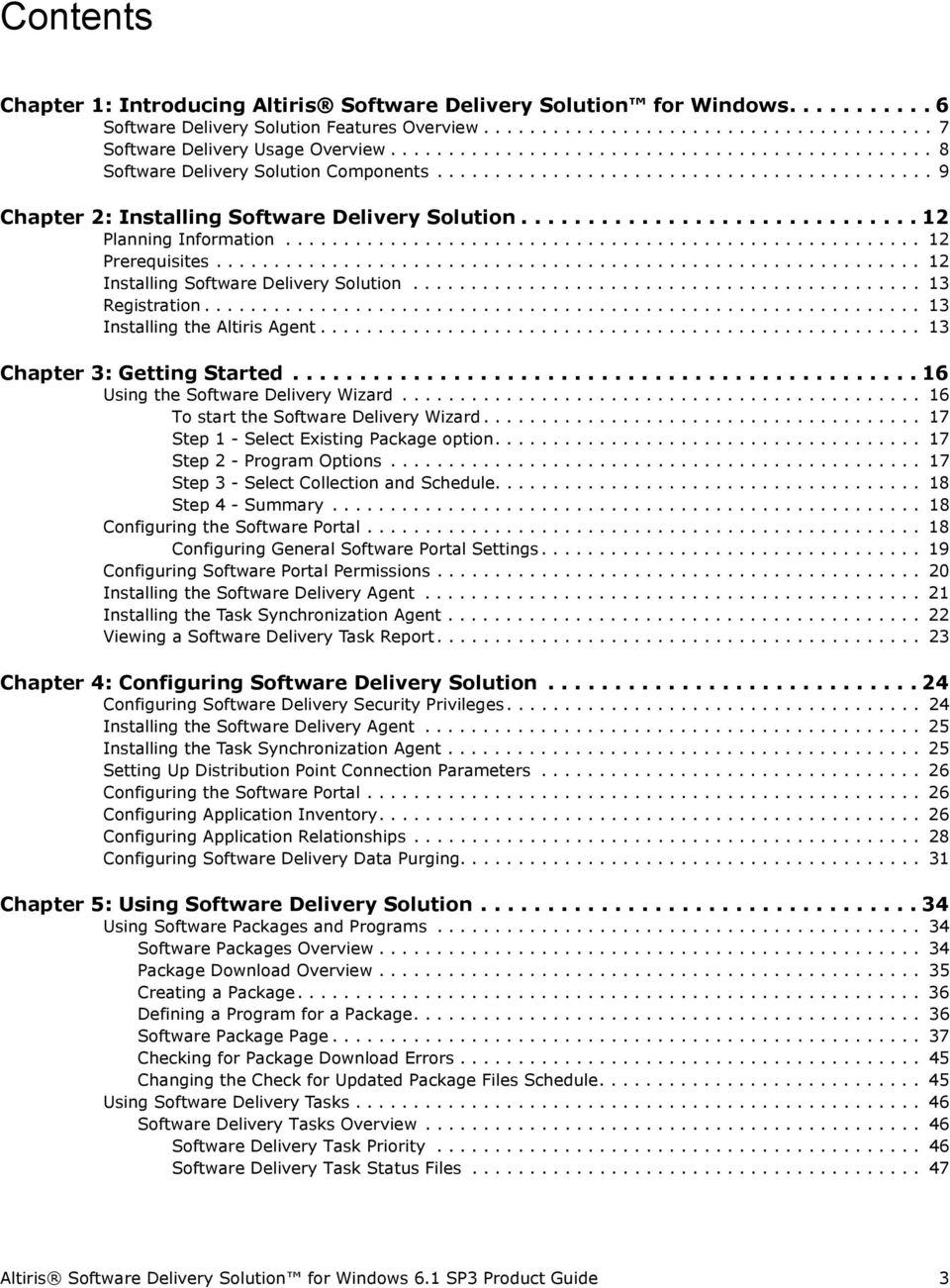
4 Creating a Software Delivery Task Software Delivery Task Page Sequential Software Delivery Task Page Disabled Software Delivery Tasks Specifying Software Delivery Task Availability Verifying that a Policy Has Been Successfully Delivered to the Altiris Agent Computer Uninstalling Unused Software Using the Software Delivery Wizard and Status Page Viewing the Status of Software Delivery Tasks Using the Software Delivery Wizard Step 1 - Select Package Option Step 2 - Select Collection and Schedule Step 3 - Summary Using Software Migration Tasks Software Migration Task Page Using the Software Migration Wizard and Status Page Software Migration Wizard and Status Page Using the Software Migration Wizard Step 1 - Select Source and Destination Computers Step 2 - Select Applications and Migration Settings Step 3 - Select the Schedule and Credential Settings Step 4 - Name the Software Migration Task Policy Using Multicasting Using Notifications and Automated Actions Using the Software Portal Wizard Chapter 6: Using Software Delivery Task Server Plug-in Overview Features and Benefits Task Server Configuration Installing Software Delivery Task Server Plug-in Agent Uninstalling Software Delivery Task Server Plug-in Agent Create a New Task dialog Creating a Deliver Software Task Select a Package dialog Deliver Software Task Events Delete Unused Package Files Task Server Plug-in Limitations Chapter 7: Using the Software Portal Software Tab User Preferences Tab Chapter 8: Technical Reference Software Delivery Solution Integration with SMS SMS and Notification Server Collections Integrating Software Delivery Solution with SMS Specifying an SMS Database Configuring Software Delivery Solution for SMS integration Specifying When Notification Server is used for SMS Advertisements Deleting SMS Software Delivery Objects from Notification Server Removing SMS Software Delivery Integration from Notification Server Troubleshooting Altiris Software Delivery Solution for Windows 6.1 SP3 Product Guide 4
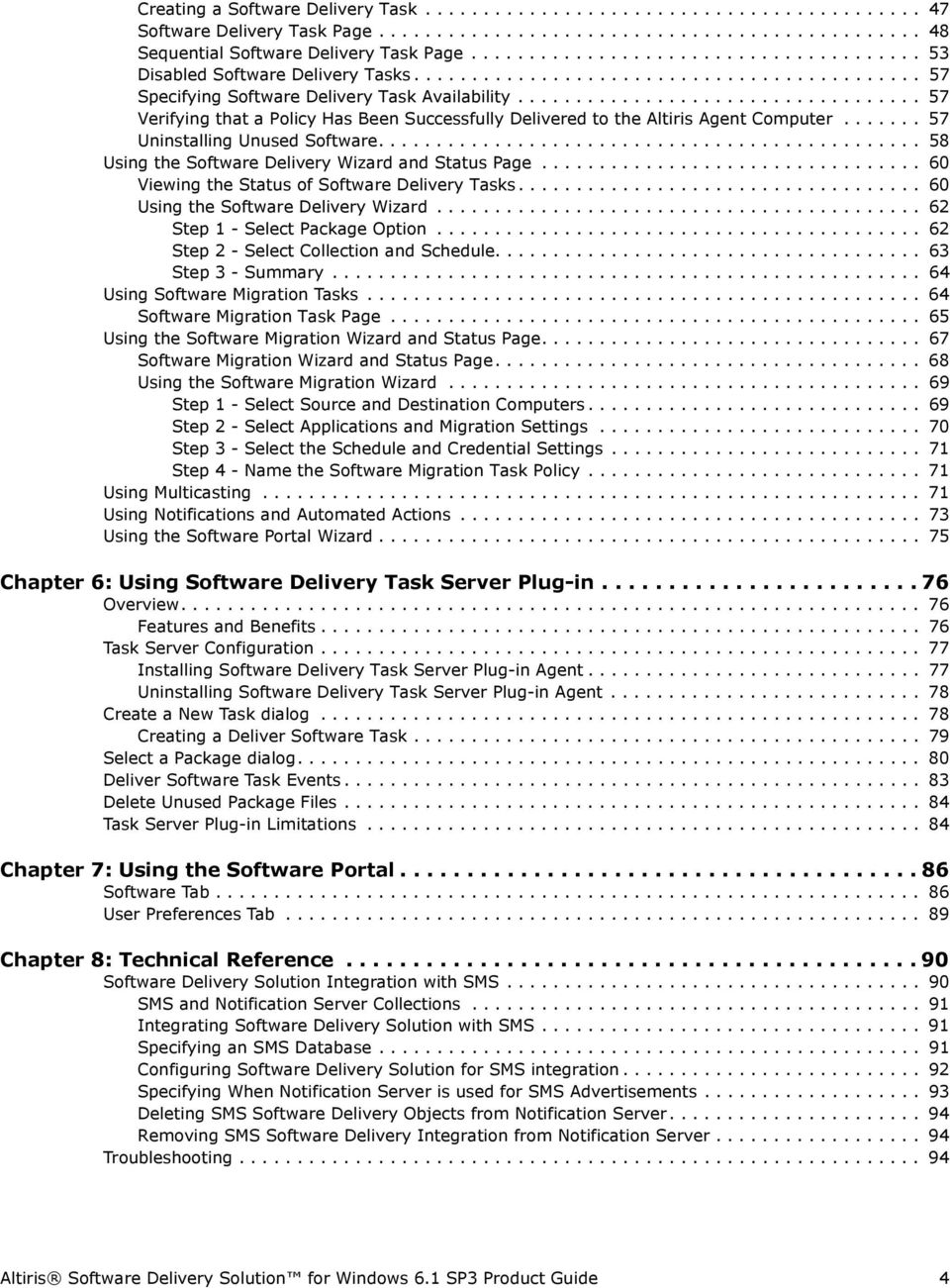
5 Appendix A: Using the Altiris Console Console Requirements and Installation Starting the Console Console Layout Menus Favorites Trees and Views Portal Pages and Web Parts The My Portal Page Index Altiris Software Delivery Solution for Windows 6.1 SP3 Product Guide 5

6 Chapter 1 Introducing Altiris Software Delivery Solution for Windows Altiris Software Delivery Solution for Windows provides secure, bandwidth-sensitive distribution of applications and the application updates throughout the organization. Software Delivery Solution supports LAN, WAN, and remote and mobile clients from a single infrastructure and offers advanced application management features, such as application self-healing, conflict analysis, and other ongoing software management capabilities. Software Delivery Solution lets you define software packages, distribute software packages, and run programs on Windows 9x/Me/NT/2000/XP/2003/Vista operating systems, and also on 64-bit computers. Software Delivery Solution for Windows works in 32-bit emulation mode on 64-bit computers. Software Delivery Solution provides the following features: Computers can be targeted for software delivery based on data that is collected from a computer. You can easily designate groups of computers to receive a software delivery job based upon hardware, software, or end-user details. A Software Delivery task, which downloads and deploys software packages, can be designated as mandatory or optional. You can let or prohibit users from running a Software Delivery task. You can also expire programs, so they can no longer be deployed after a specified date. Network bandwidth throttling helps minimize network impact. This is especially useful for remote users. Checkpoint recovery lets you resume a package download to a managed computer if the download is interrupted. This is especially useful for remote/dial-up users. Non-intrusive operation on managed client computers. Full support for locked down Windows NT/2000/XP/2003/Vista environments, which means software can be installed on computers even if the logged on user at the time of the installation does not have administrator rights to the computer. Native support for SMS packages, collections, advertisements, and status reporting. Numerous reports to help you analyze and make proactive management decisions. You can define and deploy software packages for UNIX/Linux, Macintosh, or handheld devices using the Software Delivery products for these platforms. Altiris Software Delivery Solution for Windows 6.1 SP3 Product Guide 6

7 Altiris Software Delivery Solution for Windows 6.1 SP3 supports the Altiris Console 6.0 (the console that ships with Notification Server 6.0), which is the official console for Notification Server 6.0 and associated solutions and the new Altiris Console 6.5. In this document, the tasks for Software Delivery Task Server Plug-in are documented using the new Altiris Console 6.5 and other tasks are documented using the Altiris Console 6.0. For information to help you get started, see Using the Altiris Console 6.5 (page 96) Quick Link Software Delivery Solution Features Overview (page 7) Software Delivery Usage Overview (page 8) Software Delivery Solution Components (page 9) Software Delivery Solution Features Overview Software Delivery Solution works in conjunction with Altiris Notification Server software and the Altiris Agent to define and deploy software packages and run programs. Programs can be run immediately or on a specified schedule. You can use the Altiris Console to define and deploy a package that consists of a collection of programs. Once a package has been defined, you can create a Software Delivery task to deploy the package and to run programs in that package. In a Software Delivery task, you can specify a schedule to run a program, the security context used when a program is running, and the collection of computers to which the Software Delivery task applies. Bandwidth Throttling Bandwidth throttling lets you control the amount of bandwidth used for delivery of packages. This feature minimizes the impact of software deployment at peak network usage times. The Software Delivery Agent, which is installed along with the Altiris Agent, downloads a file buffer by buffer with a delay between each buffer. Through the Altiris Agent, you can configure the buffer size and the amount of delay between buffers. You can specify different values depending on the bandwidth usage. If the bandwidth control is disabled by the user, the Software Delivery Agent downloads the files without a delay between buffers. Effectively, the agent uses all of the available bandwidth for package download. If bandwidth control is enabled, the agent tests the data transfer rate of downloading a package by using full bandwidth for 10 seconds, and then estimate the transfer rate during that period of time. If the estimated transfer rate is less than a threshold, the agent uses a delay between buffer downloads to slow down the download process. The data transfer rate test is done every two minutes to re-evaluate the link speed during the package download. Therefore, bandwidth usage depends on the transfer rate of the package download. For details, see the Altiris Notification Server Reference Guide. Blockout Blockout lets you block out times when packages are delivered with a high priority, low priority, or not at all. This feature can help you prevent package delivery from taking up Altiris Software Delivery Solution for Windows 6.1 SP3 Product Guide 7
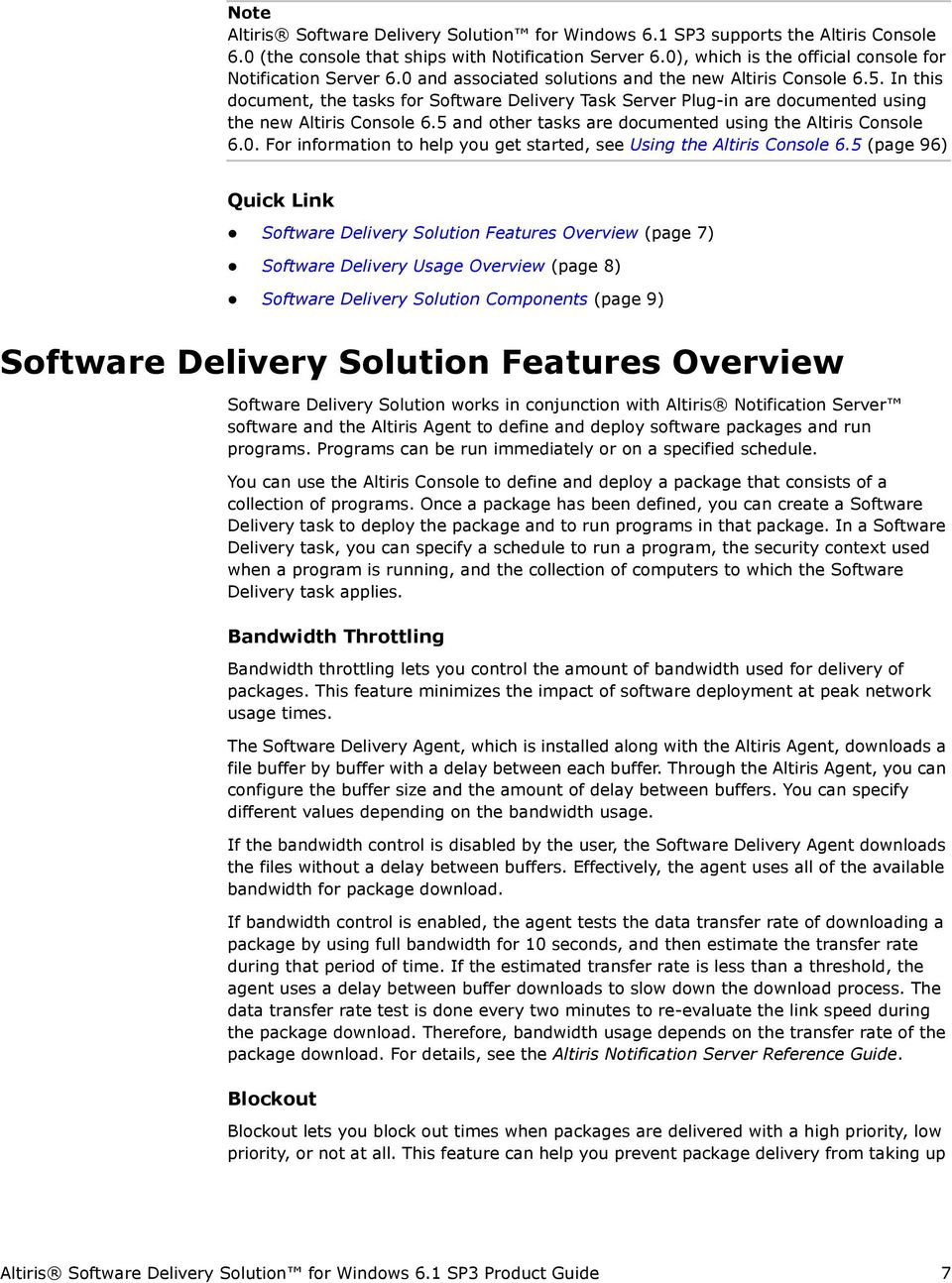
8 significant network bandwidth during peak usage times. For details, see the Altiris Notification Server Reference Guide. Multicasting Multicasting lets you deliver packages to a selected group of recipients. This feature is provided in Notification Server to improve the Package Server performance on large networks that use significant amount of network bandwidth. It protects Package Servers from being overloaded and helps prevent slow network responses when distributing large packages. Multicasting reduces the load on Package Servers by reducing the number of Altiris Agents that connect to the Package Server and decreases network utilization by multicasting package data to peers. For details, see Using Multicasting (page 71). Sequential Software Delivery Tasks You can create a Software Delivery task to deliver a single application or you can create a sequential Software Delivery task to deliver multiple tasks. When using sequential Software Delivery tasks you can configure the sequence of the tasks and dependencies that must exist for each task. Example: You can have three tasks, Task A, Task B, and Task C, in one sequential task. After setting the execution order, you can configure a dependency for Task C to execute only if Task B is executed successfully. Software Portal The Software Portal lets users install software on their computers by executing Software Delivery programs for which they have been given permission by the administrator. Software Portal options are provided in addition to existing Software Delivery Package and Program settings. Software Migration The Software Migration Wizard creates tasks that can identify applications that are installed on one or more source computers and then delivers the corresponding Software Delivery packages to one or more destination computers. You can use the Software Migration Wizard to identify applications that are installed on the original computer and then use Software Delivery to deploy software delivery packages for those applications to the new computer. If you have Altiris PC Transplant software, you can use it after the software migration to migrate the settings from the original computer to the new computer and both the applications and settings will be available to the user. Software Delivery Usage Overview Software deployment involves defining packages, creating Software Delivery tasks, delivering packages, running programs, and monitoring feedback. The following steps outline the software deployment procedure. 1. Set up Software Delivery Solution. See Configuring Software Delivery Solution (page 24). 2. Deploy the Software Delivery agents to your client computers: a. Installing the Software Delivery Agent (page 21) Altiris Software Delivery Solution for Windows 6.1 SP3 Product Guide 8

9 b. Installing the Task Synchronization Agent (page 22) 3. Define a software package that contains the files you want to deploy. See Creating a Package (page 36). 4. Define the program you want to run. See Defining a Program for a Package (page 36). 5. Create a Software Delivery task for the package that specifies a schedule for the program and the collection to which it applies. See Creating a Software Delivery Task (page 47). Using the Software Delivery Wizard The Software Delivery Wizard takes you through the steps of creating and delivering new and existing packages and the Software Delivery tasks that deliver those packages. This is the easiest and most efficient way to create packages, assign programs to them, and set up Software Delivery tasks to deliver them. For details, see Using the Software Delivery Wizard and Status Page (page 60). Other Software Delivery Tasks Configure and use the Software Portal: Configuring the Software Portal (page 18) Using the Software Portal Wizard (page 75) Using the Software Portal (page 86) Use reports to analyze results. See Viewing a Software Delivery Task Report (page 23) Migrate software applications: Using Software Migration Tasks (page 64) Using the Software Migration Wizard and Status Page (page 67) Using Notifications and Automated Actions (page 73) For details, see Getting Started (page 16). Software Delivery Solution Components When Software Delivery Solution for Windows is installed, folders and items are placed in various tabs of the Altiris Console. You can use these folders and items to create and manage packages, programs, and Software Delivery tasks. All folders and items for Software Delivery Solution for Windows are placed in the Software Management > Software Delivery > Windows folder in the left pane of the various tabs. Tasks Tab The following table lists the shortcut menu items that are provided when Software Delivery Solution is installed. You can access these shortcuts on the Task tabview by right-clicking a folder or an item in the left pane. Altiris Software Delivery Solution for Windows 6.1 SP3 Product Guide 9

10 Folder Notification Policies Sequential Software Delivery Task Software Delivery Tasks None Shortcut Menu Item None None None Software Delivery Wizard and Status None Hello World - Sample None Software Migration Task New Software Delivery Task Software Migration Wizard and Status Description Software Delivery Solution for Windows supplies Notification Policies that provide active reporting for the Altiris Agent. See Using Notifications and Automated Actions (page 73). You can create a Software Delivery task to deliver a single application or you can create a sequential Software Delivery task to deliver multiple tasks. When using sequential Software Delivery tasks, you can configure the sequence of the tasks to be deployed as well as dependencies that must exist for each task to be run. The Software Delivery Tasks folder is provided as a container for the Software Delivery tasks that you create. Opens the Software Delivery Wizard. This wizard takes you through the steps of creating packages and setting up Software Delivery tasks to deliver those packages. See Using the Software Delivery Wizard and Status Page (page 60). A pre-installed sample Software Delivery task called Hello World - Sample. Creates a new Software Delivery task. Software Migration tasks lets you migrate applications from one computer to another. See Using the Software Migration Wizard and Status Page (page 67). Resources Tab In this tab, Software Delivery Package folder is provided as a container for the Software Delivery packages that you create. Reports Tab From the Reports tab, you can view the Software Delivery dashboard and Software Delivery reports. The Software Delivery dashboard displays a list of executed Software Delivery tasks, their status, the computers they were delivered to, and the execution time. A chart showing the number of executed tasks is also provided. Reports let you analyze your data. Each Altiris solution includes predefined reports that you can use or modify, or you can create your own reports. Altiris Software Delivery Solution for Windows 6.1 SP3 Product Guide 10

11 Software Delivery provides numerous predefined reports to help you analyze your asset information. Configuration Tab Software Delivery Solution for Windows places several configuration items in the Configuration tab. These items let you configure Software Delivery Solution for Windows to meet your needs. For details, see Configuring Software Delivery Solution (page 24). Altiris Software Delivery Solution for Windows 6.1 SP3 Product Guide 11

12 Chapter 2 Installing Software Delivery Solution This section provides information you need to know to install Software Delivery Solution for Windows. Planning Information (page 12) Prerequisites (page 12) Installing Software Delivery Solution (page 13) Installing the Altiris Agent (page 13) Planning Information Before installing Software Delivery, we recommend that you review the following information. Security On Windows NT/2000/XP/Vista, the Software Delivery Agent, running on top of the Altiris Agent, runs as a service with local administrator rights on the computer. The Software Delivery Agent can run either on the local system account or the currently logged on user account. The default is the local system account. Notification Server and SQL Server If Notification Server and the Microsoft SQL Server database are NOT running on the same computer, ensure that the two computers are in the same time zone with their clocks synchronized. Difference in a time or a time zone between the two computers can cause package update problems. Prerequisites Software Delivery Solution requires the following: On the Target Computer Windows 95/98/Me/NT 4.0/2000/XP/2003/Vista Altiris Agent 6.0 On the Notification Server Notification Server 6.0 SP3 R4 or later Altiris Task Management 6.0 Custom Console 6.5 and Custom Console Data 6.5 Altiris Software Delivery Solution for Windows 6.1 SP3 Product Guide 12

13 Installing Software Delivery Solution Before installing Software Delivery Solution, review Prerequisites (page 12). To install Software Delivery Solution on Notification Server 1. Start the Altiris Console by selecting Start > Programs > Altiris > Altiris Console. 2. Click the Configuration tab. 3. In the left pane, navigate to Upgrade/Install Additional Solutions. 4. Click the Available Solutions tab. 5. Click the Software Delivery Solution for Windows link. 6. Click Start. This starts the installation of Software Delivery Solution. Registration Each Altiris product comes with a 7-day trial license that is installed by default. You can register and obtain a 30-day evaluation license through our Web site at or purchase a full product license. To view your current license, start the Altiris Console, click the Configuration tab, and select Licensing. For details, see Licensing Altiris Software in the Altiris Getting Started Guide on the product CD or on our Web site at Installing the Altiris Agent The Altiris Agent must be installed on the computers you want to manage, if you have not done so already (through the use of other Altiris solutions that require the agent). When installing the agent, specify computers to which you want to install the agent. For large numbers of computers, you can use the Resource Discovery and Network Discovery features of Notification Server to discover the computers on your network and create a list. From this list you can select the computers to install the Altiris Agent. If you have to manage only a few computers, such as during an evaluation, you can skip computer discovery and directly perform the agent installation procedure. Resource Discovery is used to discover Windows computers. The following procedure describes how to use this feature. Network Discovery can discover computers using Ping, Circular DNS resolution, SNMP, and NetBIOS name and domain. You can discover Linux/UNIX, Mac OS, and Windows computers. For details, see the Network Discovery Product Guide, which you can access from the Altiris Web site ( or from the Altiris Documentation page in the Altiris Console. You need administrator rights to install the Altiris Agent. Altiris Software Delivery Solution for Windows 6.1 SP3 Product Guide 13
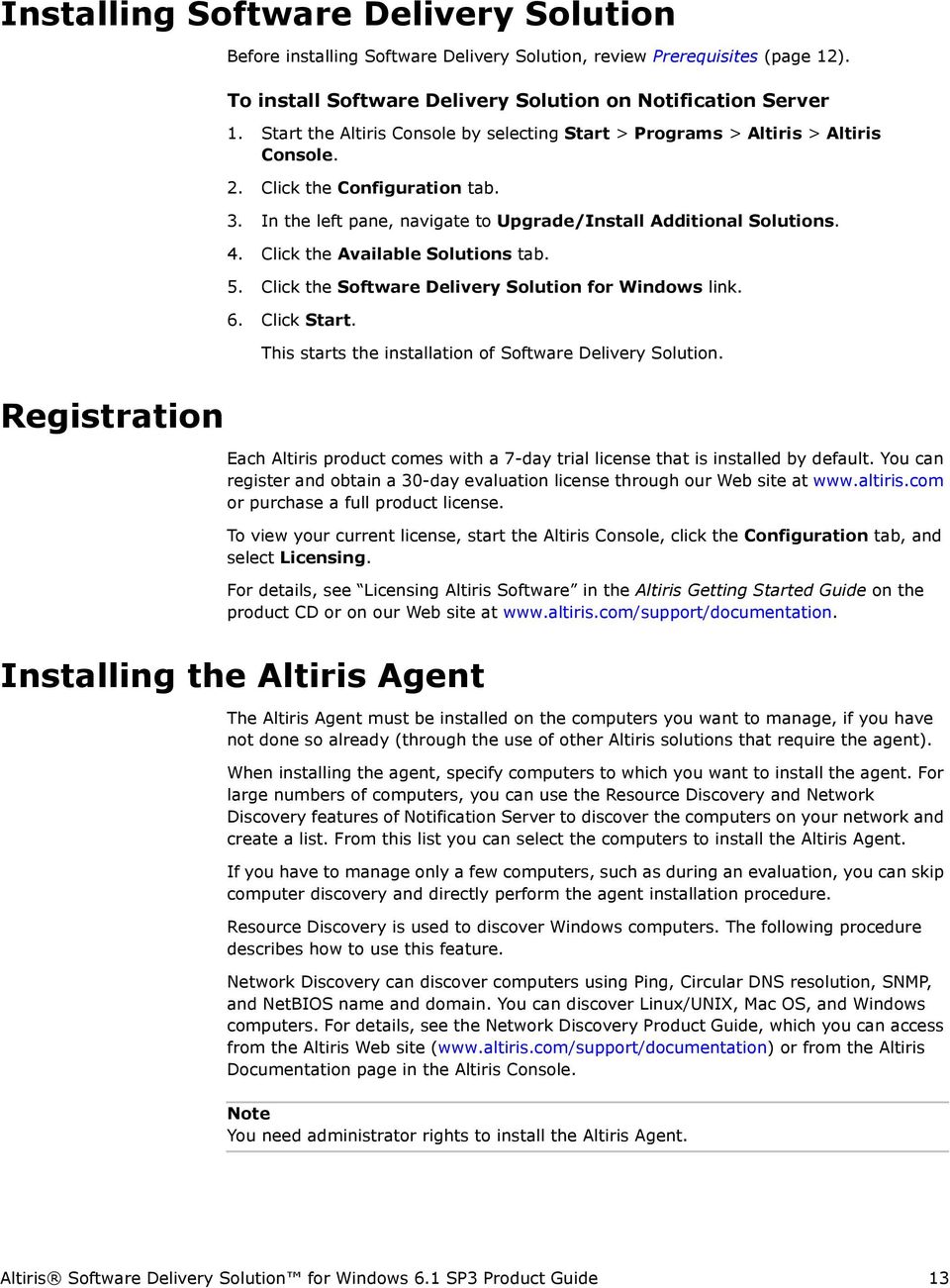
14 To discover Windows computers using Resource Discovery 1. Start the Altiris Console by selecting Start > Programs > Altiris > Altiris Console. 2. Click the Configuration tab. 3. In the left pane, select Configuration > Server Settings > Discovery Methods > Resource Discovery. 4. In the right pane, click and select the domains in which to search for computers. Optionally, enter the name of a domain and click. 5. Select the discovery methods you want to use. You must select at least one method. Select the Domain Browse List option to discover computers (including Windows 95, 98, 98 SE, and ME computers) that are currently sharing files. Select the Domain Membership option to discover computers that have trust accounts in the domain and are running Windows NT, 2000, XP, and This method will not find any Windows 98, 98 SE, or ME computers. 6. Click Discover Now. 7. After the discovery process completes, click Apply. The computers in the specified domains are discovered and can be selected to receive the agent. To install the Altiris Agent This procedure does not work with Windows 98, 98 SE, and ME computers. For these operating systems, see the Pull Method in the Notification Server documentation. 1. Start the Altiris Console by selecting Start > Programs > Altiris > Altiris Console. 2. Click the Configuration tab. 3. In the left pane, select Configuration > Altiris Agent > Altiris Agent Rollout > Altiris Agent Installation. 4. Click Select Computers to select computers for installing the Altiris Agent. If you did not perform a computer discovery (because of less number of computers to manage, such as during an evaluation), you have to first discover computers. For details, see To discover Windows computers using Resource Discovery (page 14). You can also specify computers manually. To specify the computers, enter the name of the computer on which you want to install the Altiris Agent in the text field provided and click Add. The specified computer is searched and added in the list. 5. Select computers from the list and click Install Altiris Agent. This opens the Altiris Agent Installation Options page to let you configure the properties for the Altiris Agent. 6. Select the Show the Altiris Agent icon in the system tray option. 7. Click Proceed with Install. The Altiris Agent is installed to the computers. Altiris Software Delivery Solution for Windows 6.1 SP3 Product Guide 14

15 To Discover Computers 1. In the right pane, do one or both of the following: If you did not perform a computer discovery (because of less number of computers to manage, such as during an evaluation) or you want to specify a computer manually, enter the name of the computer on which you want to install the agent in the text field provided and click Add. Repeat this step for all computers on which you want to install the agent. If you performed a computer discovery, click Select Computers. In the dialog that opens, select the computers to which you want to install the agent. Click OK. Even if a computer is discovered, it does not mean that you can push the agent to it. The computer must be running an operating system that supports pushing agents to it. Altiris Software Delivery Solution for Windows 6.1 SP3 Product Guide 15

16 Chapter 3 Getting Started The Getting Started tasks guide you through the basic setup, configuration, and use of Software Delivery Solution. Each task has a procedure and, in many cases, exercises to illustrate the steps of the procedure. Getting Started tasks 1. Using the Software Delivery Wizard (page 16) 2. Configuring the Software Portal (page 18) 3. Configuring Software Portal Permissions (page 20) 4. Installing the Software Delivery Agent (page 21) 5. Installing the Task Synchronization Agent (page 22) 6. Viewing a Software Delivery Task Report (page 23) Prerequisites for Getting Started tasks Notification Server 6.0 with SP3 R4 or later. Software Delivery Solution 6.1 SP1 Hot fix 1. (Some specific features require Hot fix 2 or later. When a feature requires Hot fix 2, it is noted in the procedure.) A client computer running a supported Windows operating system. The Altiris Agent installed on client computers. See Installing the Altiris Agent (page 13). Exercise Scenario The exercises in this chapter will guide you through the process of creating a simple Software Delivery Package and Task for Microsoft Paint. To prepare for this exercise, do the following: 1. Create a Software Packages\Paint folder on the C drive of the Notification Server. 2. Copy mspaint.exe from the system32 directory of C:\Windows or C:\WINNT to C:\Software Packages\Paint. Using the Software Delivery Wizard Software Delivery Solution lets you define and deploy software packages. Software packages are a group of program files or specific resources that Software Delivery Solution uses to deploy software. Software Delivery tasks are policies that describe how and when to deploy Software Delivery packages. For more information about software packages, see Using Software Packages and Programs (page 34). You can manually create Software Delivery packages and tasks or you can use the Software Delivery Wizard. The Software Delivery Wizard takes you through the steps of creating and delivering new and existing Software Delivery packages. This wizard also guides you through setting up Software Delivery tasks to deliver those packages. Altiris Software Delivery Solution for Windows 6.1 SP3 Product Guide 16

17 In this procedure you will create and deliver a new Software Delivery package. For instructions on using the wizard to deliver an existing package, see Using the Software Delivery Wizard (page 62). To start the Software Delivery Wizard 1. In the Altiris Console, click the Task tab. 2. In the left pane, select Tasks > Software Management > Software Delivery > Windows > Software Delivery Tasks > Wizard and Status. 3. In the right pane, click Run Software Delivery Wizard. Step 1 - Select Existing Package option In this step, you can select the package source and location, and a program you want to run from the selected package. 1. Select a wizard mode. Exercise Select Create and deliver a new package of software. 2. In Select the package source and location, select Access package from a local directory on the NS computer for the package source. For details, see Package Tab - Software Package Page (page 38). 3. For the package location, click on the folder icon to navigate to and select the required folder. Exercise Click on the folder icon, and select C:\Software Packages\Paint. 4. In Select the program that will run, enter the command line name of the program you want to run. You can click the folder icon to select the required program. Exercise Click the folder icon and select C:\Software Packages\mspaint.exe. 5. Click Next. The required fields are tested and if the information you entered is correct, the wizard continues with the next step. Step 2 - Program Options In this step, you will select how the program will run, which rights to use, and what should happen when the program has finished the execution. Exercise Keep the default settings and click Next. For details, see Programs Tab - Software Package Page (page 40). Altiris Software Delivery Solution for Windows 6.1 SP3 Product Guide 17
18 Step 3 - Select Collection and Schedule In this step, you can select the collection of computers you want the software package to be delivered and configure when you want it to be delivered. 1. Click the Select a Collection link to select the collections. 2. Configure the schedule to run this task. Exercise Keep the default settings. For details, see General Tab - Software Delivery Task Page (page 49). 3. Click Next. 4. Click Finish to go to Step 4 in the wizard. Step 4 - Summary In this step, you can enable the Software Delivery task, enter your Software Delivery task, package, and program names, and review your settings. 1. Click This Software Delivery task will be enabled to enable the Software Delivery task. 2. Enter information for the following: Software delivery task name - Enter the name for the Software Delivery task. Package name - Enter the name of the package. This is a required field. Program name - Enter the name of the program. This is a required field. All these fields are mandatory. 3. Verify the information for a selected item by clicking the corresponding link. 4. Click Finish to return to the Summary page. 5. Click OK. A Software Delivery Package and an associated Software Delivery Task is created after the wizard completes. To view or edit the Software Delivery Task, click the Tasks tab, and select the task policy in Tasks > Software Management > Software Delivery > Windows > Software Delivery Tasks. To view or edit the Software Delivery Package, click the Resources tab, then select the package located under Resource Management > Resources > Software Management > Software Delivery Packages > Windows. Configuring the Software Portal The Software Portal lets users install software on their computers by requesting software to which they have been given permission by the administrator. The Software Portal options are provided in addition to existing Software Delivery package and program settings. Altiris Software Delivery Solution for Windows 6.1 SP3 Product Guide 18

19 To implement the Software Portal, do the following two things: Configuring General Software Portal Settings (page 19) Configuring Software Portal Permissions (page 20) For details, see Using the Software Portal (page 86). You must install the Software Delivery Agent and the Task Synchronization Agent to all the managed computers that you want to use as Software Portal. For details, see Installing the Software Delivery Agent (page 21) and Installing the Task Synchronization Agent (page 22). Configuring General Software Portal Settings The Software Portal Settings page lets you control the visibility of links to the Software Portal on managed computers. To configure general Software Portal settings 1. In the Altiris Console, click the Configuration tab. 2. Select Configuration > Solution Settings > Software Management > Software Delivery > Windows > Software Portal Settings. You can configure one or multiple Software Portal settings tasks. The benefit of using multiple tasks is the ability to apply different settings to different collections. 3. To create a new task, right-click the Software Portal Settings folder and select New > Software Portal settings task. 4. Click the default New Software Portal settings task. 5. In the right pane, select the Enable check box to enable the settings. 6. Select any of the following Software Portal display options: Show link for Software Portal in Start Menu - Places a link for the Software Portal in the Start menu on the managed computer. Show link for Software Portal in Altiris Agent s context menu - Places a link for the Software Portal in the Altiris Agent's context menu on the managed computer. 7. Set the Maximum number of software allowed in a single Software Portal request. This setting is useful in limiting the amount of network activity needed to deploy applications. If a user selects more than the number allowed, a popup message will tell them they have exceeded the maximum allowed and the selection will not be allowed. The default value is 2. A sequential software task counts as one request, regardless of the number of software packages in the task. This feature is only available on Software Delivery Solution 6.1 SP1 Hot fix 2 or later. 8. Use the default collection or click the collection link to specify other collections. You can select one or more collections. Altiris Software Delivery Solution for Windows 6.1 SP3 Product Guide 19

20 The URL of the Software Portal is listed under URL of Software Portal for Win32 users. You can this URL to your managed computer users. Users can access the Software Portal using this URL. You can click Show me this page to view the Software Portal page. To access the Software Portal using this URL, the Altiris Agent and the Software Delivery Agent must be installed on the computer. See Installing the Software Delivery Agent (page 21) and Installing the Task Synchronization Agent (page 22). Configuring Software Portal Permissions You use permissions to configure access to programs available through the Software Portal. Each Software Delivery and Sequential Software Delivery task can have its own permissions. There are two permission types: Install Software - The user can manually request the software without getting approval. Install on Approval - The user can request approval for the software. This is used to control the number of installed licenses of the software. Once approved by the administrator, the task will be scheduled for execution. You configure permissions from the Software Portal tab of the software package resource page. You can access the Software Package Resource page in the following ways: The Software Portal Configuration page on the Configuration tab. The Software Package Resource page on the Resources tab. To set user permissions from the Software Portal Configuration page 1. In the Altiris Console, click the Configuration tab. 2. From the Configuration tab, select Configuration > Solution Settings > Software Management > Software Delivery > Windows > Software Portal Configuration page. 3. To configure permissions for a software package, click the Software Delivery Program tab. To configure permissions for a sequential task, click the Sequential Software Delivery Task tab. 4. Select the programs you want to configure. You can configure one or more programs at a time. To select multiple programs, hold down the Ctrl key while you select programs. 5. Click View/Modify Privileges. The Security Settings for selected Software or Sequential Software Delivery tasks window is displayed showing who has the following rights. Install Software - The user will be able to select this task from the Software Portal and run the program without approval. Altiris Software Delivery Solution for Windows 6.1 SP3 Product Guide 20

21 Install on Approval - The user will be able to select this task from the Software Portal, but will need to wait for approval from an administrator or help desk worker before the program is run. A check mark appears next to the groups that have rights. If you selected multiple programs, a gray check box means the user or group does not have rights to all the selected programs. 6. Select or clear a check box for the rights you want to configure. 7. If you want to add a new user or group, do the following: a. Click the icon. b. Click Advanced. c. Search for the user or group you want to add. d. Select the user or group and click OK. 8. Click OK. To make the Software Portal user interface less cluttered for end users, the Approved Software and Software Requiring Approval folders will not appear if they do not contain any software packages configured for that user. See also: Configuring General Software Portal Settings (page 19) Installing the Software Delivery Agent The Software Delivery Agent inventories programs that are installed on the managed computer and sends this data to the Notification Server. It uses this information to track programs that are installed on the managed computer and matches them with packages that are defined by the Notification Server. You can use this information in deciding which programs to send to which managed computers. The Software Delivery Agent also controls the exposure of the Software Portal on managed computers. See Configuring the Software Portal (page 18) and Using the Software Portal (page 86). This task will help you deploy the Software Delivery Agent to managed computers. When to use the Software Delivery Agent You need to install the Software Delivery Agent only if you are doing one of the following: Using the Software Portal. Tracking inventory of installed applications on managed computers (using an Application Inventory task). Otherwise the standard Altiris Agent is used with Software Delivery Solution to deliver software packages. Altiris Software Delivery Solution for Windows 6.1 SP3 Product Guide 21
22 To install the Software Delivery Agent 1. In the Altiris Console, click the Configuration tab. 2. In the left pane, select Configuration > Solution Settings > Software Management > Software Delivery > Windows > Software Delivery Agent Rollout. 3. Click the Software Delivery Agent Install policy. 4. On the Configuration page, select the Enable check box. 5. Use the default collection or select another. Exercise Use the default collection that will install the agent to all computers that do not have the Software Delivery Agent installed. For information on how to create and manage collections, see the Notification Server documentation. 6. Configure package multicast options. By default, the agent package will download using multicasting. You can disable multicasting by selecting the Disable download via multicast check box. For details, see Multicasting (page 8), and Using Multicasting (page 71). 7. Use the default scheduling options or configure your own. Exercise Use the default settings. For information about scheduling options, see the Notification Server documentation. 8. Click Apply. If you install the Software Delivery Agent, you should also install the Task Synchronization Agent. See Installing the Task Synchronization Agent (page 22). Installing the Task Synchronization Agent Task synchronization is used by Software Delivery Solution and other Altiris solutions that synchronize the execution of tasks on a managed computer. The Task Synchronization Agent should be rolled out to any managed computers that have the Software Delivery Agent installed on them. This task helps you use the Task Synchronization Agent Install policy to install the Task Synchronization Agent to the All Windows Computers with NS 6 Agents collection. To install the Task Synchronization Agent 1. In the Altiris Console, click the Configuration tab. 2. In the left pane, select Configuration > Solution Settings > Software Management > Software Delivery > Windows > Software Delivery Agent Rollout. 3. Select the Task Synchronization Agent Install policy. Altiris Software Delivery Solution for Windows 6.1 SP3 Product Guide 22
23 4. In the right pane, select the Enable check box. 5. Use the default collection or select another. Exercise Use the default collection to install to all computers that do not have the Task Synchronization Agent installed. For information on how to create and manage collections, see the Notification Server documentation. 6. Configure package multicast options. By default, the agent package will be downloaded using multicasting. You can disable multicasting by selecting the Disable download via mulicast check box. For details, see Multicasting (page 8) and Using Multicasting (page 71). 7. Use the default scheduling options or configure your own. Exercise Use the default settings. For information about scheduling options, see the Notification Server documentation. 8. Click Apply. Viewing a Software Delivery Task Report Software Delivery provides numerous predefined reports to help you analyze your software delivery information. The following procedures provide sample instructions for using reports. This report provides a list of all active Software Delivery Tasks and the collections that are assigned to them. To run a report that lists all active Software Delivery Tasks 1. In the Altiris Console, click the Reports tab and select Reports > Software Management > Software Delivery > Windows. 2. Click the Software Delivery Task Definitions folder. 3. Click Software Delivery Task - Active. 4. Click Run this report in a new window. 5. You can use the default type All, or select another. 6. Click Refresh. Altiris Software Delivery Solution for Windows 6.1 SP3 Product Guide 23
24 Chapter 4 Configuring Software Delivery Solution The following procedures configure your system for Software Delivery. Configuring Software Delivery Security Privileges (page 24) Installing the Software Delivery Agent (page 25) Installing the Task Synchronization Agent (page 25) Setting Up Distribution Point Connection Parameters (page 26) Configuring the Software Portal (page 26) Configuring Application Inventory (page 26) Configuring Application Relationships (page 28) Configuring Software Delivery Data Purging (page 31) Configuring Software Delivery Security Privileges You can assign security privileges for Software Delivery administrative functions. Using role-based security you can control who has rights to do the following: Create Software Delivery Packages Create Software Delivery Tasks Create Software Portal Definitions Security Privileges Example Suppose you want to roll out Microsoft Office to all corporate computers. You have offices in New York and Sydney and only want to give permission for employees to roll out Microsoft Office at their location. You would first give privileges to all the employees doing the roll out. Next, you could create two Software Delivery policies: one for the New York roll out and one for the Sydney roll out. Then, you would give the New York roll out employees permissions for the New York Software Delivery policy and the Sydney roll out employees permissions for the Sydney Software Delivery policy. To configure Software Delivery Security Privileges 1. In the Altiris Console, click the Configuration tab. 2. In the left pane, select Configuration > Server Settings > Notification Server Settings > Security Roles. A list of default security roles appears under the Security Roles node. 3. From the list, select a security role. The default settings for the selected security role appears in the right pane. 4. In the right pane, click the Privileges tab. 5. Select the check box for a privilege in the Software Delivery Solution Privileges section. Altiris Software Delivery Solution for Windows 6.1 SP3 Product Guide 24
25 6. Click Apply. For more information about configuring security, see Security Role Management in the Notification Server Help Guide. Installing the Software Delivery Agent The Software Delivery Agent inventories programs that are installed on the managed computer and sends this data to the Notification Server. It uses this information to track programs that are installed on the managed computer and matches them with packages that are defined by the Notification Server. You can use this information in deciding which programs to send to which managed computers. The Software Delivery Agent also controls the exposure of the Software Portal on managed computers. See Configuring the Software Portal (page 18) and Using the Software Portal (page 86). For specific installation steps, see Installing the Software Delivery Agent (page 21). After the Software Delivery Agent has been installed on managed computers, you can then set up and enable an Application Inventory task to perform inventory of installed applications. Upgrading the Software Delivery Agent When a Software Delivery Agent upgrade is available, you can enable the Software Delivery Agent Upgrade policy. This policy upgrades the Software Delivery Agent to all computers listed in the Computers Requiring Software Delivery Agent Upgrade collection. Software Delivery Agent Uninstall The Software Delivery Agent Uninstall folder contains a policy you can use to uninstall the Software Delivery Agent. This policy uninstalls the Software Delivery Agent from all computers listed in the Computers With Software Delivery Agent Installed collection. If you want to uninstall the Software Delivery Agent from your managed computers, enable the Software Delivery Solution Uninstall policy. Installing the Task Synchronization Agent Task synchronization is used by Software Delivery Solution and other Altiris solutions that synchronize the execution of tasks on an managed computer. The Task Synchronization Agent should be rolled out to any managed computers that have the Software Delivery Agent installed on them. For specific installation steps, see Installing the Task Synchronization Agent (page 22). Upgrading the Task Synchronization Agent When a Task Synchronization Agent upgrade is available, you can enable the Task Synchronization Agent Upgrade policy. This policy upgrades the Task Synchronization Agent to all computers listed in the Computers Requiring Task Synchronization Agent Upgrade collection. Altiris Software Delivery Solution for Windows 6.1 SP3 Product Guide 25
26 Setting Up Distribution Point Connection Parameters You need to perform this procedure only if you are doing one of the following: Using Microsoft SMS and the SMS distribution server is not on the same computer as Notification Server. Creating virtual directories to UNC paths that have credentials different from the credentials specified on the Application Identity page. To set up Software Delivery 1. In the Altiris Console, click the Configuration tab. 2. In the left pane, select Configuration > Server Settings > Notification Server Infrastructure > Package Servers. 3. In the right pane, click the Package Service Access tab. 4. In the Distribution Point Connection Parameters section, select whether or not you want to use application credentials. 5. If you chose to use other credentials, enter the user name and password. The following are the fields in this section: User name - Domain and user name (separated by a \ ) with administrator rights you want to use on the Notification Server computer. Password and Confirm Password - Password for the account in the User name field. 6. Click Apply. Configuring the Software Portal The Software Portal can be used when: One or more users need to install the software right away One or more users want control over the software they install For details, see Configuring the Software Portal (page 18). Configuring Application Inventory Application Inventory tasks gather information on applications that are installed on managed computers. This information is then placed in the Notification Database. You can then run reports that give you information and status on these installed applications. You can also use this information for migrating software. For more information, see Using the Software Migration Wizard and Status Page (page 67). After you use an Application Inventory task to gather information on applications from managed computers, you can set up application relationships (see Configuring Application Relationships on page 28) and create packages which use applications and installer relationships. If the Application Inventory task finds that some applications have been uninstalled when compared to the previous inventory, the information is reported to the Notification Altiris Software Delivery Solution for Windows 6.1 SP3 Product Guide 26
27 Database. The information about uninstalled applications is kept for 7 days (configurable using the Data Purging section) after which it is deleted. To create an Application Inventory task 1. In the Altiris Console, click the Configuration tab. 2. In the left pane, select Configuration > Solution Settings > Software Management > Software Delivery > Windows. 3. Right-click on the Application Inventory folder, and select New > Application Inventory Task. Application Inventory Task Toolbar The Application Inventory task toolbar contains icons which let you perform actions while using the Application Inventory task page. The clickable icons on the Application Inventory task toolbar are: Rename - Lets you rename the Application Inventory task. Delete - Lets you delete the Application Inventory task. Clone - Lets you clone the Application Inventory task. Export - Lets you export the Application Inventory task to XML. View as XML - Lets you view the Application Inventory task as XML. Properties - Lets you view the Properties page of the Application Inventory task. The Properties page contains general information of the Application Inventory task and also lets you set up security for the Application Inventory task. General Tab Item Enable Name Description Applies to collection(s) Run the inventory task once Description Select to enable this task. (Required) The name of the task. (Optional) The description of the task. This lists the collection(s) that the task applies to. Click on the pencil icon to edit the collection(s) that the task applies to. This task can apply to one or more collections. Select to run this task only one time. Altiris Software Delivery Solution for Windows 6.1 SP3 Product Guide 27
28 Item Run the inventory task on a schedule Schedule Apply Cancel Description Select to run this task on a schedule. Click on the link to open the scheduler and create a schedule for this task. Click Apply to save changes. Click Cancel to discard changes. Configuring Application Relationships The Application Relationships feature helps you manage Applications and Installers that are found on your managed computers. Applications are any executables that may be found on your computers. Installers are the installation executables that install Applications. The Application Relationships page comes with pre-populated Applications and Installers. You may also define your own Applications and Installers to suit your needs. Applications can be associated with Installers. Each Application can be associated with one or more Installers. Each Installer can be associated with one or more Applications. The relationships between Applications and Installers have been created already for the pre-populated Applications and Installers. If you define your own Applications and Installers, you need to associate them as applicable. Application Relationships are used in linking application inventory to specific software packages, which can then be installed where needed. Using Application Inventory, you can scan managed computers for application information. This information is placed in the Notification Database and can then be used when deploying software packages. Software Delivery tasks are associated with packages and programs. Software Delivery programs can then be associated with specific Applications and Installers. This gives you the advantage of tying a software delivery package and program to an Application Relationship. You can also use these relationships for migrating software. For details, see Using the Software Migration Wizard and Status Page (page 67). You can associate Applications and Installers with software programs in one of two ways On the Application or Installer page, associate programs with the Application or Installer. On the Programs page, associate Applications and Installers with the program. Altiris Software Delivery Solution for Windows 6.1 SP3 Product Guide 28
29 Application Page Item Application Exe name Language File version Family Size Publisher Product version Installed by programs Uninstalled by programs Contained by installers Installed on computers Apply Cancel Description (Required field) Application name. (Required field) Name of the executable file. Click Browse to browse and select the desired executable. (Required field) The Application language. (Required field) The file version of the executable listed above. Select the Application family that you want this Application to belong to. You can create families by clicking View Families, then clicking on Add. The size of the Application (in bytes). The publisher of the Application. The version of the Application. Click here to select lets you select the programs that install this Application. Click here to select lets you select the programs that uninstall this Application. Click here to select lets you select the Installers that this Application is contained by. Displays managed computers that this Application has been installed on. Click Apply to save changes. Click Cancel to cancel changes. Installer Page Item Installer Publisher Filename Type Used by packages Contains applications Apply Cancel Description (Required field) Installer name. Click Browse to browse and select the desired Installer. The publisher of the Installer. The filename of the Installer. The Installer type. Select a type from the menu. Click here to select lets you select the packages that use this Installer. Click here to select lets you select the Applications that this Installer is contained by Click Apply to save changes. Click Cancel to cancel changes. Altiris Software Delivery Solution for Windows 6.1 SP3 Product Guide 29
30 To create a new Application relationship 1. In the Altiris Console, click the Configuration tab. 2. In the left pane, select Configuration > Solution Settings > Software Management > Software Delivery > Windows > Application Relationships. 3. In the right pane, right-click Applications and select New Application. 4. Right-click Applications and select New Application. 5. Enter the fields as explained in Application Page (page 29). To create a new Installer relationship 1. In the Altiris Console, click the Configuration tab. 2. In the left pane, select Configuration > Solution Settings > Software Management > Software Delivery > Windows > Application Relationships. 3. In the right pane, right-click Installers and select New Installer. 4. Enter the fields as explained in Installer Page (page 29). To use Application Relationships to automatically send packages to managed computers 1. Perform an inventory on your computers (do this by setting up specific Application Inventory tasks and running them). 2. Make sure the necessary Application Relationships are set up. 3. When you create programs, associate them with Applications and Installers. 4. Create Software Delivery tasks and associate them with the desired packages and programs. Notification Server then automatically determines which Applications and Installers to push down to which computers. This is very useful when upgrading. Notification Server can detect if a new version needs to be pushed down based on which versions are installed. Example 1 You use Application Inventory to gather inventory on a managed computer. The Application Inventory task finds an aol.exe file and gathers the version number and its language. This information is sent to the Notification Server that places it in the Notification Database. Notification Server can now determine that the aol.exe file on this managed computer is associated with the American Online 4.0 application. The American Online 4.0 application can be associated with one or more installers. In this case, the American Online 4.0 application is only associated with the American Online 4.0 setup installer. This information can now be used for performing upgrades or for sending aol.exe to another computer that needs it. Example 2 You can set up PC Transplant Pro and Software Delivery to inventory computers and migrate settings from one computer to another computer automatically through application relationships. Altiris Software Delivery Solution for Windows 6.1 SP3 Product Guide 30
31 You want to migrate applications from one computer to another computer. You can set up Software Delivery Solution to perform an application inventory on the first computer. Through this inventory, you learn that the first computer has AOL 4.0 and Microsoft Word You also learn, through an application inventory, that the second computer does not have AOL 4.0 and Microsoft Word 2000 on it. A Software Delivery package can be created that is associated with the AOL 4.0 and Microsoft Word 2000 applications and installers. Then, you can create a Software Delivery task to push these applications automatically to the second computer. This process can happen automatically, making your migration fast and easy. Configuring Software Delivery Data Purging This section provides information about purging the hidden software delivery tasks and software events to maintain the performance of the application and to reduce the size of the Notification Database. On this page, the hidden software delivery tasks and software events are displayed into various groups. You can choose a group for purging the data by selecting a check box for a group. By default, the data is purged at a specified schedule, that is at 2:00 a.m. But, you can also purge the data instantly, see To purge the data instantly (page 32). By specifying the period, you can purge the data that is older than the specified period. For software events, you can also specify the number of rows that should remain in the database after the data is purged. Expanding a group under the Hidden Software Delivery Tasks shows the last date when the data is purged. Expanding a group under the Software Events shows more information, like database table name, the current rows in the database, and the last date when the data is purged. Groups under Hidden Software Delivery Tasks Item Sequential Software Delivery Tasks Software Migration Tasks Software Portal Application Relationship Description Purges the unused Sequential Software Delivery tasks information that is older than the specified period. Purges the unused Software Migration tasks information that is older than the specified period. Purges the unused internal tasks, which are created when requesting a software from the Software Portal and which are older than the specified period. Purges the information about the uninstalled applications that is older than the specified period. Altiris Software Delivery Solution for Windows 6.1 SP3 Product Guide 31
32 Groups under Purge Software Events Item Software Delivery Software Package Delivery Software Delivery Status Sequential Run Status Description Purges the Software Delivery events that are older than the specified period. Purges the Software Delivery Package events that are older than the specified period. Purges the status information for the Software Delivery tasks that is older than the specified period. Purges the status information for the Sequential Software Delivery tasks that is older than the specified period. To purge the data at the default schedule 1. In the Altiris Console, click the Configuration tab. 2. In the left pane, select Configuration > Solutions Settings > Software Management > Software Delivery > Windows > Data Purging. 3. Purge hidden Software Delivery tasks or software events: a. In the right pane, select the check box for a group. b. Enter the period for purging the data. c. From the drop-down list, select the type of period, such as Days, Weeks, or Months. d. For Software Events, specify the number of rows that needs to be retained. 4. Click Apply. The data for selected groups is purged daily at 2:00 a.m. To purge the data instantly 1. In the Altiris Console, click the Configuration tab. 2. In the left pane, select Configuration > Solutions Settings > Software Management > Software Delivery > Windows > Data Purging. 3. In the right pane, expand a group for which you want to purge data. 4. Click the Purge Now link for the expanded group. This purges the data from the group. To disable data purging 1. In the Altiris Console, click the Configuration tab. 2. In the left pane, select Configuration > Solutions Settings > Software Management > Software Delivery > Windows > Data Purging. 3. In the right pane, clear the check box for a group. 4. Click Apply. Data purging is disabled for the selected group. Altiris Software Delivery Solution for Windows 6.1 SP3 Product Guide 32
33 Altiris Software Delivery Solution for Windows 6.1 SP3 Product Guide 33
34 Chapter 5 Using Software Delivery Solution This section provides information you need to know to use Software Delivery Solution for Windows. Quick Links Using Software Packages and Programs (page 34) Using Software Delivery Tasks (page 46) Using the Software Delivery Wizard and Status Page (page 60) Using Software Migration Tasks (page 64) Using the Software Migration Wizard and Status Page (page 67) Using Notifications and Automated Actions (page 73) Using the Software Portal Wizard (page 75) Using Software Packages and Programs Quick Links Software Packages Overview (page 34) Package Download Overview (page 35) Creating a Package (page 36) Defining a Program for a Package (page 36) Software Package Page (page 37) Checking for Package Download Errors (page 45) Changing the Check for Updated Package Files Schedule (page 45) Software Packages Overview Software packages are a group of program files. Software Delivery Solution lets you define and deploy software packages. To define a package, you must designate the folder location for the source files. This folder can be local to the Notification Server computer, on the network (UNC), or accessed through a URL. When a package is defined, all the contents of the folder specified by the package, including the contents of subfolders, are part of the package. When you define a package, it only include the files that are necessary to accomplish the purpose of that package. The more files included, the greater the bandwidth or time required to deploy the package because all the files in a package are downloaded to the Altiris Agent. As part of the package definition process, you specify the location from where an Altiris Agent can download the package. By default, a package can be downloaded from the Altiris Software Delivery Solution for Windows 6.1 SP3 Product Guide 34
35 location specified in the source destination of the package. You can also specify Package Servers from where a package can be downloaded. Package Servers let you reduce the load on the Notification Server and the network by distributing packages to multiple locations from which they can be downloaded. For more information on package servers, see the Altiris Notification Server documentation. The Altiris Agent stores package files in the install path\altiris\altiris Agent\Software Delivery\Package GUID folder, which is the same folder where the agent is installed. When installing the Altiris Agent, install the Altiris Agent on a drive with sufficient space for all the files that can be downloaded. If the Altiris Agent does not have sufficient disk space to download a package, it displays a message and sends a status message to the Notification Server. If the end user manually deletes the package files, the Altiris Agent re-downloads those files from the Notification Server and then tries to run the package next time. For details, see Creating a Package (page 36). If you have a Software Delivery task that uses cmd.exe with the /K switch, the command window is left open after execution. This is because the Software Delivery Agent runs the command and waits for the exit code. When the /K switch is used, the command line does not produce an exit code until you either type exit or close the window. If you type exit, the exit code is 0 (no error). If you close the window, the exit code is non-zero, which indicates an error, which is reported to the Altiris Agent. If you want to run commands using cmd.exe and return an exit code, use the exit N command, where N is the exit code. This causes the cmd.exe application to terminate with exit code N. Package Download Overview When a new package is defined, the package is automatically downloaded to the appropriate managed Package Server when the Altiris Agent requests configuration information from Notification Server. If you modify a package definition within the Altiris Console, the changed files in the package are also downloaded to the appropriate managed computers when the Altiris Agents checks for configuration information next time. To send a package to a group of computers, you must assign the package to a Software Delivery task, the destination computers must be a part of the Collection assigned to the task, and the task must be enabled. For details, see Using Software Delivery Tasks (page 46). If the actual files in the package are changed, then Notification Server automatically recognizes the changes. Notification Server checks for changed package files on a regular basis (once a day by default). If Notification Server determines that files in a package have changed, Notification Server informs the appropriate Altiris Agents that the package has changed. Only the changed files are downloaded to the managed computer again. You can modify the interval that Notification Server checks for changed files. For details, see Changing the Check for Updated Package Files Schedule (page 45). The less frequently the check is made, the longer the time is required for a changed package to be available on an Altiris Agent computer. The more frequently the check is made, the more processing resources are required by Notification Server. If the Software Delivery Agent cannot download a package due to a link failure or denied access so a connection cannot be established, the Altiris Agent reports the Download Altiris Software Delivery Solution for Windows 6.1 SP3 Product Guide 35
36 failed - Link failure status message. The Software Delivery Agent will stop for N minutes (where N increases exponentially from a default of 3 minutes to a default of 2 hours) before attempting to download the package again. If the Altiris Agent detects any network status change (a new network link), any package waiting for a retry being downloaded immediately restarts. The back off interval is reset to the initial value. If a connection is lost during the download of a package, the transfer rate is throttled. When the Altiris Agent attempts to download the package again, a buffer transfer delay applies and slows down the download. The Altiris Agent determines which files in the package still need to be downloaded and downloads those files. If a source or destination fails during a package download, the checkpoint recovery feature lets you continue the download of a package without starting over. Example: You are deploying a package that is 20 MB in size and there is a network failure at 15 MB into the deployment process. When your systems are back up, the package deployment resumes at the 15 MB point. The checkpoint recovery feature is always available, and you do not need to enable it. Creating a Package The easiest was to create a new package, program, and Software Delivery task is to use the Software Delivery Wizard. For details, see Using the Software Delivery Wizard (page 16) and Using the Software Migration Wizard and Status Page (page 67). To define and deploy Unix software packages, use the Altiris Software Delivery Solution for Unix. For general information on packages, see Software Packages Overview (page 34). To create a package from the Resource Tab 1. In the Altiris Console, click the Resources tab. 2. In the left pane, select Resource Management > Resources > Software Management > Software Delivery Packages. 3. Right-click the desired platform folder, and then select New > Software Delivery Package. 4. In the right pane, specify the package properties. For details, see Software Package Page (page 37). 5. Click Apply. Defining a Program for a Package For each package, you can define one or more programs that the package can run. To define a program for a package 1. In the Software Package dialog, click the Programs tab. 2. To configure a new program, click the New button. 3. Specify the program details of the first program. Altiris Software Delivery Solution for Windows 6.1 SP3 Product Guide 36
37 For details, see Software Package Page (page 37). 4. If you have more than one program, repeat this procedure for each of the programs. Defining multiple programs for a single package lets you use the same package for more than one purpose. For more information about program properties, see Software Package Page (page 37). To run MSI files MSI files are not executables. They are databases that include files and provide descriptions on how the data should be installed. To run an MSI in a package, you need to run msiexec.exe. The msiexec.exe program should be on the path. For information on all of the parameters for msiexec.exe, see the online help. You can use the following command line: msiexec.exe /i msifilename.msi that you can pass other command line parameters to msiexec.exe so that your installation is done in quiet mode. Examples For a basic UI msiexec.exe /i msifilename.msi /qb For no UI msiexec.exe /i msifilename.msi /qn To run script files For VBS and VBE files, you need to run either cscript.exe or wscript.exe. For information on the available commands, see the documentation for these programs. Usually, other script files can be run as programs. See the documentation for your desired script file executables. Software Package Page This page is used to configure packages and specify Package Servers for the package. It contains four tabs - Package, Programs, Advanced, and Software Portal. To access a software package page 1. In the Altiris Console, click the Resources tab. 2. In the left pane, select Resource Management > Resources > Software Management > Software Delivery Packages > Windows. 3. In the right pane, double-click a software package resource. 4. In Resource Manager, click the Package tab. Altiris Software Delivery Solution for Windows 6.1 SP3 Product Guide 37
38 Software packages can be located in other folders depending on where they were placed when they were created. Software Package Toolbar The Software Package toolbar contains icons that let you perform actions while using the Software Package page. The clickable icons on the Software Package toolbar are as follows: Right click menu for item - Displays the right click menu for the folder. Export - Lets you export the software package to XML. View as XML - Lets you view the software package as XML. Properties - Lets you view the Properties page of the software package. The Properties page contains general information of the software package and also lets you set up security for the software package. Package Tab - Software Package Page This tab is used to configure a package. Items in italics are settings options. Item Name Description Publisher Language Version Package source Package does not contain source files Description Name of the package. Description of the package. Publisher of the package. Language for which the package is designed. Version of the package. Drop-down list with following options: A command-line is sent to the managed computer, for example a call to a utility like Chkdsk.exe. The package contains no source files. Altiris Software Delivery Solution for Windows 6.1 SP3 Product Guide 38
39 Item Access package from a local directory on the NS computer Description Select this to access the package from a local directory on the Notification Server computer. If this is selected, you must enter a Package Location. Notification Server maps HTTP URLs to this location through which Altiris Agents access the package. Package Location - The location of the package on a local directory on the Notification Server computer. Access package from existing UNC Select this to access the package from an existing Universal Naming Convention (UNC) path. In order for the Notification Server to access packages that exist at a UNC path, you must first enter the credentials that the Notification Server uses when connecting to the UNC path. To do this, go to the Package Server Configuration page and fill in the credentials in the Distribution Point Connection Parameters dropdown section. This option requires a package location. Notification Server maps HTTP URLs to this location through which the Altiris Agents access the package. Package Location UNC - The location of the package at a UNC path. Access package from a URL Select this to access the package from a URL. This option requires a package location URL. Package HTTP URL - The Altiris Agent access the package through this anonymous URL. Package location Package directory The location of the package on the Notification Server computer. This can be a local directory, a UNC path, or URL location depending on the package source. The alternate UNC package location when the Package source is Access Package from a URL. This UNC package location is used to generate a snapshot of all of the files in the package. The URL is the location from where the Altiris Agent downloads the package. The snapshot is used by Altiris Agents as a list of files that are being downloaded. This UNC package location should be the path to the directory used to create the virtual directory. Installers found Package files will be deleted from the client computer if unused for Apply Click to select one or more installers, if found. The contents of the selected folder are analyzed and the installers found are displayed. Installers of type Wise and MSI are recognized. Selecting installers helps in identifying the applications that are being installed by the programs of this package. Drop-down list to specify time frame for package files to be deleted from the client computer if they have been unused for any length of time. Click Apply to save changes. Altiris Software Delivery Solution for Windows 6.1 SP3 Product Guide 39
40 Item Cancel Update Distribution Point Description Click Cancel to discard changes. Click this button to update this package information as soon as possible on all enabled Package Servers. Programs Tab - Software Package Page This tab is used to configure the programs associated with a package. Select a program from the drop-down list to view the details on that program. To add a new program to the package, click New. To delete a program from the package, select the program from the drop-down list, then click Delete. Item Program New Delete Name Description Applications Description Drop-down list that lets you select the program to be associated with the selected package. Creates a new program definition using the information currently listed in the Program Details section of the page. Deletes the program definition selected in the Program dropdown list. (Required) Name of the program. (Optional) Description of the program. The Applications link lets you tie this program to a specific application. For example, you can tie this program to Word 2003, Excel 2003, or Outlook This functionality is tied to the Application Inventory functionality. The Applications and Installer links let you tie your software delivery package and programs to specific products and applications. This lets Software Delivery Solution use the Application Inventory agent to detect what software is on a computer, and tie it to a software delivery package. This helps you manage the applications and installers on managed computers. In order for this link to appear, an Installer must be selected from the Installer link. Installer Gives the information of the installer that can install or uninstall the application selected in the Applications field. This lets you tie a package to a specific installer program. For example, you may have a package called 'My Applications' and you know that this package installs Office Using the Installer link, you can tie the package to the applicable installer program. In order for this link to appear, you must define a valid package location that points to a folder that includes an MSI or an EXE file. Altiris Software Delivery Solution for Windows 6.1 SP3 Product Guide 40
41 Item Command line Working directory Success codes Description (Required) Command line entry to run program, including switches and parameters if applicable. The command line entry must be in the same location as the package or along the same path as the package. (Optional) Directory where files needed by the program are temporarily stored during deployment. (Optional) Enter the success code(s) for the program. Success codes are determined by the exit code that is returned when an application ends. Applications can define their own exit codes for success and failures, but typically a zero value is used for success, and a non-zero value for failure. Multiple values can also be specified with a comma delimiter. For example, 0,3000 could be entered as success values. Failure codes (Optional) Enter the failure code(s) for the program. Failure codes are determined by the exit code that is returned when an application ends. Applications can define their own exit codes for success and failures, but typically a zero value is used for success, and a non-zero value for failure. Multiple values can also be specified with a comma delimiter. For example, 1,5000 could be entered as failure values. Estimated disk space Estimated run time Terminate after After running (Optional) Estimated disk space required by the installed program. This is only an information field. (Optional) Estimated time in minutes required to complete the deployment. This is only an information field. (Optional) Terminates running of the program after the specified number of minutes. (Optional) Specifies the action to take after running the program. No action required - Select this if you do not want any action taken after the program has finished running. Restart computer - Select this if you want the target computer to restart after the program has finished running. Enter the number of minutes that the user can defer the restart. Select Force running applications to quit upon restart if you want to force the restart. Log off user - Select this if you want the user to be logged off after the program has finished running. Enter the number of minutes that the user can defer the log off. Select Force running applications to quit upon log off if you want to force the log off. Starting window Specifies the status of the program window when the program is run. The options are Normal, Hidden, Minimized, and Maximized. Altiris Software Delivery Solution for Windows 6.1 SP3 Product Guide 41
42 Item Run with rights Description Specifies the account the program runs under. System Account - The program runs with the system account rights. Logged in User - The program runs with the rights of the logged in user. Specified User - The program runs with the rights of the user that you specify in the fields that appear. Enter the appropriate information in the User domain, User, Password, and Confirm Password fields. User domain Program can run Domain information of the account to use if you use Specified User in the Run with Rights field. Enter the domain, user name, and password of the specified user. Specifies the conditions in which the program can run. The options are Only when a user is logged on, Whether or not a user is logged on, and Only when no user is logged on. If you select Only when a user is logged on, you can select User Input required if you want to let user input. The User Input required option is only valid when a user is logged in. This option is available if the program run on a computer brings up a User Interface that may require user input to complete its process. Usually, it is safe to keep this option selected, which is why it is selected by default. Selecting the Run once for option lets you configure the program to run for Each logged on user or for Specific users or groups. If you select to run the program for specific users, you must specify the users or the group the user belongs to in the Role Selection dialog by clicking on the Add button. The Software Delivery agent keeps track of each user that has run the program. : Notification Server Notification Server 6.0 SP3 is required to view this option on the Programs page. The Run once for Specific users or groups option is visible if Notification Server 6.0 SP3 is installed. This feature also requires that each client computer have the Altiris Agent that is available with Notification Server 6.0 SP3. This program requires a network connection Specifies that this program requires a network connection. If this is selected, you can specify the Minimum connection speed that the network connection needs to be in order for the program to run. Altiris Software Delivery Solution for Windows 6.1 SP3 Product Guide 42
43 Advanced Tab - Software Package Page This tab is used to specify Package Servers associated with a package. For information on Package Servers, see the Altiris Notification Server Help and Altiris Notification Server Reference. Item Agent display name Description The name of the package that is displayed on the Altiris Agent. This can be different than the package name you specified on the Package tab. The purpose of this field is for you to be able to supply package names to the end user that makes sense to users while also being able to have package names that make sense to you on an administrative level. Agent display description The description of the package that is displayed on the Altiris Agent. This can be different than the package description you specified on the Package tab. It is recommended that you enter a description here that lets the end user know what the package does on the managed computer. Enable verbose reporting of package status events This setting controls whether the Altiris Agent sends all package status events for this package to the Notification Server. Select the check box to enable sending all package status events to the Notification Server. The Advanced Settings in the Configuration tab take precedence to this setting. Events are only sent if their corresponding check box is enabled in the Capture Event Name section of the Advanced Settings. The following types of AeX SWD Status events are not sent if package verbose reporting events are disabled: Package Updated Package Added Package To Be Removed Package Removed Unable To Check Package Insufficient Disk To Download Package Download Start Download Complete Package Download Blocked For information on capturing events in large environments, see Scalability in the Altiris Notification Server Reverence. Altiris Software Delivery Solution for Windows 6.1 SP3 Product Guide 43
44 Item Use Alternate Download Destination on Client Description Select this to use an alternate package download destination to the managed computer besides the default. This option makes it possible to deliver package files to computers at alternate destinations. When the task is executed, the package files are copied from the internal cache location to the specified location. After the files are copied, the copied package files are never deleted by the Altiris Agent. They are re-copied every time the task is run; so if the task is on a recurring schedule, the files are copied repeatedly. This can be useful to ensure the user does not delete a required file. The default of the internal cache location is install path\altiris\altiris agent\software delivery\{package guid}\cache). All Package Servers Selected Package Servers Enabled Package Servers Select this to send the package to all available Package Servers. Select this to show a table of available Package Servers. You can then choose the Package Servers that you want this package sent to. This table lists the Package Servers available for your Notification Server. The Package Servers section lets you specify which Package Servers you would like this package to be replicated to. The grid contains a list of all Package Servers that have been created for the Notification Server. Select the box in the enabled column next to each of the Package Servers that you want this package to be replicated to. The default and recommended option is to have the package replicated to all Package Servers (by selecting All Package Servers). All selected computers have the package copied to them. Package Destination Location on Package Servers Enter the desired package destination location on the Package Servers if you do not want the default. Enter a UNC path. The default package delivery location on Package Servers is install path\altiris\altiris agent\package delivery\{package guid}\cache). Software Portal Tab - Software Package Page This tab lets you view and modify Software Portal permissions for the programs found in this package. The Software Portal is used to manage the availability of software that can be added manually by a user from the managed computer. The table lists the programs that are currently defined for the package and the state of their Software Portal permissions. Altiris Software Delivery Solution for Windows 6.1 SP3 Product Guide 44
45 When you click a program in the table, you can see who has permission to install the software without administrator approval (Install Software permission) and who requires administrator approval before installing the software (Install On Approval permission). When you click the Modify button, the Security Descriptor dialog appears. This lets you modify the security settings for the program by group, user, or Altiris role, by defining the Software Portal permissions you desire. You can use Alert Manager and the Software Portal to retrieve user software requests, approve or deny them, and send out s if required. Checking for Package Download Errors After deploying packages, it is important to know that the packages were deployed successfully. If some packages were not successfully deployed, you need to know on which computers the deployment was not successful. To facilitate this process, Software Delivery provides the Package download errors report. The following procedure describes how to create and use the report. To determine package download errors 1. In the Altiris Console, click the Reports tab. 2. In the left pane, select Reports > Software Management > Software Delivery > Windows > Client Package Download > Package Download - Errors item. 3. In the right pane, click the Run this report link. A report using the latest data is created displaying package deployment error information. You can click on items in the report to drill down for more details. Tip For other client status information, use the above procedure, but select one of the other reports. Changing the Check for Updated Package Files Schedule By default, Notification Server checks all packages every day for any updates. You can change this schedule as needed. For details on how software packages are updated, see Package Download Overview (page 35). To change the check for updated package files schedule 1. In the Altiris Console, click the Configuration tab. 2. In the left pane, select Configuration > Server Settings > Notification Server Settings > Shared Schedules. 3. In the right pane, click the Package Refresh schedule link. 4. In the Schedule Editor dialog, specify a schedule. 5. Click OK. Altiris Software Delivery Solution for Windows 6.1 SP3 Product Guide 45
46 Using Software Delivery Tasks Quick Links Software Delivery Tasks Overview (page 46) Creating a Software Delivery Task (page 47) Software Delivery Task Page (page 48) Sequential Software Delivery Task Page (page 53) Disabled Software Delivery Tasks (page 57) Specifying Software Delivery Task Availability (page 57) Verifying that a Policy Has Been Successfully Delivered to the Altiris Agent Computer (page 57) Uninstalling Unused Software (page 58) Software Delivery Tasks Overview Software Delivery tasks are policies that specify delivery and deployment information about a software package. For a software package to be downloaded to and deployed on the managed computer, there must be at least one Software Delivery task associated with that package. Each package can have more than one Software Delivery task associated with it, but each Software Delivery task is only associated with one package. Software Delivery tasks have several options for running, depending upon how they are configured. A Software Delivery task can be run: By the user of the managed computer through the Altiris Agent program or Software Portal. Soon after the Altiris Agent requests a Software Delivery task and the run conditions are met. The run conditions are specified in the package definition policy on the Programs tabview. The condition options are Only when a user is logged on, Only when no user is logged on, and Whether or not a user is logged on. According to a schedule specified in the Software Delivery task. Each Software Delivery task has availability dates associated with it. These dates specify when a Software Delivery task is first available and no longer available. The Software Delivery package associated with a task specifies the security context under which a program runs (local system administrator or logged on user rights). For details, see Creating a Software Delivery Task (page 47). Software Delivery Task Priority Each Software Delivery task has an associated priority that is set in the definition of the Software Delivery task. The priority is used to set a priority when more than one Software Delivery task needs to download an associated package. The package associated with the Software Delivery task having the highest priority is downloaded first. The Software Delivery tasks is also be executed according to their priority order. Each task is executed to completion before another task is started. The priority options are Low, Normal, High, and Very High. Altiris Software Delivery Solution for Windows 6.1 SP3 Product Guide 46
47 Software Delivery Task Status Files The Software Delivery Agent keeps track of the package download status for each package in a status file. The status is kept in the install path\altiris\altiris Agent\Software Delivery\Status\package guid\log.xml. This file keeps track of the last 30 download attempts. This value can be adjusted by editing the registry value Download history size located under the key HKLM\SOFTWARE\Altiris\Communications\Package Delivery on a target computer. The Software Delivery Agent keeps track of the package execution status for each Software Delivery task in the install path \Altiris\Altiris Agent\Software Delivery\AexSWDPolicy.xml file. Creating a Software Delivery Task You can create a Software Delivery task to deliver a single application or you can create a sequential Software Delivery task to deliver multiple applications. When using sequential Software Delivery tasks you can configure the sequence of the tasks to be deployed and dependencies that must exist for each task to be run. Example: You can have three tasks, Task A, Task B, and Task C, in one sequential task. After setting the execution order, you can configure a dependency for Task C to only execute if Task B executed successfully. For details, see Using Software Delivery Tasks (page 46). The easiest way to create a Software Delivery task is to use the Software Delivery Wizard. For more information, see Using the Software Delivery Wizard (page 16) and Using the Software Migration Wizard and Status Page (page 67). To create a Software Delivery task 1. In the Altiris Console, click the Tasks tab. 2. In the left pane, select Tasks > Software Delivery > Windows > Software Delivery Tasks. 3. Right-click the Software Delivery Tasks folder, and select New Software Delivery Task. 4. In the Software Delivery Tasks folder, select the newly created Software Delivery task. 5. In the right pane, specify the Software Delivery task details. For details, see Software Delivery Task Page (page 48). If you want to verify that a Software Delivery task has been deployed properly, see Verifying that a Policy Has Been Successfully Delivered to the Altiris Agent Computer (page 57). To create a sequential Software Delivery task 1. In the Altiris Console, click the Tasks tab. 2. In the left pane, select Tasks > Software Delivery > Windows > Sequential Software Delivery Tasks. 3. Right-click the Software Delivery Tasks folder and select New Sequential Software Delivery Task. Altiris Software Delivery Solution for Windows 6.1 SP3 Product Guide 47
48 4. In the Sequential Software Delivery Tasks folder, click on the newly created sequential Software Delivery task. 5. In the right pane, specify sequential Software Delivery task details. For details, see Sequential Software Delivery Task Page (page 53). Software Delivery Task Page This page lets you configure software delivery tasks. To access a Software Delivery task page 1. In the Altiris Console, click the Tasks tab. 2. In the left pane, select Tasks > Software Management > Software Delivery > Windows > Software Delivery Tasks. Software Delivery tasks can be located in other folders depending on where they were placed when they were created. Software Delivery Task Toolbar The Software Delivery Task toolbar contains icons which let you perform actions while using the Software Delivery Task page. The clickable icons on the Software Delivery Task toolbar are as follows: Rename - Lets you quickly rename the Software Delivery task. Delete - Lets you quickly delete the Software Delivery task. Clone - Lets you clone the Software Delivery task. Export - Lets you export the Software Delivery task to XML. View as XML - Lets you view the Software Delivery task as XML. Properties - Lets you view the Properties page of the Software Delivery task. The Properties page contains general information of the task and also lets you set up security for the task. Altiris Software Delivery Solution for Windows 6.1 SP3 Product Guide 48
49 General Tab - Software Delivery Task Page Item Enable Name Description Priority Description Enables the Software Delivery task when selected. Disables the Software Delivery task when cleared. Name of the Software Delivery task. Description of the Software Delivery task. Defines the order in which packages associated with Software Delivery tasks are downloaded. Can be Low, Normal, High or Very high. Packages associated with higher priority Software Delivery tasks get downloaded before those for lower priority Software Delivery tasks. Any package that is being downloaded suspends if a higher priority Software Delivery task arrives. Package name Go to Package Program Name Go to Program Applies to Collection Specifies the package to be used by the Software Delivery task. Clicking the link opens the Package Selector. Opens the Package page for the package selected in the Package Name field. Name of the program to run. The list of available options in the drop-down list depends on the value selected in the Package field. Opens the Program page for the program selected in the Program name field. Specifies the collection to which the software task applies. Clicking the link opens the Collection Selector. You must select at least one collection before you can apply the Software Delivery task. Run - Manual Select manual to run the Software Delivery task manually and not according to a schedule. You can choose one or both of the following: Notify the user when this task is available - Select this to notify the user when this Software Delivery task becomes available to run. The user can then control when to run the Software Delivery task. Warn the user before running this task - Select this to warn the user before a Software Delivery task is run. The user can then choose to cancel the task, run the task immediately, or be reminded later. Altiris Software Delivery Solution for Windows 6.1 SP3 Product Guide 49
50 Item Run - On a schedule Description Specifies that the Software Delivery task is to be run according to a schedule. You can schedule for the Software Delivery task to be run as soon as possible and/or set up a schedule for it to be run. You can choose one or more of the following: Run as soon as computer is notified (only runs once) - Select this to run the Software Delivery task as soon as the package has been downloaded to the managed computer and the run conditions have been met. This option creates a mandatory Software Delivery task that does not display a dialog on the managed computer before running. Run on a schedule - Select this to run the Software Delivery task on a schedule. Click No schedule has been defined to open the Schedule Editor. Select one of the following: Run as soon as possible after the scheduled time - This option tells the Altiris Agent to run the Software Delivery task as soon as possible after the time you have scheduled. The Altiris Agent waits until the scheduled time and then runs the Software Delivery task as soon as it can. This option can help spread out the network load as the Software Delivery tasks runs at different times on each Altiris Agent. Only run at scheduled time - This option tells the Altiris Agent to run the Software Delivery task only at the scheduled time. This option forces all Altiris Agents to run the Software Delivery task at the same time. Power up the computer (Wake on LAN) - Select this to send a power up signal to the managed computer at the designated scheduled time. Immediately notify each computer of task - Select this to immediately notify all computers of the Software Delivery task at the designated scheduled time. This can lead to increased network traffic and should be used carefully. User can run this task immediately - Select this to let the user run the Software Delivery task immediately when it becomes available. Notify the user when this task is available - Select this to notify the user when this Software Delivery task becomes available to run. The user can then control when to run the Software Delivery task. Warn the user before running this task - Select this to warn the user before a Software Delivery task is run. The user can then choose to cancel the task, run the task immediately, or defer the task. Altiris Software Delivery Solution for Windows 6.1 SP3 Product Guide 50
51 Item Use Recovery to backup the computer Description If this is selected, Software Delivery Solution performs a Recovery snapshot on the Altiris Agent prior to running the Software Delivery task. If the snapshot is not performed, the Software Delivery task does not run. If a client computer does not have the Recovery Agent installed, the task is performed. This option only appears if you have Recovery Solution 6.0 or greater installed. Removal - Remove this task after successful install Removes the Software Delivery task (and associated package) from the Altiris Agent user interface on the managed computer. This does not delete the package from the managed computer. However, this makes it so that the user of the managed computer cannot view this task or associated package from the Altiris Agent program. It is recommended that you use this for tasks that you only want to run once. Availability Apply Cancel Specifies the date that this Software Delivery task becomes available and whether or not it expires. You can also select whether to use the Notification Server s time or the time of the managed computer. Click Apply to save changes. Click Cancel to discard changes. Advanced Tab - Software Delivery Task Page Item Agent display name Agent display description Description Specifies the name of the Software Delivery task that is displayed on the Altiris Agent. Specifies the description of the Software Delivery task that is displayed on the Altiris Agent. Altiris Software Delivery Solution for Windows 6.1 SP3 Product Guide 51
52 Item Enable verbose reporting of task status events Download and Execute Options Description Select this to track all status events for this task. The status events are added to the log files. These options control how Software Delivery packages are downloaded and executed. The default is to use the Altiris Agent settings found on the Altiris Agent Settings page. If you choose Use the following settings when downloading and running, these options override the default Download and Execute Options (found on the Altiris Agent Settings page) for this Software Delivery task. The two check boxes let you configure whether or not the package is to be downloaded from Notification Server before it is run. If you choose to download the package and run it locally, the two options let you configure when the package is to be downloaded. Run from the server if bandwidth is above - Select this to run the program directly from the Notification Server if the bandwidth is above a certain speed. Download and run locally if bandwidth is above - Select this to download and run the program locally if the bandwidth is above a certain speed. If you select Use the following settings when downloading and running, you must select either Run from the server if bandwidth is above or Download and run locally if bandwidth is above or both. When Download and run locally if bandwidth is above is selected, you can select one of the following options: Download the package files as soon as possible - Select this to download the package files right away. Download the package files before running the program - Select this to download the package files only when the program is required to run. Multicast package - Select this to multicast this package to other client computers receiving the same package. Multicasting must be enabled for a computer to participate in a multicast session. This is a configuration setting option available in each computer's Altiris Agent. This option can be found under Configuration > Altiris Agent > Altiris Agent Configuration > Collection Group > Altiris Agent Settings > Package Multicast. For details, see Multicasting (page 8) and the Altiris Agent Settings page and the associated Notification Server help. Altiris Software Delivery Solution for Windows 6.1 SP3 Product Guide 52
53 Status Tab - Software Delivery Task Page The Status tab displays details about the execution of the task on the managed computers. Item Display computers on which this task ran Description Specifies the criteria for displaying computers on which the Software Delivery task ran. When you select an item from the drop-down list, a table is displayed with status information. Sequential Software Delivery Task Page This page lets you edit sequential software delivery tasks. To access a Sequential Software Delivery task page 1. In the Altiris Console, click the Tasks tab. 2. In the left pane, select Tasks > Software Management > Software Delivery > Windows > Sequential Software Delivery Tasks. Software Delivery tasks can be located in other folders depending on where they were placed when they were created. Software Delivery Task Toolbar The Software Delivery Task toolbar contains icons that let you perform actions while using the Software Delivery Task page. The clickable icons on the Software Delivery Task toolbar are as follows: Rename - Lets you quickly rename the Software Delivery task. Delete - Lets you quickly delete the Software Delivery task. Clone - Lets you clone the Software Delivery task. Export - Lets you export the Software Delivery task to XML. View as XML - Lets you view the Software Delivery task as XML. Altiris Software Delivery Solution for Windows 6.1 SP3 Product Guide 53
54 Properties - Lets you view the Properties page of the Software Delivery task. The Properties page contains general information of the task and also lets you set up security for the task. General Tab - Sequential Software Delivery Task Page Item Enable Name Description Execution Order Description Enables the Software Delivery task when selected. Disables the Software Delivery task when cleared. Name of the Software Delivery task. Description of the Software Delivery task. You can add multiple packages/programs, set the execution order, and set dependencies for the sequential Software Delivery task. To add a task Click the add icon. Select the programs you want to include from the program tree. Click OK. To change the execution order of the programs Click a program and click the up or down icons. Changing the execution order resets the dependency. To configure a dependency for the package Click the program dependency selector. Select the packages that are higher in the execution order that must be delivered successfully in order for this package to be delivered. To delete a package Select the package you want to delete and click the delete icon. Deleting a package resets the dependency. Applies to Collection Specifies the collection to which the software task applies. Clicking the link opens the Collection Selector. You must select at least one collection before you can apply the Software Delivery task. Altiris Software Delivery Solution for Windows 6.1 SP3 Product Guide 54
55 Item Run - On a schedule Description Specifies that the Software Delivery task is to be run according to a schedule. You can schedule for the Software Delivery task to be run as soon as possible and/or set up a schedule for it to be run. You can choose one or more of the following: Run as soon as computer is notified (only runs once) - Select this to run the Software Delivery task as soon as the package has been downloaded to the managed computer and the run conditions have been met. This option creates a mandatory Software Delivery task that does not display a dialog on the managed computer before running. Run on a schedule - Select this to run the Software Delivery task on a schedule. Click No schedule has been defined to open the Schedule Editor. Select one of the following: Run as soon as possible after the scheduled time - This option let the Altiris Agent run the Software Delivery task as soon as possible after your scheduled time. The Altiris Agent wait until the scheduled time, and after that run the Software Delivery task as soon as it can. This option can helps to spread out the network load as the Software Delivery tasks runs at different times on each Altiris Agent. Only run at scheduled time - This option tells the Altiris Agent to run the Software Delivery task only at the scheduled time. This option forces all Altiris Agents to run the Software Delivery task at the same time. Power up the computer (Wake on LAN) - Select this to send a power up signal to the managed computer at the designated scheduled time. Immediately notify each computer of task - Select this to immediately notify all computers of the Software Delivery task at the designated scheduled time. This can lead to increased network traffic and should be used carefully. Availability Apply Cancel Specifies the date that this Software Delivery task becomes available and whether or not it expires. You can also select whether to use the Notification Server s time or the time of the managed computer. Click Apply to save changes. Click Cancel to discard changes. Altiris Software Delivery Solution for Windows 6.1 SP3 Product Guide 55
56 Advanced Tab - Sequential Software Delivery Task Page Item Download and Execute Options Description These options control how Software Delivery packages are downloaded and executed. The default is to use the Altiris Agent settings found on the Altiris Agent Settings page. If you choose Use the following settings when downloading and running, these options override the default Download and Execute Options (found on the Altiris Agent Settings page) for this Software Delivery task. The two check boxes let you configure whether or not the package is to be downloaded from Notification Server before it is run. If you choose to download the package and after that run it locally, the two options let you configure when the package is to be downloaded. Run from the server if bandwidth is above - Select this to run the program directly from the Notification Server if the bandwidth is above a certain speed. Download and run locally if bandwidth is above - Select this to download and run the program locally if the bandwidth is above a certain speed. If you select Use the following settings when downloading and running, you must select either Run from the server if bandwidth is above or Download and run locally if bandwidth is above or both. When Download and run locally if bandwidth is above is selected, you can select one of the following options: Download the package files as soon as possible - Select this to download the package files right away. Download the package files before running the program - Select this to download the package files only when the program is required to run. Multicast package - Select this to multicast this package to other client computers receiving the same package. For details, see Multicasting (page 8) and the Altiris Agent Settings page and the associated Notification Server help. Status Tab - Sequential Software Delivery Task Page The Status tabview displays details about the execution of the task on the managed computers. Altiris Software Delivery Solution for Windows 6.1 SP3 Product Guide 56
57 Item Display computers on which this task ran Description Specifies the criteria for displaying computers on which the Software Delivery task ran. When you select an item from the drop-down list, a table is displayed with status information. Disabled Software Delivery Tasks If you disable a Software Delivery task, or it is disabled due to platform mismatch, expiration, filtering, or unavailability, the Software Delivery Agent keeps that Software Delivery task s status information for minutes (one week) by default, including any downloaded packages. After one week, the associated status information is removed entirely from the managed computer. If the associated packages are no longer referenced by any other active Software Delivery policies on the Altiris Agent, the packages are also removed. If you re-enable the policy after one week, any associated software packages are downloaded again. The one-week default can be changed by modifying the Software Delivery package and changing the package deletion option. This cleanup process is performed once a day. For testing purposes, you can force a cleanup within the next 5 minutes by removing the AdsStatusLastCleanUp registry value under the following registry key: HKLM\Software\Altiris\Altiris Agent\Software Delivery The following registry setting configures how long, in minutes, a Software Delivery task must be disabled before the status and packages are removed from the Altiris Agent computer. HKLM\Altiris\Altiris Agent\Software Delivery\RemovedSoftPkgsCleanUpPeriod Specifying Software Delivery Task Availability To specify Software Delivery task availability 1. In the Altiris Console, click the Tasks tab. 2. In the left pane, select the Software Delivery task for which you want to set availability options. 3. In the right pane, specify the availability details in the Availability section. For details, see Software Delivery Task Page (page 48). Verifying that a Policy Has Been Successfully Delivered to the Altiris Agent Computer To verify that a policy has been successfully delivered to an Altiris Agent computer using the Resource Manager 1. Open the Resource Manager to display information about the desired Altiris Agent computer. For details, see Altiris Notification Server Reference Guide. Altiris Software Delivery Solution for Windows 6.1 SP3 Product Guide 57
58 2. In the left pane, select Policy Summary. A list of all the policies that are enabled for the selected computer appears in the right pane. 3. Verify that the policy you are checking for is in the list. To verify on the Altiris Agent that a policy has been successfully delivered to it 1. In Windows Explorer or through My Computer, open the install path\altiris\altiris Agent\Client Policies folder (C:\Program Files\Altiris\Altiris Agent\Client Policies by default). This is where policies are stored on the Altiris Agent. 2. Open the notification_server_name.xml file using a text editor or Internet Explorer. 3. Review the contents of the policy file and confirm that the required policy information is included in the file. Uninstalling Unused Software Software Delivery task can be used to uninstall a software that is unused on a computer. You can remotely uninstall a software and then reinstall it to different target computers using software packages and tasks. You can use Altiris solutions to find the unused software on a computer. Software packages are definable program files. Software delivery packages deploy software packages. Software delivery tasks describe how and when to deploy software delivery packages. Scenario AltirisIT Systems is a company that wants to uninstall unused Adobe Acrobat software from a collection of target computers. AltirisIT Systems has two possible tasks: Uninstall unused Adobe Acrobat software that was originally installed using Software Delivery Solution. Uninstall unused Adobe Acrobat software that was installed without using Software Delivery Solution. Uninstalling software that was installed with Software Delivery Solution When you install software on a computer using Software Delivery Solution, a Software Delivery task is created in the Software Delivery Tasks folder on the Tasks tabview. The task is then applied to a collection of target computers to deliver the software. To uninstall software that was originally installed using the Software Delivery task, you simply need to clone the task and modify the program command-line option from install to uninstall. To uninstall unused software 1. In the Altiris Console, select a Software Delivery task on the Tasks tabview. Altiris Software Delivery Solution for Windows 6.1 SP3 Product Guide 58
59 2. Right-click the selected task and select clone. 3. Specify a name for the new task. The new task appears in the tasks list in the Software Delivery Tasks folder. 4. Select the cloned task. 5. In the right pane, click the Go To Program link. The Program tabview of the Software Delivery Package page opens in a new window. 6. In the Command line field, add the /x switch at the start of the command. 7. In the Applies to Collection section, select the target computers by clicking the corresponding link. This target collection should include only the computers you want to uninstall the software from. 8. Click Apply. 9. Select any other required options. 10. Click Apply. Uninstalling software that was installed without Software Delivery Solution If you did not install the software using Software Delivery Solution, you need to create a new task with a package and program to uninstall the unused software. For more information, see Altiris Software Delivery Solution Product Guide. After any software is installed on a computer, the uninstallation information about that software is stored in the UninstallString key under the directory of the local registry: HKEY_LOCAL_MACHINE\SOFTWARE\Microsoft\Windows\CurrentVersion\uninstall\ Program Folder. The following procedures help you uninstall software using the local registry key information. To uninstall unused software 1. In the Altiris Console, click the Resources tab. 2. In the left pane, select Resources > Software Management > Software Delivery Packages > Windows. In the right pane, a list of existing Software Delivery packages appears. 3. In the Windows folder, select a particular folder to create a new package. You can also create a new folder inside the Windows folder. 4. Right-click a folder and select New menu > Software Delivery Package. A new Package page opens. 5. In the Package tabview, specify a name and description for the package. Altiris Software Delivery Solution for Windows 6.1 SP3 Product Guide 59
60 6. In the Package source drop-down list, select Package does not contain source files. This step is necessary as the package is executing the command-line information. Therefore, no source file is required. 7. Click the Programs tab to create a new program. 8. Click New. 9. Specify a name and description for a new program. 10. In the Command line field, paste the data copied from the UninstallString key of the registry. For details, see To copy data from the UninstallString registry key (page 60). 11. Select the other required options. 12. Click Apply. 13. Create a new Software Delivery task or clone an existing task to deliver this package. To copy data from the UninstallString registry key Caution Be careful while accessing the registry as any incorrect action may damage the system. 1. Open the registry by selecting Start menu > Run. In the Open field, enter regedit. 2. In the left pane, select HKEY_LOCAL_MACHINE > SOFTWARE > Microsoft > Windows > CurrentVersion > uninstall directory. 3. In the uninstall directory, select the directory of the software that you want to uninstall. In the right pane, the uninstallation information for the selected program appears. 4. In the right pane, double-click the UninstallString key. The uninstall program file path is displayed in the Edit String dialog. 5. Select the data in the Value data field and make a copy of it. 6. (Optional) Paste the copied data to any text editor and save it as a text file for future reference. Using the Software Delivery Wizard and Status Page The Wizard and Status page gives you access to the Software Delivery Wizard and also provides status information for your Software Delivery tasks. Viewing the Status of Software Delivery Tasks The Wizard and Status page provides status information for your Software Delivery tasks. Altiris Software Delivery Solution for Windows 6.1 SP3 Product Guide 60
61 Item Run Software Delivery Wizard Use the Advanced Wizard Task list criteria check boxes: Description Select this to access the Software Delivery Wizard (see Using the Software Delivery Wizard (page 62). Select to run the Advanced Wizard. When running the Advanced Wizard, you also have the option to configure package server options, event logging options, the package display name in the Altiris Console, and task download and execute options. For a description of these options see Advanced Tab - Software Package Page (page 43) and Advanced Tab - Software Delivery Task Page (page 51). Specifies the criteria for displaying available Software Delivery tasks. When you select an item from the drop-down list, a table is displayed with task information. Created for approved software Created for software requiring approval Scheduled by administrator Select this to display tasks that have been approved by the administrator. Select this to display tasks that require approval by the administrator. Select this to display tasks that have been scheduled by the administrator. Software Delivery Status Toolbar The Software Delivery Status toolbar contains icons which let you perform actions while using the Wizard and Status page. The clickable icons on the Software Delivery Status toolbar are as follows: Right click menu - Provides a shortcut for the right click menu for the item. Altiris Software Delivery Solution for Windows 6.1 SP3 Product Guide 61
62 Display for - Lets you select which tasks are displayed by age, number of rows, or status. Edit - Lets you edit the task. Clone Failed Task - Creates a copy of this task for the computers where it failed. Enter the name for the new copy and then click OK to create the copy. Run Task Again - Runs the task again. View task status details - Lets you view the success, failure, and not run details of the task. Refresh - Refreshes the grid. Changes made to the grid does not appear until you perform a refresh. Copy - Creates a copy of selected task row to paste elsewhere. Find - Lets you search for a task in the table. Enter the search text in the Find field and then click the Find button. Find Again - Finds the next task based on the last search criteria you entered in Find. Grid right click menu - Provides a shortcut for the right click menu for the selected row. Using the Software Delivery Wizard The Software Delivery Wizard takes you through the steps of creating and delivering new and existing packages. Because packages are delivered though Software Delivery tasks, this wizard guides you through creating packages and setting up Software Delivery tasks to deliver those packages. This is the easiest and most efficient way to create packages, assign programs to them, and set up Software Delivery tasks to deliver them. To access the Software Delivery Wizard 1. In the Altiris Console, click the Tasks tab. 2. In the left pane, select Software Management > Software Delivery > Windows > Software Delivery Tasks > Wizard and Status. 3. In the right pane, click the Run Software Delivery Wizard button. When using the wizard, you have two wizard modes: Create and delivery a new package - For instructions, see Using the Software Delivery Wizard (page 16). Delivery an existing package - For instructions, continue with Step 1 - Select Package Option below. Step 1 - Select Package Option In this scenario, you deliver an existing package by creating a new Software Delivery Task. 1. Select the wizard mode Select Deliver an existing package of software. Altiris Software Delivery Solution for Windows 6.1 SP3 Product Guide 62
63 2. Select an existing software package Navigate through the tree until you locate the package you want to deliver. If you have not yet created the package you want to deliver, see Using the Software Delivery Wizard (page 16). 3. Verify package details Verify that this is the package you want by observing the name, description, and location of the package. 4. Select a program to run from within the package Select a program that has been attached to the package. If the program you want to run is not attached to the package, you must cancel this wizard and edit the package. 5. Click Next to go to Step 2. Step 2 - Select Collection and Schedule In this step, you select the collection of computers to which you want the package of software to be delivered. Next, you select when you want it delivered. This step lets you set up a Software Delivery task to deliver the package. 1. Select the collection to which the package is to be delivered You can only select one collection per Software Delivery task. If you want to send the package to more than one collection, you can either create a collection which includes all collections to which you want to send the package or you can run the Software Delivery Wizard again. This is a required field. 2. Select when to run this task User must manually activate the task on the target computer. If this is selected, the Software Delivery task does not run on the target computer unless the user activates it manually. Also, the radio buttons and check-boxes in steps d through h below are unnecessary. 3. Automatically run the task on the target computer If this is selected, the Software Delivery task runs automatically on the target computer based on the selections in steps d and e. a. Notify the user when task is available If this is selected, the user is notified when the task is available to run. The user can then manually activate the task or wait until it is automatically run, based on the selections in step a, b, and f. b. Run this task as soon as possible If this is selected, the Software Delivery task run as soon as possible. c. Run the task at a specified date and time Altiris Software Delivery Solution for Windows 6.1 SP3 Product Guide 63
64 Select this to run the Software Delivery task at a specified date and time. Select the date and time from the drop-down menus. d. Allow the user to run the task before the scheduled date and time Selecting this lets the user control when the Software Delivery task runs. If the task has been selected to run automatically and this check-box is selected, the user can still run the task manually before the scheduled time. e. This task is available from Select the date and time from which the Software Delivery task is available. Leave this at the default for the task to be available from today s date. Select and Never Expires for the task to never expire. Select and Expires On and the expiration date to state when the task expires. f. Dates and times are in Coordinated Universal Time (UTC) Select this if you want dates and times used in steps d and g to be in UTC. 4. Click Finish to go to Step 3. Step 3 - Summary In this step, you enter a name for your Software Delivery task, review your settings, and then click the Finish button. 1. Enter the name for the software delivery task This can be any name you choose. This is a required field. 2. Verify the information below and then click OK Make sure the information in this table is correct. 3. Enable or disable the Software Delivery task. a. This Software Delivery task will be Enabled If this is displayed above 1. Enter the name for the software delivery task, the Software Delivery task is enabled when it is created. b. This Software Delivery task will be Disabled If this is displayed above 1. Enter the name for the software delivery task, the Software Delivery task is disabled when it is created. You must enable Software Delivery tasks before running. 4. Click OK. This creates the Software Delivery task with the selected package attached to it. Using Software Migration Tasks Software Migration tasks are policies that can identify applications that are installed on one or more source computers and then deliver the corresponding Software Delivery packages to one or more destination computers. Altiris Software Delivery Solution for Windows 6.1 SP3 Product Guide 64
65 You can use Software Migration tasks to identify which applications are installed on the original computer and then use Software Delivery to deploy software delivery packages for those applications to the new computer. After the software migration, you can use PC Transplant to migrate the settings from the original computer to the new computer. This makes both the applications and settings be available to the user. The easiest way to create Software Migration tasks is by using the Software Migration Wizard. Quick Links Software Migration Task Page (page 65) Using the Software Migration Wizard and Status Page (page 67) Software Migration Task Page This page lets you configure Software Migration tasks. To access a Software Migration task page 1. In the Altiris Console, click the Tasks tab. 2. In the left pane, select Tasks > Software Management > Software Delivery > Windows > Software Migration Tasks. 3. To create a new Software Migration task, click Wizard and Status or right-click the Software Migration Task folder, and click New > Software Migration Task. For details, see Software Migration Wizard and Status Page (page 68). Software Migration Task Toolbar The Software Migration Task toolbar contains icons which let you perform actions while using the Software Migration Task page. The clickable icons on the Software Migration Task toolbar are as follows: Rename - Lets you quickly rename the Software Migration task. Delete - Lets you quickly delete the Software Migration task. Clone - Lets you clone the Software Migration task. Export - Lets you export the Software Migration task to XML. View as XML - Lets you view the Software Migration task as XML. Altiris Software Delivery Solution for Windows 6.1 SP3 Product Guide 65
66 Properties - Lets you view the Properties page of the Software Migration task. The Properties page contains general information of the task and also lets you set up security for the task. General Tab - Software Migration Task Page Item Enable Name Description Migrate from Migrate to Description Enables the Software Migration task when selected. Disables the Software Migration task when cleared. Name of the Software Migration task. Description of the Software Migration task. Select a collection of computers to migrate from. Select a collection of computers to migrate to. These can be the same or different collections. However, if you select the same collection, there must be multiple computers in that collection. You cannot migrate to the same computer. Map source computer to destination computer After you select both the source and destination collections, a list of all the computers in the destination collection is displayed on the left in the Destination computers column. On the right side, there is a Source computers column that has drop-down lists where you can select the source computers. For each destination computer, select the source computer from the drop-down list. Run - On a schedule Availability Apply Cancel For details, see Run - On a schedule (page 50). Specifies the date that this Software Migration task becomes available and whether or not it expires. You can also select whether to use the Notification Server s time or the time of the managed computer. Click Apply to save changes. Click Cancel to discard changes. Altiris Software Delivery Solution for Windows 6.1 SP3 Product Guide 66
67 Advanced Tab - Software Migration Task Page Item Download and Execute Options Description These options control how Software Delivery packages are downloaded and executed. The default is to use the Altiris Agent settings found on the Altiris Agent Settings page. You can use the default Altiris Agent settings or set different options. For details, see Advanced Tab - Software Delivery Task Page (page 51). Migrate Software These options control the applications that are migrated. For details, see Step 2 - Select Applications and Migration Settings (page 70). Status Tab - Software Migration Task Page The Status tabview displays details about the execution of the task on the managed computers. Item Display computers on which this task ran Description Specifies the criteria for displaying computers on which the Software Migration task ran. When you select an item from the drop-down list, a table is displayed with status information. Using the Software Migration Wizard and Status Page The Software Migration Wizard creates tasks that can identify applications that are installed on one or more source computers and then deliver the corresponding Software Delivery packages to one or more destination computers. Software Migration Tasks and Wizard Overview To create Software Migration tasks 1. Gather application inventory on the computers you want to migrate from. Application inventory creates a list of applications in the Notification Server database. For more information, see Configuring Application Inventory (page 26). 2. Associate discovered applications to existing Software Delivery packages. The Software Migration Wizard does not create software packages but uses existing software packages. For more information, see Configuring Application Relationships (page 28). If you need to create new Software Delivery packages, do so before running the Wizard. 3. Run the Software Migration Wizard to create a Software Migration task. See Using the Software Migration Wizard (page 69). Altiris Software Delivery Solution for Windows 6.1 SP3 Product Guide 67
68 To access the Software Migration Wizard 1. In the Altiris Console, click the Tasks tab. 2. Select Software Management > Software Delivery > Windows > Software Migration Tasks > Wizard and Status > Run Software Migration Wizard. Quick Links Using Software Migration Tasks (page 64) Software Migration Wizard and Status Page (page 68) Using the Software Migration Wizard (page 69) Software Migration Wizard and Status Page The Software Migration Wizard and Status page gives you access to the Software Migration Wizard and also provides status information for your Software Migration tasks. Quick Links Using Software Migration Tasks (page 64) Using the Software Migration Wizard and Status Page (page 67) Using the Software Migration Wizard (page 69) Item Run Software Migration Wizard Status of Migration tasks Description Select this to access the Software Delivery Wizard. Provides a list of Software Migration tasks and displays their status. Software Migration Status Toolbar The Software Migration Status toolbar contains icons that let you perform actions while using the Wizard and Status page. Some items are only available after tasks are created. Altiris Software Delivery Solution for Windows 6.1 SP3 Product Guide 68
69 The clickable icons on the Software Migration Status toolbar are: Right click menu - Provides a shortcut for the right click menu for the item. Display for - Lets you select which tasks are displayed by age, number of rows, or status. Edit - Lets you edit the task. Clone Failed Task - Creates a copy of this task for the computers where it failed. Enter the name for the new copy, then click OK to create the copy. Run Task Again - Runs the task again. View task status details - Lets you view the success, failure, and not run details of the task. Refresh - Refreshes the grid. Changes made to the grid does not appear until you perform a refresh. Copy - Creates a copy of selected task row to paste elsewhere. Find - Lets you search for a task in the table. Enter the search text in the Find field, then click the Find button. Find Again - Finds the next task based on the last search criteria you entered in Find. Grid right click menu - Provides a shortcut for the right click menu for the selected row. Using the Software Migration Wizard This sections describes how to use the Software Migration Wizard to identify software applications installed on one or more computers and deliver corresponding existing Software Delivery packages to one or more computers. Step 1 - Select Source and Destination Computers In this step, you select the source and destination computers of the software migration. Altiris Software Delivery Solution for Windows 6.1 SP3 Product Guide 69
70 To access the Software Migration Wizard 1. In the Altiris Console, click the Tasks tab. 2. In the left pane, select Software Management > Software Delivery > Windows > Software Migration Tasks > Wizard and Status. 3. In the right pane, click the Run Software Migration Wizard button. 4. Select a collection of computers to migrate from. 5. Select a collection of computers to migrate to. These can be the same or different collections. However, if you select the same collection, there must be multiple computers in that collection. You cannot migrate to the same computer. After you select both the source and destination collections, a list of all the computers in the destination collection is displayed below the Destination computers column. On the right side there is a Source computers column that has drop-down lists where you can select the source computers. 6. Select the destination computer you want to migrate to, then select from the dropdown list the source computer. 7. If there is a computer in the Destination computers list that you do not want to migrate to, then leave the source computer as Do not migrate. 8. Click Next. Step 2 - Select Applications and Migration Settings 1. Configure Download and Execute options. You can use the default Altiris Agent settings or set different options. For details, see Advanced Tab - Software Delivery Task Page (page 51). 2. Select the version option. You can select to migrate the same version number or a higher version number. Example: The source computer may have Adobe Acrobat Reader 6 installed. You may also have Software Delivery packages for both Acrobat Reader 6 and Acrobat Reader 7. By selecting Same version number, the Acrobat Reader 6 package is installed on the destination computer. By selecting Higher version number, the Acrobat Reader 7 package is installed on the destination computer. 3. Select the software applications to migrate. A list is shown where you choose the applications to be installed on the destination computer(s). You can display the list in two ways: by application name and by computer name. For details, see Software Migration Tasks and Wizard Overview (page 67). If you use the By Computer Name list, you can view a list of destination computers you selected in the previous step. Using the check boxes, you can select computers to which applications can be migrated. After you select a computer, you can then expand the list and choose the application Software Delivery packages that are available. Altiris Software Delivery Solution for Windows 6.1 SP3 Product Guide 70
71 If you use the By Software Name list, you can view a list of applications that are installed on the source computer and available through Software Delivery packages. Using the check boxes, you can select which applications to install. After you select an application, you can then expand the list and choose the destination computers to install to. 4. (Optional) Add additional software packages to be installed on the destination computers. There may be additional applications that you want to install on the destination computer. To add additional applications, click the Add and select the packages you want to install. If multiple computers are in the By Computer Name list, and if you want to add the application to only one computer, select and highlight the computer name, then select the Add Software to Selected Machine only check box before clicking Add. This adds the new application only to the selected computer. 5. (Optional) Remove Software Delivery packages from the list. If you want to remove a Software Delivery package from the list: a. Select the By Software Name list. b. Click and highlight a Software Delivery package name. c. Click Remove. 6. When you have completed your selections, click Next. Step 3 - Select the Schedule and Credential Settings 1. Set the schedule and availability options. For details, see Run - On a schedule (page 50). 2. Click Finish. Step 4 - Name the Software Migration Task Policy 1. Enter a name and description for this Software Migration task. 2. Verify the task settings. 3. To change any settings, click the Back button. 4. To finish the wizard, click OK. The software task is created in the Software Migration Task folder and is enabled by default. The task runs according to the schedule you configured. If you select multiple applications to be installed on a destination computer, they are installed sequentially. Using Multicasting This section describes how to use package multicasting with Software Delivery. Sample Multicasting Scenario Imagine the scenario of a remote network segment consisting of five Altiris Agents that remotely communicate to the Notification Server. Altiris Software Delivery Solution for Windows 6.1 SP3 Product Guide 71
72 When the first Altiris Agent updates its configuration, it is notified that there is a package ready for download. If this Altiris Agent has multicasting enabled, it begins a multicast session and ask if any other Altiris Agents in the segment already have this package. As other Altiris Agents in turn update their configuration and are also asked to download this package, they join the multicast session to register that they too need to download the package. The Altiris Agents first negotiate to see which Agent would be the 'master' of the session. Once the minimum numbers of Agents per multicast session join, one of two things occurs: If one of the Altiris Agents has the package, then it becomes the multicast master. The master wait for the minimum number of Agents to join the session. If no Altiris Agent in the session has the package, then they negotiate with each other and pick a multicast master based on their respective OS, OS type, CPU speed, and memory. This has a minimum timeout of 240 seconds. Once the master is chosen, it downloads the package in an usual manner and then wait for the minimum number of Agents to join the session. The master Altiris Agent then multicasts the package over the physical subnet so that each of the Altiris Agents in the multicast session can then receive it. If an Altiris Agent requests a package after it has been available for some time, it attempts to join an existing session or else it begins a multicast session. This process optimizes the package download procedure. Only one Altiris Agent per session communicates with the Package Server or Notification Server to download the package. Earlier, each Altiris Agent required bandwidth & CPU usage to communicate directly to the Package Server or the Notification Server. Multicasting reduces this overhead by reducing significant amounts of network bandwidth usage and thereby reducing load on the Package Server or the Notification Server. Altiris Agents reverts to unicast for downloading packages under the following circumstances: If the Maximum sessions per physical subnet value has been reached, the backoff period initiates. If this occurs the number of times than the Maximum transmission attempts per package, the Altiris Agent reverts to unicast. If an Altiris Agent is connected to the session at a less than 64 Kbytes/second it is removed from the session. If the maximum bandwidth used for multicasting has been reached. If the Maximum sessions per physical subnet value has been reached. If the package is smaller than the Disable multicast for packages smaller than value. Package Servers and Multicasting Previously, a Package Server exclusively received packages from the Package Server and passed those packages on to other managed computers. This process has changed with the advent of multicasting but it is imperative to keep the following information in mind: Package Servers always download a package using unicast. If there is a Package Server on the subnet that has already downloaded a package, it participates in the multicast session as the master. Altiris Software Delivery Solution for Windows 6.1 SP3 Product Guide 72
73 Configuring Multicasting You can select to use multicasting on the Advanced tab on the Software Delivery Task page on the Advanced tab Advanced Tab - Software Delivery Task Page (page 51). By default, all Software Delivery tasks that meet the criteria uses multicasting. Important In order for a client computer to be included in a multicasting session, the Altiris Agent on that computer must have multicasting enabled. Package multicasting is configured in the Package Multicast tab on the Altiris Agent Settings page. To enable multicasting 1. In the Altiris Console, click the Configuration tab. 2. In the left pane, select Configuration > Altiris Agent > Altiris Agent Configuration. 3. Click the policy you want to configure multicasting for. Example: All Desktop computers. 4. Click the Package Multicast tab. 5. Select the Allow Altiris Agents to use multicast for downloading packages check box. For details, see Multicasting (page 8). 6. Click Apply. Using Notifications and Automated Actions Software Delivery Solution for Windows supplies Notification Policies that provide active reporting for the Altiris Agent. Notification Policies let you automatically be notified when certain conditions exist. Notification Policies can be set on something as simple as a single software delivery failure or specific set of conditions across multiple computers. Automated responses include sending of , running corrective commands and scripts, generating SNMP traps, and automatically generating a report and ing you the URL of the report. The automatic actions that can be taken by a notification policy are defined by Automated Actions. Several Automated Actions can be associated with a single notification policy. For more information on Automated Actions, see the Altiris Notification Server documentation. Altiris Software Delivery Solution for Windows 6.1 SP3 Product Guide 73
74 The following table lists and describes the predefined notification polices. Policy Package Download May Be Too Late Description Sends an containing a web report, which summarizes the computers where the package download might not be in time. You can adjust the percent download and the number of days warning (Day Filter). For example, report computers with less than 60 percent download and 4 days before mandatory first execution. This policy applies only to Software Delivery tasks with mandatory schedules other than ASAP. If you change the notification policy schedule, you must change the Days Filter parameter to match the interval. Program Execution Failed Sends an containing a web report summarizing failed program execution. If you change the notification policy schedule, you must change the Days Filter parameter to match the interval. Software Delivery Task Completed Sends an notification when a Software Delivery task has run successfully (at least once) on all of the targeted computers. Both mandatory and optional Software Delivery tasks are reported. If you change the notification policy schedule, you must change the Days Filter parameter to match the interval. Software Delivery tasks with a repeating schedule is continually reported. Software Delivery Task Expired Sends an notification when a Software Delivery task has expired and not all of the targeted computers have successfully run the program. Both mandatory and optional Software Delivery tasks are reported. If you change the notification policy schedule, you must change the Days Filter parameter to match the interval. Software Delivery Task Expires In Less Than 7 Days Sends an notification when a Software Delivery task is about to expire and not all of the targeted computers have successfully run the program. Both mandatory and optional Software Delivery tasks are reported. If you change the notification policy schedule, you must change the Days Filter parameter to match the interval. You can also create your own notification policies using the Notification Policy template. For more information on creating notification policies, see the Altiris Notification Server Reference. Altiris Software Delivery Solution for Windows 6.1 SP3 Product Guide 74
75 It is possible for multiple policies to monitor the same event. If you have more than one policy monitoring the same event, use caution so that the actions taken by the policies do not conflict with each other. Example: If two policies monitor the same event and the action taken by each policy is to add a log entry in the Notification database, you have duplicate entries in your database. Using the Software Portal Wizard This section describes how to use the Software Portal Wizard to process the software and sequential Software Delivery requests coming from users through the Software Portal. For configuration details, see Configuring the Software Portal (page 18). For general details, see Using the Software Portal (page 86). Administrators can use Alert Manager to retrieve user software requests, approve or deny them, and send out s if required. You can check for new incidents by clicking on the Incidents tab in the Altiris Console. By default, all software and sequential Software Delivery tasks which require approval are added to the Asset Management queue. Whoever is assigned to this queue is responsible for approving or denying each software request. The incident page contains a task for each distinct software request Address software request - <software/ sequential software> link. Clicking this link opens the Software Portal Wizard that lets the administrator manage multiple requests for Software Delivery or sequential Software Delivery tasks. To approve software (and sequential software) delivery requests The first page of the Software Portal Wizard lets administrators accept or deny user request for software. 1. Select users whose request you want to approve. To select all users in the list, click the Approve All tool on the toolbar, or click the Deny All tool to clear the selection for all users. 2. Click Next. At any time, you can click Back to go to the previous step, or Cancel to close the wizard. 3. On the Software (Sequential Software) Delivery Task page, review and configure the settings. For details, see Software Delivery Task Page (page 48) and Sequential Software Delivery Task Page (page 53). This page appears only in case the request was approved for at least one user, otherwise you directly view the Summary page. 4. Click Next. 5. On the Summary page, select the Enable check box to enable the task. 6. Click OK. Altiris Software Delivery Solution for Windows 6.1 SP3 Product Guide 75
76 Chapter 6 Using Software Delivery Task Server Plug-in This section provides information to use the Software Delivery (SWD) Task Server Plugin (TSP). Overview The Software Delivery Task Server Plug-in is built on the Task Server infrastructure and lets Software Delivery Solution leverage the benefits from it. Task Server is an infrastructure that provides task automation and task sequencing. Being a separate package, Task Server can be installed on a computer with Notification Server or it can be installed on a separate computer without Notification Server. Task Server is a layer between the client computers and the Notification Server. After installing the Task Server, the Client Task Agent on a client computer communicates with the Task Server for executing a task. The Task Server then communicates with the Notification Server. Once the task is applied to the client computer, the Client Task Agent on the client computer invokes the Software Delivery Task Server Plug-in Agent on the same computer to execute the applied task. After executing the task, the Software Delivery Task Server Plug-in Agent reports the execution status to the Client Task Agent. Task Server is responsible for distributing the task and jobs to the client computers, handling the schedules for the tasks, collecting the status from the client computers and sending it to the Notification Server, and so on. Earlier, to execute a task on a target computer, the Altiris Agent on the client computer had to connect to the Notification Server. For details, see Software Delivery Solution Features Overview (page 7). Now, the Client Task Agent can communicate with the Task Server for the available tasks. Features and Benefits Software Delivery Task Server Plug-in has provided various features and benefits over Software Delivery Solution. A Task Server Plug-in includes the following features: Provides logic to handle the task errors or other return codes. Reuse of tasks in multiple jobs. An option that lets user either distribute a package or distribute a package and then run the program from the package. A single dialog for creating packages, programs, and folders. The same dialog can be used to search the packages. Altiris Software Delivery Solution for Windows 6.1 SP3 Product Guide 76
77 Task Server Configuration Before installing the Software Delivery Task Server Plug-in, ensure the following prerequisites: On the Target Computer Altiris Agent Client Task Agent On the Notification Server Altiris Notification Server 6.1 SP3 Altiris Task Management 6.0 Altiris Custom Console 6.5 Altiris Custom Console Data 6.5 Altiris Software Delivery Solution 6.1 SP1 Install the SWD Task Server Plug-in executable on the Notification Server. After installing the SWD Task Server Plug-in, select Start > Programs > Altiris > Altiris Console 6.5. This opens a new Altiris Console 6.5. Installing Software Delivery Task Server Plug-in Agent To install the Software Delivery Task Server Plug-in Agent on a client computer, you have to rollout the Software Delivery Agent for Task Server Install task on the Notification Server to the client computer at the specified schedule. Before installing the Software Delivery Task Server Plug-in Agent, ensure that the Altiris Agent and the Client Task Agent are installed and running on the client computer. After applying this task, the Altiris Agent configuration needs to be updated. To install the Software Delivery Task Server Plug-in Agent 1. In the Altiris Console 6.5, select View menu > Configuration. 2. In the left pane, select Configuration > Server Settings > Notification Server Infrastructure > Task Server > Software Delivery Agent for Task Server Rollout. 3. Select the Software Delivery Agent for Task Server Install task. 4. In the right pane, select the Enable. 5. From the Program name drop-down list, select Install Software Delivery Agent For Task Server. 6. (Optional) To send the Task Server status events to the Notification Server, select the Enable Verbose Reporting of Status Events check box. 7. To select a collection of client computers, click the Select a Collection link. 8. In Scheduling Options, select either Manual or Scheduled to specify the period for applying the task. For details on scheduling, see the Notification Server Reference Guide. Altiris Software Delivery Solution for Windows 6.1 SP3 Product Guide 77
78 9. Click Apply. Uninstalling Software Delivery Task Server Plug-in Agent You can also uninstall the Software Delivery Task Server Plug-in Agent from a client computer. To uninstall the Software Delivery Task Server Plug-in Agent 1. In the Altiris Console 6.5, select View menu > Configuration. 2. In the left pane, select Configuration > Server Settings > Notification Server Infrastructure > Task Server > Software Delivery Agent for Task Server Uninstall. 3. Select the Software Delivery Agent for Task Server Uninstall task. 4. In the right pane, select the Enable. 5. From the Program name drop-down list, select Uninstall Software Delivery Agent For Task Server. 6. (Optional) To send the Task Server status events to the Notification Server, select the Enable Verbose Reporting of Status Events check box. 7. To select a collection of client computers, click the Select a Collection link. 8. In the Scheduling Options, select either Manual or Scheduled to specify the period for applying the task. For details on scheduling, see the Notification Server Reference Guide. 9. Click Apply. Create a New Task dialog Create a New Task dialog lets you create and configure software delivery tasks. To open a Create a New Task dialog 1. In the Altiris Console 6.5, select View menu > Tasks. 2. In the left pane, select Tasks > Task Management > Client Tasks. 3. Right-click the Client Task node and select New > Task/Job. The Create a New Task dialog opens in a new window. 4. In the left pane, click the Deliver Software node. The configuration options for the software delivery task appears in the right pane. Advanced Options dialog In the Create a New Task dialog, you can configure the advanced options for Software Delivery task execution. In the right pane of the Create a New Task dialog, click the Advanced button to display the Advanced Options dialog. Altiris Software Delivery Solution for Windows 6.1 SP3 Product Guide 78
79 The following table provides details about the advanced options: Item Run Options Description Run options control how Software Delivery packages are downloaded and executed. The default option is to use the Altiris Agent. Select the Define Custom Options option to change the default settings. The two check boxes in this option let you configure if a package has to be run from the Notification Server or it has to be downloaded first and run from the local computer. Run from server if network bandwidth is above - Select this option to run the program directly from the Notification Server if the bandwidth is above a certain speed. Select a speed from the dropdown list. Download and run locally if network bandwidth is above - Select this option to download the task and run it locally if the bandwidth is above a certain speed. Select a speed from the dropdown list. If you select the Define Custom Options option, you must select either Run from server if network bandwidth is above or Download and run locally if network bandwidth is above or both. Creating a Deliver Software Task The Deliver Software task delivers a software package containing programs to a collection of computers. The user interface and the functionality for the Software Delivery Solution Task Server Plug-in is the same as that for Software Delivery Solution. To download a package on a client computer, the Software Delivery Solution Task Server Plug-in uses a cache location different than the location used by Software Delivery Solution. Therefore, if both the Software Delivery task and the Deliver Software task use the same package, the package is downloaded in two locations on the client computer. To create a Deliver Software task 1. Open the Create a New Task dialog. See Create a New Task dialog (page 78). 2. In the left pane, select Client Tasks > Deliver Software. 3. Enter a name and description for a new task. 4. In Software Settings, click the Select Package link to select a package for the task. The Select Package dialog opens in a new window. See Select a Package dialog (page 80). 5. In the left pane, select a folder to view a list of packages. A list of packages from the selected folder appears in the right pane. Altiris Software Delivery Solution for Windows 6.1 SP3 Product Guide 79
80 6. Select a package from the packages list. A list of programs from the selected package appears in the right pane. This list of programs is only to view the selected program properties. A selected program is not included in the task. To create a new package, see Select a Package dialog (page 80). You can select only one package for a task. 7. From the programs list, select a program. Click icon to view and icon to hide the properties of the selected package. To create a new program, see Select a Package dialog (page 80). 8. Click Ok. The source information of the selected package appears in the right pane of the Create a New Task dialog. 9. To select a program for the selected package, select the Run Program check box. 10. Select the program from the Programs drop-down list. 11. Click Advanced to select advance options. See Advanced Options dialog (page 78). 12. Click Ok. In the left pane, a new Deliver Software task is added inside the Client Tasks folder. The right pane displays the information about the Software Settings and the Task Status for a newly created task. Select a Package dialog A new Select a Package dialog is provided with Software Delivery Solution Task Server Plug-in. This dialog lets you create folders, packages, and programs for the software delivery task. In the left pane of the Select a Package dialog, you can view a list of platforms and folders, if you created any, on these platforms. In the right pane, you can view a list of packages and a list of programs. You have to select a folder to view a list of packages in the folder and select a package to view a list of programs in the package. The following table gives you information about the options available on the Select a Package dialog: Altiris Software Delivery Solution for Windows 6.1 SP3 Product Guide 80
81 Items New New Program Filter Description This is a menu added to the top of the left pane. It lets you create a folder and a package. This is a tool added to the top of the right pane. It lets you create a program in the selected package. This is a text field added to the top of the right pane. It lets you filter packages from the package list. The packages are filtered based on the characters you typed for a package name in the Filter field. When you start typing characters in the Filter field, the characters are compared with the characters in the package name. If the package names does not have a character you typed, it is filtered from the packages list. Filter works only on the packages in the selected folder. Search This is a text field added to the top of the right pane. It lets you search a particular package from the packages list. You have to specify a package name to be searched. The name you entered in the Search field is searched in the packages list. If a package with the specified name exists, it is displayed in the packages list. Search works only on the packages in the selected folder. You can also sort the packages and programs list by clicking the column heading of a particular column of the list. The and icons in the column heading indicates if the sorting is ascending or descending. To open the Select a Package dialog 1. In the Altiris Console 6.5, select View menu > Tasks. 2. In the left pane, select Tasks > Task Management > Client Tasks. In the right pane, a list of existing tasks appears. 3. Right-click Client Tasks and select New > Task/Job. The Create a New Task page opens in a new window. 4. In the left pane, select Client Tasks > Deliver Software. 5. Enter a name and description for the new task. 6. In Software Settings, click the Select Package link to select a package for the task. The Select a Package dialog opens in a new window. To create a new folder 1. In the left pane of the Select a Package dialog, select a folder in which you want to create a new folder. 2. Select New menu > Folder. Altiris Software Delivery Solution for Windows 6.1 SP3 Product Guide 81
82 A new folder with the default name New Folder is created inside the selected folder. You can rename the folder by clicking the folder, deleting the default name, and typing a new name. To create a new package 1. In the Select a Package dialog, select a folder in the left pane. In the right pane, a list of packages from the selected folder appears. 2. Select New menu > Package. A Packages dialog opens in a new window. 3. In the Package tabview, enter information about a package, such as name, description, publisher, language, and so on. For details, see Software Package Page (page 37). 4. Click Apply. A new package is added in the package list of the selected folder. To create a new program 1. In the Select a Package dialog, select a folder in the left pane. In the right pane, a list of packages from the selected folder appears. 2. In the right pane, select a package. 3. Click New Program. A Programs dialog opens in a new window. 4. In the Programs tabview, select a program from the Program drop-down list. 5. Enter a name and a description for a program. Ensure that Command line field displays the executable filename for the program. For details, see Software Package Page (page 37). 6. Click Apply. In the right pane, the new program is added to the programs list for the selected package. To filter a package list 1. In the left pane of the Select a Package dialog, select a folder to display a package list. 2. In the Filter field to the top of the right pane, type a package name. The package list is updated as per the matching characters in the Filter field. To search a package 1. In the left pane of the Select a Package dialog, select a folder to display a package list. 2. In the Search field, enter a package name. 3. Press Enter. If the specified package name exists, it is displayed in the packages list. Altiris Software Delivery Solution for Windows 6.1 SP3 Product Guide 82
83 Deliver Software Task Events Deliver Software Task Events are the status events that report the task execution status from the client computer to the Notification Server. The selected status events are applied to all the client computers that are connected to the Notification Server. Following is the list of status events that the client computer reports to the Notification Server: Task run status Time the Package download initiated Time the Package download completed Location of Package download Destination path of Package download Download rate of Package (KBytes/S) Size of Package (KB) You can select all the above status events, but network traffic may increase by selecting all of them. So, we recommend selecting all the status events during non-peak hours. To configure the Deliver Software Task events 1. In the Altiris Console 6.5, select View menu > Configuration to access the events. 2. In the left pane select Configuration > Solutions Settings > Software Management > Software Delivery > Windows > Deliver Software Task Status Configuration. This displays a list of all the status events in the right pane. By default, the Package download status and Task run status events are selected. 3. Select or clear a check box for a particular event. 4. Click Apply. 5. Now, on the client computer, right-click the Altiris Agent icon in the system tray and select the Altiris Agent details. This opens the About Altiris Agent dialog in a new window. 6. In the Altiris Agent Details tabview, click Update Configuration. Verify if the information for Configuration Last Requested and Configuration Last Changed is updated. 7. Close the About Altiris Agent dialog and open the Altiris Agent dialog by doubleclicking the Altiris Agent icon in the system tray. You can see a new package, Deliver Software Task Status configuration package, is added in the Packages available for this computer list. After this package is added in the list, the client computers starts reporting the applied status events to the Notification Server. To view the Deliver Software Tasks status events information 1. In the Altiris Console 6.5, select View menu > Tasks. Altiris Software Delivery Solution for Windows 6.1 SP3 Product Guide 83
84 2. In the left pane, select Tasks > Task Management > Client Tasks. 3. From the Client Tasks, select a particular task. 4. Run the task by clicking Run Now in the right pane. This opens a Run Tasks dialog in a new window. 5. Specify the Run Task information, such as Run Name and a client computer to run the task. 6. Click Run Now. This runs the task on the selected client computers. The task execution status is displayed in the right pane. 7. Double-click the task execution status. This opens a new window with the information about client computers and summary of the tasks executed on those computers. You can select a computer and view the summary information for that computer. 8. Double-click on a client computer name. This opens a new window and, in the Task Output section, displays the information about the selected and applied task status events for the selected client computer. Delete Unused Package Files When a software package is downloaded on a target computer, the package files may not be used on a target computer until the user manually deletes them. This increases the used space on the target computers by unwanted files. To delete the unused package files, Software Delivery Solution Task Server Plug-in provides the Delete unused Packages task, which remains on the target computers. This task is an internal task to Software Delivery Solution Task Server Plug-in and deletes the packages from the target computer that are unused for the specified schedule. To delete the package files that are unused for the specified schedule, the Delete unused Package task uses the PackageCleanup.xml file, which is present in the \\Program files\altiris\swdagentforts directory on the target computer. By default, the Delete unused Packages task runs every day at 2:00 a.m. on the target computers. To select a schedule for unused package files 1. Open the Packages page. See To create a new package (page 82). 2. On the Package tabview, select a schedule from the Package files deleted from the client computer if unused for drop-down list. 3. Click Apply. The package files are deleted from the target computer if remained unused for the selected schedule. Task Server Plug-in Limitations Currently cannot use Software Delivery Wizard to create Deliver Software tasks. Altiris Software Delivery Solution for Windows 6.1 SP3 Product Guide 84
85 Dashboard does not work with the new tasks. Wizard and Status page does not display status of new Task Server tasks. Sequential tasks does not support new Task Server tasks. Software portal does not display the new Task/Job. Software Delivery Solution Task Server Plug-in uses a different cache location than the location used by Software Delivery Solution. Therefore, if both the Software Delivery task and the Deliver Software task use the same package, the package is downloaded in two locations on the client computer. Altiris Software Delivery Solution for Windows 6.1 SP3 Product Guide 85
86 Chapter 7 Using the Software Portal The Software Portal lets you install software on your computer by requesting software from a central source. You can install software that you have been given permission by the administrator. The Software Portal has the following two tabs: Software Tab (page 86) User Preferences Tab (page 89) Software Tab The Software Portal tree in the left pane contains folders that display all the software you can request. To request software, select the check box next to the item in the tree and click the Request button. This displays the Confirm Software Selection dialog with a list of applications that you have selected. You can select an individual application or a folder containing multiple applications. Software Selection The Software Portal tree has the following folders: Sequential Software - This folder contains collections of multiple software packages that are delivered in a sequence. Software - This folder contains single software packages. If either folder has software available, you can expand the folders. Under the Sequential Software and Software folders, software is organized according to the permissions you have for the software. There are two permission types: Approved Software - You can manually request the software without getting approval. Software Requiring Approval - You can request approval for the software. This is used to control the number of installed licenses of the software. Once approved by the administrator, the task is scheduled for execution. The Approved Software and Software Requiring Approval folders are displayed only if there are software packages available in them. Request Limitations You may be limited to the number of applications you can request at one time. This limit may be set to protect network performance. If a limit has been set, it is displayed above the Request button. Altiris Software Delivery Solution for Windows 6.1 SP3 Product Guide 86
87 If you request more applications than the set limit, a message will state that you have exceeded the limit. You have to reduce the number of applications selected before the request can be made. To install approved software 1. In the Software Portal, select the Software > Approved Software folder or Sequential Software > Approved Sequential software. 2. Select the check box corresponding to software packages that you want to install. 3. Click Request. 4. In the Confirm Software Selection dialog, verify your request. 5. Click OK. To request approval for software 1. In the Software Portal tree, select the Software > Software Requiring Approval folder or Sequential Software > Sequential Software requiring approval folder. 2. Select the check box corresponding to software that you want to install. 3. Click Request. 4. (Optional) In the Confirm Software Selection dialog, enter your address and select the appropriate check box to be notified when an administrator approves or denies your request. You can also configure default settings in the User Preferences Tab (page 89). 5. Click OK. After the administrator or helpdesk user approves the software install request, the software is installed on a user computer. Software Portal Tree Toolbar The clickable icons on the Software Portal tree toolbar let you easily navigate the Software Portal tree. Icon Item Description Find Expand all Opens the Find dialog that lets you enter a string to search for in the Software Portal tree. Clicking the Find next button in the dialog window searches for the next item matching the last search criteria. Expands or collapses all the nodes in the Software Portal tree. Refresh tree Refreshes the software portal tree. Filter Opens the Software Portal Filter dialog that lets you select and specify the Software Portal filters. For details, see Software Portal Filter Dialog (page 88). Altiris Software Delivery Solution for Windows 6.1 SP3 Product Guide 87
88 Software Portal Filter Dialog The Software Portal Filter dialog provides you with the ability to filter software and sequential Software Delivery tasks displayed in the Software Portal tree. To open the Software Portal Filter dialog, click the toolbar. button on the Software Portal Tree Item Show Software when Description Enables to select the software filters. You can choose one or more of the following options in order to specify the criteria for the packages, which will be displayed in the Software Portal tree: Package name contains - Select this to specify the string that the package name must contain for it to be displayed. Program name contains - Select this to specify the string that the program name must contain for its packages to be displayed. Publisher name starts with - Select this to specify the string that the package publisher s name starts with for its packages to be displayed. Package is created - Select this to specify the date before or after which the packages must have been created to be displayed. Package size is - Select this to specify the size that a package must be greater or less than it to be displayed. Show Sequential Software Delivery tasks when Enables to select the sequential Software Delivery tasks filters. You can choose one or more of the following: Task name contains - Select this to specify the string that the sequential task name must contain for the task to be displayed. Task is created - Select this to specify the date before or after which the sequential software task must have been created it to be displayed in the tree. Apply these filters next time I visit Software Portal Apply Cancel Restore defaults settings Select this to save the selected settings and to have the same filters used next time you open the Software Portal page. Click Apply to save changes. Click Cancel to discard changes. Click to restore the default Software Portal Filter settings Altiris Software Delivery Solution for Windows 6.1 SP3 Product Guide 88
89 User Preferences Tab Clicking the User Preferences tab on the Software Portal page opens the tabview where you can configure the notification settings for software request processing. Item Send me an e- mail when administrator Description This option lets you specify the conditions based on which a notification is sent. The following options are available: approves my request - Select this check box for receiving and notification when the administrator approves the request for software. denies my request - Select this check box for receiving an e- mail notification when the administrator denies the request. address Enter your address here. Altiris Software Delivery Solution for Windows 6.1 SP3 Product Guide 89
90 Chapter 8 Technical Reference Quick Links Software Delivery Solution Integration with SMS (page 90) Troubleshooting (page 94) Software Delivery Solution Integration with SMS Software Delivery Solution lets you use Notification Server to integrate with SMS and deliver and deploy SMS software packages. This is an especially useful feature if you have Altiris Agents on low speed connections (such as dial-up connections). Software Delivery Solution lets you use SMS program, package, Software Delivery task, and collection definitions in Notification Server. Events received from the Altiris Agent related to SMS software delivery can be forwarded to SMS. To integrate software delivery with SMS using Notification Server, you need the following components installed on your computer: Microsoft SMS SMS Site Server SMS Distribution Point SMS client on the Notification Server computer if you want to forward SMS software delivery events received by Notification Server to SMS Notification Server Altiris Agent Software Delivery When SMS objects, such as collections, advertisements, and packages are imported into Notification Server, they have the same name as in SMS, except they have (SMS) appended to their names. SMS imported advertisements (Software Delivery tasks in Notification Server) can be enabled and disabled, but are otherwise not modifiable from Notification Server. The initial importing of SMS objects into the Notification database can take several minutes. Subsequent updates to the object information takes much less time. You can specify the action to take when the same SMS advertisement can be run by the SMS client and the Altiris Agent. This is especially useful for a managed computer that can be both remote and local. When the Altiris Agent is local, SMS can handle software delivery. When the Altiris Agent is remote, Notification Server can handle software delivery. For details on specifying this, see Specifying When Notification Server is used for SMS Advertisements (page 93). To perform the integration of SMS and Notification Server, see Integrating Software Delivery Solution with SMS (page 91). Altiris Software Delivery Solution for Windows 6.1 SP3 Product Guide 90
91 SMS and Notification Server Collections If you are using Notification Server for SMS software delivery, you import SMS collections into Notification Server. When Software Delivery imports collections from SMS, a set of collections with the same names as the SMS collections with (SMS) appended is created in Notification Server. The computers in these newly created collections are a union between the SMS collection list of computers and the computers discovered by Notification Server. Example: The SMS collection named PC has servers named A, B, C, and D. Notification Server has discovered computers named A, B, E, and F. The PC (SMS) collection on the Notification Server contains A and B. To ensure that all Notification Server discovered computers are part of the SMS collections, you need to make sure that the Data Discovery Record check box is selected on the Microsoft SMS Configuration page of the Altiris Console. Selecting this forwards the identity of all Notification Server discovered computers to SMS, so all Notification Server discovered computers are a part of an SMS collection. Integrating Software Delivery Solution with SMS For details, see Software Delivery Solution Integration with SMS (page 90). To integrate Software Delivery Solution with SMS 1. Specify an SMS database. See Specifying an SMS Database (page 91). 2. Configure Software Delivery for SMS integration. See Configuring Software Delivery Solution for SMS integration (page 92). Specifying an SMS Database If you want to integrate Software Delivery to distribute and deploy SMS packages, see Integrating Software Delivery Solution with SMS (page 91). To configure Notification Server for SMS integration 1. In the Altiris Console, click the Configuration tab. 2. In the left pane, select Microsoft SMS. 3. In the right pane, click the SMS database section link to expand it. 4. Enter the SMS database connection information. The following are the fields in the pane: SQL Server - Name of the server running SQL Server. SQL Login ID - Login ID for the SMS SQL Server database. SQL Login Password - Password for the SMS SQL Server database. SMS SQL Database - SMS database name. If the SQL Server is specified properly, this drop-down list includes the name of your SMS database. 5. Configure software delivery. See Configuring Software Delivery Solution for SMS integration (page 92). Altiris Software Delivery Solution for Windows 6.1 SP3 Product Guide 91
92 Configuring Software Delivery Solution for SMS integration The following procedure describes how to integrate the Notification database with an SMS database. If you want to integrate Software Delivery to distribute and deploy SMS packages, see Integrating Software Delivery Solution with SMS (page 91). To configure software delivery 1. In the Altiris Console, click the Configuration tab. 2. In the left pane, select Software Delivery. 3. In the right pane, select the Integrate with my SMS Software Delivery Environment check box. 4. Click the SMS Site Connection Information section link to expand it. 5. Enter the SMS site connection information. The following are the fields in this section: SMS Site Server - Name of the server running SMS Site Server. SMS Login ID - SMS Site Server login ID. SMS Login Password - Password for ID listed in the SMS Login ID field. SMS Site Code - SMS Site Status code. If you do not specify the SMS login ID and password, the connection is established using the account under which the Microsoft Transaction Server (MTS) package is running. If Notification Sever is installed on the same computer as SMS Site Server, it is not necessary to enter a SMS connection login ID and password. 6. Click the SMS Distribution Point section link to expand it. 7. Select a distribution point location. 8. Click the SMS Software Delivery Synchronization section link to expand it. 9. Select the desired SMS software delivery synchronization options. The following are the fields in this section: SMS Software Objects - Select this check box to keep SMS software objects synchronized between SMS and Notification Server. Software Delivery Events - Select this check box to forward SMS software delivery event to SMS. Synchronize now - Click this link to synchronize SMS and Notification Server software delivery objects immediately. Forward now - Click this link to forward Notification Server software delivery events to the SMS server immediately. Altiris Software Delivery Solution for Windows 6.1 SP3 Product Guide 92
93 Forward as soon as possible - Select this option to forward SMS software delivery events as soon as possible after they are received by Notification Server. Forward on schedule - Select this option to forward SMS software delivery events according to a schedule after they are received by Notification Server. SMS forwarding and synchronization schedule - Click the Edit link to specify the SMS forwarding and synchronization schedule. By default you must define a schedule for how often the Notification Server will replicate SMS advertisement data from the SMS database to the Notification database. Ensure that you select a schedule if you want updated information to appear in your Notification database. that you can also remove existing SMS advertisement data from your database. 10. If you need to authenticate to the SMS distribution point, see Setting Up Distribution Point Connection Parameters (page 26). 11. Click Apply. Specifying When Notification Server is used for SMS Advertisements If you have integrated SMS with Notification Server for software delivery and both the SMS client and the Altiris Agent are installed on a managed computer, you need to specify the action to take when the same advertisement is on both clients. To specify the action to take with advertisements on both clients 1. In the Altiris Console, click the Configuration tab. 2. In the left pane, select Client Settings. 3. In the right pane, click the Configure the Win32 Client button. 4. Click the SMS Integration section link to expand it. 5. Select the desired integration option. The following are the options: Only run SMS advertisements when remote - SMS advertisements are used only by the Altiris Agent if the connection speed between the client and the network is slower than the Connection Speed Threshold defined under the Client Communication section of the same page. This is the recommended option. Run all SMS advertisements - All SMS advertisements are run by the Altiris Agent, regardless of whether they are run on the SMS client or not. Ignore all SMS advertisements - No SMS advertisements are run by the Altiris Agent. 6. Click Apply. Altiris Software Delivery Solution for Windows 6.1 SP3 Product Guide 93
94 Deleting SMS Software Delivery Objects from Notification Server This procedure describes how to delete SMS software delivery objects from Notification Server. However, unless you remove SMS software delivery integration from Notification Server, the software delivery objects will be re-imported from SMS during the next scheduled synchronization time. To remove SMS software delivery integration from Notification Server, see Removing SMS Software Delivery Integration from Notification Server (page 94). To delete SMS software delivery objects from Notification Server 1. In the Altiris Console, click the Configuration tab. 2. Select Software Delivery. 3. Click the SMS Software Delivery Synchronization section link. 4. Click the Delete all mapped SMS Software Delivery objects link. Removing SMS Software Delivery Integration from Notification Server To remove SMS software delivery integration from Notification Server 1. In the Altiris Console, click the Configuration tab. 2. Select Software Delivery. 3. Click the SMS Software Delivery Synchronization section link to expand it. 4. Clear the SMS Software Delivery Objects and Software Delivery Events check boxes. This will prevent the synchronization of objects and events with SMS. 5. Delete the SMS software delivery objects from Notification Server. For details, see Deleting SMS Software Delivery Objects from Notification Server (page 94). This will remove the current SMS software delivery objects from Notification Server. 6. At the top of the right pane, clear the Integrate with my SMS Software Delivery Environment check box. 7. Click Apply. Troubleshooting Log Files Components that encounter errors while running place messages in a log file in the install folder \Altiris\eXpress\logs folder on the Notification Server computer. The log is an XML text file that you can open in a text editor or within Internet Explorer 5. FTP Service If the FTP service is not installed, you will get the following error messages: Altiris Software Delivery Solution for Windows 6.1 SP3 Product Guide 94
95 An error occurred whilst creating virtual directories to package's distribution point. Method MapPackageDistPoints() threw an error or returned empty. MapPackageDistPoints(): Error thrown by function CheckCreateDistPoints() when attempting to get/create FTP virtual directory named {0BA533E9-0C99-4E6D- 8AA BFDA06}, Distribution point UNC = C:\Downloads\Acrobat Reader. ERROR: Number= , Description=CheckCreateDistPoints(): Failed to get AeXNS FTP site CheckCreateDistPoints(): Failed to get AeXNS FTP site. ERROR: Number=1A8, Description=Object required GetNfySvrDir(): Failed getting IIS admin object: IIS://POULNIELSEN/MSFTPSVC. ERROR: Number= , Description= To fix this problem, start the FTP service. Altiris Software Delivery Solution for Windows 6.1 SP3 Product Guide 95
96 Appendix A Using the Altiris Console 6.5 The Altiris Console 6.5 is a new console for working with Altiris Notification Server and other Altiris solutions. The new console is similar to the Altiris Console 6.0, which ships with Notification Server 6.0, in that it lets you perform tasks, schedule events, run reports, perform configuration, and more. The new console also provides new and enhanced features: Menus have replaced tabs. Role and solution-based content organization (instead of function area) simplifies and speeds-up access to tasks. Related items are grouped together, reducing the need to jump around the interface. Portal pages display multiple reports and other Notification Server and solution content in a single page, consolidating key information into a single, easy-to-view page. Favorites let you create a custom list of links to frequently used pages. Customizable menus, views, and portal pages let you configure the console the way you want to access functionality. The Altiris Console 6.5 does not replace the previous 6.0 console; it works along with the previous console. You can use the previous, the new, or both consoles. For more information on the 6.5 console, see the Altiris Console 6.5 help documentation, which is installed along with the console (accessed through the console Help menu). Console Requirements and Installation The Altiris Console 6.5 requires: Notification Server 6.0 SP3 (or later) Altiris Console 6.0 SP2 (installed with Notification Server 6.0 SP2) Microsoft Internet Explorer 6.0 and ActiveX components (even if you are not using Internet Explorer as your browser) If you installed Notification Server in July of 2006 (or later), the 6.5 console was installed along with Notification Server. Otherwise, you can install the console like a solution through the Solution Center (from the Solution Center page, click the Segments tab and select Components > Altiris Console 6.5). Starting the Console You can start the 6.5 console using the following options. To start the console from the Notification Server computer Select Start > All Programs > Altiris > Altiris Console 6.5. Altiris Software Delivery Solution for Windows 6.1 SP3 Product Guide 96
97 To start the console remotely Go to: Server name/altiris/console (the URL is for a standard HTTP port, non-https connection) Console Layout The Altiris Console 6.5 provides a menu-based navigation with numerous ways to quickly access functionality, including the ability to use the same organization as the Altiris Console 6.0. In the 6.5 console, the tabs of the previous console are represented as menu items. To access these menu items, select View and a tab menu item. This navigation option lets previous console users access functionality through a familiar organization. As previous console users become familiar with this new console, they will discover the benefits of the new navigation based on roles, solutions, or whatever makes sense to them. The 6.5 console is divided into the following regions: Banner Displays the Altiris logo, the account currently used to access the console, and a search field, which lets you search the Notification Database for item data. Menu bar Displays a customizable high-level organization of Notification Server and solution functionality. Content pane Displays pages based on menu selections. The pages can be single pages, such as a portal page, or a two-pane page with a navigation structure on the left and content on the right. Banner Menu bar Altiris Console 6.5 Content pane Menus The console menus provide the top level of navigation. Selecting a menu item can result in the loading of a portal page, Web page, or view. Selecting a menu can also provide Altiris Software Delivery Solution for Windows 6.1 SP3 Product Guide 97
98 access to submenus. The following table lists and describes the purpose of the predefined main menus. Menu Home View Manage Tools Reports Configure Help Provides access to The My Portal page (see The My Portal Page on page 99), a customizable portal page that is specific to the user, and the Altiris Console home page, a default portal page for the console. Solution-based navigation and the navigation organization used in the previous console. Functionality-based navigation. Notification Server and solution tools. Notification Server and solution reports. Configuration related pages, the Solution Center, and licensing page. Quick starts, context-sensitive help, documentation index page, Web-hosted documentation sources, and technical support. > The page for editing the menus. Favorites Favorites let you create a quick-access link to an item, similar to a favorites item in a browser that links to a Web page. Favorites appear at the bottom of the left pane in a view. Favorites are specific to and can be created by each user. Trees and Views In the Altiris Console, trees are the hierarchal organization of the interface-related items associated with Notification Server or a solution. To access the trees, select View > menu item. An Altiris Console view includes items from the trees. The navigational structure of a view consists of item links (shortcuts to items), items (always located within an item link folder), and folders. Think of a view as a series of shortcuts to specific tree items. Trees Altiris Software Delivery Solution for Windows 6.1 SP3 Product Guide 98
99 and views also use slightly different icons. The following table provides additional details. Icon Name Location Description item tree An element from the Notification Server and solution trees. There are three types of items: solution item, Notification Server item, and folder item. Unless a distinction needs to be made, all three are referred to as items. item link view A shortcut to an item from the Notification Server and solution trees. An item link folder is an item link but the contents of the folder are actual items from a tree. Thus, if you deleted one of these items in the item link folder, the item would also be removed from the tree. view view A container in the hierarchy of a view for the items of a view. Web link view A link to a Web page. Views provide optional ways to organize and access Notification Server and solution functionality. Notification Server and Altiris solutions include predefined views that simplify access functionality. These views can be extended, changed, or removed. You can even create your own views. For details, see the console documentation (accessed through the console Help menu). Portal Pages and Web Parts An Altiris Console portal is a page that displays multiple Web parts. Portal pages are created by selecting the Web parts you want to view. Web parts are created by specifying a report or Web page. The Altiris Console includes numerous portal pages and Web parts that can be used as they are or modified. You can also create your own. For details, see the console documentation (accessed through the console Help menu). The My Portal Page The My Portal page is a special portal page that is unique to and can be customized by each user. Users can customize this page with the content they need most frequently. To view or edit the My Portal page 1. In the Altiris Console, select Home > My Portal. This opens the My Portal page and lets you edit the page if wanted. 2. To edit the page: a. In the upper-right corner, click Edit. Altiris Software Delivery Solution for Windows 6.1 SP3 Product Guide 99
100 b. Do one of the following: To add a Web part, in the left pane, select the Web part you want to add and click Add. Add the Web parts in the order in which you want them to appear on the page. (The order of the parts cannot be changed without deleting the parts on the page and re-adding them.) To remove a Web part from the page, click in the upper-right corner of the Web part frame. c. Repeat the previous step until the page is as wanted. d. To save the changes, click View Page. Altiris Software Delivery Solution for Windows 6.1 SP3 Product Guide 100
101 Index Symbols > menu 98 A agent Software Delivery Solution 21, 25 Alert Manager 75 Altiris Console starting 96 application inventory task 25 approved software running 87 automated actions 73 B bandwidth throttling 7 blockout 7 C checking for updated package files 45 checkpoint recovery 6, 36 cleanup process 57 Configure menu 98 connection loss 36 D database 91 deploying a policy 57 download errors for packages 45 downloading packages 35 E notification 89 F favorites 98 filter 87, 88 find 87 FTP service 94 H Help menu 98 Home menu 98 I Incidents tab 75 installation 13, 13 installers 28 integrating SMS 90 L license 13 loading the console 96 log files 94 lost connection 36 M Manage menu 98 menu >98 Configure 98 Help 98 Home 98 Manage 98 overview 97 Reports 98 Tools 98 View 98 Microsoft SQL Server 12 MSI files 37 multicasting 8, 71 configuring 73 package servers and multicasting 72 sample multicasting scenario 71 My Portal page 99 N notification policies 10, 73 Notification Server collections 91 deleting SMS objects 94 removing SMS integration 94 O opening the console 96 P package checking for updated files 45 deleting a program 36 deletion 36 download 35 download errors 45 location 35 overview 34 package server 34 package servers and multicasting 72 PC Transplant 8, 65 planning information 12 policy deployment 57 portal page My Portal 99 overview 99 prerequisites 12 priority of Software Delivery task 46 program deletion 36 purging software delivery tasks 31 software events 31 R refresh 87 registry key 57 Reports menu 98 request approval 87 requirements 12 running approved software 87 running the console 96 S script files 37 security 12 sequential Software Delivery task 10 SMS collections 91 database 91 deleting objects from Notification Server 94 integration 26, 90 removing integration 94 software delivery 91 when Notification Server is used 93 SMS configuration 92 Software Delivery configuring for SMS 92 usage overview 8 software delivery 91 Software Delivery Solution Agent 21, 25 Software Delivery task disabled 57 overview 46 priority 46 sample 10 sequential 10 status files 47 software delivery wizard 9, 10, 16, 62 Software Migration task overview 64 Altiris Software Delivery Solution for Windows 6.1 SP3 Product Guide 101
102 Software Migration Wizard 8, 67 software package 34 Software Package Page 37 Software packages 16, 34, 58 Software Portal 21, 44, 86 Software Portal tree 87 Software Portal Tree Toolbar 87 SQL Server 12 starting the console 96 status files 47 T throttling 7 Tools menu 98 trees and views 98 U UNC path 26 unicast 72 uninstall 25 V View menu 98 views and trees 98 vista support 6 W Web part overview 99 wizard software delivery 9, 10, 16, 62 Altiris Software Delivery Solution for Windows 6.1 SP3 Product Guide 102
ALTIRIS Patch Management Solution 6.2 for Windows Help
 ALTIRIS Patch Management Solution 6.2 for Windows Help Notice Altiris Patch Management Solution 6.2 2001-2006 Altiris, Inc. All rights reserved. Document Date: February 13, 2007 Protected by one or more
Altiris Helpdesk Solution 6.0 SP5 Product Guide
 Altiris Helpdesk Solution 6.0 SP5 Product Guide Notice Helpdesk Solution 6.0 SP5 2000-2007 Altiris, Inc. All rights reserved. Document Date: August 29, 2007 Information in this document: (i) is provided
ALTIRIS Notification Connector Configuration Guide
 ALTIRIS Notification Connector Configuration Guide Notice Altiris Notification Connector Configuration Guide 2007 Altiris, Inc. All rights reserved. Document Date: February 27, 2007 Information in this
2.0. Quick Start Guide
 2.0 Quick Start Guide Copyright Quest Software, Inc. 2007. All rights reserved. This guide contains proprietary information, which is protected by copyright. The software described in this guide is furnished
Dell Recovery Manager for Active Directory 8.6. Quick Start Guide
 Dell Recovery Manager for Active Directory 8.6 2014 Dell Inc. ALL RIGHTS RESERVED. This guide contains proprietary information protected by copyright. The software described in this guide is furnished
WhatsUp Gold v16.2 Installation and Configuration Guide
 WhatsUp Gold v16.2 Installation and Configuration Guide Contents Installing and Configuring Ipswitch WhatsUp Gold v16.2 using WhatsUp Setup Installing WhatsUp Gold using WhatsUp Setup... 1 Security guidelines
Altiris Task Server 6.0 Help
 Altiris Task Server 6.0 Help Notice Altiris Task Server 6.0 Help 2000-2006 Altiris, Inc. All rights reserved. Document Date: December 27, 2006 Information in this document: (i) is provided for informational
ALTIRIS CMDB Solution 6.5 Product Guide
 ALTIRIS CMDB Solution 6.5 Product Guide Notice Altiris CMDB Solution 6.5 2001-2007 Altiris, Inc. All rights reserved. Document Date: July 19, 2007 Information in this document: (i) is provided for informational
NetWrix Account Lockout Examiner Version 4.0 Administrator Guide
 NetWrix Account Lockout Examiner Version 4.0 Administrator Guide Table of Contents Concepts... 1 Product Architecture... 1 Product Settings... 2 List of Managed Domains and Domain Controllers... 2 Email
For Active Directory Installation Guide
 For Active Directory Installation Guide Version 2.5.2 April 2010 Copyright 2010 Legal Notices makes no representations or warranties with respect to the contents or use of this documentation, and specifically
User Document. Adobe Acrobat 7.0 for Microsoft Windows Group Policy Objects and Active Directory
 Adobe Acrobat 7.0 for Microsoft Windows Group Policy Objects and Active Directory Copyright 2005 Adobe Systems Incorporated. All rights reserved. NOTICE: All information contained herein is the property
Installation Guide. Novell Storage Manager 3.1.1 for Active Directory. Novell Storage Manager 3.1.1 for Active Directory Installation Guide
 Novell Storage Manager 3.1.1 for Active Directory Installation Guide www.novell.com/documentation Installation Guide Novell Storage Manager 3.1.1 for Active Directory October 17, 2013 Legal Notices Condrey
Spotlight Management Pack for SCOM
 Spotlight Management Pack for SCOM User Guide January 2015 The is used to display data from alarms raised by Spotlight on SQL Server Enterprise in SCOM (System Center Operations Manager). About System
Audit Management Reference
 www.novell.com/documentation Audit Management Reference ZENworks 11 Support Pack 3 February 2014 Legal Notices Novell, Inc., makes no representations or warranties with respect to the contents or use of
Using Additional Pollers with WhatsUp Gold v16.0 Learn how to install, configure, and manage pollers for load balancing on your WhatsUp Gold system
 Using Additional Pollers with WhatsUp Gold v16.0 Learn how to install, configure, and manage pollers for load balancing on your WhatsUp Gold system Contents CHAPTER 1 Polling Overview WhatsUp Gold Polling
7.5 7.5. Spotlight on Messaging. Evaluator s Guide
 7.5 Spotlight on Messaging 7.5 Evaluator s Guide 2010 Quest Software, Inc. ALL RIGHTS RESERVED. This guide contains proprietary information protected by copyright. The software described in this guide
User Guide. CTERA Agent. August 2011 Version 3.0
 User Guide CTERA Agent August 2011 Version 3.0 Copyright 2009-2011 CTERA Networks Ltd. All rights reserved. No part of this document may be reproduced in any form or by any means without written permission
SOLARWINDS ORION. Patch Manager Evaluation Guide for ConfigMgr 2012
 SOLARWINDS ORION Patch Manager Evaluation Guide for ConfigMgr 2012 About SolarWinds SolarWinds, Inc. develops and markets an array of network management, monitoring, and discovery tools to meet the diverse
Adobe Acrobat 9 Deployment on Microsoft Windows Group Policy and the Active Directory service
 Adobe Acrobat 9 Deployment on Microsoft Windows Group Policy and the Active Directory service white paper TABLE OF CONTENTS 1. Document overview......... 1 2. References............. 1 3. Product overview..........
Quick Install Guide. Lumension Endpoint Management and Security Suite 7.1
 Quick Install Guide Lumension Endpoint Management and Security Suite 7.1 Lumension Endpoint Management and Security Suite - 2 - Notices Version Information Lumension Endpoint Management and Security Suite
Dell Spotlight on Active Directory 6.8.4. Deployment Guide
 Dell Spotlight on Active Directory 6.8.4 2014 Dell Inc. ALL RIGHTS RESERVED. This guide contains proprietary information protected by copyright. The software described in this guide is furnished under
Mobility Services Platform 3.1.1 Software Installation Guide
 Mobility Services Platform 3.1.1 Software Installation Guide Mobility Services Platform 3.1.1 Software Installation Guide 72E-100159-04 Revision D January 2008 2007 by Motorola, Inc. All rights reserved.
Altiris Patch Management Solution for Windows 7.1 from Symantec Release Notes
 Altiris Patch Management Solution for Windows 7.1 from Symantec Release Notes Altiris Patch Management Solution for Windows 7.1 from Symantec Release Notes The software described in this book is furnished
DameWare Server. Administrator Guide
 DameWare Server Administrator Guide About DameWare Contact Information Team Contact Information Sales 1.866.270.1449 General Support Technical Support Customer Service User Forums http://www.dameware.com/customers.aspx
DriveLock Quick Start Guide
 Be secure in less than 4 hours CenterTools Software GmbH 2012 Copyright Information in this document, including URL and other Internet Web site references, is subject to change without notice. Unless otherwise
8.7. Target Exchange 2010 Environment Preparation
 8.7 Target Exchange 2010 Environment Preparation 2011 Quest Software, Inc. ALL RIGHTS RESERVED. This document contains proprietary information protected by copyright. The software described in this document
About Recovery Manager for Active
 Dell Recovery Manager for Active Directory 8.6.1 May 30, 2014 These release notes provide information about the Dell Recovery Manager for Active Directory release. About Resolved issues Known issues System
Citrix Systems, Inc.
 Citrix Password Manager Quick Deployment Guide Install and Use Password Manager on Presentation Server in Under Two Hours Citrix Systems, Inc. Notice The information in this publication is subject to change
ALTIRIS CONNECTOR 6.0 FOR ACTIVE DIRECTORY HELP
 ALTIRIS CONNECTOR 6.0 FOR ACTIVE DIRECTORY HELP Notice Copyright 1998-2004 Altiris Inc. All rights reserved. Product Version: 6.0 Document Date: April 1, 2004 Bootworks U.S. Patent No. 5,764,593. RapiDeploy
CA VPN Client. User Guide for Windows 1.0.2.2
 CA VPN Client User Guide for Windows 1.0.2.2 This Documentation, which includes embedded help systems and electronically distributed materials, (hereinafter referred to as the Documentation ) is for your
Providing Patch Management With N-central. Version 7.1
 Providing Patch Management With N-central Version 7.1 Contents Patch Management 3 Introduction 3 Monitoring for Missing Patches 3 Setting up Patch Management in N-central 4 Adding a WSUS Server to N-central
Interworks. Interworks Cloud Platform Installation Guide
 Interworks Interworks Cloud Platform Installation Guide Published: March, 2014 This document contains information proprietary to Interworks and its receipt or possession does not convey any rights to reproduce,
Universal Management Service 2015
 Universal Management Service 2015 UMS 2015 Help All rights reserved. No parts of this work may be reproduced in any form or by any means - graphic, electronic, or mechanical, including photocopying, recording,
How To Manage Storage With Novell Storage Manager 3.X For Active Directory
 www.novell.com/documentation Installation Guide Novell Storage Manager 4.1 for Active Directory September 10, 2015 Legal Notices Condrey Corporation makes no representations or warranties with respect
User Manual. Onsight Management Suite Version 5.1. Another Innovation by Librestream
 User Manual Onsight Management Suite Version 5.1 Another Innovation by Librestream Doc #: 400075-06 May 2012 Information in this document is subject to change without notice. Reproduction in any manner
Installing and Configuring vcenter Multi-Hypervisor Manager
 Installing and Configuring vcenter Multi-Hypervisor Manager vcenter Server 5.1 vcenter Multi-Hypervisor Manager 1.1 This document supports the version of each product listed and supports all subsequent
Installation & Upgrade Guide. Hand-Held Configuration Devices Mobility DHH820-DMS. Mobility DHH820-DMS Device Management System Software
 Installation & Upgrade Guide Hand-Held Configuration Devices Mobility DHH820-DMS Mobility DHH820-DMS Device Management System Software WARNING notices as used in this manual apply to hazards or unsafe
http://docs.trendmicro.com
 Trend Micro Incorporated reserves the right to make changes to this document and to the products described herein without notice. Before installing and using the product, please review the readme files,
NETWRIX ACCOUNT LOCKOUT EXAMINER
 NETWRIX ACCOUNT LOCKOUT EXAMINER ADMINISTRATOR S GUIDE Product Version: 4.1 July 2014. Legal Notice The information in this publication is furnished for information use only, and does not constitute a
LepideAuditor Suite for File Server. Installation and Configuration Guide
 LepideAuditor Suite for File Server Installation and Configuration Guide Table of Contents 1. Introduction... 4 2. Requirements and Prerequisites... 4 2.1 Basic System Requirements... 4 2.2 Supported Servers
Networking Best Practices Guide. Version 6.5
 Networking Best Practices Guide Version 6.5 Summer 2010 Copyright: 2010, CCH, a Wolters Kluwer business. All rights reserved. Material in this publication may not be reproduced or transmitted in any form
Administration Quick Start
 www.novell.com/documentation Administration Quick Start ZENworks 11 Support Pack 3 February 2014 Legal Notices Novell, Inc., makes no representations or warranties with respect to the contents or use of
ALTIRIS Package Server
 ALTIRIS Package Server The information contained in the Altiris knowledgebase is subject to the Terms of Use as outlined at http://www.altiris.com/legal/termsofuse.asp. History Additions / Edits Date 1st
SolarWinds Migrating SolarWinds NPM Technical Reference
 SolarWinds Migrating SolarWinds NPM Technical Reference Copyright 1995-2015 SolarWinds Worldwide, LLC. All rights reserved worldwide. No part of this document may be reproduced by any means nor modified,
4.0. Offline Folder Wizard. User Guide
 4.0 Offline Folder Wizard User Guide Copyright Quest Software, Inc. 2007. All rights reserved. This guide contains proprietary information, which is protected by copyright. The software described in this
CTERA Agent for Windows
 User Guide CTERA Agent for Windows September 2013 Version 4.0 Copyright 2009-2013 CTERA Networks Ltd. All rights reserved. No part of this document may be reproduced in any form or by any means without
Asset Tracking Inventory use case
 Asset Tracking Inventory use case White Paper September 18, 2008 2007 Altiris Inc. All rights reserved. ABOUT ALTIRIS Altiris, Inc. is a pioneer of IT lifecycle management software that allows IT organizations
Server Installation Guide ZENworks Patch Management 6.4 SP2
 Server Installation Guide ZENworks Patch Management 6.4 SP2 02_016N 6.4SP2 Server Installation Guide - 2 - Notices Version Information ZENworks Patch Management Server Installation Guide - ZENworks Patch
Dell Enterprise Reporter 2.5. Configuration Manager User Guide
 Dell Enterprise Reporter 2.5 2014 Dell Inc. ALL RIGHTS RESERVED. This guide contains proprietary information protected by copyright. The software described in this guide is furnished under a software license
Installation Guide. Help Desk Manager. Version v12.1.0
 Installation Guide Help Desk Manager Version v12.1.0 Documentation published: March 12, 2014 Contents Introduction to Help Desk Manager 3 Help Desk Manager Key Features 3 Do-It-Yourself Installation and
Dell InTrust 11.0. Preparing for Auditing and Monitoring Microsoft IIS
 Preparing for Auditing and Monitoring Microsoft IIS 2014 Dell Inc. ALL RIGHTS RESERVED. This guide contains proprietary information protected by copyright. The software described in this guide is furnished
Microsoft Dynamics GP 2010. SQL Server Reporting Services Guide
 Microsoft Dynamics GP 2010 SQL Server Reporting Services Guide April 4, 2012 Copyright Copyright 2012 Microsoft. All rights reserved. Limitation of liability This document is provided as-is. Information
Enterprise Vault Installing and Configuring
 Enterprise Vault Installing and Configuring Enterprise Vault 6.0 Legal Notice Copyright 2005 Symantec Corporation. All rights reserved. Symantec, the Symantec Logo, VERITAS, the VERITAS Logo, and Enterprise
Silect Software s MP Author
 Silect MP Author for Microsoft System Center Operations Manager Silect Software s MP Author User Guide September 2, 2015 Disclaimer The information in this document is furnished for informational use only,
Android App User Guide
 www.novell.com/documentation Android App User Guide ZENworks Mobile Management 2.7.x August 2013 Legal Notices Novell, Inc., makes no representations or warranties with respect to the contents or use of
HELP DOCUMENTATION E-SSOM DEPLOYMENT GUIDE
 HELP DOCUMENTATION E-SSOM DEPLOYMENT GUIDE Copyright 1998-2013 Tools4ever B.V. All rights reserved. No part of the contents of this user guide may be reproduced or transmitted in any form or by any means
026-1010 Rev 7 06-OCT-2011. Site Manager Installation Guide
 026-1010 Rev 7 06-OCT-2011 Site Manager Installation Guide Retail Solutions 3240 Town Point Drive NW, Suite 100 Kennesaw, GA 30144, USA Phone: 770-425-2724 Fax: 770-425-9319 Table of Contents 1 SERVER
WhatsUp Gold v16.1 Installation and Configuration Guide
 WhatsUp Gold v16.1 Installation and Configuration Guide Contents Installing and Configuring Ipswitch WhatsUp Gold v16.1 using WhatsUp Setup Installing WhatsUp Gold using WhatsUp Setup... 1 Security guidelines
CTERA Agent for Windows
 User Guide CTERA Agent for Windows May 2012 Version 3.1 Copyright 2009-2012 CTERA Networks Ltd. All rights reserved. No part of this document may be reproduced in any form or by any means without written
Digipass Plug-In for IAS. IAS Plug-In IAS. Microsoft's Internet Authentication Service. Installation Guide
 Digipass Plug-In for IAS IAS Plug-In IAS Microsoft's Internet Authentication Service Installation Guide Disclaimer of Warranties and Limitations of Liabilities Disclaimer of Warranties and Limitations
Symantec System Recovery 2011 Management Solution Administrator's Guide
 Symantec System Recovery 2011 Management Solution Administrator's Guide Symantec System Recovery 2011 Management Solution Administrator's Guide The software described in this book is furnished under a
Version 3.8. Installation Guide
 Version 3.8 Installation Guide Copyright 2007 Jetro Platforms, Ltd. All rights reserved. This document is being furnished by Jetro Platforms for information purposes only to licensed users of the Jetro
Table of Contents. Introduction...9. Installation...17. Program Tour...31. The Program Components...10 Main Program Features...11
 2011 AdRem Software, Inc. This document is written by AdRem Software and represents the views and opinions of AdRem Software regarding its content, as of the date the document was issued. The information
Lepide Software. LepideAuditor for File Server [CONFIGURATION GUIDE] This guide informs How to configure settings for first time usage of the software
![Lepide Software. LepideAuditor for File Server [CONFIGURATION GUIDE] This guide informs How to configure settings for first time usage of the software](/thumbs/33/16328811.jpg "Lepide Software. LepideAuditor for File Server [CONFIGURATION GUIDE] This guide informs How to configure settings for first time usage of the software") Lepide Software LepideAuditor for File Server [CONFIGURATION GUIDE] This guide informs How to configure settings for first time usage of the software Lepide Software Private Limited, All Rights Reserved
Lepide Software LepideAuditor for File Server [CONFIGURATION GUIDE] This guide informs How to configure settings for first time usage of the software Lepide Software Private Limited, All Rights Reserved
Veeam Backup Enterprise Manager. Version 7.0
 Veeam Backup Enterprise Manager Version 7.0 User Guide August, 2013 2013 Veeam Software. All rights reserved. All trademarks are the property of their respective owners. No part of this publication may
CA Nimsoft Monitor Snap
 CA Nimsoft Monitor Snap Quick Start Guide 7.0 Legal Notices Copyright 2013, CA. All rights reserved. Warranty The material contained in this document is provided "as is," and is subject to being changed,
Dell SupportAssist Version 2.0 for Dell OpenManage Essentials Quick Start Guide
 Dell SupportAssist Version 2.0 for Dell OpenManage Essentials Quick Start Guide Notes, Cautions, and Warnings NOTE: A NOTE indicates important information that helps you make better use of your computer.
Dell Statistica 13.0. Statistica Enterprise Installation Instructions
 Dell Statistica 13.0 2015 Dell Inc. ALL RIGHTS RESERVED. This guide contains proprietary information protected by copyright. The software described in this guide is furnished under a software license or
System Center Configuration Manager 2007
 System Center Configuration Manager 2007 Software Distribution Guide Friday, 26 February 2010 Version 1.0.0.0 Baseline Prepared by Microsoft Copyright This document and/or software ( this Content ) has
HP Intelligent Management Center v7.1 Virtualization Monitor Administrator Guide
 HP Intelligent Management Center v7.1 Virtualization Monitor Administrator Guide Abstract This guide describes the Virtualization Monitor (vmon), an add-on service module of the HP Intelligent Management
CounterACT Plugin Configuration Guide for ForeScout Mobile Integration Module MaaS360 Version 1.0.1. ForeScout Mobile
 CounterACT Plugin Configuration Guide for ForeScout Mobile Integration Module Version 1.0.1 ForeScout Mobile Table of Contents About the Integration... 3 ForeScout MDM... 3 Additional Documentation...
Service Release Notes 8.2
 Service Release Notes 8.2 Version 8.2.0.1.1097 Mobile Service Manager Legal Notice This document, as well as all accompanying documents for this product, is published by Good Technology Corporation ( Good
Netwrix Auditor for Windows Server
 Netwrix Auditor for Windows Server Quick-Start Guide Version: 7.0 7/7/2015 Legal Notice The information in this publication is furnished for information use only, and does not constitute a commitment from
Troubleshooting File and Printer Sharing in Microsoft Windows XP
 Operating System Troubleshooting File and Printer Sharing in Microsoft Windows XP Microsoft Corporation Published: November 2003 Updated: August 2004 Abstract File and printer sharing for Microsoft Windows
Windows Server Update Services 3.0 SP2 Step By Step Guide
 Windows Server Update Services 3.0 SP2 Step By Step Guide Microsoft Corporation Author: Anita Taylor Editor: Theresa Haynie Abstract This guide provides detailed instructions for installing Windows Server
Veeam Task Manager for Hyper-V
 Veeam Task Manager for Hyper-V Version 1.0 User Guide July, 2014 2014 Veeam Software. All rights reserved. All trademarks are the property of their respective owners. No part of this publication may be
WhatsUp Gold v16.3 Installation and Configuration Guide
 WhatsUp Gold v16.3 Installation and Configuration Guide Contents Installing and Configuring WhatsUp Gold using WhatsUp Setup Installation Overview... 1 Overview... 1 Security considerations... 2 Standard
SafeGuard Enterprise upgrade guide. Product version: 6.1
 SafeGuard Enterprise upgrade guide Product version: 6.1 Document date: February 2014 Contents 1 About this guide...3 2 Check the system requirements...4 3 Download installers...5 4 About upgrading...6
Management Center. Installation and Upgrade Guide. Version 8 FR4
 Management Center Installation and Upgrade Guide Version 8 FR4 APPSENSE MANAGEMENT CENTER INSTALLATION AND UPGRADE GUIDE ii AppSense Limited, 2012 All rights reserved. part of this document may be produced
Quick Start Guide for Parallels Virtuozzo
 PROPALMS VDI Version 2.1 Quick Start Guide for Parallels Virtuozzo Rev. 1.1 Published: JULY-2011 1999-2011 Propalms Ltd. All rights reserved. The information contained in this document represents the current
Microsoft Dynamics GP. Engineering Data Management Integration Administrator s Guide
 Microsoft Dynamics GP Engineering Data Management Integration Administrator s Guide Copyright Copyright 2007 Microsoft Corporation. All rights reserved. Complying with all applicable copyright laws is
Portions of this product were created using LEADTOOLS 1991-2009 LEAD Technologies, Inc. ALL RIGHTS RESERVED.
 Installation Guide Lenel OnGuard 2009 Installation Guide, product version 6.3. This guide is item number DOC-110, revision 1.038, May 2009 Copyright 1992-2009 Lenel Systems International, Inc. Information
Omniquad Exchange Archiving
 Omniquad Exchange Archiving Deployment and Administrator Guide Manual version 3.1.2 Revision Date: 20 May 2013 Copyright 2012 Omniquad Ltd. All rights reserved. Omniquad Ltd Crown House 72 Hammersmith
Installation Notes for Outpost Network Security (ONS) version 3.2
 Outpost Network Security Installation Notes version 3.2 Page 1 Installation Notes for Outpost Network Security (ONS) version 3.2 Contents Installation Notes for Outpost Network Security (ONS) version 3.2...
Deploying System Center 2012 R2 Configuration Manager
 Deploying System Center 2012 R2 Configuration Manager This document is for informational purposes only. MICROSOFT MAKES NO WARRANTIES, EXPRESS, IMPLIED, OR STATUTORY, AS TO THE INFORMATION IN THIS DOCUMENT.
Step-by-Step Guide for Microsoft Advanced Group Policy Management 4.0
 Step-by-Step Guide for Microsoft Advanced Group Policy Management 4.0 Microsoft Corporation Published: September 2009 Abstract This step-by-step guide describes a sample scenario for installing Microsoft
WhatsUp Gold v16.2 MSP Edition Deployment Guide This guide provides information about installing and configuring WhatsUp Gold MSP Edition to central
 WhatsUp Gold v16.2 MSP Edition Deployment Guide This guide provides information about installing and configuring WhatsUp Gold MSP Edition to central and remote sites. Contents Table of Contents Using WhatsUp
ZENworks 11 Support Pack 4 Management Zone Settings Reference. May 2016
 ZENworks 11 Support Pack 4 Management Zone Settings Reference May 2016 Legal Notices For information about legal notices, trademarks, disclaimers, warranties, export and other use restrictions, U.S. Government
Novell ZENworks 10 Configuration Management SP3
 AUTHORIZED DOCUMENTATION Software Distribution Reference Novell ZENworks 10 Configuration Management SP3 10.3 November 17, 2011 www.novell.com Legal Notices Novell, Inc., makes no representations or warranties
Microsoft Dynamics GP. Workflow Installation Guide Release 10.0
 Microsoft Dynamics GP Workflow Installation Guide Release 10.0 Copyright Copyright 2008 Microsoft Corporation. All rights reserved. Complying with all applicable copyright laws is the responsibility of
formerly Help Desk Authority 9.1.3 Upgrade Guide
 formerly Help Desk Authority 9.1.3 Upgrade Guide 2 Contacting Quest Software Email: Mail: Web site: [email protected] Quest Software, Inc. World Headquarters 5 Polaris Way Aliso Viejo, CA 92656 USA www.quest.com
VERITAS Backup Exec TM 10.0 for Windows Servers
 VERITAS Backup Exec TM 10.0 for Windows Servers Quick Installation Guide N134418 July 2004 Disclaimer The information contained in this publication is subject to change without notice. VERITAS Software
Installation & Activation Guide
 Lepide Exchange Recovery Manager Lepide Software Private Limited, All Rights Reserved This User Guide and documentation is copyright of Lepide Software Private Limited, with all rights reserved under the
Lepide Event Log Manager: Installation Guide. Installation Guide. Lepide Event Log Manager. Lepide Software Private Limited
 Installation Guide Lepide Event Log Manager , All Rights Reserved This User Guide and documentation is copyright of Lepide Software Private Limited, with all rights reserved under the copyright laws. This
Software Distribution Reference
 www.novell.com/documentation Software Distribution Reference ZENworks 11 Support Pack 3 July 2014 Legal Notices Novell, Inc., makes no representations or warranties with respect to the contents or use
Option Network Management Software for UPS UNMS II
 Option Network Management Software for UPS UNMS II AEG Power Supply Systems GmbH Department: PSS E1 Name: Brandt/Rogge Revision: 00 Date: 20.05.2006 Operating Instructions...6000004951 BAL, en Legal Information
Hands-On Lab: WSUS. Lab Manual Expediting WSUS Service for XP Embedded OS
 Lab Manual Expediting WSUS Service for XP Embedded OS Summary In this lab, you will learn how to deploy the security update to your XP Pro or XP embedded images. You will also learn how to prepare the
NETWRIX FILE SERVER CHANGE REPORTER
 NETWRIX FILE SERVER CHANGE REPORTER ADMINISTRATOR S GUIDE Product Version: 3.3 April/2012. Legal Notice The information in this publication is furnished for information use only, and does not constitute