
PRACTICE STANDARDS. for. School Social Workers. August 2008
|
|
|
- Anissa Barrett
- 10 years ago
- Views:
Transcription
1 PRACTICE STANDARDS for School Social Workers August 2008 Based on the Australian Association of Social Workers Practice Standards for Social Workers: Achieving Outcomes (2003) Developed by: Chris Barrett, Chris Downing, John Frederick, Linda Johannsen & Donna Riseley for the AASW (Victorian Branch) School Social Workers Special Interest Group PRACTICE STANDARDS

2 Acknowledgements Chris Barrett especially needs to be acknowledged for her substantial contribution to the development and writing of this document. Her ideas, enthusiasm and hard work have been greatly appreciated by all involved in the project. We also appreciate the generous provision of support and advice from Carmel Laragy, Convenor of the Practice Standards Working Party of the AASW. The section on Supervision is based on material written by Tina Best and Neil Blick, Guidance Officers, Department of Education and Early Childhood Development, Victoria, and we thank them for allowing us to use their work. Practice Standards for School Social Workers Based on the Australian Association of Social Workers Practice Standards for Social Workers: Achieving Outcomes (2003) Developed by: Chris Barrett, Chris Downing, John Frederick, Linda Johannsen & Donna Riseley for the AASW (Victorian Branch) School Social Workers Special Interest Group Australian Association of Social Workers ABN Level 4, Ainslie Place Canberra ACT 2601 [Postal address: Po Box 4956, Kingston ACT 2604] Tel: (02) Fax: (02) Website: Design and layout: Karen Silsby Australian Association of Social Workers 2011 This publication is copyright. Apart from fair dealing for the purpose of private study, research, criticism or review, as permitted under the Copyright Act, no part may be reproduced by any process without written permission.

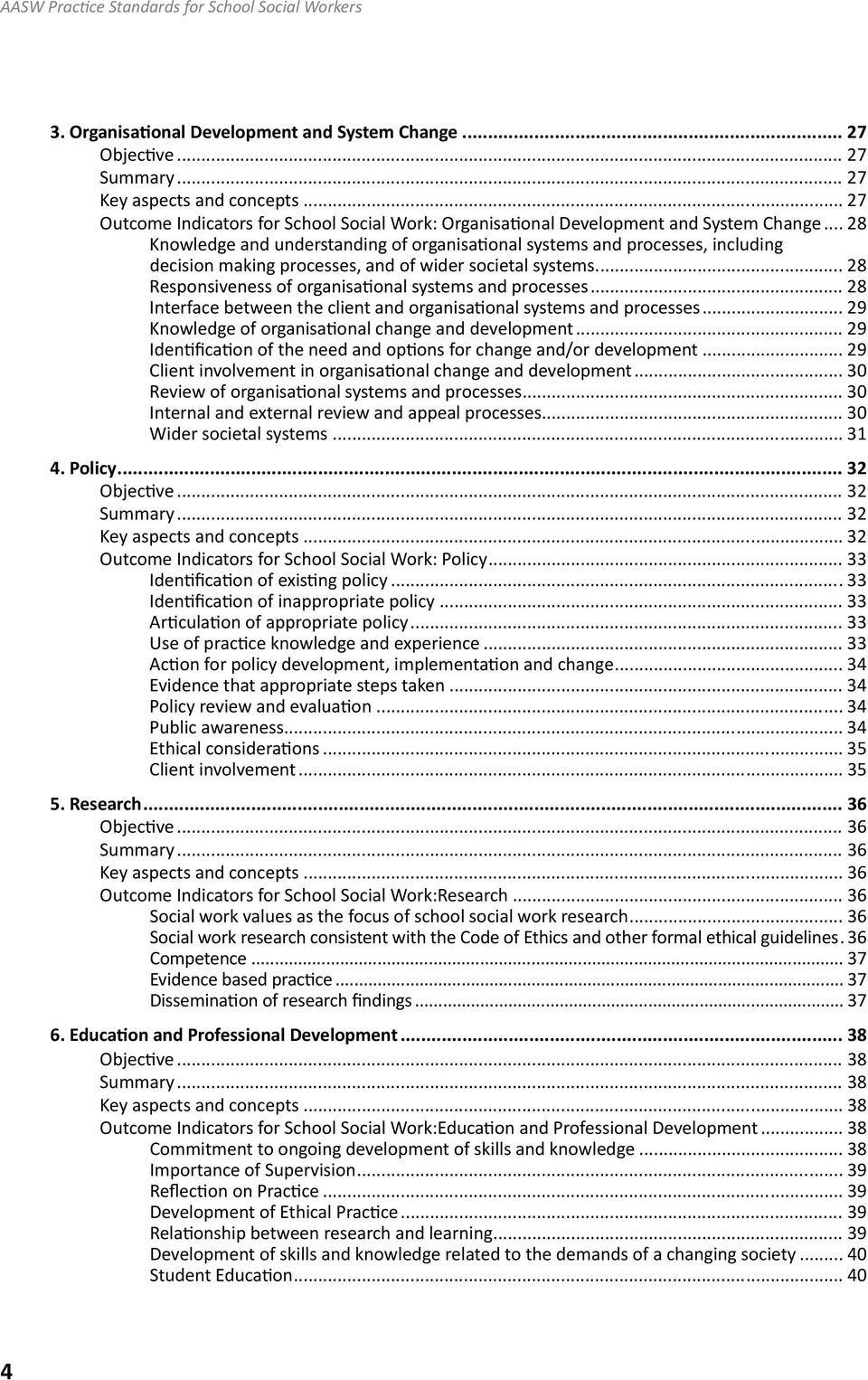
3 Contents Introduction... 5 Aim of Practice Standards... 5 Main areas of social work practice... 5 Format of the standards... 6 Application of the standards... 6 School social work practice... 7 Social Work... 7 School Social Work... 7 Theoretical base of school social work practice... 8 Knowledge and skills base of school social work practice... 9 Common issues in the context of school social work practice Change Personal, social and emotional development Family issues Schooling issues Definitions and understandings Statement of objectives for main areas of school social work practice Direct Practice Objective Summary Key aspects and concepts Outcome for School Social Work:Direct Practice Knowledge, skills and resources of the school social worker Explanation of school social work service Client involvement Appropriateness of school social work assessment, intervention and outcomes Service development Recording and record keeping Report writing Multi disciplinary work environments Supervision Referral /termination/interruption of school social work service Advice of right to query school social work service Evaluation of school social work service Service Management Objective Summary Key aspects and concepts Outcome for School Social Work: Service Management Social work values as the focus of school social work service Agency framework consistent with the AASW Code of Ethics Non-discriminatory policies, practices and resource allocation Adequacy of staff resources and working conditions Teamwork and communication Efficient and accountable social work service Staff supervision Training and professional education and development Debriefing in difficult situations Accountable use of resources Commitment to quality and continuous improvement Agency policies and procedures

4 3. Organisational Development and System Change Objective Summary Key aspects and concepts Outcome for School Social Work: Organisational Development and System Change Knowledge and understanding of organisational systems and processes, including decision making processes, and of wider societal systems Responsiveness of organisational systems and processes Interface between the client and organisational systems and processes Knowledge of organisational change and development Identification of the need and options for change and/or development Client involvement in organisational change and development Review of organisational systems and processes Internal and external review and appeal processes Wider societal systems Policy Objective Summary Key aspects and concepts Outcome for School Social Work: Policy Identification of existing policy Identification of inappropriate policy Articulation of appropriate policy Use of practice knowledge and experience Action for policy development, implementation and change Evidence that appropriate steps taken Policy review and evaluation Public awareness Ethical considerations Client involvement Research Objective Summary Key aspects and concepts Outcome for School Social Work:Research Social work values as the focus of school social work research Social work research consistent with the Code of Ethics and other formal ethical guidelines. 36 Competence Evidence based practice Dissemination of research findings Education and Professional Development Objective Summary Key aspects and concepts Outcome for School Social Work:Education and Professional Development Commitment to ongoing development of skills and knowledge Importance of Supervision Reflection on Practice Development of Ethical Practice Relationship between research and learning Development of skills and knowledge related to the demands of a changing society Student Education
5 Introduction The Australian Association of Social Workers (AASW) School Social Work Special Interest Group (SSWSIG) has developed the standards in this document to describe school social work as a specific field of social work practice and acknowledge the unique contribution that school social work makes to successful educational outcomes for students in Australian school systems. Practice standards describe the interaction between professional knowledge and skills, professional education and organisational environment that nurtures the on-going development of best quality school social work practice. All social work practice is subject to the Practice Standards for Social Workers: Achieving Outcomes (AASW 2003). The Practice Standards for School Social Workers (2008) is firmly based on these standards. The AASW Code of Ethics (1999) and associated By-Laws (2004) provides the foundation for social work practice standards. The values, principles and ethical behaviour detailed in the Code of Ethics underpin all social work practice and, therefore, all of the practice standards in this document. Practice Standards for Social Workers: Achieving Outcomes (AASW 2003), and the AASW Code of Ethics should therefore be used in conjunction with Practice Standards for School Social Workers (2008). The guidelines complement three other key AASW documents and quality mechanisms within the profession. These are: Policy and Procedures for Establishing Eligibility for Membership of the AASW (2000); Continuing Professional Education Policy (2000); and National Practice Standards of the Australian Association of Social Workers: Supervision (1993). Aim of Practice Standards The aim of the standards is to provide: a guide to school social work practice as a special mode of social work practice; an understanding of methods of intervention in school settings; a measure of accountability for school social workers; a basis for the standardisation of school social work practice across Australia; a basis for quality guarantee, expectations and accountability for clients, employing schools and school systems and other professionals; a benchmark for the assessment of school social work practice; a guide for planning on-going improvement in school social work service delivery; a guide for planning ongoing professional development. Main areas of social work practice School social work is a specific field of social work practice, and encompasses the main areas of social work practice within educational settings: Direct Practice Service Management 3. Organisational Development and System Change Policy Research Education and Professional Development. 5

6 Format of the standards The school social work standards have been framed in terms of outcomes. In each of the six main areas of school social work practice there is: an Objective stated as an outcome; a Summary of the essential professional and practice issues and concerns relating to that area of school social work practice; a list of the Key Aspects and Concepts; outcome Standards for each of the key aspects of practice as required by the Practice Standards for Social Workers: Achieving Outcomes (AASW 2003); and of minimum expected school social work performance outcomes. This emphasis on outcomes reflects: the importance of school social workers looking at and evaluating the impact of their practice; and the importance of being able to demonstrate that social work involvement is effective in maximising students learning potential. Application of the standards The standards apply to all school social work practice and are designed to cover a wide range of work situations. Individual school social workers can choose what is most relevant and applicable to their particular work situation and defined role. School social work is a specific field of practice with particular outcomes related to the primary and secondary student as learner on the road to achieving social justice and personal fulfillment through education. However, the social work knowledge and skills base required does not change. A social worker may not be working in an identified school social work position, but for example as a school counsellor, project worker or attendance officer. The school social work standards will apply if the role fits within the definition of school social work used in this document. Otherwise, the social worker will abide by the Practice Standards for Social Workers: Achieving Outcomes (AASW 2003). The six main areas of practice are not discrete and a school social worker may need to call upon knowledge and skills in more than one of these areas in order to deal with a student s situation appropriately. For example, in working with an individual student, a social worker may see that school curriculum or timetabling affecting that student is inappropriate or an impediment to learning. There is then an obligation on the school social worker to take steps in relation to that situation. In this instance, the standards with respect to Direct Practice, Policy and Organisational Development and System Change would provide a guide to the school social worker. The standards provide the expected practice level and expected outcomes. In the example given above, the social worker would not continue to work with the individual client without also taking some steps to address the organisational and policy issues. The standards indicate what those steps should be in outcome terms. 6

7 School social work practice Social Work Social work is the profession committed to the pursuit of social justice, to the enhancement of the quality of life, and to the development of the full potential of each individual, group and community in society. Social workers pursue these goals by working to address the barriers, inequities and injustices that exist in society, and by active involvement in situations of personal distress and crisis. They do this by working with individuals, groups and communities in the pursuit and achievement of equitable access to social, economic and political resources, and by working with individuals towards the realisation of their intellectual, physical and emotional potentials. (About Social Work, AASW, ) School Social Work Definition The school social work role is unique in its focus on the student in the school environment in order to facilitate successful learning outcomes through the relief of distress and removal of barriers or inequities. Students within schools have diverse abilities and needs. All students are entitled to a quality educational environment which: promotes the total development of the child intellectual, physical, social, creative, emotional; and creates learning outcomes which enable the young adult to take a satisfying role in their society and to have fair access to its resources. School social workers have unique access to and ability to work with individuals, groups and communities at the interface between the student, school organisation and curriculum, peers, family, neighbourhood and wider society. Not all social work service delivery in schools can be seen as school social work. A service can be called school social work only if the primary goal is achievement of student learning potential and involve particular methods of working. These include coordinating and influencing the efforts of the school, family and community to achieve this goal. School social workers therefore require knowledge and skills in the six main areas of practice: Direct Practice with students/families/ school personnel School Social Work Service Management School Development and System Change Education, School and other Policy Research into education, family, child/ youth issues Education & Professional Development. Levels of School Social Work intervention Below are some examples of school social work service delivery, although most school social work activities might be called into play at any level: Prevention Parent information and education; development of student welfare policies, guidelines, programs, strategies and activities; provision of professional development for teachers; research into student issues; community service planning. Early Intervention Group work with students with particular needs; development of innovative programs to meet needs; consultation with teachers or families; Implementation of student supports; counselling or casework; review of school issues or policy. Intervention Counselling or casework; referral to other services; consultation with teachers; school policy change; 7
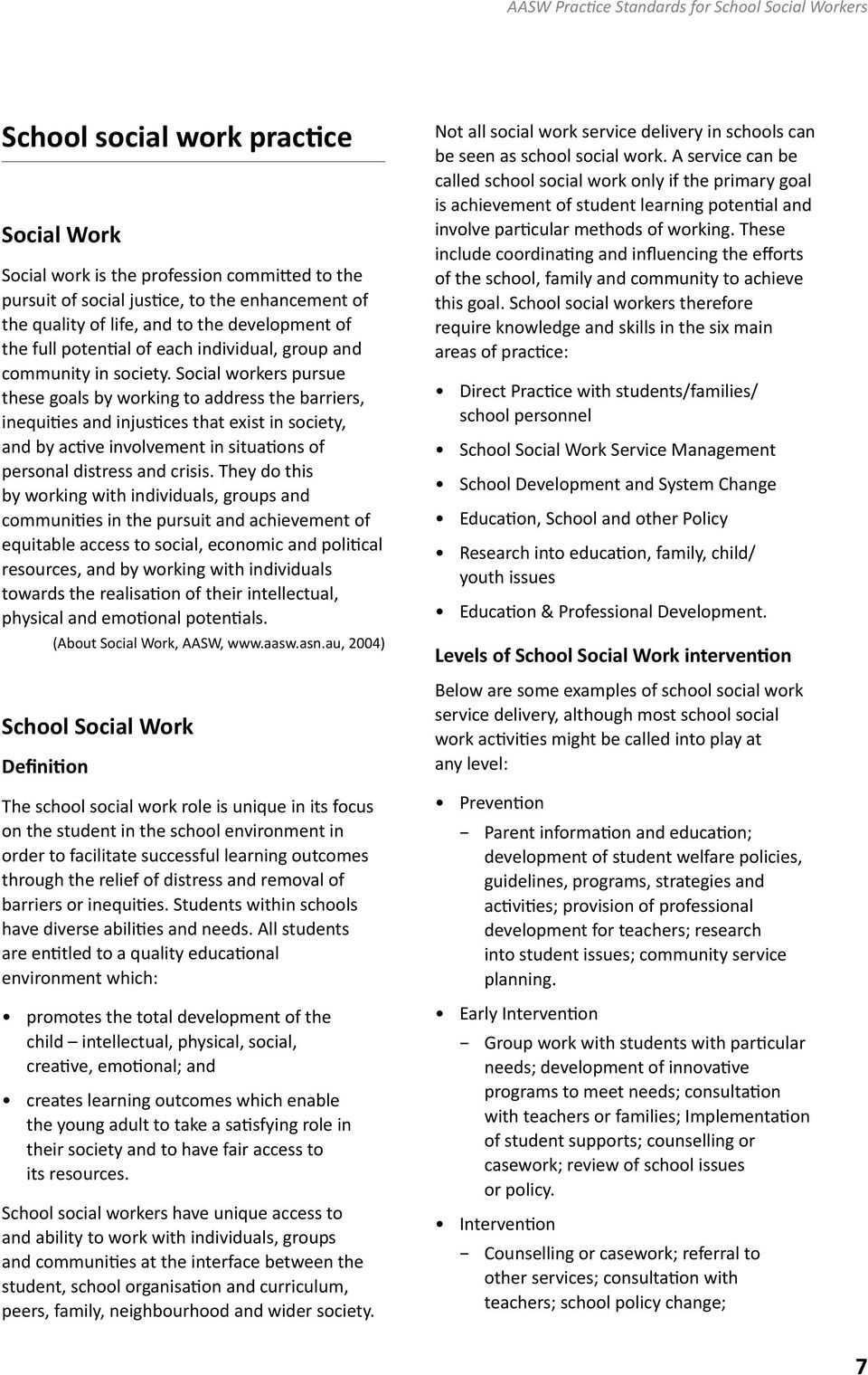
8 individual crisis intervention; community crisis management; critical incident management. School social work has a history of more than 50 years in Australia, and shares its focus with school social work service delivery internationally. School Social Work has over the years responded to social change, new government policy with changed resource environments, and professional theory and practice developments, but has always kept at its core the support of students to achieve their potential in all aspects of academic and personal learning at school. Theoretical base of school social work practice School social workers are required to possess knowledge and understanding basic to the social work profession; specialised knowledge and understanding of the process of education; and knowledge of school and school system policy and regulations. The theory base for school social work is constantly developing through research and knowledge building in social work, school social work and related disciplines. Knowledge from other disciplines is an integral component of social work education and continuing professional development for school social workers. Particular areas of focus are: an understanding of society and how it has developed and is organised. This includes an understanding of the major insights provided by sociology, anthropology, social theory, history, economics and political science and an awareness of how these contribute to the understanding of the politico economic distribution of resources. An understanding of the history of Indigenous Australians is an essential component of this knowledge of society; knowledge of social welfare arrangements, their history and organisation and of the law in Australia. As the goal of social work is the enhancement of the quality of life and the development of the full potential of each individual, family, group and community in society, attention is given to the major groups who experience disadvantage and to those social structures and ideologies which give rise to, and maintain, disadvantage and oppression, particularly those concerning race, ethnicity, culture, gender, age, disability, class and sexual orientation; knowledge of education history, practice and policy. This includes current employer policies and regulations; Federal and State Government legislation which impinges on educational options for students; current 8

9 curriculum and approaches to teaching and learning; the processes of professional teamwork in school settings; various organisation structures and functions and lines of authority within schools and the employing body; knowledge of human behaviour and social environment, including social learning theories; biological factors affecting human growth and development and behaviour; theories of social interaction; the special needs of students with impairments or disabilities; individual and group psychology/therapy; knowledge of psychology regarding the individual, particularly as it relates to the child or young person, including human behaviour and personality development; lifecycle stages, changes and transitions; family and social networks; physical health and illhealth; mental health and illhealth; disability; vulnerability and resilience. An understanding of the social construction of these concepts is another element; knowledge of the value base and core methods of social work intervention: individual and family casework; groupwork; policy development; school and community organisation; research, and how these can be integrated into an eclectic approach to school social work. Knowledge and skills base of school social work practice The school social worker applies social work knowledge and skills to the specific area of social work practice within the school setting. Essential to school social work is the recognition that the individual student s successful outcomes in education are influenced by personal, family, social, political and economic factors. This interactive dual focus of analysis: individual and systemic, private and public, distinguishes the theory and practice of social work from other helping professions. As a specific area of social work practice, school social work practice knowledge necessarily includes: multiple levels of analysis to encompass causal impacts on human life in terms of an ecological systems framework; all methods of generalist social work intervention to address both student difficulties and public issues including: Casework Individual counselling with the child or young person, parent/carer, or school personnel; family counselling; advocacy; consultation; linking students and families to community resources; personal / family crisis intervention. Group work Parent education; therapeutic groups work; personal or social skills education groups for students. Community development Provision of professional development for teachers; social action; liaison with wider community; student welfare, school curriculum and social policy analysis and development. Critical Incident Management Awareness of how people can be affected by traumatic incidents and emergencies; 9

10 planning for school emergency responses; provision of counselling and support; monitoring recovery and evaluation of plans. Research Searching through literature bases for knowledge to inform practice, evaluation of research studies, evaluation of social policy, planning and implementation of research projects, and critical evaluation of the school social worker s own practice. Administration Record-keeping; management; programme development and coordination; evaluation of individual practice and organisational service delivery; staff induction, training and supervision. school social work demands: the specific ability to communicate well with, and particularly to listen to children and young people in order to see their experiences within their world from their perspective; an understanding of child and youth sub-culture impacts; and the ability to advocate for the child or young person within school, family and other systems that are adult dominant; practice skills include: interpersonal and communication skills in child and adult settings; skills in reflective and critical thinking and analysis; data collection and management; negotiation and mediation. Consultation with principals, teachers and other professional workers from community agencies is an essential school social work skill; skills in making assessments and deciding on the most appropriate intervention with which to respond to particular student situations, judgements of this kind being intrinsic to social work; skills in recognising and thinking through ethical issues, again a fundamental component of social work practice, involving commitment to the AASW Code of Ethics; and the contexts of school social work practice at local, national and international levels. Understanding in this area requires knowledge of, and the ability to critically analyse, social, political, economic, historical, cultural and ecological systems, particularly as they impact on school systems and individual student learning outcomes. The processes, facilitators and constraints to school change need to be understood, also the trends or evolutions of school systems. School social workers also need to be able to critically analyse the structure of society, and schools as a socializing institution, with particular attention to dimensions of power and disadvantage, and the influence of class, gender, age, intellectual and physical ability, heterosexism, race, ethnicity and cultural differences. There must be a focus on empowering and nonoppressive practice. 10

11 Common issues in the context of school social work practice Change Transitions In the course of their schooling, students experience multiple changes, for example, as they progress through: stages of childhood and adolescent development; entry into the first years of primary and secondary schooling; transfer into a new school; family separation, changing roles or relocation; reallocation of teachers. The school social worker acts to facilitate a school environment that supports students ability to cope with changes that might influence their ability to settle into their learning environment. Family issues Family poverty Family violence Child abuse and neglect Housing Transience Limited community linkages Alcohol and other drugs Challenging behaviours at school and home Schooling issues Disability Attendance Curriculum Home-school-community links Personal, social and emotional development Grief and loss Family change Personal skill development, e.g. problem-solving, anger management Mental health Juvenile Justice Bullying Anti-social behaviour Trauma and crisis intervention Social relationships Cultural and ethnic differences Refugee students 11

12 Definitions and understandings Client The meaning given to the term client in the AASW Practice Standards for Social Workers (2003) and Code of Ethics (1999) is: individuals, groups, communities, organisations and societies, especially those who are neglected, vulnerable, disadvantaged or have exceptional needs. As the focus of school social work attention, the student is the client. Where service is requested by the school or the family, they are not the clients, but rather the systems which the school social worker may attempt to change in order to support the student. Where children are below the age where they are considered old enough to make informed decisions in the matter, they become clients only with parental permission, and the school social worker is accountable to both the student and the family. Young people who are considered able to make their own informed decisions may be clients with or without parental permission and contact. Cultural influences In any client situation and in any of the main areas of social work practice, the social worker will be aware of cultural considerations and influences and respond appropriately. School A government or non-government educational setting for students in Years 1 to 12, and in the year prior to Year 1 where that is provided by the particular school system. School social work School social work refers to social work services delivered in a school setting, the primary goal of which is the achievement of students learning potential, and where the methods of working include coordinating and influencing the efforts of the school, family and community to achieve this goal. Student support service The general term student support service is used throughout this document to refer to a school social work service, or to the professional activities of a multidisciplinary team, including school social workers, in the school sector, to enhance student health, well-being and learning outcomes. Supervision The provision of supervision for staff is customary practice in all welfare agencies and clinics. Due to the frequent exposure to distressing information in wellbeing practice, the provision of formal supervision is an Occupational Health and Safety issue for all professionals employed in a welfare capacity. Supervision is a confidential and structured conversation between workers. It involves elements of debriefing, counseling, guidance, reflection, leadership and review of work practices. Consequently, someone qualified and trained in supervision should provide it. Supervision for all social work students and new graduates in educational settings is to be provided by a school social worker. Experienced social workers may use their own discretion in their choice of supervisor. The aim of supervision is to ensure a worker maintains a high level of professional practice. It provides an opportunity for early detection of potential poor practice, stress and career fatigue. In the welfare field, supervision is not a process of instruction or direction as the term may suggest to those not trained in welfare and mental health. Good professional practice requires life long learning, hence supervision is a central element in ongoing professional development. 12

13 Student services casework provides exposure to confronting and disturbing information, behaviour and emotions. Supervision provides a safety net and an opportunity for re-establishing workers sense of balance and mental well-being. The nature of casework is highly confidential. A private and confidential structure should exist to contain casework issues and still allow in depth discussion to occur. Student A child or young person legally mandated to be enrolled in education, or any young person or adult enrolled or wishing to be enrolled in a school programme. Statement of objectives for main areas of school social work practice Objective 1: Direct Practice The outcome of direct school social work practice is that: needs of school students are met; their potential is developed; their learning outcomes are maximised; and their control over their lives is fostered; this being achieved through mutual engagement with the student, the family and school as appropriate, and the application of the school social worker s knowledge and skills. Objective 2: Service Management Student needs, organisational goals and community expectations of the student support service are met in the most appropriate manner, as far as possible, incorporating social work knowledge, skills and resources. Objective 3: Organisational Development and System Change The school social worker s knowledge of educational systems and processes and societal systems is applied in such a way that inequalities are identified and appropriate action is taken, with the result that social barriers, inequality and injustice are reduced. Objective 4: Policy The well-being of students, especially those who are neglected, vulnerable, disadvantaged or who have exceptional needs, is improved through the school social worker s: promotion and implementation of policies and practices which would achieve a fair, equitable and effective allocation of social resources; and 13

14 identification of inappropriate or inequitable policy goals and outcomes. Objective 5: Research Student needs, organisational goals, and social policy, are addressed through the application of the school social worker s values, knowledge and skills in the research process. Objective 6: Education and Professional Development The school social worker recognises the importance of continually increasing their knowledge and skills and is committed to a process of continuing education. 14

15 PRACTICE STANDARDS for School Social Workers

16 1. Direct Practice Objective The outcome of direct school social work practice is that: needs of school students are met; their potential is developed; their learning outcomes are maximised; and their control over their lives is fostered; this being achieved through mutual engagement with the student, the family and school as appropriate, and the application of the school social worker s knowledge and skills. Summary The direct practice standard concerns every aspect of direct school social work. It draws on all of the core areas of social work knowledge and skills but focuses on: Key aspects and concepts 1. knowledge, skills and resources of the school social worker 2. explanation of school social work service 3. client involvement 4. appropriateness of school social work assessment, intervention and outcomes 5. service development 6. recording and record keeping 7. report writing 8. multi disciplinary work environments 9. supervision 10. referral /termination/interruption of service 11. advice of right to query service 12. evaluation of social work service methods of intervention; interpersonal and communication skills, reflective thinking, critical thinking and analysis, data collection and management, consultation, negotiation and mediation; and making assessments and deciding on the most appropriate social work intervention with which to respond to a particular student s situation. It is essential that the student and/or family be as fully involved as possible in decisions about the school social work service provided, and in regular review of that service. Confidentiality requirements, report writing and record keeping must be managed appropriately. Key concerns in direct practice are the provision of information to the student and/or their family where appropriate, regarding client rights (such as the right to refuse, appeal or query a service); the cessation of a service to the student; the transfer or referral of a student and/or family to another service; and responsibilities to meet ethical requirements (for example in the case of disclosures of abuse, or risk of harm). 16

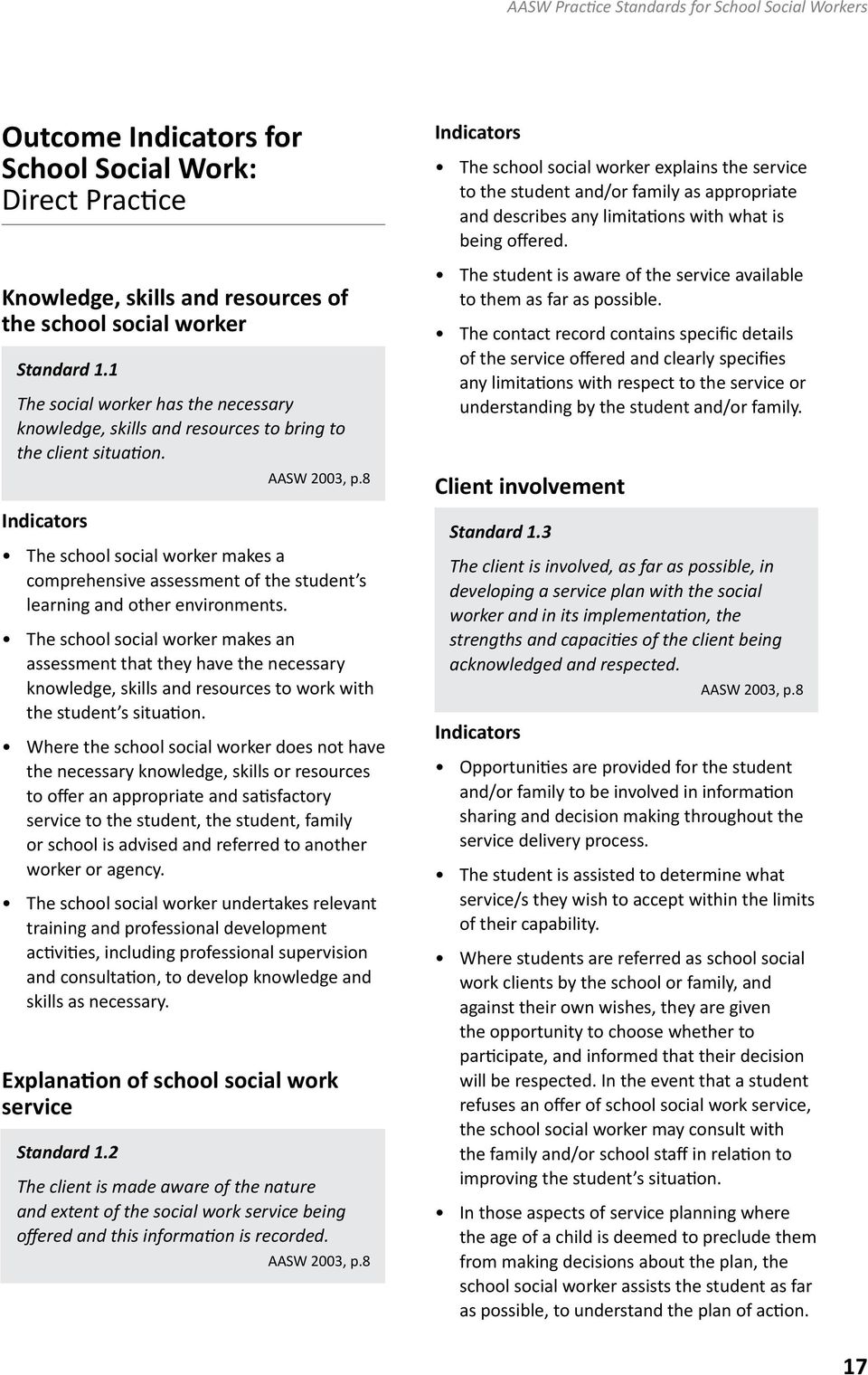
17 Outcome for School Social Work: Direct Practice Knowledge, skills and resources of the school social worker Standard 1.1 The social worker has the necessary knowledge, skills and resources to bring to the client situation. AASW 2003, p.8 The school social worker makes a comprehensive assessment of the student s learning and other environments. The school social worker makes an assessment that they have the necessary knowledge, skills and resources to work with the student s situation. Where the school social worker does not have the necessary knowledge, skills or resources to offer an appropriate and satisfactory service to the student, the student, family or school is advised and referred to another worker or agency. The school social worker undertakes relevant training and professional development activities, including professional supervision and consultation, to develop knowledge and skills as necessary. Explanation of school social work service Standard 1.2 The client is made aware of the nature and extent of the social work service being offered and this information is recorded. AASW 2003, p.8 The school social worker explains the service to the student and/or family as appropriate and describes any limitations with what is being offered. The student is aware of the service available to them as far as possible. The contact record contains specific details of the service offered and clearly specifies any limitations with respect to the service or understanding by the student and/or family. Client involvement Standard 1.3 The client is involved, as far as possible, in developing a service plan with the social worker and in its implementation, the strengths and capacities of the client being acknowledged and respected. AASW 2003, p.8 Opportunities are provided for the student and/or family to be involved in information sharing and decision making throughout the service delivery process. The student is assisted to determine what service/s they wish to accept within the limits of their capability. Where students are referred as school social work clients by the school or family, and against their own wishes, they are given the opportunity to choose whether to participate, and informed that their decision will be respected. In the event that a student refuses an offer of school social work service, the school social worker may consult with the family and/or school staff in relation to improving the student s situation. In those aspects of service planning where the age of a child is deemed to preclude them from making decisions about the plan, the school social worker assists the student as far as possible, to understand the plan of action. 17
18 A service delivery plan is prepared with the student wherever possible. The plan outlines service/s being offered, objectives and planned outcomes, how these are to be achieved and the reasons for their inclusion in the plan. The plan includes provision for regular review of progress, noting the outcomes of each review and inclusion of any decisions to amend, remove or add new aims or outcomes and ways in which these are to be achieved. Appropriateness of school social work assessment, intervention and outcomes Standard 1.4 The social work assessment and the intervention taken is appropriate to the client situation, in keeping with ethical and legislative requirements and directed towards appropriate outcomes reached in agreement with the client wherever possible. AASW 2003, p.9 Relevant information is gathered regarding the student s situation. The student s situation is assessed including identification of relevant: physical factors such as developmental history, health and well-being; social factors including immediate and extended family, other significant relationships including friendships, relationships with peers and adults at school, social contacts and supports, cultural factors, experience of discrimination, oppression and community involvement; psychological factors, including developmental and life span factors, family history, significant life events, grief and loss, exposure to violence, abuse or neglect; educational factors, including academic progress, schooling history, specific learning needs, disability, particular strengths, preferred learning styles, personal educational goals; environmental factors, including school, sport, recreation, employment, finances, accommodation and other services with which the student is in contact; legal, education, health, employment and social security systems which impact on or with which the student is involved; and personal and other resources that might be drawn on in the situation. The nature and level of risk for the student, the school social worker and others is assessed, and appropriate intervention is taken in relation to the level of risk. The student s understanding of the situation and their strengths to deal with it are assessed. The school social worker acknowledges and respects the strengths and capacities of the student in the mutual development of the assessment and plan. Appropriate social work and school social work knowledge and theory is identified as a basis for offering a school social work service. Likely or possible outcomes of the service/s offered are identified, discussed with the student and agreed to as far as possible. Legislative and organisational requirements and considerations are identified and explained to the student. As appropriate, relevant others are involved in, or advised of, the proposed plan. Service development Standard 1.5 The school social worker is aware of the relationship between the client and their social environment and takes appropriate action. AASW 2003, p.9 18

19 The school social worker takes appropriate steps to address school, family and other system change to the extent that is practical and possible. The school social worker identifies policy issues and contributes to policy development and change to the extent that is practical and possible. The school social worker contributes knowledge and skills to the planning and development of appropriate student support and welfare services to the extent that is practical and possible. Recording and record keeping Standard 1.6 Records are kept and maintained in accordance with ethical principles and the relevant legislation regarding record keeping, privacy and freedom of information provisions relevant to the jurisdiction in which the social work service is being offered. AASW 2003, p.10 A relevant record keeping system is in place. Records are kept in accordance with the provisions of the AASW Code of Ethics. Records are kept in accordance with relevant legislation and school system or individual school policy. In the absence of legislation, records should be kept and stored securely for seven years. The student and/or family are aware of who might see or use the records. Requests for access by the student and/ or family to their records are dealt with promptly and appropriately according to appropriate policy and legislation. The family has access to a student s records consistent with privacy and other legislation, which may allow the student who is deemed able to make their own informed decisions about their situation and service plan, or who is above a certain age, to restrict their family s access to the records. The student has access to their record and given the opportunity to have their comments recorded. Where this is not possible or feasible, the reason is explained, including the extent to which the limitation applies. Where part of a record is not shown to the student, the reason is explained, including the extent to which the limitation applies. Report writing Standard 1.7 Reports accurately and objectively reflect client circumstances, in keeping with ethical principles and legislative provisions. AASW 2003, p.10 Reports contain only information essential to the matters relevant to the purpose of the report. Reports have not omitted relevant and pertinent information. Information is presented in an objective manner, with assessments, recommendations and decisions supported by relevant information. Legislative implications and/or requirements are clearly identified and stated, together with any associated client information and/or action to be taken. The student and/or family is shown the report and given the opportunity to comment. Where this is not possible or feasible, or where part of a report is not shown to the student and/or family, the reason is explained, including the extent to which the limitation applies. Limitations may be due to legislative or school system or individual school policy. 19

20 Multi disciplinary work environments Standard 1.8 Within the multi-disciplinary team, the social worker maintains social work principles, values and practice whilst acknowledging the practice base of other disciplines. AASW 2003, p.10 The school social worker can articulate the domain of social work practice, and the specific field of school social work practice, within a host environment where education is the core goal, and teaching is the key profession. The school social worker manages a complex professional relationship with school personnel who might simultaneously represent the referral source, the school social worker s employing system and target system for change and development. The school social worker contributes discipline specific social work values, principles and practice; acknowledges those that are shared; and respects those of others in team activities. The school social worker negotiates respectfully with colleagues from other disciplines, for example: teaching, psychology, speech pathology. Supervision Standard 1.9 The social worker recognises the need for supervision and, when necessary, obtains advice. AASW 2003, p.11 Supervision, consultation and advice are sought from an appropriate person when necessary in relation to specific client situations. There is regular participation in supervisory processes within or outside the employing agency or organisation or, in the case of a private or lone practitioner, from an appropriate source. Supervision is utilised as part of professional development to enhance knowledge and skills in direct practice. Social workers providing supervision to school social workers in relation to direct practice are appropriately experienced and qualified and are given supervision training. Referral /termination/interruption of school social work service Standard 1.10 When necessary, the social worker recognises the need for, and arranges a referral to, a relevant service provider and/or for termination of the social work service; and, where service is interrupted for some reason, puts in place appropriate interim service or other arrangements. AASW 2003, p.11 The school social worker encourages the student and/or family to play a central role in the referral process. The school social worker provides information for the student and/or family to allow maximum choice in the decision making regarding referral. The school social worker recognises when the service no longer serves the interests or needs of the student. When the service appears not to serve the interests of the student, this is raised with the student and/or family and the professional relationship or service is renegotiated or terminated. Where necessary, other relevant options to meet student needs are identified and/or provided and the student and/or family is 20

21 assisted in considering and/or transferring to one or more of these. Where a social work service is interrupted for some reason, this is discussed with the student and/or family and an appropriate interim service or other arrangements put in place. Where necessary the school social worker brings to the attention of the manager or school principal the need for appropriate service to be put in place. Advice of right to query school social work service Standard 1.11 The social worker advises the client of their right to query the service provided and the avenues and procedures to follow if the client wishes to do so. AASW 2003, p.11 The student and/or family are advised of the right to query the level or appropriateness of the school social work service provided and the procedures for doing this are explained. If any concerns are raised by the student and/ or family during provision of the school social work service, they are reminded of this right and how they might proceed. When appropriate, information regarding the school social work service and client rights in relation to the service are provided to the student and/or family in a written form at their initial contact with school social worker. Evaluation of school social work service Standard 1.12 The social worker seeks feedback from the client in the evaluation of service provision and uses this to improve future practice. AASW 2003, p.12 Progress and service provision is regularly reviewed with the student and/or family. Feedback is sought and obtained from the student and/or family by interview or questionnaire at the conclusion of the provision of service. Regular reviews of progress, as well as a final review, are included in the service plan developed in consultation with the student and/or family Feedback from the student and/or family is reviewed and professional practice or service provision changed when appropriate. 21
22 2. Service Management Objective Student needs, organisational goals and community expectations of the student support service are met in the most appropriate manner, as far as possible, incorporating social work knowledge, skills and resources. Summary All school social workers, regardless of their organisational position or the context of their practice, have a responsibility to: manage their own service provision and school social work practice in a way which is consistent with these standards; and influence the operation of the student support service so that it supports models of service delivery that are consistent with these standards. This dual responsibility requires at all times management of one s own professional practice, and may involve management of staff and other agency resources. In this sense, all school social workers are social work managers, and have personal and organisational responsibility to work towards the best quality school social work service delivery within a student support service. Key aspects and concepts social work values as the focus of school social work service service framework consistent with the AASW Code of Ethics non-discriminatory policies, practices and resource allocation adequacy of staff resources and working conditions teamwork and communication efficient and accountable school social work service staff supervision training and professional education and development debriefing in difficult situations accountable use of resources commitment to quality and continuous improvement agency policies and procedures 22
23 Outcome for School Social Work: Service Management Social work values as the focus of school social work service Standard 2.1 The social work manager encourages the agency to develop policies consistent with the five basic values of social work practice: human dignity and worth, social justice, service to humanity, integrity, and competence. AASW 2003, p.13 The five social work values are clearly articulated in all service mission statements and business plans. Polices and procedures are developed and implemented that reflect social work values and principles. The student support service head and senior managers have knowledge of the values and principles of social work. Agency framework consistent with the AASW Code of Ethics Standard 2.2 The social work manager acquaints agency management with the AASW Code of Ethics and its implications for social work practice. The agency head is encouraged to recognise the principles and objectives of the Code and to eliminate workplace factors that prohibit or constrict adherence to its terms. AASW 2003, p.14 The student support service head is aware of the Code of Ethics, its principles, objectives and implications for each service unit. Processes are in place to eliminate or reduce workplace factors prohibiting or constricting adherence to the Code of Ethics. Non-discriminatory policies, practices and resource allocation Standard 2.3 The social work manager encourages nondiscriminatory policies and practices and advocates for resources to meet client rights and needs. AASW 2003, p.14 Service policies are reviewed regularly and discriminatory policies and practices identified. Non-discriminatory policies and practices are developed and implemented. Client-focused practices are encouraged that ensure: students and/or families participate in decision-making processes; and students and/or families have access to information. Processes are in place that aim to address student and/or families needs and/or preferences. Adequacy of staff resources and working conditions Standard 2.4 The social work manager advocates to obtain and maintain adequate staff levels and acceptable working conditions. AASW 2003, p.14 23
24 Student support service management ensures that processes are in place to regularly review staffing level requirements. Consistent efforts are made to establish and maintain required staffing levels. The student support service head and senior managers have excellent understanding of the breadth of school social work methods, and support programme policy that provides suitable guidelines for the balance of individual casework, groupwork, community development, administration and research: Where a school social worker is engaged in individual casework only, the caseload should not exceed an average of 5 clients per day; or the school social worker should not spend more than five hours per day contact time with students and/or their families. Casework involves meetings with students and/or their families, phone contact with parents and other workers involved with the family, liaison with and referral to other agencies, consultation with principals and teachers, coordinating meetings at the school or elsewhere, advocating on behalf of the student, information gathering and creating linkages with community resources, case notes and report-writing. Adequate time should be allowed for the planning of group work, research and community development activities. Adequate time should be available for record-keeping, administrative responsibilities, networking with local agency workers in the development of community service provision, meeting with other school social workers within the student support service and across the school systems, attending AASW meetings and school social work conferences Processes are implemented to ensure that acceptable working conditions are in place, including: occupational health and safety requirements; interview rooms with appropriate privacy, own workstation, appropriate office furniture including own personal desk, computer, and internet, phone and administrative support; access to a student support service vehicle and reimbursement for all work related travel. Planning ensures the availability of working conditions appropriate for engaging students in the process of school social work, especially private and suitable interview rooms. Teamwork and communication Standard 2.5 The social work manager promotes effective teamwork and communication. AASW 2003, p.14 Effective and accountable communication systems are identified that are relevant to the service s internal and external business. Effective communication systems are implemented and regularly reviewed. The value of teamwork is promoted among the school social workers and across the student support service. Strategies for effective teamwork are identified and implemented. Efficient and accountable social work service Standard 2.6 The social work manager takes responsibility for delivering an efficient and accountable service. AASW 2003, p.15 personal and organisational Efficient and effective service systems are identified. 24
25 The school social worker advocates ensuring that efficient and effective service systems are implemented. Processes for accountability to the organisation and the profession, including evaluation, program development and professional review of practice, are identified and implemented. There is appropriate and efficient use of work time. Staff supervision Standard 2.7 The social work manager arranges or advocates for appropriate supervision of staff. AASW 2003, p.15 A formal induction programme is in place to facilitate the orientation of new school social workers to the student support service. Processes are in place to ensure that all professional supervision needs are identified in consultation with school social work staff. A supervision plan is developed for each school social worker and implemented with input from the worker and the supervisor. Processes are in place for meeting professional supervision needs. School social work staff receive appropriate and regular supervision. Processes are established to ensure that school social work staff professional education and training needs are identified on an annual basis. Resources are identified that meet education and training needs. School social work staff education and training needs are addressed. School social work staff are encouraged to pursue post-graduate training opportunities where possible. Debriefing in difficult situations Standard 2.9 The social work manager provides or arranges debriefing and crisis and/or ongoing support for staff when they experience difficult or traumatic circumstances during the course of their work. AASW 2003, p.15 School social work staff support needs are identified. School social work staff debriefing needs are identified. Debriefing is provided in a timely manner according to the circumstances. School social work staff support needs are routinely addressed within the organisation. Training and professional education and development Standard 2.8 The social work manager ensures that all staff receive ongoing training and professional education and advocates for adequate resources to meet staff development needs. AASW 2003, p.15 Accountable use of resources Standard 2.10 The social work manager uses finances and other agency resources for the purposes for which they are granted and accounts accurately for their expenditure. AASW 2003, p.16 25
26 School social work service delivery budget systems are clearly articulated and specific items of expenditure identified. School social work service delivery budget and other resource requirements and processes are clearly identified, accounted for and open to scrutiny. School social work service delivery budget and other resource expenditure is clearly identified. Processes are established to ensure changing school social work service delivery budget and other resource requirements are identified and addressed in a timely manner. Commitment to quality and continuous improvement Standard 2.11 The social work manager ensures a commitment to continuous quality assurance and improvement and practice research. AASW 2003, p.16 Outcomes of practice research and quality improvement in school social work are implemented. Agency policies and procedures Standard 2.12 The social work manager ensures that policies and procedures are documented and are accessible. AASW 2003, p.16 Policies and procedures in school social work service delivery are documented. Policies and procedures in school social work service delivery are available to all staff, clients and other relevant parties. Policies and procedures in school social work service delivery are reviewed and updated as needed. Policies and procedures in school social work service delivery conform to relevant legislation. Strategies required for quality assurance and continuous improvement in school social work service delivery are identified. Issues requiring quality improvement in school social work service delivery are identified. Quality assurance and improvement activities in school social work service delivery are documented. Strategies needed to undertake practice research in school social work are identified. Resources required for practice research in school social work are identified and allocated. Practice research in school social work is undertaken as an integral part of ongoing practice. 26
27 3. Organisational Development and System Change Objective The school social worker s knowledge of educational systems and processes and societal systems is applied in such a way that inequalities are identified and appropriate action is taken, with the result that social barriers, inequality and injustice are reduced. Summary This standard encompasses organisational systems and processes in: government and non-government educational organisations other organisations with which the school social worker and clients come into contact; and wider societal systems such as health, legal, welfare, recreation and religious systems. It is expected that the school social worker will have knowledge and understanding of organisational systems and processes, be able to identify those in the educational context and to analyse their effect, both positive and negative, with respect to clients. The school social worker may identify the need for change and must then be able to take appropriate and reasonable steps towards this, demonstrating knowledge of change management processes and appropriate organisational development approaches. The ability to involve and empower clients appropriately and ethically in organisational change and development is an important consideration. Where organisations and systems other than those in which a school social worker works are involved, the school social worker will identify appropriate people and mechanisms through which to channel concerns or initiate change. It is recognised that the organisations and systems with which a school social worker works are complex and dynamic, requiring the school social worker to draw on a range of knowledge and skills with some depth of capacity if they are to practise effectively. It is not expected that the school social worker will do this alone but that they do have the ability to work with others to initiate change and achieve improved outcomes for the client. The standard does not encompass policy aspects of organisational systems and processes as these are included in the policy standard. Key aspects and concepts knowledge and understanding of educational systems and processes, including decision making processes, and of wider societal systems analysis of the responsiveness of educational systems and processes in meeting student and/or family needs and the effect of these on students and/or families facilitation of the interface between students and/or families and educational systems and processes knowledge and understanding of organisational change and development identification of the need and options for change and/or development initiation of appropriate action for change and/or development appropriate involvement of students and/or families in the organisational change and/or development review of relevant organisational systems and processes within the organisation in which the school social worker works or with which the school social worker and their clients come into contact use of internal organisational review, complaint and appeal processes and 27
28 administrative decision review processes, as well as Freedom of Information (FOI), confidentiality and privacy provisions where they apply identification of the need for change in wider societal systems and raising of this appropriately for consideration and possible action by the AASW or other relevant bodies. Outcome for School Social Work: Organisational Development and System Change Knowledge and understanding of organisational systems and processes, including decision making processes, and of wider societal systems. Standard 3.1 The social worker demonstrates knowledge and understanding of organisational systems and processes and of wider societal systems. AASW 2003, p.18 The school social worker is able to outline key systems and processes in the educational organisation in which they work, which affect, or have the potential to affect, the well-being of students and/or families; and in wider societal systems, especially those related to the educational organisation or functions of the educational organisation, and how these impact on clients in terms of access to services, social justice and distribution of resources to meet needs. The school social worker is able to give examples of several broad societal systems and outline their role and general systems and processes, within the context of social work values, principles and practice. Responsiveness of organisational systems and processes Standard 3.2 The social worker has made an analysis of organisational systems and processes and the extent to which these are responsive to the needs of the client. AASW 2003, p.18 28
29 Key educational organisational systems and procedures including eligibility criteria; application processes; referral procedures; guidelines; decision making, review and appeal processes; interview and other administrative proformas; other relevant formal and informal practices and procedures, including attitudes and values which underpin these, and related organisational structures are identified. The school social worker has made an analysis of these and is able to explain how they impact on students and/or families, identifying those which are responsive to student and/or family needs and how as well those which are not and why this is so. Interface between the client and organisational systems and processes Standard 3.3 The social worker works with the client and the organisation(s) so that the client receives the most appropriate and effective service from the organisation. AASW 2003, p.18 The school social worker works with students, families and staff in the school and other relevant organisations so that appropriate, easily accessible information regarding the organisations and their functions and procedures is available to clients. The school social worker informs relevant school staff about the functions and procedures of other organisations in order to allow the direct referral of students and/or families when appropriate. Appropriate channels for communication between students and/or families and other organisations are identified and facilitated. The school social worker facilitates consideration for any difficulties so that improvements can be made by the organisation(s) and/or explanation of limitations of the service can be given to the student and/or family. The social worker promotes and contributes to the development and use of routine, ongoing client feedback processes of the organisation(s). Knowledge of organisational change and development Standard 3.4 The social worker demonstrates knowledge and understanding of organisational change and development processes. AASW 2003, p.19 Key elements of school and other organisational change are identified. A number of school and other organisational development processes are identified. The school social worker is able to give examples of school and other organisational change and development processes of which they are aware or in which they have been involved. Identification of the need and options for change and/or development Standard 3.5 The social worker is able to identify when change is needed and ways in which appropriate change might be achieved as well as actively contribute to the change process. AASW 2003, p.19 The school social worker demonstrates the capacity to identify, consult and negotiate change where issues of access to services, 29
30 equitable, fair and just processes and social justice arise. Information from the school social worker s analysis of organisational responsiveness to student and/or family needs is reviewed and areas for change are identified. Other sources of relevant information are identified. Management analysis of student and/or family feedback information is encouraged and the school social worker actively seeks to have this information reviewed and acted upon. Where necessary and appropriate, the need for further information gathering or research is identified, negotiated with management and arrangements for this to be undertaken are made. Options for school and other organisational change and development, including training and development, changes in guidelines and procedures and ways to achieve cultural change, are put forward and the school social worker actively contributes to, and participates in, the change processes. Client involvement in organisational change and development Standard 3.6 The social worker identifies when and how to involve clients in matters relating to organisational change and development. AASW 2003, p.19 Appropriate ways of involving students and/ or families in school and other organisational review, change and development processes are identified. The school social worker demonstrates the capacity to develop or contribute to these and to their implementation. Students and/or families are involved appropriately. Ethical considerations are identified and managed appropriately. Students and/or families are provided with feedback on the outcomes. Review of organisational systems and processes Standard 3.8 The social worker is able to initiate and/or contribute to the review of organizational systems and processes in the organisation in which they work or with which the social worker and their clients come into contact. AASW 2003, p.20 The school social worker promotes regular review of school and other organisational systems and procedures. The school social worker contributes to the development of the review process, promoting student and/or family involvement, participates in the review process and contributes to the analysis of findings and development of plans for change. Internal and external review and appeal processes Standard 3.9 The social worker is aware of, and assists clients to make appropriate use of, internal organisational review, complaint and appeal processes, as well as external administrative and other appeal processes when relevant. AASW 2003, p.20 30
31 Appropriate decision making, review, complaint and review processes are promoted within the school. The school social worker ensures that clients are provided with information regarding school and other organisational decision making, review and appeal and complaint processes, as well as FOI, confidentiality and, where they apply, privacy provisions; The school social worker is aware of external administrative law and other appeal and review processes, provides the client with relevant information regarding these and assists the client to access them. Wider societal systems Standard 3.10 The social worker identifies the need for change in wider societal systems and raises this appropriately for consideration and possible action. AASW 2003, p.20 The need for change is raised with other social workers in those systems and for consideration by the AASW and other relevant bodies. 31
32 4. Policy Objective The well-being of students, especially those who are neglected, vulnerable, disadvantaged or who have exceptional needs, is improved through the school social worker s: promotion and implementation of policies and practices which would achieve a fair, equitable and effective allocation of social resources; and identification of inappropriate or inequitable policy goals and outcomes. Summary This standard applies in all school social work practice contexts. The school social worker should identify the policy which underpins the educational context in which they work and, if this is not consistent with social work values and principles and client needs and does not address evident social justice principles and issues, or does so inappropriately or inadequately, take steps to bring this about as far as possible. The effects of the implementation of policy should also be reviewed regularly and steps taken to achieve appropriate changes when necessary. The standard incorporates the following: policy underpinning social work services in schools; broader internal organisational policy in schools; policy which underpins government and non government school programs and services; and policy in the public domain relating to social needs, social justice and human rights issues. contexts and in the broader community which are not consistent with social work values and principles, client needs and social justice principles. Key aspects and concepts consistency with social work values and ethical base identification of existing policy identification of inappropriate policy articulation of policy reflecting student and/ or family needs and social justice principles and issues policy draws from social work practice knowledge and experience initiation of action to change and/or develop policy acceptance and implementation of appropriate policy review of policy and outcomes of its application public awareness of student and/or family needs and social justice and human rights issues ethical considerations student and/or family involvement as appropriate The standard refers to policy relevant to the school social worker s practice context. It also expects that the school social worker will have a wider capacity to identify and take appropriate action in relation to aspects of policy in other 32
33 Outcome for School Social Work: Policy Identification of existing policy Standard 4.1 As part of their practice, the social worker identifies the policy context in which they work and determines whether it is consistent with social work values and principles. AASW 2003, p.22 The school social worker is able to identify the main policy issues and provisions relevant to the school context. The school social worker is able to identify when the main policy provisions relevant to the school context impact on students and/ or families in a way which is inconsistent with social work values and principles and the reason(s) for this. Identification of inappropriate policy Standard 4.2 The social worker identifies aspects of policy, relating to their practice context, which are inappropriate, inconsistent or inadequate and is able to explain why this is so. AASW 2003, p.22 Indicator Policy which is inappropriate, inconsistent or inadequate is identified and appropriate reasons for this given. Articulation of appropriate policy Standard 4.3 In their practice context, the social worker is able to articulate policy appropriate to that context which reflects social work values and principles, client needs and social justice principles and issues. AASW 2003, p.22 Appropriate policy issues are identified. The school social worker is able to explain the rationale behind the policy and its appropriateness. Where policy issues are under consideration/ need to be addressed, the school social worker is able to identify appropriate options. The school social worker is able to explain the options and the rationale, benefits and possible outcomes of these. Use of practice knowledge and experience Standard 4.4 The social worker draws from practice knowledge and experience in identifying appropriate policy for their practice context. AASW 2003, p.22 The school social worker has identified policy issues arising from their practice knowledge and experience. These have been considered in relation to existing policy and issues remaining to be addressed have been identified. 33
34 Action for policy development, implementation and change Standard 4.5 Appropriate action is initiated by the social worker for the development, implementation and/or change of policy in their practice context. AASW 2003, p.23 Indicator The school social worker has: raised the issues within the school context for further consideration; researched or encouraged further research of the issues if needed; proposed an approach or approaches which might be taken to address the issues, including further research of the issues, consultation with relevant others and the development of appropriate policy options; and maintained an appropriate active involvement to promote the implementation of appropriate policy. Evidence that appropriate steps taken Standard 4.6 The social worker has taken relevant and reasonable steps to have appropriate policy developed, accepted and implemented. AASW 2003, p.23 Indicator There is evidence that the school social worker has taken appropriate, reasonable steps to address policy issues. Policy review and evaluation Standard 4.7 Provision is made for the review and evaluation of policy and its outcomes and this is undertaken in a timely manner. AASW 2003, p.23 The need to review and evaluate policy and its outcomes is recognised by the school social worker. The school social worker seeks to establish and/or advocates for appropriate mechanisms and plans to be put in place in the school context. Review processes, documents and consideration of the outcomes are evident. Public awareness Standard 4.8 The social worker contributes to increasing public awareness of client needs and social justice issues generally and in specific circumstances when they arise. AASW 2003, p.23 The school social worker contributes to public awareness raising initiatives within the school context. The school social worker identifies needs and issues for consideration and possible action by the AASW and other relevant bodies. When the opportunity arises, the school social worker responds to requests for information and comment on policy issues. 34
35 Ethical considerations Standard 4.9 The social worker is able to identify circumstances in which policy requirements or directions in their practice context raise social work ethical issues and is able to deal with this appropriately. AASW 2003, p.24 The school social worker recognises an ethical issue when it arises. The school social worker raises the matter within the school and proposes solutions. If the issue remains, the school social worker consults with social work colleagues to seek other possible solutions or seeks the advice and assistance of the AASW. If the issue is sufficiently serious and remains unresolved, the school social worker determines whether remaining in the situation would place them in an unacceptable position with respect to the Code of Ethics and takes appropriate action. Client involvement Standard 4.10 The social worker uses and encourages approaches to policy development, review and change which maximise client involvement and contribution. AASW 2003, p.23 The school social worker is able to identify appropriate ways in which this could be done. The school social worker has taken reasonable steps to encourage this to be done when necessary or appropriate in the school context. Where undertaken by the social worker, student and/or family involvement has been managed appropriately. 35
36 5. Research Objective Student needs, organisational goals, and social policy, are addressed through the application of the school social worker s values, knowledge and skills in the research process. Summary Research is broadly defined as the systematic search for knowledge to inform school social work practice. It comprises a range of activities including the searching through literature bases for knowledge to inform practice, the evaluation of research studies, the evaluation of social policy, the planning and implementation of research projects, and the critical evaluation of the school social worker s own practice. Key aspects and concepts research methods, including quantitative and qualitative approaches codes of ethics for research, including the role and operations of Research Ethics Committees critical analysis of practice research literature dissemination of research findings Outcome for School Social Work: Research Social work values as the focus of school social work research Standard 5.1 The social worker conducts all aspects of research consistent with the five basic values of social work practice: human dignity and worth, social justice, service to humanity, integrity, and competence. AASW 2003, p.25 Research questions chosen in school social work are based on the five basic values of practice. Research is directed at the resolution of school social work problems in practice and policy. The relationship between the school social work researcher, research colleagues, and the subjects of research is based on the five basic values of practice. Social work research consistent with the Code of Ethics and other formal ethical guidelines Standard 5.2 The social worker conducts all aspects of research within the constraints of the AASW Code of Ethics and the legal framework for the management of ethical issues in research such as the operations of the NH&MRC. AASW 2003, p.25 Indicator Research activity in school social work is consistent with the NH&MRC National 36
37 statement on ethical conduct in research involving humans 1999 which provides the framework for the conduct of research with human subjects. In conducting research involving children, special care is taken to safeguard their interests. Competence Standard 5.3 Research activities are based on a solid understanding of research principles and research methods. AASW 2003, p.2 Dissemination of research findings Standard 5.5 The social worker shares the outcomes of research with colleagues so that the research product is available to other practitioners. AASW 2003, p.26 Indicator The school social worker submits research findings to the scrutiny of peers through a range of activities such as writing research reports for publication in professional journals and presentation of research at appropriate professional forums. School social work researchers demonstrate a range of skills in searching out knowledge for practice. These include skills in searching data bases and other library resources. School social work researchers demonstrate a knowledge of a range of specific research methods, their limitations and application. Evidence based practice Standard 5.4 The social worker s practice is informed by the evidence based research in the area of practice. AASW 2003, p.26 Connections between school social work practice and the knowledge base for practice are clearly articulated. The school social worker regularly updates knowledge and skills for practice through a range of professional development activities such as systematic reading of the research literature and the attendance of conferences, seminars and workshops. 37
38 6. Education and Professional Development Objective The school social worker recognises the importance of continually increasing their knowledge and skills and is committed to a process of continuing education. Summary Education in social work encompasses the formal training received in Schools of Social Work at both the undergraduate and post-graduate levels, the range of professional development activities undertaken throughout the working life of a social worker and the learning, which takes place through supervision. This standard builds on the Principles Underlying Social Work Education described in the document Policy and Procedures for Establishing Eligibility for Membership of AASW (2000). It seeks to extend those principles throughout the working life of a social worker. It also reflects the principles set out in some detail in the AASW s Policy on Continuing Professional Education contained in the Policy Planner Logbook (2000). Key aspects and concepts commitment to the ongoing development of skills and knowledge in relation to school social work importance of supervision for school social workers reflection on practice in school social work development of ethical practice relationship between research and learning the development of skills and knowledge related to the demands of a changing society Outcome for School Social Work: Education and Professional Development Commitment to ongoing development of skills and knowledge Standard 6.1 The social worker is engaged in a process of continuing professional education which assists the development of their skills and knowledge in their chosen field of practice and their understanding of the issues facing the wider community. AASW 2003, p.27 The school social worker keeps abreast of developments in the school system and, where possible, across social work generally. The school social worker identifies training required for particular aspects of practice and ensures that appropriate training is undertaken. The school social worker is able to relate their developing skills and knowledge to the school system in which they work. The school social worker is able to relate their developing skills and knowledge to the social, economic and political context in which they work. The school social worker s practice is informed by their developing understanding of wider social issues. Where a school social worker develops particular expertise, they offer training and/ or supervision to other practitioners requiring further development in that area. 38
39 Importance of Supervision Standard 6.2 The social worker includes supervision as an important part of their continuing professional education. AASW 2003, p.28 The school social worker participates in and contributes to regular supervision. The school social worker uses supervision to develop their skills and knowledge. The school social worker uses supervision to help identify their professional education requirements. The school social worker uses supervision to develop a greater understanding of the organisational, social, economic and political contexts in which they work. The school social worker uses supervision to reflect on interventions made in their practice to assess their appropriateness and effectiveness. Reflection on Practice Standard 6.3 The social worker uses ongoing reflection on practice in order to enhance the development of their skills, knowledge and understanding. AASW 2003, p.28 In supervision, the school social worker reflects on the issues arising in their practice, particularly as they relate to the values and principles of social work. The school social worker is able to relate their reflection on practice to their developing skills and knowledge. The school social worker is able to reflect on the broader context in which their practice is undertaken. The school social worker s reflection on practice leads to the development of practice which gradually becomes more and more consistent with the values and principles of social work. Development of Ethical Practice Standard 6.4 The social worker views their own development as an ethical practitioner as essential. AASW 2003, p.28 The school social worker reflects on the ethical dilemmas arising in their practice. This reflection on practice contributes to the development of their capacity to make ethical decisions. The school social worker draws on appropriate resources when faced with an ethical dilemma. These resources include supervision, the AASW Code of Ethics and, if necessary, a consultation with their local AASW Branch Ethics Committee. As the school social worker gains experience, they become more able to make ethical decisions. Relationship between research and learning Standard 6.5 The social worker conducts or participates in research that informs their practice and contributes to the understanding of issues facing individuals and communities. AASW 2003, p.29 The school social worker keeps abreast of developments in research to ensure that practice standards continue to develop 39
40 alongside theoretical knowledge and understanding. The school social worker is involved in a constant reflection on practice which will lead to the development of best practice in the school system. The school social worker incorporates a research component into their work wherever possible and makes accurate data available, as appropriate, to the research process. The school social worker incorporates the results of social research undertaken in their community in a way which ensures that the social work service they deliver is as relevant and appropriate as possible. Development of skills and knowledge related to the demands of a changing society Student Education Standard 6.7 At the appropriate time, the experienced social worker provides field education learning experiences for social work students. AASW 2003, p.29 The school social worker identifies appropriate opportunities for student field education in the school system. The school social worker negotiates field education opportunities with the relevant Schools of Social Work. The school social worker provides student supervision in a manner consistent with the principles of the AASW Code of Ethics. Standard 6.6 The social worker incorporates research, knowledge and understanding of the changing needs of their community into their social work practice. AASW 2003, p.29 The school social worker is aware of the changes taking part in the community and the ways in which those changes may have an impact on the needs of individuals and groups within the community itself. The school social worker is aware of the social, economic and political factors affecting the community. The school social worker contributes to the understanding of the issues facing individuals and groups within the community. The school social worker contributes to the development of social policy which aims to redress inequalities and other injustices, in line with the values and principles in the AASW Code of Ethics. 40
Australian ssociation
 Australian ssociation Practice Standards for Social Workers: Achieving Outcomes of Social Workers Australian Association of Social Workers September 2003 Contents Page Introduction... 3 Format of the Standards...
How To Write A Social Work Program
 Practice Standards 2013 Practice Standards Accepted at the Australian Association of Social Worker s Board of Directors Meeting, Canberra, 20 June 2013 ISBN: 978-0-9808661-9-3 Copyright Australian Association
AUSTRALIAN SOCIAL WORK EDUCATION AND ACCREDITATION STANDARDS
 AUSTRALIAN ASSOCIATION OF SOCIAL WORKERS AUSTRALIAN SOCIAL WORK EDUCATION AND Published March 2008 Updated June 2009, January 2010, June 2012 to include addendums Canberra ACT CONTENTS INTRODUCTION...
How To Be A Social Worker
 Australian Social Work Education and Accreditation Standards (ASWEAS) ASWEAS 2012 Australian Social Work Education and Accreditation Standards ISBN: 978-0-9808661-4-8 Australian Association of Social Workers
The National Occupational Standards. Social Work. Topss UK Partnership
 The National Occupational Standards for Social Work Topss UK Partnership May 2002.doc &.pdf files edition Every effort has been made to keep the file sizes of this document to a manageable size. This edition
Scope of Social Work Practice in Health
 in Health Section 1 The unique contribution of social work practice in the health context The social work profession operates at the interface between people and their social, cultural, physical and natural
Comment: Participation in School activities:
 School Psychologist Essential Requirements: Must be fully registered by the Psychology Board of Australia under the Health Practitioner Regulation National Law, or have provisional registration based upon
THE PSYCHOLOGICAL SOCIETY OF IRELAND CUMANN SÍCEOLAITHE ÉIREANN ACCREDITATION CRITERIA FOR POSTGRADUATE PROFESSIONAL TRAINING
 THE PSYCHOLOGICAL SOCIETY OF IRELAND CUMANN SÍCEOLAITHE ÉIREANN ACCREDITATION CRITERIA FOR POSTGRADUATE PROFESSIONAL TRAINING IN EDUCATIONAL PSYCHOLOGY DATE: 22 ND FEBRUARY 2010 Date for review: February
Scope of Social Work Practice Social Work in Child Protection
 Scope of Social Work Practice Social Work in Child Protection 1 December 2015 Australian Association of Social Workers National Office - Melbourne Level 7, 14-20 Blackwood St, North Melbourne, VIC 3051
Standards of Proficiency and Practice Placement Criteria
 Social Workers Registration Board Standards of Proficiency and Practice Placement Criteria Bord Clárchúcháin na noibrithe Sóisialta Social Workers Registration Board Issued: January 2014 Contents Page
About Early Education
 Code of Ethics About Early Education Early Education is the leading independent national charity supporting families and the professional development of practitioners working in the maintained, private,
Team Leader, Ingleburn Child and Family
 Position Description Position: Program: Location: Responsible To: Key Relationships: Terms & Conditions: Caseworker Child and Family Ingleburn Team Leader, Ingleburn Child and Family Children and families
Attachment 9 Social Work
 Clinical Supervisor Support Program (CSSP) Discussion Paper Submission Template Organisation Name: Faculty of Education and University of Sydney Contact Name: Position Title: Roslyn Giles Director of Field
Standards for the School Counselor [23.110]
![Standards for the School Counselor [23.110]](/thumbs/25/6617639.jpg "Standards for the School Counselor [23.110]") II. STANDARDS FOR THE SCHOOL SERVICE PERSONNEL CERTIFICATE Standards for the School Counselor [23.110] STANDARD 1 - Academic Development Domain The competent school counselor understands the learning process
II. STANDARDS FOR THE SCHOOL SERVICE PERSONNEL CERTIFICATE Standards for the School Counselor [23.110] STANDARD 1 - Academic Development Domain The competent school counselor understands the learning process
Amend and readopt Ed 507.14, previously effective 10/25/08 (Doc #9306), to read as follows:
 Initial Proposal Annotated Text June 16, 2016 Page 1 Amend and readopt Ed 507.14, previously effective 10/25/08 (Doc #9306), to read as follows: Ed 507.14 SCHOOL SOCIAL WORKER (a) For an individual to
Master of Counselling with nested Graduate Diploma of Counselling
 Master of Counselling with nested Graduate Diploma of Counselling Transforming lives through excellence in Christian higher education Master of Counselling with nested Graduate Diploma of Counselling The
Model for Comprehensive and Integrated School Psychological Services
 Model for Comprehensive and Integrated School Psychological Services 2010 INTRODUCTION The mission of the National Association of School Psychologists (NASP) is to represent school psychology and support
How To Get A Teaching License In Wisconsin
 Wisconsin Requirements for School Social Workers In order to work in Wisconsin public schools as a school social worker, it is necessary for the individual to be certified as a school social worker by
Human Services Quality Framework. User Guide
 Human Services Quality Framework User Guide Purpose The purpose of the user guide is to assist in interpreting and applying the Human Services Quality Standards and associated indicators across all service
The National Health Plan for Young Australians An action plan to protect and promote the health of children and young people
 The National Health Plan for Young Australians An action plan to protect and promote the health of children and young people Copyright 1997 ISBN 0 642 27200 X This work is copyright. It may be reproduced
Professional Capability Framework - End of First Placement Level Capabilities:
 Professional Capability Framework - End of First Placement Level Capabilities: By the end of the first placement students should demonstrate effective use of knowledge, skills and commitment to core values
Child protection in schools, early childhood education and care
 Policy Child protection in schools, early childhood education and care Summary This policy describes the scope of obligations that must be met to maintain child safe environments in DECD schools, early
Standards for the School Social Worker [23.140]
![Standards for the School Social Worker [23.140]](/thumbs/40/21507228.jpg "Standards for the School Social Worker [23.140]") Standards for the School Social Worker [23.140] STANDARD 1 - Content The competent school social worker understands the theories and skills needed to provide individual, group, and family counseling; crisis
Standards for the School Social Worker [23.140] STANDARD 1 - Content The competent school social worker understands the theories and skills needed to provide individual, group, and family counseling; crisis
School Counselling A GUIDE FOR SCHOOL COMMUNITIES
 School Counselling A GUIDE FOR SCHOOL COMMUNITIES Director General s Message ACT Public Schools are committed to ensuring that all children and young people in the ACT learn and thrive, by providing positive
SCHOOL SOCIAL WORKER EVALUATION SAMPLE EVIDENCES
 As School Social Workers, we often do not fit into typical district forms for employment or evaluation. As a result, teacher evaluation forms are often used to evaluate school social workers. The following
Professional Capability Framework Social Work Level Capabilities:
 Professional Capability Framework Social Work Level Capabilities: This document presents the Social Work level Professional capabilities. The capabilities should be read in conjunction with the level descriptor
School of Social Work
 MSW Core Curriculum for Generalist Practice St. Catherine University/University of St. Thomas Core and Advanced Competencies of the MSW Program The SCU/UST MSW curriculum prepares its graduates for advanced
The Role of the Psychologist Working with People with Intellectual Disability
 The Role of the Psychologist Working with People with Intellectual Disability A Brothers of Charity Guidelines Document for Psychologists working in the Southern Services (Rosemary O Connell, Seamas Feehan,
Standards of proficiency. Social workers in England
 Standards of proficiency Social workers in England Contents Foreword 1 Introduction 3 Standards of proficiency 7 Foreword We are pleased to present the Health and Care Professions Council s standards of
Suite Overview...2. Glossary...8. Functional Map.11. List of Standards..15. Youth Work Standards 16. Signposting to other Standards...
 LSI YW00 Youth Work National Occupational Standards Introduction Youth Work National Occupational Standards Introduction Contents: Suite Overview...2 Glossary......8 Functional Map.11 List of Standards..15
CHC30712 Certificate III in Children s Services
 CHC30712 Certificate III in Children s Services Qualification information and vocational outcomes This nationally accredited qualification covers workers who use organisation policies, procedures and individual
Commission on Teacher Credentialing (CTC) and Council on Social Work Education Educational Policy Standards and Accreditation Standards (CSWE-EPAS)
 (CTC) and Educational Policy Standards and Accreditation Standards (CSWE-) Standards Crosswalk June 2013 An institution that is offering a nationally accredited Pupil Personnel Services: School Social
Professional Capability Framework - Senior Social Worker
 Professional Capability Framework - Senior Social Worker Experienced Social Worker Professionalism Social workers are members of an internationally recognised profession, a title protected in UK law. Social
Northern Ireland Framework Specification for the Degree in Social Work
 Northern Ireland Framework Specification for the Degree in Social Work Department of Health, Social Services and Public Safety & Northern Ireland Social Care Council Published September 2014 (Amended October
Alcohol and Other Drug Youth Clinician. Fixed Term (until 30 June 2015) Part time (0.6 EFT) Negotiable. From $57,500 $63,400
 Position Details Position Title Mode of Employment Time Fraction Award/EBA Classification Remuneration Salary Packaging Unit Location Reports to Direct Reports Probationary Period Working with Children
Oak Park School District. School Psychologist Evaluation
 Oak Park School District School Psychologist Evaluation School Psychologist Evaluation Instrument Domain I: Databased Decision Making and Accountability School psychologists have knowledge of varied models
2. The Aims of a Dual Diagnosis Accommodation Based Support Service
 SERVICE SPECIFICATION FOR: Dual Diagnosis Mental Health and Substance Misuse Supported Housing Service The specification describes the Service to be delivered under the Steady State Contract for Provision
Standards for School Counseling
 Standards for School Counseling Page 1 Standards for School Counseling WAC Standards... 1 CACREP Standards... 7 Conceptual Framework Standards... 12 WAC Standards The items below indicate the candidate
Council on Social Work Education. Curriculum Policy Statement for Baccalaureate Degree Programs in Social Work Education
 Council on Social Work Education Curriculum Policy Statement for Baccalaureate Degree Programs in Social Work Education B1.0 SCOPE AND INTENT OF THE CURRICULUM POLICY STATEMENT B1.1 This document sets
4 th draft National Occupational Standards for Counselling. Unit CLG1 Manage your ongoing personal development 2
 CONTENTS Page Unit CLG1 Manage your ongoing personal development 2 Unit CLG2 Manage your professional development 9 Unit CLG3 Make use of supervision in private or organisational settings 13 Unit CLG4
What are Community Psychologists?
 What are Community Psychologists? Community psychology is new to the UK, and it is likely that those who have studied community psychology will end up working in a number of different fields. This leaflet
FOUNDATION YEAR Student Evaluation
 FOUNDATION YEAR Student Evaluation I. Cover Sheet Student Name Home Phone Work Phone Cell Phone Email (Please Check) Full-time Part-time Field Instructor Work Phone Email Agency Cell Phone Site Address
UTAH STATE UNIVERSITY. Professional School Guidance Counselor Education Program Mapping
 UTAH STATE UNIVERSITY Professional School Guidance Counselor Education Program Mapping Course Key: PSY 6130 Evidence-Based Practice: School Intervention PSY 6240 Comprehensive School Counseling Programs
1. PROFESSIONAL SCHOOL COUNSELOR IDENTITY:
 Utah State University Professional School Counselor Education Program Learning Objectives (Adapted from the Standards for Utah School Counselor Education Programs and the Council for Accreditation of Counseling
PRESERVICE. PROFESSIONAL STANDARDS FOR QUEENSLAND TEACHERS (graduate level): A guide for use with preservice teachers QUEENSLAND COLLEGE OF TEACHERS
 PRESERVICE PROFESSIONAL STANDARDS FOR TEACHERS (graduate level): March 2009 INTRODUCTION The Professional Standards for Queensland Teachers underpin all stages of teachers professional learning throughout
STUDY AT ONE OF THE WORLD S BEST UNIVERSITIES
 STUDY AT ONE OF THE WORLD S BEST UNIVERSITIES FIVE REASONS TO STUDY AT UOW 5-STAR RATING FOR GETTING A FULL- TIME JOB 1 WE RE GOING PLACES UOW is one of the best modern universities in Australia. We connect
About CatholicCare. Serving the whole community... CatholicCare
 About CatholicCare Serving the whole community... CatholicCare 2 About CatholicCare Contents About CatholicCare...5 Ageing, Dementia and Disability...7 Employment, Training and Support Services...8 Family
Standards for School Psychologists
 Standards for School Psychologists School Psychology in Education Psychology provides an important knowledge and disciplinary base for educational procedures. School psychologists are a primary source
Department of Human Services Standards
 Department of Human Services Standards Department of Human Service Standards June 2011 Department of Human Services Standards If you would like to receive this publication in an accessible format, please
Syracuse University. Office of Field Instruction. School of Social Work. Program Competencies, Resulting Practice Behaviors & Examples of Field Tasks
 Syracuse University School of Social Work Office of Field Instruction Program Competencies, Resulting Practice Behaviors & Examples of Field Tasks Program Competency Resulting Practice Behavior Example
Occupational Therapists Registration Board. Standards of Proficiency and Practice Placement Criteria
 Occupational Therapists Registration Board Standards of Proficiency and Practice Placement Criteria Occupational Therapist Registration Board Page 1 of 22 Contents Background 3 Standards of proficiency
NSW HEALTH SERVICE HEALTH PROFESSIONALS (STATE) AWARD
 IRC No 427 of 2015 Walton P New Award effective 1 July 2015 NSW HEALTH SERVICE HEALTH PROFESSIONALS (STATE) AWARD AWARD PART A 1. Arrangement Clause No. Subject Matter 1 Arrangement 2 Definitions 3 Classification
AUSTRALIAN CLINICAL PSYCHOLOGY ASSOCIATION CODE OF PROFESSIONAL ETHICS
 AUSTRALIAN CLINICAL PSYCHOLOGY ASSOCIATION CODE OF PROFESSIONAL ETHICS Purpose This Code of Professional Ethics provides principles and guidelines that should be observed by all members of the Australian
Standards of proficiency. Occupational therapists
 Standards of proficiency Occupational therapists Contents Foreword 1 Introduction 3 Standards of proficiency 7 Foreword We are pleased to present the Health and Care Professions Council s standards of
Metropolitan State University of Denver Master of Social Work Program Field Evaluation
 Metropolitan State University of Denver Master of Social Work Program Evaluation Date: Agency/Program Task Supervisor Faculty Liaison Total Hours Completed To Date for this semester: s will not receive
Release: 1. CHCFCS802B Provide relationship counselling
 Release: 1 CHCFCS802B Provide relationship counselling CHCFCS802B Provide relationship counselling Modification History Not Applicable Unit Descriptor Unit Descriptor This unit of competency describes
National Standards for the Protection and Welfare of Children
 National Standards for the Protection and Welfare of Children For Health Service Executive Children and Family Services July 2012 About the Health Information and Quality Authority The (HIQA) is the independent
Code of Practice Revised Edition 2014
 Code of Practice Revised Edition 2014 A CODE OF PRACTICE FOR ADVOCATES 1 Contents Page 1. Introduction... 3 2. The Advocacy Charter... 5 3. The Code of Practice... 7 4. References... 19 A CODE OF PRACTICE
The Distinctiveness of Chaplaincy within a Framework of School Support Services
 The Distinctiveness of Chaplaincy within a Framework of School Support Services Chaplaincy Services Division ACCESS ministries July 2010 Executive Summary Caring for people within school communities speaks
CareNZ Job Description GENERAL MANAGER HUMAN RESOURCES
 CareNZ Job Description GENERAL MANAGER HUMAN RESOURCES Responsible to: Responsible for: Chief Executive HR and Payroll Administrator HR Interns and Volunteers Dimensions Location of work Other information
JOB DESCRIPTION. Community Palliative Care Clinical Nurse Specialist
 JOB DESCRIPTION Post: Band: Responsible to: Accountable to: Community Palliative Care Clinical Nurse Specialist 7 (SAH adapted Agenda for Change) Team Leader Clinical Operational Manager Job Summary Work
CHC30112 Certificate III in Community Services Work
 CHC30112 Certificate III in Community Services Work Course information and vocational outcomes This nationally accredited qualification applies to community work that is delivered through a broad range
CDC 502 Support policies, procedures and practice to safeguard children and ensure their inclusion and well-being
 Child Care Occupational Standard MQF Level 5 CDC 501 Establish and develop working relationships CDC 502 Support policies, procedures and practice to safeguard children and ensure their inclusion and well-being
Code of Professional Conduct and Ethics for Social Workers. Bord Clárchúcháin na noibrithe Sóisialta Social Workers Registration Board
 Code of Professional Conduct and Ethics for Social Workers Bord Clárchúcháin na noibrithe Sóisialta Social Workers Registration Board 1 Code of Professional Conduct and Ethics for Social Workers Contents
M.A. in School Counseling / 2015 2016
 M.A. in School Counseling / 2015 2016 Course of Study for the Master of Arts in School Counseling Initial License (Pre K 8 or 5 12) Candidates for the degree of Master of Arts in School Counseling are
SCDLMCB3 Lead and manage the provision of care services that deals effectively with transitions and significant life events
 Lead and manage the provision of care services that deals effectively with transitions and significant life events Overview This standard identifies the requirements associated with leading and managing
Department of Communities Child Safety and Disability Services. Human Services Quality Standards. Great state. Great opportunity.
 Department of Communities Child Safety and Disability Services Human Services Quality Standards Great state. Great opportunity. a Human Services Quality Standards Overview The Human Services Quality Framework
NATIONAL SAFE SCHOOLS FRAMEWORK
 NATIONAL SAFE SCHOOLS FRAMEWORK All Australian schools are safe, supportive and respectful teaching and learning communities that promote student wellbeing www.safeschoolshub.edu.au National Safe Schools
Queensland State Emergency Service Operations Doctrine
 Queensland State Emergency Service Operations Doctrine Human Resources Business Management Directives Peer Support Version: 1.0 Valid from: 14/05/2008 BMH 19.0 1. PURPOSE To outline the scope and functions
2. MASTER OF COUNSELLING DEGREE
 Table of Contents 1. INTRODUCTION 3 Purpose of the Handbook 3 2. MASTER OF COUNSELLING DEGREE 4 Degree structure 5 Unit descriptions 6 Teaching Mode 8 Practicum placements 9 Accreditation 9 Application
National Standards. Council for Standards in Human Service Education. http://www.cshse.org 2013 (2010, 1980, 2005, 2009)
 Council for Standards in Human Service Education National Standards BACCALAUREATE DEGREE IN HUMAN SERVICES http://www.cshse.org 2013 (2010, 1980, 2005, 2009) I. GENERAL PROGRAM CHARACTERISTICS A. Institutional
Australian Medical Council Limited. Standards for Assessment and Accreditation of Primary Medical Programs by the Australian Medical Council 2012
 Australian Medical Council Limited Standards for Assessment and Accreditation of Primary Medical Programs by the Australian Medical Council 2012 Medical School Accreditation Committee December 2012 December
8. To co-ordinate and deliver training around Mental Health and Therapy for school staff and young people as appropriate
 Employer: Department: Location: Job Title: Grade of Post: Accountable to: Responsible to: The TBAP Trust Therapeutic Services Team Across two of TBAP S AP academies as directed by Therapy Services Lead
Australian Social Work Education and Accreditation Standards (ASWEAS) 2012. Guideline 1.2: Guidance on field education programs
 Australian Social Work Education and Accreditation Standards (ASWEAS) 2012 Guideline 1.2: Guidance on field education programs Guideline 1.2: Guidance on field education programs (Ref ASWEAS 3.4) This
WORKPLACE STRESS POLICY AND PROCEDURE
 WORKPLACE STRESS POLICY AND PROCEDURE NORTHERN IRELAND FIRE & RESCUE SERVICE WORKPLACE STRESS POLICY & PROCEDURE SECTION 1 INTRODUCTION 1.1 Introduction 1.2 Aims and Objectives 1.3 Scope 1.4 Confidentiality
CODE OF ETHICS. Australian Association of Social Workers
 CODE OF ETHICS Australian Association of Social Workers 2010 Front cover illustration: Murr-roo-ma Mur-rook Boo-larng [To Make Good Together] 2010. Acrylic on canvas, 1000mm x 750mm Original artwork: Elizabeth
National Standards. Council for Standards in Human Service Education. http://www.cshse.org 2013 (2010, 1980, 2005, 2009)
 Council for Standards in Human Service Education National Standards ASSOCIATE DEGREE IN HUMAN SERVICES http://www.cshse.org 2013 (2010, 1980, 2005, 2009) I. GENERAL PROGRAM CHARACTERISTICS A. Institutional
COURSE APPROVAL GUIDELINES APS COLLEGE OF SPORT PSYCHOLOGISTS
 COURSE APPROVAL GUIDELINES APS COLLEGE OF SPORT PSYCHOLOGISTS Updated October 2000 Page 2 1. General Introduction and Principles The following principles provide the bases and framework for the development
SCDLMCB2 Lead and manage service provision that promotes the well being of individuals
 Lead and manage service provision that promotes the well being of Overview This standard identifies the requirements associated with leading and managing practice that supports the health and well being
THE ROLE OF THE PSYCHOLOGIST WORKING WITH SCHOOL AGE CHILDREN WITH AN INTELLECTUAL DISABILITY
 THE ROLE OF THE PSYCHOLOGIST WORKING WITH SCHOOL AGE CHILDREN WITH AN INTELLECTUAL DISABILITY A Brothers of Charity Guidelines document for psychologists working in Special Schools in the Southern Services
COURSE APPROVAL GUIDELINES APS COLLEGE OF ORGANISATIONAL PSYCHOLOGISTS
 COURSE APPROVAL GUIDELINES APS COLLEGE OF ORGANISATIONAL PSYCHOLOGISTS Updated January 2007 1. General Introduction and Principles These Guidelines have been developed for use by tertiary institutions
WESTERN MICHIGAN UNIVERISTY SCHOOL OF SOCIAL WORK Field Education Learning Contract and Evaluation. MSW Concentration-Interpersonal Practice (IP)
 WESTERN MICHIGAN UNIVERISTY SCHOOL OF SOCIAL WORK Field Education Learning Contract and Evaluation Revised 10/04/2014 Pg. 1 MSW Concentration-Interpersonal Practice (IP) Student s Name: Jane Smith Phone
Master of Counselling. Practicum & Supervision Handbook
 Master of Counselling Practicum & Supervision Handbook 2 Master of Counselling Practicum & Supervision Handbook Copyright Wesley Institute 2012 Wesley Institute 5 Mary Street Drummoyne PO Box 534 Drummoyne
Maternal and Child Health Service. Program Standards
 Maternal and Child Health Service Maternal and Child Health Service Program Standards Contents Terms and definitions 3 1 Introduction 6 1.1 Maternal and Child Health Service: Vision, mission, goals and
Doctor of Clinical Psychology
 Doctor of Clinical Psychology Programme of study for the degree of Doctor of Clinical Psychology 1. The following may be accepted as a candidate for the degree of Doctor of Clinical Psychology: Graduates
POSITION DESCRIPTION:
 POSITION DESCRIPTION: SECTION A: POSITION CONTEXT Position Title Community Mental Health Practitioner COPES Carer Peer Practitioner Position Reference 11916 Position Type Part time 15.2 hours per week
Master of Arts, Counseling Psychology Course Descriptions
 Master of Arts, Counseling Psychology Course Descriptions Advanced Theories of Counseling & Intervention (3 credits) This course addresses the theoretical approaches used in counseling, therapy and intervention.
Managerial Competencies (if any) (see attached Annex)
 RECRUITMENT PROFILE Profile: Human Resources Major Duties and Responsibilities 1. Responsible for the interpretation and application of the Staff Rules, regulations and procedures ensuring uniform application
431 SUPPORT INDIVIDUALS WHERE ABUSE HAS BEEN DISCLOSED
 Unit overview Elements of competence 431a 431b Support individuals who disclose abuse Support individuals who have been abused About this unit For this unit you will need to support individuals who have
Accreditation Manual for Rehabilitation Counselling Education Programs
 Accreditation Manual for Rehabilitation Counselling Education Programs Contents Background 2 Preamble 2 The Profession of Rehabilitation Counselling 3 About RCAA 3 RCAA Membership 5 Rehabilitation Counselling
Position Title: Team Leader GOALS and Stand By Me Supervisor: Team Leader GOALS Program
 Position Title: Team Leader GOALS and Stand By Me Supervisor: Team Leader GOALS Program Team: Family & Youth Programs Delegations and Authorities: In Line with Delegations Policy ORGANISATIONAL INFORMATION
n at i o n a l c o m p e t e n c y s ta n d a r d s f o r t h e e n r o l l e d n u r s e
 October 2002 n at i o n a l c o m p e t e n c y s ta n d a r d s f o r t h e e n r o l l e d n u r s e Introduction Description of Enrolled Nurse National Competency Standards Assessing Competence Glossary
PORT PIRIE REGIONAL HEALTH SERVICE COUNTRY HEALTH SA. Community Health Services
 PORT PIRIE REGIONAL HEALTH SERVICE COUNTRY HEALTH SA POSITION INFORMATION DOCUMENT Division: Community Health Services Career Group: Professional Officer Classification: PO 2 Position Title: Senior Speech
JOB DESCRIPTION. Specialist Community Practitioner School Nurse (Child and Family Health)
 JOB DESCRIPTION Title: Specialist Community Practitioner School Nurse (Child and Family Health) Band: Band 6 Location/Base: Designated Locality within the Trust Directorate/Dept.: Children s Provider Services
Northern Ireland Framework Specification for the Degree in Social Work
 Northern Ireland Framework Specification for the Degree in Social Work MARCH 2003 Department of Health, Social Services and Public Safety An Roinn Sláinte, Seirbhísí Sóisialta agus Sábháilteachta Poiblí
National Framework for Values Education in Australian Schools
 National Framework for Values Education in Australian Schools National Framework for Values Education in Australian Schools Commonwealth of Australia 2005 ISBN: 0 642 77496 X ISBN: 0 642 77497 8 (online
The State of Queensland (Department of Education and Training) 2009 First published 1996 as Guidelines for Speech language Therapy Services Revised
 The State of Queensland (Department of Education and Training) 2009 First published 1996 as Guidelines for Speech language Therapy Services Revised edition 1998 as SM10 - Speech language Therapy Services