
Attachment 9 Social Work
|
|
|
- Norah Atkinson
- 9 years ago
- Views:
Transcription
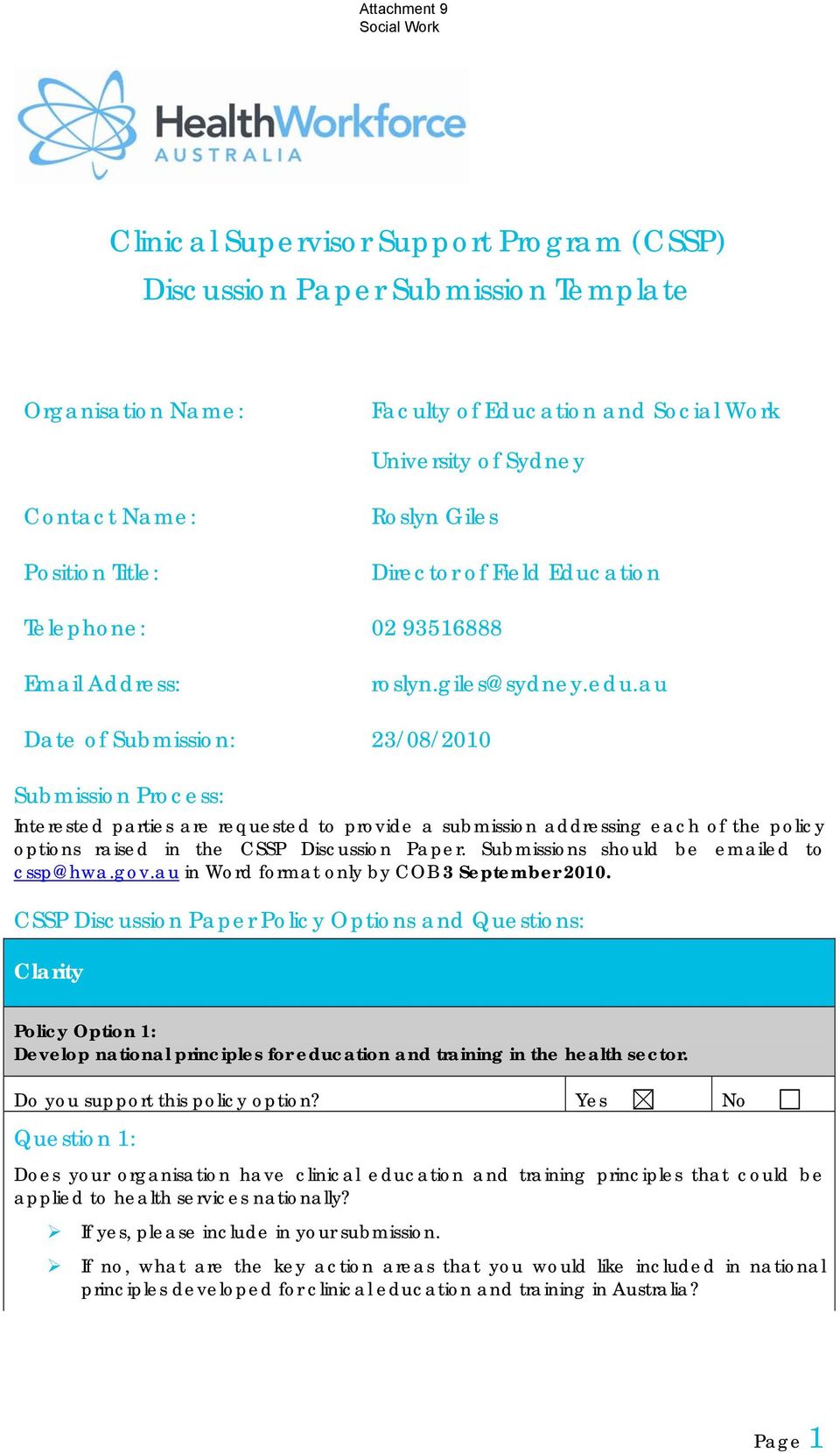
1 Clinical Supervisor Support Program (CSSP) Discussion Paper Submission Template Organisation Name: Faculty of Education and University of Sydney Contact Name: Position Title: Roslyn Giles Director of Field Education Telephone: Address: Date of Submission: 23/08/2010 Submission Process: Interested parties are requested to provide a submission addressing each of the policy options raised in the CSSP Discussion Paper. Submissions should be ed to [email protected] in Word format only by COB 3 September CSSP Discussion Paper Policy Options and Questions: Clarity Policy Option 1: Develop national principles for education and training in the health sector. Do you support this policy option? Yes No Question 1: Does your organisation have clinical education and training principles that could be applied to health services nationally? If yes, please include in your submission. If no, what are the key action areas that you would like included in national principles developed for clinical education and training in Australia? Page 1
2 Response: AASW Education and Accreditaion Standards (2010 p 6-7) attached University of Sydney and Policy Studies Field Education Handbook 2010 p 11 (attached) Page 2
3 Policy Option 2: Develop a nationally agreed statement of role and function supervisor/supervision. Do you support this policy option? Yes No Question 2: Does your organisation have agreed terminology and definitions for the role and function of clinical supervisor or clinical supervision? If yes, please include the definitions in your submission. If no, what terminology does your organisation use to describe these functions? What cross-profession terminology do you think should be used in the National Clinical Supervision Support Strategy and Framework? Response: Yes The field educator is the social worker who is responsible for the delivery and evaluation in the practice setting of the student's field education experience. (AASW Educaiton and Accreditaon Standards 2010 p 44) Page 3

4 Policy Option 3: Develop an agreed competency framework that defines the knowledge, skills and attributes necessary for quality supervision. Do you support this policy option? Yes No Question 3: Are there core generic competencies you would like added/deleted? If so, please provide details. Response: Minimum 2 years discipline accredited practice experience Knowledge of adult learning principles and processes including experienced based learning Abilty to role model excellence in practice Abilty to mentor and guide Abilty to deliver constructive feedback and support student learning progression Abilty to asess practice learning according to discipline standards Question 4: For organisations delivering professional entry training or other curricula, to what extent are the skills already included in current curricula? Do you support greater coverage of these skills in entry to practice courses? To what extent could this replace post-entry to practice supervision skills development? Response: Student's gain knowledge and skills in the processes of engaging in constructive practice learning supervision both prior to and during periods of practice learning. The development of knowledege and skills essetnial to the role of practice educators should remain at a post graduate level. Question 5: For professional associations and registration boards, does education and training form part of the current CPD program? Response: Yes Yes No Page 4

5 Policy Option 4: Develop best practice guidelines and templates for clinical placement agreements between health services and university. Do you support this policy option? Yes No Question 6: Do you currently have clinical placement agreements in place? If yes, please include a copy with your submission. If no please indicate what should be included in the best practice guidelines. Response: NSW Health Student Placement for Entry into a Health Occution Agreement No formal agreements with any other organisations Yes No Question 7: Do you currently have agreements in place in relation to student documentation? If yes, please include a copy with your submission. If no please indicate what should be included in the best practice guidelines. Yes No Response: University of Sydney and Policy Studies Field Education Handbook 2010 p 13 (attached) Page 5
6 Policy Option 5: Develop a generic training program aligned to agreed core competencies. Do you support this policy option? Yes No Question 8: Do you provide, or are you aware of, courses that are currently available that address some or all of the generic skills outline above? If so, please provide details. Response: 1. University of Sydney and Policy Studies New Field Educator Workshop a 1 day training workshop delivered at the Sydney capmpus and in outer Sydney locations 3-4 tinmes per year. This workskop is free to all current and prospective social work field educators. 2. University of Sydney Education and Division of Professional learning Supervision Course " A Guide to supeivison in social work field education" This course, launched is the result of an inter-university ALTC grant Yes No Question 9: Are you aware of a course that could be adapted to align to agreed core competencies that should be considered as part of this project? If so, please provide details. Response: as above Yes No Page 6

7 Policy Option 6: Support health services to deliver training locally that builds capacity. Do you support this policy option? Yes No Question 10: Does your organisation have dedicated clinical educator positions? If yes, how is this position funded? Response: Director of Field Education and Policy Studies (.6fte University academic funding) Agency based field educator's funded by each agency External social work field educators - these people are employed by the University of a casual part-time basis for provide the required 1.5 hrs per week supervision where an agency does not have a social worker on site who meets the AASW field educator standards. Yes No Question 11: Are there other strategies that build local capacity that you would you like HWA to consider? If so, please provide details. Yes No Response: As per the HWA University of Sydney funding submissions June 2010 for organisatioanlly based clinical educator postitions. Example job description attached Page 7
8 Policy Option 7: Develop consistent clinical placement assessment tools within disciplines. Do you support this policy option? Yes No Question 12: Are there consistent clinical placement assessment tools in place for your discipline? If so, please provide details. Response: University of Sydney and Policy Studies Field Education Handbook 2010 p ( as per attached) Question 13: What education and training activity would you like to see measured in health services? Response: Attendance at initial training in adult learning, student supervision and discipline specific assessment processes Yes No Ongoing bi-annual stduent superviosn refresher course Page 8

9 Culture Policy Option 8: Implement a reward and recognition program. Do you support this policy option? Yes No Question 14: Does a national award program exist for supervisors in your profession? If so, please provide details. Response: Yes A Guide to supervision in social work field education" This course, launched is the result of an inter-university ALTC grants Yes No Question 15: For universities, is there scope to standardise supervisor supports in your organisation? If so, please provide details. Yes No Response: We currently support student supervisors via regular pre-placement and mid placement workshops. This is supplemented by one-one individualised support provided by the Field Education Officer as well as each student's University placement liasion teacher. These current process could be further enhanced through delivery of short courses via the Division of Professional Learning as well as promotion of the new national course " A guide to suervision in social work field education". Generic clincial educator courses could be developed based on the new text Giles R., Irwin J. Lynch D. & Waugh F. (2010) In the Field: From Learning to practice Melbourne Oxford University Press Page 9
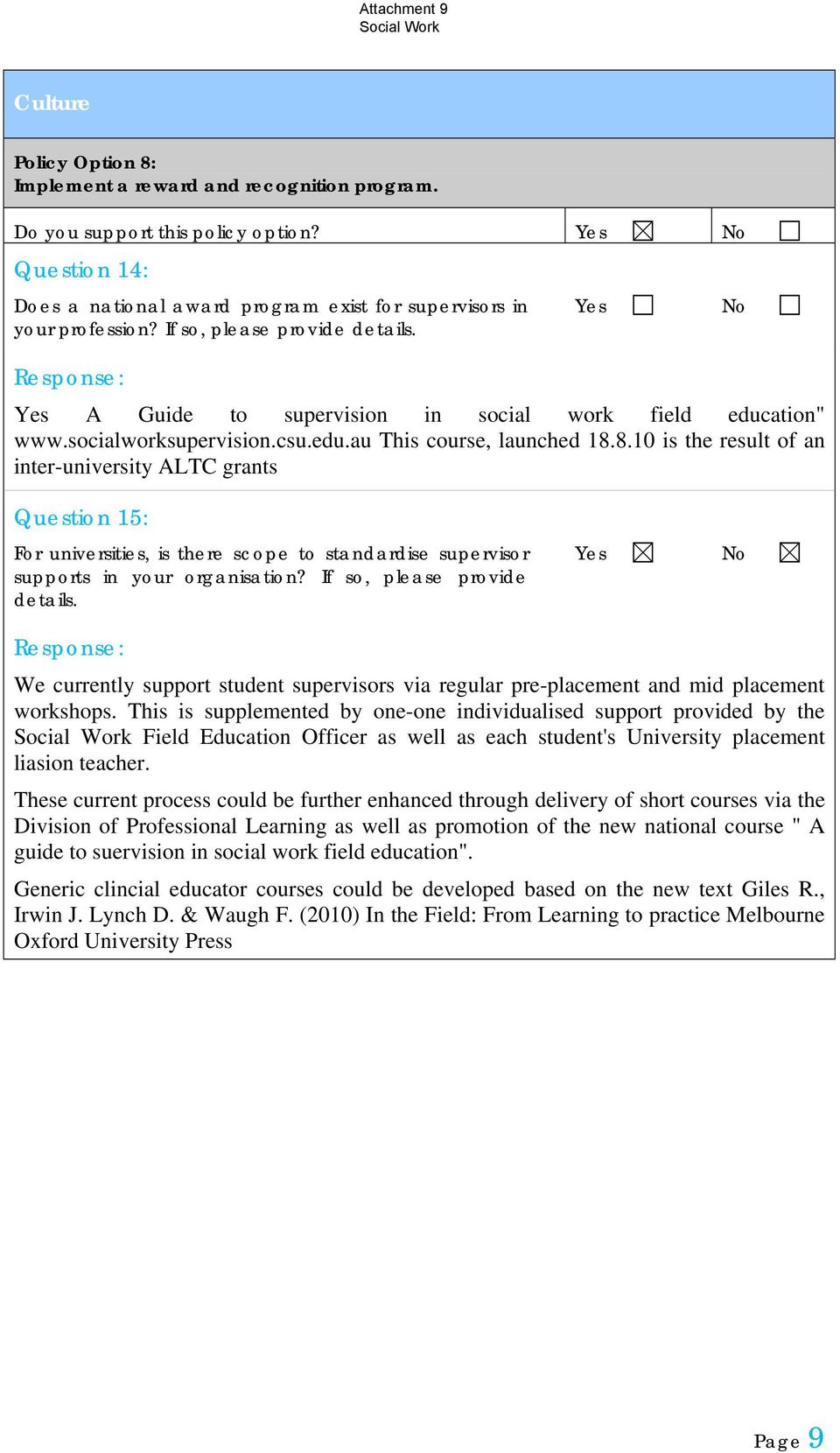
10 Policy Option 9: Integrate and recognise supervision as a core component of the clinical role. Do you support this policy option? Yes No Question 16: Does your organisation currently include education and training as a core function within position descriptions? Yes No Does your organisation explicitly recognise the philosophy that education is a part of health practitioner roles? Please provide details below. Response: yes Yes No Page 10
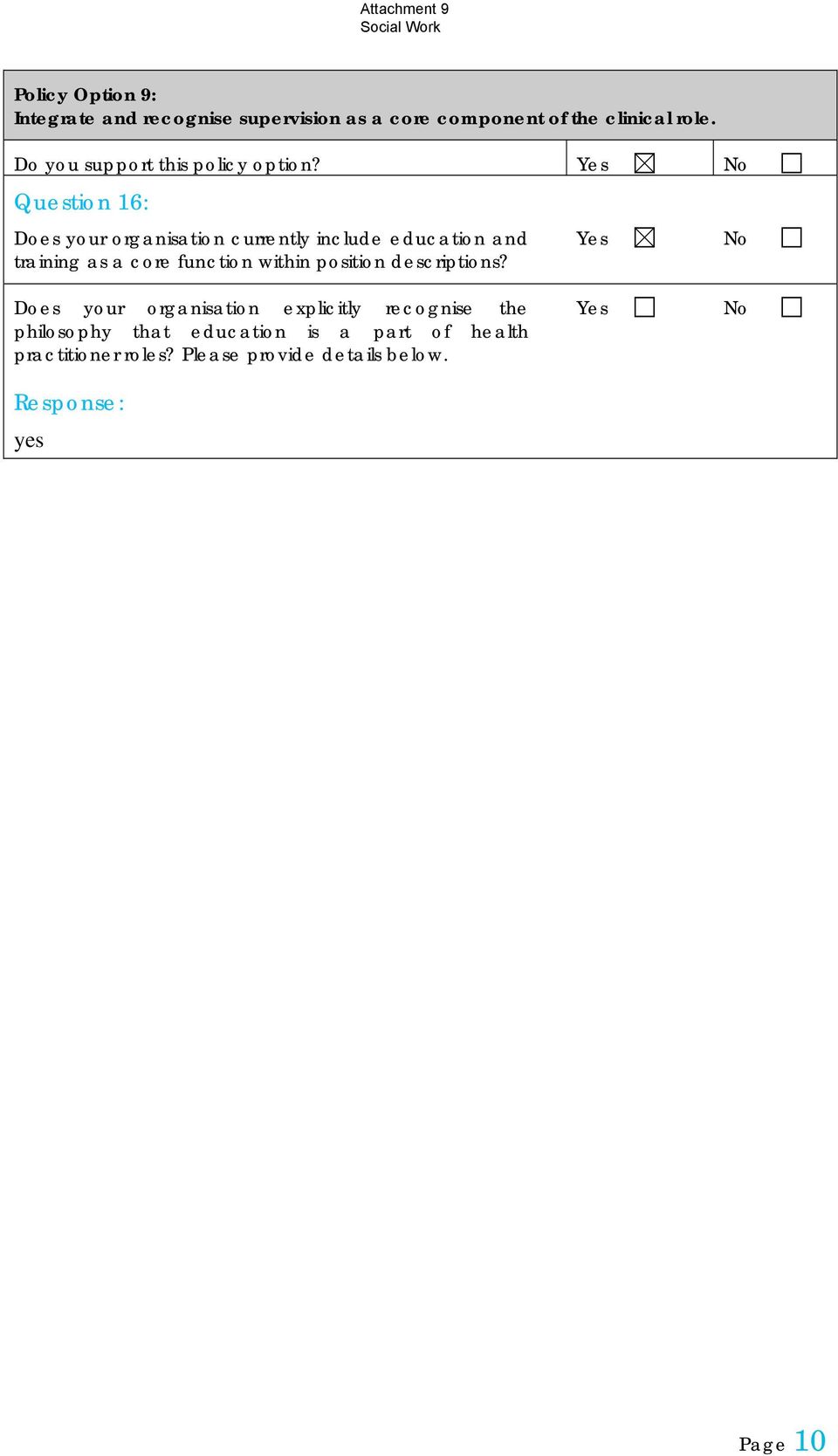
11 Policy Option 10: Integrate and recognise supervision as a core component of the clinical role. Do you support this policy option? Yes No Question 17: As a supervisor do you see benefit in developing an online resource to support supervisors? If yes, what information would you like made available online to assist with this role? Response: yes Yes No Page 11
12 General Comments It is intended that the strategies contained in the CSSP National Clinical Supervision Support Framework will be applicable across professions and throughout the education and training learning continuum. Do you have any comments or issues that you would like taken into consideration in the development of this framework that have not been covered in previous sections? Any other general comments considers the current process of individualised placement allocation to meet specific learning needs is essential to excellence in practice learning. The current concerned of detailed arrangements made between the university and specific services and field education is an AASW requirement. Page 12


13 Appendix A AUSTRALIAN ASSOCIATION OF SOCIAL WORKERS AUSTRALIAN SOCIAL WORK EDUCATION AND ACCREDITATION STANDARDS Published March 2008 Updated June 2009, January 2010 to include addendums Canberra ACT

14 Appendix A CONTENTS INTRODUCTION... 3 PART I MINIMUM STANDARDS FOR SOCIAL WORK EDUCATION Definition of Principles for Education Goal and Outcomes for Education Content of Programs Practice Knowledge Skills And Values Knowledge from Other disciplines Learning for Practice in Field Education Structure of Programs of Education The Articulation of Welfare, Social and Behavioural Science and Community Work programs with Degree Programs including Credit Transfer Recognition of Prior Learning Organisational Arrangements and Governance of Programs Program Structure Resources and Staffing PART II PROCESS FOR THE REVIEW OF EXISTING AND NEW SOCIAL WORK COURSES The AASW Accreditation Panel The Process For Reviewing Existing Programs CONSULTANCY TO UNIVERSITIES PLANNING NEW SOCIAL WORK PROGRAMS PART 3 PROCESS FOR ASSESSING INTERNATIONAL QUALIFICATIONS ASSESSMENTS PART IV PROCESS FOR ASSESSING OVERSEAS SOCIAL WORK QUALIFICATIONS...38 GLOSSARY ADDENDUM 1.0 Policy Regarding Field Education Assessment Criteria Statement of specific mental health curriculum content Statement of specific child wellbeing and protection curriculum content Statement of specific cross-cultural curriculum content 65 AUSTRALIAN SOCIAL WORK EDUCATION AND ACCREDITATION STANDARDS 2

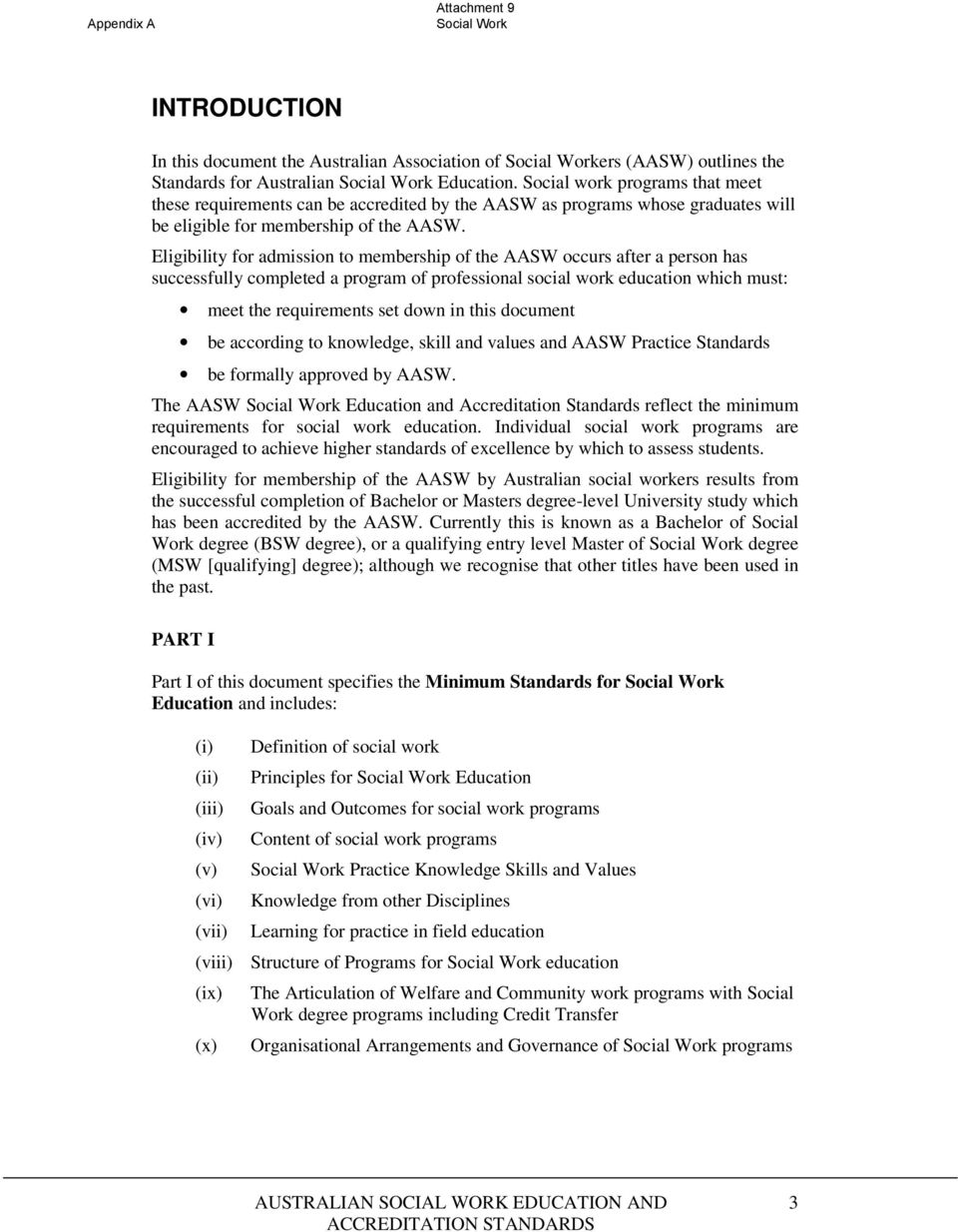
15 Appendix A INTRODUCTION In this document the Australian Association of ers (AASW) outlines the Standards for Australian Education. Social work programs that meet these requirements can be accredited by the AASW as programs whose graduates will be eligible for membership of the AASW. Eligibility for admission to membership of the AASW occurs after a person has successfully completed a program of professional social work education which must: meet the requirements set down in this document be according to knowledge, skill and values and AASW Practice Standards be formally approved by AASW. The AASW Education and Accreditation Standards reflect the minimum requirements for social work education. Individual social work programs are encouraged to achieve higher standards of excellence by which to assess students. Eligibility for membership of the AASW by Australian social workers results from the successful completion of Bachelor or Masters degree-level University study which has been accredited by the AASW. Currently this is known as a Bachelor of Social Work degree (BSW degree), or a qualifying entry level Master of degree (MSW [qualifying] degree); although we recognise that other titles have been used in the past. PART I Part I of this document specifies the Minimum Standards for Education and includes: (i) (ii) (iii) (iv) (v) (vi) (vii) Definition of social work Principles for Education Goals and Outcomes for social work programs Content of social work programs Practice Knowledge Skills and Values Knowledge from other Disciplines Learning for practice in field education (viii) Structure of Programs for education (ix) (x) The Articulation of Welfare and Community work programs with Social Work degree programs including Credit Transfer Organisational Arrangements and Governance of programs AUSTRALIAN SOCIAL WORK EDUCATION AND ACCREDITATION STANDARDS 3
16 Appendix A PART II Procedures for the review of social work programs, offered by Australian universities, are detailed in Part 11 of this document. Social work programs undergoing review, and new social work programs, will be approved on the basis of meeting the standards set out in Part 1. Implementation This policy will be implemented from January Social work programs approved under the previous policy (Policy and Procedures for Establishing Eligibility for Membership of AASW July 2000, revisions 2003, 2006) will have until the date of their next review to meet the requirements of this policy if their next review is due after January If a social work program has a review in 2008 they may choose to use the newly adopted policy, or the previous policy. Review The principles and policies presented in this document will next be reviewed in accordance with AASW policy in PART III Process for Assessing International Qualifications Assessments In 2008 the Policy and Procedures for Establishing Eligibility for Membership of AASW (AASW, 2000 amended in 2004 and 2006), Parts III and IV will remain in place to be used for the determination of qualifications of international applicants (AASW Board Meeting Minutes, 16 November 2007). An extract from the Policy which includes all of part III appears at this point in this document until the review of those parts is completed. PART IV Process for Assessing Overseas Qualifications In 2008 the Policy and Procedures for Establishing Eligibility for Membership of AASW (AASW, 2000 amended in 2004 and 2006), Parts III and IV will remain in place to be used for the determination of qualifications of international applicants (AASW Board Meeting Minutes, 16 November 2007). An extract from the Policy which includes all of part III appears at this point in this document until the review of those parts is completed. ADDENDUM - Policy regarding Field Education Assessment Criteria - Statement of specific Mental Health Curriculum Content - Statement of specific Child Wellbeing and Protection Curriculum Content Additional Specific curriculum statements should also be consulted as they become available. AUSTRALIAN SOCIAL WORK EDUCATION AND ACCREDITATION STANDARDS 4

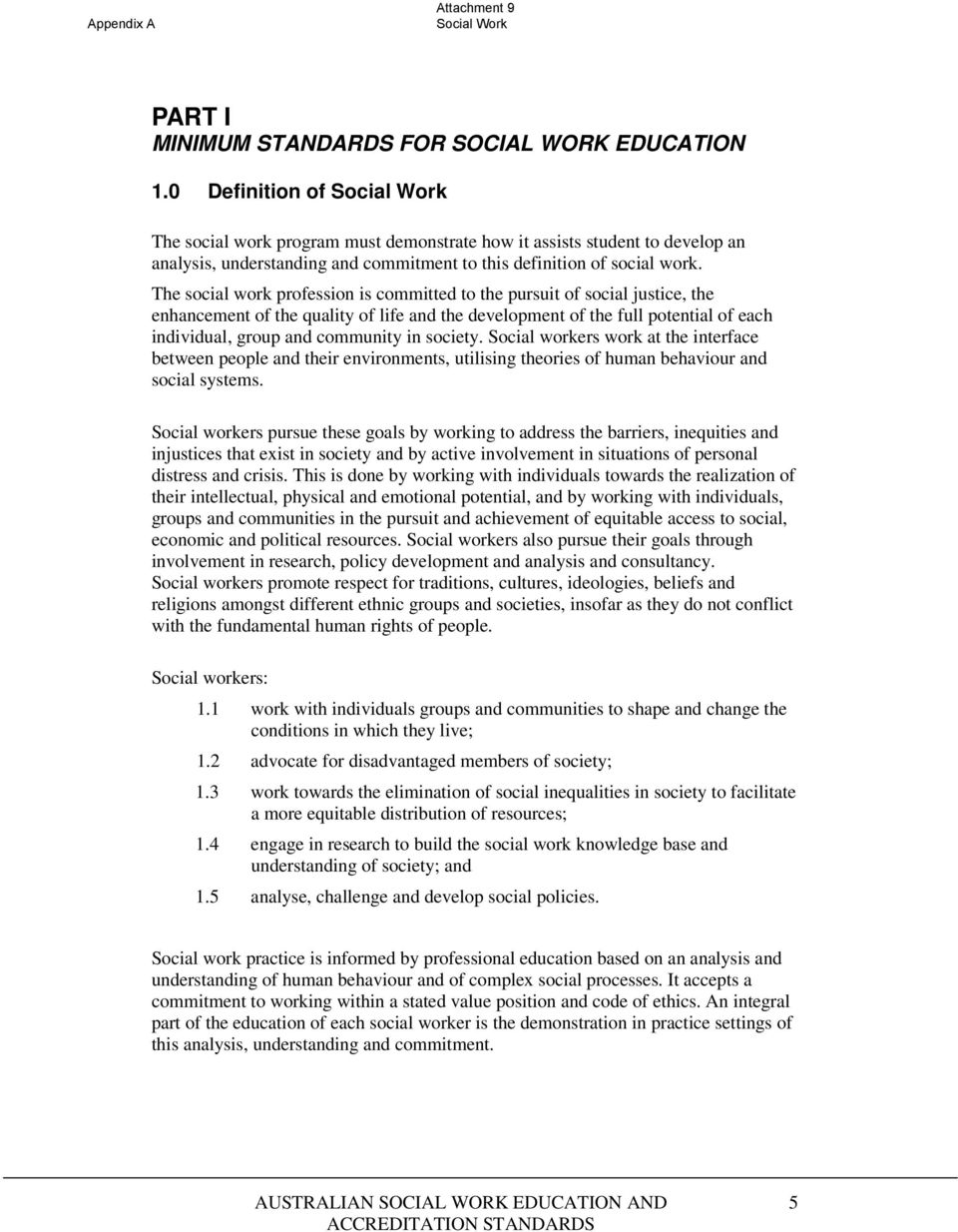
17 Appendix A PART I MINIMUM STANDARDS FOR SOCIAL WORK EDUCATION 1.0 Definition of The social work program must demonstrate how it assists student to develop an analysis, understanding and commitment to this definition of social work. The social work profession is committed to the pursuit of social justice, the enhancement of the quality of life and the development of the full potential of each individual, group and community in society. Social workers work at the interface between people and their environments, utilising theories of human behaviour and social systems. Social workers pursue these goals by working to address the barriers, inequities and injustices that exist in society and by active involvement in situations of personal distress and crisis. This is done by working with individuals towards the realization of their intellectual, physical and emotional potential, and by working with individuals, groups and communities in the pursuit and achievement of equitable access to social, economic and political resources. Social workers also pursue their goals through involvement in research, policy development and analysis and consultancy. Social workers promote respect for traditions, cultures, ideologies, beliefs and religions amongst different ethnic groups and societies, insofar as they do not conflict with the fundamental human rights of people. Social workers: 1.1 work with individuals groups and communities to shape and change the conditions in which they live; 1.2 advocate for disadvantaged members of society; 1.3 work towards the elimination of social inequalities in society to facilitate a more equitable distribution of resources; 1.4 engage in research to build the social work knowledge base and understanding of society; and 1.5 analyse, challenge and develop social policies. Social work practice is informed by professional education based on an analysis and understanding of human behaviour and of complex social processes. It accepts a commitment to working within a stated value position and code of ethics. An integral part of the education of each social worker is the demonstration in practice settings of this analysis, understanding and commitment. AUSTRALIAN SOCIAL WORK EDUCATION AND ACCREDITATION STANDARDS 5
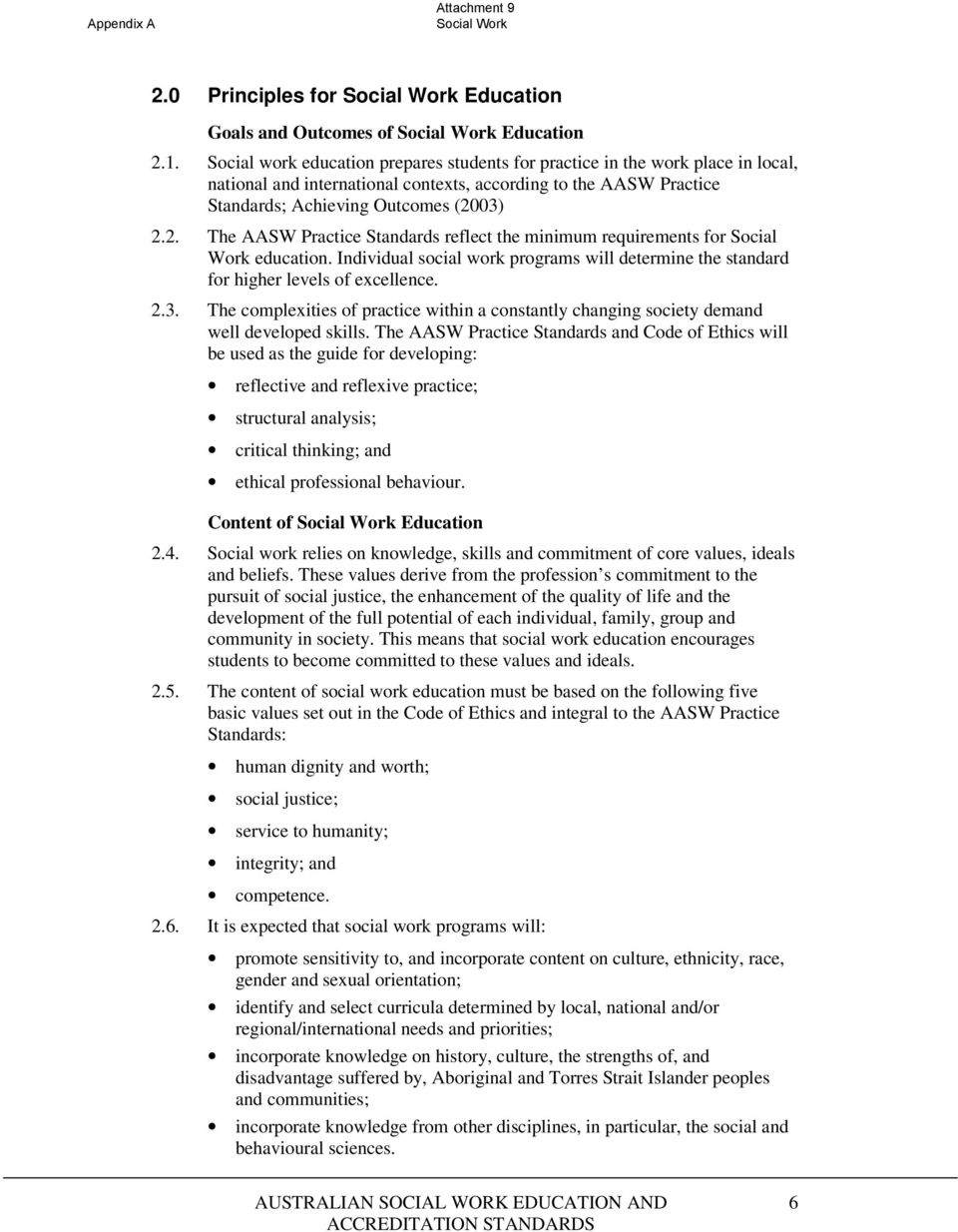
18 Appendix A 2.0 Principles for Education Goals and Outcomes of Education 2.1. Social work education prepares students for practice in the work place in local, national and international contexts, according to the AASW Practice Standards; Achieving Outcomes (2003) 2.2. The AASW Practice Standards reflect the minimum requirements for Social Work education. Individual social work programs will determine the standard for higher levels of excellence The complexities of practice within a constantly changing society demand well developed skills. The AASW Practice Standards and Code of Ethics will be used as the guide for developing: reflective and reflexive practice; structural analysis; critical thinking; and ethical professional behaviour. Content of Education 2.4. Social work relies on knowledge, skills and commitment of core values, ideals and beliefs. These values derive from the profession s commitment to the pursuit of social justice, the enhancement of the quality of life and the development of the full potential of each individual, family, group and community in society. This means that social work education encourages students to become committed to these values and ideals The content of social work education must be based on the following five basic values set out in the Code of Ethics and integral to the AASW Practice Standards: human dignity and worth; social justice; service to humanity; integrity; and competence It is expected that social work programs will: promote sensitivity to, and incorporate content on culture, ethnicity, race, gender and sexual orientation; identify and select curricula determined by local, national and/or regional/international needs and priorities; incorporate knowledge on history, culture, the strengths of, and disadvantage suffered by, Aboriginal and Torres Strait Islander peoples and communities; incorporate knowledge from other disciplines, in particular, the social and behavioural sciences. AUSTRALIAN SOCIAL WORK EDUCATION AND ACCREDITATION STANDARDS 6
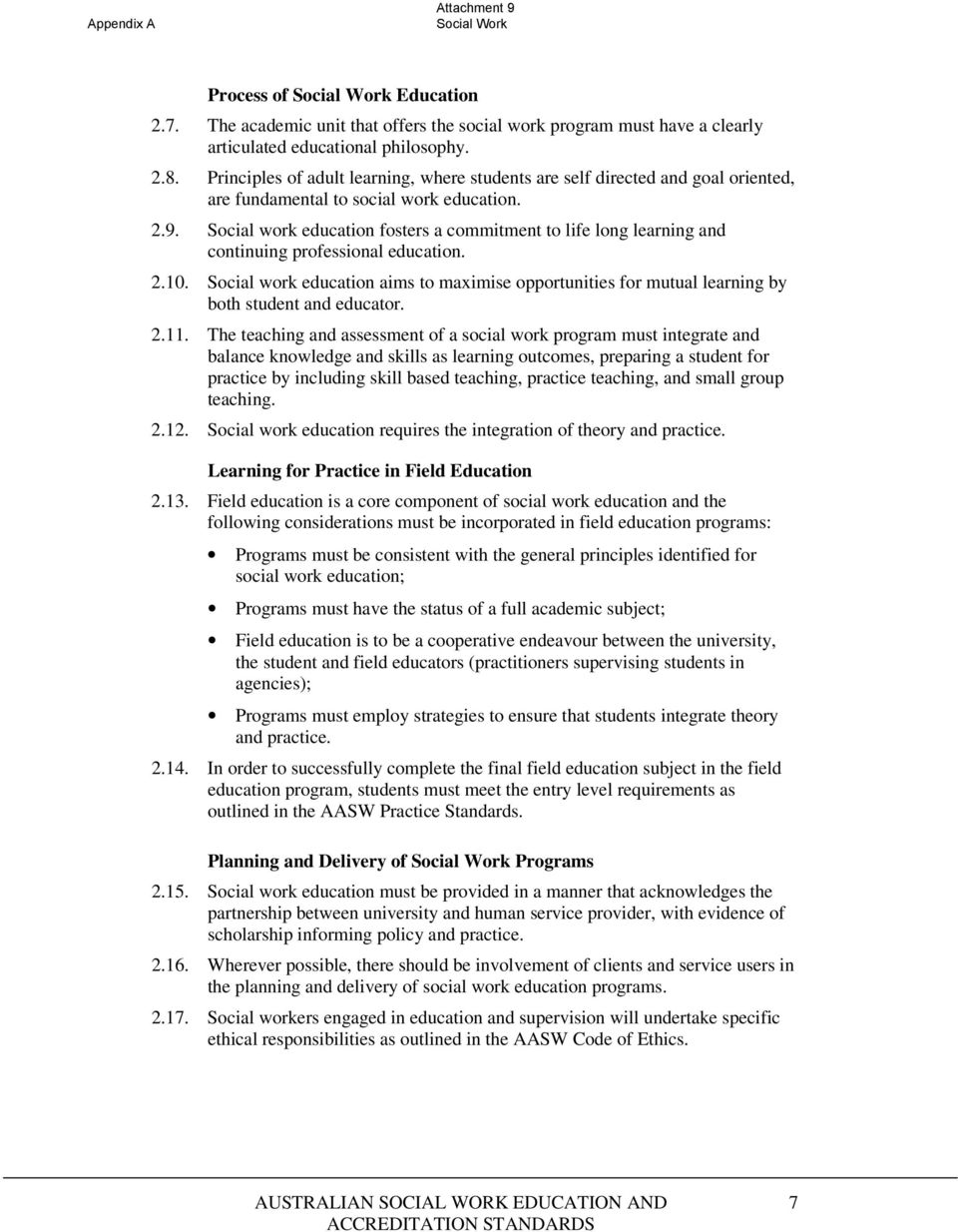
19 Appendix A Process of Education 2.7. The academic unit that offers the social work program must have a clearly articulated educational philosophy Principles of adult learning, where students are self directed and goal oriented, are fundamental to social work education Social work education fosters a commitment to life long learning and continuing professional education Social work education aims to maximise opportunities for mutual learning by both student and educator The teaching and assessment of a social work program must integrate and balance knowledge and skills as learning outcomes, preparing a student for practice by including skill based teaching, practice teaching, and small group teaching Social work education requires the integration of theory and practice. Learning for Practice in Field Education Field education is a core component of social work education and the following considerations must be incorporated in field education programs: Programs must be consistent with the general principles identified for social work education; Programs must have the status of a full academic subject; Field education is to be a cooperative endeavour between the university, the student and field educators (practitioners supervising students in agencies); Programs must employ strategies to ensure that students integrate theory and practice In order to successfully complete the final field education subject in the field education program, students must meet the entry level requirements as outlined in the AASW Practice Standards. Planning and Delivery of Programs Social work education must be provided in a manner that acknowledges the partnership between university and human service provider, with evidence of scholarship informing policy and practice Wherever possible, there should be involvement of clients and service users in the planning and delivery of social work education programs Social workers engaged in education and supervision will undertake specific ethical responsibilities as outlined in the AASW Code of Ethics. AUSTRALIAN SOCIAL WORK EDUCATION AND ACCREDITATION STANDARDS 7
20 Appendix A 3. Goal and Outcomes for Education The goal of social work education is to provide a rigorous program that result in graduates who are competent, effective, skilled, knowledge-based, ethically aware and confident practitioners. Universities must show that graduating students have demonstrated that they can integrate social work knowledge, skills and values and are able to meet the profession s entry level standards as set out in: (i) The AASW Practice Standards: Achieving Outcomes; and (ii) Particular professional standards that are endorsed by the AASW including Basic mental health competencies; Standards for practice with Aboriginal and Torres Strait Islander people and communities; Cross cultural practice; and Child Protection Curriculum statements for Mental Health and Child Protection are attached as Addendums. Individual social work programs may determine the standard for higher levels of excellence by which to assess student The AASW Practice Standards: Achieving Outcomes establish benchmarks that students are required to demonstrate at graduation and entry to professional practice. The Standards provide a: guide to practice; measure of accountability for members; basis for standardisation of practice across Australia; basis for quality guarantee, expectations and accountability for clients, employers and other professionals; benchmark for assessment of practice; and guide for ongoing professional development. It is therefore expected that social work education programs reflect the main areas of practice and outcomes in the AASW Practice Standards: Achieving Outcomes: 3.1 Direct Practice (including work with individuals, groups and communities); 3.2 Service Management; 3.3 Organisational Development and System Change; 3.4 Policy Development, Implementation and Change; 3.5 Research and Knowledge Generation; and 3.6 Education and Professional Development. AUSTRALIAN SOCIAL WORK EDUCATION AND ACCREDITATION STANDARDS 8

21 Appendix A Each outcome in the AASW Practice Standards: Achieving Outcomes is stated in the form of an objective in relation to client outcome. These objectives for practice outcomes, along with a corresponding statement of a learning outcome, are shown below. By the end of the social work education program, the student is expected to be able to meet the learning outcome and the practice objectives. 3.1 Direct Practice work with Individuals, Groups and Communities Practice Objective The outcome of direct social work practice is that: needs of clients and service users are met; their potential is developed; and their control over their lives is fostered; This will be achieved through mutual engagement and the application of the social worker s knowledge and skills. Learning Outcome The ability to engage with individuals, groups and communities in society and apply social work knowledge and skills to meet needs, to enable them to develop their potential and to foster their greater control over their lives. 3.2 Service Management Practice Objective Client needs, organisational goals and community expectations of the service are met in the most appropriate manner, as far as possible, using social work knowledge, skills and resources. Learning Outcome The ability to appropriately manage service provision and practice in ways that meet the needs of individuals, groups and communities in society, as well as organisational goals and community expectations of the service. 3.3 Organisational Development and System Change Practice Objective The social worker s knowledge of organisational systems and processes and societal systems is applied in such a way that inequalities are identified and appropriate action is taken, with the result that social barriers, inequality and injustice are reduced. Learning Outcome The ability to apply knowledge of organisational systems and processes and societal systems, to identify inequalities, and to act to reduce social barriers, inequality and injustice. 3.4 Policy Development, Implementation and Change Practice Objective The well-being of clients, especially those who are neglected, vulnerable, disadvantaged or who have exceptional needs, is improved through the social worker s: AUSTRALIAN SOCIAL WORK EDUCATION AND ACCREDITATION STANDARDS 9
22 Appendix A promotion and implementation of policies and practices which would achieve a fair, equitable and effective allocation of social resources; and identification of inappropriate or inequitable policy goals and outcomes. Learning Outcome The ability to apply social work knowledge and skills to identify inappropriate or inequitable policy goals and outcomes, and to promote and implement policy which achieves equity and effective distribution of social resources. 3.5 Research and Knowledge Generation Practice Objective Client needs, organisational goals and social policy are addressed through the application of the social worker s values, knowledge and skills in the research process. Learning Outcome The ability to apply research knowledge and skills to undertake ethical research and disseminate findings, and to utilise research in practice to address the needs and aspirations of individuals, groups and communities in society, and to further organisational goals and social policy 3.6 Education and Professional Development Practice Objective The social worker recognises the importance of continually increasing their knowledge and skills and is committed to, and actively engages in, a process of continuing education. Learning Outcome The recognition of the importance of, and a demonstrated commitment to continually increasing knowledge and skills through processes of continuing education. 4.0 Content of Programs 4.1 Practice Knowledge Skills and Values Essential to social work is the recognition that individual need is influenced by socio-political and economic factors. This interactive dual focus of analysis (individual and systemic, private pain and public issues) distinguishes the theory and practice of social work from other helping professions. The acquisition of practice knowledge and skills will take place over at least two years of the educational program Knowledge of social work ethics The ability to think through and recognise ethical issues. This is a core component of social work practice that relies on the ability to think critically within a framework of commitment to ethical practice, and needs to be developed throughout the social work program with reference to the AASW Code of Ethics. AUSTRALIAN SOCIAL WORK EDUCATION AND ACCREDITATION STANDARDS 10
23 Appendix A Content of education for social work practice: The content for social work education practice must include specific curriculum content in each of the following areas; mental health, Aboriginal and Torres Strait Islander cultures, cross cultural practice and child protection. (i) In the case of mental health the specific curriculum content must include at least the introductory knowledge, practice skills and attitudes which would enable an entry level social worker in any field of practice to identify and respond appropriately to people with mental health problems and mental disorders. The specific mental health curriculum statement attached to this document at Addendum 2.0. (ii) In the case of working with Aboriginal and Torres Strait Islander cultures, cross cultural practice and child protection, specific curriculum content outlining introductory knowledge, practice skills and attitudes to be demonstrated by an entry level social worker will be developed and available in The methods of social work practice: All methods of social work intervention are required learning, including community work, casework, group work, social planning and social action, research, social policy analysis and development, and management The skills for social work practice Practice skills, including interpersonal skills; communication skills both oral skills for counselling, and written skills for case noting and report writing; plus skills of reflective and critical thinking and analysis; data collection and management; advocacy, negotiation and mediation. Skills of making assessments and deciding on the most appropriate intervention, along with skills required in the process of making judgments and recommendations, need to be developed throughout the social work program Understanding the Context of Practice Social workers need to be able to critically analyse the structure of society, with particular attention being paid to dimensions of power and disadvantage and the influence of class, gender, age, intellectual and physical ability, sexuality, race and ethnicity. The ability to understand the context of social work practice at local, national and international levels, and the institutional context of social work practice, is required. This understanding requires knowledge of, and the ability to, critically analyse social, political, economic, historical, cultural and ecological systems as well as the important considerations of governance with respect to these. The processes that facilitate and constrain change and the evolution of systems needs to be understood. There must be a focus on empowering and non-oppressive practice that is cognisant of the institutional context in which practice occurs. AUSTRALIAN SOCIAL WORK EDUCATION AND ACCREDITATION STANDARDS 11
24 Appendix A Fields of Practice Students should have the opportunity to gain an understanding and appreciation of the experience of individuals, groups and communities within a range of different fields of practice, settings, client groups and geographical locations. It is expected the following areas will be addressed; Aboriginal and Torres Strait Islander cultures; mental health; child care and child safety; ageing; income security; health; disability; cultural and linguistic diversity; rural and remote locations; correctional services and justice; and education. 4.2 Knowledge from Other disciplines Knowledge from other disciplines is an integral component of social work education. This material has traditionally been covered in subjects variously named sociology, anthropology, politics, economics, history, social theory, psychology, and human development and behaviour. In a two-plus- two degree, this essential knowledge may be acquired through university study undertaken prior to the final two years of social work study. In a four-year program, it will usually be completed in the first two years of the social work degree. Each university will exercise its discretion in the organisation and presentation of material related to the following content areas: Understanding of Society An understanding of society and how it has developed and is organized is fundamental to social work. This includes an understanding of the major insights provided by sociology, anthropology, social theory, history economics and political science, and an awareness of how these contribute to the understanding of the politico economic distribution of resources. In addition, students should be encouraged to think about the implications and effects of the globalisation of society Knowledge of the individual This includes: human behaviour and development, personality development, life-cycle stages, family and social networks, physical health and ill-health, mental heath problems and mental disorder, disability, vulnerability and resilience. An understanding of the social construction of these concepts should also be developed. AUSTRALIAN SOCIAL WORK EDUCATION AND ACCREDITATION STANDARDS 12
25 Appendix A 4.3 Learning for Practice in Field Education Structure of a program for learning in field education (i) (ii) (iii) (iv) (v) (vi) (vii) Field education subjects must demonstrate a developmental approach to learning that complies with the principles for social work education in this document. Field education subjects must be taken over two years within the professional social work program of study. Students must successfully complete a minimum of 140 seven-hour working days (at least 980 hours) in at least two field education subjects as above. No placement will be shorter than 40 days. No placement will be an observational placement. Placements must be structured in a way that is educationally viable (so that educational goals can be achieved). Patterns of placement days may vary from 5 days per week, to a minimum of 2 days per week. Placements that are 2 days per week must include at least two full time (5 day) block periods. All placements are carried out in a host organisation that provides human service/social work services and meets the educational requirements of the field education program. (viii) Each student is allocated a field educator who is a suitably qualified and experienced practitioner meeting the requirements specified in this document. The field educator guides the student s learning during the placement. (ix) (ix) Clear expectations for learning goals and performance outcomes, based on AASW Practice Standards and Code of Ethics are established through a consultative process between the university, field educator and student, and documented in a learning plan At least one placement will be in direct practice Assessment in field education (i) (ii) Performance outcomes based on the AASW Practice Standards and Code of Ethics will be used to assess students in each of their field placements. It is expected that different performance outcomes will assess novice students (first placement students) and graduating students (final placement students). Policy regarding field education assessment criteria for accredited social work programs can be found in Addendum 1.0. A range of learning activities and methods of assessment are used to assess the student s level of achievement and whether they have met the performance outcomes specified. AUSTRALIAN SOCIAL WORK EDUCATION AND ACCREDITATION STANDARDS 13
26 Appendix A (ii) (iii) (iv) Assessment strategies require the student to demonstrate performance at the same standards of academic rigour as is expected in any academic subject. The assessment process includes contributions from all parties involved in the placement and is carried out in an equitable and collaborative manner. The final decision about whether the student has achieved the identified learning goals and performance outcomes, and has passed the field education subject is made by the university after consideration of material submitted by all parties Roles and Responsibilities Roles and responsibilities for the student, the agency based field educator, the university based field education coordinator, university field liaison staff and where required the professional external field educator, must be clearly outlined in the field education policies of the social work program. (a) Field educator responsibilities and qualifications (i) Field educators are qualified social workers (eligible for full membership of the AASW) with a minimum of two years fulltime practice experience, or its part time equivalent, who demonstrate a commitment to continuing professional education and an interest in developing social work knowledge and skills. (ii) Field educators must be able to provide a minimum of 1.5 hours supervision per student (including formal and informal) for each five days of placement. This may be provided individually or in group formats. (iii) (iv) It is desirable that field educators have undergone or will undergo during the placement, some further education in student supervision. The social work field educator will be able to observe the student s practice. (b) program responsibilities (i) (ii) (iii) There must be a clearly identifiable field education unit including administrative support dedicated to organising field education. Staffing of field education programs should reflect the university s commitment to the centrality of field education in the social work curriculum. For example, there may be clear connections between the academic and research interests of university staff and the field education experiences offered by the academic unit. All members of staff will either teach in field education or have a field education liaison role. AUSTRALIAN SOCIAL WORK EDUCATION AND ACCREDITATION STANDARDS 14
27 Appendix A (iv) (v) (vi) (vii) (viii) (ix) The social work program will assign a field education coordinator and field education liaison staff to each placement. University based field education coordinators and field liaison staff must be social workers with a minimum of five years post qualifying practice experience. Responsibilities of field education coordinators will include: Developing placements and engaging field educators Running field education integration workshops Running workshops for field educators Performing a field education liaison role. The responsibilities of the field education liaison staff will include: Involving the organisation, the field educator and the student in a consultative process about the goals, learning processes, structure and assessment of the placement; Maintaining regular contact with the student, with a minimum of 3 contacts including at least one face to face visit, to clarify educational issues, monitor the progress of the placement, mediate any difficulties and assess student progress. These may include group meetings and tutorials. Telecommunications and video conferences may be used to supplement site visits but will not entirely replace them. The university must ensure that policies and processes are in place to meet duty of care, risk management and occupational health and safety requirements for students undertaking field education. These include: recommending a maximum number of hours of placement and travel to be undertaken in one day. recommending a maximum number of paid hours and practicum hours to be undertaken in a week. notifying host organisations of occupational health and safety requirements, university insurance arrangements and the limits of university cover. Universities must offer adequate support to field educators in recognition of their contribution to the social work education program. This support should include: access to university resources such as the library consultation with university staff as required training and support in student supervision other professional development activities as appropriate AUSTRALIAN SOCIAL WORK EDUCATION AND ACCREDITATION STANDARDS 15
28 Appendix A (x) (xi) (xii) (xiii) In situations where the host organisation has no suitable social work field educator, arrangements must be made to ensure that appropriate professional formation and supervision takes place by a qualified social work field educator. The university will: negotiate with the host organisation to engage an external social worker to undertake the professional supervision requirements; and will negotiate with the agency for a suitably qualified co-field educator to be appointed to supervise the student s day to day learning in conjunction with the external social work field educator. It is preferable that only one placement has an external field educator. Where field educators undertake student supervision roles that are not included in their usual paid employment, in particular where they are employed as external field educators to the host organisation, it is expected that universities will negotiate payment as part of their contractual agreement with the field educator. Universities will liaise with host organizations so that the student has access to appropriate learning opportunities, and an educational environment that enables a student to meet the requirements for social work education. This includes arrangements for: adequate space and resources for the student as required, including use of desks, office space, computers, telephones and cars. If the resources that a student requires to meet their learning needs are not available, it is expected that alternate arrangements will be negotiated. reasonable access to organisational records accommodation of students learning needs including adequate time; for supervision, completion of field education assessment requirements, reading and reflection Location of placements (a) Minimum Requirements It is essential that students have the opportunity to participate in a broad range of learning experiences in field education. In particular students must undertake field placements in at least two different fields of practice and organisations, with different client groups, using different methods of social work practice and with a different field educator for each placement. AUSTRALIAN SOCIAL WORK EDUCATION AND ACCREDITATION STANDARDS 16
29 Appendix A (b) Placements in the student s place of employment i) In order to provide a breadth of experience and to prevent conflicts of interest between employment and education roles, field education placements will be undertaken in a different context, organization and field of practice to the student s place of employment. ii) This requirement may be waived if the university is satisfied that all other principles and policies set out in this document can be met. iii) If a placement is undertaken in a student s place of work, a written agreement signed by the organisation, university and student will be completed. This will include: agreement that the employee is in a student role whilst on placement and that they are able to meet the educational requirements, principles and policies set out in this document. allocation of learning experiences not involving the student s routine work responsibilities. protected time whilst on placement that is separate from the duties carried out at work and includes time to complete reading, reflective learning and assessment activities related to the placement wherever practicable, provision of a field educator who is not the student s line manager or usual supervisor. iv) In exceptional circumstances the student may undertake two field placements in their place of employment. If the university approves this arrangement it must guarantee that all of the principles and policies of this document are met. Exceptional circumstances must be defined by the university and be documented in the field education handbook. (c) Placements undertaken overseas (i) When a student is enrolled in a university based in Australia, fifty per cent (70 days/ 490 hours) of the field education program must be undertaken in Australia. It is preferable that the student undertake their first placement in Australia. (ii) When a student is enrolled in an accredited social work program in an Australian university off shore campus, students can do both placements overseas as long as the principles and policies of this document are met. (iii) Field educators must have at least 2 years experience and be eligible for membership of either the professional social work association in the country where the placement is undertaken, or the AASW. AUSTRALIAN SOCIAL WORK EDUCATION AND ACCREDITATION STANDARDS 17
30 Appendix A (iv) University based field education coordinators must be staff members of accredited social work educational programs in the country where the placement is undertaken, or members of accredited Australian social work programs Credit Transfer and Recognition of Prior Learning in Field Education The AASW recognizes that students may enter their social work degree study program with a breadth of prior learning and experience in the human services sector. The AASW policy for credit transfer and recognition of prior learning is detailed in Part 1, section 7 and 8 of this document. The policy as it relates to field education is outlined further below: (i) Credit for the first field education placement or part thereof, may be possible on the basis of recognition of prior work experience or the successful completion of field education placements completed prior to entry into the social work program. (ii) Performance outcomes for first placement based on the AASW Practice Standards and Code of Ethics must be used to assess students for RPL. (iii) In accordance with the policies in this document credit for the first field education placement or part thereof, will take account of: the currency of the work experience (minimum 5FTE in last 10 years), with a minimum of 3 years practice in a relevant context; use of social work practice skills such as assessment and counselling; familiarity and use of a range of methods such as case work and community work; verification of student s claims by a qualified social worker who can attest to its accuracy. (iv) Recognition of Prior learning for field education must be thoroughly assessed. (v) In order to be granted RPL for field education the student must provide evidence that they have met the standards and performance outcomes for the first placement. This should include for example, job descriptions accompanied by referee reports; skills assessment and critical reflection on placement or work experience. 5.0 Structure of Programs of Education A number of different program structures have been developed by Australian universities that offer social work programs. Programs leading to a professional qualification in social work are either a bachelor of social work level of study leading to a BSW, or a masters of social work level of study leading to a qualifying MSW, and should lead to a distinct named qualification in social work 5.1 Bachelor of Degree To be eligible for membership of the AASW with a Bachelor of, graduates in an accredited social work degree program must have completed: AUSTRALIAN SOCIAL WORK EDUCATION AND ACCREDITATION STANDARDS 18
31 Appendix A four years of full-time bachelor degree level study or its part-time equivalent, which leads to the award of a distinct qualification in social work two years of a full-time bachelor degree level study or its part-time equivalent, which leads to the award of a distinct qualification in social work, after the completion of a two or three years Bachelor or its equivalent first degree. 5.2 Master of Degree To be eligible for membership of the AASW with a qualifying Master of, graduates in an accredited social work degree program must have completed two years of a full-time post graduate masters degree level study or its part-time equivalent, which leads to the award of a distinct qualification in social work, after the prior completion of a minimum three year Bachelor degree Entry requirements for admission to the Master of degree must be consistent with the Universities entry requirements for other postgraduate coursework degrees This qualifying MSW program must be clearly distinguished from other post graduate degrees. 5.3 Modes of Delivery of Programs Social work programs may be taught in on-campus, distance, extension, offshore or other flexible modes of delivery. Regardless of the mode of delivery, the program must: articulate an explicit curriculum that leads to the achievement of specified outcomes; and provide evidence of regular assessment of program outcomes Some universities offer more than one social work program in different modes of delivery. For example, a four-year BSW dual degree program, a two-year post- graduate program BSW or MSW program, or an on-campus four-year program and an off-campus program. Each program will be assessed separately to determine accreditation of the program and eligibility of graduates for membership of the AASW. 5.4 Flexible Delivery and Off Campus Programs Where a social work program is offered via flexible delivery and/or off campus modes, students will be given a range of opportunities by which to engage in interaction with their peers and with experienced practitioners so that they can develop the appropriate knowledge, skills and practice standards for professional practice. These opportunities could include face-to-face interactions, use of on-line technologies, and other innovative strategies that replicate as closely as possible the range of practice contexts in contemporary society. These opportunities should be available for the equivalent of at least five days for each semester of fulltime study, excluding field education requirements. AUSTRALIAN SOCIAL WORK EDUCATION AND ACCREDITATION STANDARDS 19
32 Appendix A This applies to students who are enrolled and studying while living overseas as well as to those who live in Australia. 5.4 Distance, Extension and Off-shore Programs Because social work is a profession in which context is very important, there needs to be special consideration of the content of social work programs taught overseas. The social work program must be relevant to the context in which it is provided, and as an Australian accredited program also ensure knowledge of the Australian social work context is included in the curriculum. 6.0 The Articulation of Welfare, Social and Behavioural Science and Community Work programs with Degree Programs including Credit Transfer 6.1 Principles of articulation and credit transfer The AASW supports articulation between programs of different levels in accordance with the stated principles of the Australian Vice Chancellors' Committee (AV-CC) (1996). The AV-CC (now Universities Australia) piloted a Credit Transfer Scheme for, throughout 1995 and Since 1998 universities have extended credit arrangements, and these may vary between universities. 6.2 Definitions used in consideration of credit transfer For the purpose of this document, the AASW will use the Universities Australia definitions when referring to credit transfer. These are: An associate diploma means an associate diploma program accredited by the Australian Institute of Welfare and Community Workers (AIWCW) or recognised by the university granting the credit A reference to a three-year social welfare degree means a degree program accredited by the Australian Institute of Welfare and Community Workers A reference to a four-year social work degree means a degree program approved by the Australian Association of Social Workers. Individual universities may accept, for the purposes of granting credit, associate diplomas and degree programs in addition to those referred to in the above definitions. 6.3 Conditions set by Universities Australia The granting of credit will be subject to university requirements for admission, and to university rules concerning the minimum amount of study required before a qualification at that university can be awarded Conditions may vary for candidates admitted through special entry categories. AUSTRALIAN SOCIAL WORK EDUCATION AND ACCREDITATION STANDARDS 20
33 Appendix A Program prerequisites and the requirements of professional bodies will also be unaffected. 6.4 Credit for completed associate diploma study (TAFE or an Australian university) Universities Australia has decided that participating universities will grant to holders of a completed associate diploma in a related field of study and admitted to a four-year social work degree program, minimum credit of twenty-five per cent of that degree program. 6.5 Transfers from a Welfare, Social and Behavioural Science and Community Work program to a social work degree program Universities Australia has decided that participating universities will grant: To candidates having completed two years of a three-year social welfare degree program, or holding a completed three-year social welfare degree, and admitted to a four-year social work degree program, a minimum of twenty-five per cent credit, and normally in the range of twenty-five to fifty per cent, of the social work degree program To candidates having completed one year of a three-year social welfare degree program and admitted to a four-year social work degree program, minimum credit of twenty-five per cent of that social work degree program. 6.6 Transfers between social work degree programs Universities Australia has decided that participating universities will grant to candidates transferring between four-year social work degree programs, full equivalent credit. 6.7 Credit transfer for field education subjects See section 4.3 of this document. 6.8 Credit for certificate courses in welfare Credit is not normally accepted for certificate courses in Welfare. 6.9 Transfers from a Welfare, Social and Behavioural Science and Community Work program to a qualifying Master of program Candidates entering a qualifying Master of program who have completed a three year social welfare program may be granted a maximum of 25% or one semester of four. 7.0 Recognition of Prior Learning The AASW supports the recognition of prior learning (RPL) as a basis for application for entry into a social work program. If a school/ department or unit elects to use RPL, it must clearly articulate the following: (i) (ii) (iii) a transparent process; the rationale for how RPL is to be used; the criteria used to assess RPL; AUSTRALIAN SOCIAL WORK EDUCATION AND ACCREDITATION STANDARDS 21
34 Appendix A (iv) (v) the weighting which the school intends to use; the mechanism for appeal by the student. The AASW acknowledges that life experience informs the student's participation in a social work course, but does not replace the required course content. Formal work experience, tasks, and duties in line with social work roles, tasks and functions should be considered when granting RPL. 7.1 Conditions of granting credit for prior learning The granting of credit will be subject to university requirements for admission, and to university rules concerning the minimum amount of study required before a qualification from that university can be awarded. These requirements may vary for candidates admitted through special entry schemes. Universities must ensure that students are not granted credit beyond those allowed and noted in section 6 of this document. 7.2 Assessment for granting credit will include: Currency of the work experience (5 years full time equivalent experience within a ten year period)) Minimum 3 years practice in a relevant context, used social work practice skills such as assessment and counselling and methods such as case work or community work A portfolio demonstrating how the student meets the practice standards, demonstrates the integration of theory and practice, social work ethics and values External, independent verification/ reference as to accuracy of student s claims. Universities must ensure that students undertake all relevant social work subjects and are not exempted from social work subjects on the basis of the qualification that led to their initial acceptance into the degree. In other words, subjects must not be double counted. 8.0 Organisational Arrangements and Governance of Social Work Programs The BSW and qualifying MSW degree must be offered by a university recognised by Universities Australia. 8.1 Program Structure The social work program must be the responsibility of a recognisable academic unit within the university. Where the unit is not a separate academic unit, the onus is on the university to demonstrate that the organisational structure is appropriate to ensure the achievement of the minimum social work education standards required. The AASW recognizes that some small universities may not be able to provide a social work program in their own right and may seek to do so in partnership with another university. In such situations the AASW will require information on legal arrangements between the two programs, terms of the AUSTRALIAN SOCIAL WORK EDUCATION AND ACCREDITATION STANDARDS 22
35 Appendix A agreement of the partnership, roles and responsibilities, governance and academic leadership arrangements and educational costs and benefits for students. 8.2 Resources and Staffing An academic unit offering a program of professional social work education must be adequately resourced if the required educational outcomes are to be achieved It is particularly important that adequate resources be available for the provision of a quality field education program. Members of staff responsible for field education manage a core component of the academic program It is desirable that the head of the academic unit who is responsible for program management and leadership be a senior academic who is eligible for AASW membership. At least one social work academic in the school should hold the position of Professor or Associate Professor All teachers of core social work theory and practice including field coordinators and field education liaison staff must have social work qualifications. At least 50% of the staff members teaching in the social work program must have social work qualifications. It is expected that to develop an effective program of active research, a minimum of five full time equivalent social work staff will be required. 8.3 Consultative Arrangements The university must have consultative networks that provide an opportunity for feedback from the field, and to bring current trends and issues from the field into the university. Formal consultative structures must be developed to enable teaching staff, field educators, human service providers, service users, AASW representatives and students to participate in decision making related to the social work program. AUSTRALIAN SOCIAL WORK EDUCATION AND ACCREDITATION STANDARDS 23
36 Appendix A PART II Process for the Review of Existing and New Courses The Australian Association of ers (AASW) reviews social work programs every five years to ensure graduates are able to demonstrate the minimum standards for social work education. The AASW also offers consultation to universities which are planning new programs of social work education. This section details the processes to be followed in such reviews and consultancies. It is AASW policy that the costs associated with the review of social work programs will be met by the university under review. If a social work program is unable from time to time to meet a particular requirement in the manner specified, the onus will be on the social work program to seek immediate consultation with the AASW. As part of this consultation the social work program may suggest an alternative method by which the AASW requirement could be met. Programs that subsequently do not meet these minimum requirements will have their AASW accreditation withdrawn. The AASW may contact a social work academic unit if a complaint about the social work program or the unit is received. 1.0 THE AASW ACCREDITATION PANEL The Accreditation Panel is the name given to those association members approved by the AASW Board to act as reviewers of social work programs for the purpose of determining whether the programs demonstrate the required standards for social work education. Members of the Accreditation Panel who are appointed to review an existing social work program are known as the review team. Experienced accreditation panel members may be invited to chair a review, or act as consultants to universities establishing new social work courses or programs. 1.1 Term of Appointment to Accreditation Panel Appointment to the Accreditation Panel is initially for a period of three years. Members of the panel may reapply by submitting updated curriculum vitae, to be reappointed thereafter every three years. 1.2 Procedures for appointment as a Reviewer to the Accreditation Panel (i) (ii) (iii) (iv) (v) A call for applications from members will be published in the National Bulletin as required. Accredited members of the Association can apply for appointment to the position of reviewer. Applications should be sent in writing to the National office, and accompanied by the member s curriculum vitae and a statement addressing the Selection Criteria for appointment to the panel. Applicants will be interviewed by a panel appointed by the Board Accreditation panel members names will be published on the members section of the AASW website. AUSTRALIAN SOCIAL WORK EDUCATION AND ACCREDITATION STANDARDS 24
37 Appendix A 1.3 Selection Criteria to be addressed by applicants for appointment to the Accreditation Panel (i) ii) (iii) (iv) (v) (vi) (vii) Ability to represent the Association. Demonstrated understanding of the challenges in the current context of the higher education sector. Demonstrated contribution to the profession. A minimum of seven years experience since graduation. Skills in negotiation and conflict management. Analytical skills as required to review policies and curriculum. A demonstrated understanding of relevant educational philosophies, and teaching and learning strategies. (viii) Demonstrated experience in curriculum development (ix) (x) (xi) (xii) Demonstrated experience as a field educator of students Ability to work effectively in a team Ability to communicate effectively orally and in writing. Demonstrate flexibility and manage ambiguity (xiii) Availability for at least one review per year as required. 1.4 Role and Responsibilities of a Review Team member (i) (ii) (iii) (iv) (v) Prepare for a review of a social work program by reading all documentation. Liaise with the chair person of the review team and the AASW. Education Officer prior to the review. Declare any conflict of interest prior to the review. Participate as a member of a team to review the social work program. Assist the chair person write the report on the review. 1.5 Procedures for appointment of Chair Persons of a review team, and Consultants for the development of a new social work program. (i) (ii) Members with at least three years experience and three reviews on the Accreditation Panel will be invited to apply for the position of chair person /consultant. Chair persons/consultants will be appointed by the President or nominee for a three year term initially with the option of continuing. 1.6 Selection Criteria to be addressed for Appointment as Chair Person of a Review team, and/or as Consultant for the development of a new social work program. 1. Demonstrated higher level skills to that required by a panel member. 2. Demonstrated skills in chairing in a range of different contexts. 3. Strategic and skilled in negotiating with senior university personnel. AUSTRALIAN SOCIAL WORK EDUCATION AND ACCREDITATION STANDARDS 25
38 Appendix A 4. Ability to analyse large quantities of data and to prioritise. 5. Ability to manage a newly formed team. 6. Advanced knowledge of the interface of social work education in a higher education setting. 1.7 Role and Responsibilities of Chair person and/or Consultant (i) (ii) (iii) (iv) (v). (vi) (vii) Advise the AASW on the policies and practice of reviews by participating in a panel of chair persons. Declare any conflict of interest prior to the review Brief the review team prior to a social work program review. Liaise with the social work program prior to the review as required to ensure that all requirements will be addressed. Submit the report to AASW within 4 weeks of the completion of the review Communicate with the Education Officer if the member s situation changes. Participate in meetings of the Accreditation Panel as required. 1.8 Training of the Accreditation Panel Each new Accreditation panel member will be provided with an induction into the role. When appointed to a review team, new reviewers will receive further support from the review team chair who will be experienced in the review process. 1.9 Accountability of the Accreditation Panel Each review team appointed to review an existing social work program is accountable to the AASW, and its first duty is to ensure that the review is conducted according to AASW standards. Members of the Accreditation Panel who agree to act as consultants to universities planning new social work programs are accountable to the university. Any concerns which emerge during the course of the review which relate to either the review process or AASW documentation or policy must be communicated to the National President, or Vice President responsible for Education. At the conclusion of its review of the social work program, the team submits a report, which must conclude with a recommendation related to approval (or otherwise) of the program. (see Part 2, 2.0 The Process for Reviewing existing social work programs for further details) 1.10 Review of Appointments to the AASW Accreditation Panel An Accreditation panel member s name can be removed from the list at the direction of the Board of Directors at any time, for any of the following reasons: The assessor AUSTRALIAN SOCIAL WORK EDUCATION AND ACCREDITATION STANDARDS 26
39 Appendix A (i) (ii) (iii) (iv) (v) is no longer a member of AASW; has not maintained Accredited er status; has committed a proven breach of the AASW Code of Ethics and/or other standards of practice of the AASW, and the National Ethics Committee has recommended this course of action; has failed to comply with the requirements of the review process (for example, reports are below expected standard, time-lines are not complied with, breaches of accountability have occurred); or has breached confidentiality. Allegations that a panel member has failed to meet any of the above criteria will be investigated by the AASW Executive Directors who will present to the Board a report for the Board's decision. The decision-making process will follow the principles of natural justice. The panel member will be entitled to know the nature of the identified problem and to respond to identified concerns. Members whose names are to be removed from the Accreditation Panel will be advised by the National President in writing of the reasons for their removal. 2.0 THE PROCESS FOR REVIEWING EXISTING SOCIAL WORK PROGRAMS Three members of the Accreditation Panel undertake the review of existing social work programs. Responsibility for membership of the review teams lies with the Executive of the AASW. 2.1 Timing of the Review for an Existing program Social work programs will be reviewed every five years, with the date negotiated five years from the date the AASW Board accredits the program. A letter will be sent from the Chief Executive Officer of the AASW early each year to those social work programs where a review is expected in that year, to negotiate a date for the review. Once the date within a period of 1-2 weeks has been confirmed, the review team will be appointed. 2.2 Appointment of a review team Existing social work programs are reviewed by a review team which consists of three members from the AASW Accreditation Panel, one of whom will be a chair person. The chairperson and one other member is appointed by the AASW. The names of two other available panel members will be provided to the social work program so they may select the third member of the team. When appointing members of a Review Team the following will be taken into account: (i). (ii). (iii). (iv). (v). Compatibility of the proposed team with the school. Particular knowledge base relevant to any special needs of the school. Travel distance involved to contain costs for schools. Any potential conflict of interest Representation on the team of teaching/ academic and practitioner panel members. AUSTRALIAN SOCIAL WORK EDUCATION AND ACCREDITATION STANDARDS 27
40 Appendix A 2.3 AASW Processes to be followed by the AASW Education Officer and the Review Team, prior to the review (i). (ii). (iii) (iv) Following the appointment of the review team, contracts between the reviewers and the AASW, and the AASW and the social work program will be distributed and signed by relevant parties. Names and contact numbers of the review team are distributed to the school nominee and to the chairperson. The chair person will make contact with the social work program and the review team, to brief each party on the process. 6-8 weeks prior to the site visit the AASW will distribute the documentation provided by the social work academic unit in hard and soft copies to the review team. All other documents sent to the AASW, for example field education manuals, will be sent to the chair person to be taken to the review. 2.4 program processes to be followed prior to the review (i) Prepare a Report to submit to the AASW review team. As far as possible the submission should draw on available data as well as reflect the opinion of staff. It should show trends over time and draw some conclusion from these for the future. It should report on what has been achieved and have a position on future issues and opportunities in the context of the social work program, the University and the wider community. Areas to be addressed in the report. Section 1 of the report will address the following key areas: Definition of social work Principles for Education Goals and Outcomes for social work programs including: Content of social work programs Practice Knowledge Skills And Values Knowledge from other Disciplines Learning for practice in field education. Include an outline of what agencies offer placement, training and support for field educators, retention of field educators, approach to liaison, curriculum for placement, number of hours for each placement and approaches to assessing student performance on placement. Provide an outline of how placements in work places and placements without a social worker in the agency are organized and monitored. Structure of Programs for education. The articulation of Welfare and Community Work programs and TAFE with degree programs, including Credit Transfer. AUSTRALIAN SOCIAL WORK EDUCATION AND ACCREDITATION STANDARDS 28
41 Appendix A In summary details of the program curriculum, subject outlines, subject sequencing, modes of teaching and assessment processes, articulation and credit transfer arrangements will be addressed in this section. Field Education manuals and other documents as appropriate will be attached to this section. Section 2 will address the: Organisational Arrangements and Governance of programs, including number of staff and details of their qualifications, research activities and publications, details of the academic unit board, and projected figures on the demand of the program. Access to resources including teaching rooms and laboratories library holdings and field educators will be outlined. Profile of students in the program including numbers of students commencing, enrolled and graduating, entry level scores, gender, number of Aboriginal and Torres Strait Islander students and the ratio of staff to numbers of equivalent full time students. Describe the support available to students with special needs. An analysis of Commonwealth Education Quality (EQ) data should be provided with an assessment of the trends over time for the program. Additional reports to be made available to the review chair person include copies of most recent internal and external reviews. Section 3 will: (i) Outline community engagement including arrangements for liaison with social workers in the field, with service users and with the local AASW branch. (ii) Liaise with review team to arrange the review, including; arranging meetings, booking accommodation and flights (iii) Arrange meetings with key stake-holders including; social work program staff and senior Faculty members, students past and present, AASW branch representatives, field educators, members of consultative committees. (iv) 6-8 weeks before the review 4 hard and 4 soft copies (CD or ) of the social work program s submission will be sent to the AASW National office for distribution to the review team.(this timeframe was recommended by reviewers) 2.5 Processes to be followed after the review Completion and dissemination of the report by the review team and AASW. At the conclusion of the review, the chair person prepares a report in consultation with the review team and forwards it to the AASW Chief Executive Officer within four weeks of the completion of the review. The following factors must be considered in the report: (i) The report must focus upon the degree to which the school meets each of the areas in Part 1 of this document AUSTRALIAN SOCIAL WORK EDUCATION AND ACCREDITATION STANDARDS 29
42 Appendix A (ii) (iii) (iv) (v) The team's judgment should be based on the information made available by the social work program and other interested parties, and on material collected through discussions and observations of the course. The report must not merely copy sections of subject outlines as supplied by the school. The report may be used by the social work program to improve their courses, structure etc. Recommended changes will be presented in a spirit of collaboration unless they are contingent on the social work program being accredited, as per c) below. A recommendation on accreditation, that either The social work program is accredited for five years The social work program is not accredited. If this recommendation is made detailed reasons must be provided by the review team, clearly outlining the basis for the recommendation. Provisional accreditation of the program for a limited period, subject to the attainment of certain clearly stated requirements is recommended. This option is preferred to option b) but should only be made if the requirements can be accomplished within the stated time limits. Differences amongst team members should be identified and minority reports used when appropriate. The review is a retrospective process. However, it may be appropriate for the team to include appropriate prospective comments. 2.6 Decision making process (i). (ii) (iii). (iv). Upon receipt of the review team s report the AASW Chief Executive Officer or nominee will send a copy of the report to the social work program with a request for written comment on the report recommendations, within four (4) weeks. The social work program s response to the report, with a copy of the reviewers report is presented to AASW Executive who then make a recommendation to the Board of Directors. The National President writes to the Vice-Chancellor informing her/him of the outcome of the deliberations of the AASW Board of Directors. A copy of this letter is sent to the social work program - and to each team member. If the social work program has received a provisional accreditation the AASW will work with the program and either engage the chair person of the review team, or a senior academic as appropriate, to work with the University to reach the stated requirements. 2.7 Reimbursement to team members The university will pay a fee for the accreditation process to the AASW who then pay team members. Half the payment is due with the contract, the balance on receipt of the team s report. Reasonable transport, accommodation and meal costs for the review team will be paid directly by the university. AUSTRALIAN SOCIAL WORK EDUCATION AND ACCREDITATION STANDARDS 30
43 Appendix A 3. CONSULTANCY TO UNIVERSITIES PLANNING NEW SOCIAL WORK PROGRAMS New social work programs or degrees may obtain initially provisional accreditation on the basis of their demonstrating the practice outcomes, and meeting the policies in Part I of the document. New programs that do not meet these minimum requirements of meeting the AASW social work education standards will not be accredited. It is the responsibility of the university to request a review for accreditation of their proposed new program. Twelve months before the program or degree is to be offered the University will contact AASW to arrange for a Consultant to be employed to work with the University to develop the program. Once a consultant has been appointed a consultation will be arranged at least 6 months before the program is to be offered. The University will submit a report addressing Sections 1, 2 and 3 as per 2.4 (i) of this document AASW consultants AASW consultants are members of the Accreditation Panel who are nominated by the Executive to act as consultants to Universities planning to develop new social work programs, and to social work programs planning to extend their course either to a new location or by introducing a new program structure. It is preferable that consultants are academics or former academics with extensive knowledge and experience in curriculum design. The consultant will have participated in a least three reviews of an existing social work course and be an appointed chairperson Process for appointment of consultants to new social work programs Upon receipt of a formal request from the University for the appointment of a consultant, the Chief Executive Officer and the Education Officer will meet and consider the following factors prior to their nomination of two accreditation panel members to the university for its consideration: (i) (ii) (iii) (iv) (v) (vi) Location of possible reviewers in relation to the university under review. Time since the reviewers last conducted a review or consultation. Availability of reviewers to undertake consultancy. Reviewers' previous experience in curriculum design and evaluation. Reviewers' knowledge-base related to any special needs or focus of the university and program under review (eg distance education provision). Other relevant political factors. After consideration of the factors listed above, the following will occur (i) (ii) Chief Executive officer nominates two reviewers, hereafter called consultants, from the Accreditation Panel and forwards their names to the social work program having ascertained their willingness to be nominated. The social work program selects one of the suggested consultants, and notifies the Chief Executive Officer. AUSTRALIAN SOCIAL WORK EDUCATION AND ACCREDITATION STANDARDS 31
44 Appendix A Accountability of consultant The consultant enters into a contract with the university that is planning the new course, and for the duration of the consultancy advises the university on its proposal. The consultant is accountable to the AASW for the production of a report containing recommendations on the proposed new course Fees for consultancy The university pays fees for consultancy to the AASW who will pay the consultant. 3.2 Provisional Accreditation Process (i) (ii) The consultant contacts the University to negotiate a time for the consultation and to advise on the process. The University submits their report to the Consultant prior to the consultation (iii) The consultant visits the location of the proposed new program and reviews preparations for the program. (iv) The consultant may work with the University for a period of months to advise them on the development of the program. If this is extensive, additional fees may be charged by the AASW following negotiation with the University Processes following the consultation The consultant writes a report ending with a statement to the effect that he/she recommends the proposal for the new course is either: a) That it is not accredited b) That provisional accreditation of the program is recommended and that the new course can now be implemented. 3.3 Decision making process (i). (ii) (iii). Upon receipt of the consultant s report the AASW Chief Executive Officer or nominee will send a copy of the report to the social work program with a request for written comment on the report recommendations, within four (4) weeks. The social work program s response to the report, with a copy of the reviewers report is presented to AASW Executive who then make a recommendation to the Board of Directors. The National President or Vice President with the Education portfolio, writes to the Vice-Chancellor informing her/him of the outcome of the deliberations of the AASW Board of Directors. A copy of this letter is sent to the social work program nominee. 3.4 Processes to gain full Accreditation (i) (ii) after the first cohort in the new program completes the program, a full review process will be initiated. Processes as outlined in Part 2 section 2.0 of this document will be followed. AUSTRALIAN SOCIAL WORK EDUCATION AND ACCREDITATION STANDARDS 32
45 Appendix A Part III Process for Assessing International Qualifications Assessments In 2008 the Policy and Procedures for Establishing Eligibility for Membership of AASW (AASW, 2000 amended in 2004 and 2006), Parts III and IV will remain in place to be used for the determination of qualifications of international applicants (AASW Board Meeting Minutes, 16 November 2007). An extract from the Policy which includes all of part III appears below: INTRODUCTION The Australian Association of ers (AASW) has a commitment to the international social work community, and is a member of the International Federation of ers (IFSW). It values the contribution that social workers educated overseas can make to Australia's increasingly multi-cultural society, and recognises the importance of assessment of overseas qualifications so that eligible social workers may join the AASW and seek employment in Australia as social workers. In Australia the pathway to eligibility for membership of the AASW is completion of a four-year undergraduate degree accredited by the AASW. In other countries there are diverse pathways for admission to the profession, very few of which require the four-year degree with entry level, structure and content similar to those required in Australia. The AASW is committed to developing a system and process of assessment, which reflects an understanding of this diversity, and which also, reflects the academic and professional requirements for social work practice in Australia. FIVE ESSENTIAL CRITERIA USED IN ASSESSMENT OF OVERSEAS SOCIAL WORK QUALIFICATIONS (implementation date 1 July 2000) Note: All Five Criteria must be met by a completed academic Qualification in Criterion One The qualification must be regarded as a professional social work qualification in the country of training, recognised by whichever official body is responsible for accreditation of social workers and/or social work courses where such a body exists. The qualification must enable eligibility for membership of the professional social work association of the country of training where such an association exists, and where eligibility is conferred by formal qualification. The qualification must enable registration/licensing where such conditions exist in the country. Criterion Two The qualification must be a specific qualification in social work. Criterion Three The level of qualification must be bachelor degree or higher in Australian terms. AASW will make this assessment, using multiple sources, with the major reference point being the Australian Education International-National Office of Overseas Skills Recognition s (AEI-NOOSR) Country Education Profiles (CEPs). Criterion Four The curriculum must correspond sufficiently in all major areas to the AASW AUSTRALIAN SOCIAL WORK EDUCATION AND ACCREDITATION STANDARDS 33
46 Appendix A requirements for the BSW according to the AASW Policy and Procedures for Establishing Eligibility of AASW (Part I and Part III) available on the AASW website: Criterion Five The length of the qualification should be four years, but where ALL OTHER CRITERIA (1-4 above) have been met AND the qualification is three years full-time or longer AND required evidence can be provided of at least three years full-time professional social work experience undertaken following completion of the professional social work Bachelor degree and within ten (10) years of the completion of that degree, THEN the experience may be considered as a way of compensating for the shortfall of one year in the academic program. NOTE: Where deficits exist in both curriculum and length of the qualification, the full time post qualifying employment considered as compensating for the length of the qualification will be in addition to the full time post qualifying employment considered as compensating for the curriculum deficits in Criterion 4 above, as specified in 6.1 and 6.3. Assessment of all overseas-educated applicants seeking membership of the AASW is undertaken individually by the AASW on a basis of comparison with the educational requirements of Australian social workers, using written materials. The assessments are not competency-based. The content and requirements of the overseas qualification are compared with the minimum requirements for the Australian Bachelor of Social Work degree, which can be found in Part I of this document. Part III outlines the requirements as they apply to overseas qualifications. Assessment guidelines for assessment of some qualifications from some countries have been developed. However, as they can be changed on the basis of research or appeal, they have not been included in this document DEFINITION OF SOCIAL WORK The definition of social work given in Part I Section 1 is an Australian definition and there may be differences from country to country in the definition of social work adopted by professional associations PRINCIPLES UNDERLYING SOCIAL WORK EDUCATION The AASW recognises that the principles underlying social work education reflect the socio-political educational context in which they evolve. The AASW statement in Part I Section 2 of this document is a reflection of the Australian position. We recognise that some principles may differ from country to country because of the diverse nature of the international community GOALS AND OUTCOMES OF SOCIAL WORK EDUCATION It is expected that overseas-trained social workers will be competent, effective, skilled, knowledge-based, ethically aware and confident practitioners. They will have a commitment to social justice and social change in the interests of the citizens of their society, and have an awareness of a number of perspectives for social provision and a capacity to transfer knowledge and skills gained from their country of training to the Australian context. They will have the ability to think critically and reflectively AUSTRALIAN SOCIAL WORK EDUCATION AND ACCREDITATION STANDARDS 34
47 Appendix A about their practice, and a commitment to intervene in the interests of the client groups they serve ORGANISATIONAL ARRANGEMENTS AND GOVERNANCE OF SOCIAL WORK PROGRAMS The location of social work training varies across countries. It will usually be within a university. There will be differences from country to country in relation to organisational arrangements and governance. i) AEI-NOOSR provides advice through its Country Education Profiles on the educational level of the overseas qualification. The AASW then assesses the qualification(s) for academic and professional content. ii) In assessing programs the criteria specified in Part I Section 4 will be used as guides to assess equivalence to Australian standards THE STRUCTURE OF PROGRAMS OF SOCIAL WORK EDUCATION For overseas qualified social workers to be eligible for membership of the AASW, courses must satisfy the requirement of four years of full-time degree level study, or its part-time equivalent, which leads to the award of a distinct qualification in social work. This degree level study must be assessed as comparable to the educational level of a four-year bachelor degree in social work, in Australia. This requirement may be met through: i) a four-year bachelor degree; ii) the combination of a relevant undergraduate degree (see section 6.1) followed by a two-year postgraduate diploma or masters degree in social work; iii) other qualification which is assessed by AASW as fulfilling the requirement of two years of foundation subjects followed by two years of social work education at bachelor degree level; iv) additional programs of study as recommended by the body undertaking AASW's assessments, eg supplementary education program, one-year program or seek advanced standing in an accredited Australian BSW program; v) programs which meet the specification described in the five essential criteria outlined in the Introduction to Part III ( for example, three years of Bachelor level study leading to a distinct qualification in social work with three years post qualifying full time social work employment) The content of the relevant undergraduate degree and the professional social work qualification is specified in the next section - Section 6. Where curriculum deficits are identified according to curriculum content below, the prescribed period of post qualifying full time social work employment will be required. Where these deficits occur in a three year bachelor level qualification as in v) above, the employment considered as compensating for the length of the qualification will be in addition to the employment considered as compensating for the curriculum deficits. 6.0 THE CONTENT OF SOCIAL WORK EDUCATION 6.1. Knowledge for practice Knowledge from other disciplines is an integral component of social work education. AUSTRALIAN SOCIAL WORK EDUCATION AND ACCREDITATION STANDARDS 35
48 Appendix A This material is usually covered in subjects variously named sociology, anthropology, politics, economics, history, social theory, philosophy, psychology, human development and behaviour. This essential knowledge may be acquired through university study undertaken prior to the final two years of social work study. In a four-year program it will usually be completed in the first two years of the degree. The following content areas will be covered: i) The study of society, and how it is developed and organised. This includes an understanding of the major insights provided by sociology, anthropology, social theory, history, economics and political science, and an awareness of how these contribute to the understanding of the politico economic distribution of resources. This is usually covered in subjects variously named sociology, social theory, anthropology, politics and economics. ii) Knowledge of social welfare arrangements, their history and organisation and the role of the law on such arrangements. As the goal of social work is the enhancement of the quality of life, and the development of the full potential of each individual, family, group and community in society, attention needs to be paid to the study of major groups that experience disadvantage and to those social structures and ideologies that give rise to and maintain disadvantage and oppression. These are usually covered in subjects variously named sociology, social theory, politics, law, history, or economics. iii) Knowledge of the individual. This includes human behaviour and development, personality development, life-cycle stages, family and social networks, physical health and ill health, disability, vulnerability and resilience. This is usually covered in subjects variously named psychology, human development and behaviour, anthropology. For the purposes of equivalence the above areas will usually involve study over two semesters. However, where Knowledge for Practice is not covered in the Bachelor level study, three years of post qualifying full time social work employment may compensate for this curriculum deficit Practice knowledge and skills Essential to social work is the recognition that individual need is influenced by sociopolitical and economic factors. This interactive dual focus of analysis (individual and systemic, private pain and public issues) distinguishes the theory and practice of social work from other helping professions. The content of education for social work practice must include: i) All methods of social work intervention - community work, casework, group work, social action, research, social policy analysis and development, and administration. There is an ever-growing body of social work theory to draw on in each of these areas, and a broad range of material must be covered. iii) Practice skills, including interpersonal skills, communication skills, the skills of reflective and critical thinking and analysis, and of data collection and management. iv) The skills of making assessments and deciding on the most appropriate intervention with which to respond to whatever situation faces the worker. The process of making judgments is a core social work skill, and needs to be developed throughout the social work program. v) Material on the recognition and thinking through of ethical issues. This is a core component of social work practice that relies on the ability to think AUSTRALIAN SOCIAL WORK EDUCATION AND ACCREDITATION STANDARDS 36
49 Appendix A critically within a framework of commitment to ethical practice, and needs to be developed throughout the social work program with reference to the relevant country associations' code of ethics and/or the AASW Code of Ethics. vi) The contexts of social work practice at local, national and international levels. This understanding requires knowledge of and the ability to critically analyse social, political, economic, historical, cultural and ecological systems. Processes of change, facilitators of, and constraints to, change, and the trends or evolution of systems need to be understood. Social workers need to be able to critically analyse the structure of society, with particular attention being paid to dimensions of power and disadvantage, and the influence of class, gender, heterosexism, race and ethnicity. There must be a focus on empowering and nonoppressive practice. For the purposes of determining equivalence this will usually involve at least the equivalent of four semesters of social work practice theory in the last two years of the course covering casework, group work, community work, research, social policy and administration Field education Field education is a core component of the social work education process, and has the status of a full academic subject. It is a key activity for the student, providing opportunities to integrate content from classroom learning with practical experience, whilst at the same time developing competence in a range of social work skills. Field education arrangements differ from one country to another. For the purpose of deciding eligibility for membership of the AASW the following principles will apply: i) An applicant must have completed at least 140 days (980 hours) of field education in at least two field placements and with two contrasting client foci. ii) Field education placements must cover a range of social work methods of intervention. iii) Field education placements must be taken over two years in conjunction with the professional social work program of study. iv) Where there is a shortfall in field education placement hours and where all other parts of the course meet AASW requirements as outlined above, post qualifying full time social work employment may be taken into account as follows: 180 hours deficit meets requirements with no additional employment A further 400 hours deficit meets requirements with up to 2 years employment on a sliding scale according to the formula (X-180) x 6/100 = Y where X is the fieldwork deficit in hours and Y is the employment in months. v) Where other curriculum deficits are compensated for by post qualifying full time social work employment (see 6.1), the employment experience required for each deficit is cumulative i.e. the same employment may not be considered for each deficit ARTICULATION Not applicable RECOGNITION OF PRIOR LEARNING See Part I of this document. AUSTRALIAN SOCIAL WORK EDUCATION AND ACCREDITATION STANDARDS 37
50 Appendix A Part IV Process for Assessing Overseas Qualifications In 2008 the Policy and Procedures for Establishing Eligibility for Membership of AASW (AASW, 2000 amended in 2004 and 2006), Parts III and IV will remain in place to be used for the determination of qualifications of international applicants (AASW Board Meeting Minutes, 16 November 2007). An extract from the Policy which includes all of part IV appears below: INTRODUCTION Since 1 July 1999 the AASW has been gazetted by the Minister for Immigration and Multicultural Affairs, in accordance with Migration Regulations as the relevant assessing authority for the assessment of qualifications of overseas social workers seeking to migrate to Australia. There is also a Services Contract between the AASW and the Commonwealth of Australia, through the National Office of Overseas Skills Recognition (AEI-NOOSR), a branch of the Higher Education Division of the Department of Education Training and Youth Affairs, regarding the provision of these services and assessment services to Australian residents with overseas qualifications in social work. Assessments are undertaken using the AASW membership eligibility criteria outlined in Part III of this document. 1.0 INTERNATIONAL QUALIFICATIONS COMMITTEE (IQC) The IQC Committee is a National Committee appointed by the Board of Directors from amongst the accredited members of the AASW. It has the responsibility to oversee the assessments of overseas social work qualifications. It also develops policy and procedures for the assessment of overseas-qualified social workers. The minimum requirements outlined in Part III of this document are supplemented by precedents and by the IQC Committee s internal assessment criteria and country guidelines, which may change according to changes in AASW s minimum requirements, changes in AEI-NOOSR s Country Education Profiles, and as a result of research and review by the committee. 2.0 DOCUMENTATION REQUIRED FOR ASSESSMENT OF QUALIFICATIONS The applicant completes the appropriate application form and lodges this, together with the appropriate fee and required documents, with AASW National Office. Information about the assessment process, both written and by phone, can be obtained from AASW National Office, prior to lodging the application. Information is also provided on the AASW web site. 2.1 There are separate application forms for those with a visa which allows work in Australia and those without, who may be applying to migrate. These can be obtained from AASW National Office. 2.2 The application forms outline the requirements for supporting documents and fees. 2.3 AASW can complete assessments only when the required documentation and fees have been received. 2.4 AASW reserves the right to request additional information from the applicant if required for the assessment. AUSTRALIAN SOCIAL WORK EDUCATION AND ACCREDITATION STANDARDS 38
51 Appendix A 3.0 PROCESS OF ASSESSMENT 3.1 AASW will issue a receipt for fees paid. 3.2 AASW will undertake the assessment through the overseas qualifications assessment officer. 3.3 The assessment officer will advise if further documents or information are required. 3.4 Every effort is made to complete the assessment within six (6) weeks from the date of lodgement of completed application, correct fee and all required documents, providing further information and/ or referral to IQC Committee is not required. 3.5 If further information is required or referral to IQC Committee is necessary, every effort will be made to complete the assessment within 10 weeks of lodgement of completed application, correct fee and all required documents. 3.6 If the qualification cannot be assessed through established guideline or precedent, the application will be referred to IQC Committee members for advice and the applicant will be advised of this. 3.7 AASW requires a written release from the applicant before details of the case can be discussed with a third party, including potential and actual employers. 3.8 No assessments are given by phone. 3.9 Information on AASW assessment criteria, established guidelines and assessment procedures can be given by phone, but this advice does not constitute an assessment of an individual qualification If, on the basis of the AEI-NOOSR Country Education Profiles, AASW guidelines and precedents (see Part III, 4.i.) the AASW is unable form a view of the educational level of the qualification, the applicant may be asked to apply to AEI-NOOSR for an individual assessment of educational level at the applicant s own expense Applicants are notified in writing of the outcome of the AASW membership eligibility assessment. 4.0 REFERRAL TO IQC COMMITTEE 4.1 Applications are referred by the overseas qualifications assessment officer to at least two members of the IQC Committee for assessment where the qualification or combination of qualifications does not clearly meet the minimum requirements described in Part III of this document and is not covered by any IQC Committee country guideline or precedent. 4.2 Case summaries and documents supporting the application will be forwarded to the relevant committee members. 4.3 The IQC Committee members will provide assessment opinion to the assessment Officer. AUSTRALIAN SOCIAL WORK EDUCATION AND ACCREDITATION STANDARDS 39
52 Appendix A 4.4 The assessment officer will issue the assessment as soon as possible following receipt of this advice. 5.0 NOTIFICATION OF ASSESSMENT OUTCOMES 5.1 Possible assessment outcomes: i) Qualifications meet membership eligibility requirements of AASW; and applicant can apply for AASW membership; or ii) Qualifications meet academic requirements for membership eligibility (that is, comparable to four-year bachelor degree in Australia with final two years concentrated on professional social work subjects), but there is a shortfall in professional content which would need to be addressed by completion of one, two or three specified subjects in an AASW accredited Australian Bachelor of Social Work (Supplementary Education Program). Following notification to AASW of successful completion of the specified subjects applicant would be eligible to join the AASW; or iii) Qualifications are assessed as bachelor-level qualifications in social work, but full final year of AASW accredited Australian BSW required to fully meet professional and academic requirements for membership eligibility of AASW; (one-year program); or iv) Qualification is not assessed at bachelor degree level qualification in social work and applicant is advised to approach an Australian university offering an AASW accredited BSW to seek advanced standing in such a BSW. 5.2 Information provided with notification of assessment outcome for people who are permanent Australian residents, or who have a visa which permits work in Australia and who are not applying to migrate as permanent residents: i) assessment notice; ii) explanatory letter, which is tailored to the individual assessment and which includes reference to appeal processes; iii) if application is assessed as meeting membership eligibility requirements, an AASW application is included; iv) if application has been assessed as not meeting membership eligibility requirements, information regarding AASW-approved BSW courses is included. 5.3 Information provided with notification of assessment outcome for those who are not Australian residents or do not have a visa which permits work in Australia: The same as in 5.2.i) iv): If the applicant has applied to migrate under the migration procedures in place prior to 1 July 1999 an additional notice will be included which indicates whether or not the qualifications have been assessed as recognised against the occupation social worker (Australian Standard Classification of Occupations ASCO ). If the application has been assessed as meeting AASW membership eligibility requirements, this will AUSTRALIAN SOCIAL WORK EDUCATION AND ACCREDITATION STANDARDS 40
53 Appendix A constitute an Assessment of Overseas Qualification (for migration purposes). If it has not been assessed as meeting requirements, the additional notice will constitute an Interim Assessment and the application will be sent to the Australian Institute Of Welfare and Community Workers for assessment against the AIWCW s requirements. The relevant Australian Embassy, High Commission or Consulate is also notified of this outcome. From 21 September 1999 this notice will be valid for 2 years. If the applicant has not yet applied to migrate, but needs the assessment to apply to migrate under the procedures for skilled migration in place since 1 July 1999, the additional notice will indicate whether or not the qualifications have been assessed as suitable against the occupation social worker (Australian Standard Classification of Occupations ASCO ). If the application has been assessed as meeting AASW membership eligibility requirements, this will constitute an Assessment of Overseas Qualification (for migration or visa application purposes). If it has not been assessed as meeting requirements, the application will be sent to the Australian Institute Of Welfare and Community Workers for assessment against the AIWCW s requirements. From 21 September 1999 this notice will be valid for 2 years. 6.0 REVIEW/APPEAL PROCESSES The following are the review processes currently in place. Any changes to the migration context may result in changes to these processes. 6.1 Assessments for migration purposes for applications lodged prior to 1 July 1999 The appeal avenues for assessments undertaken as part of a migration application lodged prior to 1 July 1999 are through the appeal processes of the Department of Immigration and Multicultural Affairs (DIMA), the Migration Review Tribunal (MRT). Where an applicant who has applied to migrate requests a review of the social work assessment AASW will not initiate such a review until notified by the relevant overseas Embassy, High Commission or Consulate that this is agreed to by DIMA, as the migration assessment by DIMA may already be complete. 6.2 Bases for appeal. In seeking reconsideration the applicant must state what the disagreement is and i) provide new and /or further evidence; and/or ii) argue that the evidence has been misinterpreted; and/or iii) point out an error in the manner in which the application has been processed. 6.3 Procedures for review The original letter explanatory to the assessment notice will outline the background to the assessment and reason/s for the assessment and will provide detailed information on the review process available. This needs to be initiated by the applicant within 12 months of receipt of the assessment. The letter will point to the possibility of seeking advice from AASW on the assessment before initiating the review At each stage of review, the applicant has the opportunity to provide additional information or argument. Additional information or argument is required in order to progress to the second stage of review. AUSTRALIAN SOCIAL WORK EDUCATION AND ACCREDITATION STANDARDS 41
54 Appendix A Letters advising of outcomes for each stage of review will provide for consultation by AASW with the applicant prior to the applicant s decision to initiate a further stage of review A fee will be charged for each stage of review The stages for review are: i) Stage 1: IQC Committee Review. The request for review will be sent to members of IQC who were not involved in original decision; ii) Stage 2: Appeal Committee Review. When a request for a Stage 2 appeal is received, an Appeal Committee will be appointed by National President of AASW and will include two members of the AASW Board of Directors or AASW Executive and a chairperson, who has experience in the assessment of overseas-qualified social workers. Part 3 and Part 4 of this document will be reviewed in ADDENDUM - Policy regarding Field Education Assessment Criteria - Statement of specific Mental Health Curriculum Content - Statement of specific Child Wellbeing and Protection Curriculum Content Additional Specific curriculum statements should also be consulted as they become available. AUSTRALIAN SOCIAL WORK EDUCATION AND ACCREDITATION STANDARDS 42
55 Appendix A GLOSSARY It is acknowledged that there is a need for consistent terminology. To this end the following glossary can be used as a guide. ACADEMIC UNIT refers to a department or school, or other separately identifiable academic organisational unit with the Head of the unit having resource responsibility for that unit and responsibility for the academic programs offered by the unit. In each institution offering accredited social work programs, there should be a AOU which is regarded as the core AOU capable of offering undergraduate and postgraduate programs in. The AOU would be expected to contain the name in its title. ACCREDITED SOCIAL WORKER Members of AASW who has complied with the annual requirements of Continuing Professional Education (CPE). ACCREDITATION PANEL The Accreditation Panel is the collective name given to a group of Association members approved by the Board to act as assessors of prequalifying social work programs or as consultants to universities that are setting up new social work programs for the purpose of determining whether such programs meet AASW social work education standards. ASSOCIATION means the Association incorporated as Australian Association of ers Limited ACN and licensed under Section 151 of the Law to omit the word Limited from its name; ARTICULATION is an outcome of program design, which maximises the progression of students between programs, which are usually in a related field of study or occupation. AUSTRALIAN ASSOCIATION OF SOCIAL WORKERS (AASW or may referred to as the Association) The AASW is the professional body representing social work in Australia. AUSTRALIAN INSTITUTE OF WELFARE AND COMMUNITY WORKERS (AIWCW) AIWCW is the professional body representing welfare workers in Australia. AUSTRALIAN VICE-CHANCELLORS' COMMITTEE (AV-CC) The AV-CC is a committee of Vice-Chancellors, Deputy Vice-Chancellors and Pro Vice-Chancellors from all Australian universities. It is now known as Universities Australia. CLIENT The individuals, groups, families, organizations or communities provided with social work services. COURSE is a series of subjects around a topic within an academic program that may be studied on its own. CREDIT TRANSFER assesses the initial program, course or subject that the individual is using to claim access to, or the award of credit in, the destination course to determine the extent to which it is equivalent to the required learning outcomes, performance outcomes, or standards in a qualification (AQF Advisory Board 2004). AUSTRALIAN SOCIAL WORK EDUCATION AND ACCREDITATION STANDARDS 43
56 Appendix A DISTANCE EDUCATION is a generic term used to describe structured education in which teachers and learners are separated and communication is maintained through print and other media such as television, radio, telephone, audio and video tapes, computer networks. FIELD EDUCATION is one of the compulsory academic social work subjects undertaken within a pre-qualifying Bachelor of (BSW) or Master of (MSW) degree and is a core component of the social work education process. FIELD EDUCATOR The field educator is the social worker who is responsible for the delivery and evaluation in the practice setting of the student's field education experience. FIELD EDUCATION CO-ORDINATOR is the university based staff person or persons allocated to manage the field education program within the pre-qualifying social work program. FIELD EDUCATION LIAISON VISITOR is the university person allocated to liaise with the field educator and the student for the duration of the placement. Field Education liaison staff may be members of the program staff or contracted by the university to perform this role. FIELD PLACEMENT A field placement (as opposed to classroom based experience) is a structured learning experience where a student is placed in an agency or a community working on particular tasks, under the supervision of a social worker, for a specified number of days. This is part of the Field Education subject. FIELDS OF PRACTICE Fields of practice are either particular areas of practice, such as corrections or schools, practice which focuses on a particular client group, such as children at risk or persons with a disability, persons with a mental health problem or mental disorder, Aboriginal & Torres Strait Islander or Rural and Remote. GOALS AND OUTCOMES OF SOCIAL WORK EDUCATION are the learning outcomes related to knowledge skills and values, and learning for practice in field education required for pre-qualifying social work programs. HEAD OF SOCIAL WORK PROGRAM/ACADEMIC UNIT The head of a social work academic unit is the person who has administrative responsibility (and may have professional responsibility) for the social work academic unit. HUMAN SERVICE PROVIDER is an individual agency, government or non government or private practice provider within the human services sector HUMAN SERVICES SECTOR is the sector of the market place that provides serves to people in the area of community services, health or aging or disability, and includes services provided in this area by government, non government, private practice and communities. AUSTRALIAN SOCIAL WORK EDUCATION AND ACCREDITATION STANDARDS 44
57 Appendix A KNOWLEDGE FOR PRACTICE This is commonly used to mean knowledge from other disciplines that is regarded as an integral part of social work education. LEARNING GOALS refer to the individual learning goals a student develops around each field placement that they undertake. LEARNING OUTCOMES are the practice objectives of the AASW Practice Standards applied to the learning setting within the social work program. Such outcomes may also include other learning outcomes, in harmony with the AASW Practice Standards, as the social work program requires. METHODS OF INTERVENTION IN SOCIAL WORK The methods of intervention in social work include community work, casework with individuals and families, group-work, social planning and social action, social policy analysis and development, and management. MENTAL HEALTH COMPETENCY STANDARDS or Competency Standards refer to the Mental Health competency standards being developed for entry level social work practice and based on the mental health competency standards published by the AASW in 1999 and updated in MINIMUM REQUIREMENTS There are a number of requirements related to the delivery of social work program in the AASW Education and Accreditation Standards. These requirements describe the minimum, often specific numerical figures, rather than the ideal or a higher standard of excellence which a particular social work academic unit may chose to follow. MINIMUM STANDARDS The AASW Practice Standards describe the minimum rather than a higher standard of excellence that a social work program may choose to require. PERFORMANCE OUTCOMES These are the outcomes necessary for first and second field education placements and are uniform across Australia and are to be developed in PRACTICE is any written, spoken or physical action and (any thought related to it) that social workers engage in as professionals. It is clear from the definition that social work practice can occur beyond the workplace. PRACTICE KNOWLEDGE This is a shorthand term for the body of knowledge, skills and value stances that has been developed by the profession of social work to inform its work. PRACTICE SETTING is the location in which social work practice occurs, whether on a paid or voluntary basis. Examples are a community setting, a social work agency, and an organisation. PROGRAM EXTENSION Program Extension refers to programs that are structured and administered from a central base, and are either a smaller unit at an alternate location of the primary program, or use outreach teaching methods to teach student groups based in regional centres. AUSTRALIAN SOCIAL WORK EDUCATION AND ACCREDITATION STANDARDS 45
58 Appendix A PRACTICE OBJECTIVES are outcomes of social work practice as described in the AASW Practice Standards. Other outcomes of practice also described are Standards and Indicators. RECOGNITION OF PRIOR LEARNING (RPL) is the judgement of an institution of the calibre of previous learning, in the workplace, separate from formal learning, and whether to credit such learning. REVIEW TEAM The three members appointed from the Accreditation Panel to review an existing pre-qualifying Bachelor of or Master of program. SERVICE USER is a person who receives services supplied by the human services sector. SOCIAL WORK PROGRAM refers to the entire course of study, successful completion of which results in a degree such as a four year program that leads to a Bachelors degree or a Masters Qualifying Degree. The word program is used in preference to course because it includes higher degree studies which are not typically referred to as courses. In this document social work program also refers to the Academic Organisational Unit. SOCIAL WORK SUBJECTS These are academic subjects covering practice knowledge as distinct from those subjects which cover knowledge from other disciplines. SOCIAL WORKER is a person who is eligible for membership of the AASW. SOCIAL WORK QUALIFICATION Named qualifications in social work include a Bachelor of or a Master of (qualifying), both of which qualify graduands for membership to the AASW provided the University program has been accredited by the AASW. UNIVERSITIES AUSTRALIA previously known as Australian Vice-Chancellors' Committee (AV-CC) is a committee of Vice-Chancellors, Deputy Vice-Chancellors and Pro Vice-Chancellors from all Australian universities. AUSTRALIAN SOCIAL WORK EDUCATION AND ACCREDITATION STANDARDS 46
59 Appendix A ADDENDUM ONE Policy Regarding Field Education Assessment Criteria for Accredited Social Work Programs The following principles should be adopted by accredited social work programs as they implement the Australian Education and Accreditation Standards (AASW 2008): o Social work programs should map the practice standards specified in Practice Standards for ers: Achieving Outcomes (AASW 2003) across the entire curriculum and show how field education is located within this; and o Social work programs have a responsibility to assist organisations and field educators to map the AASW practice standards against the experiential learning opportunities offered to students during placements and to articulate how the students field education experiences relate to the practice standards. The following minimum requirements for field education assessment apply: o Field Education curricula must be explicit about how the 6 main areas of social work practice, as well as the key aspects and concepts for each, as set out in the Practice Standards for ers: Achieving Outcomes (AASW 2003), are incorporated; o Field Education curricula must demonstrate how first and second or subsequent placements are differentiated; and o Field Education curricula must incorporate a development component, such as a rating scale*, so that student progress against the practice standards and/or levels of achievement can be assessed and recorded. Note: An example of a rating system is: Level 1: Students demonstrate that they have been introduced to the standard and are aware of its meaning and relevance Level 2: Students have explored the standard in depth, are able to apply critical analysis to the standards and how it is practised in the organisation Level 3: Students demonstrate the ability to practise to this standard at new graduate level. This system could be developed further to include a scale which shows where a student is located in relation to passing point for both year levels. Board Approved 26 February 2009 AUSTRALIAN SOCIAL WORK EDUCATION AND ACCREDITATION STANDARDS 47
60 Appendix A ADDENDUM TWO Statement of specific mental health curriculum content for social work qualifying courses Australian Association of ers May 2008 CONTENTS Preamble A. Attitudes and values B. Knowledge for social work practice Mental health problems and interventions Social work assessment and intervention Relevant services, policy and legislation C. Skills for social work practice References Acknowledgements The Australian Association of ers (AASW) acknowledges the high quality work of Dr Valerie Gerrand in developing this Statement. This project is an exemplar of collaboration within the sector. All Australian social work programs were consulted in the development of this Statement. It is the first of specific core curriculum statements being developed to be read in conjunction with the Australian Education and Accreditation Standards. The AASW is grateful for the support of Dr Noel Renouf, the Project Management Group and the National Mental Health Committee in bringing this to fruition, to the Australian Council of Heads of Schools of for their support and to the Department of Health and Ageing for the funding for the project. Professor Bob Lonne National President AUSTRALIAN SOCIAL WORK EDUCATION AND ACCREDITATION STANDARDS 48
61 Appendix A Preamble This Statement provides detail on the specific mental health curriculum content which is part of the new AASW Education and Accreditation Standards (2008). The content covers attitudes and values, knowledge for social work practice and social work practice skills. Distribution of the Statement to universities is accompanied by a resource package which identifies key references and other educational material. By including specific mental health curriculum content in the Education and Accreditation Standards, the AASW acknowledges that social workers in any practice setting will have at least some clients affected by mental health problems, of varying severity. This reflects the prevalence of mental health problems in the Australia population, and also the complex situations that clients are likely to be facing. In turn, clients should be able to expect that social workers can recognise the nature of their difficulties, including mental health problems, and work collaboratively with them to resolve or ameliorate their situation. In the Statement, the term mental health problems is used to encompass the broad spectrum of conditions. This term has been chosen for its inclusiveness and everyday currency. Whilst in itself, it does not differentiate between levels of distress and disability; this can be achieved in other ways, such as by referring to minor or major mental health problems. The content outlined in this Statement also refers to positive mental health. There are two further terminological issues. The first concerns the terms client or consumer for those with a mental health problem who make use of services. The two terms are used interchangeably in this document. The second issue is what term to use for significant others. The document uses family and friends and carer interchangeably. It is important to note that the mental health curriculum content covered in this Statement is introductory in nature. It builds on other important bodies of knowledge, such as human development across the life span and sociological perspectives on stigma, which students would be expected to have covered elsewhere. The focus here is on mental health content directly relevant to social work practice and to beginning practitioners. The Statement identifies the basic attitudes and values, knowledge and skills aimed at preparing social work graduates to respond to clients mental health problems in a range of practice settings. The intended outcome is an entry-level social worker who can identify when mental health problems may be affecting a client, respond appropriately and act accordingly. This might include continuing to assist clients whilst referring them for specialist mental health care, or in the event that such a referral is refused. Social work interventions would be guided by the profession s primary concern to build the capacity of individuals, families, groups and communities, and to promote mental health and well being. The Statement draws on the AASW Code of Ethics (1999) and AASW Practice Standards (2003). It is also influenced by the AASW Competency Standards for Mental Health ers (2004) and the National Practice Standards for the Mental Health Workforce AUSTRALIAN SOCIAL WORK EDUCATION AND ACCREDITATION STANDARDS 49
62 Appendix A (2002). However, neither of the latter documents is directly applicable as they both focus on standards to be reached after two years of practice in the mental health field, rather than by entry-level practitioners. Given the Statement focuses on mental health content at an introductory level, universities may choose to provide additional mental health input such as electives and/or fieldwork placements for students intending to work in the mental health field after graduation. It would also be expected that social work graduates taking positions in mental health services would have in-service training, and access to post-qualifying courses in mental health practice. AUSTRALIAN SOCIAL WORK EDUCATION AND ACCREDITATION STANDARDS 50
63 Appendix A SPECIFIC MENTAL HEALTH CURRICULUM CONTENT The curriculum content described here encompasses the basic attitudes and values, knowledge and practice skills which would enable an entry-level social worker in any practice setting to identify and respond appropriately to clients with mental health problems. A. ATTITUDES AND VALUES It is assumed that the values, principles and ethical behaviour for social work practice as outlined in the AASW Code of Ethics (1999) would be covered fully in other parts of the qualifying social work course curriculum. This section concentrates only on attitudes and values which are particularly important to people with mental health problems, due to their experience of disadvantage, stigma and discrimination, including from mental health professionals. The attitudes and values identified here draw on the practice principles specific to mental health which are identified in the AASW Competency Standards for Mental Health ers. In this Statement, they are taken to underpin basic mental health knowledge and skills. The mental health curriculum content would therefore be expected to cover the following: 1. Recognition and valuing of the person. 2. Respect for the client as a person, irrespective of their mental health problems. 3. A commitment to the importance of partnership and mutuality, especially with clients and their family and friends, through active collaboration and a readiness to engage in respectful partnerships. 4. Sensitivity to the impact of powerlessness, marginality, stigma and disadvantage, and the experiences of the client and family members, especially of social stigma and self-stigmatisation. 5. Empathy, compassion, and the importance of conveying hope and confidence. 6. Sensitivity to process, and adherence to mutuality, respect, honesty and integrity in professional practice. 7. A commitment to social justice for people with mental health problems, based on their human rights, and to advocacy at the individual and system level. 8. A commitment to the key tenets of professional confidentiality, recognising that confidentiality for clients with mental health problems may be subject to legislative caveats. 9. Understanding and respect for the ethic of care in relation to people with mental health problems, including the right of access to treatment, as well as the right to refuse treatment, except in certain circumstances defined in state mental health legislation. AUSTRALIAN SOCIAL WORK EDUCATION AND ACCREDITATION STANDARDS 51
64 Appendix A B. KNOWLEDGE FOR SOCIAL WORK PRACTICE The range of knowledge potentially relevant to social work practice with clients affected by mental health problems is considerable, yet arguably not all is necessary for the beginning practitioner. Furthermore, there are obvious limits to how much can be encompassed in a social work course qualifying students for practice. For these reasons, the areas of knowledge identified below are separated into those designated essential to the mental health curriculum, and those considered as desirable. Essential 1. Mental health problems and interventions 1.1 An appreciation of the potential risks as well as developmental opportunities associated with major life stage transitions, such as attachment difficulties in early childhood, child behavioural problems, adolescent body image problems, and mental health problems following childbirth. 1.2 A beginning understanding of patterns of thinking, feeling and action which might indicate that a client is experiencing mental health problems, and of relevant contextual factors eg. current or recent stressful life events. 1.3 A beginning appreciation of how the different health disciplines interpret mental health problems, and their approach to resolving these problems, and how to use this in establishing collaborative working relationships. 1.4 A basic grasp of a psychiatric diagnostic framework, including differentiating between psychotic and non-psychotic conditions, and an introductory knowledge of how a client might present with behaviours characteristic of common mental health problems such as anxiety or depression, and also the less common, including bipolar disorder, schizophrenia, personality disorders, eating disorders, and post-traumatic stress disorder. 1.5 An appreciation of the possible co-occurrence and influence of problematic use of alcohol and/or drugs. 1.6 An introductory understanding of the purpose of psychiatric diagnosis and specifically, the nature of a mental status examination, and of the implications for social work practice. 1.7 A beginning understanding of contemporary approaches to mental health care, including early intervention and relapse prevention, rehabilitation and recovery approaches, and of the implications for social work practice. 1.8 An introductory knowledge of contemporary treatment modalities, including the use of psychotropic medication, individual therapies such as cognitive behaviour and interpersonal therapy, group work and family therapy. AUSTRALIAN SOCIAL WORK EDUCATION AND ACCREDITATION STANDARDS 52
65 Appendix A 2. Social work assessment and intervention 2.1 Knowledge of what should be covered in a social work assessment, particularly understanding the relevance for a client s mental health problems of social and environmental factors, such as social isolation, family stress, unemployment, low income and inadequate housing. 2.2 An appreciation of how the emergence of mental health problems and their ramifications are influenced by age, gender, ethnicity, socioeconomic status and geographical location. 2.3 Understanding the importance of taking account of the impact of parental mental health problems on children, and of a child or adolescent s emotional and psychological problems on parents and siblings. 2.4 An appreciation of the possible range of consumer experiences, including social stigma and self-stigmatisation, and how this should influence social work practice. 2.5 An understanding of the likely experiences of families and other carers, including the impact of social stigma, and how this should be taken into account in social work practice. 2.6 A basic grasp of social work interventions at the individual, family, group and community level and how these might be applicable to clients with mental health problems. 3. Relevant services, policy and legislation 3.1 Knowledge of services and resources relevant to a better quality of life and recovery for clients with mental health problems, and their availability and accessibility in the local area. 3.2 Knowledge of the basic structure of local mental health services, public and private and including disability support as well as clinical services, and referral pathways. Understanding when a referral for mental health care might be appropriate for a client with mental health problems, and to whom referral should be made and how. 3.3 A basic knowledge of sections of state mental health legislation relevant to social work practice, particularly confidentiality, involuntary treatment (whether in hospital or the community), and guardianship. Understanding when a referral for assessment for involuntary treatment might be necessary, and how to do this respectfully with a client. 3.4 An introductory grasp of national and local state mental health policy. AUSTRALIAN SOCIAL WORK EDUCATION AND ACCREDITATION STANDARDS 53
66 Appendix A 3.5 A beginning appreciation of how research and evaluation applies to social work practice with people with mental health problems, especially in relation to evidence-based practice and program evaluation. Desirable 1. An understanding of the influence of age, gender, ethnicity, socio-economic status and geographical location on mental health problems, and specifically: 1.1 Mental health problems characteristic of different age groups across the life span. 1.2 Different presentations by women and men, and related life stresses. 1.3 Indigenous experience and understanding of mental health problems. 1.4 Mental health problems associated with migration, especially the experience of being a refugee. 1.5 Mental health problems associated with poverty and disadvantage. 1.6 Mental problems in rural and regional areas. 2. An understanding of the history and current state of national and local state mental health policy development. 3. An understanding of historical and contemporary conceptions of mental health problems and societal responses. C. SKILLS FOR SOCIAL WORK PRACTICE The focus here is on basic skills for working in a range of practice settings with clients with mental health problems. It is acknowledged that the client may well have been referred for matters other than mental health problems. The skills are the capacity to: 1. Engage with clients with mental health problems, paying attention to their experience of stigma, discrimination and powerlessness. 2. Build a trusting relationship with clients with mental health problems, including with those whose need for service might not be recognised or accepted by other workers or services due to difficulty in communicating and relating to others. 3. Explore the experience of the client s family and friends, establish a relationship and work collaboratively with them as well as the client. This may include negotiating and resolving potentially complex confidentiality issues. 4. Take account of the possible influence of mental health problems on a client s situation when undertaking a comprehensive, collaborative social work assessment. AUSTRALIAN SOCIAL WORK EDUCATION AND ACCREDITATION STANDARDS 54
67 Appendix A 5. Assess the likelihood of client self-harm, including suicidal risk, and identify appropriate responses. 6. Assess the possibility of harm to others eg. children s emotional or physical needs not being met, and of harm from others, such as through an abusive relationship, and identify appropriate interventions. 7. Develop an individual service plan based on the maximum level of collaboration possible with the client and their family. 8. Undertake social work interventions at the individual, group, family and community level, such as problem-solving, developing relapse prevention strategies, providing family education and support. 9. Advocate for client and/or family access to relevant resources. 10. Work collaboratively with other practitioners involved with the client, including GPs and disability support workers. 11. Make effective referrals and respond appropriately to referrals. 12. Obtain and provide consultation where necessary. 13. Seek out relevant research and evaluation on a regular basis to inform practice. References Australian Association of ers (1999). Code of Ethics. Canberra: Australian Association of ers. Australian Association of ers (2003). Practice Standards for Social Workers Achieving Outcomes. Canberra: Australian Association of ers. Australian Association of ers (2004). Competency Standards for Mental Health ers Final Report. Canberra: Australian Association of ers. Australian Association of ers (2008). Australian Education and Accreditation Standards. Canberra: Australian Association of ers. Commonwealth Department of Health and Ageing (2002). National Practice Standards for the Mental Health Workforce. Canberra: Commonwealth of Australia. AUSTRALIAN SOCIAL WORK EDUCATION AND ACCREDITATION STANDARDS 55
68 Appendix A ADDENDUM THREE Statement of specific child wellbeing and protection curriculum content for social work qualifying courses Australian Association of ers December 2008 CONTENTS Preamble A. Attitudes, values and principles B. Knowledge for social work practice Children in the context of their families and communities Legislative, policy and service contexts of social work practice with children and families Social work practice with children and families C. Skills for social work practice References 64 Acknowledgements The Australian Association of ers (AASW) acknowledges the high quality work of Lorraine Thomson and other staff from the Institute of Child Protection Studies in developing this Statement. We also express our appreciation to the Project Reference Group (Dorothy Scott, Donnie Martin, Margarita Frederico, Maria Harries, Karen Healy and Kandie Allen-Kelly) in bringing this to fruition, to the many interested individuals and organisations who provided valuable input to the consultants, to the Australian Council of Heads of Schools of for their support and to the Australian Centre for Child Protection Studies for co-funding for the project. Professor Bob Lonne National President AUSTRALIAN SOCIAL WORK EDUCATION AND ACCREDITATION STANDARDS 56
69 Appendix A Preamble The purpose of this Statement is to outline the specific child wellbeing and protection curriculum content required by the AASW Education and Accreditation Standards March 2008 (paragraph.4.1.2). The Statement covers the attitudes and values, knowledge and skills required of beginning social workers to promote the wellbeing of children, young people, families and caregivers, and to prevent or respond to child abuse and neglect. By including specific content relating to children in its standards for social work education, the AASW acknowledges the vital importance of the wellbeing of all children and young people. The AASW recognises the significant role of social workers in every practice setting in promoting this and in ensuring the safety and protection of all children. These practice settings include adult as well as children s services, government, nongovernment and private practice and practice settings as diverse as health, corrections, education, income security, drug and alcohol and mental health. The intended outcome of including the child wellbeing and protection curriculum content is that all entry-level social workers will be alert to the needs of children. They will be able to: communicate with them, act to promote their wellbeing; identify when children s wellbeing may be compromised; and use a range of social work practice methods to respond to the need that is assessed. All such social work interventions will be guided by the profession s commitment to the pursuit of social justice, the enhancement of the quality of life and the development of the full potential of each individual, group and community in society. Concern for the wellbeing of children and young people has been a core element of social work practice internationally since the development of social work as a distinct profession. The AASW acknowledges that in Australia social workers played a role in the history of child protection, including the removal of Indigenous and other children from their families and communities and that this has led to intergenerational trauma and the tragic legacies of the Stolen Generations and Forgotten Australians. Social workers have also been among those who have advocated for the rights of Aboriginal and Torres Strait Islander people and other vulnerable children and families. The AASW acknowledges the need for social workers to be alert to and advocate against unjust practices and policies, and to analyse the potential for professional practices to perpetuate abusive practices. The AASW recognises the constructed nature of the terms child wellbeing and child protection. In this Statement the term child wellbeing and protection is used to refer to the responsibility of everyone, including social workers, for the wellbeing, development and safety of the children and young people in our community. The term encompasses a full range of strategies to enable children to develop their potential, from those which promote and support child wellbeing, to those which prevent and address harm. This Statement rests on assumptions that the family, in all of its diverse forms, is the basic unit of care for children and young people and that all families need supportive AUSTRALIAN SOCIAL WORK EDUCATION AND ACCREDITATION STANDARDS 57
70 Appendix A connections to enable them to grow and develop securely and happily. It acknowledges that many families and communities have to face situations and conditions that challenge their capacity to provide optimal care for children and young people and that in these situations most families and children need additional, personalised supports. Social workers, in a variety of practice contexts, need to be able to promote child wellbeing and to assess and respond to the needs of children and families through direct practice and through working for structural changes. This Statement is based on the generic content of social work education outlined in the AASW Australian Education and Accreditation Standards March It is structured so that the content areas correspond to the AASW Australian Education and Accreditation Standards March 2008 (parts 4.1 and 4.2). It identifies particular instances where the generic education program needs application to children and families. Distribution of this Statement to universities will be accompanied by a list of resources that identifies key references and other relevant educational materials which social work educators may use to support the inclusion of the child wellbeing and protection content. Some universities may choose to provide additional child protection content such as electives and/or fieldwork placements in child protection. It is anticipated that social work graduates who work in statutory child protection services will participate in in-service training provided by their organisation and will have the opportunity to study child protection at postgraduate level. AUSTRALIAN SOCIAL WORK EDUCATION AND ACCREDITATION STANDARDS 58
71 Appendix A SPECIFIC CHILD WELLBEING AND PROTECTION CURRICULUM STATEMENT The curriculum content described here encompasses the basic attitudes and values, knowledge and practice skills needed by an entry-level social worker in any practice setting to promote the wellbeing of children, young people, families, caregivers and to prevent or respond to child abuse and neglect. A. ATTITUDES, VALUES AND PRINCIPLES (relates to of the AASW Australian Education and Accreditation Standards) It is assumed that the values, principles and ethical behaviour for social work practice as outlined in the AASW Code of Ethics (1999) would be covered fully in other parts of the qualifying social work course curriculum. The principles and attitudes identified here relate to the key social work values for situations involving children. These attitudes and values provide the ethical foundation for the knowledge and skills described further on in this statement. The overall goal is that entry-level social workers can understand and apply core social work values and principles as laid out in AASW Code of Ethics (1999) when encountering children, their mothers, fathers and carers in their family and social contexts regardless of agency setting. 1 Human dignity and worth 1.1 Respect for the rights of children and young people as citizens, including the right to be informed about and to participate in decisions affecting them, and the right to protection from harm. 1.2 Respect for the rights and responsibilities of mothers, fathers, family and community members to make informed decisions and to participate in decisionmaking processes about their own lives and those of children and young people in their care. 1.3 Respect for families as the foundation of the social, cultural, and emotional wellbeing for children and for the needs of children and families for supportive and stable relationships with each other and with informal and formal supports in their communities. 1.4 Commitment to ensure the maximum autonomy possible for children, mothers, fathers and families, to provide information to children, mothers, fathers and families and to ensure that principles of natural justice apply, including where there is a concern for a child s safety. 1.5 Respect for the knowledge of all involved in partnerships that provide care to children, including foster carers, residential carers, birth and extended family members and statutory workers. 1.6 Respect for the cultural and spiritual needs of children. AUSTRALIAN SOCIAL WORK EDUCATION AND ACCREDITATION STANDARDS 59
72 Appendix A 2. Social justice 2.1 Respect for cultural diversity, including respect for Indigenous kinship and family values and child-rearing practices, and those of other cultural groups. 2.2 Commitment to empowering children, mothers, fathers, families, individuals, groups and communities to access resources, choices and opportunities and to participate in the development of relevant policies and programs. 2.3 Awareness of power imbalances where issues of child abuse and neglect are raised, including an awareness of the social worker s own power practices. 2.4 Commitment to oppose discriminatory practices with children and families. 2.5 Commitment to child-sensitive practice, recognising that unless there is sensitivity to children s needs, children and parenting responsibilities can be invisible in adult services. 2.6 Commitment to Aboriginal and Torres Strait Islander child placement principles. 3. Service to humanity 3.1 Promotion of the wellbeing of children and families takes precedence over the social worker s personal positions about family life or child rearing. 4. Integrity, honesty, reliability and impartiality 4.1 When recording information about children, mothers, fathers, families and other significant adults, demonstrate impartiality, accuracy, inclusivity, cultural sensitivity and show a capacity to distinguish what is observed and described from opinion. 5. Competence 5.1 A commitment to practitioner s life-long learning in the areas of child wellbeing and cultural knowledge, regardless of field of practice. 5.2 A commitment to practitioner s active participation in reflective supervision and reflective practice. 6. Ethical decision making 6.1 Application of AASW Code of Ethics (1999) guidelines for ethical decision making in situations involving children. This encompasses principled decision making and actions that are transparent, research- and evidence-informed and which place the needs and wellbeing of children at the centre in the light of their developmental level and capacity for decision making. AUSTRALIAN SOCIAL WORK EDUCATION AND ACCREDITATION STANDARDS 60
73 Appendix A 6.2 Ability to articulate a decision-making process that takes account of the tensions between ethical principles when the interests of children, young people, their families and the broader community may conflict. 6.3 Reflective and reflexive practice that allows heightened awareness of personal and professional values and assumptions that influence assessment and intervention in the lives of children and families. B. KNOWLEDGE FOR SOCIAL WORK PRACTICE Application of the social work practice knowledge areas outlined in the AASW Australian Accreditation Standards to children and families involves the development of beginning knowledge and capacity for critical appraisal of knowledge in the following areas: children in the context of their families and communities; the policy, legislative and service contexts of social work with children and families; and social work practice with children and families. 1. Children in the context of their families and communities (relates to and of AASW Australian Education and Accreditation Standards). Beginning knowledge of: 1.1 Child development, including ecological models of human development, children s developmental needs, transitional milestones and life cycle phases, definitions and indicators of the wellbeing of children and young people within a sociological framework that encompasses the social construction of childhood and family life and ethnocentric understandings. 1.2 Parent child attachment and significant other attachments, the protective effects of secure attachment relationships and the effects of disruptions to primary carer child attachment and of multiple changes of primary carers. 1.3 The diversity of family structures, dynamics, systems and community networks with particular attention to cultural variations in family and community relationships and child care practices, including Aboriginal and Torres Strait Islander child-rearing practices. 1.4 Different types of child neglect and abuse, the way in which definitions of child neglect and abuse are shaped by culture and history, their interactions, manifestations, prevalence, incidence, causality, and effects including the effects on children s brain development of long-term neglect or traumatic injury, and the signs of maltreatment which may present in a range of practice settings. 1.5 Current evidence about protective and risk factors relating to child wellbeing and child maltreatment at individual, family and community levels. This includes the impact of parental alcohol and other drugs misuse and parental mental health problems on children s wellbeing, a critical understanding of domestic and family violence, and the protective factors associated with children s resilience including enduring relationships and positive community connections. AUSTRALIAN SOCIAL WORK EDUCATION AND ACCREDITATION STANDARDS 61
74 Appendix A 1.6 The process of colonisation and intergenerational trauma experienced by families, children and young people due to colonization and/or past child welfare practices, in particular, the Stolen Generations, adults who grew up in alternative care, and children who have experienced detention. 2. Legislative, policy and service contexts of social work practice with children and families (relates to of AASW Australian Education and Accreditation Standards). Beginning knowledge of: 2.1 The history and contemporary debates in social philosophy and policy relating to the wellbeing of children and families, including the history of child protection policy in Australia, with particular mention of the history of child protection interventions with Aboriginal and Torres Strait Islander communities and social work s role in the implementation of these policies. 2.2 Structural and multiple disadvantages in Australia, including poverty and its impacts on children, families and communities. 2.3 Contemporary service frameworks for children and families such as the continuum of services from promotion of wellbeing to prevention of abuse and neglect to treatment services and the ways in which services along this continuum match the multiple needs of children and families. 2.4 The range of services and organisations which are relevant to the wellbeing of children and families (e.g. health, education, including schools, housing, alcohol and other drug, income support, refugee), Commonwealth and State responsibilities, the role of statutory child protection services and the Family Court, the relationships between services, the likely existence of protocols between services, and the local services and networks available to support mothers, fathers and families. 2.5 The legal context for social work practice in child protection in Australia, and the legal and ethical responsibilities of a social worker under the legislative frameworks that protect children, including the reporting responsibilities of social workers under the relevant legislation in the State or Territory in which the social work educational program is located or in the case of distance education programs, in the State or Territory in which the student is located. 2.6 Contemporary frameworks that enshrine the rights of children including the Convention on the Rights of the Child. 3. Social work practice with children and families (relates to of AASW Australian Education and Accreditation Standards). Beginning knowledge of: 3.1 Critical practice frameworks that enable the application of a range of theories of social work practice to situations where the social worker encounters children, AUSTRALIAN SOCIAL WORK EDUCATION AND ACCREDITATION STANDARDS 62
75 Appendix A regardless of agency context, and which may include child-centred and familyfocused practice, strengths-based and solution-focused approaches, antioppressive practice, group work, community development, research and policy responses. 3.2 Assessment frameworks for assessing the psychosocial needs of children and families, including contemporary evidence about the use and relevance of risk and protective factors in assessment frameworks. 3.3 Practice with involuntary clients, including power imbalances and strategies to respectfully promote engagement with children, young people and adults who do not wish to be clients. 3.4 Culturally appropriate and respectful ways of working with children and families from diverse cultures, including Indigenous families and the application of the Aboriginal and Torres Strait Islander child placement principles. 3.5 Strategies that reduce risk factors to children at a family level and strategies that support mothers, fathers and families within the context of the promotion of wellbeing, prevention and tertiary continuum of services. 3.6 The role of social workers in building and disseminating evidence about what works in practice and policy to promote the wellbeing of children and families and strategies to access specific information about children, families and communities as required, for example, cultural knowledge. C. SKILLS FOR SOCIAL WORK PRACTICE (relates to 3 and of AASW Australian Education and Accreditation Standards). This section outlines the skills that involve the capacity to implement the values and knowledge described earlier in this Statement. Newly graduated social workers in all practice contexts need beginning skills to: 1. Appropriately transfer generic social work skills and apply social work practice theory when encountering children within their families and communities. 2. Identify the roles of the specific organisations in which they work and the relationships of those organisations to other parts of the service system that encounter children, young people and families, including protocols and referral pathways. 3. Engage with, listen to and build respectful trusting relationships with mothers and fathers, maintaining awareness that English may be a second language for many Australians, including some Aboriginal and Torres Strait Islander families. 4. Conduct a purposeful conversation with a child or young person, respecting their rights as a citizen and using developmentally and culturally appropriate strategies in order to understand the child or young person s perspective on their life. AUSTRALIAN SOCIAL WORK EDUCATION AND ACCREDITATION STANDARDS 63
76 Appendix A 5. Work ethically with professional authority while acknowledging and mediating the inevitable power disparity between worker and clients. 6. Undertake a holistic family assessment, in collaboration with the family, child and kinship networks where possible, which includes attention to the wellbeing of children and which builds on a critical understanding of the family s ecological and socio-economic contexts. 7. Develop a respectful working partnership with children, young people, mothers, fathers, families, caregivers and other significant adults, to form a shared plan to address identified issues. 8. Undertake advocacy, conflict resolution, problem solving, planning, meeting facilitation and crisis intervention as required to promote the wellbeing and safety of children. 9. Collaborate effectively and respectfully with other professions and services/organisations, recognising that families may have multiple needs requiring the involvement of multiple organisations. 10. Make effective referrals/connections of families and children and caregivers with other services and community resources. 11. Write clearly and keep accurate records that distinguish what is observed and described from opinion. 12. Seek and utilise current evidence about good practice with children and families, and collect and use practice data to inform policy that promotes the wellbeing of children. 13. Work in a culturally safe way with children, families and communities and seek training to enable culturally safe practices. This will include implementing knowledge of culturally respectful ways of working with Aboriginal and Torres Strait Islander people and adhering to the Aboriginal and Torres Strait Islander child placement principles. 14. Think critically and critically reflect on practice, identifying the knowledge used, the worker s own feelings and values about child wellbeing and families, and utilizing supervision to explore how these may influence practice. 15. Practise self protection and self care. This involves being sufficiently self aware to manage one s own wellbeing in the work context and to make appropriate use of supervision and other available supports. References Australian Association of ers (1999). Code of Ethics. Canberra: Australian Association of ers. Australian Association of ers (2008). Australian Education and Accreditation Standards. Canberra: Australian Association of ers. AUSTRALIAN SOCIAL WORK EDUCATION AND ACCREDITATION STANDARDS 64
77 Appendix A ADDENDUM FOUR Statement of specific cross-cultural curriculum content for social work qualifying courses Australian Association of ers November 2009 Contents PREAMBLE A. ATTITUDES AND VALUES B. KNOWLEDGE FOR SOCIAL WORK PRACTICE C. SKILLS FOR SOCIAL WORK PRACTICE Note To accompany this Statement an Educational Resource Package, developed by Dr Lou Harms, is available as a separate document. Acknowledgements The Australian Association of ers (AASW) acknowledges and thanks Dr Lou Harms for her outstanding work on developing this Statement. We also express our appreciation to the Project Reference Group, lead by Jerry Sweeting and comprising; Angelika Clutterbuck; Fredri Kruger; Cate Burns; Satyan Rajamani; and Milos Cvjeticanin, to the participating Schools of and to all the many interested individuals that helped to deliver this document. Professor Bob Lonne National President AUSTRALIAN SOCIAL WORK EDUCATION AND ACCREDITATION STANDARDS 65
78 Appendix A PREAMBLE The purpose of this Statement is to outline the specific cross-cultural curriculum content required by the AASW Education and Accreditation Standards March 2008 (paragraph 4.1.2). The Statement covers the attitudes and values, knowledge and skills required of beginning social workers to promote effective cross-cultural social work practice. The standards outlined in this Statement promote the development of a critical awareness as to how both social workers and clients understand and experience their cultural identities that emerge from their unique cultural and social contexts. Along with the necessary skills, this ensures social workers promote respect for traditions, cultures, ideologies, beliefs and religions amongst different ethnic groups and societies, insofar as they do not conflict with the fundamental human rights of people (AASW Education and Accreditation Standards March 2008 p. 5). The standards have been developed in recognition of the importance of ensuring that all graduates of social work programs are able to work cross-culturally. Terminology Culture refers to a constantly changing phenomenon of individuals and societies. As such, it is a socially-constructed and a highly-contested phenomenon within social work discourses. Cross-cultural practice refers to practice where there is a diversity of traditions and intergenerational issues; ideologies, beliefs and religions; and race and ethnicities. Cross-cultural practice can refer also to work acknowledging other diverse identities, such as sexual, political, professional and organisational. Where appropriate, these Standards therefore address these broader dimensions of cross-cultural practice. All of these dimensions impact on us as culturally diverse social workers and clients alike, and therefore should be acknowledged as core to good practice in whatever context. Throughout these Standards the term client/s is used referring to the people with whom we work. The term can be referring to individuals, families, groups and/or communities. These Standards do not specifically address the values and attitudes, skills and knowledge required for practice with Indigenous clients, recognising that there are many significant differences in Aboriginal Australian experiences. The Indigenous Curriculum Standards have been developed alongside these standards and seek to complement the focus of this document. All social work programs are required to deliver this introductory material within their social work curriculum. Each university may implement these standards in AUSTRALIAN SOCIAL WORK EDUCATION AND ACCREDITATION STANDARDS 66
79 Appendix A different ways. Some universities may choose to provide additional cross-cultural curriculum through electives and/or fieldwork placements. SPECIFIC CROSS-CULTURAL CURRICULUM CONTENT The curriculum content described here encompasses the basic attitudes and values, knowledge and practice skills needed by an entry-level social worker in any practice setting to promote competence in cross-cultural practice. A. ATTITUDES AND VALUES It is assumed that the values, principles and ethical behaviour for social work practice as outlined in the AASW Code of Ethics (1999) will be covered fully in other parts of the qualifying social work course curriculum. The cross-cultural curriculum content (refer to of the AASW Australian Education and Accreditation Standards) is expected to address the following specific attitudes and values underpinning practice: 1. Respect for the person and his or her unique cultural identities. 2. Respect and empathy for the diversity of cultural experiences. 3. Valuing cultural diversity and the complexity of that diversity. 4. An understanding of, and a critical engagement with, notions of universal human rights. 5. Acknowledgement of the need for continual critical reflection on our personal and professional cultural contexts. 6. Acknowledgement of the complexities of cultural identities and experiences. 7. Recognition of the richness of knowledge and skills within different cultural groups. 8. Recognition of the differential power positions of various cultural groups in society and a preparedness to challenge racism and oppression. 9. Recognition of the strengths and tensions of diverse worldviews, and how they are culturally derived. 10. Recognition of the importance of dialogue in building cultural understanding. 11. Recognition of the Australian practice context and the interface with cultural diversity. 12. Recognition of the changing nature of cultural contexts and experiences. AUSTRALIAN SOCIAL WORK EDUCATION AND ACCREDITATION STANDARDS 67
80 Appendix A B. KNOWLEDGE FOR SOCIAL WORK PRACTICE Application of the social work practice knowledge areas outlined in the AASW Australian Accreditation Standards to cross-cultural practice involves the development of beginning knowledge and capacity for critical appraisal of knowledge in the following areas: cultural and race theories; culturally safe and sensitive practice; specific historical and contemporary cross-cultural issues in Australia, international cross-cultural issues. 1. A critical understanding of culture as a socially constructed and contested concept. 2. Knowledge of theories of ethnicity, race and whiteness, diversity, racism and power. 3. Knowledge of global and historical foundations of oppression. 4. Knowledge of theories for understanding identity and migration. 5. Recognition of the intergenerational impacts of cultural experiences. 6. Knowledge of the impact of conflict, trauma and torture on many migrant individuals and communities. 7. Knowledge of culturally safe and sensitive practice. 8. Knowledge of key organisations that support cross-cultural groups. 9. Knowledge of the importance of language barriers and the need to work with interpreters and/or bicultural workers. 10. Understanding of historical and contemporary perceptions of social work services amongst cross-cultural groups. 11. Knowledge of Australia s migration history and its importance in shaping the nation. 12. Knowledge of Australia s history of cultural diversity and racism. 13. Knowledge of settlement and support services for culturally and linguistically diverse (CALD) communities. 14. Knowledge of international protection regimes for refugees and asylum seekers. 15. Recognition of international politics and current affairs and their impact on migration and refugee policies and trends. 16. Recognition of the language and worldview barriers experienced by many people in the Australian community that inhibit well-being. AUSTRALIAN SOCIAL WORK EDUCATION AND ACCREDITATION STANDARDS 68
81 Appendix A C. SKILLS FOR SOCIAL WORK PRACTICE This section outlines the skills which involve the capacity to implement the values and knowledge described earlier in this Statement. The focus is on working with all clients in culturally-sensitive and safe ways. Newly graduated social workers in all practice contexts need beginning skills to: 1. Critically reflect on their personal and professional cultural identities and the influence they have in social work practice. 2. Critically reflect on the organisational and social factors influencing the capacity for practice to be culturally sensitive and safe. 3. Engage in continual learning about culturally-respectful, empowering practice. 4. Draw on their own cultural identities in effective social work practice. 5. Engage critically, and with flexibility and curiosity, in cross-cultural encounters. 6. Establish rapport and empathy with people from culturally diverse backgrounds. 7. Assess the language barriers that may impact negatively on client outcomes and access appropriate support processes and/or services. 8. Work effectively with interpreters and bicultural workers. 9. Communicate effectively through culturally respectful, clear dialogue. 10. Assess and address the barriers to effective communication. 11. Assess the cultural context and experiences of clients as part of an overall assessment to understand the ways these are influencing current well-being and/or difficulties. 12. Advocate with and on behalf of their clients in culturally respectful and socially just ways. 13. Use the full range of social work methods to work for change and social justice for culturally diverse people and communities. 14. Use supervision to critically reflect upon cross-cultural issues emerging in practice. AUSTRALIAN SOCIAL WORK EDUCATION AND ACCREDITATION STANDARDS 69
82 Appendix B FACULTY OF EDUCATION AND SOCIAL WORK Field Education Handbook 2010 and Policy Studies Celebrating 70 years of :
83 Appendix B CONTENTS CONTACTS FOR FIELD EDUCATION IN SOCIAL WORK AT THE UNIVERSITY OF SYDNEY 2-7 LEARNING OBJECTIVES OF THE BSW PROGRAM 2 SOCIAL WORK PEDAGOGY 2-3 FIRST AND SECOND YEARS 4-5 THIRD YEAR CLASSWORK 5-6 FOURTH YEAR CLASSWORK 6-7 ASSESSMENT 7 PROGRESSION 7 CONSULTATION 7 AUSTRALIAN ASSOCIATION OF SOCIAL WORKERS 8 UNIVERSITY GRADUATE ATTRIBUTES 9-11 FIELD EDUCATION PROGRAM Field Education at the University of Sydney 11 Principles Guiding Field Education 11 Objectives of the Field Education Program 11 Collaborating with Agencies 11 AASW Requirements for Field Education 12 RESPONSIBILITIES Faculty Commitments 12 Agency Strategies 12 Responsibilities of Field Educators 12 Responsibilities of Students 13 FIELD EDUCATORS Qualifications 14 Professional Development 14 Supervision 14 External Social work Supervision PLACEMENTS Selection of Placements 16 Obtaining Placements 16
84 Appendix B Obtaining Placements outside the regular process 17 Placement in a Student s Place of Employment 17 Variations to Time of Placement 18 Rural and Regional Placements 18 Overseas Placements 18 Unreadiness for Field Education 18 Exclusion of Agencies 18 PLACEMENT PRACTICALITIES Attendance 19 Illness and Absence 19 Travel and Related Expenses 19 Scholarships 19 Financial Assistance.20 Privacy 20 Ethics and Field Education 20 Confidentiality and Classwork 21 Intellectual Property 21 Harassment Insurance 23 ESSENTIAL PREPARATION FOR PLACEMENT Prohibited Employment Declaration 24 Important Student Responsibilities 24 -Criminal Record Clearance Document 24 -Vaccination Record 24 -Driver s Licence 24 EXPECTATIONS OF STUDENT LEARNING 25 EVALUATION OF STUDENT LEARNING Processes of Evaluation 25 The Placement Learning Plan The Liaison Visit 28 The Mid-Placement Report 29 The End of Placement Report 30 Student Field Education Portfolio 31 STUDENTS IN DIFFICULTY ON PLACEMENT Appeals 32 FIELD EDUCATION 1 IN CRITICAL DATES FOR FIELD EDUCATORS 33 CRITICAL DATES FOR STUDENTS 33 CRITICAL DATES FOR BOTH STUDENTS AND FIELD EDUCATORS 33
85 Appendix B FIELD EDUCATION 2 IN CRITICAL DATES FOR FIELD EDUCATORS 34 CRITICAL DATES FOR STUDENTS 34 CRITICAL DATES FOR BOTH STUDENTS AND FIELD EDUCATORS 34 FIELD EDUCATION LEARNING EXPECTATIONS SUGGESTED READINGS FIELD EDUCATION 43 SUPERVISION 45 ASSESSMENT AND EVALUATION 46 STUDENTS at RISK of FAILURE in FIELD EDUCATION 46 CRITICAL REFLECTION 46 SOCIAL WORK AND SOCIAL POLICY 47 PRACTICE RESEARCH 49 APPENDICES INSURANCE FOR STUDENTS on WORK PLACEMENT DOCUMENT
86 Appendix B CONTACTS FOR FIELD EDUCATION IN 2010 Field Education Professional Officer: Andrea Small Room 738, Education Building A35 (02) Fax: (02) [email protected] Director of Field Education: Ros Giles Room 727, Education Building A35 (02) [email protected] Co-ordinator Field Education 1: Professor Barbara Fawcett Room 918, Education Building A35 (02) [email protected] Co-ordinator Field Education 2: Dr Fran Waugh Room 334, Education Building A35 (02) [email protected] Convenor of and Policy Studies Programs: Professor Barbara Fawcett Room 918, Education Building A35 (02) [email protected] Director of the Bachelor of : Dr Rosalie Pockett Room 727, Education Building A35 (02) [email protected] Location: Level 7, Education Building, Manning Rd Postal Address: and Policy Studies Level 7, Education Building A35 University of Sydney NSW 2006 Australia Faculty website: and Policy Studies website: Campus map: 1
87 Appendix B THE BACHELOR OF SOCIAL WORK PROGRAM THE OVERALL AIMS OF THE BSW The BSW program at the University of Sydney aims to prepare graduates for employment in an environment which is complex, diverse and changing, and where capacity to transfer knowledge and skills across contexts is essential. A key strategy is to build on prior learning, to demand greater responsibility for learning and to motivate students towards a commitment to lifelong learning. Graduating students are expected to be reflexive, versatile and skilful in diverse contexts of practice, and to be able to translate professional values into action. Central to the program is the understanding that social work is about a commitment to tackling social injustices and inequalities through political and social engagement with the issues of the day. This is achieved through responding to personal needs through the provision and development of personal resources and community services and through social reform and activism, including policy and institutional change. The AASW code of ethics informs this overall project. LEARNING OBJECTIVES OF THE BSW Consistent with the graduate attributes described in University and Faculty Policy (see Appendix 2), on graduation all BSW graduates must demonstrate: understanding of social work and social policy theory and practice and their multidisciplinary nature in historical, cultural, socio-economic and political contexts; understanding of the interdependence of theory, practice, policy and research; understanding of the contribution of social work and social policy in working towards social justice; skills in communication, empathy, self-awareness in practice, providing resources, assessment and exercising professional judgement; ability to locate, analyse, apply and undertake research in practice; ability to use knowledge effectively to make appropriate and constructive responses at all levels of intervention and across the range of workplace contexts; ability to act professionally, using ethical and strategic practices; ability to critically and constructively reflect upon one s practice; ability to combine autonomy with the capacity for collaborative and versatile work; appreciation of the limits of one s current knowledge and abilities and eagerness to undertake ongoing professional development; and basic computer skills, including word processing and familiarity with and the internet. SOCIAL WORK PEDAGOGY The BSW is a sequenced program in which the early years combine the freedom to choose from a broad range of units in the liberal Arts with prescribed units of study which provide a foundation for focussed professional studies in the final two years. The prerequisite units of study in the first two years ensure that students acquire core knowledge from other disciplines about the nature of individuals and the nature of societies. This provides the foundation for studies in the final two years where the understandings about social work s unique perspective understanding and intervening at the intersection of people and their complex environments are developed. In addition, providing choice of elective units of study from diverse fields gives the students the opportunity to further develop their skills in critical analysis and promotes an ongoing interest in learning. Since 1997, class work in the third and fourth years has been organised as an integrated Issue Based Learning Curriculum. The adoption of this approach followed a major review of the philosophy, pedagogy and structure of the final two years of the BSW, and the piloting 2
88 Appendix B and evaluation of the new curriculum by the University s Institute for Teaching and Learning. In summary the curriculum changed to: an integrated, issue based curriculum structure from a subject and method based curriculum structure; a primary emphasis on learning from a primary emphasis on teaching; an explicit rather than implicit expectation that students are active participants in their education; an emphasis on processes and outcomes from a preoccupation with inputs and accumulation of discipline and subject knowledge; an emphasis on the interdependence of theory, policy, research and practice. In the 3rd and 4 th years the program comprises both class work and field education. Class work at this stage of the program focuses entirely on social work, its framework of knowledge and skills, the analysis and development of theory, social policy and research. This is underpinned by understandings of ethics and personal and professional values. The field education program provides a practice context for this learning. Field education placements are undertaken in conjunction with ongoing class work, encouraging students to appreciate the mutual interdependence of theory and practice and of policy and practice and to familiarise themselves with the practice of continual and deliberate critical reflection. In each unit of study in the final two years, learning commences with discrete issues and themes likely to be addressed in everyday professional work. This approach places the work and the fields of work for which the student is being prepared at the centre of professional education. Developing knowledge and skills in social policy, social work practice, levels of intervention (methods) and research are placed and learned in context. Didactic teaching and traditional lecture/seminar structure are balanced by an emphasis on facilitated and small group generated learning. The goals of social work are often met through negotiation and collaboration with other professional and lay groups: the use of group work in this approach aims to develop students ability to work in this way. Inductive learning is encouraged and greater self directedness is expected as students gain experience and increased confidence. The content material is the vehicle through which students learn generic knowledge and skills. In order for learning to be optimised, particular attention is paid to the relative complexity of content and to the impact of the material on students emotionally and cognitively. The units of study are sequenced so that at the completion of the BSW, students are expected to be able to critique, synthesise and apply their generic knowledge and skills in a variety of contexts. Using a developmental approach, key concepts are introduced throughout the course at increasing levels of complexity so that students both recognise their importance to social work and gain a sense of growing competence. An example is critical reflection on one s practice. The concept of reflecting on practice is introduced to second year students in the unit Psychology for and is reintroduced at increasing levels of complexity (i.e. building from the concept of reflexivity to include the concept of power and the notion and skills involved in critical reflection). Opportunities to practise skills in critical reflection are provided through assessments and in the Peer Support and Accountability groups in both Field Education 1 and 2 before the final assignment in Integrative Studies which is a major piece of work focussed on critical reflection. In a similar way, the concepts of structural inequalities and social justice, introduced in second year in the unit Australian Social Policy, and a major focus of the Year 3 Issues Based Learning Unit 2 (Social Justice, Social Citizenship and ), are raised in every unit of study in the program. For example, in IBL1, Illness, Inequality and Intervention, this concept may be addressed in the context of hospital discharge policies with respect to older people; and in IBL3 through discussion of violence against women as a human rights issue and of the ways in which inequalities connected with the process of globalisation provide a context for the emergence of new forms of violence against women. 3
89 Appendix B FIRST AND SECOND YEARS There is some flexibility in the first two years, but all students entering Third Year must have completed (or, in special circumstances, be in the process of completing) courses in sociology, psychology, social policy, research methods and Indigenous studies. Further details of the requirements for First and Second Years can be found in the Undergraduate Handbook of the Faculty of Education and. Further details of First and Second Year courses are given here. SOCIOLOGY, AUSTRALIAN SOCIAL POLICY First and Second Year These courses explore key concepts and theories in the study of society, introduce students to research methods in the social sciences, provide an overview of the formulation and delivery of social welfare services in Australia and allow for more intensive study in areas of sociological inquiry. These programs are offered by the Department of Sociology and Social Policy, which is part of the School of Philosophical and Historical Inquiry in the Faculty of Arts. INTRODUCTION TO INDIGENOUS AUSTRALIA Second Year, one semester Coordinators: Leah Lui-Chivizhe, , [email protected] and Pete Minter, , [email protected] The unit focuses on Aboriginal life since colonisation, addressing issues of the construction of race, impact of colonisation, Aboriginal resistance, the effects of legislation, government policies and social movements. The relationship to land, spirituality and systems of belief form the foundations of this unit. The structure of Aboriginal societies, cultural practices and maintenance stand beside issues of ownership of knowledge as well as consideration of the lived experience of Indigenous Australians in the political context. This course is run by the Koori Centre, located on the ground floor of the Old Teachers College, A22. PSYCHOLOGY FOR SOCIAL WORK Second Year, both semesters. Coordinator: Ms Agi O Hara: , agi.o [email protected] Psychology for focuses on those areas of psychology which have most relevance to the practice of social work, introducing students to foundational theories and models in psychology and assisting students to: develop their capacity to articulate this knowledge; develop skills in critically considering the theoretical material; apply their understanding of the theoretical input to real life; and develop self-awareness by monitoring personal reactions to themes and issues raised. Semester 1 focuses on counselling psychology and human development. Semester 2 focuses on mental health and several contemporary issues such as child abuse, domestic violence, psychosocial aspects of HIV/AIDS, suicide, drug and alcohol addiction, gambling, mental illness and families, and grief. Psychology for has several elements available online, using a WebCT platform. RESEARCH SKILLS FOR SOCIAL WORK Second Year, second semester Coordinator Dr Margot Rawsthorne: , [email protected] The unit will introduce students to the main approaches to social research, and to key debates about the use of research in social work practice. Each topic will be illustrated by a concrete example from an area of social work practice, presented by an appropriate expert. At the completion of this unit students will be able to demonstrate an understanding of the roles of research in social work practice and policy in a variety of contexts, locate and critically evaluate research reports in various formats (including journal articles, government 4
90 Appendix B and other reports), articulate an understanding of, and rationale for, different approaches to social research design, including quantitative and qualitative approaches, demonstrate a basic grasp of research design, including matching research questions with appropriate methodologies and show awareness of ethical, organisational, and political issues in social research. THIRD YEAR CLASSWORK PROFESSIONAL PRACTICE Third Year, Semester One Coordinator: Denise Lynch: , [email protected] At the successful completion of this unit of study students should: understand the diversity of the professional practice of social work in its historical and contemporary contexts; understand the links between philosophical approaches, knowledge and skills associated with professional practice; develop and demonstrate generic skills in social work practice and policy; understand social work values, theories and ethics and the fundamentals of ethical practice; and develop and demonstrate the ability to critically reflect on their learning. IBL 1: ILLNESS, INEQUALITY AND INTERVENTION Third Year, Semester One Coordinator: Dr Rosalie Pockett: , [email protected] This unit of study asks students to examine how social inequalities permeate the experience of health and illness, both physical and mental. It examines how health policy and health services, as an important surfacing point for personal and social troubles, can both redress and exacerbate inequalities. It introduces students to social work practice theories that inform social work at the front-line, where policy is implemented, and in policy analysis and development. IBL2: SOCIAL JUSTICE, SOCIAL CITIZENSHIP AND SOCIAL WORK Third Year, Semester One Coordinator: Deb Hart: , [email protected] This unit of study familiarises students with the key debates in contemporary social policy and social work. It introduces students to the professional practice of social work and asks them to explore theoretically and historically the contestable meanings of one of the guiding values of social work: social justice. FE1: FIELD EDUCATION 1 Third Year, Semester Two, 10 th August 19 th November 2010 Coordinator: Professor Barbara Fawcett: , [email protected] In addition to the 60 days of first placement, all students attend compulsory fortnightly placement classes and peer support and accountability groups. These provide a forum in which to explore issues concerning the integration of practice and theory, as well as opportunities for support and consultation with other students and Faculty staff. Written assignments and oral presentations allow students to demonstrate their placement learning. HONOURS BY RESEARCH THIRD YEAR SOCIAL WORK PRELIMINARY HONOURS Third Year, Semester Two Coordinator: Dr Ruth Phillips, , [email protected] For students who enrolled in 2009 onwards a new research based honours program, conducted over third and fourth year, is their only means of achieving a BSW with Honours. 5
91 Appendix B The University introduced requirements that Honours be awarded on the basis of at least 12 credit points of student load assigned to designated research activities. Preliminary Honours is the first of two units of study that will fulfil this requirement. The unit will assist students in the honours stream of the BSW to develop further understandings of the role that research plays in social work practice and to develop knowledge, understanding and skills to both use research and to undertake research. This unit of study is undertaken concurrently with the first field education placement and is conducted in 3 hourly seminars each week on Monday afternoons, which is the day students attend campus for their field education 1 in-class fortnightly tutorials. Because the requirements of the research honours program are more challenging and demanding than those of the pass degree, places will be offered on a competitive basis to students who express interest and have been performing at a standard clearly above the average for their cohort throughout the degree. In order to be considered, students must have a WAM of at least 75% in the compulsory 2 nd year units (or equivalent) and their Semester 1 third year units. For students who enrolled prior to 2009, they will still have a choice of doing the research honours program or an all of degree based average honours award which is the old system of BSW Honours that is being phased out. FOURTH YEAR CLASSWORK IBL3: VIOLENCE IN FAMILIES Fourth Year, Semester One, 15 th February 17 th March 2010 Coordinator: Assoc Prof Jude Irwin: , [email protected] In this unit of study, students explore the links between research, theory, policy and practice through an examination of violence in families, with a particular emphasis on domestic violence and child abuse and neglect. They are asked to conceptualise and articulate the consequences of contested theoretical approaches for social work practice, policy and research. As this is the first IBL after the initial field education placement, students are expected to articulate and integrate relevant learning from the field education experience. They are asked to demonstrate their learning, including the capacity for teamwork, through a small group presentation of a research proposal. Honours by Research Fourth Year Honours Research Dissertation Fourth Year, Semester Two Coordinator: Dr Ruth Phillips, , [email protected] This unit of study is the second of two honours by research units that will fulfil the Research Honours requirement. (The first is Preliminary Honours). This unit of study will be located in the final semester of th 4 th year of the BSW degree program. This aid of the unit is to provide students with experience in conducting social work research and to develop the skills required to present the results of their research project orally and through the submission of a dissertation. The unit of study is comprised of a short series of three in-class seminars and 27 hours of actual research, under the supervision of a research supervisor, which is conducted on an existing research project being undertaken by member of the and Policy Studies staff. FE2: FIELD EDUCATION 2 Fourth Year, 6 th April 6 th August 2010 Coordinators: Dr Fran Waugh: , [email protected] During the 80 days of second placement, all students attend compulsory fortnightly placement classes and peer support and accountability groups. Those students on 6
92 Appendix B placement outside of the Sydney metropolitan area participate in weekly online classes and make a special placement presentation at the end of placement. IBL4: AGEING Fourth Year, Semester Two, 23 rd August 22 nd September Coordinator: Ruth Phillips: , [email protected] Focussing on a crucial and growing field of social work practice, this unit of study collapses the boundaries between them (old people) and us (everyone else) by examining how age has been historically understood, the impact of ageism and the range of social work practices and social policies related to ageing. Students will be asked to engage with preconceptions of old age and consider the future, particularly in regard to an ageing population and the directions for social policies and social work practices relating to ageing and old age. They will also be expected to analyse and reflect critically on age, ageing and old age and how it is addressed in social theories, social policies and social work. Students are expected to form and defend views about social policy and social work with respect to ageing and old age and will do this through oral presentations that seek to share in-depth knowledge in a particular area of interest and by producing a well researched, significant essay that also identifies and reviews learning achieved throughout the unit of study. INTEGRATIVE STUDIES Fourth Year, Semester Two, 5 th October 27 th October Coordinator: Lesley Laing: , [email protected] Integrative Studies is the final unit of study in the BSW degree. It has two key objectives: through processes of critical reflection, students will have an opportunity to look back on and consolidate knowledge and skills developed over the four years of the BSW; and through guest presentations and practical exercises in small groups, further develop knowledge and skills in applying for employment in the human services. ASSESSMENT Students performance is continually assessed through a range of methods designed to meet the learning objectives of the overall and separate components of the course and to reflect professional demands. For the classwork these methods include submissions, briefing papers, written and oral reports, as well as essays and exams. Most classwork units include some group assessment. In the field education component, assessment is based on practice performance, professional development and written work. Information about classwork assessment is provided with each separate component. Details of field education assessment may be found on pages PROGRESSION All students must pass all compulsory components of the course. Within the Third and Fourth Years no student will be permitted to progress without passing all prior units of study. CONSULTATION The Faculty has in place consultation processes through which students can provide feedback to the teaching staff. Student representatives are elected by their classmates to attend unit of study committee meetings with the relevant teaching staff. Meetings are held at least once during semester, about midway through the class program. It is the responsibility of the chair of each committee to organise and facilitate meetings. 7
93 Appendix B THE AUSTRALIAN ASSOCIATION OF SOCIAL WORKERS The Australian Association of ers (AASW) is the professional representative body for social workers in Australia. All graduates of the BSW program at the University of Sydney are eligible for membership. BSW students are eligible for student membership. As a professional association, the AASW acts as a lobby group on health and welfare issues and policy development to achieve a more just society. It publishes the only refereed Australian social work journal: Australian, which all members receive, and organises conferences and seminars, with reduced rates for members. At a local level, it acts as facilitator for special interest groups of social workers, encouraging professional support and information-sharing. The AASW is also the national accrediting body for all Australian programs. The document Australian Education and Accreditation Standards (AASW 2008). This document can be found at: It presents the principles, desired goals, and minimum requirements of social work education. All social work programs are regularly reviewed by the AASW to ensure that they meet the criteria for graduates to be eligible for membership of the AASW. All social work programs are also now informed by the AASW Practice Standards for Social Workers (AASW 2003). This document can be found at: This outlines the minimum outcomes standards for all social work practitioners and hence for all new graduates. All social work programs now work towards their graduates being able to meet these expectations on entering practice. For further information, visit: or contact the NSW branch on or [email protected] 8
94 Appendix B THE UNIVERSITY OF SYDNEY GRADUATE ATTRIBUTES Academic Board Resolution , 8 December 2004, available at: Graduates of the University of Sydney should have a stance towards knowledge, the world, and themselves that sets them apart from other graduates in their lives and work. SCHOLARSHIP: AN ATTITUDE OR STANCE TOWARDS KNOWLEDGE Graduates of the University will have a scholarly attitude to knowledge and understanding. As Scholars, the University s graduates will be leaders in the production of new knowledge and understanding through inquiry, critique and synthesis. They will be able to apply their knowledge to solve consequential problems and communicate their knowledge confidently and effectively. GLOBAL CITIZENSHIP: AN ATTITUDE OR STANCE TOWARDS THE WORLD Graduates of the University will be Global Citizens, who will aspire to contribute to society in a full and meaningful way through their roles as members of local, national and global communities. LIFELONG LEARNING: AN ATTITUDE OR STANCE TOWARDS THEMSELVES Graduates of the University will be Lifelong Learners committed to and capable of continuous learning and reflection for the purpose of furthering their understanding of the world and their place in it. Each of these overarching attributes can be understood as a combination of five overlapping clusters of skills and abilities developed in disciplinary contexts. INFORMATION LITERACY Graduates of the University will be able to use information effectively in a range of contexts. PERSONAL AND INTELLECTUAL AUTONOMY Graduates of the University will be able to work independently and sustainably, in a way that is informed by openness, curiosity and a desire to meet new challenges. ETHICAL, SOCIAL AND PROFESSIONAL UNDERSTANDING Graduates of the University will hold personal values and beliefs consistent with their role as responsible members of local, national, international and professional communities. COMMUNICATION Graduates of the University will use and value communication as a tool for negotiating and creating new understanding, interacting with others, and furthering their own learning. FACULTY OF EDUCATION AND SOCIAL WORK: CONTEXTUALISED GRADUATE ATTRIBUTES The particular abilities and skills that comprise each of these five clusters of abilities might be interpreted differently in different disciplines or domains. Each faculty of the university is encouraged to develop a contextualised statement of the abilities that comprise these five clusters. An example of the way these attribute clusters might be interpreted by a discipline or faculty is provided below. RESEARCH AND INQUIRY Graduates of the University will be able to create new knowledge and understanding through the process of research and inquiry. This might be understood in terms of the following: be able to identify, define and analyse problems and identify or create processes to solve them; 9
95 Appendix B be able to exercise critical judgement and critical thinking in creating new understanding; be creative and imaginative thinkers; have an informed respect for the principles, methods, standards, values and boundaries of their discipline and the capacity to question these; and be able to critically evaluate existing understandings and recognise the limitations of their own knowledge. INFORMATION LITERACY Graduates of the University will be able to use information effectively in a range of contexts. This might be understood as: recognise the extent of information needed; locate needed information efficiently and effectively; evaluate information and its sources; use information in critical thinking and problem solving contexts to construct knowledge; understand economic, legal, social and cultural issues in the use of information; and use contemporary media and technology to access and manage information. PERSONAL AND INTELLECTUAL AUTONOMY Graduates of the University will be able to work independently and sustainably, in a way that is informed by openness, curiosity and a desire to meet new challenges. This might be understood in terms of the following: be intellectually curious and able to sustain intellectual interest; be capable of rigorous and independent thinking; be open to new ideas, methods and ways of thinking; be able to respond effectively to unfamiliar problems in unfamiliar contexts; be able to identify processes and strategies to learn and meet new challenges; be independent learners who take responsibility for their own learning, and are committed to continuous reflection, self-evaluation and self-improvement; and have a personal vision and goals and be able to work towards these in a sustainable way. ETHICAL, SOCIAL AND PROFESSIONAL UNDERSTANDING Graduates of the University will hold personal values and beliefs consistent with their role as responsible members of local, national, international and professional communities. For example: strive for truth, honesty, integrity, open-mindedness, fairness and generosity; acknowledge their personal responsibility for their own value judgements and behaviour; understand and accept social, cultural, global and environmental responsibilities; be committed to social justice and principles of sustainability; have an appreciation of and respect for diversity; hold a perspective that acknowledges local, national and international concerns; and work with, manage, and lead others in ways that value their diversity and equality and that facilitate their contribution to the organisation and the wider community. COMMUNICATION Graduates of the University will use and value communication as a tool for negotiating and creating new understanding, interacting with others, and furthering their own learning. This might be understood in terms of the following: use oral, written, and visual communication to further their own learning; make effective use of oral, written and visual means to critique, negotiate, create and communicate understanding; and use communication as a tool for interacting and relating to others. 10
96 Appendix B FIELD EDUCATION FIELD EDUCATION AT THE UNIVERSITY OF SYDNEY Field education is a core component of the University of Sydney Program with all field education courses having full academic status. The Field Education Program promotes a supportive learning environment (Giles, Irwin, Lynch & Waugh( in press) aiming to engage all key people in the provision of good learning opportunities in field practice. This entails: providing the students with a variety of professional practice tasks challenging students whilst providing peer and professional support developing knowledge and skills, linking theory and practice, developing a professional identity developing critical reflection skills. Underpinning this model are theories of adult learning, transformational learning, experiential learning in action, ethics and critical thinking. The field education learning expectations are developed across the program aiming to develop values, skills and knowledge from a beginner to a practitioner capable of meeting AASW Practice Standards. The on campus courses prior to each field education course, prepares the students to apply theory to practice, to employ a range of social work interventions and to demonstrate professional values and ethics. In preparation for each field education placement each agency field educator determines the scope and parameters of learning opportunities within their setting. In negotiation with the field educator, using the specific field education course learning expectations as a framework students produce a set of learning goals. These goals set out what they hope to learn, how this learning will happen and how, with their field educator and university liaison, they will monitor and evaluate their learning. PRINCIPLES GUIDING FIELD EDUCATION the field education program is theoretically grounded; the program is based on a learning philosophy in which the student is an active participant; students will be provided with diverse learning opportunities; and the program is consistent with AASW requirements. OBJECTIVES OF THE FIELD EDUCATION PROGRAM to complement class work in developing students professional identity and competence; to facilitate students understanding of the social, economic and political context of social work and critical analysis of the place of social work in society; to familiarise students with competing theories about the individual and society, and with tensions arising from these that are inherent in all social work intervention; to promote students competence to act in managing these tensions through the acquisition of social work skills and methods, including research; to facilitate students developing coherent practice which assists individuals and promotes social change; and to implement an educational philosophy promoting learning partnerships between students, field educators and staff of the Faculty. COLLABORATING WITH AGENCIES In collaborating with agencies, the Faculty seeks: to develop continuing reciprocal relationships in order to facilitate student education, research, consultation and continuing professional development; 11
97 Appendix B to provide high quality field education; to create the opportunity for innovative practice; to develop formal agreements about the responsibilities of all parties; and to support field educators in assisting students' learning. AASW REQUIREMENTS FOR FIELD EDUCATION students must spend at least 140 seven-hour working days (at least 980 hours) in at least two field placements; no placement will be less than 40 days; patterns of placement days may vary from 5 days per week to a minimum of 2 days per week; placements must include at least two full-time five day block periods; no placement shall be an observational placement; in every placement students must be supervised by a qualified social worker who has a minimum of two years full-time practice experience; students must undertake placements in at least two practice settings (e.g.: hospital, neighbourhood centre, government agency); students must experience at least two fields of practice (e.g.: mental health, child protection, refugee settlement); and students must be able to practice using a diverse range of social work interventions, including casework, group work, community work, policy development, social action and research. (For more details see section 4.3: Field Education of the AASW s Policy Australian Education and Accreditation Standards (AASW 2009) RESPONSIBILITIES FACULTY COMMITMENTS The Faculty makes a commitment to support students and field educators within the field education program by: keeping field educators and students informed about policy and initiatives in relation to field education; facilitating placement classes and peer support and accountability groups for students throughout the placement to complement agency learning; conducting information sessions for field educators on a regular basis about planning placements, developing learning contracts and evaluating student performance; providing professional development sessions throughout the year for field educators; Providing for qualified external field education supervision where a valuable placement is unable to provide a qualified social work supervisor. undertaking research to evaluate the effectiveness and efficiency of the field education program; developing and maintaining an internet website to provide information and links to relevant material to support the field education program; and promoting scholarship in relation to field education. These commitments are carried out collaboratively by the Field Education Course Coordinator, the Field Education Professional Officer and the Director of Field Education. AGENCY STRATEGIES WHICH SUPPORT THE FIELD EDUCATON PROGRAM Agencies are able to demonstrate a commitment to social work education through: allocating time to field educators for tasks associated with student placements, including time to prepare for the students, time spent attending and contributing to field educators' meetings and education, and time spent in supervision of the students; recognising the educational nature of the student placement by drawing a distinction between the contribution to be made to agency work by a student under supportive 12
98 Appendix B supervision and that made by a staff member employed to carry out the work of the agency; accepting student participation in the organisational structure of the agency setting, such as by attendance at staff and other meetings and participation in committee work; making available, within agency limitations, office space and administrative services needed by the student; suggesting practitioners who would be appropriate to supervise students; and keeping the Faculty informed of any changes that could affect the placements offered to students. being aware of potential student risks and the policies and procedures that address these. In particular staff, student and service user behaviours; travel whilst undertaking agency tasks; privacy; confidentiality and home visits. RESPONSIBIITIES OF FIELD EDUCATORS Field Educators are asked to: negotiate with the agency for time to carry out the tasks associated with student supervision; be prepared to spend time on tasks related to student supervision, including preparing for the student, attending and contributing to field educators' seminars and a minimum of 1.5 hours per week spent in supervision with the student, with at least 1 hour per five days of placement allocated to formal supervision. Some of this may be provided in a group format; develop a learning contract with the student which defines the way the student and field educator will work together in meeting the student's learning needs; make consultation time available to the student preceding the writing of the learning contract, and the mid-placement and end of placement reports; inform the Faculty of significant changes taking place in the agency that could affect the placement; contact the Placement Coordinator when long-term illness of either field educator or student is likely to affect placement; contact the Placement Coordinator if problems develop related to the nature and flow of work within the agency, particularly a lack of sufficient or appropriate work for the student; and assist the student to complete mid and end of placement reports by the due date. If problems or difficulties arise within the agency, including those that relate to student and field educator relationships, it is the mutual responsibility of both student and field educator to discuss them. In situations where the difficulties cannot be resolved, both students and field educators are strongly encouraged to immediately include the university liaison person in discussions in order that partnership strategies to address concerns are developed and implemented. In most instances difficulties in placement can be resolved through consultation and discussion. (See Students in difficulty on placement, pages 35-37) RESPONSIBILITIES OF STUDENTS It is expected that students will: participate in pre-placement preparation through the compulsory Preparation Seminar and pre-placement workshops and careful completion of pre-placement questionnaires; attend all on-campus compulsory placement classes as per the course outline; develop with the field educator a learning contract that defines the way the student and the field educator will work together in accomplishing their objectives; prepare in advance for a minimum of 1.5 hours per week spent in supervision with the Field educator, with at least 1 hour per five days of placement allocated to formal supervision. Some of this may be provided in a group format. The formal supervision 13
99 Appendix B preparation should include agreed material to enable the student and field educator to analyse and evaluate the student's work; work agency hours, and accept agency rules and regulations; behave in an appropriate, ethical and professional manner including duty of care to self and others; raise and attempt to resolve with field educators any problems or differences that may arise in the placement; and participate in mid-placement and final evaluation sessions with their field educator. See pages for pre-placement responsibility See page 28 for student learning See pages for evaluation FIELD EDUCATORS QUALIFICATIONS It is a requirement of the AASW that field educators hold a recognised social work qualification and have at least two years full-time practice experience. However, AASW guidelines also acknowledge that a wide range of learning opportunities would be denied to students if they were prevented from having access to field educators with other qualifications. In situations where placements which offer students valuable learning experiences are unable to provide a qualified social work supervisor, the Faculty will appoint an external Supervisor, so that the placement does meet AASW requirements. It is also an AASW recommendation that field educators have training to inform this education role. PROFESSIONAL DEVELOPMENT The Faculty aims to support and train field educators and social work supervisors through a series of seminars offered concurrently with each placement. These seminars provide field educators and social work supervisors with an overview of the course program, as well as the learning contract, evaluation, student learning and the relationship between theory and all forms of practice. In addition, the University also offers workshops for new field educators and for those wishing to refresh their student supervision skills. These workshops are free and are held twice a year. These workshops can also be arranged at other times to meet locality and workplace needs. All prospective field educators and social work supervisors are encouraged to attend the seminars, particularly those who are new to the role or new to the program at the University of Sydney. Additional seminars are offered to field educators and social work supervisors to provide specific information about a range of policy and practice issues. Faculty staff are available for consultation on any matter relating to field education. Detailed information and dates can be obtained on our website at: SUPERVISION According to AASW guidelines, students on placement should receive a minimum of 1.5 hours per week spent in supervision with the Field educator, with at least 1 hour per five days of placement allocated to formal supervision. Some of this may be provided in a group format. Good practice indicates one hour of informal monitoring of tasks and one hour formal, structured critical reflection contributes to effective student learning. Field educators are expected to structure their workloads so that they are able to provide this required formal 14
100 Appendix B and informal supervision. Suggested readings on supervision are given in the references on pages Further suggestions may be provided by Faculty staff. EXTERNAL SOCIAL WORK SUPERVISION In situations where the field educator does not have social work qualifications, the roles of field educator and social work supervisor are performed by two separate individuals. These guidelines are intended to facilitate the process of joint supervision. The field educator is located in the agency and is accessible to the student on a daily basis. The field educator is responsible for day-to-day supervision of the student, including allocating and monitoring tasks and assessing overall placement performance. The recommendation of whether the student pass or fail the placement is made jointly by the field educator and social work supervisor. The social work supervisor meets with the student face to face for one hour a week (or the equivalent) to facilitate the student s developing professional identity. The social work supervisor s main role is to assist the student to critically reflect upon their practice, examining theoretical foundations of practice, personal values and ethical concerns, and learning the processes of continual evaluation of one s own practice. Suggestions of readings, which may help with this process, are listed on pages The social work supervisor may be located within the agency, but often is not. Thus, the social worker may not be easily accessible to the student on a daily basis and may also not be familiar with the particular tasks which the student undertakes. For this reason, and to optimise the student s learning in the placement, regular and open communication between the social work supervisor and the field educator is essential. Initial Contact The social work supervisor should make contact with the student and field educator during the first week of placement, providing telephone and/or details through which the social work supervisor may easily be contacted. At this time a meeting (usually at the agency) between social work supervisor, field educator and student should be organised, for some time in the first two weeks of the placement. This meeting will enable the social work supervisor to be included in the contract process. Field Educator and Supervisor Relationship Communicating Concerns Field educator and social work supervisor should inform each other of any concerns or issues about the placement. Together field educator and social work supervisor will determine, with the student, whether any concerns should be taken to the placement class teacher and how this will be done. Regular Contact The social work supervisor, the field educator and the student should all meet for one hour at least three times during the period of the placement. The ideal items for these meetings are preparation, mid-placement and end of placement. These meetings are in addition to regular formal supervision sessions. 15
101 Appendix B Learning Contract Negotiations for social work supervision should be documented in the contract, including times and locations and expectations of preparation by student and supervisor. Mid-placement Liaison visit For those students whose social work supervisor is not their field educator, both field educator and social work supervisor should meet with the student for a special previsit supervision session, to discuss the placement and consider content to be raised at the mid-placement liaison visit. At this pre-visit supervision session, the decision will be made about whether the field educator or social work supervisor, or both, will attend the mid-placement visit. After the visit, the student, field educator and social work supervisor should meet to review the visit, record any resulting action and begin writing the mid-placement report. Mid-placement report The social work supervisor must be included in the process of the mid-placement report and given space to add their own comments and to sign. End of Placement report At the end of the placement, a final three-way supervision session, with social work supervisor, field educator and student, should be held, to review the whole of the placement and discuss the end of placement report. The social work supervisor must also be included in this report, as with the mid-placement report and sign the completed report. This meeting will also include discussion of the student s learning goals for second placement or graduate professional development. PLACEMENTS CRITERIA GUIDING THE SELECTION OF PLACEMENTS In accordance with AASW field education guidelines, students must have the opportunity to learn a range of skills, to undertake a variety of tasks and to experience different practice contexts. Faculty policy is therefore that the two placements must provide students with: different types of intervention, for example: work with individuals, groups and communities, policy development and research; different kinds of organisations, for example: small and large agencies, government and non government organisations; different population groups, for example: families, Indigenous Australians, old people, migrants, women; and different contexts of practice, for example: health, income security, child welfare, disability, housing; at least one placement will be in direct practice. The possibilities for second placement are thus dependent upon students first placement experiences. THE PROCESS OF OBTAINING PLACEMENTS An extensive database of field education opportunities for students is maintained and continually up-dated by the Field Education Professional Officer. This database contains 16
102 Appendix B details of agencies that regularly or occasionally offer field education placements to students in the BSW program. At least three months before the commencement of any placement a letter is sent to all field educators requesting placement offers, asking field educators to outline proposed placement details including: qualifications of the field educator; field of practice and types of interventions available to students on placement proposed placement tasks; skills and knowledge the student would be expected to develop in this placement; opportunities for students to engage with staff, clients, community groups and agencies; and special qualities required of students for the placement. All offers are assessed to determine whether the tasks available and the supervision offered meet AASW requirements. At the same time, students are asked to complete a pre-placement questionnaire providing personal details, proof of clearance on all health and employment checks (see page 27-28), previous relevant work experience, special needs which might impact upon where the student is placed and identifying learning goals for the placement. For the second placement, information is also obtained for each student from previous field education placement reports. Careful allocation of student placements takes place about six weeks before the placement commences. Both student and field educator are notified in writing of the proposed placement arrangements. Students are advised to contact the field educator to organise a pre-placement interview as soon as possible, to discuss the placement offer in detail and to ensure that there is an appropriate fit between the student's learning goals and the opportunities provided within the particular placement. At this point, field educators have an opportunity to advise the Field Education Professional Officer if they feel that their placement would not meet the learning needs of the student referred to the placement. In such cases, students are rematched. Clearly it is to the student s advantage to organise a meeting with the field educator as early as possible, so that there is as much time as possible to find them a new placement, should that be required. To finalise all placements, all students will be required to provide proof of previously completed employment checks. Some students may be required provide proof of health checks and/or to complete additional agency specific employment checks. A letter of confirmation will be sent to both students and field educators once all the above is completed. OBTAINING A PLACEMENT OUTSIDE THE REGULAR PROCESS Students may not obtain a placement outside the usual field education process unless they can provide evidence of exceptional circumstances that necessitate such an arrangement. The student must discuss this issue with the Field Education Professional Officer and the Director of Field Education before making contact with any agency. The Field Education Professional Officer, in conjunction with the Director of Field Education, will decide whether or not the student may proceed. PLACEMENT IN A STUDENT S PLACE OF EMPLOYMENT Due to potential conflicts of interest and contradictions in role, field education placements in students place of employment are generally not allowed. Any requests to undertake placement within a student's place of employment should be made in writing to the Director of Field Education, Ros Giles. 17
103 Appendix B VARIATION TO TIME OF PLACEMENT Permission to vary the time at which placements are undertaken is only granted in exceptional circumstances, because of such things as: the importance of linking placements with placement classes; the availability of Faculty support; and the need to complete placements on time to proceed to the next stage of the program. Students wishing to undertake placements at any times other than those stipulated in the timetable need to obtain special permission from the Director of Field Education. Requests should be made in writing to the Field Education Professional Officer as soon as the reasons for making them become apparent. RURAL AND REGIONAL PLACEMENTS Rural and regional placements are offered to students in fourth year, and are subject to the same scrutiny as every other placement. No student will be permitted to undertake a placement regardless of location which does not meet their individual learning needs and AASW requirements. Rural and regional placements are organised through the Faculty, according to the procedures outlined above. No student is permitted to organise their own placement, and all ideas for potential placements must be discussed with the Field Education Professional Officer. Students undertaking placements outside the Sydney metropolitan area attend online placement classes and peer support and accountability groups. OVERSEAS PLACEMENT Final year students wishing to undertake an overseas placement should make a written application to Ros Giles, Director of Field Education. Such requests will not be granted unless the Faculty has, or is able to develop, an appropriate and satisfactory arrangement with a university social work school in the location where the placement is proposed. That school must be willing to take responsibility for the organisation and support of the placement. In such placements students are expected to undertake a considerable amount of preliminary orientation work either in Australia or in the overseas country and the placement is usually longer than if undertaken in Australia. Requests for overseas placements may be refused simply on the ground of lack of Faculty resources. All costs incurred in approved overseas placements must be borne by the student. UNREADINESS FOR FIELD EDUCATION The Faculty of Education and reserves the right not to place a student in a professional experience setting for practicum including social work field education in any instance where the performance, personal or professional conduct of the student does not meet the required standard, regardless of the fact that the student may be enrolled in the practicum. Social work agencies are accountable for their quality of service and need to be confident that any student placed under their supervision can meet all agency expectations in terms of professional behaviour. The Faculty of Education and may refuse to place a student in a field education agency or refuse permission for a student to undertake or continue in the field education program in situations where: the Field Education Professional Officer and the Placement Coordinator have repeatedly attempted but failed to place a student. In these circumstances there will be a maximum of three attempts made to locate a suitable placement; a student has presented such difficulties that no agency is prepared to accept her or him; or the student is regarded as a potential danger, nuisance or risk to others. EXCLUSION OF AGENCIES FROM THE FIELD EDUCATION PROGRAM The Faculty reserves the right to accredit agencies and field educators for the purposes of providing placements to students. It is possible for either a particular field educator or an agency to be denied the opportunity to take students. 18
104 Appendix B The following criteria may be used in making a decision of this nature: inadequate supervision, in terms of time allocated or standard; inappropriate or inadequate tasks for students; inadequate accommodation for students to undertake learning tasks; or unprofessional conduct on the part of the field educator or the agency. PLACEMENT PRACTICALITIES ATTENDANCE Students on first placement must complete a minimum of 60 seven hour working days (420 hours). Students on second placement must complete a minimum of 80 seven hour working days (560 hours). Placement classes are not counted as placement hours. Every student is required to complete a time log indicating the specified number of days and hours undertaken in each placement. Time taken off for any reason must be made up. Students must negotiate with their field educator if they are to be absent for any reason. Students are allowed those holidays observed by the agency during the placement period and may also negotiate with the agency to take additional religious holidays. These days must also be made up. Ideally, students should attend placement during the normal business hours of the agency or of their field educator. The details of the actual hours worked should be negotiated with the field educator, recorded in the learning contract and the time log. These details must also be in accordance with the AASW requirements as outlined on page 14. ILLNESS AND ABSENCE Students are expected to contact the field educator as soon as possible if they are unable to attend placement on a particular day. In the case of lengthy absences due to illness or misadventure, the field educator and student should contact the Faculty. If lengthy absences have occurred during placement, special arrangements may have to be made in consultation with the Placement Coordinator to make up the time later. TRAVEL AND RELATED EXPENSES Travel expenses to and from placement are the responsibility of the student. The Faculty s Kooroora Travel Assistance Fund is available for students who incur excessive costs in travelling to and from placements. Such funds can only be allocated as reimbursements, and students intending to seek reimbursement should keep some record of proof of their costs. Application forms are available from Andrea Small, Field Education Professional Officer. Completed forms should be submitted to Andrea as soon as the placement is completed. It is the intention of the Kooroora Fund to make a contribution to the costs incurred by students, rather than to pay these costs in full. All applications for reimbursement are assessed according to the following criteria: Excessive costs are defined as those that result from having to travel a great distance to undertake placement, or the student has had to use an expensive means of transport to travel to placement. Excessive costs are considered in relation to the student's financial status. Expenses related to the student's work in the agency should be met by the agency in which the student is placed. SCHOLARSHIPS Regularly there are university, State and Commonwealth initiatives designed to encourage student practice development. For example, Broken Hill and Dubbo who offer accommodation and some small financial support for students. 19
105 Appendix B Information about NSW health Rural Allied Health Scholarships can be obtained online through he following links: These initiatives change regularly. For information about current scholarships contact the Field Education Professional Officer Andrea Small. FINANCIAL ASSISTANCE Students experiencing any form of financial difficulty are strongly encouraged to contact student services for financial advice and potential access to student bursaries. specific scholarships are available in a small number of leading agencies. Please contact the for more information. General student scholarship information is available on the university website. PRIVACY Student field education evaluations are not routinely passed on to supervisors of subsequent placements. However, in instances where students have experienced difficulties in a previous placement, the content of these reports may be discussed with the prospective field educator. Sufficient information will be given to the prospective field educator to allow an informed decision about whether or not to offer a placement and, if so, how it should be structured to optimise the student s learning. The student will be informed in advance of the intention to discuss these matters. Students are entitled to protection of their privacy, as are field educators, faculty staff and others who might have dealings with the faculty. Privacy considerations apply to a great deal of information the University may hold about students, including factual data (address, age, enrolment status, etc), academic progress (the results of examination, evaluation and assessment) and personal welfare (family matters, medical matters, personal relationships, financial matters, etc). Staff of the University may, in the student's interests, require access at times to personal information about a student. To the extent that the information is private, the University will restrict access only to those staff who might need the information in order to carry out their responsibilities in the best interests of the student. The University will not disclose personal information about a student to other students, to people outside the University (other than in accordance with any legal obligation) or to staff who have no need of access to the information. ETHICS AND FIELD EDUCATION Students in placement are confronted with ethical decisions as they involve themselves in the lives of others. Professional codes have been developed to guide students and practitioners in facing these dilemmas and students are required to become familiar with the AASW Code of Ethics before their first field education placement. (See Expectations of Student Learning, page 28) The challenge to behave ethically requires constant reassessment, and students are encouraged to evaluate their work in terms of these guidelines. Students are strongly advised not to have ongoing contact with a service user once a placement is complete. If they do so, it should be with the express knowledge of the agency, and preferably through a link with the agency such as a volunteer program. If any contact with a service user is maintained once the placement ceases, it is essential to discuss the situation with the field educator, the Placement Coordinator or the Director of Field Education. 20
106 Appendix B CONFIDENTIALITY AND CLASSWORK It is critical that the confidentiality of clients and colleagues whom students meet in the field education program is upheld at all times. Within the classroom the following guidelines developed by Wilson [Wilson, S, (1978) Confidentiality in. New York, USA: Free Press, pages 35 36] are helpful: All names of clients, relatives, and significant others mentioned by name in a case record or recording must be altered. Fake names or incorrect initials can be used. If names are changed rather than simply erased or obliterated, a notation should appear clearly indicating that this has been done. If the interview or case material concerns a highly unusual or much publicised situation which could be identified easily even after the client's name has been changed, the nature of the primary diagnosis or presenting problem, proper nouns, and certain identifying information may also need alteration. This may affect the reality of the situation and make it more difficult for the student to adequately present what really happened, but if it comes to a choice between presenting accurate recordings in the classroom and preserving privacy and confidentiality, the latter must take priority. Material of a highly confidential or incriminating nature should not be taken into the classroom at all. A student who is not certain whether the recording fits into this category should consult the field educator for guidance. Process recordings are the property of the agency and should not be copied or retained by the student. They should be given to the field educator when their usefulness has ended or at the termination of the field placement, and should be stored separately from the official case record. All material which students wish to take into the classroom should be reviewed first by the field educator to ensure that proper measures have been taken to preserve confidentiality. Tape and video recorded material cannot be adequately disguised to preserve confidentiality. The client's permission must be secured before a student takes such material into the classroom. Furthermore, certain technical steps should be taken to conceal identity even when the client has given permission for use of the material. Students should seek specific direction from their field educator. INTELLECTUAL PROPERTY Field educators are encouraged to discuss matters of intellectual property with students particularly where students are engaged with research and/or documents production on behalf of the agency. Where students have made a significant written contributions in the agency, field educators are encouraged to acknowledge this work. For guidance about intellectual property field educators should consult relevant organisational policies. Further information can be found on the university website at HARRASSMENT Harassment and discrimination are not tolerated at the University of Sydney. The University is committed to providing a workplace and study environment free from harassment and discrimination and has developed relevant policies, available at the Equal Opportunity webpage: The University defines harassment as any type of behaviour that: the other person does not want; and offends embarrasses or scares them; and 21
107 Appendix B is sexual or targets them because of their race, gender, pregnancy, marital status, sexual preference or orientation, disability or long term illness, age, family or carer's responsibility, social origin, political belief or lack of political belief, religious belief or lack of religious belief; and in the circumstances a reasonable person should have expected would offend, embarrass or scare. The University also considers it harassment to bully or intimidate someone to such an extent that their (or others ) health and/or safety is at risk. Harassment and field education placements The Faculty is responsible for ensuring that its students are treated fairly and with respect during their enrolment in the BSW course. Any form of personal harassment or victimisation is likely to undermine professional relationships and efficiency and the Faculty expects that students, whether on campus or on placement, will neither inflict nor experience discrimination or harassment. Students whose behaviour is shown to be unacceptable may be subject to appropriate action. This may include being withdrawn from placement and being denied further placements as well as formal action within the University. The Faculty of and Policy Studies expects that agencies providing field education placements will offer students a workplace environment free of discrimination and harassment. In the rare case that an agency does not have its own appropriate policy, it is expected that agencies will follow procedures similar to the University of Sydney. What to do if harassed If a student experiences harassment in the University or on placement and direct contact with the persons concerned is either inappropriate or does not lead to improved behaviour, the student should take up the matter with the appropriate person. On placement this is the field educator. In placement matters it may also be useful to take the matter up with the placement class teacher, or with the Placement Coordinator. If the field educator is the alleged harasser, the student should consult the appropriate Faculty staff member (placement class teacher or Placement Coordinator). If the harassment occurs within the University, the student should consult one of the University s Harassment and Discrimination Support Officers. For further information, visit or telephone the Staff and Student Equal Opportunity Unit on If the student is dissatisfied with the outcome of the agency procedures or if there are no agency procedures, students are advised to consult their placement class teacher or the Placement Coordinator. Students are advised to keep the Faculty fully informed of all stages of any action they might take within a placement. Past occasions in which students have not kept the Faculty informed have led to more difficult processes than might otherwise have been necessary. Resolution of harassment procedures Harassment is most satisfactorily resolved if action of some kind is taken swiftly. The longer the situation continues, the more complicated becomes the path to a resolution. A situation may be resolved either formally or informally. The method will depend upon the seriousness of the complaint and the wishes of the student making the complaint. Informal measures are the desirable way to resolve all but the more serious, intransigent cases of harassment. Informal resolution allows the complaint to be settled quickly and can focus on putting working relationships onto an appropriate basis by clarifying what is regarded as acceptable behaviour. 22
108 Appendix B In seeking resolution of a matter concerning harassment a student, in addition to contacting the appropriate persons as mentioned above, may also take one or more of the following actions: contact the Field Education Professional Officer, Andrea Small; Ph: or [email protected] or contact the Co-ordinator of Field Education 1: Professor Barbara Fawcett [email protected] or contact the Co-ordinator of Field Education 2: Dr Fran Waugh [email protected] contact the Director of Field Education: Ros Giles [email protected] contact a University Harassment and Discrimination Support Officer (see above); contact the Students' Representative Council on ; seek advice from the NSW Anti-Discrimination Board (see and/or contact the Human Rights and Equal Opportunity Commission (see For emotional support, students may contact the Student Counselling Service on or International students can access emotional and practical support from the International Student Counselling Service on or [email protected] Procedures for Students in Difficulty on Placement should be adopted (see pages 35-37) INSURANCE Students on field education placements are covered by the University's Public Liability and Professional Indemnity policies. The Public Liability policy covers the liability of students on field education placements and indemnifies the organisation providing the field education placement for damage to property or personal injury that is caused by the negligent act, error or omission of the student. The Professional Indemnity policy provides coverage to students on field education placements for breach of their professional duty by reason of any negligence, whether by way of act, error or omission. The University has in place a policy to cover students for personal accident or injury whilst on placement. For further details about insurance matters, ring the University Risk Management office on or visit: All claims must be made in writing and include all relevant details. A copy of the insurance document for students on placement is included at the back of this handbook or it can be downloaded at: Procedures A student who has an accident, loss of property or is involved in any event likely to cause an insurance claim should observe the following steps: (1) Notify the agency, the Director of Field Education, Ros Giles ( ), and the University Risk Management Office ( ) by telephone as soon as possible. This puts the matter on notice. (2) Follow up all of those telephone calls in writing. (3) Gather any written evidence relating to the accident or loss of property (4) Do not delay taking action. (5) Do not wait to find out whether or not the liability will be accepted by the insurers. (6) Do not accept any rejection of your possible claim given over the telephone. 23
109 Appendix B Any accident or other such event could affect your ongoing placement and therefore you may also wish to speak to your field educator and placement class teacher or the Placement Coordinator. ESSENTIAL PREPARATION FOR PLACEMENT PROHIBITED EMPLOYMENT DECLARATION All students enrolled at the University of Sydney whose course requirements may bring them into unsupervised contact with children are required to complete a sworn statement that they are neither a Prohibited Person, as defined in the Child Protection (Prohibited Employment) Act 1988, nor a Registrable Person, as defined in the Child Protection (Offenders Registration) Act Signing this declaration is a condition of enrolment, and so all students officially enrolled in the BSW or BA/BSW at the University of Sydney may be assumed to have signed this declaration. Further information about the Prohibited Employment Declaration is available from the NSW Commission for Children and Young People and may be downloaded at: IMPORTANT STUDENT RESPONSIBILITIES At the beginning of Third Year all students should make sure that they have the following documents or start the process towards acquiring them all: 1) CRIMINAL RECORD CLEARANCE DOCUMENT As part of their initial enrolment in the BSW or BA/BSW degree, every student is provided with a criminal record check consent form. This form is sent to the NSW Health Department, who pass details to NSW Police for checking. Once the police check is complete, students are provided with a Clearance Document, which they should retain and be prepared to make available at each pre-placement interview. Most hospitals and many other agencies will not accept a student on placement without this document. Any student who failed to complete the form on enrolment should contact Ross Kuhn, Deputy Director of the Student Centre (level 1, Carslaw Building, , [email protected]) and arrange to have a criminal record check as soon as possible. Acknowledgement slips should also be returned to Ross Kuhn, who is the Course Coordinator in the eyes of NSW Health. Any student who has lost their Clearance Document should immediately obtain a replacement. The form for requesting a duplicate clearance document is available at: A replacement document costs $33. 2) VACCINATION RECORD At their initial enrolment in the BSW or BA/BSW students are also provided with information about vaccinations which they should have. Most hospitals and many other placements will not accept students on placement without a completed inoculation record, so students who do not have this completed are seriously limiting their field education opportunities. The NSW Health Department circular entitled Occupational Screening and Vaccination of Health Care Workers Against Infectious Diseases contains all the information students require about vaccinations. It is available at: Social work students on placements come under Category A. The University Health Service (level 3, Wentworth Building, ) may also be able to assist students with their vaccination record. 24
110 Appendix B 3) DRIVER S LICENCE Many placements requires that students possess a full NSW driver s licence, so students who do not have one are seriously limiting their placement and future employment opportunities. EXPECTATIONS OF STUDENT LEARNING Before commencing field education, all students must familiarise themselves with the Australian Association of ers Code of Ethics (1999, second edition 2002), which sets the standard for ethical practice for social workers in Australia. This can be downloaded at: Students should also familiarise themselves with the AASW (2003) Practice Standards for ers Achieving outcomes as these standards are the minimum requirements for all social work practitioners. These can be found at: EVALUATION OF STUDENT LEARNING PROCESSES OF EVALUATION Evaluation of a student s progress in the field education program is a three way process involving the student, the field educator and the Faculty, each of whom has different responsibilities. The student's progress should be reviewed by the field educator and the student in regular supervision sessions with reference to the learning objectives outlined in the placement learning plan. Students should take initial responsibility for evaluating their work as part of their preparation for supervision sessions. The field educator has a mandate from the Faculty to consistently evaluate the student's work and to make a final recommendation as to whether the student passes or fails the placement. The responsibility to award a satisfactory or unsatisfactory grade rests with the Faculty. Where there is also an external Supervisor, this person will also be involved in all these processes of evaluation. Evaluation of student performance in placement is based on: the specific learning objectives contained in the placement learning plan developed by the student and the field educator; the expectations of the particular placement; and the performance outcomes that the student has achieved in the placement. The process of ongoing feedback and evaluation is part of the learning experience. There are five specific components in the field education placement evaluation: the placement learning plan; the liaison visit; the mid-placement report; the end of placement report; and class work attendance and tasks as per the course outline. Students performance in Field Education is assessed as either satisfactory or unsatisfactory. THE PLACEMENT LEARNING PLAN Timing: The placement learning plan is to be completed by the student within three weeks of starting placement and a copy, signed and dated by both student and field educator, submitted to the placement class teacher with an assignment cover sheet attached. As with all documents submitted to the Faculty, the student should keep a copy for their own records. Completion at the end of the third week of placement allows the student to benefit from an orientation period, during which they will be able to develop understanding of the learning opportunities available within the agency. It will also allow the field educator to develop a 25
111 Appendix B better sense of the student's preferred learning style, level of competence and level of confidence. Both student and field educator should therefore be able to determine the most appropriate tasks to enhance student learning on placement. Students should attempt to write an initial draft plan at the end of the first week and to have negotiated a final draft by the end of the second week. The field educator and student will then be in a good position to review together the content of the document before submission to the placement class teacher at the end of the third week of placement. The placement class teacher may request changes to the plan, which must be made before the next placement class. The amended plan must be signed and dated by both student and field educator. A signed copy of the plan will also be submitted as part of the student s field education portfolio, one week after the completion of placement. Purpose: The placement plan is a statement of the particular learning objectives for the placement. The plan also ensures that each party (the student, the field educator and the Faculty) has an accurate understanding of roles and expectations, as well as responsibilities and lines of accountability. Each placement learning plan objectives will be framed around the six areas of the AASW Practice Standards (2003) i.e. direct practice, system management, organisational change and development, policy, research and education and professional development. This overall framework for the learning process ensures that the placement is primarily a comprehensive social work educational experience and not just a list of tasks to be performed by the student. The plan is intended to be a working document and should be reviewed on a regular basis to ensure that it becomes the basis for monitoring and evaluating ongoing learning. It should be continuously referred to by student, field educator and social work supervisor (if appropriate) in supervision sessions and in the ongoing assessment of the placement. It will be specifically discussed during the mid-placement liaison visit. Ultimately the learning plan is a working document that guides the process of learning in practice and is adjusted as learning goals are achieved and new areas of learning are identified throughout the placement period. Developing a learning plan: A critical stage of learning in field education is the negotiation of the learning plan It is important that both the student and field educators are actively involved in it s development as this is also the beginning the student/supervisor relationship and can be a starting point for beginning discussions about how to work together productively and how to develop an understanding of each others approach and expectations. Useful questions for students to consider in the process of developing a learning plan are: What are my current learning needs in terms of social work knowledge, skills and values? Answering this question can be informed by reviewing prior campus and practice learning in relation to the six areas of the AASW practice standards and the core concepts within in each area (as per the learning expectations on pages XXX of the Field Education Handbook). This is also the time to consider and review the learning goals stated in the pre placement form. What do I already know about these areas of practice and concepts and what do I still need to learn? How do you think these can be best achieved in relation to the learning opportunities in this placement context? What is my approach to practice? What are the values and attitudes that are important to me? How would I like this to be reflected in my professional practice? How do I best learn? It may useful to think about both positive and negative learning experiences. What contributed to them being positive or negative? Was it related to the context? Did my role or the roles of others (including supervisors) affect my experience? Did my own or my supervisor s attitude and approach influence your learning? What do I expect of my supervisor (and my supervisor of me) in relation to time and availability, approach and methods of supervision, level of expertise? Do I want someone who both challenges and supports me and moves me beyond the task and into critical reflection and analysis? What are the implications of this? 26
112 Appendix B What do I bring to supervision? Given my educational and life experiences what do I have a sense of confidence or mastery over? What are the areas I need to strengthen? Having considered these questions student and supervisors will together develop detail and specific learning goals that challenge the student to stretch and significantly develop their knowledge, values and skills. Supervisors will advise on levels of skill, knowledge and values required for placement tasks and on the suitable sequencing of learning over the period of the placement. The final learning plan will identify at least six learning goals, one for each of the six areas of practice. Each goal will relate to a set of specific tasks that will assist in achieving the goal. Each goal will also be connected to evidence for its achievement. Content: The following information should be included in the placement plan: 1) Practical details of the placement, including names of student, field educator and social work supervisor (if appropriate), agency address, length and dates of placement. 2) A concise description of the agency including the organisational structure and the social work role within the agency. 3) The student's specific learning goals for the placement. Each learning goal should be listed under a separate heading, concisely stating the learning that the student hopes to achieve. (For example learning goal in direct practice might be: Identify the range of social work interventions offered within Agency x and articulate the purpose and desired outcomes of each one) For each learning goal the following four areas should be addressed: The knowledge, skills and understandings that will be developed. These should be specific and measurable. (For example, for the above learning goal: Demonstrated knowledge about how to practice interventions (eg assessment, group work, community building), to provide clear and concise information about the interventions to team members and to clients) Strategies for developing the knowledge, skills and understanding - a precise description of the tasks the student will undertake and educational resources the student will utilise to develop and demonstrate learning. (For example: Observe the work carried out by staff, students and volunteers in the agency; Read material from Semester 1 regarding social work interventions; Actively engage in the agency activities (name which ones); Carry out an intervention related task; complete an analysis of the intervention eg a community map or a Toga (task oriented group assessment); present an intervention related talk to team members discuss in detail with my field educator during a specific supervision session). Evidence to demonstrate that learning has been achieved. (For example: Feedback from my field educator, other team members and agency clients, completion of agreed tasks, discussion in supervision of the reading and my progress in this area, journal entries. ) A realistic timeframe for reviewing progress in relation to the various learning goals. For example: Discuss reading week 5, journal entries weeks 7, 9, and 11, set task completion in weeks 7, 11, 14; feedback and discussion with supervisor to be ongoing throughout placement. 4) Supervision agreement and arrangements, including: time and location of supervision; an agreement about the purposes and content of the supervision; an agreement about what the student must do to prepare for supervision; an agreement about what the field educator will do to prepare for supervision; and alternative supervision options, for when the field educator is absent or additional tasks are undertaken. If the student has a separate social work supervisor, then supervision arrangements with both field educator and social work supervisor should be stipulated. 5) The areas of personal and professional growth the student will develop during placement. These learning goals generally relate well to the area of educational and professional development. (For example: Examine my own systems of beliefs and values and be prepared for them to be challenged in the placement, learn how to balance my personal 27
113 Appendix B values with those of the organisation, practice according to the ethics outlined in the AASW Code of Ethics. 6) The kind and content of recording to be undertaken by the student in the placement. This will include both official files and documentation required by the agency and the student s own personal record-keeping, such as journals and process-recording. 7) Requirements of the agency, including legal or security requirements. 8) Signatures and date. The plan is to be signed by both student and field educator. If the student has a separate social work supervisor, then they should also sign the contract, as negotiations about their supervision sessions will be included in the plan. Level of detail required in the plan: The placement plan needs to be sufficiently detailed so that specific skills and knowledge can be evaluated. It is preferable to identify six general learning goals and identify suitable objectives for each. Learning goals should be performance-oriented and the plan should specify how the field educator will contribute to meeting the student s learning goals, for example: the field educator will identify tasks and allocate referrals which will allow the student to practice advocacy ; or the field educator will review tasks and provide feedback as soon as possible about the performance of specific tasks. The average plan is about 1, words. Changes to the plan: The plan is a working document and should not be viewed as set in stone. Since it provides the basis for monitoring and evaluating ongoing learning, it should be reviewed on a regular basis to ensure that the learning goals and timeframes remain appropriate. It may be necessary to revise these during the course of the placement. In this case, negotiated changes should be recorded. Such revision is, of course, a vital part of the learning process, helping students to better understand their own learning styles as well as realistically assess the demands of practice. THE LIAISON VISIT All students and field educators will be visited by a Faculty liaison visitor (usually the placement class teacher) at least once during the placement. The Faculty liaison visitor will make contact with the field educator and social work supervisor (if appropriate) by the end of week 3 of the placement to negotiate a date for the mid-placement liaison visit. The liaison visit will take place at about the mid-point of the placement time. The student should have sufficient time on placement before the visit to become familiar with the agency and to be engaging with their placement tasks, but the visit must be held early enough to allow for the redirection of particular aspects of the placement, should this be required to optimise student learning. Field educators and social work supervisors (if appropriate) are welcome to contact the Faculty liaison visitor at any time, to discuss any concerns or to request an early visit. Apart from exceptional circumstances, in 2010, liaison visits to fourth year students on second placement should occur between 7 th June and 25 th June, and to third year students on first placement between 27 th September and 15 th October. The visit usually takes between an hour and an hour and a half and includes discussion of: the development and use of the plan; the nature and outcomes of supervision sessions; the monitoring of progress in terms of knowledge, skills, use of self, understanding of theory in practice and application of practice standards; the identification of areas of strength and how to develop them further; the identification of areas for development and discussion of ways to maximise such development; and 28
114 Appendix B the identification of learning to be achieved in the remainder of the placement. Field educators and social work supervisors (if appropriate) who are supervising more than one student may prefer for some parts of the visit discussion to include all the students at once. However, as each student s learning needs and development are unique, every student must be allocated time to discuss alone with the field educator and liaison visitor their individual experience of the placement. Prior to the visit, the student, field educator and social work supervisor, (if appropriate) should make time to discuss the matters which may arise in the visit and to highlight any particular issues. The visit is part of the ongoing evaluation process, of which such meetings between student and field educator and social work supervisor (if appropriate) are an essential component. At the end of the visit the liaison visitor will complete a written summary of the main issues raised including plans for the development of the student s learning goals for the second half of the placement. If significant learning issues have been raised, the liaison visitor may establish a time for a second site visit to further review the student s progress. This Liaison Visit Report will be given to the student to co-sign, and then copies forwarded to the student, the field educator and the social work supervisor (if appropriate). The student should include the original copy of this report in their final portfolio. After the visit, the student, field education and social work supervisor should meet to review the visit, record any resulting action and begin writing the mid-placement report. THE MID-PLACMENT REPORT The mid-placement report is to be written by the student, following the mid-placement liaison visit and further discussions with the field educator. The field educator (and social work supervisor, if appropriate) should read, sign and date the report and add their comments. The student should sign and date the report once the comments by field educator (and social work supervisor, if appropriate) have been completed. Each student must submit their mid-placement report (with an assignment cover sheet) to their placement class teacher within one week of the liaison visit. As with all documents submitted to the Faculty, the student should keep a copy for their own records. The report will be read by the placement class teacher. The placement class teacher may request changes to the report, which must be submitted before the next placement class. The amended report must be signed and dated by both student and field educator. A signed copy of the mid-placement report is to be submitted as part of the student s field education portfolio, one week after the completion of placement. The mid-placement report should include: 1) Practical details of the placement, including names of student, field educator and social work supervisor (if appropriate), agency address, length and dates of placement. 2) Progress in learning, including description of the tasks the student has been involved in and specifying the skills and knowledge developed. Specific reference should be made to the learning goals outlined in the contract. 3) Any changes to be made to the learning goals. 4) Areas of strength that have been identified. 5) Areas on which to focus learning for the second half of placement, including practical ways in which this learning will be demonstrated. 6) Openness to learning and capacity to relate theory, policy and practice. 7) Reflection on self as worker, including ethical practice, team work, and the ways in which the student is finding the placement personally or professionally challenging. 29
115 Appendix B 8) Supervision pattern and processes, including the student s use of supervision, the ways it is assisting with student s learning, and any changes to arrangements to be made for the second half of placement. 9) Field educator s (and social work supervisor s, if appropriate) comments. The average mid-placement report is about 1, words. Students are encouraged to write this report in a critically reflective style i.e. not in the format of the original learning plan. THE END OF PLACEMENT REPORT The end of placement report is a statement about the student's readiness to proceed to the next stage of learning. The Faculty s expectations of the skills and knowledge which students should demonstrate by the end of each placement are given on pages & In the last few weeks of placement, student and field educator should discuss these expectations and ways in which the student has demonstrated them on placement and whether there are any expectations which have yet to be met. As these expectations will have been incorporated within the learning goals established in the plan, this should fall within discussion of the student s progress according to their designated learning goals for the placement. The report should be written by the student following discussions with the field educator. The report should related to significant events, tasks, actions that illustrate learning and the development of critical thinking and reflection. Field educators are asked to provide additional comments on the student's performance and learning during the placement. This information may be recorded throughout the body of the report or in one separate section at the end. These comments should be discussed with the student before both parties sign and date the final copy of the report. If the student has a separate social work supervisor then they should also add their comments about the placement progress and sign and date these. The end of placement report should include: 1) Practical details of the placement, including names of student, field educator and social work supervisor (if appropriate), agency address, length and dates of placement. 2) Summary of the overall learning achieved by the student, including ways in which this has been demonstrated. 3) Areas of strength that the student has demonstrated throughout the placement. 4) Areas on which to focus future learning. These are areas that the field educator or student considers necessary for development of competence and confidence, and may include learning in the next placement (for students on their first placement) or areas to focus on early in the student s professional career. 5) Openness to learning and capacity to relate theory, policy and practice. 6) Reflection on self as worker, including the effect of the placement experience on the student and challenges to preconceived ideas. 7) Supervision patterns and processes. 8) Field educator s comments, including a statement that the student has satisfactorily completed the required placement time, and a recommendation whether or not the student should pass the placement. 9) Social work supervisor s comments, if appropriate. The average end of placement report is about 1, words. Students are encouraged to write this report in a critically reflective style. The end of placement report should be submitted as part of the field education portfolio, along with signed copies of the learning plan and the mid-placement report. The portfolio should be submitted to their class teachers or the assignment box within one week of the end of placement. It is not necessary for students to submit original copies of the three documents. Photocopies are fine, but all the documents must be signed by all parties. As with all documents submitted to the Faculty, the student should keep a copy for their own 30
116 Appendix B records. The placement will not be declared complete until the Placement Class Teacher has approved that the details of the portfolio are complete and satisfactory. STUDENT FIELD EDUCATION PORTFOLIO The Faculty retains a field education portfolio for every student. This contains a copy of the learning contract, liaison visit report, mid-placement report, end of placement report and any other relevant documents for each field education placement. Copies of the contract, midplacement report and end of placement report must be signed by both student and field educator. Students do not need to submit the originals of these documents; photocopies of the originals will suffice. Students should keep their own copy of every document submitted to the Faculty, and this includes those which are included in the field education portfolio. STUDENTS IN DIFFICULTY ON PLACEMENT Students in difficulty are those who experience substantial problems that interfere with their learning on placement. These difficulties could include: personal problems (health, emotional, financial etc.); conflict with the field educator; difficulties in the agency or in completing required tasks; dissatisfaction with assigned tasks. unethical behaviours (breaching the AASW Code of Ethics) In situations where students face any of these or any other concerns, immediate action should be taken. In the first instance, concerns should be discussed by the student and the field educator. If it is not possible for the student and field educator to resolve the difficulties, the student and/or field educator should raise the matter with a Program staff member. Difficulties which are satisfactorily resolved through discussion between the student and field educator should be documented, raised at the mid-placement liaison visit (if the difficulties occur in the first half of the placement), and included in the placement reports. A student who feels unable to raise their concerns with the field educator should consult a Program staff member immediately. A field educator who, after discussion with the student, is still concerned about the student s progress should immediately contact a Program staff member. Placement concerns should be addressed to the following Program staff: (1) Placement class teacher. (2) Placement Coordinator (FE1: Professor Barbara Fawcett, FE2: Dr Fran Waugh). (3) Director of Field Education: Ros Giles. (4) Director of the Bachelor of, Dr Rosalie Pockett. Students or field educators with any concerns or queries may also at any time contact the Field Education Professional Officer: Andrea Small. All concerns addressed to Andrea will be referred to appropriate staff members. Almost all difficulties can be resolved through consultation and discussion. In situations where difficulties cannot be immediately resolved through discussion between student and field educator, the placement class teacher (or delegated liaison visitor) will visit the placement to identify and record the issues. If the difficulties can be resolved at this first visit, 31
117 Appendix B then the placement will proceed with the decisions clearly recorded and with a copy placed on the student s file. If the difficulties cannot be resolved at this visit, the matter will be referred to the Placement Coordinator or their representative. The Placement Coordinator may conduct another visit, or may interview the student and/or field educator at the University. The Placement Coordinator will take all decisions about appropriate action and will convey all decisions in writing to the student, field educator and placement class teacher. The following decisions are possible: the student be referred to an appropriate service for assistance with the difficulty; the student change placement as long as the sequence of units of studies is maintained; the student continue in the placement and be given additional performance criteria and/or additional time on placement in order to meet the requirements of the placement; the student fail the placement. All these options are explored fully with the student. PROCESS FOR FAILURE When a student who is experiencing difficulty is at risk of not achieving a satisfactory standard, the university liaison person will inform the student and the placement coordinator. The university liaison person, the placement coordinator, the student and the field educator will specify clear objectives to be achieved by the student within a specified time if a satisfactory standard is to be achieved. Additional visits may be arranged to assess the student s progress in meeting these objectives. If satisfactory progress is not attained the placement coordinator and the Director of Field Education will visit together. The placement is reviewed at this meeting after which any of the following may be recommended: the student be referred to an appropriate service for assistance with the difficulty; the student change placement as long as the sequence of units of studies is maintained; the student continue in the placement and be given additional performance criteria and/or additional time on placement in order to meet the requirements of the placement; the student fail the placement. The Director of Field Education and The Director of the Bachelor of are also informed of any student deemed to be at risk of failing the placement and are included in the process of final decision making to fail a student on placement. Notwithstanding these procedures, a student may be summarily withdrawn from a placement or failed if the student s performance or behaviour warrants those actions. APPEALS Students who fail a placement may appeal to the Director of Field Education on the grounds that: due process has not been followed; and there has been failure to examine all the evidence. Such an appeal must be made in writing, giving full documentation substantiating the student s opinion that the decision is incorrect. If the appeal fails at this level, students may then follow general University guidelines. This may include an appeal to the Senate. The Director of the BSW Program can provide advice about the best course of action. 32
118 Appendix B FIELD EDUCATION 1 IN 2010 CRITICAL DATES FOR FIELD EDUCATORS Pre-placement 9:30am-12:30pm, Tuesday 28 th July 2010 seminar Mid-placement 9:30am-12:30pm, Tuesday 22 nd September 2010 seminar CRITICAL DATES FOR STUDENTS Pre-placement Thursday 5 th August 2010 : pm seminar Placement classes: Monday 23 rd August Monday 6 th September Monday 20 th September Monday 11 th October Monday 25 th October Monday 15 th November CRITICAL DATES FOR BOTH STUDENTS AND FIELD EDUCATORS First day of Tuesday 10 th August placement (unless otherwise arranged) Earliest end date for Friday 19 th November placement: Mid placement liaison Between Tuesday 27 th September and Friday 15 th October visit: Learning contract The placement learning contract must be submitted at the end of the third week of placement. For most students, this means the contract must be delivered by hand to the assignment box on Monday 18 th August, or posted to the placement class teacher, postmarked Monday 24 th August. Mid-placement report The mid-placement report is due one week after the mid-placement liaison visit. Submission arrangements should be made with the placement class teacher End of placement The end of placement report is due one week after the placement is report completed and should be submitted as part of the portfolio. Portfolio The portfolio is to be submitted one week after the end of placement to student s class teacher.. It may be placed in the assignment box, or sent by registered post. The portfolio should comprise: a copy of the learning contract, signed by both student and field educator; a copy of the mid-placement report, signed by both student and field educator and including comments by the field educator as well as the mid-placement visit report; and a copy of the completed time log signed by the student and the field educator a copy of the end of placement report, signed by both student and field educator and containing comments by the field educator including a statement by the field educator that the student has completed the required number of days and is recommended to pass the placement. 33 The student will not have successfully completed Field Education 1 until the full portfolio and all class assignments are received. STUDENTS are required to keep copies of ALL REPORTS submitted to the Faculty.
119 Appendix B FIELD EDUCATION 2 IN 2010 CRITICAL DATES FOR FIELD EDUCATORS Pre-placement 9:30am-12:30pm, Wednesday 30 th March 2010 seminar Mid-placement 9:30am-12:30pm, Wednesday 19 th May 2010 seminar CRITICAL DATES FOR STUDENTS Pre-placement Wednesday 31 st March 2010 : 9.30am 4.30pm seminar Placement classes: Monday 19 th April Monday 3 rd May Monday 17 th May Monday 31 st May Monday 21 st June Monday 12 th July Monday 26 th July CRITICAL DATES FOR BOTH STUDENTS AND FIELD EDUCATORS First day of Monday 6 th April placement (unless otherwise arranged) Earliest end date for Friday 6 th August placement: Mid placement liaison Between Monday 7 th June and Friday 25 th June visit: Learning contract The placement learning contract must be submitted at the end of the third week of placement. For most students, this means that the contract should be submitted in person at the placement class on Monday 3 rd May. Mid-placement report The mid-placement report is due one week after the mid-placement liaison visit. Submission arrangements should be made with the placement class teacher End of placement The end of placement report is due one week after the placement is report completed and should be submitted as part of the portfolio. Portfolio The portfolio is to be submitted one week after the end of placement to student s class teacher. It may be placed in the assignment box, or sent by registered post. The portfolio should comprise: a copy of the learning contract, signed by both student and field educator; a copy of the mid-placement report, signed by both student and field educator and including comments by the field educator as well as the mid-placement visit report; and a copy of the completed time log signed by the student and the field educator a copy of the end of placement report, signed by both student and field educator and containing comments by the field educator including a statement by the field educator that the student has completed the required number of days and is recommended to pass the placement. The student will not have successfully completed Field Education 2 until the full portfolio and class assignments are received. STUDENTS are required to keep copies of ALL REPORTS submitted to the Faculty. 34
120 FIELD EDUCATION LEARNING EXPECTATIONS: ACHIEVING AUSTRALIAN SOCIAL WORK PRACTICE STANDARDS Appendix B The BSW and BSW/BA promote principles of adult learning: encouraging students to recognise and to build upon the skills and knowledge they already have, and to develop their capabilities for acquiring further knowledge and skills while engaging with critical theory and critical thinking. Over the 4/5 years of the degree, students are expected to progressively take more responsibility for their learning, developing knowledge, skills and values for graduate level professional practice. Both programs undertake this process of learning within the frameworks of the Australian Education & Accreditation Standards (AASW 2009), the Australian Practice Standards (AASW 2003) and the Australian Code of Ethics (AASW 1999). The following sets of field education learning expectations are designed to be developmental, reflecting each student s stage of professional practice knowledge, values and skill development. These are to be used as a guide for the creation of each student s individual field education learning plan according to the learning opportunities in the agency setting, the student s current level of knowledge, skills and values and the areas still to be developed. LEVELS OF PERFORMANCE LEVEL 1: Students demonstrate that they have been introduced to the standard, and are aware of its meaning and importance. LEVEL 2: Students have explored the standard in depth, are able to apply critical analysis to standard and how it is practised in the organisation OR Students demonstrate the ability to practise this standard under supervision. LEVEL 3: Students demonstrate the ability to practise this standard at new graduate level, including demonstrating the ability to engage in critically reflective practice TERMS: CLIENT Refers to individuals, groups, communities, organisations and societies, especially those who are neglected, vulnerable, disadvantaged or have exceptional need (AASW Code of Ethics). 35
121 EXPECTATIONS TO BE ACHIEVED PRIOR TO FIRST PLACEMENT EXPECTATIONS TO BE ACHIEVED PRIOR TO SECOND PLACEMENT Appendix B The combined courses in the semester prior to field education 1 are designed to prepare students for their first field placement. The knowledge and skills in these courses will contribute to students entering their first field placement performing at level 1 for most standards i.e. being able to demonstrate that they have been introduced to the contents of the standards and are aware of its meaning and importance. Before commencing first placement students are expected demonstrate their ability to meet following requirements: have demonstrated an ability to work as a group member; be able to express themselves coherently in written and spoken English; be aware of their learning needs; have demonstrated a willingness to use remedial educational assistance where needed; have demonstrated an ability to understand other people s values, perceptions and world views as separate from their own; have demonstrated an understanding of, and basic abilities in, human relationship skills; have identified their own physical, mental, emotional and sexual responses as separate from the professional role; and have demonstrated some understanding of professionalism and the nature of social work, including: - ethical concerns - a basic knowledge of a broad range of social work interventions - the relationship of social work with other disciplines - the political and social context of social work in Australia. IBL3 at the beginning of the final year of study provides students with an opportunity to demonstrate the learning achieved in first placement, including the ability to bring their practice experience into the classroom learning. At the end of IBL3 students must have demonstrated the following requirements: an ability to recognise their own learning processes and to articulate their learning needs a capacity to build on the 3rd year campus program and to process this learning in relation to the field education experience an understanding of the application of the concepts of human rights and social justice in the current political context an ability to analyse and synthesise the links between theory, policy, practice and research an ability to undertake policy analysis and to articulate policy practice interdependence a growing depth of knowledge about social work processes and the evolving state of social work practice a growing range of professional writing skills including submission and report writing a knowledge of effective approaches to workplace relationships a workplace requirements an ability to use supervision a growing competence in a broad range of social work practice skills 36
122 Processes for assessment, intervention, actions, referral and termination are appropriate, ethical and clear. 2 3 Records and reports reflect ethical principles and are client focused. 2 3 Services are reviewed and developed in accord with client needs. 2 3 Multi-disciplinary work environment is understood. 2 3 Appendix B AREA OF PRACTICE AASW Code of Ethics underpins all areas of practice CORE CONCEPTS TO BE ADDRESSED IN PRACTICE LEARNING students demonstrate knowledge and practice of these concepts as they apply in the practice setting. LEVEL FE1 LEVEL FE2 DIRECT PRACTICE student s ability to work with clients i.e. the individuals, families, groups, communities and organizations core to the agencies service provision Supervision, consultation and seeking advice are core to student practice. 2 3 Essential knowledge values and skills for the agency setting are acquired 2 3 Client situations and their social environments are understood 2 3 Clients are informed about services, involved in actions, given the right to query services as appropriate and provide feedback
123 Support for staff and students in difficult or traumatic circumstances Appendix B AREA OF PRACTICE AASW Code of Ethics underpins all areas of practice CORE CONEPTS TO BE ADDRESSED IN PRACTICE LEARNING students demonstrate knowledge and practice of these concepts as they apply in the practice setting. LEVEL FE1 LEVEL FE2 SERVICE MANAGEMENT Social work students work appropriately to address client needs, organizational goals and community expectations in accord with social work principles and practices. Ethics and values are the focus of practice and service framework. 2 3 Non-discriminatory policies practice and resource allocation are promoted. 2 3 Workload and work conditions are adequate for service delivery. 1 2 Teamwork and clear communication are core elements of practice. 2 3 Efficient and accountable services and use of resources. 2 3 The service has a commitment to quality improvement 38
124 Use of internal organizational review, complaint and appeal processes. 2 3 Identification of the need for change in wider societal systems and raising of this appropriately for consideration and possible action by the AASW or other relevant bodies 1 2 Appendix B AREA OF PRACTICE AASW Code of Ethics underpins all areas of practice ORGANISATION DEVELOPMENT AND SYSTEMS CHANGE Social work students understand processes of change and development and apply this to identify inequalities and take appropriate actions to address social barriers, inequalities and injustices CORE CONCEPTS TO BE ADDRESSED IN PRACTICE LEARNING students demonstrate knowledge and practice of these concepts as they apply in the practice setting. Knowledge about, understanding and analysis of organizational systems and processes, including decision making processes, and of wider societal systems. Facilitation of the interface between the client and the organizational systems and processes. LEVEL FE Knowledge of, understanding and ability to take action in client appropriate organizationa 1 2 change and development. LEVEL FE2 39
125 Public awareness of client needs and social justice. 2 3 Ethical considerations. 3 3 Client involvement. 2 2 Appendix B AREA OF PRACTIVE AASW Code of Ethics underpins all areas of practice POLICY Social work students improve the wellbeing of clients, especially those who are neglected, vulnerable, disadvantaged or with exceptional needs through participating in the promotion and implementation of fair and equitable policies and practices and the identification of inappropriate or inequitable policy goals and outcomes CORE CONCEPTS TO BE ADDRESSED IN PRACTICE LEARNING students demonstrate knowledge and practice of these concepts as they apply in the practice setting. LEVEL FE1 Policy work is consistent with social work values and ethical base. 3 3 Identification of existing policies and of inappropriate policy. 1 2 Articulation of policy reflecting client needs and social justice principles and issues. 3 3 Policy draws from social work practice knowledge and experience. 1 2 Initiation of action to change and/or develop policy. 1 3 Review of policy and outcomes of its application. 2 3 LEVEL FE2 40
126 Research literature is applied to research. 3 3 Dissemination of research findings is appropriate. 3 3 Relationship between research and learning. 2 3 The development of skills and knowledge relating to the demands of a changing society. 2 3 Appendix B AREA OF PRACTICE AASW Code of Ethics underpins all areas of practice RESEARCH Social work students work towards client needs, organizational goals and social policy being addressed through the application of knowledge, values and skills in the research process CORE CONCEPTS TO BE ADDRESSED IN PRACTICE LEARNING students demonstrate knowledge and practice of these concepts as they apply in the practice setting. LEVEL FE1 Research methods, including quantitative and qualitative approaches are understood. 2 3 Code of ethics is the basis for research, including the role and operations of Research 1 2 Ethics Committees. 1 2 Critical analysis of practice. 2 3 LEVEL FE2 EDUCATION AND PROFESSIONAL DEVELOPMENT Social work students recognise the importance of continually increasing their knowledge and skills and are committed to, and actively engaged in, a process of continuing education Commitment to the ongoing development of skills and knowledge. 1 2 Importance of supervision. 3 3 Reflection on practice. 2 3 Development of ethical practice
127 Appendix B 43 SUGGESTED READINGS FIELD EDUCATION Australian references Australian Association for and Welfare Education (AASWWE), Field Education Manual Project Group, (1991) A Handbook for Field Educators in Social Work and Social Welfare. Wagga Wagga, NSW: Charles Sturt University. Chenoweth L. & McAuliffe D. (2005) The Road to Social work and Human Service Practice: An Introductory Text. Southbank, Victoria; Thomson Clare B. (2007) Promoting Deep Learning: A Teaching, Learning and Assessment Endeavour Education Vol 26 No 5 August pp Cleak, Helen, and Wilson, Jill, 2 nd ed (2007) Making the Most of Field Placement. Southbank, Victoria: Thomson. Cooper, Lesley, and Briggs, Lynne, (eds) (2000) Fieldwork in the Human Services: Theory and Practice for Field Educators, Practice Teachers and Supervisors. St Leonards, NSW: Allen & Unwin. Fernandez, Elizabeth, (1998) Student perceptions of satisfaction with practicum learning., in, Education, Vol. 17, No. 2 (June 1998): Flanagan, Marie, (2000) Student vulnerability on placement, in Women in Welfare Education, No. 4 (November 2000): Giles R., Irwin J., Lynch D. & Waugh F. (in press) In the Field: From learning to practice Melbourne Oxford University Press Irwin, Jude, and Napier, Lindsey, (2004) (Re)forming field education: creating opportunities to maximise students learning on placement, in Women in Welfare Education, No. 7 (October 2004): Maidment, Jane, (2003) Problems experienced by students on field placement: using research findings to inform curriculum design and content, in Australian, Vol. 56, No. 1 (March 2003): Maidment, Jane, (2002) Towards enhancement of practicum teaching and learning: a theoretical framework to inform social work field education, in Women in Welfare Education, No. 5 (September 2002): McDonald C. (2007) This is Who we are and This is What we do : Education and Self-Efficacy Australian Vol 60 No 1 March pp Morley C. (2008) Teaching Critical Practice: Resisting Structural Domination through Critical Reflection Education Vol 27 N0 4 June pp O Connor, Ian, Wilson, Jill, and Setterlund, Deborah, (1998) and Welfare Practice. (3 rd edition) South Melbourne, Victoria: Addison Wesley Longman Australia. Chapter 7: Practicum, pages
128 Appendix B Small, A., Giles, R., Irwin, J. and Waugh, F. (2008) Innovative Pedagogical Strategies: Developing a Community of Learners in Field education Practice, International Association of Schools of, 34 th Global Congress, Durban South Africa. Waugh, Fran, and Hart, Deborah, (2003) City students go bush: the process of virtual community building in rural social work field education, in Women in Welfare Education, No. 6 (Special Field Education Edition, September 2003): International references Collingwood P., Emond R. & Woodward R. (2008) The Theory Circle: A Tool for Learning and for Practice Education Vol 27 No 1 February pp Doel, Mark, and Shardlow, Steven, (eds) 1996 in a Changing World: An International Perspective on Practice Learning. Aldershot, UK: Arena Doel, Mark, Shardlow, Steven, Sawdon, Catherine, and Sawdon, David, (1996) Teaching Practice: A Programme of Exercises and Activities Towards the Practice Teaching Award. Aldershot, UK: Arena. Doel, Mark and Shardlow Steven (2005) Modern Practice: Teaching and Learning in Practice Settings Ashgate Publishing Hampshire. Evans, Dave, (1999) Practice Learning in the Caring Professions. Aldershot, UK: Ashgate Publishing Humphrey C. (2007) Observing Students Practice (Through the Looking Glass and Beyond) Education Vol 26 no 7 October pp Parker J. (2007) Developing Effective Practice Learning for Tomorrow s Social Workers Education Vol 26 NO 8 December pp Peleg-Oren N., Macgowan M. & Even-Zahav R. (2007) Filed Instructor s Commitment to Student Supervisions: Resting the Investment Model Education Vol 26 N0 7 October pp Priddy, Wanda Wahnee, (2004) Multicultural Competence in the Field Practicum, in Lorraine Gutiérrez, Maria E. Zuñiga and Doman Lum (eds), Education for Multicultural Practice: Critical Viewpoints and Future Directions. Alexandria, Virginia, USA: Council on Education, pages Royse, David Daniel, Dhooper, Surjit Singh, and Rompf, Elizabeth Lewis, (1999) Field Instruction: A Guide for Students. (3 rd Edition) New York, New York, USA: Longman. Shulman, Lawrence, (1993) Teaching the Helping Skills: A Field Instructor's Guide. (2 nd Edition) Alexandria, Virginia, USA: Council on Education. 44
129 Appendix B SUPERVISION Bedoe, Elizabeth, (2000) The supervisory relationship, in Lesley Cooper and Lynne Briggs (eds), Fieldwork in the Human Services: Theory and Practice for Field Educators, Practice Teachers and Supervisors. St Leonards, NSW: Allen & Unwin, pages Bogo, Marion, Globerman, Judith, and Sussman, Tamara, (2004) The field instructor as group worker: managing trust and competition in group supervision, in Journal of Education, Vol. 40, No. 1 (Winter 2004): Cooper, Lesley, and Anglem, Jim, (2003) Clinical Supervision in Mental Health. Adelaide, SA: Australian Centre for Community Services Research (ACCSR). Cooper, Lesley, and Maidment, Jane, (2001) Thinking about difference in student supervision, in Australian, Vol. 54, No. 1 (March 2001): Coulton P. & Krimmer L (2005) Co-Supervision of social work students: A model for meeting the further needs of the profession Australian Vol 58 no 2 pp Ellis, Gwen, (2000) Reflective learning and supervision, in Lesley Cooper and Lynne Briggs (eds), Fieldwork in the Human Services: Theory and Practice for Field Educators, Practice Teachers and Supervisors. St Leonards, NSW: Allen & Unwin, pages Giddings M., Vodde R. & Cleveland P. (2003) Examining Student-Field Instructor Problems in Practicum: Beyond Student Satisfaction Measures The Clinical Supervisor Vol 22(3) pp Hughes, Lynette, and Pengelly, Paul, (1997) Staff Supervision in a Turbulent Environment: Managing Process and Task in Front-line Services. London, UK: Jessica Kingsley Publishers. Kadushin, Alfred, (1985) Supervision in. (2 nd Edition) New York, New York, USA: Columbia University Press. Knapman, Jacky, and Morrison, Tony, (1998) Making the Most of Supervision in Health and Social Care: A Self-Development Manual for Supervisees. Brighton, UK: Pavilion. McMahon, Mary, and Patton, Wendy, (eds) (2002) Supervision in the Helping Professions: A Practical Approach. Frenchs Forest, NSW: Pearson Education. Phillipson, Julia, (2002) Supervision and being supervised, in Robert Adams, Lena Dominelli and Malcolm Payne (eds), Critical Practice in. Basingstoke, UK: Palgrave, pages Pritchard, Jacki, (ed) (1995) Good Practice in Supervision: Statutory and Voluntary Organisations. London, UK: Jessica Kingsley Publishers. Wilson, Jill, (2000) Approaches to supervision in fieldwork, in Lesley Cooper and Lynne Briggs (eds), Fieldwork in the Human Services: Theory and Practice for Field 45
130 Appendix B Educators, Practice Teachers and Supervisors. St Leonards, NSW: Allen & Unwin, pages ASSESSMENT AND EVALUATION OF STUDENT PERFORMANCE IN FIELD EDUCATION Bogo M., Regehr C., Power R. & Regehr G. ( 2007) When Values Collide: Field Instructors Experiences of Providing Feedback and Evaluating Competence The Clinical Supervisor Vol 26(1/2) pp Coulshed, Veronica, (1993) Adult learning: implications for teaching in social work education, in British Journal of, Vol. 23, No. 1: Eisenberg, Masha, Heycox, Karen, and Hughes, Lesley, (1996) Fear of the personal: assessing students in practicum, in Australian, Vol. 49, No. 4 (December 1996): Hughes, Lesley, and Heycox, Karen, (2000) Assessment of performance, in Lesley Cooper and Lynne Briggs (eds), Fieldwork in the Human Services: Theory and Practice for Field Educators, Practice Teachers and Supervisors. St Leonards, NSW: Allen & Unwin, pages STUDENTS AT RISK OF FAILURE IN FIELD EDUCATION Brandon, Joan, and Davies, Martin, (1979) The limits of competence in social work: the assessment of marginal students in social work education, in British Journal of, Vol. 9, No. 3: Razack, Narda, (2000) Students at risk in the field, in Lesley Cooper and Lynne Briggs (eds), Fieldwork in the Human Services: Theory and Practice for Field Educators, Practice Teachers and Supervisors. St Leonards, NSW: Allen & Unwin, pages Rosenblum, Amy Frank, and Raphael, Frances B, (1987) Students at risk in the field practicum and implications for field teaching, in The Clinical Supervisor, Vol. 5, No. 3 (Fall 1987): Sharp, Mavis, and Danbury, Hazel, (1999) The Management of Failing DipSW Students: Activities and Exercises to Prepare Practice Teachers for Work with Failing Students. Aldershot, UK: Ashgate. CRITICAL REFLECTION Fisher, Terry, and Somerton, Jon, (2000) Reflection on action: the process of helping social work students to develop their use of theory in practice, in Social Work Education, Vol. 19, No. 4 (August 2000): Fook, Jan, (2002) : Critical Theory and Practice. London, UK: Sage. 46
131 Appendix B Fook, Jan, (1999) Critical reflection in education and practice, in Bob Pease and Jan Fook (eds), Transforming Practice: Postmodern Critical Perspectives. St Leonards, NSW: Allen & Unwin. Fook, Jan, (1996) The Reflective Researcher: ers' Theories of Practice Research. St Leonards, NSW: Allen & Unwin. Gould Nick, and Taylor, Imogen, (eds) (1996) Reflective Learning for : Research, Theory and Practice, Aldershot, UK: Arena. Miehls, Dennis, and Moffatt, Ken, (2000) Constructing social work identify based on the reflexive self, in British Journal of, Vol. 30, No.3 (June 2000): Napier, Lindsey, and Fook, Jan, (2000) Breakthroughs in Practice: Theorising Critical Moments in. London, UK: Whiting and Birch Parton, Nigel, (2000) Some thoughts on the relationship between theory and practice in and for social work, in British Journal of, Vol. 30, No.4 (August 2000): Payne, Malcolm, (1998) Social work theories and reflective practice, in Robert Adams, Lena Dominelli and Malcolm Payne (eds), : Themes, Issues and Critical Debates. (2 nd Edition) Basingstoke, UK: Palgrave and Open University Press, pages Pockett R. & Giles R. (2008) eds Critical Reflection: Generating theory from practice. The Graduating Student Experience. Darlington Press University of Sydney Taylor, Carolyn, and White, Susan, (2000) Practising Reflexivity in Health and Welfare: Making Knowledge. Buckingham,UK: Open University Press. SOCIAL WORK AND SOCIAL POLICY Alston, Margaret, and McKinnon, Jennifer, (eds) (2001) : Fields of Practice. Melbourne, Victoria: Oxford University Press. Beresford, Quentin, (2000) Governments, Markets and Globalisation. Public Policy in Context. St Leonards, NSW: Allen & Unwin. Bowles W., Collingridge M., Curry S. & Valentine B. (2007) Ethical Practice in Social Work : An Applied Approach Allen & Unwin Crows Nest Drake, Robert F, (2001) The Principles of Social Policy. New York, New York, USA: Palgrave. Fawcett B. & Waugh F. (2008) Addressing Violence, Abuse and Oppression: Debates ad Challenges Routledge Abingdon Goodin, Robert E, (2002) Structures of mutual obligation, in Journal of Social Policy, Vol. 31, No. 4:
132 Appendix B Goodwin, Susan, (2005) Community and Social Inclusion, in Paul Smyth, Tim Reddel and Andrew Jones (eds), Community and Local Governance in Australia. Sydney, NSW: UNSW Press. Goodwin, Susan, (2003) Gender and Social Exclusion, in Doris Weiss (ed), Social Exclusion: An Approach to the Australian Case. Frankfurt am Main, Germany: Peter Lang. Harms L. (2007) Working with People Melbourne Oxford Larbalestier, Jan, (2004) White over black: discourses of whiteness in Australian culture, in borderlands e-journal. Vol. 3, No. 2, November ( /) Larbalestier, Jan, (1996) Symbolic violence: reflections on the violence of representation in social and welfare work, in Ros Thorpe and Jude Irwin (eds), Women and Violence: Working for Change, Australia; Hale and Iremonger, pages Parton, Nigel, and O'Byrne, Patrick, (2000) Constructive : Towards a New Practice. Basingstoke, UK: MacMillan. Phillips, Ruth, (2004) From waves of action to the dead calm policy responses to violence against women in the new millenium, in Women in Welfare Education. No. 7 (October 2004): Phillips, Ruth, (2004) Global social policy: expanding social policy ideas in social work teaching in Australia, in Advances in and Welfare Education Vol. 6, No. 1 (September 2004): Prigoff, Arline, (2000) Economics for : Social Outcomes of Economic Globalisation with Strategies for Community Action. Belmont, California, USA: Wadsworth/Thompson Learning. Mendes, Philip, (2003) Australia's Welfare Wars: the Players, the Politics and the Ideologies. Sydney, NSW: UNSW Press. O Connor, Ian, Smyth, Paul, and Warburton, Jeni, (eds) (1999) Contemporary Perspectives on and the Human Services: Challenges and Change. Frenchs Forest, NSW: Addison Wesley Longman Australia. Serr, Klaus, (ed) (2001) Thinking About Poverty. East Brunswick, Victoria: Social Work Services. Shaver, Sheila, (1995) Universality and Selectivity in Income Support: A Comparative Study in Social Citizenship. Social Policy Research Centre Discussion Paper No. 58. Summers, Nancy, (2003) Fundamentals for Practice with High Risk Populations. Pacific Grove, California, USA: Brooks/Cole Thompson Learning. 48
133 Appendix B Thompson, Neil, (2002) Social movements, social justice and social work, in British Journal of, Vol. 32, No. 6 (September 2002): Weeks, Wendy, Hoatson, Lesley, and Dixon, Jane, (eds) (2003) Community Practices in Australia. Frenchs Forest, NSW: Pearson Education Australia Yeatman, Anna, (ed) (1998) Activism and the Policy Process St Leonards: Allen and Unwin. PRACTICE RESEARCH Alston, Margaret, and Bowles, Wendy, (2003) Research for ers: An Introduction to Methods. (2nd Edition) Crows Nest, NSW: Allen and Unwin. D'Cruz, Heather, and Jones, Martyn, (2004) Research: Ethical and Political Contexts. London, UK: Sage. Denscombe, Martyn, (2003) The Good Research Guide for Small-Scale Social Research Projects. Maidenhead, UK: Open University Press. Waugh, Fran, and Bonner, Michelle, (2004) Being on the outside critical reflections of the research process in paediatric palliative care, in Women in Welfare Education, No. 7 (October 2004):
134 Appendix B Audit and Risk Management 15 January 2010 TO WHOM IT MAY CONCERN INSURANCE FOR STUDENTS ON WORK EXPERIENCE/ PLACEMENT Stated below are the appropriate insurance details covering students of the University of Sydney whilst on work experience / placement. These policies only apply to: a) activities that are a course requirement or are sanctioned by the Dean of the Faculty, authorised officer for the Faculty, or Head of School concerned; and b) students who are not employees or workers of the organisation they are placed with for the purposes of or Workers Compensation legislation. INSURED: THE UNIVERSITY OF SYDNEY POLICY: PUBLIC LIABILITY INSURANCE (Does NOT include medical malpractice) INSURERS: LLOYD S SYNDICATES & OTHERS LIMIT OF LIABILITY: IN EXCESS OF $10 MILLION. POLICY NO.: 07GCOM0257 PERIOD: TO POLICY: PROFESSIONAL INDEMNITY (Does NOT include medical malpractice for Faculty Medicine) INSURERS: Vero LIMIT OF LIABILITY: IN EXCESS OF $10 MILLION (PER EVENT) POLICY NO.: LPP PERIOD: TO POLICY: PERSONAL ACCIDENT The University has in place personal accident cover for students whilst on authorised Work Experience / Placement activities and who are not employees or workers for the purposes of Workers Compensation legislation Subject to the terms, conditions, limitations and exclusions contained in the relevant policy wording this policy provides the following benefits: Death & Capital benefits Weekly benefits Non Medicare medical expenses If any further information is required, please contact the following: Vlad Nesic Tel Please note that this is a summary only. All insurance cover referred to in this advice is subject to the terms, conditions, limitations and exclusions contained in the relevant policy wording. Audit and Risk Management Rm 300 Lvl 3, Margaret Telfer K07 The University of Sydney NSW 2006 Australia T F E [email protected] sydney.edu.au ABN CRICOS 00026A
135 Appendix B and Policy Studies Education Building A35 The University of Sydney NSW 2006 Australia T F sydney.edu.au/education_social_work FACULTY OF EDUCATION AND SOCIAL WORK Produced by University Publishing Service, the University of Sydney, March The University reserves the right to make alterations to any information contained within this publication without notice. UPS XXXXX ABN CRICOS 00026A
136 Appendix C Position Description Directorate / Network Department Clinical Educator () Designation: Classification: Award: Location: Clinical Educator () Level 5 Health Professional Educator NSW Health Service Health Professionals (State)Award SWAHS Position Number: Grading Reference: PRIMARY OBJECTIVES Conduct and co-ordinate a social work undergraduate (or entry level) field education programs in conjunction with local social work clinicians in the area of primary and community health care in partnership with the University of Sydney Support local social work clinicians to build their capacity to provide entry level clinical training to social work students from the University of Sydney ORGANISATIONAL CONTEXT Sydney West Area Health Service is responsible for the provision of health services to the local government area comprised of Auburn, Baulkham Hills, Blacktown, Holroyd, Parramatta, Penrith and Blue Mountains and tertiary care to the entire western region for an estimated population of 2 million people. These services are provided through a number of hospital and community-based facilities located strategically across the Area Health Service. Sydney West Area Health Service is committed to achieving continuous quality improvement in client services within a Quality Management framework, with a supporting Strategic Plan aimed at the continuous improvement of all facilities. The Area Health Service has individual facilities located at Westmead, Cumberland, Blacktown and Mt. Druitt, Auburn Penrith, Springwood, Lithgow/Portland and third schedule hospitals being St Josephs, Lottie Stewart and Hawkesbury Hospitals. All hospitals provide a range of both in-patient and outpatient services to clients both from within the boundaries of the AHS and cross border flows. Sydney West Area Health Service - 1 -
137 Appendix C In addition to this, there are a number of facilitates strategically located across the AHS that provide primary health care services to the community. The primary goal of SWAHS is: To improve the health of, and ensure comprehensive health care services for, our community. Its principal purposes are: To provide relief to sick and injured persons through the provision of care and treatment. To promote, protect and maintain the health of the community. Pharmacy and Allied Health (P&AH) Network The Service is part of the Pharmacy and Allied Health Network (RP&AH), which is part of the Clinical Operations Directorate. The P&AH Network is managed by the Network Director (who holds accountability for the provision of clinical services at the Network level and reports to the Cluster Director of Clinical Operations (CDOP), Central Cluster. This position is accountable to the Clinical Lead (and ultimately the Allied Health Clinical Director, Network Director, RP&AH and Central Cluster DCOP) to achieve service provision, clinical quality, and operational goals for SWAHS. The Clinical Lead, has clinical governance responsibility for in SWAHS. Allied Health operates from a strong facility base while at the same time providing an Area service, which covers all sites and provides services to patients/clients who are being cared for by other clinical specialist services across all Networks in SWAHS. Services are provided to patients/clients in an inpatient, outpatient and community setting Allied Health in the P&AH Network consists of the following Core Professions and Services: Audiology Dietetics and Nutrition Medical Physics Occupational Therapy Physiotherapy Podiatry Speech Pathology Urodynamics REPORTING RELATIONSHIPS To be determined MAJOR ACCOUNTABILITIES Conduct and co-ordinate a social work undergraduate and master s qualifying field education program Sydney West Area Health Service - 2 -
138 Appendix C Ensure that the field work program is up to date, relevant and meets AASW and academic standards Deliver effective teaching programs, using the most relevant methods and technologies Take a lead role in the evaluation, development and redesign of field education programs in conjunction with the Faculty of Education and and Senior ers in SWAHS Monitor student clinical work as part of the teaching process and to ensure appropriate standards are met Collaborate with, and assist in the further development of, local interdisciplinary learning initiatives Act as a consultant to social work colleagues involved in student supervision Maintain resources for students and colleagues in relation to teaching and learning clinical skills Collaborate as appropriate with research projects Assist students with research projects Take a lead role in continuing education within the professional forums of SWAHS Provide advice and consultation to social work teams with new graduate staff Consult on the development of SWAHS education programs for new graduate social work staff Liaise with Student Educators in and other disciplines to develop and maintain an interdisciplinary approach to student learning SKILLS, KNOWLEDGE AND EXPERIENCE Essential Criteria Recognised Degree / Diploma in Eligibility for membership of the AASW Substantial postgraduate clinical practice and supervision experience Relevant clinical experience in a health setting Demonstrated excellent communication skills, time management and team building skills Demonstrated high level clinical skills Experience and commitment to teaching, research and staff training Experience in student supervision Experience in the design and development of curricula Desirable Postgraduate clinical qualifications or working towards the same Current Drivers license Sydney West Area Health Service - 3 -
139 Appendix C EEO RESPONSIBILITIES: The Employee: Must adhere to the EEO policies and procedures of Sydney West Area Health Service. The Supervisor: Must ensure that the principles and practices of EEO apply to all staff within the position s responsibilities. The Manager: Is responsible for the implementation and maintenance of the EEO policies and procedures in the day-to-day management. OCCUPATIONAL HEALTH & SAFETY RESPONSIBILITIES All Employees. Demonstrate commitment to OH&S through personal involvement. Do not put yourself or others at risk and cooperate with the employer. Follow the employer s reasonable instructions concerning health and safety in the workplace. Participate in OH&S education and training. Report any workplace hazards. Assist in the OH&S Risk Management process, by being actively involved in the identification, assessment and control of hazards and associated risks in the workplace. Assist managers in establishing and monitoring OHS Consultation in the workplace. SWAHS SMOKE FREE POLICY Sydney West Area Health Service is a smoke free environment. CODE OF CONDUCT AND ETHICS Comply with NSW Health Services Code of Conduct. PRIVACY STATEMENT The Privacy and Personal Information Protection Act 1998 (PPIPA) and the Health Records and Information Privacy Act 2002 (HRIPA) requires all staff/contractors and other health service providers who, in the course of their work, have access to personal information (PPIPA) or personal health information (HRIPA), to comply with the requirements of these Acts and the NSW Health Privacy Manual (PD2005_362). It is the responsibility of all staff to ensure privacy of personal information by following SWAHS privacy and security procedures in relation to any personal information accessed during the course of their duties. Sydney West Area Health Service - 4 -
140 Appendix C RISK MANAGEMENT OBLIGATIONS Definition of a Risk: the chance of something happening that will have an impact on objectives These are your general risk management obligations as an employee of SWAHS. Risk Assessment Process for Managers: Identify, analyse, evaluate and document all risks (eg: OHS, Corporate, Clinical, Financial, Service Delivery) relevant to your functional area. Implement treatment strategies (controls) where necessary and action plans for all areas of concern. Risk Assessment Process for Employees: Report any risks identified (eg: OHS, Corporate, Clinical, Financial, Service Delivery) and request a formal risk assessment to ensure the protection of the Area Health Service, its staff, its patients and its resources. ADDITIONAL FACTORS The ability to relocate to other sites within Sydney West Area Health Service may at times be required. DECLARATION As the incumbent of this position, I have noted this Job Description and agree with the contents therein. I understand that other duties may be directed from time to time. I also agree to strictly observe the Area Health Service s policy on confidentiality of patient information or such sensitive information that I may come across in the course of my employment. Incumbent: Signature: Manager: >>> Manager Title Cluster / Network / Department Sydney West Area Health Service Date: / / Sydney West Area Health Service - 5 -
AUSTRALIAN SOCIAL WORK EDUCATION AND ACCREDITATION STANDARDS
 AUSTRALIAN ASSOCIATION OF SOCIAL WORKERS AUSTRALIAN SOCIAL WORK EDUCATION AND Published March 2008 Updated June 2009, January 2010, June 2012 to include addendums Canberra ACT CONTENTS INTRODUCTION...
How To Be A Social Worker
 Australian Social Work Education and Accreditation Standards (ASWEAS) ASWEAS 2012 Australian Social Work Education and Accreditation Standards ISBN: 978-0-9808661-4-8 Australian Association of Social Workers
Australian Social Work Education and Accreditation Standards (ASWEAS) 2012. Guideline 1.2: Guidance on field education programs
 Australian Social Work Education and Accreditation Standards (ASWEAS) 2012 Guideline 1.2: Guidance on field education programs Guideline 1.2: Guidance on field education programs (Ref ASWEAS 3.4) This
Australian ssociation
 Australian ssociation Practice Standards for Social Workers: Achieving Outcomes of Social Workers Australian Association of Social Workers September 2003 Contents Page Introduction... 3 Format of the Standards...
THE PSYCHOLOGICAL SOCIETY OF IRELAND CUMANN SÍCEOLAITHE ÉIREANN ACCREDITATION CRITERIA FOR POSTGRADUATE PROFESSIONAL TRAINING
 THE PSYCHOLOGICAL SOCIETY OF IRELAND CUMANN SÍCEOLAITHE ÉIREANN ACCREDITATION CRITERIA FOR POSTGRADUATE PROFESSIONAL TRAINING IN EDUCATIONAL PSYCHOLOGY DATE: 22 ND FEBRUARY 2010 Date for review: February
Australian Social Work Education and Accreditation Standards (ASWEAS) 2012. Guideline 1.3: Guidance on RPL, articulation and credit transfer
 Australian Social Work Education and Accreditation Standards (ASWEAS) 2012 Guideline 1.3: Guidance on RPL, articulation and credit transfer Guideline 1.3: Guidance on RPL, articulation and credit transfer
PRACTICE STANDARDS. for. School Social Workers. August 2008
 PRACTICE STANDARDS for School Social Workers August 2008 Based on the Australian Association of Social Workers Practice Standards for Social Workers: Achieving Outcomes (2003) Developed by: Chris Barrett,
STUDY AT ONE OF THE WORLD S BEST UNIVERSITIES
 STUDY AT ONE OF THE WORLD S BEST UNIVERSITIES FIVE REASONS TO STUDY AT UOW 5-STAR RATING FOR GETTING A FULL- TIME JOB 1 WE RE GOING PLACES UOW is one of the best modern universities in Australia. We connect
How To Write A Clinical Psychology Course
 APS COLLEGE OF CLINICAL PSYCHOLOGISTS COURSE APPROVAL GUIDELINES Updated, November 2006 1. General Introduction and Principles The College of Clinical Psychologists of the Australian Psychological Society
How To Write A Social Work Program
 Practice Standards 2013 Practice Standards Accepted at the Australian Association of Social Worker s Board of Directors Meeting, Canberra, 20 June 2013 ISBN: 978-0-9808661-9-3 Copyright Australian Association
Accreditation Standards for Entry-Level. Occupational Therapy Education Programs. December 2013
 ACN 159 509 387 Accreditation Standards for Entry-Level Occupational Therapy Education Programs December 2013 Occupational Therapy Council (Australia & New Zealand) Ltd PO Box 959 South Perth WA 6951 Phone:
Council on Social Work Education. Curriculum Policy Statement for Baccalaureate Degree Programs in Social Work Education
 Council on Social Work Education Curriculum Policy Statement for Baccalaureate Degree Programs in Social Work Education B1.0 SCOPE AND INTENT OF THE CURRICULUM POLICY STATEMENT B1.1 This document sets
AUSTRALIAN PROFESSIONAL STANDARDS FOR TEACHERS I L C O U N C
 AUSTRALIAN PROFESSIONAL STANDARDS FOR TEACHERS QUALITY TEACHING I L C O U N C Contents Introduction 2 Organisation of the Australian Professional Standards for Teachers 4 Professional Knowledge 8 Professional
Standards of Proficiency and Practice Placement Criteria
 Social Workers Registration Board Standards of Proficiency and Practice Placement Criteria Bord Clárchúcháin na noibrithe Sóisialta Social Workers Registration Board Issued: January 2014 Contents Page
National Standards. Council for Standards in Human Service Education. http://www.cshse.org 2013 (2010, 1980, 2005, 2009)
 Council for Standards in Human Service Education National Standards ASSOCIATE DEGREE IN HUMAN SERVICES http://www.cshse.org 2013 (2010, 1980, 2005, 2009) I. GENERAL PROGRAM CHARACTERISTICS A. Institutional
Master of Social Work Program. Application Instructions for Fall 2015
 Master of Social Work Program Application Instructions for Fall 2015 I. Admission Admission to the Master of Social Work (MSW) program is limited to the Fall semester only. Application materials may be
Bachelor of Bachelor of Education (Honours)
 Bachelor of Bachelor of Education (Honours) Detailed Course Requirements The 2016 Monash University Handbook will be available from October 2015. This document contains interim 2016 course requirements
COURSE APPROVAL GUIDELINES APS COLLEGE OF SPORT PSYCHOLOGISTS
 COURSE APPROVAL GUIDELINES APS COLLEGE OF SPORT PSYCHOLOGISTS Updated October 2000 Page 2 1. General Introduction and Principles The following principles provide the bases and framework for the development
PAPER 1 THE SCHOOL COUNSELLING WORKFORCE IN NSW GOVERNMENT SCHOOLS
 PAPER 1 THE SCHOOL COUNSELLING WORKFORCE IN NSW GOVERNMENT SCHOOLS Introduction This paper describes the current school counselling service within the Department of Education and Communities (the Department)
Guidelines for Massachusetts Early Educator Preparation Programs Participating in the Early Childhood Educator Scholarships Program.
 Guidelines for Massachusetts Early Educator Preparation Programs Participating in the Early Childhood Educator Scholarships Program Background The Departments of Higher Education and Early Education and
Registered and Accredited Individual Non-government Schools (NSW) Manual
 Registered and Accredited Individual Non-government Schools (NSW) Manual October 2014 (incorporating changes from 2004 to 2014) Please note: Amendments to the Manual are noted, as they take effect, in
2. MASTER OF COUNSELLING DEGREE
 Table of Contents 1. INTRODUCTION 3 Purpose of the Handbook 3 2. MASTER OF COUNSELLING DEGREE 4 Degree structure 5 Unit descriptions 6 Teaching Mode 8 Practicum placements 9 Accreditation 9 Application
The Standards of Good Practice for Education Abroad The Forum on Education Abroad May 2007
 The Standards of Good Practice for Education Abroad The Forum on Education Abroad May 2007 DEFINITION OF TERMS Education Abroad Program (or Program) In-classroom and out-of-classroom related activities
Scope of Social Work Practice in Health
 in Health Section 1 The unique contribution of social work practice in the health context The social work profession operates at the interface between people and their social, cultural, physical and natural
National Standards. Council for Standards in Human Service Education. http://www.cshse.org 2013 (2010, 1980, 2005, 2009)
 Council for Standards in Human Service Education National Standards BACCALAUREATE DEGREE IN HUMAN SERVICES http://www.cshse.org 2013 (2010, 1980, 2005, 2009) I. GENERAL PROGRAM CHARACTERISTICS A. Institutional
Mode of Study The MPH course will be delivered full-time and part-time on campus at the Kedleston Road site
 PROGRAMME SPECIFICATION DOCUMENT SECTION ONE: GENERAL INFORMATION Programme Title/ Subject Title: Master of Public Health Award title and Interim awards: Postgraduate Certificate in Public Health Postgraduate
Course Outline. Code: SWK700 Title: Master of Social Work Field Education 1
 Course Outline Code: SWK700 Title: Master of Social Work Field Education 1 Faculty of Arts and Business School of Social Sciences Teaching Session: Semester 2 Year: 2015 Course Coordinator: Gerard Jefferies
UNIVERSITY OF ULSTER: COLERAINE PROGRAMME SPECIFICATION. COURSE TITLE: B.Sc. (HONS) SOCIAL PSYCHOLOGY/ B.Sc. (HONS) SOCIAL PSYCHOLOGY with DPP
 25 UNIVERSITY OF ULSTER: COLERAINE PROGRAMME SPECIFICATION COURSE TITLE: B.Sc. (HONS) SOCIAL PSYCHOLOGY/ B.Sc. (HONS) SOCIAL PSYCHOLOGY with DPP PLEASE NOTE: This specification provides a concise summary
COURSE APPROVAL GUIDELINES APS COLLEGE OF ORGANISATIONAL PSYCHOLOGISTS
 COURSE APPROVAL GUIDELINES APS COLLEGE OF ORGANISATIONAL PSYCHOLOGISTS Updated January 2007 1. General Introduction and Principles These Guidelines have been developed for use by tertiary institutions
RE: Revised Standards for Accreditation of Master s Programs in Library and Information Studies
 EBD #10.9 2013-2014 TO: ALA Executive Board RE: Revised Standards for Accreditation of Master s Programs in Library and Information Studies ACTION REQUESTED/INFORMATION/REPORT: For information purposes.
Comparison table showing 2015 accreditation standards for specialist medical programs and professional development programs against the 2010 standards
 Comparison table showing 2015 accreditation standards for specialist medical programs and professional development programs against the 2010 standards Medical Programs and Professional Development Programs
BACHELOR OF SOCIAL WORK & MASTER OF SOCIAL WORK (Q) FIELD EDUCATION/ PRACTICE LEARNING HANDBOOK 2015
 BACHELOR OF SOCIAL WORK & MASTER OF SOCIAL WORK (Q) FIELD EDUCATION/ PRACTICE LEARNING HANDBOOK 2015 CELEBRATING 75 YEARS OF SOCIAL WORK: 1940-2015 FACULTY OF EDUCATION AND SOCIAL WORK SOCIAL WORK AND
Procedures for Assessment and Accreditation of Medical Schools by the Australian Medical Council 2011
 Australian Medical Council Limited Procedures for Assessment and Accreditation of Medical Schools by the Australian Medical Council 2011 Medical School Accreditation Committee These procedures were approved
2014 Social Work Course Information CONTENTS
 2014 Social Work Course Information CONTENTS Working with People 2 Careers in the Social Work 3 Pathways to a Professional Qualification 4 Application and Enrolment 5 Bachelor of Social Work Regulations
Academic Planning and Quality Assurance: The Management and Evaluation of Coursework Teaching
 Academic Planning and Quality Assurance: The Management and Evaluation of Coursework Teaching Approved by: Academic Board on [DATE] Date of effect: [DATE] CONTENTS PAGES (1) Policy...2 (2) Preface...2
Programme Specification. MSc Children s Nursing (Pre-Registration) Valid from: September 2014 Faculty of Health and Life Sciences
 Programme Specification MSc Children s (Pre-Registration) Valid from: September 2014 Faculty of Health and Life Sciences SECTION 1: GENERAL INFORMATION Awarding body: Teaching institution and location:
Standards for Accreditation of Master s Programs in Library and Information Studies. Introduction
 Standards for Accreditation of Master s Programs in Library and Information Studies Adopted by approval of the Council of the American Library Association, February 2, 2015 Purpose of Accreditation Introduction
The design of the AFTRS Curriculum is based on the following principles:
 CURRICULUM POLICY Introduction The Australian Film, Television and Radio School (AFTRS) is an elite specialist and selfaccrediting higher education institution that provides excellence in education through
PROGRAMME SPECIFICATION
 PROGRAMME SPECIFICATION 1. Programme Title BA (Hons) Counselling 2. Name of final Award (s) 3. Awarding body/institution 4. Teaching institution 5. Mode (s) of Delivery GENERAL INFORMATION BA (Hons) Counselling
(This list will be progressively updated as further RTO information is provided)
 Post-Separation Service Scholarships for people of Aboriginal and Torres Strait Islander and/or Culturally and Linguistically Diverse Backgrounds for commencement in the first half of 2016. Eligible Courses
Scope of Social Work Practice Social Work in Child Protection
 Scope of Social Work Practice Social Work in Child Protection 1 December 2015 Australian Association of Social Workers National Office - Melbourne Level 7, 14-20 Blackwood St, North Melbourne, VIC 3051
Master of Social Work (MSW)
 Master of Social Work (MSW) Introduction Programme Structure & Courses Mode of study Combined Mode Programme code P71 Minimum no. of credits required Master's Degree -- 46 Normal duration of programme
Appendix A. Educational Policy and Accreditation Standards
 Appendix A Educational Policy and Accreditation Standards A new Educational Policy and Accreditation Standards has been approved by the CSWE Board of Directors in April 2008. Preamble Social work practice
APAC Accreditation Assessment Summary Report
 APAC Accreditation Assessment Summary Report Higher Education Provider Australian College of Applied Psychology, School of Psychological Sciences Date of determination 18 September 2015 Standards version
2. Educational Policy and Accreditation Standards
 2. Educational Policy and Accreditation Standards Preamble Social work practice promotes human well-being by strengthening opportunities, resources, and capacities of people in their environments and by
Educational Policy and Accreditation Standards
 Educational Policy and Accreditation Standards Copyright 2001, Council on Social Work Education, Inc. All rights reserved. Sections renumbered December 2001, released April 2002, corrected May 2002, July
MC-TEACHEC Master of Teaching (Early Childhood)
 MC-TEACHEC Master of Teaching (Early Childhood) Year and Campus: 2016 - Parkville CRICOS Code: Fees Information: Level: Duration & Credit Coordinator: 061226K Subject EFTSL, Level, Discipline & Census
Commission on Teacher Credentialing (CTC) and Council on Social Work Education Educational Policy Standards and Accreditation Standards (CSWE-EPAS)
 (CTC) and Educational Policy Standards and Accreditation Standards (CSWE-) Standards Crosswalk June 2013 An institution that is offering a nationally accredited Pupil Personnel Services: School Social
Metropolitan State University of Denver Master of Social Work Program Field Evaluation
 Metropolitan State University of Denver Master of Social Work Program Evaluation Date: Agency/Program Task Supervisor Faculty Liaison Total Hours Completed To Date for this semester: s will not receive
Department of Social Work Florida Gulf Coast University. Generalist Practice Field Placement Learning Plan. Task Supervisor (if applicable):
 Department of Social Work Florida Gulf Coast University Generalist Practice Field Placement Learning Plan Student: Student Email: Agency: Agency Phone: Field Instructor: Faculty Liaison: Task Supervisor
Commission on Peer Review and Accreditation
 Commission on Peer Review and Accreditation Network of Schools of Public Policy, Affairs, and Administration ACCREDITATION STANDARDS For Master s degree programs Adopted October 16, 2009 at the NASPAA
SOCIAL WORK, MASTER OF (M.S.W.) WITH A CONCENTRATION IN CLINICAL PRACTICE
 VCU 1 SOCIAL WORK, MASTER OF (M.S.W.) WITH A CONCENTRATION IN CLINICAL PRACTICE Program accreditation Council on Social Work Education Program goal The VCU School of Social Work offers a graduate professional
Programme Specification PG Cert/ PG Dip/ MA Integrative Counselling
 Programme Specification PG Cert/ PG Dip/ MA Integrative Counselling 1. Awarding institution/body University of Worcester 2. Teaching institution The Iron Mill Institute, Exeter PCI College, Dublin 3. Programme
Program in Rehabilitation Counseling
 Program in Rehabilitation Counseling The RC Profession Work and working are highly valued in our society. Rehabilitation Counselors provide and coordinate services for individuals with a range of physical,
Australian Professional Standards for Teachers
 Australian Professional Standards for Teachers This version of the Australian Professional Standards for Teachers was adopted by the Queensland College of Teachers (QCT) with permission from the Australian
Programme Title: MSc/Diploma/Certificate in Advancing Nursing Practice
 THE UNIVERSITY OF EDINBURGH PROGRAMME SPECIFICATION FOR MSc in Advancing Nursing Practice Awarding Institution: The University of Edinburgh Teaching Institution: The University of Edinburgh Programme accredited
Faculty of Education, Health and Sciences. PROGRAMME SPECIFICATION BSc Psychology Online. Valid from September 2012. 1 www.derby.ac.
 Faculty of Education, Health and Sciences PROGRAMME SPECIFICATION BSc Online Valid from September 2012 1 www.derby.ac.uk/ehs CONTENTS SECTION ONE: GENERAL INFORMATION... 1 SECTION TWO: OVERVIEW AND PROGRAMME
Programme Specification. BA Education Studies. Valid from: Sept 2015 Programme Code: X300
 Programme Specification BA Education Studies Valid from: Sept 2015 Programme Code: X300 1 SECTION ONE: GENERAL INFORMATION Programme Title/Joint Honours Subject Title Bachelor of Arts (Honours) in Education
PROGRAMME SPECIFICATION
 PROGRAMME SPECIFICATION 1 Awarding Institution Newcastle University 2 Teaching Institution Newcastle University 3 Final Award Doctor of Clinical Psychology 4 Programme Title Doctorate in Clinical Psychology
Standards for the Credentialing of School Psychologists
 Standards for the Credentialing of School Psychologists 2010 INTRODUCTION The mission of the National Association of School Psychologists (NASP) is to represent school psychology and support school psychologists
SECTION 4: MASTER OF EDUCATION DEGREE
 SECTION 4: MASTER OF EDUCATION DEGREE Beginning with the summer session in 1954, a fifthyear program of teacher education leading to the degree Master of Teaching was instituted at Northwestern Oklahoma
Effective after October 1, 2013
 MICHIGAN TEST FOR TEACHER CERTIFICATION (MTTC) TEST OBJECTIVES Subarea Range of Objectives Approximate Test Weighting I. Student Diversity and Assessment 001 002 29% II. Comprehensive School Counseling
COURSE REGULATIONS SCHOOL OF MEDICINE BACHELOR OF MEDICINE/BACHELOR OF SURGERY MBBS. BACHELOR OF MEDICINE/BACHELOR OF SURGERY (HONOURS) MBBS(Hons)
 COURSE REGULATIONS SCHOOL OF MEDICINE BACHELOR OF MEDICINE/BACHELOR OF SURGERY MBBS BACHELOR OF MEDICINE/BACHELOR OF SURGERY (HONOURS) MBBS(Hons) COURSE CODE: 3342 & 3314 THESE COURSE REGULATIONS ARE EFFECTIVE
SELECTION PANEL PROCEDURES FOR SCHOOL TEACHERS 2013
 SELECTION PANEL PROCEDURES FOR SCHOOL TEACHERS 2013 Selection Panel Procedures for School Teachers 2013, which is located on the Department s website at http://www.teach.nsw.edu.au/documents/sel_panelproc.pdf,
Programme Specification
 Programme Specification Title: Master of Business Final Award: Master of Business Administration (MBA) With Exit Awards at: Postgraduate Certificate in Management (CMS) Diploma in Management Studies (DMS)
Program Assessment Summary Table 16: Masters in Social Work (MSW)
 Program Assessment Summary Table 16: Masters in Social Work (MSW) Term 2005-2007 Learning Outcomes Assessment Outcome/Goal Assessed Annual review of all outcomes both foundational year and concentration
Course Outline. Code: SWK701 Title: Master of Social Work Field Education 2
 Course Outline Code: SWK701 Title: Master of Social Work Field Education 2 Faculty of Arts and Business School of Social Sciences Teaching Session: Semester 2 Year: 2015 Course Coordinator: Gerard Jefferies
(i) The program shall prepare candidates who are familiar with the historical foundations of gifted and talented education;
 Effective May 15, 2014 505-3-.90 GIFTED IN-FIELD EDUCATION ENDORSEMENT PROGRAM (1) Purpose. This rule states field-specific content standards for approving endorsement programs that prepare individuals
NATIONAL GUIDELINES FOR THE ACCREDITATION OF NURSING AND MIDWIFERY PROGRAMS LEADING TO REGISTRATION OR ENDORSEMENT IN AUSTRALIA
 NATIONAL GUIDELINES FOR THE ACCREDITATION OF NURSING AND MIDWIFERY PROGRAMS LEADING TO REGISTRATION OR ENDORSEMENT IN AUSTRALIA NATIONAL GUIDELINES FOR THE ACCREDITATION OF NURSING AND MIDWIFERY PROGRAMS
Occupational Therapists Registration Board. Standards of Proficiency and Practice Placement Criteria
 Occupational Therapists Registration Board Standards of Proficiency and Practice Placement Criteria Occupational Therapist Registration Board Page 1 of 22 Contents Background 3 Standards of proficiency
Organisational and Leadership Development at UWS
 Organisational and Leadership Development at UWS Context The University of Western Sydney s (UWS) leadership development framework is underpinned by the recognition that its managers and leaders have a
Psychology, Early Childhood Studies, Counselling Date specification last up-dated May 2014
 Child Psychology Final award Intermediate awards available UCAS code Details of professional body accreditation BSc (Hons) Cert. HE, DipHE, BSc C823 British Psychological Society Relevant QAA Benchmark
Social Work Field Education Manual
 SOCIAL WORK UNIT Victoria University Social Work Field Education Manual Revised July 2015 Placement Processes Overview 1 Pre-placement processes Attendance at a compulsory pre placement briefing Students
Accreditation Standards for Entry-Level. Occupational Therapy Education Programs PRELIMINARY CONSULTATION
 Accreditation Standards for Entry-Level Occupational Therapy Education Programs PRELIMINARY CONSULTATION NOVEMBER 2012 Occupational Therapy Council (Australia & New Zealand) Ltd PO Box 959 South Perth
Faculty of Education, Health and Sciences. PROGRAMME SPECIFICATION BA Applied Social Work. Valid from September 2012. www.derby.ac.
 Faculty of Education, Health and Sciences PROGRAMME SPECIFICATION BA Applied Social Work Valid from September 2012 www.derby.ac.uk/ehs CONTENTS SECTION ONE: GENERAL INFORMATION... 1 SECTION TWO: OVERVIEW
Western Kentucky University Master of Social Work Program Information
 Western Kentucky University Master of Social Work Program Information Dear Prospective Student, I am so pleased that you are considering pursuing the Master of Social Work degree at Western Kentucky University!
How To Teach An Mba
 Criteria for the Accreditation of MBA Programmes 1 2 1 INTRODUCTION Framework & Eligibility 1.1 This document sets out the criteria for MBA programme accreditation. While setting the standards that accredited
PROGRAMME SPECIFICATION
 PROGRAMME SPECIFICATION 1 Awarding Institution Newcastle University 2 Teaching Institution Newcastle University 3 Final Award MSc 4 Programme Title MSc International Spatial Planning 5 Programme Code 5177
Criteria for the Accreditation of. MBM Programmes
 Criteria for the Accreditation of MBM Programmes 1 2 1 INTRODUCTION Framework & Eligibility 1.1 This document sets out the criteria for MBM (Masters in Business & Management) programme accreditation. While
School of Social Work
 Social Work 282 School of Social Work St. Patrick s Building 469 Telephone: 788-5601 Fax: 788-7496 The School Director of the School: Gillian Walker Supervisor of Graduate Studies: Allan Moscovitch The
APS Accreditation Guidelines
 APS Accreditation Guidelines October 2000 Updated September 2002 Directorate of Training & Standards The Australian Psychological Society Ltd APS Accreditation Guidelines 2000 Preamble From January 2000,
APAC Accreditation Assessment Summary Report
 APAC Accreditation Assessment Summary Report Higher Education Provider Monash University, School of Psychology & Psychiatry Date of determination 11 November 2013 Standards version June 2010 ver 10 Programs
Metropolitan State University of Denver Master of Social Work Program Field Evaluation
 Metropolitan State University of Denver Master of Social Work Program Evaluation Date: Agency/Program Task Supervisor Faculty Liaison Total Hours Completed To Date for this semester: s will not receive
1. Programme title(s): Postgraduate Certificate in Professional Studies (Supervision)
 Programme Specification (Postgraduate) Date created/amended: March 5 2015 1. Programme title(s): Postgraduate Certificate in Professional Studies (Supervision) 2. Awarding body or institution: University
M.A. Counseling Psychology 2015 2016 Program Guidebook
 M.A. Counseling Psychology 2015 2016 Program Guidebook NOTE: 1) This guidebook is subject to change. If it does, students will be notified via email and will be provided with the revised version. 2) Policies
BA Community Health and Nursing Studies
 BA Community Health and Nursing Studies Awarding Institution: Teaching Institution: Relevant QAA benchmarking group Faculty of Economic and Social Sciences For students commencing the programme in 2002
Nottingham Trent University Course Specification
 Nottingham Trent University Course Specification 1. 2. 3. 4. 5. Basic Course Information Awarding Institution: School/Campus: Final Award, Course Title and Modes of Study: Normal Duration: UCAS Code: Nottingham
Programme Specification
 Programme Specification (please see the notes at the end of this document for a summary of uses of programme specifications) Fields marked with * must be completed for the initial submission for Stage
ACM Interim Council, MEAC & SRAC collated response to the Public consultation on review of the Registered nurse standards for practice
 Question Detail ACM Comments 1. Are you a registered nurse? 2. Which of the following best indicates your current role? 3. What is your age? 4. If you work in nursing what is your current area of practice?
The National Health Plan for Young Australians An action plan to protect and promote the health of children and young people
 The National Health Plan for Young Australians An action plan to protect and promote the health of children and young people Copyright 1997 ISBN 0 642 27200 X This work is copyright. It may be reproduced
Fact sheet and frequently asked questions: Continuing professional
 Fact Sheet and FAQ January 2012 Fact sheet and frequently asked questions: Continuing professional development (CPD) Background The National Board released its draft continuing professional development
POSITION PAPER ON SCOPES OF PRACTICE PUBLISHED BY THE ONTARIO COLLEGE OF SOCIAL WORKERS AND SOCIAL SERVICE WORKERS
 POSITION PAPER ON SCOPES OF PRACTICE PUBLISHED BY THE ONTARIO COLLEGE OF SOCIAL WORKERS AND SOCIAL SERVICE WORKERS OCTOBER 2008 Published by the OCSWSSW October 2008 2 Ontario College of Social Workers
COURSE GUIDE DIPLOMA TO MASTERS 2016. Sydney, Melbourne, Brisbane, Adelaide, Online
 COURSE GUIDE DIPLOMA TO MASTERS 2016 Sydney, Melbourne, Brisbane, Adelaide, Online 2 ACAP VET, UNDERGRADUATE POSTGRADUATE STUDENT GUIDE 2015 Why study with ACAP? The Australian College of Applied Psychology
STUDY AT ONE OF THE WORLD S BEST UNIVERSITIES
 STUDY AT ONE OF THE WORLD S BEST UNIVERSITIES WHY AT UOW Psychology at UOW connects you with people, programs and technology to enhance your learning experience. 1. RECOGNISED AUSTRALIA-WIDE When peak
Education programme standards for the registered nurse scope of practice
 Education programme standards for the registered nurse scope of practice July 2010 2 Introduction Under the Health Practitioners Competence Assurance Act 2003 ( the Act ) the Nursing Council of New Zealand
Senior Lecturer or Associate Professor, School of Counselling
 Senior Lecturer or Associate Professor, School of Counselling Full time, ongoing, Sydney Campus Navitas was founded in 1994 with the goal of helping more international students succeed at university in
SOCIAL WORK, MASTER OF (M.S.W.) WITH A CONCENTRATION IN ADMINISTRATION, PLANNING AND POLICY PRACTICE
 VCU 1 SOCIAL WORK, MASTER OF (M.S.W.) WITH A CONCENTRATION IN ADMINISTRATION, PLANNING AND POLICY PRACTICE Program accreditation Council on Social Work Education Program goal The VCU School of Social Work
Manual for accreditation of dietetic education programs
 Manual for accreditation of dietetic education programs Version 1.3 (October 2015) Dietitians Association of Australia ABN 34 008 521 480 Acknowledgements The publication of this manual is the result of
CHC30712 Certificate III in Children s Services
 CHC30712 Certificate III in Children s Services Qualification information and vocational outcomes This nationally accredited qualification covers workers who use organisation policies, procedures and individual