
Avaya VoIP PBX System. Security Target
|
|
|
- Meryl Carpenter
- 10 years ago
- Views:
Transcription
1 Avaya VoIP PB System Avaya VoIP PB System Security Target Prepared by Avaya GmbH & Co KG Dieter Rohrdrommel Kleyerstraße Frankfurt am Main Germany CSC Deutschland Solutions GmbH Peter Rehäußer Sandstr München Germany

2 Avaya VoIP PB System Document History Version Date Author Remarks /11/27 Peter Rehäußer Initial Version /12/14 Peter Rehäußer Reviewed by Avaya USA, Comments of the evaluator /12/18 Peter Rehäußer 2 nd Review by Avaya and comments of the valuator /01/08 Peter Rehäußer 3 rd Review by Avaya /04/18 Peter Rehäußer Some updates due to findings in FSP /06/03 Peter Rehäußer Update of Assurance Requirements and TOE definition /07/11 Dieter Rohrdrommel Update to CM version /07/23 Peter Rehäußer Updates due to some BSI inquiries /08/05 Peter Rehäußer Update to cover separation of TOE and operating system in a better way /09/22 Peter Rehäußer Updates due to some BSI inquiries /10/17 Peter Rehäußer Updates due to some test results /12/10 Peter Rehäußer Updates due to some BSI inquiries /01/22 Peter Rehäußer Updates due to new TOE definition /02/17 Peter Rehäußer Update of TOE guidance documents /02/19 Peter Rehäußer Updates due to some BSI inquiries

3 Avaya VoIP PB System 1 ST INTRODUCTION ST REFERENCE TOE REFERENCE TOE OVERVIEW USAGE AND MAJOR SECURITY FEATURES OF THE TOE TOE TYPE REQUIRED NON-TOE HARDWARE/SOFTWARE/FIRMWARE TOE DESCRIPTION PHYSICAL SCOPE OF THE TOE LOGICAL SCOPE OF THE TOE CONFIGURATION UNDER EVALUATION CONFORMANCE CLAIM CC CONFORMANCE CLAIM PP CONFORMANCE CLAIM PACKAGE CLAIM SECURITY PROBLEM DEFINITION DEFINITIONS SUBJECTS OBJECTS INFORMATION OPERATIONS SECURITY ATTRIBUTES ASSUMPTIONS THREATS ORGANIZATIONAL SECURITY POLICIES SECURITY OBJECTIVES SECURITY OBJECTIVES FOR THE TOE SECURITY OBJECTIVES FOR THE OPERATIONAL ENVIRONMENT RATIONALE FOR SECURITY OBJECTIVES COVERAGE OF THE ASSUMPTIONS COVERAGE OF THE THREATS IMPLEMENTATION OF ORGANIZATIONAL SECURITY POLICIES SECURITY REQUIREMENTS CONVENTIONS SECURITY POLICIES AUDIT-EPORT CONTROL POLICY... 29

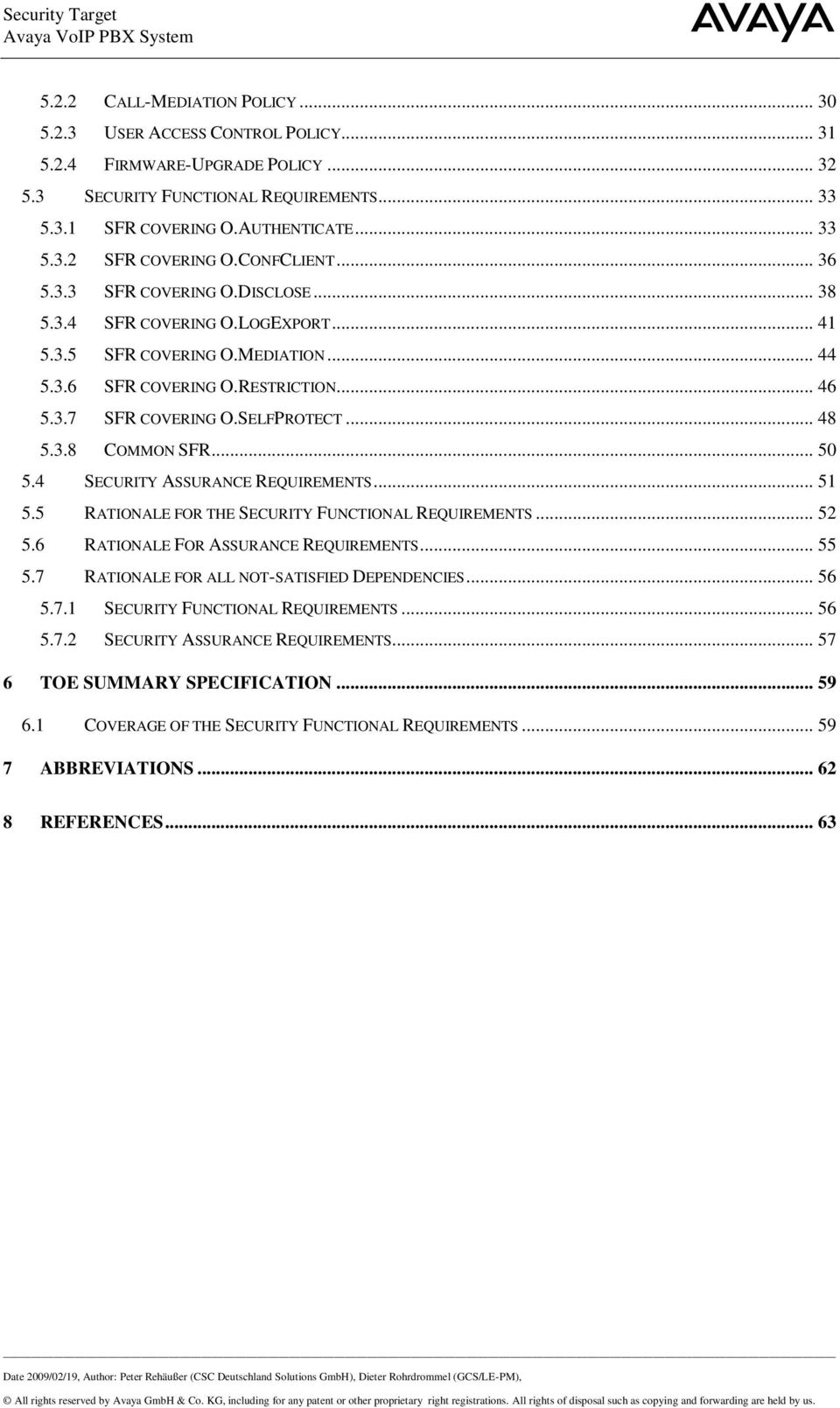
4 Avaya VoIP PB System CALL-MEDIATION POLICY USER ACCESS CONTROL POLICY FIRMWARE-UPGRADE POLICY SECURITY FUNCTIONAL REQUIREMENTS SFR COVERING O.AUTHENTICATE SFR COVERING O.CONFCLIENT SFR COVERING O.DISCLOSE SFR COVERING O.LOGEPORT SFR COVERING O.MEDIATION SFR COVERING O.RESTRICTION SFR COVERING O.SELFPROTECT COMMON SFR SECURITY ASSURANCE REQUIREMENTS RATIONALE FOR THE SECURITY FUNCTIONAL REQUIREMENTS RATIONALE FOR ASSURANCE REQUIREMENTS RATIONALE FOR ALL NOT-SATISFIED DEPENDENCIES SECURITY FUNCTIONAL REQUIREMENTS SECURITY ASSURANCE REQUIREMENTS TOE SUMMARY SPECIFICATION COVERAGE OF THE SECURITY FUNCTIONAL REQUIREMENTS ABBREVIATIONS REFERENCES... 63
5 Avaya VoIP PB System Page 5/63 1 ST Introduction 1.1 ST Reference ST Name: Avaya VoIP PB System Certification ID: BSI-DSZ-CC-0540 ST Version: 1.11 Date: 2009/02/19 Applicant: Avaya GmbH & Co KG Authors: Peter Rehäußer, CSC Deutschland Solutions GmbH CC Version: TOE Reference The TOE consists of the following components and documents: The Avaya Communication Manager 5.1 which is running on the Avaya Media Server S8730 The Avaya Media Gateway G650 exactly with the three modules listed below: o IPSI TN2312BP Firmware 44 o C-LAN TN799DP Firmware 26 o Medpro TN2602AP Firmware 41 The Avaya SES Server 5.1 on the Avaya Media Server S8500C. The protocol specific software application on the telephone family Avaya One- Deskphone. The following models of the Avaya One- family are part of the TOE: o 9630 for H.323, software version 2.0 o 9630 for SIP, software version 2.4 The Avaya Secure Service Gateway (SSG) Version on the Avaya Media Server S8500C. The Avaya SSG is an optional component. The system also works without an Avaya SSG but remotemanagement by Avaya is then not possible. It is possible to extent some server with SAMP cards enabling emergency access options for administrators. These SAMP cards are not part of the TOE. Anyhow, these cards may be installed. It is assumed that the access options provided by these cards are sufficiently protected by the environment (e.g. physical protection, by network components, by the operating system). These TOE components are shown in Figure 1 below and marked with a red frame.

6 Avaya VoIP PB System Page 6/63 The following guidance documents, which are part of the deliverables to the final customer: 1 o o Avaya Communication Manager The complete documentation for the Communication Manager is included on the Guidance CD Communication Manager 5.0, Publication Date: January 2008 and structured as followed. In addition to this CD, there are additional documents available to support the user where indicated. Those documents are listed below and labeld by ID s. Those documents can be downloaded from the Avaya support site (support.avaya.com). Overview Design Implement Maintain User Integrated Management Overview, Release 4.0, Document ID , Issue 2, May 2007 All Covered by the Guidance CD Communication Manager 5.0 Avaya Remote Feature Activation (RFA) User Guide, Document ID , Issue 5.1, November 2007 All covered by the Guidance CD Communication Manager 5.0 All covered by the Guidance CD Communication Manager 5.0 System Management/Administer Administration for Network Connectivity for Avaya Communication Manager, Document ID , Issue 13, January 2008 SNMP Reference Guide for Avaya Communication Manager, , Issue 1.0, Feburary 2007 Security Configuration Guidelines of the certified system based on the Communication Manager 5.1 [SecureConfigG] The new and updated documentation for the CM Version 5.1 is included on the Guidance CD Updated documents for the Communication Manager 5.1 CD Collection. Those documents can be downloaded from the Avaya support site (support.avaya.com). Avaya 9630 Phone SIP Avaya one- Deskphone SIP for 9630 IP-Telefon Quick Reference Avaya one- Deskphone SIP for 9630 IP-Telefon User Guide Avaya one- Deskphone Edition for 9600 Series IP Telephones Administrator Guide Release 2.0, , Issue 5 Avaya one- Deskphone Edition for 9600 Series IP Telephones Installation and Maintenance Guide, Release 2.0, , Issue 5, May 2008 o Avaya 9630 Phone H.323 Avaya one- Deskphone Edition for 9630/9630 IP-Telefon Quick Reference Avaya one- Deskphone Edition for 9630/9630 IP-Telefon User Guide It must be mentioned that for each TOE server component all relevant documents are listed. This results in multiple listings of some documents.

7 Avaya VoIP PB System Page 7/63 o o o o Avaya G650 Media Gateway Overview Implement Maintain Avaya Media Server Overview Design Implement Maintain All covered by the Guidance CD Communication Manager 5.0 All covered by the Guidance CD Communication Manager 5.0 All covered by the Guidance CD Communication Manager 5.0 All covered by the Guidance CD Communication Manager 5.0 All covered by the Guidance CD Communication Manager 5.0 Job Aid: Upgrading Firmware on the BIOS - Avaya S8500 Media Server, Document ID , issue 2, June 2005 All covered by the Guidance CD Communication Manager 5.0 System Management/Administration Avaya SSG Security the Avaya Communication Manager Media Servers, Issue 3, June 2005 Secure Services Gateway (SSG) Documentation, Document ID Avaya SES All covered by the Guidance CD Communication Manager TOE Overview Usage and major security features of the TOE The product is a sophisticated Communication System from Avaya which is based on the VoIP (Voice over IP) platform. The system meets all demands from small companies with less than 100 employees to global enterprises with ten-thousands of personals on a single system to more than one million users on a single network. It provides a wide range of Media Servers, IP-Phones and Application Server to optimize business communication and improve productivity. Avaya solutions are designed to meet highest security standards as end-to-end encryption and authentication of the devices and the users. The figure below shows the structure of such a VoIP system.

8 Avaya VoIP PB System Page 8/63 Internet VPN Avaya SSG Protection Zone: Administration Internal Network Internet SIP- Trunk Avaya SES Avaya Communication Manager AAA Server, Syslog, Modular Messaging, Configuration Server Protection Zone: Server Avaya G650 Internal Network Avaya One- Deskphone Avaya One- Deskphone Protection Zone: User Figure 1 Structure of the VoIP system The protection zone User contains all terminal devices like phones or computers. It should be remarked that only Avaya phones will be recognized as part of the certified system. The phones can be used to enter the identification & authentication credentials of the human users and to make encrypted calls to other phones connected to this PB. Calls over the internet (using the SIP trunk) to other phones cannot be encrypted. The phones itself are a trusted platform because they do not accept faked firmware or configuration data from unknown sources. Between the protection zones User and Server, there are some network devices (hubs, switches, routers, maybe a firewall). These devices may implement some security features like IEEE network device authentication. They are out of scope. Their existence and their security features can be assumed. The protection zone Server contains the most important devices, the Avaya Media Gateways G650 (at least one, usually more), the Avaya Communication Manager 2 and the Avaya SIP Enable Services (SES), which are all part of the TOE. 2 The complete appliance can be named as Media Server. The software running on it is named Communication Manager.

9 Avaya VoIP PB System Page 9/63 The servers are able to connect to other IP phones via the internal network, via the internet or via conventional telephone networks (PSTN, includes ISDN). The certified scenario just covers the communication over a company internal LAN/WAN and over the internet using a SIP trunk. The Avaya Communication Manager is the actual centre of the communication. Here, the sessions will be mediated (signaling). Also here, client authentication (human users) will be performed and all security events are logged. The human users use the phones to enter their identification and authentication credentials. The phones register at the server after boot-up and prior to be ready-for-use. The Avaya SES Server is a feature server for the modern SIP protocol. If SIP is used, the signaling information is protected by a TLS tunnel, which terminates at the SES server. The Avaya Media Gateway G650 is just a bridge between the different network technologies and protocols (e.g. IP PSTN, or H.323 SIP). This includes that they have to perform the encryption and decryption of the media streams of a call for all participants of this call, if the phones do not use the same protocol or codec. This holds especially valid for calls to external participants because external calls cannot be encrypted due to limitations of the Telecommunication service provider. Additionally, the Server zone may contain additional servers like Modular Messaging, a Conferencing System, a central authentication Server, a Syslog Server (both here named as AAA Server) or client-specific application servers, which are all not part of the TOE. A Configuration Server, which is also located in the Server zone, stores the configuration files of the phones. This server is not part of the TOE but relevant for the operation. Also here, the network devices like switches and routers are out of scope. This holds also valid for the connection to the internet (the SIP trunk) and the required network devices and firewalls. Between the protection zones Server and Administrator, there are some network devices (hubs, switches, routers, maybe a firewall). The protection zone Administration contains all systems and clients required for systems management (monitoring, administration). In general, these devices are not part of the TOE. As optional part of the TOE the Avaya Secure Service Gateway (SSG) is located in this zone. This device will be used as single-point-of-contact for the Avaya Support Center, which provides remote administration services, so that the customer is always able to control all accesses to its system. Avaya SSG enforces the access restrictions to the systems on network level configured by the customer s administrator TOE Type The TOE is a VoIP PB system and appropriate phones which mainly provide authentication, confidential communication and auditing.
10 Avaya VoIP PB System Page 10/ Required non-toe hardware/software/firmware As shown in the Figure 1 above, there is some network equipment (switches, router, etc.) required to interconnect the different TOE parts and the environment. However, the TOE does not require any additional special hardware, software or firmware to implement or enforce its security features. The Configuration Server seems to be relevant because it stores the configuration files of the phones. It is not required to have such a server because the phones need not to download new configuration files. They can store their configuration locally. The configuration server is especially not required to enforce any security function. However, a central management of the phones without such a server is not possible, whereas it is highly recommended to have such a server.
11 Avaya VoIP PB System Page 11/ TOE Description Physical Scope of the TOE As listed in chapter 1.2 the TOE consists of hardware, several software components as well as guidance documents. The physical scope of the TOE is defined by the hardware components listed in chapter 1.2. The TOE consists of software modules (listed in chapter 1.2) which run on these hardware components. Finally, the physical scope of the TOE includes the guidance documents of all these hard- and software components as listed in chapter 1.2. The functions of these TOE components are described in more detail in the following sections Avaya Communication Manager Designed to run on a variety of Linux-based Media Servers, Communication Manager provides centralized call control for a resilient, distributed network of Avaya Media Gateways and a wide range of digital and IP-based communication devices. Avaya Communication Manager provides an open SIP and H.323 model with full coverage of support of open API/SDK. This approach allows seamless integration of voice into other applications and flexibility to integrate third party endpoints and applications. Avaya Communication Manager is in charge of the registration of the phones, the correct mediation of calls and the key management for the encryption of the calls (except calls based on SIP). Furthermore, the Communication Manager is in charge for logging of calls and the log-on of phones (users) to the system Avaya G650 Media Gateway The G650 can accommodate a range of analog, digital, ISDN, and IP (over the LAN) phone station configurations, with voice transport options over IP, analog, TDM, or ATM. So, G650 is responsible for connecting the varied types of phone stations and conversion of the different protocols. This includes also the encryption and decryption of the calls, if possible and necessary. The configuration under evaluation only includes a company external connection over a SIP trunk Avaya SES Server SIP Enablement Services (SES) is a Linux-based software application that is deployed as a network appliance on the Avaya S8500 Server series (short: SES Server). SIP Enablement Services adds support for Avaya's one- Deskphone SIP 9630 telephones. The SES server is involved in the signaling of SIP calls and therefore also for the respective key management and the logging of the relevant events of these calls.
12 Avaya VoIP PB System Page 12/ Avaya SSG Server In order to support any service and maintenance tasks, the Avaya Global Service provides secured services platforms at the Avaya site as well as for the customer site. The Avaya SSG (Secure Service Gateway) which is located behind the customer s firewall is the central access point for all service requests from the Avaya Service Center. In addition to providing a point of outbound alarm aggregation for all maintained devices inside the customer network, the Avaya SSG serves as a platform for future value-added services. A SSG is required at the customer s intranet to collect alarms from maintained devices and aggregate them into a single secure data stream to be sent to Avaya over a WAN connection. Once collected, the SSG sends the alarms to Avaya using HTTPS. SSG uses the Red Hat Linux Enterprise Server 3.0 operating system, the Java SDK and a Postgres database. All TCP/UDP ports are closed unless required for normal operation. Logging all events is critical to SSG security. User logins, product alarms, software and hardware events as well as network outages are all recorded in the SSG s event and alarm log. The customer is able to enforce access control rules to the SSG. As example, the customer may allow or deny access to all products at the SSG with the ability to set one-time or recurring time-of-day access control restrictions for one or more devices. For example, the customer may deny remote access to all equipment in his call center during the business hours where the call volume is at its peak. SSG also enables the customer to view a real-time list of active sessions passing through the SSG and to terminate one or more of the active sessions if deemed suspicious or inappropriate Avaya One- Desktop Phone 9630 The Avaya one- Desktop Phone 9630 is an enterprise class VoIP phone and supports both H.323 and SIP protocol with two different models. The main security features of these phones are the ability to handle encrypted calls, to use only authentic firmware for an upgrade, to authenticate the Configuration Server prior of downloading the configuration file and to forward the human user authentication credentials to the Avaya Communication Manager Logical Scope of the TOE The following security features define the logical scope of the TOE: Authentication of human users. The user has to enter his (personal) phone number and his PIN at the client phone. Subsequently, he becomes an authorized person and may use all (enabled) functions of the phone and the system and call all (allowed, not disallowed) telephone numbers. Administrators have to enter username/password to access the TOE functions. For all TOE servers except G650, this I&A procedure is covered by the operating system. Securing the confidentiality of the signaling. This includes services like call forwarding or inquiry call.

13 Avaya VoIP PB System Page 13/63 This also includes the simple conferencing function MeetMe implemented in the Communication Manager, the gateways and the phones. Calls over the internet using the SIP trunk are excluded. Securing the confidentiality of the media stream, but only if there are no components involved which are not part of the TOE (e.g. external telephones or the modular messaging). This includes also the simple conferencing function MeetMe implemented in the Communication Manager, the gateways and the phones. Calls over the internet using the SIP trunk are excluded. Secure and dependable (trustworthy) mediation of sessions, caller party and called party of a call must be identified and authenticated; a call must only be mediated from the caller party to the called party. This includes services like call forwarding or inquiry call and the simple conferencing functions. The actual conferencing server and its services are out-of-scope. This service can only be provided to devices part of this PB system. Phones connected over the internet to the system (using the SIP trunk) cannot be controlled. Self-protection of the telephones against unauthorized software updates and modification of its configuration. Logging of security relevant events o Identification/Authentication of a human user o Successful establishing of a connection o All administrative actions Managing of white- and black lists for telephone numbers, which means allowing and disallowing certain telephone numbers. o Separation between authenticated and not authenticated human users. e.g. emergency calls are also allowed for non authenticated users o Separation between groups of human users or single users. e.g. usually, users are not allowed to call to foreign countries but the companies president is allowed to do so. Access Control for Remote Administrators by using SSG (which is an optional part of the TOE).

14 Avaya VoIP PB System Page 14/63 In order to define the logical scope in detail, the following functions are out of scope of the TOE: Boarder protection of all external connections like SIP trunks or remote management connections. Conferencing Systems; they need an additional server component which is not part of the TOE. IEEE 802.1x functionalities; this may be implemented in the network equipment. Logging of the Identification/Authentication of server components against the phones. The phones are not capable to store audit information. Audit information will not automatically be deleted after expiry of their retention time. Possible data protection requirements are not considered in this Security Target. VPN Connections of remote access solutions for administrators Configuration under Evaluation This chapter defines in short terms the configuration of the complete system which is under evaluation: The system must be configured according to the specifications in [SecureConfigG].

15 Avaya VoIP PB System Page 15/63 2 Conformance Claim 2.1 CC Conformance Claim The Security Target is based upon Common Criteria for Information Technology Security Evaluation, Part 1: Introduction and General Model; Version 3.1, Revision 1, CCMB , Common Criteria for Information Technology Security Evaluation, Part 2: Security Functional Components; Version 3.1, Revision 2, CCMB , Common Criteria for Information Technology Security Evaluation, Part 3: Security Assurance Components; Version 3.1, Revision 2, CCMB , referenced hereafter as [CC]. This Security Target claims the following CC conformance: part 2 conformant part 3 conformant evaluation assurance level (EAL) 1 augmented by ASE_OBJ.2, ASE_REQ.2, ASE_SPD.1 and ADV_FSP PP Conformance Claim The Security Target does not claim conformance to a Protection Profile. 2.3 Package Claim The Security Target does not claim conformance to a Package beside EAL 1 augmented.
16 Avaya VoIP PB System Page 16/63 3 Security Problem Definition The Security Problem Definition describes assumptions about the operational environment in which the TOE is intended to be used and represents the conditions for the secure operation of the TOE. 3.1 Definitions Subjects (Authorized) Issuer of the Firmware The issuer of the firmware is the person or company who signs the firmware by a digital signature by using his (personnel) digital certificate. Such an issuer is authorized, if his digital certificate is signed by the root authority the phones trust. Administrator A person who is responsible for administration of some or all hardware components or software applications on which the TOE bases and/or which build up the TOE. This includes also the operating systems and other services like a central authentication service or a firewall. Administrators have the authority and the (technical) permissions to access the hardware and software components and to perform administrative tasks on these components and data. Attacker Authenticated user An attacker may be an authorized or an unauthorized person who tries to use the system without permission or in an unintended way, to modify the system or to bother the functions of the system. It is assumed that attackers have at most basic attack potential because the VoIP information or the functionality of the phone system is usually not a very valuable good. Furthermore, the VoIP system (the TOE) is accessible from the local LAN and (using the SIP trunk) over the internet and is located in secured or at least standard office rooms (complex attacks/modifications are not possible). All logical remote access points are protected by firewalls and/or VPN gateways/connections. An authenticated user has successfully authenticated them against the TOE. An authenticated user must also be an authorized person.

17 Avaya VoIP PB System Page 17/63 Authorized Person Customer- Administrator Unauthorized Person An authorized person is a user of the VoIP system who is authorized to make phone calls (to dedicated numbers or to all numbers except some defined numbers) or use other user-accessible services of the system. It is possible that a particular person is only authorized to make calls with his own phone number. So, for using this phone number and/or calling a special number the person is an authorized person; for using another phone number and/or calling another number this person is an unauthorized person. The Customer-Administrator is an underprivileged Administrator for SSG. This role is only able to manage the access permissions to the other TOE devices accessible through the SSG and the WAN connection of the SSG. The Customer- Administrator can also monitor all current activities on the SSG. This role does not have further permissions. A normal administrator also exists on SSG to manage all other issues of this device. It may be possible that one person is Administrator and Customer-Administrator. These are all people which are not administrators and not authorized persons Objects Configuration Server Gateway(s) Phone TOE Servers A server in the operational environment of the TOE which stores the configuration files for the phones. This server is located in the Server Zone and is protected by physical means and the access control of the operating system. The server provides a HTTP(S) interface for downloading the configuration files. This term identifies the Avaya Media Gateways G650. This term is just an abbreviation. The Avaya One- Deskphone 9630 (both models). This definition includes Avaya Communication Manager (software), Avaya Media Gateway G650 and the three listed printed boards (hardware), Avaya SES Server (software) and Avaya SSG (software). All other parts of the physical scope of the TOE are not included in this definition Information Audit Data / Audit Information These are the log information collected and stored by the TOE. Audit data contain e.g. logon failures of administrators, call information like start date/time, duration, called party number, calling party number, etc.

18 Avaya VoIP PB System Page 18/63 Blacklist Media Stream Signaling data Whitelist A list of phone numbers or patterns of phone numbers a phone/user/group of users are not allowed to call. The data stream which transports the actual voice information. The data stream which transports the signaling information required to establish the connection (e.g. the called party s phone number) A list of phone numbers or patterns of phone numbers a phone/user/group of users are allowed to call Operations Mediation Receiving information Registration as unnamed Mediation means that the server components of the TOE receive the signaling data and/or the media stream and forward them to the respective called party(ies). The TOE must not store the information permanently and must not forward the information to any other parties. In the context of VoIP and telephones, receiving usually means listening to your phone. Unnamed Registration is the process a phone performs after its boot-up and if the user does neither start the login procedure within 60 seconds nor starts the login process with inserting his credentials. The phone connects to the Avaya Communication Manager and registers as unnamed. The Avaya Communication Manager now "knows" this phone. Unnamed Registration provides only a configurable set of functions, including e.g. emergency call. Until now the phone does not have a phone number. This number will be assigned to the phone when an authorized person has successfully identified & authenticated itself. (see Full Registration ) Full Registration Sending information Full Registration is reached when a human user has logged on with "his" phone extension and his private PIN. In the context of VoIP and telephones, sending usually means dialing a number or talking into the phone Security Attributes Path name A path name specifies the location of a file or directory on the storage of the operating system. For an Unix operating system a valid path name for audit information may be /var/log/audit.log

19 Avaya VoIP PB System Page 19/ Assumptions A.ADMIN A.AVAILABLE A.ConfServer A.DEVICES A.ERRMONITORING A.LOCATION A.PHYSICAL A.SECDEV All administrators are trustworthy and trained. Administrators do especially not pass their access credentials over to anyone else. All components are assumed to be sufficiently available or to be redundant. This includes also the bandwidth of the network for the VoIP traffic. The Configuration Server is assumed to be carefully administered. This means especially that the access to the configuration files is restricted by means of the operating system of this server. It is assumed that the user zone does only contain VoIP phone components. There are no conventional phones or fax machines located in this zone. Computers or other IT equipment is allowed. It is assumed that all errors the applications, the media servers and gateways sent will be received, monitored and processed by an administrator in time. It is assumed that all phones of the user zone are located in a standard office environment and are always under supervision except short breaks, e.g. when the user is at the rest room. For longer breaks it is assumed that the access to the office room is restricted to authorized 3 persons by any other means (e.g. locked doors, doormen). So, no unauthorized physical modifications of the phones (e.g. disassembling, replacing, installation of an additional hardware component to the phone) or of the respective network connection (usually, the line between the phone and the plug socket) are possible. The components of the server and admin zone as well as the respective network equipment of these zones are physically protected by the environment (the rooms). The rooms are access controlled. The network components between the user zone and the server zone are able to and are configured to enforce the IEEE hardware authentication of the client phone devices. Further, it is assumed that only authorized phones are allowed to connect to the IP network to which the TOE is connected. 3 authorized means here authorized to access the room. This does not necessary include the permission to use the phones inside this room.

20 Avaya VoIP PB System Page 20/63 A.SECNET A.USER A.VPN If the System is connected to the Internet or any other untrusted (IP) network, the complete system is protected on protocol level (e.g. TCP/UDP/IP) by a firewall or equal products. Only the ports required for operation are opened. This holds also valid for the junction between user zone and server zone. (see Figure 1) The authorized persons do not pass their access credentials, if existent, over to other authorized or unauthorized persons. If there is a remote access via SSG, the WAN connection is sufficiently protected by physical or logical means (e.g. VPN encryption as shown in Figure 1). 3.3 Threats T.AccServer T.CallDisc T.CallPrev T.ConfClient T.ConfServer T.ConnServer T.DoS An attacker gets direct logical access to TOE servers (on the level of the application) because the TOE servers provide such access points. 4 An attacker is able to disclose the signaling traffic and/or the media streams, e.g. by rerouting the data, by sniffing the IP traffic or by using functions of the VoIP system (e.g. unnoticeable listening of calls). An attacker is able to prevent the establishing of calls, e.g. by provoking IP address collisions with the servers. An attacker modifies the software configuration parameter of a phone (e.g. by using the available hardware switches or available software options) in a short moment when the phone is not under supervision. An attacker modifies the configuration data of the TOE servers, e.g. by direct modification or replacing of configuration files. An attacker terminates/bothers/prevents/redirects the logical connection between the server zone and another IT system required for the (secure) operation of the system (e.g. a directory service), e.g. by rerouting the IP traffic or by provoking an IP address collision. An attacker performs a DoS attack against the server components, e.g. with a high number of concurrent calls or a high number of concurrent phones which want to register at the server. An attacker performs a DoS attack against a phone or a server, e.g. with a high number of IP packages sent to its IP address. 4 Please consider that this threat deals only with the logical access to the TOE servers, not with the logical access to the TOE environment like the underlying operating system. This is covered by OSP.OS.

21 Avaya VoIP PB System Page 21/63 T.LogDel T.LogDisc T.Remote T.ReplaceClient T.ReplaceServer T.Replay T.Unauth An attacker is able to delete or modify (parts of) the logs (e.g. call data records), e.g. by direct modification/erasure of the log files. An attacker is able to disclose the logs (e.g. call data records), e.g. by direct read access to the log files. An attacker is able to log into the system remotely by using the administrative interfaces of SSG. This attack may be possible if the attacker is already inside the VPN tunnel, e.g. when the attacker origins from the Avaya SSDP. A virus, worm, trojan horse or other malware can be installed by an attacker on any client system, e.g. by modifying/replacing the software on the bootp/dhcp server or by faking the bootp/dhcp servers at all which stores the telephone applications for the clients. An attacker modifies/replaces one or more server software components, e.g. by exploiting a vulnerability of the operating system of this server. An attacker performs a replay attack against a TOE part by re-sending already captured IP packages. The attacker wants e.g. to spoof a server or phone or he wants to perform a DoS attack against a server or a phone in order to exploit a buffer-overflow vulnerability. An unauthorized person uses features (e.g. call forwarding, conferencing functions) of the VoIP-System for which he or she is not authorized. An unauthorized person causes a very high telephone invoice by calling expensive phone numbers, making long-distance calls or a lot of normal calls. 3.4 Organizational Security Policies OSP.NETMONITOR OSP.OS The network that the TOE is connected to will be monitored by the administrators for unapproved activities and/or attempts to attack network resources (including the parts of the TOE). The administrator(s) must take care about the secure configuration of the operating systems of all TOE components. This means especially, that they do not create unnecessary or unprotected accounts, give more permissions than required to an account, disable all accounts if they are not longer required and install all security patches to the system.
22 Avaya VoIP PB System Page 22/63 4 Security Objectives 4.1 Security Objectives for the TOE O.Authenticate The TOE servers must require a successful and not replayable identification and authentication of the administrators before granting access to these components. 5 The TOE must also require a successful and not replayable identification and authentication of the human users before considering the user as authorized person but some non-security critical functions (e.g. emergency call) are still available to unauthorized persons. O.ConfClient O.Disclose O.LogExport O.Mediation O.Restriction O.SelfProtect The security attributes of the phones must only be configurable by administrators using trustworthy communication channels. Only non-security relevant parameters are possible to be changed by the user. All signaling data and media streams between two or more phones must be protected against disclosure. The TOE must store all log records in a storage secured by the operating system The TOE must ensure that only the intended parties of a call can listen the call. The TOE must provide an access control system for its users. The TOE must enable the administrators to configure the permissions the users shall have. This includes access permissions to features of the system, static assignment of a phone number to a user (identification of the user) and access restrictions to dedicated phone numbers. The phones must check the integrity and authenticity of a software application before starting this software. 5 Please consider that this objective deals only with securing the logical access to the TOE servers, not with securing the logical access to the TOE environment like the underlying operating system. This is covered by OE.ADMIN and OE.OS.
23 Avaya VoIP PB System Page 23/ Security Objectives for the Operational Environment OE.ADMIN OE.AVAILABLE OE.ConfServer OE.DEVICES OE.DoS OE.ERRMONITORING OE.LOCATION OE.LOGOUT OE.NETMONITOR OE.PHYSICAL All administrators shall be trustworthy and trained. Administrators must especially not pass their access credentials over to anyone else. The administrator(s) must take care about the secure configuration of the operating systems of all TOE components. This means especially, that they do not create unnecessary or unprotected accounts, give more permissions than required to an account and disable all accounts if they are not longer required. All components must be sufficiently available or to be redundant. This includes also the bandwidth of the network for the VoIP traffic. The owner of the VoIP system is in charge of procuring/providing the respective technical environment. The Configuration Server shall be carefully administered. This means especially that the access to the configuration files shall be restricted to a minimum by means of the operating system of this server. The user zone must not contain conventional phones or fax machines. The operational environment must provide a sufficient protection of all TOE devices against DoS attacks. This can be implemented by technical means (e.g. filter on network devices) or by organizational mean (e.g. ongoing monitoring of network activities). All errors the TOE servers sent will be received, monitored and processed by an administrator in time. All phones of the user zone must be located in a standard office environment and must always be under supervision except short breaks, e.g. when the user is at the rest room. For longer breaks the user must restrict the access to the office room to authorized 6 persons by any other means (e.g. locked doors, doormen). When an authorized user leaves his place and leaves especially the phone without supervision, the user is required to prevent unauthorized usage of the phone, e.g. by log out from the phone. The network that the TOE is connected to must be monitored by the administrators for unapproved activities and/or attempts to attack network resources (including the parts of the TOE). The components of the server and admin zone as well as the respective network equipment of these zones must be physically protected by the environment (the rooms). The rooms must be access controlled. 6 authorized means here authorized to access the room. This does not necessary include the permission to use the phones inside this room.
24 Avaya VoIP PB System Page 24/63 OE.SECDEV OE.SECNET OE.USER OE.VPN The network components between the user zone and the server zone must be configured to enforce the IEEE hardware authentication of the client phone devices. Only authorized phones are allowed to connect to the IP network to which the TOE is connected. If the System is connected to the Internet or any other untrusted (IP) network, the complete system must at least be protected on protocol level (e.g. TCP/UDP/IP) by a firewall or equal products. Some additional protections on higher protocol levels are advisable. Only these ports required for operation are allowed to pass the filter. The junction between user zone and server zone (see Figure 1) must also be protected by such a filter. The authorized persons must be trained to not pass their access credentials, if existent, over to other authorized or unauthorized persons. If there is a remote access via SSG, the WAN connection must be sufficiently protected by physical or logical means (e.g. VPN encryption).
25 O.Authenticate O.ConfClient O.Disclose O.LogExport O.Mediation O.Restriction O.SelfProtect OE.ADMIN OE.AVAILABLE OE.ConfServer OE.DEVICES OE.DoS OE.ERRMONITORING OE.LOCATION OE.LOGOUT OE.NETMONITOR OE.PHYSICAL OE.SECDEV OE.SECNET OE.USER OE.VPN Security Target Avaya VoIP PB System Page 25/ Rationale for Security Objectives The following table maps the assumptions, threats and OSPs to the objectives for the TOE and the objectives for the operation environment. The mapping will be justified in the subsequent sections of this chapter. A.ADMIN A.AVAILABLE A.ConfServer A.DEVICES A.LOCATION A.ERRMONITORING A.PHYSICAL A.SECDEV A.SECNET A.USER A.VPN T.AccServer T.CallDisc T.CallPrev T.ConfClient T.ConfServer T.ConnServer T.DoS T.LogDel T.LogDisc T.Remote T.ReplaceClient T.ReplaceServer T.Replay T.Unauth OSP.OS OSP.NETMONITOR
26 Avaya VoIP PB System Page 26/ Coverage of the Assumptions A.ADMIN A.AVAILABLE A.ConfServer A.DEVICES A.LOCATION A.ERRMONITORING A.PHYSICAL A.SECDEV A.SECNET A.USER A.VPN OE.Admin verbalized the assumption as objective and covers the assumption therefore completely and correctly. OE.AVAILABLE verbalized the assumption as objective and covers the assumption therefore completely and correctly. OE.ConfServer verbalized the assumption as objective and covers the assumption therefore completely and correctly. OE.DEVICES verbalized the assumption as objective and covers the assumption therefore completely and correctly. OE.LOCATION verbalized the assumption as objective and covers the assumption therefore completely and correctly. OE.ERRMONITORING verbalized the assumption as objective and covers the assumption therefore completely and correctly. OE.PHYSICAL verbalized the assumption as objective and covers the assumption therefore completely and correctly. OE.SECDEV verbalized the assumption as objective and covers the assumption therefore completely and correctly. OE.SECNET verbalized the assumption as objective and covers the assumption therefore completely and correctly. OE.USER verbalized the assumption as objective and covers the assumption therefore completely and correctly. OE.VPN verbalized the assumption as objective and covers the assumption therefore completely and correctly.
27 Avaya VoIP PB System Page 27/ Coverage of the Threats T.AccServer T.CallDisc T.CallPrev T.ConfClient T.ConfServer T.ConnServer T.DoS O.Authenticate requires identification/authentication before any action at the servers at each physical or logical interface. OE.PHYSICAL supports by hindering the access to the physical interfaces. O.Mediation ensures that the VoIP system does not provide functions to listen a call unnoticed. O.Authenticate ensures that nobody can access the system (or at least the security critical parts) without authorization. O.Disclose ensures that the VoIP traffic will be end-to-end encrypted for the respective parties. OE.NETMONITOR supports by the fast identification of unapproved activities on the network. OE.ERRMONITORING ensures that all errors (including errors of the operating system) the servers sent, will be monitored and processed by administrators in time. OE.NETMONITOR supports by the fast identification of unapproved activities on the network. OE.LOCATION prevents physical modifications of the phones. O.ConfClient prevents the security-relevant configuration of the phone by unauthorized persons and O.Authenticate requires a successful identification and authentication before any security critical action. OE.PHYSICAL ensures that a direct physical access to the servers by attackers is not possible. OE.ADMIN ensures well-trained administrators which do not bring the systems in an insecure state. OE.PHYSICAL ensures that a direct physical access to the servers and the network equipment by attackers is not possible. OE.ADMIN ensures well-trained administrators which do not bring the systems in an insecure state. OE.NETMONITOR supports by the fast identification of unapproved activities on the network. OE.DoS ensures that all servers and the phones are protected against a DoS attack. OE.ERRMONITORING supports the early identification of such an attack. OE.NETMONITOR supports by the fast identification of unapproved activities on the network. T.LogDel O.Authenticate in addition with OE.ADMIN ensure that only authorized person have access to the log files by using the appropriate TOE functions. O.LogExport ensures that the TOE stores all audit information in a storage protected by the operating system. OE.ADMIN enforces the protection of this storage logically. OE.PHYSICAL enforces the protection of this storage physically.
28 Avaya VoIP PB System Page 28/63 T.LogDisc T.Remote O.Authenticate in addition with OE.ADMIN ensure that only authorized person have access to the log files by using the appropriate TOE functions. O.LogExport ensures that the TOE stores all audit information in a storage protected by the operating system. OE.ADMIN enforces the protection of this storage logically. OE.PHYSICAL enforces the protection of this storage physically. OE.SECNET and OE.VPN ensure that network based attacks against the SSG are without success. O.Authenticate in addition with OE.ADMIN ensure that only authorized person can log in from remote sites by using the optional SSG. T.ReplaceClient T.ReplaceServer T.Replay T.Unauth OE.LOCATION prevents modifications at the phones directly. O.SelfProtect ensures that the phones run only successfully authenticated software applications, even if the application origins from a valid server. OE.PHYSICAL prevents physical modifications or replacements of the servers. OE.ADMIN ensures that the operating system is configured in a secure way and that this level of security will not decreased by insecure configuration. O.Authenticate requires an identification/authentication mechanism which is resistant against replay attacks. OE.DoS protects against DoS attacks based on replayed packages. OE.NETMONITOR supports by the fast identification of unapproved activities on the network. O.Restriction implements an access control system which restricts the possibilities of the users. O.Authenticate enforces a successful identification and authentication before any action. O.ConfClient prevents circumvention of the access control by manipulations of the phone. OE.LOGOUT requires that users ensure that no one unauthorized can use the phone when he is absent and OE.LOCATION requires that physical access to the phone is restricted Implementation of Organizational Security Policies OSP.OS OSP.NETMONITOR OE.ADMIN covers the requirement that the administrators must take care about the secure configuration of the TOE s systems. OE.NETMONITOR verbalized the OSP as objective and covers the OSP therefore completely and correctly.
29 Avaya VoIP PB System Page 29/63 5 Security Requirements 5.1 Conventions All operations performed on the Security Functional Requirements or the Security Assurance Requirements need to be identified. For this purpose the following conventions shall be used. Assignments will be written italic Selections will be written underlined Refinements will be written bold Iterations will only be performed on components level. The component ID defined by the Common Criteria (e.g. FDP_IFC.1) will be extended by an ID for the iteration (e.g. (Export) ). The resulting component ID would be FDP_IFC.1 (Export). 5.2 Security Policies The following sections define the security policies which must be enforced by the TSF Audit-Export Control Policy This is an information flow control policy which defines the permissible information flow for exporting audit data record to outside of the TOE. All audit data records be generated by the TSF must be exported to a trusted storage platform. It is assumed (A.PHYSICAL, A.ADMIN, OE.ADMIN, OE.OS) that the storage is access controlled by the underlying operating system or by any other means so that only administrators have read and write access to this information after the export. It is also assumed that only administrators have the permissions to configure the destination path to the trusted storage.
30 Avaya VoIP PB System Page 30/ Call-Mediation Policy This is an information flow control policy which defines which devices shall be enabled to be participants of a call. The TSF shall ensure that a call can only be received by these participants which are identified by the calling party (usually by entering the respective phone numbers of the intended called party). 7 If the intended called party has configured an automatic call-forwarding or has manually forwarded the call to another called party, only the caller party and the finally called party shall be able to be participants of the call. 8 It is permissible that a called party is also a caller party at the same time for virtually the same call. This happens if the called party extends the call to a conference call. The TSF shall ensure that all signaling information and media streams of different calls will be handled completely separated at all devices. Furthermore, this policy also defines the procedures for ensuring the confidentiality of the signaling data and media streams: All signaling data and media streams managed by only the TOE devices shall be encrypted by using strong cryptographic algorithms appropriate for the respective communication protocol. Signaling data and media streams from and to a SIP-trunk may be transferred/received from the respective TOE servers to/from the network gateways unencrypted but only on the connection between the TOE servers and the gateway. All connections inside the scope of control of the TOE are encrypted. All (encrypted) data of one call must strictly be separated from all other data from other calls. This holds valid for all software and hardware components of the TOE. A logical separation, e.g. by using security attributes, is acceptable. The cryptographic keys for a particular session must be generated and managed in such a way that the keys keep confidential outside of this session. This means, the keys shall not be readable from outside of this session and the keys shall not be determinable from keys of another session or from other (security) attributes 9. The cryptographic keys for a particular session must be made unavailable when the information is not longer needed. The encrypted information shall only be transferred to the called party(ies) of the call. All (unencrypted) signaling data or media streams stored in the memory of this device shall immediately be made unavailable when the information is not longer needed for the actual communication Covers a standard one-to-one call and a conference call build up by the originator s phone. This scenario can only be completely covered by the TSF, if the new called party is also a device in the scope of the TSF. However, the first called party, which has forwarded the call, shall not be able to listen the call after forwarding. Such security attributes may be the current time or date, the phone numbers of the participants, an ongoing number managed on this gateway, a deterministic (weak) random number generator, etc.
31 Avaya VoIP PB System Page 31/63 The encrypted or unencrypted information shall not be stored on a permanent storage (e.g. hard disk) User Access Control Policy This is an access control policy which defines the access permissions of normal users of the phones. The administrator can configure whether the system requires a user authentication for special actions / phone numbers or not. The administrator can configure groups of users. The administrator can configure whether all users are allowed to dial dedicated numbers (whitelistening) whereas a preceding user identification/authentication is not required. The administrator can configure whether all users or groups of users are allowed to dial dedicated numbers (whitelistening) whereas a preceding user authentication is required. The administrator can configure whether all users or groups of users are not allowed to dial dedicated numbers (blacklistening) whereas a preceding user authentication is required The access control follows the following policy: 1. Check all whitelists for the respective user. If the phone number to be called is included, access is granted. 2. Check all blacklists for the respective user. If the phone number to be called is included, access is denied. 3. If the called number was not found in the whitelist or the blacklist, the default behavior is o Internal calls are allowed o External calls are denied
32 Avaya VoIP PB System Page 32/ Firmware-Upgrade Policy When a phone has downloaded a new version of its firmware, the phone has to check the integrity and the authenticity of this firmware prior to installation. For this purpose, the phone has to check the digital signature of the firmware. o If the check of the signature shows that the firmware was modified, the phone does not accept the firmware, prints an error message and continues using the current version of the firmware. o If the check of the signature shows that the firmware is integer but the phone could not verify the authenticity of the creator of the signature, the phone does not accept the firmware, prints an error message and continues using the current version of the firmware. o If the check of the signature shows that the firmware is integer and the phone could verify the authenticity of the creator of the signature, the phone upgrades itself. During this time, an appropriate message will be displayed.
33 Avaya VoIP PB System Page 33/ Security Functional Requirements SFR covering O.Authenticate FIA_UAU.2 (AdminServer) User authentication before any action FIA_UAU.2.1 Hierarchical to: FIA_UAU.1 Timing of authentication Dependencies: FIA_UID.1 Timing of identification The TSF shall require each Administrator and Customer-Administrator to be successfully authenticated against the TOE servers before allowing any other TSFmediated actions on behalf of that Administrator or Customer-Administrator FIA_UID.2 (AdminServer) User identification before any action FIA_UID.2.1 Hierarchical to: FIA_UID.1 Timing of identification Dependencies: No dependencies. The TSF shall require each Administrator and Customer-Administrator to be successfully identified against the TOE servers before allowing any other TSFmediated actions on behalf of that Administrator or Customer-Administrator FIA_UAU.1 (UserServer) Timing of authentication FIA_UAU.1.1 FIA_UAU.1.2 Dependencies: FIA_UID.1 Timing of identification The TSF shall allow the TSF mediated actions defined in the User Access Control Policy on behalf of the user to be performed before the user is authenticated. The TSF shall require each user to be successfully authenticated before allowing any other TSF-mediated actions on behalf of that user FIA_UID.1 (UserServer) Timing of identification FIA_UID.1.1 FIA_UID.1.2 Dependencies: No dependencies. The TSF shall allow the TSF mediated actions defined in the User Access Control Policy on behalf of the user to be performed before the user is identified. The TSF shall require each user to be successfully identified before allowing any other TSF-mediated actions on behalf of that user. Application Note: All these requirements regarding identification and authentication are refined to cover a particular I&A relation, e.g. the users against the TOE servers. All these requirements together cover all I&A relations of the TOE. So, these refinements should be considered as conformant to the CC definition of Refinement.
34 Avaya VoIP PB System Page 34/ FIA_UAU.3 (UserServer) Unforgeable authentication FIA_UAU.3.1 FIA_UAU.3.2 Dependencies: No dependencies. The TSF shall prevent use of authentication data that has been forged by any user of the TSF. The TSF shall prevent use of authentication data that has been copied from any other user of the TSF FMT_SMF.1 (Server) Specification of Management Functions FMT_SMF.1.1 Dependencies: No dependencies. The TSF shall be capable of performing the following management functions on the TOE servers except the SSG: Management of Administrator Accounts Management of Phones Management of Features of the Phones (Configuration) Management of Encryption Settings for calls FMT_SMF.1 (SSG) Specification of Management Functions FMT_SMF.1.1 Dependencies: No dependencies. The TSF shall be capable of performing the following management functions on the SSG: Granting and revoking access permissions of external IP addresses to TOE servers identified by their internal IP addresses Function to cancel all active sessions and preventing new sessions Monitoring of all activities performed by the remote users logged in FMT_MTD.1 (Server) Management of TSF data Dependencies: FMT_SMR.1 Security roles FMT_SMF.1 Specification of Management Functions FMT_MTD.1.1 The TSF shall restrict the ability to query, modify, delete the accounts and access permissions of the TOE servers except the SSG to the administrators.
35 Avaya VoIP PB System Page 35/ FMT_MTD.1 (SSG) Management of TSF data Dependencies: FMT_SMR.1 Security roles FMT_SMF.1 Specification of Management Functions FMT_MTD.1.1 The TSF shall restrict the ability to query, modify, delete the access permissions of the SSG to Customer-Administrators.
36 Avaya VoIP PB System Page 36/ SFR covering O.ConfClient FMT_MTD.1 (Phone) Management of TSF data Dependencies: FMT_SMR.1 Security roles FMT_SMF.1 Specification of Management Functions FMT_MTD.1.1 The TSF shall restrict the ability to modify the security relevant phone configuration parameters to administrators. Application Note: This requirement covers the local configuration of the phone by pressing dedicated key combinations. This does not cover the configuration of the phone via the configuration file. The default key combinations are only mentioned in the administrator guidance and shall be changed by the administrator after initial configuration. Therefore, the TOE is able to enforce this SFR FMT_SMR.1 (Phone) Security roles Dependencies: FIA_UID.1 Timing of identification FMT_SMR.1.1 The TSF shall maintain the roles Administrator Authorized person Unauthorized person FMT_SMR.1.2 The TSF shall be able to associate users with roles. Application Note: FMT_SMR.1 (Phone) defines which roles are to be managed by the phones itself FMT_SMF.1 (Phone) Specification of Management Functions FMT_SMF.1.1 Dependencies: No dependencies. The TSF shall be capable of performing the following management functions on the phones: Upgrade of the firmware of the phone Configuration of IP parameters (e.g. Use of DHCP or static configuration, IP address of configuration server, default gateway, broadcast address, etc.)
37 Avaya VoIP PB System Page 37/ FIA_UAU.2 (ServerPhone) User authentication before any action FIA_UAU.2.1 Hierarchical to: FIA_UAU.1 Timing of authentication Dependencies: FIA_UID.1 Timing of identification The TSF shall require each Configuration Server to be successfully authenticated before allowing any other TSF-mediated actions on behalf of that Configuration Server FIA_UID.2 (ServerPhone) User identification before any action FIA_UID.2.1 Hierarchical to: FIA_UID.1 Timing of identification Dependencies: No dependencies. The TSF shall require each Configuration Server to be successfully identified against the phone before allowing any other TSF-mediated actions on behalf of that Configuration Server FTP_ITC.1 (ServerPhone) Inter-TSF trusted channel FTP_ITC.1.1 FTP_ITC.1.2 FTP_ITC.1.3 Dependencies: No dependencies. The TSF shall provide a communication channel between itself and the Configuration Server that is logically distinct from other communication channels and provides assured identification of its end points and protection of the channel data from modification or disclosure. The TSF shall permit the phones to initiate communication via the trusted channel. The TSF shall initiate communication via the trusted channel for Download of phone configuration data. Application Note: The identification of the configuration server is explicit by providing a digital certificate to establish the SSL tunnel. The identification of a phone is implicit because the individual phones do not have an identity. They can just transfer their type and model (e.g. One for SIP).
38 Avaya VoIP PB System Page 38/ SFR covering O.Disclose FDP_ITT.2 (Conf) Transmission separation by attribute FDP_ITT.2.1 FDP_ITT.2.2 Hierarchical to: FDP_ITT.1 Basic internal transfer protection Dependencies: [FDP_ACC.1 Subset access control, or FDP_IFC.1 Subset information flow control] The TSF shall enforce the Call-Mediation Policy to prevent the disclosure of user data when it is transmitted between physically-separated parts of the TOE. The TSF shall separate data controlled by the SFP(s) when transmitted between physically-separated parts of the TOE, based on the values of the following: IP addresses and TCP/UDP ports of source and destination Application Note: This requirement shall ensure that the streams of the different calls will be logically separated during transfer FDP_ETC.2 (Conf) Export of user data with security attributes FDP_ETC.2.1 FDP_ETC.2.2 FDP_ETC.2.3 FDP_ETC.2.4 Dependencies: [FDP_ACC.1 Subset access control, or FDP_IFC.1 Subset information flow control] The TSF shall enforce the Call-Mediation Policy when exporting signaling data and media streams, controlled under the SFP(s), outside of the TOE. The TSF shall export the signaling data and media streams with the signaling data s and media streams associated security attributes. The TSF shall ensure that the security attributes, when exported outside the TOE, are unambiguously associated with the exported signaling data and media streams. The TSF shall enforce the following rules when signaling data and media streams are exported from the TOE: H.323, H.235.5, SIP, SRTP and TLS shall be used All signaling data and media streams must be encrypted before exporting All signaling data and media streams must be assigned with an evidence for their authenticity. Application Note: This requirement shall ensure that the streams of the calls will be exported to outside the TOE assigned with the respective encryption parameter and valid authenticity attributes. This SFR is limited to the TOE Scope of Control. The TSC can be defined as the network connections between the TOE components used for transmission. The TSC does e.g. not cover communication connections over the Internet using the SIP-Trunk. This implies that external calls (incoming and outgoing, using the SIP-Trunk) need not to be encrypted.
39 Avaya VoIP PB System Page 39/ FDP_ITC.2 (Conf) Import of user data with security attributes FDP_ITC.2.1 FDP_ITC.2.2 FDP_ITC.2.3 FDP_ITC.2.4 FDP_ITC.2.5 Dependencies: [FDP_ACC.1 Subset access control, or FDP_IFC.1 Subset information flow control] [FTP_ITC.1 Inter-TSF trusted channel, or FTP_TRP.1 Trusted path] FPT_TDC.1 Inter-TSF basic TSF data consistency The TSF shall enforce the Call-Mediation Policy when importing signaling data and media streams, controlled under the SFP, from outside of the TOE. The TSF shall use the security attributes associated with the imported signaling data and media streams. The TSF shall ensure that the protocol used provides for the unambiguous association between the security attributes and the signaling data and media streams received. The TSF shall ensure that interpretation of the security attributes of the imported signaling data and media streams is as intended by the source of the signaling data and media streams. The TSF shall enforce the following rules when importing signaling data and media streams controlled under the SFP from outside the TOE: Right after import, verify the authenticity of the signaling data and media streams. Decrypt the signaling data and media streams after import but before further proceeding Application Note: This requirement shall ensure that the streams of the calls will be imported from outside of the TOE assigned with the respective encryption parameter and valid authenticity attributes. This SFR is limited to the TOE Scope of Control. The TSC can be defined as the network connections between the TOE components used for transmission. The TSC does e.g. not cover communication connections over the Internet using the SIP-Trunk. This implies that external calls (incoming and outgoing, using the SIP-Trunk) need not to be encrypted FTP_ITC.1 (Conf) Inter-TSF trusted channel FTP_ITC.1.1 FTP_ITC.1.2 Dependencies: No dependencies. The TSF shall provide a communication channel between itself and another trusted IT product that is logically distinct from other communication channels and provides assured identification of its end points and protection of the channel data from modification or disclosure. The TSF shall permit the TSF to initiate communication via the trusted channel. FTP_ITC.1.3 The TSF shall initiate communication via the trusted channel for the transfer of signaling data and media streams between the phones and the TOE servers.
40 Avaya VoIP PB System Page 40/ FPT_TDC.1 (Conf) Inter-TSF basic TSF data consistency FPT_TDC.1.1 FPT_TDC.1.2 Dependencies: No dependencies. The TSF shall provide the capability to consistently interpret signaling data and media streams when shared between the TSF and another trusted IT product. The TSF shall use H.323, H.235.5, SIP, RTP, SRTP and TLS when interpreting the TSF data from another trusted IT product. Application Note: Another trusted IT product may be another part of the TOE or the systems of the SIP-trunk provider FDP_RIP.2 (Conf) Full residual information protection FDP_RIP.2.1 Hierarchical to: FDP_RIP.1 Subset residual information protection Dependencies: No dependencies. The TSF shall ensure that any previous information content of a signaling data or media stream is made unavailable upon the deallocation of the signaling data or media stream from all objects. Application Note: This requirement shall ensure that the signaling data or media streams shall be made unavailable after receiving/generating at the first phone, mediation by the TOE servers and output/processing at another phone. This shall support the Non-Disclosure objective.
41 Avaya VoIP PB System Page 41/ SFR covering O.LogExport FDP_ETC.1 (Export) Export of user data without security attributes FDP_ETC.1.1 FDP_ETC.1.2 Dependencies: [FDP_ACC.1 Subset access control, or FDP_IFC.1 Subset information flow control] The TSF shall enforce the Audit-Export Control Policy when exporting audit information, controlled under the SFP(s), outside of the TOE. The TSF shall export the audit information without the audit information s associated security attributes FDP_IFC.1 (Export) Subset information flow control FDP_IFC.1.1 Dependencies: FDP_IFF.1 Simple security attributes The TSF shall enforce the Audit-Export Control Policy on Subjects: the TOE applications G650, SSG, Communciation Manager and SES; the underlying operating systems Information: Audit Information Operations: when an audit record was generated by G650, SSG, Communication Manager or SES this audit record shall be exported to the underlying operating system.
42 Avaya VoIP PB System Page 42/ FDP_IFF.1 (Export) Simple security attributes FDP_IFF.1.1 FDP_IFF.1.2 FDP_IFF.1.3 FDP_IFF.1.4 FDP_IFF.1.5 Dependencies: FDP_IFC.1 Subset information flow control FMT_MSA.3 Static attribute initialization The TSF shall enforce the Audit-Export Control Policy based on the following types of subject and information security attributes: Subjects: the TOE applications G650, SSG, Communication Manager and SES o Attribute: Path name to be used for storing the audit information Subjects: the underlying operating systems o Attributes: none Information: Audit Information o Attributes: none The TSF shall permit an information flow between a controlled subject and controlled information via a controlled operation if the following rules hold: Storing of audit information: the TOE applications G650, SSG, Communication Manager and SES shall export and store the audit information to the reserved area provided by the operating system. The TSF shall enforce no additional information flow control SFP rules. The TSF shall explicitly authorise an information flow based on the following rules: none The TSF shall explicitly deny an information flow based on the following rules: none Application note: FDP_IFC.1 (Export) and FDP_IFF.1 (Export) ensure that the TOE applications store their audit information on access protected areas provided by the underlying operating systems. It is not the function of the TOE to configure the access permissions or to verify whether the access permissions are restrictive. The administrators are in charge of configuring the system in a secure way (OE.ADMIN, OE.OS).
43 Avaya VoIP PB System Page 43/ FMT_MSA.3 (Export) Static attribute initialization Dependencies: FMT_MSA.1 Management of security attributes FMT_SMR.1 Security roles FMT_MSA.3.1 The TSF shall enforce the Audit-Export Control Policy to provide secure default values for the path names. FMT_MSA.3.2 The TSF shall allow the administrators to specify alternative initial values to override the default values when an object or information is created. Application Note: This requirement covers the initialization of the path where the TOE applications shall store their audit information. So, a secure default value means a path which exists and is access protected by default FMT_MSA.1 (Export) Management of security attributes Dependencies: [FDP_ACC.1 Subset access control, or FDP_IFC.1 Subset information flow control] FMT_SMR.1 Security roles FMT_SMF.1 Specification of Management Functions FMT_MSA.1.1 The TSF shall enforce the Audit-Export Control Policy to restrict the ability to modify the security attributes path name to administrators FMT_SMF.1 (Export) Specification of Management Functions FMT_SMF.1.1 Dependencies: No dependencies. The TSF shall be capable of performing the following management functions: For all TOE server applications the path name to be used for storing the audit information can by modified by administrators.
44 Avaya VoIP PB System Page 44/ SFR covering O.Mediation FDP_IFC.1 (Mediation) Subset information flow control FDP_IFC.1.1 Dependencies: FDP_IFF.1 Simple security attributes The TSF shall enforce the Call-Mediation Policy on Subjects: the TOE applications running on the phones, the Communication Manager, the gateways and the SES Information: Signaling data or media streams Operations: sending, mediation and receiving of the information FDP_IFF.1 (Mediation) Simple security attributes FDP_IFF.1.1 FDP_IFF.1.2 FDP_IFF.1.3 FDP_IFF.1.4 FDP_IFF.1.5 Dependencies: FDP_IFC.1 Subset information flow control FMT_MSA.3 Static attribute initialization The TSF shall enforce the Call-Mediation Policy based on the following types of subject and information security attributes: Subjects: the TOE applications running on the phones, the Communication Manager, the gateways and the SES o Attributes: none Information: Signaling data or media streams o Attributes: calling party and called party(s) defined by the phone numbers The TSF shall permit an information flow between a controlled subject and controlled information via a controlled operation if the following rules hold: The mediation rules and encryption rules defined in chapter Call- Mediation Policy The TSF shall enforce no additional information flow control SFP rules. The TSF shall explicitly authorise an information flow based on the following rules: none The TSF shall explicitly deny an information flow based on the following rules: none
45 Avaya VoIP PB System Page 45/ FMT_MSA.3 (Mediation) Static attribute initialization Dependencies: FMT_MSA.1 Management of security attributes FMT_SMR.1 Security roles FMT_MSA.3.1 The TSF shall enforce the Call-Mediation Policy to provide restrictive default values for the called party number and the calling party number. FMT_MSA.3.2 The TSF shall allow nobody to specify alternative initial values to override the default values when a new call is to be initialized. Application Note: This requirement covers the secure initialization of the called party s phone number and the calling party s phone number of a new call. Nobody shall be able to modify these phone numbers FMT_MSA.1 (Mediation) Management of security attributes Dependencies: [FDP_ACC.1 Subset access control, or FDP_IFC.1 Subset information flow control] FMT_SMR.1 Security roles FMT_SMF.1 Specification of Management Functions FMT_MSA.1.1 The TSF shall enforce the Call-Mediation Policy to restrict the ability to change_default the security attributes called party number to everybody. Application Note: FMT_MSA.3 (Mediation) ensures that restrictive default values for the calling party s and the called party s phone number will be used for initialization. This requirement here allows everybody to specify the called party s number to be used for the call FMT_SMF.1 (Mediation) Specification of Management Functions FMT_SMF.1.1 Dependencies: No dependencies. The TSF shall be capable of performing the following management functions: Configuration of capability characteristics Such features may be call forwarding, group calls, Restrictions of calls, etc.
46 Avaya VoIP PB System Page 46/ SFR covering O.Restriction FDP_ACC.1 (Restriction) Subset access control FDP_ACC.1.1 Dependencies: FDP_ACF.1 Security attribute based access control The TSF shall enforce the User Access Control Policy on Subjects: a phone identified by its number Objects: Phone numbers Operations: from a phone a phone number shall be called FDP_ACF.1 (Restriction) Security attribute based access control FDP_ACF.1.1 FDP_ACF.1.2 FDP_ACF.1.3 FDP_ACF.1.4 Dependencies: FDP_ACC.1 Subset access control FMT_MSA.3 Static attribute initialization The TSF shall enforce the User Access Control Policy to objects based on the following: Subjects: a phone o Attributes: its phone number Objects: the called party of a call to be made o Attributes: its phone number The TSF shall enforce the following rules to determine if an operation among controlled subjects and controlled objects is allowed: The access control rules defined in chapter User Access Control Policy The TSF shall explicitly authorise access of subjects to objects based on the following additional rules. The phone is authorized to call the intended called party number, if this phone number is stored in the Whitelist. The TSF shall explicitly deny access of subjects to objects based on the rules: The phone is not authorized to call the intended called party number, if this phone number is stored in the Blacklist.
47 Avaya VoIP PB System Page 47/ FMT_MSA.3 (Restriction) Static attribute initialization Dependencies: FMT_MSA.1 Management of security attributes FMT_SMR.1 Security roles FMT_MSA.3.1 The TSF shall enforce the User Access Control Policy to provide the configured default values for the default access control policy, the whitelists and the blacklists that are used to enforce the SFP. FMT_MSA.3.2 The TSF shall allow the administrators to specify alternative initial values to override the default values when an object or information is created. Application Note: This requirement covers the default access control policy of the system and the initialization of the white and black lists. Both are defined and can be configured according to the user access control policy FMT_MSA.1 (Restriction) Management of security attributes Dependencies: [FDP_ACC.1 Subset access control, or FDP_IFC.1 Subset information flow control] FMT_SMR.1 Security roles FMT_SMF.1 Specification of Management Functions FMT_MSA.1.1 The TSF shall enforce the User Access Control Policy to restrict the ability to modify the security attributes default access control policy, whitelists, blacklists to administrators FMT_SMF.1 (Restriction) Specification of Management Functions FMT_SMF.1.1 Dependencies: No dependencies. The TSF shall be capable of performing the following management functions: Modification of the default access control policy of the system Modification of the whitelists Modification of the blacklists
48 Avaya VoIP PB System Page 48/ SFR covering O.SelfProtect FDP_IFC.1 (DigSig) Subset information flow control FDP_IFC.1.1 Dependencies: FDP_IFF.1 Simple security attributes The TSF shall enforce the Firmware-Upgrade Policy on Subjects: Phones, Issuer of the Firmware Information: new Firmware Operation: Firmware upgrade process FDP_IFF.1 (DigSig) Simple security attributes FDP_IFF.1.1 FDP_IFF.1.2 FDP_IFF.1.3 FDP_IFF.1.4 FDP_IFF.1.5 Dependencies: FDP_IFC.1 Subset information flow control FMT_MSA.3 Static attribute initialization The TSF shall enforce the Firmware-Upgrade Policy based on the following types of subject and information security attributes: Subjects: Phones o Attributes: none Subjects: Issuer of the Firmware o Attributes: Digital Certificate / its Public Key Information: new Firmware o Attributes: Digital Signature of the Issuer of the firmware The TSF shall permit an information flow between a controlled subject and controlled information via a controlled operation if the following rules hold: The digital signature of the firmware demonstrates that the firmware is not modified and the issuer of the firmware can successfully be identified using its Digital Certificate / its Public Key. The TSF shall enforce no additional information flow control SFP rules. The TSF shall explicitly authorise an information flow based on the following rules: none The TSF shall explicitly deny an information flow based on the following rules: none
49 Avaya VoIP PB System Page 49/ FMT_MSA.3 (DigSig) Static attribute initialization Dependencies: FMT_MSA.1 Management of security attributes FMT_SMR.1 Security roles FMT_MSA.3.1 The TSF shall enforce the Firmware-Upgrade Policy to provide static default values for the certificates of authorized issuers of firmware that are used to enforce the SFP. FMT_MSA.3.2 The TSF shall allow the firmware issuer to specify alternative initial values to override the default values when an object or information is created. Application Note: These requirements enforce the check of the digital signature of the firmware for the phones. The phones have to check this proof of origin as protection against spoofing/modification of the firmware before upgrading the firmware to the downloaded version. The known (authorized) issuer of firmware are statically stored in the phone. Only a known issue can modify these values by upgrading the firmware. Actually, the digital certificates of the authorized issuer of the firmware are stored. These certificates are considered as trustworthy.
50 Avaya VoIP PB System Page 50/ Common SFR The following SFR support some of the TOE security objectives. For this reason, these SFR are not listed in any of the chapters above but here in this common chapter FMT_SMR.1 (Com) Security roles Dependencies: FIA_UID.1 Timing of identification FMT_SMR.1.1 The TSF shall maintain the roles Customer-Administrator Administrator Authorized person Unauthorized person FMT_SMR.1.2 The TSF shall be able to associate users with roles FAU_GEN.1 (Com) Audit data generation FAU_GEN.1.1 FAU_GEN.1.2 Dependencies: FPT_STM.1 Reliable time stamps The TSF shall be able to generate an audit record of the following auditable events: a) Start-up and shutdown of the audit functions; b) All auditable events for the not specified level of audit; and c) Unnamed Registration of phones at the Communication Manager Identification/Authentication of a human user Establishing of a connection (caller party number, called party number) All administrative actions. The TSF shall record within each audit record at least the following information: a) Date and time of the event, type of event, subject identity (if applicable), and the outcome (success or failure) of the event; and b) For each audit event type, based on the auditable event definitions of the functional components included in the PP/ST, For Connections: The phone number of the calling party and (if applicable), the phone number of the called party and date and time of the end of the call. For administrative actions: All commands be performed
51 Avaya VoIP PB System Page 51/ Security Assurance Requirements This Security Target claims that the TOE as defined herein fulfills the requirements of the security requirements package EAL 1 augmented by ASE_OBJ.2, ASE_REQ.2, ASE_SPD.1 and ADV_FSP.2. See also chapter 2.3.
52 O.Authenticate O.ConfClient O.Disclose O.LogExport O.Mediation O.Restriction O.SelfProtect Security Target Avaya VoIP PB System Page 52/ Rationale for the Security Functional Requirements The following table provides a mapping from the SFR to security objectives for the TOE. FIA_UAU.2 (AdminServer) means SFR covers FIA_UID.2 (AdminServer) this objective FIA_UAU.1 (UserServer) S means SFR supports S S FIA_UID.1 (UserServer) this objective FIA_UAU.3 (UserServer) FMT_SMF.1 (Server) FMT_SMF.1 (SSG) FMT_MTD.1 (Server) FMT_MTD.1 (SSG) FMT_MTD.1 (Phone) FMT_SMR.1 (Phone) FMT_SMF.1 (Phone) FIA_UAU.2 (ServerPhone) FIA_UID.2 (ServerPhone) FTP_ITC.1 (ServerPhone) FDP_ITT.2 (Conf) S FDP_ETC.2 (Conf) S FDP_ITC.2 (Conf) S FTP_ITC.1 (Conf) S FPT_TDC.1 (Conf) S FDP_RIP.2 (Conf) S FDP_ETC.1 (Export) FDP_IFC.1 (Export) FDP_IFF.1 (Export) FMT_MSA.3 (Export) FMT_MSA.1 (Export) FMT_SMF.1 (Export) FDP_IFC.1 (Mediation) S FDP_IFF.1 (Mediation) S FMT_MSA.3 (Mediation) S FMT_MSA.1 (Mediation) S FMT_SMF.1 (Mediation) S FDP_ACC.1 (Restriction) FDP_ACF.1 (Restriction) FMT_MSA.3 (Restriction) FMT_MSA.1 (Restriction) FMT_SMF.1 (Restriction) FDP_IFC.1 (DigSig) FDP_IFF.1 (DigSig) FMT_MSA.3 (DigSig) FMT_SMR.1 (Com) FAU_GEN.1 (Com) AGD_OPE.1 S AGD_PRE.1 S
53 Avaya VoIP PB System Page 53/63 O.Authenticate FMT_SMF.1 (Server) defines the management functions available at the TOE server components except SSG. FMT_SMF.1 (SSG) defines the management functions of SSG. FMT_MTD.1 (Server) restricts the access to the TOE server management functions (except SSG) to the administrator. FMT_MTD.1 (SSG) restricts the access to the SSG management functions to the Customer-administrator. FIA_UAU.2 (AdminServer) and FIA_UID.2 (AdminServer) enforces I&A at all TOE server components. FIA_UAU.1 (UserServer) and FIA_UID.1 (UserServer) enforces I&A of the human users. FIA_UAU.3 (UserServer) protects this I&A against forgery. FMT_SMR.1 (Com) defines all roles. FAU_GEN.1 (Com) enforces logging of all security relevant events. O.ConfClient FMT_SMF.1 (Phone) defines the security relevant management functions of the phone. FMT_MTD.1 (Phone) restricts the access to the security relevant phone management functions to the administrator. FMT_SMR.1 (Phone) defines all roles which are to be managed by the phones itself. FTP_ITC.1 (ServerPhone) enforces a trusted channel between the Configuration Server and the phone which wants to read its configuration file. FIA_UAU.2 (ServerPhone) and FIA_UID.2 (ServerPhone) enforces a dependable identification and authentication of this configuration server (enforced by the phone). AGD_OPE.1 and AGD_PRE.1 support this objective by requiring appropriate hints regarding a secure configuration in the guidance documents. O.Disclose FDP_ETC.2 (Conf), FDP_ITC.2 (Conf) and FTP_ITC.1 (Conf) ensure that the signaling data and the media streams will always be encrypted before transfer. FPT_TDC.1 (Conf) ensures that the encrypted data can be interpreted at the called party s side. FDP_ITT.2 (Conf) ensures that data of different calls will not be mixed up. FDP_RIP.2 (Conf) ensures that no confidential information keep left in one of the TOE servers. FDP_IFC.1 (Mediation), FDP_IFF.1 (Mediation), FMT_MSA.3 (Mediation), FMT_MSA.1 (Mediation) and FMT_SMF.1 (Mediation) support this objective by enforcing a correct (dependable) mediation of the calls and their data.
54 Avaya VoIP PB System Page 54/63 O.LogExport FDP_IFF.1 (Export) defines a policy for the export of audit information to the underlying operating system. FDP_IFC.1 (Export) enforces this policy. FMT_MSA.3 (Export) enforces secure default values for the export policy parameters. FMT_MSA.1 (Export) defines the permissions for managing these values, FMT_SMF.1 (Export) defines the management functions which allow the management of the values and FMT_SMR.1 (Com) defines the roles (Administrator) which are used to define the permissions. FDP_ETC.1 (Export) determines the actual export. O.Mediation FDP_IFF.1 (Mediation) defines a policy for the secure/dependable mediation of calls. FDP_IFC.1 (Mediation) enforces this policy. FMT_MSA.3 (Mediation) defines the values for the mediation policy. FMT_MSA.1 (Mediation) defines the permissions for managing these values, FMT_SMF.1 (Mediation) defines the management functions which allow the management of the values and FMT_SMR.1 (Com) defines the roles (Administrator) which are used to define the permissions. FAU_GEN.1 (Com) enforces logging of all security relevant events. FDP_ITT.2 (Conf), FDP_ETC.2 (Conf), FDP_ITC.2 (Conf), FTP_ITC.1 (Conf), FPT_TDC.1 (Conf) and FDP_RIP.2 (Conf) support this objective by ensuring the confidentiality of the calls. FIA_UID.1 (UserServer) supports the correct logging of the events because the user s identity is given indirectly by the phone number. O.Restriction FDP_ACF.1 (Restriction) defines a user access control policy. FDP_ACC.1 (Restriction) enforces this policy. FMT_MSA.3 (Restriction) defines the values for the access control policy. FMT_MSA.1 (Restriction) defines the permissions for managing these values, FMT_SMF.1 (Restriction) defines the management functions which allow the management of the values and FMT_SMR.1 (Com) defines the roles (Administrator) which are used to define the permissions. FIA_UID.1 (UserServer) supports this objective because the user s identity can be mapped to a phone. FAU_GEN.1 (Com) enforces logging of all security relevant events.
55 Avaya VoIP PB System Page 55/63 O.SelfProtect FDP_IFC.1 (DigSig) defines a policy regarding the firmware upgrade procedure of the phones. FDP_IFF.1 (DigSig) enforces this policy. This policy enforces the phone to only upgrade its own firmware, if this new firmware was issued by an authorized issuer. FMT_MSA.3 (DigSig) defines that the authentication information stored in the current firmware of the phones is static and cannot be modified except by an upgrade of the firmware. This means, only an authorized issuer of a firmware is able to produce a firmware which will be considered as authentic. This means also, that only an authorized issuer can modify the authentication information regarding the authorized issuer. So, a complete chain of trust is established. 5.6 Rationale For Assurance Requirements The evaluation assurance level (EAL) 1 augmented was selected because the vendor and its customers do not need a higher level of assurance and the expected attack potential against the system is at most basic. The augmentations are selected in preparation of a possible future EAL2 evaluation.
56 Avaya VoIP PB System Page 56/ Rationale for all not-satisfied Dependencies Security Functional Requirements The following table shows the resolved and not resolved dependencies of the SFR. All non-satisfied dependencies are justified in the right column of the table. -- means that there are no dependencies to be considered. SFR Dependencies Justification FIA_UAU.2 (AdminServer) FIA_UID.1 Resolved (FIA_UID.2 (AdminServer)) FIA_UID.2 (AdminServer) FIA_UAU.1 (UserServer) FIA_UID.1 Resolved (FIA_UID.1 (UserServer)) FIA_UID.1 (UserServer) FIA_UAU.3 (UserServer) FMT_SMF.1 (Server) FMT_SMF.1 (SSG) FMT_MTD.1 (Server) FMT_SMR.1 Resolved (FMT_SMR.1 (Com)) FMT_SMF.1 Resolved (FMT_SMF.1 (Server)) FMT_MTD.1 (SSG) FMT_SMR.1 Resolved (FMT_SMR.1 (Com)) FMT_SMF.1 Resolved (FMT_SMF.1 (SSG)) FMT_MTD.1 (Phone) FMT_SMR.1 Resolved (FMT_SMR.1 (Phone)) FMT_SMF.1 Resolved (FMT_SMF.1 (Phone)) FMT_SMR.1 (Phone) FIA_UID.1 Resolved (FIA_UID.1 (UserServer)) FMT_SMF.1 (Phone) FIA_UAU.2 (ServerPhone) FIA_UID.1 Resolved (FIA_UID.2 (ServerPhone)) FIA_UID.2 (ServerPhone) FTP_ITC.1 (ServerPhone) FDP_ITT.2 (Conf) FDP_IFC.1 Resolved (FDP_IFC.1 (Mediation)) FDP_ETC.2 (Conf) FDP_IFC.1 Resolved (FDP_IFC.1 (Mediation)) FDP_ITC.2 (Conf) FDP_IFC.1 Resolved (FDP_IFC.1 (Mediation)) FPT_TDC.1 Resolved (FPT_TDC.1 (Conf)) FTP_ITC.1 Resolved (FTP_ITC.1 (Conf)) FTP_ITC.1 (Conf) FPT_TDC.1 (Conf) FDP_RIP.2 (Conf) FDP_ETC.1 (Export) FDP_IFC.1 Resolved (FDP_IFC.1 (Export)) FDP_IFC.1 (Export) FDP_IFF.1 Resolved (FDP_IFF.1 (Export)) FDP_IFF.1 (Export) FDP_IFC.1 Resolved (FDP_IFC.1 (Export)) FMT_MSA.3 Resolved (FMT_MSA.3 (Export)) FMT_MSA.3 (Export) FMT_MSA.1 Resolved (FMT_MSA.1 (Export)) FMT_SMR.1 Resolved (FMT_SMR.1 (Com)) FMT_MSA.1 (Export) FDP_IFC.1 Resolved (FDP_IFC.1 (Export)) FMT_SMR.1 Resolved (FMT_SMR.1 (Com)) FMT_SMF.1 Resolved (FMT_SMF.1 (Export)) FMT_SMF.1 (Export) FDP_IFC.1 (Mediation) FDP_IFF.1 Resolved (FDP_IFF.1 (Mediation))
57 Avaya VoIP PB System Page 57/63 FDP_IFF.1 (Mediation) FDP_IFC.1 Resolved (FDP_IFC.1 (Mediation)) FMT_MSA.3 Resolved (FMT_MSA.3 (Mediation)) FMT_MSA.3 (Mediation) FMT_MSA.1 Resolved (FMT_MSA.1 (Mediation)) FMT_SMR.1 Resolved (FMT_SMR.1 (Com)) FMT_MSA.1 (Mediation) FDP_IFC.1 Resolved (FDP_IFC.1 (Mediation)) FMT_SMR.1 Resolved (FMT_SMR.1 (Com)) FMT_SMF.1 Resolved (FMT_SMF.1 (Mediation)) FMT_SMF.1 (Mediation) FDP_ACC.1 (Restriction) FDP_ACF.1 Resolved (FDP_ACF.1 (Restriction)) FDP_ACF.1 (Restriction) FDP_ACC.1 Resolved (FDP_ACC.1 (Restriction)) FMT_MSA.3 Resolved (FMT_MSA.3 (Restriction)) FMT_MSA.3 (Restriction) FMT_MSA.1 Resolved (FMT_MSA.1 (Restriction)) FMT_SMR.1 Resolved (FMT_SMR.1 (Com)) FMT_MSA.1 (Restriction) FDP_ACC.1 Resolved (FDP_ACC.1 (Restriction)) FMT_SMR.1 Resolved (FMT_SMR.1 (Com)) FMT_SMF.1 Resolved (FMT_SMF.1 (Restriction)) FMT_SMF.1 (Restriction) FDP_IFC.1 (DigSig) FDP_IFF.1 Resolved (FDP_IFF.1 (DigSig)) FDP_IFF.1 (DigSig) FDP_IFC.1 Resolved (FDP_IFC.1 (DigSig)) FMT_MSA.3 Resolved (FMT_MSA.3 (DigSig)) FMT_MSA.3 (DigSig) FMT_MSA.1 The list of the authorized issuer will not be FMT_SMR.1 managed by using attributes. So, no management roles or functions required. FMT_SMR.1 (Com) FIA_UID.2 Resolved (FIA_UID.2 (AdminServer)) FAU_GEN.1 (Com) FPT_STM.1 The operational environment (e.g. a TOE external time server) shall provide a dependable time Security Assurance Requirements SAR Dependencies Justification ADV_FSP.2 ADV_TDS.1 NOT included because this EAL1 needs not to provide internal details of the TOE. AGD_OPE.1 ADV_FSP.1 Resolved by hierarchical component ADV_FSP.2 AGD_PRE ALC_CMC.1 ALC_CMS.1 Resolved ALC_CMS ASE_CCL.1 ASE_INT.1 Resolved ASE_ECD.1 Resolved ASE_REQ.1 Resolved by hierarchical component ASE_REQ.2 ASE_ECD ASE_INT ASE_OBJ.2 ASE_SPD.1 Resolved ASE_REQ.2 ASE_ECD.1 Resolved ASE_OBJ.2 Resolved ASE_SPD ASE_TSS.1 ASE_INT.1 Resolved ASE_REQ.1 Resolved by hierarchical component
58 Avaya VoIP PB System Page 58/63 ASE_REQ.2 ADV_FSP.1 Resolved by hierarchical component ADV_FSP.2 ATE_IND.1 ADV_FSP.1 Resolved by hierarchical component ADV_FSP.2 AGD_OPE.1 Resolved AGD_PRE.1 Resolved AVA_VAN.1 ADV_FSP.1 Resolved by hierarchical component ADV_FSP.2 AGD_OPE.1 Resolved AGD_PRE.1 Resolved As demonstrated, all dependencies are resolved or not necessary for this particular evaluation/certification.
59 Avaya VoIP PB System Page 59/63 6 TOE Summary Specification 6.1 Coverage of the Security Functional Requirements Authentication and access restrictions All human users have to authenticate before using restricted functions of the TOE. This is implemented by Username/Password mechanisms at the server side (for administrators) and by a non-replayable PIN mechanism at the phone side (for phone users). The identification of the user at the phone side is by his phone number of the phone. If the user wants to use another phone, he has to move his phone number to this phone. Subsequently, authentication is mandatory. The move of the phone number is an unrestricted feature of the system. The management functions of the servers are restricted to the appropriate administrator roles. These roles are enforced by the TOE server applications itself. If a remote administrator wants to access the TOE server components, he has (1) to pass the SSG. Here, the customer-admin manages the access restrictions and the permissions of the remote administrators on network level. Simply spoken, SSG works as type of packet filter which controls whether an administrator is allowed to access a special network device at a special time. (2) He has to log into the respective server by performing an Identification & Authentication process. This covers FIA_UAU.2 (AdminServer), FIA_UID.2 (AdminServer), FIA_UAU.1 (UserServer), FIA_UID.1 (UserServer), FIA_UAU.3 (UserServer), FMT_SMF.1 (Server), FMT_SMF.1 (SSG), FMT_MTD.1 (Server), FMT_MTD.1 (SSG) and FMT_SMR.1 (Com) (partly). Securing the confidentiality and integrity of communication data Signaling data as well as media streams will be protected regarding confidentiality and integrity as long as they are inside the TSC defined as the network where the TOE components are connected to. The Internet and the SIP trunk are explicitly not part of the TSC. At first, this objective will be achieved by implementing a dependable mediation algorithm. Only intended participants are allowed to attend a call, which is implemented by an identification & authentication of the human users against the servers prior to the assignment of a phone number to a phone. Replay attacks against this authentication process are prevented by using unique additional identification values per authentication procedure. The rules and parameters, according to which this mediation algorithm works, can be configured by the administrators. The TOE servers (e.g. the G650) implement a strict separation of each call. So, no unintended information flow between calls is possible. Additionally, all signaling data and media streams are encrypted as long as they are inside the TSC. Only the intended participants and the TOE servers (e.g. the G650) have the respective cryptographic keys. If e.g. the G650 performs the encryption for some phones which are not compatible regarding the cryptography, the G650 does ensure that no key information can be determined. The G650 does not provide an appropriate interface and deallocate the memory area where all key information is stored after end of usage (usually end of the call). The cryptographic algorithms used are state-of-the-art (e.g. AES 128). External calls (incoming and outgoing) using the SIP-Trunk are not encrypted, neither the signaling nor the media stream. No confidential information of media streams or
60 Avaya VoIP PB System Page 60/63 cryptographic material will be logged. The log files will only be stored on a trustworthy platform. This covers FIA_UAU.1 (UserServer), FIA_UID.1 (UserServer), FIA_UAU.3 (UserServer), FDP_ITT.2 (Conf), FDP_ETC.2 (Conf), FDP_ITC.2 (Conf), FTP_ITC.1 (Conf), FPT_TDC.1 (Conf), FDP_RIP.2 (Conf), FDP_ETC.1 (Export), FDP_IFC.1 (Export), FDP_IFF.1 (Export), FMT_MSA.3 (Export), FMT_MSA.1 (Export), FMT_SMF.1 (Export), FDP_IFC.1 (Mediation), FDP_IFF.1 (Mediation), FMT_MSA.3 (Mediation), FMT_MSA.1 (Mediation), FMT_SMF.1 (Mediation) and FMT_SMR.1 (Com) (partly). Self-protection of the telephones and servers The phones store its basic application (a firmware) on an internal storage. An upgrade of this firmware is possible and restricted to authorized issuer of the firmware (Avaya). In order to prevent an unauthorized firmware to be used for an upgrade, the phone checks a digital signature of the new firmware. If the digital signature does not match to the software or if the certificate of this digital signature is not owned by one of the authorized issuer or the digital signature does not exist, the phone does not upgrade its firmware. For building/checking the digital signature, the cryptographic algorithm SHA-1 (hash) and DSA-1024 (signature algorithm) will be used. Furthermore, the phone provides some (local) configuration options beside the firmware. The security relevant options at the phone are protected by a secret key combination so that only administrators are allowed to use them. The key combination can also be configured by the administrator. The major configuration of the phones will be performed by editing a special configuration file located at a configuration server. The phones load and use this file right after start-up. The access permissions of this configuration server (on OS level) and the physical protection by the room where the server is located ensure that only administrators can edit the files. The phones want to establish a HTTPS tunnel to the configuration server to download the file. HTTP will not be accepted by the phones (which is configurable; an appropriate hint in the admin guidance is given). For HTTPS the phones require a strong authentication of the configuration server based on a digital certificate. The digital certificate of the server must be signed by an Avaya root certificate, which is also stored in the firmware of the phones. If the phones could successfully verify the digital certificate of the configuration server, they establish the HTTPS connection and download the configuration file. Otherwise, they do not establish the connection and use their already stored configuration. The servers do not need any further self-protection because they are sufficiently protected by physical means and the underlying operating system. This covers FDP_IFC.1 (DigSig), FDP_IFF.1 (DigSig), FMT_MSA.3 (DigSig) and FMT_MTD.1 (Phone), FMT_SMR.1 (Phone), FMT_SMF.1 (Phone), FIA_UAU.2 (ServerPhone), FIA_UID.2 (ServerPhone) and FTP_ITC.1 (ServerPhone). Logging of security relevant events Logging is implemented in the server components of the TOE. They recognize the respective events, add date/time, users identity (if available and applicable) and some more information and build an audit record. These audit records will be stored on the hard disk of the underlying hardware. The file is protected by means of the underlying operating system. The TOE ensures that the audit information will be written to the correct file at
61 Avaya VoIP PB System Page 61/63 the correct place. File and Place can be configured by the administrator. This covers FDP_ETC.1 (Export), FDP_IFC.1 (Export), FDP_IFF.1 (Export), FMT_MSA.3 (Export), FMT_MSA.1 (Export), FMT_SMF.1 (Export) and FAU_GEN.1 (Com) Managing of User Access Restrictions The user access to certain phone numbers may be restricted by the administrators. For this purpose, the administrators can manage white- and blacklists of numbers, which can be applied on corporate level, for a group of people and/or for single persons (identified by their personnel phone number). The Communication Manager checks the appropriate lists prior to mediation of the call. If the called party s phone number is not allowed, the call will not be established. This covers FDP_ACC.1 (Restriction), FDP_ACF.1 (Restriction), FMT_MSA.3 (Restriction), FMT_MSA.1 (Restriction), FMT_SMF.1 (Restriction) and FMT_SMR.1 (Com) (partly).
62 Avaya VoIP PB System Page 62/63 7 Abbreviations AAA Server API ATM CC DoS EAL H Authentication, Authorization, Accounting Server Application Programming Interface Asynchronous Transfer Mode Common Criteria Denial of Service Evaluation Assurance Level Framework for secure authentication in RAS using weak shared secrets H.323 Packet-based multimedia communications systems IP OS OSP PAM PB PSTN SAR SDK SES SFP SFR SIP SRTP SSG ST TDM TLS TOE TSC TSF VoIP VPN Internet Protocol Operating System Organizational Security Policy Plugable Authentication Module Private branch exchange Public Switched Telephone Network Security Assurance Requirement Software Development Kit SIP enable services Security Function Policy Security Functional Requirement Session Initiation Protocol Secure Real-Time Transport Protocol Secure Service Gateway Security Target Time Divison Multiplex Transport Layer Security Target of Evaluation TOE Scope of Control TOE Security Functions Voice over IP Virtual Private Network
63 Avaya VoIP PB System Page 63/63 8 References [CC] Common Criteria for Information Technology Security Evaluation, Part 1: Introduction and General Model; Version 3.1, Revision 1, CCMB , Common Criteria for Information Technology Security Evaluation, Part 2: Security Functional Components; Version 3.1, Revision 2, CCMB , Common Criteria for Information Technology Security Evaluation, Part 3: Security Assurance Components; Version 3.1, Revision 2, CCMB [SecureConfigG] Security Configuration Guidelines of the certified system based on the Communication Manager 5.1 Version 1.3 ( )
Mobile Billing System Security Target
 Mobile Billing System Security Target Common Criteria: EAL1 Version 1.2 25 MAY 11 Document management Document identification Document ID Document title Product version IDV_EAL1_ASE IDOTTV Mobile Billing
EAL4+ Security Target
 EAL4+ Security Target Common Criteria: EAL4 augmented with ALC_FLR.3 Version 1.0 21-DEC-10 Document management Document identification Document ID Document title Release authority E14_EAL4_ASE Microsoft
Common Criteria Security Target For XenApp 6.0 for Windows Server 2008 R2 Platinum Edition
 Common Criteria Security Target For XenApp 6.0 for Windows Server 2008 R2 Platinum Edition Version 1-0 7 February 2011 2011 Citrix Systems, Inc. All rights reserved. Summary of Amendments Version 1-0 7
Cryptographic Modules, Security Level Enhanced. Endorsed by the Bundesamt für Sicherheit in der Informationstechnik
 Common Criteria Protection Profile Cryptographic Modules, Security Level Enhanced BSI-CC-PP-0045 Endorsed by the Foreword This Protection Profile - Cryptographic Modules, Security Level Enhanced - is issued
Avaya Aura Session Manager Overview
 Avaya Aura Session Manager Overview 03-603323, Issue 1 Release 1.1 May 2009 2009 Avaya Inc. All Rights Reserved. Notices While reasonable efforts were made to ensure that the information in this document
Recommended IP Telephony Architecture
 Report Number: I332-009R-2006 Recommended IP Telephony Architecture Systems and Network Attack Center (SNAC) Updated: 1 May 2006 Version 1.0 [email protected] This Page Intentionally Left Blank ii Warnings
Securing SIP Trunks APPLICATION NOTE. www.sipera.com
 APPLICATION NOTE Securing SIP Trunks SIP Trunks are offered by Internet Telephony Service Providers (ITSPs) to connect an enterprise s IP PBX to the traditional Public Switched Telephone Network (PSTN)
Securing VoIP Networks using graded Protection Levels
 Securing VoIP Networks using graded Protection Levels Andreas C. Schmidt Bundesamt für Sicherheit in der Informationstechnik, Godesberger Allee 185-189, D-53175 Bonn [email protected] Abstract
Avaya G700 Media Gateway Security - Issue 1.0
 Avaya G700 Media Gateway Security - Issue 1.0 Avaya G700 Media Gateway Security With the Avaya G700 Media Gateway controlled by the Avaya S8300 or S8700 Media Servers, many of the traditional Enterprise
Avaya TM G700 Media Gateway Security. White Paper
 Avaya TM G700 Media Gateway Security White Paper March 2002 G700 Media Gateway Security Summary With the Avaya G700 Media Gateway controlled by the Avaya S8300 or S8700 Media Servers, many of the traditional
Firewall Protection Profile
 samhällsskydd och beredskap 1 (38) ROS-ISÄK Ronny Janse 010-2404426 [email protected] Firewall Protection Profile samhällsskydd och beredskap 2 (38) Innehållsförteckning 1. Introduction... 4 1.1 PP reference...
Korean National Protection Profile for Voice over IP Firewall V1.0 Certification Report
 KECS-CR-16-36 Korean National Protection Profile for Voice over IP Firewall V1.0 Certification Report Certification No.: KECS-PP-0717-2016 2016. 6. 10 IT Security Certification Center History of Creation
6.40A AudioCodes Mediant 800 MSBG
 AudioCodes Mediant 800 MSBG Page 1 of 66 6.40A AudioCodes Mediant 800 MSBG 1. Important Notes Check the SIP 3 rd Party Validation Website for current validation status. The SIP 3 rd party Validation Website
Empirix OneSight for VoIP: Avaya Aura Communication Manager
 Datasheet Empirix OneSight for VoIP: Avaya Aura Communication Manager Perform. Increase visibility and ensure the availability and quality of critical communications systems. Benefits Speed the deployment
Network Security Guidelines. e-governance
 Network Security Guidelines for e-governance Draft DEPARTMENT OF ELECTRONICS AND INFORMATION TECHNOLOGY Ministry of Communication and Information Technology, Government of India. Document Control S/L Type
Low Assurance Security Target for a Cisco VoIP Telephony System
 Low Assurance Security Target for a Cisco VoIP Telephony System Security Target Version 1.6 March 14, 2005 Document Control Preparation Action Name Date Prepared by: Rob Hunter of TNO-ITSEF BV on behalf
Network Security. Tampere Seminar 23rd October 2008. Overview Switch Security Firewalls Conclusion
 Network Security Tampere Seminar 23rd October 2008 1 Copyright 2008 Hirschmann 2008 Hirschmann Automation and and Control GmbH. Contents Overview Switch Security Firewalls Conclusion 2 Copyright 2008 Hirschmann
Plain English Guide To Common Criteria Requirements In The. Field Device Protection Profile Version 0.75
 Plain English Guide To Common Criteria Requirements In The Field Device Protection Profile Version 0.75 Prepared For: Process Control Security Requirements Forum (PCSRF) Prepared By: Digital Bond, Inc.
Computer and Network Security Policy
 Coffeyville Community College Computer and Network Security Policy Created By: Jeremy Robertson Network Administrator Created on: 6/15/2012 Computer and Network Security Page 1 Introduction: The Coffeyville
Network Device Collaborative Protection Profile (NDcPP) Extended Package Session Border Controller. July 24, 2015 Version 1
 Network Device Collaborative Protection Profile (NDcPP) Extended Package Session Border Controller July 24, 2015 Version 1 1 Table of Contents 1 Introduction... 4 1.1 Conformance Claims...4 1.2 How to
6 Steps to SIP trunking security. How securing your network secures your phone lines.
 6 Steps to SIP trunking security How securing your network secures your phone lines. The myths about SIP trunking can be misleading. There are stories that SIP has set off a cyber crime wave of corporate
Threats to be considered (1) ERSTE GROUP
 VoIP-Implementation Lessons Learned Philipp Schaumann Erste Group Bank AG Group IT-Security [email protected] http://sicherheitskultur.at/ Seite 1 Threats to be considered (1) Eavesdropping
NETWORK ACCESS CONTROL AND CLOUD SECURITY. Tran Song Dat Phuc SeoulTech 2015
 NETWORK ACCESS CONTROL AND CLOUD SECURITY Tran Song Dat Phuc SeoulTech 2015 Table of Contents Network Access Control (NAC) Network Access Enforcement Methods Extensible Authentication Protocol IEEE 802.1X
JMCS Northern Light Video Conferencing System Security Target
 JMCS Northern Light Video Conferencing System Security Target Common Criteria: EAL2 Version 1.2 22 FEB 12 Document management Document identification Document ID Document title Product version NLVC_ST_EAL2
FIREWALL CHECKLIST. Pre Audit Checklist. 2. Obtain the Internet Policy, Standards, and Procedures relevant to the firewall review.
 1. Obtain previous workpapers/audit reports. FIREWALL CHECKLIST Pre Audit Checklist 2. Obtain the Internet Policy, Standards, and Procedures relevant to the firewall review. 3. Obtain current network diagrams
Technical Standards for Information Security Measures for the Central Government Computer Systems
 Technical Standards for Information Security Measures for the Central Government Computer Systems April 21, 2011 Established by the Information Security Policy Council Table of Contents Chapter 2.1 General...
7 Network Security. 7.1 Introduction 7.2 Improving the Security 7.3 Internet Security Framework. 7.5 Absolute Security?
 7 Network Security 7.1 Introduction 7.2 Improving the Security 7.3 Internet Security Framework 7.4 Firewalls 7.5 Absolute Security? 7.1 Introduction Security of Communications data transport e.g. risk
SIP Trunking with Microsoft Office Communication Server 2007 R2
 SIP Trunking with Microsoft Office Communication Server 2007 R2 A Dell Technical White Paper By Farrukh Noman Dell Product Group - Enterprise THIS WHITE PAPER IS FOR INFORMATIONAL PURPOSES ONLY, AND MAY
Additional Security Considerations and Controls for Virtual Private Networks
 CYBER SECURITY OPERATIONS CENTRE APRIL 2013 (U) LEGAL NOTICE: THIS PUBLICATION HAS BEEN PRODUCED BY THE DEFENCE SIGNALS DIRECTORATE (DSD), ALSO KNOWN AS THE AUSTRALIAN SIGNALS DIRECTORATE (ASD). ALL REFERENCES
Secure Web Appliance. Reverse Proxy
 Secure Web Appliance Reverse Proxy Table of Contents 1. Introduction... 1 1.1. About CYAN Secure Web Appliance... 1 1.2. About Reverse Proxy... 1 1.3. About this Manual... 1 1.3.1. Document Conventions...
OfficeMaster Gate (Virtual) Enterprise Session Border Controller for Microsoft Lync Server. Quick Start Guide
 OfficeMaster Gate (Virtual) Enterprise Session Border Controller for Microsoft Lync Server Quick Start Guide October 2013 Copyright and Legal Notice. All rights reserved. No part of this document may be
JK0-022 CompTIA Academic/E2C Security+ Certification Exam CompTIA
 JK0-022 CompTIA Academic/E2C Security+ Certification Exam CompTIA To purchase Full version of Practice exam click below; http://www.certshome.com/jk0-022-practice-test.html FOR CompTIA JK0-022 Exam Candidates
2. From a control perspective, the PRIMARY objective of classifying information assets is to:
 MIS5206 Week 13 Your Name Date 1. When conducting a penetration test of an organization's internal network, which of the following approaches would BEST enable the conductor of the test to remain undetected
OmniPCX Enterprise Common Criteria Security Target
 OmniPCX Enterprise Common Criteria Security Target ALCATEL-LUCENT Enterprise Product Group March 2010 Ref: 3EU_29000_0019_DEZZA_03 Alcatel-Lucent All Rights Reserved Alcatel-Lucent 2010 Table of Content
White Paper A SECURITY GUIDE TO PROTECTING IP PHONE SYSTEMS AGAINST ATTACK. A balancing act
 A SECURITY GUIDE TO PROTECTING IP PHONE SYSTEMS AGAINST ATTACK With organizations rushing to adopt Voice over IP (VoIP) technology to cut costs and integrate applications designed to serve customers better,
FISMA / NIST 800-53 REVISION 3 COMPLIANCE
 Mandated by the Federal Information Security Management Act (FISMA) of 2002, the National Institute of Standards and Technology (NIST) created special publication 800-53 to provide guidelines on security
MINIMUM NETWORK REQUIREMENTS 1. REQUIREMENTS SUMMARY... 1
 Table of Contents 1. REQUIREMENTS SUMMARY... 1 2. REQUIREMENTS DETAIL... 2 2.1 DHCP SERVER... 2 2.2 DNS SERVER... 2 2.3 FIREWALLS... 3 2.4 NETWORK ADDRESS TRANSLATION... 4 2.5 APPLICATION LAYER GATEWAY...
ETM System SIP Trunk Support Technical Discussion
 ETM System SIP Trunk Support Technical Discussion Release 6.0 A product brief from SecureLogix Corporation Rev C SIP Trunk Support in the ETM System v6.0 Introduction Today s voice networks are rife with
STRATEGIC POLICY. Information Security Policy Documentation. Network Management Policy. 1. Introduction
 Policy: Title: Status: 1. Introduction ISP-S12 Network Management Policy Revised Information Security Policy Documentation STRATEGIC POLICY 1.1. This information security policy document covers management,
District of Columbia Courts Attachment 1 Video Conference Bridge Infrastructure Equipment Performance Specification
 1.1 Multipoint Control Unit (MCU) A. The MCU shall be capable of supporting (20) continuous presence HD Video Ports at 720P/30Hz resolution and (40) continuous presence ports at 480P/30Hz resolution. B.
USB Portable Storage Device: Security Problem Definition Summary
 USB Portable Storage Device: Security Problem Definition Summary Introduction The USB Portable Storage Device (hereafter referred to as the device or the TOE ) is a portable storage device that provides
FIREWALL POLICY DOCUMENT
 FIREWALL POLICY DOCUMENT Document Id Firewall Policy Sponsor Laura Gibbs Author Nigel Rata Date May 2014 Version Control Log Version Date Change 1.0 15/05/12 Initial draft for review 1.1 15/05/14 Update
FIREWALL POLICY November 2006 TNS POL - 008
 FIREWALL POLICY November 2006 TNS POL - 008 Introduction Network Security Services (NSS), a department of Technology and Network Services, operates a firewall to enhance security between the Internet and
Security Target. Astaro Security Gateway V8 Packet Filter Version 1.000. Assurance Level EAL4+ Common Criteria v3.1
 Astaro Security Gateway V8 Packet Filter Version 1.000 Assurance Level EAL4+ Common Criteria v3.1 This Security Target also covers the secunet wall 2 packet filter Version : 1.03 Date: 2011-05-20 Author:
Overview of Network Security The need for network security Desirable security properties Common vulnerabilities Security policy designs
 Overview of Network Security The need for network security Desirable security properties Common vulnerabilities Security policy designs Why Network Security? Keep the bad guys out. (1) Closed networks
Certification Report
 Certification Report HP Network Automation Ultimate Edition 10.10 Issued by: Communications Security Establishment Certification Body Canadian Common Criteria Evaluation and Certification Scheme Government
Focused Vendor Module Avaya Aura Communication Manager (ACM)
 Focused Vendor Module Avaya Aura Communication Manager (ACM) A CTiQ FVM operates like a team of highly skilled engineers. SYSTEM OVERVIEW: HOW THE ACM FVM FITS Focused Vendor Modules (FVMs) THE BRIDGE
State of New Mexico Statewide Architectural Configuration Requirements. Title: Network Security Standard S-STD005.001. Effective Date: April 7, 2005
 State of New Mexico Statewide Architectural Configuration Requirements Title: Network Security Standard S-STD005.001 Effective Date: April 7, 2005 1. Authority The Department of Information Technology
Approved 12/14/11. FIREWALL POLICY INTERNAL USE ONLY Page 2
 Texas Wesleyan Firewall Policy Purpose... 1 Scope... 1 Specific Requirements... 1 PURPOSE Firewalls are an essential component of the Texas Wesleyan information systems security infrastructure. Firewalls
10 Key Things Your VoIP Firewall Should Do. When voice joins applications and data on your network
 10 Key Things Your Firewall Should Do When voice joins applications and data on your network Table of Contents Making the Move to 3 10 Key Things 1 Security is More Than Physical 4 2 Priority Means Clarity
Network Security: 30 Questions Every Manager Should Ask. Author: Dr. Eric Cole Chief Security Strategist Secure Anchor Consulting
 Network Security: 30 Questions Every Manager Should Ask Author: Dr. Eric Cole Chief Security Strategist Secure Anchor Consulting Network Security: 30 Questions Every Manager/Executive Must Answer in Order
SonicWALL PCI 1.1 Implementation Guide
 Compliance SonicWALL PCI 1.1 Implementation Guide A PCI Implementation Guide for SonicWALL SonicOS Standard In conjunction with ControlCase, LLC (PCI Council Approved Auditor) SonicWall SonicOS Standard
VoIP Security regarding the Open Source Software Asterisk
 Cybernetics and Information Technologies, Systems and Applications (CITSA) 2008 VoIP Security regarding the Open Source Software Asterisk Prof. Dr.-Ing. Kai-Oliver Detken Company: DECOIT GmbH URL: http://www.decoit.de
Introducing Cisco Voice and Unified Communications Administration Volume 1
 Introducing Cisco Voice and Unified Communications Administration Volume 1 Course Introduction Overview Learner Skills and Knowledge Course Goal and Course Flow Additional Cisco Glossary of Terms Your
EPASSPORT WITH BASIC ACCESS CONTROL AND ACTIVE AUTHENTICATION
 COMMON CRITERIA PROTECTION PROFILE EPASSPORT WITH BASIC ACCESS CONTROL AND ACTIVE AUTHENTICATION Draft Version 1.0 TURKISH STANDARDS INSTITUTION TABLE OF CONTENTS Common Criteria Protection Profile...
Did you know your security solution can help with PCI compliance too?
 Did you know your security solution can help with PCI compliance too? High-profile data losses have led to increasingly complex and evolving regulations. Any organization or retailer that accepts payment
Internet Telephony PBX System. IPX-300 Series. Quick Installation Guide
 Internet Telephony PBX System IPX-300 Series Quick Installation Guide Overview PLANET IPX-300/IPX-300W IP PBX telephony systems ( IP PBX in the following term) are designed and optimized for the small
TABLE OF CONTENT. Page 2 of 9 INTERNET FIREWALL POLICY
 IT FIREWALL POLICY TABLE OF CONTENT 1. INTRODUCTION... 3 2. TERMS AND DEFINITION... 3 3. PURPOSE... 5 4. SCOPE... 5 5. POLICY STATEMENT... 5 6. REQUIREMENTS... 5 7. OPERATIONS... 6 8. CONFIGURATION...
Firewalls, Tunnels, and Network Intrusion Detection
 Firewalls, Tunnels, and Network Intrusion Detection 1 Part 1: Firewall as a Technique to create a virtual security wall separating your organization from the wild west of the public internet 2 1 Firewalls
Standard: Event Monitoring
 Standard: Event Monitoring Page 1 Executive Summary The Event Monitoring Standard defines the requirements for Information Security event monitoring within SJSU computing resources to ensure that information
Chapter 9 Firewalls and Intrusion Prevention Systems
 Chapter 9 Firewalls and Intrusion Prevention Systems connectivity is essential However it creates a threat Effective means of protecting LANs Inserted between the premises network and the to establish
OfficeMaster SBA (Survivable Branch Appliance)
 OfficeMaster SBA (Survivable Branch Appliance) Resilient branch office solution for Microsoft Lync Server 2010 December 2010 Based on Lync RTM (4.0.7577.0) Please send feedback on this documentation to
Security and the Mitel Teleworker Solution
 Security and the Mitel Teleworker Solution White Paper July 2007 Copyright Copyright 2007 Mitel Networks Corporation. This document is unpublished and the following notice is affixed to protect Mitel Networks
Application Notes for Configuring Intelepeer SIP Trunking with Avaya IP Office 7.0 - Issue 1.0
 Avaya Solution & Interoperability Test Lab Application Notes for Configuring Intelepeer SIP Trunking with Avaya IP Office 7.0 - Issue 1.0 Abstract These Application Notes describe the procedures for configuring
Network Instruments white paper
 Network Instruments white paper USING A NETWORK ANALYZER AS A SECURITY TOOL Network Analyzers are designed to watch the network, identify issues and alert administrators of problem scenarios. These features
How To Secure A Voice Over Internet Protocol (Voip) From A Cyber Attack
 DHS 4300A Sensitive Systems Handbook Attachment Q5 To Handbook v. 11.0 Voice over Internet Protocol (VoIP) Version 11.0 December 22, 2014 Protecting the Information that Secures the Homeland This page
Architecture Overview
 Architecture Overview Design Fundamentals The networks discussed in this paper have some common design fundamentals, including segmentation into modules, which enables network traffic to be isolated and
Information Technology Security Procedures
 Information Technology Security Procedures Prepared By: Paul Athaide Date Prepared: Dec 1, 2010 Revised By: Paul Athaide Date Revised: September 20, 2012 Version 1.2 Contents 1. Policy Procedures... 3
ehealth and VoIP Overview
 ehealth and VoIP Overview Voice over IP (VoIP) configurations can be very complex. Your network could contain a variety of devices, applications, and configuration capabilities to support voice traffic.
BlackBerry Enterprise Service 10. Secure Work Space for ios and Android Version: 10.1.1. Security Note
 BlackBerry Enterprise Service 10 Secure Work Space for ios and Android Version: 10.1.1 Security Note Published: 2013-06-21 SWD-20130621110651069 Contents 1 About this guide...4 2 What is BlackBerry Enterprise
Firewalls, Tunnels, and Network Intrusion Detection. Firewalls
 Firewalls, Tunnels, and Network Intrusion Detection 1 Firewalls A firewall is an integrated collection of security measures designed to prevent unauthorized electronic access to a networked computer system.
Voice over IP Basics for IT Technicians
 Voice over IP Basics for IT Technicians White Paper Executive summary The IP phone is coming or has arrived on desk near you. The IP phone is not a PC, but does have a number of hardware and software elements
Certification Report
 Certification Report EAL 3+ Evaluation of Rapid7 Nexpose Vulnerability Management and Penetration Testing System V5.1 Issued by: Communications Security Establishment Canada Certification Body Canadian
Release Notes for SIP Enablement Services Release 3.1.2 Service Pack 2
 Release Notes for SIP Enablement Services Release 3.1.2 Service Pack 2 Target Products: SIP Enablement Services Release 3.1.2 Release Notes Issue 1.0 August 4, 2008 What s Fixed in Service Pack 2 What
VitalPBX. Hosted Voice That Works. For You
 VitalPBX Hosted Voice That Works For You Vital Voice & Data s VitalPBX VVD Hosted PBX solutions provide you with the stability of a traditional telephone PBX system and the flexibility that only a next
CPA SECURITY CHARACTERISTIC SECURE VOIP CLIENT
 26579500 CPA SECURITY CHARACTERISTIC SECURE VOIP CLIENT Version 2.0 Crown Copyright 2013 All Rights Reserved UNCLASSIFIED Page 1 About this document This document describes the features, testing and deployment
Certification Report
 Certification Report McAfee Network Security Platform v7.1 (M-series sensors) Issued by: Communications Security Establishment Canada Certification Body Canadian Common Criteria Evaluation and Certification
Configuration Notes 283
 Mediatrix 4400 Digital Gateway VoIP Trunking with a Legacy PBX June 21, 2011 Proprietary 2011 Media5 Corporation Table of Contents Table of Contents... 2 Introduction... 3 Mediatrix 4400 Digital Gateway
IP PBX. SD Card Slot. FXO Ports. PBX WAN port. FXO Ports LED, RED means online
 1 IP PBX SD Card Slot FXO Ports PBX LAN port PBX WAN port FXO Ports LED, RED means online 2 Connect the IP PBX to Your LAN Internet PSTN Router Ethernet Switch FXO Ports 3 Access the PBX s WEB GUI The
Protection profile of an industrial firewall
 Version 1.0 short-term GTCSI July 13, 2015 Preface In the whole document, the acronym ToE (Target of Evaluation) designates the component being evaluated. Text in red differs from the mid-term version
a) Encryption is enabled on the access point. b) The conference room network is on a separate virtual local area network (VLAN)
 MIS5206 Week 12 Your Name Date 1. Which significant risk is introduced by running the file transfer protocol (FTP) service on a server in a demilitarized zone (DMZ)? a) User from within could send a file
Product Information = = = www.anynode.de e-mail [email protected] phone +49 5363 8195-0
 07 2015 2 Efficient communication anynode is a Session Border Controller that is entirely a software based solution. It works as an interface for any number of SIP UAs for example, SIP phones and SIP PBXs,
PCI PA - DSS. Point BKX Implementation Guide. Version 2.01. Atos Xenta, Atos Xenteo and Atos Yomani using the Point BKX Payment Core
 PCI PA - DSS Point BKX Implementation Guide Atos Xenta, Atos Xenteo and Atos Yomani using the Point BKX Payment Core Version 2.01 POINT TRANSACTION SYSTEMS AB Box 92031, 120 06 Stockholm, Tel. +46 8 566
ADM:49 DPS POLICY MANUAL Page 1 of 5
 DEPARTMENT OF PUBLIC SAFETY POLICIES & PROCEDURES SUBJECT: IT OPERATIONS MANAGEMENT POLICY NUMBER EFFECTIVE DATE: 09/09/2008 ADM: 49 REVISION NO: ORIGINAL ORIGINAL ISSUED ON: 09/09/2008 1.0 PURPOSE The
VoIP Survivor s s Guide
 VoIP Survivor s s Guide Can you really save $, improve operations, AND achieve greater security and availability? Presented by Peggy Gritt, Founder and CEO of the VoIP A non-biased organization for the
GFI White Paper PCI-DSS compliance and GFI Software products
 White Paper PCI-DSS compliance and Software products The Payment Card Industry Data Standard () compliance is a set of specific security standards developed by the payment brands* to help promote the adoption
Cconducted at the Cisco facility and Miercom lab. Specific areas examined
 Lab Testing Summary Report July 2009 Report 090708 Product Category: Unified Communications Vendor Tested: Key findings and conclusions: Cisco Unified Communications solution uses multilayered security
Grandstream Networks, Inc. UCM6100 Security Manual
 Grandstream Networks, Inc. UCM6100 Security Manual Index Table of Contents OVERVIEW... 3 WEB UI ACCESS... 4 UCM6100 HTTP SERVER ACCESS... 4 PROTOCOL TYPE... 4 USER LOGIN... 4 LOGIN TIMEOUT... 5 TWO-LEVEL
Achieving PCI-Compliance through Cyberoam
 White paper Achieving PCI-Compliance through Cyberoam The Payment Card Industry (PCI) Data Security Standard (DSS) aims to assure cardholders that their card details are safe and secure when their debit
PCI PA - DSS. Point ipos Implementation Guide. Version 1.01. VeriFone Vx820 using the Point ipos Payment Core
 PCI PA - DSS Point ipos Implementation Guide VeriFone Vx820 using the Point ipos Payment Core Version 1.01 POINT TRANSACTION SYSTEMS AB Box 92031, 120 06 Stockholm, Tel. +46 8 566 287 00 www.point.se Page
Using Asterisk with Odin s OTX Boards
 Using Asterisk with Odin s OTX Boards Table of Contents: Abstract...1 Overview...1 Features...2 Conclusion...5 About Odin TeleSystems Inc...5 HeadQuarters:...6 Abstract Odin TeleSystems supports corporate
Grandstream Networks, Inc.
 Grandstream Networks, Inc. UCM6100 Basic Configuration Guide Grandstream Networks, Inc. www.grandstream.com TABLE OF CONTENTS OVERIEW... 4 SETUP GUIDE SCENARIO... 4 QUICK INSTALLATION... 5 Connecting the
SIP Trunking Configuration with
 SIP Trunking Configuration with Microsoft Office Communication Server 2007 R2 A Dell Technical White Paper End-to-End Solutions Team Dell Product Group - Enterprise THIS WHITE PAPER IS FOR INFORMATIONAL