
journey 2018 the 3 rd digital revolution
|
|
|
- Moses Booth
- 10 years ago
- Views:
Transcription
1 journey 2018 the 3 rd digital revolution agility and fragility Your business technologists. Powering progress

2 Welcome The Scientific Community anticipates and crafts the Atos vision of the major trends and future business challenges that will be faced by our customers; and considers how these will be addressed by emerging disruptive technologies. By making this vision available to our clients and by investing in areas related to the findings, we seek to help our clients make informed decisions on the future of their Business Technology solutions. In 2010, the Scientific Community published Journey 2014: Simplicity with Control, presenting a five year view of key challenges for the ICT industry. This was updated in 2012 in Ascent Journey 2016: Enterprise without Boundaries. Building upon the original Journey 2014 thesis, this addressed the increasing pace of change with a new set of major trends and challenges. Now, we publish Ascent Journey 2018: The 3 rd Digital Revolution Agility and Fragility in which the pace of change continues to accelerate. The lifecycle of data is now at the heart of the digital transformation of both business and society. How data is created, transported, analyzed and acted upon represents both opportunity and threat. Those that are first to grasp its relevance will be the winners in the new data economy. Editorial Board Ascent Journey 2018 Contents 02 Welcome 03 Foreword 04 Our Vision 07 The Interplay of Mega-trends 10 Agility and Fragility 12 Digital Transformation: The Business Challenge 13 Landing the Vision 14 Business Drivers of the 3 rd Digital Revolution 15 Technology Enablers of the 3 rd Digital Revolution 16 Realization Challenges of the 3 rd Digital Revolution 17 Conclusion 20 Business Drivers 20 Economy of Data 22 Connected Consumer 24 Innovation Value Webs 26 Industry Technology Enablers 28 Future Networks 30 Internet of Everything 32 Cloud Service Integration 34 Web-Scale Computing 38 Realization Challenges 36 Digital Security 38 Privacy and Personal Data Protection 40 Analytics and Visualization 42 New Media 44 Semantic Technologies 46 About the Scientific Community Published in January Acknowledgements 2
3 Foreword In Ascent Journey 2018 you will find insights from our experts and our view on the way technology can be used today to be ready for Thierry Breton, Chairman and CEO, Atos Welcome to Ascent Journey 2018, a unique analysis from the Atos Scientific Community, where we present our vision and anticipate the technology shifts that will shape business through 2018 The 21 st century will be the century of Data the new resource to boost the economy, as Finance was in the previous century. Gathering and using data will transform our lives whether we are at home, traveling, shopping or even receiving healthcare. It will help us to control our energy spending, allow industry to use equipment more efficiently and offer greater flexibility in manufacturing. Ascent Journey 2018 is the result of extensive research started in 2009 and conducted by our 100 top scientists from the Atos Scientific Community led by Hubert Tardieu. It focuses on data at the core of the 3 rd Digital Revolution. After Simplicity with Control in Journey 2014 and Enterprise without Boundaries in Ascent Journey 2016, the Scientific Community has identified Agility and Fragility to illustrate the dilemma of an unprecedented technical disruption which needs to fit in our society to trigger growth. Several of our major customers have agreed to share their vision with us, including the International Olympic Committee with Agenda Shell have also shared their IT Vision with us as part of our Strategic Relationship. With Siemens we have launched several large R&D projects on remote service and Industrial Data Analytics/Smart Data to accelerate our progress in solving the key technological challenges you will find in Ascent Journey After 5 years we have seen the vision of our Scientific Community gaining traction in numerous domains such as Connected Living, Cloud, Mobility, Big Data and Enterprise Social Networking. In Ascent Journey 2018 you will find insights from our experts and our view on the way technology can be used today to be ready for tomorrow. I m sure you will find this the ideal guide to better understand the business challenges we have in front of us and be prepared for a changed world in

4 Our Vision Looking ahead to 2018 to a world with an estimated 4.5 billion smartphones, 2.5 billion users of social networks and more than 25 billion connected objects we anticipate a new digital revolution which we refer to as The 3 rd Digital Revolution. This comes from the convergence of two seemingly different development cycles the capability to represent information and the technology to compute that information. The three Revolutions in Information Representation ``Around 3200 BC Sumerians invented the first form of writing (cuneiform script) to help keep track of animals and other goods. Writing was performed by the chief official of the temple the Sangu or accountant in contemporary language. This first form of information representation and sharing was created by few people for few people. ``The invention of the movable type printing press in China, Korea and Europe between the 11 th and 15 th centuries was initially used primarily for producing religious books. This second form of information representation allowed few documents (especially in its early days) to be distributed to many readers. ``Now, in the 21 st Century, ubiquitous connectivity, social networks and associated technologies allow each of us to both create and consume digital information (through short messages, images and videos), distributing it almost instantaneously to a global audience, if desired. This third digital age is characterized by a many to many model. In addition, each of us is now an implicit generator of data, as a result of using digital services and interacting with connected objects. It is clear that this 3rd Digital Revolution offers us a speed and agility of innovation and development never before possible, but at what price does it come? Will innovations enable managed growth or will they disrupt existing business models to such an extent that established economies will suffer? Will the application of technology developments serve as a unifying force or one that drives further segregation in the world? In our opinion the 3rd Digital Revolution seems to be a doubleedged sword bringing both Agility and Fragility. Looking at the impact technology will have, we need to understand the driving forces and interplays between these competing forces and consider the choices and respective consequences we face. 3G 4G WIFI Sumerians 3200 B.C. Gutenberg et al. 11 th -15 th century IT & Telco Industry Today Cuneiform Script Type Printing Press Digital Information & Ubiquitous Connectivity 2018 Few authors producing small quantities of information for the privileged few. Few authors producing relatively small quantities of information for a large readership. A many to many model each of us has potential to be authors and consumers of information. Even connected objects now tell a story. 4.5 billion smartphones 25 billion connected objects Figure 1. The three Revolutions in Information Representation Atos

5 The three Revolutions in Computing Technology ``A cycle began in the early 1940s with the creation of the electronic digital computer. Early uses focused on improving accounting tasks (the same motivation that drove the early Sumerians), but Information Technology (IT) has evolved to now facilitate all manner of task automation. ``The second significant stage of the digital computing cycle appears in the 1990s with the world wide web, which enables almost instant access to information previously only available in printed format. However, whilst early usage of the web enabled an unprecedented and rapidly growing means of sharing information, it did not dramatically change the nature of the content held and the usage and processes applied to that content. ``Now Cloud, Big Data, Mobility and Social Media, connected by ever faster and more available broadband networks, are radically and rapidly transforming the way we, as humans, communicate, connect and consume; impacting many areas of daily life private and work. Even from a nonhuman perspective, machine to machine communication (M2M) and the Internet of Everything are generating data which can be enriched to allow marketable services. This transformation constitutes the 3 rd Digital Revolution, where possibilities are seemingly only limited by our capacity to imagine new application use cases. 1940s 1990s Today: The 3 rd Digital Revolution Electronic Digital Computer World Wide Web Internet of Everything Improvement of accounting tasks, mainly using a printed format. Instant access to information, on screen. More interactions from anywhere, at anytime More understanding and knowledge of our reality Mobility & Internet of Things Big Data Social Networks Cloud Computing More roles for any connected individual More power on demand for computing Figure 2. The three Revolutions in Computing Technology 2015 Atos Questions and Promises In Ascent Journey 2016 Enterprise without Boundaries, four mega-trends were identified that are shaping the numerous and apparently disconnected or chaotic changes taking place at a global level: Demographics, Globalization, Economic Sustainability and Trust. These mega-trends continue to provide a solid framework for the early identification of the underlying trends that are impacting society, economics and business, both now and in the near future. Since those four mega-trends were identified, global events and developments continue to demonstrate the interplays between them. These interplays are giving rise to additional forces of change that have been building to maturity during the last 2 or 3 years and are now triggering a rapid cycle of change that places us at something of a tipping point which raises a crucial questions for both business and society: Have we entered a period of secular stagnation or are we in a phase of Schumpeterian creative destruction? Over every mountain there is a path, although it may not be seen from the valley. Theodore Roethke, Poet Secular stagnation is a concept first proposed by Alvin Hansen in the 1930s and promoted today by Prof. Robert J. Gordon. It suggests that the major innovations which have driven growth in the 20 th century (electricity, planes, highways, computers etc.) do not have any significant equivalents in the 21 st century. As an example You promised me Mars colonies. Instead I got Facebook 1. Schumpeterian creative destruction postulates that Capitalist economic development arises out of the destruction of some prior economic order 2. The agility and fragility seen in the 3 rd Digital Revolution may be a natural outworking of the creative and destructive balance that is part of normal economic innovation and business cycles. The question is: How will the different forces at work counteract or exacerbate each other over the next 3 to 5 years?

6 Our Vision To understand better why we may be approaching a phase of fundamental disruption, an up-to-date view on the megatrends and their interplays is required. The Globalization mega-trend shows that the world s center of gravity is clearly shifting towards the Asia-Pacific area for economic growth and to Africa for demographic growth, from a previous position that was firmly anchored in the West (US and Europe). From a Trust perspective, the Snowden disclosures (starting in June 2013) have provided evidence that citizens might fundamentally reject the natural outworking of a digital society. This will especially be the case if clear contracts, built on Trust, are not established for the use and monetization of personal data and if no effective enforcement can be brought to bear against infringements of privacy. Considering the Sustainability angle, it appears that energy shortages may not be effectively offset by exploiting new forms of gas and oil, which are now seen as less abundant and more environmentally damaging than previously considered. The political and governance aspects of renewable energies, as well as the cost and privacy considerations of smart meter deployments, have also temporarily hindered the establishment of a new energy landscape. Then there is an apparent increase in natural and man-made disasters with far-reaching economic, environmental and health consequences. These and other perceived risks or threats lead some to a sense of paralysis until certainty arrives; for others pessimism stifles future ambition as they yearn for the good old days. Despite certain negative perspectives, the reality is that very big and powerful changes are taking place which inevitably create exciting opportunities for growth: Significant segments of the world s population are experiencing an increase in income and quality of life; individuals and businesses are more connected than ever; the truly digital world is emerging in both private and professional life. Advances in machines that enable them to work more autonomously along with the emergence of new technologies and materials, have yet to realize even a fraction of their promised potential e.g. 3D/4D printing, Internet of Things and graphene, just to name a few. We are convinced that 2014 to 2018 will be a vital period for business to embark purposefully on Digital Transformation, to increase, secure and consolidate growth. Those that miss this boat, by ignoring it, observing from the side-lines or merely paying lip service to the trends of change, will find themselves in a very difficult position by Business environment Globalization Economic Sustainability Business environment Business Technical Building Blocks C h a ll e n ge s Challenges Business environment Demographics Trust Business environment 2015 Atos Figure 3. The Model for Ascent Journey

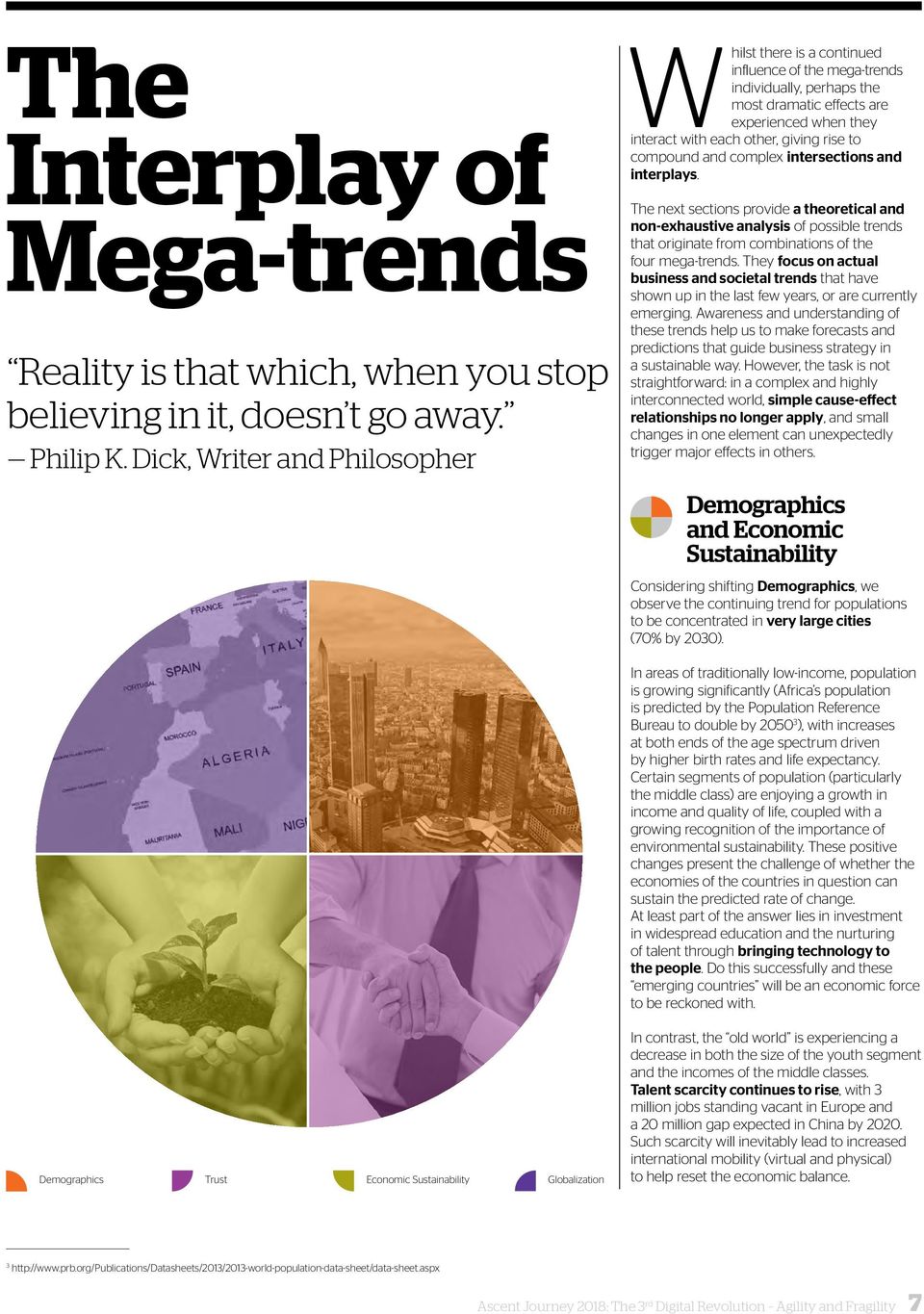
7 The Interplay of Mega-trends Reality is that which, when you stop believing in it, doesn t go away. Philip K. Dick, Writer and Philosopher Whilst there is a continued influence of the mega-trends individually, perhaps the most dramatic effects are experienced when they interact with each other, giving rise to compound and complex intersections and interplays. The next sections provide a theoretical and non-exhaustive analysis of possible trends that originate from combinations of the four mega-trends. They focus on actual business and societal trends that have shown up in the last few years, or are currently emerging. Awareness and understanding of these trends help us to make forecasts and predictions that guide business strategy in a sustainable way. However, the task is not straightforward: in a complex and highly interconnected world, simple cause-effect relationships no longer apply, and small changes in one element can unexpectedly trigger major effects in others. Demographics and Economic Sustainability Considering shifting Demographics, we observe the continuing trend for populations to be concentrated in very large cities (70% by 2030). In areas of traditionally low-income, population is growing significantly (Africa s population is predicted by the Population Reference Bureau to double by ), with increases at both ends of the age spectrum driven by higher birth rates and life expectancy. Certain segments of population (particularly the middle class) are enjoying a growth in income and quality of life, coupled with a growing recognition of the importance of environmental sustainability. These positive changes present the challenge of whether the economies of the countries in question can sustain the predicted rate of change. At least part of the answer lies in investment in widespread education and the nurturing of talent through bringing technology to the people. Do this successfully and these emerging countries will be an economic force to be reckoned with. Demographics Trust Economic Sustainability Globalization In contrast, the old world is experiencing a decrease in both the size of the youth segment and the incomes of the middle classes. Talent scarcity continues to rise, with 3 million jobs standing vacant in Europe and a 20 million gap expected in China by Such scarcity will inevitably lead to increased international mobility (virtual and physical) to help reset the economic balance
8 Our Vision Ever increasing life expectancy is creating an ageing population, where the cost pressures on healthcare and welfare pensions are outweighing the ability of the tax system to pay. Digital Natives have entered the workplace, bringing with them markedly different behaviors and expectations this is a catalyst for positive cultural, process and technology transformations in private and public sector organizations. As consumers, the digital natives are techsavvy and demand richer connection and engagement not only via new technologies, but through seamless, personalized experiences across virtual and physical channels. Whilst such requirements are not the sole preserve of the Digital Native, the impact of these trends (with local variations) is likely to be felt most strongly in areas where younger population segments are booming. The recent economic upturn seems to be happening without significant job creation. This symptom is linked to increased automation, advanced robotics and even autonomous vehicles. It fuels a growing controversy about the end of labour, with machines replacing humans, resulting in further social inequalities between the haves and the have nots. Perhaps the emerging challenge is no longer that of wealth creation but of wealth distribution. The status of homo consumens that has emerged during the last five or six decades is increasingly being complemented by our role as creators (prosumers), financers (crowd funding) or micro-manufacturers (3D printing). With today s technology, small groups of people with an idea and a vision, can collaborate remotely to create and deliver a service or product (taking advantage of social, mobile and Cloud Technologies), based on new business models, with modest funding (partially or totally obtained by new financing tools) and deploy it virally, posing a very serious risk to the long-established portfolio of existing business giants. But defensive behaviors continue with innovative start-ups being aggressively bought up by the big players, which could do more to stifle further innovation than encourage it. Globalization and Economic Sustainability Local economic and political crises have an ever increasing global impact. Although the green shoots of economic recovery are appearing, they remain fragile as public and private debt continues to rise in many quarters, despite all the austerity measures. In the new global environment, tough questions are being asked about the validity of old economic models: Are historical welfare, labor, education and health systems still valid? Do they satisfy the demands of the new digital generation? How can long term global strategies be aligned to the rapidly changing demands of citizens and consumers? Add to this the concerns and question marks over global food supply and distribution, forecasted energy shortages and the seemingly continuous series of natural and man-made disasters. There are already economists who no longer see growth or profit/revenue as the best economic outcome or target for companies. Instead, creation of a circular economy that demonstrates responsibility towards future generations and puts sustainability first, could become more important than today s relentless demand for profit and shareholder value. Globalization is here to stay human activities (work, business, economics, education, entertainment, collaboration) have reached such a degree of connectivity, immediacy and interdependence that it is difficult to see how these could be rewound. People communicate, collaborate and do business remotely with increasing ease, speed and effectiveness applied appropriately these capabilities can certainly support a more sustainable global economy. But the differences between old world and emerging economies cannot be ignored. Old world economies face the challenges of private and public debt reduction and the deflationary iceberg, intensifying the need to create high value-added services via innovation. Emerging countries often find themselves in a significantly different situation: Unburdened by legacy infrastructures (both business and technology), they are able to exploit the benefits of the 3 rd Digital Revolution to develop more quickly and effectively, gaining momentum in the global economy. From the consumer point of view, given the high levels of private debt in most Western countries and the flat or decreasing purchasing power of the population (with a marked polarization between high earners and the rest), we will probably experience a low-cost era, where good enough features and lean approaches come to the fore. Because wealth and possessions are unequally divided, one option is to share what we have: The rise of the sharing or peer to peer economy is already apparent. Skills and talents, a drilling machine, clothes, a lawn mower, surplus food: All of these are sharable assets to which a value can be assigned and there is an increase in websites and mobile apps that makes this type of bartering possible on a large or even global scale. What is absolutely clear is that we are rapidly moving to a world where As a Service will increasingly be the standard business model. Capex investment will become the sole preserve of core service providers or even independent capital equipment financers. Consumers (both businesses and individuals) will procure services based on demand and outcomes. Already we see examples like those of key aircraft components being sold to airlines on an operational hours basis or car sharing schemes offering pay per mile driving. During 2014, just two music albums have gone platinum (more than one million sales) at the time of writing in early November. On demand streaming services like Spotify give consumers exactly the mix of music they want when they want it and at a price less than a whole album. Trust and Globalization Security and Privacy have been critical topics for some time, and will remain increasingly so 4. Any relationship (e.g. between individuals, communities, public and private organizations, governments) can be impacted, both positively and negatively, by the actual and perceived levels of security and privacy associated with the relationship. Consider the effect and implications of the Heartbleed bug, which exposed an estimated 17% of the world s web servers to potential buffer over read attacks, resulting in frantic exchanges of warnings and lists of affected websites. There has been widespread adverse reaction to the perceived misuse of governmental monitoring capabilities. The phenomenon of states spying on organizations and individuals has become global and is heavily influenced by economic warfare in the context of globalization and global competition. Governments that should be establishing trust through legal standards, are putting the relationship between the state and the individual under strain. The perceived loss of individual influence grows further as the rise of mega-companies continues. Their sheer size and economic power puts them in a position of being able to influence national policy to their advantage, whilst at the same time exploiting the boundaries of local regulations and laws to avoid taxation or other perceived business constraints. Demographics Trust Economic Sustainability Globalization 4 E.g. see Risk and Responsibility in a Hyperconnected World, in 8

9 Political inability to establish international legal frameworks on e.g. privacy or taxation, is being opposed by grass root initiatives of citizens, supported by social networks and leveraging their role as consumers able to make informed choices. Trust and Economic Sustainability Maintaining trust is key to managing many potential risks in the new digital world, as well as fulfilling many of its promises. Open source, open data, open innovation and open standards are good examples of sound and business-ready work growing out of communities based on Trust. But trust can be badly damaged across societies and business sectors where misuse of technology or fundamentally flawed risk management is exposed. As technology is profoundly changing business, there is a growing expectation in society that changes are implemented in a sustainable and responsible way. Corporate Social Responsibility is evolving from selfregulation with focus on improving brand reputation, to the recognition that business profit carries with it a responsibility towards society beyond mere corporate philanthropy or local community programs. The principle of shared value connects the success of companies with social progress: In contrast to conventional, market-driven innovation, social innovation incorporates societal needs and sustainable trends to help solve the challenges of future generations. We see companies moving towards a social innovation approach that is collaborative and participatory. When combined with the 3 rd Digital Revolution we see an historic opportunity to better align business, government and civil society interests as combined forces for good governance, global stability and security, social inclusion and economic prosperity. Trust and Demographics We observe some interesting differences in the attitudes to Trust across different demographics. For digital natives, openness is usually not seen as a threat: Extensive social media interactions across communities that barely know each other in the physical world are the accepted norm; and open innovation, sharing of ideas and joining of forces in a trusted way, all come naturally. New ways of Social-Network enabled grass-root lobbying against established power structures helps to fuel social innovation a phenomenon that impacts both governments (see Turkey, the Arab Spring or the Occupy movements) and large enterprises. If taken seriously, social innovation can create greater intimacy between organizations and individuals, leading to new forms of brand management. The older generations tend to be more conservative in their attitude to privacy and trust, they often prefer engagement models that have reasonably well defined boundaries of interaction and risk. Demographics and Globalization It is useful to view the interplay between Demographics and Globalization in light of the paradoxical talent deficit described earlier and consider whether more accessible education, coupled with increased mobility or increased teleworking, could solve the problem. The first waves of offshoring at any rate helped move innovation to some emerging countries, but sometimes failed to produce the expected results. Production localization is being re-examined in certain cases, with nearshoring and on-shoring being applied. An interesting question is whether the reskilling necessary will tend to result in a bias towards jobs for certain demographics. The jobs of the future are not the same as the jobs of the past, with new opportunities arising from emerging digital economic models and the required skills being sourced on a more fragmented basis. Achieving sustainable growth requires taking full advantage of the enormous possibilities that new technologies offer as creators and catalysts for business. It also requires sensible approaches from a societal, political and corporate point of view that avoid scenarios in which the misguided or poorly governed use of technology creates a social backlash against the very technologies that are the key to growth. 9
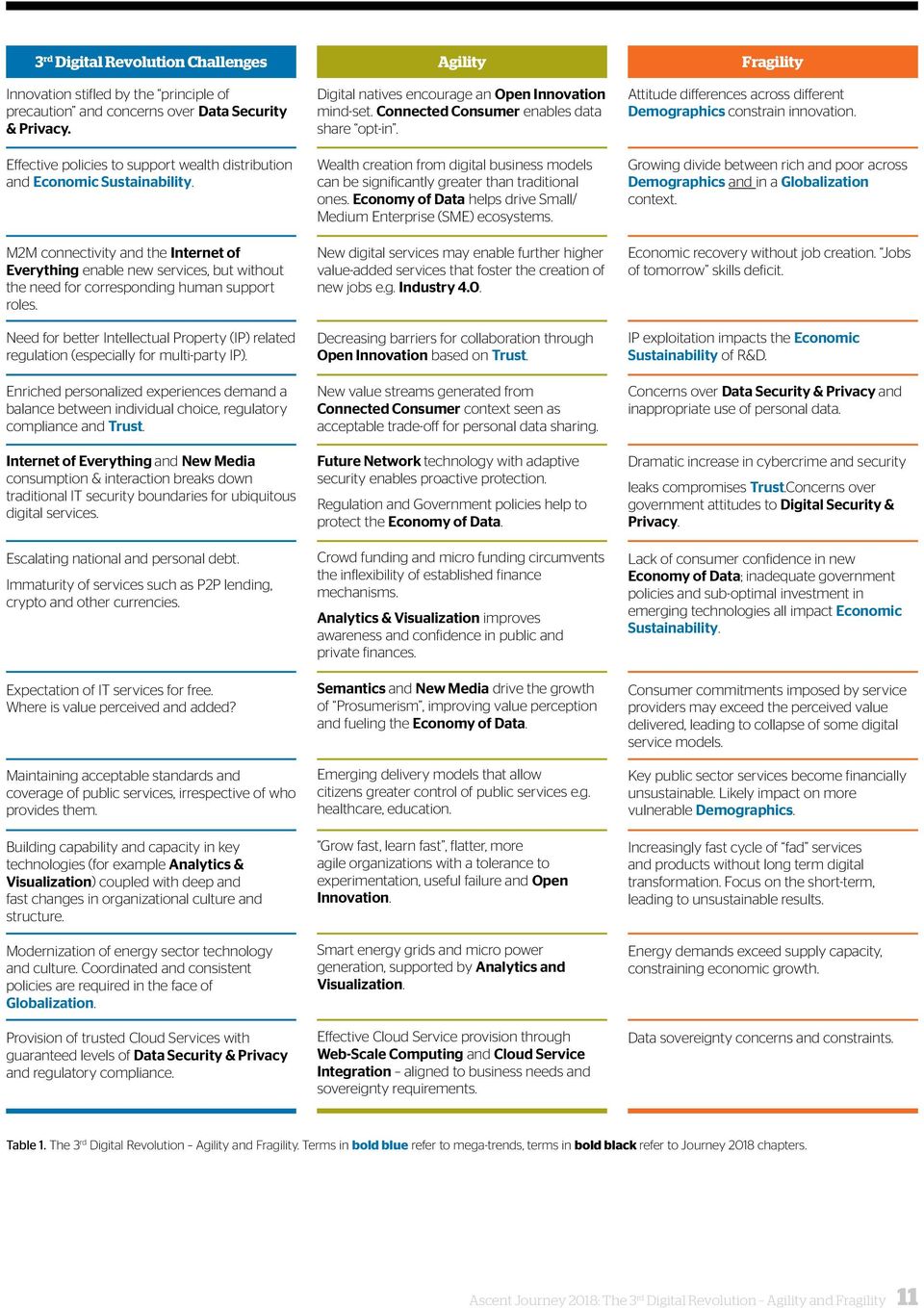
10 Our Vision Agility and Fragility I do not believe in a fate that falls on men however they act; but I do believe in a fate that falls on them unless they act. G.K. Chesterton, Writer and Philosopher Even as the digital world continues to emerge and increasingly becomes the new norm, the new business models, processes and value paradigms it gives rise to, are potentially delicate, particularly as they are changing so quickly: They are in their infancy and lack mature and robust operating models; they sometimes sit uncomfortably alongside more traditional approaches; adoption and acceptance rates vary, bringing tensions to certain markets. There may even be some cases where old models have to die first before the new approaches can realize their full potential. There is a big question mark over how comfortably the digital models can operate alongside the old models. But the simple fact of being aware of these vulnerabilities gives the opportunity to anticipate, shape and nurture the new model. What is very evident is that do nothing is not an option. Forward thinking businesses and governing bodies have the opportunity to shape the character and values of the new digital world, embracing the potential and agility it offers, whilst seeking to protect it and themselves from factors that would expose its fragility. The fragile infant, if properly nurtured will soon grow to full strength. As has been previously mentioned there is a balance between the various forces at play some bring characteristics of agility to the digital world, others present challenges of fragility. Each one influences different market segments or individual organizations to varying extents. Businesses need to understand how to tip the balance in their favor to secure future sustainable success. It is impossible to cover all the factors at play within this document. However, Table 1 offers a few pointers to the challenges resulting from the 3 rd Digital Revolution and the associated counterbalance of Fragility and Agility. How to use the table A number of 3 rd Digital Revolution Challenges have been identified in the left column of the table. For each, the corresponding potential Agility enablers and Fragility constraints are considered. Where relevant, the Trends giving rise to the challenges and the Ascent Journey 2018 Tracks that help inform understanding of how they can be addressed are highlighted. The intent is not to provide a definitive list but examples to illustrate the implications of Agility and Fragility on the 3 rd Digital Revolution. 10

11 3 rd Digital Revolution Challenges Innovation stifled by the principle of precaution and concerns over Data Security & Privacy. Effective policies to support wealth distribution and Economic Sustainability. M2M connectivity and the Internet of Everything enable new services, but without the need for corresponding human support roles. Need for better Intellectual Property (IP) related regulation (especially for multi-party IP). Enriched personalized experiences demand a balance between individual choice, regulatory compliance and Trust. Internet of Everything and New Media consumption & interaction breaks down traditional IT security boundaries for ubiquitous digital services. Escalating national and personal debt. Immaturity of services such as P2P lending, crypto and other currencies. Expectation of IT services for free. Where is value perceived and added? Maintaining acceptable standards and coverage of public services, irrespective of who provides them. Building capability and capacity in key technologies (for example Analytics & Visualization) coupled with deep and fast changes in organizational culture and structure. Modernization of energy sector technology and culture. Coordinated and consistent policies are required in the face of Globalization. Provision of trusted Cloud Services with guaranteed levels of Data Security & Privacy and regulatory compliance. Agility Digital natives encourage an Open Innovation mind-set. Connected Consumer enables data share opt-in. Wealth creation from digital business models can be significantly greater than traditional ones. Economy of Data helps drive Small/ Medium Enterprise (SME) ecosystems. New digital services may enable further higher value-added services that foster the creation of new jobs e.g. Industry 4.0. Decreasing barriers for collaboration through Open Innovation based on Trust. New value streams generated from Connected Consumer context seen as acceptable trade-off for personal data sharing. Future Network technology with adaptive security enables proactive protection. Regulation and Government policies help to protect the Economy of Data. Crowd funding and micro funding circumvents the inflexibility of established finance mechanisms. Analytics & Visualization improves awareness and confidence in public and private finances. Semantics and New Media drive the growth of Prosumerism, improving value perception and fueling the Economy of Data. Emerging delivery models that allow citizens greater control of public services e.g. healthcare, education. Grow fast, learn fast, flatter, more agile organizations with a tolerance to experimentation, useful failure and Open Innovation. Smart energy grids and micro power generation, supported by Analytics and Visualization. Effective Cloud Service provision through Web-Scale Computing and Cloud Service Integration aligned to business needs and sovereignty requirements. Fragility Attitude differences across different Demographics constrain innovation. Growing divide between rich and poor across Demographics and in a Globalization context. Economic recovery without job creation. Jobs of tomorrow skills deficit. IP exploitation impacts the Economic Sustainability of R&D. Concerns over Data Security & Privacy and inappropriate use of personal data. Dramatic increase in cybercrime and security leaks compromises Trust.Concerns over government attitudes to Digital Security & Privacy. Lack of consumer confidence in new Economy of Data; inadequate government policies and sub-optimal investment in emerging technologies all impact Economic Sustainability. Consumer commitments imposed by service providers may exceed the perceived value delivered, leading to collapse of some digital service models. Key public sector services become financially unsustainable. Likely impact on more vulnerable Demographics. Increasingly fast cycle of fad services and products without long term digital transformation. Focus on the short-term, leading to unsustainable results. Energy demands exceed supply capacity, constraining economic growth. Data sovereignty concerns and constraints. Table 1. The 3 rd Digital Revolution Agility and Fragility. Terms in bold blue refer to mega-trends, terms in bold black refer to Journey 2018 chapters. 11
12 Our Vision Digital Transformation: The Business Challenge Experience is comforting, but it tends to drive you out of the new. Carlos Barrabés, e-commerce Pioneer All the changes and shifts explored earlier are exposing organizations to strong and sometimes opposing forces. At a macro level, in order to gain breadth (reach, firm positioning and efficiency), the trend has traditionally been towards global strategy, recentralization and economies of scale. At a micro level, in order to gain depth (product differentiation, niche markets and effectiveness), the drive is towards fragmentation, specialization and personalization. In the fast moving, connected digital world, the focus of business transformation will increasingly shift towards the front office and the task of enriching customer experience. Organizations need to engage with customers more intimately and individually than ever before through processes that exhibit realtime flexibility and a richness of integration that delivers truly end to end customer experiences. The seemingly opposing forces of maximizing process efficiency and personalizing user experience present a complex business challenge. Whilst most organizations and businesses do not need to fully master both forces simultaneously in order to succeed, they must understand how to make them work together rather than against each other. The value and potential of enriching customer experience will only be fully realized when core business operations within increasingly disaggregated supply chains are aligned and optimized for both business-to-business AND business-toconsumer interactions. For any organization, becoming truly digital requires a different mindset, increased flexibility, abandoning the obsession for the very short term. It requires a redefinition of corporate structures, bodies and roles to make innovation happen as a matter of course. As businesses strive to master this complexity, we foresee the fragmentation and outsourcing of business processes, which must then be properly orchestrated. The new digital world will see highly efficient back-office process elements triggered by real-time integration with flexible, personalized customer interaction solutions. The challenge of process complexity and opposing forces will be overcome by more and improved standardization of granular business processes and technology interfaces that enable seamless and dynamic construction of end to end capabilities, delivered by otherwise disparate entities the best of both worlds! 12
13 Landing the Vision Landing the Vision The 3rd Digital Revolution will affect most aspects of business and private life by As illustrated in Figure 4, the Ascent Journey 2018 tracks explore the impact that this will bring and together describe the Business Drivers, Technology Enablers and Realization Challenges of the new digital world. Analytics & Visualization New Media Semantic Technologies Realization Challenges Fragility Agility Globalization Economy of Data Fragility Agility Connected Consumer Innovation Value Webs Data Security & Privacy Sustainability Economic Demographics Business Drivers Agility Trust Fragility Technology Enablers Industry 4.0 Web-scale Computing Future Networks Cloud Service Integration Internet of Everything 2015 Atos Figure 4. The Model for Ascent Journey 2018 Landing the Vision. This thinking builds on our previously published Journey 2014 and Ascent Journey 2016 documents, illustrated in Figure 5, where we considered the technologies, business drivers and trends that are now having a mainstream impact. Looking back we see a clear evolutionary pattern of the topics addressed within the underlying driving forces of Social, Cloud, Mobile, Data and Security. Mobile Economy of Data Connected Consumer Mobile Payments Economy of Internet Appl. Analytics & Visualizations J2018 J2016 J2014 Context Aware Computing Pattern based Strat. PLM Cloud Service Integration Cloud Messaging 2-sided Markets DSS C&C Centers IT/OT Convergence Cloud Fabric Based Computing Web-Scale Computing BPM ADM Collaboration Identity Mgt. Community & Social NW Electr. Entertainment & Gaming Security Innovation Value Webs Open Innovation Video New Media Social Data Semantic Technologies Privacy Industry 4.0 Internet of Everything Digital Security Security Figure 5. The evolving Journey from 2014 to Atos 13

14 Landing the Vision Business Drivers of the 3 rd Digital Revolution With a properly connected network of billions of devices and users, the 3 rd Digital Revolution will be fueled by the new black gold that is data, collected and exchanged as part of a whole new Economy of Data. Exciting new business opportunities will emerge, provided that multi-sided markets 5 are organized to monetize data appropriately. However, profitability can only occur if business partners, leveraging data generated by new services (with the consent of users), are willing to finance the necessary investments to establish the operational and commercial frameworks. Connected Consumer refers to customer interaction in an environment where the digital experience seamlessly fuses with the physical world of delivery and payment. An important consideration is that connected consumers seem ready and willing to trade access to their personal data for better and cheaper services, provided that personal data usage is limited to the purposes intended and guaranteed by trusted third parties. The speed of benefit realization from the 3 rd Digital Revolution will, in no small measure, be driven by the ability to adopt Innovation Value Webs to facilitate open innovation both within the social enterprise and beyond its borders. Organizations failing to embrace social collaboration face being constrained in the digital adaption of their processes and in the understanding of their customers behavior. Collaboration among communities with a clear and common purpose, represents the best vehicle for bootstrapping innovation. Industry 4.0 (aka Smart Manufacturing) reflects the manufacturing incarnation of a digital mind-set, leveraging contextaware computing and Big Data to increase productivity and maintain competitive advantages, whilst at the same time allowing more flexibility in the manufacturing process. Industry 4.0 includes concepts such as digitizing the Supply Chain and 3D Printing to extend the boundaries of Product Lifecycle Management and IT/OT convergence. Industry 4.0 challenges the traditional front office/ back office separation by allowing optimized processes in a flexible demand cycle that flows between the two. Whilst these four topics are far from an exhaustive list of the business drivers to be experienced on the Journey to 2018, they are representative of the interconnected and interdependant elements of the 3 rd Digital Revolution. The Connected Consumer clearly reflects the revolution within the Business-to-Consumer world where personalized, immediate and informed interactions with customers become the expected norm. However, the creation of processes and infrastructure to provide such capability is likely to be fueled through an Economy of Data that relies on the two-way monetization of data generated by Connected Consumer interactions and shared with selected business partners. Industry 4.0 reflects the Business-to-Business dimension where supply chain disaggregation and multi-partner integration occur simultaneously. The principle of innovation value webs facilitates business to business cooperation within and between companies; and also opens up new social network channels to capture consumer feedback which can be used to drive further innovation in products and services. 5 Multi-sided markets, first discussed in Ascent Journey 2016, promote interactions with consumers, by involving two or more sides in the provision of a product or service, such that the proposition only becomes viable with the involvement of all parties. The concept was used by Jean Tirole winner of the 2014 Nobel Prize in Economic Sciences to explain behavior in credit card markets. 14

15 Technology Enablers of the 3 rd Digital Revolution The complexity and diversity represented by the sheer volume of connected objects, smartphones and tablets, added to the ever expanding social networking community, raises unprecedented technical and economic questions. As they are addressed, the resulting accessibility, connectivity and functionality are undoubtedly the foundation and catalyst of the 3 rd Digital Revolution. The Internet of Everything is an ubiquitous communication network of everything: People, processes, locations and the so called Internet of Things that enables capturing and effective management of data from billions of objects (both active and passive). The impact on quality of life of connecting everything to everything (with use cases including healthcare, retail, city management, etc.) will be measured in terms of the value add services that are enabled, but this has to be tempered by considerations of individual privacy. Wearable computing has the potential to become a fully integrated part of our private and professional lives, with improved gesture-based control and augmented reality experiences as well as the use of contextual data to support user services. Future Networks to provide connectivity and energy supply / distribution to power devices will be the key enablers for connected objects to deliver sensor data. Software-Defined Networks and New Media Content Delivery Networks need to ensure optimal use of scarce bandwidth. Ubiquitous wireless data and power are prerequisites for realizing the potential of the Internet of Everything. Services for the 3 rd Digital Revolution are increasingly delivered through the Cloud: Either by reusing legacy applications through resource virtualization and Cloud Service Integration to enable entire application ecosystems to communicate and interact with each other across public and private Clouds, or through building and deploying new applications that fully benefit from Web-Scale Computing for very large scale delivery at the lowest possible cost. 15

16 Landing the Vision Applying new technologies to the business drivers of the 3 rd Digital Revolution presents difficult challenges. Benefits realization from solving these challenges is inevitably compromised if organizations and consumers consider that their Data Security and Privacy are unreasonably compromised as a consequence of embracing new digital services and processes. However, the approach to data protection is not as binary as it used to be. Service providers need to start considering data types, anticipated usage and relevant regulations, as well as the ability to enforce them within particular territories. This requires security to be applied more globally at a system level, becoming an embedded commodity that exploits all the new capabilities of data analytics and contextaware computing in a proactive way. Once highly technical aspects are addressed with Big Data solutions, the human side of the equation becomes predominant. Analytics and Visualization will increasingly be used to extract and manage the value hidden in huge masses of data generated by connected objects, users and smartphones, with outputs being descriptive and diagnostic to aid human decision making, and predictive to anticipate behaviors of individuals and devices (facilitating equipment monitoring and maintenance). Most importantly, prescriptive analytics have the potential to recommend actions to users and further automate business and industrial processes. New Media includes a whole spectrum of technologies associated with communication in entertainment, education and business. It addresses two key disruptions: access for all; and the ability for everyone to contribute own content and interact explicitly, including via sensors within wearable computing. At the core of data monetization resides the extraction of value that is not directly linked to the original purpose behind the data collection. This requires an ability to extract both explicit and implicit meanings aided by Semantic Technologies. Linked data and domain ontologies are the new refineries of the Economy of Data, where multiple value streams can be extracted from raw data collected for apparently unconnected purposes. Enriched data will in turn fuel the Economy of Data, closing the cycle as illustrated in Figure 6. Realization Challenges of the 3 rd Digital Revolution a process further enhanced by Innovation Value Webs operating within companies and with partners and consumers. Monetization of the new refined data offers further opportunities to create new services and platforms to meet emerging market challenges and ever rising consumer expectations. New Media Industry 4.0 Economy of Data monetize Connected Consumer Use my Data Internet of Everything usable data Privacy & Security And so the cycle is closed, but it can only function if the challenges of Privacy and Security are appropriately addressed. Analytics & Visualization interpret The 3 rd Digital Revolution gives rise to a new data lifecycle fueled by the Internet of Everything with outputs generated by device and people interactions, driven by media, industry, commerce and social interaction. Exploiting this data and interconnectivity creates real business opportunity and value, supported by interpretation through Analytics and Visualization. Semantic Technologies will enable deeper and refined insight into data: refine Semantic Technologies Figure 6. The Data Lifec-Cycle of the 3 rd Digital Revolution. Innovation Value Webs 2015 Atos 16

17 Conclusion Looking towards 2018, we can no longer constrain our thinking to that of evolution of business and technology, but instead must embrace a revolution in thinking. The interplay of the mega-trends and emerging technologies mean that businesses need to do things differently, not just better, if they are to survive. The full impact of the 3 rd Digital Revolution will only be felt when the link is made between the B2C and B2B worlds If B2C is the earthquake, [then] B2B is the tsunami that follows 6. Already in 2014 at the time this document is written, we can see a number of facets of the B2C earthquake in action; we believe that by 2018 we shall see the full consequences of the tsunami in the business. This will bring a wealth of opportunities for those that are ready to ride the wave, but could also wipe out those who are not. We are convinced that a new era of creative destruction for business the 3 rd Digital Revolution is underway. It will exhibit characteristics of both agility and fragility in its emergence and needs to be understood, respected and appropriately handled to ensure that fragility does not introduce fundamental weaknesses into the new business models created. At the same time commercial and public organizations need to adapt their thinking to fully exploit the agility that new technologies offer. Whilst a number of traditional business models face obsolescence, new value paradigms arising from ever richer contextual information will become the foundation for a whole new data and service economy. Organizations must consciously and quickly embark on digital transformation in order to avoid obsolescence and secure such new value. Openness, learning-by-doing, social innovation and strategic partnerships will be key aspects to a successful transformation. The Business Technology Innovation Center (BTIC) is a showcase of the future. BTICs serve as an inspirational environment for innovation workshops with our clients offering exclusive interaction with our Business Technologists. 6 Embrace Software as Your Brand, May 5, 2014, Forrester Research, Inc. Forum For Technology Management Leaders. 17
![The full impact of the 3 rd Digital Revolution will only be felt when the link is made between the B2C and B2B worlds If B2C is the earthquake, [then] B2B is the tsunami that follows 6.](/docs-images/40/690409/images/page_17.jpg "Already in 2014 at the time this document is written, we can see a number of facets of the B2C earthquake in action; we believe that by 2018 we shall see the full consequences of the tsunami in the")
18 18

19 Ascent Journey 2018 Business Drivers Technology Enablers Realization Challenges 19
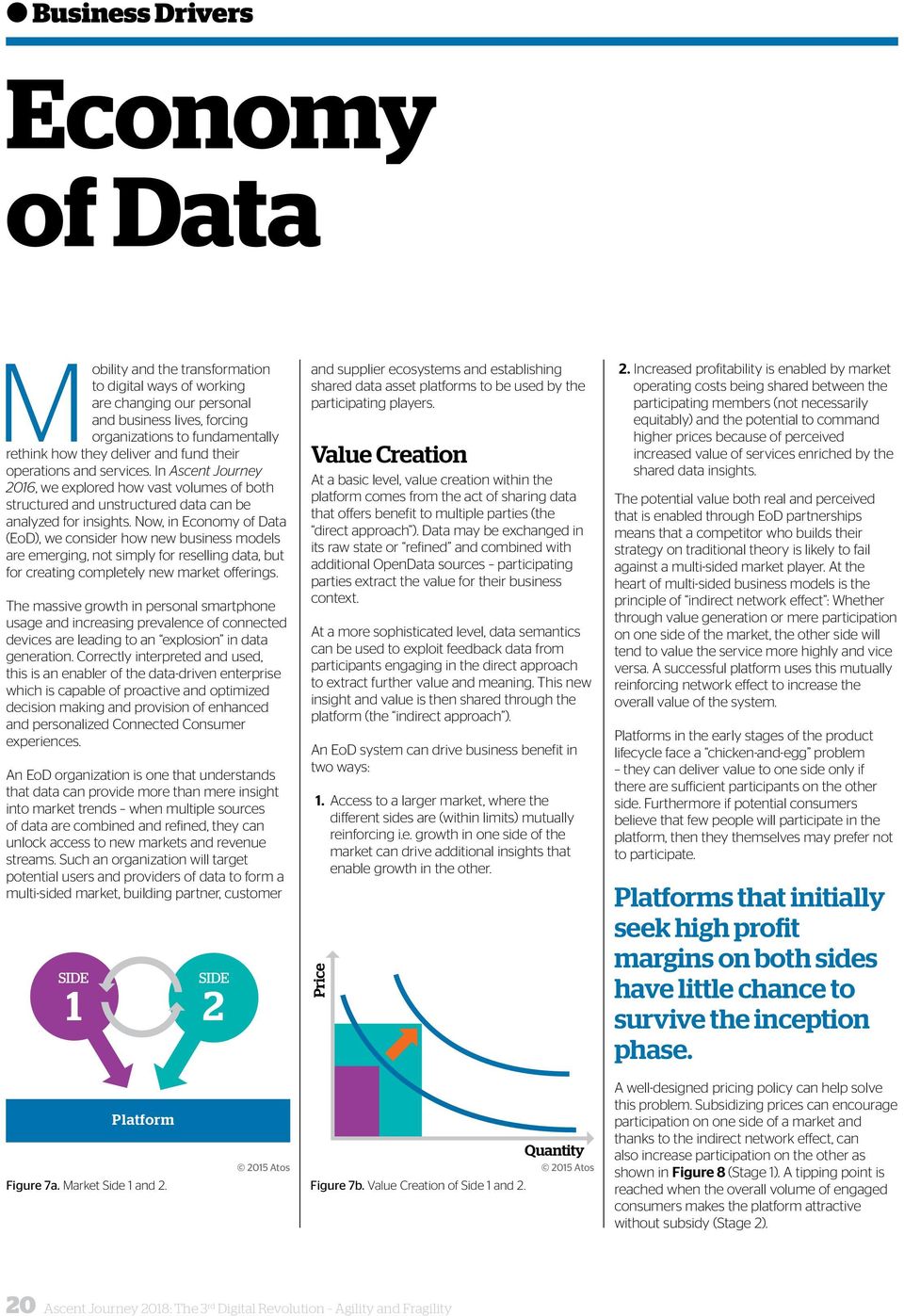
20 Business Drivers Economy of Data Mobility and the transformation to digital ways of working are changing our personal and business lives, forcing organizations to fundamentally rethink how they deliver and fund their operations and services. In Ascent Journey 2016, we explored how vast volumes of both structured and unstructured data can be analyzed for insights. Now, in Economy of Data (EoD), we consider how new business models are emerging, not simply for reselling data, but for creating completely new market offerings. The massive growth in personal smartphone usage and increasing prevalence of connected devices are leading to an explosion in data generation. Correctly interpreted and used, this is an enabler of the data-driven enterprise which is capable of proactive and optimized decision making and provision of enhanced and personalized Connected Consumer experiences. An EoD organization is one that understands that data can provide more than mere insight into market trends when multiple sources of data are combined and refined, they can unlock access to new markets and revenue streams. Such an organization will target potential users and providers of data to form a multi-sided market, building partner, customer SIDE 1 SIDE 2 and supplier ecosystems and establishing shared data asset platforms to be used by the participating players. Value Creation At a basic level, value creation within the platform comes from the act of sharing data that offers benefit to multiple parties (the direct approach ). Data may be exchanged in its raw state or refined and combined with additional OpenData sources participating parties extract the value for their business context. At a more sophisticated level, data semantics can be used to exploit feedback data from participants engaging in the direct approach to extract further value and meaning. This new insight and value is then shared through the platform (the indirect approach ). An EoD system can drive business benefit in two ways: 1. Access to a larger market, where the different sides are (within limits) mutually reinforcing i.e. growth in one side of the market can drive additional insights that enable growth in the other. Price 2. Increased profitability is enabled by market operating costs being shared between the participating members (not necessarily equitably) and the potential to command higher prices because of perceived increased value of services enriched by the shared data insights. The potential value both real and perceived that is enabled through EoD partnerships means that a competitor who builds their strategy on traditional theory is likely to fail against a multi-sided market player. At the heart of multi-sided business models is the principle of indirect network effect : Whether through value generation or mere participation on one side of the market, the other side will tend to value the service more highly and vice versa. A successful platform uses this mutually reinforcing network effect to increase the overall value of the system. Platforms in the early stages of the product lifecycle face a chicken-and-egg problem they can deliver value to one side only if there are sufficient participants on the other side. Furthermore if potential consumers believe that few people will participate in the platform, then they themselves may prefer not to participate. Platforms that initially seek high profit margins on both sides have little chance to survive the inception phase. Platform Figure 7a. Market Side 1 and Atos Figure 7b. Value Creation of Side 1 and 2. Quantity 2015 Atos A well-designed pricing policy can help solve this problem. Subsidizing prices can encourage participation on one side of a market and thanks to the indirect network effect, can also increase participation on the other as shown in Figure 8 (Stage 1). A tipping point is reached when the overall volume of engaged consumers makes the platform attractive without subsidy (Stage 2). 20
21 Stage 1: Inception Stage 2: Add new Market Stage 3: Maturity Negative Negative Negative Volume Margin Volume Margin Volume Margin Target growth on the platform at low or zero cost to user to drive adoption. Figure 8. Growing a Multi-sided Platform. Tipping point reached where users see platform for first market as key; this attracts secondary markets. Additional new markets and increased volumes help raise business margins Atos This characteristic drives the potential for a divide and conquer pricing strategy where the opportunity cost of lost revenue from subsidized users is offset by the benefit to the platform as a whole. The optimal design of such a strategy involves identifying and attracting users who are a source of large network effects. Given the immaturity of economic models for multi-sided markets, there is a risk that platform entrants bet big on network effects and never reach critical mass to recover the opportunity cost of subsidization. Users may also decide that the information they are releasing about themselves is not worth the cost, either in monetary, privacy or security terms. Conclusion We believe that organizations that succeed in determining the right partners, targeting the correct participants, and capturing and utilizing the right data, can gain a fundamental advantage over their competitors. Consumer Businesses without an EoD strategy may end up fighting for smaller margins in niche markets. Preparing for the 3 rd Digital Revolution Car manufacturers are understanding that customer satisfaction can be enhanced not just by improving the driving experience but by enabling new innovative services built upon the monetization of data reflecting the context and preferences of the driver. Vehicle telematics, geolocation and driver data are exchanged with a centralized data platform in near real-time and made available to selected partners to offer new services like Pay as you drive insurance, preventative maintenance offers and click and collect shopping. These services all contribute to pay back the initial investment into advanced car electronics, making it commercially viable. 21
22 Business Drivers Connected Consumer The term Connected Consumer represents consumers in the new digital era they are connected at home, on the move, at work and also in shops. They expect a complete and uninterrupted end-to-end shopping experience, regardless of where they are and how they are connected. This experience covers the whole sales process including pre-sales and after-sales and requires hybrid solutions that allow the shopper s experience at the physical store to be enhanced by a range of complementary and personalized digital services. In 2014, most physical shops are neither digital nor connected to the Internet, but we expect this to change dramatically in the next few years as the lines between offline and online shopping experiences become increasingly blurred. Consumers can expect to benefit from a range of new connected interactions in the specific context of the shops they visit. Personalized offers and long-lasting relationships built on mutual benefit, will ensure sustainable revenue and profit for the retailer and a richer shopping experience for the consumer. This addresses a main challenge for physical stores how to compete with the dramatically increasing power of e-commerce based retail. In 2018, many shops will be digitalized and Connected Consumers enjoy a continuous digital experience with personalized, innovative and valueadded services. Business Impact The Connected Consumer concept is based on a complex ecosystem of stakeholders (including consumers, shoppers, merchants, service providers, manufacturers, content providers and advertisers). Most of their interactions are already well established, but the new ways of shopping and consuming will create new relationships among them resulting in changes to business models and processes. Multi-sided platform business models, as identified in Economy of Data, will apply to the new services deployed for distinct but interdependent groups of Connected Consumers. The emergence of new shopping experiences is a reaction to the disruption caused by Internet shopping and results from the innovative thinking from retailers and partners to embrace the promise of multi-sided markets: ``Connected home shopping (machines ordering on behalf of the consumer) ``Social shopping (Consumer sentiment analysis allowing faster response to user demands) ``Digital advertising (emerging space for agencies to push services/products) ``Personal shopping assistant ( digital butlers ) ``Digital store (in-store on-line buying services but with access to the physical product) ``Wearable shopping (new experiences with digital glasses, smart watches etc.) ``Proactive sales and customer care (delivered through smart mobile devices) ``Sharing the shopping experience and getting advice from friends and family ``Streamlined production and shipping (including seamless payment & new delivery possibilities) Market Adoption One of the most significant drivers for change will be the emergence of a new currency: Customer Data a currency distinctly different from pure advertising revenues, which will drive new consumer value (and hopefully loyalty) through tailored offers and services. Such differentiation is key in an increasingly fragile environment, where consumer preferences change on the basis of quality of service, the shopping experience as a whole and even social media sentiment. However the different attitudes held by particular demographics regarding privacy and data sharing might impact the degree to which these value streams can be exploited. Assurances may have to be given that personal context data will not be accumulated or used without explicit contractual agreement. In return for such agreement, customers will be able to take advantage of loyalty programmes and enhanced services. Whilst users have increased their usage of technology, many shops have not evolved at the same pace and may face significant investment to deliver a fully connected experience. Retailers need to transform their traditional stores to compete against classical internet shops, with initial focus being on high engagement, high value purchases involving both physical and digital goods and services, where consumers shop between multichannels to select the best product for them. Reaching Connected Consumers through any channel, demands a connected and adaptable supply chain. Efficiency and effectiveness in last mile delivery requires a balance between flexible and lean distribution models, which will come from pervasive visibility of material movement from source to destination and connected replenishment recognizing demand from order to stock. Technology at the heart of the Digital Retail Revolution: ``Mobile payments (proximity and remote payment) ``Smart labels (NFC, bar codes, image recognition, QR/QR+ codes) ``ibeacons (for new payment methods and indoor location and promotions) ``Geolocation ``Digital Signage ``Smart Furniture (Tactile tables, virtual cabins, digital mirrors) ``Wearable computing ``Big Data and Data Analytics ``4G networks and beyond 22
23 Figure 9. New Digital Services for the Connected Consumer Atos Retailers and manufacturers will provide an enhanced shopping experience by reinventing digital interaction with customers and the full shopping ecosystem. Conclusion Connected Consumers will become the focus of attention for the new digital shopping experience: anywhere, anytime. Strong IT players in this field should be able to provide end-to-end services with proven knowledge and expertise in the main technologies that facilitate this transformation: Smart Mobility, Payments, Loyalty and OmniCommerce. IT service providers must also offer a clear innovation approach that will allow them to continue generating disruptive ideas to generate growth and implement them in a timely and agile way. The Connected Consumer paradigm will combine the benefits of e-commerce and the physical store into a new offering, reflecting the multiple requirements of the consumers. Much new data will be generated that will fuel the Economy of Data and facilitate Innovation Value Webs across multi-sided market ecosystems to define new services and provide better consumer personalization. Preparing for the 3 rd Digital Revolution A French fast food restaurant chain are pursuing a connected consumer centric digital strategy. They have achieved seamless integration of the physical and digital sales channels by allowing customers to order in advance using their smartphones and have the food ready to collect on arrival. This creates a unified, personalized and attractive experience for all their customers. It aims for insight, control and long term business benefits despite the competitive challenges presented by converging commerce. 23
24 Business Drivers Innovation Value Webs It is perhaps self-evident that the most tireless companies, on the lookout for innovative new products, services, processes and business models, will become the most competitive. Saying this is one thing doing it in practice is hard. One way to keep ahead of the competition is to develop an innovation model that enables more efficient and effective interactions beyond conventional organization boundaries whether internal or external. We call this model Innovation Value Webs it is a model which facilitates open innovation both within the social enterprise and beyond its borders. The configuration of networks your company has with its customers, suppliers and competitors will affect your competitive advantage. Andrew Schipilov, Network Advantage Business Impact Economic uncertainty and accelerated business cycles increase the pressure for organizations to drive more value, more quickly from their innovation models. Large scale enterprises face particular issues in addressing this challenge; their sheer size tends to increase inertia and reduce agility. Leading organizations are responding by innovating the way they innovate. Key process innovations include: Increase productivity by moving away from the traditional R&D intensive ways of working; embrace corporate intrapreneurialism ; establish in-house corporate venture capital capabilities; and build collaborative relationships internally across organization siloes and externally with third parties including start-ups, SMEs, universities and consumers. The new relationships and interactions that result are highly dynamic, encouraging new insights, improving creativity and enabling rapid assembly of the required solution components. It may be helpful to think of the resulting internal and external networks as the new economic organisms of the digital business world. A value web can be defined as a business ecosystem of actors exchanging objects of economic value towards a shared goal of profit generation 7. Value webs provide a new view of how things get done, moving from simple collaboration to active cooperation. Key Aspects of Innovation Value Webs: ``Transparency ``Openness ``Trust ``Peer-to-peer from collaboration to cooperation using social business technology based on capabilities, not functions ``Intra- & entrepreneurship ``Agile & lean approach ``Fading organizational boundaries ``Internal & external business ecosystems 24
25 When collaborating, people work together on a single shared goal. When cooperating, people perform together while working on individual goals, but with some common interests. As firms seek to develop these new Innovation Value Webs, they are enabling cooperation through implementing more advanced collaboration and communication capabilities especially those that use new social business tools at their core. These social business tools help organizations and employees to develop and participate in a new marketplace of ideas. Innovation Value Webs in Practice Success demands more than new technology alone. Firms need to re-design the way they innovate, with implications for their business model, their alliance management processes and their operating model, as well as for their IT. An holistic approach will be necessary to ensure a good flow of sustainable innovations in an Innovation Value Web. Business model implications Large organizations are beginning to replicate aspects of the entrepreneurial culture of startups and SMEs. They either tap into existing economic communities, or where necessary create their own. Community members include suppliers, lead producers, competitors, interest groups, B2B customers and last but not least, the homo consumens in their role as cocreators (Prosumers). One model of growing interest to our clients is the concept of the multi-sided market. Digital technologies make it far easier for firms to extend their own offerings in collaboration with others. For instance an airport operator could buy passenger data from airlines, and use this to enable transport operators, inairport retailers, destination hotels, venues and activity companies to market their services in a personalized manner through a new airport digital service platform, with the airport operator taking a share of the revenue from each transaction. Alliance management implications We see organizations co-evolving their innovation capabilities and roles, and aligning themselves with the directions set by one or more central companies. Those companies holding leadership roles may change over time, but the function of an ecosystem leader is valued by the community because it enables members to move toward shared visions, to align their investments and to find mutually supportive roles. This could be done in so called hub-and-spoke networks (1 central organization) or integrated network (more than 1 central organization). The position of an organization in a certain network can be a distinct source of competitive advantage: This is known as the network advantage 8. Operating model implications As their business models evolve, firms are beginning to re-design the operating model that underpins their innovation capability, including organization design; innovation process design; people recognition and reward; contractual matters (especially regarding intellectual property rights and IPR management); and underlying technology platforms. For instance: ``Organization design: Moving beyond collaboration to internal and external cooperation impacts the way a knowledge intensive business is organized. We are seeing flatter structures, with more empowerment, and greater flexibility for employees to align themselves with the projects that interest them most. ``Innovation of innovation processes becoming more lean and agile: Firms need more value, delivered faster and with fewer resources. Together Lean and Agile are helping firms to accelerate learning through more rapid iteration of innovative concepts and with less impact on legacy systems. Conclusion Those enterprise scale firms that embrace the concept and the practices of Innovation Value Webs will drive up their innovation productivity, and ultimately increase their competitive advantage. Preparing for the 3 rd Digital Revolution The Service Research & Innovation Institute (SRII) is a global nonprofit consortium of high tech companies with the mission to drive innovation in IT-enabled services, through the building of networks of like-minded organizations and individuals. With sponsorship from major technology and systems integration companies, it encourages and facilitates cross-enterprise collaboration, university research, open innovation forums and hackathons to bring customers, technology partners and innovative thinkers together to solve specific business challenges, whilst staying competitive with and within the network of partners. 7 Gordijn, J., and Akkermans, H.: Value-based Requirements Engineering: Exploring Innovative e-commerce Idea. Requirements Eng. Journal, vol. 8, n. 2, pp (2003) 8 Greve, H., Rowley, T. and Shipilov, A.: Network advantage, how to unlock value from your alliances and partnerships. Jossey-Bass (2014) 25
26 Business Drivers Industry 4.0 The vision and impact of Smart Manufacturing and production has been termed Industry 4.0 in several European countries. Industry 4.0 looks to deliver truly agile production using the interaction of connected smart actors throughout the production chain, extending from top-floor to shop-floor and even to the customer of the product. The interconnection of machines, components, products, people and processes brings the potential for massively disruptive changes at all levels and functions within an organization, carrying enough momentum to usher in a 4 th industrial revolution. There will be two-way communication between machines and workers on the shop-floor via smart devices, tablets or even wearable technology, leading to a huge rise in the degree of interaction capability and flexibility that is possible. Procedures such as maintenance, reconfiguring, refitting or calibration will be achieved in a highly agile way and executed in response to actual production needs. The production-line configuration time for variant products will diminish to near zero as individual digital blueprints accompanying component parts interactively direct the manufacturing resources (machine and human) that work on them. Supply chain networks and related logistics processes are dynamically restructured for optimal performance and some physical links are removed in their entirety as product build data is transmitted digitally, rather than physical parts having to be transported. This latter trend is driven by the rise of additive manufacturing (aka 3D Printing) which reduces production related material waste of traditional drilling and cutting based methods, or the time spent on mould building. Processes are fed with data from the shopfloor and on-demand production reconfigures parts of the facility with full transparency from the business process layer to the blue-collar worker. Industry 4.0 is complemented by predictive and prescriptive maintenance, using multisource data collected from shop-floor monitoring to determine a minimumdowntime maintenance strategy. Automation and robotics have been key features of manufacturing processes for quite a while. The real change comes with fully autonomous operation where products configure their production line directly, according to their individual design parameters, or where customers can directly initiate on-demand creation of products by simply providing the digital specifications. Business Impact In traditional structures of production, top-level business processes are disparate from shop floor processes Industry 4.0 is based on a fundamental paradigm shift in that regard. Closely interweaving both layers as part of a digital transformation imposes several structural challenges: ` `(Cultural) integration of workers into a new production process using a range of new smart technologies. ``Integration of information, procedures, machine-machine, machine-people, people-people collaboration and analysis of all processes and systems within one production unit. ``Enabling a complete supply chain across different production units for agile ondemand production. Mass Customization based on Product Modularization Industry 4.0 Industry 3.0 Industry 2.0 Industry 1.0 Figure 10. Industrial Revolutions. Cyber-Physical Systems Devices and production assets are becoming smart. Their function is no longer solely defined by their mechanical parameters, but also by their software, processing and communication capabilities they become unified cyber physical devices. Bringing these devices together in an intelligent way leads to a complex cyber physical system which, when applied to the world of production, creates the smart factory. ``Use of manufacturing intelligence to optimize production and respond to market demands. ``Continual reconfiguration of the business model in an agile and customer-centric production chain, which may be different for each individual product. Connected systems, processes, workers and products. Robots in production and programmable tooling machines. Production as a sequence of steps, in its incarnation as assembly line (Taylorism). Machines, energy generation and conversion (e.g. steam machines) Atos 26
27 Market Adoption The market for Industry 4.0 is not homogeneous. In some sectors the level of automation and connectivity is already mature and thus the realization of Industry 4.0 concepts is more imminent (e.g. in the automotive sector). Furthermore, the agility with which Industry 4.0 concepts can be implemented is a lot greater in environments where companies own and design their production facilities than in scenarios where production is outsourced. Timescales for market adoption could extend decades into the future. However, there is little alternative for the production industry to deal with the greater agility, pervasive information flow and connectivity requirements driven by the increasing expectations that customers have for on-demand and immediate product supply. Industry 4.0 requires re-invention of all aspects of production, product and market strategies and we can expect to see a number of different approaches adopted across and within different industries: Some will undoubtedly be more successful than others. The courage to change business doctrines and cultures and the ability to learn from mistakes and adapt on the way, will ultimately determine success and select the winners. The Role of Digital Security Newly connected production facilities and processes face new security challenges: Cyber-threats can seriously compromise production integrity, and digital blueprints of products are a natural IPR attack target. Enhanced security needs to extend the perimeter to be a pervasive feature for any connected object: system, machine, person, partner and client. Liquid Operational Intelligence: Combining Big Data with real-time operation and data analytics helps to uncover new insights and optimize the production machines and processes in real-time. Conclusion Industry 4.0 addresses the growing demand of digital production, with greater flexibility, transparency, knowledge and the pervasive use of smart production facilities. Traditional layered approaches of shop-floor machines controlled by a manufacturing execution system; PLM and ERP systems managing product data and planning of more or less static business processes, will be transformed into a smart connected production environment. Agile processes will be supported by the right information to the right person or system at the right moment with fit-forpurpose instructions. Technology-wise it is a melting pot that combines Big Data technologies; new generations of human-machine interfaces and reliable layers of ubiquitous connectivity (see Future Networks), to manage the flood of information from smart machines, connected workers and the products themselves. Digital Security is a key success factor in the merged environments of business and shop-floor IT. Preparing for the 3 rd Digital Revolution A global industrial manufacturer faces serious operational challenges. Expanding product variants, features and localizations have dramatically increased the number of parts to be managed on the shop-floor and, with production order volumes reducing, traditional Kanban-Cycles methods no longer apply. Industry 4.0 solutions, utilizing Product Control Flow concepts, connect the physical machines, products and people with the IT-systems and applications to form a global manufacturing execution layer (MES). With the global MES now able to represent actual demand and capacity, production schedules and plant configurations can be optimized and replenishment of materials triggered in real time for the next order arriving. The required technologies (including mobility, MES, Cloud, Industrial Internet, Connectivity) are available today and we can leverage the potential by being smart, addressing specific use cases towards an evolving Industry 4.0 IT architecture. Agile Manufacturing From Idea to Product: Think Design Create Sell without the need to own production facilities. 27
28 Technology Enablers Future Networks Networks are undergoing major change. Trends such as ondemand video and the Internet of Everything requires manageable connectivity of a large variety of objects and services. Advances such as Software-Defined Networking (SDN) or Network Function Virtualization (NFV) will become enablers in the new agile Future Networks market. Our connectivity needs are growing at an ever faster pace, driven by social media, video over IP and machineto-machine (M2M) communications. To meet emerging networking needs, some of the challenges are: ``End user connectivity to online services and Cloud platforms, requiring configurability, Quality of Service and resiliency of connections to remote platforms with secure plug-and-play functionality by design. ``M2M connectivity requires remote monitoring, Quality of Service and low energy consumption. ``Increased flexibility to adapt to changing traffic patterns, automatically configure and provide resilience to attacks. Future Networks are a fundamental enabler for the 3 rd Digital Revolution: They will help people and organizations interact and exchange massive amounts of information. In a digital data-driven economy, being connected is essential, thus networks are a lever for Globalization and Economic Sustainability. They will need to adapt to users and business demands very quickly, demonstrating and enabling agility, as well as being designed and deployed with built-in security. Business Impact The strong growth in devices connected to the Internet has pushed IPv4 networks to their limits and the adoption of IPv6 is essential to accommodate the many billions of objects expected to be connected in In parallel, the available bandwidth to the Internet has dramatically increased, triggering an explosion in the number and variety of connected services. Yet, this may not be sufficient as the demand for secure and / or real-time services is exposing the fragility of existing network infrastructures to handle video 10, VoIP or collaborative communication services. More bandwidth alone may not be enough; more intelligence in the management of traffic is essential. Cloud Computing has triggered the need for telecommunication operators and equipment providers to move from a capex to an opex oriented model where agility and scalability are required, enabled by the virtualization of network functions using SDN and NFV capabilities. Market Adoption The growth of Cloud Computing and increase of IT Liquidity 11 will drive market adoption of SDN and NFV. Speed of adoption relies on the fast creation of a new application landscape for both. The mass deployment of the Internet of Things and M2M in vertical markets will further accelerate Future Networks as an essential enabler of the Internet of Everything, connecting devices to Cloud Services and delivering data for analytics and additional services from the large Telcos, IT service providers and cloud service providers. New platform-independent networking vendors will challenge the traditional players and spearhead the direction of the Future Network. While Telcos are focusing on M2M, LTE and IoT related services, IT service providers will leverage Future Networks to optimize their XaaS services, simplify network management, fast track network provisioning and liquefy their data center infrastructure. Future Networks will be an essential aspect of the Web-Scale Computing trend. The ultimate disruption of these players will bring forth the true information-centric networking model for more optimized network routing. Software-Defined Networking (SDN): a trend to watch Emerging in the last 3 years, SDN: ``Centralizes the network control plane, i.e. how packets are routed. ``Allows the network s behavior to be programmable. ``Virtualizes network resources and abstracts network configuration elements to manipulate only a model of this network. SDN is a fundamental component of Web-Scale Computing. Hypervisor and network equipment vendors are both launching SDN capabilities in their product lines. 9 Source: GSMA, Gartner 10 Gartner estimates that the use of video in the workplace will triple bandwidth if SDN is not used (oral communication by Robert Mason in June 2014). Atos estimates a minimum of 12Mb/s per passenger in a Connected Train scenario
29 Traditional Network Management SW Defined Network Management Network Architect Network Architect Planning Tool Planning Tool Rule Engine Static Configuration implemented by Network Admins Control Plane Control Plane Router Router Control Plane Control Plane Router Router Router Network Traffic Router Control Plane Control Plane Router Router Router Router Figure 11. From traditional Network Management. to Software-Defined Network Management Atos The adoption of Future Networks may still be embryonic, but it is estimated that the SDN market alone achieved $348 million in 2014, growing into $2.5 billion by , while global spending on NFV solutions is forecast to grow at a CAGR of 46% between 2014 and 2019 with NFV revenues reaching $1.3 billion by the end of Conclusion Networks might not be seen as new per se, yet they are key to building flexible, liquid IT infrastructures to deal with the challenges raised by cloud computing. Several technologies (SDN, NFV ) provide some answers, yet their applicability on a large scale remains a question mark and a topic for further work. The intersection between SDN and M2M will be particularly interesting given the growing importance of the Internet of Things, and could re-define the landscape of networking. Innovations in real-time communication services come at an increasingly faster pace. Future Networks need to be able to adapt quickly to services that are not yet invented. Preparing for the 3 rd Digital Revolution Car manufacturers are researching how disruptive networking technologies such as sensor networks or Named Data Networking can be used to help vehicles communicate with each other and with the road infrastructure in a secure, resilient way. This will help us share information about potential traffic jams, accidents or even the location of the closest available parking slot. 12 Open Network Foundation forecast, Mind Commerce estimates,
30 Technology Enablers Internet of Everything From its earliest origins, the Internet has experienced both evolution and revolution. In the 1990s the World Wide Web provided a global standard for exchanging information across the underlying IP based Internet. Its use quickly evolved from the basic sharing of static information to the ability to execute payment transactions, then to Cloud based applications and services and the emergence of social networking. The most recent development is the addition of connectivity from any physical object that has an IP connection (the Internet of Things). This latest development leads finally to the Internet of Everything (IoE). The IoE aggregates connectivity between physical devices, computing data sources and people. Leveraging complex event processing and context aware applications, it binds the Internet of People (Social Internet) and the Internet of Things to form a completely connected world. The IoE is a structured network of billions (or even trillions) of connected elements: people, devices, processes, locations and other data sources, enabling new user experiences and business opportunities. It is the enabler of the Ubiquitous Computing vision first coined by Mark Weiser in Unlike desktop computing or even tablets and smart devices, IoE as a discrete topic will disappear, becoming inherent in almost any object, any location and in any format. This is why it is an enabler for so many of the other Ascent Journey 2018 topics. For example: Wearable Computing, as an IoE application, offers use cases beyond just consumer devices, enabling field operations support in multiple domains; healthcare applications such as remote surgery; or assisted car services in the automotive industry. Future Networks are fundamental to an Internet of Everything, connecting consumers and enabling Industry 4.0 in an affordable way. Preparing for the 3 rd Digital Revolution A forward thinking mining company uses connectivity between people, machines and processes to enable synchronization of underground activities and tracking of resources. Against a target of 30%, they were able to increase production by 400%, whilst at the same time improve safety and significantly reduce energy and communication costs generating $2m of savings in communication charges alone Academia 1989 Informational 1995 Transactional 2004 Social Web 2013 Internet of Everything 2015 Atos Figure 12. The Evolution of the Internet. 14 The most profound technologies are those that disappear. They weave themselves into the fabric of everyday life until they are indistinguishable from it., Mark Wieser. 30
31 Enabler IoE Connectivity Recent developments Mesh topology and low consumption wireless protocols, IPv6 deployment. Low Cost connected devices Ubiquitous Power Supply Self-interfacing IoE Hubs Digital Security & Data Privacy One-use sensors, wearable devices. Photovoltaic or induction electricity generation, thin film battery feeding a low consumption device during its entire lifetime. Use of semantics techniques allowing self-describing data understandable by both humans and machines. Middle Tier systems bridging the gap between dump sensors and back-office services or people. Compliancy & Privacy provided by a Data Centric Security approach, making data available only when necessary by known processes or individuals with anonymization where necessary. Table 2. Internet of Everything Challenges. Enabling Market Adoption Although many industries have been developing IoE use-cases, broader adoption is still subject to the resolution of several technology challenges, as described in Table 2. These, and other emerging technologies, will enable realistic and innovative IoE use-cases. Business Impact The IoE offers the potential for high value Prescriptive Analytics services that are capable of real-time modification of the configuration and behavior of connected devices, based on data received from those same devices. The range of opportunities is vast: Business sectors (Commercial IoE), manufacturing and engineering (Industrial IoE) and of course people (Consumer IoE) are all targets for new solutions, services and business models. The following are examples of potential application domains: ``Optimized operations through continuous awareness of staff and goods location and status. ``Optimized home appliances that adjust their operation according to performance characteristics of similar appliances in the same vicinity. ``Real time speech translation to enable a conversation between two people in different languages enabled by wearable computing. ``New charging models from one-time to usage based payments for any type of equipment. ``Innovative healthcare services using continuous biological monitoring. ``Reduction of energy consumption by optimizing devices and machinery operation. ``Predictive maintenance for consumer devices (cars, home appliances etc.) and industrial machinery (e.g. gas turbines, trains, planes). ``Intelligent manufacturing environments adjusting production rates based on internal and external influences. ``Traffic optimization through real-time signaling and integration of smart cars both with each other and with smart traffic lights 15. ``Yield optimization in farming, combining sensors both in machinery and in the field itself. Conclusion The Internet of Everything is a true Technology Enabler. Big Data Analytics relies on the collection and aggregation of data from all sources to make fully informed decisions and make prescriptive real-time changes. Likewise the semantic web can be more reliably informed by a complete view. However, it is in the Ascent Journey 2018 Business Drivers that IoE really makes an impact. The Economy of Data relies on the availability of new forms of data from which value can be derived. Connected Consumers benefit from services built around IP connected goods. Industry 4.0 delivers data from the factory floor and the field into the wider enterprise data pool. All are enabled in some way by the Internet of Everything. Whilst the security and privacy issues arising from the availability of such a vast source of new and varied data need to be addressed, IoE can be considered to be a true driver of the 3 rd Digital Revolution. 25 billion objects connected to the Internet by 2018 will generate vast quantities of data. New architectures are necessary to collect, aggregate and process data at IoE hubs, before sending only relevant data to the main computing centers. 15 Driverless cars are technically feasible today and widely predicted to move into the mainstream within the next 5-10 years. 31
32 Technology Enablers Cloud Service Integration With cloud adoption, Cloud Service Integration will enable increased agility, flexibility and adaptability of business processes enabling stakeholders to design and execute them in an agile manner. Cloud Computing delivery models have become a normal part of many companies IT landscapes. The increasing adoption of Cloud Services often translates into deeper nesting of Clouds into the existing business processes consequently, the business processes may require multiple integrations between legacy IT applications, applications hosted on different Cloud Servers and stacks, and modern SaaS offerings. As part of Ascent Journey 2016, the Atos Scientific Community showed how Cloud Messaging (an extension to Cloud Orchestration) acts as a next generation Enterprise Service Bus for messaging across clouds, mobility, social collaboration, legacy applications and Internet of Everything (IoE). The research considered challenges like cloud portability and persistence to address communication and workload management in a heterogeneous environment of clouds. It is true that today s cloud services provide flexibility and value-add by combining complex services, but going forward, controlling of the business processes execution from an endto-end perspective will become an increasing challenge. With digital transformation, enterprises are seeking greater agility and looking for business processes that can adapt quickly to changing market scenarios. During business process design and implementation, enterprises should plan in the flexibility to quickly simulate and add new business processes and choose to add services from multiple cloud providers with ease and control. Similarly, during execution, enterprises will need to closely monitor end-to-end business processes whilst ensuring quality of service delivery, managing SLAs between various cloud providers to optimize their services. Such a need brings in complex scenarios and challenges the feasibility of applying the business process spanning across both human centric processes (which may not follow Industry standard APIs) and system driven automated processes (which do follow Industry standard API). These would demand a shared integration platform capable of exchanging information / messages once the messaging format is agreed between processes. The same platform would also help enterprises to on-board and connect organization services such as HR, facilities and legal, which are increasingly moving into the as a service model. Enterprises will continue to make use of traditional virtualization for reducing their infrastructure costs for legacy applications, but will resort to Web-Scale Computing for the new applications / services helping to make the best possible use of cloud technologies. Having said that, integrating, monitoring and controlling business processes (involving both human and system driven automation) across virtualized legacy platforms and Web-Scale Computing will be a big challenge. This will result in a demand for a mechanism that we term as Cloud Service Integration, which enables enterprises to design and run business processes in an agile and seamless manner. Agility by Cloud Service Integration The next generation Business Process Management (BPM) running on Cloud or across Clouds will need to offer the agility to seamlessly connect, mash-up services (supported by Federated Identification) and aggregate both human centric processes and the IoE. We have termed this kind of next generation BPM Cloud Process Management Based on the trends observed in last two years, business processes running in the Cloud have tremendous potential to turbo-charge IoE adoption. Cloud Service Integration plays a crucial role in accomplishing this and circumvents operational fragility, providing better control over business processes by ensuring SLA management across platforms using event correlation techniques and Web-Scale Computing etc. to make dynamic adjustments in scaling and fall-back mechanisms. It will provide a platform and mechanism for connecting the various enterprise stakeholders (customers, partners etc.) by leveraging industry API standards to create a single unified eco-system as illustrated in Figure
33 Focus Cloud Process Management and Human Centric BPM Task Management Case Management Design Time Agility Connecting different parties and different Cloud Offerings Transparency on Process performance across all parties and systems Service Integration System Centric BPM Internet of Everything System-to-System, e.g. Connected Living Preparing for the 3 rd Digital Revolution A rapidly growing US logistics company has built their business model around a virtual network of independent contractors with seamless coordination of end-to-end processes. Cloud Service Integration allows them to assemble process elements within a chain in a granular and flexible way, deploying compute workloads across multiple cloud platforms to provide them with an optimal delivery model, without having to build their own dedicated platform. Technology Federation Collaboration Modular Runtime Containers Mash Ups Messaging Web Services EAI Industry-specific API Standardization required Figure 13. Cloud Service Integration Unified Ecosystem Atos Business Impact Today s enterprises are relying on cloud providers for ready to use business processes as a service, but are bound by the limits of customization possibilities. These individual integration scenarios will be hard to solve with the ready to use software and one size fits all approach that is generally offered by public cloud providers. The attempt to use cloud process management largely depends on the openness and capabilities of the enterprise system and third party cloud services. Standardization is not as easy as it seems because the human centric elements in the processes may not be bound by any industry standards, and thus tend to complicate the paradigm of business process standardization. This kind of fragility leaves the owner of the end-to-end business process with the challenge of how to arrange and guarantee end-to-end business process quality characteristics like availability, performance, security, SLA etc. When implementing service integration, the complex challenge of identity fragmentation across disparate cloud services will have to be addressed and should be dealt with as a fundamental part of the overall integration strategy. The inclusion of cloud services into end-to-end business processes changes the nature of integration requirements when compared to more traditional ITO and ebusiness solutions. Observed trends are: ``BPM within the enterprise application ``BPM across multiple IT landscapes ``Next generation Web-Scale Computing ``Containerization which brings in flexibility and cost reduction ``Service integration across containers and virtualized environments Conclusion Cloud Service Integration brings in the opportunity for SaaS providers, enterprise IT and external stakeholders to strike the right balance and help their customers to bridge the gap between the existing IT capabilities and the desired new ones leveraging promising cloud capabilities. 33
34 Technology Enablers Web-Scale Computing Impact on development tooling and frameworks The power of Web-Scale extends to software where new runtime stacks cope with the demands and capacities of massive digital economy solutions, moving away from monolithic server applications. The Reactive Manifesto 17 illustrates the emerging philosophy and new programming model. To address the complexity and fragility of software as it scales massively, Web-Scale solutions provide new architecture approaches that combine: Public cloud giants such as Google, Facebook and Amazon had to develop new technology to sustain their dramatic growth rates and deliver the agility they required without compromising service availability or quality. Traditional IT technology and processes could not have kept pace. Their huge investments have led to a collection of disruptive infrastructure blueprints, software toolsets and agile rapid deployment methodologies which have come to be known as Web-Scale Computing. This technology is now becoming available to everyone, including far smaller and traditional enterprise IT environments. Big Data and the Internet of Everything are new technology domains being exploited by enterprise IT to address business requirements. Web-Scale approaches will facilitate faster exploitation of these areas and Gartner estimates that more than 50% of global enterprises will have applications hosted on Web-Scale platforms by enterprise server based redundancy, such as dual power supplies, with the automatic orchestration of spare compute resources. IT service providers have habitually considered infrastructure, hardware designs and management tools a competitive advantage and kept them secret. Facebook, however, having produced a simplified design, removing all non-essential components, optimized for highest power and maintenance efficiency, published their designs in the same manner as Open Source software. The adoption of Web- Scale with the economic pull created through the Open Compute initiative is starting to draw other giants whilst offering the ability to level the playing field for smaller players. Functional Programming ``Very loosely-coupled and flexible components, with simplified REST-based APIs and fully decoupled front-ends based on responsive HTML5 apps. ``Event-based, asynchronous, non-blocking communication models between subsystems. ``BASE (Basically Available, Soft state, Eventual consistency) data models versus traditional ACID (Atomicity, Consistency, Isolation, Durability). ``High elasticity. Fully-dynamic subsystem lifecycles to adapt to extreme load change. ``Enhanced Location Transparency, with application topology decisions deferred to runtime and controlled by deployment management tools. ``A new approach to fault tolerance that provides resiliency by expecting failure. ``Integration of NoSQL & Big Data solutions as first-order participants in the stack, especially in the real-time domain. Agile Development & Deployment Towards Lean, Low Cost, Data Center Infrastructures Traditional IT is already moving towards converged platforms and cloud delivery models. Multiple abstraction or virtualization layers, high-end hardware and sophisticated software-driven orchestration solutions allow effective consolidation of legacy applications onto flexible converged computing fabrics. Web-Scale Computing shares and extends the need for fully software driven orchestration but scales-out to hundreds of thousands of servers per data center, using commodity components that have been optimized for lowest possible cost. Infrastructure-aware applications compensate for hardware faults by replacing Event Driven Architecture Architecture Lean, Low Cost Software Defined DC Figure 14. Web-Scale Computing in a Nutshell. Web-Scale Computing Infrastructure DevOps Scalability and Service Continuity Productive Development Environments 2015 Atos
35 DevOps: Deploying at Web-Scale The traditional hurdle between the development of software and putting it into operations has become a severe limitation to the fast implementation of system changes. Evermore complex systems have to be integrated with a high degree of reliability and availability. Duplicating production environments for testing becomes so difficult, that developers are often unable to understand the trade-offs between performance, scale and reliability. Likewise operating teams become involved far too late in the development cycle and are limited to the sole aim of keeping production services stable. Organizations need to introduce agility into their systems by adopting DevOps practices from the Web-Scale pioneers and applying three principles: ``A culture of change: Dev and Ops teams work together with established wellengineered repeatable processes that intrinsically consider change, replacement and evolution. ``Automation: Avoid slow, costly and errorprone manual processes. Use advanced release management methods 18 and automate operations to build reliable selfhealing systems. ``Standardization: Adopt standards and produce standard components for new production services; reducing complexity brought by unnecessary customizations, and enabling easier and faster build-to-order services. DevOps is not about letting anybody release code into production without controls. It is about implementing optimal release management, supported by smooth, fully integrated tools and lean processes. Conclusion Web-Scale Computing may not fit every kind of IT application or service. However, it can provide immediate wins for new applications requiring resilience, agility and scalability, deployed with a scale-out architecture instead of scale-up. This enables applications to control and optimize the underlying infrastructure for service reliability, performance and unpredictable growth. Such is the case for Big Data analytics, B2C applications and platforms supporting the Internet of Everything. To achieve Web-Scale, businesses should start by extending continuous agile processes into production and consider the new end-to-end approach for infrastructure design in all new major application development projects. Preparing for the 3 rd Digital Revolution A European Internet Service Provider s client messaging solutions ( , voic ) are being commoditized by internet companies proposing similar services. The use of Web- Scale Computing approaches (commodity hardware platforms with tailor-made software running on those platforms) has addressed this challenge, serving tens of millions of s and voice messages on a daily basis. This sustained effort has led to the contribution to the open source community of a software storage solution. 16 Blue/green deployments, canary testing, dark launches and feature flipping are emerging techniques offering more agile application release based on continuous release principles. 35
36 Realization Challenges Digital Security Difficilis facilis, iucundus acerbus es idem: nec tecum possum vivere nec sine te. 19 Marcus Valerius Martialis, Poet The 3rd Digital Revolution coins data as the new currency of the 21 st century; Digital Security focuses on information security, acknowledging the virtual and intangible character of information. The Challenge Big Data in sensor networks and the Internet of Everything (IoE) will be used for aggregation, correlation and prescriptive analytics to configure components, control systems and production lines. This leads to increased demand for data integrity and authenticity throughout the decision and control processes. A dramatic increase in cyber-attacks shows that cybercrime has emerged as an industry black markets exist for access to hacked systems, stolen identities, credit card details and for the deployment of targeted system attacks. Digital warfare has become a portfolio element of most nations in military and economic competition. Cloud is now a key part of enterprise IT infrastructure, fulfilling almost any demand in resource or application needs and yet often with limited transparency of how security is implemented underneath. The rising security awareness in business impacts service provisioning concepts: New paradigms such as IoE or boundaryless corporate networks force companies to identify their critical information assets and to rethink protection and security patterns that do not compromise on the agility and effectiveness of business processes. IT/OT convergence, M2M communication and product embedded IT are on the rise, leveraging cloud services and IT mobility. One of the drawbacks from IT/OT convergence is that critical infrastructures become more fragile as previously decoupled systems get connected. Intelligence driven security in newly connected IT/OT domains is a must to prevent unwanted manipulation of business critical systems. 19 You are difficult and easy. You are pleasant and harsh; I can t live with you and I can t live without you. 36
37 Emerging Solutions and Approaches Building security around information systems will provide greater flexibility when re-architecting the network. This requires applications to be put into secure zones, shielding them with embedded additional layers of defense (Application Shielding). Whilst the Internet of Everything (IoE) offers an aggregated view on connected sensors and devices, multi device authentication and distributed scoring engines (measuring behavior and assessing risk for Dynamic Access Control) are core components of ensuring connectivity security. Trusted (Corporate) Information Brokers, the evolution of today s Cloud-ready identity federation services, will act as a central verification service between individual secure zones to avoid the need for individual registration and authentication of each service. These brokers will use information requester characteristics such as a certain age, organization or citizenship to grant access. This approach prevents proprietary or personally identifiable information being spread unnecessarily. Trusted Information Brokers Identity & Access Mgt. Data Security Figure 15. Digital Security Trends. Cyber Ecosystem Governance Risk & Compliance Perimeter Security Dynamic 1998 Access Control 2008 System Security Security Network 2018 Application Shielding 2015 Atos Attackers are starting increasingly sophisticated attack campaigns across company and country boundaries and so governmental bodies and companies form Cyber Ecosystems to share information about vulnerabilities and security incidents between them. The development of cyber ecosystems is today driven by governmental bodies (e.g. the US department of Homeland Security 20 ) as well as by industry standardization bodies such as ITU 21. Supported by technical standards such as the Security Content Automation Protocol (SCAP), cyber ecosystems ultimately aim for automated collective action as a response to a vulnerability or threat. Business Impact Protection against cyber-crime is an ongoing challenge, especially for IoE. Solutions like Application Shielding have a huge impact on IT strategy as they seek to establish bulletproof systems, which are protected against unauthorized access internally and externally, including privileged or administrative access. The significance of corporate Identity and Access Management continues to rise as it establishes the interaction between the IT and OT (Operational Technology) domains, federates with other trusted identity sources and further bridges the realms of user and device identities. Centralized, trusted authentication brokers, introduced in Ascent Journey 2016 for federated and pan-organization control, are evolving into Trusted Information Brokers and will ensure secure exchange of information between organizations and different security zones. Security information and event management using monitoring sources across all components of the stack, gains significance and Big Data analytics and visualization detect threat patterns proactively to inform a wider cyber ecosystem about threats and suggest possible counter measures. Market Adoption The value of business data has been understood by corporate decision makers and its exploitation will drive the need for data security. By 2018, data will be shared between organizations through Trusted Information Brokers generating value for all parties without compromising confidentiality. Conclusion The recently increased awareness of Digital Security has put this subject on the CEO agenda. We see a budgetary momentum in the markets fostering new security approaches and new products and services from both the established community of security service providers and an interesting generation of agile start-ups E.g. 37
38 Realization Challenges Privacy and Personal Data Protection Personal data is of extreme value for companies in the quest to understand behaviorial patterns and design personalized products and services. Such data can be collected from people consciously or gathered automatically via transactions and interactions through the Internet of Things (IoT). Collected data can be used for various purposes and may flow through a whole network of applications, companies and countries. As there are currently no effective fences or checkpoints that let individuals control the purposes for which data associated with them is used, people are losing trust in the organizations that hold and use such data. Media reports about cyber-crime, corporate data leaks and commercial misuse only serve to exacerbate the concerns. This is a wake-up call to many players in the IT market as the promises of the so called Economy of Data will fail without trust. The aim of protecting our personal data is to find the right balance between preserving an accepted level of privacy and enabling customized high value business. Business Impact Many companies and public bodies store a huge amount of personal data for own use and are beginning to monetize it. Personal data protection can present an obstacle for the new business models since companies are accountable for protecting this data according to various different national data protection legislations. In the European Union (EU), the applicable principles and rules are harmonized by EU Directive 95/46 on the protection of personal data. Although we acknowledge there are some geographies that are culturally and politically more or less agnostic to data privacy concerns, we see an increasing adoption of EU core principles of personal data protection by many countries outside the EU. Consequently, anyone following these high standards complies, to a large extent, with most of the local data protection laws in the world. legitimate uses List of agreed or legally justified Purposes The core principles state that personal data must not be stored or processed unless there is a legitimate purpose. The amount of data must be appropriate to the purpose and not excessive. The data shall be deleted as soon as it is not needed anymore for the purpose it is stored. Furthermore data is not to be collected without the consent of the data subject and data subjects should be informed as to who is collecting their data. Privacy Impact Assessments (PIA) determine the applicable data protection requirements. Beside compliance aspects, a PIA also evaluates risks and their potential impact on a business, such as compensation claims, public outrage, employee dissatisfaction or loss of market share. must align List of agreed Processing Purposes generates There are two main drivers of protecting data: the first one is protecting data assets, for example by imposing a copyright on intellectual property. The second aspect is the right of individuals to privacy through not allowing others to discover their personal attributes and opinions, without their expressed permission. Personal Data Entity used by Figure 16. Applying Personal Data Protection Requirements. Data Processing Application 2015 Atos 38
39 Market Adoption With the forthcoming legal regulation in many countries of the world, companies have a huge incentive to establish better privacy protection. The challenge will be to transpose high level regulations into practical implementations. Technology can bring tools, standardization bodies can bring cross industry certification rules; and trust frameworks can bring transparency to the operational process. An interesting case of such a trust framework in the United States was established in the utility sector with the support of the White House: The Green Button Initiative 22 adopted by 35+ utility companies enables utility services consumers to transparently define which parties their consumption data can be shared between. Services adhering to personal data protection principles can be certified or audited. Being certified allows other companies to use such services, because they can trust that data protection standards are adhered to. Conclusion Together with digital security, the protection against cyber-threats, privacy and personal data protection have to be intrinsic parts of every application and digital service. EU Directive 95/46 can serve as a high-quality guideline with a broad compliance coverage of local legislation. Privacy Impact Assessments serve as a tool to uncover privacy related risks and to determine measures for proper implementation. We are now seeing the first industry consortia forming multi-sided markets with privacy and data protection as a built-in feature for trust. In setups where partners operate in loosely coupled or even transparent chains, it is nearly impossible to fulfill the data protection principles over the entire data flow unless there is self protection of data: Data centric security with advanced cryptographic methods will evolve as a technical enabler for these use cases. The biggest challenge is to deploy privacy and data protection principles and mechanisms down into the ecosystem of Internet applications. The key to sustainable success for businesses that rely on customer s personal data, is to regain the trust of the individuals by demonstrating control over the usage of their data. Preparing for the 3 rd Digital Revolution The US industry led Green Button initiative provides more than 60 million households and businesses with easy, secure and privacy protected access to their electrical energy usage data. A growing set of companies are now offering products, services, and apps that use Green Button data to present further value add services to utility customers
40 Realization Challenges Analytics and Visualization Data Analytics goes far beyond the mere aggregation, processing and reporting of large volumes of data. It identifies underlying structures and hidden meanings across diverse and disparate data sources. New visualization techniques bring clarity to underlying complexity, enabling the insights revealed to be more readily interpretable and actionable. A structured and holistic approach to analytics provides both historical and future insights: ``Descriptive analytics: What happened? ``Diagnostic analytics: Why it happened? ``Predictive analytics: What could happen? ``Prescriptive analytics: What should I do? There are already a number of clear examples of Data Analytics success stories ranging from logistics companies improving package delivery times to beverage companies driving product consistency from complex and diverse raw material supply chains. However, there is still a tendency for analytics thinking to focus on specific operational challenges rather than taking a holistic business perspective. Often it is the case that quite restrictive datasets are used to perform the analysis, which could result in missing some key unknown unknowns. This can constrain the value of analytic interpretations to highly targeted point solutions or somewhat superficial perspectives that require more specific manual interpretation. New data management techniques, IT architectures and flexible organizational constructs will help address current constraints allowing Data Analytics to move progressively from a Reactive to a Proactive approach. The role of the Data Scientist will come to the fore, perhaps with skills being offered as a service and paid for in line with the business value delivered 23. As thinking matures and cause / effect predictive feedback data is further added into the mix, analytics will be refined and confidence in achieving desired outcomes from prescriptive insights will increase. The Technology Answers In the wider context of Ascent Journey 2018, Data Analytics is inextricably linked to many other trends. In particular the significant and disruptive change that the Economy of Data brings to traditional business models implies that understanding the value of data is critical, whatever the source of that data might be. The Internet of Everything, Industry 4.0 and Connected Consumer will all generate significant data that will be further enriched through Open Innovation collaborations and Semantics understanding. The output of Data Analytics will be used both for automated action and decision support. The very real business challenge is not one of deriving the insights, but acting on them in a timely manner. Can relevant data be combined across internal and external organizational boundaries to enable forward thinking rather than rear-view mirror perspectives? Will larger organizations in particular be agile and bold enough to respond to the changes being prescribed? The Evolving Situation Today, Data Analytics tends to be seen as a somewhat specialist task requiring a rare set of skills and significant investment. This is expected to change as the potential value of the Economy of Data is better understood. Change Rate and Quantity of Data High Low Ad Hoc Reports Standard Reports Query Drill Down Reactive Analytics Statistical Analysis Figure 17. Moving from Reactive to Proactive Analytics. Forecasting Impact of Decision Support Adaptation Decision on Feedback Impact Analysis Scenario Prediction Proactive Analytics Descriptive Diagnostic Predictive Prescriptive 2015 Atos 23 Data Analytics as a Service: 40
41 The volume and variety of data used for business analytics increases exponentially. Managed appropriately, it will allow more precise, reliable and prescriptive results. Analytics and Visualization in 2018 The need to present BI in an understandable way has been around for decades some might argue it goes right back to the 1 st Information Representation cycle. What is different in the 3 rd Digital Revolution is the relentlessly increasing volume, variety and velocity of data that needs to be analyzed and visualized. As datasets grow in size and complexity, advanced visualization techniques will become increasingly necessary to facilitate interpretation and realize the full value. Whilst there is already a wealth of visualization tools available that present data in a huge variety of formats, the challenge is to use those that are the most appropriate to reveal meaningful insights for a given situation. Deep insights will tend to come from an ability to intuitively interact with data visualization including the use of touch-optimized user interfaces, virtual reality, animated graphics, 3D displays, data-layering and scenario simulation. The essential ingredients of a successful Analytics and Visualization approach are: ``Data processing tools that enable subject matter experts and data scientists to collaborate in quickly deriving insight and predictions. ``Advanced visualization tools to present the complexity of data in an easy to consume way for business decision makers AND Data Scientists / subject matter experts. ``A security-by-design platform that allows data sharing in a trusted governance framework. ``A scalable platform that allows both real-time and batch processing with decentralized satellites for managing latency sensitive data feeds and location compliance. ``User interfaces that allow relatively nonexpert users to intuitively interact with data sets. ``Messaging and brokerage layers built over Future Network architectures to securely transfer multiple sources of data for analytics engines to process. Conclusion Analytics and Visualization moves IT to the front line and to the top line. The business value that can be derived from a well implemented Data Analytics strategy can be transformational. It can impact profitability through better understanding of operational efficiency drivers and grow revenue through identification of previously unseen market potential. In the ever changing digital world, it is increasingly the case that we don t know what we don t know Data Analytics changes the Big Data game from data and information to insight and strategy, by 2018 it will emerge as an essential business enabler. Preparing for the 3 rd Digital Revolution The airline industry has a major challenge to understand the disruption impact of severe weather and how airport efficiency is helped or hindered by tactical decisions. Using event feeds sourced from flight plans, passenger schedules, weather forecasts etc. a leading airline has been able to create a near real-time Big Data operational intelligence platform. Operational staff have been provided with tablet devices to access this information, presented in the form of key performance metrics. This allows informed decisions to be made so the impact of weather disruptions is minimized and customer satisfaction improved. 41
42 Realization Challenges New Media In a world where huge quantities of content are available for free, business models based on advertising and / or payper-view are simply not enough to sustain provider revenues. But new opportunities are emerging not just for monetization of media content, but for using New Media related principles to enable other services. These include dynamic content creation; interactive, shared consumer experiences enabled by social media insights; contextaware computing; wearables; and ever more powerful gaming technologies. Device Evolution Based on recent experiences, one of the most unpredictable areas for the future of new media is the device through which content will be created and consumed. Not very long ago it would have been hard to conceive that it would be the ipad, which was only released in early 2010, and not the gesture based devices such as the Kinect and Wii, which would completely rewrite the rules for user interfaces and devices. Such devices as Google Glass, smart watches and other wearables, as well as trends such as augmented reality, suggest an ever more connected and mobile centric world in the future. New Forms of Narrative Traditionally, media has been based on linear narratives. But now interactivity, context and user / viewer behavior can allow for different experiences for each user, enabling narratives to evolve and change in response to implicit or explicit real-time feedback, social network analytics and changing context. Currently it is possible to gauge the collective pulse of users / viewers of new media through social media analytics. It is also becoming increasingly possible to measure the physical pulse (and other biometric information) of users / viewers. By 2018 we will see radically new ways of experiencing media, built around narrative forms that have as much to do with gaming as they do with traditional linear story-telling. Shared Media Experiences Social media is already well established as a communication tool, and is an increasingly valuable source of information for informing interactive content. Individually and collectively annotated metadata through social media, is starting to be used as one of the enablers of experience personalization. By 2018 this will be the norm and will be a core part of content creation, distribution and consumption. Many future media consumption experiences will be inconceivable without an integrated social dimension. In addition, direct real-time user feedback will become an essential part of the media creation, development and improvement cycle. The impact of social network effects can be significant as content is shared and recommended. Easily accessible content marketplaces like itunes have already proven to be a game changer. The success of content is becoming increasingly dependent on the emergent science of social advocacy. It is no longer the case that media content has to be professionally produced to make money. The lines between professional and amateur content creators are already blurred and individuals and organizations are starting to find ways to create new commercial models to fund the creation and provision of content. They are increasingly using analytics insights into the consumption of their content to align and present complimentary, revenue generating products and services to their consumers. 42
43 Personalized Content With the advent of Data Analytics, consumption behaviors and audience reactions can be determined in far greater detail. This enables media creators and distributors to personalize and target specific interaction through tailored subscription packages and transactional offers. By 2018 this will become a primary mechanism for service monetization your access to content (or an enhanced / premium version) will be in exchange for the use of your personal data. Analytics are already being used in gaming to determine the specific points where the consumer is most likely to accept small monetary fees for targeted assistance. Application of this principle into dynamic media content will enable marketplaces built around video content, where both the creation and consumption of content has associated value. In a similar way, wearables will provide real time biometric information about consumers, indicating emotional and physical responses to media consumption and other consumer interactions. This will provide further valuable input into the monetization process, including a whole new level of dynamic, ultrapersonalized, embedded advertising. Service customization based on social media insights can be a key factor in driving customer satisfaction, ensuring loyalty and attracting new business through advocacy. However, there will be a point at which sharing the source data that is used to shape a personalized B2C interaction may be considered to be an unacceptable invasion of privacy. Will the use of emotional and physical responses to certain stimuli be seen as a fair means of generating business outcomes or will such practices be considered to be unreasonable exploitation of user data? Conclusion All aspects of the media life-cycle content creation, distribution and consumption are increasingly dependent on the four forces cloud, social media, analytics and mobile. Technology will become more available and transparent for content creators and consumers the resulting reduction of barriers to professionalism will allow diverse, dynamic and quality user generated content to have a significant impact on areas ranging from education to journalism. At the same time, New Media will be one of the prime generators of consumer data, through interactivity, wearables and consumption patterns powering the new Economy of Data. The future of media sees broadcasting, IP, social media, virtual worlds and gaming all converging to produce social, informational and entertainment hubs where we can share collective experiences of content and stories personalized for us not only based on our preferences and past actions, but on our current emotions and feelings and interactions with others. At the same time all of this data and content being generated leads to the double edged sword of exciting new business opportunities and potentially unacceptable threats to our privacy. New Media has the potential to be so much more than a means of entertainment and knowledge sharing. It will increasingly influence our thinking; determine the way we interact individually and collectively; and drive new innovative and interactive service channels. Enterprises across all market sectors must embrace New Media as an essential part of their go-to-market strategy. Preparing for the 3 rd Digital Revolution A progressive airline is harnessing its social media connections to its customer experience. It uses New Media to constantly work out what it should be doing to cater for its passengers evolving needs, to discuss their ideas and improve its products and services. This results in positive reactions in social media from passengers who want to show immediate appreciation for the service received on-board and helps ensure passengers are satisfied with their travel experience. A mobile app can be used to instantly rate the in-flight service. 43
44 Realization Challenges Semantic Technologies S emantic Technologies represent a diverse family of technologies that have been in existence for some time and seek to encode meaning from data: from simple tags to the sophisticated modeling of complex concepts. For many years, researchers into Artificial Intelligence (AI) have studied diverse ways to represent entities, concepts, properties and relations, as well as to devise rules that can handle variability and inconsistencies. Semantic Technologies are the toolset that brings meaning to information, increasing agility by dealing with knowledge instead of just data. The Technology Since there is no single view of the world, the modeling of information depends on the intended use of the model. The trends observed are: `` Modeling using conventional data Structures The goal of Semantic Technologies is to bridge the gap between information and knowledge. Semantic Technologies are much more than giving computers a better way to represent, exchange and manipulate knowledge. The ultimate goals are that computers learn by themselves (Machine Learning) and that humans and machines understand and communicate with each other at the same level as people do among themselves. Two key aspects are: From a business perspective, Semantic Technologies make data collected for a given purpose usable in other contexts. `` With the growth of the Internet and hyper-connectivity, the consumers will transparently benefit from semantics when finding, sharing, and combining information much more easily than now, and (ideally) without language barriers. The concept of the Semantic Web results from the convergence of Semantic Technologies and the Web. It is still unrealized due to the size and complexity of the ambition. Linked Data, a subset of the Semantic Web, is a way of publishing data so they are interlinked and more useful, with a focus on automatic reading by computers rather than humans. Commercial Evolution Linked Data opens up a whole new dimension for providing value-added business services. `` Usage of Entities to describe key abstractions `` Usage of Classes to describe domain models `` Schema Definitions to describe the XML document based entities `` Universal description using Ontologies aimed at representing entities, concepts, properties, relations and rules. With the emergence of the World Wide Web, these technologies were reused and standardized by W3C in order to create a Web of Data, keeping the AAA slogan Anybody can write Anything about Any topic. 44 Ascent Journey 2018: The 3rd Digital Revolution Agility and Fragility `` Big Data can provide Linked Data with the massive amounts of metadata it needs to provide meaning to the raw data. This would be the basis for automatic semantic-enabled Machine-to-Machine communication, transparent to humans. Linked Data will inherit and benefit from the advances of Big Data, the Internet of Everything and Web-Scale Computing, generating more data, more connections and increased computing capacity to process the data generated.
45 Business Impact Semantic Technologies enable the management and leveraging of unstructured information assets, by semantically enriching content with domain-specific metadata. By providing a better understanding of the increasing amounts of data, Semantic Technologies can help unlock much more of the hidden value in customer and organizational data. At the same time, Semantic Technologies will be a strong enabler of moving data available from the web browser and the linking of multiple data sets provide the right business context as illustrated in Figure 18. Challenges The Semantic Web uses ontologies and other methods to describe the semantics of web data but, given the de-centralized nature of the Internet, there will be multiple ontologies describing similar domains using different terminologies. Finding the semantic mappings between these ontologies cannot be done manually, so Machine Learning is utilized for the management of Ontologies (identification of duplicates, ontology mapping etc.). The main challenge of Semantic Technologies is to provide simple, effective and efficient solutions for Machine-to-Machine, Humanto-Machine and Human-to-Human communication in an automatic way (transparent to the users). This is achieved using heuristics sacrificing theoretical elegance and alleged optimal solutions to enable valuable systems and applications that are also feasible in their conception and execution. Magnatune W3C WordNet Pub Chem World Factbook UMBEL Daily Med DBpedia berg LinkedCT KEGG Linked MDB Lingvoj GEO Species Drug Bank Open Calais Freebase DBLP Berlin Preparing for the 3 rd Digital Revolution GeneID Sponger RDF Book Mashup A major industrial manufacturer is exploring the possibility of drastically improving the quality of the service and training manuals of various types of vehicle. By using digitalization techniques and semantic tooling, they are automating the definition of core elements that are used in different scenarios, such as what is a pump?. Building on data from both structured and unstructured sources including PLM, this approach is expected to yield efficiency savings in creating manuals, enabling faster go-to-market, removing errors in field services and allowing completely new ways to interact with suppliers and customers. Reactom Figure 18. Linked Data will allow both consumer and publisher of Open Data to benefit from the network effect. Conclusion Semantic Technologies will link disparate data, systems, and entities. Paradigms such as the Internet of Everything and Industry 4.0 demand application and service platforms which can capture, communicate, store, access and share data with meaning, both in an automated way and through human intervention. Monetizing data requires the ability to extract both explicit and implicit meanings. This can be made possible by capitalizing on the underlying semantic information of objects within the Internet of Things. As data becomes the new oil, Semantic Technologies offer the new refineries for the Economy of Data, enabling multiple value streams to be generated from raw data collected, frequently for unconnected purposes. Ascent Journey 2018: The 3rd Digital Revolution Agility and Fragility 45
46 About the Scientific Community The Scientific Community is the best 100 scientific people from within the organization. They are creators of change, making sure that whenever our clients choose us they always get the best solution available. Thierry Breton, Chairman and CEO, Atos Innovation lies at the core of Atos business strategy and the company has organized itself to think one step ahead to help its clients to reinvent their growth models. The Atos Scientific Community has more than 100 members from all geographies where Atos operates, representing a rich mix of skills and backgrounds. Its aim is to help Atos anticipate and craft its vision of upcoming technology disruptions and the future business challenges that will be faced by the markets it serves. By making this vision available to its clients, and by investing in areas related to the findings, Atos intends to help its clients make informed decisions regarding the future of their Business Technology solutions. The Scientific Community are creators of change, highlighting the importance of innovation in the dynamic IT services market and taking a proactive approach to identify and anticipate game changing technologies. They are mentors in the Atos IT Challenge 24, a competition encouraging the next generation of IT talent from universities across the world. 46 Key Achievements ``Proofs of concept implemented in various domains, including Smart Mobility, Cloud Messaging, Data Analytics as a Service, Social Network Analysis, Connected Consumer, Augmented Reality, Business Process Modeling, Identity Management and Smart Metering. Atos Business Technology Innovation Centers (BTIC) in France, India, UK, Spain, Austria and Netherlands are designed to showcase proofs of concept to clients. ``Publication of Journey 2014 and Ascent Journey 2016 extensive studies providing insight to future technology trends and can use technology to grow and transform. ``Providing the lighthouse for bringing new concepts and services into the Atos portfolio, playing a visionary role in achieving the Atos ambition to be a Zero company. ``Extensive contribution to pilot projects identifying and increasing the use of collaboration technologies and social community platforms. 24 The Atos IT Challenge promotes innovation in an open environment amongst best-in-class universities and students as well as support young innovators in taking their ideas forward. Find out more at: The Scientific Community regularly publishes Ascent White Papers, most of which are downloadable from ascent.atos.net : ``3D Printing ``Advanced Mobile Payment ``Beyond IT Outsourcing ``Cloud Messaging ``Cloud Orchestration A Real Business Need ``Command and Control for Data Centers ``Computational Finance ``Connected Robots ``Consumerization Technology Is it Really Good for Business? ``The Convergence of IT and Operational Technology ``Data Analytics as a Service ``Digital Preservation in the age of Cloud and Big Data ``Economy of Internet Applications ``Expecting the Unexpected Business Pattern Management ``Fabric Based Computing ``The Future of In Store Shopping ``Information Overload ``Internet Evolution ``Internet of Things ``IPv6 ``Liquid IT ``Media Metamorphosis ``Mobile Augmented Reality ``Mobile Social Networking ``Nanopayments ``Open Innovation ``Open Source Solutions for Big Data Management ``PaaS Making the Most of Clouds ``Privacy and Social Networks ``Real Time Traffic Forecast ``Security for BYO Concepts ``Serious Gaming Demystified ``Simplicity with Control for Electromobility ``Smart Homes and Buildings ``The Connected Train ``Spreadsheet as User Interface for Business Intelligence ``Towards 3D Location Based Services ``Using social network analysis (SNA) in organizational change ``Video The Power of Moving Pictures From Glass to Glass ``The Zero Company TM
47 Acknowledgements Ascent Journey 2018 Key Contributors Editorial Board With contributions from the Scientific Community subject matter experts, we gratefully acknowledge the following members who contributed their inspiration, knowledge, experience, and passion: Thierry Caminel Antoine Fressancourt Hermann Gouverneur Bas Heeringa Jordan Janeczko Jan Krans Paul Moore Olmstead Martin Pfeil Philippe Reynaud Santiago Jorba Ristol Nicolas Roux Wolfgang Thronicke Development of this document was led by the Ascent Journey 2018 Editorial Board of the Scientific Community: Paul Albada Jelgersma Jose Fernando Esteban Lauzan John Hall Guy Lidbetter Purshottam Purswani Boris Scharinger Hubert Tardieu Follow the Atos Scientific Community on ascent.atos.net and blog.atos.net Ascent Journey 2018: The 3rd Digital Revolution Agility and Fragility 47
48 About Atos Atos SE (Societas Europaea) is a leader in digital services with 2013 pro forma annual revenue of 10 billion and 86,000 employees in 66 countries. Serving a global client base, the Group provides Consulting & Systems Integration services, Managed Services & BPO, Cloud operations, Big Data & Security solutions, as well as transactional services through Worldline, the European leader in the payments and transactional services industry. With its deep technology expertise and industry knowledge, the Group works with clients across different business sectors: Defence, Financial Services, Health, Manufacturing, Media & Utilities, Public Sector, Retail, Telecommunications and Transportation. Atos is focused on business technology that powers progress and helps organizations to create their firm of the future. The Group is the Worldwide Information Technology Partner for the Olympic & Paralympic Games and is listed on the Euronext Paris market. Atos operates under the brands Atos, Atos Consulting, Atos Worldgrid, Bull, Canopy, and Worldline. For more information, visit: atos.net Interested in our Ascent - Thought Leadership publications? Stay connected with the latest forward-looking and inspirational publications on business & technology ascent.atos.net atos.net Copyright 2015 Atos. Atos, the Atos logo, Atos Consulting, Atos Worldgrid, Worldline, BlueKiwi, Canopy the Open Cloud Company, Yunano, Zero , Zero Certified and The Zero Company are registered trademarks of Atos. Confidential information owned by Atos, to be used by the recipient only. This document, or any part of it, may not be reproduced, copied, circulated and/or distributed nor quoted without prior written approval from Atos.
The butterfly effect. How smart technology is set to completely transform utilities
 How smart technology is set to completely transform utilities An era of unprecedented change Utility companies operate in one of the most complex, high profile, regulated and politically charged sectors.
WHITE PAPER OCTOBER 2014. Unified Monitoring. A Business Perspective
 WHITE PAPER OCTOBER 2014 Unified Monitoring A Business Perspective 2 WHITE PAPER: UNIFIED MONITORING ca.com Table of Contents Introduction 3 Section 1: Today s Emerging Computing Environments 4 Section
CONTENTS. Introduction 3. IoT- the next evolution of the internet..3. IoT today and its importance..4. Emerging opportunities of IoT 5
 #924, 5 A The catchy phrase Internet of Things (IoT) or the Web of Things has become inevitable to the modern world. Today wireless technology has reached its zenith making it possible to interact with
Data analytics Delivering intelligence in the moment
 www.pwc.co.uk Data analytics Delivering intelligence in the moment January 2014 Our point of view Extracting insight from an organisation s data and applying it to business decisions has long been a necessary
HYBRID CLOUD: A CATALYST TO DRIVING EFFICIENCIES AND MEETING THE DIGITAL ASPIRATIONS OF THE UK PUBLIC SECTOR
 HYBRID CLOUD: A CATALYST TO DRIVING EFFICIENCIES AND MEETING THE DIGITAL ASPIRATIONS OF THE UK PUBLIC SECTOR Public Sector Industry Report Contents 2 Executive Summary 5 3 Pressure to Meet 6 Key Findings
How To Manage Social Media Risk
 www.pwc.co.uk/riskassurance Social media governance Harnessing your social media opportunity June 2014 Social media allows organisations to engage with people directly, express their corporate personality
Big Data Comes of Age: Shifting to a Real-time Data Platform
 An ENTERPRISE MANAGEMENT ASSOCIATES (EMA ) White Paper Prepared for SAP April 2013 IT & DATA MANAGEMENT RESEARCH, INDUSTRY ANALYSIS & CONSULTING Table of Contents Introduction... 1 Drivers of Change...
Creating Society s Digital Era
 Creating Society s Digital Era Connecting Our Planet Sustainably A Huawei White Paper by John Frieslaar TABLE OF CONTENT Executive Summary-------------------------------------------------------------------------
The firm. of the future. Accelerating sustainable progress. Your business technologists. Powering progress
 The firm of the future Accelerating sustainable progress Your business technologists. Powering progress At Atos we strive to create the firm of the future. We believe that bringing together people, technology
The Promise of Industrial Big Data
 The Promise of Industrial Big Data Big Data Real Time Analytics Katherine Butler 1 st Annual Digital Economy Congress San Diego, CA Nov 14 th 15 th, 2013 Individual vs. Ecosystem What Happened When 1B
Digital Strategy. Digital Strategy. 2015 CGI IT UK Ltd. Digital Innovation. Enablement Services
 Digital Strategy Digital Strategy Digital Innovation Enablement Services 2015 CGI IT UK Ltd. Contents Digital strategy overview Business drivers Anatomy of a solution Digital strategy in practice Delivery
I D C V E N D O R S P O T L I G H T
 I D C V E N D O R S P O T L I G H T S u p p o r t i n g Softw a re Business Transformation w ith Sys t e m s D e s i g n e d for the Task November 2014 Adapted from Managing Business Model Transitions
How to leverage SAP HANA for fast ROI and business advantage 5 STEPS. to success. with SAP HANA. Unleashing the value of HANA
 How to leverage SAP HANA for fast ROI and business advantage 5 STEPS to success with SAP HANA Unleashing the value of HANA 5 steps to success with SAP HANA How to leverage SAP HANA for fast ROI and business
Understanding the impact of the connected revolution. Vodafone Power to you
 Understanding the impact of the connected revolution Vodafone Power to you 02 Introduction With competitive pressures intensifying and the pace of innovation accelerating, recognising key trends, understanding
Accelerate Your Transformation: Social, Mobile, and Analytics in the Cloud
 IT Transformation the way we do it Accelerate Your Transformation: Social, Mobile, and Analytics in the Cloud Take on the Future of Enterprise Technology, Today Current trends in Corporate IT have caused
smart systems and internet of things forecast
 Report Prospectus Market analysis on how networks of companies, customers, people and intelligent devices are driving the convergence of The Internet of Things and The Internet of People 2013-2018 smart
See what cloud can do for you.
 See what cloud can do for you. Uncomplicating cloud business Table of contents Introduction 3 Why cloud is relevant for your business? 4 What is changing? 4 Why organizations are moving to cloud 5 What
Solving for the Future: Addressing Major Societal Challenges Through Innovative Technology and Cloud Computing
 Solving for the Future: Addressing Major Societal Challenges Through Innovative Technology and Cloud Computing As economic challenges persist in communities, nations, and regions around the world, the
data driven government
 Position paper data driven government preparing for the age of the citizen Insights for tomorrow s world Governments are awash with information, and they face a deluge of data as far into the future as
Making the Internet Business-Ready
 Making the Internet Business-Ready If you ve ever shopped online, downloaded music, watched a web video or connected to work remotely, you ve probably used Akamai. Our solutions help to deliver the best
Digital Customer Experience
 Digital Customer Experience Digital. Two steps ahead Digital. Two steps ahead Organizations are challenged to deliver a digital promise to their customers. The move to digital is led by customers who are
Explosive Growth Is No Accident: Driving Digital Transformation in the Insurance Industry
 Explosive Growth Is No Accident: Driving Digital Transformation in the Insurance Industry By Mike Sarantopoulos, SVP, Insurance Practice, NTT DATA, Inc. and David Liliedahl, VP, Life & Annuity Portfolio,
Introduction. 1. Superior broadband technology. 2. Economics of the legacy content distribution model. 3. Favorable regulatory status quo
 Finding Opportunity in Disruption: Driving a New Era of Value Growth in the Cable Industry Introduction The cable industry has generated impressive growth over the last half decade, building on its traditional
combining innovative business IT services and consumer technology to inspire the new digital economy The Atos Samsung Alliance
 The Atos Samsung Alliance combining innovative business IT services and consumer technology to inspire the new digital economy Your business technologists. Powering progress The Atos and Samsung alliance
Tapping the benefits of business analytics and optimization
 IBM Sales and Distribution Chemicals and Petroleum White Paper Tapping the benefits of business analytics and optimization A rich source of intelligence for the chemicals and petroleum industries 2 Tapping
The Future of M2M Application Enablement Platforms
 / White Paper The Future of M2M Application Enablement Platforms Prepared by Ari Banerjee Senior Analyst, Heavy Reading www.heavyreading.com on behalf of www.aeris.com September 2013 Introduction: Trends
Industrial Internet & Advanced Manufacturing
 Industrial Internet & Advanced Manufacturing Marco Annunziata, Chief Economist April 08, 2014 Imagination at work. The Future of Work Advanced Manufacturing + The Industrial Internet + The Global Brain
Omni- Channel Benefits for B2B Commerce
 i Mtkang/Shutterstock B2B ecommerce trends and tides are signaling a shift towards a B2C- like Omni- Channel eco- system. arvato Systems North America 6 East 32nd Street, New York, New York 10016 United
Demystifying Big Data Government Agencies & The Big Data Phenomenon
 Demystifying Big Data Government Agencies & The Big Data Phenomenon Today s Discussion If you only remember four things 1 Intensifying business challenges coupled with an explosion in data have pushed
The Massachusetts Open Cloud (MOC)
 The Massachusetts Open Cloud (MOC) October 11, 2012 Abstract The Massachusetts open cloud is a new non-profit open public cloud that will be hosted (primarily) at the MGHPCC data center. Its mission is
perspective Progressive Organization
 perspective Progressive Organization Progressive organization Owing to rapid changes in today s digital world, the data landscape is constantly shifting and creating new complexities. Today, organizations
The Benefits of ICT. June 2007 GP.C.PDF.07.E.1115.1
 The Benefits of ICT June 2007 GP.C.PDF.07.E.1115.1 The Benefits of ICT Help You Connect, Collaborate and Compete A strong ICT (information and communications technology) strategy is pivotal to competitive
The Case for an External Digital Strategy For Payers
 The Case for an External Digital Strategy For Payers As consumers flock to payers that create a more consumercentric experience, the payers that invest early and heavily in external digital assets will
Banking Application Modernization and Portfolio Management
 Banking Application Modernization and Portfolio Management Key Challenges and Success Factors As part of their long-term strategic plans, banks are seeking to capitalize on their legacy applications. Acquired
Cloud Computing on a Smarter Planet. Smarter Computing
 Cloud Computing on a Smarter Planet Smarter Computing 2 Cloud Computing on a Smarter Planet As our planet gets smarter more instrumented, interconnected and intelligent the underlying infrastructure needs
Industrial Automation. A Manufacturing Revolution in Automotive and Industrial Equipment
 Industrial Automation A Manufacturing Revolution in Automotive and Industrial Equipment 1 Automated production, integrated end-to-end: transparent, reliable, predictable and efficient. That s the promise
2015 Canadian Cellular M2M and IoT Market Leadership Award
 2015 Canadian Cellular M2M and IoT Market Leadership Award 2015 Contents Background and Company Performance... 3 Industry Challenges... 3 Market Leadership of Rogers Communications... 4 Conclusion... 6
Mobility. Mobility is a major force. It s changing human culture and business on a global scale. And it s nowhere near achieving its full potential.
 Mobility arrow.com Mobility This year, the number of mobile devices is expected to exceed the world s population. Soon, smartphones will surpass PCs as the device of choice for Internet access. A startling
Cloud Analytics Where CFOs, CMOs and CIOs Need to Move To
 Cloud Analytics Where CFOs, CMOs and CIOs Need to Move To IN PARTNERSHIP WITH Analytics and the Speed Advantage Introduction Three recent workplace trends the growth of the mobile revolution, the emergence
Catch all the digital moments
 Catch all the digital moments of your customers Driving digital transformation in the banking sector Banking is clearly evolving in a fast-paced and changing ecosystem, either in terms of regulatory compliance
February 16th, 2012 Prague. Smarter Commerce. Robert Mahr. Leader Smarter Commerce CEE & RCIS
 February 16th, 2012 Prague Smarter Commerce Robert Mahr Leader Smarter Commerce CEE & RCIS Complex Fuzzy Interlocked Powerful! The Smarter Consumer is more instrumented Instrumented 36% more consumers
white paper Big Data for Small Business Why small to medium enterprises need to know about Big Data and how to manage it Sponsored by:
 white paper Big Data for Small Business Why small to medium enterprises need to know about Big Data and how to manage it Sponsored by: Big Data is the ability to collect information from diverse sources
2015 Global PLM Services in Discrete Manufacturing Company of the Year Award
 2015 2015 Global PLM Services in Discrete Manufacturing Company of the Year Award Frost & Sullivan 1 We Accelerate Growth Background and Company Performance Industry Challenges The industrial sector experienced
SUSTAINING COMPETITIVE DIFFERENTIATION
 SUSTAINING COMPETITIVE DIFFERENTIATION Maintaining a competitive edge in customer experience requires proactive vigilance and the ability to take quick, effective, and unified action E M C P e r s pec
RBTE: Big themes from Europe s biggest Retail show
 RBTE: Big themes from Europe s biggest Retail show The Pierhouse team joined thousands of visitors, retailers and exhibitors at the Retail Business Technology Expo in London to discuss the challenges and
Accenture Technology Consulting. Clearing the Path for Business Growth
 Accenture Technology Consulting Clearing the Path for Business Growth Mega technology waves are impacting and shaping organizations in a profound way When a company s executive management team considers
Address C-level Cybersecurity issues to enable and secure Digital transformation
 Home Overview Challenges Global Resource Growth Impacting Industries Address C-level Cybersecurity issues to enable and secure Digital transformation We support cybersecurity transformations with assessments,
MEDIA & CABLE. April 2012. Taras Bugir. Broadcast Reference Architecture. WW Managing Director, Media and Cable
 MEDIA & CABLE Taras Bugir WW Managing Director, Media and Cable Broadcast Reference Architecture April 2012 Changing Business Models (1) Media Business Systems Broadcasting was a simpler business The broadcaster
A Unified View of Network Monitoring. One Cohesive Network Monitoring View and How You Can Achieve It with NMSaaS
 A Unified View of Network Monitoring One Cohesive Network Monitoring View and How You Can Achieve It with NMSaaS Executive Summary In the past few years, the enterprise computing technology has changed
I. TODAY S UTILITY INFRASTRUCTURE vs. FUTURE USE CASES...1 II. MARKET & PLATFORM REQUIREMENTS...2
 www.vitria.com TABLE OF CONTENTS I. TODAY S UTILITY INFRASTRUCTURE vs. FUTURE USE CASES...1 II. MARKET & PLATFORM REQUIREMENTS...2 III. COMPLEMENTING UTILITY IT ARCHITECTURES WITH THE VITRIA PLATFORM FOR
White Paper. Growing your business with APIs.
 White Paper Growing your business with APIs. Mobile and digital technologies have changed the way we live. Consumers are doing business with all kinds of companies via apps and mobile devices. We expect
At the Heart of Digital-Ready Business
 At the Heart of Digital-Ready Business Leading the Digital Change: A CIO Perspective A Mega Trend at the Helm of Innovation and Superior Customer Experience Abstract As growing digitization and evolving
DAY 1 MONDAY, SEPT 28 2015
 MaRS Discovery District TORONTO, ON Sep 28 29, 2015 8:45 AM 9:15 AM 9:15 AM 10:00 AM 10:00 AM 11:00 AM DAY 1 MONDAY, SEPT 28 2015 OPENING KEYNOTE SPEAKER A Connected World with Intelligence 1-YEAR-LATER
Information technology (IT) function Finance function Sales function Human capital function Operations function
 Introduction These are exciting times for wholesaler-distributors seeking to capitalize on opportunities in e-commerce, mobility, and social networking; embrace the full potential of advanced analytics;
BBC Technology Strategy
 BBC Technology Strategy Issued: January 2010 For more information contact: [email protected] Copyright 2010 BBC All Rights Reserved TECHNOLOGY STRATEGY Introduction This paper defines the BBC s
optimize your data center environment for greater compliancy, security and efficiency Data Center Services
 Data Center Services optimize your data center environment for greater compliancy, security and efficiency Your business technologists. Powering progress Integrated Data Center Services Reduce Capex and
decisions that are better-informed leading to long-term competitive advantage Business Intelligence solutions
 Business Intelligence solutions decisions that are better-informed leading to long-term competitive advantage Your business technologists. Powering progress Every organization generates vast amounts of
The reality of cloud. Go beyond the hype and make a better choice. t 0845 5055 365 e [email protected]. www.365itms.co.uk
 The reality of cloud Go beyond the hype and make a better choice www. The meaning of cloud 1. Cloud means different things to different people, something that s reflected in the many definitions of what
Utilizing big data to bring about innovative offerings and new revenue streams DATA-DERIVED GROWTH
 Utilizing big data to bring about innovative offerings and new revenue streams DATA-DERIVED GROWTH ACTIONABLE INTELLIGENCE Ericsson is driving the development of actionable intelligence within all aspects
Make the Leap from ecommerce to Omni- Channel
 Iaodesign/Shutterstock An ecommerce platform is the foundation for a successful Omni- Channel business model arvato Systems North America 6 East 32nd Street, New York, New York 10016 United States All
Integrated Sales and Operations Business Planning for Chemicals
 Solution in Detail Chemicals Executive Summary Contact Us Integrated Sales and Operations Business Planning for Chemicals Navigating Business Volatility Navigating Volatility Anticipating Change Optimizing
Application Performance Management Is Critical To Business Success
 A Custom Technology February 2014 Adoption Profile Commissioned By IBM Application Performance Management Is Critical To Business Success 1 Introduction We have entered the age of the customer, an era
UNIVERSITY OF MIAMI SCHOOL OF BUSINESS ADMINISTRATION MISSION, VISION & STRATEGIC PRIORITIES. Approved by SBA General Faculty (April 2012)
 UNIVERSITY OF MIAMI SCHOOL OF BUSINESS ADMINISTRATION MISSION, VISION & STRATEGIC PRIORITIES Approved by SBA General Faculty (April 2012) Introduction In 1926, we embarked on a noble experiment the creation
ANALYTICS IN ACTION WINNING IN ASSET MANAGEMENT DISTRIBUTION WITH PREDICTIVE SALES INTELLIGENCE WHITEPAPER
 ANALYTICS IN ACTION WINNING IN ASSET MANAGEMENT DISTRIBUTION WITH PREDICTIVE SALES INTELLIGENCE WHITEPAPER ANALYTICS IN ACTION WINNING IN ASSET MANAGEMENT DISTRIBUTION WITH PREDICTIVE SALES INTELLIGENCE
BUILDING THE CASE FOR CLOUD: HOW BUSINESS FUNCTIONS IN UK MANUFACTURERS ARE DRIVING PUBLIC CLOUD ADOPTION
 BUILDING THE CASE FOR CLOUD: HOW BUSINESS FUNCTIONS IN UK MANUFACTURERS ARE DRIVING PUBLIC CLOUD ADOPTION Industry Report Contents 2 4 6 Executive Summary Context for the Sector Key Findings 3 5 9 About
EXECUTIVE MASTER IN. Increasing corporate value in today s complex digital world through reputation management and communication with stakeholders.
 EXECUTIVE MASTER IN CORPORATE COMMUNICATION Increasing corporate value in today s complex digital world through reputation management and communication with stakeholders. COURSE DESCRIPTION At a Glance
ICT Development Trends (2014): Embracing the Era of Mobile-ICT
 ICT Development Trends (2014): Embracing the Era of Mobile-ICT ZTE COPORATION In our fast-growing global information society, technology has had a profound effect on every aspect of society and each individual's
Big Data: Business Insight for Power and Utilities
 Big Data: Business Insight for Power and Utilities A Look at Big Data By now, most enterprises have encountered the term Big Data. What they encounter less is an understanding of what Big Data means for
The Digital Business Era Is Here
 The Digital Business Era Is Here 5 keys to transforming your business for speed, agility and innovation The business world is changing dramatically. Customer and partner expectations are higher than they
DIGITAL REVOLUTION DISRUPTIVE INNOVATION AND SUSTAINABLE BUSINESS
 DIGITAL REVOLUTION DISRUPTIVE INNOVATION AND SUSTAINABLE BUSINESS 1 FOREWORD Ten years ago, in most countries in Europe, most customers opened accounts at the bank with a branch nearest to their home,
How To Use Social Media To Improve Your Business
 IBM Software Business Analytics Social Analytics Social Business Analytics Gaining business value from social media 2 Social Business Analytics Contents 2 Overview 3 Analytics as a competitive advantage
www.pwc.co.uk Cyber security Building confidence in your digital future
 www.pwc.co.uk Cyber security Building confidence in your digital future November 2013 Contents 1 Confidence in your digital future 2 Our point of view 3 Building confidence 4 Our services Confidence in
Portfolio Journey OpenScape 4000
 Portfolio Journey OpenScape 4000 You ve seen all the changes in communications over the last decade. One solution is there every step of the way, adapting, changing, and evolving. Making sure your business
Connected Homes: Enabling a Digital Lifestyle
 Connected Homes: Enabling a Digital Lifestyle www.wipro.com Alan Young Manoj Barara Satish Singla Table of contents Introduction...3 The drivers of connected homes...4 The emerging opportunities...5 Key
SOCIAL MEDIA. About Infosys. The Rise of Social Media in Financial Services Balancing Risk and Reward
 The Rise of Social Media in Financial Services Balancing Risk and Reward SOCIAL MEDIA About Infosys Many of the world s most successful organizations rely on Infosys to deliver measurable business value.
Supply Chains: From Inside-Out to Outside-In
 Supply Chains: From Inside-Out to Outside-In Table of Contents Big Data and the Supply Chains of the Process Industries The Inter-Enterprise System of Record Inside-Out vs. Outside-In Supply Chain How
NetVision. NetVision: Smart Energy Smart Grids and Smart Meters - Towards Smarter Energy Management. Solution Datasheet
 Version 2.0 - October 2014 NetVision Solution Datasheet NetVision: Smart Energy Smart Grids and Smart Meters - Towards Smarter Energy Management According to analyst firm Berg Insight, the installed base
Nokia Siemens Networks Total Expertise for Customer Experience driven OSS Transformation
 Nokia Siemens Networks Total Expertise for Customer Experience driven OSS Transformation 2/2 Nokia Siemens Networks Managed Services Total Expertise provides a complete range of experts, processes, tools
The Mobile Enterprise: Employee Self Service. Deepali Majumder, Senior Consultant, Wipro Mobility Solutions
 The Mobile Enterprise: Employee Self Service Deepali Majumder, Senior Consultant, Wipro Mobility Solutions Table of contents 03... Technology is shaping demand 03... The Mobile Employee 04... Why is a
www.cloudcomputingintelligence.com PREDICTIONS FOR 2016
 Cloud Computing Intelligence www.cloudcomputingintelligence.com PREDICTIONS FOR 2016 The data race is on for 2016 Tableau s Bob Middleton spells out his top ten trends for 2016, from cloud price wars to
MARTECH. Transforming Marketing through Technology
 MARTECH Transforming Marketing through Technology Foreword Welcome to our point of view on the amplifying role of technology in the marketing function and the current standing and future potential play
Welcome to Services Discovery Channel. Host: Jean Wong, Head of Service Marketing, Asia Pacific, Japan and Greater China
 Welcome to Services Discovery Channel Host: Jean Wong, Head of Service Marketing, Asia Pacific, Japan and Greater China Connecting Analytics to Insight Are You Ready? Keynote Speakers: Mike Riegel, VP,
GfK 2016 Tech Trends 2016
 1 Contents 1 2 3 Evolving behavior today s connected consumers Driving you forward 10 tech trends for 2016 Growth from knowledge turning research into smart business decisions 2 Evolving behavior today
Cyber security. Cyber Security. Digital Employee Experience. Digital Customer Experience. Digital Insight. Payments. Internet of Things
 Cyber security Digital Customer Experience Digital Employee Experience Digital Insight Internet of Things Payments IP Solutions Cyber Security Cloud 2015 CGI IT UK Ltd Contents... Securing organisations
A strategic approach to fraud
 A strategic approach to fraud A continuous cycle of fraud risk management The risk of fraud is rising at an unprecedented rate. Today s tough economic climate is driving a surge in first party fraud for
At a recent industry conference, global
 Harnessing Big Data to Improve Customer Service By Marty Tibbitts The goal is to apply analytics methods that move beyond customer satisfaction to nurturing customer loyalty by more deeply understanding
Telecom at a Crossroad, The Role of Innovation Catherine Bentley, Senior Consultant, Innovation 360 November 2014
 If you had to choose between your mobile phone and your automobile, which would you keep? A video of interviews asking people from around the world this question launched the Innovation 360 seminar,. Resoundingly,
Paul Spence. CEO, Global Outsourcing. Bank of America Merrill Lynch TMT Conference 2010 London, June 9
 Paul Spence CEO, Global Outsourcing Bank of America Merrill Lynch TMT Conference 2010 London, June 9 2010: Three keys to a successful year Growth: accelerate the top line recovery by focusing on 5 key
Igniting the Next Industrial Revolution
 Igniting the Next Industrial Revolution Defining an M2M Technology Platform for the Industrial Internet M2M Evolution Conference, 30 Jan 2014 Nikhil Chauhan Director Product Marketing, GE Software Sufficiently
The Evolution of the Service Desk: White Paper
 The Evolution of the Service Desk: White Paper September 2012 Neil Penny Product Marketing Manager Sunrise Software The Evolution of the Service Desk Synopsis Gartner analysts are predicting that by the
DYNAMIC INFRASTRUCTURE Helping build a smarter planet
 John Sheehy Systems Architect 18 Feb 2009 Building a smarter planet with a dynamic infrastructure DYNAMIC INFRASTRUCTURE Helping build a smarter planet 1 2009 IBM Corporation The world is smaller and flatter.
Internet of the future: Europe must be a key player
 SPEECH/09/-- Viviane Reding Member of the European Commission responsible for Information Society and Media Internet of the future: Europe must be a key player Future of the Internet initiative of the