
How To Understand The Military Budget
|
|
|
- John Hopkins
- 5 years ago
- Views:
Transcription
1 YOUR 2015 AFBA FINANCIAL PLANNING GUIDE Star Financial, LLC All rights reserved. No part of this book may be reproduced or transmitted in any manner, shape, or form, or by any means electronic or mechanical, including photocopy recording, or by an information storage or retrieval system, without the express written permission of the publisher. Printed in the United States of America. 5 Star Financial, LLC 909 North Washington Street Alexandria, VA For Financial Planning Guide inquiries and/or orders, please call The information contained in this publication is intended for the use of individuals who want to develop and implement a personal financial plan. However, the book is sold or distributed based on the understanding that the publisher is not engaged in rendering any legal, professional, or other service. The information contained herein is as up-to-date as possible, but it must be realized that the benefits and entitlements discussed herein are constantly changing. For this reason, the book is intended to be used only as a planning guide and it is not a final authority on benefits and entitlements..

2 Table of Contents PART I Military and Civil Service Topics Chapter 1. Military Pay & Allowances...5 Military Income & Benefits In General...5 Armed Forces Comparative Ranks...5 Active Duty Basic Pay...5 Other Types of Pay & Allowances...6 Access To Your Pay Account...9 Thrift Savings Plan (TSP)...9 Military Information & Pay Worksheet...11 Chapter 2. Reserve & National Guard...12 Introduction...12 Categories of Service & Duty Requirements...12 Pay...12 Retirement...12 TRICARE...14 Education Benefits...15 Reserve Component Survivor Benefit Plan (RCSBP)...16 Chapter 3. TRICARE...17 Overview of TRICARE...17 Active Duty Members and Dependents...18 Retirees and Dependents...18 TRICARE For Life (TFL)...18 TRICARE Young Adult...19 Pharmacy Benefits...19 DEERS...20 Treatment Priorities at Military Facilities...20 Dental Care...20 TRICARE Telephone Numbers...21 TRICARE Regions and Contacts...22 TRICARE Cost Table...23 Medicare/TFL Cost Share Table...24 Chapter 4. Military Retirements...25 Retired Pay Background...25 DIEMS...25 Retired Pay Formulas...25 Retired Pay Increases...27 Enlisted Personnel Retirements...28 Officer Retirements...28 The Value of Military Retirement Pay...29 Disability Retirements...29 CRSC and CRDP Programs...29 Retirement Services Offices (RSO)...30 Chapter 5. The Survivor Benefit Plan...32 The Survivor Benefit Plan (SBP)...32 Who Can Participate?...32 Who Can Be Beneficiaries?...32 How Much Does The Beneficiary Receive?...32 How Much Does It Cost?...32 Disenrollment...33 Dependency & Indemnity Compensation (DIC)...33 Eligibility Requirements...34 Civil Service Employment and the SBP...34 Additional Provisions of the SBP...35 Taxation of SBP Annuities...35 Chapter 6. Veterans Benefits...36 Veterans Benefits In General...36 Educational Support...36 Vocational Rehabilitation & Employment Program...38 Disability Compensation...38 Pension Benefits...39 Health Care Assistance...39 Home Loan Guaranty Program...40 Life Insurance...40 Other Veteran Benefits...41 Burial Benefits...42 Survivor Benefits...42 Telephone Assistance...43 Chapter 7. Civil Service Pay & Retirements...44 Overview...44 Pay Systems...44 General Schedule Pay Increases...44 Health, Life and Long Term Care Insurance...45 Retirement Systems...45 Thrift Savings Plan (TSP)...45 COLA Increases...45 PART II General Financial Topics Chapter 8. Principles of Financial Planning...46 The Need For Financial Planning...46 How To Start A Financial Plan...46 Financial Ratios...48 Debit or Credit Card?...48 Some Thoughts On Financial Planning...49 Personal Data Worksheet...50 List of Important People Worksheet...51 Family Balance Sheet...52 Budget Worksheet...53 Financial Goals Worksheet...55 Planning Actions Worksheet
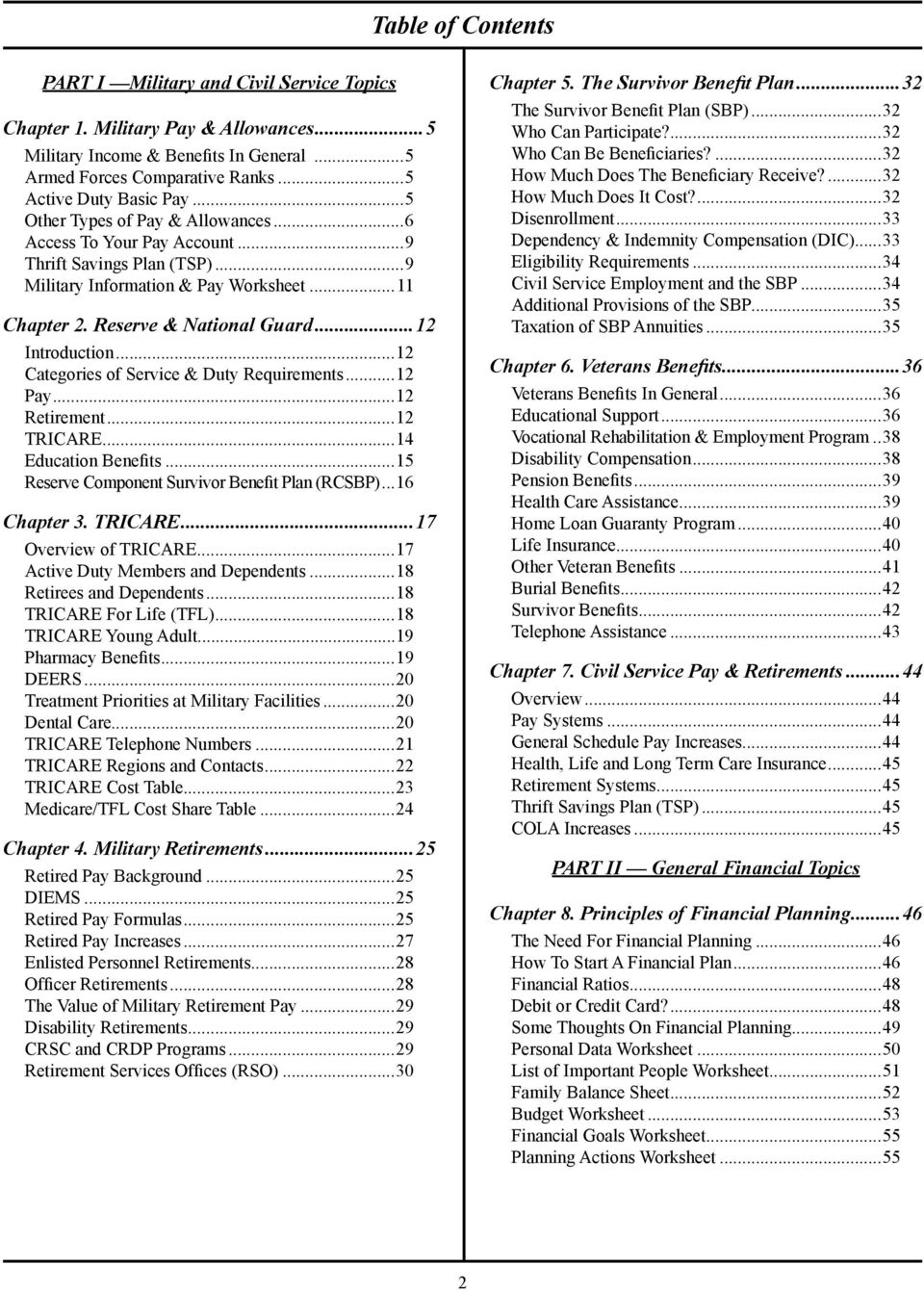
3 Table of Contents (Cont.) Chapter 9. Important Papers, Wills & Trusts...56 Important Papers...56 Wills...56 Estate Planning...57 Trusts...57 Health Care Decisions...58 Personal Record System...59 Location of Important Documents Worksheet...60 Chapter 10. Savings & Investments...62 Why Save And Invest?...62 Investment Prerequisites...62 Risk and Return...62 Types of Investments...63 Short Term Investments...63 Common Stock...64 Fixed Income Securities...64 Mutual Funds...65 Derivatives...66 Real Estate...66 Other Tangibles...67 Retirement Accounts 401Ks and IRAs...67 Education Savings...68 Investment Goals and Strategies...68 Time Value of Money...68 Savings & Investment Terminology...70 Investment Worksheet...71 Chapter 11. Personal Credit...72 Credit Cards...72 Consumer Loans...72 Home Mortgages...73 Education Loans...74 Reverse Mortgages...74 Credit History...74 Bankruptcy...75 Consumer Financial Protection Bureau (CFPB)...75 Schedule of Monthly Loan & Mortgage Payments...76 Chapter 13. Life Insurance...84 Introduction...84 Building a Personal Insurance Program...84 Why Life Insurance?...84 Types of Life Insurance...84 Term Life Insurance...84 Whole Life Insurance...85 Universal Life Insurance...86 Other Types of Life Insurance...86 Contract Provisions...86 How Much Life Insurance?...88 Risk Classification...88 Selecting a Life Insurance Company...88 The Language of Life Insurance...89 Insurance Worksheet...90 Chapter 14. Annuities...92 The Annuity Principle...92 Annuity Classifications...92 Annuity Pros and Cons...93 Life Expectancy Table...94 Chapter 15. Federal & State Taxes...95 Federal Income Tax In General...95 Determination of Tax Liability...95 When To File Your Return...96 Combat Zone...97 State Income Taxes...97 Federal Estate And Gift Taxes...97 State Inheritance Taxes...98 Tax Tips...98 Income Tax Worksheet Appendix A Internet Resources Appendix B Military Information Directory Appendix C Identity Theft Chapter 12. Social Security & Medicare...77 Social Security Benefits In General...77 Social Security Eligibility...77 Applying For Social Security...78 Estimating Social Security Benefits...78 Retirement Benefits...78 Disability Benefits...79 Survivor Benefits...80 Supplemental Security Income (SSI)...80 Medicare...80 Nursing Homes
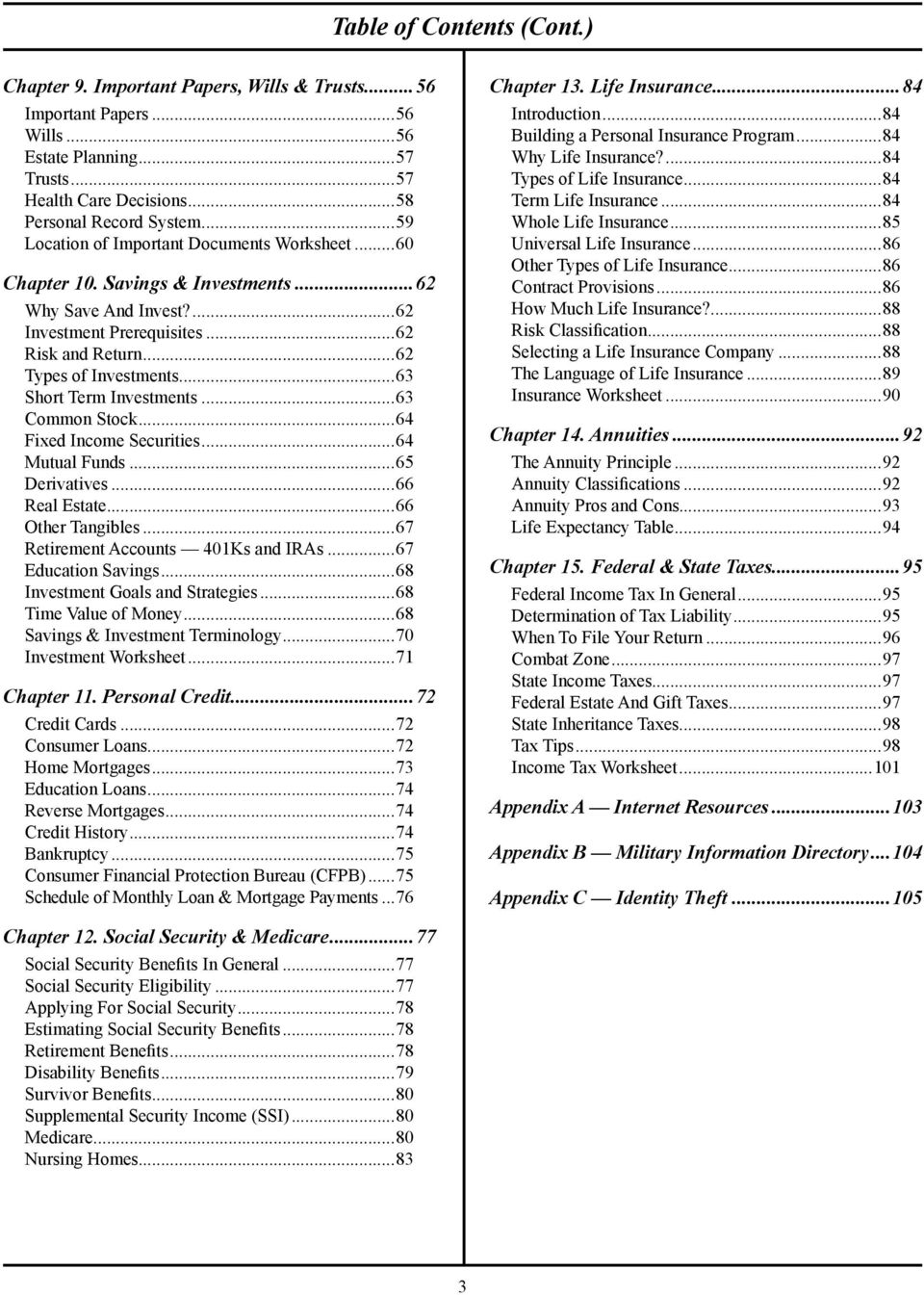
4 2015 ADDITIONS & CHANGES CHAPTER ITEM 1 Updated all rate and table information pertaining to military pay. 2 Updated pay tables, benefit amounts, and information on retirement services offices. 3 Updated beneficiary entitlement information and various cost amounts. 4 Updated various tables, information relating to RSO offices, and the CRSC and CRDP programs. 5 Updated narrative on beneficiary entitlements and cost amounts. 6 Updated beneficiary entitlement information and various cost amounts. 7 Updated pay scale and benefit information. 8 Expanded discussion on the use of debit and credit cards. 9 No substantial changes. 10 Updated information on IRA and 401(k) contributions and market performance data. 11 Added discussion on the Consumer Financial Protection Bureau (CFPB). 12 Updated discussion and information tables. 13 Updated insurance rating information. 14 Updated Life Expectancy Table. 15 Updated all federal and state tax information. 4
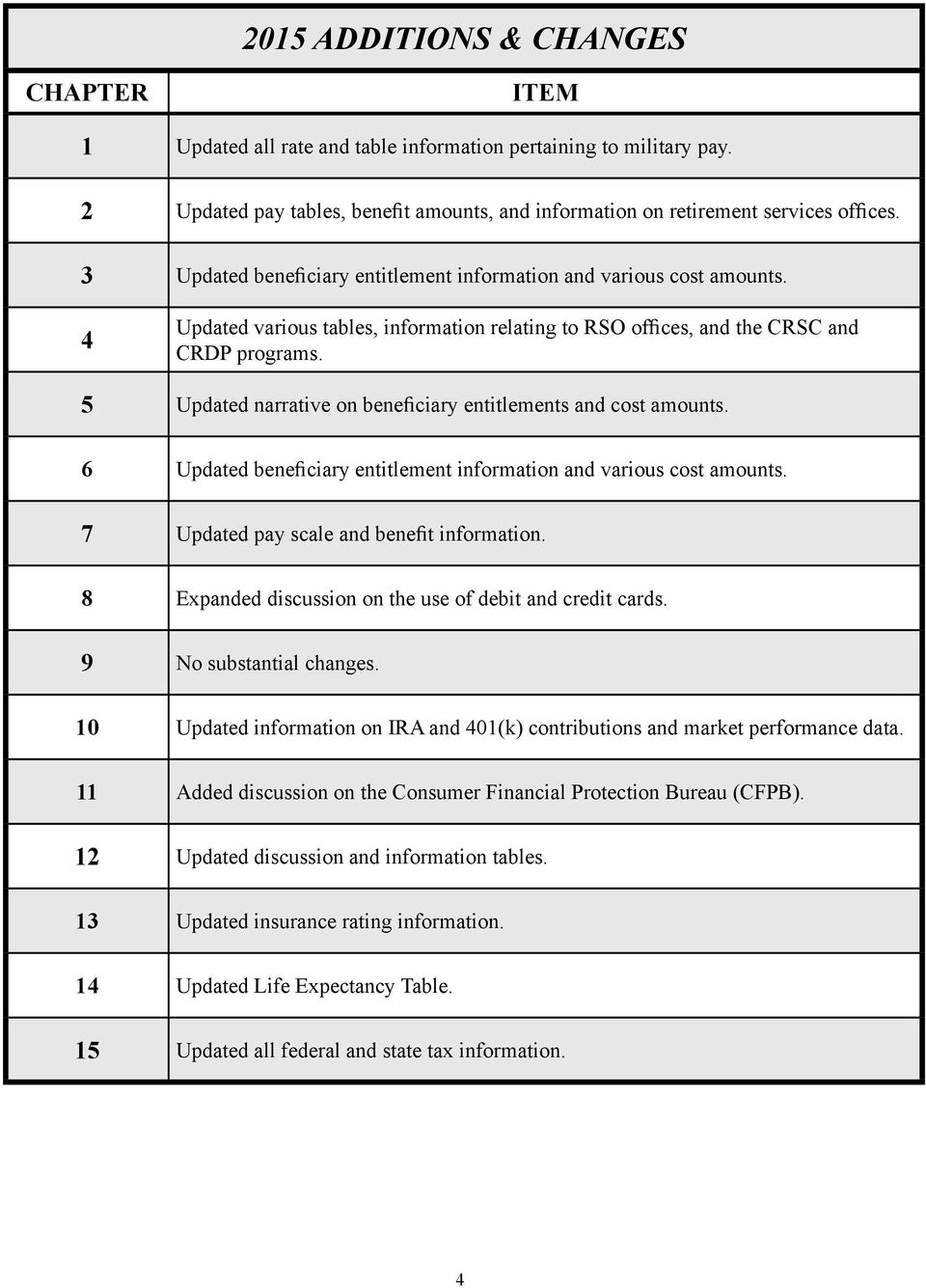
5 Chapter 1. Military Pay & Allowances Military Income & Benefits In General Armed Forces Comparative Ranks Active Duty Basic Pay Other Types of Pay & Allowances Access to Your Pay Account Thrift Savings Plan (TSP) Military Information & Pay Worksheet MILITARY INCOME & BENEFITS IN GENERAL. Military compensation is a complex system of over 40 pay and allowance items. Since military compensation is usually the service member s primary source of income and because the entitlements are complex and subject to change, it is important that both the mem ber (and his or her family) understand how these entitlements fit into the family s total financial plan. As we review the most common items of pay and allow ances, keep in mind that the amounts and benefits we dis cuss are subject to change. The information provided is the most current available at the time of publication. It is also important to remember that entitlements to most military pay and allowances are based on satisfying a variety of requirements that are too numerous to outline in this publication. If you think you are en titled to an item we dis cuss, check with your Finance or Personnel Office to determine spe cific requirements ARMED FORCES COMPARATIVE RANKS. While the military grade structure is the same in all departments, the titles that are associated with each rank can vary. For example, depending upon the branch of service, an E 7 may have the title Sergeant First Class, Master Sergeant, Gunnery Sergeant, or Chief Petty Officer. The table below provides a summary of the grade structure and titles used in the United States Armed Forces ACTIVE DUTY BASIC PAY. A military member s basic month ly pay is similar to a civilian s salary and, like the civilian, it is usually the member s primary source of income. Each year the President submits a pay raise request to Congress and, if approved, it is enacted into law with an effective date of 1 January. The table on the next page shows the Fiscal Year 2015 pay raise of 1%. The table does not reflect the longevity increases associated with service in excess of United States Armed Forces Comparative Ranks Rank U. S. Army Titles U. S. Air Force Titles U. S. Marine Corps Titles U. S. Navy Titles Rank Commissioned Officers O 10 General General General Admiral O 10 O 9 Lieutenant General Lieutenant General Lieutenant General Vice Admiral O 9 O 8 Major General Major General Major General Rear Admiral (Upper) O 8 O 7 Brigadier General Brigadier General Brigadier General Rear Admiral (Lower) O 7 O 6 Colonel Colonel Colonel Captain O 6 O 5 Lieutenant Colonel Lieutenant Colonel Lieutenant Colonel Commander O 5 O 4 Major Major Major Lieutenant Commander O 4 O 3 Captain Captain Captain Lieutenant O 3 O 2 First Lieutenant First Lieutenant First Lieutenant Lieutenant Junior Grade O 2 O 1 Second Lieutenant Second Lieutenant Second Lieutenant Ensign O 1 Warrant Officers W 5 Chief Warrant Officer Chief Warrant Officer n/a W 5 W 4 Chief Warrant Officer (The United States Air Force Chief Warrant Officer Chief Warrant Officer W 4 W 3 Chief Warrant Officer has no Chief Warrant Officer Chief Warrant Officer W 3 W 2 Chief Warrant Officer Warrant Officer Grades) Chief Warrant Officer Chief Warrant Officer W 2 W 1 Warrant Officer Warrant Officer Warrant Officer W 1 Enlisted Personnel E 9 Cmd. Sgt. Major or Sgt. Major Chief Master Sergeant Sgt. Major or Master Gun. Sgt. Master Chief Petty Officer E 9 E 8 Master Sergeant or 1st Sergeant Senior Master Sergeant Master Sergeant or 1st Sergeant Senior Chief Petty Officer E 8 E 7 Sergeant First Class Master Sergeant Gunnery Sergeant Chief Petty Officer E 7 E 6 Staff Sergeant Technical Sergeant Staff Sergeant Petty Officer First Class E 6 E 5 Sergeant Staff Sergeant Sergeant Petty Officer Second Class E 5 E 4 Corporal or Specialist 4 Sergeant or Senior Airman Corporal Petty Officer Third Class E 4 E 3 Private First Class Airman First Class Lance Corporal Seaman E 3 E 2 Private Airman Private First Class Seaman Apprentice E 2 E 1 Private Airman Basic Private Seaman Recruit E 1 5
6 30 years which was a provision included in the 2010 Defense Authorization Act OTHER TYPES OF PAY & ALLOWANCES. In addition to basic pay, active duty personnel often receive several other items of pay and allowances depending on their marital status, type of duties performed, professional skills, and areas of assignment. It is important to note that items of pay are generally subject to taxation and are included in the taxable income reported to the federal and state government at the end of the year. However, allowance items are not subject to taxation and are not included in annual taxable income. The most common special and incentive pay and allowances are discussed below. PAY Career Sea Pay. A monthly amount ranging from $50 to $750 for enlisted members; $180 to $700 for warrant officers; and $100 to $669 for commissioned officers. Amounts are based on the member s rank and years of sea duty. When members receiving Career Sea Pay have served 36 consecutive months of sea duty, they are entitled to an additional $100 a month for each month of subsequent sea duty. There are two incentives associated with Career Sea Pay: a. Submarine Duty Pay. This is a monthly pay for submarine crew members. The amount payable is based on the member s rank and years of service. Enlisted crew members receive from $75 to $600 while warrant officers Rank Under 2 Years Over 2 Years Over 3 Years Over 4 Years 2015 United States Armed Forces Basic Pay Table Over 6 Years Over 8 Years Over 10 Years Over 12 Years Commissioned Officers O 10 16,072 16,150 16,486 17,071 17,071 17,925 O 9 14,056 14,259 14,552 15,062 15,062 15,816 O 8 9,946 10,272 10,488 10,548 10,818 11,269 11,373 11,802 11,924 12,293 12,827 13,319 13,647 13,647 13,647 13,647 13,989 O 7 8,264 8,648 8,826 8,967 9,222 9,475 9,767 10,059 10,351 11,269 12,043 12,043 12,043 12,043 12,105 12,105 12,347 O 6 6,186 6,796 7,242 7,242 7,270 7,582 7,623 7,623 8,056 8,822 9,272 9,721 9,977 10,236 10,738 10,738 10,952 O 5 5,157 5,810 6,212 6,288 6,539 6,689 7,019 7,261 7,574 8,083 8,281 8,506 8,762 8,762 8,762 8,762 8,762 O 4 4,449 5,151 5,495 5,571 5,890 6,232 6,659 6,990 7,221 7,353 7,430 7,430 7,430 7,430 7,430 7,430 7,430 O 3 3,912 4,435 4,787 5,219 5,469 5,744 5,921 6,213 6,365 6,365 6,365 6,365 6,365 6,365 6,365 6,365 6,365 O 2 3,380 3,850 4,434 4,584 4,678 4,678 4,678 4,678 4,678 4,678 4,678 4,678 4,678 4,678 4,678 4,678 4,678 O 1 2,934 3,054 3,692 3,692 3,692 3,692 3,692 3,692 3,692 3,692 3,692 3,692 3,692 3,692 3,692 3,692 3,692 Commissioned Officers With Over Four Years of Enlisted or Warrant Officer Service O 3E 5,219 5,469 5,744 5,921 6,213 6,459 6,600 6,793 6,793 6,793 6,793 6,793 6,793 6,793 O 2E 4,584 4,678 4,827 5,079 5,273 5,418 5,418 5,418 5,418 5,418 5,418 5,418 5,418 5,418 O 1E 3,692 3,942 4,088 4,237 4,383 4,584 4,584 4,584 4,584 4,584 4,584 4,584 4,584 4,584 Warrant Officers W 5 7,189 7,554 7,825 8,126 8,126 8,533 W 4 4,043 4,349 4,474 4,597 4,808 5,018 5,229 5,548 5,828 6,094 6,311 6,523 6,835 7,092 7,384 7,384 7,531 W 3 3,692 3,846 4,004 4,056 4,221 4,546 4,885 5,045 5,229 5,419 5,761 5,992 6,130 6,277 6,477 6,477 6,477 W 2 3,267 3,576 3,671 3,736 3,948 4,278 4,441 4,602 4,798 4,951 5,091 5,257 5,366 5,453 5,453 5,453 5,453 W 1 2,868 3,176 3,259 3,435 3,642 3,948 4,091 4,290 4,486 4,641 4,783 4,956 4,956 4,956 4,956 4,956 4,956 Enlisted Members E 9 4,885 4,995 5,135 5,299 5,465 5,730 5,954 6,190 6,551 6,551 6,879 E 8 3,999 4,175 4,285 4,416 4,558 4,815 4,945 5,166 5,289 5,591 5,591 5,703 E 7 2,780 3,034 3,150 3,304 3,424 3,630 3,747 3,953 4,125 4,242 4,367 4,415 4,577 4,664 4,996 4,996 4,996 E 6 2,404 2,645 2,762 2,876 2,994 3,261 3,364 3,565 3,627 3,672 3,724 3,724 3,724 3,724 3,724 3,724 3,724 E 5 2,202 2,350 2,464 2,580 2,761 2,951 3,107 3,125 3,125 3,125 3,125 3,125 3,125 3,125 3,125 3,125 3,125 E 4 2,019 2,122 2,238 2,351 2,451 2,451 2,451 2,451 2,451 2,451 2,451 2,451 2,451 2,451 2,451 2,451 2,451 E 3 1,823 1,938 2,055 2,055 2,055 2,055 2,055 2,055 2,055 2,055 2,055 2,055 2,055 2,055 2,055 2,055 2,055 E 2 1,734 1,734 1,734 1,734 1,734 1,734 1,734 1,734 1,734 1,734 1,734 1,734 1,734 1,734 1,734 1,734 1,734 E 1 1,546 1,546 1,546 1,546 1,546 1,546 1,546 1,546 1,546 1,546 1,546 1,546 1,546 1,546 1,546 1,546 1,546 Over 14 Years Over 16 Years Over 18 Years Over 20 Years Over 22 Years Note: Monthly base pay for O 7 to O 10 in 2015 is limited to $15,125 by Level II of the Executive Schedule. Over 24 Years Over 26 Years Over 28 Years Over 30 Years 6
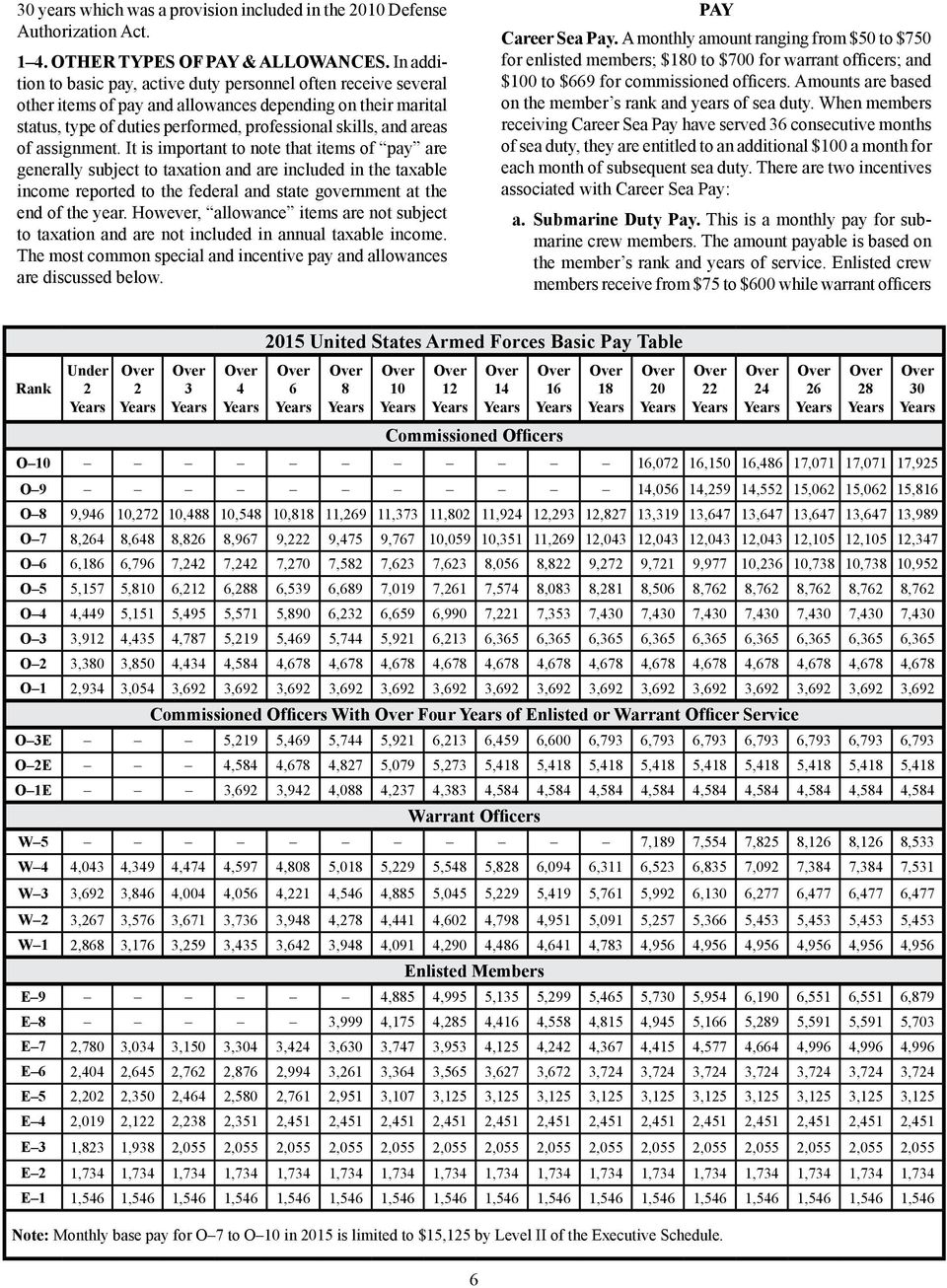
7 receive from $285 to $425. Officer payments range from $230 to $835. b. Nuclear Qualified Officer Pay. In order to train and retain nuclear qualified officers, the Navy is authorized to pay two types of special pays: an annual Continuation Pay not to exceed $25,000 and an annual Incentive Bonus not to exceed $20,000. Diving Pay. A monthly payment of up to $240 is given to officers and up to $340 to enlisted members whose duties involve diving. Enlistment & Reenlistment Bonus. Existing laws currently authorize the military departments to award an Enlistment or Reenlistment Bonus to individuals who initially enlist or extend their period of active duty. The normal period of enlistment or extension is four years. The amount of the enlistment bonus cannot exceed $40,000 and varies by occupational skills and service department. The military departments are also authorized to award an additional Selective Reenlistment Bonus to enlisted members who are serving in a designated critical military speciality. This additional bonus can be as high as $100,000. The designated critical military specialities and amounts payable are different for each military department. Flight Pay. There are four primary special pays for members whose military duties involve aerial flight. a. Aviation Career Incentive Pay. Commissioned and warrant officers may receive a monthly incentive pay based upon their years of aviation service. The amount payable ranges from $125 to $840 per month. b. Enlisted Flier Incentive Pay. This pay may be authorized in lieu of HDIP for enlisted crew members. Enlisted aviators may receive continuous flight pay as long as they meet flying requirements. The pay ranges from $150 to $400 a month. c. Aviation Continuation Pay. An annual bonus of up to $25,000 may be paid to selected officers who agree to extend their aviation service. d. Hazardous Duty Incentive Pay (HDIP). HDIP is payable to non-rated crew members whose duties can only be performed on an in-flight aircraft. Monthly officer payments range from $150 to $250 while the monthly entitlement for enlisted personnel ranges from $150 to $240 per month. Foreign Language Proficiency Pay. A monthly payment, not to exceed $1,000 for Active Duty and $500 for Guard and Reserve members, is payable to those who maintain proficiency in specific foreign languages designated by the military departments. Hardship Duty Pay. There are two types of monthly Hardship Duty Pay: a. HDP L are payments to officers and enlisted personnel for service in designated locations. Payments range from $50 to $150 depending upon the duty location. b. HDP M are payments for the performance of designated missions generally involving the recovery of the remains of U.S. service members. Hazardous Duty Incentive Pay. A $150 monthly payment is authorized for members required to perform certain hazardous duties. Qualifying duties include demolition work, parachute jumping, work with toxic fuels or pesticides, work inside pressure chambers, flight duty as a non crew member, flight deck operations, and similar hazardous duties. Additionally, in the field of parachute jumping, there is a monthly High Altitude Low Opening (HALO) pay of $225 which may be authorized for members who perform unique parachute duties. Hostile Fire and Imminent Danger Pay. A $225 monthly payment is authorized to members who perform duties within areas designated as imminent danger zones. Involuntary Separation Pay. This is a special lump sum payment authorized for certain members who are involuntarily separated from the service (for reasons other than misconduct) after having served at least six years but less than 20 years on active duty. Medical Pay. Military personnel who are serving in various medical specialities are entitled to receive a variety of special pays. a. Medical Doctors. Military doctors may receive several special pays. Eligibility is determined by the doctor s medical specialty, intern training and board certification status, time in service, and the length of the physician s additional active duty service commitment. The amounts of these special pay items can be substantial and are designed to ensure that qualified medical personnel are retained on active duty and that their pay remains fairly compatible with their civilian counterparts. These special pay items include: 1. An annual Variable Special Pay; 2. An annual Multiyear Special Pay; 3. An annual Incentive Special Pay; and 4. Additional payments if the physician is Board Certified in his or her medical specialty. b. Dentist Pay. A monthly variable special pay is paid to dentists based on their years of service. Also, an addi tional annual special pay ranging from $10,000 to $15,000 is pay able based upon the length of the dentist s active duty commitment. Board Certified dentists may also receive an annual payment ranging from $2,500 to $6,000. Additionally, dental officers are eligible for a multiyear retention bonus of up to $50,000 depending on his or her specialty. c. Nurse Bonus Payments. An accession bonus of up to $30,000 may be paid to nurses who agree to serve on active duty for at least four years. Additionally, Registered Nurses who extend their active service are eligible for incentive special pays of up to $20,000 per year. 7

8 d. Pharmacy Officers. Pharmacy officers in paygrades O 6 and below may receive a retention special pay of up to $15,000 per year. e. Nonphysician Board Certified Pay. Military members serving in a number of healthcare fields (e.g., physical therapists, radiation specialists, optometry, etc.) may be eligible to receive Board Certified Pay up to $5,000 per year. Special Duty Assignment Pay. A monthly payment ranging from $75 to $450 is given to enlisted members who perform duties that have been designated as being extremely difficult or involving a high degree of responsibility. ALLOWANCES Basic Allowance for Housing (BAH). BAH is a monthly allowance for members not assigned to government quarters. The objective of the BAH program is to ensure the same out of pocket housing expense for each member regardless of duty location. The BAH allowance for each duty location is based on commercially gathered price data of local rental properties. Data is collected to establish the average rental and utility costs for various types of housing units. The information reflects the cost of rental properties with housing characteristics similar to those rented by civilian counterparts with salaries comparable to military members. The data is collected every summer with the new rates effective 1 January of the next year. BAH rates vary by grade and duty location. For example, in 2015 an E 8 with dependents stationed in Savannah, GA will receive $1,758 and an O 3 with dependents will receive $1,779. If the same members are stationed in San Diego, the E 8 will receive $2,568 and the O 3 will be paid $2,610. A key feature of the BAH program is rate protection. Rate protection ensures that service members will not have a reduction in their BAH payment even if rates go down. The rate in effect when the member arrives at their duty station is the guaranteed minimum rate they will receive during their current assignment. Also, if rate increases are made for a given location, then everyone assigned to that location will receive the benefit of the new rate increase. In addition to the standard BAH, there are three other types of BAH: a. BAH RC/Transient. A prorated housing allowance paid to Reservists who are mobilized for 30 days or less. b. BAH Partial. This may be paid to members without dependents who reside in government quarters. c. BAH Differential. Used for personnel who live on base in single quarters and make alimony or child support payments. Basic Allowance for Subsistence (BAS). BAS is a monthly allowance de signed to offset the cost of meals to the member. Officers receive $ a month regardless of rank. Upon completion of initial training, enlisted members who are authorized to mess separately will receive $ per month. Clothing Allowance. All officers are entitled to an initial uniform allowance. The initial uniform allowance is payable only once to an officer except for the following circumstance: Upon transfer to another Reserve Component that requires a different uniform, a Reserve officer may receive another initial uniform allowance. Regular officers may not receive this allowance when transferring to another Military Service. Enlisted personnel receive an initial uniform issue at the time of entry into the service. To provide for uniform replacement, enlisted personnel are subsequently paid an annual clothing replacement allowance. There are two types of clothing replacement allowances Basic and Standard. The Basic Rate is payable during the first three years of service. After three years of service, the member receives the Standard Rate which is a higher level of reimbursement. The Basic and Standard rates vary by gender and service. The table below provides allowance information. In addition, there are special clothing allowances which are payable to members whose duties require them to wear either civilian type clothing or special military clothing (e.g., members of the Army Band). CONUS COLA. The Cost of Living Allowance for the Continental United States is designed to partially offset the higher, non housing costs experienced by active duty members living in designated high cost areas in the United States. The amount varies based upon rank, dependent status, years of service and geographical location. Although most payments are in the range of $20 to $300 per month, the monthly allowance can be over $700 for certain members living in particularly high cost locations. Dislocation Allowance (DLA). Dislocation Allowance is designed to partially reimburse active duty personnel for the expenses they incur in relocating their households in conjunction with a permanent change of station. The allowance is determined by the member s grade and is paid at either a Annual Clothing Replacement Allowance Enlisted Men BASIC STANDARD Army $ $ Navy (E1-E6) $ $ Navy (E7-E9) $ Air Force $ $ Marine Corps $ $ Coast Guard $ $ Enlisted Women Army $ $ Navy (E1-E6) $ $ Navy (E7-E9) $ Air Force $ $ Marine Corps $ $ Coast Guard $ $

9 with dependents or without dependents rate. The table to the right provides the Dislocation Allowance rates for Family Separation Allowances (FSA). FSA is payable only to members with dependents. The monthly payment of $250 is designed to provide compensation for the added expenses incurred because of an enforced family separation under one of the following conditions: a. FSA-R. Transportation of dependents is not authorized at government expense and the dependents do not live in the vicinity of the member s home port/permanent duty station. b. FSA-S. The member is on duty aboard a ship, and the ship is away from the home port continuously for more than 30 days. c. FSA-T. The member is on TDY/away from the permanent duty station continuously for more than 30 days and the member s dependents do not reside at or near the TDY/ TAD station. Overseas Station Allowances. Overseas Station Allowances consist of a series of payments designed to help defray the additional costs for food, lodging, and related incidental expenses incurred by active duty members and their dependents as a result of assignment to permanent duty outside the United States. This allowance contains four separate components: Paygrade Dislocation Allowance Without Dependents With Dependents O 10 $3, $4, O 9 3, , O 8 3, , O 7 3, , O 6 3, , O 5 3, , O 4 3, , O 3 2, , O 2 1, , O 1 1, , O 3E 2, , O 2E 2, , O 1E 1, , W 5 3, , W 4 2, , W 3 2, , W 2 2, , W 1 1, , E 9 2, , E 8 2, , E 7 1, , E 6 1, , E 5 1, , E 4 1, , E 3 1, , E 2 1, , E , ) Cost of Living Allowance (COLA); 2) Overseas Housing Allowance (OHA); 3) Temporary Lodging Allowance (TLA); and, 4) Interim Housing Allowance (IHA). The amount of each of these allowances varies geographically because the excess costs upon which they are based vary from one foreign locality to another. Temporary Lodging Expense (TLE). Temporary Lodging Expense is designed to partially offset the lodging and meal expenses incurred by active duty personnel and/or their dependents when it is necessary to occupy temporary lodgings in conjunction with a permanent change of station (PCS). The allowance is payable for a limited period of time up to ten days in connection with a CONUS PCS and up to five days in conjunction with a PCS to a duty station outside CONUS ACCESS TO YOUR PAY ACCOUNT. MyPay is a great tool to help members of the military, defense civilians, retirees, and annuitants manage their pay. This tool lets you make changes to your pay account information online at anytime at MyPay allows you to view your LES, adjust the amount of your federal and state tax withholdings, change direct deposit accounts for your monthly pay, etc. Features vary slightly by service and status THRIFT SAVINGS PLAN (TSP). The Thrift Savings Plan is an optional retirement investment program that is similar to the various plans administered by many private corporations. Active, reserve, and guard members can contribute to the plan from their military pay and are entitled to keep both their contributions and additional earnings regardless of whether they leave the service prior to retirement or actually retire from military service. The following discussion examines various features of the plan. Website. The TSP website is You can use the website to get current information on the performance of various funds and to access your investment account. Enrollment. If you are a member of the uniformed services, your account is established by your service after you make a contribution election using your service s automated system, if it has one. For example, most members of the uniformed services use mypay. If your service does not use an electronic system, you can complete form TSP-U-1. These forms can be downloaded at You may sign up to contribute to the TSP at any time. Member Contributions. You may invest up to 100 percent of your basic pay each pay period. Contributions are limited only by the restrictions imposed by the Internal Revenue Code. For 2015, tax rules limit the annual dollar amount that can be contributed to $18,000. If you contribute to the TSP from your basic pay, you may also contribute up to 100 percent of 9

10 any incentive, special, or bonus pays that you earn. You may start, stop, or change your contribution at any time using form TSP-U-1. You may not invest any allowances (BAS, BAH, etc.) that you receive. If you are age 50 or older in 2015 and are already contributing the maximum amount of regular TSP contributions, you may elect to make up to $6,000 in additional catch up contributions. Service Matching Contributions. Currently, members of the uniformed services do not receive Matching Contributions. However, the law that extended participation in the TSP to members of the uniformed services allows the secretary of each individual service to designate critical specialties as eligible for Matching Contributions under certain circumstances. Investment Options. The TSP provides six mutual fund investment opportunities: a. Government Securities Investment Fund G Fund. Investment focus is on short term U.S. Treasury securities. b. Fixed Income Index Investment Fund F Fund. Investment focus is on government and corporate bonds and mortgage backed securities. c. Common Stock Index Investment Fund C Fund. Investment focus is on the stocks of large and medium size companies included in the S&P 500 Index. d. Small Capitalization Stock Index Investment Fund S Fund. Investment focus is on the stocks of medium and small companies that are not included in the C Fund. e. International Stock Index Investment Fund I Fund. Investment focus is on international stocks of 22 developed countries. f. Lifecycle Fund L Fund. These funds are a mix of investment vehicles (i.e., domestic stocks, international stocks, bonds, etc.). The specific mix is chosen based on the date when you will need your money. For younger investors, the mix is equity or stock weighted, while for older investors, the allocation is weighted toward bonds and other fixed income securities. Note, all new money coming into your TSP account is automatically invested in the G Fund unless you request a contribution allocation. You may make the allocation online, by phone, or mail. Loans. If the need arises, the TSP loan program gives you access to the money in your account. There are two types of loans a general purpose loan and a loan for the purchase of your primary residence. Repayment periods are one to five years for a general purpose loan and one to fifteen years for a home loan. The interest rate charged is the G Fund rate at the time the loan is initiated. Interest and principal repayments are credited back to your account. Withdrawal. Generally, withdrawals from your account will be taxed at your normal tax rate provided the withdrawal is made after you reach 59 1/2 years of age. Since the TSP is designed to be a long term retirement savings program, withdrawals made before 59 1/2 years of age may be subject to a 10% early withdrawal tax. In addition, there are special rules covering a financial hardship withdrawal for members who are still in service. Plan Administration/Costs. The TSP is administered by the Federal Retirement Thrift Investment Board which is an independent government agency. TSP s operating expenses (e.g., computer costs, statement preparation, etc.) are paid by the fund s investors. In recent years this annual administrative cost has averaged approximately $0.29 per $1,000 of investment balance. Tax Implications. The TSP program allows contributions to be made on either a pre-tax (Traditional TSP) basis or an after tax (Roth TSP) basis. a. Traditional. Contributions that you make today are deducted from your pay before taxes are computed, meaning that you pay less taxes now. The payment of taxes on this income is deferred until you actually withdraw the money from your account. Additionally, taxes on fund earnings are not paid until the money is withdrawn. b. Roth. Taxes on contributions are paid up front. Consequently, contributions are not taxed at the time of withdrawal as long as five years have passed since 1 January of the year you made your first Roth contribution and you are 59 1/2 or older. 10
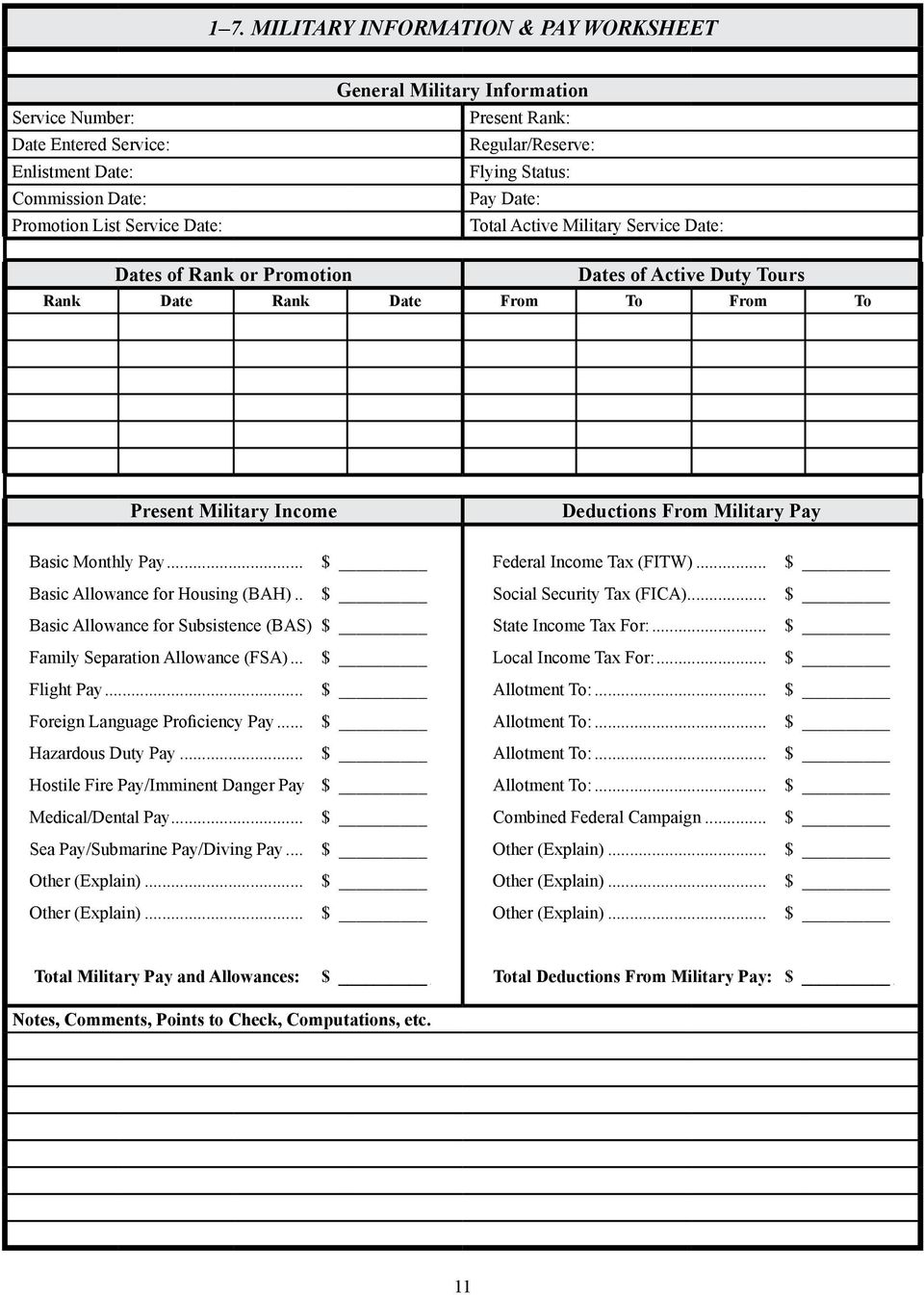
11 1 7. MILITARY INFORMATION & PAY WORKSHEET Service Number: Date Entered Service: Enlistment Date: Commission Date: Promotion List Service Date: General Military Information Present Rank: Regular/Reserve: Flying Status: Pay Date: Total Active Military Service Date: Dates of Rank or Promotion Dates of Active Duty Tours Rank Date Rank Date From To From To Present Military Income Deductions From Military Pay Basic Monthly Pay... $ Basic Allowance for Housing (BAH)... $ Basic Allowance for Subsistence (BAS) $ Family Separation Allowance (FSA)... $ Flight Pay... $ Foreign Language Proficiency Pay... $ Hazardous Duty Pay... $ Hostile Fire Pay/Imminent Danger Pay $ Medical/Dental Pay... $ Sea Pay/Submarine Pay/Diving Pay... $ Other (Explain)... $ Other (Explain)... $ Federal Income Tax (FITW)... $ Social Security Tax (FICA)... $ State Income Tax For:... $ Local Income Tax For:... $ Allotment To:... $ Allotment To:... $ Allotment To:... $ Allotment To:... $ Combined Federal Campaign... $ Other (Explain)... $ Other (Explain)... $ Other (Explain)... $ Total Military Pay and Allowances:. $ Total Deductions From Military Pay: $ Notes, Comments, Points to Check, Computations, etc. 11
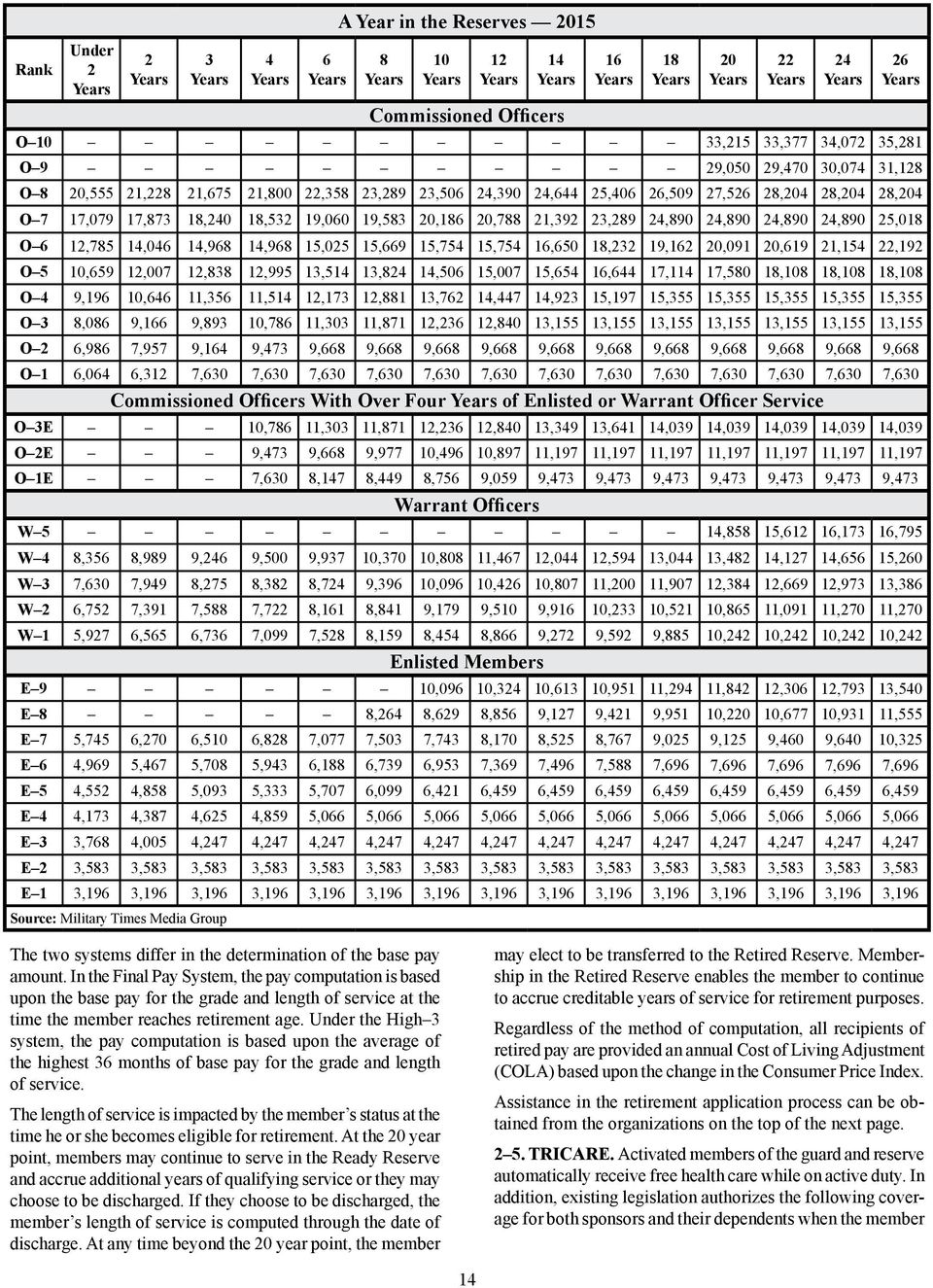
12 Chapter 2. Reserve & National Guard Introduction Categories of Service & Duty Requirements Pay Retirement TRICARE Education Benefits Reserve Component Survivor Benefit Plan (RCSBP) INTRODUCTION. An essential component of the nation s military force is the Reserve and National Guard. The term Reserve Component (RC) refers collectively to the seven individual reserve components of the armed forces: the Army National Guard of the United States, the Army Reserve, the Navy Reserve, the Marine Corps Reserve, the Air National Guard of the United States, the Air Force Reserve, and the Coast Guard Reserve. This chapter will look at the duty requirements, pay, and retirement that are provided to these members. Finally we will examine the health, education and survivor benefits that are available CATEGORIES of SERVICE & DUTY REQUIRE- MENTS. Members of the Guard and Reserve are assigned to one of three categories Ready Reserve, Standby Reserve, or Retired Reserve. a. Ready Reserve. This group consists of three sub categories Selected Reserve, Individual Ready Reserve (IRR), and Inactive National Guard (ING). The Selected Reserve consists of designated guard/reserve units and individuals who are considered essential to wartime mission accomplishment. The president may mobilize up to 200,000 members of the Selected Reserve without declaring a national emergency for a period not to exceed 365 days. Members of the Selected Reserve are generally required to perform one weekend of training each month ( inactive duty for training or IDT, also known colloquially as weekend drill ) and two weeks of training each year ( annual training or AT, sometimes known colloquially as summer camp ) for which they receive pay and benefits. Individual Mobilization Augmentees (IMAs) are members of the Selected Reserve who participate in training activities and are eligible for unit assignment at the time of mobilization. IRR personnel are normally prior service individuals (active or Selected Reserve) who have some remaining period of obligated military service. Usually, they are not affiliated with a unit and generally do not have to satisfy an annual training requirement. ING personnel are normally members assigned to a specific Guard unit who have been excused from training requirements because of legal or contractual requirements. b. Standby Reserve. This group consists of members who have retained their military affiliation but who are excused from active participation because of hardship, 12 critical civilian employment, or other legal requirements. Under certain circumstances members in this category may be involuntarily called to active duty for the duration of a national emergency plus six months. c. Retired Reserve. This group consists primarily of retired members who are drawing retirement pay (over age 60) and those retired members who are not yet eligible for retired pay (under age 60). Eligibility for mobilization is a function of category. Category I retirees are those within their first five years of retirement and are under age 60; Category II retirees are under age 60 but have been retired for more than five years; and, Category III retirees include all remaining retirees PAY. The pay received by members of the reserve and national guard is determined by the type of duty performed active duty or inactive duty training. While on active duty, the member generally receives the normal active duty pay and allowances associated with his or her grade and years of service. While on inactive duty training, members receive drill pay in lieu of normal pay and allowances. Generally, a drill is one four hour period of assembly, training, or military service. Pay for one drill period is equivalent to one day of active duty base pay. Reservists cannot be paid for more than two drills in one calendar day. Reserve units will often drill on a weekend basis performing two drills on Saturday and two drills on Sunday, thereby enabling the reserve member to draw four days of active duty base pay for their weekend service. The table on the next page shows the monthly drill pay while the table on the page after provides an estimate of the annual pay earned by a reservist (assuming attendance at 48 annual drills and two weeks of active duty training). Paygrades O 6 and below received a 1% increase in pay for RETIREMENT. Members must have a minimum of 20 qualifying years of service to be eligible for retirement. A qualifying year of service is any 365 day period during which the member has earned at least 50 service points. Point totals are also important because they are used to calculate retired pay. Excluding points earned while in an active duty status (which includes annual training), reservists may not earn more than 130 points per year. Service points are normally earned in accordance with the following criteria: a. One point for each day of active duty. b. One point for each 4 hour drill period. c. 15 points for each year of service in the Guard or Reserve.

13 d. One point for each 3 credit hours of accredited correspondence study. Eligibility to draw retired pay normally begins at age 60. However, members may begin to draw retired pay earlier based upon active duty service performed after 28 January Specifically, each 90 days of active service performed after 28 January 2008, entitles the member to begin drawing retired pay 3 months prior to age 60. Therefore a member with 360 days of active service would be eligible to draw retired pay at age 59 versus 60. Computation of Retired Pay. The computation of retired pay is determined based upon the member s DIEMS (Date Initially Entered Military Service). Those with a DIEMS before 8 September 1980 use the Final Pay System while those with a DIEMS on or after 8 September 1980 use the High 3 System. Both systems determine the years of service by dividing the total points earned in all years by 360. The result is then multiplied by 2.5% which provides the percentage of base pay that the member will receive at retirement. For example, a member accruing 2,880 points would have a retirement rate percentage of 20% (2,880/360 = 8 years; 2.5% x 8 years = 20%) Monthly Reserve Drill Pay Schedule Listed below are the Reserve rates of Pay for a weekend cycle of four drills Rank Under 2 Years Over 2 Years Over 3 Years Over 4 Years Over 6 Years Over 8 Years Over 10 Years Over 12 Years Over 14 Years Over 16 Years Over 18 Years Over 20 Years Over 22 Years Over 24 Years Over 26 Years Over 28 Years Over 30 Years Commissioned Officers O 10 2,142 2,153 2,198 2,276 2,276 2,390 O 9 1,874 1,901 1,940 2,008 2,008 2,108 O 8 1,326 1,369 1,398 1,406 1,442 1,502 1,516 1,573 1,589 1,639 1,710 1,775 1,819 1,819 1,819 1,819 1,865 O 7 1,102 1,153 1,177 1,196 1,230 1,263 1,302 1,341 1,380 1,503 1,606 1,606 1,606 1,606 1,614 1,614 1,647 O ,011 1,016 1,016 1,074 1,176 1,236 1,296 1,330 1,365 1,432 1,432 1,460 O ,010 1,074 1,104 1,134 1,168 1,168 1,168 1,168 1,168 O O O O Commissioned Officers With Over Four Years of Enlisted or Warrant Officer Service O 3E O 2E O 1E Warrant Officers W ,007 1,043 1,084 1,084 1,138 W ,004 W W W Enlisted Members E E E E E E E E E Note: Monthly drill pay for O 7 through O 10 is limited to Level II of the Federal Executive Schedule. Source: Military Times Media Group 13

14 Rank Under 2 Years 2 Years 3 Years 4 Years 6 Years A Year in the Reserves Years 10 Years Commissioned Officers O 10 33,215 33,377 34,072 35,281 O 9 29,050 29,470 30,074 31,128 O 8 20,555 21,228 21,675 21,800 22,358 23,289 23,506 24,390 24,644 25,406 26,509 27,526 28,204 28,204 28,204 O 7 17,079 17,873 18,240 18,532 19,060 19,583 20,186 20,788 21,392 23,289 24,890 24,890 24,890 24,890 25,018 O 6 12,785 14,046 14,968 14,968 15,025 15,669 15,754 15,754 16,650 18,232 19,162 20,091 20,619 21,154 22,192 O 5 10,659 12,007 12,838 12,995 13,514 13,824 14,506 15,007 15,654 16,644 17,114 17,580 18,108 18,108 18,108 O 4 9,196 10,646 11,356 11,514 12,173 12,881 13,762 14,447 14,923 15,197 15,355 15,355 15,355 15,355 15,355 O 3 8,086 9,166 9,893 10,786 11,303 11,871 12,236 12,840 13,155 13,155 13,155 13,155 13,155 13,155 13,155 O 2 6,986 7,957 9,164 9,473 9,668 9,668 9,668 9,668 9,668 9,668 9,668 9,668 9,668 9,668 9,668 O 1 6,064 6,312 7,630 7,630 7,630 7,630 7,630 7,630 7,630 7,630 7,630 7,630 7,630 7,630 7,630 Commissioned Officers With Over Four Years of Enlisted or Warrant Officer Service O 3E 10,786 11,303 11,871 12,236 12,840 13,349 13,641 14,039 14,039 14,039 14,039 14,039 O 2E 9,473 9,668 9,977 10,496 10,897 11,197 11,197 11,197 11,197 11,197 11,197 11,197 O 1E 7,630 8,147 8,449 8,756 9,059 9,473 9,473 9,473 9,473 9,473 9,473 9,473 Warrant Officers W 5 14,858 15,612 16,173 16,795 W 4 8,356 8,989 9,246 9,500 9,937 10,370 10,808 11,467 12,044 12,594 13,044 13,482 14,127 14,656 15,260 W 3 7,630 7,949 8,275 8,382 8,724 9,396 10,096 10,426 10,807 11,200 11,907 12,384 12,669 12,973 13,386 W 2 6,752 7,391 7,588 7,722 8,161 8,841 9,179 9,510 9,916 10,233 10,521 10,865 11,091 11,270 11,270 W 1 5,927 6,565 6,736 7,099 7,528 8,159 8,454 8,866 9,272 9,592 9,885 10,242 10,242 10,242 10,242 Enlisted Members E 9 10,096 10,324 10,613 10,951 11,294 11,842 12,306 12,793 13,540 E 8 8,264 8,629 8,856 9,127 9,421 9,951 10,220 10,677 10,931 11,555 E 7 5,745 6,270 6,510 6,828 7,077 7,503 7,743 8,170 8,525 8,767 9,025 9,125 9,460 9,640 10,325 E 6 4,969 5,467 5,708 5,943 6,188 6,739 6,953 7,369 7,496 7,588 7,696 7,696 7,696 7,696 7,696 E 5 4,552 4,858 5,093 5,333 5,707 6,099 6,421 6,459 6,459 6,459 6,459 6,459 6,459 6,459 6,459 E 4 4,173 4,387 4,625 4,859 5,066 5,066 5,066 5,066 5,066 5,066 5,066 5,066 5,066 5,066 5,066 E 3 3,768 4,005 4,247 4,247 4,247 4,247 4,247 4,247 4,247 4,247 4,247 4,247 4,247 4,247 4,247 E 2 3,583 3,583 3,583 3,583 3,583 3,583 3,583 3,583 3,583 3,583 3,583 3,583 3,583 3,583 3,583 E 1 3,196 3,196 3,196 3,196 3,196 3,196 3,196 3,196 3,196 3,196 3,196 3,196 3,196 3,196 3,196 Source: Military Times Media Group 12 Years 14 Years 16 Years 18 Years 20 Years 22 Years 24 Years 26 Years The two systems differ in the determination of the base pay amount. In the Final Pay System, the pay computation is based upon the base pay for the grade and length of service at the time the member reaches retirement age. Under the High 3 system, the pay computation is based upon the average of the highest 36 months of base pay for the grade and length of service. The length of service is impacted by the member s status at the time he or she becomes eligible for retirement. At the 20 year point, members may continue to serve in the Ready Reserve and accrue additional years of qualifying service or they may choose to be discharged. If they choose to be discharged, the member s length of service is computed through the date of discharge. At any time beyond the 20 year point, the member may elect to be transferred to the Retired Reserve. Membership in the Retired Reserve enables the member to continue to accrue creditable years of service for retirement purposes. Regardless of the method of computation, all recipients of retired pay are provided an annual Cost of Living Adjustment (COLA) based upon the change in the Consumer Price Index. Assistance in the retirement application process can be obtained from the organizations on the top of the next page TRICARE. Activated members of the guard and reserve automatically receive free health care while on active duty. In addition, existing legislation authorizes the following coverage for both sponsors and their dependents when the member 14
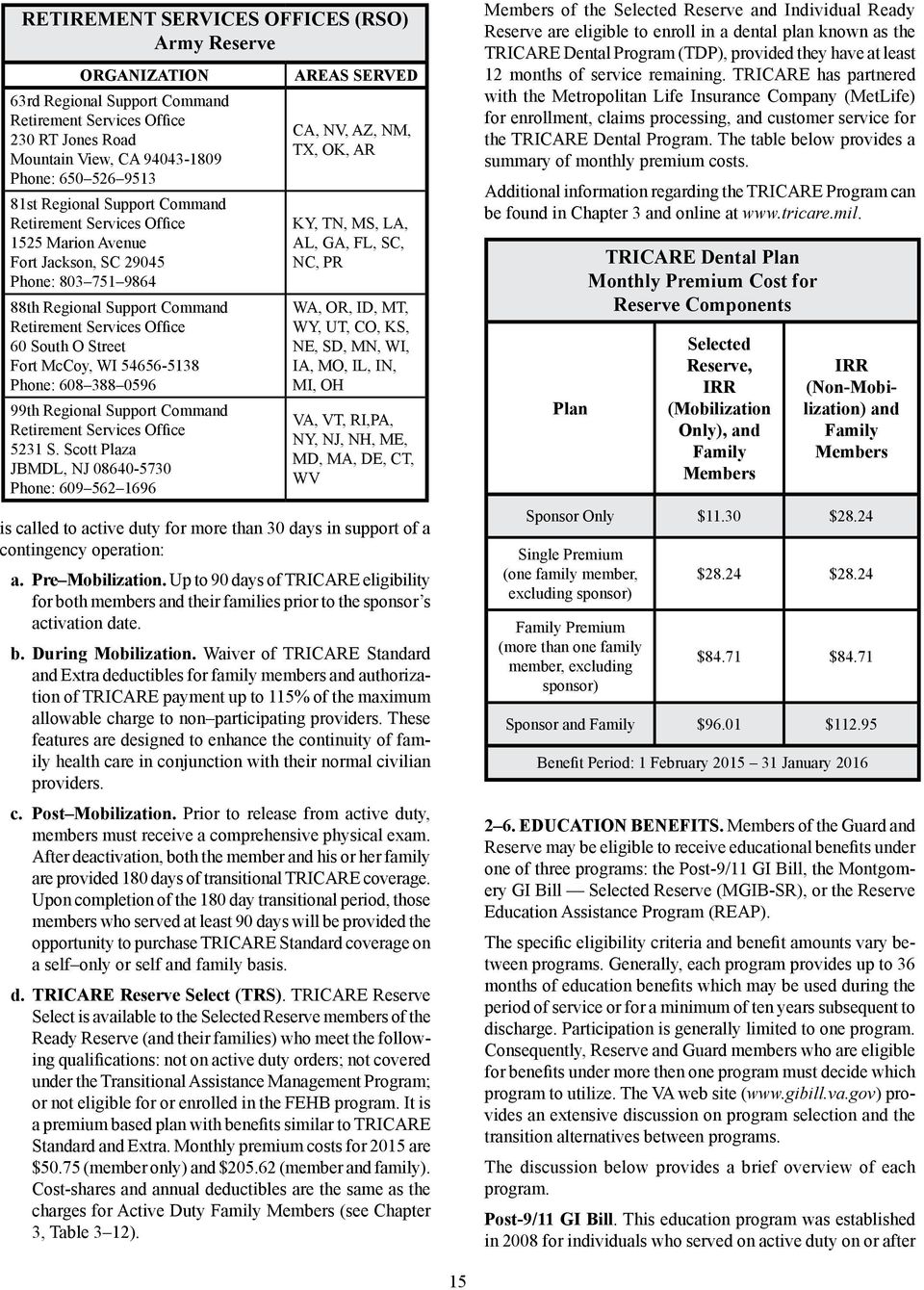
15 RETIREMENT SERVICES OFFICES (RSO) Army Reserve ORGANIZATION 63rd Regional Support Command Retirement Services Office 230 RT Jones Road Mountain View, CA Phone: st Regional Support Command Retirement Services Office 1525 Marion Avenue Fort Jackson, SC Phone: th Regional Support Command Retirement Services Office 60 South O Street Fort McCoy, WI Phone: th Regional Support Command Retirement Services Office 5231 S. Scott Plaza JBMDL, NJ Phone: AREAS SERVED CA, NV, AZ, NM, TX, OK, AR KY, TN, MS, LA, AL, GA, FL, SC, NC, PR WA, OR, ID, MT, WY, UT, CO, KS, NE, SD, MN, WI, IA, MO, IL, IN, MI, OH VA, VT, RI,PA, NY, NJ, NH, ME, MD, MA, DE, CT, WV is called to active duty for more than 30 days in support of a contingency operation: a. Pre Mobilization. Up to 90 days of TRICARE eligibility for both members and their families prior to the sponsor s activation date. b. During Mobilization. Waiver of TRICARE Standard and Extra deductibles for family members and authorization of TRICARE payment up to 115% of the maximum allowable charge to non participating providers. These features are designed to enhance the continuity of family health care in conjunction with their normal civilian providers. c. Post Mobilization. Prior to release from active duty, members must receive a comprehensive physical exam. After deactivation, both the member and his or her family are provided 180 days of transitional TRICARE coverage. Upon completion of the 180 day transitional period, those members who served at least 90 days will be provided the opportunity to purchase TRICARE Standard coverage on a self only or self and family basis. d. TRICARE Reserve Select (TRS). TRICARE Reserve Select is available to the Selected Reserve members of the Ready Reserve (and their families) who meet the following qualifications: not on active duty orders; not covered under the Transitional Assistance Management Program; or not eligible for or enrolled in the FEHB program. It is a premium based plan with benefits similar to TRICARE Standard and Extra. Monthly premium costs for 2015 are $50.75 (member only) and $ (member and family). Cost-shares and annual deductibles are the same as the charges for Active Duty Family Members (see Chapter 3, Table 3 12). Members of the Selected Reserve and Individual Ready Reserve are eligible to enroll in a dental plan known as the TRICARE Dental Program (TDP), provided they have at least 12 months of service remaining. TRICARE has partnered with the Metropolitan Life Insurance Company (MetLife) for enrollment, claims processing, and customer service for the TRICARE Dental Program. The table below provides a summary of monthly premium costs. Additional information regarding the TRICARE Program can be found in Chapter 3 and online at Plan TRICARE Dental Plan Monthly Premium Cost for Reserve Components Selected Reserve, IRR (Mobilization Only), and Family Members IRR (Non-Mobilization) and Family Members Sponsor Only $11.30 $28.24 Single Premium (one family member, excluding sponsor) Family Premium (more than one family member, excluding sponsor) $28.24 $28.24 $84.71 $84.71 Sponsor and Family $96.01 $ Benefit Period: 1 February January EDUCATION BENEFITS. Members of the Guard and Reserve may be eligible to receive educational benefits under one of three programs: the Post-9/11 GI Bill, the Montgomery GI Bill Selected Reserve (MGIB-SR), or the Reserve Education Assistance Program (REAP). The specific eligibility criteria and benefit amounts vary between programs. Generally, each program provides up to 36 months of education benefits which may be used during the period of service or for a minimum of ten years subsequent to discharge. Participation is generally limited to one program. Consequently, Reserve and Guard members who are eligible for benefits under more then one program must decide which program to utilize. The VA web site ( provides an extensive discussion on program selection and the transition alternatives between programs. The discussion below provides a brief overview of each program. Post-9/11 GI Bill. This education program was established in 2008 for individuals who served on active duty on or after 15
16 September 11, Benefit eligibility is determined by the total amount of aggregate active duty service incurred after 10 September Chapter 6 provides a table which outlines the available benefits based on the amount of active service. Those with remaining benefits under other education programs may make an irrevocable election to utilize their remaining benefits under the Post-9/11 GI Bill. Montgomery GI Bill (MGIB) Selected Reserve. The MGIB SR program provides education benefits to members of the Reserve and Guard. Basic eligibility criteria include a six year obligation and completion of initial active duty training (IADT). The table below outlines the current benefit rates payable under the MGIB SR program. Basic Monthly Rates MGIB SR Type of Training Full Time Three Quarter Time One Half Time Institutional $367 $274 $182 Apprenticeship & On-the-Job Training Cooperative Correspondence Flight Training First 6 months: $ Second 6 months: $ Remainder of program: $ Reserve Educational Assistance Program (REAP). This program provides educational benefits to members of the Guard and Reserve who are called to active duty in support of a war or national emergency for a period of at least 90 days. The active duty service period is effective retroactively to 11 September Unlike the Active Duty MGIB program, service members do not have to contribute $1,200 to participate in the REAP program. The Department of Defense and the Department of Homeland Security determine who is eligible for this program. The Department of Veterans Affairs administers the program and pays the benefits. The table below provides the current monthly benefit rates. Type of Training Institutional: Full Time Three Quarter One Half Apprenticeship & On Job Training: First 6 Months Second 6 Months Remainder $367 (Full time only) 55% of approved charges 60% of approved charges Basic Monthly Rates REAP Active Service over 90 days but less than one year $ $ Active Service over 1 year but less than 2 years $1, $ Active Service over 2 years $1, , , NOTE: Active Service must be for a consecutive time period RESERVE COMPONENT SURVIVOR BENEFIT PLAN (RCSBP). The RCSBP is an annuity program designed to provide a degree of financial security for survivors of reserve personnel. The plan has several valuable features including government subsidization of program costs, payment of lifetime benefits and inflation protection through annual cost of living adjustments. Additionally, the member s RCSBP is paid from pretax dollars which means that the monthly premium payments reduce the retiree s taxable income. Reserve members become eligible for retired pay after completing 20 years of service and they begin to draw retired pay at 60 years of age. The period of time between the date of retirement and 60 years of age is referred to as the gray area. Members who die while in the gray area do not receive retired pay nor do their spouses receive RCSBP. To ensure that spouses have an opportunity to receive RCSBP, the member receives a Notice of Eligibility (NOE) for Retired Pay at the 20 year point of service. The NOE requires the member to choose between three options regarding participation in RCSBP: Option A: Deferred Decision By choosing this option the member is postponing the decision regarding participation in RCSBP until he/she applies for and begins to draw retired pay. The disadvantage of this option is that if the member dies before age 60, the spouse will not receive RCSBP benefits. Spousal concurrence is required. Option B: Deferred Annuity If the member dies after age 60,the spouse will immediately receive annuity benefits. If the member dies before age 60, the spouse will receive annuity benefits at the time the member would have been 60. Spousal concurrence is required. Option C: Immediate Annuity This option immediately provides annuity benefits regardless of whether the member dies before or after age 60. If the member fails to elect an option on a timely basis, legal requirements dictate that Option C be automatically selected. The amount of the RCSBP coverage, called the base amount, is selected by the member and can range from $300 up to a maximum of 55% of the member s retired pay. The law requires written spouse concurrence on any RCSBP election that provides less than full and immediate coverage (Option C at 55%). The cost of the RCSBP program is a function of the option selected. For Option A, the cost is 6.5% of the annuity base amount. If the annuity base amount is $1,000, the monthly cost will be $65. The cost of Options B & C include both the 6.5% associated with Option A plus an additional fee of 2-4%. The purpose of the additional fee is to offset the cost of coverage provided to the member during the gray area period when the member is not receiving retired pay. Additional information on the RCSBP program is provided in Chapter 5. 16

17 Chapter 3. TRICARE Overview of TRICARE Active Duty Members and Dependents Retirees and Dependents TRICARE For Life (TFL) TRICARE Young Adult Pharmacy Benefits DEERS Treatment Priorities at Military Facilities Dental Care TRICARE Telephone Numbers TRICARE Regions and Contacts TRICARE Cost Table Medicare/TFL Cost Share Table OVERVIEW OF TRICARE. TRICARE is a regionally based health care program that employs Managed Care Support Contractors (MCSC) to coordinate medical services at both military and civilian treatment facilities (see the TRI- CARE Regions and Contacts table on page 22). The program offers three main options for health care support: TRICARE Prime, TRICARE Extra, and TRICARE Standard TRICARE Prime. This is a Health Maintenance Organization (HMO) option that is similar to many programs offered by civilian employers across the U.S. In addition to treating you when you are ill, this option focuses on keeping you healthy through preventive care and services such as periodic physical exams, mammograms, and prostate screenings. In order to participate, you must be enrolled in the TRICARE Prime option. Enrollment is for one year and, depending upon eligibility status, you may be required to pay an annual enrollment fee (see TRICARE Cost Table on page 23). While the Prime option does not have an annual deductible, it may require the payment of cost sharing fees for prescription drugs, civilian doctor visits, and other services. An enrollee will either choose or be assigned a Primary Care Manager (PCM) who will provide most of the required care. If speciality care is needed, the PCM will refer you to a Health Care Finder (HCF) who will make the necessary arrangements for specialized care. This option effectively places you in a health care network with no annual deductibles. You are responsible for any excess costs. The advantages of Prime are reduced paper work and potentially lower total costs. The disadvantage is less freedom in choosing your servicing physician. TRICARE Prime also offers a Point of Service (POS) option which allows enrollees to receive non-emergency health care services from any TRICARE authorized provider in or out of network without requesting a referral from their PCM or Health Care Finder. When TRICARE Prime enrollees choose the POS option, all requirements applicable to TRI- CARE Standard apply. POS claims are subject to outpatient deductibles ($300 per person and $600 per family) and 50% cost-shares of TRICARE allowable charge for outpatient and inpatient claims. The 50% cost share continues to be applied even after the catastrophic cap has been met. TRICARE Extra. This TRICARE option requires no enrollment rather it provides health care on a visit by visit basis. While there are no annual enrollment fees, there are annual deductibles and the out of pocket cost sharing fees are higher than under the Prime option. The advantage of the Extra option is the freedom to choose your servicing physician. The Prime option locks you into a physician network, while the Extra option allows you to either choose within the TRICARE network (and realize certain cost savings with less paperwork) or go outside the network (with reduced cost support). The disadvantage of the Extra option is potentially higher annual costs relative to TRICARE Prime. TRICARE Standard. This option is similar to Extra in that it requires no enrollment fees, provides health care on a visit by visit basis, contains annual deductibles, and requires the payment of certain cost sharing fees. The advantage of Standard is that it pays a share of the cost of covered health care services from any authorized provider who is not in the TRICARE network. Consequently, this option provides the widest choice of providers. The disadvantage of the Standard option is potentially higher costs relative to the other options. Is TRICARE Prime the Right Plan For You? If you are an active duty service member or an activated Guard or Reserve member, you must enroll in TRICARE Prime. All other eligible beneficiaries have the option to enroll in Prime or use TRICARE Standard and Extra. TRICARE Prime offers fewer out-of-pocket costs than TRICARE Standard and Extra, but less freedom of choice for providers as you must select a provider from the network. So, you should look at your options closely. The Prime option places you into an HMO network. Therefore, it allows you to more accurately predict your health care costs, which is a real advantage if your family situation requires frequent use of health care facilities. Also the system cuts down on paperwork and is prepared to support your requirements on a 24 hour, seven days a week basis. On the other hand, if you have other health care insurance that serves as your primary coverage, Prime may not be your best 17
18 choice because Prime will only pay after your other insurance has made its payment for your civilian care. Retirees and their dependents who are enrolled in Prime pay enrollment fees and they may transfer their Prime enrollment from one region to another without paying additional enrollment fees. However, the annual fee is nonrefundable. Consequently, retirees who are relocating to a new area should consider quarterly payments if the relocation will be to an area that does not provide TRICARE Prime. Also, since Prime is a managed care, regionally administered program, it may not be the best option for retirees who travel frequently. It should be noted however, that Prime will pay for emergency services provided outside of the retiree s normal TRICARE service area. If you are concerned about selecting your own physician, you may not want to be restricted to using only those providers who are members of the Prime network in this case, the Prime POS, Extra, or Standard options may be a better choice. What is Covered? The TRICARE program is designed to provide both inpatient and outpatient support for health care that is considered medically necessary and non experimental. However, there are a number of special rules and limits, so if you have any doubt concerning specific coverage, it is best to contact your Health Benefits Advisor at the nearest Military Treatment Facility or your TRICARE contractor (see TRI- CARE Regions and Contacts on page 22). You can also go to to get a general list of what is covered. What is Not Covered? In general, TRICARE excludes services and supplies that are not medically or psychologically necessary for the diagnosis or treatment of a covered illness (including mental disorder), injury, or for the diagnosis and treatment of pregnancy or well-child care. Additionally, all services and supplies (including inpatient institutional costs) related to a non-covered condition or treatment, or provided by an unauthorized provider, are excluded. Pre-existing Conditions. There are no pre-existing condition limitations for enrollment in TRICARE Prime or for participation in the TRICARE Extra or Standard options. Catastrophic Cap. The purpose of a catastrophic cap is to limit the out of pocket costs incurred by TRICARE participants during a fiscal year. The cap includes TRICARE Prime enrollment fees, deductibles, inpatient care, outpatient care, and prescription cost shares and co-pays. For active duty families the current cap is $1,000, while the cap for retirees and their families is $3,000. The specific rules governing the costs that are included/excluded from the cap are complicated. Additional information can be obtained from your local Medical Treatment Facility or at ACTIVE DUTY MEMBERS AND DEPENDENTS. Active duty members must enroll in one of the TRICARE Prime options depending on where they live. Dependents of active duty members may also enroll in TRICARE Prime without paying an annual enrollment fee. Dependents of active duty personnel who do not enroll in TRICARE Prime may choose to participate in TRICARE through either the Standard or Extra options. See the TRICARE Cost Table on page 23 for fees and co-payment requirements RETIREES AND DEPENDENTS. In order to participate in the TRICARE Prime program, retirees and their dependents must specifically enroll in the Prime option. For 2015 the annual enrollment fee is $ for retirees and $ for retirees and their family members. Retirees and their dependents who do not enroll in TRICARE Prime, may choose to participate in TRICARE through either the Standard or Extra options. See the TRICARE Cost Table on page 23 for additional fees, deductibles, and co payment requirements. Retirees and their dependents living more than 40 miles from a military treatment facility are not eligible to participate in Tricare Prime. However, they may apply and be allowed to participate in the program if they agree to waive their drive time standards to receive primary and speciality care under the Prime option TRICARE FOR LIFE (TFL). The objective of the TFL program is to continue TRICARE support for Medicare eligible military retirees, their spouses, and other qualifying dependents age 65 and older. This program is an entitlement program which does not require annual authorization by Congress. It does not affect retirees under age 65 (with the exception of those who are Medicare eligible due to disability). Enrollment. There are no TRICARE For Life enrollment costs or fees. Enrollment in the program is automatic, however to guarantee TFL eligibility, retirees must: a. Ensure that their status and the status of their family members is current in DEERS (see paragraph 3 7); b. Enroll in Medicare Part B which has a monthly charge (see Chapter 12 for more information); and, c. Ensure that their Military ID card is current. Payment. The TFL program functions as a supplement to Medicare. TFL allows Medicare to make the initial coverage determination for health care benefits and TFL serves as a secondary payer to Medicare. Basic payment guidelines are discussed below. See the Medicare/TFL Cost Share Table on page 24 for additional payment information. a. For medical services or supplies that are covered by both Medicare and TFL, Medicare will pay first and TFL will pay the Medicare cost share and the Medicare deductible. b. For services and supplies that are covered by Medicare but not TFL (i.e., chiropractic services), Medicare will pay its normal amount and TFL will pay nothing. In this case you are responsible for the Medicare deductible and cost share. c. For services and supplies that are covered by TFL but not Medicare (i.e., overseas care, skilled nursing coverage over 100 days), Medicare will pay nothing. TFL will 18
19 become the primary payer and you are responsible for the applicable TRICARE deductible and cost shares. d. For services and supplies not covered by TFL or Medicare, you are responsible for the entire cost. e. If you have other private insurance and the service or supply is covered under Medicare and TFL, Medicare pays first, the private insurance will pay second, and TFL will pay last. As its name implies, a TFL supplement will pay after TFL. TFL Claims. Claims processing and customer service for TFL participants is handled by: Wisconsin Physicians Service (WPS), TRICARE For Life, P.O. Box 7890, Madison, WI Beneficiaries can contact WPS at or visit the WPS online resource center at www. TRICARE4u.com. Long Term Care. As a general rule, long term care involves situations where individuals require assistance with their non-medical personal care needs. Normally people who are unable to perform at least two activities of daily living (i.e., eating, dressing, bathing, etc.) are considered to be in a long term care status. Long term care is not a covered benefit under either Medicare or TFL. Consequently, the costs of long term care must be borne by either the beneficiary or through private insurance. The federal government has a long term care insurance program managed by the Office of Personnel Management. Information on this program is available at or by calling In addition, many commercial insurance carriers also offer long term care coverage TRICARE YOUNG ADULT. The TRICARE Young Adult (TYA) program allows qualified adult children to purchase TRICARE coverage after eligibility for regular TRICARE coverage ends at age 21 (or 23 if enrolled in college). Eligible enrollees must be unmarried, adult children under age 26 of active or retired service members. Adult children of non-activated or retired Guard and Reserve members who participate in the TRICARE program are also eligible. The program covers inpatient and outpatient medical care and pharmacy benefits. However, dental care is not covered. Premiums are on a calendar year basis. For 2015 the Prime option costs $208 per month and the Standard option costs $181 per month PHARMACY BENEFITS. The TRICARE pharmacy program offers four ways to have prescriptions filled: a. Military Pharmacy. Prescriptions may be filled (up to a 90 day supply for most medications) at a military pharmacy free of charge. Beneficiaries should contact their local military pharmacy for specific details about filling and refilling prescriptions at its pharmacy. b. Home Delivery. A 90 day supply of most prescriptions (either generic or brand name) is available on a prepaid, cost share basis. Through this program, you mail your written prescriptions along with the appropriate co-pay and the medications will be sent directly to you. Prescriptions may be refilled by mail, phone, or online. Information on how to use home delivery can be obtained from the following sources: ; or, 3. c. Network Pharmacy. You can obtain a 30 day supply of most prescription medications on a cost share basis through a civilian pharmacy in the TRICARE network. Information on participating civilian pharmacies can be obtained at the Express Scripts website or by calling This approach allows you to quickly obtain medication that you must start taking immediately. However, for long term medications, the military pharmacy or home delivery approaches are more cost effective. d. Non Network Pharmacy. This is the most expensive option. You usually have to pay the full amount first and then file a claim for reimbursement. The reimbursement form is called the Patient s Request for Medical Payment, Form The form is available at any Military Treatment Facility (MTF) or at The table below outlines your cost under each of the pharmacy programs. Place of Service Military Pharmacy (up to 90 day supply) Home Delivery (up to 90 day supply) Network Pharmacy (up to 30 day supply) Non-Network Pharmacy (up to 30 day supply) Your Pharmacy Cost Generic Drugs Brand Name Drugs Non Formulatory Drugs $0 $0 N/A $0 $16 $46 $8 $20 $47 PRIME: 50% after POS fees. ALL OTHERS: $20 or 20% of total drug cost (whichever is greater). PRIME: 50% after POS fees. ALL OTHERS $47 or 20% of total drug cost (whichever is greater). Medicare Prescription Drug Program. Medicare offers a drug insurance program that is designed to reduce the out of pocket costs associated with prescription drug treatments (see Chapter 12). Since TRICARE beneficiaries already have a comprehensive pharmacy benefit, there is generally no added value in purchasing a Medicare drug prescription plan. 19

20 3 7. DEERS. DEERS is an acronym for the Defense Enrollment Eligibility Reporting System. The system is a computerized data bank maintained by the DoD. Its purpose is to serve as the official record of eligibility for individuals receiving uniformed service benefits. Active and retired members are listed automatically, but sponsors must initially report their dependents and any subsequent changes to dependent status (for example: newborn children, divorce or remarriage by a sponsor, marriage of a dependent, etc.). This is particularly important because if an ineligible family member improperly receives medical care, the government is required by law to seek reimbursement for the care provided. Registration in DEERS is absolutely critical to maintaining your official record of eligibility for health care treatment under TRICARE. If you are not registered under DEERS, contact your nearest military installation or the DEERS telephone center at You may also update your information online at The following categories of individuals qualify as dependents for health care purposes: a. Spouses and unmarried children under the age of 21; b. Spouses and unmarried children under the age of 21 of reservists who are ordered to active duty for more than 30 consecutive days (coverage is only available during the reservist s active duty tour); c. Unmarried children over 21 who have a severe mental or physical handicap and rely on their parents for at least one half of their support; d. Unmarried children under the age of 23 who are full time students at an accredited college and rely on their parents for over one half of their support; e. Widows and widowers of active and retired members who have not remarried; f. Spouses, widows, and eligible family members of Medal of Honor recipients; and, g. Former spouses of active or retired members, provided they were married for at least 20 years during a sponsor s period of credible service, have not remarried, and are not covered by an existing employer sponsored health plan TREATMENT PRIORITIES AT MILITARY FA- CILITIES. Current DoD policy has established the following priorities for health care service at Military Treatment Facilities (MTF): 1. Active duty service members. 2. Active duty family members who are enrolled in TRI- CARE Prime (for the purpose of determining access priority, survivors of military sponsors who died on active duty and are enrolled in TRICARE Prime are included in this priority group). 3. Retirees, their family members, and survivors who are enrolled in TRICARE Prime. 4. Family members of active duty service members who are not enrolled in TRICARE Prime (for the purpose of determining access priority, survivors of military sponsors who died on active duty who are not enrolled in TRICARE Prime are in this priority group). 5. Retirees, their family members, and survivors who are not enrolled in TRICARE Prime. 6. All other eligible persons (including retirees and family members not enrolled in TRICARE Prime) DENTAL CARE. Complete dental care is provided to all active duty members. However, dental care is generally not authorized for either retirees or the dependents of active duty or retired members at military facilities within the United States. Routine treatment may be available at overseas locations and emergency dental care is authorized worldwide. Dental care may also be authorized in certain situations when it is considered to be a necessary part of a medical or surgical treatment program. Active Duty Dependents. The TRICARE Dental Program (TDP) is a voluntary, high quality, cost-effective dental care plan for eligible family members of all active duty uniformed services personnel. The plan pays the entire cost of diagnostic, emergency, and preventive services, with the exception of sealants. The table on the next page provides a summary of coverages for various types of services. The plan provides an annual maximum coverage of $1,300 per patient for all dental care except orthodontics. For orthodontic services, there is a maximum lifetime benefit of $1,750. The annual period for purposes of determining maximum coverage runs from 1 May through 30 April. Since the plan is subsidized by the government (DoD pays a portion of the cost), the monthly premiums are relatively low. The 2015 monthly premiums are $11.30 for one family member or $33.88 for two or more family members. The program is operated by Metropolitan Life. Enrollment can be accomplished on line at tricare or by contacting MetLife: MetLife TRICARE Dental Program, Enrollment and Billing Services, P. O. Box 14185, Lexington, KY or Retirees and Their Dependents. Retirees and their dependents are eligible for care under the TRICARE Retiree Dental Plan (TRDP), which is operated by Delta Dental of California. This plan includes more than 150,000 participating dentists in the Delta Dental Select and Delta Dental PPO networks. If the enrollee visits a Delta Dental Select or Delta Dental PPO dentist, all claims will be submitted for the enrollee. If an enrollee visits a dentist outside of the Delta network, the same coverage percentages and benefit levels apply, however, the enrollee must pay the dentist and then submit a claim to Delta for reimbursement. The enrollee is responsible for paying the difference between the TRDP-allowed amount and the dentist s bill. Information on network dentists in your area can be obtained toll free at or by visiting the TRDP website at 20
21 Dental Cost Share Active Duty Dependents Amount Paid by Beneficiary TYPE OF DENTAL SERVICE E 1 to E 4 CONUS All Other Pay Grades CONUS O CONUS Diagnostic 0% 0% 0% Preventive (except sealants) 0% 0% 0% Emergency Services 0% 0% 0% Sealants 20% 20% 0% Consultation/Office Visit 20% 20% 0% Post Surgical Services 20% 20% 0% Basic Restorative 20% 20% 0% Endodontic 30% 40% 0% Periodontic 30% 40% 0% Oral Surgery 30% 40% 0% General Anesthesia 40% 40% 0% Intravenous Sedation 50% 50% 0% Miscellaneous Services 50% 50% 0% Other Restorative 50% 50% 50% Implant Services 50% 50% 50% Prosthodontic 50% 50% 50% Orthodontic 50% 50% 50% The plan provides two levels of coverage basic coverage for the first 12 months of enrollment, followed by selected service enhancements after 12 months. The table above right provides an overview of the benefits available. The plan includes an annual deductible of $50 per person ($150 per family) and provides annual maximum coverage of $1,300 per person. The benefit period for the TRICARE Retiree Dental Plan runs from 1 January through 31 December. Since the government does not subsidize this program, monthly premium charges are not standard for all participants. Consequently, premium costs will vary depending upon your geographical region which is determined by the first three digits of your zip code. An approximate range of premium costs is shown below: $30 to $50 for one person; $60 to $90 for two people; and, $105 to $175 for a family of three or more. Services Dental Cost Share Retiree & Dependents Your Payment Delta Pays Applied to Annual Deductible Applied to Annual Maximum Available During the First 12 Months of Enrollment Diagnostic (exams) 100% N N Preventive Services 100% N N Restorative (fillings) 80% Y Y Endodontic (root canal) 60% Y Y Periodontic (gum treatment) 60% Y Y Oral Surgery (extractions) 60% Y Y Dental Accidents 100% N N Additional Services Available after 12 Months of Continuous Enrollment Bridges, Crowns, Dentures, Implants 50% Y Y Orthodontic ($1,750 lifetime maximum) 50% N N or by mail. Online enrollment is strongly encouraged to avoid delays in delivering and processing mail and initiating coverage. Coverage will begin on the first day of the month following the acceptance of your enrollment application and a two-month premium prepayment TRICARE TELEPHONE NUMBERS. Below is a list of TRICARE related phone numbers. TRICARE Telephone Numbers TRICARE For Life Program TRICARE Pharmacy Program Active Duty Dependent Dental Retiree Dental Program North Region Health Net South Region Humana Military West Region United Health Care OCONUS Regions DEERS DMDC Support Office Initial enrollment must be for 12 months. After the initial 12 month period, enrollment continues automatically on a month to month basis. You can enroll online at 21
22 3 11. TRICARE REGIONS AND CONTACTS REGION LEAD AGENT TELEPHONE/ WEBSITE CLAIMS STATES/AREAS INCLUDED IN REGION NORTH Health Net Federal Services Health Net Federal Services, LLC c/o PGBA, LLC/TRICARE Claims PO Box Surfside Beach, SC CT, DE, DC, IL, IN, IA (Rock Island area), KY, ME, MD, MA, MI, MO (St. Louis area), NH, NJ, NY, NC, OH, PA, RI, VT, VA, WV, and WI SOUTH Humana Military Healthcare Services TRICARE South Region Claims Department PO Box 7031 Camden, SC AL, AR, FL, GA, LA, MS, OK, SC, TN, and TX (eastern portion) WEST UnitedHealthcare Military & Veterans Tricare West Region Claims Department PO Box 7064 Camden, SC AK, AZ, CA, CO, HI, ID, IA (except Rock Island area), KS, MN, MO (except St. Louis area), MT, NE, NV, NM, ND, OR, SD, TX (western portion), UT, WA, and WY EURASIA- AFRICA (Non active duty) TRICARE Area Office Stateside: Overseas: TRICARE Overseas Program PO Box 8976 Madison, WI Europe, Africa, and the Middle East PACIFIC (Non active duty) TRICARE Area Office Sydney Stateside: Overseas: TRICARE Overseas Program PO Box 7985 Madison, WI Japan, Korea, Guam, and Western Pacific Remote countries LATIN AMERICA & CANADA (Non active duty) TRICARE Area Office Stateside: Overseas: TRICARE Overseas Program PO Box 7985 Madison, WI Central & South America, Caribbean Basin, Canada, Puerto Rico, and the Virgin Islands NOTE: All Active Duty Overseas Claims are filed with: TRICARE Active Duty Claims PO Box 7968 Madison, WI
23 3 12. TRICARE COST TABLE TOPIC TRICARE PRIME TRICARE EXTRA TRICARE STANDARD ACTIVE DUTY FAMILY MEMBERS (under 65) Annual Enrollment Fee None None None Annual Deductible * None $150/individual or $300/ family for E 5 and above; $50/$100 for E 4 and below. $150/individual or $300/ family for E 5 and above; $50/$100 for E 4 and below. Outpatient Visit None 15% of negotiated rate 20% of allowed charges for covered service Hospitalization None $17.80 per day ($25 minimum) $17.80 per day ($25 minimum) Inpatient Behavioral Health None $20 per day ($25 minimum) $20 per day ($25 minimum) RETIREES AND THEIR FAMILY MEMBERS Annual Enrollment Fee $277.92/individual or $555.84/family None None Annual Deductible * None $150/individual or $300/family $150/individual or $300/family Outpatient Visit Emergency Care Behavioral Health Visit $12 $30 $25 20% of negotiated rate 25% of allowed charges Hospitalization $11/day ($25 minimum charge per admission). Lesser of $250/day or 25% of billed charges plus 20% cost-share for separately billed services. Lesser of $764/day or 25% of billed charges plus 25% for separately billed services. Inpatient Behavioral Health $40 per day; no charge for separately billed professional services. 20% of total charge plus 20% for separately billed services. High Volume Hospital: 25% of hospital specific per diem. Low Volume Hospital: Lesser of $224/day or 25% of billed charges. * Annual deductibles are on a fiscal year (1 October 30 September) basis. NOTE: Rate and other information is subject to change. Beneficiaries should contact their regional contractor for the most recent information. 23
24 3 13. MEDICARE/TFL COST SHARE TABLE Medicare Part A Medicare Pays TFL Pays You Pay Days % (after $1,260 deductible) $1,260 deductible Nothing for Medicare covered services. Inpatient Hospital (Medical & Surgical Only) Skilled Nursing Facility*** Doctors Visits (outside MTF) Days Days * Days All but $315 per day All but $630 per day Not covered Days % Days Days All but $ per day Not covered Medicare Part B $315 per day $630 per day Allowable charges less patient s co-pay Remaining liability (if any) $ per day Allowable charges less patient s co-pay 80% 20% Emergency Room Visit 80% 20% Mental Health Visit 80% 20% Laboratory Services 100% Remaining liability (if any) Radiology Services 80% 20% Home Health Care 100% Durable Medical Equipment Remaining liability (if any) 80% 20% Outpatient Hospital 80% 20% Nothing for Medicare covered services. Nothing for Medicare covered services. Lesser of $250 per day or 25% of allowable charges if TFL network hospital; Lesser of $764 per day or 25% of allowable charges if nonnetwork hospital. Nothing for Medicare covered services. Nothing for Medicare covered services. Same as Inpatient Hospital (Days 151 +) Nothing for Medicare covered services. Nothing for Medicare covered services. Nothing for Medicare covered services. Nothing for Medicare covered services. Nothing for Medicare covered services. Nothing for Medicare covered services. Nothing for Medicare covered services. Nothing for Medicare covered services. * Medicare Lifetime Reserve days. ** A network hospital is one that has a contractual agreement with TFL. *** A beneficiary must be admitted to an inpatient hospital for at least 3 days prior to receiving Medicare Authorization. NOTE: Rate and other information is subject to change. Beneficiaries should contact their regional contractor for the most recent information. 24
25 Chapter 4. Military Retirements Retired Pay Background DIEMS Retired Pay Formulas Retired Pay Increases Enlisted Personnel Retirements Officer Retirements The Value of Military Retirement Pay Disability Retirements CRSC and CRDP Programs Retirement Services Offices RETIRED PAY BACKGROUND. The military retirement system applies to members of the Army, Navy, Marine Corps, and Air Force. Most of the provisions of the system also apply to: a. Members of the Coast Guard (administered by the Department of Homeland Security). b. Officers of the Public Health Service (administered by the Department of Health and Human Services). c. Officers of the National Oceanic and Atmospheric Administration (administered by the Department of Commerce). The system is a non-contributory plan that provides defined benefits at any age. Normally, a minimum of 20 years of active service is required. Reserve and Guard retirees must be at least 60 years old with 20 creditable years of service before retired pay commences. The program does not provide vesting prior to retirement. Over the years, participation in the program has increased significantly and as of 30 September 2011 over 2 million retirees and survivors were receiving benefits totaling approximately $50 Billion DIEMS (Date Initially Entered Military Service). There are currently three different retirement benefit formulas in existence. The applicability of these formulas is determined by the member s Date Initially Entered Military Service (DIEMS). The DIEMS date is the earliest date of enlistment, induction or appointment in a regular or reserve component of a uniformed service as a commissioned officer, warrant officer, or enlisted member. The DIEMS date is only used to determine the applicable benefit formula. It is not used in the computation of retirement benefits. The following list illustrates the DIEMS date in various situations: a. Academy Graduates. The DIEMS date is the date the member entered the service academy. b. ROTC Graduates. The DIEMS date is the date the member began a ROTC Scholarship program or enlisted as a Reserve member in the Senior ROTC program, whichever is earlier. 25 c. Break in Service. The DIEMS date is the date the member initially entered a uniform service. Subsequent discharge and later reenlistments do not effect the DIEMS date. d. Delayed Entry Program. The DIEMS date is the date the member signed up for the Delayed Entry Program. It is not the date the member came on active duty RETIRED PAY FORMULAS. FINAL PAY FORMULA Members with a DIEMS date before September 8, The computation of retired pay for these members is a three step process: Step 1: Determine a retirement factor by multiplying years of service for retired pay by 2.5%. The factor is increased for full months of service completed in the final year of duty. Step 2: Determine your monthly base pay at time of retirement. Step 3: Multiply the retirement factor (Step 1) by the monthly base pay (Step 2) and round this amount down to the nearest whole dollar. HIGH 3 FORMULA Members with a DIEMS date between September 8, 1980 and July 31, The computation of retired pay for these members is a three step process: Step 1: Determine a retirement factor by multiplying years of service for retired pay by 2.5%. The factor is increased for full months of service completed in the final year of duty. Step 2: Determine the average monthly basic pay received during the highest three years (36 months) of active duty. Step 3: Multiply the retirement factor (Step 1) by the average monthly basic pay (Step 2) and round the amount down to the nearest whole dollar. HIGH 3 or CSB/REDUX FORMULAS Members with a DIEMS date on or after August 1, Members in this group are automatically covered under the High 3 option discussed above. However, those members who are qualified under service regulations for retention to 20 years
26 of active service, may elect to use the optional CSB/REDUX formula. The CSB/REDUX approach has three phases: Phase One. Between the 14 1/2 and 15th year of active service, the member elects the REDUX option. At that time, he or she will be given a $30,000 Career Status Bonus (CSB). Members who receive this bonus must agree to serve a minimum total of 20 years. Although the bonus is taxable, a portion of the payment may be sheltered through contributions to both IRA and Thrift Savings Accounts. Phase Two. At the date of retirement, the service member s retirement benefit is calculated using the average monthly basic pay received during the highest three years (36 months) of active duty. However, the percentage multiplier that is initially used is lower than those used in the other formulas. The table to the right compares the retirement percentage factors under all three formulas. This table shows that for 20 years of service, members retiring under the CSB/REDUX plan receive a 40% retirement factor versus a 50% retirement factor for comparable service under the Final Pay and High 3 retirement plans. For each additional year of service beyond twenty, the CSB/REDUX retirement factor is 3.5% through year 30. Members who retire with over 30 years of service receive 2.5% for each year of additional service. While the annual percentage increase under the CSB/REDUX plan is higher, the plan s lower percentage for twenty years of service results in members initially receiving less retirement income for each year before thirty years of service. Retirement Factor Table Final Pay & High 3 Plans CSB/REDUX Plan Years of Service Factor Years of Service Factor % % % % % % % % % % % % % % % % % % % % % % NOTE: The percentage factor is increased for full months of service in the final year of duty. Example: 20 years and six months of service equals a retirement factor of 51.25%. Monthly Non Disability Retired Pay Effective January 1, 2015 Years > < Years Rank Commissioned Officers Rank O 10 6,276 7,250 8,187 9,185 9,600 10,086 10,562 11,174 11,723 12,281 12,704 O 10 O 9 6,276 6,897 7,450 8,059 8,450 8,904 9,323 9,861 10,345 10,836 11,209 O 9 O 8 6,276 6,768 7,180 7,662 8,060 8,463 8,802 9,140 9,479 9,818 10,156 O 8 O 7 5,848 6,274 6,573 6,871 7,170 7,469 7,768 8,080 8,394 8,708 9,009 O 7 O 6 4,489 4,868 5,181 5,549 5,841 6,190 6,493 6,912 7,283 7,661 7,925 O 6 O 5 4,038 4,317 4,564 4,862 5,124 5,389 5,605 5,820 6,036 6,251 6,467 O 5 O 4 3,643 3,838 4,021 4,204 4,387 4,570 4,752 4,935 5,118 5,301 5,484 O 4 O 3 3,132 3,288 3,445 3,601 3,758 3,915 4,071 4,228 4,385 4,541 4,698 O 3 O 2 2,302 2,417 2,532 2,647 2,762 2,877 2,992 3,107 3,222 3,338 3,453 O 2 O 1 1,816 1,907 1,998 2,089 2,180 2,270 2,361 2,452 2,543 2,634 2,725 O 1 Commissioned Officers With Over Four Years of Enlisted or Warrant Officer Service O 3E 3,311 3,509 3,676 3,844 4,011 4,178 4,345 4,512 4,679 4,846 5,014 O 3E O 2E 2,665 2,799 2,932 3,065 3,199 3,332 3,465 3,599 3,732 3,865 3,998 O 2E O 1E 2,255 2,368 2,481 2,593 2,706 2,819 2,932 3,045 3,157 3,270 3,383 O 1E Warrant Officers W 5 3,070 3,413 3,735 4,137 4,389 4,702 4,948 5,265 5,530 5,798 5,998 W 5 W 4 3,070 3,297 3,493 3,751 3,975 4,257 4,482 4,776 5,020 5,268 5,450 W 4 W 3 2,779 3,016 3,202 3,417 3,593 3,801 3,984 4,214 4,416 4,621 4,780 W 3 W 2 2,482 2,659 2,816 2,995 3,147 3,319 3,470 3,622 3,756 3,891 4,025 W 2 W 1 2,330 2,501 2,651 2,804 2,926 3,048 3,170 3,292 3,414 3,535 3,657 W 1 Enlisted Members E 9 2,662 2,869 3,054 3,285 3,472 3,711 3,910 4,193 4,431 4,674 4,835 E 9 E 8 2,327 2,510 2,653 2,840 3,007 3,203 3,357 3,581 3,783 3,989 4,126 E 8 E 7 2,128 2,264 2,381 2,529 2,671 2,833 2,965 3,172 3,366 3,564 3,687 E 7 E 6 1,824 1,924 2,015 2,107 2,199 2,290 2,382 2,473 2,565 2,657 2,748 E 6 E 5 1,538 1,614 1,691 1,768 1,845 1,922 1,999 2,076 2,153 2,230 2,307 E 5 E 4 1,206 1,266 1,326 1,387 1,447 1,507 1,568 1,628 1,688 1,749 1,809 E 4 E 3 1,011 1,061 1,112 1,163 1,213 1,264 1,314 1,365 1,415 1,466 1,516 E 3 E ,023 1,066 1,109 1,151 1,194 1,237 1,279 E 2 E ,027 1,065 1,103 1,141 E 1 Note: Table computations provide an approximation of retired pay amounts using the High 3 Formula. Source: Military Times 26
27 Phase Three. At age 62 the retirement percentage factor that would have applied under the High 3 Formula is now applied to the CSB/REDUX retiree. This recomputation is commonly referred to as the Catch Up aspect of the CSB/ REDUX system. If the member retires with less than thirty years of service, the Catch Up computation will increase the member s retired pay. However the new retirement factor is not retroactively applied to previous retirement payments. In summary, the computation of retired pay under the CSB/ REDUX system is a four step process: Step 1: Determine the retirement factor for years of service by referring to the CSB/REDUX column of the Retirement Factor Table. Step 2: Determine the average monthly base pay received during the highest paying three years (36 months) of active duty (prorated for months of service). Step 3: Multiply the appropriate retirement factor (Step 1) by the average monthly base pay (Step 2) and round the amount down to the nearest whole dollar. Step 4: At age 62, recompute the entitlement using the retirement factor that would have applied under the High 3 system. Since both options have their advantages, the choice between the HIGH 3 and CSB/REDUX formula is not easy. Ultimately each member must make their own decision based upon their personal preference and individual circumstances. To assist with the decision process, more information and retirement calculators are available at retirement. The table on the previous page provides an approximation of the retired pay that will be received by members retiring in RETIRED PAY INCREASES. Each year military retirement pay is adjusted to meet the increased cost of living. This Cost-of-Living-Adjustment (COLA) varies from year to year based on the previous year s Consumer Price Index (CPI). The CPI increase for 2015 is 1.7%. Members whose retired pay is computed by the Final Pay and High 3 methods receive COLAs that equal the percentage increase in the CPI. The chart below provides the retired pay COLAs that have been authorized over the last ten years. Retiree COLA Increases % % % % % % % % % % Retirement Pay Worksheet FINAL BASIC PAY SYSTEM FOR MEMBERS WHO FIRST ENTERED ACTIVE DUTY BEFORE SEPTEMBER 8, 1980 Step 1 Determine a Retirement Factor Determine your retirement factor from the Final Pay column of the Retirement Factor Table. Step 2 Projected Active Duty Base Pay Estimate your monthly base pay at time of retirement. Step 3 Projected Retirement Pay Multiply Step 1 by Step 2. HIGH 3 RETIREMENT PLAN FOR MEMBERS WHO FIRST ENTERED ACTIVE DUTY BETWEEN SEPTEMBER 8, 1980 AND JULY 31, 1986 Step 1 Determine a Retirement Factor Determine your retirement factor from the High 3 column of the Retirement Factor Table. Step 2 Average Monthly Base Pay Estimate your average monthly base pay for the highest paying 36 months of active service. Step 3 Projected Retirement Pay Multiply Step 1 by Step 2. CSB/REDUX PLAN FOR MEMBERS WHO ENTERED ACTIVE DUTY AFTER AUGUST 1, 1986 Step 1 Determine a Retirement Factor Determine your retirement factor from the CSB/REDUX column of the Retirement Factor Table. Step 2 Average Monthly Base Pay Estimate your average monthly base pay for the highest paying 36 months of active service. Step 3 Projected Retirement Pay Before Age 62 Multiply Step 1 by Step 2. Step 4 Projected Retirement at Age 62 Multiply Step 2 by your retirement factor from the High 3 column of the Retirement Factor Table. 27
28 Under the CSB/REDUX formula, the COLA increase until age 62 is the CPI rate of inflation minus one percentage. At age 62 there is a one time COLA adjustment designed to provide full CPI coverage for every year past retirement. This recomputation, together with the adjustment of the retirement percentage factor previously discussed, results in the same retirement benefit for both High 3 and CSB/REDUX retirees at age 62. However, CSB/REDUX COLAs after age 62 are again set at the CPI index minus one percentage ENLISTED PERSONNEL RETIREMENTS. In order to qualify for voluntary retirement, enlisted members must generally have completed at least 20 years of active military service. They are normally retired in the active duty grade held at the time of retirement. However, if a member s active service plus service on the retired list totals 30 years, he or she may be advanced on the retired list to the highest grade satisfactorily held on active duty and receive retired pay based on that higher rank. If an enlisted member held a commission as a reserve officer and at least ten of the member s qualifying years for retirement were served as a commissioned officer, he or she may retire and receive retired pay based upon the commissioned rank held OFFICER RETIREMENTS. Military officers are normally eligible for voluntary retirement upon completing twenty years of Total Active Federal Military Service (TAFMS), at least ten years of which were active commissioned service. Unless the officer is entitled to retire at a higher grade under some other law, retirement is usually at the highest grade satisfactorily held on active duty provided certain time in grade requirements are met. Officers having twenty years of active service who desire to retire before completing ten years of active commissioned service, must normally retire in an enlisted status. If their DIEMS date places them in the High 3 category, only their enlisted basic pay will be used to calculate the average of their highest three years of basic pay. Officers who do not complete the time in grade requirement will normally be retired at their previous grade. However, those who are eligible for the High 3 formula may count their service at their highest grade for purposes of determining the highest 36 months of basic pay. Mandatory Retirements. The mandatory retirement of military officers is based on a variety of factors and circumstances including grade, age, type of commission (reserve or regular), and promotion status. Except for a few special cases, regular officers holding the rank of Major General and below (O 8 and below) are required to retire upon reaching age 64. Military Retirement Lifetime Pay Table Years < Years Rank Commissioned Officers Rank O 10 2,016,287 2,296,711 2,554,895 2,821,176 2,901,121 2,997,066 3,083,535 3,203,132 3,296,841 3,385,026 3,429,658 O 10 O 9 2,016,287 2,184,278 2,324,209 2,475,365 2,553,537 2,645,690 2,722,051 2,826,771 2,909,128 2,986,575 3,026,041 O 9 O 8 2,016,287 2,143,277 2,239,951 2,353,259 2,435,841 2,514,638 2,569,661 2,620,033 2,665,350 2,706,069 2,741,760 O 8 O 7 1,878,835 1,986,639 2,050,290 2,110,600 2,166,823 2,219,170 2,267,835 2,316,160 2,360,413 2,400,190 2,431,810 O 7 O 6 1,439,509 1,539,149 1,613,850 1,701,716 1,762,378 1,836,233 1,892,471 1,977,783 2,044,667 2,108,252 2,135,788 O 6 O 5 1,294,908 1,364,893 1,421,350 1,490,749 1,545,940 1,598,476 1,633,467 1,665,501 1,694,502 1,720,118 1,748,820 O 5 O 4 1,168,179 1,213,381 1,252,201 1,289,104 1,323,388 1,355,608 1,385,095 1,412,080 1,436,786 1,458,573 1,477,929 O 4 O 3 1,004,407 1,039,446 1,072,955 1,104,236 1,133,852 1,161,134 1,186,634 1,209,692 1,230,840 1,249,727 1,266,016 O 3 O 2 737, , , , , , , , , , ,396 O 2 O 1 582, , , , , , , , , , ,322 O 1 Commissioned Officers With More Than Four Years of Active Enlisted Service O 3E 1,061,922 1,109,276 1,144,906 1,178,494 1,209,972 1,239,284 1,266,373 1,291,169 1,313,616 1,333,656 1,351,218 O 3E O 2E 854, , , , , ,302 1,010,027 1,029,630 1,047,650 1,063,467 1,077,588 O 2E O 1E 723, , , , , , , , , , ,827 O 1E Warrant Officers W~5 984,585 1,079,166 1,163,209 1,268,597 1,324,305 1,394,984 1,442,389 1,506,896 1,552,275 1,595,479 1,616,382 W 5 W 4 984,585 1,042,329 1,087,787 1,150,220 1,199,273 1,262,730 1,306,242 1,366,848 1,409,193 1,449,650 1,468,644 W 4 W 3 891, , ,217 1,047,688 1,084,023 1,127,469 1,161,235 1,205,923 1,239,658 1,271,476 1,288,136 W 3 W 2 796, , , , , ,394 1,011,208 1,036,589 1,054,477 1,070,717 1,084,688 W 2 W 1 747, , , , , , , , , , ,559 W 1 Enlisted Personnel E 9 833, , , ,810 1,017,633 1,068,317 1,104,908 1,161,930 1,203,272 1,242,806 1,257,714 E 9 E 8 728, , , , , , , ,330 1,027,170 1,060,413 1,073,221 E 8 E 7 666, , , , , , , , , , ,099 E 7 E 6 570, , , , , , , , , , ,778 E 6 E 5 481, , , , , , , , , , ,865 E 5 E 4 377, , , , , , , , , , ,457 E 4 E 3 316, , , , , , , , , , ,551 E 3 E 2 267, , , , , , , , , , ,878 E 2 E 1 238, , , , , , , , , , ,770 E 1 28
29 Officers in the grades above Major General (O 9 and O 10) usually have a mandatory retirement age of 64, but this can be extended to age THE VALUE OF MILITARY RETIREMENT PAY. The Defense Department periodically publishes a table indicating the amount of money that an individual would need to have on hand when they retire to pay their projected retired pay. The table on the previous page is based upon a non-disability retirement occurring in The computations assume an annual inflation rate of 3.0%. While the data contained in the table is predicated upon several assumptions, it nonetheless provides dramatic evidence of the monetary value of military retired pay DISABILITY RETIREMENTS. Members receiving disability retirement will receive the highest retired pay computed under one of the following formulas: a. Percentage of Disability Formula. This method determines retired pay by multiplying final basic pay times the percentage disability rating. b. Length of Service Formula. This method determines disability retired pay using the applicable Final Pay or High 3 formula previously discussed. Disability retirees who were members of a uniformed service on September 24, 1975 generally do not have to pay taxes on that portion of their retired pay attributable to their disability. Disability retirees who were not a member of a uniformed service on September 24, 1975 will pay taxes on their total retired pay unless all of their retired pay is based upon disability or the disability resulted from an armed conflict CRSC AND CRDP PROGRAMS. The Combat Related Special Compensation (CRSC) and the Concurrent Retirement Disability Pay (CRDP) are designed to provide compensation for that portion of military retirement pay that was lost due to the receipt of VA disability payments. The CRSC focuses on combat related disabilities while the CRDP focuses on service related disabilities. In order to receive CRSC, a member must apply and receive approval for the compensation. The application, review, and approval process is administered by the individual military departments. Additional information can be obtained from the offices listed in the chart at the bottom of this page. CRSC payments are equal to the amount of VA disability compensation that has been offset from retired pay based on those disabilities determined to be combat related. However, CRSC payments are reduced for those retirees whose combined retired pay and CRSC compensation would exceed the member s normal retired pay based on length of service. CRSC payments are tax exempt and not subject to division with a former spouse. CRDP is designed to provide compensation to those members whose military retired pay has been offset due to the receipt of VA disability compensation for service related disabilities. To be eligible for this compensation, two basic criteria must be met: a. VA disability rating of 50% or more; and b. Retired with 20 years of Active or Reserve Duty and receiving retired pay that is offset by VA payments. Unlike CRSC, disabled retirees do not have to apply for CRDP compensation. DFAS will automatically begin payments ARMY Department of the Army Army Human Resources Command ATTN: AHRC-PDP-V 1600 Spearhead Division Avenue, Dept 480 Fort Knox, KY NAVY & MARINE CORPS Secretary of the Navy Council of Review Boards ATTN: Combat Related Special Compensation Branch 720 Kennon Street SE, Suite 309 Washington Navy Yard, DC AIR FORCE U.S. Air Force Disability Division (CRSC) HQ AFPC/DPPDC 550 C Street West, Suite 6 JBSA Randolph, TX CRSC Approving Authorities COAST GUARD Commander, (PSC-PSD) Personnel Service Center U.S. Coast Guard Stop Wilson Boulevard, Suite 1100 Arlington, VA NOAA CORPS Director, Commissioned Personnel Center 8403 Colesville Road, Ste 500 Silver Spring, MD PUBLIC HEALTH SERVICE United States Public Health Service Compensation Branch Program Support Center, ESS 5600 Fishers Lane, Room 4-50 Rockville, MD
30 based upon information contained in the retired pay system. In those cases where the retiree is in a full VA waiver status, DFAS will obtain the address or direct deposit information from the VA. All eligible retirees will receive a letter confirming their eligibility for CRDP payments. CRDP is treated as a restoration of retired pay. Consequently, it cannot exceed the servicemember s normal retired pay based upon length of service. Additionally, since this compensation is considered retired pay, the payment is taxed and subject to garnishment and division at time of divorce. CRDP payments were phased in over a ten year period which began 1 January The intent of Congress was that all eligible retirees rated 50% 90% disabled by the VA will receive full retired pay and full disability compensation in both CRSC and CRDP payments at the same time. DFAS will establish the most advantageous payment for those retirees who qualify for both payments. However, retirees will have an annual open season or election period during which they can change their payment from the option selected by DFAS RETIREMENT SERVICES OFFICES (RSO). The services provide retiree activity offices at selected installations. Although the majority of these organizations are operated on a volunteer basis, the Army supports a paid RSO staff in many areas. The chart on the next page provides a listing of various RSO facilities. Those retirees who are rated 100% disabled by the VA are exempt from the phase-in process. These members were qualified for both their full military retired pay and full VA disability compensation effective 1 January Since both the CRSC and CRDP serve to restore lost retired pay, they are mutually exclusive. In other words, retirees cannot receive Program Description Eligibility Criteria Information Table CRSC and CRDP CRSC Provides special compensation pay for combat related disabilities. Anyone receiving military retired pay. This includes: Medical Chapter 61, Temporary Early Retirement Authority (TERA) and Temporary Disabled Retirement List (TDRL) retirees. Must have a combat related VA disability rating of 10% or higher. Receiving VA disability pay. CRDP Restores military retirement pay that was previously offset by disability compensation. Must be a military retiree with 20 or more years of service or Temporary Early Retirement Authority (TERA) retiree. Chapter 61 medical retiree with 20 or more years of service. National Guard or Reserve member with 20 or more years of service. Must have a service related disability rating of 50% or more and be receiving disability pay. VA Rating Qualification Combat related disabilities Service related disabilities Taxable No Yes Divisible with Former Spouse No Yes Administration Military Departments DFAS Application Requirements Must Apply No application needed (eligible retirees will be paid automatically) 30
31 RETIREMENT SERVICES OFFICES STATE INSTALLATION TELEPHONE # E MAIL Alabama Redstone Arsenal Ft. Rucker [email protected] [email protected] Alaska JB Elmendorf-Richardson [email protected] Arizona Ft. Huachuca [email protected] California Ft. Irwin [email protected] Colorado Ft. Carson [email protected] Florida MacDill AFB [email protected] Georgia Ft. Benning Ft. Gordon Ft. Stewart [email protected] [email protected] [email protected] Hawaii Schofield Barracks [email protected] Kansas Ft. Leavenworth Ft. Riley [email protected] [email protected] Kentucky Ft. Campbell Ft. Knox [email protected] [email protected] Louisiana Ft. Polk [email protected] Maryland Fort Detrick Ft. Meade [email protected] [email protected] Missouri Ft. Leonard Wood [email protected] New Jersey JB McGuire-Dix- Lakehurst [email protected] New Mexico White Sands [email protected] New York Ft. Drum Ft. Hamilton West Point [email protected] [email protected] [email protected] N. Carolina Ft. Bragg [email protected] Oklahoma Ft. Sill [email protected] Pennsylvania Carlisle Barracks Tobyhanna Depot [email protected] [email protected] Puerto Rico Ft. Buchanan [email protected] S. Carolina Ft. Jackson [email protected] Texas Ft. Bliss Ft. Hood JB San Antonio [email protected] [email protected] [email protected] Virginia Ft. Belvoir JB Langley-Eustis Ft. Lee JB Myer-Henderson [email protected] [email protected] [email protected] [email protected] Washington JB Lewis-McChord [email protected] Wisconsin Ft. McCoy [email protected] 31
32 Chapter 5. The Survivor Benefit Plan The Survivor Benefit Plan (SBP) Who Can Participate? Who Can Be Beneficiaries? How Much Does The Beneficiary Receive? How Much Does It Cost? Disenrollment Dependency & Indemnity Compensation (DIC) Eligibility Requirements Civil Service Employment and the SBP Additional Provisions of the SBP Taxation of SBP Annuities THE SURVIVOR BENEFIT PLAN (SBP). Military retired pay stops upon death of the retiree. The Survivor Benefit Plan (SBP) allows a retiree to ensure, after death, a continuous lifetime annuity for their dependents. The plan has several valuable features including government subsidization of program costs, payment of lifetime benefits to eligible beneficiaries, and inflation protection through cost of living adjustments. Additionally, the member s SBP cost is paid from pre tax dollars which means that the monthly premium payments reduce the retiree s taxable income WHO CAN PARTICIPATE? Active duty members who are retiring are automatically enrolled in the SBP. If they do not make an SBP election prior to retirement, this automatic enrollment is at the maximum dollar level of coverage for eligible dependents. The spouse s written consent is required if married members (a) do not want to join; (b) desire to participate at a level below the maximum base amount; (c) wish to elect child only coverage; or (d) with REDUX retirement do not elect as a base amount the full retirement they would have received under the High 3 retired pay plan. The RCSBP program is available to Reserve and National Guard members who (a) made an RCSBP election when they received their notification of eligibility (NOE) letter for Reserve non-regular retirement; (b) received a NOE letter for Reserve retirement, but died within the 90 day period after receipt of the letter and are unable to make an RCSBP election; (c) are eligible for Reserve retirement but died before receiving the NOE letter; or (d) died from injury or illness incurred or aggravated in the line of duty during inactive duty training. While SBP participation for a reserve retiree begins when the member receives non-regular retirement, RCSBP participation allows the member s qualified dependents to receive an annuity if the member dies before reaching nonregular retirement WHO CAN BE BENEFICIARIES? Beneficiaries may include a participating member s spouse; spouse and children; children only; former spouse; former spouse and children; or when there is no spouse or child, an election may be made for a person with an insurable interest in the retiree. An individual with an insurable interest is one who has a bona fide financial interest in the retiree s continued life - e.g., sister, brother, parent, grandchild, or business partner HOW MUCH DOES THE BENEFICIARY RECEIVE? The amount of the survivor s annuity is 55% of the base level of coverage selected by the member. The SBP premiums and benefits depend on what is referred to as the base amount. The base amount is the dollar amount of coverage that is elected. The base amount can be any amount ranging from $300 to the full amount of the member s retired pay (or in the case of a member who retires under REDUX, the retired pay the member would have received if under the high-three retirement system). Full coverage means that the full retired pay is the base amount. For example, if a member retires with a monthly retired pay of $2,600, the member may designate a beneficiary base level anywhere between $300 and $2,600. The table on the next page illustrates the monthly beneficiary annuity for various base amounts of retired pay HOW MUCH DOES IT COST? All Active Duty members receive SBP coverage at no cost to the member. The monthly cost for retirees to participate in the SBP program depends upon the dollar level at which the member elects to participate; the beneficiaries designated to receive SBP benefits; and whether the member s cost is computed under the old plan or the revised plan which was implemented in March Once in effect, the retiree s monthly cost is subject to increases (but there are corresponding increases in benefits paid) based on retired pay increases resulting from changes in the Consumer Price Index (CPI). Cost Under the Old Plan. For members retiring prior to 1 October 1985, the minimum level of participation was based on $300 of retired pay and the maximum level was based on full retired pay. The monthly cost was 2.5% of the $300 minimum level plus 10% of any amount above $300. For personnel retiring after 1 October 1985, the minimum level of $300 was retained but a new threshold level was introduced. The threshold amount changes annually based upon increases in active duty pay rates. The FY 2015 threshold level is $776. The monthly cost at the threshold level and above is 2.5% of the threshold amount plus 10% of any amount over the threshold. Cost Under the New Plan. In March 1990, SBP cost computations were changed to a flat rate of 6.5% of the base amount
33 selected by the retiree. This change provided a substantial cost reduction for all current and future retirees who enroll above the minimal levels of participation. Members, who had retired prior to March 1990 and benefited from the new computation method, had their monthly premiums automatically adjusted to the lower rates. However, since the old method uses a graduated premium schedule, while the new method charges a flat rate, premium costs under the new method are higher at the lower levels of participation. To correct this situation the SBP premium cost is computed under both plans and the lower premium is the amount payable. This alternative computation is applicable to the following retirees: a. All members whose Date Initially Entered Military Service (DIEMS) is prior to 1 March b. All members who are medically retiring. c. Members of the reserves selecting non-regular retirement. The SBP cost for all other members whose DIEMS is on or after 1 March 1990 is computed under the new plan. The table on the right details the benefits and compares SBP premium costs at various levels of participation. Paid Up Premium Provision. Once a retired member has made 360 months of premium contributions and is at least 70 years of age, the member is considered paid up and does not have to make additional premium contributions. This paid up provision also applies to members who enrolled during the FY , FY and FY open seasons and to members who participate in either the Retired Serviceman s Family Protection Plan (RSFPP) or the Reserve Component SBP. The 360 payments must be in each individual program and cannot be combined DISENROLLMENT. There are a few circumstances in which a member may terminate his or her SBP coverage. SBP participants have a one time, one year window of opportunity to terminate coverage between the 25th and 36th month following commencement of retired pay. Termination requires spousal concurrence and no premiums are refunded. Also, the member is barred from re enrolling at a future point in time. A member may also withdraw with their spouse s consent, if he or she has been rated by the VA as totally disabled for ten continuous years (or five continuous years since retirement). This withdrawal is based on the fact that the retiree s spouse would, after his or her death, be eligible for DIC payments regardless of the cause of death. Since the SBP benefits would be reduced by the amount of the DIC payment, the spouse would not receive a SBP annuity for the amount of the DIC offset. A cost refund of SBP premiums would be paid to the surviving spouse upon the member s death. A member with insurable interest coverage may voluntarily terminate coverage at any time without the beneficiary s concurrence with the exception of an insurable interest election for former spouse prior to November 8, Retired Pay Base Amount SBP Benefits & Costs Spouse Only Monthly Annuity Monthly Cost Monthly Cost Under Old Plan Under New Plan $300 $165 $ 7.50* $ * * , * , * , * , , ,000 2,200 2,400 2,600 3,000 3,400 3,800 4,200 4,600 5,000 6,000 1,100 1,210 1,320 1,430 1,650 1,870 2,090 2,310 2,530 2,750 3,300 Participation cost at a base amount of $1,663 is the same under both the old and new plans. If a member participates at a retired base amount above $1,663, the monthly premium is calculated using the new plan which provides a lower cost ,000 3, *The cost under the old plan is lower than the cost under the new plan therefore the old plan cost will be the premium paid DEPENDENCY & INDEMNITY COMPENSATION (DIC). When the death of an active duty or retired member of the Armed Forces is the result of a service connected injury or disease, certain members of his or her family may qualify to receive monthly Dependency and Indemnity Compensation (DIC) benefit payments from the Department of Veterans Affairs (the VA). DIC benefits are paid to the member s surviving spouse and children. In their absence, benefits may also be payable to the member s dependent parent or parents whose income and assets are below certain levels. When a surviving spouse receiving SBP annuity benefits becomes eligible for monthly DIC benefits, his or her SBP annuity will be reduced (or offset ) by the amount of DIC benefits being paid. The offset does not apply to VA benefit payments the surviving spouse is receiving for his or her children, educational assistance, or for aid and attendance. Further, SBP benefits being paid to a child or children of the deceased member are not reduced by any DIC benefit payments they are entitled to receive. If a deceased member s surviving spouse remarries before age 57, his or her entitlement to monthly DIC payments will cease. If the remarriage ends, DIC payments may be reinstated. If the spouse s SBP benefits were being reduced by those DIC
34 payments, the spouse s full SBP entitlement is restorable provided the spouse remarries after age 55 and the SBP refund is repaid. Surviving spouses who receive DIC and remarried after their 57th birthday are allowed to receive the SBP they are entitled to without the DIC offset effective 1 January 2004 or the date of remarriage, whichever is later. Legislation passed in October 2008 established a Special Survivor Indemnity Allowance (SSIA) designed to offset the reduction in SBP caused by the receipt of DIC. The maximum SSIA payment is increased each year and ranges from $200 in FY 2015 to $310 for FY If not extended by Congress, SSIA will end on 1 October Further discussion of Dependency & Indemnity Compensation benefits, as well as amounts currently payable, is in Chapter ELIGIBILITY REQUIREMENTS. The basic eligibility requirements for participating in the Survivor Benefit Plan are outlined in the table below CIVIL SERVICE EMPLOYMENT AND THE SBP. Upon retiring from the military, many members become civil service employees. After completion of a civil service career, these members usually have an option to combine their military and civil service in order to receive a combined retirement annuity. A member who combines their military retirement with Federal Civil Service retirement may have only one SBP for the combined service. If the retiree has military SBP they may retain it or withdraw and elect civil service SBP. There is no refund of premiums paid for the coverage previously received under military SBP. Survivor Benefit Plan Eligibility Requirements and Related Information Coverage Basic Eligibility Requirements Gross Benefits Monthly Cost Benefits Stop Spouse Only Spouse and Child or Children Child or Children Only Person with an Insurable Interest in the Retiree Former Spouse and Children Married to a retiree upon retirement or during the initial open enrollment period; or Married at least one year at the time of retiree s death; or Spouse is the parent of a child born of a post retirement marriage to deceased retiree; or Member died on active duty. The same basic rules outlined above; and The child or children must be unmarried and under the age of 18 (under 22 if full time student), or can be any age if mentally or physically handicapped provided physical disability occurred prior to the age of 18 (or 22 if a full time college student). Note: It is recommended that you research the impact SBP for a fully disabled child may have on other disability related benefits the child receives. The child or children must be unmarried; be dependents under the age of 18 (under age 22 if full time student), or can be of any age if mentally or physically handicapped provided total disability occurred prior to the age of 18 (or 22 if a full time college student). There is no eligible spouse when the member retires and the person has a bona fide financial interest in the SBP participant s continued life. Persons who are closer related than a cousin do not require proof of financial interest. A single child can have an insurable interest if there is no spouse or other eligible children. The rules and requirements for Former Spouse coverage are lengthy and very complicated too complicated to list in this space. When considering such coverage, we highly recommend seeking legal assistance. 55% of amount designated by the member. See paragraph 5 4. Same as above. 55% of amount designated by the member in equal shares. 55% of retired pay remaining after deducting the cost of the SBP coverage. The same as Spouse and Child above. Depends on whether cost is determined by the old or the new method. See paragraph 5 5. Same as above plus a slight extra charge that ends when no eligible children remain. The monthly cost is based upon the age of the retiree, spouse, and youngest child. A special children s cost based on retiree s age and age of the youngest child. 10% of the retired pay plus 5% for each full five years which the beneficiary is younger than the retiree (maximum cost is 40% of retired pay). The same as Spouse and Child above. Upon death if the spouse remains unmarried. On remarriage if an annuitant is under age 55. (If ended due to remarriage, it can be restored if the new marriage is terminated.) Same as above for spouse. Child s benefits end upon reaching age limit, marriage, or death. Handicapped children who are incapable of support have lifetime benefits provided they are not married. Children only receive SBP if the spouse becomes ineligible. Child s benefits end upon reaching age limit, death, or marriage with exception for an unmarried, totally disabled child. Upon the death of the beneficiary. The same as Spouse and Child above. 34
35 If the member does not combine military and civil service to qualify for a civil service retirement, he or she can participate in both the SBP and the civil service survivor annuity program ADDITIONAL PROVISIONS OF THE SBP. Cost Adjustments. As mentioned earlier, the cost of participating in the SBP will be adjusted when a member s retired pay is increased by cost of living adjustments based on the Consumer Price Index (CPI). The cost of participating can also be adjusted as the result of: a. Advancement to a higher rank on the retirement list, provided his or her full retired pay was designated as the SBP base amount; b. A change from the Temporary Disability Retired List to the Permanent Disability Retired List, provided the member s full retired pay was designated to be the SBP amount; c. A recomputation of the member s service because of a recall to active duty: or, d. Adjustment of retired pay at age 62 due to qualified public service for a Temporary Early Retirement Authority (TERA) retiree or a member who retired under the REDUX retirement plan due to accepting a Career Status Bonus. In all cases the cost of participating remains proportional to the increased amount of retired pay. Benefit Adjustments. The amount a beneficiary receives in SBP annuity will be increased by the same percentage that is used to increase the member s retired pay (increases are tied to annual changes in the Consumer Price Index). Also, whenever both DIC and SBP are being received, any adjustment to one benefit may affect the amount received under the other benefit. Waiver of Retired Pay. Retirees who waive receipt of military retired pay so that their years of military service can be counted for civil service retirement purposes are required to deposit the cost of SBP coverage during the period of such waiver unless they elect survivor s coverage offered to participants in the Civil Service Retirement Program. Provisions for Missing Service Members. If a member is missing for at least thirty days and circumstances make it reasonable to conclude that he or she is dead, the member s branch of service can order SBP payments to be started to his or her designated beneficiaries TAXATION OF SBP ANNUITIES. The amount a retiree pays to participate in the SBP program is tax free and is not reported on the end of year wage and tax statement issued by the Defense Finance & Accounting Service (DFAS). Consequently, the amount paid to a member s beneficiaries after his or her death is considered taxable income. SURVIVOR BENEFIT PLAN Situations That Cause a Change in Participation Rule CONDITIONS ALLOWABLE CHANGE Removal from the Temporary Disability Retired List (TDRL) with no further entitlement to retired pay. Upon marriage or having children after you have been retired. You are not now married but you marry later. No dependent children at present but you have them later. You are married at retirement and a covered spouse subsequently dies; you are divorced; or your marriage is annulled. You have SBP coverage for a person with an insurable interest and, after retirement, you marry someone with or without children or acquire an eligible child. You have SBP coverage and have been rated totally disabled by the VA for 10 consecutive years or 5 continuous years since last on active duty (retirement). You have SBP coverage for someone other than a former spouse someone who has an insurable interest in your estate (e.g., child, parent, sibling, or business partner). Between 25th and 36th month following commencement of retired pay. Coverage and costs under the SBP cease. If you resume active duty, you may elect SBP again upon retirement from your active duty status. Premiums paid for SBP while on TDRL will count towards the 360 premiums for paid-up SBP. Election to cover the new spouse must be made within one year from the date of your first marriage following retirement. Election to cover dependents must be made within one year of gaining the first child following retirement. Deductions will end the first day of the month after loss of spouse. The member is responsible for reporting the death or divorce. If the retiree divorces, deductions will cease unless the retiree elects, within one year from the date of divorce, to change to former spouse coverage or the former spouse deems to have coverage based upon court order or written agreement. You may cancel the coverage for the person with the insurable interest and, within the first year of your marriage, elect SBP coverage for a spouse only, spouse with child, or child only. You may withdraw from the SBP program with spouse s concurrence. SBP premiums you paid will be refunded to paid to your spouse on your death. You may cancel insurable interest SBP coverage at any time. You may terminate SBP coverage. If terminating spousal coverage, spousal concurrence is required. 35
36 Chapter 6. Veterans Benefits Veterans Benefits In General Educational Support Vocational Rehabilitation & Employment Program Disability Compensation Pension Benefits Health Care Assistance Home Loan Guaranty Program Life Insurance Other Veteran Benefits Burial Benefits Survivor Benefits Telephone Assistance VETERANS BENEFITS IN GENERAL. In recognition of the services provided by our nation s veterans, the government has instituted a variety of programs designed to benefit veterans and protect their dependents. Most VA benefit programs were established for veterans who served dur ing periods of military conflict or during the peacetime period that immediately followed the conflict. There are presently over twenty million veterans eligible to participate in these programs, the majority of which are administered by the Department of Veterans Affairs the VA. Normally, in order to qualify for a VA benefit program, a veteran s military service must have been terminated under honorable conditions. Dis honorable discharges usually disqualify the veteran from benefit programs. Those with Bad Conduct and General Discharges may qualify for some benefits depending on a VA de term ination of facts surrounding the member s discharge. A veteran s qualification for a specific benefit is determined by the law which established the pro gram and any subsequent amendments to the law. The VA will provide the necessary counseling regarding a veteran s eligibility for benefits. As a general rule, veterans do not qualify for benefits unless they complete at least two years of their original service obligation. Exceptions are made for veterans who incur a service connected dis ability or receive a hardship discharge. As a result of on-going military operations, several exceptions have been made regarding eligibility for some programs. Members involved in these operations should check with the VA regarding eligibility for a specific benefit or program. While many programs are available throughout a vet er an s lifetime, several benefits have a limited eligibility period; for these, the veteran must either ap ply within the specified time frame or lose the benefit. Application periods for the major programs are outlined in the table to the right. More information including specific benefits for veterans of Operations Enduring Freedom and New Dawn can be found on the VA website at EDUCATIONAL SUPPORT. Since 1944 the government has consistently supported the educational requirements Veteran s Benefit Education Vocational Rehabilitation Disability Compensation Pension Benefits Health Care Dental Care Home Loan Program Life Insurance Burial Survivor Benefits Veteran s Benefit Timetable Application Period 10 years for MGIB (15 years for Post-9/11 Bill) from date of discharge or separation from active duty. 12 years from date of discharge. No time limit. No time limit. No time limit. 180 days from the veteran s date of discharge or separation from active military duty. No time limit. Application period depends upon insurance program. No time limit. No time limit. of our nation s veterans through a number of programs. The primary programs for active duty members are the Post-9/11 GI Bill and the Montgomery GI Bill Active Duty (MGIB- AD). For members of the Reserve and National Guard there are three programs: the Post-9/11 GI Bill, the Montgomery GI Bill Selected Reserve (MGIB-SR), and the Reserve Educational Assistance Program (REAP). The Reserve Component programs are discussed in Chapter 2. Our discussion in this chapter will focus on the Post-9/11 and MGIB-AD programs. Post-9/11 GI Bill. The Post-9/11 GI Bill is the latest education benefit for individuals who served on active duty on or after 11 September Benefits are payable for training pursued on or after 1 August Specific features of the program include: Eligibility. You may be eligible if you served at least 90 aggregate days on active duty after 10 September 2001 and are still on active duty, were discharged from active duty, or were released from active duty for further service in a reserve component. 36
37 Amount of Benefit. Based on the length of your active duty service, you are entitled to a percentage of the following: a. Full tuition and fees covered for all public in state students. For those attending private or out of state schools, the amount is capped in most states at $20,235 for the school year. This amount is paid directly to the school. b. Monthly housing allowance equal to the basic allowance for housing payable to an E 5 with dependents in the same zip code as the school. This amount is paid to the individual. NOTE: This allowance is not payable to individuals on active duty. c. Yearly books and supplies allowance of up to $1,000. This amount is paid to the individual. d. A one time payment of $500 to certain individuals relocating from designated rural areas. This amount is paid to the individual. The program provides up to 36 months of benefits. The table below specifies the percentage of allowance payable for various periods of active service. Individuals serving an aggregate period of active duty after September 10, 2001, of Percentage of Maximum Benefit Payable At least 36 months 100% At least 30 continuous days and discharged due to service-connected 100% disability At least 30 months < 36 months 90% At least 24 months < 30 months 80% At least 18 months < 24 months 70% At least 12 months < 18 months 60% At least 6 months < 12 months 50% At least 90 days < 6 months 40% Yellow Ribbon Program. The Post-9/11 GI Bill can cover all in-state tuition and fees at public degree granting schools, but may not cover all private degree granting schools and out-of-state tuition. The Yellow Ribbon Program provides additional support in those situations. Institutions voluntarily enter into an agreement with VA to fund uncovered charges. VA matches each dollar of unmet charges the institution agrees to contribute, up to the total cost of the tuition and fees. Only Veterans entitled to the maximum benefit rate, as determined by service requirements, or their designated transferees may receive this funding. Education Covered. Approved training under the Post-9/11 GI Bill includes graduate and undergraduate degrees, vocational/technical training, on-the-job training, apprenticeships, and non-college degree programs. All programs must be offered by an institution approved for GI Bill benefits. Period of Eligibility. The period of eligibility for the Post- 9/11 GI Bill ends 15 years from the date of the last discharge or release from active duty provided the period of active duty was at least 90 days (30 days if released for a service connected disability). Enrollment Fees. There are no enrollment fees to receive benefits under the Post-9/11 GI Bill. Dependent Transfer. Both active duty and members of the Selected Reserve may elect to transfer their Post-9/11 educational benefits to either their spouse and/or dependent children. Eligibility for this feature of the program is determined by the sponsor s length of service either ten years of service or a minimum of 6 years of service with a current agreement to serve for an additional 4 years. Additional information can be obtained at Fry Scholarship. This is an amendment to the Post-9/11 GI Bill that makes education benefits available to the surviving spouse and children of service members who die in the line of duty after Sept. 10, Eligible dependents are entitled to 36 months of benefits, at the 100% level, of the Post-9/11 GI Bill. This includes the tuition and fee payment, a monthly housing allowance, and a books and supplies stipend. Children are eligible for this benefit until their 33rd birthday. A spouse will lose eligibility to this benefit upon remarriage. ROTC & Academy Graduates. Officers who graduated from service academies or received ROTC scholarships qualify for the Post-9/11 GI Bill benefit. However, time spent satisfying the ROTC/service academy active duty obligation does not count toward the active duty service necessary to qualify for education benefits. MGIB AD. The MGIB program provides up to 36 months of education benefits to veterans and servicemembers who have at least 2 years of active duty. This benefit may be used for degree and certificate programs, flight training, apprenticeship/on-the-job training and correspondence courses. Benefits under the MGIB are on a contribution basis. Eligible members desiring to participate must contribute $100 of pay each month during their first year of active service (a maximum contribution of $1,200). The table below outlines the Basic Monthly Rates MGIB AD (with three or more years of active duty) Type of Training Full Time Three Quarter Time One Half Time Institutional $1,717 $1,287 $858 Less Than Half Time Cooperative Correspondence & Flight Training Apprenticeship & On Job Training Tuition and fees not to exceed $858 for less than half time but more than quarter time; $429 for quarter time. $1,717 (Full time only) Entitlement charged at the rate of one month for each $1,717 paid. First 6 months: $1,287 Second 6 months: $944 Remainder of program: $600 37
38 current benefit rates for members with three or more years of active service. Service members can substantially increase these benefits by making additional contributions above $1,200 while on active duty. For example, MGIB participants who use their full 36 months of entitlement, can increase their benefits by $5,400 by making the maximum additional contribution of $600. If you re on active duty, you may be eligible to receive Tuition Assistance (TA) from your branch of service or the Defense Activity for Non-Traditional Educational Support (DANTES). If you ve been on active duty for two years, you may also be eligible to use MGIB to supplement, or top up, your TA. Top-up covers the difference between the tuition assistance amount paid by the military and the total costs of tuition and related charges up to specified limits. MGIB benefits used while on active duty reduce the total benefit that the member is eligible to receive after discharge. Entitlements under the MGIB expire at the end of the ten year period fol low ing the date of the member s last discharge or release from active duty, or the last day on which the individual becomes entitled to such assistance, whichever date is later. Extensions to this ten year limit may be granted un der certain conditions. If a participating member is discharged or released for a preexisting medical condition which is not service connected, or is involuntarily separated under a reduction in force, he or she is entitled to one month of educational assistance for each month of active duty served. Educational institutions approved for training include colleges, universities, business and technical schools, and other schools providing education at a secondary or higher level. Additionally, selected correspondence, co op and on the job training programs may be eligible for support VOCATIONAL REHABILITATION & EMPLOY- MENT PROGRAM. This program assists veterans with service-connected disabilities to prepare for, find, and keep suitable jobs. For veterans with service-connected disabilities so severe that they cannot immediately consider work, this program offers services to improve their ability to live as independently as possible. To qual ify for vocational rehabilitation training, the veteran must meet three conditions. First, he or she must have suffered a service connected disability. Generally, members whose VA disability rating was established on or after November Vocational Rehabilitation Subsistence Allowance Type Of Training Program Institutional: Full time Three quarter time Half time Farm Cooperative, Apprentice or On Job Training: Full-time Number of Dependents None One Two $ $ $ Each Add l $ $527 $637 $735 $47 1, 1990 must have at least a 20% disability rating. In special circumstances, eligibility may be established with a 10% disability rating. Second, he or she must have been discharged or released under conditions other than dishon or able. Third, he or she must demonstrate that vocational rehabilitation is necessary in order to overcome an employment handicap. Eligibility for vocational training expires twelve years after a qualified member is released or dis charged from the service, but extensions are allowed in certain cases. The training can be for a period of up to four years or longer for special cases. Training can take place at a school or college, in on the job training programs, in special rehabilitation centers, with an in stitutional on farm training program, or if necessary, the training can be accomplished in the veteran s home. Vocational rehabilitation allowances include a monthly subsistence payment (see table below left) and the cost of tuition, fees, books, sup plies, and equipment. Additionally, the VA may pay costs assoc iated with tutorial assistance, signing for the deaf, lip reading training, and some unusual transportation expenses resulting from the particular veteran s disabilities DISABILITY COMPENSATION. A veteran who is dis abled by injuries or by disease incurred in or aggravated during active military service is considered to have a service connected disa bil ity. After separation from active duty, the veteran will usually qualify for monthly disability compensation, provided he or she was not separated or released under dishonorable conditions. The amount of this compensation is based on the veteran s percentage of disability, which is determined by the VA. Amounts presently authorized are shown in the table below. These benefits are only for per centages of disability. Additional amounts are authorized for other severe dis abilities such as loss of eyesight, limbs, vital organs, etc. Veterans having a 30% or higher rate of disability are entitled to additional allowances for their dependents. These benefits are not subject to federal or state income tax. Vietnam and Gulf War Veterans. Military personnel who served in Vietnam between January 9, 1962 and May 5, 1975 are presumed to have been exposed to Agent Orange or other Percentage of Disability Monthly Compensation Service Connected Disability Veteran with no Dependents Veteran with Spouse Veteran with Spouse & Child 10% $133 20% $263 30% $407 $455 $491 40% $587 $651 $699 50% $836 $917 $976 60% $1,059 $1,156 $1,227 70% $1,334 $1,447 $1,530 80% $1,551 $1,680 $1,775 90% $1,743 $1,888 $1, % $2,906 $3,068 $3,187 38
39 herbicides. These unhealthy chemicals have been linked to various diseases including respiratory and prostate cancer. In addition, certain illnesses are associated with Gulf War service in the Southwest Asia theater of military operations during the first Gulf War starting August 2, 1990 through the conflict in Iraq. These veterans may be eligible for disability compensation. The VA will provide free, comprehensive medical examinations including the necessary laboratory and diagnostic tests required to determine their health and eligibility status. Other Disability Benefits. Disabled veterans may also be entitled to: a. VA grants for home adaptations necessary to accommodate daily living requirements; b. Payments to assist with adaptations required to ensure safe motor vehicle operation or use; and, c. Annual clothing allowances for veterans who use prosthetic or orthopedic appliances PENSION BENEFITS. A veteran who has limited or no income and is age 65 or older, or under 65, if permanently and totally disabled for reasons not traceable to his or her military service (and which are not the result of his or her own willful misconduct) may qualify for a VA pension. To be eligible, the veteran must have: (a) served at least 90 days on active duty, of which at least one day must have been during a period of war (if veteran entered active duty after September 7, 1980, generally he or she must have served 24 months or the full period for which called or ordered to active duty); (b) been discharged or sep a rat ed for reasons other than dishonorable; and (c) must have a family income below the yearly limit set by Congress (see table below). The program provides for an annual pension which is usually paid in monthly amounts. The amounts authorized are designed to ensure a minimum level of family income. Consequently, the VA pays the difference between actual family income and the designated minimum annual income level. If family income is above the designated level, no pension benefit will be paid. Additionally, recipients of the Medal of Honor receive a monthly pension of $1,299. Family Income Limits Non Service Connected Disability Pensions Veteran with no dependent spouse or child $12,868 Veteran with one dependent (spouse or child) $16,851 Veteran in need of regular aid and attendance without dependents $21,466 Veteran in need of regular aid and attendance with one dependent $25,448 Veteran who is permanently housebound without dependents $15,725 Veteran who is permanently housebound with one dependent $19,710 Amount for each additional child $2, HEALTH CARE ASSISTANCE. Eligible veterans may qualify for a number of free or low-cost health care benefits including hospital care, nursing home care, domiciliary care, outpatient pharmacy services, and outpatient dental treatment. Enrollment. To receive health care, veterans generally must be enrolled with the VA. If Congressional appropriations are limited, enrollment is based on the following priorities. 1. Veterans with service connected conditions who are rated 50 percent or more disabled. 2. Veterans with service connected conditions who are rated percent disabled. 3. Former POWs, Purple Heart awardees, Medal of Honor recipients and veterans with service connected conditions who are rated percent disabled. 4. Veterans who are receiving aid and attendance or housebound benefits and those veterans who have been determined to be catastrophically disabled. 5. Veterans without a service connected disability who are determined to be unable to defray the expenses of needed care. 6. Veterans seeking care for any illness associated with combat service incurred after November 11, Veterans whose income is above the VA National Income Threshold but below the VA National Geographic Income Threshold and agree to make co payments for their treatment. 8. Veterans whose income is above the VA National Income Threshold and the VA National Geographic Income Threshold and agree to make co payments for their treatment. More details on these groups can be found at healthbenefits. These priority groups are only for purposes of enrollment. The services and treatment available to enrolled veterans is not based on their enrollment priority group. Also enrollment is encouraged but is not mandatory for certain categories of veterans (e.g., service connected disability rating of 50% or more and non rated veterans within 12 months after discharge who want care for a condition that the military determined was incurred in the line of duty). Nursing Home Care. Nursing home care in VA or private nursing homes may be provided for veterans who are not acutely ill and are not in need of hospital care. First priority is given to veterans who have a service connected disability. Veterans whose illness is non service connected may receive support based upon income eligibility criteria. Domiciliary Care. Domiciliary care is long term health maintenance support provided for veterans who do not need hospitalization or nursing home care. Eligibility is based upon income criteria. Outpatient Pharmacy Services. Outpatient pharmacy services are provided free of charge to: 39
40 a. Veterans with a service connected disability of 50 percent or more; b. Veterans receiving medication for treatment of service connected conditions; and, c. Veterans whose income does not exceed the maximum VA pension. Other veterans are charged a co payment for each 30 day supply of medication. Outpatient Dental Treatment. Outpatient dental treatment provided by the VA includes examinations, surgical, restorative, and preventive procedures. Veterans eligible to receive dental care include: a. Those who have service connected dental disabilities for which they are receiving compensation; b. Those who have a VA disability rating of 100 percent; and, c. Former prisoners of war incarcerated for 90 days or more. Veterans who have served on active duty for at least 90 days may apply for a one time dental treatment within 180 days of discharge from active duty HOME LOAN GUARANTY PROGRAM. Virtually all veterans who served on active duty during a wartime period since September 16, 1940, as well as present active duty personnel who have served at least 24 months of con tinuous duty (90 days, if called to active duty), qualify for home loans under the Home Loan Guaranty Program. An un mar ried surviving spouse of a veteran who served during these periods and who died as a result of service connected disabilities may also qualify for the program. Additionally, members of the Reserve and National Guard who have served a minimum of six years are generally eligible to participate. Under this program the VA provides a limited guar anty to financial institutions that agree to furnish a mortgage for the veteran s property. This guar anty assures the institution that, should the veteran default on the loan, the VA (depending on the circumstances) will either pay the institution a guar an teed amount of the outstanding mortgage or pay the balance of the mortgage and assume title to the property. The maximum mortgage available under the VA Guaranty program is determined by the location of the property. In most areas the limit is $417,000, however in certain high cost areas, the VA limit is up to $1,094,625. This program can be used to buy a detached home, townhouse, or condominium including those that are under construction. It can also be used to purchase a mobile home or farm (but not farm machinery or livestock). Also, the VA loan guaranty can be used to refinance an existing home loan, make repairs or improve an existing home, and to buy a lot for a mobile home the veteran already owns. Home loan financing is a complicated area and involves one of the largest financial trans actions that most veterans will make. Consequently, before using your Home Loan Guaranty, it is best to discuss the benefit with a qualified VA representative. Visit for more information LIFE INSURANCE. Many com mer cial insurance policies contain war clauses which deny benefits if the death of the insured is the result of war or conflict. To fill this void, the government has sponsored a series of life insurance programs which have provided uninterrupted protection for military personnel and veterans since The following discussion examines the major programs that are currently open for enrollment. Further information can be found at Servicemember s Group Life Insurance (SGLI). The government sponsored Servicemember s Group Life Insurance (SGLI) program was created in 1965 to provide group term insurance to all active duty personnel. The program was amended in 1974 to extend coverage to members of the ready and retired reserve and to create the Veteran s Group Life Insurance (VGLI) program. Active duty members are automatically insured for $400,000 unless they request in writing that their SGLI coverage be decreased or cancelled. The cost of SGLI coverage is $.70 per month per $10,000 of coverage $400,000 of coverage costs $28 per month. SGLI coverage is available in $50,000 increments up to the maximum of $400,000. Covered members receive 120 days of free coverage from their date of separation. Coverage can be extended for up to two years if the servicemember is totally disabled at separation. As is the case with most term plans, SGLI does not build a cash value, has no loan value, and provides no extended coverage value. Members participating in the SGLI program may designate any individual or le gal entity (such as a trust) to be the beneficiary of their insurance. SGLI settle ment options are fairly simple proceeds can be paid in either a lump sum or 36 equal installments at the discre tion of the member or the beneficiary if the member did not select an option. Traumatic SGLI (TSGLI). This program is a rider under SGLI that provides payment to any member of the uniformed services covered by SGLI who sustains a traumatic injury that results in certain severe losses. Coverage is automatic for any member covered by SGLI for an additional $1 a month. Insurance payments are based upon the severity of the injury and range from $25,000 to $100,000. Family Servicemembers Group Life Insurance (FSGLI). FSGLI is a program that provides term life insurance coverage to the spouses and dependent children of Servicemembers insured under SGLI. Spousal coverage cannot exceed $100,000 and the monthly premium costs are determined by the amount of coverage and age of the spouse. The program provides $10,000 of coverage for dependent children at no cost to the service member. The table on the next page outlines the cost of this program 40
41 Amount of Insurance FSGLI Monthly Spouse Participation Cost Age of Spouse 34 & below Veteran s Group Life Insurance (VGLI). The Veteran s Group Life Insurance program is designed to give mili tary personnel the opportunity to continue the insurance protection they had un der SGLI. When a member separates from active duty, his or her active duty insurance (SGLI) remains in force for 120 days. Coverage under VGLI is designed to go into effect on the 121st day following separation, thus pro vid ing the member with continuous insurance protection. You must apply to convert SGLI to VGLI within one year and 120 days from discharge. If you submit your application within 240 days after discharge, you do not need to submit evidence of good health. Those who apply after the no-health period are required to answer questions about their health. To obtain VGLI, the member may apply online or submit an application by mail to the Office of Servicemember s Group Life Insurance The amount of initial VGLI coverage a veteran may have is limited to the amount of SGLI coverage he or she had while serving on active duty. However insureds under age 60 with less than $400,000 of coverage, may purchase up to $25,000 of additional coverage every 5 years up to a $400,000 maximum without medical underwriting. Payments for VGLI coverage are made by the member and are sent directly to the Office of Servicemember s Group Life Insurance. The premium cost will depend on both the level of protection and the age of the veteran. The table below shows representative rates for VGLI. A complete rate table is available at VGLI Monthly Premium Rate Chart & over $100,000 $5.00 $6.50 $8.50 $13.00 $25.00 $37.00 $50.00 $80, $60, $40, $20, $10, Age Group Amount of Insurance $400,000 $300,000 $200,000 $100,000 $50,000 Through age 29 $32.00 $24.00 $16.00 $8.00 $4.00 Age 30 thru 34 $40.00 $30.00 $20.00 $10.00 $5.00 Age 35 thru 39 $52.00 $39.00 $26.00 $13.00 $6.50 Age 40 thru 44 $68.00 $51.00 $34.00 $17.00 $8.50 Age 45 thru 49 $88.00 $66.00 $44.00 $22.00 $11.00 Age 50 thru 54 $ $ $72.00 $36.00 $18.00 Age 55 thru 59 $ $ $ $67.00 $33.50 Age 60 thru 64 $ $ $ $ $54.00 Age 65 thru 69 $ $ $ $ $75.00 Age 70 thru 74 $ $ $ $ $ Age 75 & over $1, $1, $ $ $ VGLI is a five year renewable term policy. Every five years the program allows the veteran to renew their coverage at either the current benefit level or a lower benefit level. Premium cost is determined by the participant s age at time of renewal. Also, the veteran may at any time convert their VGLI coverage to an individual life insurance policy with a commercial company that participates in the program. VGLI is similar to SGLI in that it does not build up either a cash or loan value; you can name as a beneficiary any person, firm or legal entity; and, settlement options of either lump sum or 36 monthly payments are available. Accelerated Benefit. The SGLI, FSGLI, and VGLI programs offer an accelerated benefit option for insured members who are terminally ill. Under this option the insured may elect to receive up to 50% of their coverage in a lump sum prior to their passing. To be considered terminally ill, the insured must have an anticipated life expectancy of nine months or less. Office of Servicemembers Group Life. The SGLI and VGLI programs are ad ministered by the Office of Servicemember s Group Life Insurance. Further information on entitlements, rates, and eligibility can be found online at va.gov or by calling Veterans Mortgage Life Insurance (VMLI). This program was created to assist totally disabled veterans who receive (or will receive) a grant to buy or build a house which has been or will be spec ial ly adapted to their particular disability. VMLI has since been extended to disabled active duty service members and service members and veterans who suffer from severe burn injury. VMLI pays the holder of the mortgage note in the event that the veteran dies before his or her home mortgage is paid in full. The present level of protection is set at a maximum of $200,000. The monthly premium cost is determined by the veteran s age, the balance of the mortgage, and the remaining time the mortgage has to run. Veterans must apply for VMLI before their 70th birthday OTHER VETERAN BENEFITS. Veterans may also be eligible for a number of other benefits including Reemployment Rights, Federal Job Preference, and Discharge Review. Reemployment Rights. An individual who left a civilian job to enter the Armed Forces may be entitled to return to his or her job after release from active duty. To be reemployed four requirements must be met: a. The person must give advance notice of military service to the employer; b. The veteran must not remain on active duty longer than five years unless directed at the convenience of the government; c. The veteran must submit a timely application for reemployment; and, d. The veteran must not have a dishonorable or other punitive discharge. Federal Job Preference. The Veteran s Recruitment Appointment (VRA) promotes maximum job opportunities for
42 qualified veterans. The law allows agencies to make noncompetitive appointments to federal jobs for certain veterans. Veterans seeking VRA appointments should apply directly to the agency where they wish to work. Additionally, veterans who served during certain periods have federal hiring preferences that include the addition of points to their federal examination scores, priority consideration for certain jobs, and preference for retention during reductions in force. Discharge Review. Each of the services maintains a discharge review board with authority to change, correct, or modify discharges or dismissals that are not issued by the sentence of a general court martial. The boards have no authority to review medical discharges. Veterans may apply for a discharge review by applying to the appropriate military department BURIAL BENEFITS. With few exceptions, every veteran, their spouse, and minor children are eligible to be buried in a national cemetery provided the member completed their required period of service and was discharged under conditions other than dishonorable. However, the VA does not make funeral arrangements or perform cremations. Families should make these arrangements with a funeral provider or cremation office. Any item or service obtained from a funeral home or cremation office will be at the families expense. National Cemeteries. The VA maintains 131 national cemeteries in 39 different states. Funeral directors or others making arrangements should contact the cemetery of choice at the time of death. General assistance can be obtained from the VA headquarters at Gravesites in national cemeteries cannot be reserved. Arlington National Cemetery. Arlington National Cemetery is under the jurisdiction of the Army. Due to space constraints, eligibility for burial is more limited than at other national cemeteries. For information on Arlington burials, call Grave Marker or Headstone. A grave marker or headstone is automatically pro vided and placed over the grave (free of charge) when a veteran or eligible family member is buried in a national cemetery. If buried in a pri vate cemetery, the VA will provide (free of charge) a government grave marker, but the veteran s survivors must apply for the marker and pay for placing it on the grave. Burial Flag. The VA will provide a United States flag to drape over the deceased veteran s casket. After the burial ceremony, the flag is usually given to the vet er an s next of kin, or to a close friend if there is no next of kin. Funeral Honors. Upon request, the DoD will provide military funeral honors for the burial of military members and eligible veterans. The basic ceremony consists of the folding and presentation of the American flag and the playing of Taps by either a bugler or electronic recording. The honors detail will consist of two or more uniformed members of the Armed Forces. The DoD maintains a toll-free telephone line (1 877 MIL HONR) for use by funeral directors who are coordinating the honors ceremony. 42 Reimbursement of Burial Expenses. VA will pay up to $2,000 toward burial expenses if the cause of death is considered service-related. For situations where the cause of death is determined to be nonservice-related, the VA will provide a $745 plot-interment allowance and $300 toward burial and funeral expenses for deaths on or after October 1, SURVIVOR BENEFITS. Survivor benefits include Dependency and Indemnity Compensation, Survivors Pension, and Educational Assistance. Dependency and Indemnity Compensation (DIC). This is a tax-free monetary benefit paid to eligible survivors of military servicemembers who died in the line of duty or eligible survivors of veterans whose death resulted from a service-related injury or disease. Dependency and Indemnity payments may be authorized to the surviving spouse; unmarried children under 18; children between the ages of 18 and 23 who are attending a VA approved school; and, low income parents of both active duty and veteran personnel. Generally, the member s death must result from a disease or injury incurred while on active duty or active duty for training. Additionally, DIC payments may be authorized to eligible survivors if the veteran was totally disabled at the time of death even though the death was not the result of a service connected disability. Payments cannot be authorized if the member s death was the result of willful misconduct. As a rule, the surviving spouse must have been married to the veteran for one year or more and have lived with the veteran continuously from the time of marriage. However, this requirement does not apply if the veteran and spouse were separated due to the conduct of the veteran. When the surviving spouse remarries, eligibility for continued DIC payments normally ceases unless the remarriage is annulled by a court. A surviving spouse who remarries on or after December 16, 2003 and/or after attaining age 57 is entitled to continue to receive DIC. The surviving spouses of veterans will receive a basic monthly rate of $1,254 plus an additional $266 per month if the veteran had a total disability rating for the eight year period prior to death. Additionally, payments of $310 per month are authorized for each child under the age of eighteen. The monthly DIC rates for parents is determined by the number of parents and the income of the parents. In addition, children of Vietnam and Korea veterans who are born with spina bifida are eligible for vocational training, health care, and a monthly allowance. The monthly allowance is set at one of three levels depending upon the degree of disability suffered by the child. Survivors Pension. The Survivors Pension benefit, which may also be referred to as Death Pension, is a tax-free monetary benefit payable to a low-income, surviving spouse and/ or unmarried child(ren) of a deceased veteran with wartime service. Spouses must not have remarried and children must be under the age of 18, or under age 23 if attending a VA approved school. Also, the deceased veteran must have had at least 90 days active service and must have been separated or discharged under conditions other than dishonorable, unless
43 the separation was due to a service connected disability. If the veteran died while serving on active duty and the death was not in the line of duty, benefits may still be payable if he or she had completed at least two years of active service. The monthly VA pension is designed to ensure that surviving spouses and children have a specified minimum level of income support. Consequently, the pension is not payable to those who have assets or other sources of income which bring them over the specified minimum income level. The table below outlines the minimum levels of annual income support for various categories of surviving spouses. Minimum Levels of Annual Income Support Spouse with no dependent children $8,630 Spouse with one dependent child $11,296 Spouse in need of regular aid and attendance without dependent children $13,794 Spouse in need of regular aid and attendance with one dependent child $16,456 Spouse who is permanently housebound without dependent children $10,548 Spouse who is permanently housebound with one dependent child $13,209 Amount for each additional child $2,198 Dependent s Educational Assistance (DEA). This program offers education and training opportunities to eligible dependents of veterans who are permanently and totally disabled due to a service-related condition or of veterans who died while on active duty or as a result of a service-related condition. These benefits are also available to the spouse and dependent children of a member listed as a prisoner of war or missing in action for more than ninety days. Training can be in an approved vocational or business school, college, pro fessional school, or a business with an apprentice or on the job training pro gram. It also includes training in a secondary school, by correspondence, or in an institution offering farm co op programs. Normally, the period for which VA educational assistance is authorized is limited to 45 months (or the equivalent of 45 months if the eligible participant is enrolled on a part time basis). Effective Oct. 1, 2013, some DEA beneficiaries may be eligible for up to 81 months of GI Bill benefits if they use the Survivors and Dependents Educational Assistance program in conjunction with an entitlement from other VA education programs. A child s marital status is not a barrier to receiving these benefits but the remarriage of a surviving spouse will end his or her entitlement unless the new marriage is terminated by death or divorce. Under the program, the participating person pays his or her own tuition and supply costs and the allowance is then reimbursed. The table below provides the current monthly benefit rates for the educational assistance allowance. Type of Training Educational Assistance Allowance (Survivors and Dependents) Full Time Three Quarter Time One Half Time Institutional $1,018 $763 $506 Less Than Half Time Tuition costs not to exceed the rate of $506 for less than half time but more than quarter time; $254 for one quarter time. Farm Cooperative $819 $615 $408 Correspondence Apprenticeship Entitlement charged at the rate of one month for each $1,018 paid. First 6 months: $743 Second 6 months: $557 Third 6 months: $ TELEPHONE ASSISTANCE. The table below provides a listing of telephone numbers for different types of VA assistance. Telephone Assistance VA General Information Education Benefits Health Care Health Eligibility Center Home Loans Life Insurance (SGLI/VGLI) Meds by Mail Other VA Life Insurance Programs Pension Management Center
44 Chapter 7. Civil Service Pay & Retirements Overview Pay Systems General Schedule Pay Increases Health, Life and Long Term Care Insurance Retirement Systems Thrift Savings Plan (TSP) COLA Increases OVERVIEW. There are five principle agencies charged with administering the federal civil service system: a. Office of Personnel Management (OPM). Establishes federal personnel policies for all agencies in the Executive Branch and in selected agencies of the Legislative and Judicial branches. b. Merit Systems Protection Board. Ensures that agency personnel practices adhere to the principles of the merit system. The Board also adjudicates various employee appeals including RIFs and suspension actions. c. Equal Employment Opportunity Commission. Adjudicates employee complaints involving discrimination cases (e.g., race, religion, sexual harassment, etc.). d. Federal Labor Relations Authority. Administers the federal government s labor relations program and rules on whether a given issue is a negotiable topic in an agency s union management bargaining process. e. Office of Special Counsel. Investigates allegations concerning certain prohibited personnel practices including reprisals for whistle blowing PAY SYSTEMS. The federal government operates a number of separate pay systems for various types of employees including: a. General Schedule. Salary system that covers administrative, professional, and technical occupational categories. About one half of the total federal civilian workforce is paid under this system. b. Federal Wage System. Hourly system that focuses on trade, craft, and skilled laborer positions. Rate determinations are based in part on local wage surveys. c. Senior Executive Service. Salary system for senior management personnel. d. Executive Schedule. Salary system for appointees at the cabinet and under secretary level. e. U.S. Postal Service. Salary and hourly rate systems for various categories of employees. In addition to the above, the government operates several other pay systems for various categories of personnel including law enforcement and foreign service employees GENERAL SCHEDULE PAY INCREASES. The annual pay adjustment for general schedule employees normally consists of two parts: a. National Increase. This increase is based upon the change in the Employment Cost Index (a statistical measure maintained by the Department of Labor). b. Locality Increase. This increase is based upon market surveys in designated areas. The objective is to achieve pay comparability between the federal and non federal workforce in a given geographical area. Currently there are a total of 34 locality pay areas 33 specific geographical regions and one area which is designated as the Rest of the United States (RUS). The table below provides the RUS pay schedule effective 1 January General Schedule Pay Table Rest of U.S. RUS Effective January 1, 2015 Grade Step 1 Step 2 Step 3 Step 4 Step 5 Step 6 Step 7 Step 8 Step 9 Step 10 Grade GS 1 $20,733 $21,426 $22,115 $22,801 $23,491 $23,895 $24,576 $25,264 $25,290 $25,928 GS 1 GS 2 23,310 23,865 24,637 25,290 25,575 26,328 27,080 27,832 28,585 29,337 GS 2 GS 3 25,434 26,282 27,130 27,978 28,827 29,675 30,523 31,371 32,219 33,068 GS 3 GS 4 28,553 29,505 30,457 31,409 32,361 33,313 34,265 35,217 36,169 37,121 GS 4 GS 5 31,944 33,009 34,074 35,140 36,205 37,270 38,335 39,400 40,465 41,530 GS 5 GS 6 35,609 36,796 37,983 39,171 40,358 41,545 42,732 43,920 45,107 46,294 GS 6 GS 7 39,570 40,889 42,207 43,526 44,844 46,163 47,481 48,800 50,119 51,437 GS 7 GS 8 43,823 45,284 46,745 48,206 49,668 51,129 52,590 54,051 55,513 56,974 GS 8 GS 9 48,403 50,016 51,629 53,242 54,855 56,468 58,081 59,694 61,307 62,920 GS 9 GS 10 53,302 55,079 56,855 58,631 60,408 62,184 63,960 65,737 67,513 69,289 GS 10 GS 11 58,562 60,514 62,466 64,418 66,370 68,322 70,275 72,227 74,179 76,131 GS 11 GS 12 70,192 72,533 74,873 77,213 79,554 81,894 84,234 86,574 88,915 91,255 GS 12 GS 13 83,468 86,250 89,032 91,814 94,596 97, , , , ,507 GS 13 GS 14 98, , , , , , , , , ,223 GS 14 GS , , , , , , , , , ,830 GS 15 44
45 7 4. HEALTH, LIFE & LONG TERM CARE INSURANCE. Federal Employees Health Benefits Program (FEHB). The federal government operates an extensive health care program that includes over 250 benefit plans and covers approximately eight million enrollees and their dependents. More information can be found at Participation is voluntary and is open to both active employees and retirees. The program includes the following features: Premium cost is shared by the government; Enrollment within 60 days of full time employment; No waiting periods, medical examinations, or restrictions because of age or physical condition; Termination of coverage at any time by the employee; Open season period during which employees can change health plans and/or levels of coverage. Federal Employees Group Life Insurance (FEGLI). This program is the largest group life insurance program in the world, covering over 4 million federal employees, retirees and their family members. The program is term life and provides a basic level of coverage and three optional levels of coverage. In most cases, if you are a new Federal employee, you are automatically covered by Basic life insurance and your payroll office deducts premiums from your paycheck unless you waive the coverage. The optional levels, which are not automatic, provide additional amounts of insurance and can include coverage for family members. The government pays 1/3 of the premium cost for the basic coverage. Employees must pay the full cost for the optional levels of coverage. For more information go to Federal Long Term Care Insurance. This program is open to federal and postal employees and retirees, active and retired members of the military, and certain relatives including current and surviving spouses. The program is designed to provide reimbursement for the cost of care when you are unable to perform at least two of the Activities of Daily Living for an expected period of at least 90 days or when you need constant supervision due to a Severe Cognitive Impairment. Information on program costs and benefits is available at or RETIREMENT SYSTEMS. The majority of federal employees automatically participate in one of two retirement programs CSRS (Civil Service Retirement System) or FERS (Federal Employees Retirement System). Generally the date of hire determines the applicable system. Employees hired before 1 January 1987 are covered under the CSRS program and employees hired on or after 1 January 1987 participate in FERS. Detailed information about the two systems can be found online at CSRS is a defined benefit, contributory retirement system. Employees share in the expense of the annuities to which they become entitled. Employees contribute 7 8 percent of pay to CSRS. The employing agency matches the employee s CSRS contributions. FERS is a retirement plan that provides benefits from three different sources: a Basic Benefit Plan, Social Security, and the Thrift Savings Plan (TSP). Two of the three parts of FERS (Social Security and the TSP) can go with you to your next job if you leave the Federal Government before retirement. The Basic Benefit and Social Security parts of FERS require you to pay your share each pay period. Your agency withholds the cost of the Basic Benefit and Social Security from your pay as payroll deductions. Your agency pays its part too. Then, after you retire, you receive annuity payments each month for the rest of your life. Service Requirements. Normal retirement benefits are available to CSRS employees at age 55 with 30 years of service, age 60 with 20 years of service, or age 62 with 5 years of service. FERS employees follow the same scheme for those aged 60 and 62. Younger retirees under the FERS system are also subject to a minimum service requirement of 30 years, however the minimum age requirement follows a graduated scale from based on your date of birth. Pension Benefits. The pension benefit formulas under both systems are based upon two factors High 3 salary base and years of service. The High 3 is simply an average of the employee s highest annual base pay over any three consecutive years of credible service. As an illustration we will assume that Mr. Jones, 58, is eligible for retirement under both systems with 30 years of service and a High 3 salary average of $60,000. CSRS Annuity: 1.50% x $60,000 x 5 years = $ 4, % x $60,000 x 5 years = 5, % x $60,000 x 20 years = 24,000 CSRS Annuity $33,750 FERS Annuity: 1.00% x $60,000 x 30 years = $18,000 To correct the discrepancy between the two formulas, the FERS retiree receives an additional annuity supplement until the age of 62. At age 62 the FERS retiree will then receive social security benefits which in conjunction with his or her FERS annuity are designed to provide a total pension that is equal to their CSRS counterpart THRIFT SAVINGS PLAN (TSP). This plan is similar to the 401k program available to many employees in private industry in that contributions to the fund and earnings by the fund are not subject to taxes until withdrawn. Both CSRS and FERS employees may contribute up to $18,000 in 2015 if they are under age 50. For those 50 and over, you may make an additional catch-up contribution of $6,000. FERS employees receive an automatic government TSP contribution of 1% of their salary and matching contributions of up to an additional 4% of their salary when they participate. CSRS employees, however, do not receive any agency contributions. You can find more information at COLA INCREASES. Both retirement programs provide annual cost of living increases based upon changes in the Consumer Price Index for Urban Wages Earners and Clerical Workers. CSRS annuitants receive the full amount of the annual change. FERS annuitants receive COLA increases starting at age 62. The amount of the increase is determined by the change in the index. Index changes of less then 2%, result in a COLA increase of the same percentage. Index changes between 2 3%, result in a COLA increase of 2%. Index changes of 3% or more, result in a COLA increase that is reduced by 1%. For 2015, the COLA increase for both CSRS and FERS is 1.7%. 45
46 Chapter 8. Principles of Financial Planning The Need For Financial Planning How To Start A Financial Plan Financial Ratios Debit or Credit Card? Some Thoughts On Financial Planning Personal Data Worksheet List of Important People Worksheet Family Balance Sheet Budget Worksheet Financial Goals Worksheet Planning Actions Worksheet THE NEED FOR FINANCIAL PLANNING. There are no secret formulas locked behind the doors of financially successful individuals. Most of them attribute their success to hard work and financial planning. Plan ning which established certain goals and planning they followed to achieve those goals. They did not start with thousands of dollars to invest. In fact, many financially successful people start with nothing more than a plan A Financial Plan! Financial planning does not require a college degree, you do not have to be a financial wizard, and it does not require a bevy of lawyers, accountants, or professional advisors to get started. What you need is a willingness to devote a little time and effort to develop a plan, combined with a true desire to make it work. Financial planning can help you build a sizable estate. It can help fight inflation and higher taxes. It can provide for financial security and peace of mind in knowing your family is protected in the event of your premature death or an unfortunate disability HOW TO START A FINANCIAL PLAN. One of the most difficult aspects of financial planning is getting started. Un like death and taxes, financial planning is not a hard fact of life and it is easy to put it off until tomorrow. However, death and taxes are two of the most important reasons why you should not delay starting your plan. Aside from the paper work, there are two difficult aspects of financial planning. The first is honesty you must be honest with yourself. Since this will be your plan, you fool only yourself by being overly optimistic or exceedingly pessimis tic. Second, you must realize that a financial plan is not a magic cure all; you will not get rich overnight and you will have to adjust your plan from time to time as future uncertainties turn in to realities. Once you accept these facts, you are ready to get down to the nitty gritty of financial planning. One of the best methods we know for starting a plan is to follow the step by step process outlined below. Use the worksheets to organize your information then you can transfer the information to your computer for easy access. STEP NUMBER 1 PERSONAL DATA Use the worksheet on page 50 to develop a simple list outlining personal information on you and your family members. It has space for recording such items as names, ages, dates and places of birth, social security numbers, dates and places of military service, employment information, present address if not living at home, as well as any other personal data which comes to mind. This first step accomplishes two basic objectives. It gets you started with familiar information and it provides a reference point for someone else to settle your estate. STEP NUMBER 2 IMPORTANT PEOPLE Use the worksheet on page 51 to develop a record of people having an important role in your personal affairs. This should include your doctor, lawyer, minister, insurance agent, stockbroker and guardians for your children. Again, the purpose is to document basic information for reference purposes. STEP NUMBER 3 FAMILY BALANCE SHEET Using the worksheet on page 52, prepare a family balance sheet listing the value of items you own (assets) and the amounts owed to others (liabilities). Some of these values will be easy to determine, such as cash in the bank or balance of a loan, while others will require a degree of educated guessing, such as the value of your home and furniture. The following list will help with this process. Assets: Cash in checking and savings accounts. Cash value of life insurance policies. Cash value of any savings bonds. Market value of stocks, bonds, mutual funds, etc. Market value of your home and other real estate. Market value of cars, boats, campers, etc. Market value of jewelry, furs, art, etc. Market value of furniture and appliances. Market value of other major assets. Liabilities: Automobile, furniture, and other personal loans. Balance of the mortgage payable on your home. Amounts owed on charge and credit cards. Amounts owed on any bank or insurance loans. Property taxes owed if you pay them separately. Income taxes owed if you pay them separately. Any other liabilities or amounts owed. 46
47 After completing this list, subtract your total liabilities from your total assets. This will in di cate your Net Worth. Many people are surprised to find they have a net worth much higher than they imagined. This list should prove to you that you do have an estate. This is the amount (your net worth) that financial planning is designed to increase and protect. The balance sheet also provides a very convenient measuring device for comparison against future balance sheets so that you can determine the success of your financial planning efforts. STEP NUMBER 4 FAMILY BUDGET The next step in the financial planning process is to develop an operating budget a plan which itemizes your income and expenses. Your budget can be prepared for any length of time. It is usually best to start with a one month period. Then, once you feel comfortable with the process, you can develop a budget covering three months. Ultimately, you should prepare an annual budget that is broken into twelve monthly segments. You can start your budget using the worksheets on pages 53 and 54. The following list of income and expense items will help you begin the process. However, do not forget to include other items that are unique to your situation. There are also many different budget software programs you can use. Items Of Income a. Your monthly employment income (take home salary, wages, etc.). If you have additional income which tends to fluctuate (i.e. commissions, tips, etc.), your estimates should be fairly conservative. Amounts earned over the conservative estimate can be handled later. b. Your spouse s earnings, using the same guidelines as above. c. Income earned by your dependents which is contributed to the family s general funds. d. Income to be received from savings accounts, dividends, bonds, and other investment items. e. Income from all other sources such as VA pensions or benefits, social security assistance payments and annuity payments. Fixed Items of Expense a. A cardinal rule of personal financial management is pay yourself first. Regardless of how small the amount, a regular savings program is essential for the success of your financial plan. b. Mortgage or rent payments, car payments, utility bills. c. Installment payments for various loans, charge cards, and insurance premiums. d. An allowance for monthly food bills, clothing requirements, doctor bills, and recurring household expenses. e. Taxes if you are self employed, include the direct payments to the IRS. f. All other regular expense items that occur each month and over which you exercise little control. Variable Items of Expense a. Personal allowances for family members. b. Recreational and vacation activities. c. Household expenses and repairs. d. Other expenses over which you may exercise control including gifts and charitable contributions. When making this record, leave a few blank spaces after each major category for items you might have overlooked. They can be added later as you remember them. When the list is complete, you will have a starting point for your initial financial decisions. If your income is more than your expenses, you are in a very fortunate position. You can take immediate steps to build your estate by increasing monthly savings, buying additional insurance, and similar actions. However, if your expenses exceed your income, you will need to take action to either reduce your expenses or increase your income. Some initiatives that you can take to bring your budget into line include: (a) a loan consolidation plan to reduce monthly loan payments; (b) a part-time job; (c) reduction or elimination of vacations, restaurants, and other variable expenses; (d) bargain price purchasing but be careful to avoid buying an item because the price has been reduced 10% and then carrying the balance on an 18% charge account! STEP NUMBER 5 FINANCIAL GOALS Now that you realize you have an estate (your balance sheet) and you know how much you can spend to build that estate (your budget), it is time to set a few realistic goals. You are not the only one who wants to be rich and successful, but you are the only one who can do it. It takes time, planning, and setting goals to pace yourself along the way. When setting goals, make sure they are realistic and quantifiable. You need specific milestones ones that you can reach such as having $1,000 of savings in two years, $2,000 in three years, etc. Reaching a milestone you have planned and worked toward is one of the most rewarding experiences you will have. It is very important to put your goals, as well as your projected milestones in writing a worksheet for this purpose is on page 55. You will realize the value of this function when you reach that first goal and proudly say to yourself, I knew I could do it! STEP NUMBER 6 ACTION PLAN Establish a simple plan to achieve your goals. You might consider a sequence of actions, such as: First Develop an adequate life insurance program for you and your family. A sound program will not cost a fortune and can avoid severe family hardships if you die before reaching your financial goals. Second Build an emergency savings account having a balance of at least three months pay, and use it only for true emergencies. Third Establish a solvent financial situation where day 47
48 to day financial needs can be taken care of without creating a financial crisis or stress on your budget. Fourth Develop a sound and continuing program of savings and investments. STEP NUMBER 7 IMPLEMENTATION It is now time to put your plan into action. This process will give you confidence in your ability to control your personal affairs and will help insure the future security of both you and your family FINANCIAL RATIOS. The success of your financial plan is ultimately determined by the achievement of your financial goals. If your goal is to save $5,000 and you achieve that goal, then clearly your have been successful. In addition to this evaluation, there are several objective criterion that can be used to measure your financial health. Four common areas of evaluation are liquidity, solvency, savings, and income indexing. Liquidity. Liquid assets are your available cash plus other investment items that can be quickly converted to cash (i.e. money market mutual funds and short term Certificates of Deposit). This ratio provides an indication of your ability to pay your current expenses in the event of an unanticipated reduction in income. The analysis is usually done on a monthly basis. The formula looks like this: Liquidity Ratio = Liquid Assets/Monthly expenses Example: $6,000/$3,000 = 2 months In this case, the individual has sufficient reserves to pay his or her monthly bills for approximately 2 months. Normal rules of thumb for this ratio are 3 to 6 months of cash reserve. Solvency. Solvency ratios focus on the relationship between debt and personal income. They are often used by banks and mortgage lenders in evaluating applications for auto loans and home mortgages. Two of the more common ratios are: a. Debt Payment Ratio b. Mortgage Debt Ratio Debt Payment Ratio = Total Monthly Debt Payments/ After Tax Monthly Income Example: $2,000/$6,000 = 33% Total monthly debt payments include the minimum payment for all types of debt including credit cards, student loans, auto loans, and home mortgages. Mortgage Debt Ratio = Monthly Mortgage Payment/ Gross Monthly Income Example: $1,500/$7,000 = 21% The monthly mortgage payment includes principle, interest, taxes, and insurance. Together, the debt payment ratio and the mortgage debt ratio measure the individual s ability to pay their financial obligations. From a lender s standpoint the lower these ratios are, the higher your credit worthiness. Normally lenders require that your monthly debt payments do not exceed 38% of your take home pay. On the mortgage side, lenders like to see a monthly mortgage payment that does not exceed 25% of gross monthly income. Savings. This ratio measures the percentage of your take home pay that you are able to save. The formula looks like this: Savings Ratio = Monthly Savings/After Tax Monthly Income Example = $500/$6,000 = 8% Rules of thumb for this ratio range from 5 to 10%. A negative savings ratio indicates that monthly cash outflows are greater than monthly cash inflows a situation which cannot be sustained in the long term. Income Indexing. The purpose of this calculation is to evaluate the change that occurred in your annual income to the annual rate of inflation. Change in Income = (Current Annual Income/Prior Year Annual Income) 100% Example: ($84,000/$81,000) = 103.7% 100% = 3.7% In this case, the individual s income went up by 3.7%. If annual inflation went up by 3%, then the increase in annual income exceeded the rate of inflation that s good news. On the other hand, if inflation went up by 5%, the individual s increase in income did not keep pace with inflation DEBIT OR CREDIT CARD? Resolving the issue of which card to use when paying monthly bills and making purchases depends upon your situation. Approximately one-third of all cardholders pay off their full credit card balance each month. If you are in this group, then you are better off paying your bills with your credit card. Why? By paying with your credit card, you are using someone else s money to finance your monthly expenses on an interest free basis. If the card provides other benefits, such as airline miles or rebates, then you are also enhancing those benefits. This means approximately two-thirds of all credit cardholders carry a balance on their account. If you are in this group, you are better off paying with your debit card. Why? By using your credit card to pay your monthly bills, you are increasing your debt a situation which most of us should avoid. Sound financial management dictates that we not spend more then we have. Using a debit card is similar to paying in cash which is a strong motivator to living within our personal budget. However, since your debit card provides a direct link to your checking account, there are some situations where it is safer to use a credit card. It is recommended that debit cards not be used in the following circumstances: a. Purchases made online or through a telephone order; b. Restaurant purchases; c. Recurring payments; or, d. Big ticket items (credit cards provide dispute rights if something goes wrong with the merchandise). 48
49 8 5. SOME THOUGHTS ON FINANCIAL PLANNING Taxes Liquidity Insurance Automobile Financing and Rebate Offers ATM Withdrawals U.S. Treasury Securities Disability Insurance Auto Insurance Retirement Rollovers Pay Yourself First Many Americans pay more in taxes than they should simply because they use the standard deduction instead of itemizing. The solution is to maintain a personal record system (see Chapter 9) that provides the information you need when it s time to prepare your taxes. Also, to the extent allowed by your budget, you should maximize your pretax savings. IRA and 401(k) contributions of $6,000 per year will save you $2,000 in taxes (assuming a combined federal and state tax rate of 30%). One more thought, if you own a home, you can increase your interest deduction by paying January s mortgage before December 31st. It is important to maintain a liquid base in order to have a financial safeguard for the unexpected. To do this, set aside three to six months of normal living expenses, depending upon your financial capability. Money market mutual funds and Series EE Savings Bonds are good places to hold this reserve. The advantage of Series EE Bonds is that you do not pay taxes on the interest earnings until you cash the bonds in. Consequently, these bonds serve as an excellent tax-deferred savings account while providing immediate liquidity when needed. Most people need health, life, auto, and home insurance. The problem is that costs can vary greatly so it is important to shop around. Take the time to examine your coverage, understand what you have, and make an estimate of what you need. Then evaluate the various policies that are available, being careful to eliminate double coverage situations. These situations often occur with health insurance where the combination of TRICARE, TRICARE supplemental policies, and coverage through an existing employer can lead to the payment of multiple premiums to different companies for the same coverage. When buying a new car you may be faced with the decision between 0% financing or a rebate. The decision is influenced by a number of factors including the amount of the rebate, the interest rate, and the length of time you intend to keep the vehicle. Let s assume that you are looking at a $30,000 automobile with no down payment and a five year financing period. Your options are 0% financing for the five year period or $2,000 price rebate and 7% financing. If you take the 0% option, you will pay $30,000 over the five year period. If you take the rebate with 7% financing, you will pay approximately $33,200 over the same period. In this case the 0% financing option is the best decision. It normally takes about 4 years for the savings associated with 0% financing to exceed the advantage of a price rebate. If you tend to hold on to your cars for longer than 4 years, the 0% financing option is normally best. However if you intend to trade in the car after a few years, the rebate approach is probably better. Offers can be evaluated by using a calculator such as the one at This can be an expensive way to get your money a $1.50 charge on a $20 withdrawal equates to a 7.5% service charge! To eliminate these charges only use ATM machines that are operated by your bank or use your debit card to get cash back from grocery stores or drugstores. Avoid costly banker or broker fees ($20 50) by buying U.S. Treasury securities directly from the Government. Purchases can be made from one of the twelve Federal Reserve Banks located across the United States. If you are unsure about the location of the nearest bank, contact the Board of Governors of the Federal Reserve System in Washington, D.C. at The majority of American workers are not covered by an employer-sponsored disability benefit program, yet statistically a 30-year old has about a 45% chance of incurring a 90-day disability before the age of 65. The lost income associated with a 3 to 6 month disability can be financially devastating. The bottom line is that if you can not afford to be out of work for 3 to 6 months, then it makes sense to get some type of disability coverage. In some cases higher deductibles will substantially lower the cost of your insurance premium it is something worth checking out. When moving retirement funds from one account to another, make sure that the transaction is executed as a trustee to trustee transfer. If the funds flow through you, then the transfer may be subject to a 20% withholding tax. On a monthly basis most people spend their money and then save what is left. Try the reverse. When you pay your monthly bills, make the first payment to your savings account or set up an automatic deposit. Then pay your other bills and use the amount left to live on for the month. This practice forces you to buy into your savings plan and insures that the plan actually gets funded. 49
50 8 6. PERSONAL DATA WORKSHEET (Step 1) PERSONAL DATA ON YOURSELF Full Name: Place of Birth: Present Address: Permanent Home Address (if different): Employer: Other Pertinent Information: Social Security No.: Date of Birth: Years Employed: PERSONAL DATA ON YOUR SPOUSE Full Name: Place of Birth: Present Address (if different than yours): Permanent Home Address (if different): Employer: Other Pertinent Information: Social Security No.: Date of Birth: Years Employed: PERSONAL DATA ON YOUR DEPENDENTS Dependent s Name Relationship Date of Birth Social Security Number MILITARY INFORMATION Service Number: Present Rank: Date Entered Active Duty: Regular or Reserve: Enlistment Date: Flying Status: Commission Date: Pay Date: Dates of Active Duty Service Tours Dates of Rank or Promotion From: To: Rank: Date: From: To: Rank: Date: From: To: Rank: Date: From: To: Rank: Date: From: To: Rank: Date: 50
51 Family Doctor 8 7. LIST OF IMPORTANT PEOPLE WORKSHEET (Step 2) Individual Name & Address Telephone Number Family Doctor Clergyman Insurance Agent Tax Advisor/Accountant Lawyer Executor, Husband s Executor, Wife s Children s Guardians: Child: Child: RELATIVES & FAMILY MEMBERS Husband s Father Husband s Mother Wife s Father Wife s Mother Married Children: Grandchildren: 51
52 8 8. FAMILY BALANCE SHEET (Step 3) ASSETS LIABILITIES Cash on Hand... $ Automobile Loans Checking Account Balances Vehicle: $ Account No. $ Vehicle: $ Account No. $ Vehicle: $ Savings Account Balances Amount Owed On Mortgages Account No. $ Personal Residence 1st Mortgage... $ Account No. $ Personal Residence 2nd Mortgage... $ Cash Value of Life Insurance Policies Other: $ Policy No. $ Bank Loans Policy No. $ Loan For: $ Cash Value of Bonds Owned Loan For: $ Type of Bonds: $ Loan For: $ Type of Bonds: $ Finance Company Loans Cash Value of Stock Owned Loan For: $ Type of Stock: $ Loan For: $ Type of Stock: $ Charge Account Balances Owed Cash Value of Mutual Funds Owned Store: $ Fund: $ Store: $ Fund: $ Store: $ Fund: $ Credit Card Balances Owed Cash Value of Other Liquid Assets Company: $ Explain: $ Company: $ Explain: $ Company: $ Fair Market Value of Real Estate Insurance Loans Personal Residence... $ Policy: $ Other: $ Policy: $ Other: $ Taxes Owed Fair Market Value of Vehicles Federal Income Tax... $ Vehicle: $ State Income Tax... $ Vehicle: $ Property Tax... $ Vehicle: $ Other:... $ Fair Market Value of Other Assets Other Debts (Explain) Furniture... $ $ Jewelry... $ $ Other: $ Other: $ TOTAL LIABILITIES: _$ Other: $ Other: $ NET WORTH COMPUTATION Other: $ Total Assets (From Column 1)... $ Other: $ Less: Total Liabilities... $ TOTAL ASSETS: $ NET WORTH: $ 52
53 8 9. BUDGET WORKSHEET (Step 4) INCOME ITEMS Source of Income Preliminary Revised Revised Salary, Wages, Commissions, Tips, Etc. Husband s... $ $ $ Wife s... $ $ $ Interest Earned On Savings Accounts Name of Institution: $ $ $ Name of Institution: $ $ $ Interest Earned On Bonds From: $ $ $ From: $ $ $ Dividend Income From: $ $ $ From: $ $ $ Other Investment Income From: $ $ $ From: $ $ $ Social Security Benefits... $ $ $ VA Benefits... $ $ $ Pensions and/or Annuities Being Received... $ $ $ Other Income From: $ $ $ From: $ $ $ From: $ $ $ TOTAL INCOME: $ $ $ EXPENSE ITEMS Source of Expense Preliminary Revised Revised FIXED EXPENSES Mortgage Payment or Rent Personal Residence... $ $ $ Other: $ $ $ Car Payments Vehicle: $ $ $ Vehicle; $ $ $ 53
54 BUDGET WORKSHEET (Continued) EXPENSE ITEMS (Continued) Source of Expense Preliminary Revised Revised Utilities For: $ $ $ For: $ $ $ For: $ $ $ Loans/Credit Cards For: $ $ $ For: $ $ $ For: $ $ $ Insurance Premiums (Home, Life, Health, Car) For: $ $ $ For: $ $ $ For: $ $ $ For: $ $ $ Allowances For: Food... $ $ $ Clothing... $ $ $ Medical... $ $ $ Savings... $ $ $ Taxes (Income, Property) For: $ $ $ For: $ $ $ TOTAL FIXED EXPENSES: $ $ $ VARIABLE EXPENSES Personal Allowances For: Husband... $ $ $ Wife... $ $ $ Children... $ $ $ Entertainment/Recreation... $ $ $ Household Expenses/Repairs... $ $ $ Other Expenses (Explain) For: $ $ $ For: $ $ $ For: $ $ $ TOTAL VARIABLE EXPENSES: $ $ $ TOTAL EXPENSES (Fixed + Variable) $ $ $ INCOME/EXPENSE SUMMARY: TOTAL INCOME (from page 53)... $ $ $ LESS TOTAL EXPENSES (from above)... $ $ $ SURPLUS (Deficit)... $ $ $ 54
55 8 10. FINANCIAL GOALS WORKSHEET (Step 5) Narrative Explanation of Financial Goals Savings Account Life Insurance Other Goal For One Year From Today: Goal For Two Years From Today: Goal For Three Years From Today: Goal For Five Years From Today: PLANNING ACTIONS WORKSHEET (Step 6) Goal Specific Objective Completion Date Example: Life Insurance Acquire $100,000 of Term Life Insurance 1 June
56 Chapter 9. Important Papers, Wills & Trusts Important Papers Wills Estate Planning Trusts Health Care Decisions Personal Record System Location of Important Documents Worksheet IMPORTANT PAPERS. A significant part of implementing a sound financial plan is to prepare the documents necessary to put your plan into action. Equally important is the availability of adequate records so that your survivors can carry out your plan. Below is a recommended list of important papers and documents which you should prepare and keep up to date. It is wise to make a duplicate copy of both the list and all of your important papers and documents and let someone else know where they are located. a. A current will for both you and your spouse. It is important that someone other than you and your spouse knows where the original (as well as copies) of these documents are located. b. A power of attorney for both you and your spouse so that each of you has the ability (and the authority) to act on behalf of the other in routine affairs or emergency situations. It is also wise to have another power of attorney authorizing a third party to act in the event both you and your spouse are incapacitated. c. A copy of the birth and death certificates for all immediate family members. If you no longer have copies of the originals, you should secure certified copies. d. At least one copy of your present marriage license, as well as a copy of any previous marriage licenses. e. At least one copy of any divorce decrees from previous marriages of you and your spouse. f. A list of the social security numbers issued to you, your spouse, and your children. You should also indicate the location of the social security cards issued to you and your spouse. g. All original copies of property and real estate deeds, mortgage liens, titles, etc. It is also important to have duplicate, certified copies of these documents. h. Registration papers, tax certificates, and titles for all automobiles, boats, and recreation vehicles. i. A copy of all life insurance policies on yourself, your spouse, as well as any policies on your dependents. j. A list of all financial securities and investment items. k. A list of all checking and savings accounts, as well as all safety deposit boxes. l. A copy (or certified copy) of all church records such as marriage certificates and baptism records. m. A copy of all important military records. This should include all active duty and promotion orders, dates of service and promotions, Certificate of Release or Discharge from Active Duty (DD 214), and retirement orders (especially if you retired because of a disability). n. Copies of all other valuable or important papers which would be difficult to replace if they were lost, stolen, or destroyed. Table 9 6 on page 59 provides a suggested system for organizing your personal documents WILLS. Every adult member of your household should have a current will regardless of how little he or she might own. If you are married, it is extremely important that both you and your spouse have a current will and that it be kept up to date. The expenses you incur for having a professionally prepared will usually provide a large dividend when it is time to settle your estate. It might save your survivors a small fortune in estate or death taxes. It will definitely save your survivors the trouble and expense of repeated court trips and related legal costs. When you die without a will, you are said to have died intestate. If you allow this to happen, your estate will normally be settled and distributed according to the laws of the state in which you died. While the laws vary from state to state, it is important to remember that most states are keenly interested in collecting taxes on estates. They look at the situation as being the last chance they have to collect taxes from the deceased person. Aside from the desire to avoid taxes, disposing of your estate according to state law could present serious financial problems and possible future hardships to your survivors. Since your will is an important legal document, you can often do more harm than good by trying to write it yourself without the benefit of legal guidance. For your convenience, the following list of do s and don ts should be kept in mind when planning your will: a. Do not write it yourself unless you are a lawyer. The omission of a single word or important phrase could cause your survivors considerable problems or expense. b. Do not change your will by simply lining out items and writing in the new information without getting legal advice this is a blunder which could invalidate the will. c. Do not sign more than one copy (the original) of a will. d. Do not select a personal representative or executor (the person designated to carry out the terms of your will) 56
57 based on sentiment. It is wise to choose a trustworthy individual who has good business sense. It is also important to select a reliable alternate personal representative. While most people appoint their spouse as a personal representative, this is not always the best choice. Keep in mind that he or she will usually have a multitude of other problems to take care of upon your death and trying to handle your estate might be beyond his or her capability during the emotional period immediately following your death. While having a will is important, it is equally important to ensure that it is kept up to date. You need to review it periodically and, when necessary, make the desired changes. This is especially true in light of continuing changes in estate tax laws. A few situations which might dictate that a review and update are necessary include: a. Change in marital status; b. The birth or death of an immediate family member; c. Moving to a different state or to a foreign country; d. The personal representative named in your will dies or can no longer be considered competent; e. A guardian for a minor child must be named or a new guardian must be appointed; f. You acquire additional property of high value ESTATE PLANNING. Your estate consists of all the property you own at the time of death. Probate is the process by which the executor of your will distributes this property. Even for modest estates the process can be long and costly, and for wills that are being contested, the process can become interminable. Also the property that is included in the estate may be subject to taxation. Your goal should be to minimize the amount of your estate that is subject to probate. This process is called estate planning. Three of the simplest ways to avoid probate is through gifts, joint ownership, and trusts. a. Gifts. One way to keep property out of your estate is to give it away before you die. For 2015 individuals may give away up to $14,000 per recipient. Gifts are a good way to give away property that may grow in value because neither the property nor any subsequent increase in value will be included in your taxable estate. b. Joint Ownership. Property that is jointly owned passes directly to the surviving owner when one of the original owners dies. c. Trusts. A trust is a legal entity that is established to hold and manage something of value. Since the trust is a separate legal entity, the property held by the trust will avoid the probate process and, depending upon the type of trust, may also avoid estate taxes. Trusts are further discussed in the next section. For more estate planning techniques, see the chart on the following page TRUSTS. A trust is an agreement whereby a person makes arrangements to give his or her property to someone 57 else to manage and administer for the benefit of a third party usually an individual. Trusts may be established for many reasons including the desire to avoid probate (thereby allowing the immediate transfer of assets at time of death) and to provide for the management of assets if one becomes unable to handle them. When discussing a trust it is important to understand the following terminology: Trustee. This is the party responsible for managing and administering the trust. A trustee can be an individual, a bank, or a trust company. Beneficiary. This is the person or entity (such as an estate) designated to receive the benefits of the property being managed and administered by the trustee. Grantor. This is the person who establishes the trust. If you establish a trust while you are still living, it is referred to as a living trust. On the other hand, a trust which is created by your will (after your death) is referred to as a testamentary trust. When a living trust is created, you have the option of making it revocable or irrevocable. If it is revocable, you can change or cancel the trust as you desire. On the other hand, once an irrevocable trust is established, it can not be changed. Revocable Living Trusts. A revocable living trust can be used to accomplish a variety of objectives both for yourself or for other persons. A few of the more popular reasons for setting up a revocable living trust are: a. To obtain the investment and management expertise of a trustee whom you believe to be knowledgeable and capable of handling financial affairs or the affairs of the trust s beneficiaries. b. To free you from the efforts required to manage property which might be located in a variety of areas. c. To set aside real property or a specific sum of money (or other liquid assets) for retirement or other purposes. While all trusts have certain advantages and disadvantages, one of the best features of a living revocable trust is that the trustee s performance and skills in handling the trust s assets can be evaluated. If you are not satisfied with his or her results, the trust can be revoked or another trustee can be appointed. A word of caution, trusts are complicated, be sure to get competent legal advice when you are setting up any trust. Irrevocable Living Trusts. When establishing this type of trust, you make an irrevocable transfer of money or other assets to the trust consequently, you may also give up your rights over the trust income and benefits. Two of the most common reasons for establishing an irrevocable living trust are: a. To set aside a sum of money or income producing property so that income from that money can subsequently be distributed to a family member. In this type of trust, the income may be taxed to the family member at a substantially lower rate, while the principal used to create this income may be returned to the trust grantor when the trust period terminates.
58 b. To set aside a specific sum of money where both the money as well as the income it earns are used to provide for a family member s education or well being. Testamentary Trusts. A testamentary trust is similar to a living trust except that it is created by a person s will (his or her testament). The primary reason for setting up a testamentary trust is that, while the trust grantor might feel competent to handle his or her affairs while still alive, he or she wants to ensure that they are professionally managed (by a trust) after the grantor s death. Another important factor in creating a testamentary trust is possible income and estate tax savings. Selecting a Trustee. Without a doubt, one of the most important aspects of establishing any form of trust is the selection of the trustee. Aside from any legal qualifications the trustee might have to satisfy, you should personally assure yourself of the trustee s honesty, experience, good judgement, and ability to manage the trust s assets. Another important consideration should be the trustee s fees for managing and administering the trust. If the trust is of substantial dollar value, the fees might not be a major concern, but a trust having a relatively small dollar value could be dissipated by the fees. TECHNIQUES USED IN ESTATE PLANNING 58 Although state and local laws usually provide detailed guidance regarding the powers a trustee has in administering a trust, you should ensure that your trust agreement includes specific instructions and authority to enable the trustee to carry out your wishes. Always be sure to include a trustee removal clause. This enables the grantor to replace a trustee whose performance is unsatisfactory. Also, to ensure that any assets that are not included in the trust at the time of death are transferred to the trust, the will should contain a pour over clause HEALTH CARE DECISIONS. The Supreme Court has ruled that every individual has a right to control the medical treatment administered on their behalf. As a result, all states and the District of Columbia have enacted laws which allow individuals to create a legal document regarding medical care. Most states use one of two types of documents a Living Will or a Durable Power of Attorney. A Living Will is a statement made by you to the treating physician in which you specify the medical care that you want and/or do not want if you become terminally ill. With a Durable Power of Attorney you appoint another individual to direct the medical treatment that you receive. You can specify the level of treatment in the document or give the individual broad authority regarding the extent of your medical care. TECHNIQUE ADVANTAGES DISADVANTAGES Bypass Trust Charitable Remainder Trust Durable Power of Attorney Gifts Living Trust Living Will Property Ownership Through Joint Tenancy Qualified Terminable Interest Property Trust (Q TIP) Spendthrift Trust Ensures that property is maintained to provide income to surviving spouse; gives property to surviving children after death of second spouse; may minimize estate tax for married couples. Ensures receipt of gift by charity; provides immediate gift tax deduction; provides income to non-charitable beneficiaries during their lifetime. Allows expected descendent to exercise financial management during a period of disability without court appointed guardianship; inexpensive to implement. Allows expected descendent to transfer during their lifetime property to an intended beneficiary; can avoid taxes if amount of gift is under the annual exclusion limit. Avoids probate and protects privacy while providing financial management of personal affairs during periods of disability. Allows an individual to specify medical treatment in the event they become terminally ill. Inexpensive to implement; transfers property at death without probate. Provides trust income to the surviving spouse while allowing the originator of the trust to control the final distribution of the trust assets. Specifies the release of money at designated intervals, thereby ensuring continued beneficiary support over a period of time. Assets must be individually owned by the spouses; may be expensive to establish and maintain; assets in the trust are not under the direct control of the surviving spouse. Some taxpayers may not be able to use the gift tax deduction. Potential of abuse of authority by appointed individual. From a tax perspective it may not be suitable to make gifts of high value, non-divisible assets. Can be expensive to establish and maintain. No major disadvantages. Joint Tenant has legal rights over property during the expected descendent s lifetime; surviving tenant may pay capital gains tax. No major disadvantages. No major disadvantages.
59 9 6. PERSONAL RECORD SYSTEM Outlined below is a suggested format for organizing your personal and family records. This system suggests 14 major categories. Each category can be maintained in separate accordion files with individual folders containing the various documents associated with that category. Records that are maintained on a personal computer should be printed and filed in the appropriate category. You may want to keep the original of some documents in a safe deposit box. Copies of all original documents that are stored elsewhere should be kept in your Personal Record System. Category Title Documents 1 Family 2 Financial Management 3 Financial Services 4 Housing 5 Automobile Birth, death, and marriage certificates; Social Security cards; adoption, divorce, and citizenship papers. Current budget; personal financial statements; list of important people; list of financial goals; contents of safe deposit boxes. Bank statements; cancelled checks; bank reconciliations; checkbook and blank checks. Mortgage documents; deed; lease (when renting); home repair receipts; property tax documents. Auto title; service and repair receipts; purchase documents; warranty information; owner s manual. 6 Insurance All policies (home, auto, life, health); claim papers. 7 Major Purchases 8 Credit 9 Taxes Receipts (purchase, service, repair); owner s manuals; warranty information. Credit card statements and receipts; installment loan contracts and payment books. Prior tax returns; receipts for current year tax deductions; 1099 and W 2 forms. 10 Employment Resumés; current pay and benefit information. 11 Investments 12 Estate Planning & Retirement 13 Military & VA Broker and savings statements; investment documents (stocks, bonds, mutual funds); 401k and IRA documents. Will; power of attorney; pension plan information; Social Security documents. Enlistment & discharge papers (DD 214); military awards and training certificates; promotion and assignment orders. 14 Medical Medical reports and prescription information. 59
60 9 7. LOCATION OF IMPORTANT DOCUMENTS WORKSHEET WILLS Will For Dated Attorney Location of Document POWER OF ATTORNEY Power of Attorney For Power Given To Date Location of Document BIRTH CERTIFICATES Certificate For Date of Birth Certificate Number Location of Document DEATH CERTIFICATES Certificate For Date of Death Certificate Number Location of Certificate MARRIAGE LICENSES License For Date of Marriage Certificate Number Location of Certificate DIVORCE DECREES Divorce Decree Of Date of Divorce Certificate Number Location of Document SOCIAL SECURITY RECORDS Soc. Sec. Records Of Social Security No. Date Received Location of Document 60
61 LOCATION OF IMPORTANT DOCUMENTS WORKSHEET (Continued) REAL ESTATE RECORDS Property Location Type of Record Dated Location of Document AUTOMOBILE RECORDS Registration Number Title Number Dated Location of Document LIFE INSURANCE POLICIES Policy on Life Of Policy Number Company Location of Document SAFETY DEPOSIT BOXES Registered In Name Of Name of Institution Box Number Location of Keys CHURCH RECORDS Type of Record Record For (Name) Date of Event Location of Document MILITARY RECORDS Type of Record Record For (Name) Date of Event Location of Document OTHER IMPORTANT RECORDS Type of Record Record For (Name) Dated Location of Document 61
62 Chapter 10. Savings & Investments Why Save and Invest? Investment Prerequisites Risk and Return Types of Investments Short Term Investments Common Stock Fixed Income Securities Mutual Funds Derivatives Real Estate Other Tangibles Retirement Accounts 401Ks and IRAs Education Savings Investment Goals and Strategies The Time Value of Money Savings & Investment Terminology Investment Worksheet WHY SAVE AND INVEST? Generally, people save and invest for one or more of the following reasons: a. Retirement. The primary reason for investing is to accumulate funds for retirement. In today s economy people realize that it is often a mistake to rely only on social security and possible employer pension funds for their income needs when they are no longer working. b. Emergency Reserve. People often invest to have funds available for unforeseen events such as a medical emergency, automobile repair, or a family crisis that may require immediate access to substantial funds. c. Major Expenditures. People frequently invest to accumulate funds for significant expenditures including education, home improvement, or vacation travel. d. Financial Security. The income you make from working, called earned income, may not be a sure thing. Consequently, investment money may serve as an alternative or supplemental source of funds for current and future personal spending requirements INVESTMENT PREREQUISITES. Before beginning an investment program you must make certain that your current income provides for both the basic necessities of life and protection from catastrophic loss. Your current living requirements for housing, food, and clothes, coupled with health, life and property insurance are among the basic prerequisites that must be satisfied prior to the start of an investment program. The personal budget process discussed in Chapter 8 is the place to start. A budget is your plan your agreement with yourself to spend a certain amount of money on specific items. Once you have a workable plan you can begin the investment process RISK AND RETURN. The following discussion examines a few fundamental investment concepts. Return/Yield. The purpose of investing is to make money and the money you make is called the investment s return or yield. The return is normally expressed in a percentage form and represents the relationship between the money made and the money invested. For example, if you earn $100 on a $1,000 investment your return is 10%. Return quotes are normally provided on an annual basis. Consequently, if you had earned the $100 over a six month period your annual yield would be 20%. There are two types of return income return and capital return. Income return refers to the monies received periodically from the investment, i.e., dividends from stock investments, interest from bond investments, or rental income from real estate investments. This income return goes by various names for stocks it is called dividend yield and for bonds it is called current yield. Capital return refers to the increase (or decrease) in the value of the investment (change in selling price) that occurs over the period of time that you hold the item. Some investments may only provide a capital return, i.e., an investment in undeveloped land; other investments may only provide an income return, i.e., an investment in municipal bonds that were purchased and redeemed at par; while still other investments have the potential of providing both an income and capital return, i.e., common stock. Risk. Risk is the chance that an investment s actual return may not equal its expected return. In short, the probability of not making what you thought you would make on a given investment. Generally, there is a direct relationship between risk and return the greater the risk, the higher the potential return; the lower the risk, the lower the anticipated return. Relatively safe investments like U.S. Government securities generally provide a much lower return while relatively risky investments, like common stock, provide the opportunity (but not the guarantee) of earning a much higher return. 62
63 A common measure of stock risk is Beta a statistically developed value which measures relative market risk. The Beta approach to risk assessment assigns a Beta of one to the stock market. The Betas of stocks traded in the market place are then calculated based upon their individual reaction to changes in the overall market. Stocks with a Beta below one are considered less risky than the general market while stocks with Betas above one are considered more risky than the general market. Beta values are available for most publicly traded stocks through various information sources including Value Line and Standard & Poor s. The chart below portrays the relative risk relationship between various investment vehicles. Expected Return Risk-free rate, R F 0 Deposit accounts and certificates of deposit U.S. government securities Preferred stock Bonds Mutual funds Convertible securities Risk Real estate and other tangible investments Common stock Futures Options Diversification. Diversification is the process of selecting a number of different investment vehicles for inclusion in an investment portfolio. Portfolios can be developed to maximize potential return, minimize potential risk, or maximize the trade off between potential return and related risk. Diversification is financial jargon for the old adage don t put all your eggs in one basket. Investors with limited resources can achieve diversification by investing in various mutual funds with different investment objectives. Liquidity. Liquidity is a term which stands for cash convertibility, meaning the ability to quickly sell or liquidate an investment with little or no loss in value. Certain investments are considered to be relatively liquid (e.g., Treasury Bills and money market mutual funds). These vehicles are either traded in a highly active market which allows the investor to quickly buy and sell or they provide a contractual assurance that allows the investor to quickly receive their money TYPES OF INVESTMENTS. Investments can be classified in a number of different ways depending upon the definitional criteria being used. Common investment categories include: Time. In this category there are two types of investments short term and long term. Short term investments are those that mature within one year. Stated another way, you get your money back and earn your return within one year. Long term investments have longer maturities (e.g., bonds) or no established maturity date (e.g., stocks). Although you may earn an income return while you hold the investment, a capital return can only be received when you sell the investment. Risk. Earlier we said that risk is the possibility of not achieving the anticipated return. While risk can be viewed as a continuum (as shown in the previous chart), we will confine our analysis to two categories low risk and high risk. Low risk vehicles are investments which are considered safe. For these, we can be relatively certain that the anticipated return will be realized. On the other hand, high risk investments present a high degree of uncertainty regarding the anticipated return. They are often referred to as speculative investments. Tangibility. Tangibility refers to physical substance. Based upon this criteria we have two investment categories tangible and intangible. Tangible investments are often called property investments. Real property is land and buildings while personal property includes gold, artwork, etc. Intangible investments are called securities. Securities are pieces of paper which provide the owner with a specific set of rights. There are generally three categories of securities debt, equity, and derivative. With debt securities the investor lends money in exchange for the promised repayment of both the money lent and interest. Bonds are an example of a debt security. Stock investments are equity instruments which means they represent ownership. When you buy the stock of a company, you are not lending the company money, rather you are actually participating in the company as an owner. Derivative investments are neither debt or equity instruments. Instead they are pieces of paper which derive their value based upon the price of an underlying security or tangible asset. Location. This refers to whether the investment is domestic or foreign. The availability of investment information online has made it relatively easy to examine foreign investment opportunities. Consequently, many investors trade in the stocks and bonds of both domestic and foreign based firms SHORT TERM INVESTMENTS. Short term investment vehicles are debt instruments that mature within one year. They offer a high degree of liquidity with minimal risk and a relatively low potential income return. They provide liquidity for investors who need a near cash reserve and can also serve as a warehouse for funds that will ultimately be used for longer term investments. Commercial banks and credit unions offer various types of accounts that can serve short term investment needs. Two types of bank accounts are NOW accounts and MMDAs. NOW (Negotiated Order of Withdrawal) accounts are basically checking accounts that pay interest. MMDAs (Money Market Deposit Accounts) are accounts that pay a higher rate of interest and provide limited check writing privileges. Commercial banks also sell Certificates of Deposits that mature in one year or less. One advantage of bank type investments is that the FDIC insurance covers most bank deposits. Other popular short term investment instruments include Treasury Bills sold by the federal government and Money Market Mutual Funds which invest in both Treasury Bills and high dollar short term instruments including Commercial Paper and Banker s Acceptances. Treasury Bills. Treasury Bills (T-Bills) are issued with maturities of 4, 13, 26 and 52 weeks. Since they are backed by the government, they are considered to be one of the safest 63
64 investments available. The minimum amount an individual can invest in a U.S. Treasury Bill is $100. Additional amounts are in $100 increments. Treasury Bills are purchased at a price discounted from their face value; however, when they mature, the face value or principal is paid to the investor. They can be purchased either directly from the Treasury at or through a bank or broker. All bills are issued in electronic form. Discount rates on 4, 13, and 26 week bills are established by weekly auctions held by the U.S. Treasury, while the rates for 52 week T-Bills are established by auctions every 4 weeks COMMON STOCK. Common stock is an equity investment with each share representing a fractional ownership interest. For example, if a company has 10,000 shares outstanding and you own 100 shares, then you own 1% of the company. Common stock provides the potential to earn both an income return (dividends) and a capital return. Although some stocks have an excellent dividend record, the major source of return in the stock market has historically been on the capital side. Consequently, the volatility in stock prices makes these instruments a relatively risky investment. Additionally, while many stocks can be easily bought and sold, the variability of stock prices does not make these vehicles a good choice for meeting cash reserve objectives. Common stocks may be categorized based upon their past and anticipated future performance. Blue Chip stocks are those that offer the best potential in terms of both an income and capital return. Cyclical stocks are normally companies whose business fortunes tend to follow the general state of the economy. When the economy is up they do well but when the economy is down their investment performance is usually poor. Defensive stocks represent companies that tend to hold their own or even go up in value when economic times are tough FIXED INCOME SECURITIES. These are investment instruments which promise a fixed income return and have the potential for providing a capital gain. They are long term investments and are generally not suitable for satisfying liquidity objectives. The principle types of fixed income securities are bonds, preferred stock, and convertible securities. Bonds. Bonds are debt instruments sold in various denominations by large companies and government entities (federal, state, and local). They generally pay interest every six months and return their face or principle value at maturity. Default risk (the possibility of not getting your money) is dependent upon the financial strength of the issuer. Consequently, the risk characteristics of various bond issues cover a wide range from no risk treasury issues to high risk corporate junk bonds. Financial publishing organizations, such as Moody s, provide a bond rating service which helps the investor understand the relative default risk of various bond issues. Based upon the issuer, there are three categories of bonds: Government, Corporate, and Municipal. Government Bonds. The most popular U.S. Government bonds are Series EE and Series I. Both types of bonds are sold in various denominations at face value from $25 to $10,000 and have up to a 30 year maturity period. Series EE Bonds purchased between May 1997 and April 2005 earn a variable rate of interest while bonds purchased after April 2005 earn a fixed rate of interest. The interest on these bonds is collected when the bond is turned in. EE Bonds are only available electronically through TreasuryDirect ( Series I Bonds are inflation indexed, accrual type securities. The inflation indexing feature of the bond provides for a semiannual adjustment of the bond s interest rate. The basic idea is to combine the certainty of a fixed income security with simultaneous protection against earnings lost from inflation. You may purchase I Bonds via TreasuryDirect or with your IRS tax refund. Treasury Inflation-Protected Securities (TIPS) are another popular government investment vehicle. These are marketable securities whose principle is adjusted for changes in the Consumer Price Index. The TIPS principle value is adjusted semi-annually and the investor receives the adjusted principle amount when the TIPS matures. For example, assume that in January an investor bought a $1,000 TIPS paying 3% interest. If by July inflation has gone up 2%, the first interest payment would be calculated on an adjusted principle of $1,020. In a period of deflation, the interest is calculated against a reduced principle amount. However, at maturity, the investor will never receive less then the original principle value. TIPS are issued in multiple increments of $100 with maturities of 5, 10, and 30 years. They are sold at TreasuryDirect and through banks and brokers. TIPS are different from I Bonds. With I Bonds the semiannual interest rate is inflation indexed, while with TIPS the principle value of the security is adjusted for inflation. Also, TIPS pay interest semi-annually while the interest on I Bonds accrues over the life of the bond and is paid at redemption. Monthly Savings Requirement This table provides an approximation of the monthly savings needed to reach a desired financial goal within a specified period of time. The values assume monthly compounding interest and a real return (after inflation and taxes) of 4%. SAVINGS MONTHLY SAVINGS AMOUNT GOAL 2 Years 4 Years 6 Years 8 Years 10 Years 20 Years $5,000 $200 $96 $61 $44 $34 $16 $10,000 $400 $192 $122 $88 $68 $32 $25,000 $1,000 $480 $305 $220 $170 $80 64
65 Finally, TIPS are marketable securities that are traded in the secondary market (similar to stocks). On the other hand, I Bonds cannot be bought or sold in the secondary market. Rather, they can only be bought and subsequently redeemed from the Treasury Department. There is an early redemption penalty of three months interest for I Bonds redeemed within five years of purchase. Corporate Bonds. While corporate bonds come in many forms (i.e., debenture bonds, mortgage bonds, etc.), they generally have the same basic features. They are certificates of debt issued by private corporations usually in denominations of $1,000. They are backed by the company s promise to pay a fixed percent of interest to the investor for a specified period of time. The interest rate on corporate bonds depends on both the current rate being charged to borrow money in the financial market and the company s credit rating. A company having a good credit rating will pay a lower interest rate on their bonds because there is less risk involved for the investor. Debenture bonds are corporate bonds which are backed by the general reputation and credit standing of the company. On the other hand, corporate mortgage bonds are generally secured by a mortgage on specific company property, such as an office building or a manufacturing plant or facility. Municipal Bonds. Municipal bonds are issued by cities, states, school districts, and other government entities. The interest offered on these bonds is usually lower than corporate bond rates because the interest on municipal bonds is not subject to federal income tax. The overall credit rating of the municipal entity offering the bonds plays an important part in determining the interest rate they must pay. To attract bond buyers, a city with a low credit rating will have to offer a higher rate of interest than a city with a good rating. Most municipal bonds are issued in denominations of $5,000. The popularity of tax free municipal bonds has resulted in the creation of several large municipal bond funds in which a group of investors pool their money to buy a variety of municipal bonds with different ratings, different maturities, and different purposes. These funds have established a tax free investment opportunity for many people who were either unable to afford the $5,000 needed to buy a particular bond, or who did not understand enough about the bond market to get involved. The old adage there s safety in numbers seems to prevail. Preferred Stock. Preferred stock is a unique type of security that possesses both debt and equity characteristics. It is similar to a bond in that it promises to pay a fixed amount of income (a dividend) on a periodic basis. It is similar to common stock in that it represents ownership in the issuing company. Relative to common stock, the preferred stock investor enjoys certain preferences. These preferences relate to priority in the receipt of dividends and priority in the return of capital at the time of liquidation. However, unlike the common stock investor, the preferred stock holder generally does not have the voting power necessary to elect members to the company s Board of Directors. Convertible Securities. Convertible securities are bonds or preferred stock which have been issued by a company with a provision that allows the investor to convert their investment into a specified number of common stock shares. For example, a $1,000 convertible bond with a 40 share conversion ratio provides the bond investor with the ability to trade in their bond for 40 shares of common stock. When an investor buys a convertible security, they buy both the opportunity to periodically receive an income return and the opportunity to realize a capital gain if the market value of the common stock goes up. For example if the market value of the bond with a 40 share conversion ratio goes to $30 per share, the investor could trade in the $1,000 bond for 40 shares of stock worth $1, MUTUAL FUNDS. Mutual funds are pools of income producing securities whose shares are sold by an investment company. Closed end funds generally sell a fixed number of shares which may subsequently be traded between investors (like other shares of stock). Open end funds are investment companies that initially sell their shares directly to the individual investor and subsequently redeem their shares whenever a shareholder wants to sell their holdings. With open end funds the number of shares is continuously changing as investors purchase new shares or redeem old ones. The open end mutual fund is the largest and most popular form of mutual funds. Funds can be categorized by their investment objective with growth funds focusing on achieving capital gains, income funds concentrating on dividend and interest returns, and balanced funds seeking the best combination of both types of return. Individual investors should concentrate on funds whose investment objective agrees with their particular goals. There are a number of advantages to using mutual funds for your investment dollars. By pooling investment capital, smaller investors are able to achieve a higher degree of diversification than they could achieve individually. Also, mutual funds offer convenience, marketability, reasonable investment Stock Market Averages/Indices (Sources: Various websites, October 2014) Average/ Index Index Composition Value on 7 Oct 13 Value on 7 Oct 14 % Change Dow Jones Industrial Average 30 large companies 14,936 16, % S&P 500 Index 500 large companies 1,676 1, % NASDAQ Composite Index Stocks traded on NASDAQ 3,770 4, % Russell 2000 Index 2,000 small companies 1,065 1, % 65
66 size, and experienced professional management. Many funds offer various investor services including automatic investment and reinvestment options, monthly withdrawal plans, and conversion privileges which allow investors to quickly move their money from one fund to another. The down side of mutual funds can be the various charges including front-end charges for buying into the fund, back-end charges for selling your shares, fund management fees, and 12b-1 fees which are used to cover distribution and marketing costs. Investment research indicates there is no correlation between fund performance and the charges levied by the individual funds. The bottom line is that it is worth your time to shop around and compare fund performances and related fee structures. After deciding that you would like to invest in a mutual fund, the following factors should be considered: (a) Pick a fund that coincides with your own investment objectives and investment policies. This information can be found in the company s prospectus; (b) Look at the fund s past performance in light of its objectives this can also be found in the prospectus; (c) Compare a fund s performance with the performance of similar funds. Various independent publications such as Barrons, Forbes, Morningstar, Business Week, Smart Money, Kiplingers, and Money Magazine are excellent sources of independent ratings; (d) Determine from both the prospectus and other information sources the qualifications and experience of the people who manage the fund s portfolio; (e) Evaluate the securities contained in the fund s portfolio. Are they generally acceptable to you?; (f) Examine the fund s sales charges (load or no load, administrative expenses and other charges). Low expense, no load funds often perform as well as or better than high cost funds; (g) Finally, examine shareholder services, i.e. online account access, the right of accumulation, investment withdrawal and investment exchange privileges, which can be important considerations in selecting a mutual fund DERIVATIVES. Derivative securities are investment contracts to buy or sell a specific item at a specific price within a specific time frame. The value of these contracts is derived or determined by the market price of the particular item. Derivative investors are generally seeking a capital gain based upon fluctuations in the market value of the item. Investors may also use derivative investments as a hedge to either minimize potential losses or maximize the potential gains that are associated with another investment position. There are two types of derivative investments option securities and futures. Option securities are contracts which provide the investor with the opportunity (but not the requirement) to take a specific action. Although the investor is not required to act, the creator of the option (sometimes referred to as the option writer) is required to honor the contract should the investor choose to exercise the option. There are four types of stock option securities rights, warrants, puts, and calls. Stock rights and warrants are options to buy a company s common stock at a specified price within a specified time frame. They are created by the company who is issuing the stock and are generally given to the investor in order to satisfy a statutory requirement or to promote the sale of another security. For example, a company may use stock warrants as a sweetener in a bond offering. In effect the company is promoting the sale of its bonds by providing a second security called a stock warrant. Puts and calls are stock contracts which are created and sold within the investing community. For example, IBM does not normally create and sell a call on its own stock. However, Merrill Lynch (an investment banking firm), can readily create an IBM call with the objective of making money by selling the call to another investor. Puts and calls are effectively guesses on the future selling price of a particular stock. Puts allow the holder to sell or put the stock to the option writer. The option writer believes that the stock will not fall below a specified level. On the other hand, the investor who buys the put believes the market price of the stock will decline. If the holder is correct, he or she will have the opportunity to buy the stock at a low price in the market and immediately sell or put the stock to the option writer at the higher option price. Calls reverse this process. They provide the holder with the ability to call on the option writer and buy a specified stock at a specified price. In this case the writer believes that a particular stock will stay below a certain price. However, if the price of the stock rises, the holder of the option has the opportunity to exercise the call and buy the stock from the option writer then sell the investment at the higher market price. Futures are security contracts in which two investors agree to buy/sell a particular item at a specified price at a future point in time. The futures market started with agricultural commodities (i.e., corn, wheat, etc.) but over time has expanded to include financial items such as currency, stock indices, and interest rates. Futures contracts are in effect guesses on the future value of an item. Using corn as an example, two investors may agree in May to buy/sell September corn for $5.00 per bushel. By the time September arrives, the actual market price for September corn will be clearly established. The investor who is buying believes that the final price for September corn will be above $5.00. Therefore he or she envisions a profit because they will be able to sell the September corn above the future s price of $5.00. The investor who opens a sell position in May believes that the final price for September corn will be below $5.00. He or she envisions a profit because their futures position is above the final market value of the item. One of these investors will make a profit and one will incur a loss. Investors in the futures market rarely make or take delivery on the item. Instead they close out their initial position by entering into a new, off setting contract before the original contract becomes due REAL ESTATE. Real estate is a widely used investment vehicle for both income and capital gain returns. Real estate investments (a) have the potential for a higher than average total yield; (b) have the potential to serve as a hedge against inflation; (c) have the potential for favorable cash flow; and (d) offer tax advantages associated with depreciation, operating costs, and deferral of capital gains. Also, investment 66
67 real estate can be traded or exchanged for similar property on a tax free basis. The potential disadvantages of real estate include lack of liquidity, the requirement for a relatively large initial investment, and the risk of reduced values during a period of economic depression. Real Estate Investment Trusts (REITs) provide an alternative method to invest in real estate. They may be suitable for investors with limited capital or for those who do not want to be involved in the daily management of a real estate investment. REITs are corporations that own and manage a portfolio of real estate property and/or mortgages. They sell shares of ownership and operate on a pass though basis which means that they distribute their income to the company shareholders. They are different from normal corporations who pay taxes and distribute stock dividends which are then taxed at shareholder level. With REITs, the company s income is distributed to the shareholders and taxes are paid once at the stockholder level. From the purchase standpoint there are two types of REITs publicly traded and private. There are approximately 200 publicly traded REIT companies who are registered with the SEC. The shares of these companies are traded on the various public exchanges including NASDAQ and the New York Stock Exchange. Private REITs are not registered with the SEC. They sell their shares directly to individuals and other entities like trusts. There are approximately 800 private REIT companies. From the standpoint of investment holdings there are basically three types of REITs Equity, Mortgage, and Hybrid. Equity REITs own and operate income producing property such as apartments, office buildings, and retail shopping centers. They produce income through property rents and can provide a capital gain if the property is sold at a profit. Mortgage REITs either purchase existing mortgages, buy mortgage backed securities, or provide mortgages for new construction. Their objective is to earn an income return on the interest associated with mortgage payments. Hybrid REITs are companies which combine the characteristics of both equity and mortgage REITs by directly buying and managing property investments and acquiring the outstanding mortgages on selected property. As with any investment, REITs have certain advantages and disadvantages. Stable dividend returns and portfolio diversification are two major advantages of REITs. Also, REITs that rely on rental income may be somewhat resistant to inflation because property rental charges tend to adjust for changes in the cost of living. On the other hand, the value of a REIT investment can be influenced by the fluctuating value of real estate property. In addition, since REITs do not pay taxes, the dividend distributions to shareholders are generally taxed at ordinary rates rather than the normal dividend tax rate of fifteen percent OTHER TANGIBLES. These investments have the potential of providing a capital return but generally do not 67 offer the opportunity for an income return. Included in this category are precious metals (e.g., gold and silver), art work, and other collectibles such as antiques. The most popular metals for investment purposes are gold, silver, and platinum. Conventional wisdom holds that these items provide a hedge against inflation and can serve as an economic haven in times of political or economic chaos RETIREMENT ACCOUNTS 401Ks and IRAs. 401K retirement plans are programs established by employers which allow employees to contribute a portion of their salary on a tax deferred basis. If the employer is a non-profit, a school, or a hospital, it is called a 403B plan. The tax law limits the amount that can be contributed and generally prohibits withdrawals before age 59 1/2. In 2015 the maximum contribution is $18,000 for those under age 50 and $24,000 for those older than 50. Some employers will match a certain percentage of the employee s contribution. IRAs are personal savings programs which allow individuals to accumulate funds on a tax deferred basis until they retire. Contributions are used to buy investment property such as stocks or bonds which must be held by a qualified IRA trustee or custodian. There are two types of IRA programs Traditional IRAs and Roth IRAs. Traditional IRAs. For 2015 the annual contribution limit is $5,500 per person or $11,000 for married couples. In addition, tax payers who are age 50 and over are allowed to make an additional catch up contribution of $1,000. Consequently, married taxpayers who are over age 50 may contribute up to $13,000. Contributions cannot be made beyond the age of 70 1/2 years. Although everyone can contribute the maximum amount to a Traditional IRA, the amount you are able to deduct for tax purposes is based on your Modified Adjusted Gross Income (MAGI). If you are not covered by an employer s retirement plan, a tax deduction may be claimed for the full amount of the contribution. If you are covered by an employer retirement plan, a full deduction can be claimed only if your MAGI is below a certain level $59,000 for single individuals and $95,000 for married couples. If your MAGI is above these levels, the deductibility of your IRA contribution is gradually phased out and for single individuals is eliminated at income levels above $69,000 ($115,000 for married couples). The rules governing IRA withdrawals are fairly strict. Generally, a person may not begin withdrawal before the age of 59 1/2. The withdrawal of funds before that age is called a premature distribution and is subject to regular income tax plus a 10% tax penalty. However, the penalty provision does not apply if the withdrawal is made to pay for qualified medical or college expenses or to help with the purchase of your first home. Additionally, under the Traditional IRA, the withdrawal of funds must begin by the age of 70 1/2. Roth IRAs. Your ability to contribute to a Roth IRA is based on your MAGI, therefore not everyone is eligible. The IRA contribution limits of $5,500/$11,000 may be split between both Roth and Traditional IRA accounts. However, the income phase out range for Roth contribution is much higher
68 $112,000 to $127,000 for single filers and $178,000 to $188,000 for joint filers in Contributions to a Roth IRA are made out of after tax income but withdrawals from the fund are not taxed. In effect, the Roth IRA reverses the tax process. With the Traditional IRA, contributions are not taxed but withdrawals are taxed. Under a Roth IRA, contributions are taxed but withdrawals are not taxed. The similarity between the Roth and Traditional IRA is that you do not pay taxes while the money is in either of these IRAs. The minimum age for a Roth withdrawal is the same as a Traditional IRA 59 1/2. However, with a Roth there is no maximum age when withdrawals must begin and contributions must stop. A disadvantage of the Roth IRA is a five year holding period. This holding period requirement means that the account must be in existence for five years before withdrawals can begin. Some taxpayers may consider converting their Traditional IRA to a Roth IRA because of the relative flexibility the Roth program offers (higher income limits and the absence of maximum age restrictions). However, a Roth conversion involves many considerations including the potential payment of taxes on the converted amount, future income needs and the impact of the conversion on the taxability of social security benefits. In short, conversion should only be made with the advice of a qualified financial planner EDUCATION SAVINGS. There are two main programs that allow individuals to accumulate tax-advantaged savings for educational purposes 529 Plans and Coverdell Education Savings Accounts. 529 Plans (also known as Qualified Tuition Programs) are education savings plans operated by a state or educational institution designed to help families save for college. Your contributions are not tax deductible, however your investment grows tax-deferred, and distributions to pay for the beneficiary s college costs come out federally tax-free. Plans vary by state and you may invest in any state s 529 plan so it is worth doing some research. Some states offer certain tax breaks to invest in your home state s plan so be sure to look into that as well. There are no income limitations or age restrictions with investing in a 529 plan. The Coverdell Education Savings Account is a custodial or trust account created for the purpose of paying qualified educational expenses from kindergarten through graduate school. Qualified expenses include tuition, fees, books, and room and board. Reimbursement for room and board is limited to the school s normal charges for on-campus living. The annual contribution limit is $2,000 per beneficiary and is not tax deductible. Contributions cannot be made for beneficiaries who are over 18 years of age unless he or she is a special needs beneficiary. Account earnings are not taxed as long as distributions are made before the beneficiary is 30 years of age. The eligibility to establish these accounts is subject to phase out limits based upon the contributor s Modified Adjusted Gross Income (MAGI). The phase out for Married Filing Jointly is $220,000. All other filers have a phase out of $110,000. Additional information on both programs can be obtained at or INVESTMENT GOALS AND STRATEGIES. As you can see from this chapter, there are many ways to manage an individual investment program and each has its own advantages and disadvantages. Several financial advisors suggest that individual investment strategies should be built on the corner stone of diversification. The argument is that you should try to maximize the risk/return trade off by allocating your investment capital between low yield, safe investments and high risk, potentially high yield investments. In short, the adage don t put all your eggs in one basket should be your guideline. Another consideration is liquidity. As you begin to invest, you should ensure that some of your investment capital can be immediately converted into cash. In effect, a portion of your investment portfolio may serve as a rainy day fund that will help you through unexpected emergencies. A third factor is goals. Before you start the investing process, you need to establish your objectives. Investment objectives tend to vary by age. Younger investors usually want to build up their investment portfolio as quickly as possible. Generally, they may want to invest in high risk, potentially high return securities. If they are successful, they will earn a good return. If they are not successful, they will still have the majority of their income producing years available to earn a living and continue the investment process. Mid term investors need to continue to grow their investment base but they are also increasingly concerned with protecting the portfolio that they have accumulated. Older investors tend to consolidate their investment capital and concentrate on lower risk, income oriented investments. In short, prevailing financial wisdom says that you need to construct a diversified investment portfolio that meets your current goals while providing the necessary financial liquidity clearly not an easy task! TIME VALUE OF MONEY. A corner stone of financial theory is the concept that money has time value. One dollar today will be worth more tomorrow based upon a specific compound interest rate and specific period of time. The practical application of this theory allows investors to approximate the future value of their investments given an assumed level of periodic contributions. The table on the next page provides an illustration of the concept and emphasizes the impact of time savings/investment process.
69 THE TIME VALUE OF MONEY The following scenario illustrates how powerful the time value of money can be. The example is based on a 5% compound rate with investments made on January 2 of each year. INVESTOR A INVESTS $3,000 AT AGE 19 FOR ONLY 8 YEARS AGE INVESTMENT ($) TOTAL VALUE ($) 19 3,000 3, ,000 6, ,000 9, ,000 13, ,000 17, ,000 21, ,000 25, ,000 30, , , , , , , , , , , , , , , , , , , , , , , , , , , , , , , , , , , , , , , ,677 Total Investment $24,000 Earnings Beyond Investment $177,677 INVESTOR B INVESTS $3,000 AT AGE 27 FOR 39 YEARS AGE INVESTMENT ($) TOTAL VALUE ($) ,000 3, ,000 6, ,000 9, ,000 13, ,000 17, ,000 21, ,000 25, ,000 30, ,000 34, ,000 39, ,000 44, ,000 50, ,000 55, ,000 61, ,000 67, ,000 74, ,000 81, ,000 88, ,000 96, , , , , , , , , , , , , , , , , , , , , , , , , , , , , , , , , , , , , , , , ,399 Total Investment $117,000 Earnings Beyond Investment $242,399 Investor A s Earnings Increased 740% Investor B s Earnings Increased 207% Start Your Financial Plan Today! 69
70 SAVINGS & INVESTMENT TERMINOLOGY Accrued Interest. Interest which has accumulated but has not been paid. On bond purchases, a buyer pays the seller accrued interest through the trading date. Agent. Generally, any person who acts legally for another person, with the latter s consent. Arbitrage. Buying securities in one market and selling them at the same time in another market to take advantage of a price difference. Asset. Something of value which is owned or possessed. It may be tangible (i.e. a building) or it may be intangible (such as goodwill). Balance Sheet. A list of a person s or company s assets less liabilities as of a certain date. Bankrupt. A condition of a debtor judged insolvent by a court of competent jurisdiction. Blue Chip. A term indicating the security of a company with a sustained profitability record, superior management and future prospects. Bond. A certificate of indebtedness. As generally regarded in security markets, a bond is evidence of debt and a future liability of a person, partnership, corporation, or government entity. Book Value. For common stock, the proportionate amount of money that would accrue to each share of outstanding capital stock if all of a corporation s assets were converted to cash at market value on a specific date, and all of their financial liabilities and creditors were paid in full. Capital Stock. All outstanding preferred stock and common stock of a corporation, listed at the dollar amount assigned to a security by the issuer. Collateral. Property, or evidence thereof, given to a creditor as security for payment of a loan. Corporation. The most common form of business organization, in which the total worth of the organization is divided into shares of stock. Derivative Securities. Financial investments which represent another security and derive their value from the market performance of the security they represent (i.e. the value of a put or a call option is determined by the selling price of the stock they represent). Dividend. A distribution of the earnings of a corporation, usually in the form of cash, stock or property. Dow Jones Averages. The arithmetic mean of closing prices on a selected group of industrial, public utility, and transportation stocks, including a composite average of all of the selected stocks on the New York Stock Exchange. Executor. A person, bank, trust, or agency identified as the person to carry out provisions of a will. Federal Reserve System. Virtually the entire U.S. banking system. It includes Federal Reserve Banks, Federal Reserve Branch Banks, all national banks, and state chartered banks that have been admitted to membership in the Federal Reserve System. Hedge Funds. Private equity investment groups which are generally established as limited partnerships. Insolvency. A condition existing when a person s (or company s) liabilities, other than those representing ownership, are more than its assets. Investment Portfolio. A list of income producers or capital assets, i.e. stocks, bonds, promissory notes, and other items owned by an individual, company, partnership, trust, or institution. Legal Corporate Person. A term often applied to a corporation which is permitted to own property, to sue, to be sued, as well as to exercise many of the rights normally given to a natural person. Lien. This is a claim on property, usually done in order to secure payment of a debt or fulfillment of some form of contract obligation. Listed Security. A stock, bond, or other security that is accepted, listed, recorded, and traded on one of the security exchanges. Marginal Buying. The practice of buying additional securities, paid for in part from funds borrowed from a bank or broker, by using the securities already owned as collateral. Maturity Date. As it applies to securities and commercial papers, this is the date when payment of the principal is due. Monetary Policy. Government actions relating to currency revaluation, credit expansion/contraction, discount/rediscount policy, and the purchase and sale of government securities. Money Market Fund. A mutual fund that specializes in investing in short term securities. Mutual Company. Usually a corporation having no capital stock and whose profits, less certain deductions, are available for distribution to customers. Option. An oral or written agreement, often for a prepaid consideration, allowing a person to buy or sell something of value within a specified time period. Over The Counter Market. The purchase and sale of stock and other securities outside the organized stock exchanges. Port Authority. A commission or agency, usually created by legislative action, which is given power to coordinate land, water, and sometimes airplane traffic in and around an area. Power of Attorney. Legal authority giving one person power to act on behalf of another person in all matters, or in only limited matters. Price To Earnings Ratio. The market price of a company s common stock divided by its per share earnings. Prospectus. A document which offers securities for sale. It is required, by regulation, to meet certain standards and specifications of the Securities and Exchange Commission directives, plus directives of the state where they are sold. Public Corporation. A corporation created by the government, usually to serve a public purpose, such as an electric service company. Public Service Corporation. A private corporation providing a service of particular importance for the public s welfare, such as telephone or electric service corporations. Short Interest. On a given date, the difference between the number of shares of stock short sellers have borrowed and sold, and the number they must buy in the future to replace them. When short interest on a security increases, it usually indicates that the short sellers think the market price of that security will decrease. Sinking Fund. A fund to which deposits are made on a periodic basis for the purpose of ultimately paying a debt (such as a bond) or replacing an asset, such as a building. Solvency. A condition that exists when a company s (or a person s) total assets exceed their total liabilities. Stock Rights. A short term stock purchase option which allows existing stockholders to buy shares of a new stock issue at a price which is below the prevailing market price of their currently held shares. Stop Loss Order. An order to a stockbroker to sell a security at a stipulated price during a declining market in the security, or to buy a security at a stipulated price during a rising market in that security. Trust. An arrangement whereby property is held by one person (called a trustee) for the benefit of another. Usury. Interest in excess of the maximum amount established by law. Warrant. A long term stock purchase option which allows the holder to buy shares of stock at a specified price. Wasting Asset. An asset which cannot be replaced and its life cannot be prolonged (i.e., a coal mine). Working Capital. The current assets of an enterprise, less the amount of current liabilities, as of a certain date. Yield. In the financial market, the annual net return on an investment expressed as a percent. Yield, Current. An investment s current annual return, expressed as a percent, at its current market price. 70
71 INVESTMENT WORKSHEET U. S. TREASURY BONDS Name of Institution From/Thru Purchased Date Purchased Purchase Price Date of Maturity Maturity Value MUTUAL FUNDS, MUNICIPAL BOND FUNDS, MONEY MARKET FUNDS Name of the Institution or Fund Date of Investment Number of Shares Unit/Share Price Total Investment CORPORATE STOCKS Name of Corporation Number of Shares Date Purchased Unit Cost Total Cost CORPORATE BONDS Name of Corporation and Coupon Rate Bond(s) Number Date Purchased Unit Cost Total Cost MUNICIPAL BONDS Name of Municipality (or Agency) and Coupon Rate Bond(s) Number Date Purchased Unit Cost Total Cost OTHER INVESTMENTS (Explain) Description of Other Investments Date Purchased Amount/Units Unit Cost Total Cost 71
72 Chapter 11. Personal Credit Credit Cards Consumer Loans Home Mortgages Education Loans Reverse Mortgages Credit History Bankruptcy Consumer Financial Protection Bureau (CFPB) Schedule of Monthly Loan & Mortgage Payments CREDIT CARDS. With over 160 million people using over 1.2 billion cards, credit cards have become a mainstay of consumer buying. They are considered open or revolving credit because the card provides credit before the purchase and can be continually reused as long as a minimum payment is made each month. Interest Rate. The interest on credit cards is expressed as an Annual Percentage Rate (APR). The APR is stated on a simple interest or principal only basis. If the card charges interest on unpaid balances, the effective rate is higher. For example, if you carry a balance on a card that requires a minimum monthly payment with a stated APR of 19.8%, the effective annual rate is closer to 21.7%. Since the Federal Truth in Lending Act requires that all lenders disclose the APR, the APR is a good place to start when evaluating alternative lines of credit. Most credit cards do not charge interest as long as the entire balance is paid within a specified grace period which is generally 20 to 25 days from the date of the monthly statement. However, about 25% of all credit cards charge interest from the date that a purchase is posted to the account. Consequently, the availability of a grace period is another factor to consider when choosing between credit cards. Determining the Account Balance. The account balance consists of all unpaid purchases plus the monthly interest charge. Credit card companies normally use one of three methods to calculate the monthly interest charge (remember, the monthly interest is not payable as long as all transaction charges are paid within the applicable grace period). a. Average Daily Balance. This approach totals the daily account balances and then divides by the number of days in the billing cycle to get an average daily balance. The monthly interest charge is then computed against that balance. b. Previous Balance Method. This method computes the current interest charge based upon the previous month s balance regardless of payments made during the month. This is usually the most expensive method. c. Adjusted Balance Method. This method computes the current interest charge based upon the previous month s balance after subtracting any payments that were made. Choosing a Card. Fees, interest rates, grace periods, payment terms, and benefits such as rebates and points are the primary attributes of most cards. Evaluating these alternatives can be confusing. The choice between various cards should be determined by the intention of the credit card user. Approximately one-third of all cardholders pay off the balance each month and use the card only for the convenience it provides in making purchases. These cardholders are not concerned about the interest rate. They are looking for a card that has a low or no annual fee, extended grace periods, and other benefits such as airline miles or rebates. Cardholders who carry a balance should be less concerned about an annual fee and benefits and instead focus on the interest rate and the method used to calculate the interest charge. These individuals should look for a card with the lowest APR that uses the Adjusted Balance Method for calculating monthly interest. Secured cards are often used by individuals who have difficulty getting a card because of their poor credit history. Secured cards are cards that have been collateralized through an advance payment made by the cardholder. If the cardholder does not pay the credit card bill, the issuer will use the deposit money to pay the bill. Consumer Protection. The Credit Card Accountability, Responsibility, and Disclosure, or Credit CARD Act is designed to protect credit card users from certain practices banks impose on credit cardholders. Some of the highlights include: a. Retroactive Rate Increases. Banks are not able to increase the interest rate on existing balances unless the account is 60 days delinquent or it is the end of a promotional rate period. b. Advance Notice of Rate Increases. Banks must provide 45 days notice before implementing a rake hike. c. Overlimit Fees. Cardholders will not face overlimit fees unless they specifically opt in to allow overlimit transactions. d. More Time to Pay. Banks must send out statements at least 21 days prior to the due date. e. Payment Allocation. Any payment over the minimum payment amount must be applied to balances with the highest interest rate. In the past, payments were applied to balances with the lowest rate thereby increasing the time it took to payoff higher-rate balances CONSUMER LOANS. A consumer loan is called closed-end credit because the borrower contracts a specific 72
73 loan for a specific purpose such as purchasing a car, buying a refrigerator, or financing education. The amount of the loan is fixed and repayment is required within a specified period of time. Consumer loans are mainly obtained from commercial banks or credit unions. They may also be obtained from sales financing companies (to finance the purchase of a specific item) and personal finance companies. These loans generally have higher interest charges and may require a cosigner to the loan. Most consumer loans are repaid on a monthly installment basis. The monthly payment consists of both interest and principal and the entire loan is repaid within a specified period of time. Some consumer loans may require only a single payment at the end of the loan period. Individuals may do this when they need short term financing for a specific project like building a house. They finance the initial construction with a short-term loan and then pay off that loan with the proceeds of a long-term mortgage after the house is built. Consumer loans may be secured or unsecured. Secured, or collateralized loans, provide the lender with the ability to seize a particular asset in the event the borrower fails to pay. Automobile loans are generally secured. In this case the lender holds the vehicle title until the loan is fully paid. Unsecured loans are made based upon the credit reputation of the borrower. Since the risk is greater for the lender, unsecured loans may carry a higher interest rate. The loan contract specifies all of the conditions associated with the lending agreement. The contract has a lot of fine print which the borrower must understand. In particular you need to look for acceleration, deficiency payment, and insurance agreement clauses. Acceleration clauses require that the entire loan becomes fully payable in the event that a single loan payment is missed. Deficiency payment clauses allow the lender to take recourse against the borrower in the event that the sale of a repossessed asset does not fully pay off the loan. An insurance clause requires the borrower to buy life insurance to pay off the loan in the event of the death of the borrower. All of these conditions are designed to benefit and protect the lender they do nothing for the borrower and in fact could ultimately harm the borrower. Consequently, the borrower needs to be aware of these clauses and, if possible, ensure that they are not included in the loan contract. The interest portion of an installment loan contract may be calculated on either a simple or add-on basis. With simple interest, the borrower pays interest only on the unpaid principal balance. At the beginning of the loan, the principal balance is high and the majority of the monthly payment represents a payment on interest. As the payment process continues, the portion that is applied to the principal goes up and the amount of interest paid each month goes down. This is called simple interest because the borrower is paying interest only on the outstanding principal amount. Consequently, the stated APR in a simple interest note reflects the true or effective rate of interest. Table 1 on page 76 provides an estimate of the monthly repayment required for various interest rates in a simple interest contract. Under the add-on approach, the lender calculates the interest for the life of the loan and adds that value to the principal amount and divides the total by the number of payment periods to determine the monthly payment. For comparison, assume $1,000 is borrowed at 10% with monthly installment payments due for one year. Under the simple interest approach, the monthly payment will be $87.92 as seen in Table 1 on page 76. Under the add-on method the monthly payment would be $91.67 ((1, )/12). The additional monthly payment under the add-on approach is $3.75 over 12 months the borrower will pay an extra $45 to borrow the same amount of money that was obtained under a simple interest contract. In addition, when you run the numbers with add-on loans, the real or effective rate of interest is approximately double the stated rate. Bottom line, the add-on method of interest calculation is particularly onerous and you should avoid any consumer loan that uses this method of calculating interest HOME MORTGAGES. Most people finance the purchase of a home through a long term contract called a mortgage. Mortgages generally involve three types of expenditures a down payment, one-time closing costs, and recurring monthly payments. A down payment of up to 20% of the home s value may be required by mortgage lenders at the time the mortgage is created. The down payment represents the buyer s initial investment in the house. It provides a measure of security for the lender because if the buyer fails to make the monthly payments, they will lose both the house and any money they have already invested. Mortgages that are backed by the VA (called VA loans) generally do not have a down payment requirement because the government is backing the loan. Buyers may reduce the down payment requirement by purchasing Private Mortgage Insurance (PMI). However, PMI can be costly up to 2% of the loan value. Some lenders will assist buyers in avoiding the PMI issue by splitting the mortgage loan into two separate loans which are called 1st and 2nd trusts. Closing costs are one-time expenses incurred when the mortgage is initiated. These costs vary and generally range from 3 to 8 percent of the loan amount. Typical closing costs include: a. Loan Application Fee. Fee that covers the administrative costs of loan processing. b. Loan Origination Fee. Another lender charge for loan processing. c. Appraisal Fee. Covers the cost of obtaining a certified appraisal of the property being purchased. d. Title Search Fee. Ensures that the seller actually owns the property with a clear title. This provides the buyer with the assurance that the property is free of liens or other encumbrances. e. Points. These are additional interest charges made by the lender. One point equals one percent of the loan value. A $300,000 loan with two points translates into an additional $6,000 which is due at closing. Points can often be used as a negotiating tactic when arranging the mortgage. No points is clearly best for the buyer, however the buyer 73
74 may agree to pay more points at closing in return for a lower long term rate. The monthly recurring payments include both principal and interest. In addition, taxes and insurance must also be paid on the house. The taxes and insurance can be paid separately by the buyer or can be included in the monthly payment of principal and interest. When consolidated, the monthly payment is called PITI (principal, interest, taxes, insurance). If the buyer makes a PITI payment to the lender, the lender must send the required payment to the insurance company and the local taxing authority. Lenders like the PITI approach because they have free use of the buyer s money and they have assurance that the taxes and insurance are being paid on the house. The interest rate charged on mortgages varies depending upon market conditions. Historically, rates have generally ranged between 3% to 10% and have been on the low end recently. The rate may be either fixed or variable. With fixed rate mortgages the rate remains the same over the life of the loan normally a 15 to 30 year period. Loans that have variable rates are called Adjustable Rate Mortgages (ARMs). ARMs start out with an initial rate which is subsequently adjusted up or down depending upon market conditions. The initial rate is normally good for a 6 month to two year period. The advantage of an ARM is that the initial rate is usually low which may enable a home buyer to qualify for a higher mortgage. However, problems can arise for the buyer if the subsequent rate adjustments result in a monthly payment which is difficult to make. With fixed rate mortgages the buyer knows the amount of the monthly payment over the life of the mortgage. Table 2 on page 76 provides a schedule of the monthly principal/ interest for various interest rates and time periods EDUCATION LOANS. Loans to support postsecondary education can be grouped into two categories government and private. Loan programs sponsored by the federal government include both student and parent loans. Since these programs are sponsored by the government, they tend to have more favorable terms regarding interest rates, payback and/or deferment provisions. Also, federal loans do not have a co-signer requirement. Student loans include the Perkins and Stafford programs. A Perkins loan is a low-interest (5 percent) loan for both undergraduate and graduate students with financial need. The school is the lender; the loan is made with government funds, and the school contributes a share. The Stafford program has two components a need-based subsidized program and an unsubsidized program. With subsidized loans, the government pays all interest while the student is in school. The unsubsidized program is not based on financial need; therefore, anyone can receive an unsubsidized Stafford loan. However, with these loans, the student is responsible for paying all interest that accrues while in school. The government s parent loan program is called Direct PLUS. Under this program the student s parents or guardian may receive a loan to help support the student s education. Additional information on government loan programs can be found at Private loans can be arranged through banks, schools, or educational loan organizations. They can be used to make up for any short fall that remains after using government loan programs. The terms of these loans can vary interest rates may be determined by the applicant s credit score, there may be a co-signer requirement, and they generally do not have deferment options REVERSE MORTGAGES. Reverse mortgages provide an opportunity for senior homeowners to access the equity that has built up in their house without being required to repay the mortgage in monthly installments. To qualify for a reverse mortgage, the homeowner must be at least 62 years of age, use their home as their primary residence, and have equity built up in the home. The proceeds from a reverse mortgage can be taken in a lump sum or be received in monthly payments. The loan must be paid off if the homeowner dies, sells the house, or moves out (ex: homeowner moves into an assisted living facility). At that point, the repayment of a reverse mortgage can be accomplished through refinancing into a traditional mortgage or selling the home. Any difference between the proceeds from the sale or refinancing process belongs to the homeowner or the heirs of the estate. The majority of reverse mortgages are provided through government sponsored programs including the Fannie Mae Home Keeper and the HUD/FHA Home Equity Conversion Mortgage Programs. HUD operates an information center ( ) that provides assistance with reverse mortgage counseling. After completing a free counseling session, the prospective applicant may receive an eligibility certificate for participation in these programs. The advantages of reverse mortgages include: the loan proceeds are tax free, there are no income qualifications, and eligibility for Social Security and Medicare benefits are not effected. The disadvantages include: cost and complexity the nature of the loan contract together with associated interest and closing costs make these loans more complicated and costly when compared with conventional loans; the receipt of reverse mortgage proceeds can make it difficult to qualify for need-based programs including Supplemental Security Income or Medicaid support; the loan reduces the size of the estate available to your heirs CREDIT HISTORY. When a lender is evaluating a particular loan situation, they need to know the background or credit history of the borrower. It is impractical for each lender to specifically research this information for every credit decision. Consequently, credit bureaus (listed in the chart on the next page) have been created to collect and provide this information on a fee basis. The volume of information collected has resulted in the development of credit scoring systems a process that consolidates all credit information into a single credit score. The higher the score, the stronger the credit rating. Strong credit ratings present less risk for the lender and result in 74
75 lower interest rates for the borrower. The most widely used system, called FICO, was developed by the Fair Isaac Corporation. While the various credit bureaus use different scoring methods, the following table provides a reasonable indicator of credit evaluation. Credit Score Evaluation 800+ Excellent Very Good Good Fair Below 579 Poor Clearly, it is advantageous to have a decent score. The biggest influencing factor on your score is bill payment history. When you miss a credit card payment or other monthly payment, the impact on your score can be devastating. Missed payments can increase your interest rate from 15% to 30% and drop your credit score by 50 points. You should keep your debt load low, but if it is high, you need to demonstrate a steady record of paying it down. Also, repeated searches for new credit lines negatively impact your FICO so you should apply for new credit only when you need it. Stay on top of your credit history by getting a copy of your credit report and credit score. You have the right to obtain a free credit report once a year from each of the 3 consumer credit reporting agencies. You can order all 3 reports at once or at intervals throughout the year. To request your free credit report, go to or call toll-free If you dispute an item, report the discrepancy in writing to the credit bureau. They then have thirty days to verify the item and, if applicable, remove it from your file. Your credit score is determined by your credit history and the quickest way to change your history in through effective credit card management. Listed below are a few techniques that you can use to influence your score: Credit Bureau Equifax TransUnion Experian Contact Information Equifax Credit Information PO Box Atlanta, GA TransUnion LLC 2 Baldwin Pl., PO Box 1000 Chester, PA Experian Credit Bureau PO Box 2002 Allen, TX a. Make payments early. b. Pay more than the minimum. c. Ensure that your outstanding balance does not exceed 25% of your credit limit BANKRUPTCY. If you can t pay your bills you should consider contacting each creditor and explain your situation, demonstrate a sincere willingness to make full payment, and request that they restructure the payment terms. You can also consider obtaining a debt consolidation loan which would be used to pay off your individual debts while simultaneously lowering your monthly payments. Another course of action is to use the services of a credit counselor who can help you develop a workable plan to pay off your debts. Your last alternative is to file bankruptcy. Bankruptcy is a group of laws which allow an individual to either eliminate or restructure the payment terms of certain debt. Bankruptcy will not eliminate debt involving taxes, student loans, or alimony. Your bankruptcy information remains in your credit history for as long as ten years. Filing bankruptcy has the legal effect of placing on hold any garnishment or other legal actions initiated by your creditors. The bankruptcy process is complicated and usually requires the services of a bankruptcy lawyer. The bankruptcy statutes contain four different provisions. Chapters 13 and 7 focus on personal bankruptcy while Chapters 11 and 12 address business and family farm situations. We will spend a moment looking at Chapters 13 and 7. a. Chapter 13. Under this approach, which is called the wage earner s plan, a repayment schedule is developed that provides for debt repayment over a 3 to 5 year period. Assets are not seized and the filer is allowed to keep sufficient money to pay normal living expenses. In effect the petitioner is allowed to continue their life in a normal manner free of creditor harassment. For the creditor, Chapter 13 provides a structured repayment schedule with a reasonable assurance of receiving the agreed payments. b. Chapter 7. This approach is used by individuals when they have no possibility of repaying their debt. The court will appoint a trustee who will seize the petitioner s nonexempt assets, sell them, and distribute the proceeds to the creditors. State laws vary widely regarding the assets that are exempted from seizure. For example some states do not allow the filer to retain any equity in their home while other states exempt all of the home equity that a petitioner has accumulated. In short, under Chapter 7, the debtor forfeits most of their assets and is legally released from most of their debt CONSUMER FINANCIAL PROTECTION BU- REAU (CFPB). The CFPB is an independent agency of the U.S. government responsible for consumer protection in the financial sector. Their website, is a great reference to assist consumers with student loans, applying for a mortgage, choosing among credit cards, or using any number of other consumer financial products. 75
76 11 9. SCHEDULE OF MONTHLY LOAN & MORTGAGE PAYMENTS These tables can be used to estimate monthly principal and interest payments for both the indicated values and multiples of the amounts. Example 1 A $20,000, 7.5%, 60 month car loan will cost $401 per month (20 x $20.05). Example 2 A $300,000, 5%, 30 year home mortgage will cost $1, per month (30 x $53.68). TABLE 1 REPAYMENT OF A $1,000 LOAN Interest Rate 12 months 18 months 24 months 36 months 48 months 60 months 5.0% $85.61 $57.78 $43.87 $29.97 $23.03 $ % % % % % % % % % % % % % % TABLE 2 REPAYMENT OF A $10,000 MORTGAGE Interest Rate 10 years 15 years 20 years 25 years 30 years 40 years 3.0% $96.56 $69.06 $55.46 $47.42 $42.16 $ % % % % % % % % % % % % % %
77 Chapter 12. Social Security & Medicare Social Security Benefits In General Social Security Eligibility Applying For Social Security Estimating Social Security Benefits Retirement Benefits Disability Benefits Survivor Benefits Supplemental Security Income (SSI) Medicare Nursing Homes SOCIAL SECURITY BENEFITS IN GENERAL. From its inception in 1935 as a retirement insurance initiative, Social Security has evolved into a large, multifaceted program that addresses the health and economic needs of approximately 58 million Americans. Monthly disbursements in excess of $69 billion are made to benefit recipients in five major programs: a. Retirement (see paragraph 12 5); b. Disability (see paragraph 12 6); c. Survivor (see paragraph 12 7); d. Medicare (see paragraph 12 9); and e. Supplemental Security Income (see paragraph 12 8). The first four programs are funded through the Social Security taxes paid by employees and employers. The government deposits these dollars into trust funds two trust funds for the Medicare program; one trust fund for the retirement and survivor programs; and one trust fund for the disability program. All funds are administered by the Social Security Administration with oversight provided by an independent Board of Trustees. Each fund pays its specific benefits and invests excess monies in U.S. Government securities. The last program, Supplemental Security Income (SSI), is not funded through the Social Security tax. Rather, the benefits from this program are paid for by the general revenue of the federal government. Taxes. The Social Security tax rate in 2015 is 7.65%. This rate is divided into two parts: (1) 6.20% on the first $118,500 of a worker s earnings are for retirement and disability programs and (2) 1.45% of a worker s total earnings are for Medicare. There is also an additional Medicare tax of 0.9% for individuals earning over $200,000 a year or $250,000 if Married, Filing Jointly. Active duty personnel pay Social Security tax on their basic pay. However, Social Security tax is not withheld from military retired pay. Cost of Living Adjustment (COLA). Benefits are adjusted for inflation on an annual basis using the change in the Consumer Price Index (CPI/W). For 2015 the COLA adjustment is 1.7% SOCIAL SECURITY ELIGIBILITY. As a general rule, the amount of Social Security benefits you will qualify for are based on a combination of your earnings and Social Security credits. Earnings. Social Security earnings are posted to your account based on a quarter coverage system. Workers earn a quarter of coverage if they are paid at least a specified minimum level of compensation in a calendar quarter. To keep pace with the change in average wages, the quarterly earnings requirement is reviewed annually. For 2015 the quarterly earnings requirement is $1,220. Unfortunately, few people keep track of their Social Security earnings, but it is wise to do so at least every three years. If an error is made in your account, there is a time limit of three years and three months following the close of any taxable year during which the error can be corrected. Paragraph 12 4 provides information on estimating your benefits and determining the status of your earnings record. Credits. To be eligible for Social Security benefits, an individual must earn Social Security credits. One credit is awarded for each qualifying calendar quarter of work in 2015 a qualifying quarter is one in which the individual earns at least $1,220 in income subject to Social Security tax. A maximum of four credits can be earned each year and most people need 40 credits or 10 years of work to qualify for Social Security benefits. An individual who has accumulated 40 credits is considered to be fully insured. In some cases, an individual may be eligible to receive certain disability and survivor benefits even if they have not accumulated forty credits. These individuals are considered to be currently insured and generally must have accumulated at least six good quarters of credit out of the thirteen quarter period preceding their application for benefits. Obviously many people work longer than ten years and accumulate many extra credits. These extra credits do not increase your eventual Social Security benefit. However, the income you earn does help to increase your benefit. Under certain circumstances, special extra earnings for your military service from 1957 through 2001 can be credited to your record for Social Security purposes. These extra earnings credits may help you qualify for Social Security or increase the amount of your Social Security benefit. Special extra earnings 77
78 credits are granted for periods of active duty or active duty for training. Special extra earnings credits are not granted for inactive duty training. If your active military service occurred: a. Between You are credited $300 in extra earnings for each calendar quarter in which you received active duty basic pay. b. Between You are credited an additional $100 in earnings, up to a maximum of $1,200 per year, for every $300 in active duty basic pay. c. After There are no special extra earnings credits for military service APPLYING FOR SOCIAL SECURITY. It is important to remember that benefit payments under the Social Security program do not automatically start when a person becomes eligible to receive them. All benefits must be applied for by the person entitled to the benefit if he or she is at least 18 years of age, is mentally competent, and is physically capable of completing the benefit claim forms. You must be at least 61 years and 9 months old to apply for retirement benefits. If you are already age 62, you may be able to start your benefits in the month you apply. You should apply for benefits no more than four months before the date you want your benefits to start. The easiest way to apply for Social Security is online at www. ssa.gov. In most cases, once your application is submitted electronically, you re done. There are no forms to sign and usually no documentation is required. Social Security will process your application and contact you if any further information is needed. You can also apply by calling or in person at your local Social Security office ESTIMATING SOCIAL SECURITY BENEFITS. Benefits are currently determined by an individual s yearly earnings up to a maximum of 35 years. These earnings are adjusted for inflation and averaged into a monthly amount which is then used as the basis for computing the entitlement. Benefit amounts are adjusted annually based on changes in the Consumer Price Index. In 2015 the maximum Social Security benefit is $2,663 a month. You can obtain a rough estimate of your anticipated benefits using the Retirement Estimator at The Social Security Administration will mail statements to workers every 5 years from age who are not receiving Social Security benefits and do not yet have a my Social Security account. The statements are sent three months prior to the workers birthday. To sign up for a my Social Security account, go to RETIREMENT BENEFITS. To qualify for retirement benefits you must be at least 62 years old and be fully insured. If you are a retired worker who qualifies for benefits, monthly payments can also be paid to: a. Your spouse who is age 62 or over; b. Your spouse, regardless of age, if that spouse is caring for a child who is entitled to benefits and the child is either under the age of 16 or is disabled; Age To Receive Full Social Security Benefits Year of Birth Full Retirement Age 1937 or earlier plus 2 months plus 4 months plus 6 months plus 8 months plus 10 months plus 2 months plus 4 months plus 6 months plus 8 months plus 10 months 1960 and later 67 The above extensions of age to qualify for full retirement do not alter provisions allowing early retirement at age 62. Information contained in the above table was extracted from c. Your divorced spouse who is age 62 or over, if you were married for at least ten years; d. Children under the age of 18; e. Children ages if they are a full time high school student; and, f. Children over age 18, if they are disabled. Full Benefits. The age that you become eligible for full retirement benefits depends on your birth year. As the table above shows, this age is being gradually increased from 65 to 67. You also have the option of delaying the receipt of Social Security retirement benefits for any period beyond the full retirement age up to the age of seventy. If you postpone the receipt of benefits, the law increases your eventual entitlement by a specified percentage for each year of delay (see the table below). For example, if a person born in 1947 delayed the receipt of their Social Security retirement benefit until they were 70, they would increase their benefit by 32%. Generally there is no reduction of Social Security benefits because of your military retirement benefits. Increase for Delayed Retirement Year of Birth Yearly Rate of Increase % % % % % 1943 or later 8.0% The above information was extracted from 78
79 Family Benefits. The spouse and children are generally eligible for benefits equal to one half of the retired worker s entitlement. However, there are limits on the amount that will be paid to a family. If these limits are exceeded, the spouse and children s benefits are reduced before the retired worker s benefits are affected. For purposes of financial planning, it is important to remember that in the event of your death, your surviving spouse may be entitled to claim benefits as early as age 60. If he or she is severely disabled, reduced benefits may start at age 50. Reduced Benefits. Individuals who qualify as being fully insured have the option of applying for a reduced retirement benefit starting at age 62. The permanent reduction is calculated at 5/9 of one percent for each month before your full retirement age up to 36 months. If the number of months exceeds 36, then the benefit is further reduced 5/12 of one percent per month. For example, if your full retirement age is 66 and you begin receiving benefits at age 62, the reduction to your annuity is approximately 25%. If you begin drawing benefits at age 64, the reduction is approximately 13% of your full entitlement. The choice faced by the retiree in deciding on whether to receive reduced benefits at age 62 versus receiving full benefits at age 66 is not a simple decision. Factors influencing the decision are the employment status of the individual at age 62, the immediate need for funds at the earlier age, and the potential investment opportunities for Social Security benefits that are received early but are not immediately needed to maintain an adequate standard of living. Additionally, it should be noted that in terms of whole dollars, the individual who begins receiving reduced benefits at age 62 (versus deferring the receipt of benefits until age 66) will have more benefit dollars for the first years of retirement. In other words, it takes approximately 12 years for the increased benefit received at a later age to make up the dollars that are lost by not receiving a reduced benefit payment at an earlier age. An eligible spouse of a person receiving benefits may also be entitled to a reduced benefit amount when he or she reaches age 62. The percentage reduction is based upon the number of months before the spouse reaches Full Retirement Age (FRA). For example, if your spouse s FRA is 66 and he or she begins collecting benefits at age 62, the benefit amount would be about 35% of the primary wage earner s full benefit. If benefits were received starting at age 64, the amount would be about 42% of the primary wage earner s full benefit. Divorced Spouses. A divorced spouse may draw reduced benefits based on the earnings of their former spouse provided the two were married for at least ten years. The divorced individual must be at least age 62, unmarried, and divorced at least two years from the former spouse. (Note: The two year requirement may be waived in certain situations.) The benefits received by a divorced spouse have no impact on the benefits received by either the primary wage earner or other family members. Continued Employment While Drawing Social Security. When individuals receive retirement benefits, there may be an 79 annual limit on the amount they can earn without losing part of their benefits. The annual limit is determined by the annuitant s age at the time the income was earned. The SSA uses the following formulas to determine benefit reductions: a. Earnings in years before reaching full retirement age. If the annuitant earns income in any year before reaching full retirement age, $1 of benefits will deducted for every $2 earned above the annual limit. For 2015 the annual limit is $15,720. b. Earnings in the year the annuitant reaches full retirement age. Earnings in all months of the year prior to the birth month are subject to a $1 benefit reduction for every $3 earned above the annual limit. However, this annual limit is significantly higher than the limit noted in paragraph a. For 2015 this earnings limit is $41,880. c. Earnings in the month and year that the annuitant reaches full retirement age. Earnings made both in the month the annuitant reaches full retirement age and in subsequent periods are NOT subject to an annual limit. In effect, once you reach full retirement age, the earnings test is eliminated and there is no reduction to your retirement benefits. Your Benefits May Be Taxable. About one third of people who receive Social Security retirement benefits have to pay tax on some portion of the money. The tax treatment of the benefits is determined by the taxpayer s income level and filing status in the worst case scenario, up to 85% of the benefits may be taxable. Although you are not required to have federal taxes withheld from your Social Security check, you may find it easier than paying quarterly estimated tax payments. To have federal taxes withheld, you need to complete IRS Form W 4V. You can get this form by calling the toll free IRS number, or by visiting the IRS website at The completed form must be submitted to the SSA. To get the address of your local Social Security office call DISABILITY BENEFITS. When you qualify as a disabled worker, you are entitled to receive monthly benefit payments in the same amount you would have been paid had you been retired under normal non disability conditions. Meeting the requirements for disability benefits is not easy. To begin with, Social Security does not pay for short term or partial disabilities. The program will provide support only if you are unable to do any kind of work for which you are suited. Specifically, to qualify for disability benefits, you must meet all of the following conditions: a. You must be under the age of 65 and meet two earnings tests (see item d below); and b. The degree of disability must be severe enough to prevent you from doing any substantially gainful work; and c. The disability must last (or be expected to last) for at least twelve months, or to result in death; and d. The program has two earnings tests:
80 (1) A recent work test which is based upon age at the time of becoming disabled. (2) A duration of work test which shows that you worked long enough under Social Security. Example: A 50 year old disabled worked must have worked 5 out of 10 previous years and worked a total of 7 years under Social Security. Determinations on disability applications are made by the Social Security s Disability Determination Service which has an office in each state. To evaluate the degree of disability, the reviewing official generally follows a five step process: Step 1: Employment. Normally you will not be considered disabled if you are working and making over $1,090 per month. Step 2: Severity of Impairment. Your condition must seriously hinder your normal work activities. Step 3: List of Disabling Impairments. The Social Security Administration maintains a list of impairments that they consider to be an automatic qualifier for disability benefits. The list can be viewed on their website, or at any Social Security office. Step 4: Previous Work. The reviewing official must determine whether you can do any of the work you did over the last 15 years. Step 5: Other Work. The reviewing official must determine whether you can do other work that is suitable to your skills, experience, and education. If an individual receiving disability benefits dies, payments to certain family members can continue to be made. Disability benefits may also be paid to disabled children past age 18 if they were disabled before reaching the age of 22. Additionally, after receiving disability benefits for 24 months, recipients are automatically enrolled in the Medicare program discussed in paragraph SURVIVOR BENEFITS. When a person covered by Social Security dies, monthly benefits may be paid to certain survivors including: a. Surviving Spouses. Surviving spouses who have not remarried are eligible for reduced benefits as early as age 60 or full benefits at full retirement age or older. If your widow or widower remarries after they reach age 60 (age 50 if disabled), the remarriage will not affect their eligibility for survivors benefits. b. Children. Unmarried, surviving children who are still in primary or secondary school (up to age 19) may receive 75% of the deceased s basic benefits. Disabled children over age 18 may also receive benefits. c. Parents. Surviving parents who received one half of their support from the deceased may each receive 75% of the deceased s basic benefits d. Divorced Spouses. Divorced spouses who were married to the deceased for at least 10 years and have not remarried may be eligible to receive benefits. Death Benefit. A one time death benefit of $255 may be payable to your surviving spouse or minor children provided certain requirements are met. This payment is an additional entitlement and does not affect other benefits the recipient may receive SUPPLEMENTAL SECURITY INCOME (SSI). The SSI program is a federal initiative designed to help low income people who are 65 or older, blind, or who have a disability. Since the program is operated in conjunction with the states, the amount that can be received will vary from state to state for Medicaid. Depending upon the situation, an individual may be able to draw both Social Security and SSI benefits. You can get more information on the SSI program by contacting the Social Security Agency at MEDICARE. Medicare is a four part, government sponsored program. Original Medicare consists of Part A and Part B. It should be noted that Medicare and Medicaid are two different programs. The Medicare program is run by the federal government while the Medicaid program operates at the state level. The focus of Medicaid is health care support for low income individuals and the definitions and rules vary from state to state. Part A Hospital Insurance. You are eligible for Medicare coverage at age 65. If you are already drawing Social Security benefits when you turn 65, you will automatically be provided information for enrolling in the program. If you are not receiving Social Security, you need to request the enrollment information at or apply online at Medicare will help pay the bills when an insured person is hospitalized in a qualifying institution. Support is also provided for skilled nursing care and other services after hospitalization. The specific coverages include: a. Hospitalization. This part of the program helps with the hospital bills for up to 90 days per benefit period. After payment of a deductible, the program covers specific services for the first 60 days of hospitalization. For the remaining 30 days of hospitalization, the program pays for certain services but requires the insured to pay a daily coinsurance amount. For 2015, the deductible is $1,260 and the daily coinsurance amount is $315. A benefit period starts when you enter the hospital and ends when you have been out of the hospital for at least 60 days. If you are out for at least 60 days and then reenter the hospital, a new benefit period starts and you must pay a new deductible. If your illness requires hospitalization for more then 90 days, you may use some of your reserve days. Reserve days are days of hospitalization beyond the normal 90 during which Medicare will pay certain expenses less a daily coinsurance amount of $630. Each individual is provided 60 reserve days in a lifetime. Hospital services typically covered include room and board, nursing services, drugs, supplies, and diagnostic services. 80
81 b. Skilled Nursing Facility Care. This part of the program helps pay bills (for up to 100 days) that Medicare considers reasonable for extended, post hospital care in a skilled nursing facility. Services typically covered include room and board, nursing care, physical and speech therapy, medical social services, drugs, and supplies for the patient s care and treatment. The program does not cover custodial care which are services that do not require medical skill such as assisting the patient with care involving dressing, walking, or eating. c. Home Health Services. This part of the program helps pay for home health care visits if such visits are for a patient confined to home and are based on plans set by the patient s doctor. This includes supplies, part time nursing care, use of medical appliances, and various therapy services including physical, speech, and occupational therapy. A 20% co payment applies to covered durable medical equipment (e.g. wheelchairs, hospital beds). As with post hospital extended care, home health services do not cover custodial care. d. Hospice Care. Hospice programs provide support for terminally ill people. Medicare will help to pay for these costs and the benefit period for this coverage may be extended. PART A HOSPITAL INSURANCE SERVICES BENEFIT MEDICARE PAYS YOU/YOUR INSURANCE CO. PAYS Hospitalization (Semi private room, board, and general hospital services) First 60 days 61st to 90th day 91st to 150th day Beyond 150 days All but $1,260 All but $315 per day All but $630 per day Nothing $1,260 $315 per day $630 per day All costs Skilled Nursing Facility Care (Following hospital stay) First 20 days Additional 80 days Beyond 100 days 100% of approved amount All but $ per day Nothing Nothing Up to $ per day All costs Home Health Care (Part time care and equipment) Unlimited as long as Medicare conditions are met. 100% of approved amount; 80% of approved amount for durable medical equipment. Nothing for services; 20% of approved amount for durable medical equipment. Hospice Care (Support services for the terminally ill) For as long as doctor certifies the need. All but limited costs for outpatient drugs and inpatient respite care. Limited costs for outpatient drugs and inpatient respite care. Blood (Furnished by the hospital or nursing facility during covered stay) Unlimited if medically necessary. All but first three pints per year. First three pints per year. PART B MEDICAL INSURANCE Medical Expenses (Doctor s services, in and out patient medical and surgical services, and diagnostic tests) Unlimited if medically necessary. 80% of approved amount after $147 deductible; reduced to 60% for most outpatient mental health services. $147 deductible, plus 20% of approved amount and limited charges above approved amount. Clinical Laboratory Services (Blood tests, urinalysis, and more) Unlimited if medically necessary. Generally 100% of approved amount. Nothing for services. Home Health Care (Part time care and equipment) Unlimited as long as Medicare conditions are met. 100% of approved amount; 80% of approved amount for durable medical equipment. Nothing for services; 20% of approved amount for durable medical equipment. Outpatient Hospital Treatment (Services for diagnosis/treatment of illness or injury) Services you get as part of a doctor s care. Medicare payment to hospital based on hospital cost. A coinsurance amount which varies according to the service (after $147 deductible). Blood Unlimited if medically necessary. All but first three pints per year. First three pints plus $147 deductible. Flu Shots Source: Once per flu season in the fall or winter. 100% of approved amount. Nothing. 81
82 PART B Monthly Premiums Filing Status & Income Range Individual Joint Premium $85,000 or below $170,000 or below $ $85, ,000 $170, , $107, ,000 $214, , $160, ,000 $320, , Over $214,000 Over $428, Part B Medical Insurance. You become eligible for Medicare Part B at the same time you are eligible for Part A. The medical insurance offered under Medicare will generally cover 80% of approved charges after payment of an annual deductible. Covered services include doctor s fees, diagnostic fees, and tests including mammography screenings and X rays. Other items covered include speech and radiation therapy, ambulance service, and certain artificial devices such as pacemakers. Participation in Medicare Part B is voluntary and requires the payment of a monthly premium. In 2015 the standard monthly premium charge is $ However, enrollees with higher incomes on their federal tax return (Modified Adjusted Gross Income), will pay a higher premium as shown in the table above. The Part B deductible for 2015 is $147. Enrollment rules for Medicare Part B are very strict. Initially you have seven months to sign up for the program beginning three months before your 65th birthday, and ending three months after your birthday. If you enroll during the first three months of your initial enrollment period, your medical insurance protection will start with the month you become eligible. If you enroll during the last four months, your protection will start one to three months after you enroll. If you do not enroll during this initial enrollment period, each year you are given another chance to sign up during the general enrollment period from January 1 through March 31. Your coverage will then begin the following July. However, your monthly premium will be increased by 10% for each 12 month period that you were eligible but did not enroll. If you or your spouse are working and have group health coverage through an employer or union, you may be eligible to delay your enrollment in Part B beyond the normal enrollment period and avoid the subsequent 10% higher premium cost. This is called a Special Enrollment Period. The rules covering special enrollment are very exact. If you believe you are eligible for special enrollment, you should discuss your situation with the Social Security Administration. Medigap Insurance. Supplemental Medicare insurance is available through private insurance companies. The purpose of this insurance is to cover all or a part of the deductible COVERAGE OFFERED BY STANDARD TYPES OF MEDIGAP POLICIES Benefits A B C D F G K L M N Medicare Part A Coinsurance and Hospital Costs (365 extra days of hospital care during your lifetime) Medicare Part B Coinsurance or Copayment Blood (first 3 pints each year) Part A Hospice Care Coinsurance or Copayment Skilled Nursing Facility Care Coinsurance 100% 100% 100% 100% 100% 100% 100% 100% 100% 100% 100% 100% 100% 100% 100% 100% 50% 75% 100% 100% 100% 100% 100% 100% 100% 100% 50% 75% 100% 100% 100% 100% 100% 100% 100% 100% 50% 75% 100% 100% 100% 100% 100% 100% 50% 75% 100% 100% Medicare Part A Deductible 100% 100% 100% 100% 100% 50% 75% 50% 100% Medicare Part B Deductible 100% 100% Medicare Part B Excess Charges Foreign Travel Emergency (up to plan limits) 100% 100% 80% 80% 80% 80% 80% 80% 2015 Out of Pocket Limit: Plan K pays 100% after out-of-pocket limit of $4,940; Plan L pays 100% after out-of-pocket limit of $2,470. Prescription Drug Coverage: Medigap policies sold after January 1, 2006 are not allowed to include Prescription Drug Coverage. Residents of MA, MN, and WI: Due to differences in state insurance regulations, this chart does not apply. Contact your State Insurance Department for specific guidelines applicable to your state. 82
83 and coinsurance payments that the insured must pay under the Medicare program. The law provides a six month open enrollment period from the date of eligibility for Medicare at age 65. During this open enrollment period, a person cannot be denied insurance coverage or charged a higher premium due to poor health conditions. However, policies may not provide coverage during the first six months of the policy for adverse health conditions that existed prior to the start of the policy. Federal law requires that all policies be sold as standardized plans and provide a Basic Benefit package that includes: a. Hospital Care. Covers the Part A coinsurance and 365 extra days of hospital care during your lifetime. b. Medical Costs. Covers the Part B coinsurance (generally 20% of the Medicare approved payment amount). c. Blood. Covers the first 3 pints of blood each year. The chart on the previous page outlines various Medigap plans. The cost of Medigap policies can vary widely. Since there can be big differences in the premiums that insurance companies charge for exactly the same coverage, it is important to research your policy options. For information on Medigap policies in your area call or use the Medicare Personal Plan Finder located at Medigap policies generally don t cover long-term care, vision or dental care, hearing aids, eyeglasses, or private-duty nursing. Part C Medicare Advantage. If you have Medicare Parts A and B, you can join a Medicare Advantage plan. Medicare Advantage plans are offered by private companies and are approved by Medicare. Medicare Advantage combines the Part A (hospitalization) and Part B (medical insurance) portions of Medicare into a single approved plan that is operated by various private companies usually as either a Preferred Provider Organization (PPO) or Health Maintenance Organization (HMO). If you choose Medicare Advantage, you will not need a Medigap policy. However, you must still pay the Part B premium as well as the premium and various co-pays associated with the specific plan. Most Part C plans cover prescription drugs. If they don t, you may be able to enroll in the Part D Prescription Drug Program discussed below. Under Part C plans, Medicare pays an amount of money every month to the plan provider regardless of whether or not you use the health services. Consequently, the benefit of the Medicare Advantage program is that it combines most health coverage requirements into a single plan which may be cost effective for individuals who require a lot of health care services. Part D Medicare Prescription Drug Program. This program is designed to reduce the out of pocket costs incurred for prescription drugs. Under the program, all Medicare participants are eligible to purchase separate prescription drug coverage from a private insurance company. You can get information on the various plans at or by calling Payments you make into a Medicare drug plan include: a. Monthly Premium. Most drug plans charge a monthly fee that varies by plan. You pay this in addition to the Part B monthly premium. Some drug plans charge no premium. b. Annual Deductible. This is the amount that you pay for your prescriptions before your plan begins to pay. Some drug plans charge no deductible. c. Copayment/Coinsurance. You pay this amount for each prescription after the deductible has been satisfied. In effect, you pay a share and your plan pays a share for all covered drugs. d. Coverage Gap or Donut Hole. Most Medicare Prescription Drug Plans have a coverage gap (also called the donut hole ). This means there s a temporary limit on what the drug plan will cover for drugs. Not everyone will enter the coverage gap. In 2015, once you and your plan have spent $2,960 on covered drugs (the combined amount plus your deductible), you re in the coverage gap. While in the coverage gap, you pay 45% of the plan s cost for covered brand-name drugs and 65% for covered generic drugs. When your out-of-pocket costs reach $4,700, you are eligible for Catastrophic Coverage. e. Catastrophic Coverage. Once you ve spent $4,700 out-of-pocket for the year, you re out of the coverage gap. Depending upon the plan, you will then pay a 5% coinsurance or $2 to $6 copayment for each prescription until the end of the year. Enrollment in Part D is voluntary. Medicare enrollees may select a prescription drug program at age 65 during the normal Medicare enrollment window (three months before to three months after their birth month). If you do not join a Medicare drug plan when you are first eligible, you can subsequently enroll during the annual delayed enrollment period (October 15 December 7). However, you may have to pay a late enrollment penalty of 1% of the national base beneficiary premium ($33.13 in 2015) times the number of full, uncovered months you were eligible but didn t join a Medicare Prescription Drug Plan. Medicare has an initiative that provides extra help for people with limited resources who wish to participate in the Prescription Drug Program. For additional information contact Medicare at TRICARE For Life. If you have TRICARE coverage and Medicare Part A, then you must enroll in Medicare Part B in order to maintain your TRICARE coverage. For those retired members who are eligible for Medicare, the implementation of the Tricare For Life Program may eliminate the need for private Medigap insurance and prescription drug coverage. Chapter 3 provides more information on the TRICARE For Life program NURSING HOMES. The Medicare website at www. medicare.gov provides detailed information about the past performance of every Medicare and Medicaid certified nursing home in the country. Inspection results, staff qualifications and general information is provided for each home. The site also provides a Nursing Home Checklist and a Guide to Choosing a Nursing Home. 83
84 Chapter 13. Life Insurance Introduction Building a Personal Insurance Program Why Life Insurance? Types of Life Insurance Term Life Insurance Whole Life Insurance Universal Life Insurance Other Types of Life Insurance Contract Provisions How Much Life Insurance? Risk Classification Selecting a Life Insurance Company The Language of Life Insurance Insurance Worksheet INTRODUCTION. This chapter provides an overview of life insurance. We will begin with a few comments on building a personal insurance program a kind of philosophical overview. Then we will examine the purpose, cost, and types of insurance that are generally available. Next we will look at various contract provisions associated with life insurance policies including settlement options, policy loans, and participation features. After examining the question of how much life insurance is needed, we will wrap up our review with a brief glossary that defines the major terms used in the life insurance industry BUILDING A PERSONAL INSURANCE PRO- GRAM. You get what you pay for is a well worn adage that is as applicable to insurance as it is to a used car purchase. In our discussion we will see that the fundamental purpose of insurance is protection. The insurance product that best satisfies that need when you are starting out in life is term insurance. Why? Because when an individual is young, the premium dollars spent on term insurance will provide the most protection for the least cost. However, as an individual gets older, the cost of term insurance can rise dramatically. Also, lower cost term coverage is usually unattainable during the later stages of life as health problems begin to occur. Consequently, most insurance advisors recommend clients move toward a combination of term and permanent insurance whole life or universal life at a point in their lives when they can afford the higher premiums associated with permanent insurance products. By purchasing permanent insurance, the individual is able to lock in a specific payment for the remainder of his or her life and guard against being uninsurable at some subsequent point WHY LIFE INSURANCE? The answer lies in one word risk. The purpose of life insurance, as with all forms of insurance, is to provide protection from loss by transferring the risk associated with that loss to someone else, i.e. the insurance company. With life insurance, the loss we are generally trying to protect ourselves from is the loss of income in the event of the death of the family breadwinner. In addition to income replacement, life insurance is often purchased to pay off bills including home mortgages and estate taxes that may exist after the insured dies as well as funeral costs. Many people may think that during tough economic times, life insurance is something that can be cut. However, life insurance is more important than ever in a bad economy since it offers guaranteed coverage amounts that are not dependent on the economy for performance TYPES OF LIFE INSURANCE. The insurance industry, like most providers of consumer goods and services, offers an array of products, each designed to satisfy a particular requirement in the market place. In fact, the variety of products coupled with the unique jargon associated with the insurance industry can make the task of simply understanding available insurance options a bit daunting. We will try to keep our discussion simple and straightforward. The three most popular types of insurance sold in the United States today are term, whole life, and universal life. We will focus on these first, and then we will examine some of the other types of life insurance including variable, group, and multiple life policies TERM LIFE INSURANCE. Term life insurance offers protection for a stipulated period or term. The policy may be renewable annually, or it may be issued for a fixed period, say 5, 10, or 20 years. The face amount of the policy is payable only if death occurs within the period that the insurance is in force. Most term policies are sold with a renewability clause which allows the policyholder to successively extend the insurance coverage up to a specified termination point which is usually 65 or 70 years of age. Also, many term policies have a convertibility feature that allows the holder to exchange the term policy for another type of life insurance program. The renewability and convertibility features associated with term insurance can generally be implemented without evidence of insurability. This means that if an individual takes out term insurance when he or she is healthy and then becomes termi- 84
85 nally ill, the renewal or conversion of the insurance cannot be denied based upon the current adverse medical condition. Term policies issued for a fixed period of time may not have conversion options available at the end of that time. If they do have conversion options, it will be at an increased cost. Term policies may be either decreasing or level term. These are concepts that refer to the face amount of insurance coverage. Decreasing term policies provide a reduced amount of coverage for the same premium cost at each renewal period. For example, a $100,000 policy for a 35 year old non smoking male will cost approximately $173 per year. By the time he is 50 years of age, he will continue to pay $173 a year but his insurance coverage will have decreased to approximately $50,000. With level term policies, the amount of insurance coverage remains the same over a period of time, however the cost of the insurance increases as you get older. Some policies have renewal periods in which the premiums change at each specified period. The premiums start very low at age 25 or 30 and increase at five year intervals for the life of the policy. A more popular version of level term insurance is one in which the amount of coverage and the premiums are fixed over a period of 10, 15, 20, or 30 years. This type of insurance is referred to as fixed level term and enables the individual to buy term insurance to fulfill their needs over an extended period. These programs usually are available in three rate classes: preferred, standard, and smoker. Preferred rates are the lowest and offered to those with the more healthy lifestyles while smoker rates are the highest for all age categories. So what is the bottom line on term insurance? Generally, for a younger person term insurance is the least expensive form of insurance coverage. It is designed to furnish basic protection against the risk of death and is comparatively inexpensive when purchased at a point in life when the probability of death is low. Term policies do not include additional characteristics such as the accrual of cash value. While cash value is a useful feature contained in many types of policies, it has the downside of increasing the premium charge. Consequently, for younger individuals, junior enlisted, and junior officers who are living on a tight budget, it is often recommended that they begin their insurance program with a term policy WHOLE LIFE INSURANCE. Unlike term insurance, which is intended to provide protection for a specified period of time, the purpose of whole life insurance is to provide protection for the duration of an individual s life. It is called permanent insurance because the amount of insurance coverage and the premium charged generally remains constant over the life of the insured. In addition to providing death protection, whole life policies contain a savings feature called cash value. The idea behind cash value is to provide the insured with some type of tangible benefit while they are alive in return for the insurance premium charges they are paying. The benefit is in the form of a savings program which generally carries a guaranteed minimum level of interest return. Consequently, the cash value of a policy will build up over time. Since the actual cost of insurance increases with age, the build up of 85 cash value is also used to fund these increased charges later in the life of the insured. The difference between the cash value of the policy and face amount of coverage is the actual amount of insurance protection provided by the policy. For example, at age 60 a policy with a face amount of $200,000 can have a cash value of as much as $60,000. If at this point the policyholder decided to cancel the policy, he or she could exercise their nonforfeiture option and receive the cash value of $60,000. Based upon the duration of the premium payments, there are three types of whole life insurance ordinary, limited payment, and single payment. Under ordinary life (also called straight life) policies, level premium payments are made on a periodic basis over the life of the insured. The earlier in life the policy is started, the lower the periodic payments will be. However, all things being equal, the earlier you start the coverage the greater will be the total payments that you make into the policy. Of the various types of whole life policies available, ordinary life offers the most death protection and the least savings build up. Consequently, most insurance advisors agree that when death protection is the principal objective, the ordinary life policy represents the best choice for families who are filling their permanent insurance needs. Limited payment whole life also provides insurance coverage over the life of the insured. However, it schedules level premium payments for a specified period, generally 20 or 30 years. These are called 20 payment or 30 payment whole life policies. One advantage of limited payment policies is a faster build up of the policy s cash value feature. A disadvantage is higher premium costs. In fact, because of their higher premium costs, limited payment policies are not well suited for those who want permanent insurance and whose personal circumstances require a high level of protection at a time when their income level is relatively low. The insurance needs of people in this category are better served through an ordinary life or term insurance program. Limited payment whole life is designed for those individuals who already have enough insurance in force to protect against income loss, but who are seeking additional insurance that will also provide a supplement to their personal savings or retirement plan. Another type of whole life policy is called single payment whole life. With this type of policy, insurance is purchased through a one time cash payment made at the inception of the insurance contract. This is different from ordinary life and limited pay life which provide for the payment of premiums on an installment basis over an extended period of time. An advantage of a single premium whole life program is the immediate availability of substantial cash and loan values. Since the single premium cost is relatively expensive, these programs are generally of limited usefulness in the life insurance plans of most families. However, the investment attributes of these programs may make them useful for those individuals who are looking for a tax sheltered investment vehicle which simultaneously provides a degree of insurance protection. So what is the bottom line on whole life? The biggest advantage of whole life is that these policies allow the accumula-
86 tion of an estate regardless of how long the insured lives. If he or she dies prematurely, the value of the policy will be paid to the beneficiaries. If the insured lives a long life, the build up of cash value provides a source of funds which can be accessed through borrowing, policy cancellation, and fund withdrawal or conversion to a paid up policy. Another benefit of whole life is that it allows individuals who need a lifetime of insurance to budget their payments over a relatively long period, thereby eliminating potential problems of uninsurability and the high cost associated with term policies in the later years UNIVERSAL LIFE INSURANCE. Universal life is similar to whole life in that it provides both death protection and a cash value savings feature. With whole life policies these features are merged and the allocation of premiums between these benefits is not distinguishable to the policyholder. In universal life policies, the cost of death protection and the investment in the cash savings feature are separated. Universal life is available with either a level death benefit or an increasing death benefit. With a level death benefit you have a fixed amount of protection, i.e. $100,000, which is the face amount of the policy. The increasing death benefit combines the face amount of the policy and the cash value for a total death benefit. The cost of insurance protection provided by universal life policies is similar to term insurance that is, the cost will increase as the policyholder gets older. The cash savings component earns tax deferred interest at market rates and generally includes a guaranteed return of about 4%. If all the cash value remains in the policy until the death benefit is paid, the interest earned is not taxed since the death proceeds of a life insurance policy are not considered taxable income of the beneficiary OTHER TYPES OF LIFE INSURANCE. This discussion provides information on some of the other types of life insurance products including variable life, group life, and multiple life insurance. Variable Life Insurance is a form of whole life which allows the policyholder to determine how the cash value portion of the policy will be invested. In effect, the cash value accounts are set up like mutual funds, and the insurance company provides a full range of investment opportunities from conservative money market and bond funds to aggressive stock funds. Since the policyholder is allowed to direct the investment process, he or she has the opportunity to earn the highest return on the savings portion of the whole life policy. However, with variable life there is no minimum guaranteed return. Also, the amount of insurance coverage and the policy s cash value can fluctuate as a result of investment performance. Although the amount of insurance coverage can fluctuate, most variable life policies guarantee a minimum death benefit. The bottom line is that while variable life insurance is a useful product, it contains an element of risk that is not associated with other insurance programs. Group Life Insurance is generally term insurance which is sold to a specified community, i.e. military members, employees of a company, members of a professional association, etc. Normally a master insurance policy is issued to the group and each of the participants receives an individual certificate of insurance. The major advantage of group policies is that they normally provide a given level of insurance at a lower premium cost than could be obtained on an individual basis. Both the Servicemember s Group Life Insurance (SGLI) and Veteran s Group Life Insurance (VGLI) programs (discussed in Chapter 6) are examples of group life insurance products. Group policies normally provide some type of conversion feature which allow a member to convert coverage to an individual policy. Multiple Life Insurance. Joint life or first to die insurance is becoming increasingly popular in two income families where each spouse s earnings are equally important to the family s standard of living. Joint life pays the full death benefit to the surviving spouse and is especially suitable where the death of one spouse could jeopardize the lifestyle of the surviving family members. Though the purchase of one joint life policy is less expensive than the purchase of individual policies by the husband and wife, it does not cover both lives. Its disadvantage is that the surviving spouse may or may not be insurable upon the death of the first spouse. In addition, if the surviving spouse is insurable the cost would be higher at the older age. Another form of multiple life is survivorship or last to die insurance. This type of policy covers both the husband and the wife but only pays benefits after both parties have died. The focus of this insurance is the payment of estate taxes which is a major concern for individuals who anticipate leaving an estate of high value. See Chapter 15 for additional information on estate taxes CONTRACT PROVISIONS. This discussion examines some of the major features that are generally included in insurance contracts. Beneficiary. The primary beneficiary is the person, business, or trust that is designated to receive the death benefit. A contingent beneficiary will receive the policy proceeds only if the primary beneficiary dies before the benefits are paid. Many spouses designate their children as contingent beneficiaries in order to ensure that the children will receive the insurance benefits in the event of the simultaneous death of both husband and wife. However, this could create a problem because state law may prohibit the payment of insurance proceeds to young children. Consequently, if you have younger children, you may want to designate as the contingent beneficiary the individual who would care for the children in the event of the simultaneous death of both parents. An irrevocable beneficiary is a beneficiary who can only be changed with the permission of that beneficiary. Grace Period. A period of time, usually 30 days following the due date for paying the premium, during which an overdue payment can be paid without penalty. 86
87 Incontestability. This clause prohibits the insurance company from denying payment after the policy has been in effect for a period of time (generally two years). The purpose of this clause is to protect the beneficiary from error or misstatements made by the insured on the original application. Insurance Riders. These are documents that are attached to the policy that provide either additional benefits or limit the company s liability. Riders that provide additional benefits usually result in higher premium costs. These costs can vary so it pays to shop around. Insurance riders may include: a. Multiple Indemnity. This feature provides for an increased death benefit if the insured dies either in an accident or within some specified period of time as a result of injury sustained in an accident. A Double Indemnity rider provides for a death benefit payment that is twice the face value of the policy. b. Cost of Living. This rider increases the policy s death benefit over a period of time to accommodate the impact of inflation. c. Disability Waiver. This provision permits the waiver of premium payments in situations where the insured becomes disabled before a certain age (usually 60 to 65). d. Guaranteed Insurability. This option allows the insured to increase coverage at stated intervals without further medical examination. e. Accelerated Benefits. This provision allows the policyholder to receive a portion of the life insurance proceeds before he or she dies. Nonforfeiture. This provision allows the insured to receive the current cash value of the policy in exchange for the future payment of the death benefit. This exchange can involve either the receipt of cash or the receipt of another paid up policy of reduced benefit. Participation Features. Life insurance premiums are a function of mortality experience, investment earnings, and company expenses. When these factors are favorable, the company will have a good year. Participating policies provide a mechanism by which the benefits of a good year can be returned to the policyholder in the form of a dividend which really represents a refund of previously paid premiums. The participation feature may be included in either term or whole life policies. Policy Loans. Most whole and universal life policies allow the insured to borrow against the cash value of the policy. Generally, the rate of interest charged by the insurance company is lower than the prevailing loan rate. Since the insured is borrowing against his or her own money, neither the principal of the loan nor the accruing interest has to be repaid. However, if the policyholder dies, any unpaid loan balances plus accrued interest will be deducted from the insurance proceeds paid to the beneficiary. Since the purpose of insurance is financial protection, some insurance advisors counsel against policy loans because the practice often results in the premature spending of policy proceeds. Policy Reinstatement. Policies which have lapsed may be eligible for reinstatement for up to a five year period. Insurance companies that permit reinstatement generally require a current physical examination plus the payment of all past due premiums and accumulated interest. Settlement Options. In addition to a lump sum settlement, insurance companies will generally offer several different procedures for the payment of death benefits: a. Payments for a Stated Period. Under this approach the beneficiary receives the policy proceeds plus accrued interest in a series of periodic income payments that are made for a specified time period. Generally, once a time period has been selected, it cannot be modified unless the beneficiary wishes to withdraw all remaining funds in one lump sum. b. Payments of a Stated Amount. This approach is similar to the stated period option except that it allows the beneficiary to establish the size of the periodic payment rather than the number of years over which the money will be received. This option generally provides a greater degree of flexibility since most companies allow the beneficiary to subsequently change the payment amount. c. Life Income. This method guarantees a certain payment level to the beneficiary for the remainder of his or her life. Most companies will insure the continuation of payments for a minimum number of years. Consequently, if the primary beneficiary dies before the minimum period has elapsed, payments will continue to a secondary beneficiary until the minimum payment period has been satisfied. While each of the payment options discussed above has its pluses and minuses, many insurance advisors recommend that it is in the best interest of the beneficiary to receive the insurance proceeds in a single lump sum and temporarily deposit the funds in either a money market deposit account or some other insured savings vehicle. This approach provides the beneficiary with a safe and financially flexible mechanism during the period immediately following the death of the insured. Subsequently, the beneficiary can move the funds into an investment vehicle of his or her choice. Additionally, it should be noted that life insurance benefits are generally not subject to income tax at either the state or federal level. Suicide Clause. This provision, which is usually required by state law, stipulates that the policy will not pay the death benefit if the insured commits suicide within the first two years of the policy purchase date. After two years, most state laws require that suicide is one of the risks covered by the policy and the designated beneficiaries will receive the same death benefit that would be payable under any other cause of death. 87
88 HOW MUCH LIFE INSURANCE? There are two common methods for determining an individual s life insurance requirement, the multiple earnings approach and the needs approach. Multiple Earnings Approach. Under this model, the required amount of life insurance is a direct function of the insured s annual income level. One version of this approach multiplies current earnings by a factor of 7 to 10 and increases that amount by the value of the unpaid home mortgage plus $50,000 for each child living at home. Example: A member with a wife, two children in high school, $150,000 outstanding mortgage, monthly gross income (Base Pay, BAS, BAH) of $5,000. Required Insurance: Salary: $5,000 x 12 x 7 = $420,000 Outstanding Mortgage Balance = 150,000 Children: $50,000 x 2 = 100,000 Total Insurance Requirement = $670,000 Needs Approach. This technique of estimating insurance requirements examines the financial situation of the insured and considers other resources that may be available. While it takes more effort than the multiple earnings method, it will produce an estimate that is specifically tailored to an individual s situation. The worksheet at the end of this chapter provides an outline for developing insurance requirements under the needs approach RISK CLASSIFICATION. Most insurance companies have different premium charges standard, substandard, and preferred for different risk classes. The standard risk class is made up of individuals whose health, life style, and employment is regarded as average. Most individuals are included in the standard risk class. Substandard rates, which are higher than standard rates, are charged on policies where the insured is determined to be a higher risk than the average individual (i.e. smokers). Preferred rates, which are lower than standard rates, are charged on policies where the anticipated mortality of the insured is lower than the standard risk class. Individuals in the preferred class do not smoke, are generally in excellent physical condition, and have a good family medical history SELECTING A LIFE INSURANCE COMPANY. The selection of a sound company is critical to your insurance planning. The company s ability to pay is a function of its financial strength which is a direct result of its management practices and investment strategies. Fortunately, there are a number of rating services which evaluate the insurance industry. A review of this information can help with the selection process. However, each service has its own rating scheme and since they are making independent judgements, they do not always agree on the claims paying ability of a given company. Consequently, it is prudent to check the ratings of a given insurance company with two or three different rating services. The services will provide the information for a small fee or you can obtain rating information free of charge at your local library. The table below provides a brief overview of the major rating services. Another important consideration in selecting a life insurance company is the cost. As with any long term purchase, it pays to shop around. The cost of life insurance is influenced by a number of factors including gender (females tend to live longer than males), lifestyle (i.e., drinking and smoking habits), health history, and age. Anticipated life expectancy or mortality tables are a key component in determining premium charges. Chapter 14 contains a life expectancy table which provides a reasonable approximation of current life expectancies. You can get insurance quotes from many different sources: direct from the life insurance company, agents, or online quote services. Keep in mind when using quote systems however, that many of these services also sell life insurance, so their quotes may be biased and they may recommend more coverage than you need. Use the guidelines discussed in this chapter to determine how much insurance you need before going to these sites or calling. Also, when requesting a quote, do not ask for the best rate charged by an insurer because few people qualify for this rate rather, ask for the rate that the insurer charges most of its policyholders. Before purchasing insurance you should compare several quotes and evaluate the financial strength of each insurer. COMPANY A.M. Best Fitch Investors Services, Inc Moody s Standard & Poor s INSURANCE RATING SERVICES CONTACT INFO HIGHEST RATING A++ AAA Aaa AAA CRITERION Superior ability to meet policyholder and other contractual obligations. Financial security and ability to meet claim obligations. Best quality and smallest degree of credit risk. Superior financial security and an overwhelming capacity to meet contractual obligations. NOTE: All services have several rating levels in some cases as many as 19 different rating categories. Consumers can feel relatively safe if they stick with companies that are consistently rated within the top three rating service categories. 88
89 THE LANGUAGE OF LIFE INSURANCE ACTUARY. An individual who is trained in the mathematics of insurance including the calculation of premiums, reserves, and dividends. ACCIDENTAL DEATH BENEFIT. A life insurance option that increases the death benefit in the event that the insured s death is accidental. If the accidental death benefit is double the face amount of the policy, the option is often called a Double Indemnity provision. ANNUITANT. The individual designated to receive an annuity. CASH SURRENDER VALUE. An amount available to a policyholder upon voluntary termination of a policy before it becomes payable by death or maturity. CHARTERED LIFE UNDERWRITER (CLU). Professional designation given to individuals in the life insurance profession who have successfully passed a series of examinations and who have met other eligibility requirements. CONTESTABILITY PERIOD. The period of time (normally two years) during which the insurer can challenge the validity of a life insurance policy. CONVERTIBILITY. Refers to the ability to exchange one type of insurance for another (i.e. term or whole life) without additional medical review or examination. CREDIT LIFE INSURANCE. Term life insurance sold by a lender to cover the repayment of a loan, installment purchase, or other obligation in case of the debtor s death. DIVIDEND (To Policyholder). A return of part of the premium on participating insurance. In effect a refund which represents the difference between the premium charged by the insurance company and the company s actual expenses, mortality costs, and investment experiences. ENDOWMENT INSURANCE. A type of insurance that pays the insured if he or she is living on the maturity date of the policy or the beneficiary if the insured dies prior to the maturity date of the policy. FACE AMOUNT. The amount stated in the policy that will be paid upon the death of the insured or upon the maturity date of the policy. FAMILY POLICY. A life insurance policy that provides coverage on all members of the family in one contract. GROUP INSURANCE. An insurance plan under which the members of a given group (i.e. employees of a company and their dependents) are insured under a single policy issued to the group, while the individual members of the group are provided with separate certificates of insurance. INDEMNITY. A legal principle applicable to the insurance industry which holds that the individual recovering under an insurance claim is only entitled to be restored to the approximate financial condition that they were in prior to incurring the loss. INDEPENDENT AGENT. An individual business operator who represents several insurance companies and divides the policies that he or she writes among the companies represented. INDEXED LIFE INSURANCE. A type of whole life insurance policy that provides for both the death benefit and the premiums to automatically increase each year in accordance with the annual increase in the Consumer Price Index (CPI). LIVING BENEFIT RIDER. A policy clause which allows the insured to receive all or part of the policy s death benefit if certain conditions are met. This type of provision is often used to help the insured pay their health care costs if they become terminally ill. MASTER CONTRACT. The contract between an insurance company and a group insurance policy holder (normally an employer or association). The master contract insures the participating individuals under a single life insurance contract. MUTUAL INSURANCE COMPANY. A nonprofit insurance company that is owned by the policyholders. PAID UP INSURANCE. Insurance on which all required premiums have been paid. PERIOD CERTAIN. A specified time during which the insurer guarantees the payment of benefits. PERMANENT LIFE INSURANCE. A phrase which refers to any type of life insurance that accrues a cash value. REINSTATEMENT PROVISION. A provision that outlines the conditions the policyholder must meet in order for the insurer to reinstate the policy after it has been terminated for nonpayment of premiums. REINSURANCE. A transaction between two insurance companies in which one company purchases insurance from another company to cover a portion of the risks that the first company does not want to retain. RENEWABILITY. A provision which allows the insured to renew a term policy without a medical examination. Subsequent premium payments are usually higher. SUPPLEMENTAL GROUP LIFE INSURANCE. Life insurance coverage that exceeds basic coverage provided in a group policy. Supplemental coverage is usually paid for by the insured. UNDERWRITER. The organization that assesses the insurance risk and guarantees that funds will be available to pay for insured losses. 89
90 INSURANCE WORKSHEET STEP 1 Income for My Family When I Die STEP 2 Expenses of My Family When I Die Military Death Gratuity Pay...$ Back Pay and Allowances...$ VA Death Benefit Payment...$ Social Security Death Benefit...$ Proceeds of SGLI/VGLI Insurance...$ Proceeds of Other Insurance (List Below) Policy No. $ Policy No. $ Policy No. $ Policy No. $ Other Sources of Income (Explain) From: $ From: $ From: $ From: $ Total Income Available to Survivors...$ Executor s Fund (Count on $5,000)...$ Home Mortgage Payoff (1st Mortgage)...$ Home Mortgage Payoff (2nd Mortgage)...$ Funeral Expenses (Count on $10,000)...$ Emergency Expenses (Count on $5,000)...$ Auto Loans to be Paid Off...$ Other Loans to be Paid Off (Explain) For: $ For: $ For: $ For: $ Other Expenses (Explain) For: $ For: $ For: $ Total Expenses Upon My Death...$ STEP 3 Reconciliation of Family s Immediate Income Versus Immediate Expenses STEP 3 Total Income Available to Survivors (from Step 1 above)...$ LESS: Total Expenses Upon My Death (from Step 2 above)...$ Excess Income Available or Shortage (if there is a shortage, show the amount in brackets)...$ If the above Income minus Expenses computation indicates that your family s income is enough to cover the immediate expenses they will face, your first concern about their financial security is satisfied. But remember that this only covers their immediate expenses, it does not provide for a continued source of income for their day to day, month to month living expenses. This will be the next greatest concern you will face. On the other hand, if the computation shows that your survivors will not have enough immediate cash available to cover their expenses, you will need to take immediate actions to insure their financial security. Other than to increase the amount of your life insurance, there are very few actions you can take to provide a source of immediate funds, unless you have a bundle of money sitting idly by for investment purposes. STEP 4 Information on Family s Insurance Policies Already In Force STEP 4 Policy Number Type Insurance Name of Insurance Company Beneficiary Face Value 90
91 INSURANCE WORKSHEET (Continued) STEP 5 Family s Monthly Income STEP 6 Family s Monthly Living Expenses Surviving Spouse s Salary...$ Survivor Benefit Plan Payments...$ DIC Payments...$ VA Pension...$ VA Benefits (Explain) For:..$ For:..$ For:..$ Social Security Benefits: For Spouse:...$ For Children:...$ For Parents:...$ Other Income (Explain) From:.$ From:.$ From:.$ From:.$ From:.$ Total Monthly Income For Family...$ STEP 7 Reconciliation of Family s Monthly Expenses Versus Monthly Income STEP 7 Total Monthly Income For Family (from Step 5 above)...$ Total Monthly Expenses For Family (from Step 6 above)...$ Excess Income Available or Shortage (if there s a shortage, show the amount in brackets)...$ If the above monthly Income minus Expenses computation indicates that your family s monthly income (after your death) is enough to cover their anticipated monthly expenses, STEP 8 Determining How Much Insurance You Need STEP 8 After the above computations, you might find yourself in the fortunate position of having enough insurance to satisfy your present financial needs, as well as the needs of your survivors after you are gone. By the same token, you might have determined that the amount of life insurance protection you are presently carrying will be insufficient to provide your family with the financial protection they will need and deserve. Notes, Comments & Points to Check Rent Payment...$ Mortgage Payment...$ Electricity/Gas Payment...$ Telephone Payment...$ Food...$ Clothing...$ Entertainment...$ Transportation...$ Loan Payments (Explain) For:...$ For:...$ For:...$ Other Expenses (Explain) For:...$ For:...$ For:...$ For:...$ For:...$ Total Monthly Expenses For Family...$ your immediate concern regarding their financial security should be at ease. While it appears they will be provided for, they should have an income cushion to guard them against emergencies, inflation, disasters, and the death of other family members. On the other hand, if the computation shows that your survivors will not have enough monthly income to cover their expenses, it is time to take immediate action to preclude this from happening. The quickest and least expensive way to accomplish this is to immediately increase your insurance. As your income level increases and you are able to place more money into sound investments which provide you the financial security you seek, your insurance needs might very well decline. But until you reach that safety net, it is better to be safe than sorry. At the end of this chapter, we outlined a few different methods of determining how much insurance you need. After reviewing the income and expenses your survivors would incur, it might be prudent to reread this section of the chapter and take another look at your requirements. 91
92 Chapter 14. Annuities The Annuity Principle Annuity Classifications Annuity Pros and Cons Life Expectancy Table THE ANNUITY PRINCIPAL. An annuity is a longterm financial product designed for retirement. It is a contract between an individual and an insurance company where the insurance company agrees to pay the individual a regular monthly income over his or her life or for a specified number of years. When an individual purchases an annuity, he or she agrees to pay the insurance company a certain amount of money in exchange for this income. Annuities are a means by which an individual can manage risk; not the risk of death during income earning years, rather the risk of living too long and running out of money. You can outlive the proceeds of your 401K, IRA, and other investments but most annuities are designed to provide you with an income for life. Current life expectancy information is provided at the end of this chapter. Annuities are not designed to be short term investments. The earnings during the accumulation phase of an annuity are not taxed until distribution which is usually at retirement. Overtime, the tax payment deferral provides a real financial advantage ANNUITY CLASSIFICATIONS. There are two distinct phases to an annuity contract the Accumulation Phase (Pay-In) and the Distribution Phase (Pay-Out). These phases will differ based upon if you have a fixed annuity or a variable annuity. a. Fixed Annuity. Under this approach, the insurance company guarantees the amount of the monthly payment. To fund this type of an annuity, the company will generally invest your payments in very low risk securities that emphasize protection of capital. This is necessary because the company has guaranteed a specific return and $100,000 $80,000 $60,000 $40,000 $20,000 $0 Scenario: On the first day of each year, $2,000 is deposited into an annuity earning 8% interest. The graph shows the dollar amount invested and the total value of the annuity. $31,291 $12,671 $20,000 $10,000 $58,649 $30,000 $98,846 $40,000 Five Ten Fifteen Twenty Investment Years Tax-deferred Interest Earned plus Investment therefore cannot risk losing your money in speculative investments. This type of annuity is generally purchased by individuals who want the security of a known amount of annuity income each month. b. Variable Annuity. The money you deposit into a variable annuity is invested in a variety of stock, bond, and money market portfolios which are called investment portfolios or subaccounts. The annuitant participates in both the greater potential gain and the greater potential risk associated with market fluctuation. There is no guaranteed predetermined amount of monthly payout, but rather a payout which fluctuates depending on the portfolio s performance. To offset this risk, many variable annuities offer (for an additional fee) Optional Living Benefits that can provide you with a guaranteed minimum level of protection regardless of market conditions or the performance of your subaccounts. Start Date for Receiving Payments. Annuity owners generally have the option of receiving their monthly benefits immediately upon purchasing their annuity or deferring the receipt of their benefits for a period of time. The first approach is called a Single Premium Immediate Annuity while the second method is called a Deferred Annuity. A Single Premium Immediate Annuity is opened with a single deposit. The lump sum deposit will generate a monthly income for a period of time chosen by the annuity owner. This type of annuity would be suitable for an individual at or near retirement or to support a surviving spouse and dependent children. Deferred Annuities are classified into two groups: Single Premium Deferred or Flexible Premium Deferred. a. Single Premium Deferred. A lump sum of money is deposited with an insurance company, which offers taxdeferred growth potential. Surviving spouses may use the proceeds from a life insurance policy to establish this type of annuity. b. Flexible Premium Deferred. Money is systematically deposited into an annuity on a monthly, quarterly, or annual basis. This type of annuity is most suited for an individual who does not have a large lump sum of money to initially invest in an annuity. Distribution of Annuity Proceeds. When you elect to start receiving the funds in your annuity, there are several annuitization options to choose from, including: a. Straight Life Annuity. Under this approach the annuitant receives a specific amount of income on a regular basis for the rest of his or her life. However, all payments stop 92
93 upon the death of the annuitant. There are no refunds of either undistributed payments or investment earnings to the surviving family members. The advantage of Straight Life is that it provides the largest annuity payment to the annuitant. b. Life Annuity with Period Certain. This means that the insurance company will guarantee a specific payment for a specified time period or the life of the annuitant, whichever is longer. Consequently, if the annuitant dies before the minimum specified period has elapsed, then payments will continue to the designated beneficiary. c. Period Certain. Period certain does not provide a lifetime payment to the annuitant. Rather it provides a periodic payment for a specified period of time. This type of annuity may be useful when the objective is to bridge an income gap. For example, assume that Mary is widowed at age 52 and will receive no social security benefits until age 62. To bridge this income gap, Mary could invest the proceeds of her husband s life insurance policy into a period certain immediate annuity which will provide her with an income stream until she is eligible for social security benefits. d. Joint and Survivor Annuity. In this option, the annuitant will be paid a monthly benefit for as long as he or she lives. Upon the annuitant s death, a predetermined percentage of the monthly payout will continue to be paid to a stated survivor (beneficiary) until that person dies. You may have greater flexibility if you divide your annuity into smaller contracts. Instead of buying one $200,000 annuity, you could purchase two $100,000 contracts. Then, if your circumstances have changed when it s time to receive Selecting the Right Annuity What are your financial goals and objectives? Are you starting to save for retirement and want to save over a period of time? Do you prefer receiving a fixed rate of interest with a guaranteed minimum interest rate? Do you have a lump sum of money to invest? Do you prefer the possibility of a greater return (coupled with a higher risk) to a fixed rate of return (lower risk)? You might consider this type of annuity. Fixed Annuity, Flexible Premium Fixed Annuity, Flexible Premium Fixed Annuity, Single Premium Variable Annuity your income payments, you could delay the receipt of one payment and receive a higher amount at a later point in time ANNUITY PROS AND CONS PROs: a. Taxes. Your money has the potential to grow tax-deferred which means it is not subject to income tax until you withdraw it usually at retirement when you may be in a lower tax bracket. Some tax deferred retirement programs such as IRAs and 401Ks limit the annual contribution amount; however there is no annual contribution limit for an annuity. This allows you to invest more for retirement. b. Annuities Qualify For Direct Rollovers. If you receive any lump sum distribution from a company pension or profit sharing plan rather than having it transferred directly to another eligible plan, your employer is required to withhold 20% of the amount. You can avoid this withholding trap by having your money transferred directly into a qualified annuity. c. Annuities Escape Probate. Annuities do not have to go through probate when you die. Since an annuity is a life insurance contract, all of its proceeds are distributed immediately to the beneficiary under the terms of the contract, completely bypassing probate. The value of the annuity generally is included in your estate for estate tax purposes, but not for probate. CONs: a. Lack of Liquidity. Annuities are designed to be a long term investment. Consequently if you think that you may need your investment funds for some other purpose, it may be wise to not invest in an annuity. b. Surrender Charges. Most policies have surrender charges for early termination as much as 10% in the first year and generally 7% for termination after the first year. c. Annual Fees. Variable Annuities often have high annual fees. Investment management fees and various insurance charges can total as much as 2 to 3% per year. On the other hand, account maintenance charges for mutual funds generally run approximately 1.5% per year. d. Future Payments. Since annuities are sold by insurance companies, their ability to pay is determined by their financial strength. Consequently, it s important to only buy annuities from companies that are financially strong. Credit rating agencies such as Moody s and S&P evaluate the financial health of insurance companies. Their ratings can be found online at and Do you want your investment to immediately begin paying monthly income payments to you? Do you have a lump sum of money to invest? Immediate Annuity 93
94 14 4. LIFE EXPECTANCY TABLE (Table shows the remaining years of life for a specific current age.) Current Age Male Life Expectancy Female Life Expectancy Current Age Male Life Expectancy Female Life Expectancy Source: Social Security Administration, Period Life Table,
95 Chapter 15. Federal & State Taxes Federal Income Tax In General Determination of Tax Liability When To File Your Return Combat Zone State Income Taxes Federal Estate And Gift Taxes State Inheritance Taxes Tax Tips Income Tax Worksheet FEDERAL INCOME TAX IN GENERAL. Our federal income tax laws are very complicated. As a result, this chapter contains only an overview of the basic provisions of our tax system. The requirement to file a tax return is based primarily on your gross income for the tax year, as well as your marital status, and age as of the last day of the tax year. The following table provides the basic guidelines for determining who must file a tax return. If You Are: Single Married Filing Jointly Married Filing Separately Qualifying Widow(er) Head of Household You Must File if And Are: Your Gross Income is at Least: Under Age 65 $10,150 Age 65 or Older 11,700 Both Under Age 65 20,300 One Spouse is Age 65 or Older 21,500 Both Spouses are Age 65 or Older 22,700 Any Age 3,950 Under Age 65 16,350 Age 65 or Older 17,550 Under Age 65 13,050 Age 65 or Older 14,600 Note: If you turned 65 on 1 Jan 2014, you are considered to be age 65 at the end of DETERMINATION OF TAX LIABILITY. The determination of your tax liability is basically a six step process: Step 1 Determine Income. The Wage and Earnings Statement (Form W 2) that you receive from your employer at the end of the year will indicate both your gross income and the amount of any taxes withheld. If the amount you made is less than the minimum gross income required for filing, but taxes were withheld from your pay, then you will have to file a tax return in order to receive a refund. Other income subject to federal tax includes fees, commissions, and additional forms of compensation you receive for performing personal or professional services. You must also report interest and dividends earned on investments and savings. Other taxable income includes amounts received from taxable refunds of state and local income taxes (provided the taxpayer included these amounts as itemized deductions the previous year), alimony received, capital gains, taxable IRA distributions, taxable pensions and annuities, rental property, royalties, partnerships, estate income, trust income, possibly unemployment compensation, farm income, possibly some social security benefits, hobby income, prizes and awards received, tip income, rewards, gambling winnings, cancelled debts, and similar forms of income. Generally, military pay items such as base pay, flight pay, and enlistment bonuses are considered taxable. Income Not Subject to Tax. The following items of income are generally considered to be tax free: a. Hostile Fire or Imminent Danger Pay. b. Military allowance items such as clothing allowance, subsistence allowance, housing allowance, and family separation allowance are usually not subject to taxation. c. Accident, life, death, health, casualty, and disability insurance payments; some social security benefits; workmen s compensation; welfare and food stamp payments; rebates received for purchasing an item; gifts, bequests and inheritances; distributions of stock, stock rights, and stock warrants; and, GI or VA insurance dividends. d. Cost of living allowances paid while overseas; rental allowances; interest on municipal securities; virtually all VA benefit payments; bonus payments received for wartime or general military service; and, certain portions of disability retired pay. Step 2 Identify Adjustments. These may include student loan interest, certain moving expenses, alimony payments, one half of any self employment tax and, depending upon income level, payments to Individual Retirement Accounts. Step 3 Identify Deductions. There are basically two types of deductions Standard and Itemized. The Standard Deduction is a predetermined amount which the tax law allows for various categories of taxpayers. For 2014 the Standard Deduction amounts are: Married Filing Jointly 95
96 and Qualifying Widow(er) $12,400; Head of Household $9,100; Single and Married Filing Separately $6,200. The tax law increases the standard deduction for situations of age (65 or older) and blindness. For Single and Head of Household filing statuses, each condition provides an additional standard deduction of $1,550. If your filing status is Married Filing Jointly, Married Filing Separately, or Qualifying Widow(er), the additional standard deduction amount for each condition is $1,200. For example, a single taxpayer who is blind and age 65 would have a total standard deduction of $9,300 (consisting of a basic deduction of $6,200 and two additional deductions of $1,550 for both the age and blindness conditions.). If you are age 65 or older or blind on the last day of the tax year, you are considered to have been in that status for the entire year. Itemized Deductions can include medical and dental expenses, state and local taxes, home mortgage interest, charitable gifts, and casualty losses. These deductions are subject to certain limitations and the total of all itemized deductions is phased out at higher income levels. Nonetheless, if the total of the itemized deductions exceeds your standard deduction, then you should go through the itemization process. Step 4 Identify Exemptions. For 2014, taxpayers can claim $3,950 for each personal exemption to which they are entitled. This deduction is indexed to inflation and is phased out at higher income levels. Exemption entitlement is determined by a series of factors which include relationship, support, and the income level of the individual for which an exemption claim is desired. Step 5 Calculate Tax Liability. The federal tax system has seven rate brackets ranging from 10% to 39.6%. The chart to the right provides a provides a computation schedule that approximates the tax for each income level and filing status. If your taxable income is below $100,000, you will use the IRS tax tables to determine your tax liability. These tables are included with the instructions that accompany the tax forms or they can be accessed online at Alternative Minimum Tax (AMT). The purpose of the AMT is to increase your tax if certain itemized deductions or other tax benefits result in a regular income tax which is below the amount that would be paid if you did not have the deductions or other tax benefits. The specifics of the AMT computation are beyond the scope of this book. As a practical matter, you must first compute your regular income tax and then complete a special worksheet to determine whether certain deductions and other items must be added back in order to calculate a separate alternate minimum taxable income. Step 6 Identify Tax Credits. The tax law provides a number of situations, called tax credits, which can be used to directly reduce the taxpayer s final tax liability. Examples include an education credit, a child tax credit, a credit for the unique expenses associated with child or dependent care, a credit for the elderly or disabled, an adoption credit, and a credit for the payment of foreign taxes Federal Income Tax Brackets SINGLE TAXPAYERS If Taxable Income Is Of The Over This But Not Your Tax Is Amount Over Over $0 $9,075 10% $0 9,075 36,900 $ % 9,075 36,900 89,350 $5, % 36,900 89, ,350 $18, % 89, , ,100 $45, % 186, , ,750 $117, % 405, ,750 No Limit $118, % 406,750 MARRIED FILING JOINTLY or QUALIFYING WIDOW(ER) If Taxable Income Is Of The Over This But Not Your Tax Is Amount Over Over $0 $18,150 10% $0 18,150 73,800 $1, % 18,150 73, ,850 $10, % 73, , ,850 $28, % 148, , ,100 $50, % 226, , ,600 $109, % 405, ,600 No Limit $127, % 457,600 MARRIED FILING SEPARATELY If Taxable Income Is Of The Over This But Not Your Tax Is Amount Over Over $0 $9,075 10% $0 9,075 36,900 $ % 9,075 36,900 74,425 $5, % 36,900 74, ,425 $14, % 74, , ,550 $25, % 113, , ,800 $54, % 202, ,800 No Limit $63, % 228,800 HEAD OF HOUSEHOLD If Taxable Income Is Of The Over This But Not Your Tax Is Amount Over Over $0 $12,950 10% $0 12,950 49,400 $1, % 12,950 49, ,550 $6, % 49, , ,600 $26, % 127, , ,100 $48, % 206, , ,200 $113, % 405, ,200 No Limit $123, % 432, WHEN TO FILE YOUR RETURN. Tax returns for 2014 must be filed no later than 15 April This filing deadline may be extended for a period of six months. Extension requests should be submitted to the IRS on Form 4868 before the April 15th filing deadline. However, an extension of time to file is not an extension of time to pay. If you owe, you should pay the IRS by the April 15th deadline to avoid penalties and interest. If you are physically living outside the U.S. or Puerto Rico on the filing deadline, you are automati- 96
97 cally entitled to a two month extension (until June 15) without submitting an extension request COMBAT ZONE. For enlisted and warrant officer personnel, all taxable military pay in a given month is excluded from taxation if service is performed in a designated combat zone or hazardous duty area for any part of the month. If you are a commissioned officer, the exclusion is limited to the highest rate of enlisted pay (plus imminent danger/hostile fire pay) for service in a combat zone. In addition, the deadline for filing a return is extended by 180 days from the last day of service in a combat zone or designated hazardous duty area. If a service member is killed in a designated combat area or dies from wounds or disease incurred while in the area, the member s tax liability is waived for the year of death and any earlier year which included service in the designated zone STATE INCOME TAXES. You are subject to the state income tax imposed where you claim your legal residence. At present, a total of forty three states plus the District of Columbia have some form of income tax. States which do not impose an income tax are Alaska, Florida, Nevada, South Dakota, Texas, Washington, and Wyoming. While the states of New Hampshire and Tennessee do have a tax, it is primarily on business and dividend income. Most states have joined a federal government program that provides information from the IRS on income reported by taxpayers within their state. In addition, most states that impose an income tax have authorized the federal government to withhold state taxes from earnings of military personnel who claim residence in that state. If your state has an income tax, you (the taxpayer) are responsible for contacting the state tax authorities for specific guidance on your need to file and any special exemptions to which you might be entitled. The contact information for the state tax authorities is provided later in this chapter FEDERAL ESTATE AND GIFT TAXES. Individuals may transfer property through sale, gift or estate proceedings. If they sell property and have a profit, they are expected to pay tax on that profit and the tax they pay generally follows their normal tax rate structure. If they transfer property through gift or estate proceedings, they are also expected to pay tax on the transfer. However, the tax on these transfers is subject to a special tax rate structure known as the Unified Rate Schedule for Estate and Gift Taxes (see chart above right). The IRS combines the taxation of gifts and estates into a single category in order to make sure that people do not avoid estate taxes by giving away their estate prior to their death. The most significant provisions of the estate and gift tax law are summarized below: a. Unlimited Marital Deduction. Spouses can transfer between themselves an unlimited dollar value of gifts and estates without paying transfer taxes. This is an important consideration in your financial planning program. b. Gift Exclusion. For 2014 up to $14,000 of annual gift transfers are excluded from taxes. This exclusion is on Unified Rate Schedule for Estate and Gift Taxes If The Taxable Amount Is But not Over This Over The Tentative Estate And Gift Tax Is On Excess Amount Over $0 $10,000 $0 plus 18% $0 10,000 20,000 1,800 plus 20% 10,000 20,000 40,000 3,800 plus 22% 20,000 40,000 60,000 8,200 plus 24% 40,000 60,000 80,000 13,000 plus 26% 60,000 80, ,000 18,200 plus 28% 80, , ,000 23,800 plus 30% 100, , ,000 38,800 plus 32% 150, , ,000 70,800 plus 34% 250, , , ,800 plus 37% 500, ,000 1,000, ,300 plus 39% 750,000 1,000, ,800 plus 40% 1,000,000 a per donee basis and can have a significant impact on estate tax planning. For example, assume that a husband and wife have three children, each spouse may give to the children up to $42,000 per year of their accumulated wealth. In total, the couple can give away up to $84,000 of their estate on a tax free basis each year. c. Tax Credit. Gift and estate transfers are allowed a unified, lifetime exclusion. These exclusions are linked or unified in order to ensure that people do not avoid estate tax by gifting their property immediately prior to death. For tax year 2014 the unified exclusion is $5,340,000 which results in a tax credit of $2,081,800. The unification of both transfers (gift and estate) means that any tax credit used for gift transfers made prior to death reduces the estate tax credit available at death. Determining Your Transfer Taxes. The procedures required for filing a transfer tax return are very complicated. Consequently, it is recommended that you obtain professional tax advice. This does not, however, prevent you from estimating the amount of tax on either gifts that you make, or on your potential estate. In short, the total amount of your estate and/ or gifts is subject to tax after it has been reduced by certain allowable deductions. The most important deduction for the majority of estates is the unlimited marital deduction mentioned earlier. The primary deduction for most gift tax returns is the annual $14,000 per donee exclusion. Other authorized deductions include estate debts, decedent medical expenses, and probate costs. After reducing the amount of your estate or gift by your authorized deductions or exclusions, the tentative amount of your estate or gift tax is determined by using the rates outlined in the Unified Rate Schedule for Estate and Gift Taxes table shown above. This tentative tax is then reduced by up to $2,081,800 in authorized tax credits. In effect the first $5,340,000 of an estate will be transferred tax free. Estate values in excess of $5,340,000 are taxed at a rate of 40%. Trusts. A common tax planning technique involves the establishment of trusts, the operation of which can best be illustrated through an example. Assume that John and 97
98 Mary Jones own two homes, some investments, and other property with a total market value of $5,700,000. They have two children and John is in bad health. Using the unlimited marital deduction John can leave the entire estate to Mary on a tax free basis. However, when Mary dies she will leave her estate to her children and any amount over $5,340,000 will be subject to estate taxes. One solution to avoid taxes on Mary s estate lies in the establishment of a Bypass Trust by John. Under the Bypass Trust, John can transfer up to $5,340,000 of estate assets into a trust. John can specify that the income of the trust will be used to provide for Mary s support. He can also designate that the principle of the trust will pass to the children upon Mary s death. In effect John can support Mary and still eventually transfer up to $5,340,000 of their original estate to the children on a tax free basis. John will use his unlimited marital deduction to transfer the remaining portion of the estate ($360,000) directly to Mary. Since Mary has no say in who ultimately receives the $5,250,000 residing in the trust, the trust property is never included in Mary s estate. Consequently, when Mary dies, she can then use up to $5,250,000 of her estate tax credit to transfer the remaining funds ($360,000) to the children on a tax free basis. In effect, John s use of the By-Pass Trust protected the entire estate of $5,700,000 from taxation STATE INHERITANCE TAXES. In addition to federal tax, your survivors might also be required to pay an estate, death, or inheritance tax to the state where you live or claim legal residence. Many states are now in the process of converting their systems to follow the federal guidelines, but several have retained their former methods of estate valuation. Consequently, it is important to know if your state is a community property or common law state. Community Property states include Arizona, California, Idaho, Louisiana, Nevada, New Mexico, Texas, Washington, and Wisconsin. In a community property state, each spouse is normally considered to own one half (50%) of the family s total community property. Upon the death of one spouse, the surviving spouse usually receives half of the estate tax free while the other half is subject to the State Inheritance Tax. Common Law is the term usually applied to the remaining states, most of which have adopted an absolute interest statute. The purpose of the absolute interest statute is to provide the surviving spouse with a specified percentage of the decedent s estate free from the consequences of estate taxes. While there is wide variance in state laws, it can generally be said that amounts received by persons other than surviving spouses, will be subject to estate transfer taxes less any applicable credit TAX TIPS Miscellaneous Deductions Charitable Gifts Retirement and Education Accounts Medical Bills Withholdings Flexible Spending Accounts If you itemize your deductions on Schedule A, the following items may be deductible: a. Unreimbursed purchase and maintenance costs of Battle Dress and Utility uniforms provided you are not allowed to wear them when you are off duty. b. Unreimbursed costs of rank and other articles which do not replace regular clothing (e.g., insignia, swords, etc.). c. Professional Dues Dues paid to professional societies (e.g., American Society of Electrical Engineers). d. Unreimbursed room and board costs while in TDY status. e. Transportation costs of 56 cents per mile incurred while traveling from your duty station to a part time job location. You may not claim this deduction if you return home before going to the part time job location. Sell investments that have fallen in value and give the proceeds to a bona fide charity. Both the cash donation and the investment loss are deductible on your tax return. There are several types of retirement and education savings accounts. Establishing these accounts allow you to save money for a specific purpose while deferring or eliminating the taxes on the investment earnings. The threshold on the deductibility of medical bills dictates that, to the extent possible, medical bills should be consolidated within a given tax year. Consequently, it may be advantageous to either move up or postpone out-of-pocket medical costs to a specific calendar year. If you get a tax refund, you have in effect given Uncle Sam an interest free loan. On the other hand, if you underpay your taxes you may be subject to a tax penalty. Consequently, it is important to have the correct amount of taxes withheld from your pay each year. The IRS has a withholding allowance calculator at Flexible Spending Accounts (FSA) are a benefit offered by some employers. A certain amount is withheld pretax then eligible out of pocket medical and dependent care expenses are reimbursed. Under current tax rules, any balances in these accounts are forfeited at the end of the tax year. The bottom line is you should orchestrate your medical expenses to ensure that FSA balances are used up by the end of the year. 98
99 STATE TAX INFORMATION STATE INCOME TAX HIGHEST TAX RATE TELEPHONE NUMBER WEBSITE Alabama Yes 5% (334) Alaska No n/a (907) Arizona Yes 4.54% (602) Arkansas Yes 7% (501) California Yes 12.3% (800) Colorado Yes 4.63% (303) Connecticut Yes 6.7% (860) Delaware Yes 6.60% (302) District of Columbia Yes 8.95% (202) Florida No n/a (800) dor.myflorida.com/dor/taxes Georgia Yes 6% (877) Hawaii Yes 11% (800) Idaho Yes 7.4% (800) Illinois Yes 5.% (800) Indiana Yes 3.4% (317) Iowa Yes 8.98% (515) Kansas Yes 4.8% (785) Kentucky Yes 6% (502) Louisiana Yes 6% (225) Maine Yes 7.95% (207) Maryland Yes 5.75% (410) Massachusetts Yes 5.2% (617) Michigan Yes 4.25% (517) Minnesota Yes 9.85% (651) Mississippi Yes 5% (601)
100 STATE TAX INFORMATION (Continued) STATE INCOME TAX? HIGHEST TAX RATE TELEPHONE NUMBER WEBSITE Missouri Yes 6% (573) Montana Yes 6.9% (866) Nebraska Yes 6.84% (402) Nevada No n/a (866) New Hampshire Dividends & Interest Only 5% (603) New Jersey Yes 8.97% (609) New Mexico Yes 4.9% (505) New York Yes 8.82% Plus 3.876% if NYC Resident (518) North Carolina Yes 5.8% (877) North Dakota Yes 3.22% (701) Ohio Yes 5.392% (800) Oklahoma Yes 5.25% (405) Oregon Yes 9.9% (503) Pennsylvania Yes 3.07% (717) Rhode Island Yes 5.99% (401) South Carolina Yes 7% (803) South Dakota No n/a (605) dor.sd.gov Tennessee Dividends & Interest Only 6% (615) Texas No n/a (800) Utah Yes 5.0 (801) Vermont Yes 8.95% (802) Virginia Yes 5.75% (804) Washington No n/a (800) West Virginia Yes 6.5% (800) Wisconsin Yes 7.75% (608) Wyoming No n/a (307) revenue.wyo.gov 100
101 15 9. INCOME TAX WORKSHEET PERSONAL INFORMATION YOURSELF PERSONAL INFORMATION YOUR SPOUSE Full Name: Full Name: Address: Address (If Not The Same): Social Security Number: Employer s Name & Address: Social Security Number: Employer s Name & Address: EXEMPTIONS FOR INCOME TAX PURPOSES Yourself: Your Spouse: Dependent Children Who Live With You: Other Exemptions As Listed Below: Total Exemptions: Income Tax Filing Status Single: Married, Filing Separately: Married, Filing Jointly: Head of Household: Qualifying Widow(er): Dependent s Name (First, Middle Initial, and Last) OTHER EXEMPTIONS (DEPENDENTS) Dependent s Age List Dependent s Social Security Number Dependent s Relationship To You SALARY & WAGE INCOME Salary or Wages Paid By (Name of Employer) Wages of Husband (H) or Wife (W) Total Wages Federal Income Tax Withheld Social Security Tax (FICA) Withheld State Income Tax Withheld Totals: INTEREST INCOME DIVIDEND INCOME Interest Income Received From Amount Dividend Income Received From Amount Total: Total: 101
102 15 9. INCOME TAX WORKSHEET (Continued) OTHER ITEMS OF INCOME Type or Source of Income Amount Type or Source of Income Amount Taxable State Income Tax Refund Taxable Local Income Tax Refund Alimony Received Business Income Capital Gains & Losses (from below) Other Gains & Losses Capital Gains Distributions Taxable IRA Distributions Taxable Pensions Taxable Annuities Rental Income Total of This Column: Royalty and/or Partnership Income Estate and/or Trust Income Farm Income Unemployment Compensation Social Security Benefits Awards/Prizes/Bonus Payments Other Income (explain) Total Income From This Column: Total Income from Column on the Left: Total Income: CAPITAL GAINS & LOSSES SHORT TERM (Assets held one year or less) Description of Property Date Acquired Date Sold Sale Price Cost or Other Basis Loss Gain Totals: CAPITAL GAINS & LOSSES LONG TERM (Assets held more than one year) Description of Property Date Acquired Date Sold Sales Price Cost or Other Basis Loss Gain Totals: 102
103 Appendix A INTERNET RESOURCES SITE ADDRESS TOPICAL AREAS Bankrate Information on current loan and deposit rates. Benefits.gov Find which government benefits you may be eligible for. Better Business Bureau Centers for Medicare & Medicaid Services Debt Organization Department of Veterans Affairs Provides access to latest consumer warnings, resource library, and online complaint filing. Information on Medicare and Medicaid programs including legislative changes, billing, and claim services. Provides information on debt management and tools for getting out of debt. Information on VA programs including eligibility criteria and applying for benefits. Federal Student Aid Information on Federal Student Aid programs. GI Bill Identity Theft Resource Center Information on all the education benefits provided by the VA. Explains how identity thieves steal and use personal information and steps consumers can take to protect themselves. Internal Revenue Service Tax forms, information, and publications. Medicare The official U.S. government site for Medicare. milconnect Military Pay Office of Personnel Management Salary.com Securities & Exchange Commission Social Security Administration Thrift Savings Plan TreasuryDirect TRICARE U.S. Department of State milconnect mypay.dfas.mil Offers military members and dependents access to their personal information, health care eligibility, personnel records, and other information from a centralized location. Allows military, defense civilians, and retirees to view LES, adjust withholdings, change direct deposits, etc. Employment and benefit information for Federal Government workers. Provides job and salary information by industry and geographical area plus resume and other job search tools. Provides access to company s financial reports, regulatory rulings, complaint procedures, and other investor information. Provides information on social security programs and legislation; features an online benefits calculator. Information on setting up your TSP, fund options, retirement planning, etc. Buy and redeem securities directly from the U.S. Department of the Treasury in paperless electronic form. TRICARE information including eligibility, regions, benefits, etc. Provides information on international issues, traveling/ living abroad, and country backgrounds. VA Life Insurance Information on SGLI and VGLI. 103
104 Appendix B MILITARY INFORMATION DIRECTORY Arlington National Cemetery Arlington, VA Armed Forces Retirement Home Washington, DC & Gulfport, MS DEERS Telephone Center All Locations Department of Veterans Affairs Military Recreation Centers Retiree: Address Changes & Pay Problems SBP Annuitants: Address Changes & Pay Problems Retiree Inquiries Concerning Active Duty Record File Vehicle Shipping (International Auto Logistics: ) Space A Passenger Service Centers US ( Space A Passenger Service Centers Overseas ( General Information Education Benefits Headstones and Markers Florida: Shades of Green North Carolina: Fort Fisher Rec Area Hawaii: Hale Koa Hotel Europe: Edelweiss Korea: Dragon Hill Japan: New Sanno Hotel DFAS, US Military Retirement Pay PO Box 7130 London, KY DFAS, US Military Annuitant Pay PO Box 7131 London, KY National Personnel Records Center Military Personnel Records 1 Archives Drive St. Louis, MO Anchorage Atlanta Baltimore Charleston Dallas Honolulu Los Angeles Norfolk San Diego Seattle St. Louis Andrews AFB, MD Charleston AFB, SC Davis Monthan AFB, AZ Dover AFB, DE Elmendorf AFB, AK McChord AFB, WA Grand Forks AFB, ND Hickam AFB, HI McGuire AFB, NJ Norfolk NAS, VA Pope AFB, NC Scott AFB, IL Travis AFB, CA Anderson AFB, Guam Aviano AB, Italy Christchurch, New Zealand Kadena, Okinawa, Japan Kunsan AB, Korea NAS Rota, Spain RAF Mildenhall, UK RAAF Richmond, Australia Ramstein AB, Germany Yokota AB, Japan
105 Appendix C Identity Theft The Federal Trade Commission estimates that over 10 million Americans have their identities stolen each year. The average loss per incident is estimated to be $4,930. This criminal activity has caused headaches and heartaches for millions of people both in our country and on a worldwide basis. Our examination of this topic will focus on the following questions: a. What is identity theft? b. How do identity thieves use your personal information? c. How can identity theft hurt you? d. How can you protect yourself? e. What actions should you take if you become a victim of identity theft? What Is Identity Theft? Identity theft occurs when someone wrongfully obtains and uses another individual s identification information for their personal gain. Stolen information can include social security numbers, credit cards, bank statements, driver s license numbers, employee identification codes, date of birth information, etc. Identity thieves acquire the information in various ways including: a. Stealing personal information from their employer s records while they are at their job. b. Stealing your mail, including bank and credit card statements. c. Rummaging through your trash and/or the trash of businesses or public trash dumps. d. Completing change of address notices to divert your mail to another location. e. Obtaining credit report information from another party by posing as a landlord, employer or someone else. f. Phishing Obtaining information directly from you by posing as a legitimate company through or a telephone inquiry. g. Stealing your wallet or purse. h. Hacking into your home computer system or a business database. The audacity exhibited by identity thieves is exceeded only by their imagination. In August 2005, the FBI issued a public warning regarding an ongoing scam involving jury duty. Individuals who identified themselves as U.S. Court employees were calling citizens and advising them that they had been selected for federal jury duty. The individuals were then asked to verify names, social security and credit card numbers. If the citizens refused the request, they were threatened with fines. People were coerced into providing the information perhaps out of fear of being fined or because of the seemingly official nature of the request. How Do Identity Thieves Use Your Personal Information? With a minimal amount of personal information, a skilled thief can quickly assume your identity to: a. Open bank accounts and write bad checks. b. Open credit card accounts and run up debt. c. Take over existing bank and credit card accounts by changing the address. d. Establish cell phone or utility service accounts. e. Rent apartments. f. Purchase and finance automobiles. g. Apply for social security benefits. h. Obtain employment Illegal immigrants can use SSN and DOB information to gain employment and/or obtain a birth certificate. i. File for bankruptcy to hide the debt they have incurred in your name. j. Obtain a driver s license in your name for use in cashing counterfeit checks. How Can Identity Theft Hurt You? Identity theft can take months or years to detect and even longer to correct the damage. Arrested criminals often use the name, date of birth, and social security number of someone else in order to hide their own identity. In fact, some innocent people have found that they have a criminal record because of stolen ID. In one extreme case, an identity theft fraud lasted for more then twelve years. A family was moved overseas by their civilian employer. They sold their home in the States, bought a house in Europe and lived there for twelve years. Upon reassignment to the States, they applied for a mortgage but were unable to qualify because of unpaid credit cards and other debt totaling more than $150,000. It took over 18 months to unravel the situation. Investigators finally determined that the individuals who had purchased the family s house twelve years earlier, had discovered personal papers inadvertently left by the departing family. The identity thieves used these documents to initiate and perpetuate the fraud. How Can You Protect Yourself? Practical Steps You Can Take Now to Reduce Your Exposure to Identity Theft: a. Pick up your mail promptly and deposit outgoing mail at the post office or in a post office collection box. 105
106 Appendix C Identity Theft (Continued) b. Review all bills and statements promptly and notify banks and creditors of transactions you do not recognize. c. Review your credit report annually. You are legally allowed to receive a free credit report each year from the three national credit bureaus. For more information go to d. Guard your social security number. Do not print it on your checks. If it is on your driver s license, contact your DMV to ask about other options. e. Do not sign the backs of credit cards instead write PHOTO ID REQUIRED. f. Destroy documents with personal information that you do not need a cross-cut shredder works best. Home Computer Tips: a. Install anti-virus software to prevent a worm or virus from compromising your computer files. b. Password protect both your hard drive and sensitive files. c. If you dispose of your computer, use a good software utility to wipe clean the hard drive do not simply erase files or reformat your hard drive. d. When registering at a web site, provide minimal information. Never provide your social security number. If you do not understand why certain information is required, then do not provide it. e. Do not download files sent to you by strangers or click on links in s from people you do not know. Travel Tips: a. Stop the delivery of mail, newspapers, and other items received on a regular basis. b. Make your home appear to be lived in by setting lights on variable timers and arrange for someone to mow your lawn. c. Put your work address on your luggage tags and use your first initial instead of your first name. d. Use a money belt or neck pouch to carry important items. e. Do not take personal checks. f. Take only the credit cards you need. If traveling alone, take two cards to avoid any inconvenience if one card is lost or stolen. If traveling with your spouse, insure that each brings a different card. g. Take an ATM or debit card for extra cash memorize your pin. What Actions Should You Take If You Become a Victim of Identity Theft? a. Report the incident to the police and insist on being given a copy of the police report this will assist you in substantiating the situation with credit reporting agencies, credit card companies, and retailers who have been victimized by someone who has fraudulently used your identity. b. Report suspected fraud to the credit reporting agencies listed below and request that your account be flagged with a fraud statement this will stop future credit from being issued until you are contacted and will remain in place for up to seven years or until you cancel the request. Equifax: Experian: TransUnion: c. Report stolen credit cards to the appropriate organization and close your accounts. d. Report stolen checks or bank accounts set up through identity theft to the appropriate bank. In addition contact the major check verification companies listed below: ChexSystems: Telecheck: e. Never make payment on a fraudulent charge this will only encourage the victimized retailer to continue to harass you and it may create additional legal complications. f. Contact the Identity Theft Resource Center for no cost assistance: A Historical Note In 1937, Douglas Patterson, Vice-President and Treasurer of E.H. Ferree, a wallet manufacturing company, decided to include an imitation Social Security card in the company s new line of wallets. To make the false card a better representation of a real social security card, he included his secretary s authentic SSN on the display card. Despite the fact that the displays cards were smaller and had the word specimen written on them, many people took the number and used it as their own. In total over 40,000 people used the secretary s social security number over a 40 year period! INFORMATION SOURCES: Information sources used for this discussion include the Federal Trade Commission, Social Security Administration, Federal Bureau of Investigation, and 106
Garnishments and Involuntary Allotments
 Authoritative Sources: Department of Defense 7000.14-R, Vol. 3, Chapter 3 Department of Defense 7000.14-R, Vol. 7A, Chapter 40 Department of Defense 7000.14-R, Vol. 7A, Chapter 44 Department of Defense
Distribution Request for Payment of Qualified Health and Long-Term Care Insurance Premiums THE CITY OF SEATTLE VOLUNTARY DEFERRED COMPENSATION PLAN
 Instructions Distribution Request for Payment of Qualified Health and Long-Term Care Insurance Premiums THE CITY OF SEATTLE VOLUNTARY DEFERRED COMPENSATION PLAN Retired Public Safety Officers can use this
COMPARISON OF PAY AND BENEFITS ELIGIBILITY FOR ACTIVE-DUTY PERSONNEL AND NATIONAL GUARD AND RESERVE PERSONNEL ON ACTIVE DUTY
 COMPARISO OF PA AD BEEFITS ELIGIBILIT FOR ACTIVE-DUT PERSOEL AD ATIOAL GUARD AD RESERVE PERSOEL O ACTIVE DUT A Report Prepared by the Federal Research Division, Library of Congress under an Interagency
PART I - APPLICANT INFORMATION. 7. TELEPHONE NUMBER(S) (Including Area Code) SECONDARY
 1. NAME (First, Middle Initial, Last) DEPENDENTS' REQUEST FOR CHANGE OF PROGRAM OR PLACE OF TRAINING (Under Provisions of Chapters 33 and 35, Title 38, U.S.C.) INTERNET VERSION AVAILABLE - You may complete
PART I - IDENTIFICATION AND PERSONAL INFORMATION 1D. VA FILE NUMBER. CHAPTER 1606 (Montgomery GI Bill - Selected Reserve
 OMB Approved No 2900-0074 Respondent Burden: 20 minutes REQUEST FOR CHANGE OF PROGRAM OR PLACE OF TRAINING (Under Chapters 30 and 32, Title 38, USC; Chapters 1606 and 1607, Title 10, USC and Section 903
THE TATITLEK CORPORATION 401(K) PLAN FINAL DISTRIBUTION FORM (888) 477-3135
 Return Form To: Northwest Plan Services, Inc. 5446 California Ave SW Suite 200 Seattle, WA 98136 Fax (206) 938-5987 THE TATITLEK CORPORATION 401(K) PLAN FINAL DISTRIBUTION FORM (888) 477-3135 Participant
Variable Universal Life Permanent Life Insurance. Flexible premiums and potential cash value
 Variable Universal Life Permanent Life Insurance Flexible premiums and potential cash value Why consider a Variable Universal Life Policy? Permanent life insurance protection, plus potential cash value
Social Security, SSI, and Medicaid Basics
 Social Security, SSI, and Medicaid Basics T.J. Sutcliffe, The Arc Julie Ward, The Arc Basics Basics Income Maintenance Health Insurance Means Tested Supplemental Security Income (SSI) Title XVI Medicaid
Annual Survey of Public Pensions: State- and Locally- Administered Defined Benefit Data Summary Brief: 2015
 Annual Survey of Public Pensions: State- and Locally- Administered Defined Benefit Data Summary Brief: Economy-Wide Statistics Division Briefs: Public Sector Graphical Summary By Phillip Vidal Released
The Lincoln National Life Insurance Company Variable Life Portfolio
 The Lincoln National Life Insurance Company Variable Life Portfolio State Availability as of 12/14/2015 PRODUCTS AL AK AZ AR CA CO CT DE DC FL GA GU HI ID IL IN IA KS KY LA ME MP MD MA MI MN MS MO MT NE
How To Rate Plan On A Credit Card With A Credit Union
 Rate History Contact: 1 (800) 331-1538 Form * ** Date Date Name 1 NH94 I D 9/14/1998 N/A N/A N/A 35.00% 20.00% 1/25/2006 3/27/2006 8/20/2006 2 LTC94P I F 9/14/1998 N/A N/A N/A 35.00% 20.00% 1/25/2006 3/27/2006
American Equity Investment Life Insurance Company Bonus Gold (Index 1-07) PFG Marketing Group, Inc.
 A Fixed Indexed Annuity with a 16-year surrender period. This product is not available in AK AL CT DE MN NJ NV NY OH OK OR PR TX UT VI WA Ratings A.M. Best : A- Standard & Poor's: BBB+ 1 Year S&P 500 Annual
U.S. Department of Housing and Urban Development: Weekly Progress Report on Recovery Act Spending
 U.S. Department of Housing and Urban Development: Weekly Progress Report on Recovery Act Spending by State and Program Report as of 3/7/2011 5:40:51 PM HUD's Weekly Recovery Act Progress Report: AK Grants
Dartmouth / SilverScript Retiree Prescription Drug Plan
 Dartmouth / SilverScript Retiree Prescription Drug Plan Agenda What s Happening /Why the Change? What is Medicare Part-D? Who is SilverScript? How is this affecting my Dartmouth coverage? What do I need
FERS Retirement Benefits. Insurance Programs. Thrift Savings Plan. Social Security Benefits. CSRS / FERS Transfer Retirement Benefits
 Retirement Planning for FERS and FERS Transfer Employees FERS Retirement Benefits Insurance Programs Thrift Savings Plan Social Security Benefits CSRS / FERS Transfer Retirement Benefits Financial Planning
Offer in Compromise. Attach Application Fee and Payment (check or money order) here. IRS Received Date. (Rev. May 2012) Section 3
 Form 656 (Rev. May 2012) Department of the Treasury Internal Revenue Service Offer in Compromise Attach Application Fee and Payment (check or money order) here. Section 1 Your Contact Information Your
Payroll Processing. Authoritative Sources: Business Process Standards: Business Rule Standards:
 Authoritative Sources: Department of Defense 7000.14-R, Vol. 7A, Chapter 2 Department of Defense 7000.14-R, Vol. 7A, Chapter 29 Department of Defense 7000.14-R, Vol. 7A, Chapter 33 Department of Defense
Understanding Payroll Recordkeeping Requirements
 Understanding Payroll Recordkeeping Requirements 1 Presented by Sally Thomson, CPP Directory of Payroll Training American Payroll Association [email protected] 2 Agenda Recordkeeping Requirements
FIUL. Fixed Indexed Universal Life Insurance CONSUMER BROCHURE. Wise Financial Thinking for Life
 FIUL Fixed Indexed Universal Life Insurance CONSUMER BROCHURE Wise Financial Thinking for Life The future starts today not tomorrow. FIUL Consumer Brochure Wise Financial Thinking for Life Sagicor Life
Trends in Medigap Coverage and Enrollment, 2011
 Trends in Medigap Coverage and Enrollment, 2011 May 2012 SUMMARY This report presents trends in enrollment in Medicare Supplement (Medigap) insurance coverage, using data on the number of policies in force
Thrift Savings Plan. Plan Overview. Investment Options. Contribution Limits. Withdrawal Options
 Plan Overview Investment Options Contribution Limits Withdrawal Options (TSP) Contents Investment Options... Life Cycle Funds... TSP Contributions - Tax Treatment... Agency Contributions... Over 50 Catch-up
Final Expense Life Insurance
 Dignified Choice - Classic Series Final Expense Life Insurance Columbian Mutual Life Insurance Company Home Office: Binghamton, NY Administrative Service Office: Norcross, GA Columbian Life Insurance Company
Aetna Health and Life Insurance Company (AHLIC) American Continental Insurance Company (ACI) Continental Life Insurance Company of Brentwood,
 Aetna Health and Life Insurance Company (AHLIC) American Continental Insurance Company (ACI) Continental Life Insurance Company of Brentwood, Tennessee (CLI) Aetna Inc. For Agent Use Only. Not to be shared
Payroll Tax Chart Results
 Payroll Tax Chart Results Terminated Employee -- Involuntary Terminated Employee -- Vacation Pay Terminated Employee -- Voluntary Taxing Authority Federal Payment Date for Involuntary Termination No provision
Community Eligibility Option: Guidance and Procedures for Selection of States for School Year 2012-2013
 United States Department of Agriculture Food and Nutrition Service 3101 Park Center Drive Alexandria, VA 22302-1500 DATE: February 9, 2012 MEMO CODE: SP 12-2012 SUBJECT: TO: Community Eligibility Option:
Athene Annuity (DE) Rates
 January 29, 2015 Athene Annuity (DE) s Athene Benefit 10 SM, Athene Choice, Athene Max and Athene 7 MYG SM rates will remain unchanged for the Athene Annuity (DE) product series. Guaranteed payout rates
Minimum Premium: Qualified [$5,000] Non-Qualified [$10,000] Maximum Premium: [$250,000]
![Minimum Premium: Qualified [$5,000] Non-Qualified [$10,000] Maximum Premium: [$250,000]](/thumbs/34/16991506.jpg "Minimum Premium: Qualified [$5,000] Non-Qualified [$10,000] Maximum Premium: [$250,000]") 2721 North Central Avenue, Phoenix, Arizona 85004-1172 (866) 641-9999 Oxford Life Insurance Company Single Premium Multi-Year Guarantee Annuity With Market Value Adjustment Feature Benefit Summary and
2721 North Central Avenue, Phoenix, Arizona 85004-1172 (866) 641-9999 Oxford Life Insurance Company Single Premium Multi-Year Guarantee Annuity With Market Value Adjustment Feature Benefit Summary and
Federation of State Boards of Physical Therapy Jurisdiction Licensure Reference Guide Topic: Continuing Competence
 This document reports CEU requirements for renewal. It describes: Number of required for renewal Who approves continuing education Required courses for renewal Which jurisdictions require active practice
WORKING WITH THE MILITARY: VALUABLE TIPS FOR THE CHILD SUPPORT CASEWORKER (CLE)
 Wednesday: Breakout Session 8 Workshop B Time: 2:45 p.m. - 4:00 p.m. Location: Atlantic 6 WORKING WITH THE MILITARY: VALUABLE TIPS FOR THE CHILD SUPPORT CASEWORKER (CLE) Working with military members and
SUMMARY OF MAJOR CHANGES TO CHAPTER 12 DOD 7000.14-R, VOLUME 7B MILITARY PAY POLICY AND PROCEDURES FOR RETIRED PAY
 SUMMARY OF MAJOR CHANGES TO CHAPTER 12 DOD 7000.14-R, VOLUME 7B MILITARY PAY POLICY AND PROCEDURES FOR RETIRED PAY New and revised instructions are indicated by a star placed immediately before the new
TITLE POLICY ENDORSEMENTS BY STATE
 TITLE POLICY ENDORSEMENTS BY STATE State Endorsement ID Endorsement Description AK ARM ALTA 6 Adjustable (Variable) Rate AK BALLOON FNMA Balloon Endorsement AK CONDO ALTA 4 Condominium AK COPY FEE Copies
State Annual Report Due Dates for Business Entities page 1 of 10
 State Annual Report Due Dates for Business Entities page 1 of 10 If you form a formal business entity with the state, you may be required to file periodic reports on the status of your entity to preserve
ehealth Price Index Trends and Costs in the Short-Term Health Insurance Market, 2013 and 2014
 ehealth Price Index Trends and Costs in the Short-Term Health Insurance Market, 2013 and 2014 June 2015 1 INTRODUCTION In this report, ehealth provides an analysis of consumer shopping trends and premium
Aetna Companies: - American Continental Insurance (ACI) - Continental Life Insurance Company of Brentwood, Tennessee (CLI) Genworth Companies
 Aetna Companies: - American Continental Insurance (ACI) - Continental Life Insurance Company of Brentwood, Tennessee (CLI) Genworth Companies (administered by Aetna Life Insurance Company): - Genworth
Standardized Pharmacy Technician Education and Training
 Standardized Pharmacy Technician Education and Training Kevin N. Nicholson, RPh, JD Vice President, Pharmacy Regulatory Affairs National Association of Chain Drug Stores May 19, 2009 Overview of how technicians
MOAA Caregivers Guide: Planning For Retirement
 MOAA Caregivers Guide: Planning For Retirement To obtain financial security during your retirement years, start planning for it now. The most powerful factor is time. Starting to invest now for retirement
Allianz Life Insurance Company of North America MasterDex X Annuity PFG Marketing Group, Inc.
 A Fixed Indexed Annuity with a 10-year surrender period. This product is not available in CT NY PR VI Ratings A.M. Best : A Moody's: A2 Standard & Poor's: AA Rates Current Rates 01/06/2015 Guaranteed Minimum
ABOUT LPL FINANCIAL. serving. financial advisors. and their clients
 ABOUT LPL FINANCIAL serving financial advisors and their clients the need for objective advice has never been greater Amid an ever-changing investment landscape, investors need an expert and experienced
NAAUSA Security Survey
 NAAUSA Security Survey 1. How would you rate the importance of each of the following AUSA security improvements. Very important Somewhat important Not too important Not at all important Secure parking
Kaiser Family Foundation/eHealthInsurance. August 2004
 AUGUST 2004 Revised Update on Individual Health Insurance Kaiser Family Foundation/eHealthInsurance August 2004 Revised Update on Individual Health Insurance B a c k g r o u n d In recent years, President
Federation of State Boards of Physical Therapy Jurisdiction Licensure Reference Guide Topic: Continuing Competence
 This document reports CEU (continuing education units) and CCU (continuing competence units) requirements for renewal. It describes: Number of CEUs/CCUs required for renewal Who approves continuing education
U.S. ARMY NAF EMPLOYEE RETIREMENT PLAN
 U.S. ARMY NAF EMPLOYEE RETIREMENT PLAN March 2014 INTRODUCTION This booklet is published by the U.S. Army NAF Employee Benefits Office. It is intended to provide you with useful information about the U.S.
INSTRUCTIONS FOR PARTICIPANT DISTRIBUTIONS
 INSTRUCTIONS FOR PARTICIPANT DISTRIBUTIONS Your distribution package includes a Distribution Request Form ("Form"), a Participant Distribution Notice, and a Special Tax Notice Regarding Plan Payments.
IRA Distribution Form
 Use this form to request distributions from your IRA account and to close an IRA. Instructions 1. Complete the form and include any necessary supporting documents. 2. Sign and send us the completed form.
Required Minimum Distribution Election Form for IRA s, 403(b)/TSA and other Qualified Plans
 Required Minimum Distribution Election Form for IRA s, 403(b)/TSA and other Qualified Plans For Policyholders who have not annuitized their deferred annuity contracts Zurich American Life Insurance Company
7/15/2015. Injured Workers Retirement Options. Objectives. Retirement System Overview
 Injured Workers Retirement Options NICOLE KELSCH WORKERS COMPENSATION PROGRAM MANAGER NORTH FLORIDA/SOUTH GEORGIA VETERANS HEALTH SYSTEM Objectives Identify retirement options to determine eligibility
Summary of Bene its BENEFITS 9/10
 Summary of Bene its BENEFITS 9/10 Information and data throughout this booklet regarding federal benefits are based on information found at www.opm.gov Civil Service Retirement System (CSRS) CSRS Retirement
Fixed Indexed Annuity Rates
 Company / Minimum Issue Ages Product Premiums Surrender Charges Last 15 Years Life of the Southwest SecurePlus Accumulator 5 Life of the Southwest SecurePlus Platinum (after 3/21/06) Fixed Indexed Annuity
Thrift Savings Plan. TSP Annuities. July 2004. Federal Retirement Thrift Investment Board
 TSP Annuities Thrift Savings Plan July 2004 Federal Retirement Thrift Investment Board Table of Contents Thrift Savings Plan Annuities Introduction..................................................................
1. Full Name of Assured: 2. Address (MUST be a Physical Address): (City) (State) (Zip) Phone Number: ( ) Fax Number: ( ) Email Address:
 ARBITRATORS, HEARING OFFICERS AND MEDIATORS PROFESSIONAL LIABILITY INSURANCE issued to the NATIONAL ASSOCIATION OF SALARIED PROFESSIONALS PURCHASING GROUP, INC. and specified members of the AMERICAN BAR
Leave Settlement. Authoritative Sources: Business Process Standards: Business Rule Standards:
 Authoritative Sources: Department of Defense 7000.14-R, Vol. 7A, Chapter 34 Department of Defense 7000.14-R, Vol. 7A, Chapter 44 JFMIP SR-99-5 Human Resources & Payroll Systems Requirements, Chapter 14
Date: January 21, 2014 All Approved Mortgagees Mortgagee Letter 2014-02
 U.S. DEPARTMENT OF HOUSING AND URBAN DEVELOPMENT WASHINGTON, DC 20410-8000 ASSISTANT SECRETARY FOR HOUSING- FEDERAL HOUSING COMMISSIONER Date: January 21, 2014 To: All Approved Mortgagees Mortgagee Letter
TSP Annuities. Thrift Savings Plan. March 2006. Federal Retirement Thrift Investment Board
 Announcement Effective April 1, 2006, a new annuity contract was put into place for TSP annuities. Because the annuity and interest adjustment factors have changed, the old tables previously contained
HRM Enterprise Standard
 HRM Enterprise Standard Manage Adverse Actions Authoritative Sources: 10 USC 706 TITLE 10 - ARMED FORCES Subtitle A - General Military Law PART II - PERSONNEL CHAPTER 40 - LEAVE Sec. 706 Administration
An Introduction to... Equity Settlement
 An Introduction to... Equity Settlement The New York CEMA & Co-op Process June 2009 About Us... Established in 1986 Over 100 Associates Approved Vendor for Bank of America Preferred Vendor for Many National
State Corporate Income Tax-Calculation
 State Corporate Income Tax-Calculation 1 Because it takes all elements (a*b*c) to calculate the personal or corporate income tax, no one element of the corporate income tax can be analyzed separately from
Trends in Medigap Enrollment and Coverage Options, 2013
 November 2014 Trends in Medigap Enrollment and Coverage Options, 2013 www.ahipresearch.org LIST OF TABLES AND FIGURES TABLE 1. TABLE 2. TABLE 3. TABLE 4. Distribution of Medigap Companies with Standardized
Purchasing. Service Credit. Defined Benefit Plan. For members enrolled in the
 Purchasing Service Credit For members enrolled in the Defined Benefit Plan 2015 2016 Purchasing Service Credit Table of Contents Purchasing Service Credit...1 How to certify purchasable credit...2 Methods
ARBITRATORS AND MEDIATORS PROFESSIONAL LIABILITY INSURANCE (This is an application for a claims-made policy.) 1. Full Name of Assured:
 ARBITRATORS AND MEDIATORS PROFESSIONAL LIABILITY INSURANCE (This is an application for a claims-made policy.) 1. Full Name of Assured: 2. Address (MUST be a Physical Address): (City) (State) (Zip) Phone
National Student Clearinghouse. CACG Meeting
 National Student Clearinghouse Presentation for CACG Meeting February 2010 Dr. Jeff Tanner, Vice President The Clearinghouse A non-profit organization founded in 1993 in affiliation with several educational
Table 12: Availability Of Workers Compensation Insurance Through Homeowner s Insurance By Jurisdiction
 AL No 2 Yes No See footnote 2. AK No Yes No N/A AZ Yes Yes Yes No specific coverage or rate information available. AR No Yes No N/A CA Yes No No Section 11590 of the CA State Insurance Code mandates the
Use this update notice to find out about changes, which were published in the Postal Bulletin, that have occurred since the last printed version.
 Update Notice Handbook EL-502, CSRS Retirement Guide February 2005 Handbook EL-502, CSRS Retirement Guide, was last printed in February 2005. To inform you of changes since that time, we periodically update
CIVIL SERVICE RETIREMENT SYSTEM
 CIVIL SERVICE RETIREMENT SYSTEM CSRS ELIGIBILITY TYPES OF RETIREMENT: AGE YEARS OF SERVICE OPTIONAL 55 30** 60 20 62 5 DISABILITY ANY 5 DEFERRED 62 5 EARLY OPTIONAL 50 20* (Agencies must have approval
January 2015. Report on SBLF Participants Small Business Lending Growth Submitted to Congress pursuant to Section 4106(3) of
 January 2015 Report on SBLF Participants Small Business Lending Growth Submitted to Congress pursuant to Section 4106(3) of the Small Business Jobs Act of 2010 OVERVIEW Small businesses are a vital part
Distribution Election Form
 IMPORTANT INFORMATION Distribution Election Form Please complete the form in its entirety. Missing pages and/or incomplete forms will delay processing. After completion, please return form to Pension Inc.
CHAPTER 2 MILITARY PERSONNEL APPROPRIATIONS Table of Contents
 DoD Financial Management Regulation Volume 2, Chapter 2A CHAPTER 2 MILITARY PERSONNEL APPROPRIATIONS Table of Contents 0201 GENERAL... 1 020101 Purpose... 1 0202 ACTIVE MILITARY PERSONNEL APPROPRIATIONS...
District of Columbia Teachers Retirement Plan
 District of Columbia Teachers Retirement Plan SUMMARY PLAN DESCRIPTION 2012 District of Columbia Teachers Retirement Plan Summary Plan Description This booklet is a Summary Plan Description (SPD) of the
TAX SHELTERED ANNUITY ROLLOVER / PARTIAL WITHDRAWAL / FULL SURRENDER REQUEST
 General American Retirement & Investment Services PO Box 19098 Greenville, SC 29602 Customer Service: 800-449-6447 Fax: 866-214-0926 TAX SHELTERED ANNUITY ROLLOVER / PARTIAL WITHDRAWAL / FULL SURRENDER
How To Get A Loan From The Small Business Administration
 Thank you for your interest in applying for a small business loan through the Local Initiatives Support Corporation (LISC). Please complete the following forms so that we may prescreen your loan request.
INTRODUCTION. Figure 1. Contributions by Source and Year: 2012 2014 (Billions of dollars)
 Annual Survey of Public Pensions: State- and Locally- Administered Defined Benefit Data Summary Report: Economy-Wide Statistics Division Briefs: Public Sector By Phillip Vidal Released July 2015 G14-ASPP-SL
Larry R. Kaiser, MD. President The University of Texas Health Science Center at Houston
 Larry R. Kaiser, MD President The University of Texas Health Science Center at Houston HealthCare Workforce: UTHealth Experience CHALLENGE To train the Healthcare Workforce of the 21 st Century SOLUTIONS:
NHIS State Health insurance data
 State Estimates of Health Insurance Coverage Data from the National Health Interview Survey Eve Powell-Griner SHADAC State Survey Workshop Washington, DC, January 13, 2009 U.S. DEPARTMENT OF HEALTH AND
Enrollment Snapshot of Radiography, Radiation Therapy and Nuclear Medicine Technology Programs 2014
 Enrollment Snapshot of, Radiation Therapy and Nuclear Medicine Technology Programs 2014 January 2015 2015 ASRT. All rights reserved. Reproduction in any form is forbidden without written permission from
The following rates are the maximum rates that should be illustrated. Be sure to update the IRIS illustration system
 INTEREST RATES - June 16, 2016 to July 15, 2016 Notices 1. Before soliciting or taking any annuity applications, it is required that you have completed Lafayette Life's Annuity Training and any Continuing
The Guide To A. Reverse. Mortgage
 The Guide To A Reverse Mortgage US Mortgage Corporation (NMLS ID#3901). Corporate Office is located at 201 Old Country Road, Suite 140, Melville, NY 11747; 631-580-2600 or (800) 562-6715 (LOANS15). Licensed
Summary of Benefits FOR FEDERAL EMPLOYEES BENEFITS 3/12
 Summary of Benefits FOR FEDERAL EMPLOYEES BENEFITS 3/12 Information and data throughout this booklet regarding Federal benefits are based on information found at www.opm.gov. TABLE OF CONTENTS Table of
Ambulance Industry Receives Financial Relief Through the MMA
 Ambulance Industry Receives Financial Relief Through the MMA On June 25, 2004, the Centers for Medicare and Medicaid Services (CMS) issued Transmittal 220 to Medicare Contractors outlining changes to the
Enrollment Snapshot of Radiography, Radiation Therapy and Nuclear Medicine Technology Programs 2015
 Enrollment Snapshot of, Radiation Therapy and Nuclear Medicine Technology Programs 2015 December 2015 2015 ASRT. All rights reserved. Reproduction in any form is forbidden without written permission from
IRA DISTRIBUTION REQUEST
 IRA DISTRIBUTION REQUEST MAILING ADDRESS FOR OVERNIGHT NIGHT MAIL ONLY: Albuquerque, New Mexico 87190 Albuquerque, New Mexico 87112 P: 888-205-6036 F: 505-288-3905 [email protected] 1. ACCOUNT
Return-to-Work Outcomes Among Social Security Disability Insurance (DI) Beneficiaries
 Return-to-Work Outcomes Among Social Security Disability Insurance (DI) Beneficiaries Yonatan Ben-Shalom Arif Mamun Presented at the CSDP Forum Washington, DC September 17, 2014 Acknowledgments The research
Travelers Auto and Home Insurance Program
 Travelers Auto and Home Insurance Program ENHANCE YOUR CREDIT UNION MEMBER BENEFITS, NOT YOUR COSTS A plan for your credit union Enhance your member benefits, not your costs It s a fact. Good member benefits
Voluntary and Involuntary Debt Collections
 Authoritative Sources: Department of Defense 7000.14-R, Vol. 5, Chapter 8 Department of Defense 7000.14-R, Vol. 5, Chapter 24 Department of Defense 7000.14-R, Vol. 4, Chapter 3 Department of Defense 7000.14-R,
Department of Defense INSTRUCTION
 Department of Defense INSTRUCTION NUMBER 1215.13 May 5, 2015 USD(P&R) SUBJECT: Ready Reserve Member Participation Policy References: See Enclosure 1 1. PURPOSE. In accordance with the authority in DoD
The Economic Impact of Commercial Airports in 2010
 The Economic Impact of Commercial Airports in 2010 January 2012 Prepared for: Airports Council International North America Prepared by: CDM Smith 8805 Governor s Hill Drive Cincinnati, Ohio 45249 Table
VOLUME 7A, CHAPTER 40: GENERAL PROVISIONS GOVERNING ALLOTMENTS OF PAY (Other than Child and Spousal Support Allotments Required by Law)
 VOLUME 7A, CHAPTER 40: GENERAL PROVISIONS GOVERNING ALLOTMENTS OF PAY (Other than Child and Spousal Support Allotments Required by Law) SUMMARY OF MAJOR CHANGES All changes are denoted by blue font. Substantive
PRODUCTS CURRENTLY AVAILABLE FOR SALE. Marquis SP
 INTEREST RATES - August 16, 2016 to September 15, 2016 Notices 1. Before soliciting or taking any annuity applications, it is required that you have completed Lafayette Life's Annuity Training and any
Hourly Wages. For additional information, please contact:
 ` Hourly Wages For additional information, please contact: Jeanette Janota, Surveys & Analysis American Speech-Language-Hearing Association 2200 Research Boulevard Rockville, MD 20850-3289 800-498-2071,
Certification and Registration of Minorities, Veterans and Small Business
 Southern Ohio Chapters Brief #2.05 Latest Revision: 08/2011 Certification and Registration of Minorities, Veterans and Small Business There are many forms of registration and certification. Your first
Life Settlements Source List
 BROKERS Ashar Group LLC - Life Settlement Specialists 407-772-1818 www.ashargroup.com Except AK NH VT Except AK NH VT Varies based on current market opportunities and groups that pass Ashar s due diligence
Enrollment Snapshot of Radiography, Radiation Therapy and Nuclear Medicine Technology Programs 2013
 Enrollment Snapshot of Radiography, Radiation Therapy and Nuclear Medicine Technology Programs 2013 A Nationwide Survey of Program Directors Conducted by the American Society of Radiologic Technologists
Mortgage Broker / Mortgage Originator Bond Requirements Nationwide
 Surety One Email: [email protected] Facsimile: 919-834-7039 Mail: P.O. Box 37284, Raleigh, NC 27627 Mortgage Broker / Mortgage Originator Bond Requirements Nationwide AK Mortgage Broker License
Agenda. Introduction Current Survivor Benefits Overview Future Benefits - Planning Ahead
 Agenda Introduction Current Survivor Benefits Overview Future Benefits - Planning Ahead Survivor Benefit Plan (SBP) Insurance Social Security VA Benefits Retirement Savings Navy Mutual Aid Association