
How To Be A Successful College President
|
|
|
- Beatrix Pitts
- 5 years ago
- Views:
Transcription
1 1 of 77
2 table of contents 1.0 The Florida College System Presidents Profiles Directories Council of Presidents Committee Assignments Governmental Relations Contacts Affiliate Councils, Consortia and Associations Florida Department of Education Florida College System Leadership (Division of Florida Colleges and Division of Career and Adult Education Board of Governors Appendices Council of Presidents Meeting Schedule Council of Presidents Bylaws Council of Presidents Sponsor Policy Council of Presidents/Association of Florida Colleges Memo of Understanding About the Association of Florida Colleges Association of Florida Colleges Commissions Association of Florida Colleges Staff Association of Florida Colleges Board of Directors History of the Florida College System of 77

3 the florida college system Mr. David Armstrong, President Dr. Cynthia Bioteau, President Mr. John Grosskopf, President Dr. Bill Law, President Dr. Jason Hurst, President Dr. Jonathan Gueverra, President Dr. Ty Handy, President Dr. Jackson Sasser, President Dr. Jim Henningsen, President Dr. John Holdnak, President Dr. Dennis Gallon, President Dr. E. Ann McGee, President Dr. Tom LoBasso, Interim President Dr. Ken Atwater, President Dr. Katherine Johnson, President Dr. Thomas Leitzel, President Dr. James Richey, President Dr. Edwin Massey, President Dr. Ed Meadows, President Dr. Carol Probstfeld, President Dr. Charles Hall, President Dr. Charles Mojock, President Dr. Eileen Holden, President Dr. James Murdaugh, President Dr. Jeff Allbritten, President Dr. Eduardo Padron, President Mr. Joe Pickens, President Dr. Sanford Shugart, President 3 of 77
4 1.0 THE FLORIDA COLLEGE SYSTEM PRESIDENTS PROFILES 4 of 77

5 broward college, ft. lauderdale J. David Armstrong, Jr. J. David Armstrong, Jr. brings more than 25 years of experience as a state and national leader in higher education and economic development to his presidency at Broward College. He leads one of the largest and most diverse colleges in America, enrolling nearly 70,000 students from more than 150 different nations of origin. Under President Armstrong s leadership, the College has moved from a traditional community college to an institution that also offers baccalaureate programs in targeted workforce areas, providing career opportunities for students and a trained workforce for business and industry. Thanks to his strategic management skills, the College has also been ranked among the top ten community colleges in the nation, after having been named among the top ten percent of community colleges for the past two years, by the Washington D.C.-based Aspen Institute. President Armstrong serves in a variety of positions with non-profit, workforce and educational organizations. He is Past Chair of Leadership Florida, an 800-member group of leaders dedicated to engaging Floridians on the state s most-pressing issues, and the Greater Fort Lauderdale Alliance, the region s economic development public-private partnership President Armstrong is a graduate of Harvard University s Kennedy School of Government Program for Senior Executives in State and Local Government. Previously he was the Chancellor of the Florida Community College System. 5 of 77

6 chipola college, marianna Dr. Jason Hurst, Ed.D. Dr. Jason Hurst became the tenth president of Chipola College on April 1, He came to Chipola in November of 2011 as Vice-President of Baccalaureate and Workforce Development, and was promoted to Executive Vice President in Prior to coming to Chipola, Hurst served as Vice President for Workforce Education and Academic Support at Pensacola State College from July of 2010 to November of He served Central Alabama Community College as Director of Workforce Development and Director of the Talladega Center. Prior to that he served as the Assistant Dean of Workforce Development at Gadsden State Community College. Dr. Hurst said, I feel honored and blessed to have the opportunity to serve as president of Chipola College. I have learned how much Chipola means to this community. I look forward to working with the Board, Chipola s dedicated faculty and staff, and the community, to build on the strong traditions of excellence that have been established here. Dr. Hurst earned a Doctorate from Mississippi State University in 2008, a Master of Education from Auburn University in 1999 and a Bachelor of Education from Athens State University in Dr. Hurst and his wife, Alisa, have three children: Hayden, Halle and Hunter. Hayden is a freshman in the Chipola Honors program. Halle and Hunter are enrolled in public school. Alisa Hurst is the Visual Impairment Teacher for the Washington County School District. She has a BS from Auburn University in Elementary Education, and a Master s from the University of Alabama at Birmingham in Exceptional Student Education with an emphasis in Visual Impairment. She is National Braille certified through the U.S. Library of Congress. Chipola College was established in 1947 to serve the counties of Jackson, Holmes, Calhoun, Liberty and Washington. As member of the Florida College System, Chipola is authorized to grant Bachelor of Science Degrees, Associate Degrees and Workforce Certificates. The college offers more than 40 individual programs. 6 of 77

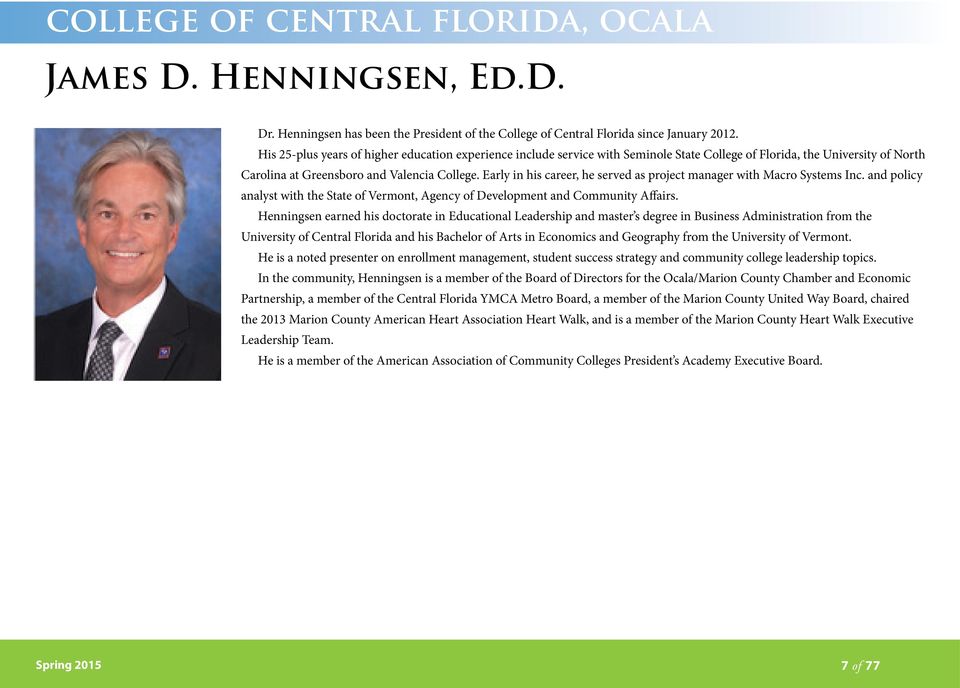
7 college of central florida, ocala James D. Henningsen, Ed.D. Dr. Henningsen has been the President of the College of Central Florida since January His 25-plus years of higher education experience include service with Seminole State College of Florida, the University of North Carolina at Greensboro and Valencia College. Early in his career, he served as project manager with Macro Systems Inc. and policy analyst with the State of Vermont, Agency of Development and Community Affairs. Henningsen earned his doctorate in Educational Leadership and master s degree in Business Administration from the University of Central Florida and his Bachelor of Arts in Economics and Geography from the University of Vermont. He is a noted presenter on enrollment management, student success strategy and community college leadership topics. In the community, Henningsen is a member of the Board of Directors for the Ocala/Marion County Chamber and Economic Partnership, a member of the Central Florida YMCA Metro Board, a member of the Marion County United Way Board, chaired the 2013 Marion County American Heart Association Heart Walk, and is a member of the Marion County Heart Walk Executive Leadership Team. He is a member of the American Association of Community Colleges President s Academy Executive Board. 7 of 77
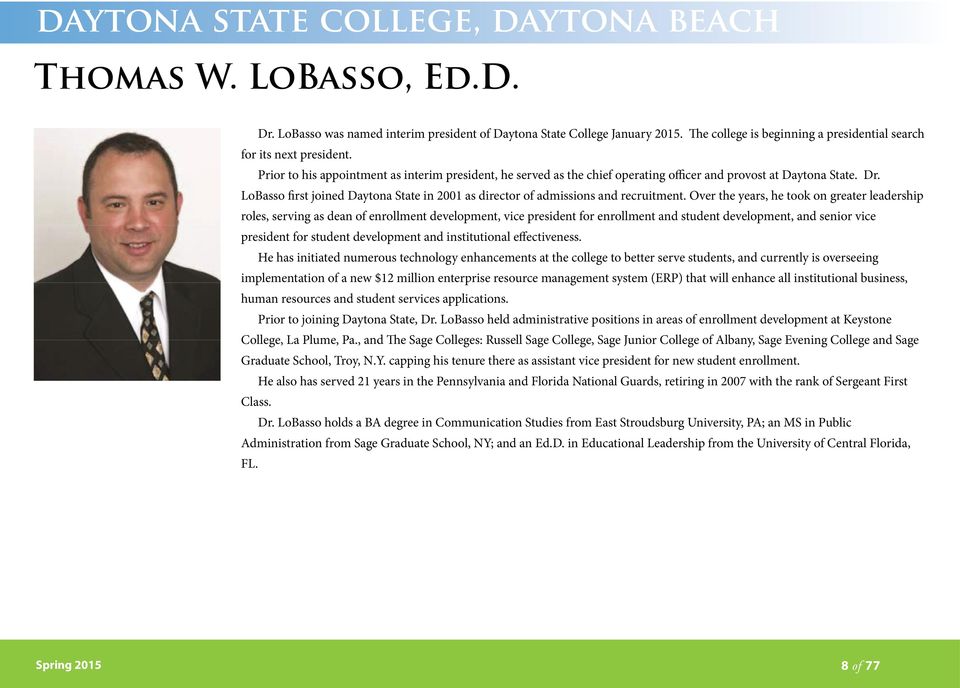
8 daytona state college, daytona beach Thomas W. LoBasso, Ed.D. Dr. LoBasso was named interim president of Daytona State College January The college is beginning a presidential search for its next president. Prior to his appointment as interim president, he served as the chief operating officer and provost at Daytona State. Dr. LoBasso first joined Daytona State in 2001 as director of admissions and recruitment. Over the years, he took on greater leadership roles, serving as dean of enrollment development, vice president for enrollment and student development, and senior vice president for student development and institutional effectiveness. He has initiated numerous technology enhancements at the college to better serve students, and currently is overseeing implementation of a new $12 million enterprise resource management system (ERP) that will enhance all institutional business, human resources and student services applications. Prior to joining Daytona State, Dr. LoBasso held administrative positions in areas of enrollment development at Keystone College, La Plume, Pa., and The Sage Colleges: Russell Sage College, Sage Junior College of Albany, Sage Evening College and Sage Graduate School, Troy, N.Y. capping his tenure there as assistant vice president for new student enrollment. He also has served 21 years in the Pennsylvania and Florida National Guards, retiring in 2007 with the rank of Sergeant First Class. Dr. LoBasso holds a BA degree in Communication Studies from East Stroudsburg University, PA; an MS in Public Administration from Sage Graduate School, NY; and an Ed.D. in Educational Leadership from the University of Central Florida, FL. 8 of 77
9 eastern florida state college, cocoa James H. Richey, J.D. Dr. James H. Richey has been the President of Eastern Florida State College since January He held several key posts at the college before his selection as president, including Interim President, Executive Vice President and General Counsel. Under Richey s leadership, the college has expanded its academic mission to include four-year Bachelor Degrees for the first time in its history with a focus on the fields of Business, Health Care and Computer Technology. The move transformed what had been Brevard Community College into Eastern Florida State College on July 1, In all, 27 new academic programs have been launched since Richey became president, including nine Bachelor Degrees. Another Richey initiative is a 10-year expansion plan for the college s Melbourne campus that would add five new academic buildings and a new student union. The nearly $75 million plan was announced in August 2014 and calls for the construction of a new Public Safety Institute, Health Sciences Institute, Technology Building, Business Building and Hospitality Management Building along with the Student Union. Richey calls the expansion a major investment in the future of our students, our community and our region, and will make it a vital center for higher education and workforce development well into the 21st century. Richey has also started a Career Planning and Development Center with more than 37,000 students taking advantage of its programs through fall A new Veterans Resource Center also works closely with veterans to provide them support in the classroom and their private lives. Richey earned a Bachelor s Degree in accounting from Michigan State University in 1985 and a Juris Doctorate degree from The Ohio State University in He formerly owned his own law practice in Melbourne, Florida, and is a member of the United States Tax Court, Florida Bar Association and Judicial Nominating Commission for the Fifth District Court of Appeal, and former chair of the Grievance Committee of the 18th Circuit Judicial Court. 9 of 77

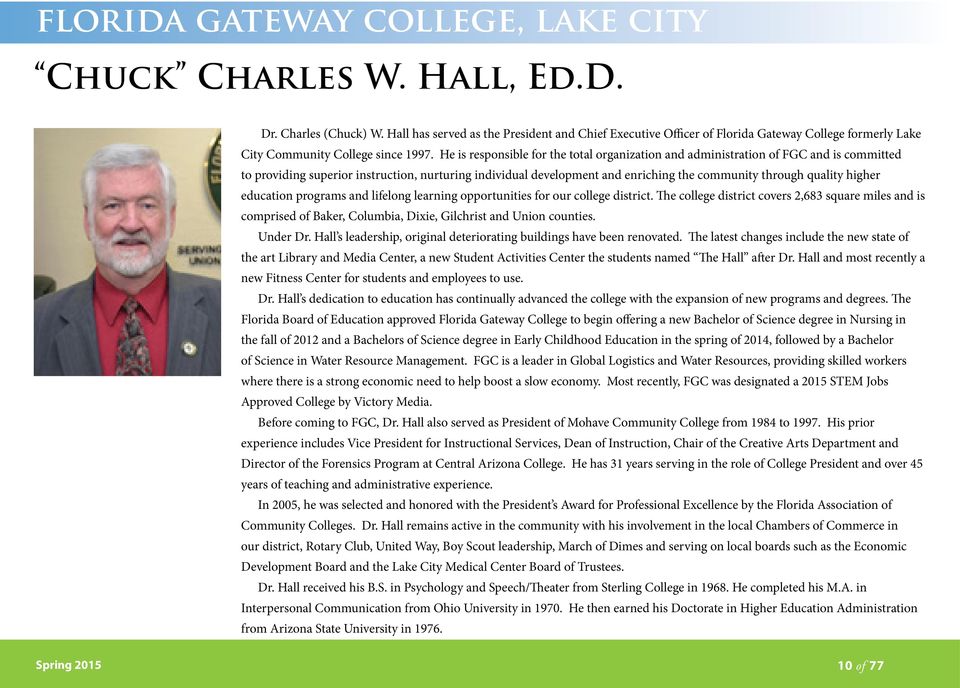
10 florida gateway college, lake city Chuck Charles W. Hall, Ed.D. Dr. Charles (Chuck) W. Hall has served as the President and Chief Executive Officer of Florida Gateway College formerly Lake City Community College since He is responsible for the total organization and administration of FGC and is committed to providing superior instruction, nurturing individual development and enriching the community through quality higher education programs and lifelong learning opportunities for our college district. The college district covers 2,683 square miles and is comprised of Baker, Columbia, Dixie, Gilchrist and Union counties. Under Dr. Hall s leadership, original deteriorating buildings have been renovated. The latest changes include the new state of the art Library and Media Center, a new Student Activities Center the students named The Hall after Dr. Hall and most recently a new Fitness Center for students and employees to use. Dr. Hall s dedication to education has continually advanced the college with the expansion of new programs and degrees. The Florida Board of Education approved Florida Gateway College to begin offering a new Bachelor of Science degree in Nursing in the fall of 2012 and a Bachelors of Science degree in Early Childhood Education in the spring of 2014, followed by a Bachelor of Science in Water Resource Management. FGC is a leader in Global Logistics and Water Resources, providing skilled workers where there is a strong economic need to help boost a slow economy. Most recently, FGC was designated a 2015 STEM Jobs Approved College by Victory Media. Before coming to FGC, Dr. Hall also served as President of Mohave Community College from 1984 to His prior experience includes Vice President for Instructional Services, Dean of Instruction, Chair of the Creative Arts Department and Director of the Forensics Program at Central Arizona College. He has 31 years serving in the role of College President and over 45 years of teaching and administrative experience. In 2005, he was selected and honored with the President s Award for Professional Excellence by the Florida Association of Community Colleges. Dr. Hall remains active in the community with his involvement in the local Chambers of Commerce in our district, Rotary Club, United Way, Boy Scout leadership, March of Dimes and serving on local boards such as the Economic Development Board and the Lake City Medical Center Board of Trustees. Dr. Hall received his B.S. in Psychology and Speech/Theater from Sterling College in He completed his M.A. in Interpersonal Communication from Ohio University in He then earned his Doctorate in Higher Education Administration from Arizona State University in of 77
11 florida keys community college, key west Jonathan Gueverra, Ed.D. Dr. Jonathan Gueverra has been the President of Florida Keys Community College since July Dr. Gueverra is the sixth president and CEO of Florida Keys Community College. Prior to coming to the Keys, Dr. Gueverra served as the founding CEO for the first community college in the nation s capital, the Provost and Campus CEO for the Alexandria Campus of Northern Virginia Community College and before NOVA; he was the Dean for the School of Business and Public Service at SUNY Canton. Dr. Gueverra earned the Associates in Applied Science from Newbury College, a Bachelor of Science from Providence College, and a MBA and Ed.D. from the University of Massachusetts, Boston. Dr. Gueverra s publications on planning, leadership and technology may be found in The Review of Higher Education, The Journal of the Association of Higher Education, Technology Source, and On The Horizon. Gueverra s article entitled Repositioning for a Virtual Culture published in On the Horizon was chosen as a Highly Commended Award Winner at the Literati Network Awards for Excellence Additionally, Gueverra served on numerous boards at local, regional and national levels. He is currently on the board for Strayer University. Dr. Gueverra received an Exemplary Leadership Award from the Chair Academy, an International Organization for Educational Leaders founded by the Maricopa Community Colleges and a Lifetime Service Award from Wentworth Institute of Technology for a commitment to service and to learning. 11 of 77

12 florida southwestern state college, ft. myers Jeff Allbritten, D.A. Dr. Allbritten has been the President of Florida SouthWestern State College (FSW) since July 31, Prior to this appointment, he served as President of Middle Georgia State College (formerly Macon State College) in the University System of Georgia. He also served as the president of FSW s Collier Campus for eight years where he expanded enrollment and course offerings, and led the fundraising and planning efforts for four new buildings. With a career in higher education spanning 26 years, Dr. Allbritten has served in multiple state college and state university systems, including Middle Tennessee State University, Florida State College at Jacksonville, and Broward College in Fort Lauderdale. Dr. Allbritten holds a Doctorate in Chemistry from Middle Tennessee State University, a Master s degree in Mathematics and a Bachelor s degree in Chemistry, both from Murray State University, Tennessee. Dr. Allbritten is very active in the community, serving on a number of boards, including the Board of Directors for the former Economic Development Council of Collier County, the Greater Naples Chamber of Commerce and the German-American Business Chamber of Florida. He was an Advisory Board Member for Eden Florida and the Southwest Florida Holocaust Museum. He formerly served as past-president of the Association of Florida Colleges in 2007, and received the AFC Honorary Life Award in Dr. Allbritten currently serves on the Florida College System Foundation Board of Directors. A self-proclaimed Europhile, Dr. Allbritten has traveled extensively throughout Europe with his wife Liz. 12 of 77

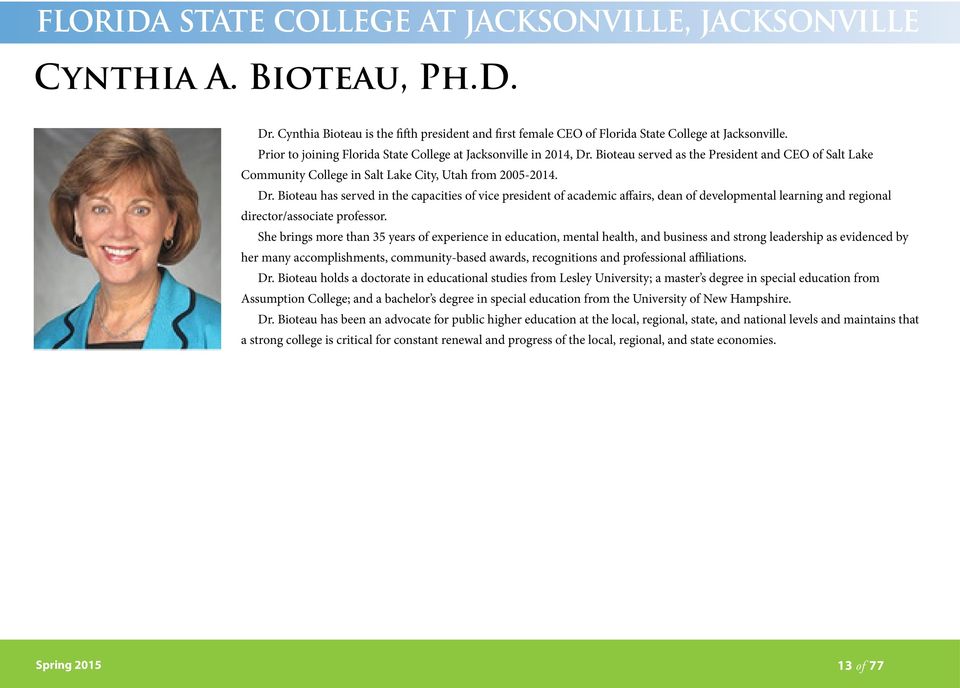
13 florida state college at jacksonville, jacksonville Cynthia A. Bioteau, Ph.D. Dr. Cynthia Bioteau is the fifth president and first female CEO of Florida State College at Jacksonville. Prior to joining Florida State College at Jacksonville in 2014, Dr. Bioteau served as the President and CEO of Salt Lake Community College in Salt Lake City, Utah from Dr. Bioteau has served in the capacities of vice president of academic affairs, dean of developmental learning and regional director/associate professor. She brings more than 35 years of experience in education, mental health, and business and strong leadership as evidenced by her many accomplishments, community-based awards, recognitions and professional affiliations. Dr. Bioteau holds a doctorate in educational studies from Lesley University; a master s degree in special education from Assumption College; and a bachelor s degree in special education from the University of New Hampshire. Dr. Bioteau has been an advocate for public higher education at the local, regional, state, and national levels and maintains that a strong college is critical for constant renewal and progress of the local, regional, and state economies. 13 of 77
14 gulf coast state college, panama city John R. Holdnak, Ed.D. Dr. Holdnak has been the President of Gulf Coast State College since July For the previous six years, Dr. Holdnak served as vice chancellor and executive vice chancellor of the Florida College System, where he primarily focused on legislative and fiscal policy issues. Prior to that, he served 26 years at Gulf Coast State College in a series of progressively more responsible positions in all three of the major components of a college s programming: direct instruction, student development, and administrative support. Dr. Holdnak holds Bachelor s and Master s degrees from Florida State University, as well as an Ed. D. in Curriculum and Instruction from the University of West Florida. Active in the community, Dr. Holdnak is a member of the Board of Directors of the Bay County Chamber, Panama City Beach Chamber, and Florida s Great Northwest. He is a member of the Bay Defense Alliance, Bay Economic Development Alliance, the Northwest Florida Manufacturers Council, and the Panama City Rotary Club. His past involvement includes serving as chair, vice chair, and member of the Board of Directors of the Panhandle Educators Federal Credit Union; member of the Bay County Chamber Foundation Board of Directors and Military Affairs Committee; member of the United Way CEO Selection Committee, Regional Board of Directors, Pacesetter Organization Coordinator, and Red Feather Fellow; and chair of the District Advisory Council of the Boy Scouts of America, Gulf Coast Council, Lake Sands District. Dr. Holdnak was named a Paul Harris Fellow with Rotary International and received the Ken Jarrett Exemplary Service Award from the Florida College System Council of Business Affairs. 14 of 77

15 hillsborough community college, tampa Ken Atwater, Ph.D. Dr. Ken Atwater serves as president of Hillsborough Community College. Founded in 1968, Hillsborough Community College (HCC) is currently the fifth largest community college in Florida, serving more than 48,000 students annually at its five campuses and three centers. HCC offers more than 150 academic programs, including 18 associate in arts tracks and 140 workforce programs. HCC has a total annual budget of over $215 million, employs more than 2,600, and has an annual economic impact of over $850 million. Dr. Atwater earned his Ph.D. in Higher Education (with a focus on community colleges) from Southern Illinois University in Carbondale, Illinois, in He earned a Master of Science degree in Guidance and Counseling in 1978 and a Bachelor of Science degree in Speech and Theater, and also Sociology, in 1977, all from Murray State University in Murray, Kentucky. The President is a graduate of the prestigious Executive Leadership Institute of the League for Innovation in the Community College; and also is a graduate of the Institute for Leadership Effectiveness, University of Tennessee Knoxville. Dr. Atwater currently serves on the board of directors of the following: Tampa-Hillsborough Economic Development Corporation Executive Committee, the Museum of Science & Industry s National Board. Dr. Atwater is also currently serving as Chairman on the Board of Directors of the American Association of Community Colleges, AACC s Commission on Diversity, Inclusion, and Equity, and on the board of the Presidents Round Table of African American CEOs. He has served on the Greater Phoenix Black Chamber of Commerce Board of Directors since August 2001, the Valley of the Sun YMCA Board of Directors since July 2002, the Institute for Community College Development (Cornell University) Board of Directors since August 2006, the College Board s Community College Advisory Panel since October 2007, and the Council of North Central Two-Year Colleges Executive Board since Fall of 77

16 indian river state college, ft. pierce Edwin M. Massey Ph.D. Dr. Edwin R. Massey was appointed Indian River State College s 3rd president in He came to the college in 1973 as a biology professor and worked his way up through several administration posts before becoming President. He earned his Ph.D. in Zoology, with an emphasis in Marine Biochemistry from the University of Southern Mississippi and completed post-graduate studies in Evolutionary Biochemistry at Duke University. Dr. Massey is a fixture of leadership on the local, state, and national level. He currently serves as the Chairman of both the Florida Articulation Coordinating Council and the National Association for Community College Entrepreneurship, in addition to being part of numerous boards and educational endeavors. He is also the Lead Primary Investigator for the Center for Ocean Sciences Education Excellence (COSEE) Florida. Last year, in 2013, for his outstanding accomplishments and leadership as the President of Indian River State College, Dr. Massey was recognized by the Association of Community College Trustees with the Marie Y. Martin Chief Executive of the Year award. In addition to helming IRSC, Dr. Massey is a devoted family man to his wife, Jo, 3 children and 6 grandchildren. 16 of 77
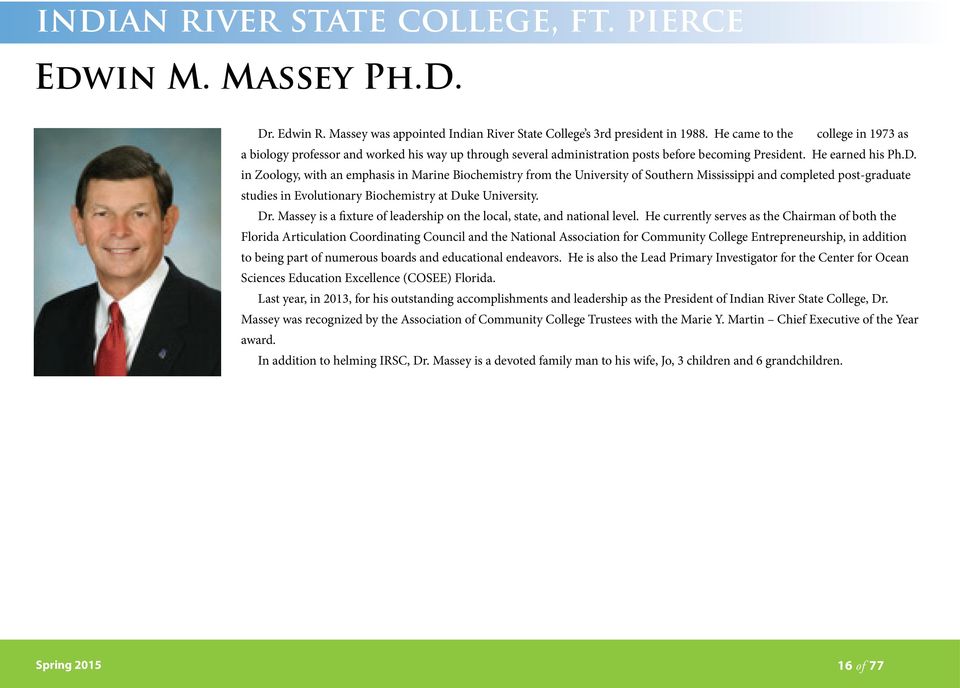
17 lake-sumter state college, Leesburg Charles R. Mojock, Ed.D. Dr. Charles R. (Chuck) Mojock, fifth President of Lake-Sumter State College, has served in the position since July 1, He came to LSSC from Daytona Beach Community College where he was employed for 23 years, starting on the faculty and advancing to Senior Vice President for Planning and Institutional Advancement. He holds a Bachelor of Arts degree from St. Mary s Seminary and University (Baltimore, Maryland), a Master of Arts degree from Stetson University (Deland, FL) and a Doctor of Education degree from the University of Central Florida (Orlando, FL). Dr. Mojock is heavily involved in the community He has served on the Board of organizations such as the Metro Orlando Economic Development Council, Florida High Tech Corridor Council, United Way of Lake & Sumter Counties, LifeStream Behavioral Center, March of Dimes, Leadership Lake, Workforce Central Florida, Lake County Shared Services Network, Kids Central, South Lake Chamber, and Lake County Chamber Alliance Economic Advisory Committee. He received the Lake County Community Service Award and Boy Scouts Golden Eagle Award. Dr. Mojock serves on the AFC (Association of Florida Colleges) Foundation Board of Directors. He also serves as a member of the Board of Trustees of SACS Commission on Colleges. He is Past President of the Southern Association of Junior, Technical and Community Colleges (SAJTC) and he has served the Florida College Council of Presidents as Chair for , Steering Committee member, and currently as Chair of the Risk Management Consortium. He enjoys sports, reading, and family activities. Dr. Mojock and his wife, Cathy, reside in Mount Dora. They have three sons; Christopher, and his wife, Suzi, and three granddaughters who reside in Georgia, where Chris is a professor at Georgia Regents University. Matthew, who works and attends Florida State University part-time, and Jon, and his wife Theresa, and their son and daughter, who work in Health/Fitness and live in Colorado. 17 of 77
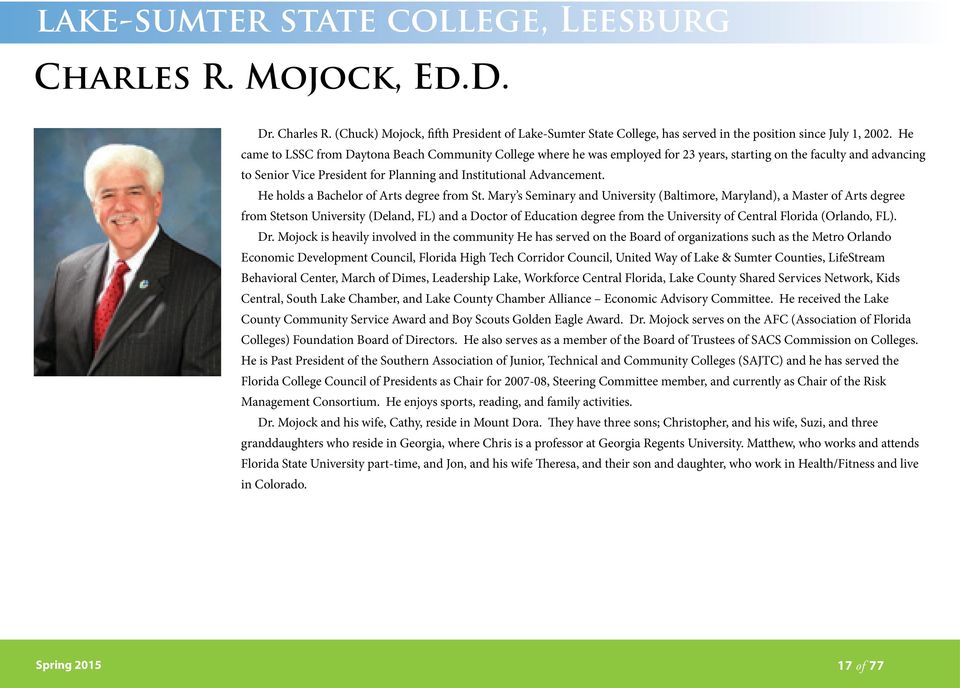
18 miami dade college, miami Eduardo J. Padrón, Ph.D. An American by choice, Eduardo Padrón arrived in the United States as a refugee at age 15. Since 1995, he has served as President of Miami Dade College, a national model of student achievement and the largest institution of higher education in America, with more than 165,000 students. An economist by training, Dr. Padrón earned his Ph.D. from the University of Florida. In 2009, Time magazine included him among the 10 Best College Presidents in the United States; in 2010, Florida Trend magazine named him Floridian of the Year ; and in 2011, The Washington Post recognized him as one of the eight most influential college presidents in the country. In addition, the Carnegie Corporation of New York granted him its prestigious Centennial Academic Leadership Award; he is the first college president to receive the National Citizen Service Award from Voices for National Service; he has been named an Ascend Fellow by the Aspen Institute; and he is the recipient of the Hesburgh Award, the highest honor in U.S. higher education. During his career, Dr. Padrón has been selected to serve on posts of national prominence by six American Presidents. His energetic leadership extends to many of the nation s leading organizations. He is former chair of the Board of Directors of the American Council on Education and the Association of American Colleges and Universities. Dr. Padrón is widely recognized as one of the top educational leaders in the world. He serves on the boards of the Council on Foreign Relations, the Business/Higher Education Forum, RC-2020, the College Board Advocacy and Policy Center, the White House Fellows Selection Panel (chair), and the International Association of University Presidents. He has held leadership positions on the American Academy of Arts & Sciences/Humanities Commission and on the boards of the Carnegie Foundation for the Advancement of Teaching, the Hispanic Association of Colleges & Universities (chair), the Kennedy Center for the Performing Arts, Campus Compact, and the Congressional Hispanic Caucus Institute. He is also a past Board Chair of the Federal Reserve Bank of Atlanta, Miami Branch. President Padrón s transformational accomplishments at Miami Dade College have been acknowledged by the national media, including The New York Times, NBC Nightly News, Time magazine, The Wall Street Journal, CNN and The Chronicle of Higher Education. He has received some of the most prestigious awards in and out of academia and more than 15 honorary doctorates from leading universities such as Rollins, Princeton and Brown. He is also the recipient of highest honors by the governments of foreign nations, including France, which named him Commandeur in the Ordre des Palms Académiques; Argentina, which awarded him the Order of San Martin; and Spain, whose King Juan Carlos II bestowed upon him the Order of Queen Isabella. 18 of 77

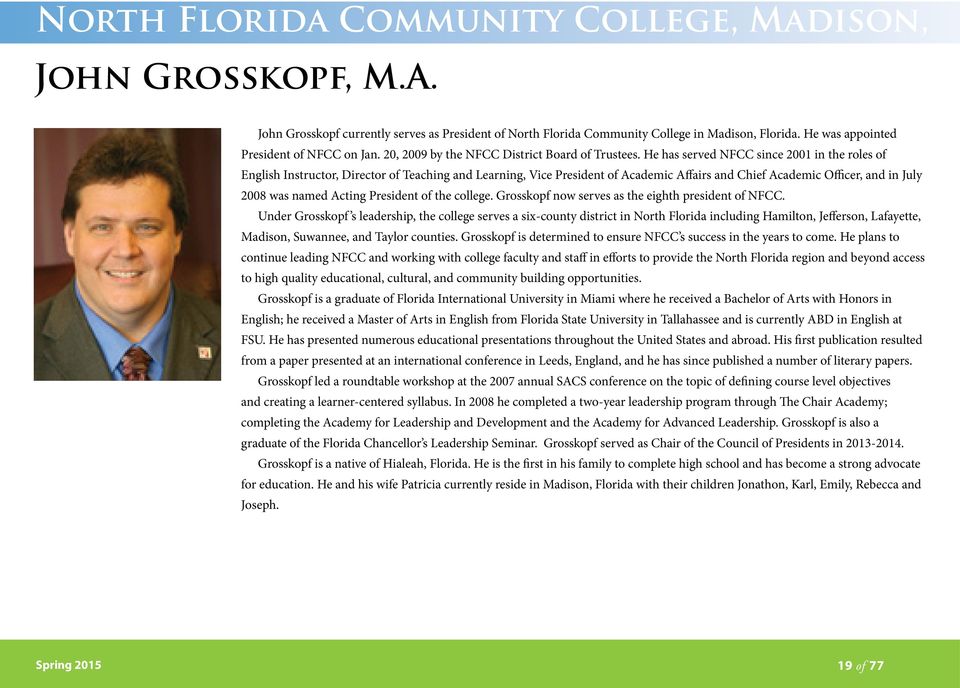
19 North Florida Community College, Madison, John Grosskopf, M.A. John Grosskopf currently serves as President of North Florida Community College in Madison, Florida. He was appointed President of NFCC on Jan. 20, 2009 by the NFCC District Board of Trustees. He has served NFCC since 2001 in the roles of English Instructor, Director of Teaching and Learning, Vice President of Academic Affairs and Chief Academic Officer, and in July 2008 was named Acting President of the college. Grosskopf now serves as the eighth president of NFCC. Under Grosskopf s leadership, the college serves a six-county district in North Florida including Hamilton, Jefferson, Lafayette, Madison, Suwannee, and Taylor counties. Grosskopf is determined to ensure NFCC s success in the years to come. He plans to continue leading NFCC and working with college faculty and staff in efforts to provide the North Florida region and beyond access to high quality educational, cultural, and community building opportunities. Grosskopf is a graduate of Florida International University in Miami where he received a Bachelor of Arts with Honors in English; he received a Master of Arts in English from Florida State University in Tallahassee and is currently ABD in English at FSU. He has presented numerous educational presentations throughout the United States and abroad. His first publication resulted from a paper presented at an international conference in Leeds, England, and he has since published a number of literary papers. Grosskopf led a roundtable workshop at the 2007 annual SACS conference on the topic of defining course level objectives and creating a learner-centered syllabus. In 2008 he completed a two-year leadership program through The Chair Academy; completing the Academy for Leadership and Development and the Academy for Advanced Leadership. Grosskopf is also a graduate of the Florida Chancellor s Leadership Seminar. Grosskopf served as Chair of the Council of Presidents in Grosskopf is a native of Hialeah, Florida. He is the first in his family to complete high school and has become a strong advocate for education. He and his wife Patricia currently reside in Madison, Florida with their children Jonathon, Karl, Emily, Rebecca and Joseph. 19 of 77
20 northwest florida state college, Niceville Ty Handy, Ed.D. Dr. Ty Handy began his presidency of Northwest Florida State College in June He is a Florida native and most recently served as the President of Vermont Technical College, a public associate and baccalaureate institution. Dr. Handy previously served as Chancellor of Ivy Tech Community College in Southern Indiana, a comprehensive two-year community and technical college in the Ivy Tech Community College System. Dr. Handy earned his doctorate (Ed.D.) degree from the University of Memphis in Higher Education Administration, an MBA in Accounting and Finance from Drexel University and a Baccalaureate degree in Finance from Western Kentucky University. Other academic positions Dr. Handy has held include Vice Chancellor for Academic Affairs at the University of Arkansas Community College Batesville; Dean of Academic Affairs at Elizabethtown Community College in Kentucky, and Dean of Business Technologies/Social Sciences at Jefferson Community College, Ohio. Dr. Handy and his wife, Kim, are the proud parents of two sons, Jon, a graduate student at the University of Alabama and Beau, a Financial Advisor in Louisville, KY. In his spare time, Ty enjoys woodworking, reading, hiking and weightlifting. 20 of 77

21 palm beach state college, Lake Worth Dennis P. Gallon, Ph.D. Dennis P. Gallon, Ph.D., became the fifth President of Palm Beach State College in 1997 (then Palm Beach Community College). Prior to becoming President of PBCC, he served as President of the Kent Campus at Florida Community College at Jacksonville. Gallon brought to this position a long and successful career at the secondary and postsecondary levels of education. After serving as a tenured faculty member at FCCJ, his administrative career there included Campus Business Manager, Campus Dean of Occupational, Adult and Continuing Education, Campus Dean of Instructions, and College-wide Associate Vice President of Academic Programs. He also served as an Adjunct Professor in the Doctoral Program in Higher Education Administration at the University of Florida. Gallon completed the requirements for the Ph.D. in Higher Education at UF. He received his Master of Science degree in Business from Indiana University (Bloomington) and his Bachelor of Science degree in Business from Edward Waters College in Jacksonville. Gallon s professional involvement includes serving on the American Association of Community Colleges (AACC) President s Roundtable, Southern Association of Colleges and Schools Commission on Colleges (SACSCOC), Board Member and Past President of Florida Association of Colleges and Universities (FACU), Leadership Florida, University of Florida Alumni Board, and he has served as a Fulbright Scholar in Israel through the Fulbright Senior Specialist Program, among many other state and local organizations. 21 of 77
22 Pasco-Hernando State College, New Port Richey Katherine M. Johnson, Ed.D. Dr. Katherine M. Johnson was selected by the District Board of Trustees to serve as the third President of Pasco-Hernando State College (PHSC), effective January 18, She previously served as the President of Nash Community College (NCC) in Rocky Mount, North Carolina for five years. Dr. Johnson brings a wealth of experience to this position. Prior to her two presidencies, she was a 16-year employee at Indian River State College (IRSC) in Ft. Pierce, FL. While at IRSC, she served as Vice President, Provost, Associate Dean of Development and Alumni Relations, Executive Director of the Foundation, and Director of Guidance. Earlier in her educational career, she served as Director of Admissions at the Jensen Beach Campus of Florida Institute of Technology (FIT), a history teacher at Martin County High School in Stuart, Florida and a social studies teacher at Phyllis Wheatley Middle School in Childersburg, Alabama. She is a graduate of Florida Atlantic University (FAU) in Boca Raton with a doctoral degree in education. She holds a master s degree in education from the University of Montevallo (UM) in Alabama, a bachelor s degree from the University of West Florida (UWF) in Pensacola, and an Associate in Arts Degree from Florida Junior College (FJC) which is now Florida State College at Jacksonville (FSCJ). Her professional involvement nationally includes serving on the board of the Southern Association of Colleges and Schools Commission on Colleges (SACS/COC); former member of the American Association of Community Colleges (AACC) board and former Chair of the Executive Committee of the President s Academy of AACC, plus memberships in the American Association of University Women and the American Association of Women in Community Colleges. In Florida, she is the former President of the Florida Association of Colleges and Universities (FACU), former chair of the Florida College System Council of Presidents (COP) and former policy and advocacy chair for the COP, appointed member of the Florida College System Task Force, and is a graduate of Leadership Florida, Class of She is also a graduate of Leadership Pasco, Class of She has been recognized as one of Tampa Bay leaders in the Who s Who in Tampa Bay Business by the Tampa Bay Business Journal. While Dr. Johnson was born in North Carolina, she was raised in Jacksonville, Florida. She has been married for 31 years to retired PGA golf professional Chuck Johnson, Jr. who has three grown sons, two daughters-in-law and three grandsons. She and her husband currently reside in the Trinity community in West Pasco County with their 11 year old sibling dachshunds, Maggie and Copper. 22 of 77
23 pensacola state college, pensacola Edward Meadows, Ed.D. Dr. Meadows became Pensacola State College s president on June 1, He served seventeen years in the Alabama Community College System, twelve of those years as a president. He also worked ten years in the Mississippi Community College System. Dr. Meadows earned a Master of Arts and doctorate from Ball State University, Muncie, IN; Master of Science in Science Education from the University of Tennessee, Knoxville, TN; and Bachelor of Science in Biology from Delta State University, Cleveland, MS. Dr. Meadows serves on the Executive Council of the Board of Trustees for the Southern Association of Colleges and Schools Commission on Colleges; the Florida SkillsUSA Board of Directors; the American Association of Community College s Commission on Research, Technology, and Emerging Trends; Florida s Great Northwest Board of Directors, and President of the Southern Association of Colleges with Associate Degrees. He is a member of the Florida College System Council of Presidents, the Florida Association of Colleges and Universities (FACU), the Association of Florida Colleges (AFC), The American Association of Community Colleges (AACC), and Northwest Florida Presidents Coalition. Locally, Dr. Meadows serves as an ex-officio member on the Board of Directors of the Greater Pensacola Chamber of Commerce. He also serves on the Center for Innovation and Entrepreneurship (CIE) Policy Board and serves on the Board of Directors for Pensacola s Junior Achievement. He is an advisor to the J. Hugh & Earle W. Fellows Foundation for medicine, health sciences, and theology education. He is a member of the Pensacola Downtown Rotary. Awards Florida SkillsUSA Honorary Life Membership Award 2012 Pensacola s Top 10 Power List, Independent News, , 2013, 2014 Pensacola s Top 20 Power List, Independent News 2009, 2010, 2011 Phi Theta Kappa International Shirley B. Gordon Award of Distinction Excellence in Educational Leadership Award, University Council for Educational Administration Administrator of the Year Leadership Award, College of Education, University of Alabama National Institute for Staff and Organizational Development (NISOD) Award for Excellence, University of Texas at Austin N Kermit Mathison Outstanding Community College Administrator Award, University of Montevallo, Alabama Creating Partnerships Award, PACE Center for Girls, Northwest Florida 23 of 77
24 Polk State College, Winter Haven Eileen Holden, Ph.D. Eileen Holden became President of Polk State College in February 2006 and brought to Polk State College and Polk County 23 years of community college experience as an instructor and administrator. From 2001 to 2006, Dr. Holden served as Vice President for Academic Affairs and Technical Education at Broward Community College in Fort Lauderdale, Florida. From 1987 to 2001, she worked at Palm Beach Community College, first as Program Manager ( ), later Division Chair ( ) and finally Dean for Academic Affairs ( ). Dr. Holden also served as a faculty member at Lummi Community College in Washington and Houston Community College in Texas. In December 2005, following an extensive national search, Polk State s District Board of Trustees selected Dr. Holden to be president. She received her bachelor s degree (in 1977) in Secondary Education Teaching from Utica College of Syracuse University, a master s degree (in 1983) in Education from the University of Houston and a doctorate (Ed.D. in 1997) in Higher Education Administration from Nova Southeastern University. Dr. Holden currently serves on the Board of Directors for Winter Haven Hospital, Lake Wales Medical Center, Winter Haven Economic Development Council, the Central Florida Development Council, CareerSource Polk, WEDU and Polk Vision. She also serves on the Polk County Arts Alliance s Art Resource Council the Advisory Board for Volunteers in Service to the Elderly (VISTE) and is a member of the Lakeland Area Chamber of Commerce, Lakeland Economic Development Council, Winter Haven Chamber of Commerce and the Winter Haven Rotary Club. She lives in Winter Haven with her husband, Al. 24 of 77
25 St. Johns River State College, Palatka Joe H. Pickens, J.D. Joe H. Pickens, J.D., received his Bachelor of Arts degree from Wofford College. He went on to the University of Florida and earned his Juris Doctorate degree. He served the College as Special Counsel to the President from In September, 2008, after a three-month presidential search conducted by the College Board of Trustees, Mr. Joe Pickens was selected as College President. He accepted the position and began work on November 1, During the six years that he has served as President, Mr. Pickens has spearheaded many initiatives including the College s transition from a community to a state college, the College s first Bachelor degrees, the creation of an honors program, and the expansion of the College s mission to provide nontraditional community educational opportunities throughout the service district. Prior to becoming College President, Mr. Pickens spent eight years in the Florida House of Representatives where he was the Sponsor of Senate Bill 1908, legislation which significantly impacted K20 education in Florida. Mr. Pickens Career Achievements include: President of SJR State since 2008 District 21 Florida House of Representatives Chairman of the House Education Appropriations Committee Chairman of the House Schools and Learning Council General Counsel for the North East Florida Educational Consortium Attorney for the Putnam County School Board His Recent Achievements and Community Involvement include: Governing Board State Representative for the Advisory Committee on College Readiness Past Chairman of the Florida Council of Presidents Board Member for the Southern Regional Education Board Palatka and Keystone Rotary Club, Paul Harris Fellow Florida Association of District School Superintendents, Legislator of the Year, Florida Chamber of Commerce, A Honor Roll, 2003, 2004, 2005, 2006 Florida School Boards Association, Legislator of the Year, 2001, 2002, 2004, 2005, 2006, 2007 Florida School Boards Association Lifetime Achievement Award (1 of 4 recipients) YMCAs of Florida, Outstanding Leadership Award, 2006 Associated Industries of Florida, Champion for Business Award, 2005 Independent Colleges and Universities of Florida, Liberty Bell Award, 2005 Mr. Pickens has two daughters, Bailey and Ellis, and one son, Hill. 25 of 77
26 st. petersburg college, st. petersburg William D. Law, Jr., Ph.D. Dr. William D. Law, Jr. became the sixth president of St. Petersburg College in June, At the time of his appointment, Dr. Law was serving as the president of Tallahassee Community College (TCC) since May He arrived at TCC from Houston, Texas where he was the Founding President of Montgomery College, a taxpayer-funded, state-of-the-art community college, which is part of the North Harris Montgomery Community College District. The college opened in August His duties at Montgomery College included planning, managing and implementing a $50 million construction budget and directing a national recruitment effort for 200 faculty and staff members. He also created the organizational structure and led the development of the new college s first academic programs. From 1988 to 1992, he was President of Lincoln Land Community College in Springfield, Illinois, and from 1981 to 1988 he served as Vice President for Instructional and Program Planning at St. Petersburg Jr. College in Florida. Earlier in his career, Dr. Law served as Assistant to the Vice Chancellor of the Florida Board of Regents, and later he became the Staff Director for the Florida House of Representative s Committee on Higher Education. Dr. Law received a Bachelor of Arts degree from LeMoyne College in Syracuse, New York and a master s degree in Higher Education Administration and a Ph.D. in Design and Management of Postsecondary Education from Florida State University. Dr. Law is married, has two sons, and one grandson. 26 of 77
27 santa fe college, gainesville Jackson N. Sasser, Ph.D. Dr. Jackson N. Sasser is president of Santa Fe College, recently named one of the nation s top ten colleges by the Aspen Institute for the second consecutive time. His accomplishments are many. He is one of the first in the United States to define community colleges as essential to national economic security because they educate knowledge workers necessary for American business and industry to succeed globally. He led Santa Fe to high levels of student completion. He installed bachelor s degree programs to fulfill unmet needs locally and statewide. Shortly after arriving at Santa Fe in 2002 he launched the East Gainesville Initiative and continues to improve outreach education and support the disadvantaged. Another one of his first efforts was his International Initiative, which weaves internationalism into all academic and support programs at the college. He is a leader in Innovation Gainesville, with Santa Fe quickly educating the skilled workers for new and growing companies to succeed. Dr. Sasser s commitment to the arts led to the development of Santa Fe s Fine Arts Hall and the naming of the college as an All-Steinway School. Dr. Sasser is a member of the boards of American Association of Community Colleges, the University of Florida Performing Arts, Santa Fe Health Care, Gainesville Rotary and Alliance for Economic Development, and member and past Chair of the Board of Directors of the League for Innovation in the Community College. He has chaired the 2004 United Way of North Central Florida campaign, served as board chair of the American Heart Association of Gainesville s 2005 Heart Walk and was an honorary chair of the 2007 March of Dimes Gainesville WalkAmerica. He is a past member of the board of the Institute for Community College Development at Cornell University and participated in a University of Oxford Round Table on higher education. Before arriving at Santa Fe, Dr. Sasser was president of Lee College in Baytown, Texas. 27 of 77
28 seminole state college, sanford E. Ann McGee, Ph.D. Dr. E. Ann McGee has served as the president of Seminole State College since only the second president in the College s 50-year history. Ann is a community college graduate who began her lifelong career in higher education as an English and Speech teacher at Florida Keys Community College in Key West. She then moved into the administrative ranks as their Dean of Students. After 11 years in Key West, she accepted a position as a campus CEO at Broward College before becoming Broward s Vice President for Development and Executive Director of the Broward College Foundation. Seeing students succeed, since she was one of those students, is her passion. During her 14 years at Broward College, she helped to raise over $21 million primarily for student scholarships. Ann came to then Seminole Community College in February of 1996 when the College was a single-campus institution enrolling 20,000 students. Today, Seminole State is located on four campuses, serves 32,000 students annually, and is the thirdlargest employer in Seminole County. During 2015, Seminole State will celebrate 50 years of service to the community having educated over one million students. The College is now the 8th largest among the 28 institutions in the Florida College System. A strong partnership with the University of Central Florida, through Direct Connect, has enabled Seminole State to increase their graduation rate and they now rank 15th in the nation of the 1300 community colleges for AA graduates with 92% of their transfer students attending UCF. Additionally, Seminole State is one of only three colleges in the nation who have achieved the distinction of having a Jack Kent Cooke Scholar for eight of the nine years of the program. Ann attributes that distinction to the determination of Seminole State s students and the dedication of the faculty and staff. Ann is active on many local and national boards including: the American Association of Community Colleges (AACC); AACC s President s Academy Executive Committee -- past chair; the Phi Theta Kappa Foundation; Chair for the Heart of Florida United Way; Executive Committee member on the Metro-Orlando Economic Development Commission; Chair for the Foundation for the Florida College System; and Board Member of the United Arts of Central Florida. She s been honored by the EDC with the James B. Greene Award; by her alma mater, St. Petersburg College, as Outstanding Alumnus; and by the Association of Community College Trustees with the Marie Y. Martin Award as the #1 community college CEO in the nation. 28 of 77
29 state college of florida, Manatee-Sarasota, Bradenton Carol F. Probstfeld, Ed.D. Dr. Carol F. Probstfeld is the sixth president of State College of Florida, Manatee-Sarasota. Established in 1957, SCF is the area s oldest and largest public college with more than 40,000 graduates. With campuses in Bradenton, Venice and Lakewood Ranch and an online presence, SCF serves 27,000 credit students annually and another 14,000 noncredit participants. Dr. Probstfeld was named SCF president in January 2013 by the College s Board of Trustees and served as interim president in late Dr. Probstfeld came to SCF in 2003 as vice president of business and administrative services where she oversaw the budgets and administrative operations for SCF, a $100 million enterprise and major economic driver in the region; and she led an expansion of online learning opportunities and the development and implementation of the College s strategic plan. As SCF president, Dr. Probstfeld is committed to building and nurturing relationships and focusing on enhancing the student experience. Her 16 years of higher education experience -- as a student, as an adjunct faculty member and as an administrator -- at small private institutions and large public colleges includes a track record of fostering collaboration and partnerships. Before coming to SCF, Probstfeld served as vice president for finance and administration, chief financial officer and treasurer for Notre Dame de Namur University in Belmont, Calif., and Notre Dame College of Ohio in South Euclid, Ohio. Dr. Probstfeld is a member of the Council of Presidents of the Florida College System, and is active in several local organizations, including the Manatee and Sarasota chambers of commerce. Dr. Probstfeld enjoys attending student plays, concerts, ballgames and club events and speaking with community groups. When her busy schedule as SCF president allows, she hones underwater photography skills while diving. Dr. Probstfeld is from Whittier, Calif. She received her doctorate in Organizational Leadership from Argosy University, an MBA from John Carroll University, and a bachelor s degree in Accounting and Marketing from California State Polytechnic University. She lives with her husband, Bill Murphy, and their fur kids Harpo and Kelly, both smooth-coated red Brussels Griffons, and Nixie, a Portuguese waterdog. 29 of 77
30 south florida state college, avon park Thomas C. Leitzel Ph.D. Dr. Leitzel became the fourth president of South Florida State College in July of Prior to that, he was President of the Technical College of the Lowcountry, in Beaufort, South Carolina, where he served for five years. Tom has over 35 years of experience in higher education at six institutions in five states. He grew up in Pennsylvania where he attended public schools. He began his higher education career at the Pennsylvania College of Technology in Williamsport where he began as a faculty member and later as an administrator. He held administrative positions at Chesapeake College in Maryland, Central Piedmont Community College and Pfeiffer University, both located in Charlotte, North Carolina. Tom holds an undergraduate degree from Lycoming College, a master s degree from Temple University, and a doctorate in higher education administration from Virginia Tech. He completed additional graduate studies at the Pennsylvania State University and at the University of Maryland, College Park. Tom is involved in many community organizations in the Tri-County District (DeSoto, Hardee, and Highlands) served by South Florida State College. He counts it a privilege to work in the Florida College System, a system that is the envy of the world for its superior service to students and its emphasis on quality learning initiatives. 30 of 77
31 tallahassee community college, tallahassee Jim Murdaugh, Ph.D. Dr. Jim Murdaugh was named the sixth president of Tallahassee Community College on October 18, His personal vision is to make Tallahassee Community College the college of choice for students who come here, the employer of choice for faculty and staff, and the partner of choice in the community. He is quite active in the community, serving on a number of boards as an executive committee and board member on the Greater Tallahassee/Leon County Chamber of Commerce, executive committee and board member on the Leon County Economic Development Council, Governor on the board of the Leon County Research and Development Authority, board member on the United Way of the Big Bend, board member on the region s Workforce Plus! board, and board member on Florida s Great Northwest. At the state level, Jim was elected to the board of the Florida Association of Colleges and Universities (FACU) and asked to chair the FACU Legislative Agenda Committee for He is a member of the Economic Club of Florida and serves as a board member of the Florida Chamber Foundation. In 2012, Florida Trend listed Jim among Florida s Newsmakers of the Year. He has been recognized for his leadership by a number of organizations, being selected in 2005 by the North Florida Chapter of the American Society of Public Administration for its distinguished leadership award, 2012 Leader of the Year by Leadership Tallahassee, and having been inducted into the Florida State University College of Criminology and Criminal Justice Hall of Fame in Jim Murdaugh holds bachelors and masters degrees in criminology and a doctorate in public administration from Florida State University. He is also a graduate of Leadership Florida Executive Class VII and the prestigious Senior Executives in State and Local Government program at Harvard University s John F. Kennedy School of Government. 31 of 77
32 valencia college, orlando Sanford Shugart, Ph.D. Dr. Sanford Sandy Shugart has served since 2000 as the fourth president of Valencia College in greater Orlando, Florida. As winner of the first Aspen Prize for Excellence, Valencia is one of the most celebrated community colleges in America. Serving some 70,000 students per year, Valencia is known for high rates of graduation, transfer, and job placement and has become something of a national laboratory for best practices in learning-centered education. Prior to Valencia, Sandy served as president of North Harris College and as Vice President and Chief Academic Officer of the North Carolina Community College System. He earned his Ph.D. in Teaching and Learning from the University of North Carolina at Chapel Hill. In addition to his career in education, Dr. Shugart is a published poet and songwriter and author of Leadership in the Crucible of Work: Discovering the Interior Life of an Authentic Leader. 32 of 77
33 florida college system presidents contact information BROWARD COLLEGE Mr. J. David Armstrong, Jr. Fax: (954) Las Olas Blvd Senior Executive Assistant to President: Avis McCoy Ft. Lauderdale, FL Website: Phone: (954) Board Chair: John Benz (5) CHIPOLA COLLEGE Dr. Jason Hurst Fax: (850) Indian Circle Secretary: Alice Pendergrass Marianna, FL Website: Phone: (850) Board Chair: Danny Ryals (9) COLLEGE OF CENTRAL FLORIDA Dr. James D. Henningsen Fax: (352) SW College Rd. Executive Assistant: Cherie Ross Ocala, FL Website: Phone: (352) Board Chair: Don Taylor (7) DAYTONA STATE COLLEGE Dr. Tom LoBasso (Interim) Fax: (386) PO Box 2811 Executive Secretary: Lynn Mercer Daytona Beach, FL Website: Phone: (386) Board Chair: Lloyd J. Freckleton (9) 33 of 77
34 florida college system presidents contact information EASTERN FLORIDA STATE COLLEGE Dr. James Richey Fax: (321) Clearlake Road Executive Assistant to President: Gina Cline Cocoa, FL Website: Phone: (321) Board Chair: Stephen G. Charpentier (5) FLORIDA GATEWAY COLLEGE Dr. Charles W. Hall Fax: (386) SE College Place Executive Assistant: Karyn Congressi Lake City, FL Website: Phone: (386) Board Chair: Dr. Athena Randolph (9) FLORIDA SOUTHWESTERN STATE COLLEGE Dr. Jeffrey Allbritten Fax: (239) College Parkway Project Coordinator: Danessa Stevens Ft. Myers, FL Website: Phone: (239) Board Chair: Sankey Eddie Webb (8) FLORIDA STATE COLLEGE AT JACKSONVILLE Dr. Cynthia Bioteau Fax: (904) W State Street Executive Secretary: Lisa Parker Jacksonville, FL [email protected] [email protected] Website: Phone: (904) Board Chair: Thomas J. Majdanics (9) 34 of 77
35 florida college system presidents contact information FLORIDA KEYS COMMUNITY COLLEGE Dr. Jonathan Gueverra Fax: (305) College Road Secretary: Debbie Leonard Key West, FL Website: Phone: (305) Board Chair: Robert Stoky (8) GULF COAST STATE COLLEGE Dr. John Holdnak Fax: (850) W Highway 98 Secretary: Eileen Wilkes Panama City, FL [email protected] [email protected] Website: Phone: (850) Board Chair: Ralph Roberson (9) HILLSBOROUGH COMMUNITY COLLEGE Dr. Ken Atwater Fax: (813) PO Box Executive Assistant: Christina Heskett Tampa, FL [email protected] [email protected] Website: INDIAN RIVER STATE COLLEGE Dr. Edwin Massey Administrative Assistant: Suzanne Parsons 3209 Virginia Avenue [email protected] Fort Pierce, FL Dir. of Legislative and Executive Communications: Andrew Treadwell [email protected] [email protected] Phone : (772) Fax : (772) Website: Board Chair: Phoebe Raulerson (9) 35 of 77
36 florida college system presidents contact information LAKE-SUMTER STATE COLLEGE Dr. Charles Mojock Fax: (352) U.S. Highway 441 Executive Assistant: Linda Holiman Leesburg, FL Website: Phone: (352) Board Chair: Tim Morris (9) MIAMI DADE COLLEGE Dr. Eduardo J. Padron Fax: (305) NE 2nd Avenue Chief of Staff: George Andrews Miami, FL Website: Phone: (305) Board Chair: Helen Aguirre Ferre (7) NORTH FLORIDA COMMUNITY COLLEGE Mr. John Grosskopf Fax: (850) NW Turner Davis Drive Executive Assistant: Cindy Gaylard Madison, FL Website: Phone: (850) Board Chair: Michael R. Williams (9) NORTHWEST FLORIDA STATE COLLEGE Dr. Ty Handy Fax: (850) College Blvd. Executive Assistant: Carolyne Laux Niceville, FL Website: Phone: (850) Board Chair: Brian S. Pennington (8) 36 of 77
37 florida college system presidents contact information PALM BEACH STATE COLLEGE Dr. Dennis P. Gallon Fax: (561) Congress Avenue Secretary: Sherri Dean Lake Worth, FL Website: Phone: (561) Board Chair: John W. Dowd, III (6) PASCO-HERNANDO STATE COLLEGE Dr. Katherine Johnson Phone: (727) District Office West Campus Executive Assistant: Rhonda Dodge Ridge Road New Port Richey, FL Website: Board Chair: Leonard H. Johnson (9) PENSACOLA STATE COLLEGE Dr. Ed Meadows Fax: (850) College Blvd. Staff Assistant: Patricia Crews Pensacola, FL pensacolastate.edu Website: Phone: (850) Board Chair: Herb Woll (9) POLK STATE COLLEGE Dr. Eileen Holden Fax: (863) Avenue H, NE Executive Assistant: Christine Lee Winter Haven, FL Website: Phone: (863) Board Chair: Dan Dorrell (7) 37 of 77
38 florida college system presidents contact information ST. JOHNS RIVER STATE COLLEGE Mr. Joe Pickens, J.D. Fax: (386) St. Johns Avenue Secretary: Toni Mast and Susan Sutliff Palatka, FL Website: Phone: (386) Board Chair: Mary Ellen Hancock (7) ST. PETERSBURG COLLEGE Dr. Bill Law Fax: (727) PO Box Secretary: Debra Boyle St. Petersburg, FL Website: Phone: (727) Board Chair: Robert Fine (5) SANTA FE COLLEGE Dr. Jackson N. Sasser Fax: (352) NW 83rd St Secretary: Tina Crosby Gainesville, FL Website: Phone: (352) Board Chair: Robert Woody (8) SEMINOLE STATE COLLEGE OF FLORIDA Dr. E. Ann McGee Fax: (407) Weldon Blvd. Executive Assistant: Cheryl Daley Sanford, FL Website: Phone: (407) Board Chair: Alex Setzer (5) 38 of 77
39 florida college system presidents contact information SOUTH FLORIDA STATE COLLEGE Dr. Thomas Leitzel Fax: (863) W College Drive Secretary: Tammy Bush Avon Park, FL [email protected] [email protected] Website: Phone: (863) Board Chair: Ken Lambert (8) STATE COLLEGE OF FLORIDA, MANATEE-SARASOTA Dr. Carol Probstfeld Fax: (941) PO Box 1849 Exec. Assistant to the President: Susan Marrocco Bradenton, FL [email protected] [email protected] Website: Phone:(941) Board Chair: (9) TALLAHASSEE COMMUNITY COLLEGE Dr. Jim Murdaugh Fax: (850) Appleyard Drive Executive Assistant: Lenda Kling Tallahassee, FL [email protected] [email protected] Website: Phone: (850) Board Chair: Frank Messersmith (7) VALENCIA COLLEGE Dr. Sanford Shugart Fax: (407) PO Box 3028 Administrative Assistant: Barbara Halstead Orlando, FL [email protected] [email protected] Website: Phone: (407) Board Chair: Maria Gurlich (9) 39 of 77
40 2.0 directories 40 of 77
41 2.1 Council of Presidents Committee Assignments Steering Committee Jim Henningsen, Chair Carol Probstfeld, Vice Chair John Grosskopf, Ed Massey, Chuck Mojock, Ed Meadows, Tom Leitzel, and Jeff Allbritten Policy and Advocacy Committee Carol Probstfeld, Chair Public Media Chuck Mojock and Tom Leitzel, Co-Chairs Articulation Coordinating Committee Ed Massey, Chair Baccalaureate Workgroup Sanford Shugart, Chair Florida College System Activities Association Chuck Hall, COP Liaison Florida Risk Management Consortium Chuck Mojock and Jim Henningsen, Co-Chairs Funding Formula Workgroup Carol Probstfeld, Chair Professional Development and Awards Dennis Gallon, Chair Support Councils Liaison TBD 41 of 77
42 2.2 Governmental Relations Contacts Broward College Gregory Haile 111 Las Olas Blvd #1207 Ft. Lauderdale, FL Phone: (954) Hillsborough Community College Eric Johnson PO Box Tampa, FL [email protected] Phone: (813) Northwest Florida State College Gary Yancey 100 College Blvd. Niceville, FL [email protected] Phone: (850) Polk State College Ana Sanchez 999 Avenue H, NE Winter Haven, FL [email protected] Phone: (863) College of Central Florida Robert Batsel, Jr 3001 SW College Rd Ocala, FL [email protected] Phone: (352) Indian River State College Andrew Treadwell 3209 Virginia Avenue Fort Pierce, FL [email protected] Phone: (772) Palm Beach State College Erin McColskey 4200 Congress Avenue Lake Worth, FL [email protected] Phone: (561) Santa Fe College Chuck Clemons 3000 NW 83rd St Gainesville, FL [email protected] Phone: (352) Daytona State College Nancy Morgan 1200 West International Speedway Daytona Beach, FL [email protected] Phone: (386) Florida SouthWestern State College Matthew Holliday 8099 College Parkway Ft. Myers, FL [email protected] Phone: (239) Miami Dade College Victoria Hernandez 300 NE 2nd Avenue Miami, FL [email protected] Phone : (305) Miami Dade College Jorge Conforme 300 NE 2nd Avenue Miami, FL [email protected] Phone: (305) Pasco-Hernando State College Steve Schroeder Ridge Road New Port Richey, FL [email protected] Phone: (727) Pensacola State College Sandra Cesaretti-Ray 1000 College Blvd. Pensacola, FL [email protected] Phone: (850) State College of Florida, Manatee-Sarasota Brian Thomas St W Bradenton FL [email protected] Phone: (941) St. Johns River State College Jack Hall 5001 St. Johns Avenue Palatka, FL [email protected] Phone: (386) of 77
43 2.2 Governmental Relations Contacts St. Petersburg College Ed Woodruff 5010 Glenrose Ct. Tallahassee, FL Phone: (727) Tallahassee Community College Scott Balog 444 Appleyard Drive Tallahassee, FL Phone: (850) Valencia College Jay Galbraith PO Box Orlando, FL Phone: (407) Valencia College Bill Mullowney 190 South Orange Avenue Orlando, FL Phone: (407) Association of Florida Colleges Michael Brawer 113 East College Ave Tallahassee, FL Phone: (850) COP Director of Governmental Relations Stacey Webb Southern Strategy Group 120 South Monroe Street Tallahassee, FL Phone: (850) AFC Lobbyist Chris Hansen Ballard Partners 403 East Park Avenue Tallahassee, FL Phone: (850) of 77
44 2.3 Affiliate Councils, Consortia and Associations Council of Business Affairs Richard Becker, Chair Palm Beach State College 4200 Congress Avenue Lake Worth, FL Phone: Council of Instructional Affairs Dr. Judy Bilsky, Chair Florida State College at Jacksonville 501 West State Street Jacksonville, FL Phone: Council of Student Affairs Dr. Cheryl Robinson, Chair Valencia College 850 W. Morse Blvd. Winter Park, FL Phone: Council of Resource Development Nancy Botero, Chair Broward College 111 E. Las Olas Blvd., Suite 1109 Fort Lauderdale, FL Phone: Florida College System Activities Association John Schultz, President Tallahassee Community College 444 Appleyard Drive Tallahassee, FL Phone: Kelly Warren, Executive Director 113 East College Avenue Tallahassee, FL Phone: (850) Fax: (850) Florida College System Risk Management Consortium Charles Willard Fagler, Executive Director 5700 SW 34th Street, Suite 1205 Gainesville, FL Phone: (352) x of 77
45 2.4 Florida Department of Education Florida Department of Education Contacts Commissioner Pam Stewart Florida Department of Education Office of the Commissioner Turlington Building, Suite West Gaines Street Tallahassee, Florida Phone: (850) Kathy Hebda Chief of Staff Phone: (850) Joe Follick Director of Communications & External Affairs Phone: Marshall Criser III Chancellor, State University System of Florida Phone: (850) Rod Duckworth Chancellor, Division of Career and Adult Education Phone: (850) Brian Dassler Deputy Chancellor, Public School Educator Quality Phone: (850) Juan Copa Deputy Commissioner, Accountability, Research & Measurement Phone: of 77
46 2.5 Florida College System Leadership Division of Florida Colleges Key Contacts Chancellor Division of Florida Colleges Vacant Executive Vice Chancellor The Chancellor s Office Division of Florida College Christopher Mullin 325 West Gaines Street, Suite 1544 Tallahassee, FL Phone: [email protected] Executive Assistant to the Chancellor The Chancellor s Office Division of Florida Colleges Yvette Hargreaves 325 West Gaines Street Tallahassee, Florida Phone: [email protected] President, The Florida College System Foundation The Chancellor s Office Division of Florida Colleges Judy Green 325 West Gaines Street Tallahassee, Florida Phone: [email protected] Budget Manager The Chancellor s Office Division of Florida Colleges Pam Posey 325 West Gaines Street Tallahassee, Florida Phone: [email protected] 46 of 77
47 2.5 Florida College System Leadership Division of Florida Colleges Key Contacts Vice Chancellor Office of Public Policy and External Affairs Division of Florida Colleges Kasongo Butler 325 West Gaines Street Tallahassee, Florida Phone: Assistant to the Vice Chancellor Office of Public Policy and External Affairs Division of Florida Colleges Linda Lewis 325 West Gaines Street Tallahassee, Florida Phone: Director of External Affairs Office of Public Policy and External Affairs Division of Florida Colleges Liam McClay 325 West Gaines Street Tallahassee, Florida Phone: Director of Equity & Civil Rights Compliance Office of Public Policy and External Affairs Division of Florida Colleges Lynda Earls 325 West Gaines Street Tallahassee, Florida Phone: Deputy Executive Director for Financial Policy Office of Financial Policy Division of Florida Colleges Scott Kittel 325 West Gaines Street Tallahassee, Florida Phone: Director of Facilities Planning and Budget Office of Facilities Planning and Budget Division of Florida Colleges Lisa Cook 325 West Gaines Street Tallahassee, Florida Phone: of 77
48 2.5 Florida College System Leadership Division of Florida Colleges Key Contacts Deputy Director of Facilities Planning and Budget Office of Facilities Planning and Budget Division of Florida Colleges Kenny Bell 325 West Gaines Street Tallahassee, Florida Phone: Vice Chancellor for Academic and Student Affairs Office of Academic Student Services Division of Florida Colleges Dr. Julie Alexander 325 West Gaines Street Tallahassee, Florida Phone: Director of Academic Affairs Office of Academic Student Services Division of Florida Colleges Abbey Ivey 325 West Gaines Street Tallahassee, Florida Phone: Administrative Assistant Office of Academic Student Services Division of Florida Colleges Carla Campbell 325 West Gaines Street Tallahassee, Florida Phone: Vice Chancellor for Research Office of Research and Analytics Division of Florida Colleges Dr. Scott Parke 325 West Gaines Street Tallahassee, Florida Phone: Research Analyst Office of Research and Analytics Division of Florida Colleges Dr. Kathyrine Scheuch 325 West Gaines Street Tallahassee, Florida Phone: of 77
49 2.5 Florida College System Leadership Division of Florida Colleges Key Contacts Director of Florida College Budget Office Office of Florida College Budget Office Andrew Barnes (Andy) 325 West Gaines Street Tallahassee, Florida Phone: Division of Career and Adult Education Key Contacts Chancellor for Workforce Education Division of Career and Adult Education Rod Duckworth 325 West Gaines Street Tallahassee, Florida Phone: Division of Career and Adult Education State College Liaison Wendy Sikora 325 West Gaines Street Tallahassee, Florida Phone: of 77
50 2.6 Board of Governors State University System Board of Governors The Board of Governors is comprised of seventeen members, fourteen of whom are appointed by the Florida Governor and confirmed by the Florida Senate for a term of seven years. The remaining members include the Chair of the Advisory Council of Faculty Senates, the Commissioner of Education, and the Chair of the Florida Student Association. The Board oversees the operation and management of the Florida public university system s twelve institutions. Richard A. Beard III (term 2/18/2010-1/6/2017) Matthew M. Carter II (term 3/23/2012-1/6/2019) Stefano J. Cavallaro (Chairman, Florida Student Association) Dean Colson (term 1/6/2010-1/6/2017) Daniel Doyle, Jr. (term 3/10/2014-1/6/2017) Patricia Frost (term 1/6/2010-1/6/2017) Morteza Mori Hosseini, Chair (term 1/6/2010-1/6/2017) H. Wayne Huizenga, Jr. (term 1/10/2013-1/6/2020) Thomas G. Kuntz, Vice Chair (term 1/19/2012-1/6/2019) Ned C. Lautenbach (term 1/10/2013-1/6/2019) Alan Levine (term 1/10/2013-1/6/2020) Wendy Link (term 1/10/2013-1/6/2020) Edward Morton (term 1/10/2013-1/6/2020) Katherine M. Robinson (term 8/4/2014-7/31/2016) Pam Stewart (Commissioner of Education) Norman D. Tripp (term 3/8/13-1/6/20) Elizabeth L. Webster (term 6/14/2012-1/6/2019) Contact a member of the Board of Governors: Board of Governors State University System of Florida 325 West Gaines Street, Suite 1614 Tallahassee, Florida of 77
51 3.0 appendices 51 of 77
52 3.1 Council of Presidents Meeting Schedule 2015 DATE EVENT TIME LOCATION April April 9th (Th) Professional Developmnet 3:30 pm AFC COP Steering Committee 5 pm AFC April 10th (F) COP Business Meeting 8:30 pm TCC Capitol Center May May 15th (F) COP Teleconference 9 am COP Teleconference June (In conjunction with FAC&U and ICUF) June 4th (Th) COP Annual Retreat June 5th (F) COP Business Meeting 8:30 am TBD Notes: ACCT National Legislative Summit-February 9-12, 2015-Washington, DC, AACC Annual Convention-April 18-21, San Antonio, TX 52 of 77
53 3.2 Council of Presidents Bylaws Section 1. Name BYLAWS OF THE FLORIDA COLLEGE SYSTEM COUNCIL OF PRESIDENTS ARTICLE I NAME AND MEMBERSHIP The name of the council shall be The Florida College System Council of Presidents, hereinafter referred to as The Council of Presidents or The Council. Section 2. Membership The membership of the Council of Presidents shall be comprised of the President of each college of the Florida College System. The Florida College System is a single system of twenty-eight public colleges authorized to offer certificates, associate and baccalaureate degrees. Section 1. Purposes ARTICLE II PURPOSES AND RESPONSIBILITIES The Council of Presidents shall serve as the deliberative body on issues and matters of concern to Florida s public college system and will provide information, as it deems appropriate, to the State and Federal Executive and Legislative branches and to the Chancellor of the Florida College System,, the Commissioner of Education, the State Board of Education and other public and private entities and individuals as appropriate. The purposes of the Council shall be: To develop a strong sense of unity and purpose among Florida s public system of colleges to promote the value of the colleges to the economic, social and cultural development of the State of Florida. To advise and advocate to the State and Federal Executive and Legislative branches and to the Chancellor of the Florida College System, the Commissioner of Education, the State Board of Education and other public and private entities and individuals on behalf of Florida s public colleges. 53 of 77
54 3.2 Council of Presidents Bylaws To propose an annual legislative budget request for the Florida College. System. To develop and advocate, in cooperation with appropriate entities, a legislative agenda for the Florida College System. To develop and advocate policy recommendations regarding statewide public college issues. To direct and coordinate the work of the Councils of Instructional Affairs, Student Affairs and Business Affairs, and other constituent councils or commissions created by the Council. To oversee the coordination of statewide functions, such as risk management and co-curricular and intercollegiate athletics, that benefit the Florida College System. To maintain close working relationships with the state university presidents, the independent college presidents, the school boards, the superintendents of schools and other public and private entities and individuals. To support the professional development of Florida s College System presidents and trustees. Section 2. Responsibilities The Council of Presidents may provide recommendations to public and private entities and individuals including the Chancellor of the Florida College System,, the Commissioner of Education and the State Board of Education regarding necessary statewide coordination in all aspects of public college operations. The members of The Council of Presidents shall serve as the Board of Directors of the Florida College System Risk Management Consortium (participating members only), the Florida College System Activities Association shall serve as members of the Policy and Advocacy Committee, an official committee of the Association of Florida Colleges. The Council of Presidents may establish and oversee additional councils and committees as deemed necessary to carry out its duties and responsibilities. The Council of Presidents shall provide orientation to presidents new to the system and shall expect members to participate in a manner consistent with its bylaws and recommendations. The Council of Presidents recognizes the Council for Instructional Affairs, the Council of Business Affairs, the Council of Student Affairs and the Florida Council for Resource Development as continuing subordinate councils and shall direct and monitor their work and the work of the subcommittees in furthering the Council s purposes. All recommendations from these councils shall be submitted to The Council of Presidents for consideration, review and approval, or other appropriate action. Additional committees may be established by The Council of Presidents to report to either The Council of Presidents or to its approved subordinate councils. 54 of 77
55 3.2 Council of Presidents Bylaws Section 1. Regular Meetings ARTICLE III MEETINGS The dates and times for regular meetings shall be established and published by The Council of Presidents to its members, and to other interested parties. The Council of Presidents shall normally meet at least nine (9) times during the academic year. The Chair shall be authorized to change the time and place of regular meetings as may be necessary to avoid conflicts and may cancel meetings. Written notice of all meetings shall be given. Section 2. Special and Emergency Meetings Special meetings may be called by the Chair, or upon a written request signed by at least one-half of the members of the Council of Presidents. Emergency meetings may be called by the Chair of the Council of Presidents. Written notice of such meetings shall be given. Section 3. Voting at Regular, Special and Emergency Meetings Only the Members of The Council of Presidents shall have authority to vote on any matter presented to the Council. Any President may designate a proxy to speak on their behalf at any meeting. Designees may not vote. ARTICLE IV Section 1. Officers ORGANIZATION The officers of The Council of Presidents shall be the Chair and the Vice-Chair. Section 2. Steering Committee The Steering Committee shall consist of a Chair, Vice-Chair, six members-at-large elected by The Council, and one appointed position which may be filled at the option of the Chair by a member appointed by the Chair, or which may remain vacant. The Vice-Chair from the previous year shall serve as the new Chair for a one-year term. 55 of 77
56 3.2 Council of Presidents Bylaws A new Vice-Chair shall be elected each year by a vote of the entire Council membership, and shall serve a one-year term. The six members-at-large shall serve staggered two-year terms. Three of the six members-at-large shall be elected each year. The appointed members shall serve for a one-year term only. All terms shall begin in May of each year and end in April of the appropriate year. The Steering Committee shall be responsible for assisting the Chair in setting the agenda. The Chair shall be the key contact for the Council and may consult the Steering Committee for advice to the extent possible. Section 3. Policy and Advocacy Committee The Policy and Advocacy Committee, which shall consist of all Council of Presidents members and representatives from the Association of Florida Colleges, may hire staff, if deemed appropriate, who will provide ongoing staff support for the Committee. Staff will report to the Policy and Advocacy Committee through the Chair of the Committee, and shall be responsible for policy development, issues development and research, legislative advocacy and, at the direction of the Committee, coordinate and conduct advocacy efforts on behalf of the Committee, representing the Committee as directed by the Chair, and other duties as may be assigned by the Committee. Section 4. Election of Vice-Chair and Steering Committee Members In April of each year, and in addition to a nomination submitted by the Steering Committee, the Chair shall invite nominations from The Council and volunteers for election to the office of Vice-Chair. All nominations and offers of service shall be certified by the Chair on a written ballot. In May, all members of the Council of Presidents shall vote by written ballot to choose a new Vice-Chair. Each member of the Council shall have one vote. Also in May of each year, The Council of Presidents shall hold an election for the three Steering Committee member-at-large positions for which the two-year term is ending. The member should consider such issues as gender, race, size of institution and geographic diversity in voting for Steering Committee Members. The members who receive votes shall be ranked by the number of votes received and the three members with the highest number of votes shall serve as Steering Committee members-at-large for a two-year term. Section 5. Chair, Vice-Chair and Standing Committees The Chair shall preside at all meetings and shall serve as spokesperson of the Council of Presidents and liaison with the Chancellor of the Florida College System, the Commissioner of Education, and State Board of Education. The Chair shall appoint members to serve on The Council of Presidents committees and as liaison to other groups and organizations. The Chair shall appoint members who will chair standing committees to oversee the Florida College System Risk Management Consortium and the Florida Community Colleges Activities Association. With the advice and consent of The Council of Presidents, the Chair shall appoint committees as deemed necessary. Membership of these committees should reflect the gender, race, and geographic diversity of The Council of Presidents. The Chair may appoint other ad-hoc committees as may be necessary. The Vice-Chair shall preside at meetings in the absence of the Chair. 56 of 77
57 3.2 Council of Presidents Bylaws Section 6. Order of Business The order of business for regular meetings shall be as follows: 1) Call to Order; 2) Roll Call; 3) Approval of previous minutes; 4) Council Reports-Chancellor, Chair, Committees, Councils; 5) Unfinished Business; 6) New Business; 7) Reports of Other Organizations; 8) Adjournment. Matters for the agenda should be forwarded to the Chair ten (10) days prior to the date of regular meetings. Section 7. Minutes of Meetings The Chair, or designee, shall provide for minutes of each meeting and shall maintain the minutes of all regular and special meetings. The Chair, or designee, shall maintain a file of the minutes for a period of at least seven years. The minutes shall be distributed by the Chair to each member and to the Chancellor at least one week prior to the date of each regular meeting. Section 8. Quorum A quorum for The Council of Presidents shall consist of a majority of the members of the Council, including designees as specified in Article III, Section 3 of the Bylaws. A quorum for any committee of The Council shall consist of a majority of the committee members. The business of The Council of Presidents, or other committees, may be conducted by conference telecommunications devices or other electronic means, provided the quorum requirements are met and reasonable notice is provided to the Council with appropriate agenda(s). Written minutes shall be kept of such meetings. When the members of the Council convene as the Board of Directors of the organizations cited in Article 11, Section 2, a majority of the Board shall constitute a quorum. Section 9. Bylaws Amendments Amendments to these bylaws may be made in emergency situations by unanimous vote of all members present at any regular meeting, or by majority vote of the members present at a regular meeting in response to a motion to amend lodged at a previous regular meeting. Approved by The Council of Presidents September 28, 2001 Revised by The Council of Presidents September 10, 2009 Revised by The Council of Presidents September 9, of 77
58 3.3 Council of Presidents Sponsor Policy The Florida College System Council of Presidents will allow vendors to financially support Council of Presidents events at its meetings, at AFC, and at its June meting. Sponsorship levels shall be: $1,500 for a lunch event $2,000 for a dinner event $2,500 for a reception The Council of Presidents authorizes the Executive Director of the AFC to agree to sponsorships on its behalf when the meets these criteria: The vendor s products are of relevance to the Florida College System. The vendor s products are keeping with the educational mission and values of the colleges. Sponsors will be recognized in an appropriate way at the event they sponsor. The Council of Presidents may make arrangements for presidents to meet with vendors outside COP activities, if appropriate. August 12, of 77
59 3.4 Council of Presidents/Association of Florida Colleges Memorandum of Understanding 59 of 77
60 3.5 About the Association of Florida Colleges Mission Statement The Association of Florida Colleges, Inc. is the professional association of Florida s 28 public member institutions of the Florida College System, their Boards, employees, retirees and associates, and the employees of the Division of Florida Colleges. The mission of the Association is to actively promote, represent, and support members and institutions as they provide their students and the citizens of Florida with a world-class college system. Value Statement The Mission of the Association is driven by the following values: 1. Professional Growth and Development 2. Advocacy 3. Leadership 4. Community 5. Innovation 6. Networking Goals The Association fulfills its mission by accomplishing the following goals: 1. Develop and support professional development, education, and leadership opportunities for the Association s members (Values 1, 2, 3, 5, 6). 2. Advocate for policies, budgets, and programs on behalf of the Association s institutional and individual members (Value 2). 3. Communicate public policy and legislative issues and engage in cooperative research activities related to those issues (Values 2, 3). 4. Increase public awareness of the mission, purpose and accomplishments of the Florida College System (Values 2, 4, 6). 5. Showcase and reward exemplary programs, practices, activities and individuals (Values 1, 3, 5, 6). 6. Enhance, encourage and facilitate communication, cooperation, professionalism and camaraderie among individual and institutional Association members (Values 1, 4, 6). 7. Promote membership by providing professional development and services that ensure active and vital Association (Values 1, 3, 4, 6). 8. Maintain a fiscally sound organization that is efficiently and effectively managed (Value 3). 9. Provide opportunities for and engage in services to benefit the external community (Values 1, 3, 4, 6). The Association of Florida Colleges (AFC) was founded in 1949 as the Florida Association of Public Junior Colleges (FAPJC) by the presidents of Florida s first four public community colleges to help the Florida Legislature understand the junior college and to advocate for community colleges in the development of the state s long-range 60 of 77
61 3.5 About the Association of Florida Colleges plan for higher education. In 1971, the Association became the Florida Association of Community Colleges. With the addition of baccalaureate programs and subsequent institutional name changes, in 2010, the Association was renamed the Association of Florida Colleges. Since 1949, the Association s mission and purposes have evolved to meet the needs of member institutions. Today all 28 of the state s public community and state colleges support the work of the Association through instructional dues as do more than 8,000 individual college employees as individual members. The Association is organized through network of Chapters, Commissions and Regions. Chapters represent the basic building block for the Association at the college level. Generally, each college has one AFC Chapter, some may have a Chapter at each campus. There are currently 28 AFC Chapters in the state representing all 28 member colleges. Commissions provide an opportunity for college employees with similar job responsibilities to enhance their professional skills and knowledge and to network, share and recognize exemplary practices with colleagues from around the state. Each commission has an elected board of directors to oversee and plan the commission s activities during the year, and the chair of each commission serves on the Association s Board of Directors. Currently there are fourteen active commissions. 61 of 77
62 3.6 Association of Florida Colleges Commissions COMMISSION Administration Adult and Continuing Education Career and Professional Employees Communications and Marketing Equity Facilities PURPOSE Represents the interests of administrative and business affairs staff. Involves all interested personnel in the development, promotion, and facilitation of adult and continuing education. Promotes professional growth and exchange of information among the career and professional (non-administrative, non-faculty) employees. Promotes professional growth and development among commission members. Provides leadership, advice, counsel and opportunity for professional development on equity program issues. Promotes the interests and issues of community college s facilities planning and institutional services. Faculty Healthcare Education Institutional Effectiveness, Planning, and Professional Development Instructional Innovation (Provisional) Learning Resources Occupational and Workforce Education Student Development Technology Trustees Promotes quality leadership and professional service and seeks solutions on matters relating to faculty. Promotes legislative awareness, professional development, and recognition of best practices in all areas relating to healthcare education. Improves institutional effectiveness, planning and research. Provides for the participation of the faculty members, administrators, and other concerned personnel in all areas relating to curriculum. Represents the interests of Learning Resources personnel. Represents the interests of Occupational and Workforce Education personnel. Involves members of the Student Affairs offices in carrying out the goals and objectives of the student personnel philosophy. Represents the interests of college personnel in technology related activities or issues. Promotes an understanding of the Florida College System among trustees. 62 of 77
63 3.7 Association of Florida Colleges Staff Association of Florida Colleges 113 East College Avenue Tallahassee, Florida Professional Staff: Executive Director/Chief Executive Officer Michael Brawer Associate Executive Director for Membership and Professional Development Marsha Kiner Member Information and Database Manager Adrienne Bryant Director of Administration and Finance Eileen Johnson Executive Assistant/Publications Coordinator Tina Ingramm-Ward Staff Assistant David Schrenk 63 of 77
64 Association of Florida Colleges Board of Directors EXECUTIVE COMMITTEE President Dan Rodkin Santa Fe College 3000 NW 83rd Street Gainesville, FL PH: President-Elect Juanita Scott Pensacola State College 1000 College Blvd. Pensacola, FL PH: VP for Regions & Chapters LaFran Reddin Hillsborough Community College E. Columbus Dr. Tampa, FL PH: VP-Elect for Regions & Chapters Mercedes Clement Daytona State College 1200 W. International Speedway Blvd. Daytona Beach, FL PH: VP for Commissions Robert Flores South Florida State College 600 W. College Drive Avon Park, FL PH: VP-Elect for Commissions Robert Van Der Velde Palm Beach State College 3160 PGA Blvd. Palm Beach Gardens, FL PH: Immediate Past-President Peter Usinger Polk State College 999 Avenue H, NE Winter Haven, FL PH: COMMISSION CHAIRS Administration Tunjarnika Coleman-Ferrell Palm Beach State College 300 Saint Lucie Avenue Boca Raton, FL PH: Adult & Continuing Education Ruth McKinon Pensacola State College 418 West Garden Street Pensacola, FL PH: Career & Professional Employees Tracy Glidden Eastern Florida State College 3865 N. Wickham Rd. Melbourne, FL PH: Communications and Marketing Travis Jordan Broward College 1000 Coconut Creek Blvd. Coconut Creek, FL PH: Equity Lonnie Thompson Daytona State College 1200 W. International Speedway Blvd. Daytona Beach, FL PH: Facilities Jessica Vander Biezen Santa Fe College 3000 Northwest 83rd Street Gainesville, FL PH: Faculty Jim Lansing Broward College 1000 Coconut Creek Blvd. Coconut Creek, FL PH: Healthcare Education Lisa Smith Indian River State College 3209 Virginia Avenue Fort Pierce, FL PH: Institutional Effectiveness, Planning and Professional Development Rob Gregg Pensacola State College 1000 College Blvd. Pensacola, FL PH: of 77
65 Association of Florida Colleges Board of Directors Instructional Innovation - TBD Learning Resources Isabel Hernandez Miami Dade College SW 104th St. Miami, FL PH: 305= [email protected] Occupational & Workforce Ed Karen Tolson College of Central Florida 3001 SW College Road Ocala, FL PH: x [email protected] Student Development Marjorie McGee College of Central Florida 3001 SW College Road Ocala, FL PH: [email protected] Technology Josh Murdock Valencia College 1800 Kirkman Road Orlando, FL PH: [email protected] Trustees (through June 30) Tami Cullens South Florida State College 600 West College Dr. Avon Park, FL PH: [email protected] REGION DIRECTORS Region I Matt White Chipola College 3094 Indian Circle Marianna, FL PH: [email protected] Region II Rawlslyn Francis Florida State College at Jacksonville Beach Blvd. Jacksonville, FL PH: [email protected] Region III Jean Scheppers College of Central Florida 3001 College Rd. Ocala, FL PH: [email protected] Region IV Sue Buntic Florida SouthWestern State College 7007 Lely Cultural Parkway Naples, FL PH: [email protected] Region V Wanda Curtiss Miami Dade College 2800 NW 115th Avenue Doral, FL PH: [email protected] STANDING COMMITTEES Awards Lena Phelps South Florida State College 600 West College Drive Avon Park, FL PH: [email protected] Bylaws Bill Mullowney Valencia College 190 S. Orange Avenue Orlando, FL PH: [email protected] Finance and Human Resources Byron Todd Tallahassee Community College 444 Appleyard Drive Tallahassee, FL PH: [email protected] Certified College Professional Program Will Benedicks (Retired) Tallahassee Community College 444 Appleyard Drive Tallahassee, FL PH: [email protected] Legislative Matthew Holiday Florida SouthWestern State College 8099 College Parkway SW Fort Myers, FL PH: [email protected] Membership Development Juanita Scott Pensacola State College 1000 College Blvd. Pensacola, FL PH: [email protected] 65 of 77
66 Association of Florida Colleges Board of Directors Membership Development Xiao Wang Broward College 3501 SW Davie Road Davie, FL PH: Member Services James Evans Broward College 1000 Coconut Creek Blvd. Coconut Creek, fl PH: Joy Raulerson Pasco-Hernando State College Ridge Road New Port Richey, FL PH: Planing and Development Tina Hart Indian River State College 3209 Virginia Ave. Ft. Pierce, FL PH: Stephanie L. Campbell Polk State College 310 Technology Drive Bartow, FL PH: Policy & Advocacy Carol Probstfeld (through June 30) State College of Florida St. West Bradenton, FL PH: EX-OFFICIO MEMBERS Chancellor, The Division of Florida Colleges Vacant Council of Presidents (through June 30) Jim Henningsen College of Central Florida 3001 SW College Road Ocala, FL PH: AFC Foundation Board Andre Hawkins Indian River State College 3209 Virginia Avenue Fort Pierce, FL PH: AFC Retirees Barbara Cohen-Pippin Broward College 113 East College Avenue Tallahassee, FL PH: FAX: Association of Florida Colleges Michael Brawer 113 East College Avenue Tallahassee, FL PH: FAX: Nominating Peter Usinger Polk State College 999 Avenue H, NE Winter Haven, FL PH: Service Project James Froh Chipola College 3094 Indian Circle Marianna, FL PH: of 77
67 3.9 History of the Florida College System A Succinct History of the Florida Community College System Dr. James L. Wattenbarger, Former Distinguished Service Professor Emeritus, University of Florida, and Dr. Harry T. Albertson, Former Chief Executive Officer, Florida Association of Community Colleges Updated 1/24/07 The community college is uniquely American. Its roots can be traced to William Rainey Harper, the president of the University of Chicago, and a few others who believed that the substantial academic resources of the nation s universities could be better utilized if they were not burdened with the tasks of teaching the basic learning and thinking skills taught during the freshman and sophomore years. Instead, these pioneers suggested that there should be a different kind of institution which could bridge the gap between high school and higher education. From these thoughts, the nation s first publicly supported junior college, Joliet Junior College in Joliet, Illinois, was born in the year However, even before the birth of Joliet Junior College, there existed several private two-year colleges. Perhaps in response to financial pressures, or perhaps as a means to accommodate the flood of new high school graduates, many of these private two-year colleges were originally small four-year institutions that discontinued the junior- and senior-year programs. Similarly, the birth of Florida s Community College System can be traced to the private sector. In 1927, St. Petersburg Junior College was founded as a private, twoyear college on Florida s central, Gulf Coast. Shortly thereafter, several other private two-year colleges including Jacksonville Junior College, Orlando Junior College, Casements Junior College, and Edison Junior College were organized. All of these early private junior college efforts in Florida failed except for St. Petersburg Junior College. Florida s first public junior college, Palm Beach Junior College, was established in 1933 by approval of the local Board of Public Instruction. In 1939, the legislature adopted a law which provided that a county or group of counties with a population of 50,000 or more could petition the State Board of Education for the establishment of a public junior college. From 1933 until 1947, Palm Beach Junior College remained the only public two-year college in the state. However, in 1947, Dr. Edgar Morphet and Dr. R.L. Johns, who were consultants to the Florida Citizens Committee on Education, included a section on junior colleges in their report to the Florida Legislature. Mr. Howell Watkins, the principal of Palm Beach High School and dean of Palm Beach Junior College, was charged with the junior college section of the report, and he assigned the task to a graduate student from the University of Florida, James Wattenbarger, who was also a graduate of Palm Beach Junior College. Among other things, the Florida Citizens Committee Report on Education to the 1947 Florida Legislature included Wattenbarger s recommendation that junior colleges should become an operational component of the local school systems provided that the County Boards of Public Instruction received approval from the State Board of Education to operate a junior college. This recommendation and many of the other provisions in the Florida Citizens Committee Report on Education were included in the Minimum Foundation Program Law supported by Senator LeRoy Collins and passed by the 1947 Legislature. Upon passage of the Minimum Foundation Program in 1947, the Pinellas County Board of Public Instruction requested the State Board of Education s approval to make St. Petersburg Junior College a public junior college by incorporating the two-year college into its school system. Likewise, in 1948 the Jackson County School Board joined by the School Boards of Calhoun, Holmes, and Washington Counties received permission to take control of Chipola Junior College which had operated as a private junior college in Marianna for only one year. That same year, the Escambia County School Board (joined later by the Santa Rosa County School Board) requested and received authority to establish a new public junior college, Pensacola Junior College. 67 of 77
68 3.9 History of the Florida College System Thus, by the end of 1948, Florida s emerging community college system included four publicly funded institutions Palm Beach Junior College, St. Petersburg Junior College, Chipola Junior College, and Pensacola Junior College. These four junior colleges became the focus for Florida s new approach to postsecondary education. In 1948, Dr. John I. Leonard, who served as both the superintendent of public instruction in Palm Beach County and as president of Palm Beach Junior College, met with Dr. Leon N. Henderson from the University of Florida s College of Education to plan a series of conferences for junior college administrators. The conferences were held in January, May, July, and October 1949 and included the presidents as well as faculty members from the state s four public junior colleges. At the October meeting, the participants formally organized as the Florida Association of Public Junior Colleges (FAPJC), the forerunner of the Florida Association of Community Colleges (FACC). During the next few years, an increased interest in the expansion of junior colleges developed rapidly in Florida. In 1949, Washington Junior College was authorized as the state s fifth public junior college in connection with Booker T. Washington High School in Pensacola. The Junior College Steering Committee of the State Advisory Council on Education presented a study by Dr. C.C. Colvert and Dr. James W. Reynolds from the University of Texas in 1951 to the State Board of Education. The study recommended the establishment of new junior colleges, a position strongly supported by former Senator and now Governor LeRoy Collins, without specifying where or how many. In 1953, the legislature authorized the Board of Control (the operating/coordinating board for the state s universities) to establish the Council for the Study of Higher Education, and in the same year the University of Florida Press published its first education-oriented book, A State Plan for Public Junior Colleges, by Dr. James L. Wattenbarger, now a faculty member at the University of Florida. In 1955, the Board of Control issued its initial report to the legislature which urged the establishment of a separate study for junior colleges in Florida. As a result of the Board of Control s report, and at the urging of the members of FAPJC, the 1955 Legislature created the Community College Council to formulate a long-range plan for the establishment and coordination of community colleges. During the same legislative session, the members of FAPJC also supported a bill that appropriated $4.2 million for junior college construction funds during the biennium. The funds were appropriated by the legislature to Pensacola Junior College ($1.25 million), Chipola Junior College ($.6 million), Palm Beach Junior College ($1.05 million), and St. Petersburg Junior College ($1.3 million). The Community College Council was organized in the fall of 1955, and Dr. James Wattenbarger was granted a leave of absence from the University of Florida to direct the study of the council. After nearly two years of study, the council issued its report to the 1957 Legislature. The report, titled The Community Junior College in Florida s Future, recommended a state plan that would provide twenty-eight junior colleges located within commuting distance of 99 percent of the state s population. The 1957 Legislature accepted the report as the master plan for Florida s community/junior colleges and at the same time approved six new community college districts to begin implementing the master plan. The six colleges approved by the 1957 Legislature were Gulf Coast Community College, Central Florida Community College, Daytona Beach Community College, Manatee Junior College, North Florida Junior College, and St. Johns River Community College. The 1957 Legislature also approved statutory revisions that permitted the junior colleges to begin a separate existence apart from the K-12 programs, and the Division of Community Colleges was established as a separate division within the Florida Department of Education. Dr. James Wattenbarger was appointed as the Division Director. During the next ten years, sixteen of the eighteen new public community/junior colleges visualized in the ten-year master plan were opened. They were Brevard Community College (1960), Broward Community College (1960), Indian River Community College (1960), Miami-Dade Community College (1960), Edison Community College (1962), Lake City Community College (1962), Lake-Sumter Junior College (1962), Okaloosa-Walton Community College (1964), Polk Community College (1965), Florida Keys Community College (1966), Florida Community College at Jacksonville (1966), Santa Fe Community College (1966), Seminole Community College (1966), South Florida Community College (1966), Valencia Community College (1967), and Tallahassee Community College (1967). In 1968, Hillsborough Community College 68 of 77
69 3.9 History of the Florida College System was authorized by the legislature, and in 1972, twelve years after the Community College Council issued its report to the legislature, Pasco-Hernando Community College was opened to complete the twenty-eight community/junior college system in Florida. In the mid 1960 s, Florida faced a period of desegregation in all of education. As part of the state s desegregation plan, the state decided to merge the twelve black community colleges (which had been established in association with local formerly black high schools by their local school boards) with the newly created community/junior colleges in those twelve districts. This limited each district to one community college; but, permitted multiple centers to be created in order to serve the whole population of the district. As such, Booker T. Washington Junior College was merged with Pensacola Junior College, Carver Junior College was merged with Brevard Community College, Collier-Blocker Junior College was merged with St. Johns River Community College, Gibbs Junior College was merged with St. Petersburg Junior College, Hampton Junior College was merged with Central Florida Community College, Jackson College was merged with Chipola Junior College, Johnson College was merged with Lake-Sumter Junior College, Lincoln College was merged with Indian River Community College, Roosevelt College was merged with Palm Beach Community College, Rosenwald College was merged with Gulf Coast Community College, Suwannee River College was merged with North Florida Community College, and Volusia Community College was merged with Daytona Beach Community College. Although the 1957 legislature approved the Master Plan for the orderly development of Florida s Community College System, as well as several statutory revisions which created the Division of Community Colleges as a separate entity within the Department of Education apart from the K-12 system, the colleges remained under the jurisdiction of local school boards. Many community college advocates questioned the efficacy of this arrangement, and in Dr. Samuel R. Neel, Jr., FAPJC president and president of Manatee Community College, reported on several FAPJC sponsored meetings designed to prepare the way for making community/junior colleges independent legal entities functioning under their own boards. Finally, during the fiscal year, the legislature approved measures which released the colleges from the jurisdiction of local boards of public instruction and established locally autonomous district boards of trustees to govern and operate each of the state s public community/junior colleges. Dr. James Wattenbarger announced his resignation as Director of the Community/Junior College Division of the Florida Department of Education during the fiscal year. Dr. Lee G. Henderson, Wattenbarger s assistant, was named the new Director of the Department of Education s Division of Community Colleges. During the academic year, FAPJC pushed for legislation that would make the terms community and junior college synonymous in state law. That same year, the FAPJC assembly of delegates, in an effort to represent more adequately the comprehensive nature of the state s community/junior colleges, voted at their November Annual Convention to change the name of the Association from the Florida Association of Public Junior Colleges (FAPJC) to the Florida Association of Community Colleges (FACC). Similarly, in 1970 the Board of Trustees of Lake-Sumter Junior College changed the college s name to Lake-Sumter Community College, and over the next few years several other colleges that used junior instead of community followed suit. By , the Florida Association of Community Colleges had grown to almost two-thousand members and continued to retain the institutional membership of all 28 community colleges in the state. As such, the Board of Directors hired the Association s first full-time staff assistant, John B. Jack Armstrong, who became the Association s Executive Director and perhaps the main lobbyists for Florida s community colleges. The Association was provided offices at Tallahassee Community College. Mr. Armstrong continued to serve as the Association s Executive Director until April 1, 1976, when he resigned to become a candidate for the State s 2nd Congressional District. The Board of Directors appointed Dr. Jim Burnette, the Executive Vice President of Edison Community College, Interim Executive Director, and he served in that capacity until December of 1976 while the Board conducted a national search for a new Executive Director. At the 1976 Convention, the Board selected a former FACC President and Valencia Community College administrator as its second Executive Director, Dr. James Kellerman. Dr. Kellerman took office in January of of 77
70 3.9 History of the Florida College System Through 1979, the Community College Council continued to function as the state-wide advisory council for the community college system with significant input from FACC. In 1979, however, the legislature created the Community College Coordinating Board in an effort to answer questions regarding the management and coordination of higher education in Florida. The Community College Coordinating Board functioned through 1983 when the legislature replaced the Coordinating Board with the State Board of Community Colleges. The State Board of Community Colleges was charged with statewide leadership in overseeing and coordinating the individually governed public community colleges while ensuring that there shall continue to be maximum local autonomy in the governance and operation of individual community colleges. At the same time the Community College Coordinating Board was replaced by the State Board of Community Colleges, Dr. Henderson announced his retirement as director of the Division of Community Colleges. Mr. John Blue, Chairman of the Manatee Community College District Board of Trustees and a member of the Community College Coordinating Board, was appointed interim Director of the Division of Community Colleges while a national search was conducted to find a replacement for Dr. Henderson. In 1984, after an exhaustive search, the State Board of Community Colleges selected a former state senator and representative, Clark Maxwell, Jr., as the Board s first Executive Director and the state s first Executive Director of the Community College System. In late 1981, Dr. James Kellerman announced his plans to resign as FACC s Executive Director by January 1, 1982 to assume the role of Executive Director of the California Community and Junior College Association. By December of 1981, however, the FACC Board had already selected Dr. Kellerman s replacement, Mr. L. Frank Casey, a former FACC President and an administrator from Daytona Beach Community College. Under Mr. Casey s dynamic leadership the Association grew to just over 4,000 members and embarked on an ambitious plan to build a home for FACC in Tallahassee. In , land was purchased across the street from the Education Building. The address was 816 South Martin Luther King Boulevard. By 1993 the plans for the building were completed, and a massive fund raising drive was undertaken by Pasco-Hernando Community College President, Dr. Milton O. Jones, to raise money to pay off the land and begin construction on the 4,000 square foot, two-story, red-brick building. In December of 1993, Mr. Casey resigned as FACC s Executive Director and the Board of Directors named Dr. William Bill Odom as the Interim Executive Director. Dr. Odom served in that capacity until April 1, 1994 when Dr. Harry T. Albertson, an Administrator from Pasco-Hernando Community College, was selected as the Association s fourth Executive Director. Dr. Albertson oversaw the completion of the construction of the new facilities and arranged financing to pay the remaining cost of construction in the amount of almost $400,000 with the Miami-Dade Community College Foundation The Association moved into its new home in July and August of 1994, and with the tremendous support of the Association s membership and the College presidents, FACC paid the fifteen year mortgage off in five years. Since 1984, the Florida Community College System has continued to evolve as the state s most effective and efficient educational delivery system. The mission of Florida s Community College System has also continued to evolve far beyond the vision of providing the first two years (two-plus-two) of the baccalaureate degree. The system provided over 750 associate in arts and associate in science degrees, and almost 500 certificate programs of varying lengths. It was a national model for the articulation agreement with the state s universities which provides that all community college associate in arts degree graduates can enter a state university at the junior level. In the early 1990 s the legislature added economic development as a primary mission of the colleges, and the substantial role of the colleges in workforce development has been addressed by both the 1996 and the 1997 Legislatures. In 1996, the colleges became the first state agency in Florida to embrace performance-based budgeting. During 1996, the state s twenty-eight colleges served nearly one million students in credit and non-credit programs. Based on graduation data, Florida s community college system lead the nation in terms of the number of associate degree awards, seven of the nation s top ten liberal arts and sciences associate degree producers were Florida community colleges, and Florida s community colleges also ranked among the nation s best in terms of degrees awarded to minority and non-traditional students. 70 of 77
71 3.9 History of the Florida College System In December of 1997, Mr. Clark Maxwell retired as the Executive Director of the Florida Community College System. He was replaced on an interim basis by the Assistant Executive Director of the Florida Community College System, Mr. David Armstrong. Mr. Armstrong served in this capacity while a national search was conducted for a new Executive Director of the system. In May of 1998 the State Board of Community Colleges interviewed three finalists for the position who were recommended by a Search Committee. At the conclusion of the interviews, the Board decided that none of the finalists were as qualified as Mr. Armstrong to lead the system, and even though Mr. Armstrong was not in the applicant pool, the Board unanimously offered the position to Mr. Armstrong who accepted the offer. In November of 1998, the voters of Florida approved Constitutional revisions reducing the number of elected members of the Florida Cabinet from seven to four effective January of Specifically the revisions eliminated the Secretary of State and the Commissioner of Education from the Cabinet and combined the positions of Comptroller and Treasurer. The cabinet also served as the State Board of Education; however the revision approved by the voters eliminated the role of the Cabinet as the State Board of Education and instead established a new board to oversee education which includes seven members appointed by the Governor and confirmed by the Senate. Despite arguments by both the Community College System and the State University System that the Constitutional revision was aimed at a reorganization of the K-12 system, the 2000 Legislature adopted HB 2263 (the Florida Education Governance Reorganization Act of 2000) which reorganized the governance structure for all educational delivery systems in the State of Florida. The bill delineated that there will be a seven member superboard called the Florida Board of Education (FBE) appointed by the Governor to oversee all of education in Florida; a Commissioner of Education (Secretary of Education until January of 2003) appointed by the FBE; and, Chancellors for the K-12 System, the University System, and the Community College System appointed by the Commissioner. Pending the recommendations of a Transition Task Force, the bill also eliminated the State Board of Community Colleges and the Board of Regents in January of 2003, and very subtly merged the Division of Workforce Development under the Division of Community Colleges, renaming the Division of Community Colleges the Division of Community Colleges and Career Preparation. The eleven member Transition Task Force, appointed in 2000, was charged with the duty to identify issues, conduct research, develop necessary procedural and substantive framework, and make recommendations to the legislature for an orderly 3-year phase-in for a seamless education continuum and a single or coordinated kindergarten through graduate school budget in accordance with the policies and guiding principles of s , so that the Florida Board of Education may immediately begin its work on January 7, The task force was chaired by an Orlando businessman, Mr. Phil Handy, and its recommendations to the legislature were to be completed by March 1st, As the work of the Transition Task Force commenced, arguments that the 1998 Constitutional Amendment was aimed at free public education and not the state s system of higher education were pronounced. Nevertheless, most of the work of the Transition Task Force resulted in recommendations to the legislature that restructured the governance of higher education in Florida with few recommendations for the state s system of free public education. Most of the recommendations of the Transition Task Force were incorporated into SB 1162 which was considered by the 2001 Legislature. Though SB 1162 became the vehicle for the recommendations of the Transition Task Force, it also became a vehicle for some other initiatives which were driven by the proclivities of some powerful legislators, in particular Sen. Donald Sullivan, who chaired the Senate Education Appropriations Committee in As a result of a push by the state university system to increase enrollment in undergraduate programs, the state university system began arguing in the late 1990 s that Florida ranked somewhere between 47th and 49th in the number of baccalaureate degrees produced per 100,000 residents. As a result of this argument, access to the baccalaureate degree became an issue for the legislature and a variety of different approaches to address access to the baccalaureate degree were proposed from increasing enrollment funding 71 of 77
72 3.9 History of the Florida College System for undergraduate programs in the university system, to creating a middle-tier of colleges, to authorizing some community colleges to offer site-determined, limited access, baccalaureate degrees. Sen. Sullivan favored the later approach and amended onto SB 1162 language from a separate bill he had sponsored which set-up a process for community colleges to seek authority and funding for site-determined baccalaureate degrees, and also specifically authorized in statute the changing of the name of St. Petersburg Junior College to St. Petersburg College with specific authority to offer baccalaureate degrees in nursing, education, and applied science. SB 1162 became a very controversial bill during the waning hours of the 2001 Legislative Session. In fact, it was the last Bill passed by the House during the 2001 Legislative Session partly because a logistical error had been made which did not allow the House to get to its own Education Governance Reorganization Bill. The version of SB 1162 that passed included Sen. Sullivan s language related to the process for community colleges to seek authority to offer baccalaureate degrees and also included the language renaming St. Petersburg Junior College as St. Petersburg College with authority to offer baccalaureate degrees. However, the bill made it clear that St. Petersburg College and any other community college that received permission to offer the baccalaureate degree would still be considered a community college for funding purposes except for the baccalaureate degree programs. Importantly, SB 1162 also abolished the State Board of Community Colleges and the Board of Regents effective July 1, 2001, created local boards of trustees for each of the state s universities similar to the community college system model, separated the Division of Community Colleges from the Division of Workforce Development as approved in the previous legislative session, and centralized all of education under one super board called the Florida Board of Education with the charge to create a student-centered, seamless, K-20 system of education in Florida. The bill also established the position of Chancellor for the state s community college system who would be appointed by the Florida Board of Education but report to the Secretary of Education, who would become the Commissioner of Education in January of The bill provided that the seven member Florida Board of Education and the Secretary (Commissioner) would be appointed by the Governor with ratification by the Senate. The appointment of the Secretary (Commissioner) by the Governor was a change from previous language passed in 2000 that provided the Florida Board of Education would appoint the Secretary. For the period 2001 through 2003, the Governor appointed the long-time Chair of the Senate s Appropriations Committee, the Honorable Jim Horne, to serve as the Secretary of the Florida Board of Education. He also appointed a well-known Orlando businessman, Mr. Phil Handy, to serve as the Chair of the Florida Board of Education. In 2003, when the term of the elected Commissioner of Education (the Honorable Charlie Crist) expired, Jim Horne was appointed by Governor Bush as the appointed Commissioner of Education as provided in SB During 2001 and 2002, three additional Community Colleges petitioned CEPRI (the Council for Education Policy Research and Improvement that replaced PEPC under SB 1162) and the Florida Board of Education for permission to offer the baccalaureate degree. In addition to an appropriation for St. Petersburg College in the amount of $1 million, an appropriation of $5 million dollars had been provided in the 2001 Appropriations Act for use by community colleges which were granted authority to offer the baccalaureate degree. The colleges seeking this authority were Edison Community College, Chipola Junior College, and Miami-Dade Community College. The original recommendation from CEPRI in early 2002, denied the requests for all three institutions; however, the Florida Board of Education granted permission to Chipola Junior College and Miami-Dade Community College to offer Baccalaureate Degrees in the field of education and provided start-up dollars for these programs from the $6 million appropriation included in the 2001 Budget. While not approving the request from Edison Community College to offer the baccalaureate degree, the Florida Board of Education approved a partnership between Edison Community College and Florida Gulf Coast University for baccalaureate degrees to be offered by Florida Gulf Coast University on the Edison Community College campus in Ft. Meyers. Perhaps even more significant than the passage of SB 1162 in 2001, was the passage of CS/SB 20-E in a special session of the legislature (2002-E) held in May of CS/SB 20-E eliminated all of the old statues regarding education scattered throughout the volumes of Florida Statutes and created fourteen new chapters, FS of 77
73 3.9 History of the Florida College System through FS 1013 to address the laws governing a seamless K-20 system in Florida. The news statutes made many changes in the governance of higher education in Florida. In fact, in the eyes of many, it increased local control for the state s community colleges and universities while delegating authority to the State Board of Education to set policy and guiding principles for the Florida K-20 education system. The State Board of Community Colleges met for the last time at Indian River Community College in May of Mr. Armstrong was appointed Acting Chancellor of the Florida Community College System from July 1, 2001 until August of In August of 2002, after an exhaustive national search, Mr. Armstrong was named the first Chancellor of the Florida Community College System by the Florida Board of Education. With the dissolution of the State Board of Community Colleges as required by SB 1162, and the establishment of the Department of Education, including the old Division of Community Colleges, as an agency of the Governor s office, it became apparent to the state s 28 community college presidents who sit as the Council of Community College Presidents, that changes needed to be made in the way the Council operated. It was especially apparent that the 28 presidents would need to be much more proactive in terms of the advocacy effort and the community college system s legislative agenda. As such, the Council of Presidents began a national search in January of 2001 for a Director of Governmental Relations to serve at the will of the Council under the auspices of the Florida Association of Community Colleges. In July of 2001, the Council had still not reached consensus on an individual to serve as Director of Governmental Relations, nor could they reach consensus on the duties and responsibilities of the position. As such, the Council of Presidents and the FACC Board of Directors entered into a formal Memorandum of Understanding on July 27, 2001 for the Association and the Association s Executive Director, Dr. Harry Albertson, to assume many of the duties that would have been assigned to the Director of Governmental Relations, and for the Association to provide the staff support for the Council of Presidents. In September of 2001, the Council of Presidents revised their by-laws to reflect this relationship between the Council and the FACC, and also revised their by-laws to establish a Policy and Advocacy Committee under the umbrella of FACC which would include all community college presidents and some members of the FACC Board of Directors. At the Annual Meeting of the FACC in 2001, the Assembly of Delegates approved changes to the FACC By-laws also establishing the Policy and Advocacy Committee as a permanent standing committee of the Association. Upset with the dissolution of the Board of Regents to govern the State University System, former Florida Governor and Florida s senior United States Senator, the Honorable Bob Graham, collaborated with a former Chair of the Board of Regents, Mr. E. T. York, and others to pass a Constitutional Amendment by voter referendum to reestablish a governing body for the state s university system in the form of a Board of Governors. The Constitutional Amendment was approved overwhelmingly by the voters of Florida in November of 2002 and left in doubt the authority of the boards of trustees at each of the state s universities. The passage of the amendment also left in doubt many of the provisions of SB 1162 passed by the 2000 Legislature and designed to create a seamless, student oriented, K-20 system of education in Florida under one super board, the Florida Board of Education. For Florida s community colleges, the passage of the amendment creating a separate board to govern the state s universities created other concerns with regard to the board s power to affect agreements and other rules and regulations which are the backbone of the nation s best two-plus-two system. In March of 2003, Okaloosa-Walton Community College used the procedures outlined in SB 1162 to petition CEPRI for authority to offer a baccalaureate degree in nursing and a Bachelors Degree in Project and Acquisition Management. At the March meeting CEPRI recommended a joint baccalaureate degree in nursing with the University of West Florida and tabled the request for a Baccalaureate Degree in Project and Acquisition Management. However, at the April meeting of CEPRI, the proposal for O-WCC to offer the Baccalaureate Degree in Project and Acquisition Management was approved. Subsequently, the State Board of Education approved both the joint project with the University of West Florida for the Baccalaureate Degree in Nursing and the limited access Baccalaureate Degree in Project and Acquisition Management to be offered by O-WCC. The programs were funded by the 2004 Legislature creating the fourth community college in the state with the authority to offer limited access baccalaureate degrees. 73 of 77
74 3.9 History of the Florida College System During the 2004 Legislative Session two other important events affecting community colleges also occurred. The community colleges sought legislation which would simplify the process for community colleges to gain authority to offer limited access baccalaureate degrees, and provide a consistent funding model for community college baccalaureate degrees (SB 2388 and HB 303). The bills also included language which changed the names of Okaloosa-Walton Community College to Okaloosa-Walton College, Chipola Junior College to Chipola College, and Miami-Dade Community College to Miami Dade College as required by SACS accreditation standards for institutions offering baccalaureate degree. The Senate Bill cleared the Senate unanimously; however, the companion house bill died on the calendar. Fortunately, an implementing bill (HB 1867) was passed by both houses which included language changing the names of the three colleges to meet SACS accreditation standards. The bill also changed the name of Edison Community College to Edison College even though Edison Community College had not received authority to offer baccalaureate degrees. It was also during the 2004 Legislative Session that SB 2986 cleared both houses of the legislature and was signed by the Governor. The bill was among the first in the country to provide accredited postsecondary institutions (including community colleges) to seek approval from the Department of Education to create Educator Preparation Institutes for the purpose of providing any or all of the following: professional development instruction to assist teachers in improving classroom instruction and in meeting certification or re-certification requirements; instruction to assist potential and existing substitute teachers in performing their duties; instruction to assist paraprofessionals in meeting education and training requirements; and, instruction for baccalaureate degree holders to become certified teachers in order to increase routes to the classroom for mid-career professionals who hold a baccalaureate degree and college graduates who were not education majors. The bill also requires that each approved Educator Preparation Institute that offers alternative certification programs for holders of baccalaureate degrees must enable program participants to meet the educator certification requirements required in statutes, and that each of the programs authorized for this alternative certification must be competency-based, provide field experience, and a certification ombudsman to facilitate the process and procedures required for eventual certification. Succinctly, the passage of the bill allowed community colleges for the first time in the state to provide programs of instruction for baccalaureate degree holders that lead to certification as a classroom teacher. On August 17, 2004, The State Board of Education appointed Chief of Staff to Commissioner Horne, John Winn, to head Florida s K-20 Department of Education. Commissioner Jim Horne, who announced his resignation in early August, 2004, stepped down August 31, Winn assumed the role of Commissioner effective September 1, In June of 2004, Dr. Harry T. Albertson, now the Chief Executive Officer of the Florida Association of Community Colleges, suffered a heart attack and earlier in the year had been diagnosed with what doctors believed to be Parkinson s disease. At the same time, Dr. Albertson and the Board of Directors of FACC had begun negotiations for a larger facility to house the growing needs of the Association and the Council of Presidents. Several properties were identified in downtown Tallahassee, across the street from the Capitol complex and Dr. Albertson began negotiations for the five-story (four stories and a basement), 18,000 square foot Florida Medical Association Building and found a potential buyer for the Association s current facilities. However, in December of 2004, Dr. Albertson informed the Board that his doctor s thought it best if he retired and he submitted his resignation after twelve years of service to the Association. On February 28, 2005, Dr. Albertson left his duties as CEO inconspicuously and without any fanfare as he had requested, though he agreed to serve as a consultant to the Council of Presidents for at least 18 months. The Board of Directors named Mr. Michael Comins, the newly hired Chief Operating Officer for the Association, as interim CEO effective March 1, Mr. Comins completed the work Dr. Albertson had started on the purchase of the Florida Medical Association Building and the sale of the Association s current facilities. Mr. Comins final negotiations resulted in the sale of the current facilities, located at 816 South Martin Luther King Boulevard, to the Okaloosa-Walton College Foundation for $650,000. Mr. Comins also closed the deal on the Florida Medical Association building, located at 113 College Avenue, on May 16, 2005 for a purchase price of $2.1 million, significantly less than the $3.2 million the Medical Association had invested in the building and property. 74 of 77
75 3.9 History of the Florida College System Florida s Community College System has become a national and international model for the orderly development of a community college system. Locally controlled by individual district boards of trustees, Florida s Great 28 community colleges continue to make a notable contribution in assuring that all of the citizens of Florida have access to higher education opportunities. As the community college transitions through the implementation of The Florida Education Governance Reorganization Act of 2000, HB 2263, SB 1162, and the most recent education governance bill, SB 20E passed by the 2002 Legislature and referred to as the School Code Re-write Bill, the ability of Florida s twenty-eight community colleges to meet the higher education needs of local communities and the students within those communities will undoubtedly be impacted. Likewise, the mission and purpose of Florida s Community Colleges will be scrutinized by the new Florida Board of Education and, as already is evident by the Board s approval for baccalaureate degrees at four of the state s twenty-eight colleges; the result of this scrutiny will shape the future history of the Florida Community College System. Through all of the history of changes in the organization and governance of the Florida Community College System, there has remained only one constant, the Florida Association of Community Colleges (FACC). With a membership of nearly 8,000 community college faculty and staff and all 28 of the state s community colleges, it is the largest state-based community college organization in the country and one of the largest associations in the State of Florida. The Florida Community College System - Florida College System Historical Update By Dr. Willis Holcombe, Former Chancellor and President Emeritus of Broward College In , Florida s economy, fueled by strong real estate and construction industries, boomed. Employment was high and enrollment in Florida s community colleges flattened out, and in many colleges declined slightly. This counter-cyclical relationship between Florida s employment and enrollment in the system had been understood and anticipated by key decision-makers and the state legislature. State financial support for the system remained strong and, on a per student basis, reached record highs in the 2005 and 2006 legislative sessions. Programmatically, the colleges continued to expand. New technology-based associate degrees and certificates were introduced to keep up with the impact of the digital age on virtually every area of work and life. Florida s community colleges also responded to the state s need for teachers, particularly in the critical shortage areas of math, science, reading, and exceptional education in two new ways: 1) Educator Preparation Institutes (EPI s), established at our colleges, were providing teacher certification training for hundreds of people who already held bachelor s degrees and wanted to become K-12 teachers in Florida. 2) By the fall of 2007, the State Board of Education had approved six colleges for baccalaureate education degrees in high demand teaching fields. Charlie Crist was elected Governor of Florida in November, 2006, and 2007 became a year of change in the Department of Education. These changes began with Commissioner of Education John Wynn leaving his position in early March and Jeanine Blomberg becoming the interim Commissioner while the State Board of Education conducted a national search for a permanent successor. In July, David Armstrong left his position as Chancellor of the Community College System to accept the presidency of Broward Community College. Dr. Judith Bilsky served as acting chancellor until Dr. Willis Holcombe, former President of Broward Community College was appointed interim chancellor on Oct. 1 by Commissioner Blomberg. On Nov. 16, 2007, the State Board selected Dr. Eric Smith as Commissioner of Education, and in January, 2008, Dr. Smith appointed Dr. Holcombe Chancellor of the Community College System. 75 of 77
76 3.9 History of the Florida College System Economically, Florida was changing also; the real estate, lending, and construction boom came to an abrupt halt near the end of 2007, and Florida, like the rest of the country, moved toward a deep and long recession. As a result, in the spring of 2008, the state legislature adopted a conservative budget which contained reductions for education as well as many other state agencies. On the policy front, the legislature also passed a bill that renamed and redefined the Florida Community College System. House Speaker designate, Representative Ray Sansom and Appropriations Chair, Representative Joe Pickens, spearheaded the passage of CS/SB 1716, which had four major provisions: 1. It established the Florida College System, defined as a system of colleges that grant two-year and four-year degrees to meet the employment needs of Florida in a more cost-effective manner to the state and the student than the state university system. 2. It provided criteria and a locally-controlled process for the changing of an institution s name consistent with its degree-granting status. 3. It established the Florida College System Task Force to make recommendations regarding the implementation and funding of the new system. 4. It established the State College Pilot Project, consisting of 9 colleges, also for the purpose of making recommendations on the implementation and funding of the new system. The Task Force and the Pilot Project were to coordinate with each other, but submit their reports separately to the legislature and other decision-makers prior to the 2009 legislative session. The Task Force was chaired by Dr. Eric Smith, Commissioner of Education, and was composed of seven community college presidents, one state university president, one independent college and university (ICUF) president, one for-profit college president, and one at-large member. The final report from the Task Force made 27 recommendations on articulation, mission, governance, transition process, program approval criteria, and proposed funding. The report of the Pilot Project had similar recommendations. Both reports were well received by the legislature, and CS/SB 2682, which codified most of the recommendations, was passed in the 2009 session. Specifically, the legislature: 1. Confirmed the open access mission of the college system, to include approved, employment-related baccalaureate degrees 2. Stated the service districts for each of the colleges in the statutes 3. Affirmed the articulation rights of students who possess associate degrees 4. Strengthened the program-approval process by requiring more employment needs data, better coordination with other colleges and universities, and a specific time frame for DOE action on a proposal 5. Repealed the State College Pilot Project Apart from the baccalaureate degree issue, the colleges in the new Florida College System came under tremendous enrollment pressure beginning with the academic year. As employment figures dropped around the state, college enrollments rose. At the same time, state revenues declined, and state appropriations to the system decreased as well. In order to provide resources needed by the colleges to serve the growing student body, the legislature authorized student tuition increases. The budget reductions, tuition increases, and enrollment increases continued through the , , and academic years. Between and , credit enrollment grew by 31%, and state funding declined by 7%. During these same years, tuition increased by 34.5%. These tuition dollars partially replaced the missing state dollars and helped the colleges accommodate the increased student enrollment. In 2010 the legislature established the Higher Education Coordinating Council as a vehicle to help assure that all sectors of the higher education community, both public and private, were avoiding duplication and operating efficiently to meet the educational needs of the state. It is anticipated that this group s recommendations will 76 of 77
77 3.9 History of the Florida College System be considered carefully by legislators and other policy makers. Articulation is a key concern of the Council as universities struggle to accommodate the increased numbers of associate degree graduates from the Florida College System. The recession showed signs of easing in 2011 as the unemployment rate dropped and then hovered around 9% in Florida. Florida College System enrollments continued to grow, but at a slower rate. The combined effects of the recession, lower tuitions than the universities, the open-door admission policy, and expanded degree options had increase the percentage of high school graduates in Florida who enrolled in the Florida College System to an all-time high. Two-thirds of the graduates who enrolled in higher education enrolled in an FCS institution. During this same time period there were leadership changes at FACC and the Department of Education that would also impact the Florida College System. In November, 2010, the FACC board of directors and the membership adopted a new name for the organization that reflected the mission expansion that had been confirmed by the legislature. The name, Association of Florida Colleges, (AFC) was unveiled at the annual meeting by CEO Michael Brawer. Mr. Brawer had assumed his office in November of 2008 after Michael Comins resigned. He led the organization through the name change process and conducted a very successful membership campaign. At DOE, Dr. Eric Smith resigned as Commissioner of Education in June, 2011, and Mr. Gerard Robinson was selected as the new Commissioner on July 29 by the State Board of Education. In the fall the Council of Presidents appointed Dr. Charles (Chick) Dassance as their first Director of Government Relations to assist in the advocacy effort in Tallahassee. Dr. Dassance had recently retired as President of the College of Central Florida. In November, 2011, Dr. Holcombe retired as Chancellor of the Florida College System, and Commissioner Robinson appointed Tallahassee attorney Mr. Randy Hanna as the new chancellor. Mr. Hanna was a former chair of the State Board of Community Colleges, a former college trustee, and an active leader of the Florida College System Foundation. In December, 2011, the first Aspen Prize was awarded to the best community college in the United States. Although the criteria were broad ranging, the data collection focused heavily on colleges that had high graduation rates while serving a diverse student population. Fourteen of the FCS colleges were judged to be in the top 10% of community colleges in the country. No other state had such a strong showing. The ultimate winner was Valencia College, followed closely by Miami-Dade College. This national recognition of the outstanding colleges in the Florida College System helped reaffirm that the system remains committed to its long-standing mission of service to Florida. It also indicates the system has successfully incorporated the baccalaureate degree into its broad array of degrees and certificates without compromising its commitment to open-access admissions. By the end of 2011, 21 of the 28 colleges had been approved for at least one baccalaureate degree, and these degrees accounted for 2% of the credit enrollment of the system. While the new mission of expanding access to 4-year degrees drew most of the attention during this period of its history, the traditional Florida College System mission of providing access to a quality post-secondary education served Florida well during this turbulent economic time. Serious issues remain, such as: facility funding, tuition affordability, and the restoration of state support and matching money, but the Florida College System has emerged from this recession even more vibrant and important to the state of Florida than it was before it. 77 of 77
Total Number of Foreign Students: 26,264. Part 1: Net Contribution to State Economy by Foreign Students (2004-05)
 Florida Total Number of Foreign Students: 26,264 Part 1: Net Contribution to State Economy by Foreign Students (2004-05) Contribution from Tuition and Fees to State Economy: $426,977,000 Contribution from
Inauguration of FAU s Sixth President, Dr. Mary Jane Saunders Higher Education Symposium: The Changing Landscape of Higher Education
 Inauguration of FAU s Sixth President, Dr. Mary Jane Saunders Higher Education Symposium: The Changing Landscape of Higher Education President s Biography Mary Jane Saunders, Ph.D., President, Florida
Total Number of Foreign Students: 26,875. Part 1: Net Contribution to State Economy by Foreign Students (2006-07)
 Florida Total Number of Foreign Students: 26,875 Part 1: Net Contribution to State Economy by Foreign Students (2006-07) Contribution from Tuition and Fees to State Economy: $441,380,000 Contribution from
Growth Management Requirements and Florida s Community Colleges
 Growth Management Requirements and Florida s Community Colleges Prepared for the Board of Governor s Master Plan 6C-21 Regulation Work Group by the Florida Department of Community Affairs June 11, 2008
CAPITAL PROJECTS PLAN for 2015-16 FISCAL YEAR Based upon Chapter 2015-232, Laws of Florida
 State University System (SUS) Specific Appropriation 18 Maintenance, Repair, Renovation and Remodeling University of Florida 14,072,792 Florida State University 4,902,384 Florida Agricultural and Mechanical
Florida Memorial University Profile
 Florida Memorial University Profile Office of Institutional Effectives October 7, 2013 Prepared by Dr. Carlos Canas Office of Institutional Research Contents Introduction... 2 History... 2 Statement of
How Medicaid Is Changing in Florida for Those Needing Nursing Home, Assisted Living Facility, and At-Home Care
 Q &A for Advocates: How Medicaid Is Changing in Florida for Those Needing Nursing Home, Assisted Living Facility, and At-Home Care What Is Managed Care? In traditional Medicaid, a consumer can seek care
Florida Prepaid College Plans
 Florida Prepaid College Plans Enrollment Guide 2013-2014 Save today for their tomorrow. No matter where life takes your child in the future, or what career he/she may choose, a college education is the
Academy of Career Training Agnes State College Albright College Alma College American Musical and Dramatic Academy Amherst College Andrews University
 Academy of Career Training Agnes State College Albright College Alma College American Musical and Dramatic Academy Amherst College Andrews University Arcadia University Art Institute of Ft. Lauderdale
The Economic Benefit of International Students $26.8 billion Contributed; 340,000 U.S. Jobs Supported
 The Economic Benefit of International $26.8 billion Contributed; 340,000 U.S. Jobs ed Economic Analysis for Academic Year 2013-2014 International students and their families created or supported 340,000
Florida. Information Technology Industry. Source: Florida Agency for Workforce Innovation, Bureau of Labor Market Statistics Center
 L a b o r M a r k e t I n d u s t r y P r o f i l e Florida Information Technology Industry Source: Florida Agency for Workforce Innovation, Bureau of Labor Market Statistics Center Florida Information
Florida Department of Education Office of Student Financial Assistance
 Public 4 YEAR PUBLIC STATE UNIVERSITY Executive Summary Sector Sub : $208,670,013.00 18,680 82,018 100,698 $2,072.24 2 YEAR PUBLIC COMMUNITY COLLEGE Sector Sub : $19,920,606.34 3,756 13,289 17,045 $1,168.71
Choosing a Managed Care Plan for Medicaid Long-Term Care
 A Guide for Florida Advocates Choosing a Managed Care Plan for Medicaid Long-Term Care How Is Florida Medicaid Changing its Long-Term Care Services? From August 2013 through March 2014, the Florida Medicaid
APPROVED FLORIDA FIREFIGHTER RECRUIT TRAINING PROVIDERS Effective 10/08/2015
 BREVARD COUNTY FIRE Jeffrey Taylor, Chief (321) 633-2056 Ext. 52595 [email protected] - - BREVARD COUNTY FIRE RESCUE 1040 South Florida Avenue Rockledge, FL 32955 CITRUS SHERIFF FIRE TRAINING
Schools Academy of Career Training Agnes State College Albright College Alma College American Musical and Dramatic Academy Amherst College Andrews
 Schools Academy of Career Training Agnes State College Albright College Alma College American Musical and Dramatic Academy Amherst College Andrews University Art Institute of Ft. Lauderdale Art Institute
NASPAA s Research Universities Report 3/4/16
 NASPAA s Research Universities Report 3/4/16 Data Source: 2014-2015 NASPAA Annual Data Report N= 109 schools, 120 programs 70% of Research Universities Fall 2015 Current Enrollment 15552 students Average
Florida Department of Education Office of Student Financial Assistance
 Public 4 YEAR PUBLIC STATE UNIVERSITY Executive Summary Sector Sub : $91,184,904.00 9,230 25,975 35,205 $2,590.11 2 YEAR PUBLIC COMMUNITY COLLEGE Sector Sub : $2,195,507.30 720 975 1,695 $1,295.28 PUBLIC
Leesburg Campus. Lake County and Sumter County, Florida. www.lssc.edu. Lake-Sumter State College Presidential Search
 Leesburg Campus Inviting Applications and Nominations for the Presidential Search Lake County and Sumter County, Florida Lake-Sumter State College Presidential Search www.lssc.edu Lake-Sumter State College,
OPPAGA Research on Florida College System Baccalaureate Degree Programs
 OPPAGA Research on Florida College System Baccalaureate Degree Programs Senate Committee on Higher Education Emily Sikes, Chief Legislative Analyst March 0, 05 THE FLORIDA LEGISLATURE S OFFICE OF PROGRAM
NET IMPACT ON: Total Funds General Revenue Trust Funds Recurring - 0 0 0 Non-Recurring - 0 0 0
 GENERAL APPROPRIATIONS BILL Committee Amendment SB2500 AED 1 Senator(s) Montford moved the following amendment: Section: 02 On Page: 008 Spec App: 33 EXPLANATION: Transfers $300,000 from the FSU-Panama
Marketing and Information Department 390 North Orange Ave., Suite 1300 Orlando, FL 32801 407/316-4500 Fax: 407/316-4599 PARTNER INFORMATION
 Marketing and Information Department 390 North Orange Ave., Suite 1300 Orlando, FL 32801 407/316-4500 Fax: 407/316-4599 PARTNER INFORMATION Small Business Administration 7A Loan Guarantee Program How It
William Patrick Taylor 309 Hunters Crest Ridgeland, MS 39157 (601) 607-7856
 William Patrick Taylor 309 Hunters Crest Ridgeland, MS 39157 (601) 607-7856 Personal: Date of Birth: November 7, 1949 Marital Status: Married Sherrye B. Taylor, Certified Nurse Practitioner Employment
Fatherhood Programs (county by county list)
 Fatherhood Programs (county by county list) Alachua County 2100 NW 53rd Ave Gainesville, FL 32652 (352) 377 5690 Family Preservation 1731 NW 6th Street. Ste 1 Gainesville, FL 32609 (352) 213 6561 Baker
Rhode Island Women in Higher Education (RIWHE) Third Annual Spring Conference
 Rhode Island Women in Higher Education (RIWHE) Third Annual Spring Conference Friday, April 22, 2005 ~ Salve Regina University ~ Ochre Court BIOGRAPHIES OF TABLE-TOP LEADERS Judith A. Brissette, Ph.D.
Florida. Information Technology Industry. 2015 Edition. Source: Florida Department of Economic Opportunity, Bureau of Labor Market Statistics
 L a b o r M a r k e t I n d u s t r y P r o f i l e Florida Information Technology Industry 2015 Edition Source: Florida Department of Economic Opportunity, Bureau of Labor Market Statistics Florida Information
FRANK T. BROGAN. 555 N.W. 20 th Street Boca Raton, Florida 33431 [email protected]. Professional Experience
 FRANK T. BROGAN 555 N.W. 20 th Street Boca Raton, Florida 33431 [email protected] Professional Experience 2003-Present PRESIDENT OF FLORIDA ATLANTIC UNIVERSITY Boca Raton, Florida 1999-03 FLORIDA S LIEUTENANT
COLLEGE OF EDUCATION, HEALTH AND HUMAN SERVICES
 Presidential Brief COLLEGE OF EDUCATION, HEALTH AND HUMAN SERVICES Daniel F. Mahony, Ph.D. Dean B.S., Virginia Tech M.A., West Virginia University Ph.D., The Ohio State University Job Responsibilities:
Florida s Centers of Independent Living
 Florida s Centers of Independent Living History The movement toward independent living began in 1962, when Ed Roberts started an independent living program for persons with disabilities on a US college
Roswell High School College Acceptance Data for Class of 2013
 Roswell High School College Acceptance Data for Class of 2013 Colleges Accepted # of Students Avg # Avg GPA Accepted AP Agnes Scott College
Early Head Start (Serving Pregnant Women and Children Birth to Age 3)
 Alachua Baker Episcopal Children's Services Head Start/Early Head Start 8443 Baymeadows Rd. Suite 1 Jacksonville, Florida 32256 (904) 726-1500 Ext. 236 Bay Brevard Early Education and Care, Inc. Head Start/Early
The Economic Benefits of International Education to the United States for the 2009-2010 Academic Year: A Statistical Analysis
 The Economic Benefits of International Education to the United States for the 2009-2010 Academic Year: A Statistical Analysis NAFSA estimates that foreign students and their dependents contributed approximately
Sarasota County 2015 Fall College Night October 7, 2015, 6 8 p.m., Robarts Arena, Sarasota
 Abraham Baldwin Agricultural College Tifton, GA Academy of Art University San Francisco, CA Albion College Albion, MI Argosy University Auburn University Auburn, AL Ave Maria University Ave Maria, FL The
FLORIDA COLLEGE SYSTEM PRESIDENTS
 FLORIDA COLLEGE SYSTEM PRESIDENTS Broward College M r. J. David Armstrong, Jr. Fax: (954) 201-7357 111 Las Olas Blvd Senior Executive Asst to President: Avis McCoy Ft. Lauderdale, FL 33301 E-Mail: [email protected]
Florida Health Care Industry Labor Market Industry Profile. wi aagency for Workforce Innovation 30.8%
 Florida Health Care Industry Labor Market Industry Profile wi aagency for Workforce Innovation Labor Market Information 30.8% Source: Florida Agency for Workforce Innovation, Labor Market Statistics Center
Strategic Plan. Florida s State Board of Education. Strategic Plan 2012-2018. For the Public School System and The Florida College System
 2012-2018 Approved October 2012 Florida s State Board of Education For the Public School System and The Florida College System Contents Introduction... 3 At a Glance... 4 Mission... 6 Vision... 6 Strategic
Florida Department of Education Office of Student Financial Assistance
 Public 2 YEAR PUBLIC COMMUNITY COLLEGE Executive Summary Sector Sub : $623,735.00 19 771 37 808 $771.95 PUBLIC VOCATIONAL/TECHNICAL Sector Sub : $1,863,009.48 1,329 2,519 403 2,922 $637.58 Public Sector
Nearly 2,500 Students Benefit from Florida Tuition Equity Law during First Year
 To increase the proportion of Floridians with high-quality degrees and credentials to 60 percent by the year 2025 www.floridacollegeaccess.org November, 2015 Vol. IX, Issue 2 Policy Brief Nearly 2,500
Admission to Florida Tech Financial Aid Housing Student Life Athletics Anything else you would like to talk about
 Florida Institute of Technology will be attending the following college fairs in Florida this fall. This is a great way to receive information about not only Florida Tech, but the other colleges that are
30.8% Florida Information Technology Industry Labor Market Industry Profile
 30.8% Florida Information Technology Industry Labor Market Industry Profile Labor Market Information Source: Florida Agency for Workforce Innovation, Labor Market Statistics Center Prepared May 2007 Florida
Florida. Logistics & Distribution Industry. Source: Florida Department of Economic Opportunity, Bureau of Labor Market Statistics
 L a b o r M a r k e t I n d u s t r y P r o f i l e Florida Logistics & Distribution Industry Source: Florida Department of Economic Opportunity, Bureau of Labor Market Statistics Florida Logistics and
Randall W. Hanna. Employment Experience. Florida College System
 Randall W. Hanna Employment Experience Florida College System Chancellor of Florida College System. (2011 Present). Serves as Chancellor of Florida College System and Division of Florida Colleges. Provides
Susan L. Burrow 1675 Cherokee Road Alexander City, Alabama 35010 Office 256-215-4300 [email protected] Cell 256-794-2345
 Susan Burrow - 1 - Susan L. Burrow 1675 Cherokee Road Alexander City, Alabama 35010 Office 256-215-4300 [email protected] Cell 256-794-2345 Community College Executive Energetic highly visionary leader
Karen L. Hays 428 Capstan Court Arnold, MD 21012 Office: (410-777-2332) Cell: (410-404-6345) E-mail: [email protected]
 428 Capstan Court Arnold, MD 21012 Office: (410-777-2332) Cell: (410-404-6345) E-mail: [email protected] ADMINISTRATIVE EXPERIENCE Vice President for Learning Anne Arundel Community College, Arnold, MD June
James S. Klauber, Sr., PhD 8949 Old Hartford Road Utica, KY 42376 270.686.3790 (W) [email protected]. Education
 James S. Klauber, Sr., PhD 8949 Old Hartford Road Utica, KY 42376 270.686.3790 (W) [email protected] Education The Citadel, Charleston, South Carolina Bachelor of Arts in Political Science and History,
Curriculum Vitae of SUAGM President
 Appendix 22a Curriculum Vitae of SUAGM President Curriculum Vitae José F. Méndez, Dr. h. c. President Ana G. Méndez University System PROFESSIONAL PROFILE President of the Ana G. Méndez University System
Dennis J. Bona, Ed.D.
 Dennis J. Bona, Ed.D. SUMMARY OF QUALIFICATIONS Extensive experience in public education, including executive leadership positions at the Community College level, as well as faculty positions at both post-secondary
FLORIDA CERTIFIED FIRE TRAINING CENTERS Note A listing by city follows this alphabetical listing of training centers
 FLORIDA CERTIFIED FIRE TRAINING CENTERS Note A listing by city follows this alphabetical listing of training centers AMADOR J. GONZALO TRAINING CENTER Stephen Smith Training Chief 15910 Little Ranch Rd
Raymund A. Paredes, Ph.D. Commissioner of Higher Education Texas Higher Education Coordinating Board
 Raymund A. Paredes, Ph.D. Commissioner of Higher Education Texas Higher Education Coordinating Board Raymund A. Paredes is Commissioner of Higher Education at the Texas Higher Education Coordinating Board.
Florida College System Presidents Contact Information
 Florida College System Presidents Contact Information Broward College Mr. J. David Armstrong, Jr. 111 Las Olas Blvd Ft. Lauderdale, FL 33301 E-Mail: [email protected] Phone: (954) 201-7401 Fax: (954)
GAIL E. SASNETT-STAUFFER 3085 SE 50 TH STREET KEYSTONE HEIGHTS, FL 32656 (352)475-3193 EDUCATION
 GAIL E. SASNETT-STAUFFER 3085 SE 50 TH STREET KEYSTONE HEIGHTS, FL 32656 (352)475-3193 EDUCATION Stetson University College of Law J.D. Law, Cum laude St. Petersburg, Florida (ranked 6 of 98), Top 10%
Trustee Valerie Beal i_u Chair, Bronx Community College Presidential Search Committee
 May 7, 2015 To: From: The Bronx Community College Community Trustee Valerie Beal i_u Chair, Bronx Community College ial Search Committee RE: Search Progress Report #3 I would like to thank the many members
FCS Baccalaureate Programs. December 2014
 FCS Baccalaureate Programs December 2014 Questions 1. What is the purpose of offering Bachelor degrees in certain Florida College? 2. Are these programs replicating already accessible programs in their
Dr. Lee is currently serving her second term as the National President of The Links, Incorporated and The Links Foundation, Incorporated.
 Gwen Lee Gwen has over 38 years experience in secondary education. She retired in December 2007 from Thornton Township High School, District 205, where she served as the Associate Superintendent for Curriculum
Kenneth Ray, Jr., Ph.D.
 Kenneth Ray, Jr., Ph.D. August 8, 2015 Dear Lake-Sumter State College Board of Trustees: Please accept this letter and enclosed information as an expression of my interest in the position of President
Curriculum Vitae Dr. Joseph A. Sarnovsky
 Curriculum Vitae Dr. Joseph A. Sarnovsky PERSONAL INFORMATION Joseph A. Sarnovsky 2019 Northumbria Drive Sanford, Florida 32771 Cell Phone: (321) 377-7958 Email: [email protected] EDUCATION Doctor
PATSY J. FULTON-CALKINS, PH.D. EDUCATION. Ph.D., University of North Texas M.B.Ed., University of North Texas B.B.A., University of North Texas
 PATSY J. FULTON-CALKINS, PH.D. EDUCATION Ph.D., University of North Texas M.B.Ed., University of North Texas B.B.A., University of North Texas EXPERIENCE Administrative Chancellor, Oakland Community College,
Master of Science Higher Administration Faculty
 Master of Science Higher Administration Faculty Becki Elkins Becki Elkins is Registrar and Director of Institutional Research & Assessment at Cornell College in Mount Vernon, Iowa. She holds a doctorate
Main Campus Willis Holcombe Center 225 East Las Olas Blvd Fort Lauderdale, FL 33301 USA
 Main Campus Willis Holcombe Center 225 East Las Olas Blvd Fort Lauderdale, FL 33301 USA India International Center The National Management School West Campus 346A, Saffron, Linking Road Khar (W), Mumbai
Dr. Patricia A. Bailey
 Dr. Patricia A. Bailey 1900 Brentwood Drive 1600 S. College Street Mountain Home, AR 72653 Mountain Home, AR 72653 (870) 425-0340 Home (870) 508-6102 office (870) 405-4116 Mobile [email protected] Career
Florida Department of Health County Health Department
 Florida Department of Health County Health Department Contact Information for Submitting Home Health Agency, Nurse Registry, Hospice and Home Medical Equipment Provider Comprehensive Emergency Management
Florida Life Sciences Industry
 L a b o r M a r k e t I n d u s t r y P r o f i l e Florida Life Sciences Industry Source: Florida Department of Economic Opportunity, Bureau of Labor Market Statistics Florida Life Sciences Industry Cluster
Vice Chancellor for Academic, Faculty and Student Affairs
 Announcing the Invitation for Applications and Nominations for the Vice Chancellor for Academic, University of Tennessee Health Science Center - Memphis, Knoxville, Nashville, and Chattanooga www.uthsc.edu
Save today for their tomorrow. ENROLLMENT KIT 2012 2013
 Save today for their tomorrow. ENROLLMENT KIT 2012 2013 THERE S NO TIME LIKE THE PRESENT TO GIVE THEM A PROMISING FUTURE. In today s challenging world, having a college degree is more important than ever.
Genworth 2015 Cost of Care Survey Florida
 Cost of Care Survey 2015 Genworth 2015 Cost of Care Survey State-Specific Data 118928FL 04/01/15 Homemaker Services Hourly Rates USA $8 $20 $40 $44,616 2% Whole State $10 $18 $29 $41,184 2% Cape Coral
SCHOOL SCHOOL S WEB ADDRESS. HOURS Tempe Arizona Ph.D. 4-5 54-84 January 15 $60 Not given 550/213
 SCHOOL SCHOOL S WEB ADDRESS 1 Arizona State University http://wpcarey.asu.edu/acc/doctoral.cfm 2 Baruch College CUNY http://zicklin.baruch.cuny.edu/programs/doctoral/areas-of-study/accounting 3 Bentley
PATRICIA A. FLOYD, Ph.D.
 PATRICIA A. FLOYD, Ph.D. Professor: Health and Physical Education Ph.D. THE FLORIDA STATE UNIVERSITY, 1984 86 Tallahassee, FL Ed. S. UNIVERSITY OF ALABAMA, 1971 74 Birmingham, AL M. Ed. UNIVERSITY OF MONTEVALLO,
SCPS CLASS OF 2015 FULL OF SUCCESS
 Seminole County Public Schools For Immediate Release: June 1, 2015 SCPS Contact: Michael Lawrence, APR Communications Officer 407-320-0471 Walt Griffin, Ed.D. Superintendent Educational Support Center
Dr. Alicia Caudill is the Associate Vice President for Student Life and the University of West Georgia. She began this position in March 2013.
 Dr. Anthony DeSantis is the Associate Dean of Students at the University of Floriday. The Associate Dean of Students reports directly to the Associate Vice President/Dean of Students at the University
Florida PTA State Office
 Florida PTA State Office 2014 1747 Orlando Central Parkway Orlando, Florida 32809 Phone: 800-373-5782 or 407-855-7604 FAX: 407-240-9577 E-Mail: [email protected] Web Site: www.floridapta.org www.floridapta.org
BRENDA SMITH THOMPSON
 BRENDA SMITH THOMPSON EDUCATION DOCTOR OF EDUCATION 1983 Major: Junior and Community College Education/Administration Virginia Polytechnic Institute and State University Blacksburg, VA Dissertation topic:
College/University Directories
 College/University Directories Disclaimer: The appearance of hyperlinks does not constitute endorsement by the U.S. Air Force of this Web site or the information, products, or services contained therein.
Introduction to the Florida Standards Consortium for the Development and Delivery of Professional Development on Tools to Support the Standards
 Introduction to the Florida Standards Consortium for the and Delivery of on Tools to Support the Standards Introduction Through the Federal Race to the Top Grant, the Florida Department of Education has
Greystone Health Network - Village Place NH, LLC Tampa, FL 813-675-2391 13 Charlotte County, FL
 Company Company Location Phone Number # of Beds Nursing Home Location 3-2 CON, LLC Miami, FL 305-864-9191 227 Alachua County, FL Alachua County HRC, LLC Melbourne, FL 321-288-0171 140 Alachua County, FL
RANDALL WADE MURPHY M.A., M.Div.
 RANDALL WADE MURPHY M.A., M.Div. EDUCATIONAL BACKGROUND Argosy University, Pittsburgh, Pennsylvania Ed. D. Counseling Psychology (currently enrolled) Atlanta University, Atlanta Georgia M.A. Counseling
Master of Science Higher Administration Faculty
 Master of Science Higher Administration Faculty Stephanie Chang Stephanie H. Chang is a Ph.D. Candidate in the Counseling & Personnel Services and Administration (CSPA) program at the University of Maryland,
Curriculum Vitae July 2009. Gerald M. Gross Professor Emeritus. Syracuse University School of Social Work Syracuse, NY 13244 1230. [email protected].
 Curriculum Vitae July 2009 Name: Professional Address: E Mail: Education: Gerald M. Gross Professor Emeritus Syracuse University School of Social Work Syracuse, NY 13244 1230 [email protected] Goshen
Florida. Aviation & Aerospace Industry. 2015 Edition. Source: Florida Department of Economic Opportunity, Bureau of Labor Market Statistics
 L a b o r M a r k e t I n d u s t r y P r o f i l e Florida Aviation & Aerospace Industry 2015 Edition Source: Florida Department of Economic Opportunity, Bureau of Labor Market Statistics Florida Aviation
Presenters and Panelists for The Art of Big Data: Making Sense for Actionable Change
 Presenters and Panelists for The Art of Big Data: Making Sense for Actionable Change Mike Hansen President Michigan Community College Association Lansing, Michigan Email: [email protected] Mike Hansen is
Florida Department of Education Office of Student Financial Assistance
 Private 4 YEAR PRIVATE COLLEGE/UNIVERSITY Executive Summary Non-Profit Sub s: $1,595,773.00 315 844 699 1,543 $1,034.20 Sub s: $7,883,043.50 790 3,185 3,234 6,419 $1,228.08 Sector Sub : $9,478,816.50 1,105
John Thomas Fletcher, EdD
 John Thomas Fletcher, EdD SUMMARY Extensive experience in administration of educational programs with an emphasis on providing student-centered services and information systems at three comprehensive universities,
EDWIN MONROE KEITH, JR.
 519 Greensboro Street 662/323-2828 (home) Starkville, MS 39759 662/325-2513 (office) [email protected] 662/325-0524 (fax) PROFESSIONAL EXPERIENCE Associate Dean of Students, Mississippi State University,