
How To Write A District Plan
|
|
|
- Annabella Lawson
- 5 years ago
- Views:
Transcription
1 Information Technology Strategic Plan Miami-Dade County Public Schools

2 TABLE OF CONTENTS Executive Summary Page MISSION AND VISION Page GENERAL INTRODUCTION / BACKGROUND The District Page ITS Organization Page ITS Overview Page ITS Statistical Snapshot Page Recent Accomplishments Page Current State of Information Technology within Page 19 M-DCPS Core Administrative Mainframe Applications Page Core Administrative Client/Server Applications Page Instructional Technology Page NEEDS ASSESSMENT Stakeholder Involvement Page Major Assessment Steps Page GOALS Page Goals / Summary Strategic Planning Process Page FUNDING PLAN / BUDGET Page Budgeting for Technology Page Funding Sources: E-Rate Page Funding Sources: Other Sources of Funding Page Total Cost of Ownership Page Budget Developmental Cycle and Process Page 30 2

3 6. 0 TECHNOLOGY ACQUISITION PLAN Page Assessment of Telecommunications Services, Hardware, Page 31 and Software 6.2 Assessment of Other Services Needed Page ACCESS Page Foundation Projects to Support Access Page Access Security Measures / Acceptable Use Policy (AUP) Page Other Areas of Access Page Monitoring Devices Page USER SUPPORT PLAN Page User Support Services Page STAFF TRAINING PLAN / PROFESSIONAL DEVELOPMENT Page Technological Tools Page Targeted Employees Page Strategies Page Principles Page Planning Process Page Summary Page 41 3

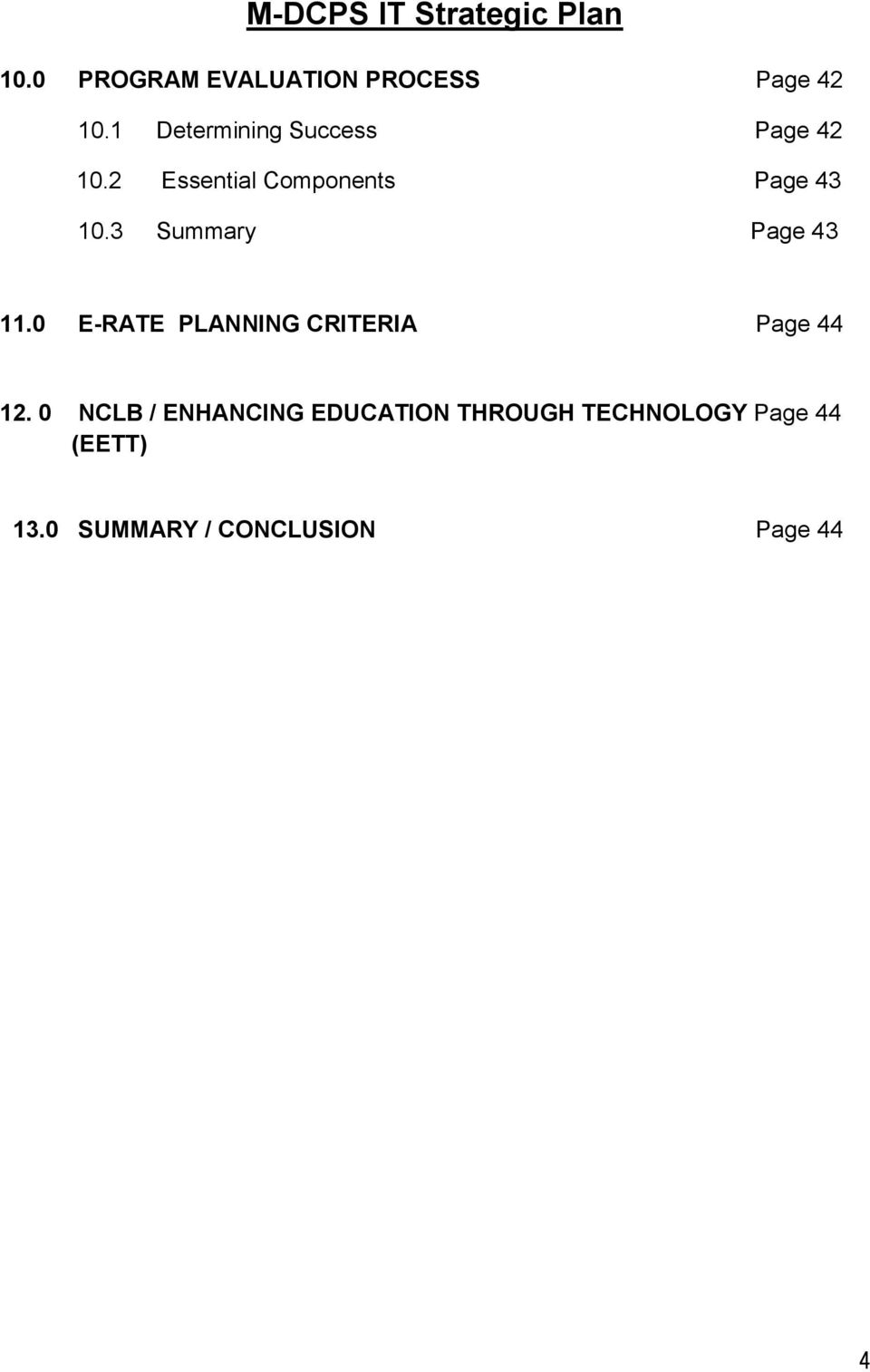
4 10.0 PROGRAM EVALUATION PROCESS Page Determining Success Page Essential Components Page Summary Page E-RATE PLANNING CRITERIA Page NCLB / ENHANCING EDUCATION THROUGH TECHNOLOGY Page 44 (EETT) 13.0 SUMMARY / CONCLUSION Page 44 4
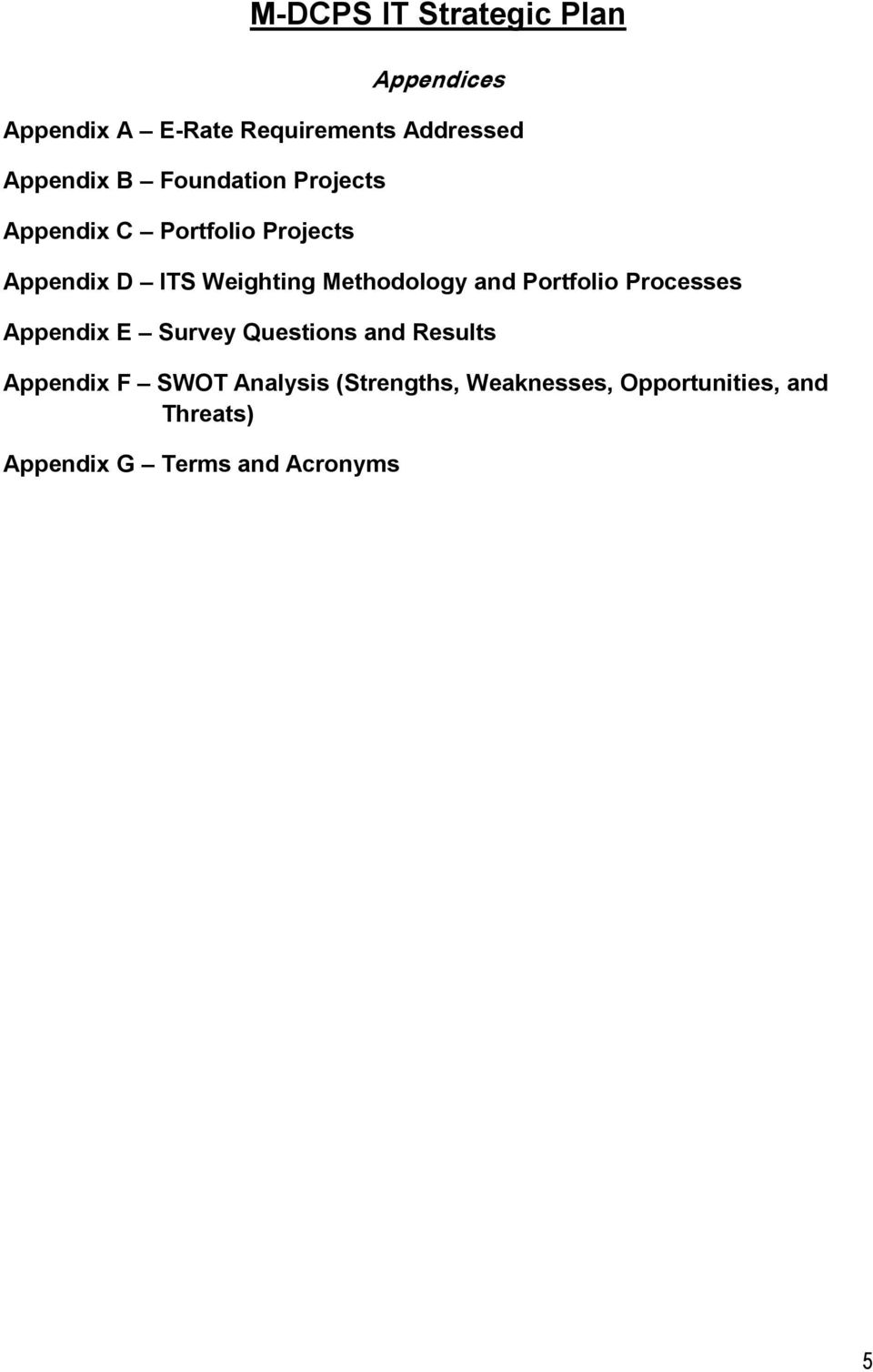
5 Appendices Appendix A E-Rate Requirements Addressed Appendix B Foundation Projects Appendix C Portfolio Projects Appendix D ITS Weighting Methodology and Portfolio Processes Appendix E Survey Questions and Results Appendix F SWOT Analysis (Strengths, Weaknesses, Opportunities, and Threats) Appendix G Terms and Acronyms 5
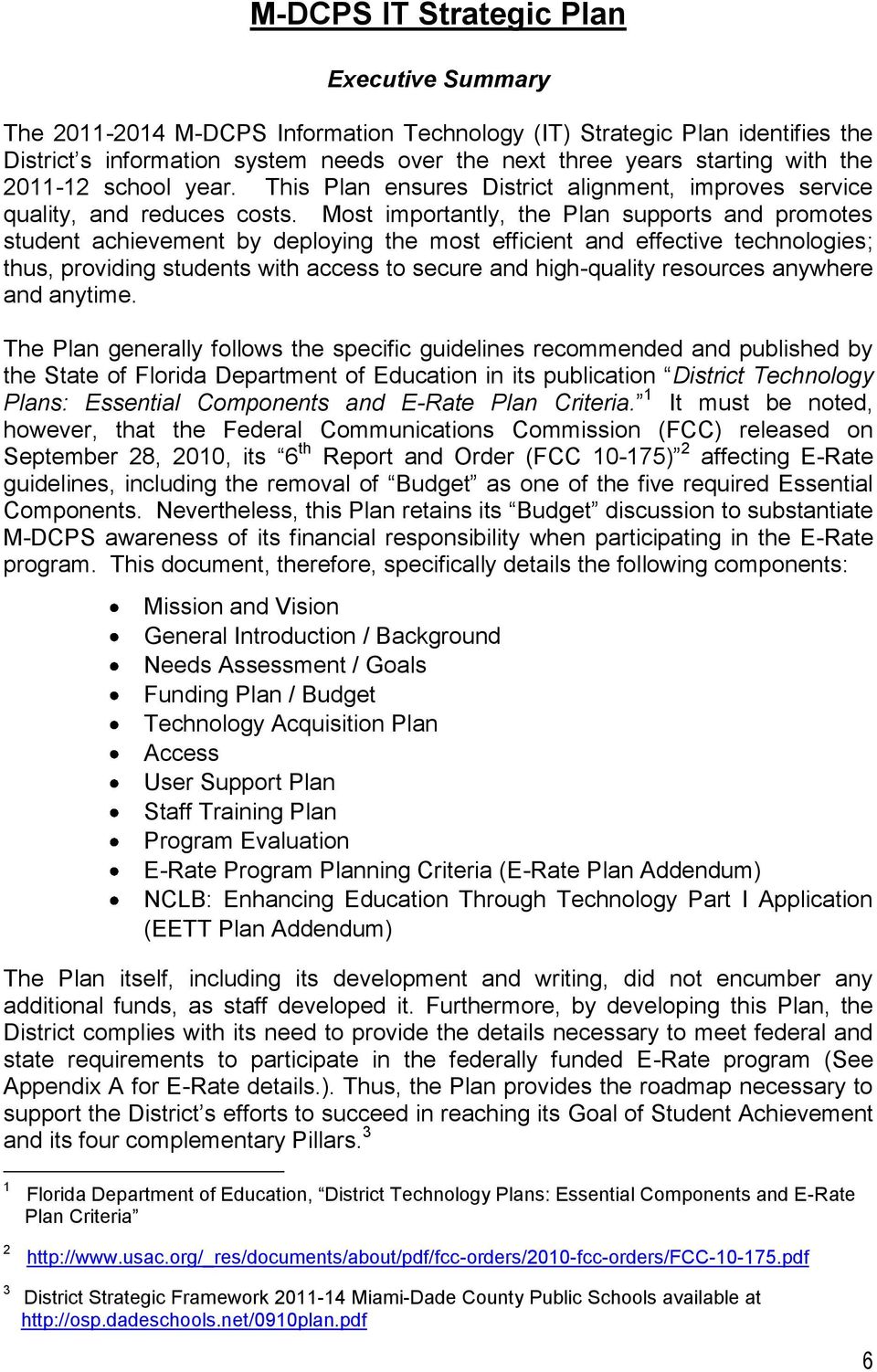
6 Executive Summary The M-DCPS Information Technology (IT) Strategic Plan identifies the District s information system needs over the next three years starting with the school year. This Plan ensures District alignment, improves service quality, and reduces costs. Most importantly, the Plan supports and promotes student achievement by deploying the most efficient and effective technologies; thus, providing students with access to secure and high-quality resources anywhere and anytime. The Plan generally follows the specific guidelines recommended and published by the State of Florida Department of Education in its publication District Technology Plans: Essential Components and E-Rate Plan Criteria. 1 It must be noted, however, that the Federal Communications Commission (FCC) released on September 28, 2010, its 6 th Report and Order (FCC ) 2 affecting E-Rate guidelines, including the removal of Budget as one of the five required Essential Components. Nevertheless, this Plan retains its Budget discussion to substantiate M-DCPS awareness of its financial responsibility when participating in the E-Rate program. This document, therefore, specifically details the following components: Mission and Vision General Introduction / Background Needs Assessment / Goals Funding Plan / Budget Technology Acquisition Plan Access User Support Plan Staff Training Plan Program Evaluation E-Rate Program Planning Criteria (E-Rate Plan Addendum) NCLB: Enhancing Education Through Technology Part I Application (EETT Plan Addendum) The Plan itself, including its development and writing, did not encumber any additional funds, as staff developed it. Furthermore, by developing this Plan, the District complies with its need to provide the details necessary to meet federal and state requirements to participate in the federally funded E-Rate program (See Appendix A for E-Rate details.). Thus, the Plan provides the roadmap necessary to support the District s efforts to succeed in reaching its Goal of Student Achievement and its four complementary Pillars Florida Department of Education, District Technology Plans: Essential Components and E-Rate Plan Criteria 3 District Strategic Framework Miami-Dade County Public Schools available at 6
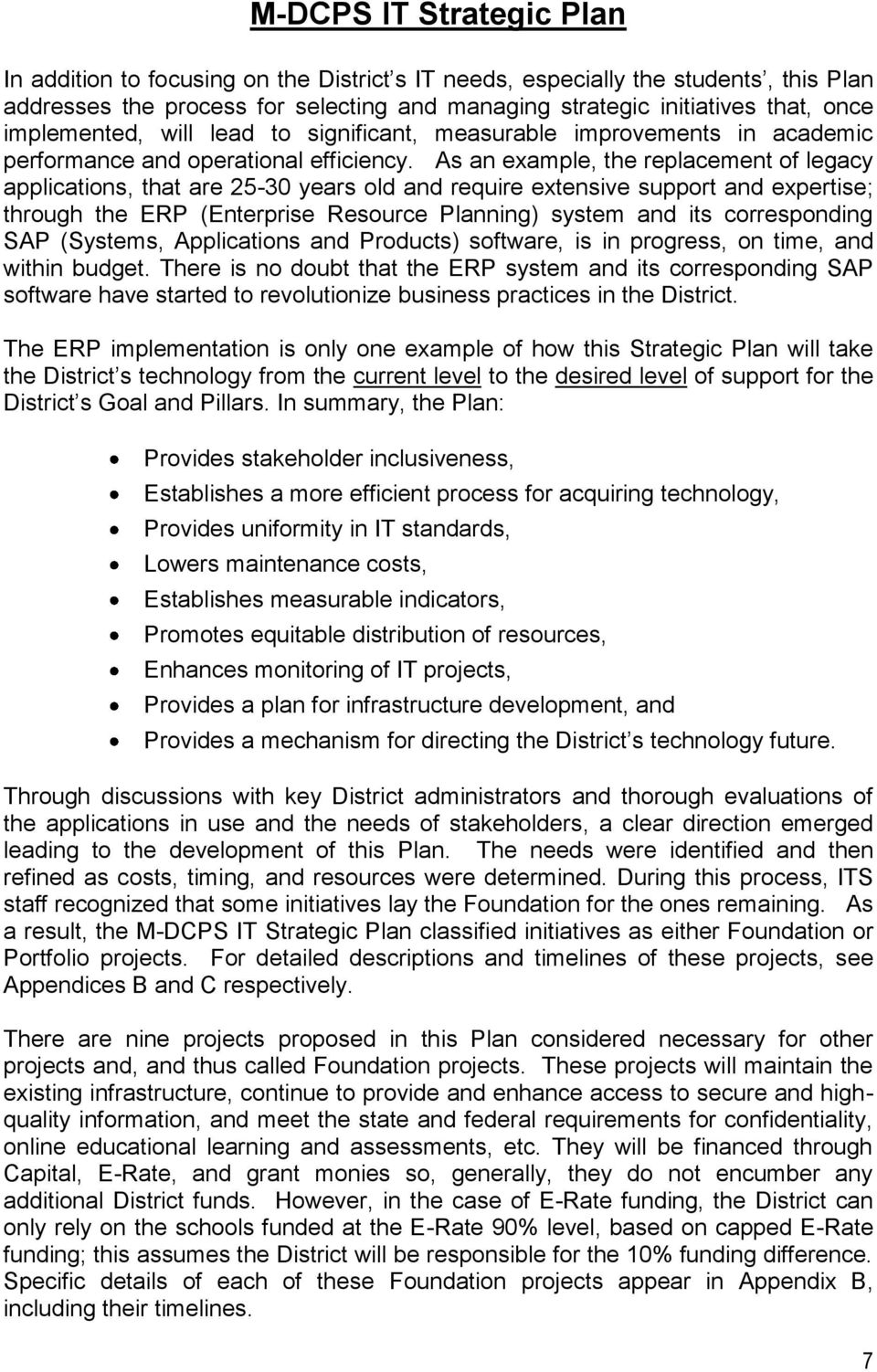
7 In addition to focusing on the District s IT needs, especially the students, this Plan addresses the process for selecting and managing strategic initiatives that, once implemented, will lead to significant, measurable improvements in academic performance and operational efficiency. As an example, the replacement of legacy applications, that are years old and require extensive support and expertise; through the ERP (Enterprise Resource Planning) system and its corresponding SAP (Systems, Applications and Products) software, is in progress, on time, and within budget. There is no doubt that the ERP system and its corresponding SAP software have started to revolutionize business practices in the District. The ERP implementation is only one example of how this Strategic Plan will take the District s technology from the current level to the desired level of support for the District s Goal and Pillars. In summary, the Plan: Provides stakeholder inclusiveness, Establishes a more efficient process for acquiring technology, Provides uniformity in IT standards, Lowers maintenance costs, Establishes measurable indicators, Promotes equitable distribution of resources, Enhances monitoring of IT projects, Provides a plan for infrastructure development, and Provides a mechanism for directing the District s technology future. Through discussions with key District administrators and thorough evaluations of the applications in use and the needs of stakeholders, a clear direction emerged leading to the development of this Plan. The needs were identified and then refined as costs, timing, and resources were determined. During this process, ITS staff recognized that some initiatives lay the Foundation for the ones remaining. As a result, the M-DCPS IT Strategic Plan classified initiatives as either Foundation or Portfolio projects. For detailed descriptions and timelines of these projects, see Appendices B and C respectively. There are nine projects proposed in this Plan considered necessary for other projects and, and thus called Foundation projects. These projects will maintain the existing infrastructure, continue to provide and enhance access to secure and highquality information, and meet the state and federal requirements for confidentiality, online educational learning and assessments, etc. They will be financed through Capital, E-Rate, and grant monies so, generally, they do not encumber any additional District funds. However, in the case of E-Rate funding, the District can only rely on the schools funded at the E-Rate 90% level, based on capped E-Rate funding; this assumes the District will be responsible for the 10% funding difference. Specific details of each of these Foundation projects appear in Appendix B, including their timelines. 7
8 Executive Summary (continued) A separate list of projects, the Portfolio projects, reflects the needs of District stakeholders and focus on: streamlining business processes (e.g., the Mainframe Replacement projects and the Electronic Signature Forms Flow project), new software and capabilities (e.g., the Adult/Community Education Student Management System and the Elementary Student Scheduler), hardware to facilitate student learning (e.g., PCs to establish a 3:1 ratio in the Computer Refresh project and the project on Classroom Retrofit for Interactive Boards), etc. There is no funding allocated yet for these projects, but their descriptions appear in Appendix C. Furthermore, at ITS there is a standard methodology in place to select Portfolio projects for implementation using a Weighted Analysis Tool, along with evaluations of the strategic fit, benefits, total cost of ownership, and risks of each project. The tool and process for selecting, implementing, and monitoring these projects if funded are in Appendix D. It is evident that the IT Strategic Plan provides the flexibility necessary to complement the existing Districtwide strategic planning effort and any future changes in direction (See Appendix D for examples.). The Plan provides the School Board with the choice to approve or reject projects based on Districtwide priorities, as IT processes can be refined and/or modified to accommodate and meet evolving District needs. Furthermore, the Plan supports the District s and Instructional Technology s integration of the most efficient and effective technologies to facilitate learning. The technology-based innovations in core subject areas and the 24/7 access to online applications for remediation, acceleration, and enrichment truly extend learning and provide the needed Links to drive student achievement. The numerous software applications available to students, coupled with professional development opportunities for teachers that Instructional Technology provides, clearly support the Superintendent s continued innovation and use of technology to revolutionize learning for students and teachers. 4 It is obvious that technology will be an integral part of any transformation agenda and will continue to impact all aspects of the educational environment. Therefore, this Plan will exploit current and future technologies to implement and support the most efficient and cost-effective infrastructure and systems. This will enhance the students learning experiences and raise their academic achievement. 4 Superintendent s Memorandum Progress Within the Strategic Framework to The Honorable Chair and Members of The School Board of Miami-Dade on May 12,

9 Information Technology Strategic Plan 1.0 MISSION and VISION Information Technology Services (ITS), following the District s initiative, 5 and in cooperation with Instructional Technology, created the Information Technology (IT) Strategic Plan to ensure District alignment, improve service quality, and reduce costs. Most importantly, the IT Strategic Plan strives to provide the infrastructure and support necessary to facilitate student achievement. The District s IT Vision recognizes that all learners, and those supporting the learning process, are consumers of technology who access information, communicate, collaborate, construct knowledge, and are prepared for the workforce of this new millennium. The Plan envisions many substantial and complex changes in the way M-DCPS aims to utilize technology. Ensuring the success of these proposals requires a serious commitment, at all levels, to address these challenges. Specifically, there must be a conscientious effort to pay attention to establishing a culture of change, providing adequate staff development, empowering all members of the learning community, encouraging risk-taking, focusing on results and communication, and sharing successes and shortfalls. The District s IT Mission is to maximize the use of appropriate current and future technology to collect, maintain, and deliver high quality information to effectively empower the District. As such, it aims to meet its Goal of improving student achievement and its four complementary Pillars. Technology is more than an enabling tool for learning and back-office support; it is the foundation of knowledge management and an essential means for delivering and experiencing learning. The success of M-DCPS and its technology initiatives, in the end, will be determined not only by the quality of its designs as outlined throughout this Plan but also by the quality and effectiveness of their implementation throughout the District. Successful implementation requires efficient work structure and processes. The District will undoubtedly benefit by smartly investing in sufficient technology resources that will ultimately ensure committed, competent, and empowered teachers; and well-designed student learning opportunities and learning environments. 5 District Strategic Framework Miami-Dade County Public Schools available at 9
10 2. 0 GENERAL INTRODUCTION / BACKGROUND The District The Miami-Dade County Public School System (M-DCPS) is the nation s fourth largest school district with a culturally diverse body of 345,458 students in grades PK-12 in 427 schools taught by 20,517 teachers. 6 In addition, there are 56,021 students enrolled in the District s Adult-Vocational education program. K-12 Student Demographics 7 Student Population Enrollment % Hispanic 222,167 64% Black, non- 86,617 25% Hispanic White, non- 30,671 9% Hispanic Other 5,951 2% M-DCPS is administered independently of the metropolitan and city governments. However, the Miami-Dade metropolitan government is responsible for collecting taxes to support the District. The District Superintendent is appointed by the School Board and is responsible for the overall school administration. The Superintendent s Web site addresses an array of important District demographics and programs intended to support its diverse student and community population. 8 On January 13, 2010, the Board adopted the Strategic Plan Framework 9 as a roadmap to chart the District s journey over the next five years. The memorandum 10 detailing the progress within this framework reflects the remarkable job that teachers, administrators, and staff have done in propelling students learning in spite of the dire economic conditions. 6 Miami-Dade County Public Schools Statistical Highlights (April 2010) 7 Miami-Dade County Public Schools Statistical Highlights (April 2010). The percentages were rounded District Strategic Framework Miami-Dade County Public Schools available at 10 Miami-Dade County Public Schools, Memorandum from the Superintendent to the School Board, May 12,

11 2. 0 GENERAL INTRODUCTION / BACKGROUND The District (continued) The District has always supported innovation and the use of technology to facilitate students achievement (See the report Knowledge to Go Places: An Education Plan for the 3 rd Millennium.) 11 The Superintendent s Memorandum of May 12, 2010, (mentioned and referenced in the previous page) also asserts that M-DCPS will be exploring the use of technology in the classroom to revolutionize learning for students and teachers. Nowhere is this better exemplified than in the District s iprep Academy which is currently transforming teaching and learning through the latest technology and environmental innovations. 2.1 ITS Organization ITS provides the backbone and convergence point for information systems and data management within M-DCPS. The Chief Information Officer at ITS reports to the Associate Superintendent and Chief Financial Officer. ITS consists of 11 work locations and 8 business units which appear below. Assessment, Research, and Data Analysis (ARDA) establishes and implements high standards and procedures for quality assessment, data collection, and data analysis to ensure the accuracy and validity of student achievement data that drive the decision making process. Additionally, the division is responsible for all program evaluations and statistical research for the District. Attendance Services/Records and Forms Management (AS/RFM) processes Full-time Equivalent (FTE) audits, registrations, student transfers/appeals, foreign student placement, Florida Home Education Program, truancy referrals, student attendance, maps and boundaries, driver s license revocation, Florida Department of Law Enforcement Missing Children Program, data input, and insures compliance with all state and federal regulations. Records and Forms Management establishes and administers a management program directed to efficiently and economically create, utilize, maintain, retain, preserve, and dispose of District records and forms. 11 M-DCPS, Knowledge to Go Places: An Education Plan for the 3 rd Millennium pages 14-15, 37-47, and available at 11

12 2.1 ITS Organization (continued) Business and Operational Services (BOS) provides management, monitoring, and technical support for the District s network and server equipment. BOS also offers oversight for all budgets and contracts. It is responsible for Technical Services, Database Services, SAP Basis (Business Application Integrated Software Solution), and Facilities and Computer Operations. Lastly, the E-Rate department (See Appendix A.) administers the District s Federal E-Rate Program, providing application submittal, tracking, and support for approximately $50 million in projects annually. Data Security establishes and manages the policies and procedures for securing the information technology operating environment from unauthorized access. As such, this unit has the responsibility to safeguard the confidentiality of all District data, including its transmission through an uncompromised and secure network. Infrastructure and Systems Support (ISS) provides a single point of contact for District staff to request, service, maintain, monitor, and enhance the schools and District s data and telecommunications infrastructure. The Executive Support Team (EST) provides technical support to the School Board Administration Building staff, including the Board Members. The departments for field support services, network and systems support (Systems User Support SUS), and telecommunications support provide assistance through the online HEAT system of requests for services, followup phone calls, and on-site visitations. They also stock the ITS Warehouse with the communication equipment and software necessary for staff to work efficiently and effectively. Program Management / Process Engineering (PM/PE) is responsible for monitoring the strategic and tactical planning within ITS by managing the M-DCPS IT Strategic Plan, serving as the Project Management Office for ITS, facilitating ITS performance measurement and documentation, and supporting ITS process improvement initiatives. Additionally, this department oversees the Standards and Procedures documents for ITS. Systems and Programming Services (S&PS) collects, processes, and maintains information for all M-DCPS students and employees. Staff develops online applications and/or collaborates in the implementation of third-party systems. S&PS is currently implementing the ERP (Enterprise Resource Planning) system to replace some legacy applications, including Finance and PERS. 12

13 Technology Delivery is responsible for creating and maintaining the District s Web site, Portals, and Technology Learning Center. The department also oversees the Change and Release Management processes for all ITS new applications and changes to existing applications. Additionally, it is responsible for Enterprise Communications which manages all Active Directory and VPN (Virtual Private Network) security access and use; and the District s HEAT Service Desk software which is used for reporting systems issues and problems. 13
14 2.1 ITS Organization (continued) Office of Associate Superintendent and Chief Financial Officer Information Technology Services Assessment, Research, and Data Analysis Attendance Services/ Records and Forms Management Business and Operational Services Data Security Infrastructure and Systems Support Program Management / Process Engineering Systems and Programming Services Technology Delivery - Adult Applied Technology - Adult Ed. Data Systems - Data Management - Program Evaluation - Research Services - Student Accountability - Student Assessment and Educational Testing - Student Records - Student Solutions - Driver Education - Florida Home Ed. - Foreign Records - Forms Management - FTE Coordination - Records Management - Student Attendance - Student Transfers -Truancy - Budget - Computer Operations - Contracts - E-Rate Mgmt. - ITS Facilities Maintenance - Mainframe Monitoring - Network Services - Password Mgmt. - Virus Protection - Audits - Data Security - Policies - Standards - Field Services - Infrastructure - Network Support - System Support - Telephony - Performance Measures - Program Management - Process Improvement - Strategy & Planning. Business Services - ERP - Financial Services - Human Resources - Web Applications - Applications/Portal Solutions - Change/Release Management - Enterprise Comm. - HEAT Self Service - Internet Services - Technology Learning Materials - Training - Web Page Hosting 14

15 2.2 ITS Overview ITS administers and delivers infrastructure, as well as develops and supports applications for the District. The thrust of the Office s efforts has been to impact student achievement by developing, modifying, and disseminating the most efficient and effective business practices and procedures. ITS is in the midst of implementing the Enterprise Resource Planning (ERP) system, which is revolutionizing the District s business practices by replacing the legacy applications that are over 25 years old. The first application implemented was E-Recruitment, then Finance, Human Resources, and Payroll will be implemented in These systems and future modules will streamline all business processes and facilitate fiscal accountability and economies, supporting the District s Pillar, Financial Efficiency and Stability. Additionally, through the Portal, the Data Warehouse, and OLAP (Online Analytical Processing) tools, teachers and administrators access and discover ways to tailor their instruction to meet the individual student s needs. The centralized Gradebook system, with its related framework for teacher training and support, including individualized assistance for the Technology Support Technicians, allows teachers to access achievement data readily, as well as serve to monitor each student s progress. As another example, ITS current collaboration with the Office of Special Education for a new Electronic Management System (SPED EMS) will free teachers to teach, because it will automate many of the functions required by mandated paper forms. The SPED EMS is intended to also ensure that students with special needs will receive all the services that they require to succeed academically. Two recently implemented electronic transportation systems, TMT (i.e., Transportation Management Techniques) and Edulog, have made it easier for students to get to and from school by facilitating routing and maintenance of buses and transportation systems. The systems have indeed improved transportation processes and ensured the students safety. Without a place to study a student cannot learn thus, the Capital s planning and tracking system, Magellan, enables the District to input, track, and be accountable for the new and modified seats needed for students to learn. This system also insures compliance with federal and state regulations. 15

16 2.2 ITS Overview (continued) There is also an E-Rate program which receives nationwide recognition by the Schools and Library Division as well as the Council of the Great City Schools (CGCS). This program generates millions of dollars annually for telephone, wiring, equipment, and many other services which facilitate and support the District s telecommunications and technical infrastructure. Through this program, ITS will continue to exemplify best practices not only through its meticulous handling of E-Rate documentation, but also advocate and enforce adherence to federal guidelines, and aggressively pursue funding and resources to improve teaching and student outcomes. Employees at ITS (over 600), and in numerous other physical locations, including all District schools (i.e., the Technology Support Technicians), provide outstanding services as they keep abreast of the most innovative IT tools and techniques. Employees have a professional development plan and the goal is to provide them with five days of training which ITS staff monitors on a quarterly basis. Furthermore, through the Spotlight on Excellence awards, ITS honors exemplary employees each year for their outstanding contributions to the District. 2.3 ITS Statistical Snapshot ( ) Collaborated on 10,524 new student stations. Electronically transmitted 15,806,640 data records to the Florida Department of Education. Had 57,986,092 hits on the Dadeschools.Net Web site. Had over 49,369,832 hits on the District s Portals. Managed over 295,636 HEAT requests for the Help Desk, including 168,720 requests for school-site support. Managed 21,006 HEAT requests for Technology Delivery. Managed 723 virtual servers, 1,061 MS SQL Databases, and 936 mainframe databases. Printed 25,414,240 pages. Printed 1,400,000 report cards. Protected from viruses weekly and technically managed 112,044 desktops. Scanned a total of 1,111,962 testing pages. Supported the electronic Gradebook at 483 schools (including Charter schools). Supported approximately 6 million CICS transactions weekly. Taught 969 courses, trained 11,815 District staff, and provided 6,187 hours of training. 16

17 2.4 Recent Accomplishments M-DCPS IT Strategic Plan Some of ITS recent accomplishments are listed below. 1. Implemented the Portals for students, teachers, principals, employees, and community members, with over 49,369,832 Portal hits in This exemplary implementation has garnered national and international attention. 2. Implemented the Student Scheduler at 105 secondary schools. 3. Implemented a number of online applications to facilitate workflows and monitoring, support green initiatives, and enhance adherence to federal and state guidelines. These applications include, but are not limited to the Automated Incident Reporting System (AIRS), the Title I Supplemental Educational Services, the Online Free and Reduced-Price Meal Application and Meal Payment (PayPams), the Student system, and the Volunteer system. 4. Continuously upgraded the school-based technology to support, anywhere, anytime, learning. 5. Implemented an aggressive 5-year plan for the ERP system to replace the legacy Human Resource (HR) and Finance applications, beginning with E-Recruitment in November 2009, Finance in January 2010, HR in July 2010, and Payroll in Implemented and monitored the IT Blueprint portfolio of 75 projects for the District. 7. Continued its aggressive request and documentation for E-Rate funds, netting on the average, over $8.5 million annually on refunds from the Districtwide telecommunications expenses. The program serves as a model for other districts, as evidenced in forums in Washington, D.C. and conferences nationwide. 8. Over the years, the E-Rate program at M-DCPS has been scrutinized and audited by independent auditors retained by the federal government. Consistently, the outcome has been no findings thus setting a new standard of perfection for major school districts at the national level. (See Appendix A for detail information about the E-Rate program.) 9. Upgraded the electrical infrastructure of the complex by designing and constructing a state-of-the-art energy center to support current and future District requirements. 17
18 2.4 Recent Accomplishments (continued) 10. Continued to reduce the number of independent databases containing critical, non-centralized information while ensuring data integrity and security. 11. Deployed remotely anti-spam and anti-virus software with a centrally managed console to prevent intrusion and detect and stop cyber attacks that would lower productivity. 12. Researched and updated technical standards and policies regarding data, networks, and Internet use to insure adherence to federal and state laws and ensure students safety. 13. Merged the Office of Assessment, Research, and Data Analysis and moved Student Solutions under its leadership to achieve a more focused and streamlined operation. 14. Merged the Office of Attendance Services, and moved Records and Forms Management under its leadership, to ensure a more congruent and effective organization. 15. Merged the Technology Support Technicians with Infrastructure and Systems Support staff to increase efficiencies, standardize knowledge and training, and enhance support to the schools. 18

19 2.5 Current State of Information Technology within M-DCPS Core Administrative Mainframe Applications M-DCPS has several legacy applications that manage administrative data for the District. These applications were first implemented in the late 1970s and 1980s. In general, these legacy applications (as outlined below) use dated technology and have inherent limitations. Supporting new requirements for these applications is becoming increasingly more difficult. Many of the strategic initiatives listed in Appendices B and C specifically address these challenges through a variety of solutions. System Student System ISIS Police Reporting System SPAR State Reporting System DECO, WDIS Adult/Vocational System VACS Financial System MSAF Maintenance System COMPASS Personnel System PERS Food Services System FOOD Purpose Course information Daily attendance Report cards Report requests School information Student information School Police Reporting system used for recording violence incidents involving students and staff State reporting of pre-kindergarten through adult student information for District funding Vocational and adult student information system Budget and finance being replaced by ERP. The Finance system is active. Business operations system for: Purchasing Inventory Work Orders for Transportation, Facilities, and Capital Personnel system including payroll, applicant tracking, benefits, and personnel information, being replaced by ERP. The E-Recruiting and HR systems are active. Food Service system for food ordering and inventory. Also includes an on-line cash register and accounting functions. 19

20 2.5 Current State of Information Technology within M-DCPS (continued) Core Administrative Client/Server Applications M-DCPS has implemented state-of-the-art client/server applications using the latest technologies. These applications are intended to facilitate the users experience in entering and retrieving data and to insure the validity and accountability of its data and reporting processes. These new administrative client/server applications (as detailed below) are empowering the District s stakeholders, including students, teachers, principals, employees, parents, and community members to use technology to transform instructional and business processes. The rapid changes in technology and the demands of 21 st -century students mandate continuous improvements and developments of better and more efficient applications. As mentioned before, Appendices B and C, through the projects listed there, reflect the direction that this Plan proposes. The implementation of these projects would certainly ensure continuity with existing applications and provide the scalability necessary to support future demands. Category Instructional / Student Applications Application Athletic Tracking Attendance Intervention Business Internship Program Class Size Reporting Cognos Reporting: Student, Finance, COMSTAT, HR, Food Services Connect-ED (now Blackboard Connect) Easy IEP Edusoft Electronic Gradebook and Attendance Electronic Textbooks Online Choice for Magnet Schools Online Curriculum (Riverdeep) Online Free and Reduced-Price Meal Application Online Meal Payment (PayPams) SES (Supplemental Educational Services) SPOTsuccess Student, Parent, Teacher, Employee, and Community Portal Student Student Scheduler Volunteer System 20

21 2.5 Current State of Information Technology within M-DCPS (continued) Core Administrative Client/Server Applications (continued) Category Application Auto Order Textbooks Capital Budget System Capital Construction Tracking (Primavera) Cognos Budget Management Concurrency Contractor Evaluation Edulog (Student Transportation) e Agenda Business Applications ERP (Enterprise Resource Management) / SAP (Systems, Applications and Products) E-Recruiting ERP Finance ERP Procurement ERP OMPA (Organizational Management Personnel Administration) Fleet Management (Fleet) GASB 34 Inspect Location Management (Magellan) Personnel Investigative Model (PIM) Project Number Shopping Cart Substitute System Warranty Management Enterprise Applications Asset Management Distribution Software HEAT Password Reset Patch Management Power Management SCRUB (Students Can Really Use Bathrooms) Virus Management Weekly Briefing 21
22 2.6 Instructional Technology M-DCPS IT Strategic Plan ITS and Instructional Technology have a close relationship spanning many years of collaboration and support. The document Knowledge to Go Places: An Education Plan for the 3 rd Millenium 12 for instance, exemplifies this partnership, as it details the District s utilization of technology in M-DCPS. The document cites: Core and supplementary technology-based interventions in core subject areas; Uninterrupted applications for remediation, acceleration, and enrichment that truly extend Learning Beyond the Bell; Online access to textbooks, instructional materials, and library research databases; Organization of learning resources: lessons plans, Pacing Guides, and Instructional Focus Calendars on the Learning Village; National industry-based certification programs (i.e., Microsoft, CISCO, and programming languages); Online professional development courses for teachers and administrators; Podcasts for Learning on the Go; and Full-time and part-time virtual schooling options In addition to the instructional technology innovations listed above, the document also provides information on: Technology Integration and Virtual Education including details on M-DCPS Options, Online Secondary Courses, and the Miami-Dade Online Academy. There are also Supplementary Intervention Programs which use a variety of technology tools available throughout the District. Some of these programs are: Compass Learning Odyssey, e2020, Gizmos, Image Learning, Reading Plus, Destination Reading and Mathematics (Riverdeep), the Edmark House Series (Riverdeep), PLATO Learning, SuccessMaker, Waterford, ELLIS, KidBiz and TeenBiz, among others. These software applications and their integration into the classroom learning experience will contribute to, and support, students achievement. The District has also initiated the plan and implementation process to adhere to the state s mandate to provide computer-based testing to the required students. This will be a collaborative effort among offices within the District to ensure that all students will have equitable access to the infrastructure and equipment necessary. As well, this process would ensure that there will be a professional development plan to adequately train and prepare all staff to meet the students testing needs. 12 M-DCPS, Knowledge to Go Places: An Education Plan for the 3rd Millennium pages and 37-40, available at 22
23 3.0 NEEDS ASSESSMENT - Stakeholder Involvement The Plan s first guiding principle was ensuring stakeholders involvement in defining and assessing the District s IT needs; staff documented and examined requests for services and products which came from a variety of users and sources. Some of these included, federal and state regulations (such as those in the No Child Left Behind (NCLB), the USAC/E-Rate program, and the current requirements for Race to the Top). Other requests were based on available funding, and referrals from the Superintendent. Additionally, grant requirements (such as those in the Title III and the I Choose grants); requests in the HEAT Self-Service system; and responses to the Portal and Broadband surveys (See Appendix E for Survey Questions and Results.) reflected requirements and needs for IT services and products. Furthermore, active participation of IT staff in informal focus groups (See below.) and meetings also provided valuable input into the Plan. Educational Portal Principal Group Elementary Principal Liaison Committee Family and Community Involvement Advisory Committee Middle Principal Liaison Committee Paper Reduction Workforce Group Regional Superintendent Principal Meetings Senior High Principal Liaison Committee At ITS, the executive team, the CIO s direct and extended direct reports, also contributed greatly to defining and prioritizing needs through staff s participation at the annual retreat which led to the subsequent SWOT analyses (i.e., Strengths, Weaknesses, Opportunities, and Threats detailed in Appendix F) and the projects descriptions (in Appendices B and C). In addition, as mentioned above, ITS staff regularly surveys students, employees, and parents to determine what their needs are through an online survey in the Portal; the results are in Appendix E. The results from another survey (also in Appendix E) on the use of District available software and parents willingness to allow their children to participate in a new project also provided data about ITS services. In developing this Plan, and to ensure that the Plan would support the District s priorities, staff s second guiding principle focused on aligning the IT Plan to the District s Strategic Framework. The chart that follows reflects the alignment between the District s Framework and the IT Strategic Plan. 23
24 3.1 Major Assessment Steps M-DCPS IT Strategic Plan A summary of how requests are analyzed, prioritized, and operationalized to become projects and then implemented to completion follows. 1. Align with the District: The District s Student Achievement Goal and each of its four Pillars help ITS to self-examine current weaknesses and opportunities within the IT delivery capability. These gaps help determine the supporting IT direction. 2. Define and Assess IT Needs: Examine functional requirements and technologies for requested services along with processes and skills to support those requirements. The needs include capability, information access, workflow, and required training. By examining individual functional requirements, it is possible to see patterns and group functional requirements based on how they impact one another. 3. Prioritize and Implement: Evaluate the importance and urgency of each requested service in relationship with one another and organize the requests into projects that can be efficiently managed and executed. 4. Build a Program Portfolio: Create for each project a Program of Work. Each Program contains one or more actions. 5. Build the Foundation: Certain projects, whether explicit or implied, must be implemented first since they are prerequisites for the remaining prioritized projects. 6. Implement the Foundation: Implement the approved projects as defined in their Program of Work. 7. Measure and Evaluate: Monitor both the project s progress and the outcomes to the District once implemented. 24
25 4.0 GOALS Alignment Between the District s Strategic Framework and the IT Plan District Goal IT Strategic Plan Goal Student Achievement: Preparing for Success in the Third Millennium. Each student succeeds academically, personally, and civically as measured by: 1. demonstrating age/grade level appropriate knowledge mastery. 2. having a post-secondary plan. 3. graduating. 4. successfully entering higher education arena and/or the workforce. District Pillar Prepare learners of all ages to use technology appropriately to access information, collaborate, construct knowledge, and to prepare students to lead successful personal and professional lives. IT Strategic Plan Goal Student, Parent and Community Engagement This pillar supports activities and functions which enhance student, parent, and community understanding, awareness, and support for our schools and District. Education This pillar supports activities and functions leading to an educational experience that fosters individual excellence in a collaborative environment leading to responsible citizenship, global awareness, and lifelong learning. Enable communications and directly contribute to enhancing participation by providing accurate, timely, and relevant information. Develop and maintain the infrastructure that will provide access to high-quality educational programs. Maintain high standards of connectivity that facilitate online access anywhere and anytime. Provide instruction based on the students assessments and needs. Provide collaborative tools to promote safe, social networking. Financial Efficiency and Stability This pillar supports activities and functions that ensure effective and ethical business operations, sound stewardship of resources, and responsible budget management. Implement and manage enabling technologies for streamlining business processes to substantially improve operational efficiency, enforce government standards, and improve the quality and timeliness of services. School/District Leadership This pillar supports activities and functions which enhance talent recruitment and management, leadership development, and effective and ethical governance. Create or support the programs and interfaces that will allow staff to select the most qualified candidates and evaluate their performance and impact. 25
26 4.1 Goals / Summary - Strategic Planning Process Strategic Technology Actions IT Foundation Projects ((( See Note 1 Below IT Portfolio Projects See Note 2 Below District Goal & Pillars Strategic Needs P L A N IT Strategic Direction Projects Projects G O A L S Projects Projects Note 1. Foundation projects are necessary, and thus called Foundation because they are needed to maintain the existing infrastructure, continue to provide and enhance access to secure and high-quality information, and meet the state and federal requirements for confidentiality and online educational learning and assessments. Note 2. Portfolio projects reflect the needs of District stakeholders and focus on streamlining business processes, new software and capabilities, hardware to facilitate student learning, etc. 26
27 5.0 FUNDING PLAN / BUDGET This section of the Plan focuses on planning for, and funding of, technology expenditures. It will address the budget, funding sources, total cost of ownership, budget cycle, and approval processes. The intention is to show how the financial management of all information technology resources can contribute significantly to the overall District Goal and Pillars. It is important to note that given the rapid change of technology and emerging systems and software, this budget planning document is also updated regularly, as part of the Plan s Program Evaluation Process (as described in Section 10). The budget updates include the status of the projects that ITS implements. During the past three years, the District has made significant progress as noted in the IT Existing Strengths (See Appendix F.), and the ITS Snapshot and Recent Accomplishments (pages ) which includes implementing and monitoring as many as 75 projects. Although it is difficult to specify the technology budgets because District systems are not set up to track technology-related spending in this manner; data drawn from the tentative District budget indicate that the technology budget is $40,021, In addition to funding information, this financial document also provides details about the student population and projected enrollment, test scores, trend data, and staff information. The ITS operational budget is $29,400, Typically, in a district the total technology spending is two to three times the IT organization budgets when all the categories are included. This relationship appears to be supported at M-DCPS by the current Tentative Budget. Further, plans are underway for ITS to work more closely with Capital Construction staff to supplement the required E-Rate expenditures by using excess Capital funds from completed Capital projects. Selected categories for technology-related expenses from the section on Technology Rebudgets follow. 15 See Tables 1 and 2 as presented on the next page. 13 M-DCPS Executive Summary Tentative Budget for Fiscal Year Ending June 30, 2011 available at page As reported in The Council of the Great City Schools IT Survey submitted July M-DCPS Executive Summary Tentative Budget for Fiscal Year Ending June 30, 2011 available at page
28 Table 1. Technology Rebudgets Project Amount Copiers Districtwide $ 9, ERP Project 10,287, Financial Operations-Capital & Tech. Upgrades 214, IT Five Year Plan 63, QZAB III - Technology 52, QZAB Technology Projects 25, Technology Purchases 11,219, Table 2. Other Projected Technology Expenses Expenditure Area Amount Utilities 16 (this includes all Telecommunications Expenditures) $ 100,392,676 New Schools/Capacity Projects and Existing Schools- Comprehensive Needs Projects 17 19, 260, M-DCPS Executive Summary Tentative Budget for Fiscal Year Ending June 30, 2011 available at page M-DCPS Executive Summary Tentative Budget for Fiscal Year Ending June 30, 2011 available at page 76 28
29 5.1 Budgeting for Technology As can be seen in the figures, included in Tables 1 and 2 immediately preceding, there are estimated expenditures included in the District s Tentative Budget to address technology needs. The District continues to address shortages in funding and considers technology to be an important asset to new and existing schools. The nine proposed Foundation projects request funding to maintain or enhance existing hardware or software applications, or expand projects in the schools and administrative sites (See Appendix B.). The 18 Portfolio projects all request funding for technology-related enhancements or innovations requested by District stakeholders. These projects range in cost from $26,560 to track students in District Academies to $69,265,701 to provide PCs to students at a 3:1 ratio (See Appendix C.). 5.2 Funding Sources: E-Rate The District is always considering alternatives to appropriately fund the needed infrastructure, hardware, and software to maintain its services effectively and efficiently. The economic situation and budget constraints, shown in the Executive Summary Tentative Budget, reflect these current economic conditions and may result in less than optimal resources to fund technology, even at its current projected estimates. Nevertheless, the Foundation projects, if funded, will provide the minimum requirements to meet the District s needs. As reflected in the FY 13 ( ) E-Rate applications, fifty-eight percent (58%) of the schools are eligible for 90% discounts under the federally funded E-Rate program. As well, the District has been receiving over $8.5 million annually in discounts for reimbursement for telecommunication services. Currently, however, this money goes into the General Fund and is not-reallocated for technology, as suggested by the E-Rate program guidelines. The ITS staff, responsible for managing the USAC/E-Rate federal program, has done an impressive job of applying for and getting funding from the E-Rate program. The small dedicated staff has indeed demonstrated a high degree of knowledge, effectiveness, and expertise in securing all available and eligible funds. 29
30 5.3 Funding Sources: Other Sources of Funding In addition, the District aggressively pursues grant monies as exemplified in the recently awarded Broadband Technology Opportunity Program (BTOP) (known as LINK) grant currently being implemented. The funds from this grant will provide computers at a reduced price and free Internet connectivity for a year to families in 35 schools. There is a Program Coordinator who directs the implementation of this program, with technical support from areas such as budget, grant administration, and contract and financial services. 5.4 Total Cost of Ownership Total Cost of Ownership is an integral part of every project s implementation. Once ITS projects are funded, staff prepares a Scope document which details the project s cost and Total Cost of Ownership (TCO). This Scope document is unique to each project and provides a breakdown of costs and the corresponding TCO and Return on Investment (ROI) figures. 5.5 Budget Developmental Cycle and Process The District also follows an annual process to develop and approve the Budget, based on a highly collaborative effort among all stakeholders. Final approval is always the responsibility of the Miami-Dade School Board. Details of the developmental cycle and process are available at 30
31 6. 0 TECHNOLOGY ACQUISITION PLAN The telecommunications and network infrastructure, as addressed in the Strategic Plan, and particularly detailed in Appendix A, focuses on continued enhancement and expansion of advanced infrastructure systems for communication, computing, and networking throughout the District. This process seeks to develop ways to enhance and expand these systems. Such technology infrastructure, as well as a sound and fundamental acquisition plan, coupled with the ability to stay abreast of the latest technologies, are essential to District operations and impact all M-DCPS constituents. The pervasiveness and reliance on these infrastructure systems require that they be reliable and effective to support the diverse activities of the District. By continuing to shift to a customer service-oriented delivery model, with total cost-of-ownership analysis, assures that these systems will continue to improve student achievement, increase productivity, and enhance efficiency throughout the District. Timetables are also addressed as part of the individual projects outlined Assessment of Telecommunications Services, Hardware, and Software The Foundation and Portfolio projects outlined in Appendices B and C address the goals of the Plan and serve to outline Districtwide solutions to a variety of issues, including procedures, organizational structure, training, infrastructure, and administrative systems. Currently, the network infrastructure stands physically ready to support the District. Capacity planning is the next step in total reliability. The strengthening of the support levels, information security and access controls, as well as Internet and network load balancing, and hardware/software reviews are well underway and will continue to be closely monitored throughout the life cycle of this Plan, as defined in the Program Evaluation Process section of this Plan (See page 42.) The consistent increase in bandwidth to the schools is one such example. The opportunities provided by this continued expansion have already begun to lay out the foundation for convergence of voice, video and data services, improved infrastructure management (service, support, and maintenance), and the ability to exploit new technologies that rely on a high-speed network that realizes their value and potential. The District also recognizes that load balancing and fault tolerance should be included in all major aggregation points, as a planned strategy, such as boarder routers, firewalls, and the upgrades to the content filters. 31
32 6. 2 Assessment of Other Services Needed Another example of conscientious growth and expansion in technology is the widespread adoption and increasing demands for wireless throughout the District. It is expected that a well thought-out wireless infrastructure initiative will offer students, teachers, and administrators anytime anywhere access to the resources that are becoming part of everyday teaching and learning. Further enhancements include the laying out of Category 6 cabling where appropriate. Other examples of service enhancements include Gigabit switching to the desktop, particularly during phases of new construction throughout the District, and standardization which are also projected. 32
33 7.0 ACCESS One of the District s Pillars is Student, Parent and Community Engagement. This Pillar supports activities and functions which enhance student, parent, and community understanding, awareness, and support for the schools and the District. It is the District s responsibility to ensure that all affected stakeholders have equitable and effective ACCESS to telecommunications and other technologies that support teaching and learning. The IT Strategic Plan s goal associated with this Pillar is to enable communications and directly contribute to enhancing stakeholder participation by providing accurate, timely, and efficient information. (See page 25.) Inherent in this process is the provision that equitable and secure ACCESS will be available uninterruptedly at all times to all. The District s Portal clearly reflects this philosophy by providing continuous ACCESS to all District information. Portals for students, employees, parents, and community members provide a wealth of information that is current, useful, and continues to expand to meet the stakeholders needs (as seen in the results of the Portal surveys in Appendix E). ITS aggressively pursues grant funding opportunities, from multiple sources, for those parents and community members without adequate technology resources. The District is committed to address and meet these needs throughout the community. Thus, ITS is currently implementing projects developed to facilitate access and support for technology-rich information and resources. 7.1 Foundation Projects to Support Access The BTOP (Broadband Technology Opportunity Program) is one such Foundation project that will provide PCs and Internet connectivity to families in 35 schools. Through this project, (See Appendix B for details.), parents will also be simultaneously offered trainings and support to ensure that the technologies will be well utilized. Part of this project also includes an awareness campaign, LINK which stands for Learn Ideas, Navigate Knowledge, to all communities in the city. This campaign will promote connectivity and share with parents and community members the value and easiness of accessing the Internet for information and resources. 33
34 7.1 Foundation Projects to Support Access (continued) Three other Foundation projects (See Appendix B.) aim to increase access to District resource information; for example, one project will allow wireless access to all parents and students to District information, such as the Portal, through their PDAs, laptops, PCs, etc. Two other projects involve planned upgrades and continuous maintenance to the infrastructure and software applications; one of these projects includes upgrades to the hardware and software in the mainframe and the network. In general, these projects will ensure the availability and usefulness of the District s infrastructure and learning opportunities anywhere and anytime. Recognizing that teachers need support and technical guidance in using and maintaining their technology tools, there is also a project in place to train Technology Support Technicians (See Appendix B for details.). This project will ensure a standardized knowledge base for all technical resources at school sites, and will ensure consistent implementation and maintenance of all applications, whether instructional or administrative. 7.2 Access Security Measures / Acceptable Use Policy (AUP) The District s Acceptable Use Policy (AUP), as incorporated into a School Board Rule is available to all stakeholders. 18 The purpose of the Policy is to establish acceptable usage, as well as outline the security measures necessary to protect the confidentiality of students, intellectual property rights, and the licensing agreements and legal/ethical standards for sharing resources among stakeholders and other educational entities. The District holds all persons accountable for familiarizing themselves and adhering to its standards. The AUP addresses the safety and security of minors, especially their access to learning resources, such as appropriate content on the Internet; their safety, and security when using electronic mail, and other forms of direct electronic communications; among other features and guidelines. The Policy also addresses access to instructional applications, interactive collaboration among teachers, students and other users, including communications and document sharing with people from around the world and libraries, museums, and research facilities. 18 Policy and Board Rule available at and 34
35 7.3 Other Areas of Access There are also standards at ITS that address other areas of access and security such as filters, anti-virus measures, anti-spam measures, etc. The Network Security Standards lists the requirements for users of the District s computer assets. These standards are updated regularly and accessible to all at Additional security resources include a Copyright Policy and specific Copyright Policies for educational media, electronic media, compliance, and fair use. There are also policies for use for both employees and students as further detailed in the following section. The list of security documents, as listed in the Network Security Standards document appears below. M-DCPS Acceptable Use Policy for the Network M-DCPS Board Rules Regarding Copyright M-DCPS Board Rule Regarding Staff Use of District M-DCPS Board Rule Regarding Student Use of District Additionally, two ITS Standards and Procedures documents, Data and Computer Security, detail how the District safeguards its information assets including the mainframe, the network, and the Internet. They describe the purpose, standards, and non-compliance repercussions for failing to comply with these policies. Details included in both of these documents are available at ed%20documents/standards%20and%20procedures. 35
36 7.4 Access Monitoring Devices ITS has deployed devices and constantly monitors software, such as Sophos anti-virus, to ensure the safety and operability of its computers and network. Firewalls restrict traffic in and out of the network maintaining a more secure, streamlined, and efficient work environment. BigFix, the District s patch management software allows the District to deploy remotely patches and upgrades to both the operating system and software applications. The District has LoadRunner to remotely monitor incoming and outgoing network traffic, ensuring students and employees safety and access to the most reliable and valid information available. Wireless access points and the numerous wireless technologies available are also protected through VPNs (Virtual Private Networks) and security authentication. The Network Security Standards clearly states that, 19 ITS reserves the right to randomly scan or monitor for the presence of insecure, unauthorized, or corrupted devices connected to M-DCPS networks.... ITS will disconnect, modify and/or confiscate any device not meeting these standards or that is being used inappropriately. These filters and security measures protect the District s technology assets and most importantly, the students, employees, and community members who access the District s resources. 19 Network Security Standards available at pdf, page 11 36
37 8.0 USER SUPPORT PLAN The access and security measures implemented at ITS reflect several areas of support for end users in the classroom and administrative sites. These measures provide the availability and security necessary to access the District s information and technology resources anywhere and anytime with expert management and assistance for users. 8.1 User Support Services The HEAT Self-Service system and Service Desk software, along with its administration team, provide a systematic method for ITS and other District locations to log, assign, and track Incidents from inception to completion. Everyone has access to this support mechanism which has worked very well in addressing technology issues related to software and hardware. The Staff Development/Professional Development strategies which follow this section, and the projects to maintain and upgrade the skills and expertise of staff (for example, the Technology Support Technicians training, among others), also reflect the importance that the District places in supporting its technology resources and all end users. The ongoing research and testing of new technologies and innovative software and systems (such as ERP s SAP), coupled with planned funding and purchasing timelines, ensure that there is a well-developed process for an effective and efficient implementation. The E-Rate s list (See Appendix A.) of emerging technologies in infrastructure and telecommunications is another clear example of the District s foresight and support for equipment maintenance and replacement. 37
38 9. 0 STAFF TRAINING PLAN / PROFESSIONAL DEVELOPMENT The staff development addressed in the IT Strategic Plan focuses on the development and training needed to support the use of technology by all staff within Miami-Dade County Public Schools. Staff development promotes continuous learning and improvement among administrators, teachers, and other school staff; and District staff at all levels of responsibilities. It includes education, training, hands-on experiences; and follow-up and also support for the effective use of technologies. 9.1 Technological Tools Embedded in staff development is the recognition that technological tools and innovations must be part of any professional development initiative. Furthermore, technology is also at the core of the District s efforts to recruit, select, and retain staff as reflected in the current E-Recruitment and HR applications deployed in 2010 as part of the ERP (Enterprise Resource Planning), SAP (Systems, Applications and Products) software. These implementations have included goals for staff technology proficiencies, staff development planning and delivery, and staff development programs. These are outlined and discussed in the M-DCPS Portal. 20 At there are additional information and details available. The District s Office of Human Resources; the PMO (Program Management Office) for the implementation of the ERP; and ITS Technology Delivery, through its department of Technology Learning Center; have collaborated extensively to provide the needed professional development to transition to these new systems. 9.2 Targeted Employees In order to further meet and address the District s needs, staff development capitalizes on the technology proficiencies desirable by several different groups of employees. These groups include: instructional staff, such as teachers, media specialists, and school-site administrators; non-instructional staff, such as treasurers, administrative assistants, and others who help with the operations side of the District. In addition, targeted employees also include technical staff who ensure state-of-theart technology systems and support the educational and operational District functions. 20 Information available at 38
39 9.2 Targeted Employees (continued) The goal, for professional development, was that all staff increase their abilities so that their delivery of instruction and other services provide the maximum benefit to the community. It is an ever evolving process that includes monitoring and modifications to meet the District s changing needs. 9.3 Strategies Both professional development and the strategic planning strategies (as mentioned in Appendix D, pages D-6 through D-8 in reference to reviewing/modifying projects; and other sections of the IT Strategic Plan) are living processes updated regularly to include: New federal, state, and local requirements and guidelines, Emerging technologies, New standards and specifications, Best practice research within the District and nationally, and Initiatives implemented in the District. The adaptive nature of processes within the District to reflect emerging needs is evident in the District s document, Knowledge to Go Places: An Education Plan for the 3 rd Millennium 21 (pages 55-61). The document notes its reliance on current research principles and conclusions to support the content of its professional development strategy, as it incorporates current research-based findings. The Education Plan, as the District document is referred to, states it best when it notes on page 55 that, in support of the District s mission to insure achievement and academic standards by all students the M-DCPS Professional Development strategy is premised on delivering research-based learning experiences aimed at advancing performance for all teachers and administrators. As a related objective, the strategy also charts pathways for professional growth and career advancement that will produce a highly efficient and well-trained workforce. Furthermore, the document on page 55 also states: 21 M-DCPS, Knowledge to Go Places: An Education Plan for the 3 rd Millennium, pages 55-61, especially page 55; available at 39
40 9.3 Strategies (continued) The development of comprehensive professional development underscores the District s recognition that sustained, intellectually rigorous and timely professional development for all personnel is essential in order to promote student learning. In alignment with the Standards for Staff Development promulgated by the National Staff Development Council, professional development is accordingly based on research that connects high-quality professional learning to student achievement. 9.4 Principles Research has established that effective professional development practices adhere to four core principles in order to demonstrably enhance student learning and job performance. While systemically interconnected, these principles are clear, consistent, and appear to be integral to the process of improving results (Guskey, 1997). Professional development activities must: Have a clear focus on learning and learners; Target both individual and organizational change; Make small changes guided by an overarching vision; and Be ongoing and procedurally embedded to reinforce and promote learning. 9.5 Planning Process Furthermore, the same document in its section on Developing the Professional Development Plan 22 (page 56) notes that, M-DCPS has undertaken a systemic overhaul of its professional development planning process to implement a results-oriented model that: 22 M-DCPS, Knowledge to Go Places: An Education Plan for the 3 rd Millennium, page 56, available at 40
41 9.5 Planning Process (continued) 9.6 Summary Offers sustained professional learning reinforced through targeted follow-up support activities; Aligns PD [Professional Development] activities with District goals, student instructional needs, and individual teacher needs; Provides a tiered level of support for professional learning based on the school s accountability level; Offers professional development that aligns to the State s Differentiated Accountability requirements; Expands the depth of specific professional learning experiences while narrowing the focus to emphasize research-based professional development that directly impacts teaching and learning; Reduces isolated workshops; Increases the availability of school-based offerings; Facilitates coordination among the District and Regional staff that provide and oversee professional development. The professional development model, as outlined above, is integrated in the strategies used by both, the Division of Instructional Technology, Instructional Materials, and Library Media Services Department; as well as Information Technology Services. The District s commitment to this model is evident in how it provides training, such as its flexible array of technology training classes during school hours, after hours, through the Web or CDs, and on weekends; and by providing stipends or substitutes as needed. In summary, as previously noted on the implementation of the E-Recruiting and the HR applications, staff from the District offices, sites, and centers, including the Technology Training Center actively engage in training activities anytime and anywhere. The uninterrupted availability of the District s Portal at all times and the numerous professional development activities available to staff on request from our media services, including WLRN (the District s television station) are a few of the tools widely used to advance the quality and expertise of staff. 41
42 10.0 PROGRAM EVALUATION PROCESS The District strongly supports a sound and useful program evaluation process. Therefore, the monitoring and evaluation system is intended to: 1) ensure that program managers are committed and competent in using a wide variety of performance information to guide their decisions about improvement and redesign; 2) align with the District s program evaluation function, and most importantly 3) provide timely and relevant information to decision makers about progress and performance Determining Success Evaluation is a core organization competence. Therefore, a uniform set of processes and tools will be employed throughout the District as an essential management responsibility. In turn, each manager is responsible for the specific technology initiatives or for specific technology objectives as outlined in their own job responsibilities; thus, committing to obtaining timely performance information to address each of the following major questions to determine success. They are: 1. How well is the District implementing the essential tasks and activities related to each strategic technology objective? 2. How well is the District accomplishing the specific objectives related to each technology initiative? 3. How well is the District accomplishing the student technology learning outcomes? 4. How well are the strategic technology initiatives contributing to the accomplishment of the District s high priority goals and objectives? Appendix D, the ITS Weighting Methodology and Portfolio Processes clearly reflects the District s philosophy regarding measurement and evaluation. It notes that success metrics are implemented to track progress against costs, time, quality, and outcome. 23 Furthermore, the document asserts that the continuous process of measurement during, and after each project will be a driving force for ensuring quality and value to the District Appendix D ITS Weighting Methodology and Portfolio Processes, page D-7 24 Appendix D ITS Weighting Methodology and Portfolio Processes, page D-7 42
43 10.2 Essential Components This requires, of course, that major attention be given to helping program managers develop their competencies for collecting, analyzing, and using the data to support decisions. In fact, data collection will be an ongoing task and will be linked to key indicators. This model for monitoring and evaluation includes four essential components. Strategic results: processes and structures for clarifying and selecting key results stated as performance outcomes Indicators and measures: processes and structures for identifying variables and measures for strategic results Data collection and analysis: processes and structures for collecting and aggregating data and preparing and presenting useful analyses Dissemination and utilization: processes and structures for timely communication of analyses and facilitating their use by key decision makers at District and school levels 10.3 Summary As described throughout the IT Strategic Plan, the District has in place a comprehensive and rigorous process that has been successfully implemented for decades. This evaluative process is used continuously to measure, monitor, and ensure that performance goals are met. The expertise of the District s staff and associated technical resources ensure that the technology projects outlined in this Plan are implemented throughout the school system effectively, and meet the stakeholders needs in a timely and cost-efficient manner. 43
44 11.0 E-RATE PLANNING CRITERIA The District s E-Rate program is a nationally recognized program for its consistently positive audits and its meticulously documented processes and expenditures. The four criteria required by the Florida Department of Education and the federal government are addressed in detail in Appendix A NCLB / ENHANCING EDUCATION THROUGH TECHNOLOGY (EETT) In the past, the District has received funds by participating in the NCLB / Enhancing Education Through Technology (EETT) program; in the District received $1,216, However, it must be noted that there is no longer an entitlement program effective with the school year SUMMARY / CONCLUSION The IT Strategic Plan for M-DCPS aims to empower the District to succeed in meeting its Goal which prioritizes Student Achievement and its four supporting Pillars by deploying in the most cost effective and efficient infrastructure and online systems. The Plan and its components address the needs of its stakeholders, especially the students, recognizing technology s impetus to drive each and every child to learn by being connected anywhere and anytime. The Superintendent has initiated and supported projects such as Links to Learning, the Laptop Loan Program, the In-line to On-line projects, the iprep Academy, and numerous other technology-based projects to propel students to maximize their learning potential through technology. These and similar initiatives, coupled with the implementation of a well-managed portfolio of Foundation projects necessary to maintain and provide highquality and secure access, will facilitate students engagement and enhance their learning experience. The Plan, therefore, provides the roadmap to achieve the District s Goal and Pillars successfully. 44
Administrative and Instructional Technology
 Administrative and Instructional Technology Summary The Indian River County School District is using all nine of the administrative and instructional technology best practices. The district acquires technology
TECHNOLOGY PLAN SUMMARY
 IV. TECHNOLOGY PLAN SUMMARY The Oklahoma City Metropolitan Area Public Schools (OCMAPS) Technology Plan serves as a guide for OCMAPS funding of technology into the Oklahoma City Public School District
The Baltimore County Public Schools 2015-2019 Technology Plan
 2015-2019 Technology Plan Prepared by: The Department of Information Technology Plan Origination Date: March 2014 Plan Updated April 2015 Version 2.0 The guiding document of Baltimore County Public Schools
Information Systems. Background
 Background The goal of the Information Systems is to provide an integrated set of information systems to efficiency and effectively support the administration and operational needs of the District. Functional
Douglas County School System
 Douglas County School System Douglasville, Georgia Three-Year Plan July 1, 2009 June 30, 2012 Creation Date December 10, 2008 Superintendent Don Remillard Todd Hindmon 770-651-2387 [email protected]
North Platte Public School District
 North Platte Public School District Student Learning, Student Achievement, Student Success District Technology Plan 2014-2019 Table of Contents Table of Contents 2 Executive Summary 3 District Description
2013-2016. Three Year District Technology Plan. Pasco School District #1 July 1, 2013 to June 30, 2016
 2013-2016 Three Year District Technology Plan Pasco School District #1 July 1, 2013 to June 30, 2016 Development History August 2012 November 2012 December 2012 December 2012 February 2013 March 2013 April
Elementary and Middle School Technology Curriculum Guidelines
 Elementary and Middle School Technology Curriculum Guidelines Catholic Schools Office Diocese of Erie March, 2007 PHILOSOPHY STATEMENT... 1 TECHNOLOGY CURRICULUM FOUNDATION... 1 TECHNOLOGY FOUNDATION STANDARDS
San Francisco Unified School District San Francisco County Office of Education Master Plan for Educational Technology 2012-2015 DRAFT May 22, 2012
 San Francisco Unified School District San Francisco County Office of Education Master Plan for Educational 2012-2015 DRAFT May 22, 2012 Purpose of the Master Plan: The San Francisco Unified School District
Minnetonka Public Schools Technology Plan
 Minnetonka Public Schools Technology Plan 2012-2015 Table of Contents State Technology Planning Requirements... 1 Summary of Audit Results... 3 Current Technology Reflections... 5 Instructional Overview...
Instructional Technology Plan
 Okeechobee County School Board 700 SW 2 nd Ave Okeechobee, FL 34974 Phone 863-462-5000 ext. 235 Fax 863-462-5017 Instructional Technology Plan Okeechobee County School Board District Instructional Technology
Dell Connected Learning for Schools. Transforming Education for the Digital Age
 Dell Connected Learning for Schools Transforming Education for the Digital Age This document was created to provide Dell s point of view for primary and secondary schools and contains the following sections:
Technology Plan 2010-2015 Attleboro Public Schools
 ATTLEBORO PUBLIC SCHOOLS 100 RATHBUN WILLARD DRIVE ATTLEBORO, MA 02703 Technology Plan 2010-2015 Attleboro Public Schools ATTLEBORO COMMUNITY PROFILE Attleboro, Massachusetts Attleboro is a small city
Office of the Superintendent of Schools MONTGOMERY COUNTY PUBLIC SCHOOLS Rockville, Maryland. May 30, 2013
 DISCUSSION 5.0 Office of the Superintendent of Schools MONTGOMERY COUNTY PUBLIC SCHOOLS Rockville, Maryland May 30, 2013 MEMORANDUM To: From: Subject: Members of the Board of Education Joshua P. Starr,
Michigan Department of Education Educational Technology Plan Suggestions for Enhancing Your Technology Plan
 Michigan Department of Education Educational Technology Plan Suggestions for Enhancing Your Technology Plan Please note that all of the components listed are suggested components you can use to strengthen
Cisco Advanced Services for Network Security
 Data Sheet Cisco Advanced Services for Network Security IP Communications networking the convergence of data, voice, and video onto a single network offers opportunities for reducing communication costs
NATIONAL CREDIT UNION ADMINISTRATION OFFICE OF INSPECTOR GENERAL
 NATIONAL CREDIT UNION ADMINISTRATION OFFICE OF INSPECTOR GENERAL INDEPENDENT EVALUATION OF THE NATIONAL CREDIT UNION ADMINISTRATION S COMPLIANCE WITH THE FEDERAL INFORMATION SECURITY MANAGEMENT ACT (FISMA)
Technology Plan Saugus Public Schools 2014-2017 http://www.saugus.k12.ma.us
 Technology Plan Saugus Public Schools 2014-2017 http://www.saugus.k12.ma.us Executive Summary This document contains the Three-Year Technology Plan for the Saugus Public Schools developed by a technology
Educational Practices REFERENCE GUIDE. Aligned to the AdvancED Standards for Quality Schools
 Educational Practices REFERENCE GUIDE Aligned to the AdvancED Standards for Quality Schools Table of Contents Introduction... 3 Purpose and Direction... 4 Governance and Leadership... 5 Duties of the Governing
ConnectED: President Obama s Plan for Connecting All Schools to the Digital Age
 THE WHITE HOUSE ConnectED: President Obama s Plan for Connecting All Schools to the Digital Age Driven by new digital technologies, the future of learning is increasingly interactive, individualized, and
MICHIGAN AUDIT REPORT OFFICE OF THE AUDITOR GENERAL THOMAS H. MCTAVISH, C.P.A. AUDITOR GENERAL
 MICHIGAN OFFICE OF THE AUDITOR GENERAL AUDIT REPORT THOMAS H. MCTAVISH, C.P.A. AUDITOR GENERAL The auditor general shall conduct post audits of financial transactions and accounts of the state and of all
Douglas County School District. Information Technology. Strategic Plan 2014-17
 Douglas County School District Information Technology Strategic Plan 2014-17 Introduction About the Strategic Plan About the Division The goal of the Douglas County School District is to prepare students
Information Technology Strategic Plan 2014-2017
 Information Technology Strategic Plan 2014-2017 Leveraging information technology to create a competitive advantage for UW-Green Bay Approved December 2013 (Effective January 2014 December 2017) Contents
Proven LANDesk Solutions
 LANDesk Solutions Descriptions Proven LANDesk Solutions IT departments face pressure to reduce costs, reduce risk, and increase productivity in the midst of growing IT complexity. More than 4,300 organizations
Fund 60030 Technology Infrastructure Services
 Mission To provide a reliable and secure technology infrastructure foundation required to support County business processes and systems that strengthen the public service commitment of Fairfax County.
Unleash Your District s Performance and Efficiencies. K-12 Financial and Personnel Management Software and Services
 Unleash Your District s Performance and Efficiencies K-12 Financial and Personnel Management Software and Services K-12 Business Is Our Business For more than 25 years, Tyler Technologies has empowered
FY 2015 PERFORMANCE PLAN Office of Unified Communications
 FY 2015 PERFORMANCE PLAN MISSION The mission of the (OUC) is to provide a fast, professional, and cost-effective response to 911 calls for public safety and 311 calls for city services in the District
DIGITAL STRATEGY SUMMARY 2014-2015
 DIGITAL STRATEGY SUMMARY 2014-2015 Maria MacGunigal, CIO OUR STORY: We are at an important point in history where technology is pervasive in almost all aspects of our lives. Government is expected more
Managed Services. Business Intelligence Solutions
 Managed Services Business Intelligence Solutions Business Intelligence Solutions provides an array of strategic technology services for life science companies and healthcare providers. Our Managed Services
FLORENCE SCHOOL DISTRICT TWO DISTRICT TECHNOLOGY PLAN. 2121 South Pamplico Highway, Pamplico, South Carolina 29583
 FLORENCE SCHOOL DISTRICT TWO DISTRICT TECHNOLOGY PLAN 2010 2015 Robert E. Sullivan Jr., Superintendent Mark A. Parker, Information Technology Coordinator 2121 South Pamplico Highway, Pamplico, South Carolina
U.S. Nuclear Regulatory Commission
 U.S. Nuclear Regulatory Commission 2011 Data Center Consolidation Plan and Progress Report Version 2.0 September 30, 2011 Enclosure Contents 1 Introduction... 2 2 Agency Goals for Data Center Consolidation...
The primary goals of the technology plan are to support the goals of the district strategic plan:
 STOUGHTON PUBLIC SCHOOLS TECHNOLOGY PLAN 2012-2015 I. MISSION The mission of Stoughton Public School's Technology Program is to provide technology systems and support that meet the needs of students, teachers,
K-12 Technology Support Requirements
 A White Paper from K-12 Technology Support Requirements To continuously improve the quality, depth and breadth of K-12 Technology Support - consider an opportunity to explore alternative models for providing
Managed Service Plans
 Managed Service Plans www.linkedtech.com 989.837.3060 989.832.2802 fax Managed Information Technology Services System downtime, viruses, spy ware, losses of productivity Are the computer systems you rely
Strategic Plan for Technology 2015-2020
 Florida Gulf Coast University Strategic Plan for Technology 2015-2020 Information Resource Committee I. Overview of the Process Information Resource Committee In the Fall of 2014, the Planning and Budget
LEON COUNTY SCHOOL BOARD DIGITAL CLASSROOM PLAN
 LEON COUNTY SCHOOL BOARD DIGITAL CLASSROOM PLAN The intent of the District Digital Classroom Plan (DCP) is to provide a perspective on what the district considers being vital and critically important in
Educational Leadership
 Master of Science in Education: Educational Leadership School Building Leader (SBL) Program or School Building Leader (SBL) /School District Leader (SDL) Program Program Overview The Educational Leadership
Swampscott Public Schools Technology Report 2009-2014
 Swampscott Public Schools Technology Report 2009-2014 Introduction and Current State: The district formulated a Technology Plan that articulated four primary tenets around which all technology initiatives
2015 Strategic Business Plan Franklin County Data Center Ishreth Sameem, CIO
 2015 Strategic Business Plan Franklin County Data Center Ishreth Sameem, CIO Mission The Franklin County Data Center partners with County agencies to deliver cost efficient business solutions and provide
VA Office of Inspector General
 VA Office of Inspector General OFFICE OF AUDITS AND EVALUATIONS Department of Veterans Affairs Audit of Office of Information Technology s Strategic Human Capital Management October 29, 2012 11-00324-20
Atlantis Charter School
 Atlantis Charter School Technology Plan 2013-2017 Background Atlantis Charter School, one of the longest-standing charter schools in Massachusetts, is currently in its 18 th year of operation. The school
2014/15 Strategic Update for the Community
 An update to last year s Unparalleled Altitude To realize our goal of being a world-class district, we have several years of climbing to complete. This update is the climb for the 2014/15 school year.
Cisco Unified Communications and Collaboration technology is changing the way we go about the business of the University.
 Data Sheet Cisco Optimization s Optimize Your Solution using Cisco Expertise and Leading Practices Optimizing Your Business Architecture Today, enabling business innovation and agility is about being able
Eastern Illinois University information technology services. strategic plan. January,
 Eastern Illinois University information technology services strategic plan January, 2014 Introduction With the selection of emerging technologies as one of the six themes of the university s recent strategic
Technology in the Boston Public Schools
 Technology in the Boston Public Schools Office of Instructional & Information Technology Type Date Here Melissa Dodd Type Presenter Name/Contact Here Chief Information Officer 1 BPS Technology Vision Why
Agency for State Technology
 Agency for State Technology 2015-2018 Statewide Information Technology Security Plan The Way Forward Rick Scott, Governor Jason M. Allison, State CIO Table of Contents From the Desk of the State Chief
Crosswalk of the New Colorado Principal Standards (proposed by State Council on Educator Effectiveness) with the
 Crosswalk of the New Colorado Principal Standards (proposed by State Council on Educator Effectiveness) with the Equivalent in the Performance Based Principal Licensure Standards (current principal standards)
Class of 2020: Action Plan for Education
 Class of 2020: Action Plan for Education Student Bill of Rights I. Each student has the right to feel safe in and proud of a school. II. Each student deserves an engaging educational experience that provides
Three Year Strategic Technology Plan for. Decatur County School System. For the Period of July 2013 through July 2016.
 Three Year Strategic Technology Plan for Decatur County School System For the Period of July 2013 through July 2016 Prepared by: Linda Graves Technology Coordinator Angela Boggan-Federal Projects Director
state of south dakota Bureau of Information & Telecommunications Provide a Reliable, Secure & Modern Infrastructure services well-designed innovative
 Strategic Plan 2015-2017 state of south dakota Bureau of Information & Telecommunications 1GOAL ONE: Provide a Reliable, Secure & Modern Infrastructure services security technology assets well-designed
Hiring the Best Qualified Technology Coordinator: A Pennsylvania Perspective. Roger A. Place Lee James Lesisko
 Hiring the Best Qualified Technology Coordinator 1 Hiring the Best Qualified Technology Coordinator: A Pennsylvania Perspective By Roger A. Place Lee James Lesisko Copyright 2005 Paper presented at the
Texas State University University Library Strategic Plan 2012 2017
 Texas State University University Library Strategic Plan 2012 2017 Mission The University Library advances the teaching and research mission of the University and supports students, faculty, and other
GRAND ERIE DISTRICT SCHOOL BOARD
 D-2-c GRAND ERIE DISTRICT SCHOOL BOARD TO: FROM: RE: John Forbeck, Director of Education & Secretary David Abbey, Assistant Superintendent of Education Information Technology Services Annual Report DATE:
INFORMATION TECHNOLOGY SERVICES TECHNICAL SERVICES June 2012
 INFORMATION TECHNOLOGY SERVICES TECHNICAL SERVICES June 2012 Program Description Network Services is a service unit in Information Technology Services responsible for designing, acquiring, deploying, operating,
Prepared by the Friday Institute for Educational Innovation
 Preliminary Recommendations to Inform State Policy Decisions January 2015 Prepared by the Friday Institute for Educational Innovation OVERVIEW The Friday Institute for Educational Innovation at North Carolina
NANUET UFSD Instructional Technology Plan - Annually - 2015
 LEA Information A. LEA Information 1. What is the total student enrollment based on the most recent BEDS Day submission? 2. 2,209 What is the student enrollment by grade band based on the latest BEDS Day
Monroe County Department of Education. Technology Plan
 Monroe County Department of Education Technology Plan Madisonville Tennessee 2011-2013 Office of Technology Gary Sharp, Director III. SYSTEM-WIDE GOALS AND OBJECTIVES Instructional Technology A. GOAL I:
TOOL KIT for RESIDENT EDUCATOR and MENT OR MOVES
 Get to Know My RE Observe Collect Evidence Mentor Moments Reflect Review Respond Tailor Support Provide Provide specific feedback specific Feedback What does my RE need? Practice Habits Of Mind Share Data
How To Protect Your Network From Attack From A Network Security Threat
 Cisco Security Services Cisco Security Services help you defend your business from evolving security threats, enhance the efficiency of your internal staff and processes, and increase the return on your
Information Services and Technology FY 2014-16 Performance Plan
 Contents I. Mission Statement... 1 II. Department Overview... 1 III. Program Description and Responsibilities... 2... 2 ATOM... 2 Systems and Applications... 2 Justice... 3 Land Systems... 3 Support Services...
BOARD AND CEO ROLES DIFFERENT JOBS DIFFERENT TASKS
 BOARD AND CEO ROLES DIFFERENT JOBS DIFFERENT TASKS Introduction Local boards of trustees and chief executive officers play different roles and have different responsibilities in leading their districts.
Randstad Enterprise Healthcare Solutions. talent, strategic services, workforce management and technology solutions
 Randstad Enterprise Healthcare Solutions talent, strategic services, workforce management and technology solutions Randstad Enterprise Healthcare Solutions talent, strategic services, workforce management
*Performance Expectations, Elements and Indicators
 C o m m o n C o r e o f L e a d i n g : Connecticut School Leadership Standards *Performance Expectations, Elements and Indicators *For further information, visit: http://www.sde.ct.gov/sde/cwp/view.asp?a=2641&q=333900
Domain 1 The Process of Auditing Information Systems
 Certified Information Systems Auditor (CISA ) Certification Course Description Our 5-day ISACA Certified Information Systems Auditor (CISA) training course equips information professionals with the knowledge
Approved by the Virginia Board of Education on September 27, 2012. Virginia Department of Education P. O. Box 2120 Richmond, Virginia 23218-2120
 Advancing Virginia's Leadership Agenda Guidance Document: Standards and Indicators for School Leaders and Documentation for the Principal of Distinction (Level II) Administration and Supervision Endorsement
Treutlen County School System Soperton, GA. Three-Year Technology Plan July 1, 2014-June 30, 2017
 Treutlen County School System Soperton, GA Three-Year Technology Plan July 1, 2014-June 30, 2017 Superintendent Dr. Cheryl Conley Gregory Martin TCSS Three Year Technology Plan 2014-2017 Page 1 of 18 1.
Information Technology Strategic Plan and Review Colorado State University Pueblo 2013-2018
 Information Technology Strategic Plan and Review Colorado State University Pueblo 2013-2018 Table of Contents Table of Contents... 2 Introduction... 5 Mission... 5 Vision Statement... 5 Organizational
Auditor General s Office. Governance and Management of City Computer Software Needs Improvement
 Auditor General s Office Governance and Management of City Computer Software Needs Improvement Transmittal Report Audit Report Management s Response Jeffrey Griffiths, C.A., C.F.E Auditor General, City
Information Technology Plan 2010 2011
 Information Technology Plan 2010 2011 September 2010 The FY10-11 IT plan was developed through collaboration with IT staff and engagement with IT governance groups. In the budget-constrained environment,
Enabling the University CIO Strategic Plan 2013-2018. Vision for 2020. Mission
 Enabling the University CIO Strategic Plan 2013-2018 NDU will create exceptional and innovative solutions and services that enable advanced joint education, leadership and scholarship (NDU Strategic Plan
Internal Audit Report on. IT Security Access. January 2010. 2010 January - English - Information Technology - Security Access - FINAL.
 Internal Audit Report on January 2010 2010 January - English - Information Technology - Security Access - FINAL.doc Contents Background...3 Introduction...3 IT Security Architecture,Diagram 1...4 Terms
Office of the Auditor General Performance Audit Report. Statewide UNIX Security Controls Department of Technology, Management, and Budget
 Office of the Auditor General Performance Audit Report Statewide UNIX Security Controls Department of Technology, Management, and Budget December 2015 State of Michigan Auditor General Doug A. Ringler,
Chabot-Las Positas Community College District Bond Measure Technology Improvements Supplement to Capital Improvement Program
 Chabot-Las Positas Community College District Bond Measure Technology Improvements Supplement to Capital Improvement Program Guidelines for Technology Estimates: The Capital Improvement Program for both
Comprehensive Technology Plan for the Clay County School System
 Comprehensive Technology Plan for the Clay County School System Reflecting State, Local, E-Rate, Ed-, & Title II Part D A 3-Year Plan for School Years 2006-2009 (Beginning July 1, 2006 to June 30, 2009)
Cisco Security Optimization Service
 Cisco Security Optimization Service Proactively strengthen your network to better respond to evolving security threats and planned and unplanned events. Service Overview Optimize Your Network for Borderless
NORTHEAST IOWA COMMUNITY COLLEGE FY2016-2018. strategic plan. 2015.2016_IE.Strategic Plan.
 NORTHEAST IOWA COMMUNIT Y COLLEGE Est. 1966 NORTHEAST IOWA COMMUNITY COLLEGE FY2016-2018 strategic plan NORTHEAST IOWA COMMUNITY COLLEGE FY2016-2018 strategic plan It is time to focus on the future. To
DELAWARE CENTER FOR EDUCATIONAL TECHNOLOGY
 DELAWARE CENTER FOR EDUCATIONAL TECHNOLOGY ACTION PLAN FY2003 NOVEMBER 2001 STATE OF DELAWARE Introduction Delaware Center for Educational Technology Action Plan The Delaware Center for Educational Technology
Broward County Public Schools
 District Profile*: Rank among U.S. school districts (by size)**: 6 Number of schools: 298 Number of students: 256,872 Number of teachers: 15,870 Per pupil expenditures***: $9,037 *2010/11 data, unless
County of Hanover. Board Meeting: May 28, 2014. Presentation - Information Technology Department 2014-2019 Strategic Plan
 VI. Agenda Item County of Hanover Board Meeting: May 28, 2014 Subject: Summary of Agenda Item: Presentation - 2014-2019 Strategic Plan The IT 2014-2019 Strategic Plan defines goals, objectives, and strategies
State University of New York Charter Renewal Benchmarks Version 5.0, May 2012
 State University of New York Charter Renewal Benchmarks Version 5.0, May 2012 Introduction The State University of New York Charter Renewal Benchmarks 1 (the Benchmarks ) serve two primary functions at
Data Management Policies. Sage ERP Online
 Sage ERP Online Sage ERP Online Table of Contents 1.0 Server Backup and Restore Policy... 3 1.1 Objectives... 3 1.2 Scope... 3 1.3 Responsibilities... 3 1.4 Policy... 4 1.5 Policy Violation... 5 1.6 Communication...
Strategic Plan A broadly-defined plan aimed at creating a desired future.
 Strategic Plan A broadly-defined plan aimed at creating a desired future. The Parkland School District s Strategic Plan is a living document that is used as a basis for the district s annual goals process.
Technology Lifecycle Management. A Model for Enabling Systematic Budgeting and Administration of Government Technology Programs
 Technology Lifecycle Management A Model for Enabling Systematic Budgeting and Administration of Government Technology Programs Even as technology improves, government s fundamental IT challenge remains
Department of Human Resources
 Workforce Services Workforce Policy and Planning Department Management/ Human Resource Information Systems Employee Relations Employment Compensation and Workforce Analysis Employee Benefits Organizational