
Annual Report // 2014
|
|
|
- Everett Adams
- 10 years ago
- Views:
Transcription
1 Annual Report // 2014

2 KEY FIGURES Key Figures (in million) Variance % Consolidated income statement Sales % Gross Profit % EBITDA % EBIT % Net Profit % Consolidated statement of financial position Equity % Net debt % Total assets % Capital expenditure % Working capital % Sales (in million) EBITDA (in million) Ratios EBIT on sales 4.4% 2.6% Gearing (net debt on equity) 39.4% 26.8% ROCE 7.6% 3.4% Gearing (in %) Headcount Total Full Time Equivalents (FTE) 2,746 3, KEY FIGURES PER SHARE Key Figures per share Number of shares as at 31 December 107,750, ,163,287 Market capitalisation as at 31 December (in million) Earnings per share as at 31 December (in ) Book value per share (in ) Gross dividend per share (in ) 0.02 N/A Share price at 31 December (in ) Capital expenditure (in million)

3 COSTOMER FACTORY COMPANY PROFILE At Deceuninck, our commitment towards innovation, ecology and design provides us with a clear focus: building a sustainable home. A home that is more energy-efficient to live in and more attractive to look at. Deceuninck works with state-of-the-art materials worldwide, resulting in low maintenance, top insulating and long lasting products that can be fully recycled at end of life. Moreover, our values of Candor, Top performance and Entrepreneurship help us build a better world for our Partners and end users. Deceuninck has strong ambitions. We want to build a work environment in which people are proud to contribute, and strengthen our position within the top three market players. Alongside our ecological sustainability, Deceuninck also pursues financial sustainability. Deceuninck employs 3,434 people in 25 countries. Deceuninck has production facilities in Belgium, Chile, Czech Republic, France, Germany, Poland, Russia, Thailand, Turkey, UK and US. The head office of the Group is located in Belgium. The Deceuninck Group achieved sales of million in Our value chain: Deceuninck closes the loop Our route value to market chain Windows & Doors Window profiles WINDOW FACTORY SHOP INSTALLER DISTRIBUTOR + DIY SHOP INSTALLER DISTRIBUTION Building profiles Building products 15 factories > 80 countries ton/year customers windows/year - 3 -

4 DECEUNINCK 2014 TABLE OF CONTENTS Top 3 designer and manufacturer of PVC window systems and building products in Europe. Strong focus on Building a sustainable home. Innovation Ecology - Design 15 production sites Sales activities in > 80 countries 3,434 FTEs Sales 2014: million OUR COMPANY Key figures 2 Company profile 3 Deceuninck Deceuninck mission statement 6 Message from the Chairman and the CEO 10 Deceuninck product offering 14 Deceuninck worldwide production sites 24 Deceuninck Group structure 26 Highlights of Management 28 REPORT OF THE BOARD OF DIRECTORS Corporate Governance Statement 29 Turkey & emerging markets 25% North America 15% Western Europe 28% Central & Eastern Europe 32% Building products 12,9% Window and door systems 87,1% Management Report 58 Characteristics of Deceuninck shares 70 Deceuninck consolidated 74 Deceuninck NV 133 Auditor s report 135 Declaration with regard to the information given in this annual report 137 Geographical spread consolidated sales 2014 Product segmentation 2014 Addresses 138 Glossary

5

6 OUR CORE PURPOSE At Deceuninck, we believe in building a sustainable home : Innovation We are here to develop engineered materials in PVC and wood composites through our science and decades of know-how. With these materials, we create innovative solutions for windows and doors, outdoor living, roofline, cladding and interior. Our systems are easy to manufacture, easy to install and easy to maintain. Ecology We are here to help you build a home that is more energy-efficient to live in. We create long lasting, low maintenance building products with top insulating properties. Our products are created with the lowest ecological footprint and can be fully recycled at end of life. Design We are here to help you to express your own style, in the architecture and the beauty of your home. We are here to help you protect your home and your family from the elements. We offer a unique range of colours and surface finishes. Next to its long lasting properties, our products have a timeless design, resulting in a life cycle of more than 50 years. A home for our people & Customers We are here to build a sustainable home for our people and our Customers. We build long lasting relationships and intimacy based on our core values

7 OUR CORE VALUES Candor - We tell the whole truth, we are open and frank. - We tell it like it is. - We give straight-between-the-eyes feedback, while respecting our counterpart. - We act as one team. - We honestly admit mistakes or bring bad news, whilst taking corrective and preventive measures. - We say what we mean and we mean what we say: that is our authenticity. Top Performance - Performance is measured by our community, our people, our Customers and our shareholders. - We preserve our core purpose and values whilst striving for continuous improvement. - We say what we do and we do what we say: that is our accountability and discipline. - Top Performance means: When confronted with a choice, we choose in the following order: People (Health and Safety), Planet (Environment and Ecological footprint), Quality, Service, Profit (Cost) PPQSP Profit is essential to build a sustainable business. Performance happens in every work place every day: in design, manufacturing, delivery, in front of the Customer; also after installation of the product in the home. Entrepreneurship - We are open to the world, open to other ideas. We strive for innovation. - Trust is given, we embrace taking calculated risks and initiatives. - We think like an owner. We respect and reward our people for making decisions and taking ownership

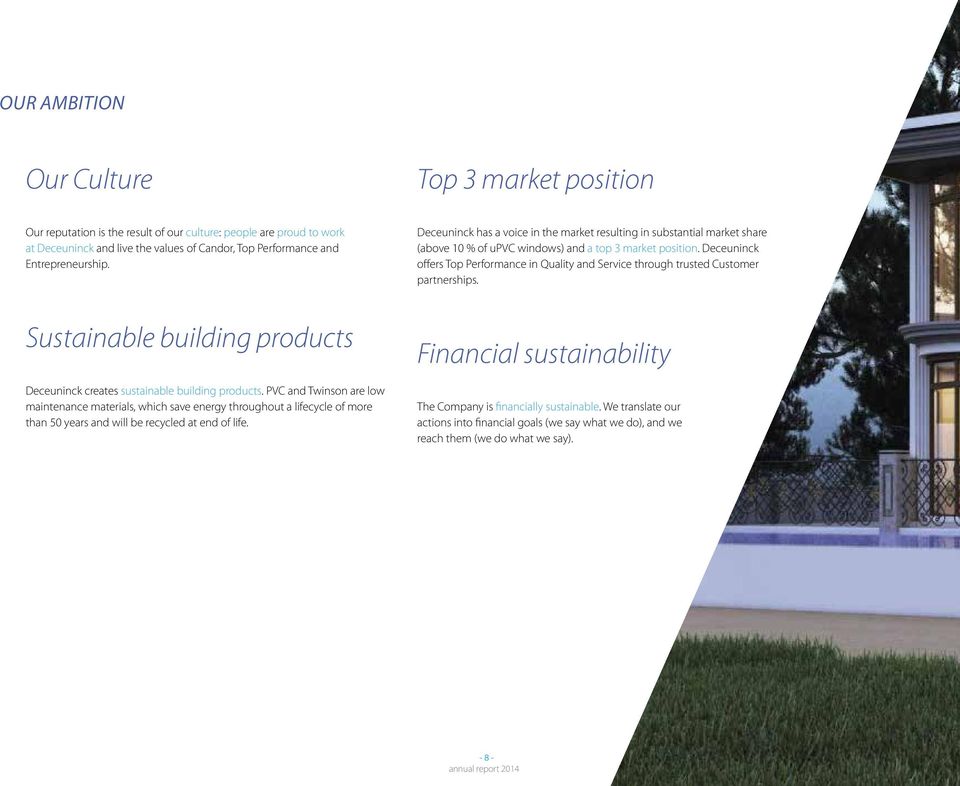
8 OUR AMBITION Our Culture Top 3 market position Our reputation is the result of our culture: people are proud to work at Deceuninck and live the values of Candor, Top Performance and Entrepreneurship. Deceuninck has a voice in the market resulting in substantial market share (above 10 % of upvc windows) and a top 3 market position. Deceuninck offers Top Performance in Quality and Service through trusted Customer partnerships. Sustainable building products Deceuninck creates sustainable building products. PVC and Twinson are low maintenance materials, which save energy throughout a lifecycle of more than 50 years and will be recycled at end of life. Financial sustainability The Company is financially sustainable. We translate our actions into financial goals (we say what we do), and we reach them (we do what we say)
9

10 MESSAGE FROM THE CHAIRMAN AND THE CEO Dear Shareholder, In 2014, our sales increased by 0.8% at a comparable scope. In each of our regions, the underlying dynamics were quite different. As of August, we saw an acceleration of some market trends. New build and renovation activity in continental Europe declined due to a deterioration of builder and consumer confidence. In our core markets France, Belgium and Germany, combining for 30% of our sales, our window fabricators were confronted with reduced demand. Especially in France, the delayed incentives for energy efficient renovation left homeowners to delay the replacement of their windows until In the region, the increasing competitive pressure of low cost window imports from Eastern EU countries further weighed on margins throughout the entire value chain. For Deceuninck, the appropriate action within this changed environment is to adapt our activities. We invest for capacity in growth regions, mainly Turkey, US and Emerging Markets. Meanwhile, we adapt our cost structure and invest for operational efficiency in Europe. In Central and Eastern Europe, we shift our operational footprint towards lower cost factories. We acquired a low cost factory in Southern Russia as part of the Pimapen acquisition. Here we produce the Enwin branded window profiles for the economy market segment in Russia. This will further strengthen our position in this highly competitive market. The Ukraine crisis is taking its toll on our market in Russia with a double digit decline, but the large potential in new construction and renovation remains. Also, in Western Europe, we are improving material costs through reuse of recycled PVC, while restructuring operations and overhead for better efficiency and lower cost. Tom Debusschere (CEO) and Pierre Alain De Smedt (Chairman) Expansion in our growth regions After the deep housing crisis that started in 2006, our USA activities now posted their 3rd consecutive year of double digit growth. Based on a proven track record of perfect service and innovative power, numerous new

11 Customers were signed in This guarantees further substantial growth in the near future. In 2014, we acquired Turkey s most recognized brand for windows, Pimapen. Deceuninck is now the leader in the world s 3rd largest PVC window market with 3 solid brands in the top segment. Despite devaluation of the Turkish lira early in 2014, and continued political tensions in neighbouring countries, sales remained solid. Margins in Turkey were slightly lower mainly due to a delayed pass through of raw material cost in the first half of the year. In Brazil, we acquired a distributor and in Chile we started production of foiled profiles to meet the growing demand for coloured windows. Outlook 2015 Consumer and builder confidence in Europe remains low and we expect continental Europe to remain stable. Growth in UK, USA, Turkey and Emerging Markets are expected to continue. We are confident that our continued actions to launch innovations, to improve productivity and to reduce structure costs will sustain our margins and will allow further growth of net profits Continued investment in product and process innovation We believe that our strategy of innovation, ecology, design is the right focus to help our window fabricators face the increased competition in our mature markets. Our capital expenditures in 2014 were 31.3 million (2013: 26.7 million). Zendow#neo now includes glass fibre reinforced door profiles. The range will be further completed with a new slimline door, matching aesthetics of an aluminium slider. We continued to develop our Omniral 360 coating technology. The launch has been delayed as the fine-tuning of a high quality water based coating is taking time and resources. The recycling activity which we started at the end of 2012 is going through its learning curve. In 2014 we initiated programmes and adapted our recycling organisation to bring the technology to the desired performance level. Tom Debusschere CEO Pierre Alain De Smedt Chairman Continued strengthening of our financial position The strengthening of our balance sheet continued. Since 2009 Deceuninck gradually reduced its net debt. The 50 million capital increase of August 2014 resulted in a gearing of 26.8% at year end
12 DECEUNINCK PRODUCT OVERVIEW

13 1 CLADDING 7 ROOFLINE 2 CLADDING 8 INTERIOR 3 ROLLER SHUTTERS 9 CLADDING 4 DOORS 10 SLINDING DOORS 12 5 LOUVRE SHUTTERS 11 TERRACES 6 WINDOWS 12 FENCING

14 DECEUNINCK PRODUCT OFFERING Product overview Deceuninck is a designer of PVC building solutions and producer of PVC and wood composite profiles for applications in residential and light commercial buildings. >90% of the final products end up in residential single or multifamily buildings. Deceuninck estimates that 75% of its final products are used in the renovation segment. Our products: the building envelope Our products: the building envelope 1. Windows & Doors Deceuninck s window & door systems are subdivided into 4 platforms to meet the demand and local building traditions of each of the regions in which Deceuninck is active. - Zendow platform for Western Europe - Inoutic platform for Central & Eastern Europe - Egepen Deceuninck, Winsa & Pimapen platform for Turkey and Emerging Markets - Deceuninck North America platform for the North American market Windows & Doors Windows & Doors 90% of sales 90% of sales worldwide worldwide Windows & Doors Windows & Doors Interior Decking Interior 1.1. Windows Roofline & Cladding Building Products 10% of sales worldwide Decking Roofline & Cladding Building Products 10% of sales worldwide For PVC windows and doors Deceuninck s Customers are window and door manufacturers who assemble the PVC and composite components to final products. The window manufacturers either install the windows and doors themselves or sell the windows to dedicated window installers. Outdoor living, roofline & wall cladding and interior applications are supplied to professional building material distributors or to DIY shops. Sound barriers are predominantly sold to main- and subcontractors of public infrastructure works

15 Innovation, ecology & design are the main drivers for new product development for windows and doors. Deceuninck s ambition is to offer the highest possible insulation at the lowest possible material consumption. Deceuninck s window systems are designed to meet the highest energy savings requirements. Deceuninck PVC windows and doors provide a perfect balance between energy efficiency and comfortable living. The high-quality energy-efficient PVC window and door solutions improve the quality of life in many ways. PVC windows and doors offer excellent thermal and acoustic insulation, high security and an original colour palette. The nicely designed window framing material can be equipped with the most commonly used glazing ranging from high performance double glazing up to 56mm triple glazing. Passive house insulation values (Uw 0.8 W/m2K) can be met by means of standard triple glazing. Eforte, the high end window line on the Inoutic platform in Central and Eastern Europe is certified as a passive house suitable system by the internationally renowned ift testing institute in Rosenheim (Germany). Eforte is a top of the range profile that makes no compromise when it comes to ultra energy-efficient living. In Western Europe Zendow#neo with Linktrusion technology offers superb insulation values for windows and doors that meet the nearly zero energy building requirements Europe is imposing for new public and private buildings respectively as of 2018 & Colour finishing Colour technologies are applied in function of regional market requirements. All regions offer window systems with single sided or double sided, laminated decorative films (predominantly wood structures). For high end markets in Turkey and Central & Eastern Europe clip on aluminium profiles have been developed. In Western Europe Deceuninck is developing Omniral finishing, a powder coated look on each of the four sides of the profile, for high end residential and commercial markets Doors Combining traditional design and expert craftsmanship, Deceuninck energyefficient doors feature endless design combinations to complement any façade. A wide variety of styles engineered for years of performance. Deceuninck s high quality PVC front doors boast excellent thermal insulation values as well as exceptionally high strength. The distortion-free and very stable frame design can be further enhanced using patented reinforced corner braces. Zendow#neo doors with linktrusion technology inside offer a higher stability and strength which makes corner braces redundant. They have a slimline design and have been developed to take larger door panels. The front doors can also be fitted with multi point locks and special fittings to attain a very high burglary protection. Deceuninck doors provide protection against adverse weather conditions and offer a high level of security. Deceuninck front doors can be fitted with all commercially available PVC, glass and aluminium panels and elegantly accentuate the architectural style

16 of new buildings. They can also be easily integrated in the façade of old buildings using different installation and mounting methods Roller Shutters Deceuninck doors are available in a wide range of foils and colour coated finishes in line with regional market requirements Sliding windows & doors In all markets except for North America, Deceuninck completes its window platforms with roller shutter systems that are specifically designed to meet local market requirements. In addition to the main window systems, Deceuninck offers a vast range of sliding systems. From the slimline Tecnocor system, the more robust but elegant Monorail system, to the heavy duty Lift&Slide system, Deceuninck s sliding doors extend the living room into the garden, terrace or balcony to create a generous space for living. The very good thermal and acoustic insulation values of Deceuninck roller shutters contribute towards an energy-efficient building design, and help save heating costs. They guarantee privacy, help protecting against burglars and bad weather conditions and are a highly efficient and an aesthetically appealing shading solution. Deceuninck roller shutters are easily and securely installed on the window frame using a clip-on adapter. It is possible to optionally fit the roller shutter with a fly screen and fully integrate the roller shutter box into the building envelope. Deceuninck roller shutters are designed to fit any kind of window (wood, PVC or aluminium) and are available in a wide range of colours

17 1.5. Louvre Shutters 2. Outdoor living: terrace and fencing 2.1. Terrace Deceuninck louvre shutters are designed to meet country specific requirements. They combine high quality with a wide range of designs, panel options and colours. Deceuninck louvre shutters are designed to meet all individual end consumer needs for an aesthetically nice shading solution. Deceuninck louvre shutters are available in a wide range of foils and colour coated finishes. Deceuninck terrace combines the benefits of wood with the unique properties of PVC. By combining the natural look of wood and the low maintenance of PVC into a single new base material, our Twinson outdoor flooring solutions meet all comfort demands with regard to your patio planks. This eco terrace will transform both the appearance and performance of your terrace. Terrace is ideal for residential applications such as patios and garden paths, whilst Terrace+ is more appropriate for applications demanding a more architectural touch. Terrace Massiv has been recently developed to further increase the performance of Twinson terrace. It is an ideal product for commercial or public applications

18 For the North American market Deceuninck developed and launched Clubhouse Decking. Clubhouse Decking is made from 100% PVC and has exceptional natural wood appearance featuring deep grain embossing, variegated or solid tone colours, and superior weather performance. Clubhouse Decking is completed by railing products including Elite Railing with a low-gloss, high performance finish Fencing 3. Rooflines and wall claddings The finishing of your home must be both aesthetic and durable, and Deceuninck s wall cladding and roofline systems certainly fulfil these two requirements. Deceuninck cladding systems are available in multichamber PVC, cellular foam or Twinson wood composite material. All of them are 100% recyclable Roofline In Europe Deceuninck offers excellent, low maintenance and long lasting fencing solutions. Fences are either made of woodcomposite Twinson panels or designed with PVC profiles (Grandparc). The Twinson fencing kit combines a standard decking solution in a robust and designful fence in harmony with a Twinson decking. Deceuninck offers a wide range of roofline, soffit and fascia products. They offer durable protection of your newbuild or refurbished home. Deceuninck roofline products are easy to install, require low maintenance during a 50+ life time and are available in a wide range of colours and textures. Grandparc offers Customers a multitude of colours and finishes

19 3.2. Wall cladding 4. Interior 4.1. Wall and ceiling covering products The premium Twinson cladding system heralds a new generation of external wall and façade cladding. By combining good insulation with the Twinson cladding system, you can optimise the external thermal insulation of your façade. Result? Lower energy bills and less CO2 emissions. Deceuninck has used all its ingenuity to combine elegance and functionality in a single product. Deceuninck s PVC ceiling and PVC wall covering enable endless interior decoration possibilities, from the most traditional to the most modern. They are available in both contemporary and more traditional style, as well as in a variety of colours. Twinson wall cladding is available in open and closed versions. Deceuninck s PVC cladding offers the best quality/price performance. It is available in a variety of shapes and colours. The cladding programme includes coextruded PVC external cladding using Cyclefoam technology, which can be finished with an embossed texture. A mass coloured PVC top layer guarantees the durability and low maintenance, both basic characteristics that are highly appreciated by the house owner

20 4.2. Window boards 4.3. Skirting & finishing trims Deceuninck PVC internal window boards are durable and robust. The Deceuninck internal window boards are produced from 100% recycled PVC. They are finished with an extremely durable decorative melamine finishing which makes them scratch resistant and resistant against cigarette glow. Deceuninck s PVC internal window boards are water and UV resistant, easy to install and are 100% recyclable. The Deceuninck skirting and finishing trims ensure a real finishing touch of your interior. Deceuninck skirting and finishing trims offer a seamless transition between your interior walls and flooring. They are available in various designs and dimensions in a wide variety of colours (wood imitations or plain colours). They are easy to install and water and impact resistant. Deceuninck s internal window boards are available in a wide range of colours and 5 different widths ranging from 180mm up to 400mm, each with the adhering end caps and finishing accessories

21 5. Sound barriers Innovation Ecology Design create new technologies and materials Some of the technologies used in manufacturing have been developed by Deceuninck itself and are therefore unique in its sector. Most of those unique technologies are protected by a number of patents. 1. Linktrusion Cyclefoam technology is used to manufacture sound barriers. As such they are easy to handle and install. Deceuninck s ability to coat profiles allows the company to offer sound barrier solutions that meet the aesthetic requirements of infrastructure architects. With its Cyclefoam sound barriers Deceuninck addresses two environmental issues simultaneously. It offers a solution for recycling and processing post-consumer rigid PVC into new high-quality applications and tackles the problem of sound pollution. Cyclefoam sound walls are used both for infrastructure works and private applications. For infrastructure works they are installed along motorways, airports and railways throughout Europe. As a private application Cyclefoam sound walls are an ideal product to reduce noise created by sporting events, play areas, schools. In industrial applications Cyclefoam sound walls are used to reduce noise from air-conditioning, industrial sites, high tension transformer houses, etc. Linktrusion refers to Deceuninck s unique approach in the development of new technologies & materials. It is the platform that can combine different materials & technologies into 1 single multi-component extrusion. Linktrusion allows the development of more efficient products by integrating more functionalities as well as the development of dedicated solutions for each specific application. Zendow#neo is the first application of the platform. In Zendow#neo, Linktrusion is the combination of continuous glass fibre reinforced PVC profiles and an extruded reinforcement profile with embedded steel wires combined with a low density PVC foam core resulting in a 30% improved insulation performance
22 2. Omniral Deceuninck developed Omniral, a new water based coating technology. The new proprietary coating process produces profiles with a powder coated look on all four sides, which results in a window without any visible white plastic. The new Omniral coating offers the end consumer the look and feel of an aluminium window, in combination with the insulation values of a high quality PVC product. In the meantime, Twinson has been awarded a number of certifications, including PEFC (Programme for the Endorsement of Forest Certification) and the quality labels VHI (Verband der Deutschen Holzwerkstoff Industrie e. V.) (Germany) and LNE (Laboratoire National de métrologie et d essais) (France). These awards underline Deceuninck s environmental approach to sustainable product design. 3. Twinson Deceuninck s 100% recyclable wood composite material, combines the best of both worlds: it looks and feels like wood, combined with the low maintenance and longevity of PVC. This makes it the perfect material for outdoor terraces. 4. Cyclefoam Deceuninck s closed loop philosophy, combined with its commitment to innovation, have resulted in Cyclefoam, a foam process in which rigid recycled PVC is extruded using innovative technology in order to produce high quality profiles. Cyclefoam is mainly used for the production of sound barriers, but it is also applied for roofline and cladding products. Twinson offers unlimited possibilities. On-going development of Twinson has created numerous appropriate installation options. Calculation software, downloadable from allows flawless installation
23 5. Rovex 6. Korelite Roxex is an advanced pultruded polyurethane fiber glass reinforced composite designed to serve as an alternative to conventional materials like metal, polyester fiberglass composites and concrete. It is used as a first step for Innergy thermal reinforcements. Innergy thermal reinforcements are advanced fibre glass reinforced resin inserts, designed to slide easily into window and door frame chambers for greater support and insulation. It is an up to 20-percent bio-based resin in its proprietary formulation. Incorporating soy and other renewable sources, the composite offers strength, stability and flexibility without using styrene or peroxide. Innergy thermal reinforcements are energy efficient reinforcements with all the strength and structural reinforcement of aluminium, but with superior thermal performance. Korelite is an advanced material science and extrusion technology that gives a rigid outer layer with a dense foam interior. Used in PVC decking it creates a product which is up to 25% ligher than wood, minimizies imperfections, voids and water absorption, while offering superior strength
24 DECEUNINCK WORLDWIDE PRODUCTION SITES RU Deceuninck RUS US GB FR BE DE PL CZ Pimapen Enwin RUS Winsa Egepen Deceuninck TR TH CL
25 BE Belgium Deceuninck NV PL Poland Inoutic / Deceuninck Sp. z o.o. TR Turkey Bruggesteenweg 360 Jasin, Ul. Poznanska 34 Ege Pen AS 8830 Hooglede - Gits Swarzedz A.O.S.B Sokak No:5 T F T F Cigli Izmir T F [email protected] [email protected] Deceuninck NV Divisie Compound Cardijnlaan 15 RU Russia [email protected] Winsa 8600 Diksmuide Deceuninck Rus OOO Sarımese Beldesi T F pr. Naumova, 5 Kızılcıklık Mahallesi, CL Chile Deceuninck Importadora Limitada Protvino, Moskou Regio T F İnonu Cad. Suadiye Yolu uzeri No: Sarımeşe / Kartepe /Kocaeli T F Volcan Lascar number 801, 3G and 3H, [email protected] Pudahuel, Santiago [email protected] T Enwin Rus OOO , Rostov oblast, Pimaş Plastik Inşaat Malzemeleri A.S. [email protected] Myasnikovsky district, Beylikbaği Mahallesi DE Germany Inoutic / Deceuninck GmbH Krym village, Liniya 5,1 T +7 (86349) ; +7 (86349) F +7 (86349) Istanbul Cad. No. 29, Gezbe/Kocaeli Bayerwaldstrase 18 T F Bogen [email protected] [email protected] T F [email protected] TH Thailand Deceuninck (Thailand) Co. Ltd. GB United Kingdom Deceuninck Ltd. FR France Deceuninck SAS Asia Profile Holding Co. Ltd. 2/3 Bangna Towers A, 17 Fl., Rm.1704B Bangna-Trad, Km. 6.5, Unit 2, Stanier Road exploitatiezetel Porte Marsh Industrial Estate Calne Wiltshire SN11 9PX Zone Industrielle Impasse des bleuets Bangkaew, Bangplee, T F Roye Samutprakarn T F T F [email protected] [email protected] CZ [email protected] Czech Republic Inoutic / Deceuninck Spol. s r. o. US United States Deceuninck North America LLC 351 North Garver Road Monroe, Ohio Vintrovna 23 T F Popůvky T F [email protected] [email protected]
26 DECEUNINCK GROUP STRUCTURE (AS PER 20 MARCH 2015) Belgium Deceuninck NV 100% The Netherlands Deceuninck Kunststof BV Deceuninck Beheer BV 99.99% 99.99% 0.01% 99.80% 0.20% Belgium Plastics Deceuninck NV 100% 100% 100% 100% 100% 100% 100% Czech Republic "Inoutic / Deceuninck spol. s r. o. United States Deceuninck North America LLC Deceuninck North America Inc. Australia Deceuninck Pty. Ltd. France 100% Deceuninck SAS 100% Romania Distridec SAS Bulgaria Deceuninck Romania SRL 100% 100% Deceuninck Bulgaria EOOD Pimapen Logistic Center S.R.L. 100% Lithuania 99.95% 100% United Kingdom Russia 0.05% Status Systems PVCu Ltd. Deceuninck Rus OOO Deceuninck Baltic UAB in liquidation Deceuninck Ltd. Enwin Rus OOO 100% Turkey Deceuninck Holdings UK Ltd. 100% 97.54% Ege Profil AS Range Valley Extrusions Ltd. Ireland 99.99% Ege Pen AS 0.01% 99.99% Deceuninck Ireland Unltd % Pimaș Plastik Insaat Malzemeleri Anonim Sirketi Germany Deceuninck Holding Germany GmbH 100% Poland Branches Inoutic / Deceuninck GmbH 18.62% "Inoutic / Deceuninck Sp. z o.o % 100% Deceuninck NV Sucursal en España Ege Profil Ticaret ve Sanayi Anonim Sirketi (India) Bosnia and Herzegovina Inoutic / Deceuninck d.o.o. Serbia Inoutic / Deceuninck d.o.o. Croatia Inoutic / Deceuninck d.o.o. 100% Thailand 48.98% 48.95% Deceuninck (Thailand) Co Ltd. Asia Profile Holding Co. Ltd. 51% 100% 100% 100% 100% Chile Deceuninck Importadora Limitada Brazil Deceuninck do Brazil Italy Deceuninck Italia S.r.l. 100% 99.99% 100% Rep. Offices/sales offices that are owned for 100% by Deceuninck NV: China and Kazachstan (in liquidation), 100% ownership of Deceuninck Rus OOO (Russia): Novosibirsk, Samara, Khabarovsk and St. - Petersburg; Minority participations: Deceuninck NV: 10% in Sistemas Sumum SL (Spain); Inoutic / Deceuninck GmbH: 9.52% Rewindo GmbH (Germany)
27 HIGHLIGHTS OF 2014 Inoutic wins Innovation award Architecture + Windows, Doors and Façades at Fensterbau, Nürnberg November: Zendow#neo wins SPE award for hybrid product innovation November 20: Listing of 26,315,789 new shares on Euronext Brussels January March May July September November February April June August October December Start industrial production woodcomposite compounding plant, Hooglede-Gits, Belgium August 24: Pimaş acquisition August 29: Announcement 50 million capital increase under authorised capital Shareholder structure changes into: Francis Van Eeckhout 21.02% Sofina 17.50% Desco (Deceuninck family) 14.05% October 1: Holve NV (with permanent representative Francis Van Eeckhout) & Bene Invest (with permanent representative Benedikte Boone) named new Board members: Willy Deceuninck & Giulia Van Waeyenberge leave the Board Francis Van Eeckhout named Vice-Chairman of the Board Willy Deceuninck named Honorary Member of the Board December: Wim Clappaert, Group director Operations and Technology December 26: Launch MPO (Mandatory Public Offer) outstanding Pimaş shares October 8: Acquisition of window profile distributor Althera (Brazil) Foundation of Deceuninck do Brazil in São Paulo October 15: Approval Pimaş acquisition (Turkey)
28 MANAGEMENT (AS PER 20 MARCH 2015) Executive Team Tom Debusschere CEO Philippe Maeckelberghe Chief Financial Officer Ann Bataillie Director HR & Legal Wim Clappaert Director Operations &Technology Ergün Cicekci Director Turkey and Emerging Markets Yves Dubois Director Southwest Europe General Manager France Filip Geeraert Director United States Artur Pazdzior Director Central & Eastern Europe General Manager Poland Bernard Vanderper Director Northwest Europe General Manager Benelux Internal Auditor Kim Swerts Internal Audit Manager Statutory Auditor Ernst & Young Bedrijfsrevisoren BCBVA, Represented by Jan De Luyck and Marnix Van Dooren Country Managers Deceuninck / Inoutic GmbH Edgar Freund Deceuninck Italy S.r.l. Inoutic / Deceuninck d.o.o. (Croatia) Mirko Anesi Deceuninck Rus OOO Volker Guth Inoutic / Deceuninck spol. S r.o Radek Slabak Deceuninck Ltd. Roy Frost Deceuninck NV Succursal en España Giorgio Grillo
29 CORPORATE GOVERNANCE STATEMENT Introduction Reference is made to the Belgian Corporate Governance Code 2009 (the Code ) ( in accordance to the law on the reinforcement of corporate governance of 6 April 2010 in modification of the Belgian Code on Companies. In this statement, the Board discusses the main aspects of its policy on corporate governance such as the Board s structure and functioning of committees, including a description of the main features of the internal control and risk management systems and the remuneration report. The Company s Corporate Governance Charter (the Charter ) has been drawn up in accordance with the recommendations stated in the Code. The Code is based on an apply or explain system: Belgian listed companies are to respect the Code, but can deviate from its provisions and instructions (not from its principles though) under the condition that the justification of any such departure is published. The Company s Corporate Governance Charter was last updated on 17 December 2013 and can be consulted on the Company s website ( Departure from the Code and the explanation thereof General Meetings and the publication of the General Meeting s Minutes (article 8.10 of the Code) The Board of Directors complies with the Code but holds the opinion that a departure from article 8.10 of the Code with regard to General Meetings and the publication of the General Meeting s Minutes is justified considering the Company s specific situation. The Company publishes the results of the votes of the General Meeting of Shareholders as soon as possible on its website after the meeting has taken place, in conformity with article 546 of the Belgian Code on Companies. As the shareholder is informed properly of the content of the decisions and results of the vote, the Company chooses not to publish the minutes in full. The majority of the members of the Audit Committee are non-independent, contrary to article 5.2/4 of the Code. The Board is of the opinion that the current composition sufficienty assists the Directors in their monitoring role. Furthermore, all members of the Audit Committee are adequately acquainted with financial and accounting matters in order to effectively perform their tasks
30 The Board of Directors Composition of the Board of Directors The articles of association determine that the Company is run by a Board of Directors composed of at least 3 Directors. At least half of the members of the Board of Directors should be Non-Executive Directors. At least three Directors should be independent. The current Board is composed of 8 Directors. One member is Executive Director ( CEO ) and 3 members are Independent Directors in accordance to the stipulations of, inter alia, article 526ter of the Belgian Code on Companies. The members are appointed by the General Meeting of Shareholders. Their initial term of office lasts maximum 4 years (based on the Company s Corporate Governance Charter) but can be renewed. The Remuneration and Nomination Committee presents one or more candidates, considering the needs of the Company and in compliance with the nomination and selection criteria established by the Board of Directors. In the composition of the Board of Directors an appropriate balance is taken into account on gender, skills, experience and knowledge. For each (re)appointment the Board of Directors respects the law on gender diversity. The age limit for Directors is set at 70 years at the time of the (re)appointment. In principle, a Director s term ends at the closure of the Annual General Meeting, at which moment his or her mandate can be considered ended. The Independent Directors meet the independence criteria specified in article 526ter of the Belgian Code on Companies and the Charter. An Independent Director who ceases to comply with the independence requirements must immediately inform the Board of Directors thereof. The General Meeting of 12 May 2015 will be asked to: -definitively appoint Holve NV with permanent representative Francis Van Eeckhout; -definitively appoint Bene Invest BVBA with permanent representative Benedikte Boone. -renew the mandate of Pentacon BVBA with permanent representative Paul Thiers; -renew the mandate of RAM Comm. VA with permanent representative Arnold Deceuninck; The Board of Directors meets at least 6 times a year or as often as considered necessary or desirable in the Company s interest. Each Director receives the documents before the meeting so that the Directors can sufficiently prepare for the meeting. All meetings of the Board are attended by the Chief Financial Officer and the Company Secretary. The Board of Directors met 8 times in At the meeting of 17 February 2014, Marcel Klepfisch, permanent representative of Marcel Klepfisch SARL was excused
31 Functions and membership of the Directors within the Board of Directors and its Committees per 20 March 2015: Name/function Membership Committees Gender Latest renewal mandate Mandate expiry Pierre Alain De Smedt* Chairman Tom Debusschere Comm. V with permanent representative Tom Debusschere CEO RAM Comm. VA with permanent representative Arnold Deceuninck Vice-Chairman Chairman of the Remuneration and Nomination Committee M 14/05/ /05/2017 / M 14/05/ /05/2017 Member of the Remuneration and Nomination Committee M 10/05/ /05/2015 François Gillet Vice-Chairman Member of the Audit Committee and member of the Remuneration and Nomination Committee M 13/05/ /05/2018 Holve NV** with permanent representative Francis Van Eeckhout Vice-Chairman Member of the Audit Committee M / next General Meeting Marcel Klepfisch SARL * with permanent representative Marcel Klepfisch Director Pentacon BVBA * with permanent representative Paul Thiers Director Bene Invest BVBA** With permanent representative Benedikte Boone Director Chairman of the Audit Committee and member of the Remuneration and Nomination Committee Member of the Audit Committee and member of the Remuneration and Nomination Committee Acting member of the Remuneration and Nomination Committee*** M 13/05/ /05/2018 M / 12/05/2015 F / Next General Meeting * Independent Director ** Co-opted by the Board of Directors during its meeting of 30 September 2014 as substitute of T.R.D. Comm. VA (with permanent representative Willy Deceuninck) and Giulia Van Waeyenberge. Francis Van Eeckhout en Benedikte Boone are married. *** This Director attends the Remuneration and Nomination Committee meeting as an acting member without voting right. After the dismissal of Willy Deceuninck (as permanent representative of T.R.D. Comm. VA) as Director, he was appointed Honorary Member on 23 September The Secretary of the Board of Directors is Ann Bataillie, Director HR & Legal
32
33 The curricula vitae of the members of the Board of Directors: Pierre Alain De Smedt (1944), Chairman Pierre Alain De Smedt obtained a Master in Business and Administration at the Solvay Business School (ULB), a Commercial Engineer Diploma and a Master in Economic and Financial Sciences at the ULB. Pierre Alain De Smedt was Deputy General of Renault Groupe SA and CEO of Volkswagen Vorst (B.), CEO of Volkswagen South America and CEO of Seat Spain. He also was Chairman of Febiac, the Belgian Automobile Federation and of Avis Europe Plc. He was Chairman of VBO/FEB until the end of April 2014 as well. He is currently Director of Recticel NV and Alcopa NV. Tom Debusschere (1967), permanent representative of Tom Debusschere Comm. V, CEO Tom Debusschere is Civil Engineer with a postgraduate degree Industrial Engineering. He began his career in 1992 as Logistics Manager at Deceuninck. Starting in 1995, he worked for 9 years at the American division, Dayton Technologies, where he became Vice President Operations. In 2004, he moved to the Belgian Unilin Group as president of the division Unilin Decor, a supplier of furniture components part of the American Mohawk Group. He came back to Deceuninck as VP Marketing & Sales on 1 December He was appointed CEO of Deceuninck by the Board of Directors on 6 February He is a member of the Belgian Corporate Governance Commission, and holds Board positions at EuPC (European Plastics Converters) and Essenscia (Belgian Federation Chemistry and Life Sciences). Arnold Deceuninck (1950), permanent representative of RAM Comm. VA, Vice-Chairman Arnold Deceuninck obtained a Bachelor in Accounting and Business Management. Arnold Deceuninck, the permanent representative of RAM Comm. VA, is currently Director of RAM Comm. VA, Binder NV, Deceuninck Auto s NV, Edero BVBA, Hunter & Colman NV and a Non-Executive Director of Didak Injection NV. François Gillet (1960), Vice-Chairman François Gillet obtained a Master in Business and Administration at the Leuven Management School (LSM). François Gillet is currently member of the Executive Committee and is Chief Investment Officer of Sofina NV, a financial holding company. As representative of Sofina NV, François Gillet also holds functions as Non-Executive Director in various participations of Sofina NV and in Emakina Group NV. Francis Van Eeckhout (1968), permanent representative of Holve NV, Vice-Chairman Francis Van Eeckhout obtained a Master of Commercial Engineering at the Catholic University of Leuven in In 1991 he obtained a licentiate in Applied Marketing in Aix en Provence. In 1992 het obtained a licentiate in Accountancy at the WHU in Koblenz. From 1992 till 1993 he worked at the marketing department of Bahlsen Keksfabrik in Hannover. From 1994 till 2011 he was managing director of Van Eeckhout NV (concrete), VVM NV (cement), Diamur NV (mortar) and Nivelles Beton NV (concrete). Since 2012 he s managing director of Gramo BVBA (holding) and Trustlube B.V. (lubricants)
34 Marcel Klepfisch (1951), permanent representative of Marcel Klepfisch SARL Marcel Klepfisch obtained a Diploma Commercial Engineer at the University of Antwerp. He has extensive experience in crisis management and was Chief Restructuring Officer at Deceuninck NV from February till October He was a member of the Board of Directors of Nybron Flooring International Switzerland, Chief Executive Officer at Ilford Imaging, member of the Executive Committee at Vickers Plc, Chief Financial Officer of BTR Power Drives and Chairman of the Board of Directors of Pack2Pack. He is currently a member of the Management Advisory Board of Tower Brook in London and Chairman of the Board of Directors of Volution in the UK and Chairman of GSE Group in France. Honorary Director During the meeting of 23 September 2014 Willy Deceuninck, permanent representative of T.R.D. Comm. V., offered his resignation as Director of the Company. Mr Willy Deceuninck worked for more than 40 years at the Company. The Chairman and all Directors wish to thank him for his efforts and valuable contribution to the development of the Company during all those years. Therefore, the Board of Directors decides to name Willy Deceuninck Honorary Director. Paul Thiers (1957), permanent representative of Pentacon BVBA Paul Thiers is an alumnus of the Catholic University of Leuven, where he holds degrees in Master of Law (1980) and in Master in Notaryship (1981), as well as of the Vlerick Management School, where he participated to PUB in From 1982 till 2005 he was co-ceo and member of the Board of Directors of the Belgian Unilin Group. He is among others member of the Board of Directors of Pentahold NV, Altior CVBA, Accent NV, ION, Vergokan and Origis NV. Benedikte Boone (1971), permanent representative of Bene Invest BVBA Benedikte Boone obtained a Master of Applied Economic Sciences at the Catholic University of Leuven in Benedikte Boone acquired management experience in Lotus Bakeries and in several familial companies such as Bene Invest BVBA, Holve NV and Harpis NV. f.l.t.r.: Marcel Klepfisch, Tom Debusschere, Arnold Deceuninck, Paul Thiers, Pierre Alain De Smedt, François Gillet, Benedikte Boone, Francis Van Eeckhout
35 Role of the Board of Directors The Board of Directors determines the Company s strategic objectives and may perform all activities necessary or useful to achieve the Company s corporate objective, with the exception of those activities that are expressly reserved by law or by the Company s articles of association for decision by the General Meeting of Shareholders. In carrying out its tasks, the Board of Directors acts in accordance with the interests of the Group. In conformity with article 524bis of the Belgian Code on Companies and in accordance with article 16 bis of the articles of association, the Board of Directors has by decision of 27 March 2013 devolved powers with regard to daily and operational management to the Executive Team. The Board of Directors recorded the devolved powers of the Executive Team in the Corporate Governance Charter. The Board of Directors is to monitor this Executive Team. The meetings of the Board of Directors are convened by the Chairman of the Board or by at least 2 Directors whenever the interests of the Company so require. The Board of Directors can solely deliberate and decide in case at least half of its members in office are present or represented. The decisions are taken by majority of votes, save exceptions stated in the articles of association. Activity Report of the Board of Directors During the past financial year the Board of Directors has dealt mainly with following topics: long-term strategy, monitoring innovation projects and the technology strategy, approval of investment files, monitoring of the business plans of the various regions, financial reporting, continuous monitoring of the debt and liquidity situation of the Group, preparation of the statutory and consolidated financial statements and annual report, monitoring of KPIs, preparation of the General Meeting, acquisition of the Turkish PVC window profile manufacturer Pimaş and decision on capital increase under the authorised capital. Furthermore, the Board also took note of the reports and proposed resolutions of the Audit Committee and the Remuneration and Nomination Committee and where necessary took decisions based on the recommendations of these committees. Evaluation of the functioning of the Board of Directors and Committees The Board evaluates itself on a regular basis. In 2012, a thorough performance evaluation of the Board of Directors and the Committees was conducted again. Based on the results of this evaluation, concrete measures were taken, which will be applied to the organisation and to the functioning of the Board meetings. Due to the Board composition change, no evaluation was conducted in The evaluation is planned for Committees of the Board In order to efficiently cope with its tasks and responsibilities, the Board of Directors has founded specialised committees to analyse specific matters and to give advice to the Board of Directors. The Board of Directors can rely on an Audit Committee and a Remuneration and Nomination Committee. The role of these Committees is purely advisory. The responsibility for ultimate decision making lies with the Board of Directors. The Board of Directors will see to it that the members of each Committee dispose of the specific knowledge and skills to enable proper functioning of the Committees
36 The Board of Directors determines the duties of each Committee concerning organization, procedures, management and activities. The role, duties and composition of these Committees are set out in the Company s articles of association and in the Corporate Governance Charter. Audit Committee In conformity with article 17 of the articles of association and article 526bis of the Belgian Code on Companies, the Company has founded an Audit Committee, whose members are appointed or dismissed by the Board of Directors. In principle, the Audit Committee consists of minimum three Directors. All members of the Audit Committee are Non-Executive Directors. The Chairman of the Board of Directors does not preside the Audit Committee. The current Audit Committee consists of four members in total, who are all Non-Executive Directors. Two members of the Audit Committee are independent as defined in article 526ter of the Belgian Code on Companies. The Audit Committee assists the Board of Directors in the execution of its supervisory assignment and is the most important link between the Board of Directors and the internal and statutory auditor. The Audit Committee is composed as follows: - Marcel Klepfisch SARL, with permanent representative, Marcel Klepfisch, Chairman; - François Gillet - Holve NV, with permanent representative Francis Van Eeckhout (since 01/10/2014); and - Pentacon BVBA, with permanent representative, Paul Thiers. The Committee met 4 times last year. In 2014, the Audit Committee has assisted the Board of Directors in the execution of its responsibilities in the broadest sense and has among others executed the following tasks: - monitoring of audit activities, along with the systematic verification of signed missions by the auditor; - assessing the reliability of financial information; - supervising the internal audit system; - controlling of the accounts and monitoring the budget; and - recruitment and selection internal auditor. The Committee has assessed the internal control systems and the risk management, established by the Executive Team as proposed by the Risk Manager. The Committee ensures that the most important risks (including the risks relating to compliance with existing legislation and regulations) are correctly identified and that risk control systems are being implemented in the Group. The Committee further ensures that the Company s Board of Directors is kept informed on these matters. Furthermore, the Audit Committee makes recommendations to the Board of Directors relating to the selection, appointment and reappointment of the statutory auditor and the terms of his or her appointment. The Audit Committee meets as often as necessary to assure proper functioning, but assembles at least four times a year. In principle, Audit Committee meetings are convened by the Chairman of the Audit Committee. Each member can convene the Audit Committee. At least two members have to be physically (or by telephone conference) present during the meeting. Decisions are taken by majority vote. The Chairman of the Board of Directors is invited to attend each Audit Committee meeting. Furthermore, the CEO, the CFO, the internal or statutory auditor are invited
37 Remuneration and Nomination Committee The Remuneration and Nomination Committee consists of at least three Directors. In principle, all members of the Remuneration and Nomination Committee are Non-Executive Directors. However, the CEO can attend the Remuneration and Nomination Committee meetings when the remuneration of the other Executive Team members is discussed. The Chairman of the Board of Directors or another Non-Executive Director presides the Remuneration and Nomination Committee. The current Remuneration and Nomination Committee is composed as follows: - Pierre Alain De Smedt, Chairman; - François Gillet; - RAM Comm. VA, with permanent representative Arnold Deceuninck; - Marcel Klepfisch SARL, with permanent representative Marcel Klepfisch; - Pentacon BVBA, with permanent representative Paul Thiers; The Remuneration and Nomination Committee meets as often as necessary to assure proper functioning, but assembles at least twice a year. The meetings are normally convened by the Chairman of the Remuneration and Nomination Committee, but they can also be convened by another member. At least two members have to be physically (or by telephone conference) present during the meeting. Decisions are taken by majority vote. The CEO attends every meeting of the Remuneration and Nomination Committee during which the remuneration and appointment of the members of the Executive Team is discussed. The Committee met three times last year. The Committee has further evaluated the remuneration policy of the members of the Executive Team and it has also assessed the policy s market conformity. Bene Invest BVBA, with permanent representative Benedikte Boone is acting member of the Remuneration and Nomination Committee. She has no voting right within the Committee. All members of the current Remuneration and Nomination Committee are Non-Executive Directors and the majority is independent. This Committee presents proposals to the Board of Directors with regard to (1) the remuneration policy and the remuneration of the Directors and the Executive Team; and (2) the policy with regard to the (re)appointment of Directors and members of the Executive Team. Taking into account their education and professional experience, the members have the necessary expertise in the field of remuneration policy
38 The Executive Team The Executive Team is a Management Committee in the sense of article 524bis of the Belgian Code on Companies. The Board of Directors has founded the Management Committee according to article 16bis of the articles of association. This modification of the articles of association was approved by the Extraordinary General Meeting of 15 March By decision of 27 March 2013, the Board of Directors has devolved powers with regard to daily and operational management to the Management Committee in conformity with article 524bis of the Belgian Code on Companies. As of 2013, the Belgian members of the Executive Team are remunerated as self-employed managers. The powers of the Executive Team are listed in the Charter. The Management Committee maintains the name Executive Team. The task of the Executive Team is to assist the CEO in the daily and operational management of the Group and to carry out responsibilities in accordance with the values, strategies, policies, plans and budgets established by the Board of Directors. The Executive Team meets as often as necessary for the proper execution of its function, but in any case at least once every two weeks. Meetings are generally convened by the CEO, although any member may convene this Team. The Chairman of the Board of Directors may attend any meeting of the Executive Team. A report is sent to the Chairman of the Board of Directors after each meeting. The Executive Team currently consists of the following persons: - Tom Debusschere Comm. V, with permanent representative Tom Debusschere, CEO, Chairman of the Executive Team - Philippe Maeckelberghe, Chief Financial Officer - Ann Bataillie, Director HR & Legal, Secretary of the Board of Directors and the Executive Team - Wim Clappaert, Director Operations & Technology - Ergün Cicekci, Director Turkey & Emerging Markets - Yves Dubois, Director Southwest Europe & General Manager France - Filip Geeraert, Director United States of America - Artur Pazdzior, Director Central & Eastern Europe - Bernard Vanderper, Director Northwest Europe, General Manager Benelux In September 2014, Bart Louwagie left the Executive Team. He was replaced by Wim Clappaert in December In February 2015, Bruno Deboutte left the Executive Team. He was replaced by Artur Pazdzior. Tom Debusschere (1967), permanent representative of Tom Debusschere Comm. V CEO, Chairman Executive Team Tom Debusschere is Civil Engineer with a postgraduate degree Industrial Engineering. He began his career in 1992 as Logistics Manager at Deceuninck. Starting in 1995, he worked for 9 years at the American division, Dayton Technologies, where he became Vice President Operations. In 2004, he moved to the Belgian Unilin Group as president of the division Unilin Decor, a supplier of furniture components, part of the American Mohawk group. He came back to Deceuninck as VP Marketing and Sales on 1 December He was appointed CEO of Deceuninck by the Board of Directors on 6 February He is a member of the Belgian Corporate Governance Commission, and holds Board positions at EuPC (European Plastics Converters) and Essenscia (Belgian Federation for Chemistry and Life Sciences)
39 Philippe Maeckelberghe (1960) Chief Financial Officer Philippe Maeckelberghe is Chief Financial Officer of Deceuninck since June 2008 and responsible for IT since Previously he held various financial positions at Cisco, Scientific-Atlanta, BarcoNet and Barco. Philippe Maeckelberghe obtained a Master in Applied Economic Sciences at the University of Antwerp (1982), a Master of Business Administration at the Catholic University of Leuven (1983) and a Master in Controllership Chartered Controller BIMAC at the Vlerick Leuven-Gent Management School (1999). Ann Bataillie (1959) Director HR & Legal, Company Secretary Ann Bataillie joined Deceuninck in February Before she joined Deceuninck, she worked as senior legal counsel at Barco for 15 years. Ann Bataillie obtained a Master of Law at the Catholic University of Leuven (1981) and completed her education with a Master in European Law at the University of Nancy II, France (1982). She completed her studies in European Law by following a training course at the European Commission (D.G. Internal Market). Moreover, she acts as HR Director on Group level since April Wim Clappaert (1967), Director Operations & Technology Wim obtained a Master of Mechanical Engineering and a postgraduate degree in Business Management at the Catholic University of Leuven. He started his career at Deceuninck in In 1996 he became Production Manager at the extrusion site Acro Extrusion in Wilmington, Delaware (US) where he introduced Deceuninck s best practices. In 1997 he was appointed Director Operations at Deceuninck North America in Monroe, Ohio. In 2000 he returned to Belgium and became General Manager of the extrusion site in Gits. He left Deceuninck in 2007 and became Director Operations of the insulation unit at Unilin. On 1 December 2014 Wim Clappaert started at Deceuninck as Director Operations & Technology and became a member of the Executive Team. Ergün Cicekci (1954) Director Turkey & Emerging Markets Ergun Cicekci joined Deceuninck as General manager Turkey in 2000 with the acquisition of Ege Profil by Deceuninck. He started his career in the plastics industry in 1981 with ETAP, where he was responsible for operations. In 1987 he moved to the Mazhar Zorlu Group where he took up the function of Export Manager. He continued his career by adding responsibilities for all the capex of the group and becoming General Manager of Ege Profil. Ergün Cicekci has a degree in Mechanical Engineering from Istanbul Technical University (1975) and obtained a Master of Science in Systems Design from Aston University (Birmingham, 1979)
40 Yves Dubois (1961) - Director Southwest Europe & General Manager France Yves Dubois joined Deceuninck as Director Southwest Europe & General Manager France and Spain in September He started his career with Atochem in 1987, where he held several positions of Business Manager in basic chemicals & polymers and Managing Director of subsidiaries in Asia (Hong Kong and South Korea). Until August 2011, he was Director of the Alphacan (Arkema Group) Profile Business Unit. Yves Dubois obtained a Master of Economics and International Affairs (1986) at Paris Dauphine University and is currently Chairman of the French plastics extrusion trade association S.N.E.P. (Syndicat National de l Extrusion Plastique - profilés et compounds). Filip Geeraert (1959) Director United States of America Filip Geeraert joined Deceuninck in December 1997 as Corporate Controller. He moved to the American division, Dayton Technologies, in 2000 as Vice President Finance. As of April 2011 he holds the position of Director of the Deceuninck North America. Before Deceuninck, he worked in several finance positions in Belgium, Italy and the US for Bekaert. Filip Geeraert obtained a Master Applied Economic Sciences at the University of Antwerp (1981) and a Master in Information Technology at the University of Leuven (1982). Artur Pazdzior (1970) - Director Central & Eastern Europe Artur holds a Master of Science in Mechanics from the Technical University in Poznań, a post-graduate degree in Plastics and Rubber Processing ( ) and an MBA from Nottingham Trent University/Wielkopolska Business School in Poznań ( ). He started his career in 1994 with WAVIN, where he led a 250 person extrusion and injection moulding factory for PVC, PP and PE pipe and fitting. In 2008, he became Sales & Marketing Director in WAVIN Metalplast. Since 2009, he was CEO for the biggest division of UNIPETROL, a stock listed petrochemical group in Prague; responsible for 1600 people and 3 billion EUR sales. He joined Deceuninck as Managing Director of Inoutic/Deceuninck Polska in 2014 and became a member of the Executive Team in February Bernard Vanderper (1962) - Director Northwest Europe, General Manager Benelux Bernard Vanderper joined Deceuninck in Until 1997, he was the Sales Manager of Benelux. As from 1998 he has been General Manager Benelux. In October 2009 he also became Director Northwest Europe. Bernard Vanderper obtained a Master Applied Economic Sciences at the University of Antwerp (1984)
41 Remuneration Report Remuneration policy and specification of the level of remuneration for Non-Executive Directors The General Meeting of the Company fixes the remuneration of Directors following the proposal of the Board of Directors which is based on the recommendations of the Remuneration and Nomination Committee. Non-Executive Directors receive a fixed amount as remuneration for the execution of their mandate and a fixed amount for each Board meeting attended, limited to a maximum amount. Performance-based remuneration such as bonuses, stock-related incentive programs and fringe benefits are excluded. The amount of remuneration is different for the Chairman, the Vice-Chairman and the other Non-Executive Directors. If the Non-Executive Directors are also members of a Committee, their remuneration will be increased by a fixed amount per meeting of the particular Committee. These amounts remained the same in The Group shall not issue any personal loans, guarantees, etc. to the members of the Board of Directors or the Executive Team. If Directors are assigned special tasks and projects, they may receive an appropriate remuneration for this. No termination compensation is provided for Non-Executive Directors. In line with the overall remuneration strategy of the Company, the Remuneration and Nomination Committee regularly establishes a benchmark for the remuneration of Non-Executive Directors with comparable Belgian listed companies. This is done in order to ensure that the remuneration is still appropriate, and in conformity with market practices, taking into account the size of the Company, its financial situation, its position within the Belgian economic environment, and the responsibilities that the Directors bear. Remuneration of the Board of Directors in 2014 The total gross remuneration paid to the non-executive members of the Board of Directors in the financial year 2014 amounted to 311,000 ( 289,500 in 2013). There were 8 meetings of the Board of Directors in 2014, and there were 7 meetings in This amount includes additional remuneration granted to Directors for their membership of Committees. This remuneration is awarded by the General Shareholders Meeting and is registered as a general cost. In 2014, the Company or any affiliated Company of the Group did not grant any loans to any of the Directors, nor are there any outstanding repayments owed by the Directors to the Company or any affiliated Company of the Group. The remuneration for the Board members François Gillet and Giulia Van Waeyenberge has been paid to their employer, Sofina NV. The gross remuneration for 2014, as recommended by the Remuneration and Nomination Committee, is composed of: In Min/year (fix) Allowance per Board of Directors Allowance per Committee Max/year Chairman 40,000 3,000 1,000 80,000 Vice-Chairman 30,000 1,500 1,000 60,000 Director 20,000 1,500 1,000 40,
42 Remuneration Non-Executive Directors Name Attendances of the Board of Directors Attendances of the Remuneration and Nomination Committee Attendances of the Audit Committee Total gross remunerations (in ) Pierre Alain De Smedt 8/8 3/3 / 67,000 François Gillet 8/8 3/3 4/4 49,000 Holve NV permanently represented by Francis Van Eeckhout 2/8 / 1/4 11,500 RAM Comm. VA permanently represented by Arnold Deceuninck 8/8 3/3 / 45,000 T.R.D. Comm. VA permanently represented by Willy Deceuninck 6/8 / / 29,000 Giulia Van Waeyenberge 6/8 / / 24,000 Marcel Klepfisch SARL permanently represented by Marcel Klepfisch 7/8 3/3 4/4 37,500 Pentacon BVBA permanently represented by Paul Thiers 8/8 3/3 4/4 39,000 Bene Invest BVBA permanently represented by Benedikte Boone 2/8 1/3 / 9,000 Remuneration policy and specification of the remuneration level for the CEO and the members of the Executive Team The remuneration of the members of the Executive Team, including the CEO, shall be determined by the Board of Directors based on the recommendations of the Remuneration and Nomination Committee. The aim of the general remuneration policy of the Group is to attract, retain and motivate competent and professional employees. For this reason, the amount of the remuneration shall be determined in proportion to the individual tasks and responsibilities. The Remuneration and Nomination Committee annually reviews and fixes the total compensation based on the strategic positioning of each of the functions versus the benchmark in the market and the expected market trends. Every two year a thorough benchmark shall be conducted with comparable international companies of similar size and structure. The contribution made by members of the Executive Team to the development of the activities and the results of the Group constitutes an important part of the remuneration policy. The total remuneration of the Executive Team members comprises the following elements: the fixed remuneration, the short term variable remuneration, options and/or warrants. The fixed remuneration of the members of the Executive Team shall be determined according to their individual responsibilities and skills. It shall be awarded independently of any result
43 Additional to the fixed remuneration, the Company assigns a sum amounting to 8% of this fixed remuneration to each member of the Executive Team. This amount may be used, at the discretion of the Executive Team member, for pension and insurance contributions like: - the payment of a life endowment in favour of the insured person on the date of his retirement; - the payment of a death benefit in case of death of the member prior to retirement, for the benefit of its beneficiaries (plus an additional benefit in case of accidental death); - the payment of a disability annuity in case of accident or sickness (other than occupational), and; - the exemption from insurance premiums in case of illness or accident. - health insurance. Short-term variable remuneration: In order to align the interests of the Company and its shareholders with the interests of Executive Team members, part of the remuneration package shall be linked to Company performance and another part to individual performance. By weighing both factors against each other in a responsible manner (85% corporate results/15% individual results) a balance can be achieved between a result-oriented approach (Top Performance) and the manner in which these results are obtained (taking into account the core values, i.e. Candor, Top Performance and Entrepreneurship). If the manner in which results were obtained is not totally in line with the core values, the Remuneration and Nomination Committee reserves the right to decide not to pay any bonus. Since 2013, the variable remuneration philosophy applied for the CEO is the same as the one that was already being applied for other members of the Executive Team. For the members of the Executive Team, the performance of the Company (85%) is based on the ROCE and the REBITDA of the past financial year. The Board of Directors reviews these criteria annually on the proposal of the Remuneration and Nomination Committee, and may revise them if necessary. For 2014, the evaluation criteria for the performance of the CEO and the other members of the Executive Team were: ROCE (15%) and REBITDA (70%). For members of the Executive Team who bear an ultimate responsibility at a regional level, the ROCE of the Group (15%) and the REBITDA of the region (70%) are taken into account to consider the Company performance. The variable remuneration related to the business objectives is only paid if 80% or more of the intended financial targets are achieved. For the 2014 performances no variable remuneration was paid to the members of the Executive Team except for the regional directors of Turkey & Emerging Markets and the US. The Remuneration and Nomination Committee stated that, only for the regions Turkey & Emerging Markets and the US, the 2014 performance objectives were achieved. Consequently, it suggested to the Board of Directors not to pay any variable remuneration. The Executive Team members of the regions Turkey & Emerging Markets and the US were, however, paid a variable remuneration, as the objectives were actually achieved in these regions. The individual performance (15%) is based on a clearly defined evaluation system that is built around the achievement of specific measurable individual targets, the realization of important key figures and conformity with core values which are important to the Company. All the targets must always be in line with the group strategy, the business plan, the core values and the guidelines. The individual targets are set annually during individual interviews at the start of the financial year. The short-term variable remuneration is in principle 30% of the fixed annual remuneration for the members of the Executive Team and 75% of the annual fixed remuneration of the CEO. This percentage may be exceeded as far as the Company results are concerned, but should never exceed 37.65% (for the members of the Executive Team) or 97.5% (for the CEO). The variable remuneration is not spread over time. The Extraordinary General Meeting of the Company of 16 December 2011 decided that the Company is not bound by the limitations of the rules of article 520ter paragraph 2 of the Belgian Code on Companies concerning the spreading of the variable
44 remuneration of the Directors, the CEO and members of the Executive Team, over time. The Company also offers options and/or warrants on shares of the Company. The purpose of this kind of remuneration is to motivate and retain employees who (can) have a significant impact on the Company results in the medium-term. When granting options and/or warrants, due account is taken of the strategic impact of the function that the employee performs and his/her future (growth) potential. The underlying philosophy of this form of remuneration is to raise Deceuninck s value to the maximum extent in the long term, by linking the interests of the management to those of shareholders, and to strengthen the long-term vision of the management. In this context, the exercise period of an option and warrant is 10 years. The stock options and warrants can only be exercised the 3rd year following the year in which the options and warrants were offered. If they are not exercised at the end of the exercise period, they are, ipso facto, reduced to zero, and lose all value. One third of the warrants/options are each time released for exercise in the fourth, in the fifth and in the sixth calendar year after the year in which the offer has been made up to the end of the term. In the event of voluntary or involuntary dismissal (except in case of termination of contract for cause), the accepted and acquired stock options/ warrants can only be exercised during the first exercise period following the date of the termination of contract. The options/warrants that are not acquired shall be cancelled. In the event of involuntary dismissal for cause, the unexercised, accepted stock options and warrants are cancelled, whether or not they were acquired. These terms and conditions relating to the acquisition and exercise of options and warrants in the event of voluntary or involuntary dismissal can be applied without prejudice to the competence of the Board of Directors to make changes to these stipulations to the advantage of the beneficiary, based on objective and relevant criteria. If the employment agreement ends due to legal retirement or end of career, the warrants/options shall remain exercisable. The shares that may be acquired in connection with the exercise of the options/warrants are listed on Euronext Brussels; they are of the same type and have the same rights as the existing ordinary Deceuninck shares. The members of the Executive Team have no other remuneration linked to shares. Remuneration for the next two financial years The remuneration policy shall continue in its current form. Remuneration of the CEO and the members of the Executive Team In the report on the remuneration of the CEO and the members of the Executive Team, the basis for the variable remuneration is the remuneration earned during the financial year. The payment takes place end of February of the following year. In 2014, the total remuneration of the members of the Executive Team (including the CEO) amounted to 2,214,519 (3,026,968 in 2013), Except for the regions US and Turkey & Emerging Markets, no variable remuneration was paid in CEO The CEO received a fixed remuneration in the amount of 490,000 in This is the same amount as in No variable remuneration was acquired in Since December 2014, the CEO s car is leased by the CEO himself. The leasing costs are reimbursed to the CEO. Formerly, the Company provided the CEO with a car by means of a leasing contract. The Company bears the fuel costs.the pension allocation (fixed amount) amounts to 39,200. Members of the Executive Team Members of the Executive Team (including one member that no longer works for the Company since September 2014 and one new member since the beginning of December 2014, excluding the CEO) received a remuneration of 1,924,519 last year ( 2,202,398 in 2013). Except for the
45 members responsible for the regions US and Turkey & Emerging Markets, no variable remuneration was paid in The retirement allowance amounted to 83,003 and consists of approved contributions to an external insurance company. The amounts for 2014 are gross remunerations to which withholding taxes were levied by the Company with the new selfemployed status of the members of the Executive Team and where the members themselves are responsible to pay the social contributions applicable to their self-employed status. In the course of 2014 one member left the Executive Team. Options and/or warrants on shares of the Company are granted to the members of the Executive Team. The Extraordinary General Meeting of October 2006 approved an option plan on existing stock under which the Board of Directors is granted the authority to allocate 75,000 options on existing shares each year. During its meeting of 17 December 2013, the Board of Directors approved an additional warrant plan for 2013 within the authorised capital for the issue of 3,000,000 warrants (Warrant Plan 2013), of which 930,000 warrants were offered in December The members of the Executive Team were offered 570,000 warrants of this Warrant Plan 2013, which were granted as follows: Each member of the Executive Team was offered 27,500 warrants; the CEO was offered 350,000 warrants. The warrants offered in 2014 have an exercise price of 1.79 (for the members of the Executive Team and the CEO). Mr Filip Geeraert excercised 11,666 warrants during Right of recovery The stipulations of the agreements between the Company and the CEO and the members of the Executive Team do not contain recovery clauses. Severance Pay For the members of the Executive Team and the CEO, special severance pay conditions of 12 months base salary have been agreed in the management agreements. One member left the Executive Team during A 12 month base salary was paid. No special agreements that could deviate from the applicable current employment laws and practice were made with the regional managers in France, North America and Turkey. Audit The statutory auditor, Ernst & Young Bedrijfsrevisoren BCBVA, represented by Jan De Luyck en Marnix Van Dooren was appointed for a period of 3 years at the General Annual Shareholders Meeting of 13 May His annual fee amounted to 586,320 in 2014 ( 540,000 in 2013) for the whole Group, including audit services for the consolidated and statutory accounts. Deceuninck provides a company car to the members of the Executive Team. In this context, the Company tries to achieve a maximum balance between the representative attributes of the car and the personal needs of the members of the Executive Team. Under the Environments charter, the environmental impact, including consumption and CO2 emissions, plays a substantial role during the selection of these types of cars
46
47 Transactions Between Related Parties General Each Director and each member of the Executive Team is encouraged to arrange their personal and business interests so that there is no direct or indirect conflict of interest with the Company. Deceuninck has no knowledge of any potential conflict of interest affecting the members of the Board of Directors and the Executive Team between any of their duties to the Company and their private and/or other duties. The Charter provides that every transaction between the Company (or any of its subsidiaries) with any Director or executive manager must be approved in advance by the Board of Directors, whether or not such a transaction is subject to applicable legal rules. Such a transaction can only take place based on terms in accordance with market practices. Directors conflicts of interest In accordance with article 523 of the Belgian Code on Companies, the Board should respect a special procedure in case that one or more Directors potentially have a conflict of interest with one or more decisions or transactions that are within the authority of the Board of Directors. Two cases of conflict of interest in the sense of article 523 of the Belgian Code on Companies were communicated to the Board of Directors during One case was communicated in 2012 and These conflicts of interest each time concerned the offer of warrants to certain employees, senior management members and to the members of the Executive Team. The CEO each time informed the Board of Directors about the potential conflict of interest. In accordance with the stipulations of article 523 of the Belgian Code on Companies and taking into account that the Company is a public Company listed on the stock exchange, the Director involved was asked to leave the meeting during the discussion of this point. As a consequence, the Director involved did not participate in the deliberations or in the vote on the issue. The conflict of interest settlement of article 523 of the Belgian Code on Companies was not applied in Transactions with affiliated companies The conflict of interest settlement of article 524 of the Belgian Code on Companies was not applied in Authorization purchase treasury shares Following is stated in article 39 of the Company s articles of association: At the Extraordinary Annual Meeting of 18 December 2012, it was decided to grant the Board of Directors the authority to acquire treasury shares, by purchase or exchange, directly or by intervention of a person who acts in his own name but at the expense of the Company at a minimum price of 0.40 and at a maximum price of 6.00, provided that by doing so, not for a moment the Company possesses treasury shares whose nominal value is higher than 20% of the Company s subscribed capital. No preceding decision by the General Meeting is necessary in case the acquisition of stocks occurs in order to offer them to the Company s staff
48 Furthermore, the Board of Directors is authorized to sell these shares without being bound to above-mentioned price and time limitations. This authorization is valid for a period of five years starting on 18 December 2012 an can be renewed in accordance with article 620 of the Belgian Code on Companies. During the financial year 2014, no treasury shares were purchased. At the Extraordinary Annual Meeting of 18 December 2012, it was decided to grant the Board of Directors the authority to acquire or sell treasury shares, profit-sharing bonds or certificates which relate to these bonds, according to article 620 and the following of the Code on Companies, when the acquisition or alienation is necessary to avoid threatening serious damages to the Company. This authorization is valid for a period of three years as from its publication in the Annexes to the Belgian Official Gazette and can be renewed in accordance with article 620 of the Code on Companies. Authorised capital In accordance with article 38 of the Company s articles of association, the Board of Directors is authorized, for a period of 5 years as from the date of publication of the deed concerning the modification of the articles of association dated 18 December 2012 (i.e. 4 February 2013), to increase the Company s issued capital on one or several occasions to a maximum amount of 42,495, This capital increase can take place in conformity with the conditions determined by the Board of Directors by a cash contribution, a contribution in kind, an incorporation of the reserves or share premiums, with or without the issuance of new shares, as well as by issuing debt securities that can be converted to shares on one or several occasions, debt securities with warrants or warrants that whether or not are linked to other stocks. However, the capital increase as decided by the Board of Directors cannot be reimbursed by shares without indication of nominal value issued below accountable par value of the old hares. The Extraordinary General Meeting of 18 December 2012 authorized the Board of Directors, for a period of 3 years, under the conditions and within the limitations of article 607 of the Belgian Code on Companies, to use the authorised capital in case of notification by the Financial Services and Markets Authority (FSMA) of a public takeover bid on the Company s shares. The Board of Directors determines the data and conditions of the instructed capital increases in application of the foregoing, including the possible payment of issue premiums. If the foregoing occurs (including for the issuance of convertible debt securities or warrants), the Board of Directors determines, in accordance with articles 592 and following of the Belgian Code on Companies, the term and other conditions concerning the exercise of the shareholder s preferential rights as assigned by the law. Furthermore, it can, in accordance with articles 592 and following, in the Company s interest and under the conditions determined by law, limit or cancel the shareholder s preferential rights in favour of one person or several people that are selected, no matter whether or not these people are part of the Company s or its subsidiaries staff. If an issue premium is paid as a consequence of a capital increase, than it is transferred by right to an unavailable account named issue premiums which can only be used under the conditions required for the capital decrease. It can, however, always be added to the instructed capital; this decision can be taken by the Board of Directors as stated above. Furthermore, said extraordinary shareholder meeting of the Company authorized the Board of Directors, considering the coordination of the articles of association, as soon as the authorized capital or a part of it is converted into instructed capital, to amend the relevant article of the articles of association
49 The Board of Directors partially made use of this authorization on 17 December 2013 by issuing warrants within the framework of the 2013 warrant plan. In order to issue this plan, the Board of Directors used 1,183, of the authorized capital. For the capital increase at the end of August 2014, another 10,378, of the authorized capital was used. Capital increase On 26 August 2014 the Company decided on a capital increase in cash. This was decided by the Board of Directors under the authorised capital. Mr François Gillet and Ms Giulia Van Waeyenberge did not participate in the voting of this decision. In conformity with article 38 of the articles of association, the Board of Directors of the Company is authorised to increase the instructed capital under the authorised capital. This authorization that also implies the cancellation of the preference rights of existing shareholders in favour of one person or several people was granted by the General Meeting of 18 December 2012 and is valid for a period of 5 years as from the publication in the Annexed to the Belgian Official Gazette on 4 February On 29 August ,315,789 new shares were effectively issued to an issue price of 1.90 per share for a total amount of 49,999, (issue premium included). The following legal entities subscribed to the capital increase: (i) Gramo BVBA, having its registered office at 8800 Roeselare, Vlaanderenstraat 2, included in the register of legal entities at Gent, division Kortrijk, registered business number for 21,710,526 shares; and (ii) Sofina NV, having its registered office at 1040 Brussel, rue de l Industrie 31, included in the register of legal entities at Brussel, division Brussel, registerd business number for 4,605,263 shares. The preferential rights of the shareholders were dissolved during the capital increase in favour of the investors. In accordance with articles 596 and 598 of the Belgian Code on Companies, the Board of Directors of 26 August 2014 drafted a special report in order to account for the dissolution of the preferential rights of the existing shareholders with reference to the capital increase in favour of several people especially with regard to the identity of the beneficiaries of the dissolution of the preferential rights, the issue price and the financial consequences of the proceedings for the shareholders. The issue price was determined at the moment the investment commitments of the Investors were signed and the provisional decision of capital increase was taken, i.e. 26 August It was determined in conformity with article 598 of the Belgian Code on Companies. The issue price per new share as part of the capital increase amounted to 1.90 which was higher than the 30 day average stock price of the shares preceding the provisional decision of capital increase. The issue price was booked in the amount of the par value of a new share of 0.39 in the capital account of the Company. The balance was booked in the issue premiums account, which, similar as for the Company s capital, serves as a pledge for third parties and can except for the possibility to be transferred to capital - only be used when taking into account the requirements for a modification of the articles of association. As a consequence of the capital increase, the capital was increased by a total amount of 10,378, to 52,900, The part of the issue premium that increased the current par value, i.e. 39,621, in total, was booked on an unavailable account issue premiums. By means of a Prospectus approved by the FSMA on 18 November 2014, the permission for trading new shares on Euronext Brussels was requested
50 A part of the proceeds of the capital increase were used by Deceuninck to finance the acquisition of the Turkish PVC window profile manufacturer Pimaş Plastik Insaat Malzemeleri A.S. The remaining part of the proceeds of the capital increase will be used to strengthen the Company s equity, to extend its working capital and to prepare the Group for other strategic investments and projects that could occur in the future. By issuing the new shares under the authorised capital Deceuninck was able to secure financing of the acquisition on a short term basis. It also enables Deceuninck to benefit from possible other opportunities presented in the sector. Modification of the articles of association The modification of the articles of association has been executed in accordance with the stipulations of the Belgian Code on Companies. The Extraordinary General Meeting of 15 March 2013 approved the modification of the articles of association. This modification and the coordination of the articles of association can be viewed on Shareholder structure Every shareholder holding a minimum of 3% of the voting rights needs to comply with the law of 2 May 2007 in respect of the notification of significant investments, the Royal Decree of 14 February 2008 and the Belgian Code on Companies. The involved parties need to submit a notification to the Financial Services and Markets Authority (FSMA) and to the Company. Breakdown of shareholders In application of the Law of 2 May 2007, the latest report of participations that has been received shows the following breakdown of shareholders on 20 March 2015: Holdings controlled by Francis Van Eeckhout 1 28,194,641 shares 21.02% Francis Van Eeckhout 3,237,501 shares 2.41% Holve NV 3,246,614 shares 2.42% Gramo BVBA 21,710,526 shares 16.19% Sofina NV 1 23,461,513 shares 17.49% Desco STAK 1 18,856,250 shares 14.05% Other 2 (Institutional investors, personnel, stock exchange, ) 63,650,883 shares 47.44% Total 134,163,287 shares % 1 Based on transparency declarations dated 3 September Based on the transparency declaration received by Deceuninck before the capital increase, Lazard Frères Gestion S.A.S. owned 5,414,516 shares on 8 February Based on the transparency declaration dated 25 November 2014, which Deceuninck received on 2 December 2014, Fidec NV owned 5,793,990 shares on 24 September Based on the transparency declaration dated 5 December 2014, which Deceuninck received on 8 December 2014, Fidec NV owned 6,881,869 shares on 5 December
51 Sofina NV and Desco STAK signed an agreement on 27 August 2007 regarding their participation in the Company. According to Sofina NV and Desco STAK this agreement does not constitute a mutual consultation in the sense of Art. 3, 1, 5, of the Law of 1 April 2007, concerning public takeover offers. The Company did not take part in this agreement. Internal control and risk management systems - Requesting statements and confirmation from the local general managers to ensure that they comply with the applicable laws and regulations and internal procedures of the company; - Monitoring and regular discussion with the legal department of litigation that could be of material significance. Deceuninck s 3 core values are Candor, Top Performance and Entrepreneurship. Taking calculated risks is an integral part of operational management. The purpose of risk management is to identify and manage the risks. The most important features and elements of the internal control and risk management systems, including the financial reporting, implemented by management, can be summarised as follows: - Distributing and updating an accounting manual and developing further specific elements as required; - Defining targets for permanent follow-up on the activities, the operational results, the use of working capital and the financial position of the Group and the individual companies; - Constant evaluation of the past and forecasting the most important future targets; - Following up on exchange rate risks with actions to manage the risks; - Defining the company s policies and procedures for compliance with applicable laws and regulations; - Clear procedures on authorisation, reviewed for compliance by the internal audit department; - Managing information technology systems; - Discussion of internal audit reports with the internal auditor and, if required, further consultation for additional information and clarification as well as taking measures in order to implement and be compliant with the recommendations; - Constant monitoring of raw material prices and any changes in prices;
52 Risk framework Deceuninck is very familiar with ISO standards (ISO 9001, ISO 14000, etc). The ISO standard has been selected as a framework for the risk management system. This standard primarily describes the implementation process. The following steps can be distinguished within this process: Communication and consultation Risk assessment Establishing the context Risk identification Risk analysis Risk evaluation Monitoring and review Establishing the context In order to detect the risks, it is important to have a clear understanding of the context in which Deceuninck operates. On the one hand, there is the external context in which the social, cultural, political, legal, legislative, financial, technological, economical, natural and competitive environment plays an important role. It is also necessary to look at the main drivers and trends that could affect the objectives to be achieved. Finally, the relationship with external stakeholders (Customers, suppliers, authorities, shareholders, etc.) also has an important role. On the other hand, there is the internal context in which the objectives of Deceuninck as a Group, as well as the objectives of each individual entity, need to be defined. This requires a good understanding of the resources, knowledge, company culture, organisation, internal standards, strategy, the values, objectives and of relationships with internal stakeholders. Risk identification Risk identification is the first step within the risk assessment process. The risks that might have an impact on the achievement of targets are identified in separate brainstorming sessions. These risks can be summarised in a risk register. Risk treatment Risk analysis Risk analysis is the process that seeks to identify the probability that the risk will occur and what the possible impact will be on achieving the objectives. For this, we take into account the impact on the core objectives i.e. people, planet, quality, service and cost
53 Risk evaluation Risks are evaluated and ranked on the basis of the scores given for the probability that they will occur and the impact they will have. From this analysis, risks are assessed as to whether they can be tolerated or whether action is required to reduce the impact to an acceptable level. These risks can be evaluated by means of a risk matrix. Risk treatment The risk evaluation is used to select the risks that require further action. There are 4 possibilities for this: - Completely avoid the risk by changing or stopping the activity; - Transfer the risk by insurance or third party contract; - Accept the risk without further action; - Take action by reducing the probability (prevention) or by lowering the impact (protection). The risk process is continuous and the different phases continuously have to be reviewed and monitored. Every manager of each department has the responsibility to maintain this process. The Risk & Credit Manager Group fulfills a supporting, facilitating and consolidating role in this process. The Risk & Credit Manager Group reports to both the CFO and the Audit Committee. The internal audit department focuses on risk management through risk based internal audit. After the risk identification through workshops in different subsidiaries, during which all risks were compiled in a risk register, the processes of risk analysis and risk evaluation were continued. The risk tolerance was determined for each risk and possible necessary actions were defined in order to reduce or completely avoid the risks. A central risk management information system assures that the local organizations can adjust the risk registers at any moment. Furthermore, all actions that could lead to improvements and the progress of these actions are represented. These actions are studied and adjusted in consultation with the Group Risk & Credit Manager two or three times a year. The risk management process was introduced in all producing subsidiaries. We are currently reflecting on how to involve the smaller sales offices in this process as well. In each important subsidiary a local risk manager is appointed who continues the risk management process locally. He has a supportive and facilitating role. Furthermore, this person is responsible for entering data in the central risk management information system. He reports directly to the Group Risk & Credit Manager. Risk structure The risks that Deceuninck faces can be classified in nine categories: - Strategic risks: macro-economic and financial circumstances, company image, political developments, image of PVC, legislative developments; - Financial risks: exchange rate risk, liquidity risk, credit risk, interest risk; - Operational risks: going concern risks, supply and prices of raw materials, incidents, safety, quality risks, volume, seasonality, energy; - Social risks: the retention of employees, the search for employees, safety of people, motivation, work-life balance; - Technological risks: introduction of new technologies, monitoring new technologies, available resources and knowledge; - ICT risks: infrastructure, hardware, software, loss of data, cyber risk - Business risks: evolution of the building activity, government grants, insulation requirements, market demand, trends, competition, quality requirements, standards, distribution channels, Customer expectations, branding, communication, media; - Environmental risks: pollution, recycling, environmental standards, communication regarding PVC, sustainability;
54 - Legal and regulatory risks such as product liability, intellectual property, warranty, legislation, contract management. External risks The most relevant risks are highlighted below: Financial risks The exchange rate risks, interest risks, credit risks and liquidity risks are further discussed in this report under Note 25. Commercial risks Compliance Environment Strategic Objectives Business Value drivers ICT Strategy Technology Finance Operation Social Internal risks As most companies, Deceuninck is exposed to the risks of an economic recession, the current volatility on the credit and capital market and the current economic and financial situation in general. These factors have a negative influence on product demand. Deceuninck primarily manufactures window profiles destined for the residential construction sector and related products. Consequently, Deceuninck s future results will mainly depend on the evolution of this market. Against this background the current financial and economic situation has a considerable impact on the economy in general and influences all markets in which Deceuninck operates. Deceuninck cannot predict how the markets will evolve in short term. Although the authorities of some geographical markets in which Deceuninck operates have taken policy measures to stimulate economic growth, Deceuninck cannot guarantee that these measures suffice in order to achieve this effect. Furthermore, the measures that were taken can be withdrawn or adjusted. Deceuninck does not anticipate significant shortterm market recovery. The markets in which Deceuninck operates are subject to strong competition. Deceuninck competes with other companies based on different factors, such as (i) knowledge of and access to new technologies and new production processes, (ii) the ability to launch new products that offer improved functionality or that are less expensive than the existing range, (iii) completeness of the solutions that are offered, (iv) reputation and vision, (v) geographical presence, (vi) distribution network and (vii) prices. Furthermore, competition can increase by consolidation or by new competitors offering similar products that enter the market. Strong competition can cause market overcapacity and price pressure. In addition, contracting parties, customers or other parties that operate in Deceuninck s market can change their operational model in a matter that influences Deceuninck s activities. In other words, Deceuninck s success depends on its capacity to maintain competitiveness as the market structure changes. Although Deceuninck was able to do so by adjusting to the market structure changes, future changes could have a considerable impact on its activities, operating profit or financial position. The activities, operating profit and financial position of Deceuninck fluctuate according to the general economic climate. The decision whether or not to buy capital goods, which would enable Deceuninck s customers to integrate its products, concerns relatively high amounts of money. Such a decision on investment can among other things be associated with the general economic climate. The decision by end users of Deceuninck
55 products to invest in real estate can also be associated with the general economic climate and credit access. The renovation market is less sensitive to economic fluctuations than new construction. The residential construction market (including new construction and renovation projects) is now subjected to pressure and will be further influenced in a negative manner if the housing crisis in Western and Eastern Europe continues. The launch or withdrawal of government measures (e.g. incentives in favour of energy saving) can influence the timing of purchase decisions by end users as well, consequently affecting the cyclical nature of the Company s results. Operational risks Future profitability of Deceuninck is partly determined by changes regarding the purchase prices of raw materials (especially PVC resins and additives), components, capital goods, salaries and other corporate services, as well as by sales prices Deceuninck can charge for its products and services. For most of these components there are no hedging possibilities. Some time elapses between the moment PVC prices change and the moment the Company s sales prices increase as a result. This time difference is not specifically characteristic of Deceuninck, but of the PVC market in general. Raw material prices are constantly monitored so sales prices can be adjusted faster. If the increase of raw material prices is substantial and long-lasting, and if market conditions allow it, experience shows that charging higher raw material prices to the market takes about 3 to 6 months time. Although Deceuninck succeeded in charging increasing raw material prices for the greater part to its customers, considerable fluctuations of market prices for raw materials can substantially influence Deceuninck s activities, operating profit and financial position. Comparatively speaking, the production processes used by Deceuninck consume a lot of energy (mainly electricity). Fluctuations of energy prices consequently influence profitability. Particularly fluctuations of petroleum costs considerably affect the Company s profitability, because of the influence they have on PVC resin prices. PVC resins are manufactured by means of crude oil (43%) and salt (57%). Consequently, fluctuations of PVC resin prices are partially determined by prices of ethylene (oil derivative). In addition to the connection between petroleum prices and PVC resin prices, petroleum prices indirectly influence profitability as well, as a consequence of their impact on transport costs. Furthermore, an increase of transport costs limits the geographical region that can be served by a production entity. Although Deceuninck will generally try to create the contractual possibility to charge petroleum and electricity price increases fully or partially to its customers, it cannot guarantee success in this matter. Charging higher costs to customers can also be subject to delay and limitations. Substantial fluctuations of market energy prices can significantly influence Deceuninck s corporate activities, its financial situation and/or operating profit. In addition, a disruption of energy supplies or a general electricity shortage hinder Deceuninck s ability to trade and to satisfy the needs of its clients, which could have a considerable negative influence on its operating profit. As the number of energy suppliers is relatively limited, Deceuninck is not able to negotiate on better terms when its energy supply agreements have to be renewed, in which case Deceuninck will possibly have to deal with a substantial energy cost increase. Deceuninck s compound factories that deliver compound to several of the Group s extrusion factories are situated in a limited number of countries (Germany, Belgium, the United States, Russia and Turkey). Although no considerable problems arose in the past, an activity interruption at one of the compound factories could substantially interrupt the production process of the extrusion facilities, as it is difficult to ship compounds under commercially attractive conditions. Such unavailability could substantially influence Deceuninck s activities, operating profit and financial position. Deceuninck wants to continue to grow, through organic growth on the one hand, and through the acquisition of companies on the other hand. Deceuninck signed a purchase agreement to acquire 81.23% of the shares of Pimaş on 24 August The Acquisition was completed on 15 October Deceuninck could consider new acquisitions in the future
56 There is a possible risk of non-corresponding corporate cultures in the acquired companies, of synergies that are not fully realized as expected, of reorganizations that turn out to be more expensive than initially expected or of acquired companies that are more difficult to integrate than expected. The preceding factors can substantially influence the Group s activities, operating profit and financial position. Legal and compliance risks Deceuninck relies on a combination of trademarks, trade names, trade secrets, patents and knowhow to define and protect its intellectual property rights of its products and operational processes. So it is of the utmost importance that Deceuninck is able to continue to use its intellectual properties and to sufficiently protect all valuable intellectual properties by acting against violations of its intellectual property rights, by maintaining trade secrets and by using the available legal means such as trademarks, patents and design registrations. Although there are no important disputes, the Company cannot exclude judicial procedures in order to protect its rights. In case the above-mentioned methods cannot sufficiently protect Deceuninck s intellectual property rights in its most important markets or in case the protection is no longer valid, third parties (competitors included) could commercialize its innovations or products or use its knowhow, which could affect Deceuninck s activities and/or operating results. Deceuninck cannot guarantee that all trademarks and patents that are applied for will be approved in the future. Deceuninck cannot exclude the risk that certain trademark and patent registrations of Deceuninck will expire should Deceuninck not succeed in extending such trademark and patent registrations. In certain geographical markets it might be more difficult for Deceuninck to obtain property rights. Deceuninck s success will partially depend on its ability to exercise its activities without infringing on third parties property rights, or without unlawfully appropriating those rights. Although there are currently no important claims against Deceuninck regarding the violation of intellectual property rights, Deceuninck cannot guarantee that it will not unintentionally infringe on third parties patents from time to time. Deceuninck might be obliged to spend a lot of time and efforts or might incur judicial costs should the Company have to deal with legal claims on intellectual property rights, irrespective of their justifiability. If Deceuninck indeed infringes or has infringed on patents or other intellectual property rights of third parties, it can be subject to substantial insurance claims that could impact the Group s cash flow, activities, financial situation or operating results. The Group might also be required to put a halt to the development, use or sales of the product or process concerned. It might also need to obtain a licence in order to be able to use the disputed rights, which is not available at commercially reasonable conditions or not available at all. To reduce probability of such a violation, the management has implemented a process to continuously examine possible infringements of patents and intellectual property rights. Deceuninck s activities are subject to possible product liability risks that are characteristic to the production and distribution of its products. For instance, Deceuninck is currently involved in a class action procedure in the United States. Product liability can also apply to new products that will be manufactured or distributed in the future. A possible insufficiency of the product liability insurance to cover product liability claims could substantially influence the Company s activities, financial situation and operating results. Furthermore, defence against such claims can exert considerable pressure on the management, considerable damages can be claimed or Deceuninck s reputation can be influenced negatively, even if the Company s defence against such claims regarding the products they put on the market is successful
57
58 MANAGEMENT REPORT Building a sustainable home At Deceuninck we believe in Building a sustainable home, based on 3 pillars: Innovation Ecology Design Our core values, Candor, Top Performance and Entrepreneurship help us to achieve our mission. People Top Performance means: - When confronted with a choice, we choose in the following order: People (Health and Safety), Planet (Environment and Ecological footprint), Quality, Service, Profit (Cost) PPQSP. - Profit is essential to build a sustainable business. - Performance at every work place every day: regarding design, manufacturing, delivery,the Customer; and product installation. We are here to build a sustainable home for our people and our Customers. We build long lasting relationships and intimacy, based on our core values. Deceuninck Group believes in an organisation with a culture where people are proud to work for and pays a lot of attention to living its values of Candor, Top Performance and Entrepreneurship. Deceuninck aims to enable its people to do this to the best of their ability. Various initiatives have been taken in this respect. In addition to the exchange of best practices by all HR managers within the Group, strategic actions were defined. people. By means of an education programme 5 young graduates are being prepared to a diversity of positions within the Deceuninck Group. During the yearly performance and development review the career expectations of the employees are discussed. It is also essential to Deceuninck that the continuity of critical competences or key figures is assured. In the course of 2014 succession in certain positions was considered. Deceuninck has a clear commitment to act with respect for people, society and environment as well as to create a safe, healthy and learning workplace for its employees. Deceuninck considers it an ethical responsibility that each individual employee worldwide leaves his or her workplace without injury. In 2014 Deceuninck s performance related to lost working days as a result of an accident at work was disappointing. The year on year >50% increase in comparison to 2013 relates to most production sites worldwide. Notable exceptions were the extrusion sites in UK and Russia with no loss of working days as a result of accidents at work. Deceuninck realizes that the 2014 safety performance is not in line with its top performance commitment as part of the vision Building a Sustainable Home. Deceuninck believes that EVERY worker starting his or her shift will be able to leave the workplace without any injury caused. Based on a thorough analysis of the accidents, the proper actions have been launched in every subsidiary to bring the level of accidents to ZERO. Functions of all Group staff members are being classified based on the Global Grading System of Towers Watson. This classification was continued worldwide in the course of 2014 and is almost completed. During the past year an international training programme was launched for talented young
59 Salary costs and net salary in Belgium The total annual payroll costs in Belgium for Deceuninck amount to 33.7 million, consisting of 7.9 million in employer s contributions for NOSS (National Office for Social Security) and other statutory insurance and 25.8 million in gross wages and salaries. Of the 25.8 million gross wages an amount of 3.9 million is paid to social security and 6.5 million is paid in withholding tax. The employees ultimately receive a net amount of 15.2 million or 45.1% of the total employer s payroll costs. Total salary costs (in million) Employer s contribution and insurance % Gross wages or salaries % Employees contributions % Withholding tax on salaries % Net wages or salaries % Other % Total ,0% Planet We are here to help you build a home that is more energy-efficient to live in. We create long lasting, low maintenance building products with top insulating properties. Our products are created with the lowest ecological footprint and can be fully recycled at end of life. Product and process innovation goes beyond energy efficiency The greenest raw material is the one that you do not consume. National building codes are gradually introducing stricter insulation and ventilation targets in order to meet European insulation legislation (EPBD - Energy Performance of Buildings) by New buildings are to be nearly zero energy buildings by 31 December 2020 with public buildings having to fulfill this standard two years earlier. Improving the energy performance of buildings is a cost-effective way of fighting against climate change and improving energy security, while also creating job opportunities, particularly in the building sector. Plastics only use 4% of non-renewable oil and gas based fossil fuels. PVC uses less than 1%. 40% is used for heating buildings. Plastic building products are lightweight, require low maintenance and provide superior insulation. Plastic products save energy and reduce CO2 emissions. In order to preserve natural resources Deceuninck is continuously developing PVC and composite products that drastically help reduce the energy that escapes from buildings through windows and walls. PVC and PVC composite products are the most economical solution for insulation
60 At Deceuninck we believe that true sustainability goes beyond energy efficiency. Deceuninck s latest window designs provide an improved energy performance at an ever lower weight. Deceuninck s latest product developments assure the best insulation at the lowest material consumption. For Western Europe Deceuninck launched Zendow#neo: a new generation energy efficient window system, meeting tomorrow s energy efficiency needs. Zendow#neo uses Linktrusion technology. Linktrusion has been developed to substitute badly insulating steel reinforcements in traditional PVC windows. Linktrusion links continuous glass fibre strips within the main profile extrusion. The Linktrusion approach also led to the development of the Zendow thermal reinforcement, a reinforcement profile with steel wire, embedded in PVC foam extrusion. In 2014 Zendow#neo won the SPE (Society of Plastic Engineers) award for hybrid product innovation. The jury was impressed with the complexity of the Linktrusion process and the fine result in properties and sustainability enhancements. In 2014 Deceuninck stopped a trial project with municipal waste collection sites in Belgium. The rigid plastic supplied contained hardly any usable rigid PVC, so Deceuninck Recycling could not offer a sustainable solution. Deceuninck Recycling focused its efforts on an improved separation at source on the building site and on improving its recycling processes. Overall Deceuninck recycled 5,400 tonnes of post industrial and postconsumer rigid PVC waste in Part of it is reused by Deceuninck for the transformation into high added value products, such as new window profiles and thermal reinforcements. Interior wall cladding and internal sills made from recycled PVC are finished with a decorative film. Sound barriers made from recycled PVC are either laminated or coated. Deceuninck Recycling is EuCertplast certified. In 2014, Deceuninck continued its support for Vinylplus ( VinylPlus is the voluntary commitment of the PVC industry in Europe. Among its most significant achievements was the establishment of an infrastructure for the annual collection and recycling of PVC, which prior to 2000 had been regarded by some NGOs as an unrecyclable material destined for landfill or incineration. Recycling At the end of 2012 Deceuninck started recycling postindustrial waste and end of life rigid PVC windows and shutters in Diksmuide (Belgium). The factory has a capacity of 20,000 tonnes. PVC is a valuable material and should not end-up in a landfill or incinerator. Old dismantled windows can be returned to Deceuninck for recycling. For the collection and transport Deceuninck cooperates with public and private waste management companies, builders, window fabricators and installers within a radius of 500km including Northern France and Western Germany. 50 years ago Deceuninck started designing 100% recyclable products. This investment guarantees a closed loop for all the products Deceuninck puts on the market: PVC, as well as for glass fibre reinforced PVC
61 The VinylPlus commitment includes an ambitious set of sustainable development targets centered on five commitments: - Controlled Loop Management. Achieving a quantum leap in recycling rates of PVC (target 800,000 tonnes/year by 2020) and the development of innovative recycling technologies; - Addressing concerns about organochlorine emissions; - Ensuring the sustainable use of additives; - Enhancing energy efficiency and the use of renewable energy and raw materials in PVC production; - Promoting sustainability throughout the whole PVC value chain. Replacing 60% of the virgin PVC by recycled PVC could result in a further ecological footprint gain of 37%. 7 6,5 6 5,5 5 7,33 pt -40,8% (No steel reinforcement) 4,5 4 4,34 pt As a founding member of EPPA ( through its contribution to the Vinyl Foundation, and by the active involvement of CEO Tom Debusschere, Deceuninck endorses the VinylPlus commitment. 3,5 3 2,5 2-37,1% (Use of recycled PVC) 2,73 pt 1,5 Reducing the ecological footprint: 1 0,5 pt 0 1. Window systems A LCA (Life Cycle Assessment) or ecological footprint calculation made by Futureproofed ( shows that the latest Zendow#neo premium window frame has a 40.8% lower impact as compared with the traditional Zendow window frame. Lower heat loss of the Zendow#neo window frame during the 50 years use phase accounts for 90% of the improved ecological impact. Zendow Basic Human health Zendow#neo premium Ecosystems Resources Zendow#neo premium (60% recycled PVC) As a result major environment gain comes from further improvement of the insulation degree of the framing material. In Zendow#neo premium pultruded glassfibre reinforcements in the PVC window sash and embedded steel wires in cellular foam reinforcement for the outer frame replace the badly insulating steel reinforcements. Zendow#neo premium offers 30% better insulation
62 2. Production sites In 2014 Deceuninck expanded its operational footprint through the acquisition of the Turkish company Pimaş. Pimaş has 2 production sites located in Turkey (Gebze, near Istanbul) and in Russia (Rostov-on-Don). In Chile Deceuninck started foiling activities. As a result at the end of 2014 Deceuninck has production activities in Belgium (Gits and Diksmuide), Chile (Sao Paulo), Czech Republic (Popuvky), France (Roye), Germany (Bogen), Poland (Poznan), Russia (Protvino and Rostov-on-Don), Thailand (Bangkok), Turkey (Gebze, Izmir, Kocaeli), United Kingdom (Calne) and United States (Monroe, OH). Production sites in Belgium (Gits and Diksmuide), Turkey (Izmir & Kocaeli) and the United Kingdom (Calne) are ISO certified. ISO certification takes into account a number of prevention principles to limit or prevent the impact for people, the environment and the neighbourhood. The Plan-Do-Check-Act approach of ISO results in continuous improvements of the environment performance based on procedures and instructions. All 5 production sites concluded their ISO environmental audit successfully in The Belgian production site in Gits succeeded in renewing its Charter Duurzaam Ondernemen (Charter Sustainable Entrepreneurship). By signing the Charter Sustainable Entrepreneurship, companies and organisations commit themselves to realise a concrete and structured action plan for 10 themes: Corporate Governance, Social Responsibility, Communication and Dialogue, People-friendly Entrepreneurship, Risk Management, Sustainable Investment, Purchases and Product & Service Development, Chain Management, Climate change and Energy, Quality of the Direct Environment and Sustainable Logistics and Mobility. The Charter Sustainable Entrepreneurship is based on the to measure is to know principle and the implementation of concrete actions. The results of this action plan are assessed by a team of independent experts who constructively come up with points of interest and options to do better in these fields. Companies that signed the Charter Sustainable Entrepreneurship and that are evaluated positively, receive a certificate that is valid for a year. Deceuninck signed the then called Environment Charter in It was one of the first companies to support the Charter Sustainable Entrepreneurship in Inoutic in Bogen decided to reorganize its energy management and successfully finished the ISO certification process during the summer of The energy management system ISO specifies the requirements for establishing, implementing, maintaining and improving an energy management system, whose purpose is to enable an organization to follow a systematic approach in achieving continuous improvement of energy performance, including energy efficiency, energy security and energy use. The standard aims to help organizations continually reduce their energy use, and therefore their energy costs and their greenhouse gas emissions. A systematic energy management system is based on detection of all energy flows in the company and the evaluation of the state of energy efficiency, especially important for the energy consuming equipment such as: extrusion systems, injection moulding machines, laminating machines, compound mixing, heating, cooling, water and compressed air supply. The preparation for the ISO certification helped operations in Bogen to critically review and improve its efforts and processes that enable it to control and reduce its energy consumption process per kg. All worldwide production sites further focussed on scrap reduction as well as reduced energy & water consumption
63 Quality High quality products and services are Deceuninck s commitment to its Customer and to the final consumer. Window and door systems and other building products have been certified and audited by most of the renowned quality certification bodies such as AENOR, ATG, BBA, BSI, CSTB, ITB, KOMO, PEFC, RAL, STROITELSVO, TSE and VHI. Deceuninck continuously evaluates the quality improvement of products and services of the Customer in order to further reduce quality issues. Service The Group strives to either grow or build strong market positions in all markets where it is active. Sales support and branding Deceuninck has a clear branding and platform strategy: Deceuninck as a brand and Zendow as a platform for Northwest and Southwest Europe; Inoutic as a brand and platform for Central Europe. With this strategic step, Deceuninck makes use of a German brand to serve the Central European markets. Consolidating to one product platform provides synergies, cost benefits and the basis to increase the market share in this region. Further investments were made in corporate branding across the sales channels. By supporting its franchising partners Menuisiers Pévécistes Deceuninck (France), and Winsa and Egepen Deceuninck (Turkey) with sales materials, showroom displays, brochures, website templates (including dealer locator), media campaigns, etc., Deceuninck offers high impact and high visibility for its outstanding products, while extending end consumers the Deceuninck guarantee. In addition, the Deceuninck Online service offers significant added value to the fabricators and distributors. This application allows Deceuninck Customers to enter their orders and view product availability. Moreover, extra services are being added to increase the value to the Customer, such as technical data consultation, after sales service and the ordering of samples. Furthermore, Deceuninck supports its customer base with consumer leads and helps them grow their business. The Company aims at working in a real partnership with an outstanding service level. Co creation as a basis for product development The Deceuninck Group considers innovation as one of the essential means leading to sustainable success. During the product development process, Deceuninck focuses on continuous collaboration with its Customer base. This co-creation contributes to an optimal result. Customers are an enormous source of product knowledge and expertise; therefore, their input and ideas have a significant added value. Energy saving calculator & colour simulator On its commercial websites Deceuninck offers an energy saving calculator to homeowners with renovation plans. This tool easily, quickly and authoritatively helps show homeowners how to save money with Deceuninck s latest energy efficient products. In 3 simple steps it shows both energy cost and CO2 emission savings. Moreover, on most commercial websites, there is a colour simulator that allows consumers to upload a picture of their home and have their windows and doors rendered in the right colour
64 Profit Profit is essential to build a sustainable business. Every year since the restructuring in 2009 Deceuninck has shown a profit. Deceuninck Group regional sales divisions million Dec 2007 Net debt Equity Dec Dec Dec Dec Dec Dec Dec 2014 Deceuninck sales activities are subdivided into 4 regions, namely Western Europe, Central and Eastern Europe, Turkey & Emerging Markets and North America. In all markets, energy-efficient construction and renovation continued to grow as an engine of the industry. PVC windows continued to offer best value for money. Energy-efficient renovations were supported by stricter building regulations whereas government financial support packages were strongly reduced and in many countries, especially in Europe, stopped as a result of increased government austerity measures. Deceuninck estimates that 75% of consolidated sales originate from the residential renovation market segment. As the replacement of windows is not subject to building permits, activity in the sector is not always in line with official residential renovation statistics. Energy-efficiency and consumer confidence are the main drivers of the residential renovation market. Western Europe Deceuninck s major markets in Western Europe are Belgium and France, where Deceuninck is market leader for PVC windows. Deceuninck is further active in the Netherlands, Italy, Spain and the United Kingdom. Deceuninck has production activities in Gits (B), Roye (F) and Calne (UK). Compounding & recycling for the region is done in Diksmuide (B). Full year 2014 sales in Western Europe remained stable at million. Western Europe represents 32 % of consolidated 2014 sales (2013: 33%). The strengthening of the British Pound Sterling had a minor impact on the sales evolution for the region
65 Sales for the region remained stable; dynamics per country however are mixed. With the exception of the UK the entire region is characterised by a weak economic environment, which deteriorated in the second half of the year. A further trend is the increasing imports of finished windows from outside the region, mainly Eastern Europe, which impacts the lower segment of the market. To stand out in this challenging and competitive market, Deceuninck uses innovation (Linktrusion), ecology (recycling and energy efficiency) and design (colours) as a market differentiator. The Zendow#neo offering using Linktrusion technology was completed with further profiles including glass fibre reinforced door profiles. The number of window manufacturers that have adapted their window manufacturing equipment to process highly energy efficient window frames with Linktrusion technology is steadily increasing. Linktrusion offers 30% better insulation at 40% lower material consumption. In November 2014 Linktrusion received the European Innovation Award for Hybrid Product Innovation from the Society of Plastic Engineers (SPE). Delays in rolling out the innovative Omniral 360 colour strategy prevented Deceuninck from taking further market share in Sales in Belgium remained stable in spite of economic and social uncertainties after the Federal elections in May and announced restructuring plans of the tax deduction for own dwelling mortgage loans and renovation of existing homes. Consumer and builder confidence further weakened towards the end of the year due to the challenging economic environment. A renewed focus on Deceuninck s building product offering partly offset the minor loss in window profile sales. New cellular PVC shiplap siding and Twinson woodcomposite products for siding, roofline applications and fencing were positively welcomed by the market. Decline of the window market in the Netherlands continued. A further concentration of local window manufacturing with the largest producers is seen. In France, Deceuninck s major market for the region, sales were negatively impacted by the weak economy and weak residential building activity. Single family and multifamily housing starts dropped 10% to a historical low number at units. Single family housing starts is worst hit with a drop of 19%. For the first time since 2003 housing starts have fallen below the unit barrier. As a result residential newbuild represents hardly one third of total residential building activity. The historical low levels of new build volume resulted in a high number of window manufacturers that restructured their activity and companies filing for bankruptcy. According to a study from the research company, TBC, the window market decreased by more than 5% to just over 9 million units, the lowest level since PVC as a framing material maintained its market share whereas aluminium gained some market share from wood windows. Coloured windows increased market share from 22% in 2012 to 26% in 2014 according to TBC. Housing renovation activity held rather well at the start of the year due to the soft winter, but deteriorated in the 2nd half of 2014 due to a confusing public communication about a new tax reduction measure. A 30% tax reduction as part of the energy efficiency transition project towards a green growth economy and to revive homebuilding was originally announced to take effect in September but finally delayed until The lack of visibility on the date resulted in builders delaying their planned renovation works. To curb the weak volumes in France, Deceuninck has started the gradual build-up of a flagship store concept as part of the existing franchising concept Les Menuisiers Pévécistes Deceuninck. This will allow a deeper understanding of consumer dynamics and a faster roll out of innovations. The additional building of the Deceuninck brand will further support Deceuninck
66 window fabricators, who will manufacture all products sold in the shops. First shops opened their doors in Roye & Abbeville. Sales in Spain and Italy grew double digit in a challenging economic environment. In Spain Deceuninck is benefitting from a general trend whereby PVC window frames are gaining market share. Building codes have become stricter in terms of energy efficiency which favours PVC as a framing material. An increasing number of traditional aluminium window manufacturers have added PVC window manufacturing. The weak financial position of window manufacturing industry remains a concern. In Italy Deceuninck was able to drastically enhance the Deceuninck brand awareness. Window manufacturers highly appreciate Deceuninck as an innovator in terms of colours and materials. Growth of the window market in the UK continued. Latent demand from rising population and recovering confidence is driving purchases of new and existing housing and housing renovation. Latest 2014 estimates by D&G Consulting show a window unit market growth of 5.7%. Deceuninck UK outperformed the market trend with double digit growth resulting from a combination of organic growth of existing Customers and a number of new Customers. Growth is supported by a new marketing approach with new marketing tools, which help customers differentiate themselves and support their business growth at a sustainable pace. A Why Deceuninck campaign was successfully launched with a dedicated website The New Wave Slide and Swing patio door was well received at the FIT trade show in Birmingham in June. The Slide & Swing is a next generation multipane patio door that offers interesting perspectives for further growth. To be able to meet increasing demand Deceuninck UK has expanded its extrusion capacity in Calne and hired additional warehouse space.. Central & Eastern Europe Central & Eastern Europe includes the activities of the Deceuninck Group in both the D-A-CH countries and all countries up to Russia. Deceuninck is active in nearly all countries with a local sales organisation and local logistics under the brand name Inoutic. In Russia the Group is operating under the brand name Deceuninck. Most important countries are Russia, Germany and Poland as well as the cluster Czech Republic, Slovak Republic and Hungary. In 2014 Deceuninck expanded its operational footprint in the region. Deceuninck is serving the region through its operational activities in Germany, Poland, Russia and Czech Republic. The acquisition of the Turkish window profile producer, Pimaş, by Deceuninck in October 2014 added a second production site in Russia, located in Rostov-on-Don. At the site Pimaş produces profiles for the ENWIN window system, which has been developed for the economical segment of the Russian market. ENWIN is complementary to the Deceuninck product portfolio, which has been designed for the medium to high market segment. Full year 2014 sales in the region decreased by 5.9 % to million (2013: million) to represent 27 % of consolidated 2014 sales (2013: 30%). (At constant exchange rates: more or less stable at 0.7 %).A major part of the sales was negatively impacted by the substantial devaluation of the RUB and a weaker CZK volumes in the region give a mixed picture: volumes increased in Poland and Czech Republic, whereas volumes decreased in Russia & Germany. At the start of the year weather conditions were mild which resulted in volume growth in nearly all countries during the first quarter. However, the good start lost momentum during the second quarter and from the third quarter onwards the market cooled down significantly in the entire region of Central & Eastern Europe
67 Germany faced unexpected deteriorating consumer and builder confidence from the third quarter onwards fed by the geopolitical tensions in Russia and Ukraine and by economic uncertainty. Meanwhile competition from Polish window manufacturers increased. Major Polish window manufacturers have massively invested in window manufacturing capacities using their cost advantage to export the finished windows to other European countries. German trade associations estimate that more than 15% of windows (all materials) installed in Germany today are imported. This trend is further increasing. A similar development is noticed in other countries of the region, such as Czech Republic, Slovak Republic and Hungary. As a result of the massive imports from Poland and the weak economic environment since 2010 a clear consolidation trend in window manufacturing has been noticed. The number of window manufacturers in the region has been reduced by one third since Mainly small local window manufacturers have stopped manufacturing and started buying windows from either local or foreign larger window producers. Deceuninck s sales growth in the region is mainly related to an improved economic environment in Hungary. Deceuninck sales in Poland remained stable. In Russia geopolitical tension between Russia and Ukraine and as a result the worldwide economic sanctions against Russia are taking their toll on business. Deceuninck s sales volumes developed favourably during the first half year but started deteriorating at the start of the third quarter. Okna media, a local market research company, reported a 12% decrease of the PVC window market in Deceuninck outperformed the market with a low single digit volume decrease. Competitive
68 wins from new Customers combined with the success of the new energy efficient window system, Favorit Space, that was launched in 2013, explain the good performance of our Russian organisation. Inoutic s presence in the 2014 edition of the major biennial trade fair Fensterbau/Frontale in Nürnberg did not pass unnoticed. Inoutic/ Deceuninck successfully launched the new lift and slide door system and won the architectural innovation award for a door frame with Deceuninck s USA patented Rovex material. Rovex is an advanced fiberglass reinforced resin technology. Rovex profiles are an alternative to badly insulating metal reinforcements. Turkey & Emerging Markets Turkey & Emerging Markets is predominantly serving Customers on the domestic Turkish market with an increasing share of sales in new export markets The market is segmented in a high and a low segment of window profile producers. Deceuninck owns 3 leading brands in the high segment: Egepen Deceuninck, Pimapen & Winsa. Deceuninck is market leader for PVC window systems in Turkey, the second biggest PVC window market in Europe. Full year 2014 sales expressed in euro increased by 12.9 % to million (at constant exchange rates: %). The year on year 15 % weaker TRY partly offset the volume growth. Sales include Pimaş sales in Turkey as of acquisition closing date on 15 October Turkey represents 25 % of 2014 consolidated Group sales compared to 23% in The share of the region Turkey & Emerging Markets in the consolidated Group sales has substantially changed in In October 2014 Deceuninck acquired Pimaş Plastik Insaat Malzemeleri A.S., a leading Turkish producer of high quality PVC window & door systems. Pimaş is the pioneer of PVC windows in Turkey since 1982, selling under the brand name Pimapen, the most recognised PVC window brand in Turkey. Pimapen is sold throughout Turkey via a strong nationwide franchised network of branded window shops ( > 1200) comparable with the Winsa & Egepen Deceuninck shops. The Pimapen point of sales are mainly located in the Istanbul & Ankara region, complementary to the existing Winsa and Egepen Deceuninck shops. Pimapen production is located in Gebze, near Istanbul. Deceuninck now owns 3 production sites in Turkey: Egepen Deceuninck in Izmir, Winsa in Kocaeli (East of Istanbul) and Pimapen in Gebze (near Istanbul). They are serving > 3000 points of sale in Turkey. Turkey has further become Deceuninck s export hub for developing Emerging Markets thanks to its competitive cost basis, the availability of skilled labour and a product offering, fitting the needs of the local market. The current target regions are Latin America and India. Deceuninck is still selling into the Middle East countries and most of the countries in the Northern part of Africa. Sales in India are supported through the Turkish subsidiary, Ege Profil from a warehouse in Chennai. For Latin America, Ege Profil and Deceuninck North America have the products in place to meet all the needs of the region. Next to its subsidiary in Santiago de Chile, which was founded in 2013, Deceuninck founded the subsidiary Deceuninck do Brazil following the acquisition of the local window profile distributor, Althera. The challenging political environment as a result of the Islamic State activities in the neighbouring countries Syria and Iraq impacted both residential newbuild and renovation activity in Turkey and exports to the neighbouring countries. For the first time in Turkish history building permits are expected to have passed the 1 million barrier due to changed regulations that take effect as of This positive evolution was not reflected in an increased demand for windows. Demand for PVC windows on the domestic market dropped. Deceuninck, however, succeeded in beating the trend with a volume increase. The marketing strategy with the nationwide franchised network of branded window shops for the three strong market brands Egepen
69 Deceuninck, Winsa and Pimapen combined with high quality products pays off and resulted in stronger than average market growth. Input costs for raw materials increased substantially due to the weak Turkish lira, especially at the start of the year. PVC resin and most additives are not available in Turkey and have to be imported in USD. The process of passing on the increased material cost to the market was successfully implemented by mid The construction plans of the new extrusion plant in Menemen near Izmir to replace the existing site of Egepen Deceuninck have been delayed due to Deceuninck s focus on the integration process of the Pimaş acquisition. North America Full year 2014 sales increased by 13.5% to 85.5 million (at constant exchange rates, sales increased 13.3%). North America represents 16% of 2014 consolidated sales compared to 14% in Activity in both R&R (Remodeling & Repair) and new housing market segment were strong after a difficult start of the year due to severe winter conditions. The National Association of Home Builders (NAHB) Remodeling Market Index (RMI) posted a record-high result of 60 in the final quarter of An RMI above 50 indicates a remodelers confidence in the quarterover-quarter improvement in the remodeling market. Also the NAHB residential newbuild market indicators show a return to strong builder confidence. Housing starts - single family and multifamily combined - are now back at a level of more than 1 million from 554 thousand in For the third year in a row, DNA reports double digit growth. Growth has been strong in all business segments: Window & doors (W&D), Clubhouse decking and railing, and materials/compound sales. In all segments, consistent delivery on Zero Backorders, opened many doors to new prospects. Within W&D, successes are the result of a focused Customer acquisition strategy combined with the roll out of new product launches. DNA expanded both its new Customer base and created organic growth from existing Customers moving to a single profile supplier. Innergy thermal reinforcements, which were introduced in 2012, are gaining traction as the market has to meet new energy codes. Innergy reinforcements are advanced fiber glass reinforced resin inserts, designed to slide into window and door frame chambers for improved support and insulation. In 2014 DNA introduced the Eos (Energy Optimized System) window series. The Eos window system applies world-class engineering and advanced material science to create a new window standard for performance, economy and fabricator efficiency. By incorporating Innergy Thermal Reinforcements, Eos has the strength and structural reinforcement of aluminum, but with a whole new set of high-performance benefits. Eos is designed to meet the criteria for Energy Star 6.0 as well as Most Efficient Window Energy Star is the U.S. Environmental Protection Agency (EPA) voluntary program that helps businesses and individuals save money and protect our climate through superior energy efficiency. In 2014 EPA introduced Energy Star Most Efficient 2015, a new distinction that recognizes products that deliver cutting edge energy efficiency along with the latest in technological innovation. DNA was further named one of the 2014 Green Award winners from Door and Window Market Magazine for a prototype balcony door co-developed with Inoutic, a member of the Deceuninck Group NV. The window frame and sash profiles were pultruded by Deceuninck North America using its Rovex polyurethane technology. Decking and railing grew almost 50%, with new distribution signed on nationwide and in Canada. The Clubhouse Deck and Rail line of products now includes new deck lighting and baluster options to create a one-stop source for decking and railing solutions. Deceuninck North America s strategy of introducing innovative products and materials, creating brand awareness, gaining new Customers, and reinforcing current Customer relations paid off. This resulted in higher than market sales growth
70 CHARACTERISTICS OF DECEUNINCK SHARES Number of shares The Company capital ( 52,912,010.13) is represented by 134,163,287 shares. Deceuninck holds 217,121 treasury shares, as at 20 March Types of shares In total dematerialised shares, registered shares and bearer shares have been issued. For any conversion of shares into dematerialised shares and vice versa, please contact the Legal Department of Deceuninck NV, Bruggesteenweg 360, B-8830 Hooglede-Gits. Stock market information The closing price of Deceuninck shares on 31 December 2014 was Deceuninck adheres strictly to the Belgian regulation relating to financial information, which must be provided to Euronext and the Financial Services and Markets Authority (FSMA). Quotation on the stock exchange stock exchange index Deceuninck shares are listed under the code DECB and are traded on the continuous segment of Euronext Brussels. DECB is part of the BELSMALL index. ICB sectorial classification: 2353 Building materials & fixtures. 3 2,5 2,0 1,5 1,0 0,5 0,0 Jan Feb Mar Apr May Jun Jul Aug Sep Oct Nov Dec DECB & BELSMALL Evolution of the Deceuninck share price The price of the Deceuninck share increased from 1.71 on 31 December 2013 to 1.75 on 31 December The Volume Weighted Average Price (VWAP) for 2014 was The lowest price was 1.69 on 19 December 2014 and the highest price was 2.64 on 3 April DECB B.A.S. 3,0 3,0 2,5 2,5 2,0 2,0 1,5 1,5 1,0 0,5 1,0 0,5-70 -
71 Dividends At the General Shareholders Meeting scheduled on 12 May 2015, the Board of Directors will propose to pay a gross dividend of 0.02 per share for the financial year Financial calendar February annual results 12 May Q 2015 trading update 12 May 2015 Annual Shareholders Meeting at 11 am 22 July H 2015 results 21 October Q 2015 trading update Institutional investors and financial analysts Deceuninck has continuously and consistently informed the financial community about the evolution of the Company. Press releases with the annual results, half year results and interim statements were issued at scheduled intervals before stock exchange opening and published on the Investor Relations page of the website ( Institutional investors at home and abroad were informed by Deceuninck during one-to-one meetings, as well as in group meetings during roadshows and investor events. Opportunities were offered to institutional investors to meet or set up conference calls with the CEO and CFO at the head offices in Hooglede-Gits. Deceuninck participated in investor conferences and/ or roadshows in Brussels, Paris, Lyon and Zürich. Retail investors had the opportunity to inform themselves during during a visit for VFB members at Deceuninck in Diksmuide on 6 March and during the retail investor events of the VFB (Flemish Federation of Investment Clubs and Investors), which took place in April and October. Investor relations contact Contact details investor relations desk: Investor relations: Ludo Debever Telephone: +32 (0) Fax: +32 (0) [email protected] Website: Address: Deceuninck NV Bruggesteenweg 360 BE-8830 Hooglede-Gits On the investors page of the Deceuninck corporate website ( deceuninck.com/investors) you can register to receive financial news and financial press releases per
72
73
74 DECEUNINCK CONSOLIDATED Introduction This annual report needs to be read in conjunction with the audited consolidated financial statements of Deceuninck Group, referred to as the Group, and the notes to the financial statements. These audited consolidated financial statements were determined by the Board of Directors on 23 February Results Sales Sales increased 3.0% to 552.8million (2013: million) including consolidation of Pimaş as of closing date on 15 October At comparable scope sales increased 0.8% to million. Volume: +3.1%. Volume developed favourably mainly in US, UK, Turkey & Emerging Markets, Italy and Spain. Volume declined in France, Germany, Russia and The Netherlands. Volume remained stable in Belgium, Poland and Czech Republic. Exchange rates: -5.0%. Unfavourable impact mainly from Turkish lira and Russian ruble. Mix effect: +2.7%, mainly as a result of a pass through of increased raw material cost primarily in Turkey. Consolidation of Pimaş as of closing date on 15 October 2014 had a favourable impact of 12.2 million (+2.3%). Gross profit Gross margin was 27.3% (2013: 29.0%). The lower gross margin is a result of a delayed pass through of increased raw material costs primarily in Turkey, volume decline in Western Europe (strong margin region), increasing competitive rivalry throughout the value chain and the impact of exchange rates (mainly TRY and RUB). EBITDA EBITDA amounted to 35.3 million or 6.4% of sales. (2013: 47.4 million or 8.8% of sales). EBITDA was unfavourably impacted by the weaker gross profit combined with higher expenses for innovation and strategic projects and expenses related to the acquisition of Pimaş. REBITDA amounted to 36.6 million or 6.6% of sales. (2013: 47.7 million or 8.9% of sales). EBIT Operating result (EBIT) was 14.3 million (2013: 23.6 million) resulting in an EBIT margin of 2.6% compared to 4.4% in Financial result & Income taxes Financial result was -7.5 million (2013: -8.4 million). Lower exchange results on -denominated loans in Turkey resulted in a 0.9 million favourable financial result. Income tax was +3.6 million favourable against -6.8 million in 2013, mainly as a result of the partial recognition of deferred tax asset at Deceuninck North America and lower tax expenses in some other countries
75 Net profit The net profit 2014 increased to 10.5 million or 1.9% on sales versus 1.6% on sales in Working capital Working capital increased from million on 31 December 2013 to million on 31 December Inventories were 16.4 million higher mainly to support growth in US, UK and Emerging Markets and as a result of the impact of the Pimaş acquisition. Trade receivables increased 26.7 million mainly by the impact of trade receivables of Pimaş partly offset by expanding factoring to US Customer base. Total factoring amounted to 16.0 million at 31 December Trade payables increased by 21.0 million mainly due to the increase of inventories in growth countries and impact of Pimaş. The operating working capital on 31 December 2014 was 19.8% of the Last Twelve Month (LTM) sales as compared to 16.4% on 31 December Capital expenditures Capital expenditures in 2014 increased year-on-year by 4.6 million to 31.3 million. Expansion capex ( 11.5 million) related to purchase of additional land for the Menemen site and capacity expansion in Turkey as well as additional extrusion lines for glass fibre reinforced profiles. 9.1 million was spent on new tools and products. Maintenance capex was 10.8 million. Net financial debt The net financial debt at 31 December 2014 amounted to 71.0 million compared to 80.6 million on 31 December The 50 million capital increase supported the Pimaş acquisition, higher capital expenditures and higher working capital requirements. Equity Equity increased by 60.2 million to million. The increase was mainly the result of the 50 million capital increase and the net profit of the year. Gearing (net debt/equity) was 26.8% compared to 39.4% at 31 December Headcount On 31 December 2014 Deceuninck employed worldwide 3,434 full time equivalents (FTEs) (including temporary workers and external staff ) (31 December 2013: 2,746). Market risk management For an analysis of the Group risk management, see Note 25 of the consolidated financial statements
76 Research & Development (R&D) Group wide R&D activities are managed by Innovation & Technology. Technology is one of the essential drivers for Deceuninck s successful translation of the vision Building a sustainable home. Innovation Ecology Design. Technology links product innovation and product requirements in the organization. It develops appropriate and cost efficient manufacturing processes, materials and tools and promotes their standardisation in the production plants. Innovation & Technology activity in 2014 firstly focussed on a further optimization and widening of product applications using the Linktrusion technology. Linktrusion was launched as a new technology platform in 2011 and refers to Deceuninck s unique approach in the development of new technologies and materials. It is the platform where different materials and technologies can be combined into 1 single multi-component extrusion. Linktrusion allows to develop more efficient products by integrating more functionalities and to develop dedicated solutions for each specific application. In Zendow#neo Linktrusion is the combination of glass fibre reinforced PVC profiles and a reinforcement profile with steel wire, embedded in PVC foam extrusion with a top insulation performance and a slimline design that can compete with aluminium systems. In 2014 new products were developed and launched to complete the Zendow#neo range. Secondly Deceuninck s Innovation & Technology concentrated on the further development of a new 360 water based coating technology. This cutting edge technology offers a fully automated unique coating process that applies a water based coating on all 4 sides of a PVC window profile. Thirdly Innovation & Technology focused on material formulation improvement aimed at cost optimization and performance enhancement of rigid PVC as well as Twinson woodcomposite material. Coextrusion technology was improved and further rolled out to enable the consumption of a higher recycled PVC volume. Fourthly Deceuninck North America continued to develop its Rovex technology to improve the process knowledge and to widen the design freedom for future shapes. Rovex is an advanced pultruded polyurethane fiber glass reinforced composite designed to serve as an alternative to conventional materials like metal, polyester fibre glass composites and concrete. It is an up to 20-percent biobased resin in its proprietary formulation. Incorporating soy and other renewable sources, the composite offers strength, stability and flexibility without using styrene or peroxide. Finally, R&D in the US focussed on the development of the Korelite technology. Korelite is an advanced material science and extrusion technology that gives a rigid outer layer with a dense foam interior. Used in PVC decking it creates a product which is up to 25% lighter than wood, minimizes imperfections, voids and water absorption, while offering superior strength and a more attractive design. Events after the balance sheet date Please refer to Note 26 of the consolidated financial statements. Other circumstances Besides the circumstances included in the paragraph on the market risk management, no other circumstances should be disclosed that had a significant influence on the Group s situation
77 Deceuninck Group: key figures 1 Consolidated Income Statement (in million) Sales EBITDA EBITDA-margin (%) 10.3% 9.0% 9.0% 8.8% 6.4% REBITDA REBITDA-margin (%) 10.4% 9.2% 9.2% 8.9% 6.6% EBITA EBITA-margin (%) 4.4% 4.2% 3.7% 4.4% 2.3% EBIT EBIT-margin (%) 4.4% 4.2% 3.7% 4.4% 2.6% EBT EBT-margin (%) 1.7% 1.5% 1.4% 2.8% 1.2% Net profit (+) / loss (-) Net profit (+) / loss (-)-margin (%) 1.5% 1.2% 0.8% 1.6% 1.9% Ordinary shares Earnings per share (in ) Consolidated Statement of Financial Position (in million) Non-current assets Current assets Equity Long-term provisions Deferred tax liabilities Long-term interest-bearing loans Current liabilities Balance sheet total Working capital Capital expenditure (capex) Net debt Equity/Balance sheet total ( %) 45.0% 46.4% 48.6% 48.8% 52.5% Net profit Net profit/equity (%) 4.0% 3.1% 2.0% 4.1% 4.0% Gearing (%) 47.5% 49.5% 43.8% 39.4% 26.8% Headcount (FTE) Total Full Time Equivalents (FTE) 2,821 2,735 2,665 2,746 3,434 (1) Definitions: see Glossary p. 144 (*) Certain amounts shown do not correspond to the consolidated financial statements as per 31 December 2011 and 2012 and reflect adjustments made for the adoption of IAS 19-Revised
78 CONSOLIDATED FINANCIAL STATEMENTS AND NOTES Deceuninck consolidated income statement For the 12 month period ended 31 December (in thousand) Notes Sales 4 536, ,814 Cost of goods sold 5-380, ,020 Gross profit 155, ,794 Marketing, sales and distribution expenses -91,202-95,233 Research and development expenses -5,957-6,707 Administrative and general expenses -36,376-37,592 Other net operating result 5 1,465 1,182 Operating profit before gain from bargain purchase 5 23,621 12,445 Gain from bargain purchase 2 1,862 Operating profit (EBIT) 23,621 14,307 Financial charges 5-17,172-17,207 Financial income 5 8,779 9,755 Profit before taxes (EBT) 15,227 6,856 Income taxes 6-6,847 3,603 Net profit 8,380 10,458 The net profit is attributable to: Shareholders of the parent company 8,213 10,586 Non-controlling interests Earnings per share distributable to the shareholders of the parent company (in ): Normal earnings per share Diluted earnings per share
79 Deceuninck consolidated statement of comprehensive income For the 12 month period ended 31 December (in thousand) Net profit 8,380 10,458 Currency translation adjustments -16, Income (+) / loss (-) on cash flow hedges Income tax impact Net other comprehensive income potentially to be reclassified to profit or loss in subsequent periods -16, Actuarial gains (+) / losses (-) on defined benefit plans 1,202-2,883 Income tax impact Net other comprehensive income not to be reclassified to profit or loss in subsequent periods 869-1,979 Other comprehensive income (+) / loss (-) after tax impact -15,824-2,184 Total comprehensive income (+) / loss (-) -7,444 8,274 The total comprehensive income (+) / loss (-) is attributable as follows: Shareholders of the parent company -7,274 8,402 Non-controlling interests
80 Deceuninck consolidated statement of financial position (in thousand) Notes 31 December December 2014 Assets Intangible fixed assets 8 2,970 5,922 Goodwill 9 10,759 10,871 Tangible fixed assets , ,649 Financial fixed assets Deferred tax assets 6 12,932 21,080 Long-term receivables 11 1,079 1,068 Non-current assets 215, ,657 Inventories 12 77,045 93,417 Trade receivables 13 89, ,826 Other receivables 13 7,775 8,677 Cash and cash equivalents 14 21,715 29,046 Fixed assets held for sale 15 7,166 2,060 Current assets 202, ,026 Total assets 418, ,684 Equity and liabilities Issued capital 16 42,495 52,912 Share premiums 16 46,355 85,927 Consolidated reserves 160, ,423 Cash flow hedge reserve Actuarial gains / losses -1,885-3,864 Treasury shares Currency translation adjustments 16-44,264-44,316 Equity excluding non-controlling interest 202, ,731 Non-controlling interest 1,414 4,757 Equity including non-controlling interest 204, ,489 Interest-bearing loans 19 35,390 14,635 Long-term provisions 17,18 21,087 24,962 Deferred tax liabilities 6 5,013 5,771 Non-current liabilities 61,490 45,368 Interest-bearing loans 19 66,892 85,396 Trade payables 20 63,651 84,670 Tax liabilities 4,899 6,224 Employee related liabilities 10,246 9,702 Short term provisions 17,18 2, Other liabilities 20 4,962 7,058 Current liabilities 152, ,826 Total equity and liabilities 418, ,
81 Deceuninck consolidated statement of changes in equity (in thousand) Issued capital Share premiums Consolidated reserves Cash flow hedge reserve Actuarial gains / losses Treasury shares Currency translation adjustents Total equity attribuable to shareholders of the parent company Noncontroling interest As per 31 December 2012 (Restated) (*) 42,495 46, , , , ,796 1, ,428 Net profit 8,213 8, ,380 Other comprehensive income (+) / loss (-) ,518-15, ,824 Total comprehensive income (+) / loss (-) 0 0 8, ,518-7, ,444 Share based payments Dividends paid As per 31 December ,495 46, , , , ,911 1, ,325 Total As per 31 December ,495 46, , , , ,911 1, ,325 Net income (loss) for the current period 10,586 10, ,458 Other comprehensive income (+) / loss (-) , , ,022 Total comprehensive income (+) / loss (-) , , , ,436 Capital increase 10,417 39, ,042 50,042 Non-controlling interest due to business combinations 0 3,310 3,310 Share based payments Dividends paid -2,151-2,151-2,151 As per 31 December ,912 85, , , , ,731 4, ,489 (*): Certain amounts shown do not correspond to the consolidated financial statements as per 31 December 2012 and reflect adjustments made for the adoption of IAS 19-Revised
82 Deceuninck consolidated statement of cash flows For the 12 month period ended 31 December (in thousand) Notes Operating activities Net profit 8,380 10,458 Depreciations of (in)tangible fixed assets 8,10,15 22,530 22,147 Impairments on (in)tangible fixed assets 8,10,15 1, Gain from bargain purchase 2 0-1,862 Provisions for pensions and other risks & charges -1,838-2,991 Impairments on current assets 1,434 2,810 Net financial charges 5 8,394 7,451 Profit on sale of tangible assets Loss on sale of tangible assets Income taxes 6 6,847-3,603 Share-based payment transactions settles in equity Cash flow from operating activities before movements in working capital and provisions 47,710 35,822 Decrease / (increase) in trade and other receivables ,780 Decrease / (increase) in inventories -12,367-6,736 Increase / (decrease) in trade payables 12,729 12,308 Decrease / (increase) in other non-current assets Decrease / (increase) in other current assets 1, Increase / (decrease) in other non-current liabilities Increase / (decrease) in other current liabilities Cash flow generated from operating activities 47,331 29,106 Interest received 797 1,058 Income taxes paid (-) / received (+) -3,736-1,239 Cash Flow From Operating Activities 44,392 28,
83 Investing activities Cash receipts on sale of tangible fixed assets Purchase of tangible fixed assets 10,15-26,122-31,018 Purchase of intangible fixed assets Acquisition of subsidiaries, net of cash 0-15,256 Other transactions Cash Flow From Investing Activities -26,290-45,524 Financing activities Capital increase 0 49,939 New (+) / repayments (-) of long-term debts 19-4,172-7,019 New (+) / repayments (-) of short-term debts 19-4,853-9,709 Interests paid -5,956-5,120 Dividends paid -48-2,151 Net financial result, excl. interests ,102 Cash Flow From Financing Activities -15,961 24,839 Net increase (+) / decrease (-) in cash and cash equivalents 2,141 8,240 Cash and cash equivalents as per beginning of period 14 23,211 21,715 Net financial result, exl interests -3, Cash flow from financing activities 14 21,715 29,
84 Notes 1. Significant accounting principles The consolidated financial statements have been prepared in accordance with the International Financial Reporting Standards (IFRS), as endorsed by the European Union. The consolidated financial statements were determined by the Board of Directors on 23 February They can still be modified until the General Meeting of Deceuninck NV takes place, which is scheduled to be held on 12 May Basis of presentation The consolidated financial statements are presented in thousand, unless noted otherwise. These statements have been prepared on the basis of the historic cost price method, except for the valuation of the fair value of derivatives. The consolidated financial statements present the financial position on 31 December They have been prepared prior to the distribution of profits proposed by the parent company at the General Meeting of Shareholders. Please note that numbers in certain tables in the financial statements may not add up due to rounding. Consolidation principles The consolidated financial statements include the individual financial statements of Deceuninck NV and its subsidiaries ( the Group ). The Group controls a subsidiary if, and only if, the Group has: Power over the subsidiary (i.e. existing rights that give it the current ability to direct the relevant activities of the subsidiary); Exposure, or rights, to variable returns from its involvement with the subsidiary; The ability to use its power over the subsidiary to affect its returns. Generally, there is a presumption that a majority of voting rights result in control. The acquisition of subsidiaries is accounted for under the acquisition method. The annual reporting date of subsidiaries is identical to that of the parent company. The same valuation principles apply to their financial statements. Associated companies are companies in which Deceuninck NV exercises, either directly or indirectly significant influence, without controlling them. This is generally the case if the Group holds between 20% and 50% of the shares with voting rights. Associated companies are consolidated using the equity method, from the date the significant influence begins until the date it ends. If the Group s share in the losses exceeds the carrying value of the associated company, then this value is reduced to zero and the losses exceeding this amount are not recognized, except when the Group has contractual obligations relating to this company. On 31 December 2013 and 31 December 2014, the Group does not own any associated companies. A list of the subsidiaries of Deceuninck NV is disclosed in Note 27 of these financial statements. Use of estimates and assumptions In order to produce the annual financial statements in accordance with the IFRS standards, management has to use a number of estimates and assumptions, that have an impact on the amounts disclosed in the financial statements. The estimates made on the reporting date reflect the existing conditions on this date, such as market prices, interest rates and foreign exchange rates. Even though management makes these estimates based on its best possible knowledge of current business transactions, and of the transactions the Group may undertake, the actual results can vary in relation to these estimates. Use of assumptions In accordance with the Group s accounting principles, the following assumption has been made:
85 Provision for early retirement The Company considers it has a constructive obligation, and that the existing collective labour agreement will be renewed on an ongoing basis. Use of estimates The most important estimates that are likely to have a significant influence on the net carrying value of assets and liabilities for the coming year relate to: Impairment of goodwill Goodwill relating to business combinations is assessed on an annual basis by means of an impairment test. This test requires an estimate of the value in use of cash-generating units, to which the goodwill is attributed. The estimation of the value in use requires an estimate of expected future cash flows of the cash-generating units and the choice of an appropriate discount rate in order to determine the present value of these cash flows. For more details on this subject, please see Note 9. Employee benefits Pension schemes The costs of the granted pension schemes and the current value of the pension obligations are determined on the basis of an actuarial calculation. The actuarial calculation uses assumptions with regard to the discount rate, expected yield of the pension funds, future increases in compensation, mortality tables and future increases in pensions. All the assumptions are reassessed on the reporting date. Further details with regard to these assumptions are documented in Note 17. Employee benefits - Share-based payments The Group values the cost of the stock option plans granted to employees on the basis of the actual value of the instruments, on the date they are granted. The estimation of the fair value of compensations in shares requires an adapted valuation model, which depends on the condition under which the grant is made. The valuation model also requires adapted input data, such as the expected life of the option, the volatility of the share price and the dividend yield. The assumptions and the valuation model used for the estimation of the actual value of compensations in shares are explained in Note 21. Deferred tax assets Deferred tax assets related to tax losses carry forward are only recognized if it is probable that sufficient taxable profits will be generated in the future. Significant estimates are required from management in order to determine the amount of the deferred tax assets, based on the time period and the level of future taxable profits. More details on this subject are provided in Note 6. Foreign currencies Transactions in foreign currencies The Group s reporting currency is the euro. Transactions in foreign currencies are accounted for using the end of month exchange rate (exchange rate fixed by the European Central Bank (ECB) on the last working day of the preceeding month). Monetary assets and liabilities in foreign currencies are converted using the exchange rate as fixed by the ECB on the balance sheet date. Profits and losses resulting from conversion of monetary assets and liabilities in foreign currencies into euro are recognized in the consolidated income statement as operating or financial exchange result, depending on the nature of the transaction. Non-monetary assets and liabilities are converted into euro using the historic exchange rate (exchange rate applicable for that month in which the transaction occurs). Assets and liabilities from subsidiaries outside the eurozone are converted to euro on balance sheet date, using the ECB exchange rates applicable on that date. The income statements of these subsidiaries are converted into euro at the annual exchange rate, which approximates the exchange rates applicable on the transaction date. The components of equity are converted at their historic exchange rate. Exchange rate differences, caused by the conversion of equity into euro at the closing rate applicable on the balance sheet date, are disclosed as Currency translation adjustments under the heading Equity
86 Exchange rates The following exchange rates were used when preparing the financial statements: 1 EUR is equal to Closing rate 2013 Closing rate 2014 Average rate 2013 Average rate 2014 AUD BAM BGN BRL CLP CZK GBP HRK INR LTL PLN RON RSD RUB THB TRY USD Intangible fixed assets other than goodwill Patents and licenses Expenditure for acquired patents and licenses are capitalized at their cost price, reduced by the cumulative amortization and impairment, and are subsequently amortized over their estimated useful life using the straight-line method, or over the term of the contract, if this should be shorter. The useful life is usually estimated at 3 years. The useful life of patents recognized in North America is estimated at 15 years. Research and development Research expenditure, incurred with the purpose of acquiring new scientific or technological knowledge, is included in the income statement. The cost of development activities, for which the results are applied in a plan or a design for the production of new or substantially improved products and processes, are capitalized if and only if all the criteria defined in IAS 38 are met. Such capitalized costs include directly attributable costs of creating, producing or making ready for use assets (such as raw materials, direct labour costs and a part of the overhead costs that are directly attributable), less the accumulated amortization and impairment. These costs are currently amortized on a straight-line basis over their estimated useful life of 5 years
87 Subsequent expenditures Expenditures relating to intangible fixed assets, subsequent to their purchase or completion, are only capitalized if they increase the future economic benefits specific to the asset they relate to. All other expenditures are considered as costs. Business combinations The Group applies the purchase method of accounting to account for acquisitions of businesses. The cost of an acquisition is measured as the aggregate of the fair values at the date of exchange of the assets given, liabilities incurred and equity instruments issued. Identifiable assets, liabilities and contingent liabilities acquired or assumed are measured separately at their fair value as of the acquisition date. The excess of the cost of the acquisition over the company s interest in the fair value of the identifiable net assets acquired is recorded as goodwill. The allocation of fair values to the identifiable assets acquired and liabilities assumed is based on various assumptions requiring management judgment. Acquisition-related costs are expensed as incurred. Goodwill Goodwill is the positive difference between the cost of the business combination and the share of the Group in the fair value of the acquired identifiable net assets of a subsidiary or associated company at the moment of acquisition. Goodwill is not amortized, but is subject to an annual impairment test. Goodwill is expressed in the currency of the related company and is converted into euro at the closing exchange rate on the balance sheet date. Bargain Purchase If the fair value of the net assets acquired is in excess of the aggregate consideration transferred, the Group re-assesses whether it has correctly identified all of the assets acquired and all of the liabilities assumed and reviews the procedures used to measure the amounts to be recognised at the acquisition date. If the reassessment still results in an excess of the fair value of net assets acquired over the aggregate consideration transferred, then the gain is recognised in profit or loss. Tangible fixed assets Tangible fixed assets are recognized at historic cost price, less accumulated depreciation and impairment. Historic cost is the initial purchase price plus any other directly attributable acquisition costs (such as non-recoverable taxes and transportation costs). The cost price of fixed assets produced by the company itself (such as tool sets) includes the cost price of materials, direct labour costs and a proportion of production related overhead costs. Subsequent expenditure is only capitalized, if it increases the future economic benefits of the fixed assets it relates to. Repair and maintenance costs, which do not increase future economic benefits, are expensed as incurred. Depreciation is calculated using the straight-line method, starting from the first date of use over the entire duration of their expected useful life. The expected economic useful life is determined as follows: Assets Buildings Building fixtures and furniture External infrastructure Machinery and equipment Small equipment Screws and cylinders Dies and calibrators (tool sets) Installations Office equipment Logistics equipment Furniture Vehicles 40 years years years 8-20 years 5 years 6 years 5 years years 4-10 years 8 years 10 years 4-5 years Land, which is deemed to have an infinite useful life, is not depreciated
88 Fixed assets held for sale Assets held for sale relate to assets or groups of assets that will be disposed of. These assets are valued at the lower of carrying value or fair value less costs to sell. The same valuation principle applies for business units held for sale. Leasing Financial lease contracts, for which the Group bears the majority of the risks and benefits inherent to the ownership of the leased property, are recognized as tangible fixed assets at the present value of their minimum lease payments, at the moment when the lease contract was entered into, or at market value if lower. Lease payments are partly considered as financial costs and partly as reimbursement of the lease debt. This results in a flat interest charge over the entire lifetime of the contract, compared to the capital to be repaid. Financial charges are offset directly against revenue. Lease contracts, for which the lessor retains the majority of the risks and benefits of the assets, are considered as operational leases. Payments made under an operational lease are expensed, on a straight-line basis over the entire term of the contract. Financial instruments Fair value of financial instruments The following methods and principles are applied in estimating the fair value of financial instruments: For investments in non-listed companies, for which reliable fair value cannot be defined, the carrying amount is equal to cost less any possible impairments; For investments in listed companies, the fair value is equal to their share price on an official stock exchange; For other long-term financial assets (excluding derivative products), the historic cost is deemed to approach the estimated fair value; For trade receivables, trade debts and other current assets and liabilities, the recorded book values are an approximation of their fair value, given their short life span; For cash and cash equivalents, the book values recorded are an approximation of their fair value, given their short life span; For long-term interest-bearing financial debts subject to floating interest rates, the historic cost is assumed to approach the fair value; For long-term interest-bearing financial debts subject to fixed interest rates, the fair value is defined on the basis of the present value of future cash flows; For derivative financial instruments, fair values are determined based on market valuation reports provided by the issuing financial institutions. All assets and liabilities for which fair value is measured or disclosed in the financial statements are categorised within the fair value hierarchy, described as follows, based on the lowest level input that is significant to the fair value measurement as a whole: - Level 1: quoted (unadjusted) market prices in active markets for identical assets or liabilities - Level 2: valuation techniques for which the lowest level input that is significant to the fair value measurement is directly or indirectly observable - Level 3: valuation techniques for which the lowest level input that is significant to the fair value measurement is unobservable Criteria relating to the initial recognition or derecognition of financial assets and liabilities Financial instruments are recognized initially when the Group subscribes to the related contractual provisions. Purchases and sales of financial assets are recognized on the transaction date. Financial assets (or parts thereof ) are derecognized, when the Group exercises their contractual rights, when these rights mature, when the Group renounces them, or when the Group loses control of the contractual rights associated with the financial assets. Financial liabilities (or parts thereof ) are derecognized, if the obligation stipulated in the contract is withdrawn, cancelled or expired
89 Criteria for offsetting financial assets and liabilities A financial asset and a financial liability are offset and the net amount is recorded in the balance sheet, if there is a legally enforceable right to offset the recognized amounts, and if there is an intention to settle the liability and simultaneously realize the asset or to settle the liability on a net basis. Financial fixed assets All financial assets are initially recognized at their cost price plus the cost of acquisition of such an investment. Unrealized profits or losses, resulting from changes in the fair value of financial assets available for sale, are directly recognized in other comprehensive income within the equity until the asset is sold, cashed in or disposed of, or when the financial asset is subject to an impairment. At that time, the accumulated profits and losses previously booked in equity are recognized in the income statement of the related period. Reversals of impairments booked in relation to shares will not be recorded in the income statement. Financial assets valued at fair value through the income statement Financial assets valued at fair value through the income statement consist of financial assets that are held for trading purposes or financial assets that are initially recognized at fair value through the income statement. Financial assets held for trading purposes are those acquired with the objective of selling them in a short-term notice. This category also contains derivative financial instruments,which do not fulfil the criteria of IAS 39 for hedge accounting. Unrealized profits or losses, resulting from the changes in the fair value of financial assets held for trading, are directly booked in the income statement. Held to maturity investments Held to maturity investments, such as bonds, are valued at their amortized cost, which is determined by the effective interest method. This method uses an effective interest rate that exactly discounts estimated future cash receipts through the expected life of the financial asset to the net carrying amount of the financial asset. Profits and losses are recognized in the income statement when the investments are derecognized or impaired as well as through the amortization process. Trade receivables Trade receivables are booked at their nominal value less possible provisions for bad debt. When recovery of the full amount becomes improbable an estimate is made of the provisions for bad debt. Provisions for bad debts are recognized in the income statement of the period during which they are identified. Cash and cash equivalents Cash and cash equivalents consist mainly of cash in hand, short-term deposits and short-term investments (maturing within three months after their acquisition date) which are readily convertible into cash and which are subject to a limited risk of changes in value. Within the cash flow statement, cash and cash equivalents include bank balances (current and deposit accounts). Any negative cash position is presented net of short-term debts with financial institutions ( bank overdrafts ). Interest bearing loans Interest bearing financial debts are initially valued at the fair value of the remuneration received minus any costs related to the transaction. After the initial recognition interest-bearing financial debts are valued at their amortized cost. The difference between the amortized cost and the repayment value is expensed over the duration of the loan based on the effective interest rate method or until the debt is no longer held. Derivative financial instruments The Group uses derivative financial instruments (mainly interest rate swaps and FX forward contracts) in order to limit the risks associated with interest and exchange rate fluctuations. The Group s policy prohibits the use of these instruments for speculative purposes. Derivative financial instruments are classified as either fair value hedges, if these instruments hedge changes in the fair value of recognized assets and liabilities, or as cash flow hedges, if they cover cash flow variations associated with a specific risk in relation to a recognized asset or liability or an expected transaction. For fair value hedges, profits or losses resulting from the revaluation of fair value hedging instruments are directly recorded through profit or loss. Gains or losses on the hedged position lead to an adjustment of the book value of the hedged position and should be recorded through profit or loss. If the adjustment
90 is associated with the book value of an interest bearing financial debt, it is amortized through profit or loss until it is entirely amortized upon maturity. For cash flow hedges on the Group s firm commitments, which satisfy the special requirements for recognition as hedging transaction, the proportion of the profit or loss on the hedge instrument considered as an effective hedge is recorded through other comprehensive income and the non-effective proportion is recorded through profit or loss. The Group applies this on the interest rate swaps. Financial instruments, not meeting the special requirements for recognition as a hedging transaction are valued at their fair value, and any profit or loss resulting from a change in the fair value of the instrument is directly expensed. Inventories Inventories are valued at the lower of cost price or net realizable value. The net realizable value is defined as the estimated selling price under normal operating conditions net of any estimated costs for handling and selling the product. Costs incurred in bringing each product to its current location and conditions are recorded as follows: Raw materials and consumables purchase price, based on the FIFO principle; Finished goods and work in process direct material and labour costs, plus a part of the general production costs, based on normal production capacity; Trade goods purchase price, based on the FIFO principle. Treasury shares The amount paid, including any directly attributable expenses, for treasury shares acquired by the Company is deducted from equity. Impairments The Group s assets, excluding inventories and deferred tax assets, are assessed for impairment indicators at each balance sheet date. If impairment indicators are present, the recoverable amount of the asset is estimated. An impairment is recognized, if the carrying value of an asset, or that of the cash-generating unit to which it belongs, is higher than its recoverable amount. Impairments are recorded in the income statement. Financial assets The realizable value of held-to-maturity financial assets and of receivables is calculated as the net present value of expected, future cash flows, discounted at the initial effective interest rate inherent to these assets. Impairments on held-to-maturity investments or receivables are reversed if a subsequent increase in their realizable value can be objectively associated with an event arising after the recognition of an impairment loss. Non-financial fixed assets The recoverable amount of other assets is the higher of their fair value less cost to sell or its value in use of the corresponding assets. In order to determine the value in use, the net present value of expected future cash flows is calculated using a pre-tax discount rate, which reflects both current market rates and the asset s specific inherent risks. When an asset does not generate cash flows, that are largely independent of the other assets, the recoverable amount of the cashgenerating unit to which this asset belongs, is determined. Impairments relating to goodwill are not reversed. Impairments of other assets are reversed, if a change takes place in the estimates used to determine the recoverable amount. An increase in the carrying value of an asset, resulting from the reversal of an impairment, cannot be higher than the carrying value (after depreciation) that would have been obtained, if no impairments had been recorded for this asset in previous years
91 Provisions Provisions are accounted for whenever the Group has to settle a legal or constructive obligation resulting from a past event, when it is probable that a cash outflow will be required to settle these obligations, and to the extent that these can be reliably estimated. When the Group expects that all or part of the expenditure, which is required to settle legal obligations, will be reimbursed by another party, the amount to be reimbursed will only be recognized as an asset if it is practically certain that they will be effectively collected. A warranty provision is established for all products under warranty, based on historical data relating to repairs and returns of goods. Employee benefits Pensions The Group participates primarily in defined contribution plans, and has defined benefit plans in Belgium and Germany. The funds of these plans consist of employer and employee contributions. The Group treats the employer and employee contributions for the defined contribution plans as expenses for the year in which they were made. For defined benefit plans, the pension obligation is estimated by using the projected unit credit method. Re-measurements, comprising of actuarial gains and losses, the effect of the asset ceiling, excluding net interest (not applicable to the Group) and the return on plan assets (excluding net interest), are recognised immediately in the statement of financial position with a corresponding debit or credit to retained earnings through OCI in the period in which they occur. Re-measurements are not reclassified to profit or loss in subsequent periods. Past service costs are recognised in profit or loss on the earlier of: - the date of the plan amendment or curtailment, and - the date that the Group recognises restructuring-related costs Net interest is calculated by applying the discount rate to the net defined benefit liability or asset. The Group recognises the following changes in the net defined benefit obligation under other net operating result in the consolidated income statement (by function): - service costs comprising current service costs, past-service costs, gains and losses on curtailments and non-routine settlements - net interest expense or income Share-based payments Various stock option and warrant programs enable the staff members, senior management members and members of the Executive Team to acquire company shares. The exercise price for options or warrants is equal to the market price of the underlying shares on the grant date. Equity is increased respectively by the amounts received or the exercise price, when such options or warrants are exercised. The cost of share-based payment transactions is valued at fair value on the grant date. The fair value is determined by an expert, using a binominal tree structure. The cost of share-based payment transactions and at the same time as the corresponding increase in equity, is recognized over the vesting period. If the conditions of equity settled share-based payment transactions are modified, the minimal cost equals the cost as if the conditions had not been changed. An additional cost is recognized for any modification which increases the fair value of share-based payment transaction or includes a benefit for the employee as of the date of modification (IFRS 2.28). When a share-based payment is cancelled, then this is considered as a compensation that was granted on the date of cancellation and the relating unamortized cost is immediately recognized. However, if a new share-based payment is granted as a replacement for the cancelled compensation and if this is recorded as a replacement compensation on the grant date, then the cancelled and the new compensations are treated as a modification of the original sharebased payment transaction, as described in the preceding paragraph
92 Bonuses Contractual bonuses are granted based on planned key financial objectives and personal performances. The estimated amount of the bonus is recognized as a cost, based on an estimate as of the balance sheet date. Sales Sales (which consists primarily of the sales of goods) are considered to be earned when it is probable that the economic benefits associated with the transaction will be received by the Group, if the amount of revenue can be reliably determined, when the risks and rewards of the sale are entirely transferred to the purchaser, and when there is no longer uncertainty in terms of the collection of the consideration, the transaction costs and any possible return of the goods. Government grants Government grants are recognized at their fair value, when there is reasonable assurance that they will be received and that the Group will fulfil all of the conditions attached to them. When the grant relates to an expense item, it is recognized as income over the period necessary to match the grant on a systematic basis to the costs that is intended to compensate. Where the grant relates to an asset, it is recognized as deferred income. Borrowing costs Borrowing costs are capitalized when they are directly attributable to the acquisition, construction or production of a qualifying asset. Income taxes Income taxes include current and deferred taxes. Taxes are recognized in the income statement, unless they are associated with items that are booked immediately to equity. In that case, the corresponding tax is recognized directly against equity. Current taxes include the expected amount payable on taxable earnings for the period, along with adjustments of fiscal liabilities for previous years. A taxable earnings calculation for the year is based on the tax rates applicable on the reporting date. Deferred taxation is calculated in accordance with the liability method, for all temporary differences between the tax base of assets and liabilities and their carrying amount for financial reporting purposes. The calculation is based on rates of taxation for which the legislative process has been (largely) completed on the reporting date. Under this method, the Group also has to calculate deferred tax on the difference between the fair value of the net assets acquired and their tax base as a result of a new acquisition. Deferred tax assets are only recognized if it is probable that sufficient taxable profits will be generated in the future in order to use the tax benefit. The carrying amount of a deferred tax asset is reduced, when it becomes unlikely that the relating tax benefit will be realized. Financial income/charges Interest income includes interest earned on loans granted to third parties or bank deposits, and interest charges include interest due on loans contracted by the Group. Recorded interest is based on the effective interest method. Financial income or charges, next to realized and unrealized exchange rate gains or losses related to interest-bearing loans and deposits, also include recorded gains or losses due to a revaluation of the fair value of financial derivatives, which are considered as fair value hedging instruments if the hedged risks are of a financial nature, or if financial instruments do not meet the special hedge accounting requirements
93 Changes to accounting standards As per 1 January 2014 the Group has applied the following new and adjusted IFRS-standards and IFRIC-interpretations: IFRS 10 Consolidated Financial Statements, effective 1 January 2014 IFRS 11 Joint Arrangements, effective 1 January 2014 IFRS 12 Disclosure of Interests in Other Entities, effective 1 January 2014 Amendments to IFRS 10, IFRS 11 and IFRS 12 - Transition Guidance, effective 1 January 2014 Amendments to IFRS 10, IFRS 12 and IAS 27 - Investment Entities, effective 1 January 2014 IAS 27 Separate Financial Statements (revised 2011), effective 1 January 2014 IAS 28 Investments in Associates and Joint Ventures (revised 2011), effective 1 January 2014 Amendments to IAS 32 Financial Instruments - Presentation: Offsetting Financial Assets and Financial Liabilities, effective 1 January 2014 Amendments to IAS 36 Impairment of Assets - Recoverable Amount Disclosures for Non-financial Assets, effective 1 January 2014 Amendments to IAS 39 Financial Instruments: Recognition and Measurement - Novation of Derivatives and Continuation of Hedge Accounting, effective 1 January 2014 IFRIC 21 Levies, effective 1 January 2014 Annual Improvements Cycle: Amendment to IFRS 13 Fair Value Measurement, effective 1 January 2014 Annual Improvements Cycle: Amendment to IFRS 1 First-time Adoption of International Financial Reporting Standards, effective 1 January 2014 The Group has applied these changes and concluded that these changes did not result in a material impact on the IFRS financial statements. The following standards and interpretations were issued at the date of the establishment of the financial statements, but were not yet effective on the balance sheet date: IFRS 9 Financial Instruments 2, effective 1 January 2018 Amendments to IFRS 10, IFRS 12 and IAS 28 Investment Entities: Applying the Consolidation Exception 2, effective 1 January 2016 Amendments to IFRS 10 Consolidated Financial Statements and IAS 28 Investments in Associates and Joint Ventures - Sale or Contribution of Assets between an Investor and its Associate or Joint Venture 2, effective 1 January 2016 Amendments to IFRS 11 Joint Arrangements Accounting for Acquisitions of Interests in Joint Operations 2, effective 1 January 2016 IFRS 14 Regulatory Deferral Accounts 2, effective 1 January 2016 IFRS 15 Revenue from Contracts with Customers 2, effective 1 January 2017 Amendments to IAS 1 Presentation of Financial Statements Disclosure Initiative 2, effective 1 January 2016 Amendments to IAS 16 Property, Plant and Equipment and IAS 38 Intangible Assets Clarification of Acceptable Methods of Depreciation and Amortisation 2, effective 1 January 2016 Amendments to IAS 16 Property, Plant and Equipment and IAS 41 Agriculture Bearer Plants 2, effective 1 January 2016 Amendments to IAS 19 Employee Benefits Defined Benefit Plans: Employee Contributions, effective 1 February 2015 Amendments to IAS 27 Separate Financial Statements2 Equity Method in Separate Financial Statements 2, effective 1 January 2016 Annual Improvements to IFRSs Cycle (Issued December 2013), effective 1 July 2014 Annual Improvements to IFRSs Cycle (Issued December 2013), effective 1 July 2014 Annual Improvements to IFRSs Cycle (Issued September 2014) 2, effective 1 January 2016 The Group has examined these changes and is currently assessing the results. The Group anticipates the at these changes will have no material effect on the financial statements. 2: Not yet endorsed by the EU as per 9 January
94 2. Acquisitions of subsidiaries Acquisition of Deceuninck Brazil In October 2014, the Group acquired 100% of the shares of the Brazilian company Althera, a distributor of windows. This transaction advances Deceuninck s strategy of investing in Emerging Markets. The effective control was transferred on 8 October The acquisition has been accounted for using the acquisition method conform IFRS3 Business Combinations (Revised). The accounting for the acquisition of Deceuninck do Brazil is incomplete as per 31 December 2014 due to the fact that changes within the fair value of acquired net assets might occur. The following table summarizes the consideration paid for Althera and the amounts of the assets acquired and liabilities assumed recognized at the acquisition date. Assets and Liabilities Deceuninck Brazil (in thousand) Fair value recognized on acquisition Total assets 286 Inventories 154 Trade receivables 83 Other receivables 28 Cash and cash equivalents 21 Total liabilities 247 Long term interest-bearing loans 18 Trade payables 198 Other liabilities 31 Total identifiable net assets (100%) 39 Goodwill 100 Consideration paid 139 Impact of acquisition on consolidated statement of cash flows: Net cash acquired 21 Cash paid -139 Net cash flow on acquisition (*) -118 (*): included in cash flow from investing activities Acquisition of Pimaş Per 15 October 2014, the Group acquired from Enka Insaat, 87,6% of the Turkish company Pimaş Plastik Insaat Malzemeleri A.S. (Pimaş), including the following subsidiaries (100% owned): Enwin Rus OOO (Russia) Pimapen Logistic Center S.R.L. (Romania) The effective control was transferred on 15 October The acquisition has been accounted for using the acquisition method conform IFRS3 Business Combinations (Revised). The accounting for the acquisition of Pimaş is incomplete as per 31 December 2014 due to the fact that changes within the fair value of acquired net assets might occur. The following table summarizes the consideration paid for Pimaş and the amounts of the assets acquired and liabilities assumed recognized at the acquisition date. (in thousand) Fair value recognized on acquisition Total assets 57,517 Intangible fixed assets 76 Brandname 2,424 Tangible fixed assets 18,341 Long-term receivables 650 Inventories 10,165 Trade receivables 18,
95 Cash and cash equivalents 6,740 Fixed assets held for sale 148 Total liabilities 30,444 Long-term provisions 2,593 Deferred tax liabilities 423 Short term interest-bearing loans 14,004 Trade payables 12,395 Other liabilities 1,029 Total identifiable net assets (87.6%) 23,716 Gain on bargain purchase -1,862 Consideration paid 21,878 Impact of acquisition on consolidated statement of cash flows: Transaction costs (*) -1,246 Net cash acquired (**) 6,740 Cash paid (**) -21,878 Net cash flow on acquisition -16,384 (*): included in cash flow from operating activities (**): included in cash flow from investing activities The purchase price paid for the acquisition of Pimaş resulted from negotiations between Deceuninck and Enka Insaat following a competitive selling process. However, Pimaş being a non-core business for Enka Insaat and Deceuninck being the preferred buyer for them, the sale resulted in a bargain on purchase price. In the segment reporting, the Turkish company Pimaş Plastik Insaat Malzemeleri A.S. is included in the operating segment Turkey & Emerging Markets. Enwin Rus OOO (Russia) and Pimapen Logistic Center S.R.L. (Romania) are presented in Central & Eastern Europe. As the acquisition took place on 15 October 2014, the contribution of Pimaş to the revenues and net result of the Group has been limited. If the business combination had taken place beginning of 2014, the contribution would have been 59,075 thousand to sales and -815 thousand to net result. 3. Interests in other entities For information on the composition of the Group, we refer to Note 27. List of subsidiaries and Note 2. Acquisition of subsidiaries. As per 31 December 2014, the Group has 2 subsidiaries that have material noncontrolling interests: Ege Profil Ticaret ve Sanayi AS (Turkey) (ownership = 97.54%) Pimaş Plastik Insaat Malzemeleri A.S. (Turkey) (ownership = 87.6%) For financial information of the newly acquired subsidiary Pimaş Plastik Insaat Malzemeleri A.S., we refer to Note 2. Acquisition of subsidiaries. Financial information of Ege Profil Ticaret ve Sanayi AS is provided below. The information is based on amounts before intercompany eliminations. Summarized income statement For the 12 month period ended 31 December (in thousand) Sales 126, ,558 Cost of goods sold -91,164-97,578 Gross profit 34,943 31,980 Operting expenses -21,971-19,890 Operating profit (EBIT) 12,972 12,090 Financial result -3,569-2,664 Profit before taxes (EBT) 9,403 9,426 Income taxes -2,239-1,978 Net profit 7,164 7,448 Other comprehensive income after tax impact -12,735 2,611 Total comprehensive income -5,571 10,
96 Total comprehensive income is attributable to: Shareholders of the parent company -5,434 9,812 Non-controlling interests Summarized income statement (in thousand) 31 December December 2014 Intangible fixed assets 2,211 2,260 Goodwill Tangible fixed assets 26,908 33,614 Financial fixed assets Long-term receivables Non-current assets 29,515 36,464 Inventories 10,905 13,151 Trade and other receivables 53,326 74,090 Cash and cash equivalents 12,828 5,749 Fixed assets held for sale Current assets 77,606 93,626 Total assets 107, ,090 Equity 53,268 63,332 Interest-bearing loans 19,557 7,090 Long-term provisions 1,615 2,042 Deferred tax liabilities 2,191 2,427 Non-current liabilities 23,363 11,559 Interest-bearing loans 8,874 27,209 Trade payables 18,699 24,227 Other current liabilities 2,917 3,763 Current liabilities 30,490 55,199 Total equity and liabilities 107, ,090 Total equity is attributable to: Shareholders of the parent company 51,958 61,774 Non-controlling interests 1,310 1,558 Summarized statement of cash flows For the 12 month period ended 31 December (in thousand) Cash flow from operating activities 9, Cash flow from investing activities -6,920-8,433 Cash flow from financing activities ,799 Net increase (+) / decrease (-) in cash and cash equivalents 4. Segment information 1,705-7,380 An operating segment is a separate business unit in the Group, which produces goods or provides specific services within a defined economic environment, whose risks and profitability differ from those of the other operating segments. Four segments have been defined based on the location of legal entities. They include the following entities: 1. Western Europe: Benelux, France, Italy, Spain and the United Kingdom; 2. Central & Eastern Europe: Bosnia, Bulgaria, Croatia, Czech Republic, Germany, Lithuania, Poland, Romania, Russia, Serbia and Thailand; 3. North America; 4. Turkey & Emerging Markets: Australia, Brazil, Chile, India and Turkey. There are no segments aggregated in order to establish the above segments. Transfer prices between the operational segments are based on an at arm s length basis equal to transactions with third parties
97 The accounting policies for the operating segments are equal to these of the consolidated financial statements. The Group identified the Executive Team as its Chief Operating Decision Maker. The segments have been defined based on the information provided to the Executive Team. The Executive Team monitors the performance of its operational segments based on sales and EBITDA per segment. Segment information includes results, assets and liabilities that can be attributed directly to a segment. For the 12 month period ended 31 December (in thousand) Western Europe Central & Eastern Europe United States Turkey & Emerging Markets Consolidated External sales 157, , , ,375 73,489 83, , , , ,814 Intersegment sales 16,083 12,631 3,957 3, ,675 4, Total sales 173, , , ,776 73,544 83, , , , ,814 EBITDA 17,371 8,898 5,297 1,344 7,687 8,551 17,039 16,537 47,393 35,330 Financial result ,394-7,451 Income taxes ,847 3,603 Depreciations of (in)tangible fixed assets -8,712-8,618-7,948-7,257-2,843-3,012-3,027-3,260-22,530-22,147 Impairments on (in)tangible fixed assets -1, , Gain on bargain purchase , ,862 Other non-cash costs , , , Assets 183, , , ,987 42,098 61,975 94, , , ,684 Liabilities 51,239 50,432 22,094 20,977 12,178 18,366 21,761 38, , ,684 Capital expenditures (capex) 7,126 8,206 7,657 5,080 4,620 8,467 7,268 9,580 26,672 31,
98 Reconciliation of total segment assets and total Group assets: Reconciliation of total segment liabilities and total Group liabilities: For the 12 month period ended 31 December (in thousand) Consolidated Total segment assets 440, ,211 Cash and cash equivalents 21,715 29,046 Intersegment eliminations -43,604-46,574 Total Group assets 418, ,684 For the 12 month period ended 31 December (in thousand) Consolidated Total segment liabilities 107, ,099 Equity including non-controlling interest 204, ,489 Long-term interest-bearing loans 35,390 14,635 Long-term provisions 21,087 24,962 Deferred tax liabilities 5,013 5,771 Short-term interest-bearing loans 66,892 85,396 Intersegment eliminations -21,510-19,668 Total Group liabilities 418, ,684 Sales by product group is presented in the table below (in %): For the 12 month period ended 31 December (in thousand) Western Europe Central & Eastern Europe United States Turkey & Emerging Markets Consolidated Window and door systems 74.0% 74.9% 92.6% 91.0% 88.0% 85.2% 97.8% 98.4% 87.7% 87.1% Building products 26.0% 25.1% 7.4% 9.0% 12.0% 14.8% 2.2% 1.6% 12.3% 12.9% Total 100.0% 100.0% 100.0% 100.0% 100.0% 100.0% 100.0% 100.0% 100.0% 100.0% There is no significant concentration of sales (>10%) with one or a limited number of Customers
99 5. Revenues and costs Other operating income (*) (in thousand) Grants received 147 1,083 Exchange rate gains 1,930 2,066 Decrease of provisions 1,838 2,991 Gains on disposal of tangible fixed assets Indemnity compensations received Other 1,991 2,043 Total 6,098 8,362 (*) For 2014, exchange rate gains and other are presented on a net basis figures have been adjusted accordingly. The increase in other operating income compared to 2013 is primarily due to a higher decrease of provisions and an increase of grants received. The grants received consist primarily of IWT grants received. The remainder of other operating income includes mainly compensation received from insurance companies and sale of tools and scrap. Other operating costs (*) (in thousand) Non-recurring costs ,246 Exchange rate losses -1,755-3,722 Impairments -1, Loss on disposal of tangible fixed assets Other ,208 Total -4,633-7,179 The increase in other operating costs compared to 2013 is primarily due to an increase in exchange rate losses and non-recurring costs (mainly costs relating to the acquisition of Pimaş), partly compensated by a decrease of impairments. The impairments mainly relate to land and buildings, machinery components and tools sets. The remainder of other operating costs comprise for example contributions for non-active employees Financial income (in thousand) Interest income 805 1,044 Financial discounts - Suppliers Exchange rate gains 6,614 7,376 Other Total 8,779 9,755 Financial costs (in thousand) Interest costs -5,939-6,251 Financial discounts - Customers -1,077-1,101 Exchange rate losses -8,395-7,854 Bank costs Other -1,274-1,412 Total -17,172-17,207 Lower exchange results on -denominated loans in Turkey resulted in a 0.9 million favourable financial result. (*) For 2014, exchange rate losses and other are presented on a net basis figures have been adjusted accordingly
100 Payroll costs and other social benefits (in thousand) Wages and salaries -87,424-92,246 Social security contributions -25,907-26,337 Contributions to defined contribution plans -1,456-1,516 Other -2,511-3,390 Total -117, ,489 Headcount (Total Full Time Equivalents (FTE) by category) Blue collars 1,941 2,438 White collars Total 2,746 3,434 The increase of the payroll costs can be mainly explained by higher direct labour costs, as a result of higher production volumes in North America and Turkey. Cost of goods sold (in thousand) Material costs -269, ,403 Payroll costs -63,971-67,348 Depreciations of (in)tangible fixed assets -17,595-17,120 Other -29,867-29,149 Total -380, ,020 Costs by category (in thousand) Material costs -269, ,403 Payroll costs -117, ,489 Depreciations of (in)tangible fixed assets -22,530-22,147 Other -105, ,513 Total -514, ,551 The increase in total costs can be mainly explained by higher material and payroll costs, as a result of higher production volumes in North America and Turkey
101 6. Income taxes The breakdown of the income tax charge for the financial year 2014 is presented as follows: Income taxes recognized in the income statement (in thousand) Current income taxes -1,989-1,972 Relating to current year -1,689-1,830 Relating to previous years Other Deferred taxes -4,857 5,574 Relating to temporary differences -1,482-1,930 Relating to tax losses -3,747 6,823 Other Income taxes recognized in the income statement -6,847 3,
102 Relationship between Earnings before tax (EBT) - IFRS and Income taxes (in thousand) Earnings before tax - IFRS 15,227 6,856 Statutory tax rate of the parent company 33.99% 33.99% Income taxes calculated at the statutory tax rate of the parent company -5,176-2,330 Tax effect of: Local tax rate Current income taxes relating to current year - Permanent differences Local GAAP versus IFRS Disallowed expenses / Untaxed income Fiscal incentives / tax credit Use of tax losses carry forward for which no deferred tax asset has been recognized 1,135 1,182 - Other Current income taxes relating to previous years Current income taxes - other Deferred taxes on temporary differences - Relating to current year - Non-recognition Relating to previous years - Adjustments Deferred tax asset on tax losses - Relating to current year - Non-recognition -1,023-1,144 - Relating to previous years - Recognition 0 4,977 - Relating to previous years - Reversal -1,659-7 Deferred taxes - other Income taxes recognized in the income statement Effective tax rate 44.97%
103 The following table gives an overview of the deferred taxes, after net presentation by legal entity as per 31 December 2013 and 2014: 2013 Due to acquisition Charged/credited to P&L Charged / credited to equity Translation adjustments Total Deferred tax assets by type of temporary difference: Tax losses carry forward 19,713 6, ,995 Tangible fixed assets -10, ,776 Provisions 1, ,015 Inventories Other assets Deferred tax assets 12, , , Deferred tax liabilities by type of temporary difference: Tax losses carry forward -2,016-2,016 Tangible fixed assets 9, , ,633 Provisions -1, ,514 Inventories Interest bearing borrowings Other liabilities Deferred tax liabilities 5, , ,771 Net Deferred taxes 7, , ,309 In 2014, the Group recognized deferred tax assets for tax losses carry forward, for which utilization depends on future taxable profits. The total amount of this deferred asset amounted to 29,011 thousand at the end of 2014 (end 2013: 21,729 thousand). The budgets provide adequate assurance that the company will generate sufficient taxable profits in the near future in order to utilize the deferred tax assets recognized. As per 31 December 2014, the Group has no deferred taxes recognized on a total amount of tax losses carry forward of 43,553 thousand (2013: 75,027 thousand), in the United Kingdom, the United States, the Czech Republic, Poland and Russia in current and previous financial years
104 7. Earnings per share Basic earnings per share are calculated by dividing the net profit for the year, attributable to ordinary shareholders by the weighted average number of ordinary shares, excluding ordinary shares purchased by the Group and held as treasury shares. This results in a net profit per share of (in thousand) Earnings attributable to ordinary shareholders 8,213 10,586 Weighted average number of ordinary shares (in thousands) 107, ,590 Earnings per share (in ) Earnings attributable to ordinary shareholders Earnings attributable to ordinary shareholders 8,213 10,586 Weighted average number of ordinary shares (in thousands) 107, ,590 Dilution effect of non-exercised warrants (in thousands) 2,637 2,808 Weighted average number of shares after dilution (in thousands) 110, ,397 Diluted earnings per share (in ) Diluted earnings per share are calculated by dividing the net profit attributable to ordinary shareholders, adjusted for the effect on the outcome of the potential ordinary shares, by the weighted average number of ordinary shares outstanding during the year plus the weighted average number of ordinary shares which would be issued upon conversion into ordinary shares of all potential shares leading to dilution. The potential dilution arises from warrants granted to staff members, senior management members and members of the Executive Team. For 2014, 542,500 shares attributable to the exercise of outstanding warrants were excluded from the calculation of diluted earnings per share as their effect was antidilutive (for 2013: none). It concerns here exercisable warrants that are out of the money. This means that the exercise price of the warrants is higher than the share price Deceuninck at balance sheet date. The calculation for 2014 leads to a net profit per share of
105 8. Intangible fixed assets, other than goodwill Amortization of intangible assets other than goodwill is included in cost of goods sold. As per 31 December 2014, the intangible assets with indefinite useful lives were tested for impairment, based on the same methodology and assumptions as described in Note 9 Goodwill. The intangible assets with indefinite useful lives mainly relate to the trade name Winsa. For these kind of assets there is no foreseeable end of the cash generating period. The net carrying value of this asset is 1,797 thousand. The impairment test of this asset is included in the goodwill impairment test for Turkey (see Note 9 Goodwill) and did not result in the recognition of an impairment on 31 December During 2014, approximately 201 thousand was expensed in research and development costs. Patents, licenses and similar rights (in thousand) COST At the beginning of 18,718 18,356 Due to acquisition 0 2,218 Additions Transfers Translation adjustments -1,094 1,171 At the end of 18,356 22,464 AMORTIZATIONS and IMPAIRMENTS At the beginning of -15,688-15,385 Additions to amortizations Translation adjustments At the end of -15,385-16,542 INTANGIBLE FIXED ASSETS Cost 18,356 22,464 Accumulated amortizations and impairments -15,385-16,542 NET CARRYING VALUE 2,970 5, Goodwill (in thousand) COST At the beginning of 60,226 59,037 Additions Translation adjustments -1,189 4,431 At the end of 59,037 63,568 IMPAIRMENTS At the beginning of -49,409-48,278 Translation adjustments 1,131-4,419 At the end of -48,278-52,697 GOODWILL Cost 59,037 63,568 Accumulated impairments -48,278-52,697 NET CARRYING VALUE 10,759 10,871 The application of IFRS 3 Business combinations stipulates that all identifiable assets and liabilities should be recognized at their fair value at the moment of acquisition. All differences between the consideration paid and the fair value defined at the time of the acquisition should be attributed to goodwill and any potential remaining differences in equity. The net carrying value of goodwill is allocated as follows Cash-generating unit (in thousand) Turkey 9,512 9,521 Belgium 1,247 1,247 Brazil Net carrying value 10,789 10,871 At 31 December 2014, the net carrying value of goodwill amounts to 9.5 million for Turkey, 1.2 million for Belgium and 0.1 million for Brazil
106 In accordance with IAS 36, goodwill is not amortized but is subject to an annual impairment test. This test is always performed at year end and whenever there is an indication of a possible impairment. The test consists in comparing the recoverable amount of each cash-generating unit with its carrying amount. An impairment loss is recognized whenever the recoverable amount is lower than the net book value. The Group carried out the impairment test at 31 December 2014, consistent with previous years. Impairment test goodwill Turkey Cash generating unit The cash generating unit is the region Turkey & Emerging Markets which is composed of legal entities in Turkey, India, Chile, Brazil and Australia. This is the lowest level at which EBITDA can be measured without being influenced by transfer prices. It is also the level of our segment reporting. Discount rate The discount rate is based on the risk free rate based on the currency region zone where the activities are deployed and current market assessment of the risks specific to the Deceuninck Group. The discount rate was estimated based on the weighted average cost of capital (WACC) and is 10.0% for 2014 (2013: 13.1%). Assumptions for For EBITDA of 2015, management has worked out a target based on detailed plans and actions. For the period > 2019 the EBITDA estimate is based on longer term plans, taking into account reasonable growth levels in line with country specific evolutions of the building industry. Sensitivity analysis One scenario with reasonable growth expectations has been worked out: - EBITDA: a growth rate between +1% and +5% was assumed as from 2015 onwards - Operating working capital: between +1% and +5% growth as from 2015 onwards Conclusion The sensitivity analysis did not result in an impairment of goodwill as of 31 December Impairment test goodwill Belgium Cash generating unit The cash generating unit is Western Europe, composed of legal entities Deceuninck NV (Belgium), Deceuninck Ltd (UK), Deceuninck SAS (France) and Deceuninck Sucursal en España (Spain). This is the lowest level at which EBITDA can be measured without being influenced by transfer prices. It is also the level of our segment reporting. Discount rate The discount rate is based on the risk free rate based on the currency region zone where the activities are deployed and current market assessment of the risks specific to the Deceuninck Group. The discount rate was estimated based on the weighted average cost of capital (WACC) and is 6.7% for 2014 (2013: 6.7%). Assumptions for For EBITDA of 2015, management has worked out a target based on detailed plans and actions. For the period > 2019 the EBITDA estimate is based on longer term plans, taking into account reasonable growth levels in line with country specific evolutions of the building industry. Sensitivity analysis One scenario with reasonable growth expectations has been worked out: - EBITDA: a growth rate between +1% and +5% was assumed as from 2015 onwards - Operating working capital: +1% growth as from 2015 onwards Conclusion No need for impairment of goodwill as of 31 December
107 10. Tangible fixed assets (in thousand) Land and buildings Machines and equipment Furniture and vehicles Leased fixed assets Other tangible fixed assets Assets under construction COST At 1 January , ,930 20, , ,437 Additions 1,634 13, ,187 25,651 Disposals -9-1, ,694 Transfers 1,903 6, ,766 2,943 Translation adjustments -6,326-22,082-4, ,185 At 31 December , ,568 15, , ,153 Total DEPRECIATIONS and IMPAIRMENTS At 1 January , ,490-18, ,016 Additions to depreciations -4,321-17, ,293 Additions to impairments Disposals 3 1, ,645 Transfers -1, ,686 Translation adjustments 1,687 16,397 4, ,466 At 31 December , ,583-14, ,317 TANGIBLE FIXED ASSETS Cost 151, ,568 15, , ,153 Accumulated depreciations and impairments -57, ,583-14, ,317 NET CARRYING VALUE AT 31 DECEMBER ,138 77,985 1, , ,
108 (in thousand) Land and buildings Machines and equipment Furniture and vehicles Leased fixed assets Other tangible fixed assets Assets under construction COST At 1 January , ,568 15, , ,153 Due to acquisition 12,572 5, ,236 Additions 1,797 13, ,879 30,616 Disposals 0-9,044-1, ,962 Transfers 8,032 11,466 1, ,255 7,622 Translation adjustments , ,523 At 31 December , ,907 16, , ,187 Total DEPRECIATIONS and IMPAIRMENTS At 1 January , ,583-14, ,317 Additions to depreciations -4,270-17, ,723 Additions to impairments Disposals 1,057 7,783 1, ,690 Transfers -3, ,798 Translation adjustments -1,024-8, ,475 At 31 December , ,386-12, ,538 TANGIBLE FIXED ASSETS Cost 173, ,907 16, , ,187 Accumulated depreciations and impairments -65, ,386-12, ,538 NET CARRYING VALUE AT 31 DECEMBER ,041 87,521 3, , ,
109 The Group has no significant commitments regarding the purchase of tangible fixed assets. Tangible fixed assets under construction can be explained as follows: (in thousand) Land and buildings 2,342 4,398 Machines and equipment 11,469 10,595 Other 279 1,374 Total 14,089 16,367 The Group has recognized impairments on tangible fixed assets of 0.9 million. These impairments mainly relate to machinery components and tool sets. These impairments have been included within other operating costs. 11. Long-term receivables (in thousand) Trade receivables Other receivables Total 1,079 1,068 The maturity of such trade receivables ranges from 1 to 3 years. 12. Inventories (in thousand) Raw materials and consumables 25,577 33,321 Work in progress Finished products 32,547 39,553 Trade goods 18,060 20,544 Total 77,045 93,417 During 2014 a net amount of 1,804 thousand was posted as write-down on inventory (in 2013: 1,107 thousand). These write-downs are shown as Marketing, sales and distribution expenses. The cost of inventories recognized as an expense during 2014 amounted to 402,020 thousand (2013: 380,817 thousand). No inventories were pledged as security for liabilities (2013: idem). 13. Trade receivables and other receivables (in thousand) Gross trade receivables 104, ,729 Impairments -14,934-17,903 Trade receivables 89, ,826 VAT and other taxes 4,223 4,493 Derivative financial instruments Prepaid charges 1,484 1,576 Accrued revenues Short-term warranties Other 1,129 1,740 Other receivables 7,775 8,677 Trade receivables increased 26.7 million mainly due to the impact of trade receivables of Pimaş partly offset by expanding factoring to US customer base. Total factoring amounted to 16.0 million at 31 December The factoring cost for 2014 amounts to 392 thousand ( thousand). The effect of the factoring agreement is shown as a decrease in trade receivables, as substantially all risks and rewards relating to the trade receivables, are transferred to the factorcompany (factoring with non recourse). The gross trade receivables consist of invoiced sales, an accrual for invoices to be issued, an accrual for credit notes to be received, exchange rate differences and advance payments made
110 An analysis is provided below, which shows the aging of gross outstanding trade receivables granted to Customers, after deduction of impairments on those amounts: Ageing analysis of trade receivables (in thousand) Net carrying value Not due nor impaired Overdue but not impaired < 30 days days days days > 120 days As per 31 December ,126 73,108 7,443 2, ,401 4,268 As per 31 December , ,865 8,018 1, ,565 As per December 2014 an amount of 17,903 thousand was recognized as an impairment on trade receivables to Customers (2013: 14,934 thousand). The movements during the last 2 financial years are presented in the following table: Impairment analysis (in thousand) At the beginning of -16,594-14,934 - Additions -6,426-4,567 - Reversals 3,182 3,010 - Utilizations 3, Translation adjustments 1,656-2,149 At the end of -14,934-17, Cash and cash equivalents (in thousand) Cash and current bank accounts 10,012 14,298 Short term deposits 11,703 14,749 Total 21,715 29, Fixed assets held for sale Patents, licenses and similar rights (in thousand) COST At the beginning 10,171 10,055 Due to acquisition Additions Disposals Transfers 43-7,987 Translation adjustments At the end of 10,055 2,276 DEPRECIATIONS and IMPAIRMENTS At the beginning of -1,776-2,889 Additions to impairments -1,212-1,244 Disposals Transfers 0 2,659 Translation adjustments At the end of -2, FIXED ASSETS HELD FOR SALE Cost 10,055 2,276 Accumulated depreciations and impairments -2, NET CARRYING VALUE 7,166 2,
111 The fixed assets held for sale mainly relate to land and building in Germany, land in Poland and flats in Turkey. All assets are available for immediate sale. Necessary actions have been taken in order to place these assets on the market and sales are expected during Concerning the assets held for sale in Germany, the selling process is delayed due to regulatory obligations. However, sale is expected in During 2014, the warehouse in the UK, has been reclassified to Land and Buildings (see note 10) as it is currently partly being used in the business process of Deceuninck Ltd. Following the reclassification to held-for-sale, assets held for sale are no longer depreciated. The measurement in accordance with IFRS 5 resulted in the recognition of a total impairment loss of 4 thousand relating to Germany. 16. Issued capital and reserves Issued capital Issued capital Amount (in thousand) 42,495 52,912 Number of shares (without nominal value) 107,750, ,163,287 Share premiums Issued capital Amount (in thousands of euro) 46,355 85,927 In August 2014, Deceuninck raised 50 million via a private placement of new shares to finance its growth strategy. Part of the proceeds were used to finance the purchase price of the Pimaş acquisition. The balance will enable the Group to undertake further strategic projects and investments in a consolidating industry. As per 31 December 2014, issued capital is set at 52,912 thousand and is composed of 134,163 thousand shares without a nominal value. Treasury shares Share premiums Amount (in thousand) Number of shares (without nominal value) 217, ,121 On 31 December 2014, the Group held 217,121 treasury shares to fulfil its commitments with respect to stock option plans. Currency translation adjustments Currency translation adjustments include all exchange rate differences resulting from the conversion of the financial statements of subsidiaries into euro. The total currency translation adjustments amount to -44,317 thousand at 31 December An overview of the currency translation adjustments by currency is given below: Issued capital USD -14,587-11,249 TRY -22,593-17,966 RUB -3,412-9,039 PLN -2,143-2,618 GBP ,797 CZK Other ,197 Total -44,264-44,
112 17. Provisions for post-employment employee benefits Net liability (asset) reconciliation (in thousand) Inoutic / Deceuninck GmbH (Germany) Deceuninck NV (Belgium) As per 31 December ,364 3,030 1,448 15,842 Due to acquisition 0 0 1,363 1,363 Pension cost recognized in income statement ,098 Remeasurements recognized in OCI 2, ,879 Benefits paid directly Translation adjustments As per 31 December ,117 3,519 2,792 20,428 Non-current 13,592 3,320 2,792 19,704 Current Other Total Defined contributions plans The Group pays contributions to certain insurance companies for defined contribution plans. Besides those contributions, the Group has no other payment obligations to these insurance companies. The pension contributions are included in the income statement during the year in which they are due and amount to 1,516 thousand for 2014 (2013: 1,456 thousand). The legal minimal return in Belgium for defined contribution plans is 3.25%. The Group has its contribution pension plan with fixed return transferred to an external insurance company. The minimal return requirement is not transferred to the insurance company. At 31 December 2014, 164 employees were entitled to the plan and there was no deficit of funding regarding the obligation. Defined benefit plans and other post employment benefits Deceuninck NV (Belgium) For Deceuninck NV, the provisions for post-employment benefits relate to the early retirement obligation. This plan is available for all early-retired employees when in conformity with the current collective labour agreement (CLA). In accordance with IFRS, the actuarial present value of the defined pension benefits must be calculated, as that value represents the total of the amounts that can currently be allocated to each participant in the plan. The early retirement obligation is not financed and is considered to be a constructive obligation. The actuarial present value was calculated based on mortalitytables MR/FR (age correction -3 years) and the following economic assumptions: Deceuninck NV (Belgium) (in thousand) Discount rate 3.40% 1.90% Increase in compensations - white collar 3.00% 3.00% Increase in compensations - blue collar 3.00% 3.00% Increase in social security 3.00% 3.00% Increase in pensions 2.00% 1.75% Inflation 2.00% 1.75%
113 Inoutic/Deceuninck GmbH (Germany) For Inoutic/Deceuninck GmbH, the provisions for employee benefits refer to the provision for pensions. This plan is available for all employees and is unfunded. There is no legal obligation to offer such a plan to the employees. The actuarial present value was calculated based on the following assumptions: Inoutic / Deceuninck GmbH (Germany) principal actuarial assumptions Discount rate 3.50% 2.00% Increase in compensations - white collar 3.00% 2.45% Increase in compensations - blue collar 2.75% 2.20% Increase in social security 2.00% 1.70% Increase in pensions 2.25% 1.95% Inflation 2.00% 1.70% Other These provisions for employee benefits refer to local pension regulations. The tables below provide an overview of the pension costs included in the consolidated income statement, and the amounts recognised in the statement of financial position for the defined pension plan of Inoutic/Deceuninck GmbH and the Belgian subsidiaries of the last 2 years: Components of pension cost (in thousand) Inoutic/ Deceuninck GmbH (Germany) Deceuninck NV (Belgium) Total Inoutic/ Deceuninck GmbH (Germany) Deceuninck NV (Belgium) Current service cost Interest cost Recognized in income statement Total
114 Amounts recognised in the statement of financial position (in thousand) Inoutic/ Deceuninck GmbH (Germany) Deceuninck NV (Belgium) Total Inoutic/ Deceuninck GmbH (Germany) Deceuninck NV (Belgium) Present value of defined benefit obligation 11,364 3,030 14,394 14,117 3,519 17,636 Net liability (asset) 11,364 3,030 14,394 14,117 3,519 17,636 Total Change in defined benefit obligation (in thousand) Inoutic/ Deceuninck GmbH (Germany) Deceuninck NV (Belgium) Total Inoutic/ Deceuninck GmbH (Germany) Deceuninck NV (Belgium) At the beginning of 12,095 3,132 15,227 11,364 3,030 14,394 Current service cost Interest cost Actuarial gain / loss ,061 2, ,049 Benefits paid directly At the end of 11,364 3,030 14,394 14,117 3,519 17,636 Total 5-year evolution As per 31 December (in thousand) Present value of defined benefit obligation 11,815 11,533 15,227 14,394 17,636 Deficit (surplus) in the plan 11,815 11,533 15,227 14,394 17,636 (*) For 2014, exchange rate losses and other are presented on a net basis figures have been adjusted accordingly
115 Sensitivity analysis on discount rate shows the following impacts: As per 31 December 2014 Inoutic/Deceuninck GmbH (Germany) Deceuninck NV (Belgium) Change in discount rate 0.20% -0.20% 0.25% -0.25% Impact on present value of defined benefit obligation (in thousand) Provisions (in thousand) Warranties Claims Other Total As per 31 December ,411 1,247 3,592 7,250 - Due to acquisition 0 1, ,204 - Additions Utilizations Reversals ,454-3,530 - Translation adjustments As per 31 December ,870 2,101 1,340 5,311 Non-current 1,870 2,101 1,287 5,258 Current Provisions are recognised for indemnities related to warranties on products sold during the past 10 years, on the basis of experience with repairs and returns. The Group expects that most of the provisions intended to cover warranty obligations will be utilised within a period of 2 to 3 years. The provisions for claims mainly relate to claims for quality issues of products sold. It is currently not clear when the legal procedures will be concluded and what the outcome will be. The other provisions mainly relate to employee benefits in Inoutic/Deceuninck GmbH
116 19. Interest bearing debts In 2014 Deceuninck has continued to finance its activities at Restricted Group level through the 140 million syndicated credit facility concluded in July The activities in Turkey, including the activities of the acquired company Pimaş A.S. and its Russian subsidiary Enwin Rus, have been financed through bilateral, uncommitted credit lines with local and international banks in Turkey. The above mentioned syndicated credit facility is subject to the following financial covenants: (a) Minimum equity at Group level of 180 million; (b) Interest-ratio at Restricted Group level of minimum 4.00; (c) Net debt-ratio at Restricted Group level of maximum 3.00; (d) Maximum capital expenditures per calendar year at Restricted Group level of 25 million. As per 31 December 2014 and at all preceeding testing dates throughout 2014, the Group has met all its covenants. Based on the budget for 2015, the management of Deceuninck expects to meet also in the coming year all obligations and covenants stipulated in the credit agreement dated July The above credit facility is secured by a security package consisting mainly of mortgages and mortgage mandates on the real estate and business of the Group in Belgium, and a pledge on all shares of the subsidiaries of Deceuninck NV, with exception of the shares in Inoutic / Deceuninck GmbH, the shares in Deceuninck Holding GmbH and the shares in Pimaş A.S. The following tables provide an overview of the interest-bearing debts of the Group at the balance sheet date: Long-term interest bearing loans (in thousand) Loans from financial institutions 35,390 14,635 Financial leasing 0 0 Total 35,390 14,635 Short-term interest bearing loans (in thousand) Loans from financial institutions 66,889 85,396 Financial leasing 3 0 Total 66,892 85,396 Amounts recognised in the statement of financial position (in thousand) Terms and maturity profile (original maturity) < 1 year 1-2 years 2-5 years > 5 years Total Loans from financial institutions 66,889 85,396 28,707 5,671 6,683 8, , ,031 Financial leasing Total 66,892 85,396 28,707 5,671 6,683 8, , ,
117 The following table provides an overview of the interest rates and maturity dates of the outstanding financial debt as per 31 December 2014: Loans Interest rate Maturity date Long-term interest-bearing debt (in thousand) Short-term interest-bearing debt (in thousand) Syndicated credit facility 2012 Facility A (Revolving Credit Facility) Euribor + Margin ,234 "Syndicated credit facility 2012 Facility B (Term Loan) Euribor + Margin ,981 11,852 LT loan in TRY 6.25% , LT loan in TRY 10.50% ,836 3,545 LT loan in TRY 13.00% ,127 1,418 LT loan in TRY 10.92% ,545 LT loan in EUR Bribor + Margin ST loan in EUR 3.65% ,000 ST loan in EUR 3.65% ,000 ST loan in TRY 8.00% ,318 ST loan in TRY 11.90% ,545 ST loan in TRY 9.50% ,545 ST loan in TRY Euribor + Margin ,812 ST loan in TRY* 0.00% ST loan in USD 1.33% ,877 ST loan in EUR 1.30% ,000 ST loan in EUR Euribor + Margin ST loan in USD 2.85% ST loan in TRY 10.55% ,064 ST loan in EUR 4.10% ST loan in RUB 9.00% ,723 ST loan in EUR 4.00% ,500 ST loan in EUR 3.90% ,000 ST loan in EUR 3.40% ,500 Total 14,635 85,396 *Free loan for payments to the Turkish government. Unused credit lines amounted to 45.1 million as per 31 December
118 Operational leasing The Group leases mainly vehicles, office equipment and buildings. The total amount paid in 2014 for operational leasing amounts to 6,006 thousand (2013: 5,107 thousand). The table below provides an overview of the payments to be made over the coming financial years: Operational leasing (in thousand) < 1 year 3,876 4, years 6,653 9,692 > 5 years Total 10,554 14, Trade payables and other liabilities (in thousand) Trade debts 63,651 84,670 Derivative financial instruments 112 1,055 Guarantees from Customers 1,711 1,621 Accrued interests 1,184 2,135 Accrued charges Deferred income Other Other liabilities 4,962 7,058 The conditions for the above mentioned trade debts and other debts are as follows: - Trade debts do not bear interest and are usually paid on the basis of payment terms that can vary depending on the market. On average, these payment terms fluctuate between 45 and 65 days from the end of the month in which the debt is incurred. In Turkey this can be up to one year after the invoice date. - For the conditions with regard to the financial instruments, we refer you to Note The guarantees from Customers do not bear any interest and are immediately payable, as soon as the contractual obligations of the Customer have been fulfilled. Trade debts include, besides the invoiced purchases also a provision for invoices to be received, a provision for credit notes to be issued, foreign currency translation differences and advance payments received. Ageing analysis of trade debts (in thousand) Net carrying value < 90 days days Payable days > 365 days As per 31 December ,651 62, As per 31 December ,670 84, Share-based payments The Group offers the possibility to staff members, senior management members and the members of the Executive Team to register for stock option- and warrant agreements. The purpose for such a decision is to motivate the staff members, senior management and the members of the Executive Team, by enabling them to acquire shares in the company under relatively advantageous terms, thereby increasing and improving their commitment to the company. Stock option plans The balance of outstanding options (Plans ) at the end of December 2014 is 337,375. One option entitles the holder to one Deceuninck share at a fixed exercise price corresponding to the market price at grant date. All options relating to the stock option plans granted in 1999, 2000, 2001 and 2002 have been exercised, forfeited or expired. From the option plans which can still be exercised,
119 no options have already been exercised. The options expire if they are not exercised on the last day of the last exercise period. The options can be exercised for the first time after the end of the third calendar year, following the year in which the offer has taken place. The exercise period, relating to the plans of 2003, 2004, 2005 and 2007, has been extended with 5 years in The exercise price of an option will be equal to the lowest of (i) the average price of the share on the stock exchange during the 30-day period preceding the offer, or (ii) the latest closing price preceding the day of the offer. Stock option plans Deceuninck NV Total Grant date 19/12/03 23/12/04 22/12/05 19/12/07 12/12/08 27/10/09 23/12/10 Acceptance date 17/02/04 21/02/05 20/02/06 17/02/08 11/02/09 26/12/09 22/02/11 Number of beneficiaries at grant date Exercise price (in ) Granted 64,000 49,000 66,250 70,750 70,750 75,000 75, ,750 Accepted 47,500 35,375 64,250 64,500 64,150 75,000 75, ,775 Exercised Forfeited -12,250-9,750-20,500-24,250-21, ,400 Expired Outstanding 31/12/ ,250 25,625 43,750 40,250 42,500 75,000 75, ,375 Exercisable 31/12/ ,250 25,625 43,750 40,250 42,500 50,000 25, ,375 Exercise periods Extension of exercise periods N/A N/A N/A Movements Total Weighted average exercise price Outstanding ,750 25,625 44,750 41,250 43,500 75,000 75, , Accepted N/A Exercised N/A Forfeited -3, , Expired N/A Outstanding ,250 25,625 44,750 41,250 43,500 75,000 75, ,
120 Movements Total Weighted average exercise price Outstanding ,250 25,625 44,750 41,250 43,500 75,000 75, , Accepted N/A Exercised N/A Forfeited 0 0-1,000-1,000-1, , Expired N/A Outstanding ,250 25,625 43,750 40,250 42,500 75,000 75, , Warrant plans The balance of the outstanding warrants at the end of December 2014 is 3,350,001. One warrant entitels the holder to one Deceuninck share at a fixed exercise price corresponding with the market price at grant date. Within the scope of the warrant plans, 97,498 warrants were exercised in the course of The warrants expire if they have not been exercised at the last day of the last exercise period. The warrants can be exercised for the first time at the end of the third calendar year of the grant. The exercise price of a warrant will be fixed by the Committee on the date of offer and: a) for staff members and senior management members it will be equal to the lowest of (i) of the average price of the share on the stock exchange during the 30-day period preceding the offer, or (ii) the latest closing price preceding the day of the offer, b) for other than staff members and senior management members it will be equal to the lowest of (i) of the average price of the share on the stock exchange during the 30-day period preceding the offer, or (ii) the latest closing price preceding the day of the offer, on the understanding that the exercise price must not be lower than the average price of the share on the stock exchange during the 30-day period preceding the issue of the Plan. The exercise price of a warrant will be equal to the lowest of (i) of the average price of the share on the stock exchange during the 30-day period preceding the offer, or (ii) the latest closing price preceding the day of the offer
121 Warrant plans Deceuninck NV Plan 2009 Plan 2010 Plan 2010 Plan 2010 Plan 2011 Plan 2011 Plan 2011 Plan 2011 Plan 2013 Plan 2013 Total Grant date 30/11/09 31/12/09 31/12/09 23/12/10 21/12/11 21/12/11 21/12/12 21/12/12 17/12/13 17/12/13 Acceptance date 29/01/10 28/02/10 28/02/10 22/02/11 15/02/12 15/02/12 17/02/13 17/02/13 14/02/14 14/02/14 Number of beneficiaries at grant date Exercise price (in ) Share price on acceptance date (in ) Granted 549, ,000 67, , , , , , , ,000 4,036,999 Accepted 519, ,000 67, , , , , , , ,000 3,911,999 Exercised 25,000 60, , ,498 Forfeited -117,000-75, ,000-87, , ,000-27, ,500 Expired Outstanding 31/12/14 377, ,000 67, , , , , , , ,500 3,350,001 Exercisable 31/12/14 251,709 70,000 44, , ,333 Exercise periods Assumptions Volatility 40% 40% 40% 40% 40% 40% 40% 40% 45% 45% Risk-free interest 2.55% 2.41% 2.41% 3.51% 2.49% 2.49% 0.99% 0.99% 0.99% 0.99% Dividend as from 2014 (in ) Early exercised Minimum gain 25% 25% 25% 25% 25% 25% 25% 25% 25% 25% Early exercised Probability to exercise 50% 50% 50% 50% 50% 50% 50% 50% 50% 50% Movements 2013 Plan 2009 Plan 2009 Plan 2010 Plan 2010 Plan 2011 Plan 2011 Plan 2011 Plan 2011 Plan 2013 Plan 2013 Total Weighted average exercise price Outstanding , ,000 67, , , , ,834, Accepted , , , Exercised N/A Forfeited ,000-15, , , Expired N/A Outstanding , ,000 67, , , , , , ,637,
122 Movements 2014 Plan 2009 Plan 2009 Plan 2010 Plan 2010 Plan 2011 Plan 2011 Plan 2011 Plan 2011 Plan 2013 Plan 2013 Total Weighted average exercise price Outstanding , ,000 67, , , , , , ,637, Accepted , , , Exercised -25,000-60, , , Forfeited ,500-20, , ,000-27,500-92, Expired N/A Outstanding , ,000 67, , , , , , , ,500 3,350, IFRS 2 has a negative impact of 528 thousand on the results of Stock option and warrant plans were valued on the basis of the binominal tree structure. Volatility was determined on the basis of historical data. 22. Related parties During 2014, the Group made purchases valued at 92.3 thousand ( thousand in 2013), under normal market conditions, from companies of which Directors of the company held a majority of the shares. These transactions involved repair and maintenance of containers and the use of meeting rooms. Total remuneration of members of the Board of Directors in 2014 amounted to 311,000 (2013: 289,500). This amount includes additional remunerations granted to Directors for their involvement at committees. These remunerations are granted by the General Meeting and are included in general expenses. Directors charged with special missions and projects can receive appropriate remuneration. responsible for the regions US and Turkey & Emerging Markets received a variable remuneration. In order to align the interests of the company and its shareholders with the interests of Executive Team members, part of the remuneration package shall be linked to company performance and another part to individual performance. By weighing both factors against each other in a responsible manner (85% corporate results / 15% individual results) a balance can be achieved between a result oriented approach (Top Performance) and the manner in which these results are obtained (taking into account the core values: Candor, Top Performance and Entrepreneurship). Options and/or warrants on the shares of the company are granted to staff members, senior management members and members of the Executive Team. 570,000 (as per 17/12/14) warrants were granted to the members of the Executive Team. These option and warrant plans are not related to the performance of the Group. The members of the Executive Team (including one member that no longer works for the Company since September 2014 and one new members since the beginning of December 2014 and excluding CEO) received remunerations of 1,924,519 (2013: 2,202,398). For the 2014 performances only the members
123 23. Services provided by the external auditor During 2014 the following charges of the external auditor were included in the Group s income statement: Audit related services: Other services: Tax services: Going concern There are no indicators of circumstances that might question the continuity of the activities. currency of that entity. Transactional exchange rate risk within Deceuninck can be of operational or financial nature. When this risk is associated with sales and purchases in foreign currencies as a result of the commercial activities of the Group it is denominated as operational. The most important transactional exchange rate risks of operational nature originate from sales in the United Kingdom and in Russia, and from purchases of raw materials in US dollar by the Turkish subsidiaries. Also sales in euro by the Turkisch subsidiaries cause transactional exchange rate risks of operational nature. When transactional exchange rate risk is associated with loans in foreign currencies it is denominated as financial. The most important risks of this nature originate from loans in EUR and in USD taken by the Turkish subsidiaries. It should be noted though that most of these loans are taken in EUR or in USD to create a naturel hedge against receivables in EUR or in USD. 25. Risk management The most important financial risks for the Group are exchange rate risk, interest rate risk, credit risk and liquidity risk. Exchange rate risk The exchange rate risk of the Group can be split into two categories: translation risk and transactional exchange rate risk. Translation risk Translation risk arises from the conversion of financial figures of foreign subsidiaries outside the Eurozone into the Group s reporting currency, the euro. The main currencies for this kind of risk are the US dollar and the Turkish lira. This kind of exchange rate risk is not hedged. Transactional exchange rate risk Transactional exchange rate risk arises when an entity of the Group enters into a transaction which will be settled in a currency which is not the functional Recognized assets and liabilities The Group aims to minimize the impact on the profit and loss accounts of exchange rate fluctuations on the monetary assets and liabilities recognized on the balance sheet. These exchange rate risks are hedged as much as possible by offsetting monetary assets in one currency (for example trade receivables) against monetary liabilities (for example trade debts) in the same currency ( natural hedging ). The remaining exchange rate risk, after the optimization of natural hedging, is hedged with financial instruments ( financial hedging ) if the cost is considered as reasonable. The most important financial instruments used by the Group for the hedging of foreign exchange rate risks are 3-month forward contracts. It is the policy of the Group to protect its subsidiaries as much as possible from exchange rate risks. Therefore these risks are centralised as much as possible at the parent company Deceuninck NV and are primarily managed at Group level. Exchange rate risks at the Turkish subsidiaries Ege Profil and Pimas are followed closely by Corporate Treasury, but are hedged by the Turkish subsidiary through local banks due to the special nature of the Turkish financial markets
124 The table below provides an overview of the existing FX forward contracts, grouped by currency, at the end of December 2014: Purchase or sale Currency Amount Maturity date MTM 2014 (in ) AUD 1,000,000 Q ,377 CLP 3,368,330,000 Q ,575 Forward sales GBP 22,000,000 Q ,960 INR 78,670,000 Q ,139 RUB 757,671,000 Q ,973 USD 21,915,000 Q ,383 CZK 45,000,000 Q ,871 Forward purchases PLN 10,000,000 Q ,181 TRY 9,366,000 Q ,174 USD 16,250,000 Q ,181 Future transactions Future transactions imply future purchases and sales that are not recognized as monetary assets or liabilities on the balance sheet. Normally these transactions are not hedged. In Turkey this is sometimes waived if opportunities arise on the exchange markets. At very favorable rates, part of future purchases in US dollar will be hedged. Estimated sensitivity for exchange rate fluctuations As required by IFRS 7, Financial instruments: Disclosures, a sensitivity analysis was carried out on the evolution of the exchange rates. Based on the volatility of the relevant currencies, we have estimated the impact of the possible exchange rate movements on our financial result as follows: Sensitivity analysis on the positions in foreign currencies as per 31 December 2014(*) Currency Amount (in thousand) Closing rate 31/12/2014 Possible volatility of the exchange rate in % (**) Rate used for the sensitivity analysis Effect on revaluation (in thousand) USD 1, % GBP % PLN % CZK 1, % TRY 10, % RUB 21, % Total (*) Position after financial hedging (net-exposures) (**) 3 month volatility
125 If the euro would have weakened/strengthened during 2014 in line with the above mentioned possible rates, the profit of the financial year would have been about 323 thousand higher / 284 thousand lower. Interest rate risk The interest rate risk of the Deceuninck Group mainly results from the fact that a considerable part of the financial debt is borrowed at a floating interest rate. At the end of 2014, 49% of the outstanding financial debt was financed at a floating interest rate. In order to hedge against increasing interest rates in euro, the Group has entered into so called interest rate swaps. These instruments enable the Group to swap the floating interest rate which is paid on borrowings, into a fixed interest rate. The Group applies hedge accounting for hedges of interest rate risk through interest rate swaps. The changes in fair value of these swaps are directly recognised in equity (and not in the profit and loss account). The following table provides an overview of the existing interest rate swaps as per 31 December 2014: Amount Currency Start date End date Interest rate received Interest rate paid MTM 2013 (in ) EUR 17/09/ /01/2016 Euribor 3M % -38, ,000,000 EUR 16/01/ /01/2016 Euribor 3M % -38, ,000,000 EUR 18/02/ /02/2017 Euribor 3M % -107, ,000,000 EUR 18/03/ /03/2017 Euribor 3M % -55, As required by IFRS 7, Financial instruments: disclosures a sensitivity analysis was carried out on the evolution of the interest rates. If an increase/decrease by 50 base points were applied on the loans, subject to a variable interest rate per 31 December 2014, the profit before taxes for 2014 would be 245 thousand lower/ higher. However, if we also take into account the compensatory effect of the interest rate hedges in effect at the balance sheet date,the impact on the profit before taxes for 2014 of a change in interest rates by 50 base points would be limited to 40 thousand. Credit risk The products of Deceuninck are used almost exclusively in the construction industry. Hence, the credit risk is highly dependent on the building activity and the general economic conditions. In 2014, an increased credit risk was observed in Western Europe and most particularly in France. Credit limits were reduced by the credit insurance or even withdrawn. Southern Europe remains difficult and requires intense monitoring. In contrast, we see improvement in the US and the risk remains rather stable in Eastern Europe and Turkey. In order to minimize the credit risk, further investments were made in clear reporting and monitoring systems that allow local credit controller and the Group Credit & Risk Manager to get a perfect insight at every moment about the payment behavior of each debtor. This allows at any time to take the necessary actions to manage this risk. In addition to the investment in the SAP module Receivables Management, dashboards also have been developed with graphical indicators. Deceuninck has clearly chosen to reduce its credit risk by working with credit insurance. For the Western European countries and the US, at the end of
126 a new agreement was concluded with Euler Hermes for a period of 3 years and expires end of For the countries of Eastern Europe, at the end of 2012 an agreement was concluded with Credimundi and this until the end of Some countries such as Spain, Turkey, Russia and our new markets are not insured. This has mainly to do with a low level of acceptance due to the credit insurers. However, negotiations were started again to reconsider the insurability of these countries. End of 2014 Chile and Australia were therefore included in the policy of Euler Hermes. During 2014, the factoring agreements were continued for Deceuninck NV, Deceuninck SAS and Inoutic / Deceuninck GmbH. New factoring agreements were concluded for Deceuninck Ltd. and Deceuninck North America LLC. Liquidity risk and risks linked to the outstanding debt At present the Deceuninck Group holds sufficient cash, cash equivalents and committed credit facilities for the funding of its operating activities. In order to detect possible deteriorations in its liquidity position at an early stage the Group prepares a detailed cash flow forecast every two weeks for the next13 weeks. If a loan agreement would be terminated and become immediately payable as a result of non-compliance with the financial covenants stipulated in the loan agreements, Deceuninck would be confronted with liquidity problems. In order to detect possible non-compliance with these financial covenants at an early stage and enabling corrective measures, a monthly financial forecast is prepared until the end of the current accounting year. The key figures of this financial forecast are used as input for a specially designed covenant module which tests if the covenants will be met within the current accounting year. In addition, the budget of 2015 was processed in the covenant module to verify if the covenants will be met at every test date in No issues have been identified. For the Turkish subsidiaries, liquidity problems could arise if loans becoming due could not be refinanced through local Turkish banks. However, given the good health of the Turkish banking sector, and given the excellent reputation and track record of the Turkish subsidiaries of the Group, this is very unlikely. Moreover, under the current financing terms it is possible for the Restricted Group to give intercompany loans to the Turkish subsidiaries. These intercompany loans are however limited in duration (up to 3 months) and amount (up to 7,500,000). In addition to the above mentioned risk of non-compliance with the financial convenants, the liquidity risk is also linked to the evolution of the working capital of the Group, which is highly subject to seasonal fluctuations and the capital expenditure level of the Group. The Group monitors the changes in working capital by means of increased focus in certain areas. Examples of this are the increase in inventory rotation, or by increased monitoring of the credit terms granted to its Customers. Deceuninck also makes use of the payment conditions that are granted by its suppliers, in order to cover its needs in working capital. A comparison is provided below between the net carrying value and the fair value of financial instruments, which have been included in the financial statements. The fair value of the loans was calculated by defining the expected future cash flows, and by discounting these on common, accepted interest rates
127 Financial instruments (in thousand) Financial assets Net carrying value Fair value Cash and cash equivalents 21,715 29,046 21,715 29,046 Long-term trade receivables Financial fixed assets Derivative financial instruments Financial liabilities Loans with a variable interest rate 73,848 48,996 73,848 48,996 Loans with a fixed interest rate 28,431 51,034 26,823 50,210 Financial leasing Derivative financial instruments 112 1, ,055 Hierarchical classification of fair value The Group uses the following hierarchical classification in determining and explaining the fair value of financial instruments by valuation technique: Level 1: quoted (not adjusted) prices in active markets for identical assets or liabilities. Level 2: other techniques for which all inputs which have a significant effect on the recorded fair value are observable, either directly or indirectly. Level 3: techniques that use input with a significant impact on the recorded fair value that is not based on observable market data. During the reporting period ending 31 December 2014, there were no transfers between Level 1 and Level 2 fair value measurements and no transfers into and out of Level 3 fair value measurements. As per 31 December 2013 the Group had the following financial instruments: Derivative financial instruments - hierarchical classification of fair value (in thousand) 2013 Level 1 Level 2 Level 3 FX forward contracts Assets at fair value Interest rate swaps 2 2 FX forward contracts Liabilities at fair value As per 31 December 2014 the Group has the following financial instruments: Derivative financial instruments - hierarchical classification of fair value (in thousand) 2014 Level 1 Level 2 Level 3 FX forward contracts Assets at fair value Interest rate swaps FX forward contracts Liabilities at fair value 1, ,055 0 Equity management The objective of the Group, with regard to the management of equity, is to maintain a healthy financial position and a healthy debt position, in order to maintain an easy access to the financial markets at any moment. 26. Events after the balance sheet No significant events after the balance sheet date have occurred
128 27. List of subsidiaries During 2014, the following companies have been acquired: Deceuninck do Brazil (ownership = %) Pimaş Plastik Inşaat Malzemeleri A.S. (ownership = %) Enwin Rus OOO (ownership = %) Pimapen Logistic Center S.R.L. (ownership = %) All financial periods close on 31 December Name of the company Australia Deceuninck Pty. Ltd. Belgium Plastics Deceuninck NV Bosnia and Herzegovina Inoutic / Deceuninck d.o.o Brazil Deceuninck Brazil Bulgaria Deceuninck Bulgaria EOOD Chile Deceuninck Importadora Limitada Registered office 71 Premier Drive Campbellfield 3061Victoria Bruggesteenweg Hooglede-Gits Prvi mart bb Zivinice Rua da Barra, 242 Parque Rincão CEP Cotia SP Brazil 41 Sankt Peterburg Blvd 4000 Plovdiv Volcán Lascar number 801, 3G and 3H, Pudahuel, Santiago Registered office
129 China Rep. Office Deceuninck NV China (Qingdao) Croatia Inoutic / Deceuninck d.o.o. Czech Republic Inoutic / Deceuninck Spol. s r.o France Deceuninck SAS Distridec SAS Germany Inoutic / Deceuninck GmbH Deceuninck Holding Germany GmbH Ireland Deceuninck Ireland Unltd. India Ege Profil Tic. ve San. A.S. Italy Deceuninck Italia S.r.l. Kazakhstan Rep. Office Deceuninck NV Kazakhstan (Almaty) (in liquidation) 128 Xiang Gang Dong Lu Shuang Long Yuan Laoshan, Qingdao, Shandong Industrijska ulica Dugo Selo (Zagreb) Vintrovna Popùvky Zone Industrielle - Impasse des Bleuets Roye Zone Industrielle - Impasse des Bleuets Roye Bayerwaldstrasse Bogen Bayerwaldstrasse Bogen 4th floor Adelaide Road Dublin 2 No 523, B Block Mannur Village Mannur Village Sriperumbudur Taluk Chennai Via Padre Eugenio Barsanti, Pontedera (PI) Mynbaeva street Almaty
130 Lithuania Deceuninck Baltic UAB (in liquidation) Poland Inoutic / Deceuninck Sp. z o.o. Romania Deceuninck Romania SRL Pimapen Logistic Center S.R.L. Russia Deceuninck Rus OOO Enwin Rus OOO Serbia Inoutic / Deceuninck d.o.o. Spain Deceuninck NV Sucursal en España Thailand Deceuninck (Thailand) Co. Ltd. Asia Profile Holding Co. Ltd. Saltoniskiu str. 29/ Vilnius Jasin, Ul Poznanska Swarzedz Traian Str. n 2, Bloc F1, Scara 4 etaj 8 ap 24 Sector 3 Bucharest Bâcu Village, Joiţa commune, tarlaua no. 63, parcela no. 520/14, lot no. 1, cadastral no. 941 registered in the CF no. 565/N, building C1, Giurgiu County Profsoyusnaya, 65, bld Moscow , Rostov oblast, Myasnikovsky district, Krym village, Liniya 5,1 Kruzni put bb Beograd Lestane Avda. de la Industria 1007 Pol. Ind. Antonio del Rincon Borox Toledo 2/3 Bangna Towers A 17fl RM 1704B Bangna- trad, Km 6,5 Bangkaew, Bangplee Samutprakarn /3 Bangna Towers A 17fl RM 1704B Bangna- trad, Km 6,5 Bangkaew, Bangplee Samutprakarn
131 The Netherlands Deceuninck Kunststof BV Deceuninck Beheer BV Turkey Ege Profil Ticaret ve Sanayi AS Ege Pen AS Pimaş Plastik Inşaat Malzemeleri A.S. United Kingdom Deceuninck Ltd. Status Systems PVCu Ltd. Range Valley Extrusions Ltd. Deceuninck Holdings (UK) Ltd. United States Deceuninck North America Inc. Deceuninck North America LLC Prins Bernhardplein JB Amsterdam Prins Bernhardplein JB Amsterdam A.O.S.B Sokak No: Cigli Izmir A.O.S.B Sokak No: Cigli Izmir Beylikbaği Mahallesi Istanbul Cad. No. 29, Gezbe/ Kocaeli 2 Temple Back East Temple Quay Bristol BS1 6EG 2 Temple Back East Temple Quay Bristol BS1 6EG 2 Temple Back East Temple Quay Bristol BS1 6EG 2 Temple Back East Temple Quay Bristol BS1 6EG 351 North Garver Road Monroe, Ohio 351 North Garver Road Monroe, Ohio
132 28. Guarantees and securities Within the framework of the financial restructuring in 2009, the obligations of the Group under the credit agreement ( Credit Facility 2009 ) are covered by guarantees and securities pledged on a large portion of the assets of the Group. The most important securities provided by Deceuninck NV (Belgium) can be detailed as follows: A mortgage on real estate A mortgage mandate relating to real estate A floating charge on the business A mandate floating charge on the business A pledge on receivables and bank accounts A pledge on shares that Deceuninck NV holds in other Group companies. The following pages are extracts from the annual report and financial statements of Deceuninck NV. The complete version of the financial statements and the annual report will be available on request and via the Deceuninck website, at the times stipulated by the Belgian Code on Companies. The annual financial statements and the annual report are prepared in accordance with Belgian legal requirements, which differ considerably from the IFRS accounting principles that are applied to the consolidated financial statements. The External Auditor has issued an unqualified opinion regarding the annual financial statements of Deceuninck NV. The other companies in the Group mainly issued securities over their real estate, receivables and bank accounts, inventory, machinery and other equipment and the shares they hold in other entities within the Group. In addition, there is a security over the material intellectual property rights. The Group also pledged the shares in Ege Profil. The Turkish subsidiaries did not issue guarantees or securities in relation to the financial restructuring. These securities have not been released with the repayment of the Credit Facility The credit facility of 2012 for Deceuninck NV is secured by a package of guarantees and securities consisting of: A mortgage on real estate for an amount of 61,760,000; A mortgage mandate relating to real estate for an amount of 65,000,000; A floating charge on the business for an amount of 40,000,000; A mandate floating charge on the business for an amount of 60,000,000; A pledge on shares of the subsidiaries of Deceuninck NV, except for the shares of Inoutic / Deceuninck GmbH, Deceuninck Holding Germany GmbH and Pimaş AS
133 DECEUNINCK NV Income statement The income statement for 2014 is presented below: Income statement (in thousand) Operating revenues 165, ,417 Operating costs -160, ,110 Operating profit 4,680-2,693 Financial income 37,746 17,381 Financial costs -14,608-17,893 Income (+) / loss (-) from ordinary operations before taxes 27,818-3,205 Extraordinary income Extraordinary costs Profit for the financial year before taxes 28,508-3,417 Transfer from deferred taxes 0 0 Income tax Profit for the financial year 28,238-3,419 Transfer from tax-free reserves 0 0 Profit for the financial year available for appropriation 28,238-3,419 The decrease of operating revenues by 5.65million can be mainly explained by a decrease in sales by 3.4%. Sales decreased mainly in Benelux and France. Operating costs increased by 1.7 million. The financial income of last year mainly included dividends received from Ege Profil AS and from Deceuninck Beheer BV. The 2014 financial year closed with a loss of -3.4 million, compared to a profit of 28.2 million last year. Balance sheet Income statement (in thousand) Formation expenses Intangible fixed assets 1,120 1,178 Tangible fixed assets 28,075 27,688 Financial fixed assets 150, ,513 Non-current assets 180, ,379 Inventories 20,896 21,090 Trade receivables 47,517 37,568 Other receivables 38,468 44,391 Cash and cash equivalents 671 4,291 Other current assets 2,365 2,619 Current assets 109, ,959 Total assets 290, ,338 Issued capital 42,495 52,912 Share premiums 50,480 90,208 Reserves 13,782 15,367 Retained earnings 52,121 44,438 Equity 158, ,925 Provisions and deferred taxes 1,448 1,485 Long-term debts 16,000 4,000 Short-term debts 112,636 98,919 Other liabilities 1,299 4,009 Liabilities 129, ,928 Total equity and liabilities 290, ,338 The most important fluctuations are: - increase of financial fixed assets because of the Pimaş acquisition - decrease of trade receivables due to lower sales
134 - increase of other receivables due to increase of intercompany receivables - increase of the cash and cash equivalents due to an increase in short term deposits - increase of equity due to the capital increase - decrease of long-term debts, resulting from repayments of the long-term loans (Facility B) - decrease of short-term debts due to a further reduction of external debts - increase of other liabilities due to an increase in non-realized exchange rate gains Change in control In accordance with Article 556 Code of Companies, the Extraordinary General Meeting of December 18th 2012 has approved all the provisions granting to third parties rights that influence the Company s equity, create a debt or charge on behalf of the Company, in the case that the execution of these rights is dependent on a public takeover bid for the Company s shares or on the Company s change of control (the provisions in the case of a change of control, including Article 10.1 (Exit)) provided for in the Amendment Agreement of 16 July 2012 amending the credit agreement initially dated 11 September 2009, concluded by the Company, with among others, ING BELGIUM NV/SA, FORTIS BANK SA/NV, KBC BANK NV, COMMERZBANK AKTIENGESELLSCHAFT, FILIALE LUXEMBURG, BANQUE LBLUX S.A. and/or the affiliated companies of these financial institutions, with the aim of restructuring the debt financing of the Company, in particular (i) the refinancing of the credit agreement of 11 September 2009 concluded with a consortium of Belgian Banks, and (ii) the repayment of the notes issued by the Company, and also approval of all the provisions provided for in other documents related to the financing agreement
135 EXTERNAL AUDITOR S REPORT Statutory auditor s report to the general meeting of the company Deceuninck NV for the year ended 31 December 2014 As required by law and the Company s by-laws, we report to you in the context of our statutory auditor s mandate. This report includes our opinion on the consolidated statement of financial position as at 31 December 2014, the consolidated income statement, the consolidated statement of comprehensive income, the consolidated statement of changes in equity and the consolidated statement of cash flows for the year ended 31 December 2014 and the disclosures (all elements together the Consolidated Financial Statements ) and includes as well our report on other legal and regulatory requirements. Report on the consolidated financial statements - Unqualified opinion We have audited the Consolidated Financial Statements of Deceuninck ( the Company ) and her subsidiaries (together the Group ) as of and for the year ended 31 December 2014, prepared in accordance with the International Financial Reporting Standards as adopted by the European Union, which show a consolidated balance sheet total of thousand and of which the consolidated income statement shows a profit for the year of thousand. Responsibility of the board of directors for the preparation of the consolidated financial statements The Board of Directors is responsible for the preparation of Consolidated Financial Statements that give a true and fair view in accordance with the International Financial Reporting Standards, as adopted by the European Union. This responsibility includes: designing, implementing and maintaining internal control relevant to the preparation of Consolidated Financial Statements that give a true and fair view and that are free from material misstatement, whether due to fraud or error; selecting and applying appropriate accounting policies; and making accounting estimates that are reasonable in the given circumstances. Responsibility of the statutory auditor Our responsibility is to express an opinion on these Consolidated Financial Statements based on our audit. We conducted our audit in accordance with International Standards on Auditing ( ISAs ). Those standards require that we comply with the ethical requirements and plan and perform the audit to obtain reasonable assurance about whether the Consolidated Financial Statements are free from material misstatement. An audit involves performing procedures to obtain audit evidence about the amounts and disclosures in the Consolidated Financial Statements. The procedures selected depend on the statutory auditor s judgment, including the assessment of the risks of material misstatement of the Consolidated Financial Statements, whether due to fraud or error. In making those risk assessments, the statutory auditor considers internal control relevant to the Group s preparation and presentation of the Consolidated Financial Statements that give a true and fair view, in order to design audit procedures that are appropriate in the circumstances, but not for the purpose of expressing an opinion on the effectiveness of the Group s internal control. An audit also includes evaluating the appropriateness of accounting policies used, the reasonableness of accounting estimates made by the Board of Directors, as well as evaluating the overall presentation of the Consolidated Financial Statements. We have obtained from the Board of Directors and the Company s officials the explanations and information necessary for performing our audit procedure and we believe that the audit evidence we have obtained is sufficient and appropriate to provide a basis for our opinion. Unqualified opinion In our opinion, the Consolidated Financial Statements of the Group as at 31 December 2014 give a true and fair view of the net equity and financial position of the consolidated whole, as well as its consolidated results and its consolidated cash flows for the year then ended in accordance with the International Financial Reporting Standards as adopted by the European Union
136 Report on other legal and regulatory requirements The Board of Directors is responsible for the preparation and the content of the Board of Director s report on the Consolidated Financial Statements, in accordance with article 119 of the Belgian Company Code. In the context of our mandate and in accordance with the additional standard issued by the Instituut van de Bedrijfsrevisoren/Institut des Réviseurs d Entreprises as published in the Belgian Gazette on 28 August 2013 (the Additional Standard ), it is our responsibility to perform certain procedures to verify, in all material respects, compliance with certain legal and regulatory requirements, as defined in the Additional Standard. On this basis, we make the following additional statement, which does not modify the scope of our opinion on the Consolidated Financial Statements: The Board of Director s report to the Consolidated Financial Statements includes the information required by law, is consistent with the Consolidated Financial Statements and does not present any material inconsistencies with the information that we became aware of during the performance of our mandate. Ghent, 23 March 2015 Ernst & Young Bedrijfsrevisoren BCVBA Statutory auditor represented by Jan De Luyck Partner Marnix Van Dooren Partner
137 DECLARATION REGARDING THE INFORMATION GIVEN THIS ANNUAL REPORT The undersigned declare that: - The annual financial statements have been prepared in conformity with the applicable standards for financial statements, and that they give a fair view of equity position, of the financial condition and of the results of the Company, including those companies that have been included in the consolidated figures. - That the annual report gives a true overview of the developments and results of the Company and of companies that have been included in the consolidated figures, also providing a true description of the most important risks and insecurities with which it is confronted, as defined in the Royal Decree of 14 November 2007 on the obligations of issuers of financial instruments admitted to trading on a regulated market. Tom Debusschere CEO Pierre Alain De Smedt Chairman
138 ADDRESSES Australia Deceuninck Pty. Ltd. 142 Freight Drive Somerton 3062 Victoria Tel: Fax: [email protected] Belgium Deceuninck NV registered office & trading address Plastics Deceuninck NV Bruggesteenweg Hooglede-Gits Tel: Fax: [email protected] Deceuninck NV Division Compound Cardijnlaan Diksmuide Tel: Fax: Bosnia and Herzegovina Inoutic/Deceuninck d.o.o. Prvi mart bb Zivinice Tel: Fax: Brazil Deceuninck Do Brazil Rua da Barra, 242 Parque Rincão CEP Cotia SP Brazil Tel: Bulgaria Deceuninck Bulgaria EOOD 41, Sankt Peterburg Blvd Plovdiv Tel: Fax: [email protected] Chile Deceuninck Importadora Limitada Volcán Lascar number 801, 3G and 3H, Pudahuel, Santiago Tel: [email protected] China Rep. Office Deceuninck NV China (Qingdao) 128 Xiang Gang Dong Lu Shuang Long Yuan Laoshan, Qingdao, Shandong Tel: Fax: [email protected] [email protected] Croatia Inoutic/Deceuninck d.o.o. Industrijska ulica Dugo Selo (Zagreb) Tel.: Fax: [email protected]
139 Czech republic Inoutic / Deceuninck Spol. s r. o. Vintrovna Popùvky Tel: Fax: [email protected] France Deceuninck SAS Distridec SAS Zone Industrielle Impasse des bleuets Roye Tel: Fax: [email protected] Germany Inoutic / Deceuninck GmbH Deceuninck Holding Germany GmbH Bayerwaldstraße Bogen Tel: Fax: [email protected] Ireland Deceuninck Ireland Unltd. 4th floor, Adelaide Road Dublin 2 India Ege Profil Tic. ve San. A.S. No 523 B Block Mannur Village Mannur Village Sriperumbudur Taluk Chennai Tel: Fax: [email protected] Italy Deceuninck Italia S.r.l. Via Padre Eugenio Barsanti, Pontedera (Pl) Tel: Fax: [email protected] Kazakhstan Rep. Office Deceuninck NV Kazakhstan (Almaty) (in liquidation) Mynbaeva street, Almaty Lithuania Deceuninck Baltic UAB (in liquidation) Saltoniškiu str. 29/3, Vilnius Poland Inoutic / Deceuninck Sp. z o.o. Jasin, Ul. Poznanska Swarzedz Tel: Fax: [email protected]
140 Romania Deceuninck Romania SRL Traian Str. n 2, Bloc F1, Scara 4, etaj 8, ap. 24, Sector 3 Bucharest Tel: Fax: [email protected] Pimapen Logistic Center S.R.L. Bâcu Village, Joiţa commune, tarlaua no. 63, parcela no. 520/14, lot no. 1, cadastral no. 941 registered in the CF no. 565/N, building C1, Giurgiu County Russia Deceuninck Rus OOO registered office Profsoyusnaya, 65, bld Moscow Tel: Fax: [email protected] Deceuninck Rus OOO trading address pr. Naumova, Protvino, Moscow Region Tel: Fax: Enwin Rus OOO , Rostov oblast, Myasnikovsky district, Krym village, Liniya 5,1 Tel: +7 (86349) ; +7 (86349) Fax: +7 (86349) [email protected] Sales Offices Northern Russia Pilot Pilyutov street, 11, bld. 1, liter A St. Petersburg Tel-Fax: ; [email protected] Central Russia (Wolga) Kirovsky district, Kakhovskaya street, 46-a, office Samara Tel-Fax: [email protected] Russian Far East Neftyanaya street, 1, liter A, floor Khabarovsk Tel-Fax: ; [email protected] Siberia Kommunisticheskaya street, 13 (premises #11) Novosibirsk Tel-Fax: ; [email protected] Serbia Inoutic / Deceuninck d.o.o. Kruzni put bb Beograd-Lestane Tel: Fax: Spain Deceuninck NV Sucursal en España Avda. de la Industria, 1007 Pol. Ind. Antonio del Rincón Borox - Toledo Tel: Fax: [email protected]
141 Thailand Deceuninck (Thailand) Co. Ltd. Asia Profile Holding Co. Ltd. 2/3 Bangna Towers A, 17 Fl., Rm.1704B Bangna-Trad, Km. 6.5, Bangkaew, Bangplee, Samutprakarn Tel: Fax: [email protected] The Netherlands Deceuninck Kunststof BV Deceuninck Beheer BV Prins Bernhardplein JB Amsterdam [email protected] Turkey Ege Profil Ticaret ve Sanayi AS (production) Ege Pen AS A.O.S.B Sokak No: Cigli Izmir Tel: Fax: [email protected] Winsa (production) Sarımese Beldesi Kızılcıklık Mahallesi, İnonu Cad. Suadiye Yolu uzeri No: Sarımeşe / Kartepe /Kocaeli Tel: Fax: [email protected] Pimaş Plastik Inşaat Malzemeleri A.S. Beylikbaği Mahallesi Istanbul Cad. No. 29, Gezbe/Kocaeli Tel: Fax: [email protected] Sales offices Ege Pen Deceuninck Izmir A.O.S.B Sokak No: Cigli Izmir Tel: Fax: Winsa Izmir A.O.S.B Sokak No: Cigli Izmir Tel: Fax: Ege Pen Deceuninck Istanbul Ruzgarli Bahce Mahallesi, Kavak Sokak, Impa Plaza No:12, Kat:2 Beykoz/Istanbul Tel: Fax: Winsa Istanbul Icerenkoy Mahallesi, Hal Yolu Caddesi, No:5 Bay Plaza Kat: Atasehir/Istanbul Tel: Fax: Ege Pen Deceuninck Ankara Kizilirmak Mah. Alternatif Plaza 12/26 Çukurambar/Çankaya Yıldız /Cankaya/Ankara Tel: Fax: Winsa Ankara Kizilirmak Mah Cd 12/17 Çukurambar Yıldız/Cankaya/Ankara Tel: Fax: Ege Pen Deceuninck Adana Yeni Mahalle Sk. Bozkurtlar Residence 50 k-3 d-3 Seyhan/Adana Tel: Fax: Winsa Adana Yeni Mahalle Sk. Bozkurtlar Residence 50 k-3 d-3 Seyhan/Adana Tel: Fax:
142 United Kingdom Deceuninck Ltd. Status Systems PVCu Ltd. Range Valley Extrusions Ltd. Deceuninck Holdings (UK) Ltd. Unit 2, Stanier Road trading address Porte Marsh Industrial Estate Calne Wiltshire SN11 9PX Tel: Fax: Temple Back East registered office Temple Quay Bristol BS1 6EG United States Deceuninck North America LLC Deceuninck North America Inc. 351 North Garver Road Monroe, Ohio Tel: Fax:
143
144 GLOSSARY 1 REBITDA "Recurring earnings before interest, taxes, depreciation, amortisation and provisions for liabilities and charges = recurring operating cash flow 2 EBITDA Earnings before interest, taxes, depreciation, amortisation and provisions for liabilities and charges = operating cash flow 3 EBITA Earnings before interest, taxes and amortisation 4 EBIT Earnings before interest and taxes = operating result 5 EBT Earnings before taxes 6 EPS (non-diluted) (Non-diluted) earnings per share 7 EPS (diluted) (diluted) earnings per share 8 Net debt Financial debts cash and cash equivalents 9 Working capital Trade receivables + inventories trade debts 10 Liquidity Current assets/current liabilities 11 ROCE = EBIT/Capital employed (CE) Return on capital employed 12 Capital employed (CE) The sum of goodwill, intangible, tangible and financial fixed assets and working capital 13 Subsidiaries Companies in which the group owns a participation in excess of 50% 14 Associated companies Companies in which the group owns a participation between 20-50%, which are valued according to the equity method 15 Gearing Net debt compared to the equity capital 16 MTM Marked-to-Market 17 Headcount (FTE) Total Full Time Equivalents including temporary and external staff Innergy, Linktrusion, Building a sustainable home, Omniral, Zendow, Decoroc, Winsa, Inoutic, Revolution Tilt and Turn, Genius, Grandparc, Belface, Cyclefoam, e.a. are registered trademarks of Deceuninck NV and its subsidiaries. This annual report is available in Dutch and English. Dit jaarrapport is verkrijgbaar in het Nederlands en het Engels. Responsible editor Ann Bataillie Director HR & Legal Deceuninck NV Registered office & business address: Bruggesteenweg B-8830 Hooglede-Gits (Belgium) Tel FAX VAT BE RPR COURTRAI [email protected] Copyright 2015 Deceuninck NV All rights reserved
145 Deceuninck NV - Belgium Bruggesteenweg Hooglede-Gits T F [email protected]
The answer. Cost-Benefit Ratio of different construction depths. Comparison of U f -values. profine GmbH Kömmerling Kunststoffe
 Order No. 2 02 130270-0310.KA profine GmbH Kömmerling Kunststoffe Postfach 2165 66929 Pirmasens Germany Tel. +49 6331 56-0 Fax +49 6331 56-2475 E-mail: [email protected] Internet: www.koemmerling.de
Unbeatable energy efficient glass curtain wall system
 Unbeatable energy efficient glass curtain wall system CONTENT Introduction 1 System 2 World Class Engineering 4 Unit Selection 5 Energy Efficiency & Comfort 10 Maximised Installation Efficiency 12 Aesthetics
EXECUTIVE SEARCH, INTERIM MANAGEMENT, NON-EXECUTIVE DIRECTORS & CONSULTING
 EXECUTIVE SEARCH, INTERIM MANAGEMENT, NON-EXECUTIVE DIRECTORS & CONSULTING division one FACTS & FIGURES With offices in Stuttgart, Munich and Dusseldorf along with our 43 ENEX partner offices all over
European Insulation Business
 European Insulation Business Division Managing Director, Henrik Frank Nielsen 1 Agenda European insulation market Position in Europe Segmentation 2 Europe the most mature insulation market in the world
Prefabricated building PVC vertical sliding window
 Prefabricated building PVC vertical sliding window SLOVENSKO ITALIA ESPAÑA ITALIA The company, we have the pleasure to introduce in this brochure, is an important and dynamic industrial company located
Quality Building Products for over 50 Years
 Light Commercial Quality Building Products for over 50 Years Harvey Building Products is a leading manufacturer and distributor of high quality building products. We manufacture a complete line of superior
OPTION REPORTS FULL YEAR 2013 RESULTS
 OPTION REPORTS FULL YEAR 2013 RESULTS Leuven, Belgium March 13, 2014 Option N.V. (EURONEXT Brussels: OPTI; OTC: OPNVY), a global leader in wireless connectivity, security and experience, today announced
How To Buy Eclipse Premium
 Eclipse Premium HOMOGENEOUS FLOORCOVERING VINYL > Harmonised colour range > Classic non-directional design > PUR reinforced Easy low-cost maintenance > Favourable initial cost > No additional surface treatment
OPTION REPORTS FIRST HALF YEAR 2015 RESULTS
 OPTION REPORTS FIRST HALF YEAR 2015 RESULTS Leuven, Belgium August 27, 2015 Option N.V. (EURONEXT Brussels: OPTI; OTC: OPNVY), the company connecting Things to the Cloud, today announced its results for
German Corporate Governance Code
 (as amended on May 26, 2010) Government Commission German Corporate Governance Code 1. Foreword 1 This German Corporate Governance Code (the "Code") presents essential statutory regulations for the management
GUARDA PROTECTIVE SECURITY
 GUARDA PROTECTIVE SECURITY Screen Doors and Window Screens High Resistance to Forced Entry Innovative Design Exceeds International Security Standards Exclusively Made With High Tensile Marine Grade Meshtec
Enhancing The Beauty And Value Of Your Home. Exclusive Patio Door Collection. NORTH STAR PATIO DOOR COLLECTION Two-Panel Three-Panel Four-Panel
 Enhancing The Beauty And Value Of Your Home. Exclusive Patio Door Collection. NORTH STAR PATIO DOOR COLLECTION Two-Panel Three-Panel Four-Panel Since 1985 North Star has been an industry leader in the
Automotive Suppliers Survey
 The outlook for 2014 remains optimistic. The key to success will be innovation and R&D, the key to survive will be skilled labour. Automotive Suppliers Survey Slovakia, 2014 Consultancy firm PwC in cooperation
NEWS RELEASE 16 July 2008. Wolseley plc Pre-Close Period Trading Statement for the eleven months ended 30 June 2008
 NEWS RELEASE 16 July 2008 Wolseley plc Pre-Close Period Trading Statement for the eleven months ended 30 June 2008 Wolseley plc, the world s largest specialist trade distributor of plumbing and heating
Sapa Building System, first time at BAU
 1/9 Sapa Building System, first time at BAU Sapa Building System will exhibit at the BAU fair Munich on January 14-19 2013 for the first time. Sapa Building System is pleased to be associated with the
Aalberts Industries realises strong growth in revenue (15%) and earnings per share (24%)
 date 23 February 2012 more information e-mail Jan Aalberts / John Eijgendaal [email protected] phone +31 (0)343 565 080 Press Release Aalberts Industries realises strong growth in revenue (15%) and earnings
The ReThink Group plc ( ReThink Group or the Group ) Unaudited Interim Results. Profits double as strategy delivers continued improved performance
 The ReThink Group plc ( ReThink Group or the Group ) Unaudited Interim Results Profits double as strategy delivers continued improved performance The Group (AIM: RTG), one of the UK s leading recruitment
Stylish energy-efficient windows and doors. for ideal homes. www.aluplast.co.uk
 Stylish energy-efficient windows and doors for ideal homes www.aluplast.co.uk We strive to bring our customers the very best products offering outstanding aesthetics, security and environmental effectiveness
security solutions for your home
 security solutions for your home www.prowlerproof.com.au Copyright 2004 Gershwin Pty Ltd ABN 220 641 02816 PRODUCT APPLICATIONS PRODUCT RANGE Prowler Proof manufactures a full range of products to suit
How To Manage A Board In The Kandijan Germany
 GEMALTO N.V. (THE "COMPANY") 1. Functions of the Board BOARD CHARTER (Amended in March 2015) The Company shall be managed by a one-tier Board, comprising one Executive Board member, i.e. the Chief Executive
WOODEN WINDOWS CATALOGUE. www.bako-okna.pl
 CATALOGUE MATERIAL Dear Sirs, Pine - preferably selected raw material for production of windows. Pine has a bright fresh colour, durability, excellent resistance to weather conditions and excellent thermal
Fire Resistant Systems
 Fire Resistant Systems A R C H I T E C T U R A L A L U M I N I U M G L A Z I N G S Y S T E M S Fire Resistant Systems Introduction Kawneer are pleased to introduce two new comprehensive Fire Resistant
Enhancing The Beauty And Value Of Your Home. Exclusive Patio Door Collection.
 Enhancing The Beauty And Value f Your Home. Exclusive Patio Door Collection. Since 1985 North Star has been an industry leader in the manufacture of attractive and energy-efficient vinyl windows and patio
Corporate Governance Statement 21 October 2015
 Minotaur Exploration Limited (the Group) and its Board adheres to superior standards of corporate governance. The Board reviews the governance framework and practices to ensure they meet the interests
windows doors conservatories
 windows doors - conservatories Enhance your home and enrich your life with home improvement products from BBH windows doors conservatories Designed, made and expertly installed for your beautiful home
Light Architecture. Colors Sweden. Light
 Light Architecture Danpalon is the complete daylighting solution offering exceptional quality of light, thermal insulation and UV protection with a rich non-industrial visual appeal. The Danpalon system
SECTIONAL GARAGE DOORS FOUR DIMENSIONS OF QUALITY
 SECTIONAL GARAGE DOORS FOUR DIMENSIONS OF QUALITY 01/SAFETY You can see if a company is safe and trustworthy based on it s achievements. From the very beginning of our operation we have strained to immediately
1990 Construct Furniture Co Ltd was established.
 company profile it all started as a small one-man workshop business making small bathroom furniture Kindly allow us to introduce ourselves as a leading manufacturer of all types of furniture. The origins
Confort 26. Sliding Systems. Sapa Building System
 Confort 26 Sliding Systems Sapa Building System Confort 26 is Sapa s thermally insulated sliding system for windows and doors. Available as two- and three-rail solution. Among its features, there are
Confort 160. Sliding Systems. Sapa Building System
 Confort 160 Sliding Systems Sapa Building System Confort 160 is a high performance thermally insulated sliding window system, with a user-friendly slide action. The system, which has an attractive aesthetic
Release no. 04 2014 Report on first quarter 2014 To NASDAQ OMX Nordic Exchange Copenhagen A/S
 Page 1/10 22 May 2014 for ROCKWOOL International A/S Today the Board of ROCKWOOL International A/S has discussed and approved the following report on first quarter 2014. Highlights Sales in first quarter
Allianz offers customers an increasing number of Green Solutions
 Allianz offers customers an increasing number of Green Solutions page 1/5 Climate change is mainly caused by human-activity induced (anthropogenic) global warming and poses a major challenge to the global
Financial Information
 Financial Information Solid results with in all key financial metrics of 23.6 bn, up 0.4% like-for like Adjusted EBITA margin up 0.3 pt on organic basis Net profit up +4% to 1.9 bn Record Free Cash Flow
Organic Growth and Strategic Acquisitions. Delivered record 66 million of validated cost savings to our customers
 2014 Preliminary Results For the year ended 31 December 2014 Organic Growth and Strategic Acquisitions Delivered record 66 million of validated cost savings to our customers Agenda Overview Financial highlights
CASE STUDY. The Company and its History. Outils WOLF EU Directive and Production-line Testing, R&D. France. Consumer Products
 CASE STUDY Outils WOLF EU Directive and Production-line Testing, R&D France Consumer Products Sound Level Meters, Transducers, Software Outils WOLF group, based at Wissembourg, in northern France, manufactures
Built to Last. Built for Beauty. Good. Solid. Logix. TM
 Built to Last. Built for Beauty. Good. Solid. Logix. TM Quality, Value and Service Introducing LOGIX Insulated Concrete Forms. Based on the simple concept of interlocking blocks, LOGIX ICF gives you a
Bostik International Presence
 TOTAL Group Fourth largest international oil and gas company and a world-class chemicals manufacturer Chemical industry Petro chemicals Speciality chemicals Holding company located in France, Paris La
Focus on fleet customers SAF-HOLLAND 1st half-year results 2014
 Focus on fleet customers SAF-HOLLAND 1st half-year results 214 Detlef Borghardt, CEO Wilfried Trepels, CFO August 7, 214 Executive Summary 1 Increase in group sales by 1.7% to 482.mn (previous year: 435.6)
Aalberts Industries Net profit and earnings per share +15%
 PRESS RELEASE 1 ST HALF YEAR 2015 Aalberts Industries Net profit and earnings per share +15% Langbroek, 13 August 2015 Highlights o Revenue EUR 1,244 million, increase +18% (organic +2%). o Operating profit
Brussels, 4 September 2001. European Cooperation in the field of Scientific and Technical Research - COST - Secretariat ------- COST 279/01
 European Cooperation in the field of Scientific and Technical Research - COST - Secretariat ------- Brussels, 4 September 2001 COST 279/01 DRAFT MEMORANDUM OF UNDERSTANDING Subject : Draft Memorandum of
Rolls Royce s Corporate Governance ADOPTED BY RESOLUTION OF THE BOARD OF ROLLS ROYCE HOLDINGS PLC ON 16 JANUARY 2015
 Rolls Royce s Corporate Governance ADOPTED BY RESOLUTION OF THE BOARD OF ROLLS ROYCE HOLDINGS PLC ON 16 JANUARY 2015 Contents INTRODUCTION 2 THE BOARD 3 ROLE OF THE BOARD 5 TERMS OF REFERENCE OF THE NOMINATIONS
Fleet Logistics and TÜV SÜD in strategic partnership
 Press release Fleet Logistics and TÜV SÜD in strategic partnership to create major international fleet business Leading pan European fleet management specialist, Fleet Logistics, has announced a strategic
Europe: Growth of +7.8% in Recurring Operating Income France: New half of improved profitability
 2014 FIRST HALF RESULTS: CONTINUED GROWTH Organic sales growth of 4.3% Increase in Recurring Operating Income of +13.8% Strong increase in adjusted net income, Group share of +16.7% Strong profit growth
How To Make An Oriented Strand Board
 ABOUT COMPANY Mission Provide solutions to enchance customers product value. Vision - To be a leader among wood based panel producers in the region. Values Innovation, integrity and team commitment. BOLDERAJA
Plaisance 24. Sliding Systems. Sapa Building System
 Plaisance 24 Sliding Systems Sapa Building System Plaisance 24 is Sapa s noninsulated sliding system for windows and doors. Available as one-, two-, three- and fourrail solution. Among its features, there
Corporate Governance Statement
 Corporate Governance Statement The Board of Directors of Sandon Capital Investments Limited (Sandon or the Company) is responsible for the corporate governance of the Company. The Board guides and monitors
Insurer Governance Principles 1
 Insurer Governance Principles 1 PREAMBLE The Governance Principles, referred to below as the Code, were drafted by the Dutch Association of Insurers (Verbond van Verzekeraars, also referred to as the Association
Innovation Beyond Double Glazing
 Innovation Beyond Double Glazing FIREGUARD 40 TM SERIES Innovation driven by passion On Guard NEW MIGLAS FIREGUARD 40 TM FIRST FULLY TESTED UNSCREENED BUSHFIRE RESISTANCE WINDOW FIRST WINDOW USING VIRIDIAN
Why compromise when you can have Windows for Life?
 WINDOWS FOR new build AND replacement Why compromise when you can have Windows for Life? 2 Extra Daylight? VELFAC slim frames let extra light into your home combine our contemporary style with your personal
The Community Innovation Survey 2010 (CIS 2010)
 The Community Innovation Survey 2010 (CIS 2010) THE HARMONISED SURVEY QUESTIONNAIRE The Community Innovation Survey 2010 FINAL VERSION July 9, 2010 This survey collects information on your enterprise s
LONDON STOCK EXCHANGE HIGH GROWTH SEGMENT RULEBOOK 27 March 2013
 LONDON STOCK EXCHANGE HIGH GROWTH SEGMENT RULEBOOK 27 March 2013 Contents INTRODUCTION... 2 SECTION A ADMISSION... 3 A1: Eligibility for admission... 3 A2: Procedure for admission... 4 SECTION B CONTINUING
MEDIA RELEASE SIKA WITH STRONG GROWTH IN EMERGING MARKETS
 DATUM 1 / 6 Zugerstrasse 50 6341 Baar, Switzerland www.sika.com CONTACT TELEPHONE E MAIL Dominik Slappnig Corporate Communications & Investor Relations +41 58 436 68 21 [email protected] SIKA
THE GROUP S CODE OF CORPORATE GOVERNANCE
 THE GROUP S CODE OF CORPORATE GOVERNANCE REVISED SEPTEMBER 2012 CONTENTS INTRODUCTION..... p. 4 A) RULES OF OPERATION OF UNIPOL GRUPPO FINANZIARIO S.p.A. s MANAGEMENT BODIES....... p. 6 A.1 BOARD OF DIRECTORS....
Rockwool Cladding Roll
 Rockwool Cladding Roll High performance industrial insulation has been specifically developed for use in lightweight cladding applications to commercial or industrial framed buildings. Cladding Roll U/F
In a Search for Regulations on Risk Management, Internal Control and Internal Audit
 In a Search for Regulations on Risk Management, Internal Control and Internal Audit Jacek Socha IAS Conference 17 October 2006 pwc Agenda Background Sarbanes-Oxley Act lessons learnt and benefits EU response
INDUSTRY INTRODUCTION: PLASTICS
 PLASTICS INDUSTRY INTRODUCTION: PLASTICS A day without plastics is unthinkable in a modern, sustainable society. Plastics is used in an endless number of items in our daily lives and is extremely valuable
THE L ORÉAL SUSTAINABILITY COMMITMENT
 THE L ORÉAL SUSTAINABILITY COMMITMENT OUR SHARING BEAUTY WITH ALL COMMITMENT TOGETHER WE WILL MAKE BEAUTY SUSTAINABLE. TOGETHER WE WILL MAKE SUSTAINABILITY BEAUTIFUL. We want to bring beauty to all people.
Watpac Limited. 30 June 2013 Full Year Results Presentation. 28 August 2013
 Watpac Limited 30 June 2013 Full Year Results Presentation 28 August 2013 1 Disclaimer This presentation contains summary information about Watpac Limited and its subsidiaries ( Watpac ), and should be
Specification Guide. SmartSash. Fenestration Solutions for Public Sector & Commercial Applications ARCHITECTURAL. D11 +D13:X725 CI/SfB (31.4)+(31.
 Uniclass L411 +L413:P7114 EPIC D11 +D13:X725 CI/SfB (31.4)+(31.5) Xn6 9/11 SmartSash A BRAND OF THE VEKA UK GROUP Specification Guide Fenestration Solutions for Public Sector & Commercial Applications
INTERNATIONAL EDUCATION, QUALIFICATION AND CERTIFICATION SYSTEMS IN WELDING
 L.Quintino a R.Ferraz b I. Fernandes c a TU Lisbon (Portugal), EWF-IAB/IIW Chief Executive b ISQ (Portugal), IAB Chief Executive c ISQ (Portugal), EWF-IAB/IIW System Manager ABSTRACT Welding technology
Biomass Pellet Prices Drivers and Outlook What is the worst that can happen?
 Biomass Pellet Prices Drivers and Outlook What is the worst that can happen? European Biomass Power Generation 1st October 2012 Cormac O Carroll Director, London Office Pöyry Management Consulting (UK)
Corporate Governance Guidelines
 Corporate Governance Guidelines 1. Introduction Entra ASA ( Entra ), and together with its subsidiaries, ( the group ) will be subject to the reporting requirements on corporate governance set out in 3
CATALOGO PRODOTTI PORTONI INDUSTRIALI COIBENTATI
 CATALOGO PRODOTTI PORTONI INDUSTRIALI COIBENTATI The Company Founded in 1973 by Mr Imes Tinti in association with his son Vanni Tinti. In 1999 the locksmith workshop became a modern industrial company
PONSSE PLC, STOCK EXCHANGE RELEASE, 26 OCTOBER 2010, 9:00 a.m. PONSSE S INTERIM REPORT FOR 1 JANUARY 30 SEPTEMBER 2010
 PONSSE PLC, STOCK EXCHANGE RELEASE, 26 OCTOBER 2010, 9:00 a.m. PONSSE S INTERIM REPORT FOR 1 JANUARY 30 SEPTEMBER 2010 - Net sales were EUR 171.8 (Q1-Q3/2009 EUR 98.9) million. - Q3 net sales were EUR
Disclaimer. Forward Looking Statements
 1 Disclaimer Forward Looking Statements This presentation contains certain forward-looking statements. Actual results may differ materially from those projected or implied in such forward-looking statements.
Ordina does not have a one-tier board. In view of the above, a limited number of the Code s best practices do not apply.
 CORPORATE GOVERNANCE STATEMENT This is a statement regarding corporate governance as meant in article 2a of the decree on additional requirements for annual reports (Vaststellingsbesluit nadere voorschriften
technology UICK progressive sustainable any design, any shape, any colour, anywhere you like!
 uality using advanced building technology UICK uality innovative progressive sustainable any design, any shape, any colour, anywhere you like! 2 NicheQ is an award winning progressive and innovative builder
ENVIRONMENTAL PRODUCT DECLARATION as per ISO 14025 and EN 15804
 ENVIRONMENTAL PRODUCT DECLARATION as per ISO 14025 and EN 15804 Owner of the Declaration EGE PROFİL Tic. ve San. A.Ş. Programme holder Institut Bauen und Umwelt e.v. (IBU) Publisher Institut Bauen und
First Half 2015 Results (January-June) Madrid, July 24 th 2015
 First Half 2015 Results (January-June) Madrid, July 24 th 2015 Table of Contents 1. 1H 2015 Highlights 2. Backlog Execution 3. Update on Tulpar Transaction 4. Commercial Activity 5. Profit & Loss 6. Cash
RULES FOR THE BOARD OF DIRECTORS WRIGHT MEDICAL GROUP N.V. ST\ASD\13635703.1
 RULES FOR THE BOARD OF DIRECTORS OF WRIGHT MEDICAL GROUP N.V. These Rules were adopted by the Board of Directors on 26 August 2010 and have been amended on 30 April 2013, 29 October 2013 and 1 October
INTERNATIONAL WELDING QUALIFICATION AND CERTIFICATION SYSTEMS FOR PERSONS AND COMPANIES
 INTERNATIONAL WELDING QUALIFICATION AND CERTIFICATION SYSTEMS FOR PERSONS AND COMPANIES Author, Germán Hernández, IAB Chairman and IIW Director CESOL Spanish Association of Welding and Joining Technologies.
Hoesch Matrix System individuell. ThyssenKrupp Steel Europe Thinking the future of steel
 Hoesch Matrix System individuell ThyssenKrupp Steel Europe Thinking the future of steel 2 3 Steel in perfect shape and precision Steel the material of contemporary architecture. Throughout the production
METRO GROUP increases sales 2012 in a challenging consumer environment
 METRO GROUP increases sales in a challenging consumer environment Sales rose by 1.2% to 66.7 billion (adjusted for portfolio measures: +2.3%); EBIT before special items reached around 2.0 billion Operating
Roadshow - North America 12-13 April 2012. Roadshow North America 12-13 April 2012 CFO Gilles Maria and VP Thorkild Diness Jensen The Rockwool Group
 Roadshow North America 12-13 April 2012 CFO Gilles Maria and VP Thorkild Diness Jensen The Rockwool Group 1 Forward-looking statement The statements on the future in this presentation, including expected
corporate presentation santander 15th annual latin american ceo conference cancun January 2011
 corporate presentation santander 15th annual latin american ceo conference cancun January 2011 disclaimer This presentation may contain projections or other forward-looking statements related to masisa
IMPROVING CORPORATE GOVERNANCE OF UNLISTED COMPANIES JANUARY 2006
 IMPROVING CORPORATE GOVERNANCE OF UNLISTED COMPANIES JANUARY 2006 Introduction The Board of Directors of the Central Chamber of Commerce of Finland established on 18 October 2004 a working group for the
REGULATIONS REGARDING THE ORGANIZATION OF THE FOUNDATION
 Based on Art. 11 of the Statutes, the Foundation Board herewith enacts the following REGULATIONS REGARDING THE ORGANIZATION OF THE FOUNDATION Article 1: Scope The Regulations aim at defining the organizational
CORPORATE GOVERNANCE PRINCIPLES ZEAL NETWORK SE. (as adopted by the Supervisory Board and Executive Board on 19 November 2014)
 CORPORATE GOVERNANCE PRINCIPLES OF ZEAL NETWORK SE (as adopted by the Supervisory Board and Executive Board on 19 November 2014) FOREWORD ZEAL Network SE ("Company") transferred its registered office from
SUPPLY, DEMAND, ENERGY AND LOCATION: THE FOUR PILLARS TO SUCCESS
 SUPPLY, DEMAND, ENERGY AND LOCATION: THE FOUR PILLARS TO SUCCESS DC RADAR The second edition of the Arcadis European Data Centre Radar, produced in conjunction with ixconsulting, is based upon extensive
Innovators in steel buildings. Innovators in steel buildings astra
 Innovators in steel buildings Innovators in steel buildings astra It takes At Frisomat, all good things come in 2 s. It only takes 2 to assemble a building, from 2 weeks to 2 months. How? As the only international
Innovators in steel buildings Innovators in steel buildings CEPTRA
 Innovators in steel buildings Innovators in steel buildings CEPTRA It takes At Frisomat, all good things come in 2 s. It only takes 2 to assemble a building, from 2 weeks to 2 months. How? As the only
Code Banken. 9 september 2010
 Code Banken 9 september 2010 The original Dutch text will be binding and shall prevail in case of any variance between the Dutch text and the English translation. 1/17 PREAMBLE The Banking Code (Code Banken)
Far more than finance
 Far more than finance Do you want to expand your business? Increase your sales? Do you have any investment projects? Together, we can quicken the pace of your development... If you are a manufacturer or
For every destination
 For every destination a custom-made transportation ROAD TRANSPORT TO AND FROM EASTERN EUROPE, THE CIS, ASIA AND THE BALKANS WORLDWIDE INTERMODAL SOLUTIONS BY ROAD, BY SEA AND BY AIR 24/7 40 years of experience
The Dutch corporate governance code. Principles of good corporate governance and best practice provisions
 The Dutch corporate governance code Principles of good corporate governance and best practice provisions Corporate Governance Committee 9 December 2003 1 CONTENTS THE DUTCH CORPORATE GOVERNANCE CODE Preamble
Doors to your world. catalogue of inspirations 2011. by porta group
 Doors to your world catalogue of inspirations 2011 by porta group About the company PORTA Group was established in 1992 in Poland, Bolszewo (45 km to Gdansk) and within few years the company became the
Innovators in steel buildings Innovators in steel buildings ASTRIGMA
 Innovators in steel buildings Innovators in steel buildings ASTRIGMA It takes At Frisomat, all good things come in 2 s. It only takes 2 to assemble a building, from 2 weeks to 2 months. How? As the only