
Regent College Academic Catalogue
|
|
|
- Jack Manning
- 10 years ago
- Views:
Transcription
1 Regent College Academic Catalogue

2 Regent College Academic Catalogue This Catalogue contains all of the academic program and policy information found in the Academic Catalogue on the Regent College website which is effective from September 1, 2014 to August 31, For the sake of clarity and certainty, every effort is made not to amend the Academic Catalogue more than once annually. If there are discrepancies between this document and the website, the website shall be taken to be correct.

3 TABLE OF CONTENTS Introduction... Online Dean's Welcome Mission and Values Theological Position Accreditation Status Governance Board of Governors Senate Academic Committees Calendar of Important Dates... 1 Faculty... Online Full-time Retired Part-time and Visiting Academic Programs... 6 Graduate Diploma in Christian Studies (GradDipCS)... 6 Master of Arts in Theological Studies (MA Theo Studies)... 9 Master of Divinity (MDiv) Master of Theology (ThM) Course Offerings... Online Course Catalogue Course Schedules Distance Education Course Registration Academic Policies Program Requirements and Policies Program Requirement and Concentration Worksheets Residency Requirement Degree Limitations on Courses Taken through Distance Education Time Limits for Completion of Programs Combining Degrees Program Changes Concentration Changes... 30

4 Course Policies Grading Schedule Grade Reports and Transcripts Terms, Credit Hours and Workload Full-Time Status Style Guide and Paper Formats Guided Study Extensions for Assignments Withdrawal Policy Course Retake Policy Aegrotat Policy Transfer Credits and Exemptions Academic Integrity, Probation, Appeals Final Projects Exams and Papers Thesis Integrative Project in the Arts and Theology (IPIAT) Integrative Project Graduation Fees and Expenses Paying Your Tuition and Fees Refunds and Account Adjustments Glossary of Fees Fees for Privacy Policy... Online Harassment Policy... Online

5 CALENDAR OF IMPORTANT DATES Please note that these dates are subject to change. All deadlines close at 4:30 pm. Admissions-related deadlines at Regent College are completion deadlines, meaning all application requirements have been met and all required official documentation is on file with the Admissions Office by the deadline. FALL TERM 2014 August 29 September 1 September 2 4 September 5 September 8 September September 22 September 26 October 10 October 10 October 10 October 13 October October 24 International Student Orientation Labour Day: College CLOSED New Student Orientation (for all newly admitted students) Fall Term Registration and Payment Deadline Last day to register and pay for Fall courses without incurring a late fee. Fall Term classes begin Annual Retreat Course Change & 100% Refund Deadline Last day to add a course, change courses, or increase credit hours in courses; and last day to receive 100% tuition refund for reducing credit load. Guided Study & Field Immersion Registration Deadline (for Fall Term) 75% Refund Deadline Last day to receive a 75% tuition refund for dropping a course, changing a course from credit to audit, or reducing the number of credit hours in a variable credit course. Comprehensive Exam/Paper Registration Deadline (for Fall Term) ThM Major Paper Registration Deadline (for Fall Term) Thanksgiving Day: College CLOSED Reading Week: No Classes Course Drop Deadline Last day to drop a course, change a course from credit to audit, or reduce the number of credit hours in a variable credit course (no refunds). November 1 Admissions Confirmation Deadline (for Winter 2015) November 11 Remembrance Day: College open for classes & library; offices closed November Comprehensive Exam Week 1 November November 30 Reading Week: no classes Distance Education Registration Deadline (for a Fall Term course) December 1-5 Comprehensive Exam Week 2 December 5 December 12 Thesis, IPIAT & Integrative Project Registration Deadline (for Fall Term) Last day of classes 1

6 December 12 Early Registration Deadline (for Winter 2015) All Winter students are advised to register by this date. Last day to register in order to be given priority in priority enrollment courses that are required for a program. December 19 Extension Application Deadline (for Fall Term courses) December 24 January 1 College CLOSED WINTER TERM 2015 January 1 January 6 8 January 9 January 12 January 23 January 30 January 31 January 31 February 1 February 9 February 9 13 February 13 February 13 February 13 February 27 Recommended Early Admissions Application Deadline for International Applicants (for Fall 2015) New Student Orientation (for all newly admitted students) Winter Term Registration and Payment Deadline Last day to register in and pay for Winter courses without incurring a late fee. Fees for courses registered in on or after this date are due in full at the time of registration. Winter Term classes begin Course Change & 100% Refund Deadline Last day to add a course, change courses, or increase credit hours in courses; and last day to receive 100% tuition refund for reducing credit load. Guided Study & Field Immersion Registration Deadline (for Winter Term) Thesis Submission Deadline for Graduating Students (for grading) Graduation Application Deadline Recommended Admissions Application Deadline for all applicants (for Fall 2015) Family Day: College CLOSED Reading Week: no classes 75% Refund Deadline Comprehensive Exam/Paper & Integrative Exam Registration Deadline (for Winter Term) ThM Major Paper Registration Deadline (for Winter Term) Course Drop Deadline Last day to drop a course, change a course from credit to audit, or reduce the number of credit hours in a variable credit course (no refunds). March 1 Financial Aid Application Deadline (for Fall 2015 & Winter 2016) March March 30 April 10 April 3 April 6 April 10 April 10 April 17 Reading Week: no classes Comprehensive Exams Good Friday: College CLOSED Easter Monday: College open for classes & library; offices closed IPIAT Presentation Deadline for Graduating Students Thesis, IPIAT & Integrative Project Registration Deadline (for Winter 2015) Last day of classes Last day for graduating students to settle financial accounts. 2

7 April 24 April 27 April 27 April 27 Extension Application Deadline (for Winter Term courses) IPIAT Submission Deadline for Graduating Studies (all materials to be submitted) Thesis Submission Deadline for Graduating Students (bound copies to Reception) Graduating Students' Retreat April 30 Convocation SUMMER TERM 2015 May 5 8 May 8 May 11 June 12 May 18 Pastors' Conference Thesis, IPIAT & Integrative Project Registration Deadline (for Summer 2015) Spring Session Courses Victoria Day: College open for registration, classes & library; offices closed June 1 Admissions Confirmation Deadline (for Fall 2015) June 29 August 14 July 1 July 1 Summer Session Courses Canada Day: College open for classes & library; offices closed Recommended Admissions Application Deadline for all applicants (for Winter 2016) August 1 Financial Aid Application Deadline (for Winter 2016) August 3 BC Day: College CLOSED August 15 Early Registration Deadline (for Fall 2014) All Fall students are strongly advised to register in their courses by this date. Last day to register in order to be given priority in priority enrollment courses that are required for a program (e.g. seminars) FALL TERM 2015 September 4 September 7 September 8 10 September 11 September 14 September September 28 October 2 October 9 October 9 International Student Orientation Labour Day: College CLOSED New Student Orientation (for all newly admitted students) Fall Term Registration and Payment Deadline Last day to register and pay for Fall courses without incurring a late fee. Fall Term classes begin Annual Retreat Course Change & 100% Refund Deadline Last day to add a course, change courses, or increase credit hours in courses; and last day to receive 100% tuition refund for reducing credit load. Guided Study & Field Immersion Registration Deadline (for Fall Term) 75% Refund Deadline Last day to receive a 75% tuition refund for dropping a course, changing a course from credit to audit, or reducing the number of credit hours in a variable credit course. Comprehensive Exam/Paper & Integrative Exam Registration 3
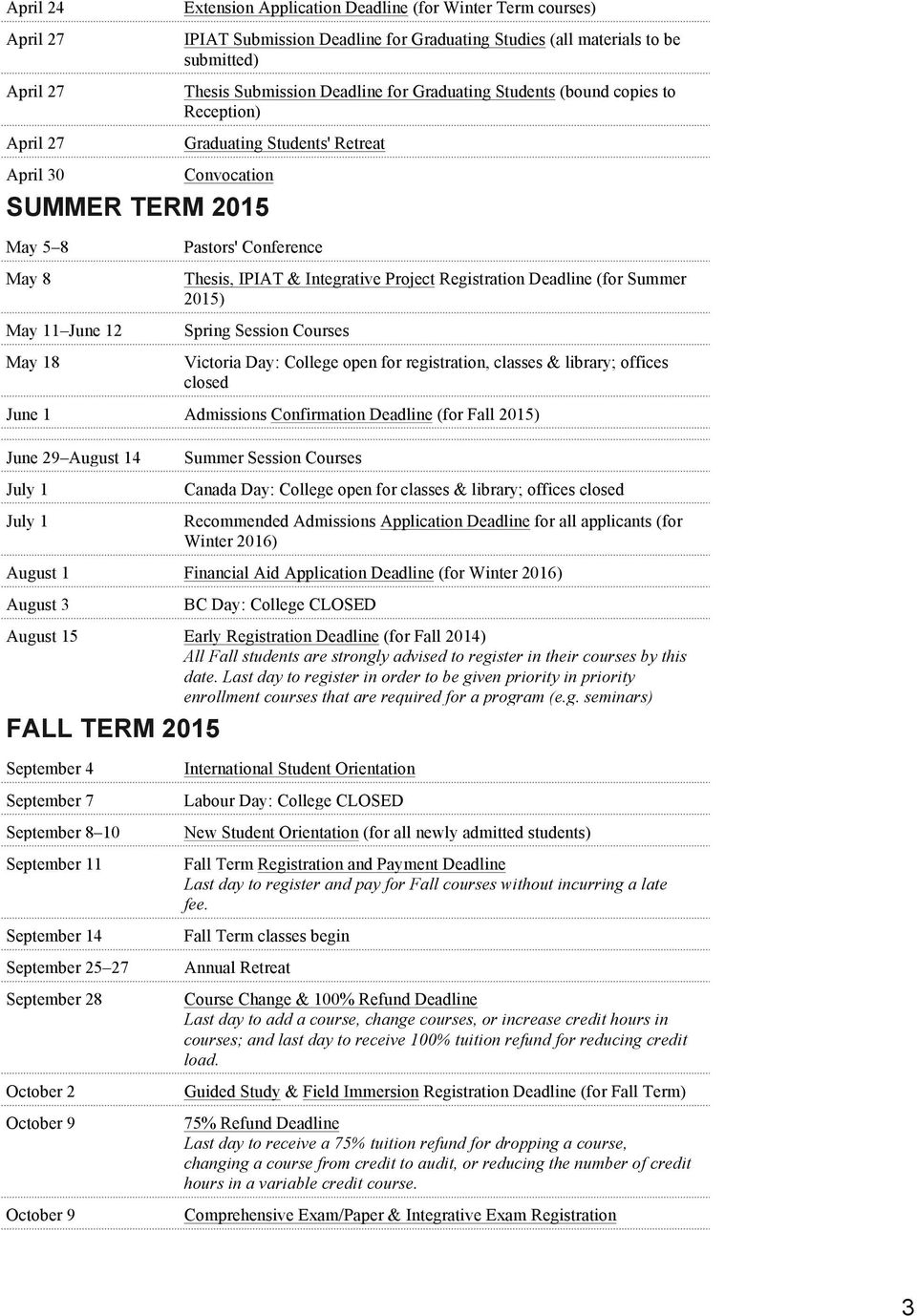
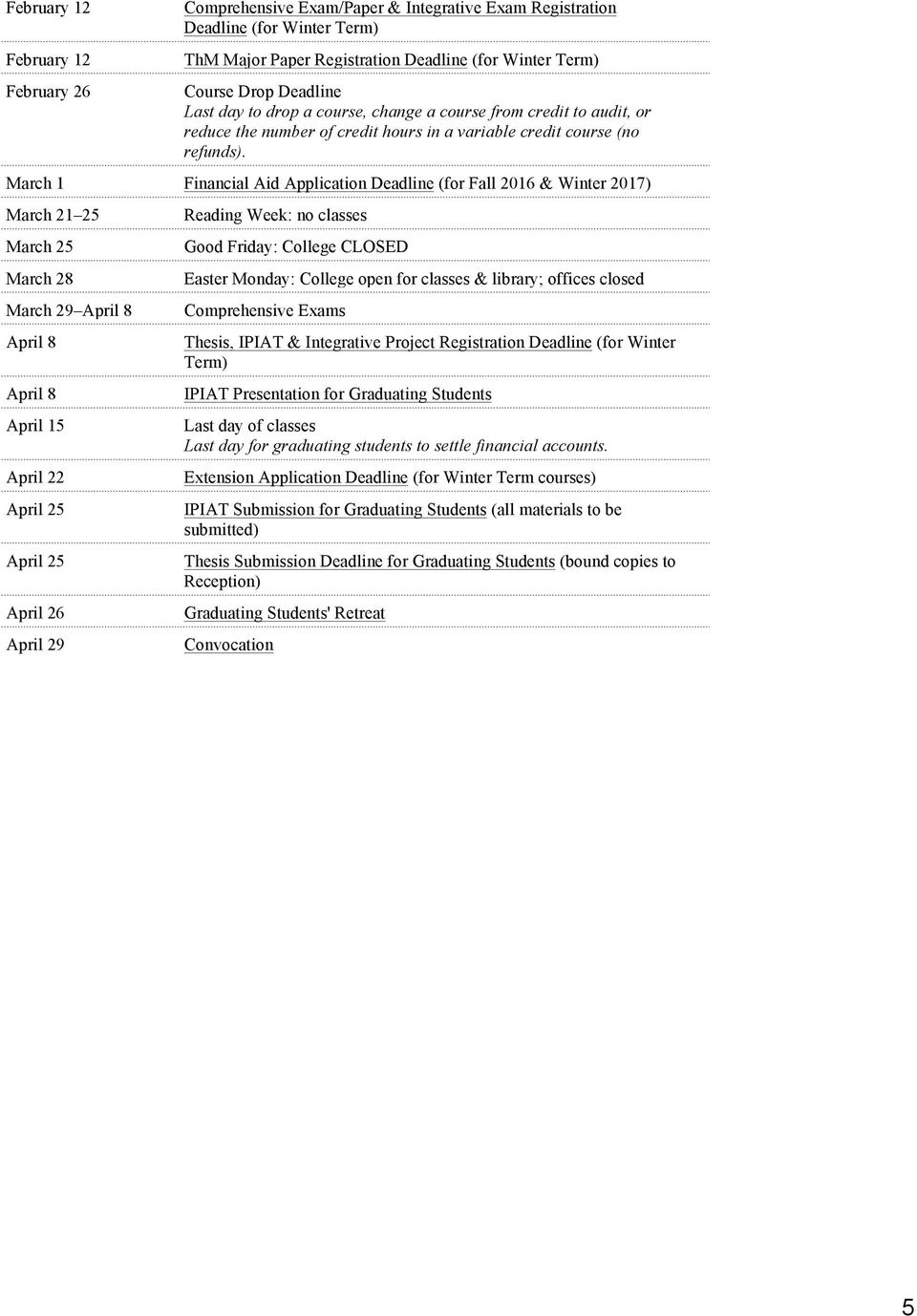
8 Deadline (for Fall Term) October 9 October 12 October October 23 ThM Major Paper Registration Deadline (for Fall Term) Thanksgiving Day: College CLOSED Reading Week: No Classes Course Drop Deadline Last day to drop a course, change a course from credit to audit, or reduce the number of credit hours in a variable credit course (no refunds). November 1 Admissions Confirmation Deadline (for Winter 2016) November 11 November November 30 December 11 December 11 December 18 Remembrance Day: College open for classes & library; offices closed Reading Week: no classes Comprehensive Exams Thesis, IPIAT & Integrative Project Registration Deadline (for Fall Term) Last day of classes December 18 Early Registration Deadline (for Winter 2016) All Winter students are advised to register by this date. Last day to register in order to be given priority in priority enrollment courses that are required for a program. December 24 Extension Application Deadline (for Fall Term courses) December 25 January 1 College CLOSED WINTER TERM 2016 January 1 January 5 7 January 8 January 11 January 22 January 29 January 31 January 31 February 1 February 8 February 8 12 February 12 Recommended Early Admissions Application Deadline for International Applicants (for Fall 2016) New Student Orientation (for all newly admitted students) Winter Term Registration and Payment Deadline Last day to register in and pay for Winter courses without incurring a late fee. Fees for courses registered in on or after this date are due in full at the time of registration. Winter Term classes begin Course Change & 100% Refund Deadline Last day to add a course, change courses, or increase credit hours in courses; and last day to receive 100% tuition refund for reducing credit load. Guided Study & Field Immersion Registration Deadline (for Winter Term) Thesis Submission Deadline for Graduating Students (for grading) Graduation Application Deadline Recommended Admissions Application Deadline for all applicants (for Fall 2016) Family Day: College CLOSED Reading Week: no classes 75% Refund Deadline 4

9 February 12 February 12 February 26 Comprehensive Exam/Paper & Integrative Exam Registration Deadline (for Winter Term) ThM Major Paper Registration Deadline (for Winter Term) Course Drop Deadline Last day to drop a course, change a course from credit to audit, or reduce the number of credit hours in a variable credit course (no refunds). March 1 Financial Aid Application Deadline (for Fall 2016 & Winter 2017) March March 25 March 28 March 29 April 8 April 8 April 8 April 15 April 22 April 25 April 25 April 26 April 29 Reading Week: no classes Good Friday: College CLOSED Easter Monday: College open for classes & library; offices closed Comprehensive Exams Thesis, IPIAT & Integrative Project Registration Deadline (for Winter Term) IPIAT Presentation for Graduating Students Last day of classes Last day for graduating students to settle financial accounts. Extension Application Deadline (for Winter Term courses) IPIAT Submission for Graduating Students (all materials to be submitted) Thesis Submission Deadline for Graduating Students (bound copies to Reception) Graduating Students' Retreat Convocation 5
10 ACADEMIC PROGRAMS GRADUATE DIPLOMA IN CHRISTIAN STUDIES Gain a foundation in the Christian faith, and find out why theological education is important for the whole body of Christ, not just those working for churches or parachurch organizations. SPECIAL NOTE The name of this program was changed on January 26, 2013 to Graduate Diploma in Christian Studies (GradDipCS) from Diploma in Christian Studies (DipCS). THE PROGRAM IS flexible: allows you to study at your own pace and choose 50% of your courses based on your personal interests convenient: the perfect opportunity to study theology without the rigor of a major paper or project transferable: all your credits can be transferred to either the MA in Theological Studies (formerly MCS) or the MDiv programs TYPICAL STUDENTS are taking sabbatical leave to reflect on their vocation or ministry want to deepen their understanding of their faith, but do not require a master s level credential for their vocational work want to study theology but are unsure about taking on a full master s degree Seventy-five per cent of GradDipCS students go on to complete a master s degree at Regent. The other 25% return to their vocations newly invigorated, or pursue new vocational directions. CREDIT HOURS 24 TYPICAL COMPLETION TIME minimum 1 year full-time unlimited if studying part-time in conjunction with other activities APPLICATION REQUIREMENTS To apply to the program, you must EITHER: have a bachelor s degree OR be at least 28 years of age and able to demonstrate that your life/ vocational/ educational experience can be seen as equivalent to a university degree 6

11 CONCENTRATIONS Concentrations are not part of the GradDipCS program. PROGRAM COSTS The tuition for the academic year is $460 per credit hour. The total tuition for the GradDipCS program is $11,040 (24 credit hours at $460 per credit hour). For a breakdown of associated fees and costs of living, view our sample budget. To help you offset the high costs of graduate education, we offer scholarships, financial aid, and work opportunities on campus. PROGRAM REQUIREMENTS The GradDipCS is built on the following curriculum: a series of core courses that focus on theological integration and personal formation electives that allow you to align your courses with your personal interests In order to graduate from the program, you must successfully complete 24 credit hours of study with a grade point average of 2.7 (B-) or higher. The requirements of the GradDipCS program are as follows: REQUIRED FOUNDATIONS CREDIT HOURS Old Testament Foundations (BIBL 501) 3 New Testament Foundations (BIBL 502) 3 TWO COURSES FROM THE FOLLOWING* 6 Christian Thought & Culture I (INDS 501) Christian Thought & Culture II (INDS 502) The Christian Mind (INDS 510) Theology of Culture (INDS 515/THEO 515) Christian Faith & Practice in a (Post)Modern World (INDS 581) Marketplace Theology (APPL 575/INDS 575) ELECTIVES 12 TOTAL 24 More details are available on our Program Requirements and Policies page. Notes on the Requirements *Choosing your courses: Old Testament Foundations BIBL 501, New Testament Foundations BIBL 502, and Christian Thought & Culture I INDS 501 and II INDS 502 are all part of the foundational core for the Master of Arts in Theological Studies (formely the Master of Christian Studies) and the Master of Divinity (MDiv) programs. If you're anticipating using the GradDipCS to go on to a master s program at Regent, you should take Christian Thought and Culture I & II (INDS 501 & INDS 502) as part of your GradDipCS requirements, since these two courses are required in the MA Theo Studies and MDiv 7

12 programs. We also recommend that you select your electives carefully in light of the requirements of the master's degree you might be considering. DISTANCE EDUCATION COMPONENT When completing the GradDipCS degree, you can take up to 9 credits of courses through Distance Education. 8

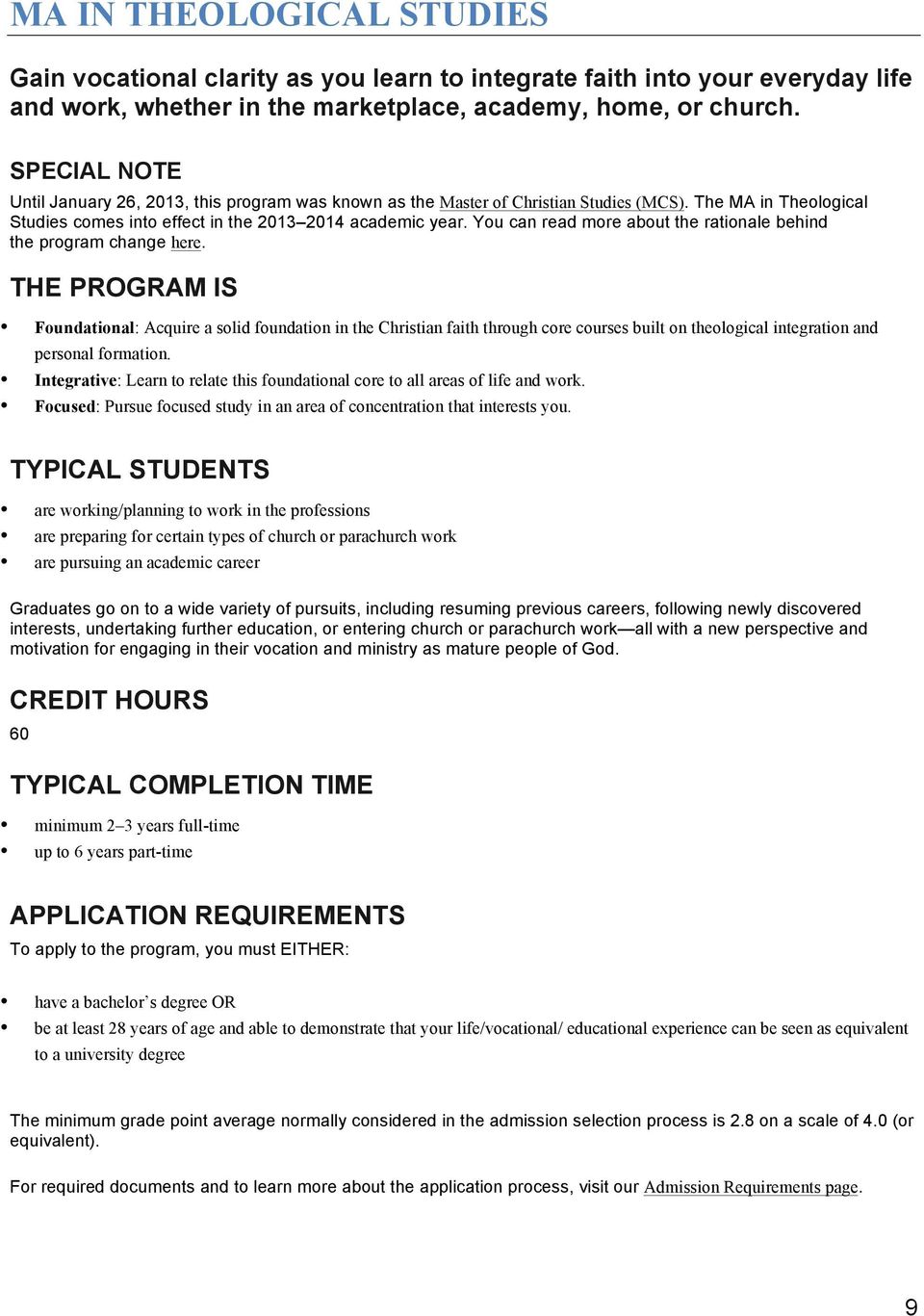
13 MA IN THEOLOGICAL STUDIES Gain vocational clarity as you learn to integrate faith into your everyday life and work, whether in the marketplace, academy, home, or church. SPECIAL NOTE Until January 26, 2013, this program was known as the Master of Christian Studies (MCS). The MA in Theological Studies comes into effect in the academic year. You can read more about the rationale behind the program change here. THE PROGRAM IS Foundational: Acquire a solid foundation in the Christian faith through core courses built on theological integration and personal formation. Integrative: Learn to relate this foundational core to all areas of life and work. Focused: Pursue focused study in an area of concentration that interests you. TYPICAL STUDENTS are working/planning to work in the professions are preparing for certain types of church or parachurch work are pursuing an academic career Graduates go on to a wide variety of pursuits, including resuming previous careers, following newly discovered interests, undertaking further education, or entering church or parachurch work all with a new perspective and motivation for engaging in their vocation and ministry as mature people of God. CREDIT HOURS 60 TYPICAL COMPLETION TIME minimum 2 3 years full-time up to 6 years part-time APPLICATION REQUIREMENTS To apply to the program, you must EITHER: have a bachelor s degree OR be at least 28 years of age and able to demonstrate that your life/vocational/ educational experience can be seen as equivalent to a university degree The minimum grade point average normally considered in the admission selection process is 2.8 on a scale of 4.0 (or equivalent). For required documents and to learn more about the application process, visit our Admission Requirements page. 9
14 CONCENTRATIONS One of the primary appeals of the MA in Theological Studies is that it allows you to focus your studies in one of these concentrations: SCRIPTURE CHRISTIAN HISTORY & THEOLOGY CHRISTIANITY, CHURCH & CULTURE Biblical Languages History of Christianity Marketplace Theology Old Testament Doctrinal Theology Interdisciplinary Studies New Testament Spiritual Theology Christianity and the Arts Biblical Studies World Christianity Applied Theology Or you can choose the No Concentration option in Christian Studies. PROGRAM COSTS The cost of tuition for the academic year is $460 per credit hour. The total tuition for the MA in Theological Studies program is $27,600 (60 credit hours at $460 per credit hour). For a breakdown of associated fees and costs of living, view our sample budget. To help you offset the high costs of graduate education, we offer scholarships, financial aid, and work opportunities on campus. PROGRAM REQUIREMENTS You will begin your studies with a foundational set of courses. You can then choose one area of concentration, or you can select the "no concentration" option. Towards the end of your program, you will complete a final project, which can take the form of a comprehensive exam, a thesis, or an integrative project, depending on your concentration. You will be awarded the MA in Theological Studies degree for the successful completion of 60 credit hours of study with a grade point average of 3.0 (= B) or better. FOUNDATIONAL CORE COURSES CREDIT HOURS Old Testament Foundations BIBL New Testament Foundations BIBL Biblical Language course LANG 500 or LANG 510 or LANG Biblical Exegesis and Interpretation BIBL History of Christianity Foundations HIST Christian Thought and Culture I INDS Christian Thought and Culture II INDS Theology Overview THEO 500 OR Theology I THEO 601AND Theology II THEO 602* 3 or 6 One of the following: 3 Soul of Ministry APPL 500 (3)** Gospel and Culture (3)*** Community, Formation, and Leadership (3) Total 27 or 30 10

15 *Theology I & II are required for the Doctrinal Theology and Spiritual Theology concentrations. **Soul of Ministry is required for the Applied Theology concentration. ***Gospel and Culture is required for the Marketplace Theology and Interdisciplinary Studies concentrations. CONCENTRATION COURSES SCRIPTURE Biblical Languages CONCENTRATION REQUIREMENTS CREDIT HOURS Biblical Hebrew 12 New Testament Greek 12 Advanced Hebrew or Greek Readings 3 Comprehensive Examination 3 General Electives 6 Note that the 3 credits of biblical languages listed in the Foundational Core Courses above are incorporated in this list also so that the total credits required for the program is still 60. Old Testament CONCENTRATION REQUIREMENTS CREDIT HOURS Biblical Hebrew 12 Biblical Hermeneutics and Criticism 3 Advanced Old Testament Exegesis 3 Old Testament Seminar 3 One of the following: 9 or 12 Comprehensive Exam (3) level OT Electives (6) Thesis (12) General Electives 3 or 6 Note that the 3 credits of biblical languages listed in the Foundational Core Courses above are incorporated in this list also so that the total credits required for the program is still 60. New Testament CONCENTRATION REQUIREMENTS CREDIT HOURS New Testament Greek 12 Biblical Hermeneutics and Criticism 3 Advanced New Testament Exegesis 3 11

16 New Testament Seminar 3 One of the following: 9 or 12 Comprehensive Exam (3) level NT Electives (6) Thesis (12) General Electives 3 or 6 Note that the 3 credits of biblical languages listed in the Foundational Core Courses above are incorporated in this list also so that the total credits required for the program is still 60. Biblical Studies CONCENTRATION REQUIREMENTS CREDIT HOURS Biblical Hebrew 6 New Testament Greek 6 Biblical Hermeneutics & Criticism BIBL Advanced Old Testament Exegesis BIBL Advanced New Testament Exegesis BIBL Old Testament Seminar 3 New Testament Seminar 3 Old Testament Comprehensive Exam 3 New Testament Comprehensive Exam 3 General Electives 3 Note that the 3 credits of biblical languages listed in the Foundational Core Courses above are incorporated in this list also so that the total credits required for the program is still 60. CHRISTIAN HISTORY AND THEOLOGY History of Christianity CONCENTRATION REQUIREMENTS CREDIT HOURS History of Christianity: Reformation to Modern level History of Christianity Elective 3 History Seminar 3 One of the following: 9 or 15 Comprehensive Exam (3) + History Electives (6) Thesis (12) + History Elective (3) General Electives (Exam versus thesis track) 15 or 9 12

17 Doctrinal Theology CONCENTRATION REQUIREMENTS CREDIT HOURS Languages 9 Perspectives on Biblical Languages LANG 500 (3) + Biblical Language (6)* Hebrew (6) + Greek (3) Greek (6) + Hebrew (3) History of Doctrine 3 Theology Seminar 3 One of the following: 3 or 12 Comprehensive Exam (3) Thesis (12) General Electives 6 or 15 Note that the 3 credits of biblical languages listed in the Foundational Core Courses above are incorporated in this list also so that the total credits required for the program is still 60. Note also: The Doctrinal Theology concentration requires Theology I & II from the core courses. *With the approval of the Doctrinal Theology coordinator, you may satisfy the language requirement by taking Perspectives on Biblical Languages LANG 500 and by passing a reading knowledge exam in Latin, French, or German. If you have taken such courses elsewhere, you may be eligible to have these credits transferred into your program. See the Academic Advisor for more information. Spiritual Theology CONCENTRATION REQUIREMENTS CREDIT HOURS History of Christianity: Reformation to Modern 3 The Christian Spirit SPIR Classics of Christian Spirituality SPIR Spiritual Theology Seminar 3 One of the following: 9 or 12 Comprehensive Exam (3) + Spiritual Theology Electives (6) Thesis (12) General Electives 6 or 9 Note: The Spiritual Theology concentration requires Theology I & II from the core courses. 13

18 CHRISTIANITY, CHURCH, AND CULTURE Marketplace Theology CONCENTRATION REQUIREMENTS CREDIT HOURS Mission and Vocation 3 Field Immersion APPL 692* 3 Marketplace Theology Electives 3 Marketplace Theology Seminar 3 One of the following: 6 or 12 Comprehensive Exam (3) + Marketplace Theology Elective (3) Integrative Project (6) Thesis (12) General Electives 9 or 15 *APPL 692 is an eight-month field education experience, normally running from September to April. You will need to arrange with the Marketplace Theology concentration coordinator as to how you will fulfill the field immersion and seminar requirements. Note: The Marketplace Theology concentration requires Gospel and Culture from the core courses. Interdisciplinary Studies CONCENTRATION REQUIREMENTS CREDIT HOURS Mission and Vocation 3 Christian Faith and Practice in a (Post)Modern World INDS Interdisciplinary Studies Seminar 3 One of the Following: 9 or 12 Comprehensive Exam (3) + Interdisciplinary Studies Electives (6) Integrative Project (6) + Interdisciplinary Studies Electives (3) Thesis (12) General Electives 12 or 15 Note: The Interdisciplinary Studies concentration requires Gospel and Culture from the core courses. 14

19 Christianity and the Arts CONCENTRATION REQUIREMENTS CREDIT HOURS The Christian Imagination INDS One of the following: 18 Arts-related Seminar (3) + Comprehensive Exam (3) + Christianity & the Arts Electives (12) Vocation of the Artist Seminar INDS 785 (3) + Integrative Project (6) + Christianity & the Arts Electives (9) Vocation of the Artist Seminar INDS 785 (3) + Integrative Project (12) + Christianity & the Arts Electives (3) General Electives 12 World Christianity CONCENTRATION REQUIREMENTS CREDIT HOURS Introduction to World Christianity APPL History of Christianity: Reformation to Modern HIST Missional Church 3 Field Education APPL 691 / Field Immersion APPL 690* 3 World Christianity Elective 3 World Christianity Seminar 3 One of the following: 3, 6, or 12 Comprehensive Exam (3) Integrative Project (6) Thesis (12) General Electives 3, 9, or 12 *APPL 690 is an eight-month field education experience, normally running from September to April. You will need to arrange with the World Christianity concentration coordinator as to how you will fulfill the field immersion and seminar requirements. Applied Theology CONCENTRATION REQUIREMENTS CREDIT HOURS Missional Church 3 Field Education APPL Applied Theology Seminar 3 One of the following: 9 or 12 Comprehensive Exam (3) + Applied Theology Electives (6) 15

20 Integrative Project (6) + Applied Theology Electives (3) Thesis (12) General Electives 12 or 15 Note: The Applied Theology concentration requires Soul of Ministry from the core courses. NO CONCENTRATION Christian Studies CONCENTRATION REQUIREMENTS CREDIT HOURS Biblical Book Study 3 Any Seminar 3 Integrative Examination 3 General Electives 24 NOTES ON THE REQUIREMENTS Core courses The 27 or 30 credit hours of core courses are required by all MA in Theological Studies tracks and by the MDiv program. Since these courses provide a foundation for both programs, we recommend that you complete most of these courses within your first year or within your first 30 credit hours. (Note: Students taking Gospel and Culture or Community, Formation, and Leadership may delay taking these courses until later in their program.) Biblical language requirement We recommend that you begin your biblical language requirement in your first year. You can fulfil this requirement by taking the regular Hebrew and/or Greek language courses (depending on your concentration). If you are pursuing a concentration outside of the Scripture area, you may wish to take Perspectives on Biblical Languages LANG 500 to fulfil your language requirement (Doctrinal Theology students will normally take this course plus 6 credits of Hebrew or Greek). LANG 500 provides an overview of both Hebrew and Greek, and prepares you for Biblical Exegesis BIBL 503. Note that if you are taking the regular Hebrew or Greek courses, there is an opportunity to audit half of LANG 500 in order to get an orientation to the other biblical language. Final projects Towards the end of your program, you will complete a final project which can take the form of (i) a comprehensive exam, (ii) a thesis, or, in some concentrations (iii) an integrative project, or (iv) and integrative exam. With the approval of your supervisor, the comprehensive exam may take the form of a major paper. We offer a non-credit orientation seminar in both Fall and Winter terms for the thesis (GENR 301) and the integrative project for students in the Christianity and the Arts concentration (GENR 313). Visit the Final Projects page for more information. Choosing a concentration We advise you to choose a concentration early in your studies so that you can plan your courses wisely. Our Academic Advising page has helpful information on how to choose your concentration and select courses in your first year. The Program Requirements pagehas worksheets for each concentration. 16

21 Concentration requirements are revised from time to time. You have the option to complete the concentration according to the requirements as published when you were admitted, or according to the current requirements. Pursuing doctoral studies If you intend to go on to complete a PhD, we advise that you acquire reading knowledge of at least one more relevant language during your master's work: normally Latin, French, or German. You can take courses through UBC or private language institutes in Vancouver such as the Alliance Française or Goethe Institut. DISTANCE EDUCATION COMPONENT When completing the MA in Theological Studies degree, you can take up to 20 credits of courses through Distance Education, although no more than 6 credits of the Foundational Core courses listed above. 17
22 MASTER OF DIVINITY Find innovative, prayerful, and creative solutions for contemporary challenges to Christian mission. SPECIAL NOTE On January 26, 2013, the curriculum for this program was revised. The changes come into effect in the academic year. You can find the previous program requirements for the MDiv here. You can read more about the rationale behind the program change here. THE PROGRAM IS Outside the box: Learn to think outside the box to develop a broader vision of ministry and mission than already exists. Relevant: Study alongside the very people you ll encounter in your future congregations professionals, stay-at-home parents, academics, artists, parachurch workers, and others. Personal: Immerse yourself in a setting that allows you to practice your ministry, receive feedback and guidance, and discern your vocation. TYPICAL STUDENTS feel called to serve in the church or in a parachurch organization and want to be thoroughly equipped for their work are innovators and want to think creatively about how to pursue the mission of the church are seeking to invigorate the traditions of the denominations they represent CREDIT HOURS 90 TYPICAL COMPLETION TIME minimum 3 4 years full-time up to 8 years part-time APPLICATION REQUIREMENTS To apply to the program, you must either: have a bachelor s degree or be at least 28 years of age and able to demonstrate how your life/vocational/educational experience can be seen as equivalent to a university degree The minimum grade point average normally considered in the admission selection process is 2.8 on a scale of 4.0 (or equivalent). For required documents and to learn more about the application process, visit ouradmission Requirements page. 18
23 CONCENTRATIONS Concentrations in the MDiv program are optional. You can choose from the following areas of concentration. SCRIPTURE CHRISTIAN HISTORY & THEOLOGY CHRISTIANITY, CHURCH & CULTURE Biblical Languages History of Christianity Marketplace Theology Old Testament Doctrinal Theology Interdisciplinary Studies New Testament Spiritual Theology Christianity and the Arts World Christianity Pastoral Ministry PROGRAM COSTS The cost of tuition for the academic year to $460 per credit hour. The total tuition for the MDiv program is $41,400 (90 credit hours at $460 per credit hour). For a breakdown of associated fees and costs of living, view our sample budget. To help you offset the high costs of graduate education, we offer scholarships, financial aid, and work opportunities on campus. PROGRAM REQUIREMENTS You will begin your program with foundational biblical, theological, and historical courses aimed at theological integration and personal formation. You will then acquire the knowledge, skills, and perspectives that are essential to pastoral ministry. The curriculum includes a practical pastoral ministry assignment. FOUNDATIONAL CORE COURSES CREDIT HOURS Old Testament Foundations BIBL New Testament Foundations BIBL Biblical Exegesis BIBL History of Christianity Foundations HIST Christian Thought and Culture I INDS Christian Thought and Culture II INDS Theology I THEO Theology II THEO MDIV COURSES Biblical Languages 12 Biblical Hermeneutics and Criticism BIBL Advanced Old Testament Exegesis BIBL 701 or Advanced New Testament Exegesis BIBL 702 Biblical Book Study 3 History of Christianity: Reformation to Modern HIST History of Christian Doctrine THEO The Soul of Ministry APPL Supervised Ministry: Year A APPL
24 Supervised Ministry: Year B APPL Missional Leadership APPL Missional Church APPL Preaching and Worship APPL Pastoral Care and Ethics APPL/THEO Gospel and Culture 3 General electives 15 TOTAL 90 CONCENTRATION COURSES Concentrations in the MDiv program are optional. By selecting your language, advanced exegesis, and general electives appropriately, you may complete one of the following concentrations: SCRIPTURE Biblical Languages CONCENTRATION REQUIREMENTS CREDIT HOURS Biblical Hebrew 12 New Testament Greek 12 Advanced Hebrew or Greek Readings 3 Old Testament CONCENTRATION REQUIREMENTS CREDIT HOURS Biblical Hebrew 12 Advanced Old Testament Exegesis BIBL Old Testament Seminar 3 New Testament CONCENTRATION REQUIREMENTS CREDIT HOURS New Testament Greek 12 Advanced New Testament Exegesis BIBL New Testament Seminar 3 CHRISTIAN HISTORY AND THEOLOGY History of Christianity CONCENTRATION REQUIREMENTS CREDIT HOURS History of Christianity electives 6 History of Christianity Seminar 3 20
25 Doctrinal Theology CONCENTRATION REQUIREMENTS CREDIT HOURS Theology electives 6 Theology Seminar 3 Spiritual Theology CONCENTRATION REQUIREMENTS CREDIT HOURS The Christian Spirit SPIR Classics of Christian Spirituality SPIR Spiritual Theology Electives 6 Spiritual Theology Seminar 3 CHRISTIANITY, CHURCH, AND CULTURE Marketplace Theology CONCENTRATION REQUIREMENTS CREDIT HOURS Marketplace Theology Electives 9 Marketplace Theology Seminar 3 Interdisciplinary Studies CONCENTRATION REQUIREMENTS CREDIT HOURS Interdisciplinary Studies Electives 9 Interdisciplinary Studies Seminar 3 Christianity and the Arts CONCENTRATION REQUIREMENTS CREDIT HOURS The Christian Imagination INDS Christianity and the Arts Electives 9 Interdisciplinary Studies Seminar 3 World Christianity CONCENTRATION REQUIREMENTS CREDIT HOURS Introduction to World Christianity APPL World Christianity Electives 6 Applied Theology Seminar 3 21
26 Pastoral Ministry CONCENTRATION REQUIREMENTS CREDIT HOURS Applied Theology Electives 6 Applied Theology Seminar 3 NOTES ON THE REQUIREMENTS Foundational core courses The 24 credit hours of foundational core courses are required by all MA Theo Studies tracks and by the MDiv program. Since these courses provide a foundation for both programs, we recommend that you complete most of these courses within your first year or within your first 30 credit hours. Biblical language requirement We recommend that you begin your biblical language requirement in your first year. You can fulfil this requirement by taking the regular Hebrew and/or Greek language courses, but not Perspectives on Biblical Languages LANG 500. Knowledge of biblical languages will be helpful when taking Biblical Exegesis BIBL 503. Note that you may audit half oflang 500 if you wish in order to become familiar with the rudiments of the language you have not already studied. Vocational discernment The process of vocational discernment is crucial to the MDiv program, involving both your personal reflection and faculty's observation of your work. The program consists of two stages: (1) vocational discernment, and (2) candidacy for the MDiv degree. Progression from the first to the second stage occurs upon the recommendation of the MDiv Committee; this recommendation is a requirement for graduation. The Committee recommends those students who are especially gifted for Christian ministry, and its recommendation is based on a variety of reports, especially from the Soul of Ministry and Supervised Ministry classes. DISTANCE EDUCATION COMPONENT When completing the MDiv degree, you can take up to 30 credits of courses throughdistance Education, although no more than 6 credits of the Foundational Core courses listed above. DENOMINATIONAL PROGRAMS ANGLICANS In 1996, Regent College established a program for those interested in preparing for ministry in the Anglican communion worldwide. Two specific Anglican Studies courses are offered every two years (Anglican History and HIST 650 Theology and Anglican Life THEO 651). Regent graduates have found a welcome acceptance of their training at Regent by many bishops both in Canada and abroad. Visit the Anglican Studies page for more information. PRESBYTERIANS If you plan to pursue ordination within the Presbyterian Church of Canada (PCC), in addition to completing an MDiv at Regent, you will need to complete a Diploma in Presbyterian Denominational Studies which can be taken through St. 22
27 Andrew s Hall at the Vancouver School of Theology (an official seminary of the PCC). You can, however, apply several of the Diploma courses towards your Regent MDiv, and you can complete the field education placement of the Diploma with Regent's MDiv requirement. (Note the restrictions of Regent College's transfer credit policy.) The Diploma involves taking a number of specific denominational courses, at least one course with each of its PCC faculty, several other elective courses, a field education placement for one year in a PCC church or institution, and the writing of a ministry position paper. For further information of the Presbyterian Diploma program, consult the Registrar at VST. For advice of how to complete the Diploma in conjunction with a Regent MDiv, see theacademic Advisor at Regent College. 23
28 MASTER OF THEOLOGY Prepare for a doctorate and an academic vocation by pursuing focused studies in a particular area of interest. The ThM is also the perfect academic supplement to the MDiv. THE PROGRAM IS In-depth: The ThM allows you to immerse yourself in a topic or question that you wish to study in great detail. Offers a thesis track: The thesis track allows you to allocate half of your credits towards the research and writing of a thesis. Offers a major paper track with more electives: This track requires a major paper instead of a thesis and gives you the opportunity to choose half your curriculum from our vast course offerings. TYPICAL STUDENTS people who want to focus their studies in a particular area of theological interest related to their vocation or personal lives pastors intending to upgrade their education or reflect theologically on a ministry-related issue those intending to pursue doctoral studies those preparing for some forms of teaching, administration, or other roles where an advanced degree would be of benefit CREDIT HOURS 24 minimum TYPICAL COMPLETION TIME minimum 1 2 years full-time up to 5 years part-time APPLICATION REQUIREMENTS The ThM is the highest academic degree awarded by Regent College. In order to be admitted to the ThM, you must have: an MDiv degree or a master's degree in theological studies equivalent to Regent's MA in Theological Studies GPA of 3.3 in your previous graduate studies For required documents and to learn more about the application process, visit ouradmission Requirements page. CONCENTRATIONS Concentrations are not part of the ThM program. PROGRAM COSTS The tuition for the academic year is $460 per credit hour. The total tuition for the ThM program is $11,040 (24 credit hours at $460 per credit hour). This amount will be higher if you are completing more than 24 credit hours. For a breakdown of associated fees and costs of living, view our sample budget. 24
29 To help you offset the high costs of graduate education, we offer scholarships and financial aid, and work opportunities on campus. PROGRAM REQUIREMENTS In order to graduate from the program, you must complete 24 credits with a grade point average of 3.3 (B+) or better. Depending on your objectives, you can choose between two tracks: a thesis track and a non-thesis track with additional electives. The requirements for both tracks are as follows: THESIS TRACK* CREDIT HOURS Methods of Theological Research Seminar (INDS 725) 3 Readings in Modern Protestant Thought Seminar (INDS 726)** 3 Seminar in the same area as your thesis 3 Thesis 12 Electives 3 Total 24 MAJOR PAPER TRACK CREDIT HOURS Readings in Modern Protestant Thought Seminar (INDS 726)* 3 Seminar in the same area as your major paper 3 Seminar in any discipline 3 Major paper 3 Electives 12 Total 24 More details are available on our Program Requirements and Policies page. Additional Requirements Courses Equivalent to the MDiv: If you are admitted to the ThM program with a master s degree other than an MDiv, we expect that you will have the equivalent theological background to that of the Regent MDiv program. Thus, in addition to the above requirements, you must either have completed the following courses in a previous program, or you will need to complete them as part of your ThM program. Old Testament Foundations (BIBL 501) and New Testament Foundations (BIBL 502) Biblical Languages: a minimum of 6 credit hours in one biblical language, Hebrew (chosen from LANG 510, LANG 511, LANG 610, LANG 611, LANG 721) or Greek (chosen from LANG 550, LANG 551, LANG 650, LANG 651, LANG 720) but not LANG 500 Biblical Exegesis & Interpretation (BIBL 503) History of Christianity Foundations (HIST 501) and History of Christianity: Reformation to Modern (HIST 502) Theology I (THEO 601) and Theology II (THEO 602) Courses by Subject Area: You are welcome to pursue any area of study covered by our curriculum, provided we have the faculty resources to supervised you adequately. You are also welcome to discuss potential research topics with members of faculty prior to applying for admission to the ThM program. 25
30 Depending on your intended area of study and on your academic record, the College may require additional courses in order to provide you with a better foundation to build on. For example, if you wish to write a thesis or a major paper in the following areas, you will be expected to have taken the courses indicated below or their equivalent. Missions or World Christianity Introduction to World Christianity (APPL 533) Missional Church (APPL 581) Old Testament Hebrew (12 credits LANG 510, LANG 511, LANG 610, LANG 611) Biblical Hermeneutics & Criticism (BIBL 600) Advanced Old Testament Exegesis (BIBL 701) New Testament Greek (12 credits LANG 550, LANG 551, LANG 650, LANG 651) Biblical Hermeneutics & Criticism (BIBL 600) Advanced New Testament Exegesis (BIBL 702) Biblical Languages Hebrew (12 credits LANG 510, LANG 511, LANG 610, LANG 611) Greek (12 credits LANG 550, LANG 551, LANG 650, LANG 651) Advanced Greek Readings (LANG 720) or Advanced Hebrew Readings (LANG 721) Spiritual Theology The Christian Spirit (HIST 500/SPIR 500) Classics of Christian Spirituality (SPIR 670) Doctrinal Theology History of Christian Doctrine (THEO 608) Christianity and the Arts Christian Imagination (INDS 560) Vocation of the Artist Seminar (INDS 785) 26
31 Notes on the Requirements * A minimum graduate-level grade point average of 3.5 is required to write a thesis. **A different ThM seminar may be offered from time to time. The Major Paper will involve a 7,500 10,000 word essay and will be supervised by a full-time member of faculty in the appropriate discipline. While the College cannot guarantee thesis supervision if you were admitted to the ThM with less than a 3.5 GPA in your previous graduate studies, you may be permitted to write a thesis under the following conditions: (i) you achieve at least a 3.5 GPA in at least 9 credit hours taken at Regent College, (ii) you receive a recommendation from the ThM Coordinator (Dr. Craig Gay) based upon the thesis proposal written to fulfill the requirements of the Theological Research & Writing Seminar (INDS 725), and (iii) you secure the agreement of a member of faculty to supervise your thesis. DISTANCE EDUCATION COMPONENT When completing the ThM degree, you can take up to 6 credits of courses through Distance Education. 27
32 ACADEMIC POLICIES PROGRAM REQUIREMENTS AND POLICIES The course requirements for each program can be found in our Graduate Programs section. Information on admission to programs is on the Admission Requirements page. If you have any questions about your program, we recommend that you meet with theacademic Advisor. PROGRAM REQUIREMENT AND CONCENTRATION WORKSHEETS These worksheets will help you track your progress as you complete your degree. GradDipCS Worksheet MDiv Worksheet ThM Worksheet For the MA in Theological Studies you will want to use the worksheet for the specific concentration you have chosen. Applied Theology Worksheet Biblical Languages Worksheet Biblical Studies Worksheet Christianity and the Arts Worksheet History of Christianity Worksheet Interdisciplinary Studies Worksheet Marketplace Theology Worksheet World Christianity Worksheet New Testament Worksheet Old Testament Worksheet Spiritual Theology Worksheet Doctrinal Theology Worksheet No Concentration Worksheet RESIDENCY REQUIREMENT Some aspects of the educational experience offered by Regent College are available only when students share in the community at the Vancouver campus. For this reason, we require our students to complete a set number of credits in residence, meaning on campus: 28
33 GradDipCS MA Theo Studies MDiv ThM 12 credits 30 credits 45 credits 18 credits Residency is defined as study pursued on the Vancouver campus in Fall, Winter, or Summer term. Distance Education courses do not fulfill the residency requirement. However, you can complete approximately one-third of your program by Distance Education. See the Limits on Courses Taken Through Distance Education below. If you intend both to transfer credits from another institution and to take courses by Distance Education, we advise you to plan carefully to ensure that you meet the residency requirement. DEGREE LIMITATIONS ON COURSES TAKEN THROUGH DISTANCE EDUCATION Regent College places a high priority on face-to-face education. At the same time, it recognizes the need to make a limited amount of distance education courses for students. The credit limit for distance education courses within each program is generally one third of the total program credits. These limits are as follows: GradDipCS MA Theo Studies MDiv ThM 9 credits 20 credits 30 credits 6 credits In addition, students admitted to the College as of Fall 2014 are limited to taking six credits of the Foundational Core courses by distance education as part of their program. TIME LIMITS FOR COMPLETION OF PROGRAMS You are expected to satisfy all program requirements in effect at the time you were accepted into a program. If you exceed the program time limits noted below, you must appeal in writing to the Academic Standards Committee to complete your program. You may be required by the Committee to take additional courses, particularly if the program has been modified since you were admitted. The maximum time limits for each program are: GradDipCS: no time limit MA Theo Studies: 6 years MDiv: 8 years ThM: 5 years We encourage you to complete your degree requirements while resident in Vancouver. Note that some required courses are offered only during Fall and Winter terms. COMBINING DEGREES If you wish to complete two master s degrees in theology, you will be subject to certain restrictions on how many credit hours may be shared between the two degrees. For example, in order to complete both an MA Theo 29
34 Studies and an MDiv degree, you are allowed to have a maximum of 30 credit hours in common between the two; thus, you must earn a minimum of 120 credit hours for the two degrees. The ThM degree requires a minimum of 24 credit hours beyond an MDiv or an MA Theo Studies. We discourage you from attempting to complete two degree programs concurrently. PROGRAM CHANGES If you would like to change programs, complete the Program Change Form and submit it to the Student Services Office. If you are currently in the MA Theo Studies or MDiv program at Regent and wish to apply to the ThM program, you must submit the following: 1. an internal ThM Program Application (internal) 2. a sample research paper 3. a $25 ($20 US) application fee 4. a ThM Reference Form completed by two faculty members (forwarded to the Admissions Office). CONCENTRATION CHANGES You can request a change in concentrations by ing your request [email protected]. 30
35 COURSE POLICIES Here, you will find all you need to know regarding policies that affect how many courses you need to take, how to apply for an extension, and how to withdraw from courses or retake them. GRADING SCHEDULE LETTER GRADES LETTER GRADE DESIGNATION EXPLANATION GRADE POINT A Excellent work 4.0 A- 3.7 B+ Good work 3.3 B 3.0 B- 2.7 C+ Passable work 2.3 C 2.0 C- 1.7 F Fail Unacceptable work 0.0 OTHER GRADE DESIGNATIONS LETTER DESIGNATION EXPLANATION AG Aegrotat Ungraded Pass: Granted by the Academic Standards Committee to a student who, for exceptional reasons, was unable to complete a course in the final term of study. AU Audit Non-credit: Attendance recognized. EX Extension Temporary designation for course in which a student has been granted an extension for course work. CIP Course in Progress Temporary designation for course in which the grade has not yet been recorded. P Pass Competency: Used only when a letter grade is deemed inappropriate. R Retake Course subsequently retaken. W Withdrawal Granted by the College when, because of exceptional circumstances, the student was unable to complete the course. 31
36 GRADE REPORTS AND TRANSCRIPTS Grades may be viewed online immediately after they are posted, once you have completed your course evaluation(s). You have four months from the date grades are posted to appeal any disputed grades (see Appeals). Official transcripts bearing the seal of the College and the signature of the Senior Academic Administrator may be ordered online or by submitting an Official Transcript Request Formalong with the appropriate fee. All fees must be fully paid before an official transcript can be issued. Visit the Transcripts page for more details on ordering your transcript. TERMS, CREDIT HOURS, AND WORK LOAD Regent College operates on a three-term cycle: Fall (September December) Winter (January April) Summer (May August) Fall and Winter Terms Fall and Winter Term courses are normally offered for 3 credit hours and meet 3 hours per week. Evening and weekend courses may be offered for 2 or 3 credit hours. In cases where a 3-credit hour course spans over two terms (Fall and Winter), you will be charged for 1.5 credits in each term; however, you will not receive any academic credit until the full course has been completed. Summer Term The Summer Term is divided into two sessions: Spring Session and Summer Session. Although the dates for these sessions vary, Spring Session courses are generally offered in May and early June, and Summer Session courses from late June through July. Some courses, especially the biblical languages, run into the month of August. Summer Term courses vary: one-week courses are normally 1 or 2 credit hours, two-week courses are 2 or 3 credit hours, three-week courses are 3 credit hours (6 credits of Hebrew or Greek may also be taken in the Summer). COURSE LOAD If you are taking courses for academic credit, you may expect to invest a minimum of 45 hours of work into a course for each credit hour. Where applicable, this includes class lectures, assigned reading, papers, assignments, and exams. In any given term, a full load of academic work is considered to be 12 credit hours. While some students do take more than 12 credits per term, this is a significant amount of academic work; therefore, we encourage you, where possible, to spread your studies out over Regent s academic year (Fall, Winter, and Summer Terms), particularly if you wish to earn 30 credit hours per year. If English is a second language for you, you are encouraged to take no more than 9 credit hours in your first term. For important information relating to the offering of courses at Regent College, see thegeneral Course Information page. 32
37 FULL-TIME STATUS For external purposes (e.g., Study Permits), full-time study is defined as 18 credit (or audit) hours per academic year (September to August). For the minimum number of credit hours required to maintain eligibility for financial aid, see the Financial Aid section: eligibility for Canada Student Loans eligibility for US Student Loans Solely for the purpose of qualifying for government student loans, thesis students may be granted full-time status during the two terms in which they register for their thesis credits (e.g., 6 credits per term). See the Academic Advisor for additional information about this exception. STYLE GUIDE AND PAPER FORMATS The standard style used at Regent College is modified Chicago Manual of Style as outlined in Kate L. Turabian, A Manual for Writers of Term Papers, Theses, and Dissertations, current ed. (Chicago: University of Chicago Press, 1996). You must follow this style unless your professor specifically directs you otherwise. Download the Guide to Paper Formats GUIDED STUDY A guided study is a course in which you are able to focus on an issue of your particular interest under the guidance of one of the regular full-time faculty of Regent College. Only students who are admitted to Regent College are permitted to take a guided study. Furthermore, you are limited to a maximum of one guided study per term for a total of: Total Guided Studies Permitted by Program GradDipCS 2 MA Theo Studies 3 MDiv 4 ThM 1 Guided studies may be taken for 1, 2, or 3 credit hours depending on the amount of work involved (1 credit for each 45 hours of work). Guided studies are subject to the availability of a faculty supervisor, are subject to the same academic guidelines as other regular courses, and are not offered in place of regularly offered courses. If you wish to take a guided study, you must, in consultation with a faculty supervisor, complete a Guided Study Contract and submit it to the Student Services Office with your registration form or course change form at the beginning of a Fall or Winter Term. Guided studies are not normally offered in the Summer Term. Guided studies must be completed within the Fall or Winter Term in which they are registered. Note that only a general title will appear on your transcript (e.g., Guided Study: Applied Theology). 33
38 EXTENSIONS FOR ASSIGNMENTS At Regent, the deadline for an assignment is considered to be part of the course requirements. Due to the additional workload and awkwardness for faculty to have to grade late papers, and due to the College s intention to be fair to students who submit their work on time, we will consider extensions for course work only in exceptional circumstances. You should take serious consideration of this when planning your course load. Download the Course Extension Application. Grounds for an Extension Extensions for course work are granted only in cases where the student demonstrates there was an unforeseeable and unavoidable emergency. Emergencies considered to be grounds for an extension typically include: personal sickness or injury which prevents one from working sickness, injury or death which requires the student s attention emotional or psychological crisis for which the student has sought professional help unexpected increase in job responsibilities By contrast, the following will not normally be considered grounds for an extension: providing hospitality, vacations, relocating, difficult living situations, failure to anticipate the amount of work involved in a course, confusion over the nature of the assignments, computer problems (it is your responsibility to keep files backed up), lost assignments, lack of proficiency in English. Application Process For Fall and Winter courses offered on the Vancouver campus: For an extension of up to 7 days beyond the end of the term, you may apply directly to the professor. The deadline to apply is the date the final course assignment is due. For an extension of up to 30 days past the end of the term: complete the Course Extension Application. submit the Application to Reception by the deadline, which is 7 days beyond the end of the term. Extensions beyond one week of the end of term are granted solely at the discretion of the Student Services Office. For Spring and Summer Session courses offered on the Vancouver campus: complete the Course Extension Application. submit the Application to the Student Services Office by the deadline, which is the date all final course assignments are due. submit a $25 Summer Term Extension Administrative Fee (refunded if extension is denied). Extensions are granted solely at the discretion of the Student Services Office, and extension assignments may be graded by someone other than the course instructor. 34
39 For Distance Education courses: Please contact the Distance Education Office for extension information, including deadlines. For Distance Education courses, extensions of up to one month are granted by the Distance Education Coordinator. Extensions for longer periods may be granted by the Academic Standards Committee. The length of the extension will depend on the nature of the emergency you faced. A grade penalty will be assigned by the DE office for assignments that are past due. When an extension has been approved, the Student Services Office will instruct you on how and when to submit your assignments. Submission of Assignments If you are granted an extension by the Student Services Office, you must attach the Extension Submission Form to your assignment(s) and submit to Reception or post them to the Student Services Office by the assigned deadline. Assignments must not be submitted directly to the professor or the TA. Failure to submit assignments by the assigned deadline will result in an assignment grade reduction of 1/3 of a letter grade per day late for on-campus courses. Failure to follow extension policy instructions will result in a grade of F being assigned to the course. Note that the grading of assignments submitted on extension may take longer than usual and may incur a grading fee. Approved Spring and Summer course extensions will always incur a $25 Summer Term Extension Administrative Fee. Appeals If you want to appeal a decision made with regard to an extension, or to request an extension beyond 30 days, you must submit a letter of appeal to the Academic Standards Committee, within 30 days of the decision or before the end of the extension deadline, explaining the extenuating circumstances that might warrant the appeal. Supporting documents (e.g., a letter from your doctor) are recommended. If you are granted an extension that continues into the following term, you will normally be limited as to the number of credit hours you may take. The decision of the Academic Standards Committee shall be final. In a situation where the crisis you are facing continues beyond the period of an extension, you may appeal to the Senior Academic Administrator for a Withdrawal (a grade of W on the transcript) from a course. Such an appeal is normally accompanied by a letter of support written by someone whose care or supervision you have been under (e.g., doctor, professional counsellor). Note that a W ( Withdrawal ) on a transcript does not affect your grade point average, whereas an F ( Failure ) does adversely affect the GPA. WITHDRAWAL POLICY Students who undergo extreme hardship that was not of their causing, was beyond their ability to control, and prevented them from completing course requirements even given an extension, may appeal to the Senior Academic Administrator for a Withdrawal from the course. This would normally be accompanied by a letter from a professional supporting your appeal (e.g., your doctor). If granted, a grade of W will be recorded on your transcript; this does not affect the GPA 35
40 COURSE RETAKE POLICY You may retake a course subject to regular registration restrictions and limitations in an effort to achieve a higher grade. This involves registering and paying tuition for the course a second time. Both courses will appear on the transcript in the terms they were taken; however, credit will not be granted more than once, and the best grade achieved will be retained. Only one retake will be permitted per course. Comprehensive exams may be retaken only once; you will be assessed a comprehensive exam retake fee. Retaking a course often requires a manual adjustment to the student transcript; so, when you have received the grade for a retaken course, please inform the Student Services Office. AEGROTAT POLICY The grade designation AG (Aegrotat) is granted when, for reasons of serious illness or other extraordinary circumstances outside your control, you are unable to complete a course. Application for consideration must be made to the Academic Standards Committee within one week of the end of the course. A favourable evaluation may be given where the circumstance is beyond doubt, where you have an otherwise excellent record of completion, and where neither further assessment (e.g., a deferred exam) nor extension of time are considered feasible (e.g., you are in the final term of a program of study). The Committee will determine whether the course should be awarded an AG (passing but without grade point) or a grade calculated on the basis of work already completed for the course. If your application is denied, you will be given a grade based on the work you submitted in the course. 36
41 TRANSFER CREDITS AND EXEMPTIONS If you've already completed theological studies at a graduate school that is accredited by a nationallyrecognized body (i.e., equivalent to the Association of Theological Schools in the United States and Canada), you may be granted transfer credit for that work. Such credit will be given only for courses considered relevant to Regent s programs and of equivalent academic standard. Credit will not normally be granted for courses that are not theological in nature or have not been taught from a theological perspective. The maximum amount of transfer credit varies according to each program: GradDipCS MA Theo Studies MDiv ThM 6 credits 30 credits 45 credits 0 credits A minimum grade of B (or a Pass in a Pass/Fail course) is required for courses to be considered for transfer. Since credits may be defined differently at different institutions, transfer credits from some institutions will be subject to a ratio to make them equal to credits taken at Regent. Transfer credit from non-accredited institutions is not normally given. Under no circumstances will transfer credit be awarded for work or life experience. If you can show that a particular undergraduate course from an accredited institution has special relevance to your program at Regent, you may be granted transfer credit at a 3:2 ratio, provided you earned at least a B+ in it and provided the course was not used to satisfy the requirements of your undergraduate degree. First or second year undergraduate level courses will not normally be considered for transfer, with the exception of courses in biblical Hebrew or Greek which may be transferred at full credit value. If you intend to transfer credits from another institution, you must plan carefully to ensure that you meet the Residency Requirement. You must direct your transfer credit request to the Academic Advisor & Administrator. In addition to supplying an official transcript to Regent College, you may also be asked to provide a college catalogue or course syllabus that describes the course(s) you have taken. You may also request exemption from specific required courses at Regent on the basis of undergraduate work you did at an accredited institution, whether it was part of your undergraduate degree or not. A minimum grade of B+ is required for exemption consideration. Exemption, however, does not entail transfer of credit; therefore, you must take other (normally more advanced) courses in the same discipline in order to make up the total number of credit hours required for a diploma or a degree. Appeals for exemptions from program requirements should be directed to the Academic Advisor & Administrator. 37
42 ACADEMIC INTEGRITY, PROBATION, APPEALS ACADEMIC INTEGRITY All students at Regent College are expected to practise uncompromised integrity in all academic matters. The fact that Regent is a Christian college makes vigilance in this area all the more imperative. Consequently, academic offences shall not be tolerated. Academic Offences Academic offences that are subject to penalty include, but are not limited to, the following: 1. Plagiarism: Plagiarism is an academic offence in which someone presents, in whole or in part, the work of another person as his or her own work. Academic work properly involves the examination, critical evaluation, and utilization of contributions of other people. However, whenever someone uses the contributions of others in an academic setting, he or she must acknowledge the author of those contributions through footnotes or other acceptable referencing practices. Failure to do so constitutes plagiarism. Plagiarism can occur in written work (e.g., failure to acknowledge the use of other people s words and ideas) and in non-written work (e.g., failure to acknowledge the use of other people s images or creations in a work of art, or of other people s words in an oral presentation). 2. Cheating: Cheating is an academic offence involving the failure to follow the instructions pertaining to the conditions for writing an assignment or examination, or falsifying material subject to academic evaluation. Cheating includes, but is not limited to, copying work from another person or text, using unauthorized materials or equipment in an examination, obtaining examinations or similar materials by improper means, and impersonating another student or submitting work under another student s name. 3. Duplicating Assignments: It is an academic offence to submit the same, or substantially the same, essay, presentation, or assignment in more than one course, whether the earlier presentation was at Regent College or at another institution, unless prior approval has been obtained. 4. False Representation: Making false representation by submitting false records or information, whether in writing or orally, by falsifying or submitting false documents (including, but not limited to, the following: transcripts, letters of reference, financial aid documents), or by failing to submit required records or information, is an academic offence. Penalties The assessment of penalties for academic offences is at the discretion of the Academic Standards Committee; recommendations for suspension shall be referred to the Senate. Where the Committee determines that a student s behaviour does warrant discipline, it may impose one or more of the following penalties: 1. A reduced grade, including a grade of zero or Fail, on the assignment, test, or exam in question. 2. A reduced grade, including a grade of Fail, on the course in question. 3. A notation to be placed on the student s transcript stating that the student has committed an academic offence and indicating the penalty imposed. 4. Suspension or cancellation of any bursaries, scholarships, or other forms of financial aid. 5. Suspension from the College, whether for a specified period of time, an indefinite period of time, or permanently (i.e., expulsion). 6. Rejection of admission to a program or to the College. Consideration of the severity of the offence shall be given in determining the appropriate penalty. Under normal circumstances, however, the penalties shall be as follows: 38
43 1. In cases of plagiarism or cheating, the penalty for the first offence shall be failure of the course; the penalty for a subsequent offence shall be failure of the course and suspension from the College. 2. In the case of duplicating assignments, the penalty for the first offence shall be a full letter grade reduction in the course and the student shall be required to re-write and submit the assignment in acceptable form; the penalty for a second offence shall be failure of the course and suspension from the College. 3. In the case of false representation in the context of an application for admission, the penalty shall be rejection of admission to the College; in the case of false representation in the context of a course, the penalty shall be failure of the course and suspension from the College. In all cases of academic offence, a notice shall be placed in the student s file. In the case of suspension, a notation of the penalty shall be entered on the student s record, which shall appear on his or her academic transcript. After at least two years following the termination of the suspension, the student may appeal to the Academic Standards Committee to have this notation removed. Students shall not receive credit for courses taken at another institution while on suspension. Process All work submitted by students may be reviewed, by whatever means seem appropriate, to ensure that an academic offence has not been committed. These means may include, but are not limited to, using one or more software and/or internet-based service to verify the authenticity and originality of students work. Professors who suspect that a student has committed an academic offence must report their suspicions to the Senior Academic Administrator, with supporting evidence. Upon receipt of a report from a professor of an alleged academic offence, the Senior Academic Administrator shall refer the matter, along with supporting evidence provided by the professor, to the Academic Standards Committee. The student shall also be invited to respond, in writing, to the allegations being raised against him or her. The student shall be given a minimum of fourteen days to provide a written defense before the Academic Standards Committee meets. The Academic Standards Committee shall consider the evidence provided by the professor and the defense provided by the student (if any), and any other information that may be relevant to the case, in determining whether or not an academic offence has been committed, and, if so, what the appropriate penalty shall be, with reference to the penalties outlined above. Where the penalty is suspension from the College, the Academic Standards Committee shall make recommendation to the Senate and the Senate shall make the final decision regarding the penalty. The student has the right to appeal, in writing, to the Senate the decision or recommendation of the Academic Standards Committee regarding a penalty against him or her. Letters of appeal must be submitted to the Academic Dean within thirty days of the decision of the Academic Standards Committee, failing which, no appeal shall be entertained by the Senate. The Senate shall consider whatever information has been provided by the Academic Standards Committee and by the student, and any other information that may be relevant to the case, in deciding whether to uphold the recommendation of the Academic Standards Committee, to impose a different penalty, or not to impose a penalty at all. All decisions of the Senate are final. 39
44 ACADEMIC PROBATION The purpose of the probation policy is to alert students, where applicable, to the fact that they are not succeeding academically and to impress upon them the importance of giving serious attention to their academic performance in order to continue their studies. The policy also provides a mechanism for preventing students who are not likely to succeed from continuing their studies. Criteria for Probation Students admitted to Regent College are expected to maintain a grade point average (GPA) high enough to graduate. Students admitted to a program must maintain the minimum graduation GPA for that program (see Graduation Requirements and Procedures). In addition, students admitted with Special Student status must maintain the minimum graduation GPA for the GradDipCS program over the first 30 credit hours, but must maintain the minimum GPA for the MA Theo Studies program in order to go beyond 30 credit hours. Students who fall below the minimum level, who have completed at least 12 credit hours of studies at Regent, shall be placed on academic probation. Applicants to the College who have an undergraduate degree with a GPA less than the minimum normally required for admission, but who, in the opinion of the Admissions Committee, are suitable candidates for admission, may be admitted on probation. Students admitted to the College who are applying to the MA Theo Studies or MDiv program, but whose GPA is less than, but within 0.3 of, that required for admission, may be admitted to the program on probation. Process for Students on Probation Students who have been placed on probation for having a low GPA shall be required to do the following in the order indicated: 1. Meet with the Academic Advisor in order to devise a recovery plan for the upcoming year in order to raise their GPA above the minimum required (e.g., retaking courses with low or failing grades, taking fewer courses at a time so as to achieve higher grades). 2. Meet with the Dean of Students and on the basis of the recovery plan approved by the Academic Advisor discuss any other actions that may need to be taken in order to improve their academic performance (e.g., restricting non-academic activities, taking a course in Academic Writing and/or English). A record of the recovery plan and any recommendations from the Dean of Students shall be kept in the student s file. The student shall remain on academic probation for one year. Students who have been admitted to the College on probation shall remain on probation for one year, unless within that time their GPA is sufficient to meet the graduation requirement for their program. Action to be Taken at the End of Probation Year Students shall be taken off probation if after one year their cumulative GPA has risen above the minimum level as defined under Criteria for Probation above. If after one year of being on probation a student s cumulative GPA does not rise sufficiently for him or her to be taken off probation, then: 1. Those admitted to the Graduate Diploma in Christian Studies program (or to an earlier category known as Graduate Studies), and those admitted on Special Student status, will not be permitted to register for further courses at the College. 40
45 2. Those admitted to the MA Theo Studies, MDiv, or ThM program will not be permitted to continue in their program. Those who would still be on probation if they went into the GradDipCS program will not be permitted to register for further courses at the College. When a student is not permitted to register for further courses in accordance with this policy, an indication that the student is not in good standing shall be made on the student s academic transcript. Probationary status, however, shall not be indicated on the transcript. Appeal Process Students who believe that an exception ought to be made in their case (concerning probation, continuing in a program or taking further courses) may appeal in writing to the Academic Standards Committee. The decision of the Academic Standards Committee shall be final. Students shall not be permitted to take courses at Regent while an appeal is in process. In the event where a student s appeal is successful, he or she shall remain on probation for one year and shall be subject to all the regulations of this Probation Policy and to any conditions stipulated by the Academic Standards Committee. Also, where a student has completed academic courses at another institution while he or she has not been permitted to register for courses at Regent College, and then successfully appeals to continue to take courses at Regent, the credits earned at the other institution may be transferred to a program at Regent in accordance with the College s Transfer Credit and Exemption Policy and the Residency Requirements Policy. APPEALS Students who feel aggrieved regarding a decision relative to their academic program (e.g., admission to a degree, a ruling regarding an academic requirement or policy) may appeal the decision. The general appeal process is as follows: 1. The appeal would normally be made, in the first instance, to the person or committee responsible for the contested decision. 2. Where the student is not satisfied that the appeal has been fairly heard or considered, or where he or she wishes to appeal for an exception to College policy, a further appeal may be made: In the case of an admissions matter, appeal should be directed to the Admissions Committee, which meets regularly throughout the year. In the case of a ruling regarding an academic requirement or policy, appeal should be made to the Academic Standards Committee. For specific information on the appeal process for the following, see the relevant section in this Catalogue: Course Extensions Final Project Extension Academic Probation Academic Offences 41
46 SUBMISSION DEADLINES FOR ACADEMIC STANDARDS COMMITTEE Letters appealing for an exception to Regent s academic policies or requirements should be written to the Academic Standards Committee and submitted to the Academic Advisor & Administrator. The deadline for submission of appeals is two weeks prior to a meeting. TERM SUBMISSION DEADLINE COMMITTEE DATE Fall 2014 August 19 September 4 October 9 November 19 Winter 2015 January 2 February 25 April 14 May 14 September 2 September 18 October 23 December 3 January 14 March 11 April 28 May 28 42
47 FINAL PROJECTS All students in the MA Theo Studies and ThM programs must complete some type of final project in order to graduate. MA Theo Studies students, depending on the concentration, have a choice of: a comprehensive examination/paper an integrative exam a thesis an integrative project an integrative project in the arts and theology ThM students have a choice of: a thesis a major paper MDiv students do not need to complete a final project. Instead, their program includes a supervised ministry component and additional course work. EXAMS AND PAPERS (3 CREDITS) COMPREHENSIVE EXAM The comprehensive examination tests the breadth of your knowledge within a concentration. The exam includes a written component, and, if required by your examining professor, an oral component. Preparation You prepare by reading a representative selection of material (normally between 3,000 and 4,000 pages) chosen by your concentration coordinator. What to expect The written examination is normally three or four hours long, and focuses on specific questions taken from topics related to the reading list. The oral examination, if required, will be more general within the field of interest and will provide the opportunity to amplify what has been tested in the written examination. Grading The final grade will be determined by your performance in the written, and if required, oral exam. The oral exam will not detract from the grade achieved in the written part, but may enhance it. The passing grade for the comprehensive exam is B-. How to register Meet with your concentration coordinator to arrange for a member of faculty to serve as your supervisor. Complete the Comprehensive Exam/Paper Registration Form and have it signed by your supervisor. Submit this form, together with a regular Course Registration form (or with a Course Change form if you have already registered for courses in the term), to Reception and pay the tuition and fees. 43
48 Upcoming deadlines October 10, 2014: deadline to register for a comprehensive exam/paper for Fall February 13, 2015: deadline to register for a comprehensive exam/paper for Winter Upcoming exam dates November & December 1 5, 2014 for Fall Term. March 30 April 10, 2015 for Winter Term. The Academic Secretary will notify you of the precise date and time of your written exam shortly after the registration deadline stated above, but you will need to consult with your supervisor to arrange an oral exam if it is required. You are required to take the comprehensive exam in the term in which you register for it. COMPREHENSIVE PAPER Upon special approval of your supervisor, the exam may take the form of a major paper. As this is an alternative within the comprehensive exam track, similar policies apply. You should be aware that this option will probably consume more time than the exam option. Preparation The paper will be based on the same reading list as the exam. What to expect The paper should be approximately 10,000 words (40 pages) and should demonstrate comprehensive knowledge of all the material on the reading list. Grading The faculty supervisor will select a second reader for the paper. Each of them will grade the paper and together, they may conduct an oral exam that will cover both the paper and the reading. The final grade will be determined by your performance in both the paper and the oral exam. The oral exam will not detract from the grade achieved in the paper, but may enhance it. The passing grade for a comprehensive paper is B-. How to register Meet with your concentration coordinator to arrange for a member of faculty to serve as your supervisor. Complete the Comprehensive Exam/Paper Registration Form and have it signed by your supervisor. Submit this form, together with a regular Course Registration form (or with a Course Change form if you have already registered for courses in the term), to Reception and pay the tuition and fees. Upcoming deadlines October 10, 2014: deadline to register for a comprehensive exam/paper for Fall February 13, 2015: deadline to register for a comprehensive exam/paper for Winter Your submission deadline is the last day of the term in which you register. If that is a Winter term and you are planning to graduate at the end of that term, confer with your supervisor to see whether he or she needs you to submit by an earlier date in order to allow sufficient time for grading. 44
49 INTEGRATIVE EXAM The integrative examination is the final project for students in the Christian Studies track of the MA Theological Studies program. It is designed so that you can demonstrate an integrated Christian mind: a world-and-life-view that will structure your piety and practice. To this end, it emphasizes general frameworks of analysis the theologically based response. Preparation You prepare by reading a broad selection of material (normally between 3,000 and 4,000 pages) chosen by the Christian Studies coordinator. What to expect The examination will include questions arising from the readings. You have the choice of sitting for a three-hour exam or writing a one-week take-home exam. The take-home exam will require 3,500 3,800 words, must be written on a computer, and must be in proper Chicago Manual of Style format. The three-hour exam may be written on a computer. An oral exam, if required, will provide you an opportunity to amplify your responses and to explore issues more broadly. Grading The final grade will be determined by your performance in the written, and if required, oral exam. The oral exam will not detract from the grade achieved in the written part, but may enhance it. The passing grade for the integrative exam is B-. How to register Meet with the Christian Studies Coordinator. Complete the Integrative Exam Registration Form and have it signed by your supervisor. Submit this form, together with a regular Course Registration form (or a Course Change form if you have already registered for courses in the term) to Reception, and pay the tuition and fees. Upcoming deadlines October 10, 2014: deadline to register for an integrative exam for Fall February 13, 2015: deadline to register for an integrative exam for Winter Upcoming exam dates November & December 1 5, 2014 for Fall Term. March 30 April 10, 2015 for Winter Term. The Academic Secretary will notify you of the precise date and time of your exam shortly after the registration deadline stated above, but you will need to consult with your supervisor to arrange an oral exam if it is required. You are required to take the integrative exam in the term in which you register for it. 45
50 THM MAJOR PAPER As an option to writing a thesis in the ThM program, you may write a Major Paper. See program details on the Master of Theology program page. What to expect The ThM Major Paper is to be between 7,500 and 10,000 words in length. Grading The faculty supervisor will select a second reader for the paper. Each of them will grade the paper and together, they may conduct an oral exam that will cover both the paper and the reading. The final grade will be determined by your performance in both the paper and the oral exam. The oral exam will not detract from the grade achieved in the paper, but may enhance it. The passing grade for a major paper is B-. How to register Meet with a member of faculty to serve as your supervisor. Complete the ThM Major Paper Registration Form and have it signed by your supervisor. Submit this form, together with a regular Course Registration form (or with a Course Change form if you have already registered for courses in the term), to Reception and pay the tuition and fees. Upcoming deadlines October 10, 2014: deadline to register for a ThM major paper for Fall February 13, 2015: deadline to register for a ThM major paper for Winter Your submission deadline is the last day of the term in which you register. If that is a Winter term and you are planning to graduate at the end of that term, confer with your supervisor to see whether he or she needs you to submit by an earlier date in order to allow sufficient time for grading. THESIS (12 CREDITS) The thesis is a substantial piece of independent research on a specific, focused subject, involving both critical analysis and theological reflection. What to expect The thesis is normally between 30,000 and 45,000 words (including footnotes, but excluding the bibliography). The thesis requires considerable vigour and time; few students are able to complete a thesis in one term. It is ideal for students whose specific area of interest is highly defined. You must have a GPA of at least 3.5 before being approved to write a thesis. 46
51 Grading The final grade will be determined by the supervisor and the second reader, chosen by the Thesis Proposal Approval Committee. The passing grade for an MA or ThM thesis is B; however, the ThM thesis will be graded at an advanced level (i.e. it will be more difficult to get a B on the ThM thesis than an MA thesis). How to register Register for and attend the non-credit Thesis Orientation Seminar GENR 301 offered each Fall and Winter term (mandatory for MA Theo Studies students; optional but recommended for ThM students). Consult the Thesis Guidelines. Approach a member of faculty to serve as your thesis supervisor. The College will endeavour to facilitate thesis supervision in the area of choice; however, admission to the program does not guarantee this. Submit a thesis proposal to the Thesis Proposal Approval Committee (see deadlines below). The Committee may accept the proposal as it stands, reject the proposal, or make recommendations for revision. Complete the Thesis Registration Form and have it signed by your supervisor. Submit this form, together with a regular Course Registration form (or with a Course Change form if you have already registered for courses in the term), to Reception and pay the tuition and fees. Do this either by the end of the term that the proposal is approved, or at the beginning of the subsequent term. Registration for the thesis may be done in the Fall, Winter, or Summer Term, and may be split over two consecutive terms. If the thesis registration is split over two terms, you do not need to submit a registration form for the final 6 credits; you will automatically be registered and charged for the credits at the beginning of the subsequent term (including Summer), and you must pay the fees by the tuition payment due date of that term. Thesis Proposal Approval Committee Deadlines TERM SUBMISSION DEADLINE COMMITTEE DATE Fall 2014 September 3 October 8 November 5 September 17 October 22 November 19 Winter 2015 January 14 February 18 March 18 January 28 March 4 April 1 Upcoming deadlines December 5, 2014: deadline to register for a thesis for Fall January 31, 2015: deadline to submit your thesis to your supervisor for grading January 31, 2015: deadline to apply for graduation without incurring a late fee. No applications will be accepted after March 15, If you plan to graduate on April 30, 2015, note that you must submit two bound copies of your thesis to Reception by April 27. See the Thesis Guidelines for the binding procedure. Completion timeline Beginning from September 1 following the registration of the thesis, you have a maximum of three years to complete the thesis. If you do not complete within three years, you must appeal in writing to the Academic Standards Committee for permission to continue. Your appeal must include: a description of the progress you have made 47
52 an explanation of why you did not complete your thesis a proposed date for completion a letter of support from your supervisor Extensions are by no means guaranteed. You can find the refund schedule for dropping a thesis here. INTEGRATIVE PROJECT IN THE ARTS AND THEOLOGY (IPIAT) (6 OR 12 CREDITS) The integrative project in the arts and theology (IPIAT) provides an opportunity for students who have experience in the arts to create and present an original work of art (e.g., a novel, paintings, the writing and performance of music or a play) and to reflect on it theologically. This option is offered solely to students completing a concentration in Christianity and the Arts, and may be taken for either 6 or 12 credit hours depending on the size of the project. What to expect In addition to presenting an original work of art, you will complete a critical essay of 20 to 30 pages engaging in theological and aesthetic reflection on the medium and tradition in which the integrative project in the arts and theology is done. The IPIAT is primarily intended for people who have already achieved significant competency in their chosen art field. You will need to present a portfolio of work for adjudication as part of the proposal process. The level of completed work is expected to be publishable, acceptable for juried exhibit, or ready for performance. If you are at a more exploratory stage with regard to your chosen medium or genre, you may be required to take some courses through UBC, or art schools or community colleges outside your Regent program. You must have a GPA of at least 3.3 before being approved to do an IPIAT. Grading The passing grade for the integrative project in the arts and theology is B. How to register Register for and attend the non-credit IPIAT Orientation GENR 313 offered every Fall and Winter Term. Take INDS 560 The Christian Imagination, normally offered in the Winter Term. Take INDS 785 The Vocation of the Artist seminar, normally offered in the Fall Term. As a prerequisisite for the seminar, you need to present a portfolio of your work and a cv showing other relevant training, performance, or publishing in that art form, to one of the seminar instructors to obtain permission to take the course. Approach a member of faculty to supervise your project. While the College will endeavour to facilitate supervision in the area and art form of your choosing, admission to the MA Theo Studies program does not guarantee this. Submit a proposal to the Arts Advisory Committee (see deadlines below). The Committee may accept the proposal as it stands, reject the proposal, or make recommendations for revision. Read the IPIAT Guidelines. Complete an IPIAT Registration Form and have it signed by your supervisor. Submit this form, together with a regular Course Registration form (or with a Course Change form if you have already registered for courses in the term), to Reception and pay the tuition and fees. Do this either in the term that your proposal is approved, or by the beginning of the following term. 48
53 Arts Advisory Committee Deadlines TERM SUBMISSION DEADLINE COMMITTEE DATE Fall 2014 September 18 November 27 Winter 2015 January 22 March 19 October 2 December 11 February 5 April 2 Upcoming deadlines December 5, 2014: Deadline to register for an IPIAT for Fall April 10, 2015: Deadline to register for an IPIAT for Winter If you plan to graduate on April 30, 2015, you must present your IPIAT by these deadlines: April 10, 2015: Deadline for public presentation of IPIAT. The paper must be submitted to the supervisor and second reader for grading ten days prior to the public presentation. April 27, 2015: Final copy of paper and record of IPIAT presentation submitted to the Arts Administrator, complete with title page and IPIAT Checklist. Completion timeline Beginning from September 1 following the registration for the IPIAT, you have a maximum of three years to complete your project. If you do not complete within three years, you must appeal in writing to the Academic Standards Committee for permission to continue. Your appeal must include: a description of the progress you have made an explanation of why you did not complete your project a proposed date for completion a letter of support from your supervisor Extensions are by no means guaranteed. You can find the refund schedule for dropping an IPIAT here. INTEGRATIVE PROJECT (6 CREDITS) The integrative project is an alternative final project available in MA in Theological Studies in the following concentrations: Marketplace Theology, Interdisciplinary Studies, World Christianity, and Applied Theology concentrations. It provides you an opportunity to complete your studies at Regent with a project that blends theological reflection with creative expression. It embodies the idea that Christian mission involves not only the witness of one s life and the proclamation of faith but also the generation of cultural goods that in their truth, beauty, and goodness function as signs and foretastes of the kingdom of God. The integrative project allows those with competence and experience in a given field to create and communicate something recognizably part of that field (e.g., a business presentation, a policy paper, a curriculum, a preaching series, a healthcare protocol, a mission project, an organizational strategy, a public speech, a financial product, a newspaper article, a non-fiction book, a training program, etc.) and to reflect on it theologically. 49
54 What to expect You must communicate, in a manner appropriate to the subject matter, at a level that is excellent within the relevant field. This means the project must be at least potentially publishable, ready for presentation to clients, or investors, or the public, or an audience of professional peers. In addition to communicating the project in a final form, you must submit any additional explanatory material plus a critical essay of 20 to 30 pages engaging in theological and cultural reflection on the genre and the cultural and theological context in which the project is done. If you have not yet acquired significant competence or experience in your chosen field, you may elect to complete your degree at Regent with a different final project (e.g., a comprehensive exam or a thesis), or you may choose to improve your competence by taking courses in the subject elsewhere (e.g., through UBC), outside of your Regent program. In order to do an integrative project, you must first be admitted to either the MA Theological Studies program, and you must have a Grade Point Average (GPA) of at least 3.3. Read the Integrative Project Guidelines for more information. Grading The passing grade for the integrative project is B. How to register Read the Integrative Project Guidelines. Approach a member of faculty to discuss the possibility of them supervising your project. As part of this discussion, you should share a recent copy of your transcript or grade report to show (i) what courses you have taken, (ii) that you have been admitted to the MA Theo Studies program, and (iii) that you have at least a 3.3 GPA. Prepare a written proposal to be approved by your supervisor. Submit an Integrative Project Registration Form, signed by your supervisor, to Reception together with a regular Course Registration Form or a Course Change Form to Reception. You will register for all 6 credits of the integrative project in one term. The tuition will be payable either by the Payment Deadline for the term (i.e., the Friday before the beginning of classes), or at the time of registration, whichever is later. Completion timeline Beginning from September 1 following the registration for the integrative project, you have a maximum of three years to complete your project. If you do not complete within three years, you must appeal in writing to the Academic Standards Committee for permission to continue. Your appeal must include: a description of the progress you have made an explanation of why you did not complete your project within the time limit a schedule for how you plan to complete, together with a proposed date for completion a letter of support from your supervisor Extensions are by no means guaranteed. You can find the refund schedule for dropping an integrative project here. 50
55 GRADUATION Finally, it's your turn! Congratulations! We can't wait to celebrate with you as you walk across the stage. Here's everything you need to know about graduation requirements, Convocation, and other events that will help you with the transition from student to graduate. APPLY TO GRADUATE ONLINE The deadline to apply to graduate on April 30, 2015 is January 31, You can apply for graduation from within your REGIS account. CONVOCATION 2015 Regent College s Forty-Fifth Convocation will be held at 7:30 pm on Thursday, April 30, 2015 at The Chan Centre for the Performing Arts at UBC, 6265 Crescent Road, Vancouver, BC, with reception to follow. Check back here soon for further details. GRADUATION REQUIREMENTS AND PROCEDURES In order to graduate, you must: Submit an online application for graduation by the end of January in the year you wish to graduate. Submit the graduation application fee along with the application. Settle all financial obligations with the College, including any amounts owing on your student account and any library fines. Complete all the requirements of your program outlined in the Academic Catalogue. Attain the minimum grade point average for your respective program: PROGRAM GRADUATION GPA GradDipCS 2.7 MA Theo Studies 3.0 MDiv 3.0 ThM 3.3 If you have received US student loans: complete the exit interview with the Financial Aid Officer. You are required to complete your program according to the requirements as published when you were officially admitted into the program by the Admissions Office. If the program requirements have changed since your admission, however, you may elect to complete your program according to the newer requirements. 51
56 GRADUATION PRIZES Each year, at the discretion of the Senate (on the advice of the Academic Standards Committee), the following prizes are awarded at Convocation: The Board of Governors Prize for Proficiency in the GradDipCS Program The Board of Governors Prize for Proficiency in the MA in Theological Studies Degree Program The Board of Governors Prize for Proficiency in the MDiv Degree Program The Board of Governors Prize for Proficiency in the ThM Degree Program The Professor W. J. Martin Prize in Hebrew The Greek Prize The Old Testament Prize The New Testament Prize The Biblical Studies Prize The Church History Prize The Theology Prize The Christianity and the Arts Prize The Marketplace Theology Prize The Mission Studies Prize The Pastoral Care Prize The Preaching Prize The Spiritual Theology Prize The Interdisciplinary Studies Prize In addition, the following prizes are given annually in honour of specific individuals: The Professor W.J. Martin Prize in Hebrew Awarded to a student for proficiency in Hebrew in memory of Dr. William Martin, one of the founding faculty members of Regent College. A Prize in Memory of Jean Sutherland Awarded to a student who emulates the quality of life of Jean Sutherland who contributed much to the Regent community through her love of learning (classics, archaeology) and commitment to hospitality. The Walter C. Wright Jr. Leadership Award Awarded to a student who has excelled in leadership, whether in the life of the College or in academic work, and given in honour of Dr. Walter C. Wright Jr. who served as President of Regent College from 1988 to The Luci Shaw Prize for Creative Writing Awarded to a student in honour of Luci Shaw whose work as writer, instructor, and member of the Board of Governors, has inspired much creativity at Regent College. The Valerie Collison Memorial Scholarship Awarded to a female student in memory of Valerie Collison who completed both an MCS and an MDiv at Regent, and who encouraged many with her life and spirit before dying of cancer in The Gordon and Violet Stackhouse Memorial Scholarship Awarded to a student with the top academic record in his or her first year of studies, in memory of Gordon and Violet Stackhouse who were known for their sincere love for Jesus Christ, their commitment to the kingdom of God, their lives of integrity and grace, and their expression of love through sacrificial giving. 52
57 FEES & EXPENSES PAYING YOUR TUITION AND FEES COURSE REGISTRATION AND PAYMENT DEADLINES WINTER 2015 Fall Tuition is due by Friday, January 9, 2015, 4:30 pm. Once registered in a course, you are considered to be in attendance and are responsible for tuition fees in full unless you drop the course by submitting a Course Change form to Reception. You will not be automatically dropped from a course if you do not attend. View important dates related to refunds and late payments here. For an explanation of these deadlines, refer to the Refunds and Account Adjustments page. HOW TO PAY A registration deposit for tuition and fees must be submitted with your course registration for each term. The balance must be paid by the payment deadlines (see above). The deposit is $150 for Fall and Winter terms, and $100 for Summer term. All instructions and forms relating to course registration can be found on the Register for Courses page. Course registration forms include instructions on how to calculate what you owe, and where to make your payment. If you re registering online, you will receive an confirmation with full instructions on where and how to make a payment. Making Payments All tuition and fees are charged in Canadian funds. Payment can be made in the following forms: Canadian or US cash or traveller s cheques (if paying in person) Cheque drawn on a Canadian or US bank account Canadian or US bank or postal money orders Credit card (Visa or MasterCard; charges will automatically convert to US dollars if using a US credit card) Debit card (Interac) How can I find my balance owing? See the Finance tab in your REGIS account. REGIS will be accessible in early August How can I see the details of the charges on my account? See the Finance tab in your REGIS account. REGIS will be accessible in early August When will my payment appear on my REGIS account? Online Credit Card payments should appear within 48 hours of payment. In-person payments: Please allow 5-7 days for your payment to appear on your REGIS account. Note that REGIS will be accessible in early August
58 Can I make advance payments on my account? Yes. You can make a payment on your account; however, it is possible only for a maximum of 6 months prior to registering for courses. If you have any further questions please [email protected] How do I get a refund for an overpayment? You can either leave the money on your account as a credit toward classes in the following academic term, or you can complete and submit a Student Account Overpayment Form. Reimbursements generally take up to four weeks to process, and will be processed according to the method of payment used. How can a supporter deposit money on my account? We accept third party funding for your account, payable by credit card, debit card, cash, or cheque. You will need to provide your supporter with your name, Regent ID, and any specific financial information they may need (note that we will not provide your supporter with any information about your account without your written permission). The money will be used only for your tuition fees unless otherwise stated. If they would like the money to be used for anything other than tuition (e.g., books, living costs, etc.), they will need to send us a signed letter authorizing that usage. Please also note that we cannot issue supporters tax receipts for donations to an individual student. CAN MY SPOUSE, PARENT, ETC., HAVE ACCESS TO MY FINANCIAL INFORMATION? Yes. In order to allow someone else to have access to your account information, you will need to sign a consent form authorizing us to release this information. [email protected] for more information. TUITION RATES Tuition rates are effective from May 1 through April 30 each year. This includes both on-campus and distance education courses, both credit and audit rates. Courses that begin after May 1 will be subject to the tuition rates for the following year, even if you register for a course prior to May. Details regarding the costs of tuition and other fees can be found in the Admissions and Finance section. TUITION DISCOUNTS We offer a number of tuition benefits for students and their spouses. Visit our tuition discounts page to see if you qualify for any of the benefits. STUDENT FEES In addition to tuition, there are other Student Fees payable throughout your program. For the full table of fees, see the Costs page in the Admissions & Finance section. In the Fall or Winter terms, these fees are charged automatically if you register for 3 or more credit hours. If you register for 3 or more audit hours, you can opt in to Student Fees when you register. In the Summer term, if you are a returning student and you register for at least 3 audit hours (or at least 3 combined audit and credit hours) you can opt in to Student Fees. Opting in to Student Fees gives you access to the UBC Aquatic Centre and the U-Pass for all eligible months. You can opt in by submitting the U-Pass Opt-In form for the appropriate semester (see left sidebar). TUITION RECEIPTS FOR INCOME TAX Tax receipts for tuition and for bursaries/scholarships will be made available for download from your REGIS account as of the last day of February for the previous year. Tuition tax receipt: You will be issued a T2202A (only issued if you have paid tuition the previous tax year). 54
59 Bursaries or Scholarships tax receipt: You will be issued a T4A (only issued if you have received a financial award in the previous tax year). If you worked as a SE/TA, you will be issued a T4 form as of the last day of February in the following year. These may be collected from the main Reception desk. For further information on any of these forms, please contact the Director of Finance, Karen Boldt, by [email protected]. Note: A fee of $5 will be charged for replacement of lost receipts. 55
60 REFUNDS AND ACCOUNT ADJUSTMENTS Here, you will find detailed information on policies related to refunds and student account balances. ACCOUNT BALANCE AND OVERPAYMENT If there s a credit on your account often, because you paid for a course and then dropped it complete the Student Account Overpayment Form and submit it to Reception. OUTSTANDING ACCOUNTS The College maintains an account for each student. If you have fees owing from a previous term, you will be unable to register for courses or apply for admission. You will also not be issued an official transcript nor be permitted to graduate until your outstanding fees are settled. ADJUSTMENT OF ACCOUNTS In the event of an increase of course load during the term, additional charges are added at the full course fee regardless of when the course is added. If you reach 3 or more credit and/or audit hours by adding a course later in the term (e.g., thesis, comprehensive exam, Distance Education course), you will be subject to pay all student fees. SCHEDULE OF REFUNDS FALL AND WINTER TERMS For precise deadlines, please consult the Calendar of Important Dates or the Student Contract that accompanies each registration form. Unless otherwise indicated on the course syllabus, the deadlines to receive a refund for dropping a course, reducing the number of credit hours in a course, or changing from credit to audit follow these guidelines: REFUND DEADLINE 100% Friday of the 2nd week of term 75% Friday of the 5th week of term No further refunds are available after the 75% refund deadline. The deadline to make any of these changes, without refund, is Friday of the seventh week of the term. After this latter date, you will be said to have attempted the course and are committed to receive a grade. Please note that the Registration Fee is non-refundable and that the Students Fees are non-refundable after the Early Registration deadline for the Fall and Winter terms. SPRING AND SUMMER SESSIONS Unless otherwise indicated on the course syllabus, the deadline to receive a refund for dropping a course, reducing the number of credit hours in a course, or changing from credit to audit follow these guidelines: COURSE LENGTH REFUND DEADLINE 1 week 100% Day 1 75% Day 2 2 weeks 100% Day 2 56
61 75% Day 4 3 weeks 100% Day 3 75% Day 6 No further refunds are available after the 75% refund deadline. The deadline to make any of these changes, without refund, is the last day of the class. After this latter date, you will be said to have attempted the course and are committed to receive a grade. Please note that the Registration Fee is non-refundable. REFUNDS FOR DROPPING A THESIS, AN IPIAT, OR AN INTEGRATIVE PROJECT Refunds for students who have dropped a thesis, an IPIAT, or an integrative project are as follows: REFUND DEADLINE 100% if the drop is applied for within the term it was first registered 75% if the drop is applied for in the term immediately after the term it was first registered No refund will be issued after this second term. You will receive a 100% refund on your processing fee (if applicable). As of the third term after the term of initial registration, you may not drop a thesis, an IPIAT, or an integrative project and are committed to receive a grade. GENERAL NOTES The schedule of refunds for courses held at irregular times will be published on the course syllabus. All deadlines are 4:30 pm (Student Services Office closure) on the dates indicated. In the case of requesting a refund (e.g., due to dropping a course), please allow up to thirty days for processing. 57
62 GLOSSARY OF FEES This page is intended to give you an explanation of the various fees that we charge. You can view a table that summarizes these fees here. ACADEMIC FEES APPLICATION FEE Students applying externally for entrance to a College program will be charged a $60 non-refundable application fee. MA Theo Studies and MDiv students will be charged a $25 non-refundable application fee when applying to the ThM program. Students admitted to the GradDipCS program are not charged a fee when applying to the MA Theo Studies or MDiv program. REGISTRATION FEE All students must pay a $35 non-refundable registration fee each term when registering for one or more courses in that term. When adding courses (including Distance Education courses) after registering for the term, students do not pay an additional registration fee. LATE REGISTRATION FEE An additional non-refundable fee of $50 will be charged to students who register after the published registration times and dates. TUITION FEES For Fall and Winter courses, tuition is due in full on the Friday prior to the beginning of classes. For Spring and Summer session courses, the payment deadline is the first day of class. Once registered in a course, students are considered to be in attendance and are responsible for tuition fees in full unless they drop the course by notifying the Student Services Office in writing. Students are not automatically dropped from a course if they do not attend. LATE PAYMENT FEE Students who have not paid their fees in full by the payment deadline will be charged a non-refundable late payment fee of $50 plus a monthly interest charge calculated at a rate of 8.5% per annum. COURSE DROP FEE A $10 charge is assessed for each request for dropping courses as indicated on the Student Contract each term. A $25 charge is assessed for dropping or changing a Distance Education course. No charge is assessed for adding a course. THESIS & INTEGRATIVE PROJECT IN THE ARTS AND THEOLOGY FEES Thesis and IPIAT students must register for their thesis/ipiat either by the thesis/ipiat registration deadline of the same term in which their proposal is approved, or by the Friday before classes begin in the subsequent term; students who wish to register for their thesis/ipiat prior to having their proposal approved should consult with the Registrar. Registration and payment for 12-credit-hour theses/ipiat may be done all at once or divided equally over two consecutive terms. Students who choose to split credits over two consecutive terms do not need to submit a registration form for the final 6 credits; they will automatically be registered and charged for these credits at the beginning of the subsequent term (including Summer), and must pay the fees by the tuition payment due date of that term in order to avoid late payment charges. Students are also subject to pay for the cost of handling and binding/archiving and, in the case of theses, proofreading and microfilming. Payment for these costs is due at the time of registration. 58
63 THESIS & INTEGRATIVE PROJECT IN THE ARTS AND THEOLOGY CONTINUATION FEES Beginning from September following the initial registration of the thesis/ipiat, students have three years to complete their thesis/ipiat. Students who have not completed their thesis/ipiat by the first September after their registration will be automatically charged a yearly continuation fee (in addition to the regular registration fee) at the beginning of each Fall term until the end of their three-year time limit. Students who have not completed their thesis/ipiat within the three-year time limit must appeal in writing to the Academic Standards Committee for permission to continue. Those granted an extension will need to pay an extended continuation fee (in addition to the regular registration fee). STUDENT FEES All students registered for 3 or more credit hours in the Fall or Winter terms are required to pay the following Student Fees. REGENT COLLEGE STUDENT ASSOCIATION FEE This fee provides membership in the Regent College Student Association and which supports the work of the Student Council including representation of students in the life of the College, publication of the College newsletter (the Et Cetera) and the College Directory, provision of computers in the library for student use, and organization of many social activities throughout the year. FALL RETREAT FEE This fee subsidizes the annual Fall Retreat. AMS FEE The AMS Fee provides students membership in the Alma Mater Society (AMS) of the University of British Columbia and gives them access to UBC libraries, sports facilities, student discounts, as well as links to UBC clubs and political processes. U-PASS FEE The U-Pass Fee provides students membership in the U-Pass BC program, giving them transit privileges (TransLink buses, the SkyTrain, and the SeaBus) within the Greater Vancouver Regional District (GVRD). This fee is mandatory for all students who pay the Student Association Fee regardless of where they live. HEALTH & DENTAL PLAN FEE This fee makes students members of the AMS Health and Dental Plan, which provides a comprehensive package of extended health, dental, vision, and travel benefits to supplement students basic medical insurance (e.g., BC Medical Services Plan). Students may purchase additional coverage for their spouse and children by contacting the AMS Health and Dental Plan Office. Students who can show that they are already members of an extended health and dental care plan may opt out of this program through the AMS Health and Dental Plan Office. Students taking only Distance Education courses are not subject to these fees; however, students who are taking a Distance Education course in the same term that they are taking an on-campus course will be subject to these fees provided their total credit/audit hours are 3 or more. Furthermore, students who are taking at least one on-campus course and who by adding credits during the term (e.g., by adding a Distance Education course, comprehensive exam or thesis) raise their total credit hours to 3 or more will be charged these fees regardless of when in the term they add the additional credits. Students who register for 3 or more audit hours may opt to pay these fees if they wish to take advantage of the services they provide; however, the option is either to pay all of the fees or none of them. Students who register for less than 3 credit/audit hours are not eligible to pay these fees. 59
64 OTHER FEES & EXPENSES TEXTBOOKS Students are advised that books can constitute a major expense. If your resources are limited, you are advised to invest carefully in essential reference works that will become a permanent and valued part of your library long after you leave Regent. Please note that the John Richard Allison Library is not able to provide a sufficient number of all textbooks. Students are therefore expected to purchase the basic textbooks for each course. Textbooks may cost between $85 and $180 per course. RETREAT COSTS FOR SPOUSES, CHILDREN, AND PART-TIME STUDENTS Spouses and children of students are encouraged to attend the Fall Retreat. For further information see the Community Life section on the Living in Vancouver page. A basic accommodation charge applies. Students who do not pay the Student Association Fee must pay full accommodation charges. GRADUATION AND APPLICATION FEE When applying to graduate, students must pay a nonrefundable, non-transferable Graduation Application Fee. This must be paid each time a student applies for graduation. ACADEMIC HOODS Degree students are loaned academic hoods and gowns for Convocation. Hoods (but not gowns) are also available for purchase. GradDipCS students do not require a hood for Convocation. TRANSCRIPTS AND OFFICIAL DOCUMENTS Official transcripts, which may be ordered online or by submitting a paper form, cost $5 each. Requests for copies of documents from student files cost $5 each. You can order transcripts here. GRADUATION CERTIFICATE REPLACEMENT FEE If you lose your graduation certificate, we can replace this for you for a service fee (see the Costs page under Admissions & Finance). SUMMER TUITION 2015 As of May 1, 2015, for-credit tuition rates are $470 per credit hour. The audit rate is $320 per audit hour. TUITION FOR Effective September 1, 2014, for-credit tuition rates will be $460. The cost of auditing courses will remain $308 per audit hour. The total tuition for each graduate program will be as follows: PROGRAM TOTAL CREDITS COST PER CREDIT TOTAL TUITION Graduate Diploma in Christian Studies 24 $460 $11,040 Master of Arts in Theological Studies 60 $460 $27,600 Master of Divinity 90 $460 $41,400 Master of Theology 24* $460 $11,040 * Note that 24 credits is the minimum required in the ThM program. 60
65 FEES FOR In addition to tuition, there are student fees payable throughout your program. Some typical fees are outlined below: Application Fee $60.00 $50.00 US; non-refundable Regular Academic Fees (per term) Registration Fee $35.00 per term Winter, Fall & Summer; non-refundable Student Fees: mandatory for students taking 3 or more credit hours (Fall and Winter terms only*) U-Pass Fee $ RCSA (Student Association Fee) $40 AMS Membership Fee $83.19 Fall Retreat Fee $30 Health & Dental Plan Fee (see Sample Budget for family options) Other fees, if applicable $ per year Note that Student Fees are nonrefundable after the Early Registration Deadline for each Fall and Winter term. Late Registration Payment Fee $ interest per month based on 8.5% per annum (interest rate subject to change) Course Drop Fee $10.00 non-refundable Distance Education Course Drop Fee $25.00 non-refundable Academic Writing Course $35.00 Thesis Orientation $35.00 Integrative Project in the Arts and Theology Handling Fee $70.00 for binding, etc. Thesis/Integrative Project Continuation Fee $ per year Thesis/Integrative Project Extended Continuation Fee $ per year Comprehensive Exam Retake Fee $ Program Extension Fee $ per year Graduation Application Fee $ non-refundable Transcripts and Official Documents $5.00 non-refundable Failure to Register Course Change in Writing Fee $50.00 non-refundable Graduation Certificate Replacement Fee $35.00 non-refundable Dishonoured Cheques $20.00 non-refundable Grade Reassessment Fee $75.00 charged if reassessment does not result in grade change Summer Term Extension Administrative Fee $25.00 charged only if extension is approved 61
66 All amounts listed are in Canadian dollars. Charges will automatically convert to US dollars if payment is made with a US credit card. Regent College accepts cheques drawn on US bank accounts for payments of tuition and tuitionrelated fees. Please contact Student Services for the current rate and assistance in calculating the US dollar equivalent. SAMPLE BUDGET ACADEMIC EXPENSES Tuition (effective September 1, 2014) Registration fee U-Pass (public transportation pass; mandatory for students taking 3+ credits in Fall and Winter Terms) AMS Health & Dental Plan (extended health care; mandatory for students taking 3+ credits) $460 per credit hour, $308 per audit hour $35 per term $ per term $ per year for student Add spouse for additional $ per year Add spouse and one or more children for additional $ per year Other Student Fees (students taking 3+ credits) Books Additional Fees (depending on program; e.g., thesis deposit, supervised ministry, course change, etc.) Note that there is a short window of time for adding people to the plan or opting out of it. Approx. $150 per term $85 $200 per course $10 $350 per term LIVING EXPENSES Accommodation Bachelor/studio suites 1-bedroom basement/garden level suite 1-bedroom apartment 2-bedroom basement/garden level suite 2-bedroom apartment Room in shared suite, apartment, or house Room in house with kitchen privileges Room and Board Furnished/unfurnished house Utilities (electricity and gas, if not already included in the price of rent): Telephone, basic service (includes unlimited local calls, long distance extra): Internet: Food: BC Medical Insurance: Price Per Month: $500 $900+ per month $850 $1050+ per month $1000 $1300+ per month $1050 $1500+ per month $1200 $2000+ per month $500 $800+ per month $400 $600+ per month $600 $800+ per month $2000 $3300+ per month electric: $30 $60 per month gas: $45 $70 per month $45 approx. per month $40 $60 per month $225 $275 per month for individuals $350 $650 per month for couples & families $60.50 per month for individuals $ per month for couples $ per month for family of three or more 62
67 Car Insurance: Parking on campus (available at University Chapel; rates are subject to change): Study Permit (for non-canadians): $125 Work Permit (for spouse): $150 Miscellaneous (clothing, entertainment, etc): Start-up costs: $800 $1500 per year $100 per term $30 per month $10 per week $2.50 per day $150 per month per person budget at least $575 extra Please note that this budget is based on the most current information we were able to obtain, but that some rates are subject to change. It is wise to budget more money for the first month to cover any potential unexpected costs. For example, some families end up paying for temporary accommodation, renting a car to look for permanent housing, buying furniture, etc. The Assistant Dean of Students Office does receive some donations of furniture, household goods, and clothing to help new students set up a home. Check to see what is available when you arrive at Regent. 63
DOCTOR OF MINISTRY IN EXPOSITORY PREACHING. The School of Christian Studies
 Program Outcomes DOCTOR OF MINISTRY IN EXPOSITORY PREACHING The School of Christian Studies Available at the Stephen Olford Center of the Germantown Campus. Purpose Statement The Doctor of Ministry in
Master of Divinity (MDiv)
 Master of Divinity (MDiv) Purpose The 82 semester-hour Master of Divinity program is the basic graduate professional degree program in the seminary and is designed to provide the foundational academic
Doctoral Program. Doctor of Ministry
 Purpose Doctoral Program Doctor of Ministry Two-year program: 30 credits and a Ministry Research Project Five Core courses: 15 credits Five Elective courses: 15 credits All D.Min. courses are 3 credit
Ge n e r a l Ac a d e m i c. Gr a d e s Lexington Theological Seminary uses a 4.0 grading scale. Graduation requires a 2.5 GPA.
 Ge n e r a l Ac a d e m i c In f o r m at i o n Gr a d e s Lexington Theological Seminary uses a 4.0 grading scale. Graduation requires a 2.5 GPA. Tr a n s f e r a n d Sh a r e d Cr e d i t from Other
GRADUATE PROGRAMS. Programs of Study
 GRADUATE PROGRAMS Tennessee Temple University offers seven graduate degree programs. Temple Baptist Seminary offers programs for those students interested in pursuing an advanced degree in theological
School of Theology Handbook
 School of Theology Handbook Updated Jul 2014 2 CONTENTS 1. Certificate in Ministry... 4 2. Diploma in Theology... 6 3. Bachelor of Theology... 8 4. Graduate Diploma in Christian Studies... 10 5. Master
PROVIDENCE THEOLOGICAL SEMINARY
 5. Curriculum 5.1 Master of Divinity Program Goals & Objectives The Master of Divinity is the normative degree prerequisite for ordained pastoral ministry in the church. It is also the degree that serves
Admissions Requirements by Degree Program. MATS MA/M.Div./Adv. M.Div. Diploma
 Admissions Admissions Requirement Descriptions Degree Programs Diploma Program Master s Program Doctoral Programs Acceptance Categories Deadlines At Southern Seminary you will have the opportunity to study
Graduate Program. Master of Divinity
 Purpose Graduate Program Master of Divinity Three-year program: 90 credits Twenty-six Core courses: 78 credits Four Elective courses: 12 credits All M.Div. courses are 3 credit hours The Master of Divinity
MASTER OF ARTS ACADEMIC PROGRAM GUIDE 2014-2015
 MASTER OF ARTS ACADEMIC PROGRAM GUIDE 2014-2015 TABLE OF CONTENTS I. Overview of the Master of Arts (M.A.) Program...2 II. Master of Arts Degree Requirements...4 III. Advisement...5 IV. Assessment of Student
I. Four Year Program Master of Divinity Degree
 I. Four Year Program Master of Divinity Degree The Master of Divinity (M.Div.) degree is designed primarily for training spiritually gifted men for the pastorate and secondarily for training spiritually
MASTER OF DIVINITY PURPOSES OBJECTIVES. Program Information Sheet wscal.edu/admissions [email protected] 888.480.8474
 888.80.87 MASTER OF DIVINITY PURPOSES Educate and form candidates for official, ordained ministries of instruction and leadership in the church as pastors, evangelists, and teachers Prepare graduates to
5210 Centennial Blvd. Colorado Springs, CO 80919. [email protected]. www.crosstocrown.org. Student Handbook
 Student Handbook 5210 Centennial Blvd. Colorado Springs, CO 80919 [email protected] www.crosstocrown.org Student Handbook Welcome to New Covenant School of Theology (NCST). We count it a joy to help
PRESIDENTIAL SEARCH. August 2014. www.regent-college.edu
 PRESIDENTIAL SEARCH August 2014 www.regent-college.edu REGENT COLLEGE, a transdenominational, evangelical graduate college in Vancouver, Canada, will have a vacancy for the office of President in August
MASTER OF DIVINITY. Meeting of Educational Needs for Professional Ministerial Leadership BIBLICAL GRADUATE SCHOOL OF THEOLOGY
 MASTER OF DIVINITY Meeting of Educational Needs for Professional Ministerial Leadership BIBLICAL GRADUATE SCHOOL OF THEOLOGY PRINCIPAL S WELCOME Dear brother or sister in Christ, If this brochure is your
Real-life experience for real-world ministry. Hazelip School of Theology
 Real-life experience for real-world ministry. Hazelip School of Theology Ministry is changing. Join the conversation. Ministry happens in many different ways. And the needs of those who lead and work within
GRADUATE PROGRAM IN THEOLOGY MASTER OF ARTS IN CATHOLIC THEOLOGY
 GRADUATE PROGRAM IN THEOLOGY MASTER OF ARTS IN CATHOLIC THEOLOGY The Theology Program at Our Lady of Holy Cross College offers a Master of Arts in Catholic Theology (MACT). This degree is designed to be
Master of Divinity PROSPECTIVE STUDENT
 Master of Divinity PROSPECTIVE STUDENT Are you seeking for a lifetime of service to the Lord? The Master of Divinity is a professional graduate program that addresses every area of preparation you ll
GRADUATE SCHOOL OF THEOLOGY & MINISTRY
 GRADUATE SCHOOL OF THEOLOGY & MINISTRY PROGRAM OVERVIEW ORU SEMINARY A GLOBAL PLACE FOR WORLD-CLASS TRAINING IN MINISTRY, COUNSELING, AND LEADERSHIP The Oral Roberts University Graduate School of Theology
2015-2016 STUDENT HANDBOOK
 Emmanuel College Chapel, 2015 2015-2016 STUDENT HANDBOOK Table of Contents PROGRAM INFORMATION... 4 GENERAL INFORMATION... 4 Credit Study... 4 Non-Credit Study... 4 EMMANUEL COLLEGE PROGRAMS... 5 Glossary
APPLICATION INFORMATION
 Master of Theology, Master of Divinity, Master of Arts We are pleased that you have made the decision to apply for admission to a master s program at the International Graduate School of Leadership (IGSL).
Master of Divinity (MDiv) Program
 Academic Programs 77 Master of Divinity (MDiv) Program The Master of Divinity degree is the normative degree to prepare persons for ordained ministry and for general pastoral and religious leadership responsibilities
DIVISION OF ADULT AND GRADUATE STUDIES GRADUATE STUDIES IN MINISTRY AND THEOLOGY
 HOURS MNUR 613 Information Systems in Nursing 3 MNUR 699 Nursing Thesis in Specialty Area 3 MNUR 699B Thesis Completion 0 Core Hours 21 Nurse Educator Track MNUR 611 Educational Pedagogy 3 MNUR 612 Curriculum
Master of Arts in Theology
 Master of Arts in Theology Overview The Whitworth Master of Arts in Theology Program seeks to produce Christ-centered, well-educated, spiritually disciplined, visionary leaders for the church and society.
SEMINARY PROGRAMS SEMINARY PROGRAMS
 SEMINARY PROGRAMS Luther Rice University offers two seminary degrees to prepare Christian ministers for excellence in service to the local church and denominational entities. The Master of Divinity (M.Div.)
SCHOOL OF THEOLOGY AND MISSIONS
 SCHOOL OF THEOLOGY AND MISSIONS Degrees Offered Available Online and on the Jackson, Germantown, Hendersonville Campuses Master of Christian Studies Available on the Germantown Campus and in partnership
GRADUATE PROGRAMS. Programs of Study
 94 GRADUATE PROGRAMS Tennessee Temple University offers eleven graduate degree programs. The College of Arts and Sciences offers the M.Ed. in one of four concentrations. The College of Business and Leadership
MASTER OF DIVINITY. Required Courses
 Required Courses BIBLICAL STUDIES Total 15 Hours BS 101 Introduction to Hebrew Scriptures (3) BS 103 Introduction to New Testament (3) BS 270 Cultural Hermeneutics (3) 2 other Biblical courses at or above
COURSE SELECTION PLANNING GUIDE
 COURSE SELECTION PLANNING GUIDE MASTER OF DIVINITY AND MASTER OF ARTS This document is intended to guide in planning a course of study in the Master of Divinity or Master of Arts programs and can be consulted
Master of Divinity (MDiv)
 MDiv REQUIREMENTS In order to graduate from this program, a student must fulfill the following requirements and secure the approval of the faculty. 1. Successfully complete all the coursework described
Bachelor Degree Programs & Specific Regulations
 SECTION SIX Bachelor Degree Programs & Specific Regulations Bachelor of Ministry - BMin Bachelor of Theology BTh Bachelor of Ministry (Honours) BMin(Hons) Bachelor of Theology (Honours) - BTh(Hons) 1 BACHELOR
CALVIN THEOLOGICAL SEMINARY. Academic Catalog
 CALVIN THEOLOGICAL SEMINARY Academic Catalog 2014 2015 C A L V I N T H E O L O G I C A L S E M I N A R Y Academic Catalog 3233 Burton Street SE Grand Rapids, MI 49546 Phone 800.388.6034 Fax 616.957.6101
Basic Programs Oriented Toward Ministerial Leadership
 Basic Programs Oriented Toward Ministerial Leadership A MASTER OF DIVINITY (MDiv) A.I Purpose of the Degree A.1.0 The Master of Divinity degree is the normative degree to prepare persons for ordained ministry
Admissions. Admissions Policy. Admissions Process
 Admissions Policy Admissions Persons wishing to enroll at Faith Theological Seminary must apply by completing the Application for Admission form or by completing the web-based Application for Admission
PROGRAMS OF STUDY. The Master of Divinity Program. The Master of Divinity Curriculum. Goals for the Master of Divinity Degree. Language Requirement
 PROGRAMS OF STUDY The Wake Forest University School of Divinity offers the Master of Divinity degree and five joint degrees: The Master of Divinity (MDiv) is a professional degree for persons preparing
MASTER OF ARTS IN PASTORAL MINISTRY (Summers Only)
 MASTER OF ARTS IN PASTORAL MINISTRY (Summers Only) MASTER OF ARTS IN PASTORAL MINISTRY Studies for the summers-only MA in Pastoral Ministry prepare women and men to take part in the various ministerial
2012 A Library copy of the Planning Guide must never be taken from the Library
 K N O W I N G T R A I N I N G T O God serve degree, diploma and graduate PLANNING GUIDE 2012 A Library copy of the Planning Guide must never be taken from the Library Use it in the Library and return it
MASTER OF ARTS IN Theology and Ministry
 MASTER OF ARTS IN Theology and Ministry MASTER OF ARTS IN THEOLOGY AND MINISTRY Reflecting the recommendations of Co-Workers in the Vineyard of the Lord, the curriculum of the MA in Theology and Ministry
Concordia Seminary. Admissions Process Guidelines
 Concordia Seminary Admissions Process Guidelines 2014-2015 Master of Divinity Components of Applicant File 1. Completed application Answer all questions completely, include a recent head shot photograph,
Andrewes Hall Theological College and Seminary
 Andrewes Hall Theological College and Seminary Andrewes Hall Theological College and Seminary is located in Phoenix, Arizona. The seminary is in the Diocese of the West of the Reformed Episcopal Church.
viewbook PROVIDENCE theological seminary 2013 / 2014 Master of Divinity Program and Save 60% on Tuition Enroll in the
 PROVIDENCE theological seminary viewbook 2013 / 2014 PREPARING LEADERS SERVING THE CHURCH Enroll in the Master of Divinity Program and Save 60% on Tuition PROVIDENCE theological seminary TABLE of CONTENTS
Admissions I. GENERAL INFORMATION. i. Application Fee. Academic Calendar
 Admissions I. GENERAL INFORMATION Anyone interested in becoming a student at Tyndale Seminary must submit a complete application packet to the Admissions Office or apply online. The Admissions Committee
Emmanuel College Programs: Glossary of Terms
 Emmanuel College Programs: Glossary of Terms MDiv = Master of Divinity MTS = Master of Theological Studies MRE = Master of Religious Education MPS = Master of Pastoral Studies MSMus = Master of Sacred
THE UNION PhD Program Description Approved by the Faculty on January 30 th, 2015
 THE UNION PhD Program Description Approved by the Faculty on January 30 th, 2015 The following provides a brief description of the PhD Program. A complete description of program policies and procedures
DOCTOR OF PHILOSOPHY HANDBOOK
 DOCTOR OF PHILOSOPHY HANDBOOK Southwestern Baptist Theological Seminary School of Theology 2013-2014 Associate Dean for the PhD Program George L. Klein Revised 7/2013 Revised 7/2013 CONTENTS PURPOSE OF
Doctoral Course Descriptions
 Dissertation Research (DR) DR 9108 - Dissertation Research This course will enable the student to conduct preliminary research for a dissertation proposal, to draw from bibliographical resources relevant
GRADUATE PROGRAMS. Programs of Study
 GRADUATE PROGRAMS 99 Tennessee Temple University offers ten graduate degree programs. The College of Arts and Sciences offers the M.Ed. in one of three concentrations. The College of Business and Leadership
Doctor of Ministry Handbook
 Louisville Presbyterian Theological Seminary Doctor of Ministry Handbook Office of the Doctor of Ministry and Continuing Education January, 2013 TABLE OF CONTENTS PURPOSE AND MISSION... 3 PLAN OF STUDY...
MASTER OF DIVINITY. At the completion of this program, the student will be able to
 MASTER OF DIVINITY MASTER OF DIVINITY OBJECTIVES The three-year Master of Divinity (M.Div.) degree provides a strong theological and practical foundation to those preparing for the ordained priesthood
The Office of Professional Doctoral Studies 2825 Lexington Road Louisville, KY 40280 Phone: (502) 897-4113 Email: [email protected]
 Published by: The Office of Professional Doctoral Studies 2825 Lexington Road Louisville, KY 40280 Phone: (502) 897-4113 Email: [email protected] MAY 2014 TABLE OF CONTENTS Page PREFACE........................................................
Master of Divinity (MDiv)
 Master of Divinity (MDiv) 2012 2013 Carey Theological College 5920 Iona Drive Vancouver, BC V6T 1J6 T: 604.224.4308 F: 604.224.5014 www.carey-edu.ca [email protected] November 1, 2012 MASTER OF DIVINITY
Doctor of Ministry Degree Program: Homiletics Concentration
 Doctor of Ministry Degree Program: Homiletics Concentration Program Overview Purpose The purpose of the Homiletics concentration is to offer theological leadership and education in the homiletical task.
CERTIFICATE OF CHRISTIAN MINISTRY BULLETIN
 WAYLAND BAPTIST UNIVERSITY CERTIFICATE OF CHRISTIAN MINISTRY BULLETIN Wayland Baptist University San Antonio Certificate of Christian Ministry 11550 IH-35 North San Antonio, TX 78233 (210) 826-7595 September,
Master of Divinity. Spirit Led, Renewing the Church! United Theological Seminary 4501 Denlinger Road Dayton, Ohio 45426
 Master of Divinity Spirit Led, Renewing the Church! United Theological Seminary 4501 Denlinger Road Dayton, Ohio 45426 Master of Divinity (M.Div.) United Theological Seminary recruits and educates dynamic,
MONTREAL SCHOOL OF THEOLOGY IN-MINISTRY YEAR M.Div. Regulations. 1. Admission to the Master of Divinity degree program and to the In- Ministry Year.
 MONTREAL SCHOOL OF THEOLOGY IN-MINISTRY YEAR M.Div. Regulations Contents 1. Admission to the Master of Divinity degree program and to the In-Ministry Year.... 1 2. Supervision of the Master of Divinity
Doctor of Ministry in Expository Preaching Application Instructions. Application Foundations. Application Requirements. Application Deadlines
 Doctor of Ministry in Expository Preaching Application Instructions By Telephone: 901.757.7977 or toll free 1.800.843.2241 or fax 901.757.1372 Internet and Email: www.uu.edu/dmin and [email protected] Mailing
Church Divinity School of the Pacific
 Church Divinity School of the Pacific Academic Handbook Church Divinity School of the Pacific 2451 Ridge Road Berkeley, California 94709 510-204-0700; FAX 510-644-0712; www.cdsp.edu REVISED August 2014
STUDENT HANDBOOK 2014-2015. www.covenantseminary.edu 12330 Conway Road St. Louis, MO 63141 314.434.4044 1.800.264.8064
 STUDENT HANDBOOK 2014-2015 www.covenantseminary.edu 12330 Conway Road St. Louis, MO 63141 314.434.4044 1.800.264.8064 Student Handbook 2014 2015 Academic Year Setting the Standard for Excellence in Theological
Commission on Accrediting DEGREE PROGRAM STANDARDS
 Commission on Accrediting DEGREE PROGRAM STANDARDS TABLE OF CONTENTS Standard A Master of Divinity (MDiv) 1 Standard B Master of Arts in [specialized ministry] (MA in [specialized ministry]), or Master
Berkeley The Episcopal Seminary atyale
 Berkeley The Episcopal Seminary atyale From the Dean As members also of Yale Divinity School, Berkeley students experience study as well as worship in an ecumenical context, with colleagues from most
Master of Arts in Church Planting
 Master of Arts in Church Planting And Jesus came and said to them, All authority in heaven and on earth has been given to me. Go and therefore make disciples of all nations, baptizing them in the name
Bachelor of Theology Articulated Set
 Bachelor of Theology Articulated Set includes: Bachelor of Theology Associate Degree in Theology [Exit Point Only] Diploma of Theology [Exit Point Only] The Bachelor of Theology is offered in conjunction
Seminary Academic Programs
 Seminary Academic Programs I. Overview of Academic Programs Tyndale Seminary holds a charter from the province of Ontario to grant the Doctor of Ministry (DMin), the Master of Theology (ThM), the Master
Financial Information
 Financial Information Student Charges Tuition charges paid by students cover slightly more than one-half the cost of the normal operating expenses. The continuing support of individuals and churches is
MASTER OF DIVINITY (MDIV)
 Trinity Internaltional University MASTER OF DIVINITY (MDIV) MDiv Program Purpose The Master of Divinity (MDiv) is the normative professional degree to prepare persons for ordained ministry and for general
Cuddesdon School of Theology and Ministry (CSTM)
 Cuddesdon School of Theology and Ministry (CSTM) Looking to deepen your discipleship? Beginning to grapple with theology? Exploring your vocation? Longing to understand how Christianity can flourish in
Shiloh Graduate School of Theology - MA in Theology program:
 Shiloh Graduate School of Theology - MA in Theology program: Program Description: This program will be conducted in Hawassa, Ethiopia at the SBCE Campus. As of the 2012/2013 Academic Year this program
Master of Arts in Christian Education Master of Arts in Christian Education/Youth Ministry Curriculum VIRGINIA THEOLOGICAL SEMINARY
 Master of Arts in Christian Education Master of Arts in Christian Education/Youth Ministry Curriculum VIRGINIA THEOLOGICAL SEMINARY Master of Arts in Christian Education Master of Arts in Christian Education/Youth
Training In Ministry (TRIM)
 Training In Ministry (TRIM) A Program of the Brethren Academy for Ministerial Leadership A PROSPECTUS I. Why TRIM? Ministry training in the Church of the Brethren has assumed a variety of forms across
Guide to doctor al StudieS
 Guide to doctor al StudieS Seminary Contacts Dr. Stephen J. Hankins Dean [email protected] Mr. Timothy Hughes Administrative Assistant [email protected] Dr. Wade Kuhlewind Coordinator of Professional Ministry
APPLICATION FOR ADMISSION
 APPLICATION FOR ADMISSION OFFICE of ADMISSIONS, McAFEE SCHOOL of THEOLOGY MERCER UNIVERSITY 3001 MERCER UNIVERSITY DRIVE ATLANTA, GEORGIA 30341-4115 OFFICE: (678) 547-6474 TOLL FREE: (888) 471-9922 [email protected]
DEPARTMENT OF COMPUTER SCIENCE
 DEPARTMENT OF COMPUTER SCIENCE Faculty of Engineering DEPARTMENT OF COMPUTER SCIENCE MSc REGULATIONS AND PROCEDURES (Revised: September 2013) TABLE OF CONTENTS 1. MSC ADMISSION REQUIREMENTS 1.1 Application
Goals of the Diploma in Youth Ministry
 The Diploma in Youth Ministry is designed for leaders of youth who wish to deepen and broaden their skills for ministry with young people. The Diploma offers training for ministry with youth in settings
PROFESSIONAL DEVELOPMENT EDUCATION CERTIFICATES
 CERTIFICATES PROFESSIONAL DEVELOPMENT EDUCATION CERTIFICATES SBI's Certificates emphasize course work in the curriculum for professional development education with vocational ministry in line with the
Doctor of Ministry (DMin)
 Doctor of Ministry (DMin) 2012 2013 Carey Theological College 5920 Iona Drive Vancouver, BC V6T 1J6 T: 604.224.4308 F: 604.224.5014 www.carey-edu.ca [email protected] November 1, 2012 DOCTOR OF MINISTRY
Youth Leadership Training Program
 INTRODUCTION Youth Leadership Training Program A unique, three-way partnership between the B.C. Fellowship Baptist Youth Commission, Northwest Baptist Seminary and the local church, the Youth Leadership
3 PS-6605 Teaching with Skill and Influence
 Master s Degree Core Requirements Course # Course Name Credits Biblical Studies BI-5500 Hermeneutics BI-551 BI-552 BI-55 General Ministries GM-5500 Communication of Biblical Truth Historical HT-5500 Church
Doctor of Ministry Degree Program: General Pastoral Ministry Concentration
 Doctor of Ministry Degree Program: General Pastoral Ministry Concentration Program Overview Purpose The purpose of the General Pastoral Ministry concentration is to offer theological leadership and education
Handbook. Doctor of Ministry in Biblical Preaching
 Handbook Doctor of Ministry in Biblical Preaching Welcome! It is a pleasure to welcome you to the Doctor of Ministry program at Anderson University. Our prayer is that God will use this program to enhance
DESCRIPTION OF PROGRAMS AND DEGREES
 DESCRIPTION OF PROGRAMS AND DEGREES Preparation for Pastoral Ministry Students, who are not planning on an elder (preaching) ordination but who desire to prepare for leading or assisting in the discipleship
Tri-Cities Leadership Training Program Cohort 1
 Tri-Cities Leadership Training Program Cohort 1 Masters of Arts in Church Ministries Fall 2013 - Spring 2015 The Billy Graham School of Missions Evangelism & Ministry Louisville, Kentucky Committed to
Boston University School of Theology. Doctor of Ministry in Transformational Leadership Handbook
 Boston University School of Theology Doctor of Ministry in Transformational Leadership Handbook Last revised June 2015 Boston University School of Theology Doctor of Ministry in Transformational Leadership
APPLICATION FOR ADMISSION
 NEW JERSEY CAMPUS NEW YORK CAMPUS 17 SEMINARY PLACE ST. JOHN S UNIVERSITY NEW BRUNSWICK, NJ 08901 ST. JOHN S HALL, ROOM B36 732.247.5241 8000 UTOPIA PARKWAY 800.445.NBTS (6287) JAMAICA, NY 11439 [email protected]
BACHELOR OF THEOLOGY FOR MINISTRY (BTh) CERTIFICATE IN THEOLOGY FOR MINISTRY (CTM) INSTITUTE FOR ORTHODOX CHRISTIAN STUDIES
 BACHELOR OF THEOLOGY FOR MINISTRY (BTh) CERTIFICATE IN THEOLOGY FOR MINISTRY (CTM) INSTITUTE FOR ORTHODOX CHRISTIAN STUDIES C A M B R I D G E WHO WE ARE BTh/Certificate in Theology for Ministry The Institute
PROVIDENCE THEOLOGICAL SEMINARY
 5.2.3 Master of Arts in Educational Studies Degrees Offered The Masters of Arts in Educational Studies program is for people who are training for professional ministry positions within church or para-church
Emmaus Graduate School Postgraduate Courses
 Emmaus Graduate School Postgraduate Courses Emmaus is a Member Institution of Sydney College of Divinity and Teaches its Awards at its Epping Campus 2013 Course Information CRICOS provider (NSW Code: 02948J)
Students who complete a degree demonstrate achievement of key outcomes in the areas of Biblical Studies, General Studies, and Professional Studies.
 ! Section 4 Degrees and Certificates Central Christian College of the Bible prepares graduates with the knowledge and skills necessary to function as educated individuals, responsible citizens, and lifelong
Doctor of Ministry (DMin)
 Doctor of Ministry (DMin) 2013-2014 Carey Theological College 5920 Iona Drive Vancouver, BC V6T 1J6 T: 604.224.4308 F: 604.224.5014 www.carey-edu.ca [email protected] March 4, 2014 DOCTOR OF MINISTRY
Welcome to United! Spirit Led, Renewing the Church! United Theological Seminary 4501 Denlinger Road Dayton, Ohio 45426
 Welcome to United! Spirit Led, Renewing the Church! United Theological Seminary 4501 Denlinger Road Dayton, Ohio 45426 Our purpose is to recruit and educate faithful leaders for the mission of Jesus Christ
CONTENTS 1. Program Details: 2. Entry Requirements: 3. Pathways/ admission 3. Course Rationale 5. Course Structure: 6.
 CONTENTS 1. Program Details:... 2 2. Entry Requirements: 2 3. Pathways/ admission... 3-8 3. Course Rationale... 8 5. Course Structure:... 9 6. Subject Outlines... 10 1 Program Handbook: Doctor of Ministry
DENOMINATIONAL CONNECTIONS
 DENOMINATIONAL CONNECTIONS I. Vocation and Ministerial Authorization II. Ordained Elder in The United Methodist Church III. Ordained Deacon in The United Methodist Church IV. United Methodist Student Support
Degree Program in Christian Counseling. Biblical. Theological. Christ-Centered. Life-Changing.
 Degree Program in Christian Counseling Biblical. Theological. Christ-Centered. Life-Changing. Counseling Program at RTS Charlotte RTS Charlotte is pleased to announce a new degree program in Christian
The University of Edinburgh. Programme Specification for: Bachelor of Divinity with Honours 1
 The University of Edinburgh Programme Specification for: Bachelor of Divinity with Honours 1 1) Awarding Institution: University of Edinburgh 2) Teaching Institution: University of Edinburgh 3) Programme
I. PURPOSE, GOALS, AND OUTCOMES OF D.MIN. PROGRAM
 I. PURPOSE, GOALS, AND OUTCOMES OF D.MIN. PROGRAM A. Purpose The Doctor of Ministry is a twenty-seven hour advanced professional degree designed to enhance the practice of ministry and leadership in the
DIPLOMA OF MINISTRY develop practical skills in one of six pastoral pathways. EQUIP ENGAGE INSPIRE
 DIPLOMA OF MINISTRY develop practical skills in one of six pastoral pathways. EQUIP ENGAGE INSPIRE WELCOME TO NEWLIFE COLLEGE STU CAMERON lead minister newlife uniting We are so excited that you are considering